Honestly, you needn’t get a trigger job on your pistol or break out your wood-burning kit to stipple its grips to upgrade your carry rig. There are plenty of down-to-earth, sober options that will make you a more efficient armed citizen and the whole process a load easier. To boot, most of them fall within any shooter’s price range and will end up being money well spent. With that in mind, here are 4 Must-Have Concealed Carry Upgrades that are certain to enhance going armed.
Grips
A proper grip is a cornerstone to accurately delivering defensive fire from a handgun. In addition to mitigating recoil, thus making the handgun more comfortable and controllable, the correct grip also ensures you’ll hit what you’re aiming at. Grips are a design aspect gunmakers have turned their eyes to in recent years, offering much more aggressive texturing to facilitate a more positive purchase. If you aren’t lucky enough to have a brand-spanking-new carry pistol, there are still ways to get a handle on your handgun. There are tons of aftermarket grip options, among the simplest concealed carry upgrades, from manufacturers such as Hogue, Blackhawk and Pachmayr.
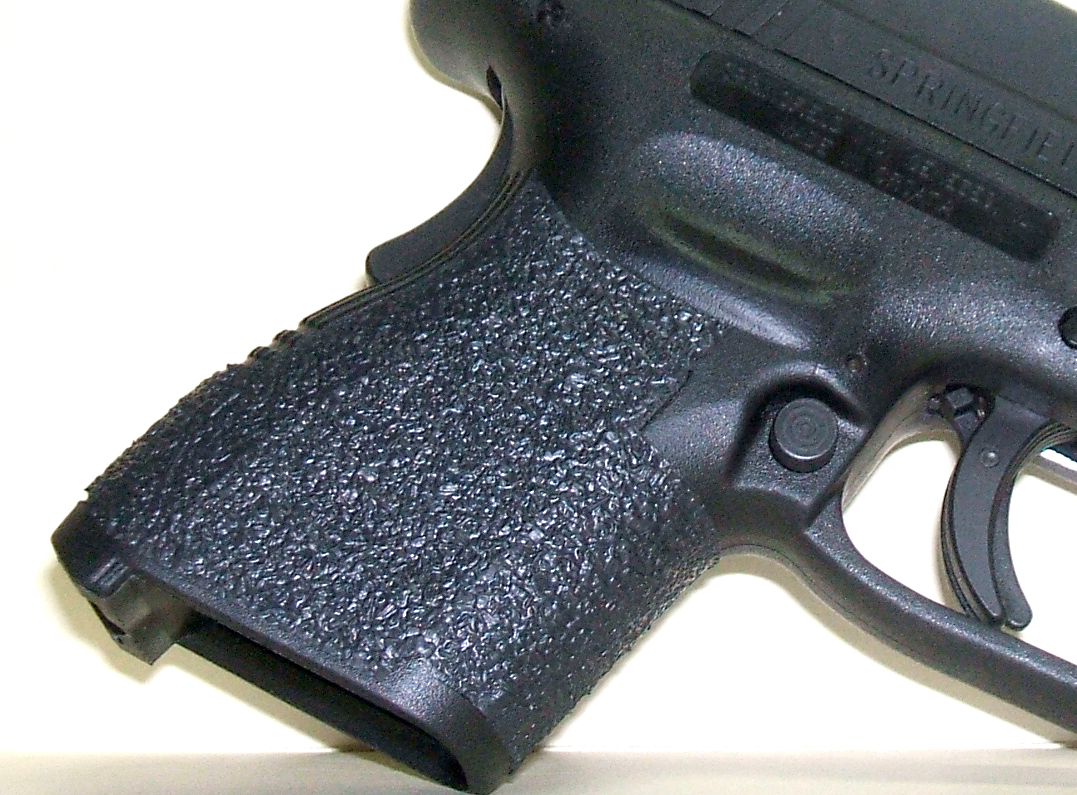
Talon Grips (pictured above) offers one of the simplest with its wrap-around peel and stick grips, tailored to a vast spectrum of popular handgun makes and models. Available in aggressive granulated and rubberized variations, the modification only takes minutes to apply and greatly enhances the control of a firearm.
G-10 is another material that has been a popular choice for aftermarket pistol grips in recent years. Made out of a type of compressed fiberglass laminate, G-10 can be made incredibly thin while remaining very strong. While beefy rubber grip sleeves like the ones made by Hogue tend to be preferred by those with larger hands, G-10 grips are a great choice for anyone who wants to add texture to their handgun without increasing its bulk.
Magazine Holder
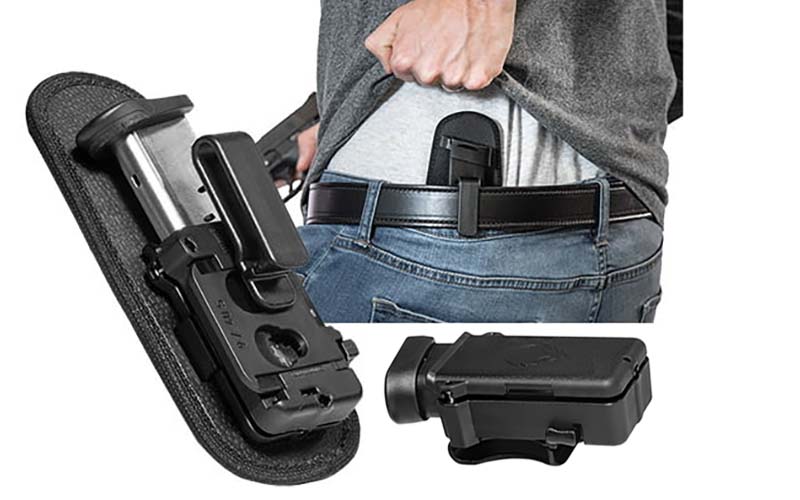
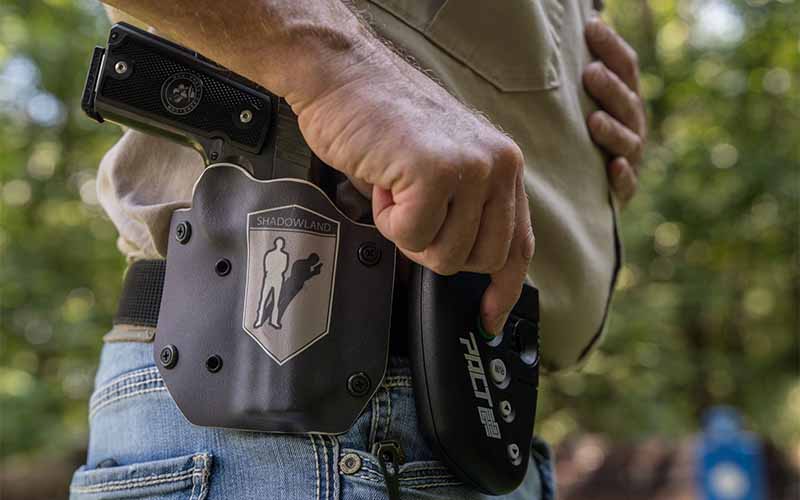
If you carry concealed, you should carry spare ammunition. This isn’t as simple as it sounds, because you aren’t just throwing a few extra rounds in your pocket and calling it good. You need to have it easily accessible and ready to manipulate when you have a tanker load of adrenaline pumping through your veins. This is an easier problem to solve for those who carry semi-automatics with much more clandestine magazine carry options. For those who want to carry at the beltline, Alien Gear has a slick system in its Cloak Mag Carriers (pictured above). The units can be carried inside and outside the waistband. The unit can even be set at a cant to run perpendicular to the belt itself.
Among the most intriguing concealed carry upgrade in this arena are pocket magazine holsters, such as the SnagMag and ExtraCarry that keep spare ammo at hand, while breaking up the profile of the magazine. Extra rounds for revolver shooters can be a bit trickier. Wheelgunners are still stuck with speedloaders, pouches and Bianchi Speedstrips. None of them are ideal, due to size or reload speed, but they’ll do the job.
Night Sights
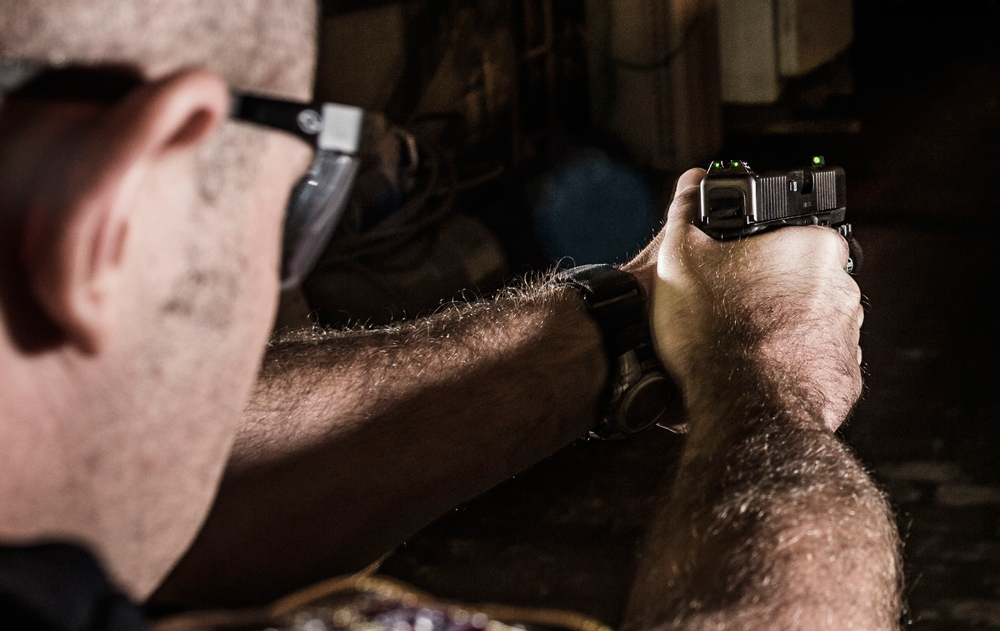
A deadly assault can happen any time, even in broad daylight. But that doesn’t mean that you won’t have to defend yourself in the dusk or dark. Night sights are among the most prudent concealed carry upgrades. Presently, tritium night sights are the go-to choice for those looking to make certain they have a clear sight picture in low light. They offer a great advantage over other night sights, given the radioluminescent hydrogen isotope is continuously aglow, thus always ready for action. TrueGlo, Trijicon (pictured above) and Meprolight all offer excellent options for nearly any conceivable make and model of handgun. But perhaps you’d like to take it up a notch and consider a laser sight. These handy aiming solutions shouldn’t be considered replacements for traditional sights, since electrical devices can malfunction or run out of battery power. But something such as the Crimson Trace Rail Master does provide an outstanding way to get on target in dusky conditions.
Gun Belt
Are you still using that strap you got at a department store’s summer sale to tote your gun? No wonder your rig is so danged uncomfortable. Your average everyday belt just doesn’t cut it when it comes to concealed carry, though there are plenty of folks who try to jam that square peg into a round hole. A gun belt, among the most overlooked concealed carry upgrades, ties your whole carry system together, makes sure your handgun is where it needs to be on the draw and makes carry just a whole heck of a lot easier. Nice thing is, there are plenty of concealed carry belts out there that won’t draw attention and provide the rigidity required to support a handgun. Galco, one of the oldest holster makers around, knows gun leather and has a good selection of leather belts, as does Crossbreed (pictured above). If you’re looking for something nylon, Blackhawk and Ares both are excellent places to start.
There’s a new type of CCW belt that’s been gaining popularity lately too, commonly known as micro-adjustment belts. They’re made by a few different companies including Nexbelt and Kore Essentials, but the general concept remains the same between all of them—these belts feature no traditional holes or buckles, and instead use an internal ratcheting system that allows for much more precise adjustments to be made. This is a great feature for anyone who frequently switches up the gun, holster or position they carry in, or just for keeping your gun secure regardless of how your waist size may fluctuate.
Looking for a new iron or piece of kit to enhance the one you already own? Check out these 7 new bits of guns and gear to grow your firearms wish list.
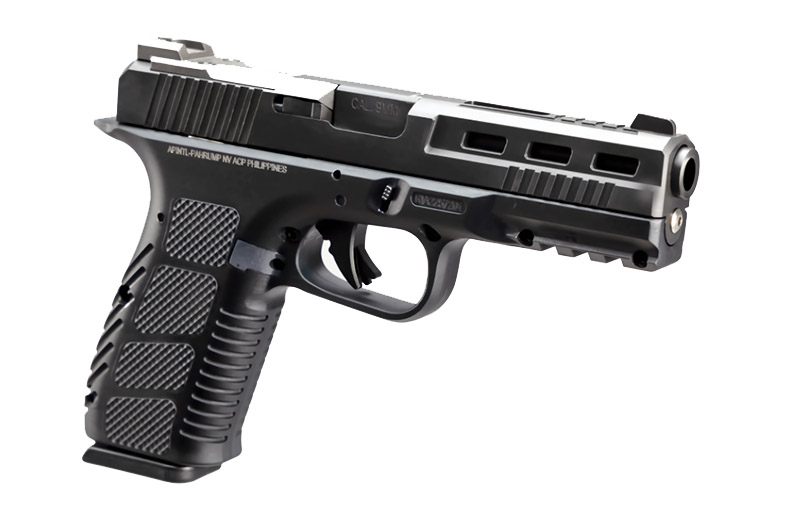
Best known for its relatively affordable and well-built 1911 pistols, Rock Island Armory has seemed to buck recent trends. And, despite jumping into the striker-fired pistol market, the Filipino company still is. That’s because the STK100 isn’t your ordinary striker-fired. Built around an aluminum frame, the 17-round 9mm offers the advantages of metal—such as a bit more heft for excellent recoil mitigation. Further enhancing the pistol is a beavertail that helps facilitate a fundamental high grip, positive grip texturing, a Picatinny accessories rail and front and rear cocking serrations. The STK100 also comes optic-ready, with a slide cut for the addition of a red-dot. MSRP: $599
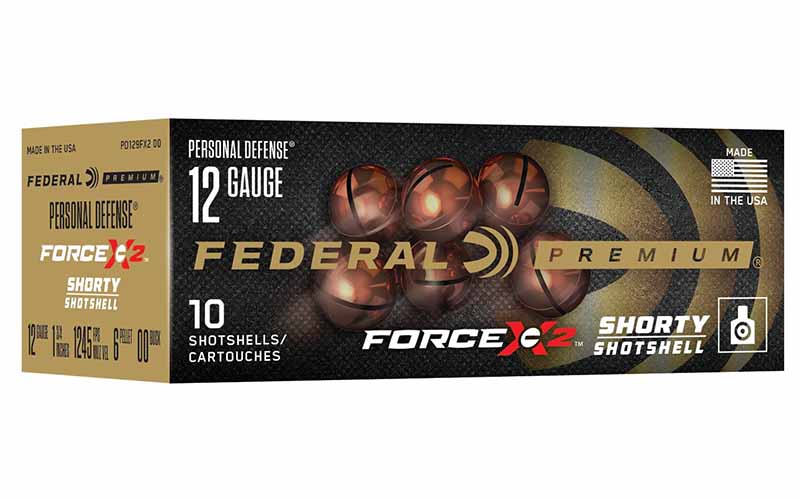
Federal Premium Shorty Force X2
When shotgun firepower is at a premium, Federal’s newest shotshell delivers without compromise. The Shorty Force X2 might only measure 1.75 inches in length, but it serves up a lethal payload of Federal’s segmented buckshot. Six of them to be exact. Designed to split upon impact, the shot has the potential to create 12 devastating wound channels—which is more than enough to neutralize a threat. What’s more, the unique projectiles lessen the chance of pass through, thus collateral damage, making them fit for CQB and home defense. Not to mention, for most guns, it nearly doubles capacity. MSRP: $29/Box Of 10
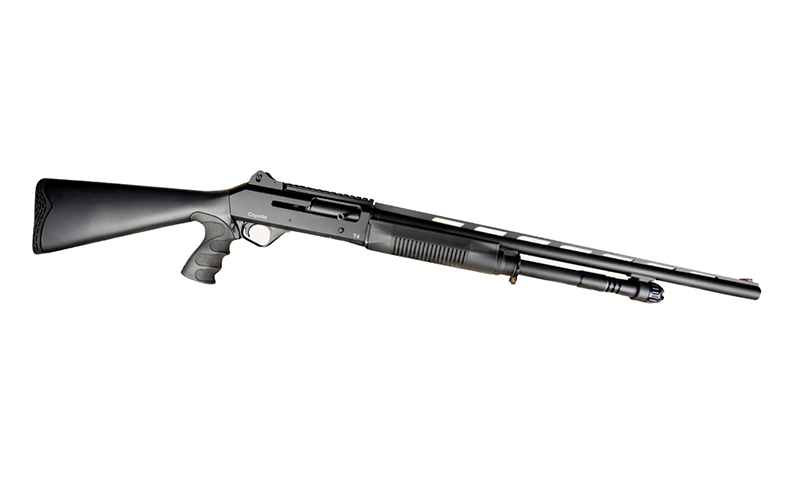
Standard Manufacturing Toros Coppola T4
Benelli’s M1014 shotgun is proven—used by the Marine Corps—but costly. However, Standard Manufacturing offers up the same combat-proven technology at a fraction of the price in its slick Toros T4 12-gauge. Aside from its tactical features—such as ghost-ring sight, 5.25-inch Picatinny rail and pistol grip—the scattergun’s biggest draw is digesting whatever it’s fed. Based on the Italian system, the gas-driven gun chews through both high- and low-wall brass, making it extremely versatile for home defense. Additionally, the Toros is as reliable as tomorrow morning—able to take its licks and still deliver punishment trigger pull after trigger pull. MSRP: $899
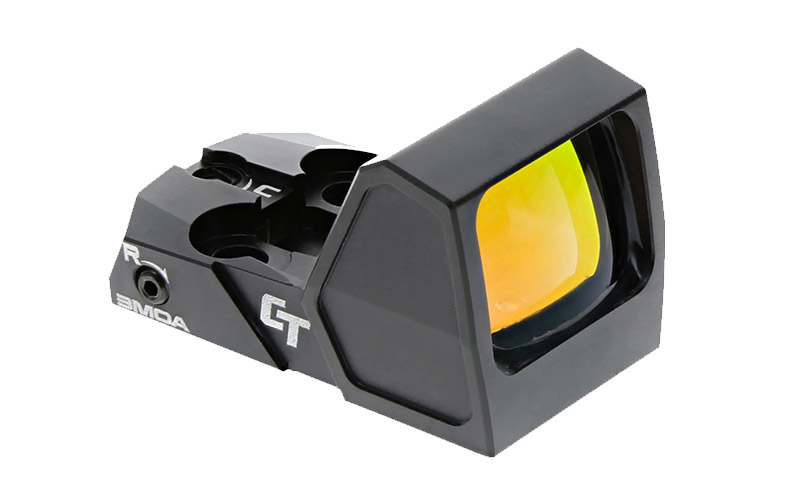
Crimson Trace Micro Pro RAD Electronic Sight
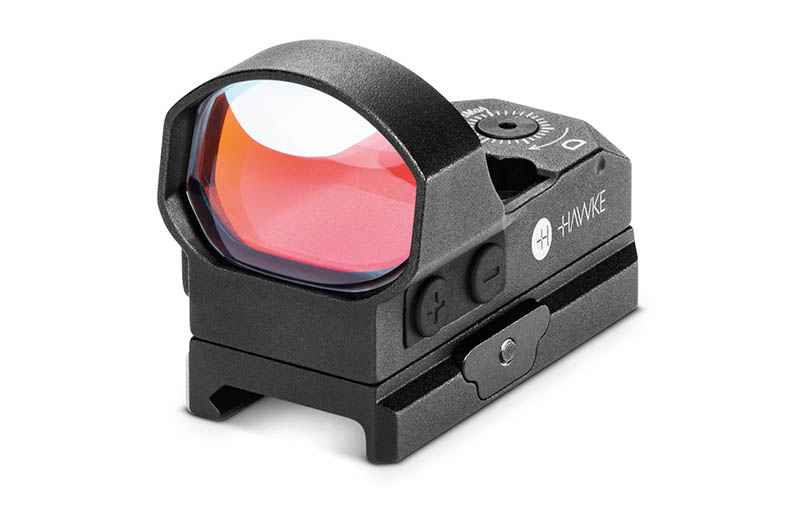
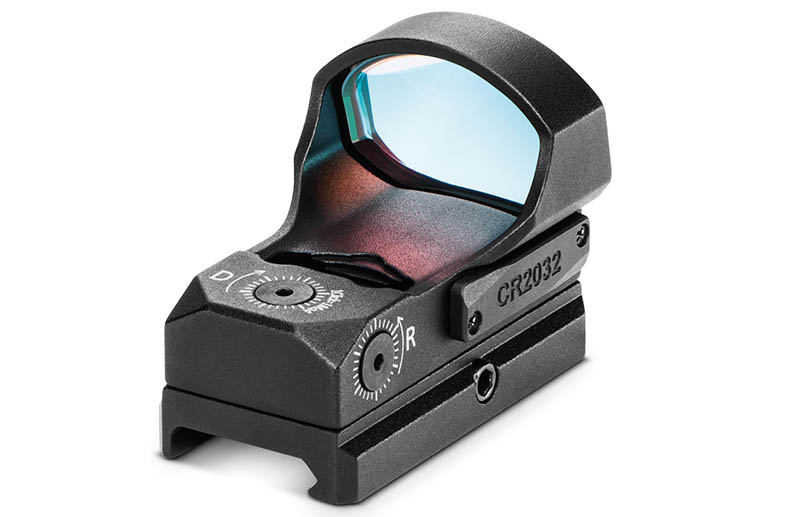
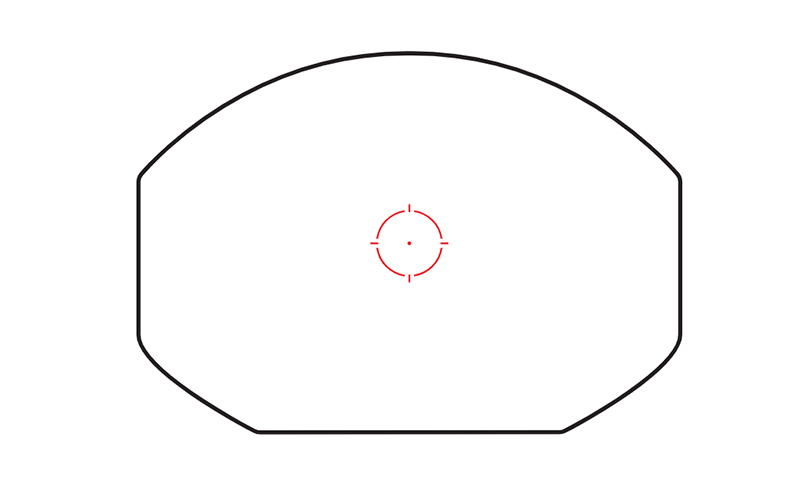
Once known only for its on-target laser sights, Crimson Trace has expanded its horizons to optics in recent years—much to the benefit of shooters. Case in point: its Micro Pro RAD reflex optic. Among the most compact options on the market today, the aluminum-housed red-dot is ideal for EDC pistols or the heater you keep in your bedstand—just in case something goes bump in the night. With a highly visible 3-MOA dot and multi-coated lens, the aim solution offers extremely fast and intuitive target acquisition. And, its CT Radiant Ambient Light Sensor and CT Motion Sensor get the optic into the fight as soon as you are. MSRP: $275
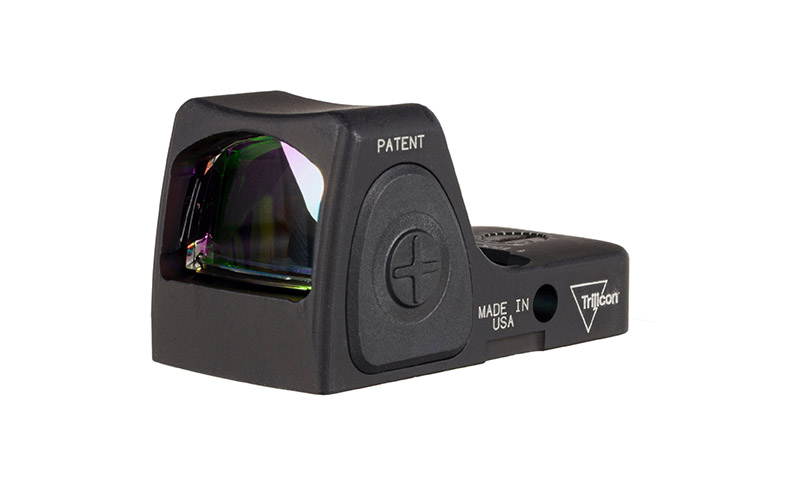
Trijicon RMRcc
It’s difficult to study a Trijicon optic and not walk away amazed. Take the company’s RMRcc: At 1 ounce in weight and 1 inch in width and height, the red-dot is as inconspicuous as honesty in a politician. Yet, the red-dot outperforms nearly everything on the market. Meticulously tested to meet military standards, the reflex optic is as rugged as they come. And with brilliantly clear coated glass, the unit delivers an unparalleled aiming window, with its 3- and 6.5-MOA aiming dots getting you on target fast. MSRP: $699
Hornady Security RAPiD Safe Shotgun Wall Lock
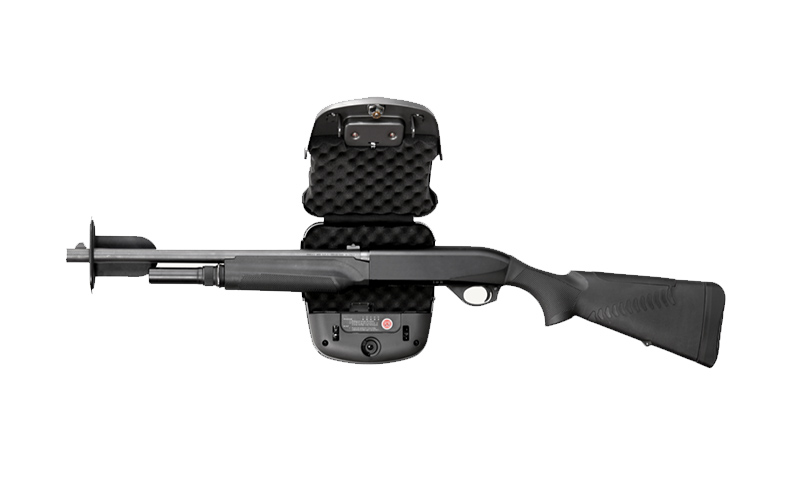
A homeowner’s conundrum: How do you keep a firearm secure, yet within reach? Hornady has put plenty of thought into the problem and has cooked up a fairly elegant answer—the RAPiD Safe Shotgun Wall Lock. Mounting directly to a wall, the 14-gauge steel box keeps a defensive smoothbore under lock and key when not needed. Yet, at a moment’s notice, the RFID system puts the gun in your hands. And you needn’t worry if you don’t have the fob or bracelet key at hand, with a backup six-digit code and a physical key unlocking the unit. MSRP: $275
Mossberg 590S Series
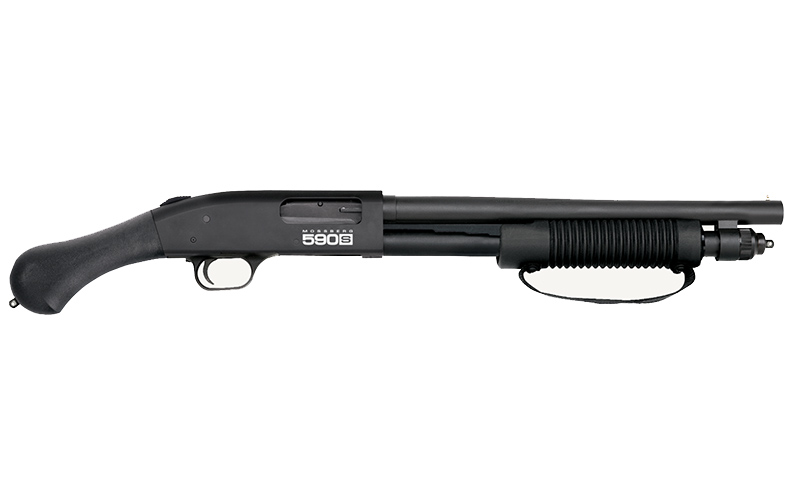
Among the most trusted names in defensive shotguns, Mossberg has only continued to improve on its already stellar legacy. The 590S series of 12-gauge pump-actions keeps what’s right with the iconic 500 line … but it throws some very welcome tweaks. Perhaps the most notable is the ability to cycle 1.75-, 2.75- and 3-inch shotshells interchangeably without the need for an adapter. This makes the Shockwave model firearm—with its very manageable birdshead grip—the perfect home-defense option. At once, the 30-inch gun is nimble and overpowering. Plus, with the ability to hold up to 9+1 shells, it’s also more than satisfying in firepower. MSRP: $623
Editor’s Note: This article originally appeared in the April 2022 issue of Gun Digest the Magazine.
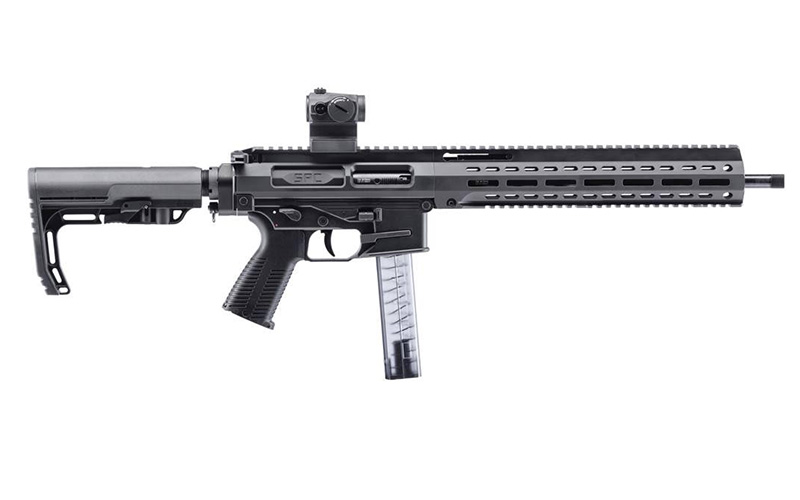
B&T USA has just announced the 16-inch SPC9 Carbine, a new variant of their 9mm SPC9 PCC.
SPC9 stands for “Special Purpose Carbine 9”, and it’s a new line of 9mm firearms released by B&T earlier this year. When originally shown, the SPC9 series only consisted of short-barrel PCC-style models, but B&T has just announced the release of a new 16-inch SPC9 Carbine variant.
Like the other models in the SPC9 series, the new SPC9 Carbine combines the best features of the B&T APC9, H&K MP5 and AR-15 weapons systems. The result is a 9mm carbine that B&T claims to be supremely light, reliable, safe and modular.
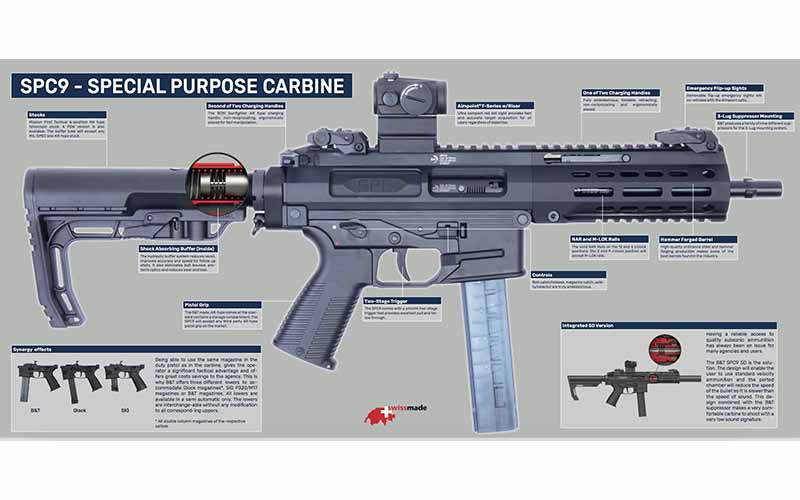
A primary reason for the SPC9’s handling qualities stems from B&T’s hydraulic buffer system. The system not only reduces recoil, but also increases accuracy and allows for faster follow-up shots. It also puts less wear on the internals of the firearm and any optics mounted on it, making the SPC9 a great choice for competition shooters or anyone who puts a high round count through their PCCs.
This diagram shows the B&T hydraulic buffer system in a shorter-barreled SPC9 model.
Jon Scott, Vice President of Sales at B&T USA, said this about the SPC9 Carbine:
The new 16-inch barreled SPC9 is a PCC competitors dream — the carbine is incredibly flat shooting, handles like a race car and has minimal recoil thanks to B&T’s effective hydraulic buffer system…We expect the SPC9 16-inch to dominate both at home and on the competitive field, thanks to an ideal formula of features. Those in search of a premium home defense solution would be well served by this very lightweight, well balanced and incredibly easy to shoot well platform — flatteringly so. Most importantly the SPC9 has a proven record of reliability, produced by a company who has built its reputation on being dependable in the most austere conditions imaginable.
When it comes to Ruger 10/22 mods, a little tweaking can go a long way.
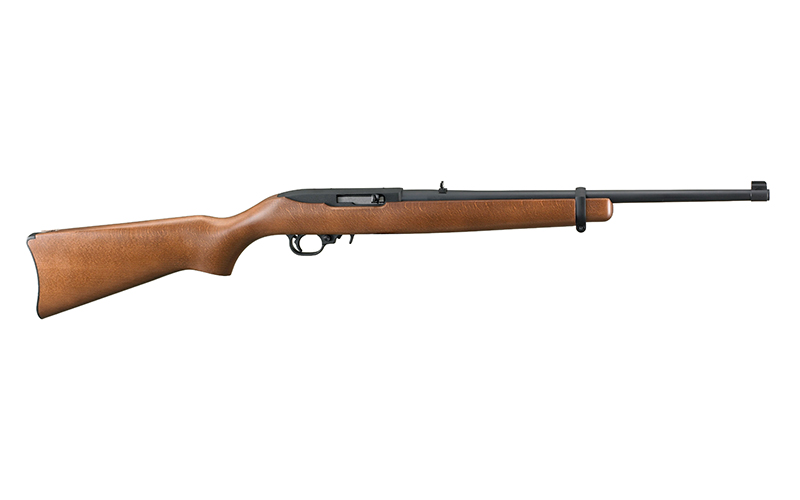
In the more than 7 million copies produced, you’d be hard-pressed to find a serious gun owner who hasn’t owned at least one Ruger 10/22 at some point in their shooting career. Even though the rifle is one of the most common in America, some shooters overlook the diamond in the rough due to the 10/22 carbine’s unassuming hardwood stock and pencil barrel—the truth is, they don’t look very exciting.
While the standard Ruger 10/22 carbine looks boring, it’s well-suited to either modify till your heart’s content or introduce a new shooter to marksmanship in stock form.
You see, that’s the beauty of the Ruger 10/22. Its simple design is anything you can dream up; you can build it into a rifle that’s truly yours. Sure, the 10/22 is a fine rifle in stock form, but where is the fun in that? Aftermarket companies have fully embraced the easy customizing of the design with enough options to make your head spin.
Ruger’s Custom Shop gives you the option of buying a hot rod without all the guesswork.
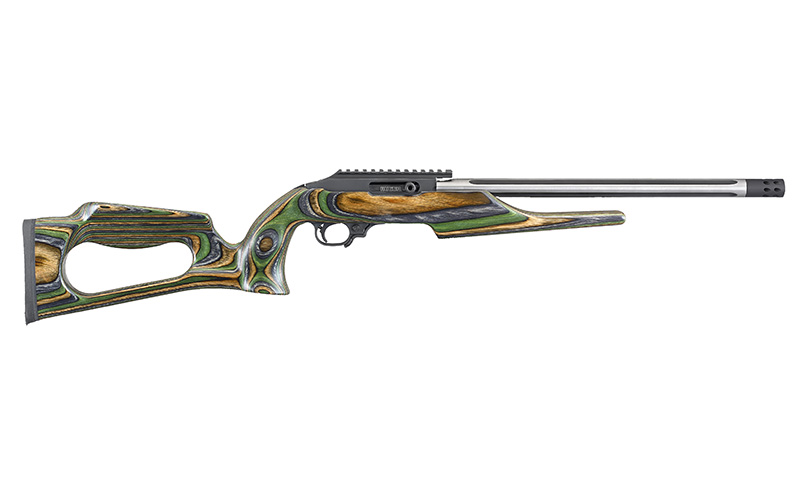
If your heart desires a rifle that looks fit to beat back alien invaders, you might want to look into some of the shells that accept a barreled 10/22 receiver to transform it into a bullpup. How about a rifle that looks like it belongs to a Special Forces operator in some far-off land? One of the tactical chassis that make a 10/22 look strikingly like an HK G36 or an AR-15 might be the ticket. Most opt for accuracy and build a rifle well-suited for use in Project Appleseed events or something with a high-quality bull barrel and a sweeping laminate wood stock so accurate that it makes shooting the tacks off your buddy’s targets almost dull.
Even with all that flexibility, three of the four 10/22 rifles in my safe are nearly identical. After owning north of a dozen of these excellent rifles since I started shooting, I found that a rugged, lightweight rifle happily at home bouncing around in a pack or traipsing around the woods fits my needs quite well. That isn’t to say I haven’t had the laminate stocked hot rod or even an entirely stock rifle; this happens to be where I am in my 10/22 journey currently.
Ruger Factory Hot Rods
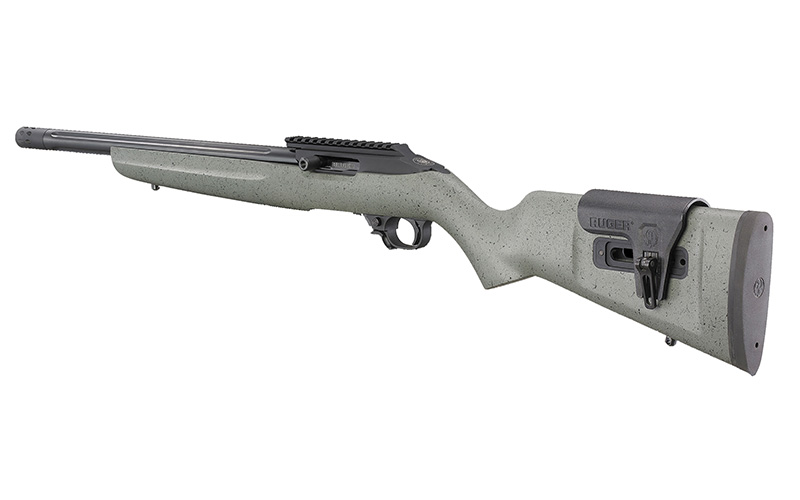
If modifying your rifle isn’t your jam, Ruger offers several models that come off the production line looking very similar to a living room-built hot rod for pretty close to the same money. If you’re after a cool-looking takedown, the 10/22 Takedown Lite sports an upgraded modular stock and a lightweight bull barrel with 1/2×28 threads ready for a suppressor.
Ruger even offers a left-handed rifle with all the trimmings for lefty shooters.
If your tastes run toward the heavy barreled target rifles, Ruger’s target or competition line of rifles will have something that gets the juices flowing. Surprisingly, even the high-end 10/22 Competition rifles top out at just a hair over a grand MSRP, which is a pretty solid value when you consider it comes out of their custom shop.
10/22 Clones
Since the Ruger 10/22 patent expired, a handful of companies introduced rifles that are the next evolution of the 10/22 design. Innovative rifles are readily available from Bergara, Thompson Center, Magnum Research, Volquartsen, Tactical Solutions and Winchester, which incorporate more modern features generally found on higher-end custom shop rifles.
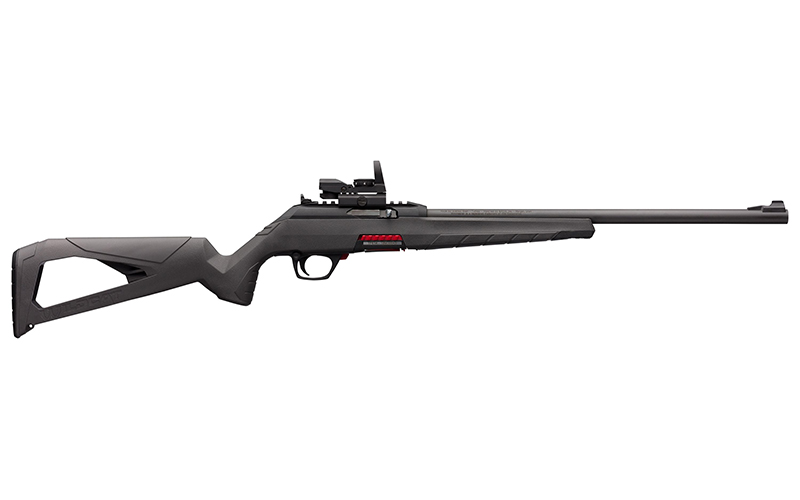
Each variation brings its own special flavor to the venerable design, like the interesting slider approach to a magazine release Winchester took or Magnum Research’s .22 Magnum variant of the 10/22 should you want more oomph.
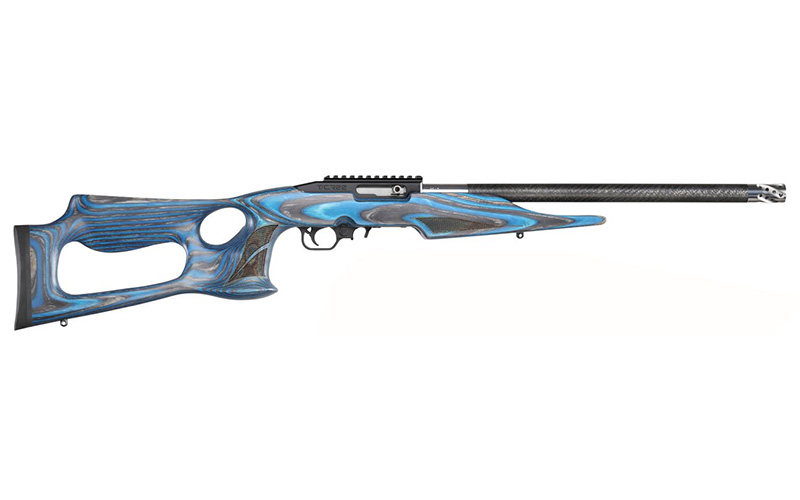
The Volquartsen Summit is arguably one of the coolest variants of the 10/22 design. Even though it isn’t semi-automatic and features a straight-pull bolt similar to biathlon rifles, it still accepts most 10/22 accessories. It’ll be incredibly quiet once you throw a suppressor on the threaded carbon-fiber barrel.
Originally a PWS design, the Volquartsen Summit features an interesting straight-pull bolt instead of being semi-auto.
Build A Receiver
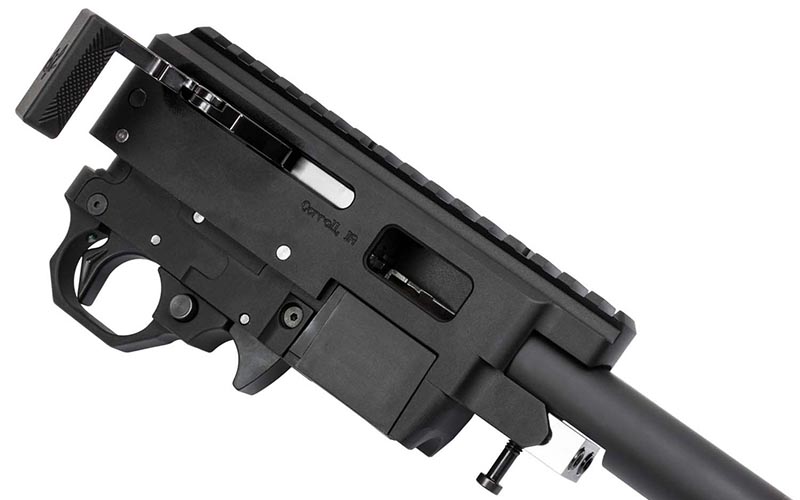
Now, if you’re a perpetual tinkerer like myself, starting with a bare receiver might be the most cost-effective solution. The best bang for your buck is the Brownells BRN-22 receivers that come either stripped or as a barreled receiver. The BRN-22 can be had in either a non-takedown or takedown variants with your choice between a more modern integrated optics rail or the traditional drilled and tapped style.
Even with an optic and suppressor fitted, the Brownells BRN22 Takedown is still small enough to stow in a backpack.
Volquartsen and Tactical Solutions offer very similar semi-auto receivers; you couldn’t go wrong with either one. If a premium receiver is what you’re after and you want something more understated, the Volquartsen is a good bet. Those who like more flash should look at the Tactical Solutions X-Ring.
While there are a ton of other receivers out there, most of them are pretty comparable to one another except for the unique Volquartsen Summit straight-pull bolt-action receiver I mentioned earlier. While pricey, nothing compares to the Summit action when paired with a suppressor and some subsonic ammo.
Magazines
Since most models of the Ruger 10/22 ship with a single 10-round magazine, adding some more to your mag stash is a good idea to get the most out of your range time. Shooting 10 rounds and reloading a singular magazine gets old fast; thankfully, there are a ton of really great options out there that range from a single-shot magazine up to big ol’ drum mags.
Winchester took a very different approach with the Wildcat’s magazine release that almost looks ornamental but is very functional.
If one of the Ruger-produced BX magazines isn’t to your liking, look for one that uses metal feed lips. Cheaper magazines with plastic feed lips will wear over time and eventually experience feeding issues. The gold standard for non-Ruger mags has been the Butler Creek Steel Lips for as long as I can remember, but unless you have to have a 110-round drum, there isn’t a great reason not to buy Ruger’s excellent BX magazines.
10/22 Internal Upgrades
If you buy a stock rifle, some minor internal tweaks will improve reliability and accuracy with a minimal cash investment. Some of the more common upgrades are replacing the extractor with one designed to handle cheap bulk pack ammo more reliably or installing an aftermarket firing pin for more reliable primer ignition.
Adding a bolt buffer to slow the bolt down a bit makes suppressed shooting quieter and can improve reliability with hot ammo. While you have the bolt out, it might be worth replacing the charging handle with one that’s easier to use with a magnified optic mounted.
Once you’ve done all of that, some 10/22s benefit from an aftermarket V-block to get a tighter barrel-to-receiver fit that squeezes the last little bit of accuracy out of your rifle.
Thompson Center’s T/CR22 massaged by their Performance Center is a great value at the $642 MSRP.
Triggers
Pulling the trigger feels a whole lot like someone was eating Fritos while the trigger pack was assembled. Thankfully, you can take a couple of routes to address the less-than-stellar trigger—the easiest of which is to replace the OEM trigger pack with Ruger’s upgraded BX-Trigger.
Some DIY solutions are out there, but they’ll run you about the same money as a BX-Trigger, making it hard to justify. Kits like the Powers Custom result in a slightly better trigger pull than the BX-Trigger but require more work to install. If you’re willing to spend a few more dollars, the absolute best option is an aftermarket drop-in trigger from Volquartsen, Timney or CMC Triggers.
Stocks
While triggers and internal upgrades are nice, a new stock truly transforms a rifle. As is always the case, the kind of stock you choose is entirely dependent on what you want out of your rifle. For rifles often in the woods where exposure to rain or other moisture is a concern, a synthetic stock is a great idea, since the wood will swell when wet and can affect your zero.
The Magpul line of stocks for the 10/22 is very functional while looking cool. Specifically, the Backpacker takedown stock is something special, thanks to a place to store some ammo on the rifle and the frond that mates to the stock keeping the rifle together when stowed.
The Boyds At-One adjustable stock gives you the ability to fit several members of the family.
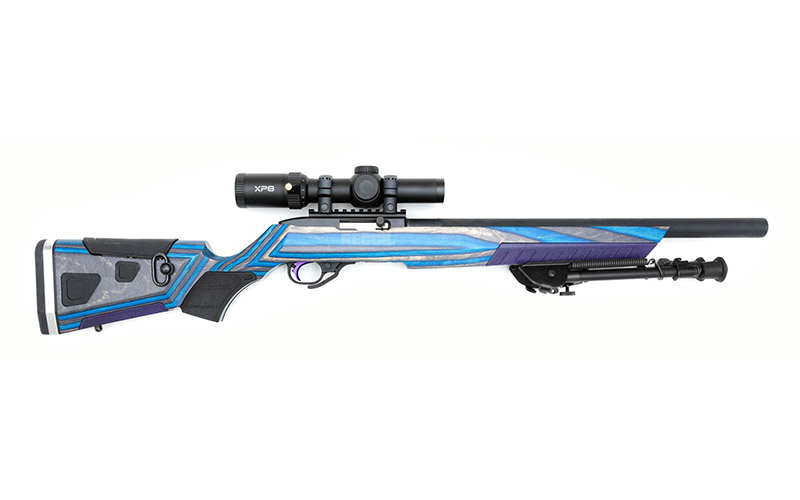
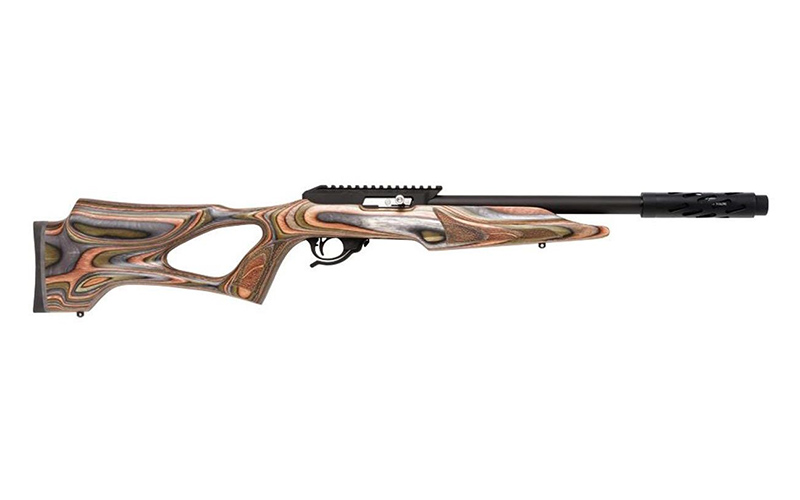
Target shooters might want to consider a sweeping laminate stock from Boyds Gunstocks or Tactical Solutions. The sky is the limit with a laminate stock; you can get something that resembles grandpa’s hunting rifle or go for the racy thumbhole stock in neon pink. Look for a stock that has a sling stud if you plan on using a bipod. It’s a lot harder to mess up a stud install when it’s done at the factory.
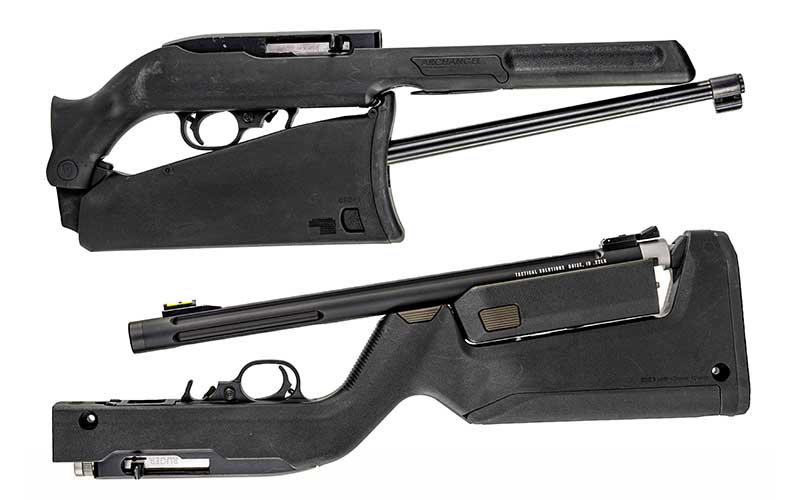
Neither one of those styles excite you? Look at some unconventional stocks on the market. Pro-Mag’s Archangel Quick Takedown Stock is a cool option that turns a standard 10/22 into a takedown rifle for about the same cost as an aftermarket sock.
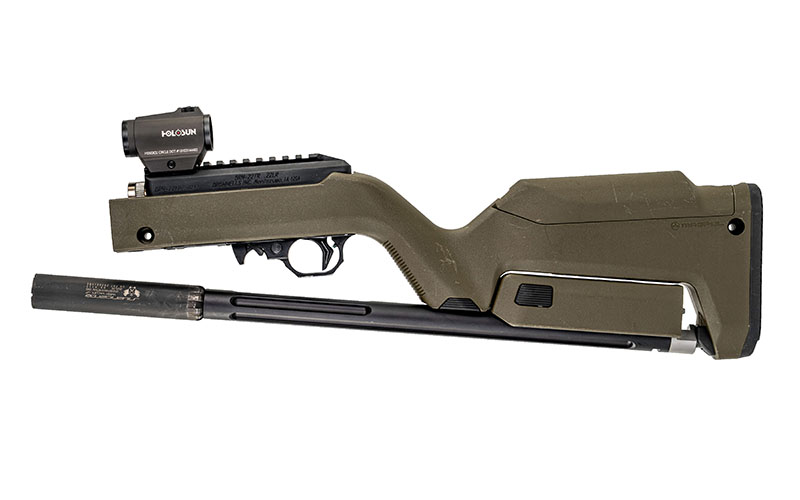
Archangel stock and standard 10/22 Carbine (top): $400 Magpul X-22 Backpacker Stock, Tacsol barrel and 10/22 Takedown (bottom): $825.
Barrels
Most stocks are set up for either a .920-inch bull barrel or the skinnier, shorter profile. Thicker bull barrels are generally stiffer and more accurate; the thinner profile, shorter barrel weighs a lot less typically than the thick bull barrel. The exception to that rule are barrels made from aluminum or carbon fiber, where a thin barrel liner is tensioned between the breech face and muzzle of the barrel. As a result, these tensioned barrels only weigh a fraction of a full-on steel barrel.
Tactical Solutions’ suppressor shroud allows the installation of a suppressor without adding a ton of length like an SBR but without the tax stamp.
If you intend on shooting the rifle suppressed, take a look at Tactical Solutions’ shrouded SBX barrel line. To keep the ATF goons happy, Tactical Solutions came up with a shroud they can add to the end of a short 10/22 barrel, bringing it to a 16.5-inch overall length. When you install your suppressor, you get the benefits of an SBR Ruger 10/22 without the hassle of a second tax stamp.
Optics
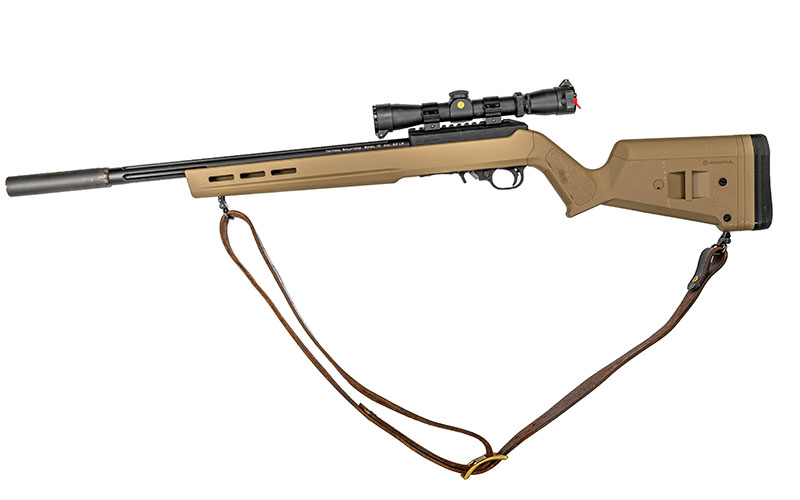
Fitting your 10/22 with an optic is entirely dependent on what you intend on doing with the rifle. Common sense applies; a high magnification scope is probably best if you want tiny little groups. If you’re going to be hunting with the rifle, look into a lightweight scope or red dot. Don’t get too cheap because it’s “just a .22;” good glass is always a wise investment.
Not only is the 10/22 rugged, it can also stay light with this example coming in at a mere 5.75 pounds as shown.
Just One More
There’s a world of possibilities out there when it comes to modifying the 10/22. The only hard part is deciding what direction to go with your build. If you can’t make up your mind and decide to build three, four or a dozen rifles, no one is going to judge you. In fact, the Gun Digest social media pages are kind of a support group for those of us who give in to the temptation; the only problem is we might encourage you to build “just one more.”
Editor’s Note: This article originally appeared in the December 2021 issue of Gun Digest the Magazine.
Accurate. Versatile. Reliable. Advocates of the AR-15 will most likely cite one of these vital attributes as the reason why they pledge allegiance to the gun. Spot on, but dig a little deeper another reason platform’s popularity surfaces. Customization.
Modular in design, there isn’t a creek or crevasse that can’t be tinkered with to perfection. As Tom Wolf might have said, AR-15 is the regular Kandy-Kolored Tangerine-Flake Streamline Baby of the 21st Century. In short, every rifle is potentially a hunter, fighter, plinker, match gun, or what have you. Its fate lies in your hands. A veritable sea of performance AR-15 parts and accessories swamp the market, so a point in the right direction wouldn’t hurt. That’s what we’re attempting here.
The working assumption for this piece is you have an off-the-shelf rifle of some repute in your possession. Now you’re looking to kick it up a notch or two or even three. We’re veering away from involved upgrades—no barrel swaps—and home in on drop-in enhancement (for the most part). Economy is also at a premium in this litany, this means there are some top-shelf AR-15 parts and accessories left off. That said, this is your first foray into upgrading your gun. Worry about five-star, gold-standard parts once you gear up your 3-Gun career.
AR-15 Triggers
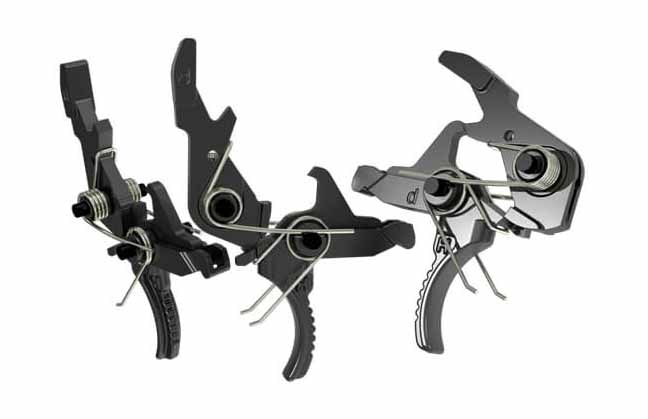
Splitting the bullseye straight down the middle, no single AR-15 part plays a larger role in doing this consistently than the trigger. Most rifles are factory outfitted with a relatively sub-standard fire control, the Mil-Spec trigger. It gets your gun to go bang but does little to enhance its accuracy. Of all AR-15 upgrades you consider this should be among the first
This piece on AR-15 triggers is a good place to nail down the finer points before you buy.
Single-Stage AR-15 Triggers
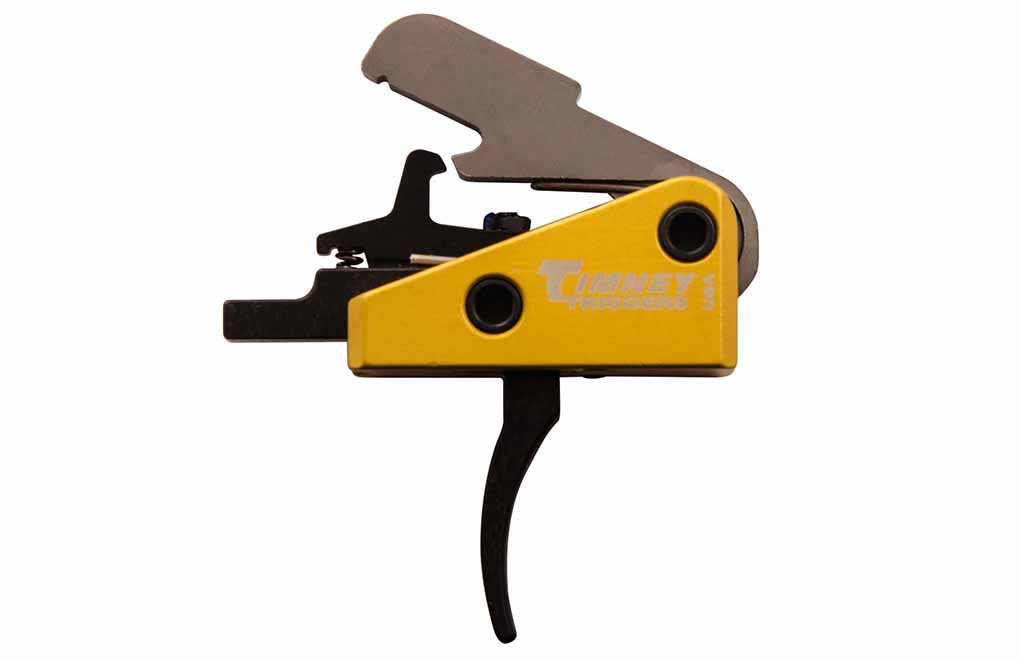
Timney AR-15 Competition Trigger
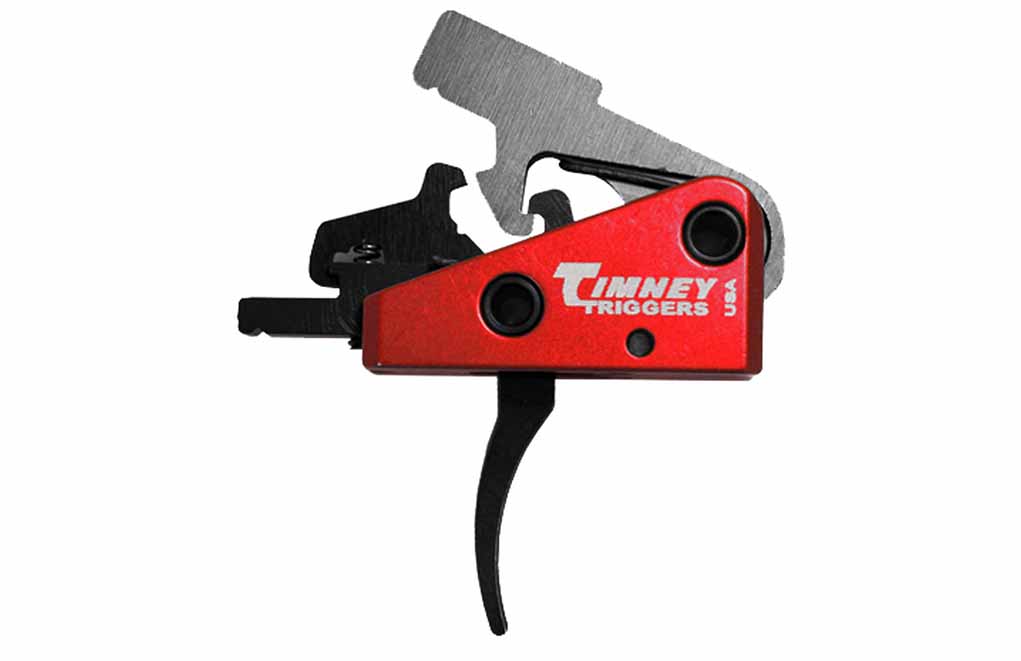
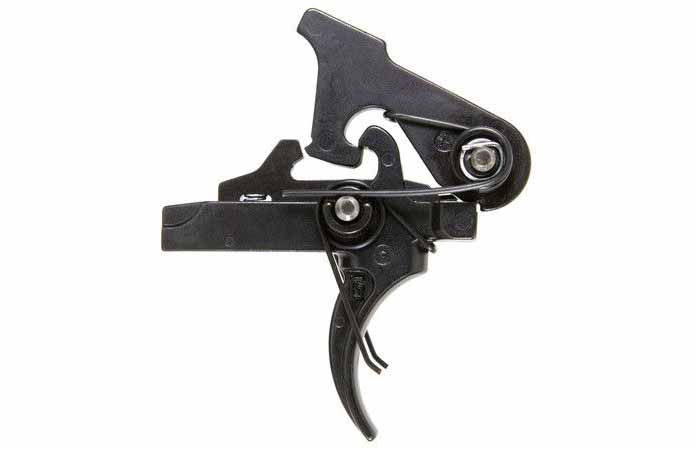
Timney’s Competition Trigger is a legitimate upgrade, giving you everything you want in a single-stage trigger: no pre-travel, terse reset and reliability pull after pull. Its drop-in design makes for no-brainer installation and you have three pull weights to pick from—2-2.5 pounds, 3-3.5 pounds and 4-4.5 pounds—and three bow styles—curved, straight and skeletonized. MSRP: $219 // timneytriggers.com
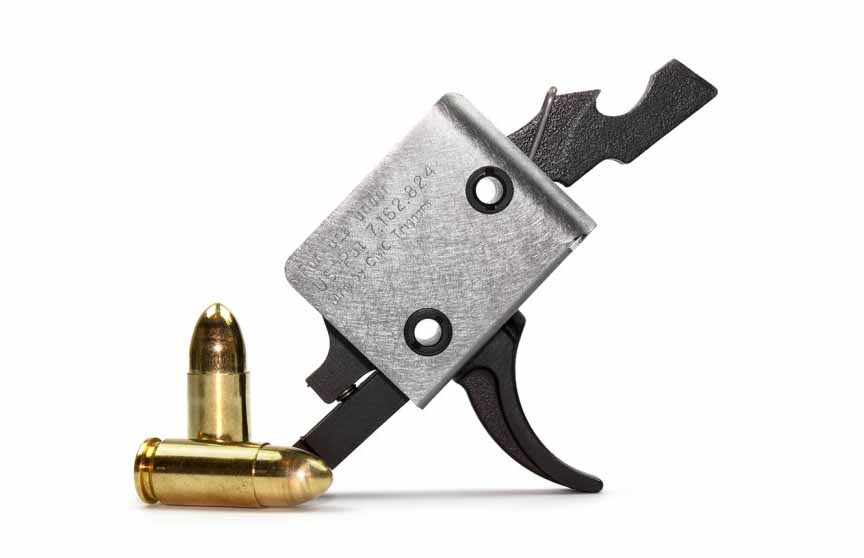
CMC Single-Stage
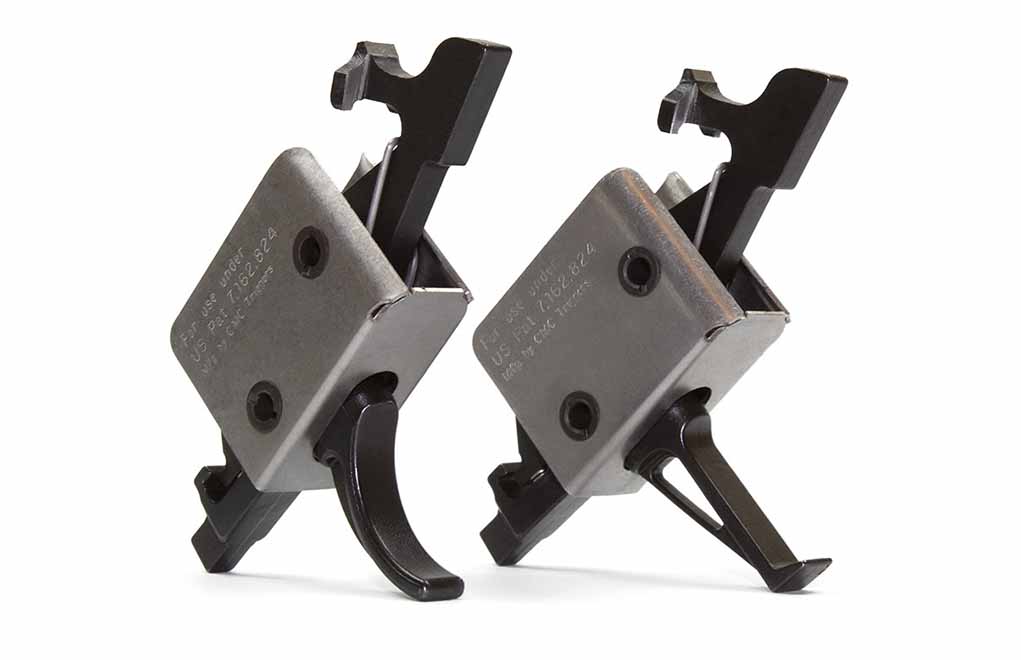
Spartan for sure, CMC Single-Stage triggers shine where it counts—performance. Especially nice, a very positive reset that picks up the pace once you master trigger control. It also ticks off all the other boxes you want in a single-stage trigger. You have the choice of a flat or curved bow and pull weights from 2.5 to 6.5 pounds. MSRP: $196 // cmctriggers.com
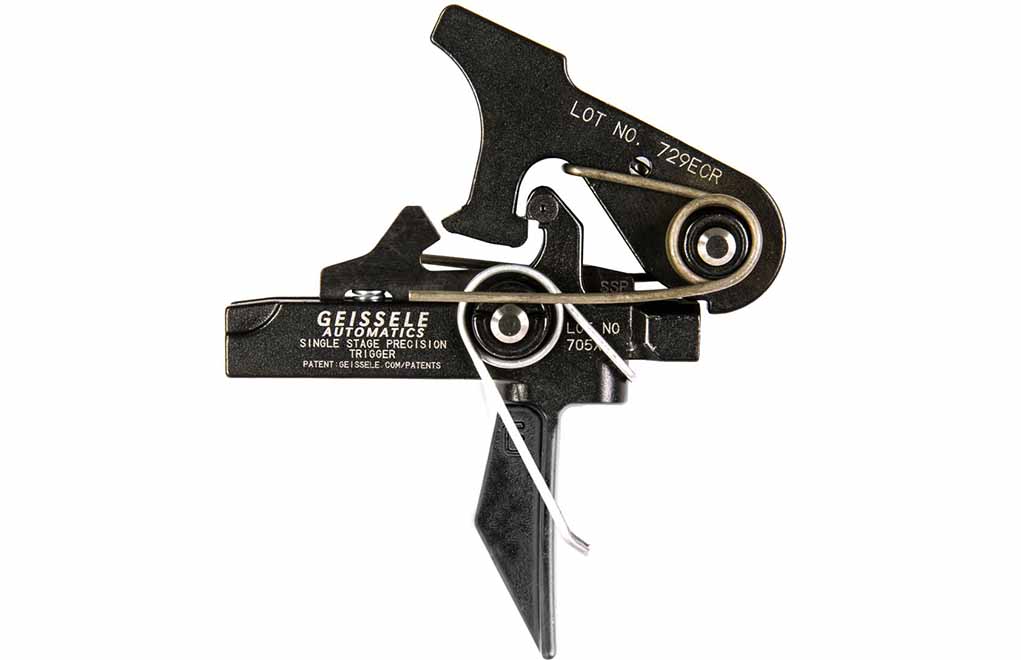
Geissele Single-Stage Precision
Predictable as the next minute and built to stand up to rough handling, Geissele’s Single-Stage Precision has everything to improve your rifle. The knock on it, you’re limited in pull-weight—3-3.5 pounds. Still, you have the option for a straight or curved bow. MSRP: $240 // geissele.com
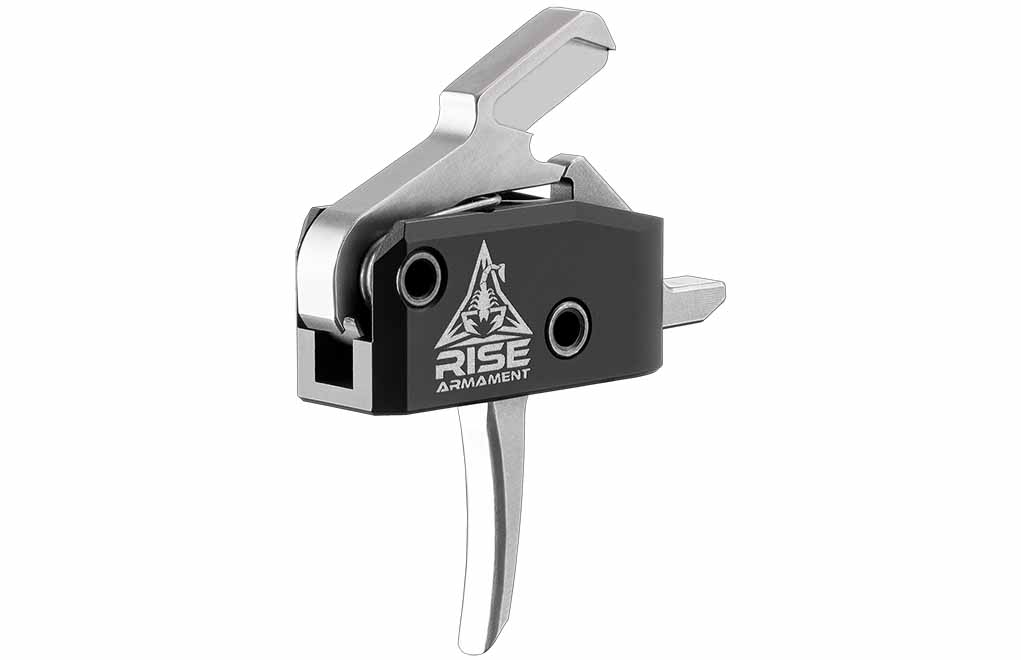
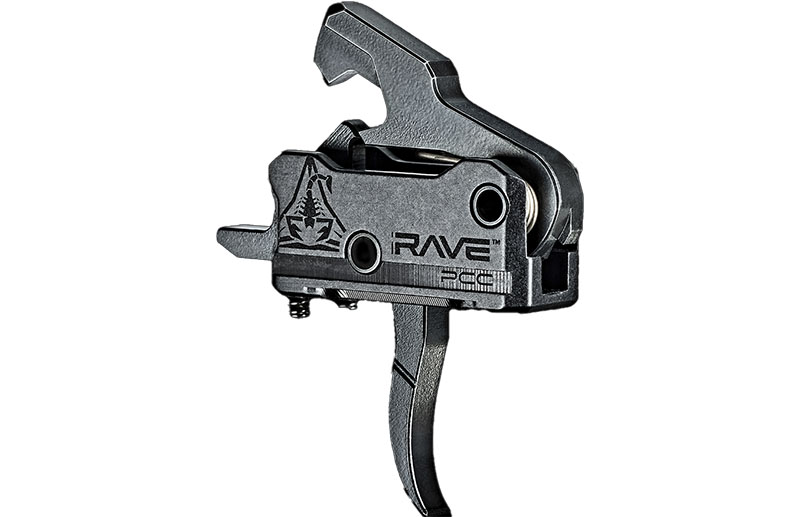
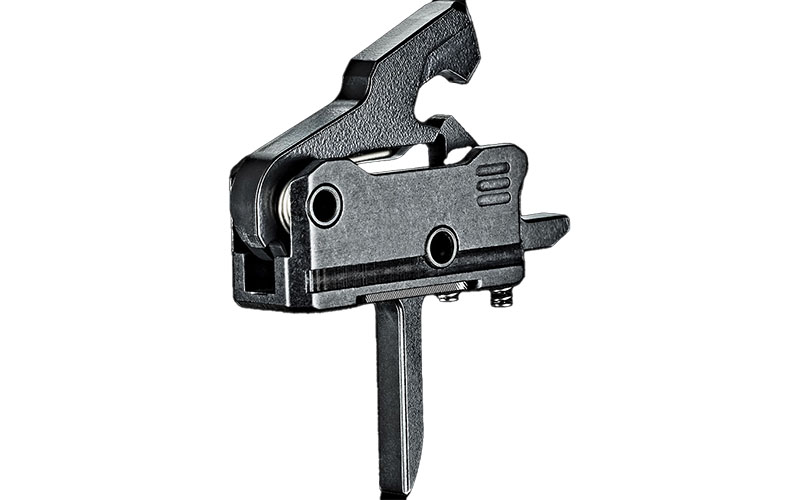
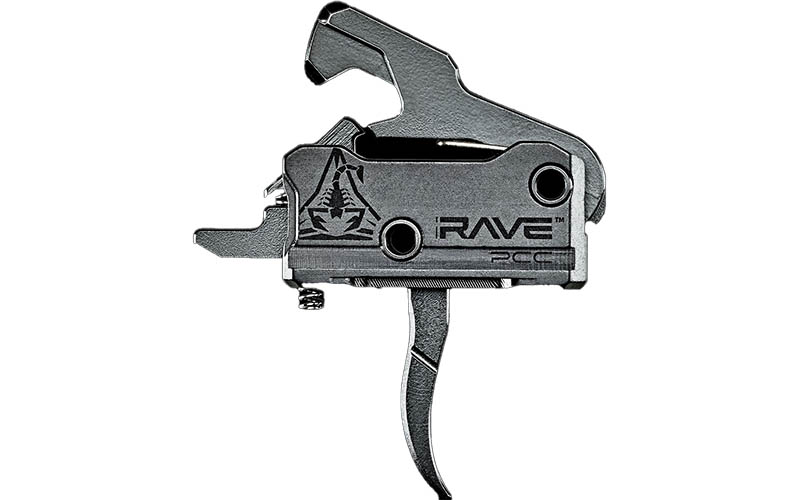
Rise Armament RA-434 High-Performance Trigger
Don’t be fooled by its mid-tier price, the RA-434 delivers top-shelf performance. It boasts a very smooth pull, thanks to a self-lubricating nickel-boron coating on the internal parts. The bow architecture is nice, facilitating intuitive finger placement. MSRP: $179 // risearmament.com
Hiperfire AR-15-EDT
Best known for high-end competition triggers, Hiperfire’s Enhanced Duty Triggers cost a fraction of the price. Yet, they’re on par with the rest of the company’s catalog. Replaceable springs give you the option to tailor pull weight from 4.5 to 5.5 pounds. Powerful hammer spring ensures a solid strike each trigger pull. MSRP: $99 // hiperfire.com
Two-Stage AR-15 Triggers
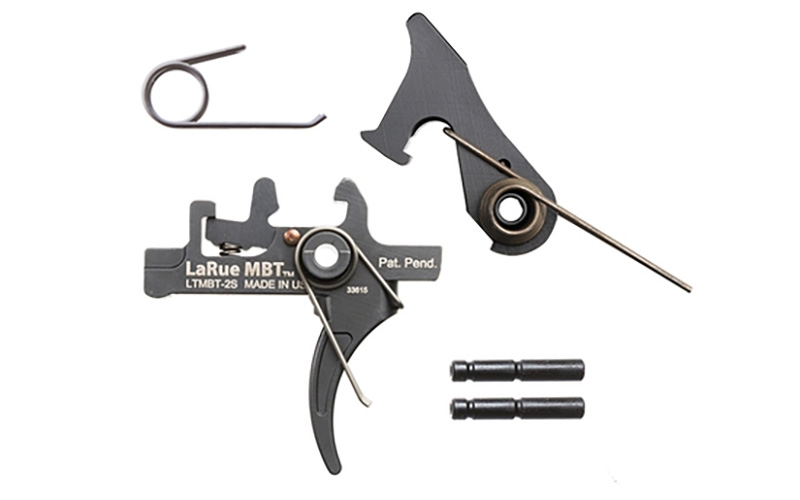
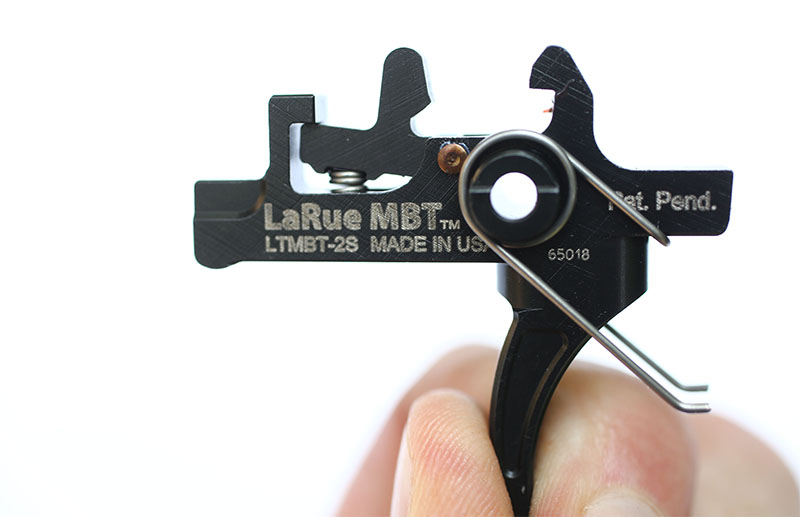
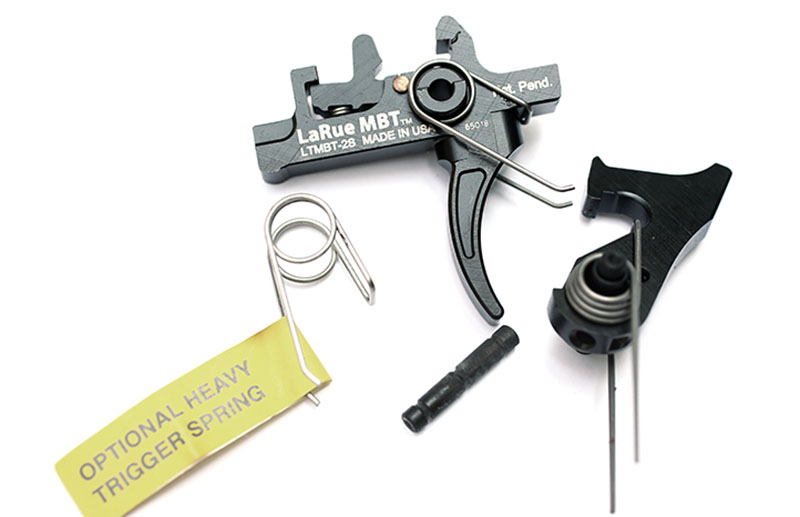
LaRue Tactical MBT MBT stands for Meticulously Built Trigger, and that’s an accurate description. This two-stage, drop-in trigger from LaRue Tactical is made from S7 tool steel, and it brings a lot to the table for a very economical price. Each MBT comes with two trigger springs, one 4.5-pound and one 6-pound. Each purchase also comes with replacement hammer and trigger pins that do a better job of holding the trigger where it should be, just in case your lower isn’t playing nice with the MBT right out of the box. MSRP: $99 // larue.com
CMC AR-15 Two-Stage Trigger
Another of CMC’s drop-in marvels. A clear wall gives a good definition to the trigger, while its break is crisp and reset short. It’s quick when you need it to be. Available with breaks from 3 to 5 pounds and straight or curved bows. MSRP: $240 // cmctriggers.com
Timney AR-15 Targa
A very affordable Timney option, the Targa defines what you want out of a two-stage trigger. Available with pull weights from 2 to 4 pounds, there’s an option for nearly every shooter. And a more vertical curved bow facilitates proper finger placement. MSRP: $199 // timneytriggers.com
Geissele 2 Stage (G2S) Trigger
A cost-effective option, the G2S offers defined stages and overall performance improvement. Take up come in around 3 pounds, then breaks at a very terse 1.5 pounds. Short reset gets your next shot downrange fast. MSRP: $165 // geissele.com
AR-15 Handguard
Manufacturing costs decreasing over the years, a stock rifle is likely to have a better handguard or rail system then in the past. Even so, you might find the factory-install model isn’t exactly bringing the best out of your AR-15. Particularly if it isn’t free-floated or doesn’t have accessory attachment points.
We’ll touch on two versions of this vital AR-16 part: drop-in, which requires no gunsmithing, and free-float, which take a bit more know-how to install. The effort is worth it, free-float handguards are lightweight and, more importantly, maintain pristine barrel harmonics.
Check out Kevin Muramatsu’s rundown on installing a free-float handguard for the finer points of the process.
Get On Target With The AR:
Go Small With These 8 Economical AR Pistol Options
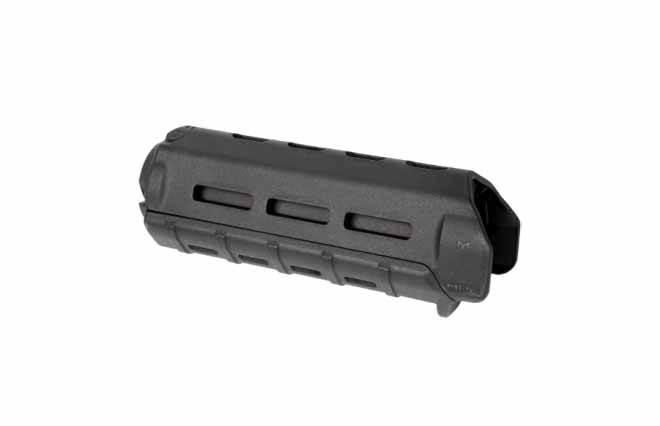
No frills, but the MOE gets the job done better than almost any other drop-in handguard on the market. It being Magpul there are M-Lok slots aplenty for accessory attachment. Reinforced and heat resistant, it’s a top-notch polymer option. MSRP: Starting at $37 // magpul.com
Bravo Company BCMGUNFIGHTER PKMR
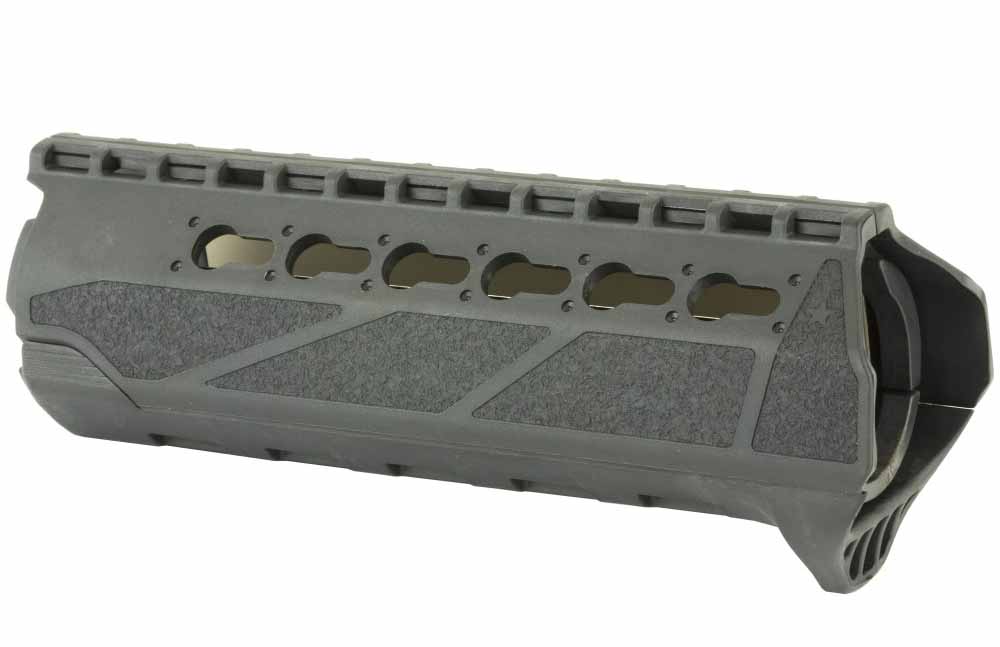
An austere option, but one with plenty of functionality. Slim as a second to boot. A bit of a twist, BCM opted for KeyMod attachment points. They’re not quite as prevalent at M-Lok, but no less useful. Rugged, the polymer handguard is heat resistant and reinforced. MSRP: $40 // bravocompanyusa.com
Free-Float Handguard
Aero Precision AR15 Atlas R-One
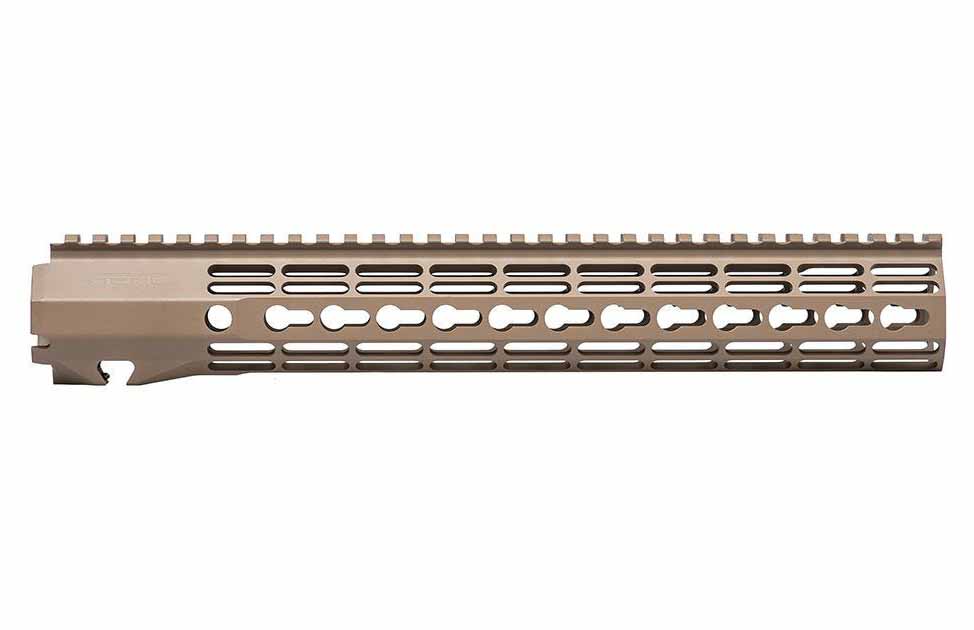
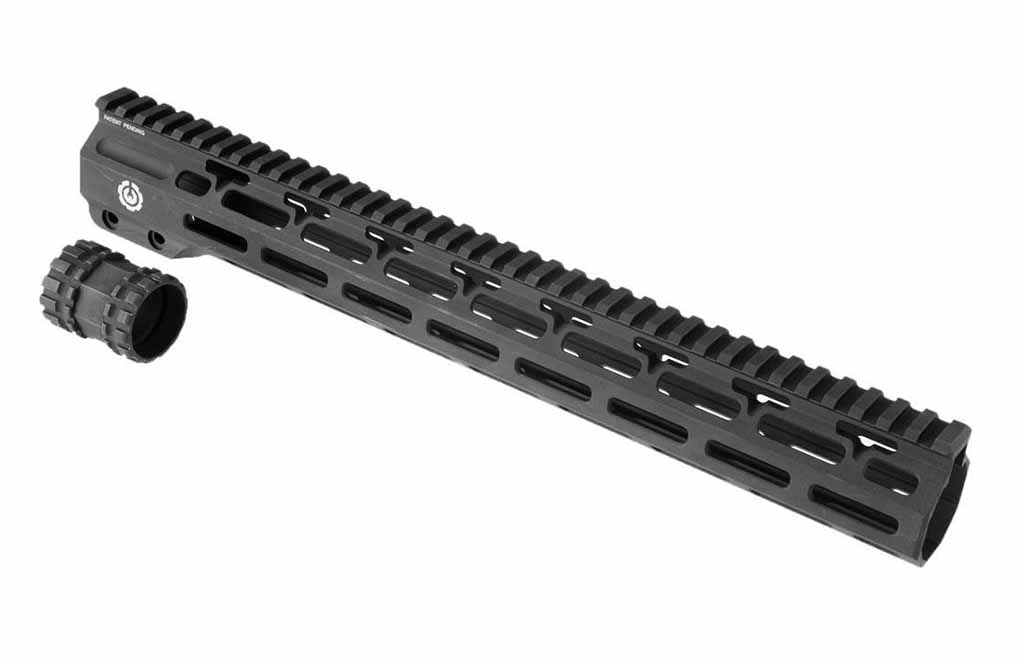
Lightweight and relatively slim, Aero’s Atlas R-One Handguard gives you a full-length top rail and plenty of attachment points. Both M-Lok and Keymod options are available, so you aren’t confined. Available 7-, 9-, 12- and 15-inch lengths. MSRP: Starting at $150 // aeroprecisionusa.com
BCM MCMR If you feel that you need a name-brand rail like what the real operators use, BCM is always a solid option, and their MCMR series has plenty of sizes to choose from. Made of 6061-T6 aluminum alloy, these free-float rails are light, strong and provide ample M-LOK real estate. There’s an MCMR rail out there for just about every build too, since they’re available in 7-, 8-, 9-, 10-, 13- and 15-inch varieties. MSRP: Starting at $171.95 // bravocompanyusa.com
Brownell’s Wrenchmen Handguards
Brownell’s in-house brand is up to snuff and easy on the pocketbook. Plus, it comes with the company’s forever guarantee, which means they’ll take it back no matter what. Full-length top rail and M-Lok compatible, the aluminum handguard is ready to get decked out. Available lengths include 10.5, 12.6 and 15 inches. MSRP: Starting at $124 // brownells.com
Bolt Carrier Group
The beating heart of your AR-15, the bolt carrier group (BCG) is among the your rifle’s most critical components. There are three main BCG designs prevalent today:
AR-15 BCG: Deeper cut toward the rear of the bolt, lower overall mass. M-16 BCG: Shallower cut toward the rear of the bolt, more mass. Note, this will not make your AR-15 full-auto. Lightweight or Low-Mass BCG: Made of lightweight material, such as titanium, to increase the cycle-rate of an AR-15. Note, to function reliably it typically requires other upgrades.
Overall, the most commonly found BCGs are AR-15 and M-16. If well made, a gun will function reliably with either. However, shooters have tended toward M-16 BCGs in recent times, the argument being they are the more dependable of the two. Low-mass BCG are a bit out of a basic upgrades article—mainly favored by competitors. In turn, we’ll focus on AR-15 and M-16 versions.
Patrick Sweeney gets your mind right about this AR-15 part and how even the economy BCGs are built for the long haul.
Aero Precision Bolt Carrier Group
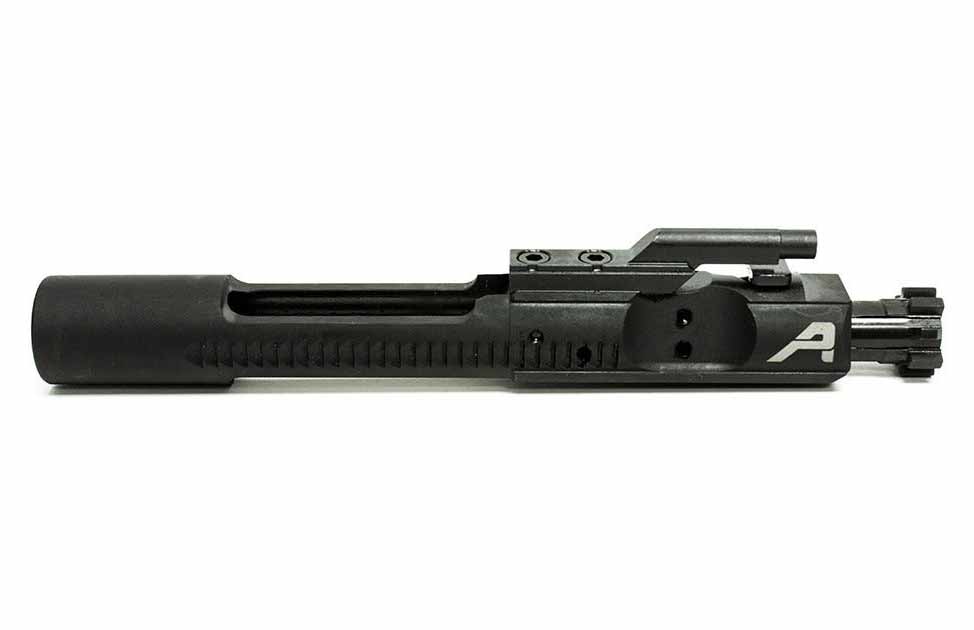
Fully Mil-Spec and HPT tested/MPI marked, Aero’s BCG is up to snuff. It comes complete with a phosphate coating and with or without Aero’s logo. MSRP: $150 // aeroprecisionusa.com
Daniel Defense M16 Bolt Carrier Group
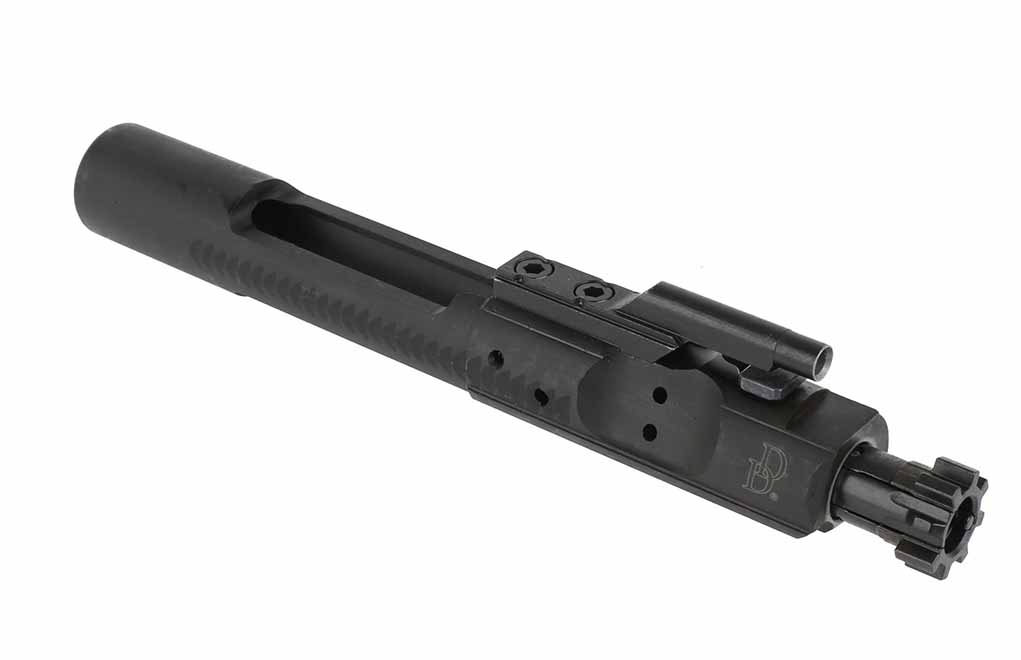
Great name and manufacturing history, Daniel Defense doesn’t disappoint, delivering a rough-and-ready Mil-Spec BCG. You’ll pay more, but likely it will last as long as your rifle. MSRP: $217 // danieldefense.com
Spikes Tactical M16 5.56 Nickel Boron Bolt Carrier Group
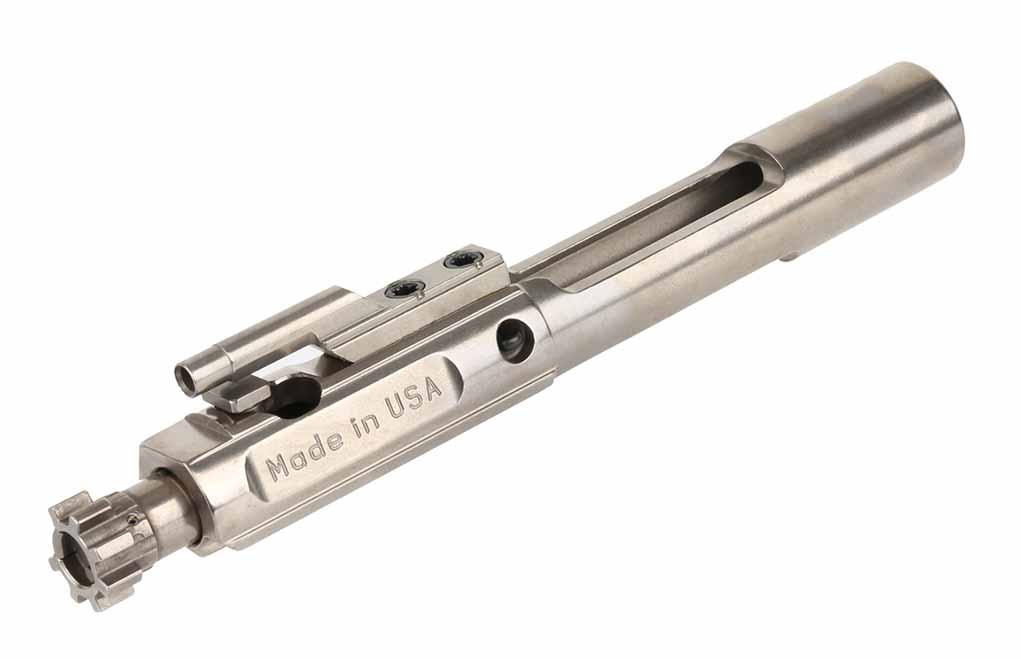
Has all the Mil-Spec goodness, along with a nickel-boron finish. This makes it easier to clean and smoother operating. Plus, shiny! MSRP: $225 // spikestactical.com
Muzzle Brakes, Flash Hiders And Compensators
Unless you reside in a draconian state where muzzle devices are verboten, these handy little AR-15 parts give your gun a notable edge, depending on your ends.
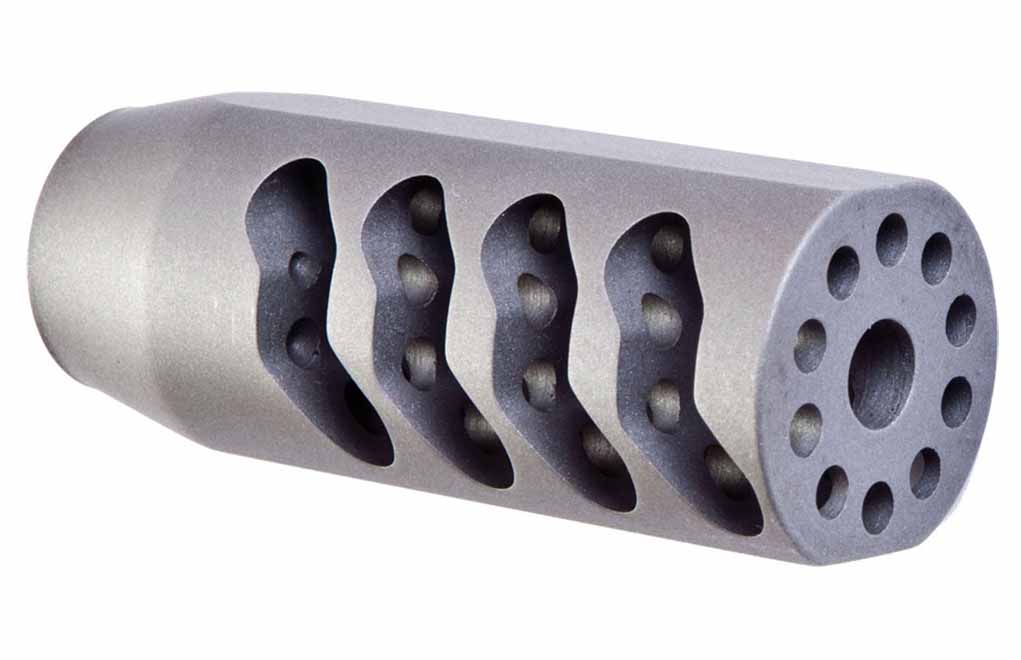
Muzzle Brake: Work by using expanding gas to reduce felt recoil, not necessarily muzzle rise. Flash Hider: Reduces the muzzle flash caused by still-burning powder exiting the barrel behind the bullet. Compensator: Uses expanding gases to reduce muzzle rise, not necessarily recoil.
Stock guns usually come with an A2 flash hider, lovingly known as a “birdcage”. If all you want to do is cut down your rifle’s visual signature or keep your line of sight clear this is a proven option. Improving shot-to-shot accuracy, that’s the muzzle brake and compensators job. Forewarning, there’s a tradeoff—both increase your rifle’s report.
If you need to know the ins and outs of all three, here’s a deep dive into muzzle devices.
Seekins Precision ATC Muzzle Brake
Front-facing ports do a good job of eating up recoil. Plus, utilizing a knurled nut instead of a crush washer, installation and timing don’t get much easier than the ATC. MSRP: $89 // seekinsprecision.com
Strike Industries JCOMP
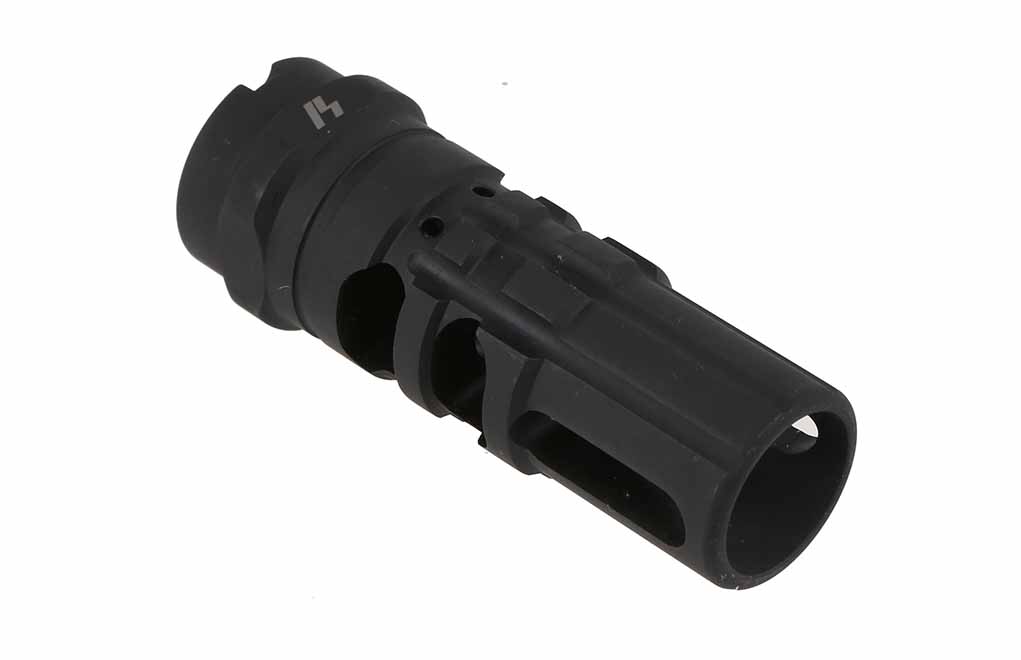
It’s a riff on the Type 89 compensator used on the Japanese Howa Type 89 rifle. A double-chamber design cuts recoil and muzzle rise considerably. Slots at the fore also do a number on muzzle flash. MSRP: $44 // strikeindustries.com/
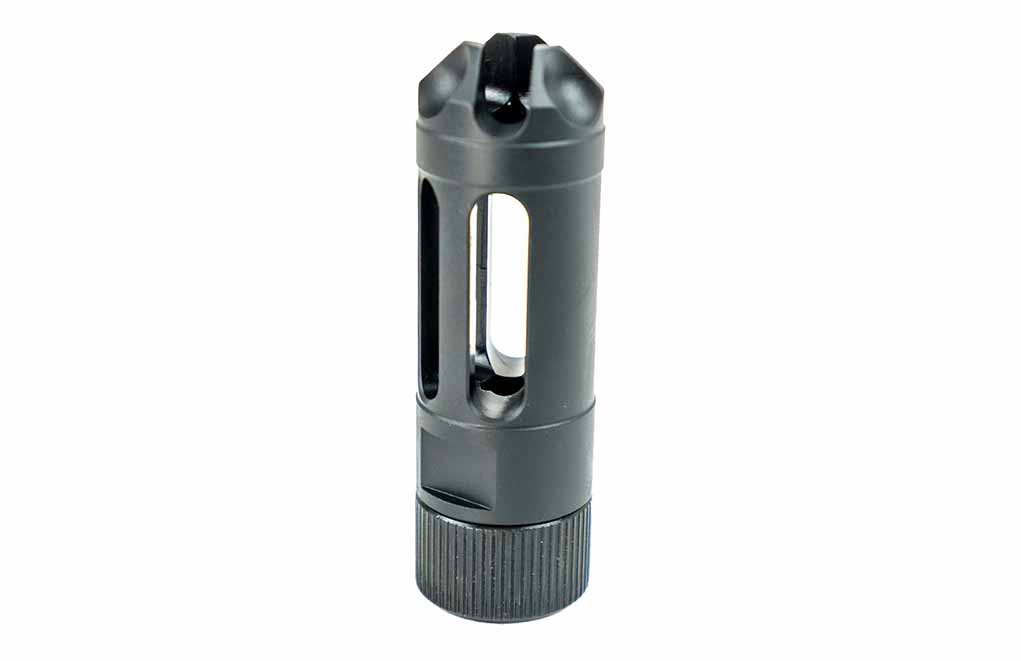
Faxon MuzzLok Ported Flash Hider Faxon’s Muzzlock makes it a snap to install and time. Once on, it cuts flash down considerably. Good price too. MSRP: $60 // faxonfirearms.com
AR-15 Charging Handle
One of the easiest AR-15 upgrades, the charging handle is also a fairly minor improvement. Though, there are certainly more rugged options than the factory-installed unit on your gun. And, if you’re a lefty, there are options more in tune to your southpaw ways.
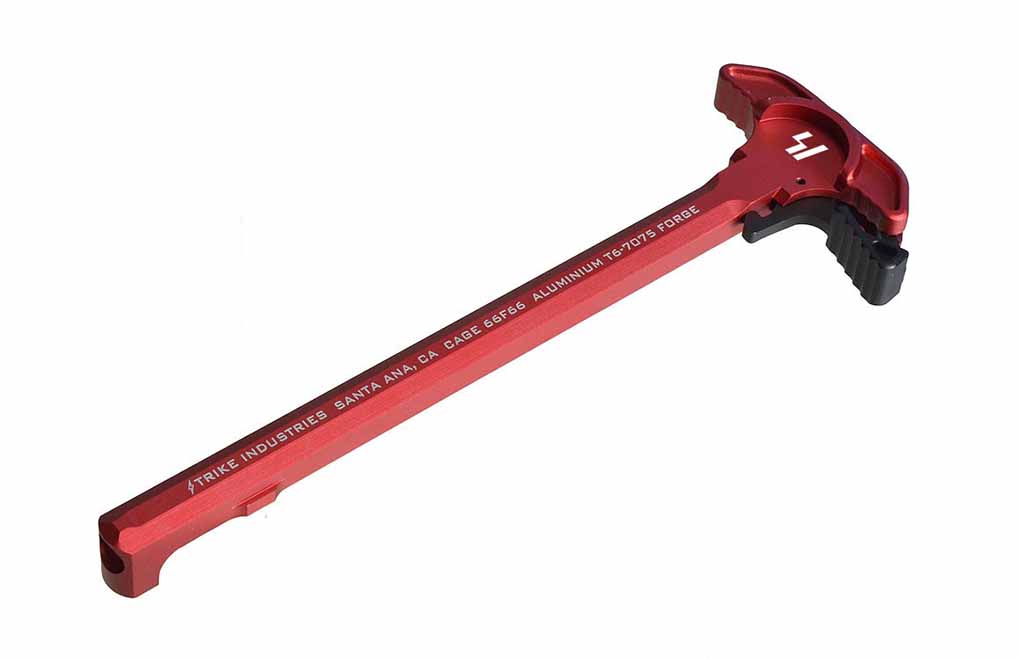
Strike Industries Extended Latch Charging Handle
More latch to snatch, making your AR easier to manipulate. Plus, plenty of colors to choose from. MSPR: $44 // strikeindustries.com
Radian Raptor Ambidextrous Charging Handle
Standby AR-15 upgrade at this point, making gun ambidextrous—nice for lefties. Additionally, about as rugged charging handle as there is. It’s a quality AR-15 part. MSRP: $90 // radianweapons.com
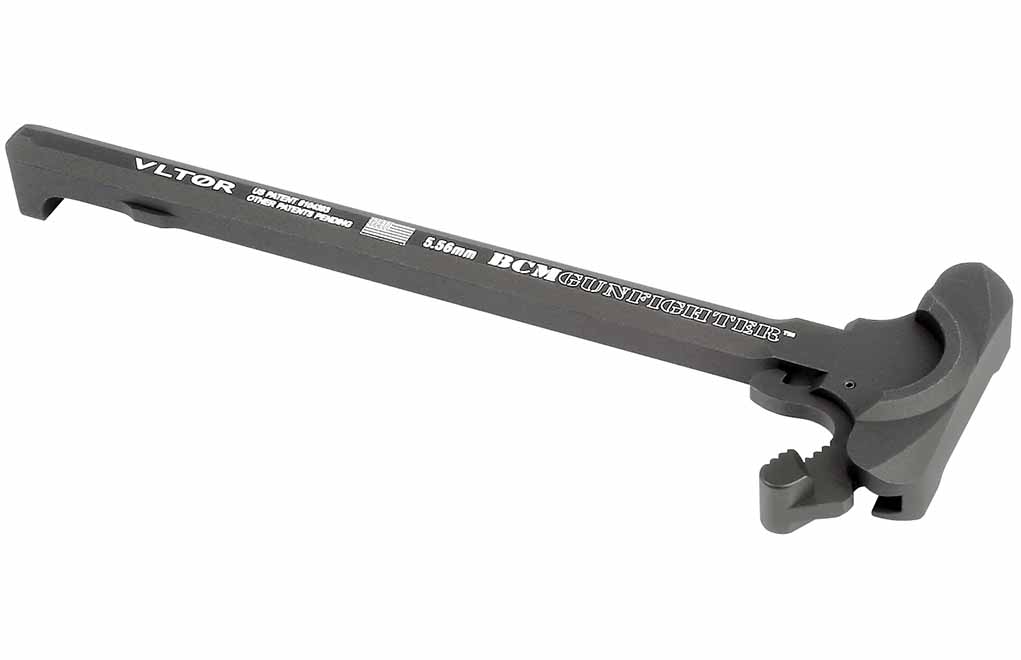
BCM Gunfighter MOD 4
Simple design, the Gunfighter MOD 4 is intuitive and makes your rifle easier to manipulate. Available, if needed, with ambidextrous latches. MSRP: $54 // bravocompanymfg.com
AR-15 Slings
Divergent opinions aside—some love and others hate slinging AR-15s—it remains one of the most convenient ways to tote around your gun. We have an entire article dealing with AR-15 slings, how to attach them and use them to their utmost well worth reading. There are three main sling styles: one-point, two-point and three-point. Overall, two-point slings are the most popular presently given their simplicity and ability to facilitate quick movement, so we’ll home in on those.
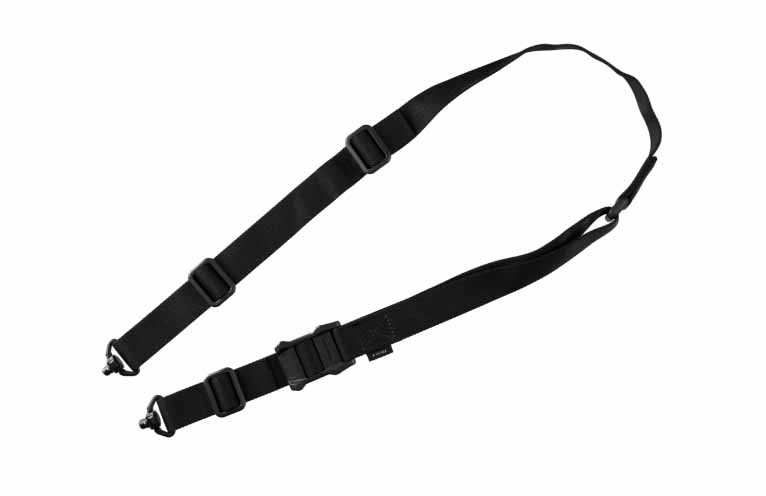
Magpul MS4 Dual QDM Sling
Outfitted with a quick detach system from the box, Magpul gives you a system you can configure to your preferences. Adaptable, the sling can also be used in a one-point configuration. Most importantly, boasts a rapid adjustment system, allowing for quick transitions to weak-side shots. MSRP: $65 // magpul.com
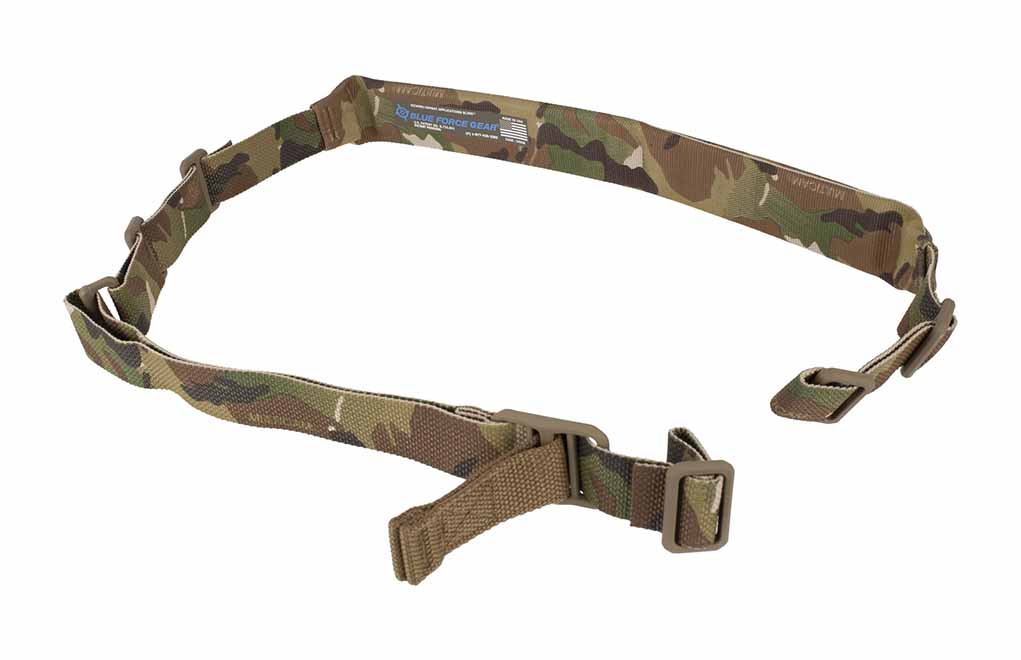
Blue Force Vickers Sling
Developed by industry legend Larry Vickers, the Vickers Sling still proves revolutionary. The two-point system is designed for rapid adaptations, particularly to weak-side shooting. At the same time, the rapid adjustment system can be cinched up for comfort and control when not engaged. MSRP: $55 // blueforcegear.com
The LaRue MBT, or Meticulously Built Trigger, offers a very crisp trigger pull in an easy to install package.
Gun writers can be trigger snobs, and competition shooters often are, too. When you combine the two, things can get … interesting. Listening to a small group of competition shooters talk about trigger pulls, weights, feel, tuning and the like can drive you to drink—if you aren’t involved in the discussion.
You can avoid the drama and simply invest in a LaRue MBT (Meticulously Built Trigger).
The two-stage trigger has a 2.5-pound take-up. The rest depends on which trigger spring you install. All of this machined and assembled by toolmakers out of tool steel.
The Easy Upgrade
MBT is a drop-in, two-stage trigger for your AR-15 that brings your black rifle of the 1960s into the 21st century. The MBT comes in a sealed can with a clear lid. There’s a hammer and trigger in there; the hammer has its own spring, and the trigger has two springs. You can choose between the regular spring or the heavier spring to determine your trigger pull weight. The regular spring delivers a 4.5-pound pull, and the heavy ups that to 6 pounds.
“Six pounds for a trigger?” I know what you’re thinking—too heavy. Except, the two-stage design makes it feel lighter. The take-up is 2.5 pounds. Then, once the trigger seems to stop, it takes another 2 pounds (with the light spring) to fire. For the heavy spring, that’s 4 pounds. So, take up the slack, and then it’s either 2 pounds or 4 pounds. Clean, crisp and not at all GI.
Each MBT is made from plates of S7 tool steel, and Mark LaRue puts toolmakers to work making them, with no time limit. Yep, they don’t have a quota or a daily target. They make as many MBTs as they can—that are exactly as they should be and that is that. This might mean you have to wait a short time. Be patient; it’s worth it.
The LaRue MBT trigger kit, complete with extra-heavy trigger spring and pin.
As for the drop-in aspect of it: The beauty of a two-stage design is that the timing and engagement surfaces of the sear are determined by the fit of the dual hooks on each of the trigger and the hammer. A two-stage design is therefore a lot more resistant to the vagaries of pin location in your lower.
Now, nothing’s perfect, and it’s entirely possible that your MBT dropped into a given lower won’t work right. If that’s the case, the fault lies with the lower and not LaRue.
And just to make things even better, it ships with a pair of hammer and trigger pins. “Oh, but I already have those.” Yep, and yours are the two-groove design that can cause a problem if you slip up in assembly. The LaRue pins have three grooves, so you have the chance of both hammer spring legs catching into a groove and keeping the trigger pin in place. I really don’t know why that minor detail wasn’t corrected by Colt, or the government, back in about 1975. Certainly, for the A2 upgrades in the 1980s. But they didn’t. So, LaRue takes care of that for you.
And all this goodness costs you $99. Yes, 99 bucks for a clean, crisp, drop-in trigger pull for your AR-15. You’ll wonder why you put up with USGI trigger pulls for as long as you did.
For more on LaRue Tactical, please visit LaRue.com.
Editor’s Note: This article originally appeared in the November 2021 issue of Gun Digest the Magazine.
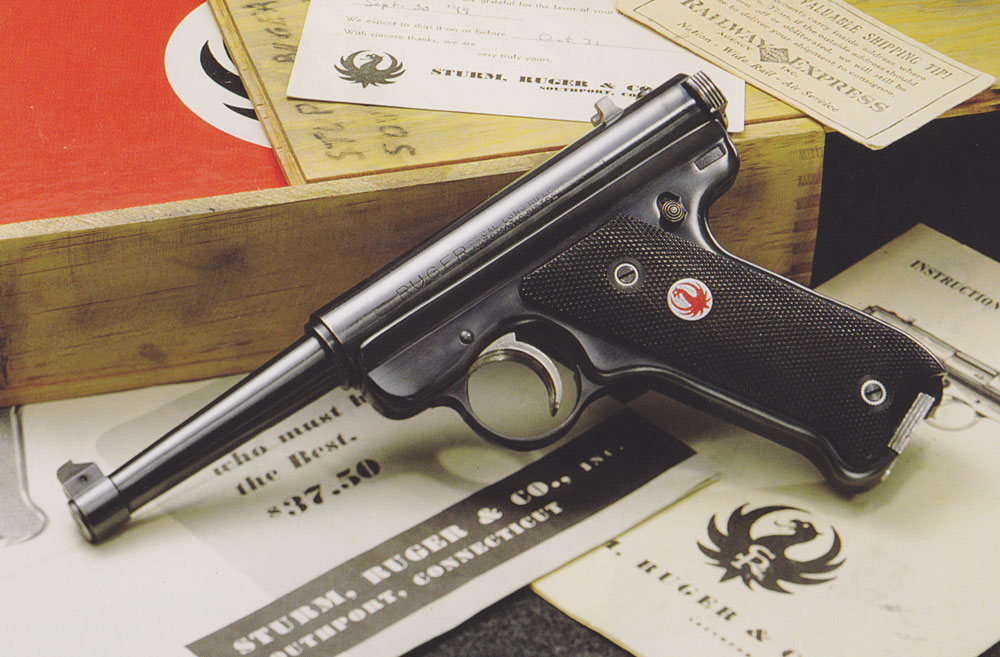
A first-year Standard Model, serial number 0194, from the first shipment from the Ruger factory in October of 1949. Photo courtesy Don Findley.
Ruger hit a grand slam with its first Ruger 22 pistol, introduced to the shooting public in 1949. Here are Gun Digest’s top picks of Ruger rimfire handguns.
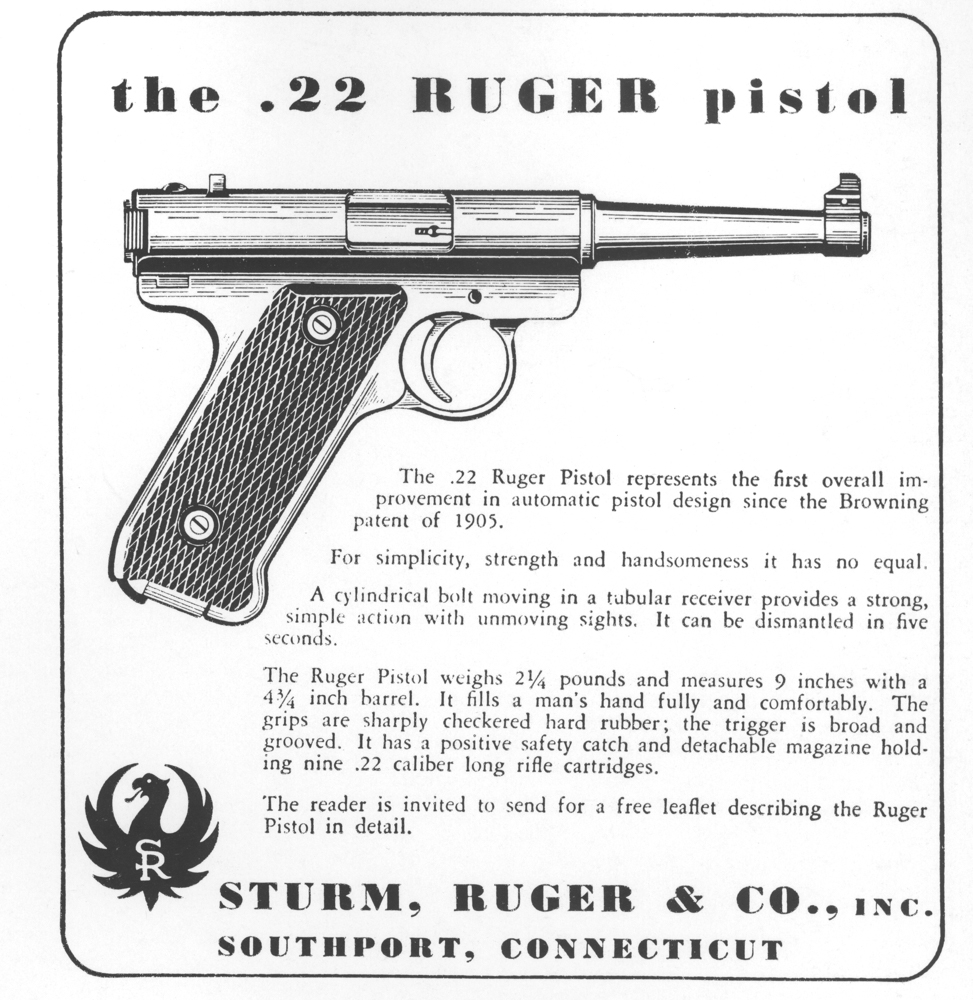
When an advertisement for the “.22 Ruger pistol” appeared in the August 1949 issue of the National Rifle Association’s American Rifleman magazine, firearms history was made. The ad presented the very first Ruger 22 pistol to the shooting public, and it also introduced the name Sturm, Ruger and Co., Inc. to an industry that one day would be dominated by the company.
At a glance, the image of the Ruger pistol was very familiar; it bore a striking resemblance to the German Luger. Not only were the names similar, the overall look of the new handgun—the profile, angle of the grip, shape of the trigger guard, the tapered barrel and design of the front sight—said “Luger.”
This was not a negative, as the Luger was one of the most famous and recognizable guns in the world. However, the similarities ended with the outward appearance, for the Ruger’s operating mechanism and blow-back action were nothing like that of the toggle-locked, recoil-operated Luger.
Where it all began, the first Ruger .22 pistol prototype, circa 1946.
Ruger’s 22 Pistol Hits the Sweet Spot
The introductory price for what would soon become known as the Standard Model was $37.50, well positioned to compete with the other .22 semiautomatic pistols on the market.
This was about half the price of the popular Colt Woodsman, and was also less than the lowest priced High Standard .22 pistol, those being the only manufacturers of rimfire pistols in the country at the time.
Primarily based on that ad in American Rifleman, workers at the Ruger plant in Southport, CT were soon very busy filling orders. By October 6, 1949 the first shipment of 100 pistols was on the way to retailers, wholesalers and individuals. The new pistol was an immediate success and the Ruger name was on its way to becoming a major player in the firearms industry.
The Ruger company placed this ad in the August 1949 issue of American Rifleman, the NRA’s membership journal and the only true “gun” magazine at the time.
From 1949 to 1951, the Standard Model had a Ruger red eagle medallion inlay on the left grip panel. The medallion was designed by Bill Ruger’s partner and co-founder, Alex Sturm, who was an artist and writer, in addition to being a collector of fine firearms.
The red eagle became the logo for the company in its advertising, on letterheads, catalogs and business cards, as well as the grip panel of the pistol.
This was changed to a black eagle beginning with serial number 34369, in honor of Sturm who died on November 16, 1951 from viral hepatitis at the age of 28.
The black eagle grip was on all Ruger Standard .22 pistols until 1999, when the red eagle medallion was resurrected for a special 50th anniversary model.
(Approximately 25,600 pistols with red eagle medallion on the grip were manufactured before the death of Alexander Sturm, although serial numbers exist beyond 35,000. This is due to the fact that blocks of serial numbers were often set aside and then used at a later date.)
STANDARD MODEL, RED EAGLE GRIP MEDALLION
The Ruger company placed this ad in the August 1949 issue of American Rifleman, the NRA’s membership journal and the only true “gun” magazine at the time.
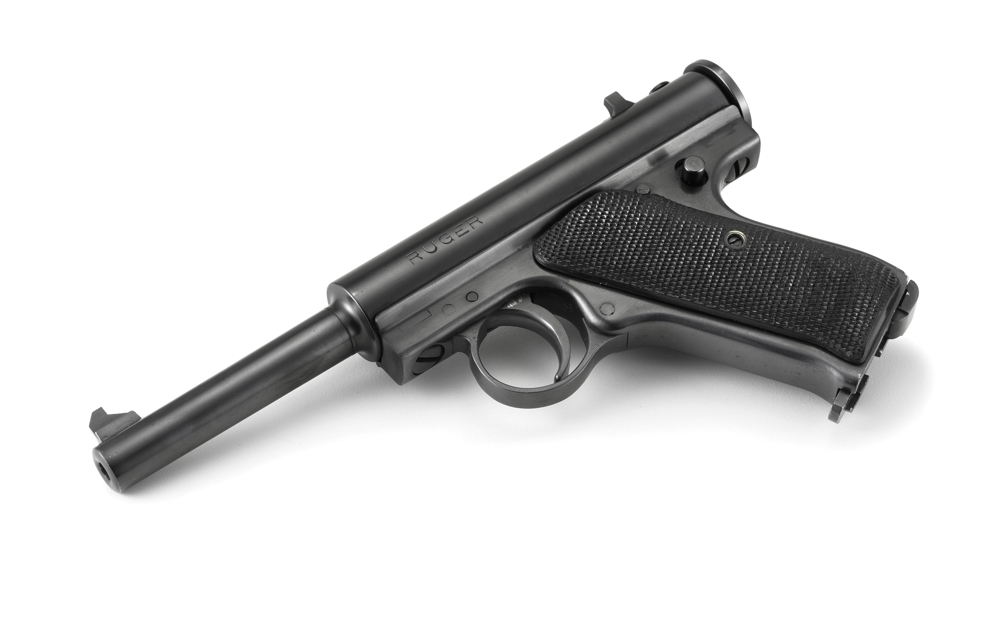
The Standard Model was based on a simple and reliable blowback design that would function with both standard and high-speed .22 Long Rifle ammunition. Features include a tubular receiver with a cylindrical bolt, blue finish, checkered hard rubber grips, wide grooved trigger, thumb safety, fixed sights and a nine-shot detachable magazine.
With the original 4 ¾-inch barrel, weight is 36 ounces. Approximately 890 pistols were shipped via REA in a wooden “salt cod” box.
MARK I TARGET MODEL GOVERNMENT ISSUE
From 1956 to 1967 about 5,570 “U.S.” marked Mark I Target Models were shipped to various agencies of the U.S. military. No NIB examples are believed to exist as all of these pistols were used for training purposes.
Some were fitted with silencers and used in the tunnels of Vietnam. The serial numbers on some U.S.-marked guns measure 1⁄8-inch in height, while standard serial numbers measure 3⁄32-inch.
MARK II STANDARD MODEL
A civilian version of the Government Model Target. Only a handful of these models with a U.S. rollmark are believed to be in civilian hands.
Changes for this model were mostly on the inside and included a 10-round magazine instead of the original nine, a faster lock-time, a magazine release button that could easily be moved to either side of the grip, and a device to hold the action open after the last shot was fired.
A new safety allowed the pistol to be loaded or unloaded, or the action to be manually operated, with the safety on. With the Mark II there was an optional stainless steel finish.
The original price for this model in 1982 was $147.50. Two special “Friends of NRA” models were manufactured for the National Rifle Association’s auctions in 1997 (blue finish) and in 2001 (stainless).
To mark the end of the Mark II series, in 2004 the last 1,000 were marked “One of One Thousand.” A small premium of 10 to 20 percent could be negotiated for this model.
MARK II GOVERNMENT TARGET MODEL
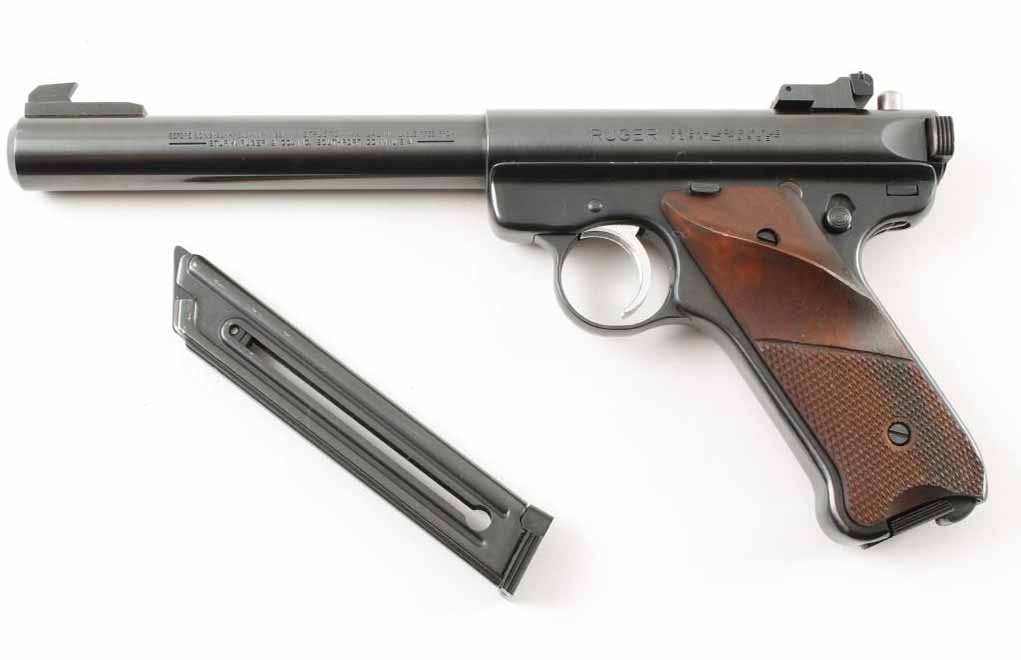
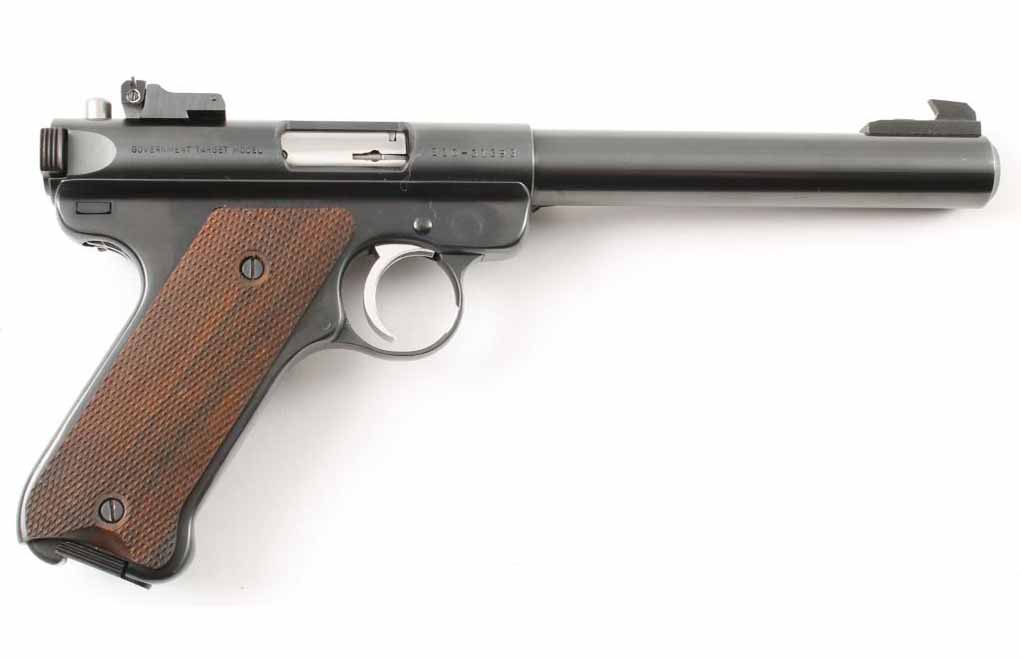
This special model is a civilian version of a special model made for the federal government as a training pistol for U.S. military personnel. It has an adjustable rear sight, 6 7⁄8-inch bull barrel and came with either a blue or stainless finish.
These models were made with a tight chamber to enhance accuracy. A very limited number with a “U.S.” marking on the right side of the frame—perhaps no more than 25—are believed to have found their way to civilian hands.
One of these models was sold at auction in December 2013 for more than $1,500. The civilian Government Model was identical but did not have the government markings. In 1992, a variation with a slab-side barrel was introduced in stainless steel.
MARK II MODEL 22/45
This first version of the 22/45 series was introduced in 1993 with a grip angle similar to the Model 1911.
Introduced in 1993, the Model 22/45 featured a composite (Zytel) frame patterned after the shape of the grip frame on the Government Model 1911 .45 auto pistol and was designed to appeal to the many shooters who favor that model.
Other changes included reshaping the bottom of the magazine and moving the magazine release button to the same position as is found on the Model 1911.
Barrel lengths available were 4 inches with standard sights, 5 ¼ inches with target sights, or a 5 1⁄2 inch bull barrel with target sights. A blue or stainless finish was offered.
MARK III STANDARD MODEL
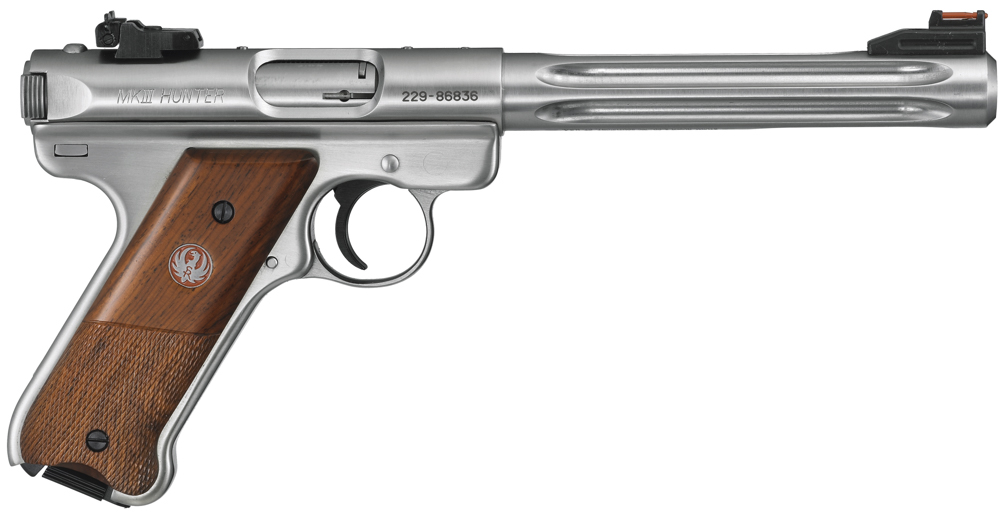
An option for the Ruger Mark III Hunter Model is this attractive and ergonomic set of contoured laminate grips.
This further refinement of Ruger’s original .22 pistol was introduced to the marketplace in 2005 and as of 2014 is the current model in production.
New features included placing the magazine release button on the left side at the rear of the triggerguard, where it is located on most modern semi-auto pistols.
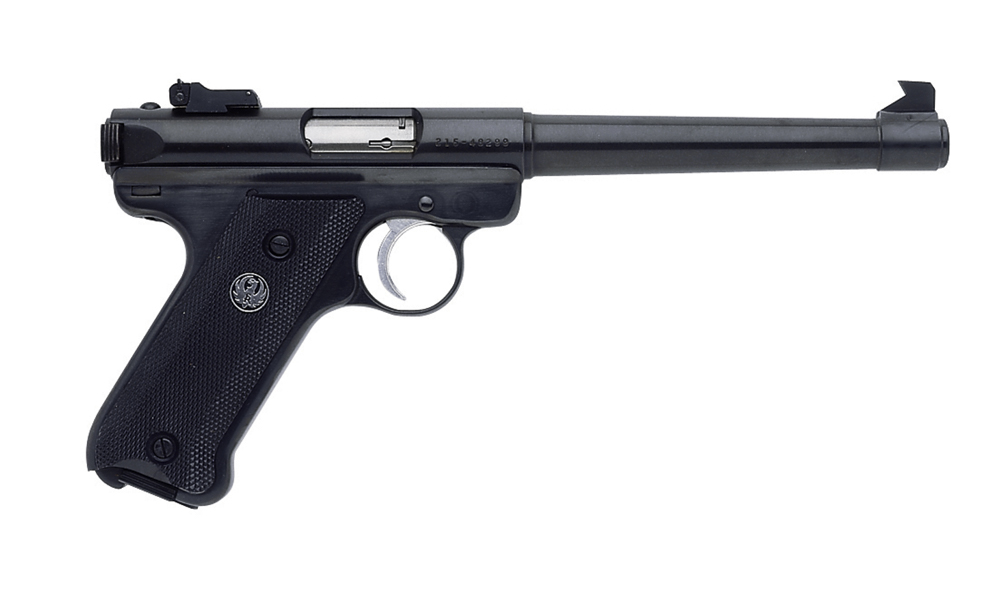
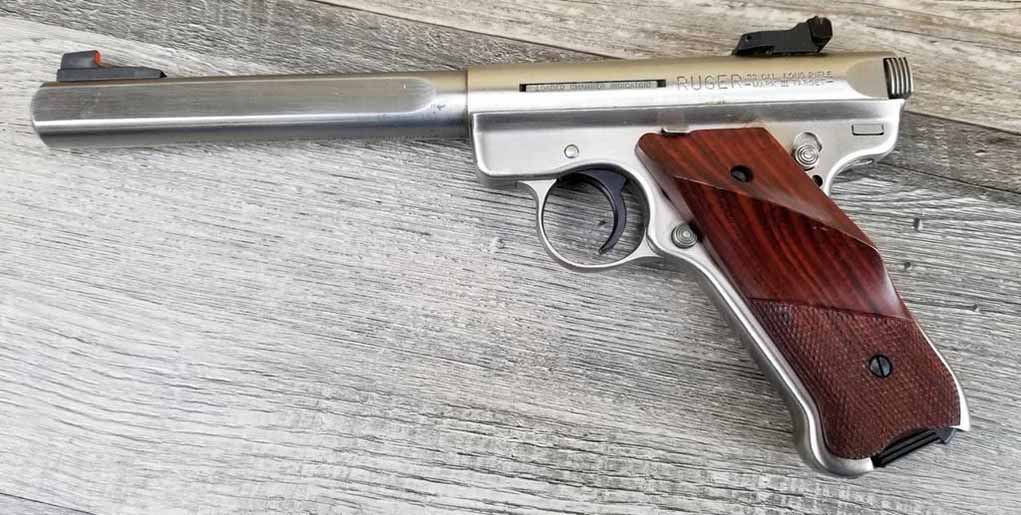
Mark III pistols also have a loaded chamber indicator, internal lock, magazine disconnect, and recontoured sights and ejection port. Standard features include fixed sights, black checkered grips, blue finish, and a 4 ¾- or 6-inch barrel.
MARK III COMPETITION
A variant of the Target Model series, the Competition model was introduced in 2005. It comes only in a stainless finish, and has a 6 7⁄8-inch slab-side barrel and checkered brown laminate grips with a thumb rest. Weight is 45 ounces.
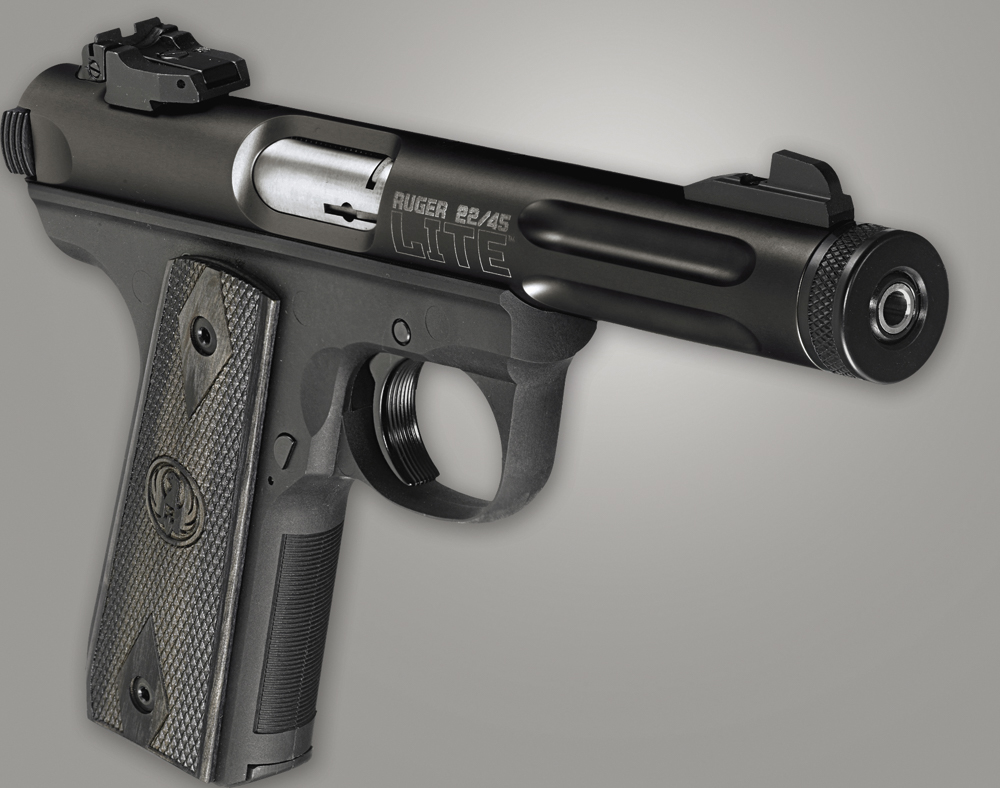
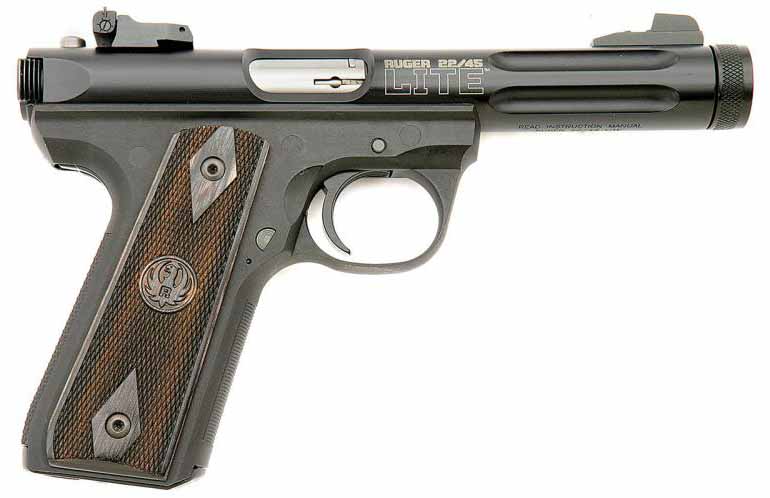
MARK III 22/45 LITE
The newest variation of this popular model introduced in 2013 with a 4.4-inch fluted and threaded barrel, aluminum upper, Zytel polymer frame, replaceable black laminate grip panels, and barrel sleeve. Weight is approximately 23 ounces.
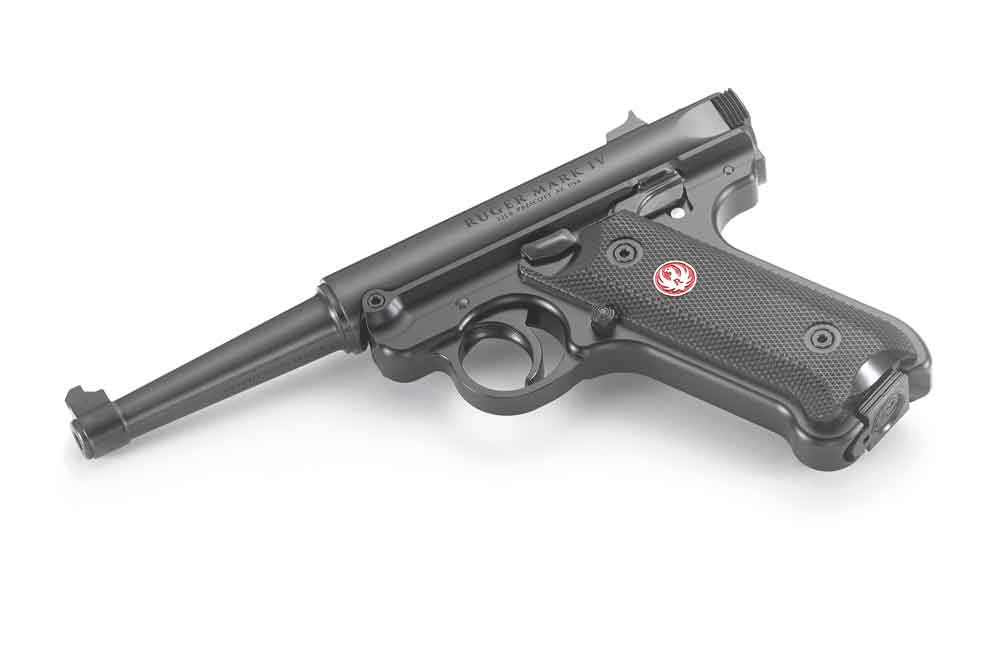
The Ruger Mark IV is like the Remington 870 of .22 pistols — it seems everyone in America has at least one tucked away in their gun safe. Affordable and — now, in the Mark IV design change — easy to disassemble and reassemble for cleaning, it’s the .22 pistol responsible for many a fun weekend of plinking shenanigans and small game hunting.
When Bill Ruger rolled out his Standard Model .22 pistol in 1949, it’s doubtful that even he could have imagined the success the little semi-auto .22 would bring. It seemed everyone in America wanted the cheap .22 pistol (“cheap” as in “inexpensive”).
The Standard Model would eventually beget a brood of variants that would cover everything from backyard plinking and small game hunting to target models. These would stand shoulder-to-shoulder with the High Standard Supermatic and Smith & Wesson Model 41 on the firing line of NRA Bullseye competition.
The Standard Model and Mark I Target would eventually evolve into the Mark II, Mark III and — the latest — Ruger Mark IV. Today’s Mark IV .22 pistol represents the greatest design change since the advent of the Standard Model.
They were plagued through the Mark III evolution with difficult disassembly and reassembly. The Ruger Mark IV now features an easy push-button takedown, which snaps back together after cleaning.
If competitive match shooting is in your future, check out the Ruger Mark IV Competition and Ruger Mark IV Target as affordable alternatives to a Model 41.
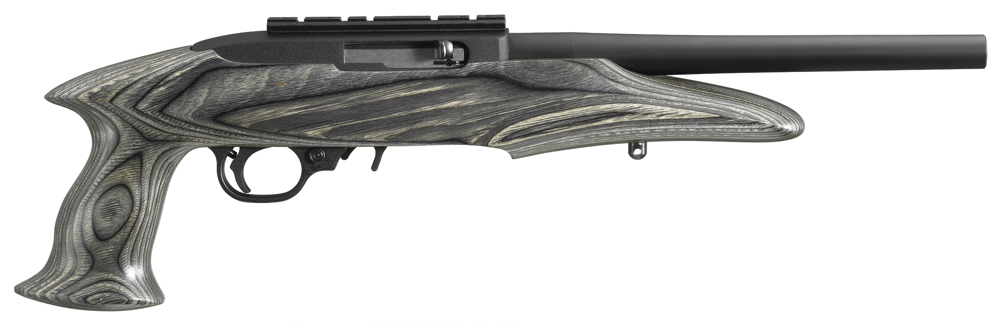
RUGER CHARGER .22 PISTOL
The unique Charger had a striking appearance and while it was listed under handguns in the Ruger catalog it was based on the 10/22 Carbine design.
The Charger was introduced in 2008 with a 10-inch barrel and a gray/black laminated pistol-grip stock with a unique ergonomic fore-end. A bipod is included.
Capacity of the 10/22-type rotary magazine is 10 rounds and the weight is 52 ounces. An accessory rail is mounted on top of the receiver. The Charger was in production from 2008 through 2012.
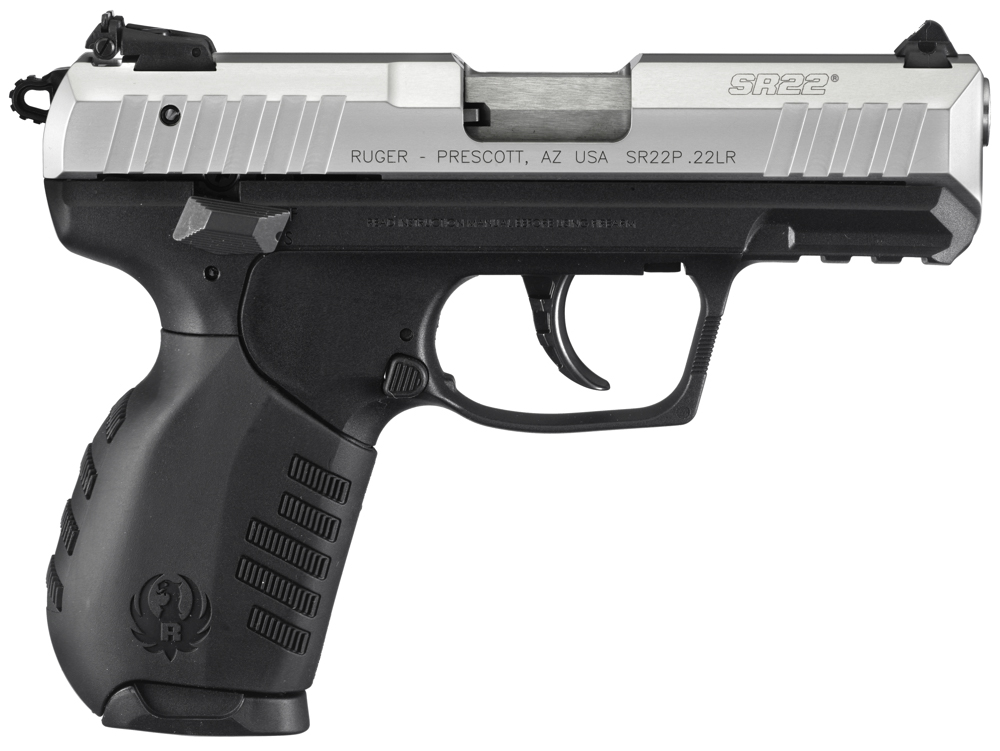
RUGER SR22
The SR22 is a modern pistol with features found on many more expensive models.
This model was introduced in 2012. It is a traditional double/single-action semiauto chambered for the .22 Long Rifle rimfire cartridge and operates with a straight blowback design. (Unlike the SR9, SR40 and SR45 centerfire models, the SR22 is not a striker-fired pistol.)
With its polymer grip frame and aluminum slide, the gun weighs only 17.5 ounces. The barrel length is 3.5 inches with the overall length measuring 6.4 inches. Magazine capacity is 10 rounds. The three-dot style sights are adjustable and there is a Picatinny rail for lights or other accessories.
Other features include an external hammer, a loaded chamber indicator, and ergonomic rubber grips that come in two interchangeable styles.
Operating controls include a safety/decocker lever and magazine release button, both ambidextrous. Finish is black matte on the frame and either a black or silver anodized slide. A threaded barrel is an available option.
SINGLE SIX (Old Model)
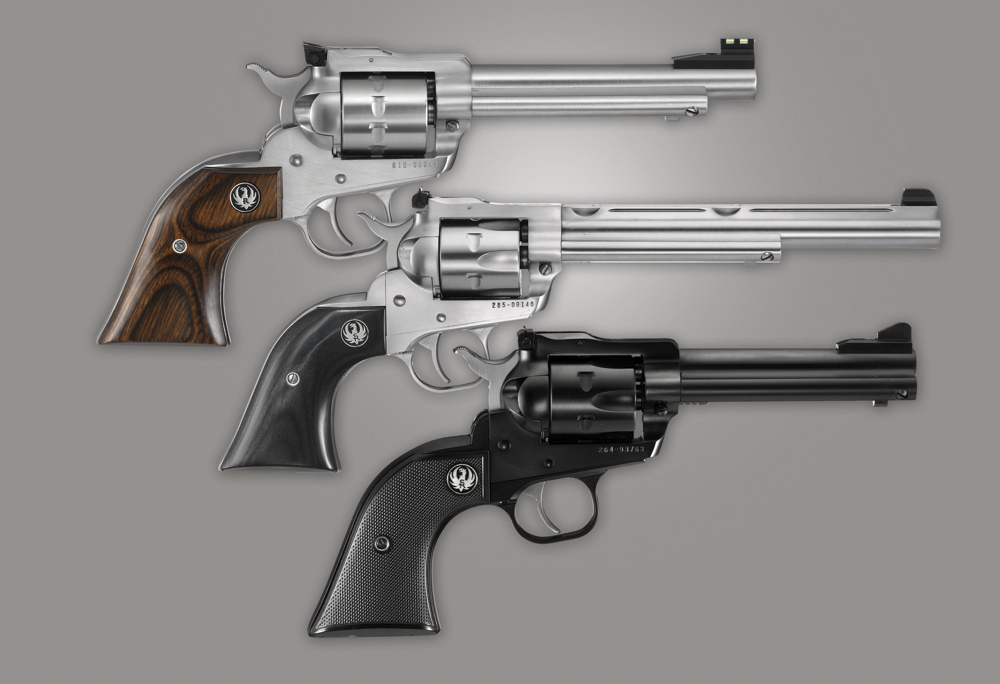
Three New Model rimfires show the different sighting combinations available in current the production guns. At the top, a Single Ten with fiber optic front and adjustable rear sights; center, a Single Six Hunter model with adjustable sights plus integral scope mount bases; and at bottom, a New Model Convertible model with adjustable rear and ramp front sights. Fixed sights are also optional for the Convertible model.
Inspired by the classic Colt Single Action Army, the Single Six in .22 LR was first introduced with a 5 ½-inch barrel. Later models were added with a 4 5⁄8-inch, 6 ½-inch or 9 ½-inch barrel lengths. The Single Six could also be used with .22 Short or .22 Long ammunition.
As the name suggested, the cylinder held six rounds but, as noted above, the original model could only be safely carried with the hammer over an empty chamber.
Grips were checkered hard rubber with a black eagle medallion inlay on each side. Varnished walnut or stag grips were available as an option with true ivory grips added in 1954.
The standard model had a blued barrel and cylinder with an anodized aluminum grip frame. The earliest Single Sixes featured a flat loading gate and rounded profile front sight and are referred to by collectors and Ruger aficionados as Flat Loading Gate models.
A lightweight variation with an aluminum frame and/or cylinder was introduced in 1956.
Original prices were $57.50 for the standard model in 1953, and $63.25 for the Lightweight (1956). In 1959 a version was introduced chambered for the .22 Winchester Magnum Rimfire cartridge, and was made only with a 6 ½-inch barrel.
The Convertible model with interchangeable .22 LR and .22 WMR cylinders became available in 1962 and replaced the .22 WMR-only model. It was made with barrel lengths of 4 5⁄8, 5 ½, 6 ½ or 9 ½ inches and was in production until 1972.
The Super Single Six model was introduced in 1964 with upgraded features including an adjustable rear sight, a ramp front, and an integral sight rib. Most Super Single Sixes came with interchangeable cylinders for .22 LR and .22 WMR.
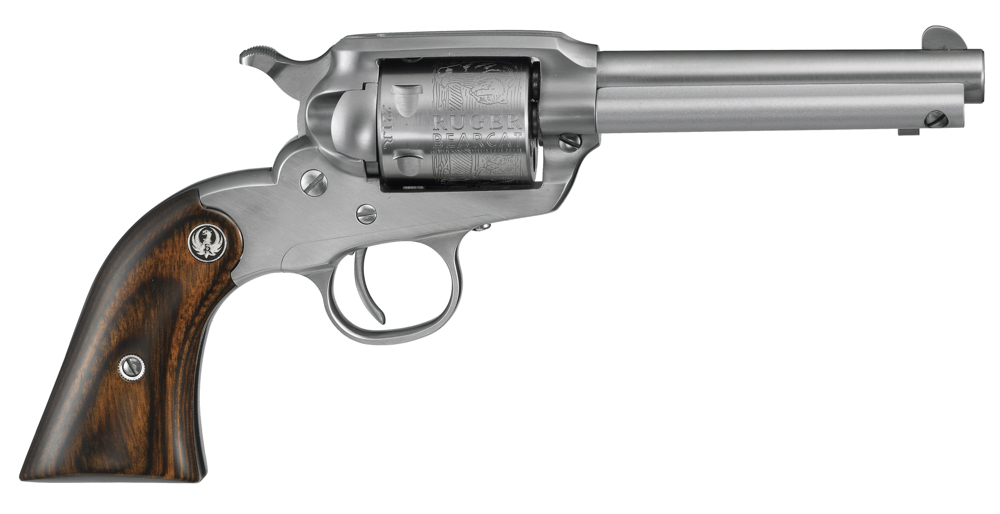
NEW BEARCAT
The Ruger .22 Bearcat revolver.
This old favorite was reintroduced in 1994 as the Super Bearcat with a four-inch barrel, fixed sights, rosewood grips and interchangeable cylinders in .22 LR and .22 WMR. Features included smooth rosewood grips, fixed sights, and the transfer bar hammer-block safety.
There was a factory recall of the .22 WMR cylinders, meaning that samples with both cylinders are rare.
About 1000 Bearcats were sold with the WMR cylinders, between serial numbers 93-00500 and 93-01944. A “timing” problem made them unsafe and therefore the magnum cylinders were recalled, but not all were returned to Ruger.
The rarity of samples with both .22 LR and .22 WMR cylinders makes them more valuable but the WMR cylinders must not be used. As stated on the Ruger website: Firing a .22 Magnum cartridge in a cylinder not correctly timed with the barrel may result in excessively high pressures, causing the cartridge case head to fail.
This can result in personal injury to the shooter or bystanders from pieces of cartridge case brass.
Current production revolvers are available only in .22 LR with a 4.2-inch barrel and either a blue or stainless finish.
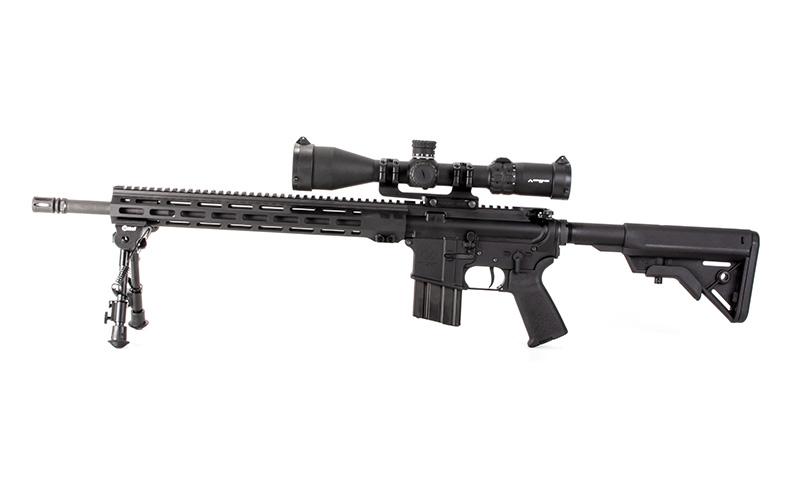
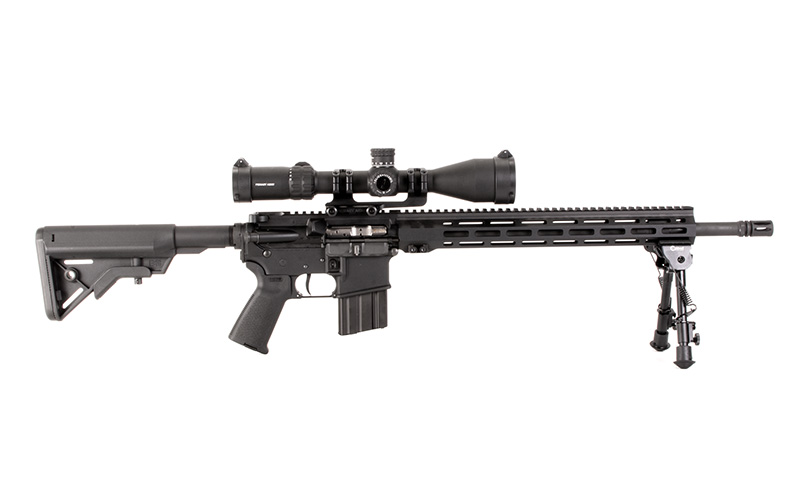
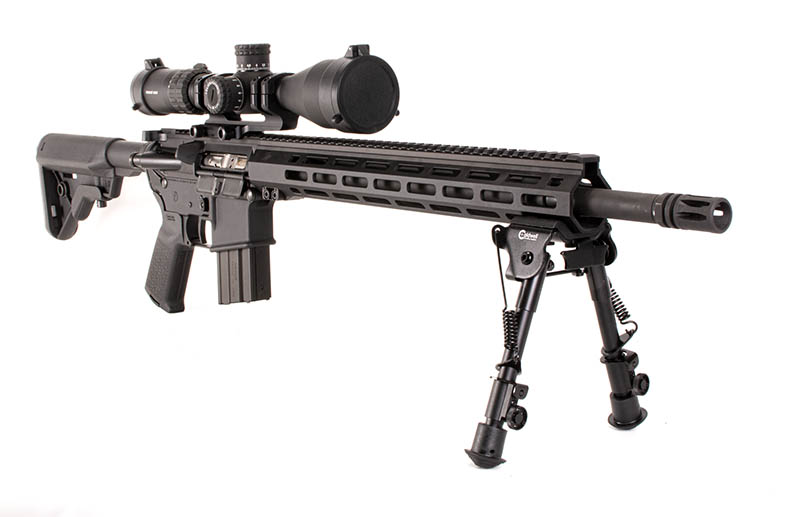
You can build an AR, even one setup like a DMR, on a blue-collar budget. Today, we show you how.
As soon as an AR-15 enters a safe, those low light conditions result in a strange, but well-documented phenomenon; like an amoeba, the rifle buds and reproduces, spawning new versions of itself. At least that’s what we tell our significant other, but we’re not exactly sure she believes it.
The first AR anyone should purchase is probably the basic, 16-inch-barreled carbine; it can serve in just about any role, doing most things reasonably well, but not excelling anywhere. Once that’s in the collection, you can turn to more specialized versions, like the one here. We decided to start down the DMR rabbit hole, as poking holes in things at longer ranges is fun, plus there’s another niche this type of rifle fits—more of which later.
Taking lessons from the Army’s M11 program, albeit in a smaller caliber, our budget designated marksman rifle allows for longer range hits than a basic 16-inch carbine, but still remains balanced and handy.
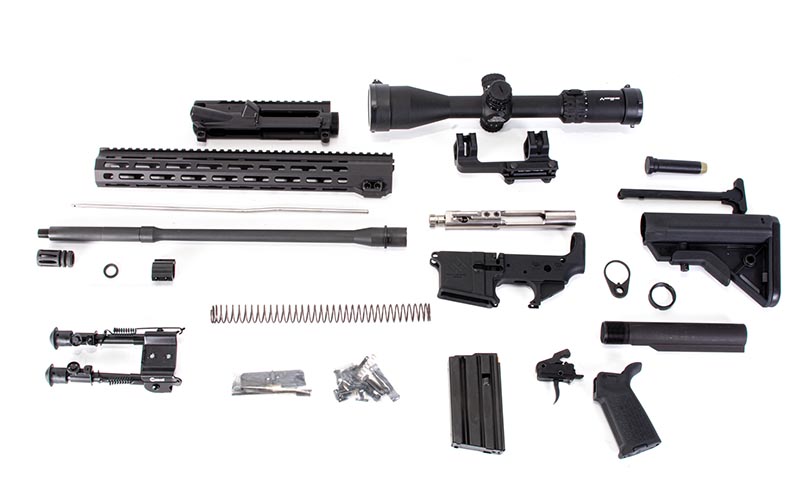
The AR was developed around a 20-inch barrel, equipped with what we now refer to as a rifle-length gas system. This combination produces the best combination of results in terms of both reliability and velocity from the 5.56x45mm cartridge, as gas port pressures are relatively low due to increased distance from the chamber. This means the various sub-assemblies don’t get beaten up nearly as much as with shorter, higher-pressure gas systems—compared to say a 10.3-inch Mk18 with a carbine length gas tube, the 20-inch rifle operates with a more relaxed attitude. Think ’78 Lincoln Continental versus ’05 Subaru STI. Losing a couple of inches from the barrel while retaining the rifle length gas system results in a handier carbine with an even softer recoil impulse, as dwell time in front of the gas port is reduced, so this was the first component we sourced.
While a stainless blank from Bartlein or Kreiger would’ve been our first choice as a starting point if we had a limitless budget, this is a blue-collar build (we checked; it says so at the top of the page). Offering a good balance of longevity, accuracy and wallet-friendliness, we picked an 18-inch, government profile barrel from FN, which is chrome lined and button rifled. While it probably won’t be seen on the line at any benchrest competition, we’re happy to trade off a few tenths of an inch in group size for dollars in our bank account. Besides, if the first round misses a target, there’s 29 more of its buddies to make up for it.
Closing off the chamber end, a Fail Zero bolt carrier group was chosen due to its slick, nickel-boron coating that reduces friction and makes cleaning way easier. A magnetic particle inspected, Carpenter 158 bolt (also NiB coated) is part of the package, which reassures us that the bolt will last as long as the barrel.
Wrapped around the barrel is an Expo Arms 15-inch free-float tube, giving plenty of real estate and M-lok slots for lights, sling mounts, and anything else we might think of. As this is a DMR-ish gun, one of those thoughts was a bipod, and as luck would have it, Caldwell offers an inexpensive Harris clone with an M-lok interface, so that was added to the list.
There’s nothing quite like the satisfaction you get from speccing out and assembling your own rifle, plus you gain knowledge while doing so and the assurance that it’s done right.
Although rifle-length gas systems traditionally found themselves paired with fixed, rifle stocks, we wanted the adjustability and convenience offered by a six-position carbine buffer tube. So we ordered up an MFT Minimalist setup with a QD endplate, which was screwed into a lower receiver from Orchid Defense Group. While we normally don’t get too excited about standard lowers—after all, they’re just an aluminum box to hold the fun bits together—this one is unusual in that it’s a low shelf variant and has all the machining you’d typically find on an M16 receiver, minus the third hole. Good info to squirrel away, if you have aspirations of ever becoming a 07 FFL holder.
Human Interface
Once the basic components were in place, it was time to turn attention to the two pieces of kit that have the biggest effect in terms of human interface and getting hits on steel, namely the trigger and scope. Rise Armament’s S140 trigger is exceptional value for the money. Carved from S7 tool steel and featuring a 3.5-pound, single-stage break with zero take up and a short reset, it’s about as good as you’re going to get at any price point, and the fact they sell it for $139 should grab anyone’s attention. Building on the “bang for the buck” theme, we picked out Primary Arms’ SLX 3-18×50 as the glass to adorn our rig.
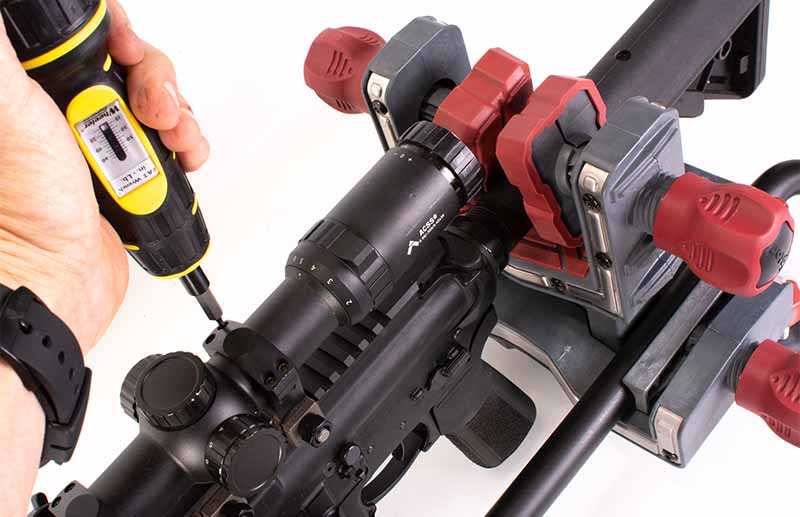
Wheeler Engineering’s FAT wrench makes getting the right torque settings easy. No more shifting scopes or crushed tubes.
Only a decade ago, finding glass built to this kind of specification would cost an arm and a leg, but somehow, Primary Arms manages to bring it to market for less than 500 bucks, placing it firmly within the blue-collar realm. One of the most useful aspects of its design is the ACSS reticle, which is calibrated for 5.56 projectiles and situated in the first focal plane, allowing the shooter to make use of its BDC hashmarks at any magnification.
Prefer to dial your corrections? No problem, just lift up the locking elevation turret and spin away to heart’s content; we had no issues with tracking—every time we returned to zero, our point of impact remained true. An illuminated reticle makes hitting targets in low-light conditions easier and can be used at low magnification to make quick shots—just use the thick central horseshoe part of the reticle to frame the target and press the trigger. Image quality fell off a little at the top end of the magnification range when compared to high-end scopes, but then again, the glass we compared it to costs four times as much.
Everything we needed to build the rifle featured here was sourced from Primary Arms. Grab a tool kit and join in the fun.
Where Bullets Meet Backstop
With all components assembled, it was time to put everything together. Life was made easier with a Tipton gun vise and Wheeler Engineering scope mounting kit that allowed us to complete the build in record time, without any buggered-up parts or dings in the receivers. For anyone who mounts a lot of scopes, this combo saves time and ammunition, as it’s rare not to be on paper when it’s finally time to show off your work.
At the range, we jammed 20-round mags with an assortment of ammo, and it was then we discovered the soft-shooting properties of our barrel might’ve been a little too gentle. The rifle refused to cycle the Wolf 55-grain steel case rounds we initially tried, ejecting spent cases, but failing to kick the BCG far enough to the rear to pick up a fresh cartridge.
Switching to spicier morsels solved the issue, and the gun had no difficulties with M193-spec loads, so a few mags were run through it in order to break it in. SIG 77-grain OTM ammo turned in several sub-MOA groups, and after verifying zero on paper we ran the rifle out to 600 yards on steel, verifying that it fills the DMR role pretty damn well.
About that other niche this build could fill? Throw on an offset red-dot and a muzzle brake, and you’d have no problem hanging with your buds at a three-gun match, though you’d be running in Open division … which means you’d need to build an optic-equipped pistol with a compensator.
No longer is the .22 rifle a simple plinker with which to while away the time. The long gun has become a hair-splittingly precise instrument, fit for competition.
It’s almost law at this point that if you’re into guns you have a .22 rifle in your gun safe. Cheap, accurate and as fun as an unchaperoned Saturday evening, the tried-and-true long gun has shot itself into the collective hearts of American shooters. And it’s changed dramatically in recent years.
As long as there have been folks that tinkered with guns, there have always been specimens of souped-up, hyper-precise .22 rifles. However, these hair-splitting gems were labors of love and some mechanical prowess, pieced together in the accuracy-obsessed basements. With the rise of NRL22 (National Rifle League .22-caliber competitions)and precision shooting in general, the availability of factory-made rimfire tack-drivers have become all the more common. We gathered together five of them here, the best precision .22 rifles you can currently find.
But you might have some questions about the style of rifle before you jump in.
The What And Why Of Precision .22 Rifles
Since we’ve thrown the term “Precision .22 Rifle” out there, we should clarify exactly what qualifies as one. In general, these long-guns share many of the same qualities of their precisoin centerfire cousins—performance stock (usually adjustable), precision bedding system, heavy barrels and plenty of overall heft. Threaded muzzles for recoil-eating suppressors, over-sized bolt handles and top-notch triggers (usually the adjustable type) are also common fair. There are no hard-and-fast rules to what goes into a precision .22 rifle, but it’s fairly easy to recognize one from its average, everyday tin-can popping brethren.
By and large, these upgrades demand a premium. Not all, but many precision .22 rifles cost enough as to pie even the most frivolous spender’s eyes, sometimes running up into four figures. For a caliber with a legion of sub-$200 options—respectable ones at that—the configurations might seem garish. In turn, who would want one in the first place?
Competitors for one. Rimfire NRL22 is a serious business and requires serious tools. Additionally, PRS shooters find them useful as cost-effective training options. Many precision .22 rifles mimic popular match centerfires—particularly the Remington 700 and its clones. Then there’s the accuracy obsessed. Similar to their competitive counterparts, the upfront cost of a precision .22 rifle pays off in a reduced ammunition tab over the long run. Not to mention, the guns can prove a lifesaver in some regions where 500-plus-yard ranges are few and far between.
The 457 is one of the most popular rifles in open-class NRL22. One thing many shooters do is drop it in a chassis. Now, CZ will do that for you. This wildly popular precision .22 rifle comes in a solid-aluminum-billet chassis, full of QD sling sockets, M-Lok slots and all the other adjustable bells and whistles that competitors want. It’s available in two different barrel lengths—a suppressor-ready 16.5 inches and a full-length 24 inches. MSRP: $1,149; cz-usa.com
Bergara B-14 R .22 LR
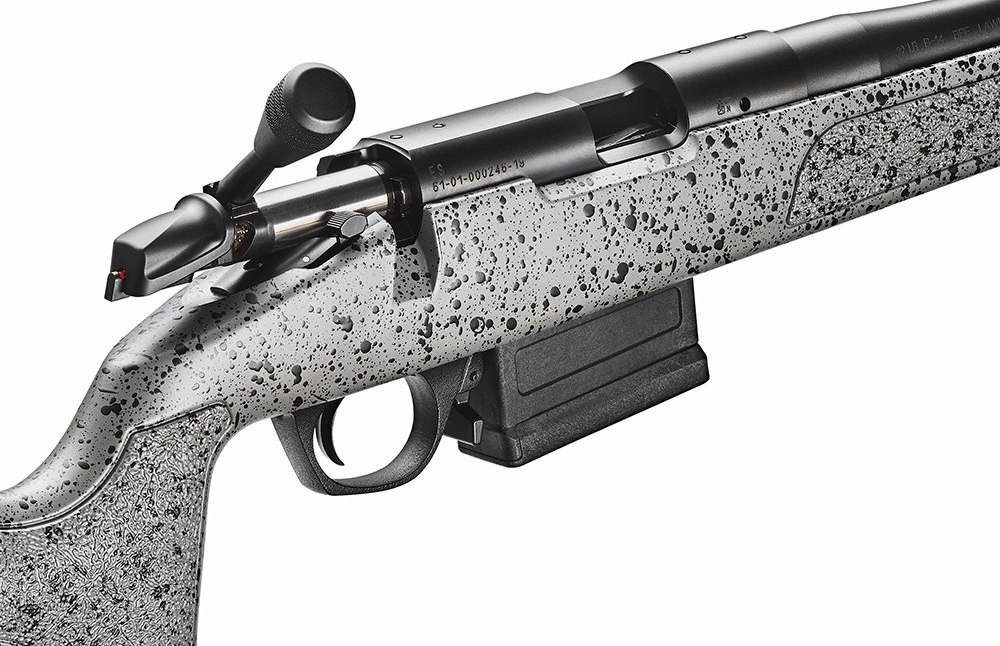
One of three new rimfires that debuted in 2020 and are built on a Remington 700 footprint, this precision .22 rifle from Bergara is compatible with the wide universe of aftermarket Remington triggers, bases and stocks. Not that you’d want to switch out the stock: The B-14 R comes with Bergara’s excellent, fully adjustable HMR stock with an integral aluminum bedding rail overmolded with polymer. It perfectly replicates Bergara’s centerfire HMR line. MSRP: Starts at $1,150; bergara.online/us
Ruger American Rimfire LRT
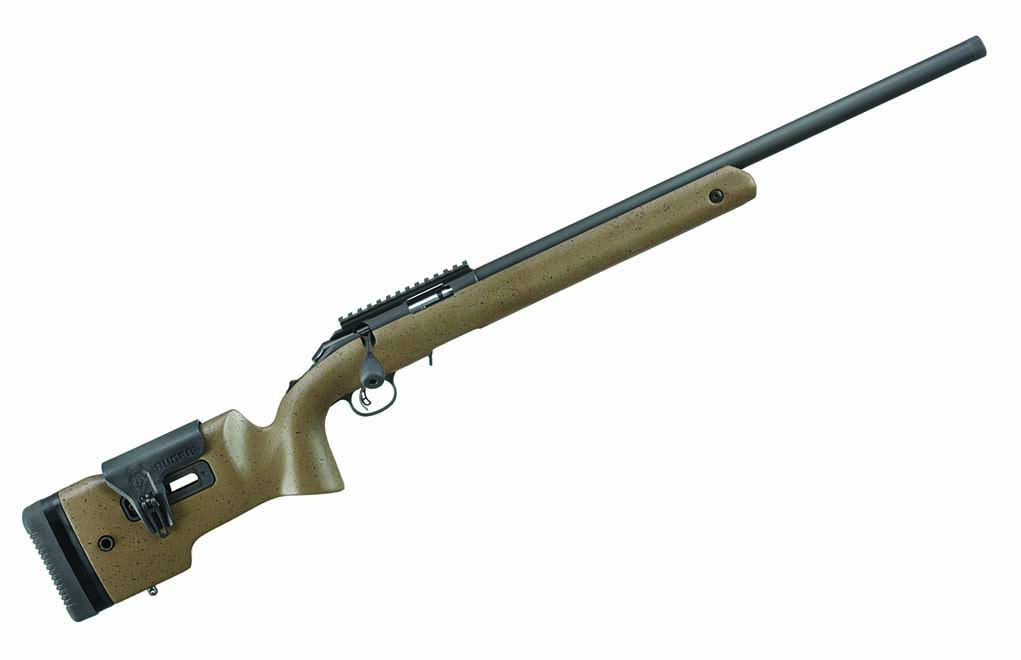
My old man’s Ruger American Rimfire will shoot cloverleaf groups with CCI Mini-Mags at 50 yards. It’s an inexpensive gun. He paid less than $200 for it new. And, after a little DIY home gunsmithing—man, does it shoot! This year, Ruger has taken that same action, beefed up the barrel and sat it in an adjustable synthetic stock with integral bedding rail that calls to mind the famous USMC A4. MSRP: $719; ruger.com
T/C Performance Center T/CR22 Carbon
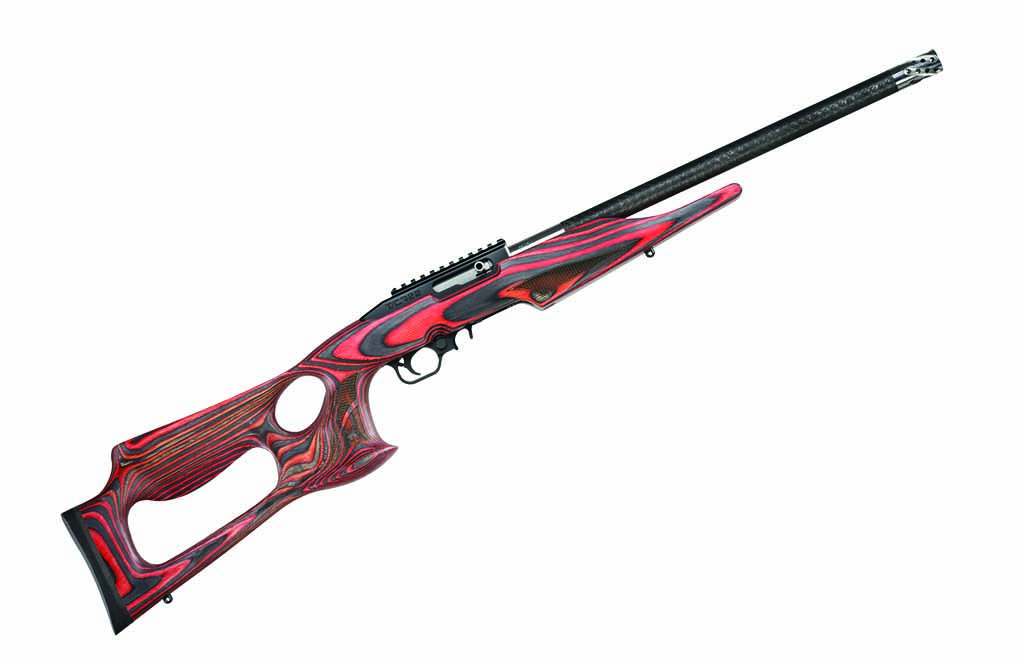
Two years ago, Thompson/Center took the basic Ruger 10/22 design and built a new precision .22 rifle around it. It’s more than a mere clone, because T/C incorporated the best of the vibrant 10/22’s aftermarket-like integral Picatinny rail, last-shot hold-open, extended charging handle, improved trigger and a nice aftermarket stock. This year, T/C has extended the lineup with several carbon-fiber-barreled models sitting in laminated-thumbhole Altamont stocks. They’re sweet, fast, handy rifles—perfect for Rimfire Challenge … or just a helluva good time at the range. MSRP: $642; tcarms.com
Savage B22 Precision Chassis
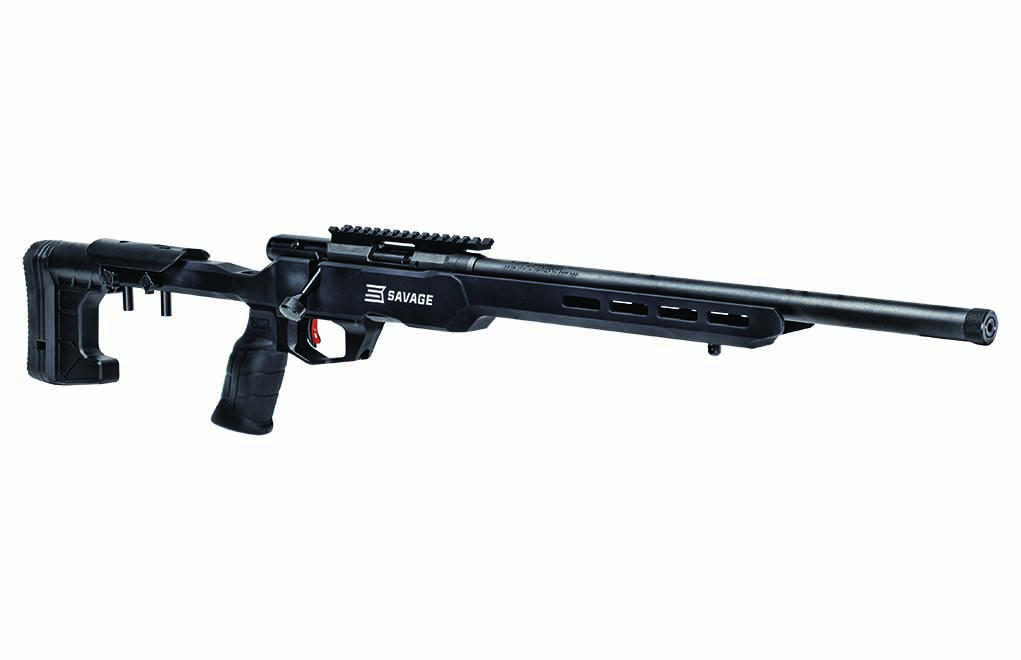
The result of a partnership between Savage Arms and MDT Chassis, the decked-out B22 is a direct response to the rise of NRL22. Already an impressive competition resume, the B22 is vastly enhanced with a rigid monolithic MDT aluminum chassis. Fully adjustable comb rise and length of pull, the rifle can be optimized to individual shooters. Savage for its part, includes its excellent adjustable AccuTrigger, which can be dialed down to as light a 1 pound. Crowing the rig is a heavy, 18-inch barrel, which does an excellent job in keeping barrel harmonics pristine even in long strings. Best of all, it’s among the most affordable precision .22 rifle options out there. MSRP: $659; savagearms.com
Vudoo Gun Works Ravage
This is arguably the most accurate .22 rifle on the list, and it better be considering the asking price. The Vudoo Gun Works Ravage was purpose-built for accuracy and designed to excel at PRS-style matches. Vudoo guarantees that each Ravage will be capable of sub-MOA accuracy thanks to their V-22 Rimfire repeater actions, and shooters have proved this by using them to place groups at ranges that would be considered ludicrous for most other rimfire rifles. The Vudoo Ravage is available with a choice of four different stocks and a number of different finish options. MSRP: $2,795; vudoogunworks.com
Editor’s Note: This article originally appeared in the 2020 Buyer’s Guide special issue of Gun Digest the Magazine.
Elwood K. Shelton and Adam Borisenko contributed to the post.
What’s the best muzzleloader bullet to put meat on the table? That depends on the rifle you’re shooting and the experience you’re after.
Just like when it comes to the muzzleloader you choose to hunt with, be it traditional or modern, your choice of bullet is largely determined by your desired experience. If you find yourself with a traditional muzzleloader, you are limited to a certain class of muzzleloader bullet (ball). Likewise, with a modern in-line you’ll want to use the best possible projectile, which is going to be a special type of muzzleloader bullet utilizing a sabot.
Traditional Muzzleloader Bullets
In general, there are not many options for traditional muzzleloaders. The classic lead ball is one of just two common and reliable options, the second being the Minié ball or its modern iteration, Thompson Center’s Maxi Ball.
Minié ball
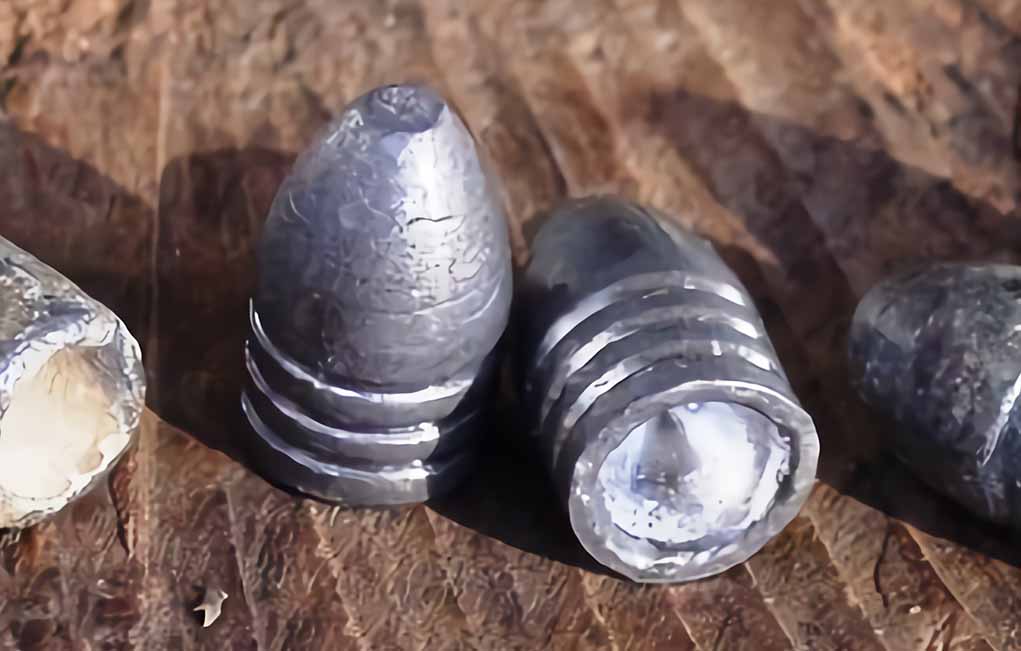
For those not in the know, the latter (Minié ball) is a soft, conical lead projectile with a hollow base that improves the ballistics compared to a traditional lead ball. However, the Minié is not compatible with every type of traditional gun, rather it is best in Civil War rifle-muskets like the Springfield 1861. It loads as easily as a smoothbore musket and, when the gun is fired, the Minié ball’s base expands into the rifling imparting spin. These are large bullets of .58 caliber in most cases and are tremendously lethal on game.
Maxi Ball
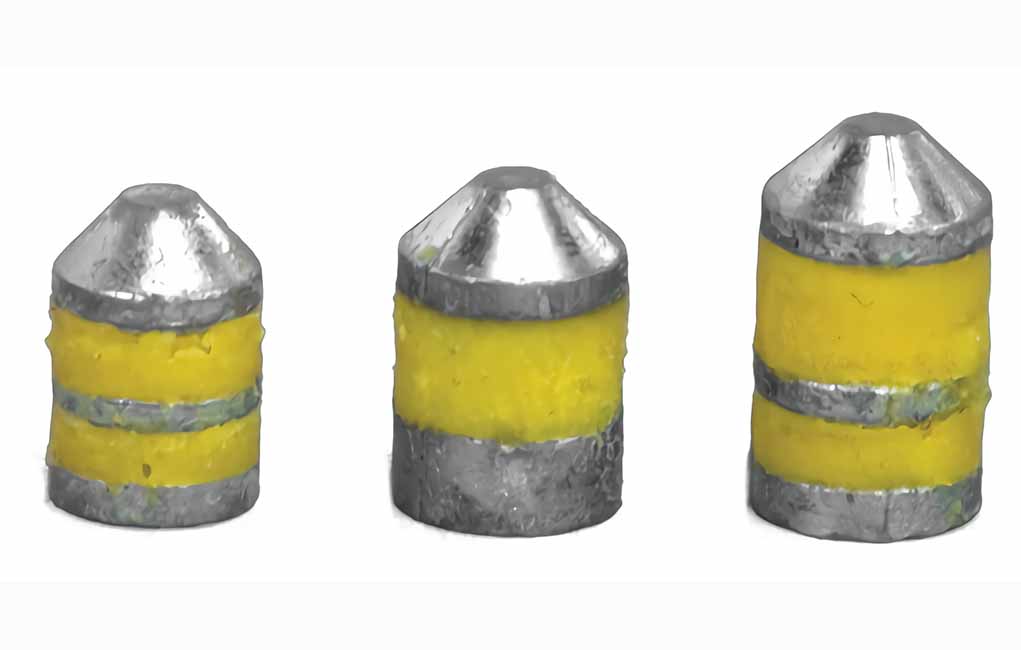
The more modern Maxi Ball is an option that offers increased killing power compared to a patched round ball. Among muzzleloader bullets, it is a wise choice for hunters who want a fast reload, respectable accuracy and greater mass. The bullet differs from its predecessor (Minié) in that it has deep lubricant grooves on the bearing surface. Additionally, it is made wider than the bore and when ramming it in place you engrave the rifling into it. It takes considerably less effort to seat a Maxi Ball once you start it as opposed to a patched ball or sabot.
Lead Ball
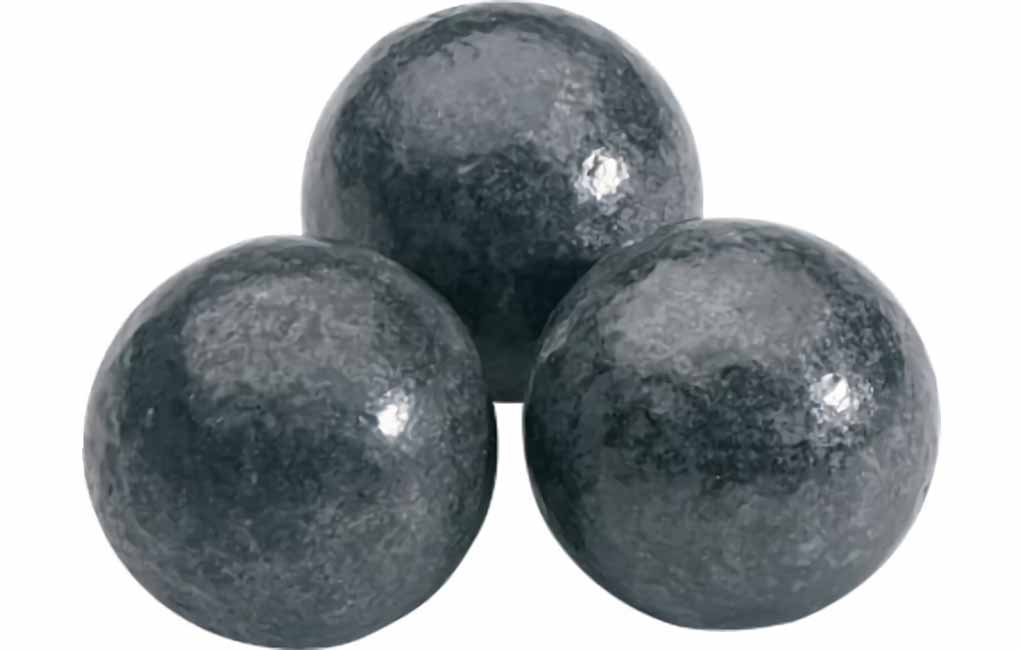
Finally for the traditional muzzleloader marksman, there is the patched round ball, what could be thought of as the original muzzleloader bullet. The lead ball is undersized to the bore and requires a fabric patch around it to hold it in place and engage the rifling. There are variations in doing this, and you’ll need to experiment with various diameters of ball and thickness of patch for you particular rifle. A good example of this would be in a .45 caliber muzzleloader using a .440” round ball with a .02” patch. In this case, the combination should provide a grip on the ball and holds it in place against the powder charge until firing.
Modern Muzzleloader Bullets
When it comes to modern in-lines, there are a variety of options. Muzzleloader bullets in this case aren’t necessarily muzzleloader-specific. A modern .50 caliber in-line can load a .50 caliber patched ball, but won’t be getting your money’s worth out of the gun doing so. A sabot load in the same gun, however, is a different story.
Saboted Bullets
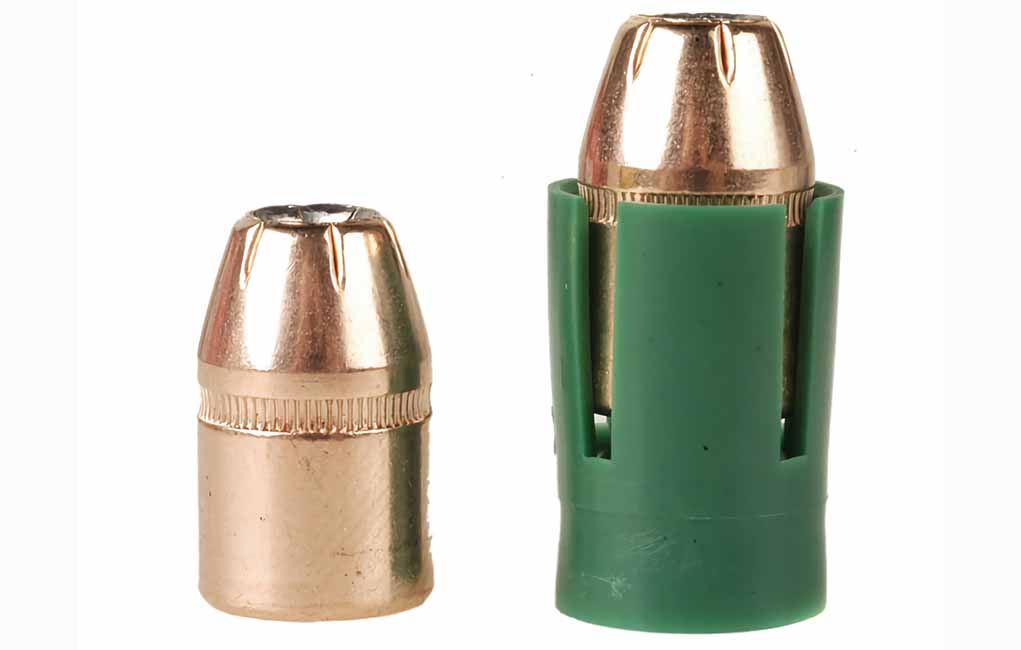
For a .50 cal., such a load would consist of a .452 bullet seated in a plastic cup called a sabot. The sabot could be thought of as a modern equivalent of the old cloth patch. The sabot itself is what grips the rifling, not the bullet. In point of fact, you can use almost any .452 caliber bullet in modern .50-caliber in-line, including those meant for the .45 Colt, .460 S&W, and even.450 Bushmaster. For hunters who desire deep penetration in game, you can also load hard cast .452 Keith bullets so long as you don’t deform the meplat on loading.
Modern sabots often come with the bullet, powder, and sabot all assembled and ready to load. These are a general option and may not be the best for your rifle. As far as muzzleloader bullets go they will get the job done, though perhaps not as accurately as a tuned load. A note on these kit-style loads, they are often expensive and not especially tough. It is common to see these types of bullets sporting a polymer tip and thin jackets around a soft lead core. Consider these a stopgap solution, similar to candy bars at the checkout line. Many hunters with a modern inline mindlessly grab these off the shelf, paying no attention to what may be a better option for their rifle. But in all fairness, in the heat of hunting season, there is something to be said about having reliable off-the-shelf options.
If accuracy at longer ranges is your desire, you’ll want to spend some time tuning your powder charge and bullet style, buying individual components until you find the best combination for you muzzleloader.
Notable Muzzleloader Bullets
Barnes Expander MZ
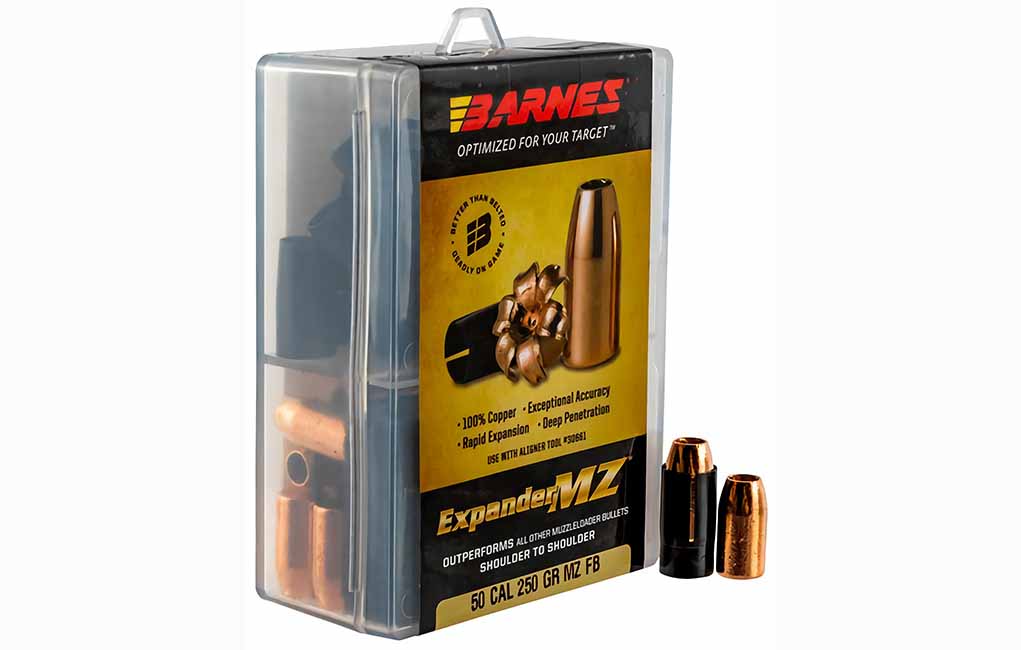
These muzzleloader bullets by Barnes are extremely tough and very accurate and reliable in modern muzzleloaders. They are made entirely of copper and offer rapid expansion. Being copper they hold their shape better than soft lead when seating, and are effective at both close and long ranges. Barnes makes these in several calibers, and all are a solid choice. They come in a pack of 15 bullets with sabots and carry an MSRP of $28.99.
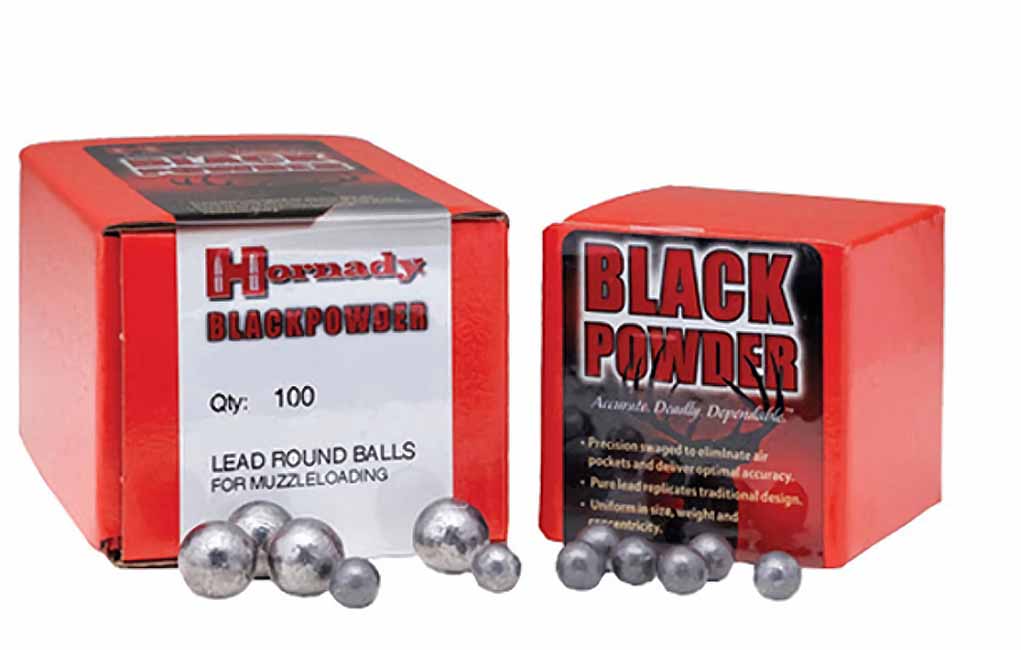
Hornady Lead Round Balls
If you’re angling for traditional rifles, the Hornady round ball is a top-shelf choice. Available in diameters of .32 caliber though .58 caliber, they are useful on all manner of game and in a wide range of muzzleloading guns. This includes cap-and-ball revolvers. These balls are a good place to start what is likely going to be a long journey in learning about muzzleloader bullets, and luckily are inexpensive enough to play around a bit. They retail around $11-18 per hundred and around $13 per 50 in .58 caliber.
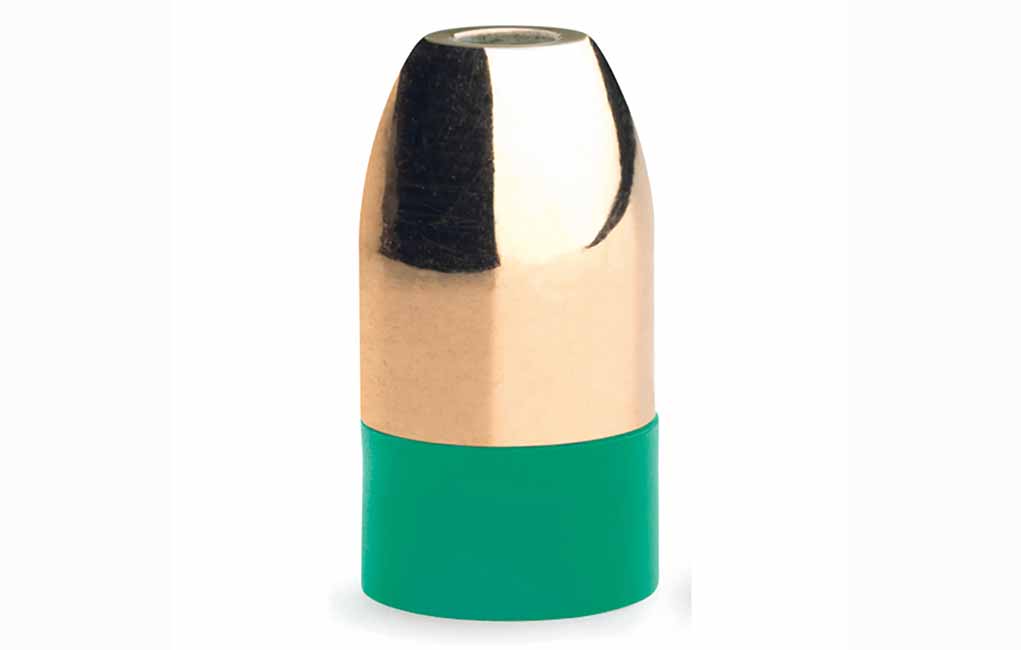
Powerbelt Bullets
There is a wide range of offerings in the Powerbelt lineup. These unique bullets feature an integrated skirt that acts in much the same way as the Minié ball’s hollow base. If you want the most long-range performance with best-in-class ballistics, this brand of bullets will get you there. The company boasts an impressive .45 caliber ELR muzzleloader-specific bullet that advertises just a bit over a foot of drop at 300 yards from a 200 yard zero. Very impressive. Prices vary on this brand, but the MSRP on the .45 caliber ELR bullets is $34 per pack of 15.
Anderson Manufacturing has just launched the A4 series of complete AR-15 rifles and pistols.
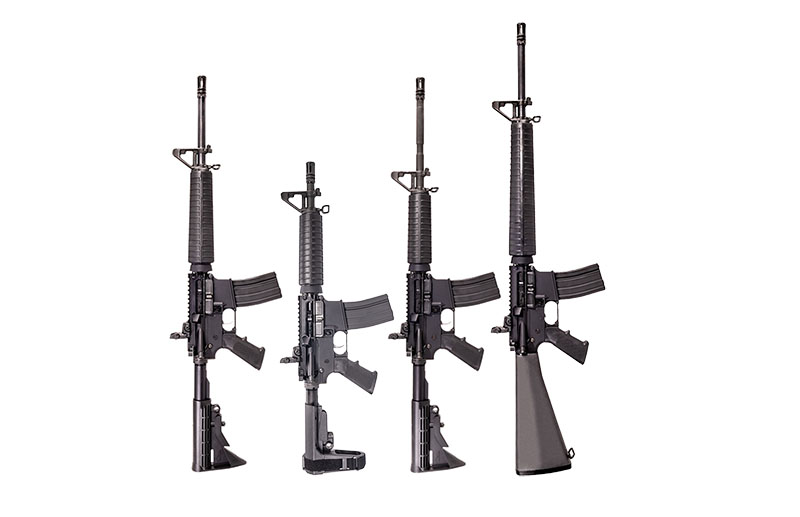
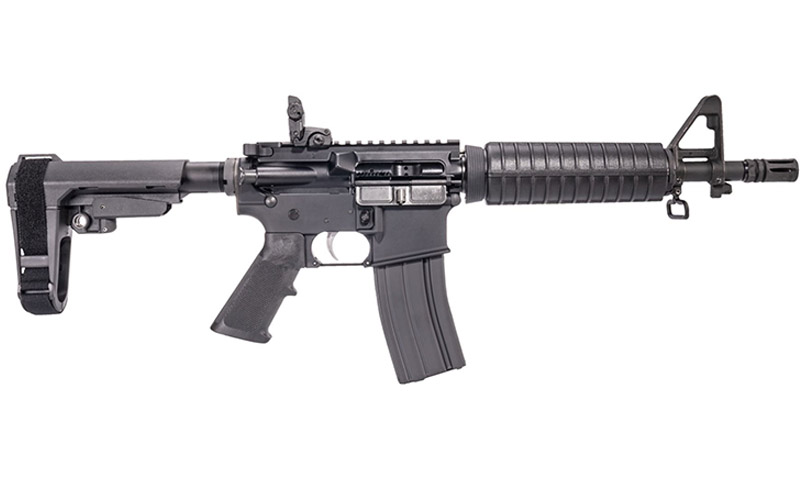
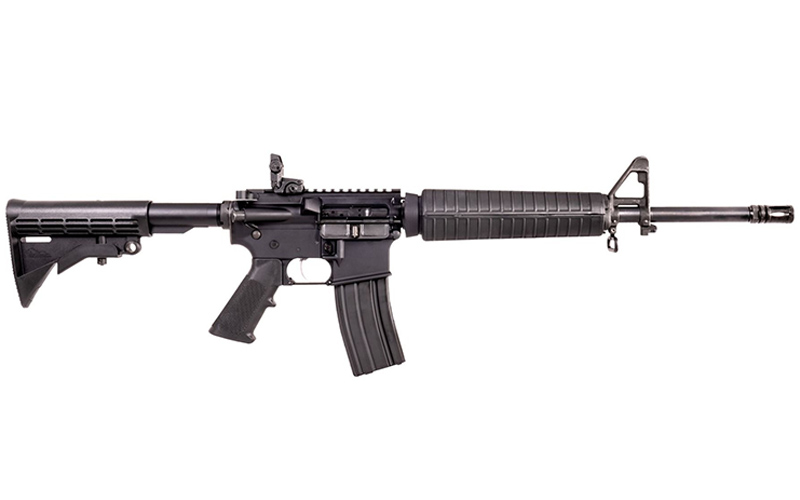
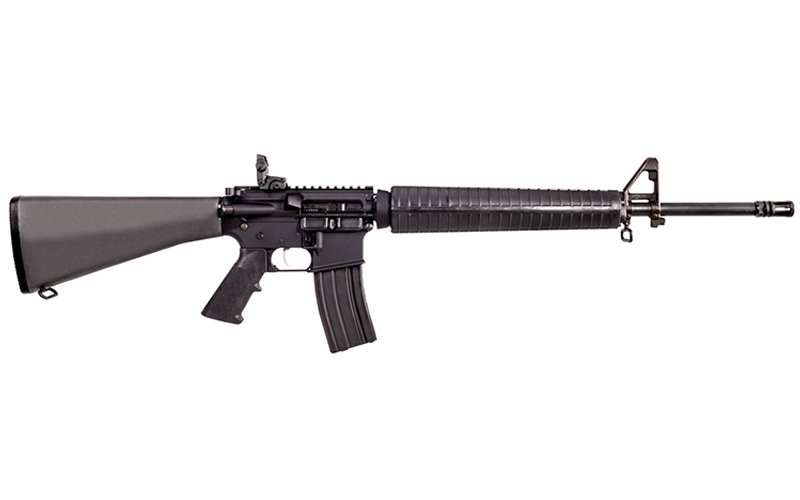
Anderson Manufacturing, mostly known as makers of AR-15 components, has just announced a new line of complete AR rifles and pistols that the company is calling the A4 Series. Comprised of four models, the Anderson A4 Series will feature three rifles and one pistol all chambered for 5.56 NATO.
The A4 Series likely gets its name from the M16A4, the U.S. military rifle which introduced railed flat-top upper receivers to the AR-15 world. Of the four guns in the A4 series, only the 20-inch rifle model is truly similar to the M16A4, but they all feature flat-top uppers, traditional A-frame front sight blocks and classic-styled furniture. These would be closer to M16A4s if they included detachable carry handles, but all four models include a set of Magpul rear sights instead.
As utilitarian, basic AR-15s, the A4 Series aims to provide shooters with plenty of options for entry-level ARs. Anderson promises that the A4 Series will be both rugged and reliable, but another primary draw is their affordability, as all four firearms in the lineup have an MSRP of $599.
Anderson A4 Series:
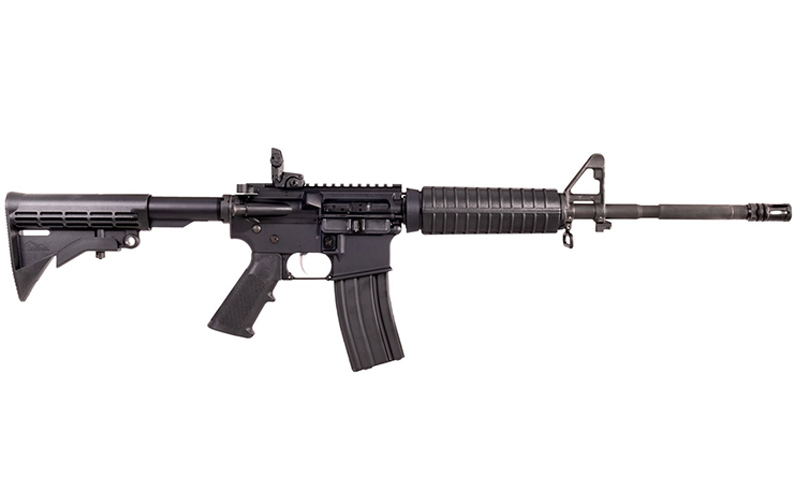
AM-15 A4 Carbine Rifle Featuring a 16-inch, M4-profile barrel and a collapsible buttstock, this is the most basic model in the A4 Series. It has a carbine-length gas system and handguards, and its 4150 Chrome Moly Vanadium barrel (all models) has a 1:8 twist.
AM-15 A4 Carbine Pistol With a 10.5-inch, 1:8 twist barrel, this is the shortest model in the A4 Series and the only one that is legally a pistol. Because of this, it comes with an SBA3 Tactical pistol brace instead of a buttstock.
AM-15 A4 Mid-Length Rifle This model is extremely similar to the A4 Carbine Rifle but features mid-length gas and handguards instead of carbine-length ones. Its 16-inch barrel also differs by virtue of its 1:9 twist rate and government-profile contour.
AM-15 A4 Rifle This is the closest model to a real M16A4, and it wouldn’t make for a half-bad clone with the addition of a detachable carry handle. Naturally, it has a 20-inch, government-profile barrel sporting a 1:9 twist, and it uses a rifle-length gas system. It also features a fixed buttstock as opposed to a telescopic one.
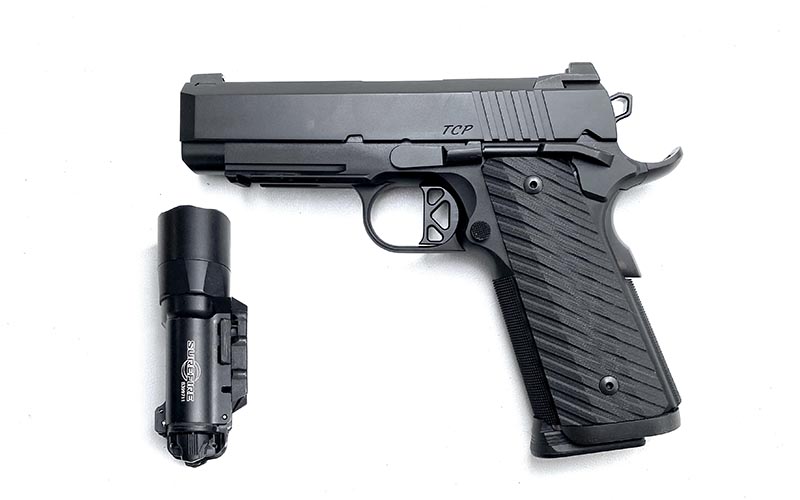
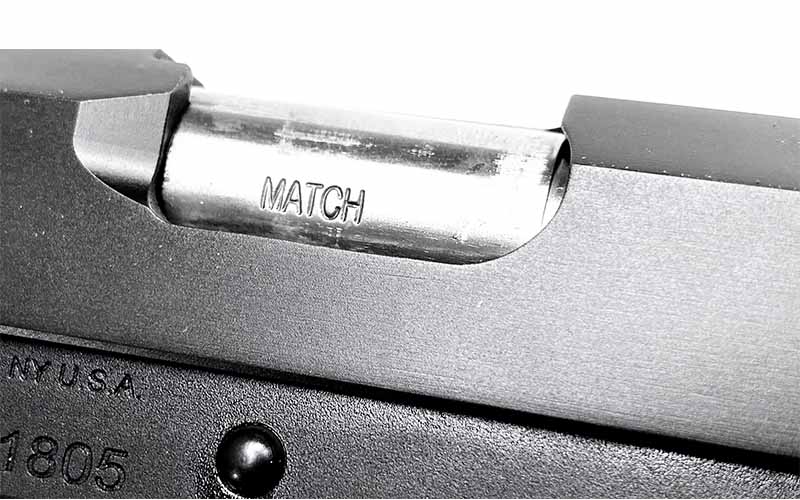
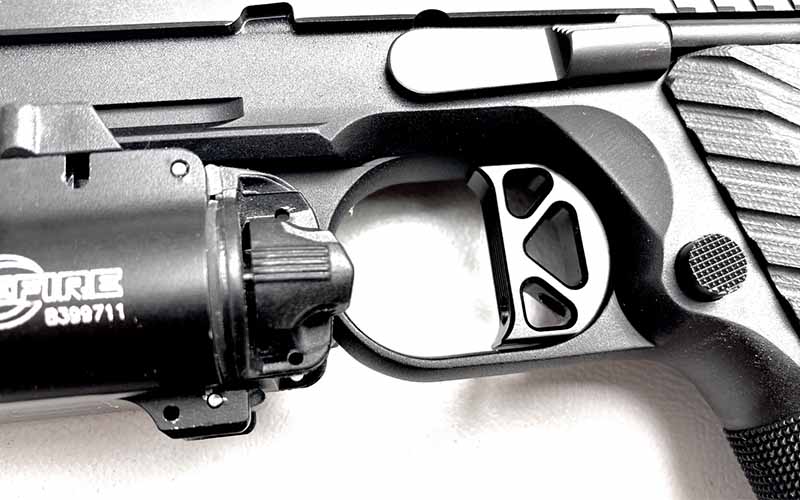
The Dan Wesson TCP, or Tactical Combat Pistol, is a lightweight, alloy-framed 1911 built for everyday carry.
I’m a big fan of the 1911. I not only work on them, but also use them to hunt and compete. I love what the system offers; however, with it being such an old design, attempts are constantly being made to “improve” upon it.
A larger discussion can be had as to whether these proprietary designs are even true 1911s at all, but rather something based on it. One such gun, the Dan Wesson Tactical Compact Pistol (TCP), is a unique design and execution. While not a traditional 1911, it offers some major advantages over the legacy guns.
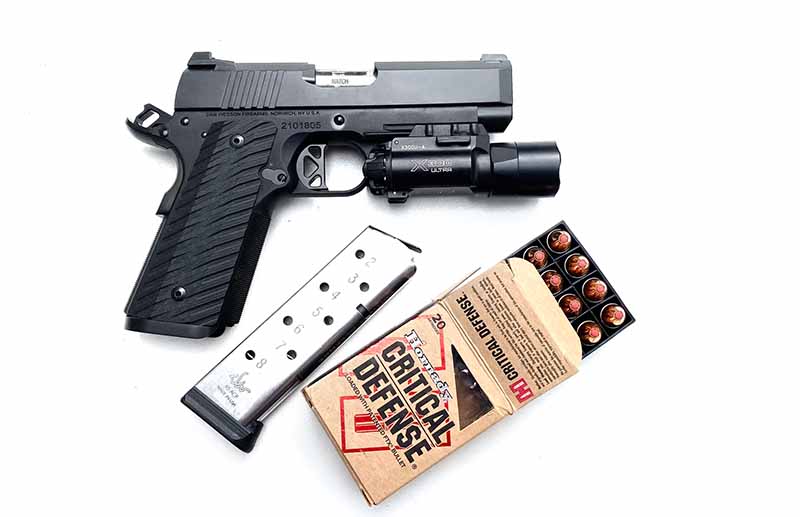
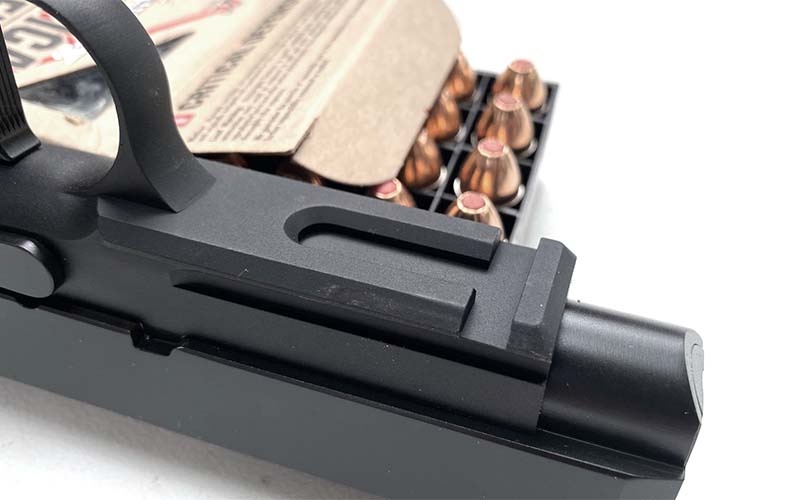
The TCP is at home with modern carry ammo, such as the Hornady Critical Defense. It’s soft shooting with these 185-grain loads.
Execution And Materials
Although this article is centered on the 32-ounce TCP, a larger discussion must be had on the materials used in its construction. The TCP is an alloy-frame pistol, and a substantial number of purists flat-out reject the notion of an aluminum frame on the 1911. The TCP is the only 1911 with an alloy frame that I had zero issues with. For as common a material as aluminum alloy is on modern guns, it has always struggled in the 1911.
It took me a great while to fully understand where the negative bias against alloy-frame 1911s came from, and the best I can find is that the earliest ones were made of castings or porous material and weren’t very strong. Frame cracking and constant malfunctions were common in the 1990s, and, even into the late 2010s, I was having issues with alloy-frame 1911s.
I had one that simply wasn’t well designed, even coming from a name-brand high-end company. If I ran it dry, the slide would bind up. I swapped out the magazines to Wilson Combat, a default remedy for 1911 feed issues, and the problems persisted. I lubed it up constantly; it’d only get through a couple magazines soaking wet, and even then, the lube leaked out chalky gray. I was getting particles of the frame shaved off as I fired.
The grips on the TCP come tapered to the slide, a nice feature that helps slim the gun down. It’s compatible with standard 1911 grips should you wish to change them at some point.
I went on to a couple more alloy-frame 1911s from two other companies and had relentless problems with those as well. All the while, I never had a single issue with any steel-frame 1911s. To this day, the only 1911s I’ve had issues with have been alloy framed. Color me surprised when the TCP proved to be not only extremely accurate but also supremely reliable.
I’ve noticed that it’s not all pistols that have this issue; I’ve shot the hell out of Sig P226 and P229 variants and have never even had an issue with my P238 .380 ACP. The Beretta pistols I’ve shot for years likewise have never really had an issue. So, what is it about aluminum 1911 frames that makes them a challenge?
This comes down to execution and materials. The 1911 was supposed to be a steel gun, and despite aluminum being a good thing, it isn’t a direct replacement in some roles. You wouldn’t trust aluminum screws when putting a deck together or for any task that requires a good amount of impact. The 1911 is a slick gun, but it’s a rather violent gun in terms of how it feeds and fires.
Making a frame out of aluminum in the exact dimensions as a steel frame isn’t a great idea, as the two materials wear and bear strain in very different ways. A guy at my local range had his alloy frame crack in two places, one in the slide-release pin hole and the other in the notch location where the release catches the slide. His frame basically snapped in half. This is an inherent weak point, and the material makes a difference.
Shooting The TCP
The TCP was subjected to some serious use. It was impressive in that, while being light, it handled much like a full-size gun. The gun was obviously designed with the frame material in mind. While dimensions were externally identical to a regular 1911 frame, the internals seemed to be stronger and more reinforced, particularly around the feed ramp and the railed dust cover.
The TCP can mount various lights, but you must be aware that there’s a difference in the rail distance to trigger from common guns like the Glock. Some lights won’t fit the TCP rail.
The rail fit to the slide was also exceptional for being as tight as it was when it arrived. Many of my steel guns have rattle now from constant use, and I’m used to that. The TCP was so tight fitting that it concerned me when I first handled it. The back of my mind told me that this would get gritty fast and start choking. I was certain that the TCP would suffer the same fate as the others I’ve used over the years, as it had another Achilles’ heel I’ve come to avoid: a sub-Commander length bushing-less bull barrel.
The accessory rail is both lightened with a recessed cut and heavily reinforced and thick in the right places. Being that it’s an alloy frame, this is necessary, and the result is light and robust, while at the same time being tasteful and subtle should you choose to not mount a light.
I, frankly, have never had a good time with a sub-5-inch 1911. I’ve shot many Commander-size guns over the years, and I’d just rather have that extra 0.75-inch on the barrel than mess around with altering frames and recoil spring assemblies. I’ve always appreciated that I can find parts and springs for my 5-inch guns, and that isn’t always the case with short, proprietary 1911s.
The issue I’ve encountered with these short 1911s is that they seem to have heavy springs and stiff, sharp recoil. This is a symptom of design necessity; a short slide needs to travel and return to lockup with less spring length and an equal power cartridge as a longer slide. This has created hard-cycling, hard-shooting 1911s.
All this changed when I took the TCP to the range for my initial accuracy and reliability tests. The gun ran flawlessly for over 1,000 rounds of FMJ, JHP and solid Black Hills Honey-Badger loads. Never once did I have a failure; the TCP just kicked out brass like it wasn’t interested. Personally, I’ve never experienced this with an alloy-frame 1911, say nothing about it being shorter than a Commander. This gun shot like it had eyes.
The pistol has a tapered, bushingless bull barrel and a proprietary recoil spring. The assembly is different than a standard 1911 but is exceedingly well executed.
Unlike a regular 1911, this one has a thick, heavy barrel and, while this could be seen as a negative on a light and short carry 1911, it’s capable of delivering accuracy on par with some of the most accurate .45 ACP pistols I’ve had the pleasure of testing. It’s as accurate as the most accurate production 1911 I’ve ever used, the Colt M45A1, itself sporting a National Match barrel. This is high praise from a dedicated 5-inch Colt fan; I was deeply impressed with what Dan Wesson did with this gun.
One-and-a-half-inch groups for five shots at 25 yards from the bench were achievable with 135-grain BHA HoneyBadger and 220-grain +P Hornady Critical Duty. These are my choice accuracy loads for .45 ACP, and the TCP delivered exceptional results. Common 230-grain FMJ ball loads grouped an average of 2.5-inches for five shots—also nothing to sneeze at.
As far as handling, it’s a crossover among Glock 19 size, CZ slide contours and 1911 controls. The weight difference between it and a steel frame gun is very noticeable, and it balances to the magazine like a Glock instead of a 1911. With a light mounted (I used a SureFire X300U-A), it’s nearly perfect and barely comes off target while firing.
A Few Minor Tweaks, Please
A minor point of complaint is that it doesn’t come with night sights. Instead, the rear is plain, and the front is a brass bead. Any modern gun meant for carry and self-defense should ship with night sights at a bare minimum. This gun is a prime candidate for night sights, though you’ll need to pay careful attention to which ones you get. Dan Wesson sights aren’t the same as most standard 1911 dovetails. This isn’t a deal breaker, but it is something to be aware of should you put down some greenbacks.
The rear sight is a textured combat style, but again like the front sight, should’ve been a night sight for the price of the gun.
Reloading the gun is easy, thanks to a funneled magwell. I like this on a match gun but for a carry pistol, it adds unnecessary length to the grip. My favorite mags for the 1911 are Wilson Combat versions with a steel base plate. They do seat but are too short to conduct a speed reload. You’d need to keep the plastic base pad on for the Wilson mags to work, and that’s the first part I swap out when I buy new ones from that company. Luckily, the mainspring housing can be swapped out to a flush version should you wish to save some grip length, and I’d like to see future versions of this fantastic gun avoid the magwell.
The pistol arrives with a brass bead front sight. The author finds this to be acceptable for a gentleman’s piece, but, in reality, a night sight is better.
Another plus are the tapered and slim stocks. I don’t have Andre the Giant hands, but I have long fingers and usually shoot with standard thickness grips on my 1911s (and even prefer larger ones). I’m one of those guys with hands a Glock 21 feels made for (if that gives you an indicator). The TCP grips are wider at the base and thinner to the slide, thus driving the hand up into the beavertail; it insists on a high grip.
The last part I must address is disassembly. The gun needs to be taken apart with the aid of a paper clip or similar pin. When the slide is locked back, it needs to be inserted into a hole in the recoil spring assembly to remove pressure from the spring when the slide is removed. This is a bit of a pain, as you won’t be able to field strip the gun with ease. Again, it’s just something to be aware of.
In Conclusion
The TCP is probably the best alloy-frame 1911 variant on the market today. I don’t baby my guns, and if I’m going to carry one, I must be damn sure my life stands a reasonable chance of remaining in the mortal coil when I holster one. Up until I tested the TCP, I was very much a skeptic of the alloy-frame 1911 and actively discouraged people from buying them, no matter the brand.
The TCP next to a common J-Frame. It’s a 1911 variant but note that it’s both compact and light—far more suited to everyday carry than a steel version.
This is a unique gun that offers the .45 ACP round in a tried-and-true control setup with the added benefit of light carry weight and superior accuracy. While it’s not cheap, it’s likely one you’ll find room for in your safe should you get the chance to fire it
Hawke Optics has just announced that the Reflex Sight Wide View will soon be available with a circle dot reticle, designed to be ideal for turkey hunters.
Hawke Optics’ Wide View Reflex Sight has been available with a standard red dot reticle for some time now, but the company has just announced the release of a new model designed with turkey hunters in mind. The new Wide View Reflex Sight will feature a circle dot reticle instead, and Hawke Optics claims that this small change will make a big difference when it comes to bagging birds.
The new reflex sight has all the same features that were appreciated in the previous model, including the motion-activated sleep function for preserving battery life. Its aluminum frame is both lightweight and durable as well, managing to weigh only 3-ounces while remaining both shock and waterproof.
The company claims that their new reflex sight model is ideal for mounting on shotguns, but it also comes with a Weaver rail mount for attaching to any compatible firearm. The optic’s 25-layer lens has a fixed focus at 10 yards and a red, 2 MOA circle dot reticle with eight brightness settings. For the best results with turkey hunting, Hawke Optics recommends patterning your shotgun with the dot placed on the target’s center mass. This should enable you to make faster, more solid hits than with a shotgun equipped only with iron sights.
The Wide View Reflex Sight with circle dot reticle has an MSRP of $189 and it will be available for purchase soon. Each optic will also include Hawke Optics’ two-year warranty.
Defensive handgun training doesn’t need to be a slog, so here are a few drills that are both enjoyable and skill-improving.
The variety of defensive handgun drills that can be conducted for training and/or evaluation is endless. When you think you’ve seen them all, just make up another one. Regardless, it’s important you select drills to either help you get better at performing defensive handgun tasks, or drills that can be used to evaluate your ability to perform defensive handgun tasks.
But there’s another thing defensive handgun drills can be used for—and that’s fun. The more fun a defensive handgun drill is to run, the more likely you are to use it.
You’ll see a lot of internet experts criticize defensive handgun drills, because they don’t consider them to be practical. There’s some merit to this analysis, but let’s be realistic: Any drill you conduct that’ll help you become better at using a defensive handgun is a good drill.
If it helps you get better at trigger control, that’s a good thing. If it helps you get better at sight acquisition, that’s a good thing. If it helps you improve transitioning between targets, that’s a good thing.
If we only focused on conducting drills designed to mimic likely, real-world encounters, they would be simple drills where you drew your handgun from concealment and engaged a single target as quickly as possible. Practical doesn’t always precipitate fun.
Attempting to train for a test, when you don’t know exactly what the test will be, requires a more comprehensive approach. Instead of working to only become proficient at what might likely happen, it makes more sense to have a holistic approach to weaponcraft.
Attempt to become at least moderately proficient with a defensive handgun, while using it to do things generally considered integral to its effective application in a situation requiring its use. In other words, learning how to cut down a tree with a chainsaw isn’t enough; you need to know how to trim the limbs and cut up firewood as well.
Enjoying The Process
But let’s get back to the fun part: Learning happens better and is retained easier when it’s paired with fun. The best firearms instructors, teachers and coaches know this. I’ve coached high school soccer for five years, and I can tell you—without exception—that humans absorb lessons best when they’re either painful or enjoyable. You only touch a hot stove one time, and catching a fish is what makes you want to get better at catching fish.
The primary motivation for creating the drill I’m about to detail was fun. The secondary motivation was the need to impart stress into training. And the final reason was to provide a comprehensive means of evaluating the basic application of the defensive handgun.
A shot timer is a must for being able to evaluate your performance on the Shadowland and many other defensive handgun drills.
I call the drill the Shadowland Drill, which is named after the little hacienda we live on in West Virginia. This drill is the amalgamation of five different and very common defensive handgun drills detailed below. All rolled into one, they create a stressful, 14-shot drill, that’ll challenge even very accomplished shooters.
Included Defensive Handgun Drills
1. Single Shot to the Head This is a common drill requiring speed and accuracy. It’s simple: You draw from concealment and engage a single target with a single head shot. If, at a distance of about 5 yards, you can accomplish this drill in less than 2 seconds, that’s pretty good.
2. Double Tap There are several names for firing two fast shots into a single target. Most often it’s referred to as a “double tap,” but two quick shots are often described as a “controlled pair” or a “hammer.” We can argue semantics another time. What’s important with this drill is the ability to deliver two kill-zone hits, at about 5 yards, in about 2 seconds.
The Shadowland Drill combines five very popular defensive handgun drills into one.
3. Failure Drill This is another popular defensive handgun training drill that involves two shots being fired center mass, but it adds an additional and final shot to the head. Generally conducted at about 5 yards, three hits in less than 3 seconds is better than average.
4. Speed Reload Some consider training for a reload in a defensive situation a waste of time, because most self-defense situations are solved with less than a magazine/cylinder of ammunition. However, you need to be able to reload your handgun swiftly and effectively, and reloading a handgun is a good way to sort out a stoppage. Reloading drills are timed in several ways, but the easiest is to combine a reload with shots before and after. Good reloading times are in the 2-second time frame.
A speed reload is part of the Shadowland Drill.
5. Adrenaline Dump/Forty-Five Drill Being able to put multiple rounds on target in a hurry is a practical skill with a defensive handgun. Often called the “adrenaline dump,” the number of shots could range from three to double that. The key to this drill is good recoil control and a shot cadence that’ll allow you to keep all shots inside a kill zone as quickly as possible.
Shadowland Drill
To start, you’ll need a shot timer and three IPSC/IPDA cardboard targets. Draw or paint an 8-inch circle in the chest area of each target and then paint a 4-inch circle on the head of each target.
The Shadowland Drill utilizes three targets placed about 2.5 yards apart and at a distance of about 5 yards.
Position one target 5 yards to your front—we’ll call this target 3—and then position the other two targets—targets 1 and 2—2.5 yards to your front and 2.5 yards to either side of the first target.
1. At the start signal, draw from concealment and engage target 1 with a single shot to the head. 2. Then, transition to target 2 and conduct a center mass double tap. 3. Next, switch to target 3 and conduct a failure drill. 4. Returning to target 1, you’ll fire another double tap, conduct a speed-load and then engage target 2 with single shot to the head. 5. To finish, engage target 3 with an adrenaline dump, which is often called the Forty-Five Drill, firing five shots center mass. 6. Remember, all five parts of this drill are conducted consecutively under one time; you don’t stop and restart the timer between each part of the drill.
This is what the three Shadowland Drill targets should look like after one run through the drill.
Once complete, you should have one shot in the head zone of each target, two shots center mass in target 1, two shots center mass in target 2 and seven shots center mass in target 3. Par time for this drill is 15 seconds, and your goal should be to complete it within that time limit with no misses. Anything less than 15 seconds is excellent, 15 to 17.5 seconds is very good, and 17.5 to 20 seconds is better than average.
This is a great drill to conduct at the end of a training session, because it’s always fun to end a training session with something enjoyable. It’s also a great drill to use as an informal competition between you and a training partner. Aside from being fun to run, it throws a lot of defensive handgun skills into one box.
You can start the drill from concealment or an open holster; it demands fast sight acquisition, precision shots, varied shot cadence, a speed reload, transitions between targets, recoil control, diverse target responses, weapon manipulation and that you maintain your fighting stance.
Cut a stencil in an IPSC or IDPA target with an 8-inch circle center mass and a 4-inch circle in the head. Use this stencil to paint the targets for the Shadowland Drill.
Primarily designed for semi-automatic handguns that have a capacity of eight or more, the drill can also be run with pistols of a lesser capacity—or even revolvers. If you’re using a six-shot revolver/pistol, conduct your first reload after you perform the failure drill on target 3. Then, conduct the second reload after the head shot on target 2.
If you’re using a five-shot revolver or pistol, it’s a little more complicated because you’ll have to conduct three reloads. Do the first reload after the first double tap on target 2. Reload again after the failure drill on target 3 and conduct your last reload after the head shot on target 2. You’ll need to adjust the par time; add 2 to 3 seconds for each additional reload.
Is there any chance you’ll have to conduct an engagement like this drill in real life? Well, never say never, but unless you’re auditioning for the next John Wick film, the chances are about the same as President Biden being able to apply basic geometry.
On the other hand, when you consider the possibility of multiple attackers and threat movement, there’s a reasonably—though still small—likelihood you might have to combine two of these shot sequences in a real-world situation.
But, of course, replicating a real-world self-defense engagement isn’t the purpose of the Shadowland Drill. The purpose of the Shadowland Drill is to force you to do a lot of things consecutively, under stress. If you’re competent with a defensive handgun, this drill will prove it. If you need more training and practice, this drill will show that too. But most importantly, the Shadowland Drill is fun!
Editor’s Note: This article originally appeared in the EDC 2021 special issue of Gun Digest the Magazine.
GForce Arms has just announced the GFLVR410, a new .410 lever-action shotgun imported out of Turkey.
GForce Arms primarily sell Turkish shotguns, and their catalog is dominated by break actions, pump actions and automatics that are mostly intended for hunting. The company has just announced a new shotgun import, however, and it’s more interesting than most of the other models that they carry. The GFLVR410 is a .410 lever-action shotgun that will soon be available with the choice between two barrel lengths and a number of different finishes.
While .410 is not most people’s choice for a hunting or defensive shotgun, it can be very fun to shoot and is a good tool for training new shooters. That’s exactly how GForce Arms is marketing the GFLVR410 too—as a range toy and a fun way to introduce people to shooting sports. A lever-action is a great choice for a gun of this style as well, as lever-actions are not only fun and historical but are safer to teach new shooters with than any kind of automatic.
The GFLVR410 will be available with either a 20-inch or 24-inch barrel, with each respective model having a capacity of 7+1 or 9+1 shotshells. The stocks are made from Turkish Walnut, the receivers are aluminum and each shotgun comes with a HIVIZ fiber optic front sight. The aluminum receivers are finished with Cerakote and will originally be available with either a blued or nickel-colored finish, but GForce says that more finish options will eventually be for sale as well. The MSRP is $699 and they are shipping to dealers now.
RISE Armament has just released the Rave PCC Trigger for 9mm ARs, and the company claims it will offer the perfect balance between reliability, performance and price.
RISE Armament of Oklahoma specializes in aftermarket AR parts, and they’ve already released several triggers that have proven to be popular with shooters of all kinds. The company’s best-selling model was the Rave 140, and RISE claims that the new Rave PCC Trigger will emulate it both in terms of function and price. Because of this, RISE believes that the new Rave PCC will quickly become known as the best value drop-in trigger available for 9mm ARs.
The problem with installing aftermarket triggers in 9mm ARs is the guns’ use of a blowback gas system. This style of action is far more violent than the average AR-15, so the triggers of PCC ARs need to be able to withstand a greater amount of abuse. RISE’s solution to this for the Rave PCC trigger was simply to beef it up. The new trigger includes hardened S7 steel components internally, a machined 6061 aluminum housing and a black nitride finish all over.
The Rave PCC Trigger is available with a choice of either a curved trigger or a straight and flat one, but regardless of trigger shape RISE claims that they will feature a clean and crisp break at 3.5-pounds. Both models also include RISE’s Quik-Klik tactile reset system.
The new triggers are drop-in style and should be extremely easy to install. Each purchase also includes a set of free anti-walk pins and RISE’s lifetime warranty. MSRP for both new models of the Rave PCC Trigger is $149.99 and they are available now.
Looking to go armed, but are stuck in the weeds as to what to arm yourself with? Here are 20 of the best concealed carry gun options that will keep you on the defensive.