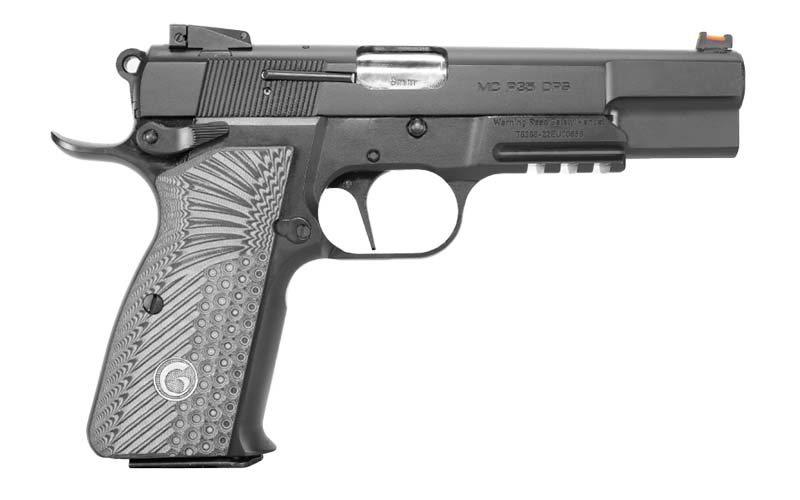
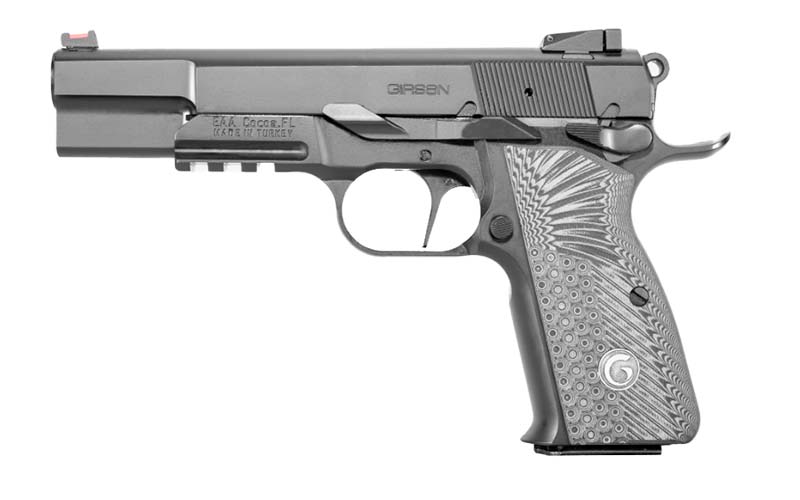
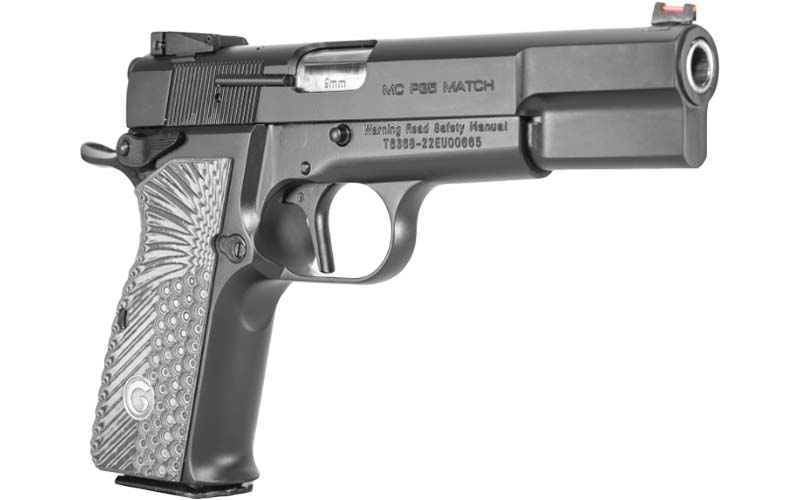
EAA has just announced the Girsan MCP35 OPS and Match, two new models of the company’s Turkish-made Hi Power clone.
The European American Armory Corporation is known for its affordable handgun and shotgun imports, many of which are made by Girsan of Turkey. Around this time last year, Girsan released the MCP35, helping to bring about the Hi Power renaissance that also saw Springfield release the SA-35 and FN its reimagined High Power. While Springfield’s was a good clone that stayed very true to the original, many felt that FN’s attempt to revitalize the name with an all-new design went too far in the other direction. With an apparent gap between traditional clones and complete redesigns, this is where Girsan is finding its niche in the Hi Power market with models like the new MCP35 OPS and MCP35 Match.
Of these two additions to the MCP35 lineup, the only real difference that exists between them is the inclusion of an accessory rail on the MCP35 OPS. While rails have become a nearly universal standard for modern handguns, they’ve been conspicuously missing on Hi Powers and their clones. Not including questionable aftermarket solutions, the MCP35 OPS now seems to be the only way for dedicated Hi Power users to mount a weapon light to their handgun of choice.
The MCP35 Match retains the underbarrel frame profile of the original BHP design but otherwise shares the same features and upgrades as the OPS model. Those features include a fiber optic front sight, an adjustable rear sight, an extended beavertail, a beveled magwell, G10 grips and a straight trigger. These changes should all help increase these pistols’ general shootability. Like the standard MCP35, the safeties on both models are ambidextrous as well.
The MCP35 OPS and Match share an MSRP of $699 and are available now. With Girsan now having released modified Hi Power clones geared towards both concealed carry and competition, it will be interesting to see where the company decides to take the design in the future.
A look at a medical expert’sperspective on ammunition and lethality in relation to bullet caliber, weight, velocity and projectile type.
“Kids in school are learning boater safety and not bleeding control.”
I chuckled a bit as I listened to Lindsay Gietzen explain the absurdity of today’s education system that often emphasizes denial and shameless propaganda.
“They act like we live in a world without two, maybe three guns per individual. Violence rarely waits for politics, and the fact is education is politicizing the need for emergency care by way of denying reality. People get shot, and wishful thinking won’t stitch up those wounds.”
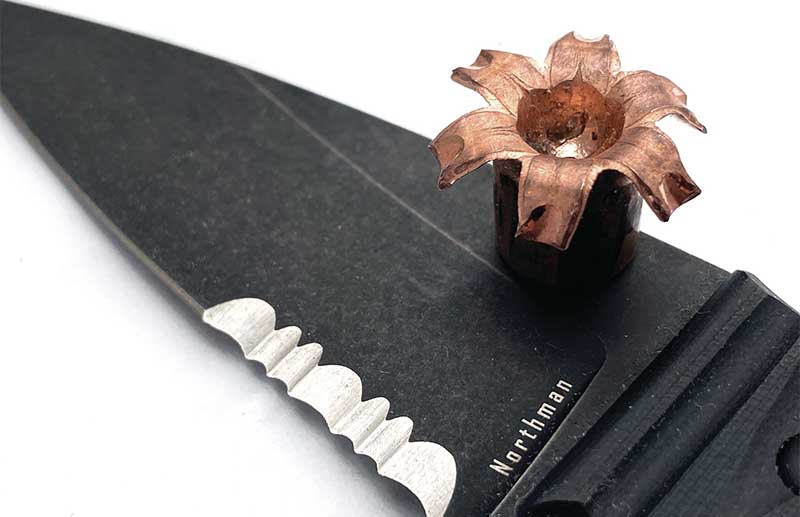
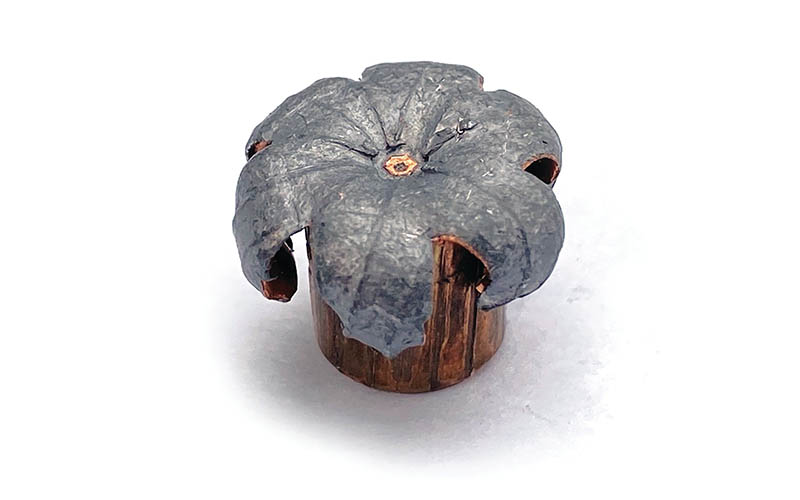
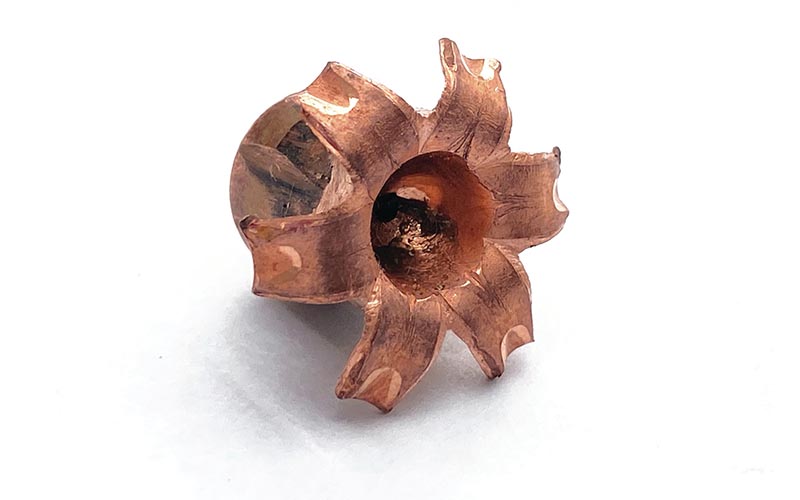
Knives and bullets do very different things to the body, but the end result is the same. Blood loss from gunshots or stabs are treated the same way for the most part. The bullet is a fully expanded all-copper .45 ACP Barnes and the knife is an AMTAC Northman.
Gietzen is a person of incredible experience and equal amounts of sharp wit; the combination of those qualities makes her one of the world’s leading experts and educators on traumatic injury care. She’s seen thousands of gunshot injuries in the worst part of Michigan and is now doing her best to get tourniquets and bleeding control kits right next to AED machines on the wall of every building.
The revelations here may surprise you, and perhaps you’ll buy your own bleeding control kit after reading this.
How Bullets Kill
A gun needs to be two simple things: reliable and reliable again—everything else coming in order of personal preference. Accuracy comes with practice and cosmetic choices are largely irrelevant, so as a baseline, the gun must function. Now what about bullets?
A good question to ask is, why there isn’t as much of an emphasis on reliable bullets? After all, the bullet is what matters most. There’s a tremendous amount of science that goes into creating more advanced projectiles that guarantee superior performance.
“What causes death isn’t really kinetic force or expansion,” said Gietzen. “What causes death is rapid exsanguination (blood loss). A hit to the central nervous system or head does not guarantee an instantaneous kill. Despite what you see in the movies, the survival rate for wounds to extremities is very high, and death becomes more likely the closer you get to the heart of major arteries. The most deadly places to hit are the groin, armpits or a major artery in the torso.”
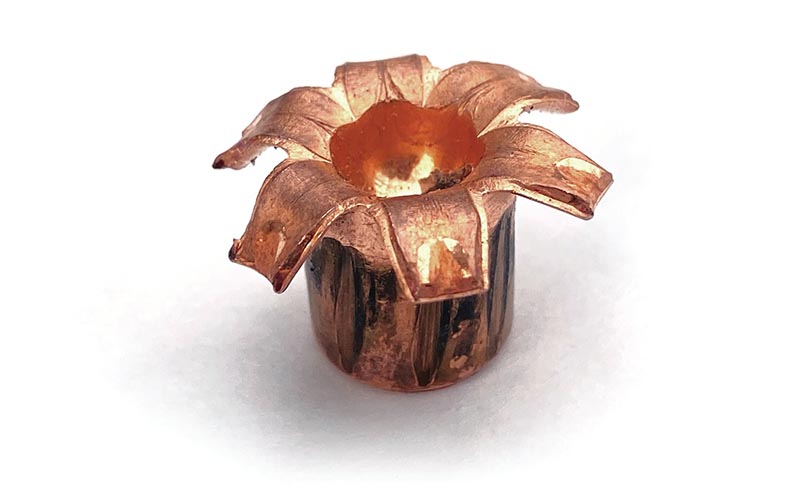
Bullet construction has improved in recent years, and small-caliber rounds, like the 147-grain 9mm above, are tough and offer great expansion … but they’re still prone to failure and clogging. This bullet was fired into gel.
So, what then constitutes an effective bullet?
“There’s nothing that says that a bullet that passes through-and-through is more deadly,” added Gietzen. “It’s also untrue that it causes more bleeding, because it’s all one wound. As for bullets that remain in the body, we end up leaving them in many cases.”
Gietzen continued: “When it comes to multiple injuries, there’s no real case that says more bullet holes in more places cause more bleeding. In fact, even a person shot once may not bleed externally. Almost all the blood in the body can be held in the pelvis, and it’s not uncommon for a gunshot victim to bleed externally in a way that does not appear to be life threatening.”
A healthy person can lose up to 40 percent of their blood and survive. There’s no set method to deprive a person of 41 percent, nor is there a means to predict what’ll happen when larger or smaller individuals are shot. In humans, damage a bullet does is often less related to velocity or mass, but rather the immediate aftermath and medical treatment given.
In a mass causality event, shooters often use rifles. It should be noted that at Columbine there wasn’t an AR-15 or AK-47 used: It was pistol-caliber guns and a shotgun. The Virginia Tech shooting was carried out with two pistols, a .22 LR and a 9mm. That shooting left 32 dead and 17 injured by shooting. In these mass casualty events, it’s not necessarily the initial injury that kills on contact, but the response time to care and neutralizing the threat so help can arrive.
Rifle bullets, in this case a Sig Sauer Elite Hunter .300 Blackout, have come a long ways as far as delivering consistent performance. Maintaining accuracy while offering a mechanically complex expanding bullet is no easy task, especially at the slower speeds of the .300 BLK. Is it more lethal than a FMJ? Hard to say since the use of expanding bullets in warfare isn’t widespread.
“When we have a victim brought in, we often don’t immediately know what they’ve been shot with … or even how many times they’ve been shot,” said Gietzen. “We find the most severe injures and begin treating those first. And not every hospital is equipped to deal with gunshot injuries. Bleeding control is being heavily pushed in the medical community, this being tourniquet application and wound packing. Stop that bleeding and the survival rate goes way up.”
How important is knowing bleeding control skills in these situations? Gietzen sent me documentation from the Berkley et al Journal of Trauma, 2008, which stated that in modern combat in Iraq, four out of seven deaths might have been prevented with early tourniquet use. It also stated that 57 percent of deaths in general would be preventable with early bleeding control and tourniquet use.
Calibers and Effectiveness
So, why does all this matter to the average CCW citizen, and how should it affect their decisions on which bullets to load … and what trauma gear to have close at hand?
In the weeks leading up to the writing of this article, I spoke to several medical staff who worked post-mortem. Those individuals chose to remain anonymous, but their information was somewhat inconclusive in terms of what calibers were more effective. It should be noted that not all bullets are recovered, and aside from law enforcement, where the number and location of shots fired is recorded in reference to a duty weapon, there isn’t a tremendously detailed picture of the answer.
The general (and predictable) consensus was that the most common CCW calibers see the most action. They all agreed that, from a medical perspective, there was no noticeable or real-world difference between .380 ACP, .38 Special, .357 Magnum and 40-caliber.
The only major standout was .45 ACP, where it resulted in about twice the fatality rate as the others, even to extremities.
Very little relevant information was available on .22 LR, .25 ACP or larger rounds like the .44 Magnum, simply because these are rarer selections for concealed carry.
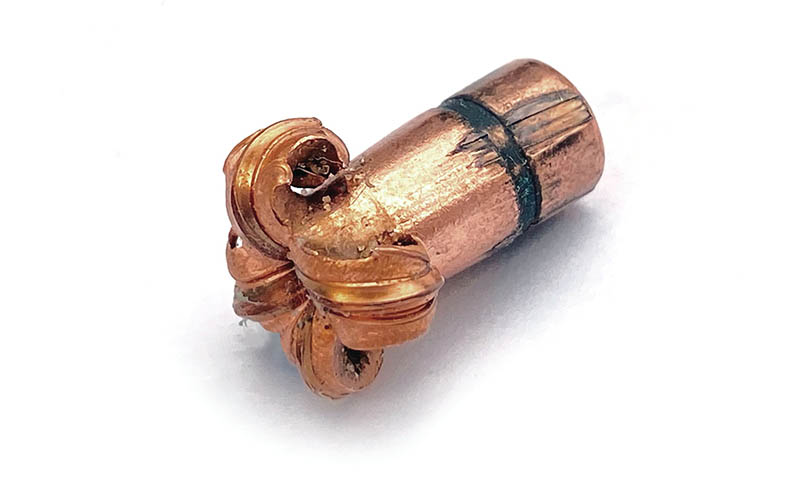
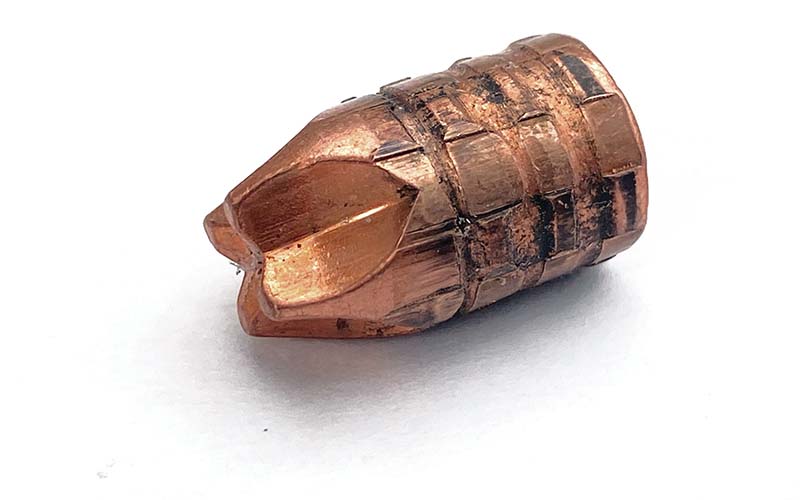
There was no positive correlation with death based on bullet type used. Said another way, again from this medical perspective, hollow-points aren’t any more effective in practical applications than a FMJ. Of note is the Black Hills HoneyBadger line, which features solid, non-expanding bullets designed to cause more tissue damage (bleeding) by means of fluid dynamics due to bullet rotation, thus making them barrier-blind as long as the bullet is spinning.
The Black Hills HoneyBadger line features monolithic bullets with flutes to create tissue disturbances (tearing and penetration injuries) as a function of rotation alone. This means there’s no mechanical expansion to get results and no clogged hollow points. These bullets can reach just about any vital area from any angle and have a weight retention, even through glass and barriers, usually at 100 percent.
These numbers were quite similar to the 2018 study exhaustively titled, “The Association of Firearm Caliber With Likelihood of Death From Gunshot Injury in Criminal Assaults,” which determined that larger caliber guns were more likely to inflict death.
Overall, this study, while including a large sample group, was realistically and fundamentally flawed in that it grouped a wide number of calibers into seemingly random clusters, even grouping .45 ACP with 7.62x39mm! It rated large bullets (irrespective of speed or weight, a .45 ACP is typically a 230-grain bullet at 850 fps and a 7.62 is a 123-grain bullet at 2,400 fps) as 4.5 times more likely to kill than with smaller calibers.
But again, the conclusion is noteworthy in that larger caliber guns were more likely to inflict death.
This beautiful expanded all-copper .45 ACP bullet was fired into gel. In real life, it’s rare to get a perfect and symmetrical expansion like this, which makes it difficult to establish a true gauge of effectiveness when even a T-shirt can impede it. The .45 ACP has never struggled, even in hardball form, and complexity isn’t always warranted when a simple 230-grain FMJ will get the job done just as well now as 100 years ago.
Do Bullet Types Even Matter?
It’s my belief, based on my experience and that of professionals far smarter than me, that most bullet designs have less bearing on lethality than where that bullet goes. Shot placement, not caliber used or bullet type used, is the major deciding factor in lethality. This might be a no-brainer, but there is no doubt that the merits of bullet type will be debated for years to come.
In the meantime, take a bleeding control class. Should the worst happen, it will likely be far more useful than deciding between 9mm and .45 ACP.
About The Expert:
Lindsay Gietzen is a professor and program director at one of the top research universities in the world, where she specializes in simulation and educational evaluation. She’s also the co-director of the AVERT program for the Health and Safety Institute.
As a physician’s assistant, she practiced in emergency/trauma medicine in Detroit, Michigan, and then specialized in neurological surgery, leading a team that developed and performed many procedures for the first time in the United States.
She’s a member of the Michigan Academy of Physician Assistants, American Academy of Physician Assistants, Physician Assistant Education Association, and Director at Large of the Association of Neurosurgical Physician Assistants.
Gietzen is currently serving an appointment to the American Council on Education, where she’s an expert faculty evaluator for military medical programs.
Editor’s Note: This article originally appeared in the 2021 CCW special issue of Gun Digest the Magazine.
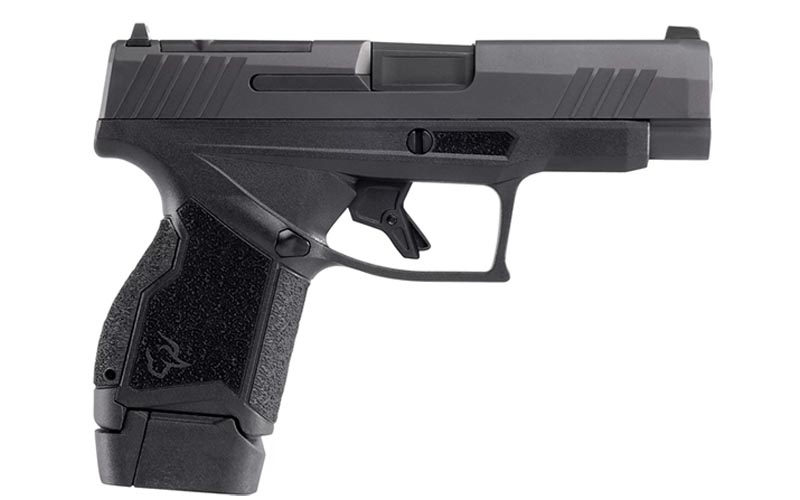
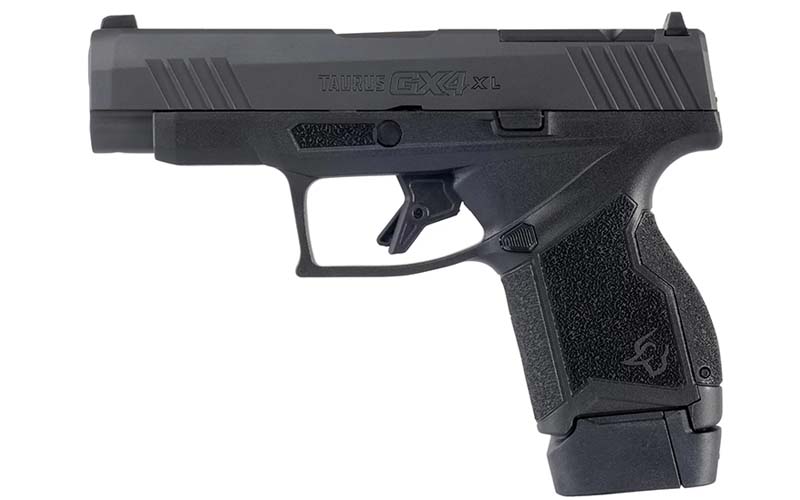
Taurus has just announced the GX4XL, a new enlarged version of the GX4 available in both optics-ready and standard configurations.
In late 2021, we looked at Taurus’ newly released GX4 T.O.R.O., a compact 9mm carry pistol that aimed to capitalize on the optics-ready pistol trend. The next CCW trend that the company has set its sights on is making an enlarged version of its 9mm compact carry gun. The result is the GX4XL, now featuring a longer barrel and slide, plus the choice between an optics-ready or standard version at launch.
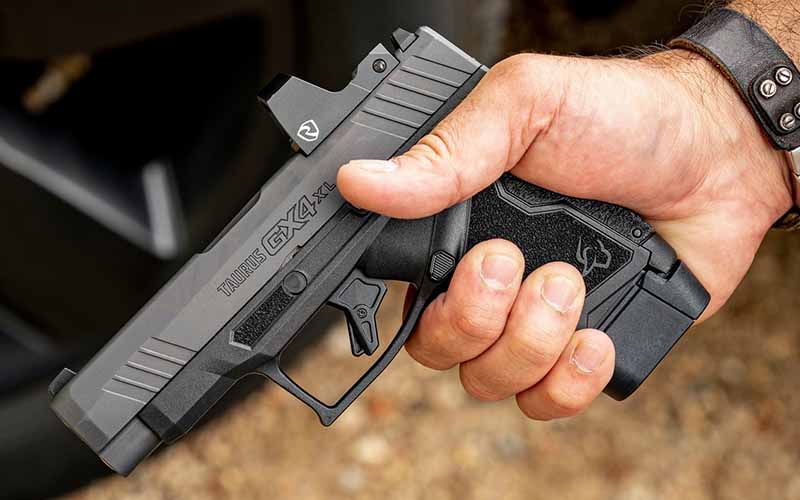
A similar concept to the Sig P365XL, the new Taurus GX4XL features a slightly longer barrel and slide while retaining the same magazine capacity and grip size as the compact model. The GX4XL barrel is 3.7 inches (.64 inches longer than the GX4’s), and Taurus emphasizes that the change will result in greater muzzle velocity for more power down range and a longer sight radius for increased accuracy. Other notable features of the GX4XL include interchangeable backstraps, a reversible magazine release and a flat-face trigger.
The standard model will ship with a steel drift-adjustable rear sight and a fixed white dot front sight. The T.O.R.O. (Taurus Optic Ready Option) GX4XL model will also be ready to mount any red dot sight that utilizes the common Shield RMSc-pattern footprint. Regardless of the model chosen, each will include one 11-round flush-fit magazine and one extended 13-round mag. 10-round magazines are also available for states with capacity restrictions.
The standard GX4XL has an MSRP of $429 and the optics-ready model has an MSRP of $459. Both are available now.
Range Time Targets … full-throttle purveyors of that sweet, sweet PING!
The sweet sound of PING! Once you’ve experienced it, you can’t get enough of it. Those who understand the reference surely agree there are few more pleasurable endeavors than throwing jacketed lead at a sheet of hardened steel.
Beyond basic fun behind the trigger, steel targets add visual and auditory aesthetics to range time any red-blooded shooter appreciates. In a word, shooting steel is addictive.
And useful.
Practice a lot, and steel will save you money. Need a long-term solution, treat it right and it’ll be there for years. Want instant feedback, you hear every hit. Require something dynamic, steel has it in spades.
Range Time by AR500 offers Hostage Targets (above) along with a slew of other long-term terminal destinations for your bullets.
Sure enough, there’s an upfront investment, but that cash is paid back tenfold in skill building, convenience and, yes, money saved. At the same tick, not all metallic targets are created equal—which brings us to Range Time Steel Targets by AR500 Target Solutions.
Range Time: Doing Steel Right
Based out of Rice Lake, Wisc., Range Time has kicked a toehold in the high-quality end of the steel target market. Heck, you can even find some of their specialty targets at the Navy and FBI Quantico training grounds. It’s a tough game to get to this level, especially given there are plenty of pretenders stealing business away from companies that are doing it right.
But what does “doing it right” mean and why do Range Times targets stand out against discount brands you find on special at your local mega outdoor store? It comes down to the steel.
Across the board, Range Time utilizes the proper type of metal for the job, by this, we’re talking AR500 and AR550 . For those uneducated on the matter, this is the stuff you want to catch bullets.
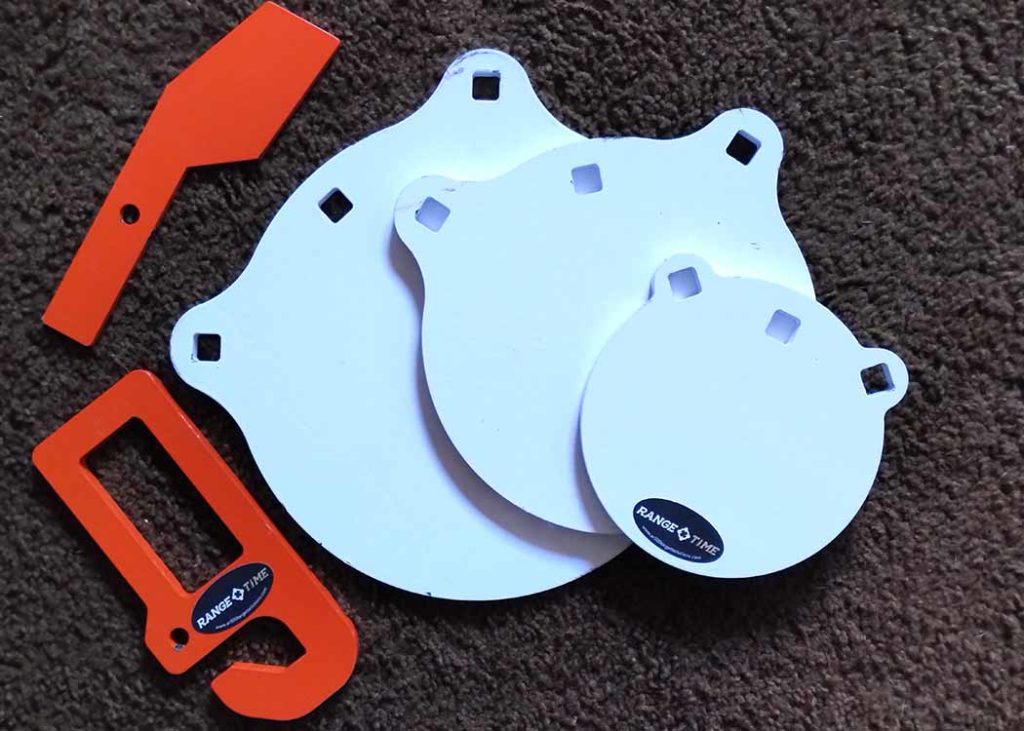
Range Time’s Gongs kit, made of AR500 steel and 3/8″ thick, the targets are stout enough to withstand pistol and rifle fire.
The “AR” here stands for “abrasion resistant,” and the rolled steel plate is utilized in a host of brutal jobs—armor, mining equipment and snow plow blades, to name a few. Given its resume, it has some attributes making it perfect as a shooting target. In particular, its hardness and resistance to impact stresses. Brass tacks, it won’t warp or gull—good things when you don’t want a bullet careening back at you.
This isn’t the case with all steel targets, so buyers beware. If it doesn’t say AR500 or AR550, good chance you’ll invest in something that won’t last a cup of coffee or will put you in harm’s way.
Taking Care Of The Little Things
Given the steels’ toughness, AR500 and AR550 aren’t the easiest materials to work with, as you can imagine. This is where Range Time definitely deserves kudos. The company’s wares—from simple gongs to silhouettes—all boast crisp pleasing lines and precision-cut attachment holes.
Yeah, this is a bit of icing on the cake, a sloppily cut target is still useful. But you’re slapping down considerably more on steel than most any other option, so you might as well demand top manufacturing. Range Time gets this, and its laser-cutting process delivers it in spades.
Upgrading The Range
I have banged Range Time’s steel previously, in particular, their IPDA/IPSC Silhouettes and have walked away impressed with their resilience. The company sent me a couple of packages to test out recently, including its AR550 Reactive Hostage Target and three AR500 swinging gongs. Both have already proved worthwhile and up to what I’ve come to expect from Range Time.
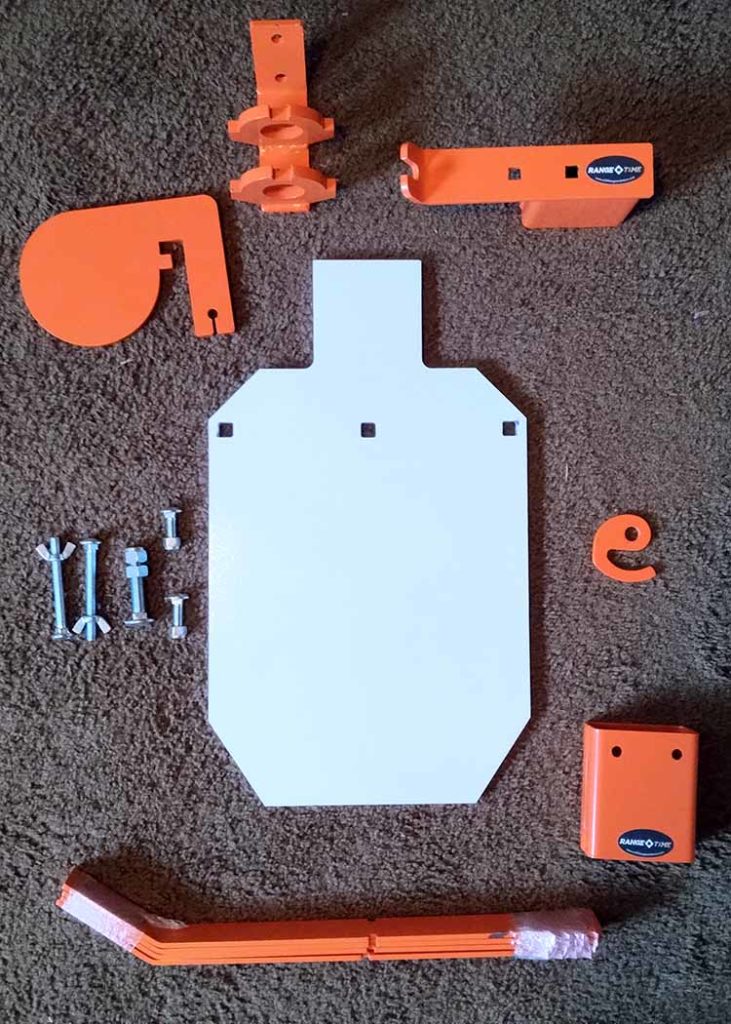
The AR550 Hostage Target Kit comes with everything to set up your own shooting range. You only have to supply a 2″x4″ for the post.
Before touching on how each target performed at the terminal destination, a brief word on what comes with each kit is worth mentioning.
GongKit
As it sounds, these are three 3/8-inch thick AR500 gongs, 10-, 8- and 6-inches in diameter. Making things all the easier for set up, Range Time includes hardened hangers that work in conjunction with a 2”x4” to set up a tidy row of targets. These are perfect for target transition practice, casual shooting sessions or anything else where a plain old target is required.
Hostage Target Kit
If you are unfamiliar with the setup, it’s essentially a 12″x20″x1/2″ AR550 silhouette (IPDA/IPSC size), the twist is its bright orange, 5-inch AR550 paddle that’s also 1/2-inch thick. This mounts to the rear of the target and sits off to the side of the silhouette’s head, in a mimic of a bad dude’s noggin popping up behind a hostage. The bonus to this setup is the flapper is dynamic—make contact and it flips sides adding a bit of action to a shooting session.
To round things out, the hostage kit comes with a stand set up and mount that works in conjunction with a 2”x4”. Range Time offers up quality carriage bolts for mounting (sold separately), but you supply the lumber.
As a side note, you can attach the gongs to the stand via a carriage bolt, if you so desire, for a single target.
Range Time At The Range
So, if you were expecting regalement at the actual review of Range Time’s targets, get ready for disappointment. It gets pretty pedestrian from here on out. Why? Because their performance was exactly what you’d expect from quality steel—boring.
No, no … not the actual shooting and what the targets brought to the session. That was top notch, we’ll get to that in a moment. But exactly how the steel performed against a hail of 9mm and .223 Remington fire.
Face it, the only way this review gets exciting is if somewhere along the line a target cracks or a massive divot is removed from its surface. That happens, we can all look at the picture, furrow our brows and mutter in knowing tones. Sorry, not with Range Time.
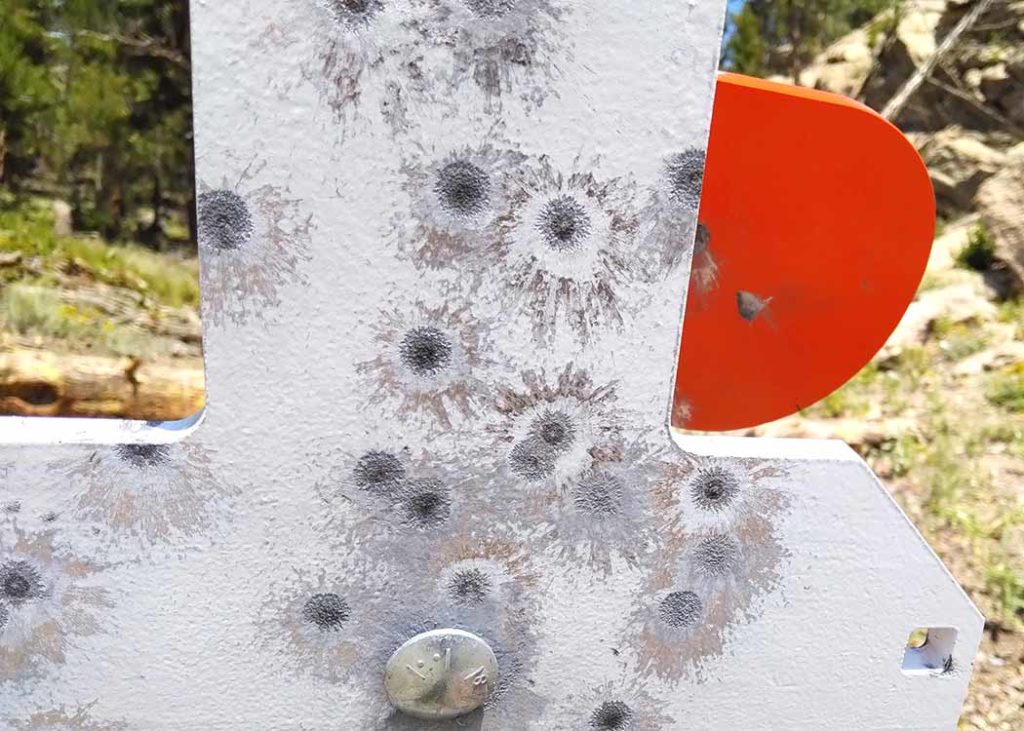
Impact and spall stripe some of the powder coating from these 9mm hits, but the steel itself is virtually unharmed.
With pistol and rifle fire from 10 to 100 yards, the targets came away with little more than paint chips. The steel itself was nearly pristine enough if powder coated again would likely prove as flawless as the day I took them out of the box. Honestly, pretty impressive given some 200-plus rounds rained down upon them.
Now, of course, I’ll have to invest in a rattle can or two to protect their surfaces from corrosion—plus get them looking spiffy again. But that’s a small price to pay for target systems I’m certain are up to the abuse I aim to inflict on them for years to come.
Which Target For What?
The answer to that is a solid, it depends …
The Hostage Target definitely has more of a defensive training role, offering a legitimate option to sharpen pistol skills or work with your carbine relatively close in. Doubling as a plain ol’ silhouette, it opens up a wealth of drill possibilities and would like serve well for someone looking for one single investment.
The gongs, on the other hand, are all-arounders. Up close, they’re perfect for a target transition course with your pistol or a general plinking gallery with a rimfire. Move them down range and you have the excellent emulation of vital zones of most North American game to check your zero before hunting season.
All that said, the gongs serve better as secondary targets added to a dynamic main system. Honestly, the best bet is both packages for a fairly versatile range setup. Oh yeah, and plenty of ammo to pitch at them.
Brief Note On Steel And Thickness
One more factor to consider, should you go AR500 or AR550, and how thick? Again, this all depends on what you’re shooting.
The Hostage Target in this review, for instance, is resilient against .223 Remington rifle fire as close as 50 yards. The 3/8-inch gongs I futzed with can shake off a .308 Winchester at 100 yards. That covers a lot of ground.
However, if you’re looking at purely pistol shooting, you can save a bit of money by investing in AR500. This will stands tall against all handguns–including magnums. But if you’re aiming at throwing a carbine in the mix at realalistic engagment ranges, it’s definitely worth upgrading to AR550 and thickness.
Either way, Range Time’s caliber chart gives you a good idea of what steel and thickness handle what cartridges. It is worth a perusal if you’re in the market for a target.
Parting Shot
Not all steel targets are equal and there are plenty of options out there that potentially have a lifespan slightly north of paper. This isn’t the case with Range Time.
Dynamic, American-made and precision manufactured, the targets are made for years of enjoyment. This puts plenty of that sweet PING! in your future.
A few costly, but worthwhile, additions to your reloading bench.
I was taught to reload with minimalistic gear. It wasn’t that we couldn’t afford anything better than what we had; it was a combination of being unaware of certain products and my dad’s frugality. Dad had a Lee turret press from the 1970s, which was housed in a neat finger-joined wooden box that could double as a stand, and an RCBS 505 balance beam scale; the rest of the gear we went halves on.
Now, I’m not complaining. We made great ammo with very little gear, and there’s absolutely nothing wrong with that. But as I started seeing impressive groups at the target board, I went down the rabbit hole, so to speak.
I started researching different pieces of gear in order to make better ammunition—and to make my life easier. I soon realized there was a high-end tool for nearly every imaginable step in the reloading process, some of which I’d never heard of or imagined.
Of course, Ol’ Grumpy Pants would almost always deem these types of tools a frivolity, but I started down the road to amassing a set of proper reloading tools. While I still use many of the tools I started with, some of the more elaborate tools I really enjoy and don’t regret spending the extra money on.
If you’re looking to expand your tool set, these might interest you.
Redding T-7 Turret Press
“Cast iron construction, powerful compound linkage and a rigid seven-station turret combine to make the Redding T-7 the best turret press ever.” So reads the product description on the Redding Reloading website, and I can’t disagree with a single word of it. I’ve long referred to the T-7 as the “Cadillac” of presses, not just turret presses.
Photo: Massaro Media Group.
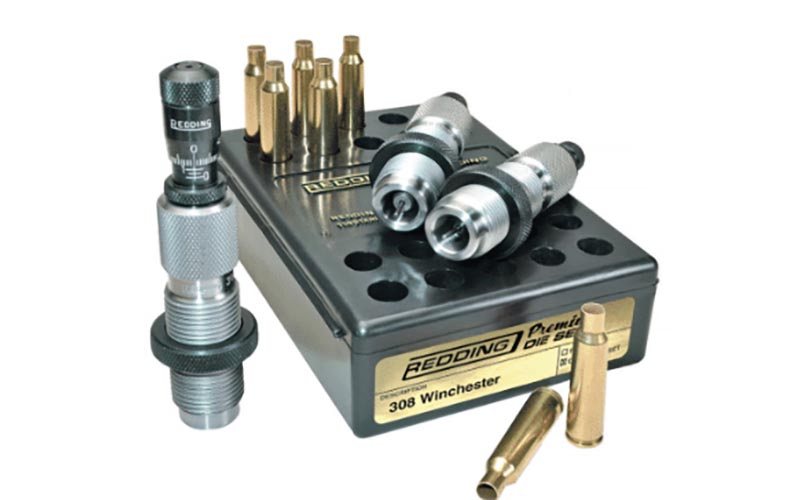
It has a rotating turret with detents for each station, and once in place, the head won’t budge without some effort. Seven threaded holes accept the standard 7/8-14 threaded die bodies, and the ram takes standard shell holders. That 1 inch-diameter steel ram offers 3.8 inches of travel, so even cartridges as long as the .416 Rigby can be loaded. The T-7 comes with a priming arm and a neat spent-primer collecting system.
It’s still a single-stage press, in that it only performs one function at a time, but it’s very nice to keep the entire die set on the press, and to quickly and handily switch between resizing die and seating die, or add a crimp or flaring die into the mix. Simple rotate the head of the press, rather than spend a whole bunch of time screwing and unscrewing dies.
RCBS ChargeMaster 1500 Powder Dispenser
I’ve used a bunch of different methods for measuring powder, from using a spoon to scoop powder into the pan of a balance beam scale, to a mechanical powder thrower to a premeasured scoop. But the RCBS ChargeMaster 1500 electronic powder dispenser is a favorite.
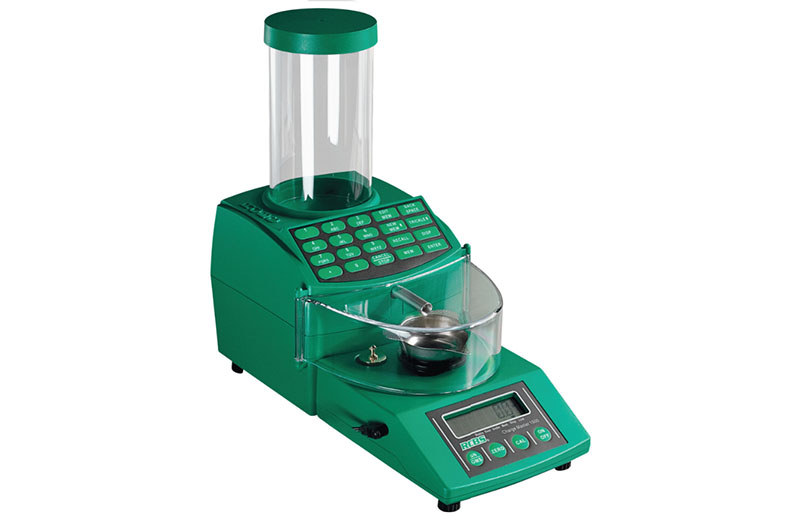
For speedy and accurate powder dispensing, it’s very tough to beat the programmable RCBS ChargeMaster 1500. With a simple-to-use keypad and a digital scale, the unit will throw powder charges almost as fast as you can load them. Photo: Massaro Media Group.
A large hopper holds a significant amount of powder, and an LCD display allows the user to key in the desired powder charge. The unit then turns the worm screw to dispense powder into the pan, which is situated on a precise electronic scale. As the target charge weight approaches, the unit slows to a trickle, and it stops when the charge weight is reached.
You can store your favorite loads, calibrate the scale and even trickle additional powder if the machine stops short. An audible beep warns of charges either over or under proper weight, and the unit will keep count of the charges dispensed, so you can make sure all of the cases in your block are charged. This is a piece of gear I can’t do without.
Micrometer Seating Dies
This is a simple innovation that makes the reloader’s life much easier. Setting the seating depth with a conventional seating die is a matter of trial and error, usually resulting in a minor deviation during the locking process. Those seating dies with a micrometer adjustment tend to stay where you put them, and once you measure the amount of adjustment you’ll need, you can simply dial that amount and be confident that the bullet will be seated where you want it.
Reloading dies with micrometer adjustments take the guesswork out of bullet seating depths. Photo: Massaro Media Group.
Most companies now offer micrometer dies; I’ve had great success with RCBS, Redding, Lyman and others. There are also dies for taper crimping that offer micrometer adjustment. And once you get used to the precision, you probably won’t want to go back to the old style of dies.
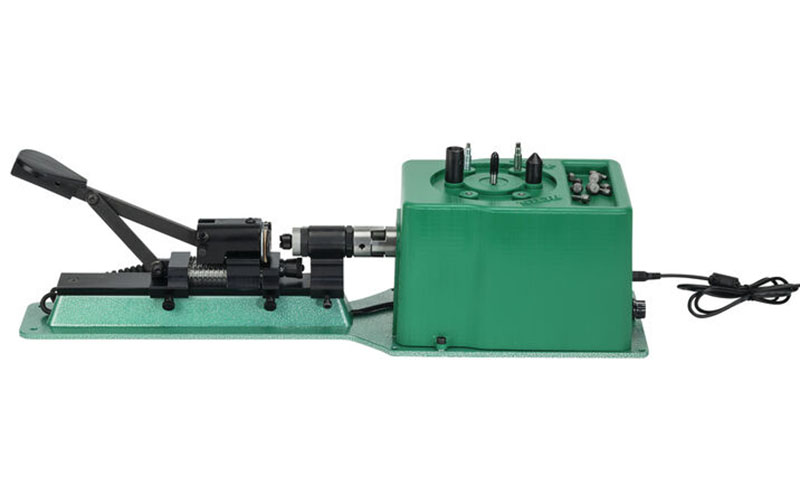
RCBS Universal Case Prep Center
Trimming brass can be a chore, but for straight-walled cartridges that require a roll crimp, case length is paramount, and trimming to a uniform length will result in the most uniform roll crimp possible.
The RCBS Universal Case Prep Center can handle a number of reloading chores, such as case trimming, primer pocket cleaning, chamfer/deburring and more. Photo: Massaro Media Group.
The Universal Case Prep Center has an adjustable electric motor, which spins a shaft that holds a carbide cutting head and caliber-specific pilot. The opposite end has a set of spring-loaded adjustable jaws that hold nearly any cartridge. The cutting depth can be set via two set screws and is micrometer adjustable to obtain a precise case length. I use this trimmer all the time, whether I’m loading .45 Colt, .45-70 Government or making my .318 Westley Richards brass from .30-06 brass.
The top of the unit has six rotating stations, which can hold a number of different tools. I have mine set up with chamfer tool, deburring tool, large and small primer pocket scrapers and cleaning brushes. The adjustable motor allows me to set the rotation speed to where it suits me best, and I’ve always appreciated the consistency of the final product; when I apply the roll crimp on my cases and they all come out uniform, it takes the worry out of the process.
If you’ve been saving your reloading dollars—I sure haven’t been spending much on powders or primers lately—maybe it’s time to treat yourself to one of these tools to make reloading chores a bit easier once the components come back around. I don’t regret any of these purchases in the least.
Editor’s Note: This article originally appeared in the October 2021 issue of Gun Digest the Magazine.
Zeiss has just announced the LRP S3 FFP riflescope line, featuring two new models of long-range precision scopes with impressive elevation adjustment capabilities.
Zeiss is one of the optics world’s oldest and most respected scope manufacturers, with the company tracing its roots back to mid-1800s Germany. Despite the company’s age, Zeiss is still cranking out some of the industry’s best new riflescopes and optics. The newest addition to the Zeiss catalog is the LRP S3 FFP family, featuring two scope models with a choice between two reticle styles for each.
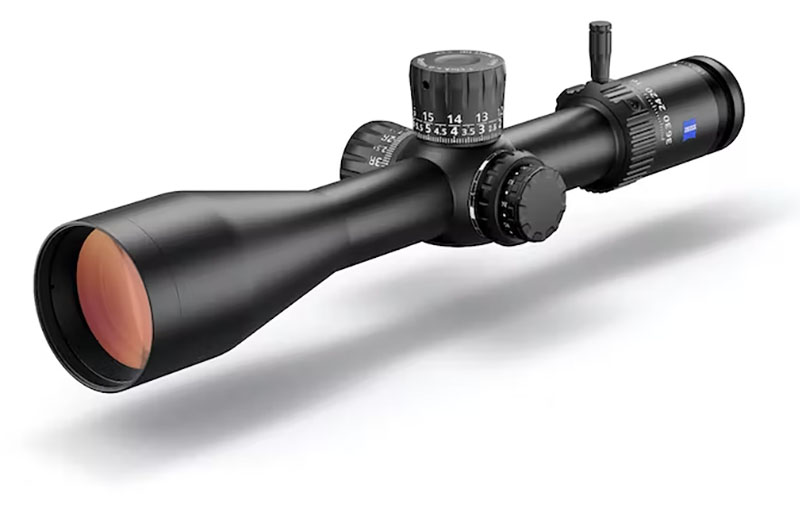
The Zeiss LRP S3 6-36x56mm.
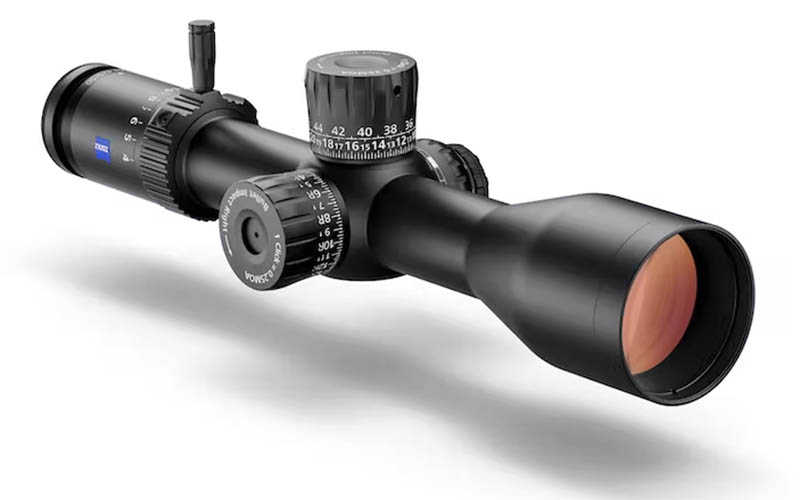
Designed with long-range precision shooting and hunting in mind, the Zeiss LRP S3 series are First-Focal Plane scopes, and both models will be available in either MRAD or MOA configurations. Of the two LRP S3 models, one is 4-25x50mm and the other is 6-36x56mm. The former model’s tube is about two inches shorter than the latter’s, something to keep in mind if compactness is a concern, but the latter also provides a larger objective lens and greater magnification. They otherwise share most of the same features, including a daytime illuminated reticle, a zero stop and an externally locking windage turret, not to mention Zeiss’ impeccable glass quality.
The Zeiss LRP S3 4-25x50mm.
The primary draw of both new scopes in the LRP S3 family is their elevation adjustment range, which Zeiss describes as being “best-in-class.” The 4-25x50mm model has 160 MOA of travel while the 6-36x56mm model has 110 MOA of travel. With that much built-in adjustment capability, these scopes could theoretically be used to accurately send rounds farther than other similar quality scopes in their class. This level of adjustment gives both models a lot of potential for those who participate in ELR shooting competitions, but it can surely be appreciated by hunters and more casual long-range shooters as well.
Kyle Brown, Director of Marketing and Products for ZEISS Consumer Products USA, said this about the LRP S3 scopes:
In long-range rifle competitions, shooters will experience challenging conditions like switching winds, poor and harsh lightning or the stress of time…You may not be able to control these conditions, but you can certainly adjust for them with your choice of a riflescope.
A closer look at the LRP S3 elevation turret.
Both models will be covered by the Zeiss Limited Lifetime Warranty and Five-Year No-Fault Policy, and they are anticipated to start shipping in North America at the beginning of October. Both versions of the 4-25x50mm model will have an MSRP of $2,199.99 and both versions of the 6-36x56mm model will be $2,499.99.
A look at the enhanced Franchi Momentum Elite, proof that Franchi is playing the hunting rifle game for keeps.
Most are familiar with Franchi. The Affinity is the acme of affordable, inertia-drive, semi-auto shotguns, and their host of over/unders leave nothing to want. So, it was a bit mindboggling when the Italian gunmaker, in 2018, took a crack at the budget hunting rifle market. Might as well jump in the deep end and turn out a polymer-frame, striker-fired pistol while you’re at it.
Both are cutthroat niches—the rifle end maybe even more so. Not only are they a dime a dozen, but they also pit newcomers against powerhouses such as Winchester, Ruger, Savage, Browning and Remington, just to name a few. Might as well ask a Ford or Chevy guy to give a Fiat a whirl. Tough sell. However, the Momentum has shown incredible impetus against the old guard. Three short years later, Franchi looks to take another bite of the pie with the updated and upgraded iteration of its flagship.
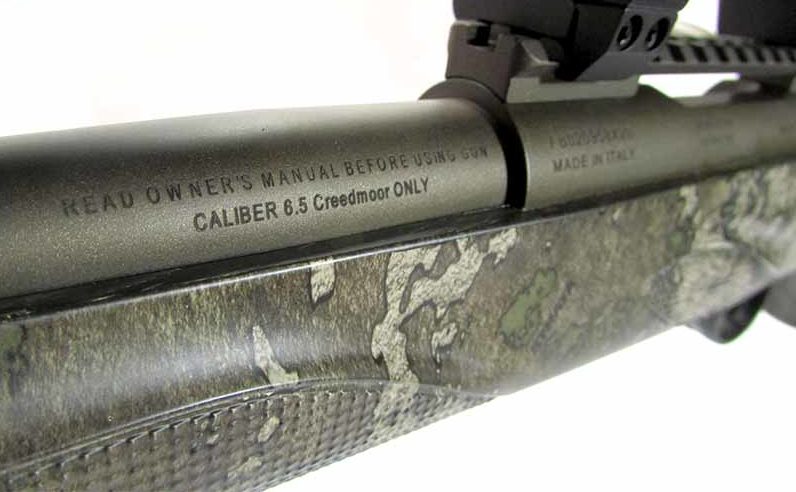
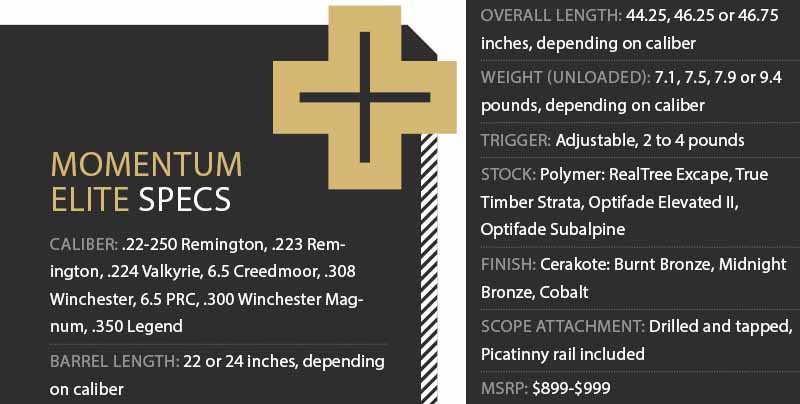
Despite being dubbed the Momentum Elite and boasting a suggested retail price of $899, the line expansion is well within reach of most hunters. After some time with a 6.5 Creedmoor Elite, it’s easy to say the enhancements the package offers are welcome and worth the money. They also continue to square away the one-time shotgun specialist as a player in the hunting rifle market.
Stocking Up
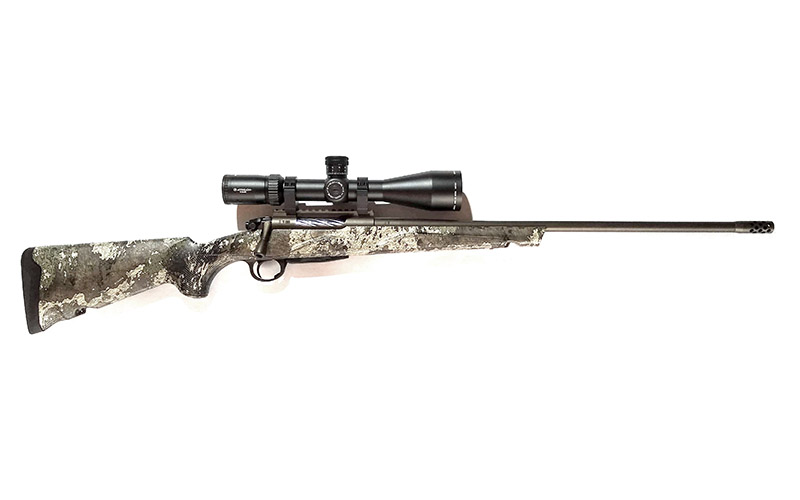
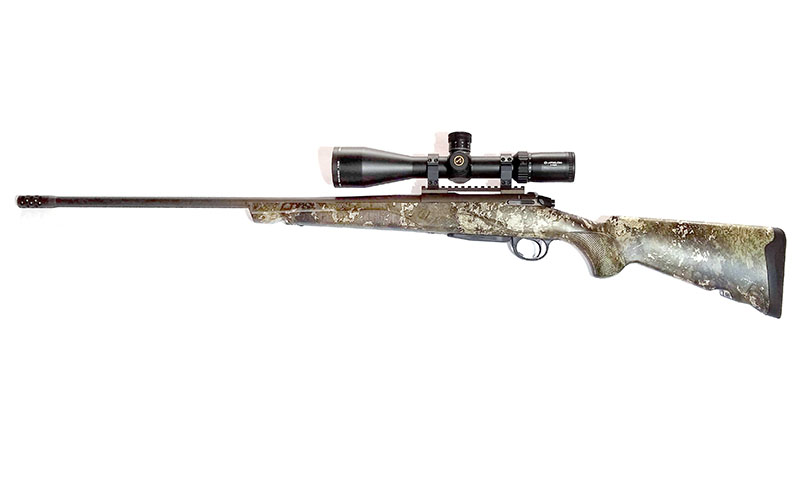
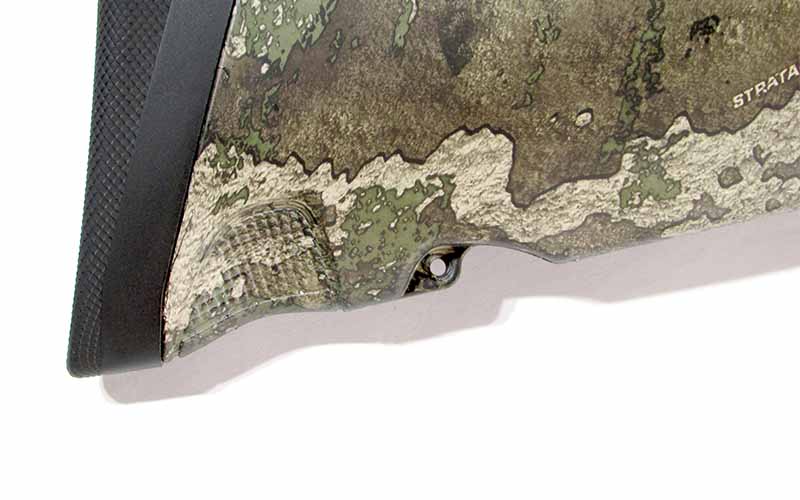
As expected in the affordable bolt-action market, the Momentum Elite sports a polymer stock. Honestly, this doesn’t bend my nose out of shape, though my traditionalist streak tends to walnut on a hunter. On the Elite version, Franchi gives a good reason to appreciate polymer, offering four camo patterns—Realtree Excape, TrueTimber Strata (what was on my rifle), Optifade Elevated II and Optifade Subalpine. Overall, these options blend in with the better part of North America’s environments, from dusky alpine to dark woods.
Franchi didn’t reinvent the wheel with the Elite, keeping what worked on the original Momentum and adding some welcomed enhancements.
As nice as the addition is, the stock’s big selling point remains how Franchi lays out the main rifle-to-shooter interface. Pull the barreled action and you’ll see a pair of recoil lugs embedded in a “V” shape near the front action screw. Interfacing with slots milled into the bottom of the receiver, the lugs perfectly center the rifle in the stock and ensure absolute rigidity in mate-up. In short, the Momentum Elite is in line and devoid of play, even under recoil. While not billed as a long-range hunter, its mechanical consistency certainly sets the rifle down this path.
Cleverly, Franchi recesses the sling studs, offering a low-profile design that won’t hang up on gear. At the same tick, there’s ample room for a standard sling to do its job. The forend projects past the front attachment point, a break from the typical rifle design and welcome for those who utilize bipods. This extra real estate gives the accessory more surface area to attach to, thus forming a solid base. This might seem like a small feature … until you try to attach a bipod where there isn’t ample room to do so.
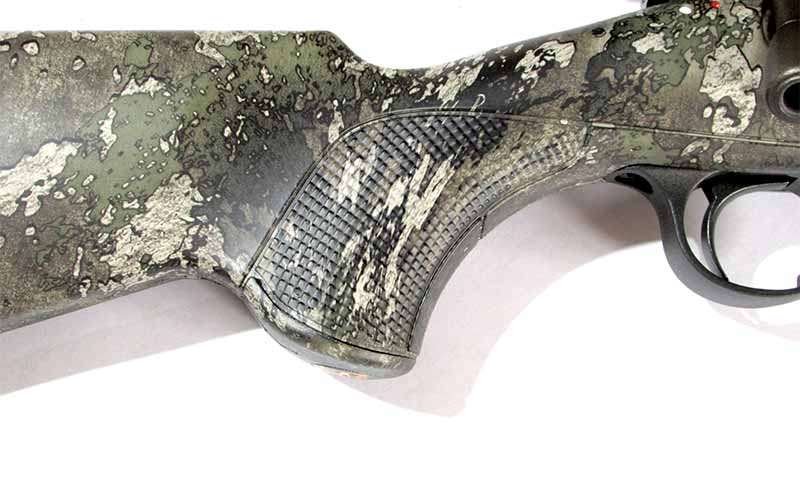
The rifle’s near pistol grip provides a good leverage point to tuck the Elite into the shoulder. Note the grid texturing, also found on the fore and buttstock.
However, the forend is also much flatter and wider than the blade-like examples found on most hunting rifles. The rifle is a natural off a rest—be it a backpack, fence post or bench. In the rear, the slender buttstock sports a near pistol grip—textured with a touch of swell—making the Elite very responsive. Falling back on their shotgun knowhow, Franchi tops the whole thing off with a TSA recoil pad, which on some models is a solid addition.
Fat Bolt
One of the unheralded advancements in bolt-action rifles in recent years is the rise of what Gun Digest contributor Jon Sundra deemed the “fat bolt.” More loquaciously, the industry calls them full-diameter, three-lug bolts. The design saves money, given there’s less machining involved in their creation, but this doesn’t mean they’re cut-rate—far from it. The system allows for unparalleled lockup, with maximum case head-to-bolt contact when stripping a round off the magazine, thus lowering the chance of a misfeed.
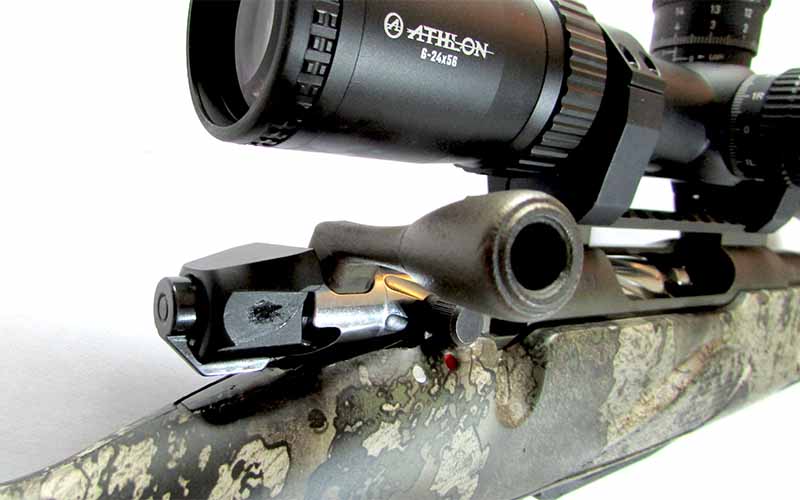
A 60-degree bolt throw? Yes, please. It’s fast and makes the rifle compatible with nearly any scope.
Those are just icing. Where the push-feed intrigues is its 60-degree bolt throw. The rifle cycles quickly, even more so given the slightly oversized bolt handle and chrome-plated, spiral-cut bolt. Add a drop of oil and it runs like a western mustang. It offers greater clearance for large optics, which has been the trend in recent years as precision glass becomes cheaper.
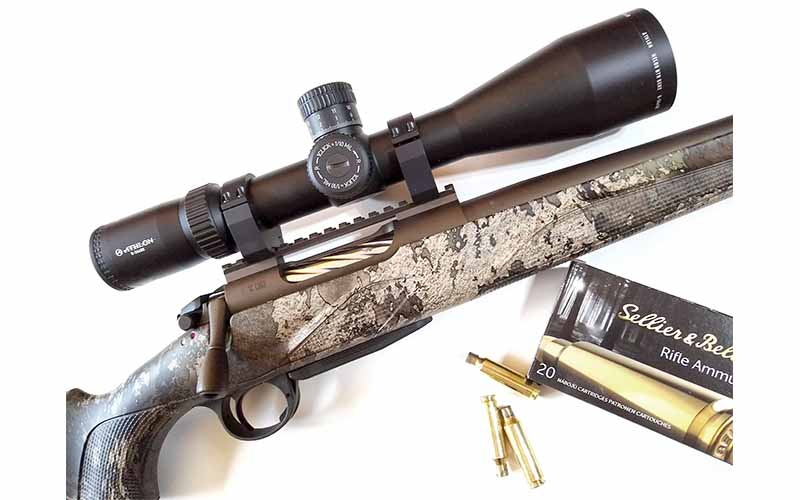
I put this to the test, running a decidedly non-hunting Athlon Helos BTR Gen2 6-24x56mm in a set of Talley Modern Sporting rings on the rifle’s Picatinny rail. It’s a lot of glass for this style of rifle—frankly, better suited for a chassis rig or a long-range build. Yet the Momentum Elite wore it well and didn’t lose a beat cycling rounds. As a side note, the rifle spits spent brass like no tomorrow, ejecting cases well to the side, saving a high-priced optic any additional abuse. While the majority of hunters will run a more sober optic, slapping on the Athlon proved to me that shooters should be comfortable with any scope being the right one on the Momentum Elite.
Trigger, Barrel And Other Stuff
The aforementioned assets are all for not if a rifle doesn’t have one important element—a good trigger. The Momentum Elite doesn’t lack in this department. While it doesn’t boast some catchy branded name, the trigger is adjustable with a range between 2 and 4 pounds. However, I didn’t have to tinker with the switch. My model shipped from the factory with a break a hair over 2½ pounds according to my Wheeler Trigger Pull Scale, and that’s spot-on for range testing. As for its performance, the trigger didn’t have a lick of creep and broke like early autumn ice. It’s hard to think of what more a hunter could want. Mated to a two-position safety with a rather sizable switch the trigger is also quick into the action.
Depending on caliber (Franchi offers eight), the Momentum Elite sports a 22- or 24-inch cold-hammer-forged barrel. As expected, the longer fire tubes come on magnum and 6.5 Creedmoor models, whose accuracy and reach benefit from the extra bore. Not to leave modern shooters cold, Franchi threads the muzzle but offers a bit more than just a protector with the rifle. A removable muzzle break is a welcome addition to the rifle. Given its relatively light build—7.5 pounds unloaded and without a scope—it’s a bit bucky, even when pitching mild-mannered cartridges such as the 6.5 Creedmoor.
The Elites come with a Cerakote finish—in this case Midnight Bronze—not only giving the rifles a dash of class but also protecting them from rough-and-tumble hunts. Additionally, the polymer stock comes in one of four camo patterns.
Franchi caps off the barrel and receiver with the choice of Burnt Bronze, Midnight Bronze or Cobalt Cerakote finish. Aesthetically pleasing, the ceramic coating also gives the rifle resilience in the face of bad weather and rough use.
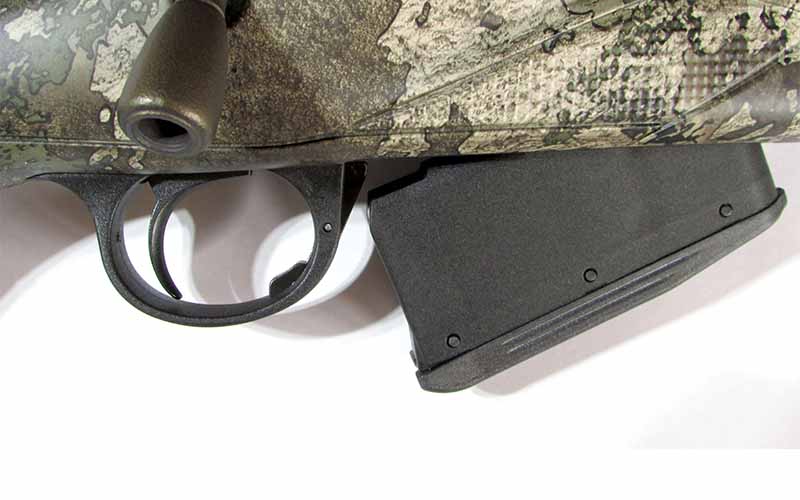
One of the biggest changes between the Momentum and the Elite is the magazines. The new rifle boasts a detachable box magazine. If there was a hang-up shooters had with the original Momentum, it was the rifle’s internal mag and hinged floor plate—this is the 21st century, after all. Single stack and polymer, the magazine puts 3+1 rounds on tap, giving the ability to reload the rifle quickly. While not a flush fit, the box doesn’t protrude too far south of the magwell and keeps the rifle’s overall svelte profile. As a sidenote, the small-bore Varmint Elite has seven- and eight-round magazines available.
At The Range
I allowed the rifle to showcase its inherent accuracy by utilizing a lead sled. At 100 yards, it didn’t disappoint.
Running through several hunting loads, the rifle printed impressive groups, each sub-MOA … or pretty dang close. Interestingly, its favorite was Sellier & Bellot’s 140-grain SP load, which averaged .59-inch groups. That’s more than adequate for a hunting rifle.
The Momentum Elite most certainly ups the Italian gunmaker’s rifle game.
Later, I switched to supported shooting—via sandbags—to get a better feel of the rifle at the shoulder. The rifle fit well and proved responsive. A superbly angled grip made an excellent leverage point to nestle the buttstock into my shoulder pocket. Furthermore, the forend’s wide base didn’t have an iota of wobble on the bags.
Though it’s not mountain-rifle light, the Elite nevertheless is light. While this is an obvious advantage for an iron destined to traverse hill and dale to fill a tag, it amplifies recoil. By no means is the 6.5 Creedmoor a punishing cartridge, but its recoil was more pronounced given the rifle’s light build. Franchi’s addition of a high-quality recoil pad was appreciated and ensures a quick follow-up shot, if needed, in the field.
Parting Shot
It’s difficult to get whomped up about economical hunting rifles unless you’re after your first whitetail or elk. Most are very utilitarian and they don’t have a ton to endear them, outside the fact that they’ll get the job done. The Franchi Momentum Elite breaks this mold.
More accurate than most hunters require, configured to hump back further than most hunters go, and full of extras most hunters have never considered, it over-delivers. For its class, the rifle is anything but a yawner and quite possibly has the stuff to be a hunting season go-to.
Thank goodness Franchi set its sights beyond shotguns.
Editor’s Note: This article originally appeared in the 2021 Buyer’s Guide special issue of Gun Digest the Magazine.
Ruger has just launched the Small-Frame Autoloading Rifle or SFAR, a new line of .308/7.62 ARs with receivers the same size as standard 5.56 models.
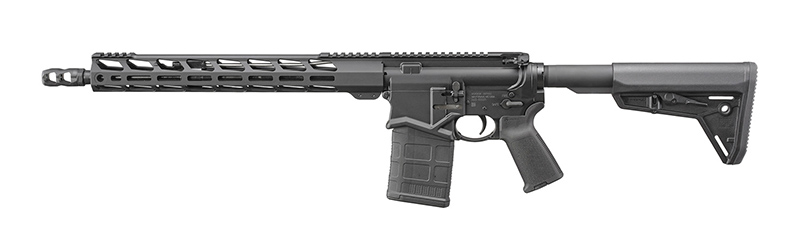
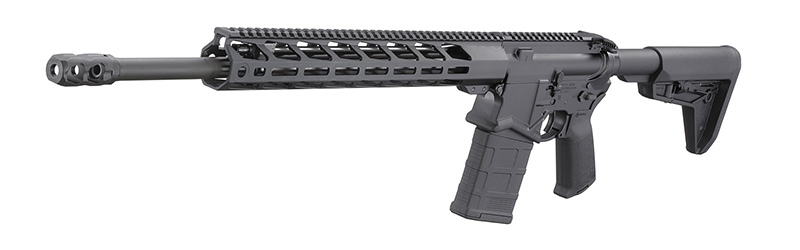
While ARs chambered for full-size cartridges are very popular, they come at a cost of being larger and heavier than standard 5.56 NATO models. In an attempt to provide shooters with a smaller and lighter .308/7.62 AR, Ruger has just introduced the Small-Frame Autoloading Rifle or SFAR. Available with two different barrel lengths, SFARs feature receivers that are approximately the same size as those of standard AR-15s.
The Ruger Small-Frame Autoloading Rifle is available with two barrel lengths initially—16-inch and 20-inch—but the two models are otherwise virtually identical. Thanks to the reduced receiver size, the 16-inch model weighs only 6.8 pounds when unloaded. That’s almost two pounds lighter than the similar 16-inch AR-10 model offered by Armalite. Regardless of the barrel length selected, both barrels are cold hammer-forged, nitrided and threaded 5/8”-24.
Another key feature of the Ruger Small-Frame Autoloading Rifle is its adjustable gas system. Manually regulated using the included wrench, the system has four gas settings to ensure reliable and efficient function whether the rifle is dirty, clean, suppressed or unsuppressed. The system will also help to dampen felt recoil, further aided by the included 2-port Boomer muzzle brake. The rifle-length gas system found on the 20-inch model will likely be even softer-shooting than the 16-inch model’s mid-length gas as well. Both SFAR models also include a 15-inch railed M-LOK handguard, Magpul furniture and a Ruger Elite 452 2-stage trigger.
Ben Parker, Lead Design Engineer for the Ruger SFAR, said this about the new rifles:
Over the course of this rifle’s development, we fired hundreds of thousands of rounds to assess and enhance real-world performance and wear…The proprietary design and material selection of the bolt and barrel extension help deliver a rugged, reliable, and safe rifle that we are proud to call a Ruger.
Ruger’s Small-Frame Autoloading Rifle has a lot to offer the AR-10 market, providing a smaller and lighter option for those interested in using a .308/7.62 AR for anything from hunting to running and gunning. The 16-inch and 20-inch models are both available now and share an MSRP of $1,229.
The innovative designs of Kel-Tec go beyond blued steel and walnut and redefine what “made in America” can look like.
I’ve always been impressed by the ingenuity and engineering of the people at Kel-Tec and the products they offer. They’ve always been pushing boundaries, testing limits and making firearms that are more than (or where desired, like weight, less than) other designs.
And the looks? If you’re into “modern industrial,” Kel-Tec is where you go. Now, I grew up in an era when “made in America” was a given, imports were rare, expensive and oftentimes an ergonomic hot mess, and blued steel and walnut were the baseline assumption of “looking good.”
As much as I still respond favorably to blued steel and walnut, there are times when a clearly industrial-look approach is just the ticket.
As an ultra-compact everyday-carry gun, or as a backup to a bigger gun, the Kel-Tec PF9 is just the ticket.
Swedish Roots, American Soil
Thus, we have Kel-Tec. Founded by George Kellgren (a Swede, but the U.S. has a lot of Swedes and those whose parents and grandparents came from Sweden) in 1991, the idea wasn’t to make firearms like everyone else. After all, if you’re a small company—a brand-new upstart—do you really want to be making rifles just like Ruger, Winchester and Remington? (OK, Remington would be a special case, but in 1991, not so much an outlier.) Do you want to go head-to-head with handgun makers like Ruger, Glock, Sig, etc.? Not if you want to stay in business.
And since you’re doing it all right here in the good-old US of A, you’ve got to be cleverer and you have to have a distinct look. It doesn’t hurt to go after specific segments of the market that have heretofore been underserved.
The first Kel-Tec firearm was the P-11, a compact 9mm pistol that held 10 rounds in a flush magazine, but it also cleverly accepted magazines from the S&W 59 series. Magazines are a specialized subset of design and manufacture, and the cleverness of a brand-new company, with a new design, using an existing magazine as the feed mechanism cannot be overstated.
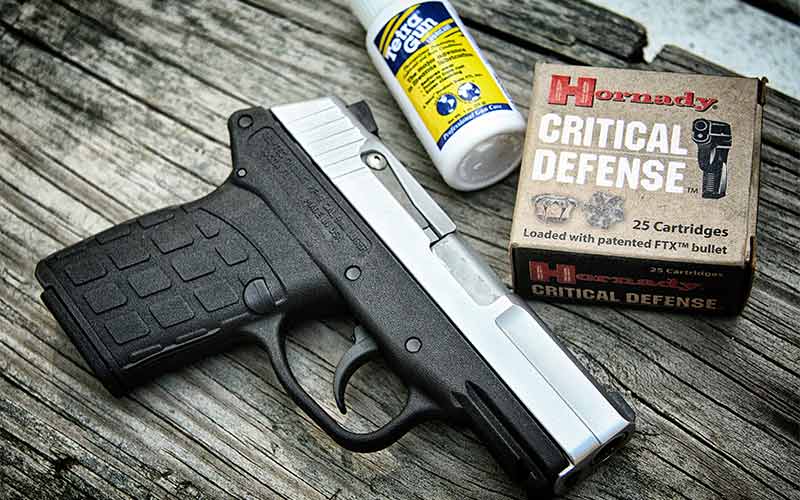
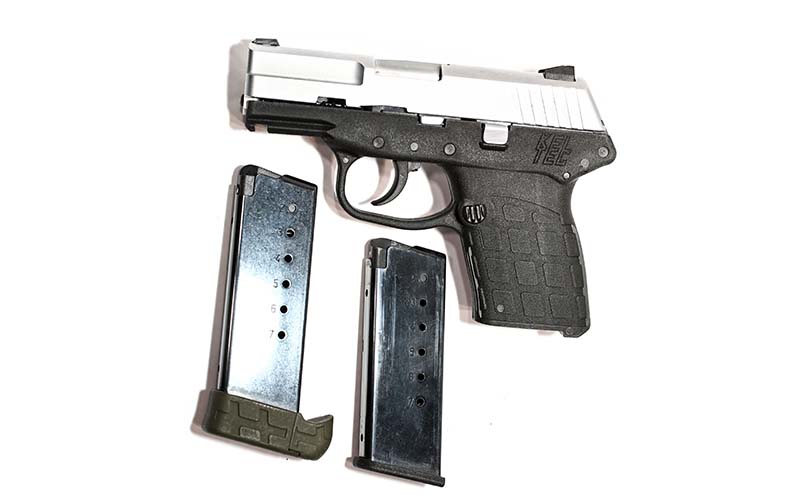
Another, later in the line of 9mm pistols, is the PF-9. We’re now accustomed to super-compact EDC 9mm pistols, but back in 2006, when the PF-9 came out, this wasn’t so much the case. So, from Kel-Tec we have the lightest and flattest 9mm, it being a single-stack DAO pistol, one that’s so light that it can be actual work to shoot with hot defensive ammo.
The PF9 is an ultra-compact 9mm. You can use the standard flush magazine or gain extra rounds by using the extended version.
That very lightness makes it valuable as a sidearm in certain uses. As an ultra-compact backup for those of us who insist on packing heavy, it’s da bomb. If you have a PF-9, you have 12 ounces of made-in-the-USA insurance. I have knives that weigh more than that, and they aren’t as long as the reach of a PF-9.
Made properly … and here? Of course. The slide and barrel are both heat-treated 4140 steel. The chassis is machined from a billet of 7075 aluminum. The frame is high-strength polymer and all the making happens in the Kel-Tec plant in Cocoa, Florida. Why the emphasis on “Made in the USA?” If the COVID-19 pandemic has taught us one thing, it’s that long supply chains can be a problem.
Not long ago, a super cargo container ship was freed after being aground in the Suez Canal. It was so big that it literally wedged across the channel, blocking the canal. Over 300 ships were stuck until it got freed. With ships now commonly transporting 14,000 containers or more, each, that’s more than a half-million containers stuck in traffic. Billions of dollars worth of goods, waiting in the hot sun of the Mideast. Don’t tell me that American made doesn’t matter.
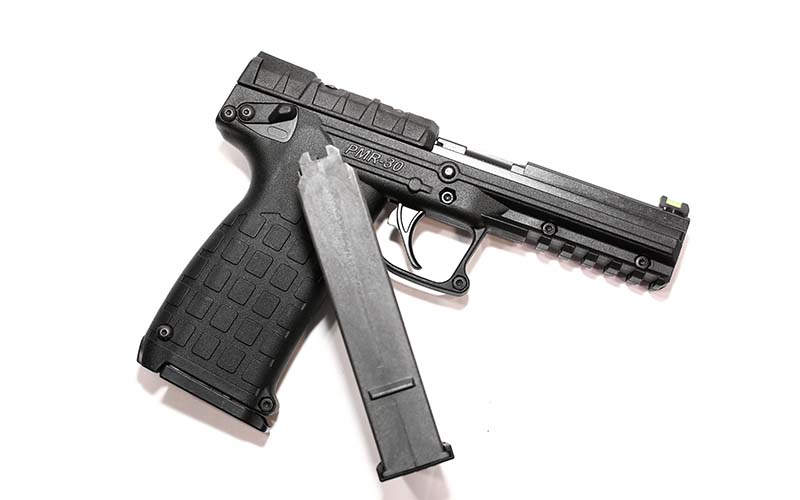
Back to Kel-Tec. One very cool pistol they make (the P11 is no longer in the lineup) is the PMR30. It’s a pistol in .22 Magnum that holds 30 rounds in the magazine. For someone looking for a home-defense pistol that doesn’t have a lot of recoil, there’s your solution. People might sneer at a .22 Magnum round, but 30 of them—and 30 more after a fast reload—is a real emergency-solving handful.
The PMR30 is a pistol chambered in .22 WMR, and it holds—you guessed it—30 rounds in the magazine.
So, making things here in the USA sounds a whole lot better, and it doesn’t rely on the now-constrained (there’s a shortage, apparently) supply of shipping containers. And true to the 21st century, Kel-Tec now does their design and dimensional standards work on computers. That info can be fed directly to CNC-machining centers, and a modified firearm, or an entirely new prototype, can be created right away. Then, once extensive testing shows need, an updated one can be produced that afternoon and fed right into the testing process. Computers are great; you just have to know how to use them, and Kel-Tec sure does.
They Have Long Guns, Too
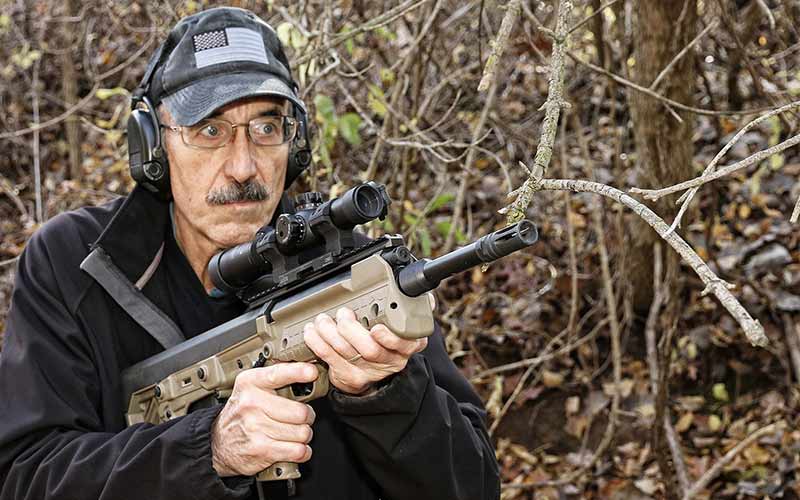
The design efforts of Kel-Tec are also bent toward rifles and shotguns. And it isn’t enough that they give free rein to the industrial-look polymer and steel design imperative, they also offer practical and usable bullpups. The rifles, the RFB and the RDB, use common-capacity (20 rounds or more) magazines, but provide carbine-length barrels in firearms that are as compact as a rifle can be. The trigger on the RFB they sent me was so good that I simply told them they weren’t getting the gun back.
The RFB is a stout .308 Winchester that’s compact (it’s a bullpup, after all) and ejects the empties forward. You want a compact sledgehammer? You got it.
The shotguns, the KS7 and the KSG, are even more trick. The KS7 looks like it came right off of the set of Aliens, and the KSG, while the same size, has nearly double the capacity. Kel-Tec doesn’t consider the traditional design, look or mechanism when building any of these firearms. And that’s the usual Kel-Tec method.
Kel-Tec’s P50
A case in point, and the current Kel-Tec “gotta have it” firearm is the P50. The P50 uses the 5.7x28mm cartridge, developed by FN back in the late 1990s for a NATO requirement. Now, I love the FN line of firearms, and they’re a first-rate crew, but they also don’t seem interested in responding to price competition. If you want to shoot something made by FN, using 5.7 ammunition, you’re in for spending no less than $1,200. The quality is there, but so is the price.
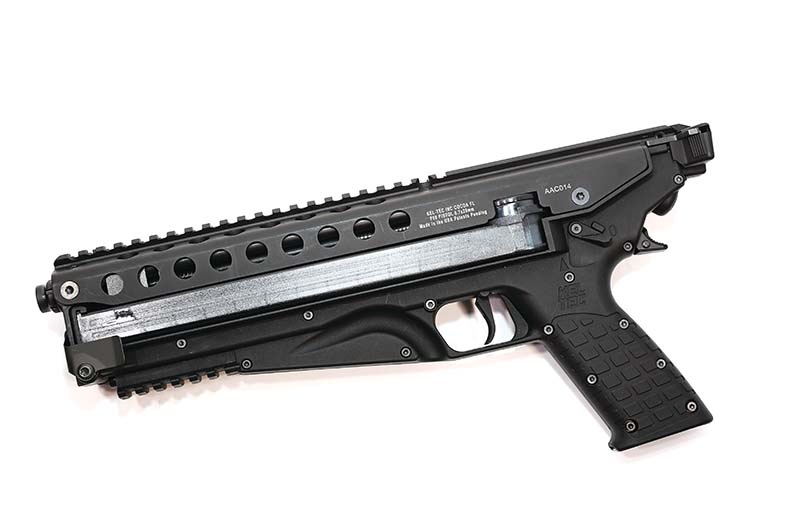
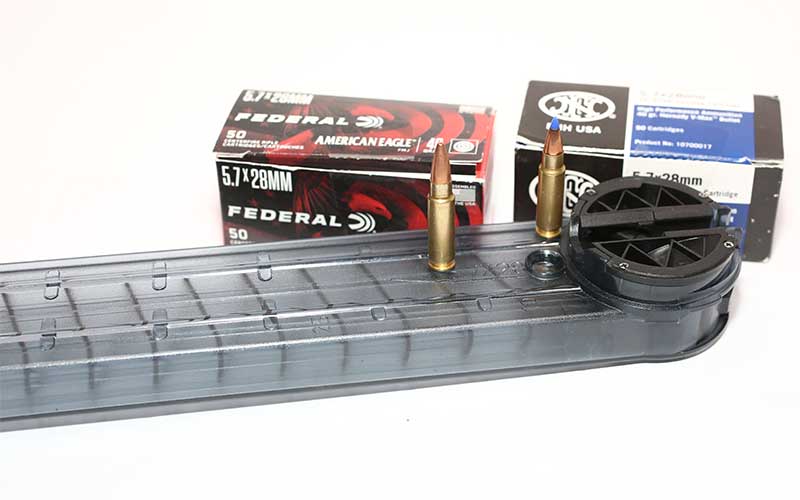
The P50 is the new kid on the block in 5.7x28mm. It uses the same magazines as the FN carbine, for less money and less bulk.
The Kel-Tec P50 has an MSRP of $995. Some might say that $200 isn’t much of a price difference, but even with today’s inflated ammo prices, that gets you a bunch of ammo. And as far as ammunition capacity goes, the P50 uses the same magazines as the FN PS90, so you have 50 rounds on tap once you’ve loaded up.
The design of the P50 is … not traditional. As in, telling the designers after their first attempt: “We don’t make firearms that look like other people’s firearms. Go back, chug a few Red Bulls and try again.”
There’s the customary Kel-Tec dependence on strong and well-proportioned polymer moldings. There’s the usual (and properly engineered) assembly of sheet-steel stampings and machined aluminum. And there’s a charging handle on the back end that works just like the one on an AR-15, so you know how to get it ready to rock. And true to the Kel-Tec process, it looks like it was designed tomorrow—as a tool that Corporal Hicks would’ve clipped to his body armor—and it was designed and made here in the USA.
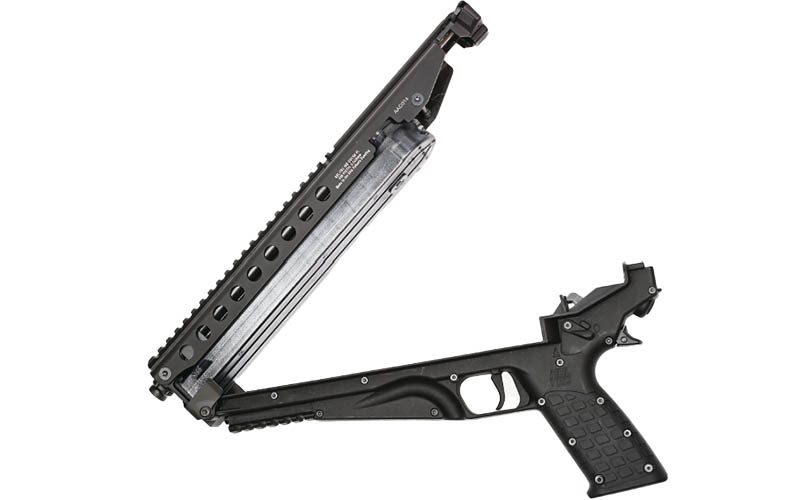
The action hinges open at the front, the PS90 magazine rides horizontally inside the action and there’s a thumb safety for your use, convenient to your firing hand. What’s really different is that the top half of the receiver set has a full-length rail, and there’s enough room there to park more accessories, by weight, than the P50 itself weighs.
Ammo of any kind might be hard to get, but the P50 can be fed ammo from several sources, and it works like a champ.
Underneath the location of the magazine, on the lower receiver half, there’s a rail section long enough to let you mount a light, laser or whatever is the en vogue item of the tacti-cool set. Just ahead of the trigger guard is a sculpted hand-hold, one that allows you to get a second hand on the P50, just under the balance point. On the back end is a QD sling socket, so you can use a short sling, à la SAS style, to keep the P50 steady while shooting.
Now, being nontraditional can have some drawbacks. Reloading the P50 is a two-handed affair. You’ve got to unlatch the upper, then swing it open and pluck out the old magazine. Insert the new magazine not into the space in the lower where it looks like it’ll go, but press it into the upper receiver, and then swing the lower up to the upper. Work the charging handle, and you’re good to go.
To load the P50, open the action and stuff the magazine unto the upper. Don’t lay it in the lower; it wasn’t made to work that way.
To shoot, press the safety to Fire (forward until it is vertical), push the P50 out in front of you to either line up the iron sights (nestled in the gutter of the top rail) or get the red-dot on target and press the trigger. Repeat as necessary. It takes a bit of time, but you’ve got 50 rounds at the ready once you do.
’Merica! You get choices, so take advantage of them.
Editor’s Note: This article originally appeared in the 2021 Made In USA special issue of Gun Digest the Magazine.
.44-caliber revolvers can be excellent at everything from defense to hunting to sport shooting, but between .44 Special versus .44 Magnum, which is best for each task?
When it comes to the debate of .44 Special versus .44 Magnum, are there any good reasons to choose the former? Or is .44 Magnum the best cartridge in .44?
Believe it or not, .44 Special is better than .44 Magnum at some things…but the reverse is true as well. The humble Special got a bad rap throughout the years, overshadowed by its bigger brother, but that doesn’t necessarily mean it’s without its uses.
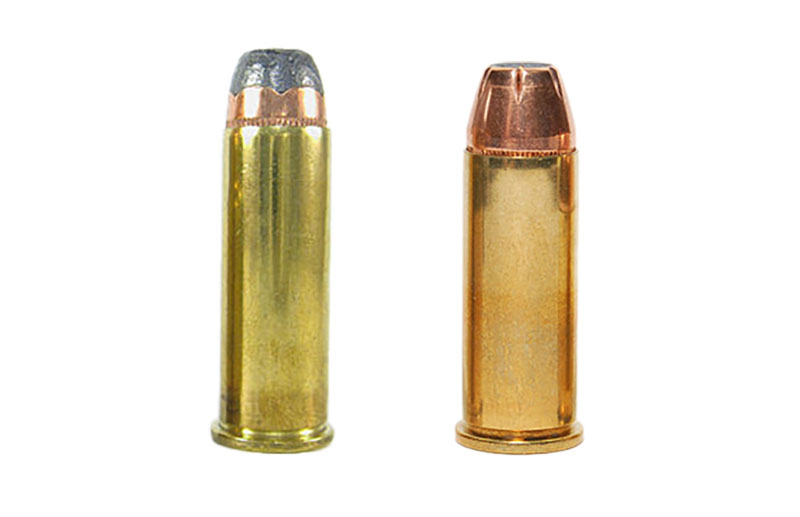
.44 Magnum (left) versus .44 Special (right). Photo: Wikipedia.
.44 Special: The Original Flying Ashtray
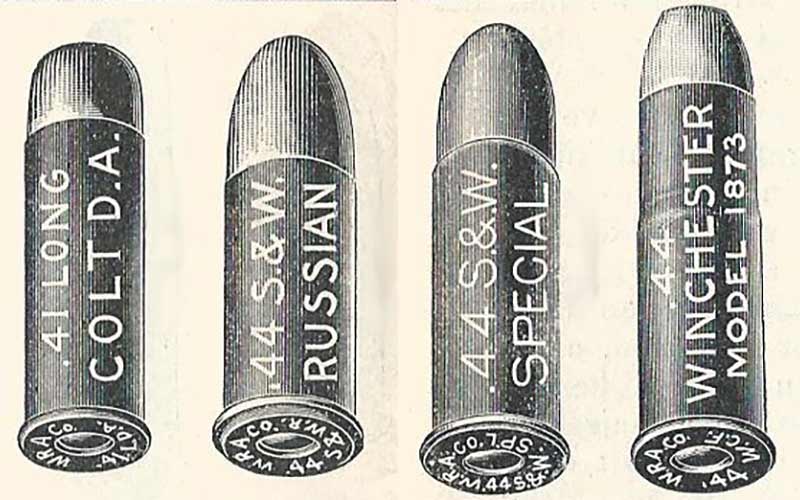
The .44 Special—or rather .44 Smith & Wesson Special—is essentially a slightly lengthened .44 Russian case loaded with smokeless powder.
The original load of .44 Russian was a 246-grain, .426-inch bullet seated on 23 grains of black powder. It typically produced a velocity of 750 feet per second with 310 foot-pounds of energy. Designed in 1870, the cartridge quickly grew in popularity due to its reputation for having good enough power and accuracy to be suitable for most purposes.
When Smith & Wesson developed the New Century revolver—the Triple Lock Hand Ejector, the basis of their N-frame—they wanted a new cartridge to go with it. So, they decided to update their most popular large-bore cartridge.
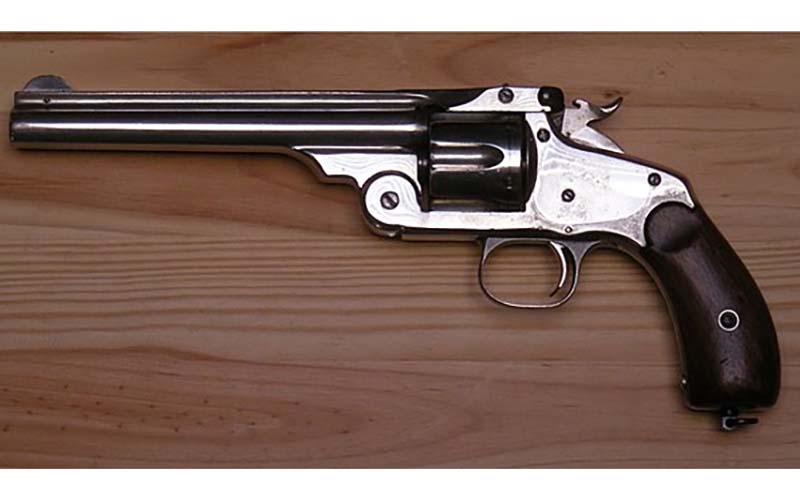
The S&W Number 3 New Model in .44 Russian. Photo: Wikipedia.
Some initial problems were presented with propellants, so they lengthened the case to fit a little more powder but changed little else. The result was the same velocity with the same 246-grain round-nose lead bullet, affectionately known as a Flying Ashtray due to being large and slow.
First introduced in 1907, the .44 Special was noted—like its predecessor—for being controllable, accurate and potent enough for most purposes including law enforcement and sport shooting.
The .44 Magnum: Because Some .44 Shooters Got Bored!
The genesis of the .44 Magnum was a group of tinkerers, cowboys and gun nuts who weren’t satisfied with factory loads. They figured out that .44 Special had generous case capacity relative to its performance.
They called themselves the “.44 Associates,” and they worked up hot loads of .44 Special for various purposes. The ringleader was Elmer Keith, who worked up several handloads at the edge of what guns could tolerate, which he wrote about in his columns.
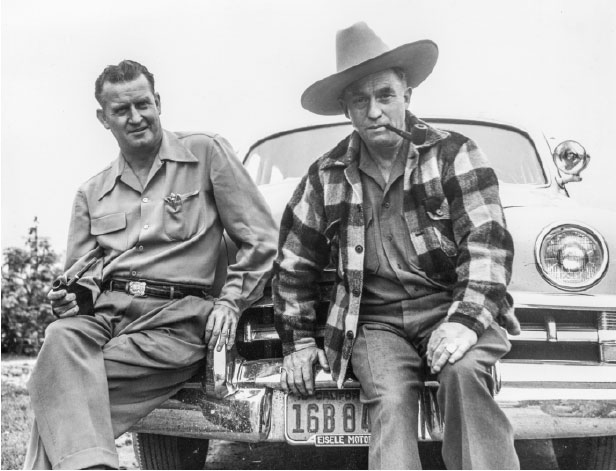
The legendary Elmer Keith (right).
The .44 Special was the preferred cartridge for this task, as there were more varied projectiles made for it, and the revolvers of the day—such as the S&W Triple Lock, Colt New Service and SAA—had thicker cylinder walls in .44 than in .45 Colt. Ergo, they could tolerate more pressure.
In the mid-1950s, Keith partnered with the Remington cartridge company to create the .44 Remington Magnum, which sat a 260-grain bullet in a longer case and propelled it to 1,200 fps or higher.
The cartridge debuted in 1955 and was followed by the release of the first two guns chambered for it: the S&W .44 Magnum (later rechristened as the Model 29) and the Ruger Blackhawk. Now, almost 70 years later, .44 Magnum is still going strong.
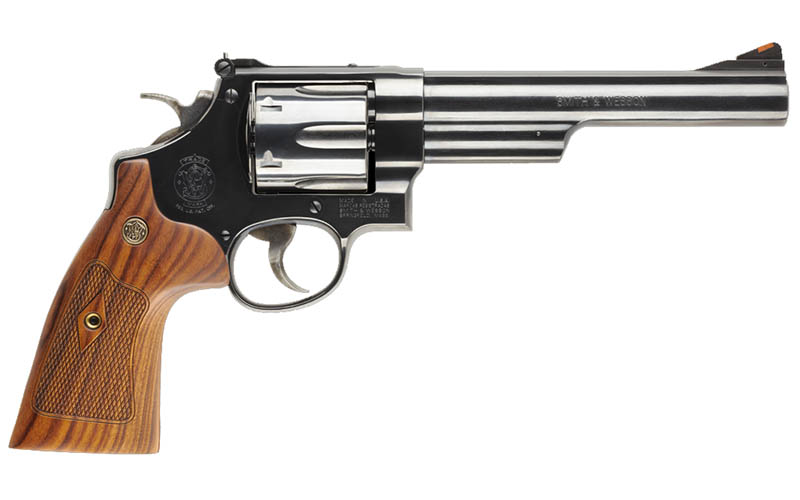
A Smith & Wesson Model 29.
.44 Special Vs. .44 Magnum For Self-Defense
There are many loads for both .44 Special and .44 Magnum that satisfy the FBI standard of 12 to 18 inches of penetration in ballistic gel through 4 layers of denim.
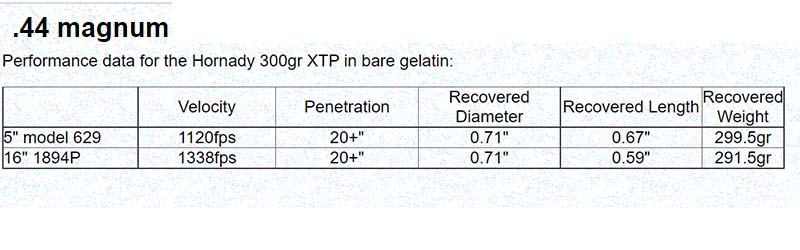
Available testing, such as Dr. Gary K. Roberts’ data on AR15.com, indicates that .44 Special performs best from a 4-inch (or longer) barrel, and the light-for-caliber, fast-expanding (JHP) loads in .44 Magnum are the best choice for personal defense against humans in that caliber.
.44 Magnum ballistic gel test results compared between a 5-inch revolver and a 16-inch carbine. Source: Dr. Gary Roberts’ tests on AR15.com.
Where .44 Special shines the most in comparison to its bigger brother is having drastically less recoil.
If you want confirmation that less recoil is better in a fighting cartridge, consider that the FBI ditched the original 10mm Norma load partially because of it. Police departments have also been ditching .40 S&W nationwide (partially) for the same reason over the last 20 years in favor of 9mm.
Even the old gunfightin’ gun writers of the time often acknowledged that .44 Magnum had too much kick.
Bill Jordan said as much in his book No Second Place Winner; as did fellow Border Patrolman Skeeter Skelton. In the same publication, Col. Charles Askins wrote that “.44 Magnum is a man’s cartridge,” but he would also later write that it and .41 Magnum had too much recoil for serious prolonged use. Delf “Jelly” Bryce carried a .44 Special for much of his career, though switched to a 3.5-inch S&W Magnum when he went to work for the FBI.
A U.S. soldier firing a .44 Magnum Desert Eagle in a competition demonstrating the high level of recoil. Photo: Wikipedia.
In short, because of .44 Magnum’s unwieldy recoil, .44 Special is the better choice for two-legged threats. As for four-legged threats, a .44 Magnum with a non-expanding, deep-penetrating projectile is unquestionably the better pick for a backup gun in grizzly country.
.44 Special Vs. .44 Magnum: Hunting
For hunting, .44 Magnum has the edge in terms of deep penetration and trajectory, and it’s capable of harvesting any type of game on the planet within a reasonable distance.
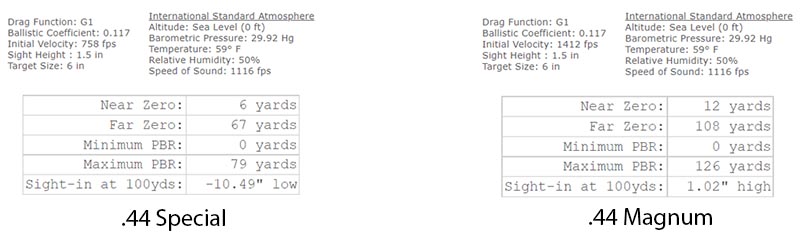
An average 240-grain load of .44 Special has a maximum point blank range of around 80 yards on a six-inch target, while the same projectile loaded for .44 Magnum can extend that to 120 yards.
While .44 Special is more than serviceable for medium to smaller game at modest distances, the reality is .44 Magnum has such a good track record that you might as well not bother.
.44 Special Vs. .44 Magnum: Sport Shooting
.44 Special is somewhat popular for SASS/CAS (Single Action Shooting Society/Cowboy Action Shooting) events due to its wide availability of factory-loaded ammunition for this purpose.
However, be aware that lever-action rifles can be fairly ammunition-sensitive. The shorter case of .44 Special can cause feeding issues in some .44 Magnum carbines (Winchesters are said to be the most prone) and not all loads will shoot to the sights.
The .44 Magnum is more popular for metallic silhouette shooting (such as IMSSU events) given the flatter trajectory and greater power. Both are good for bowling pin shoots, though you’ll get faster splits using .44 Special.
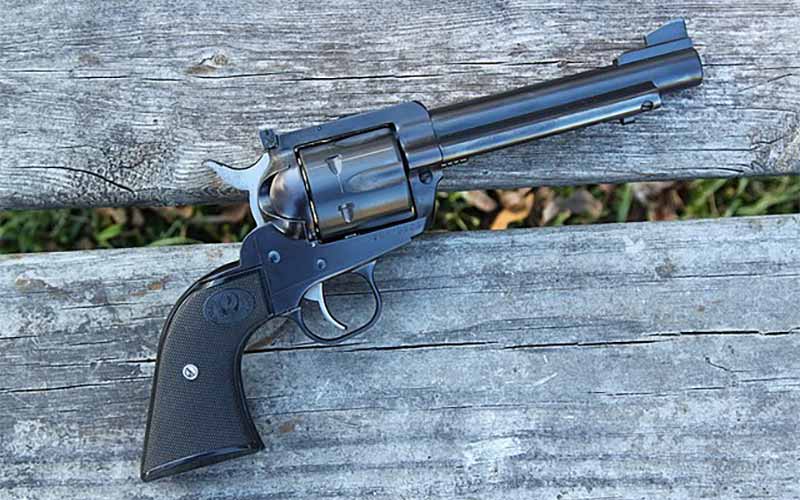
A single-action Ruger Blackhawk in .44 Special, a good choice for Cowboy Action shooting and similar events. Photo: Wikipedia.
Other revolver events are dominated by the medium bores; Jerry Miculek may run a .44 Magnum faster than you’d believe but remember that you aren’t Jerry Miculek. Even for someone of that skill level, his competition handguns are usually chambered for .38/.357 or 9mm.
As to bullseye accuracy, here we get into the weeds. Mechanical accuracy has an enormous number of variables. There is, however, a known phenomenon of shorter cases sometimes degrading accuracy most likely due to gas inefficiency and/or a longer jump to the leade. It’s been observed in .38/.357 as well as .44 Special/.44 Magnum guns. This gives .44 Mag an edge in accuracy over .44 Special in some weapons, but the reality is that the difference will likely be imperceivable to most shooters.
Should I Get A .44 Magnum Or A .44 Special?
If you were really torn about these two cartridges, the best practice would be to get a .44 Magnum and figure out which .44 Special loads shoot to the sights and don’t lose any accuracy. That way, you have the best of all worlds.
If you had to choose…
Get a magnum if you’re going to do magnum things, don’t if you’re not.
The heavy recoil and high ammo costs have resulted in a constant supply of lightly used .44 Magnum revolvers since the 1950s. This fact gives .44 Magnum an edge when it comes to revolver selection, but keep in mind that after buying one you may soon find yourself joining the ranks of the many shooters who’ve traded theirs in after experiencing the recoil firsthand.
As for purpose-built .44 Special revolvers, while there may be a decent number of older models for sale on the used market, new-production options are severely limited.
S&W and Colt no longer make any. Ruger offers a couple of 5-shot GP100 models as well as the Blackhawk Bisley in .44 Special, the latter being a subtle nod to Elmer Keith’s Revolver No. 5. There are a few reproduction single-action revolvers in .44 Special as well, typically Bisley SAA clones.
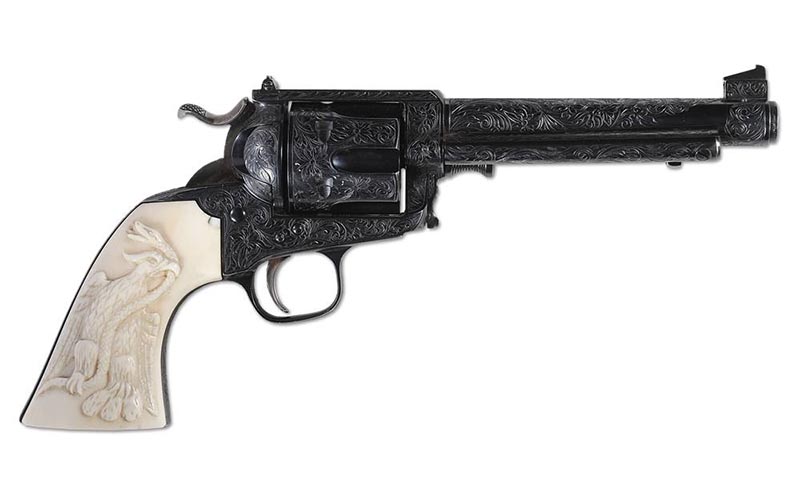
Elmer Keith’s Revolver Number 5, “The Last Word” in .44 Special. See more of Elmer Keith’s collection auctioned by James D. Julia here.
Charter Arms still manufactures the Bulldog in .44 Special, including 2.5-inch and 4-inch models…but Charter Arms guns are, as Jeff Cooper put it, to be carried often and shot little.
If you wanted to find a really cool vintage .44 Special, look for a Smith & Wesson Model 21 or Model 24, though some Triple Locks and Colt New Service guns survive as well.
.44 Magnum revolvers, of course, will spoil you for choice. Smith & Wesson, Colt, Ruger, Korth, Taurus…the list goes on.
In short, there are pros and cons to both .44 Special and .44 Magnum. While the former has good enough performance to be suitable for self-defense, it’s not an ideal choice given what else is available on the current market. The latter is an excellent hunting round that’s capable of dropping even elephants, but depending on what kind of handgun hunting you expect to do, .44 Magnum may still be a suboptimal choice.
That said, if .44 Special appeals to you as a defensive cartridge, there are still plenty of relatively small revolver options out there to choose from (even if most will be second-hand). Likewise, .44 Magnum can still make for an excellent hunting revolver if you can handle the recoil.
For those with their hearts set on a .44-caliber handgun, the choice between special or magnum ultimately boils down to how you plan on using it. Both cartridges still have their places when it comes to self-defense, hunting and sport shooting, but which one will be best for you depends on the respective threat, game or sport in question. .44 Special may not be as special as it once was, but even in 2022, it’s far from useless.
Looking for a new iron or piece of kit to enhance the one you already own? Check out these 7 new bits of guns and gear to grow your firearms wish list.
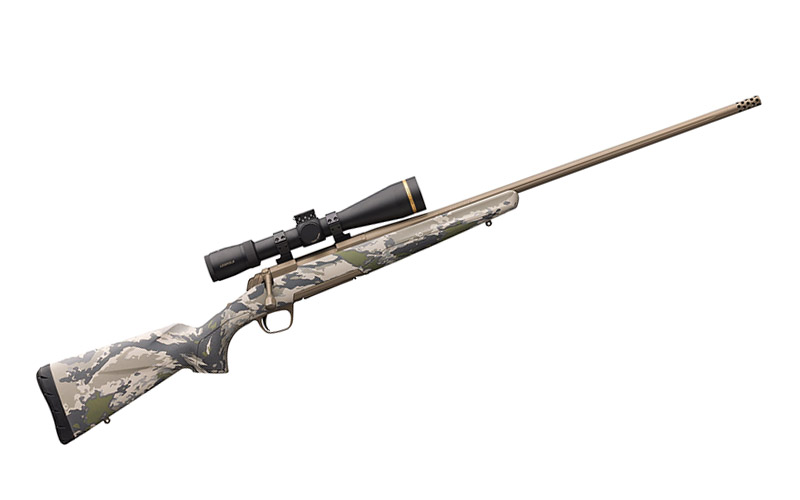
As hunters have pushed deeper into the woods, they’ve become more conscious of the weight they’re toting. However, lightweight firearms come at a price—literally. This is why the Browning X-Bolt Speed is a welcome addition to the bolt-gun market. Tipping the scales at a very manageable 6 pounds, 5 ounces, the composite-stocked iron flirts with mountain rifle classification. Yet, Browning offers it up at nearly half the price. Good deal. Featuring Ovix camouflage finish, Browning’s Feather Trigger, a 60-degree bolt throw, rotary magazine and chamberings in all the standard and magnum standbys, this X-Bolt is tailored for your next backcountry adventure. MSRP: $1,380
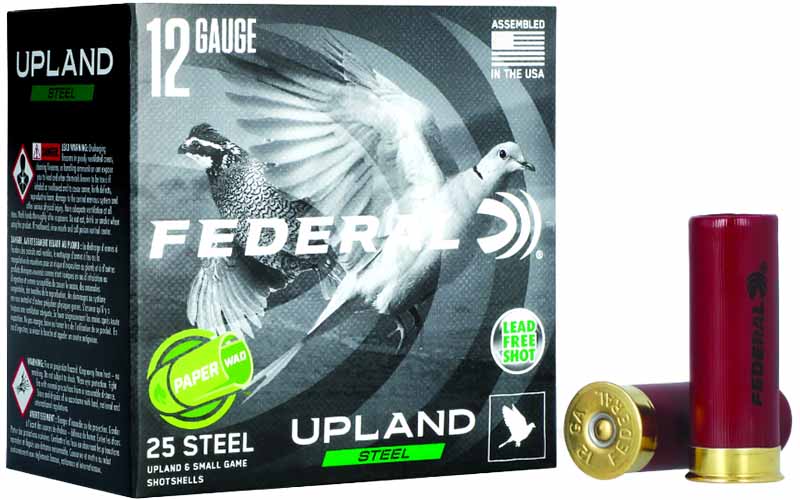
Federal Upland Steel Paper Wad
Hunting means being a steward of the land. Federal Premium gives you the opportunity to up your game in this facet with its new upland shotshell offering. Utilizing paper wads and cellulose-based filler, the shells cut down on the solid waste left after the hunt, while not compromising on performance. The biodegradable setup still delivers top velocities and excellent patterns. At present, Federal offers the paper-wad option in a 2¾-inch, 12-gauge shell that delivers a 1-ounce load of steel shot. MSRP: $20 per box of 20 shells
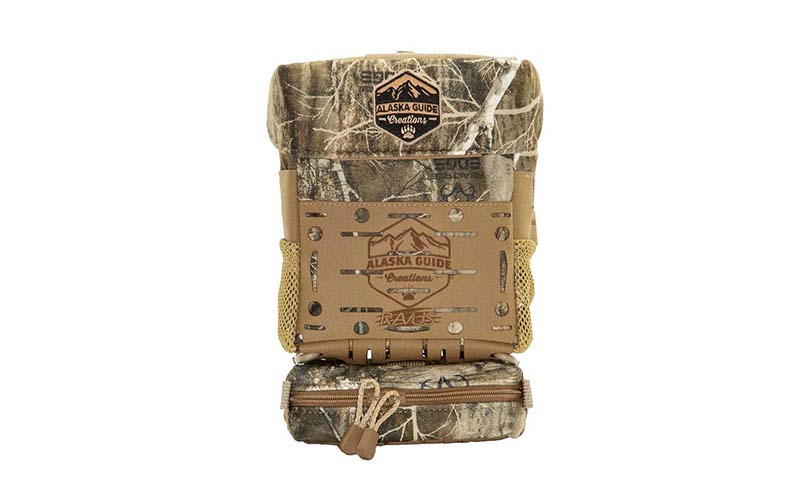
Ravus Bino Pack
Do yourself a favor this hunting season: Get yourself a good bino pack (you’ll thank us later). Ravus’ certain qualifies as one. Enhancing the convenience of your spotting optics while protecting them, the simple around-the-shoulder rig is indispensable in the field. Most of all, the pack cuts down on the fatigue of toting a piece of gear, with a strapping system that equally distributes weight across the upper frame of the body. At the same tick, the semi-rigid main compartment protects your binos—generally one of the more expensive pieces of gear—while keeping them at hand. To this end, a forward opening lid with silent magnetic closure won’t blow your cover in the field. At 6.75 inches tall, 6.25 inches wide and 3.5 inches deep, the pack is perfectly sized for most 8x and 10x42mm binos. MSRP: $120
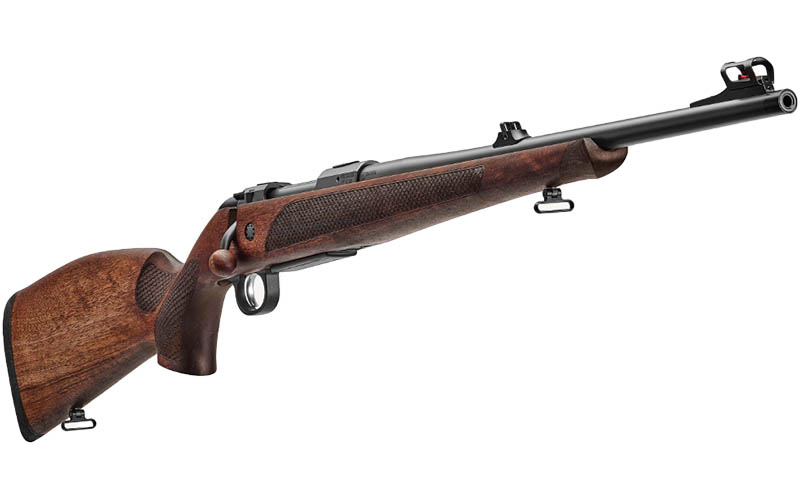
CZ 600 Series Lux
Honestly, there’s plenty to write on the newly minted CZ series of rifles. But when it comes to hunting, the Lux is the belle of the ball. Boasting slightly refined lines of the Czech company’s classic Lux design, and the bells and whistles of the 600 Series, it’s the perfect confluence of new and old. As to the new, the rifle is the three-lug fat-bolt, already making waves for its snappy adjustable trigger and lightspeed lock time. On top of all that, it’s a quick-remove switch-barrel, potentially making it an iron for all occasions. As for the Lux profile, it’s classic European—walnut stock, with a hogsback comb and a slight Schnabel forend. It comes with open sights, but its receiver is also drilled and tapped. Best of all, expect this baby to shoot 1 MOA all day long. MSRP: Starting at $849
Hornady CX Bullets
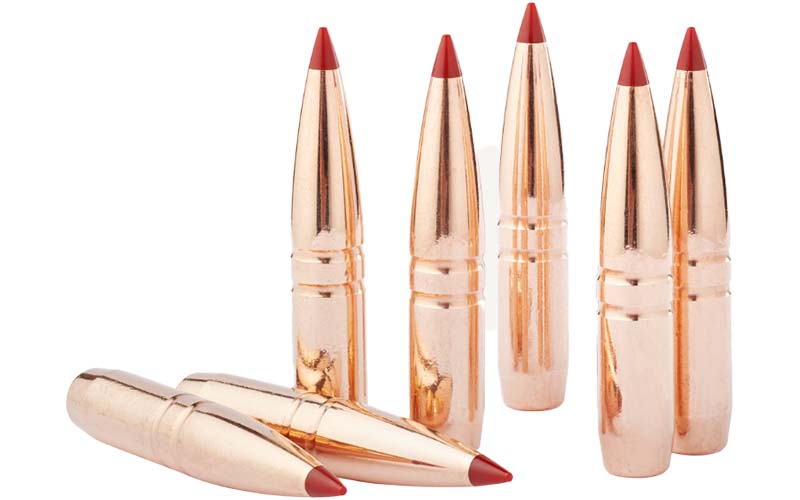
For better or worse, monometal bullets are here to stay. Thankfully, they’ve come a long way from their somewhat frustrating beginning, thanks to a good dose of engineering. Along these lines, Hornady is offering a new line of coppery alloy projectiles for 2022 in its CX Bullets. And what the Nebraska company brings to the table should extend hunters’ ranges, while offering exceptional terminal performance. An upgrade on its GMX line is the grooves on CX bullets’ shanks. Improving the projectile’s ballistic profile, Hornady rounded the typically square-cut feature, thus reducing drag. Furthermore, the company replaced the GMX’s polymer tips with its heat shield tips, which don’t deteriorate in flight. Overall, hunters can expect an all-copper bullet that maintains its velocity and thus is more than suitable for longer shots. MSRP: Starting at $42 per box of 100
Skeeter Hawk Repellent Wrist Band
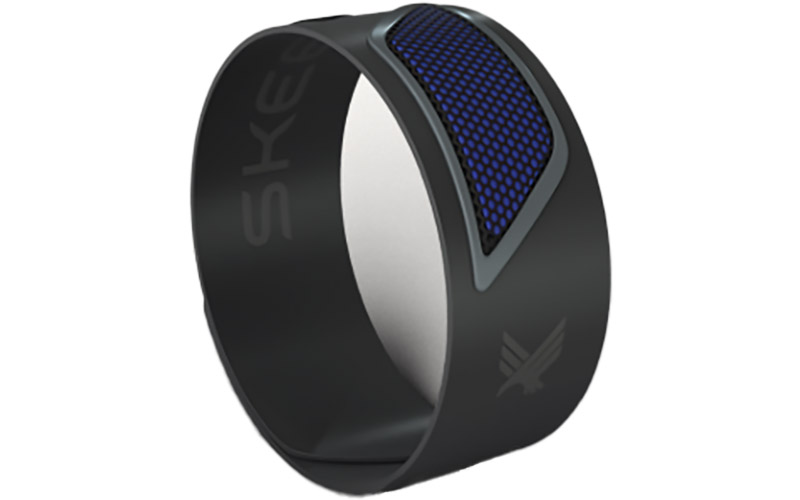
Do any early season hunting? Maybe get out for archery season? Yeah, the weather is nice, but lord, the mosquitoes! This makes repellent a must-have for your kit and is why Skeeter Hawk’s Repellent Wrist Band is such a gem. First off, the strap works, with a blend of essential oils that naturally repels mosquitoes and flying insects. Next, it’s as unobtrusive as field gear comes, fitting snuggly on the wrist so it doesn’t catch on any gear. And finally, it’s long-lasting. The band comes with two replaceable repellent tabs, each with a 30-day lifespan. For a fraction of what you’ll spend on ammo, the Skeeter Hawk is a worthwhile investment for this hunting season. MSRP: $10
Savage 110 Magpul Hunter
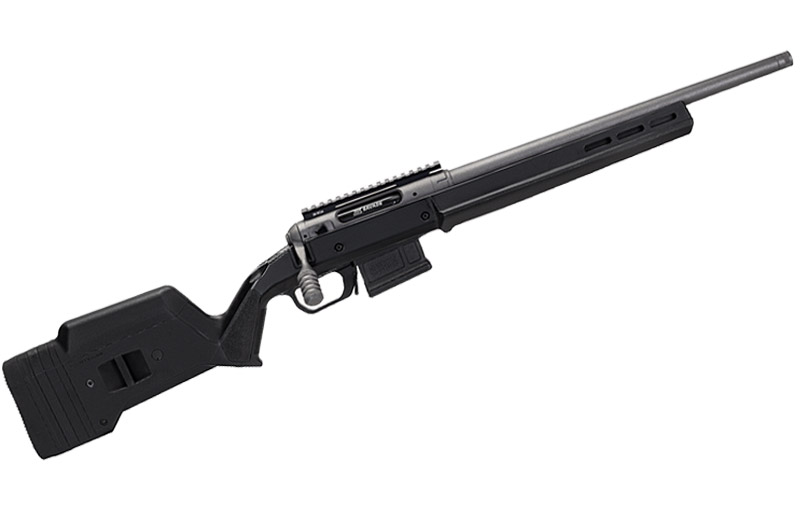
Searching for a bit of a tactical bent on your next hunting rifle? Savage has you covered, marrying its classic 110 action to Magpul’s polymer Hunter Stock. Quite a pair. The stock offers an excellent shooting platform with V-block bedding for rock-solid matting with the action. Furthermore, its wide, flat forend provides a perfect rest and offers plenty of M-Lok real estate, while its buttstock is fully adjustable to fit the shooter. On Savage’s end, an oversized bolt handle makes operating the action quick and intuitive, while an 18-inch heavy barrel and renowned AccuTrigger improve the rifle’s overall performance. Available in .308 Winchester and 6.5 Creedmoor, the 110 Magpul Hunter delivers a new twist to a proven rifle. MSRP: $1,050
Editor’s Note: This article originally appeared in the Septmeber 2022 issue of Gun Digest the Magazine.
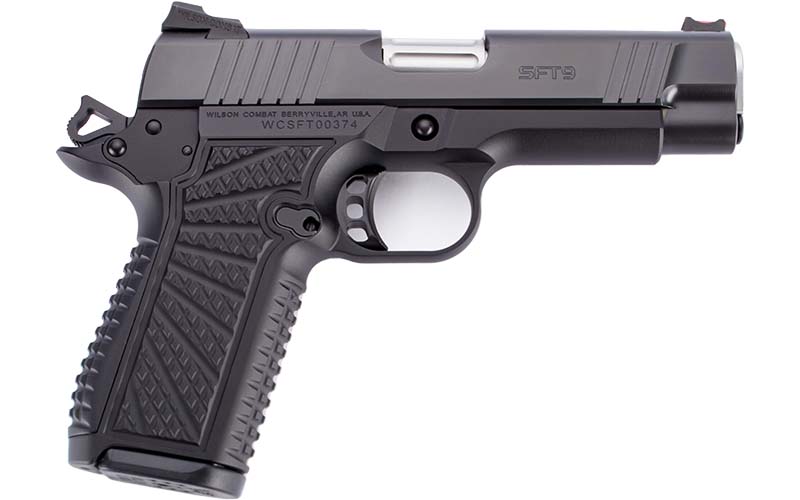
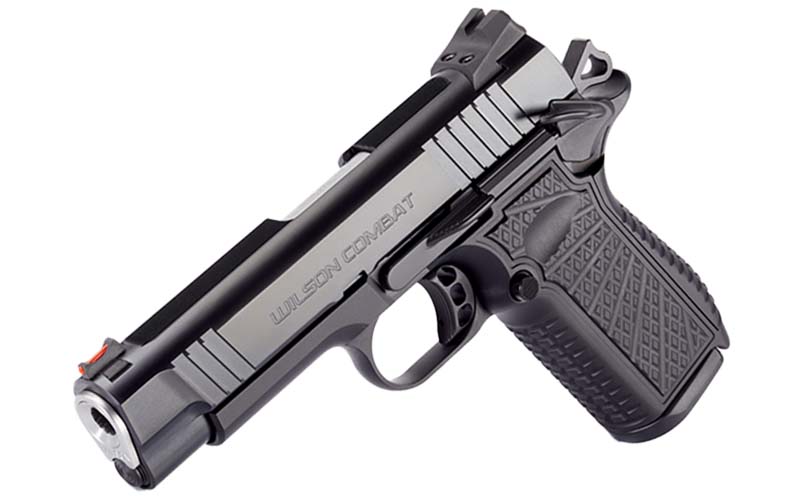
Wilson Combat has just launched the SFT9 pistol, a double-stack 9mm carry gun based on the 1911.
When it comes to premium self-defense and concealed carry pistols, Wilson Combat is one of the greats. At this point, the company’s catalog has several high-end 1911-based handguns in various calibers and configurations, but the newest is the SFT9.
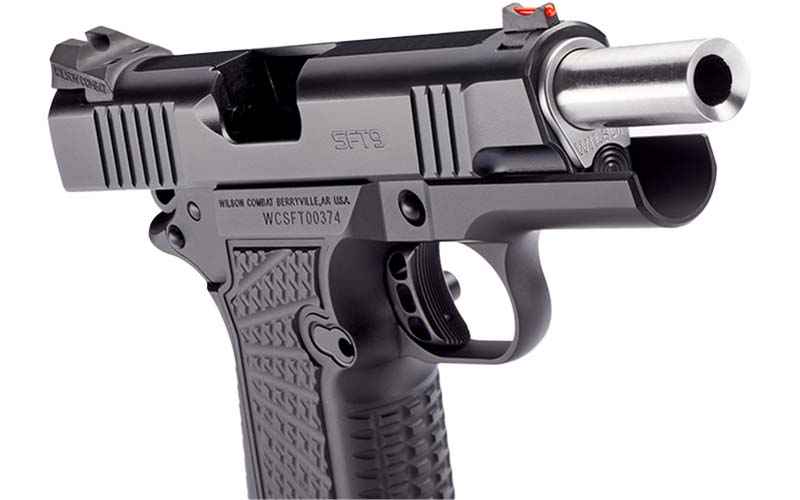
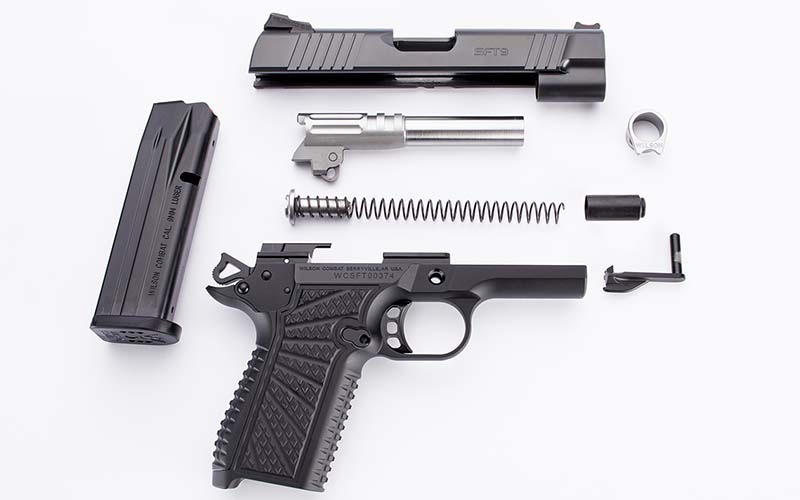
The frame is built using light but durable T6-7075 aluminum, allowing the SFT9 to weigh in at just under 30 ounces unloaded. Despite being only 1.155-inches wide, the frame accommodates flush-fitting double-stack 15-round magazines. TRAK grip texturing on the front and backstraps helps to mitigate recoil, and each pistol also features a 4.25-inch stainless steel match-grade barrel that’s guaranteed to produce 1.5-inch groups within 25 yards.
Other features and improvements incorporated throughout the SFT9 include front and rear slide serrations, carry cuts, a black DLC finish and a Bullet Proof hammer, safety and mag release. Each pistol will also include an upgraded 3.5- to 4.5-pound trigger, a red fiber-optic front sight and two magazines.
While Wilson Combat handguns are very expensive, one has to keep in mind that a large portion of the cost doesn’t stem from the material or manufacturing methods used to make them. It’s the work of skilled Wilson Combat gunsmiths that take both the quality and the price tag to the next level. Important parts are meticulously hand-fit in each gun before rigorous testing is conducted, ensuring the brand’s famous reliability stays true and allowing the company to offer a lifetime customer service guarantee with each purchase.
The base SFT9 model is available now and has an MSRP of $3,095, but prospective purchasers may also choose to pay extra for an Armor-Tuff finish, a different trigger pad length, a different color of front sight or an ambidextrous safety.
When is a private citizen within their rights to use deadly force to stop a fleeing felon?
On February 20, 2021, Joshua Williams entered the Jefferson Gun Outlet, a combination gun shop and indoor shooting range. He was visibly armed with a pistol and extended magazine, according to surveillance camera footage released by the Jefferson County Parish (Louisiana) Sheriff’s Department. When asked by store employees to go back outside and unload the pistol (as was store policy), Williams moved to the door, fired one shot outside the store, and then turned the gun into the store and shot and killed 59-year-old Veronica Billiot, a store customer.
Williams then left the store for a moment, but quickly re-entered and shot and killed a store employee, 47-year-old Noah Fischbach. He then left the store again, and at that time several store employees confronted Williams and, engaging in a shootout with the suspected murderer, killed him. Two of those store employees were injured in the final gunfight.
Where Are The Lines Drawn?
This shooting perfectly illustrates the issues surrounding when a private citizen is within his rights to use deadly force to stop a fleeing felon.
First, there must’ve been a heinous felony involved. There’s little that would qualify quicker as a heinous felony than a killing spree of innocent persons. In this case, if you witnessed the initial shooting, you knew for sure this was an evil person killing innocents. Just about all active shooter incidents that were interdicted by armed citizens fall into this category.
Secondly, the heinous felony must have been witnessed by you, or you must have a reasonable belief that the subject had just committed that heinous felony. Whether or not the remaining store employees actually saw the first two shootings, they certainly had a reasonable belief that the subject escaping had done the shooting. But one cannot take the word of a third person, they must develop their own facts to make this assessment. Even if a police officer yells at you to “shoot him,” don’t shoot based only on his command.
A third criteria would be that the escape of the felon must be open ended, meaning it’s unlikely he’d immediately be captured if not confronted (and, in this case, killed). And that standard of knowledge would need to be to the standard of the reasonable and prudent person. Would a reasonable and prudent person believe he was going to escape without capture?
Additionally, you must believe (again to that standard of a reasonable and prudent person) that if he was to escape, additional innocent lives would be endangered. Perhaps this point would’ve been a little more difficult to reach, but in this day and age of active shooters and witnessing an active shooter event unfold before your eyes, this belief would likely be reasonable on its surface. The history of the actions of random killers is they keep killing when confronted and ultimately killed.
Lastly, no reasonable alternative to using deadly force to capture/apprehend him must exist.
As a firearms trainer for more than 30 years, I don’t know how many times I’ve been asked about shooting fleeing felons, typically under the example of someone breaking into your house or car and when confronted, the felon runs. “Can I shoot him to stop him from getting away?” Well, no, you cannot under that example.
“OK, how about if someone sticks a gun in your face and demands your money and car keys?” You comply and when he turns to leave, you draw and blast him. This would be considered a “violent felony,” but it wouldn’t fall into the realm of a heinous felony. A heinous felony most certainly involves bloodshed, whether that be by gun, knife or some other weapon. The mere threat of bloodshed doesn’t make the grade.
Now, that doesn’t mean you must simply let the armed robber get away with your money and your car keys. Pursuing and confronting him (a citizen’s arrest) is certainly within your rights as an American citizen. If you do that and he again threatens deadly violence against you, then a classic armed confrontation would likely ensue. Can you be assured of winning that confrontation? I’d say those odds are about 50/50—not the kind of odds I want to bet my life on.
But if I have witnessed that heinous felony as described above, and I can stop the killer from leaving and endangering others’ lives and I can stop him without endangering other’s lives, I might just intervene. I hope I never have to make that decision.
Editor’s Note: This article originally appeared in the May 2021 issue of Gun Digest the Magazine.
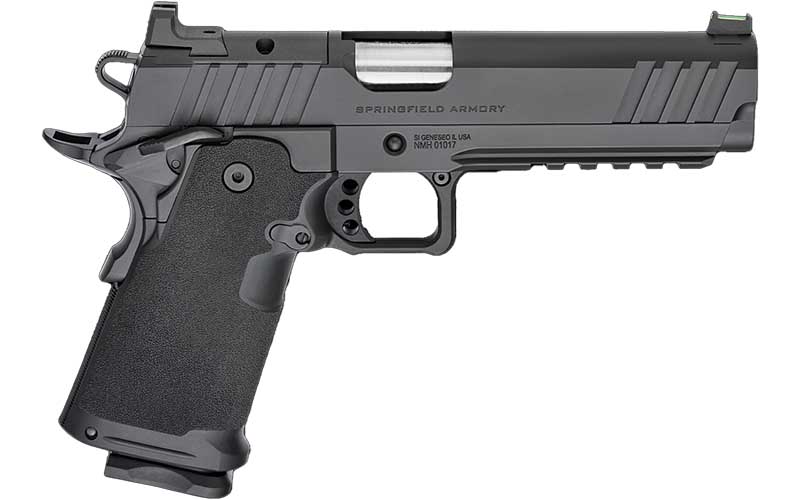
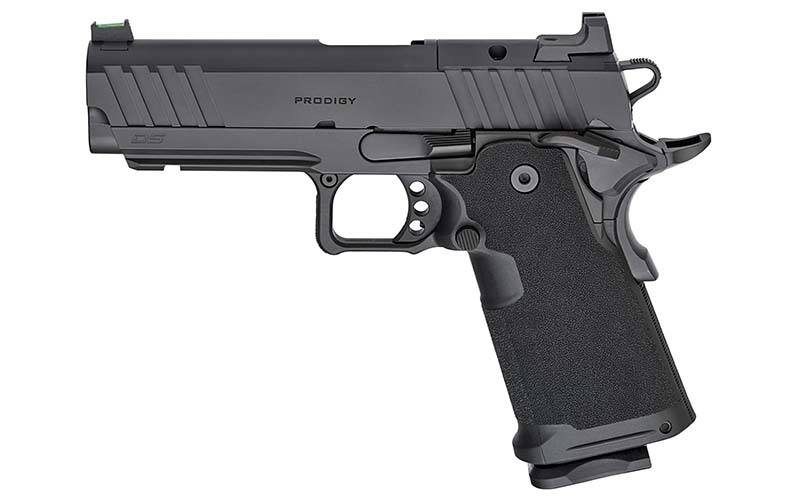
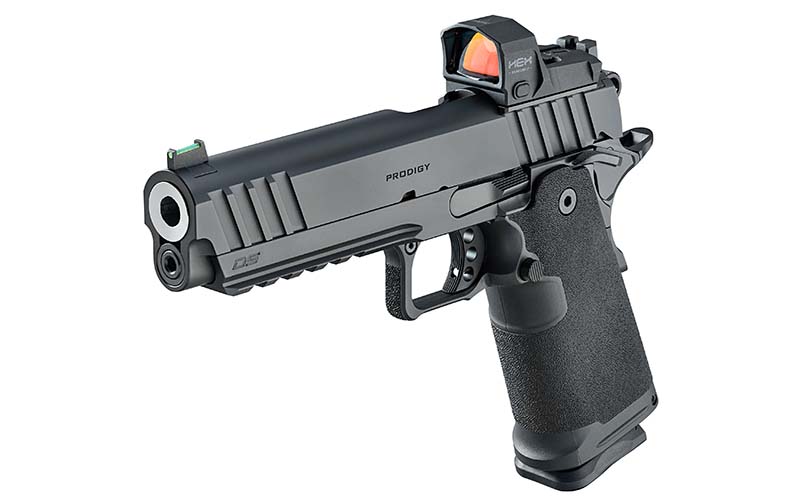
Springfield Armory has just released the DS Prodigy line, featuring two sizes of double-stack 1911 models chambered for 9mm.
While 1911s chambered for .45 ACP may forever be timeless classics, that doesn’t mean they can’t benefit from a little modernization. The concept of a double-stack 9mm 1911 was first pioneered over 30 years ago, but it didn’t experience widespread success until STI Firearms (now Staccato) introduced its own version called the 2011. Since then, many companies have released their own spins on the concept, but the newest is the DS Prodigy from Springfield Armory.
The two new models are officially called the 1911 DS Prodigy AOS 9mm and the 1911 DS Prodigy 4.25” AOS 9mm. As you might’ve guessed, the former model features a 5-inch barrel while the latter’s is 4.25 inches. Both models are also optics-ready and are available with a preinstalled Hex Dragonfly red dot sight. The pistols ship with a cover plate and an AOS (Agency Optic Systems) mounting plate with a Springfield Standard footprint, but other plate patterns will be available separately. Other DS Prodigy features include ambidextrous safeties, raised fiber-optic iron sights and polymer grip modules with wraparound Adaptive Grip Texture.
The primary appeal of the DS Prodigy 1911 line is their capacity. Each pistol will ship with one flush-fit 17-round magazine plus one extended 20-round mag, and 26-rounders will also be available separately. Regardless of the model chosen, all DS Prodigy pistols will also feature forward slide serrations, an accessory rail, a black Cerakote finish and a match-grade bushingless bull barrel.
Steve Kramer, Vice President of Marketing for Springfield Armory, said this about the new guns:
The new Prodigy 9mm, the first in our new family of 1911 double-stack pistols, takes everything that shooters love about the 1911 platform and enhances it with increased capacity and a host of performance features…Combining cutting-edge capabilities with all the proven benefits of the 1911, the Prodigy is a must-have addition for any handgun enthusiast’s collection.
Both models of standalone Prodigy DS 1911 pistols have an MSRP of $1,499, and the packages that include red dot sights both have an MSRP of $1,699. All four options are available now.
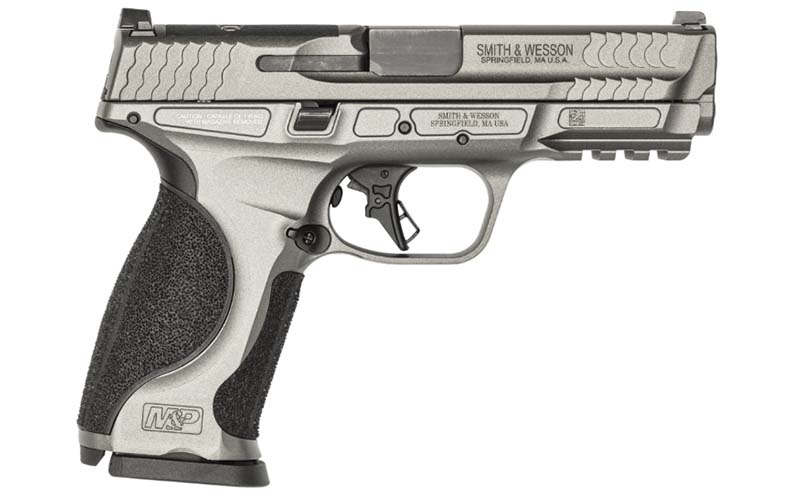
Smith & Wesson has just released the M&P9 M2.0 METAL, the first all-metal configuration in the M&P line.
There’s no question that polymer-framed pistols have become the standard for all modern autoloading handgun designs. For those who still prefer the feel and weight of a metal gun, the selection of new-production automatics was mostly limited to DA/SA wonder nines. Smith & Wesson’s new M&P9 M2.0 METAL is changing that, however, by bringing the features and form factor of a modern polymer striker-fired to an all-metal frame.
Because the M&P9 2.0 Metal has the same profile as the polymer-framed version, it will fit all existing holsters and uses the same 17-round magazines. The only difference is in the material used, as the new version’s frame is built using T6 aluminum. Each pistol will also feature an optics-ready slide, a flat-face trigger and interchangeable palmswell grip inserts.
Andrew Gore, Handgun Product Manager at Smith & Wesson, said this about the new handgun:
Combining the proven performance of the M&P pistol series with the 170-year history of reliable Smith & Wesson metal handguns, the M&P9 M2.0 METAL forges the quality of our past with enhanced modern-day features in an offering that will give an edge to both new and experienced firearms enthusiasts…
Other features of the M&P9 2.0 Metal include a Tungsten Gray Cerakote finish, an improved trigger, forward slide serrations and a standard accessory rail. Each pistol will include two magazines and four sizes of interchangeable grip inserts. MSRP is $899 and it’s available now.
For more information on the M&P9 M2.0 METAL, please visit smith-wesson.com.
Thumbs raw and sore from loading too many magazines? There’s a solution, and it’s called the Mag Pump.
Oh, for the good old days when you didn’t have to take out a second mortgage to afford a day of range time. Why I remember when a five-day class was an occasion to practically toast a barrel. Now, the ammo costs are greater than the enrollment fee or the travel costs.
But it’s still mind-numbing labor to load a magazine. It’s hard on thumbs, it takes time from building skills and this is America, where life is supposed to be better for us than it was for our forebears. Which leads us to the Mag Pump.
Mag Pump It Up
The Mag Pump is the device that many of us had thought of, even dreamed of, while spending time in the sun on a range, thumbing ammo into magazines. The process is simple: Lock a magazine into the Mag Pump (there are pistol and rifle versions, and adapters for the pistol mags), then dump ammo into the hopper. Pump the lever, and there’s a round in the magazine. Repeat until the magazine is full, remove and replace, and continue.
The hopper holds more than enough for a magazine or two, and the feed system orients each cartridge as it passes through the mechanism to be pointed properly and then inserted into the magazine.
Oh, and do yourself a favor and get in the habit of counting as you pump the lever. The Mag Pump doesn’t have a way of knowing the capacity of the magazine you’re loading, so you’ll find it annoying to have the system crash to a halt as you try to get that “plus one” cartridge into your magazine.
The basic system of the Mag Pump is composed of injection-molded high-impact plastic. From the look and feel, I suspect there’s a good dollop of glass fibers in there, acting as rebar for the polymer.
The pistol version comes with six adapters for various magazines, those being Glock, Sig, S&W, Springfield, CZ and Ruger. There’s an arm-long list of additional adapters, for those of you who use something other than the most common magazines.
Rifle loaders are made in either AR-15 or AK47 versions.
The Pro versions of the loaders have some of the high-stress parts replaced with parts made of aluminum or steel, in case you’re loading for a gun club, a rental range or just won the lotto and have a literal warehouse full of ammo to consume. (If you need help, remember, there are eager volunteers to be found.)
The base models of AR-15, AK47 and pistol are listed at a penny short of $150 each. The Pro model for AR and pistols lists at $250, and the Elite AK47 model is $399. If you get tired of using a C-clamp to hold the Mag Pump to your shooting bench, then you can invest 10 bucks into a mounting plate. That one you bolt to the bench to, and then the Mag Pump simply self-clamps to it.
Ammunition is hard to find, and extremely expensive right now. But if trends hold true, as they have in the past, ammo prices will come down, and availability will increase. We’ll be back to actually shooting instead of dry-firing in the basement, and when the day comes that you say to yourself “I’m tired of loading magazines” you’ll know where to turn.
Mag Pump: Because life’s too short to spend it simply stuffing magazines by hand.
Editor’s Note: This article originally appeared in the April 2021 issue of Gun Digest the Magazine.
Looking to go armed, but are stuck in the weeds as to what to arm yourself with? Here are 20 of the best concealed carry gun options that will keep you on the defensive.