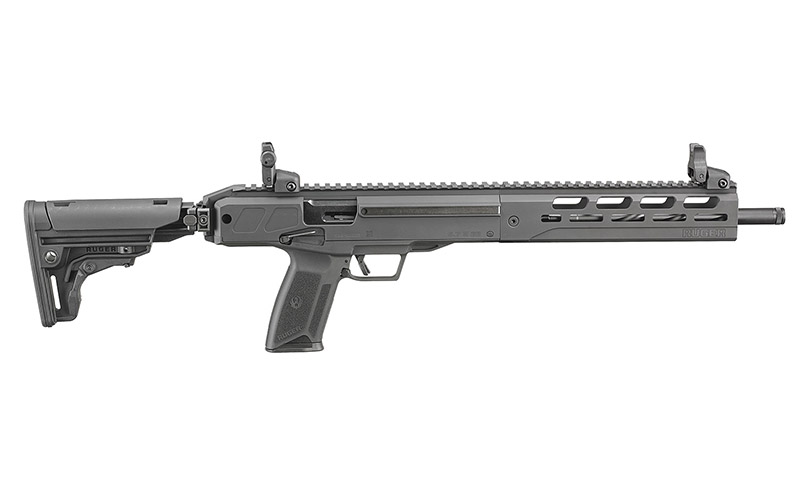
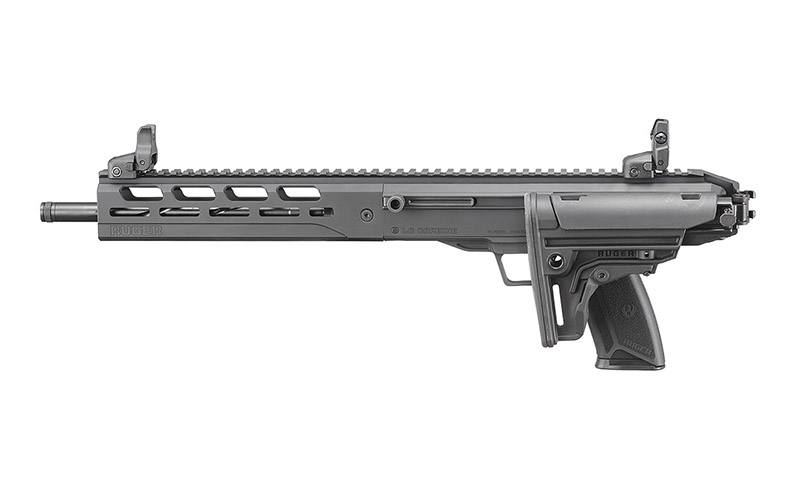
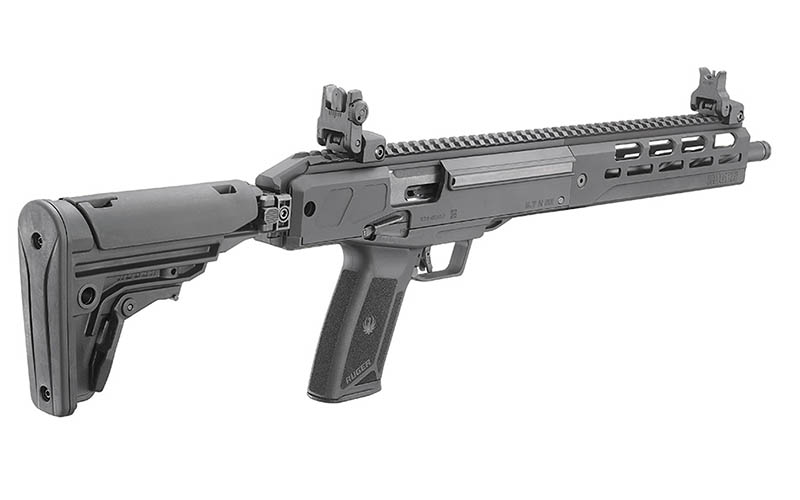
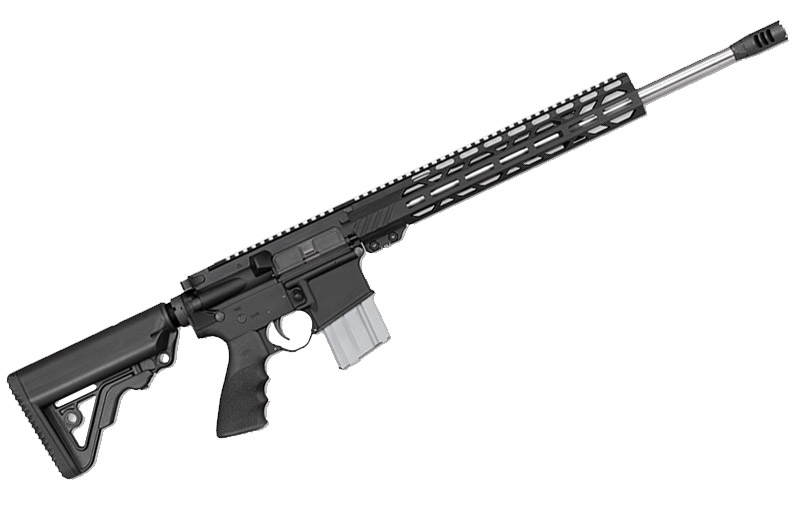
Ruger has just expanded its 5.7x28mm firearm lineup with the addition of the Ruger LC Carbine.
5.7x28mm is a contentious cartridge. While some swear by it, others denigrate it as glorified .22 Magnum. Enough shooters fall into the former camp however that Ruger recently decided to add one more firearm chambered for the cartridge to the catalog. Based on the Ruger-5.7 Pistol (the company’s first foray into 5.7x28mm), the new Ruger LC Carbine features the same controls and magazines but is now in a carbine configuration.
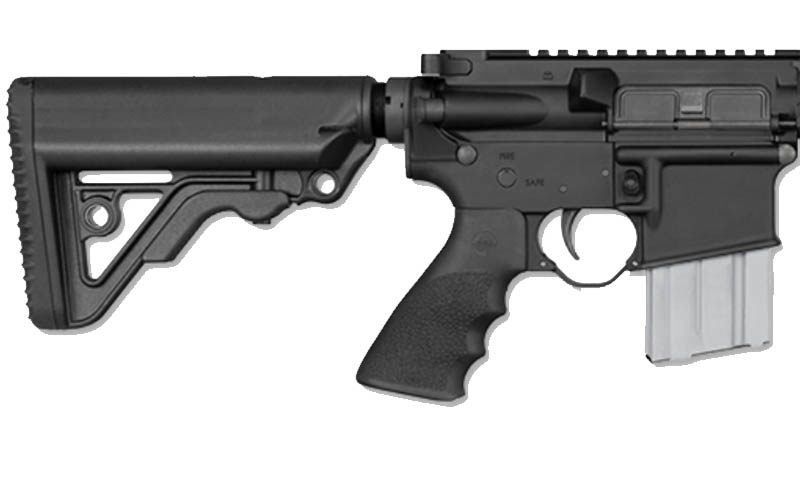
The Ruger LC Carbine is legally classified as a rifle due to its 16.25-inch barrel, allowing the guns to ship with proper, adjustable folding stocks. In theory, the extra barrel length will also increase the velocity and usable range of 5.7x28mm. The rear of the carbine is compatible with both AR-style and Picatinny rail-mounted stock designs and features a reversible folding mechanism. This allows the stock to be folded to either the left or right side of the receiver, making this lightweight carbine even more ideal for activities like backpacking. To further save weight, the barrel has been fluted as well, bringing the total weight of the package to only 5.9 pounds.
Ruger President and CEO Chris Killoy said this about the new 5.7 carbine:
I can’t describe how ergonomic the LC Carbine feels in your hands. You have to experience it on the range to really appreciate how it balances and moves. The controls are intuitive and conveniently located, and the lack of felt recoil makes it hard to put down.
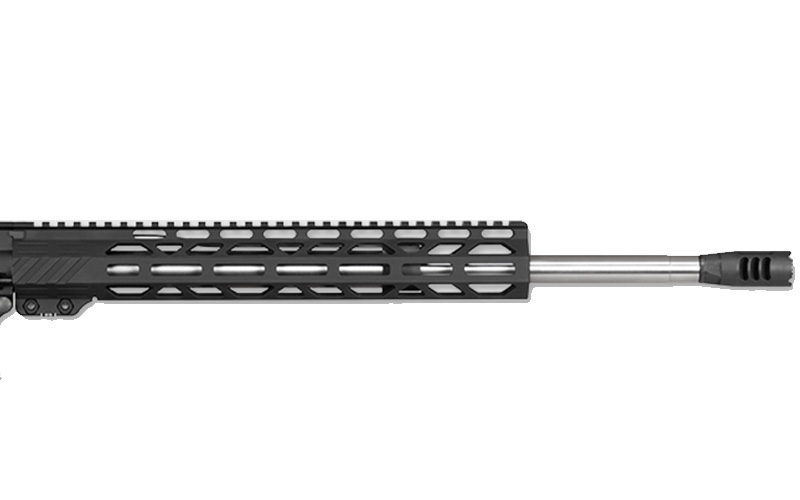
Other features of the LC Carbine include an ambidextrous 1911-style manual safety, a reversible charging handle, several QD sling sockets and a 1/2×28 threaded barrel. It also sports an aluminum handguard with M-LOK accessory slots and a full-length Picatinny rail for mounting optics (a set of Ruger Rapid Deploy folding iron sights are included as well). The LC Carbine has an MSRP of $979, includes one 20-round magazine and is available now.
Whether your gun is for hunting, home defense or something else, prudent .50 Beowulf ammo selection is the key to unlocking this cartridge’s maximum performance.
After deciding to build or buy a gun in this caliber, the next logical step is understanding how to select the right .50 Beowulf ammo for your needs. There are several kinds available, and they all cater to different purposes, so let’s dive into the details of various loads and determine what to look for when selecting your own.
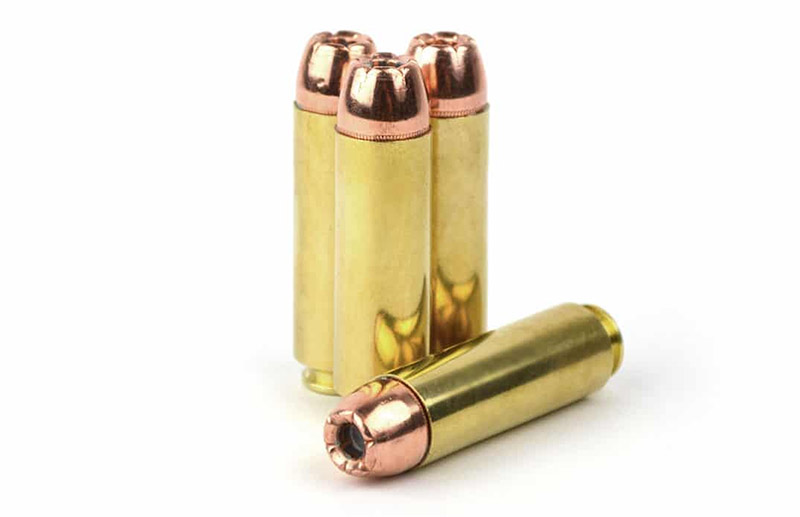
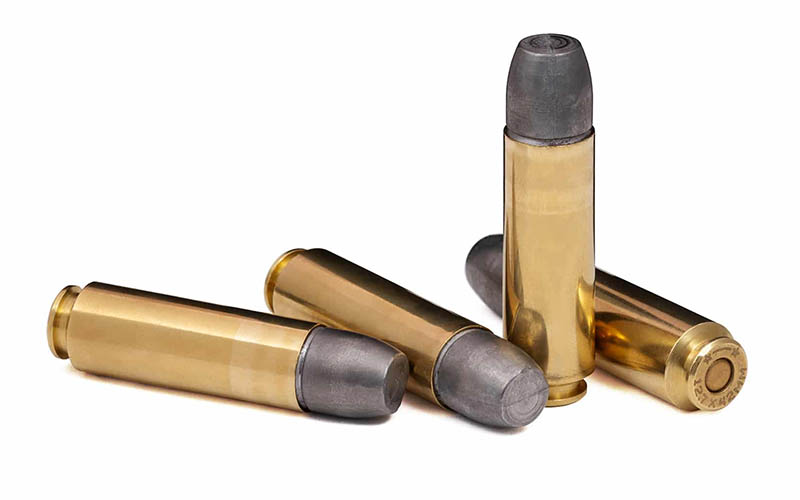
Steinel 350-grain XTP 12.7x42mm ammo.
.50 Beowulf Ballistics
For .50 Beowulf ammo, the most typical loads sport between 300- and 400-grain bullets moving at 1,800 to 1,900 feet per second producing around 2,300 to 2,800 foot-pounds of energy. The exact velocity and energy are also of course dependent on other factors like barrel length.
Also keep in mind that just because a manufacturer claims its ammo has a certain velocity, depending on how they measured it, your personal chronograph readings may vary.
Trajectory
All .50 Beowulf projectile types and grain weights sink like a stone with a G1 ballistic coefficient of less than .200.
Unfortunately, the few manufacturers that do make .50 Beowulf ammo (or the generic equivalent 12.7x42mm, Alexander Arms holds the patent for the .50 Beowulf name) don’t provide drop tables. In turn, you have to rely on third-party testing or figure it out yourself.
Realistically, you can expect a maximum point-blank range of no more than 150 yards on a 4-inch target.
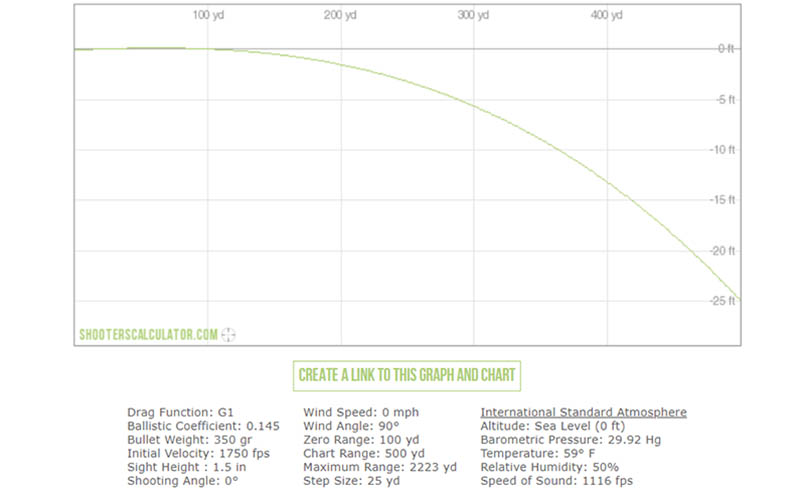
As for trajectory, according to ShootersCalculator.com, one could easily expect a foot or more of drop at 200 yards and over 5 feet of drop at 300 yards and beyond. At 200 yards, the projectile will have lost more than one-third of its velocity as well.
Maximum Point Blank Range for Alexander Arms’ 350-grain XTP hollow-point .50 Beowulf ammo. Source: ShootersCalculator.
In terms of energy, the first 200 yards of travel rob the projectile blind. Most loads drop below 1,000 foot-pounds by 300 yards, which is considered the minimum for big game hunting in some states.
According to our ShootersCalculator table, a common 350-grain FTX hollow-point from Alexander Arms will dip below 1,000 foot-pounds of energy before even reaching 200 yards and it begins rapidly approaching 500 foot-pounds beyond 300 yards.
Trajectory of Alexander Arms’ 350-grain XTP .50 Beowulf hollow-point ammo. Source: ShootersCalculator.
What this all means is that while a skilled marksman with a good scope may be able to stretch .50 Beowulf’s legs some, for most shooters its utility is solidly within the 200-yard range.
Recoil
Besides the velocity and energy of the projectile, recoil energy is another area of concern to consider.
While you can read about recoil energy as much as you want, it won’t necessarily translate into what you’ll feel on your shoulder. There are too many factors regarding the type of weapon used and the particulars of the shooter to accurately represent recoil energy with a simple number.
With that said, .50 Beowulf tends to produce between 25 and 33 foot-pounds of recoil energy. To put that figure into perspective, it’s somewhere between the .300 and .338 Winchester Magnums. That’s quite a lot of kick, especially for the lightweight AR-style rifles and pistols this cartridge is typically fired from.
.50 Beowulf Projectiles
The three most common brands of .50 Beowulf ammo are Alexander Arms, Underwood Ammo and Steinel. The latter two companies sell theirs as 12.7x42mm because—again—Alexander Arms holds the patent.
Common projectile styles include jacketed hollow point, jacketed soft point, flat-top FMJ, spire-point FMJ and hard cast lead.
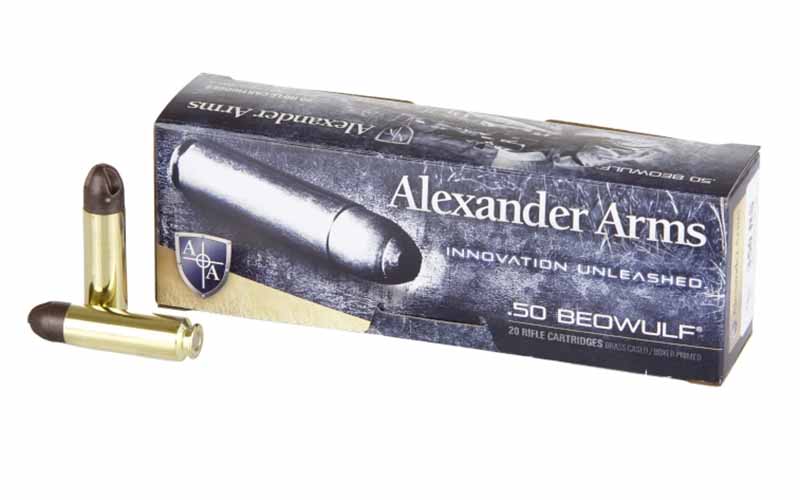
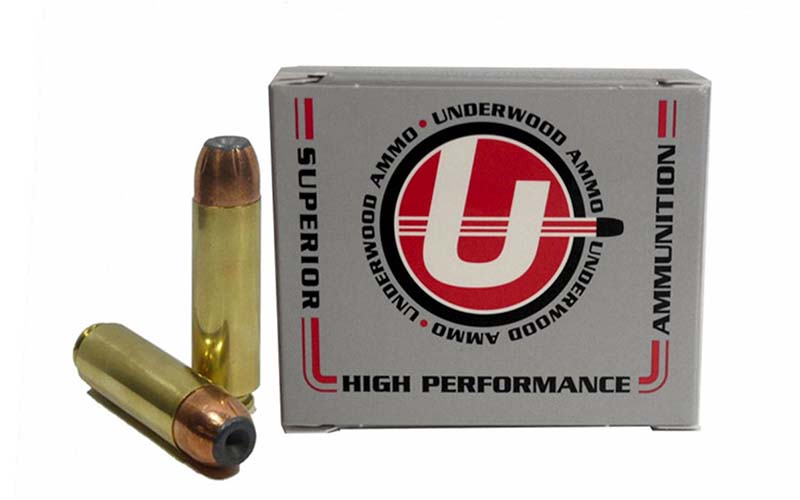
Underwood offers the Lehigh Xtreme Penetrator bullet in this caliber, in 350- and 425-grain weights. JHP options include both 300- and 325-grain Speer Gold Dot JHP (available from Underwood) and a 350-grain Hornady XTP JHP from Underwood, Alexander Arms and Steinel. Alexander Arms also offers a 325-grain FTX (akin to Critical Defense) load.
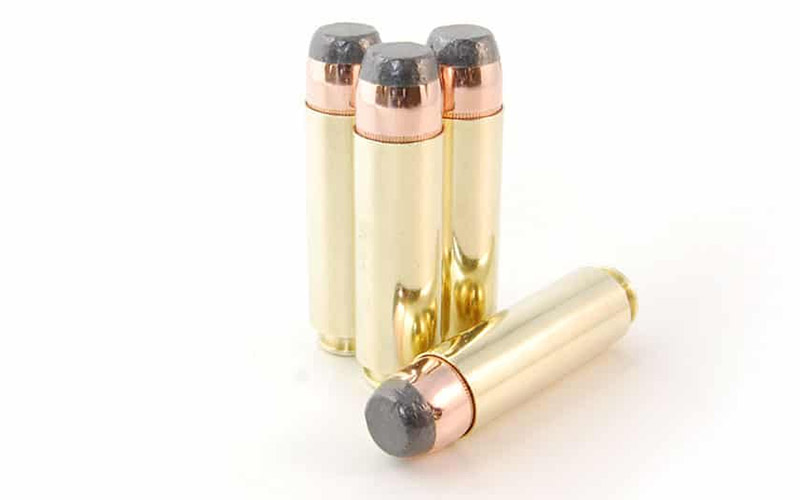
Steinel 600-grain Hard Cast 12.7x42mm.
Hard cast loads include a 380-grain load from Underwood, and both 500- and 600-grain HC loads from Steinel. Hawk makes a 400-grain semi-jacketed flat top bullet, which is loaded by both Steinel and Alexander Arms.
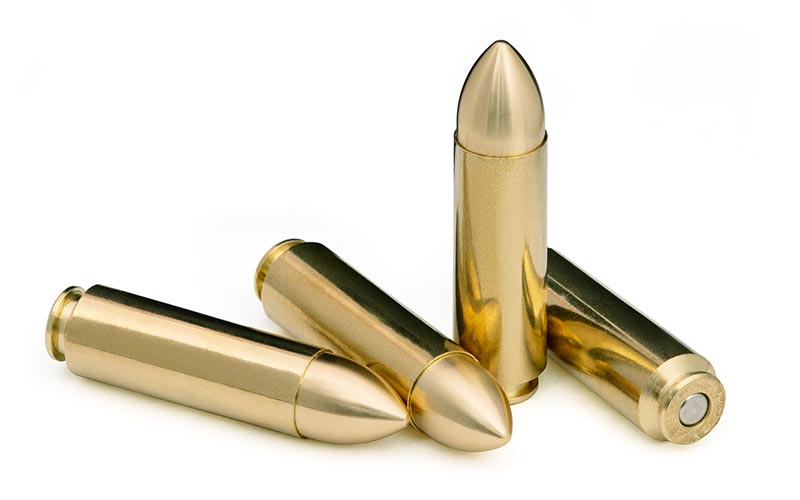
All manufacturers offer some form of FMJ, including round shoulder/flat top and Steinel’s brass spire point bullets. Underwood and Alexander’s FMJ loads are 350-grain FMJs, but Steinel’s brass spire point bullets are offered with 280- and 414-grain bullets.
Alexander Arms also offers a 200-grain Inceptor ARX frangible load.
Those are the most common loads of .50 Beowulf ammo. While there may be some other manufacturers out there, this is the ammunition you are most likely to actually find.
Choosing .50 Beowulf Ammo
So…how does one determine which load of .50 Beowulf ammo will best suit their needs?
Unlike more common calibers like 9mm, .50 Beowulf doesn’t have the benefit of millions of users documenting their experiences over the course of several decades. This caliber is still relatively new and obscure, as a result, it’s severely lacking good data.
Because of this, prospective .50 Beowulf shooters need to start from square one when choosing their ammo. That is, deciding on an intended purpose.
Since the cartridge uses pistol bullets, it’s best to think in those terms. What would you pick for hunting if you were using a traditional pistol or pistol-caliber carbine? What would you pick for home defense? What would you pick for predator defense? What would you pick for range use and niche applications?
Self Defense
As far as defense, there’s some evidence to indicate that .50 Beowulf might be tenable.
Formal testing of terminal performance is nonexistent, but there is some informal testing.
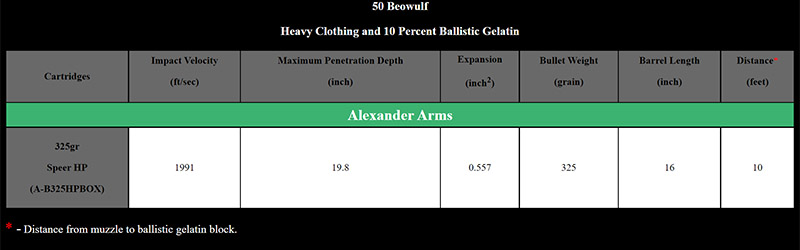
BrassFetcher tested a 325-grain load using a Speer Gold Dot JHP loaded to around 2,000 fps through a 16-inch barrel, which resulted in 19.8 inches of penetration through heavy clothing into 10-percent ballistic gelatin.
The FBI’s standard is 12 to 18 inches of penetration in 10-percent gelatin through 4 layers of denim, which means that the specific load in that single test (just one data point) was on the outside edge of what you’d want to consider for home defense.
Alexander Arms posted their own testing video of their 200-grain ARX Inceptor frangible load and it certainly looks promising as well.
The 200-grain frangible load penetrated 17 inches into bare gelatin.
What this would indicate is Gold Dot and ARX frangible loads may be tenable for home defense use (the FBI standard exists for a reason) though there is minimal data to support it. If defense was a use you were considering this cartridge for, you need to be your own judge.
Hunting
As for using various kinds of .50 Beowulf ammo for hunting, there is plenty of anecdotal evidence online supporting the efficacy of the cartridge against medium game at moderate ranges. This would be expected given the cartridge’s attributes on paper, but there is also some value in first-hand accounts regarding which projectiles performed better than others.
Hornady FTX and XTP loads are popular for medium-size game, given the jacketed hollow points have a strong record and are known for their reliable controlled expansion. In FTX’s case, an improved ballistic coefficient is baked into the cake thanks to its polymer tip.
Gold Dot is also a viable choice for medium game, providing ample penetration and excellent expansion as demonstrated by BrassFletcher’s tests. Honestly, if one had to pick a do-it-all loading for this cartridge, Speer’s 325-grain Gold Dot would be at the head of that list.
Range
FMJ .50 Beowulf ammo should primarily be considered a range load, although it would also be a viable choice for defeating light barriers such as auto sheet metal and typical residential structures (which was the original intent behind the cartridge’s development to begin with).
For large predator defense (think brown bears), the heavy hard cast lead loads remain the best choice due to their impressive penetration.
With all that in mind, which .50 Beowulf ammo would serve you best?
The 5 Best Loadings Of .50 Beowulf Ammo
Alexander Arms 200-Grain ARX Inceptor
The ARX Inceptor load from Alexander Arms is a good choice for home defense. It has an advertised velocity of 2,500 fps from a 16-inch barrel, which equates to roughly 2,775 foot-pounds of energy.
The frangible bullet means less risk of overpenetration in urban or suburban environments, making it an acceptable choice for home defense or other applications where overpenetration is a concern.
Steinel 12.7x42mm 414-Grain Brass Spire “The Brass Spike”
Sometimes, the answer is to heck with what’s downrange and to heck with its cover. The Steinel 414-grain Brass Spire Point load will punch through almost anything you can think of.
It is literally a brass spike in a cartridge case, with an advertised velocity of 1,300 fps from a 16-inch barrel, producing 1,553 foot-pounds of energy. Brush deflection? Never heard of her. Barriers? HA! If max penetration is what you want, this is the one to go for
Home defense is out of the question with this round, but hunting or certain niche applications involving barrier defeat would be suitable applications. Also, it’s darned unique.
The 325-grain JHP load from Underwood Ammo uses the renowned Speer Gold Dot hollow point bullet, and it’s loaded to 1,870 fps and 2,524 foot-pounds of muzzle energy.
This would be an excellent all-around load, good for medium game hunting and even tenable for defense. The expanding projectile means it isn’t ideal for barrier penetration, however.
Speer Gold Dot, of course, is one of the standards by which other JHP projectiles are judged. It’s one of the most common issued duty loads (along with Federal HST) for a reason and has been proven on the streets and in the fields.
If you wanted a hunting/woods load and were not kidding around, take a look at Steinel’s 12.7x42mm load with the Hornady 500-grain FP-XTP bullet, which is also used in .500 S&W Magnum ammo.
The bullet is a 500-grain semi-jacketed flat nose, a controlled expansion (meaning less expansion, more penetration) bullet meant for handgun hunting and predator defense. If you absolutely mean to bash a hog or whitetail flat, or if you wanted a .50 Beowulf as a bear defense/brush gun for larger game…this would be the ticket.
It’s loaded to 1,281 fps, with 1,822 foot-pounds of energy.
If that’s not heavy enough, Steinel also offers a 600-grain hard cast load as well.
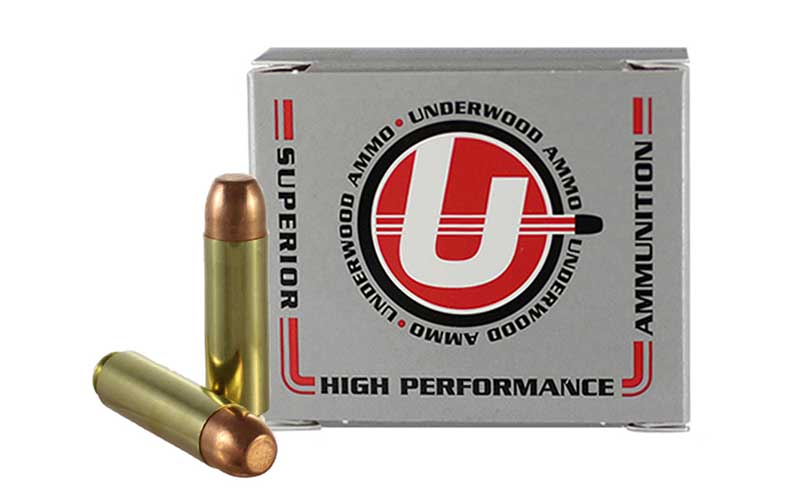
This is the closest you can get to range .50 Beowulf ammo. It’s a 350-grain flat-nose FMJ bullet. The advertised velocity is 1,775 fps from a 16-inch barrel, which equates to 2,448 foot-pounds of energy. It still isn’t cheap, but it’s about as affordable as you will be able to find for this caliber without reloading your own.
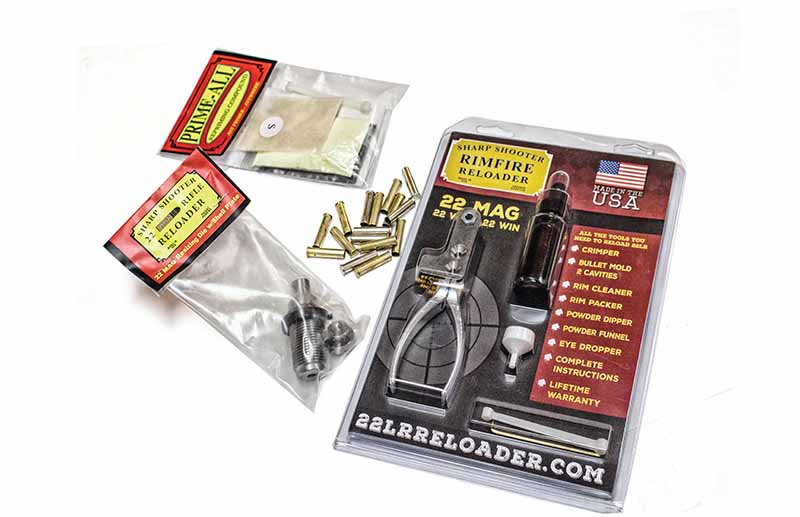
A rundown on reloading rimfires with the help of the Sharpshooter .22 LR Reloader Kit.
Reloading rimfire cartridges has been off-limits for as long as I can remember, simply because the process would require priming your own cases. Well, I’ve found a neat system that allows you to reload both .22 Long Rifle and .22 Winchester Magnum Rimfire: The Sharpshooter 22LR Reloader Kit.
The kit ($74.95 retail) comes in a neat package, complete with all the tools needed, and they offer their Prime-All priming compound (sold separately at $19.95) to reprime the spent cases. The kit includes a two-cavity bullet mold—that same mold is used as a crimping tool—rim cleaner, rim packer, powder dipper, neat little powder funnel and eye dropper, used in the priming process.
The Sharpshooter Reloading Kit allows reloading of rimfire cartridges. Photo: Massaro Media Group.
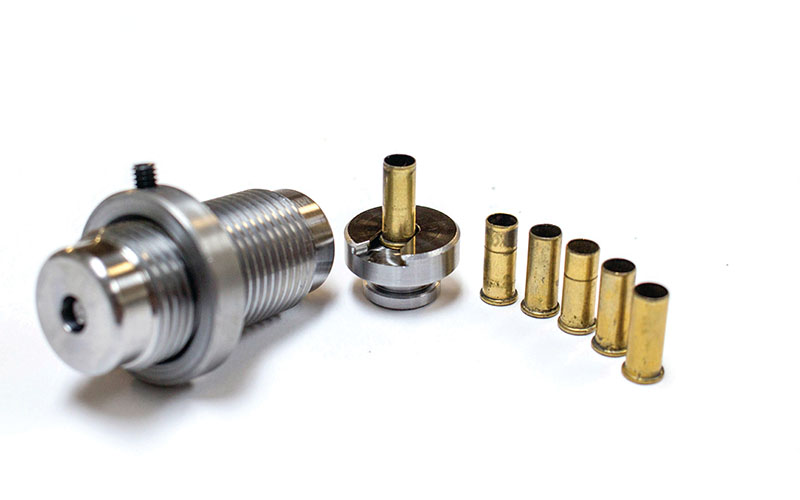
This system allows the user to take spent cases from the firearm from which they were fired and bring them back to the point where they’ll function (at least in the same firearm). Should you want, they also offer resizing dies for both cartridges, so that your reloaded cartridges can be sized properly for use in any gun, not just the gun they were fired in.
A full set of instructions is included in the kit, including load data for several popular powders, and even a load for ground-up match heads! For some reason, this whole kit brought a breath of fresh air to the normal reloading procedures, and I found myself showing the system to my dad—Ol’ Grumpy Pants—who has a penchant for all things survival. And as you’ll see, the Sharpshooter 22LR Reloader Kit is definitely in the prepper line of thinking.
But, as Dad says: “Sometimes any ammo is the best ammo you could ask for.”
The .22 LR resizing die. Photo: Massaro Media Group.
Rimfire Simplicity
We grabbed some spent cases from GP’s Ruger Single Six revolver. While the empties would fit easily in the cylinder of his handgun, they wouldn’t chamber in any of our rifles (I’d later use the resizing die to solve that problem).
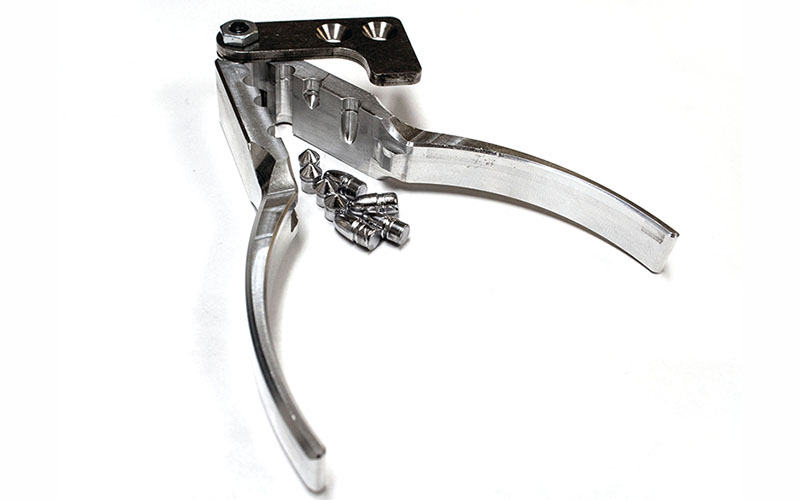
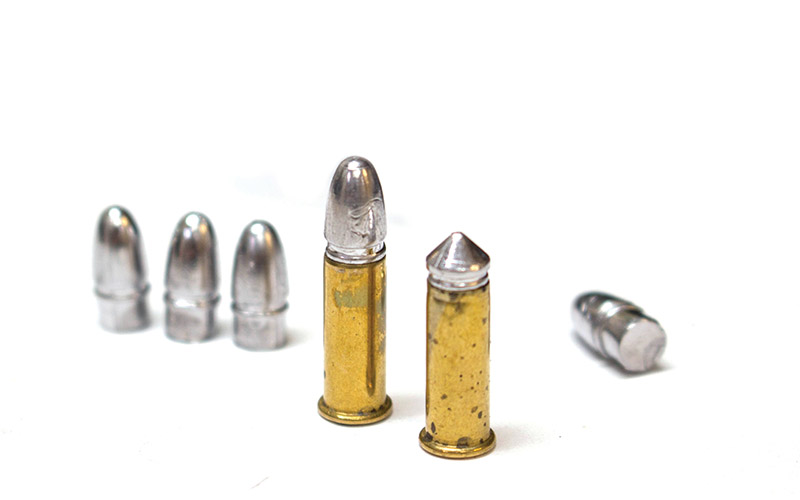
The first step was to start casting some bullets and, using the dual-cavity mold provided, it was an easy process. There are two bullet types in the mold: the 25-grain solid point (looking much like an airgun pellet) and the 38-grain round nose, which is shaped like the traditional .22 LR bullet. Both are heeled bullets, in true rimfire fashion. The mold is aluminum, so it’ll heat up quickly. We had the best results when the mold was held closed, as it reduced the “seam” in the cast bullet.
The aluminum bullet mold has two different cavities and makes bullets consistent enough for rimfire cartridges. Photo: Massaro Media Group.
There’s no need to take the dent out of the rim of the case, as you’ll be packing the priming compound back into the rim, and the odds of the firing pin striking in the same place twice run about 1 in 72. The instructions include the method of priming by using ground-up match heads, or roll caps (remember cap guns?), but I much prefer the Prime-All. This requires a bit of effort to make, but it’s not exactly rocket science. The package includes four different powders in individual packets and using the dual-sided scooper included in the set, you’ll mix a specified amount of the four powders. We used a tall, narrow glass to mix the powders, and it worked perfectly. Using a wooden matchstick or toothpick, make sure there are no lumps in the mixture.
Again, using small end of the scoop, fill it about one third, and add a drop of acetone, rubbing alcohol or denatured alcohol. You’ll then pack a small amount of this mixture into the rim of your case and push it toward the rim, using a toothpick or the rim-packing tool to work that mixture into the case rim.
Depending on what liquid media you use, the drying time may vary, but you’ll need to allow the compound to dry completely. There are instructional videos that’ll give highly detailed instructions, but rest assured the process isn’t all that difficult. In the dozens of cartridges we made, all of them fired perfectly.
Included in the instructional pamphlet is load data for each of the bullets, for varying barrel lengths. Alliant’s Unique, IMR PB, IMR 700X and Hodgdon’s Pyrodex P all work well. The same scoop used for mixing the priming compound is used for charging the cases.
The .22 LR cartridges with each of the bullet designs provided with the reloading kit. Photo: Massaro Media Group.
The last step is to hand seat the bullet, and then use the mold to crimp the cartridge neck to hold that bullet firmly in place. The bullet should be pushed down until the small step at the base of the heel hits the cartridge mouth, but never ever use any tools to try and push against the base of the cartridge once it’s primed; you could accidentally set the cartridge off.
Velocities weren’t the most consistent that I’ve ever measured—most assuredly a result of scooping such small, light powder charges—but I suppose some more time spent refining the load data would help out. I also think that the reloading die is a worthwhile investment if you’re concerned about maximizing energy, as it’ll make the case dimensions as uniform as possible. Segregating your cases by brand could also help to keep things more consistent, as I’m certain there’ll be volumetric variances from brand to brand.
Will I say this ammo is match grade? No, I won’t go that far, but I will say that Ol’ Grumpy Pants and I made reliable ammunition, more than suitable for closer ranges.
If you’re a concealed carrier and have a partner, you could both likely benefit from practicing more effective communication in high-stress environments.
Being an effective concealed carrier or home defender takes more than putting a gun on every day and regular range time. Yes, physical fitness, incorporating less-lethal tools or learning hand-to-hand techniques can be part of the formula.
Still, there’s one aspect to being a good defender that’s missing: communication.
Communication is hard; anyone in a relationship will know that all too well. If you’re not great at talking about your thoughts, feelings or your day at work, that’s OK—that isn’t the kind of communication we’re talking about here.
Effective communication between a defender and the ones you care about is essential to surviving a violent encounter.
While that might seem obvious, it isn’t as easy to do when the stakes are high. Simple things like who enters a room first or a code for “we need to go right now” should be established before things get weird.
How To Practice Communicating
There are hundreds of drills to help you become a more proficient shooter, but drills to improve effective communication are far less common. About as close as you’ll get is having a partner call out colors, shapes or numbers on a target array, but that doesn’t work on the hard stuff.
A far more effective means of honing your communication skills is establishing a plan for scenarios such as a home invasion, an active shooter and others you identify as essential to discuss. Keeping those most precious to you should be the goal when planning; you aren’t Jack Bauer clearing a structure by yourself.
If you have to clear a structure as a civilian, slow and methodical is ideal. It’s doors and corners, kid. If you don’t come in slow, that room will eat ya.
Example: Someone breaks into your home at night; you and your family have planned this out. Your spouse calls 911 and tells the police what they need to know while retrieving your pistol from the bedside safe. As your spouse is talking to the police, they move to an easy-to-defend room, like a walk-in closet, and you get to the children and get them into that defendable room. Consolidating your family and taking a defensive position means that you likely will be able to hold out until help arrives safely. Things are replaceable; your family isn’t.
Talk to the ones you love and establish a plan; when it counts, you’ll have a fighting chance to keep everyone safe.
Code Words
Part of having a plan is establishing a handful of phrases that no one outside your trusted circle understands. A phrase that means “get out now” or “take cover” is a simple and effective means of communicating something urgent. Word to the wise: Don’t use your get-out-now code to leave your spouse’s work party early; they won’t believe you when you’re faced with something more dangerous than a coworker who has had too many.
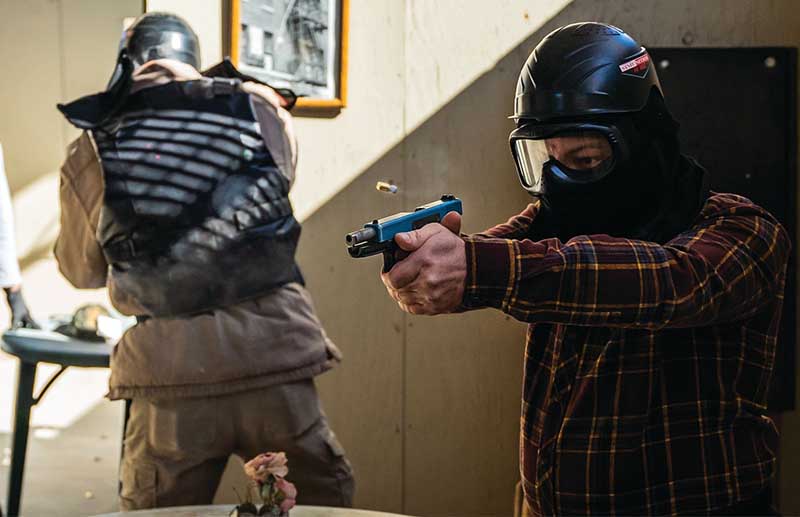
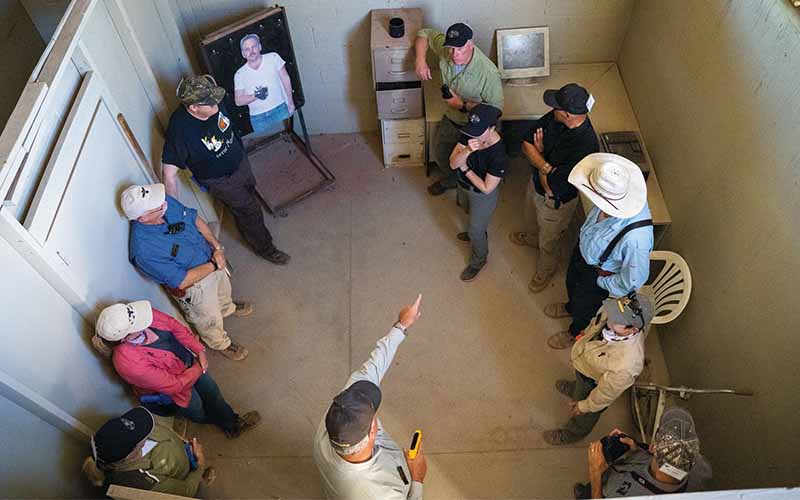
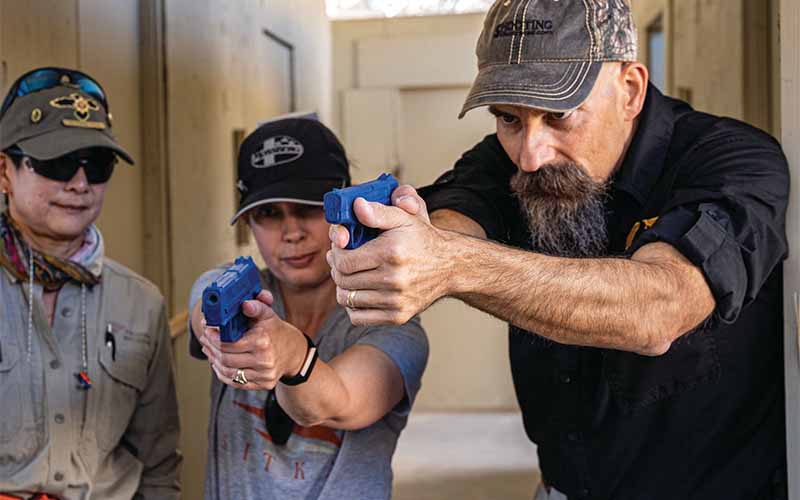
I recently got a chance to see precisely how useful code words can be during a shoot-house training session. Another class member was taken hostage and his partner, Gunsite Instructor Mario Marchman, had already drawn his blue gun. As everyone was shouting at each other, Mario said, “We are gonna figure this out, Mario.” On cue, the hostage dropped like a sack of bricks.
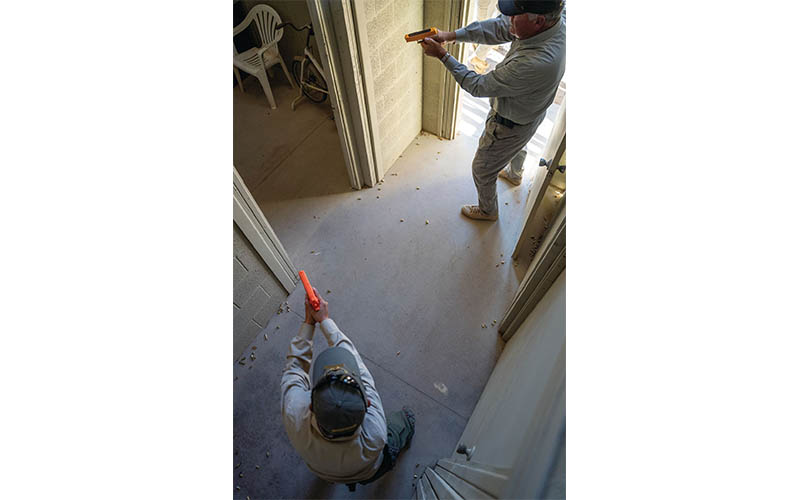
A Gunsite Instructor shows students from the Mossberg Team Tactics for Two how to split a room into two distinct areas of responsibility—and clear that room safely.
You see, the pair had worked out before that if they used their name to refer to the other, that was the signal to engage the wet-noodle defense. That slick little maneuver would’ve likely saved the hostage’s life.
Situation 1
What Would You Do: Holiday Invader
It’s the holidays, and your sister-in-law flew in to spend Christmas with your family. You, your spouse, and your two kids leave to finish some last-minute shopping, but Auntie J needs a bit of rest after a 12-hour flight from Ireland.
The shopping is finished and you drive the clan home to collect Auntie J for a dinner downtown. As you pull up, you notice the front door is wide open and you don’t see anyone, but you hear yelling inside.
What do you do?
My Take
Calling 911 and waiting on police might be a bad call with someone yelling inside. You and your spouse are both carrying; she calls 911 before you enter, making sure to give the dispatcher crucial information, such as the address and that you’re both legally armed. Your oldest stays on the phone with police and takes the youngest to the neighbor’s.
Sticking to your plan, you both enter the house and clear your way toward the yelling. You reach the yelling and your spouse turns the doorknob, flinging the door open. Auntie has been backed into a corner by a strange man holding a knife who turns toward you as the door hits the wall.
The intruder looks down and sees the gun pointed at his chest, his eyes widen and he drops the knife as his hands fly up in surrender.
Equip Yourself For Success
If you’re new to firearms training, taking some local classes is a great start and will help you get the most out of the block of instruction. The next step is to step up the quality of firearm instruction by either seeking out a traveling instruction passing through your area or making the trek to an established training facility.
Even if you have to take a team-based course by your lonesome, you get some really great information that you can bring back home and share with those you love. Most of the tasks covered might seem simple on the surface, but learning how to move together when getting clear of a threat is far more difficult than you might imagine.
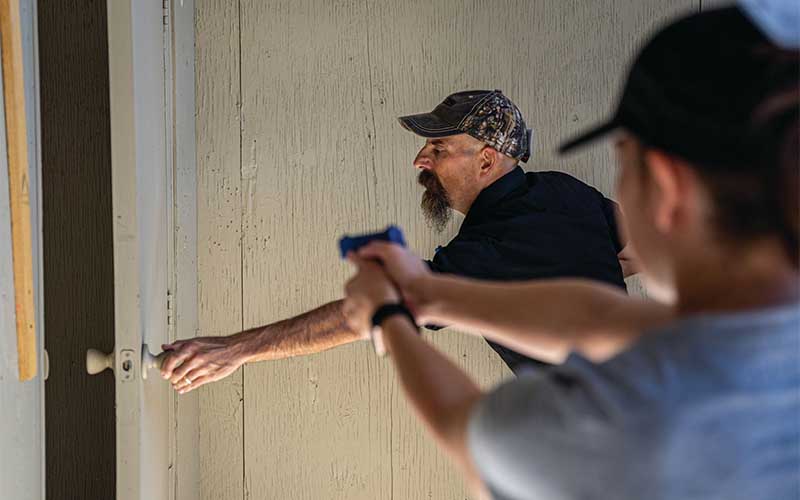
Tasks as simple as moving with a partner and maintaining a stable shooting platform are learned skills.
Even if you and your family have a good grasp on the basics, there’s no shortage of good info to be had; you might even discover a new technique that’s more efficient or tactically sound than what you’re currently doing.
Situation 2
What Would You Do: Meal and a Murder
You’re out to lunch with a gun-loving coworker at a little place near the office. You’re both enjoying your meals while talking about what you each have planned for the weekend. He’s planning on taking his son out to the lease for the first time, and you tell him about the USPSA match you’re registered in. You notice that the host is talking to a very angry man; they seem to know each other so you aren’t too alarmed.
Assuming that his reservation must’ve been lost, you go back to your conversation until you hear the man yell, “You knew she was married!” Both you and your coworker turn your attention to the angry man just in time to see him level a pistol at the host. You hear a gunshot; the host slumps to the floor.
What do you do?
How fast you enter a room, demonstrated by Gunsite Instructor Il Ling New, shouldn’t be a surprise to your partner. Practice until it becomes second nature.
My Take
A quick look around the restaurant makes your heart sink as you notice that there isn’t any way to get out of the building and to safety without being seen. You discretely draw your firearm and wait for the right moment—if the shooter doesn’t leave on his own, you might have to defend yourself in the blink of an eye.
A few tense seconds pass and you see the shooter start to swing the gun toward the rest of the patrons, and then directly at you. There’s no choice now; you place your sights a few inches below the base of his neck and pull the trigger once … twice … the shooter releases his grasp on the pistol and clutches his chest. He collapses to the floor, making no movement toward his pistol. As soon as you feel it’s safe, you and your coworker get out and call 911.
Attending formalized training can expose you to new techniques. You might not leave a better shooter right away, but you do get the tools to hone your performance over time.
Simunitions Teach Hard Lessons
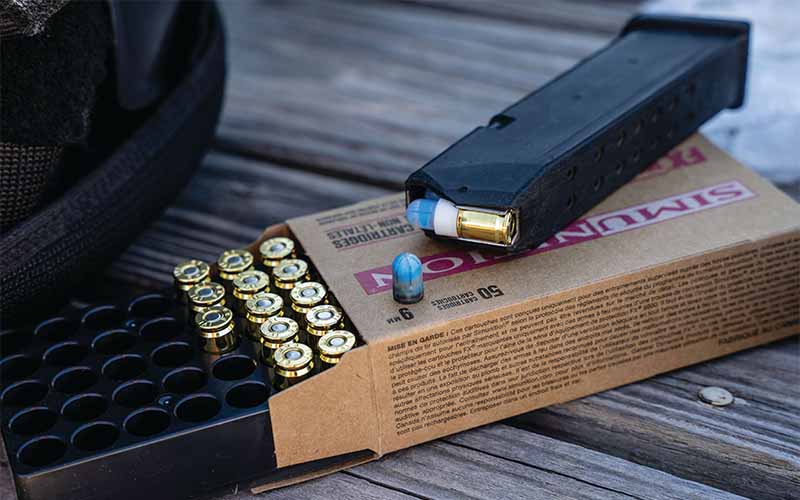
The flat range can only teach you so much. When you start incorporating things like blue guns and Simunitions, you add a while new dimension to your training experience. Blue guns have their place when doing dry runs, but there’s something unforgettable about running a scenario with Sim guns.
Beyond the obvious benefit of being able to safely pull the trigger with another human being in your sights; getting hit with one of those plastic bullets ensures that you don’t forget what you could’ve done better. Adding in the stress of a force-on-force component is an effective way to pressure test what you learned in a class.
While these little blue bullets might not look like much, they let you know when there was a lesson to be learned.
Practice Makes Perfect
The phrase, “Communication is the key to a happy and long life,” means a lot more than just talking to your spouse. Make a plan, stick to it and do dry runs often. The better you and those you surround yourself are equipped to deal with the unthinkable, the more likely you are to come out of your worst day with everyone you love intact.
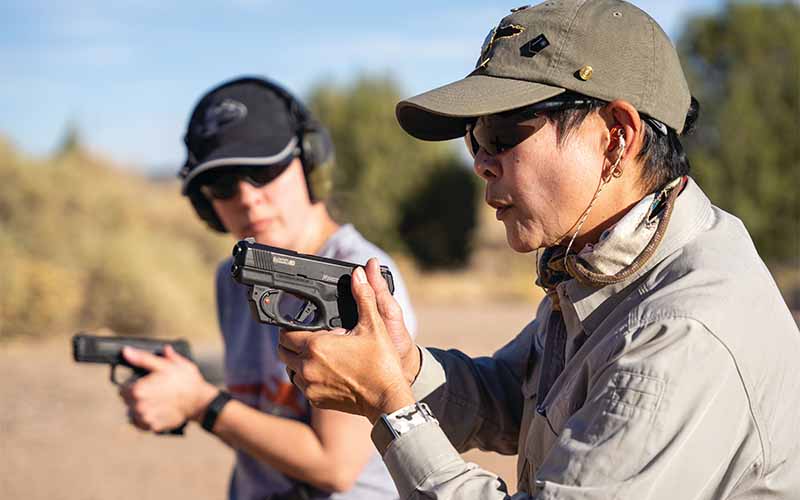
Gunsite CEO Ken Campbell shows a student how to refine her trigger press to wring the most out of her Mossberg MC2C pistol.
Most importantly, sign up for some training; every gun owner should make the pilgrimage to Jeff Cooper’s stomping grounds at least once in their lifetime. I bet that when you take that first class, you’ll be looking for what to take next before the course is even over.
Editor’s Note: This article originally appeared in the 2021 CCW special issue of Gun Digest the Magazine.
Rock River Arms has just released the All-Terrain Hunter, a new AR-platform hunting rifle designed for the modern hunter.
Rock River Arms is known for turning out ARs of all kinds for consistently reasonable prices. RRA’s lineup spans many different calibers and applications, but the company’s newest model was designed with the modern hunter in mind. Featuring a .223 Wylde chamber and an 18-inch stainless steel heavy match barrel, the Rock River Arms All-Terrain Hunter is ready to go the distance.
The .223 Wylde chamber allows the All-Terrain Hunter to safely fire both .223 Remington and 5.56 NATO ammunition, giving hunters a wider variety to choose from in the field. RRA also claims that the barrels undergo a special cryogenic treatment process that helps to ensure stability and accuracy even during a high volume of fire. Each All-Terrain Hunter barrel also sports a 1:8 twist, includes an RRA Operator muzzle brake and is guaranteed to produce ¾-MOA groups at 100 yards. The Rock River Arms Two-Stage Ultra Match Varmint trigger included with each rifle should help to improve practical accuracy as well.
Other features of the Rock River Arms All-Terrain Hunter include a lightweight, free-floated 13-inch M-LOK handguard, an adjustable RRA CAR buttstock with a cheek weld ideal for use with optics and a Hogue rubber pistol grip. The stock also has QD sling mount points and a watertight storage compartment.
Each RRA All-Terrain Hunter will include a plastic hard case, an owner’s manual and one 20-round magazine. MSRP is $1,425 and they’re available now.
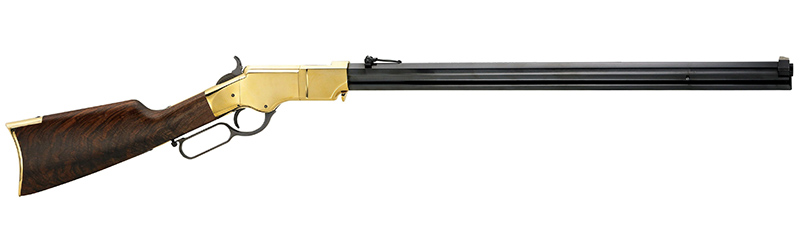
The history of Henry rifles is intrinsically tied to the taming of the American frontier, so let’s take a deeper look at the first commercially successful lever-action.
These days, rifles like the AR-15 have seduced the younger generation of gun owners, causing them to overlook the lever-action rifle’s versatility, simplicity and reliability. Lever actions aren’t just for old guys living out their John Wayne fantasies; they’re still very usable rifles in a practical sense, as well as being extremely fun to shoot.
Few rifle designs have been as impactful on American history as the 1860 Henry rifle. Seeing as it was the basis for the rifle that won the West, the Winchester 1873, Benjamin Tyler Henry had more of an impact on the United States expiation westward than he could have dreamed of. I doubt that when Henry watched the first 1860 Henry rifles leave the factory, he suspected that, 160 years later, his name would grace nearly 300,000 firearms a year.
The revival of the 1860 Henry brought some slight modernizations to improve the rifle. Today, it’s available in .44-40 WCF and .45 Colt.
That isn’t a result of the rifle’s initial success, but rather the impact the design had on Anthony Imperato, who partnered with his father, Louis, to bring the Henry name back to the firearm world in 1996. Since the first Henry H001 Classic Lever Action .22 LR rolled off the production line, over a million have made their way into the hands of nostalgic Americans. Sure, there isn’t a direct connection to Benjamin Tyler Henry, but you have to appreciate Henry Repeating Arms’ role in keeping the timeless lever-action design alive and well.
Without Henry, younger generations of shooters wouldn’t know anything other than AR-15s and the like. Attainable, American-made lever-action rifles ensure that today’s gun-loving youth won’t overlook the lever-action rifle’s versatility, simplicity and reliability. Nothing else seems to replicate the magic of a well-built lever-action.
The First Henry Rifle
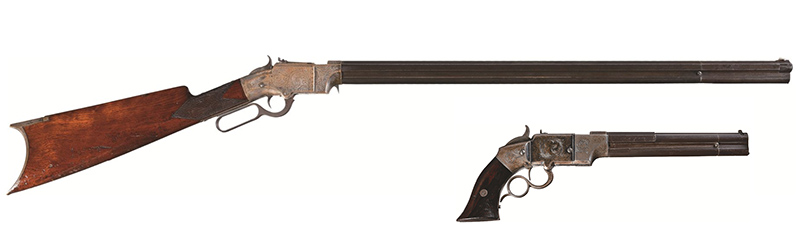
You can’t talk about Henry Repeating Arms without talking about the 1860 Henry Rifle; it did become the basis for virtually every rifle Winchester produced following it. The design actually dates back to 1848, when Walter Hunt built a couple prototypes of his revolutionary lever-operated rifle, but there were still some design issues that needed to be worked out.
Several other men tried their hand at improving the action, and it was finally produced in some volume by the Volcanic Repeating Arms company. Production at Volcanic lasted only a year with an unknown number of rifles built, when Oliver Winchester took over the company and reorganized as New Haven Arms Company, where Benjamin Tyler Henry put the final touches on what we think of the classic Henry rifle while working as plant superintendent.
A Smith & Wesson No.2 pistol and Volcanic rifle, both lever-action designs that predate Henry’s. Photo: Rock Island Auction Company.
With the improvements to the rifle and a brand-new cartridge, the .44 Henry rimfire, the 1860 Henry saw limited success with roughly 14,000 rifles produced.
Load on Sunday, Shoot All Week
Just because the Henry didn’t see the large-scale adoption the Spencer rifle saw shouldn’t fool you; Henry’s rifle makes appearances in some notable events in American history. Even President Abraham Lincoln was given a beautifully engraved gold-plated rifle, as was the Secretary of War and the Secretary of the Navy. The obvious goal was mass adoption of the Henry rifle, but New Haven fell short of their goal, with only 1,731 of the rifles being delivered to the U.S. Government.
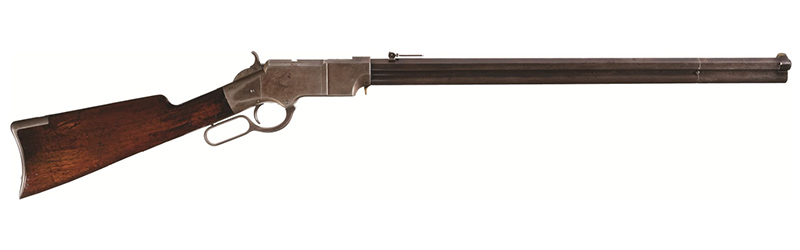
The first Henry rifles to be produced featured an iron receiver; the brass receiver didn’t make an appearance until later in production. Photo: Rock Island Auction Company.
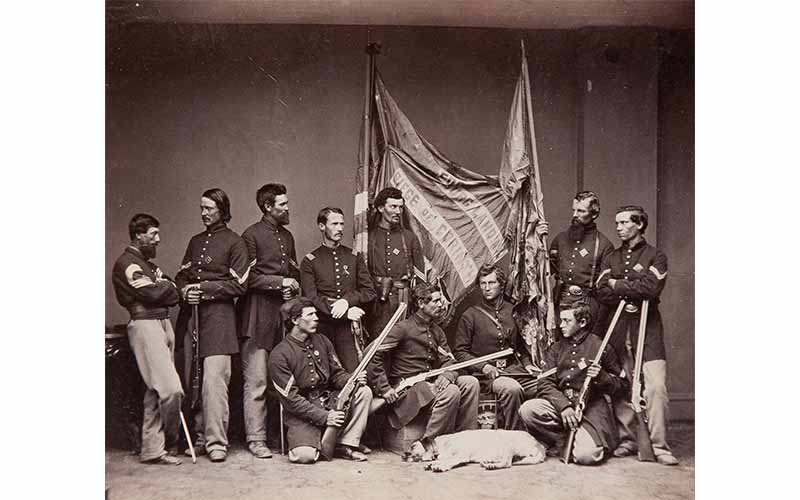
With such a small purchase, the Henry was never formally adopted, but more than 6,000 of the rifles ended up in the hands of Union troops who purchased them out of their own pocket rather than use the issued Spencer rifle. The Henry’s 15-round capacity made it particularly attractive to raiding parties, scouts and those assigned with flank guard duty.
When Confederate Colonel John Mosby referred to the Henry as “that damned Yankee rifle that can be loaded on Sunday and fired all week,” it was clear that Henry’s rifle had an impact. That all ended in 1866, when production of the Henry rifle ceased, and New Haven Arms was restructured again as Winchester Repeating Arms. The rifle would go on to be developed into the Winchester 1866, which saw a long, 33-year production run and wide-scale adoption with foreign armies and those seeking fame and fortune in the West.
The 71st Illinois Infantry Regiment color guard pose with their 1860 Henry rifles.
The Henry Name Is Resurrected
Once production of the 1860 Henry ended, the Henry name faded into obscurity until Anthony Imperato trademarked the name in 1996. Anthony and his father, Louis, set up a manufacturing facility in Brooklyn, New York, to produce the Henry H001 .22 rimfire lever-action 131 years after the last rifle to bear the Henry name came off the assembly line.
Since there isn’t any affiliation with Benjamin Tyler Henry or New Haven Arms Company, the company started by the Imperatos wasn’t really bringing a defunct company back, but rather the birth of a brand-new one that paid homage to an influential design.
With a blank canvas, Henry Repeating Arms has grown to a size that Benjamin Tyler Henry would’ve never even dreamed of in the mid 1800s, with no signs of slowing down. Today, Henry employs nearly 500 people and has over a quarter-million square feet of manufacturing space between their headquarters in Bayonne, New Jersey, and Henry’s second facility in Rice Lake, Wisconsin.
When the slogan “Made in America Or Not Made at All” was chosen, they weren’t playing around. Every Henry is born in the United States; there are no exceptions … ever.
Over a million .22 Henry lever actions have been produced since the model was introduced in 1997.
A Model for Every Need
With two facilities that you could pack over five football fields into, it shouldn’t be a surprise that their product lineup is pretty dang expansive. Boiling it down to the basic models without taking into account variations in barrels, finish and caliber, Henry has something like 12 models to choose from. That number jumps to 253 when you start adding in caliber, finish and other variations.
Even if you only have a cursory interest in owning a lever-action, there’s likely something in the Henry catalog that you’ll appreciate in their trademark brass finish, polished silver, black or my personal favorite option, case colored.
The Classic Henry H001 .22 Rifle
If you’re looking to scratch the Old West itch, there are few better choices than a Henry H001. Over a million have made it to the market as of 2017. Currently, the H001 isn’t offered in a side gate variant, and no plans to offer one have been announced. It isn’t hard to understand why when you take into consideration that the palatable $405 MSRP would increase quite a lot to offset the increased complexity of a side gate H001. That isn’t to say that it wouldn’t be awesome, because it would.
The rifle is chambered in .22 LR, but it’ll also shoot .22 Long and .22 Short … offering more versatility than a 10/22. The overall feel of the rifle is very retro, with adjustable buckhorn sights and American walnut furniture. Loading is done just like all Henry rifles, by removing a removable plunger tube from the magazine, sliding the rounds in and then replacing the plunger tube.
Variants ranging from the standard H001 to customized special editions are available; there’s no shortage of choices.
The Mare’s Leg Pistol
One of the more unique firearms in the Henry lineup is their Mare’s Leg, a lever-action pistol modeled after Steve McQueen’s character on the late ’50s TV show Wanted: Dead or Alive. The pistol is available in .22 Long Rifle, .22 Magnum, .357 Magnum, .44 Magnum and even .45 Colt. Unfortunately, the Mare’s Leg isn’t offered with Henry’s new side gate, but that’s bound to happen sooner or later.
Henry Big Boy Rifles
Like the first lever-actions, the Henry Big Boy rifles are chambered in what ends up being an intermediate cartridge. Offered in .357 Magnum, .44 Magnum and .45 Colt, the Big Boy might be an ideal option if you’re looking for a rifle that shares the same cartridge as your revolver.
Listening to their customer base, Henry added a side loading gate to their rifles in April of 2019.
While you might think you need a .30-30 Winchester or even the Long Ranger to take medium game, the Big Boy will do it in a handier package with less recoil. The .357 Magnum case color is a personal favorite, with a 125-grain out of a 20-inch barrel performing very similar to a 7.62x39mm or .300 Blackout in a carbine.
A Big Boy might even be a great choice for a defensive rifle should you live in a restrictive area, or if you feel more comfortable with a lever gun than a semi-auto.
Large-Caliber Lever-Actions
Henry’s large-caliber lever actions are very similar to the Big Boy rifles—they’re just chambered in .30-30, .45-70 Government, .38-55 Winchester and .35 Remington.
The large-caliber rifles were the first to be updated with the new side gate and maintain the removable plunger, should you prefer to use the tube to load rather than the side gate. The ability to remove the magazine tube plunger means that downloading your rifle after a hunt won’t put unneeded wear on your ammunition. Options aren’t a bad thing sometimes.
Pump-Action Rimfire, The Long Ranger & Shotguns
If your particular brand of nostalgia is reliving those times at the fair with a pump-action .22, the Pump Action Octagon might be what you need. Sadly, there aren’t any other pump-action rifles in the Henry product line.
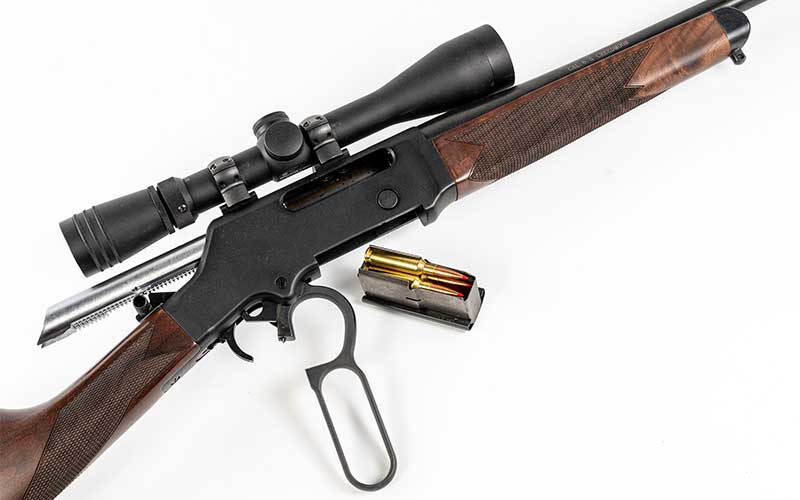
How about something for hunting longer ranges than a .30-30 Win. is capable of? The Long Ranger is aptly named—it’s chambered in .308 Winchester or 6.5 Creedmoor. Since the ammunition wouldn’t work so well in a tube magazine, Henry fitted this rifle with a detachable box magazine, and the rifle’s mechanism is significantly different than the rest of their line because it relies on a rotating bolt. As weird as it sounds, the idea of a 6.5 Creedmoor lever action can be appealing due to its uniqueness.
If you’re looking to shoot past 150 yards, the Henry Long Ranger is well suited in .308 Win. or 6.5 Creedmoor. The detachable magazine allows it to be chambered in cartridges using a spire-point bullet.
The lineup gets a bit weird when we look at their shotguns: Not only does Henry offer 12- and 20-gauge single-shot break actions, but they also offer a lever-action .410 shotgun based off the large-caliber lever-action rifle, as well as the Lever Action Axe. The Axe is a non-NFA firearm and, like all their lever-action .410 shotguns, it features a side gate loading port.
New Original Henry Rifles
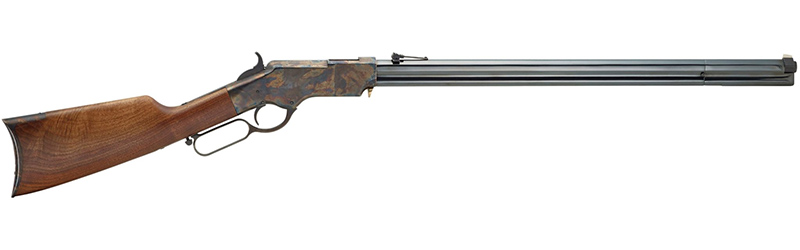
The most coveted of Henry rifles is, without a doubt, the New Original Henry Rifles. Carrying an MSRP of $2,590, it might seem like they’re priced crazy high when compared to the rest of the Henry line, but that changes the second you realize a New Haven produced 1860 Henry rifle will set you back about the same money as a brand-new Porsche 911.
If you want an 1860 Henry you can actually enjoy on the range, the Henry New Original Henry is the ticket.
Modernized X Models
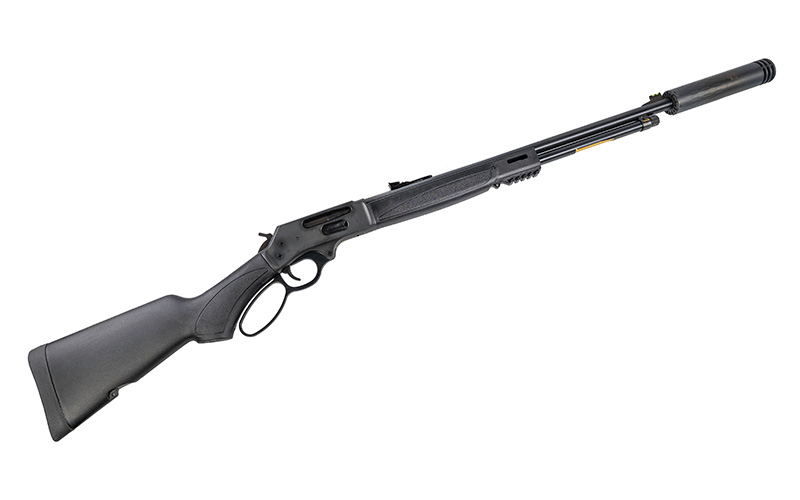
In an effort to bring the lever action into the 21st century, Henry introduced the X Model with the features that a younger-generation shooter might look for, such as M-Lok slots and a rail to mount a bipod or flashlight. The biggest benefit is the fiber-optic sights and the threaded barrel. With suppressed hunting legal in many states, the ability to add a can is a welcome option.
The Model X features M-Lok slots, Picatinny rail, threaded barrel, fiber-optic sights, enlarged lever loop and synthetic furniture.
Integrated sling mounting points, a side gate loading port and synthetic furniture make the X Model a workhorse that’s sure to serve someone for decades.
What does the future hold for Henry Repeating Arms? Well, those secrets are kept locked up pretty tight, but hopefully a wood-stocked variant of the X Model is on the books. Whatever the case, the Henry brand is here to stay for generations to come.
Editor’s Note: This article originally appeared in the 2021 USA special issue of Gun Digest the Magazine.
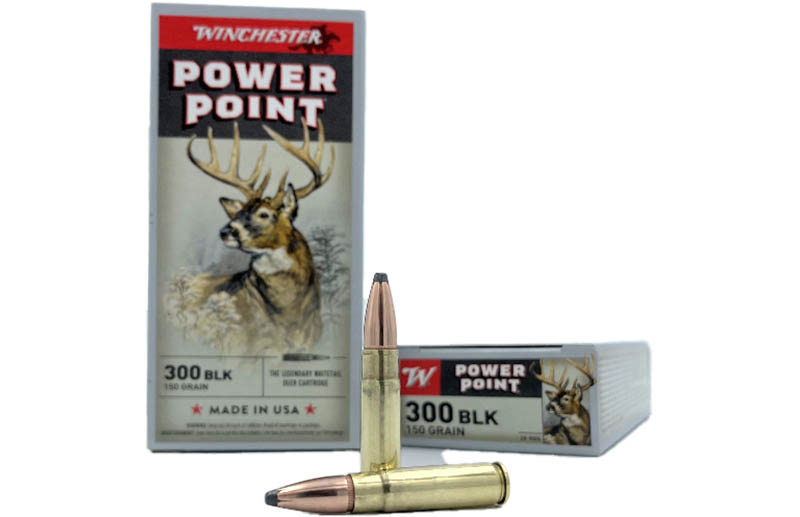
Winchester has just added 300 Blackout to its Power-Point ammunition line, featuring a 150-grain expanding projectile.
Winchester claims that its Power-Point ammunition line features one of the company’s most versatile projectiles. Power-Point bullets have been reliably used by hunters for decades in other calibers, but now 300 Blackout shooters have the option to as well.
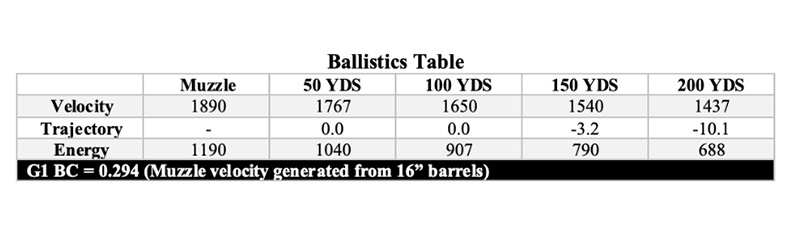
In 300 Blackout, Power-Point ammunition is loaded with a 150-grain projectile with a traditional cup-and-core design. The reliable expansion and simple construction of this design makes it ideal for hogs, deer or even black bear. Winchester advertises the new ammo as having a muzzle velocity of 1,890 fps when measured from a 16-inch barrel, and while this means that it isn’t subsonic, it should provide better expansion for hunters.
Ballistics table for Winchester’s 300 Blackout Power-Point ammunition.
Winchester has stated that 300 Blackout Power-Point ammunition is shipping to dealers now and should be on store shelves soon. While an MSRP is not yet available, this excerpt from the press release implies that it will be reasonable relative to the average price of 300 Blackout:
It also is a simple and more cost-effective design, which is attractive to high-volume hog hunters or those who want to get in plenty of practice at the range without breaking the bank.
Despite recent rule changes, building “ghost guns” is still legal and nothing to be spooked about. With an 80 percent lower, some tools and elbow grease, you too can own an unserialized firearm.
There are a lot of myths and misconceptions around what are commonly called “ghost guns.” Practically speaking, a “ghost gun” is just a homemade firearm that uses conventional firearm parts.
Let’s talk about what they are, the different kinds out there, the current legal status surrounding them and finally some 80 percent lower receivers and frames that are well worth the look.
What Is A Ghost Gun? What’s An 80 Percent Receiver?
Ghost gun is a colloquial term that refers to unserialized, homemade firearms that are built using commonly available firearm parts. They differ from “zip guns,” since zip guns are improvised firearms made from…well, anything.
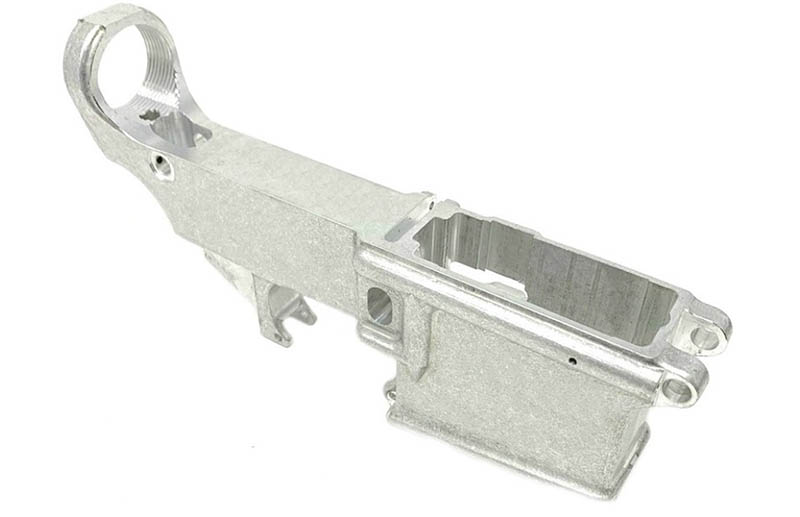
An 80 percent lower receiver is not a legal term, it’s another colloquialism that refers to partially finished receivers that are not yet classified as firearms under the ATF’s definition.
Here is how the ATF (or more properly, BATFE) defines 80 percent lowers:
receiver blanks, castings, or machined bodies in which the fire control area is completely solid and un-machined have not yet reached the stage of manufacture which would result in the classification of a firearm under the GCA of 1968.
The Gun Control Act of 1968 defines a receiver as the part of the gun that “provides housing for the hammer, bolt or breechblock, and firing mechanism.” In other words, a gun isn’t legally a gun until you can install the firing mechanism. There are some wrinkles to this due to recent ATF rule changes we’ll get to in a moment.
The GCA also states that homemade firearms (excluding NFA items) are legal for unprohibited persons to make, possess and shoot, so long as they are made for personal use.
80 Percent Kits
The term ”80 Percent lower” implies that only 80 percent of the receiver’s manufacturing has been completed. The actual figure isn’t easily calculated, but the 80 percent name stuck regardless of how accurate it is.
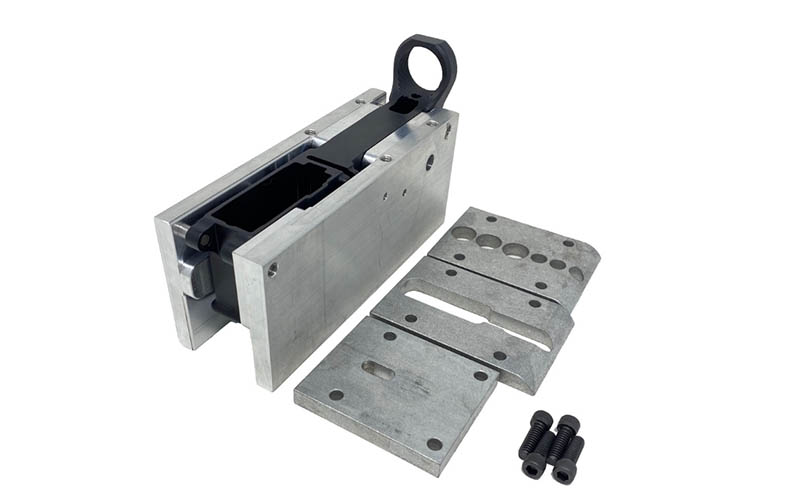
The most common “80 percent kits” are receiver blanks for either Glock clones or AR-15s. To complete each respective build, one must finish the lower receiver or frame then install the firing system and the upper or slide. When sold as “kits,” they typically also include the other necessary hardware, parts or jigs required for the building process.
Other firearms designs can have different 80 percent kits and finishing processes, but Glock clones and AR-15s are the most common and some of the simplest to complete.
Why Would You Want An 80 Percent Kit?
Some people want a legally untraceable firearm for ideological reasons. Others want to skip having to fill out a 4473.
Some just enjoy the challenge of building their own gun and gain satisfaction from seeing it work. A lot of people get hooked on building AR-15s after they put their first one together, so an 80 percent kit would be the logical next step to challenge one’s builder skills.
After all, the vast majority of gun owners are normal, law-abiding people. They aren’t trying to make a weapon to commit crimes with. Most people who dabble in building their own guns choose to do so simply because they find it interesting.
It’s also a lot cheaper hobby than building cars.
Are 80 Percent Kits Legal?
Some state regulations have been enacted requiring a receiver or certain “firearm precursor parts” to have a serial number. Such laws exist in California, Colorado, Connecticut, Hawaii, Illinois, Maryland, New Jersey, New York and Washington state.
The Biden administration has also enacted a rule—meaning a decision on how to enforce the laws on the books—stating that “buy, build, shoot kits” are considered firearms since they can be used to assemble a working gun.
The new rule, Final Rule 2021R-05F, was signed into policy by Attorney General Merrick Garland, to take effect on August 24th, 2022. It amends the definitions of the Gun Control Act of 1968, expanding the definitions of a receiver, among other things.
The definitions in Chapter 27, Subsection 478.12 of the Gun Control Act add the distinction that a frame or receiver includes a “partially complete, disassembled, or nonfunctional frame or receiver, including a frame or receiver parts kit, that is designed to or may readily be completed, assembled, restored, or otherwise converted to function as a frame or receiver.”
However, the rule clarifies that “…the terms shall not include a forging, casting, printing, extrusion, unmachined body, or similar article that has not yet reached a stage of manufacture where it is clearly identifiable as an unfinished component of a weapon.”
In other words, if it’s in striking distance of being completed, it will now be considered a receiver and must be serialized and requires a background check to purchase.
As for kits, “…the Director may consider any associated templates, jigs, molds, equipment, tools, instructions, guides, or marketing materials that are sold, distributed, or possessed with the item or kit, or otherwise made available by the seller or distributor of the item or kit to the purchaser or recipient of the item or kit.”
The ATF further clarifies that a “partially complete billet or blank of a frame or receiver with one or more template holes drilled or indexed in the correct location is a frame or receiver.” (Emphasis added.)
So what does this mean?
An unfinished receiver that has had enough meaningful finishing work performed on it to be easily completed will now be considered a receiver. There’s a point at which it isn’t a blank anymore, and while the rule defines the presence of holes being the indicator, it doesn’t spell out much beyond that.
Kits that include jigs, tooling, instructions and an unfinished lower may be designated receivers and/or firearms if they can be readily made into a firearm. Shipping the kits in multiple packages does not circumvent the regulation.
In other words, kits become the “buy, build, shoot kits” when they are easy enough to complete, but precisely how “easy” has not yet been fully defined.
What it ultimately means is that 80 percent lowers, receivers and frames are currently in limbo until the ATF starts to clarify how to remain compliant with 2021R-05F. Manufacturers and retailers are likely to designate them “out of stock” in the meantime, but some may decide to keep selling them until instructed otherwise by the ATF.
Right now, the ball is in the ATF’s court to give the industry more clarification. Even when that day comes, it may all be for nothing, as the recent Supreme Court ruling on WEST VIRGINIA ET AL. v. ENVIRONMENTAL PROTECTION AGENCY ET AL. may have sweeping ramifications for the ATF’s “rule-making” abilities.
In short, this recent rule change does not ban 80 percent lowers or restrict one’s ability to build unserialized firearms at home. What it does do is add more confusion to an already complicated situation. Until the dust settles, manufacturers and sellers of so-called ghost gun style receivers and kits will have to tread more carefully to ensure they remain in compliance. The most likely result will be the prohibition of kits that include things like jigs and a reduction in how much an 80 percent lower can be finished while still being sold without a serial number. Available options will certainly be more limited as the industry attempts to sort this all out.
Different Kinds Of 80 Percent Lowers, Receivers And Frames
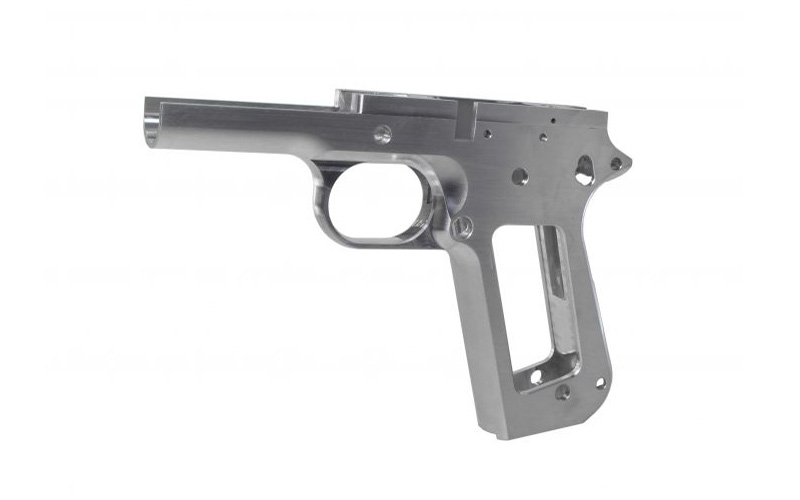
When it comes to 80 percent pistol frames, the most popular by far are polymer build kits that accept Glock components and uppers. Some kits for 1911 pistols exist as well.
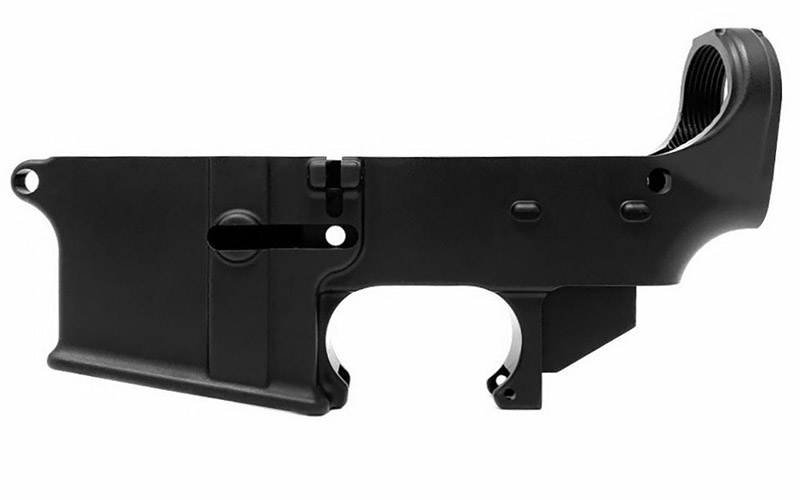
As for rifles, 80 percent lowers for the AR-15 and AR-10 family (including DPMS and Armalite pattern) are the most common. AK receiver blanks and a small number of Galil, FAL, G3 and other rifle receiver blanks are all out there too.
An 80 percent Tantal AK receiver blank from Childers Guns.
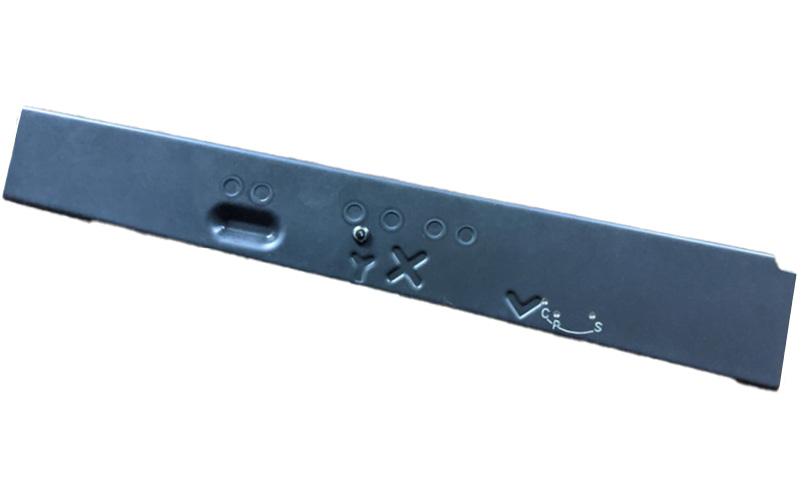
While polymer frames are fine for Glock clones, polymer 80 percent lowers for the AR-15 should be avoided, as the only polymer AR receiver worth considering is the KE ARMS KP-15 which doesn’t have an 80 percent option. While harder to work with than polymer, aluminum AR receivers are still the way to go. Receiver blanks for older rifle designs like AKs are almost always stamped steel, but some milled steel options exist too. Keep in mind that different materials will require different tools to finish, so take that into account before starting a build.
Regardless of the type of gun you plan on building, when it comes to unfinished receivers and frames, make sure to buy one that’s made from the appropriate material and is from a reputable manufacturer.
80 Percent Lower, Frame And Receiver Buyer’s Guide
Note: As discussed above, the current legal situation regarding 80 percent lowers is very tumultuous. Some of the entries here may not be available at the time of publication, but the buyer’s guide will be amended as the new rule becomes more clear and the market more stable. Until then, here are three worth looking at.
Right To Bear AR-15 80 Percent Lower
Right To Bear AR-15 80 percent lowers are mil-spec style, with a fenced magazine release and standard magwell. Their receiver blanks are forged (and heat-treated) 7075 aluminum.
To complete the lower, one must machine the trigger and safety wells. Jigs and tools are sold separately but are offered by Right To Bear as well.
You can get yours in the raw, anodized black or even Cerakoted. Right To Bear will also engrave and serialize your receiver blank for a fee.
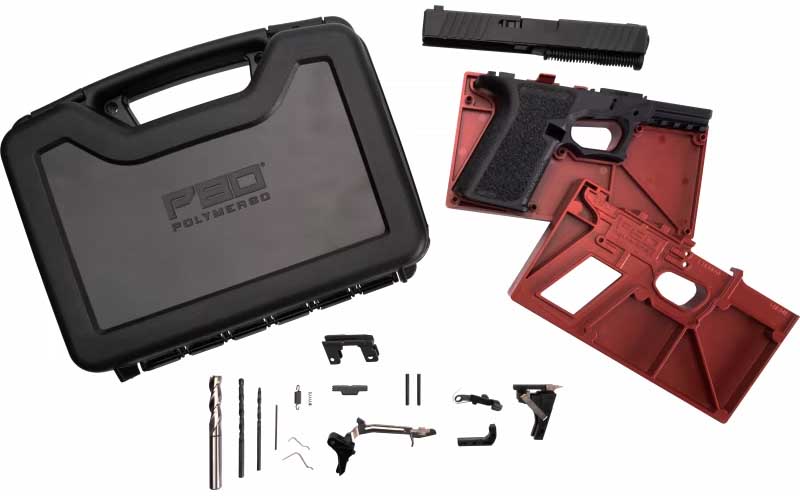
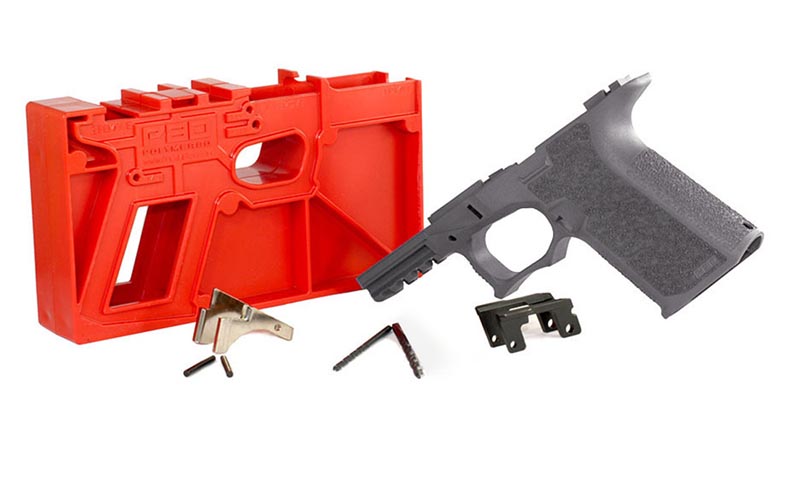
Polymer80 made the term “80 percent kit” popular. In fact, most Glock clones with non-OEM frames get theirs from Polymer80. Holster support—which is important—is decent for Polymer80 frames too.
PF940C kits are for a Glock 19/23 Gen 3 clone, with some other sizes available as well.
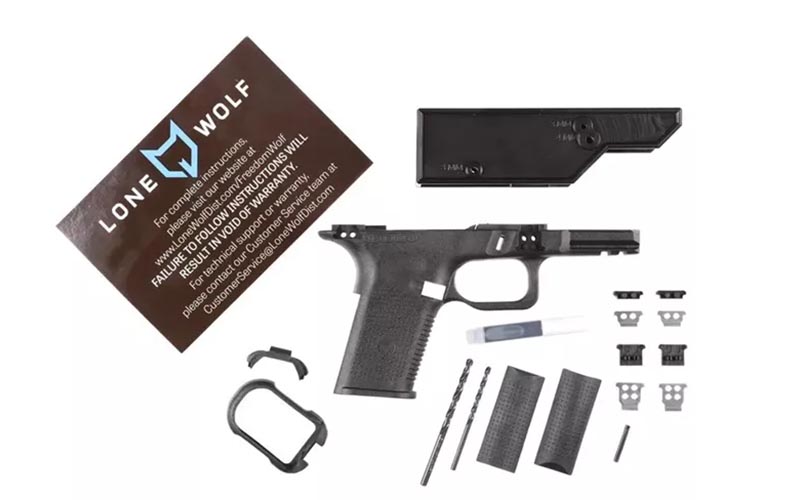
The grip has a straighter, more neutral rake for a more 1911-like feel, and a Picatinny rail. The kit comes with the unfinished frame in black, FDE or gray, and a jig to make all the necessary cuts and drill all the necessary holes.
Lone Wolf Distributors Freedom Wolf 80 Percent Kit
The Freedom Wolf is the 80 percent kit version of the Lone Wolf frame, long considered the best budget-friendly kit for Glock clone builds. It uses Gen 3 Glock parts and retains enough of the Glock trigger guard shape to be used in many Glock holsters.
The kit comes with the receiver blank, completion jig and other tooling, rail caps, backstraps and even drill bits for completing the build.
However, at the time of this writing, Lone Wolf is winding down any sales of the Freedom Wolf kits to comply with the ATF’s ruling. However, the Freedom Wolf may be resurrected as a build-your-own kit that’s serialized.
Volquartsen has just released the ENV-HMR, the company’s newest rimfire pistol now chambered for .17 HMR.
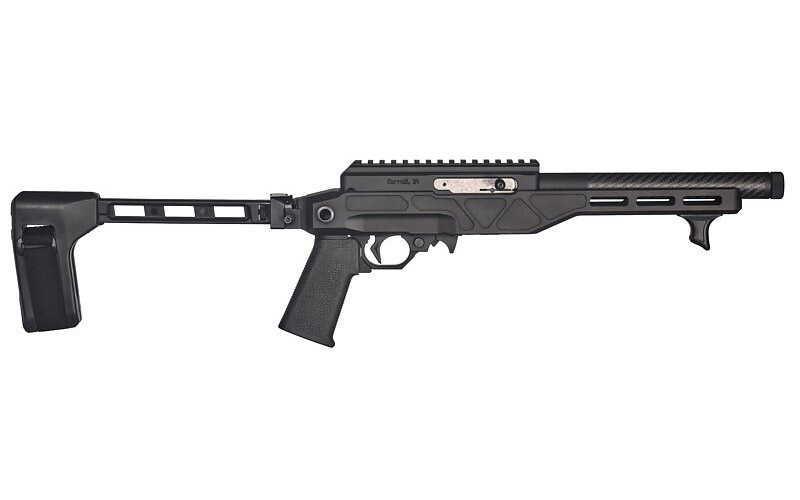
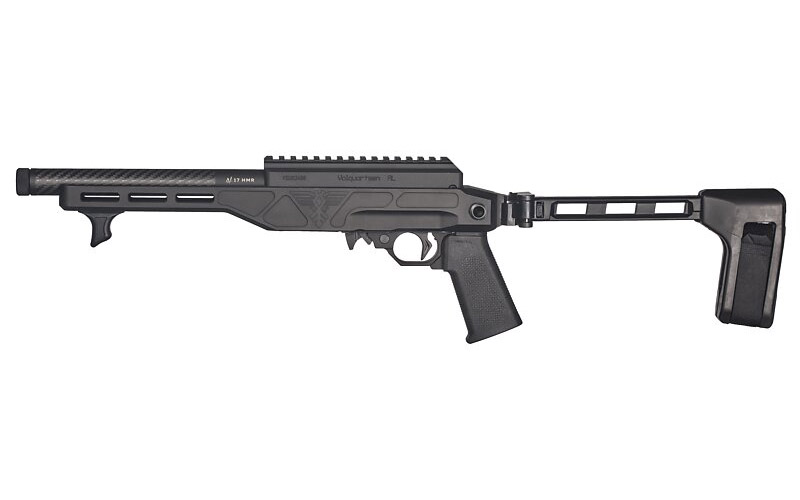
Volquartsen turned some heads in the rimfire world last year when they announced the ENV pistol in .22 LR. While the company was no stranger to high-end rimfires, the ENV was the most tactical model offered by the company to date, including features like a folding pistol brace, a threaded muzzle and an optics-ready receiver. Following its success, Volquartsen has just announced the expansion of the line with the ENV-HMR pistol chambered for .17 HMR.
This compact rimfire pistol line was designed for pest control, hunting small game and plinking at the range. While the previous .22 LR version already excelled at all three tasks, the new ENV-HMR provides even better ballistics for taking game and shooting at distance thanks to the .17 HMR chambering. It features an integral Picatinny rail for mounting optics, a lightweight 9-inch barrel that’s threaded 1/2×28 and a DEEP SIX Chassis by ENOCH with an SB Tactical folding arm brace. Each pistol also features a Magpul MOE-K grip, a Slate Black Industries hand stop and a TG2000 trigger group.
Volquartsen Product Development Specialist Kolby Pavlock said this about the new pistol:
Expand Your Knowledge on .17 HMR
Discovering the Best .17 HMR Rifle – Top Picks for Accuracy and Performance
Exploring .17 HMR Velocity – Understanding Its Speed and Performance
Following the success of the 22 LR ENV it was time to step it up a notch. The ENV-HMR does exactly that – more energy, more firepower. The ENV-HMR offers 17 HMR ballistics in the same compact ENV configuration. It’s as versatile in the field as it is fun on the range.
Each Volquartsen ENV-HMR is built to order, so expect some lead times, but they are available now. MSRP is $1,781.
Rock Island Auction Company has a Premier Auction planned for the weekend of August 26th, and the catalog includes some interesting pieces from the Old West to the silver screen.
Rock Island Auction Company auctions always feature a wealth of interesting firearms, and the RIAC Premier Auction planned for the upcoming weekend of the 26th is no different.
RIAC was kind enough to give me a virtual tour of the auction floor this week, so we’ll be showing off some of the coolest items they have on display. Whether you’re a serious collector looking to bid or just enjoy perusing rare, historical and sometimes very expensive firearms, here are a few highlights.
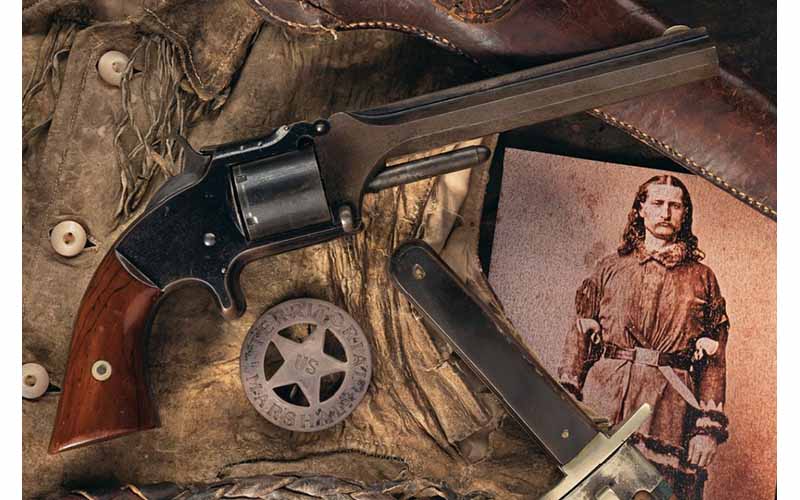
Wild Bill Hickok’s Smith & Wesson Model No. 2 Old Army Revolver
Wild Bill Hickock is an Old West legend, and his supposed favorite sidearm, the S&W Model No. 2 Old Army Revolver, was legendary as well. This particular model coming up for auction includes documentation that supports its previous ownership by Hickock. The revolver itself is rather plain, featuring a standard blued finish, 6-inch barrel and rosewood grips, but because of its provenance, it’s estimated to demand a minimum of $150,000.
RIAC also mentioned that this auction may feature one of the most significant collections of Colt Single Action Armies they’ve ever sold, so if the Old West collectors come out in droves, Wild Bill’s gun may sell for even higher than that.
Lara Croft: Tomb Raider H&K USP 9 Match Pistols
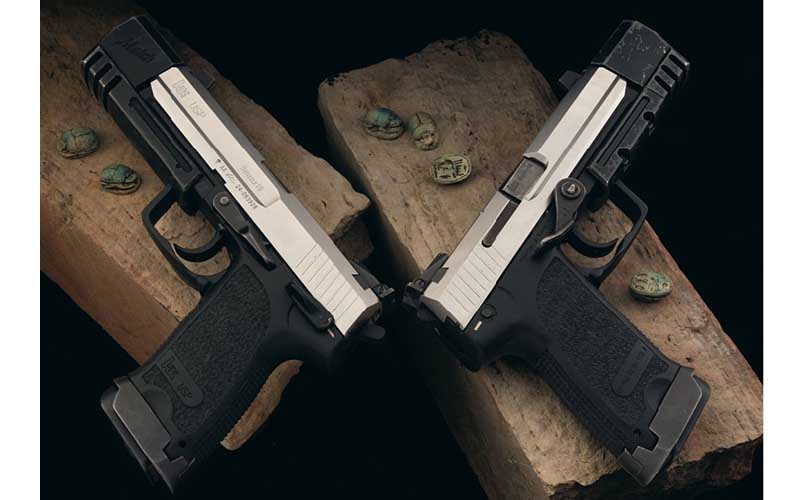
These matching H&K USP 9 Match pistols were the main “hero guns” used by Angelina Jolie in the 2001 film Lara Croft: Tomb Raider. While the film itself may not have the same cult following as Star Wars, iconic movie weapons are always desirable, especially if they can be identified as the primary examples used on screen. That’s the case with these guns, which is why they’re expected to bring a minimum of $25,000 at auction.
These two H&Ks are identifiable not only by their sequential serial numbers but also through the unique modifications that were made to allow the actress to effectively dual-wield them. Both come with barrels modified to only allow the firing of blank cartridges, but they could presumably be reverted to fully functional states with new barrels.
Han Solo’s Heavy DL-44 Heavy Blaster From Star Wars: A New Hope
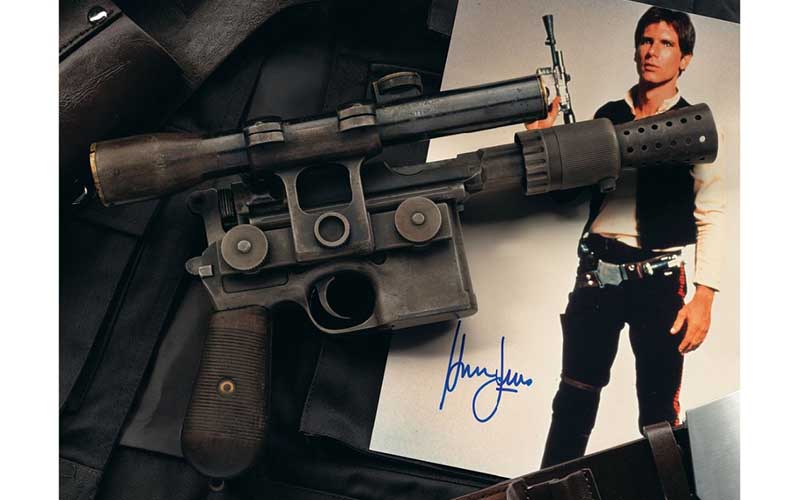
Undoubtedly the most iconic firearm featured in this auction is Han Solo’s blaster from the first Star Wars film. Throughout the original trilogy alone, there were several DL-44 blaster props produced for Harrison Ford to use on screen. This means that some DL-44s are more special, and therefore more valuable, than others.
Because the example in question can be traced to the original 1977 film and is made from a real Mauser C96, it is arguably the most desirable model to come up for sale. A replacement DL-44 prop made for Return Of The Jedi sold for $550,000 at auction in 2018, so this one may very well sell for an even higher price. Like the Tomb Raider pistols, this C96 was also modified to only fire blanks.
This upcoming RIAC Premier Auction will be held from August 26th to the 28th, and bidding is possible both online and in person. It’s worth noting that if you live near RIAC, it may be worth dropping by before an auction even if you don’t plan on buying anything.
The show floor is open to the public and is set up in a similar way to a museum exhibit, with the most noteworthy displays featuring information alongside them. From historically significant pieces to experimental designs, movie props to transferable machineguns, the RIAC catalog will never fail to make you drool.
If you’re interested in participating in the auction, more information can be found at rockislandauction.com.
There’s an argument to be made that the do-all .45-70 Government is America’s rifle cartridge.
It all started in 1873. That’s the same year that the two guns that won the West—the Colt Single-Action Army and the 73 Winchester—were introduced. As iconic as both of those guns are, both failed the test of time.
Something else that was introduced in 1873 survived, and that’s the .45-70 Government cartridge. Originally developed for the Trapdoor Springfield and even used in some military Gatling guns, the .45-70 is arguably the metallic cartridge that best represents America.
This new subsonic offering from Hornady utilizes a 410-grain bullet that’ll expand at subsonic impact velocities.
I know what you’re thinking: What about the .30-06 Springfield and the .45 ACP? Admittedly, both are iconic American cartridges that served veterans abroad in two World Wars. But neither have been around as long as the .45-70, nor have they bridged the gap from black to smokeless powder. When it was introduced, the .45-70 was loaded with a 405-grain .458-caliber bullet and 70 grains of blackpowder to a muzzle velocity of about 1,400 fps. The cartridge got its name from its caliber and charge-weight of blackpowder.
Marlin chambered their 1881 lever-action rifle for the .45-70, and that would ultimately be the platform where the cartridge found its longevity. Interestingly, between about 1930 and 1970, the .45-70 appeared to be headed toward extinction. By the standards of that time, its ballistics were underwhelming.
But something kind of magical occurred: As the cartridge’s centennial was approaching, three new .45-70 rifles hit the market. Harrington & Richards introduced it in a replica trapdoor, Ruger introduced it in their No. 1 single-shot, and Marlin began offering the .45-70 in their 1895 lever action.
The Government Afield
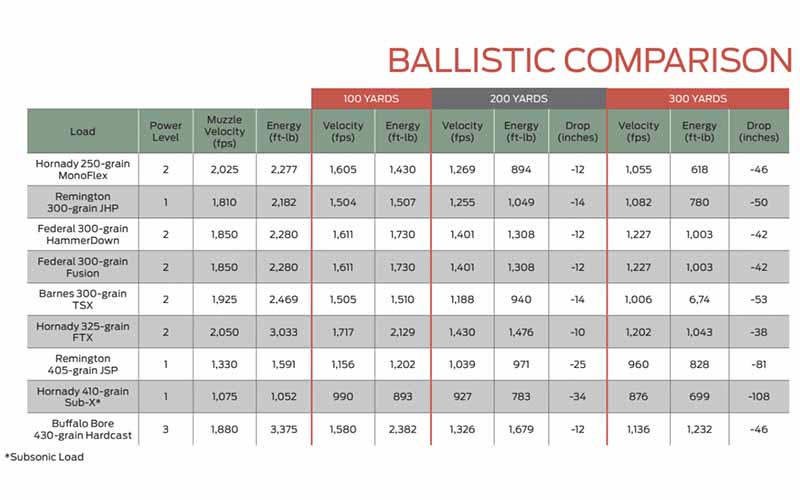
Something else very important happened, too; the stronger actions of the Ruger and Marlin could handle more potent .45-70 loads. Today, what you effectively have are three power levels of ammunition for the .45-70 Government.
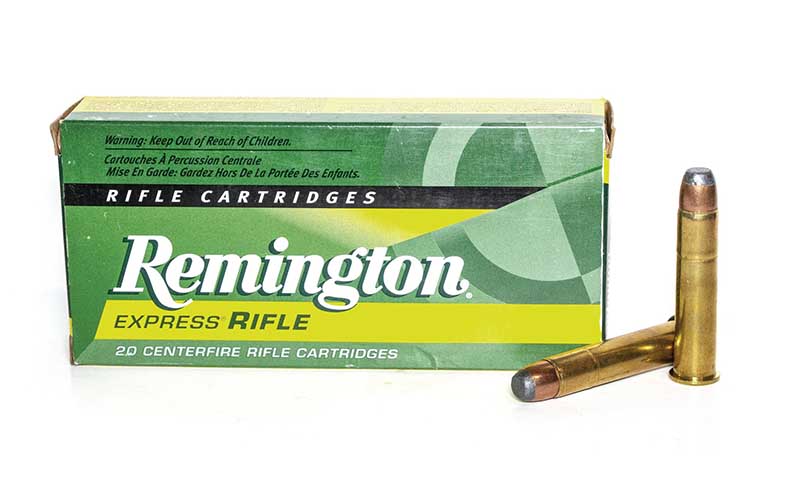
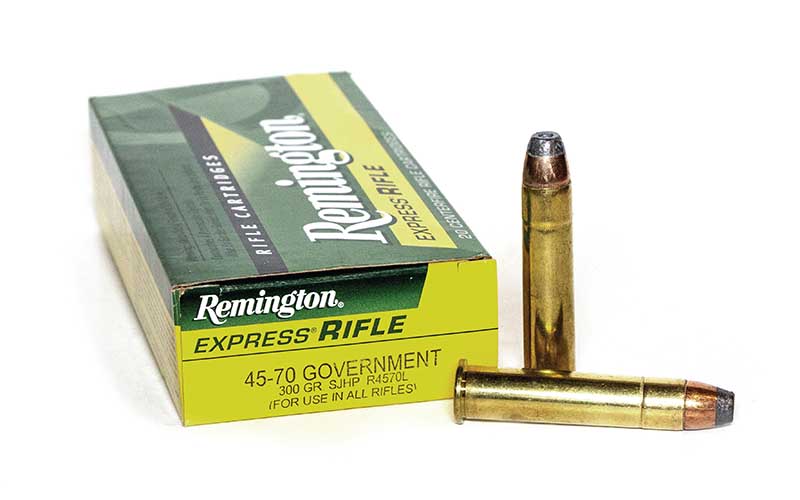
Remington’s 405-grain JSP .45-70 load is a power level 1 offering, ideal for older .45-70 rifles with weaker actions.
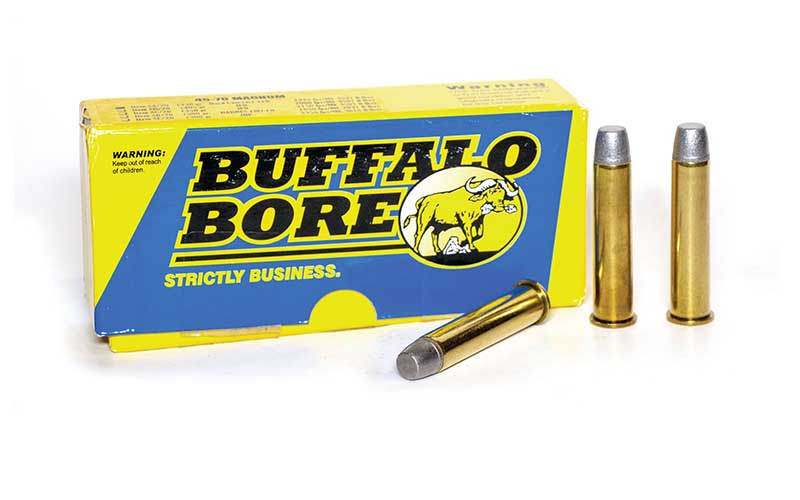
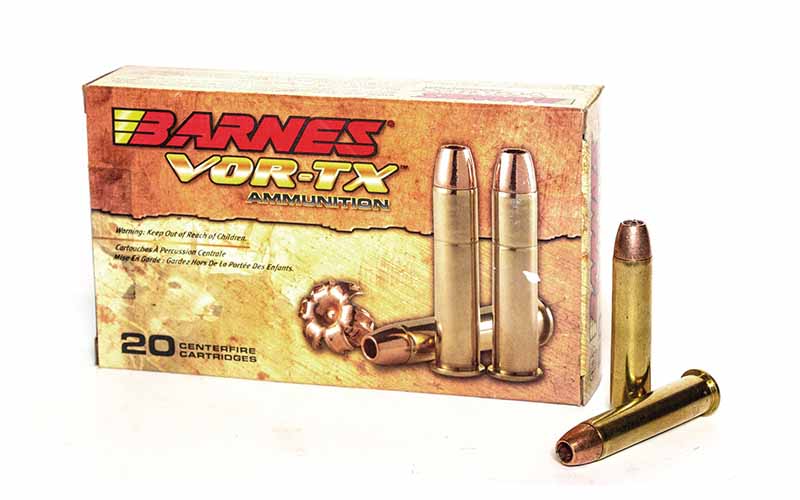
While the rather anemic Remington 405-grain flat-point load represents the maximum safe load in the older guns, the Barnes VOR-TX 300-grain TSX bullet, at almost 2,000 fps, represents a midrange load. And, at the top level of .45-70 performance, you have the Buffalo Bore 430-grain hardcast load at about 1,900 fps. At each level, there are similar loads from other manufacturers, making the .45-70 suitable for anything walking planet Earth.
For the biggest and baddest of critters, this power level 3, 430-grain hardcast load from Buffalo Bore is the optimum choice.
Black bear are typically hunted with hounds or over bait, and both methods don’t require long-range shots. What they do require is a hard-hitting cartridge that’ll incapacitate a black bear—fast. Houndsmen don’t want an injured black bear coming down a tree and tangling with their dogs, and those hunting over bait, typically in thick cover, don’t want to head into that thick underbrush looking for a wounded black bear. Mature black bears generally range in size from 150 to 450 pounds, and given these short-range conditions, the base level .45-70 loads are ideal for the job.
In 2013, I went to Alberta to hunt black bear and carried one of the first Marlin 1895 SBL lever actions in .45-70 Government. On the second day of the hunt, I found myself perched about 25 feet up a spruce tree, looking over a bait site where a dead beaver was hanging. About an hour before dark, a hulk of a black bear came creeping in. I made a plan to shoot him when he stood up to grab the dead beaver, but this guy was bait-site savvy. In one swift motion, he raised up, crunched down on the beaver and turned to run, full out for the cover of the dark timber.
My rifle was outfitted with XS Sights, and I tracked the bruin for about 10 yards. When the white front post found his shoulder, I pressed the trigger. The bear somersaulted forward and piled up in a wad. Range to target was about 35 yards, and the 300-grain Remington bullet passed through the top of the 300-pound bear’s heart and exited on the opposite side.
For hunting deer, hogs and bear at short range, and even for self-defense applications, Remington’s 300-grain power level 1 hollow-point load is a great choice.
That same summer I found myself in the grassland swamps of Mozambique with the same rifle, hunting African buffalo. However, this time my Marlin was stoked with much more powerful ammunition. As it turned out, I didn’t shoot the buffalo as well as I shot the bear. A bad first shot resulted in a long follow up that ended with my professional hunter and I heading into the long grass looking for a wounded and angry bull.
We spotted him at about 10 yards, bedded and waiting for us. My PH instructed me to shoot him in the shoulder, and I obliged. The buffalo obliged us by jumping to his feet and heading our way. Instantly, my guide smacked the buffalo with the right barrel of his .470 Nitro double rifle. The bull showed no reaction. Little did we know the bullet had hit his horn and nothing else of value. By that time, I’d already levered the Marlin and, knowing I had to stop the buffalo right now, I placed the reticle on his big black head and pulled the trigger. The desired result was achieved, and the charge was over.
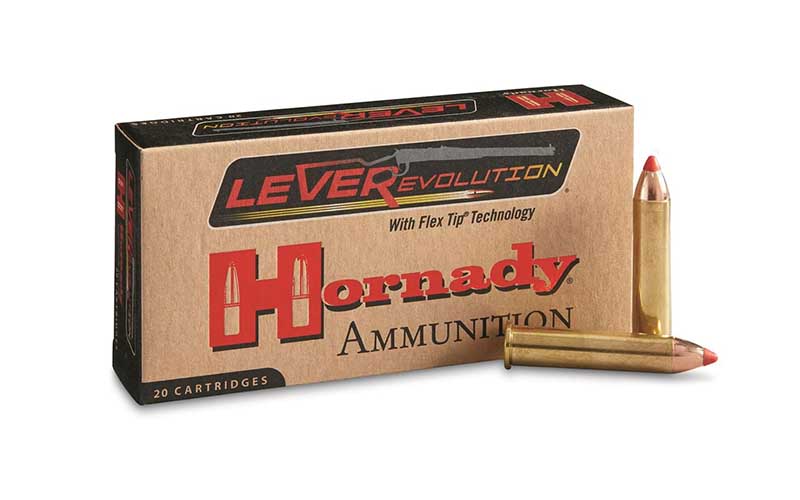
Hornady offers two power level 2 .45-70 loads. One uses a 325-grain FTX bullet and the other uses a 250-grain all-copper MonoFlex bullet.
That buffalo had taken several 430-grain hardcast bullets, enough that many might think the cartridge and load aren’t enough gun. The reality was that, up until the last shot, I had shot poorly, and buffalo tend to not pay much attention to poorly placed shots. In stark contrast, the effectiveness of this same load was proven in Africa five years later when five other hunters and I took six buffalo. Unfortunately, my shooting on that trip was nothing to brag about either, but four of the six hunters had their buffalo on the ground with a single shot.
Mission-Matched Ammo
The bear and the buffalo hunts illustrate the extremes of the .45-70’s capabilities with the least and most powerful commercial loads offered. However, the most useful loads for the 45-70 are probably the midrange loads, exemplified by the 300-grain Barnes TSX, and two loads each from Hornady and Federal. In 2018, I took a magnificent mountain zebra stallion with the Barnes load, which delivered excellent through and through terminal performance at a range of about 75 yards. It also made short work of a bunch of warthogs, while helping the outfitter control their thriving population on his working cattle farm.
The Barnes VOR-TX 300-grain TSX .45-70 Government load is a great power level 2 offering.
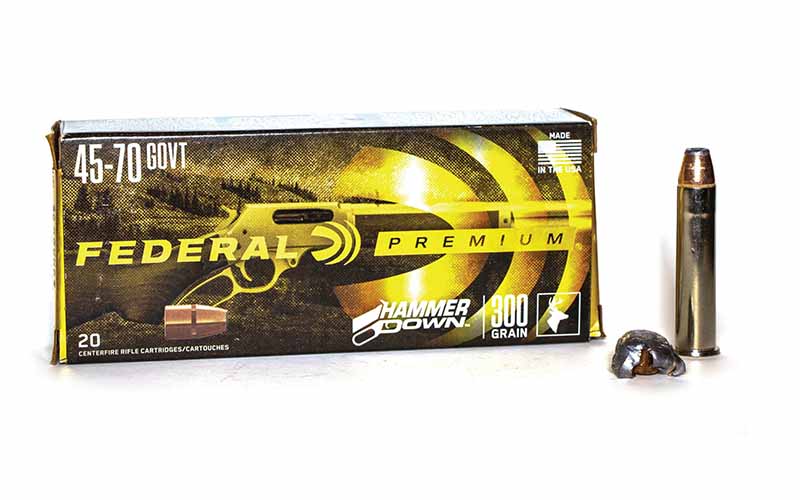
The new Federal HammerDown load was tested extensively in blocks of Clear Ballistics and on feral hogs. This bullet expands wide and creates a massive wound cavity thoroughly sufficient for anything sized from hogs to moose.
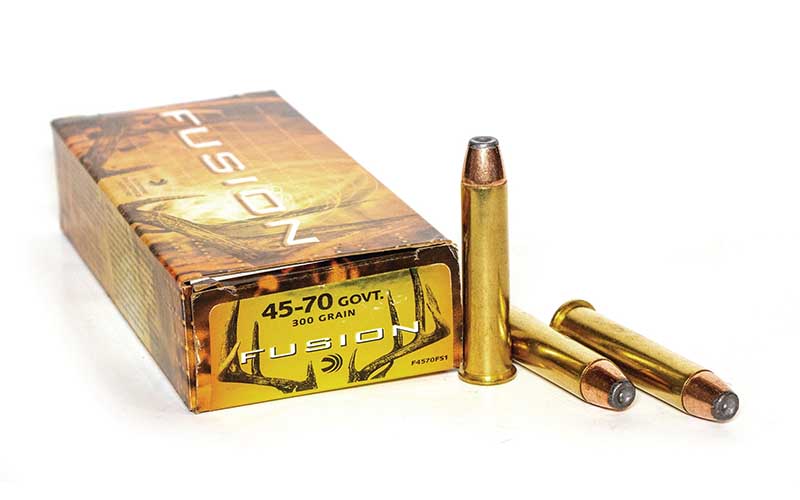
Ballistically, this load is a copy of the Federal Fusion 300-grain load, but more important is the fact that the HammerDown cartridge cases are tweaked for optimum performance in a lever gun. This is accomplished with a slight chamfer on the forward edge of the cartridge rim, which makes loading easier. And the cartridge cases are nickel-plated to improve the smoothness of loading, functioning and feeding in lever guns.
Federal’s HammerDown 300-grain load might be the best power level 2 .45-70 load available for a lever-action rifle. Though ballistically identical to the Federal Fusion .45-70 load, HammerDown uses a cartridge case that has been tweaked for use in lever guns.
Long Live the King
In today’s world of long-range wonder guns, you’d think the .45-70 Government would be headed to extinction once again, but that’s not the case. It’s doubtful the lever gun will ever go out of style in America, and in a lever gun, the .45-70 offers a lot of versatility.
Federal’s 300-grain Fusion load for the .45-70 is ballistically identical to their HammerDown load but utilizes a commonly dimensioned rifle case.
It can serve an eastern whitetail hunter admirably, it can handle moose and elk—and where necessary, it has what’s needed to provide bear defense from browns and grizzlies. In defiance to the fact that the .45-70 has been around longer than any human shooting it today, it’s extremely versatile on a worldwide scale.
The starring role of the Marlin SBL in the 2017 movie Wind River did nothing but increase the gun and cartridge’s popularity. And now, with the allowance of straight-wall cartridges for deer hunting in states where centerfire rifle cartridges were previously not allowed, it’s safe to say the .45-70 is more popular than ever.
I don’t see that changing anytime soon, and I know for a fact there’ll always be a .45-70 in my gun safe. Well, that’s where it’ll be when it’s not in my hands in West Virginia, Montana, Texas or Africa … or wherever else I might be.
Editor’s Note: This article originally appeared in the May 2021 issue of Gun Digest the Magazine.
RCBS has just released two new die sets for 30 Super Carry and .44 Auto Mag, giving reloaders even more caliber options to play with.
RCBS is one of the biggest names in reloading, and it’s easy to see why if you’ve ever gotten to reload using RCBS equipment. The company already had many caliber options available, offering die sets for not only the most popular cartridges but for more niche options as well. The impressive lineup has just gotten even bigger, however, as two more somewhat esoteric reloading options are now available through the addition of 30 Super Carry and .44 Auto Mag die sets.
While there’s a chance that 30 Super Carry will someday gain traction, until it does, it’s still relegated to the niche side of pistol calibers where it sits comfortably alongside other oddballs like .44 Auto Mag. While nobody today is burning through massive volumes of either cartridge, the ability to reload them at home certainly increases their round-count potential. Whether you’re a 30 SC early-adopter or a dedicated .44 AMP shooter, RCBS now has your reloading needs covered.
Each RCBS die set comes in a green box and includes a sizing die (made out of carbide to eliminate the need to lubricate cases), an expander die and a taper crimp seat die. The MSRP for the .44 Auto Mag die set is $129.95 and the 30 Super Carry version costs $108.99. Both are available now.
For more information on the new die sets, please visitrcbs.com.
Looking for the best .44 Magnum ammo to feed your wheel or lever gun? Here we cover eight top loads and the best ways to use them.
We went over .44 Magnum revolvers, so now let’s talk about .44 Magnum ammo. We’ll briefly go over ballistics and then look at eight great .44 Magnum loads and what they’re best used for.
Photo: J.D. Fielding Photography.
.44 Magnum For Concealed Carry Or Home Defense
While .44 Magnum had some limited adoption in law enforcement, it is not an optimal choice for defense.
Arguably, the current authority on terminal ballistics and ammunition performance is Dr. Gary K. Roberts, the protege and colleague of Dr. Martin Fackler, who helped the FBI develop its testing protocol.
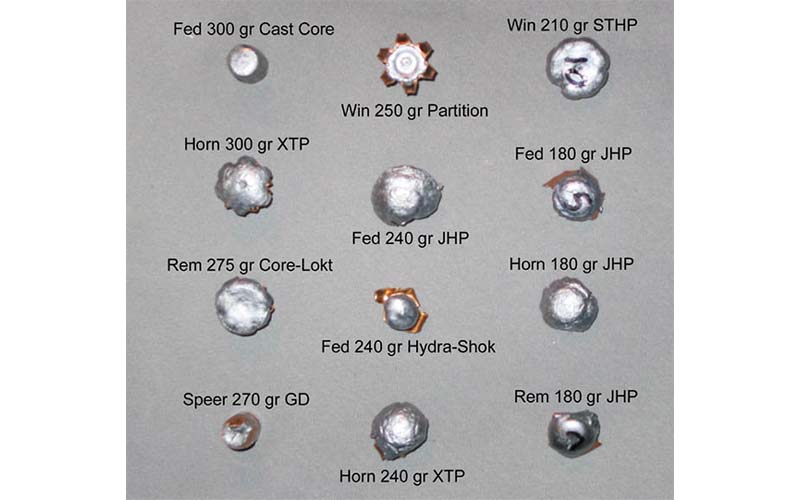
Dr. Roberts’ tests of .44 Magnum, hosted on AR15.com, indicate fast-opening, light-for-caliber bullets are the best picks for defensive use against human threats as they tend to not over penetrate.
Some of the recovered bullets from Dr. Roberts’ .44 Magnum ballistic gel tests. Photo: Dr. Gary Roberts.
For instance, the 300-grain Hornady XTP JHP load penetrated over 20 inches in bare gelatin and expanded to an average of 0.7 inches while retaining all weight. While impressive, the results indicate a possibility of over-penetration, meaning that the bullet could likely exit the target with enough velocity to still prove lethal to bystanders in a defensive scenario.
If overpenetration is a concern— and it needs to be for defensive use—choose your ammunition carefully. You are accountable for every bullet that leaves the muzzle. If it hits the threat AND someone else, you’re still liable.
.44 Magnum Ammo: Expanding Vs. Hardcast
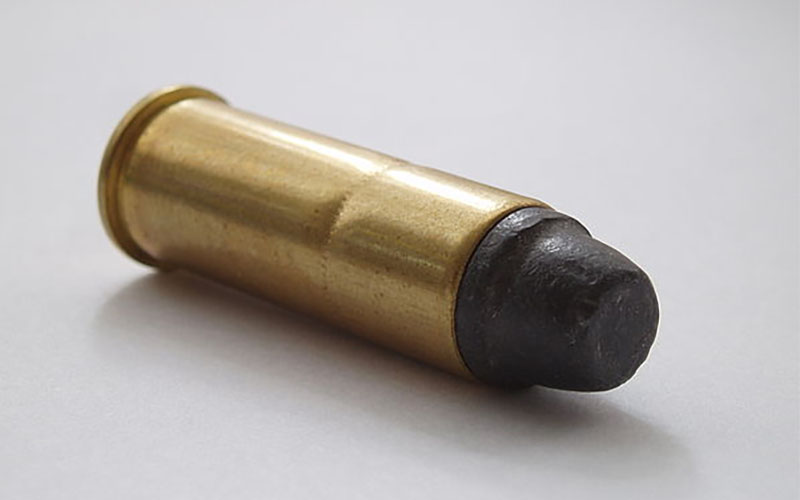
A .44 Magnum round loaded with a lead flat-nose bullet. Photo: Wikipedia.
The primary purpose of expanding ammunition is for the bullet to deform in a fleshy target, causing the bullet to slow down and not penetrate as deeply, making the chances of a through-and-through less likely.
While a larger wound cavity does result from the bullet expanding, most of it is only temporary. What a lot of people forget is that tissue is quite elastic and returns to its original structure fairly quickly. Marksmanship and penetration are the greater shares of lethality regardless of the projectile type being used.
What do hardcast bullets do? They punch deeper holes, and aren’t dependent on barrel length for terminal performance.
In short, hardcast bullets are preferable when over-penetration is irrelevant and the target needs a hole put in it good and hard, such as big or dangerous game. Expanding .44 Magnum ammo is better suited for soft targets that don’t need maximum penetration like whitetail or hogs.
.44 Magnum Ammo Buyer’s Guide
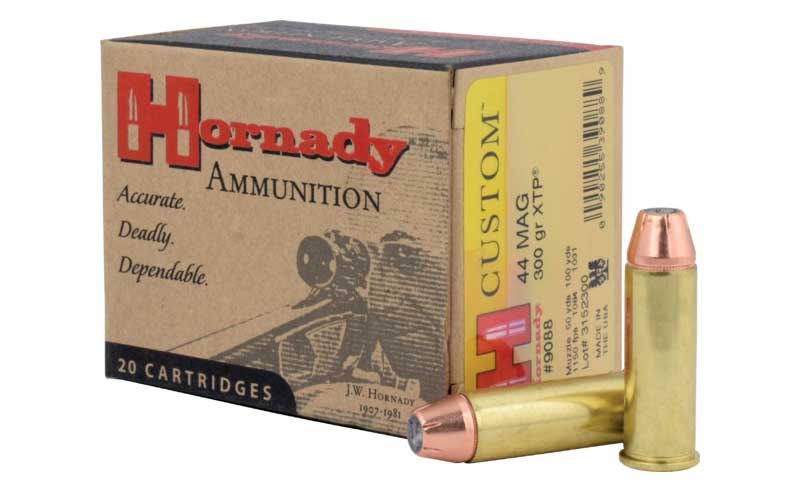
Hornady 300-Grain XTP JHP
The Hornady 300 XTP JHP load is perfect for medium-game hunting. It penetrates deeply, expands reliably and retains weight very well, which XTP hollow points have long been known for.
A 6-inch or longer barrel is best for expanding .44 Magnum ammo such as this, but it will perform just fine from a 4-inch gun as well. The advertised velocity is 1,150 feet per second with 881 foot-pounds of energy.
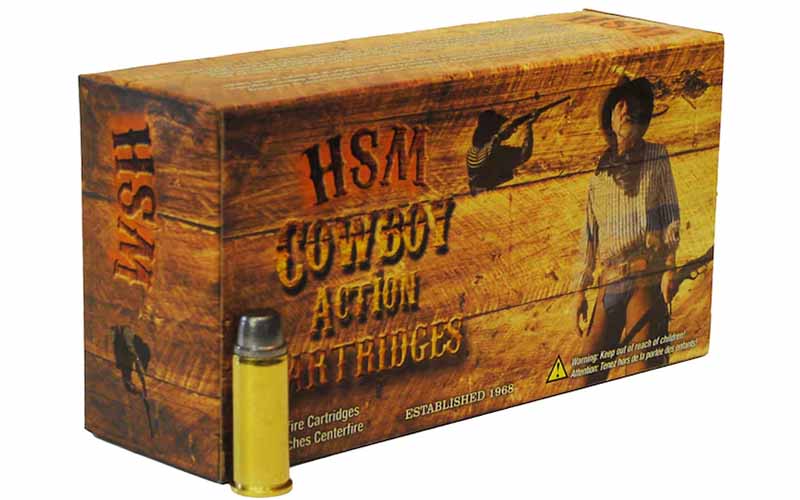
HSM Cowboy Action Ammunition .44 Magnum 200 Grain Flat Nose
There’s no such thing as “cheap plinking”.44 Magnum ammo, but this load gets you close. HSM’s Cowboy Action line is made for CASS and SASS shooters, and is a very mild load utilizing a black powder substitute.
It’s a 200-grain cast flat nose (Keith semi-wadcutter) bullet, good for an advertised 975 feet per second and 422 foot-pounds of energy. While still not cheap, this is about the cheapest .44 Magnum ammo you can buy, and it’s very soft-shooting to boot.
If you enjoy shooting your .44 Magnum for fun, get this load and enjoy. It could also serve as a capable medium game hunting load in a carbine inside 100 yards if it’s all you had available.
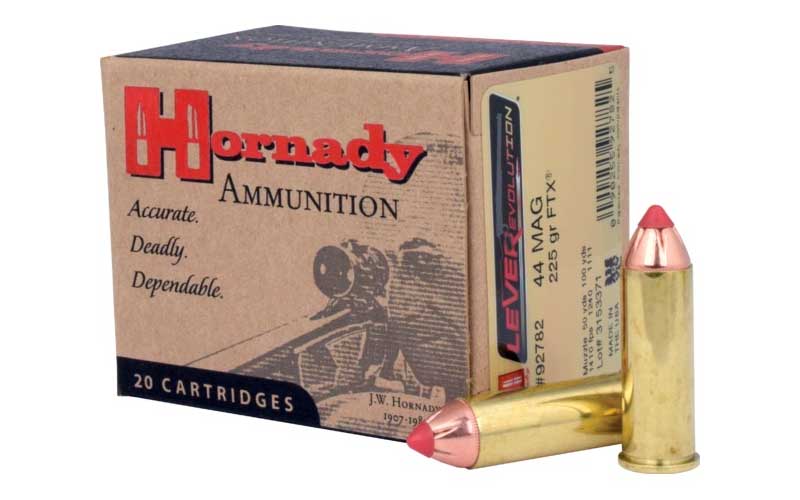
Hornady’s LEVERevolution line purports to make cartridges more aerodynamic. The G1 BC of this load is .145…so it’s not. But it is a good hunting load in a carbine or handgun, as it’s the same bullet design as Critical Defense and Critical Duty.
According to Hornady themselves, this 225-grain FTX load—with a 100-yard zero—has a first intercept at 25 yards, a second intercept at 100 yards and drops 5.4 inches at 150 yards, for something like a maximum point blank range of about 125 yards with a 1.5-inch offset. At 200 yards, the point of impact drops about 16.5 inches.
Velocity is an advertised 1,410 fps with 993 foot-pounds of energy from a 7.5-inch barrel. A 16-inch or 18-inch carbine would add about another 200 to 300 fps on top of that.
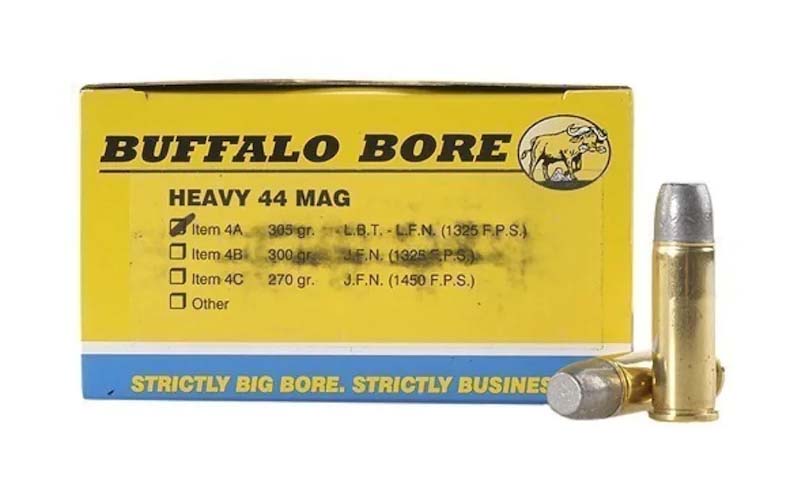
Buffalo Bore 305-Grain Hard Cast Flat Nose Gas Check
Buffalo Bore is one of the go-to ammunition brands for hard-hitting, heavy game loads for revolvers. Their 305-grain hard cast load would be an excellent pick for large or dangerous game in almost any .44 Magnum.
Factory velocities are given as 1,328 fps through a 6-inch barrel and 1,779 fps through an 18.5-inch carbine. At 1,328 fps, that nets around 1,200 foot-pounds of energy, but just shy of 2,000 foot-pounds through an 18.5-inch barrel. That’s the same muzzle energy as a .30-30.
This .44 Magnum ammo is designed to penetrate deeply in whatever it hits, so it’s a natural choice for a backup handgun or lever-action in bear country.
If you were going to keep a .44 Magnum for defense (.44 Special would be better, but we’ll save that topic for later) what information is out there favors fast-opening, light-for-caliber expanding bullets.
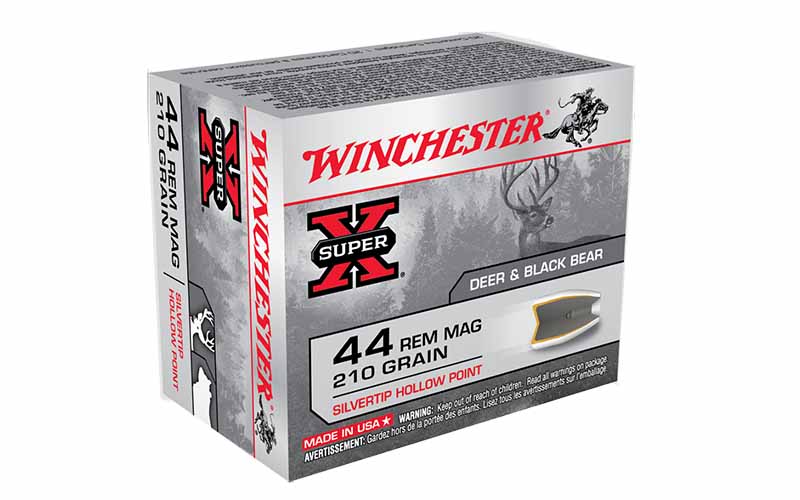
This 210-grain JHP load in .44 Magnum is a perfect candidate for defense or as a medium game load at modest ranges. Winchester claims 1,250 fps of velocity and 729 foot-pounds of energy at the muzzle, so it’s mild as far as .44 Magnum ammo goes.
This would be a good defensive loading in a 4-inch revolver and decent for hunting medium game.
Underwood Ammunition 255-Grain Cast Lead Keith Semi-Wadcutter
This is the original .44 Magnum woods load.
The .44 Magnum was the brainchild of the “.44 Associates,” a group of handloaders who hot-loaded .44 Special, among them the legendary Elmer Keith. Keith also devised a semi-wadcutter bullet design with a flat nose and sharp shoulder for multi-purpose use.
The 255-grain Keith SWC load excels at target shooting and hunting, hitting hard and penetrating deep. Excluding scenarios where overpenetration is of concern, it’s an excellent all-purpose load.
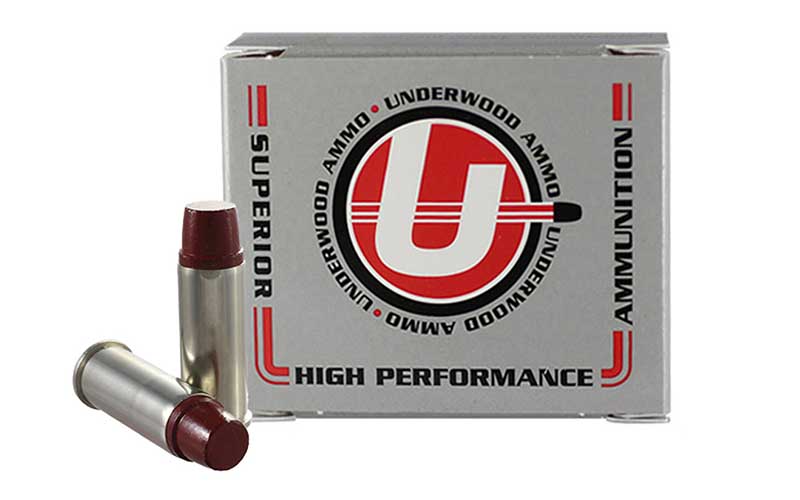
Underwood’s 255-grain hard cast Keith SWC has a polymer coating for cleaner shooting and is rated for 1,350 fps and 1,032 foot-pounds at the muzzle. It’s good for all platforms, and taking a Stetson and a cigar to the range is highly encouraged.
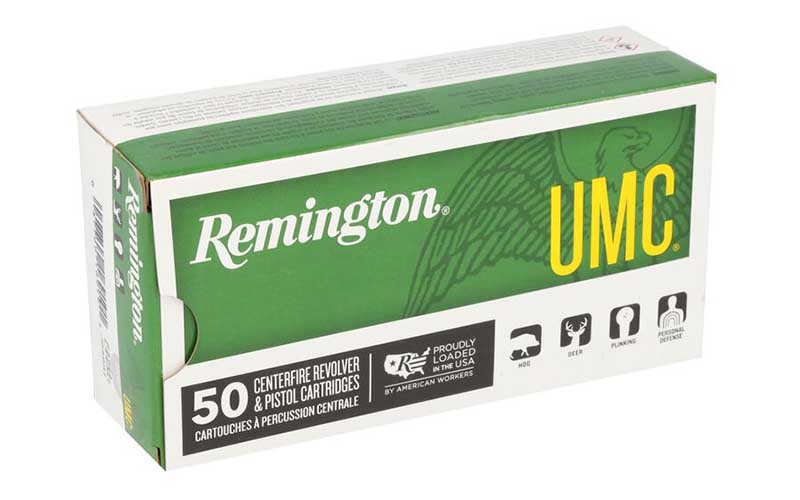
While not quite as cheap as the aforementioned HSM Cowboy Action load, Remington UMC 180-grain JSP is as close as you get to cheap .44 Magnum ammo that’s still loaded to full power. It’s tenable for defense or medium game hunting with most platforms including 4-inch and 6-inch (or longer) revolvers, as well as carbines.
It’s a fast, light-for-caliber, controlled-expansion load, and Remington claims it can do 1,610 fps and 1,036 foot-pounds at the muzzle. If you don’t have bears to worry about, it’s a decent all-purpose load for revolvers or carbines. The best at any one thing? Maybe not, but it checks a lot of boxes.
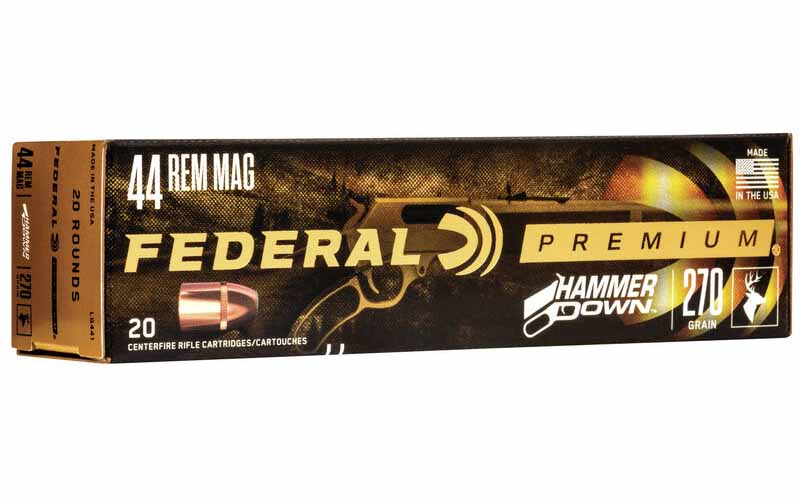
Federal Premium HammerDown 270-Grain Bonded Soft Point
Lest we forget, .44 Magnum is also a common chambering in lever-action rifles. The Federal Premium HammerDown 270-Grain Bonded Soft Point is made for the lever-action rifle hunter.
Bonded bullets hold together when penetrating tissue, keeping the jacket from separating and ensuring deeper penetration. That was the great leap forward in rifle bullet technology almost a century ago (Bitterroot Bonded and Nosler Partition) and in JHP pistol bullets in the 1990s with Speer Gold Dot.
This load is designed for deeper penetration with controlled expansion, ideal for deer, hogs, black bear and elk, and to function reliably in lever-action rifles. Federal advertises a velocity of 1,715 fps at the muzzle with 1,763 foot-pounds of energy and is good for a maximum point blank range of about 125 yards.
Smith & Wesson has just launched the S&W Model 350, a new DA/SA revolver chambered for the fast-moving .350 Legend cartridge.
Smith & Wesson has been making revolvers for over 150 years, and the company needs no introduction. But even old dogs learn new tricks sometimes, and that’s the case with the new S&W Model 350. It’s the company’s first-ever production revolver chambered for .350 Legend.
.350 Legend was only introduced in 2019, but it’s been one of the fastest growing hunting cartridges since in terms of popularity. Until now, however, it’s primarily been utilized in bolt-actions and AR-style rifles. With the launch of the S&W Model 350, now handgun hunters have a greater opportunity to use .350 Legend as well. At first glance, the S&W Model 350 appears to be a fairly typical Smith & Wesson DA/SA revolver, but it has a few extra features that help take it to the next level.
Built on Smith’s large X-Frame, the Model 350 is a double-action/single-action 7-shot revolver made out of stainless steel. It has an adjustable rear sight, a red ramp front sight and a 7.5-inch barrel. The barrel has also been ported to help mitigate recoil, working in conjunction with the Hogue rubber grip. The 7-shot cylinder is also fed using moon clips.
John Myles, Senior Manager of New Products at Smith & Wesson, said this about the new revolver:
The 350 Legend is one of the flattest shooting straight-walled cartridges on the market today. It is great for medium-sized game and especially whitetail hunting. If you’re looking for a hunting revolver, the Model 350 is it.
The S&W Model 350 is available now. It has an MSRP of $1,599 and includes moon clips with each purchase.
Are full-size handguns too big to carry? Sometimes small CCW pistol options are limited, so you need to know how to make do with what you have.
We all remember how toilet paper and hand sanitizer flew off the shelves a year ago. Akin to the aforementioned commodities, the surge in carry pistol purchases has created an artificial scarcity that has left the shelves stocked with less-than-ideal options for self-defense, especially outside the home.
For the latecomers to the game, full-size handguns are sometimes all that’s available. Luckily, carrying a big gun isn’t difficult; it just takes a bit more planning to make it feasible.
Handguns aren’t something that occupy a one-size-fits-all mentality. A Glock 19 is a small gun to some people, and it’s a large gun for others. It’s generally considered a happy medium, and many others have spawned in the same size and capacity range. As a result, it can be thought of as probably the most generic and “normal” handgun out there.
For our purposes here, we’re considering the Glock 19 and other in-class pistols as the cutoff for a full-size handgun category. While some will, of course, disagree, a 4-inch 9mm with a 15-round magazine is a large gun for a person standing at 5-foot-1 and weighing 100 pounds. It’s all relative to the individual, but the principles remain the same even if you’re 6-foot-4 and 300 pounds with hands large enough to palm a beach ball.
Polymer guns can weigh far less than their steel counterparts. The Sig M17 is a light pistol, even with 18 rounds onboard. It is a full-size handgun, but it’s not at all as heavy as a fully kitted-out 1911. Both can be carried effortlessly with planning.
Holsters For Full-Size Handguns
The first thing to consider about carrying full-size handguns is the type of holster that you should look at. The most reasonable option is to carry outside the waistband (OWB). This, of course, varies from the more popular inside the waistband (IWB) method, wherein the pistol is more easily concealed under clothing. An OWB holster is universally a better method for carrying a large gun for several reasons.
Weight distribution is a major factor in carrying a full-size handgun. Some larger guns are indeed much lighter than others, but the same applies to all in that the mass of any large gun is typically spread out across a larger area in the barrel and grip. This means that you’ll want to rock ’n’ roll with a holster that helps distribute that weight across a larger area on the belt. If you do this properly, you won’t even notice the weight of the gun on your hip.
A second thing to consider is overall comfort in relation to other methods of carry. IWB holsters typically address two areas of the body, those being strong side and near the appendix. Appendix holsters mount the gun in the front of the pelvis, making for a fast draw, but if you have a long barrel and grip, it’ll make sitting uncomfortable and very difficult to conceal in the front of the shirt. Strong-side carry IWB is feasible, but again—sitting can be uncomfortable due to the barrel extending further down, thus creating something of a lever against the seat, which can put pressure on the sciatic nerve in the pelvis and cause numbness.
Custom holsters are available for virtually every gun and light combination out there.
The most uncomfortable thing about IWB carry with a full-size handgun is the bulge the gun creates against the body when the belt is tightened. Wearing a good belt is critical here, and because of added weight, the belt needs to be rigid and capable of bearing the extra mass without sagging. For this reason, OWB is clearly superior in that the belt can be worn as normal with no pressure points along its length. It can be snugged up like usual and you won’t experience the sliding or eventual numbness that can occur with a heavy gun stuffed down your pants.
Materials vary with individual preference, but today’s modern materials are much lighter than leather, which itself can add weight to an already heavy gun. The holsters featured here are from BlackPoint Tactical, and they’re experts in making products that blend materials like leather and polymer. These holsters take advantage of all their materials; the rigidity of steel belt loops, the flexibility and comfort of leather, and the weight savings of polymer. These holsters represent the best of what’s available for blended materials and have virtually no downsides for carry.
Leather holsters for full-size guns are definitely viable; however, most require break-in periods and don’t have the same resistance to sweat and abrasion as a polymer holster. Leather traps moisture and is slow to dry out when it gets wet. It should be noted that you’ll certainly need a holster to carry a large handgun, and if you only have access to a leather rig, you should certainly buy it even if it’s just a stopgap. Order times can be weeks—and even months—for a polymer holster these days.
If you have an obscure gun due to lack of availability of popular models, you might find that there are few holsters out there for your actual model. Luckily, especially when it comes to leather, you can find something that’s a near approximation. For many large pistols, the dimensions aren’t all that far off.
The best OWB holsters use steel loops. Thicker belts demand wider loops, so keep in mind how thick and wide your choice of gun belt is as you order a holster.
For instance, if you can’t find a holster for your used AREX at the pawn shop, oftentimes holsters for the Sig P226 will fit. You might have to do some playing around or buy a subpar option to start, but you should always do your best to at least get a proper one ordered; it’ll make a difference in comfort.
Belts Are Life
Know this: The standard $10 belt at the local grocery superstore won’t cut it here. A great number of people just stick a 1911 on their regular belt and are stunned by how terrible it is to carry. A proper belt for a full-size handgun isn’t hard to find, and many are old news today. I’ve favored the same Galco belt for almost 10 years. It has a rigid liner in it that prevents the belt from bending or flexing under weight, thus allowing it to take the weight of a large handgun without collapsing.
A cinch-style belt like the Galco is the author’s choice, as it allows universal adjustment. Traditional belts are, of course, feasible but are limited to their adjustment holes, resulting in a situation where it can be either too tight or too loose, both of which are bad.
If a nylon belt is a bit too “military” for you, there are many companies that make very rigid and strong traditionally-styled belts as well. Bigfoot Gunbelts makes a steel-lined belt that’s probably the most rigid on the market today. This isn’t a cinch-style belt like the Galco, and it has regular belt holes in it to tighten it. VersaCarry also makes a fantastic gun belt.
Some people like the hole-style belts, but I’ve found that set holes can sometimes be too tight or too loose for carry with a heavy gun. The cinch-style is much better for comfort, as it can be adjusted exactly without being too tight or too loose. It’s equally uncomfortable to have a large gun moving around loose as it is to have it too tight. Fit should be snug and not painful.
Belts can be very thick and heavy. This steel-cored Bigfoot belt is almost as thick as a 9mm cartridge! Plan ahead and try several options if you’re able to in order to ensure you’ll be comfortable.
Full-Size Or Super Size?
For a long time, people have broken defensive pistols into two general categories: the carry gun and the “nightstand gun.” The carry gun is a class we’re all familiar with, and it used to mean relatively small, somewhat featureless guns … sometimes sacrificing power for size.
The nightstand gun is a category that usually contained the larger, more feature-rich handguns that could mount lights and larger magazine capacities. These were usually the 5-inch service pistols, such as the 1911 or Beretta M9, or even 6-inch .357 Mag. revolvers. The guns here were easier to shoot, but as this concept reached greater popularity, were rarely carried as a result of widely available compact pistols and a lack of holsters capable of allowing comfortable carry.
Times Have Changed For The Better
Besides being easier to shoot accurately, the major advantage of full-size handguns is greater opportunity to install accessories. This seems counterintuitive, but since a large gun already requires a bit of planning to carry, you had best take advantage of all the available real estate. A good thing is that most full-size guns today have accessory rails. Some do not, like classic 1911s, M9s and older models like the Sig M11A1 and original P220. The option to mount optics and red-dots also exists in these cases.
An interesting point to make is that the most common accessory for full-size handguns, the weapon-mounted flashlight, can often make a compact pistol as large as a full-size. For instance, the Glock 19 with a SureFire X300U mounted is as long as a 1911. You’ll need to get appropriate holsters for this, and it’s rare to find IWB holsters that support large, bright flashlights like the SureFire.
A full-size handgun isn’t difficult to carry, even with a light attached, if you have the proper gear.
Optics are a fairly new category, but it’s now common to find factory guns with cuts for a variety of slide-mounted dot sights. The Trijicon RMR is the most well-known, but others exist that are more appropriate for a budget or used gun on the rack at your local store. These sights usually don’t add much weight at all, but they definitely add functionality.
Overall, a light and a red dot will make your full-size handguns only a few ounces heavier, but far more capable for more bad situations.
Last Picked
The most common full-size handguns on the shelf these days are the ones that people don’t usually want if they have the choice. These picked-over guns generally drop into two types: the used .40 S&W and the expensive 1911.
Guns chambered for .40 S&W aren’t too popular these days, and more manufacturers are dropping .40-cal offerings from their rosters. It was supposed to be a do-all cartridge, but it ended up being something of a redheaded stepchild instead. It replaced neither the 9mm nor the .45 ACP, both of which are more popular now than they ever were for their respective qualities.
The reason you find a number of used .40s on the shelf is because they’re just generally obsolete. Law enforcement agencies were the primary users of the cartridge, and then they began dropping it for 9mm as more advanced bullets became widely accepted and available. Surplus pistols are often cheap and badly beaten up, but they do work well in most cases.
If you buy a .40-cal., such as a Glock 22 or a Sig P320, you can easily get a second barrel in .357 Sig and 9mm, the latter of which will require new magazines. One gun can be easily swapped between these three calibers should availability be an issue.
The 1911 pistols are often priced above the comfort level of the average buyer. As a result, they’re probably the most common sight in the gun bread line at Cabela’s. These are heavy guns, but they certainly aren’t impossible to carry. The 1911 was the standard for about a century, and there’s a myriad of good holster options for them out there. Remember: A good belt makes the 1911 quite easy to tote around.
Take What You Can Get
A nice thing about larger guns is that they’re almost always available in one form or another. Hard times cause innovation, and it’s likely with more and more people owning guns these days, there’ll be a corresponding increase in demand for options to make them suitable for carry and everyday use.
Don’t be discouraged if a full-size pistol is all you can get—just make sure to take the steps to ensure it ends up on your belt and not just the nightstand.
Editor’s Note: This article originally appeared in the 2021 CCW special issue of Gun Digest the Magazine.
Looking for a new iron or piece of kit to enhance the one you already own? Check out these 7 new bits of guns and gear to grow your firearms wish list.
There’s a tingle that comes with Colt’s latest foray into revolvers, knowing the manufacturer might’ve nailed it on the head. Lovingly dubbed the “Baby Snake,” the King Cobra Target .22 LR delivers the aesthetics and performance of the original .357 Magnum, but in a 10-shot rimfire. The all-stainless-steel revolver has some nice twists, whether it’s eventually aimed at a bull’s-eye competition or high-end plinking. It’s available in two barrel lengths (4 and 6 inches), each with a 1:16 twist, is outfitted with Hogue rubber grips, and comes with a bright front fiber-optic sight. As expected with a target model, the King Cobra also boasts a fully adjustable rear sight, so you can dial it in. MSRP: $999
Taurus 856 Executive Grade Revolver
Revolver fans are more than familiar with the buck-saving performance Taurus has offered up over the years. Hey, it’s gotten more than one penny-pincher shooting. Tacking somewhat from its proven course, the Brazilian manufacturer is aiming at a higher-end market with the introduction of the Executive Grade line. Kicking things off is the Taurus stalwart 856. As an Executive Grade iteration, the +P .38 Special is built around an all-stainless-steel frame and wears a dashing set of Altamont walnut grips. Aimed at concealed carry, Taurus bobbed the hammer, machined all snag points and hand-tuned each DAO trigger for a smooth, stack-free pull. For the extra money, it looks to offer some solid and attractive upgrades. MSRP: $689
Standard Manufacturing Switch Gun
Given that it’s a difficult proposition to get an armed citizen to carry their primary arm consistently, adding a backup gun to the regimen is an even taller task—but Standard Manufacturing might’ve found a way. Its Switch Gun puts five rounds of potentially lifesaving .22 WMR on tap in a package not a heck of a lot larger than a spare magazine. The stainless-steel and polymer revolver is a true pocket-rocket, folding up into a palm-sized rectangle and deploying at the push of a button. The one catch? It’s SAO, which might not appeal to some. But as an insurance policy on your life, it’s more than capable. MSRP: $449
Heritage Manufacturing Barkeep Boot
For a bargain single-action army variant, the Heritage Barkeep made waves when it hit the scene in 2021. It continues to do so in 2022 with perhaps one of the more unique configurations to grace throw-back wheel guns in a spell. As hinted by its name, the Barkeep Boot is Heritage’s crack at something to slip into the stack of your Tony Lamas. With a 1.68-inch barrel and relatively modest 25 ounces in weight, the .22 LR will fit there, but more likely the six-round revolver is better served as a distinctive pint-sized plinker. Heritage offers the Boot Barkeep with three choices of grip material—gray pearl, black wood and wood with a snake motif—on its bird’s head grip. And each comes at a price few folks can pass up. MSRP: Starting at $197
Real Avid Master Gun Vise
Revolvers, pistols or otherwise—to maintain your firearms, you need the tools for the job. A good gun vise is among the first that should grace your bench. Real Avid has you covered with a unit specifically designed for the job at hand, offering a ton more flexibility over a traditional bench vise. The Master Gun Vise not only repositions to hold your firearms at nearly any angle—a plus for many jobs—but it also comes with accessories to fit the tool to the job. One of the more notable is its Gun-Fit jaw sleeves that provided the exact hold for the particular firearm being worked on. Other extras, like a leveling knob (great for mounting scopes) and Torq-Lok pin for applying heavy force, make the Master the ideal implement for any DIY project. MSRP: $300
Federal Ammunition .22 WMR Punch Personal Defense
For some, the .22 Magnum is the most viable self-defense option out there. Federal Premium is making sure those folks have the best possible ammo for the job. Expanding its line of economical personal-defense ammo, the ammo maker recently unveiled its Punch .22 WMR load. Boasting a 45-grain nickel-plated lead-core bullet, the round is designed for maximum penetration needed in personal-defense scenarios. This new load has gone through rigorous testing for reliability and function. The case of the Punch .22 WMR is nickel-plated for easier extraction and corrosion resistance, as well. Overall, when it comes to defending your life, Federal is ensuring the .22 WMR is up to the task. MSRP: $26 Per Box Of 50
Winchester 125-grain .38 Special +P Super-X Silvertip
A unique combination of power, precision and reliable functioning, Winchester Super-X Silvertip is a trusted commodity for self-defense. Now, the ammo maker has added a souped-up option in the time-tested .38 Special: a 125-grain +P load more than capable of taking care of business. Specially engineered for top performance out of short-barreled revolvers, the ammo has an impressive muzzle velocity of 945 fps, guaranteeing top performance from the Silvertip bullets. The projectiles themselves were originally developed for law enforcement as a replacement for traditional hollow-points and deliver penetration and rapid energy release with virtually no weight loss or bullet fragmentation. Super-X jacketed hollow-points have notched jackets to ensure positive expansion, thus a devastating wound channel. MSRP: $50 Per Box Of 50
Editor’s Note: This article originally appeared in the August 2022 issue of Gun Digest the Magazine.
Looking to go armed, but are stuck in the weeds as to what to arm yourself with? Here are 20 of the best concealed carry gun options that will keep you on the defensive.