Home Blog Page 63

Carry Calibers: .40 S&W Vs. .45 ACP Vs. 9mm

6

In the eternal debate of .40 S&W Vs. .45 ACP Vs. 9mm, which cartridge reigns supreme for concealed carry and self-defense?

So now that we know a bit about the specifications and data for the 9mm cartridge, what is it that makes it so popular? It does not have stellar, tack-driving accuracy like other pistol calibers, nor does it have the power of other cartridges. It is far from the perfect cartridge but is still the most prevalent worldwide. Even science gives the 9mm low marks compared to larger calibers.

It’s simple physics. A bigger, heavier bullet carrying more energy means a deeper and larger wound channel. So why is the 9mm king? There are three reasons: Shootability, increased magazine capacity, and ammunition choices.

40-sw-vs-45-acp-vs-9mm-feature

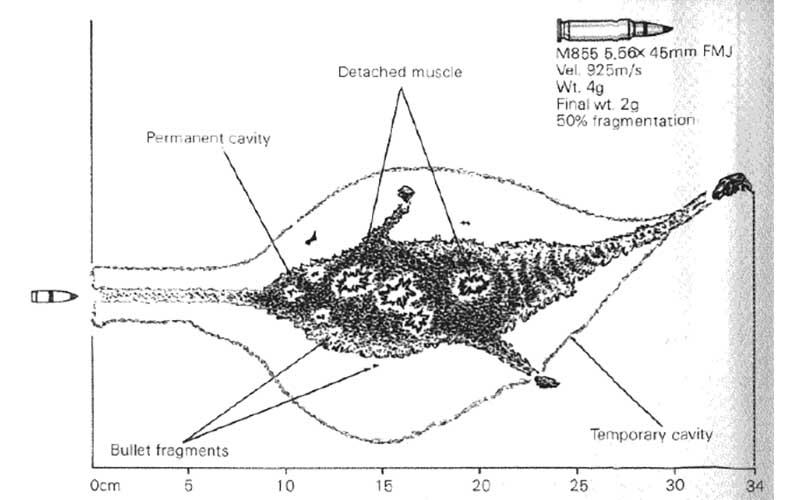
Before we get into these, let’s talk physics and math. A light projectile sheds velocity and energy faster than a heavier one. More velocity equates to more energy. More energy factors into the amount of penetration, which affects terminal performance. Energy is the benchmark by which we rate a bullet’s performance. To sum up this fast physics lesson: all things being equal, a larger, heavier bullet will penetrate deeper than a lighter one.

The move to the 9mm was not an instant success, as the Illinois State Police learned. As mentioned in an earlier chapter, they were one of the first U.S. law enforcement agencies to adopt the 9mm in the Smith & Wesson Model 39. The standard-issue round was either 100- or 115-grain, standard velocity. The load was mediocre at best as the troopers found out, but when they changed to 115-grain hollow-point +P+, those .380-inch bullets leaving the muzzle of their Model 39s at a velocity of 1,300 fps changed the game. The initial 9mm rounds at the time used by law enforcement did not yet reach the nine’s full potential.

9mm-Book
This is an excerpt from 9mm: Guide to America’s Most Popular Caliber, available now at GunDigestStore.com.

One of the issues our military experienced with the 9mm was dissatisfaction with the M9 pistol specifically and ammunition in general. It boiled down to a report compiled by the Center for Naval Analyses (CNA) and released in 2006 titled, “Soldier Perspectives on Small Arms in Combat.” The report detailed a formal independent review of soldier opinions of their small arms in combat situations. Specifically, the Project Manager, Soldier Weapons (PMSW) wanted to know soldier perspectives on the reliability and durability of the M9 pistol, as well as the M4 and M16 (A2 and A4) rifles, and the M249 light machine gun. These four weapon systems are the standard-issue guns being used by Army soldiers in Iraq and Afghanistan.

Just to level set the results, weapon reliability is defined as “soldier level of confidence that their weapon will fire without a stoppage in the combat environment.” Weapon durability is defined as “soldier level of confidence that their weapon will not suffer breakage or failure that necessitates repair before further use.” Survey participants included over 2,600 soldiers who had returned from Iraq or Afghanistan and who had engaged in a firefight using the weapons listed.

The net result was that soldiers were least satisfied with the M9 compared to the other weapons and “the most frequent recommendations included weapons and ammunition with more stopping power/lethality; higher quality magazines for the M9, M4 and M16; more durable ammo belt links and drum systems for the M249; and reduced size and weight in the M16 and M249.”

Call it lethality, stopping power or knock-down power, but there is no such thing as a caliber with this magic attribute. The truth is a combination of bullet placement and design, and follow-up, are what stop a threat. If a shooter does his job and places the shot accurately the 9mm can stop a threat. Our bodies can take an enormous amount of punishment. Our organs can move around inside us, so what might have been a good hit is not. There are numerous examples of people who are shot in a gunfight and did not realize they were hit until after the fight was over.

40-sw-vs-45-acp-vs-9mm-table

It may be ironic that the Mozambique Drill is a technique used with a Rhodesian mercenary, Mike Rousseau, during the Mozambican War of Independence from 1964 to 1974. Rousseau was fighting at the airport at Lourenço Marques, which is now called Maputo. He turned a corner and came face-to-face — about 10 paces — with a FRELIMO guerrilla armed with an AK-47. Armed with a Browning HP35 pistol chambered in 9mm, Rousseau immediately brought up his Hi Power and shot the guerrilla twice in the chest.

This was a traditional “double tap” maneuver. According to Rousseau during a conversation with Jeff Cooper, Rousseau hit the guerrilla on either side of the sternum, which is typically sufficient to kill a man. Yet the guerrilla was still advancing, so he tried for a headshot and instead hit the guerrilla through the base of his neck, severing the spinal cord. Cooper, the founder of the Gunsite Academy shooting school and father of the “modern technique” of pistol shooting, decided to incorporate a drill similar to what Rousseau had experienced. Cooper called it the “Mozambique Drill.”

The drill has you fire the first two shots to the center of mass and then a slight pause. The pause allows you to assess the situation and determine if a third shot is needed to the head. The drill has since been renamed Failure Drill or Failed to Stop Drill due to political correctness. No doubt Cooper is rolling over in his grave over that, since he had no patience for political correctness — only fast, precise shooting.

I’ve talked to some recent veterans who have combat experience with the M9 and, according to some of them, the reason it has a 15-round magazine is that you need two shots to immobilize an opponent. That is due to the M882 cartridge, the U.S. military load for the 9mm—not the handgun itself. The military has plans to change the 9mm load and may even walk away from the FMJ ball ammo and use a more effective bullet.

With no further ado, here are the reasons the 9mm beats all other cartridges for combat and self-defense.

Shootability

When the 10mm Auto was dropped by the FBI in favor of the .40 S&W, law enforcement agencies nationwide followed suit and shifted to the .40, dropping the 9mm in what seemed like the blink of an eye. Even so, for most LE agencies the breakup with the nine would be short. The .40 S&W had what they wanted: a larger bullet at a higher velocity that created a larger and hence more lethal wound channel. At one time, manufacturers were introducing pistols in .40 S&W first and then following up with the same handgun chambered in 9mm. The H&K USP model is an example. Today, the .40 S&W might be considered, but now most handgun manufacturers introduce 9mm first, then .40 S&W and maybe .45 ACP.

Author-Shooting-controllability-vs-9mm
Muzzle energy isn’t the only standard by which to judge calibers. Ammo cost, speed on target and capacity are all top considerations.

The .45 ACP has been in use with our military since WWI and is a proven combat caliber. The problem with it is recoil. Even with full-size, steel receiver pistols like the 1911, the .45 ACP is a handful to control. Pistols chambered in 9mm — from subcompacts to full-size models — have less recoil and that translates into you shooting the pistol better. Better shooting means better accuracy. Faster follow-up shots are one of the 9mm’s greatest benefits.

Load Up On More 9mm Knowledge:

.40 S&W Vs. .45 ACP Vs. 9mm: Magazine Capacity

Additional magazine capacity of the 9mm is a benefit over the .40 S&W and .45 ACP. For example, look at the Smith & Wesson M&P series. The M&P 9 has a capacity of 17+1 rounds. The M&P 40 has a capacity of 15+1, and the M&P 45 has a 10+1 round capacity. The 9mm offers less reloading and more shooting — something to think about if you get into a gunfight. The ability to confront multiple threats with more firepower and not have to take time to reload is a plus. Most who carry do not have spare ammo on them (they should). Concealing a 9mm pistol means more rounds on hand.

caliber-capacity
The typical double-stack 9mm has a capacity of at least 16+1 rounds. The .40 S&W has 15+1, and the .45 ACP 10+1.

Ammunition Choices

Since the 9mm is so popular there are many bullet options loaded by nearly every ammunition manufacturer. From fast 115-grain ammo to slower and heavier 147-grain rounds, the 9mm offers choice. The cost of 9mm ammo is less than .40 S&W and .45 ACP. Plus, it is easy to find 9mm ammo at nearly any store that sells ammunition. That means you can train more often and longer for less cost.

handgun-ammo-boxes
The 9mm offers a wide assortment of ammunition choices. Here’s a small sample of 9mm cartridges available.

The 9mm was once embraced, tossed aside, and now embraced again. It’s not a compromise cartridge — you now have more round capacity with bullets that provide wound cavities pacing those caused by larger cartridges. Times have changed and so has the 9mm.

Editor's Note: This article is an excerpt of 9mm: Guide to America’s Most Popular Caliber.


More Handgun Ammo Debates:

Bushnell Announces Match Pro ED 5-30×56 Rifle Scope

0

Bushnell has just announced the Match Pro ED 5-30×56 rifle scope, designed to provide excellent long-range performance for competitors and advanced shooters.

Bushnell saw a good deal of success with the 6-24×50 Match Pro rifle scope, but many shooters wanted something more powerful. Now featuring a higher magnification level, a larger objective lens and several other improvements, the Match Pro ED 5-30×56 is finally available.

Match-Pro-ED-5-30×56-feature

With its 34mm maintube, magnification on the Match Pro ED 5-30×56 now goes all the way up to 30x and the objective lens is now 56mm in diameter. The ED in the name stands for Extra-Low Dispersion Prime glass, and this high-grade glass has also been coated with an EXO Barrier to protect it against the elements. Other features also include a new easier-to-use zero stop, an integrated throw lever that can be used by left- or right-handed shooters (or removed entirely) and a 15-yard minimum parallax for extremely close engagements. Built tough as well, the Match Pro ED 5-30×56 has a very high recoil rating and is IPX7 waterproof and fog proof.

Match-Pro-ED-5-30×56-Side

The Deploy MIL 2 etched glass FFP reticle (DM2) is also new. It’s an illuminated 2/10 MRAD tree reticle with 11 brightness settings and an auto-shut-off feature to save battery. It’s based on Bushnell’s popular Deploy MIL reticle but now features a finer 2/10 MRAD grid for easier use at greater magnification levels.

Bushnell-DM2-Reticle

I actually had the chance to put a Match Pro ED 5-30×56 to the test this July at a Bushnell/RCBS event in Wyoming, and I walked away very impressed. Whether it was on the range ringing steel at ridiculous distances or picking off prairie dogs from a truck, the scope performed marvelously. At long-range, adjustments were easy to make and the reticle was intuitive to use. At shorter ranges, the super clear glass made bagging prairie dogs a breeze.

Bushnell-Scope-Prairie-Dog-Hunt

While its performance may suggest a higher price point, the Match Pro ED 5-30×56 has an MSRP of only $699. It’s available now and appears to be an excellent value scope for competitors and long-range shooters alike.

For more information, please visit bushnell.com.


More On Rifle Scopes:

A Look At 7mm PRC: The New Hornady Precision Rifle Cartridge

2

Hornady’s 7mm PRC, or Precision Rifle Cartridge, is being advertised as a 21st Century 7mm magnum, but what exactly does it bring to the table?

Hornady's new 7mm PRC cartridge updates the 7mm caliber with modern cartridge design philosophies to get even more performance out of the 7mm/.284-caliber bullet. It promises even more performance potential than 7mm Remington Magnum without the drawbacks of previous hot 7mm rounds. 

But is it worth ditching your Rem Mags for? Well, that's a little complicated. Let's dive in. 

Hornady-Precision-Rifle-Cartridge-with-rifle

The 7mm PRC

7mm PRC uses a similar design ethos to 6.5mm Creedmoor and some other modern rifle cartridges. Namely, the case shoulders are blown forward and the bullet is seated further forward. This augments case capacity but can keep the overall length short enough to use in a standard (.30-06, aka long) action rifle. 

The result is rather impressive. Advertised velocities put the 7mm PRC at just behind the true 7mm magnums like 7mm Weatherby Magnum, 7mm Shooting Times Westerner, 7mm Remington Ultra Magnum and 7mm Mashburn Super Magnum. 

Hornady-7mm-PRC-Cartridge

Hornady's available loads for 7mm PRC currently include a 180-grain ELD Match at 2,975 fps, a 175-grain ELD-X at 3,000 fps, and a 160-grain CX copper monometal at 3,000 fps. 

The drawback of 7mm Remington Magnum, of course, is that it never really pushed the 175-grain bullets to actual magnum velocities (most factory loads are 2,850 fps or slower), whereas the elder 7mm magnum loads push the 175-grain pills to 3,000 fps or more but require a magnum-length action. The 7mm PRC appears to solve this problem. 

7mm-Rem-Mag-vs-PRC
Hornady 7mm PRC (top) versus 7mm Rem. Mag. (bottom).

The implication is a superior long-range cartridge, especially for big game (arguably) short of the great bears. Early reviews indicate superlative accuracy, not only sub-MOA but close to 0.5-MOA. 

In other words, 7mm PRC seems to be everything the 7mm Remington Magnum claims to be but is not, and it will almost certainly be cheaper than 7mm Weatherby Magnum which is barely any more powerful. As a bonus, rifles should be a lot more affordable too.

7mm PRC Vs. 7mm Remington Magnum

Firstly, 7mm PRC generates slightly more chamber pressure than 7mm Rem. Mag. (65,000 psi versus 61,000 psi) but fits in the same action length. 

So…what does the extra pressure (and velocity) do for trajectory? Let's start by taking a closer look at 7mm PRC (all ShootersCalculator charts were calculated using a 100-yard zero, a 1.5-inch height over bore, a 10 mph 90-degree crosswind and no atmospheric corrections). 

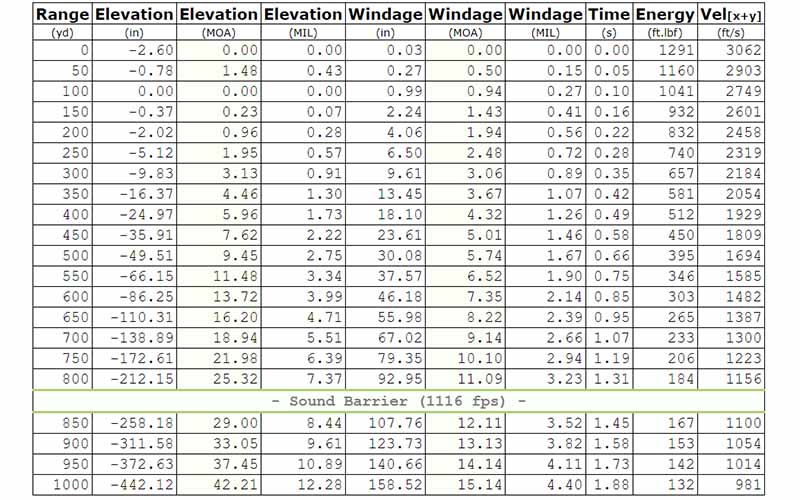
Here's a 1,000-yard trajectory for Hornady's 160-grain CX load, calculated using the G1 ballistic coefficient of .596 and the advertised muzzle velocity of 3,000 fps: 

160-grain-CX-PRC-1

As you can see, the bullet is still supersonic at 1,000 yards (in fact, it doesn't go transonic until 1,600 yards) and still carries 1,000 foot-pounds of energy at 950 yards, which is the legal minimum in some states for big game. 

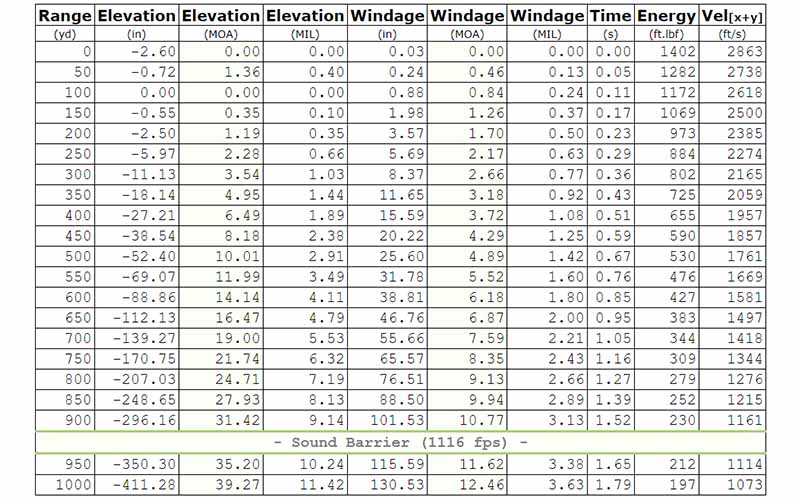
Here's the same table for Hornady's 175-grain ELD-X Precision Hunter load, which has a mind-boggling G1 BC of .689: 

175-grain-ELD-X-PRC

Much the same story, but this time the bullet retains more than 1,000 foot-pounds of energy at 1,000 yards. In fact, it doesn't fall below 1,000 foot-pounds until nearly 1,200 yards, and it stays supersonic until 1,850 yards. The bullet is traveling faster and carries more energy at 1,000 yards than a .44 Magnum at the muzzle. 

Bear in mind, though, that the old 7mm Remington Magnum is a wickedly capable cartridge on its own. Factory loadings can sometimes fall short of their full potential…but how close is it to the 7mm PRC? 

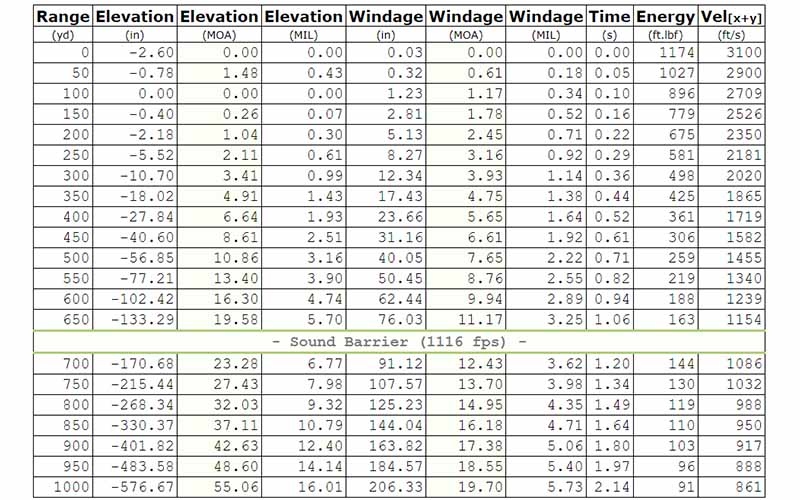
Hornady doesn't offer 7mm Remington Magnum with either the 160-grain CX or 175-grain ELD-X, but here's what a 160-grain CX trajectory would look like loaded to 2,850 fps: 

160-grain-CX-Rem-Mag

While less impressive, consider that the 7mm Remington load is still supersonic at 1,000 yards (remaining so to just past 1,500 yards) and doesn't drop below the 1,000-foot-pound minimum until just past 850 yards. 

Were Hornady to offer the 175-grain ELD-X load in 7mm Rem. Mag. at typical velocities for 175-grain loads (around 2,850 fps), it would look something like this:

175-grain-ELD-X-Rem-Mag

That's still incredibly impressive, as the bullet retains more than 1,000 foot-pounds of energy and is still traveling at 1,676 fps at 1,000 yards. This load would remain supersonic to just beyond 1,725 yards and would still be traveling faster and carry more energy at 2,000 yards than the average 230-grain .45 ACP at the muzzle. 

While Hornady’s new cartridge improves considerably on the 7mm Remington Magnum, you don't get into any sort of serious difference until past 1,000 yards. From 0 to 300 yards, the 7mm Remington is a bit slower, drops slightly more and is a little more effected by wind than its 7mm PRC counterpart, but the differences are negligible.

An improvement? Yes, but you have to really push the limits of both for the advantages of 7mm PRC to become apparent.

Hornady-Precision-Rifle-Cartridge-feature-1

7mm PRC Rifles

At the time of writing, the only major manufacturers offering factory rifles chambered for 7mm PRC are Savage Arms and Mossberg. 

Savage is offering the Apex Hunter XP, Apex Storm XP, 110 Timberline, 110 Ultralite, 110 High Country and the new Impulse straight-pull rifle in both the Big Game and Mountain Hunter models. MSRP ranges from $709 for the Apex Hunter XP to $2,347 for the Impulse Mountain Hunter, which includes a PROOF Research carbon-fiber barrel. 

Mossberg offers two models of their Patriot Predator bolt-action rifle, one with a matte blue barrel on a synthetic stock and one with a brown Cerakote finish on a Strata camo synthetic stock. These rifles retail for $519 and $616, respectively. 

7mm-PRC-Patriot-Predator-feature-camo
A 7mm PRC Mossberg Patriot Predator.

Custom rifle makers are starting to offer 7mm PRC models as well, and the cartridge can also be fired from a 7mm Rem. Mag. or .300 Win. Mag rifle with nothing more than a barrel swap.

Is Making The Switch Worth It?

So, should you get a new rifle chambered for 7mm PRC? 

There's no question that the 7mm PRC is an improvement on the 7mm Remington Magnum. It pushes the projectile to actual magnum velocities in a standard-length action and has serious potential as a cartridge with stunning long-range capability. 

There's no question that it would make an excellent choice of cartridge for medium game. There's no question it would (and most likely will) do very well in long-range rifle matches as well. 

The only real question is whether that extra capability actually means anything to you in the real world. Maybe it does, and maybe it doesn’t. 

For most hunters, it’s not really going to make much difference. Shooting small- to medium-body whitetails at 200 yards or less hardly requires a bullet that’s still supersonic at 1,500 yards. Same thing goes for most hogs. 

Game animals inside 400 yards aren’t going to notice a difference. A hole punched through the thoracic cavity at 2,200 fps is going to kill something just as easily as a hole of the same diameter punched in the same spot at 2,500 fps. Placement, as always, is the lion’s share of lethality. 

If you’re a serious long-range rifle shooter and competitor, it may be that the seriously impressive trajectory and insanely high ballistic coefficient will give you a bit of an edge over a 6.5mm Creedmoor shooter. If so, then it might be worth it. 

If you just plink on a steel silhouette 500 yards away in the back 40…probably not so much. 

Hornady-7mm-PRC-Match

7mm Remington Magnum is probably not going anywhere. It’s one of the most popular rifle cartridges in the world for a reason, is incredibly capable with quality modern ammunition and will be cheaper than 7mm PRC for the foreseeable future. 

However, most people who own a Porsche 911 will never meaningfully approach its mechanical limits either. They buy one because the car makes them happy, not because they have any real use for it. The only people who do really have a use for one are actual race car drivers.

The point here is that on paper, 7mm PRC is incredibly capable. If you have a real use for that capability, then by all means get in on it…but don't let it stop you if you want it just because. 


Raise Your Ammo IQ:

Reloading: Are Classic Powders Still Relevant?

1

When it comes to reloading, do the classic powders still have a place? Or are you better off using something more modern?

It’s been a running joke that, for years, Ol’ Grumpy Pants adamantly insisted the .308 Winchester was all the cartridge needed, and furthermore, that cartridge should be loaded with 165-grain bullets and driven by IMR4064 powder. I still have my father’s notes in his Sierra Bullets Reloading Manual from the early 1970s. Handwritten in the back of the book was: “For .308, best all-around powder is IMR4064.”

That baby blue can was the only powder on the shelf—until I started to experiment with Hodgdon’s H380 and IMR 4320, garnering that look of disappointment from GP. When I insisted we try the then-new Varget from Hodgdon, he just shook his head and walked away.

He still prefers to use the older powders, probably because he learned their attributes years ago, and he’s never been big on change. I enjoy experimenting with new powders and have come up with some great recipes with the newer releases, like Alliant Reloder 16 and 23, the IMR Enduron line and Winchester’s new StaBall 6.5, but I still reach for those powders that have been with us for decades.

Those newer powders are packed full of innovative features, including chemical agents to help minimize copper fouling, and they’re the least temperature sensitive of any powders we’ve ever had. But that doesn’t mean the older powders are obsolete; in fact, they’re still perfectly viable.

Classic-Powders-feature
Photo: Massaro Media Group.

The Names Have Changed

Powders do change, and if you look back at older reloading manuals, you may see unfamiliar powder brands and names. Alliant was once owned by Hercules, IMR was owned by DuPont and Winchester was proprietary. I have a copy of Philip B. Sharpe’s Complete Guide to Handloading from the 1950s, and he goes into detail about the common powders of the day, and when they were introduced.

Not only are a large number of the powders unfamiliar to me—DuPont had a series of pistol powders named by number, such as No. 1 and No. 5 that had been discontinued at the time of printing, but DuPont No. 6 was still in production—even so it gives great insight as to how rapidly the powder technology was changing in the first half of the 20th century.

Some of our most popular powders, like IMR 3031, IMR 4320 and GP’s beloved IMR 4064, came to us in the mid 1930s and were heralded for their low pressures (in comparison to earlier powders) and for their lack of tin, which caused fouling problems a century ago. IMR 4320 would go on to be the powder of choice for the earliest .308 Winchester factory ammunition as well as being a great choice for the .30-06 Springfield, .22-250 Remington and .375 H&H Magnum, but sadly has been discontinued.

Classic-Powders-IMR-4064
IMR 4064, though it’s a medium-burning powder, can be used in some of the larger cases like the .300 Winchester Magnum (shown here) as well as the .375 H&H Magnum and .416 Remington Magnum. Photo: Massaro Media Group.
However, IMR 3031, IMR 4895 and IMR 4064 remain not only available but perfectly viable in spite of there being alternative choices, sometimes even within the IMR line. In the Enduron Line, IMR 4166 is on par with IMR 4064, and while it’s a fantastic powder that I reach for often, I’m not abandoning all the loads I’ve developed with IMR 4064. It may not be as resistant to the effects of temperature, and it may have a grain structure that doesn’t meter as well as some other designs, but I’ve used it on hunting trips on multiple continents, and it has served me very well.

Alliant’s Unique and Bullseye were released by the Hercules company in 1900, according to Philip B. Sharpe, and though they’ve been reformulated, they remain very close to the original design. Hercules, as a point of interest, was formed when the DuPont company was broken up in 1912, resulting in the Atlas Powder Company and the Hercules Powder Company. Hercules would sell to Alliant TechSystems Inc. in 1995 and would end up part of the Vista Outdoor organization.

Their powders are a staple in the reloading community, with Unique, Bullseye, Herco, Red Dot and 2400, as well as the Reloder line, being extremely popular choices. Hercules 2400 was introduced to the reloading world in 1932 and, like Unique, went through a reformulation, but still remains a wonderful choice for magnum handgun cartridges like the .44 Remington Magnum and .454 Casull, and small rifle cases like the .22 Hornet and .218 Bee. So, despite the fact that these powders are at least 90 years old, they prove that old isn’t dead.

Reloading-Classic-Powders
All of these powders are well-suited to the .308 Winchester, but the author relies on the older IMR 4064 more often than not; it just plain works. Photo: Massaro Media Group.

The release of IMR 4350 came in 1940, and it was instrumental in helping bring the magnum craze about. It was, at the time of its release, considered a very slow-burning powder and is still a great choice for all but the largest magnum cases. I love it in the .300 Winchester Magnum and .375 H&H Magnum, and it works very well in the Winchester Short Magnum family. It’s often slagged for being sensitive to temperature changes. But while Hodgdon’s H4350 and Accurate Arms AA4350 are generally considered to be less sensitive, I’ve never had an issue when using IMR 4350. In fact, IMR 4350 has resulted in some of the most accurate loads I’ve ever developed. Not too shabby for a powder more than 80 years old.
Hodgdon’s H380 was an unnamed spherical powder when Bruce Hodgdon developed a load of 38.0 grains under a 52-grain bullet in his .22-250 (then) wildcat and used the charge weight in the new name. H380 is still the go-to powder for the .22-250 Remington with all bullet weights, and works very well in the .220 Swift, .243 Winchester, .257 Roberts, .308 Winchester and .375 Ruger. Despite the fact that the powder is nearly 70 years old, it works as well today as it did when Mr. Hodgdon named it.
Though many of our powders were developed before the Second World War began, like the cartridges they fuel, they remain a perfectly viable choice for hunters and target shooters alike. They’re still with us because they work so well, and while the technology continues to evolve and improve, there are some classic designs that are undeniably great and will remain so for as long as they’re produced.  

Editor's Note: This article originally appeared in the July 2021 issue of Gun Digest the Magazine.


More On Reloading:

First Look: Anderson Manufacturing A4 Quad Rail Models

1

Anderson Manufacturing has recently announced an expansion to its A4 AR-15 line, featuring three models of A4 rifles and pistols with quad rail handguards.

Earlier this year, Anderson Manufacturing launched the A4 series of 5.56 NATO AR-15 rifles and pistols. The series included four models, a full-length rifle, a mid-length rifle, a carbine rifle and a carbine pistol. Now, Anderson has announced an expansion of the line with three new models equipped with quad rail handguards.

Anderson-A4-QR-feature

The three quad rail models include the A4 Rifle, the A4 Carbine and the A4 Pistol, giving shooters a quad rail-equipped option for every A4 model besides the mid-length rifle. Besides the addition of a quad rail handguard, the new models are virtually identical to their standard Anderson A4 counterparts. This means that regardless of whether the gun in question is a standard or quad rail model, they will share the same A2 pistol grip, buttstock/brace and ship with a Magpul MBUS rear flip-up sight. All models have an A-frame front sight.

A4 Rifle With Quad Rails

Anderson-A4-quad-rail-rifle

The quad rail rifle has a 20-inch, 1:9 twist 4150 Chrome-Moly Vanadium barrel with a government profile. It features a rifle-length gas system, an A2-style buttstock and an 11.5-inch quad rail handguard. MSRP is $679.99.

A4 Carbine With Quad Rails

Anderson-A4-QR-Carbine

The quad rail carbine has a 16-inch, 1:8 twist 4150 Chrome-Moly Vanadium barrel with an M4 contour. It features a carbine-length gas system, an adjustable M4-style buttstock and a 6.5-inch quad rail. MSRP is $669.99.

A4 Pistol With Quad Rails

Anderson-A4-QR-Pistol

The quad rail pistol has a 10.5-inch, 1:7 twist 4150 Chrome-Moly Vanadium barrel. It features a carbine-length gas system, an SBA3 Tactical pistol brace and a 6.5-inch quad rail. MSRP is also $669.99. This is the only new A4 model that differs slightly from the standard version, as the original Anderson A4 pistol barrel has a 1:8 twist.

Anderson-rail-carbine-handguard

For those who are looking to upgrade an existing rifle, Anderson also sells the quad rail handguards separately. The 6.5-inch carbine version has an MSRP of $84.99 and the 11.5-inch rifle version has an MSRP of $94.99.

For more information, please visit andersonmanufacturing.com.


More AR-15s:

Rigby The Revolutionary

4

Rigby cartridges remain undeniably classic chamberings for any generation or pursuit.

We spotted the boar crossing a cut lane and immediately put on a stalk; he was worthy of attention. His profile alone indicated a good, mature hog, with no doubt he was a shooter, even at 200 yards. Turning the corner, we saw the boar run. I swung on his shoulder and broke the trigger as it crossed the vertical plane of his vitals. I heard the bullet strike, and despite the fact that the rains had just subsided, we found blood quickly. As it has done so many times over the last century, the .275 Rigby had done its job neatly and effectively.

John Rigby & Company can trace its roots to Dublin, Ireland, in 1775, through to London, England, today; in spite of a short jaunt here in the United States, the company is situated where it belongs, making fantastic firearms worthy of the pedigree. But what so many people overlook is Rigby’s contributions to the cartridge world, and their effect on the modern ballistics.

Rigby-feature
(Left to right) The .450 3¼-inch Nitro Express, .275 Rigby, .350 Rigby Magnum, .416 Rigby and .450 Rigby. Photo: Massaro Media Group.

All That’s Gold Does Not Glitter

I’m sure that even the novice rifleman could name one or two cartridges with the Rigby surname, yet one of the most important doesn’t bear the family name or even get the credit worthy of its performance. It did, single-handedly, set the benchmark for a dangerous-game-stopping rifle, though its tenure was cut short due to some colonial insurrections.

The .450 3¼-inch Nitro Express was developed by John Rigby & Co. in 1898. There were other .450s designed for use with blackpowder, but Rigby’s .450 NE was the first Nitro Express cartridge designed for use with “nitro” or smokeless powder. It’d drive a 480-grain bullet to a muzzle velocity of 2,150 fps and would become the favorite of many traveling sportsmen and professional hunters alike, until the Crown banned all .450-caliber ammunition in its colonies in 1907, due to the uprisings in India and Sudan. (The concept was to deny access to those colonials with .577-450 Martini-Henry rifles.) To circumvent the problem, many companies designed a cartridge with similar ballistics, like the .470 NE, the .475 NE and the .475 No. 2 Jefferies. Still, to this day, the .450 3¼-inch NE makes a perfect choice for the dangerous game hunter.

Hornady-450-NE
The .450 Nitro Express became the benchmark for dangerous work and was mimicked by the .470 NE, .458 Win. Mag. and many more. Photo: Massaro Media Group.

The ballistic formula of the .450 NE would go on to inspire Winchester’s 1956 .458 Winchester Magnum, which did its best to replicate the concept, though it certainly fell short. Using a 510-grain bullet at an advertised muzzle velocity of 2,150 fps, the .458 Winchester didn’t reach those numbers for at least four decades. Though the .470 Nitro Express would become the most popular of the rimmed cartridges for single-shots and double rifles in this class, Rigby’s .450 NE remains a solid choice for any hunter.
The 7×57 Rigby. Wait, What?

John Rigby & Co. had a business arrangement with Mauser of Germany in the late 19th century, importing their fantastic Model 98 actions and giving them British stocks and appointments. Rigby offered the 7x57mm Mauser as one of the chambering for their rifles—understandably, it was and is a fantastic hunting cartridge—but decided to rename the cartridge to make it more palatable to the British market. This wasn’t uncommon; the .404 Jeffery was known as the 10.75x73mm on the European continent.

Hornady-275-Rigby
The .275 Rigby is simply the 7×57 Mauser using an alias. Photo: Massaro Media Group.

The .275 Rigby is, was and ever shall be nothing more and nothing less than the 7x57mm Mauser, and that’s certainly not a bad thing. The classic design uses the full gamut of the 7mm bullets, with the 175-grain bullets having made the reputation for the cartridge. But anyone interested in the .275 Rigby should be aware of the .275 Rigby HV chambering. The lead of the chamber has been revised to optimize performance with the 140-grain spitzer bullet; the HV chamber won’t accept the 175-grain bullets, and only a handful of the 150-, 156- and 160-grain bullets will work in the HV chamber.

Walter Dalrymple Maitland Bell—better known as Karamojo—used the .275 Rigby for his legendary ivory hunts across the African continent. Col. Jim Corbett used the .275 Rigby rifle presented to him for killing the Champawat tigress to end the careers of many more man-eaters. I’ve had the pleasure of holding Corbett’s rifle. It’s a lightweight, well-balanced gun, and though it bears no sign of either bluing or stock finish due to exposure to the elements while on the hunt, it remains a classic Rigby design. Bell and Corbett are just two examples of hunters who’ve risked their lives among the world’s most dangerous game with a .275 Rigby in hand.

Rigby Highland Stalker 3
Rigby’s Highland Stalker is a classy rifle, and when chambered for the .275 Rigby makes a great choice for nearly all big-game hunting. Photo: Massaro Media Group.

The .275 Rigby isn’t a speed demon, but it isn’t a slow poke, either. In fact, I feel it makes a better choice than a .243 Winchester or .30-30 for a young hunter: Its recoil level is wonderfully mild, yet the cartridge has a bullet weight selection suitable for everything south of the true heavyweights.
The Perfect Medium?

The .350 Rigby Magnum came in 1908 and was an absolute original. Using a 45-degree shoulder—which would carry over to the .416 Rigby—on a rimless case, the .350 Rigby is a sensible design. It has a rim diameter close enough to the .375 H&H that the same bolt face will handle both cartridges. The .350 Rigby Magnum will use the .358-inch diameter bullets common to the .358 Winchester, .35 Whelen, .358 Norma Magnum and .350 Remington Magnum.

350-Rigby
The .350 Rigby Magnum was released in 1908 and still makes a great big-game cartridge. Photo: Massaro Media Group.

The classic .350 Rigby load sees a 225-grain spitzer bullet leaving the muzzle at 2,600 fps, making it a wonderfully effective choice for larger game. It was used as an all-around choice, but many hunters found there were better choices for thick-skinned, dangerous-game animals. It was a favorite of both Denys Finch Hatton and Bror von Blixen-Fineke. They found it to make a perfect light rifle on safari, and John “Pondoro” Taylor sang its praises as well, putting it on an equal plane with the .318 Westley Richards and .375 H&H Magnum as a do-all cartridge.

Kynoch-350
.350 Rigby Magnum ammunition from Kynoch, in the classic 225-grain roundnose configuration. Photo: Massaro Media Group.

Component cases are available from Roberson Cartridge Company, and there are all sorts of excellent bullets to choose from, with reliable load data provided in the Woodleigh Reloading Manual. I’m aiming for a 250-grain bullet at 2,650 fps or thereabout, as the .350 Rigby Magnum has nearly the same case capacity as the .358 Norma Magnum. If you’re looking for a beefy cartridge that’s not your run-of-the-mill choice, the .350 Rigby Magnum should be on your list for sure.

Head of the Class

All you have to do is mention African dangerous game cartridges, and it’ll be a matter of seconds before someone throws the .416 Rigby into the mix. And that’s a good thing. It remains one of the best choices for the thick-skinned dangerous game animals.

416-Rigby-No2
The .416 Rigby No. 2 has the same ballistics as its older, rimless variant, but it features a rim…making it easier for use in single-shot and double rifles. Photo: Massaro Media Group.

While the cartridge has always enjoyed a great reputation, not many Rigby rifles were chambered for it during the Golden Age of safari. In fact, from its release in 1911 until the outbreak of World War II, less than 170 .416 Rigby rifles were in circulation. It was a favorite of professional hunters, but being a proprietary cartridge, the .416 Rigby was certainly not as popular as the .375 H&H Magnum or the .404 Jeffery. It was, undoubtedly, Robert Ruark’s Horn of the Hunter that cemented the .416 Rigby’s place among the great cartridges. From 1911 until the late 1980s, the .416 Rigby was the only commercial cartridge in the bore diameter, and the case—much like the .350 Rigby Magnum—is a unique design having no parent case.

Federal-Premium-Safari-416
Topped with a 400-grain Woodleigh Hydrostatically Stabilized Solid, the Federal Safari .416 Rigby ammo is suitable for anything that walks. Photo: Massaro Media Group.

The .416 Rigby was advertised to drive a 410-grain bullet at a muzzle velocity of 2,300 fps. Dr. Kevin Robertson, however, tested some vintage Rigby ammunition and found the actual speed to be right around 2,150 fps—such is the way of things when dealing with century-old designs. Most modern loads use a 400-grain at velocities between 2,300 and 2,400 fps, generating somewhere around 5,000 ft-lb of energy, and there are a few different bullet weights up and down. I like the Woodleigh 450-grain Weldcore softpoint and full metal jacket solid loaded in the Norma African PH line at 2,150 fps. If you felt the .416 Rigby lacked anything as a stopping rifle, this pair of bullets will alleviate your worries.

Rigbys-Chamber
The Rigby receiver markings on their Big Game rifle. Photo: Massaro Media Group.

The .416 Rigby should be housed in a magnum-length receiver, and that big case—designed to combat the effects of tropical heat on cordite, keeping the pressures low enough for reliable extraction—will eat up magazine space. Many .416 rifles will have an Oberndorf-style magazine extension in order to get additional cartridges in the magazine. The 45-degree shoulder gives good headspacing, and the low pressure the cartridge generates remains an attractive feature to many African hunters.

As a side note, in 2019, Rigby announced the release of the .416 No. 2, a flanged or rimmed version of the .416 Rigby with identical ballistics, to be used in double rifles.

The Youngest Sibling

While the previous four cartridges are all well over a century old, the most powerful of the lineup was released in 1994, when Paul Roberts—then at the head of Rigby—necked the .416 Rigby case up to hold .458-inch-diameter bullets, creating the .450 Rigby to give better performance on dangerous game. Norma uses a 500-grain solid at a smoking 2,500 fps for over 6,900 ft-lb of muzzle energy, as well as the 550-grain Woodleigh pair at 2,100 fps. Nosler offers their 500-grain Partition at 2,350 fps for 6,130 ft-lb.

Norma-Africa-450-R
Norma loads the 550-grain Woodleigh Weldcore softpoint and FMJ (shown here) in the .450 Rigby at a muzzle velocity of 2,100 fps. Photo: Massaro Media Group.

While it sounds horrific on the shoulder, the Rigby rifle I shoot fits me well, so recoil is more than manageable, being more of the classic push than the violent slap associated with cartridges that are both heavy and fast. If you feel the .416 Rigby doesn’t check all the boxes—and for the life of me I can’t imagine why you’d feel that way—the .450 Rigby offers a step up in horsepower for the biggest beasties, though the availability of ammunition pales in comparison to its older brother.

The Rigby Legacy

There’s no denying the importance of Rigby’s developments on the cartridge world. Consider the popularity of the .275 Rigby—in spite of it being a rebranding of the 7mm Mauser—because of the exploits and writings of Bell and Corbett, and the fact that they gave the world the .416-inch bore diameter.

Rigby-Cartridge-Spread
Four of Rigby’s namesakes: the .275 Rigby, .350 Rigby Magnum, .416 Rigby and .450 Rigby. Photo: Massaro Media Group.

Couple that with their .450 3¼-inch Nitro Express, which set the benchmark for dangerous game rifles, and you’ve got an indelible mark on the hunting world. And to be honest, I don’t know anyone who hunts with a Rigby cartridge and isn’t enamored with it.

Editor's Note: This article originally appeared in the July 2021 issue of Gun Digest the Magazine.


More Rigby Articles:

Primary Arms Releases SLx 5-25x56mm FFP Rifle Scope

0

Primary Arms Optics has just announced the SLx 5-25x56mm FFP, a new rifle scope designed for long-range precision.

The SLx line of rifle scopes is one of Primary Arms Optics’ most popular, and the company has just expanded it once again. The newest addition is the SLx 5-25x56mm FFP, and it’s now also the largest member of its family. It was designed to provide excellent long-range precision at a more affordable price.

Primary-Arms-SLx-5-25x56mm-FFP-feature

The SLx 5-25x56mm FFP is offered with the choice between two reticle options, the ACSS Athena BPR MIL and the ACSS Apollo 6.5CM. The former has MIL markings and the latter has bullet drop compensation markings calibrated for 6.5 Creedmoor and .224 Valkyrie. Primary Arms claims that when zeroed at 100 yards, the Apollo reticle can be used to accurately engage targets out to 1,000 yards without touching one’s turrets. Speaking of turrets, both scope variants use MIL turrets and an MOA version is not currently offered. Other notable features of the SLx 5-25x56mm FFP include premium quality glass, an integrated return-to-zero and an integrated magnification lever.

Primary-Arms-SLx-reticles

Stephen Morgan, Director of Product Marketing at Primary Arms Optics, said this about the new scopes:

One of my personal favorite facets of shooting sports is long range. The ability to place a bullet on a small target at distance is one of the most satisfying aspects of shooting…The new SLx 5-25 offers some key features like long travel, exceptional glass, intuitive reticles, and precise turrets that make the task of precision shooting accessible at any budget.

PA-SLx-5-25

Both versions of the SLx 5-25x56mm FFP rifle scopes have an MSRP of $599.99 and are available now.

For more information, please visit primaryarms.com.


More Rifle Scopes:

RIAC Premier Auction To Feature Collection Of Serial Number One Firearms

0

Rock Island Auction Company’s December Premier Auction will feature a large, unique collection of prototype and serial number one firearms.

Jim Supica, the editor of Gun Digest’s Standard Catalog of Firearms annual, is also an avid firearms collector. Part of his focus has been on collecting interesting and unique early examples of guns, primarily those that bear serial number one for their respective make and model. Many of the guns in this collection are prototypes or experimental, and several have been featured in museums, TV shows and various publications. The collection will be available through the RIAC Premier Auction held December 9th through the 11th.

This collection features about 70 guns spread out over 47 listings. Here are just a few that jumped out at us:

Charter Arms Undercover

Charter-Arms-Undercover-Serial-Number-One

This Charter Arms Undercover in .38 Special was the very first firearm to ever be made by the company. It features serial number one and it was engraved and gold inlaid by Colt master engraver Al Herbert.

U.S. Springfield Sharps Model 1870 2nd Type

Sharps-Springfield-SN-1

Bearing serial number one of only 300, this .50-70 Gov’t rifle was part of the trials that lead to the adoption of the Springfield Trapdoor by the U.S. Army. Given its important historical provenance, it was also displayed at the NRA National Sporting Arms Museum for almost 10 years.

Maadi/Steyr ARM

Steyr-Maadi-ARM-AKM

This is one of the earliest, if not the earliest semi-auto AKM to be imported into the U.S. for commercial sale. These rifles were made in Egypt on Soviet tooling and were the primary type used for depicting AKMs in the film Red Dawn. This particular example is in excellent condition, includes a bayonet and has serial number S000001.

Radom Vis 35

VIS-35-serial-number-one

While not the first Vis 35 pistol ever made, this one has serial number D0001 and was made during Germany’s occupation of Poland.

IMI/Action Arms Uzi Model A Carbine

Uzi-Carbine-Model-A

This gun entered the U.S. as part of the first shipment of Uzi Model A Carbines to ever reach our shores. Its serial number is SAO1001 and it includes corresponding documentation to prove when it was imported.

For more information on the auction, or if you’d like to participate, please visit rockislandauction.com.

Here is the full list of Supica Collection lots that will be featured in the RIAC December Premier Auction:

  • SHARPS MOD. 1870 s/n 1 – Lot 69: SN 1 U.S. Springfield-Sharps Model 1870 2nd Type Rifle Military Issue
  • S&W NEW MOD. #3 .38 WIN s/n 1 – Lot 78:  Rare, Documented Colorado Shipped Serial Number 1 Smith & Wesson New Model No. 3 .38 Winchester Single Action Revolver with Factory Letter.  S/N 1
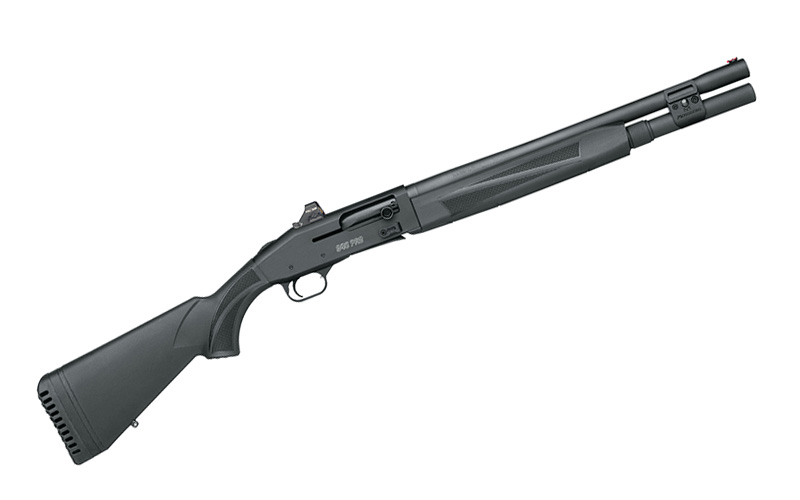
  • BROWN SOUTHERNER s/n 1 – Lot 108: Serial Number 1 Brown Manufacturing Co. Southerner Derringer
  • PORTER TURRET CARBINE s/n 1 – Lot 239: Serial Number 1 Third Model P.W. Porter Turret Carbine Military Issue
  • MAUSER GEW 98 TARGET RIFLE s/n 1 – Lot 365: Haenel-Lorenz “Wehrmannsgewehr” Mauser GEW. 98 Target Rifle serial number one.
  • S&W .44 MAGNUM, 1 of 100 – Lot 495:  Engraved Smith & Wesson Model 29-6 With Factory Letter Lew Horton Special No. 1 of 100
  • MARLIN SPURTRIGGER REVOLVER s/n 1 – Lot 1102: First Production Attributed Marlin No. 32 Standard 1875 Factory Engraved Revolver s/n1
  • COLT 1851 NAVY, .40 cal, s/n 1 – Lot 1221: Serial Number 1 Prototype .40 Caliber Colt Model 1851 Navy Revolver with documentation from Colt Factory, Flayderman, Berryman, and more.
  • ROYAL IRISH CONSTABULARY s/n 1 – Lot 1346: SN 1 Westley Richards Royal Irish Constabulary Pattern Revolver
  • BRITISH BULLDOG s/n 1 – Lot 1348:  Serial Number 1 Webley Bulldog Style Double Action Revolver
  • CHIEF DAVIS' CHIEFS SPECIAL s/n 3J1 – Lot 1527: Los Angeles Police Chief Smith & Wesson Model 36 Revolver, S/N 3J1
  • THE FIRST CHARTER ARMS FIREARM EVER MADE – Lot 1626  – Charter Arms Undercover S/N 1, engraved and gold inlaid by Colt master engraved Al Herbert for Charter founder, Doug McClenahan.
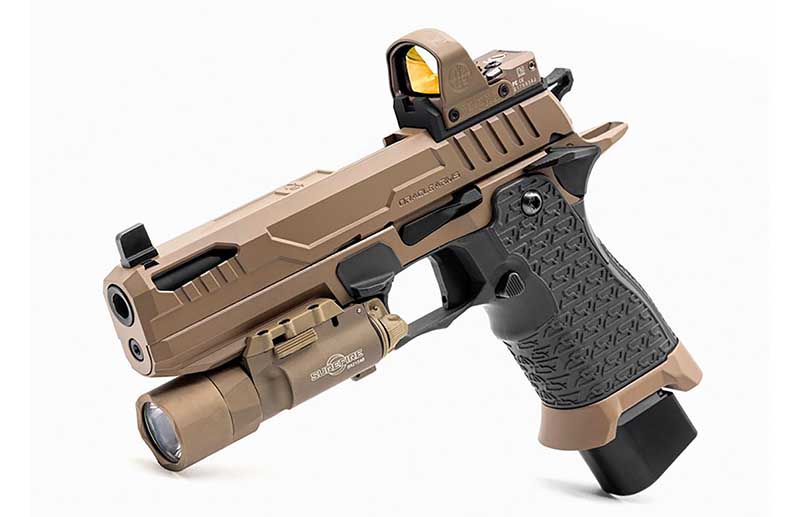
  • COLT KING COBRA S/N KD0001 – Lot 1627: Colt King Cobra Double Action Revolver with Box
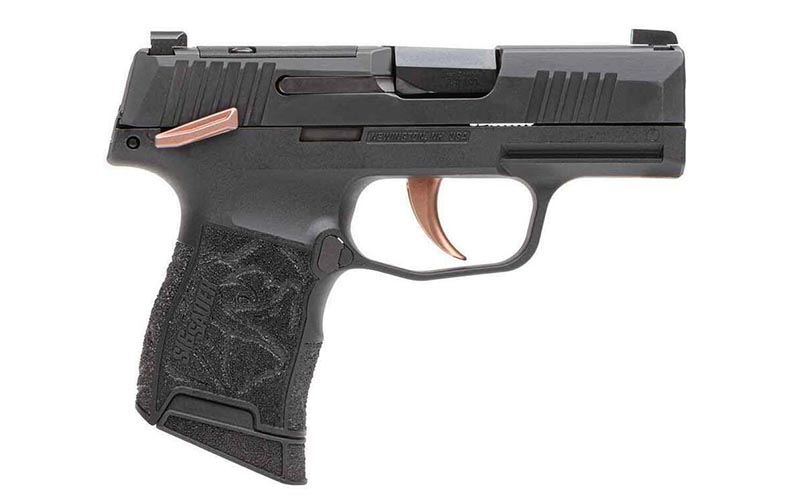
  • R.L. WILSON'S COLT OFFICERS .45 S/N RLW-1 – Lot 1628: Presentation Gold Inlaid Colt Officer's ACP Pistol 
  • EXPERIMENTAL S&W 9mm PISTOL s/n EXP-1 – Lot 1629: Engraved Bole Industries/Smith & Wesson 9mm Pistol S/N: “EXP-1”
  • TROUND FIRING DARDICK S/N PT1 – Lot 1630: Dardick Model 1500 Autoloading Revolver in Carbine Configuration
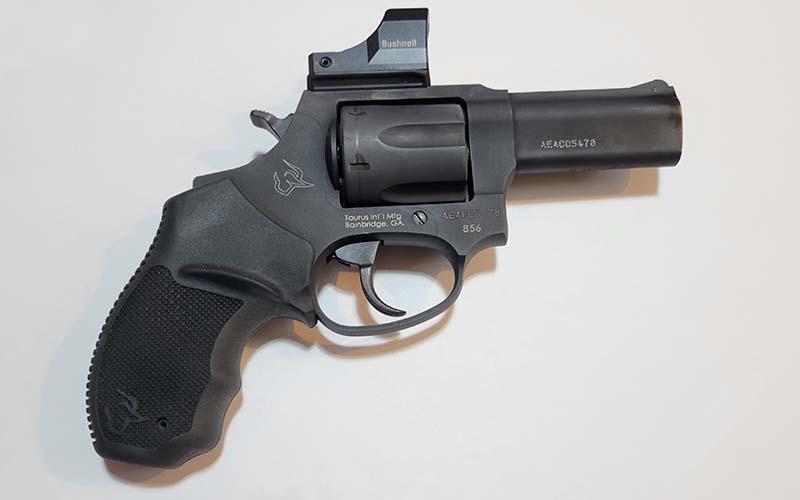
  • CALICO 100 ROUND .22 S/N F000001 – Lot 1631: American Industries Calico M-100P Semi-Automatic Pistol
  • S&W TWELVE REVOLVERS SET – Lot 1632: Number “1” Smith & Wesson “The Twelve Revolvers” Set with Boxes
  • AK S/N S000001 – FIRST IMPORTED – Lot 1633: Desirable Pre-Ban Maadi/Steyr ARM Semi-Automatic Rifle
  • FIRST CHINESE T53 MILITARY RIFLE s/n 1 – Lot 1634: Serial Number 1 Factory 296 Chinese Type 53 Mosin-Nagant Trial Carbine
  • FIRST IMPORTED NORINCO SKS s/n 001 – Lot 1635: Norinco SKS Semi-Automatic Rifle Serial Number 001
  • FIRST GUN BUILT BY SPRINGFIELD ARMORY M1A s/n X001 – Lot 1636: Prototype s/n X001 Springfield Armory/Valley Ordnance M1A Rifle
  • SEMI-AUTO UZI S/N SA01001 – Lot 1637:  First Imported IMI/Action Arms UZI Model A Carbine with Docs
  • FIRST PRODUCTION STEVENS .22 PISTOL s/n 1 – Lot 1638: Single Digit Serial Number “1” Stevens Model 10 Target Pistol
  • EXPERIMENTAL WINCHESTER M70 s/n EXP.1 – Lot 1639: Prototype Winchester Model 70 Rifle Serial Number EXP.1
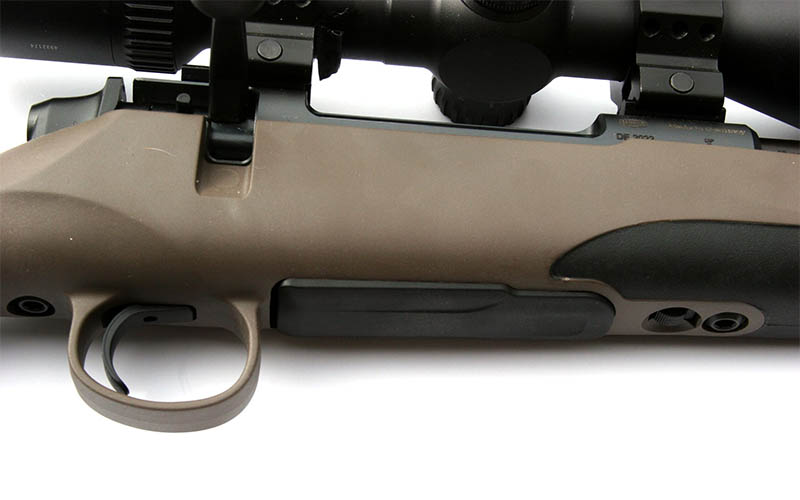
  • MARLIN PUMP .22 RIFLE s/n 1 – Lot 1640:  Serial Number 1 Marlin Model 37 Slide Action Rifle
  • WINCHESTER COMMEMORATIVE S/N CP1 – Lot 1641: The first Winchester Model 94 Canadian Pacific Railway Lever Action Rifle
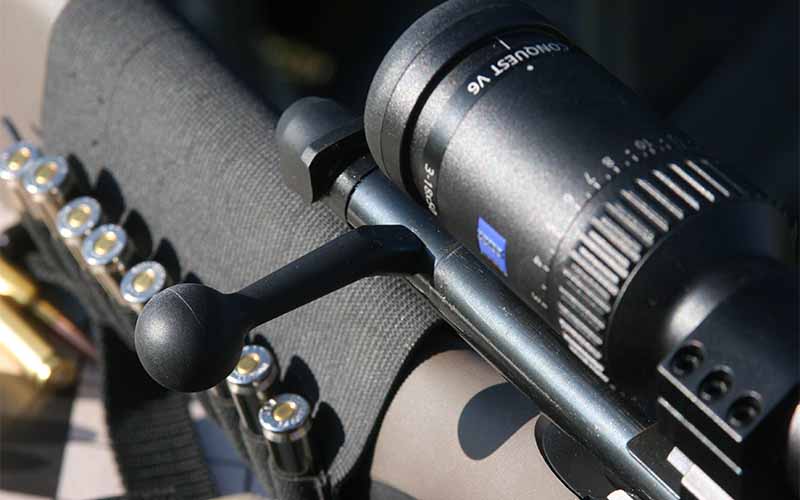
  • WINCHESTER COMMEMORATIVE S/N CK00001 – Lot 1642:  The first Winchester Model 94 Cherokee Commemorative Lever Action Carbine
  • .357 MAX SERIAL NUMBER 001 – Lot 1643: El Dorado Arms El Dorado Single Action Revolver
  • SINGLE ACTION .45 S/N A1 – Lot 1644: Engraved Uberti Regulator Single Action Revolver with Box
  • ROSSI .44 MAG S/N PMD001 – Lot 1645:  Rossi .44 Magnum Triple-Lock Prototype Double Action Revolver.  One of only two made.
  • DAN WESSON .357 MAG S/N 1AB – Lot 1646:  Dan Wesson Model W12 Double Action Revolver with Box
  • .357 AMP PISTOL S/N WJD001 – Lot 1647: TDE Corp Auto Mag 180 Semi-Automatic Pistol
  • BERETTA .380 s/n A000001Y – Lot 1648: Serial Number “A00001Y” Beretta Series 70s Semi-Automatic Pistol
  • SEECAMP .25 ACP S/N LT1 – Lot 1649:  Prototype Seecamp Co. LWS Pistol Presented to Author Leroy Thompson
  • DETONICS SUB-COMPACT 9MM S/N TDC EXP1 – Lot 1650:  Prototype Detonics Pocket 9 Semi-Automatic Pistol
  • WYOMING ARMS S/N SAFARI-1 – Lot 1651: Wyoming Arms Parker 10 mm Semi-Automatic Pistol
  • OMC BACKUP .380 S/N AB-01 – Lot 1652: OMC Backup Model Sub-Compact Semi-Automatic Pistol
  • FIREARMS INTERNATIONAL PROTOTYPE D9 s/n 1 – Lot 1653: Possibly the earliest sub-compact 9mm, s/n 1.
  • IVER JOHNSON PONY S/N 001 – Lot 1654:  Experimental .380, produced by other companies but never put into production by IJ.
  • PAIR OF S/N 1 COLT MODEL 1860s – Lot 1655: US Cavalry Commemorative 2nd Gen. Blackpowder Revolvers with Detachable Stock, s/n  AU1US & AUUS1.
  • PERCUSSION COMMEMORATIVE SERIAL NUMBER ONE – Lot 1656: America Remembers U.S. Cavalry Model 1860 Army Revolver
  • COLT 2nd GEN PERCUSSION PROTOTYPE s/n X1 – Lot 1657: SN X1 Colt 2nd Gen. Black Powder Series Pocket Navy Revolver
  • SET OF 12 COLT .22 SINGLE ACTIONS, SERIAL NUMBER ONE – Lot 1658: Collector's Cased Set of Twelve Colt Kansas Series Frontier Scouts – Four each of Kansas Forts, Kansas Trails, and Kansas Cowtowns
  • S&W SCHOFIELD SERIAL NUMBER ONE – Lot 3117:  Historically Significant, NRA Silver Medal Award Winning, Well-Documented First Production Serial Number 1 Smith & Wesson U.S./Wells Fargo First Model Schofield Single Action Revolver.  S/N 1
  • RADOM 9MM S/N D0001 – Lot 3358: World War II German Occupation Radom Vis 35 Pistol
  • FIRST H&K G3 PATTERN .308 BY SPRINGFIELD s/n 05000 – Lot 3756: Springfield Armory G3 Serial Number 05000 with Scope and Box

More Historical Guns:

First Look: Savage Arms 110 Carbon Predator

2

Savage Arms has just announced the 110 Carbon Predator, a new lightweight hunting rifle available in six chambering options.

Savage Arms is continuing to expand its 110 series of bolt-action rifles, and the newest addition is one geared toward predator hunting. It’s available in six different chamberings, very lightweight and durable enough to withstand whatever nature throws at it.

Savage-110-angle

The 110 Carbon Predator was given its name for its PROOF Research carbon fiber-wrapped stainless steel threaded barrel and carbon steel receiver. Barrels are either 18 or 22 inches depending on the rifle’s caliber. Chambering options for the Carbon Predator include 6mm ARC, .22-250 Remington, .223 Remington, 300 AAC Blackout, .308 Winchester and 6.5 Creedmoor. 6.5 Creedmoor is the only caliber option that is available with either an 18- or 22-inch barrel, giving the 110 Carbon Predator a total of seven different models to choose from. Weights range from about 6.5 to 7.2 pounds.
Savage-110-Carbon-Predator-left

Other features of the 110 Carbon Predator series include their use of AICS detachable box magazines, user-adjustable AccuTriggers and granite-textured AccuStocks with AccuFit technology.

Beth Shimanski, Director of Marketing at Savage Arms, said this about the new rifle:

As one of Savage Arms’ impressive new guns, the 110 Carbon Predator offers unbeatable performance for the toughest hunts…We’re committed to building the best, and this new model of the oldest continuously manufactured bolt action rifle in North America embodies all that and more. The modern predator hunter will love the Savage designed carbon fiber wrapped PROOF Research barrel, AICS detachable box magazine and exclusively on this rifle, a granite textured stock featuring the AccuFit and Accustock technology.

Savage-110-Carbon-Predator-right

Regardless of the model selected, all Savage 110 Carbon Predators have an MSRP of $1,695 and are available now.

For more information, please visit savagearms.com.


More Bolt-Action Rifles:

Legal Thoughts On Rimfires For Self-Defense

4

Rimfires for self-defense can work, but they have certain limitations and you need to have a plan.

I started teaching armed citizens how and when to use firearms for self-defense back in 1988. One of my first students, Patricia Newman (not her actual name), was one of my first to use a gun to save her life. She had been singled out for a brutal rape, with her rapist (in her apartment) raping and sodomizing her over the course of several hours. He didn’t need a weapon to threaten her; he used his hands to choke her repeatedly.

At one point in the evening, she was able to convince him that she needed to use the bathroom, which had two doors, one to the living room (where the attacks occurred) and one to the bedroom, where she kept her Smith & Wesson Kit Gun (.22 rimfire Mod. 34). She was able to get her gun, and when her rapist realized that she had gone into the bedroom, he followed her, and met her in the bathroom, where she shot him repeatedly with the kit gun. He then left the apartment, stumbled down the hallway, knocking on doors and yelling for assistance, at which time he then passed out and died. She had shot him five times in the chest with .22 hollow points.

Rimfire-For-Self-Defense

Learning From Tragedy

A lot can be learned from this incident. First, why was she using a .22 LR? For a couple of reasons. One was that she was initially trained as a new shooter with a .22 LR revolver. She was comfortable with the gun and, being petite, could handle the .22 LR recoil very easily. Secondly, she wasn’t wealthy, so she had that one gun for both practice and home defense.

Another lesson has to do with the aftermath issues. She told the police when they were investigating, “He raped me five times, so I shot him five times.” That quote made it into the story the newspaper ran a few days later. As it turned out, she didn’t face any criminal or civil legal repercussions, but you’d be advised to choose your words carefully, if you talk to the police after an incident.

Because of the injuries she suffered during the attack, she spent several days in the hospital. She called me from the hospital one evening (my business phone was also my personal phone) and related the story. She asked if she could borrow a gun, as the police had confiscated hers while the investigation was being conducted. I told her to come visit me when she was released from the hospital. When she did, I loaned her a Smith & Wesson .38 Special.

She kept the gun for several weeks, as she had repeatedly called the police to ascertain the status of the investigation and to get her own gun back, but the detective wasn’t returning her calls. She eventually called me again because she had convinced herself that she was going to be arrested since the detective wouldn’t call her back when she left messages.

So, I did what every well-meaning firearms instructor would do—I got an attorney involved. Another student of mine was an attorney, and I called him and asked if he’d intercede on her behalf. He agreed. One phone call from the attorney and the detective called her back, apologizing for not returning her calls and letting her know that there were no charges to be brought, and she could come pick up her gun. It turns out he had been on vacation for a while, and that was his excuse. OK, I guess.

Key Takeaways

This story illustrates the primary legal issue in using rimfires for self-defense, that being lack of instant stopping power and the likely need to shoot multiple times, if at all.

Federal Punch 22 ammo

No one wants to get shot, even with a .22 LR. That being said, if a person chooses to employ a .22 LR, they need to work out some issues ahead of time. First, they need to develop command presence, so they can effectively communicate with the criminal suspect that if they’re going to continue their criminal activity, they’re likely to be shot. Most reputable schools can teach you this, and before you sign up for a class, you need to make sure the curriculum covers taking criminal suspects at gunpoint. And once you learn how, you need to practice.

Second, you should use a “serious” handgun. Handguns that come to mind are Ruger and Smith & Wesson revolvers, and medium-sized semi-automatics, like the Ruger series of semi-autos. The reason for this recommendation is two-fold. First, for the most part, doctrine across the United States amongst the instructor cadre is that if you use a .22 LR, shoot for the head. And, you must hit the soft parts of the head (eyes and temple area). You need to get that small bullet inside the cranium where it can do its job disrupting the central nervous system. Having to wait for the person to collapse from internal bleeding isn’t likely a successful strategy, if he’s bent on killing you. Patricia was lucky.

Also important is the psychological factor when facing a criminal suspect. If the person cannot even see the gun in your hand, they’ll likely not be impressed. But a stainless or blued gun, which looks like a .357 Mag. or 9mm, might just stop them dead in their tracks without a shot being fired. If I were to recommend one .22 for self-defense, above all others, it’d be the Glock 44. A .22 rimfire that’s the size of a Glock 9mm. And it’s superbly easy to shoot. It has replaced our Ruger Mark 2’s in our training for new gun owners.

Also, look into the .22 Magnum, if you want a gun that doesn’t recoil much but still has a large bark. Rock Island Armory has recently come out with a .22 magnum 1911-style pistol, which should be good for 1911 aficionados (like me). I was a big fan of the AMT .22 Mag., which while not currently made, suitable used ones are around for good prices. And, they fit nicely in Browning Hi-Power holsters. There are also .22 Mag. revolvers. Do your homework.

The .22 Magnum offers a better bullet at higher velocity, but at more cost and noise. (Recoil is still pretty minimal.)

With the likelihood of needing to shoot for the head, if you use a .22 for self-defense, you’ll need to be able to articulate exactly why you took what most would call “a killing shot.” You had better be able to explain why you targeted the head (not difficult, but you better think it through ahead of time).

That’s it for the legalities of using a .22 for self-defense. While certainly justifiable, it comes with limitations.

Editor's Note: This article originally appeared in the 2021 CCW special issue of Gun Digest the Magazine.


More On Rimfires For Self-Defense

The Chest Holster Buyer’s Guide
1

Looking to comfortably carry an iron up-top without any concern for concealment? A chest holster may be just what you need.
Chest holsters have become more popular in recent years, especially for people who want to carry a gun outdoors but may have their waist occupied by a pack. In other words, the niche is for carrying a handgun when you can't wear a belt holster. 
Some people have taken to wearing them regardless of whether they're carrying a pack or not, and the holster as a class has therefore earned its place in the market. 

So, let's learn a little more about chest holsters by looking at what kinds there are, if you should get one, how they compare to other types of open carry holsters and finally a few good models to consider for purchase.

Chest Holsters Are For Open Carry When Belt Carry Isn't An Option

Chest holsters were developed for hikers and backcountry hunters who wanted to carry an easily accessible handgun in the backcountry when their waist was otherwise occupied by the hip belt of a pack. 

Chest-Holster-Feature-Kennai
A Kenai Scoped Hunter chest holster worn with a pack.

It isn't the only option for carrying a gun in the woods, but it is one of the better ones. 

But is there a reason you might not want to carry in a chest holster? How do they compare to other open carry holster types such as shoulder holsters or drop-leg holsters?

Drop leg holsters were designed to do something similar, namely to get the holster off the belt. However, what a lot of people don't know is that they're supposed to ride high on the leg. The idea is actually to have the gun in nearly the same location as with a standard belt holster. 

Drop leg holsters were originally developed to get a little more clearance for a plate carrier or soft armor vest, but to keep the duty gun in about the same location. The result is that drop leg holsters are also compatible with backpacks, as most types will hang the pistol low enough to clear a pack’s hip belt as well.

Shoulder holsters can likewise work by suspending the gun off the shoulder, so they are a potential open carry method as well, but they come with their own set of problems. They also don't necessarily mesh well with a pack’s shoulder straps.  

Shapeshift Shoulder Holster 3

Another thing to keep in mind is that if your pack has a hip belt with MOLLE/PALS webbing (the “battle belt” is actually part of a modular system including a pack and shoulder straps) you can mount an OWB holster to the webbing itself. 

However, every type of holster comes with downsides. 

The best way to use a shoulder holster is to let someone else buy it so it can make them miserable while you do other things. Many buy them, but few use them for very long. 

While a very small number of people use them in the outdoors, the best use-case is for someone who's seated a lot. Police officers who are frequently sedentary as part of investigative work and long-haul truckers will get more out of one than anyone else.  

Drop-Leg-Holster
A U.S. Marine with a drop-leg holster. Photo: Wikipedia.

Drop leg holsters and MOLLE holsters mounted to belt webbing stick out from the body. If you're backcountry hunting and having to make your way through thick brush, that's one more thing snagging and getting tugged at.  

Chest holsters are notorious for not playing well with binocular harnesses, so that's something to bear in mind as well. They also require a fair bit of adjustment to get the fit just right, but that's common with almost any holster. 

Types Of Chest Holsters

Chest holsters can broadly be broken down into four categories, specifically by holster material. 

Nylon, leather, Kydex and hybrid. All feature adjustable straps, most of which are nylon webbing but occasionally leather, in a three-point harness that loops under both arms and over one shoulder. 

Nylon chest holsters are essentially nylon cloth scabbards with a thumb strap. These are usually generically sized for large semi-autos and revolvers, but they are usually cheaply made and should generally be avoided. 

Elite-Survival-Holster
An example of a generic-sized, inexpensive chest holster. This one is from Elite Survival.

Leather chest holsters typically put an open-top holster on a three-point harness. They're usually offered for large-frame revolvers and semi-autos. Some also include a thumb snap or flap for retention.

Hybrid chest holsters, like any hybrid holster, use a soft backing material as the base with a hard molded polymer retention shell. The straps attach to the base, and the shell goes on top.  

Kydex chest holsters use a Kydex holster shell with nylon web straps attached to the wings of the shell. 

In all cases, chest holsters are typically made and offered for large-frame revolvers and semi-autos, as they are the types most frequently carried in the woods. 1911s, large-frame Glocks (especially 10mm variants) and large revolvers are the most common handgun fits that chest holsters are made for, but they can also be ordered custom to accommodate nearly any handgun out there.

The 5 Best Chest Holsters

Kenai Chest Holster

Kennai-Chest-Holster

Probably the best to acquire of all is the Kenai Chest Holster by Gunfighters Inc. The Kenai uses a custom-molded Kydex shell with a three-point adjustable web strap harness.

It's offered in multiple colors/patterns and for dozens of makes and models of handguns (including multiple revolver options). When ordering, there are options to accommodate a scope, light or red dot sight as well. It has a slim profile that should get along with most bino harnesses too. 

MSRP: Starts at $159 // gunfightersinc.com

Holster Your Doubts: Mastering Concealed Carry

Diamond D Guides' Choice Leather Chest Holster

Diamond-D-Chest-Holster

If you prefer your fightin' iron to ride in hide, Diamond D Leather offers the Guides' Choice Leather Chest Holster. As it happens, the Guides' Choice chest holster has been around for years and has a reputation as being one of the best you can buy. 

Handmade in Alaska for outdoorsmen in one of the roughest parts of the world, it has been field-tested more than any other entrant on this list. It's available for more than 100 makes and models of pistol (including semi-autos and revolvers) with several options including a retention flap, thumb strap or optional ammo/mag pouches. 

It's mostly designed for large semi-autos and large-frame revolvers, and while it's compatible with some red dot sights, it isn't compatible with scoped revolvers.

MSRP: Starts at $185 // diamonddcustomleather.com

Alien Gear Holsters Cloak Chest Holster

AlienGear-Cloak

Alien Gear Holsters is arguably the largest purveyor of the hybrid holster design ethos, offering their Cloak Chest Holster—named for their Cloak series of molded Boltaron holster shells—on a multilayer base with adjustable straps. 

The Cloak Chest Holster is made to accommodate a huge number of firearm makes and models, ranging all the way from micro-compacts up to the Desert Eagle. It can also be ordered to be compatible with lights, lasers and optics.

The base has a backing layer of wicking neoprene and adjustable web straps.

MSRP: $129.88 // aliengearholsters.com

Hosking Holsters Chest Holster

Hosking-Holster

Hosking Holsters, like a lot of holster companies, is a Kydex holster operation making its own molded polymer holsters. They offer a chest holster too, using an OWB holster shell with a three-point web harness attached. 

They offer a wide selection of firearms, from micro semi-autos and revolvers up to N-frame revolvers and large-frame semi-autos. They also have several configurable options for lights, lasers, red dot sights and backstraps for additional retention. As a bonus, this is one of the most affordable yet decent chest holster options on the market.

MSRP: $95 // hoskingholsters.com

El Paso Saddlery Tanker Holster

El-Paso-Tanker

Some people find chest holsters to be a little awkward, especially if you also wear binos in the field. The El Paso Saddlery Tanker Holster provides a slightly different design, inspired by the holsters created for tank crews in World War II. The holster sits a little lower, with the grip of the gun just under the sternum. 

A tanker solves the bino problem while keeping the gun on the front of the body. Everything a chest holster does, a tanker does, the gun just sits a little lower. 

El Paso Saddlery makes a relatively faithful clone of the M3 holster, made of leather and available for dozens of firearms including large-frame semi-autos and revolvers with barrel lengths up to 8 ⅜ inches. 

A thumb strap and tie-down strap (which attaches to the belt) are included along with an adjustable shoulder strap. 

El Paso Saddlery is one of the oldest names in gunleather, but the company is still making high-quality and practical holsters for the armed citizen to this day.

MSRP: Starts at $155 // epsaddlery.com


More Up-Top Carry Options:

Smith & Wesson Releases M&P9 M2.0 Competitor Pistol

2

Smith & Wesson has just announced the M&P9 M2.0 Competitor, a new metal-framed 9mm handgun from the S&W Performance Center designed for competition.

Earlier this year Smith & Wesson released the M&P9 M2.0 Metal, a metal-framed variant of the company’s popular M&P9 pistol. The gun has just received the S&W Performance Center treatment, however, and is now also available as the M&P9 M2.0 Competitor.

SW-MP9-M20-Competitor-Two-Tone

The M&P9 M2.0 Competitor, as the name implies, is designed primarily for use in competition. It’s a full-size handgun with a 5-inch barrel and a 17-round capacity in 9mm (10-round models are also available for restricted states). As a competition pistol, the M&P9 M2.0 Competitor also includes several features out of the box designed to make the handgun as soft-shooting and easy to use as possible.

SW-MP9-M20-Competitor-two-tone-angle

While the M&P9 M2.0 Competitor’s metal frame would normally cause it to weigh more than the standard polymer-framed M&P9, due to the aggressive lightning cuts it actually weighs slightly less (29 ounces versus 29.3 ounces). This was done to move the pistol’s recoil balance point farther back to help reduce muzzle climb. Other enhanced features on the Competitor include an improved trigger, an optics-ready slide and a fiber optic front sight. It also features a flared magazine well and an oversized, reversible mag release for faster and smoother reloads.

Smith-Competitor-MP9-Metal

The M&P9 M2.0 Competitor is available with either a Tungsten Gray or a two-tone Cerakote finish, and as mentioned it can be purchased with either 17-round or 10-round mags. Each pistol ships with four magazines, and regardless of the model chosen all have an MSRP of $999.

For more information, please visit smith-wesson.com.


More Smith & Wesson M&P Pistols:

First Look: Bond Arms Stinger RS And Rawhide In .22 LR

0

Bond Arms has just released two new double-barrel handguns, the Stinger RS .22 LR and the Rawhide .22 LR.

Bond Arms, the go-to manufacturer of new production Derringer-style handguns, has just released two new double-barrel concealed carry pistols. They’re called the Stinger RS .22 LR and the Rawhide .22 LR, and both are a new caliber offering of existing Bond Arms models.

Bond-Arms-22-feature
Bond Arms Rawhide .22 LR.

The Rawhide .22 LR is advertised as being designed for plinking at the range, or fun or varmint control when camping or at the ranch. Its barrels are 2.5 inches long, it has an overall length of 4.5 inches and a weight of 21 ounces. It has a cross-bolt safety and no trigger guard, and its stainless steel barrel and frame feature Bond Arms’ Rough & Tumble finish.

Bond-Arms-Stinger-RS-22-LR
Bond Arms Stinger RS .22 LR.

The Stinger RS .22 LR is advertised as being designed with more defensive uses in mind, such as a concealed carry or backup pistol. It’s also made of stainless steel and has the same finish as the Rawhide .22 LR, but instead has a 3-inch barrel, a 5-inch overall length and a weight of only 18 ounces. The Stinger RS has a cross-bolt safety and a trigger guard integrated into the frame.

Bond-Arms-22-shooting

The new .22 LR Bond Arms pistols are available now, and both the Rawhide and the Stinger RS share an MSRP of $269.

For more information, please visit bondarms.com.

More On Pocket Pistols:

Brownells Releases BRN-4 Piston Upper Receiver Kits

0

Brownells has just released the BRN-4 Piston Upper Receiver Kit, providing builders with a more affordable path to an H&K 416 clone.  

The H&K 416 is one of the most legendary AR-15 derivatives in existence, with its famously reliable piston operating system resulting in its adoption by the U.S. Marine Corps and many other prestigious military organizations around the globe. Many Americans would like to own one, but unfortunately, genuine Heckler & Koch parts are incredibly rare and prohibitively expensive. Thankfully, a more affordable path to H&K 416 ownership has just been created by Brownells’ release of the BRN-4 Piston Upper Receiver Kit.

Brownells-BRN4-Upper-Kit-HK-416-clone

The kit is comprised of a mix of both factory-new Brownells BRN-4 parts and surplus German parts. Brownells managed to source a small supply of genuine H&K 416 stripped uppers and handguards some years ago, and they are now available in limited numbers through these kits. The uppers may show signs of use, and once the genuine German parts are gone, they will not be replaced. The other parts in the kit are from Brownells, including the barrels which are available in 10.4-, 14.5- and 16-inch lengths. The kits are compatible with both standard AR-15 and H&K 416-style lower receivers.

Brownells-BRN4-Upper

The complete kits from Brownells are being sold for $1,499, but individual parts are available for purchase as well. While still expensive, for those who’ve been wanting to build a 416 clone, this kit will be a much more affordable way to do it than tracking down an original.

For more information, please visit brownells.com.


Get On Target With The AR:

The CCW Basic Proficiency Test

2

A defensive handgun drill for testing your practical defensive shooting skills with a concealed carry pistol.

There are all sorts of shooting drills you can conduct for practice, training or to evaluate your proficiency. Some drills isolate individual skills, such as shooting with your strong hand, conducting a reload, engaging multiple targets or maybe clearing stoppages. Others combine a collection of different skills to provide a more comprehensive estimation of your abilities. The drills you conduct and give credence to should be based on what you desire to accomplish, measure or test.

Establishing Your Standard

If you’re a competitive handgun shooter who likes to participate in IDPA or IPSC matches, you might focus on specific skillsets. If you just want to improve your base-line proficiency with a defensive handgun, you might work with different drills highlighting those things. There’s really no wrong or right drill if it has a practical relation to real-world application. You’ll have to decide that on your own, and you’ll also have to decide how to score, evaluate or critique the drills you conduct. And, you’ll have to decide whether your goal is to compete against yourself, some predetermined par or other shooters.

Handgun-Drill-feature

Typically, scoring is conducted through a combination of hits and time. Time restrictions impose a level of anxiety and, of course, hitting is the purpose of shooting. You can assign a point value for each hit and divide the total points by the time it took you to compete the drill. This is the Comstock method and is commonly used in IPSC matches.

Another method is the “Vickers Count,” which is used in IDPA matches. With this method, you take your elapsed time and add 1 or more seconds for misses, hits in various scoring zones or penalties. There’s really no wrong or right way to score a drill as long as it prevents gamesmanship. You don’t want to be able to game the drill in some manner that allows for a good score without following the spirit of the exercise.

Bill Wilson, founder of Wilson Combat, sent me a drill recently that he calls the “CCW Basic Proficiency Test.” He described the drill as being a basic test to see if you’re actually proficient enough to be carrying a concealed handgun. After looking at the content of the drill and conducting it five times, I think Bill might be on to something.

No, I’m not suggesting this drill/test should be mandated by government agencies issuing concealed-carry permits; I consider concealed carry a basic fundamental right. But I do think those who carry concealed should establish a certain level of proficiency for themselves, just as they might before operating a chainsaw. This drill/test is a reasonable way to measure that.

The Proficiency Test

To conduct Wilson’s CCW Basic Proficiency Test, you’ll need two standard IDPA or similar targets. (I didn’t have any IDPA targets, so I took two IPSC targets and painted an 8-inch circle in the chest area and a 4-inch circle in the head area.) Place the targets side by side, 6 feet apart. You’ll also need a shot timer, 18 rounds of ammunition, your carry gun in its commonly used concealable holster, and some sort of garment that actually conceals the pistol.

The idea is to shoot this drill cold, meaning no warm-up. And, this is a test, not a practice regime.

Starting with your handgun in your holster, standing 5 yards from the target, draw and engage Target 1 with two shots to the body and one shot to the head, then transition to Target 2 and do the same, for a total of six shots. Write down your time. (Just write your time on the target with a marker. This makes it easy to keep track of and reference later.)

Handgun-Drill-Targets
There are hundreds of different handgun drills you can work with. What matters most is if the drill can help you identify your weaknesses.

For the next string of fire, remain at 5 yards and, after drawing from the holster, fire three shots at the body of Target 1 and three shots at the body of Target 2 using your strong hand only, for a total of six shots fired. Again, write down your time.

For the final string of fire, step back to 7 yards. From here, you’ll draw from the holster and engage Target 1 with three shots to the body and then transition to Target 2 and do the same thing for a total of six shots. Like before, write your time on the target.

Now you need to score your targets. To do this, add the times together for each string of fire. Next, add 1 second for each shot that landed outside the 8-inch circle in the body and the 4-inch circle in the head. Add 5 seconds for each shot that missed the target completely. And, if you’re using actual IDPA targets, add 3 seconds for each shot that landed in the outer perimeter scoring area.

It’s About Improving

Wilson told me he ran this drill cold and scored 13.76. (Bill is, as you might expect, an excellent shot.) I didn’t do that well. On my first cold run, my total time was 12.08 seconds, but I had to add 3 seconds for shots that missed the 4- and 8-inch circles for a total score of 15.08. According to Bill’s rating system, with that score I’m fully proficient.

Wilson rates a score of 15 or less as extremely proficient, a score between 15 and 20 as fully proficient, 20 to 27 as marginally proficient and anything over 27 as not proficient enough to carry. You might or might not agree, and that’s fine; you should be the one determining your proficiency level. However, by any measure, if you cannot do better than 27 on this test, you need some serious training and practice.

The Surprise Takeaway

As a side note, I learned something from this drill, and I’ll bet it might be the same lesson you’ll learn. The three points I dropped were during the second string of fire with my strong hand only. None of us shoot enough only using our strong hand, and that’s something you might very likely need to do during a self-defense situation.

This bothered me, so I ran the drill four more times, expressly concentrating on my strong-hand-only performance, making my average for five runs 13.81. I performed better by slowing my shooting with my strong hand only by about a half-second. Because I wrote the times of each run on the target, this was easy to see.

Based on this test, my new training goal is to improve my strong-hand-only shooting. That’s what drills/tests like this are best used for: to help you identify your weaknesses and give you incentive to improve.

Editor's Note: This article originally appeared in the October 2021 issue of Gun Digest the Magazine.


More On Handgun Drills And Training:

First Look: Browning Silver Series Ammunition

0

Browning Ammunition has just launched the new Silver Series, featuring ten calibers of rifle ammo designed for deer and big game hunters.

The Silver Series is a new rifle ammo line from Browning Ammunition designed for big game and deer hunters. The series features modernized soft-point, nickel-plated projectiles that are heavy-for-caliber and designed to hit hard while providing maximum penetration.

Browning Silver Series feat

The calibers that are currently available in the Silver Series include .30-06 Springfield, .308 Winchester, .270 Winchester, .30-30 Winchester, .243 Winchester, .300 Win. Mag., 7mm Rem. Mag., 6.5 Creedmoor, .350 Legend and 6.8 Western. Bullet weights, muzzle velocities and muzzle energies for each respective load are listed below.

Silver-Series-Data

The Silver Series is advertised as being capable of taking the toughest game in North America, and the nickel-plated projectiles should ensure good corrosion resistance and smooth feeding. The ammo comes in 20-round boxes and is available now.

For more information, please visit browningammo.com.


Raise Your Ammo IQ:

MUST READ ARTICLES