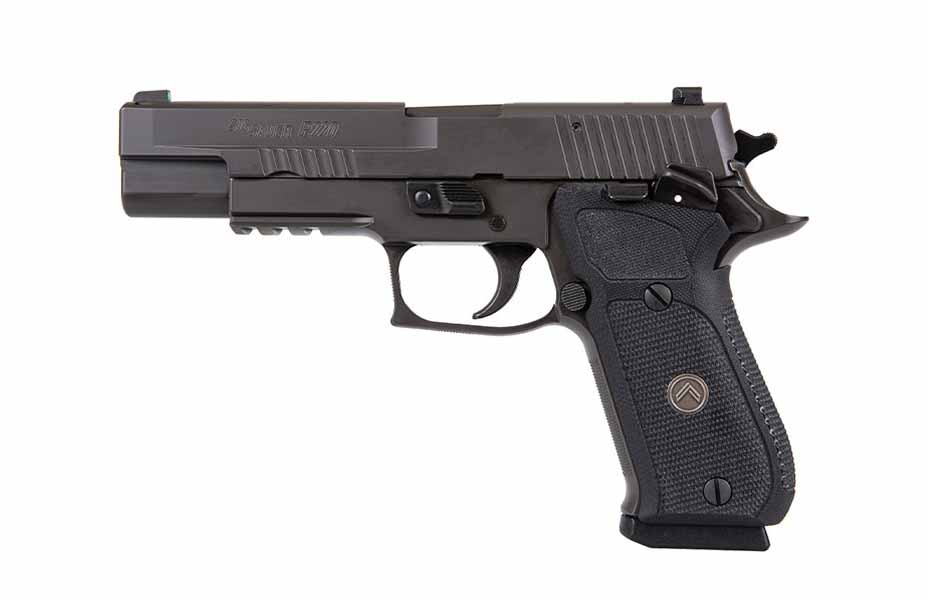
Looking for an elite-level pistol that packs a punch? Shake hands with Sig Legion P220 10mm SAO.
The idea behind the LEGION series is to provide a pistol a cut above the original. Quite a feat, given the gun Sig Sauer has populated the line with are pretty extraordinary in their own rights.
The gunmaker recently expanded this premium line, good news for fans of the hard-hitting pistol cartridges. The newest edition, the Sig P220 LEGION 10mm SAO, which should certainly prove an extremely potent addition to the series. Most likely shootable, too. Given the LEGION P220 tips the scales at 44 ounces, the generally snappy cartridge should be tamed down a touch by the full-sized, hammer-fired pistol.
In addition to some nice touches, such as X-RAY3 Day/Night sights and ambidextrous manual safety, the 10mm LEGION P220 has a few other notable accouterments. These include a Legion Gray stainless steel slide and frame, solid steel guide rod, enhanced checkering on the front strap and under the trigger guard, front cocking serrations and black G-10 checkered grips. To doll it up a bit, Sig has included a LEGION medallion in the grips and LEGION Chevron engraved on the slide. Pretty slick package.
However, the handgun will run you a pretty penny. Sig didn’t release an MSRP, but a completely unscientific survey of online retailers found it selling for around $1,500.
NEWINGTON, N.H. – SIG SAUER, Inc. is pleased to announce the expansion of the LEGION series of pistols with the SIG SAUER P220 LEGION 10mm SAO.
“The P220 was the pistol that started it all for modern day SIG, and the introduction of the P220 LEGION 10mm SAO brings new features to a SIG classic,” said Tom Taylor, Chief Marketing Officer and Executive Vice President, Commercial Sales. “This is a single action only pistol giving it a lighter trigger pull, combined with the increased energy of the 10mm round, for more power and performance. On top of that, we’ve added the exclusive SIG SAUER LEGION series features and enhancements, which really takes it to the next level, putting a modern twist on this SIG classic.”
The SIG SAUER P220 LEGION 10mm SAO is a full-size, hammer-fired pistol, featuring a Legion Gray stainless steel slide and frame, with X-RAY3 Day/Night Sights, and an ambidextrous manual safety. LEGION enhancements include a solid steel guide rod, enhanced checkering on the front strap and under the trigger guard, front cocking serrations for easy slide operations, black G-10 checkered grips with LEGION medallion inset on the grips, LEGION Chevron engraved on the slide, and includes three (3) 8-round magazines.
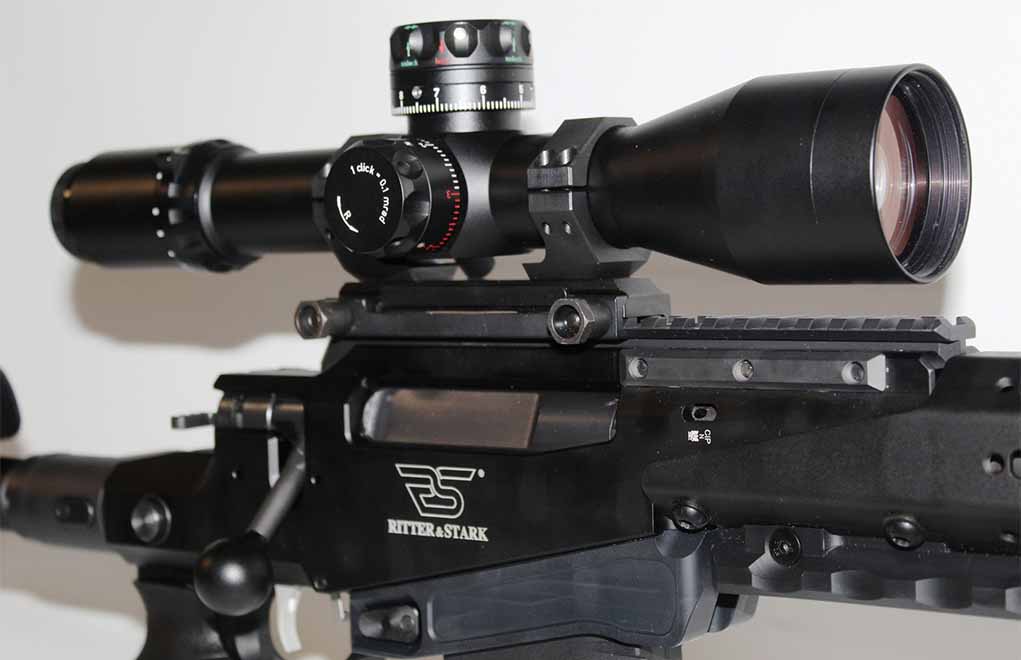
Precisely engineered for true quick-detachment, ClawMounts expands the horizons of your scope and rifle.
Scope mounts. There’s nothing too sexy about them. In fact, if they do their job you never notice them … until you go to change your scope. Then some issues can arise, particularly when it comes to the quick-detach variety.
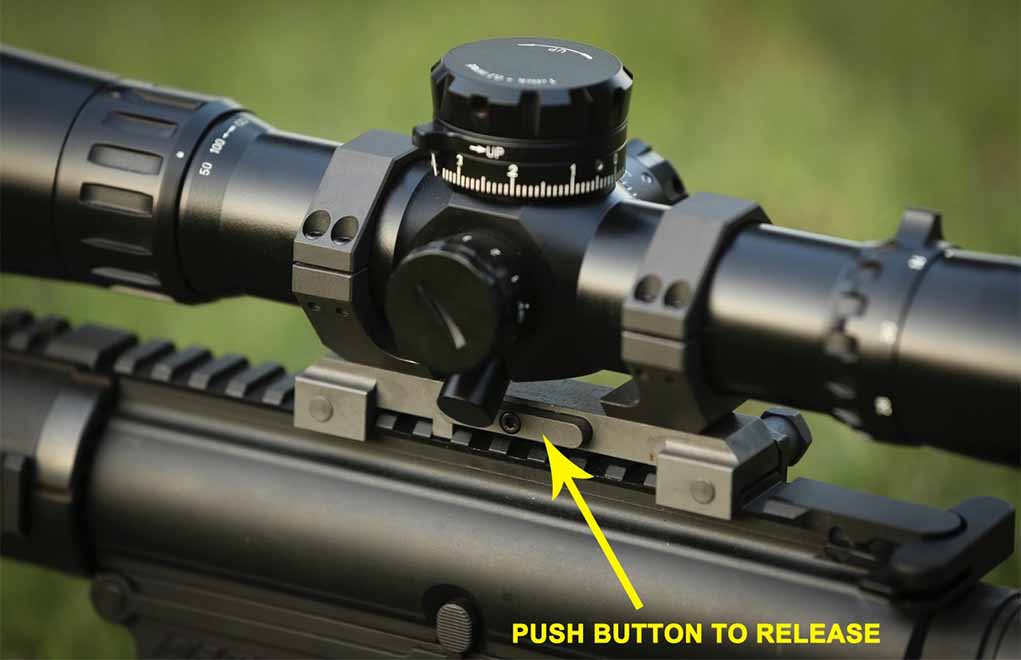
Certainly, run-of-the-mill QD options are much faster than the alternative, generally requiring a minimum of tools. And yes, the best made do hold their zero when properly used, saving some time in the process. Yet, few, if any—even cam operated—truly deserve the title of “quick.” Minimal as the process might be, it’s still a process, one involving two hands and a bit of time—not exactly what you’d call a tactically-sound accessory. Enter Clawmounts.
Clawmounts System
Essentially, Clawmounts offers exactly what is described above. Of course, there is a bit more to it than its simple operation. There’s also a dash of cleaver design and execution in making a true quick-detach system that retains your scope zero time after time.
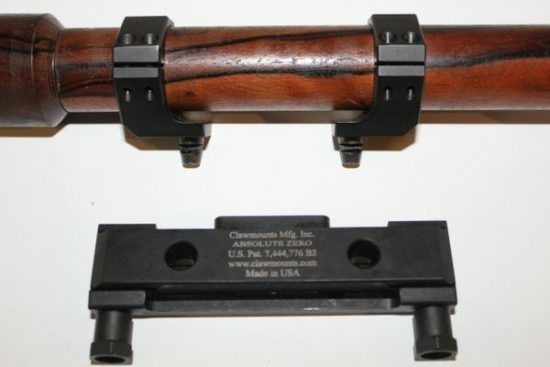
Clawmounts utilizes twin posts on the rings to secure to the base on a rifle’s receiver though a notch-and lock system. It might be natural to assume the lock springs are what hold a scope in place, but there’s where you’d be wrong. Relying purely on this would require springs so heavy they’d make quick detach impossible. Instead, the posts’ geometry gets them to hold fast.
Study them a bit and it’s easy to see the posts are conical in shape, narrow at the tip and wide at the base. Precisely milled to fit in the base holes, the posts create a tension that keeps the whole system in place. An analogous system is post-and-beam timber construction, where carefully fitted joints and precisely fitted sized pegs keep the whole structure upright without a single nail. Scoff if you want, some of the oldest wooden buildings still stand today using exactly this process and it’s all based off tension.
Clawmounts Advantage
Keeping a scope’s zero with a quick detach system is an asset that benefits any shooter who appreciates convenience and accuracy, not to mention looking after their optics investment. Run a top piece of glass on your hunting rifle That next cross-country hunt you don’t have to leave it vulnerable on top of your rifle. Or if you compete and have a red dot poop out mid match, just switch it out with the push of a button. Honestly, with Clawmounts the potential is limitless.
It’s no secret, shooters invest a king’s ransom in their guns and optics and treat mounting systems as a passing concern. This is a mistake—you’re creating a weak link in the chain. Clawmounts erases this worry while adding flexibility to your rifle. Could you ask for anything more?
Expand the horizon of your scope and rifle, get your set of Clawmounts HERE!
Walther opens the semi-automatic pistol to the world with its easy-to-manipulate CCP M2 in .380 ACP.
There are no bones about it, the .380 ACP is here to stay. Thanks to advancements in defensive ammunition, the one-time marginal caliber has become a mainstay among armed citizens. This is not only thanks to its vastly improved terminal ballistics, but also a solid selection of easy-to-carry pistols flooding the market. Walther Arms has been ahead of the curve, producing some of the most effective guns for the caliber.
Continuing to improve on its already impressive catalog, Walther introduced the CCP M2 early this year. Not only is this good news for the concealed carry market, but also those who’ve shied away from the German gunmaker due to generally complex routine maintenance. Starting with the .380’s older and bigger brother—the 9mm M2—Walther introduced tool-less takedown for the pistol. Needless to say, the feature goes a long way in creating a more user-friendly system that even handgun novices can master.
The other big selling point of the CCP M2 .380, its easy-to-manipulate slide. Many—particularly women or those with little hand strength—have found semi-automatic pistols prohibitory due to the force required to rack the slide. Walther solved this with its Softcoil gas technology—a gas piston system—which reduces the need for a heavy recoil spring. As a bonus, the system also does a number on the pistol’s recoil, making easier to manage—especially shot to shot. Other notables include on the .380 a 3.54-inch fixed barrel, 5.5-pound trigger pull, 8+1 capacity, 20-ounce weight (empty) and 1.18-inch width.
Overall, the CCP M2 in .380 is a pleasant and efficient system. Once certain to open semi-automatic pistols to more shooters.
Three years in the making, the new Glock 44 finally gets the gunmaker into the .22 LR market. Was it worth the wait?
It’s not a secret that the Glock G19 is one of the most popular handguns in America. Developing a Glock chambered in .22 LR sounds like a no-brainer. It’s been three years in development, but that’s exactly what Glock did. The Glock 44, chambered in .22 Long Rifle, stays true to the Glock design, but it has a few differences to compensate for the no-recoil .22 LR cartridge.
The Glock 44 is a striker-fired, blowback, semi-automatic compact pistol. For most intents and purposes, it’s a Gen5—although Glock doesn’t call it a Gen5. It uses a modified G19 Gen5 frame and a hybrid polymer/steel slide. The barrel is the Glock Marksman Barrel (GMB) and is not a fixed-barrel like most rimfire handguns. The barrel stays straight during the entire cycling of the action.
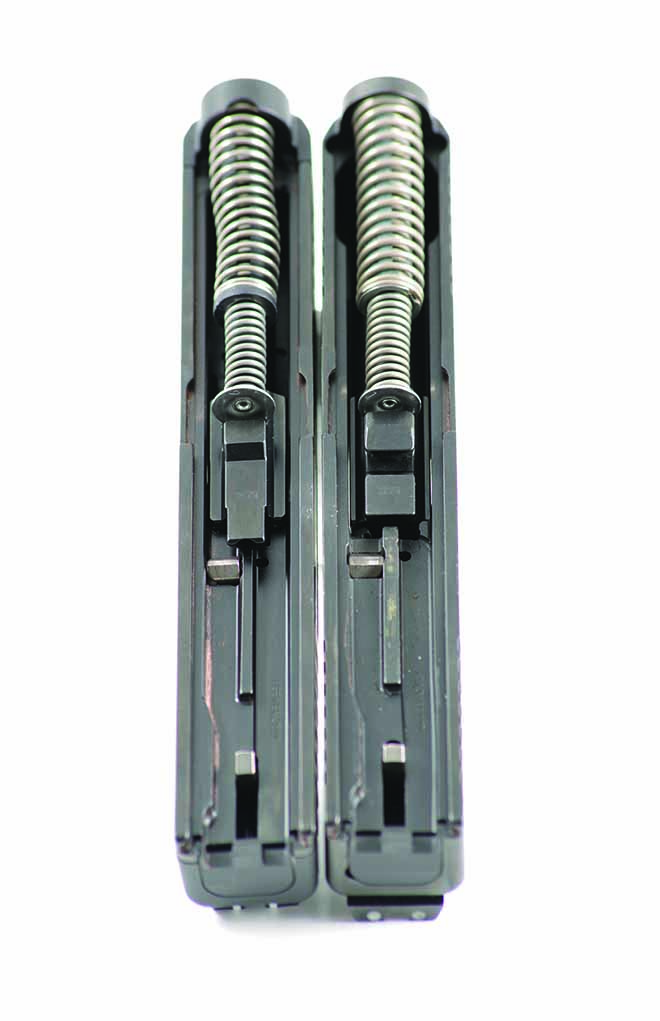
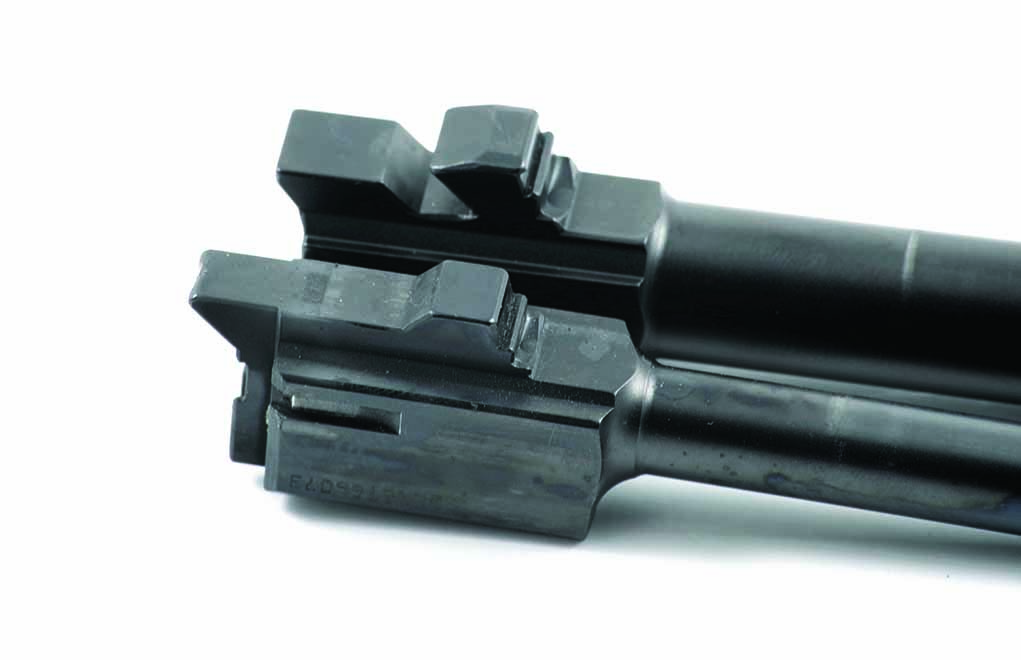
The underside of the Glock 44 (left) and the G19 Gen5. The barrel-locking lug on the G44 is long and narrow, while the locking lug on the G19 is short and wide. This prevents these slides from being swapped with the other’s frame.
The Glock 44 can be adjusted to various shooter preferences via an ambidextrous slide stop lever, reversible mag catch and four interchangeable back straps (two beavertail and two standard). It comes with two 10-round magazines, and the polymer rear sight is adjustable for windage and elevation.
The entire Glock 44 is about 10 ounces lighter than the G19, and the majority of that weight reduction is the slide. Most .22 handguns have an aluminum slide, but Glock wanted steel; it’s far more durable. But a steel slide would weigh too much for a .22 LR cartridge to cycle reliably. So, Glock designed a steel sub-structure and incorporated polymer—which Glock obviously knows very well.
For friction points, you always want steel on steel and polymer on polymer, because steel on polymer will expedite wear on those parts. The steel sub-structure is what makes contact with the metal slide rails on the frame, so there’s no friction or stress on the polymer portion of the slide. The slide face where the cartridge sits is also steel, as is the nose ring that the barrel goes through.
The slide internals don’t look much different than standard Glock OEM parts, but there are some changes, mostly due to the caliber. The big difference is the GMB. The chamber block is roughly the size of a G19 but has different locking lugs—because it’s not a tilt-barrel—and a ghost hole on top that’s a loaded chamber indicator.
The slide will accept any aftermarket sights designed for the G19. Nevertheless, take note if you go that route, because the dovetail is polymer, and metal sights could cause damage during installation if care is not taken.
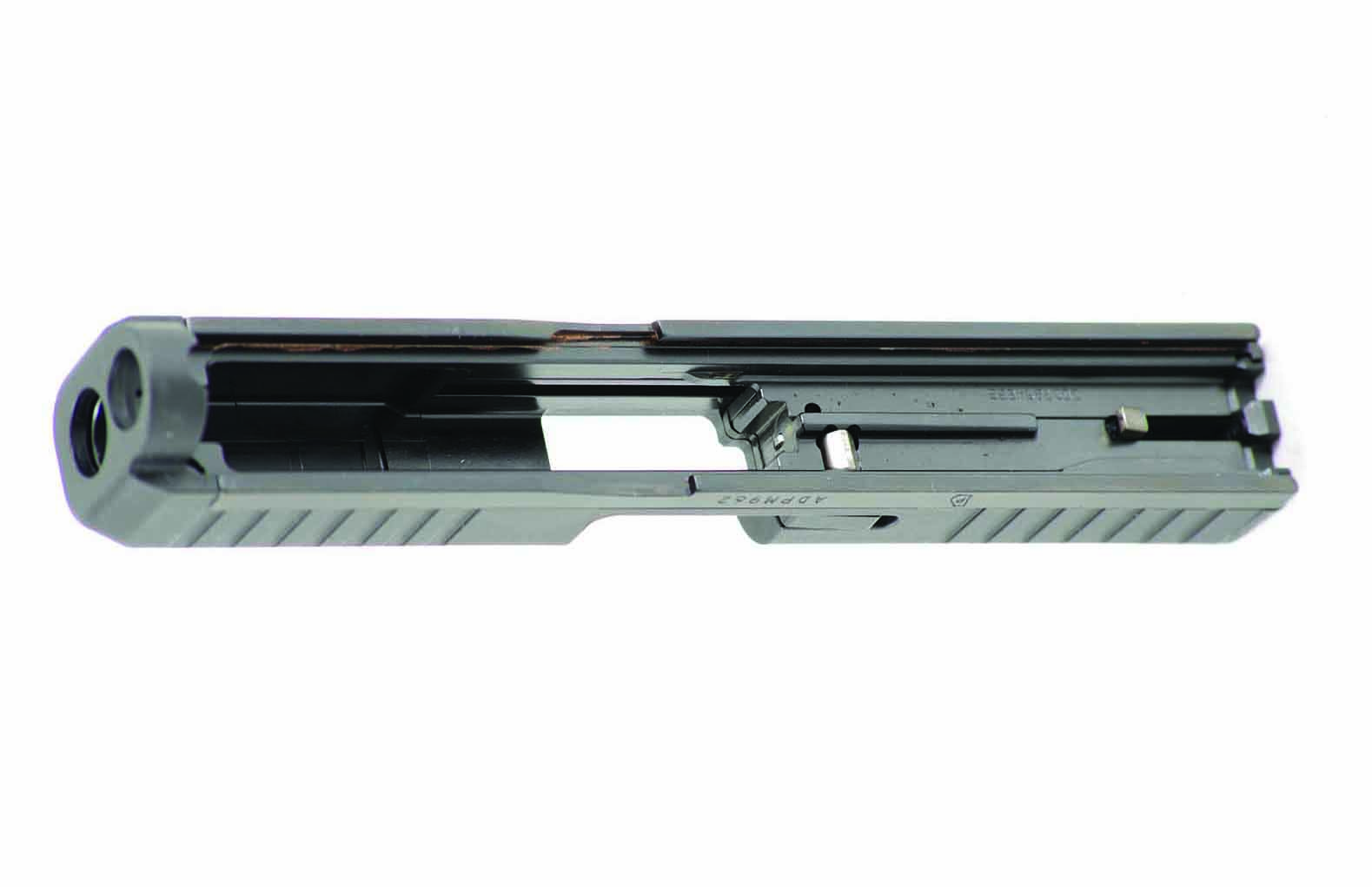
If you remove the slide, most noticeable is the locking block, which is polymer instead of metal, as well as the area in the frame where the locking block is located. It’s designed so that a G19 and a G44 can’t swap slides.
The trigger is all Glock. The take-up is slightly spongy, but it has a clean break. Glock lists the pull weight at 5.8 pounds; mine averaged about 5.5. For Glock users who don’t care for Glock factory triggers, the G44 will accept aftermarket triggers designed for the G19 Gen5.
When the Glock 44 was announced, the Internet almost exploded—about half with excitement and about half with hate. A lot of that hate centered on the magazine; in particular, the fact that it’s 10 rounds. But why 10 rounds? Why not 15? Everyone has 10. Some new .22s have more.
The hybrid steel/polymer slide consists of a steel sub-structure that makes contact with the slide and houses the high-friction parts. Polymer is then fused with the steel to complete the slide.
The short answer: Glock wanted more rounds too, but during the nearly 14 million rounds fired during its three years of development, having more than 10 rounds in the magazine didn’t meet expectations for reliability.
Although I’d rather have more rounds, I’m fine with that answer. However, for those of us who want more than 10 rounds, ProMag has a magazine in development for the G44. There‘s no set magazine capacity yet, but it will be at least 14 rounds. Its expected ship date is by March 1, 2020. Aside from the 10-round capacity, one of the things I like most about the Glock 44 is the magazine. It has the same outer dimensions as the G19 magazine. In fact, they’ll fit into each other’s mag well (although my G44 mag won’t lock securely into the G19 mag well).
Why is this so important? Reloads—especially for training. Most .22 pistols have long, slim magazine tubes that are barely larger than the .22 rounds they hold. If you’re practicing realistic reloads, those suck. They’re slow; it’s hard to hit the slot in the mag well under pressure; and the mag wells jam up if you don’t insert them perfectly straight. Glock did it right with the design of the G44 mags, down to the load-assist lever on both sides.
What the Glock 44 Is Not
The Glock 44 stands out from the crowd for several reasons. Foremost, while a majority of the .22 LR handguns in this category feel like replicas, the G44 is a true Glock. It’s the actual Glock design that we know, and it feels like a Glock. More importantly, it shoots like a Glock. Same Glock feel, same Glock trigger, same Glock controls, same Glock maintenance/disassembly, same Glock … well, you get it: It’s a Glock.
Range Time
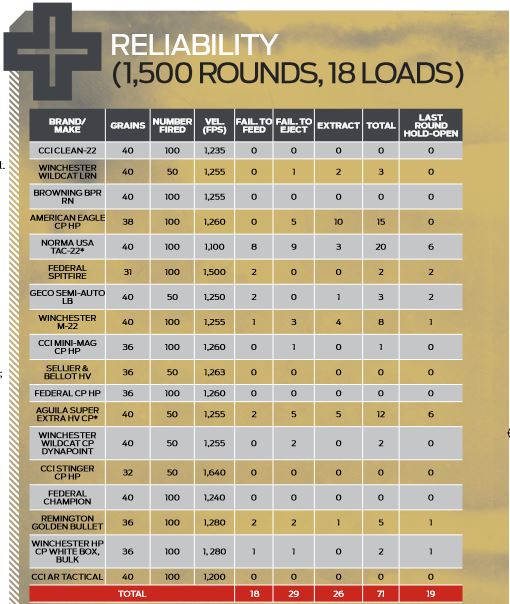
I know Glock’s goal for the Glock 44 is to shoot everything reliably. But, in reality, .22 ammunition has a very large variation in performance. Glock tested the G44, firing more than 14 million rounds of more than 120 makes of ammo to make sure it could reliably shoot anything. So, reliability was also my focus. I fired 1,500 rounds using 18 different loads.
The locking lugs on the G19 (top/back) are designed for the barrel block to tilt down during the cycling of the slide. The G44 (bottom/front) doesn’t tilt, so the locking lug just keeps it in place.
The Glock 44 I tested just did not like four of the 18 loads I used, which accounted for 350 rounds. It was obvious that it was an issue with the ammo, because almost every time I had a malfunction, it was preceded by a weak-sounding discharge, and the slide either barely cycled or had a weak cycle—often so weak that the spent case barely made it out of the ejection port. Twice, the discharge was so weak that I was convinced it was a squib load, and I disassembled the gun and checked the barrel (I did lubricate the slide before testing, and I added two drops of lubrication after about 500 rounds).
For the rest of the 1,150 rounds fired from 14 different loads, there were 18 malfunctions, seven of which were also due to cartridges with weak powder charges that didn’t completely cycle the slide. Four times, the weak charge wouldn’t cycle the slide enough to extract; seven times, it extracted, but not enough to eject; and there were seven failures to feed (the bullet nose hit outside of chamber and got stuck. These were the seven malfunctions that weren’t related to an underpowered cartridge but were most likely due to carbon buildup. Five happened after). Six times, the slide did not lock back after the last round fired, because the round didn’t have enough power to cycle the slide far enough to lock back. But I don’t count these as failures.
Wrapping it Up
The Glock 44 fills a void in Glock’s lineup that shooters have been asking to have filled for years. It’s not sexy like a carbine or a single-stack 10mm, but it’s probably the thing Glock users have been asking for the longest. The G44 is going to be extremely popular, and Glock will sell a lot of them.
Glock 44 Specs: CALIBER: .22 Long Rifle ACTION TYPE: Semi-auto FRAME: Polymer CAPACITY: 10-round magazine SLIDE: Steel/polymer fusion BARREL: Glock Marksman Barrel; 4.02 in.; hex TRIGGER: 5.8 lb. (5.5 lb., as tested) SIGHTS: Polymer; adjustable WEIGHT: 14.74 oz. (with empty mag) OVERALL LENGTH: 7.28 in. HEIGHT (WITH MAG): 5.04 in. OVERALL WIDTH: 1.26 in. SLIDE WIDTH: 1.01 in. (measured at steel sub-structure) ACCESSORIES: Includes two 10-round mags; threaded barrel available MSRP: $430 (street price estimate: $370; blue label: $350)
For more information on the Glock 44, please visit us.glock.com/en.
The world can be a very dark place. Not to be negative, but the sun does not shine 24/7, creepy places tend to be poorly lit, and the fullest moon rarely shines bright enough to light your way down a forest path or dark alley.
But most of that is easily fixable. No, they haven’t yet created longer sun cycles or the technology to dial up the intensity of moonlight. A simple hand-held flashlight is all you need to see the light. That much is simple. Which one is best for you? The short answer: It’s complicated.
Flashlight choices used to be easy, though the options weren’t always top-tier. Big or small. C-cell, D-cell or AA batteries. Switches were either off or they were on. They all gobbled battery power much faster than you hoped, no matter what the size. If you dropped your light, game over. Expose any of them to a little moisture, and you were dealing with battery corrosion very quickly.
These days, however, consumers have a multitude of flashlight choices — so many in fact, that choosing which one can be daunting. Batteries have come a long way in recent years. LED bulbs have revolutionized handheld lights, and flashlights are tougher, more efficient and more effective than ever. Whether you’re standing in the retail isle or perusing online options, it doesn’t take long to become overwhelmed. It’s just a little flashlight after all, right?
How Will You Use It?
Just what you should buy all depends how the light will be used — and how much you want to spend. The price range runs from less than $10 to well more than $250. And on the outside, they all look an awful lot alike.
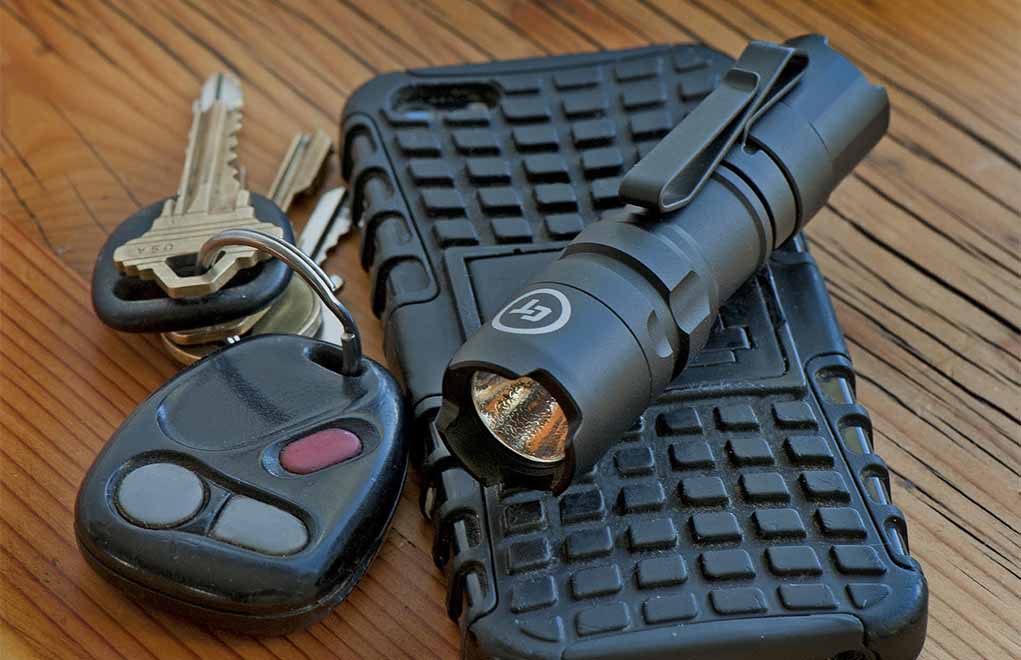
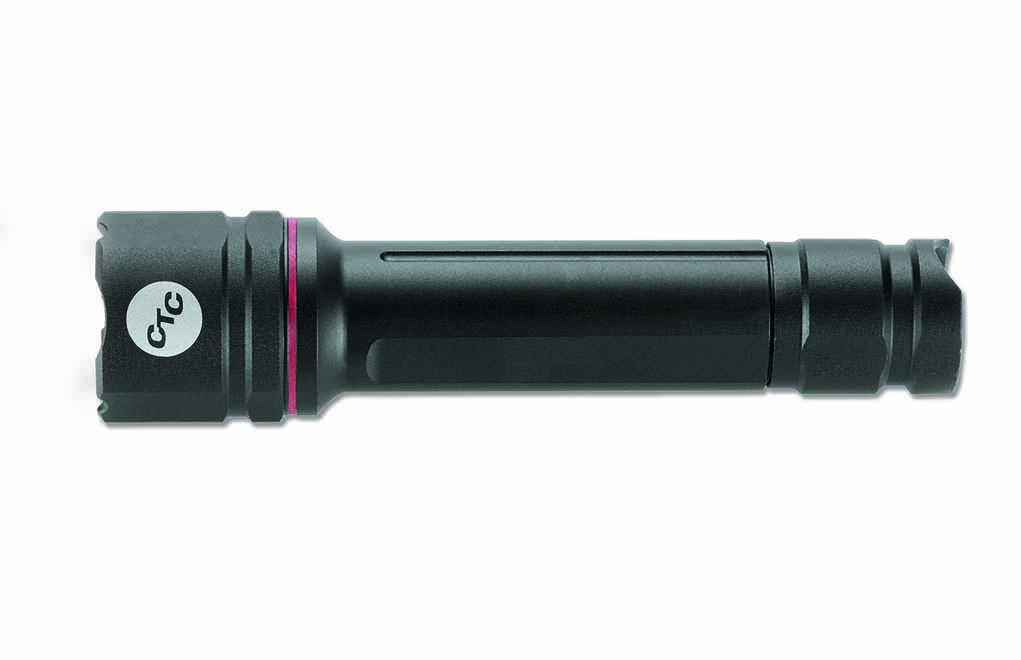
Size matters when choose a flashlight, especially if it’s to be used for daily carry. Go too big and it’s easy to leave a light behind. Ideally, a flashlight fits comfortably in your hand and is compact enough that it becomes an essential element of the gear you always have at your fingertips. Pictured here is a Crimson Trace CWL-300.
Do you need to shed light on your nightly dog walk, find your way around the house during a power outage or locate your car keys if you drop them in the driveway? For those chores, a basic light should work just fine. The good news is that the less expensive lights can be pretty darned good. Spend $100 and you can expect to have light in your life for the rest of your life.
If you work in law enforcement, as a first responder or spend a big part of your life outdoors in the dark, you have far more considerations. Ponder durability, battery type, size, weight, water resistance, brightness (lumens) plus beam/bulb type.
And then there’s the “simple” on/off switch. Can it be adjusted to lower power to preserve battery life? Could it inadvertently get switched on in your pocket or pack? Can you operate the switch with one hand or with gloves on?
Does a light feel right in your hand? Does the case have some texture for positive gripping and a flat side to keep it from rolling? Does it have an attachment point for a lanyard or carabineer? Does it have a clip for attachment to your belt or shoulder strap?
Most manufacturers ascribe to American National Standards Institute (ANSI) standards in testing and subsequent ratings of flashlights. The packaging for most high-end flashlights includes performance data on lumens, beam distance, run time, impact resistance and water resistance. This helps some with comparisons — but keep in mind that manufactures do their own testing, and a few manufacturers don’t post standardized ratings.
Lumens is a measure of the intensity of the light coming out of the flashlight on the highest brightness setting, with new batteries. As a general rule, the higher the number of lumens, the brighter the light will appear. However, multiple flashlights with the same lumen rating might not necessarily be the same brightness due to reflector and beam styles and variations in testing.
How many lumens is enough? It depends. Twenty lumens is about right for reading a book or checking a map. One-hundred lumens should be enough for most household applications or enough light for changing a tire. Five-hundred lumens will blind an attacker at close range and work as a decent search light. And if you’re of the “go big or go home” school of thought, 3,500 lumens would likely burn the hair off a cat at 100 yards.
Other Points To Ponder
Beam distance is how far the light will shine before the brightness diminishes to the equivalent of the light from a full moon. Full moon is the standard for safety when traveling at night. I know that might sound archaic, but it’s a standard of measure most people can comprehend.
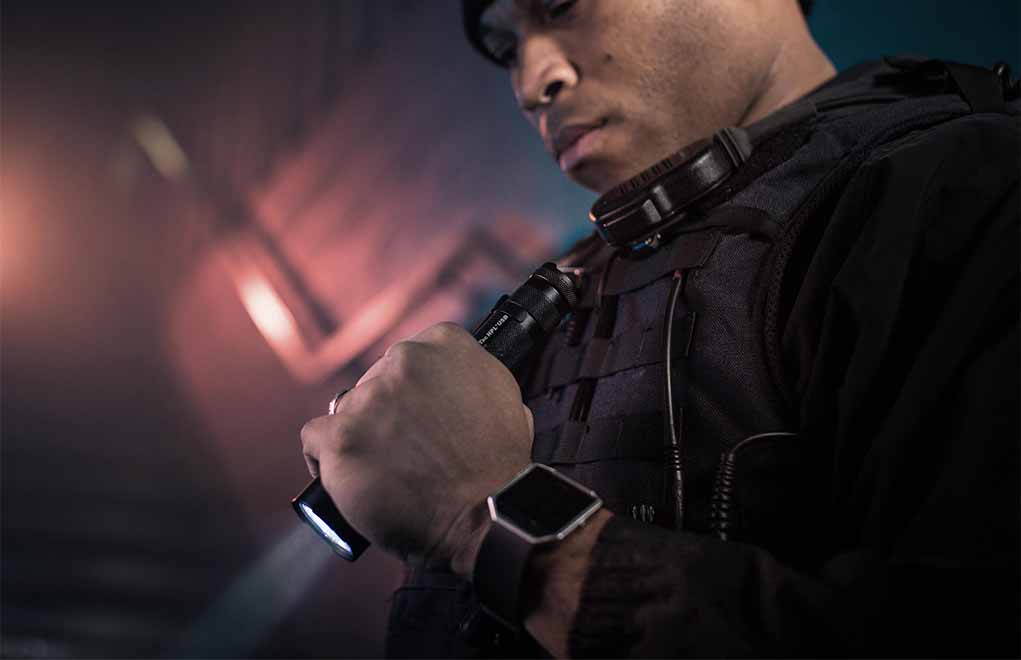
12/12/17 1:19:14 PM — Streamlight products in outdoor/industrial/law enforcement situations. Photo by Shane Bevel
Run time is another critical consideration. A light might generate 1,000 lumens on its highest setting with new batteries — but only for an hour. As a rule, the brighter the mode, the shorter the runtime. Which is more important to you?
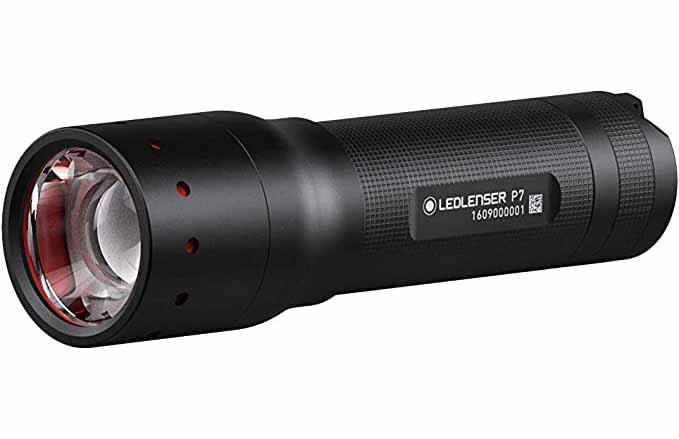
Consider a light with a reduced power mode. For example, the switch on the Ledlenser P7 handheld light has both a high and a low setting. On high, the compact light will blast 450 lumens of light out to 300 meters. But, it will drain four AAA batteries in an hour (for practical purposes, it’s rare that you’d need that much brightness for that length of time). Set to the low mode, the same light will provide a practical 40 lumens for 25 hours.
The tubular bodies of most modern flashlights are constructed of either stainless-steel, aluminum alloy or plastic. Durability is a judgement call based on how it feels in your hand and in what environments you’ll be working with that light. If the body walls are thin, the light may not withstand too many drops — but it’s likely going to be very inexpensive.
With those aircraft-grade bodies come O-rings — which, combined with sealed circuits — give the majority of these new-age flashlights exceptional water resistance. If this is important to you, and it should be if the majority of the flashlight’s work will come outdoors, check the packaging for an IPX rating (see sidebar).
Batteries And Bulbs
Most affordably priced performance flashlights use AA or AAA batteries. You can find replacement batteries for them just about anywhere, which is extremely important. A light with dead batteries is useless.
As lights have continued to evolve, some tactical lights have begun to use the CR123A batteries. The lights that are powered by the 123As tend to be compact and very bright, but they very often suck power at a rapid pace.
A few other flashlights run on rechargeable lithium-ion batteries. The savings over the life of the light will likely more than pay for itself, but as you likely already know, lithium-ion batters are expensive. Still, others offer rechargeable power options. If recharging is convenient, it could be the way to go for you — at least from a cost-savings perspective based on the frequency of use.
Most next-generation flashlights sport LED bulbs — it really has very quickly become the standard. The LED’s efficiency boosts run times, and their brightness offerings are topnotch. Factor in durability and brightness and LEDs render other types of bulbs obsolete.
Beam type is another factor to consider when selecting a flashlight. A spotlight is better for penetrating long distances. A floodlight will cover a wider area. Many modern flashlights provide adjustability to dial in one or the other — or something in between — forcing you from having to choose.
Size Matters — A Lot
Ideally, a hand-held light will be compact enough to tuck easily into a pocket or pack, or to clip to a belt. If it’s too bulky, it’s too easy to leave behind out of convenience. But if it’s too small you might not be able to grip it adequately. Look for a balance between portability and performance.
Picking the right light really is a judgment call, based on your personal taste and what information you can gather. If a light meets all your personal performance criteria, feels good in your hand, its operating functions are uncomplicated and it fits your budget — you are good to go.
But beware: Tactical flashlights all look kinda the same. You must look beyond cosmetics. Does the unit have rubber O-rings for extra waterproofness? Does the battery chamber access easily? What kind of warranty, if any, does it have?
Put any light you purchase through its paces early on, especially if you use it in your profession. Check the battery life in real-time. Try out every feature and function. If it all functions as advertised, good deal. If it doesn’t, take it back for a refund and get one that works for you. A flashlight is a convenience, but if you ever find yourself in a situation where light is a necessity, it could save your life.
Top Flashlight Choices
There are a bazillion choices in the flashlight market, and an equally vast range of price points. Here are just a few to check out as you begin the selection process:
Ledlenser P7
The Ledlenser P7 offers a nice balance of size, power, durability, operational ease and price. The P7 has simple-to-remember high/low/off settings, and it features an advanced focusing system to quickly cast a far-off spot or close-up spill light for any chore in front of you. The rugged anodized aluminum casing cradles four AAA batteries. At full power the light will blast an extremely bright 450 lumens for an hour, and at the low setting you’ll get 25 hours of 40-lumen light. The P7R is a rechargeable version of the same light and costs twice as much, but it puts out a brilliant 1,000 lumens for 2 hours on a full charge. MSRP: $70
Surefire EDCL-1
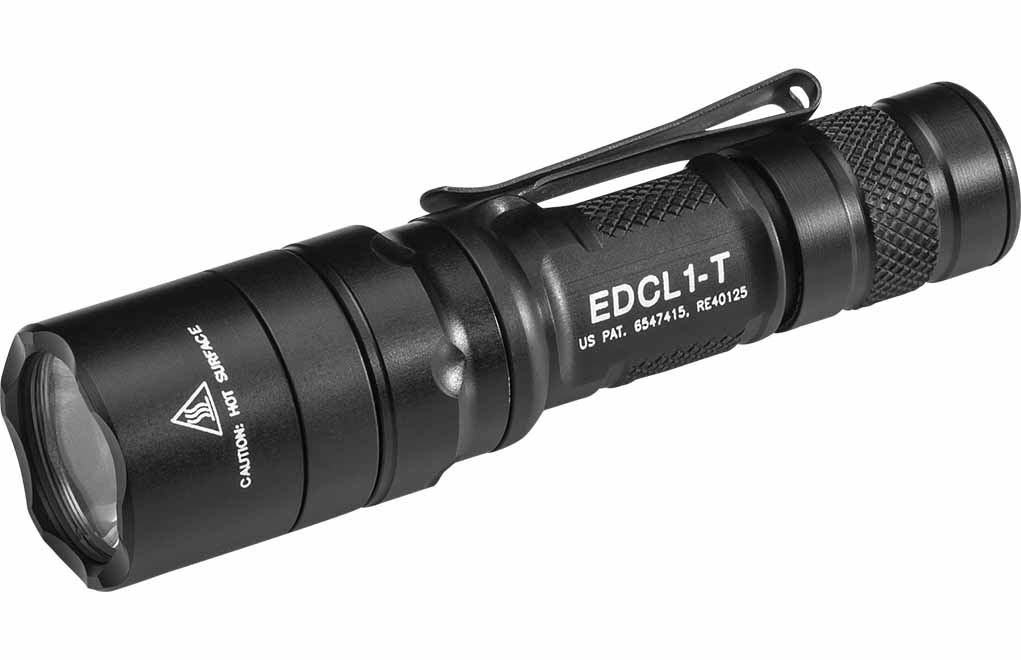
Surefire has long been a leader in tactical lights. The EDCL-1 is an upgrade to the popular EB1 Backup. Its high-output LED delivers 500 lumens of blinding white light on high for 1 hour, and a practical 5 lumens on low for 45 hours. A Total Internal Reflection (TIR) lens shapes the LED’s light into a versatile beam, which is ideal for everyday carry. An aerospace aluminum body and LED emitter are virtually indestructible. With a CR123A battery, the 4.5-inch light weight just 3.3 ounces. MSRP: $165 light // $32 charging kit with two batteries
Crimson Trace CWL-300
Crimson Trace is best known for its world-beating gun-mounted laser sights, so it’s not surprising they also offer a leading-edge tactical flashlight. The CWL-300 weighs a feathery 1.82 ounces and measures just 4 inches. The bulb is a high-output Cree XPL LED, powered by a single CR123A battery. The tap-on, tap-off switch in the tail cap accesses four modes: high, low, momentary, constant. You can expect 2 hours of 200-lumen light on high and 8 hours at 50 lumens on low. The super-tough anodized aluminum body is waterproof down to a full meter, and a pocket clip is a perfect finishing touch for everyday carry. MSRP: $69
Streamlight Pro TAC HL
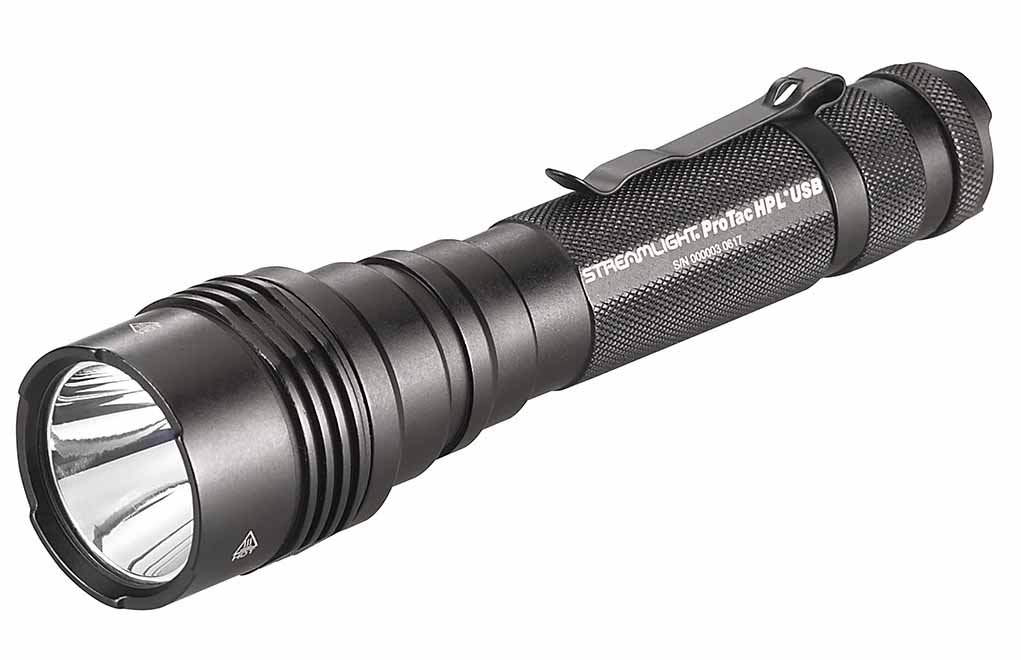
If the late-night chore calls for lots of light, consider the Streamlight Pro TAC HL. On a full charge of its USB-rechargeable batteries, this ultra-bright light blows out 3,500 lumens — and the LED light will maintain that output for an hour and 15 minutes. On the low setting, 250 lumens will be emitted for 2.5 hours. It will also run on four CR123A batteries, though outputs will be more modest. At 9.5 inches long and weighing just over 1 pound, the Pro TAC HL is still relatively compact and easy to carry — especially in a bug-out bag or in a vehicle. The aircraft aluminum tube is more than durable, and a rubber sleeve provides thermal insulation and positive gripping. MSRP: $100 with USB charger // $75 with CR123A batteries
Maglite MAC-TAC CR123
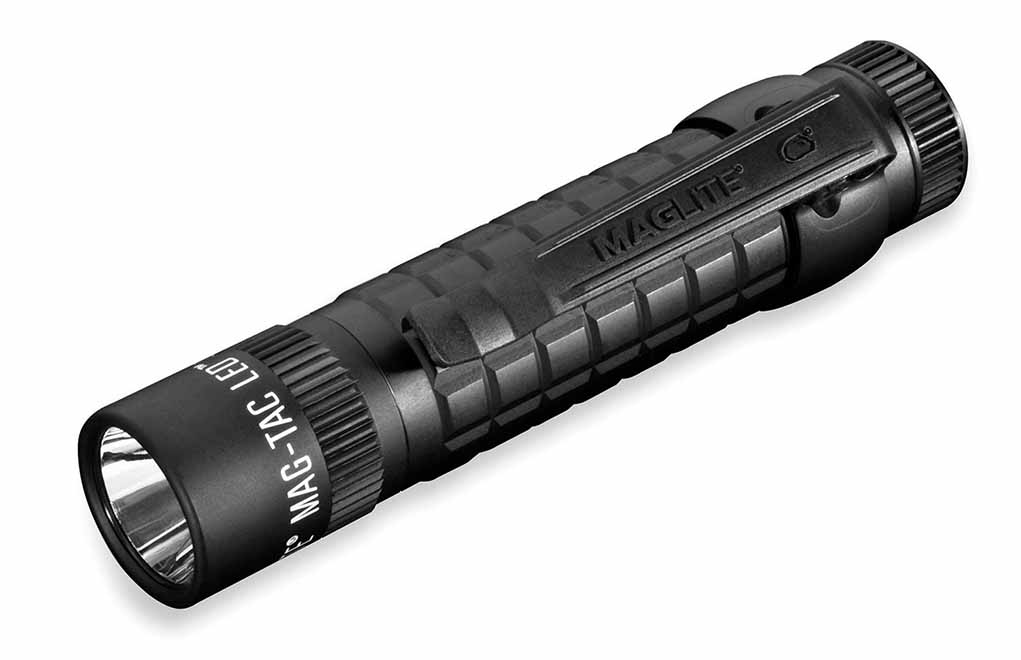
Featuring a total length of 5 inches and weighing less than 5 ounces, the MAC-TAC CR123 LED flashlight is a very good thing in a very small package. A pair of fresh batteries will blast out 320 lumens of bright white light, throwing that light out to 200 yards for up to 4 hours. The flashlight comes with a detachable pocket clip and features three modes: full power, strobe and momentary. The aluminum body is machined with a knobby, easy-to-grip texture, and waterproof seals protect the batteries and circuits. MSRP: $95
Duracell Durabeam Ultra
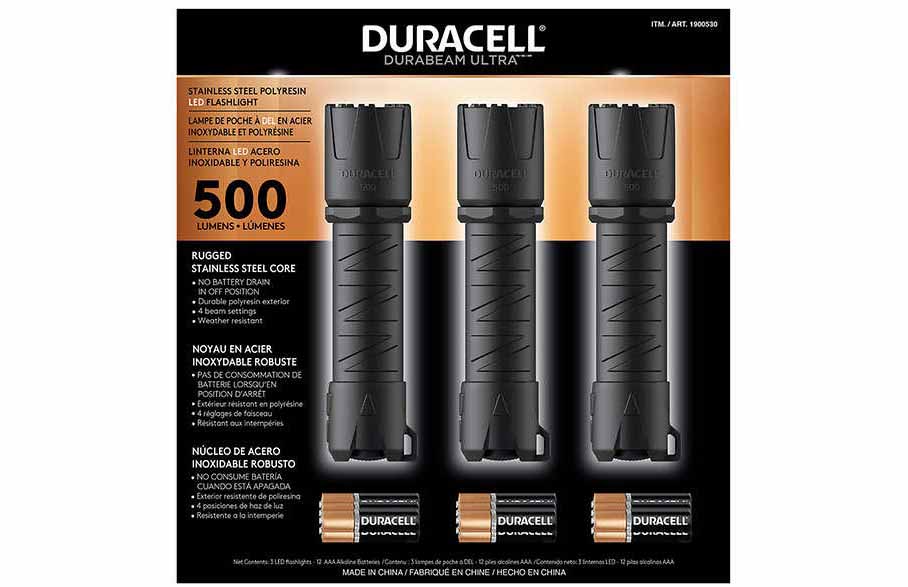
Via the Costco warehouse, Duracell offers a three-pack of their Durabeam Ultra Flashlights. The water-resistant LED flashlight kicks out 500 lumens, and a frame made of stainless-steel coated in a polyresin is nearly bulletproof. The lights also sport high and low output settings for wise power management, and a unique on/off switch prevents the three AAA batteries (included) from being inadvertently drained. Oh — and team adjusts from spot to flood. No, the Durabeam Ultra doesn’t perform like a $200 flashlight. But, it certainly holds its own compared to far pricier lights. They are inexpensive enough to stuff one in the glove box, one in the gear bag and another in your pocket. You would always have light and you’d never feel under-gunned. MSRP: $20
It’s okay if you struggle with the notion of spending hundreds of dollars on a hand-held light. While the price-range between lights is broad, the differences between high-end flashlights and middle-of-the-pack lights are more subtle.
Do your homework: There are some bad lights out there. A bunch of the cheap ones are barely worth the batteries you put in them. However, you can find inexpensive lights that perform as well, if not better, than high dollar units.
A tribute to African hunting great, Frederick Courteney Selous, the Uberti Courteney Stalking Rifle has everything to make it a modern classic.
In a world brimming with polymer-framed guns and extended capacity magazines, it refreshing to know there are still those grounded in tradition. Uberti USA is chief among them.
Best known for stirring replicas of histories most storied guns, the manufacturer has kept the greater shooting world firmly rooted in its past. Not long-ago firearms, but the men who made them great. Enter the Courteney Stalking Rifle.
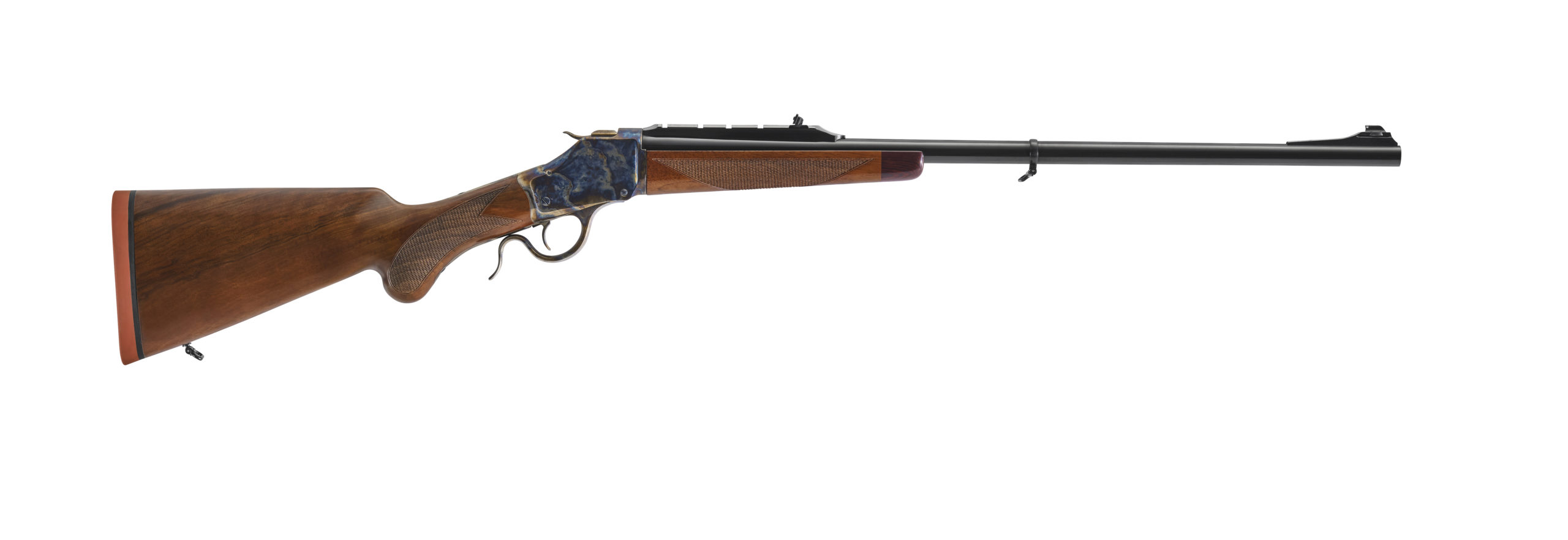
Named for the legendary African big game hunter, Frederick Courteney Selous, the rifle stirs images of savanna tall grass and the golden age of ivory hunters. But the rifle is more than a tribute and a looker—it’s made to make your next dream hunt successful. Built around the tough-as-nails 1895 falling-block action, the gun is sturdy as an oak tree stump. And chambered in .303 British, it has the power to tackle most big game short of the dangerous variety. Sure, .303 isn’t exactly falling off the shelves nowadays, but it goes well with the sweeping and clean English lines of the Uberti rifle. This includes an African hardwood tipped forend that gives the single-shot a unique look and stays true to the rifle’s inspiration.
At the same tick, Uberti includes modern amenities contemporary hunters find a must, such as a machined base that accepts Weaver-style scope rings. Even if you never use it on more than whitetail, the 7.1-pound, 24-inch rifle nonetheless will keep you rooted to one of the greats in hunting. No matter how you cut it, Uberti has a classic on its hands with the Courteney Stalking Rifle.
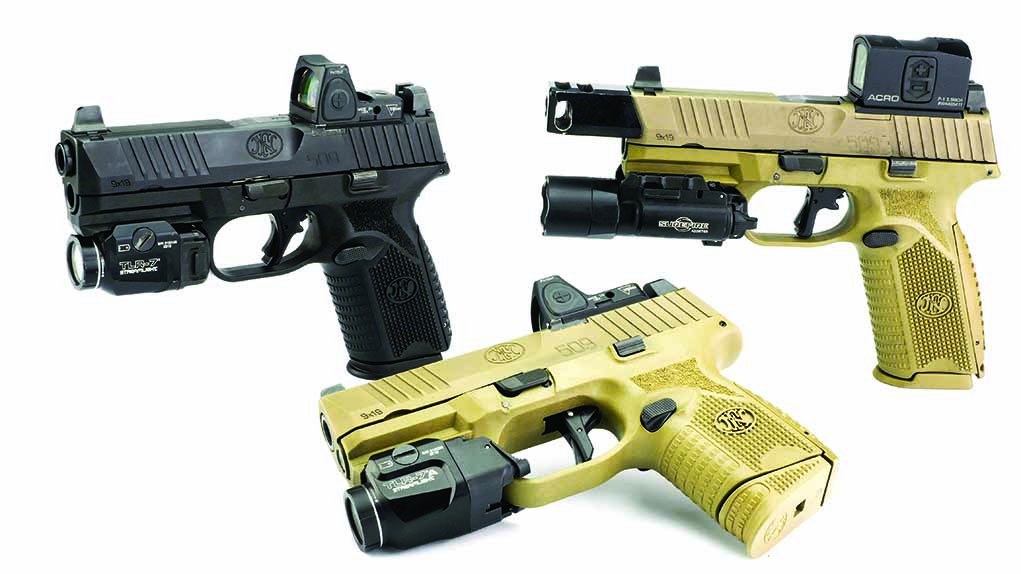
From left to right, FN 509 Midsize MRD, FN 509 Compact MRD, FN Tactical.
The FN 509 Compact is the newest addition to the popular striker-fired pistol line, but not the least … well, in everything except size.
How The FN 509 Compact Continues To Advance The Line:
Launched with FN optics mounting system
This includes high-rise sights that co-witness through an optic
3.7-inch barrel, cut flush with the end of the slide
Magazine options include 10-round flush fit and 12-round extended
Even though FN’s pistols have traditionally been ahead of the trend, FN isn’t often one of the first brands people think of when standing at the gun counter. There’s a good reason for this: The company’s focus has largely been on building the best weapons possible for war fighters, not the civilian pistol market.
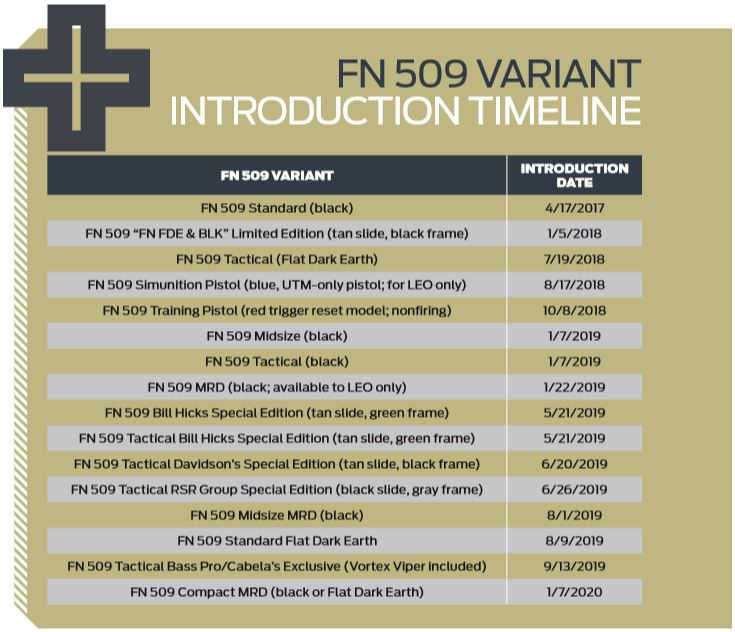
With 16 variants of the FN 509 introduced since April 2017, that’s a pretty clear sign that FN America is taking pistols very seriously.
The FN 509’s Hammer-Fired Heritage
Looking as far back as the FN FNP, which was developed for the 2006 Joint Combat Pistol Competition, you see the fully replaceable frame rails carried over to every FN pistol introduced afterward. The JCP competition also produced the FNP-45 Tactical, the first commercially available handgun to offer a factory multi-optics mounting solution.
In 2011, FN took the FNX and further evolved it into the FN FNS for the civilian and law enforcement customer who wanted a striker-fired pistol rather than a more traditional DA/SA pistol.
The last evolution of the FNS pistol was the FNS Compact, introduced in 2015. While the FNS Compact saw some limited success with legally armed consumers, it never saw wide adoption.
Competition-Forced Evolution
When the U.S. Army decided that its Beretta M9s were past their service life, the announcement of the XM17 Modular Handgun System competition made every major pistol manufacturer jump to come up with something that fit the requirements.
Despite the FN 509 Compact’s small size, this pistol shoots like a much larger gun. Also, if you didn’t know better, you might mistake the fantastic slide serrations for a high-end aftermarket milling job.
There was a common theme in the submitted pistols: Nearly all of them were an evolution of an existing design. After all, a $580 million government contract isn’t the place to debut an unproven cutting-edge pistol.
FN’s brass ordered the engineering team to drop everything and build a pistol that met the MHS requirements. Because the FNS Compact was the most evolved pistol in the FN stable, it made sense to use it as the basis for the company’s XM17 submission. After much design work, the FNS Compact was transformed into a pistol built for warriors and capable of handling high-pressure 9mm loads.
Keeping true to its track record of evolving a pistol to meet the needs of civilian and law enforcement consumers, FN worked with industry experts and law enforcement end-users to refine the XM17 prototype. The result was the FN 509 Standard, launched in 2017.
Refinements made to the FN XM17 prototype were very subtle and centered on enhancement of the texture used on the pistol’s grip. In addition, FN’s engineers made some small changes so that the 509 was reliable with commercial ammunition. The 509 that landed on dealer shelves is nearly the pistol that made it to the final three in the MHS trials.
The FN 509 Standard
At the time the FN 509 was introduced to the U.S. market, every other XM17 MHS submission had been revealed—except for Glock’s. Pistol nerds like me were clamoring for more information about what FN had cooked up for MHS, and I was not disappointed in what FN brought to the table.
When reviewers got their hands on the FN 509, the feedback was nearly universally positive, although some reviewers reported that the magazine release could be tough to activate. Also, the trigger on some examples was reported to be a touch on the heavy side for use as a target pistol.
Like the XM17 pistol, the FN 509 features fully ambidextrous controls, some of the best slide serrations I’ve ever seen on a factory pistol, an outstanding cold hammer-forged barrel and a grip texture that looks a bit goofy—with four distinct textures—but performs amazingly well in all conditions.
The FN 509 Tactical
The FN 509 Tactical that was launched in July 2018 is yet another evolution that shares many of the same features that made the FN 509 Standard such a great pistol. Nevertheless, FN America’s design team added some enhancements to the Tactical in response to consumer and subject matter experts’ feedback.
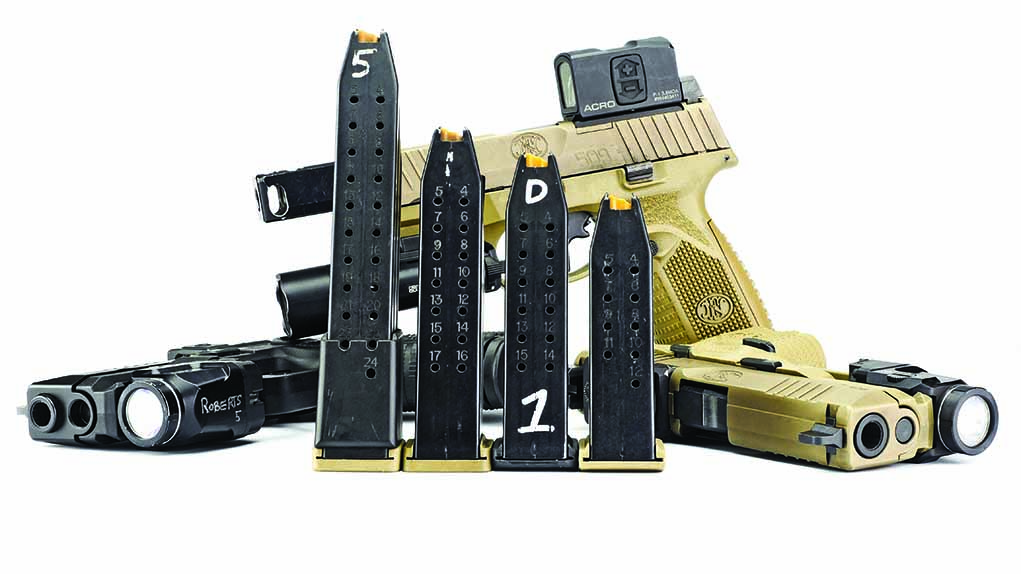
There are several magazine sizes to choose from. Just make sure to use the correct over-insertion spacer to prevent ejector damage.
The Tactical brought a new slide release that’s influenced by the TangoDown Vickers slide release. It’s a huge improvement over the smaller slide release that was an obvious carryover from the FN FNS. Additionally, the issue that some reviewers reported—that the magazine was sometimes a challenge to release—was also addressed with an enlarged release button.
FN also added a 24-round magazine option with the FN 509 Tactical that’s roughly the same length as the slide. Keeping the length of the 24-round mag reasonable meant that if you could conceal the Glock 19-length slide, concealing a larger reload or carrying it on a duty belt was possible.
Lastly, the Tactical included a cold hammer-forged, 4.5-inch barrel with ½x28 threads. FN even designed a thread protector with an O-ring inside it that stops it from loosening. Also included was a reduced-power recoil spring assembly to cycle even the lowest-power target ammunition, as well as hard-to-cycle frangible ammo.
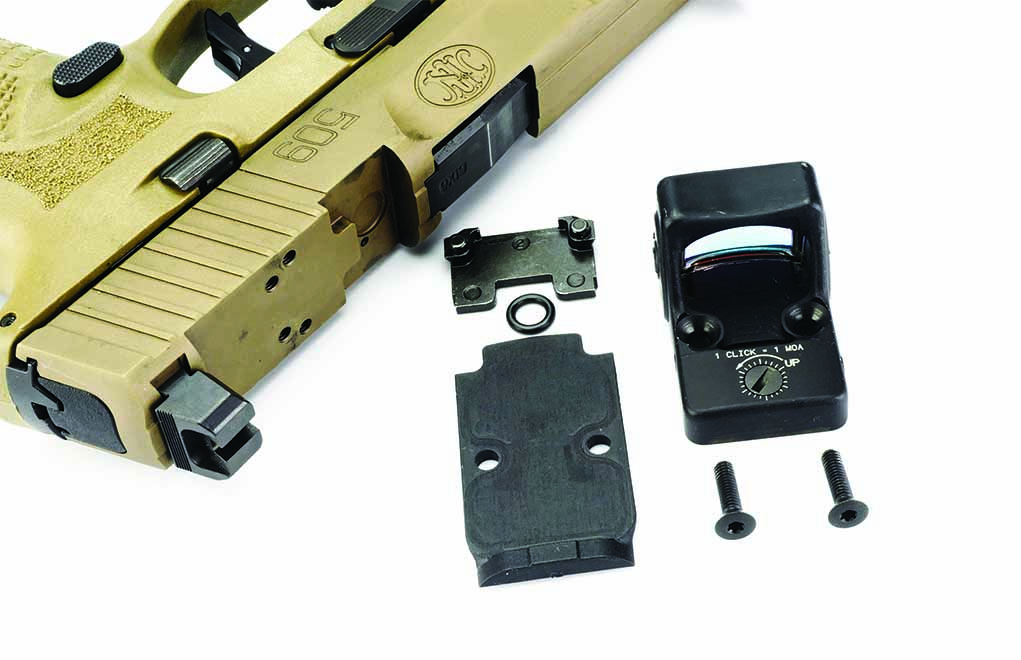
The FN Low Profile Optics Mounting System
The 509 Tactical’s gift to shooters was the truly innovative FN Low Profile Optics Mounting System.
Previously, if you wanted to mount an MRDS (such as a Trijicon RMR) to a pistol slide, there were few good options. Direct milling has been, and remains, the most robust solution, but factory options before FN’s new system have been less than ideal for one reason or another.
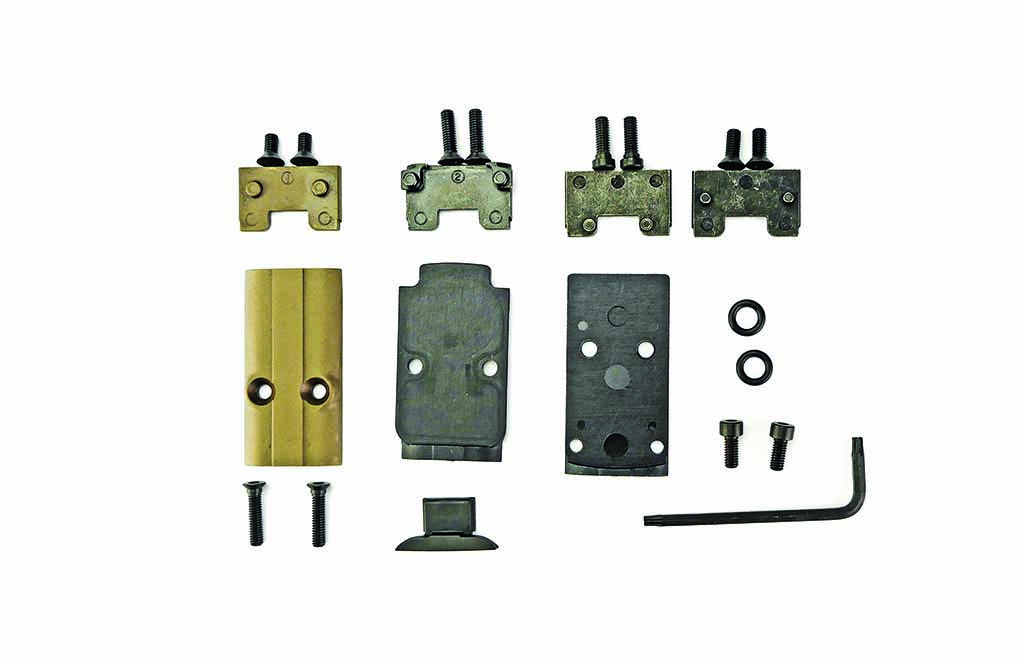
The number of red-dots the FN mount is capable of accommodating grows constantly as new red-dots are released. Because the system is so adaptable, accommodating a new mount style, such as the one used on the Aimpoint ACRO P-1, is as simple as making a new adapter.
FN dispensed with the need for thread-locking compound by using an O-ring sandwiched between the slide and the optic-specific MRD plate to keep the screws secure. Not only does this make installing a red-dot and changing batteries easier, it’s also nearly as robust as the best direct-mill solutions.
The Aftermarket Embraces FN’s 509
One of the largest problems that plague new pistols is that aftermarket support doesn’t materialize. Thankfully, that’s not the case with the FN 509 platform.
Holsters: Top-tier companies such as Henry Holsters, PHLster, ANR Design and Safariland offer holsters that cover just about every concealed-carry preference. I believe the Henry Holster Spark for the FN 509 with a Streamlight TLR 7 is the way to go when it’s paired with Discreet Carry Concepts’ Mod4 Universal Clips.
Triggers: Currently, only two companies are offering a trigger for the FN 509—Apex Tactical and Volker Precision. While the Apex trigger has ruled the market, the new Volker trigger has some interesting features: Where the Apex trigger uses an uncoated trigger bar and stamped sear, Volker is using a nickel-boron nitride coating on the trigger bar and bar stock-machined sear.
Comps and Barrels: There are options offered by Weapons Armament Research, Parker Mountain Machine, Henry Holster and Volker Precision. Don’t own a 509 with a threaded barrel? Apex is offering a fluted barrel that’s dimensionally identical to the FN-produced barrel. Apex even includes a reduced-power spring in case you want to install a compensator.
Magwells and Backstraps: For some reason, FN chose to leave two large strips smooth and completely devoid of texture. There are only two companies offering new backstraps that add more texture: Volker Precision and Agency Arms.
The FN 509 Midsize
Early in January 2019, FN dropped the 509 Midsize, giving it all the same features the FN 509 Standard has—but in a size most closely compared to the Glock 19. Some of the evolutionary updates were carryovers from the Tactical, while others, such as the improved trigger shoe, were brought into the mix. The new shoe now had a much flatter face to aid in ensuring the trigger is more constantly pulled straight to the rear. The Midsize saw other minor changes, such as a reshaped fence around the magazine release that makes magazine changes easier.
The Midsize uses the reduced-power recoil spring from the Tactical to make the slide easier to manipulate. FN says that during testing, there was no degradation of reliability or longevity of the recoil spring. However, this pistol can’t be fed a steady diet of +P or 9mm NATO ammunition.
More magazine options come with the FN 509 Midsize: a 10-round compliant version, a 15-round standard-capacity magazine, the FN 509 Standard’s 17-round magazine (when used with a spacer sleeve) and the 24-round (when combined with a new base plate that incorporates the over-insertion spacer into it).
MRD 509 Models Expand the 509 Line
During SHOT Show 2019, the FN 509 MRD was quietly announced as an option for law enforcement-only customers. We also saw the launch of the 509 Midsize MRD, which had all the features of the Midsize but paired with the optics-ready slide from the Tactical.
Out of all the 509 variants introduced, the Midsize MRD is my favorite because of its concealability, the included features and the fact that the pistol recoils no more than the Tactical.
The New FN 509 Compact
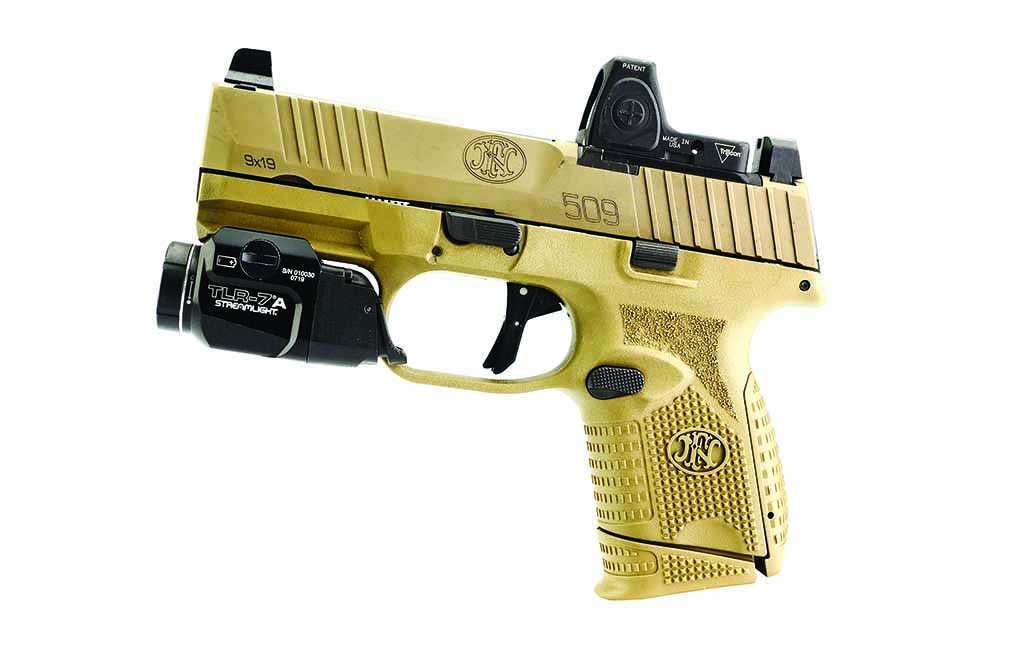
The whirlwind of new models brings us to the FN 509 Compact—the latest in the 509 family launched in January of 2020. FN did it right and launched a pistol other manufacturers might refer to as a “sub-compact” with the company’s new optics mount right out of the gate.
FN’s Low Profile Optics Mounting System is every bit as innovative as the plate system first used on the FNP-45 Tactical in 2006.
The new Compact features a departure from the 4-inch slide (that every other iteration of the 509 has sported) with its new, 3.7-inch barrel cut flush to the end of the slide.
The new frame size also meant new magazine options, such as the flush-fitting, 10-round mag or the 12-rounder that sports a finger extension. As with the Midsize, the Compact can use the other magazine sizes for the 509, as long as the appropriate magazine spacer is used.
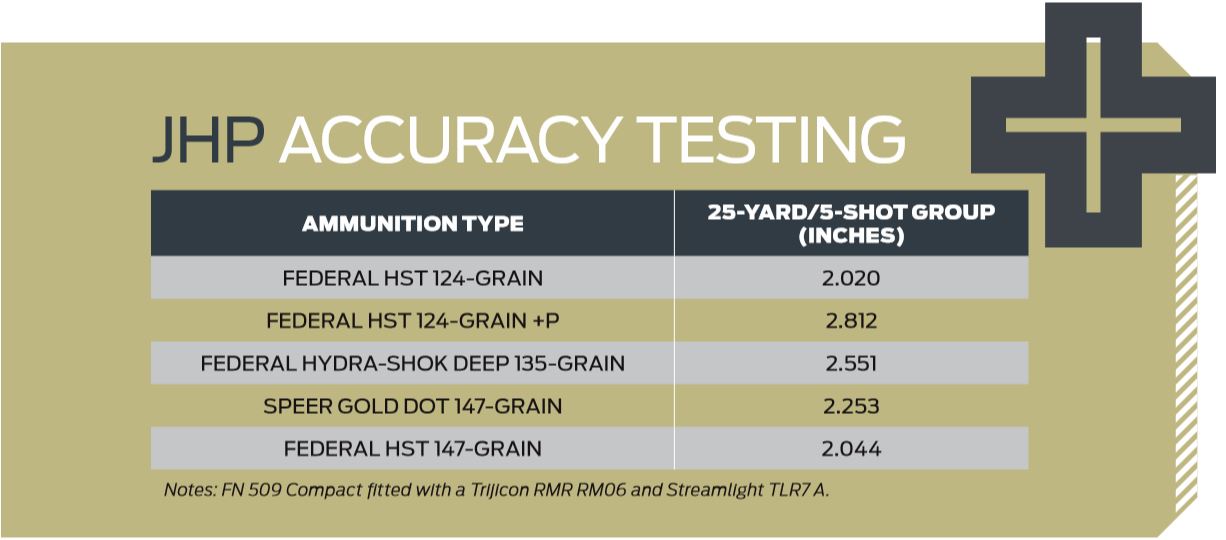
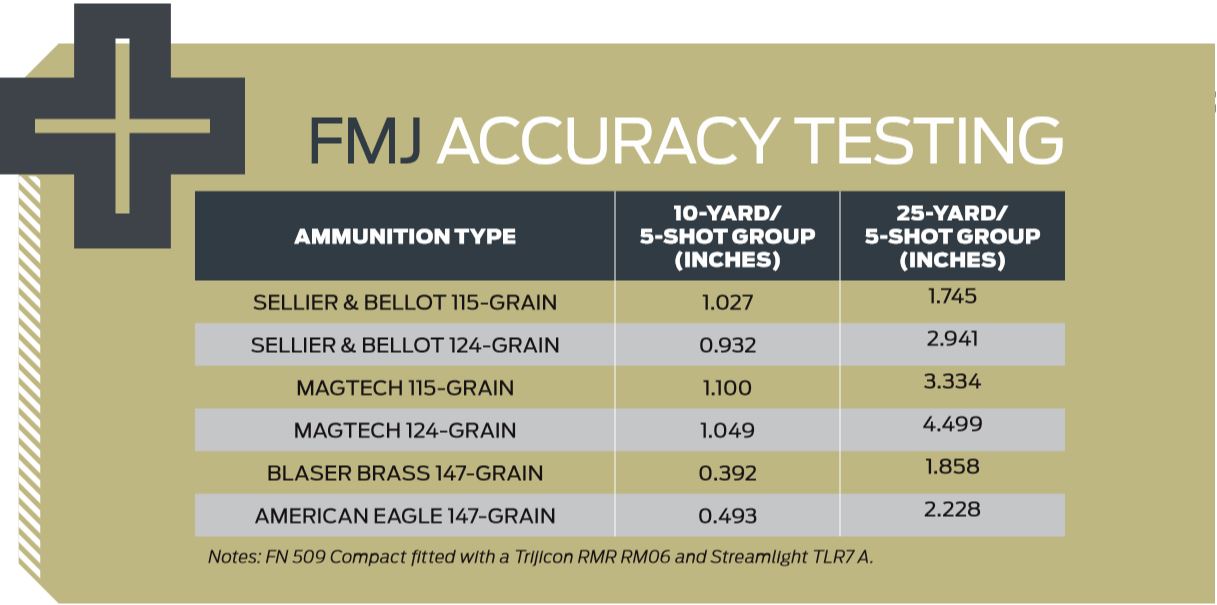
This rundown of the FN 509’s history was spurred by the release of the FN 509 Compact, so it makes sense that I used the smallest pistol in the line for accuracy testing. In theory, the Compact should have the least impressive numbers.
That wasn’t the case, however. With FMJ ammunition printing five-shot groups between 0.392 and 1.1 inches at 10 yards and 1.745 and 4.499 inches at 25 yards from a hasty rest, the Compact exceeded my expectations.
The consistency I saw at 25 yards with good defensive ammunition in my example was no less impressive: Federal HST 124-grain produced a 2.020-inch five-shot group for the best out of the five ammo types tested. The worst was the Federal HST 124-grain +P with a 2.812-inch five-shot group.
Each 509 MRD pistol comes with everything you need to mount the optic of your choice. (The ACRO plate is sold separately.)
FN managed to give consumers a Glock 26-sized pistol that accepts every red-dot the Tactical will. It also made sure the Compact would accept every weapon light on the market (you do have to modify a Surefire X300 by removing the DG switch blank, but the light will fit).
What’s Next for the FN 509?
That’s a hard question to answer with certainty. There are still a few gaps in the FN 509 lineup that could be easily addressed.
Using Glock models as sizing benchmarks, the 509 line still lacks a 43x/48-sized pistol, a Glock 34-sized gun and a true Glock 17-sized gun. The next release is as much a mystery to me as it is you, but one thing’s for sure: FN will certainly apply all the evolutionary changes the model has seen since the Standard’s introduction in 2017.
I, for one, will be excited to see what the future brings (I’m hoping for a Glock 34-sized FN 509 to replace my Gen 5 Glock 34 with a pistol better suited to being a test mule for mini red-dot sights). After all, the dot is the future … and the future is now.
FN 509 Tactical Caliber: 9mm Luger Action Type: Double action only (striker-fired) Controls: Ambidextrous slide stop and magazine release Frame: Polymer w/replaceable steel slide rails Magazine Capacity: 10- and 17-round flush fit or 24-round w/spacer Weight Unloaded: 27.9 oz. Barrel: 4.5 in., threaded, ½x28 cold hammer-forged stainless steel w/1:10 RH twist Length, Width, Height: 7.9 in. L, 1.35 in. W, 5.75 in. H Trigger Weight as Tested: 6 lb., 3 oz. Sights and MRDS Mounting: Green tritium suppressor-height sights and FN low-profile optics mounting system Included Accessories: 2 backstraps, 3 magazines, MRDS cover plate, zippered case, MRDS mounting kit, standard recoil spring, reduced-power recoil spring
FN 509 Midsize MRD Caliber: 9mm Luger Action Type: Double action only (striker-fired) Controls: Ambidextrous slide stop and magazine release Frame: Polymer w/replaceable steel slide rails Magazine Capacity: 10- and 15-round flush fit or 17- and 24-round w/spacer Weight Unloaded: 26.5 oz. Barrel: 4 in., cold hammer-forged stainless steel w/1:10 RH twist Length, Width, Height: 7.4 in. L, 1.35 in. W, 5.3 in. H Trigger Weight as Tested: 5 lb., 10 oz. Sights and MRDS Mounting: Black suppressor-height sights and FN low-profile optics mounting system Included Accessories: 2 backstraps, 2 magazines, MRDS cover plate, zippered case, MRDS mounting kit
FN 509 Compact MRD Caliber: 9mm Luger Action Type: Double action only (striker-fired) Controls: Ambidextrous slide stop and magazine release Frame: Polymer w/replaceable steel slide rails Magazine Capacity: 10-round flush fit; 12-round w/extension; 15- and 24-round w/spacer Weight Unloaded: 26.5 oz. Barrel: 3.7 in.; cold hammer-forged stainless steel w/1:10 RH twist Length, Width, Height: 6.75 in. L, 1.35 in. W, 5.2 in. H (4.8 in. H w/optional flush fit magazine) Trigger Weight as Tested: 5 lb., 7 oz. Sights and MRDS Mounting: Black suppressor-height sights and FN low-profile optics mounting system Included Accessories: 2 backstraps, 2 magazines, MRDS cover plate, zippered case, MRDS mounting kit
For more information on the FN 509 Compact, please visit fnamerica.com
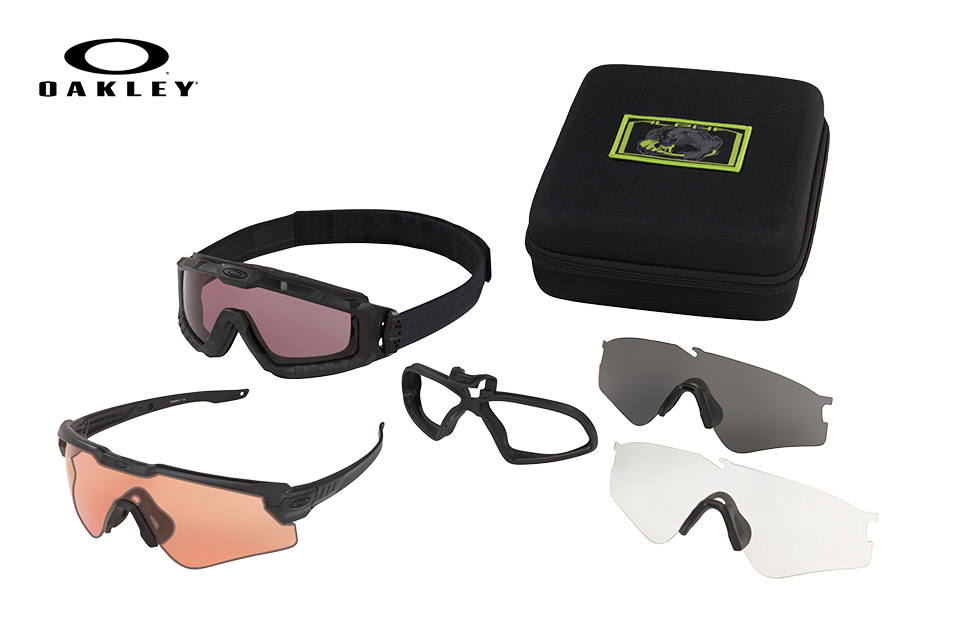
Improving the safety, performance and comfort of soldiers and safety professionals, Oakley Standard Issue has become a trusted first line of defense.
For over 20 years, Oakley Standard Issue has manufactured all ballistic products at their factory in Foothill Ranch, California. Products are designed, materials are sourced, and products are tested right here in America.
The Oakley SI Ballistic M Frame Alpha is our latest flagship product. Alpha is an eco-system; the product contains a frame, goggle, and helo-gasket with a lens interchangeable between all three. No matter the mission, the user can configure the product to his or her needs. Range work, close quarters battle, mobility, and even freefall are many of the environments applicable. Oakley Prizm Technology within the lens brings high contrast and definition. Specifically, Prizm Shooting was developed with the Army Marksmanship Unit and gives greater clarity to targets in different light conditions.
Designed with extensive input from our military and first responder community, Alpha is now authorized for wear on the Special Operations Eyewear Program (SOEP). SOEP, regarded as the highest standard for protective eyewear, certifies that all components are made in the USA and offer the highest level of protection. Available in multiple lens and frame color configurations.
Oakley Standard Issue was formally established in 2000. Committed to serving our military and first responders, Oakley SI offers exclusive pricing for products for active-duty military, government, first responders, and veterans.
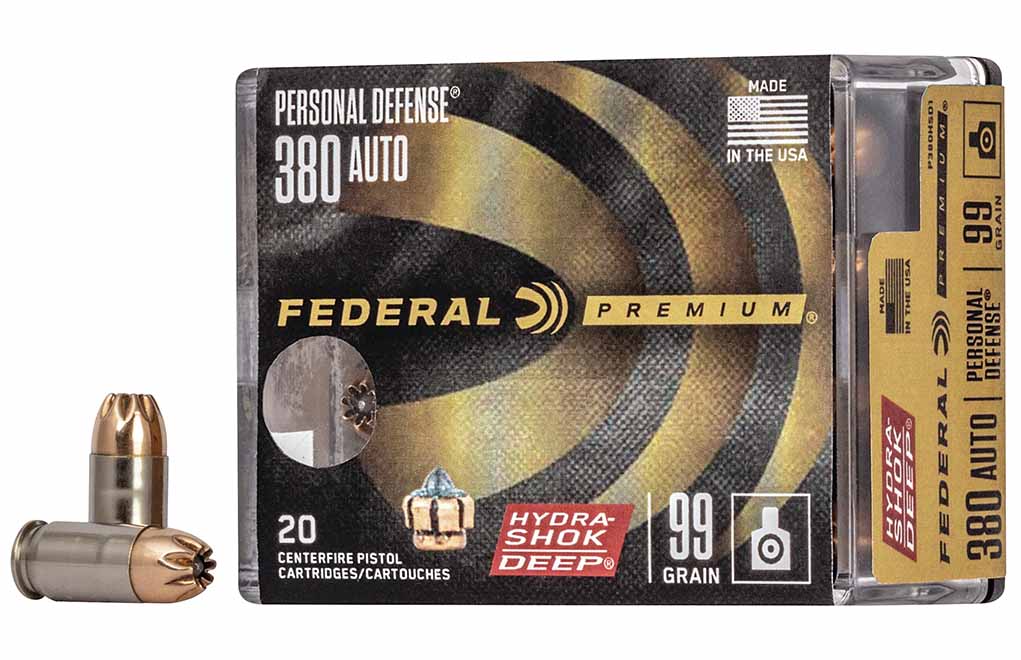
Think the .380 ACP isn’t up to saving your life? Think again. Federal Premium ups the caliber’s defensive performance with its cutting-edge Hydra-Shok Deep ammunition.
It usually happens with strangers. It typically takes place on social media. And, overall, it turns ugly. Burning with the intensity of 10,000 suns, the argument about how much better the 9mm is than the .380 ACP rages on.
Thanks to Federal Premium, the field of play between the two has become much more level. Meet the Hydra-Shok Deep defensive round in .380 ACP, ammunition that all but erases the performance gap between the cartridges.
Federal saw the need for a more potent option in .380, given its recent popularity and the lack of ammunition with true stopping power. The 99-grain Hydra-Shok Deep fills this niche nicely, thanks to the advanced design of the round’s bullet, which boasts some truly amazing engineering. Basically, its sledgehammer performance only requires a thimble of force. Sounds impossible, but Federal pulled it off.
Hydra-Shok Deep .380 has some pretty impressive performance numbers. Exceeding FBI protocol testing, the round is capable of penetrating around 14-inch in bare ballistic gelatin. Furthermore, it expands to nearly twice its size once at the target, effecting a greater temporary cavity and overall more tissue damage. And that’s not only out of test barrel. Federal did its due diligence and ran Hydra-Shok Deep out of as many guns as possible to certify it was up to snuff for the armed citizen. What that means for you, a more potent, yet manageable round that turns some of the smallest pistols into absolute thunderclaps.
The question shouldn’t be what gun or caliber you choose to defend your life. It should be, “What ammo are you shooting?” If it’s Federal Hydra-Shok Deep, you have the peace of mind you’re getting the most out of your .380. MSRP is $25.99 for a box of 20.
For more information on Hydra-Shok Deep in .380, please visit federalpremium.com.
From Pocket Pistols to Perfect Loads: .380 ACP Insights
A bug-out bag or SHTF kit is key to get you through a disaster. Do you have yours put together? Here are the on-person and vehicle bug-out bag essentials.
As both a rural law enforcement special operations team leader, hunter and outdoor enthusiast, I spend a lot of time in our nation’s wildlands — usually a significant distance away from large crowds and support services found in urban population centers. For these more remote environments where our team does business, it’s a given that I carry a defensive pistol, various long guns and associated accessories given our mission at work. Like many Americans, I also need to be equipped to defend my family and myself from harm in more heavily populated urban environments while off duty, and I carry a concealed compact pistol for these reasons.
Unfortunately in today’s high-tech world where cyber, electrical, cellular and other essential communication systems can fail — making access to law enforcement, trauma care, banking, food and other essential survival services inaccessible — survival supplies above and beyond a firearm are be needed to ride out any storm.
A go bag doesn’t need to be, and shouldn’t be, big and bulky. If it’s too big and too heavy, you’ll likely leave it at home — where it’s absolutely useless. Thinks compact and organized.
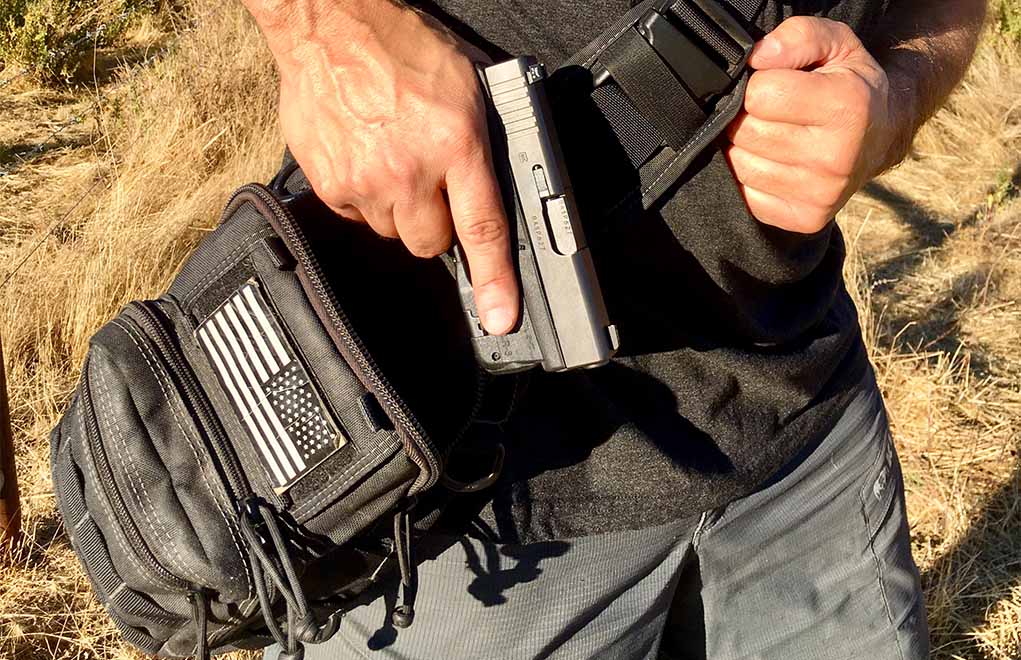
Ready for this unfortunate contingency anytime and anywhere, I have carried my so called “bug-out bag” effectively for more than a decade now. This satchel — I carry a Maxpedition Remora Gearslinger — is one of the most compact packs of its type, and it sits against my right hip constantly when working plain-clothes covert operations and while off duty.
The piece of mind of having everything I need and easy reach at all times is priceless. And while I’ve fortunately never had to deploy my firearm and engage with it from my bag outside of training, the confidence and comfort of being ready and able to do so is reassuring.
Living in California’s Silicon Valley and maneuvering within the moderate to warm year-round temperatures there, carrying and concealing a defensive handgun and essential survival supplies can be challenging, especially when dressed in shorts and a T-shirt most of the time. Fortunately, the Remora is relatively small and light, given all the essentials I’m able to keep within. It’s also the type of bag that works well with casual wear, making it easy to blend into the crowd while discretely hiding in plain sight.
Organization is key to maintaining a bug-out bag that remains functional when you need it. Here, every item has its place, allowing quick and fluid access to the handgun. If you need a Band-Aid, odds are good you’ll have time to get it out. If you need the pistol, time will matter.
When starting my journey into the law enforcement special operations world 2 decades ago, a Special Forces friend and mentor once mentioned the phrase, “Two is one and one is none.” He was referring to the need to have built-in redundancy for success and carry two of everything essential in your kit needed for duty, battle and survival.
That mantra has stuck with me and my teammates for decades now, ensured mission success and survival many times over … and now it carries over into off-duty life to good effect. As a result, one will see several items duplicated in both my personal carry and vehicle bug-out bags lists in this article.
The Main Bug-Out Bag Essential: Glock 43
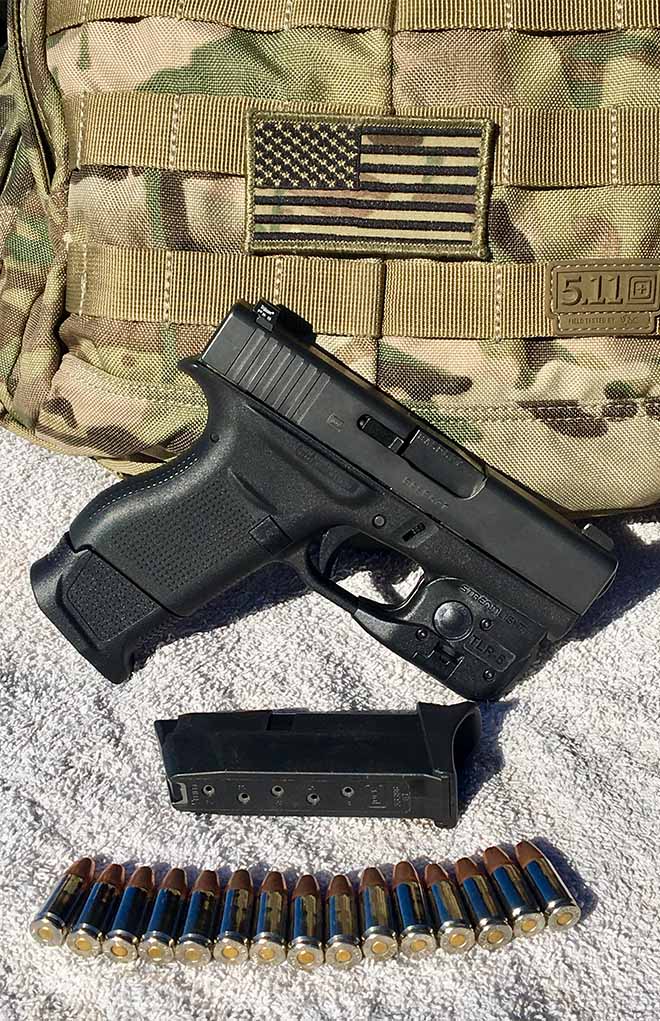
The essential items within my Remora Gearslinger starts with my firearm, a compact Glock Model 43 9mm pistol with Trijicon three-dot night sights and a permanently attached Stream light TLR-6 white light and laser combination. The TLR-6 is a featherweight addition to the lightweight G43, and with the laser zeroed at 7 yards and 100 lumens of white light for low-light applications, the compact package is set up for any life-threatening contingency — 24/7.
Coming from a law enforcement agency that’s run Glock Model 22 and 27 .40-caliber pistols since the start of my career in 1992, I favor them for on- and off-duty use. Their reliability and durability through years of training, several gunfights with armed drug cartel members, the adverse conditions we work in routinely (dust, dirt, mud, brush, saltwater, etc.) and their accuracy and lightweight has engendered a 3-decade trust in the Glock system.
The author carries a Glock 43 in his go bag at all times, along with 15 rounds (two magazines) of 147-grain T-series 9mm ammunition. In certain situations, he’ll add another magazine.
While the Glock 43 is a very compact 9mm pistol, it handles and shoots like a much larger handgun. Accurate and fast with little recoil from full-power 9mm loads, the pistol allows quick and accurate follow-up shots.
For ammunition needs, I carry two magazines full of Winchester 147-grain T-series bonded hollow-points, a cartridge that performs well in both penetration and expansion through a multitude of barriers — even from the short-barreled and compact G43. With a two-round extension baseplate on my primary magazine in the pistol and a loaded secondary standard G43 magazine in the Gearslinger, I have a generous 15 rounds of ammunition in the bug-out bag system at all times, with room to add additional magazines as needed. The two-round magazine extender from Cage Industries also extends the pistol’s grip’s length an additional inch, making for a much more solid and comfortable purchase on the handgun for large-handed shooters like myself.
Carrying, deploying and engaging with the G43 from the Gearslinger pack is relatively fast after adequately training with the system. The key to deploying the pistol effectively is keeping the gun pouch within the pack clear of obstructions from the other essential items carried within the pack. The pack’s internal layout is well-thought-out, and with the careful placement of all of your survival items inside, accessing the well-concealed pistol is smooth and efficient.
Glock 22
Glock 43
Glock 27
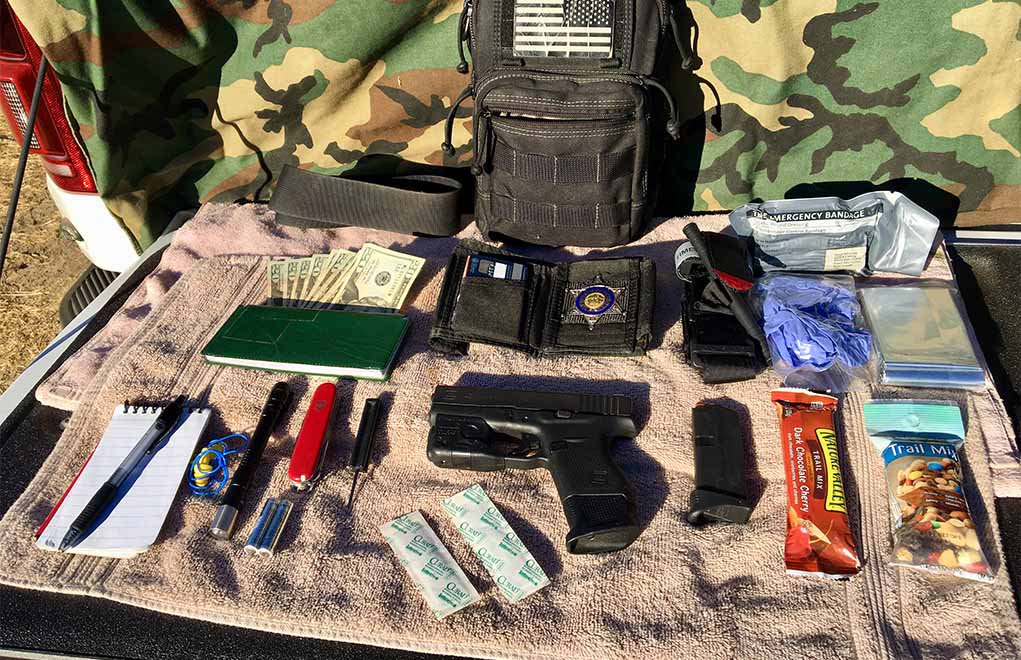
Below is a list of all the items within my Gearslinger. Keep in mind this list is specific to my needs and serves as a template to build your own specific kit.
The Maxpedition Remora Gearslinger is like a clown car: You can fit a whole lot in that little bag. The author’s bug-out necessities consists of 19 hand-picked items that go with him everywhere.
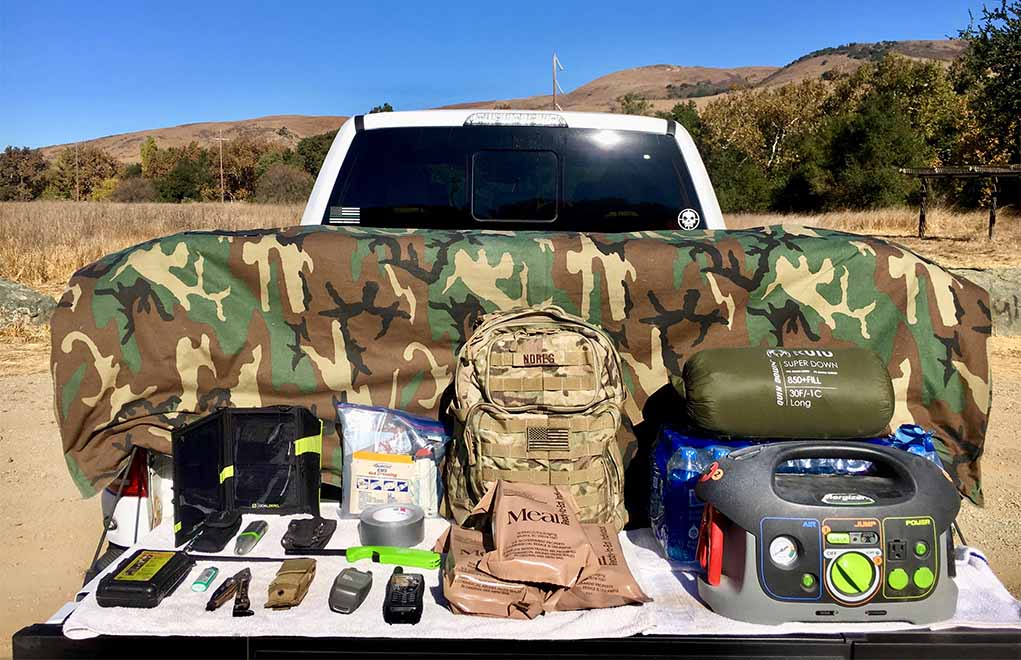
The ‘Iron Buggy’ Bug-Out Essentials Along with your well-equipped everyday carry bug-out bag is the need for a larger, longer duration survival kit that stays in your vehicle for emergency needs. In the event of civil unrest, environmental disasters, economic collapse or any combination thereof, your vehicle is your Alamo. It serves as an escape vessel and mobile base camp that must be capable of facilitating you and your family’s survival for several days or longer.
For both my agency patrol and personal pick-up trucks, I’ve narrowed down essential carry items that take up relatively little space and can be maintained in most any size vehicle. Below is the list of bug-out survival items I carry in both trucks, in addition to a pack of comprehensive survival essentials. This list is again subjective to my needs and can be used as a guide template to build the ideal vehicle bug-out bag for your vehicle and needs.
Vehicle Bug-Out Bag List:
In addition to an on-person bag, keeping a selective stockpile of necessities in a vehicle is a smart play, should you need it to serve as an escape vessel or a mobile base camp.
While putting together comprehensive bug-out bags for both personal and vehicle carry is not an inexpensive endeavor, they are the best investments you can make for you and your family’s survival. Just the peace-of-mind of having both kits ready to go for immediate use should the worse-case scenario occur is worth the investment. Like we say on our tactical team, “Train and prepare for the worst but hope for the best.” And this mindset carries over well for your personal survival preparation.
Fortunately, I’ve never had to deploy my G43 from my Remora pack to protect and survive — and I hope that I never have to. But if that dark day comes, I’m prepared and confident to handle any survival challenge to save my life and the lives of others.
Be Prepared!:
When Disaster Strikes Store Won’t Have The Supplies
Affordable, concealable and effective, the Stoeger STR-9 provides a solid value for the armed citizen.
Glock performance at a fraction of the price? Sound outlandish, given the Austrian guns don’t demand an arm and leg to begin with. Yet, this is the coup Stoeger pulled off last year with the introduction of the STR-9. Now, the gunmaker is shooting to take it a step further.
Aiming at the concealed carry market, Stoeger has introduced the STR-9 Compact, a trimmed-down version of its original striker-fired. Diminished in scale, the gun retains all the features that made the full-sized iteration a hit. This includes an extremely competitive price. With an MSRP starting at $329, the STR-9 Compact comes in among the most affordable options in its class.
The tail of the pistol’s tape is encouraging, with the 3.8-inch barreled double-stack weighing in at 24 ounces unloaded. This not only makes the gun plenty concealable, but little burden on the hip. It also comes with excellent capacity, 10+1 rounds with its flush-fit magazine and 10+1 with its extended mag.
The Stoeger STR-9 Compact is outfitted it with sturdy three-dot iron sights on its base model, however, there is an upgraded option with Tritium night sights. Across the board, the pistol has aggressive fore and aft cocking serrations, positive grip and backstrap texturing and an excellent trigger. Breaking around 5 pounds, the crisp break of the trigger was a major high point of the STR-9 and is certain to hold the same with the compact version.
More From Stoeger:
Stoeger continues the tradition of manufacturing quality firearms at an economical price with the introduction of the Stoeger STR-9 Compact. Chambered in 9mm, the striker-fired, semi-automatic pistol is an all-around solution to everyday conceal carry and home protection. The compact model is available with a 13-round magazine and a 10-round magazine for those that live in capacity-restrictive states. The Stoeger STR-9 Compact will be available at dealers and retailers in May.
The STR-9 Compact features a corrosion-resistant black nitride finish, available interchangeable backstrap grips for a custom fit and 3.8-inch barrel for easy concealment and quick deployment. With an overall length of 6.9 inches and weighing 24 ounces, the STR-9 is designed for personal protection without breaking the bank.
Rugged and reliable, the STR-9 Compact’s grip angle is engineered to match the drift-adjustable, three-dot sights for true target alignment and combines with a low-bore axis for reduced muzzle rise to quickly reacquire targets for follow-up shots. Aggressive front and back slide serrations provide a firm grasp with or without gloves. A smooth-pulling, crisp trigger houses an internal safety for extra security.
For an added benefit, an accessory rail accepts a wide variety of pistol and laser lights for low-light conditions. The reversible magazine release allows for right- and left-handed shooting. Durable and reliable, the STR-9 Compact delivers the perfect personal defense pistol at an economic price. The new STR-9 Compact is available in a variety of configurations including addition backstraps of different sizes and Tritium night sights.
The STR-9 line includes the STR-9 Full Size with available Tritium night sights, STR-9 Optics Ready and the STR-9 in Flat Dark Earth. These models are currently available at local firearm retailers, dealers and online outlets.
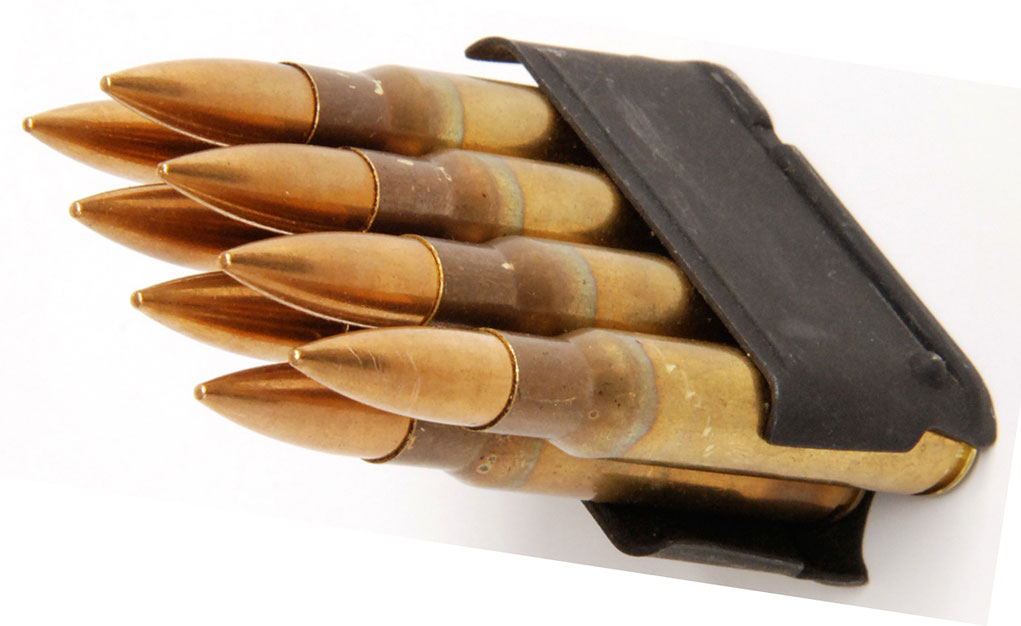
Nothing can cause the new Garand shooter more headaches than an intractable M1 Garand clip. Here’s how to load it and troubleshoot it.
Basics of the M1 Garand Clip
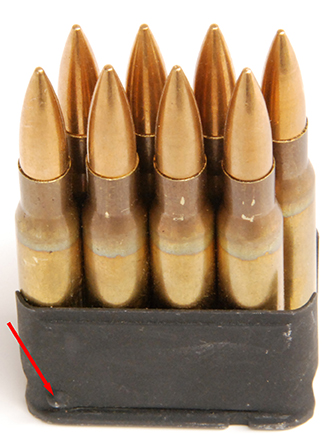
The M1 Garand clip is stamped steel. It holds 8 rounds of .30-06 Springfield (or .308 Win. for M1s so chambered). 5-round clips available, but the standard 8-rounder can be loaded with fewer rounds. The 5-rounder isn’t necessary.
The clip is … not a magazine, for it does not completely enclose the cartridges. In fact, the Garand has a magazine, it’s integral to the receiver and receives the clip.
The last round fired ejects the clip. That creates that signature M1 Garand stripper clip sound characterized by a “ping” that alerts you it’s time to reload.
When you shove the clip down into the M1’s magazine, and then release pressure, the bolt grabs a cartridge and slams it into battery.
Myth: One claim is that you can load 8+1 into the Garand. You can’t do it.
Myth: The “ping” sound was not something that alerted enemy troops that a soldier’s rifle was empty. A Military Channel documentary spawned this cliché. It’s almost laughable to think the ping sound could be heard at distance among the thunderous roar of a firefight—or that a soldier would pop his head up and provide an easy target when his rifle ran dry.
Loading Garand Clips
There is a correct way to load the clip so that you don’t slam the bolt down on your thumb and earn the coveted “M1 Garand Thumb” Award.
Just make sure you use the side of your hand to keep the bolt retained while inserting the clip.
Here’s an excellent video on loading:
Troubleshooting
Seat all the rounds fully. If they’re not, you’ll have a dickens of a time inserting the clip.
“As a general rule you want the top round to be on the side of the clip with the indexed bump (Shown below). This positions the top round such that when right-handed shooters press the clip in the round is closer to the right hand. The clip can be loaded either way without issue.”
M1 Garand clip loading. Photo: Garandgear.com
Additional causes of M1 Garand clip malfunction:
Excessive Parkerizing on the clip that causes binding (remove with abrasive paper)
Operating rod locked back fully (don’t touch!)
Op-rod correctly assembled
Inspect the slideway and follower for any burrs, and remove
Look for interference from the bullet guide
If clips don’t eject after last round you may have a weak or broken clip ejector
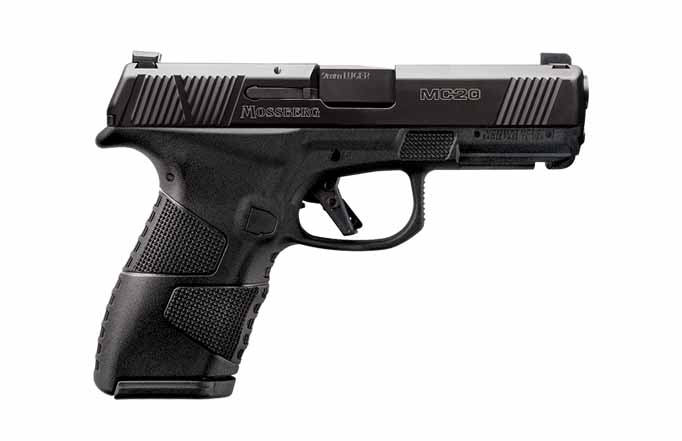
Boasting a double-stack magazine, the Mossberg MC2C ups the ante with a higher-capacity 9mm.
Last year, Mossberg made more than one jaw drop with the release of its first handgun in more than 100 years. Safe to say, it’d be pretty tough to top the introduction of the MC1sc. Yet, after knocking it out of the park with its sub-compact 9mm, the gunmaker has aimed to do one better in 2020.
The MC2c is nearly the spitting image of its older brother, only it offers shooters just a bit more—capacity. The double-stack pistol holds 13+1 rounds with its flush-fit magazine and 15+1 with its extended mag, giving it near standard capacity to everything in its class. Amazingly, Mossberg pulled off this feat without vastly increasing the size of the design, keeping the MC2c a solid concealed carry pistol.
Like its predecessor, the pistol is extremely slim, measuring in at 1.1-inches in width. Mossberg pulled off the narrow profile by switching to metal magazines for the new 9mm, providing more internal support while keeping it equally slender. New mags, however, do up the MC2c’s heft a bit—it weighs in at 21 ounces unloaded—but far from enough to make it unwieldy.
The gun has a bit more length to it as well, boasting a 3.9-inch barrel. But from there, things get really familiar, if you know the MC1sc. Perhaps the biggest carryover from last year’s release is the MC2c’s trigger. The flat-faced trigger gives you more surface area to get your figure situated, once there the break is impressive. At a crisp 5.5 pounds, and only traveling .5 inch, the feature ups the gun’s accuracy potential and makes it overall more enjoyable to shoot.
Perhaps best of all, the MC2c is easy-going on the pocketbook. The standard model comes in at $490 and there’s a night-sight upgrade that runs $595. Either way, it’s priced so most shooters can get into one.
A passionate gun parts and accessories company, Overwatch Precision has the kit to make you pistol run like a top.
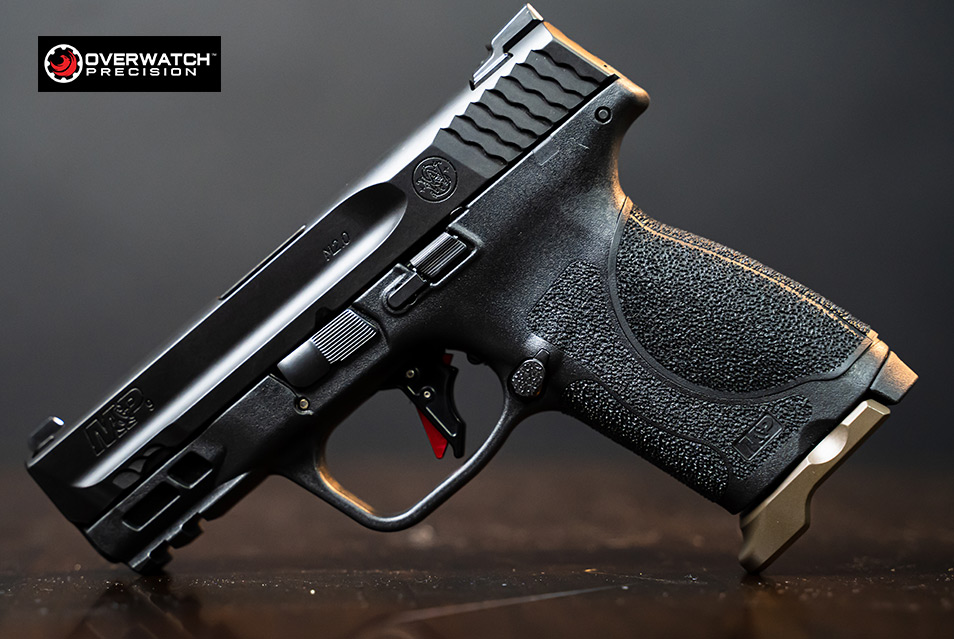
The OP TAC Trigger System is a patent-pending seven-piece upgrade for your Smith & Wesson MP 2.0 that reduces total travel and pre-travel by 50 percent. Engineered by us from the ground up, this kit provides the unmatched performance you have come to expect from all OP products.
Through state-of-the-art manufacturing techniques, our trigger bar is held to industry-leading tolerances using a progressive die manufacturing process, a metal forming technique used in aerospace manufacturing that guarantees the most consistent performance and highest quality parts. This process, coupled with a space-age NP3 coating, provides the end user with the highest quality trigger bar ever offered.
TAC Trigger
Our proven TAC trigger is both functional and aesthetically pleasing, with features immediately identifiable as Overwatch Precision’s intellectual property. The overall design has been the go-to for Glock pistols since we released it in 2016, and its overall shape and function have been refined to excel in this new platform. With pre-travel reduction and a flat face, this self-correcting contact point aids in a linear rearward pull and increases accuracy. The indexing lip helps the shooter consistently place their finger on the trigger in the exact same spot every time, helping muscle memory and overall consistency.
The Sear
At the heart of this system is our NP3 coated sear. With a proprietary sear angle and large radius, this sear allows for a light and consistent break that can be tuned to the shooter’s preference with the two trigger return springs provided.
The Plunger
This product has a proprietary radius that replaces the OEM chamfer and creates a measurable “hump” in the trigger pull. This Swiss CNC’d part, coupled with NP3, creates a smooth pull to the wall. The plunger spring provides constancy and safe operation of this part, as intended by S&W.
The Trigger Springs
We offer two different trigger return springs with this kit. Standing by our ethos of serious-use defensive weapon components, we include a 4.5-pound return spring for duty or carry use for a dependable, predictable break. With the growth of USPSA popularity and participation in and amongst firearm enthusiasts, we also offer a 3.2-pound spring. Please note, this spring is not suitable for carry.
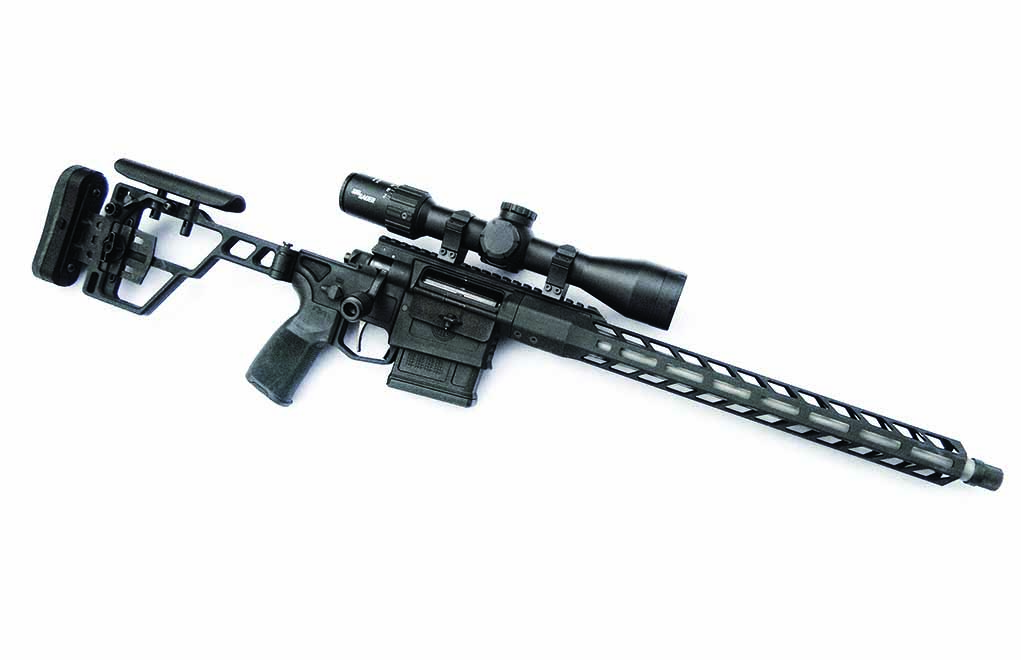
The Cross is a compact, lightweight and innovative rifle that’s sure to make a big splash in the bolt-action market.
It’s been a 20-year wait for Sig to re-enter the bolt-action market and it’s done so in style. Innovative and accurate, the Sig Cross rethinks what the rifle can be.
Sig Sauer is one of the most dynamic and innovative companies in the firearms industry today. This statement might seem to be one full of pomp and fluff, but you’ll be taxed to find a single company as of recently that’s introduced more designs with as much widespread acceptance—and criticism—than Sig Sauer.
In this special article, Gun Digest provides a first look at one of the only existing prototypes of Sig’s brand-new Cross bolt-action rifle.
The Sig Cross is a ground-breaking design. Never before has there been a world-class bolt rifle introduced with an expected street price of less than $1,500. That, alone, will be enough to attract flocks of shooters to the design. And, while we’re going to cover the details of the rifle, there first needs to be some discussion of what this gun means to the industry as a whole.
Backstory: P320 and P365
Sig Sauer has introduced two handguns that have shaken the entire foundation of their respective markets. The underdog story of the P320 is one that will likely never be forgotten. The modularity of the design, as well as its uncompromising reliability, has allowed it to soar. It now has the distinction of wearing the titles of “M17” and “M18” in the hands of the United States military. It can also be found in an increasing number of law enforcement holsters and in the hands of a growing number of competitors.
The Cross has a stock that folds over the bolt handle. This feature allows the gun to maintain a slim profile, even when folded, which is an advantage over guns with handles that fold to the left: Their bolt handles add width in a bag or in the saddle.
Sig then introduced a gun that’s rewritten “concealed carry.” The P365 was such an alarming design to the industry as a whole that it spawned an entire new genre of pistol in order to compete with it.
Sig Cross Rewrites The Bolt-Action Story
While its impact on the market might not be as immediate as the P365 or as stinging as the adoption of the M17, the Sig Cross has essentially rewritten the story of the bolt-action.
Exactly what’s so innovative about this particular design? The answer lies in the fact that Sig’s design-and-engineering team was going to make something completely its own. The product designers had been approaching their leadership for a couple of years, without success, for the development of a bolt-action. The decision was that if they were going to make a bolt-action, it would be something that had never been done before—and was accessible to more people than ever.
I spent a long time talking with Patrick Hanley, one of the people responsible for bringing the Cross into the world.
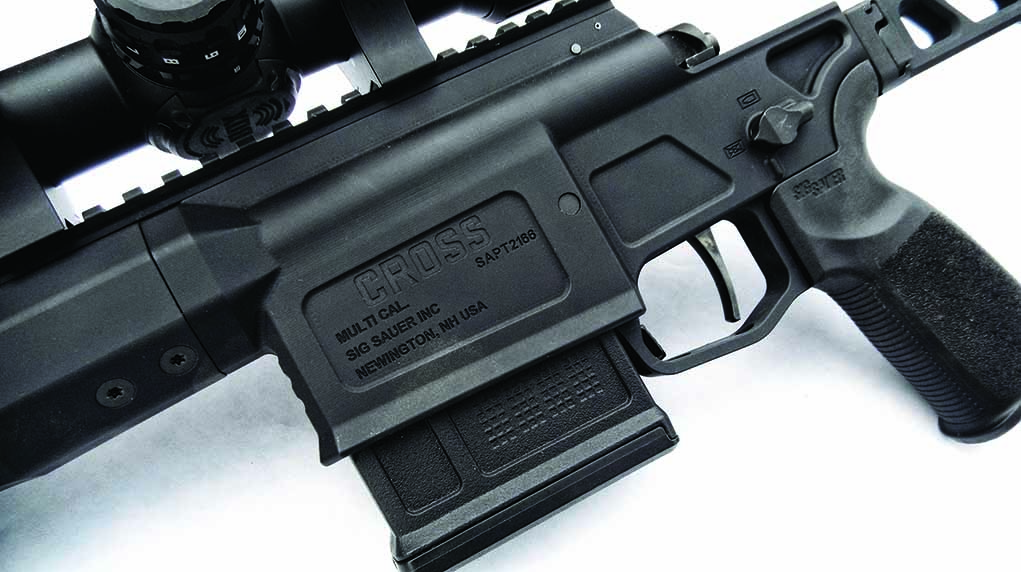
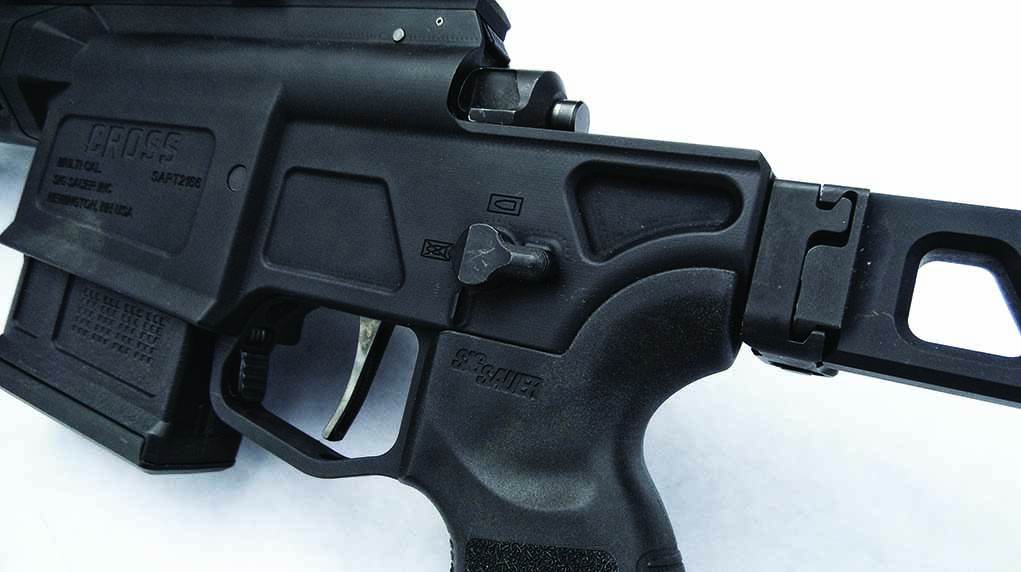
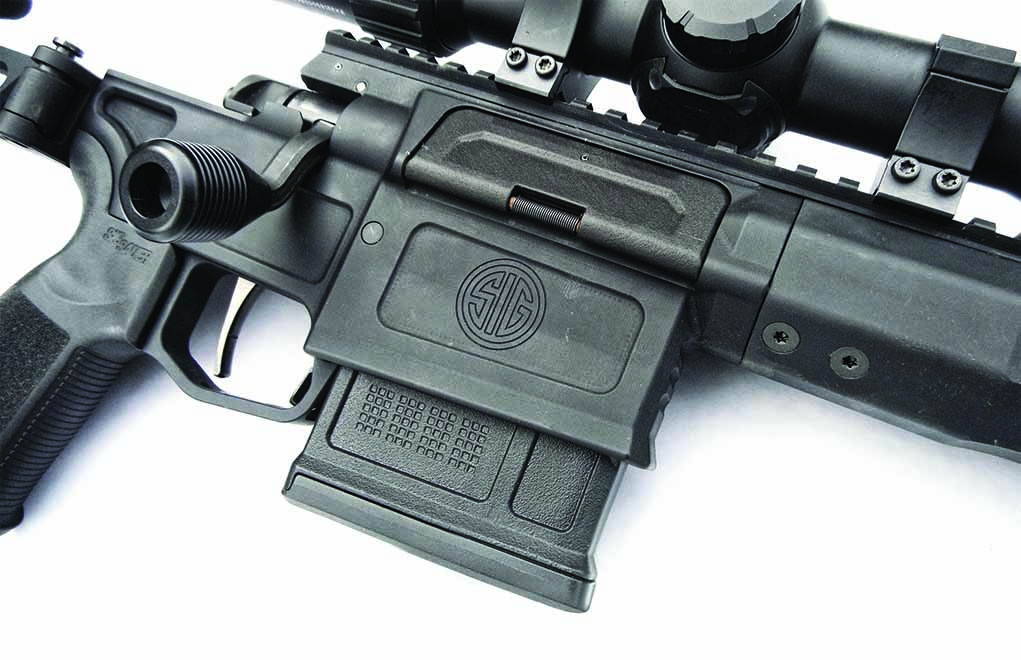
The Cross’s action is robust for how thin and light it is. Note that the magazine release in inside the trigger guard. The action takes AICS-pattern magazines.
“The Cross is a very interesting project,” Hanley explained. “We started this two years ago after talking internally about moving into this category. We spent countless hours debating in rooms of 20 people what the correct paths and attributes were for this rifle; and, in the end, I think it was worth every minute of it.”
The Crossover Sig Cross Concept
The Sig Cross isn’t just a tactical rifle. In fact, it’s designed as a crossover among all types of rifles available today. Again, I received one of just three firing prototypes: Later versions will have a whole host of adaptable accessories that will make it customizable for nearly any situation for which a person might need a rifle.
According to Hanley, the initial discussion started with a question:
“How do we get a hunting rifle to have the quality and features of a precision rifle without allowing the weight to be a deterrent to hunters?
The Sig Cross comes with an ambidextrous safety. This is a nice feature, because it’s just like an AR safety.
We knew that to do this, it should be our own design. From its front to back, this rifle was designed at Sig in New Hampshire. We started from there with the one-piece receiver, thus eliminating the need for bedding, action screws and all the other associated weak points present on existing bolt-action platforms. This, of course, means we were able to create a next-generation hunting rifle, as well as a next-generation everything rifle.”
Many of the pieces on the prototype rifle featured in this article are 3D printed. There will be some variance between what you see here and what ends up in your safe this coming spring (although I don’t know any of the exact details of those changes at this time).
Hanley explained, “We went to work on the trigger, which we also knew would need to hit it out of the park—or the rifle would fail. Our team designed a fully housed two-stage match trigger with a range of adjustment between 2.5 and 4.5 pounds and eliminating the creep. This will allow users to have a trigger out of the box that they should never need to change.
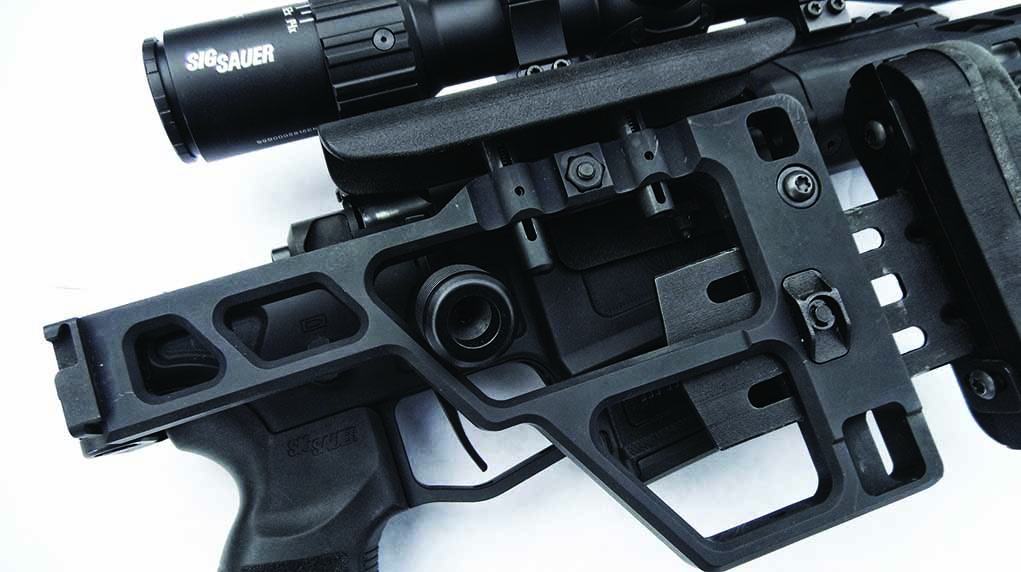
“The stock was also a big part of the rifle, because outside of folding, most hunting rifles don’t have a range to give you enough adjustment to make the rifle fit comfortably. We looked at every angle on this stock and gave it all the adjustment you could possibly need: comb height, pad height, pad cant (screws on the pad assembly go 7 degrees either way), a reversible comb and length of pull.
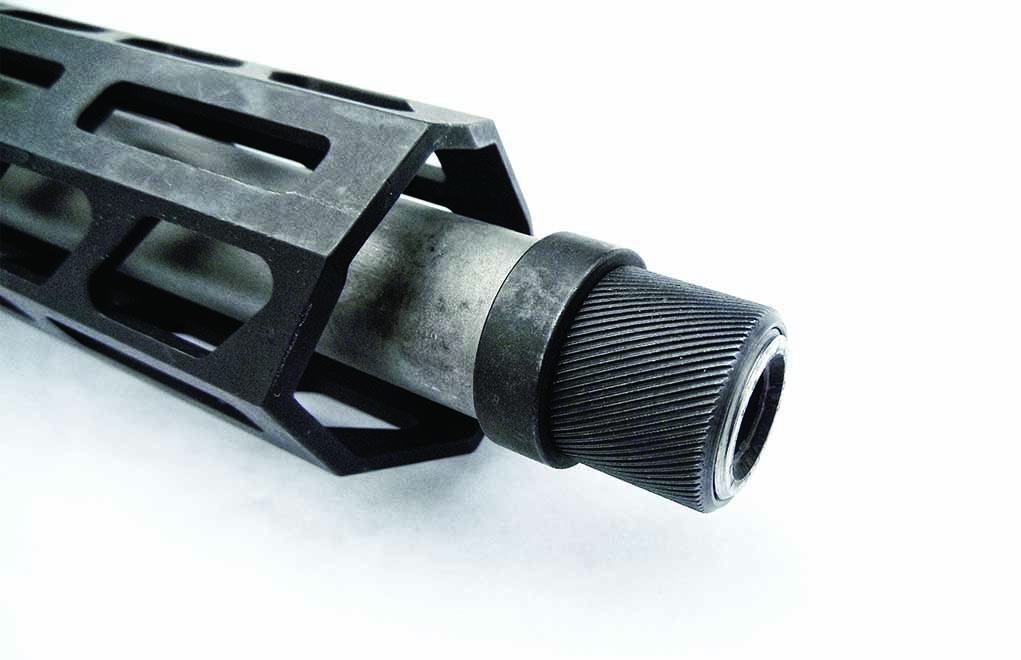
The Sig Cross will come standard with a threaded muzzle so that you can freely add a brake, flash hider or a can.
“Finally came the barrel,” Hanley continued. “To us, accuracy will always be the biggest point of contention in a quality rifle. We have national PRS champions, Delta snipers and people who can flat-out shoot at the Sig Academy. They put this thing through the ringer. As a result, the barrels we’re making in house have been fine-tuned to be one of the best the market will see.”
Another Industry Game-Changer
The rifle I received was chambered in .308 Winchester and had a 16-inch barrel. Sig is planning to release a 6.5 Creedmoor version, along with the .308 Win.
When it comes to the discussion of caliber, there are big plans for the Sig Cross. With this rifle, we’ll likely see the first commercially available firearms chambered for Sig’s revolutionary Fury high-pressure ammunition. The first of these is the .277 Fury, a round developed from Sig’s new cartridge case design for the Army’s next-gen weapon systems. The performance factors this ammunition will generate is nothing short of extraordinary. Expect even more innovation shortly—you’ll be surprised with what’s coming.
The stock is incredibly adjustable, and it folds over the bolt handle. It can be adjusted for length, comb height, cant and more.
Because the Cross design is meant to cross a performance “bridge” between legacy ammunition and next-generation, high-pressure ammunition, it has some features that are put in place to deal with extra power.
The bolt features a 60-degree throw and a three-lug bolt head. The bolt head features an extra set of lugs designed as a backup for the extreme pressures generated by the Fury ammunition. The action is incredibly rigid—but also very light. Its monolithic design is bolstered by the fact that it uses a barrel extension system similar to that on an AR-15. I’ve been assured that the design will allow the user to make quick and easy barrel changes, so expect an aftermarket following.
The Sig Cross at the Range
It should be noted that the rifle I received, in addition to being a prototype, had seen quite a bit of ammunition: It was one of only three firing examples. The accuracy I initially recorded was not spectacular, but it turned out to be the fault of the ammunition. I was able to consistently print ¾-inch, five-shot groups at 100 meters using Hornady 168-grain match ammunition. The best group was five shots into ½ inch. This trend then continued with Sig 175-grain match ammo, with accuracy being sub-MOA at all ranges. The final Cross product should be even more accurate.
Additional Features
A great feature of the Sig Cross is that it’s light. The total loaded weight, with scope, was fewer than 9 pounds. That’s impressive for an all-metal, precision bolt-action rifle. Many of the rifles I’ve used in a similar role have weighed upward of 15 pounds. The Cross’s light weight and compact folded size will make it quite popular among backpack hunters and those who have to navigate across diverse terrain.
HB4116
The Cross feeds from standard AICS-pattern magazines. I tried several different brands in the rifle, and all fed just fine. Among the mags tested were genuine AICS and Alpha magazines.
While it might raise eyebrows that the SR 25 magazine was not chosen, there’s a sound reason behind it: The single-stack profile of the AICS lends itself to a thinner overall width and more flexibility for new cartridges as they come out, many of which would need proprietary magazines.
The Future
This rifle might be a hard sell as a hunting gun for some people. It certainly has a tactical vibe to it, which could keep the traditionalists at bay. Even so, there’s a great future for the Sig Cross. An entire host of accessories, parts, barrels and myriad other upgrades is scheduled to be released for the system. There is, in fact, a long-action version planned that’s just entered into its initial design phase.
This design is the first of a brand-new generation of ultra-capable firearms available to the public. This isn’t a simple gimmick or new spin on an old concept. The Cross is the herald of what’s to come.
For more information on the Sig Cross, please visit sigsauer.com.
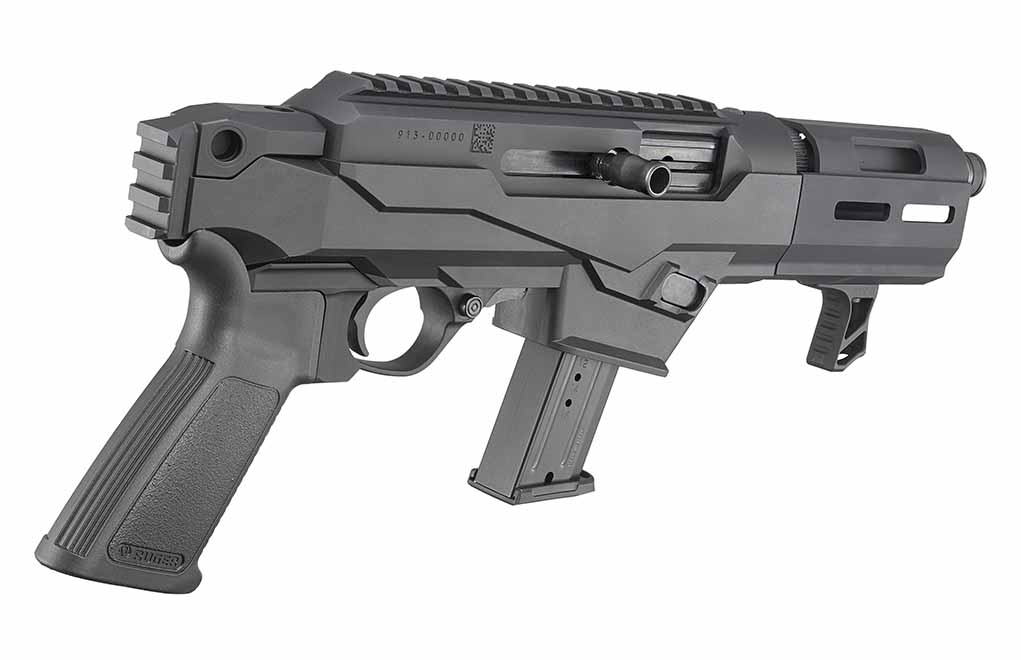
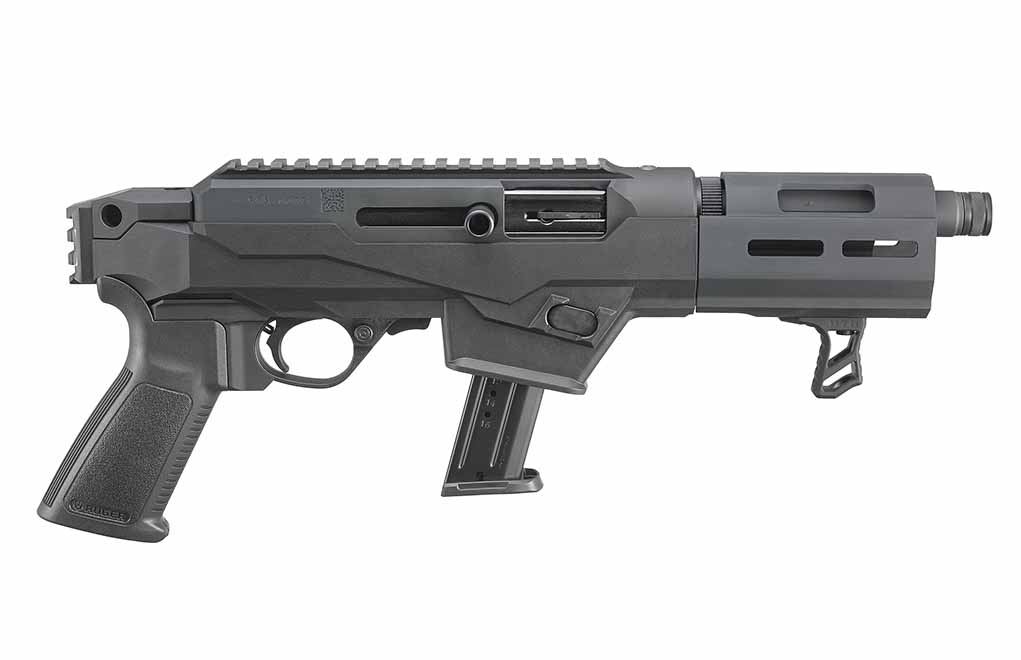
Going small, the Ruger PC Charger Pistol is the perfect small and nimble complement to the existing PC Carbine line.
How The PC Charger Pistol Compares To The Carbine Line:
Uses the same dead-blow action to mitigate recoil and shorten the bolt stroke.
Weighs in much less than the rest at a scant 5.2 pounds.
Boasts a nimble 6.5 barrel.
Accepts SR, Security-9 and Glock magazines, just like the PC Carbine.
The Ruger PC Carbine has made waves, to say the least. Introduced three years ago, the nifty pistol-caliber long gun—chambered 9mm and now .40 S&W—has been among the company’s most popular guns of recent times. Taking the next logical step, the gunmaker has introduced a compact and nimble variation of the gun—perhaps the perfect complement to the existing carbine.
Based on the PC Carbine Chassis model, the Ruger PC Charger Pistol comes loaded with many of the same features, expect in a minuscule package. Best of all, it’s priced much like its long-gun cousins, relatively affordable with an MSRP of$799. On the surface, it seems a bit spendy, until you side-by-side the gun with others in its class—namely AR pistols, which by and large eclipse the $1,000 mark.
Mimicking the PC Carbine, the PC Charger Pistol uses a number of the same features, including an interchangeable magazine well. Unarguably an asset, this allows the pistol not only to accept Ruger Security-9 and SR9 magazines, but also ubiquitous Glock double-stacks. Needless to say, this makes the gun easy to feed.
Furthermore, the PC Charger Pistol is also outfitted with Ruger’s dead-blow action, a nifty design that shortens the blow-back operated pistol’s bolt travel. A dense tungsten weight on the bolt is the secret behind the system and makes the pistol—and the carbine, for that matter—exceptionally mild in the recoil department. A fast shooter as well, given it does a number on muzzle rise, thus makes it quick shot to shot.
A few other notables on the PC Charger Pistol include a reversible mag release and charging handle, glass-filled polymer chassis, hard-coat anodized aluminum handguard with M-Lok attachment points (3, 6 and 9 o’clock), A-2 style grip, butt rail for the attachment of a brace and a factory-installed hand stop. The last feature is on the mark, given it keeps your support hand safe on the 6.5-inch barreled gun—always a concern in such a configuration. Depending on where you reside, the gun ships with either 17- or 10-round SR/Security-9 magazines.
Looking to go armed, but are stuck in the weeds as to what to arm yourself with? Here are 20 of the best concealed carry gun options that will keep you on the defensive.