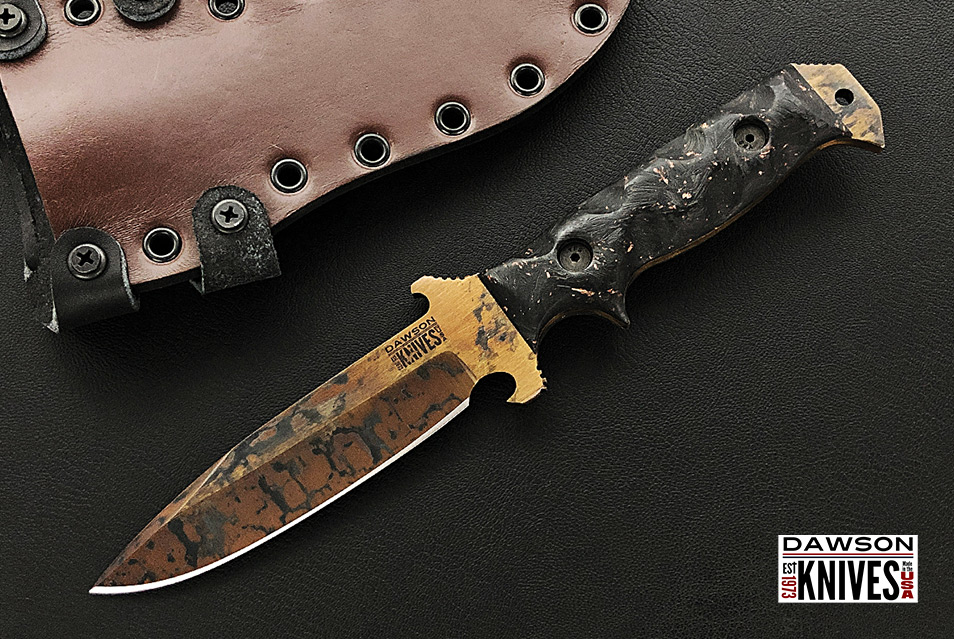
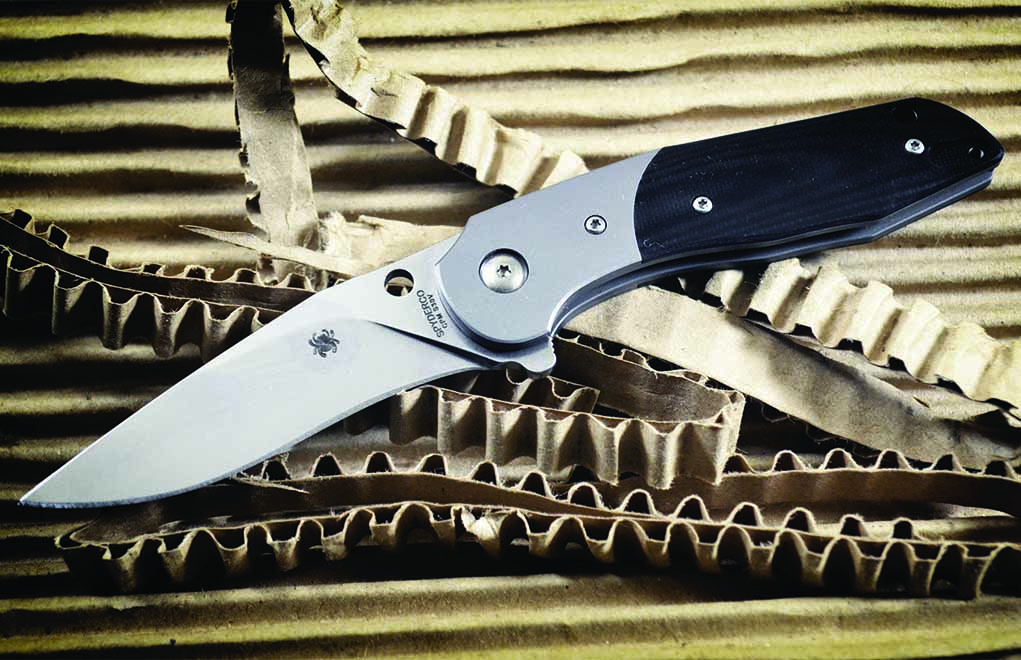
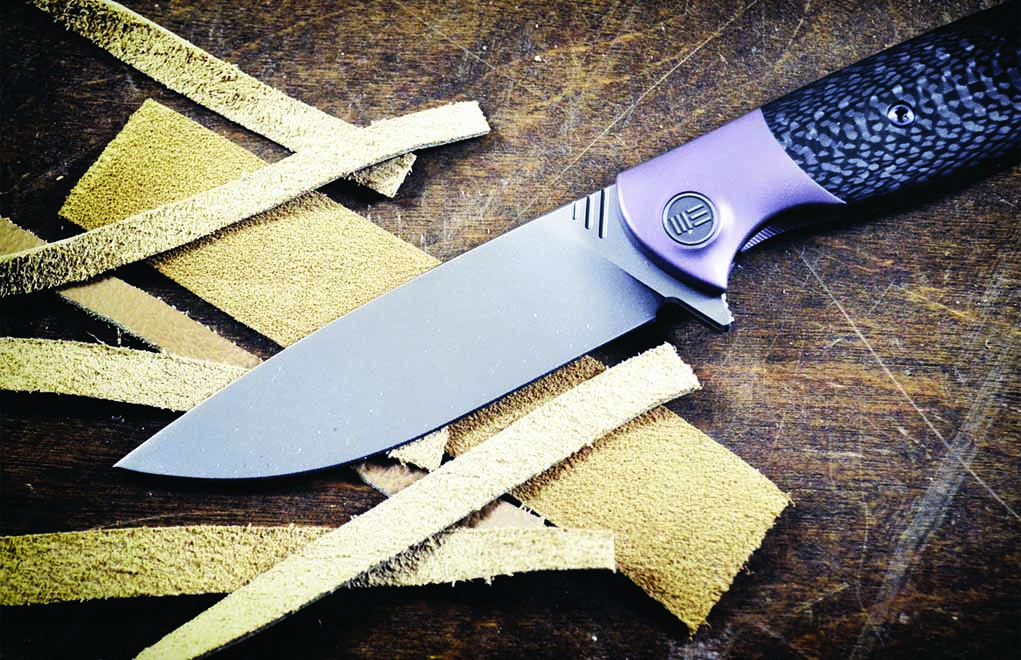
Modern traditionalists, Dawson Knives craft one-of-a-kind knives fit to master any situation.
Dawson Knives has been building custom knives and swords for nearly 50 years, with three generations of our family working together out of our shop near Prescott, Arizona. We use CPM-3V powder steel for all our blades – an incredibly tough, flexible, American-made super steel that holds an edge up to 3x longer than D2. We’re modern traditionalists, holding ourselves to a standard of heirloom quality and outstanding American craftsmanship while constantly researching new ways and methods to make something that was already good, better.
Be sure to enter our American Made giveaway, with great gear from great American companies. Click the tab at the bottom right of page to enter.
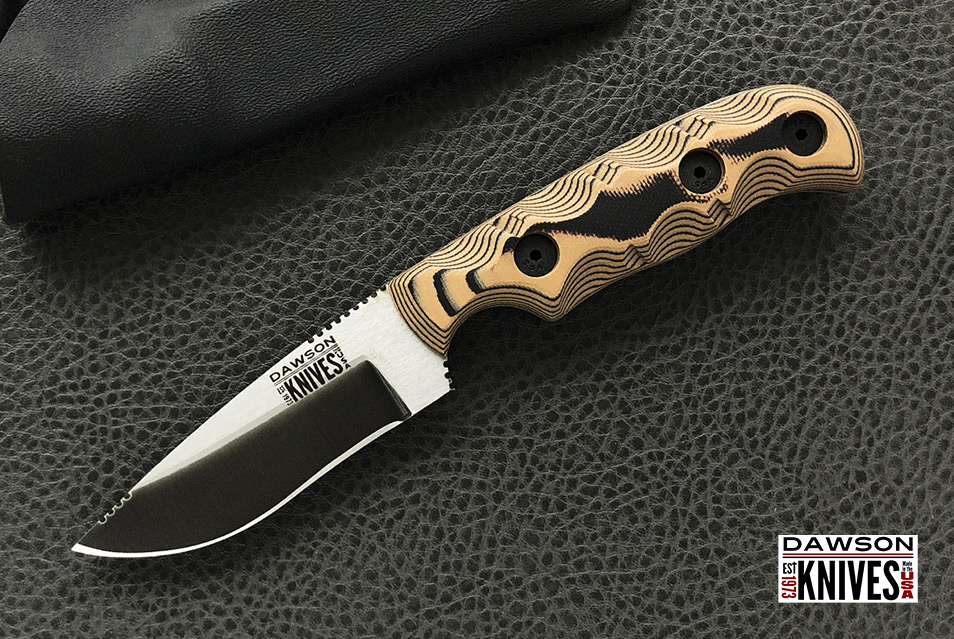
Deep Notch
A sleek, classic drop point style blade and deep finger notch make the Deep Notch Skinner one of the most comfortable and intuitive knives you’ll ever use.
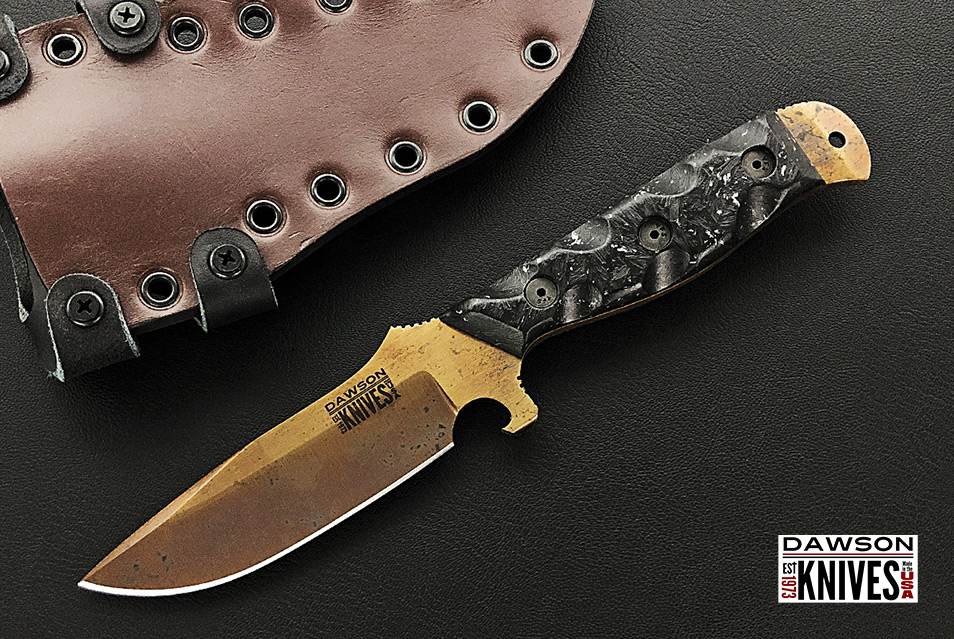
Pathfinder
The Pathfinder rocks as an all-around field and camping knife. Its heavy-duty drop point blade has plenty of heft for chopping, shelter building, camp chores and game quartering.
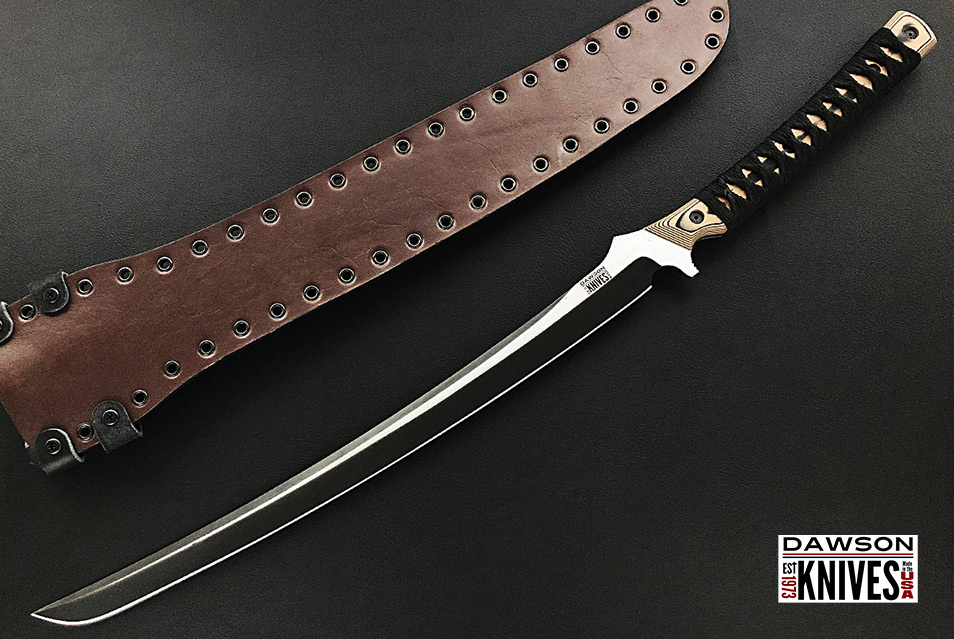
Relentless Sword
This modern samurai-style sword features a full length top bevel that strips away excess weight, revealing a lean, hungry beast with a nasty attitude and plenty of teeth.
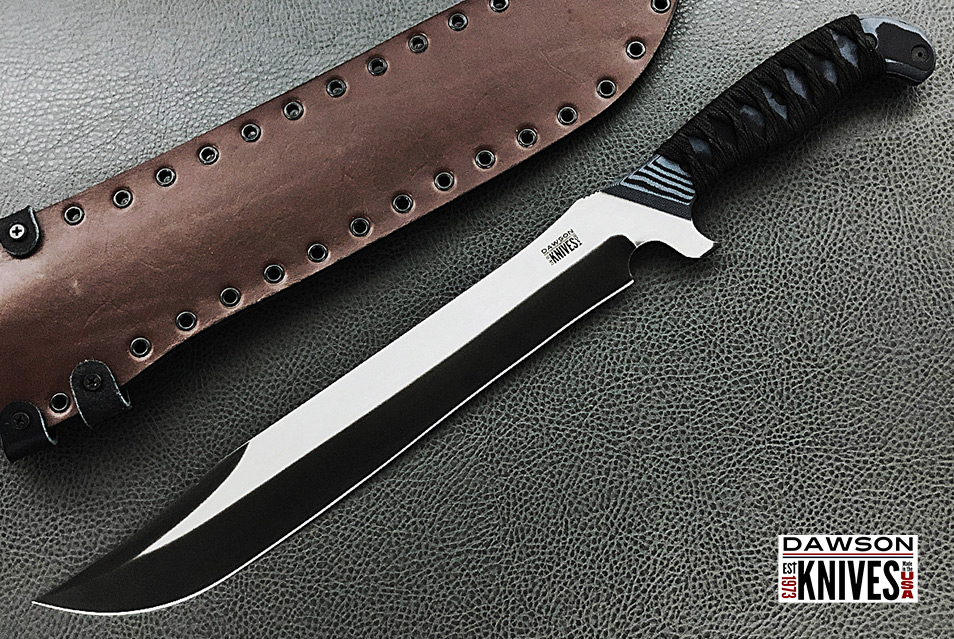
Helmsman
An exceptionally well-balanced chopper, the Helmsman feels light and fast despite the considerable power it brings to bear.
Chief
The Chief excels in both the woods and field; a tough, all-purpose blade ideal for backpacking, camping and bushcrafting in every kind of terrain.
For more information on Dawson Knives, please visit dawsonknives.com.
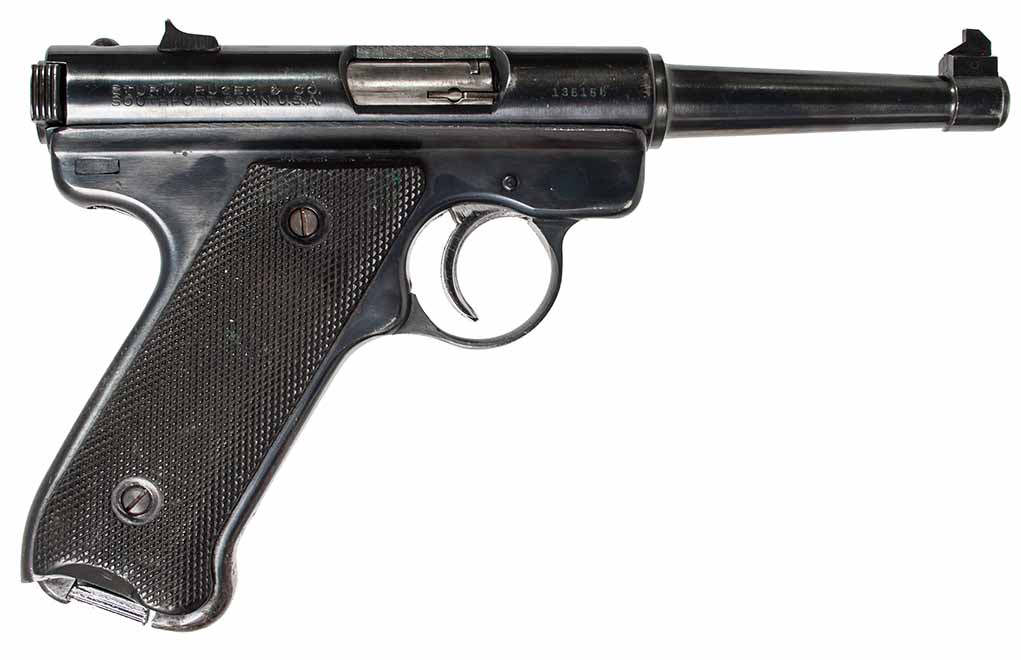
This 1958 vintage pistol with a tapered, 5-inch barrel has the look of the classic Ruger .22.
A humble, yet forward-looking .22 LR pistol, the Ruger Standard became the unexpected cornerstone of one of America’s largest gunmakers.
Firearms history was made threescore and 10 years ago, when the first Ruger was introduced. An ad in August 1949 presented to the shooting public not only a new gun, but also a new manufacturer: Sturm, Ruger & Co.
Luger/Ruger
The ad read, “The .22 Ruger Pistol represents the first overall improvement in automatic pistol design since the Browning patent of 1905. For simplicity, strength and handsomeness, it has no equal.”
It went on to describe the unique design. “A cylindrical bolt moving in a tubular receiver provides a strong, simple action with unmoving sights. It can be dismantled in five seconds.”
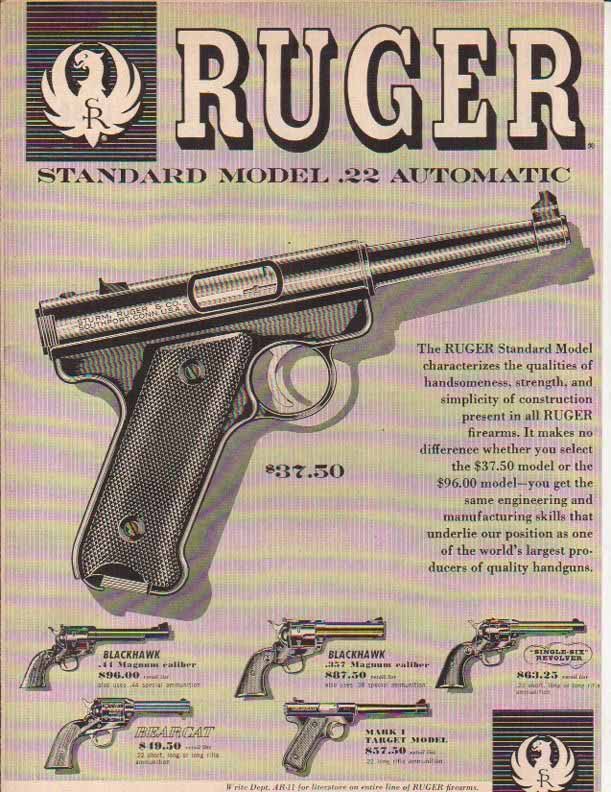
Here, one of many ads for the Ruger Standard Model.
The image in the ad bore a striking resemblance to the German Luger. Not only were the names similar, the profile, angle of the grip, trigger guard, tapered barrel and the front sight said “Luger.” This was not a problem, because the Luger was one of the most famous pistols in the world. However, on the inside, the Ruger’s operating mechanism and blow-back action were nothing like the toggle-locked, recoil-operated Luger.
Immediate Customer Response
When Sturm, Ruger & Co. introduced the new .22 pistol, its retail price was $37.50. The only manufacturers of .22 semi-auto pistols in America at the time were Colt and High Standard; the Ruger’s price was about half that of the Colt Woodsman and less than the lowest-priced High Standard. Very soon, the first shipment of 100 pistols was on the way to gun stores. It was an immediate success and jump-started the new company on its way to becoming a major player in the gun business.
Bill Ruger was quoted as saying, “The Woodsman was the first influence on our .22 pistols and also the Luger. What I did was to conceive our .22 as a low-cost equivalent to the Woodsman, which is exactly what High Standard had done previously. But there was something about the High Standard that wasn’t as neat; they didn’t get it right. It looked too much like a product of the ’50s, with plastics and things. We really murdered High Standard with our guns.”1
Alex Sturm
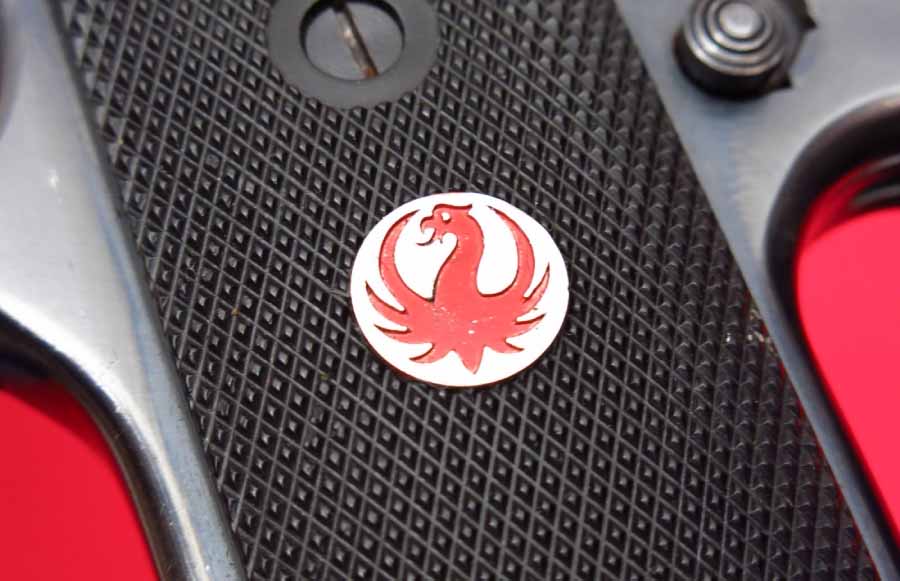
Ruger’s partner in the founding of Sturm, Ruger & Co. was Alex Sturm, an artist and writer who was from a prominent Connecticut family. He provided the startup money for Ruger—a staggering $50,000 at a time when that was a lot of money. Sturm had a lot in common with Ruger. A collector of fine firearms, swords and heraldry, he designed the Germanic eagle medallion that became the official logo of the company.2
The famous Red Eagle grip medallion was on the first production Ruger Standard Models, of which about 27,000 were made between 1949 and 1952. The logo was changed to black in 1952 in memory of Alexander Sturm.
Sturm and Ruger became good friends, but their relationship was short-lived. Sturm became seriously ill with viral hepatitis and, within 10 days, died on November 16, 1951, at the age of 28. For the first two years of production, the left grip panel of the Ruger pistol featured the company logo with an inlay of a red eagle. After Sturm’s death, Bill Ruger changed the inlay to black to honor Sturm.
The Ruger Standard
The original model, which quickly became known as the Ruger Standard Model, was produced in several variants: the original standard and target models (1949–1952); the Black or Silver Eagle model; the “Hecho En Mexico” (made in Mexico) model; the Black or Silver Eagle Mark I Target; and the Stainless 1 of 5,000, with or without the California Freedom inscription (CAL. FREEDOM ’82). This last one was one of 26 donated by Ruger to the California Citizens Against the Gun Initiative in 1982. The Mark II Series was made from 1982 to 2005, and the Mark III from 2005 to 2016, at which time the current Mark IV models were launched.
Collector Interest
As is usually the case, most collector interest in Ruger firearms is with the earlier guns. The Hecho En Mexico model brings a premium in its value because of its rarity. In 1957, Ruger shipped 250 sets of parts to Armamex in Mexico. That company added the barrels and assembled 250 pistols—200 with 4½-inch barrels and 50 with 6½-inch barrels.3
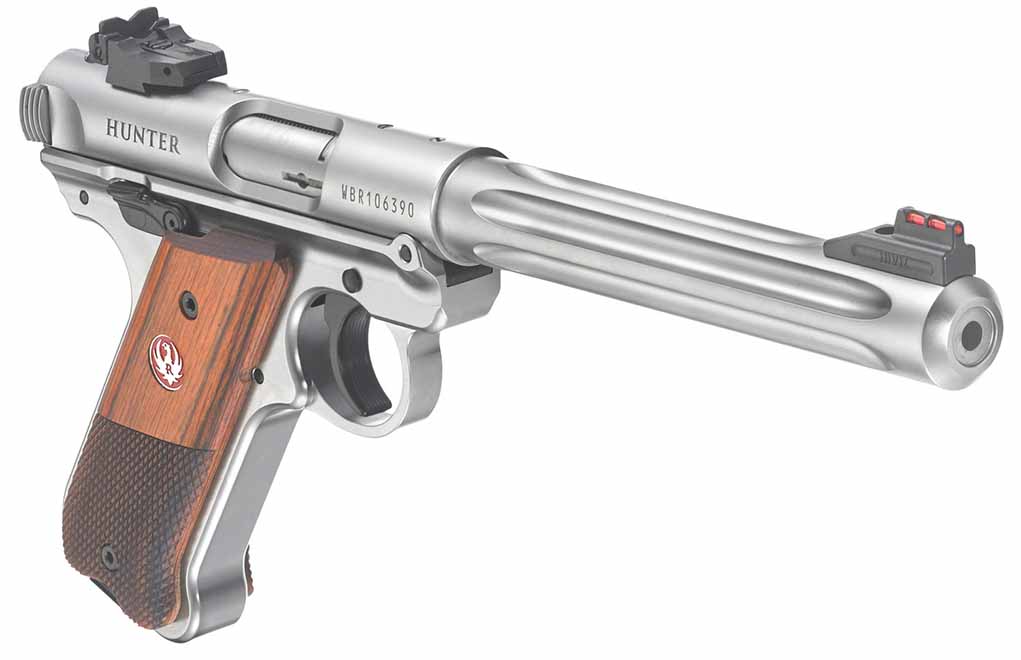
One of the recent Mark III variants is this striking Hunter Model with a fluted barrel and laser sights.
Military-marked models also call for a premium. These pistols were made for the federal government as a training model for military personnel. A limited number with a “U.S.” marking are believed to have found their way into civilian hands (perhaps no more than 25). It should also be noted that an original “salt cod” box, in which the earliest Ruger Standard Models were shipped, is more valuable than the pistol itself!
The gun that started it all for Sturm, Ruger & Co. has been the most popular .22 semi-auto pistol for several generations of shooters. It’s still in production today, being made in several standard, target, competition, tactical and hunter models—and still at bargain prices, compared to many other brands.
Seventy years and still going strong.
FOOTNOTES 1, 2: Ruger and His Guns, R.L. Wilson, Chartwell Books, 2007 3: Standard Catalog of Ruger Firearms, F+W Media, 2014
The 5mm Remington Rimfire Magnum is nearly gone, but certainly not forgotten.
Why People Still Love The 5mm Remington Rimfire Magnum:
Capable of pushing a 38-grain bullet to 2,100 fps at the muzzle.
At the time, early 1970s, this was the higest velocity of any rimfire.
The 5mm had an effective killing range on small, varmint-type animals of 25 to 50 yards.
While the 5mm Remington has the edge for varmint shooting, but the .22 WMR is more versatile for small game.
The 5mm Remington Rimfire Magnum (5mm RFM) was announced in 1969 but wasn’t actually introduced until 1970. Only the Remington bolt-action Model 591 clip-loading and Model 592 tubular magazine repeating rifles were available for the round. It was not adopted by other ammunition manufacturers.
For a while, Thompson/Center furnished barrels in 5mm Remington for the Contender pistol. At the time, this round used the only modern bottlenecked rimfire case. However, many of the obsolete black-powder rimfires were necked, so it wasn’t an entirely new development.
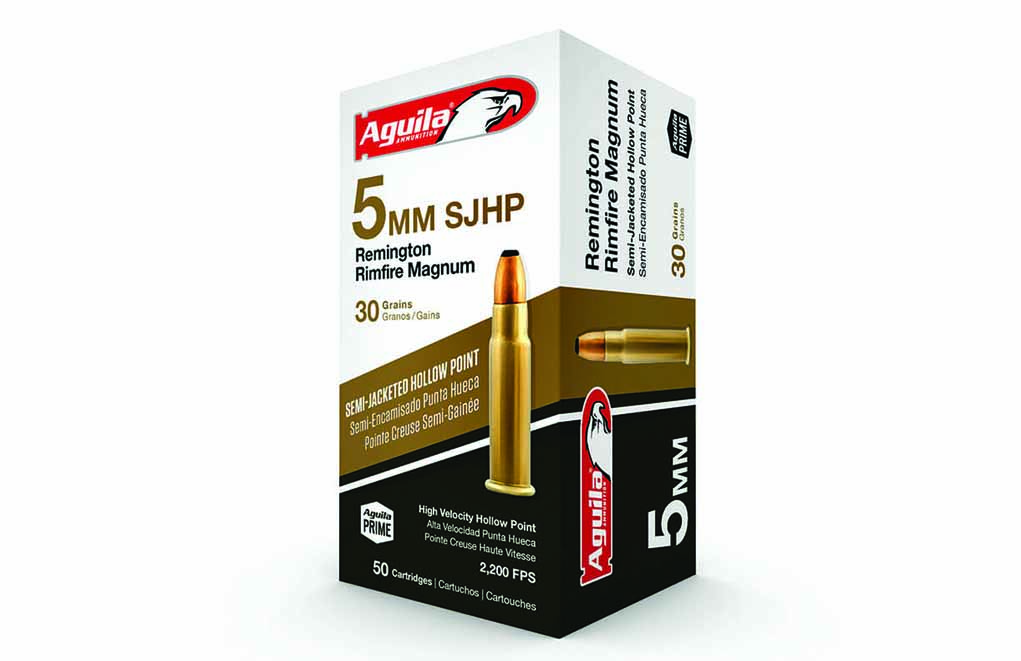
Bullet diameter is .2045 inch. It weighs 38 grains and has a muzzle velocity of 2,100 fps. This round developed the highest velocity of any rimfire at the time (newer, 30-grain .22 WMR loads offer greater muzzle velocity). Conversion kits have been offered every so often to make the 591 and 592 into centerfire guns.
The 5mm Remington represented an interesting development—one that exceeds the performance of some of the early .22 centerfires. Its effective killing range on small, varmint-type animals is 25 to 50 yards more than the .22 Winchester Magnum Rimfire. This is due to the better sectional density of the smaller-diameter bullet, along with 150 fps higher initial velocity.
Both are varmint cartridges. In both, the hollow-point-type bullets ruin too much edible meat for small-game shooting. However, the .22 WMR is available with a non-expanding, full-jacketed bullet. Alternatively, the shooter could switch to the interchangeable .22 WRF for small-game hunting.
In summary, the 5mm Remington has the edge for varmint shooting, but the .22 WMR is more versatile for small game. On the other hand, a good, full-metal-jacketed small-game bullet for the 5mm Remington might have changed that analysis. The choice would be a matter of use and personal preference.
Remington has long since discontinued its Models 591 and 592, and no rifles are currently made in 5mm RFM. Likewise, ammunition is no longer made by Remington. The 5mm RFM is another good idea that didn’t catch on, although it had a lot to recommend it. (Ammunition is available on a limited basis from time to time.)
The Hodgdon name has long been synonymous with excellent smokeless powders, and it has been marketing, developing and selling powders for reloaders since the end of World War II. Bruce Hodgdon started it all, selling surplus U.S. military rifle powder via small classified ads. Today, the company is nothing shy of wonderful … and still has the Hodgdon family at the helm.
Smokeless Powder Evolution
The process of creating a reliable smokeless powder has been as much of an evolution as—and has gone hand-in-hand with—the improvements in bullet technology. Modern powder has been an important ingredient in the successes of our long-range cartridges, because they will produce the consistent pressures and velocities that are so important to accuracy.
Before the advent of our single- and double-base smokeless powder, Cordite was the solution to the corrosive nature of black powder. It was manufactured in long, spaghetti-like strands, and while it certainly worked (Cordite fueled many of our classic hunting cartridges, such as the .375 Holland & Holland, .404 Jeffery, .30-06 Springfield and .416 Rigby), it was extremely sensitive to changes in temperature.
One of the reasons the .416 Rigby case is so large is to keep the pressure as low as possible, because the Cordite propellant gave one set of pressures in jolly, old England yet increased notably in the tropics of India and Africa. The modern update of the Rigby—the .416 Remington Magnum—shows that the same ballistics can be achieved at a higher pressure in a smaller case. Yes, the pressures are higher, but modern powders are more consistent across a wide range of temperatures.
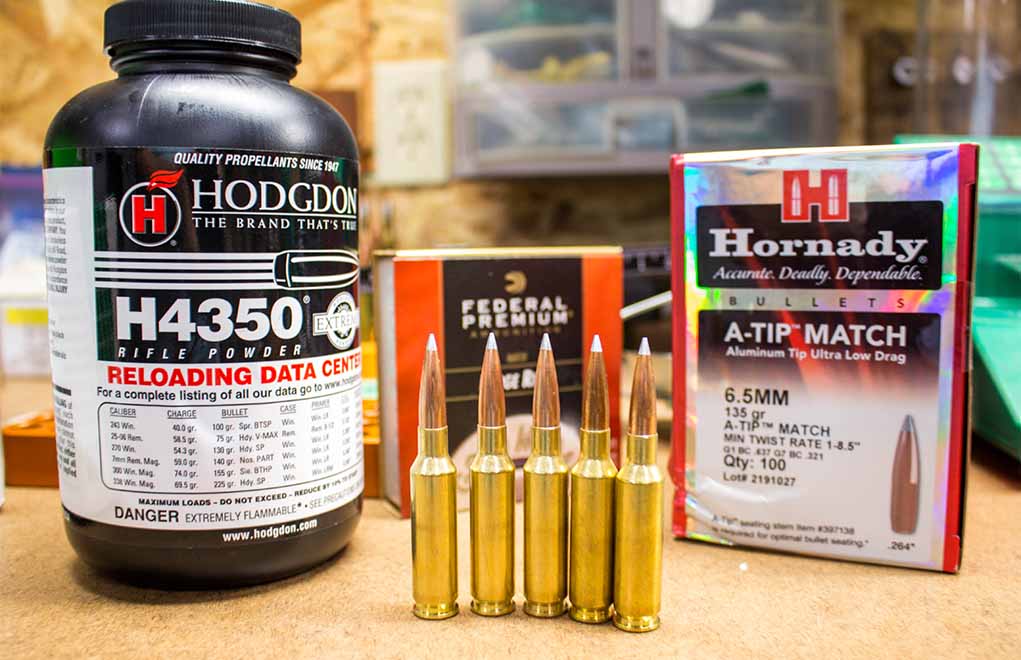
While H4350 is usually more closely associated with cartridges such as the 7mm Remington Magnum and the .300 Winchester Magnum, it’s perfectly at home in the 6.5 Creedmoor, shown here with new Hornady A-Tip bullets.
The extruded and spherical powders in vogue at the outbreak of World War II began a movement to create powders insensitive to temperature changes. Hodgdon has been at the forefront of that technology (recently, with the IMR Enduron line).
The Extreme Powder Line
However, before that came the Hodgdon Extreme powder line. There are certainly some gems in that lineup, from the fast-burning to the slowest-burning powders for huge cases.
H322: Starting low in the line, among the faster-burning powders, you’ll find H322. It has given fine accuracy in the smaller cases such as the .222 Remington and .223 Remington, and I’ve seen some excellent targets from a .308 Winchester loaded with H322 and lighter (168 grains and under) bullets. I also like the way H322 behaves in the .45-70 Government and the .458 Winchester Magnum.
So, if you want to use the same ammunition in your .223 for prairie dogs in the summer heat and for coyotes in the frigid winter, give H322 an audition. Likewise, if you’re a fan of the .458 Winchester Magnum and have intentions of taking that big stick to Africa for buffalo, Alaska for brown bear or Australia for banteng and water buffalo, you might want to keep H322 in mind.
H4895: Sliding up the scale, we see H4895—with ties to the original surplus military powder that Bruce Hodgdon sold. It’s another great choice for medium cartridges such as the .308 Winchester and the good, old .250-3000 Savage. It was a good powder years ago; it has been made better by the modern coatings to reduce temperature sensitivity.
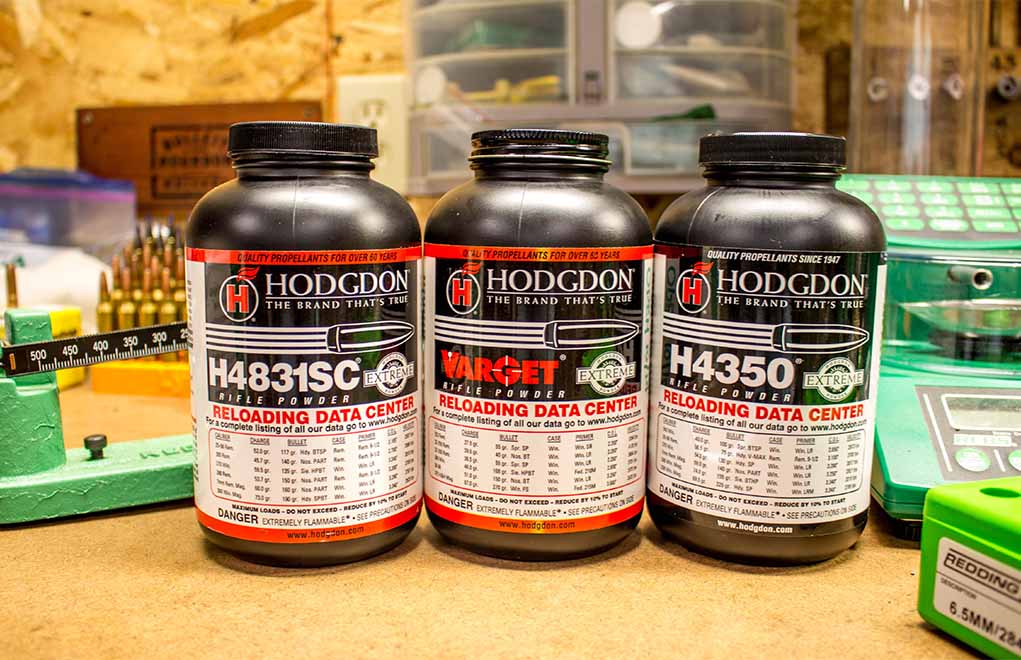
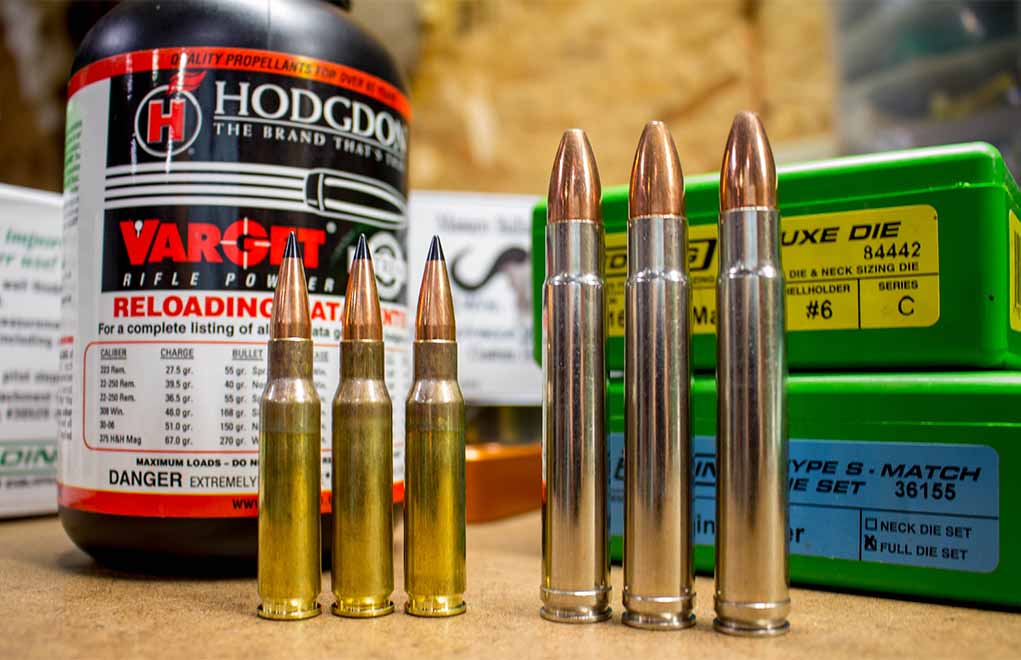
Hodgdon’s Varget is an extremely versatile powder, which is equally applicable to the .308 Winchester as it is to the big .416 Remington Magnum.
Varget: This might be one of the most versatile and useful offerings in the lineup and has all but replaced IMR4064 in most of the cartridges in which I loaded it. Varget works in the .22-250 Remington (although I prefer Hodgdon’s H380, I do have several loads for Varget), is stellar in the .308 Winchester and .30-06 Springfield, and shines in both the .375 H&H and .416 Remington Magnum.
Varget, along with Reloder 15 and IMR4166, have given excellent results in many medium-capacity cases, as well as the larger-volume safari cartridges. The consistency of Varget across the temperature range has shown that it’s equally at home on the target range as it is in the hunting field. While perhaps it’s not the optimum choice for the “children” of the .30-06, the .270 and .280 will run on Varget, and the .338-’06 and .35 Whelen simply love it.
H4350: Looking at the Extreme powder just up the burn rate scale will yield H4350. Now, for years, this powder was a sure go-to for the .300 Winchester Magnum and has been great in the .375 H&H Magnum. However, recently, it’s proved to be the powder for the 6.5 Creedmoor.
H4350 has a burn rate not far off from its IMR counterpart, so any application for which IMR4350 would suffice could be equally served by H4350—although the two are not interchangeable. It’ll serve the .243 Winchester, .280 Remington, .270 Winchester and all the WSM family, and it’s proven to be a good choice for both the .338-06 and my beloved .318 Westley Richards.
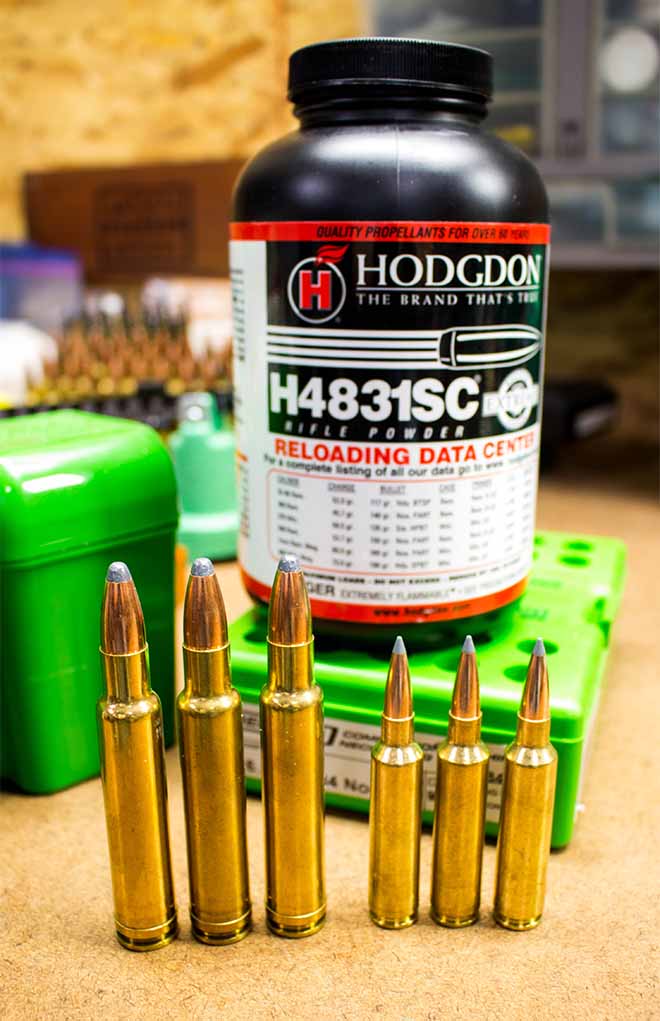
H4831SC: Next up, you’ll find H4831SC, with the “SC” standing for “short cut,” because it’s designed to meter better with a shorter grain structure. I’ve come to rely on this powder in a number of ways—at opposite ends of the spectrum. I first came to know H4831SC when loading the behemoth .378 Weatherby Magnum for the late professional hunter, Jay T. Carlson, using more than 100 grains of H4831SC to drive 300-grain Nosler Partitions at a muzzle velocity of 2,975 fps.
H4831SC (the “SC” stands for “short cut,” as in the grain length) can fuel the big magnum cases such as the .378 Weatherby Magnum, as well as smaller cases such as the 6.5-284 Norma, with fantastic accuracy and consistency.
H4831SC has also been magical in my 6.5-284 Norma, pushing 140-grain boat-tail bullets to such a consistent velocity that it maintains 1/3 MOA out to 500 yards (maybe more; I haven’t put it on paper beyond that distance). It’s equally at home inside a .300 Winchester Magnum case as it is inside a .270 Winchester, .280 Remington or .25-06 Remington and has been factory loaded in the .470 Nitro Express. Of all the Hodgdon Extreme powders, I find H4831SC to be among the most universal and useful, especially when talking about the larger cases.
H1000, Retumbo and H50BMG: Rounding out the series of Hodgdon Extreme powders is a trio of very slow-burning powders, suitable for the fastest cartridges yet developed. H1000, Retumbo and H50BMG all develop fantastic velocities. I’ve used Retumbo in both the .300 Remington Ultra Magnum and the .30-378 Weatherby Magnum, although I do feel Retumbo burns a bit dirty. H1000 will serve some of the smaller cases. By that, I mean the .300 Winchester Magnum, 6.5-284 Norma and many of the smaller Weatherby Magnums. But it will also work in the .470 NE and .416 Rigby.
Consistency Is Key
What I like most about this line of powder is the consistency. While single-digit extreme spread figures don’t always equate to accuracy, they certainly are a big part of the equation, and I’ve found Hodgdon’s Extreme powders to be among the best when it comes to consistent velocity.
For a hunter who travels, or at least uses his or her rifle in a number of varying environments or seasons, the Extreme line makes all sorts of sense. I’ve tried to prove the Hodgdon technology wrong—both by putting the ammunition on ice and by letting it sit in the summer sun—and it works. I’ve seen very little variance in velocity. I can’t say the same for many other powders.
The .25 ACP is ultra-compact, but it’s also ultra-unpowerful. Yes, it can kill, and no, I wouldn’t want to be shot with one. But that doesn’t make it a good choice for a defensive caliber.
Tempting as the convenience of mouse guns and micro pistols are, do the .25 ACP, .22 LR, .22 WMR and 5.7×28 have the stuff to save your life?
If you’re going to choose a light caliber for self-defense, do it right
The subject of a .22LR, .22 Magnum or .25 Auto for personal defense is controversial. They’re not stoppers. Period. End of story. However, they are still lethal weapons.
The .22LR bullet, compared to a .32 and a .380 JHP. This is not the Hammer of Thor, so don’t expect miracles.
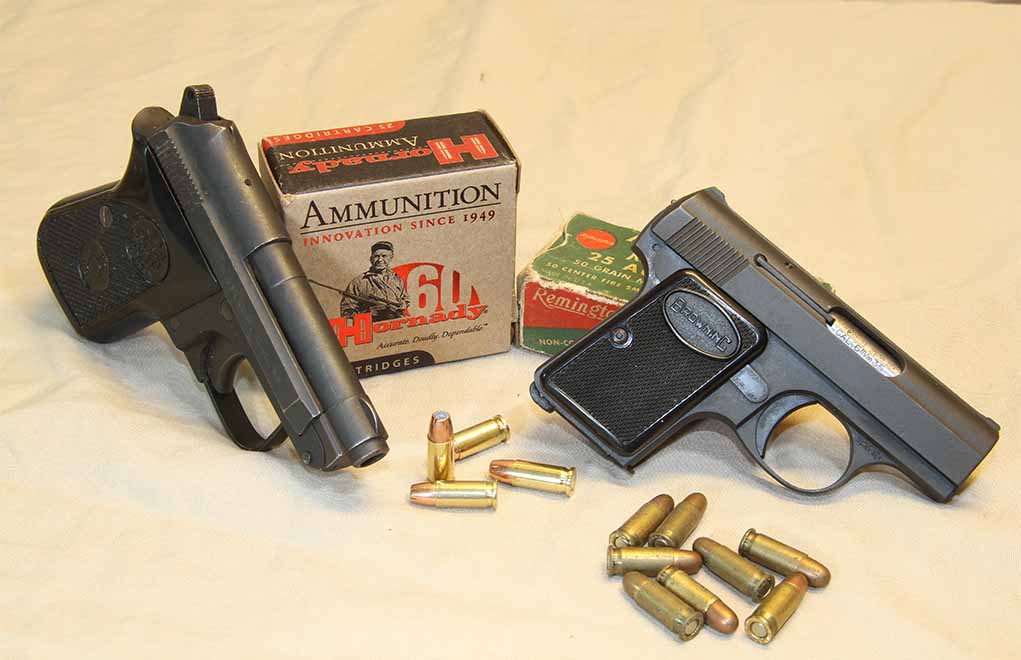
The reason they exist is twofold: compactness and low recoil, both of which make them appeal to many as potential everyday carry guns. The smallest handgun to be had is an ultra-compact .22LR, or a .25 Auto. The lowest-recoiling handgun you can shoot is a standard-sized pistol chambered in .22LR, such as one of the smaller-sized Ruger Mk I, II, III or IV. The .25 ACP/Auto is not much different from the .22LR, with the exception that the bullet, almost always a full metal jacket, can be counted on to feed more reliably than the lead-bullet .22LR. But, that can also be a matter of maintenance (a lint-choked pistol isn’t going to feed anything reliably) and handling.
.25 ACP
I will just pass right over the .25 ACP. Despite the compactness of some of the pistols that use it, it offers nothing the .22LR doesn’t, ballistically, and does so at greater cost, less availability and fewer options for pistol choices.
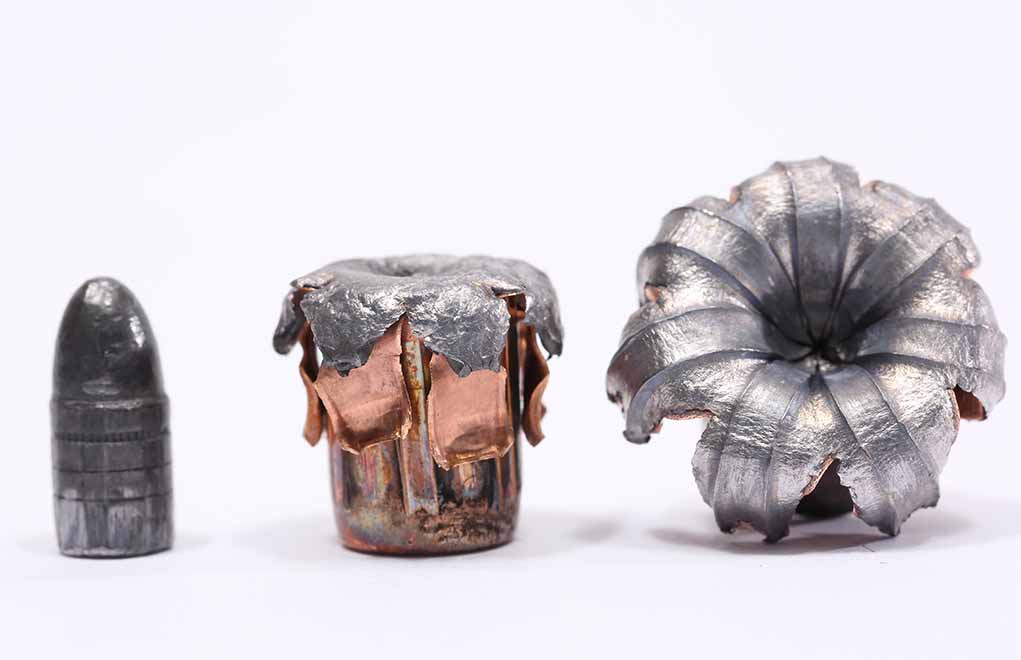
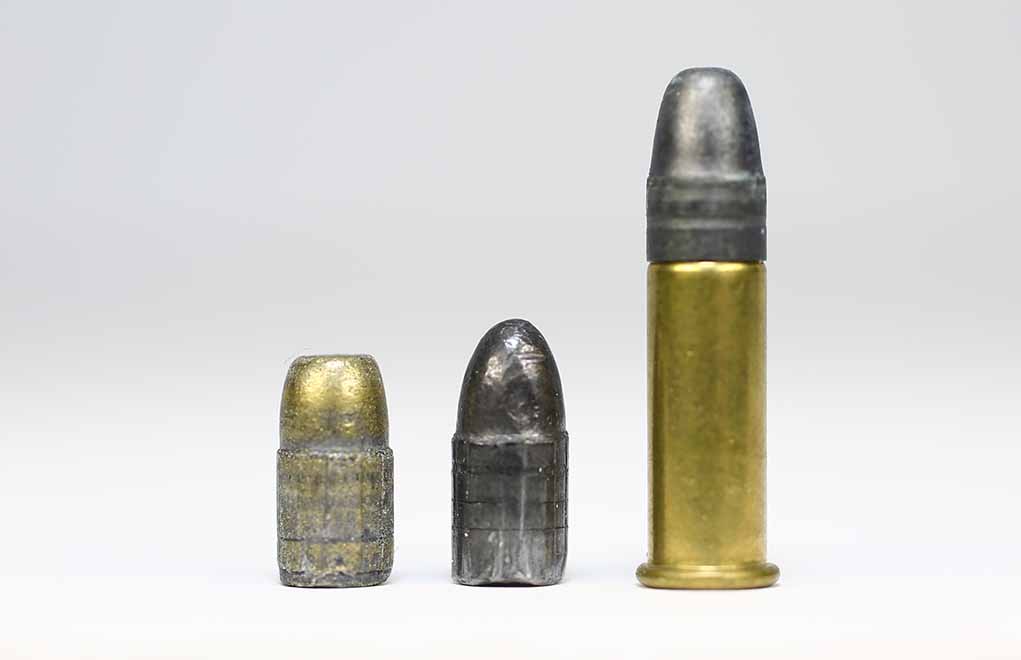
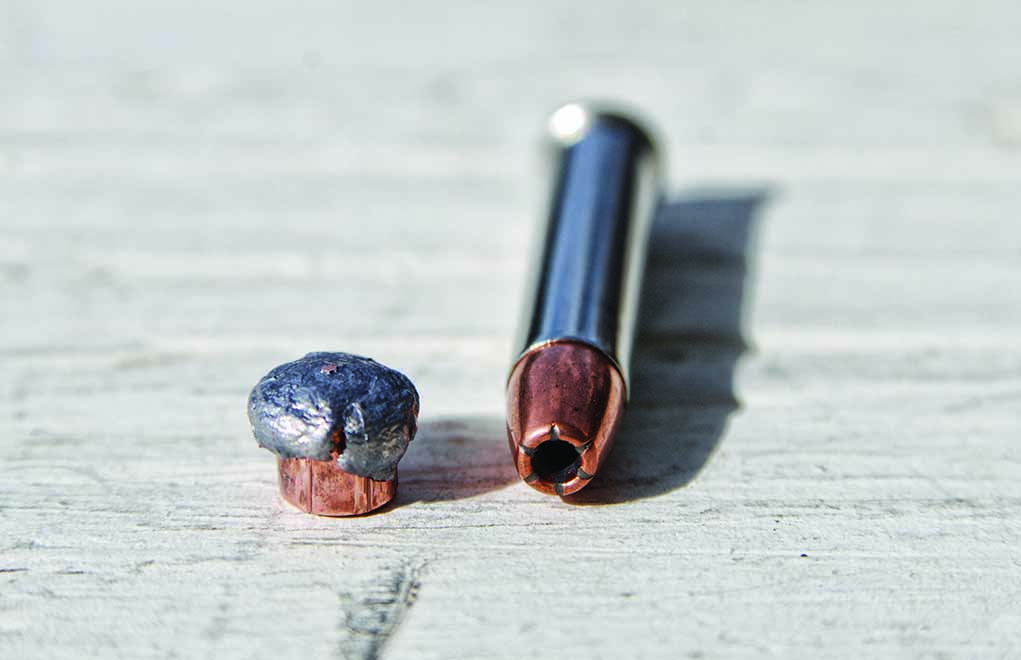
The .22LR will sometimes expand, and sometimes not. The bullet on the left is a hollow-point, and you can see how much (not) it expanded. The middle one is a regular round-nose, and the loaded cartridge is to the right. The big advantage is the low cost.
.22LR
The standard .22LR offers only a straight, bullet-diameter permanent wound, with a depth of 14-15 inches. There may be some expansion with hollow-point bullets, but that comes at the expense of a couple of inches of penetration. Also, some bullets may yaw and end up stopping base-first in the wound track. When traveling sideways, it does create a marginally larger permanent wound than a simple cylinder, but that’s hardly something to boast about.
The .22LR is not a big stick when it comes to defense, but it is better than a knife or a club — especially for someone who can’t handle heavier recoil.
The .22 Magnum offers a better bullet at higher velocity, but at more cost and noise. (Recoil is still pretty minimal.)
The trick to its use in defense is to realize two points. First, you will have to depend on more than one shot. In fact, the standard response when shooting in defense with a .22LR should be to empty the magazine and immediately reload. Second, placement matters. The hits have to be high center of mass or else the effort is wasted.
This combination of needs does not make the .22LR a high-percentage option, even in the handgun realm. But, for those with no other choice, there is no other choice.
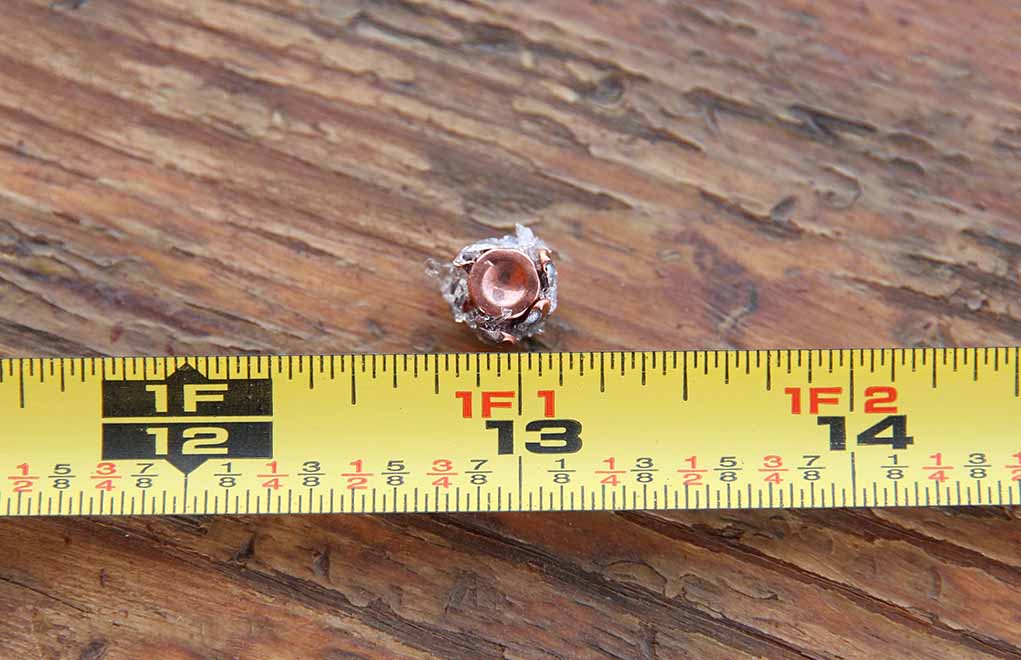
This .22 Magnum bullet started at .221 inch and expanded to .30 inch. That’s not bad.
Stepping up, you have the .22 Magnum, which is a longer case than the .22LR and designed to contain the bullet inside the case. The jacketed bullet offers the promise of expansion, but that’s not always the realization. You see, a .22 Magnum out of a rifle generates plenty of velocity. Out of a handgun, it’s often no faster (or not enough faster to matter) than a .22LR cartridge.
The expansion of any of these bullets is not a reliable outcome. Even if they do expand, the degree is not great. An expanding .22LR, all 40 grains of it, could bump up to .27-inch in diameter.
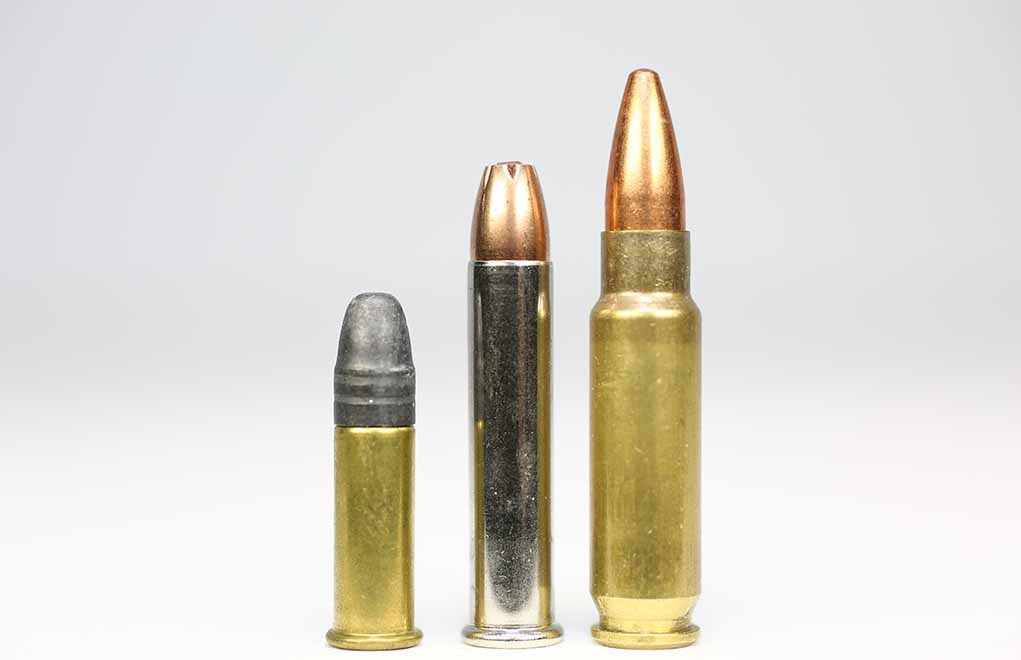
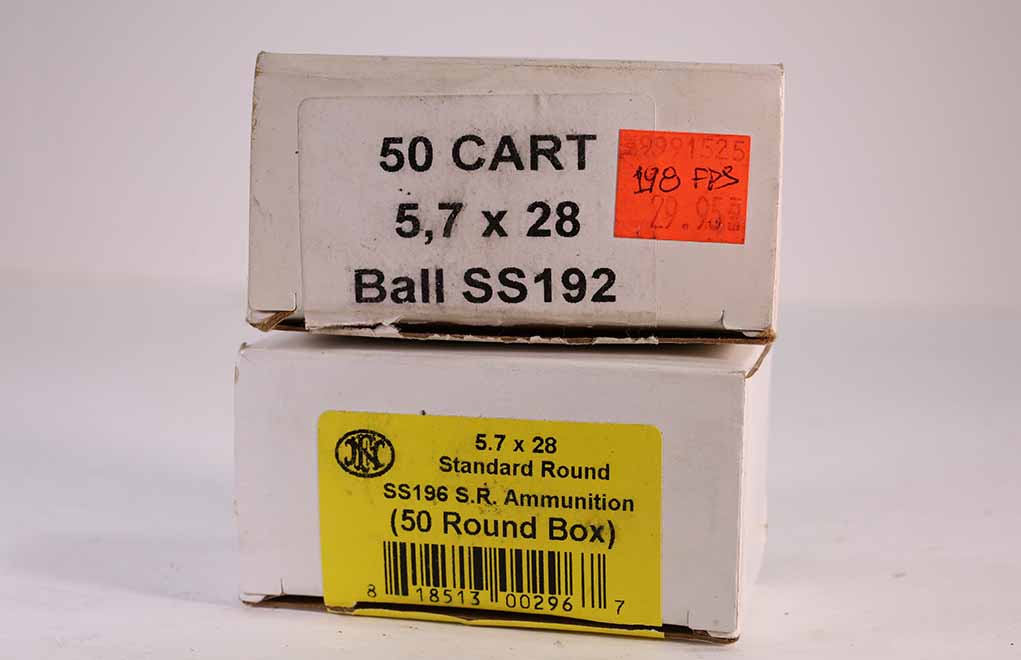
The 5.7×28, next to a .22 Magnum, and on the left, a .22LR.
Hornady has lead the way here, offering a defensive-use .22 Magnum loading, with a bullet designed to expand at velocities the .22 Magnum can deliver. Called their Critical Defense, it gives 9-10 inches of penetration in ballistic gelatin out of a handgun.
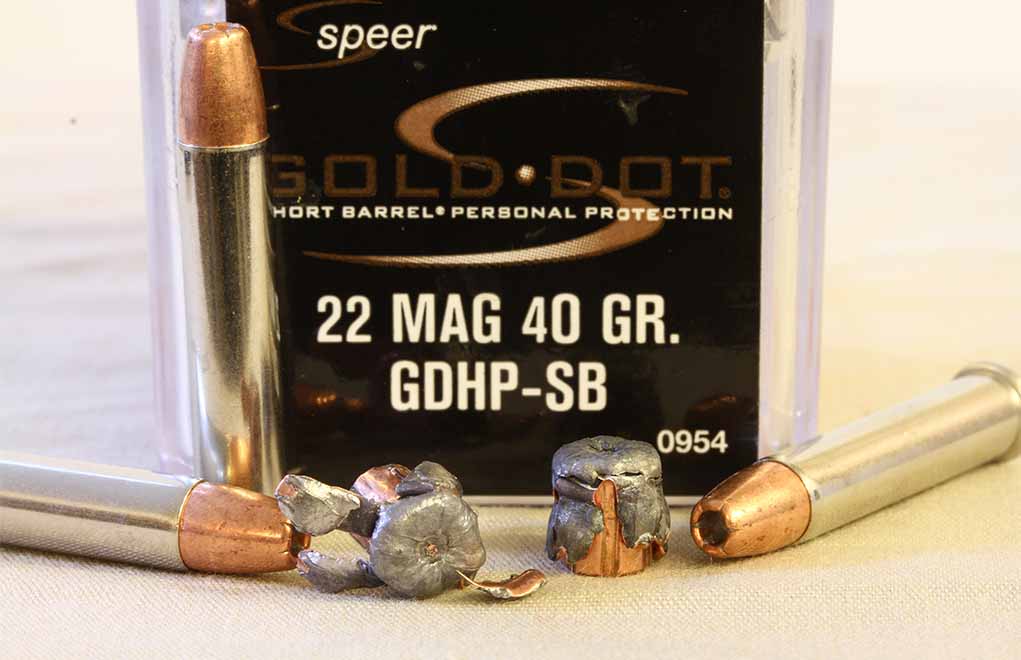
Speer also makes their Gold Dot line of ammunition in the .22 Magnum. If you want as much performance as you can get, in a pistol that isn’t going to kick much, then the .22 Magnum can be a good choice.
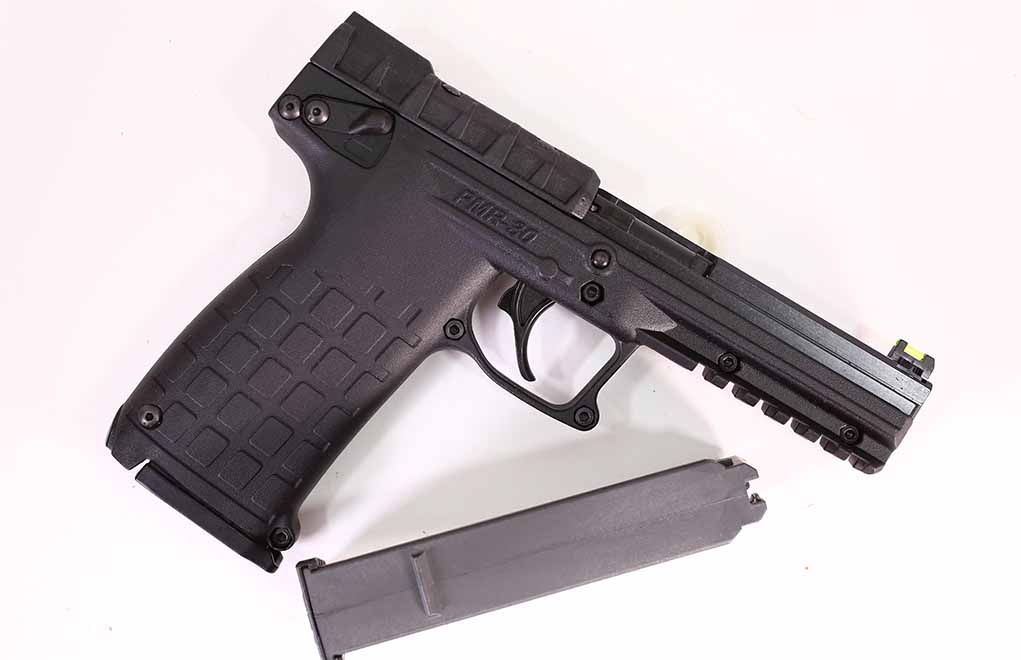
The Kel-Tec PMR-30 might not look like the Hammer of Thor, but it’s soft in recoil, it holds 30 rounds of .22 WMR, and a spare magazine gives you another 30 in a couple of seconds. Having 30 or 60 rounds of .22 WMR is very comforting for those who find recoil hard to deal with.
Combined with a handgun such as the Kel-Tec PMR-30, someone who can’t handle a larger caliber can reasonably expect a good outcome. Part of that is the improved performance of the .22 Magnum over the .22LR, and the other is capacity. A standard .22LR pistol has a 10-round magazine. The PMR-30 magazine holds 30 rounds.
Nine to 10 inches isn’t FBI-passing performance, but it also doesn’t offer anything like the recoil of an FBI-compliant load. This is part of the compromise.
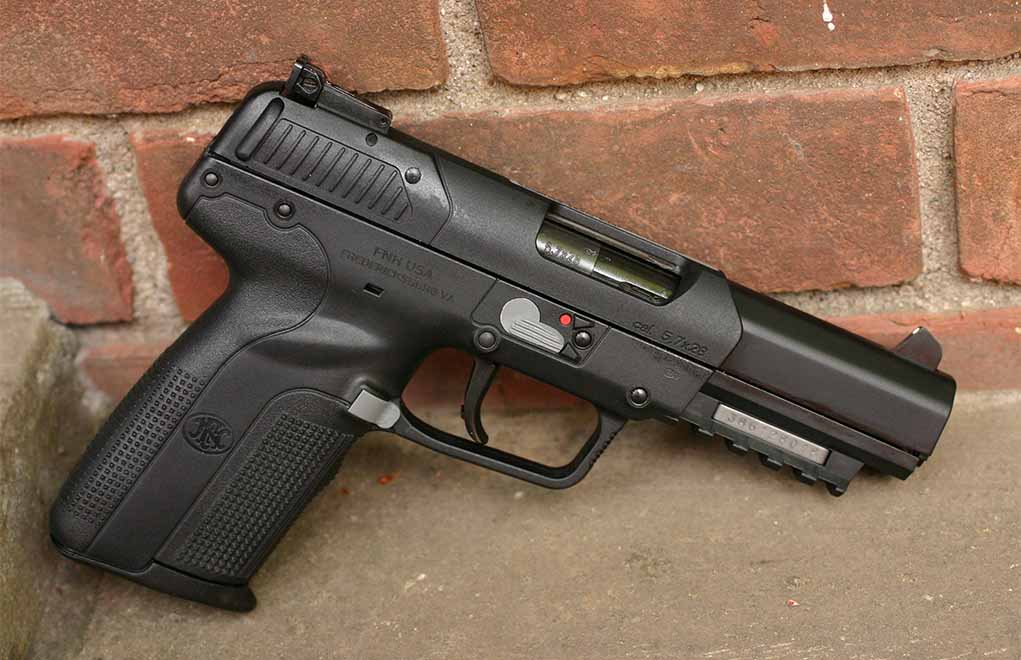
The FN FiveseveN pistol holds 20 (or 30) rounds of 5.7 ammunition. It’s a bit larger in the grip than .22LR and .22 Magnum pistols would be, so if that matters, be sure and test before you buy.
5.7X28 FN
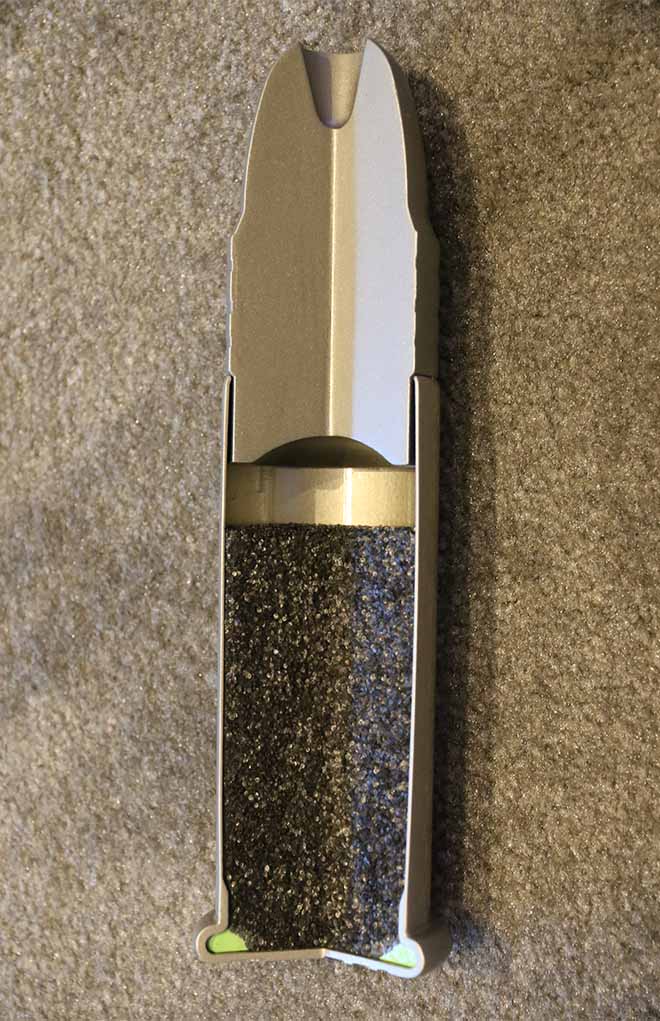
The outlier here is the FN 5.7×28 cartridge. This centerfire cartridge uses a jacketed bullet, longer than a .22LR or .22 Magnum. Out of the firearms for which it was intended it works reasonably well. That is, out of an SMG-sized firearm like the P90, with a 10.4-inch barrel, it can generate enough velocity to work. The PS90, with its 16.1-inch barrel, really delivers the goods, but that isn’t a handgun. Put into a handgun, it comes in a bit ahead of the .22 Magnum in velocity.
There’s not a lot of data for the 5.7×28. It has been adopted by some law enforcement agencies, and it has been used in shootings by them. Getting information out of those sources is difficult. The only one we have that offers a reasonable data set is the shooting at Fort Hood. There, Major Nidal Hasan fatally shot 13 people and wounded 32 more. He used an FN FiveseveN pistol and two ammo types: the FN SS192 and SS197SR. The SS192 is (or was, FN stopped making it in 2004) a jacketed hollow-point with an aluminum core. That’s not much expansion, and not armor-piercing. The SS197SR is loaded with the Hornady V-Max bullet, using a blue polymer tip to indicate a slightly higher velocity than the SS196SR.
Given the choice of something in .22, I’d opt for the 5.7×28 with FMJ ammo — and lots and lots of practice.
The ability of the rounds to stop fights was out of proportion from what one would expect with such a small cartridge. Three of the victims valiantly charged the shooter, attempting to stop him. They were shot for their efforts, were stopped and subsequently died. They charged from close range (the incident happened indoors, so there were not long distances to cover) and yet failed to close the distance due to the gunshot received.
Those wounded with hits to the extremities were unable, in many instances, to flee or fight, due to broken bones. When a “mere” .22 handgun cartridge can break a femur, there’s something going on that must be explained. That shot was received by one of the first responders, an in-base civilian security person. She took a hit to her wrist, which made that arm unable to function, and a hit to the upper leg that broke her femur.
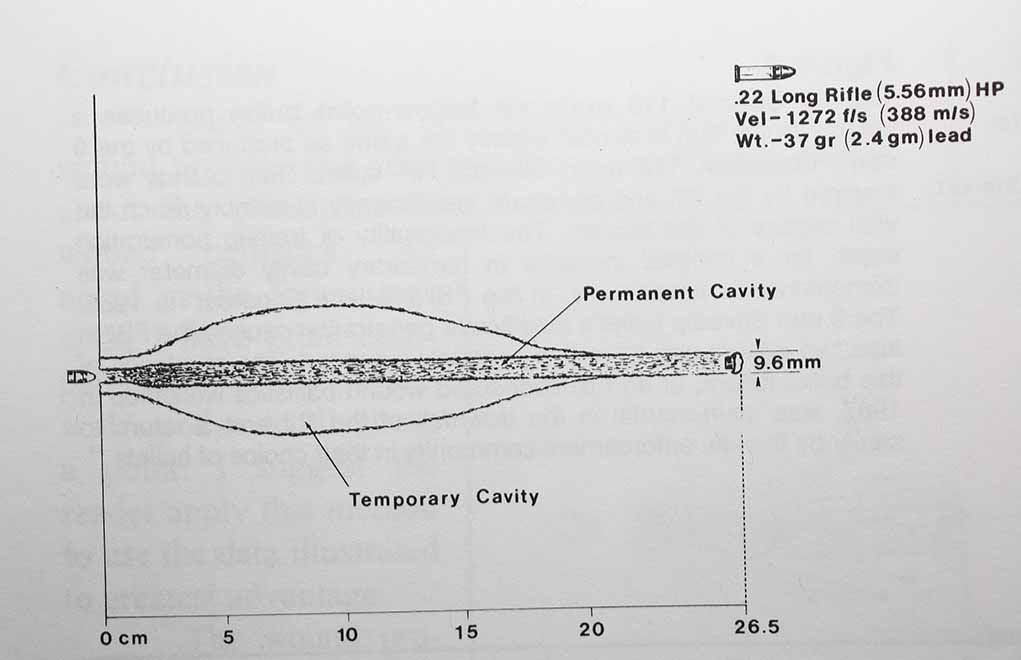
Diagram of the permanent and temporary wound cavity left from a 37-grain .22 LR bullet moving at 1,272 fps.
The drawback to the FiveseveN approach to low-recoil defense is cost. A FiveseveN lists for around $1,180, compared to the Kel-Tec PMR-30 at $455. The FN pistol holds 20 rounds (optional extensions make it a 30-round magazine) compared to the Kel-Tec at 30 rounds standard. An FN magazine is $35, with the extension costing another $18-20, while the Kel-Tec is $31.
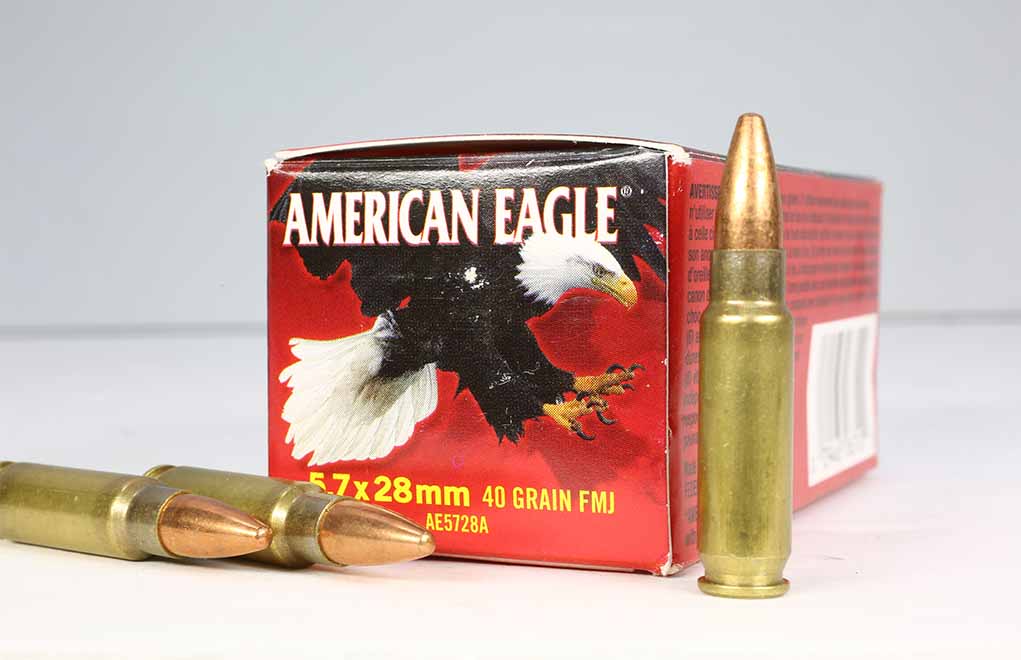
The 5.7×28 ammunition costs (at the moment) $28 per box of 50 rounds, while .22 Magnum can be had for as little as $10 per box of 50 practice FMJs, up to $15 for a box of Hornady Critical Defense.
The last hurdle for the 5.7×28 is size. The grip is a bit larger than that of the Kel-Tec, and even if the recoil is mild, if you (or the person you are coaching in this situation) can’t get a hand or hands around it, it isn’t a good choice.
Recommendations
If you already have a .22LR pistol and need it for defense, then use the most accurate, readily available .22LR ammunition to be found. Practice getting as many hits out of a full magazine, on a playing-card-sized target at 7 yards, as quickly as you can. Volume and accuracy need to be your focus here.
You can see the loaded .22LR, scaled up to the size of a mortar round. The priming compound in a .22LR is in the rim. This makes it inexpensive to manufacture, but it complicates magazine design for feeding.
A better choice would be either Hornady Critical Defense or Speer Gold Dot in .22 Magnum in the Kel-Tec. The PMR-30 isn’t going to cost much, if anything, more than a good .22LR pistol. Use whichever of these two loads shoots reliably and accurately out of your Kel-Tec. As with the .22LR, practice hitting a playing card at 7 yards, as quickly as possible, and train yourself to keep shooting on the target until it (he, she, they) goes down.
If you have the hands and the budget, but not the recoil resistance, for something bigger in caliber, then go for the FN FiveseveN in 5.7×28, with the 40-grain FMJ. The V-Max is accurate, but it’s designed as a varmint-level bullet. I’d be much more confident with an FMJ in this situation than with a readily expanding bullet of only 40 grains.
While the effect is likely to be better than the .22LR or the .22 Magnum, the process should be the same: playing card accuracy, 7 yards, continuous fire until the bad guy goes down.
Caveats
There will be those who want to throw me under the bus for recommending the various .22s for defense. I have attempted to be clear: A rimfire is better than anything not a firearm; and for those who cannot handle more recoil, this is perhaps the only choice. I would rather someone who needs a firearm for defense has a weak one than none at all, as long as they realize the limitations of the tool they are using.
There are no .25s I can recommend. For the cost, you can easily acquire .22LR or .22 Magnum ammo that will perform better. And since you have to depend on volume and speed of fire, the ultra-compact .25s are poor choices, as clever as some of the designs might be.
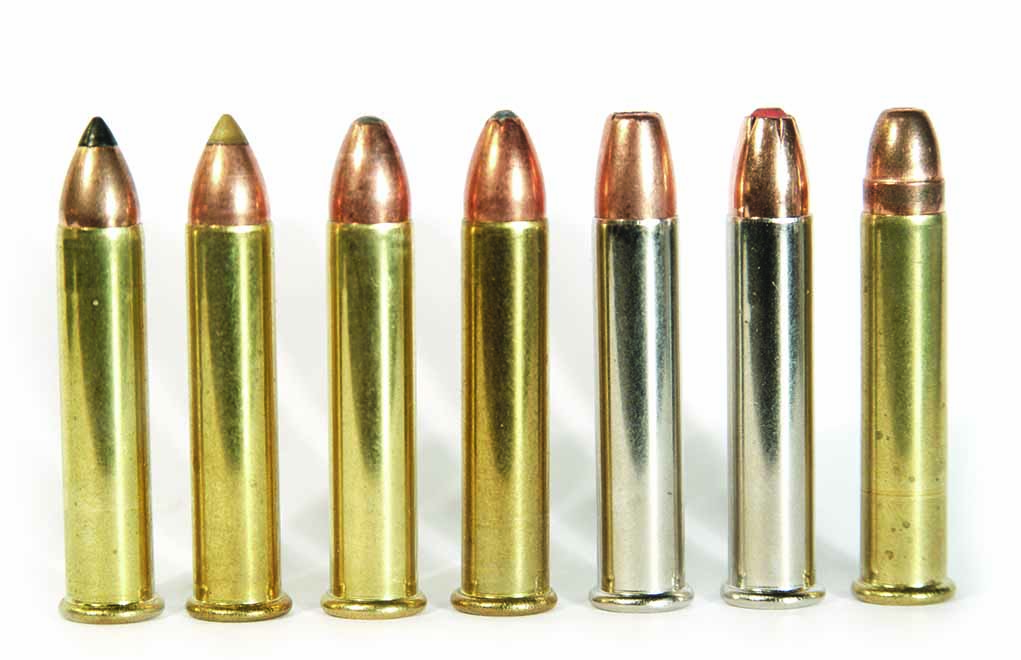
Many varieties of .22 WMR ammunition are available. Shown here are those that feature 30-grain polymer-tipped bullets (left) to 50-grain hollow-points (right) with 33-, 40- and 45-grain loads in between.
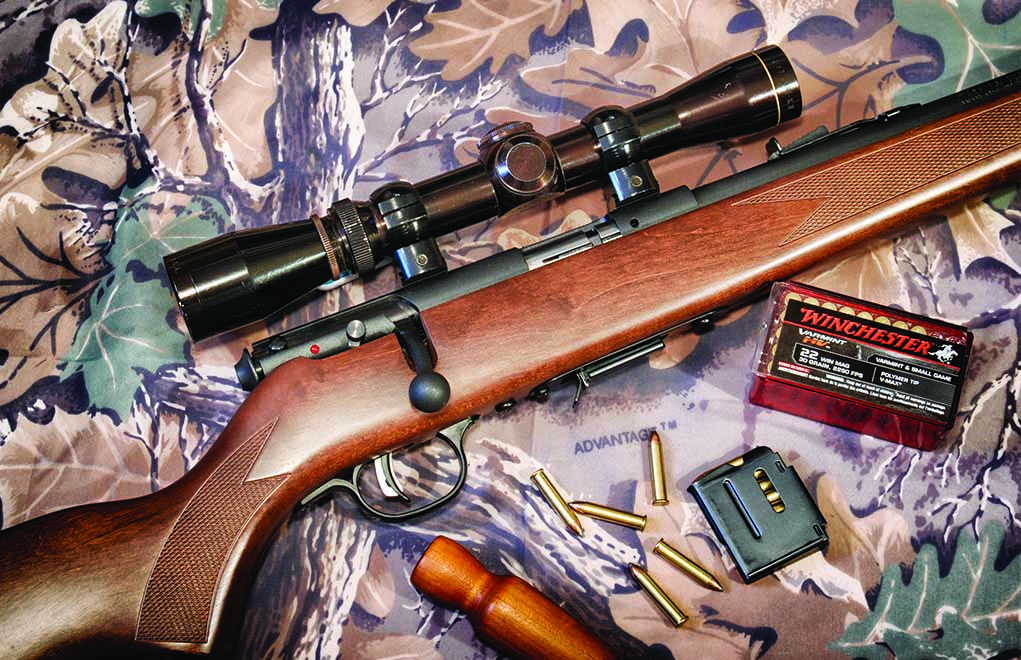
Versatile and potent, the .22 WMR—or .22 Mag—forever raised the rimfire enthusiasts’ expectations for performance.
How The .22 WMR Improves On The .22 LR:
Originally, the .22 WMR propelled a 40-grain bullet 1,900 fps at the muzzle.
The corresponding muzzle energy at this velocity was 325 ft-lbs.
At the same time, the cartridge produced little to no recoil.
Additionally, its report is nearly as mild as a .22 LR.
The quest for improved performance has led to many new products.
Although the .22 Short came earlier, the .22 Long Rifle became far more popular because of its performance. Rifles in this caliber perform admirably for general shooting, pest control and small-game hunting. The .22 Long Rifle can dispatch larger game and varmints such as groundhogs, foxes and coyotes, but only with very carefully placed shots.
Before I had any centerfire rifles, I managed to reduce the groundhog population of some pastures with a rimfire shooting .22 LR ammunition, but I also saw some make it to their dens. Many varmint hunters have had the same results and wished for a more potent rimfire.
One incremental step along the way resulted in the .22 Winchester Rim Fire (WRF) cartridge. It uses a slightly larger case than the .22 LR and drives a 45-grain bullet at a muzzle velocity of 1,300 fps, giving a muzzle energy of almost 170 ft-lb.
Although no new rifles are currently produced in .22 WRF, the ammunition is still available from CCI and in special runs from Winchester. The .22 WRF is slightly more potent than high-velocity .22 LR loads but not enough to make it vastly more effective on larger pests.
Raising the Bar: The .22 WMR
In 1959, Winchester responded to the demand for a much more effective rimfire round and introduced the .22 Winchester Magnum Rimfire (WMR). Propelling a 40-grain jacketed bullet at a nominal velocity of more than 1,900 fps, the muzzle energy was approximately 325 ft-lb. This meant that rimfire shooters had available a legitimate varmint cartridge that did not detonate with a thunderclap or objectionable recoil.
Clearly, the .22 WMR raised the level of rimfire performance to a new and much higher level. Winchester’s first rifle in .22 WMR caliber was the slick, little pump known as the Model 61. Later, Winchester produced the lever-action Model 94/22M, which, lamentably, is long gone and commands exorbitant prices because it’s highly collectable.
The .22 WMR utilizes a case of larger diameter and length, so not all rifles designed for the .22 LR can accommodate the larger cartridge. In particular, semi-automatics present special difficulties, and the number of such rifles has been small. Designers of auto-loading rifles must consider not only the maximum pressure achieved, but also the duration of higher pressure, etc. Such characteristics determine the velocity at which the breech bolt is driven to the rear—an important consideration.
Over its 60-year life span, many firearms that fire the .22 WMR cartridge have been produced. Ruger introduced the famous 10/22, chambered for the .22 WMR; however, it’s a vastly different rifle from the .22 LR version, which is constructed with a receiver made from an aluminum alloy.
To handle the larger, more potent .22 WMR, the Ruger 10/22 Magnum utilizes a steel receiver that’s more robust. This model has been discontinued, but Savage now offers the Model A22 semi-automatic, as do some smaller manufacturers, such as Volquartsen, Magnum Research and Tactical Solutions. Henry Repeating Arms makes a good lever-action alternative for those who didn’t add a Winchester 94/22M before it was discontinued.
.22 WMR’s Broad Price Range
Because most shooters of .22 WMR rifles are varmint hunters, there’s more emphasis on accuracy than on rate of fire, so bolt-actions have been the major focus. In that regard, there’s been a reasonably extensive selection in a broad range of prices that are generally in the $270 to $300 range.
Above: The Savage 93G is inexpensive, but it’s a good rifle for varmint hunters on a budget.
In the lower price category, some rifles are modestly priced yet give very good accuracy. In this group has long been the Marlin 25 series, which has morphed into the Model XT-22M. These rifles are available with either detachable or tubular magazines. Savage has offered numerous rifles in .22 WMR over the years, and the current Model 93 series consists of over a dozen variants that include models featuring stocks made of wood, polymer or laminate; a heavy- or standard-weight barrel; bluing or stainless steel, etc. My experience with an older Marlin 25M and a current Savage 93G indicates that they provide an excellent avenue to enter varmint hunting without sacrificing the bread money.
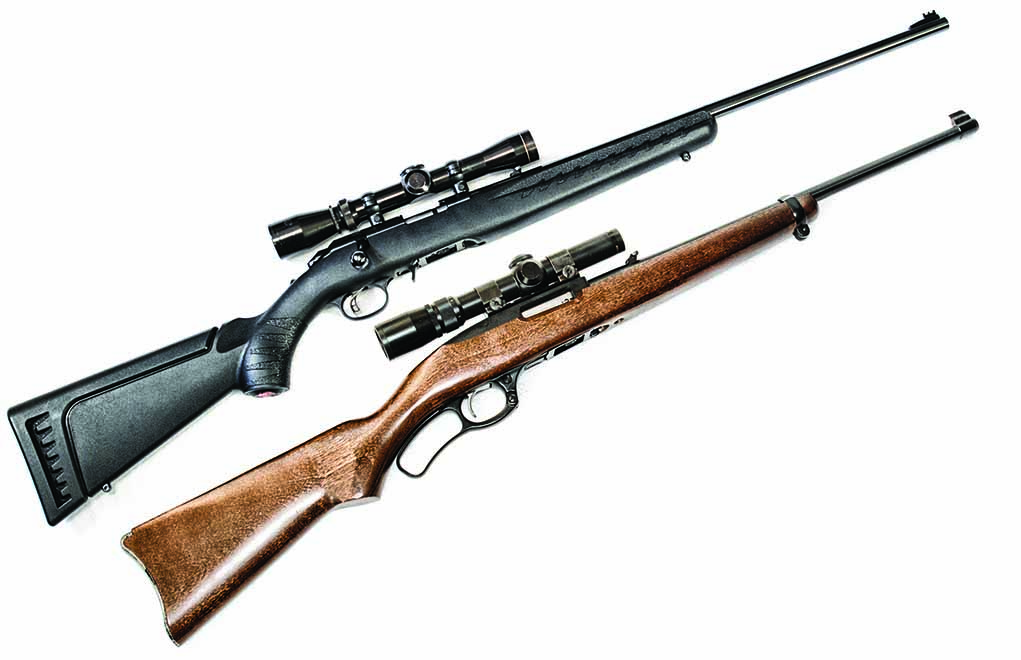
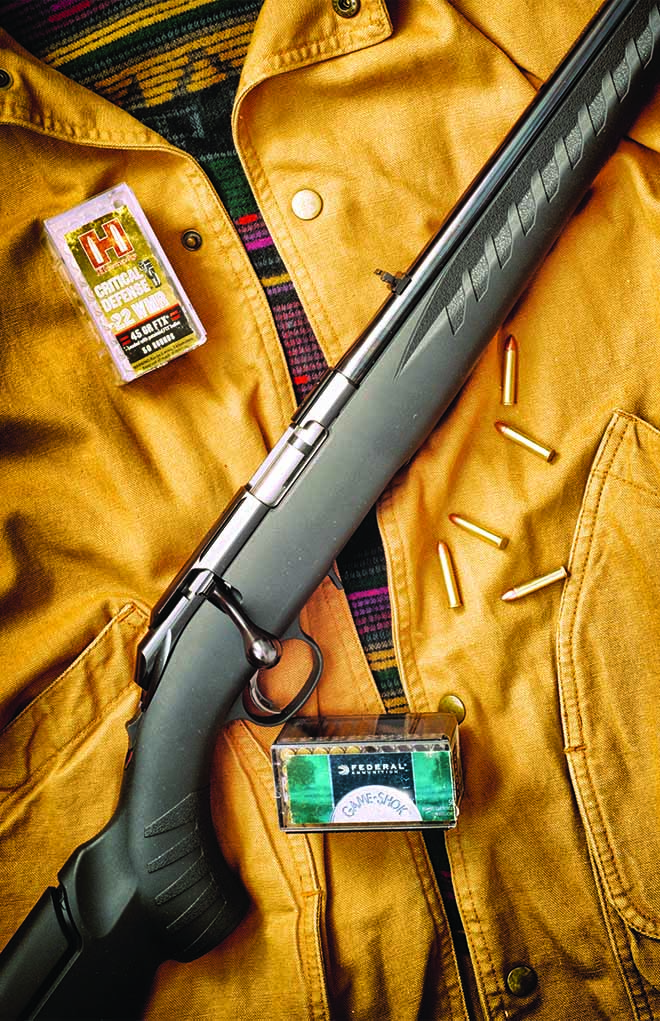
Another rifle in this category is the Ruger American, which features beautifully finished metal and a polymer stock. It’s available in both full-sized and compact models with a removable section of the stock that offers adjustable length of pull. My Ruger American is certainly accurate enough to make shots on varmints to at least 100 yards (which is about my limit for the .22 WMR). Top one of these moderately priced models from Marlin, Savage or Ruger with a scope of reasonable quality, and you’re equipped for pest-popping.
Moving up in price range are the rifles produced by CZ. The Model 455 permits changing barrels to make it possible to shoot .22 LR, .22 WMR or .17 HMR cartridges. The fixed-barrel 452 Models in .22 LR and .17 HMR were chosen by my wife to round out her rimfire battery, and they’re superbly accurate.
Further up the price ladder is the Ruger 77/22M, which is the magnum version of the 77/22 introduced in .22 LR in 1983. This rifle features a robust action that utilizes dual locking lugs and excellent styling, fit and finish, all of which are accompanied by an MSRP of $999. Until November 2009, the barrel was attached to the action by means of a wedge in a transverse groove in the underside of the barrel that was pulled tightly into the action by means of two large screws.
That meant the owner could easily remove the barrel and replace it with an aftermarket model. (Although my Ruger 77/22M performed quite well in stock configuration, I replaced the factory barrel with one of the Aluma-Lite barrels produced by Majestic Arms. It now gives groups of under an inch at 50 yards with almost any .22 WMR ammunition—and around half that size with some types.) The Model 77/22M was later produced with the barrel threaded into the action in the same manner as is used for centerfire rifles.
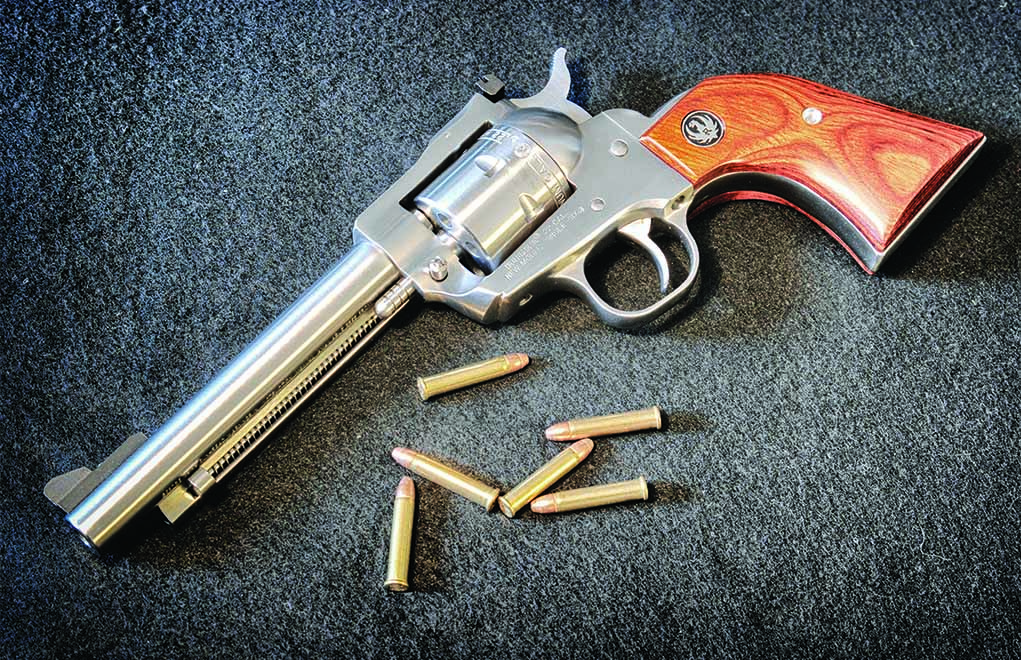
One of the most popular firearms in .22 WMR is the Ruger Single Six Convertible, which comes with a cylinder for the .22 WMR.
Handguns chambered for the .22 WMR should not be overlooked. Revolvers in both single- and double-action versions are available. These include some small models intended primarily for defense: the Ruger LCR, North American Arms, Charter Arms, Taurus and Smith & Wesson models. There’s also an auto-loader from Kel-Tec that holds 30 rounds.
When a round is fired from a handgun, the muzzle velocity is much lower than when the same load is fired from a rifle. For example, Hornady Critical Defense gives 1,800 fps from my Ruger 77/22M rifle but only 1,450 fps from the 5.5-inch barrel of my Ruger Security Six. This corresponds to 210 ft-lb of energy, so a .22 WMR handgun is rather potent—which is why several of those available are short-barreled revolvers intended for defense.
.22 WMR Ammo
For many years, .22 WMR ammunition was produced with 40-grain bullets of either hollow-point or full-metal-jacket design. The former was intended for expansion to provide good performance on varmints; the latter was meant to dispatch fur-bearers with minimum damage.
As is the case for ammunition in virtually all calibers, great changes have been made to .22 WMR ammo. The developments have resulted in the use of lighter bullets, with 30 grains being a popular weight and providing a muzzle velocity of around 2,200 fps. The result is bullets that give an explosive result on small critters.
Nevertheless, there’s no free lunch, and such bullets rapidly lose velocity. Most of the loads that feature 40-grain bullets give muzzle energies of approximately 310 to 325 ft-lb and 150 to 160 ft-lb at 100 yards. On the other hand, those with 30-grain bullets deliver only about 125 ft-lb at the longer range.
Designed primarily for use in short-barreled handguns, the Speer Gold Dot expands to 0.32 inch when fired into jugs filled with water.
There’s no denying the explosive effect that results from higher velocity at short ranges, but shooters who tackle larger varmints should choose a heavier bullet.
One such load that’s been available for many years is from Federal. It features a 50-grain bullet with a muzzle velocity of only 1,530 fps, but it retains velocity better than the lighter bullets. Remington offers a load featuring a 33-grain polymer-tipped bullet with a nominal muzzle velocity of 2,000 fps, with the remaining velocity at 100 yards being almost 1,500 fps, giving a remaining energy of more than 160 ft-lb. The Remington ammunition has a good reputation for dropping larger varmints, as well as having a velocity that assures an explosive effect.
Ammo: Special Mention
Two .22 WMR loads are worthy of special mention, because they’ve been introduced with personal defense as the primary goal.
The Speer Gold Dot load features a 40-grain bullet with a large hollow-point. It assures expansion, even when fired from the short barrel of a handgun. Hornady has taken a somewhat different approach with the introduction of its Critical Defense load, which features a 45-grain bullet that utilizes a hollow-point with a polymer insert.
These .22 WMR loads are designed for expansion and performance rather than velocity. I’ve tested them in my Ruger Single Six Convertible, which has a 5.5-inch barrel, by firing them into jugs of water. I found them to perform superbly. Moreover, when fired from the 18.5-inch Majestic Arms barrel on my Ruger 77/22M, they are very accurate.
.22 WRF Versus .22 WMR
One convenient feature of the .22 WRF cartridge is that the external dimensions of the case are virtually identical to those for the .22 WMR—except for length. As a result, the shorter .22 WRF cartridges can be fired in a rifle chambered for the .22 WMR cartridge. I’ve done so for many years with excellent success and, at least in my rifles, the .22 WRF gives excellent accuracy.
In places where a centerfire rifle might be inappropriate, a Ruger American in .22 WMR is an effective varmint rifle.
However, when sighted in for the .22 WMR ammo, the point of impact of a bullet from a .22 WRF cartridge is usually as much as 3 inches lower at 50 yards. The .22 WRF ammunition doesn’t represent an economic advantage: Being a specialty item, the cost is approximately the same as the .22 WMR products. The .22 WRF does, however, provide a useful alternative for shooters who want to achieve maximum versatility from their rifles.
The .22 WMR is a versatile and useful cartridge. It might not be ideal for use on varmints or for defense, but it can function in either way. My .22 WMR firearms get a lot of use, and I don’t plan to be without rifles or handguns in that caliber anytime soon.
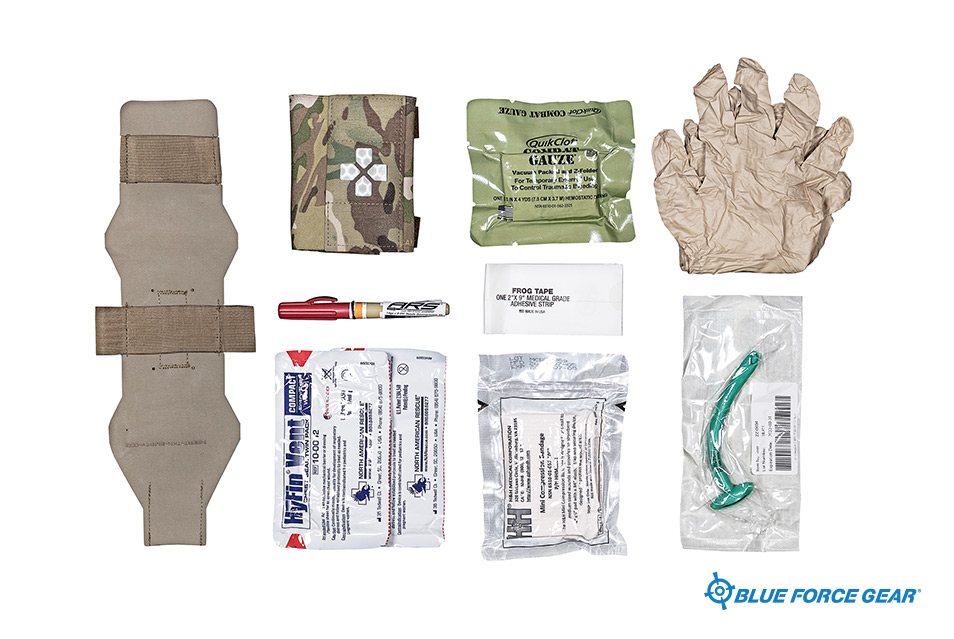
Best known for body armor, Blue Force Gear also offers the everyday carry essential Micro Trauma Kit.
The Micro Trauma Kit NOW!, or Micro TKN, is our smallest version of the Trauma Kit NOW! yet. It was designed to hold essential lifesaving gear with minimal size in mind. The Micro TKNTM is designed to be worn horizontally with minimal bulk—perfect for everyday carry, for law enforcement professionals, prepared citizens, or in low-profile mission sets. The inner carrier can be deployed with one hand or one finger from either the left or right side by pulling the BLIP featured pull tabs. The Micro TKN consists of two main components – the outer MOLLE or Belt mounted pouch utilizing the Ten-Speed® technology, and a removable insert that keeps medical supplies organized.
Be sure to enter our American Made giveaway, with great gear from great American companies. Click the tab at the bottom right of page to enter.
Supplies
Hemostatic dressing for wound packing/clotting (1 included)
4” Emergency Trauma Dressing (1 included)
9” Medical Grade Easy Tape (6 included)
Tourni-Kwik Compression Tourniquet (1 included)
Heavy Duty Medical Gloves (1 pair of Large sized gloves)
For more information on Blue Force Gear, please visit blueforcegear.com.
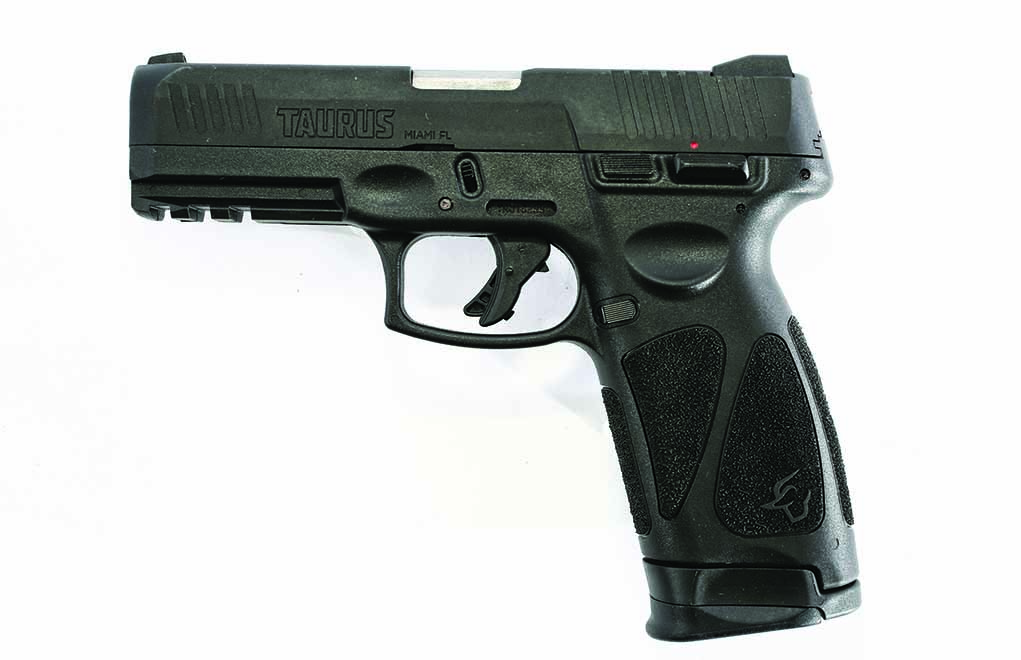
The shooting world has been waiting for a gun that can stand up to Glock. With a bevy of performance-enhancing features, the Taurus G3 might just be that pistol.
What Sets The Taurus G3 At Top:
Utter reliability, able to cycle through different ammo without a hitch.
Aggressive grip texturing that grabs you when you grab the pistol.
Three words: Second-Strike Capabilities.
Steller price compared to nearly any other polymer pistol out there.
Let’s be clear about what the world is: The “big dog”—the one everyone has been going up against for a long time—is Glock. Every time we gun writers receive a new polymer-framed, striker-fired pistol, we wonder, Is this one the Glock-killer?
That’s what I was thinking when they finally let us see the new Taurus. It was at a writer’s event in Florida some months ago. The G3, or at least a pre-production prototype of it, was there for all to hold … and shoot.
I had a big match coming up in a few weeks, and they wanted us to put the firearms through their paces. So, why not? After I’d done my due diligence and tested all the others, I parked myself at the G3, pulled up a carton of ammo and hammered the plate rack. And hammered and hammered.
Once I got into the groove and was building skills (and burning ammo), I tested the Taurus G3 some. No, I couldn’t make it malfunction shooting one-handed, no matter how much “limp wrist” I gave it. I could make it stop by pressing my thumb against the slide, but big deal—I can do that with almost any pistol. It locked open when empty, magazines dropped free, it never failed to go bang! when asked to, and when I was doing my part, the plates got hammered.
A G2 With Attitude
Taurus has been working diligently to produce the pistols that consumers wanted. Starting with license-made clones of the Beretta 92, it branched out to striker-fired pistols and produced a veritable catalog of models and variations.
One that stood out and found wide acceptance was the G2c, a compact pistol with a double-stacked magazine. While a lot of people are quite happy with a 9mm with a stubby barrel and a baker’s dozen of rounds onboard, others want a full-sized pistol. As a result, Taurus took the framework of the G2 and expanded it. Hence, the Taurus G3—the successor to the G2.
Taurus G3 Details
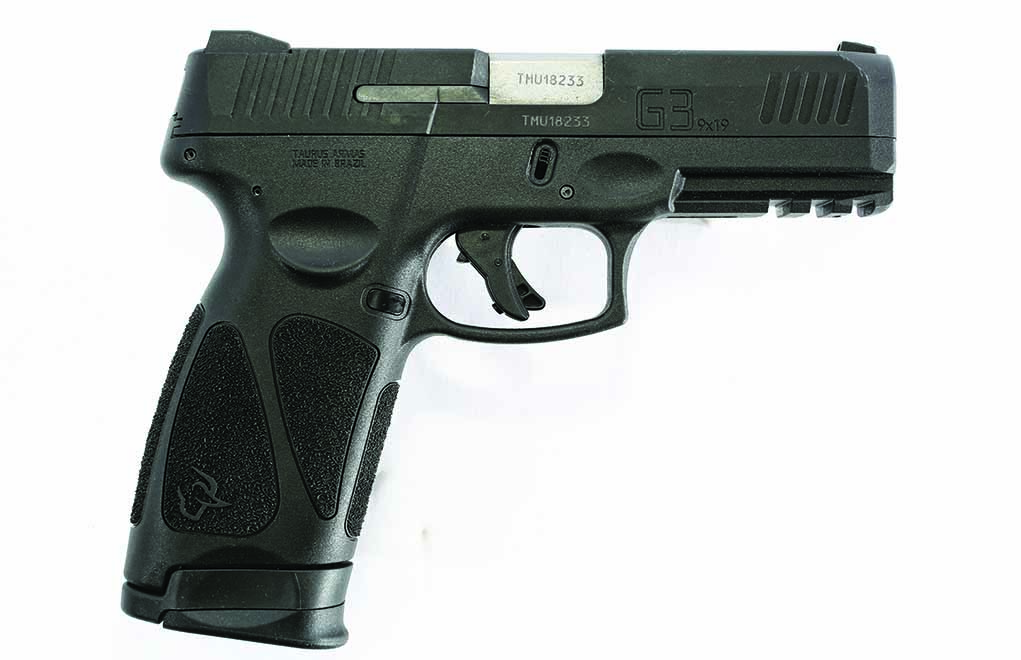
Starting with the slide and barrel, the Taurus G3 has a 4-inch barrel, which is considered “full sized” in the modern world. Coming from a time when a 5-inch Government model was full sized, modern 9mms seem a tad short to me, but this is what the world is.
And Taurus has delivered. The slide is beveled on the front end, heavily so, to make it easier to re-holster. There are cocking serrations fore and aft, but they’re not the holster-shredding kind; rather, they’re restrained and low-profile. But they work.
You get a choice with Taurus and the G3. You can have a blued slide, which is nitro-carburized for a corrosion-resistant and extremely hard surface. Alternatively, you can opt for a matte stainless slide—more choices right there than the Austrian gives you.
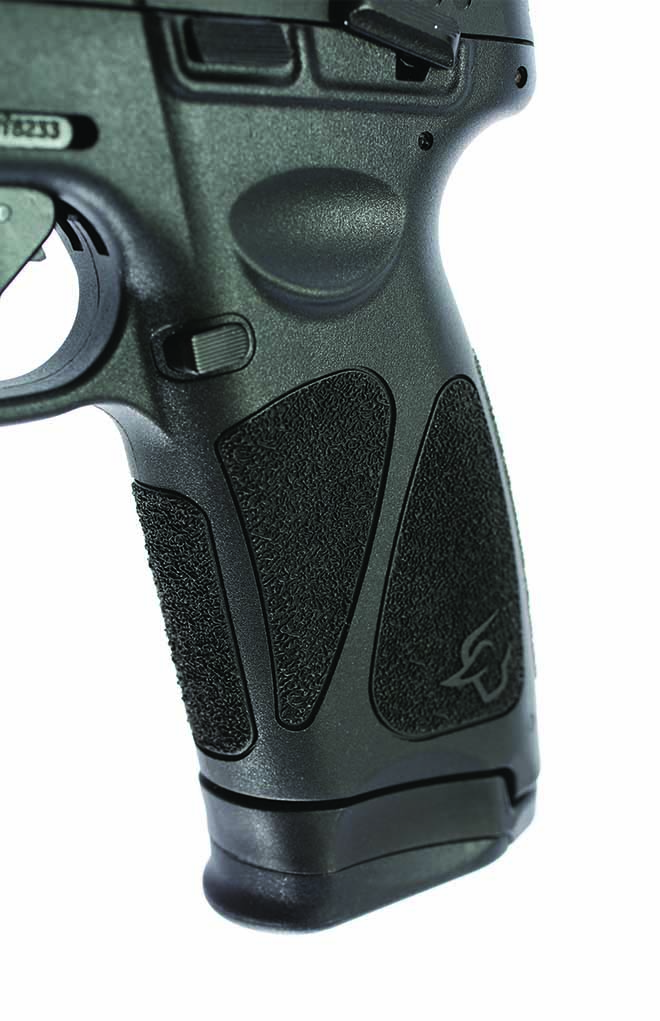
The stippled panels on the G3 provide a nonslip grip. Taurus didn’t stipple the whole thing—just the places where your hands bear down.
The ejection port is large, and the extractor is external, robust and sculpted to be out of the way of your hands or exiting brass. And, for those who have to have it, there’s a loaded chamber indicator up on top of the chamber. It’s a witness hole, so you can see the rim of a cartridge in the pistol’s chamber.
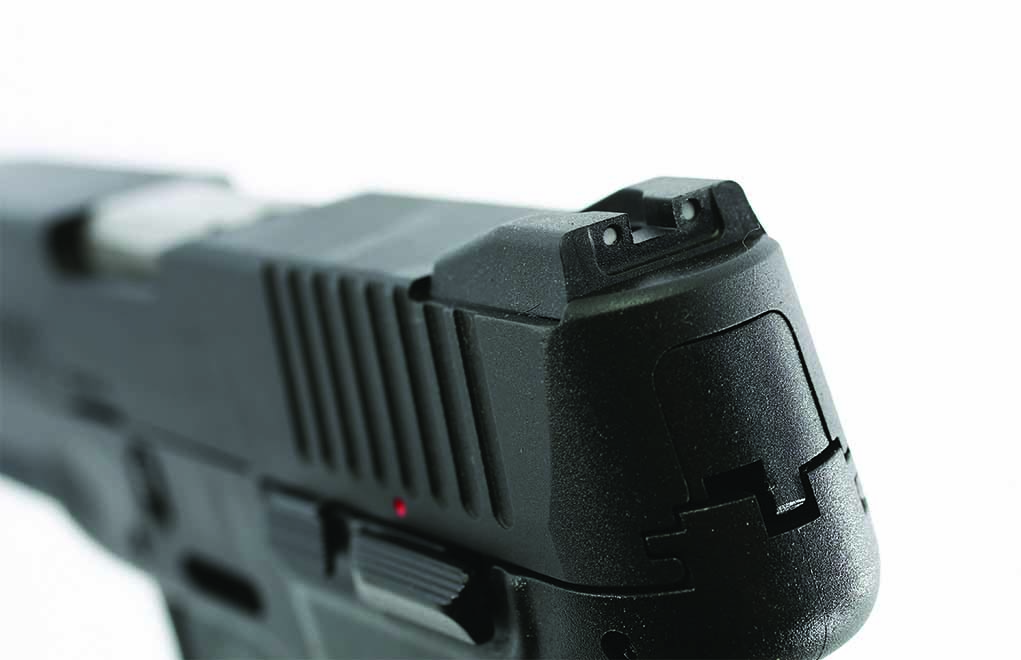
The sights are low-profile, three-dot, and I have to imagine that if those don’t do it for you, aftermarket sight-makers are ready to provide you with whatever night sight options you desire.
The barrel is chambered in 9mm Parabellum (the .40 is well and truly dead now. “He’s dead, Jim” hardly begins to describe it), and the barrel locks in the slide by the now nearly universal method of locking into the ejection port. It has an integral feed ramp.
Just beneath the slide, on the left side, you’ll see the slide stop lever, and behind that is the thumb safety. Yes, a thumb safety on a striker-fired pistol. Remember that Glock-killer question I asked? One of the things a certain segment of the shooting populace desires is a thumb safety. (And what’s the one thing Glock has never provided? Yep. Taurus does.) Don’t like a thumb safety? Don’t use it.
There are those who want a thumb safety with their striker-fired pistol. And now, Taurus provides one. On the left side, you can see the controls, disassembly tabs, slide stop and the thumb safety.
Ahead of those—but on both sides—is the takedown lever/tab/gizmo. And just forward of those is a pair of dished spots, one on each side of the frame. This is an index point for your trigger finger when it’s off the trigger. Now, your finger has a spot.
Out on the front end, the frame has an accessory rail. You know the drill: lights, lasers, dual use, whatever.
The trigger has a safety lever in the center of its face. No depress the lever. No discharge the pistol. Plus, if you back up to the slide for a moment, you’ll find the expected striker-blocking safety internals.
Letting Go? No Way!
The rest of the frame is an interesting bit of engineering. The material is polymer, yes, but it’s a relatively hard formulation with very little flex to it. And with this material, Taurus has applied a pattern of stippled patches right where your hand or hands would be making contact. So, you grab it, and it grabs you.
The sights on the Taurus G3 are low-profile and have three-dot white inserts in them.
To aid in this process, Taurus also added subtle palm swells and a pair of dished areas where your thumb or the base of your trigger finger can dwell, adding to the “I’m not letting go” attitude of the G3. Taurus calls these “thumb shelves,” but they aren’t shelf-like enough for me to agree with that term. Still, they work, and that’s what matters.
Taurus says the trigger pull is 6 pounds. When I dry-fired it right out of the box, I thought, They can’t read a scale! But no; 6 pounds it is. However, it’s so clean and crisp that it seems lighter. In a world of spongy, gritty trigger pulls on striker-fired pistols, this is nice, very nice.
Re-Strikeability
To add to the “not like the others” list of Taurus G3 details, how about re-strike capability? Yes, we’re all conditioned to snatch the slide back to eject a dud round when we hear the dreaded click, but re-strike means you get a second chance at it should you need it.
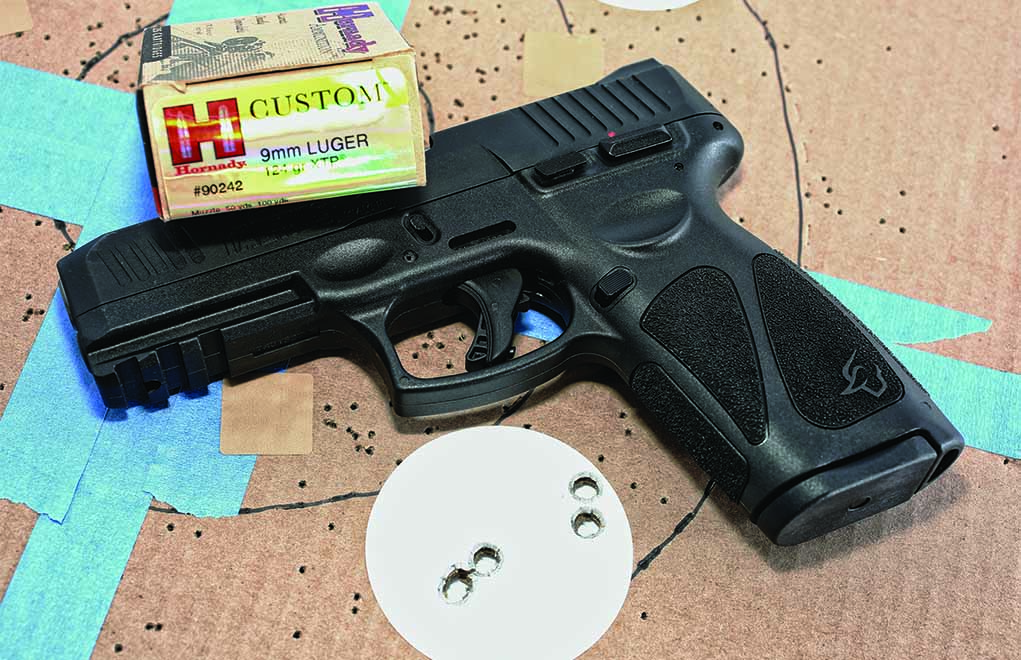
With a clean, crisp trigger, you can get results like this from a myriad of distances.
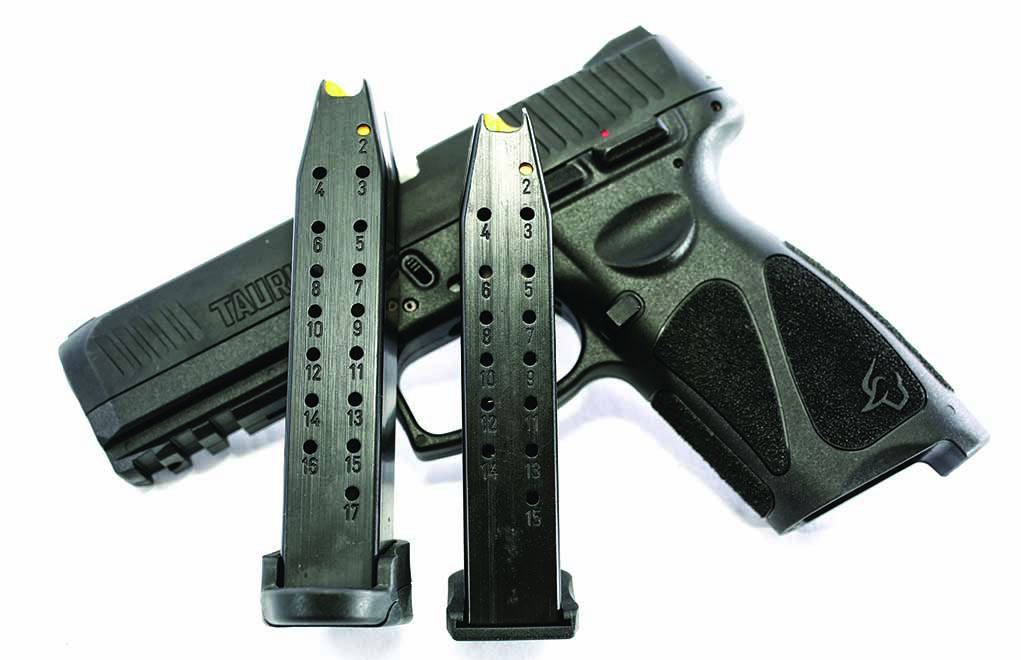
The magazines are steel, and you have a choice of 10-, 15- or 17-round magazines (10 for those of you who live in one or another “people’s republics” and 15 or 17 for the rest of us). The pistol sent to me came with one each of the 15- and 17-rounders. The 17-round magazine has an additional baseplate gap filler, so there isn’t a gap between the frame and the magazine end. It looks good and keeps your hand (or at least mine) from getting wedged in the gap.
Glock 0; Taurus 1
When it came time to spend the day with the Taurus G3, it was raining (actually, it went from raining to pouring to “get in the boat” and then back to pouring). I was underneath the covered firing line, but that meant I could only be shooting to 100 yards. So, once I finished the chrono work and accuracy (cardboard targets just about melt in a hard rain), I had to plink on the 100-yard gongs (oh, I know—poor me!). I had a gratifying percentage of hits on the gong, and the misses were all right around the edges of it. Yes, I had fun.
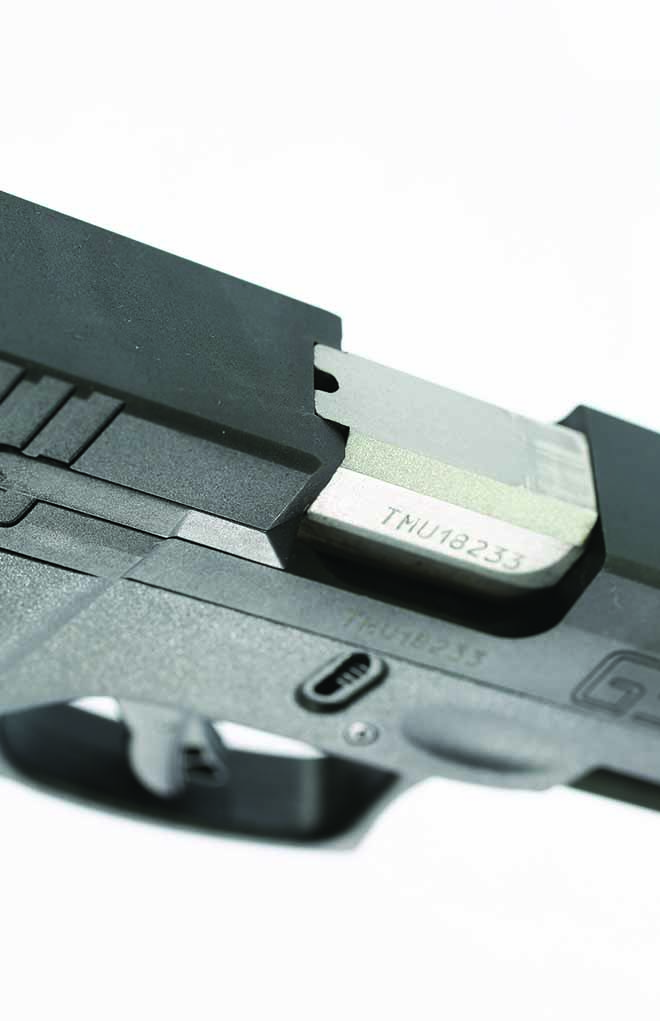
The barrel locks up in the ejection port. The extractor is robust, and the loaded chamber indicator is simplicity itself.
The Taurus G3 is a worthy contender for the “king of the hill” contest with Glock … except for one thing: price. There, the Taurus G3 wins, hands down. With a G19 currently showing up in gun shops right at the $500 level, the Taurus G3, with a list price of $345, wins. For the cost of the ’19, you can get a G3, a third magazine for it and 1,000 rounds of practice ammo. That’s a hard hand to beat!
For more information on the Taurus G3, please visit .
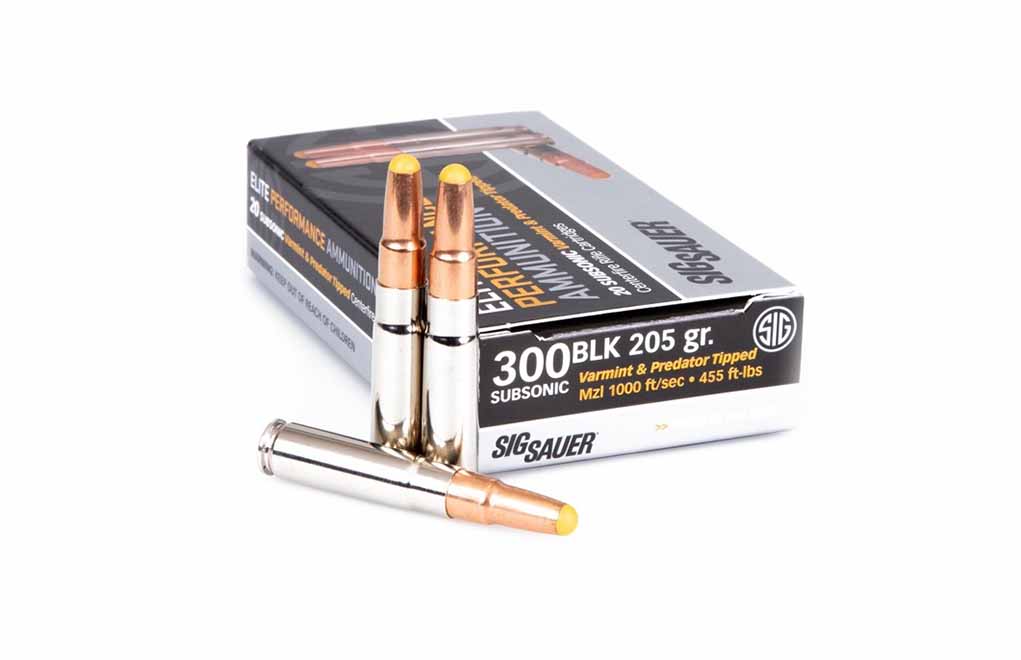
Designed to feed smooth and hit hard, the new Sig 300 Blackout 205-Grain subsonic tipped hunting ammo aims for elite-level suppressed performance in the field.
As some long ago noted, the .300 Blackout is a dynamite hunting option. Of course, the ammo most turned to to put meat on the table generally did away with the cartridges other admirable quality—suppressibility. Now, Sig Sauer is attempting to mate the two virtues, delicate as it might be, with a new sub-sonic hunting option.
The new Sig 205-grain subsonic 300BLK load is specifically designed for use out of abbreviated barrels generally favored by those who shoot suppressed. At the same tick, they’re topped with a unique bullet, reminiscent of Wilhelm Brenneke’s mini-wadcutter design. However, the stepped side isn’t meant to provide a cutting edge—like Brenneke’s bullet—but to ensure smooth feeding through a fully-loaded 30-round magazine. The Sig 205-grain subsonic 300 Blackout has the stuff to stay quiet, moving at 1,000 fps at the muzzle of a 16-inch barreled rifle. It’s a jacketed, lead-core projectile is engineered to reach full expansion at these mild velocities, thanks in part to its polymer tip.
The Sig 205-grain subsonic 300 Blackout ammo is Sig’s third foray into hunting rounds for this caliber. Preceding it were two supersonic 120-grain solid copper options. Present MSRP on the subsonic hunting round is $33.95 for a box of 20.
More From Sig Sauer:
NEWINGTON, N.H. – SIG SAUER, Inc. is pleased to add a 205gr subsonic 300BLK load to its Tipped Hunting line of ammunition.
The new subsonic 300BLK ammunition features a yellow-tipped, 205gr lead-core bullet designed for explosive expansion and exceptional accuracy. This load uses the same high-quality, single-base extruded powders as SIG Match Grade rounds, ensuring consistent muzzle velocity and insensitivity to temperature change.
Optimized for the AR-15 platform, the new subsonic 300BLK Tipped Hunting ammunition is engineered to allow hunters to load 30 rounds in a 30-round magazine and have the cartridges feed properly. This was achieved by SIG SAUER engineers after extensive research and development resulting in a stepped-down bullet design with a shouldered ogive that keeps the bullet from hitting the ridges of the magazine which would cause the rounds to shift and eventually fail to feed.
This load is ideal for use with a suppressor, which greatly reduces sound signature and muzzle flash, making it a favorite among hunters. Muzzle velocity is 1000 fps and muzzle energy is 455 ft-lbs from a 16-inch barrel. This round is recommended for use in barrels 9-inches or longer.
“300BLK continues to be a popular caliber and, in addition to several Match Grade rounds, SIG SAUER now offers two hunting loads – the subsonic 205gr Tipped Hunting and 120gr supersonic Elite Copper Hunting ammunition,” said Brad Criner, Senior Director, Brand Management and Business Development, SIG SAUER Ammunition.
For more information on Sig 300 Blackout 205-Grain Subsonic Hunting Ammo, please visit sigsauer.com.
Why consider a less-than-lethal option? Because, having something for self-defense is always better than having nothing.
What Are The Less-Than-Lethal Options:
Taser Gun And Stun Gun
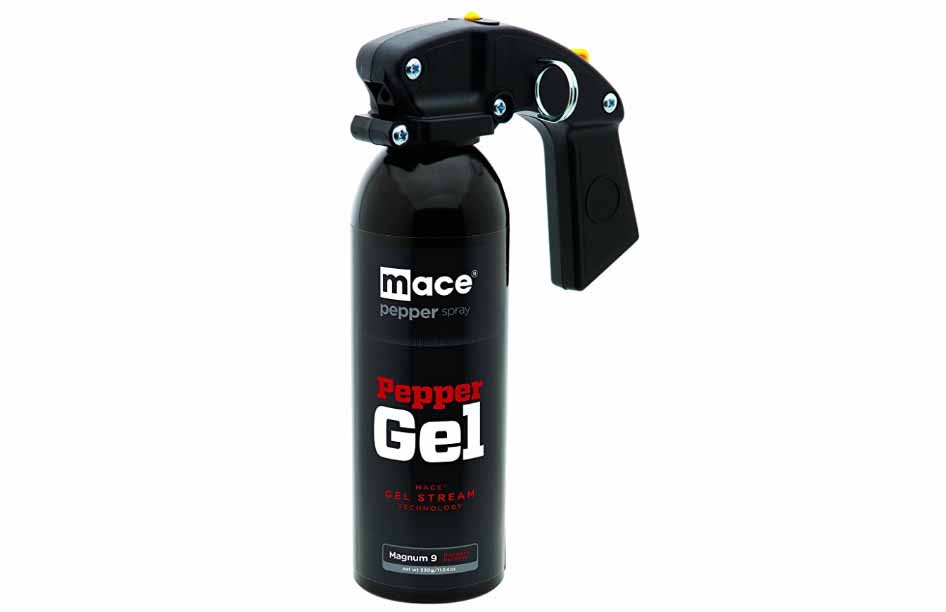
Pepper Spray
Batons
Kubotan And Keychain Weapons
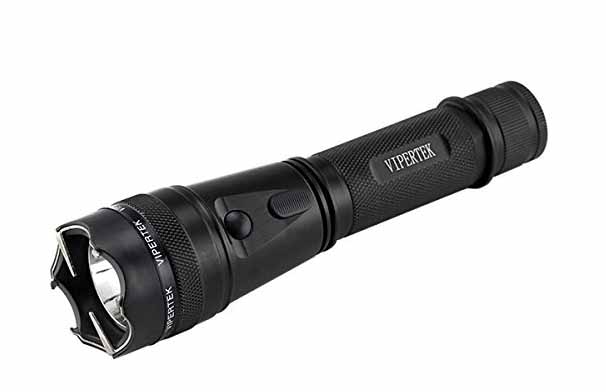
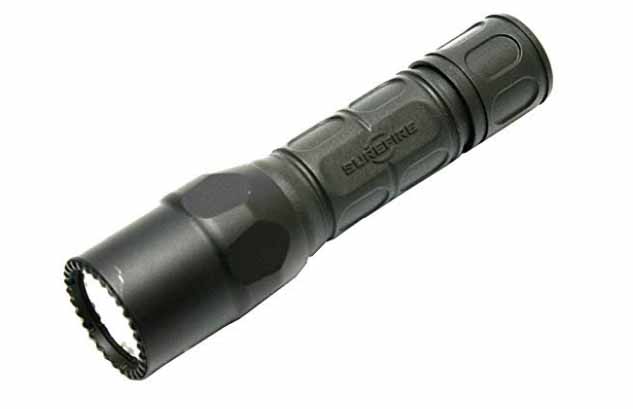
Tactical Flashlight
Alarms
Life is full of little surprises — some much better than others. While most people would prefer surprises like winning the lottery, sometimes the not-so-fun ones are inevitable. If you find yourself in a dangerous situation, such as someone breaking into your home or trying to grab you on the street, the way you react can be the difference between getting hurt and getting away.
However, it can also pose some difficult decisions you’ll only have a few seconds to make.
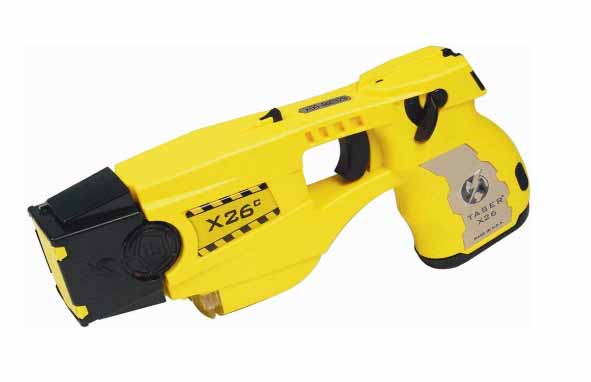
X26 Taser with Laser Light
The most common solution is to own a firearm to protect yourself and your loved ones. They’re simply one of the most effective items to have to defend yourself — the mere presence of a firearm has discouraged an ill-intentioned attacker on more than one occasion.
However, sometimes there are situations where you want to use something such as a less-than-lethal option. You may have people in your household who don’t feel comfortable or are too young and inexperienced to be using a gun. Or, you could be in an area that doesn’t allow concealed carry — some cities out there have some very prohibitive laws these days.
In those times, it’s always smart to have a backup to your trusty firearm. For situations where you’ve run out of other ways to avoid conflict, these weapons can temporarily paralyze, debilitate and stun your attacker, so you have an opportunity to get away.
When it comes to your health and potential legal ramifications of being forced to defend your life, there is no guarantee your attacker will not experience long-term effects or even death after you have defended yourself with a less-than-lethal weapon.
As gun owners, we know this — and there’s a myriad of insurance and resource options available to gun owners who are forced to defend themselves legally after being forced to defend themselves physically. However, it’s a concept that might not be intuitive to someone unversed in the tactics of self-defense, and it’s a conversation that’s very much worth having with a family member or friend who chooses to carry a less-than-lethal means of protection.
These weapons and methods below are specifically designed to debilitate your attacker and help you protect yourself during situations where your safety is in danger, without the lethality of something such as a firearm.
Taser Gun Or Stun Gun
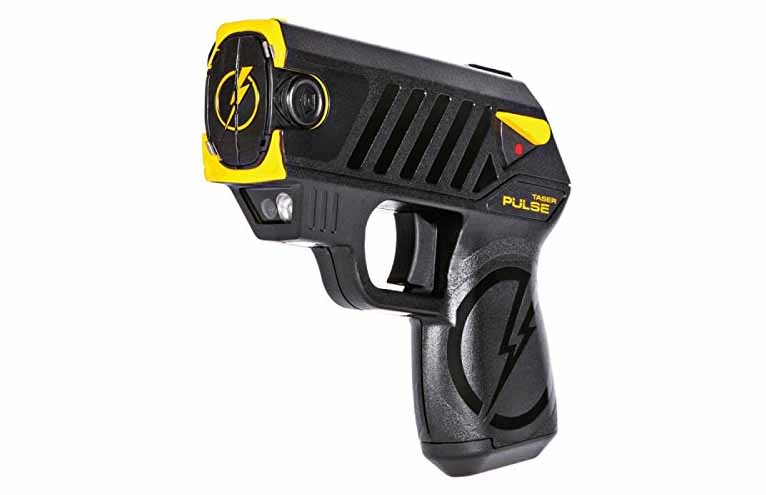
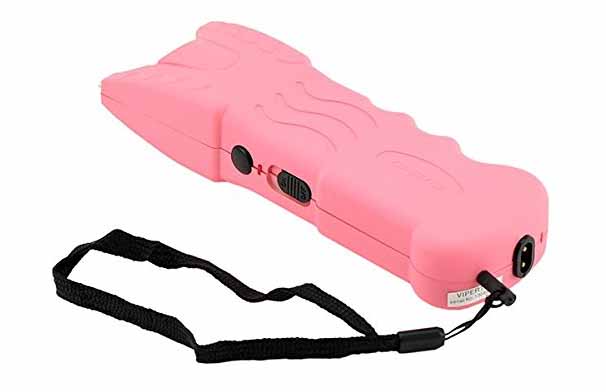
Tasers and stun guns are similar in that they deliver a shock to the assailant. However, they work in different ways and offer various benefits.
The stun gun is the best for very close-range less-than-lethal weapon. Your attacker needs to be within your arm’s reach to shock them because the unit needs to physically touch the attacker in order to function. Simply pull the trigger and touch your attacker with the two prongs. It’s simple to use and will disable muscle function long enough to get away. The majority of these units are very compact, light and easily stored in a purse or vehicle console.
The taser works similarly in that you also pull a trigger to deliver a shock. However, it can cover more distance. The taser gun will stop assailants many feet back, so they don’t have the opportunity to get within arm’s reach to begin with.
After the trigger is pulled, two probes will eject from the gun. When done correctly, the probes will latch onto the attacker and deliver a muscle-debilitating electroshock. The only catch is this: Both probes need to hit the target for the electrical circuit to be completed in order for it to work. You only get one shot to hit your target with a taser, but many models also feature an attached stun gun as a backup for close-range attacks as well.
Pepper Spray Or Gel
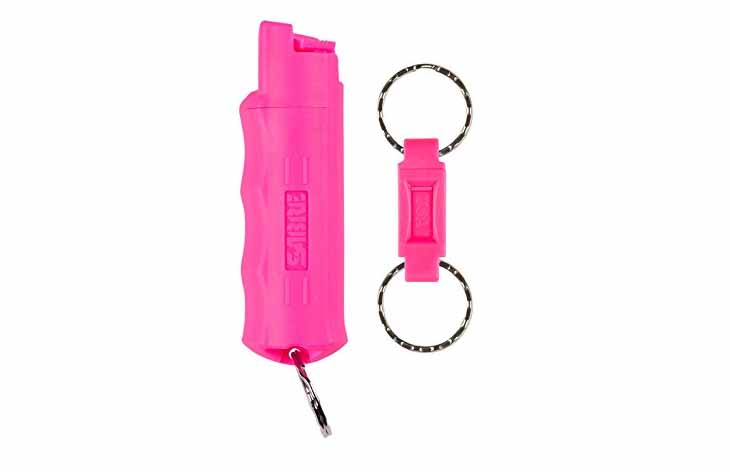
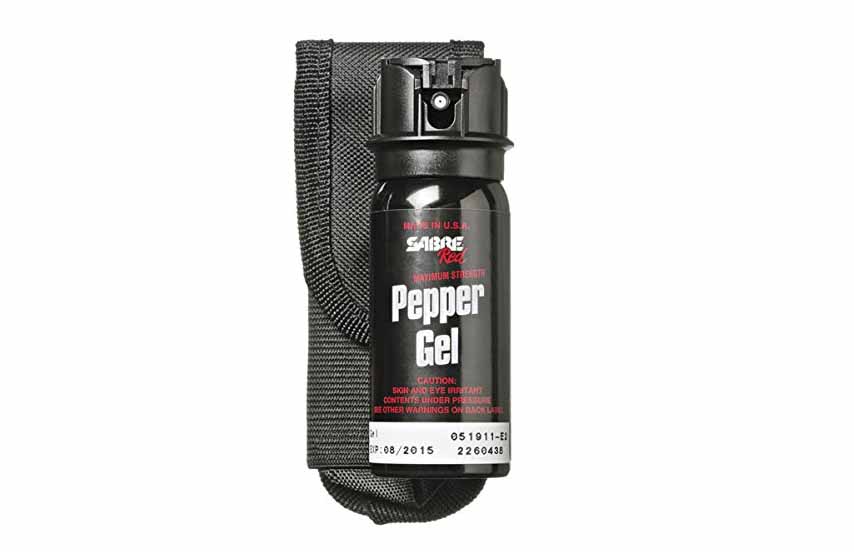
Pepper spray is another moderate-distance less-than-lethal option similar to the taser, only it targets the face and eyes as a means of dehabilitation, rather than muscles. The ingredients in the spray usually include extracts from peppers — hence the name — that burn the face, eyes and throat of someone who gets hit. Make no mistake: This isn’t your average table-grade black pepper. You’ve likely heard of bear spray that’s used to deter grizzly attacks, and when used correctly, these devices have the ability to neutralize an assailant very quickly.
A variety of pepper sprays can cover different ranges, based on the design of the device and the method of deployment. Many units fire an actual spray intended to cause intense eye irritation when administered to the eyes and nose, while other units, such as the PepperBall, launch a CO2-propelled paintball-like projectile designed to break upon impact and deliver the pepper concoction from a distance. There is also a pepper spray gun on the market that can fire several rounds and even leave an invisible UV mark police would be able to detect.
A drawback to these systems is that, if there is a decent amount of wind, the spray could dissipate or blow off-target, or it could blow back into your eyes instead. Pepper gel is an alternative that does everything the spray can do, without the risk of having a painful substance go into your eyes.
Pepper spray has a variety of strengths, ranges and features, all of which make it a versatile and effective less-than-lethal weapon that will temporarily blind and incapacitate an attacker.
Batons
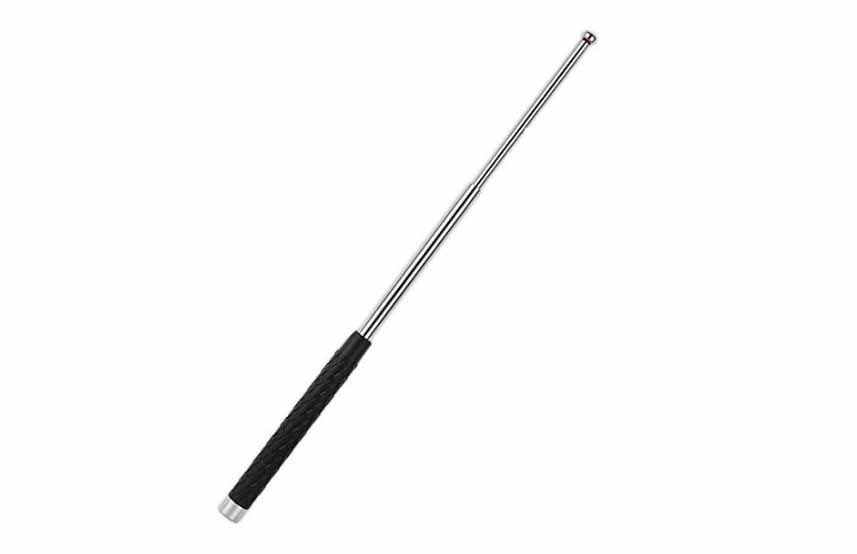
More common among police officers, batons are for bludgeoning attackers. Batons can come in a standard fixed-length configuration, or they can be expandable/telescoping. They’re a pretty straightforward less-than-lethal weapon: If you have one on-hand and find yourself in a dangerous situation, you can swing at your attacker to get them on the ground so you can get away.
Telescoping Baton
While a baton is a plausible self-defense weapon, it requires very close-quarters interaction to be used, in addition to physical strength.
Kubotan And Keychain Weapons
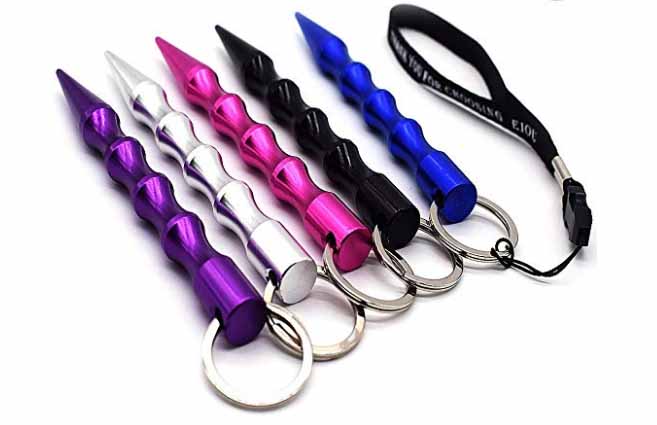
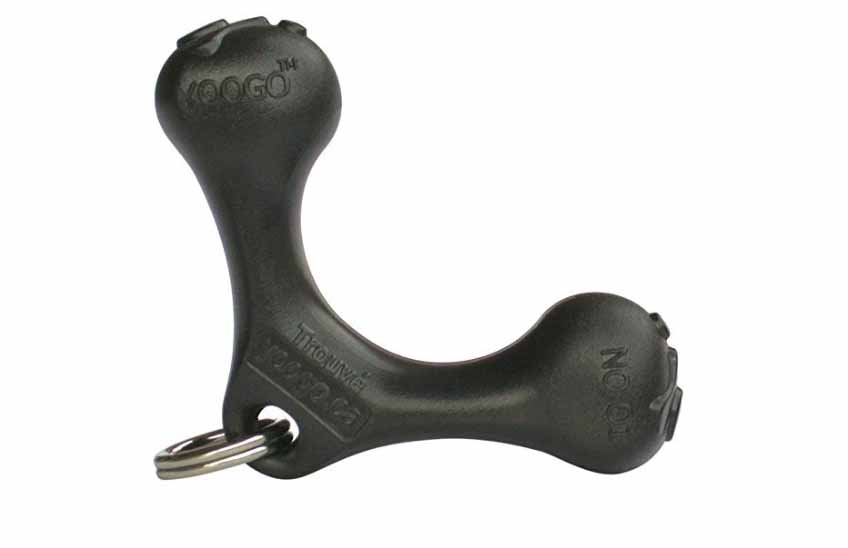
Kind of like a smaller version of a baton, the kubotan is a 5- to 6-inch wooden or plastic “stick” that usually hangs from a keychain. Other keychain weapons — as a general classification of self-defense — usually have holes or grips to ensure a solid hold, and sharp edges for some extra power in your punch. In most cases, the keys are designed to be used as part of the tool by providing extra grip. Keychain weapons aren’t legal in all states, so double-check your local laws before purchasing one. But, they are an excellent means of compact additional security.
EIOU Keychain Kubotans
Kubotans can be blunt or pointed and jabbed into the neck, body or head to deter your attacker from striking you. Keychain weapons are generally sharper and are similar to knuckle dusters or brass knuckles, as they extend past the knuckles. Adding some heat to your hand is an age-old method to knock out opponents, and still has the same kind of impact today. These types of less-than-lethal devices generally pair well with some form of martial arts training.
Tactical Flashlight
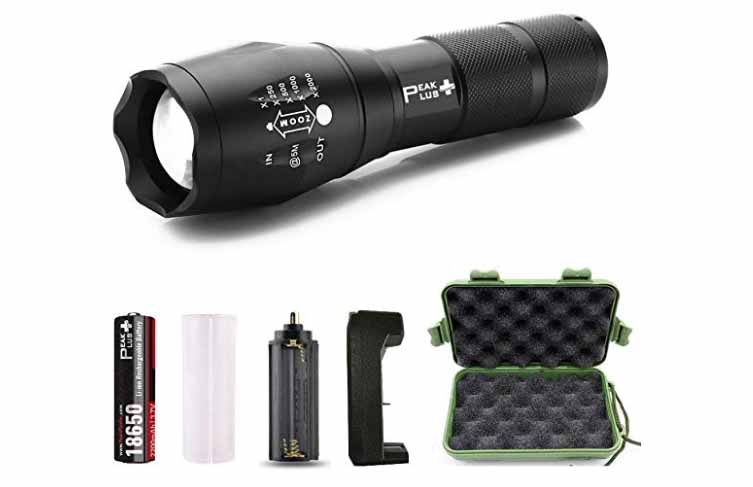
As an initial means of self-defense in a dark situation, a tactical flashlight is an excellent option. It sounds simple, but a would-be assailant cannot attack what he can’t see. Many of these flashlights can deliver more than 1,000 lumens of blinding light that will nearly scorch hair. If you need an additional feature to disorient them, there is also a strobe function available on most models to make it even harder to see you — or anything else, really.
In addition, if an attacker still managed to get too close, some flashlights also offer a bezel with jagged edges to hit an assailant as a last resort, serving like a baton. Even if you may not want to apply force, it could be necessary if your other options are ineffective.
A tactical flashlight is a smart choice to keep on-hand or in a vehicle regardless of other less-than-lethal self-defense options you choose to carry. It serves and an exceptional backup to a pistol, pepper spray or for changing a tire on the side of the highway at night.
Other Means Of Protection
If you’re worried about break-ins, installing a home security system can help with both break-ins and break-in prevention. At the very least, it will give you more time to access your other means of personal defense. You may have seen some homes that have signs in the front yard or window advertising the kind of security system they have installed. These signs send a message directly to those who may be thinking about breaking into your home. With alarms and direct contact to law enforcement and responders, that little sign is a huge red flag for potential intruders that it may be too risky to break in.
If someone does break in, many security systems have loud alarms, flashing lights and a phone call to law enforcement. Security systems take the stealth out of intruders, and they can also alert your neighbors to look outside. As with a flashlight, an alarm is best served as one more option in an overall system of personal defense tools.
This might sound obvious, but a guard dog/family dog is a perfect pair with a home security system. You know that little home security sign? Add a “Beware of Dog” sign and your front door may as well say, “Enter at Your Own Risk.” Guard dogs may be able to hear burglars before you do and can bark loudly to deter people from trying to enter as well.
Here’s the kicker that most people don’t realize: You can actually enroll your dog in home-defense training — or adopt one that has already been through training. Some people get and train dogs specifically to hunt, so getting and training a dog for home defense definitely isn’t out of the question.
Always Protect Yourself
Sometimes it’s not possible to protect yourself or your loved ones without delivering some damage to an assailant. This is a difficult concept for some, but for many of us, this is a reality we accept and the reason we choose to be prepared. Remind your loved ones that it’s important to remember that familial safety is paramount, and you have a right to defend yourself when someone comes after you. It just might save their lives.
A vital tool and necessary companion to your concealed carry gun, you should never get caught without a knife. Yet, how does one go about choosing the best EDC knife?
The gulf between expensive, high-end knives and affordable, good-quality knives is wide. Some knife users are aghast that anyone would pay $500 for a knife, while others stand in line to get them. Others are perfectly happy with a $50 blade to meet their everyday needs, and the market for these is voluminous. Here we explore the differences between a $500 tactical, EDC knife and a $50 one.
I chose to compare two very successful folding knives, one in each cost category. On the top end is Chris Reeve Knives’ Inkosi, which (with black Micarta inserts) retails for $515. Reeve’s Blade Show awards for “Quality in Manufacturing” over the past 2 decades are unparalleled. We’ll compare the Inkosi to one of Kershaw’s hottest sellers, the Eris, which checks in at $49.99. Both folders are of integral lock (also referred to as frame-lock) design and represent their price group well. There is no winner or loser here.
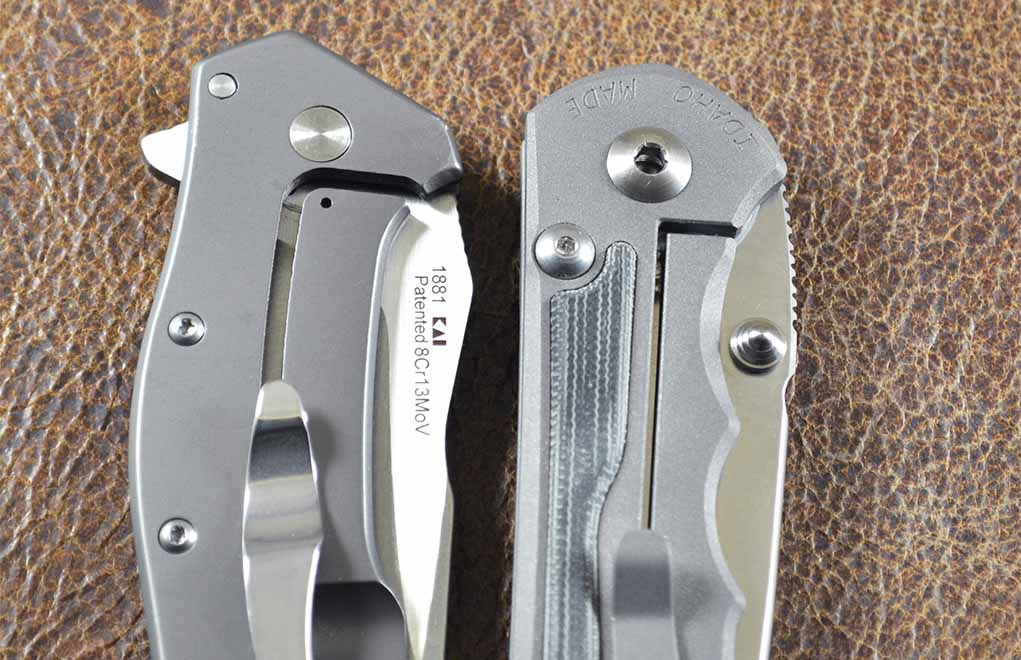
High-end knives tend to have much crisper machining and are held to tighter tolerances. At left is the Kershaw Eris, at right the Chris Reeve Inkosi.
Larry Connelley is the founder of Knifeart.com, one of the premier Internet sites for selling high-end knives — both custom and production. Connelley started Knifeart.com over 20 years ago and is very knowledgeable about what goes into the production of a knife. I asked Connelley his basic thoughts on why some knives cost more than others.
“The price of a knife is determined by two key factors: labor costs and price of materials,” he said. “The price of higher-end knives is directly related to these factors. The importance of precision in the design of a knife cannot be overstated. High-quality American-made knives are usually produced by skilled manufacturers with a high attention to detail.
“The cost and quality of materials is a major factor in the final price to the consumer,” Connelley added. “While the steel used for the blade and handle are major considerations, all of the other parts — such as the pivot, bushings and spacers — are just as important. All of the enhancements to materials used, along with not cutting corners on manufacturing, provides a superior product.”
Material Matters Most
Before a knife goes into production, the manufacturer must choose the materials that will go into making the blade, handle and component parts. As Connelley noted, on a folding knife the choice of blade steel and frame alloy are the two most important factors in determining the cost and retail price of a knife. Most high-end folding knives have frames made of titanium, while their low-budget counterparts utilize aluminum or stainless-steel for cost savings.
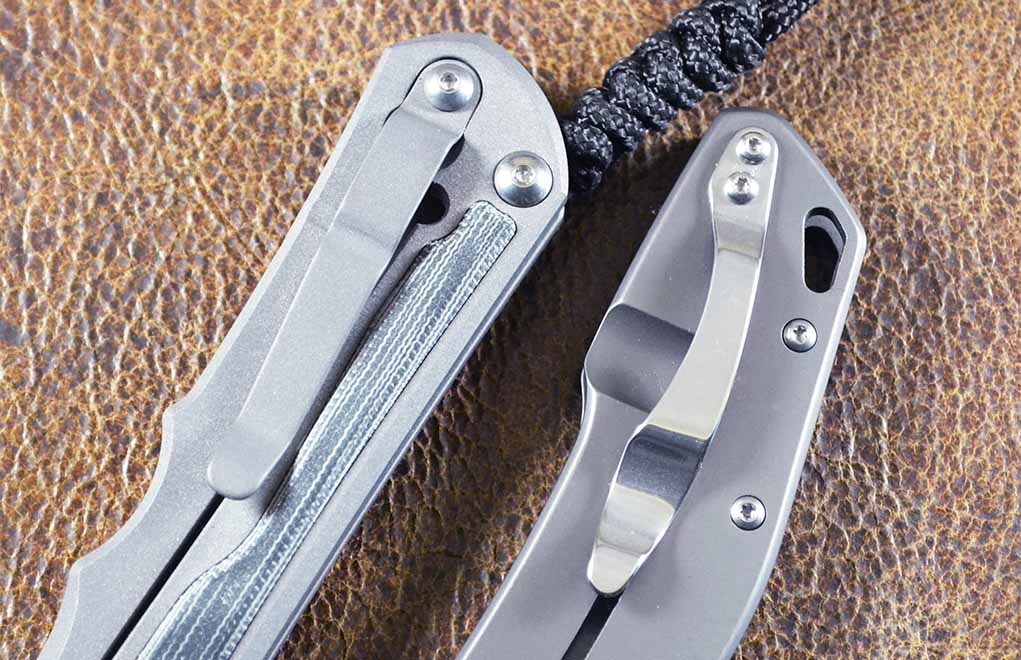
Components also factor into the price of a knife. The Reeve Inkosi at left has an inset titanium pocket clip that matches the frame, the Eris a stainless-steel clip that doesn’t.
“In general, the material chosen to construct a knife’s handle is indicative of its overall quality,” Connelley notes. “The materials selected to construct a knife handle helps to determine the weight and the strength of the knife itself. While the use of high-quality base materials raises the cost to the consumer, the use of high-quality handle materials will prolong the life of a knife.
Titanium or carbon-fiber are frequently used in the construction of high-quality knives — they’re very strong yet much lighter. If I can choose a stronger yet lighter knife, I will make that selection every time. Heavy doesn’t equal quality.”
Titanium, as Connelley explained, has greater strength and withstands wear and tear better than less costly materials like stainless-steel, polymers or aluminum. The increased cost of titanium comes from longer machining times, thus greater machine shop costs.
The same goes for blade steels, which can easily drive the price of a knife higher. The modern tactical knife boom of the 1990s, spurred on by our country’s involvement in the Gulf Wars, created a demand for higher-grade steels (such as ATS-34 and BG-42 stainless). The blade steel equation got kicked up several notches with the development of S30V stainless, a proprietary powdered knife steel developed by Crucible Industries, LLC and Chris Reeve.
The Kershaw Eris has features that the higher-priced Inkosi does not, such as the flipper opener shown here. It also employs spring assist to roll the blade out in a flash.
Connelley gives insight into why high-end steels are so much better. “You simply cannot compare a high-alloy particle metallurgy steel blade to a low-grade steel one that is made offshore. You can’t see the difference with your eyes, but a high-quality blade is the cornerstone of a dependable knife.”
The Kershaw Eris’ modified drop-point blade is made of 8Cr13MoV stainless-steel, the Chinese-made version of Japanese AUS-8 steel — a popular low-budget choice by manufacturers. While both are very adequate for budget EDC knives, they don’t hold a candle to the high-end proprietary metals such as the S35VN found on the Reeve Inkosi, and price-wise it isn’t even close.
Custom knifemaker Jim Hammond has been making knives for 41 years and has been involved in dozens of design collaborations with Columbia River Knife & Tool (CRKT), dating back to CRKT’s inception in 1994. Hammond is very knowledgeable about the manufacturing end of cutlery production.
“From a manufacturing standpoint, two aspects loom large — ease of fabrication and final product cost,” Hammond notes. “Premium steels can degrade tooling and blanking processes much sooner than lower-quality steels. Too, the factor of seven would often be applied with component costs, such as the steel pricing for each blade. For example, a company’s steel cost per blade would commonly be multiplied by seven to determine its valuation in the final retail pricing of the knife. With a targeted price-point often predetermined going in, the steel selection is often made — not just with the best steel in mind, but the best steel that be used to achieve the targeted retail price point for the knife.”
The small things used in construction of a folder, such as screws, pivots and spacers, affect both its price and durability. The Kershaw Eris uses stainless steel components, which cost less and are not as durable as Titanium.
Connelley noted that the cost of a knife is largely determined by the wages in the country in which the manufacturer is based. A recent article by Forbes magazine suggested factory wages in China have increased drastically in the past few years to an average of approximately $3.60 per hour. The average wage of the American factory worker is just north of $21 per hour at the time of this writing, so it’s easy to see the grossly disproportionate amount of labor cost that goes into making a knife in the U.S. versus offshore.
Folding knives require many steps from start to finish, all of which determine the final product. The differences between the equipment used cutting, shaping, sanding and finishing parts for a knife make a difference for the simple reason that some machines hold tolerances better than others. Likewise, the workers running the equipment, inspecting the parts and doing any manual assembly are a factor as well. A manufacturer making thousands of low-budget knives in a single run can’t be expected to have the same quality controls as one making smaller batches of higher-priced ones.
Parts Specification Equation
Parts specifications, such as the thickness of blade steel and frame rails, play a large role in fabrication and determines the efficiency and cost of the folder. For instance, the Reeve Inkosi has a blade thickness of 0.140 inch and 0.1505-inch thick frame slabs. The Kershaw Eris’ blade is 0.11-inch thick and its frame slabs are 0.09-inch thick. A beefier EDC knife will outperform a lesser one but will cost more, which is the case with our subjects. It should also be noted that Integral Locks with thicker frame slabs like the Inkosi’s offer more surface area on the locking leaf, making for a stronger lock-up because more surface area blocks the blade tang.
The quality of manufacture shows up in the crispness of the design and added elements to the whole package. Less expensive knives tend to have rounded contours and flat surfaces on the frame. More expensive knives will have beveling around the slab edges and design enhancements, such as sculpting and inlays (like the Micarta inserts found on the Inkosi). While the overwhelming majority of pocket clips, like those found on the Eris, are stamped stainless-steel, the Inkosi has a titanium one to match the frame.
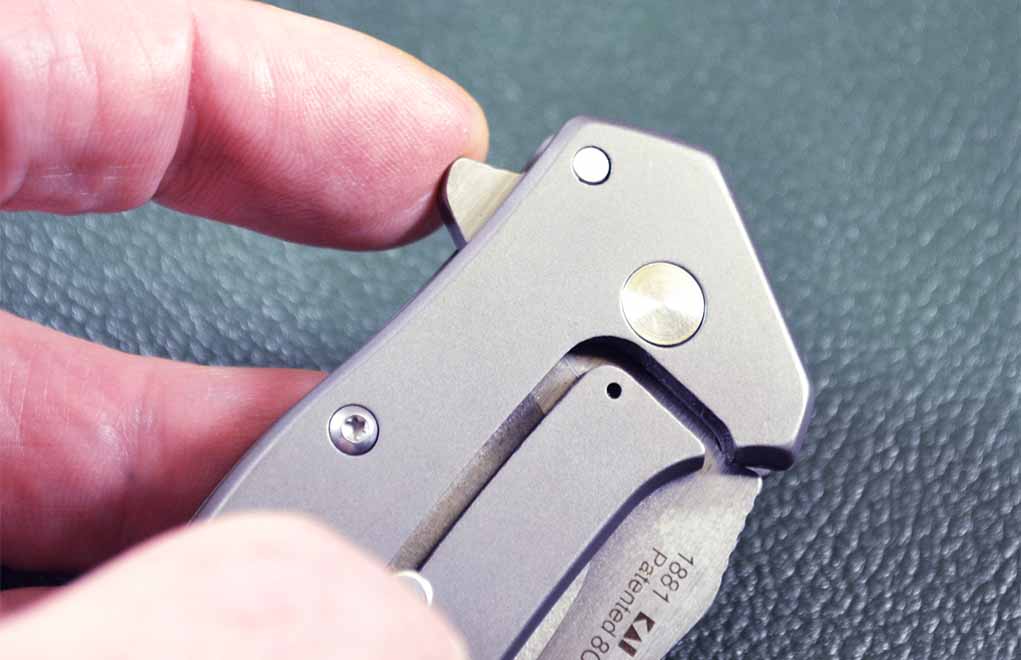
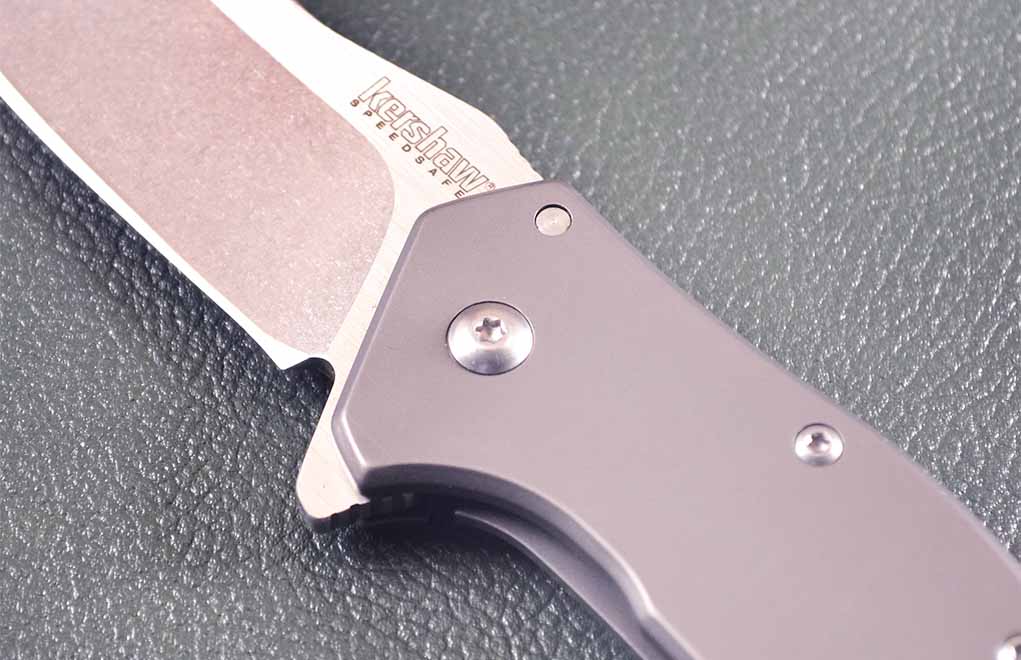
However, the Kershaw Eris has design features the Reeve knife doesn’t, and these should not be overlooked. The Eris folder opens by way of a blade flipper that protrudes out the top rear of the frame. Many prefer this over the somewhat dated thumb stud because it can be located quicker by the index finger (as opposed to the thumb) and takes only a quick flick to engage the blade. The icing on the Eris’ cake is the addition of Kershaw’s SpeedSafe spring-assisted opening mechanism, which can employ the blade in the blink of an eye — an important feature on any EDC knife for tactical or self-defense use.
Designer Labels
Interestingly, you’ll find a greater selection of collaborations with popular custom knifemakers among the lower-priced knives. While the Kershaw Eris is an in-house design — and a darn good one at that — the company has had great success with custom knifemaker Rick Hinderer’s designs in its standard line and in the more upscale Zero Tolerance line under the same KAI USA Ltd. corporate umbrella.
Collaborations are a huge bonus for the EDC knife customer who can’t afford a custom knife by the same maker. The manufacturers also benefit by increased sales from designer collaborations. How popular are they? In this day and age you’d be hard-pressed to find a cutlery manufacturer who is not offering collaborations with custom knifemakers. Custom knifemakers are also well-served as it gives them added exposure and royalty checks to pad their wallets.
Custom knifemaker Jim Hammond is familiar with such collaborations. “As President Kennedy once said, ‘When the tide comes in, all the ships will rise.’ This has proven true with benefits to everyone in the knife industry with the inflow of custom knifemakers now working with production companies. It’s far easier to utilize creative vision, design understanding and proven manufacturing experience from a maker who’s done it for over 40 years, such as myself, than to train someone for decades to hopefully achieve the same end.”
A Place For Both
Despite such broad differences between low- and high-budget EDC knife options, there is a strong case to be made for each. Budget knives offer a great opportunity for entry-level knife customers to use and enjoy a competent knife at an affordable price, and the selection from the manufacturers is almost endless. Even counting average materials in low-end models compared to high-end knives, budget blades perform perfectly fine for the average user’s everyday needs. And their fixed-blade brethren do well in the field as well. In fact, some knife users carry a budget folder as their EDC knife and switch to a more upscale option for special occasions. Budget knives don’t offer the endurance of high-end knives, but many users will take that trade-off.
High-end folders are for those who prefer the best and can afford to pay the price. They have complete confidence in their knife and know with no uncertainty that it will perform to the extreme, will be less prone to fail and will cut like a house afire with an edge that will hold its sharpness longer.
Better yet, there are a plethora of knives to be had between the low- and high-budget folders featured here. The cutlery market is burgeoning with knives for any budget, any taste and any need. You’ll have no trouble finding a EDC knife made just for you!
Best EDC Knife Picks
Like firearms, EDC choices are measured in the eye of the beholder. Some like them big, some small, and some like them fast. The selection among everyday carries today has never been better and, to help you along, we offer here a group of sizzling slicers in all shapes and sizes geared for making your everyday carry more than just an “everyday” thing.
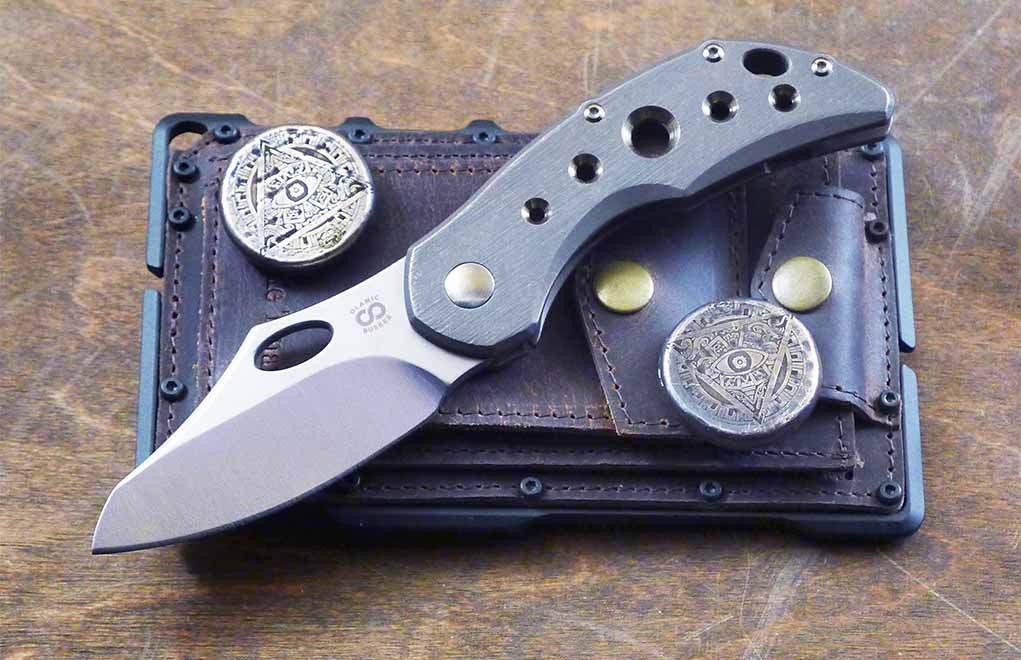
Olamic Busker Semper
Olamic Cutlery makes some of the coolest folders around, and their Busker Semper model is a favorite among devotees of the brand. The Busker Semper is a small knife — 6 inches overall — with a 2.375-inch Bohler M390 Modified Wharncliffe blade. The handle is constructed of 6AL-4V titanium with an integral lock located on the back of the frame. Other items of note are a caged bearing pivot system, ball ceramic detente, stainless-steel lockbar insert and machined pocket clip with ceramic retention ball. MSRP: $365 and up // OlamicCutlery.com
DPx Urban Ti
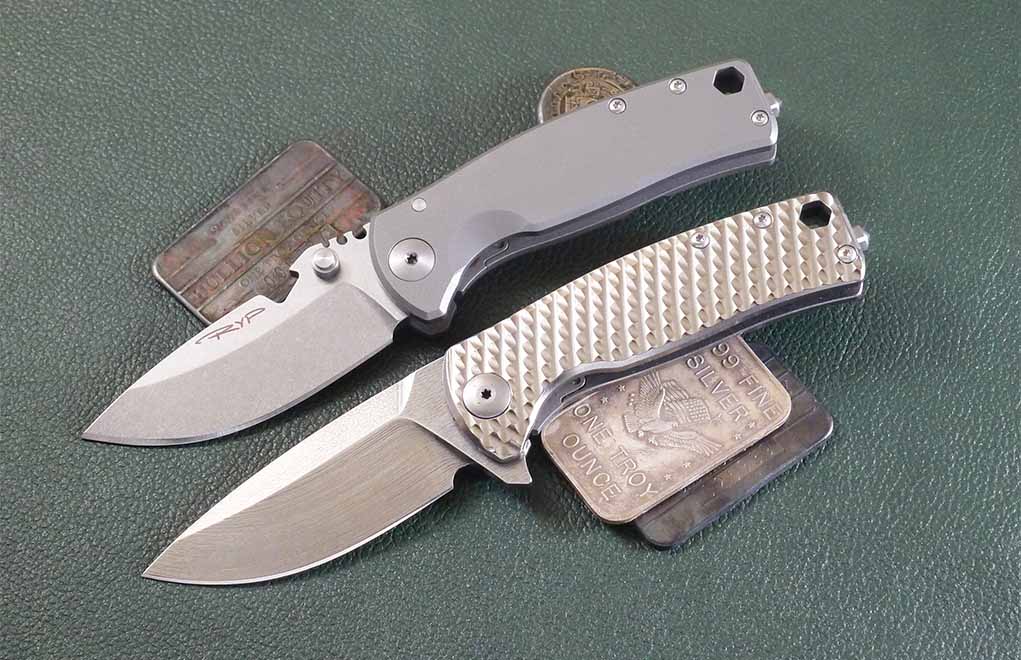
Dpx Gear’s Urban line of EDC folders are hot as a firecracker. The DPx HEST/F Urban Ti — 6.7 inches fully extended — is a top-shelf folder featuring a 6AL-4V titanium integral-lock frame with a 2.9-inch blade of premium CPM S35VN stainless-steel. Dpx Gear loaded the Urban Ti up with outstanding features, including a cap lifter, hex drive, wire stripper and glass breaker. A more upscale version, the HEST/F Urban Flipper, is in the pipeline as well and we’ve pictured it here. MSRP: $375 // DPXgear.com
Benchmade Phaeton Auto
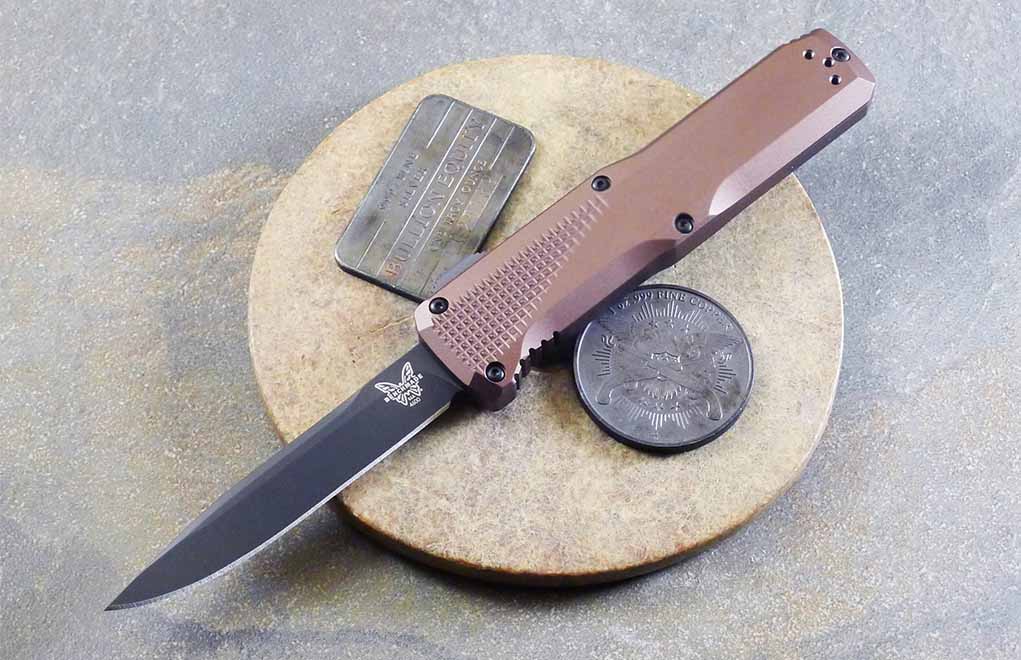
Benchmade Knives has offered automatics for more than 20 years, and recent laws passed across the U.S. are more favorable to these lightening-fast openers. The Benchmade Phaeton model is a slick OTF (Out The Front) auto with all the style and class of a Rolls. Overall length is 8.08 inches — 4.63 inches of that in a partially checkered anodized aluminum handle available in black or dark Earth. The Phaeton’s black-coated dagger-style 3.75-inch CPM S30V stainless-steel clip blade employs and deploys by way of a slide release on the rear spine of the handle. MSRP: $350 // Benchmade.com
Spyderco Shaman
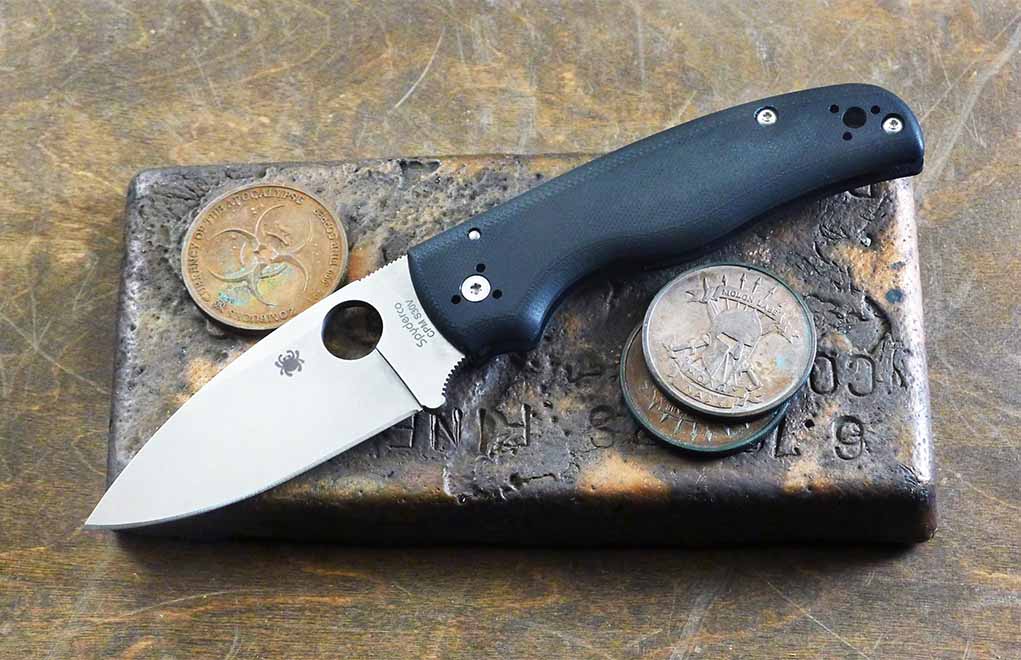
One of Spyderco’s most popular lines is the Native Series, and the Shaman answered the call of those wanting a larger version. In the process they created a beast. The 8-inch overall Shaman features a black G10 handle with ample frame slabs sporting a textured matte finish for enhanced purchase. The Shaman’s 3.58-inch CPM S30V stainless-steel spear-point blade does the cutting chores and opens with ease thanks to the company’s trademark “Spydie hole.” Unlike its smaller Native siblings — which feature liner-locks — the Shaman incorporates Spyderco’s Compression Lock on the upper spine, which is accessible with the knife in-hand. MSRP: $279.95 // Spydero.com
A.G. Russell Wharncliffe
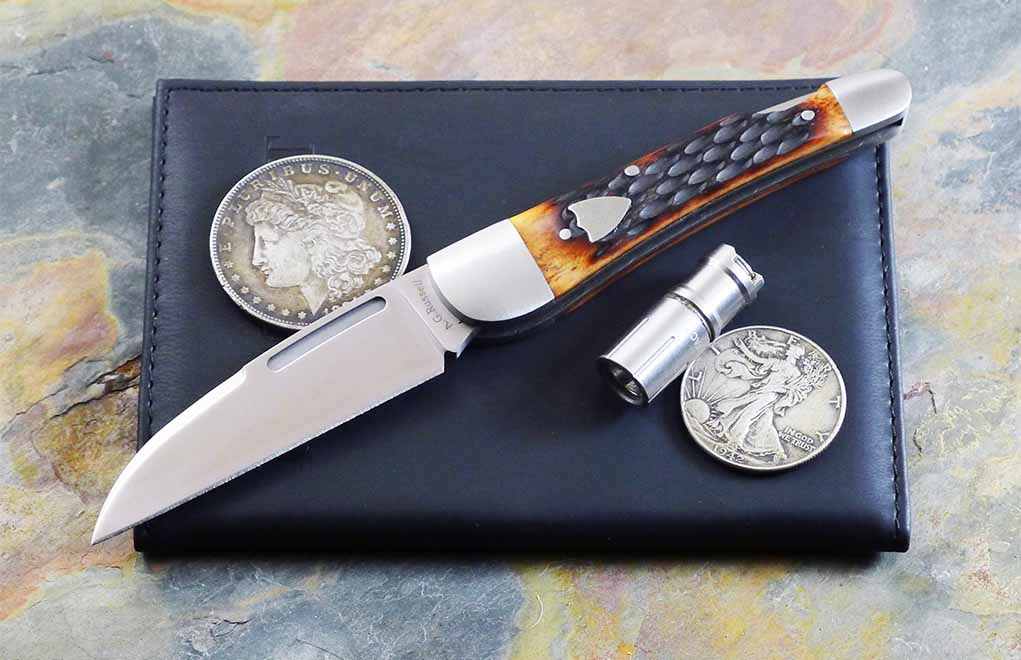
Iconic cutlery entrepreneur/historian A.G. Russell passed away recently. Often overlooked in his pedigree was his tremendous insight into knife design. His Wharnecliffe Lockback, was an instant hit. The Wharnecliffe Lockback is a century-old design modernized by Russell without losing its classic roots. Many still enjoy traditional EDC knife options, and this pocket-folder features an elegantly tapered frame with a hard working 3.25-inch Wharnecliffe 8Cr13MoV stainless-steel blade. In addition, the Wharncliffe Lockback also has 440 stainless-steel bolsters and a modernized lock-back mechanism. The model shown here is done up in brown jigged bone scales, but you can also have it in India stag, white bone and black G10. MSRP: $79.95 // AGrussell.com
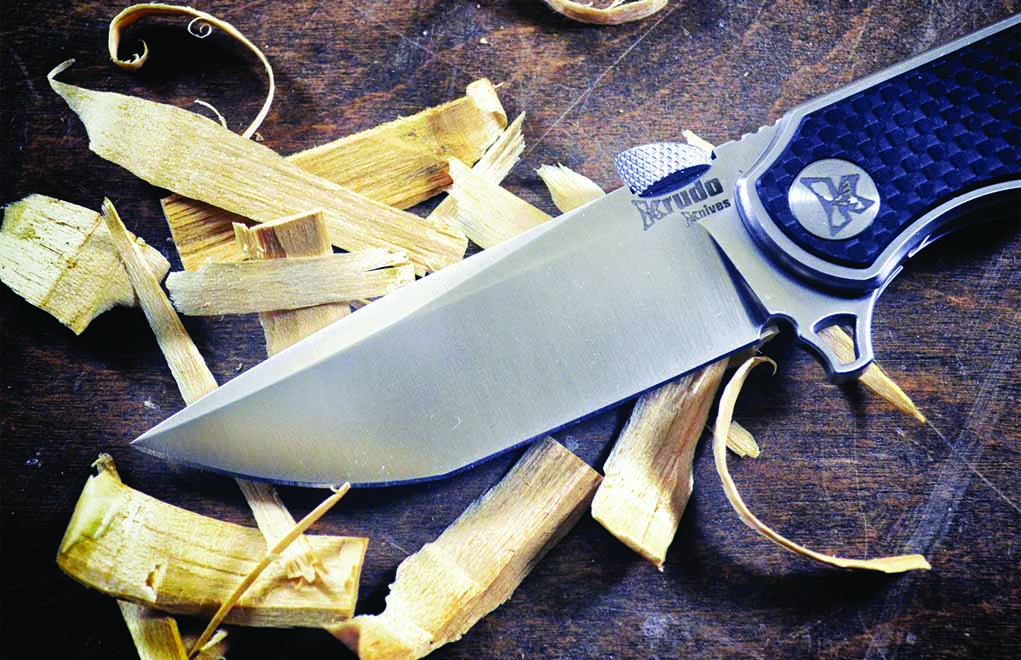
Krudo Karsino10
Krudo knives tend to be overbuilt, with added features that are geared toward combat and self-defense. Krudo’s Karsino10 folder has all that in a slick-styled, 8-inch package. The 3.5-inch modified tanto blade of 9Cr8MoV stainless steel rolls out quickly and smoothly on ceramic ball bearings, which are activated by Krudo’s distinctive skeletal flipper tab. A second vertical flipper can be used to thumb open the blade, and a ramped thumb stud adds a third option. In addition, the vertical flipper can also serve as a hitting point when measured restraint is called for in combat. The handle is stainless steel, with a framelock mechanism and carbon-fiber inserts. The whole knife weighs in at 6.1 ounces. The Karsino10 folder carries with the blade tip-up via a beefy, 2.25-inch reversible pocket clip.
The flipper action on the Karsino10 is extremely fast; this is further aided by the fact that it is a large folder. A large folder handle is easier to “grip ’n flip” than a smaller one, because you can spread the three gripping fingers across a bigger footprint and press the handle firmly into the heel of the palm. The top flipper requires a bit more finesse to open using the thumb and takes practice, because it’s not a common method.
I wouldn’t ordinarily use a tanto-style blade for carving wood, but I wanted to try the Karsino10’s brawny blade for strength. As a result, I gave it a go on some basswood. Using the blade’s flat main plain edge, I carved off nice chunks of the material, and the weight of the knife was an added bonus. If you like a big bruiser of a folder, you’ll like this knife. MSRP: $165 // krudoknives.com
Smith’s Battleplan
Well known for its sharpeners, Smith’s joins the flipper fray with the Battleplan. This folder serves up a black, 2.78-inch clip-point blade of stonewashed 420 stainless steel in a flash via a pivot equipped with 416 stainless steel bearings and washers. The 4.4-inch handle is a nicely sculpted G-10 composite that houses a linerlock mechanism between the covers. There’s also an opening option of ambidextrous thumb studs. An ample, 2.5-inch, tip-down, deep-carry pocket clip graces the back side, reversible to the front, and the whole package weighs in at 5 ounces. It measures 7.85 inches fully extended.
The blade rolled out with surprising speed. Here, again, this is a larger knife with an ample grip. The deep-hollow-ground blade is made for slicing, so I gave it a go at some 3/8-inch rappelling rope and super-tough lasso cord. The Battleplan’s business end performed well, tackling both media in single strokes. For a small financial outlay, the Battleplan offers true value for the money. MSRP: $34.99 // smithsproducts.com
Spyderco Hanan
The Spyderco Hanan is the smallest of the group (6.875 inches, open), but it’s stout for its size. Sporting a sweeping recurve blade of CPM S30V stainless steel and a clip point, the Hanan has a phosphor-bronze pivot-bearing cage with large ball bearings. The blade locks up via Spyderco’s patented Compression Lock. The Hanan’s titanium-bolstered frame has black G-10 scales in a curvaceous handle—it’s nothing short of upscale! Out back is a 1.75-inch titanium tip-up pocket clip that can be reversed to the front. The Hanan makes for a lightweight EDC knife, weighing in at a nimble 2.82 ounces.
At 3.875 inches closed, and with a 3-inch blade, the flipper folder falls more into the “gent’s knife” category. Even so, it more than makes up for its size as a result of its tank-like construction. The fit and finish are top shelf—as they should be at this price point. The ball-bearing action is as smooth as silk, and the Compression Lock, which is easily located on the upper part of the spine, snicks and holds the blade like the proverbial bank vault.
The Hanan’s recurve blade glided through some deep, ¼-inch corrugated cardboard quickly and with little pressure. Spyderco blades are some of the sharpest out of the box. The Hanan is true to form. This is a swanky EDC that is up to the task—in spades. MSRP: $360 // spyderco.com
WE Knife Co. Deacon
The WE Knife Co. Deacon, 7.35 inches open, sports a drop-point blade of Bohler M390 stainless steel with a full V-grind. The business half opens by way of a flipper tab only and uses a distinctive, semi-exposed locking liner to secure the blade. A ceramic ball-bearing pivot allows for fast delivery. The handle features purple-anodized titanium bolsters and carbon-fiber scales with blue-accented screws to tie it all together.
The Deacon is nothing short of attractive. Its closed length is 4.1 inches. The drop-point blade rolls out quickly and easily on ceramic ball bearings, and the linerlock mechanism snaps it to attention with authority. MSRP: $298 // weknife.com
I pegged the Deacon’s slender, flat-ground blade as a slicer. It didn’t disappoint, whipping through 1/6-inch-thick suede in clean, single strokes. The handle is thin, but wide, across the midsection, so there’s plenty of comfort. If you’re looking for a lightweight, upscale EDC knife, the Deacon will serve you in style.
Lightweight, rugged and affordable, the Spike Camp from Boyds Gunstocks is set for your next backcountry hunt.
All that glitters is not gold. The age-old advice is as sound now as it ever was, but hard to keep at the front of your mind when blinded by wave after wave of new gun gear. Certainly, while some of that stuff might aid a shot hitting the mark, much of it is marginal at best, useless at worst and in either case adds unneeded complexity to your shooting system.
For many shooters, this is why Boyds Gunstocks continues to shine. Rifle or shotgun, the South Dakota company’s stocks legitimately up the accuracy potential of your firearm and are drop-in easy to install. At the same tick, the upgrade is about as simple as they come. No bells. No whistles. Just performance.
Boyds Gunstocks hasn’t veered from this winning formula in 2020, introducing an unassuming option certain to improve any rifle’s accuracy potential. Developed with backcountry hunters in mind, the Spike Camp not only provides a rigid platform for any barreled action, but the thumbhole stock is also nearly carbon-fiber light. 2.5 pounds is all you add to a rifle, impressive given—like all Boyds’ options—it’s constructed of wood laminate. But the rugged material facilitates the stock’s featherweight, allowing the company to shave down sections, while not losing strength.
In addition to a thumbhole, he Spike Camp system boasts as a Monte Carlo profile for a proper cheek weld, sling swivels fore and aft and a 13.5-inch length of pull to fit most adults. Additionally, the stock free-floats the barrel, ensuring pristine harmonics, thus improving repeatable accuracy. Like Boyds’ other wares, the Spike Camp is custom made for each make and model of gun and hits your doorstep around two weeks after ordering.
What could be simpler?
For more information on Boyds Gunstocks’ Spike Camp, please visit boydsgunstocks.com.
A definitive event for law enforcement, and subsequently self-defense theory, the Newhall shooting is required reading for any armed citizen. Here is a breakdown of the initial shots from the incident.
Editor’s note: It’s the 50th-Anniversary of the Newhall shooting—in which four California Highway Patrolmen were slain. It was a watershed event, changing how law enforcement trains today. What follows is an excerpt from chapter three of the masterfully written book, Newhall Shooting: A Tactical Analysis, titled: The Approach and Initial Shots Fired.
Newhall Shooting: The California Highway Patrol Dodge was angled away from the Pontiac towards the left, in a way that exposed the right side of the patrol car to anyone who exited the passenger side of the Pontiac. Davis was behind the wheel, and Twining was in the right front passenger seat of the Pontiac. They remained inside the vehicle.
When Davis brought the Pontiac to a stop, he did so in an area bathed with light from the gas station ahead and the restaurant parking lot to the right. With the additional light provided by the headlights of the CHP cruiser and the passenger side-mounted white spotlight, Officers Gore and Frago could clearly see that the vehicle contained two occupants, not the single occupant reported by the complainant, Tidwell. Davis was behind the wheel, and Twining was in the right front passenger seat of the Pontiac. They remained inside the vehicle (Fig. 8).
Newhall Shooting: Officer Gore exited the driver’s side and drew and pointed his .357 Magnum revolver at the Pontiac from a “leaning” position across the left front fender and hood of the Dodge. Officer Frago, armed with the Remington 870 12-gauge shotgun, established a position just aft of the right front headlamp of the patrol car.
The CHP Dodge was located at the 5 o’clock position from the Pontiac, approximately 15 to 20 feet behind—a little more than one car length away. The Dodge was angled away from the Pontiac toward the left in a way that exposed the right side of the patrol car to anyone who exited the passenger side of the Pontiac (refer again to Fig. 8).
The officers got out of their patrol car and took up initial positions with weapons drawn, as was standard procedure for a high-risk or “hot” stop. Officer Gore exited the driver’s side, drew his 6-inch Colt Python .357 Magnum revolver from his swivel holster and pointed it at the vehicle from a “leaning” position across the left front fender and hood of the Dodge. Officer Frago, armed with the Remington 870 12-gauge shotgun from the patrol car’s Lektro-Lok rack, donned his hat and established a position just aft of the right front headlamp of the patrol car—in accordance with the tactics he had been taught for routine vehicle stops as a cadet less than a year and a half prior (Fig. 9).
Newhall Shooting: Officer Gore ordered Davis to spread his legs, place his hands on top of the Pontiac and lean on the car. When Davis assumed the directed search position, Gore advanced the short distance between them (about 10 to 15 feet) to search the suspect. Nearing the vehicle, Officer Frago reportedly shifted the butt of the shotgun to his right hip and held the firearm with the muzzle in the air with his right hand only as he reached for the door handle of the Pontiac with his left hand to remove the noncompliant passenger (Twining).
Officer Gore ordered the occupants out of the car with the command, “Get out with your hands up.” When neither Davis nor Twining complied with the command, he repeated it a second and third time before the driver, Davis, finally exited the vehicle. Witnesses reported that Gore had to order the noncompliant Davis an additional time to raise his hands, stating, “We told you to get your hands up.” Against directions, Twining remained in the car.
Officer Gore ordered Davis to spread his legs, place his hands on top of the Pontiac and lean on the car. When Davis assumed the directed search position, Officer Gore advanced the short distance between them (about 10 to 15 feet) to search the suspect (Fig. 10). The time was just prior to 23:55.
Newhall Shooting: As Officer Frago reached for the door handle, Twining suddenly opened the door and spun to face Officer Frago with a four-inch Smith & Wesson Model 28 .357 Magnum revolver in his hand.11 Officer Frago was reported to have yelled “Hold it!” before Twining fired twice with the revolver, striking him in the left armpit area with both shots. The bullets from the Western-brand .357 Magnum cartridges traversed Officer Frago’s upper chest, killing him instantly, and he fell where he stood.
Meanwhile, Officer Frago abandoned his covering position at the front of the Polara and approached the passenger side of the Grand Prix with the shotgun in a “port arms” position. Nearing the vehicle, he reportedly shifted the butt of the shotgun to his right hip and held the firearm with the muzzle in the air with his right hand only as he reached for the door handle of the Pontiac with his left hand to remove the noncompliant passenger, Twining (refer again to Fig. 10).
As Officer Frago reached for the door handle, Twining suddenly opened the door and spun to face Officer Frago with a 4-inch Smith & Wesson Model 28 .357 Magnum revolver in his hand. Officer Frago was reported to have yelled, “Hold it!” before Twining fired twice with the revolver, striking him in the left armpit area with both shots. The bullets from the Western-brand .357 Magnum cartridges traversed Officer Frago’s upper chest, killing him instantly, and he fell where he stood (Fig. 11).
Newhall Shooting: Twining quickly exited the vehicle and turned to fire two shots at Officer Gore, who was near Davis on the other side of the vehicle. In his haste, Twining triggered both shots low, into the right rear side of the Pontiac’s body and roof as he tracked the gun upward towards Officer Gore. Gore turned away from Davis, aimed his revolver and fired a single round at Twining across the deck lid of the car. The shot went wide, missed Twining and struck the right rear window of a Ford Mustang parked in the restaurant parking lot and exiting out that car’s rear window.
Twining quickly exited the vehicle and turned to fire two shots at Officer Gore, who was near Davis on the other side of the vehicle. In his haste, Twining triggered both shots low, into the right rear side of the Pontiac’s body and roof as he tracked the gun upward toward Officer Gore (Fig. 12). As this happened, Officer Gore turned away from Davis, aimed his revolver and fired a single round of Remington-Peters .357 Magnum ammunition at Twining across the deck lid of the car. The shot went wide and missed Twining, striking the right rear window of a Ford Mustang parked in the restaurant parking lot and exiting out that car’s rear window (refer again to Fig. 12).
Newhall Shooting: As Officer Frago reached for the door handle, Twining suddenly opened the door and spun to face Officer Frago with a four-inch Smith & Wesson Model 28 .357 Magnum revolver in his hand.11 Officer Frago was reported to have yelled “Hold it!” before Twining fired twice with the revolver, striking him in the left armpit area with both shots. The bullets from the Western-brand .357 Magnum cartridges traversed Officer Frago’s upper chest, killing him instantly, and he fell where he stood.
With Officer Gore focused on the threat across the car from him, Davis had the opportunity to push back from the car, spin to his right and pull a 2-inch Smith & Wesson Model 38 Bodyguard Airweight .38 Special revolver from his waistband (the same gun he had used to threaten the Tidwells with earlier). Davis shot the distracted officer twice in the chest at arm’s length, the bullets traveling from left front to right back. Like his hapless partner, academy classmate and childhood friend Officer Frago, Officer Gore was dead before he hit the ground (Fig. 13).
The time was 23:56. The Pontiac had stopped just a little more than one minute earlier, and help had just arrived.
Survival gun is a vague term no matter how you cut it. We help you hash it out with guidelines for each style of gun and looks at some of the top makes and models.
Is there really such a thing as a survival gun? Certainly, there have been attempts at creating one tailored to the purpose—the AR-7 for instance. Handy as the rifle potentially was for U.S. Air Force bomber crews who had to ditch on some godforsaken plot of tundra, it wouldn’t do many modern suburbanites a lick of good. Unless they happened to tote one along on a backwoods excursion.
Truthfully, a survival gun lies in the eye of the beholder. To a farmer, it’s possibly a bolt-action or semi-automatic that, when not keeping predators off his stock, harvests an emergency whitetail for the table. While an urban dweller, who still has access to stores but not the full force of the rule of law, would do well to have a reliable sidearm to ensure safe passage from point A to B. And that suburbanite, depending on how close to he or she resides to the fringes of the metro area, it’s likely they would benefit from a combination of both. There are a host of variables from type of disaster to skill level and shelter availability among other things that can and will dictate what survival gun or guns are required.
In short, survival guns are situational. What makes a solid candidate to fill the role is not. To that end, we’ve gathered some of Gun Digest’s best content on survival guns and firearms that would fill one or more roles in making it through a disaster. The first section focuses on the fundamental concepts of what you should look for in a survival gun, regardless if it’s a rifle, handgun or shotgun. The subsequent sections then home in on particular types of guns, what separates the wheat from the chaff in each category and, occasionally, a “Best Of” list of standout makes and models.
This primer should set you on the way to getting a grasp of survival guns. But don’t rest on your laurels—your circumstances will likely always fluctuate. In turn, so will your firearms needs.
Before you even consider a particular style, make and model, you need to know what makes a solid survival gun. Follow these five principles and you’ll find a firearm you can bet your life on. As a bonus, there also are some guidelines on edged weapons. Read More
If you can’t go mobile, you need to consider what will protect your hearth and home. Suffice to say, it’s more than your concealed carry pistol in many circumstances. Read More
While that 24-inch barreled fowling-piece might not prove the ideal survival gun, neither might the pimped out bird’s head smoothbore. This sober guide gives you the skinny in what to look for in the ideal tactical shotgun. Read More
The Remington 870 is among the most popular guns of all time. Here are four tactical options that come out on top for home defense and potentially survival. Read More
When it comes to Mossberg shotguns, the 500 is king of the hill. But for tactical application and as a survival gun, its cousin—the 590—might have a decided edge.Read More
Controversial—at least to the modern media—there’s a good reason why the infamous AR-15 is a logical home defense and survival gun. Hint, you’re likely to become proficient with it way before any handgun. Read More
New to the AR-15 or just need a refresher on what to look for when buying? Master gunsmith Patrick Sweeney lays out the exact points you need to consider to avoid lemons.Read More
American’s love the AR-15. Accurate, effective and fast—why not? Here are some solid entry-level options perfect to learn the platform or to use as an all-purpose home-defense/survival gun. Read More
Feeding your long gun from the same trough you feed your pistol worked from the pioneers, why not you? Check out these affordable 9mm carbines that make perfect companions to your carry pistol. Read More
A jack-of-all-trades, the scout rifle is considered by many the perfect survival gun. There is a load of quality off-the-shelf options of Col. Jeff Cooper’s brainchild to arm you up. Read More
The sheer volume of handguns available today can leave your head spinning. Though, you can narrow down your search if you simplify the criteria. Read More
Full-sized pistols are top choices not only for home protection, but also as survival guns. While this article is written with an eye to the former, each is more than capable of handling the latter. Read More
Still among the most trusted self-defense calibers, the .45 ACP offers unparalleled CQC performance. No matter your budget, there’s one out there for you. Read More
Much like a survival gun, a truck gun is in the eye of the beholder. But this selection of pistols, rifles and shotguns more than fit the bill for most. Read More
Tailor-made to keep a long gun at hand at all times, takedown rifles are backwoods and survival situation staples. We found seven rugged options. Read More
Unrelenting in design and execution, the new Berger Bullets Long Range Hybrid Target bullets are engineered for hair-splitting accuracy.
Berger’s new Long Range Hybrid Target bullets™ (LRHT) are 100% Made in the USA and feature a high Ballistic Coefficient (BC), jump-tolerant ogive profile that is Doppler verified with less than 1-percent BC variation.
Long-range target shooters and extreme accuracy enthusiasts endlessly seek a competitive advantage, using sophisticated ballistic solvers, custom drag models, complex optics, and twist-rate calculators, among others. All of these tools are rendered meaningless if the projectile exiting their favorite target, hunting, or Mil/LE tactical rifle is inconsistent and unpredictable. Using advanced proprietary manufacturing processes, Berger’s innovative Meplat Reduction Technology™ (MRT) applies controlled pressure along the nose of each LRHT bullet, producing a homogeneous and repeatable profile for the industry’s most consistent BCs. While a high BC is desirable, shot-to-shot BC consistency is most critical when engaging targets at 1,000 yards and beyond. When you absolutely need to maximize hit probability, never settle for a bullet other than Berger.
Be sure to enter our American Made giveaway, with great gear from great American companies. Click the tab at the bottom right of page to enter.
The story behind the construction of Berger Bullets is simple. We start with virgin copper and lead wire products with the tightest specifications. Then, we manufacture our own signature J4 Berger bullet jackets to unmatched tolerances of less than 0.0003 inches of total indicated runout. What does this mean? A better bullet begins with a concentric jacket! Lastly, we merge the materials into finished projectiles — all within the confines of our Mesa, Arizona manufacturing facility.
Berger Bullets are highly sought after by the leading shooters in the world’s most demanding competitive shooting disciplines, such as PRS, F-Class, Fullbore, long range, and ELR to name a few. New Long Range Hybrid Target bullets are available in .22 caliber, 6mm, 6.5mm, 7mm, and .30 caliber offerings.
New for NRA Show is our line of LRHT Ammunition offerings in 6mm Creedmoor, 6.5 Creedmoor, and 300 Norma Magnum.
For more information on Berger Bullets, please visit bergerbullets.com.
Editor’s note: The following is from Steve Adams, president of Clawmounts Manufacturing, Inc. Clawmounts makes a “true quick-detach” scope mount.
What Does “Quick Detach” Mean?
“Quick detach” (QD) is a term not often used properly in the firearm industry when it comes to scope mounts. What’s out there is not true QD. They are merely “detachable.” True quick detach is a self-locking, one-hand operated device without any secondary hand manipulation required. No levers or screws.
Anything that detaches from or re-attaches directly to the picatinny rail is subject to the well known tolerance variations of the rail. Some companies have turned to tensioners to alleviate this, and now even have locking levers to lock their locking levers! The shooter is asked to count slots to the “right” position on a potentially flawed rail, awkwardly rock a mount into position, then flip one or more levers to MAYBE return to zero. It’s all convoluted and time consuming, a patch to a patch.
We bypass the deficiencies of the rail by leaving the base permanently affixed to the weapon with only the ring/optic assembly removed. Our claws are conical tapers, reducing attachment to one fluid downward thrust. It also “feels” right locking like a bank vault, and can even be easily and silently operated in the dark.
Our mount is also interchangeable. We feel this is critical because the ability to swap optics at a moment’s notice with reliable zero allows a shooter to adapt to changing circumstances and take full advantage of the capabilities of their firearm. From CQB to extreme range, from day scopes to thermals, our mount is the solution.
Also, because shooters can’t place faith in the average mount’s zero return many simply leave it permanently on the gun. This means the customer is paying for a promise unfulfilled.
Background
Some background about me. I’m a tool and die maker by trade. I started at 17, so 32 years and counting. I was fortunate because back then, besides boomers, there were still members of the greatest generation on the production floor.
These were men who built the implements that allowed our great nation to wage war on a worldwide scale. During peacetime, they beat their swords into plowshares to produce civilian goods, but there were always weapons talk and “toolbox” projects around. From rifles to shotguns and pistols, someone was always working on something. They were my mentors. It was a great time to be alive!
Besides mathematics, there was also a tactile, holistic approach to our craft. File work, hand polishing and “fit, finish and feel” all mattered. Things had to click and clack together right, and feel “true.”
Cigarette Rifles
It was about this time that I came across my first example of a quick-detach (QD) scope mount on a “cigarette rifle.”
This term applies to veterans bringing back rifles as war trophies. GIs on occupation could barter a scoped rifle for a carton of cigarettes. Many were high quality “Guild guns” built on a Mauser 98 action, and they usually had a set of traditional German scope mounts, known as claw mounts, installed.
What Is A Claw Mount?
The Clawmounts approach to true quick-detach scope mounts.
“Claw mount” is a generic term for a class or type of scope mount. While there are differences in design, the name is derived from the claw or hook shaped extensions protruding from the rings that align with and lock into bases either soldered onto or dovetailed into the receiver of the rifle.
Although somewhat fragile and finicky, when executed well the system allows a shooter to detach a scope for safe keeping and re-install said scope when needed.
It requires a three step fine motor skill; alignment, insertion and an angular or pivotal motion. When driven into place properly there was a reassuring “click” at the moment of lock up. When not damaged or worn, the scope returned to zero.
Because the scope and rings were detachable, they often became lost, leaving only the bases on the rifle. So, I would hand fit new hooked rings to the bases, completing the rifle and increasing its value.
I established a reputation for such work and have since built every type of scope mount. That includes German sniper mounts, single claw, double claw, short and long side rails, Rigbys, Hollands and even full customs.
Going Into Production
In 2002, Clawmounts Mfg. Inc. was established. We developed production mounts based on the Mauserwerke Oberndorf pattern. We built sets for custom gunmakers, and our mounts are on some of the finest rifles in the hands of big game hunters worldwide. However, done right, a traditional claw mount is a very pricey proposition, ranging from $700 to $2000 or more for full custom.
We had to come up with something better, a system that surpassed all types. It needed to be simple, using a gross motor skill to engage. It had to be stronger, faster, resistant to wear and dirt, and, most importantly, interchangeable.
Return To Zero
The result is designed, patented and proudly built in the United States. It’s a true quick-detach scope mount, and it returns to zero in an instant. That’s what QD is all about.
$95 Off: Try Clawmounts Scope Mounts At GunDigestStore.com
Looking to go armed, but are stuck in the weeds as to what to arm yourself with? Here are 20 of the best concealed carry gun options that will keep you on the defensive.