A firearms and firearms accessory manufacturer, Bravo Company Manufacturing (BCM) proudly outfits the men and women who keep America safe.
BCM exists to serve the greatest generation of today — the men and women who volunteer to serve overseas, on our borders or on our streets. The Americans who accepted the torch from their parents and grandparents, steeled their hearts, and now advance boldly into darkness.
Be sure to enter our American Made giveaway, with great gear from great American companies. Click the tab at the bottom right of page to enter.
Corps Hat, MOD 3 Multicam Black
Embroidered six-panel hat that features Crye MultiCam Black, black vented sides, and no button on top.
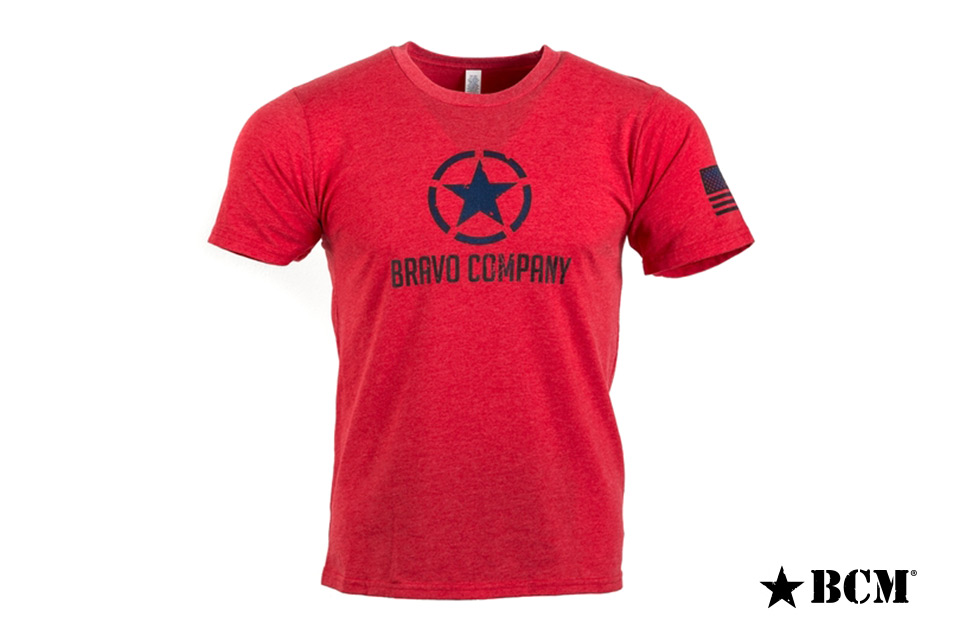
Command Tee S/S, MOD 2
These premium blended tees feature ring spun cotton known for its ultra-soft and strong strands, without the rough texture of standar, open-ended raw cotton. It will quickly become one of your favorites due to its incredible softness and drape. Use of this blended, breathable, and natural fabric yields a more durable wrinkle-resistant shirt that holds its color and shape better wash after wash.
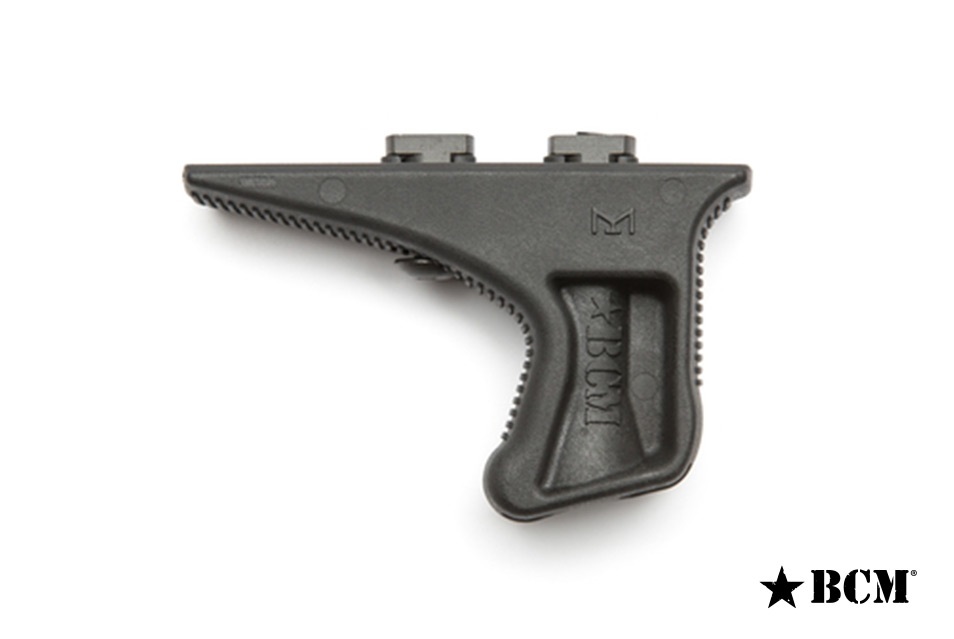
Kinesthetic Angled Grip
The KAG is the end result of collaboration between BCM and Travis Haley. Designed to complement modern shooting grips, the Kinesthetic Angled Grip (KAG) uses a biomechanically efficient forward rake to create an interface for positive retention and joint relief to the wrist, elbow, and shoulder, allowing for smooth weapon manipulation without substantial increase to the girth of the weapon system. Textured on both front and back, the profile of the KAG creates a channel for consistent and positive engagement, translating directly into improved efficiency in weapons manipulation and target-to-target transitions.
MK2 Upper Receiver
Redesigned by lessons learned in combat since September 11th, the BCM Mk2 Upper Receiver is built with up to 30-percent more rigidity than the current Mil-Spec M4 upper receiver without sacrificing interoperability, adding a mere additional 1/3-ounce of weight.
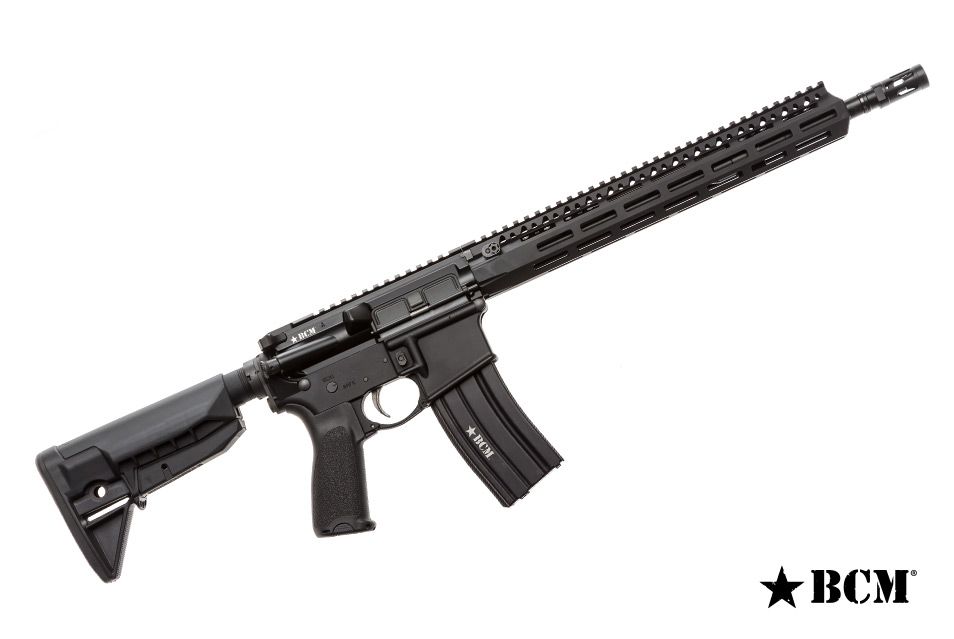
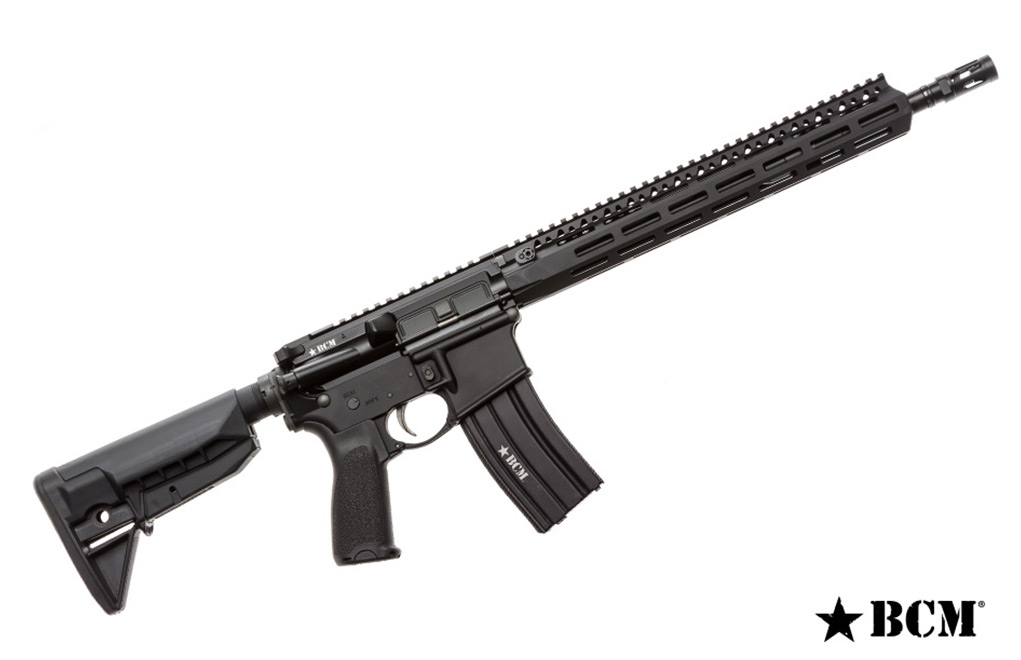
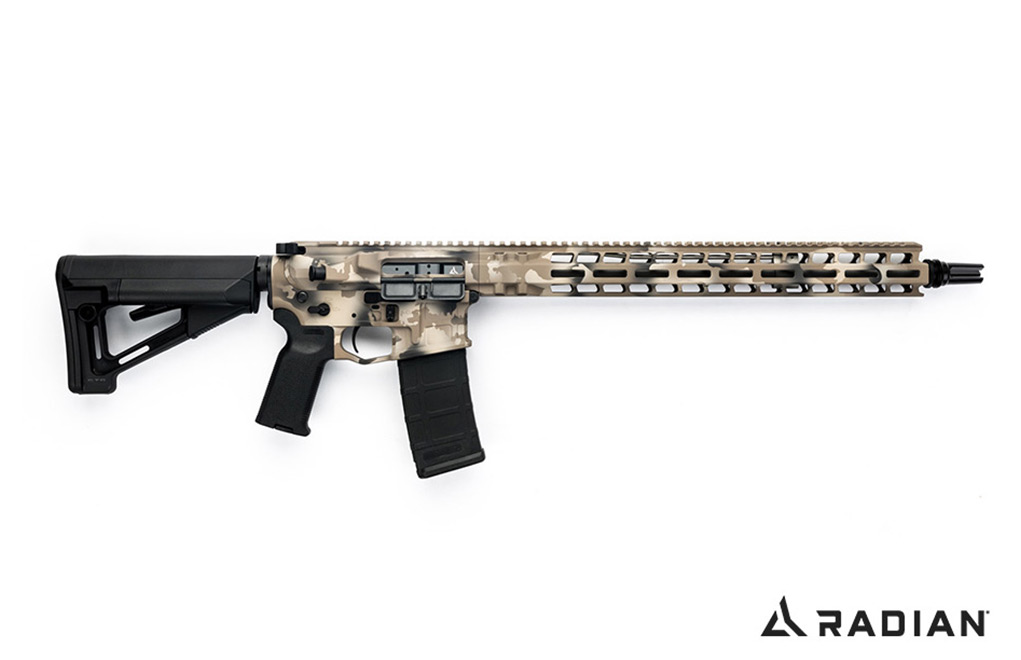
RECCE-14 MCMR Rifle
Upper Receiver
Receiver machined from 7075-T6 aluminum forgings and hardcoat anodized per MIL-A-86
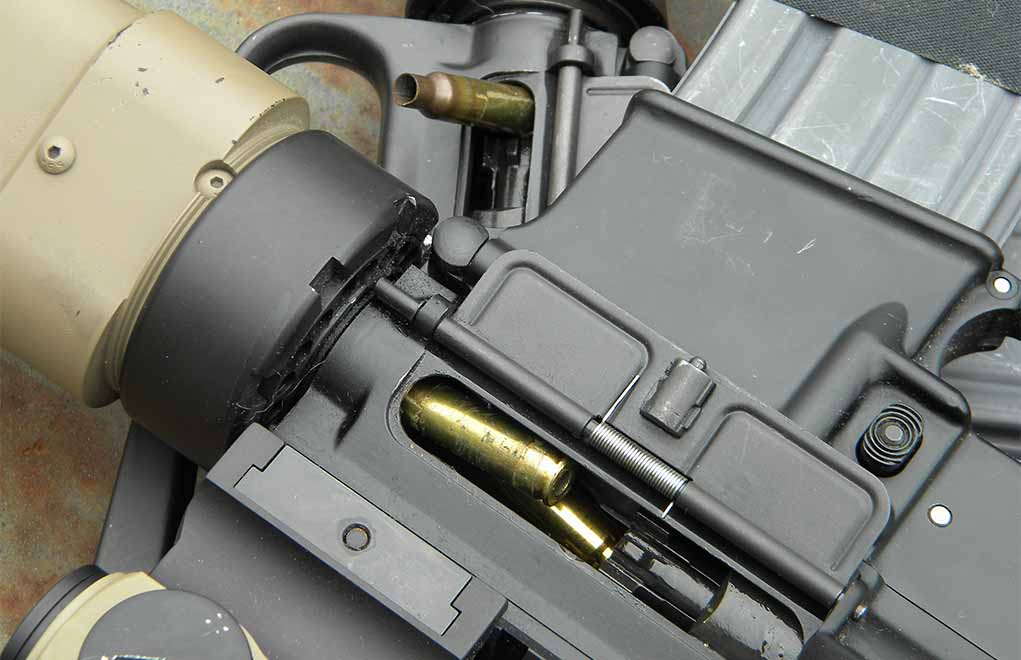
On the top is a Type II malfunction—failure to eject an empty piece of brass. Below is the Type III, or double feed. Using high-quality parts minimizes the likelihood of these problems. But, even then, “Murphy’s Law” kicks in. Be ready to clear a stoppage.
Whether it’s a failure to feed or failure to eject, AR-15 malfunctions are part of life. Here’s how to address them and keep you carbine running.
What Are The Five Types Of AR-15 Malfunctions:
Type I: Failure to feed
Type II: Failure to eject
Type III: Double feed
Type IV: Failure to extract
Type V: Bolt Override
The AR platform is ideal for almost any application. No matter how your AR is configured—or your target—one thing common to every application: the skills used to manipulate the AR. And, the most important of the manipulations is the ability to clear a AR-15 malfunctions or stoppages and get the gun running again.
Administrative Actions
There are two categories of manipulations. “Administrative” actions are used to load and unload. During these actions, you have all the time you need; there’s no reason to rush. “Functional” manipulations—empty reloads and clearing stoppages—keep the AR running. In addition, you usually need to get it up and gunning as efficiently as possible.
Empty reloads are simple. After firing for a while, you know the mag is about to run dry. When the bolt locks to the rear, it’s not a surprise. Old mag out, new mag in, and use the bolt catch as a release to chamber a round. Carry on.
The Type V stoppage is a bolt override. A round or piece of brass gets on top of the bolt and is wedged into the channel where the charging handle rides. You don’t see these stoppages very often. It looks complicated, but it’s actually fairly easy to clear.
AR-15 malfunctions are different, because a stoppage is always unexpected. During a fight (a self-defense confrontation, law enforcement or combative operation), shooters are stressed, and they make mistakes. The probability of having a stoppage in a fight is much higher than it is on the range. And when your AR stops working, you need to fix it.
Common AR-15 Malfunctions
There are three common stoppages with the AR, as well as two others that appear occasionally. The techniques to clear these are based on the skills used to load and unload.
Retro AR-15: The Old Rifles That Inspired The New Ones
What Factors Do You Need To Consider In An AR-15 Trigger Upgrade?
However, sometimes unloading requires a couple of extra steps, depending on what type of stoppage you have. If you know how to “speak” AR, it will tell you what’s required to get it running again.
Start working an AR hard, and things just happen. Using quality ammunition goes a long way toward avoiding these problems. The best way to prepare for these events is dry practice with dummy ammo.
The Type I stoppage is caused by no round of ammo in the chamber; a bad round of ammo, such as a faulty primer; or the bolt is out of battery. No matter the reason, when you press the trigger, the AR doesn’t fire.
Your immediate action is to “load.” Come off the trigger, tap and tug on the mag to ensure it’s locked in, and cycle the charging handle to load the chamber.
A Type II stoppage is a failure to eject an empty piece of brass (also called a “stove pipe” or “smokestack”). You press, but no bang! Your immediate action is to load. It’s a different type of AR-15 malfunction, but your initial response is the same: Off the trigger, tap and tug on the mag, and cycle to chamber a round.
The Type IV AR-15 Malfunction is a case stuck in the chamber. To clear this, you have to bang the rear of the stock against something solid while pulling back on the charging handle. This generates the force needed to pull the case free—or it will rip it, which means it’s going to take time and tools to fix.
Type III is the “double feed.” Two things, either brass and/or live rounds, are trying to occupy one space—the chamber. You press, and when the AR fails to fire, roll into the loading sequence. You cycle the charging handle, but the way it feels indicates that this isn’t ejecting the trash or loading the chamber. It’s time to unload.
Unloading
Unloading begins by removing the mag. The bolt is trying to feed a round out of the mag, so you’ll have to pull or strip the mag out of the receiver. Cycle the charging handle a minimum of three times; it’s usually going to take this to get rid of the stoppage. Once the charging handle feels right and the bolt is going into battery, it’s time to load.
Sometimes, Type III obstructions are wedged together tightly. You cycle three times, maybe four, with no joy. The handle is telling you to manually lock the bolt to the rear. Once it’s locked back, taking buffer spring pressure off the obstructions, put your fingers up the magwell and push. Shake to get the trash out. Manually cycle the bolt once more to ensure the chamber is clear; then load.
Types I through III stoppages are common. Types IV and V AR-15 malfunctions don’t happen often, but you still need to know how to fix them.
More AR-15 Malfunction Scenarios
Type IV is a case stuck in the chamber. You’re pulling the charging handle, but there’s no rearward movement—the case is stuck in the chamber, and the bolt’s extractor is hooked on the case. The AR is telling you to unload.
Should your AR stop working in a defensive situation and you’re within handgun distance, the most efficient way to get hits on the threat will be to transition to a pistol. However, at some point, you’re going to want to get the AR running again.
Remove the magazine. Hook two fingers on the charging handle, supporting the AR with the other hand. To generate the force needed to pull the case from the chamber, bang the rear of the stock against something solid while pulling rearward on the charging handle. Cycle to clear the chamber, then load. This action will either clear the case, or it rips it, which unfortunately means it takes time and tools to correct. This is a good time to transition to the pistol.
A Type V stoppage is a “bolt override.” A round or piece of brass gets stuck above the bolt. The AR lets you know it’s a Type V via the charging handle. It will usually come back part of the way, but there’s no spring pressure on it. Remove the mag. Put a finger or other tool up the mag well and in front of the bolt; the other hand should be on the charging handle. Pull back on the charging handle while pressing the bolt to the rear. Once the bolt is all the way back, hold it there and work the charging handle forward. This frees the obstruction. Quickly remove the finger/multi-tool and let the bolt fly forward.
The Goal
Ultimately, manipulations should be done without needing to see your firearm. Keep your eyes on target. Again, listening to what the AR is telling you will help with this process. With plenty of practice, you get to the point at which everything is done by physical confirmation and at a subconscious level.
To avoid trouble, make sure to have good gear. Quality parts, such as a proper extractor spring (I recommend the Colt “gold” spring), good mags and ammunition, go a long way to ensure your AR is reliable. Learn how to properly load, unload and reload.
But even then, stoppages occur. Make sure when that time comes you’re ready to fix the problem, safely and efficiently … and possibly under stress.
Not only does this show a steadfast commitment to keeping Americans hard at work, it also demonstrates that quality-made gear is still available on our own shores. American muscle is still alive and well. Here we’re honored to have a few of those companies grace this site with an assortment of products you’d be proud to own.
Gun Digest went in search of companies that support our belief in American-made firearms and gear. Combing through those gun and gear makers turned up several who proudly support this country’s excellent manufacturing base. Whether they’re making you next every-day-carry pistol or accuracy-enhancing accessory, these firms either assemble and/or manufacture 100 percent in the USA. That’s something to be proud of.
Shelter-in-place survival guns can be divided into four categories: extreme range rifles, moderate range rifles, close range long guns and intimate range weapons.
When it comes to firearms for sheltering in place, one concept is key: the layering of weapon coverage for your permanent position.
Your weapons should cover threats at extreme range (200 yards+), moderate range (200 yards down to 50 yards or less), close range (15 yards and in), and intimate range (closer that 3 feet). You don’t need a lot of guns; a minimum of four will suffice, but get more if you can afford them.
Requirements for such weapons, in addition to being from a military lineage, should be as follows.
Extreme Range Rifle
The 5.56mm does not get it for true extreme range shooting. It is accurate, but runs out of gas. For the AR-15 weapon system cartridge selection begins with the 6.8 SPC and goes up from there. The addition of an adequately powered scope sight is helpful, depending on the layout of your living area. If you won’t be shooting at extreme range, you may still need a caliber able to penetrate heavy cover or vehicles. For me, my M-1 Garand works well in that role (a Springfield M1A is as good as it gets), while my custom 6.8 SPC AR with scope works well at the extremes. Stay away from bolt guns if you can, as your threats may be numerous.
Moderate Range Rifle
Here is where the 5.56 ARs and 7.62×39 or 5.54×39 AKs, and the M1 carbine shine. If semi-autos are banned in your area, then your next best choice is a lever gun. Pump rifles are fine, but you can’t lay the forend on a solid rest and keep shooting. The .357 or .44 Magnum Marlin 1894 carbines come to mind here.
Close Range Long Gun
At 15 yards and in, the shotgun still shines, even though it has a reduced magazine capacity. If you have a semi-auto that runs good, the home is a good place to use it. You can even trick it out with high-capacity competition magazines or speed loading systems. Concealment is not an issue. Of course, your AKs and ARs are still good to go for this purpose, as are pistol-caliber carbines.
Intimate Range Weapon
Three feet and closer means pistols, weapons with bayonets mounted (as the ultimate weapon retention device), and combat tomahawks or large knives as last-ditch options. For pistols, I still err on the side of capacity. The 1911 or a classic combat revolver are great and reliable tools, but not when you are expecting a lot of company. If you can’t afford anything else, go with what you’ve got, and practice reloading.
Think about your defense mission at home and reevaluate what you have. If you don’t have a gun safe, get one, and fire-lined ones are the best. You don’t want marauders cleaning you out in advance of a major event. Know your local laws and practice, practice, practice.
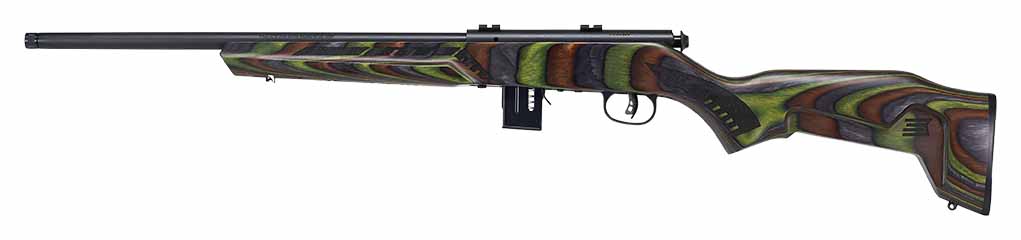
A one-of-a-kind looks, the Savage Minimalist is an eye-catching rimfire rifle that produces out-of-sight downrange results.
If you haven’t noticed, rimfires are taking off these days—both pistols and rifles. While this might complicate your selection somewhat, the abundance of plinkers does have an extremely bright side. Perhaps at no other time has there been more quality made rimfire guns at better price points. Who can argue with that?
Leading the way in both of these departments, at least when it comes to long guns, is the Savage Minimalist. Unique looking and tuned to own the bullseye, the slick little shooter comes in at a very affordable $359, making it among the most economical options out there today. Just because Savage is taking it easy on your pocketbook, don’t think for a second they’re shorting you on features. Amazing for the price, the Savage Minimalist comes decked out with assets you’d expect to find a much more expensive gun.
Right off the bat, the rifle’s stock is the most eye-catching aspect, and its unusual profile isn’t just there for looks. Working with Boyds Gunstocks to design it, Savage aim at not only managing the rifle’s weight, but also making it more ergonomic, thus more intuitive and comfortable. Additionally, it’s decked out with laser stippling on the fore-end and grip, ensuring a solid grip on the gun, no matter the conditions.
Other notable of the Savage Minimalist include:
10-round removable box magazine
Sporter taper barrel
½-28 threaded muzzle with cap
User-adjustable AccuTrigger
Three caliber choices: .22 LR, .22 WMR and .17 HMR
2-Piece Weaver bases
Rimfires are on the rise, but as the Savage Minimalist proves you don’t have to break the bank to put a top-end plinker in your safe
For more information on the Savage Arms Minimalist, please visit savagearms.com.
You won’t always have a buddy on the glass next to you, so becoming your own spotter is key for consistent long-range shooting success.
Why It’s Important To Become Your Own Spotter:
On a miss, it gives you data for your correction.
Properly doing so means your correctly managing recoil.
It improves your focus, which is a key element in making a long-range shot.
I always put a heavy focus on the fundamentals of marksmanship in my articles. One of these fundamentals is natural point of aim, which we describe as rifle pointed to the target, body pointed to the rifle.
If we go back in time and look at sling shooting, we notice that the shooters were positioned to one side behind the rifle with their dominant leg kicked up. The purpose of this position was to align the support arm directly under the rifle. You need proper bone support; and, in an unsupported, or sling-supported prone, that means your forearms are aligned straight under the stock.
Fast-forward a few dozen years, and we’ve moved from shooting with a sling to shooting with a bipod and rear bag. The shooter’s body position needs to change now to manage the recoil in a straight line. Recoil management tells the bullet where the barrel is upon releasing the shot. This controls your zero, because each person will manage it in a slightly different way.
Alternate positions use the same type of recoil management techniques. The style of rifle or type of support changes very little.
By eliminating angles in your body position, we line up directly behind the rifle, our spine parallel to the bore. When the shot is fired, recoil will exit out the legs, and the rifle will stay straight and in line with the target. This concept sounds simple, right?
Going further back in time, I can’t help but think about my USMC days, when I was a young scout sniper. The mindset was that the senior member of the scout sniper team was assigned as a spotter, and the junior member of the team was the trigger-puller. Setting up as a two-person team, you have the shooter in position, awaiting instructions from the senior member. All directions come from the spotter. The only job of the shooter is to execute his commands … and that’s not a very good way to do business.
Today, I question taking the senior man out of the fight. Why give the most effective member of the team a spotting scope? We have learned so much since 2001—and recoil management is probably the most significant of all lessons learned. Through recoil management, we can put both members behind a rifle in the fight.
When shooting off a bench, get square behind the rifle and plant both elbows on the bench. It’s not a bad idea to place a block forward to press the bipod into.
If the target is of such high priority, why not use a set of “talking” guns instead of just one?
Get On Target With Precision Shooting:
Mils vs. MOA: Which Is The Best Long-Range Language?
Scenario 1: The spotter lines up the target for the shooter. The spotter instructs the shooter onto the mark and gives him the current wind call. The shooter fires on command, and the wind call is wrong. The spotter observes the impact while the shooter is running the bolt, and correction is given. The adjustment is made, and a second shot rings out, impacting on target. This is a typical shooter/spotter dynamic.
Scenario 2: Both members are on their rifles. The same calculations are made—except this time, when the shot misses, the second shooter sees it. He immediately adjusts his rifle and fires the shot before the first shooter has time to react. If things go south in any way, there are now two shooters in the fight, versus just the one.
Becoming Your Own Spotter
Spotting your own shots isn’t difficult, but it does take practice and understanding. It’s all about recoil management, which focuses mainly on technique and body position, in addition to lining up straight and square behind the rifle and eliminating those angles I spoke about earlier.
These techniques work in a variety of situations, and they allow the individual competition shooter to spot his own impacts and correct on the fly. With most tactical-style precision rifle matches, you don’t have a spotter helping you, so it’s up to the individual to master these techniques from a variety of positions.
Don’t overlook having someone knowledgeable watch you place the buttstock of the rifle into your shoulder pocket. Aligning he rifle straight back into the pocket helps keep recoil in line.
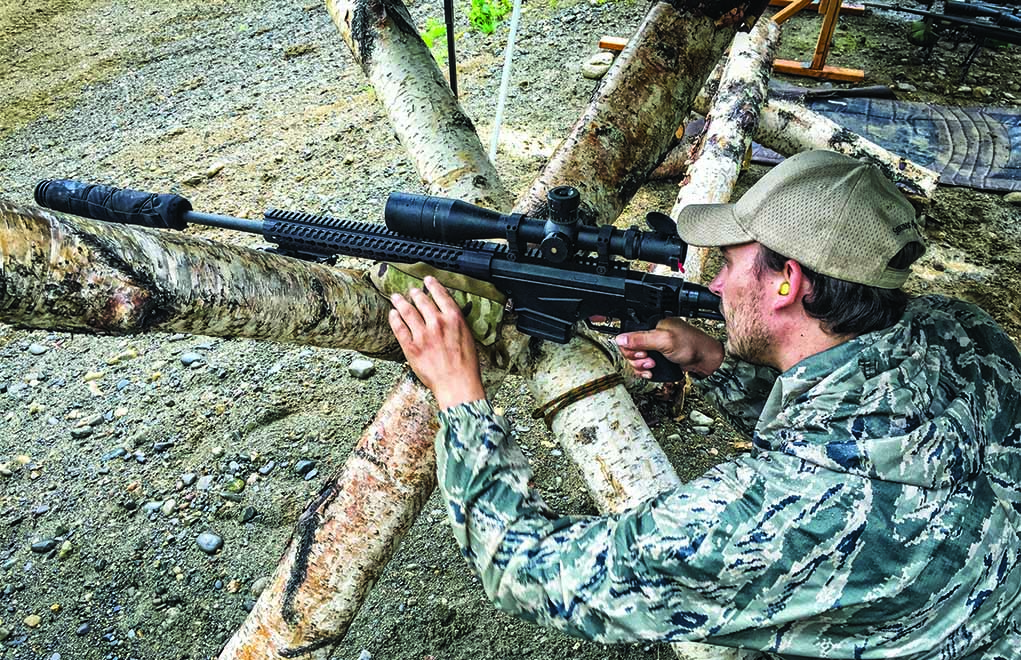
In alternate positions, such as a barricade, it’s about being straight and square behind the rifle. You don’t want to shoot bladed off to the side, as many will do off a bench. Step in square and lean over a bit, placing the shoulders in front of the hips. This may sound strange, but if you chronograph your rifle from the prone and then chronograph it from a bench using a tall, bladed position, you’ll see a change in muzzle velocity. Try it; the results might amaze you.
When we shoot off a bench, we first turn the benches to remove the cutout. Next, we choke up tall in the seat and lean forward so that both our elbows are square out from our body and positioned equally on the bench. We are up high and leaned forward to manage the recoil. This position lets us spot our shots from the sitting position. As opposed to prone, it’s consistent.
If you picture your upper body in the prone, the goal is to translate that same upper body position to the alternate positions we might encounter.
The Bipod
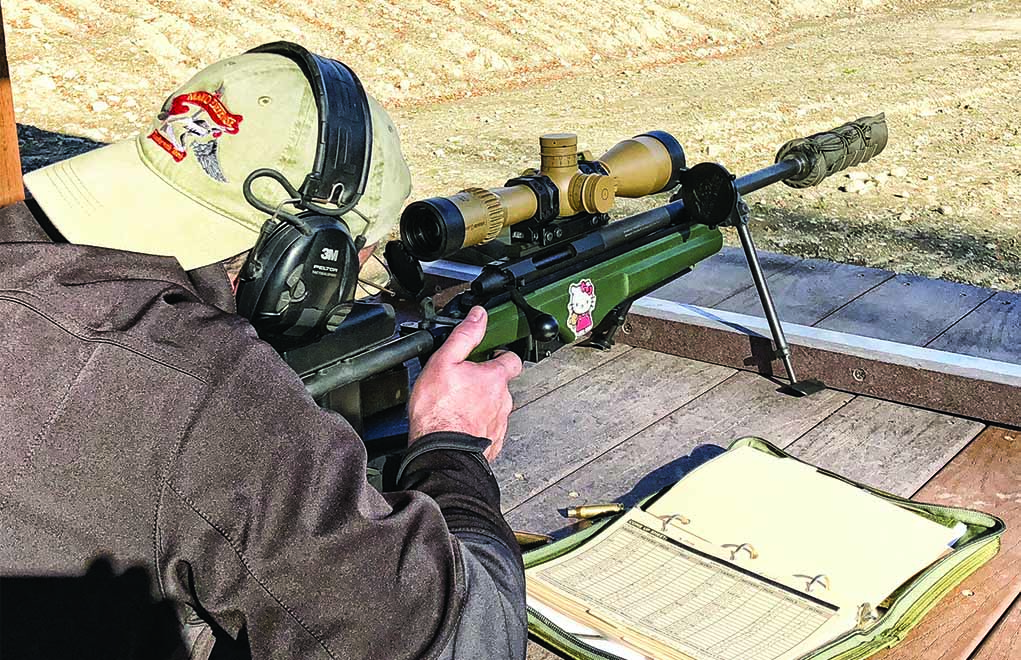
Bipods matter; their purpose is to maximize accuracy and manage recoil efficiently. If we take the lowest common denominator in a bipod—the Harris—we see a stiff, stamped metal device with springs and legs that are not necessarily square.
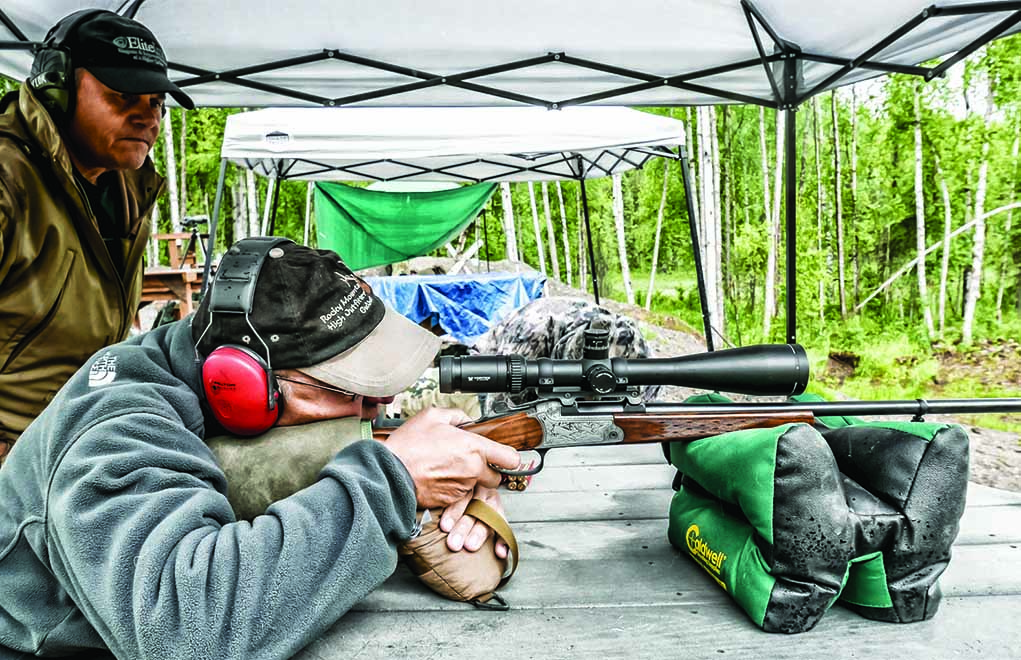
Here, a hunter is taught to shoot properly from a bench. This position contradicts the way many shooting benches are actually built. By changing the bench to be square, we can see the results of our own shots downrange without the aid of a spotter.
Loading a Harris is probably the most difficult for a new shooter to master. Because the Harris does not have any flex in the system, it’s hard to understand just how to load it. Most people want to push forward with their shoulders, misunderstanding that the load comes from the core. In other words: Stack your belt buckle behind the rifle—not your shoulders, because they need to be relaxed.
With a Harris-style bipod, a little goes a very long way. The best way to accomplish this is to pull the rifle back into the shoulder pocket and maintain that pressure to the rear. At the same time, raise your chest up a few inches and bring the legs backward a small amount. While elevated, settle down into your position. The bipod is now loaded. It’s a swift up-and-down motion to load a Harris.
With other bipods, such as the Atlas—which has a small amount of slack in the leg system—you’re similarly removing that slack. You’re placing the rifle in the shoulder pocket and then adding that forward pressure to the slack in the leg system to drop down behind. It’s much easier, because you can see and feel the flex in the bipod. If we look back to the old Parker Hale Versa pod-style bipods, they have a ton of slack in the system to load the bipod so the rifle can recoil in a straight line of that movement.
Managing Recoil
To practice this, start on a target with a berm behind it, preferably at 400 yards out. When you consider recoil and time of flight, this is the “sweet spot.” The goal should be to see the results of your shot: hit or miss.
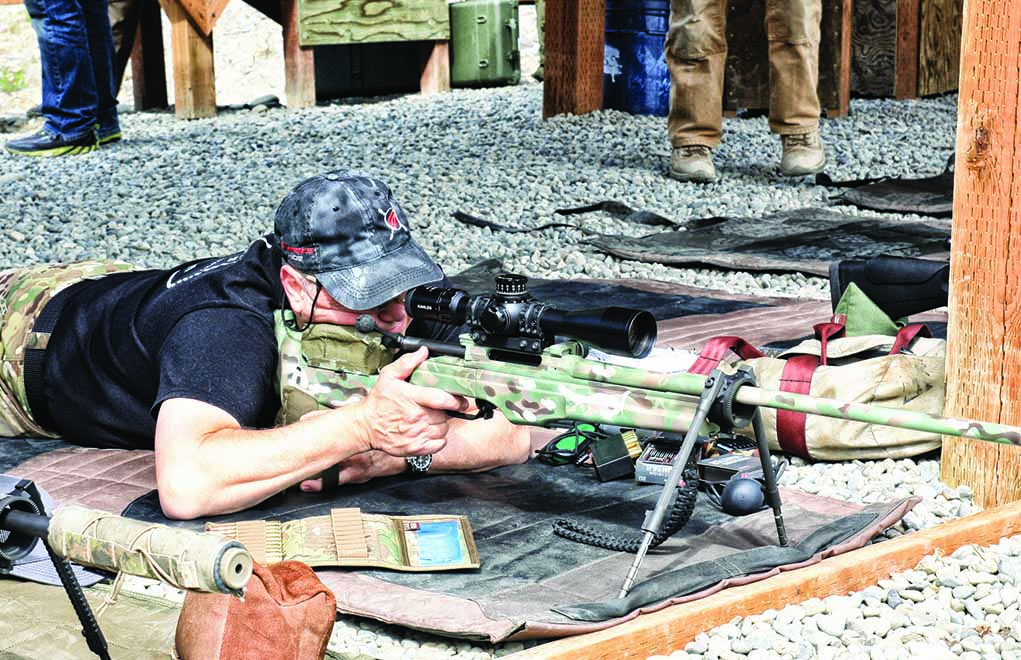
Former USMC scout sniper instructor Marc Taylor demonstrates recoil management with a .338 Lapua Magnum. Note the angle of the bipod legs: The load is visible from a distance.
Next, you have to drive the rifle through recoil and put 100 percent of your focus on the reticle. The relationship between the target and reticle is critical. You need to “see” what’s going on with the shot; and you can’t do that without looking through the scope.
Some people might whiteout or blackout for a millisecond when the shot breaks, but if you look, you should see it. Don’t forget to back your magnification down a bit too—there’s no reason to do this on maximum power. Stick to something such as 12x or 15x, not more. Less is better when it comes to managing the recoil.
Writing about this is a lot harder than demonstrating it. There’s a host of my videos on YouTube and at least 45 minutes’ worth in my “Online Training” section of Sniper’s Hide—45 minutes that concentrate solely on recoil management instruction. That should tell you something about its importance to the modern precision rifle shooter.
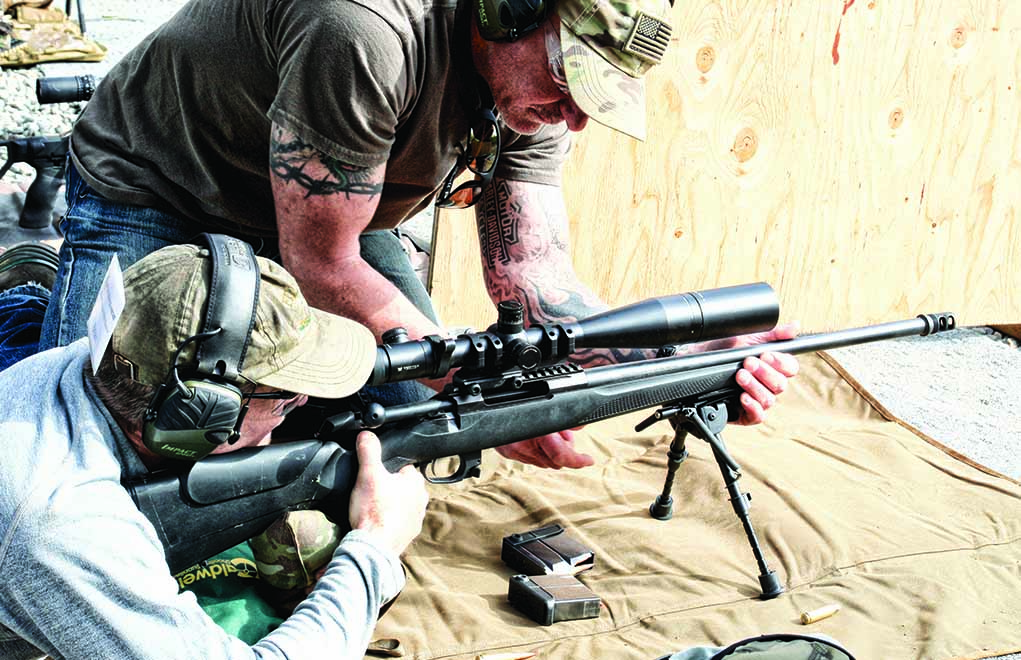
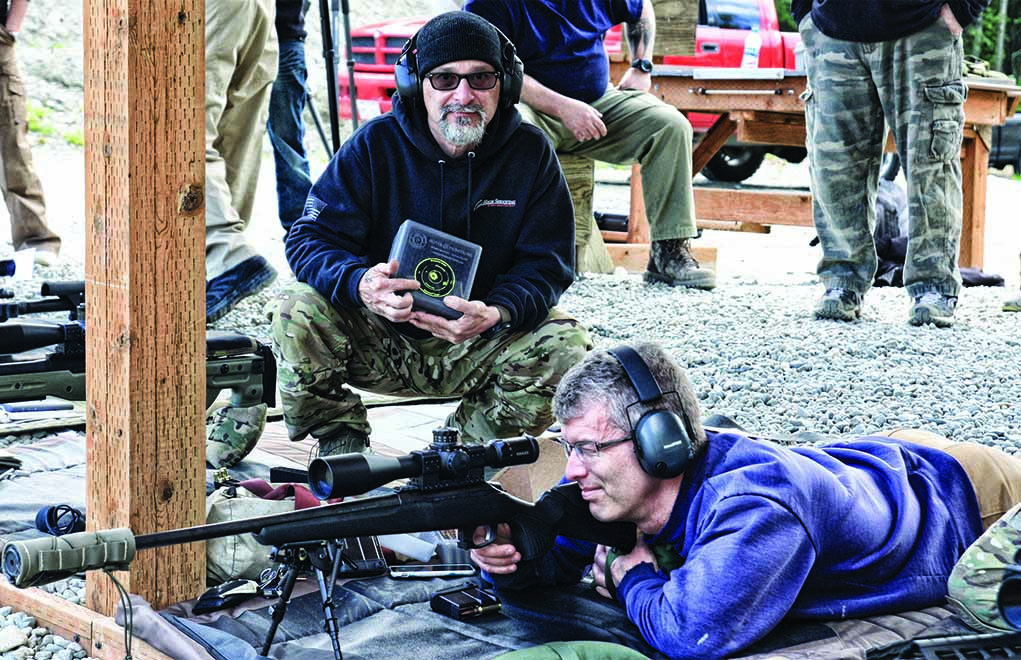
A student with a Harris bipod shoots under the watchful eye of the instructors. The proof is in the groups, which—from a factory rifle—are outstanding.
Being able to see the results of your shot and then immediately follow up with a correction comprise a critical skill set. So, let’s break it down one more time:
Line up straight and square behind the rifle. This means the bipod is correctly adjusted for the shooter’s height. It should not be too high or too low.
Bring the rifle straight back into the shoulder pocket, applying as much weight to the rear as possible, because the rifle is heavy. You want the spine parallel to the bore.
Stack your core weight behind the process; don’t push from the shoulders. You need to be a “slab of meat” behind the rifle and not influence anything with excess muscling.
With the bipod in the shoulder pocket, raise up, removing the slack from the bipod leg system. If you’re using a Harris, knuckle its feet under itself.
Put your focus on the reticle-and-target relationship and follow the bullet to the target.
The “Zen moment” in precision rifle shooting is when you see the hole appear at 100 yards in the paper … and that’s when you’ve correctly snatched the pebble from my palm, young Padawan.
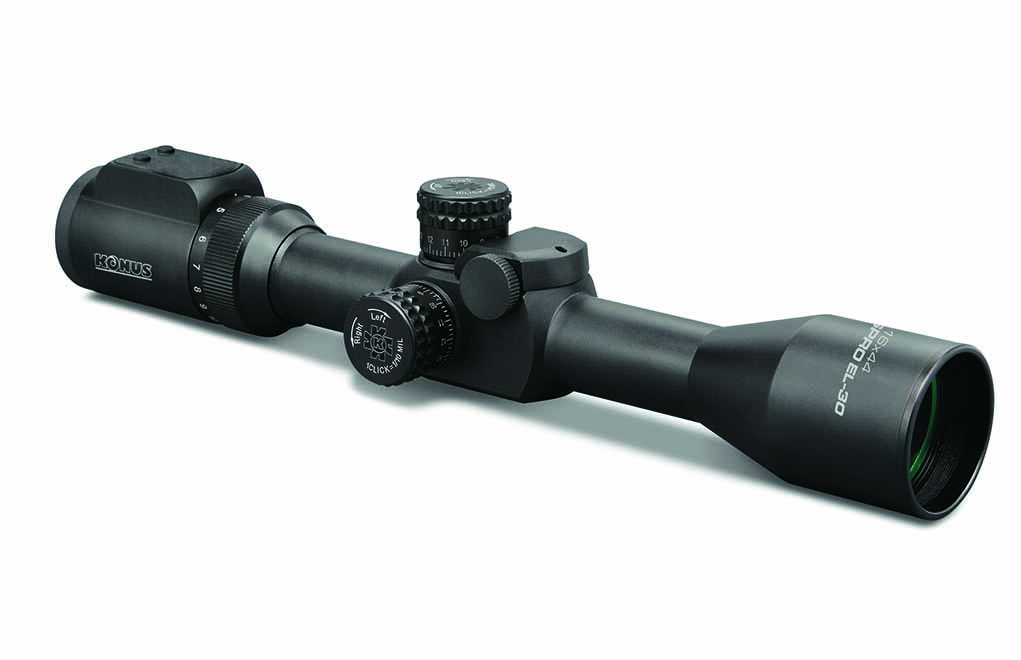
No matter your shooting situation (or range) the Konus EL-30 sets you up for success with a multitude of reticle options at the push of a button.
How the KonusPro EL-30 Is Ready For Any Shooting Task:
The scope has 10 LCD reticles a shooter can cycle through to meet their needs.
Five of the reticles are configured for long-range, three hunting and two close quarters.
The scope still retains traditional windage, elevation and magnification adjustments.
When it comes to selecting an optic, we usually consider the overall quality, then the magnification range and lastly, features such as locking turrets, zero stop and any other bells and whistles.
However, an experienced shooter will take note of one critical, yet often overlooked, component: the reticle. In many ways, selecting the correct reticle will mean more than magnification range.
Let’s take a certain gun writer in his younger days, for example. Hell-bent on taking his .308 Winchester out past 600 yards, he purchased a mid- to high-end optic designed for benchrest shooting. While the optic gave him an 8-32x magnification, it left him just shy of adjustment by 3 mils for 1,000-yard shooting, even after shimming to the point of costing him a 100-yard zero.
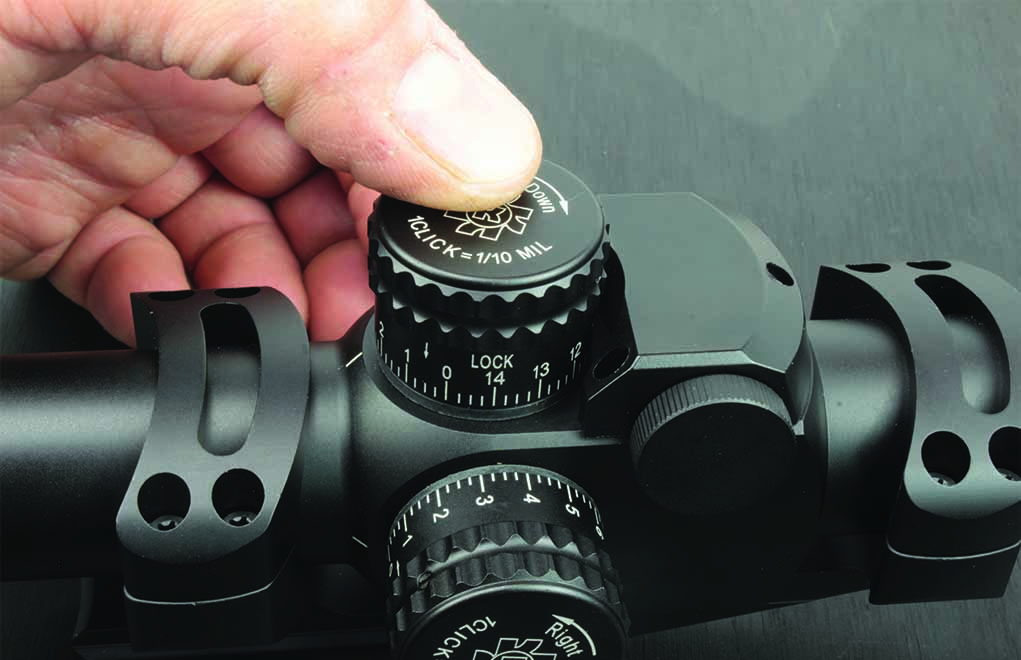
Push/pull locking turrets allow for fast adjustments while keeping your zero safe.
Naturally, most of us would just “make it up in the crosshairs” and use some of the mil dots to score a hit … except that’s where the problem sits—no mil-dots. Yes, this young enthusiast drank the “BDC Kool-Aid” of the early millennium, and in place of useful subtensions were arbitrarily spaced bubbles. While BDC can be a lifesaver for quick hunting shots inside 400 yards, they really become a hindrance at distances past that.
Eventually, that scope came off and another scope (of smaller magnification) that housed a standard mil-dot reticle was mounted in its place. Years later, this long-range rifle was retired to midrange hunting service, and—you guessed it … got the BDC glass back!
If you mount your own scope (and I highly recommend that you do), you understand the frustration of perfectly aligning your optic for eye relief and the diligent work associated with eliminating any cant. When it comes to precision, this process is arduous enough so that you don’t want to have to do it twice. Using a QD mount is a great solution; however, a perfect return to zero is seldom obtained.
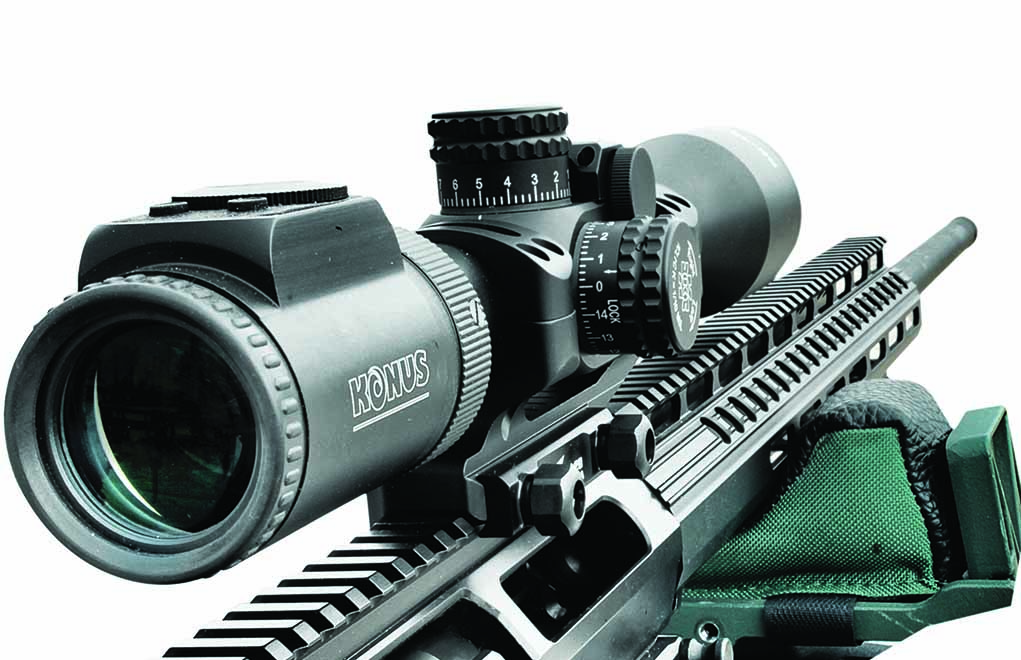
This is where the Konus KonusPro EL-30 gathered its inspiration from. With an innovative LCD reticle, a shooter can change their crosshairs to suit their current needs on the fly with just the press of a button. Although technology got thrown in the mix, the optic still retains traditional windage and elevation adjustments, along with a typical rotating collar for magnification change.
Although advanced, the new liquid reticle scope from Konus only has two buttons. One turns it on or off, and the other switches reticle style. That’s all there is to it.
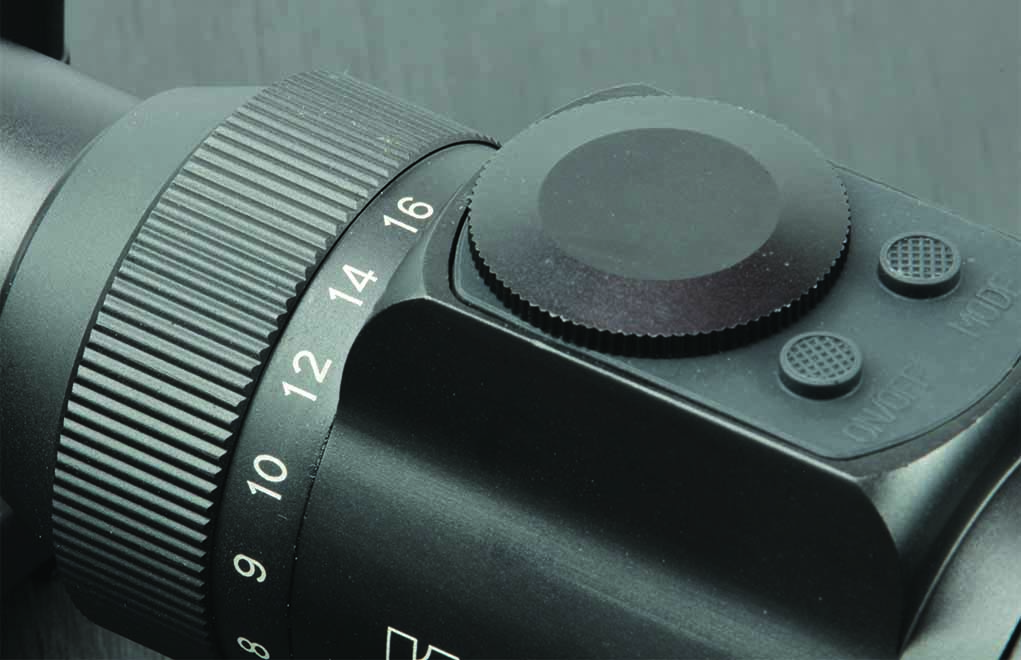
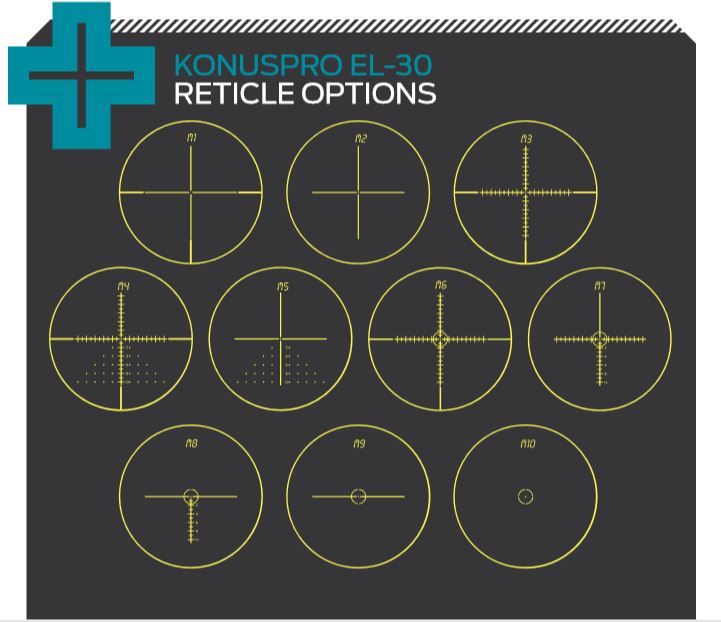
I liked this level of simplicity, because it makes for a very smooth learning curve. Overall, there are only two buttons, both of which are easily accessible in any shooting position. These two buttons are located on top of the ocular bell. The left one controls power (“on” or “off”), and the right one controls reticle choice. Pressing this button cycles the unit through its 10 selections, offering the perfect fit for hunting, as well as long- or close-range shooting. All reticles are positioned on the second focal plane and are true at 16x magnification. This allows the crosshairs to remain easily visible at the lower settings and lets you double or even quadruple the amount of adjustment you have in your reticle by cutting the power to 8x or 4x, respectively.
For the Hunter
For simplicity’s sake, let’s consider “hunting” to be big game at distances inside 300 yards. Reticles M1, M2 and M8 all accommodate your meat-harvesting needs. All three reticles are large enough to see in low light—which is when the majority of your shots will take place—and don’t have the clutter of windage subtensions. Shots inside traditional hunting distances don’t require any wind call, so it doesn’t make sense to add something that’s just going to obstruct your view of something important, such as how many points are on those antlers.
For Close Range
However, 4x zoom does still offer a bit of “run and gun” ability. It won’t have the larger, more natural, field of view of 1 or 1.5x, but it’ll still do the trick if this optic is mounted to a multipurpose rifle such as, say, an AR-15. Reticle M10 offers a dot with halo configuration that spans .4 mils at 4x and 1.6 mils at 16x. Reticle M9 offers the same configuration, except with a horizontal line cutting through it that can be used to judge lead or just confirm a level rifle in an awkward shooting position.
For Long Range
If you’ve opted to mount your KonusPro to your favorite long-distance carrier, 16x power will get you on a silhouette out to just about the distance a standard caliber is capable of. Reticles M3, M4, M5, M6 and M7 offer variations of mil lines and dots that span down the entire length of the crosshairs, allowing for elevation adjustment on the fly. Reticles M4 and M5 offer a “Christmas tree” dot system that spreads out farther as it gets closer to the bottom of your field of view.
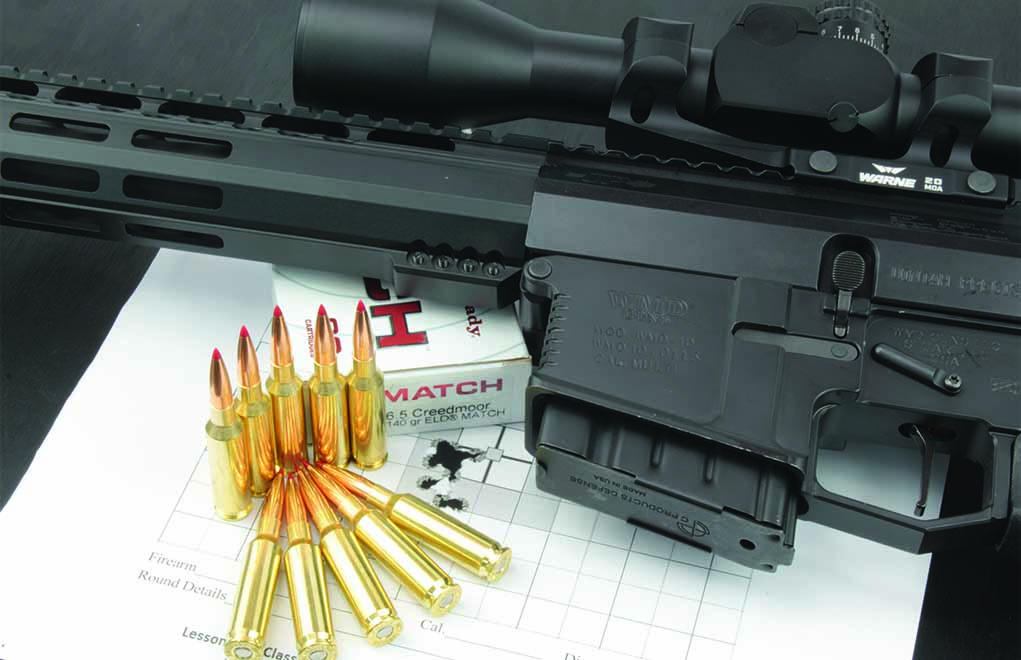
After zeroing, the author fired one shot with each reticle in the KonusPro EL-30. This amazing sub-MOA group was fired with Hornady’s 140-grain match ammo. This test confirmed that there’s no zero change when switching reticles.
I’ve always considered this to be one of the most well-thought-out designs, because wind deflection gets greater with distance. This system not only considers that, it also reduces glass clutter by eliminating markings where they simply aren’t needed.
Setting it Up
Before range day, I built a rifle with the sole purpose of wringing out every possible last drop of accuracy. The idea is that when I want to test a scope, that’s all I want to be testing. Essentially, it’s the basic scientific method, and I’m trying to ensure that the only conceivable accuracy-robbing variable could be the optic.
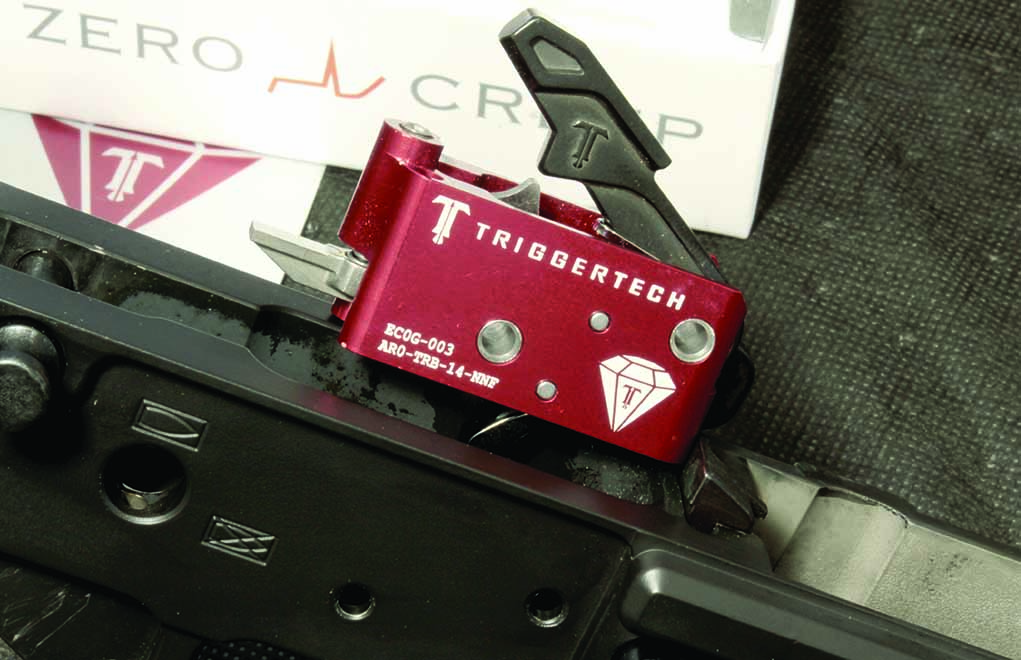
To do so, I started with a WMD AR-10 lower receiver (WMDguns.com; $289) and completed it with an ultra-light Trigger Tech AR Diamond drop-in trigger (Triggertech.com; $299) and a LUTH-AR MBA-1 adjustable buttstock (Luth-AR.com; $139). Once completed, I snapped on a Uintah Precision bolt-action 6.5 Creedmoor upper receiver (UnintahPrecision.com; $1,295) and capped it off with a Kahntrol Solutions HexMod Brake (StopRecoil.com; $94.99).
The placement of the control buttons allows the shooter to easily change reticles without having to break the sight picture.
Turning my attention to the scope mount, I chose a Warne Xskell one-piece base/ring combo set (WarneScopeMounts.com; $139.49), quickly positioned the Konus optic for proper eye relief and torqued it down evenly to my rifle. After stocking up on 140-grain Hornady Match ammo, I hit the range to test its function and repeatability.
On The Range and … in the Kitchen?
I had some mild weather at the range for testing. The wind was all but absent, and temperatures were in the low 70s (not a bad day to be me!).
After 20 rounds to break in the rifle and help settle the stock and every screw involved, I zeroed the new optic in just a few shots. During this time, I took notice of the locking turrets, as well as how locking them down doesn’t affect zero. After I had a good sub-MOA zero, I set up a tall target test to confirm tracking.
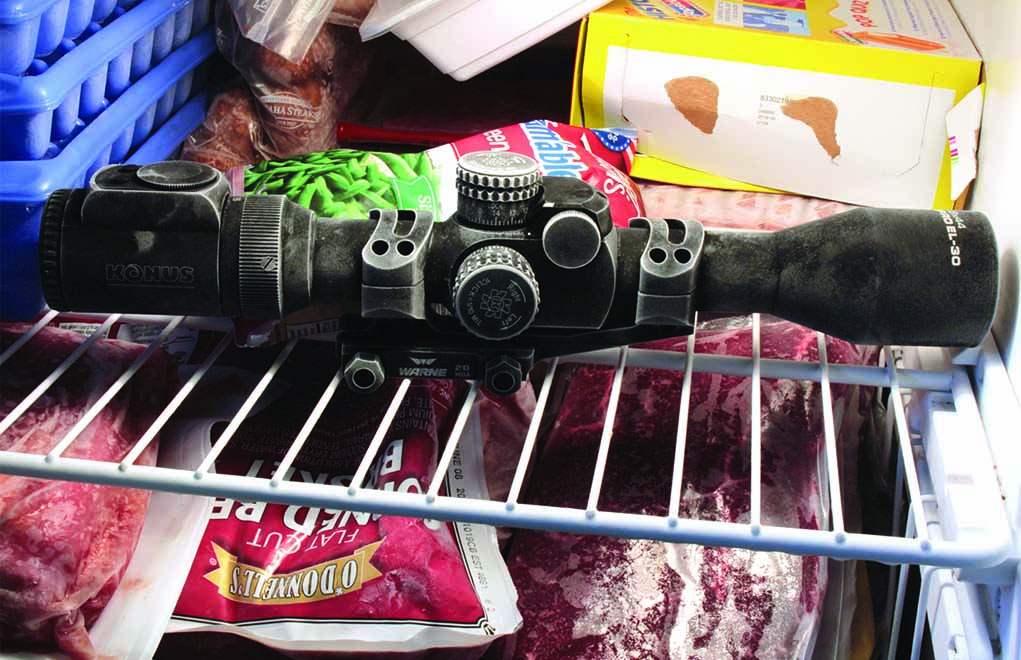
In order to confirm that the LCD reticle would not freeze in cold hunting weather, the author stuck his KonusPro EL-30 into a freezer for several hours. The reticle remained 100 percent functional, and the scope didn’t fog.
This tall target test involves a long sheet of paper (such as the back of a paper pistol silhouette) and a level. At an exact 100 meters (yards for MOA), you position the target, draw a level line from top to bottom, and give yourself a sub-MOA “bullseye” to aim at; it will be located at the very bottom of the line. Once your target is up, you fire a five-shot group to confirm you’re on the dot and right in line.
Next, adjust 2 mils up and fire a three-shot group. Repeat until you run off the paper. Then, you return to your zero setting and fire another group; it should be on top of your original group. The goal is to see if your impacts are moving the correct amount you dialed for and then return to where they belong.
Before that final group is fired, I also like to crank the windage turret throughout its entire range to confirm that it tracks properly as well. The optic passed that test, with all groups measuring under an 1 inch (impressive for a factory gun with factory ammo).
The last query I had was whether there was any zero loss when changing from reticle to reticle, so I set out another target and fired one shot with each reticle setting. The entire 10-shot group was still inside of an inch—simply amazing!
My last test for the Konus LCD reticle scope was of the reticle itself. The “L” in LCD stands for “liquid,” which means it can freeze. I hunt in the Northeast most of the time, and sub-freezing temperatures are the norm. Thinking back to the cheap LCD watch that lives in my hunting bag, that thing stops if it gets cold enough.
That being said, I unmounted the scope and stuck it in the freezer somewhere between the frozen peas and the ice cream that somebody keeps eating at 2:00 a.m. when they get up to go to the bathroom. I left the scope in the freezer until the next morning.
The Trigger Tech AR Diamond was installed to reduce the chance of shooter error showing up as scope error in the author’s tests. Its ultra-light break made it effortless to touch off a shot without pulling the rifle.
When I took it out, it was covered in ice crystals, the glass was fogged up … but the reticle still worked. It changed and powered off and on just the same as when it was in the sun on that 70-degree day. After an hour, I checked the glass again, and there was no sign of internal moisture—indicating a job well done with fog-proofing. Admittedly, I left the reticle on the night before and, to my surprise, it was still on in the morning.
When I reached out to Konus about battery life, all they had to say was, “We stopped testing after a week of straight runtime.” This prototype doesn’t have an automatic shutoff; however, the final production version that’s currently for sale does.
Casing Up
Konus has always been able to pull off some sort of Italian “voodoo” whereby it brings a remarkable product to the table—without a heavy price point. The KonusPro EL-30 can be purchased on OpticsPlanet.com for a measly $399.99. It’s some of the clearest glass I’ve ever looked through. When you factor in the utility of this optic, you could easily justify three times that amount, because it can replace three different optics.
Clouds of dust kicked up by thundering hooves across the sunbaked prairie. The American West continues to stir the imagination, despite its long-ago closing and subsequent taming. Though, artifacts from that bygone era linger and are as striking now as they were in the days of Doc Holliday and Bat Masterson. Among these is the most quintessential of American firearms—the lever-action rifle.
While Marlin Firearms was never strictly a “lever-gun” company, it produced its fair share of outright classics in the style and still does today. In fact, there are many who stand by the idea the Marlin lever-action rifle is the finest lever-action rifle ever conceived and set in blued steel. It a contention that’s difficult to argue against.
Side-ejecting, solid-top receiver, pistol-grip stock—its rifles were innovative. And they got the job done—be it knocking over tin cans or a bull moose. It might even be said that a collection without a Marlin lever-action rifle is incomplete.
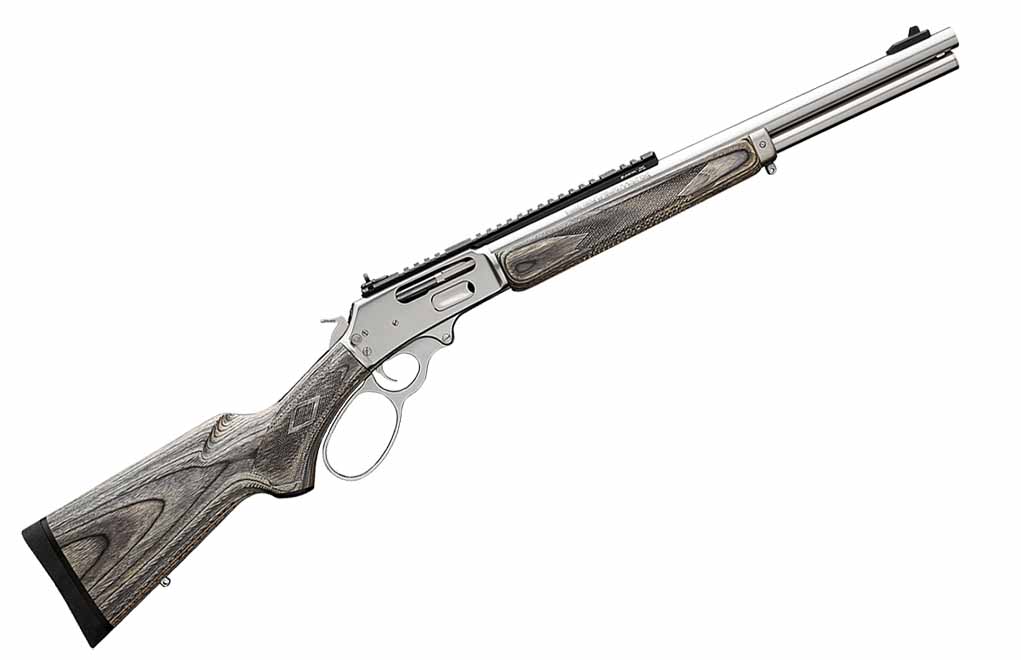
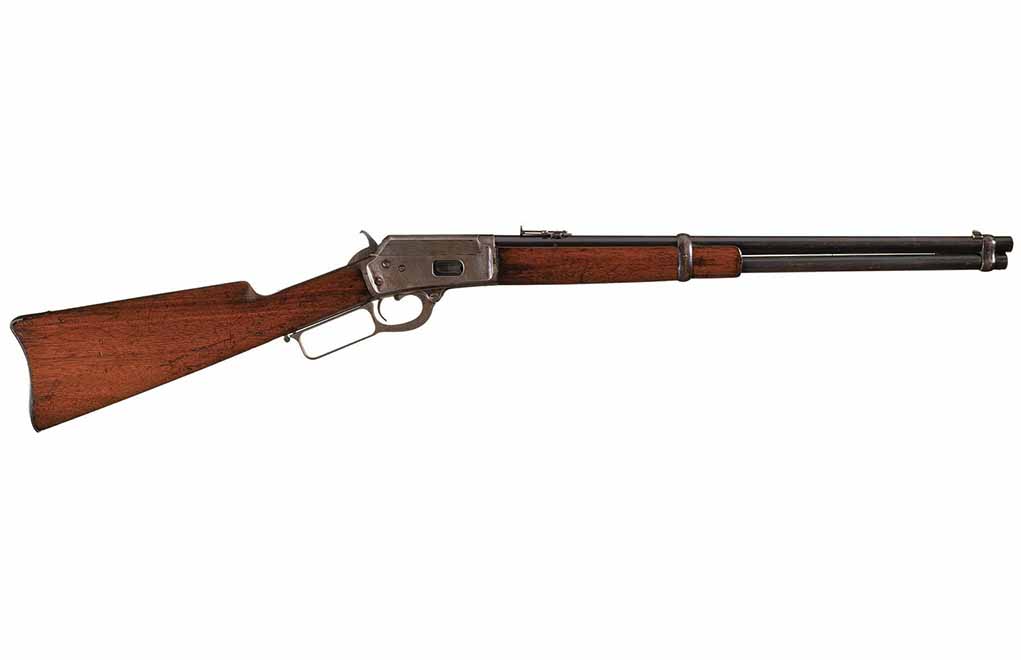
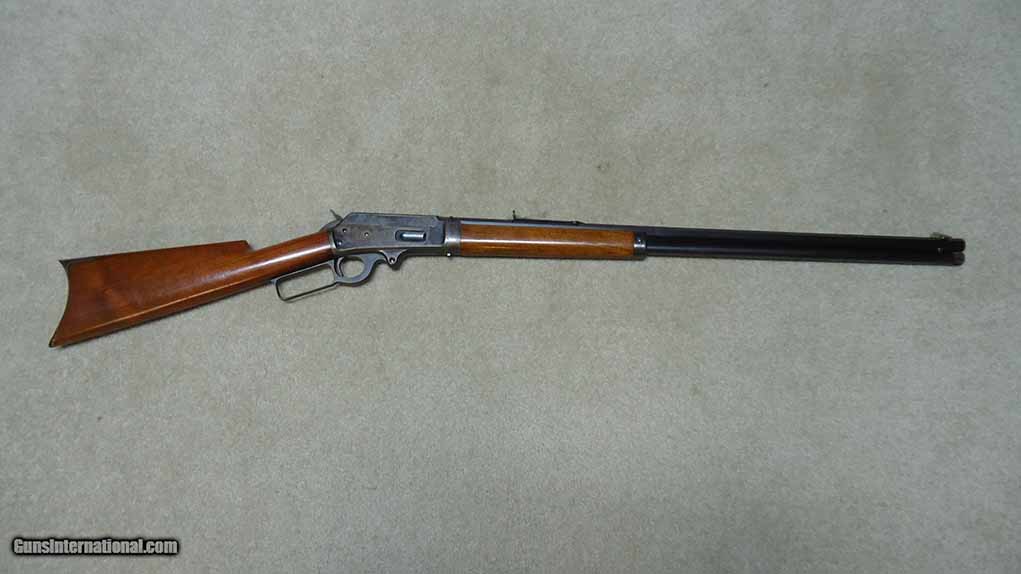
Let’s rectify that. Here are seven classic lever-actions from the iconic company that are as great now as they were when the first hit the scene. Add one to your rack and you’ll understand why the Marlin lever-action rifle is still with us today.
Marlin 39A
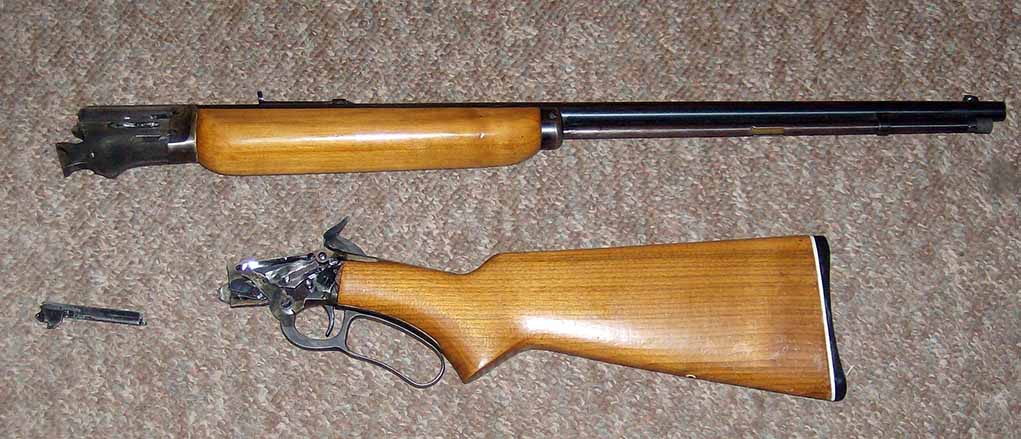
Rimfire and lever-actions fans shed a tear when, in 2007, Marlin ceased production of what arguably is among the greatest .22 rifles ever produced. (Technically the company does still make the 39A, however, it’s a custom order.) Billed as the oldest continuously manufactured rifle in the world, more than one shooter cut their teeth on the trusty, quick and accurate plinker.
Smoothness of action and an exceptional trigger endeared the Marlin lever-action rifle to generations. And there were some knowing marksmen who were found at the business end of the 39A—not the least Anne Oakely (technically its precursor, the 1891). The fact it had a 21-round tubular magazine (when load with .22 LR ammo), was easily taken down into two pieces and had a heavier barrel than many .22 LRs, also didn’t hurt in driving the gun’s popularity.
Today, if you find one, it’s worth snatching up. Well-made and sharp shooting, they continue to be as fun as they ever were.
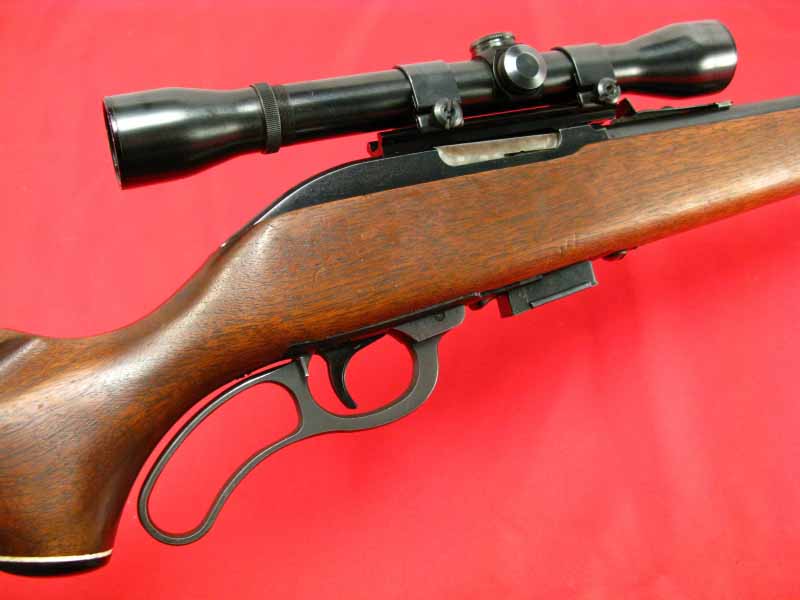
Arguably, the Levermatics are a bit obscure at this point. But as those who’ve been behind the trigger of one can attest, they’re something special. Maybe one of the most underrated brush guns to come down the pike.
What makes the family (56, 57, 57M and 62) so dandy—aside from a removable box magazine—is a frighteningly short lever throw. The lever travels less than 2-inches, in turn it’s possible to operate it without taking your hand off the grip. Needless to say, this makes the rifles fast.
Based on the Kessler Lever-Matic shotgun, Marlin licensed the designed after the other company went bankrupt. Not impossible to find, the hammerless lever-actions had a relatively short production run—just about 15 years in the 1950s and 1960s. Primarily a .22 LR and .22 WMR, the Marlin 62 did offer shooters a centerfire option chambered .22 Jet, .256-Magnum, .357-Magnum and .30 Carbine. Though, no matter the caliber, the Levermatic proves an absolute blast.
Marlin 336
A deer slayer through and through, this Marlin lever-action has a veritable mountain of venison to its name. Though, its time as a hunting season favorite came somewhat further down the line than some other lever guns.
While the Winchester 94 could make this claim well before the Marlin 336 (and its predecessor the 36), it did falter somewhat as the sport progressed. Top ejecting, the Winchester didn’t play nice with scopes. The side-ejecting Marlin .30-30, on the other hand, was just the ticket to ensure hot brass cleared out without so much as a hiccup.
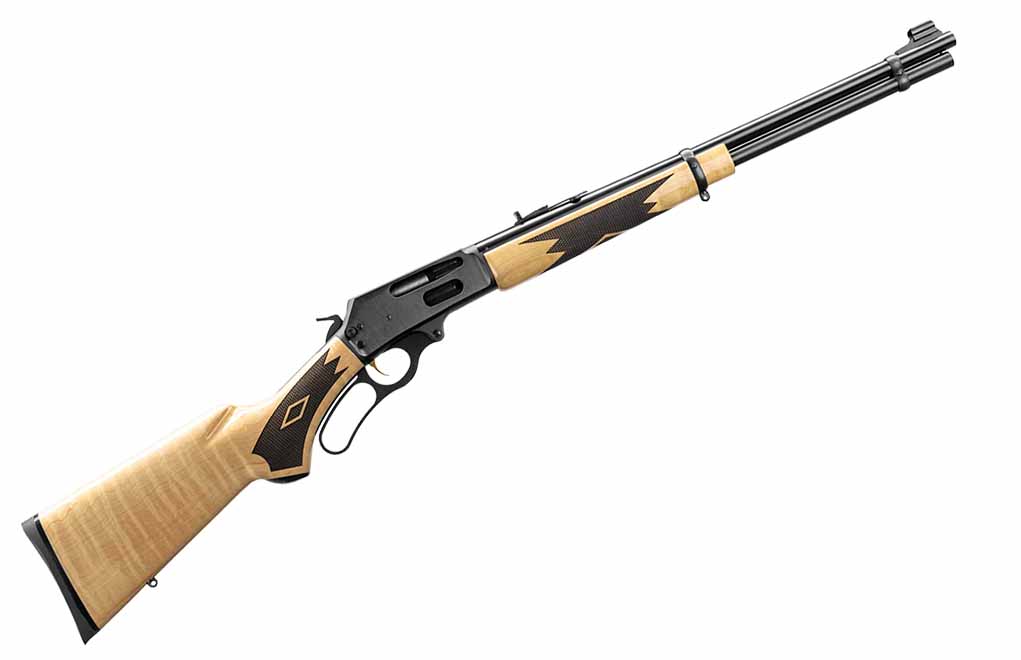
Hitting the scene in 1948, the 336 was an excellent advancement from the 36. Moving away from the 36’s traditional square bolt, Marlin not only made the 336 arguably stronger than its predecessor, but also much smoother in operation.
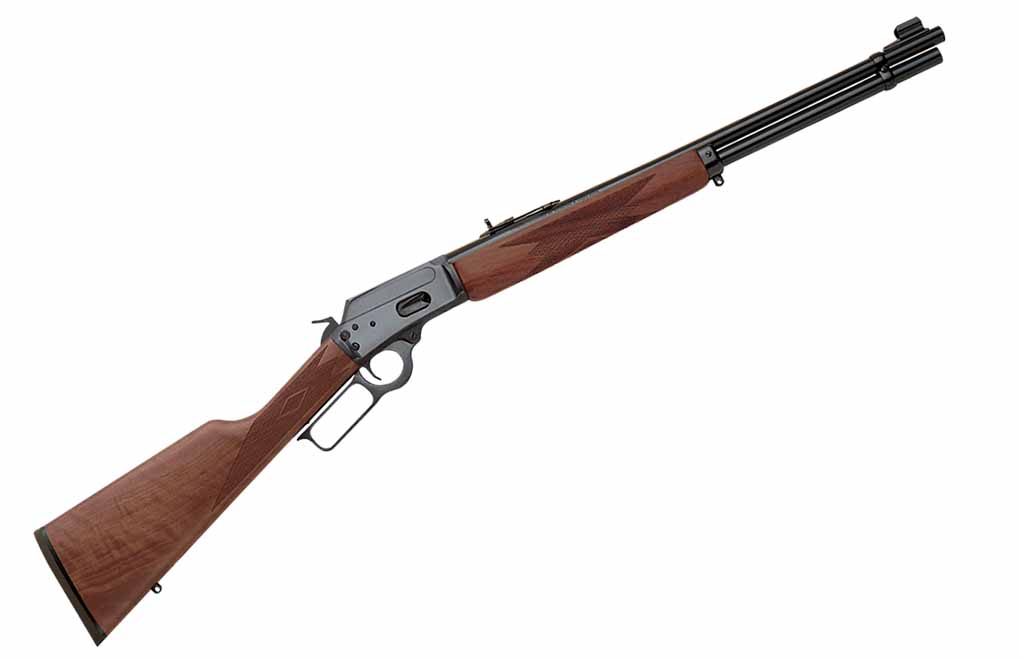
Strange as it might sound, the Marlin 1894 owes a debt of gratitude to Elmer Keith and Phil Sharp. Without the pair’s pioneering work developing a hot-rodded .38 Special cartridge—now known as the .357 Magnum—the famous Marlin lever-action rifle might have been a footnote in history. Heck, by 1935 the gun was all but written off by the company—out of production and starting be become forgotten … almost. Wisely, with renewed interest in pistol-caliber long-guns thanks to the magnum cartridge craze, Marlin didn’t go back to the drawing board to make a gun chambered for them. Instead, it stuck with the established and effective design of the ‘94 and reintroduced it in 1969.
Like most Marlins, the advantage the ’94 brought to the table was its side-ejecting system. Overall, simpler and arguably stronger than top-ejecting lever-actions, it was an easier rifle to keep in working order and have ready at a moment’s notice. Proof of this concept came in the rifle’s earlier days when it became the choice of Canadian and Alaskan gold prospectors, who found top-ejecting lever-actions had a tendency to freeze solid. Not good in brown bear territory.
Today, the 1894 remains among the company’s most popular rifles for many of the previously mentioned reasons. As well as, it also stays true to Marlin’s “New Safety” design. While the greater part of the gunmaker’s catalog has drifted to round bolts, the ’94 still boasts a square bolt and solid top, just like the Marlins of yore. The ’94 has come in plenty of pistol-caliber flavors, including .32-20 Win., .44-10 Win., .45 Colt, .357 Mag/.39 Spc., .44 Mag/.44 Spc., .44 Mag. and .32 H&R Mag.
Marlin 1895
Undisputed muscle in the field, when most shooters think big-bore lever-guns they think the monstrous 1895. It’s been that way for more than 100 years, though the behemoth has had a tough slog generating true interest until recent times. When it first hit the scene, bolt-actions and high-velocity cartridges were all the rage; then, when it reappeared in 1972, it was the time of the belted magnum. A rifle chambered for .45-70 couldn’t hold a candle to that … or could it?
It seemed it could, once certain states loosened deer regulations to include straight-walled rifle cartridges. Sure, the Marlin 1895 wasn’t going to pitch a .45-70 bullet a quarter-mile, but it didn’t need to in these regions.
Early on, the Marlin lever-action rifle boasted the same square-bolt, side-ejecting design of nearly all of the company’s guns. Things changed later in the century, with Marlin opting for the round bolt of the 336, only more beefed up for the rifle’s large cartridges. In addition to .45-70 Government, the rifle is also available in .444 Marlin—the powerful modern straight-walled cartridge Remington developed for Marlin. Despite the company calling this version of the rifle the Marlin 444, it is essentially the same gun.
Sure enough, this Marlin lever-action rifle is tougher to find than the rest. And it might not be the first thing you’d strip off the rack come hunting season. But if you enjoy historic firearms, then the 1889 is worth the hunt.
A watershed rifle, the gun pretty much set the tone for the Marlin rifle as we know it today. The company’s first solid-top, side-ejector rifle that’s pretty much been Marlin’s groove ever since. Essentially the design makes for a more rugged gun, given it has a locking lug, and safer, thanks to a firing pin system that prevents firing until the bolt is closed.
On top of all this, it can shoot! Again, Anne Oakley was known to favor the rifle, among other crack shots. The rifle can be found in a variety of chamberings, including .32-20 Win., .38-40 Win. and .44-40. No matter what it shoots, it’s among the all-time classics.
First off, the Model 1893 will run you a pretty penny, unless you find an absolute rag of a specimen. However, if truly iconic rifles are your thing, this Marlin lever-action is a must-have. It was the belle of the company’s catalog from the turn of the century until the advent of the 336 action.
Initially, the 1893 was a black powder rifle, but earned its popularity as Marlin’s first gun chambered for smokeless powder cartridges. This included a chambering for the deer-hunting favorite .30-30, as well as .32 Win. Spl. and .25-36. A staple of deer woods coast to coast, hunters flocked the rifle, with some 1 million made over its production cycle.
In addition to being a top shot, it has everything you want in a classic Marlin: solid-top receiver, square bolt and beautiful stock and lines. It’s no wonder the ’93 continues to draw top dollar at auctions.
For more information on Marlin Firearms, please visit marlinfirearms.com.
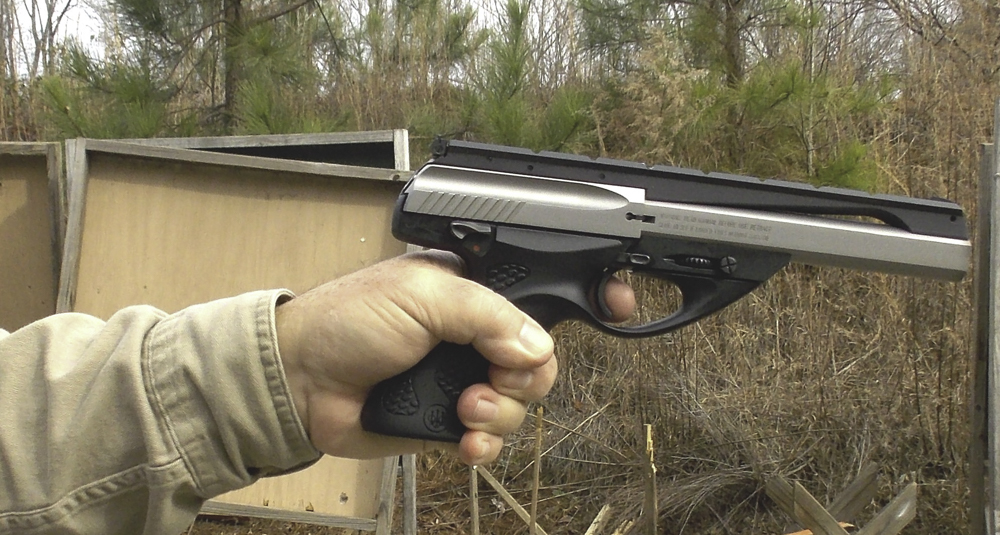
The Beretta Neos is a futuristic-looking .22 LR handgun that really shoots well.
The Beretta Neos might look like a stage prop from the latest Star Wars sequel, but it’s actually an accurate .22 pistol to cover multiple rimfire shooting needs.
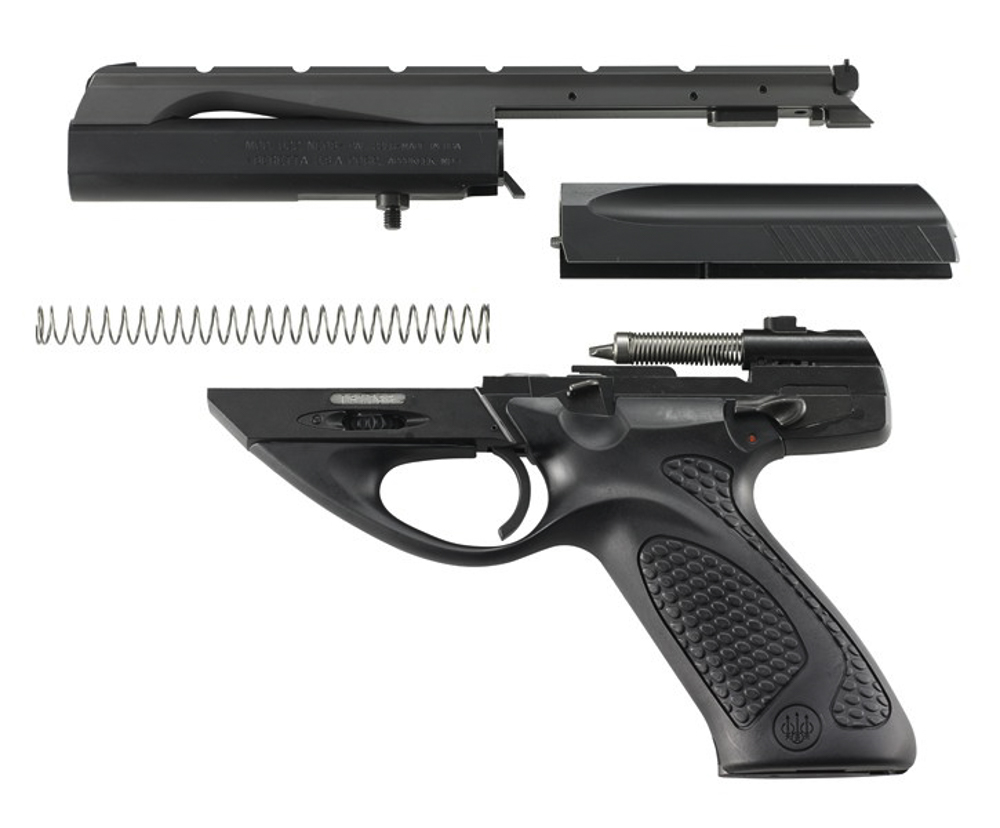
The Beretta Neos easily field strips and provides overall excellent service.
A handgun that I came to accept a bit later than some is the Beretta Neos.
Beretta just doesn’t manufacture second rate pistols and the Beretta U22 Neos is an affordable jewel. My example is the longer barrel version and it is heavier than some but amazingly accurate when I do my part.
It is well-made of good material. Once you get past its space gun looks you find excellent human engineering. The Neos is a light-packing .22 at 31 ounces in the shorter barrel version.
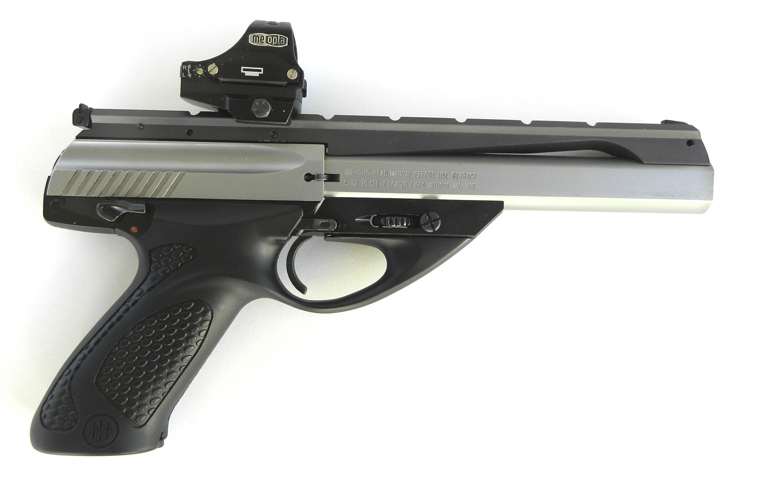
A Meopta red refl ex sight mounted on the Beretta Neos .22 handgun.
Beretta Neos Features
Like all the .22 LR self-loaders, the Beretta Neos is a simple blowback action intended for high-velocity cartridges. The sight track is a little difficult to get used to. The sights are well-designed but buried in an upper rail.
I like the rail but you have to concentrate on the iron sights not to be distracted. The rear sight is a standout for utility and modern design.
The safety is ambidextrous and easily activated. The magazine release is ergonomically designed and easily used. It rides on the right side of the frame and is activated by the trigger finger. You never have to shift your grip to use it.
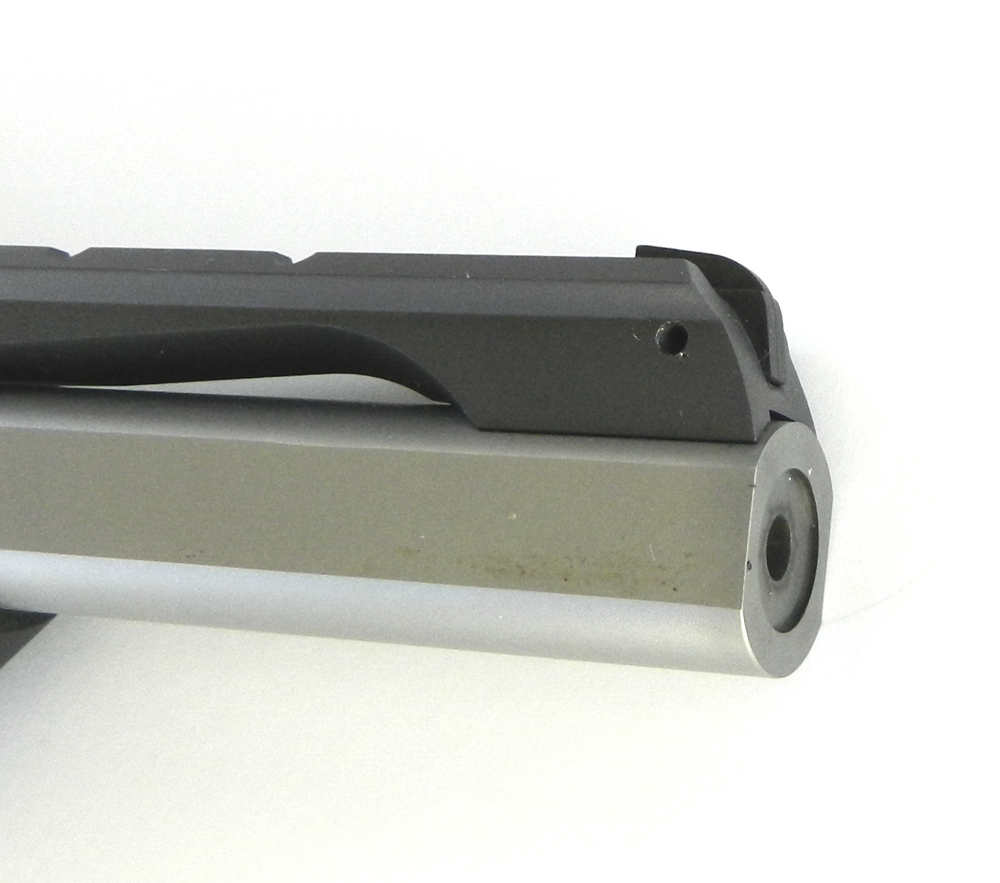
The Beretta Neos features a recessed barrel crown and adjustable front sight.
Beretta has done things with this pistol you simply cannot do with a centerfire handgun. The grip offers an excellent firing angle. The magazine is well-made of good material, a solidly engineered feeding device.
While the muzzle-heavy feel of the 6-inch barrel handgun is comfortable when firing offhand, the Beretta Neos isn’t much more accurate than any other .22 fired that way, but it tracks well.
A very nice 3-pound trigger aided in offhand fire. The Neo came into its own and earned the price of admission when firing off of the benchrest, too.
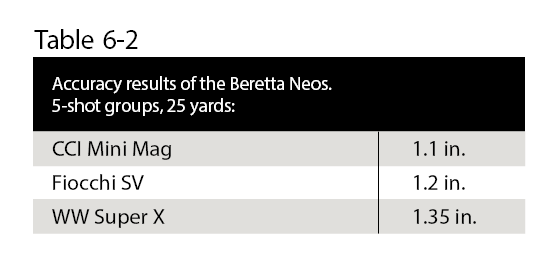
Firing from a solid rest firing position the results were notable:
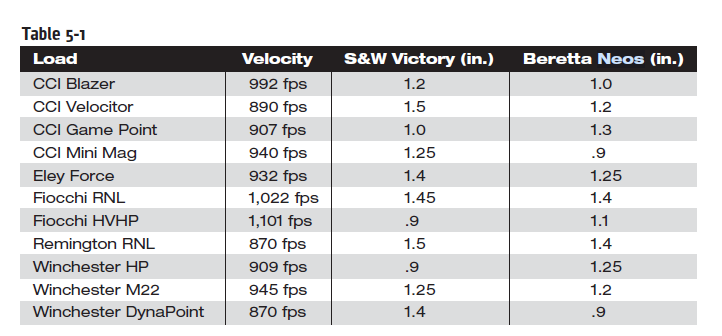
Beretta Neos Vs. Smith & Wesson Victory
The discussion of which .22 LR loading is most accurate is often asked but seldom answered. The truth of the matter is that there are several loads that may be the ne plus ultra in your personal firearm.
If you own a compact Bersa or Walther P22 — good, light plinking guns — you may not be able to discern much difference in loads. A Smith and Wesson Victory or Beretta Neos will demonstrate a greater degree of precision.
Velocity is also a consideration. I have tested most of the available .22 LR loads. I have found them accurate enough for targets, small game and training. However, for competition, you need to benchrest test different loads and be as steady and serious as possible.
The load that delivers the best accuracy from my Beretta Neos may not be the top accuracy load in your Ruger Standard Model, but chances are it will not be a poor shooter, either.
Very few shooters if any will be able to tell the difference when shooting offhand. I have tested a number of loads for accuracy.
Below are the results with some of the popular loads. Groups were fired at 15 yards and are in inches for a five-shot group. Velocity is the average between the two guns, the Beretta Neos averaged about 20 fps higher velocity.
Upgraded to excel in the hardest hunts, Wetherby’s Mark V Backcountry and Mark V Backcounty Ti take the classic rifle design in a new direction.
In the bolt-action rifle world, there are few designs as enduring at the Weatherby Mark V. Virtually unchanged since its introduction in 1957, the 6- and 9-lug masterpieces not only live up to their billing as the “World’s Strongest” turn-bolt. They also continue to define what a high-performance, top-shelf rifle should be. Not exactly a formula with which you’d want to tinker.
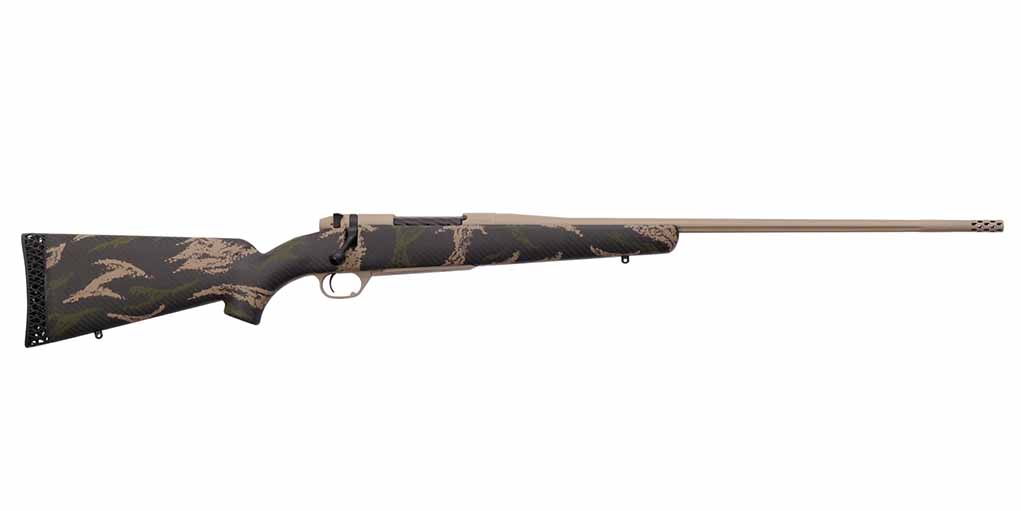
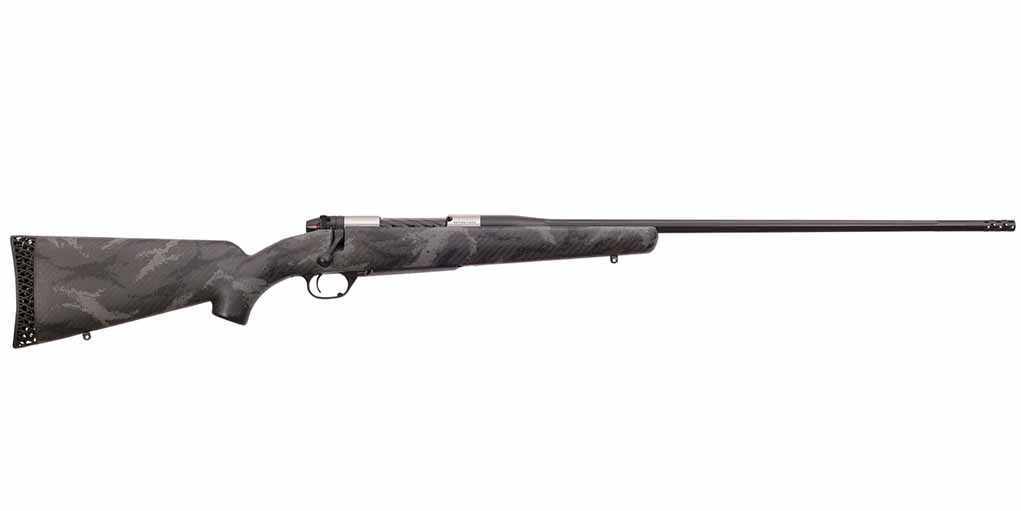
Weatherby, however, couldn’t leave well enough alone—luckily for fans of the iconic brand. New for 2020, the company has rolled out the Mark V Backcountry and Backcountry Ti rifles, which offers everything you’d expect out of the timeless design and a whole bunch more.
Weatherby Backcountry
First off, so you don’t linger with bated breath, the Gibraltar-solid action is the same and every bit as tough as it ever was. But enhancing the rifle for long slogs into the wilderness, Weatherby has upgraded the Mark V in nearly every conceivable way. Both Backcountry rifles have carbon fiber stocks from AG composites, 3D Hex recoil pads, the company’s first spiral fluted bolts, scalloped bolt sleeves, hollowed-out bolt handles and Accubrake ST muzzle brakes with 1/2x28TPI threads. They are also outfitted with excellent TriggerTech Mark V triggers, to help hit the mark after you’ve put in the miles. The Mark V Backcountry Ti goes one step beyond its cohort in weight savings, boasting an ultralight titanium action.
The well-thought-out designs make for true mountain rifles. The Mark V Backcountry tips the scales at a 5.3 pound with a standard action and 6.3 with a magnum; the Mark V Backcountry Ti comes in at 4.9 pounds with a standard action and 5.9 with a magnum. It certainly seems the Rocky Mountains got into the company’s blood quickly with its recent move to Sheridan, Wyo.
Weatherby Backcountry Ti
The introduction of the Backcountry rifles coincides with the company’s release of its new 6.5 Weatherby RPM cartridge—one of the rifles many chamberings. Living up to its past ballistics endeavors, Weatherby supercharged the 6.5mm with the cartridge capable of pushing a 140-grain bullet 3,075 fps at the muzzle. Not too shabby.
Weatherby’s new rifles have steep entry points, the Mark V Backcountry’s MSRP $2,499 and Backcountry Ti $3,349. But for the performance they offer, it could turn out a value for those dedicated pushing further during hunting season.
For more information on the Mark V Backcountry and Mark V Backcountry Ti, please visit weatherby.com.
Tune In More Gun Digest TV:
Video: Pro Series Model 986 Puts A Different Spin On The 9mm
A gun, holster and belt aren’t enough. To be well armed, you also need spare ammo on tap and under wraps.
Autoloader Mags
The spare magazine is relatively flat and, in my experience, is best carried in a belt pouch on the side of the body opposite the holster. Vertical carry is best for concealment and fastest for access, and reloading will be more positive if each magazine is carried with the bullet noses forward. For concealed carry, I don’t see any need at all for a flapped mag pouch. It slows down access, and the extra flap of leather or nylon adds unnecessary bulk and bulge. Just make sure you have a good, friction-tight fit and you’ll have all the security you need, with maximum speed and access.
Most of us carry the mag pouch just behind the left hip if we’re right-handed, vice versa if we’re southpaws. With an open-front concealment garment, such as a vest or a sport coat or an unbuttoned sport shirt, this minimizes the likelihood of the magazine becoming visible. Too, weight on the corresponding point at the opposite side of the body seems to “balance” the weight of the holstered pistol and increase overall body comfort once you are used to the presence of the object.
This principle is one thing that made Richard Gallagher’s concept of the Original Jackass Shoulder System, the forerunner of his Galco brand, so famously popular and so widely imitated. The weight of the gun hung suspended in one armpit, with the weight of the two magazines (and perhaps also handcuffs), under the other. Another advantage, of course, was that the user’s critical gear was all on one harness that he could be quickly throw on if a danger call took him from the Condition White of total relaxation to the brighter colors of “sudden call to arms.”
A number of the people have gone with the currently popular AIWB (appendix/inside-the-waistband) carry, which places the holstered pistol on the dominant-hand side of their navel. Those who carry the pistol like this will often place the spare magazine pouch at a corresponding point on the other side of the navel. Again, it’s a matter of “balance,” and also keys in a little bit with the hands reaching to corresponding parts of the body during crisis, assuming that practice and training have drilled in the game plan well.
Some people carry their spare magazines in their pockets. I did so when I was very young and discovered that a generic eyeglass case with pocket clip that cost 29 cents at Woolworth’s would hold a 1911 magazine in a trouser pocket without revealing its shape (though I needed a folded-up matchbook cover or two in the bottom of it to get the magazine up high enough in the pouch that I could retrieve it). By the time I hit my twenties, though, decent, concealable magazine pouches were available and I could afford to buy them.
There are a few pocket magazine carriers available, but none are as fast to access as simply reaching under the same garment that concealed the pistol and snatching one out of a belt-mounted pouch. In ordinary clothing, a magazine will make a coat pocket or cardigan sweater pocket sag a bit. Many dedicated gun concealment vests have elastic pockets to hold magazines upright. They conceal the shape well, but they tend to sag a bit. If the elastic is tight, the garment tends to rise with the magazine you’re pulling on, and this also prevents it from coming cleanly away from the pocket in some iterations.
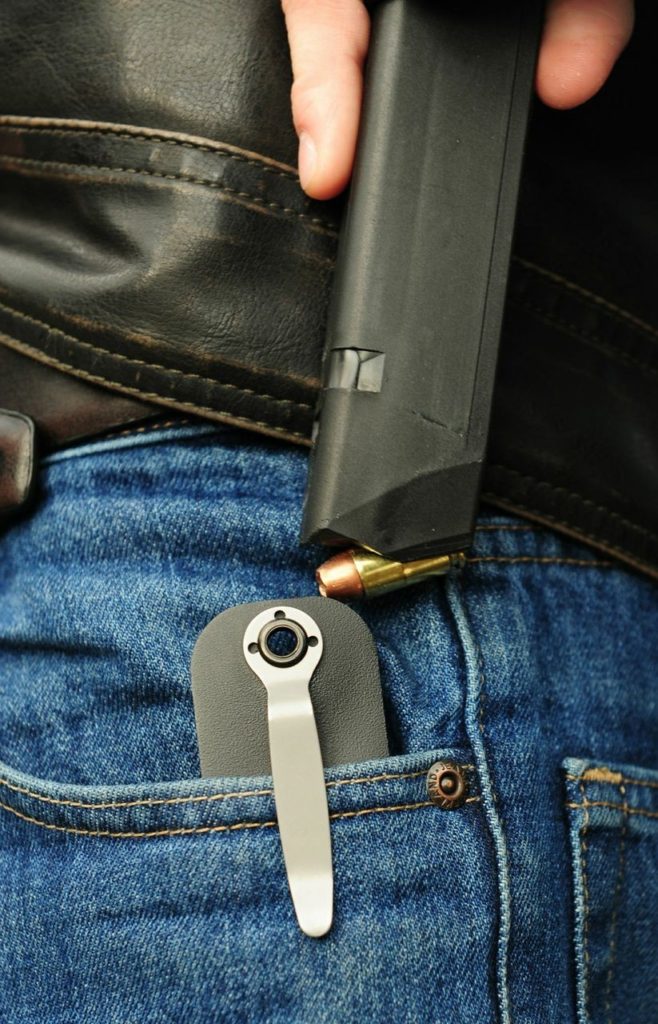
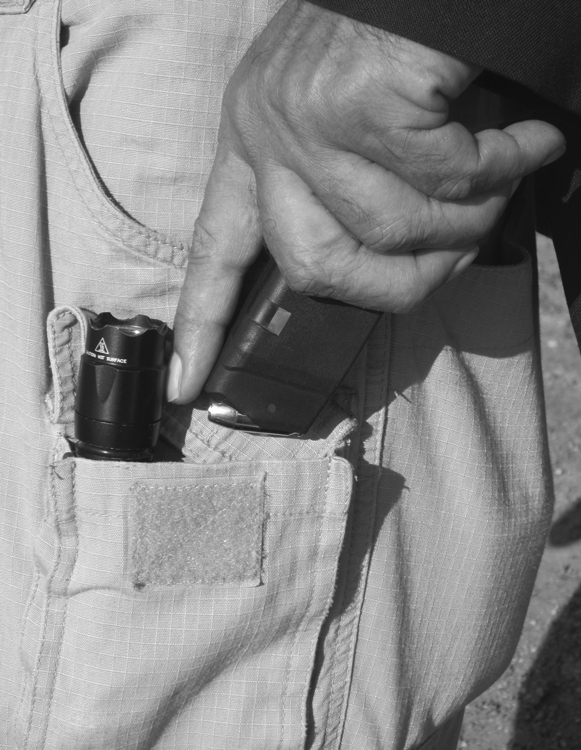
Glock 30 magazine rides comfortably and discreetly next to SureFire E2D light in cell phone pocket of these cargo pants.
This writer wears BDU pants as default casual wear, and when carrying a mag in a pocket prefers the dedicated “magazine pocket,” also known as “cell phone pocket,” on the non-dominant hand side. With just the magazine in there, it tends to shift around a little bit. However, I discovered that if I put a compact, high-intensity flashlight with a pocket clip in the front of that pocket/pouch and the pistol magazine behind it, it conceals like a charm and the flashlight in front holds the magazine in a vertical position that does not shift appreciably. The BDU-type pants normally have a Velcro-closing pocket flap. I close down the rear portion, which hides the magazine perfectly. One end of the flashlight protrudes visibly upward, and that’s fine; it’s only a flashlight and doesn’t need to be concealed. I find that the flashlight goes unnoticed from supermarkets to banks to airports.
When concealment is the highest priority and the wearer is dressed lightly, as with an un-tucked polo shirt or t-shirt (one size larger than normal, remember, with straight drape instead of waist taper!), an inside-the-waistband magazine carrier will be just as much more concealable as an inside-the-waistband gun holster. Of course, you still have to remember that if the pants were bought to fit just you, now the waistband has to encompass just you and a holstered gun, and a spare magazine and its carrier. This means that you’ll need a larger waistband size than what you would normally wear.
An inside-the-waistband magazine pouch brings some of the same concerns as an inside-the-waistband holster and some of its own. Certain pistol magazines—early Smith & Wessons, early H&K designs, and damn near all the serious-caliber SIGs when they had sheet-metal floorplates—have sharp edges that will dig mercilessly into skin, all the more so if you’re a bit fleshy about the waist. Way back in the ’80s, when I collaborated with Ted Blocker on the LFI Concealment Rig, the original inside-the-waistband mag pouch left the whole floorplate and lower part of the magazine exposed to the reaching hand. It was very fast to reload from. However, some folks with some magazines—myself included, I admit—found sharp-edged protruding floorplates digging into us so uncomfortably we couldn’t wear the darn things. Ted revised the design to incorporate a shield between the entire magazine and the body. This greatly increased comfort, but also somewhat slowed down the speed of getting the magazine out of the pouch. That’s always going to be the tradeoff here.
Outside the waistband, the pouch tends to be more comfortable. You still want it to ride tight to the body for concealment, though. These days, my favorites of that type are the Kydex units produced by Blade-Tech in double pouches, and by Ky-Tac in single-mag pouches. For Glocks (bargain alert here!) I’ve honestly found nothing better than Glock’s own simple, super-cheap magazine pouch, which is also ambidextrous. It comes with little ladder-steps in the belt loops that can be easily cut by the owner to fit narrow or wide belts without flopping or wobbling, and to also ride high or low. I’ve won IDPA matches reloading from these pouches. They are fast, they are tight-to-the-body concealable, they are comfortable, and they are secure. Helluva deal.
How Many Spare Mags to Carry?
It depends. I’ve met cops who carry four double-stack magazines when on duty. My department issues a single-stack .45 auto, and when I’m in uniform I carry three to four spare eight-round magazines on the duty belt. On my own time, I carry two spare magazines for a single-stack pistol and at least one for a double-stack. I also normally carry a backup handgun, and on patrol I have a .223 semi-automatic rifle with multiple magazines and a shotgun with an ample supply of shells on board in the vehicle. Our military personnel in combat zones, of course, carry more—and those who don’t really believe they’ll ever need to fire their defensive firearm, carry less.
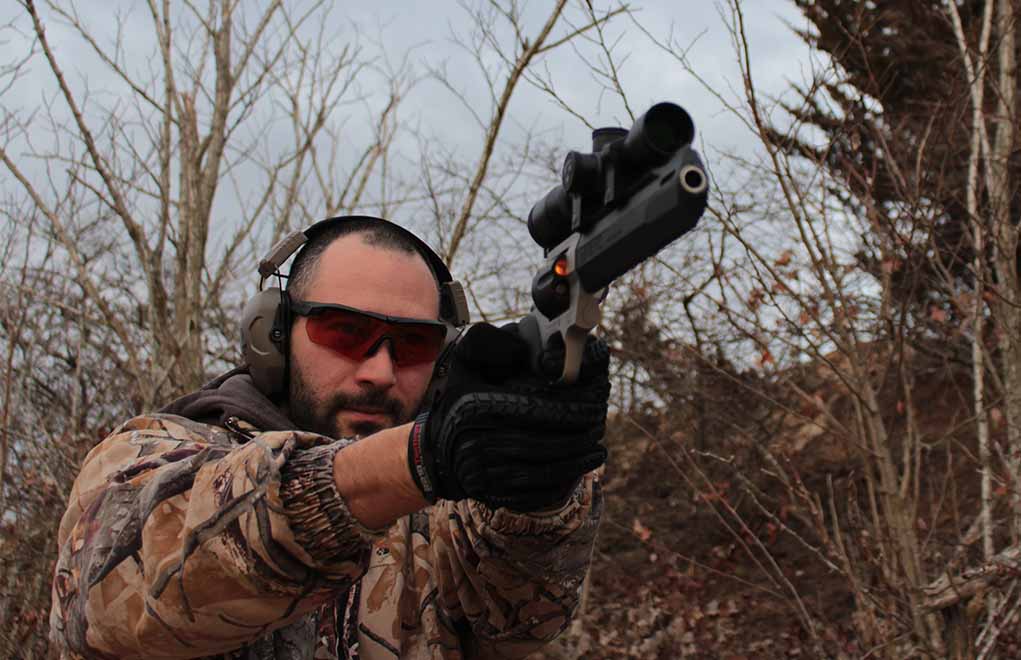
The Taurus Raging Hunter .44 Rem. Mag. delivers blows well outside its weight class and price tag.
How The Raging Hunter Is Ready To Put Meat On The Table:
Based on the Raging Bull, the revolver has been optimized for hunting.
Boasts with an attractive two-tone or matte-black finish.
Outfitted with full-length optics rail for easy addition of a scope.
Comes from the factory with an adjustable rear sight.
Reasonable weight for a large-frame revolver.
Available in three barrel lengths.
I’ll never forget my first deer hunt in the thick woods of upstate New York. In my naiveté, I decided to bring the most accurate rifle that I owned, albeit the heaviest.
About three miles into the woods is when that 12-pound, heavy-barreled .308 Winchester really started to feel like, well … 12 pounds. When I got to my buddy’s tree stand, I hobbled up the trunk to the makeshift 2×6 platform and hoisted this behemoth, my pack and everything short of a cup of coffee (which hurtled to the ground during this transaction) into my position and waited for first light.
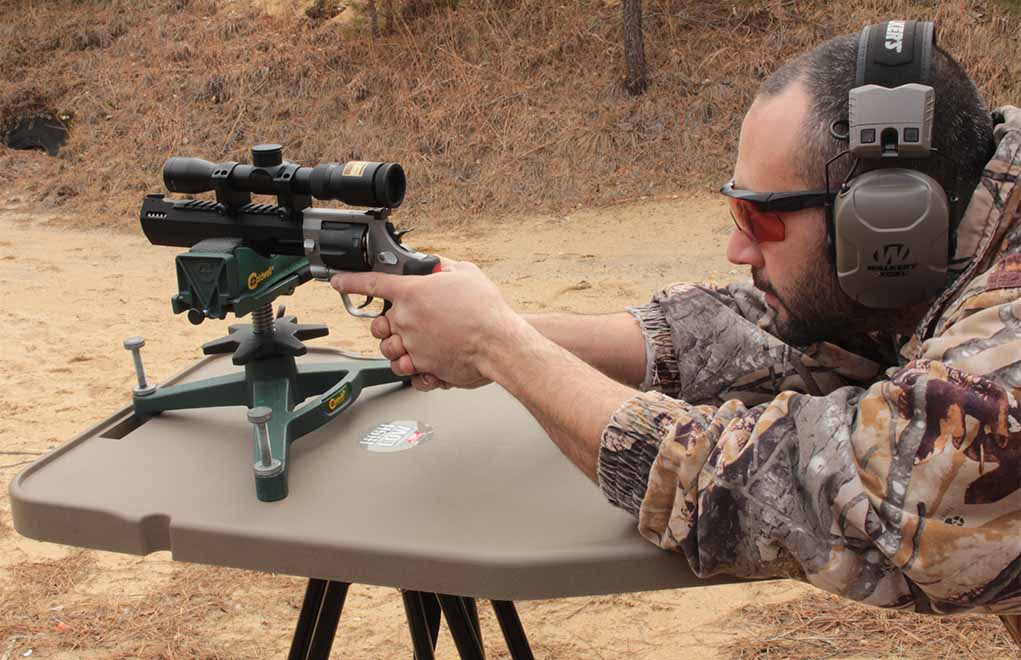
The author utilized an MTM High-Low Shooting Table. The tripod-style legs allow you to set up a level shooting platform, regardless of your terrain. Cradled in a Caldwell Rock Rest, 50-yard shooting was a breeze.
Once that first crack of daybreak illuminated the horizon, I decided to take out my rangefinder and get an idea of what distances I would be working with. To my surprise, I found out that my clearest shot was only going to be a bit more than 50 yards. I never thought it possible—but I had brought too much gun!
My Personal Revolver Revolution
Since that day, I have left my bench gun on the bench and started dragging out lighter and shorter rifles. This certainly was easier, but at the end of it all, it was still too much for heavily wooded areas.
The thought of handgun hunting entered my mind, but I have never really gotten too comfortable with big-framed revolvers, and I certainly wasn’t going to sacrifice lethality for ease of shooting.
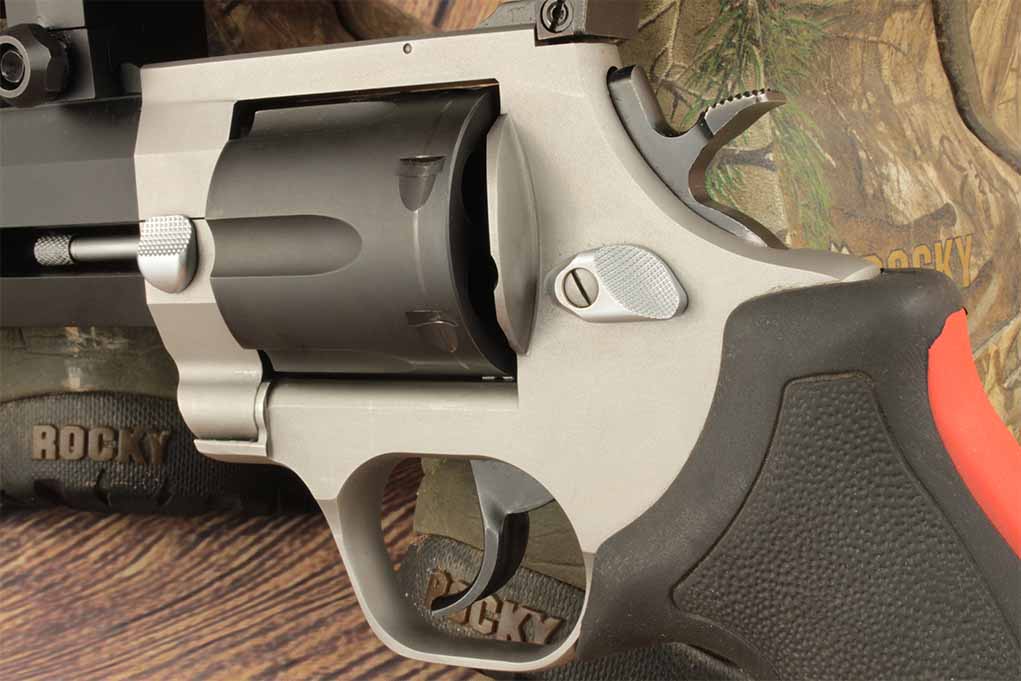
The massive, six-shot cylinder of the Raging Hunter is kept in place with two cylinder locks, ensuring positive alignment with each trigger squeeze. This extra reinforcement also allows for the rough service that hunting firearms undergo.
That all changed at the Quail Creek Ranch in April 2018, when I laid my eyes on one of only three Taurus Raging Hunters in the country. I instantly noticed that it was unlike any other hand cannon on the market. It had balance, comfort—and was just gorgeous!
Taurus’s idea was to build on the success of the other Raging Revolvers and create something that would produce enough energy to humanely dispatch deer-sized game and still remain enjoyable to shoot and easy to carry. In addition, pistol optics are also commonplace now, so why not incorporate a simple mounting option while we’re at it?
The final product was chambered in .44 Magnum for its efficiency and availability—and was now in my hands! Writer Katie McCarthy stood next me as we fired cylinder after cylinder into a Revolution Targets Double Torso spinner until we got it flipping, end over end, like the world’s most inefficient windmill. Oh, the fun of unleashing massive rounds with little consequence to the wrists or forearms!
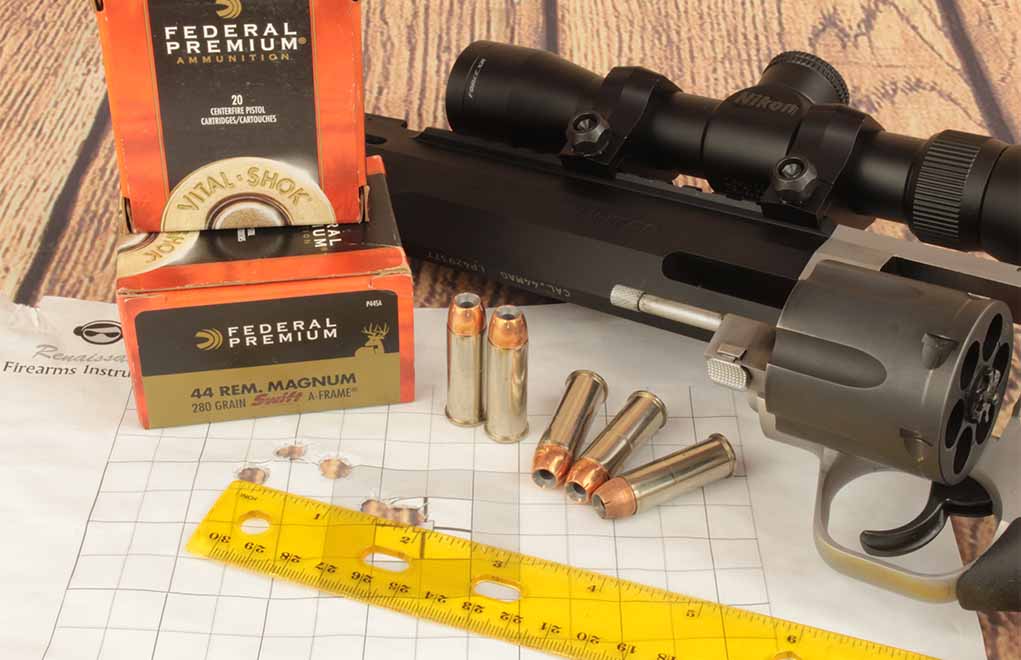
The best group of the day was with the Federal Vital-Shok, which sends the infamous 280-grain Swift A-Frame bullet downrange at an estimated 1,170 fps. This five-shot group is more than adequate for whitetail hunting and even smaller quarry.
Later that day, we were all challenged to shoot at a random board of playing cards. The shooter with the four best hands would win their pick of any gun they shot that day. Seven well-placed shots landed me triple jacks with an ace-king kicker, for which I collected a handsome pot: a Raging Hunter of my very own.
The Wait
What they did to me really wasn’t fair: giving me a taste, letting me leave with a shiny certificate stamped “IOU”… and then making me wait just shy of a year to get the Raging Hunter in my hands! Demand was so high for the gun, and the importing process was so painfully slow that things literally got held up on the dock.
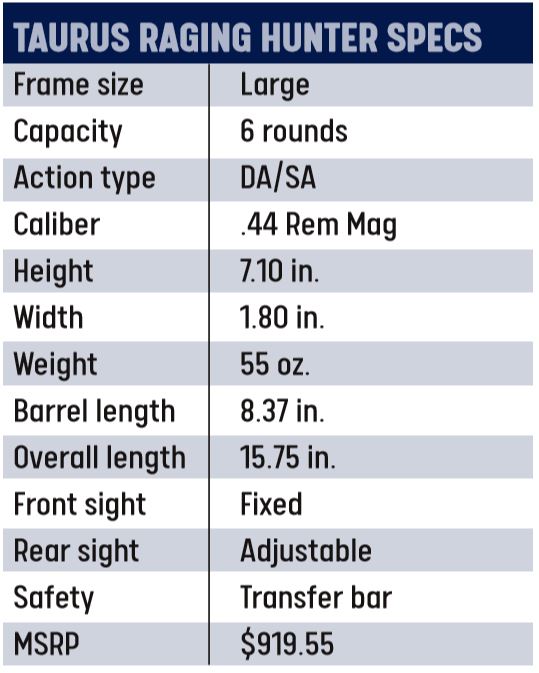
Well, it finally arrived. It was exactly as I remembered—except that I had been sent the ultra-sexy, matte, two-toned version! I picked it up, quickly remembering the recoil-reducing rubber grips and the balanced feel of the steel-sleeved aluminum barrel. The words, “Raging Hunter,” were engraved along the side, with laser-sharp edges accentuated by slick angular cuts along the entire length of the barrel. Topping it off was a 13-slot Picatinny rail—perfect for mounting your favorite sighting system or even a flashlight in a 45-degree offset.
Reunited With The Raging Hunter
I was especially excited for the chance to try out different rounds to see the gun’s true accuracy potential (short of handloading). I requested a “dealer’s choice” of ammo from my friends at Federal Ammunition, who sent over some rounds in the 240- to 280-grain range.
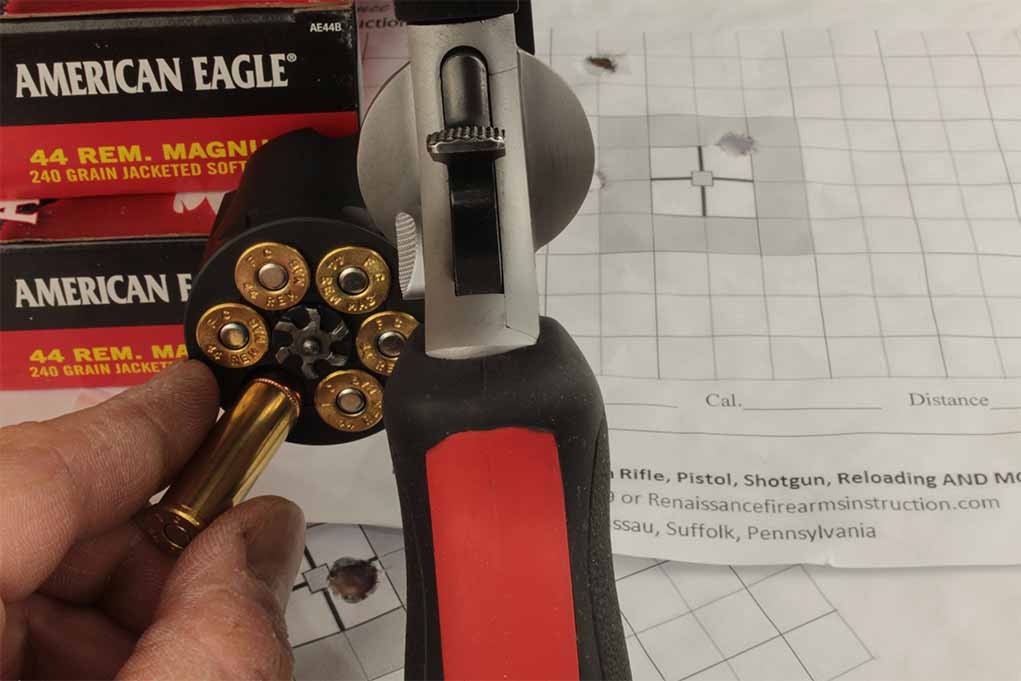
Federal’s American Eagle line of ammo has always made affordable practice sessions a reality. Here, the author is loading that sixth chamber while confirming an initial zero. Also shown is the signature red backstrap that’s responsible for reducing some of the felt recoil.
Before hitting the range, I mounted up a Nikon Force XR 2.5-8x handgun scope ($289.99; NikonSportOptics.com) in a pair of Warne Mountain Tech steel rings ($139; WarneScopeMounts.com) to assure a solid and repeatable shot picture.
That range day wasn’t quite as cozy up north as it was down in Florida. My test day consisted of cool temperatures, intermittent showers and a 5 to 10 mph crosswind. I figured I would test this gun at the distances for which I would likely use it, so I set up an MTM High-Low Shooting Table ($129.99; MTMcase-gard.com) at just about chest level to give me a natural pistol shooting position.
I cradled the gun in a Caldwell Rock Mount rest and commenced to fire off the standard five five-shot groups with each type of ammo. I was delighted that all performed well inside of “minute-of-deer.” However, I was especially impressed with the 280-grain Federal Premium Vital-Shok round that features a Swift A-Frame bullet. These groups were consistently inside of 3 inches, with my best group of the day landing well inside that.
Interestingly enough, this round had the least amount of felt recoil—even though it was slinging the heaviest bullet. My overall experience was terrific (remember, I had fired more than 100 rounds of full-power .44 Rem. Mag. loads without issue). Recoil was certainly there, but it was mitigated by the integral muzzle brake that reduced and redirected the impulse, allowing for a fast follow-up shot if needed.
Back at the Lab
After returning from the range and changing into dry clothes, I decided to give the gun a quick cleaning and experiment with some holster options for field carry. Cleaning was exactly what you would imagine: Open the cylinder and then brush and patch the six chambers and the barrel.
I pulled out my Lyman trigger gauge while I was at my workbench and measured an average trigger pull of just 4 pounds, 1 ounce in single-action mode. Getting the pistol into single-action is a very smooth, quiet maneuver, so I don’t really see the point of having to fire a double-action shot; but even the full trigger squeeze isn’t half bad.
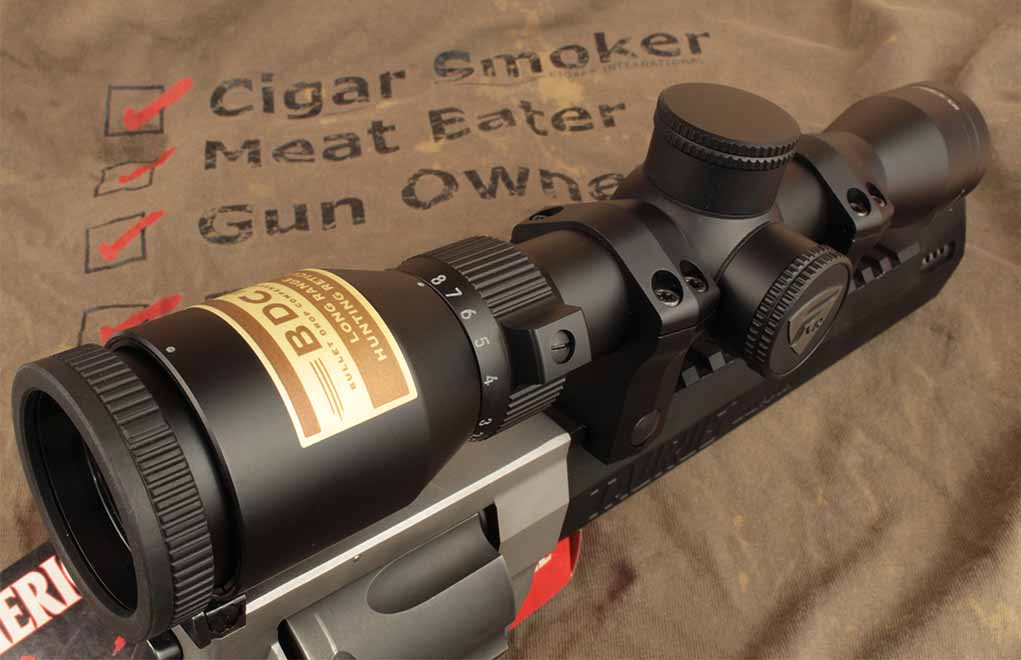
Never waste meat, cigars or Picatinny rail! The integral, 13-slot rail in the Raging Hunter allows for nearly any option you can dream of. The author chose a Nikon Force XR 2.5-8x scope with BDC for his testing.
After wiping off my Raging Hunter, I tried on two different holsters from Uncle Mike’s. The 8.37-inch barrel is certainly hard to accommodate. However, Uncle Mike’s makes a holster big enough for it—and even one big enough to carry it with a scope. Both models are available in either left- or right-handed configuration to accommodate southpaws … or the other 90 percent of the population.
The Raging Hunter Takeaway
As I packed away the Raging Hunter, I imagined the real-life adventures I would share with this gentle giant. One thing is for sure: I won’t be dragging a shotgun into a tent anymore, because the Raging Hunter is much easier to wield in an emergency—especially in a confined space.
CCI even makes two different shot loads that it will chamber to help with pest control or maybe even a little small-game hunting. Walks through the woods just got about 7 pounds lighter; and, with a good shoulder rig, there’s no reason not to climb into your tree stand with it on (unloaded, of course).
Overall, I was quite impressed with how well Taurus managed to tame the signature caliber of a young Clint Eastwood and create a monster gun that has a surprising amount of utility.
For more information on the Raging Hunter, please visit taurususa.com.
Looking to add another gear to your rimfire? Franklin Armory has you covered with its new Binary Trigger for the 10/22.
Binary triggers have been around for some time now, a relatively easy upgrade to up the rate of your semi-automatic’s fire. The magic to the system, a shot is fired both when the trigger is depressed and released. Masters of binary triggers, Franklin Armory has taken the upgrade in an entirely new direction. Now on tap, its BFSIII for Ruger 10/22. As if the gun could get any more fun. Franklin’s binary trigger has an MSRP of $299 and is a drop-in unit.
More from Franklin Armory:
Minden, NV — Franklin Armory® is excited to introduce our 9th binary trigger. We successfully adapted the patented Generation 3 Binary Firing System™ to the Ruger® 10/22® platform. We have done extensive prototyping and testing. The final configuration will be placed into production soon. Sign up for our emailing list for pre-order notifications of the BFSIII™ for 10/22®.
Franklin Armory® President, Jay Jacobson, stated, “Last year, our sales and marketing team tasked our engineers to apply our patented Binary Firing System III™ technology to the Ruger® 10/22® platform because the rifles are relatively inexpensive, the ammunition is cheap, and just about every gun owner in the US already has one! I’m pleased with the final result and think our engineers did a great job!”
Three Affordable Chronograph Options To Check Your Speed
Fast on the heels of their previous release of the BFSIII™ for AK9-C1; Franklin Armory® proves again to be the premier manufacturer of Binary triggers with Nine models currently available.
The first Binary Firing System™ was released for the AR platform in 2015. All BFSIII™ triggers feature a three-mode safety selector. Mode 1 is “Safe.” Mode 2 is “Semi” for semiautomatic. And Mode 3 is “Binary” mode. In Binary mode, the firearm will discharge one round on the pull of the trigger and one round on the release of the trigger. All BFSIII™ models feature the ability to negate the release round in Binary mode by modulating the safety selector back to “Semi” mode or “Safe.” Additionally, all BFSIII™ are engineered to prevent the operator from modulating the selector to “Binary” mode while holding the trigger back in “Semi” mode.
For more information on the 10/22 binary trigger, please visit franklinarmory.com
The time-tested M1917 is still a sweet shooter, even 100 years on. But in many case the rifle will need work, particularly its barrel, to get on target.
M1917s are 100 or more years old now. Nevertheless, they’re still sought after by collectors and people who like to shoot old guns.
But M1917s sometimes need repair, and finding the right gunsmith to do the job can be difficult. Somewhat common problems with old guns are barrel wear and corrosion. Age and neglect, especially on a gun that was built when corrosive ammunition was all that was available, often result in a gun that has a pitted barrel and is not accurate.
But sometimes, even if the barrel is not corroded or pitted, the gun has been shot so much that the headspace has increased to a point that repairs are needed for safety—or just to make the gun fire. That’s the case with the sample gun used for this review of the M1917.
The gun’s barrel was made by High Standard Manufacturing sometime during World War II and replaced the original barrel installed by Remington in 1918. While the replacement barrel still had sharp rifling and a bright bore, the chamber dimensions had increased, probably from firing many rounds, to the point that not all ammunition would fire. A check with chamber gauges showed that the headspace was greater than specifications. The bolt wouldn’t close on a field gauge but would close on a go-/no-go gauge, indicating that the chamber was close to being oversized … although it might still be safe.
The fix was to either install a new barrel or screw the existing barrel in toward the receiver one additional turn. Then, using a chamber reamer, cut the chamber to proper dimensions.
More Military Guns:
The M1903A4 Sniper Rifle: An Old Soldier Still Hits the Mark
8 Long Guns You Have to Know from the American Civil War
The M1917 has a reputation for the barrel being extremely tight in the receiver and very hard to turn. Either the barrel won’t budge, even with a great amount of force applied, or the receiver cracks when enough force is applied to turn the barrel. And a cracked receiver is ruined.
The challenge was finding a gunsmith willing to work on the barrel of an M1917—and who had the skill to do it correctly. I consulted a number of gunsmiths, and finally, one who had the experience and tools to do it successfully agreed to take on this project.
This issue didn’t faze Bobby Tyler of Tyler Gun Works (Friona, Texas). When the problem was posed to him, his immediate response was for me to send him the gun. It seems Tyler really likes a challenge, and if another gunsmith can’t do the work, Tyler wants the job even more.
He built a fixture to properly support the receiver and used a very long bar for the leverage to turn the barrel. The price and turnaround time were reasonable, and the gun now works perfectly, igniting every .30-06 cartridge tried. It was important to save the High Standard barrel, and it looks just as it did before Tyler worked on it.
Tyler is also a specialist with metal finishes and is particularly good at color case-hardening.
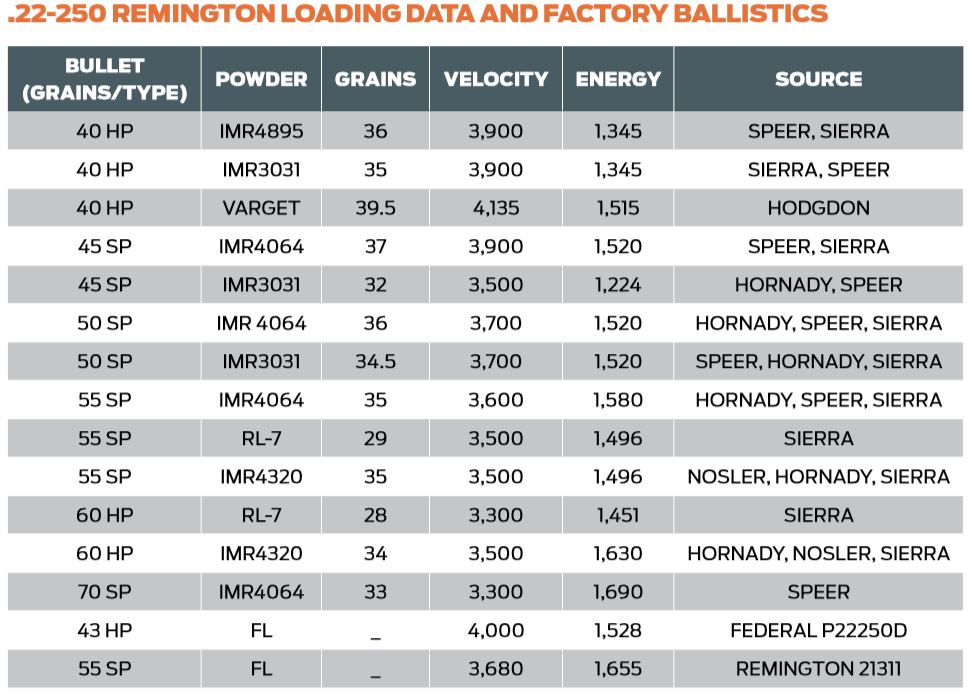
A long-time wildcat cartridge, the .22-250 Remington has grown to become a favorite of bench-rest shooters, varmint hunters and even deer hunters in some parts of the country.
The .22-250 Remington was adopted early in 1965 as one of the chamberings for the Remington 700 series bolt-action rifles and also for the Model 40XB match rifle. Browning bolt-action rifles were offered in .22-250 two years later. This isn’t a factory design; rather, it’s a popular wildcat that had been around for many years before Remington’s adoption of the round moved it into the commercial classification.
There’s some confusion regarding the date of origin of the .22-250, which is based on the .250-3000 Savage case necked to .22 caliber. Its moniker is derived from the caliber (.22) and the “parent” case name (.250). The parent cartridge was introduced in 1915, and a .22 version might have been made up experimentally shortly thereafter.
Harvey Donaldson, Grosvenor Wotkyns, J.E. Gebby, J.B. Smith and John Sweany all worked on versions of the .22-250 between 1934 and 1937. Gebby and Smith are usually credited with having developed the present configuration in 1937. However, there are different versions of this cartridge. The Gebby version was named the .22 Varminter, and he obtained a copyright on the name. Other gunsmiths renamed it the .22-250. The Wotkyns version was the forerunner of the .220 Swift, although Winchester ended up using the 6mm Lee Navy case rather than the .250 Savage.
At the present time, all major American and European rifle makers furnish bolt-action rifles in .22-250 chambering. In addition, the Ruger, Thompson/Center and other single-shots are available in this cartridge.
General Comments The .22-250 is one of the best balanced and most flexible of the high-powered .22 centerfires. It’s also the most popular of the long-range .22 varmint cartridges, effective to ranges of 400 yards or more. The .22-250 also has a reputation for outstanding accuracy and has been used with some success for benchrest shooting.
Many individuals who have had experience with both the .22-250 and the .220 Swift report that the former gives significantly longer case life with full loads than the latter. The .22-250, as with most of the other high-powered .22s, requires the right bullet for use on deer or other medium-sized game. The reason, of course, is that the light varmint bullets are made to expand quickly and will not offer sufficient penetration on a large animal. As a matter of fact, the .22-250 has become very popular for deer hunting in Texas.
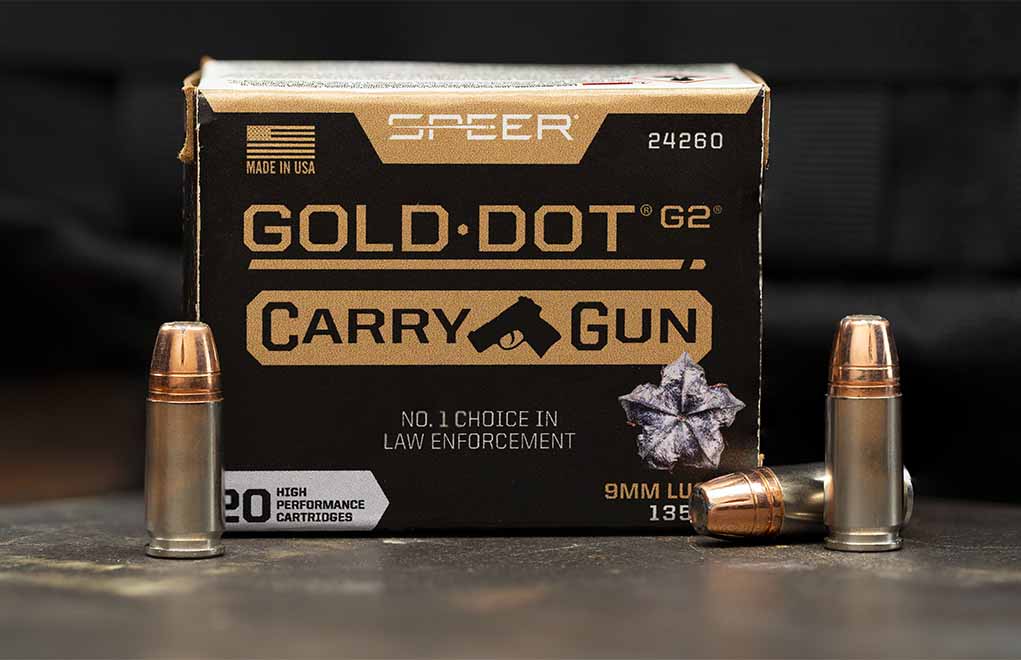
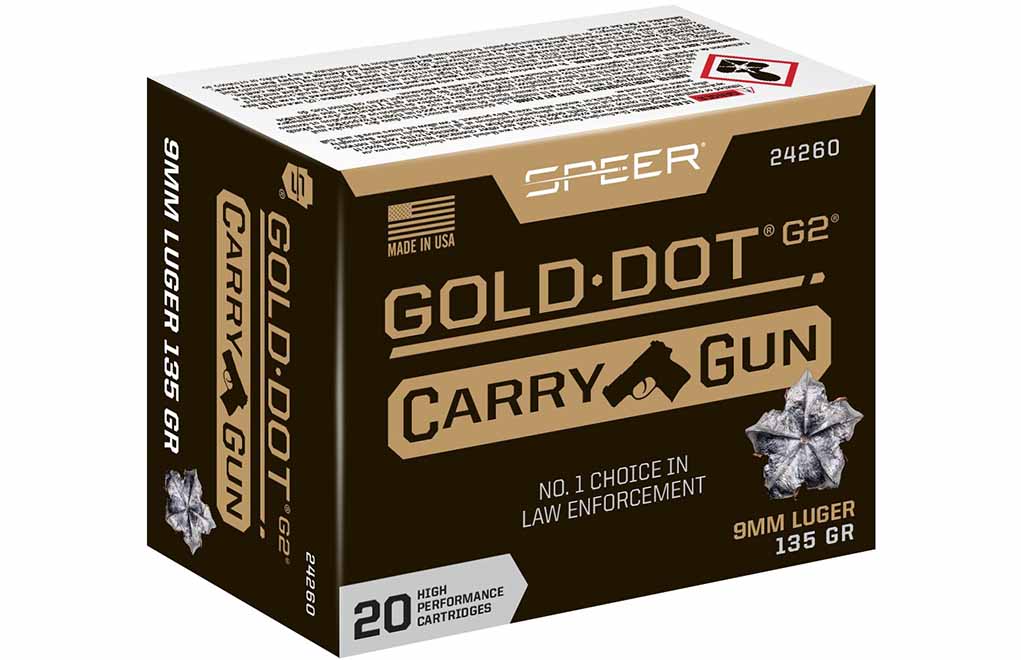
Boasting the revolutionary G2 bullet, the Speer Carry Gun line of ammo takes sub-compact and compact guns’ performance to a new level.
How The Carry Gun Line Is Optimized:
Precisely loaded to achieve needed velocity for the projectile to penetrate and expand.
G2 bullet’s elastomer-filled cavity ensures barrier material won’t foul expansion.
Bullet developed to achieve better FBI-protocol test scores than the original Gold Dot bullet.
While compact and subcompact pistols make for more comfortable carry pieces, they can have drawbacks. Aside from an abbreviated sight radius, their shorter barrels can eat away precious velocity. Not good, given velocity is the key variable in making certain defensive ammo performs up to snuff in the penetration and expansion departments.
Speer has tackled this issue with a redesign of its renowned defensive ammunition lines, giving those who pack petite self-protection pistols a premium option. Known as its Gold Dot G2 Carry Gun line, the ammunition is optimized for performance out of short barrels though some interesting engineering. In particular, Speer has jettisoned the large traditional hollow point design of the Gold Dot bullet, instead opted for a shallow cavity in the nose filled with a durable elastomer of the G2 bullet. The polymer prevents barrier materials from filling the cavity and initiates expansion for consistent and dependable performance.
A recent evolution of the Gold Dot projectile, the G2 bullet was developed to achieve better FBI-protocol test scores than its forerunner. While it’s somewhat a break, the new bullet does still retain the original UNICOR construction that helps the projectile retain mass for a devastating wound channel.
“Speer’s Gold Dot family of ammunition has been the leading choice of law enforcement professionals for almost three decades because it offers exceptional terminal performance and unfailing reliability,” said Federal Handgun Ammunition Product Manager Chris Laack. “Last year, we began offering the enhanced Gold Dot G2 ammunition—which had previously only been available to law enforcement—to the public.”
Speer is releasing a full lineup Carry Gun ammunition, including a 135-grain 9 mm option, 165-grain .40 S&W and 200-grain .45 ACP +P. Overall, it the price falls in line with other Gold Dot offering, with the MSRP ranging from $28.99 to $33.99.
For more information on the Carry Gun line of ammo, please visit speer-ammo.com.
Looking to go armed, but are stuck in the weeds as to what to arm yourself with? Here are 20 of the best concealed carry gun options that will keep you on the defensive.