Taylor & Company goes small with the Remington-Beals in its Ace Revolver.
There’s a misnomer to the Remington Model 1858. It was never officially called the 1858. Shooters dubbed what was properly known as the Remington-Beals Model Revolvers because the patent date was stamped on the barrel. A point of confusion that soldiers on to this very day.
Moniker confusion aside, Taylor & Company has dusted off the classic Remington in 2021 in a trim configuration they’ve dubbed the Ace Revolver. The 3-inch barreled gun most closely resembles what is known as New Model Pocket Revolver from the slew of Remington-Beals iterations. And makes for an interesting option for those who prefer a nimbler option compared to the hunks of iron that dominant replica percussion revolvers.
Though the Ace Revolver isn’t a true-to-form recreation of the classic. Whereas the old Remington were chamber .31 caliber in percussion and .32 CF in cartridge conversion (which are more predominant), Taylor & Company has gone larger. The company offers both a .44-caliber black-powder percussion cylinder and a .44 LC conversion cylinder (sold separately), up to snuff for modern smokeless ammunition. Additionally, both cylinders hold 6-round, compared to the New Model’s 5.
As to some of the Ace Revolver’s specifics, for a steel-framed revolver, it comes in at a fairly manageable 38 ounces and is available with three grip choices—checkered walnut, smooth walnut and PVC, which emulates ivory. In all cases, the revolvers are outfitted with a fixed front blade sight and a rear notch, octagon barres, blued finish and brass trigger guards. Interestingly, the single action’s hammer spur looks to fairly well emulate the original Remington’s, which is high. If there’s any one area replica makers fiddle with it’s the spur, flattening it back to make cocking it quicker.
As to price, the Ace Revolver is as competitive as they come with an MSRP of $350 no matter the grip option.
Yeah, they’re expensive, but ultrasonic gun cleaners make quick work of keeping firearms spotless.
When I was a full-time gunsmith, the majority of the work was simple: scrubbing guns. Yep, most gunsmiths who aren’t doing mondo-expensive custom work are basically “dishwashers.”
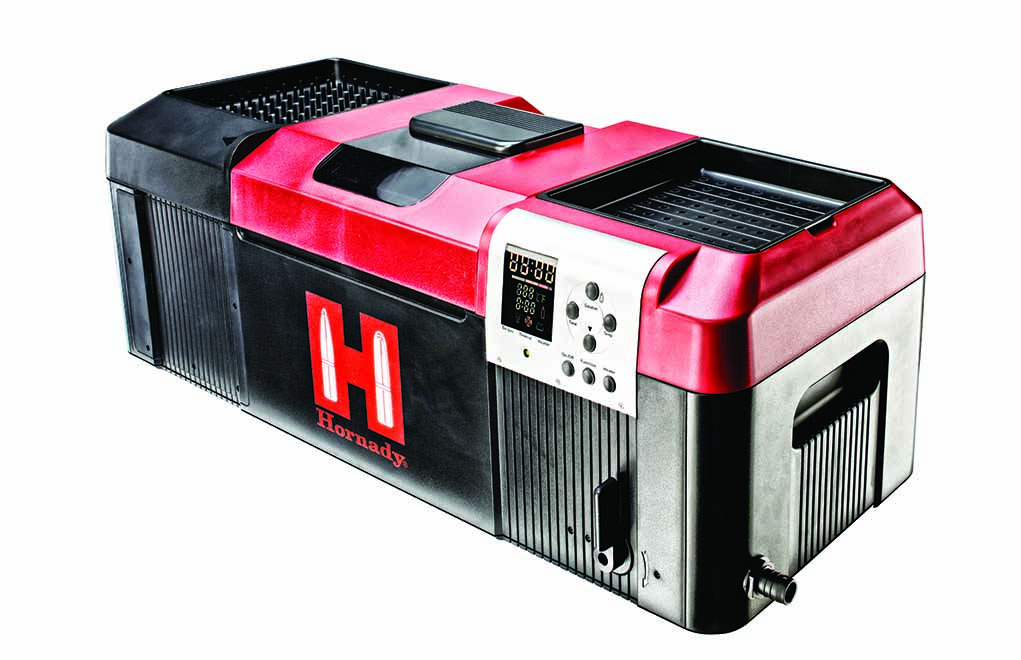
The Hornady Lock-N-Load Hot Tub is a great tool for cleaning guns.
My method was via a parts washer using mineral spirits pumped through a filtration system; then, parts were blown dry with compressed air. It was messy, grubby, mindless work … and there was a lot of it. But, you need not go through that.
The Ultrasonic Way
Ultrasonic gun cleaners use ultra-high-frequency vibrations in a cleaning solution to electronically and chemically scrub the gunk off your firearms (and cartridge cases, should you want to do that as well).
The process is simple: Pour enough of the proper cleaning solution (there are formulations for steel and brass, among others) to cover the part or parts to be cleaned. Turn on the power, turn on the heat (if there’s a heat option), and turn on the timer.
When it’s done, if the parts are clean, scrape off the gunk that still clings, wipe the parts dry (make sure they’re completely dry), and lubricate them. If there’s a drawback to this system, that’s it. Because the parts are immersed in a water-based cleaning solution, you have to get them dry and re-lube them once they’re clean.
Most shooter-level systems are big enough for handguns or handgun parts, and some are large enough to hold an AR-15 carbine upper.
Some years ago, I happened to see a similar system at a National Guard base. The boxes were half-height refrigerator-sized and held half a dozen M4s each. They’re the “industrial dishwasher” equivalent to the basic ultrasonic cleaning system.
Once I’d had a chance to look them over, I asked the sergeant who was present, “How many times does someone forget and leave a red-dot optic on the weapon?”
He rolled his eyes. “Only once each—the cost to replace it is enough to remember.”
And that’s something you have to keep in mind. There are items, such as optics—red-dot and otherwise—that shouldn’t be immersed. In addition, any paint, markings, labels or graphics you’ve applied to your firearm might not survive the experience of being ultrasonically cleaned.
Cost Considerations Of Ultrasonic Gun Cleaners
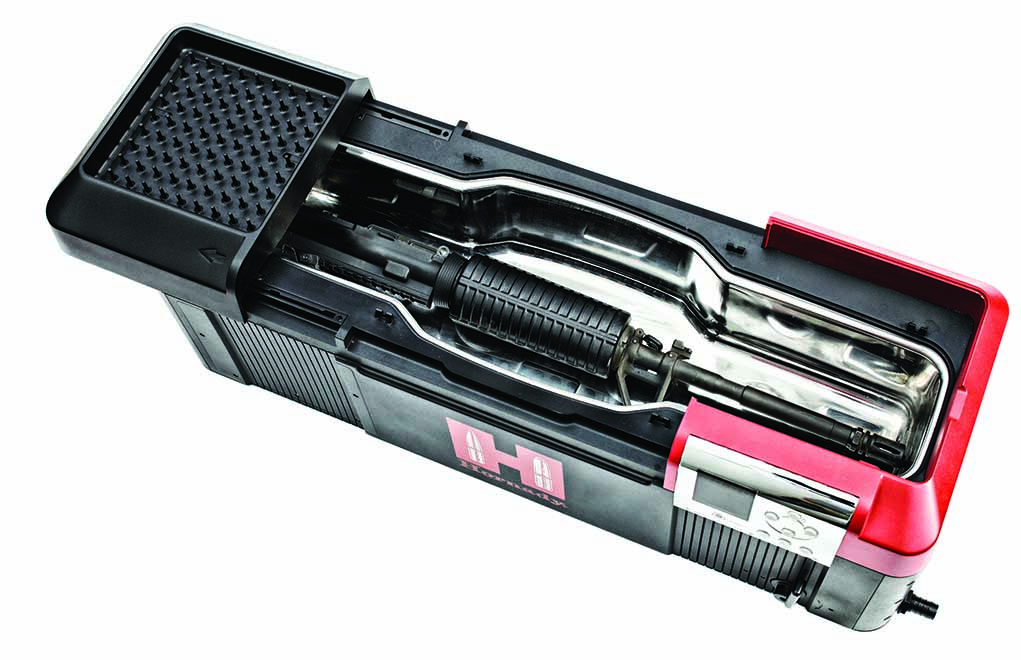
The cost of an ultrasonic gun cleaner isn’t inconsequential. Hornady makes its Lock-N-Load Hot Tub, which holds 9 liters of cleaning solution. It’s big enough to hold an assembled AR upper. It’ll also hold other items, such as an MP5-barreled receiver with an integral suppressor stack on it (hey, not everything is regular deer-hunting equipment!).
The Lock-N-Load Hot Tub holds an assembled AR upper—or, in this case, an MP5, complete with integral suppressor monocore/barrel.
The cost of this tub is close to $600, but the time and mess it saves could make it a bargain. You can get solutions for cleaning brass or non-brass parts. The Lock-N-Load Hot Tub has heat, a timer and even extras—such as a smaller internal tank so you can run two different batches of parts and not get them mixed up.
Where ultrasonic gun cleaners really shine is if you happen to own a silencer. Scrubbing the gunk off the baffles of a rimfire or pistol suppressor is the definition of “awful.” An ultrasonic cleaner makes the job so much easier, you’ll actually look forward to cleaning your suppressor (OK, maybe not, but that isn’t much of an exaggeration).
And, to clean brass—especially if you team up your ultrasonic cleaner with a brass dryer—you’ll be “cooking with gas.”
The only drawback, and it’s really just a minor one, is the need for counter space (hey, if you were looking for a winter project, why not re-design and re-build your reloading room)?
It was cleaning guns that finally got me out of the gunsmithing business. I figured that in the time I’d been working, I’d scrubbed—and wire-wheeled the rust off—the gas systems of more than 1,000 Remington 742 rifles and probably something like 1,500 Remington Model 1100 shotguns. The thought of another three months of the pre-hunting season rush of doing that again was more than I could stand.
If there’d been gunsmithing-level ultrasonic gun cleaners available then, who knows what my future might have been?
Editor’s Note: This article originally appeared in the August 2020 issue of Gun Digest the Magazine.
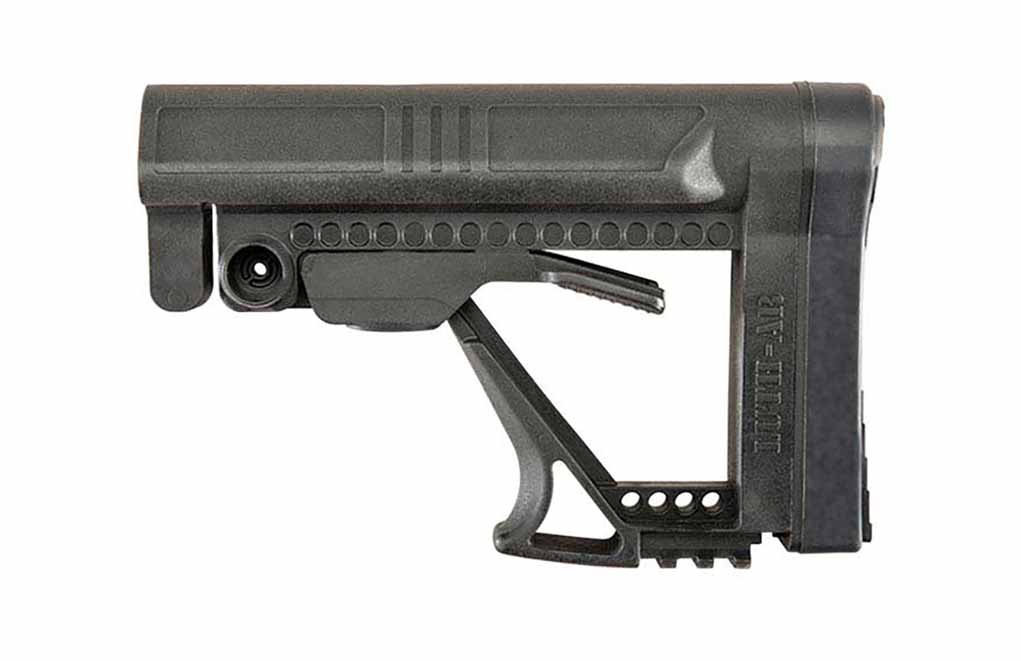
Enanced with Luth-AR’s Anti-Rattle set screw, the MBA-5 stock is better than ever.
Upgrading an AR, the stock usually ends up pretty low on the list. Most shooters are more than content to hobble along with the standard 6-position, telescoping unit their rifle came with, even if it does little to enhance the system. Unfortunate, given intuitive and consistent performance behind the trigger hinges on this overlooked aspect of a build.
Randy Luth more than understood this when he founded Luth-AR and began cobbling together the proverbial “better mousetrap”. The founder of DPMS Arms (which he later sold), broke from the herd to build enhanced stocks that not only helped bring out the best in shooters and their rifles. He did so with products that far from break the bank. No surprise Luth and Luth-AR are still rolling with an update of the popular MBA-5 stock.
Like a tight rifle, the re-design should be music to your ears. Luth-AR has attempted to take any shimmy out of the system, incorporating its Anti-Rattle set-screw design found in the original MBA-3 and MBA-4 stocks. At the same tick, the company has maintained the ergonomic and functionality features that made the stock a favorite among shooters. These include a wide, flared cheek rest for an intuitive and comfortable weld, a convenient paddle-style adjustment lever for rapid positioning and an integrated Picatinny rail on the lower rear of the stock for the addition of a monopod. Furthermore, the stock features quick-release cup pockets on both sides, so QD sling systems are righty and lefty friendly.
Designed to fit Mil-Spec and commercial carbine buffer tubes, the MBA-5 is compatible with a wide array of AR-style rifles. It has 3-inches of length-of-pull adjustment, is outfitted with a rubber butt pad and keeps a rifle nimble, weighing in at a meager 8.95 ounces. The MSPR on the MBA-5 is $49.95 and it’s available in black and flat dark earth.
For more information Luth-AR MBA-5 stock, please visit luth-ar.com.
Get On Target With The AR:
Go Small With These 8 Economical AR Pistol Options
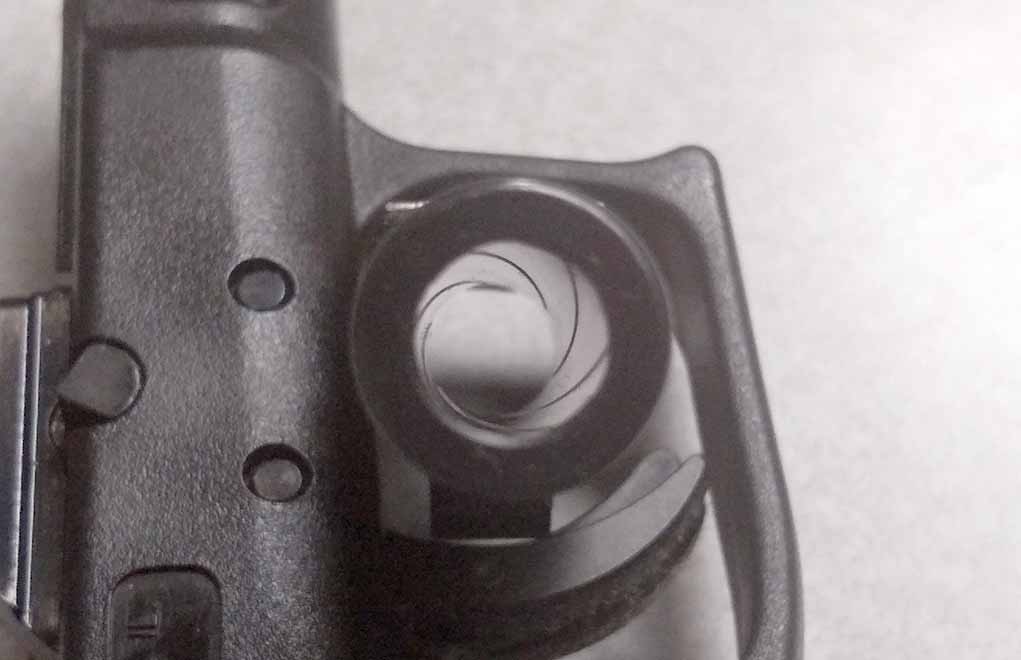
The whole point of a rifle or a handgun that isn’t a shotgun is to have rifling. And the twist rate matters. Rifle shooters obsess about this to a sometimes-alarming degree. Handgun shooters, not so much. But, it’s worth covering, as it can become a point of concern after you start going afield from the usual uses.
Rifled barrels can be made by one of four methods.
The first is the single-point cut groove. This involves (you guessed it) a single cutter. This was the way gunsmiths who built complete firearms in the pioneer days did it. After drilling the barrel, they’d ream it to dimension and then use the cutter, guided by a spiral track, to cut a thousandth-of-an-inch-deep groove. They’d then shim the cutter and make another pass.
When it was deep enough, they’d shift over and do the next groove. Properly done, it could take a couple of days to rifle a barrel.
The next step is a broach. Here, the cutter is a tool with many teeth. The teeth are arranged in the spiral of the rifling twist rate, and each one that follows the others in is a small amount (half a thousandth, or so) “taller” than the previous one. One pass through, and the reamed and polished bore is rifled. It takes, however, a lot of hydraulic push to get the broach through. And a constant flood of lubricant to cool and flush out the chips.
The third is EDM, or electrical discharge machining. Yes, just like the ports in Mag Na Porting. Here, the huge electrical charge jumps the gap and erodes the metal. The tool is a rod with protruding electrodes (think Frankenstein neck bolts) that do the eroding.
Last is cold hammer forging. Here, a mandrel the same shape as the chamber and rifled bore is stuck down a reamed bar. The hammer forging pounds the steel down until it fits the shape of the chamber and riling, and then the mandrel is pulled out.
No method is best. It matters how much attention is paid to the details of the process.
The twist rate needed to stabilize a bullet was empirically determined (found out by experiment) by Sir Alfred George Greenhill, a professor of mathematics at the Royal Military Academy at Woolwich, London, U.K.
His area of concern was the use of the new artillery projectiles. Instead of round balls, the newer guns, using various types of smokeless or semi-smokeless powders, were hurling pointed cylindrical projectiles. This greatly increased range, but range is of no use without accuracy. So, how fast to spin them?
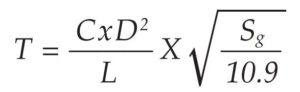
His formula;
Where: T is the twist C is a constant, in this case, 150 D is the bullet diameter in inches, which is then squared L is the bullet length, in inches
The variable Sg is the specific gravity of the projectile; its density. Sir Alfred was working with artillery pieces, but the formula works with lead-core, copper-jacketed projectiles as well, which are, not surprisingly, usually found with a specific gravity of, can you guess, 10.9. So for most work, we simply drop the entire second half of the equation. One detail that was determined was velocity matters. The constant C, with a value of 150, works up to 2,800 fps, and past that a constant C of 180 does a better job.
Obviously, in handguns, we are not going to be using C as 180.
You might wonder, if he was testing and proving his formula with shells of 4, 5 or 6 inches in diameter, how does this work with rifles and handguns? Very well.
It turns out that the thing that really matters is bullet length. A longer bullet requires a faster twist to remain stable.
Calculation Examples
OK, let’s see how this works. Let’s take something so utterly mundane that it would never occur to us to test it: a 9mm bullet. A 124-grain jacketed hollowpoint, to be exact.
The sample bullet snatched out of a box on the loading bench measures 0.574 inch long.
So, the Greenhill formula twist is the constant of 150, times the diameter squared, (.355 inch x .355 inch, which is .126 inch) divided by the length, which is the aforementioned .574 inch.
The result is a calculated twist rate of 32.93 inches.
You’re looking at that and thinking, “That can’t be right.” Do it yourself. And then look at the bullet. Stubby, isn’t it? And keep in mind that the common twist rate for muzzleloading rifles that fired round balls was 48 inches.
OK, let’s do it with another bullet: a .44 Magnum 240-grain jacketed hollowpoint, an XTP from Hornady.
Now, calculating the Greenhill twist for any given bullet is an interesting exercise, but it doesn’t tell us as much as we’d like. I mulled that over some time ago and realized what we needed was a comparison. The ratio of the twist-rate match of a bullet to the twist of the barrel compared to the theoretically correct twist rate for that bullet.
That involved a bit of mathematical equation adjusting. That’s the beauty of math. (Mathematics, not arithmetic.) If you keep the variables as they were and move them within the accepted rules of mathematics, your changed equation says the same things as the original, but it looks different or gives you a different answer.
So, instead of solving for the twist rate, I solved for the Constant, C.
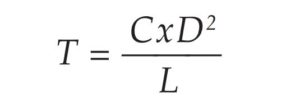
Originally, we have:
This is the Greenhill formula without the specific gravity addition. The bullet is the same all the way through this exercise, so we can drop Sg.
So to find C, we multiply both sides by length and thus negate the length on the right side of the equation.
Next, we divide both sides by the square of the diameter, negating diameter squared on the right.
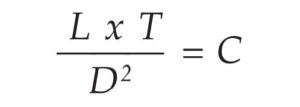
We flip it, so our result is on the left, and we have:
That is, the Greenhill constant is now the result of the bullet length times the twist rate being used or considered, and that sum divided by the square of the bullet diameter. When I did this originally, I named yet another technical aspect of firearms after myself and did this:
I’m going to divide the regular Greenhill constant by the results of the above formula and call the resulting ratio the Sweeney Stability Ratio, or SSR; technical symbol of M, or capital Mu, the Greek letter used for coefficient of friction.
Where Cg is the Greenhill Constant and Cc is the calculated constant, by our above equation.
What we’re doing is to calculate the twist rate of the bullet, as Greenhill would have it. And we are comparing it to the actual twist of the barrel being used on that same bullet.
If our bullet/twist rate combination is in agreement with the Greenhill formula, the resulting ratio will be 1. If the twist rate of the combination is too slow compared to Greenhill, the ratio will be less than 1. When I did this, I was calculating the ratio for rifles — in particular the AR-15. So, let’s do that again to get you up to speed.
The classic AR-15 barrel and bullet combination is a 12-inch twist (denoted in the barrel specs or literature as 1/12 or 1-12) and a 55-grain full-metal-jacket bullet.
The resulting Mu that came out was, surprisingly, 1. That’s right, the 55 FMJ out of a 1-12 twist barrel conforms exactly to the formula of Sir Alfred.
Now, it’s a well-know matter of observation and experience that the M855 cartridge, the common green-tip load for the AR-15, will not be stable in a 1-12 barrel. The 62-grain bullet has a tiny steel tip in the core, and that makes the bullet longer than a 55 FMJ. The calculated Mu for that bullet in a 1-12 barrel is 0.8272. Those who remember history will recall that the original AR-15 barrels had a twist of 14 inches, 1-14. The Mu of the 55 FMJ and a 1-14 barrel is 0.8547. Those bullets were barely stable, and anything could make them unstable.
So, we have a lower limit for Mu if we want accuracy to be something we can depend on.
Let’s get back to the 9mm, shall we?
There are a few standards for twist rates on 9mm barrels. The Colt carbine or SMG uses a twist rate of 1-10. That, as I recall, was because of the desire to use subsonic JHP bullets in suppressed SMGs, and so they went with a fast twist.
Some pistol barrels will be 1-10 or even 1-9. Then there is another group that will be 1-16, or even 1-18. And then finally, there are barrels at 1-24.
Remember, bullet length is what matters. And to that end, there were even some .38 Super and 9mm barrels meant to be used in 9mm major pistols with twist rates of 1-32. Why? Those pistols would only ever see 115- or 124-grain bullets, and at 1,500 fps, so they would be stable, but the twist would not overwork the bullet.
So, we take a 124 JHP, and we put it down a 1-10 twist barrel. The Mu, the ratio of experienced twist, to calculate, is 3.3. 1.0 is the desired one, but with the 124, we 3.3. Hmm. OK, let’s move up. Let’s use a 147-grain Hornady XTP.
So, it looks like there would never be a problem with handgun bullets in the twists usually used. Well, not always.
Let’s go to the extremes. Let’s look at a super heavyweight for the .44 Magnum; a 310-grain wide-nose flat-point gas-check. This is something you will launch out of a Super Blackhawk, Redhawk or Super Redhawk in the 1,100- to 1,300 fps range. The specs are; .429-inch diameter and 0.859-inch length. The Greenhill formula indicates that a proper twist rate for this bullet would be 32 inches. Interesting, eh, that so many handgun bullets should end up with so similar calculated twist rates?
The twist on Ruger barrels for its .44s is 1-20. So, we calculate a Mu for this bullet, in Ruger revolvers, of 1.6. The bullet is fully stabilized, but not nearly to the extent as our stubby 9mm bullets, in a 1-10 barrel.
The one complaint by some shooters and reloaders is the .41 Magnum: The twist on the barrels (1-18.75) is supposed to be too slow.
Let’s go with the heaviest bullet I could lay hands on quickly: a cast performance wide long-nose gas-check with a .411-inch diameter and 0.8196 inch long. A quick run through the Greenhill formula, and we come up with 31 inches for a twist rate. Plenty stable at the factory-spec 18.75 inches.
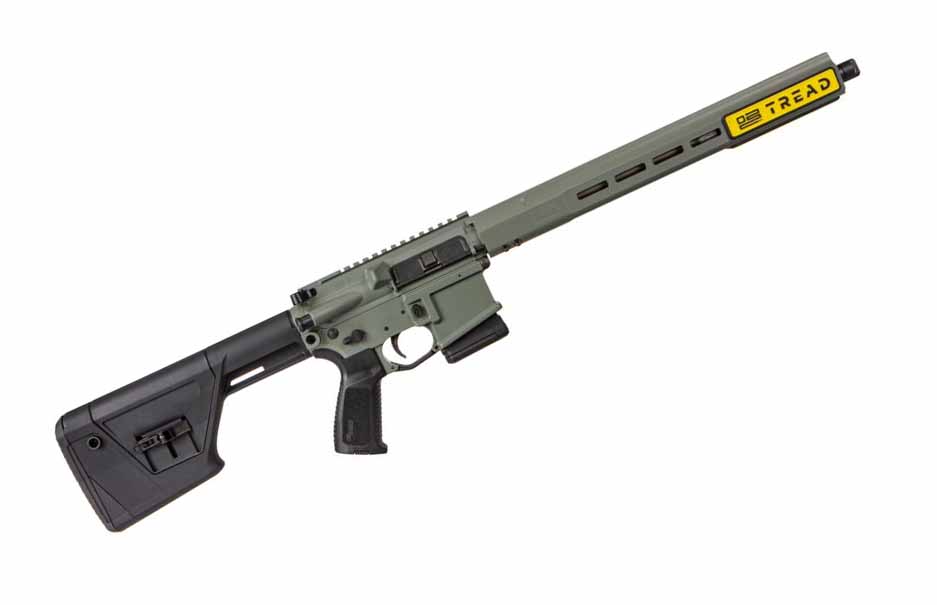
Enhanced for hunting, the M400 TREAD Predator is just the ticket get coyotes howling.
Of recent entrants to the AR-15 market, the Sig Sauer TREAD line has proven among the most intriguing. No reinvention of the wheel by any means, the allure of the rifles comes in the quality of the build for the money. They’re entry-level guns—not the cheapest, mind you—but by far offer incredible bang for the buck compared against nearly anything in its class. And now Sig is angling them at hunters.
A welcome addition to the line, the M400 TREAD Predator is the first dedicated hunter under the TREAD banner and tailored to this corner of the shooting world’s tastes. Now if the name sounds familiar, it should. Long before TREAD was a glint in the gun-manufacturing giant’s proverbial eye they had what was known as the M400 Predator on its roster. A solid AR-style shooter that ticked off a lot of boxes for hunters, the rifle has since gone the way of the doo-doo. While the new iron shares some of the same design features and the M400 designation of its predecessor, it’s not a retread (pun intended) of the old rifle. Instead, with the Sig M400 Predator, Sig offers up a more rounded package for the field with several enhancements that have become commonplace on hunting guns.
Nowhere is this more apparent than the 5.56 NATO’s upgraded stock. Where once a telescoping Magpul MOE Carbine stock resided, in the plain old M400 days, now lives a fully-adjustable precision unit. Ideal for fitting the rifle directly to the shooter, the polymer stock offers both length of pull and comb height control, making the rifle more intuitive to the user. Additionally, the gunmaker has opted for a new handguard, specifically designed for the rifle. Measuring in at 15-inches, the PREADOR Handguard protects a majority of the rifle’s barrel and offers up ample M-Lok real estate (3-, 6- and 9-o’clock positions) for the addition of accessories. Furthermore, the bottom of the handguard is flattened out, making it more conducive to shooting from a supported position—if you don’t happen to prefer a bipod.
Get On Target With The AR:
Go Small With These 8 Economical AR Pistol Options
Unlike ARs with a more tactical bent, the TREAD Predator features an abbreviated rail—integral to the upper receiver. A logical move, given most hunters will mount their optics systems in a more traditional manner and don’t need to worry about iron backup sights. As to weight, the TREAD Predator is a very manageable 7.5 pounds, which should make it a snap to lug along on long trudges. Sig uses aircraft-grade aluminum for the receivers and stainless steel for the barrel, which boasts a 1:8” twist. And the company finishes off the rifle with a Cerakote Elite Jungle finish, which looks just off olive drab. Finally, the gun is outfitted with a single-stage trigger, its shoe hardened and polished.
Sig did not release an MSPR on the M400 TREAD Predator, though some outlets already had the rifle listed in the $1,100 neighborhood.
Flashy good looks with the heart of a fighter, Urban EDC knifes turn heads without raising eyebrows.
Folding knives are versatile carry pieces. They can be toted daily whether you’re a mechanic, carpenter, plumber, police officer, firefighter, emergency medical technician, hunter, hiker, a member of the military or even an office worker in a corporate setting.
In an office, one needs to be careful with the selection of his or her EDC (everyday carry) knife. It’s best to remain on the conservative side of things, not wanting to whip out a large tactical flipper folder for opening boxes or mail.
A new class of folding knife has emerged over the past few years that addresses environments such as this. The knives borrow traits that made tactical folders popular and distill them down to small and compact forms for easy carry and unobtrusiveness, particularly when blades are opened in public settings.
Urban EDC knives are easy to acquire and use once an enthusiast becomes familiar with the features and quality pieces available on the market. The knives blend in well in the office, but also have substance for tackling tough cutting chores. They’re equally at home in a pair of dress slacks or jeans and can perform most daily cutting tasks.
Quiet Carry Lives Up to Its Name
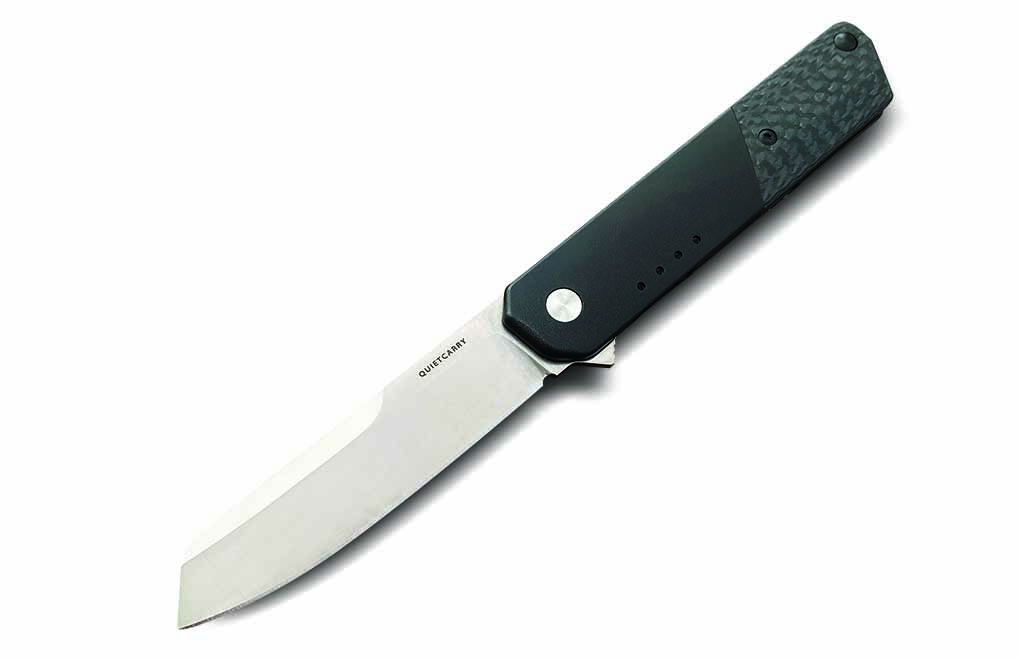
The Quiet Carry IQ folder combines sleek styling with one-handed opening, a frame lock and high-performance blade steel. The knife’s ultra-slim and compact form allows this EDC knife to blend in easily and carry well in jeans.
Quiet Carry is a new knife brand that embodies the urban EDC trend. The company’s IQ frame-lock folder is a slender and compact model that carries so easily, one’s apt to forget it’s there. The blade of the IQ is ground from ELMAX stainless steel and is a user-friendly sheepsfoot shape. Measuring 2.9 inches, the blade is just long enough to be compact and pocket-friendly but sports enough length to get work done.
The IQ puts a unique spin on the tried-and-true sheepsfoot blade shape with the inclusion of a slight belly. Typically, sheepsfoot blades have straight-line edges, making them precise utility cutters. The slight belly of the IQ allows the knife to be an effective slicer even with the handle held at an upward angle when cutting media on a bench or tabletop.
The blade nests fully inside the handle in the closed position and is opened via a flipper. A small flipper tab protrudes from the end of the handle, with the blade riding on ceramic caged bearings to promote ultra-smooth rotation. The handle is 6AL-4V titanium, and the folder includes a travel limiter that prevents the lock bar from being pushed past the blade tang. There’s also a steel wear pad on the end of the bar to provide secure steel-on-steel lockup. All these innovations are common to quality tactical frame-lock folders.
A small but sturdy titanium clip is attached to the handle of the IQ for tip-up pocket carry. Of deep-carry design, no part of the knife handle remains visible above the seam of a pants pocket. The clip is small but thick and sturdy, with no danger of springing through forced outward pressure while securing it to a pants pocket.
The IQ tested for this article sports a black PVD-coated handle, and the non-lock side has a carbon-fiber overlay for a classy touch. Four tiny holes on each side of the handle are aesthetic and serve no functional purpose. Overall, the manufacturing quality of the knife is excellent with fine fit and finish. It’s comfortable, thin and carries well, but those with large hands might consider it a bit awkward to use with little girth to the grip.
Regardless, the unique sheepsfoot blade makes this knife a workhorse. With its low profile, the IQ is a great candidate for an office carry piece and equally comfortable in a pair of jeans. It will slice cardboard, strip wire and cut webbing with ease. Don’t let its slender profile fool you, this knife is built for work. The manufacturer’s suggested retail price (MSRP) as of this writing is $198 for the black PVD-coated handle/carbon-fiber overlay version, and $182 for a bead-blasted titanium handle piece.
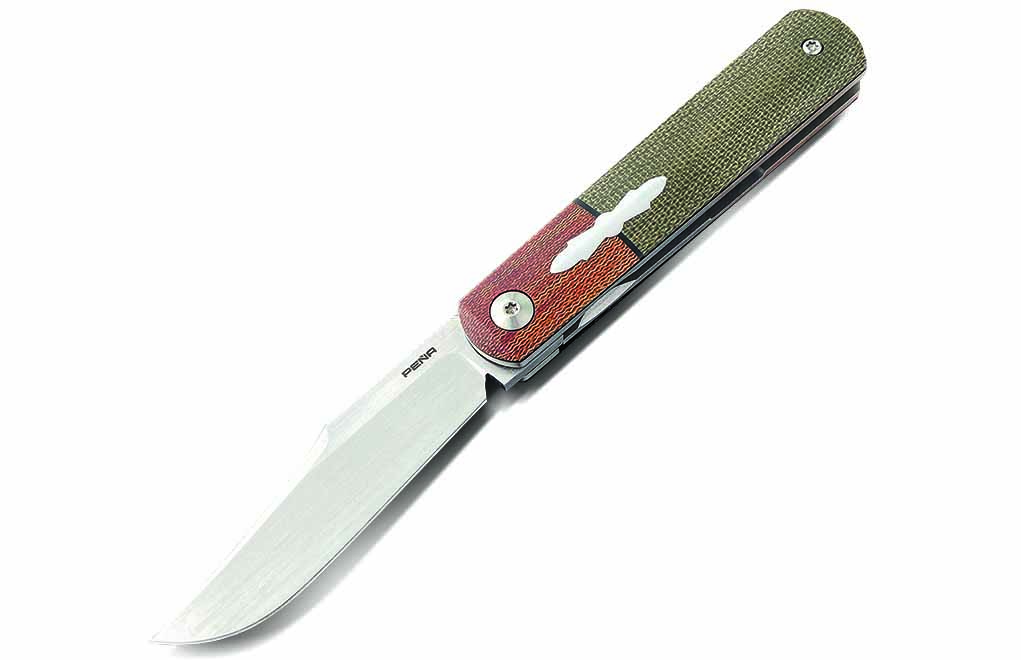
Enrique Pena is a custom knifemaker best known for merging styles. His Front Flipper Barlow offers the traditional styling of a hard-working folder paired with the modern convenience of one-handed deployment and a sturdy LinerLock. Excellent choice for an EDC knife with some flare.
Enrique Pena from Laredo, Texas, is one of the hottest custom knifemakers working today. Specializing in folding knives of the lock-blade variety, Pena’s style merges the traditional with modern flair. Case in point, his Front Flipper Barlow looks like an average traditional folder, parading a 3-inch, modified clip-point blade and a substantial handle that fills the hand comfortably. Barlows are work knives, ideal for utilitarian knife chores.
Yet Pena’s version showcases top-of-the-line materials all around. The blade is premium CPM-154 stainless steel for edge-holding power. When closed, the tang protrudes slightly and features deep finger notches. The design allows for thumb motion, like that in actuating a BIC lighter, to be used on the exposed tang, rolling it and causing the blade to rotate and snap into the open and locked position. The blade rides smoothly on caged ball bearings in the pivot area. The result is ultra-smooth action that needs to be experienced.
Pena offers the Barlow in an OD green handle with tan Micarta single bolsters. Black titanium liners lend the knife some class and delineate the green and tan Micarta. A propeller shield is a traditional touch on an otherwise modern piece. A LinerLock secures the blade in the open position, and a tan Micarta handle spacer rounds out the handsome good looks.
The Front Flipper Barlow is a hot seller from a popular maker. The piece showcases Pena’s eye for detail and superb craftsmanship. One of the things I liked was the ease of deploying the blade. With the average flipper folder, the opening tab protrudes from the bottom of the tang. Pena’s flipper adopts a low profile with nothing protruding to disrupt the classic lines of the knife. And unlike classic flat-sided Barlows, contoured handle scales are palpably comfortable. A little over a half-inch wide, the knife naturally nestles in the user’s palm.
The contoured handle scales also ride better in a pants pocket, making it feel less bulky and therefore more comfortable to carry. In this modern era of pocket clips, it’s refreshing to see a knife that slides into a pants pocket for traditional carry. I found the front-flipper Barlow to be a pleasing intersection of the old (Barlow pattern) and new (one-hand flipper opening mechanism and LinerLock). Quick to deploy, the clip-point blade is utilitarian with a tip that can be used for cutting or scoring, and a bit of belly for slicing and cutting easily through any material.
Pena’s custom Barlow adds flash and panache to a traditional design, as well as high utility function. So, you might ask, what would it cost you to place one of these Pena Barlows in your pocket? The maker’s list price for one like the test sample, which comes in a variety of Micarta colors, is $850. Contact Pena for specific materials and pricing.
Flash & Panache
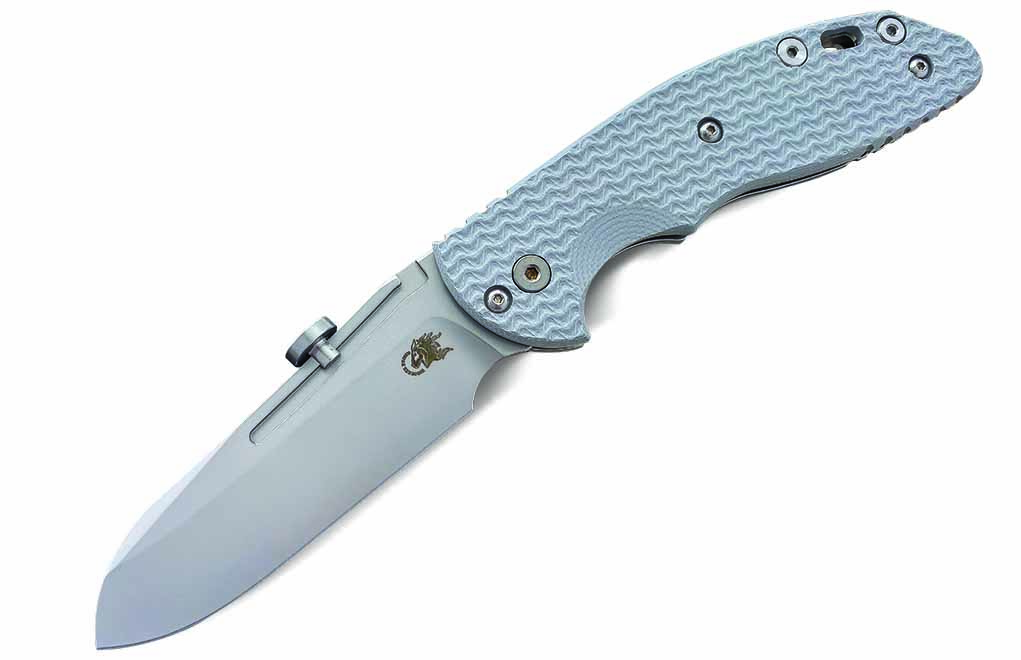
The Rick Hinderer Knives XM Slippy combines tactical folder styling and construction with the convenience of a slip-joint folder. One of the most rugged single-blade, slip-joint folders on the market, the EDC knife comes with an elongated nail nick and a thumb disk that can be removed via a small hex wrench that’s included.
The XM-18 has been the signature and best-selling folder line for Rick Hinderer Knives. Knife enthusiasts everywhere have come to describe the XM-18 with adjectives such as “overbuilt,” “rugged,” “built like a tank” and other descriptive terms that denote rock-solid engineering. Offering the XM-18 in several sizes, Hinderer also designed a slip-joint version—the XM Slippy. The XM Slippy takes the concept of a non-locking, slip-joint folder and gives it the same rugged, built-tough treatment that’s a hallmark of the series.
Currently offered in 3-inch CPM-20CV stainless steel sheepsfoot and Spanto (Hinderer’s own reinforced blade shape) versions, the ergonomic handle features 3D-machined G-10 scales for a solid grip. Color choices include black, blue, gray, red and OD green, and Hinderer sent me a gray-handle XM Slippy with a sheepsfoot blade. Getting it in hand, I was immediately impressed by the excellent quality of the build. Everything fits together nicely, and the blade’s action is smooth. A heavy-duty titanium pocket clip is easily mounted to either side of the handle for ambidextrous tip-up or tip-down carry.
For all intents and purposes, the Slippy looks much like the rest of the Rick Hinderer XM-18 models. Two options for blade deployment include pulling it open manually using a long nail nick like other slip-joint folders or via a thumb disc, the latter of which can be attached or detached from the blade spine using an included Allen wrench. Once open, there is more than enough spring pressure on the blade to secure it during use.
Which blade shape is for you? For general, all-around use, it’s hard to beat the Spanto—a shape conducive to many uses with a reinforced tip that adds strength to the blade. The sheepsfoot is more of a working blade shape, something you can use on a jobsite stripping wires, opening packages and for other cutting tasks that come up. Overall, the Rick Hinderer Knives XM Slippy looks like a tactical knife, but upon closer inspection is an urban EDC for folks who will put the knife to work without hesitation about its durability over the long run. Be sure to check out the XM Slippy. Its MSRP: $275.
Wolf in Sheep’s Clothing
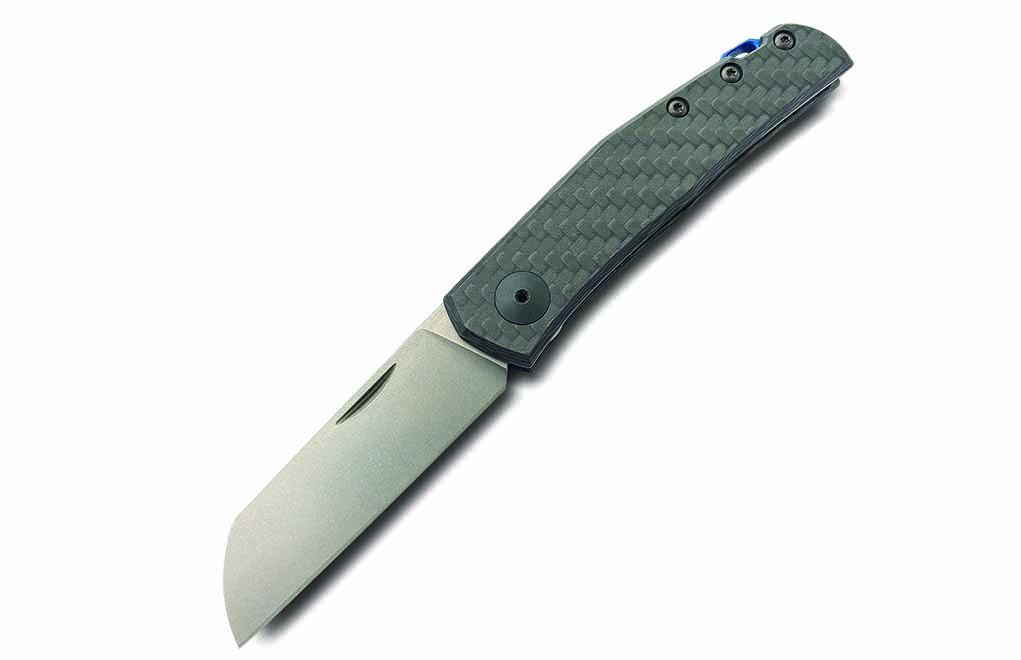
Zero Tolerance’s first slip-joint folder, the ZT 0230 is designed by Danish knifemaker Jens Anso with advanced materials like carbon fiber and CPM 20CV stainless steel, giving the EDC knife a high-tech edge.
The Zero Tolerance 0230 is a wolf in sheep’s clothing. Slender and lightweight, it sports a 3-inch CPM-20CV stainless steel sheepsfoot blade and an extremely lightweight, durable, all-weather carbon-fiber handle. Best known for high-end tactical folders, Zero Tolerance offers the 0230 slip-joint in high-tech materials and a no-nonsense working knife configuration.
Designed by Jens Anso, a popular custom maker from Denmark, the straight edge of the sheepsfoot blade is easy to sharpen and the blunt nose is non-threatening and eliminates accidental punctures. Instead of a traditional back spring, the 0230 slip-joint folder employs a special double ball-bearing detent system. Much like the ball bearing detents of LinerLock or frame-lock folders, the double detent system not only holds the blade closed, but also secures it in the open position. It doesn’t lock the blade, but rather holds it open.
Cutting force is applied in the opposite direction from which the blade rotates, so regardless how hard you bear down on the blade, it should never accidentally close. Like traditional slip-joint folders, a half-stop pauses the blade when it’s partially open, allowing the user to index and manipulate the blade without necessarily having to look at it.
In use, the 0230 is a capable cutter. The sheepsfoot blade is a great pull-cut tool and wire stripper that would make a fine companion on home improvement projects. It has no bulk in the pocket and carries exceptionally well. The only problem is that you may forget you even have it! The carbon-fiber handle gives it a cool, futuristic look, and a blue anodized aluminum spacer adds a nice touch of color. If you’re a fan of ZT knives, the 0230 will make a great old-school addition to your collection. Certainly, this knife won’t disappoint. Available now through ZT dealers, the MSRP is $180.
Don’t Stop Here
Urban EDC folders pair low-profile characteristics with modern materials and mechanisms, making them the perfect daily companions, particularly in office or corporate environments. Less bulky than tactical folders, urban EDCs are ideal for everyday carry and blend into any scenario. Having proper tools is a must for those who are serious about tackling daily tasks at home or in the office.
Editor’s Note: This excerpt is a small taste of the information available in Knives 2021The full-color 41st edition features everything from factory trends to advice on how to make money making knives. Need the book? Find it at: GunDigestStore.com.
One of the most basic skills pertaining to any handgun is understanding how to properly load and chamber one. Jamey Caldwell offers step-by-step instruction.
New to shooting? Then every step on the road to becoming a competent marksman can seem daunting. This includes the relatively simple process of loading and chambering your pistol. Yet, this most fundamental of the fundamentals must be mastered or your handgun’s utility reverts to that of a cudgel. A small one at that.
Jamey Caldwell, an instructor at 1-Minute Out and former special operator, covers the fundamentals of loading and chambering a pistol in the short video above. Your particular make and model of handgun may differ in some small ways from the Walther PDP used in his demonstration. However, the basic operation of loading up a magazine remains essentially the same. If you’re brand-new to firearms, it’s a wise course of action to watch Caldwell go through this procedure several times, until you understand all the aspects.
Additionally, if you never fired a gun before, you should go it alone your first time behind the trigger. Admittedly, even for novices the processes of loading and chambering a pistol are rudimentary, but that doesn’t preclude errors. It’s best to have a seasoned hand with you for your first live-fire—an instructor, range officer or experienced friend. Not only will they get you up to speed on loading and chambering your pistol, but they’ll be there to help you with more challenging aspects of marksmanship.
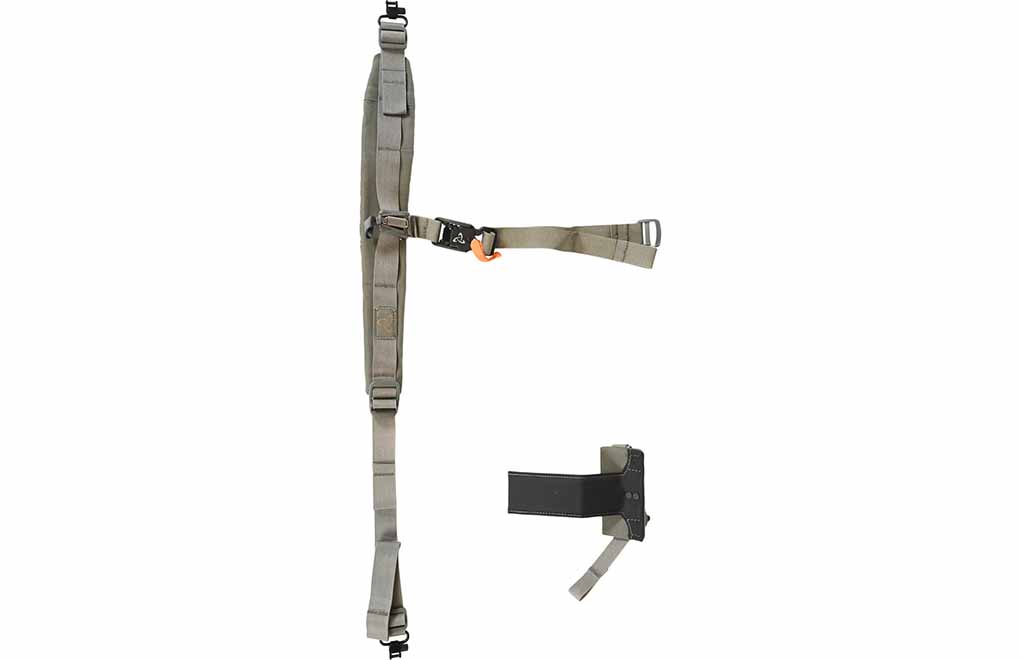
Know what helps when hunting the treacherous terrains of the backcountry? Your hands. Now you have use of both of them thanks to the Mystery Ranch Hands-Free Rifle Sling.
Spend any time hunting the backcountry and you’ll soon discover one of the most unmanageable pieces of equipment is your rifle. Sporting a traditional two-point sling, the thing just doesn’t want to stay on your shoulder without holding it taught with your mitts. Not good, when you might need two hands to scramble a scree slope without splitting your head. Sure, you could sling it across your chest, but that system isn’t exactly known for its expediency—a big strikeout, give a trophy buck or bull can appear at any time.
Hunters themselves, the folks at Mystery Ranch get the drawbacks of traditional slings present in the field, which is why they aimed at improving the age-old technology. Thus was born the Hands-Free Rifle Sling. Not reinventing the wheel by any means, Mystery Ranch tweaked the familiar design just enough to make it intuitive and innovative in the same breath. So, how does this all shake out?
The second rendition of the design utilizes an ambidextrous, magnetic sternum strap that attaches to most pack systems via the pack’s shoulder strap. The Hand-Free Rifle Sling still rests on the shoulder like traditional examples, only the sternum strap supports the firearm freeing up your hands. A waistband rifle stock dock then supports the weight of the rifle, so it’s not just dangling in thin air. Finally, silicon backing kept the firearm in place, reducing any slippage from the shoulder.
While the Mystery Ranch Hands-Free Rifle Sling does plenty to secure a long gun, it also keeps it at hand at a moment’s notice. The magnetic locking system breaks free in an instant, allowing hunters to take advantage of an opportunity, the moment it presents itself. It appears the best of both worlds. It’s a secure system that frees up your hands in challenging terrain, be it alpine summits or willowy river bottoms. Yet won’t hamper a shot when it wanders out of the dark timber. The MSRP on the Hands-Free Rifle Sling is $99.
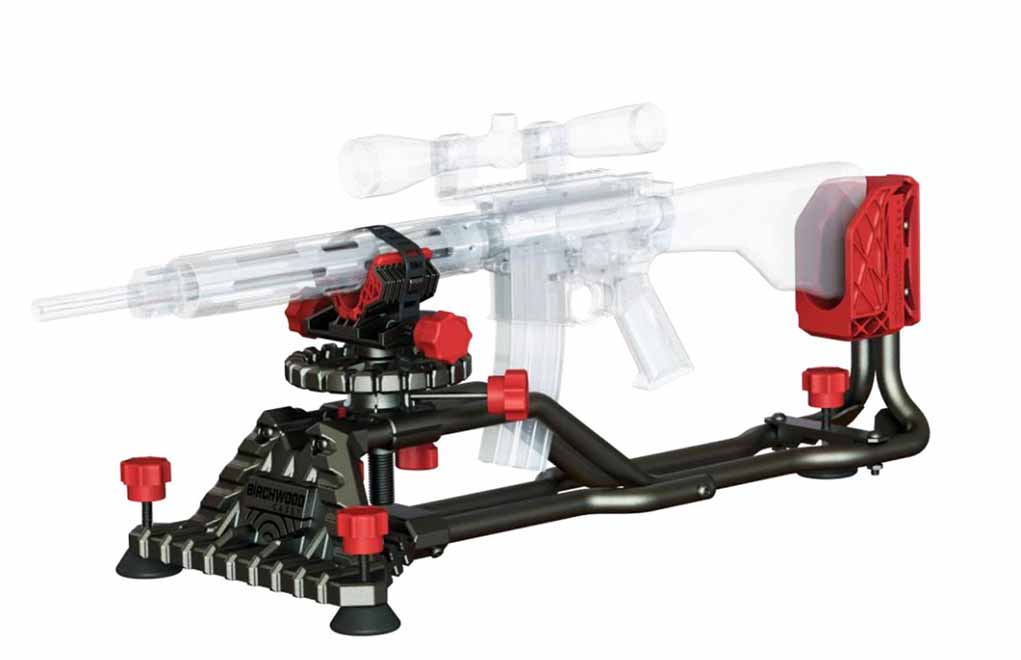
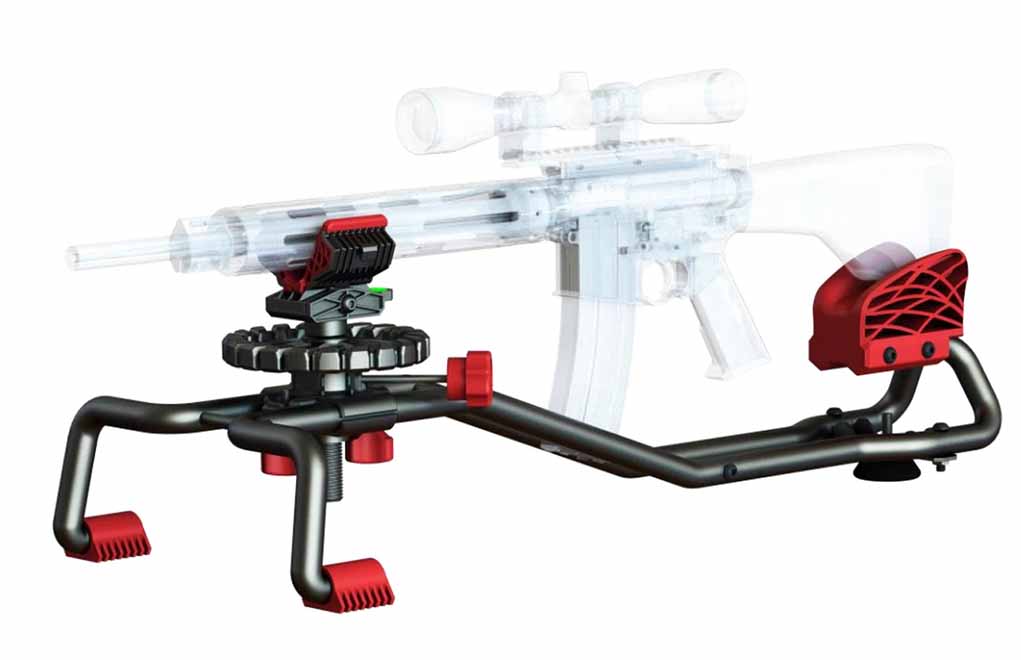
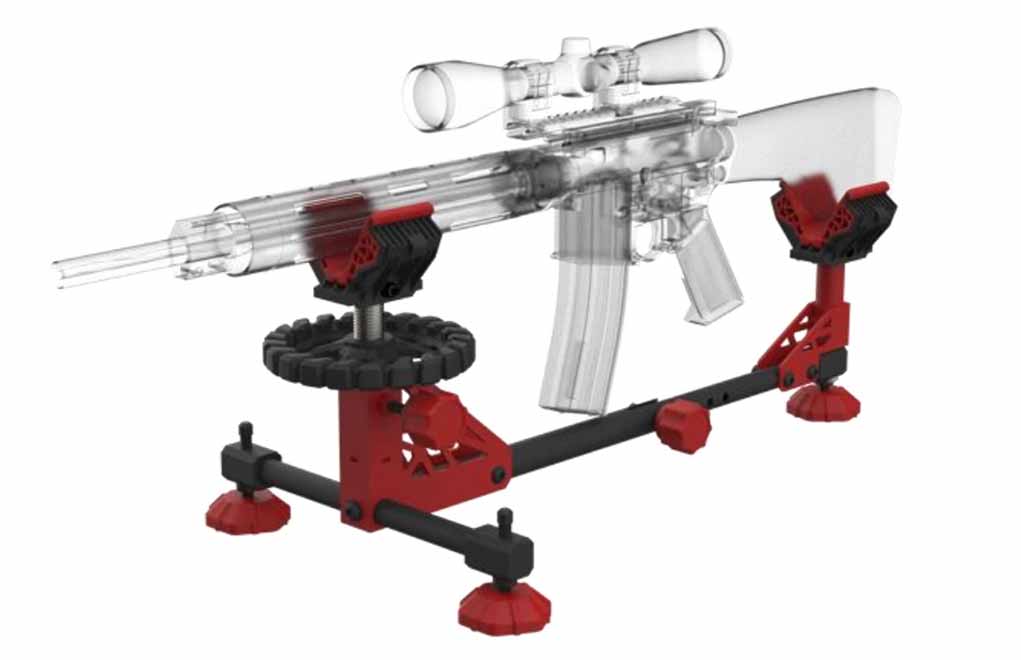
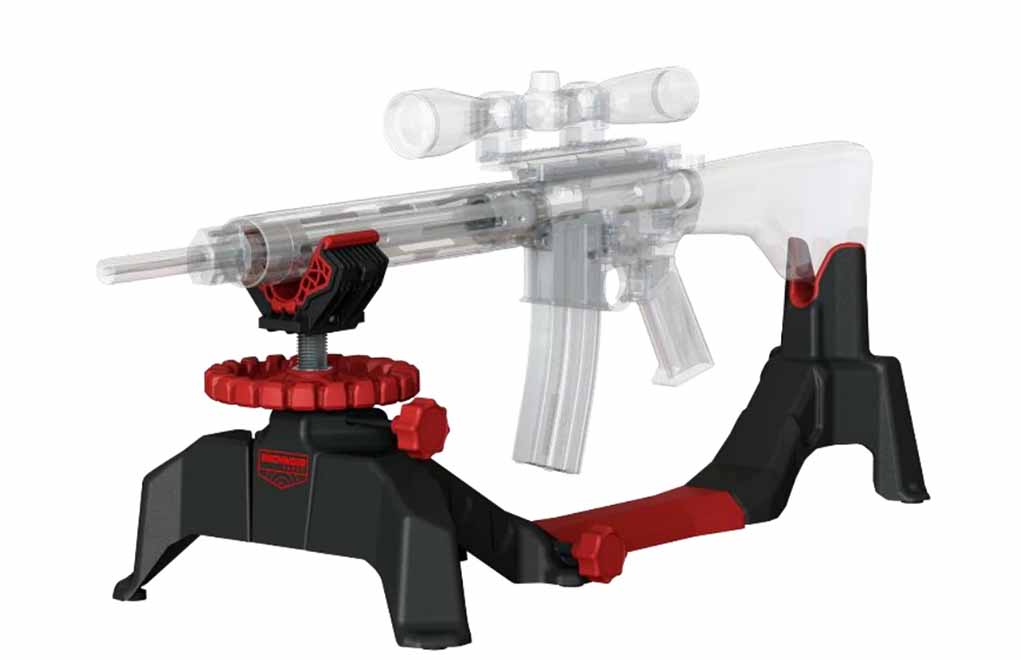
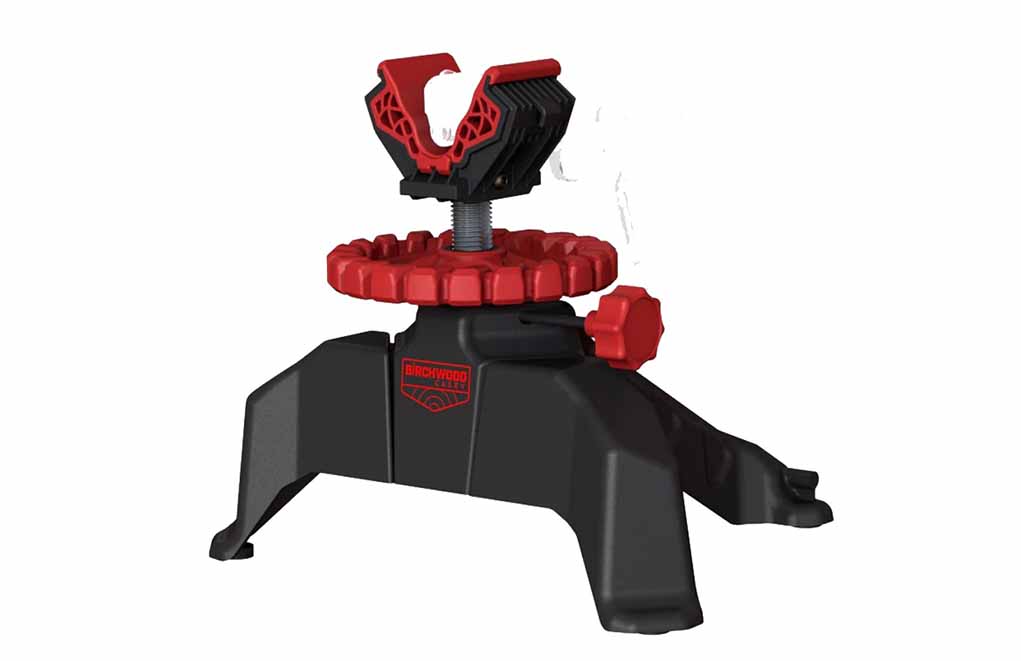
Offering options for every type of shooter and firearm, Birchwood Casey’s new shooting rest options bring versatility to the range.
Get off the bench! It’s sound advice unless you’re anything but an F-Class competitor. Hunting, self-defense or any other practical marksmanship generally doesn’t have the luxury of a wide, long and flat surface, level and anchored into the ground. Therefore, shooting in different positions makes you adaptable and more likely to get on target when it counts.
Rant over, there are times when it’s key to find a bench—say dialing in the zero on a new scope. During those times, it’s a solid idea to have the most stable system available to eliminate as many user-based errors as possible. In short, a shooting rest is a worthwhile investment. As chances have it, Birchwood Casey has come out with five new models for 2021, each tailored to different shooters and the guns they use.
Alpha
Built around a tubular steel frame, the shooting rest offers maximum strength, without sacrificing comfort. Featuring a non-slip rubber stock rest, an integrated weighted front (35 lbs. total), adjustable leveling feet with bullseye bubble level, the rest is ideal for traditional long guns. However, it doesn’t turn its back on some newer and smaller firearms, able to accommodate popular AR pistols with barrels as short as 7.5-inches. The Alpha’s low-profile design is ideal for prone shooting and offers full adjustment—2 inches for windage, 3.5 inches for elevation. MSRP: $229.99
Bravo
The Alpha’s little brother, the Bravo is conveniently sized with just as much support as the larger shooting rest. Again, Birchwood Casey turns to a rigid steel frame to ensure the rest is rock solid, then adds all the features shooters require to get and stay on target—non-slip rubber stock rest and feet, and bullseye bubble level. The overall weight of the Bravo is 15 pounds, so it has the heft to stabilize any long gun, yet can fully support smaller arms, such as AR pistols. The low-profile design is great for shooting prone and the ambidextrous controls, along with oversized knobs, make any adjustments quick and easy. The Bravo also allows for 3.5 inches elevation adjustment. MSRP: $129.99
Echo
Looking to go light? Birchwood Casey’s Echo is the answer. Featuring a strong steel frame structure, adjustable leveling feet, and a non-slip rubber stock rest the shooting rest provides a solid and flexible shooting foundation. The Echo securely holds various rifle sizes, including firearms with barrels as short as 7.5-inches. The front support is quickly adjustable thanks to oversized knobs, allowing for 3 inches of windage and 2 inches of elevation adjustment. MSRP: $89.99
Foxtrot
Dual purpose, the Foxtrot shooting rest is designed to stabilize both long guns and handguns. The best part, it converts to accommodate each style of firearm without the use of tools. Its quick-detach design offers unlimited adjustment and versatility and is sized for popular AR pistols and short barrel rifles. The rest is molded with high-density polymers to deliver a lightweight and sturdy frame structure. And outfitted with a padded front support, it securely holds the firearm and provides for quick and easy adjustments. MSRP: $49.99
Tango
Simple, light and small, the Tango shooting rest is the ideal option for those who value versatility and convenience. The rifle/pistol rest includes a padded front support that houses both handguns and rifles while protecting the firearm finish. Additionally, its elevation adjustable through a simple center screw. Oversized footings help maintain a stable shooting platform, no matter the caliber size and it’s high-density polymer construction it up for rugged use. MSRP: $29.99
For more information on the Birchwood Casey shooting rests, please visit birchwoodcasey.com.
Detailed fundamentals are the building blocks of all great shooting. There are plenty of “good-bad shooters,” as I like to call them, out there—shooters who have learned to adapt their bad habits into successful shots. Most people focus on results, but the results don’t always tell the entire tale.
Properly executed, the fundamentals make the difference between a hit and a miss when it comes to precision long-range shooting. There is no “voodoo” when it comes to engaging targets at long distances. But it does require that you know and focus on the fundamentals of marksmanship down to the millisecond. All shooting is a game of milliseconds and how you control the time between each one matters.
Setting up the Rifle to the Shooter
Many shooters are limited by the equipment they can afford. The closer to a bare-bones rifle you get, the fewer adjustments you will find. This is OK. But understanding the ways to properly fit the rifle to your body will help you progress in your journey. There’s nothing wrong with adding a bit of padding and duct tape to your stock to help with the fit. Modified is a good thing. Don’t shy away from it.
Length of pull is used to place the trigger finger in the correct position, a key in long-range shooting. There is a science to it.
The Proper Length of Pull Everybody hears a different answer on the proper length of pull; and, for different disciplines, there might be more than one acceptable answer. If you are strictly a prone shooter, the length of pull can be a bit longer.
In the past, the “mantra” was to place the buttstock of the rifle in the crook of the elbow. Then, with our “ninja” knife hand extended, we measure to the tip of the trigger finger. Today, I recommend a slightly different approach:
Use this same method, but adjust the trigger to a 90-degree angle and measure to the trigger shoe of the rifle. This confirms you can properly manipulate the trigger without disturbing the lay of the sights.
Setting up the Cheek Weld Before we set up the cheek weld, we have to mount the scope. The scope should be mounted in the rings ahead of time and can be attached to the rifle, but it should not be tightened.
We will assume the rifle has some form of Picatinny rail on the action. These Picatinny rails will help you set the eye relief, which will determine how we set up the stock. When setting the scope in the rail, it is best not to put it in the last slot at the back. Give room, both in front and behind the rings, so you can move the scope either forward or backward. It should also be noted that you bring the system to you. Don’t try to wrap yourself around the rifle.
Choosing a stock with an adjustable cheekpiece will further assist the shooter in setting up the rifle. Additionally, it will help you get a consistent cheek weld from shot to shot.
We do this by addressing the rifle in the prone position. The shooter should be straight behind it, not at an angle to the stock, with spine in line with the bore. Rest the head naturally on the stock, obtaining a good, solid cheek weld. Looking through the scope, there should be instant edge-to-edge clarity. Shadowing will tell you which direction to move the scope or cheekpiece on the stock.
Get On Target With Frank Galli:
Mils vs. MOA: Which Is The Best Long-Range Language?
Being straight behind the rifle is going to pay off down the road. It is going to allow the recoil to move down your body and exit your legs equally. If you are properly squared up (your shoulders straight across, regardless of being in the standing or prone position), the rifle will recoil and return to target. The movement will be minimal, allowing the shooter to maintain sight picture throughout the firing process.
Demonstrating the different variations is important, because not every shooter is built the same. Set up the rifle to the individual, not some arbitrary idea of why—simply because someone else did it that way.
Get into position before mounting your scope. Get a good, natural feel for the rifle in your shoulder pocket, making sure your bipod is correctly adjusted for your body. After your cheek weld is established, put the scope on the Pic rail and bring the sight picture to you. By mounting the scope this way, you get a good, natural position with a comfortable sight picture. Remember, we don’t want to have to work for edge-to-edge clarity.
Natural Point of Aim
In order to establish a good firing position, we want our muscles to be relaxed. When the body mentally perceives recoil, it will subconsciously relax for a microsecond, which can move the rifle to the point where it is naturally aligned. So, if the shooter is forcing the position, even a little, the body will subconsciously steer the rifle off target during firing.
The way to check for our natural point of aim is to align the sights on the target. While in position, go through a couple of breathing cycles with your eyes closed. Upon opening your eyes, see if the sights moved off the target. If the sights have moved, realign the rifle and your body as one unit on the target. Small movements will go a long way here. The movement should come from the shooter’s core and not the shoulders and/or arms.
Taking a couple of deep breaths relaxes the body just enough for the brain to change our position, should it find that position uncomfortable. When we opened our eyes, if the sights are off target, we have to fix this alignment. We call this the “gross adjustment for natural point of aim.”
By practicing getting into position straight behind the rifle repeatedly, one can help shortcut this process by being square, not only to the target, but behind the rifle. Indexing with the legs and the knees, the shooter wants to point his or her body to the rifle, which is pointed at the target. This will help align the shooter quickly and effectively in the field.
Setting up the rifle is the first step in building a solid foundation for long-range shooting. When we buy a new car, we adjust the seats and mirrors prior to driving. The rifle needs to be addressed the same way.
The fine-tune adjustment for natural point of aim is the dry-fire. This will show the shooter if his position is perfect. Given time and opportunity, always dry-fire before going live. If the reticle moves, that is a clue to adjust your position ever so slightly.
How Do We Check for Parallax?
To check for parallax, line up the reticle on a target and move your head ever so slightly, side to side or up and down. Don’t move your head enough to cause shadowing to appear around the edges. Use very small motions to see if the reticle appears to “float” on the target. Just remember, in some optics, focus is not parallax, and being parallax free might put you out of perfect focus.
The scope should be set up in position, placed on maximum power and then fine-tuned in place. At this point, lowering the magnification for different positions will open up the eye relief, thus creating a more forgiving eye box. This minor compromise is necessary because different positions will move the head ever so slightly behind the scope.
Breathing
Holding your breath is the last thing you want to do in long-range shooting. When we are hammering a nail or driving our cars, we don’t think about our breathing. Correct? The same thing applies when shooting a rifle. What we need to know about breathing while shooting is where to break the shot, which is at the bottom of our natural respiratory pause.
Edge-to-edge clarity, with no shading, is key in a long-range shooting optic. Be sure you are not hunting for a clear sight picture as you settle behind the rifle.
We all have a natural respiratory pause, even if we’re running with 80 pounds on our backs; there is a bottom of the breathing cycle. That is where we break the shot. If your shot is not lined up right immediately, continue to breathe until it is.
We do not have to tell our body to breathe heavily when exerting ourselves. It just does it naturally. In order to clear out of this condition, we need to breathe more and not less. So, holding your breath in the case of long-range shooting is a very bad thing and does not make the shooter steady.
Trigger Control
Trigger control is defined as “the manipulation of the trigger without disturbing the rifle or the lay of the sights on the target.” Most errors in long-range shooting can be attributed to improper manipulation of the trigger.
The purpose of the firing hand is to manipulate the trigger and hold the rifle into the shoulder pocket. We aren’t gripping it like a handgun; rather, we are holding it straight back to the rear. This requires very little pressure. The shooter should establish a firing position on the stock that starts from the trigger back and not from the stock forward. This is more a mental process than a literal one, because we don’t want people putting their fingers on a live-weapon trigger first. The initial practice should have the shooter visualize the trigger finger before the grip. You can do this during dry practice, which is highly recommended.
We want to place the trigger shoe squarely on the pad of the finger, creating a 90-degree angle with the finger and second joint. This will vary slightly from shooter to shooter, but the goal should be to get the fingernail to point to 9 o’clock for a right-handed shooter and 3 o’clock for a left-handed shooter. This right-angle position should be there before the trigger is pressed and remain there afterward.
Fundamentals translate—regardless of the position. What changes is the amount of practice we put into the task.
When addressing the stock, regardless of the type, we want to make sure the movement of the trigger finger is not touching the stock. The trigger finger should be moving like a hinge—straight to the rear, using our body mechanics to our advantage. If the fingernail starts at 9 o’clock and ends at 9 o’clock, you can rest assured you are manipulating the trigger straight back to the rear.
The three fingers below the trigger finger should be pressing the stock straight back into the shoulder pocket. We want to develop a front-to-back management of the stock. It’s not necessary to engage the thumb. Depending on the stock type, many will lay the thumb on the strong side or use it as a reference point on the stock, putting it in an out-of-the-way place. We call this “floating” the thumb, and it is a perfectly acceptable position, because we don’t need our thumb for the task of long-range shooting.
Follow-Through
“Follow-through” is simply holding the trigger to the rear until the recoil pulse has ended. We don’t want to be in such a hurry that we are rushing for the bolt to reload before the bullet has left the bore. It is possible to disturb the system and cause the round to deviate off target.
Lastly, we want to continue to watch the reticle on the target. Before breaking the shot, a shooter can lose focus thinking about all the fundamentals—one, then another, then another. The last thing we want to mentally think about, and focus on, is the reticle on the target. We need to watch this throughout the entire firing process. Here is where you want to put the bullet. So, it is here you need to focus.
I like to mentally follow the bullet to the target before moving at all. That means a delay in running the bolt. If I’m trying to spot my impact on target, if I start moving, the sight picture will be compromised, and I might miss the result. If I hit the target, I want to know without the aid of a spotter; and if I miss, I really need to know where so I can correct it. Most of the time of flight that we are dealing with is relatively short, so don’t sweat the few seconds we are asking to freeze in place.
Recognizing Time
With trigger control and follow-through working together, we have to recognize time. Every rifle system has a lock time. That is usually applied to the firing pin movement: the time from the trigger break to the primer being hit. However, our lock time does not just apply to the firing pin movement. We have to consider the time it takes for the brain to relay the will to press the trigger to the hand. Different shooters have different reaction times. That can mean a shooter with a slower reaction time using a bigger lead on a moving target. Then, we have to look at the time it takes for bullets to leave the barrel.
Your precision rifle is a machine; we are turning on the machine in order to send the bullet downrange to the target. I would submit to you that the shot is not over until the bullet has hit the target or we have confirmed a miss. Stay engaged with the rifle and sights until we’re sure we need a follow-up shot or we are sure the target has been successfully engaged.
Calling Your Shot
All this information is great as a theoretical exercise. But how do we know we are doing it right in our practical application? The best way is with a competent instructor to watch you shoot and correct any errors in your form. The next-best way to know you are doing it right is “calling your shot.”
The tactical shooter needs to ask, “Where are the sights when the shot broke?” It will force the shooter to focus on the sight picture during the critical moment when the shot is fired. Shooting is a game of milliseconds, and if you divert your attention from the target, you risk drifting off target.
In so many cases, shooters will not even notice this. They will establish their sight picture, consider the crosshairs on target and then begin to think about something else. It is during these moments that we miss the movement caused by a poor trigger press or a subconscious shift in our body. We need to carefully watch the reticle so we can answer the question, “Where are our sights during the firing sequence?”
If we have practiced and trained our body to execute the fundamentals correctly, during live fire, the benefits will be immediately apparent. This also extends to positional shooting—from any position. Making this a part of the firing sequence will train you to be more effective.
Configuarable and boasting OSS’s Flow-Through technology, the RAD 9 and RAD 45 suppressors put the hush on your handgun.
Considering suppressor technology is more than a century old at this point there’s not a ton new under the sun. Puzzling out the mass of gas coming out the muzzle of a gun and the volume required to deaden its report and lessen its recoil is fairly rote. That said, engineers can play with geometry a bit, particularly the baffles’, to tweak a can in some interesting ways. Which is the case with the new OSS RAD 9 and RAD 45 suppressors.
RAD 9
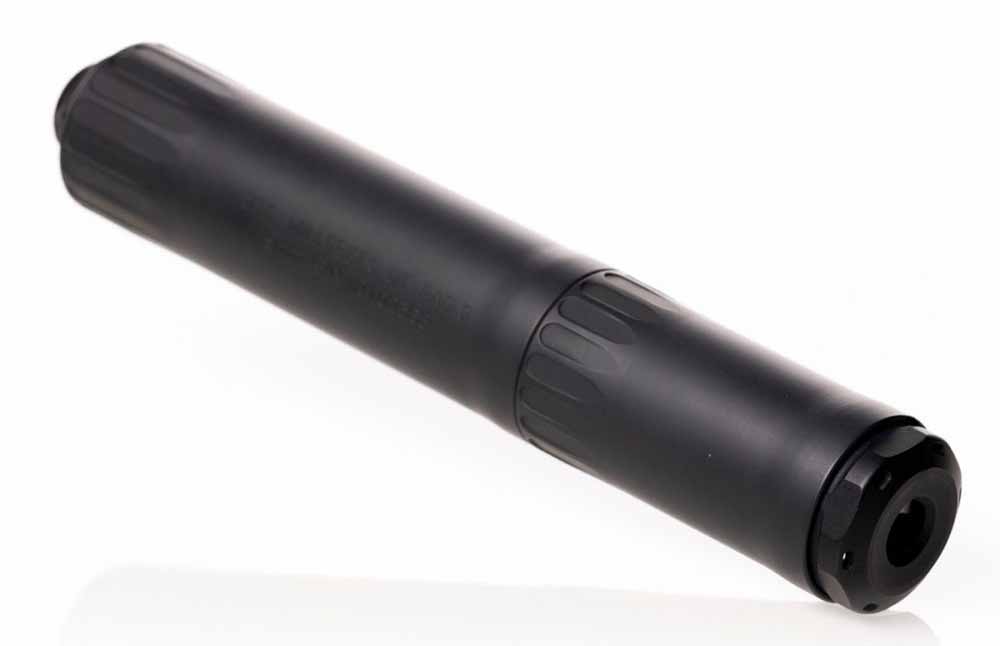
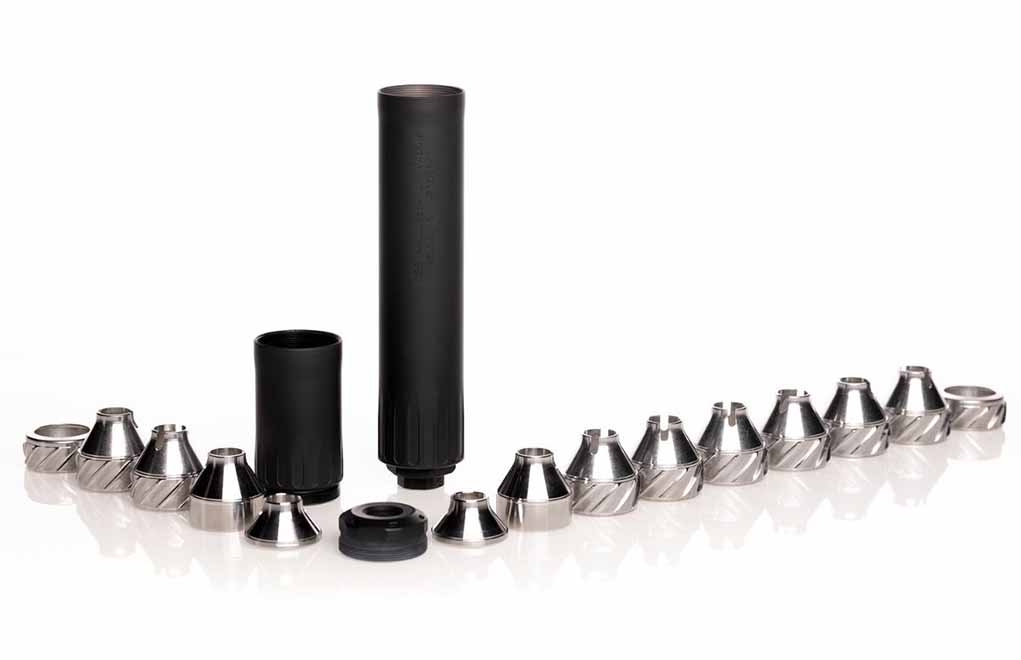
The heart of the system is the manufacturer’s Flow-Baffle technology, a system that goes a great way to making suppressed shooting much more pleasurable. Essentially, what OSS calls a “Flow-Through” system utilizes radial grooves on the exterior of the baffles to route expanding gases forward through the suppressor and away from the shooter. In short, the RAD 9 and RAD 45 mitigates dreaded blowback, where gases travel reward through the firearm. An issue, because it’s distracting and noisy.
While the Flow-Through system isn’t a new concept, OSS is among the companies that have perfected it in the past decade. And it’s especially tricky, given a certain amount of blowback necessary for a handgun to function.
“We began development of the 9 and 45 after the launch of our popular rimfire suppressor, the RAD 22,” said David Sanders, Director of Research and Development. “As most pistol owners know, you need some blowback for your pistol to function. So, the design challenge was to mitigate the blowback increase when suppressed while maintaining superior pistol performance. We’ve done it with these two new RADs.”
As their names suggest, the RAD 9 and RAD 45 are caliber-specific—9mm/.300 Blackout and .45 ACP respectively—an offer more than a unique noise/gas reduction system. Additionally, the cans are modular, giving shooters the ability to configure the suppression system to the objectives at hand. The RAD 9 goes from 7.7 inches at full length down to 5.15 inches, while the RAD 45 is modifiable from 8.6 to 6.4 inches. Weight-wise, both are fairly manageable with the 9mm suppressor tipping the scales at 9.1 ounces in its largest configuration and the .45 10.3 ounces. As for noise reduction, both do a solid job. In their full configurations, the RAD 9 is rated for 129 dB at the muzzle and the RAD 45 136 dB,
RAD 45 disassembled
The suppressors are feature stainless-steel baffles and a black Cerakote finished titanium tube. Making them compatible with a host of firearms, the RAD 9 and RAD 45 have an adaptable mounting system that does not require a fixed barrel spacer. Both booster pistons and fixed thread mounts are available for the suppressors. Price-wise, the RAD 9 has an MSPR of $849 and the RAD 45 an MSRP of $999.
For more information on the RAD 9 and RAD 45 suppressors, please visit osssuppressors.com.
Get More Suppressor Info:
The Suppressor: How Is It Made, It Works And How To Buy One
Improving on a number of aspects of the original, the 2021 Colt Anaconda keeps the Snake Gun line rolling.
Since Colt dusted off its popular line of “Snake Guns” in 2017 with the Cobra, folks have pondered how far back it’d reach. There’s plenty of serpentine superstars worth rebooting, though a great majority of shooters were satisfied with the rebirth of the Python a year ago. Luckily, Colt isn’t finished revamping and releasing its classic revolvers, in fact, with its latest release the gunmaker has gone bigger than ever before. Welcome back the Colt Anaconda.
It’s been almost 20-years since the last large-framed (MM frame in Colt parlance) rolled off the lines in West Hartford, Conn., discontinued in 2003. And while it doesn’t quite command the awe of the Python, the Anaconda has perhaps only been second to the icon in Colt fans demanding its return. Understandable, given the massive wheelie drew comparisons to other great .44 Magnums—particularly the Smith & Wesson Model 29. At least it was after Colt ironed out some initial accuracy issues on the original model, which required tweaks to the barrel design. Though, it never faired well against the competition, which in the 1990s were well established and sucked much of the air out of the double-action .44 Magnum market.
Revamping The Serpent
Does the new Colt Anaconda face similar hurdles this time around? Its old competitors are still around, not to mention some upstarts that have joined the scene since. Could be, but Colt doesn’t appear to be resting on its laurels, essentially redesigning the revolver, outside of tweaking its original aesthetics.
Essentially, the new Anaconda is a scaled version of the new Python, bulked up of course. It’s not surprising either, given Colt’s reboot of its revolver line is centered around a scalable frame. In addition to this, the gun utilizes the gunmaker’s revamped dual-action leaf-spring found in the .357—again enlarged. A refresher, it’s a “U” shaped spring that emulates the Python’s original “V” shaped spring but is more conducive to mechanized mass production. The design improved the Python’s double-action trigger pull considerably from the original, however, it came at the expense of the revolver’s renowned single-action trip.
Nevertheless, the overhauled system should play well in the new Anaconda, especially given the original’s was less than desirable. Expect a similar pull weight in the .44 Magnum to the .357, which is around 5-pounds in single-action and 10-pounds in double-action.
Shedding Its Skin
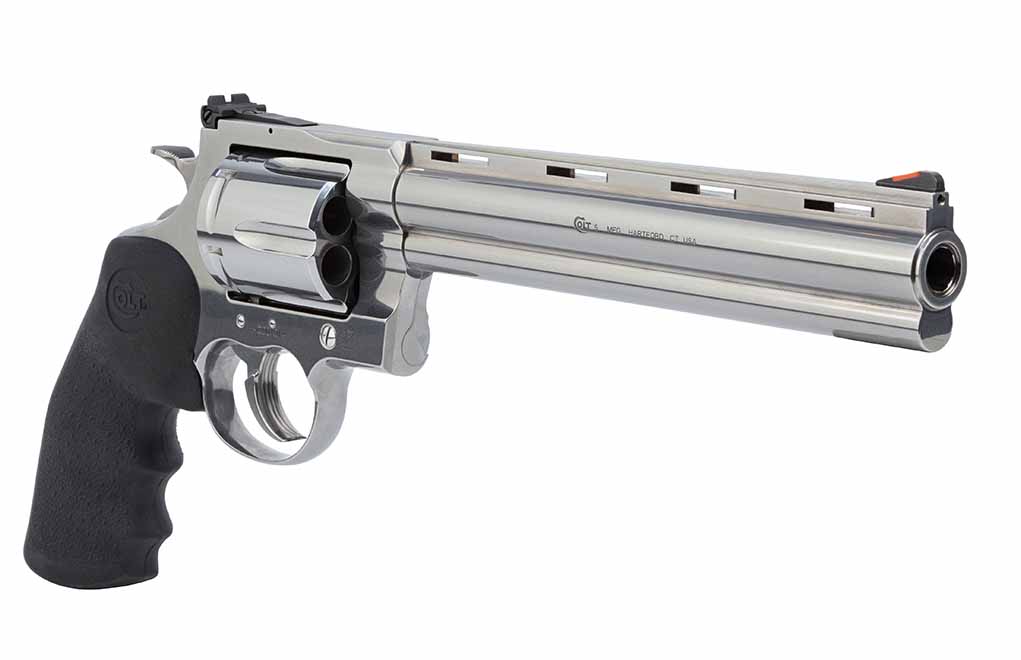
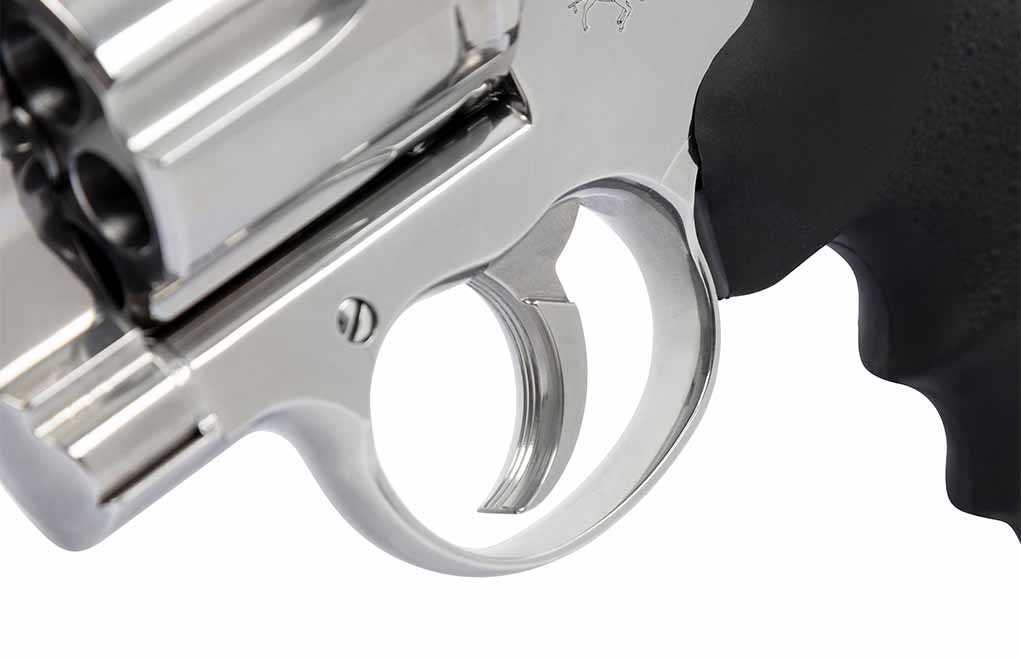
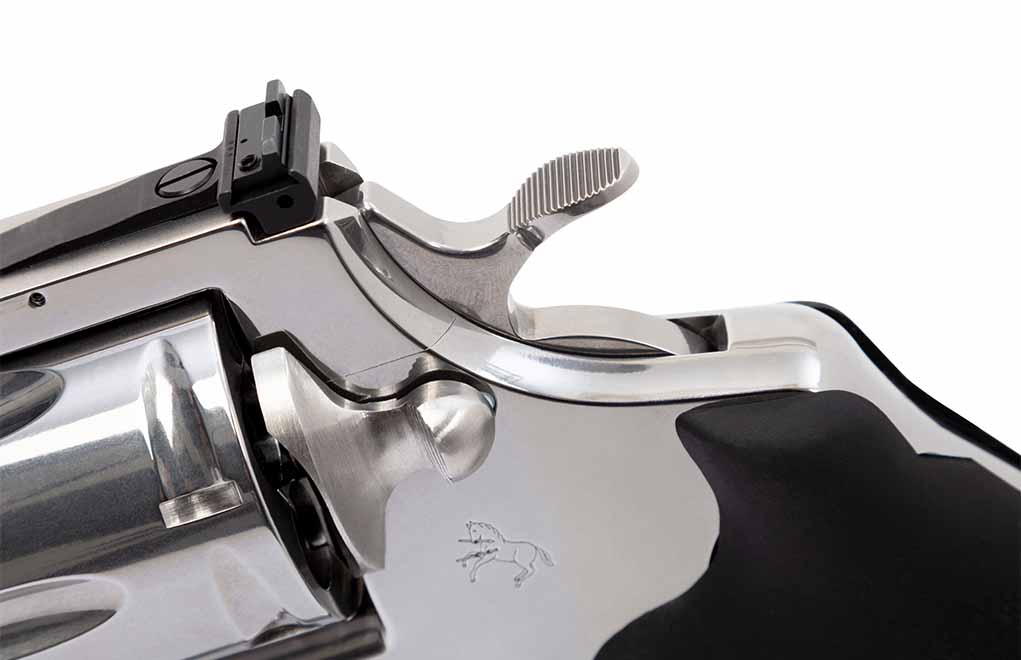
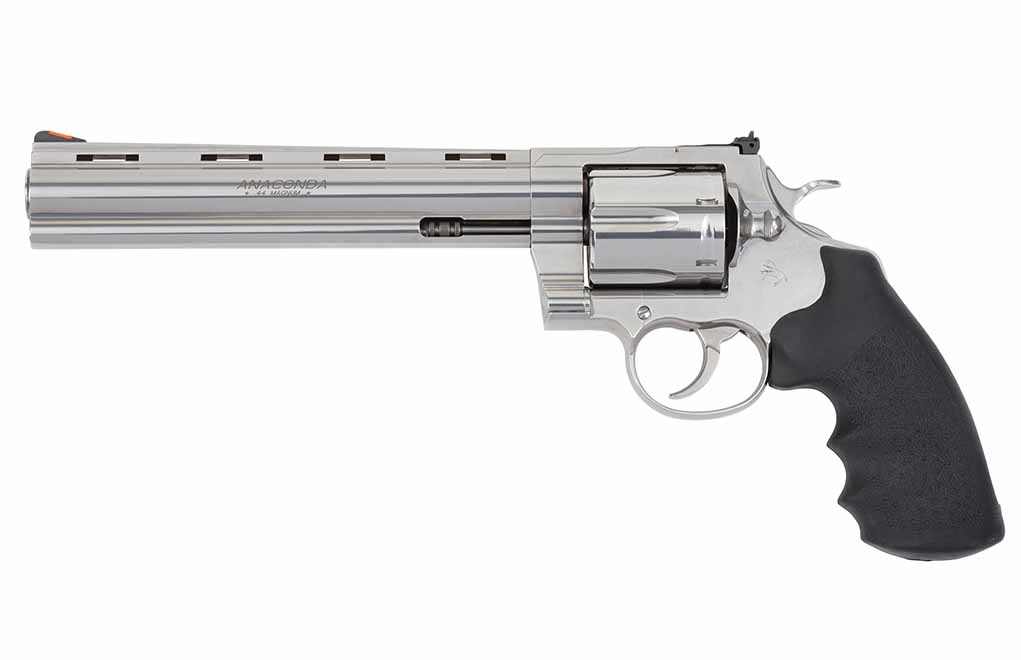
Overall, the Colt Anaconda cuts a nearly identical profile to its forbearer—a good thing, for all its initial stumbles the gun was always good looking. The six-round revolver frame, barrel and cylinder are machined from stainless steel, and polished to a high shine—what Colt calls “Semi-Bright”. It boasts a full under-lug and vent-ribbed design of the last iteration of the gun and appears to have a full-length ejection rod. The barrel is target crowned, adding a touch of protection to the bore.
Gone, however, is the walnut. Instead, Colt opted to outfit the Anaconda with a set of rubberized Hogue over-molded grips, which many won’t complain about. The finger-grove grip might not have the class of hardwood, but should offer superior control and some recoil mitigation on what is known as a hard-kicking caliber. However, traditionalists can swap the rubber for walnut, as the grip is compatible with the new Paython’s panels.
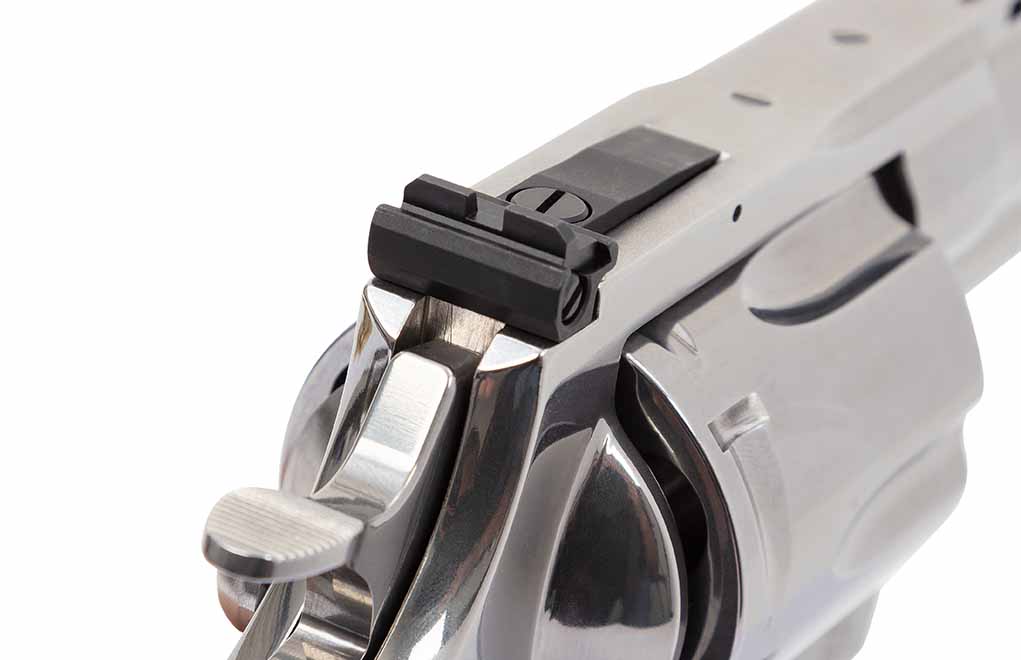
The revolver is outfitted with a ramp front sight with red insert and a fully adjustable rear, a very passable system for most shooters. If not, the sights are simply replaced with little more than an Allen Key. Additionally, the Anaconda is drilled and tapped standard for the addition of a scope—no the case on all of the first-generation models. But given the popularity of handgun hunting a logical upgrade for the line.
As for barrel choice, the Colt Anaconda comes in 8- and 6-inch models, however, a 4-inch model is missing in the initial launch. The revolvers come with the expected heft of a large-framed gun with sizable barrels, 59- and 53-ounces respectively. And, on a final note, both the trigger and hammer spur provide ample width for quick and comfortable manipulation.
Parting Shot
Despite a few bumps in the road, Colt’s relaunch of its Snake Guns has struck a nerve with the shooting public and proven wildly popular. Adding the Anaconda seems like the right move at present, given heavy-hitting calibers have become more popular over recent years. There’s no word if Colt plans to branch out in chamberings (the old gun also came in .45 Colt), but the possibility is there. Even so, .44 Magnum alone has the potential to attract plenty of attention.
As to price, well it’s a Colt so expect to open your wallet; both the 8- and 6-inch barrel Anacondas have MSRPs of $1,499. Still, with the hubbub over Snake Guns, for many that will still prove a value.
While it might not seem so, a shirt or jacket is a huge boundary in defending yourself. If you can’t clear clothing on the draw, you might find yourself empty-handed in a lethal-force situation.
Drawing from holster isn’t as simple as it looks. Add a layer of clothing for concealment, the fundamental skill becomes that much more challenging. Executed improperly, a handgun can prove inaccessible or hang up when drawn—neither case ideal in a life-or-death situation.
Jamey Caldwell, an instructor at 1-Minute Out and former special operator, covers the basics of ensuring an outer garment doesn’t become a deadly barrier to a concealed carry handgun. One of the keys to executing clearing clothing from the holster is over-exaggeration in sweeping a garment out of the way. Doing so might seem a bit dramatic at first, however, given the lightness of most clothing is required to get it well out of the path of your draw. As Caldwell points out, there are some ways around this, such as specialized concealment clothing that have weighting in the hem (something you can do yourself).
Useful as this breakdown is, Caldwell’s instruction centers around a light button-up shirt, in this case, worn unbuttoned. This is a popular method of concealment and a good base outfit to begin sharpening this fundamental skill. But it’s an extremely narrow base to work from. Folks in colder climates or those who are hemmed in by particular dress codes oftentimes don’t have the luxury of a garment easily swept to the side. Despite this, the fundaments Caldwell demonstrates still hold water, they only need to be tinkered with to an armed citizen’s particular profile.
For more videos from Panteao Productions, please visit panteao.com.
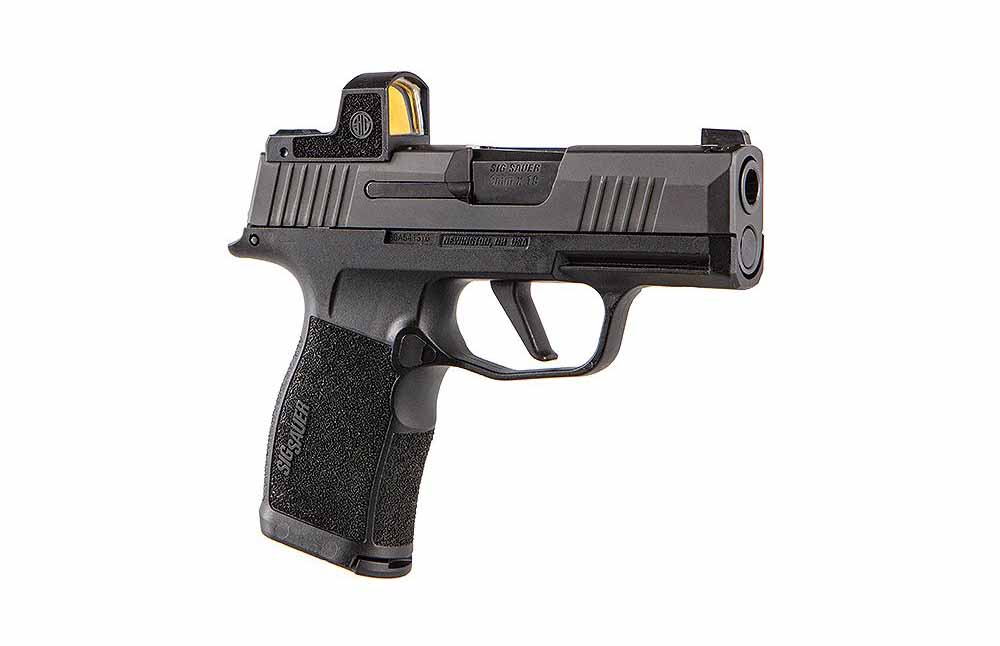
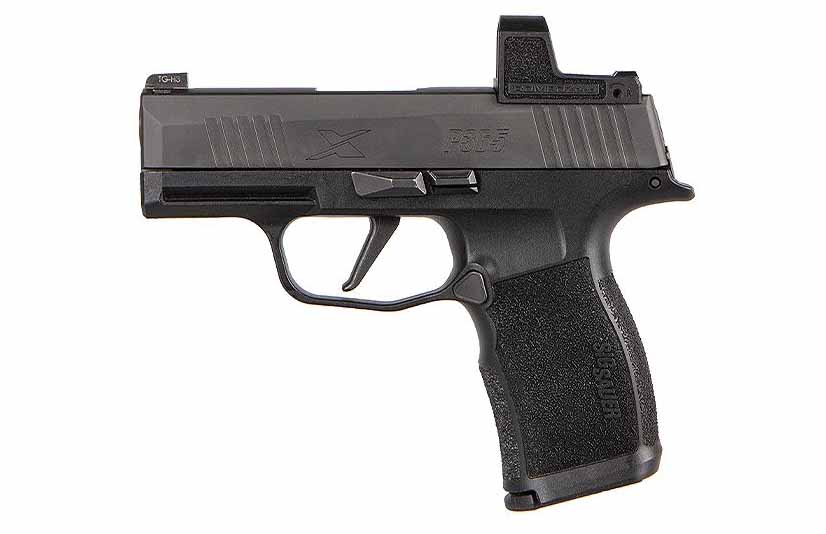
Enhanced capacity, more managable, still concealable and a factory-installed optic … what’s not to love about the P365X ROMEOZero.
It’s Sig Sauer’s world, we only live in it. That’s no joke. One college quoted recently nearly a third of all handguns produced the past year rolled off the massive firearms concern’s lines. Don’t quote that, it’s hearsay … but very believable hearsay.
Anyhow, Sig has continued its march to dominate the American firearms market with the release of yet another riff on its highly popular micro-compact 9mm. Actually, the P365X ROMEOZero isn’t exactly new, more like a combination of two existing pistols from the line—the original P365 and the P365XL. In particular, Sig takes the 3.1-inch barrel from the flagship and combines it with larger XL’s XSERIES grip module to create a highly concealable option that should prove more manageable in the hand and boasts expanded capacity. That last point is nice, with the grip module running 12-round flush-fit magazines. Like a cherry on top, Sig finishes the heater with a factory-installed ROMEOZero red dot sight.
A tidy package, but one that costs a chunk of change, with Sig slapping an $830 MSRP on the pistol.
More from Sig Sauer:
NEWINGTON, N.H. – SIG SAUER, Inc. is proud to introduce the P365X ROMEOZero, the newest addition to the P365 series of pistols. The P365X ROMEOZero combines the 3.1 inch barrel of the original P365 with the P365XL XSERIES grip module, featuring a 12-round flush fit magazine, with a factory installed ROMEOZero red dot sight, bringing a new level of performance to everyday carry.
“The SIG SAUER P365 series of pistols is the leader in the industry for everyday carry and continues to set the standard for delivering unprecedented capacity in a micro-compact size,” said Tom Taylor, Chief Marketing Officer and Executive Vice President, Commercial Sales, SIG SAUER, Inc. “The introduction of the P365X ROMEOZero further redefines everyday carry by combining the XSERIES features first introduced with the popular P365XL – including the larger grip module and XSERIES trigger – with the shorter 3.1 inch barrel of the original P365, making it an all-around more comfortable concealed carry pistol.”
The SIG SAUER P365X ROMEOZero is a 9mm striker-fired pistol, featuring the XSERIES P365 grip module with an integrated carry magwell and extended beavertail, with the standard 3.1 inch P365 barrel and slide with XSERIES markings, a factory installed ROMEOZero micro-open reflex sight, X-RAY3 day/night front sight, and the XSERIES flat trigger with a 90-degree break. The P365X ROMEOZero ships with two 12-round magazines (15-round magazines available separately).
The SIG SAUER Electro-Optics ROMEZero micro-open reflex sight optimized for everyday concealed carry, and for pistols with slim slides. The sight features a ruggedized, weapons grade, textured polymer body, Spectracoat™ Polymer lens system, 8 vivid, user configurable daytime illumination levels, MOTAC™ (motion activated illumination system), a highly efficient point source LED emitter for a crisp dot that’s 8 times more efficient than conventional red dots, and an integrated rear sight notch for co-witness with a standard height P365 front sight.
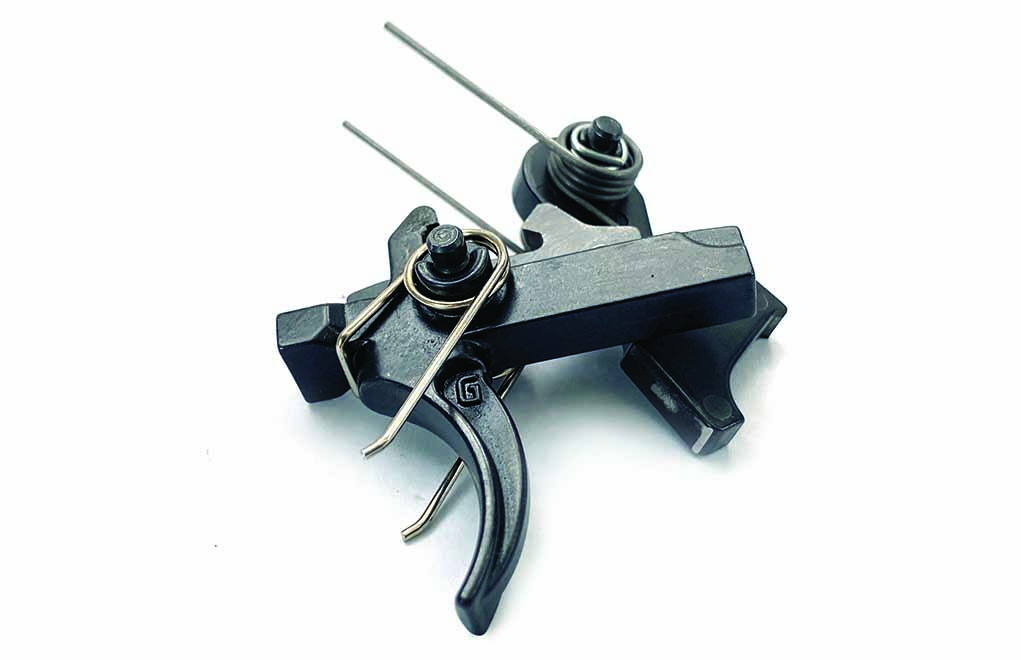
Top-notch triggers from Geissele Automatics … and so much more.
As far as gun companies go, Geissele (pronounced “Guy’s-Lee”) Automatics is something of an enigma. They’re a truly mysterious company that, unlike most others, maintains a virtual silence about their in-development products. As a result, the hype comes from actual end use and their products have earned them a reputation of quality unlike few others.
Oddly enough, conversations with a fair number of well-worn gun enthusiasts has allowed me to formulate the conclusion that many storied shooters have yet to realize that the company makes a long list of products that parallel the quality of their well-known triggers.
Geissele Triggers
Geissele makes one of the best triggers on the market. There are, of course, plenty of extremely good manufacturers out there, and most make a truly fine product. However, Geissele triggers are the definition of rugged and are made for a wide variety of end users and rifles. The company produces triggers not just for the AR-15 and AR-10, but also for the IWI Tavor and X95, HK 416, M4/M16, SCAR, ACR, SIG MPX and MCX and Remington 700. It should be noted that some of these triggers are for select-fire/full-auto rifles, and you should be on point with ensuring you don’t install one illegally.
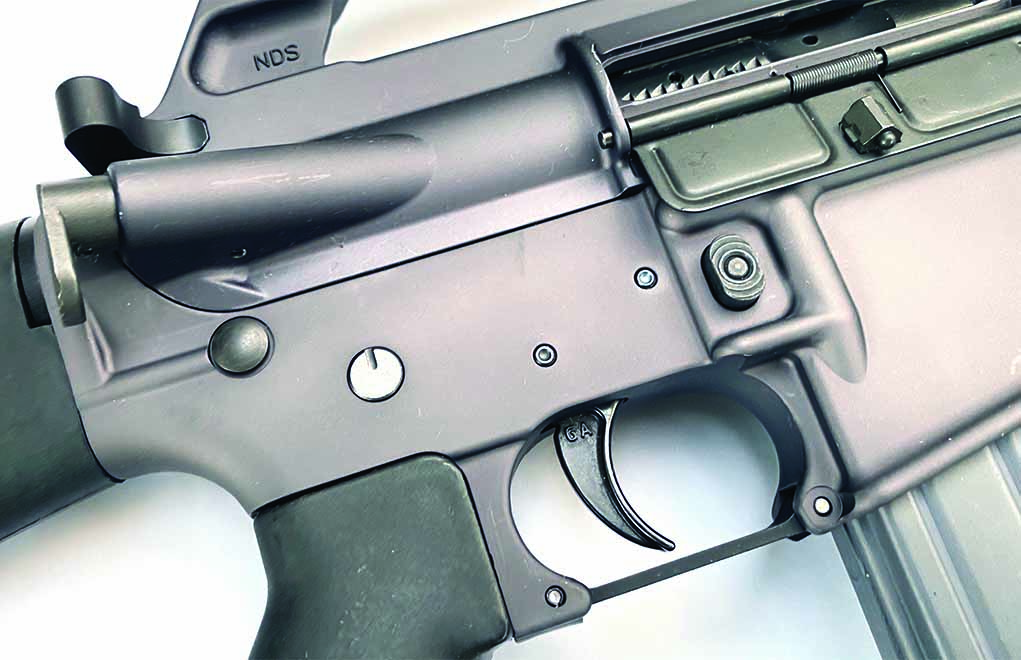
Hi-Speed National Match: This is an expensive trigger. It’s also my favorite trigger the company makes. It currently resides proudly in my Brownells retro M16A1 replica. I put a great deal of time into that rifle, and it wears authentic Vietnam-era furniture, dated circa 1967 to 1969. I also got my hands on a real-deal deployed sling from the collection of a late vet I knew when I was younger. He slung his own M16A1 with it during Tet, or so he told me.
This trigger is fully adjustable but must be set to a specific pull weight for use in matches. I have mine set to a 4.5-pound pull with a light first stage. If you haven’t shot much with an original or replica 20-inch rifle with a rifle buffer tube, you have no idea just how smooth an AR can be. Carbines today cycle rough by comparison. I sometimes feel like I’m pulling up in a restored classic car when the old timers at the range get their hands on the build.
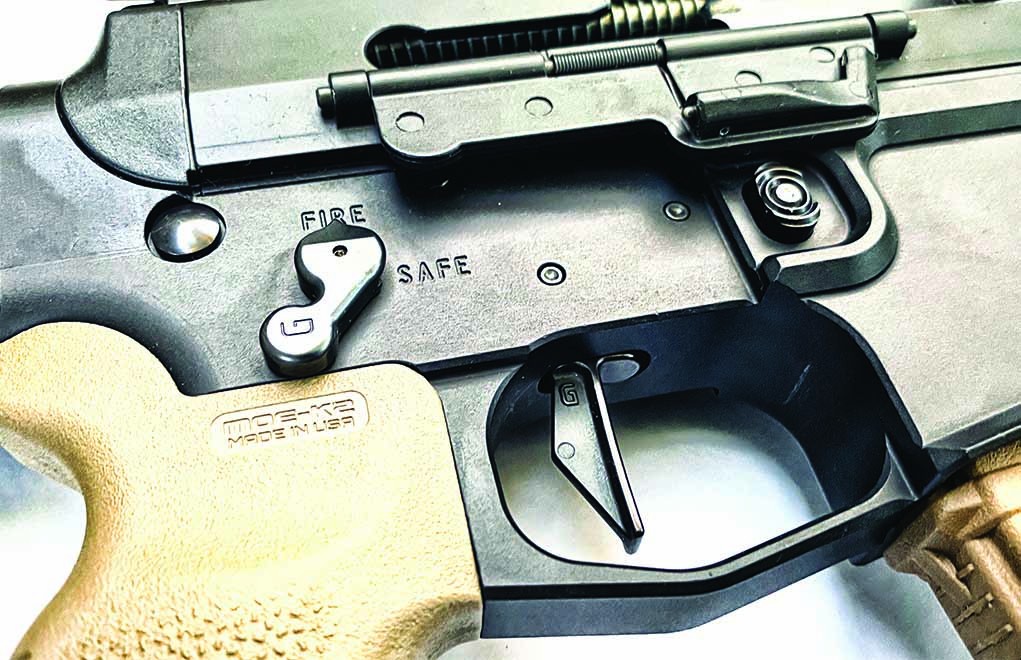
Super Dynamic Combat (SD-C): Not only is this trigger cool looking with a straight face, but it’s also extremely functional in that it provides a wide, completely flat frontal surface area. This feature provides a sense of equal leverage despite gloves or finger placement. The version I have is a two-stage.
Where this trigger shines is in the pistol/SBR role. I have it installed in my Brownells BRN180S pistol build with a 10.5-inch barrel. This trigger may, in fact, be the best available for a small build in that it offers a very consistent break in a light gun. Pistol builds and SBRs often struggle in precision due to light system weight and compact grips and stocks. This trigger alleviates these symptoms and allows for excellent precision despite hand placement.
The flat face of the SD-C trigger lends itself to compact rifles and pistol builds. The Geissele dogleg safety adds class and function. Not visible on this build is the Maritime Bolt Catch.
Super 700: This release came as a surprise to many, but it’s really an inevitability considering that the Remington 700 is probably the most common base for precision rifles in our recent history. The marriage of Geissele and the Remington 700 is a happy one.
The trigger addresses a few shortcomings in other triggers out there. For one, it’s externally adjustable through the trigger guard. Many competitors require the removal of the action from the stock to access the adjustment screws. The Super 700 can be adjusted while it’s installed in the rifle, even at the range.
Geissele 2 Stage (G2S): This is the closest you’ll get to a “budget” trigger and still have the “G” on it. I have this trigger installed in a full Brownells BRN180 rifle build with the special HK-style lower available on a limited basis. My own BRN180 rifle is decked out with Geissele parts; it handles and shoots like a dream. It’s probably the best DIY rifle you can put together today with all the benefits of the SCAR, ACR and other like platforms, but at a fraction of the cost. The G2S trigger is perfect for the build and provides a reliable and crisp two-stage pull. It breaks clean and is well suited to midrange carbines. If you want to upgrade your stock carbine with a real and tangible step up, this is a perfect place to start.
Get On Target With The AR:
Go Small With These 8 Economical AR Pistol Options
Tavor/X95 Super Sabra Trigger Pack and Bow: I wasn’t a huge fan of the X95’s trigger. The rifle handled poorly as a result. The Super Sabra blows the stock unit out of the water—it changed the rifle completely. I have no idea why IWI doesn’t contract Geissele to put on of these in every one of their rifles—it’s a night-and-day difference.
The Hi Speed National Match trigger is a luxury item designed for rugged use. Here it resides in a Brownells M16A1 replica with original Vietnam-era furniture.
Beyond Triggers
While known for their triggers, Geissele makes a full line of other products, including complete rifles. Not everyone knows this—most react like it’s some sort of secret that the Big G makes optics and mounts, handguards, safety levers, trigger guards, bolt carrier groups, bolt stops, buffer tubes, springs, buffers and so on. They’re all fantastic.
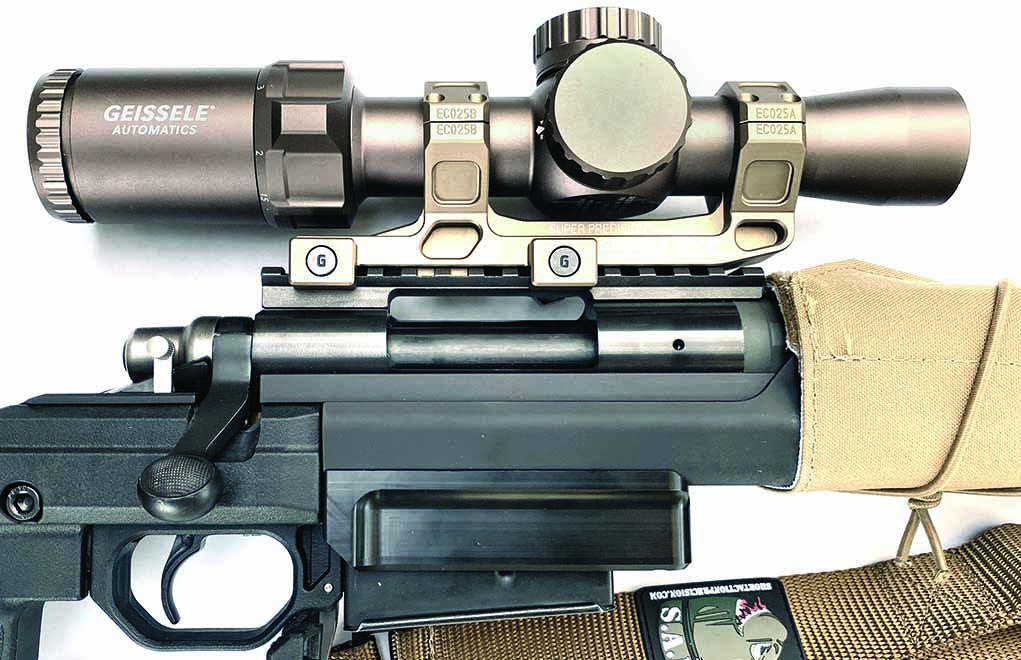
Super Precision 1-6x 30mm Scope: I’ve beaten this scope, and it has proven more rugged than almost any other in its size and price range. I ran the grueling Wolverine 5K with this optic on my carbine, and it survived tremendous abuse in that competition alone. Not only has the finish held up, but it has held zero the entire time. It’s a second focal plane optic; however, I leave it at 6X most of the time to take advantage of the mil reticle. The optic features an illuminated dot in the reticle, which is great at 1X in competition. At 6X, it occupies a DMR role and can be used quickly and effectively on holdover alone.
The rifle I have it on is the Remington 700 with KRG chassis in this article. It also has the Super 700 trigger. This build is chambered for 6.5 CM and is set up to be an extremely portable precision rifle. I built this rifle with special input from some MARSOC and Delta guys I know as a concept to test out the idea of a tight confines sniper rifle ideally suited for 120-grain bullets out to 3/4 mile. Using Hornady 120-grain ELD bullets at 2,800 fps, the rifle performs better than a 175-grain M118LR .308 Winchester out of an M40A3 rifle with a 24-inch barrel! It beats it by an entire mil of drop at 1,000 yards.
Why is any of that important as far as the scope is concerned? Well, using 120-grain bullets and a Geissele scope, it’s able to go to 880 yards (1/2 mile) with a 100-yard zero and holdover alone in the reticle. If you think 6X is too little at 800 yards, you should try it first. The speed of engagement is incredibly fast.
Geissele optics, mount, and trigger adorn this custom-built Model 700 in a KRG Whiskey 3 chassis.
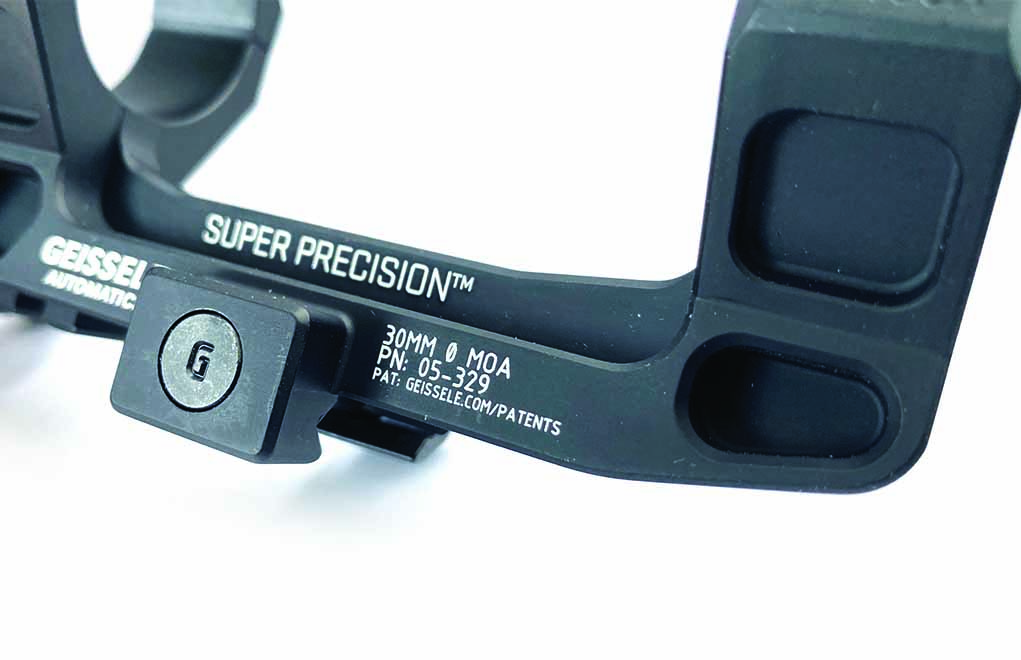
Super Precision Optics Mounts: I have a couple of these mounts and used them on a variety of rifles from .22LR to .338 Lapua—and literally swapped them directly from rifle to rifle. I write down the zero and click it in, and, sure enough, it’s right there as if it had never been removed in the first place. The mounts are of the highest quality and even have ring caps serial numbered to the individual ring. They’re very serious about how repeatable these mounts are.
Handguards: The AR market is saturated with handguards, but none are as rigid or as strong as the Geissele variants. I’ve used versions of the handguard for years now and can say that they’re the standard of quality the entire industry should aspire to. Why do I say this? The most demanding shooters trust them, and they’re considered the standard for the National Matches.
Additionally, I love the MK8 M-lok rail as well. It’s a much lighter rail, suitable for general-purpose use, and comes in a variety of lengths. I found it most useful in the 15-inch configuration.
Small Parts Galore: As evidenced in the photos, Geissele makes a number of small parts to enhance your rifle. Among the hidden ones are the Super 42 spring and buffer. They’re made of a tri-wire twist and take after the German MG42 machine gun, nicknamed Hitler’s Buzzsaw. This terrifying Nazi weapon had a firing rate so fast it sounded like a great sheet being ripped in half! The Geissele variant provides the same technology to last tens of thousands of rounds without losing strength.
The mounting clamp contains lugs that index on the rail to ensure it’s completely repeatable on any rail.
The guns in this article, with the exception of the Remington 700, all make use of Geissele lower parts kits. The BRN180S has a Geissele Maritime Bolt Catch and a Super Configurable Safety with dogleg levers. These are great additions to any carbine build and are basically fumble-proof.
The BRN-180 rifle build has a Geissele buffer tube in DDE color, Geissele iron sights and a Geissele trigger guard to match the buffer tube. Both BRN180 builds make use of Geissele M-LOK rail covers. They’re textured and provide excellent traction when shooting with sweaty or cold hands.
When Geissele parts run throughout the rifle, so does the quality.
Editor’s Note: This article originally appeared in the November 2020 issue of Gun Digest the Magazine.
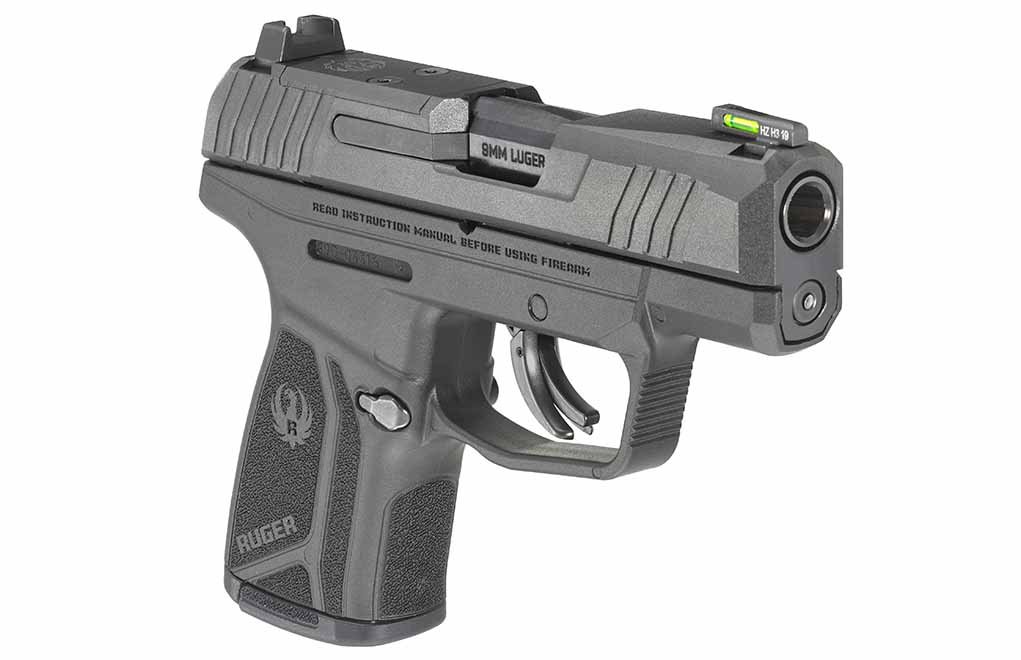
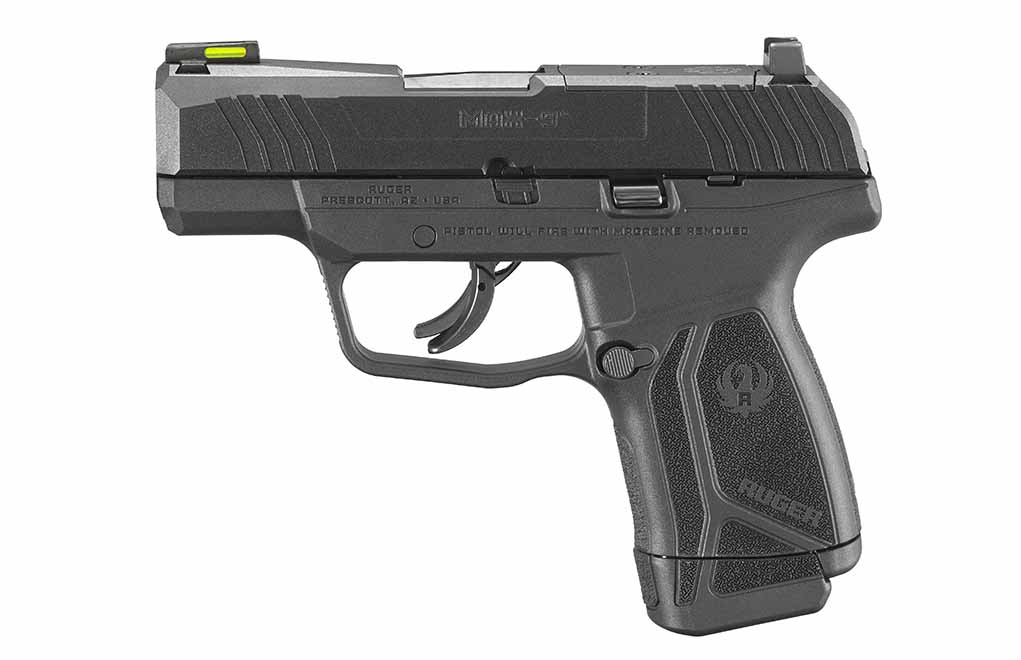
Ruger takes on the micro-compact market with the affordable Max-9.
Offering greater capacity in a smaller package, it’s of little surprise the micro-compact has proven so popular. Though, the rate at which companies have embraced the pintsized pistols. Fresh options appear, but not exactly at a breakneck pace—more like a steady drumbeat.
The latest to throw their hat into this growing niche is Ruger with its Max-9 micro 9mm. While it falls in line size-wise with others in its class and comes with the extras shooters have come to expect, it does differentiate itself from most of the competition in one decisive factor—capacity. While it doesn’t beat all, its 12-round magazine puts the Ruger Max-9 near the top in ultra-concealable pistol firepower. Along the way, it also delivers a fairly shootable package.
To this end, it’s the extended-capacity magazine that’s to thank for the Max-9’s manageability. Adding enough height to the grip, even shooter with large mitts generally can get their entire hand on the gun. Not quite so with the 10-round flush fit, which leaves the pinky dangling, but that’s to be expected. Additionally, Ruger does a solid job texturing the grip with a very positive pebble surface on the side panels and front and back straps that allots a strong purchase, but not at the expense of comfort.
As to the tale of the pistol’s tape, it measures 6-inches long, 1 inch in width, boasts a 3.2-inch barrel and weighs in at 18.4 ounces unloaded. By most people’s standards, that’s fairly compact, enough to stay undercover in light summer garb, but without having to compromise firepower.
Commonplace with most new pistols hitting the market—competitive and defensive alike—the Ruger Max-9 is optics ready. The striker-fired’s slide is cut to accept Shield SMS2, RMS, RMS2, RMSw, SMS, SMSc, and RMSc, Holosun 507k and 407k, Swampfox Sentinel, Crimson Trace 1500 Series, Sightmark Mini-Shot A-Spec M3, Hex Wasp, Sig Romeo-0, and Jpoint MRD micro red dot sights micro red-dots. It also features a day/night front sight and drift-adjustable rear that co-witness with Shield- or JPoint-pattern sights.
The Max-9 comes in three variants, including a 12+1 variant with external manual safety, a 10+1 model version with manual safety, and a 12+1 pistol without a manual safety. It features rugged construction thanks to a through-hardened alloy steel slide, a one-piece, precision-machined fire control chassis, and a glass-filled nylon grip frame. As to price, the Ruger Max-9 has an MSRP of $499 regardless of the model.
Looking to go armed, but are stuck in the weeds as to what to arm yourself with? Here are 20 of the best concealed carry gun options that will keep you on the defensive.