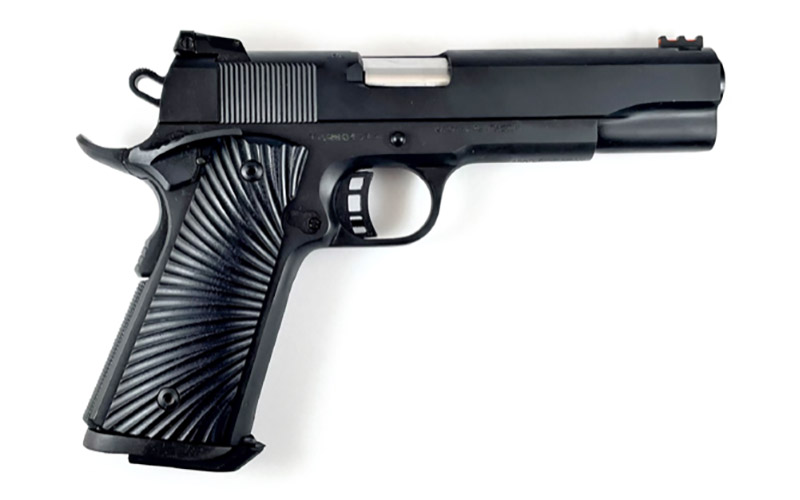
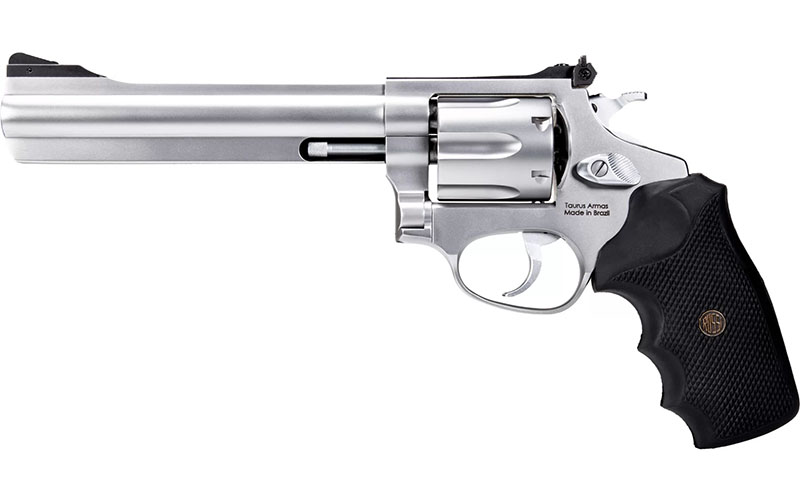
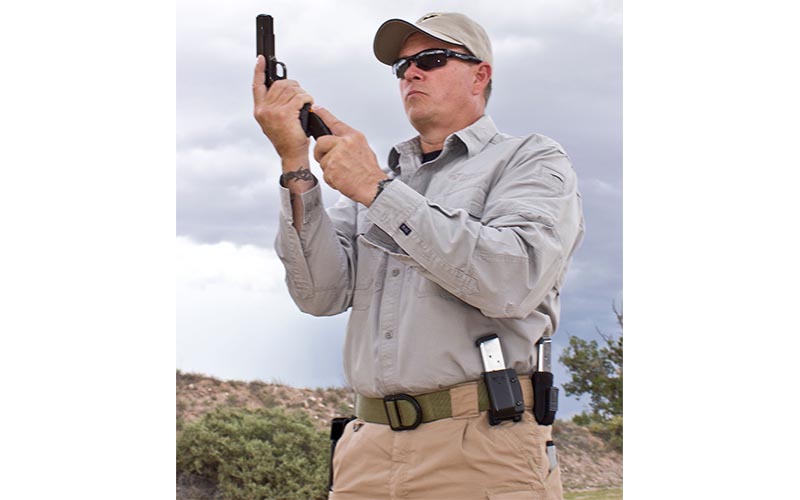
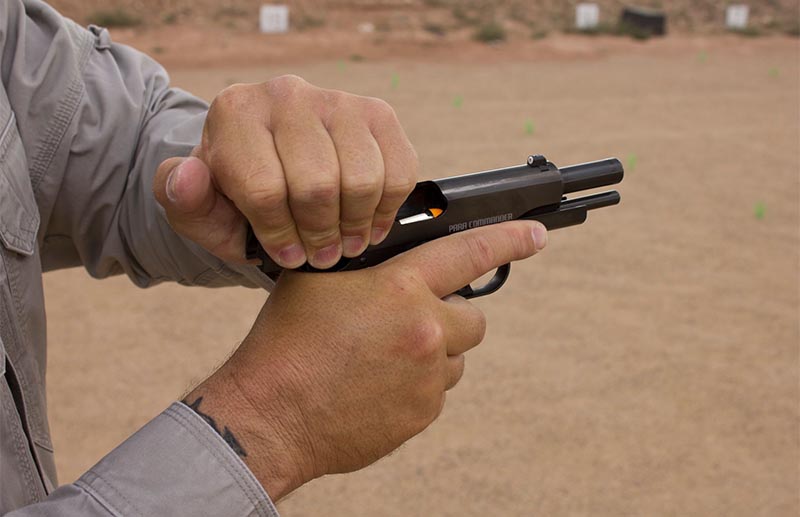
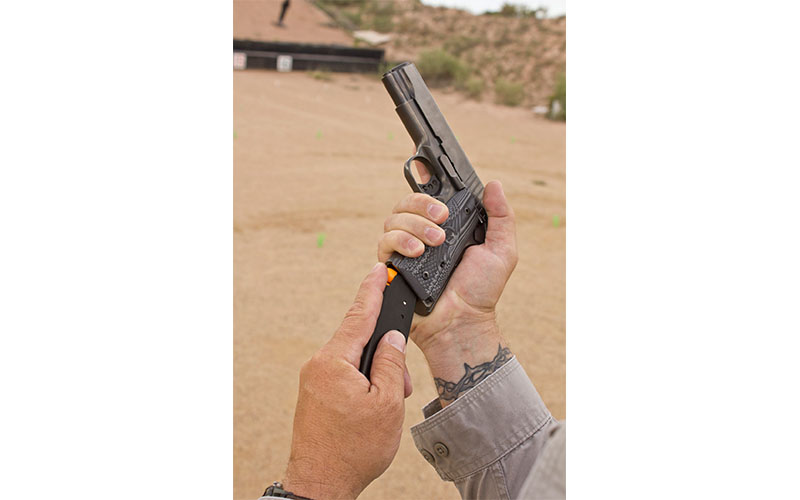
Taylor’s & Company recently announced the 10mm 1911 FS Tactical, marking the addition of 10mm to the company’s 1911 line.
Taylor’s & Company primarily focuses on importing historical firearms, and while this means that the company’s lineup is dominated by wheelguns and lever-actions, it includes a few 1911 pistols from Armscor too. The majority of these also feature historical aesthetics, but Taylor’s & Company has started branching out into more tactical models as well. This began with the release of a full-size model in 9mm, but the company has just made one more coveted chambering option available through the announcement of the 10mm 1911 FS Tactical.
The “FS” in the 10mm 1911 FS Tactical’s name stands for “full-size,” denoting its 5-inch barrel and full-size frame. This also implies that we may see other sizes of this pistol imported by Taylor’s & Company in the future. As for this 1911’s tactical attributes, they exist, but are somewhat lacking compared to its competition given the lack of an accessory rail or optics-ready slide. These features include an ambidextrous safety, an extended beavertail, a skeletonized trigger and a combat hammer. The adjustable rear sight and fiber optic front sight are also improvements over the G.I.-inspired models, and the grips are black G10 instead of wood. Magazine capacity is 8 rounds.
Tammy Loy, owner and CEO of Taylor’s & Company, said this about the new handgun:
We couldn’t be more excited to bring this state-of-the-art firearm to the modern gun enthusiast…We wanted to offer the 10mm version to broaden our audience in the 1911 market. The new 10mm 1911 FS Tactical is sure to be a very popular firearm with the 1911 crowd.
The 10mm 1911 FS Tactical is available now and has an attractive MSRP of $699.
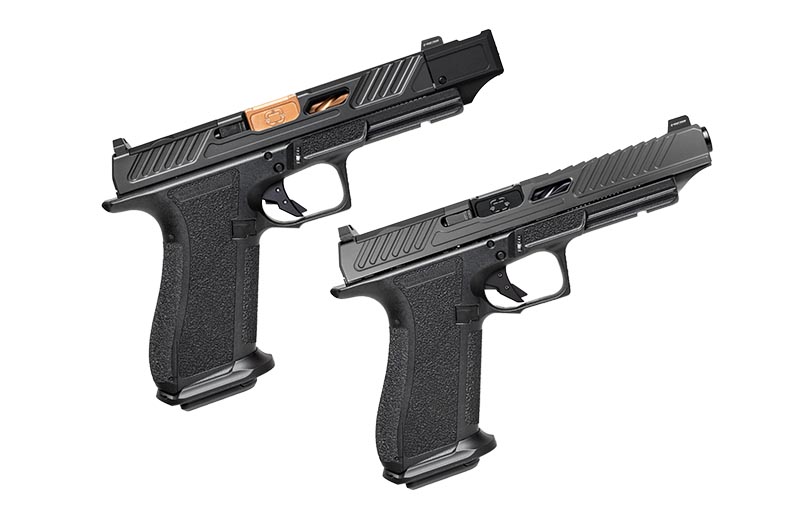
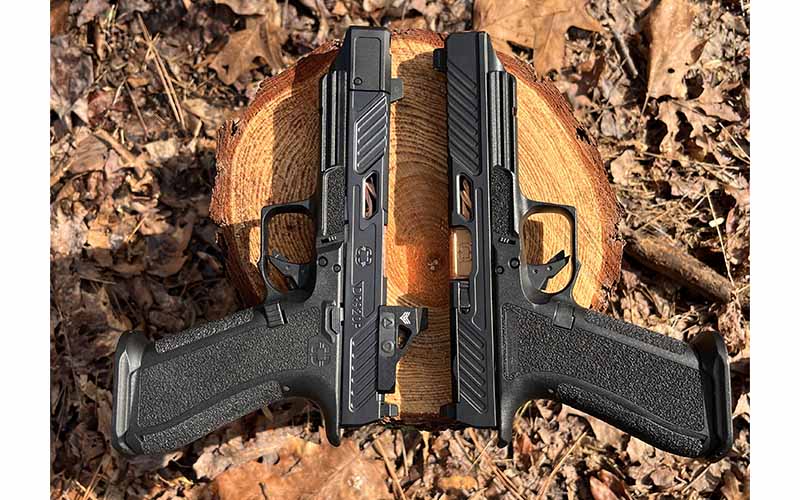
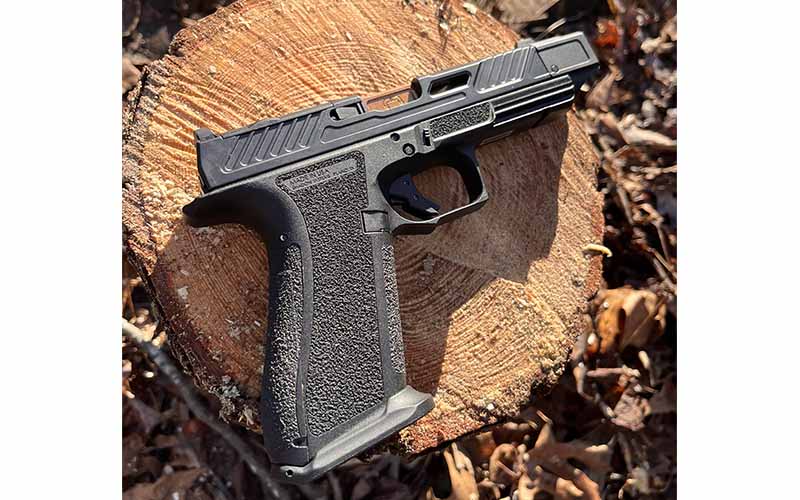
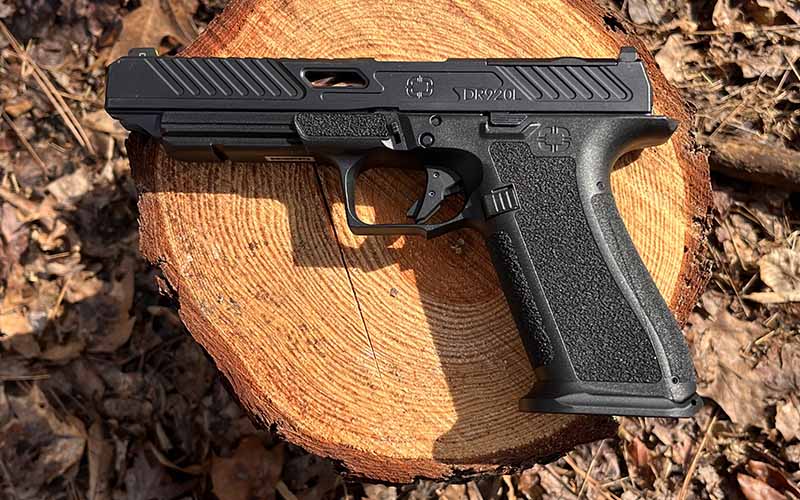
A closer look at Shadow Systems’ DR920 pistol series, including both the DR920P and DR920L.
I’ll preface this entire article with a factual statement: I’ve owned several Glock 34s and a few Glock 17s. I sold all of them. I just couldn’t get on board with the grip angle, and unless it was stippled with a grip reduction and magwell, I just couldn’t index the pistols as well as I could something that was closer to a Glock 19. I thought this was due to my medium-sized hands, or my wrist geometry, and rather than smashing a square peg in a round hole, I moved onto platforms that tangoed with my own personal geometry a bit better.
Then I had a dance with Shadow Systems’ full-size DR920 pistols—the DR920P and DR920L (P for performance, and L for long). I’m starting to change my tune.
Out of the box, both of these full-size guns pointed well for me and indexed very naturally.
Then I started to run some rounds through them. I may or may not have said holy sh*t after running a mag or two through the long-slide offerings. I’m going to tackle each gun individually, as they each have their own personality and nuances—the DR920L specifically, but I’ll briefly discuss what they have in common now.
Grip Frames
Their frames are essentially identical. It’s the DR920P frame, with all the fixings Shadow Systems is known for: Interchangeable backstraps—NPOA (natural point of aim), extra material guarding the slide stop, refined grip angle beavertail and what I regard as Goldilocks stippling. Not too rough, not too slick, it’s just right. They both come wearing a magwell, which contrary to previous articles I’ve written on the MR920—I’ve grown to love. It isn’t ostentatious like a Dawson Ice magwell, but also isn’t adding a mere .001mm to the magazine opening. It’s, again, not too big, not too small. It also, like most of their compact and full-size offerings, comes with a thumb ledge on either side forward of the trigger guard, lending itself to shooting fast and applying downward pressure.
Essentially a gassed Glock 17/34 frame, these are compatible with those Glock 17/34 mags you have lying around, or the Magpul 17-rounders. These guns ship with two of the latter.
Other DR920 Commonalities
The two DR920 pistols (clearly) have different top ends, muzzles and barrel lengths, but they share a few key features on the top end. Namely, Shadow System’s patented optic system. I’ve covered this rather extensively in my other pieces on the company’s MR920 offering—the Glock 19 size counterpart—but suffice it to say you can direct-mount pretty much anything right to the slide with the help of a variety of shims and screws of various lengths—pretty cool.
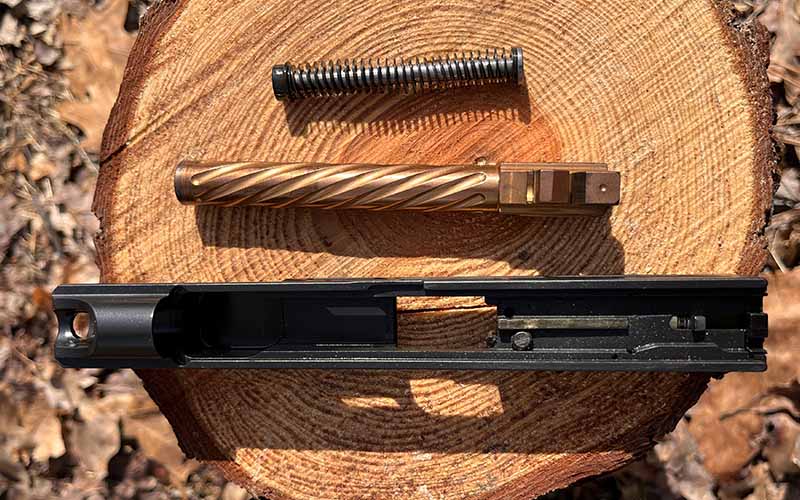
They also both sport bronze-colored spiral fluted barrels, which are match-grade, conventionally rifled, 416R stainless and incredibly accurate—the DR920P has a 4.48-inch barrel and the DR920L a 5.3-inch barrel. Both of these fit into a Glock 34 holster (or one that’s open-ended and meant for a G17) and are essentially the same length. The compensator adds about another 1.3 inches to the DR920P. I consider the MR920 as one of the flattest, fastest shooting plastic fantastics out there, but I’m here to tell you that either of these guns can take that spot on the mantle. They’re fast, eat recoil for breakfast, and man, the 920L shoots like a phaser gun: both with accuracy and minimal felt recoil.
Whether you opt for the long-slide or compensated variant, both Shadow Systems DR920 pistols are about the same size.
Both guns come with tritium front sights and blacked-out rears, but it’s worth calling out that the DR920P’s sight is mounted to the compensator and fixed, whereas the 920L’s is mounted to the slide and user-serviceable. They also both have captured recoil springs and stainless-steel guide rods.
Now let’s talk about each of them individually.
DR920P
The P in DR920P stands for performance (the DR stands for Duty Role; as an aside, I’ve heard that SWAT units are running this rig). And while I admittedly did have some issues getting this gun to run reliably, I still would label it a performance firearm. I spoke to Trevor Roe, the CEO of Shadow Systems, and he let me know that when they were coming up with this pistol, they first asked consumers if they wanted the flattest shooting gun that’s ammo selective, or something more reliable with a little less compensation.
Now, before I proceed, I will admit that I was running some downloaded 147gr reloads which do not cycle in some of my other factory guns. This also voids their warranty per the manual. Read: don’t try this at home. The DR920P ran factory 124s and 147s just fine, but with how much I shoot, and the matches I shoot, I need to roll my own. I got plenty of short strokes and stove pipes when running my competition reloads, even after changing the spring out to a lighter 15-pound one (which was included, by the way!). I pressed out some 115gr and 124gr ammo that was a bit hotter, and they ran perfectly fine. The moral: compensated guns need full-power ammo. And hell, it’s compensated, whatever extra recoil you pick up is mitigated by the downward force of the vertical compensation ports.
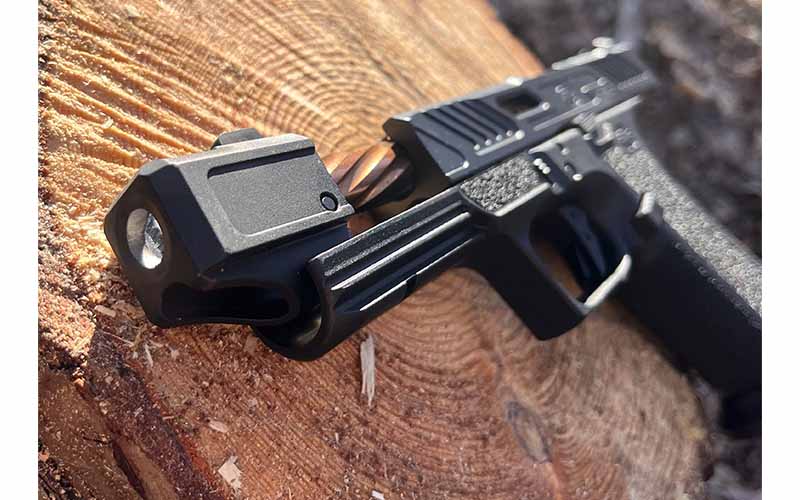
Speaking of the compensator, they have a very novel design that’s zero-fit and doesn’t need a threaded barrel (in case you live in a state that doesn’t love freedom). This patent pending design makes it easy to break down and clean. And in my experience, this thing will need to be cleaned—I shot it so much I occluded the tritium in my front sight and had to start point shooting at one point.
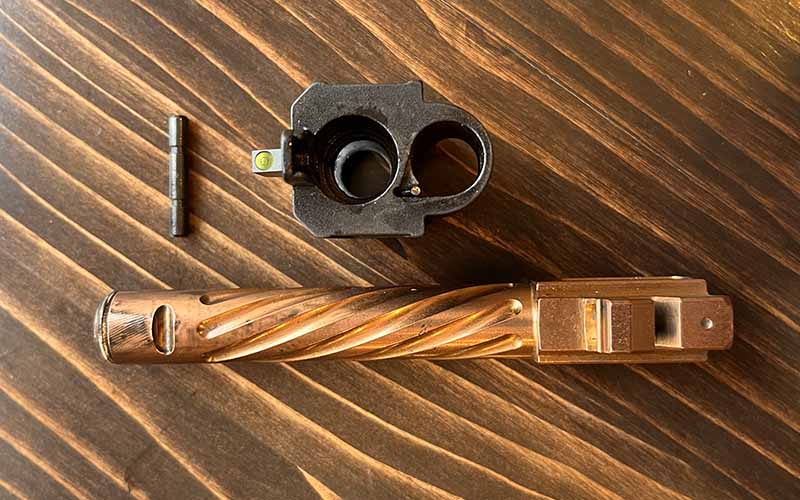
The disassembled compensator and barrel of the DR920 P.
I did catch myself shooting a bit high with this gun, and I needed to use a 6 o’clock hold to clear the plate rack as fast as I wanted to. I was pretty dead set on not running an optic on this since the compensator has a front sight mounted directly on it. This is both cool from an engineering perspective and useful for accuracy, since the compensator doesn’t reciprocate with the slide, you don’t get that dancing front sight effect. That, admittedly, could be why I had to change my POA a bit. However, I broke down, like so many that have moved the carry optics dark side and put a dot on it. And now, it’s smoking plate racks and 10-shot fist-sized groups at 25 yards.
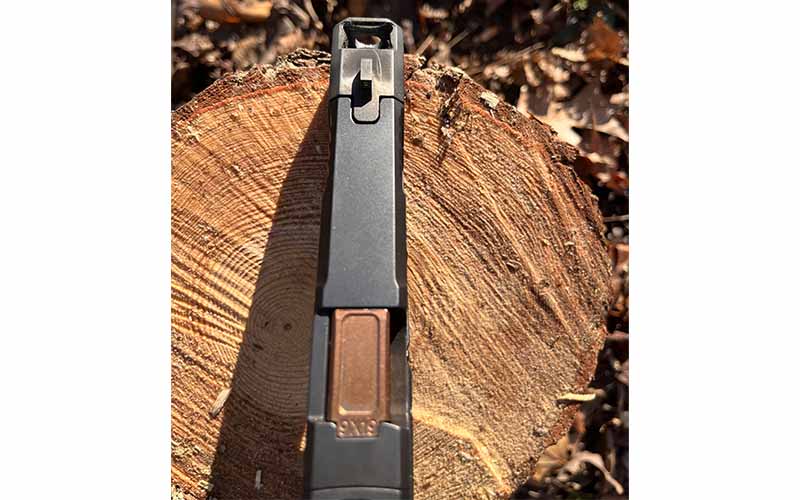
The front sight on this DR920 variant is mounted on the compensator itself.
DR920P Styling
True to Shadow System’s roots, this gun has all the features we’ve come to expect—the stippling as I mentioned, the bronze-colored spiral fluted barrel, window cuts, and more. It doesn’t have the top serrations like other Elite models but does have the forward and rear cocking serrations. It also has a very elegant integration of the comp to the slide which mate together seamlessly. The front sight, as referenced, rides on the comp, which forced me to adjust my grip when press checking so as not to pinch my hand between the slide and the comp. But overall, it just looks cool, fast, and refined.
Step Into the Shadows: Explore Shadow Systems Insights
CR920 Review – Is This the Ultimate Subcompact Handgun?
Honest MR920 Review – Balancing Performance and Versatility
Shadow Systems MR920 vs XR920 – Comparing Features and Functionality
Which Shadow Systems Model Fits Your Needs? CR920X vs CR920Xp Compared
DR920P Shootability
The DR920P is loads of fun and shoots very, very flat. It’s loud, of course, due to the compensator, but it’s billed for that. It shoots fast, but I would not want to run retention shooting drills with it. Recoil? What recoil? Even with 115s or hot Winchester brown box 124s, this gun stayed flat and performed like I was shooting 147s from an uncompensated gun. My groups and follow-up shots were tight, due obviously to the comp preventing muzzle rise. And the larger grip frame definitely helps the shooter maintain a good purchase for Bill Drills and mag dumps.
DR920P Trigger
The trigger is solid for a “stock” gun, even though most of Shadow Systems’ higher-end offerings are “Gucci from the get-go,” with a 3-pound, 1-ounce break on average for my scale across 10 pulls (which is lower than what’s listed on the spec sheet). It’s leaps and bounds better than a stock Glock or M&P trigger, for sure. With a crisp tactile reset and short travel, this gun is very shootable, with irons or dots. As mentioned, I did eventually break down and put a dot on it (the optics mounting system makes it far too easy), and this thing just flies through plate racks and rapid-fire drills.
DR920P Accessories
One of the main selling points of this gun is the cross-compatibility with most G34 holsters. Given that the DR920P’s comp is streamlined and not blocky, the user can use the G34 or open-ended G17 holsters they have laying around. Since the frames are similar to G17/34s, you can obviously use any double-stack magazine that is 17 rounds or more. Since it has a rail on it, you can also run a light, laser, or whatever other accessories you have for your full-size pistol. Besides the removable magwell and lighter spring, this DR920 variant also comes with some extras from the factory such as extra high-temp O-rings for the compensator (they’re only a couple of bucks if you burn through them), backstraps and a Shadow Systems range bag.
DR920P Specs:
Frame: Textured polymer
Slide Material: 17-4 Stainless Steel
Barrel Material: 416R Stainless Steel
Trigger pull: 4.0-4.5 pounds
Weight: 21.5 ounces
Length: 8.44 inches
Width: 1.20 inches
Height: 5.25 inches
Capacity: 17+1
Barrel Length: 4.48 inches
Caliber: 9×19
Action: Striker-Fired
DR920L
The long-slide DR920.
Now to the newest addition to the Shadow Systems line, and one that I’d hazard competition shooters have been waiting for for a while: the DR920L. The L, in this case, stands for long-slide. The 5.3-inch barrel makes this Shadow Systems’ largest, longest, and arguably fastest shooting pistol. Only available in the Elite flavor, this gun comes with the same aesthetic we’ve seen from Shadow Systems in the MR/DR/XR/CR Elite tiers. It has a stippled frame with reduced grasping surfaces, a magwell, a thumb ledge, a spiral fluted barrel, directional cocking serrations on both the side and top of the slide and lightning cuts.
“Around the shop, we called it the laser gun. After spending so much time with shorter sight radius and snappier guns, the DR920L feels effortless to hit with,” commented Trevor Roe, CEO of Shadow Systems. This was the company’s big release at SHOT 2023, and this gun is definitely a dream to shoot. In testing, I was able to get 5 shots on target from the holster in 1.7-1.9 seconds consistently. My splits got about as low as I’d ever seen with a pistol (.17 territory) and that was only the first outing. Maybe the L should stand for Lightning because you can shoot this thing fast.
From a styling perspective, it just looks sharp. Lightning cuts, more serrations than a bread knife, and the contrast of the barrel make it look simply alluring. Does it shoot as good as it looks, though?
DR920L Shootability
When it comes to shootability, the long-slide DR920 has it all. It’s pleasant to shoot and reminds me of one of my CZs but at a fraction of the weight, and it comes optics-ready. It soaks up recoil and runs just about every type of ammo I shoot without issue. I did not have a single failure with this pistol in the over 500 rounds I tested it with. The low bore axis, high grip, stippling, thumb ledge, long slide, and lightened slide all coalesce into a pleasant, fast-shooting package that is more accurate than I am. As I stated at the outset, I’ve often been nonplussed at best by Glock full-size guns, but this DR920 points incredibly intuitively for me. With a long sight radius, I’m trying really hard not to give into my bad habit of putting an optic on everything, so I’m just shooting this with irons for a while in production or limited in USPSA.
DR920L Trigger
The trigger is metal, just like all other Elite models, and has the same crisp, tactile reset we’ve come to expect from Shadow Systems. On my scale, it breaks at 2 pounds, 15 ounces on average across ten pulls on a Lyman digital gauge. With the longer sight radius and full-size grip, I feel like it’s easier to press to the rear, but this could be an illusion by way of the former points—a bigger gun equates to less felt movement. The reset is audible, and I don’t catch myself with any trigger freeze when doing mag dumps or quick target transitions. She runs right out of the box, and as opposed to other wonder-polys, I don’t feel the immediate, almost compulsive need to swap the stock trigger (see: Glock, Smith & Wesson).
DR920L Accessories
Since it’s a big ‘un, any G34 or open-ended G17 holster will work for this. It comes with all the same accessories as the compensated DR920 save for the O-ring and reduced power recoil spring since they’re not necessary. You can mount any choice of weapon light on it, and can go as big as a Streamlight TLR1 without it jutting out past the muzzle.
I went into this review thinking that full-size guns just aren’t my jam, especially with the advent of slide-mounted optics. Why shoot a longer gun when the need for a sight radius isn’t there anymore? Well, I was wrong. Even though an MR920/Glock 19 grip frame fits my hand rather well, there’s nothing wrong with some extra real estate, and there’s assuredly nothing wrong with the added mass, barrel length (and thus velocity) of a larger frame gun.
My only druther is the pickiness of ammo for the DR920P, but once I found what worked, I didn’t have many complaints. The pistol is loud, of course, but shoots fast, flat and looks badass. For the 920L, I have no druthers, I just wish on got on the long-slide train sooner.
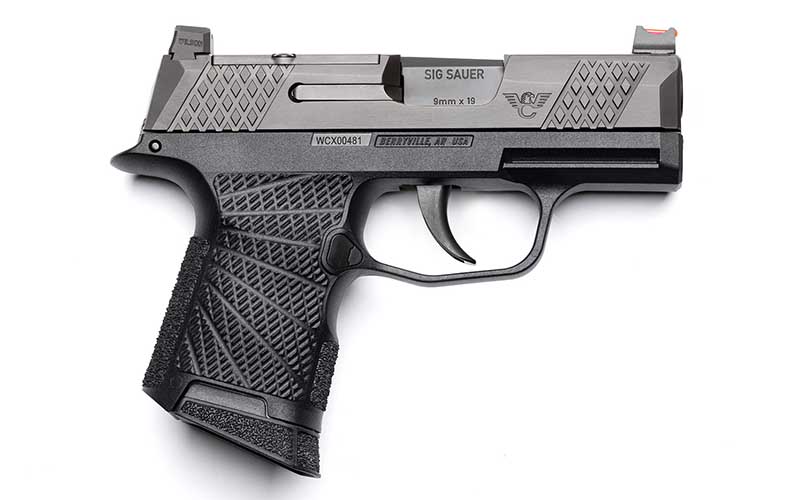
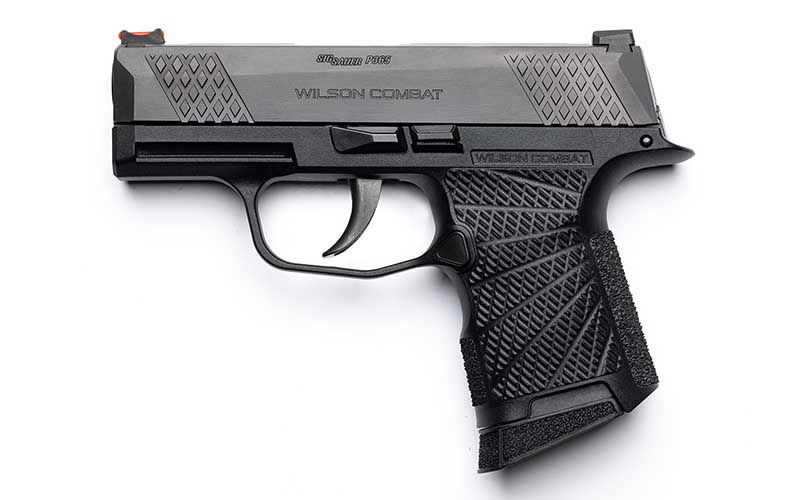
Wilson Combat recently announced the WCP365, the company’s modified take on the Sig Sauer P365 carry pistol.
Since it was released, the Sig Sauer P365 has become a supremely popular concealed carry pistol, and many people obviously think it’s very good as it is. Always believing that there’s room for improvement, however, Wilson Combat decided to put its own spin on the gun with the release of the WCP365. Wilson Combat is offering a total of 16 configurations of the new pistol.
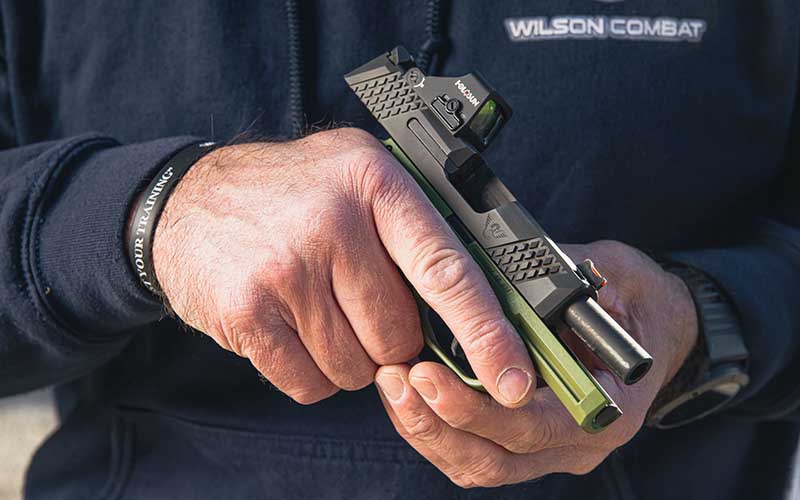
Regardless of which version you get, there are some features and upgrades that all models share. Starting with a Sig Sauer P365 fire control unit, Wilson Combat drops it into one of its polymer grip modules. Users have a choice between standard and XL grip sizes. Next, a Wilson Combat WCP365 stainless steel slide and 3.1-inch chromoly barrel are installed, both featuring a very protective black DLC finish. The slide’s shape has also been re-engineered and has X-Tac front and rear slide serrations. All versions include a Wilson Combat rear battlesight and red fiber optic front sight, but the slides can be ordered with various patterns of optic cuts too (available footprint patterns currently include Holosun 407K, RMRcc and RMSc).
The WCP365 can also be ordered with either a standard or a tuned action, although it sounds like even the standard version is an upgrade over the factory Sig offering. The standard WCP365s come with curved Grayguns triggers and modified springs, while the action-tuned models come with straight triggers and supposedly provide “the best trigger pull possible” due to further modifications.
At the time of writing, only standard-size grip modules are available and only in black, but XL modules and other colors will eventually be offered as well. All the standard WCP365 pistols will ship with two 10-round magazines and the XL versions will come with two 12-round mags. MSRPs start at $1,105 and go up depending on options.
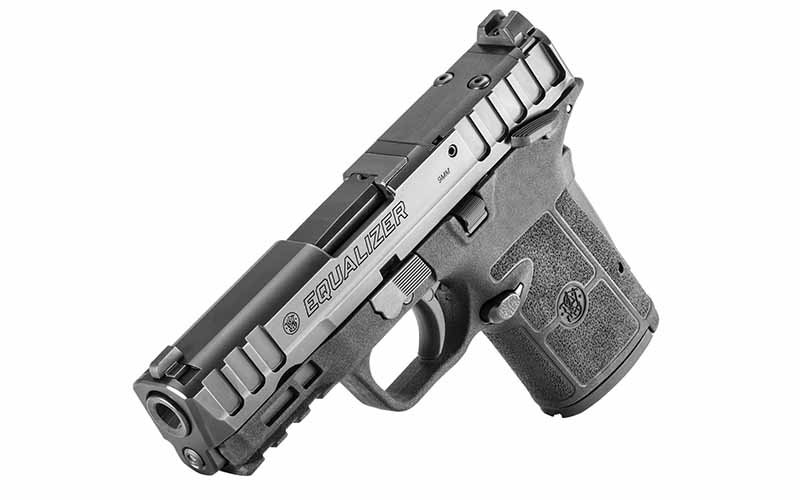
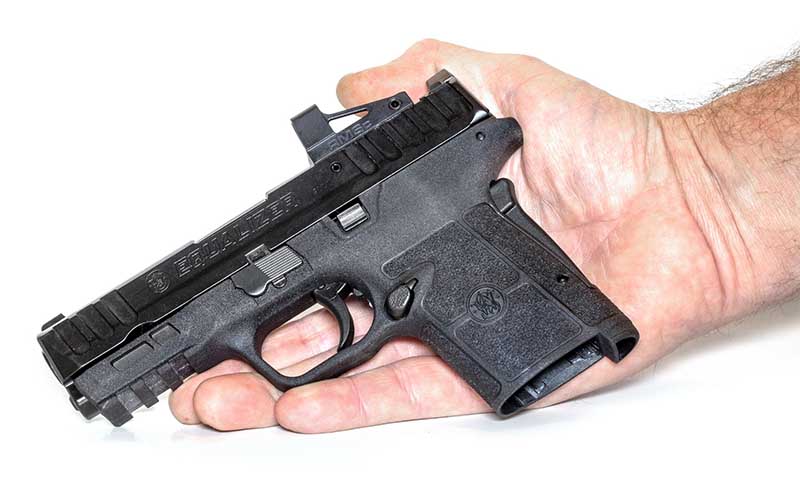
In this Smith & Wesson EQUALIZER review, the author takes a closer look at the company’s newest micro-9 carry pistol.
I was a bit shocked when I saw the announcement of the Equalizer pistol from Smith & Wesson. This is partly because Smith & Wesson already has a diverse collection of respected self-defense handguns. It’s also partly because just last year they launched a brand-new self-defense handgun called the CSX. But at the same time, this new pistol is just a perfect example of American gunmaking at its best. Smith & Wesson’s new Equalizer pistol epitomizes the refinement of design to best interface with customers.
With its multiple magazine options, optional thumb safety, compact size and easy rack technology, the Smith & Wesson Equalizer is a carry gun that’ll fit nearly everyone.
Smith & Wesson Equalizer Specs:
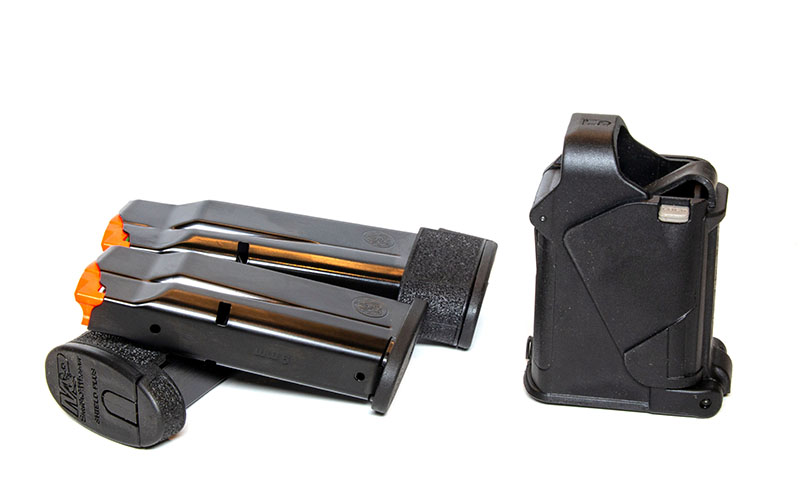
Action: Semi-automatic, single action (internal hammer) Safety: Grip safety—SKU: 13592 (Ambidextrous thumb safety version—SKU: 13591) Chambering: 9mm Luger Barrel: 3.675 inches (Stainless steel with Armornite finish) Slide: Stainless steel with Armornite finish Sights: Steel with three white dots (cut for optics) Frame: Black polymer Capacity: 10+1, 13+1, 15+1 (Ships with three Shield-Plus compatible magazines) Magazine Release: Reversible Accessories: Maglula UpLula speedloader, gun lock, instruction manual MSRP: $599
Notable Features
The Equalizer is a poly-framed, micro-compact, 9mm pistol. It resembles the M&P Shield EZ, but the Equalizer uses double as opposed to single-stack magazines. In fact, it uses S&W Shield Plus magazines. But unlike the Shield Plus, the Equalizer—like the Shield EZ—is a single-action as opposed to striker-fired pistol. Another difference is that the Equalizer is only available chambered for the 9mm Luger, where the Shield EZ can be had in .380 Auto, 9mm Luger and .30 Super Carry.
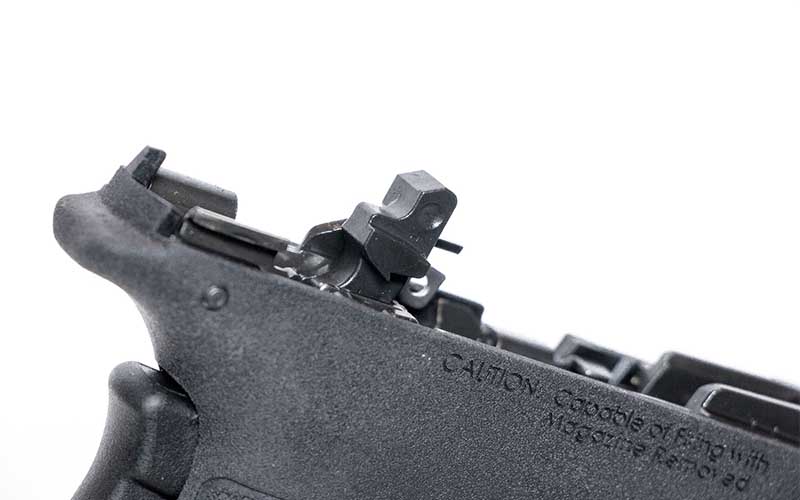
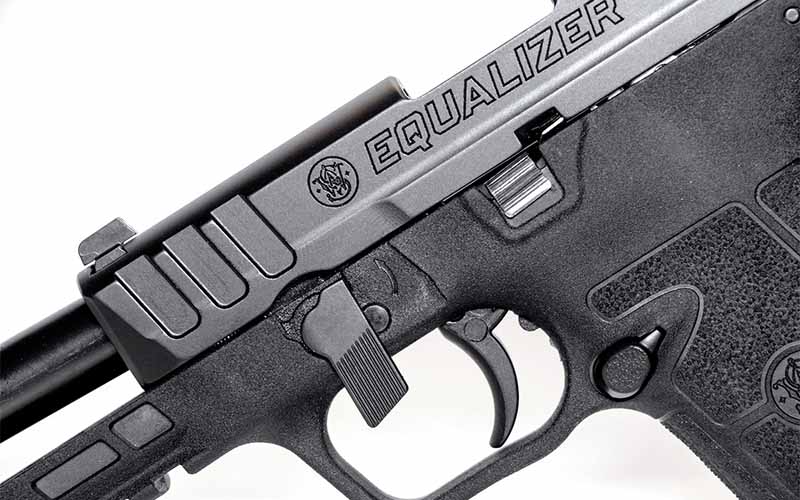
You’re probably wondering where—since this is a single-action—the hammer is. Well, this is technically a contained single-action; the hammer is hidden under the slide. At the bottom rear of the slide there’s a hollowed-out section that allows the hammer to rotate from the cocked to the fired position. Because of this, you don’t have the option of lowering the hammer manually, such as you would on a 1911. However, the firing mechanism is the same; when the gun is fired, the slide recoils to the rear and cocks the hammer. The hammer just stays cocked until you pull the trigger.
When the Equalizer is fired, the single-action hammer moves to this position to strike the firing pin, which is contained inside the slide.
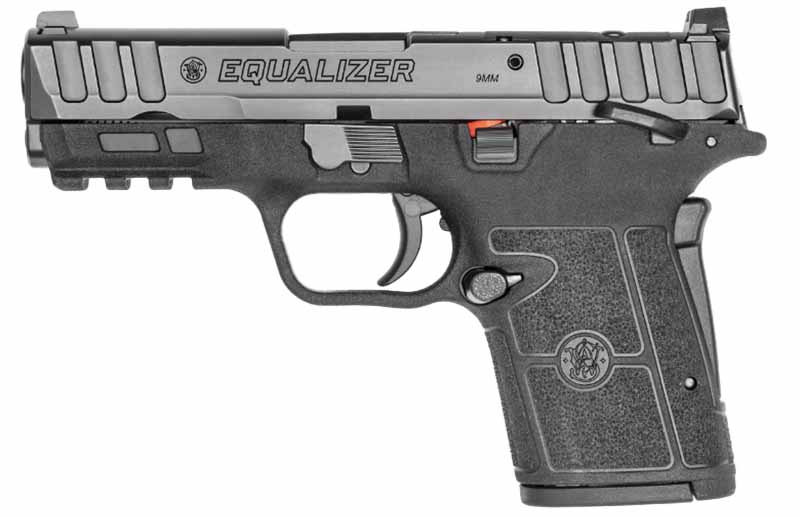
Smith & Wesson chose to include a grip safety on the Equalizer, and while I know some balk at the idea, and I’ll admit it does nothing to make this pistol attractive, it works to perfection. When shooting the Equalizer I gave it no notice at all. If you establish a good shooting grip on the gun, the grip safety deactivates. I tried to make it fail to deactivate by altering my grip and wasn’t successful unless I established a grip more than an inch below the pistol’s tang. The grip safety might make the Equalizer a bit ugly, but it’s a good design.
An ambidextrous thumb safety is available as an option. The test pistol didn’t have this feature. If it did, I might’ve written Smith & Wesson a check. I know, some folks don’t like thumb safeties, but they’re one of the best features available to make a handgun safer. Many self-inflicted gunshot wounds occur because shooters holster their handgun with their finger on the trigger. When doing so, the finger contacts the holster and presses the trigger, and a bullet ends up in the shooter’s ass cheek or leg. If a pistol is fitted with a manual thumb safety and if it is used as it is supposed to be this won’t happen.
Smith & Wesson Equalizer with the manual thumb safety.
Safeties aside, the trigger on this pistol was very nice, much nicer than any factory—out of the box—striker-action pistol I’ve fired. It broke crisp and clean at 4.75 pounds. The trigger reset was audible but couldn’t be felt. Some might consider this a negative, but I fired more than 300 rounds out of this pistol running various, fast-action, multi-shot defensive drills and never did I short stroke the trigger with it failing to reach the reset. This trigger is good, way better than the trigger on the Smith & Wesson CSX pistols I’ve fired.
The slide on the Equalizer has a cutout and cover plate that makes it optics ready. The cutout is a bit large to interface with a wider range of reflex sights. I installed a Shield RMSc-4 MOA reflex sight, and the base on that unit was thin enough that I could still use the factory sights that come on the handgun. Smith & Wesson seems proud of the fact that these sights are steel, and they should be. They also seemed proud that they are of the three-dot variety. Though I know it has become the industry standard, I’m not a fan of three-dot sights. The good news is that finding aftermarket sights to fit this pistol shouldn’t be a problem.
Unloaded and with the Shield reflex sight, the Equalizer weighs only 20.8 ounces. Fully loaded magazines will up the weight to as much as 30 ounces.
The slide on this pistol also incorporates the Smith & Wesson next-gen EZ technology, making it easier to cycle. My wife and daughters all managed it with ease. Smith & Wesson also claims the Equalizer has a low recoil impulse. Recoil is a very subjective thing, but I’ll say I found the impulse to be less than some similar pistols like the Kimber Mako and the Taurus GX4. Others I suspect will have a differing opinion.
The slide also has very deep and aggressive cuts at the rear and front to help your fingers establish a purchase to manually cycle the slide. I don’t see much use for forward slide serrations; I like to keep my body parts away from a handgun’s muzzle. However, these deep cuts do help your fingers maintain hold of the slide when you need to rack it. Maybe more importantly, at the rear of the slide there’s sort of a ledge on each side to further help with manual cycling. This I found more advantageous than the deep serrations.
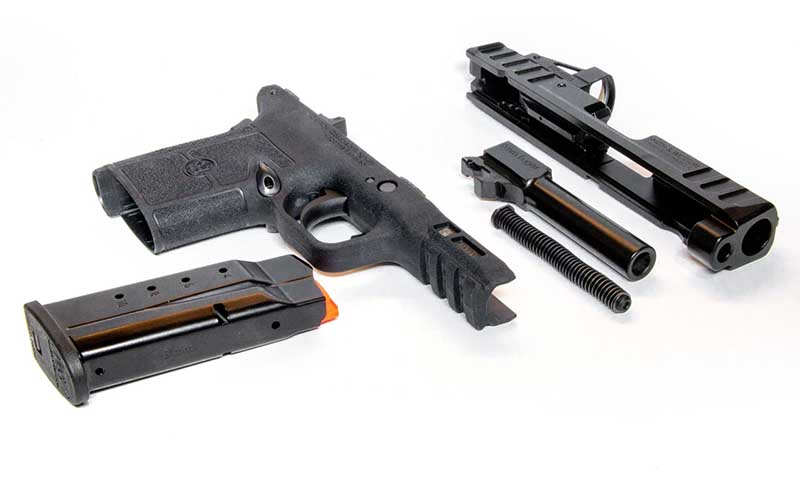
Easily field stripped, when disassembled the Smith & Wesson Equalizer is in only five parts.
Weights And Measures
When it comes to carrying a pistol concealed, weight matters. The heavier the gun, the less comfortable it is to carry. This pistol, without a red-dot sight, weighs only 20.3 ounces. With the half-ounce Shield RMSc installed, total weight jumps to only 20.8 ounces. But, of course, no one carries a pistol unloaded. True carry weights must include a magazine and ammunition. With the 10-round magazine fully loaded, the pistol weighs 27.28 ounces. With the 13-round magazine, it weighs 28.95 ounces, and it weighs 30.01 ounces with the 15-round mag. All these weights were calculated with the half-ounce reflex sight installed and 115-grain ammunition.
You can see how compact the Equalizer is; with a reflex sight, it’s only 5 inches tall and less than 7 inches long.
Of course, it’s not just about weight, size matters too. The Equalizer is only 6.9 inches long and just 4.5 inches tall. If you add a reflex sight, the height will extend to about 5.2 inches. Either way, that’s not much more than hand size. The flush-fit magazine adds nothing to the height, the 13-rounder about a half-inch and the 15-rounder about three-quarters of an inch. Though the slide-lock lever and the manual safety will add a bit to the overall width, this pistol is only an inch wide.
Here you can see the takedown lever rotated into the takedown position. You can also see that the external slide lock control doesn’t engage the slot in the slide; the notch is engaged by a part of the slide lock on the inside of the handgun.
Shots Fired
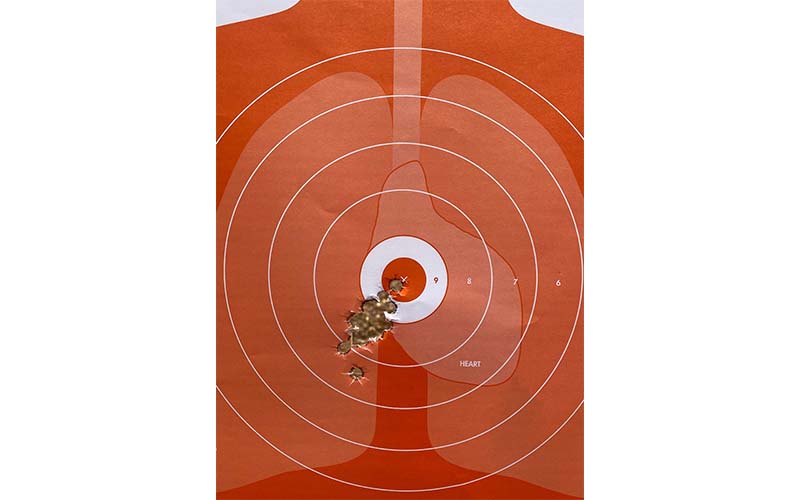
From the bench at 10 yards, the Equalizer averaged right at an inch for five, five-shot groups with three different loads. This is better than average, especially from a less than 4-inch barrel. I also fired a single 15-shot group from the standing off-hand position at 10 yards using five rounds of the three test loads. That group measured right at 2 inches. Additionally, firing 10 shots at a half-size torso silhouette at 100 feet, I got all 10 hits in 11.74 seconds using the reflex sight. With the factory open sights, my time was 13.02 seconds, but I had one miss. Those 10-shot drills were timed and fired with a draw from concealment. If you cannot hit what you shoot at with this pistol, it won’t be the gun’s fault.
This 15-shot group was fired off-hand at 10 yards with the three different test loads, using five rounds of each load. It measured 2.15 inches.
I also pushed 50 rounds through the Equalizer running my standard defensive handgun test drill—the Forty-Five Drill—with the goal of putting five shots inside a 5-inch circle, at 5 yards, in 5 seconds, from a concealed draw. My average time for 10 runs was 3.71 seconds. On two of the 10 runs I had one shot land outside the 5-inch circle. That’s similar to my normal performance with micro-9mm handguns. I will say that, as usual, I was on average about a third of a second slower when I used the reflex sight. For me to see a speed advantage with a reflex sight on a defensive handgun, I must stretch the distance to the target beyond 10 yards.
Shooting Results
LOAD
MV
MD
SD
ME
PRECISION
Nosler 115-grain ASP
1,005 fps
26 fps
11 fps
258 ft-lb
1.12 in.
Hornady 135-grain +P Critical Duty
1,105 fps
28 fps
9 fps
366 ft-lb
0.97 in.
Federal 124-grain Hydra-Shok
1,040 fps
37 fps
11 fps
298 ft-lb
1.02 in.
AVERAGE: 1.07
NOTES: Average muzzle velocity (MV), maximum velocity deviation (MD), standard velocity deviation (SD) and muzzle energy (ME) were established by firing 10 shots over a Caldwell G2 chronograph with the screens positioned 10 feet from the muzzle. The accuracy/precision (Precision) was established by firing five, five-shot groups from a sandbag rest at 10 yards. Temperature: 28 degrees, Humidity: 52 percent, Pressure: 30.10 and Elevation: 2,200 feet.
The Equalizer was very comfortable to shoot, and there were only two functionality issues. The seventh round out of the pistol failed to fully go into battery. It was a cartridge out of the 115-grain Nosler ASP box. I slapped the back of the slide, and the gun popped into battery and ran like a top after that. The other instance was an odd ammo issue with a single round of Federal 124-grain Hydra-Shok ammo. During the chronograph testing, it registered a muzzle velocity of only 447 fps. Yeah, I too would’ve thought the chronograph was on the fritz, but the recoil was noticeably less, and the empty case failed to eject. This cartridge must’ve been under charged from the factory, which is something I’ve never seen with Federal handgun ammo.
A Maglula UpLula speedloader comes with every Smith & Wesson Equalizer pistol. That’s a $35 accessory many shooters will appreciate.
Final Thoughts
The fact this pistol comes with three magazines of varying capacities is appreciated, and they all worked to perfection. But I did experience a peculiarity. With the 15-round magazine, the pistol came up with the sights on the target from the draw. With the 13-round magazine, the sights were a tad high, and with the 10-round magazine, they were even higher. This was due to how my grip varied with the various magazines that extend the grip, and the extra pressure exerted on the grip by the pinky finger. You may not have this issue, but it’s something to be aware of. I’ve experienced it before with other micro-compact pistols with long and short magazines.
Smith & Wesson’s new Equalizer pistol is well configured for concealed carry and should interface well with a broad range of shooters.
I like the Equalizer and believe I’d really like the version with the manual thumb safety. It’s compact, light, reliable, accurate, comfortable to shoot and easy to manipulate. I like it better than the S&W Shield, and way better than the CSX, which even costs a little more. What I’d really like to see is the Equalizer chambered for the .30 Super Carry. This should up capacity and make the gun even more comfortable to shoot.
Pros
Reliable
Small and lightweight, easy to carry
Good ergonomics, very shootable
Cons
The magazines with different sizes of finger extensions have the potential to affect your grip and create inconsistent presentations
Smith & Wesson Equalizer Deals
Sportsman’s Warehouse
$449.99
Cabela’s
$509.99
Editor’s Note: This article originally appeared in the February 2023 issue of Gun Digest the Magazine.
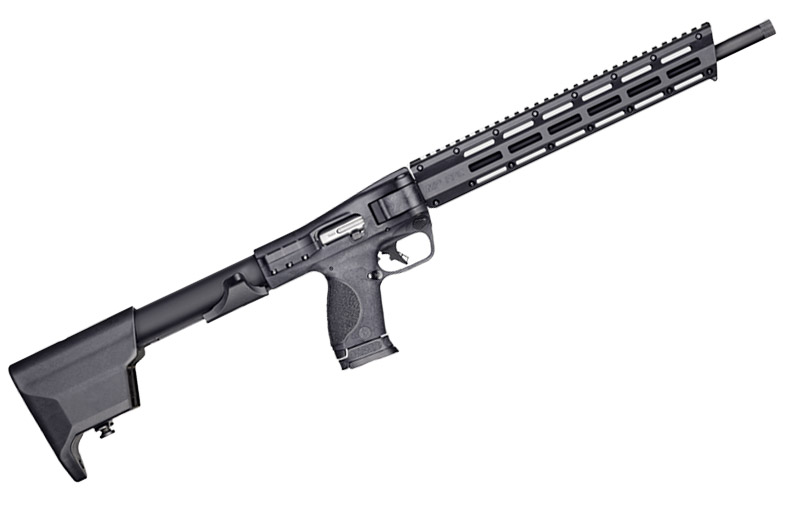
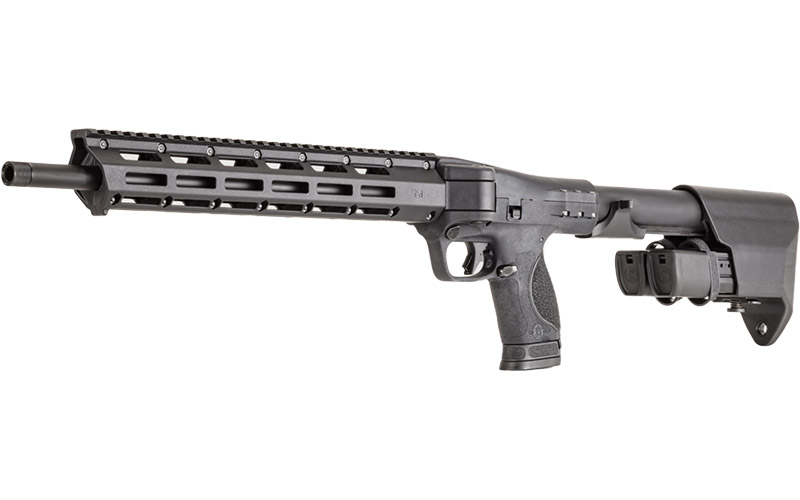
Smith & Wesson has just announced the M&P FPC, a new ultra-compact 9mm pistol-caliber carbine that can be folded in half.
Pistol-caliber carbines, or PCCs, continue to be extremely popular, and Smith & Wesson has just thrown its hat into the ring as well with the announcement of the M&P FPC. The new carbine is chambered for 9mm, accepts double-stack M&P pistol magazines and can be folded in half for compact storage or transport.
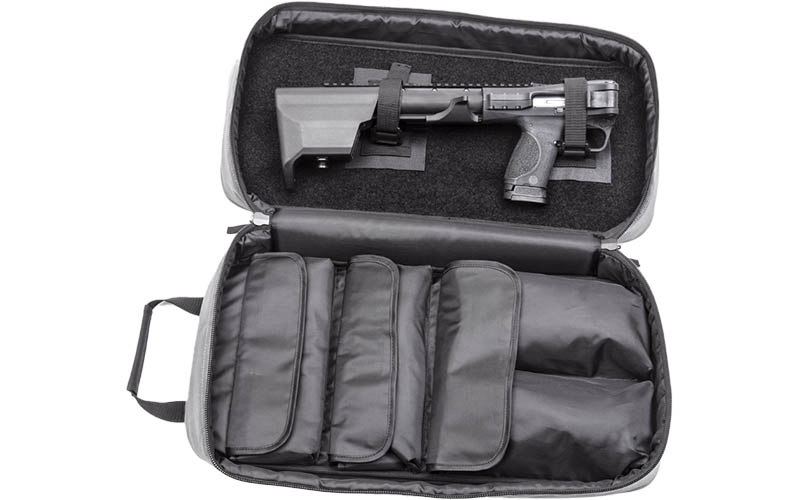
The stand-out feature of the M&P FPC is its horizontal folding mechanism that can bring the overall length from about 30 inches down to about 16 inches. Because optics are mounted to a Picatinny rail on top of the M-LOK handguard, folding the carbine doesn’t interfere with one’s sights like on some other folding 9mm PCC designs. When folded, the charging handle on the buffer tube (which houses an integrated recoil buffer system) doubles as a locking latch.
Other notable features of the M&P FPC include a 1/2×28 threaded muzzle, a flat-faced trigger and an in-stock magazine storage compartment that can hold two spare mags. The carbine also has a cross-bolt safety, a reversible magazine catch and is compatible with M&P pistol palmswell grip adaptors. Each M&P FPC will ship with a 17-round mag, two 23-round mags and a carrying case with Velcro straps for transporting the carbine while folded.
John Myles, Senior Manager of New Products at Smith & Wesson, said this about the M&P FPC:
The team at Smith & Wesson aimed to design a pistol carbine that was compatible with various M&P series pistol magazines. We exceeded that initial desire by introducing side-folding mechanics that deliver a unique compact feature and allow the user to keep their sight system mounted on the gun both in the folded and extended positions. Extra magazine storage in the buttstock, familiar M&P fire controls, and reliable palmswell grip adaptors all make this new pistol carbine a great addition to the M&P family…
The Smith & Wesson M&P FPC is available now and has an MSRP of $659.
If you need some extra stability in your life, a rifle bipod is a good place to start. Here are a few models that we consider the best.
There are many rifle bipod styles and models out there, but which is best for you? Like most shooting gear, that mostly depends on your use case and what features you want or need.
So, we’re going to go over the different kinds of bipods, what each type is best for and then look at some good models to choose from for different purposes.
Are Rifle Bipods Worth It?
The obvious utility of a bipod is stabilizing the rifle in the field. For some pursuits, using one is at minimum a very good idea, and for others, it is an absolutely critical piece of gear for placing precise shots at distance.
Competition shooters in modern rifle sports like 2-Gun, Quantified Performance, Brutality matches and similar events can lose a lot of points if their firing position isn’t stable.
Military and police snipers as well as hunters use bipods for the same benefits provided by additional stability, but with much higher stakes, the importance of precision is even higher.
In short, if you want your shots to go where you intend them to, it helps to remove as much uncertainty from the equation as possible. No matter how steadily you believe you can hold your rifle, a bipod and something to rest it on will always be better.
What Kinds Of Bipods Are Out There?
There are dozens, if not hundreds of makers and sellers of bipods, but they tend to fit into three broad categories based on their design features.
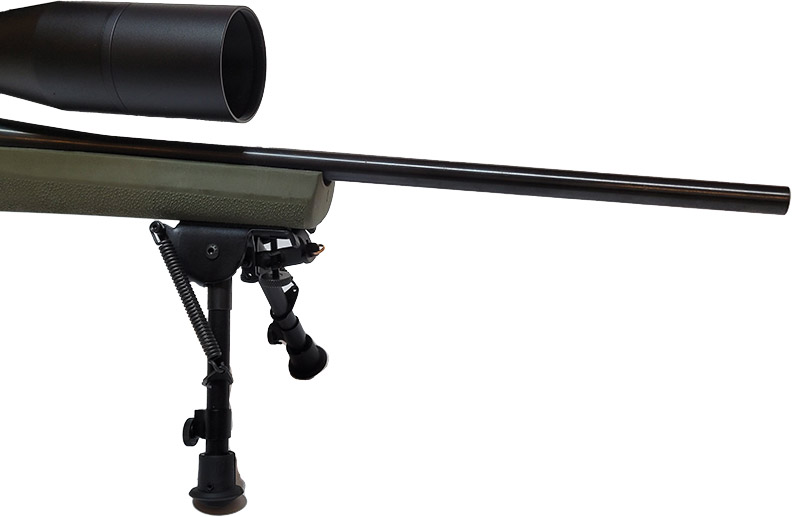
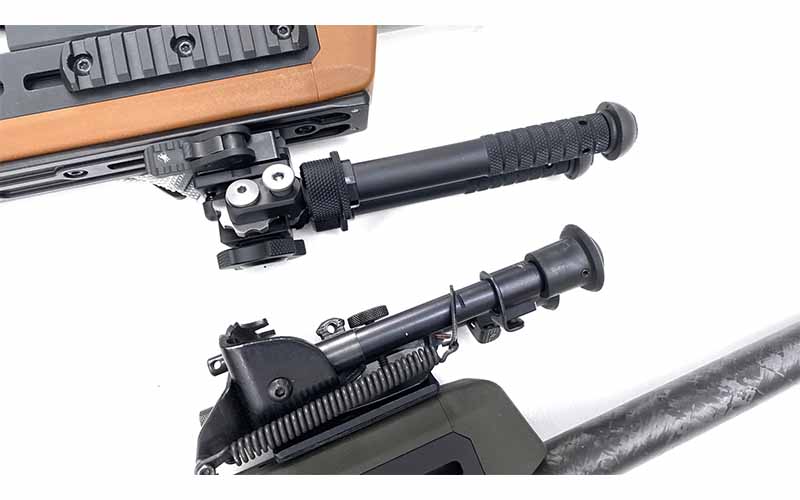
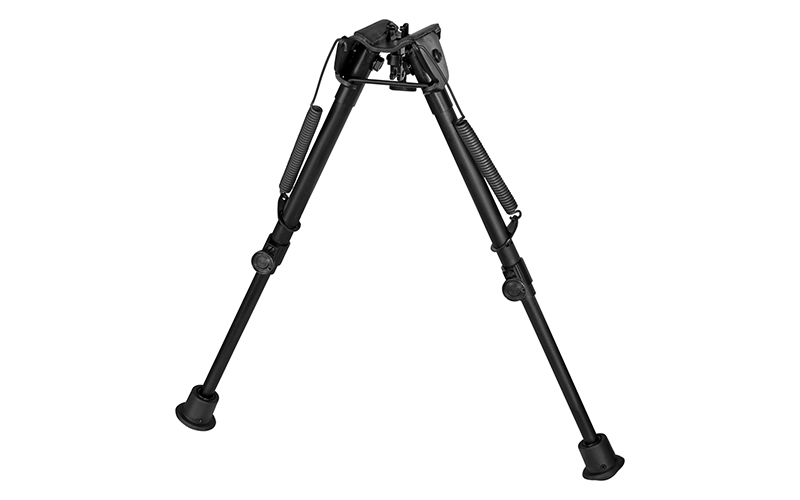
The most common is the Harris-style bipod, popularized by Harris Engineering. Harris bipods and their clones have spring-loaded, telescoping legs. They fold up and out of the way when not needed and when pulled down they lock in the open position.
There are various leg lengths and styles to choose from. Optional features can include a mechanical swivel, self-leveling legs and additional spring-loading for faster opening.
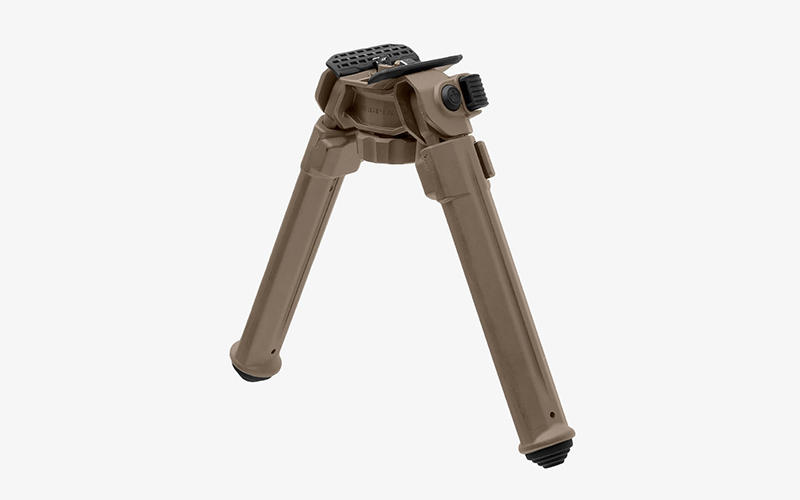
The next type could generally be described as either a cog or ratchet style. They fold down like a Harris but are not spring assisted. This type is made by several manufacturers, but one of the most popular is Magpul’s bipod.
Another class could be called the two-piece family of bipods. This is made of two independent legs that are attached to the rifle with one on either side. Some rotate down and back, but others are designed to rotate down and forward to lock open. Very few of these are any better than hobby-grade and should generally be avoided.
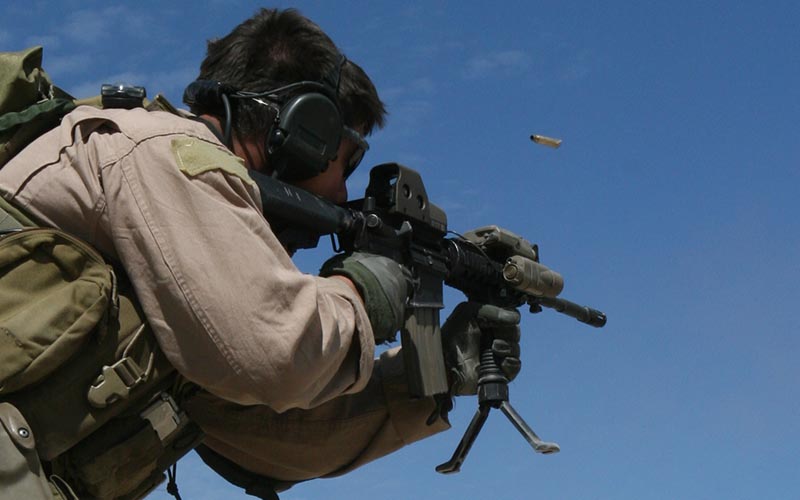
There are also grip pods that feature a compact bipod hidden inside the vertical foregrip. These have, however, broadly fallen out of favor.
A MARSOC operator with a combination foregrip and bipod on his carbine. These have become a lot less popular since this picture was taken in 2009. Photo: Wikipedia..
How Do You Put A Bipod On A Rifle?
The most common attachment is a sling swivel mount. The bipod simply locks onto the sling swivel stud just like a standard sling attachment would. This style is most appealing for those with a traditional rifle that came with a sling stud from the factory. Most of these were designed to be left on the rifle once installed, but some sling stud-mounted bipods have a quick-detach feature as well.
Other bipods attach through more modern means, such as Picatinny or ARCA rail, or M-LOK and KeyMod mounts. Many rifle bipods that mount via this method are also available with a quick-detach system.
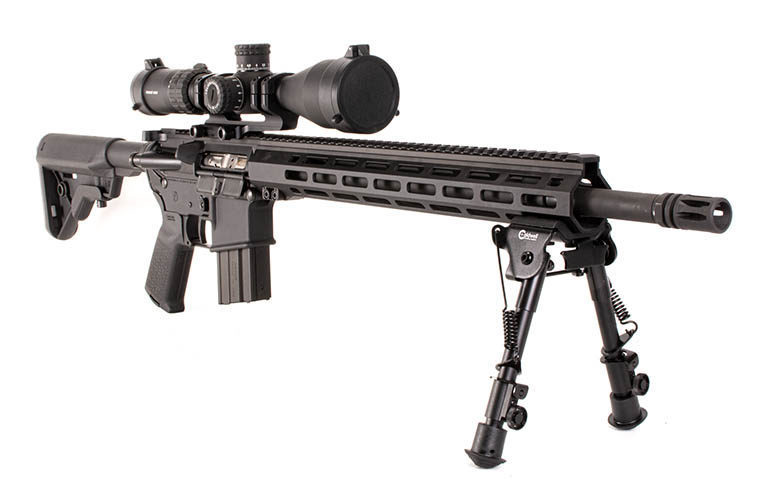
An AR-15 outfitted with a Harris-style bipod from Caldwell, attached via M-LOK.
What’s The Best Rifle Bipod For Me?
All bipods have downsides, so the trick is finding a model that has downsides that will affect you the least.
Weight
While it doesn’t matter too much on the static range, it can start to matter a lot more if you’re involved in something like competing, hunting or soldiering. Even the lightest models add weight to the muzzle-end of your gun, and certain setups and applications may require you to forgo functionality to save on weight.
Speed
Spring-loaded designs are typically the fastest, and if you ever anticipate having to deploy your bipod quickly, this is probably the style that you want. Two-piece designs without springs are typically the slowest to bring into action, but that’s not important for all types of shooting. Some people also want the ability to quickly attach or detach the bipod from the rifle, a feature that only some models have.
Movement
Some bipods, such as the classic Harris style, are lacking in this department. Swivel bipods give you more target-tracking capability, and if you anticipate needing to track or follow the target, this is a feature you may want to have.
However, bipods that have additional range of movement can come with downsides as well, as the swivel mechanism will add weight, bulk, noise and extra expense. The stability can be negatively impacted too.
Form
They’re notorious for poking users in the back while being carried and for being very difficult to get through ports. A VTAC barricade is hard enough to navigate with a slick rifle. With a bipod on the front of the gun…forget about it. How you plan on carrying your rifle in the field and what positions you anticipate shooting from can all affect which model will be best for you.
Durability
The thinner and lighter the legs, the more likely they are to bend or break. If stress-bearing components are made of a material that doesn’t bear stress well, it’s not going to stand up to hard use. This is where all the two-piece models made for modern carbines fall apart; none stand up to use outside of a static range.
In other words, you need to match your bipod choice to your use case, which means balancing these factors with your particular needs.
The 6 Best Rifle Bipods
Best All-Purpose Rifle Bipod: Harris 1A2-L2
The Harris 1A2-L2 is a quick-deploy steel bipod with spring-loaded, self-leveling legs. The user can adjust the length from 9 inches to 13 inches (shorter and longer versions are available too) and an adapter can be added for any attachment method desired. It weighs 12 ounces.
It lacks some features (like a swivel) and is a tad heavy, but in terms of what it does (deploys quickly and self-levels) and what it costs (MSRP is $79), it’s hard to find better value for the money.
Military-Chosen Bipod: Atlas PSR
The Atlas PSR was developed for USSOCOM. If you want a duty-grade, brimming with features rifle bipod, the Atlas PSR is it.
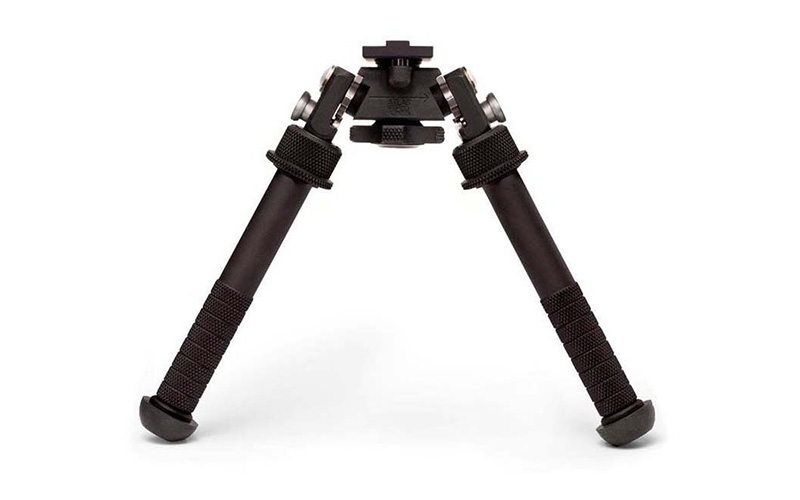
The PSR is available in short or tall (5 inches to 9.4 inches or 6.2 inches to 12.6 inches) and either with or without quick-detach. It has a swivel, with 30 degrees of cant or pan with fore and aft limiting bosses to keep the legs stable. The user can also set the open position angle, reduce cant/pan and otherwise configure it to their needs.
Atlas PSR bipods are also relatively compact at 7.35 inches long when stowed for the short model and 9.3 inches when stowed for the long version. Few match it for durability, track record or features. MSRP starts at $260.
Best Rifle Bipod For Precision Shooting: Accu-Tac FC-5 G2
Accu-Tac is one of the preferred bipod makers for precision shooters. The FC series was developed for F-Class competitors and the feature set shows it.
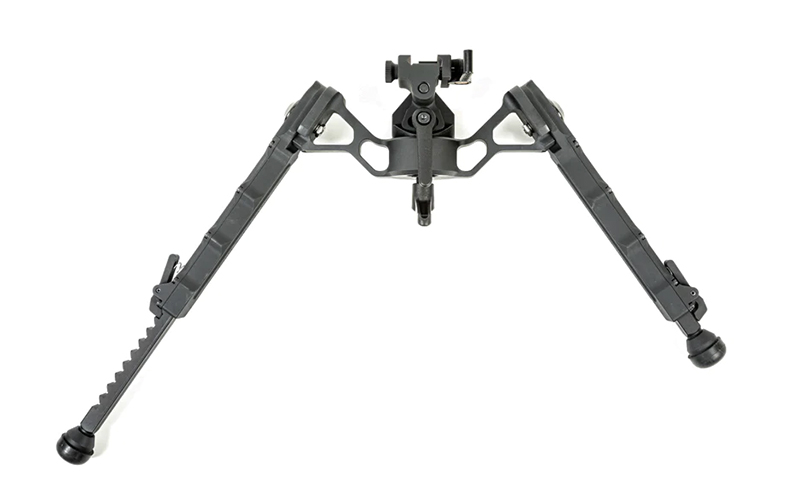
The FC-5 G2 has a wide base, cradling the rifle for greater stability. The legs are adjustable in length (up to 10.6 inches) and adjustable in position so the bipod can deploy between 45 and 90 degrees. They can pan and cant, and those are adjustable as well. A Picatinny rail is required to mount it, however.
Accu-Tac bipods are not ideal for field use but are the best for precision bench shooting that you can buy. MSRP is $466.
Best Lightweight Rifle Bipod: Magpul
Magpul’s bipods have some drawbacks, but their primary selling points are A.) they’re bipods and they work, and B.) they are seriously light, slim and cost-effective. For backcountry hunters or carbine shooters who want a low-drag bipod, these are a great choice.
The legs are injection-molded polymer (likely a nylon mix, which is incredibly strong) with adjustable height (7 to 10 inches) and a user-adjustable open position. The legs lock in the open or closed position and Magpul offers variants that attach to all popular mount styles.
At 10 inches long when folded and only 8 ounces, it’s about as good as slim, lightweight rifle bipods get. MSRPs start at $75.
Best Bipod For Sitting: Swagger QD42
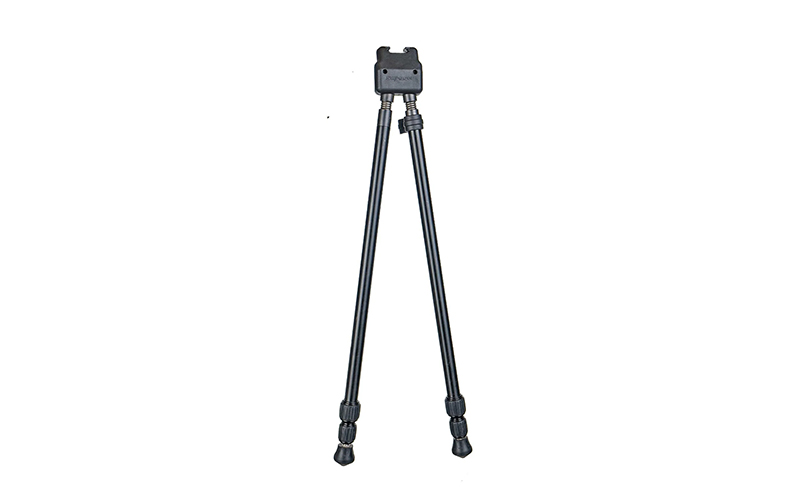
A lot of hunters shoot from a blind, and most bipods are built around the prone position. The Swagger QD42 gives you an easy on/off bipod that’s usable while seated or kneeling in a stand or when concealed in a natural blind.
The base bipod works with Picatinny rail, so an adapter may be required depending on your setup. The legs extend from 14 to 42 inches but flex at the connector for some forward cant. MSRP is $129.99, and adapters (available from Swagger) are $20 to $40 if needed.
Best Quick Detach Bipod: Javelin Pro Hunt Tac
Javelin Pro Hunt bipods use a magnetic docking system with a mounting socket that you attach to your rifle. If you want a bipod that’s lightweight, can be quickly attached or detached (it’s even faster than Pic rail QD mounts) and that’s packed with features, the Javelin is it.
Short and long adjustable leg lengths are available (and swappable) with a locking traverse feature that lets you stow the bipod with the legs together, then open and lock. The magnet goes into the socket on the rifle. The bipod has cant and pan as well as traverse to track targets and spring-loaded legs for stability.
The carbon fiber and steel construction help to keep the weight low at only 7.6 ounces with standard-length legs. If you want a bipod that can be quickly deployed but gives you the utmost function once it is, this is the one. MSRP is $320.
Improve Your Marksmanship:
5 AR-15 Drills That Will Help You Master Your Rifle
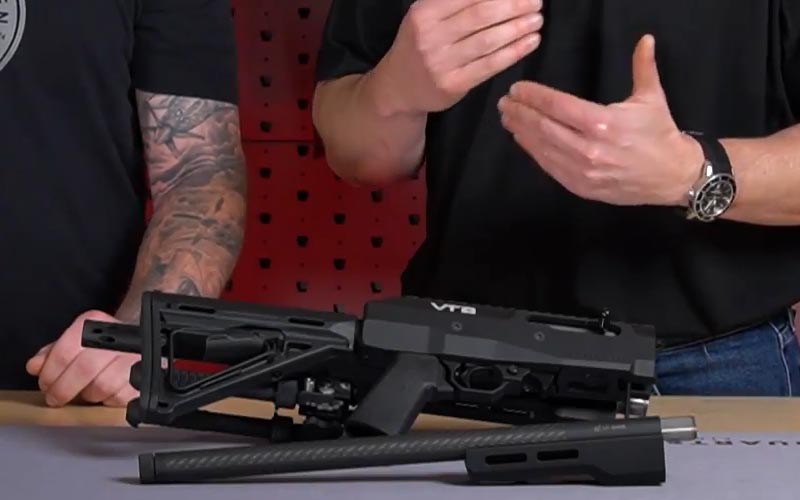
The Volquartsen VT2 takedown rifle has been available .22 WMR and .17 HMR, but the company is now adding .22 LR to the lineup.
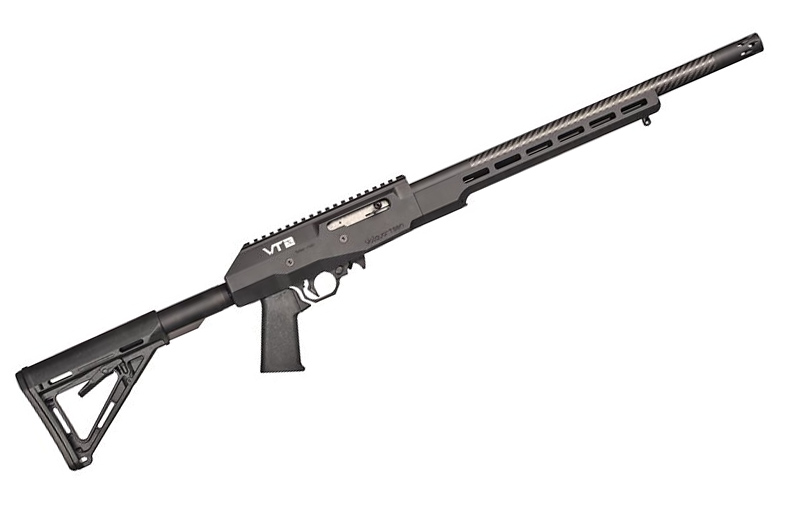
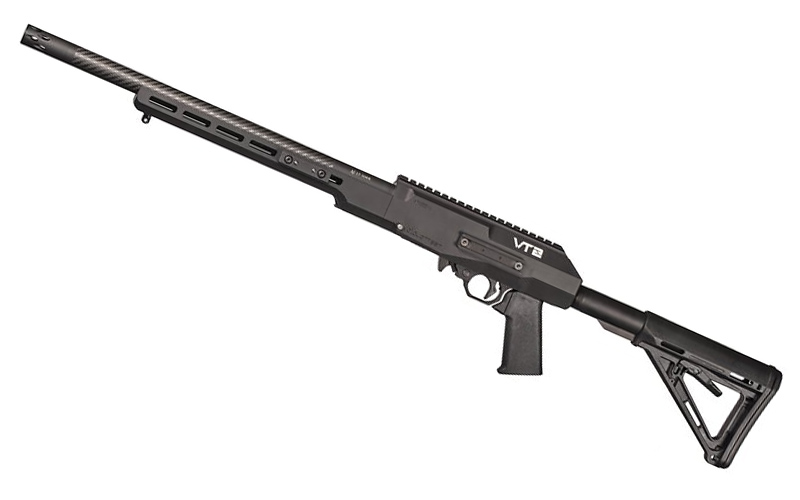
Volquartsen is a respected name in the rimfire world, and the company’s VT2 has been a popular choice of takedown rimfire rifle since it was first released in 2022. Initially, the rifle was only offered in .22 WMR and .17 HMR, but Volquartsen has just announced the addition of a .22 LR VT2 to the lineup.
While .22 WMR and .17 HMR certainly have their advantages, ammo availability and price per round are not among them. For those who want a quality, semi-auto takedown rimfire rifle chambered for something more suitable for general plinking, the .22 LR VT2 is now an option. Besides the new chambering, the .22 LR VT2 is otherwise identical to the existing models.
Just like with other VT2 rifles, the new model’s barrel can be removed without any tools, only requiring the push of a button and the lifting of a lever. Other notable features include M-LOK handguards (available in 6- and 12-inch lengths), a 0-MOA Picatinny rail on the aluminum receiver and a 1/2×28 threaded muzzle (a thread protector and compensator are both included). It also takes standard AR-pattern stocks and grips and the package ships with one 10-round magazine.
Scott Volquartsen, president of the company, said this about the new VT2 model:
A takedown platform is only as good as its repeatability. This reason is why it was critical for us to be able to design a takedown rifle that not only required no tools, but was able to be accurate, repeatable, and reliable every time its reassembled…
The Volquartsen VT2 in .22 LR is available now and has an MSRP of $2,261.
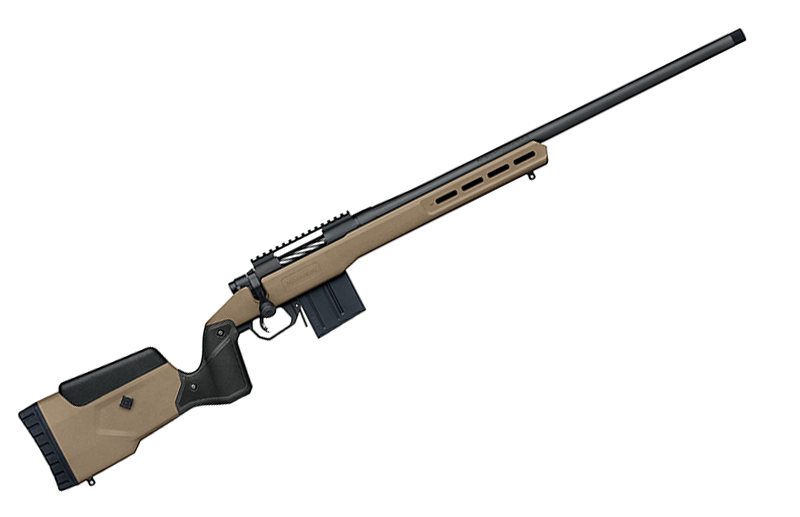
Priced to fit any marksman’s budget, and on the mark accuracy-wise, the Mossberg Patriot LR Tactical proves the ideal gateway to long-range shooting.
The saying goes: Want to know what it’s like to own a boat? Tear up hundred-dollar bills under a cold shower. Something might hold analogous for long-range shooting. Maybe, rip up fifties while a buddy hits you in the shoulder.
Luckily for boat and precision-shooting freaks, the payoffs of endorphins and bragging rights are well worth the physical and fiduciary discomfort. And for the latter category, when it comes to decimating legal tender, marksmen are more likely to get away disembodying Jacksons as opposed to Grants nowadays.
Still white-hot popular, the laws of supply and demand have bent long-range shooting’s price curve mercifully in the shooter’s favor. Case in point, the Mossberg Patriot LR Tactical.
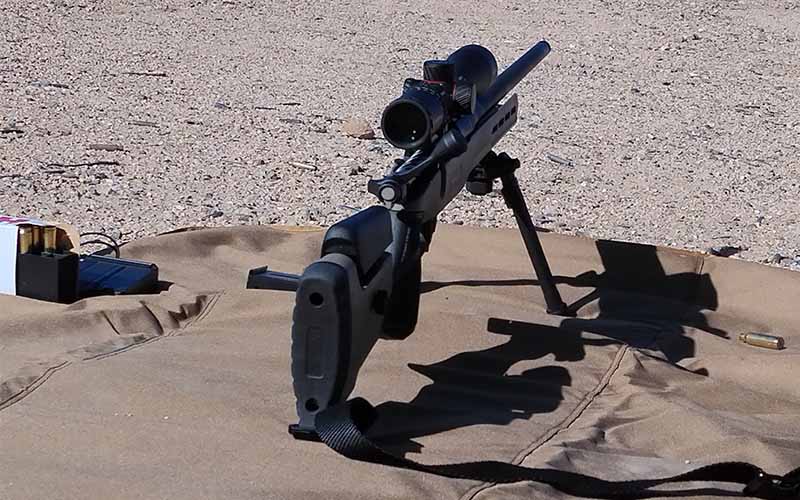
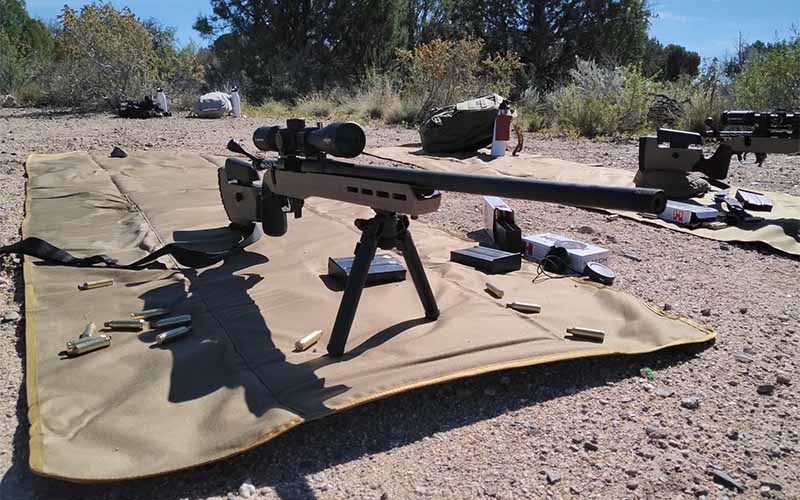
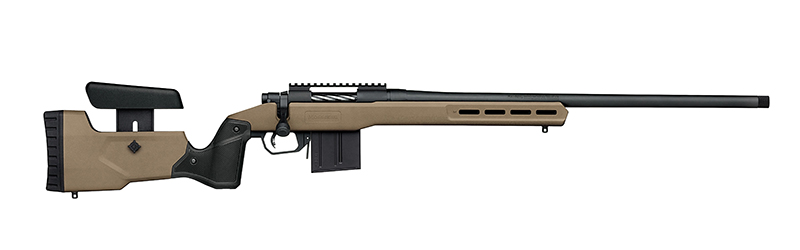
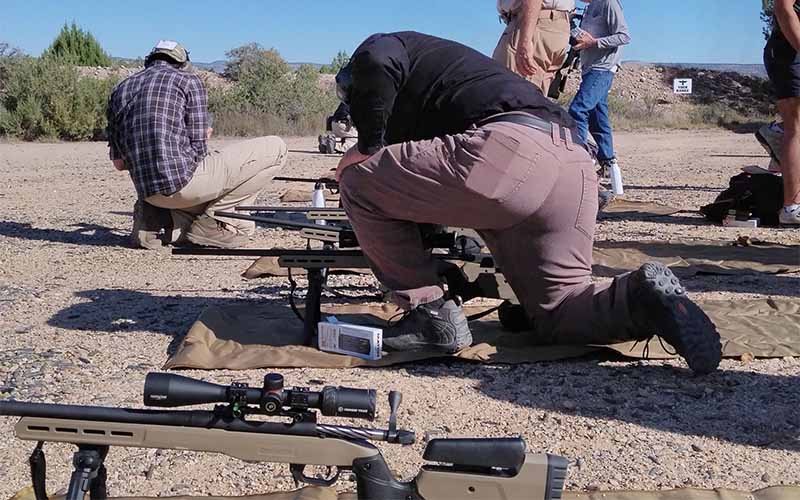
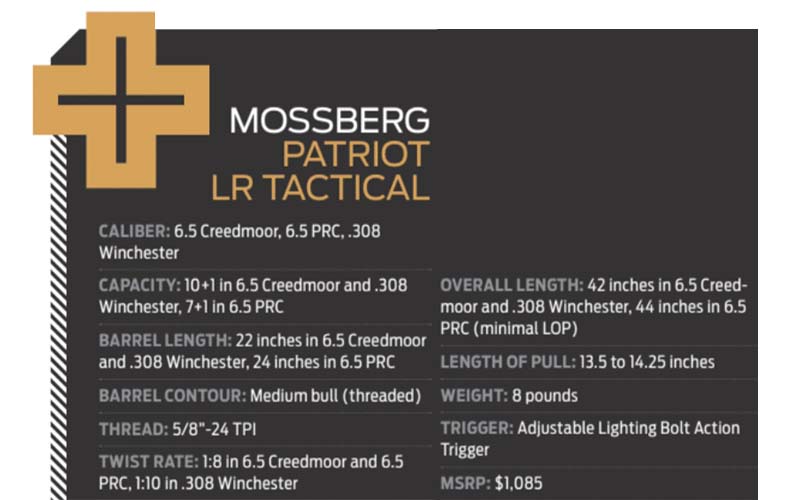
Designed as an everyman’s precision iron—with an MSRP of $1,085—the rifle looks to set more sights at a country mile. And from my short time with the chassis system—chambered for 6.5 PRC—at Arizona’s Gunsite this past fall, it seems the New Haven concern’s engineers have about hit this mark as dead center as possible.
Whether that’s good or bad is for your bank account to decide.
Priced right and smartly configured, the LR Tactical gives entry-level long-range shooters and pennywise marksman a solid option to go a country mile.
Heart Of A Patriot
Shooters familiar with Mossberg’s catalog will instantly recognize the heart of the system: the Patriot action. Released a little more than half a decade ago, the tubular action forms the foundation of the company’s highly affordable hunting rifle line and has acquitted itself well in the role. Apparently, it has the chops for long-range work as well.
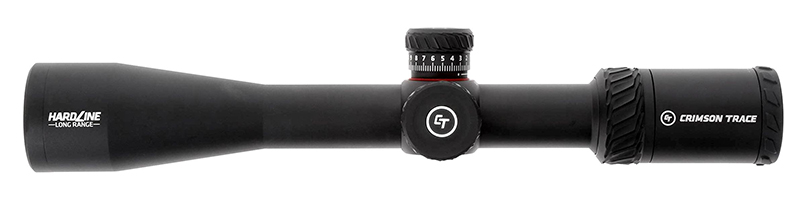
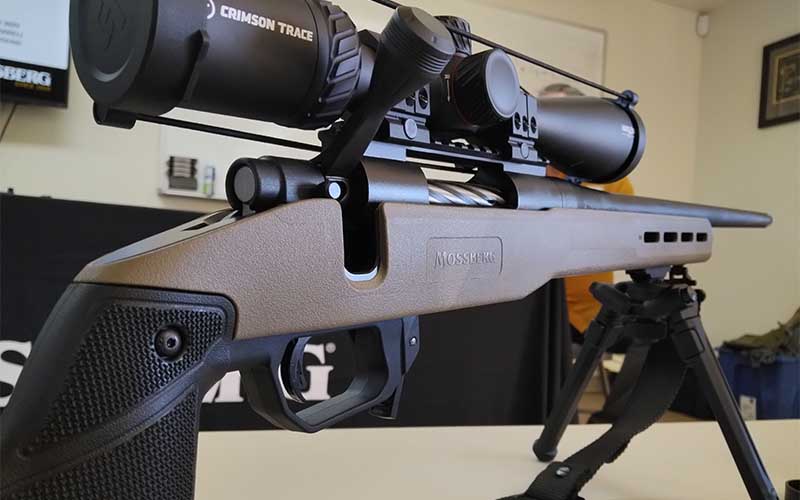
On the LR Tactical the basics of the system are fairly simple. It’s a push-feed affair, with a robust two-lug bolt boasting an oversized tactical-style handle. The bolt is outfitted with a traditional plunger ejector and Sako-style extractor, both of which functioned superbly on the 6.5 PRC iteration I shot. It flung spent brass like nobody’s business, but not so obliquely as to bang the Crimson Trace Hardline 4-16x42mm MR1-MOA SFP scope mounted with Wheeler aluminum rings on its 0 MOA Picatinny rail.
Crimson Trace Hardline 4-16x42mm MR1-MOA.
A quick note on the rail part: Mossberg spoke about replacing the low-rider with a 20 MOA version on the market model.
On the aesthetic side, Mossberg spiral flutes the bolt, which is a nice touch. However, the bolt itself is not monolithic, but three pieces—bolt head, body and handle. This facet puts some overall play into the operation, perhaps more than some might desire in a precision rig, but not enough to make it a functional issue. Thankfully, the system is rock-steady where it counts, with the head traveling smoothly and quickly down the raceway for lockup.
In addition to a snappy LBA trigger, the LR Tactical feeds off AICS-style magazines. Additionally, the paddle release makes reload lightning quick.
To this, Mossberg mates a 24-inch medium bull barrel in the 6.5 PRC model. The other two chamberings—6.5 Creedmoor and .308 Winchester—the contour is the same, but the fire tube is abbreviated to 22 inches. No matter caliber, all the rifles come with a threaded (5/8”-24 TPI) muzzle with a target crown, so it’s ready for a brake, comp or suppressor. If none appeal, Mossberg includes a knurled cap to protect the threads.
The belle of the ball on the Patriot LR Tactical is its LBA trigger. Adjustable triggers are common as field corn, but Mossberg’s deserves note, given it greatly enhanced the rifle’s performance.
At Gunsite, the company had it tuned to roughly a 2.5-pound break when measured with a Lyman Digital Trigger Pull Gauge. You can pick your analogy—glass, thin ice, what have you—the trigger broke like it. Better yet, it didn’t show an iota of creep. Additionally, the switch’s skeletonized trigger blade is a solid addition, creating a tactile reference point for finger position.
A nit to pick at this point of the rifle: I wasn’t a fan of the polymer trigger guard. But if that’s where Mossberg had to save money, it’s a minor concession.
Built around Mossberg’s proven Patriot action—the staple of its hunting line—the LR Tactical rests on a solid foundation. It also has some nice tweaks, such as the oversized tactical bolt handled and slick fluted bolt.
MDT In The Mix
To have a chassis rifle you’ve got to have, well … a chassis. Mossberg turned to a well-known player to provide the precision stick to house the Patriot system—MDT. It seems presently the company dresses every other new long-range rifle on the market today, but for good reason—they know what they’re doing.
The chassis on the LR Tactical is a custom job as specified by Mossberg, but it does seem to have some inspiration drawn from MDT’s XRS system. There’s good and “meh” about the platform, but for what’s arguably an entry-level precision rifle the chassis has plenty going for it.
The LR Tactical’s 24-inch medium bull barrel, free floated in the MDT stock, performed under the Arizona sun. Not the muzzle cap—a brake would’ve been appreciated in this 6.5 PRC variation of the rifle.
Chief among these is a solid bedding system. Beneath the polymer exterior, the LR Tactical’s chassis sports aluminum V-block bedding, creating a solid mating surface along the entirety of the Patriot action. This sort of design is a must in long-range systems, erasing action shift—thus barrel shift—due to recoil. After all, moves of a fraction of an inch in the rifle can lead to misses at and past 1,000 yards.
The chassis’ layout is somewhat tradition, yet its ergonomics are right. The grip is generous, which includes a nice palm swell that fills the hand while not compromising purchase. The buttstock fits the shoulder pocket well and is fully adjustable. Its length of pull is modified via spacers adding 0.75 inch a pop. And the cheek rest includes 2 inches of play, and for me sat rock solid—impressive given it attaches to the stock via a single post.
MDT’s fully adjustable buttstock offers ¾-inch adjustment in LOP and plenty of rise on the cheek rest.
Other accouterments include a paddle mag release in front of the trigger guard for AICS-style magazines, M-Lok slots at the 3-, 6- and 9-o’clock positions and sling swivels. Pretty nice package, but still it does have a few faults.
The biggest point to turn off some is weight, which at 8 pounds is light for a precision system—particularly when chambered in 6.5 PRC. Not a “thumper” by any stretch of the imagination, the recoil was still enough; it was impossible to track the bullet to the target. Weighting systems abound, so this is easily solved, but shooters should realize it requires aftermarket investment. Not a deal breaker, mind you, but something to be conscious of and perhaps logical with what Mossberg cooked up—more on that in a bit.
On The Firing Line With The LR Tactical
Right off the bat, I was impressed with the accuracy of the LR Tactical.
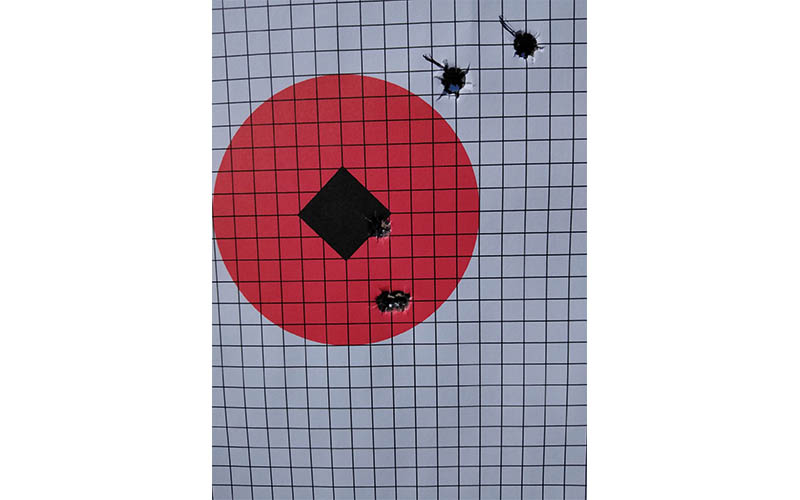
We pitched Hornady Match Ammunition, which is topped with 147-grain, polymer-tipped Match bullets (G1 BC .697). After taking the initial three shots to see where it was printing when zeroing in, it essentially stayed MOA from there on. I failed to make the mythical three-leafed clover at 100 yards, always off on my third shot after linking two. But I’ll put that squarely on operator error, not the rifle.
After dialing the rifles in the Crimson Trace scope, we took to Gunsite’s long range to test the rifle’s legs. Shooting from prone, utilizing Magpul MOE Bipods, we stretched out from 400 to 600 yards on steel targets.
Upon gaining some familiarity with the LR Tactical, I progressed through a series of 15 or so shots at the ranges—with an intermittent north-to-south wind—hitting each one on my spotter’s call. The last trigger squeeze of the session might have been the sweetest—at least to Mossberg folks hovering over the cadre of gun hacks. Waterfalling down the line, each writer took a 600-yard shot and each connected—nearly all dead center.
Quite a finish. The only disappointment was not having the time to push the rifle further.
After dialing in, the author enjoyed MOA to sub-MOA performance from the LR Tactical. He missed a mythical cloverleaf on his first shots at the bull’s-eye at 100 yards, but walked away more than pleased with the grouping on the ¼-MOA grid.
Where Does The Patriot LR Tactical Shine?
The question remains: What exactly is the LR Tactical aimed at in particular? It’s certainly not an out-of-the-box and entry-level PRS rifle—though it definitely could fill this role for the pennywise. And while it has some trappings of a precision hunter, the rifle isn’t exactly that either. Perhaps this androgyny is the genius in what Mossberg has created.
With some thought, the rifle potentially fills nearly any niche requiring the delivery of jacked lead precisely at long distances. It’s a jack of all trades—which is ideal for those dipping their toes in the long-range end of the pool. A tweak here or there and the LR Tactical is apt to excel anywhere, from benchrest to prairie hunt.
In the age of specialized systems, where every critter and style of shooting has its own dedicated iron, the protean LR Tactical is a breath of fresh air—not to mention the key to freedom for newbie long rangers.
Slap some recoil-eating weights on it and load up top-shelf match ammo, it certainly seems to have the ability to handle a rifle-club precision match. Strip the weight, add a sling and you definitely have an option that can place on the vitals of a deer or elk at a load’s (and shooter’s) ethical range.
In all likelihood, the guns will go for sub-$1,000 in your local gun store or outdoors mega mart. That’s practically a steal relative to most other precision systems and gives a wide gate of entry for new long-range shooters to test the waters—no matter what they fancy. Not to mention, it also leaves plenty for what’s sure to become a heavy ammo tab.
There’s no escaping that facet—burning dough—in long-range shooting. But the LR Tactical goes a long way in lessening the thump on your wallet.
Editor’s Note: This article originally appeared in the February 2023 issue of Gun Digest the Magazine.
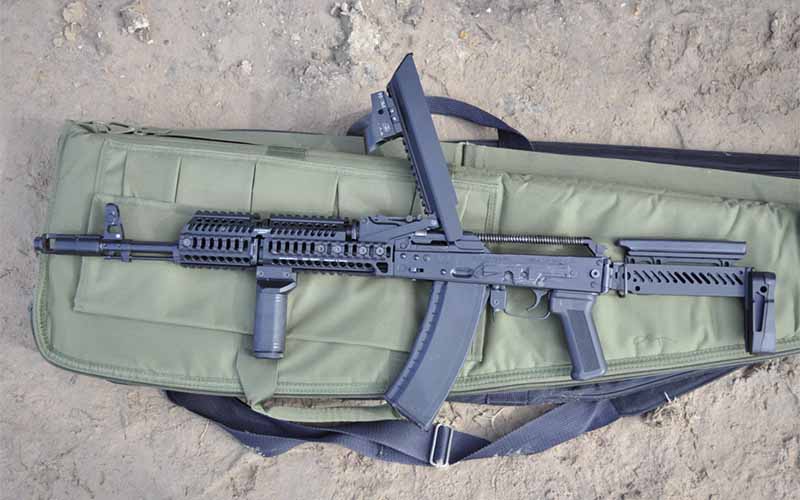
If you’re looking to add a 21st-century optic to your Kalashnikov, here are some of the best AK red dot mounts to get the job done.
There was a time when Kalashnikovs were derided for their lack of modularity. Today, that’s no longer the case. While the rifles still aren’t as supremely customizable as ARs, aftermarket support for attaching modern accessories has never been stronger.
There are now several rock-solid methods for attaching optics to your Kalash. Regardless of your exact model or how tactical or classic you want the final setup to look, there’s an AK red dot mount out there that will fit your needs.
AK Red Dot Mount Methods
When looking to mount a red dot on an AR-15, the location has mostly been determined for you thanks to the generous segment of Picatinny rail found on nearly all modern upper receivers. Whether you prefer your optic farther forward or closer to your eye, it’s going to be mounted on the receiver rail.
When it comes to AKs, things aren’t as simple. Interestingly, this provides the user with more options. Depending on the method you choose, your optic could be mounted as far rearward as the back of the receiver or as far forward as the front of the gas tube. This equates to roughly 11 inches more total real estate (7 inches for the AR, 18 inches for the AK).
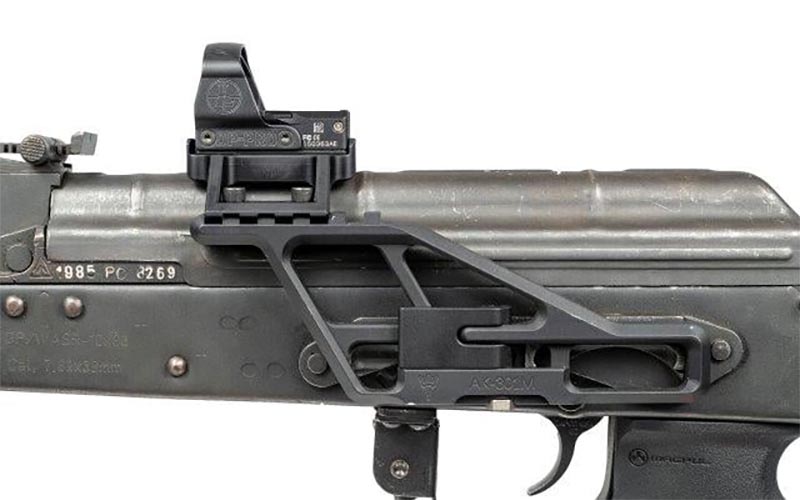
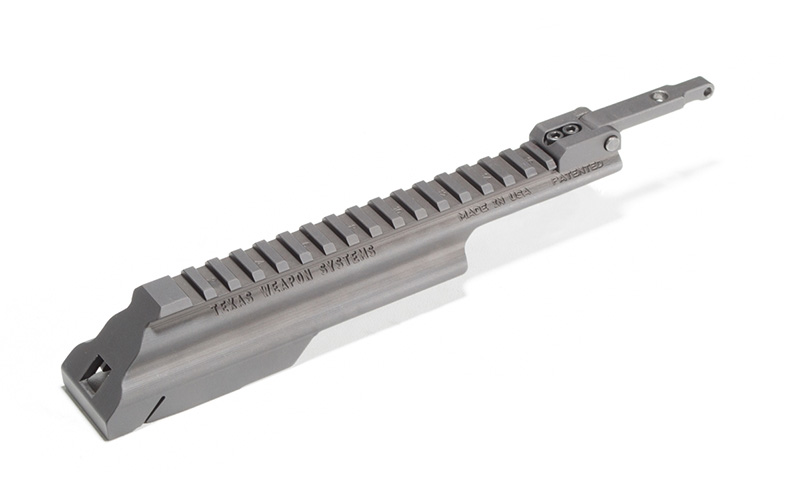
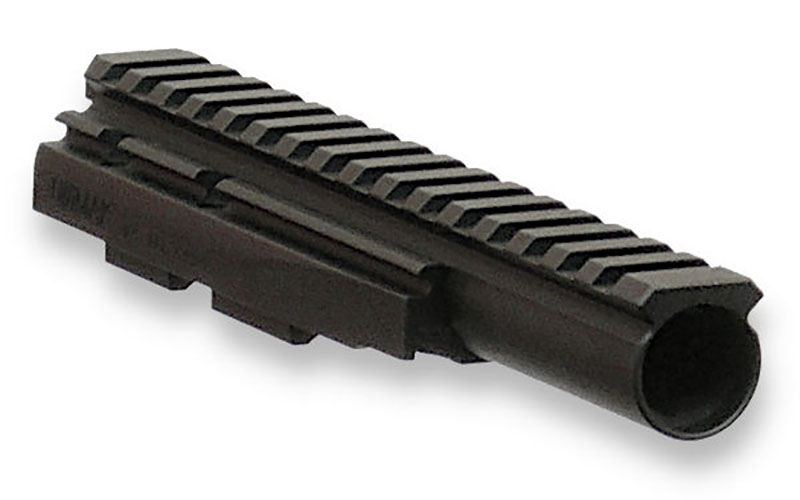
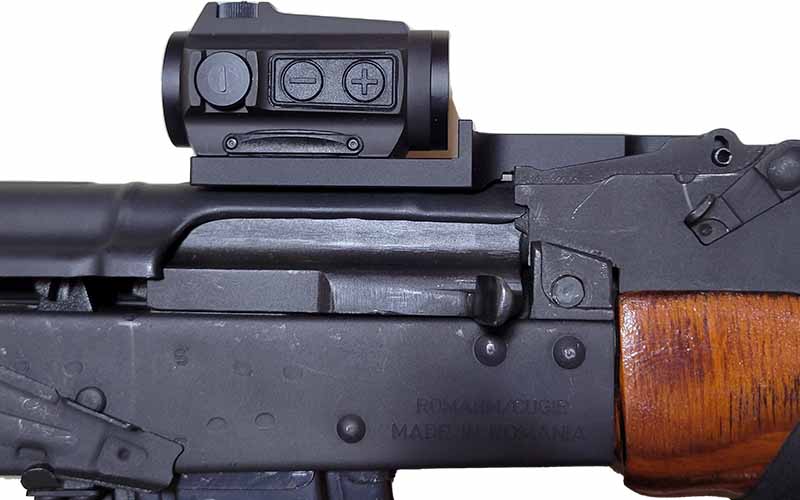
This stems from the fact there are four primary styles of AK red dot mount, and each type places the optic along different areas of the aforementioned 18-inches of real estate. Those four methods are side rail mounts, railed dustcover mounts, gas tube mounts and rear sight leaf mounts. Each comes with its own set of pros and cons.
Side Rail Mounts
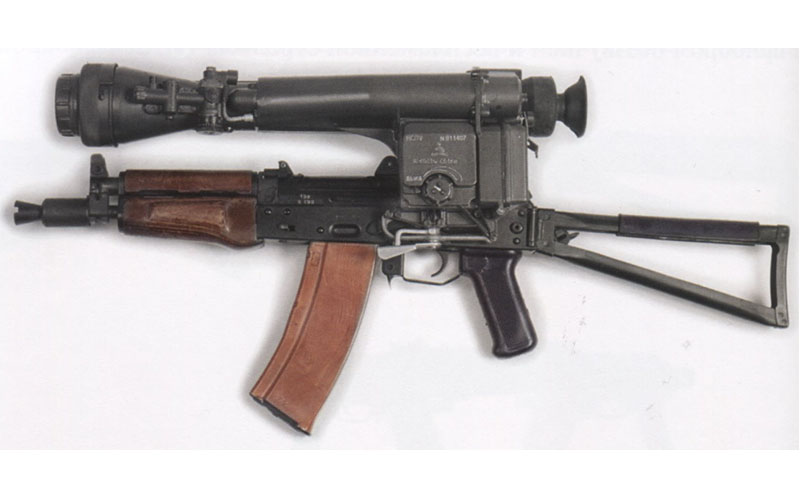
An AKS-74UN with a NSPU night scope. Photo: Modernfirearms.
The AK was never originally designed to accept optics. But after the Soviets developed night vision scopes, they also devised a way to mount them to Kalashnikovs. This first model capable of doing this was designated as the AKN, with the N indicating it accepts a night vision scope via the rail on the left side of the receiver. The concept continued throughout the Kalashnikov’s development, existing as the AKMN for the AKM and as the AK-74N for the AK-74.
Today, most AKs sold in the U.S. come from the factory with one of these now-standardized side rail mounts, and they can be used to attach far more than original Soviet 1PN34 scopes. Several styles and brands of side rail optic mounts are now available for attaching anything from red dots to LPVOs, and this method has the additional benefit of quick-attach/detach while still retaining zero. One potential downside, however, is that these systems prevent left-side and underfolding stocks from closing when an optic is mounted. Stocks that fold to the right are still an option though.
Railed Dustcover Mounts
An AK equipped with a Zenitco B-33 railed dust cover and optic. Photo: AR15.com.
When AKs first started becoming popular in the U.S. in the ‘80s and ‘90s, there was a slew of poorly conceived aftermarket accessories. Some of the most egregious examples were dust covers with Picatinny rails welded to the top.
If you aren’t familiar with AK dustcovers, the problem with this method is the component is held in place with nothing more than the rear tab of the recoil spring. While perfectly acceptable for just holding the cover in place (as was originally intended), it was a fool’s errand to use this shaky base to mount an optic. Taking the dust cover off, the recoil from firing or even just being bumped were all enough to throw off a zero.
Thankfully, people have seemed to learn in the meantime. It’s likely that the only Americans who still use this method bought their AK in 1989 and still don’t have internet access. Optic mounts need repeatability in their lockup to retain zero, something already understood by the Soviets when they put rear iron sights on the dust cover of the AKS-74U (Krinkov). For this, they added a front hinge to the dust cover, and it’s this concept that makes modern railed dust cover mounts viable.
There are a few different styles and brands on the market, but all simply add a hinge to the dust cover to ensure repeatable lockup and therefore a retained zero when an optic is attached.
Railed Gas Tube Mounts
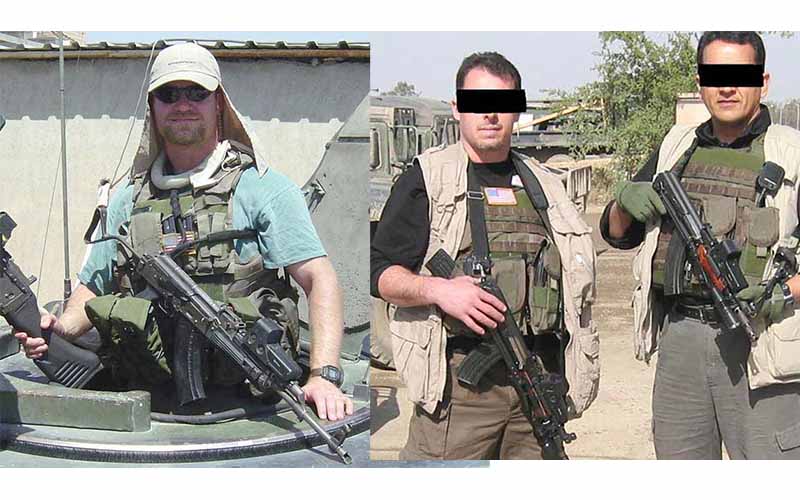
Americans armed with AKs equipped with Ultimak railed gas tubes and red dot sights. Photo: Ultimak.
This method’s origins trace back to some of the earliest attempts to mount modern optics to AKs and were used by some American special forces and contractors who carried AKs in the early GWOT (Global War On Terror) days. Railed gas tube mounts simply replace the AK’s gas tube with one sporting a Picatinny rail on top.
For those who like their red dots mounted as far forward as possible, this method enables that, but it comes with some downsides as well. Firstly, the gas tube gets hot, and not all optics are cut out to handle the heat. This style also prevents you from fully grasping the handguard as the optic is generally placed where many like to rest their thumb. Additionally, some models don’t allow you to co-witness the iron sights.
This style’s popularity is dwindling, as most prefer red dots mounted farther back. Still, it’s a viable method.
Rear Sight Leaf Mounts
An Attero Arms Bravo Mount with a Holosun HS503CU.
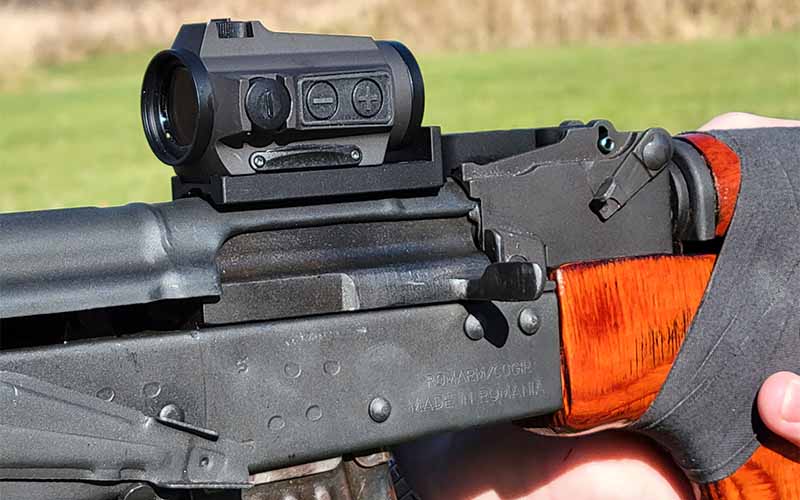
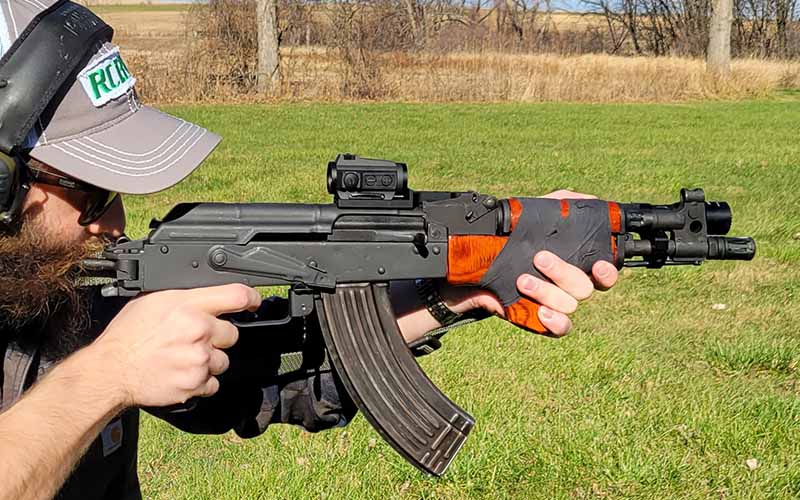
This is one of the more recent and increasingly popular AK red dot mount methods, and it’s easy to see why. This style replaces the rear sight leaf with a mount that sports either a specific red dot footprint or a more universal Picatinny rail.
The primary advantage of this style is how streamlined it keeps the rifle. Of all the methods, these tend to add the least amount of width, bulk or weight.
One potential downside is unlike some railed dustcovers or side rail mounts, there isn’t a good way to attach a magnifier. Though, if you just want to add a small red dot to your AK while retaining a clean profile, a rear sight leaf mount is an elegant way to accomplish it.
Because this mount type replaces the rear sight, some models have another built-in to the mount itself retaining co-witness capabilities. Other models, however, do not. These are also a great option for those who own an AK that doesn’t have a side rail and are typically much more affordable than railed dust covers and good side rail mounts.
The 5 Best AK Red Dot Mount Options
RS Regulate Side Rail Mounts
RS Regulate is widely considered the cream of the crop when it comes to AK side rail mounts. All the company’s models are made of aircraft-grade aluminum and titanium, both incredibly light and strong materials. Unlike most other brands’ side rail mounts, RS Regulate’s are two-piece designs. This honestly makes the mounts more modular than AKs themselves.
The two-piece design enables the user to mount just about any optic to nearly any pattern of Kalashnikov. You first select the lower half of the mount compatible with your rifle—either the standard Warsaw Pact-pattern or Yugo-pattern side rail. You then choose the upper half which either features a Picatinny rail, a footprint for a specific red dot pattern such as a Trijicon RMR or a 30mm scope ring. The upper is then fastened using screws and a center bolt for additional rigidity.
Once your optic is installed on the mount, it is attached to the rifle’s side rail. The mount suspends the optic millimeters above the dust cover. This keeps the bore offset as low as possible and enables one to easily co-witness the iron sights. The mount and optic can then be quickly removed or attached without affecting the zero.
The only real downsides to RS Regulate mounts are price and availability. The company seems to manufacture its products in small batches, and the popularity means they usually sell out fast. There’s a good chance you will have to wait months before the exact models you want are in stock, and when they are, expect to pay over $200 for the whole setup.
This hinged and railed dust cover was inspired by the original Russian Zenitco B-33, but it has one major advantage over it (besides the much lower cost and greater availability). The Zenitco requires the installation of a new handguard, as it is what supports the hinge system. The TWS Dog Leg Gen III instead replaces the rear sight leaf with a hinge mechanism.
A downside of this model is it removes the rear sight, making co-witness impossible, but it otherwise provides a reliable method of mounting optics with generous rail space. TWS has a few different models available that are compatible with most patterns of AKs.
For those who really want to mount an optic to their AK’s gas tube, this is considered your best option. As alluded to previously, however, this is probably the worst of all existing methods.
Ultimak’s is the best because its design attaches more securely than any other tube mount system. But at the end of the day, AK gas tubes were never designed to accommodate an optic. If your red dot of choice can withstand the heat without damage or shifting zero, the Ultimak railed gas tube shouldn’t give you any issues.
It’s capable of co-witnessing iron sights with some optics and Ultimak has variants compatible with most patterns of AK.
Rear sight leaf AK red dot mounts are only made by a handful of companies, but the ones from Attero Arms are generally regarded as the best. Installation is quick and easy, and Attero Arms has variants available compatible with the most popular red dot footprints. The company offers Picatinny rail model as well. Most also feature a built-in rear iron sight to retain co-witness capabilities despite replacing the original rear sight.
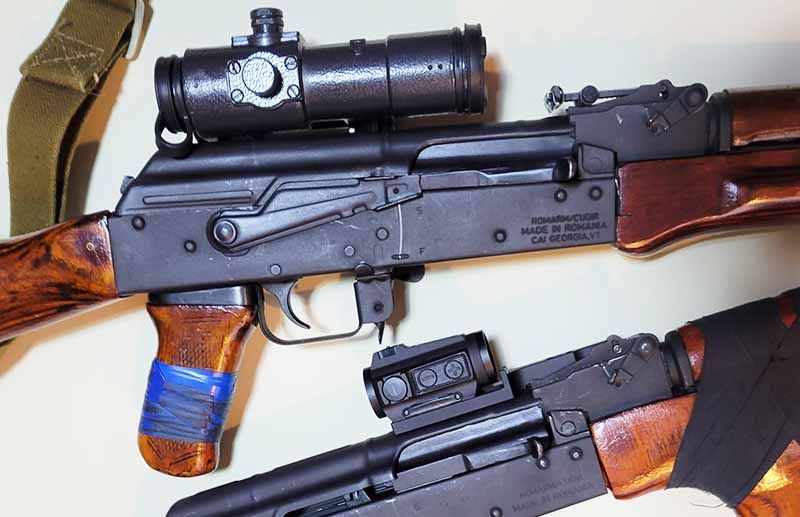
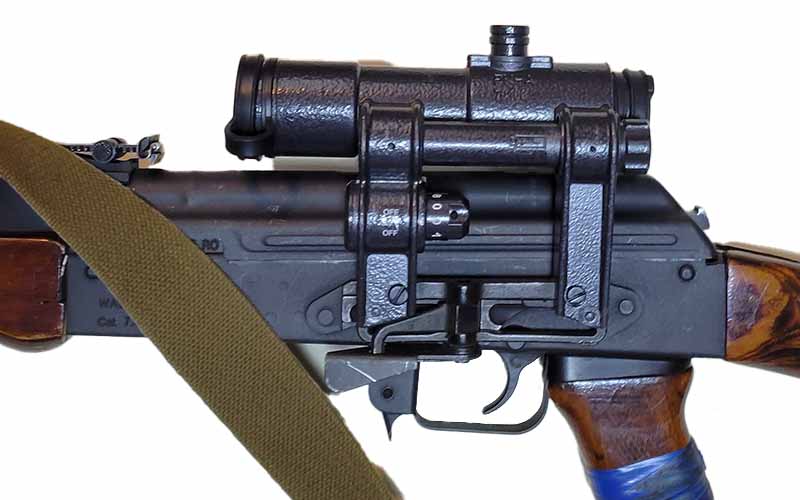
While admittedly an objectively poor option compared to modern optics in terms of practicality, some people want their AKs to retain as much original style as possible. If that’s you, you could consider an original red dot from the Eastern Bloc that comes from the factory with a side rail mount, just like the classic PSO scopes.
Compared to Western and Chinese electronic optics, those made by companies like the Belarussian BelOMO typically feature poor-quality glass, mediocre battery life and fewer modern features. Despite this, they do work fine for most purposes and are generally pretty durable due to their bulkier and heavier construction. If nothing else, they at least look pretty damn cool.
There are several different models available, but two of the best are the PK-A Venezuela and the PK01-VS, both by BelOMO. Prices and availability vary.
Whether you’re after elk, deer or any other similar game, here’s the best 7mm Rem. Mag. ammo to do it with.
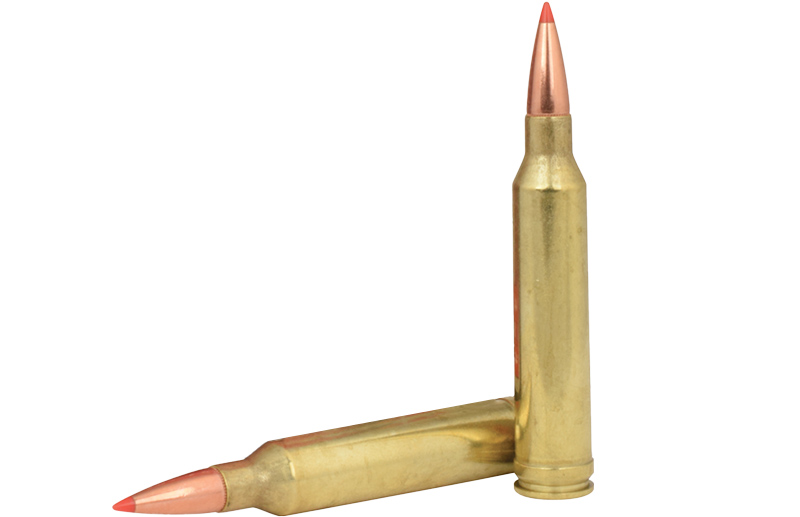
7mm Remington Magnum is one of the most popular and enduring hunting cartridges in existence. As such, 7mm Rem. Mag. ammo is among the most produced and available.
As a result, you can specialize, finding 7mm Rem. Mag. loads tailored to everything from heavy-framed elk and well-muscled hogs, to demure critters such as pronghorn.
There are long-range loads, medium-range loads, and even do-it-all loads that work well for darn near everything.
So what are the best ones to get?
The History Of 7mm Remington Magnum
The story goes that Les Bowman, a writer for Guns and Ammo and a hunting guide in Wyoming, took Jack O’Connor on a hunt in the area. Bowman had noticed during his guiding career hunters who shot moderate calibers tended to do so more accurately, a sentiment of which O’Connor agreed. But Bowman wanted a moderate cartridge with a bit more oomph than .270 Winchester.
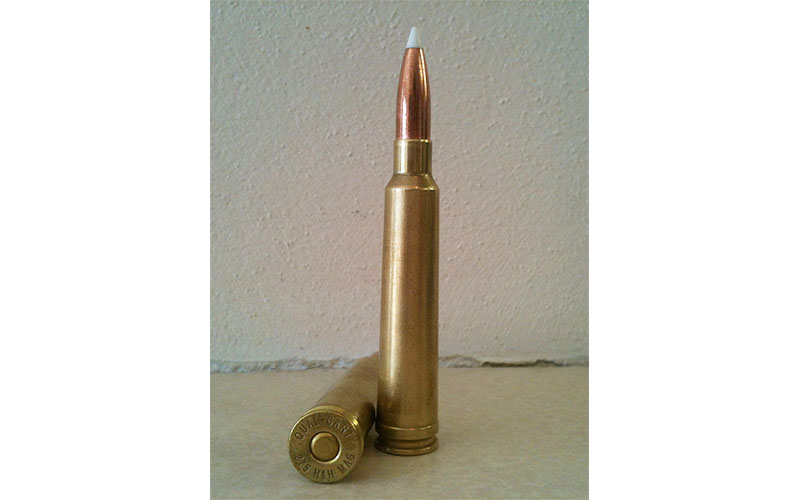
O’Connor sent him a rifle chambered in .275 H&H Magnum, a British hunting cartridge that in effect was a hot-rodded 7x57mm Mauser, which more or less fit the bill.
Ammunition for the .275 H&H was hard to come by, so Bowman worked up a wildcat in an attempt to duplicate the British cartridge. He did so by necking down .338 Win. Mag. brass to 7mm. Then he had a Pfeifer barrel rechambered by Fred Huntington of RCBS for the cartridge. Finally, Bowman installed it in a Remington Model 721.
The gun and the cartridge proved eminently shootable and wickedly effective on all species from pronghorn to grizzlies, and Bowman’s clients loved it. It was dubbed .280 Remington Magnum.
Where Remington themselves entered the picture was when Mike Walker and Wayne Leek—Remington employees—hired Bowman as a guide, became friends and tried his rifle.
They got the idea for a new hot 7mm cartridge to sell with the rifle that they were developing. Leek and Walker flew Bowman to HQ to talk with the board, which proved successful.
Remington’s recipe was to trim .375 H&H Magnum brass to standard action length and neck it down to .284 caliber. The original factory loads were 150-grain CoreLokt at 3,260 fps and 175-grain CoreLokt at 3,020 fps.
While some other hot 7mms were around at the time (7mm Mashburn and 7mm Weatherby Magnum), Bowman’s original .284-338 was a tad milder with a 160-grain bullet at 3,050 fps.
The cartridge debuted with the Model 700 rifle and was instantly successful. Today, the two are almost inseparable, much as the Model 70 is inseparable from the .270 Winchester cartridge. With the relatively mild recoil (on par with .30-06) but the reasonably flat trajectory and a track record on game animals par excellence, it’s remained a best-seller ever since.
The 7mm Remington Magnum can be found with lighter (and heavier) bullets, but the 140-, 150-, and 160-grain loads are the most common. Plenty of 175-grain bullets are made in .284 caliber, but these are more frequently loaded in the hotter 7mm cartridges such as 7mm Weatherby and 7mm Remington Ultra.
The most common factory load today is a 150-grain jacketed soft point, loaded to around 3,100 fps and around 3,200 foot-pounds of energy. For a rote JSP 150-grain load, typical G1 ballistic coefficients are around .340.
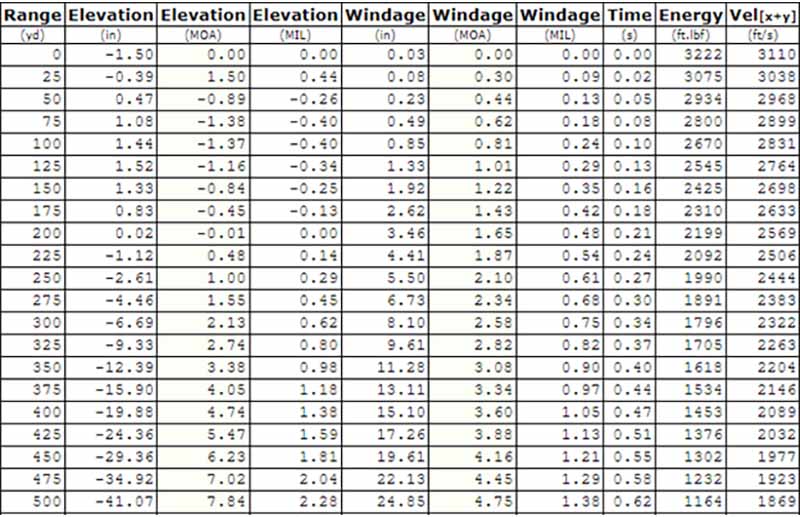
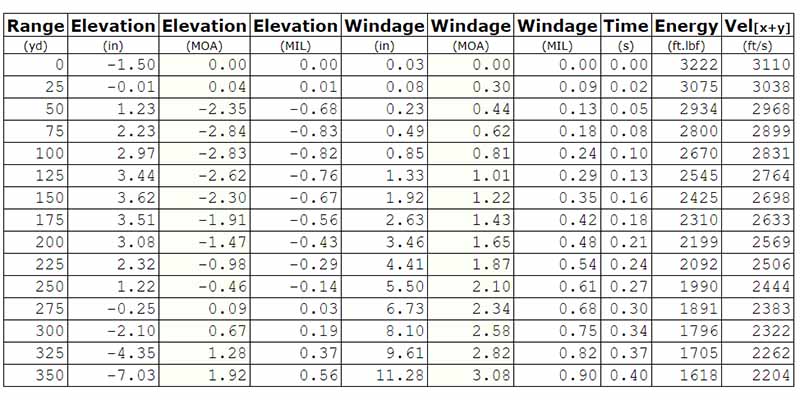
Here’s a 500-yard trajectory table for such a load, 150-grain Remington CoreLokt (G1 BC of .346 and advertised muzzle velocity of 3,110 fps). This table was calculated using ShootersCalculator with a 200-yard zero, a 1.5-inch sight height, a 90-degree 10 mph crosswind and zero corrections for atmosphere.
This and other classic 150-grain loads of 7mm Rem. Mag. ammo doesn’t become subsonic until about 975 yards. In fact, these old 150-grain pills at 700 yards are moving faster and carrying more energy than a 125-grain .357 Magnum at the muzzle.
Another area where 7mm Rem. Mag. shines is in maximum point-blank range. If you define MPBR as 4 inches above or below the point of aim, MPBR is roughly 320 yards, and the bullet has only dropped 3.28 MOA (scope reticle hash marks are usually 2 MOA) at 400 yards and just over 6 MOA at 500. As you might guess, this makes even cheap JSP easy to place at considerable distances.
Here’s a table for the same 150-grain load but with a 25-yard zero range to demonstrate this.
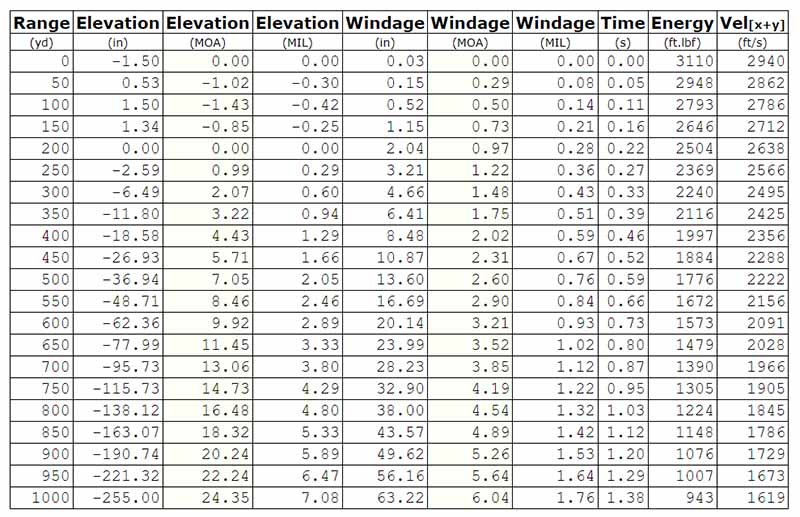
However, modern high-BC loads give the 7mm Remington Magnum even longer legs. Hornady’s Precision Hunter load, for instance, with ELD-X bullets offers astonishing long-range capability. Here’s a 1000-yard trajectory for the 162-grain loading (2,940 fps, G1 BC of .613). This table again uses a 200-yard zero.
The bullet is still supersonic at 1,000 yards, with, again, greater velocity and energy than a .357 Magnum at the muzzle. While a formidable cartridge to 500 yards with older bullets and an MPBR zero (the old-school method!), it’s a long-range hunter’s dream in modern loadings.
Is 7mm Rem. Mag. Too Big For Deer? What’s It Good For?
No, 7mm Rem. Mag. is not too big for deer, nor too powerful, and is one of the most popular Western game cartridges in existence. Some would argue it’s the best medium- to medium-large game cartridge in the balance of things.
The benefit of 7mm Remington Magnum has always been a smaller bullet at a higher velocity, giving the bullet a bit more oomph than medium velocity 6mm to 7mm bullets and just as much (if not more) velocity as .30 caliber cartridges.
The recoil is not pedestrian but can certainly be lived with (the classic 150-grain loading produces roughly 19 foot-pounds) as it’s about the same as .30-06.
The smaller (and longer) projectiles also give 7mm Rem. Mag. a marginal advantage in sectional density and, in the heavier grain weights, a better ballistic coefficient compared to .30-caliber bullets of the same grain weight. This means it tends to drop a little less compared to .308 and .30-06.
Classically, 7mm Remington Magnum shooters got the best of it from 100 to 500 yards. It excels at taking any North American game short of grizzly bears and African plains game up to the elands.
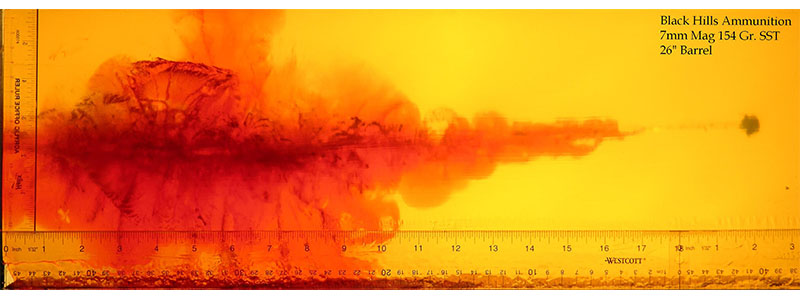
A ballistic gel test demonstrating the capabilities of 7mm Rem. Mag. This makes it easy to see why the cartridge can take nearly any game save for the very largest. Photo: Black Hills Ammunition.
Modern heavy-for-caliber/high-BC loads can push the useful range even further, however, and it is absolutely a solid choice for longer-range backcountry hunts for bighorn sheep, mountain goats, elk, moose, caribou and black bear.
While more than capable of taking whitetail and hogs at shorter ranges, its virtues will go mostly unappreciated inside of 200 yards because of the recoil, report and weight of most rifles. It’s also foolish to chamber it in a compact rifle as any velocity advantage is negated.
While 7mm calibers are capable benchrest and F-Class rifle cartridges, the recoil is more than match shooters are liable to tolerate. Its milder cousin, the 7mm-08, was at one point ridiculously common in NRA rifle competitions, but 7mm Remington Magnum never has been.
Its first, best destiny is as a hunting cartridge for everything short of the great bears and large African game at medium to long distances.
So…what are the best loads to get?
The Best 7mm Rem. Mag. Ammo:
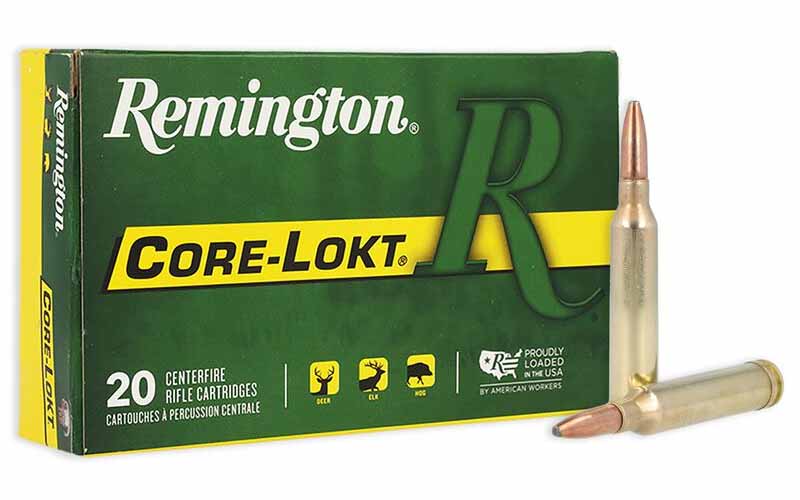
150-Grain Remington CoreLokt
It’s old, it’s kind of cheap, but it works. This is the original load, one of the most affordable and most distributed as well. Perfect for the hunting of any North American game inside about 400 yards short of the great bears.
Bullet Weight: 150 grains
Bullet Type: Soft point
Muzzle Velocity: 3,110 fps
Muzzle Energy: 3,221 foot-pounds
G1 BC: 0.346
MSRP/Street Price: $40
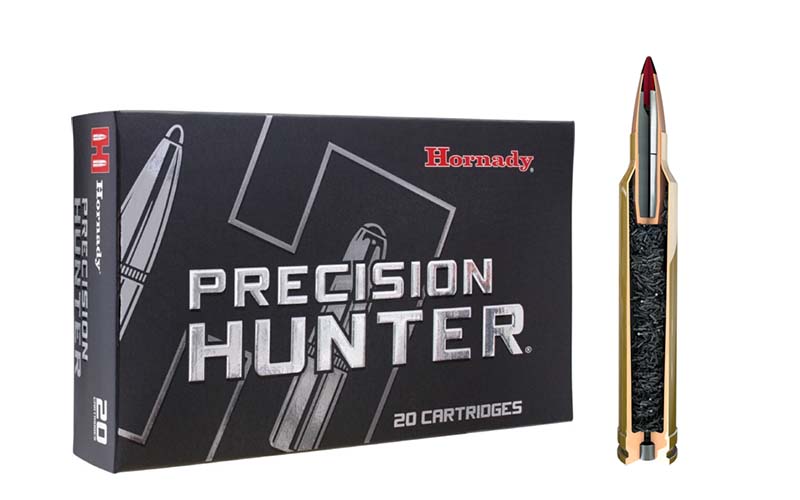
162-Grain Hornady Precision Hunter
The ELD-X bullet used in Hornady’s Precision Hunter Load gives 7mm Remington Magnum absurdly long legs and is a perfect do-it-all modern hunting load. It’s not too heavy for medium game at closer range and retains energy downrange for long shots on elk, moose or black bears.
Bullet Weight: 162 grains
Bullet Type: Tipped boat-tail hollow-point
Muzzle Velocity: 2,940 fps
Muzzle Energy: 3,109 ft-lbs
G1 BC: 0.613
MSRP/Street Price: $60
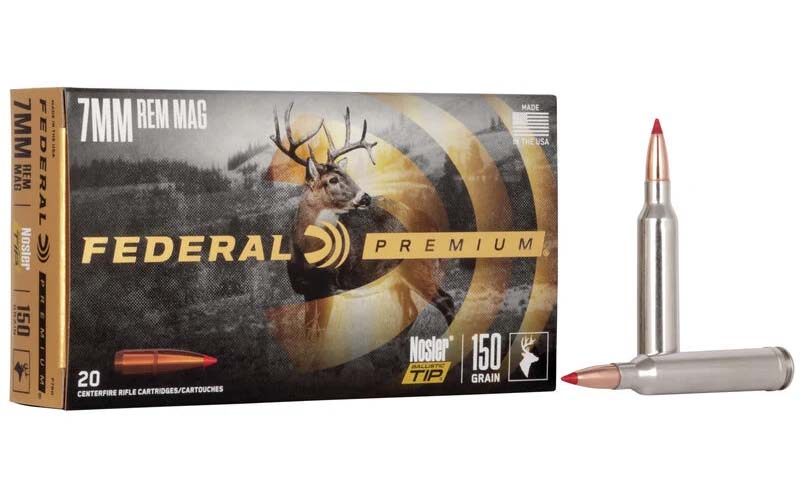
150-Grain Federal Premium Nosler Ballistic Tip
Nosler Ballistic Tip is what you might consider a “budget-friendly premium,” with a premium bullet at a price tag that won’t make your eyes water too badly. Nosler BT is a fast-opening tipped bullet, making this an ideal medium-game load for hunters taking long-distance shots at smaller-bodied game but want a better bullet than the legacy soft point loads.
Bullet Weight: 150 grains
Bullet Type: Tipped flat-base hollow-point
Muzzle Velocity: 3,025 fps
Muzzle Energy: 3,047 foot-pounds
G1 BC: 0.495
MSRP/Street Price: $50
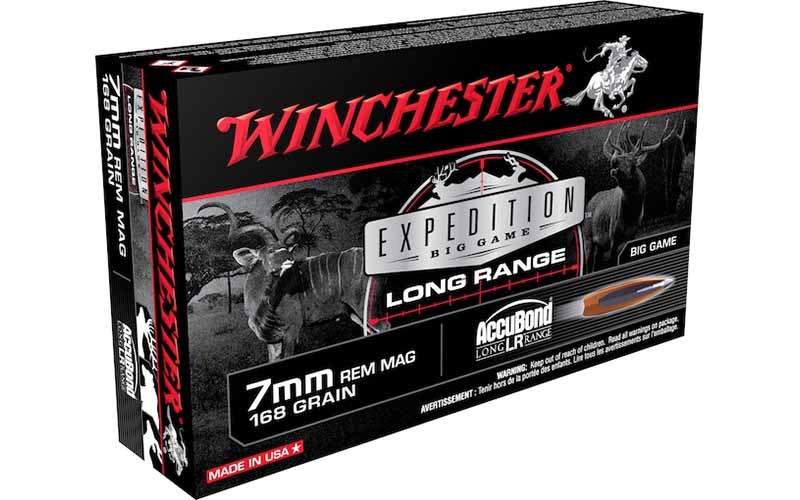
Winchester Expedition Big Game 168-Grain AccuBond LR
Winchester’s Expedition loads are some of the best long-range hunting loads commonly available. It’s loaded with Nosler’s AccuBond LR bullets (high-BC and bonded) for aerodynamic efficiency as well as efficacy on target far beyond what classic soft point bullets provide. If you wanted a long-range load capable of taking everything from ibex to bears at half a mile (or more), this is the one for you.
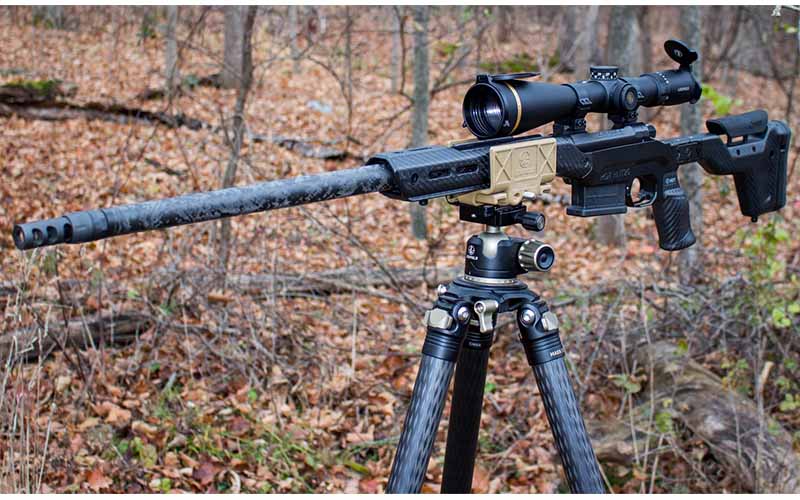
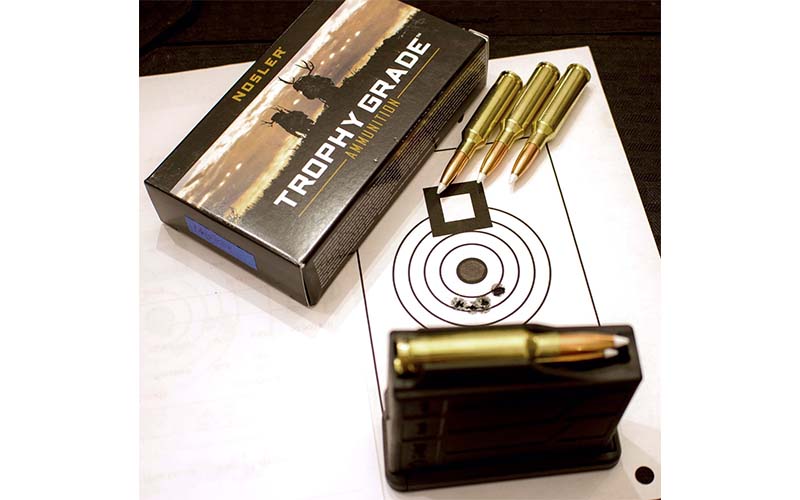
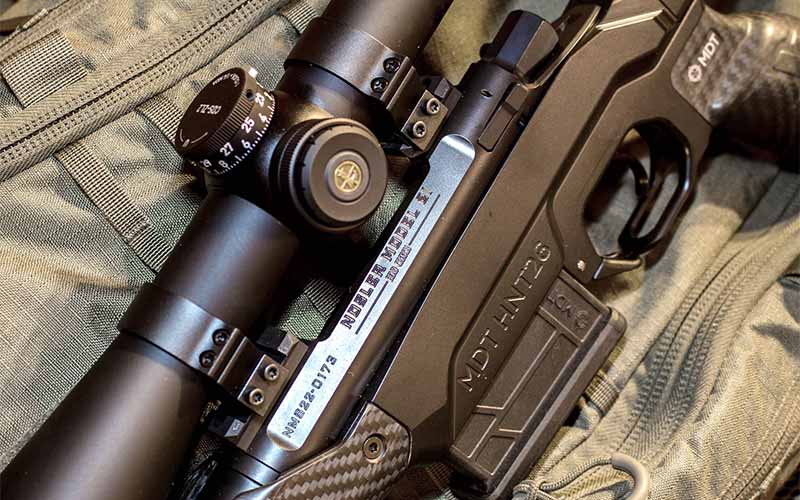
The author takes a look at the new Nosler Model 21 Carbon Chassis Hunter, a dual-purpose tack driver featuring the MDT HNT26 carbon-fiber chassis system.
Nosler is a company living in two eras simultaneously. It has its roots in the very dawn of the premium bullet market, with John Nosler’s development of the famous Partition bullet back in the 1940s, as well as the Ballistic Tip, which helped usher in the era of the polymer-tipped bullets we take for granted today.
At the same time, Nosler has become a company that looks forward, in their line of proprietary cartridges and modern long-range projectiles as well as their rifle division. Both ends of the equation are equally valuable, as a company that doesn’t grow will invariably wither.
Nosler has had much success with their M48 rifle—a unique push-feed design that has proven to be very accurate—and followed that rifle up with the M21. Using a receiver designed in conjunction with the Mack Brothers of South Dakota, the heart of the Nosler Model 21 is, in essence, a modified EVO action, with some customized features from Nosler.
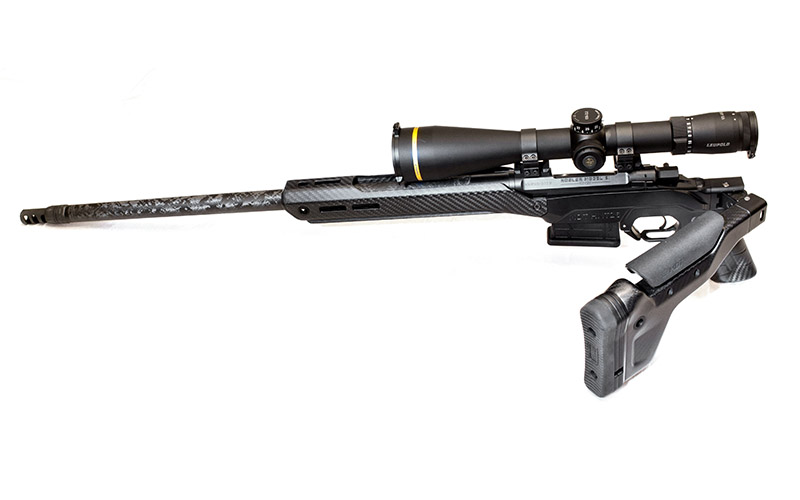
While the lines and silhouette of the Nosler Model 21 Carbon Chassis Hunter may not be what come to mind when thinking of a hunting rifle, it certainly checks all the boxes. Photo: Massaro Media Group.
The push-feed design uses dual-locking lugs and a beefy extractor with a plunger ejector, in a design that’s smooth as glass right out of the box. I had the opportunity to take the Nosler M21—chambered in the speedy .27 Nosler—on an axis deer hunt on the Hawaiian island of Molokai, and after using it for five days and taking three does and a buck, that rifle surely proved to be both accurate and reliable. The smooth trigger, slick action and well-fitting stock culminated in a great hunting rifle.
I must admit that after spending time with that M21, I wasn’t exactly shocked to hear from Jeff Sipe, senior marketing manager for the Nosler Rifle division, that they had adapted that M21 action to a chassis platform. The opportunities to shoot competitively have increased exponentially during the past decade, and despite the shortages of ammunition and reloading components, folks are shooting more, or at least as much as they can.
A chassis rifle—one that uses a barreled action set in a chassis with a full-length aluminum bedding block—makes a great choice for competitive shooting. However, I was surprised about which chassis they decided to cradle that Model 21 in, as well as the barrel Nosler has chosen to complete the package.
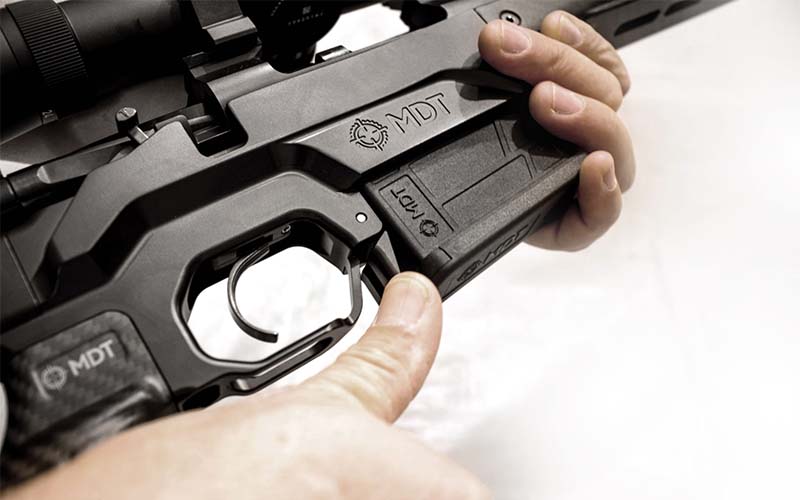
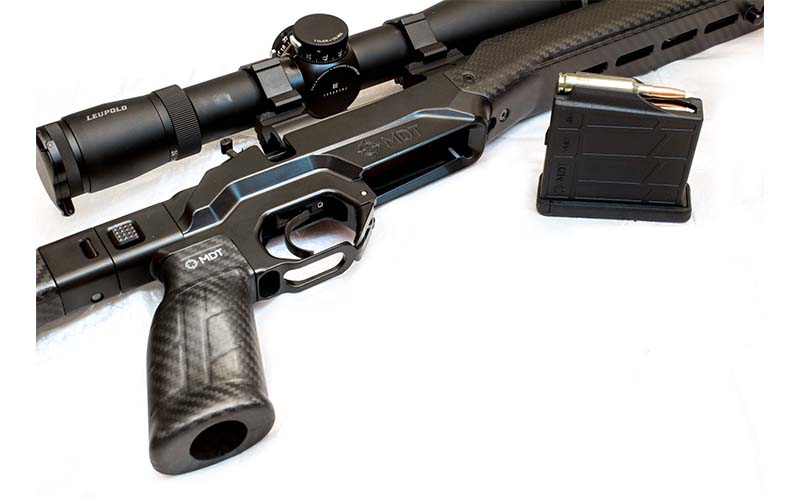
The magazine release is integrated into the trigger guard and can be easily operated, even with gloves. Photo: Massaro Media Group.
Nosler has installed their M21 in the wicked-cool MDT HNT26 carbon-fiber chassis and mated the action with a Proof Research carbon-fiber barrel, making a highly versatile chassis system that’s both ergonomic and lightweight. My test rifle was chambered in 6.5 Creedmoor—not exactly known for vicious recoil, even in light rifles—but Nosler has included an efficient muzzle brake to remove a healthy amount what recoil there is.
Starting with the action, let’s look at what makes the Model 21 Carbon Chassis Hunter tick.
Lights, Camera, Action!
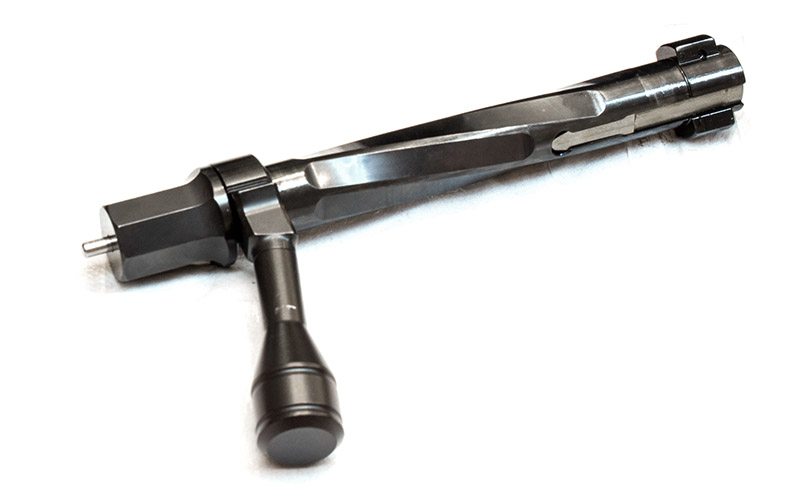
The Nosler Model 21 is best described with one word: smooth. Its dual-lug bolt face has the heavy-duty M16-style extractor located at the 11 o’clock position and the plunger ejector at the classic 3 o’clock position. An attractive spiral-fluted one-piece chrome moly bolt body is nitride-coated, and the bolt handle is threaded for ease of change and customization. An octagonal bolt shroud houses a chrome cocking indicator, and the entire bolt is field strippable without tools.
Photo: Massaro Media Group.
A Trigger Tech Field model trigger runs the operation and is user-adjustable; my test rifle’s trigger broke consistently at 3 pounds, 3 ounces, with virtually no creep or overtravel. A two-position rocker safety is located at the rear right of the receiver, in a forward to fire configuration, and the bolt release is located on the opposite side. The M21 uses a 90-degree bolt throw, but the bolt configuration allows a scope to be mounted low without interference. For the test, I mounted a Leupold VX6-HD 4-24x52mm scope, with its 34mm main tube, in Leupold rings.
Talking Stock
The MDT HNT26 carbon-fiber chassis system weighs in a mere 26 ounces, making it an absolutely perfect choice for the backcountry hunter, as well as for a shooter who wants to move their gun into the innumerable positions required for competition shooting. A nice square, vented forend will sit perfect in the cradle of a tripod-mounted rest yet sits nicely in the off hand or in a set of conventional shooting sticks. The protruding pistol grip has a nice swell to it, and it fit my right hand perfectly. It narrows near the top to allow the thumb to give a positive grip, and the swell lets the pad of my index finger rest naturally in the proper position on the trigger.
Weighing a mere 26 ounces, the MDT HNT26 stock will fold to make for a compact, packable rifle. Photo: Massaro Media Group.
The buttstock of the HNT26 is very interesting, in that it’s adjustable for both comb height and overall length, and in that it folds 180 degrees to make a rifle that’s easy to pack into the back country. The toe is square and sits nicely on a rear bag—for those accustomed to using one—and while the entire package has a modernistic, angular look, it fits very well in the hands. The buttstock is filled with foam to both reduce noise (I’m often amazed at how “loud” some stocks can be in a hunting situation) and dissipated recoil. When the MDT HTN26’s butt is folded, it reduces the rifle’s overall length from 45¼ inches to a hair over 37 inches.
The polymer AICS detachable single-stack magazine is held in a well, just ahead of the trigger guard. The magazine release is cleverly integrated into the trigger guard and will not catch on clothing or brush, dumping your magazine at the worst possible moment (ask me how I know about that). Sling swivel studs are provided at the forend and butt. The MDT HNT26 comes with a length of pull measuring 12½ inches, though four ¼-inch spacers are provided that can extend the length of pull an additional inch. There’s a foam “cheek piece,” which gives a bit rougher surface for the shooter’s face and is adjustable for height. Simply loosen the two set screws on the right side of the butt, position the comb where it feels best and lock it back down with those screws.
Photo: Massaro Media Group.
I’m generally a traditionalist when it comes to my rifles, preferring blued steel and walnut over Cerakote and synthetic and holding a serious torch for classic cartridges, but the Model 21 Carbon Chassis Rifle’s stock is so different from what I choose to hunt with I found it refreshing. Well done, MDT, and good choice on the part of Nosler.
Over A Barrel
Rounding out the lightweight theme, a 24-inch Proof Research carbon-fiber-wrapped barrel is attached to the Nosler Model 21 receiver. A thin steel barrel is wrapped in rigid carbon fiber, resulting in a barrel that’s lighter than a full steel barrel, yet maintains the rigidity so desirable in a target barrel. Carbon-fiber barrels are also known for their ability to effectively dissipate heat, so for a rifle designed for competitive use, this makes all sorts of sense. The Proof barrel on my test rifle started at just over an inch in diameter, ending just under an inch in diameter, and featured Nosler’s proprietary muzzle brake.
The Leupold VX6-HD 4-24x52mm scope paired well with the M21 Carbon Chassis Hunter; it could be mounted low enough for good cheek weld on the stock and gave plenty of flexibility for hunting and competition shooting alike. Photo: Massaro Media Group.
The barrel was clean, without iron sights of any sort, as the M21 Carbon Chassis Hunter is assuredly designed for use with a riflescope. That brake is threaded in order to double as an adapter for a suppressor for those who prefer things quiet; sadly, here in the People’s Republic of New York, I’m not afforded such luxuries. One might think that a rifle with a carbon chassis would be a bit nose-heavy, but the Proof barrel actually keeps the Carbon Chassis Hunter a bit on the butt-heavy side, though I like the overall balance of this rifle much more than any of the modern designs I’ve spent time with.
Put It All Together, And The Results Impress
The Model 21 Carbon Chassis Hunter weighs in at 6 pounds, 8 ounces, when unloaded and unscoped; add that Leupold and a set of 34mm rings, the weight bumps up to 8 pounds, 5 ounces. This gives a good balance to the rifle and allows it to be carried comfortably.
I heard those groans you all emitted when I mentioned that the rifle was chambered for the 6.5 Creedmoor, and while I have to admit that the cartridge does feel like it’s been overplayed lately, it does make a good test medium. It used to be that a rifle was usually shipped for testing in .308 Winchester, .30-06 Springfield or .300 Winchester Magnum … but these days that trio has been supplanted by the Creedmoor. Let’s face it: It’s easy on the shoulder, plenty of gun for deer, sheep and pronghorn, makes a good target cartridge and, most of all, it’s plentiful. I grabbed a good cross-section of hunting and target ammunition and brought the Carbon Chassis Hunter to the range.
That big Leupold VX6-HD let me hold this rifle precisely and confidently; glass of this quality allows the shooter to dial in a crisp, clear image, even with eyes a half-century old. During the test firing, I had no issues with feeding or extraction, with any of the ammunition. And let me say this out of the gate: The Carbon Chassis Hunter is a shooter.
Nosler’s Trophy Grade 140-grain AccuBond load printed very tight groups; all the ammunition tested performed very well at the range. Photo: Massaro Media Group.
For ammunition, I chose Hornady’s Precision Hunter with the 143-grain ELD-X bullet, their Match ammo with the 140-grain ELD Match, Nosler’s own ammo with the 140-grain AccuBond and RDF match bullet of the same weight, Norma’s 130-grain Match load, and Federal’s 140-grain Fusion bonded-core softpoint load.
After zeroing the scope with a half-dozen shots, I evaluated group size, with the rifle showing a preference for the 140-grain slugs. The Norma stuff gave the widest groups—with five shots averaging exactly 1 MOA—and the Nosler AccuBond load giving the tightest, with five shots hanging in a cluster measuring 0.65 MOA at 100 yards. Bottom line is that I wouldn’t hesitate to take any one of these loads hunting or to the range—speaking of softpoints and match ammo, respectively—if they were to be loaded in the Carbon Chassis Hunter.
Recoil was at a level manageable by just about any shooter, thanks primarily to that big ol’ Nosler brake, and despite the appearance of the chassis design, I became comfortable with this rifle quickly.
Nosler Model 21 Carbon Chassis Hunter Overview
Having spent decades in pursuit of classic rifles (or at least classic designs) chambered in nostalgic cartridges—yes, I’m the nerd who gets ridiculously excited over the .300 H&H Magnum, .318 Westley Richards and .404 Jeffery—the 14-year-old side of me immediately fell for the futuristic-looking rifle. The carbon-fiber construction gives it a unique look but being completely honest, I found the ability to quickly and easily customize the lightweight rifle the most appealing feature. I added three spacers to the length of pull to make it comfortable for me with a fall jacket and raised the cheekpiece slightly for proper scope alignment.
Left side of the Carbon Chassis Hunter and the bold Nosler logo. Photo: Massaro Media Group.
Just to see how quickly and easily I could customize the rifle, a couple minutes with the Allen wrenches had the rifle setup so that my wife was very comfortable behind the trigger, as I shortened the length of pull and raised the cheekpiece higher to best fit the female frame.
Is the Carbon Chassis Hunter the rifle that comes to my mind when I’m planning that backcountry hunt? Well, no. Or maybe I should say “not yet.” But maybe I’m coming around. In spite of the fact that the rifle has what some will refer to as a “tactical” look (and I despise that label), when your eyes are closed it runs like almost any other bolt action rifle.
The era of the walnut stock is certainly not over, but I will admit it’s probably waning. The polymer stocks, styled in the fashion of the traditional walnut stocks, are fine, but there’s an obvious advantage in weight, rigidity and customization when it comes to a chassis design like the MDT HNT26. Couple that stock with Nosler’s M21 action and a Proof Research barrel, and you’ve got a winning combination.
The Nosler Model 21 Carbon Chassis Hunter is available in 6.5 Creedmoor, 6.5 PRC (both sort action), and .28 Nosler and .300 Winchester Magnum (both long action). MSRP is $5,295 for short action and $5,395 for long action.
Editor’s Note: This article originally appeared in the February 2023 issue of Gun Digest the Magazine.
Rossi has recently announced three new .357 Magnum revolvers, including the RP63, the RM66 and the RM64.
Rossi is a Brazilian firearm manufacturer best known in the U.S. for its lever-action rifles and revolvers. It’s been a hot minute since any of the latter were imported, but the company recently announced three new .357 Magnum Rossi revolver models for 2023.
The Rossi RP63 is the concealed carry option of the lineup, sporting a 3-inch barrel, round-butt rubber grips and fixed rear/ramped front sights for a snag-free draw. The steel frame, full underlug barrel and 6-shot cylinder contribute to the revolver’s hefty weight of 27.3 ounces (unloaded) but should also make it a pleasant shooter even when loaded with .357 Magnum. Further aiding the RP63’s viability as a concealed carry gun is that Rossi claims it is compatible with existing holsters and speedloaders designed for similar medium-frame revolvers.
The RM66 was designed with target shooting and competition in mind instead of concealed carry, but is otherwise very similar to the RP63. It features a 6-inch barrel, adjustable sights and a larger rubber grip to help absorb recoil. It weighs 34.4 ounces unloaded, and like the RP63, should be compatible with accessories designed for similar revolvers.
There have been no images released of the upcoming RM64 yet, but from the description, it sounds like it will be very similar to the other two models but with a 4-inch barrel instead.
All of the new Rossi revolver models are made of stainless steel with a satin stainless finish, have a hammer-mounted firing pin for improved reliability and feature Rossi’s crisp DA/SA trigger. The RP63 (MSRP: $460.99) and RM66 (MSRP: $620.99) are available now and the RM64 will be released later in 2023.
If you don’t want to be caught with an empty gun, it’s time to master the administrative, tactical and speed reloads.
The reloading of a defensive handgun is generally considered a baseline skill. It’s something that every defensive handgun training course I’ve taken spends a good bit of time teaching. This makes sense because an empty gun is mostly useless. Most doctrine separates reloading into three techniques. These include the administrative reload, the tactical reload and the speed reload. Although all three serve the same purpose of keeping your handgun full of ammunition, they have different application.
It’s suggested that when reloading the handgun that it be conducted within your workspace and between your eyes and the threat. It’s better to handle an empty handgun when you’re either moving or utilizing cover.
Administrative Reloads
Administrative reloading is something that has no tactical value. It’s nothing but the administrative steps you take when you’re readying your pistol for carry, or when you get to the range and are readying your pistol for training … though you do often see it used during handgun training courses when students step off the line to load magazines and take a break. Often, shooters will remove the magazine from a holstered handgun and top it off and reinsert it. Or, they’ll be standing on the line and adjusting ammunition within magazines and the magazine within the pistol to prepare for a specific exercise or drill.
With the understanding that sometimes, for specific drills, you need a certain round count in one or more magazines, I’m not a fan of the administrative reload. When you complete an exercise or drill on the range and are going to take a break to rest or load magazines, you should first conduct a tactical reload so that the handgun in your holster is fully loaded. The conduct of an administrative reload should only be done to establish some drill, training or safety requirement.
The primary objective when conducting a reload is to fill the pistol with as much ammunition as possible.
Tactical Reloads
This reloading technique is one that’s conducted when you have time. Often, it’s suggested that you conduct a tactical reload during a lull in the action. I’m not sure how to precisely define “a lull in the action,” but I am sure of two things: 1) the more ammunition you have in your gun, the better off you are; and 2) you should never holster a handgun that’s not fully loaded, because if you need it—really need it—it needs to be fully loaded.
With the tactical reload, you retain the magazine you eject from your handgun because you haven’t fully expended the ammunition that’s in it, and you understand that you might need to use that ammunition latter on.
When is a tactical reload applicable? It’s nearly impossible to offer any hard and fast rules because the chaos that surrounds a self-defense shooting doesn’t lend itself to absolutes. So, look at it this way: If you need to conduct a reload because you’ve depleted your ammunition supply, and you have time to retain the magazine that is in the gun, then do so. Otherwise, a speed reload is more appropriate.
More practically and most assuredly, the tactical reload should be conducted after an engagement, but before holstering. You’ve solved the immediate problem and have the time to retain any unexpended ammo in the current magazine—while at the same time making sure that you holster a fully loaded pistol.
Empty guns are mostly worthless; learn how to efficiently keep them topped off.
Speed Reloads
This reloading technique is used when you need to get more ammunition in your gun as swiftly as possible. It could be that you’ve expended a large portion of your on-board ammunition and want to be fully loaded for the impending doom that’s quickly approaching you. It could be conducted because you’ve expended all the ammunition in your gun and need more ammo immediately. And the speed reload could also be conducted because your handgun has stopped working, either because it’s out of ammo or has maybe experienced a stoppage.
With the speed reload, the magazine in your gun is ejected and allowed to drop free without concern of where it lands or if you’ll ever see it again. It’s often taught that when conducting a speed reload, you should pull the handgun back into your workspace, hold it up high where you can look through it and still see the threat, and peripherally see the insertion of the new magazine. This makes sense if you’re standing in front of a threat while trying to reload—but standing in front of a threat while trying to reload makes no sense.
Conducting a speed reload while moving or utilizing cover does make sense.
Regardless of the particulars associated with the speed reload, the primary directive is to get the gun reloaded as fast as possible.
Reloading can be practiced with dummy rounds at times when you can’t go to the range and utilize live ammo.
Additional Considerations
Ideally, when you utilize any method to reload a pistol, you should take the time to verify that the reload was conducted properly. This means you should conduct a press check and either visually or tactilely confirm a cartridge was inserted into the chamber … and that the magazine is fully seated. Granted, if you’re conducting a speed reload, there might not be time to do this, but it’s something that there should always be time for if you’re conducting an administrative or tactical reload.
If you’ve conducted an administrative or tactical reload, the placement of the partially loaded magazine that was removed from the handgun is important. It shouldn’t be placed in your primary ammunition pouch or storage location unless it’s the only remaining magazine that you have. Otherwise, you might be reaching for what you think is a full magazine, only to grasp the partially expended magazine. The partially expensed magazine should be placed in an alternate location that can be easily accessed by your support hand in case you need it.
Editor’s Note: This article originally appeared in the April 2022 issue of Gun Digest the Magazine.
There’s a fine line between secure storage and quick retrieval, but a biometric gun safe can offer the best of both worlds.
When it comes to electronic firearm safes, there are two major types. The first is RFID, and these are usually unlocked via some sort of keycard. The second type is the biometric gun safe, and these ostensibly offer an even higher level of security as they require the correct fingerprints to be unlocked. While someone can steal or spoof an RFID card, it’s much harder for them to acquire your fingerprints.
We’re going to discuss what they are, how they work, their strengths and weaknesses compared to other types of gun safes and a few biometric gun safe models that we consider to be the best.
So, let’s get started.
What Is A Biometric Gun Safe?
Biometric gun safes use a digital—usually battery-powered—lock that takes a reading of your fingerprints, usually the thumb and index finger, and stores them in onboard memory. The pads on the safe read fingerprint impressions, and if they match, unlock the safe.
Typically, the lock mechanism is controlled via a small electric motor that operates the locking mechanism. In some cases, the door of the safe may be assisted with a pneumatic arm.
Early biometric safes were great in theory, but poor in practice. The print reader would either take forever to get a clean pull or took several attempts to get one and had horrendous lag time. As the years have gone on (Moore’s Law is a thing) the technology has gotten better, faster and more reliable.
Types Of Biometric Gun Safes
Biometric safes come in a few different styles.
There are some cabinet-style safes for long guns, but pistol safes are far more common. Since biometric safes are electronic, they require power. Some have a battery pack (which you’ll have to remember to periodically change) and others can be plugged into a wall outlet.
One of the most common is the top-loading style, with the door opening vertically.
Vault/lockbox-style safes, with the door opening outwards, are also common. These typically have the combination/reader pad on the door or the top of the safe.
There are also a few wall-mounted pistol safes that you must mount to the studs in your wall. When opened, they drop down and release a pistol or two.
You’ll also find a number of portable biometric gun safes, similar to any other portable safe only with a more advanced locking system.
A portable biometric gun safe with carry handle from OSPON.
Drop-style safes are also out there, though a little less common. They have a hinged floor that drops down when the lock is activated.
Obviously, the benefit to a biometric safe is that you can—ostensibly—keep anyone out of it that isn’t you or a person whose fingerprints you also programmed into the safe.
Each design has some advantages and disadvantages. Top-loader safes are perfect for hiding in a drawer but don’t work very well elsewhere. Vault-style safes, depending on the dimensions, may be too large or heavy for more discrete locations (such as atop a closet shelf) and wall-mount safes are a no-go if you’re a renter and you want to keep your deposit.
Vehicle safes are a Gordian Knot. They either have to be conspicuously mounted in the vehicle (such as those that mount next to a car seat) or they’re the small portable variety that anchors to the seat frame. The former is easily seen and can therefore be targeted for theft. The latter is easily stolen if discovered.
Almost all biometric safes have a backup, typically a barrel lock with a key that is supplied to you. Some also include an RFID tag or dongle if they have both systems onboard.
The backup lock on a Viking VS-12BL.
Features, of course, all depend on the safe, but what you must determine is how any gun safe fits your lifestyle.
Is A Biometric Safe Worth It? What Are Their Weaknesses?
Every type of gun safe has a weakness, the question is whether it can be used in a manner that renders them moot or mitigates them to a point of acceptable risk. The most secure safes of any kind are vault-style safes with mechanical combination locks, but they are heavy, expensive and slow to open.
Some biometric gun safes are glorified lock boxes. Thin sheet metal walls can be broken into and the door possibly pried open with a crowbar if it were to be taken in the event of a burglary.
Further, many of them also have cheap barrel locks little better than a common bicycle lock. Easily picked with as little as a paperclip, or simply opened if an unauthorized person gets a hold of the key.
These are all failings common to many different kinds of gun safes. These issues are by no means endemic to biometric gun safes only. Therefore, it’s imperative that you select one that has a pry-proof or heavily pry-resistant door design, and a strong mechanical key lock.
Another potential downside is the biometric technology itself.
How often does the fingerprint scanner fail on your phone? Can you guarantee a perfect print if you need to get the safe open in a hurry?
Granted, modern biometric safes are leaps and bounds more reliable than they were a decade or two ago. As software and the reader hardware have improved, error rates have dropped and the quality models have gotten less touchy.
RFID safes can lack those issues and so can digital combination safes, but even those have lag time.
Then we come to the issue of hacking. Biometrics can be easily hacked, and an RFID system can be easily hacked as well. Any electronic system has a way to exploit it.
A poorly designed biometric gun safe being broken into with nothing but a fork. Source: LockPickingLawyer on YouTube.
You need to consider what kind of safe best fits your needs. Biometric safes are just one option. Even affordable models of today can work well, but they have weaknesses like any mechanical or electrical system. Understand them and make your choice accordingly.
What To Look For?
The ability to quickly retrieve a firearm is paramount for many interested in a biometric gun safe. For fast access, the top-loader style is best and it can be easily concealed. The wall-mount pistol safe and drop-down styles are also a good fit, so long as you can install one (again, renters may not be able to) or you can have a safe that drops open, meaning you need to mount it under something.
Also, look for the read time. You’ll usually find the time to unlock advertised by the manufacturer. Less than 3 seconds is good, less than 2 is better.
Look for safes that have at least one backup access type. A simple barrel lock is not the most secure thing in the world, but it’s better than having to rely on human memory.
Look for the strongest possible locking mechanism. Vault-style safes with solid steel locking bars are more secure than lockboxes with simply barrel locks or hook locks, as they are far harder to break.
Interior illumination is a good feature to look for too, and for obvious reasons! So is the ability to run on a power supply rather than batteries.
What you want to find is a safe that offers the greatest amount of security that you can get, balanced with the potential speed of access.
So, what are some good biometric safes to look at?
The 5 Best Biometric Gun Safes
Barska Biometric Security Safe
This safe is a compact front-facing safe with dual steel locking bars, 2mm steel walls and a 5mm steel door. Interior dimensions are 16.4 inches wide, 12.25 inches deep and 6.8 inches tall, which is enough to accommodate up to two pistols.
The time to open is 2.5 seconds, and the lock is powered by 4 AAA batteries with an anticipated runtime of 1 year. The secondary lock is a hexagonal key, of which two are included. The safe has additional holes if you wish to mount it to a shelf or nightstand.
This would be a good pick for a nightstand or shelf top safe for one or two handguns, with a good mix of speed and security. Street prices are just under $200.
SecuRam ScanLogic By Liberty Safes
One of the best, most trusted and most popular gun safe manufacturers in the US is Liberty Safes. Any one of their gun safes can be upgraded by adding the company’s SecuRam ScanLogic lock, which includes both a digital keypad and a top-mounted fingerprint scanner.
The SecuRam lock by ScanLogic processes prints in as little as 1 second, and can be added to any Liberty-brand safe that has an electronic lock system. You can either have a safe upgraded by Liberty when you order it, or have a factory dealer technician upgrade your existing Liberty safe.
The lock is an extra $275 and runs off of either a 9V battery or AC power.
OSPON Portable Gun Safe
The OSPON Portable Gun Safe is, as the name states, portable. It’s essentially a high-tech lockbox that can serve as a vehicle safe. It’s compact, so it can slide under a car seat, and includes a steel tether cable.
It has an onboard thumbprint reader, powered by a rechargeable battery cell that charges via USB-C, and a mechanical combination lock as a backup. The shell is 16-gauge steel.
It can accommodate one full-size pistol, or possibly two micros, and will stow easily and can be tethered under a car seat. Prices are usually around $50.
Viking VS-12BL Biometric Wall-Mounted Safe
The VS-12BL is a good pick for a wall-mounted safe that will fit one to two pistols and some valuables. It has a solid feature set and a reasonable price tag. While not designed to be set in the wall, it could be.
The safe is 14.5 by 11.75 by 5 inches, with a recessed 5mm steel door and a removable interior shelf. The interior is carpeted and has an integrated LED light. The biometric lock uses an optical sensor rather than a semiconductor for more reliable reads, and a digital combination pad and key lock (with keys included) are also on the safe as backup access methods.
The VS-12BL is powered by four AAA batteries and registers prints in less than 1 second for fast access. Prices start around $200.
Vaultek RS
The Vaultek RS series are biometric rifle safes, with storage space for long guns and modular storage racks for storing magazines, ammunition and handguns.
The steel door (which is spring-assisted for fast opening) has four steel deadbolts, operated by the biometric scanner. A digital PIN pad is also included as is an emergency access key. Interior LED lighting and proximity-sensing lighting for the access pad are also included, as is WiFi connection for remote monitoring.
An RFID SmartKey can be added, as can other accessories. Power can come from an 18650 battery or the safe can be plugged into an outlet. The two-gun model starts at $1,299, but five- and eight-gun models are available as well.
The iconic Glock 17 transformed the modern handgun world and continues to exert its influence today.
Why the Glock 17 is among the most popular pistols made:
Developed for the Austrian Army to replace their P-38.
From 1986 capture around 70 percent of the US law enforcement market.
Used in an official military or government capacity in over 42 countries
The G17 is still Glock’s most popular model.
The low barrel sits above the shooter’s hand resulting in less muzzle rise.
Due to its weight and balance it is known as a smooth-shooting pistol.
This is the first model Glock brought to market. The original. The one that started it all. The Glock 17 is the most innovative handgun design since John M Browning’s 1911, and when you add to that the way that Glock revolutionized handgun manufacture, the G17 is probably most innovative handgun ever.
Glock 17 Development
Some would argue that this is the best Glock ever made; the third generation G17.
The Glock 17 was developed by Glock for the Austrian Army to replace their P-38, a gun that had been in use since World War II. Word quickly got around about this new upstart that beat out established gunmakers. By 1985 Glock had a contract with the Norwegian Army and suitors by the dozen vying to import the G17 into the US.
Glock decided to go their own route, however, and Glock USA opened its doors in 1986. From there, Glock would capture around 70 percent of the US law enforcement market, and become one of the (if not the) most popular handguns in the US civilian market. No other handgun brand is as recognizable by shooters and non-shooters alike. Today Glock is used in an official military or government capacity in over 42 countries. This does not include non-national police forces.
Why The Glock 17?
In the early days there was confusion and incorrect information as to why the first model was called the 17. To this day some of the confusion still exists amongst new Glock owners. Some sources said the reason was that the Austrian army laid out 17 requirements that must be met by the potential service pistol to be considered for adoption. Other sources stated it was due to the 17-round capacity of the Glock magazine. Both make sense, but neither is correct. Popular fiction perpetuated these myths.
In the novel Killing Floor, by Lee Child, the protagonist, one Jack Reacher, is confronted with a Glock 17. In his mind he goes over everything he knows about the weapon, which he says he knows well, with one of those things being, “Seventeen rounds to a magazine, hence the name.” Reacher got a lot right about the Glock, but this wasn’t one of them. The true reason the first Glock is named the 17 is because it was the 17th patent filed by Gaston Glock.
A G17 first generation. Incidentally, the two clips on the web belt…those are made by Glock, too.
Still, it’s interesting to watch movies and read articles from that era and read the various theories as to the origin of the name. The other thing he got wrong was that Reacher recommended rejection of the Glock for the US Army, and instead recommended the Beretta 92F. In reality, the G17 was never entered into the official army trials. The US Department of Defense did receive from Glock four samples for unofficial testing and evaluation, but when they invited Glock for an official submission, Glock declined. It would have required extensive retooling of manufacturing equipment, which was something Glock wasn’t going to do at that time.
In another famous and hilarious Hollywood moment that was indicative of the perception of Glock pistols at the time, in Die Hard 2, John McClane (played by Bruce Willis) said of the Glock, “That punk pulled a Glock 7 on me. You know what that is? It’s a porcelain gun made in Germany. Doesn’t show up on your airport X-ray machines here, and it costs more than you make in a month.” Sure, this was before the age of the Internet and Wikipedia, but that is just lazy script writing.
Amazingly, after all these years, the G17 is still Glock’s most popular model. I’ve gone back and read books and magazine articles written at the time of the introduction of the .40 S&W G22 and the .45 ACP G21, and at the time some writers discussed the demise of the 9mm G17 and G19 because of the introduction of these other calibers, especially the .45 ACP — we are a .45 ACP nation, after all.
How often have you heard someone say, “if it doesn’t have a ‘4’ in front of it, it’s not big enough for self-defense.” But the G17 and the G19 didn’t become obsolete, and they weren’t replaced by the .40 S&W or .45 ACP. In fact, their popularity has only increased right along with the Glock itself.
A G17 is a great handgun for beginners, it’s soft on recoil, and the lack of a manual safety makes the shooter especially mindful of finger awareness.
There have been spikes in popularity of other models, especially when they are first introduced, but after the hoopla is over the Glock 17 9mm charges on. This is particularly amazing, given the popularity of the G22 among law enforcement agencies, and the numbers of those sold. It’s really quite remarkable how well the G17 still sells, and is a testament to the handgun.
I personally think the 9mm cartridge is just starting to come into its own in America. It’s kind of a curiosity that it took so long, but over a century after it was introduced, we’re just starting to appreciate it. I believe we’re in the Golden Age of the 9mm in America.
How The G17 Measures Up
A Gen4 G17 is 7.95 inches in length, 5.43 inches in height and 1.18 inches in width. It weighs 25.06 ounces unloaded and 32.13 ounces loaded. The barrel height is 1.26 inches, which is low, and has a lot to do with the minimal muzzle flip compared to other handguns. The lower a barrel sits above the shooter’s hand (bore axis), the less it will rise as a bullet is fired. The Gen3 is identical in dimension, with the exception that it is 8.03 inches in length, which is .08 inches longer.
All of the standard-frame, full-size Glocks (G17, G22, G31, and G37) are nearly identical in dimensions, with one minor exception; the G37 has a slightly wider slide, and the height is 5.51 inches, which is .08 inches higher. There is also a difference in weight, though not significant. Unloaded, the G22 weighs 25.59 ounces, the G31 weighs 26.12 ounces, and the G37 weighs 28.95 ounces.
Shooting The Glock 17
I’ve gotten to shoot a lot of Glocks in a lot of calibers and a lot of sizes. All of them, in fact. The very first two I fired for the book were the G17 Gen1 and Gen2. Then I shot everything else, with the very last two pistols I fired being the G17 Gen3 and Gen4. I’ve shot them before, but it’s been awhile.
Some would argue that this is the best Glock ever made; the third generation G17.
After shooting everything else, I forgot how nicely the G17 shoots. The recoil is handled very well — much more so than 9mm guns from competitors, and it shoots as smooth as butter. It’s just a great gun, one of the all-time classics. I got to fire some American Eagle 115-grain FJM, as well as American Eagle 124-grain non-toxic primer TMJ (Total Metal Jacket). Then I finished it off with some Federal Premium 124-grain Hydra-Shok JHP.
Early Glock 17 Models
With Gen3 and Gen4 and Gen5 models, it’s simple to get them — they are all on the shelf of almost every gun store you walk into. The first two generations are not so easy to find — none of my friends or acquaintances had them, and it’s not like you can check them out on loan. I knew my only course of action would be to track them down and buy them. With a lot of research and a little work, I did just that.
A field-stripped third generation G17. The Flat Dark Earth frame is a special run that is made periodically.
Those two Glocks — which are both becoming very collectable — are still just as good as they were when they were released. They could be placed against any competitor’s guns on the market and still fare well. They are timeless designs, and built to be a workhorse. I have since decided to collect the G17 generations, since this is the only model that spans all four generations.
The AR-10 is many things, cheap isn’t usually one of them. But we dig up the best AR-10 choices that won’t put you in the poorhouse.
Nothing beats the AR-15. Well, almost nothing beats what’s become America’s favorite rifle. Talking long distance and large cartridges, the vastly popular rifle pales, not quite living up to its reputation for utmost versatility.
Sure enough, there are exceptions—there always are. The 6.5 Grendel reaches out and cartridges don’t get much larger than the .450 Bushmaster. Despite these allowances, there’s a more stalwart choice when it comes to hard-hitting, reach-out-and-get-them heavy metal.
In this arena, few long guns hold a candle to the AR-10.
How We Made Our Picks
AR-10s have made a bit of a comeback in recent years, so the market is currently awash with quality models at various price points. For this article, a few of us AR-10 enthusiasts on the Gun Digest team put our heads together, discussed our experiences behind the triggers of many different models and weighed each of their advantages and disadvantages. At the end, based on everything we know about the AR-10, these are the five rifles that we believe provide the best bang for their buck.
At the top of our list of AR-10s is the Ruger SFAR, a rifle that some purists would probably argue isn’t technically an AR-10. That’s because SFAR stands for Small-Frame Autoloading Rifle, and it’s named that due to the rifle having a receiver that’s the same size as a standard AR-15. While it may not use one of the legacy AR-10 receiver patterns, the gun is definitely worth your consideration if you’re after an AR chambered for 7.62 NATO.
The main appeal of the SFAR is how light it is. The smaller receiver size allowed for the shedding of a lot of extra weight, and the result is a 7.62 NATO AR that comes in at only 6.8 pounds. That’s almost an entire pound less than the next lightest rifle on our list. Whether you’re looking to run-and-gun in a competition or stalk game in the mountains, your arms will thank you for choosing an SFAR.
Despite its light weight, the 7.62 Ruger manages to keep recoil light thanks to its Boomer 2-port muzzle brake and adjustable 4-position gas block. Be aware, however, that if the SFAR has one weak spot it’s the gas block. The example we shot didn’t have any issues, but we’ve heard of several users having to replace theirs. Besides that, it seems to be perfectly solid. To top it all off, the rifles ship with 15-inch railed M-LOK handguards, Magpul furniture and Ruger Elite 452 2-stage triggers, and all for a reasonable price.
Price alone makes the PA10 one of the best AR-10 choices on the market today. Yet, Palmetto State Armory doesn’t leave shooters out in the cold when it comes to a quality build. Long considered one of the best values in ARs, the gunmaker offers a litany of features plum rare for the price point. Forged receiver, stainless steel heavy barrel, and adjustable gas block (on certain models) are all standard fare on these economical shooters. So is choice.
Beyond simple trigger and handguard upgrades, the PA10 catalog serves up an impressive selection of specialized models. In addition to the stock .308 Winchester PA10, Palmetto State also fields the 6.5 Creedmoor PA65 and lightweight PX10. Up the scale, the rifles run a bit more, but not so much as to prove exclusionary.
Standard across all models is the choice of 18- or 20-inch barrel length and 6-position adjustable buttstock—both PSA and Magpul. Outside of the base PA10 mode, with a polymer handguard, the rifles come with either Keymod or M-LOK compatible free-floated handguards.
Palmetto State Armory Gen 3 PA10 Deals
Palmetto State Armory
$850
Diamondback DB10
Pros
Ships with upgraded furniture including M-LOK rail for accessories
Much like Palmetto State, Diamondback earns big marks not only for quality but also options. At the time of writing, the Florida gunmaker has 15 AR-10 rifles and four pistols in its catalog. This includes a choice of .308 Winchester and 6.5 Creedmoor chamberings, favoring the latter in selection. And like PSA, across the board the guns come in at a price nearly any shooter can afford.
Even with a wealth of choice, we think it’s difficult to go wrong with the company’s entry-level DB10CCMLB. A Spartan, if not tidy build, the gun runs reliably and proves agile in practical use. Much of this is thanks to the gun’s 16-inch chrome-moly barrel, a point that might turn off dedicated long-range shooters.
Lightening the .308 Winchester’s load considerably, hunters and others who require a fast-handling hard hitter will find it a boon. The one knock that keeps it from ‘best AR-10’ status, is the mil-spec trigger, which is exactly as it sounds—gritty and creepy.
Never fear, going up the ladder at Diamondback is a painless process and generally worth the extra money. Stainless steel barrels and CMC single-stage triggers are the reward for opening your wallet further.
Diamondback DB10 Deals
Sportsman’s Warehouse
$960
Guns.com
Starts At $902
Smith & Wesson M&P10 Sport
Pros
Excellent build quality and performance from one of the most trusted AR manufacturers
Still relatively affordable
Cons
Ships with standard M4-style furniture, no provisions for attaching accessories
Savvy gun buyers have been wise to the M&P15 Sport for some time. The M&P10 Sport, not so much or at least it seems that way. Gun shows aren’t exactly bristling with them nor are the review sections of gun magazines. A loss on both counts.
Smith & Wesson knows AR-style rifles, and it shows in arguably one of the best AR-10 options on the market regardless of price. You heard that right. Built like a tank and capable of pin-point accuracy, the .308 Winchester has chops enough to hang with many of the big boys. Well, not the furniture or trigger—but you were going to upgrade those anyway, right?
At once the rifle is unassuming and impressive, more the latter once you see it print. A steady MOA-producing machine, the 16-inch barreled M&P10 is likely all most shooters would ever need out of the brutish end of ARs. If they did, S&W has them covered with a Performance Center 6.5 Creedmoor rendition. Suffice to say, the iteration drifts away from affordable. But for those who put a premium on long-range accuracy still proves a value.
Smith & Wesson M&P10 Sport Deals
Sportsman’s Warehouse
$1,200
Palmetto State Armory
$1,230
Springfield Armory SAINT Victor
Pros
Ships with muzzle brake, upgraded furniture including M-LOK rail for accessories
Springfield Armory offers shooters a top-notch selection of AR-style rifles, but its SAINT Victor AR-10 really shines through.
Lightweight, great fit and finish and everything else that goes into making a quality rifle certainly places it among the best in this class of firearms. If there is any nit to pick over the rifle, it’s the price tag. It’s at the upper end of entry-level.
Available exclusively in .308 Winchester, the AR-10 does give shooters plenty of reasons to spend the extra money.
Boasting a 16-inch barrel, the carbine is highly maneuverable if you’re looking for a convenient hunter or a hard-hitting defensive option.
Springfield doesn’t skimp on the furniture, a M-LOK compatible handguard adds appeal. Not only does it free-float the barrel, but also gives you real estate for all your doodads.
However, the trigger is what turns heads. A nickel-boron-coated switch bests most out-of-the-box triggers in other guns. This, generally speaking, is worth the price of admission alone.
Springfield Armory SAINT Victor Deals
Sportsman’s Warehouse
$1,400
Palmetto State Armory
$1,440
Why An AR-10?
The older and truly bigger brother to the AR-15 in many respects defines semi-automatic rifle power, precision and versatility. Found in some of the most renowned medium-bore cartridges—.308 Win., 6.5 Creedmoor, .260 Rem., and many more—the rifle is much more adept at precision and long-range applications. In nearly every chambering, the AR-10 is a legitimate 1,000-yard rifle, if quality built and manned by a shooter of steady nerves.
The AR-10 harkens back to the earliest days of the rifle system. Left side view of “Hollywood” AR-10 prototype. Note the gas tube situated on the left of the barrel. Photo: Imgur
Furthermore, the rifle can engage much more substantial targets. Whitetails are the ceiling for the AR-15, while the AR-10 more than happily tangles with the likes of elk and moose.
Range and muscle aside, the best part of the AR-10 is its made a roaring comeback in recent decades. Once an afterthought, the market now bristles with these brute, tailored for every application under the sun. From hunting to home defense and target shooting, there’s a rifle for you.
Helping you weed your way through the suddenly saturated market, we’ve gathered up what we consider five of the best AR-10 options you can actually afford.
Brief Note About Price
Forewarning is merited concerning the affordability of these rifles. It’s relative. AR-10s are much more expensive platforms than AR-15. Less in demand and more proprietary than its little brother, the beasts command top dollar in comparison.
That said, there are opportunities to get into a well-built AR-10.
The ceiling we’re setting for this buyer’s guide is $1,500, which opens the doors to a great many shooters and arms them with a quality rifle. Just keep in mind, power and range come at a premium.
Money to burn? Lucky you. We’ll delve into top-shelf AR-10 options in an upcoming post.
Know Thy AR-10
Despite both emanating from Eugene Stoner’s brain, in their present iterations, the AR-15 and AR-10 share few similarities. Many already know and understand this, but for those that don’t, it’s worth the effort to educate yourself on the particulars of the rifle.
Patterns matter with AR-10s. An upper made for the top lower receiver won’t work with the bottom lower. Neither will many other components. You need to understand what’s compatible with what.
We won’t bog you down here with the minutia, instead point you to several articles we have dealing with just these topics:
The AR-10 is not a mil-spec platform, which means it’s not as simple to modify as the AR-15. Heck, depending on its pattern, it doesn’t play nice with other AR-10s.
Even though we’re dealing with complete rifles here, you might look to upgrade someday or even replace a simple component. Building a knowledge base now saves you headaches later.
AR-10 FAQ
Is The AR-10 Better Than The AR-15?
That’s like asking whether a pickup truck is better than a sports car, both are great for different reasons. The AR-10 with its 7.62 NATO cartridge excels at long-range shooting, delivering stopping power and defeating barriers, but it comes at the cost of a heavier rifle, heavier ammo and more recoil. The AR-15, chambered for 5.56 NATO, is much lighter, handier, easier to shoot quickly and uses very light ammo so you can carry a lot more of it, but it can’t reach out as far or hit as hard as an AR-10.
What’s The Point Of An AR-10?
In today’s world, AR-15s chambered for 5.56 NATO is the standard, general-purpose rifle to own. That said, it can’t do everything. Whether you find yourself needing to shoot farther in competition, in the field hunting or for any other reason, an AR-10 equipped with a good scope can do a lot that an AR-15 can’t.
Why Did The AR-10 Fail?
It’s not accurate to say that the AR-10 failed, it merely got overshadowed by the AR-15. While the AR-10 was a revolutionary rifle that incorporated space-age features for its time, the era of the full-power cartridge was waning and the time of the intermediate cartridge was rising. While the AR-10 only initially saw a handful of military contracts with countries like Cuba and Portugal, it eventually found great popularity in the civilian sport shooting/hunting world as well as with military users in the form of rifles like the SR-25.
Looking to go armed, but are stuck in the weeds as to what to arm yourself with? Here are 20 of the best concealed carry gun options that will keep you on the defensive.