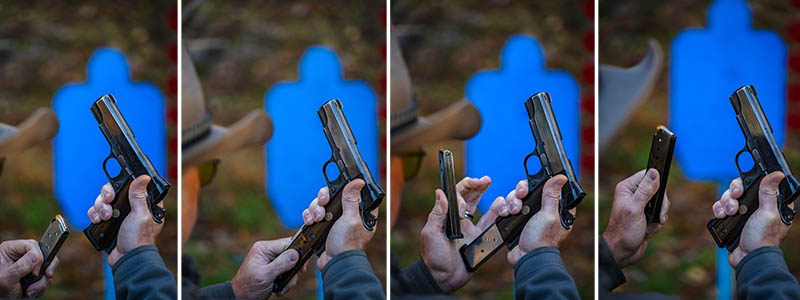
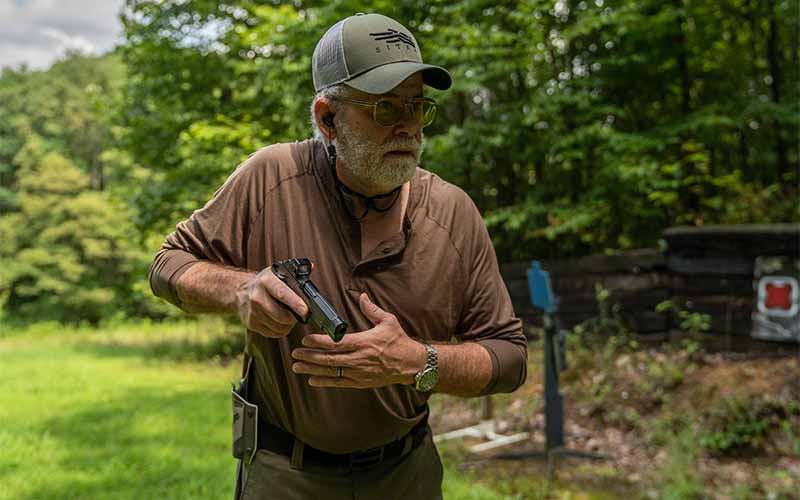
If you modify your carry gun, will it work against you in court if you’re forced to use it defensively?
There may be a time where a prosecutor will try to make an issue out of the newfangled optical sight on a pistol someone used in self-defense. In fact, it’s likely already happened, and there’s a long history of attacking the gun in court, as opposed to the individual. The logic is that “if the gun is evil, the owner must be, too.”
I’ve been involved in the firearms training industry long enough to have seen progression, starting with officers putting custom grips on their Smith & Wesson Model 19 revolvers and then laser grips on those same revolvers, to using semi-auto pistols and night sights. The progression continued to adding laser grips to semi-auto pistols and, lately, adding red-dot sights.
But that’s not all of the modifications people do to their sidearms. Many people, unhappy with how hard the trigger pull is, take the pistol to the local gunsmith for a “trigger job.” Or, they do one themselves after reading a gunsmithing book or watching a YouTube video. In fact, I’ve personally done all of the above to different handguns I’ve used over the years.
Walking The Line
The question I often get from members of the Armed Citizens’ Legal Defense Network is this: Will doing one or more of these modifications work against me in court? And the answer I typically give is, “It depends.”
Was the modification a primary reason for the gun to malfunction (like in an accidental discharge because the trigger job was faulty)? Did that result in injury or death to someone? Are you being charged with a crime because of that injury or death? If so, then, yes, it’ll likely be used against you.
But what if the modification you made to your pistol was intended to simply make it shoot more accurately for you, such as night or laser sights in low light, or the aforementioned red-dot sight? Then, that’s probably not a big deal … unless the prosecutor wanted to portray you as a crazed killer who spent money to modify his pistol so it’d be a more proficient killing machine. That accusation can be easily defeated if your attorney understands the issues of modifying handguns and is ready to lead you through a rational argument for the jury.
So, what would that argument likely be?
For starters, a discussion of the training you received prior to the incident would take place, where you learned that you were responsible for all bullets that left the barrel of the gun. You’d also likely discuss your knowledge of armed citizen encounters, where innocent persons were struck by bullets that missed their intended targets. Thus, you’d be able to testify that you were very much aware that, in the event, you felt it necessary to use the firearm for its intended purpose (defense of self or others in the face of illegal use of deadly force against you or others) that you wanted to make sure all bullets you fired hit your intended target.
After the above testimony, you or your expert would discuss why the modifications you had done to your gun were meant to increase the likelihood that you wouldn’t miss. You’d discuss what a “manageable trigger” is and why you paid money out of your own pocket to make sure the trigger was satisfactory.
You or your expert would discuss the different modifications done, such as why a better set of grips would improve the manageability of the recoil and allow for indexing the sights on target easier. Also discussed would be why night sights would allow you to hit your intended target easier in darkness (and at the same time avoiding missing and hitting bystanders). The same argument would be said for laser-aiming devices and the popular red-dot sights.
When you or your expert’s testimony was made, you should’ve done a very good job explaining (and hopefully convincing the jury) that these modifications were the result of you going overboard to make sure you were a responsible gun owner. Hopefully, you’d never have to testify about this, and hopefully, your defense attorneys would understand that these issues may come up in court regarding your case and take steps to mitigate the issues before testimony.
For example, I worked as an expert on a case where the defendant used a 15-shot 9mm Glock 19 to defend himself and his family. During the trial, the prosecutor asked the defendant how many rounds the gun held (he knew the answer but wanted to get the information in front of the jury). During closing remarks, he made a big deal out of how the defendant used a high-capacity pistol during the shooting.
That case resulted in a hung jury. In the retrial, I once again worked for the defense. But now knowing what the prosecutor would likely try again, I had the defense attorney ask every police officer who testified what kind of gun they carried, and how many bullets it held? (They used Glock 17s, which took 17-round magazines.) By the time the defendant testified again, the prosecutor never asked the question.
Be Safe, Be Smart
Now, having said the above, some modifications might work against a defendant, like deactivated safeties or engraving cute sayings or Punisher skulls on the slide or frame of the gun. Avoid those at all costs. The bottom line is it’s perfectly justifiable to do some modifications to your carry pistol. The key is to know which ones and how to explain them if necessary.
Editor’s Note: This article originally appeared in the 2023 Buyer’s Guide special issue of Gun Digest the Magazine.
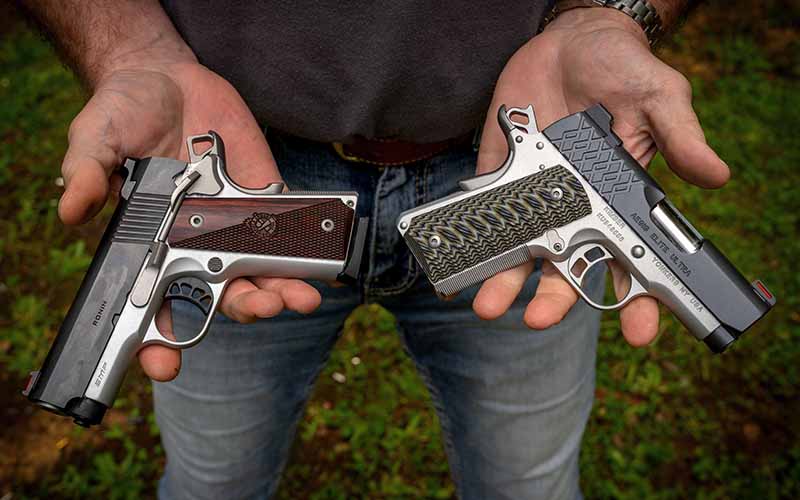
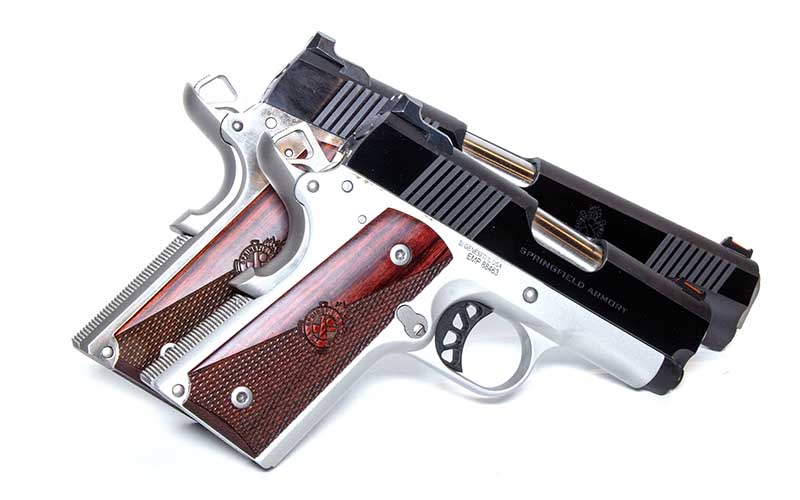
The author pits the Kimber Aegis Elite Ultra against the Springfield Armory Ronin to find the superior 3-inch 1911.
The 1911 pistol has been around for 112 years, and it seems like it becomes more popular all the time. Shooters cannot get enough of this ageless design, but the 1911—with its 5-inch barrel—is a big handgun that’s about 8.5 inches long and weighs almost 40 ounces.
If you like a 1911, there’s no denying the appeal of the more compact 3-inch versions for concealed carry, but I wanted to see just how well these modern, miniature 1911s would perform, and if they could be trusted. After all, a 6.75-inch pistol that only weighs about 26 ounces is a hell of a lot easier to carry than a full-size 1911.
I requested 3-inch barreled 1911s from Kimber and Springfield Armory so that I could test them for reliability and to get an idea of how much harder the lighter and more compact 1911s would be to shoot than a full-size 1911. That meant I also needed a full-size gun, so I also asked Springfield to send me a 5-inch 1911.
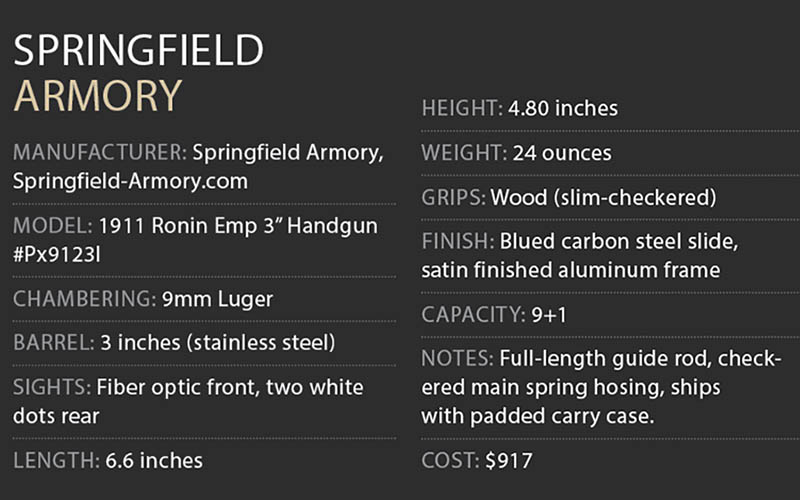
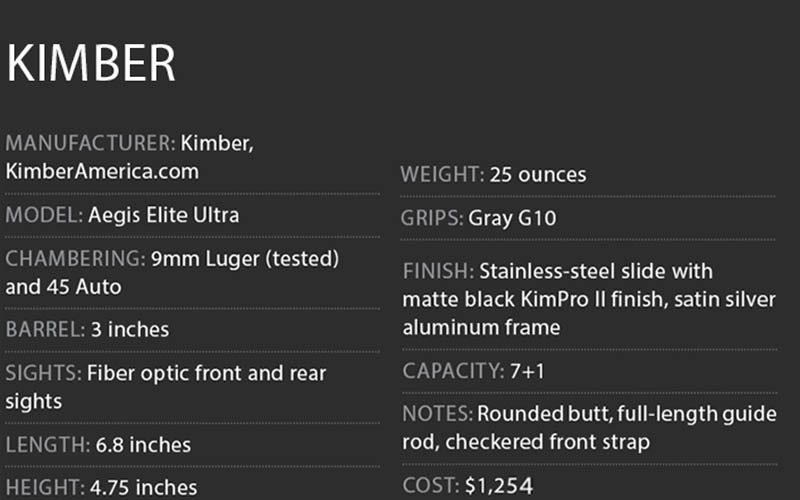
Kimber provided their Aegis Elite Ultra pistol with a 3-inch barrel, and Springfield Armory provided two of their Ronin pistols, one with a 3-inch barrel and one with a 5-inch barrel. All three were chambered for the 9mm Luger.
Fast Action Shooting
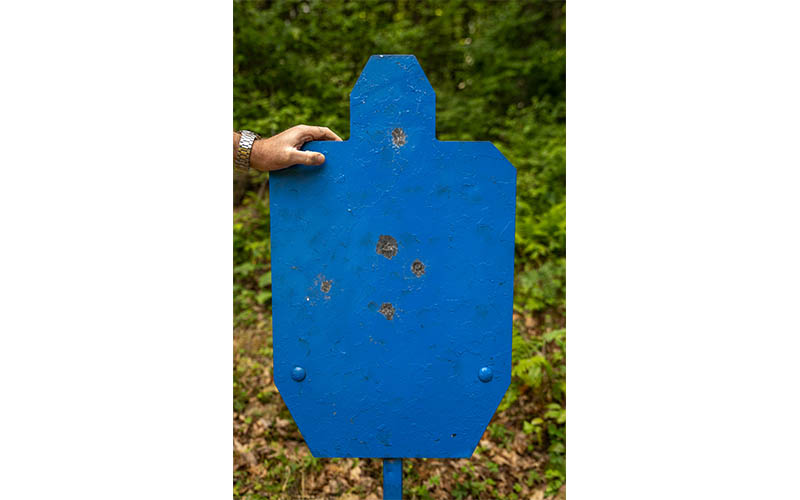
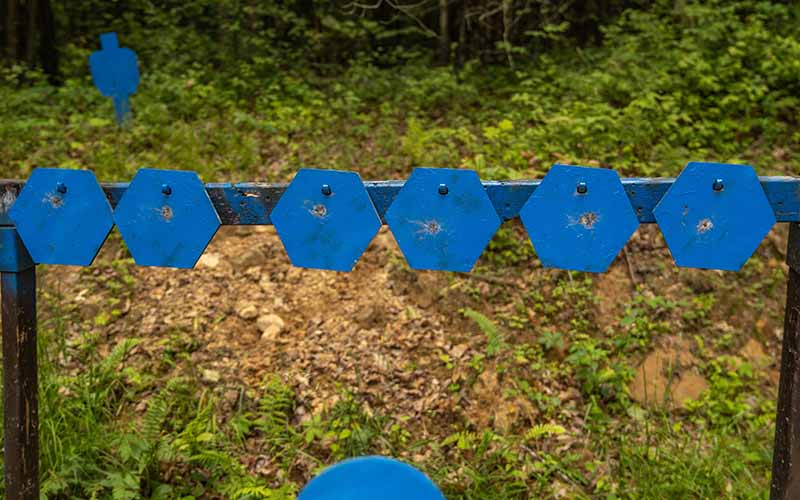
The first shooting test I conducted was a modified version of the famous El Prez Drill. For this drill, I placed three MGM full-size steel torso targets at 10 yards and spaced them about 15 feet apart. Starting with the pistol in a Galco Yaqui Slide holster, at the sound of the shot timer I drew and fired two shots at each target as fast as I could get hits. I ran this drill six times with each pistol to get an average time.
Admittedly, hitting a torso-sized target at 10 yards isn’t hard, but my focus here wasn’t on precision shooting, it was to see how hard these little guns were to control, how fast I could shoot them, and to see if they would run reliably. The drill would also highlight the difference between fast action shooting with a 3-inch, 25-ounce pistol, and one with a 5-inch barrel that weighed 39 ounces.
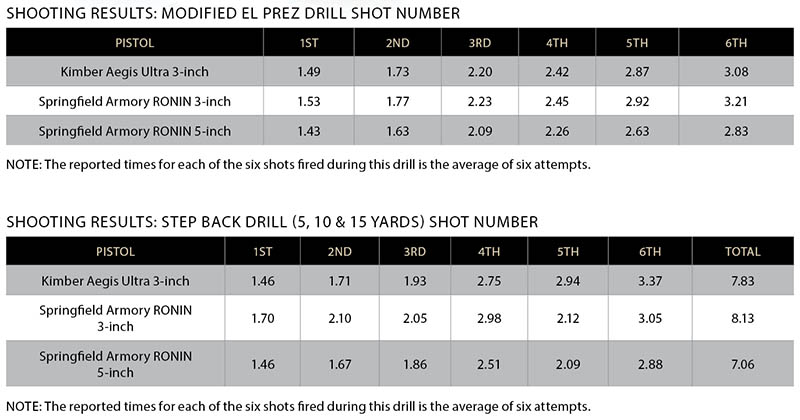
Between the two 3-inch pistols, I shot the best with the Kimber Aegis Ultra. My average time for six runs through the drill was 3.08 seconds. My average time with the 3-inch Springfield Armory Ronin was 3.21 seconds. Granted, the difference was small, but I think the thicker grips on the Kimber helped me hold onto the pistol a bit better and it’s why it performed 4 percent better. The average for all the runs with the two 3-inch guns was 3.14 seconds.
Both modern ultra-compact 1911s from Kimber and Springfield Armory performed flawlessly during testing.
After alternating these two pistols through the drill, I then fired the drill three times with the 5-inch Ronin for an average time of 2.83 seconds. Based on this test, when conducting multi-shot/multi-target drills at about 10 yards, the 3-inch 1911s were about 10 percent slower than a 5-inch 1911.
Precision Shooting
The second shooting test was a reduced version of what I call the Step Back Drill. In this drill, you fire two shots at an 8-inch target from 5, 10 and 15 yards, timing each two-shot string separately. After completing all six shots in the drill, you add up your times at each distance for a total. A good par time for all six shots is something less than 9 seconds.
I ran this drill six times with each of the three pistols to establish an average. My thinking was that this drill would show how good, or bad, a 3-inch 1911 might perform at various distances given the handicap of its shorter sight radius. The 8-inch target required more precise shot placement than the full-size torso targets.
Between the 3-inch guns, I shot minutely better on this drill with the Kimber Aegis Ultra, but only out to 10 yards. At 15 yards, I shot better with the Springfield Ronin. Both pistols had very similar sights, and both triggers broke right at 4 pounds.
Again, I think the difference at the closer distances was the thicker grip on the Kimber because I was running the gun faster. At 15 yards, I had to slow down a bit, and the thinner grip on the 3-inch Springfield wasn’t a handicap … but why it averaged better at 15 yards I have no idea. (This is, of course, one reason tests like this can be important; you can discover how you interact with different guns differently in different situations.) As expected, I shot a bit better with the 5-inch Ronin because of its longer sight radius and less recoil. On average, the 5-inch pistol was about 11 percent faster.
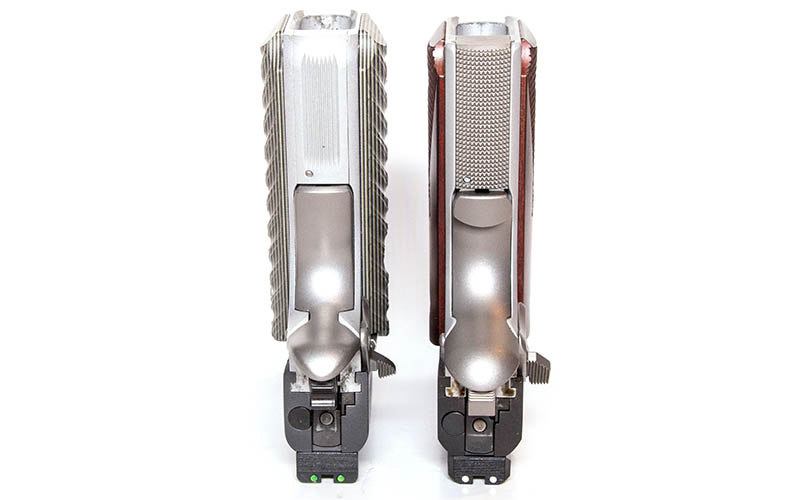
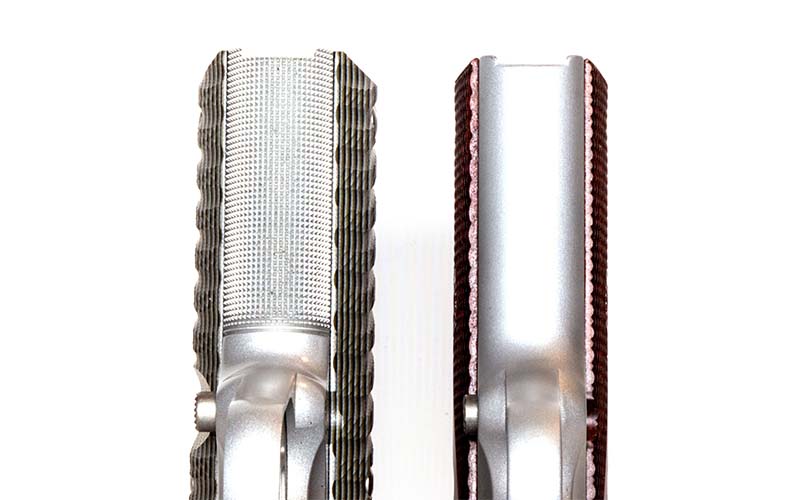
The Kimber and the Springfield 3-inch 1911s were essentially the same size, but the thicker G-10 grips on the Kimber made it a bit wider and it filled the hand better.
Advantages/Disadvantages
Clearly, the more compact and lighter 3-inch 1911s are easier to carry—and that’s important. The more comfortable a pistol is to carry, the more likely you are to have it with you when you need it. Arguably, that might very well offset any shooting advantage the 5-inch 1911 offers. The 3-inch Kimber only had a seven-round magazine, but the Springfield Ronin had a nine-round magazine, which was the same capacity as the 5-inch Springfield, and it was surprisingly extremely easy to load. The magazines for the Kimber and the Springfield 3-inch guns weren’t interchangeable.
Before I ran the drills for record, I fired 100 rounds of Federal’s 124-grain Tactical Hydra-Shok load through each of the three pistols, just so I was familiar with them. The good news is that I didn’t experience any reliability issues with either of the 3-inch guns, which is something they are commonly accused of having. I did have one stoppage, and ironically, it was with the 5-inch gun. At round 97, one cartridge failed to go fully into battery, and a slight tap on the back of the slide solved the problem.
Here you can see the size difference in a 3-inch and 5-inch 1911. What you cannot see is that the 5-inch gun weighs 50 percent more.
You can expect to shoot better with the full-size 1911, and that shouldn’t come as a surprise to anyone. One thing I’ve heard over the years is that the shorter-barreled 1911s are quicker to get out of the holster. That makes sense, but getting a gun out of the holster a few milliseconds faster must also be measured with the speed at which you can get it on target. Considering all the drills at all distances, on average I was able to get a first hit from the holster with the 3-inch guns in 1.90 seconds. With the 5-inch 1911, I was able to secure a first-round hit from the holster in 1.71 seconds. Again, that’s about a 10 percent advantage for the larger 1911. The little guns might escape the holster faster, but the longer sight radius of the longer-barreled 1911 allows the sights to find the target sooner.
I think both the Kimber Aegis Elite Ultra and the Springfield Ronin are nice pistols, and they are a joy to carry. The Kimber costs a bit more, but I shot it a bit better and it’s probably the gun I would go with. You must decide if a 10 percent advantage in shootability is worth the added discomfort of carrying a pistol that’s 50 percent heavier and 25 percent larger.
The 3-inch Kimber costs a bit more than the 3-inch Springfield, but it has some features the Springfield does not, like the checkered front strap that some shooters really like.
And, at the risk of kicking a dead horse: I’ll say again that the ease of carry of these 3-inch 1911s might make all the difference in the end. Self-defense handguns are worthless when they’re left at home.
Though he didn’t sing a thing about guns, it appears that as Alan Jackson so eloquently put it, “It’s alright to be little bitty.”
Editor’s Note: This article originally appeared in the 2023 Buyer’s Guide special issue of Gun Digest the Magazine.
A discussion on the finer points of defensive handgun ammo and how to choose the right load for your needs.
If you carry a firearm on a daily basis, odds are good that you load and unload your weapon frequently and have already given serious thought to your choice of ammunition. Bullet weight, construction and conformation all play a role in terminal performance, and while very few will have an opportunity to test their ammunition in a controlled environment, there’s plenty of data available to help make a proper decision.
I’m an unabashed bullet hound. I love the old styles, from cast lead to the early jacketed bullets—all the way through the latest and greatest modern developments. And while there are myriad choices available to the handgunner, I have a few favorites that have checked all the boxes for me.
Bullets that’ll feed reliably in an autoloader, print consistent groups, hang together when needed and yet expand reliably to rapidly neutralize a threat, all in a wide variety of circumstances, have become revered by defensive handgunners. And, it’s what you should be looking for, too.
Let’s look at the various styles of bullets and ammunition that just might save your bacon one day, be it from a two- or four-legged threat.
Long Live Lead?
Despite my penchant for modern bullet designs, my father—dear Ol’ Grumpy Pants—is always quick to point out how many species were nearly pressed to extinction, and how many graves, both civilian and military, were dug as the result of lead projectiles.
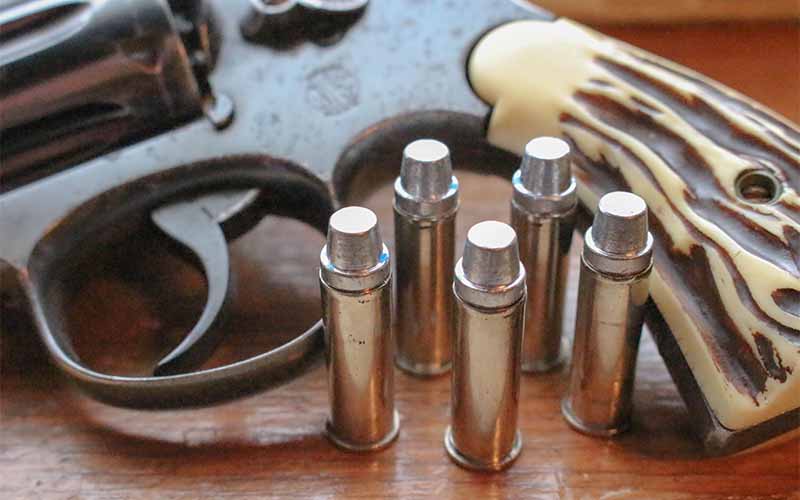
Lead projectiles—where they’re still legal—make a sound and affordable choice, especially for the slower cartridges. Both the .38 Special and .45 ACP have had great success with traditional lead bullets, and there are many economical means to feed those styles of cartridges. From formed projectiles offered in bulk, to purchasing a bullet mold and casting your own projectiles, a lead bullet is as effective here in the 2020s as it was in the 1870s.
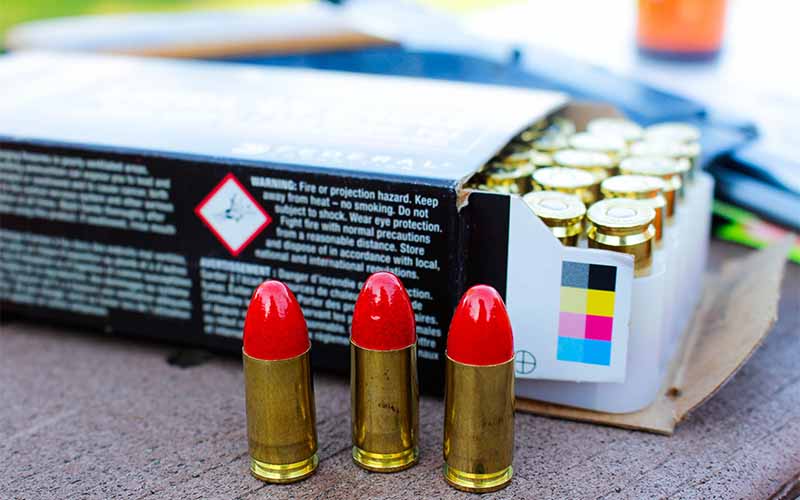
While lead projectiles will foul a pistol’s bore, there are coated choices, like the Federal Syntech or Solid Core, that’ll minimize that fouling, yet still offer the performance of a lead bullet. Softer lead projectiles (we’ll get to the hard stuff in a second or two) tend to expand rapidly, quickly transferring their energy. This can be a good thing, with the exception of the fact that the rapid expansion will compromise penetration. When I use lead projectiles, I like them to be heavy-for-caliber, such as a 158-grain lead bullet in the .38 Special or 230-grain slugs in the .45 ACP.
Federal’s Syntech is a coated lead bullet that gives the benefits of reducing lead fouling as well as lead vapors. Photo: Massaro Media Group.
Add a bit of antimony to a lead bullet, or use good old linotype, and you’ve got a much tougher projectile, capable of truly impressive penetration, with much less fouling in the bore. For the speedier handgun cartridges, like the .44 Remington Magnum, modern .45 Colt loads and the .357 Remington Magnum, a “hard cast” bullet can give extremely impressive results.
In fact, when testing differing handgun projectiles through different construction materials representing interior and exterior walls, a 325-grain hard cast bullet from Choice Ammunition—designed for defense against bears—was virtually unstoppable. It’d make a serious defensive bullet, but with the caveat that over-penetration is a reality.
The Copper And Lead Marriage
It was in the 1880s that the copper jacket was first added to the lead bullet to help take advantage of the higher velocities achieved by the first iterations of smokeless powders. You see, lead projectiles can only be pushed so fast … and then the lead begins to smear within the bore. While this phenomenon is much more common with rifle cartridges, the handgun cartridges saw the addition of a copper jacket add to the structural integrity and improve the terminal performance.
Photo: Massaro Media Group.
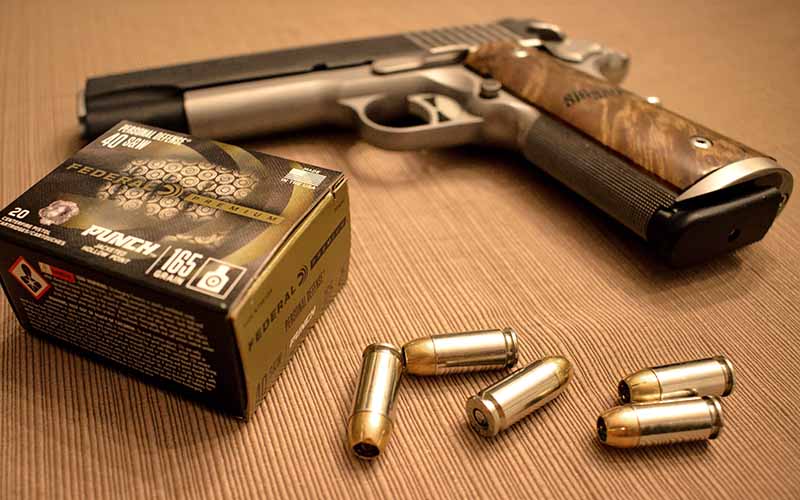
A cup-and-core jacketed hollow-point is one of the most popular choices, as it’s a great blend of affordability and acceptable performance. Federal Premium’s Punch is a great modern example of this style of defensive handgun ammo, as is the Winchester Big Bore and the Hornady Custom line.
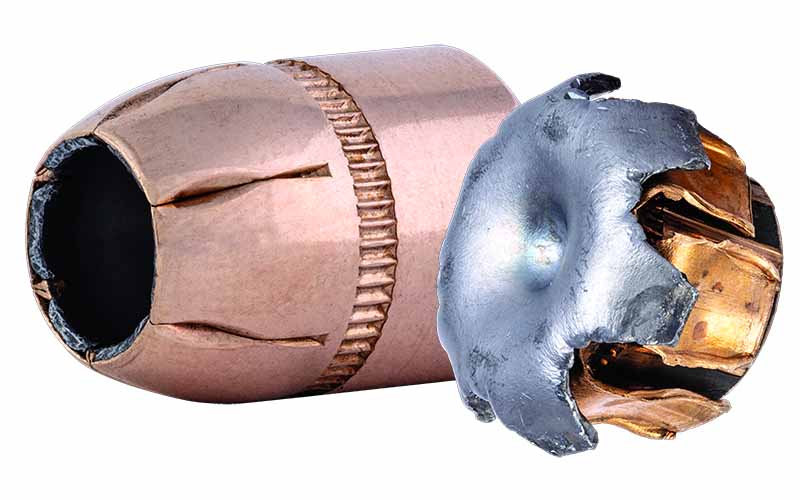
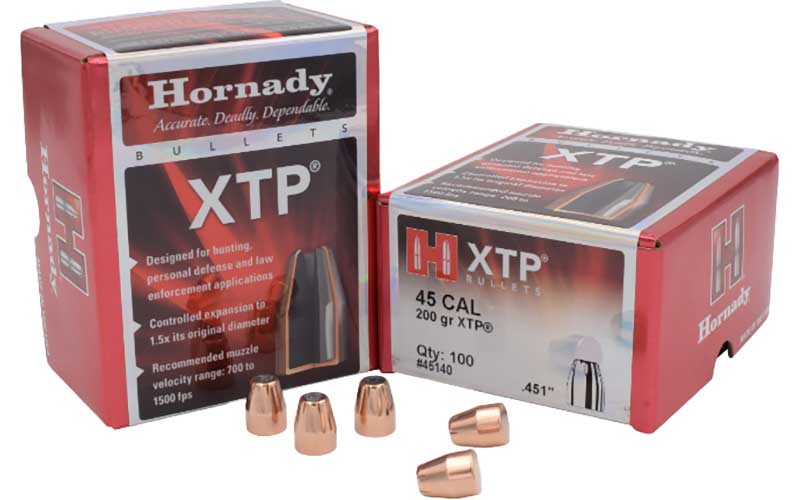
The latter uses the Hornady XTP (eXtreme Terminal Performance) bullet, with its skived jacket to initiate even expansion, and which wraps around the lip of the hollow-point to eliminate exposed lead. Federal’s Punch is similar in design to the XTP and makes a great choice for those on a budget, while the Big Bore line shows a considerable amount of lead at the nose to give a bit more expansion upon contact.
Hornady’s excellent XTP is a great example of a modern jacketed hollow-point. Photo credit: Hornady
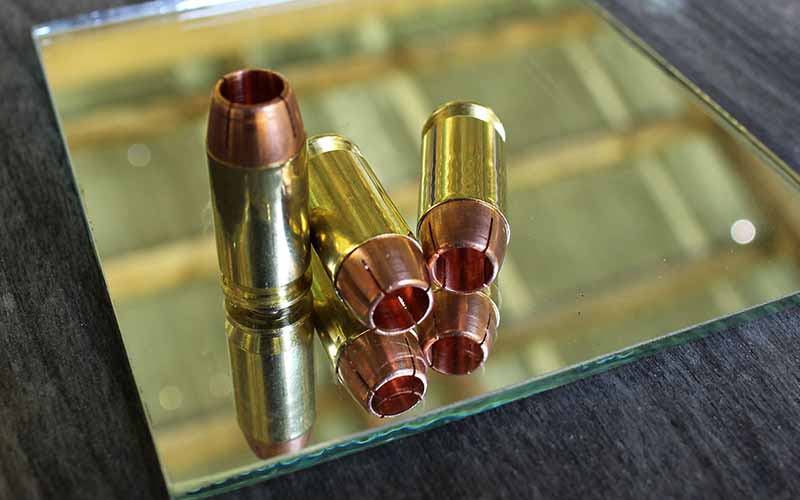
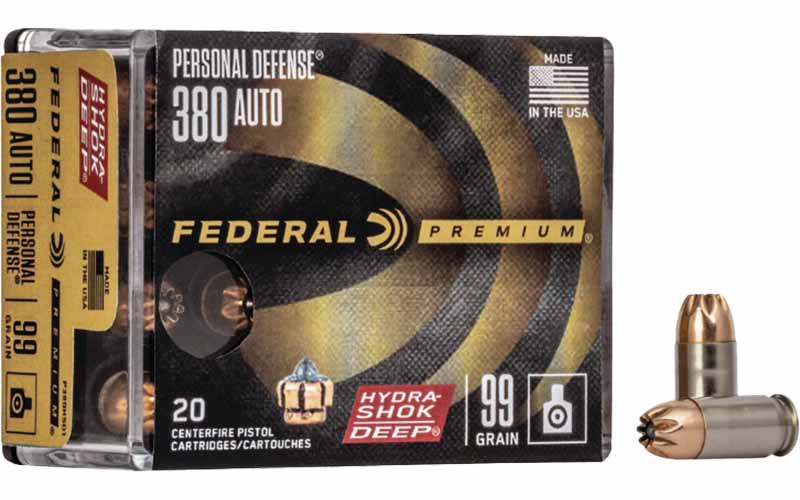
And while a cup-and-core bullet still gets the job done, there are means of building a better mouse trap. Federal’s Hydra-Shok and HST are both jacketed hollow-points, but each with a unique twist that drastically enhances terminal performance. Long relied upon by law enforcement, both bullets have been subjected to rigorous testing according to FBI protocols and have come up aces. Shooting into bare ballistic gelatin, into gel through layers of common clothing, through drywall and into gel, and lastly through windshield glass—all of these will test the mettle of a handgun bullet.
The Hydra-Shok is the older of the two, being designed by Tom Burczynski and released in 1989, and uses a notched copper jacket in conjunction with a center post to deliver the goods in a wide variety of shooting situations. The need to have a hollow-point design, which would open reliably in any circumstance and not plug with material, was imperative in the post-1986 Miami shootout world, and the Hydra-Shok checked all the boxes. Expanding to twice caliber, with a retained weight approaching 100 percent, the Hydra-Shok remains a solid choice to this day to save your life. Despite the features of the Hydra-Shok, Burczynski revised the design to better penetrate various barriers, resulting in the Hydra-Shok Deep.
The legendary Federal Hydra-Shok makes the smaller handgun cartridges more effective, by offering deep penetration in a good number of situations.
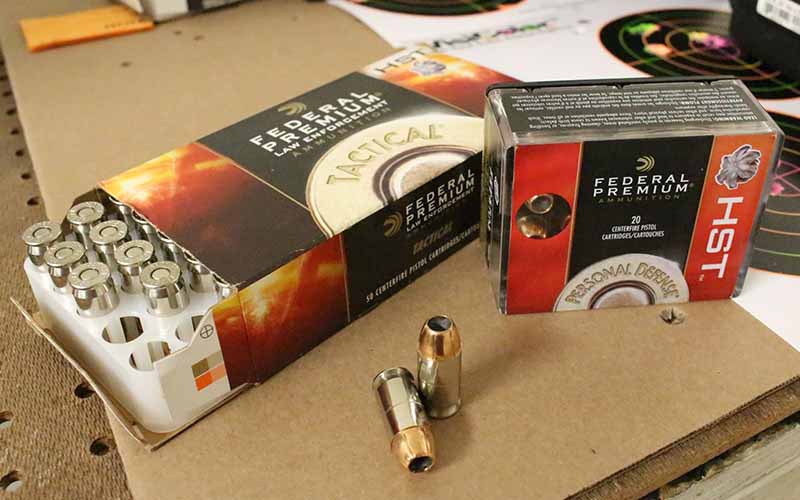
Next came the Federal HST—again a Burczynski design—with a revised meplat in order to provide the most reliable feeding possible, with a hollow cavity designed for the best performance yet in the highly specified FBI protocols. The skived jacket was retained, though when you dig a Federal HST out of ballistic gelatin, it looks like a flower in full bloom, wrought of a nasty blend of razor-sharp metals. Weight retention is as high or higher than the Hydra-Shok, with deep penetration through all sorts of media. Based on all the defensive handgun bullets I’ve had the pleasure of testing, the Federal Premium HST is my favorite, and the bullet I carry on a daily basis.
Strengthening The Bond
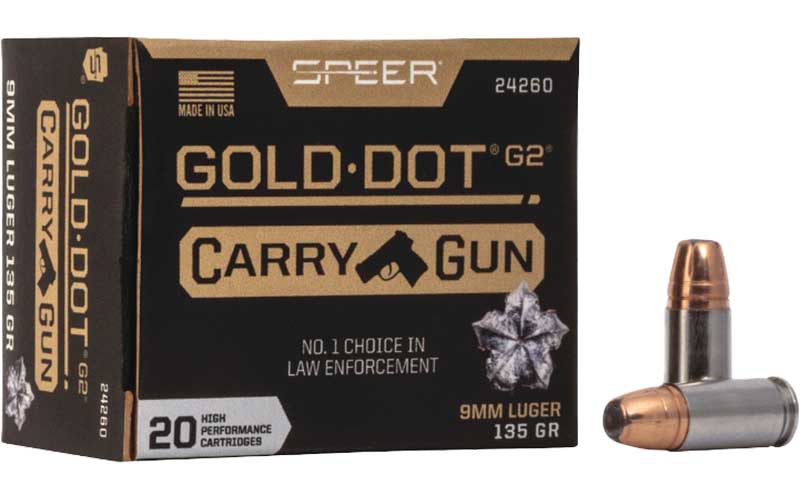
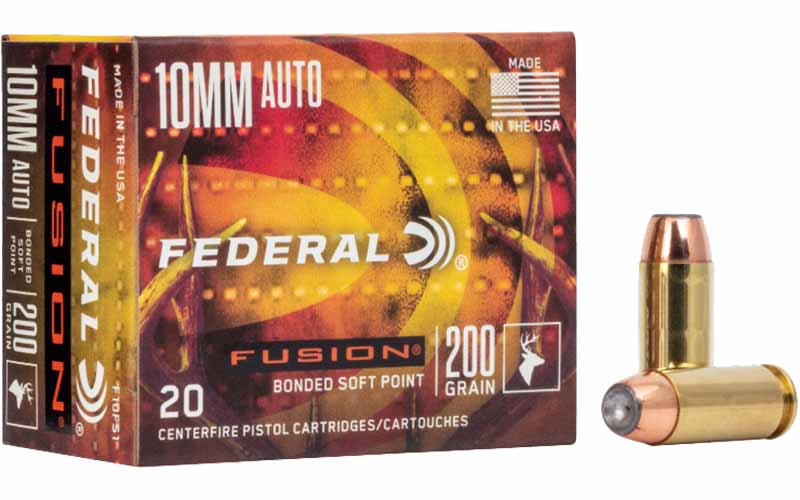
Chemically bonding the jacket and core is a means of preventing premature bullet expansion, and in faster handgun cartridges it makes all sorts of sense. The higher impact velocities that can strain the softer lead bullets and the jacketed projectiles of lower sectional density won’t pose an issue to a bonded-core bullet. Examples of this design are the Swift A-Frame, Federal Fusion and the Speer Gold Dot, all of which are available in both component form as well as loaded ammunition.
The Swift A-Frame revolver bullets possess the same partitioned design as their larger siblings used in the centerfire rifles, with the front core chemically bonded to the thick jacket and have proven themselves against all sorts of dangerous game, from bears to bison and more. Speer’s Gold Dot is another of the top-tier projectiles favored by law enforcement, and with good reason: it has a reputation for impeccable feeding in the vast majority of handgun designs, and its recovered conformation resembles the HST’s metallic flower.
Speer’s GoldDot G2 is a tough, bonded core bullet, favored by law enforcement with good reason: It works every time.
Federal’s Fusion is—much like the rifle variant of this projectile—vastly overlooked. An excellent bonded-core bullet, the Fusion handgun bullets are tough, and if you want a readily available choice for handling hunting and defensive needs, well, you could make much worse decisions. With a skived jacket and shallow dish in the lead nose, the Fusion will perform well at shoe-string distances in a magnum cartridge … as well as at hunting distances where velocities might drop off.
Federal’s Fusion features a bonded core to keep things together during the bullet’s terminal phase. This makes a good choice for a handgun in bear country.
Where Lead Is Not Welcome
Moving to the lead-free copper alloy bullets, choices like the Barnes XPB, Lehigh Defense Xtreme Penetrator and Cutting Edge Bullets’ HG Raptor are all suitable choices for a defensive situation. The Barnes has a skived nose with a deep hollow-point. The Lehigh bullet has a nose profile that looks much like a Phillips-head screwdriver bit. The HG Raptor is designed to have the section of the nose along the hollow cavity break off into small blades after initial impact to cause considerable trauma, while the base penetrates deeply, maintaining caliber diameter.
A simple cast lead bullet will still get it done, especially in a low-recoiling .38 Special. Photo: Massaro Media Group.
Like their rifle bullet counterparts, copper alloy bullets tend to run on the lighter side, as copper takes up more space for the same weight when compared to lead or lead-core bullets. But because the material is harder than lead, these bullets tend to hold together nicely. The exception to that rule is the Cutting Edge projectiles, which are purposely engineered to break apart, with the bullet’s base designed to remain intact.
Surprising Brass Considerations
While plain brass cases are affordable, available and reloadable, I prefer nickel-plated brass cases for my defensive handgun ammo, especially in an autoloader. My hands are rather acidic, and repeatedly handling brass-cased ammunition (as in an EDC situation) tarnishes them quickly, to the point where they get almost sticky to the touch—and I don’t like that all. It’s not as critical in a revolver, but in an autoloader, it can pose an issue. Nickel-plated cases can keep things much neater.
The author much prefers nickel-plate cases in his EDC ammo to keep things cleaner, as it won’t tarnish like brass cases. Photo: Massaro Media Group.
Feed Me
No matter how great a bullet may be, if it doesn’t feed in your autoloader, it’s useless. There are few brands/configurations that’ll feed in every type of handgun, and I highly recommend investing the money in thoroughly testing a number of varying ammunition types in your chosen handgun. Standing with a handgun that hasn’t fed another round into the chamber can be a terrible feeling if the proverbial excrement has hit the oscillator. I’d much rather a traditional bullet that feeds reliably than the best premium design that sits cocked in the lips of a magazine or is wedged due to an improper feed ramp angle.
Extraction is another issue that can contribute to a malfunction. If the firearm is screaming to you that it just doesn’t like Brand X ammo, listen to it. Bottom line: It’s got to feed and extract, or it shouldn’t be relied upon for defensive situations.
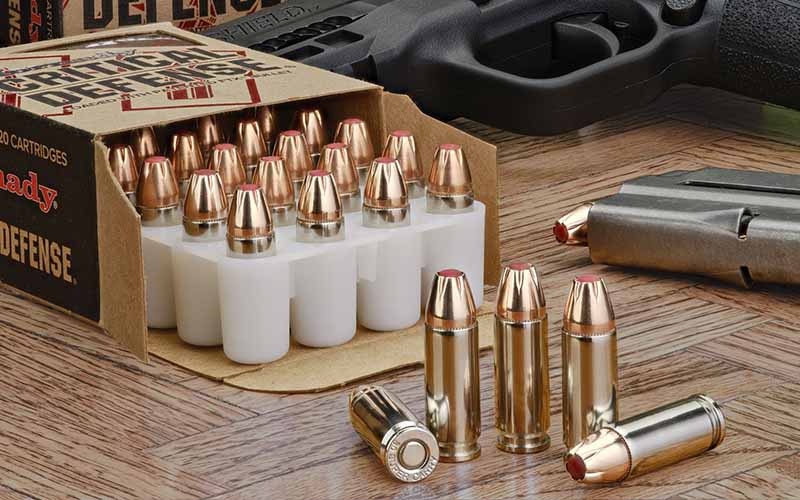
The Hornady Critical Defense ammo line features the FTX bullet, with a polymer insert to prevent the hollow-point from clogging up.
Under Pressure
We Americans have an undeniable love of speed, and the modern efforts to bring an older cartridge to a different level of performance through the +P (read: higher pressure) designation. Some guns can handle the higher pressure levels. Others—especially the older ones—don’t fare so well.
For example, I got my hands on some +P ammo for my S&W Model 36 .38 Special, and while it might not have been the wisest choice in that gun, the absolute ear-shattering report from the snubnose was enough to have me set the ammo back on the shelf. That little gun is much better served (in my opinion) by standard-grade ammo. If you feel the additional velocity and energy values of the +P ammo engenders more confidence, so be it. Just make sure you can shoot it as well as the standard ammunition, in a real-world situation.
With excellent terminal capabilities, Federal’s HST bullet is loaded in nickel cases and is the author’s go-to ammo choice for everyday carry. Photo: Massaro Media Group.
In Conclusion
My late mother used to advise: “It’s all about balance.” While I didn’t understand the wisdom of that statement as a younger man, it rings in my ears more often as get on in years, and it surely applies to the handgun world. I want the best blend of terminal performance, reliable feeding and acceptable recoil/muzzle jump possible, so that if I have to use my handgun to save a life, there are no questions about the chosen ammunition.
Editor’s Note: This article originally appeared in the 2023 EDC special issue of Gun Digest the Magazine.
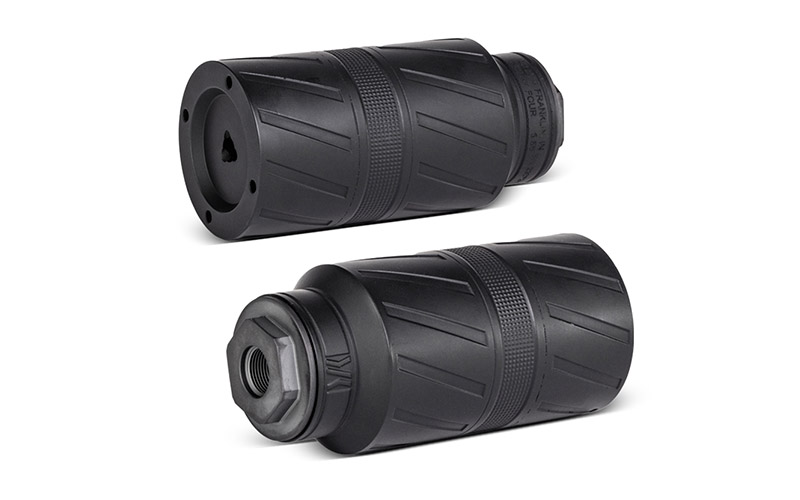
Silencer Central and Federal Ammunition have teamed up to release the BANISH Speed K, a compact and maneuverable 5.56 suppressor.
To address what the companies describe as “unmet needs of law enforcement agents,” Silencer Central and Federal Ammunition have come together to release the BANISH Speed K to both the professional and civilian markets. The new suppressor, rated for calibers .17 to 5.56, is advertised as being extremely compact yet capable of delivering impressive performance.
Firstly, the BANISH Speed K is only 4 inches long, 2 inches in diameter and weighs just 14.1 ounces. Combined, these attributes make for one very compact and maneuverable suppressor, a perfect match for a carbine intended to be used in tight spaces. Made of Inconel 718, the can also features Controlled Flow Technology to reduce backpressure, an efficient internal design that improves sound reduction and something that Silencer Central calls Duty Temperature Control technology to help keep the can’s internals cooler. Further, the BANISH Speed K’s straight-venting design allows for easy cleaning, helping to prolong the suppressor’s lifespan.
Brandon Maddox, CEO of Silencer Central, said this about the new suppressor:
With the release of the BANISH Speed K, we are excited to bring professional-grade suppressor technology to the civilian market … This collaboration with Federal Ammunition has allowed us to create a suppressor that exceeds expectations in terms of performance, durability, and ease of use.
Federal CEO and President Jason Vanderbrink said this:
Our goal at Federal is to continually improve the shooting experience … As an ammunition company driven by innovation, partnering with Silencer Central to engineer the BANISH Speed K continues our legacy of collaborating with industry partners to provide law enforcement and hunters and shooters the best products while on duty, at the bench, or in the field.
The BANISH Speed K is compatible with industry-standard hub mounting systems, but each suppressor will come with your choice of one of six popular thread pitches for direct mounting. It is available now and has an MSRP of $1,199.
A discussion on the pleasures and pitfalls of small-bore centerfire cartridges.
When a rifleman decides to make the move to a small-bore rifle—whether for hunting, target shooting or for defensive measures—their choice of cartridge usually ends being highly debated. I’ve seen guys who were friends for decades get extremely hot under the collar when arguing the .22-250 Remington versus the .220 Swift, to the point where I thought it might come to blows.
Bring up the .204 Ruger and you might find a shooter who feels that all other bore diameters are an absolute waste of time, and the shooting world was just waiting for a .20-caliber cartridge. And then there’s the huge crowd of folks who feel that small-bore cartridges begin and end with the 5.56mm/.223 Remington, and that’s that.
For the hunter/shooter looking for a small-bore cartridge to best fit his or her needs, there are some considerations to keep in mind with any of the small-bore choices, and the more you know, the easier the choice will be. Let’s look at some of the more common choices between .17 and .22 caliber, and what each has to offer.
The Teenagers
This .17 caliber is the smallest bore diameter of the commercially loaded cartridges and offers some serious heat. This bore diameter can be traced back to the Flobert rifles—using no powder, only a primer as propellant—and was championed by P.O. Ackley. Remington was the first to legitimize the 0.172-inch-caliber cartridges, with the 1971 release of the .17 Remington.
Based on a slightly modified .223 Remington case, the .17 Remington will propel 20- and 25-grain bullets to a muzzle velocity of 4,250 fps and 4,040 fps, respectively. This velocity level will test the mettle of any bullet, let alone frangible varmint bullets of 20 to 25 grains, and the .17 Remington can be nearly explosive upon impact. The hydraulic shock generated will certainly create “red mist” when used on woodchucks and prairie dogs, and if placed correctly, it will hold even the bigger Eastern coyotes.
The .17 Remington can be hell on barrels, especially if you overheat them, and fouling can be a real issue if you don’t stay on top of it. Accuracy will degrade, and cleaning any of the .17 bores can be a challenge, as it requires a cleaning rod of special diameter, as well as tiny little patches.
Remington also had the distinction of producing the second commercial .17-caliber cartridge, when interest in the .17 Mach IV wildcat warranted the development of the .17 Remington Fireball in 2007. Necking down the .221 Fireball resulted in a cartridge that offers a muzzle velocity rather close to the .17 Remington—driving a 20-grain bullet to just over 4,000 fps and a 25-grain bullet at more than 3,700 fps—in a smaller case. I find the .17 Remington Fireball to be a bit more barrel friendly than the larger .17 Remington, but despite a bit of fanfare upon release, factory ammunition is becoming increasing rare … if you can find it at all.
Remington’s .17 Fireball is nothing more and nothing less than the .221 Fireball necked down to hold 0.172-inch-diameter bullets … and it will certainly ruin a varmint’s day.
The youngest of the bunch—Hornady’s .17 Hornet—is based on a P.O. Ackley wildcat, which necked down the highly popular .22 Hornet to hold .172-caliber bullets. While the Ackley variant used a 30-degree shoulder to help increase case capacity, the Hornady version uses a 25-degree shoulder, albeit with less body taper.
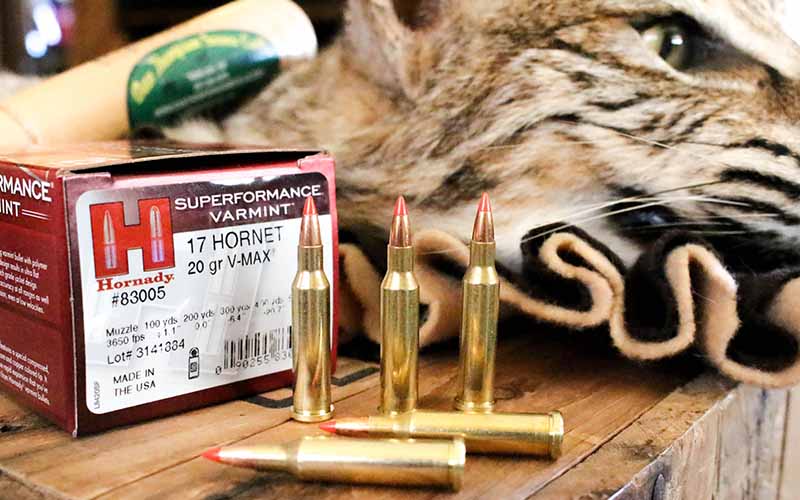
Despite the rimmed case, the .17 Hornet feeds well in bolt-action rifles, including the Ruger rotary magazine. With a 20-grain bullet leaving the muzzle at 3,650 fps, the .17 Hornet is the best balanced of the .17-caliber cartridges. Despite the fact that it gives up 600 fps to the .17 Remington, the lack of ear-splitting report, while still delivering a respectable trajectory, makes a huge difference.
Looking at downrange trajectory, you’ll see an arc very similar to that of the .30-06 Springfield. That 20-grain V-Max—when zeroed at 200 yards—will strike 6½ inches low at 300 yards and 20½ inches low at 400 yards, though the wind deflection of the diminutive cartridge is twice that of the ought-six. But once you become accustomed to the .17 Hornet in the wind, you’ve got a rather potent little package. A 20-grain bullet will work on bigger coyotes up close, but outside of 150 yards or so it might struggle to hold them. Nonetheless, I like having a .17 Hornet in my lineup.
The .22 Hornet is a classic, but the author finds the .17 Hornet to be a better and more useful cartridge. Photo: Massaro Media Group.
Anyone For A 20?
In 2004, Hornady worked with Ruger to create what would become the second-fastest small-bore: the .204 Ruger. Based on the .222 Remington Magnum and using a bullet of nominal diameter, the factory loads would use a 32-grain bullet to break the 4,200-fps barrier. A 30-degree shoulder handles the headspacing duty.
Although the 32-grain bullet generates some impressive velocity figures, there are bullets available weighing up to 55 grains, including Hornady’s 40-grain V-Max at 3,900 fps, making a good load for longer range hunting and shooting. The heavier bullet weights require a 1:10 twist rate for proper stabilization, rather than the standard 1:12 supplied in most factory barrels. I like the .204 Ruger as a happy medium between the .17s, which use considerably lighter bullets, and the .22-caliber centerfires, which have the bullet weight but can sometimes be too much of a good thing when it comes to small-bores.
The .204 Ruger is a collaborative effort between Ruger and Hornady, and makes a great cartridge for small game and target shooting alike. Photo: Massaro Media Group.
Hornady is a prime source of ammunition, but there have been factory loads from Federal, Winchester, Remington, Nosler, Sierra and more. Many of the loads seem to be produced as seasonal runs. There are plenty of good component projectiles out there, and the .204 Ruger isn’t a particularly finicky cartridge to load for. If you enjoy cartridges a bit out of the norm, the .204 Ruger is a neat choice, which will be effective in the field or at the target range.
Catch 22
When I think of centerfire small-bore cartridges, my mind goes immediately to .22 caliber; perhaps it’s because that was as small as things went when I was a young. From the classic .22 Hornet of the 1930s, to the undeniable popularity of the .223 and Triple Deuce, and the faster .22-250 Remington and .220 Swift, it seemed that these cartridges were resigned to killing woodchucks and foxes. There were, however, some adventurous deer hunters who would employ a .222 Remington or .22-250 Remington to fill the freezer, with mixed results.
There are plenty to choose from, with some fading into obscurity and some older ones still hanging on. Yes, I think the .219 Zipper, .224 Weatherby, .225 Winchester and .22 Savage HiPower are cool, but they aren’t popular at all any longer. So, I’ll compare and contrast the more popular—and attainable—.22-caliber centerfires.
The .22 Hornet has its roots back in the late 19th century, but the cartridge we all know and love came onto the scene in 1930, having been molded by the likes of Grosvenor Wotkyns and Townsend Whelen at the Springfield Armory, bearing a serious resemblance to the blackpowder .22 WCF. Though it’s rimmed, the Hornet has been adapted to a wide number of rifle actions, from bolt-action to falling-block single-shots, to double rifles and drillings. With a slight shoulder measuring just over 5½ degrees, the Hornet feeds nicely from a box magazine and will push a 45-grain bullet to nearly 2,700 fps.
While this might not be setting any velocity records, it’s good enough for varmints and furbearing predators up to and including coyotes. It has very little recoil, and the report won’t flatten eardrums. Ammunition is still available from a number of manufacturers—though it seems to be produced in limited runs—and offers projectiles weighing between 30 and 46 grains. If you want a low-recoiling choice for taking varmints and furbearers inside of 200 to 250 yards, the .22 Hornet surely deserves consideration.
Housed in a light rifle, the .22 Hornet can be a wonderful training tool for a youngster, yet it will handle bobcats, foxes and coyotes at “woods” ranges. Photo: Massaro Media Group.
The .222 Remington was a gamechanger when it burst onto the scene in 1950 in the Remington Model 722 bolt rifle. Developed by Mike Walker, the Triple Deuce was the first commercially loaded rimless .22-caliber centerfire cartridge, and it smashed all sorts of accuracy records. Compared to the larger, speedier cases, it has very tolerable recoil, and a 50-grain bullet traveling at right around 3,200 to 3,350 fps doesn’t exactly disappoint at moderate ranges. The 23-degree shoulder handles the headspacing duties, and the neck measures 0.313 inch, giving plenty of neck tension.
The .222 Remington had its heyday here in the United States, but it long ago lost the popularity contest to the .223 Remington and .22-250 Remington. However, it remains popular in those European countries where military ammunition is prohibited for hunting. Inside of 400 yards, hits were rather consistent, but past that distance it became increasingly difficult, especially in comparison to the .223 Remington. But for the eastern woodchuck hunter who wants a target cartridge for shorter ranges, the Triple Deuce might be a great solution. Should you find a rifle so chambered, don’t count it out.
The Standard
There really isn’t too much I can add to the .223 Remington that hasn’t been said a million times, but it does possess some qualities that set it apart from other .22-caliber cartridges. It’s slightly longer than the .222 Remington, with the same 23-degree shoulder and 0.378-inch case diameter, yet has a shorter neck. This yields a greater case capacity and a correlatively faster velocity.
The .223 Remington has the advantage of being highly popular and has been loaded with a wide array of projectiles. These 62-grain Federal Fusion bonded core bullets will handle deer-sized game, if properly placed. Photo: Massaro Media Group.
And, to change the game even further, many modern rifles chambered in .223 Remington offer a tight twist rate—sometimes as tight as 1:7—which allows the use of heavy-for-caliber bullets that best retain energy and resist wind deflection. A 77-grain bullet at 2,700 fps will perform much better at longer ranges than any lighter bullet when the targets are out past 500 or 600 yards, and the winds begin to wreak havoc with your bullet. If you want a flexible package, which is affordable to shoot, with a multitude of ammunition choices, look no further than the .223 Remington; it can be handloaded easily, it’s easy on the shoulder, and though it may lack the sparkle of newer cartridges, it just plain works.
The Newbies
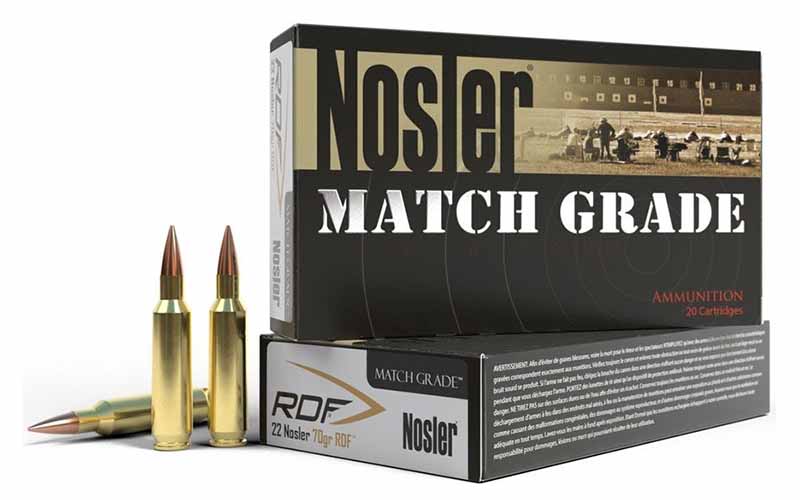
The .22 Nosler reared its head in early 2017, and was designed to mate up perfectly with the AR platform, giving superior ballistics to the .223 Remington/5.56 NATO, and approaching those of the .22-250 Remington. With a 1:8 twist rate, the .22 Nosler offers heavier bullets in the loaded ammunition, including 70-, 85- and 90-grain choices. It has a rebated rim and a 30-degree shoulder for headspacing, but it makes the most sense in an AR rifle.
The .22 Nosler has a tight twist rate, and a rebated rim for use in a AR-15 platform. It can use the heavy-for-caliber 0.224-inch-caliber bullets.
The main issue with the cartridge is that Nosler is the only source of ammunition, and the cartridge seems to be fading fast. Nonetheless, the formula makes sense and if speed is your thing, the .22 Nosler has no flies on it.
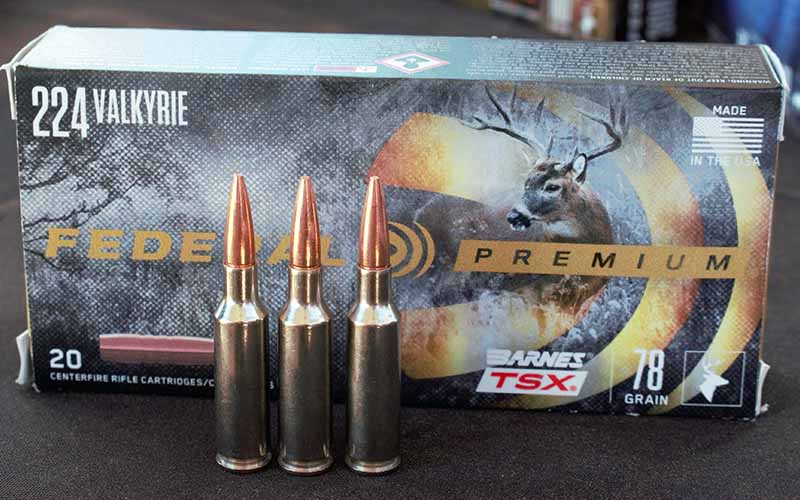
Federal’s .224 Valkyrie is a long-range cartridge, for sure, with a twist rate of 1:7 to handle the heaviest .22-caliber bullets. Based on the 6.8 SPC, the .224 Valkyrie was released at 2018’s SHOT Show. The rimless case uses a 30-degree shoulder like the .22 Nosler but is more adaptable to a bolt-action rifle. Factory ammunition will offer bullet weights between 60 and 90 grains and is available not only from Federal, but from Hornady and Sierra, in both hunting and match-grade target loads.
Federal’s .224 Valkyrie is equally at home in an autoloader as it is in a bolt gun, and as it can handle the heaviest bullet in .22-caliber, it’s well suited for deer, antelope and similar game species. Photo: Massaro Media Group.
It’s probably the best choice for those who want a .22-caliber centerfire that can readily handle deer and similar-sized game, as well as the varmints and furbearers, yet readily handle a 1,000-yard target range. Of the new releases, I like the .224 Valkyrie a whole lot.
The Speedster
Remington’s .22-250 spent more than a quarter-century as a wildcat cartridge, being nothing more and nothing less than the .250-3000 Savage necked down to hold .224-diameter bullets. One of the most popular variants was developed by Grosvenor Wotkyns, J.E. Gebby and J.B. Smith, rivaling the .220 Swift’s velocity levels. Ironically, the .22-250 was one of the only cartridges to have a commercial rifle chambered for it before any commercial ammunition was available. Browning made a rifle chambered in 1963, while the Remington ammunition wouldn’t be offered until 1965. Our own John T. Amber commented on the situation in the 1964 Gun Digest Annual, reporting, “As far as I know, this is the first time a first-line arms-maker has offered a rifle chambered for a cartridge that it—or some other production ammunition maker—cannot supply.”
The .22-250 Remington—being a necked down .250 Savage—was a wildcat for many years before Remington legitimized it. It remains one of the author’s favorite small-bore cartridges. Photo: Massaro Media Group.
The .22-250 is still a highly popular cartridge among the small-bore crowd, as it offers impressive velocities and can deliver hair-splitting accuracy. But, the cartridge has both pleasures and pitfalls: The case capacity is almost wasted because the twist rate prevents bullets heavier than 55 grains, or maybe 60 grains if the conformation is correct. A 55-grain slug can be driven to 3,800 fps, and while that’s impressive, I contemplate re-barreling my rifle from the standard 1:12 twist down to a 1:8 or 1:7 twist to accommodate the 85- and 90-grain bullets, which would take full advantage of the case capacity.
Factory loads are available from nearly any company that loads ammunition, and the handloaders have long embraced the case. In fact, Hodgdon’s H380 spherical powder is named for the 38.0-grain load of surplus military powder that Bruce Hodgdon used under a 55-grain bullet in the (then wildcat) .22-250 case.
With a 0.473-inch rim, and a neck measuring 0.248-inch long, the case has all sorts of capacity, but unlike the modern cartridges, is handicapped by the twist rate common to yesteryear. Or is it?
If you want your small-bore rifle to simply handle the smaller species and some target duties at moderate ranges, the .22-250 Remington has no drawbacks whatsoever. But if you want to stretch the capabilities, extending the .22-250 into the regions of a deer rifle, the standard design with the slower twist rate will not stabilize the heavier projectiles, and even the .223 Remington can be a better choice.
The Swift
The .220 Swift has been a topic of debate since its release in 1935. Again, Grosvenor Wotkyns had a hand in the development (seeing a trend here?) of the world’s fastest cartridge, and in the midst of the Great Depression it broke all sorts of barriers. It’s fast—well over 4,000 fps—and that came at a price, namely eroded throats and worn barrels.
Wanna turn a woodchuck inside out? The .220 Swift is a perfect candidate, as it has the case capacity to generate serious velocities. Photo: Massaro Media Group.
Much like the .22-250 Remington, using the .220 Swift in a high-volume shooting situation isn’t the best for the throat or rifling, as things heat up pretty quickly. And again, like the .22-250, the majority of rifles chambered for the .220 Swift use a barrel with a relatively slow twist rate—either 1:14 or sometimes 1:12. This twist rate was common for .22-caliber barrels of the era and will preclude the use of bullets much heavier than 55 grains, as they won’t be properly stabilized, and you’ll see those nasty keyhole marks on your targets.
And The Winner Is?
So, which cartridge do you choose?
Like so many things in life, the answer is highly subjective and truly depends on your hunting/target needs. If you’re looking at things from a purely practical viewpoint, the .223 Remington offers the greatest amount of flexibility and literal bang for the buck. It’ll check all the boxes and do so affordably.
But practicality isn’t always applicable, and some folks enjoy shooting a cartridge that’s either a nostalgic classic—in the case of the .22-250 Remington or .220 Swift—or one of the technological wonders designed to be cutting edge, like the .224 Valkyrie or the .204 Ruger.
I’ve settled on two: the .17 Hornet and the .22-250 Remington. The former chose me, after spending a week killing prairie dogs with a plethora of different cartridges, and the latter I chose as a much younger man, who believed he needed the velocity. I’ve had many opportunities to revise both choices—yet I have not—as I know both the rifles and cartridges very well, and they cover all the bases I need a small-bore cartridge to cover.
Be honest with yourself regarding hunting distances and game pursued, or if you’re looking for a target cartridge, assess your goals and needs and pick a cartridge that’s both available and accessible. You’ll probably make a friend for life.
Editor’s Note: This article originally appeared in the January 2024 issue of Gun Digest the Magazine.
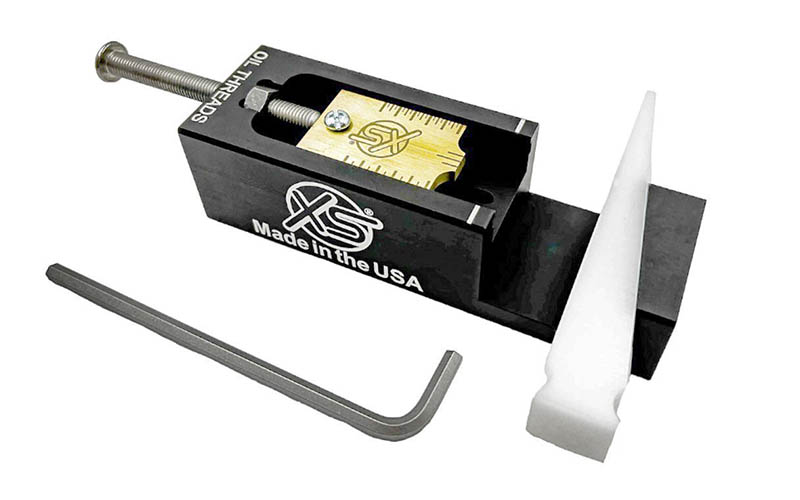
If you’re tired of dinging up your handguns while messing with their sights, it’s time to take a look at the XS Sight Pusher.
Previously, referring to someone as a “pusher” meant they weren’t to be trusted. That’s not the case with XS Sights. Today, it’s used to adjust your sights, and the Inline Sight Pusher kit for Glock is a simple and straightforward tool.
Normally, sight pushers are designed to work with, well … everything, making them complex. I mean, when you actually have to read the instructions, perhaps it’s too much of a good thing. The XS Sight Pusher, however, is simple and straightforward (or sideways, if you get what I mean).
There’s an adjustment bolt, a sliding brass pusher and an included nylon wedge. Wedge? Yep. You slide the wedge along the angled base of the pusher to adjust the position of the slide and produce a non-slip surface that won’t mar your slide.
Then, you crank the bolt to push the sight. XS Sights also made the brass pushing part with a marked scale, so you can see how much you’ve moved the sight and get a better estimate of how much is “enough.” The best part of all this is that it’s compact and lightweight enough that you can put it in your range bag and take it with you.
Shoot and adjust until your Glock is on-center. If you’re doing the adjustments at home, then the XS Sight Pusher, with its scale on the brass plate and index marks on the pusher body, will tell you when you have your sight centered.
The XS Sight Pusher with the brass pusher retracted and the wedge in place, ready to receive a Glock slide.
Now, even a Glock-specific tool has to have some complication. In this case, it’s one provided by Glock themselves. If you’re working on a Glock 42, the .380 micro-Glock, you’ll have to read the G42-specific step to make sure you do it correctly. Oh, and for those who are online mavens, use the QR code etched on the side of the pusher to download and read the instructions, should you need them at the range. (Brave new world indeed.)
It should go without saying that any and all Glock-clone slides will work just as well in the XS Sight pusher. The kit is the pusher, wedge, Allen key to turn the adjustment bolt, steel Glock front sight tool (so if you’re installing a complete new set of sights, you can do the front one as well), oil and thread-locking goo.
This is the sort of thing that we gunsmiths back in the dark ages wished for or made ourselves to avoid marring sights with aluminum, brass or steel drift punches. No more hammering rods to move sights and no more brass marks or dinged sights. The DIY Series runs $150, which if you own a couple of Glocks is not a big deal. If you only own one Glock, it might seem like a bit, but wait until someone at the gun club has a sight-in issue and you have the tool to solve their problem right there in your range bag.
Being the hero of the day makes the cost go down easier, and getting your own Glock on-center is a whole lot easier.
Editor’s Note: This article originally appeared in the January 2024 issue of Gun Digest the Magazine.
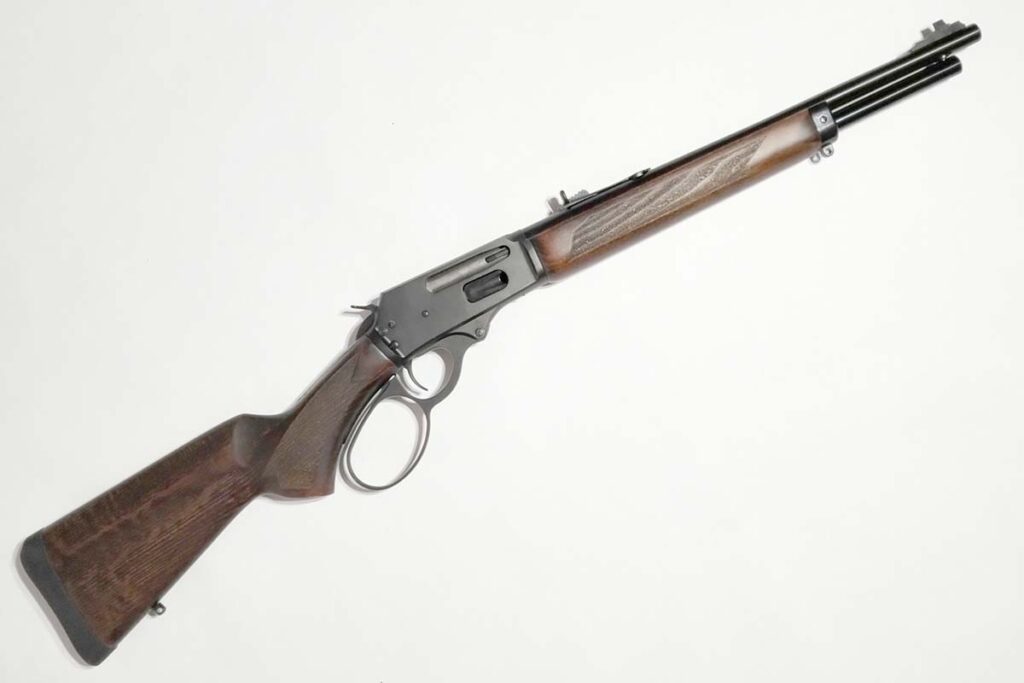
Right-sized in price and profile, the Rossi R95 Trapper is ready for hard duty in the field.
Likely, you’d have to return to the days when muscle cars were the epitome of cool to find a time when lever-action rifles garnered as much attention as they do today. Is it necessity, nostalgia or some other unseen force driving the resurgence? Honestly, it doesn’t matter.
What does is the renaissance of this style of long gun has resulted in the expansion and evolution of perhaps one of the handiest—not to mention enjoyable—rifles. This even goes for the more budget-friendly end of the market of these generally spendy guns. Case in point, the Rossi R95.
Released just in time for deer season late this summer, the Brazilian-made gun does the impossible for rifle-caliber lever guns—gives a sub-$1,000 option to the masses. A relief to many, given the somewhat archaic technology generally sends spasms into the most tender region of man’s lower extremities—his wallet.
Even more heartening, with an MSRP of $950, the rifle punches well above its price tag especially where it counts—downrange performance. At least, this was my experience with the R95 16.5-inch barreled Trapper model in a few trips to the range to put it through its paces.
R95 Familiar Origins
You’ll be forgiven if the R95 inspires a bout of deja vu. There’s plenty familiar with the 5+1 capacity .30-30 WCF if you even have a passing knowledge of Rossi or Marlin for that matter. For all intents and purposes, the new rifle is a revamped Rio Grande, which was a clone of the timeless Marlin 336. However, Rossi didn’t simply slap a new model name on its old clone and call it a day. Overall, the R95 is much more streamlined than the company’s previous attempt at a 336 and includes a few notable—and desirable—tweaks.
The R95 isn’t Rossi’s first foray into 336 clones… there is the Rio Gande. But for the most part, the new lever-gun surpasses its forerunner in all facets.
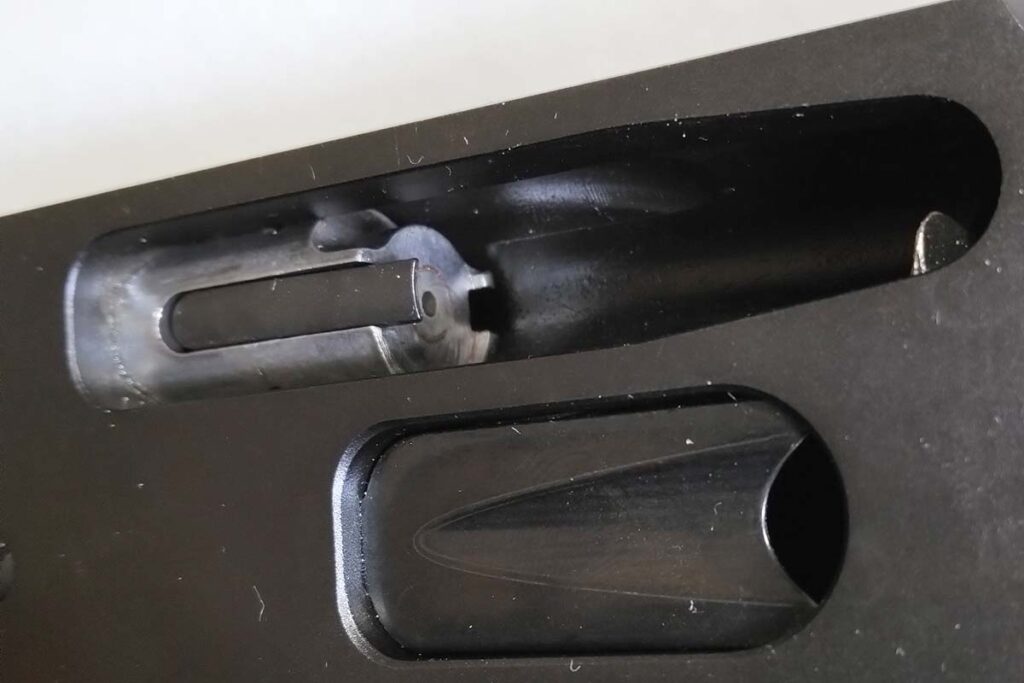
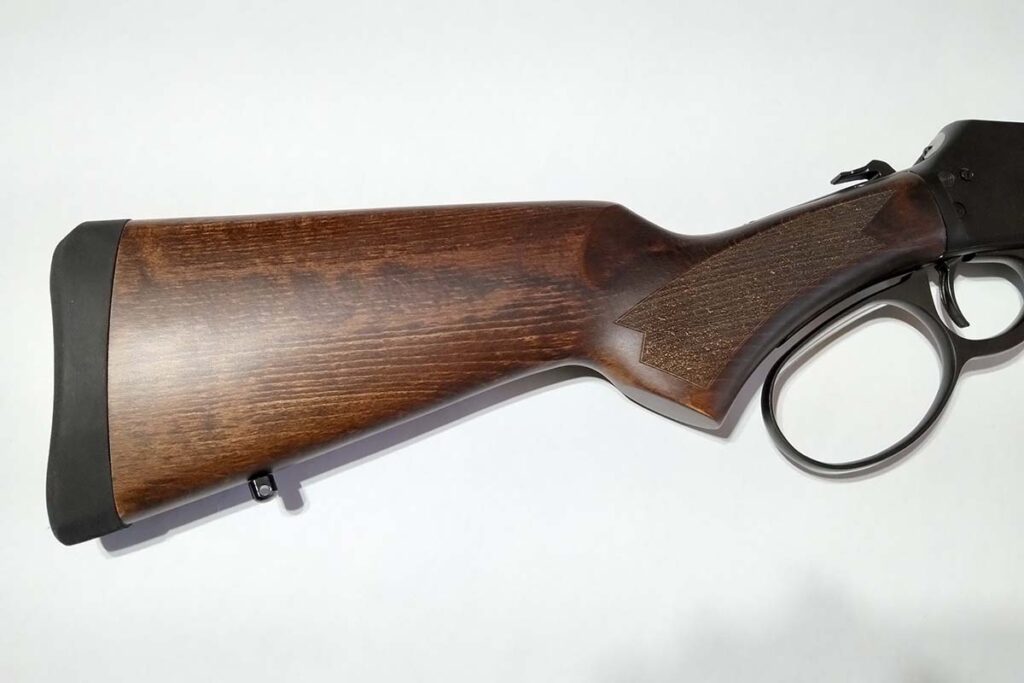
To the former point, and thankfully, Rossi utilizes a much better grade of wood in the R95—walnut—as compared to birch on the old rendition. Furthermore, the company textures the fore and grip to theoretically provide a better purchase on the gun, whereas the Rio Grande’s lumber was smooth as a newborn’s bottom. I intentionally throw in the word theoretically because I’m not completely sold on how the stock is textured. Pebbled, the pattern is very comfortable off the bench and in controlled environments but isn’t quite as aggressive as I’d want in a field gun. Especially anything likely to encounter inclement weather.
Nicely, Rossi has nixed the barrel bands on the R95. Some purest might grit their teeth at this move and I get the sentiment—it’s a clone, so why not stick with the pattern the gun is based on? Except, this move goes a long way in improving the overall aesthetics of the rifle, cleaning up its lines and giving the gun its own legs to stand on. Undoubtedly a small change, but one that caught my eye right out of the box and kept it fixed the entire time I tested it.
The plunger style passive safety, akin to what you’ll find in many striker-fired pistols.
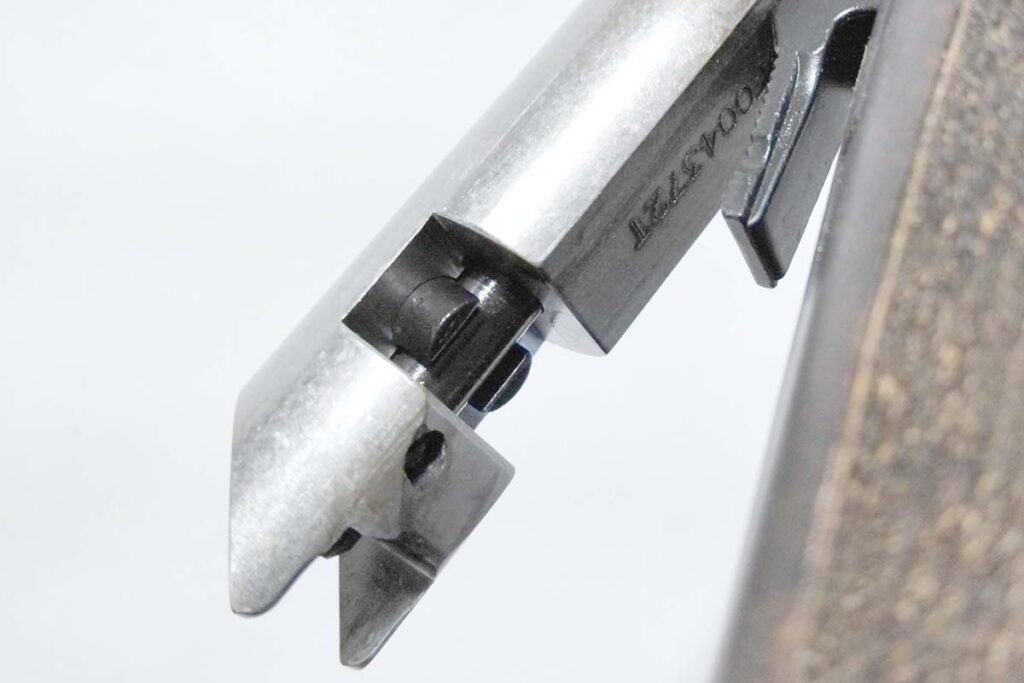
Intriguing as those changes are, the real meat of the R95 redesign—one might even venture to say upgrades—happen under the hood. In the bolt to be exact. The R95 uses a single-piece firing pin and a firing-pin block—similar to many striker-fired pistols—as its passive safety. Not that there were many complaints with the 336’s tilting-rear two-piece firing pin, but in theory, the Rossi system should offer a much more robust striking system.
Furthermore, the R95 boasts an AR-15 style extractor, compared to the stamped steel style of the Marlin. Both are equally stout ways to go about pulling brass, but I’d argue the Rossi system will win favor come disassembly. The stamped-steel extractor was never fun to pry off a bolt.
Other Notables
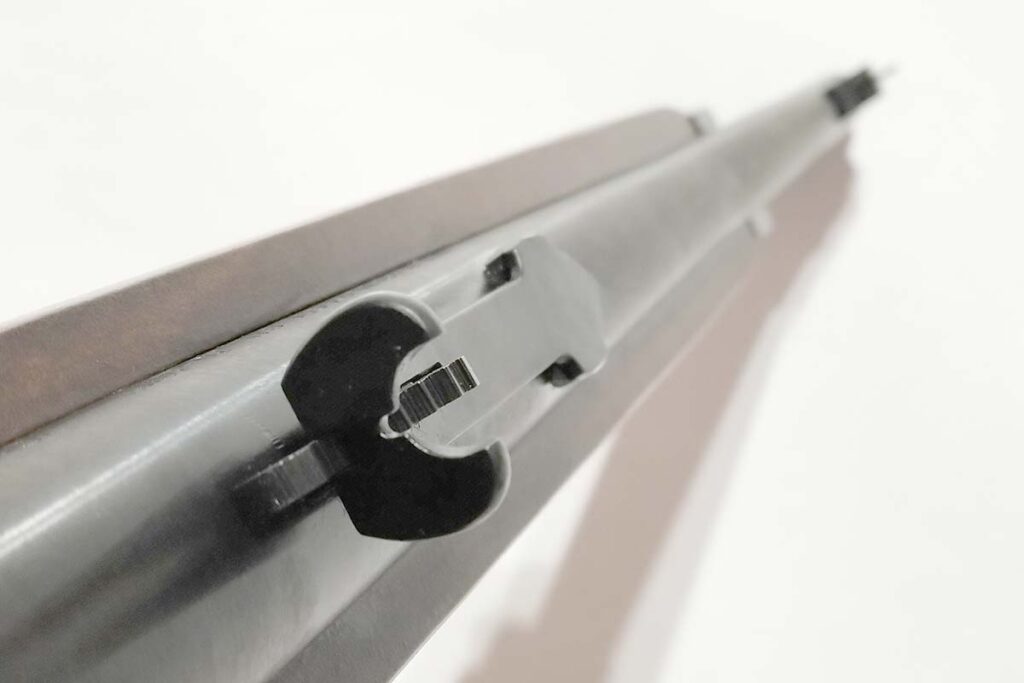
Adding better out-of-the-box effectiveness, Rossi opted for an elevation-adjustable buckhorn rear sight and driftable front sight on the new rifle. The inclusion of classic lever-action style sights should prove popular, given it improves the utility of the rifle offering both close- and mid-range aiming solutions. However, I would have appreciated factory-included indexing under the notch to better use the buckhorns. But at the price of the gun, it’s not a deal breaker.
Though, Rossi might have known what it was doing with more mid-tier sights. Given the R95 is a side ejector, it plays nice with optics, and like the gun it’s based off it will likely end up with an LPVO or 3×9 on its top side. Anticipating this, Rossi has drilled and tapped the receiver for the addition of your preferred optic.
Buckhorn sites are a nice touch to the R95, allowing fast acquisiton up close. But the rifle is drilled and tapped to accept a scope.
A few other of the R95 Trapper’s notables include a rich, black oxide finish that sets off the dark bands in the walnut. The large loop looks right in place on the Trapper model and is proportioned modestly enough to get the rifle running. The spring tension on the loading gate is perfect, allowing for fast topping off of the gun’s tubular magazine. And the trigger, well… aside from the blade being made from stamped steel, it tripped at a very consistent 3 pounds. Also, Rossi didn’t skimp with the recoil pad, which proved more than ample and very comfortable.
At The Range With The R95
As things go, I walked away fairly impressed with the R95 Trapper’s performance. Running 200 rounds through the Trapper—140-grain Hornady LeverEvolution and 150-grain Federal Power-Shok—on two range trips, the carbine proved accurate and extremely reliable.
I didn’t opt to mount an optic on the gun, wanting to give the buckhorn sights a run, given I feel there is a substantial segment of this market who will opt to stick with the factory sights. At 100 yards, shooting off a bench and sandbags, the notch proved plenty accurate as did the rifle, printing right around 1 MOA. The gun seemed to prefer Hornady, with the groups showing more consistency with LeverEvolution in the chamber.
As evident on the bolt, the rifle has an extractor very similar to an AR-15.
Switching to the buckhorns at 50 yards, the rifle was equally as intuitive and on target. Obviously, this method wasn’t as dead-nuts as using the notch and I used it from several shooting positions—offhand, kneeling, braced against a post. That’s OK—the system isn’t meant to produce cloverleaves. Instead, buckhorns facilitate fast target acquisition and transition and allow the shooter to let the reigns out on the gun.
I did and it responded. The action is as fast as your lever hand can make it and it runs smooth—butter-smooth, an attribute that makes it intuitive to keep the rifle on target for follow-up shots. This short configuration has the makings to conquer hog hunters’ hearts.
As I said earlier, it’d be nice to have an indexing mark on the buckhorn—this addition would greatly improve response time. But it’s still passible as is and shouldn’t dissuade anyone from the rifle. As for reliability, I didn’t encounter a single hang-up in my time with the gun, something I’ve read was an issue on some Rio Bravos. Incidentally, the R95 spit brass like no tomorrow and at an angle that spent cases should never end up molesting an optic.
Dressing It Up
A final note about the R95—though it wasn’t part of the test—there is ample opportunity to play dress up with the gun. Midwest Industries, Marlin Point Precision and several other accessory companies have furniture that can give the gun a much more tactical bent. Generally speaking, going this route is much less expensive than buying a geeked-out tactical lever-action off the rack. Not to mention, you can tailor it exactly to your wants and needs. So, if you can’t live without an apocalypse-ready lever-action rifle, the R95 is only a few upgrades away.
Parting Shot
While the R95 might not be anything new for Rossi, the gun steps the company’s game up in the class of rifles. Perhaps not as nostalgic as a Winchester lever-gun clone, the Brazilian 336 mimic is entirely more practical for a modern shooter. At the very least, you needn’t wrestle with a bizarre scope mount to add an optic.
Nice wood and a well-formed large loop, the R95 cuts the right profile.
Rossi not only offers the Trapper model, but also a 20-inch barreled rifle—which might just be the ticket for folks who encounter a bit longer shot in their hunting season. But I can’t help being enamored with the Trapper. For me, it has all the features to make it a superb little brush gun, whether you’re still hunting deer in dark timber or hogs along the back forty’s thickets. It’s right-sized in every way for these duties, especially price.
A complete guide to finding the best rimfire riflescope for your needs.
The biggest hurdle for new shooters interested in precision rimfire always seems to involve optics. There are turrets, and parallax, and complicated reticles and debates over minutes-of-angle (MOA) versus milliradians (MILs). Coming from a hunting background or another discipline like silhouette where you held the crosshairs on the target, a more complicated aiming system can feel overwhelming.
It does not help that “rimfire” plus “scope” just meant crappy for the longest time. The glass was inferior. The adjustments were spotty. Drop one or get it wet, and the scope was toast. Here’s the thing: You don’t need a “rimfire” scope for a “rimfire” rifle. Whether you need an optic for competition or hunting, most quality centerfire scopes will do the job, yet some are better suited for small-bore work than others.
Shooters define riflescopes by tube diameter. One inch is the classic and most common diameter and is still great for small-game rigs. 30mm is the new standard for tactical and match shooting. 34mm is the super-sized big brother and best-suited for extreme long-range work. There are now even 36mm beasts like the Zero Compromise optics and 40mm digital range-finding scopes like the Swarovski dS Gen II. The fatter the scope, the more room for elevation adjustment, thus the more you can spin that turret for a dead-on hold way downrange.
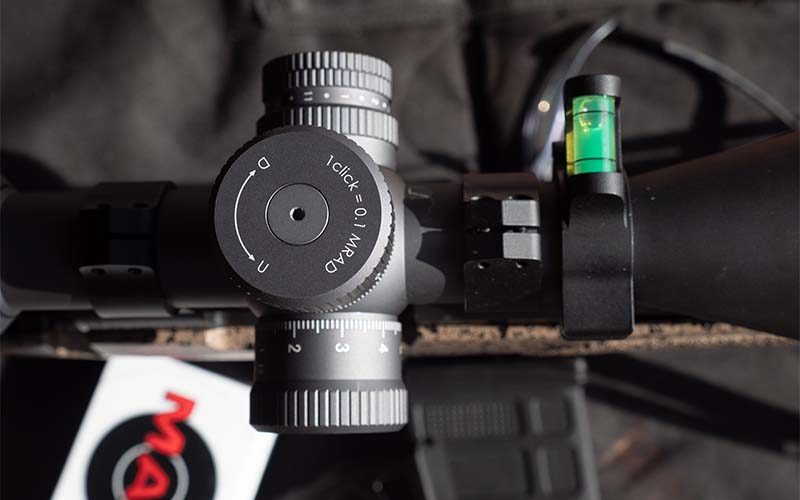
Consider this example. The 30mm Vortex Diamondback Tactical 6-24×50 FFP—a popular base-class NRL22 optic—has 19 MRAD or MILs max elevation adjustment. That means if you zero the scope at the bottommost point, you can compensate for 19 MILs of bullet drop. With match-speed .22 LR and the scope zeroed at 50 yards, that’s enough reach to connect to about 350 yards. The Vortex Strike Eagle 5-25×56 FFP with a 34mm tube brings 31 MILs of max elevation adjustment. That equates roughly to 470 yards of possibility. Keep in mind, this is theoretical as it’s difficult to zero scopes at their lowest elevation setting, and the equation changes with tapered rails and scope rings, as we’ll soon see. This example demonstrates the leap in max range one gets with a 34mm tube over 30mm. Compared to a classic 1-inch scope, the difference is planetary.
MOA Vs. MILs
You make riflescope elevation and windage adjustments in MOA or MILs. To make things confusing, MILs are often also abbreviated as MRAD. They are the same thing for practical purposes. MOA and MILs or MRAD are angular measurements over a given distance rather than a linear distance. With a linear measurement, an inch is an inch. With angular, the value changes based on distance. I visualize this like a laser beam shooting directly from my barrel’s bore through targets from 100 to 1,000 yards. If I change the degree of that beam to mark a spot 1 foot over the target at 100 yards, it’ll put the beam dozens of feet over the target at 1,000 yards. MOA and MILs are units that measure how much I’m moving that laser beam at the rifle to determine where it will hit at various targets downrange.
Are MILs or MOA turrets and reticles right for you? Use what you already know, but if you’re starting new, the author recommends MILs.
One MOA equals 1.047 inches at 100 yards and 10.47 inches at 1,000 yards—not 1 inch and 10 inches, as many wrongly believe. (This difference of 0.047 inch matters at distance, especially with rimfire where the elevation drops quickly.) One MIL equals 3.6 inches at 100 yards, which equates to 36 inches or 1 yard at 1,000 yards. Scope adjustments in MOA are usually 1/4 MOA per “click.” MILs are often .1 or .2 MILs per click or less. Some wrongly conclude that MOA has more subtle adjustment than MILs, but it’s a toss-up. A typical one-click adjustment in MOA is 0.25 inch at 100 yards, whereas MILs can go as low as 0.18 inch at 100.
You can convert an MOA value to MILs by dividing it by 3.43, a MIL to MOA by multiplying it by 3.43.
So, which is better?
Neither system is inherently better or worse. A shooter with experience who understands one approach over the other should stick with what they know. But new shooters, or shooters who want to dive down the long-range rabbit hole, should lean toward MILs. MILs are the standard measure for the U.S. Military and are used worldwide, unlike MOA that’s only used in a handful of civilian markets—and is rapidly going out of style. Reasons for that are multiple, but at its root, if you learn both systems, you’ll see that computing MILs quickly in your head is generally faster than MOA. MILs “click,” at least for me, in a way that MOA struggles, mainly because in MIL calculations, it’s possible a lot of times to move the decimal place.
To learn the precision shooting language of MILs, I strongly recommend Ryan Cleckner’s Long Range Shooting Handbook: The Complete Beginner’s Guide to Precision Rifle Shooting.
MILs is the language of most precision shooters. You’re more likely to talk shop and get help in MILs at a match than MOA. Also, when using ballistics programs to solve long-range shooting problems, MOA can create issues. Some optics manufacturers have incorrectly set MOA on their scopes for 1 inch at 100 yards instead of 1.047 inches. If your ballistics program is calculating based on 1 MOA equaling 1.047 inches, but your optic is adjusting 1 MOA equals 1 inch, you could miss the target.
Tricked out and ready to party. A precision rifle on the line at an NRL22X match in January 2020. Photo credit: Conx Media
That’s especially true in long-distance rimfire shooting, where you need to make significant scope adjustments at not-so-big distances. A 0.047-inch error can compound very quickly in .22 LR. It’s also a challenge to figure out if an MOA riflescope uses 1.047- or 1-inch adjustments. Nikon always used 1.047 for MOA, but Vortex uses 1 inch. If you go MOA over MILs in precision optics, you may have to call customer service to get the numbers straight. If, as I did, you shoot both Nikon and Vortex MOA optics, you need to make sure you change the MOA value in your ballistics program to get accurate results for each rifle system.
MILs, being universal, avoid all this rigmarole.
With scope size determined and the MOA versus MILs argument decided, there are five factors to consider when settling on a precision rimfire riflescope: parallax, focal plane, reticle design, turrets and magnification power. Let’s look at them:
Adjustable Parallax
If you’ve ever seen the reticle (crosshairs) of your scope float or come in and out of focus while on target, you’ve probably noticed the phenomenon of parallax. The reticle and the target are no longer on the same focal plane within the scope’s main tube. The difference between focal planes becomes exaggerated at extremely close and far target distances—decreasing accuracy and obscuring the reticle. Some scopes allow you to manually adjust for this and bring everything into focus at specified target distances, while others have fixed parallax at a specific range.
Most centerfire scopes with fixed parallax are factory-focused, around 150 to 175 yards—too far for typical rimfire applications. Manufacturers set fixed parallax rimfire riflescopes at 50 or 60 yards, which can work fine for small game hunting but make 20- or 25-yard shots—standard in many small-bore sports—a blurry mess. For any precision small-bore match scope and most hunting scenarios, I recommend an adjustable parallax down to at least 25 yards.
Most tactical-inspired and long-range centerfire scopes have a side knob for parallax adjustment, sometimes called “side focus.” Bench shooting target scopes often have the parallax control built into the objective bell, called “Adjustable Objective” or AO. Side controls are easier to run when jumping between near and far targets within the same shot string in a match. AO controls work fine when you have plenty of time. For match shooting, I highly recommend adjustable parallax via a side focus knob.
Focal Plane
There are two locations within the tube where makers install the reticle. If the reticle goes in toward the objective lens (the front of the tube), that’s called first focal plane (FFP). If it goes in near the ocular lens or the back of the tube, that’s called second focal plane (SFP). When dialing up the magnification on a FFP scope, the reticle will grow larger. In SFP scopes, the reticle will appear the same size no matter the magnification. There are pros and cons to each.
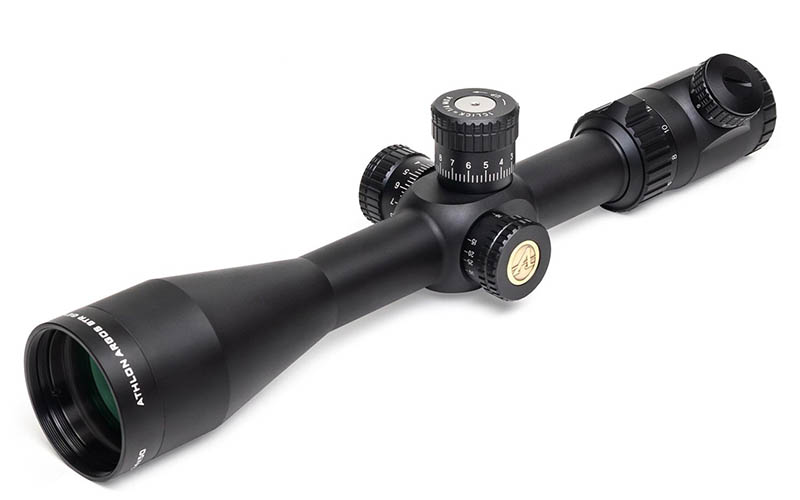
The Athlon Argos BTR is a first focal plane (FFP) optic.
Many long-range shooters and hunters have migrated to FFP scopes because reticle holdover values don’t change with the scope power. In other words, if every hash mark along the vertical stadia (the main crosshair line) represents 1 MOA at the lowest power, they still equal 1 MOA at the highest magnification. The second hash under the central crosshair equals 1 MOA drop at 4x power and 16x power. FFP scopes are a significant advantage in some precision matches where single-stage targets may be from 20 to 100 yards or beyond, and the shooter must change scope magnification and holdover within the shot string.
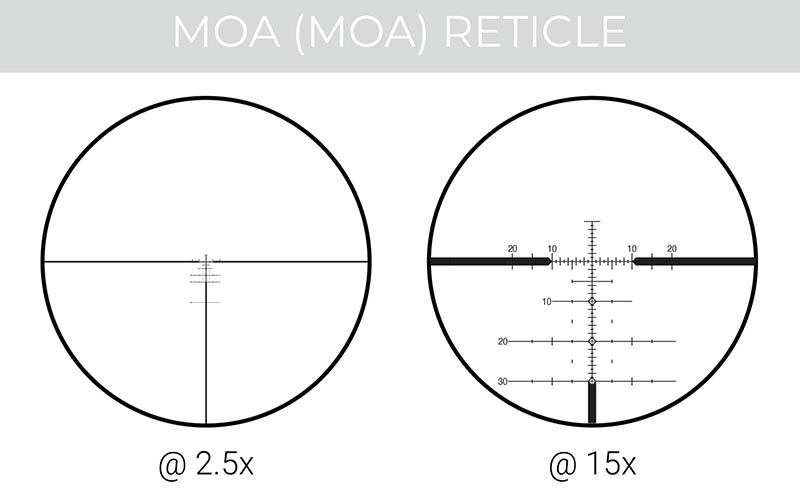
An FFP optic’s drawback is that the reticle can be small and hard to see at the power range’s low end. In my NRL22 matches, many older shooters struggle to see the FFP reticles when turned down to 4x and 6x or even 8x. FFP systems are not for older eyes. Hard-to-see reticles also don’t work well while hunting, where you might have to tease out a squirrel head in a tangle of branches and leaves. Fat, clear, stadia work much better.
A Maven MOA reticle in an FFP scope, as seen at 2.5x and 15x. Note the size difference.
Second focal plane scopes work well in these situations, and old or bad eyes can usually find the mark quickly. The classic duplex reticle draws the eye to the center and makes for high-speed target acquisition. SFP scopes also tend to be less expensive than FFPs, but the former can cause trouble when you use the reticles for drop compensation.
Several years ago, I was on a pronghorn hunt in Wyoming. I had a .25-06 with me and tagged out on the first morning. A friend had long wanted a .25-06, and as we talked about it, I suggested he borrow my rifle to get his goat. Taped to the stock’s side was the bullet drop for that SFP reticle when at the full 16x power. My friend came back after that first day discouraged. He had missed a shot at 400 yards—sailing the bullet over the old buck’s back. The animal was grazing broadside. He had a steady rest and decades of Western hunting experience that made this shot—he thought—a layup. He had used my DOPE chart on the side of the stock, and when he shot, the scope was at 14x. At that magnification power, my chart was worthless. That’s a rare situation, but it goes to show how “off” a reticle can be within an SFP scope if you don’t pay careful attention to magnification. In the more likely event of moving fast through a competition stage, running different targets at different scope powers could be a real liability.
Reticle Design
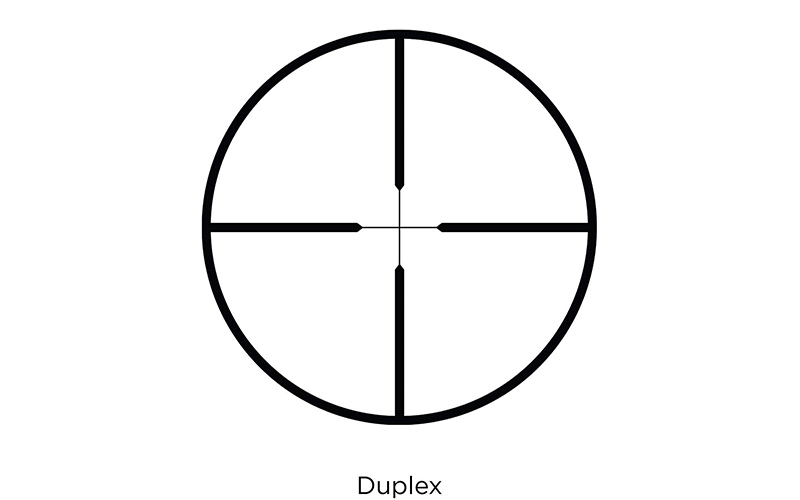
In the last few years, no part of the riflescope has been designed and redesigned more than the reticle or aiming point. For hunting with laser-flat .17 caliber, it’s hard to beat a simple duplex crosshair. Developed in the 1960s by Leupold, the duplex uses four heavy crosshair lines that taper down to fine lines where they meet in the center. This design makes placing the crosshairs on a target fast, and it always provides a clean sight picture.
A classic duplex reticle.
When shooting slow rimfire loads like .22 LR, bullet drop is more of an issue. For hunting work, .22 LR Ballistic Drop Compensating (BDC) reticles, like those in the now-discontinued Nikon Prostaff Rimfire series, can work very well. Tract Optics and Hawke Optics have picked up the slack, producing dedicated rimfire BDC scopes that are not junk like many “rimfire” scopes. BDC optics have reticles with hash marks tuned to either standard-velocity .22 LR, high-velocity .22 LR, or .17 HMR, indicating where the bullet will impact at longer ranges. It takes some trial and error to figure exactly where the hash marks and downrange impacts line up, but once you figure it out, it’s a fast and elegant solution for a hunting or plinking rifle.
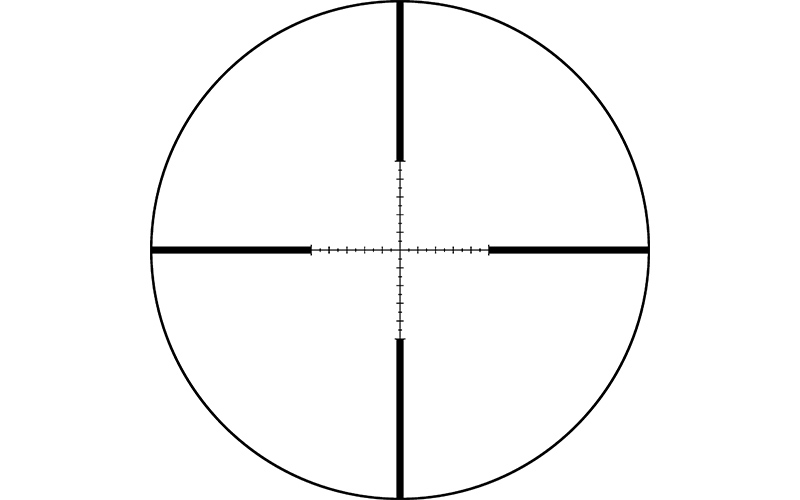
A clean duplex-style reticle with MOA hash marks.
Competition reticles can quickly become complicated. Rather than hash marks indicating likely holdovers by caliber, each line may represent a certain number of MOA or MILs. The sub-tensions or white space between the hashes all have a set value, too. The finer these marks are, the more precise the measurement, theoretically. But too many marks can quickly clutter the sight picture, particularly for a shooter who has spent their life using a duplex. That is especially the case with FFP scopes on low magnification, where a complicated reticle can look like smudged ink. But, when lying prone 100 yards or more from your target with match .22 LR ammo that drops like a brick, all those hash marks become very handy.
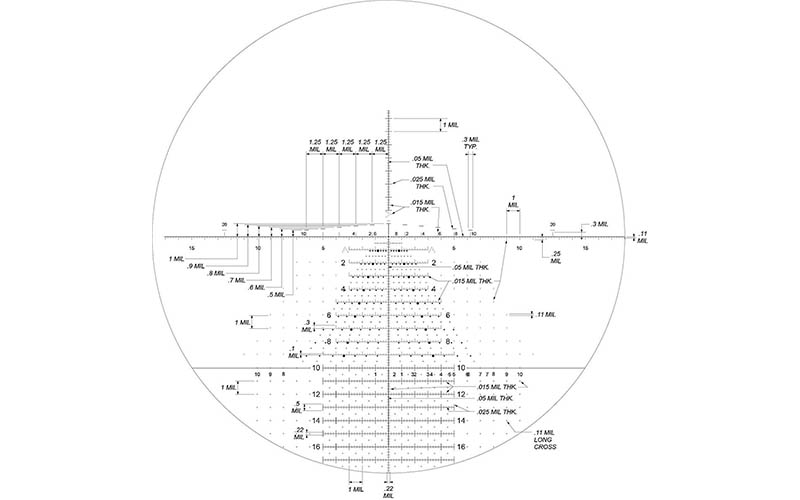
The tech specs on a Nightforce Tremor3 reticle.
Different optics companies run various reticles, but there are a few standards. The Horus H59 started a revolution of “Christmas tree-style” reticles and quickly became the standard for many elite marksmen. Below the centerline is a grid laid out in 0.2-MIL increments that make for exact drop calculations and fast follow-up shots. It’s clear to see where the first shot landed, then hold that spot in the reticle for the second shot. At first blush, a system like the H59 and the many similar reticles it spawned can look like a complex geometry problem but spend some time with them on the range, and it comes together quickly. Like understanding MILs, these reticles make good sense with a little time spent behind the trigger.
Turrets
For the most part, there are two kinds of turrets available on riflescopes. You can get either exposed turrets, which allow for manual adjustments in the field, or capped turrets usually adjusted once when zeroing a rifle, then left alone. Most precision shooters use adjustable turrets, which allow you to dial-in precision shots for a given range.
For a .22 LR with a 50-yard zero, the crosshair center is still an accurate hold from 20 to 60 yards or more, depending on ammo velocity. Push out beyond 60 or 70 yards, and the shooter has a decision to make: Use the hash marks on the reticle to hold over the target, or spin up the turret and hold the center. In a PRS-style rimfire match, if the stage involves shooting a close target, at say 30 yards, then jumping to a 100-yard plate, most shooters use the reticle. If target distances are fixed at 65 yards or more, dialing the turrets is a more elegant solution. However, for extended-distance rimfire shooting, like the developing sport of Extreme Long Range rimfire—or when clipping varmints across the plains—adjustable turrets are necessary.
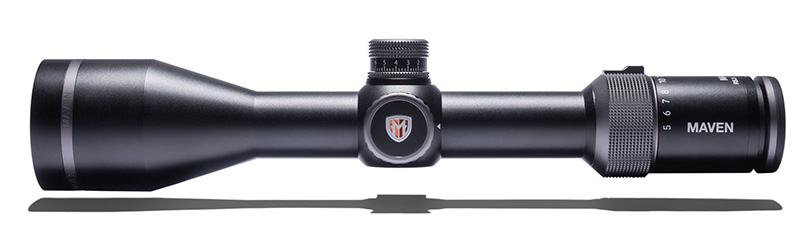
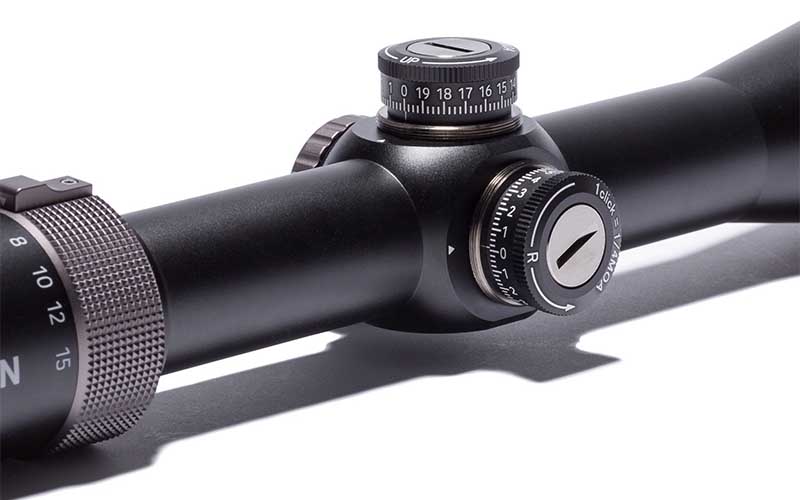
The stock turrets on the Maven scope.
I’m partial to turrets that lock. To spin them, you pull up on the turret, which lets it click free. Push the turret down, and it won’t move on you. Many less expensive tactical scopes don’t have locking turrets, which strikes me as a risk while afield.
When you’re in the woods chasing squirrels or rabbits, all turrets tend to just get in the way. Most of the shots taken at small game are inside 60 yards, anyway. I’ve played with optics with complicated reticles and turrets on hunting rifles and have migrated away from them. Duplex reticles and capped adjustments work for me in the hunting woods, complicated reticles and big locking turrets for competition rigs.
Magnification Power
Magnification is useful, and it’s the first thing many people consider when buying optics, but it’s probably the least important feature when hunting or competing in a rimfire match. Sure, when shooting from a rock-solid rest at a tiny target 1,000 yards away, 35x magnification is handy, but in most cases, that’s not the situation.
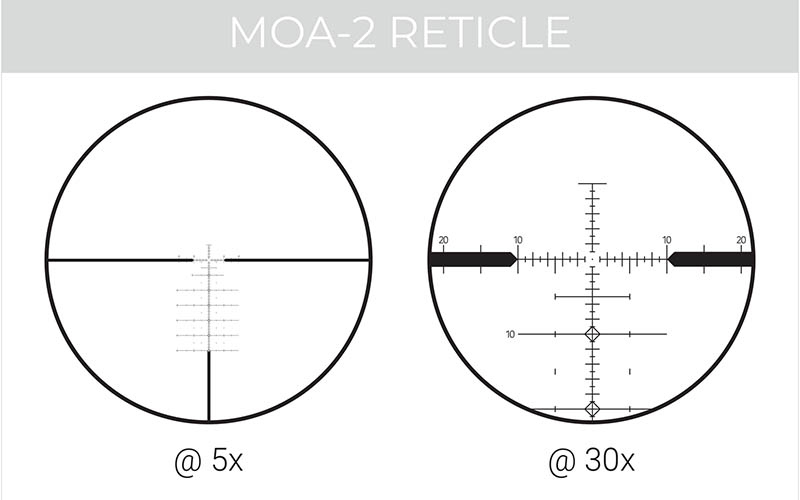
A Maven FFP at 5x and 30x.
Match shooting like in NRL or PRS is often done from compromised and unsteady shooting positions at reasonable-for-caliber distances. The targets are rarely less than 1 MOA in size. Significant magnification can amplify wobbles and shakes and hurt the shot from unsteady rests. Unless you’re going long on a varmint or ground squirrel hunt, magnification is even less critical when hunting small game. It’s hard to beat 3-9x or 4-16x for a hunting setup. One of the killing-est bushy tail hunters I know spent most of his career behind a fixed 4x scope. Many run larger scopes with power ranges from 4x to 5x on the low end to 25x or 35x on the high end for match shooting. But all those shooters will tell you most of the time they live in the middle band of that power range. A superior-quality scope with less power than you think you need is often a better call than a lower-quality scope with a massive high-end zoom.
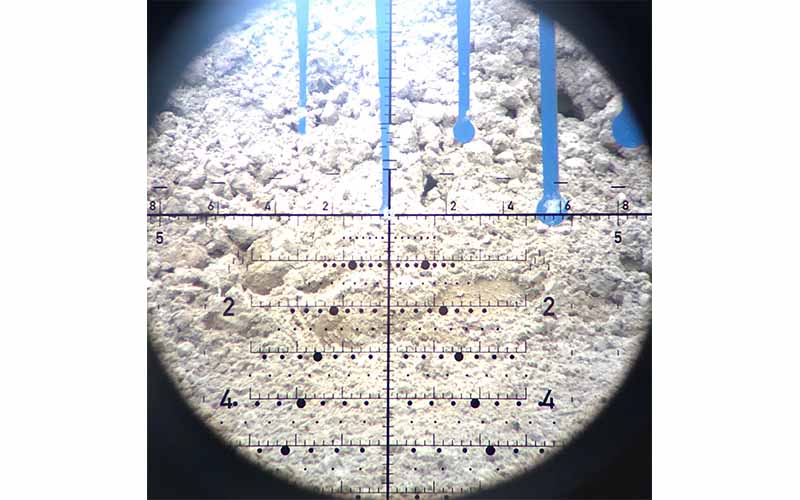
A know-your-limits rack at 50 yards as seen through a Nightforce. Photo: Greg Hamilton.
Recommended Rimfire Riflescopes
What is the best optic for your rifle? That’s a hard question to answer and highly dependent on your end-use. As mentioned, I prefer MILs over MOA. I like 1-inch optics without turrets for hunting rimfires because they’re lighter and look better on a sporter rifle. For varmint hunting and traditional 100-yard NRL22 competition, I lean toward 30mm optics with locking turrets for the added adjustment and security in rough and tumble stages. For ELR, I like 34mm. Considering these features, I then look at the price. As a general rule, I want the MSRP of the riflescope to match or exceed the MSRP of the rifle. In many shooting situations, especially NRL22, the optic is more important than the gun. Repeat: The optic is more important than the gun. That’s because even low-end factory rifles have enough raw accuracy to be competitive at NRL22—or snipe a squirrel at 100 yards—but you cannot say the same about low-end optics.
Dialing elevation with turrets is easy and more accurate for most shooters than using a reticle. Photo credit: Mike Semanoff
Some optic manufacturers are ahead of others when it comes to precision. Look at the gear survey from the 2020 NRL22 National Match, and you’ll get an idea of who is leading the charge. Of the 68 shooters surveyed, 30 chose Vortex, 11 Athlon and 9 ran Nightforce. If you consider high-end optics (read: expensive), you could add Kahles, US Optics, Zero Compromise, and Trijicon, to that Nightforce in a “money is no object” class of the best riflescopes.
What follows is a roundup of some of the better general interest match and hunting optics, whatever the budget. I’ve personally shot all these on rimfire rifles and will vouch for them. Optics makers introduce new scopes every year that push the performance level, so this list is by no means exclusive. There are some great scopes not included here. A savvy buyer looking for a competition optic will track what the pros are using in their shooting discipline of choice, such as through the posted National Rifle League gear surveys. You can also follow the very excellent Precision Rifle Blog or track the various benchrest or other shooting organizations in which they compete—most publish extensive winning gear lists.
A quick look at .22-15-60 Stevens, nothing but a blip on the radar in the world of cartridges.
One of a number of cartridges for the Stevens 44 or 44½ series of single-shot rifles, this cartridge was introduced by Stevens in 1896. Actual design is credited to Charles H. Herrick, of Winchester, Massachusetts. It did not enjoy a particularly long life, as most shooters preferred the .25-21 or some of the larger-caliber cartridges. Many shooters claimed the .22-15 Stevens gave better accuracy than the .22 WCF.
This is an excerpt from Cartridge’s Of The World, available now at GunDigestStore.com.
General Comments
This is an improved centerfire .22 of better killing power than other .22s of its day. With the heavy 60-grain bullet, it would shoot flat for 125 yards or so. As a target or match cartridge, most of the blackpowder .22s fouled the bore badly and required frequent cleaning. Most shooters preferred the larger calibers of .25 on up.
*Estimated
The .22-15-60 was displaced by the .22 WCF and smokeless powder developments in the rimfire group. Original primer was the 1½ size, the same as the modern small rifle or pistol primer of .175-inch diameter. Charge was 15 grains of FFFFg or FFFg. Lyman No. 22636 or 22637 in 54- to 60-grain weight is the proper bullet. Therefore, if you should have one of these old rifles in shooting condition, you can still shoot it—if you can find cases.
Some tips on how to find big success when reloading cartridges with small projectiles.
The processes involved in reloading a centerfire rifle cartridge don’t vary drastically when comparing case and bore size, but there definitely seem to be some idiosyncrasies involved with the smaller cartridges. Perhaps it’s the accuracy expectations of a small-bore cartridge, or the game species that are hunted with those smaller cartridges, which have us looking for one-hole groups … or at least tiny little clover leaf groups.
In my experience, the moderate velocity big-bore cartridges can often be more forgiving than the speedier small-bores, or perhaps I should say I’ve often been able to reach the goal line faster with a big-bore cartridge. Along the line, I’ve had some trials and tribulations with the smaller cartridges, and depending on the application for your reloading needs, there are some ideas and techniques that might save you some time.
Learning The Hard Way
I started the small-bore journey by loading for the .223 Remington and .22-250 Remington, in a couple of rifles that gave me fits. My dad had purchased a Ruger Mini-14, which, no matter what we fed it, was a 2-inch rifle. We tried multiple factory loads and then began to handload for the clunker. I thought I didn’t know what I was doing, until we tried the handloads in a buddy’s bolt rifle and saw ½-MOA groups; the strict regimen was working, but the rifle didn’t read the script.
The Sierra 53-grain flat base MatchKing that saved the author’s Ruger .22-250 Remington; it remains his go-to bullet for that rifle. Photo: Massaro Media Group.
My next experience was with a Ruger Model 77 MKII in .22-250, with a sporter-weight barrel, that I purchased for hunting coyotes, fox and woodchucks. No matter what I tried, I couldn’t get the gun below an inch, often with a flier. Some shooting buddies who had heavy-barreled Remington 700s with finely tuned triggers were routinely printing ¼-MOA groups, and they were kind enough to share their load data.
No dice in my rifle.
What it took was a change of projectile and a new trigger—those mid-1990s Rugers had a non-adjustable trigger that broke at about 6 pounds, and my rifle has a crown that much prefers the flat-base Sierra MatchKing bullet. A Timney trigger and a 53-grain MatchKing, plus an appropriate charge of Hodgdon’s H380, saw the rifle finally print ½-MOA groups.
Both those rifles had issues, but they taught me some lessons that came in handy later in life. Because I couldn’t get them to print, I started to examine each and every detail of the equation, from the components and their consistencies to the fine-tuning of the cases and the methods of assembly. Small-bore cartridges—especially those which generate higher velocities—can magnify any errors or deviations, and the target board can reflect that. So, I learned some tricks and tips to obtain the best results with these little guys.
The .223 Remington can be a very forgiving cartridge to load, able to use a wide array of powders. Photo: Massaro Media Group.
Small Projectiles, Small Details
Velocity comes at the price of pressure, and consistent pressures can equate to consistent velocities, and correlative precision. If your cases are of differing volumes, the same powder charge will generate a slightly different pressure level, so trying to keep things as uniform as possible will best keep velocities even.
If you’re after the finest precision, weighing your cases after trimming and resizing can indicate which cases have slightly thicker walls; the outside dimensions being the same, a case with thicker walls will be heavier and have a smaller combustion chamber. For best precision and consistency, sort your cases into lots, using the most uniform for the best match-grade accuracy.
Primer choice can make a big difference in small-bore loads, and I’ve long felt this class of cartridge is more susceptible to differences in primer heat. If you like the .220 Swift or .22-250 Remington, any large rifle primer will get things to go bang, but I like a match-grade primer like the Federal Gold Medal Match GM210M. That primer has given such excellent performance across the board that I generally reach for that first to save me time and effort.
The same can be said for the small rifle primers, where the Federal GM205M Gold Medal Match offers the same consistency for the smaller cases, though I’ve had good results with the CCI 400 or the CCI BR-4 Bench Rest primers. In the end, whichever primer gives the lowest velocity spread is usually the one that gets the nod from me. The point: Simply switching a brand or type of primer has made all the difference in some rifles.
Powder choice is also highly important, as it has made an absolute world of difference in some cartridges. Where I can feed my .375 H&H Magnum just about any powder, from IMR 3031 to H4350, some of these little cases are very particular about the powders they like. My .22-250 shows a marked preference for Hodgdon’s H380, and the 17 Hornet likes Hodgdon’s CFE BLK and Accurate LT-30.
The diminutive .17 Hornet has very little case capacity; powder charges should be weighed in order to achieve safe, accurate handloads. Photo: Massaro Media Group.
On the other side of the spectrum, the .223 Remington is one of those cases that seems to be more forgiving. I’ve used H335 and BL-C(2) with great effect, and a couple of Shooters World powders—the AR Plus and Tactical Rifle—have been excellent performers, with the latter giving very tight and consistent groups.
Case preparation can also help tighten up groups; I like to full-length resize in most instances, and I also feel that a uniform flash hole can make a real difference. When it comes to the highly frangible varmint bullets, or those match bullets that stake their reputations on highly concentric jackets, a poor chamfer on a case mouth can scratch and sometimes deform a bullet to the point where the ballistic coefficient will change, and long-range accuracy will degrade.
A good VLD chamfer tool, like Redding’s piloted P15 chamfer tool—which uses the cartridge’s flash hole to keep the chamfer as concentric as possible—will allow for easier seating of your projectile and minimize any damage to the jackets.
Lastly, I feel small-bore cartridges warrant the weighing of every powder charge, especially when it comes to the smaller cases like the .17 Hornet and .22 Hornet. With minimal case capacity, an overcharge of 0.2 or 0.3 grain can push pressures into the red, so err on the side of caution and weigh each charge—it’ll also give the best accuracy and consistency in your handloads.
Editor’s Note: This article originally appeared in the January 2024 issue of Gun Digest the Magazine.
Which is better for sharpening your handgun skills, steel or paper targets?
When shooting a handgun, steel targets are the most fun to shoot. This is because they provide immediate audible feedback. And, depending on the target, they can also provide immediate visual feedback when the target moves. Another appealing feature of steel targets is that you don’t have to go downrange and paste up your bullet holes. Sure, you might want to paint them every now and again, but even that’s not mandatory. Steel targets are just easy to use and fun to shoot at. But are they the best target for training with a defensive handgun?
Yes and no. To conduct the best defensive handgun training, you need a variety of targets, some made of steel and some made of paper, and there are several reasons for this.
When you need to make precise shots in certain areas of the target, paper is often better than steel.
Basic Marksmanship Training
When you’re first learning to shoot a handgun, you’re primarily working to master sight alignment and trigger control. To do this, you need to know exactly where every bullet you shoot lands so that you can evaluate the influence your sight picture, trigger press, grip and every other element of marksmanship had on every shot. This is how you learn if you’re doing the right and the wrong things when you’re shooting.
For this type training, ideally, you’ll want a paper or cardboard target large enough that none of your shots miss the target and are lost. If you’re shooting at a small steel target, you’ll get that satisfaction of a hit. But if you miss the target, you won’t know where your miss went, and this makes determining your mistake difficult. Sure, you could use a large steel target but when shooting steel, it’s not as easy to see the exact points of impact.
Four hits and a miss. If this had been a 10-inch steel target you wouldn’t have known where your miss landed.
Dynamic Drills
There are all sorts of dynamic drills that can be conducted with a defensive handgun. With dynamic drills, I’m talking about drills where you’re incorporating things like drawing from the holster, movement, reloading and multiple targets into the drill. For these types of drills, marksmanship matters, but in many cases, your focus is on gun handling—drawing the handgun, safely handling the handgun while moving, reloading and transitioning between targets.
I consider this type of shooting as advanced shooting, and it should only be conducted once you have a decent mastery of the basic marksmanship skills. In other words, you should be able to reliably hit what you’re shooting at before you embark on this type of training. For this type of work, pinpoint precision is not as important, and steel targets work exceptionally well. This is partly because of their immediate feedback, but also partly because you don’t have to stop your shooting, lose focus and paste your targets.
When first starting dynamic shooting, a steel torso target like this is great. It will let you know you’re getting your hits and allow more concentration on the other aspects of the drill.
Tactical Drills
Tactically focused shooting is the logical next step once you’ve developed proficiency with basic marksmanship and dynamic shooting. Tactical drills should incorporate decision making, the use of cover and concealment and situational management. Tactical drills should also sometimes incorporate specific shot placement, because knowing where to shoot an attacker is a tactical consideration. For this type of training, I think both steel and paper can be effectively used for targets.
In fact, it might be best to start tactical training with steel targets so that you can focus more on what you’re doing than on how well you’re shooting. This is where a torso-shaped steel target can be beneficial. As your working through the problems, you know you’re getting your hits because of the audible feedback. The hits might not be great, but they’re hits. Once you become comfortable with the tactical elements of the drill, it’s a good idea to replace the steel targets with lifelike paper targets so that you can now concentrate on the tactics and on putting your bullets where they need to go.
Advanced Marksmanship Drills
As your shooting skills develop even more, you’ll begin to be able to call your shots. I’m talking about when the trigger breaks you should be able to reliably predict where the shot will land. Experience teaches this with evaluation of the sight picture and the trigger press when the shot was fired. Once your shooting is at this level, having a paper target to evaluate your shooting is not as important anymore, and using steel speeds up the training process with less time looking at the target and pasting holes.
A steel plate rack can be a good training tool, but only after you have developed your basic marksmanship skills.
For example, I often shoot at an 8-inch steel plate from extended distances. Because of experience, when I miss, I most often know that I pulled the shot low, high, right or left. If I was shooting at paper, the holes would provide the same information, but I’d have to walk down range too see if I hit or missed, and this would interrupt my training and focus. The problem with shooting at steel in instances like this is when you’re missing more than you’re hitting, and you don’t know where your misses are going.
Another example of an advanced marksmanship drill is one that includes dynamic action, like when shooting at a plate rack. Sure, you could line up six paper targets and shoot them very fast just as you would a steel plate rack. The problem is you’ll not know if you hit every paper plate until the drill is over and you go down range to score. With a steel plate rack, you get the feedback as you go so that you can make up missed shots.
Which Is Best?
I believe steel and paper targets are great for defensive handgun training. Both have their strengths and weaknesses. If you’re running a drill and you want to know whether steel or paper is the best target to use, here’s one way to decide. Run the drill two or three times on either steel or paper. If you’re not getting your hits in the desired area at least 80 to 85 percent of the time, you should probably be using a paper target so that you can see where your misses are going and potentially evaluate what you’re doing wrong. Also, and this is good to know, with most steel targets, you do not want to shoot at them closer than about 10 yards.
Editor’s Note: This article originally appeared in the September 2023 issue of Gun Digest the Magazine.
Reloading a handgun is a basic skill, but there’s more than one way to do it. Here, the author discusses a practical variation of the tactical reload.
Reloading a defensive handgun is a basic skill. It’s something every defensive handgun training course should spend a good bit of time teaching and something everyone who carries a defensive handgun should spend time practicing. Most doctrine separates reloading into three techniques: the administrative reload, the tactical reload and the speed reload. Although all three serve the same purpose of keeping your pistol full of ammunition, they all have different applications.
I’ve detailed these techniques here before, but to refresh, the administrative reload is a range reload that’s conducted at leisure, and the speed reload is done when your handgun is out of ammo and you need more ammo in it immediately. The tactical reload is something between an administrative and speed reload, and its conduct and proper application is one of the most misunderstood concepts of defensive handgun management.
Hurry, Just A Little Bit
A tactical reload should be conducted when you have time … but when there are also tactical considerations remaining. It’s suggested that you conduct a tactical reload during a lull in the gun fight or action. I’m not sure how to precisely define “a lull in the action,” but I am sure that the more ammunition you have in your gun the better off you are, and that you should never holster a handgun that’s not fully loaded. Those two considerations are what drives the conduct and need of a tactical reload.
At the basic level, with a tactical reload you retain the magazine you’re ejecting from the pistol because it’s not empty and you might need it later, or because you’re in a situation where you might need the ejected empty magazine later on so that you can load it with more ammunition.
Most trainers teach the conduct of a tactical reload as follows:
Bring your pistol into your workspace while retrieving a fully loaded magazine with your support hand, holding it in your palm and between your index and middle finger.
As you eject the partially expended or empty magazine, grab it between the thumb and index finger of your support hand.
While holding both magazines, insert the fresh magazine into the pistol.
Store the ejected magazine in a pocket, or if it’s the only extra magazine you have, put it your magazine pouch.
This is not a timed activity, but it’s one you should be able to conduct smoothly and with minimal focus, while keeping at least some of your attention on your surroundings. Those talented at conducting a tactical reload can accomplish the task with graceful fluidity in about 5 seconds.
My main problem with the above method is that you must manage two magazines with one hand at the same time. Granted, you’re not supposed to be doing this with blistering speed or while you’re being shot at, but there’s still a reasonable possibility that you’ll drop one—or both—of the magazines. That’s not a good thing, and I think it makes just as much sense to conduct a tactical reload as follows:
Bring the pistol into your workspace.
Eject the partially expended or empty magazine into your support hand and store it in your pocket.
Retrieve a fully loaded magazine and insert it into your pistol.
If you still have time and the partially expended magazine is your only other magazine, move it to your magazine pouch.
Though speed is not a principal concern, this second method can be conducted just as swiftly, and it limits the possibility of dropping the partially expended magazine, or more importantly, the fully loaded magazine. Admittedly, the second method leaves your pistol unloaded for a second or so longer. But remember, you should only be conducting a tactical reload when time is not a priority, such as when there’s no immediate threat or when you’ve solved the problem and are holstering your handgun.
If time is of any concern, conduct a speed reload.
Don’t Drop It!
Outside of tactical considerations, the tactical reload can and should be frequently used on the range during practice or training sessions, too. Why? Well, the worst thing you can do with a pistol magazine is drop it on the ground where the feed lips might become bent, or where it can be gobbed off with dirt, debris or mud. Yes, when practicing a speed reload, your ejected magazine goes to the ground, but the most common reason for stoppages in pistols is magazine related. There’s no reason to risk damage unnecessarily.
I’m not suggesting you replace the practice of a speed reload with a tactical reload. What I am suggesting is that if you’ve finished a drill and have depleted your magazine to the point you cannot run the next drill, if you conduct a tactical reload—especially if you use the second method described above—you’ll circumvent the possibility of a magazine being damaged or fouled because it was dropped either intentionally or accidentally.
Hopefully, you’ll never be in a dangerous situation where you need to conduct a reload of any type. And, hopefully, if you do need to reload your pistol in conjunction with some sort of dangerous situation, you’ll have the time and cover necessary to allow for you to do it tactically. Pick either tactical reload method described here, the one you like the best and feel is the most practical, and practice it. It might save you from fumbling when you can’t afford to drop the ball.
Editor’s Note: This article originally appeared in the January 2024 issue of Gun Digest the Magazine.
Need to move an old gun? We give you the tips and tricks to getting it sold on GunBroker.com.
Selling a gun—even one that doesn’t get your attention like it once did—is always a difficult deal. Aside from the money, the only positive in cashing in a piece of your steel 401K is it makes more room in your safe for more guns.
Finding yourself at this point, however, generally places a big question mark in your path: Exactly how should you sell your firearm? There is no shortage of avenues—some good, some not so good. But among the most established and well-known options at your disposal is GunBroker.com. Likely, if you’ve ever done some online window shopping, you’ve tripped upon the site and its vast array of guns.
In this article, we’re going to break down exactly what GunBroker.com is, how you can use it to move an old iron that doesn’t get shot the way it once did and some tips to get the best possible price for your merchandise. Ready to sell? Then let’s go!
What Is GunBroker.com?
Despite what your local anti-gunner or pearl-clutching politician might say, the website isn’t some unregulated gun bazaar or super-secret dark web denizen. Debunking their calculated hyperbolism, buying and selling firearms online is 100 percent legal, even for you—the average non-FFL American citizen. Yes, there is an FFL involved in online transactions, but you needn’t be Federally licensed to take part in the bustling online marketplace.
If you can think up the firearm, GunBroker.com most likely has a seller looking to move theirs.
Now that’s cleared up, let’s focus on GunBroker.com properly, because there are some wrinkles with how the website works. While it’s loaded with firearms of every stripe, it is not itself a gun retailer. Nor is it an FFL. Instead, as alluded to a moment ago, it is a marketplace—simply a middleman connecting those who have guns to sell with those who have money to buy guns. Pretty simple.
This may raise the question, what does GunBroker.com get out of the whole deal? Like any business concern, it’s in it for the money, which it makes on transaction fees (we’ll touch more on this in a moment). After all, connecting you with someone willing to buy your gun is worth a little something—particularly if you live in Puckerbrush, Nev., and the buyer resides down in Bucksnort, Tenn.
Understand GunBroker.com’s Fee Structure
Since we touched upon it, one of the first things worth considering when planning to sell a gun on GunBroker.com is exactly what you’ll end up paying the site. The good news is joining the site and simply posting a gun for sale costs you nothing, the fees are only assessed after the sale is made. Outside of some particulars—we’ll touch on those below—the costs are fairly straightforward—a percentage of the total sale.
In GunBroker.com parlance, this is called a Final Value Fee. Where most folks get thrown for a loop is it’s a tiered structure. For the first $325 of a sale, the site charges a 6-percent fee. Every dollar above that amount is assessed at a 4-percent fee. Perhaps a quick example will clarify.
You sell a gun for $1,325. From this, $325 is assessed at 6 percent (or 325 x .06), while $1,000 is assessed at 4 percent (or 1,000 x .04). You’d calculate each rate, then add the two products, which in the case of the example would add up to $59.50. This is what you’d owe off your sale.
As mentioned, there are some particulars—addons if you will—GunBroker.com charges for sales. Some of these include boldface titles, showcase listings and reserve prices, to name a few. But fees on these only occur if you opt-in on using them, if you believe they’ll help your sale.
Pricing Your Firearm
Honestly, pricing may be the most difficult aspect of the whole rigmarole. If you ask too little, you’re leaving money on the table. Put the price too high and your gun will waste away, unbought and mocked by savvy gun buyers who know their stuff.
Perhaps the best thing to remember is, the value of your gun is what someone is willing to pay for it. Also, temper your expectations. Your gun has depreciated since you bought it, so you aren’t going to get what you originally paid. Sorry, that’s life.
There is, however, a way to hit the sweet spot in gun prices that will put the most money in your pocket, while moving your gun fairly quickly. This magic wand is research.
Doing Research
Gun Digest’s latest edition of the Standard Catalog of Firearms is a worthwhile starting place, especially if you’re dealing with rarer arms or models. But, GunBroker.com is a wealth of information in and of itself and can give you a solid idea of pricing for your particular firearms. All you have to do is search the existing listings.
Perusing auctions is one of the best bet for pricing intelligence. Once you choose your make/model, simply look for the auctions with the most bids to start building your pricing model
Unless you’re dealing with a very specific model of a firearm, general queries typically suffice. But you want to pay attention to a particular type of sale when researching—auctions. This even goes if you’re using the buy-now straight-up sale. Why auction? Because this type of sale produces—on average—the most realistic prices for a particular firearm at that moment and time.
To start, use the advanced search setting, enter your particular make/model, select auction, and then sort your results by highest bid volume. Doing this gives you the most active listings and likely the clearest picture of what the pricing is like on your particular gun.
From here, take your time and use your critical thinking skills. If a similar gun has an abnormal number of bids and an extremely high price, you’d likely want to consider it an outlier. Firearms with special features or customizations should also be omitted because they likely don’t accurately reflect what you’re selling. From there, you’re left with a good representational sample to work with.
Don’t just take those prices at face value, however. A solid strategy is to follow those auctions to see how they conclude and find out the final bid. This gives you a much clearer picture of what the market is willing to pay. This also raises another point, give yourself time to gather intelligence. You won’t do your best looking at guns one day and posting the next.
What Sort Of Sale?
How should you sell? That all depends on you and your risk tolerance. Penny auctions—ones starting at $0.01—generally finish with a higher final bid. But, boy, if your blood pressure is going to go through the roof waiting for that bid then this might not be the best route. Yes, you can set a reserve bid, but as mentioned GunBroker.com will charge you a fee for this—2 percent on the final sale.
For the more risk-averse, setting a sane starting bid—one you’re willing to accept if only one person bids—is a safer route. Likely you’ll achieve market price, but if you don’t you won’t drop tears in your beer.
Spelling Counts At GunBroker.com
Some long-time GunBroker.com patrons will grit their teeth when I spill the beans about spelling at the site. That is, folks have an entire strategy of querying make/model misspellings—particularly in auctions—because they’ll likely get a deal on the gun. This is a factor of the misspelling suppressing searches for the correct spelling. See, your fourth-grade teacher was right about not studying your spelling words coming back to bite you. Get someone to proofread before you make your sale live or you could walk away from your experience kicking yourself.
On the subject of writing, elaborate on the gun as much as possible in the description. If the stock’s finish is scratched, mention it. If it’s a unique chambering, make sure it’s in the copy. If you know the history of the gun—easy to find out online—throw that in. Buyers read this stuff and it makes for a richer product page, thus a more sellable product.
Get The Picture
We live in a visual world, particularly online. In turn, the pictures of the firearm you’re selling could prove to make or break in getting the gun moved. Even if you aren’t Ansel Adams, you should be as professional as possible in presenting your merchandise. No, that grip-and-grin of you, the gun your selling and the forky buck you took two years back isn’t going to cut it. Neither is a cell phone pic of it leaning in your closet next to a dirty pile of socks.
Overall, this is a pretty tidy and attractive picture from a GunBroker.com listing. Not only does it display the gun, but everything that come with the purchase. Photo: GunBroker.com
You want it to look as close to the pictures you see on gun retailer websites as possible, which boils down to clear and clean images. Here are some points to consider when photographing your gun:
Background: Make sure it’s neutral, does not clutter the image or take away the details of the gun.
Lighting: Have plenty of it, preferably not casting obscuring shadows. If possible, photographing outside on a clear day should provide the light you require.
Focus: For God’s sake, make sure your pictures are in focus! Blurry pics of a gun-shaped object don’t close sales.
Details: Take shots of your gun from every angle and focus on important features and extras.
There is a school of thought you should make the images interesting and kick a little flair into them. However, this may be dangerous ground. For every seller who might have an innate feel for composition, there are likely 10 who will junk up their pictures and hamper their sale doing so.
Overall, buyers will appreciate clean and clear over photographically eye-catching most times.
Parting Shot
Honestly, there are a ton of other tricks and tips to selling at GunBroker.com, but what was covered in this article should get you off on solid footing. Take your time, do your research, have realistic expectations and likely you’ll walk away from your sale satisfied and a bit richer.
Looking to start a CCW training regimen? Have a plan and take one bite at a time.
In 2019, Jack Wilson used his concealed handgun to stop a bad guy in a church. Reportedly, the head shot that saved the congregation was taken at about 50 feet. More recently, Elisjsha Dicken saved more citizens when he took out a shooter in a mall at a reported 40 yards. As a result of instances like these, many have taken a page out of Jeff Cooper’s book and created training drills to replicate these real-world scenarios.
There’s nothing wrong with this, especially since the shots taken in both instances were a bit farther than what’s commonly associated with civilian shootings. However, conducting these drills aren’t the best way to train with your defensive handgun.
It’s About The Basics
Yeah, I guess it’s cool to say you “did the drill” and maybe even shot as well or better than the “Good Samaritan” the drill has been named after. However, the only way you’re going to be good enough to perform the drill to standard is by executing the basics of shooting. And, as boring as it might sound, the basics are what you should be practicing.
Proper training with the defensive handgun requires more than just a gun and ammo. The right tools allow you to get more from your training.
What are the basics of the defensive handgun? Well, it always starts with safety, and it always ends with proper maintenance and care of your firearm. If you can’t handle a firearm safely, and if your firearm isn’t in good working order, it might not matter how well you can shoot.
Next, you have gun handling and marksmanship. These are the skills you need to practice and master to be successful in a gun fight. Tactics matter, too, but they should only be addressed once you have a solid shooting foundation to work from.
Make A Plan
Haphazardness isn’t a plan. Just going to the range and banging away, while it might be fun, is not how you get better. The best way to get better is to start with a notebook or logbook that allows you to schedule your CCW training and keep track of your progress. A logbook like this could also be handy if you’re ever taken to court; it’ll show your methodical dedication to safe gun handling and self-defense.
Just as with sight alignment, trigger control is a foundational element of marksmanship. It should always be a part of your sustainment training.
The next thing you need to do is establish a CCW training program. The program you select will vary a great deal based on your skill level, and you might need to attend a training school—or at least shoot with a qualified instructor—to determine the areas you’re good at … and the areas you need to work on.
The training plan should be two pronged: It should include sustainment training for what you already do well, and it should include the additional skills you want to develop. As you progress in skill, your training plan should progress, too. You need to set goals, continually strive to meet them … and then set new goals.
Dry Practice And Live Fire
Don’t make the mistake of thinking that live fire is the only way you can practice or train. Dry practice—as boring as it might seem and is—is one of the most important aspects of firearms training. And, you can dry practice almost every skill you need to work on. You can dry practice drawing your handgun, reloading your handgun, manipulating your handgun and shooting your handgun. A training plan without dry practice can be effective, but what it will most assuredly be is a waste of money; ammunition is expensive.
Sight alignment is foundational when it comes to marksmanship training.
Just as important is incorporating dry practice with live fire. When you’re at the range conducting live fire, intermingle dry practice. Let’s say, for example, you’re working on single shots from the holster. You’ll probably want to do this at least 25 times with live ammo. However, before you start with the live ammo, dry practice the process five to 10 times. Also, after every five to seven live-fire repetitions, again insert several dry practice runs. These dry practice repetitions intermingled with live fire are a great opportunity to slow down the process and look at each step.
One Bite At A Time
Regardless of whether you’re conducting a dry practice or live-fire training session, you must approach defensive handgun weaponcraft like you’re eating an apple—one bite at a time. If you need to work on your draw from concealment, then work on that.
For the best results when training with your defensive handgun, make a plan and then follow it.
Don’t confuse the training by trying to improve that skill while also working to get better at reloading or firing multiple shots fast. You master the basics of the defensive handgun one bite at a time, which is the same way you get to the core of the apple.
Measure Your Performance
Another good aspect of any CCW training plan is to have a benchmark of performance that you at first strive to meet, and then later try to exceed. This is where the logbook comes in handy; it allows you to keep track of how well you’re doing. If the logbook indicates you’re not progressing, it might be time to seek professional help. This benchmark should be a self-defense-style drill you conduct at the beginning and at the end of each training session, regardless of what you train on in between.
A logbook is an important tool when it comes to firearms training. It’s not just for long-range shooters.
This is where the life-like scenario drills—such as the El Prez, Mozambique or Dozier—come into play. The same is true for the Jack Wilson or Dicken Drill. These drills aren’t so much CCW training drills; they’re evaluation drills to determine your capabilities, and identify the basic marksmanship skills you need to work on.
A benchmark drill is also a great time to test fire carry ammunition. By conducting it before and after a training session, you’ll test your handgun’s clean and dirty reliability with the ammo you expect to use to save your life. A box of 20 carry rounds should last you through four or five training sessions. The more training sessions you complete with the carry ammo without a stoppage increases your trust in that load and proves its compatibility with your carry gun.
Don’t Overdo It
One mistake that many shooters make is trying to shoot too much at one time. While taking a week-long self-defense handgun class at Gunsite Academy, you’ll probably shoot about 1,000 rounds or a bit more. During a five-day class, that works out to about 200 rounds per day. It’s set up that way because most shooters began to lose focus and get tired after about 200 to 250 rounds. And that’s under the tutelage of, and pace provided by, a competent instructor.
When conducting defensive handgun training, don’t overdo it. About 150 to 250 rounds per session is generally ideal.
By incorporating dry-fire practice with your live-fire practice, you get the advantage of more trigger pulls and/or repetitions without excessive stress, and the added expense of more ammunition. At first, limit your live-fire sessions to about 100 to 150 rounds and make a concentrated effort to make every trigger pull count. In other words, don’t do mag dumps or ring steel just for the hell of it.
Rest is also important. Don’t step up to the line and fire all the rounds you’ve set aside for live fire at one time. After every 15 to 25 rounds, take a break, hydrate and think about your performance. This is a good time to make notes in your logbook and consider why you might be performing well … or poorly.
Tools Of The Trade
There are some tools that can help make your training sessions more enjoyable and rewarding, and this is especially true if you’re conducting all your training by yourself.
You can video your practice sessions with your smartphone, even in slow motion. This can show you where you’re making mistakes, particularly with gun handling.
Smartphones can be a great tool when trying to master any physical activity. I coached high school soccer for five years and frequently used the video feature on my smartphone to illustrate to players things they were doing wrong. When my son was learning to long jump, we slow-motion videoed his jumps to critique his performance. Not only did he win several meets, but in his senior year, he set the school record. Set your smartphone up on a tripod and slow-motion video yourself while training. Then, watch the video to look for the mistakes you’re making.
A shot timer is also a great training tool. Though some trainers don’t like shot timers because they tend to make shooters go too fast to learn, I believe they’re fantastic if used correctly. In training, a shot timer should be used to measure how long it takes you to conduct a skill or drill correctly. Your goal is then to work to decrease that time. You’re already using a target to evaluate your accuracy; the shot timer is just a tool that’ll allow you to evaluate how you’re spending your time.
Don’t discount how much a shot timer can help with your defensive handgun training.
Laser trainers have become popular for dry practice. Though I don’t believe they’re necessary for successful dry practice, I’m sure they add some spice to the process. Some laser trainers are very simple and just flash a dot on the target. Others can be combined with targets or your smartphone to record each shot. Since most laser trainers are inserted into the barrel of your handgun, they do have the potential to make dry practice safer.
Laser training devices aren’t necessary, but they can make dry practice more fun.
For dry practice and even for live fire, dummy rounds are a must. During dry practice, they help you maintain safety, and during live fire, they help you replicate stoppages. Dummy rounds are very affordable and well worth the money when you consider the safety and training value they can provide. You can tell how serious a shooter is about training by asking how many dummy rounds they have.
Also, targets matter. From a self-defense training standpoint, the targets can be very rudimentary. In some cases, a full sheet of copy paper works. In other instances, a sheet of copy paper folded once or twice will work, too. At other times, a simple dot on a sheet of paper is sufficient.
However, there’s a mindset element at play here. The adage to “train the way you intend to fight” has merit and applies to the conduct of your training as well as to the targets you shoot at. Life-like torso targets add realism.
Gun handling, especially handgun presentation, is a critical defensive handgun skill. It can be practiced dry—without ammunition—as well as when conducting live fire.
Build A Foundation
The most important part of training with a defensive handgun—or any firearm, for that matter—is to build a solid foundation. This is extremely hard to do on your own because the unexperienced don’t understand what that foundation needs to support.
Without question, the best way to build this foundation is by attending a reputable training course, and there are none better than the Gunsite Academy 250 Pistol Class. The good news is that now Gunsite offers CCW training in multiple locations across the United States. I’d suggest anyone serious about the defensive handgun start there before you end up building a structure on a foundation that won’t reliably support what it needs to.
Editor’s Note: This article originally appeared in the 2022 EDC special issue of Gun Digest the Magazine.
A look at the Wheeler 43-Piece Professional Gunsmithing Screwdriver Set, featuring all the bits and drivers you need for common firearms.
Back in the old days, I’d buy screwdrivers whenever I found them at garage sales and harden the tips and grind them to fit. Fit what, you ask? Whatever needed fitting. Regular screwdrivers didn’t fit firearms screws and trying usually meant cosmetic damage and heartache.
Well, that ended a long time ago when those who make firearms tools started offering properly fitted and hardened screwdrivers. Now, we have a plethora of choices of brands and sizes—and Wheeler is right there in the mix. They offer a wide array of kit sizes. Here, I focus on the sweet spot of kits: the Wheeler 43-Piece Professional Gunsmithing Screwdriver Set.
All The Things
One of the first things you learn when looking into tools is that you can’t have a complete toolkit—unless you’re willing to stock a rolling cabinet. You know, the steel box on wheels that’s larger than your grandmother’s china cabinet and has everything needed to pull maintenance on any machine? Try and take that to the gun club “just in case.” (Even then, it won’t fix everything.)
The Wheeler 43-piece kit has all the bits and drivers for all the common firearms you’ll most likely encounter or have with you, at home or at the gun club. The handle is rubberized and has a magnetic insert, so the bits won’t fall out when you invert them to start tightening something. And all its bits come in a closable hard case.
The Wheeler 43 -piece gunsmithing screwdriver set has all the firearms-common bits, as well as a handle, adapter and space for more bit if you need them.
The bits themselves are hollow ground (the flat blade ones), properly hardened and given a phosphate coating to slow down corrosion. They’re hard, so they can’t be rust-proof, but the phosphate slows down corrosion. The rest is up to you. There are also hex, Torx and Phillips bits in there, so you have almost all the bases covered.
Now, the 43-piece kit isn’t the most compact screwdriver set you’ll come across, but it is compact enough. It’s protected, and it’ll fit into your range bag. And the design of the case means it won’t slide off of a shelf; it latches shut. Plus, the front and sides are printed with what it is, so you won’t have to take everything off the shelf to see what is what. Those who commonly label everything can relax—the job’s been done for you.
You get all this for a list price of $45, which is a very fair price. Plus, the case has a small, recessed section inside, so if you have some specialty bits that you need for the specific firearm you use at the range, you can drop those into the recess and count on them being with you if and when you need them. You can make your 43-piece kit a 50-piece kit … or whatever number you need.
Don’t be that guy at your gun club. You know, the one walking the line saying, “Anyone got a screwdriver to fit my pistol?” Be the guy who can say, “Probably, what is it?”
Be that guy.
Editor’s Note: This article originally appeared in the 2023 EDC special issue of Gun Digest the Magazine.
Just because a classic cartridge has served you reliably for many years doesn’t mean that you can’t upgrade to something more modern.
Standing over the zebra stallion—bedecked in his finest pajamas, in a pattern best described as art by God—I tapped the stock of my Mauser 98 to say thanks for a straight shot. I was using an obscure cartridge released in 1906, the .318 Westley Richards, and was more than happy to have revived an African classic.
Fast-forward 2 years, and I’d be standing in ankle-deep snow in northwest Colorado over a handsome mule deer buck, holding the then-unreleased 6.8 Western, the latest development in the .277-inch bore diameter. On that hunt, our group had taken both mule deer and elk at ranges between 25 yards and 475 yards, and I came away very impressed with the design.
I love cartridges, whether big or small, and I always do my best to give any new design a fair shake before deeming it unneeded. Reading the comments regarding any article on these new developments, traditionalists are the first to declare any deviation from their “ought-six” or “two-seventy” as heresy, and that any attempt at releasing a new cartridge is just a demonstration of corporate greed and should be shunned.
In the first two decades of the 21st century, there have been some great cartridges released, including the aforementioned 6.8 Western, PRC family of cartridges, .350 and .400 Legend, Federal’s .30 Super Carry, Nosler’s line of cartridges and, yes, the 6.5 Creedmoor.
The 6.8 Western uses heavier bullets and a tighter twist rate to step up performance in the .277-inch bore. Photo: Massaro Media Group.
Do they surpass the classics like the 30-06 Springfield, 7mm Remington Magnum, .300 Winchester Magnum and .243 Winchester? It truly depends on the application, your style and/or distance at which you hunt or shoot, and what you’re looking for in a cartridge. Let’s look at the concepts associated with the new cartridges and put them next to their older counterparts to see whether or not it might be a good idea to look into replacing your old favorite.
Shoot Longer, Shoot Flatter
The first design concept that needs mentioning is the sleek bullets that perform so well at longer ranges and in windy conditions. In order to increase the ballistic coefficient of a bullet (resulting in a flatter trajectory, better resistance to wind deflection and higher retained energy), the ogive of the bullet is elongated, using a flatter curve profile.
If you load these projectiles in a cartridge case of traditional length, quite often the resulting cartridge will be too long to fit in the magazine. The engineering answer was to shorten the case in order to provide more room for a longer bullet, whose longer ogive needs to be outside the case mouth.
This is a big part of the reason the 6.5 Creedmoor pushed the .260 Remington out of the limelight: If you stay within traditional hunting ranges, there’s nothing wrong with the .260 at all, but when distances get truly long, those higher B.C. bullets show their advantage. The Creedmoor has a definite edge. Add in a bit of marketing genius, and voila! … you’ve got the Creedmoor phenomenon.
The second concept, often tied in with the first, is the tightening of the twist rate within the barrel. I’ve shot a .22-250 Remington for almost a quarter-century, but I’ve always felt that the 1:12 is a handicap. The case has plenty of capacity to launch a bullet heavier than 55 or 60 grains (where the .22-250 tops out) and would be well-served by a heavy bullet. But, alas, the cartridge was designed when riflescopes were a rarity at best, so the 400-yard performance wasn’t really an issue.
Enter Federal’s .224 Valkyrie, with its 1:7 twist rate; slugs as heavy as 90 grains will be properly stabilized, and it’ll be able to utilize all the advantages of a higher B.C. bullet. The same can be said for the new 6.8 Western when compared to the .270 Winchester or .270 WSM. Where the latter pair use a 1:10 twist rate, which translates to the ability to stabilize bullets weighing 150 grains or, in some rare instances, 160-grain round-nose bullets, the 1:8 or 1:7.5 twist of the 6.8 Western allows the use of spitzer boat-tail bullets as heavy as 175 grains, in a case slightly shorter than that of the .270 WSM.
While the 6.8 Western (left) might seem like nothing more than a rebrand of the .270 WSM (right), it uses a slightly shorter case and a considerably faster barrel twist to use longer, heavier bullets. Photo: Massaro Media Group.
If you want the ability to use the heaviest slugs in 0.277-inch diameter, to my mind it makes perfect sense to buy a 6.8 Western—and I did exactly that. I can still use the 130-, 140- and 150-grain bullets common to the .270 Winchester, but if I want the option of reaching for a heavier bullet with a better sectional density value, I have it. The .27 Nosler delivers a similar performance level, topping out at 165 grains, in a faster package. Its 1:8.5 twist rate again allows the use of a 165-grain spitzer boat-tail bullet, offering both a velocity and bullet weight advantage over the .270 Winchester.
The .27 Nosler is a speedy cartridge based on the .404 Jeffery case and uses a tighter-than-normal twist rate to take advantage of heavy-for-caliber projectiles. Photo: Massaro Media Group.
Do those points warrant a change on cartridge? Perhaps there’s something to this …
The Case Chase
Case design has also changed in the past 25 years, with the trends showing a general dislike for the Holland & Holland-style belted case. Instead, many designs have turned to the beltless and rimless .404 Jeffery as a platform, which uses the case’s shoulder for headspace rather than the belt of brass.
Belted cases are notorious for stretching, especially in the area just ahead of the belt, as the brass expands from each firing. This can not only have a negative effect on group size (as the case designed to headspace off the shoulder can offer better chamber concentricity), but it also reduces the life of the brass case. If you have no interest in reloading ammunition, the latter point likely won’t bother you, but if you appreciate an accurate rifle, the former point should.
Berger makes some bullets that need specialized twist rates to be properly stabilized and are best served by a case that’s short enough so these longer bullets can be seated on the shank and not the ogive. Photo: Massaro Media Group.
Looking at the ballistic differences between the popular 7mm Remington Magnum and Hornady’s new 7mm PRC, you might not see much at first. The newer cartridge gives a velocity advantage of 150 fps or so over Remington’s classic design. It’s also apparent that the 7mm PRC is built around bullets on the heavier end of the spectrum, as it’s offered in 175- and 180-grain configurations in the ELD-X and ELD Match bullets, and 160 grains in the monometal CX bullet.
Wait, can’t we get 175-grain bullets in the 7mm Remington Magnum? Yes, but not with the profile that can be used in the 7mm PRC.
Hornady’s 7mm PRC is a long-action cartridge designed around the heavier 7mm bullets with higher B.C. values for long-range work. Photo: Massaro Media Group.
If you’re a handloader, the PRC’s 1:8 twist will allow use of 180- to 195-grain bullets. Would this matter to the hunter who spends the vast majority of his or her time shooting at game animals inside of 300 yards? Probably not, but if a hunter wanted a new rifle fully capable of handling both hunting duties and weekend shooting competitions at long range, the 7mm PRC is the smarter choice.
I’ve used it in both circumstances and came away impressed by the performance. Will it kill the 7mm Remington Magnum? I don’t think so, as there a ton of rifles chambered for the 60-year-old cartridge, and they will still need to be fed.
New, But Necessary?
Remington’s new .360 Buckhammer surely doesn’t look like some newfangled wizardry; in fact, it could have blended in among the classic lever-gun designs of the late 19th century. It’s a straight-walled, rimmed affair, loaded with Remington Core-Lokt round-nose bullets.
So, what’s the big deal about this, and why would Remington go through the trouble and effort when they already make the hugely successful .35 Remington?
Well, it fits the criteria specified by several Midwest states and hunting areas, including a minimum bullet diameter of 0.357 inch, a straight-wall conformation (bottleneck cartridges are prohibited in many places) and a case length not exceeding 1.800 inches. The .35 Remington is bottlenecked (as is the .30-30 Winchester), and the .38-55 Winchester runs at relatively low pressure and lower velocity.
So, with a relatively blank slate, Remington offered a new cartridge that runs at even higher pressure than the .35 Remington, driving a 180-grain to 2,400 fps and a 200-grain bullet to 2,200 fps. This makes a great woods gun, as it hits harder than does the .35 Remington. And in the wonderfully accurate Henry rifle I had the opportunity to test, recoil was mild enough for a young shooter. Devotees of the .35 Remington might not be lining up to trade in their Marlins, but for a new hunter who likes lever-action rifles, this cartridge should certainly be in the lineup of prospective purchases.
The .30 Super Carry—Federal’s new handgun cartridge—is touted as a smaller cartridge that gives two additional cartridges in a double-stack magazine, or one more round in a single-stack mag designed to handle the 9mm Luger. With a 0.312-inch-diameter bullet weighing 100 or 115 grains, the .30 Super Carry gives a performance level mimicking the 9mm Luger with 125-grain slugs and surpasses that of the .380 Auto.
Federal’s .30 Super Carry is designed around a .312-inch-diameter bullet and smaller case to give the user additional magazine capacity.
Is the shooting public ready for a deviation from the 9mm or .45 ACP? It doesn’t seem so, as I feel the .30 Super Carry is struggling to catch on, and the famous duo I just mentioned seem to check all the boxes for the vast majority of the concealed carry autoloader crowd.
Time Marches On
At one point in time, the .270 Winchester was a newfangled idea, and I’m certain the older hunters in 1925 just shook their heads, as a young Jack O’Connor championed the new speed demon. I’ve often written that there isn’t a hunt on Earth that I couldn’t handle with a cartridge released before 1930, which includes the .30-06 Springfield, .300 Holland & Holland Magnum, .257 Roberts (in wildcat form anyway), 7x57mm Mauser, .404 Jeffery and .375 Holland & Holland Magnum.
Both the 9mm Luger and .45 ACP were in service, and while the majority of the speedy varmint/predator cartridges were a ways off, I’ve had a bunch of fun hunting woodchucks and coyotes with a .22 Hornet. But I also feel there’s plenty of room for those new designs that truly offer something unique, like the 6.8 Western, .27 and .28 Nosler, and the 7mm PRC.
Our optics have certainly evolved and improved, and the metallurgy and uniformity of our rifled actions are better than they ever have been … and there should be a logical correlation in cartridge development.
But I’m not retiring my good-old .318 Westley Richards any time soon.
Editor’s Note: This article originally appeared in the November 2023 issue of Gun Digest the Magazine.
Looking to go armed, but are stuck in the weeds as to what to arm yourself with? Here are 20 of the best concealed carry gun options that will keep you on the defensive.