Home Blog Page 67

8 Favorite Truck Gun Options For Protection On The Go

5

Whether a survival gun, something to control varmints or a self-defense option, the truck gun is a vital tool for those on the go.

What Are Top Truck Gun Options:

I spend a lot of time in my truck. It goes where I go, and the reason I drive it is because it can do nearly anything I need it to do. One of the most important things I can and should do is make sure I’m properly armed and equipped in my truck for a variety of situations — including self-defense, the defense of others, survival and sporting opportunities.

The idea of a truck gun is as personal as selecting a concealed-carry gun. Different kinds of people want their truck guns to be able to do a variety of things. Some need their truck guns to pull coyote duty on their ranch out to 500 yards. Some need their guns to protect themselves and their families in close quarters, and some others need their truck gun to do just about everything because honestly, we never know what the hell is in store for us these days.

Here in rural Virginia, truck guns aren’t novelties: They’re practically listed as standard accessories when you buy your 4X4 from the dealership. I live near the Shenandoah Mountains, and our woods are full of deer, bears, coyotes and other critters. Less than an hour from my house, heavy and stressful Northern Virginia traffic can put my truck and me in urban situations where the need for a firearm isn’t sporting at all, but quite possibly a life-or-death situation.

Brownells BRN-180

BRN-180
A BRN-180 upper, lower and stock assembled into a complete rifle.

With a roomy enough vehicle, there’s no reason why a standard AR-15 can’t make for a good truck gun. And as America’s favorite rifle, with most owners being intimately familiar with the platform and sitting on a healthy amount of ammunition and magazines, it makes a lot of sense to choose one for this role. Unfortunately, there’s no getting around the fact that it would be an even better truck gun if their stocks could be folded. There are aftermarket folding stock assemblies for AR-15s too, and those are also worth considering, but why not get something that can fold from the factory?

Eugene Stoner’s next rifle design, the AR-18, solved this issue by eliminating the need for a buffer tube. While never wildly successful itself, the AR-18 has gone on to influence as absurd number of rifle designs that came after it. Brownells’ BRN-180 fits that bill, and its compatibility with standard AR-15 lowers and magazines makes it an even more attractive option than an original from Armalite. Unfortunately, Brownells doesn’t sell a complete version of this rifle, but the BRN-180 upper can be used to very easily assemble one with a folding stock either through the use of the BRN-180 lower or any standard AR lower with its buffer-tube hole filled with a Picatinny rail adaptor. There are many Picatinny-based stock options on the market to then choose from.

However you choose to complete the build, this is an excellent way to have all the benefits of a modern AR-15 in a much more stowable package. They also offer a 10.5-inch barreled pistol version of the upper that could be mated with a folding pistol brace for an even more compact setup.

BRN-180 Gen 2 16-Inch .223 Wydle Complete Upper MSRP: $969 // brownells.com

Mossberg Maverick 88 Top-Folding Stock

Mossberg Maverick 88 folder
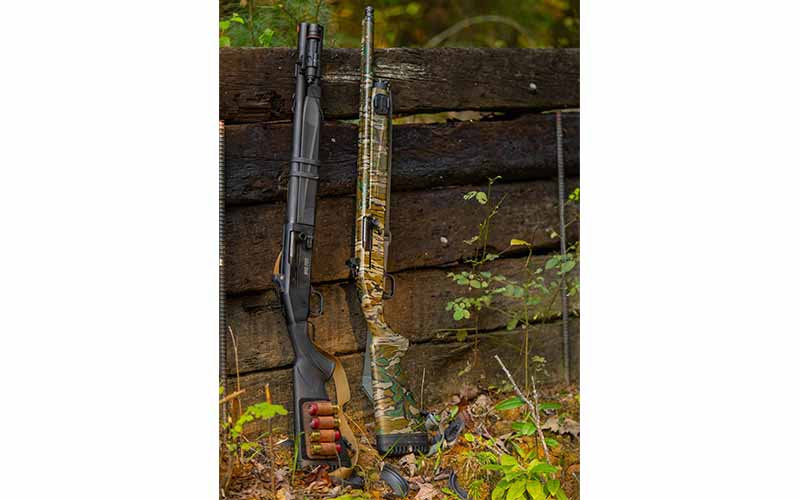
There aren’t many situations a pump-action 12-gauge shotgun can’t handle, making them another great truck gun choice. And like with rifles, a full-size shotgun can fit in a roomy enough truck as well, but that doesn’t mean that more compactness doesn’t sweeten the deal. Without venturing into the NFA and registered SBSs, most peoples’ minds go to firearms like the Mossberg Shockwave when they think of small 12-gauge pumps. While very handy, it also takes a lot of practice and skill to effectively use these stockless shotguns accurately. If you want to hit what you’re aiming at, a stock is always better, even a crappy one.

Here's where the Maverick 88 Top-Folding Stock model saves the day. When folded, it’s only about four inches longer than the Shockwave, but a lot more usable. It may not be as comfortable as a standard fixed stock, but since the primary job of a truck gun is to sit around and wait for trouble the tradeoff is worth it. If a 12-gauge pump is what you want as your copilot, this gives you all the utility of a standard model at three-quarters the length (when folded).

MSRP: $283 // mossberg.com

Marlin Model 1895 Trapper

The Marlin 1895 Trapper chambered in 45-70 Government is all the stopping power you’ll ever need in this world or the next. Small, powerful and mechanically reliable, a lever-action rifle has been the default truck gun for thousands of Americans long before we started writing stories about truck guns.

Another solid truck-gun choice is a lever-action from Marlin. Here, I’d push aside the gut reaction .30-30 Winchester and go big by choosing a Model 1895 Trapper in .45-70 Government. The gun has a 16.5-inch barrel, Skinner sights and a big-loop Western-style lever … that is not just for looks. The big loop makes it easy to work in a hurry with gloves on. A .45-70 Govt. is going to stop whatever is threatening you, whether it’s a grizzly bear or a T-Rex. Ammo isn’t that hard to find, the gun is small, doesn’t kick all that much and it certainly has more than enough bite. Better yet, a lever-action rifle is arguably the most reliably fast gun one could want or need in a defensive situation. Maybe a .45-70 isn’t your thing. Regardless, I think the lever-action rifle isn’t confined to shooters who favor old Westerns and cowboy hats. It’s an action that works, it comes in small and lightweight sizes, and it's available in cartridges that can go as big or as small as you want.

MSRP: $1,349 // marlinfirearms.com

CZ Scorpion EVO 3 S1 Carbine

The CZ-USA Scorpion EVO 3 S1 Carbine is a 9mm Luger-fed semi-automatic rifle that pairs well with your 9mm Luger handgun.

Yet another great choice in the truck-gun world is from the good folks at CZ-USA. The Scorpion EVO 3 S1 Carbine is a 9mm Luger-fed semiautomatic rifle that gives its users 20 rounds of ammunition per magazine. The stock folds, changing the gun’s profile from an overall length of 34.75 inches to a mere 24.5 inches. Is a 9mm Luger the best cartridge for a truck gun? That’s a debate all by itself, but if your handgun shoots 9mm Luger and your truck gun does too, well … that makes a lot of sense in my book. You can get smaller pistol versions of the Scorpion, but I like the solid size and shape of a rifle in my hands if I have space, and my truck has all the space I need for a Scorpion EVO 3 S1 Carbine.

MSRP: $1,429 // cz-usa.com

Savage 110 Scout Rifle

The Savage Arms Model 110 Scout Rifle was purpose-built to serve as a can-do gun capable of sustained short- or long-range firepower in a small, light and accurate platform.

OK. Lever actions. Pumps. Semi-automatics. Can a bolt-action rifle be a truck gun? Yes, the battlefield-proven bolt-action rifle can and should be a great choice for a truck gun. If I had to choose one bolt-action rifle for a go-anywhere, do-anything job like that of a trusted truck gun, the Savage Scout Rifle in .308 Winchester would be my pick. Colonel Jeff Cooper long ago designed the scout rifle to be a jack-of-all-trades, master-of-none kind of rifle, and putting a scout rifle in your truck just seems to make far too much sense. There are quite a few high-quality scout rifles out there these days, but for my hard-earned dollar, I find it hard to beat the Savage Arms 110 Scout. Plus, the rifle is fed via a detachable box magazine, which means you can have multiple loaded mags at the ready stored in your truck. You can pick your flavor, too, if the .308 Winchester doesn’t do it for you, it comes in .450 Bushmaster and .223 Remington as well. A good selecting, covering about everything you'd expect a truck rifle to handle.

MSRP: $919 // savagearms.com


Be Prepared!:


CZ 75/85

Truck Gun A

Every truck needs a handgun, and now more than ever Americans have plenty of handgun choices to fit our needs. You have three basic choices: striker-fired pistols, 1911-style pistols and revolvers. Your everyday-carry gun instantly becomes your truck gun when you’re in your truck, but having a truck-dedicated pistol isn’t a bad idea. Me? I’m a sucker for the CZ 75/85 series and use my CZ 85B as my EDC/truck gun. The military-issue 9mm Luger combat handgun was built to handle war. I shoot it well and it isn’t an expensive handgun to own. CZ doesn’t make the 85B anymore, but if you can get your hands on one, you’re going to have a hard time putting it down.

CZ 75 B MSRP: $745 // cz-usa.com

Kimber Micro 9 Covert

The Kimber Micro 9 Covert is an ultra-small glovebox-style handgun that would serve most of us well in a self-defense situation. It’s an easy enough conceal carry gun to be your every-day-carry sidearm as well.

I’ve also grown fond of a Kimber Micro 9 as a new EDC/truck gun. The pistol fits my hand well, shoots well and is super easy to store in small places. Plus, the Micro 9 (LG) models comes standard with Crimson Trace laser grips, which are an exceptional asset to have on a dedicated truck gun — or in any situation.

MSRP: Starts at $735 // kimberamerica.com

Wilson Combat ARP Tactical Pistol

The Wilson Combat ARP Tactical Pistol may be the ideal truck gun for you, offering a variety of cartridge choices, short- and long-range capabilities, compact size and reliability.

Another fine choice is the Wilson Combat ARP Tactical Pistol. Need punch? This thing throws lead like Mike Tyson threw punches — fast and furious. It hits as hard as you want because you can get it in a variety of cartridges, including 5.56 NATO/.223 Rem., .300 Blackout, 6.8 SPC and 7.62×40 WT. It holds plenty of ammunition in its detachable magazines, and its small at only 27 inches overall. It weighs 6.3 pounds and comes with a pistol forearm support, so it’s got the mass and grip to hold you steady when you engage it. You can mount any optic you want, but it comes with iron sights as well.

MSRP: $2,425 // wilsoncombat.com

Truck Gun Lock-Up Options

Aside from the actual firearms, truck guns ought to have truck gun tools to keep the guns safe yet accessible and ready for your needs. Quite a few manufacturers make a variety of truck accessories for gun owners, but I’m a big fan of what the folks at Hornady and Tuffy Security offer regarding lockable storage solutions for my truck.

Hornady

Hornady lockable storage solutions can be secured to your truck or moved to and from your vehicle to your campsite, hotel room — or wherever you’re going — during your travels.

Did you say Hornady? As in the ammunition company? Yes. They make terrific lockable storage solutions for a variety of situations. One key point about lock boxes is that they can easily transfer from your vehicle to your hotel room, home, campsite … you name it. Lock boxes come in a variety of sizes and shapes, locking methods and storability — choose from those featuring RFID or biometric technology, or one that operates with a good ol’ key from the key ring you’ve already got hanging from your ignition.

Hornady.com/security

Tuffy Security

No one wants their truck gun to fall into the wrong hands, and Tuffy Security offers clever lockable storage solutions for most vehicles.

I know Tuffy Security specifically makes a lockable storage cover for a compartment behind the back seat of my Toyota Tacoma, which is an ideal place for a truck gun, some ammo and other bug-out gear. They also make a clever under-hood security lockbox, and a lockable center console box that fits perfectly for my truck — and likely yours as well.

TuffyProducts.com

If you have a truck — heck, the same goes for a car — you ought to make sure it’s equipped to handle whatever situations it and you may find yourself in these days. Having a capable weapons platform — or two — that’s easily accessible, safe from sticky fingers and unintended consequences is paramount to operating safely in our day-to-day lives. Regardless, remember that your truck can be a significant self-defense and survival tool if you take the time and money required to outfit it properly.

Be safe out there.


Editor's Note: Adam Borisenko contributed to this article.

The Truth About Riflescope Light Transmission

2

All about riflescopes, objective lenses, light transmission and your eyes.

We crept into the hyena blind in complete darkness, listening for the telltale cackle of the scavengers. The wind was swirling that morning in the Makuti Safari Area of Zimbabwe, and Professional Hunter Lindon Stanton gave a shake of his head in disapproval. “Can you see the bait, if by some miracle they do come in?”

I slowly brought the Winchester 70 to shoulder and eased the muzzle through the small hole the trackers had so craftily made in the grass wall. With the scope set at 6x magnification, I could clearly make out the remnants of buffalo rib cage, which had been thoroughly hammered by the mpisi, in spite of the predawn light. I was happily admiring the VX-5HD 2-10x42mm—with the FireDot reticle—mounted on top of my .300 H&H, when the guttural roar of the lionesses brought home the fact that our hyena hunt was over, at least for that morning.

Light-Transmission-Leupold-VX-5HD-2-10x42mm
Leupold’s VX-5HD 2-10x42mm has everything the author is after: bright, crisp image, the ability to be mounted low and a wide field of view at the lowest setting. Photo credit: Massaro Media Group.

There are all sorts of scope configurations on the market these days, from the straight-tube dangerous game scopes, looking like the front end has been sawn off—to the huge objective lenses that seem like they might be able to detect life on other planets.

Is bigger always better? Will the largest objective lenses give the shooter an advantage at first and last light? Let’s look at the practical application of our modern optics, and the relationship between objective lenses and the usable amount of light perceptible by the human eye.

How Much Light Gets Through

It’s the exit pupil of a riflescope or binocular that determines the apparent brightness of an image. This figure is easily computed by dividing the objective lens diameter by the magnification. For example, that 2-10×42 Leupold I had in Zimbabwe would have an exit pupil of 4.2mm at maximum magnification (42mm divided by 10mm equaling 4.2mm).

Our pupils can expand and contract—depending on the surrounding light conditions—to measure between 2mm and 7mm. So, the amount of usable light will vary, depending on the conformation of your riflescope. As natural light decreases, the pupil will open wider to let more light in, and a higher exit pupil value will deliver more light to your eye.

Leupold-VX-6-2-12x42mm
The author has used this Leupold VX-6 2-12x42mm on his Winchester 70 Classic Stainless for a good number of hunting situations; it’s bright, crisp and offers a magnification range suitable for all sorts of hunting. Photo credit: Massaro Media Group.

Lowering your magnification can increase the perceived light delivered to your eye, as the equation can quickly show. Divide your objective lens diameter by a lower number, and the exit pupil value increases. If your pupil expands due to lower natural light, your scope appears brighter.

This is one reason for choosing a scope with a lower bottom-end magnification; it may make a difference in those first and last light situations where seconds count. It’s also a reason for choosing a scope with a larger objective lens, as in theory there’ll be more light transmitted to your eye.

But bigger objective lenses pose some logistical issues when they’re mounted on a rifle. To clear the barrel, those scopes with larger objective lenses need to be mounted higher than scopes with smaller bells—and that can be a real pain. A rifle with a comb that’s too low for proper sight alignment will result in the shooter getting slapped hard during recoil. Instead of obtaining proper cheek weld—where the comb sits just underneath the shooter’s cheekbone—the comb will sit against the jaw or teeth. This results in some seriously uncomfortable recoil.

Rigby-Highland-Stalker-Hunting-Rifle-1
This Rigby Highland Stalker would benefit from a lace-on cheekpiece to raise the comb up to the line of sight of the Leupold VX-6 2-12x42mm scope; that scope has coated lenses, which offer all sorts of contrast and light transmission in just about any hunting situation. Photo credit: Massaro Media Group.

I always strive to mount my scopes as low to the bore as is physically possible, to have the rifle’s comb sit in the proper location on my face. Generally speaking, on my hunting rifles, a 42mm objective lens is about as big as like to go. The bigger 50mm and the huge 56mm bells tend to be mounted uncomfortably high, especially for a hunting gun with a conventional comb.

If you insist on a scope with an objective lens of that magnitude, there are comb risers you can purchase, which either tie onto the stock or are attached via Velcro straps to raise the comb for proper sight alignment. Some of the polymer-stocked rifles offer adjustable combs in one fashion or another, like the Savage AccuStock, which offers risers of differing heights that can be installed by the user—or the Browning X-Bolt Western Hunter Long Range, which has a sort of adjustable “over-comb” that allows the user to properly align the scope to the eye.

Ideally, I prefer to mount my scope in a manner such that, with my eyes closed, I bring the rifle to shoulder instinctively and when I open my eyes, the scope is properly aligned, with as little need for adjustment as possible. Leupold tried a rather unconventional method of mounting a scope with a large diameter objective lens low to the bore when they released their VX-3L series, with a 56mm objective lens that looked like it had a bite taken out of the bottom, to compensate for the barrel. It didn’t catch on.

In addition to the cheek weld issue, a scope mounted too high above the bore can exaggerate the effects of scope cant, driving bullets to the left or to the right at longer ranges, depending on the amount of cant. With the true long-range target scopes, which can easily have a 56mm bell, getting them low is an extremely difficult prospect, and you’ll just have to do the best you can.

Leupold-Mark-5HD-5-25x56mm
The larger target scopes—like this Leupold Mark 5HD 5-25x56mm—are best served by a high comb to allow the shooter to easily obtain a clear sight picture without craning their neck. Photo credit: Massaro Media Group.

Not All Lenses Are Created Equal

Light transmission is more than just a function of exit pupil. The quality of your riflescope’s lenses and overall construction play a significant role in how bright, clear and crisp your target will appear. If you’ve ever owned or had the opportunity to shoot through a Swarovski riflescope, you’ll understand exactly what good glass is. They certainly aren’t cheap, but they’re amazingly crisp.

I’ve always been a fan of the Swarovski Z5 3.5-18x44mm scope. The tube length is long enough to put the objective lens further out along the barrel so it can be mounted nice and low, but it’s undoubtedly the Austrian glass that’s the selling point of Swarovski riflescopes and binoculars.

Light-Transmission-Feature
The Swarovski Z5 3.5-18x44mm scope. Photo credit: Massaro Media Group.

Any scope with high-quality lenses—replete with the proper coatings, which can make all the difference in the world—will be a game changer, especially if you’re used to the lesser-quality lenses. For years, when my hunting budget was so tight that it squeaked, I was convinced that higher magnification was always better. One look through a high-quality European riflescope changed my opinion completely, to the point where I much prefer a lower magnification riflescope of higher quality to any higher magnification scope of lesser quality. And, thankfully, a good number of the riflescope manufacturers have really improved their products.

I am an unabashed fan of Leupold’s products and have been for decades, and their HD series—including the VX-3HD, VX-5HD and VX-6HD—are real winners. The lens coating is stellar, and these scopes are wonderfully bright. I took a VX-5HD 1-5x24mm on top of my Bansner & Co. .404 Jeffery to coastal Alaska for brown and black bears in the spring (when it only gets dark for a couple hours) and had no problem seeing through that scope when there was any light at all.

Leupold-VX-5HD-1-5x24mm
Massaro’s Bansner & Co. Custom .404 Jeffery is topped with a Leupold VX-5HD 1-5x24mm and was a perfect choice for bear hunting in coastal Alaska, where shots range from 200 yards to “in-your-lap.” The glass transmits enough light for the half-dark of Alaska in the springtime. Photo credit: Massaro Media Group.

In fact, the two guides on that hunt were amazed at that scope; cranked down to 1x it is a perfect tool for bears in the thick stuff, yet at 5x magnification, the 200- to 250-yard shots were totally possible. I feel that the VX-5HD and VX-6HD series are the best hunting scopes Leupold has made to date. Zeiss has revamped their Conquest line of scopes, with what I assume to be a new lens coating, because they have a much brighter appearance than the previous iteration of those scopes.

Zeiss-Conquest-V4-4-16x44mm
This Zeiss Conquest V4 4-16x44mm has great glass but is mounted a bit too high for the author’s liking. Changing the comb on the Savage AccuStock will make a big difference in regard to sight picture. Photo credit: Massaro Media Group.

No lens will ever possess the ability to give 100 percent light transmission, but they’re getting closer every year. Under midday sun, just about any scope will work. But it’s when the light begins to fade, when the shadows start to remove the contrast and the images get fuzzy that a scope with a set of good lenses—which have been coated to highlight images in that fading light—will show its value.

Objective lens diameter has no bearing on your riflescope’s field of view, but tube diameter certainly does. A scope with a 30mm main tube will have a wider field of view than one sporting a 1-inch tube—though that advantage will come at the cost of additional weight. The big 34mm and 35mm tubes are employed more to give additional elevation adjustment than for the field of view, but the increase is certainly there.

Choosing a Scope for Your Needs

I’ve had a shift in opinion regarding scopes in the past decade. Whereas I used to consider a scope as an accessory to the rifle, in many instances I spend more on a scope than I do on the rifle. After all, if you can’t see that target you can’t hit it, and the quality of affordable rifles has increased greatly.

Leupold-VX-3HD-4-14x40mm
This Leupold VX-3HD 4-14x40mm riflescope sits low to the bore on this Nosler Model 21 rifle, and it offers a sensibly sized objective lens as well as a crisp, bright image. Photo credit: Massaro Media Group.

I’ve also opted for the best quality scope I can afford, even if the magnification level is on the lower side of the spectrum. Were the whitetail of a lifetime on the other end of the equation in low-light conditions, I’d be happier with a premium scope with a top end of 8x to 10x than one of lesser quality of 14x magnification.

Even when shooting long range, I tend to reduce magnification for image clarity, especially when dealing with mirage. So, when I’m looking at a scope for a particular purpose, I take the low-end magnification under consideration as much as I do the top end; under the worst light conditions, it’ll keep the image nice and bright.

Editor's Note: This article originally appeared in the November 2021 issue of Gun Digest the Magazine.


Scope Out More Optics Info:

  • 8 Revolutionary Reticles For Long-Range Accuracy
  • Buying the Perfect Precision Scope
  • The Best Tactical Red-Dot Performance-to-Price Option?
  • Shifting Winds: SIG BDX Changing Shooting For The Better

Apex Releases MRAT Comp For The FNX-45

0

Apex Tactical Specialties has just released the MRAT Comp, a new compensator for the FNX-45 that drastically reduces muzzle rise and recoil.

Apex Tactical Specialties knows its way around pistol upgrades, offering triggers, barrels and plenty of other components for a variety of popular handguns. For those who own an FN FNX-45, the newest upgrade offered by Apex is sure to catch your eye. It’s the MRAT Comp, a compensator that Apex claims can reduce the muzzle rise of the FNX-45 by 40 to 60 percent.

Apex-MRAT-Comp-feature-1

The “MRAT” in MRAT Comp stands for Muzzle Rise Amplitude Tamer, and that it does. It not only reduces the felt recoil but substantially reduces the muzzle rise as well. When tested with a wide range of ammunition, both very light and +P rounds, Apex found that the MRAT results in 40 to 60 percent less climb.

Apex-MRAT-Comp-kit

The MRAT's compensating capabilities also result in such a significantly lower slide velocity, that each kit also includes a replacement captive-spring guide rod assembly to enable proper, reliable cycling. The kit includes two brass-tipped set screws and some threadlocker as well, providing you with everything needed to install it. Apex claims that the compensator is quick and simple to mount and have also posted video with instructions on the product page.

MRAT-mounted

The MRAT Comp is available with either a black or an FDE finish to match the options of the FNX-45, with black having an MSRP of $175 and FDE having an MSRP of $200. Black is available now and the FDE model will begin shipping in 6 to 8 weeks after the time of publication.

For more information, please visit apextactical.com.


More Pistol Upgrades From Apex:

First Look: EAA Girsan MC P35 OPS Optic

0

EAA has just announced the first optics-ready Hi Power clone, the Girsan MC P35 OPS Optic.

Girsan of Turkey has been cranking out variants of its MC P35 Hi Power clone like there’s no tomorrow. So far this year, the company has already released the carry-sized MC P35 PI as well as the modernized MC P35 OPS and Match models. Yet another variation has just been announced with the MC P35 OPS Optic, and it’s the first time that a Hi Power has been offered from a factory in an optics-ready configuration.

Girsan-MC-P35-OPS-Optic

The MC P35 OPS Optic model is identical in every way to the MC P35 OPS besides the optics-ready slide which omits a rear iron sight, so we’ll only briefly go over the shared features before diving into what’s new. Whether optics-ready or not, the MC P35 OPS comes with G10 grips, a fiber optic front sight, a beveled magwell and an extended beavertail. They also feature upgraded straight triggers, a 15-round capacity, an accessory rail and no magazine disconnect safety.

MC-P35-OPS-Optic-angle

The slide of the MC P35 OPS Optic is milled to directly accept RMS/RMSc-pattern red dots without the use of an adaptor plate. EAA also claims that some Holosun optics will fit it as well, though these will possibly require an adaptor plate. Each pistol will also ship with an EAA Far-Dot 4-MOA red dot sight.

MC-P35-Optics-Ready-ADS

Chase Duffey, National Sales and Import Manager at EAA, said this about the new optics-ready pistol:

When we were looking at how to make the MC P35 OPS more useful and offer the customer something that they really wanted directly from the factory, a light and bright red dot that uses a mounting pattern that’s almost universally accepted without any sort of adapter plate was the overwhelming choice…Now, if the customer wants to keep it as is from the factory or if they want to accessorize it with lots of commercially available products at their local shop, they have every option right out of the box.

The optics-ready MC P35 OPS has an MSRP of $850 and will be shipping to dealers soon.

For more information, please visit eaacorp.com.


More On Hi Powers:

Nothing Beats Shot Placement

1

Shot placement, or where you put your bullets, will always be more important than the caliber or gun when it comes to self-defense.

Ol’ Joe was sitting at the bar, drinking. The year was 1930, and drinking was illegal. But this bar was in a speakeasy, and no one in there gave a damn about being legal. But one guy did give a damn about his wife, and it had come to his attention that Ol’ Joe had been giving some affection to her. An altercation ensued, and the jealous husband ended up pulling out a .25 Automatic and emptying it into Ol’ Joe’s gut.

Grandpa said that Ol’ Joe was a big ol’ boy, and after the shooting was over, he turned and walked out the door. Grandpa knew this because he was there when it happened. Though he never admitted it, I figure Grandpa had recently delivered the libations Ol’ Joe and everyone else had been drinking. Shortly, Ol’ Joe walked back inside with a shovel and a blood stain the size of a dinner plate oozing through his overalls. And then, with five .25 Auto slugs in his tummy, he took that shovel and beat the jealous man to death.

Lesson learned: If you don’t want to get beaten to death with a ditch digger, don’t shoot your adversary in the belly button.

Shot-placement-feature
If you want to substantially increase the chances of your handgun stopping a bad guy, learn proper shot placement.

Hardball Won’t Work

Most supposed experts will tell you that hardball—full metal jacket—handgun ammunition isn’t suitable for self-defense.

Well, one night while working the midnight shift, I got a call of “shots fired” at a local nightclub. As I crept my cruiser into the edge of the parking lot, I heard the unmistakable sound of handgun fire. The sirens wailing from my backup that was on the way quickly dispersed the crowd. Remaining on the parking lot before me was a dead man.

Long story short, the investigation revealed he’d taken a single 115-grain 9mm FMJ round to the chest at about 10 feet. The bullet had pierced his sternum and heart, exited his back and was found in the fender of a Toyota Camry that was parked just behind where he stood. The coroner said that had EMS been standing beside him when he was shot—waiting to render aid—he would’ve died anyway.

Shot-placement-9mm-hydra-shok
Federal’s new Hydra-Shock Deep load for the 9mm Luger expands wide and penetrates well. But if it misses the mark, it just makes a loud noise, which is generally ineffective at stopping bad guys.

Does Good Shot Placement Make .380 Viable?

The .380 Auto is often considered the absolute minimum for personal protection. That seems like it suggests if you must shoot a bad guy with a .380, the outcome is questionable.

Well, on another midnight shift, we responded to a suspicious person call, which turned out to be a crippled man standing over a dead guy in the middle of the street.

It seems a proprietor of a local bar—are you seeing a trend here?—was headed home when the car following him began flashing its lights. The bar owner pulled over to see what was what. That’s when the driver of the trailing car got out, walked up to the nightclub owner’s car, opened the door, pulled the proprietor out, and began to beat the living daylights out of him.

Modern defensive ammunition for the 380 ACP is very good. No, it won’t compare to the 9mm Luger or larger-caliber cartridges, but if the shots are placed properly, the desired result will be achieved.

The bar owner was physically disabled. (My teenage daughter could’ve whopped up on him). But he was smart, he kept a pistol—a compact .380—in his pocket. He shot his attacker once in the chest, and the man dropped in the street and that was the end of that.

What’s the Point?

The point here should be clear by now: It’s not the gun, the cartridge or the ammunition that’s most important. It’s shot placement. Those five rounds Ol’ Joe took to the gut undoubtedly hurt like hell. Maybe a lesser man would’ve crumpled from the pain. Had the jealous husband shoved that .25 into Ol’ Joe’s chest as opposed to his stomach; he’d have probably been around long enough to go to prison.

As for the 9mm hardball that dropped the drug dealer in the parking lot, it was well placed. It’s hard to recover from a .35-caliber hole through your heart. And look at it this way: Had the bullet been one of the expanding varieties, the hole would have at most been twice as large in diameter. The same thing is true of the final encounter with the bar owner and his .380: It fires the same diameter bullet as a 9mm at a much-reduced velocity. In both instances, both loads worked to perfection, because they hit the right spot.

Shot-placement-expansion-chart
You could look at this chart and endlessly argue which defensive handgun load is best. Time would be much better spent on the range practicing shot placement.

So, the next time you’re sitting around wondering if your handgun is powerful enough to protect you—or, if you’re wondering if the ammunition you have is wicked enough to stop a bad guy—my advice would be to stop worrying about either. Take 50 or 100 rounds and head out to the range for some practice putting the bullets where they’re supposed to go. If that’s something you find hard to do on demand, with speed and rapidity, I’d suggest you seek out some defensive handgun training and learn how to shoot.

I’ll never forget a scene from the Western movie, Appaloosa. The two lead characters, played by Ed Harris and Viggo Mortensen, are lying in the street along with some other fellows and they’re all shot to hell. Mortensen’s character says, “That happened quick,” and Harris’ character responds, “Everybody could shoot.”

If you’re serious about carrying a handgun every day for personal protection, learn how to shoot!

Editor's Note: This article originally appeared in the EDC 2021 special issue of Gun Digest the Magazine.


More On Self-Defense Training:

First Look: PSA “Spiker” Rifle Type 56 Clone

0

Palmetto State Armory has finally launched the AK-47 “Spiker” Rifle, a clone of the iconic Chinese Type 56 Kalashnikov variant.

Palmetto State Armory catches a lot of flak online for teasing products well before they ever enter production. Hell, it’s been almost three years since the company first showed off its 5.45 “Krinkov” AK pistol and a release date is still not known. Regardless, PSA usually does eventually get around to making them, and the newest belated addition to their digital shelves is called the AK-47 “Spiker” Rifle.

PSA-Type-56-Spiker-Rifle

Designed to aesthetically mimic the iconic Chinese Type 56 AK variant, the AK-47 “Spiker” Rifle certainly looks the part. Despite what some may tell you, commercial export Chinese AKs destined for the U.S. were some of the finest Kalashnikov samples to enter the country. Unlike the subpar AKs that the CCP supplied to Africa and the Middle East, the factories working under the Norinco and Polytech conglomerates understood that the American market demanded quality. While it’s a dubious proposition to suggest that PSA’s new “Spiker” Rifles will be equally well made, it appears that they’ve done an excellent job of imitating the appearance of a stamped-receiver Type 56. The major details that contribute to this include the blonde imitation “Chu wood” furniture patterned after the Chinese style, the hooded front sight, the smooth dust cover and of course the iconic folding “spiker” bayonet from which the rifle gets its name. The metal components have also been treated with a shade of Cerakote that mimics the bluing style of original Chinese guns.

PSA-Type-56-left

While there’s no doubt the gun looks the part, it seems that PSA has made an effort to make the AK-47 “Spiker” Rifle a quality firearm as well. The company opted to use its cold hammer-forged, chrome-moly vanadium barrels for these builds, a step up from the nitrided options included with many of PSA’s more budget models. The “Spiker” Rifle’s stamped receiver is also the proper 1.5mm Chinese-spec as opposed to the standard Soviet-pattern 1mm thickness. This not only aids the durability but the authenticity as well. The front trunnion, bolt and carrier are all hammer-forged too.

PSA-Spiker-Rifle-angle

A few other authentic details that bear mentioning are the ventilated gas tube, the placement of the forward sling swivel, the pattern of the front trunnion and the inclusion of a muzzle nut rather than a slant brake. It also lacks a side scope rail, something that PSA had previously incorrectly included on its soviet AKM parts kit builds.

Considering that Chinese-made AKs haven't been available new in the U.S. since 1994, the AK-47 “Spiker” Rifle is an exciting addition to PSA’s lineup, and the attention to detail frankly surpassed what I would have expected. If it’s successful, it will hopefully prompt PSA to clone the Type 56-1 (underfolder) and Type 56-2 (side folder) as well.

The AK-47 “Spiker” Rifle has an MSRP of $1,099 and is now in production.

For more information on PSA, please visit palmettostatearmory.com


More AK Stuff:

Firearms Training For The Family

0

Private or open-enrollment firearms training courses make the perfect family bonding experience.

When I was about 10 years old, my grandfather and I were at our hunting camp. I’d found a huge hornet’s nest on the back eve and was throwing rocks at it. Grandpa saw what I was doing and told me to stop. And I did—at least until he went back inside.

A few minutes later, he warned me again, a bit more forcefully. And again, I ignored him.

Finally, I got a direct hit, and here came the hornets. I ran to the front of the camp only to realize the screen door was locked. A couple hornets hit me right in the ass, while grandpa stood on the other side of the door, laughing. I’ve not thrown a rock at a hornet’s nest since.

Learning—no matter how it’s measured—isn’t free. Lessons worth learning cost you dollars, time or pain. Basic undergraduate college tuition generally runs you between $400 (in state) and $1,200 (out of state) per credit hour. Harvard is the oldest institution of higher learning in the United States and is among the most prestigious in the world. There, cost per credit hour runs about $1,500. With a credit hour generally considered equivalent to 37.5 clock hours, at Harvard you’d pay about $40 per clock hour of instruction.

Gunsite Academy is the largest, oldest, most prestigious and longest continually operational civilian firearms training academy in the world. Tuition for the Gunsite Academy 250 Pistol Course is $1,795. The cost for a clock hour of training at Gunsite Academy, which is commonly referred to as the “Harvard of Handguns,” is very similar to what you’d pay at Harvard University.

Training-Gunsite
Gunsite is as much of an experience as it is a firearms training destination. It’s a place the entire family can attend and enjoy, and the training they receive will benefit them for life.

Life Insurance

This may seem a bit extreme, until you consider what you’re learning. At Harvard, you’ll be given education related to your career. At Gunsite Academy, you’ll be supplied with training to help you stay alive. Having a prosperous career is one thing; being alive to enjoy it is, well, a hell of a lot more important. At Harvard, you may be educated by others who have had successful careers. At Gunsite, you’ll be trained by those who have relied on a gun to stay alive. Well-regarded career or self-defense training is either learned the hard way or you’ll have to pay for it.

However, when it comes to firearms training, some folks have careers that make accommodating open enrollment courses difficult to attend. You might want to attend the Gunsite Academy 250 Pistol Course, but the available dates might not fit your schedule. For folks in this situation, Gunsite Academy offers private tutorial classes. These classes are specifically tailored to you, and the cost for one-on-one training is $1,250 per day, regardless of how long that day may be. During private tutorial training at Gunsite Academy, instructors will stay with you as long as you’re progressing each day.

family-training-feature
The author’s daughters and wife working on the range during a private tutorial class at Gunsite Academy with the new Mossberg MC2sc pistols.

Some offset the cost of these tutorial courses with additional students. This could be a husband and wife; for two students, the cost drops to $850 per day, per student. It could also be for a family; with four students, the cost is $550 per day, per student. If you’re doing a four-person tutorial class at Gunsite Academy, the instructional cost per hour, for 10-hour days, works out to $55 per hour.

The Private Party

Over the past two years, Gunsite Academy has seen a sharp increase in the number of students wanting private individual or small group tutorial training. It’s becoming more popular because of scheduling issues as previously mentioned, but many are choosing the private courses because they can advance—learn—as much in three days as students in a regular course might advance—learn—in five days. This is because the training progresses with you as opposed to the average mean of a large open enrollment class.

Another reason some opt for individual training is because they’re new to firearms and might be a bit apprehensive about being around guns and unfamiliar folks. It could also be because they don’t want others to know they’ve become gun owners and accepted the responsibility of their own safety. Such is the case with many celebrities and political figures.

Over the past 20 years, I’ve taken several private courses at Gunsite Academy. No, I’m not a celebrity, and, no, I didn’t want to hide my affinity for firearms. I did it because I needed training targeting a specific skill. In every case, it was a skill included in a cataloged course that Gunsite Academy offered, I just didn’t have the time or need to attend the full training that book-ended the specific element I needed help with. I did it prior to my first African buffalo hunt, to become better acquainted with the Scout Rifle concept and to learn to use a defensive handgun with a laser and later with a reflex sight.

Family-Firearms-Training-aiming
Students with basic firearms skills can learn a lot from a one- or two-day private tutorial class at Gunsite Academy—plenty to keep them busy practicing for most of their lives.

I’ve also used the private tutorial service offered by Gunsite Academy to help train my children and spouse. Though I’d never consider myself the equivalent of a Gunsite Academy firearms instructor, I’ve spent much of my professional career training soldiers, cops and civilians in the safe an effective employment of firearms. I introduced my wife to shooting as well as all four of our children. There is, however, a difference in an introduction to firearms and proper comprehensive training. The complex personal relationships between husbands and wives, as well as parents and children, aren’t conducive to quality firearms instruction. That’s best left to a professional outside source.

My son is a good example. I taught him firearms safety and how to hit targets at an early age. He then wanted to turn all our range sessions into a competition. When he was 14, I sent him to Gunsite Academy for a three-day tutorial on basic skills with the handgun and rifle. Two years later, he returned, took the Gunsite 250 Pistol Course and won the end-of-class shoot-off—and every other student in the class was an adult.

I’m in the process of following the same training plan with my 14- and 17-year-old daughters. Both understand firearms safety and basic marksmanship, but last summer I enrolled them in a one-day tutorial course at Gunsite Academy tailored not only to their skill level, but specifically to the handgun they’d be using. The plan is that when both graduate high school—if not sooner—for them to return in the best form possible to get the most out of Gunsite’s 5-day 250 Pistol Course.

Family-Firearms-Training-target
The author’s oldest daughter working at home with Mossberg’s MC2sc and the skills she learned during her private tutorial training at Gunsite Academy.

On the recent tutorial with my daughters, I worked with Gunsite Academy Training Director Dave Hartman to establish the content of instruction regarding a brand-new semi-automatic compact pistol outfitted with an also new compact reflex sight. Also, having a working knowledge of the cadre at Gunsite Academy, we discussed instructors and selected one we felt would best dovetail with my girls.

My daughters and wife—who went along for emotional support—spent the day with Gunsite Instructor Lew Gosnell. All three finished with an elevated sense in what they can accomplish with a compact handgun, and with confidence that should they have to use it to defend themselves, they could. By no stretch are they gunfighters, but their confidence has been buoyed, and they’re well poised to safely practice on their own to further develop the skills they learned.

Family-Firearms-Training-reload

Should You Go Solo?

Should you take a private tutorial firearms training class from the Harvard of Handguns or attend a regular course? That’s a good question. In a three-day private one-on-one tutorial, most can advance about the same as they would in a five-day mixed class. This is because the instructor has their evaluating eyes on you every second of every minute of every hour that you’re on the range.

One on one, tuition will be $3,750 for those three days. That’s steep compared to the cost of a standard five-day class. Of course, by adding a few friends or family members, you can substantially reduce costs. You’ll also save some money on lodging and food by not being in Arizona for five days. And, you’ll get the best firearms instruction money can buy.

family-CCW-training-mossberg
The new Mossberg MC2sc pistol comes out of the box optics-ready. The guns this author’s family used were outfitted with a Crimson Trace CTS-1550 reflex sight.

On the other hand, you’ll miss out on sharing what has come to be known as the “Gunsite Experience” with a collection of like-minded people who are learning and developing with you. You’ll miss the friendship the experience will create, you’ll miss the education that can be obtained from your peers, and you’ll miss seeing each one of them have what’s known as the “epiphany,” which generally occurs on day three or four of the 250 Pistol Course.

Regardless which way you decide to go—alone, with a small family group or in an open enrollment class—you’ll leave Gunsite Academy much like a graduate leaves Harvard: well trained, with confidence and with a mindset that’ll change you and possibly save your life. It’s a more enjoyable way to learn than getting hit in the ass by several pissed off bald-faced hornets!

Editor's Note: This article originally appeared in the EDC 2021 special issue of Gun Digest the Magazine.


More Firearms Training:

Ruger-Made Marlin 1895 Guide Gun Now Available

3

The Marlin 1895 Guide Gun lever-action rifle in .45-70 Gov’t is available once again, only now made by Ruger.

Previously known as the 1895 Guide Big Loop or GBL, this lever-action rifle is being reintroduced as the 1895 Guide Gun following Marlin’s acquisition by Ruger. Since Marlin was acquired, Ruger has been slowly bringing back the company’s most popular lever-action rifle models, including the 1895 SBL in late 2021. The new Ruger-made Marlins are virtually identical to older Marlin-made rifles, only now they’re manufactured using Ruger’s more advanced methodology.

Marlin-1895-Guide-Gun

The 1895 Guide Gun is chambered for .45-70 Gov’t (6+1 capacity), has a 19-inch cold hammer-forged barrel with a 1:20” twist and the muzzle is threaded 11/16”x24 for mounting a suppressor or other muzzle device. It ships with a thread protector as well.

Ruger-Marlin-Guide-Gun-left

Aesthetically, the rifle features a checkered brown laminate stock and a satin-blued finish on most of the metal components. However, the bolt is nickel-plated instead for smoother cycling. It also features adjustable semi-buckhorn sights, a soft rubber recoil pad, and as the previous “Guide Big Loop” name implies, an oversized lever loop.

Ruger-1895-Guide-Gun

CEO and President of Ruger Chris Killoy said this about the new 1895 Guide Gun:

The Guide Gun is our next step in the expansion of the Marlin line…Marlin fans should be encouraged by the growth in product offerings and know that we are going to continuously expand into other models.

The 1895 Guide Gun has an MSRP of $1,149 and is available now.

For more information, please visit ruger.com and marlinfirearms.com


Up Your Lever-Gun IQ:

.22-250 Ammo: 7 Top Loads For Any Purpose

0

.22-250 ammo is extremely versatile with the right load and rifle, capable of excelling at long-range tasks from varmint control to sport shooting.

The “best” .22-250 ammo depends a little bit on your rifle and a whole lot on what you want to do with it. Just like with any other cartridge, you want to pick a load that suits your purpose. 

Here we’ll take a deeper look at .22-250 ammo, how to select the right kind for you and 7 great factory loads for different purposes. 

22-250-ammo-feature

How To Choose .22-250 Ammo

As always, first determine what you plan on using your rifle for. Depending on what that is, certain barrel twist rates will be better than others since different tasks favor different bullet weights. For a .22-250 rifle, its role will generally either be for varminting, hunting or long-range sport shooting.

For varmint hunting and predator control (i.e., coyotes, foxes or possibly raccoons) the light-for-caliber loads of 35, 38, 40 or 45 grains are the conventional choices with almost any bullet type being appropriate. 

Game hunters tend to prefer medium-weight bullets, such as 50-, 55-, 60- or 62-grain soft points or polymer-tipped hollow points. 

Sierra’s #1400—the first MatchKing. A 53-grain, flat-base hollow-point, it’s the author’s bullet-of-choice for the .22-250 Remington.
Sierra’s #1400—the first MatchKing. A 53-grain, flat-base hollow-point, it makes a good choice for the .22-250 Remington.

For longer-range shooting, longer and heavier bullets are the better choice given the higher ballistic coefficient.  

Generally speaking, fast to medium twist rates favor heavier grain weights while slow twist rates favor light to medium projectiles. Most factory .22-250 rifles have a 1:14-inch twist rate or a 1:12, but there are plenty with a 1:10 or 1:8 twist as well. 

In other words, a varmint rifle with a slow twist rate will have the best results with light-for-caliber loads, a long-range rifle with a faster twist rate will get better results with heavy-for-caliber loads, and a hunting rifle with a twist rate in the middle will get best results with medium-weight projectiles. 

If you’re still shopping for a .22-250 rifle to accomplish a predetermined goal, this information on twist rates will help you pick a model that’s best suited for the task. If you already have a .22-250 rifle, the barrel’s twist rate will determine what bullet weights it can effectively stabilize and therefore what the rifle could be ultimately used for as well.

Winchester-Featherweight-.22-250
A .22-250 Winchester Model 70 Featherweight, featuring a barrel with a 1:14 twist.

With that all in mind, let’s look at some top factory loads of .22-250 ammo.

What's The Best .22-250 Ammo To Buy? 

Low Cost, All Purpose:

PPU .22-250 55-Grain SP

PPU-22-250-ammo

PPU's 55-grain SP (soft point) is a good pick for an economical do-it-all load. 55-grain bullets will stabilize well in 1:12 and 1:10 twist barrels, and with a soft point bullet, can be good for anything from varmints to predators and even medium game in legal jurisdictions at appropriate distances. 

Bullet Type: Jacketed Soft Point

Bullet Weight: 55 grains

Muzzle Velocity: 3,674 fps

Muzzle Energy: 1,644 foot-pounds

G1 BC: Not advertised

MSRP: ~$25 per box of 20

High-Volume Varmint Load:

Remington UMC 45-Grain JHP

Rem-UMC-22-250-ammo

Remington's 45-grain JHP (jacketed hollow point) load in their UMC line is a good choice for the varmint shooter that wants to shoot a lot but spend less. It's a light-for-caliber, high-velocity load that can (and has!) put down a lot of prairie dogs and more than a few coyotes. It's best for rifles with a 1:12 or 1:14 twist rate. 

Bullet Type: Jacketed Hollow Point

Bullet Weight: 45 grains

Muzzle Velocity: 4,000 fps

Muzzle Energy: 1,599  foot-pounds

G1 BC: .173

MSRP: ~$35 per box of 20

Explore the Best of the .22 Caliber

Best Game Load:

Federal Premium Nosler 60-grain JSP

Federal-Nosler-Partition-22-250

Federal Premium has been offering Nosler Partition loads for decades. For .22-250 hunting ammunition, they offer the .22-250 with the 60-grain Partition bullet. It's arguably the best choice for medium game in legal jurisdictions–assuming good marksmanship and responsible ranges–given it's built to hold together. It's best in fast twist barrels, with a 1:8 twist being perfect. 

Bullet Type: Bonded Jacketed Soft Point

Bullet Weight: 60 grains

Muzzle Velocity: 3,500 fps

Muzzle Energy: 1,632 foot-pounds

G1 BC: .227

MSRP: ~ $53 per box of 20

Lead-Free But Still Deadly:

Barnes VOR-TX .22-250 50-grain TSX

Barnes-VORTX-22-250-ammo

The Barnes VOR-TX .22-250 load, with a 50-grain TSX monolithic hollow point, is a great game load for rifles that have a slower twist rate. If you want to hunt whitetail, hogs or javelinas but your rifle has a 1:12 or 1:14 twist, this load will stabilize better than heavier soft points. It will also certainly do for varmints or predators. 

It would also be an excellent choice for an AR chambered in .22-250. 

Bullet Type: Solid Copper Hollow Point

Bullet Weight: 50 grains

Muzzle Velocity: 3,830 fps

Muzzle Energy: 1,628 foot-pounds

G1 BC: .197

MSRP: $45 per box of 20

Long-Range Match Ammo:

Copper Creek Cartridge Co. 77-Grain OTM

Copper-Creek-Cartridge-Co-77-Grain-OTM

Projectiles this heavy aren’t always easy to find loaded in .22-250 ammo, but you can get it from Copper Creek Cartridge Co. They can put a 77-grain Berger Open Tip Match bullet in Hornady, Lapua or Norma brass for you. It's only for rifles with a fast twist—they specify a 1:8 twist at a minimum—so bear that in mind. An excellent choice for long-range applications, if you have the right rifle. 

Bullet Type: Open-tip 

Bullet Weight: 77 grains

Muzzle Velocity: 3,200 fps

Muzzle Energy: 1,750 foot-pounds

G1 BC: .374

MSRP: ~$45 per box of 20

Best Varmint Load:

Sierra Prairie Enemy 50-Grain Blitzking

Sierra-prairie-enemy-22-250

Sierra’s Prairie Enemy 50-grain .22-250 load features their Blitz King tipped hollow point. It's designed for varmint rifles and to feed reliably in semi-autos as well. It works best in rifles with a medium to fast twist rate with 1:12 being ideal.

Bullet Type: Tipped Hollow Point

Bullet Weight: 50 grains

Muzzle Velocity: 3,800 fps

Muzzle Energy: 1,602 foot-pounds

G1 BC: .259

MSRP: ~$40 per box of 20

Best High-Velocity Varmint Load:

Underwood Ammunition 38-Grain Lehigh Controlled Chaos

Underwood-22-250-ammo

If you wanted to smack a prairie dog with the highest velocity bullet you could, the Underwood Controlled Chaos load is the ticket. It features the 38-grain Lehigh Controlled Chaos bullet, making it best suited for rifles with a slow twist rate. If yours has a 1:14 twist, it's perfect. 

Bullet Type: Fragmenting Hollow Point

Bullet Weight: 38 grains

Muzzle Velocity: 4,200 fps

Muzzle Energy: 1,488 foot-pounds

G1 BC: .196

MSRP: ~$44 per box of 20


Raise Your Ammo IQ:

First Look: Primary Arms SLx 1-10x28mm SFP Rifle Scope

0

Primary Arms Optics has just announced the SLx 1-10x28mm SFP rifle scope, a new LPVO with a choice between two reticle options.

LPVO scopes remain a popular alternative to red dot/magnifier combo setups, offering their users relatively quick target acquisition at close ranges with the lowest magnification setting while also providing superior long-range capabilities at higher levels of zoom. The newest LPVO to come to market is Primary Arms Optics’ SLx 1-10x28mm SFP scope, offered with one of two reticle options.

Primary-Arms-SLx-1-10x28mm-SFP-feature-1

The precision and durability of the new scopes were live-fire tested using a SCAR in 7.62x51mm NATO, proving they can withstand a healthy amount of recoil. The SLx 1-10x28mm SFP also features a 28mm objective lens, a 34mm tube and a generous eye box for effective rapid acquisition at lower magnification settings. Regardless of the model selected, both reticles are illuminated with 11 brightness settings including two for use with night vision.

Primary-Arms-SLx-on-rifle

Speaking of reticles, the SLx 1-10x28mm SFP can be bought with either an ACSS Raptor 5.56 M10S or the ACSS Griffin MIL M10S. The former features BDC, ranging and wind lead marks that are calibrated for both 5.56x45mm and .308 Winchester. The latter reticle option instead features a full MIL-grid, making it compatible with a wider range of cartridges and firearms.

Primary-Arms-SLx-1-10

Stephen Morgan, Product Marketing Director at Primary Arms Optics, said this about the new scope:

As LPVO technology gets better and better, the optics become more and more versatile…We have developed our new SLx 1-10 with the do-all, universal rifle in mind. Fast and wide at 1x and ultimate precision at 10x, it is the perfect fit for your next do all rifle build at an affordable price.

Both new models of the SLx 1-10x28mm SFP scope have an MSRP of $449.99 and are available now.

For more information, please visit primaryarms.com.


More Long-Range Glass:

Liberty Suppressors Releases Leonidas Gen 2

0

Liberty Suppressors have just released the Leonidas Gen 2, an integrally suppressed AR-15 upper that only requires a single tax stamp.

Suppressors of all kinds, but especially integrally suppressed AR uppers, would be far more popular in the U.S. if it weren’t for the NFA. See, integrally suppressed AR upper designs typically feature a barrel length below 16 inches, forcing owners to register the lowers they’re attached to as SBRs as well as the suppressors themselves.

Liberty Suppressors has been one of the leading integrally suppressed AR upper brands since the launch of the original Leonidas Ti, in part thanks to the fact that the suppressor modules are directly welded to the barrels. This detail brings the barrels' overall length to over 16 inches, eliminating the requirement to register the lowers they're mated to as SBRs. The new Leonidas Gen 2 upper capitalizes on the same design, keeping it a one-stamp item while also reducing the overall length and improving suppression capabilities compared to the first generation.

Liberty-Leonidas-Gen-2

The Leonidas Gen 2 upper is designed for .300 BLK and features an 8.3-inch chrome-lined Criterion barrel (1:7 twist), an 8-inch monocore suppressor (titanium tube and core) and a 5.5-inch reflex chamber. Combined, this brings the total length of the integrally suppressed barrel to 16.5 inches. This ensures that the unit will only require one tax stamp while still coming in at 1-inch shorter than the original Leonidas upper.

Leonidas-Gen-1-v-Gen-2

Despite the shorter length, Liberty Suppressors claims that the new model should be at least as quiet as its predecessor. This is aided by the addition of an adjustable gas block, enabling users to tune it for reliable cycling even with subsonic ammunition. Each Leonidas Gen 2 will also feature a 12.5-inch railed handguard, allowing for the mounting of lights close enough to the muzzle to not obscure the beam.

Liberty-Leonidas-left

The complete Leonidas Gen 2 upper as built by Liberty Suppressors has an MSRP of $2,295, but prospective purchasers can also choose “option B” which allows them to supply their own upper receiver, gas block and handguard for the build. The latter option has an MSRP of $1,174 and both are available now.

For more information, please visit libertycans.net.


More Suppressor Info:

Reaching Out With Bushnell And RCBS

0

Bushnell and RCBS prove shooting 1-mile is within the reach of every marksman.

There’s a certain mystique surrounding shooting a mile.

Regardless of how practical it truly is, hitting a target a mile away sounds much more impressive than a shot at 1,750 yards, despite the mere 10-yard difference. A mile is much more tangible, and the difficulty of sending a small piece of metal exactly where it’s intended at that range is instantly recognizable.

So, when a caravan of gun writers sauntered onto Spur Ranch outside Encampment, Wyo., this July and saw steel hanging over a mile away, all of us wanted to take a crack at it. Spoiler: most who tried hit the mark, but not without some help.

Bushnell-And-RCBS-long-range-clinic-feature

Going The Distance

Personally, long-range shooting is not something I’m overly acquainted with. Confined to 200 yards at my local range, previously the farthest I’d ever shot was roughly 400 yards.

Despite this, it wasn’t long after arriving at the Bushnell/RCBS-sponsored long-range clinic that I was expected to make hits at more than three times my previous best.

Helping the cause was the hardware—which does a great deal to moderate the challenge. The rifle, a G.A. Precision in 6.5 Creedmoor, was built tight as a drum. Up top, not exactly what some picture when they think of a Bushnell scope. The 6-36×56 FFP Elite Tactical XRS3 was crystal clear and more than powerful enough for the task at hand.

Bushnell-and-RCBS-XRS3-scope
Taking aim with the Bushnell Elite Tactical XRS3.

While I wish I could attribute our initial success at 1,300 yards and later 1 mile exclusively to top-flight gear and steady nerves, there is another part to the equation that many shooters overlook when they tackle the challenge—instruction.

At Spur Ranch, this was provided by Robert Brantley and Troy Livesay. Pro shooters affiliated with the Bushnell and RCBS precision shooting team, they took all of us through the finer points of making contact at extreme range.

Bushnell-and-RCBS-Robert-Brantley
Robert Brantley, one of the two pro shooters who helped us hone our long-range skills.

From breath and trigger control to dialing elevation and reading the wind, the veteran marksmen drilled us in the fundamentals of reaching out. For me personally, Brantley’s instruction on how to micro-adjust a shooting bag is what really struck home and got me on target.

Not Your Father’s Bushnell

Sponsored by Vista Outdoor brands, Bushnell and RCBS, we obviously had the opportunity to tinker with a bunch of the company’s hardware.

In the case of the optics brand, it was mainly two different models of riflescopes that are presently on the market. These included the aforementioned Elite Tactical XRS3 6-36×56 FFP and the Elite Tactical DMR3 3.5-21X50 FFP. We played with a new, upcoming Bushnell scope as well, but we aren’t allowed to talk about that one until it drops. All I can say in the meantime is that it performed even better than the price would suggest.

Bushnell-DMR3-scope
The Bushnell Elite Tactical DMR3 scope.

All three were excellent, offering clear glass, easy adjustments and consistent results shot in and out. Once zeroed, they stayed that way, even after a week of knocking them around while shooting hundreds of rounds of 6.5 Creedmoor.

Because of the extreme long ranges we were shooting at, the Elite Tactical XRS3 6-36×56 FFP reigned supreme due to the higher magnification level and larger objective lens. Its G4P reticle was easy to use as well. For those who mostly shoot at less extreme distances, however, the DMR3 is also a great choice since it has a more forgiving eye-box and a smaller overall size.

Bushnell-PRS-match
The PRS-style match required us to shoot from tires, tank traps and other obstacles.

Later in the week, we really put the glass through its paces with a friendly PRS-style match. The writers were split into two teams with one pro shooter each to face off against one another on the clock. We shot four stages, each with different rules and requirements that put emphasis on various skills. The XRS3 scope worked like a dream, with its easy and smooth magnification adjustments allowing for fast target acquisition before zooming in closer. The elevation turret was equally on point, with impacts perfectly corresponding to the figures recorded on my D.O.P.E. card. My team didn’t take the gold, but it was still a great way to test both Bushnell’s scopes and our new skills.

Bushnell-and-RCBS-event-Bushnell-red-dot
A Taurus GX4 equipped with Bushnell's new RXU-200 red dot.

As a side note, we also killed some time between long-range pokes at the pistol range. I primarily shot using a 9mm Taurus GX4 equipped with a new Bushnell RXU-200 Compact red dot. This little optic deserves a shoutout, because even under the relentless Wyoming sun its dot remained crisp, visible and easy to acquire.

Pressing The Case With RCBS

Adding to the challenge and rounding out the education of shooting a mile was loading many of our own rounds. As you can guess, this is where RCBS came into the picture at the clinic.

RCBS-reloading
Justin Smith, Product Manager at RCBS, giving us a rundown on using their equipment.

It was a crash course on perhaps one of the more nuanced aspects of shooting, but was an eye-opener to the minutia required to produce precision ammunition. It might seem obvious that even a little variance between powder charges will result in inconsistent performance, but until I saw the measuring apparatus, I didn’t fully appreciate the accuracy that was required.

Of course, RCBS kitted us up right for the task, setting us loose—under the watchful eye of an RCBS expert—on a single-stage Rebel Press, a Brass Boss Case Prep Center and—most impressively—a Chargemaster Supreme.

RCBS-Chargemaster-1

Admittedly, I’m a novice when it comes to handloading—by this I mean, I’ve never done it previously. In turn, getting set up with a Chargemaster brought the experience to an entirely new level. Accurate to a tenth of a grain, the programable powder dispenser brought laboratory precision to a very delicate operation.

Honestly, for a new reloader such as myself, the tools brought a level of consistency—proofed at the range—I could have never expected out of the gates.

Data comparison between the author's handloads (left) versus Federal Gold Medal Berger 6.5 Creedmoor (right). As the Labradar shows, the handloads were more consistent with a lower extreme spread and standard deviation.

Parting Shot

Getting bitten by the long-range bug is easy. There’s just something about the shot, pause, PING! of hitting steel at distance. Bushnell and RCBS showed it’s possible for anyone—even an AK chimp like me who generally shoots at AK ranges.

Bushnell-and-RCBS-rifle-range

Instruction is a huge part of succeeding at 1 mile, and Brantley and Livesay’s in-depth knowledge lies at the core of reaching out that far. But, this doesn’t discount the hardware Bushnell and RBCS anted up for the clinic.

Intuitive and high-performance, the scopes and reloading equipment played a large role in making the long shots come in. And on that note, while precision shooting can prove an expensive game, both brands’ equipment is more than in reach of the average shooter who wants to stretch the legs of his rifle.

My own 200-yard range seems cramped after getting to shoot at such distances, especially since I anticipate picking up some new Bushnell glass in the near future. Once I get it, the only trouble will be finding a spot where its capabilities can be fully realized.


More On Long-Range Shooting:

The Baby Glock Buyer’s Guide

0

In this guide, we're going to discuss every subcompact model that could be considered a baby Glock. We’ll look at what those models are, what each one is good at and which one might be the best choice for particular applications. We'll also talk about their strengths and weaknesses compared to similar pistols from other manufacturers. 

The Baby Glock Is Born

The first “Baby Glock” was the Glock 26, a 10-shot 9mm that was first introduced around 1995.

The Glock 27 (in .40 S&W) followed soon after, as well as the Glock 28—a blowback variant of the G26 chambered in .380. However, the G28 has never been widely available in the US due to the 1968 Gun Control Act’s import restrictions on certain kinds of pistols. 

Glock-Annual-cover
The cover of the 1996 Glock Annual showing the new (for the time) Glock 27. Source: Glock Inc. on Twitter.

The Glock 29 and 30, double-stack subcompacts chambered in 10mm and .45 ACP respectively, were also released in 1997. These pistols likewise had a 10-round standard capacity. 

These initial “Baby Glock” models quickly became popular as backup guns and as plainclothes/off-duty weapons for police, and quickly gained traction with the nascent US concealed carry market as well. The subcompact Glocks released since then have been tailored to the changing needs and desires of concealed carriers.

Guide To Baby Glock Models

9mm Subcompact Glocks

Glock 26

Baby-Glock-G26

The Glock 26 is a double-stack subcompact with a 3.4-inch barrel, and arguably the most popular baby Glock. It's available on the commercial market in Glock's Gen 3 or Gen 5 configurations as well as in Gen 4 for law enforcement. Regardless of the generation, all have a 10+1 standard capacity with flush-fit mags. But like all Glocks, they can accept extended magazines too. The G26 is only offered with iron sights from the factory, however, as no MOS version is available.

Glock 43

Glock-43-1

The Glock 43, first released in 2012, is a single-stack subcompact with a 6+1 capacity and a 3.41-inch barrel. The introduction of single-stack magazines allowed for a much slimmer overall profile, giving it an edge in both comfort and concealability.

Glock 43X

Glock-43X

In 2019, Glock released the 43X as part of their Slimline series, first in a silver two-tone finish but later in all-black as well. The Glock 43X uses the same upper as the Glock 43 but adds the Slimline frame which is slightly larger to accommodate 10-round magazines. 

The Glock 43X is available internationally both with a railed frame and without, and the Glock 43X MOS model adds a milled slide for mounting an optic using a Glock MOS adapter plate. 

The Spicy Subcompacts

Baby-Glock-G33
A Glock 33 in .357 Sig.

The other calibers available in a Glock 26-like configuration are the Glock 27 in .40 S&W, Glock 33 in .357 Sig and Glock 39 in .45 GAP. 

The Glock 27 and 33 are also available with or without Glock’s modular backstrap system (Gen 4 and Gen 5), but the Glock 39 is only offered with the standard grip (Gen 3).

Both the Glock 27 and 33 have a 9+1 standard capacity, but the G39 is a 6+1 single-stack.  

The Big-Bore Subcompacts

Glock 30

Glock-G30

The Glock 30 in .45 ACP is offered with a standard frame or as the 30S and 30SF variants. All three share the same internal parts and a 3.78-inch barrel, but the 30SF (short frame) has a reduced backstrap radius and the 30S has the same SF frame plus a slimmer (1-inch vs 1.12-inch) slide.

Glock 29

Glock-G29-Baby-Glock

The Glock 29 in 10mm Auto is available either with a standard frame in a Gen 4 configuration or with a short frame in a Gen 3 configuration as the Glock 29SF.

Glock 36

Glock-G36

The Glock 36, first released in 2000, is a single-stack subcompact in .45 ACP and uses the same upper as the Glock 30S. With its slimmer single-stack frame, capacity is reduced from 10 rounds of .45 ACP to 6. 

The G29, G30 and G36 also all feature a railed frame for mounting a weapon light or laser. 

.380 Baby Glocks

Glock 28

Baby-Glock-G28

The G28 was the first .380 Glock, but due to the 1968 GCA, Glock 28 pistols cannot be normally imported and are therefore quite rare. They have been imported in small numbers for law enforcement, however, meaning that they can occasionally be found on the secondhand market. It also differentiates itself from other Glocks by using a straight blowback action rather than a short recoil design.

Glock 42

Baby-Glock-G42

The Glock 42, however, is made in the United States and is therefore widely available. It’s a slim, subcompact single-stack in .380 ACP. It has a 3.25-inch barrel and standard capacity of 6+1 with the same short recoil operation as all other Glocks (as opposed to the straight blowback design and 10-round capacity of the G28).

Glock Generations

Gen 3 Glock pistols have been in production since 1991; unless you're old enough to remember the very first Glocks, Gen 3 is the version that you know. Gen 4 pistols are very similar to Gen 3 but also have the Glock Modular Backstrap System. 

The Gen 5 guns have revised internals (a new trigger group with one less trigger pin), the Glock Modular Backstrap System and slightly beefed-up frames and slides to house the new Glock Marksman Barrel. The new barrels also now have traditional rifling rather than polygonal. Some Gen 5 pistols (but not all!) are also offered in MOS configuration with an optics-ready slide. 

Gen-5-Glock-48
A G48 MOS with mounted red dot.

The Glock 43X/43X MOS (and the Glock 48 and 48 MOS, which have a 4.2-inch barrel but the same frame) are somewhere between a Gen 4 and Gen 5 pistol. They have Gen 5 trigger components, the Glock Marksman Barrel and front cocking serrations (a Gen 5 feature).  

What's The Best Baby Glock For Concealed Carry? 

Just as with selecting any other firearm, which specific baby Glock model will prove best for you is highly dependent on your individual needs. With as popular as Glocks are and the wide variety of models available, at least one of them will likely suit you well. Just keep in mind that when it comes to firearms design, there’s no getting away from tradeoffs.

Due to its smaller size, the Glock 26 will always be snappier than a Glock 19, but the recoil can be tamed some with an extended magazine for a better grip. Even with a 12-round extended magazine, the 26 can still be easily concealed and carried.

Glock-26-Gen-4-Baby-Glock
A Glock 26 with its standard, flush-fit 10-round mag. Notice how without the extended mag, most people's pinky will hang off the bottom.

Some consider the G26 a bit heavy and fat for a subcompact, but it’s still manageable for most. While it may not be the smallest of the available baby Glocks, it more than makes up for it in power, capacity and shootability.

The Glock 27 is a right handful to shoot in .40 S&W, and you’ll likely go broke trying to feed a G33 in .357 Sig or a G39 in .45 GAP . Unless you have a very compelling reason, these models frankly aren't worth considering in 2022. 

Among the big-bore baby Glocks, both the Glock 29 and Glock 30 are sensible if paired with the right ammunition (i.e., nothing too powerful given the guns’ light weights). They're big enough to be controllable but remain small enough to conceal, a rarity among big-bore pistols. 

Frankly, the Glock 36 is hardly any lighter or slimmer (0.2 inches narrower overall) than a Glock 30 and holds four fewer rounds in the magazine. This means that unless those extra .2 inches make or break your ability to conceal it, the G36 is the wiser option for most.

Baby-Glock-G30-Vs-G36
A Glock 30 (left) versus a Glock 36 (right). Source: Handgunhero.com.

Of the Slimline series guns, the Glock 42 in .380 is more controllable than the G43 in 9mm and may be the smarter buy because of it. The extra barrel length (3.2 inches) compared to most pocket .380 pistols improves the terminal performance from marginal to tenable in most testing. Even ignoring ballistics, most people will be able to shoot a G42 better than a G43, and shot placement always trumps ballistics in defensive shootings.

The Glock 43 may be a wickedly easy gun to conceal and carry, but it’s snappy in recoil. It makes a good choice for deep concealment or as a backup gun in an ankle holster, but it will be up to you to determine if the increased efficacy of 9mm is worth the extra recoil.

The Glock 43X is considered the shooter's Glock subcompact, with a fuller grip and improved trigger. While the 10-round capacity rankles some given the size of the gun (it's the same height as a Glock 19), Shield Arms' S15 15-round flush-fit magazines can change that equation (though possibly at the expense of reliability).

Shield-Arms-S15
A Shield Arms Gen 2 S15 15-round mag for the G48.

So…which is best? As you can see, it depends on your needs and preferences. The Glock 26 and 43X are arguably the best all-rounders, but the 43 is a little easier to conceal and carry at the expense of capacity and shootability. While many disparage .380 ACP as a defensive cartridge, don’t write it off entirely, as a G42 still offers incredible firepower for its size. The big-bore options exist as well for those who prefer them, but frankly aren’t a good choice for most concealed carriers given the efficacy of available 9mm defensive ammo today.

Glock Talk: Discover More Tips & Reviews

Subcompact Glocks Vs. Similar Pistols

Besides brand recognition and consistent quality, the other advantage that any Glock pistol has is aftermarket support. Holsters, magazines, sights…you name it, it’s available for Glocks. 

In recent years, however, the subcompact 9mm market has been taken over by the double-stack micro pistols. The Sig P365, Springfield Hellcat, S&W Shield Plus, Ruger MAX 9 and others are all about the same size as the G43 but have 10+1 capacity or better. 

Glock-43-Vs-Sig-P365
A Glock 43 versus a Sig P365. Source: Handgunhero.com.

Almost all of these pistols are available optics-ready from their respective manufacturers as well, while the only Glock subcompact offered optics-ready from the factory is the 43X MOS. 

Sig Sauer has even created the P365X, a P365 upper on the XL frame for fuller purchase and a 12+1 standard capacity. Sig also has a version in .380, and Ruger produces the LCP MAX with a 10+1 capacity in .380 as well.

The Glock 26 is known to be a little gentler to shoot than these non-Glock double-stack micros (all of which are snappy), but not so much that it’s a critical difference. 

As mentioned, Shield Arms S15 magazines can give the 43X a 15+1 capacity, but reliability is a mixed bag. A lot of people have no issues with them, but others do even with the Shield Arms mag catch and extra power magazine springs. For those who experience no problems with them, it’s a game-changing upgrade for the 43X, but should be approached with caution given the potential hit to reliability.

For those specifically interested in a big-bore subcompact, a Glock makes even more sense since the only comparable pistol is Smith & Wesson’s M&P45 Shield.

Glock-43-in-holster
A holstered Glock 48. Regardless of model, if it's a Glock, there are plenty of options for it.

Despite there now being many pistols of similar design and quality offered by other manufacturers, any baby Glock chambered for a viable defensive cartridge will still make a great carry gun in 2022. When selecting which model is best for you, size, capacity and caliber are all important considerations that should impact your decision. Ultimately, however, Glocks still have an edge over the newcomers in terms of time-tested reliability and aftermarket support.


More Glock Reviews:

Spartan Precision Equipment Review: Solid As A Rock

0

A review of Spartan Precision Equipment, 21st Century solutions for making rock-solid shots.
I’ve been shooting since way before I ever thought about kissing a girl. I’ve done it recreationally, professionally and competitively. One of the most important axioms of shooting, particularly when hunting, is that if you can get closer, get closer. And, if you can get steadier … get steadier.

One of the keys to getting steadier is to use shooting sticks, or some sort of bipod or tripod to support your rifle. I want to introduce you to what I feel is the best and most comprehensive and versatile bipod/tripod system currently available for shooters or hunters. It’s a collection of gear from Spartan Precision Equipment. Call this an endorsement if you like—this is outstanding gear.

Spartan-Valhalla-Bipod
The Valhalla bipod attaches to a Picatinny rail, but underneath is a receptacle that’ll attach to any Spartan tripod.

Throwing On A Javelin

My introduction to Spartan Precision Equipment began with their Javelin bipod. I was doing a lot of shooting and hunting with scout rifles, and if you’re familiar with that general-purpose rifle concept, you know that weight—lack thereof—is a big deal. I wanted a bipod I could use with my scout rifles that wouldn’t push the rifle’s weight beyond Jeff Cooper’s 3 to 3.5 kilo minimum. I stumbled on Spartan’s Javelin bipod by accident, requested a sample and have been using one for four years now.

Spartan-Precision-Equipment-rifle-with-bipod
The Scout Rifle that first introduced this author to the Spartan Javelin bipod. Carried in a pocket, the bipod can be attached to the rifle in seconds.

The most innovative and important key to the Javelin bipod is a receptacle that mounts to your rifle. It replaces the forward sling swivel screw, and a stud on the Javelin bipod fits into this receptacle. The bipod is then brilliantly held in place by a magnet. Currently, Spartan offers three versions of the Javelin bipod. The Lite version weighs a scant 4.5 ounces, the Pro Hunt 6.4 ounces and the Pro Hunt Tactical only 8.3 ounces. Prices range from $145 to $350, and with each step up, additional features are added. All three offer the ability to swivel and cant the rifle, and also be locked in place.

Spartan-Javelin-Bipod-hardware
Each Spartan Javelin bipod comes with screws, adapter pads and a mount adapter for traditional rifle stocks.

Given the rapidity with which you can attach the bipod, there’s no reason to leave it on your rifle. In 2 seconds or less, you slip the magnetic stud into place and you’re ready to shoot. By the same token, the bipod can be removed just as quickly. However, the magnet is strong enough so that if you need to alter or even switch your position, you can pick the rifle up, move and the bipod will stay attached.

Spartan-Valhalla-MLOK
Here’s the M-Lok attachable spigot mount for the Spartan Valhalla bipod.

Options Are Mandatory

One other nice aspect of this system is that a wide variety of mounting adapters are available. In addition to the one that replaces the sling swivel stud, there’s one for a Picatinny rail, another for M-lok and key-mod attachment and one that’ll even fit a UIT (Anschutz) rail. Maybe the coolest feature is the Gunsmith adapter that can be permanently installed inside the stock to offer a near flush fit. I use almost all these adapters on various rifles, because it allows me to only invest in a single bipod and tripod that’ll work with each of my long-guns.

Spartan-Bipods
Spartan currently offers three versions of their quick-attach Javelin bipod.

I’ve gotten to the point where I’ll hardly hunt with a rifle that isn’t compatible with the Spartan system. This is obviously due to my affinity for the Javelin bipod but also because of Spartan Precision Equipment’s tripods. When I discovered Spartan’s tripod system I became, I guess you could say, a true believer.

The Third Leg

Their tripod system attaches to your rifle with the same adapters as the bipods. This provides a much sturdier, three-legged support when compared to common two-legged shooting sticks, and the tripods are strong enough to fully support whatever rifle you attach to them. In other words, you can install the rifle on the tripod and walk away; it’ll hang there indefinitely. This means you can have your rifle resting on the tripod but still have both hands free to glass. It’s ideal when stalking and an even better setup when calling predators.

Spartan offers two tripod systems, and, admittedly, both are expensive. However, when you learn of their extreme versatility, they seem well worth every penny. The Ascent version offers between 10.5 and 53 inches of ground clearance, it’ll allow for 50 degrees of cant and pan a full 360 degrees. Its packed length is only 26.4 inches, and it’s miraculously light at only 3.3 pounds.

Spartan-Precision-equipment-tripod-with-spotting-scope
With a Heavy Optics Adapter, any Spartan tripod can be converted from a shooting rest to an optics support.

Their other tripod system is the Sentinel, and two versions are offered. Both deliver the same cant and panning abilities of the Ascent tripod, but the Sentinel Mountain has between 25 and 47 inches of ground clearance, while the Woodland Sentinel has between 32 and 67 inches. The Woodland version weighs 54.6 ounces, while the Mountain comes in at 47.6 ounces. Prices range from $650 to $999.

That might sound incredibly expensive, but when you start comparing their weight to other tripods, combined with what these tripods can do with the wide array of attachment devices, you’ll quickly begin to see the value. Not only can these tripods support your rifle, but they can also support a binocular, spotting scope, smartphone, still camera, video camera and, believe it or not, a one-man tent that’s also available from Spartan Precision Equipment.

This variety is made possible with the use of either their quick-attach, Light ($30) or Heavy Duty ($55) Optics Adapters. If that’s not enough, the legs to all these tripods can be removed, and with the addition of Spartan’s Trekking Pole Handles, you can have three incredibly light and sturdy walking sticks. Additionally, the wide assortment of bipod and tripod legs are cross-compatible, so options are nearly unlimited with this wondrous, LEGO-like system.

Spartan-Precision-Equipment-tripod
Spartan even offers a two-leg accessory to convert their tripod into a five-leg shooting support.

If you don’t want to use the magnificently practical magnetic mount system, Spartan offers a V-shaped rubber boot that attaches to the magnet on their tripods. You then have a more traditional shooting rest like you’d find on conventional shooting sticks or tripods. I used this when I was hunting buffalo with a double rifle that had no provision to mount one of the Spartan attachment devices.

Light As A Feather

What really makes these Spartan products so amazing are how light, versatile and modular they are. For example, the incredibly rugged Valhalla Bipod, which is more of a tactical type of bipod, only weighs 13 ounces. It attaches either via a Picatinny rail or M-lok spigot mount, but it’s also configured to allow for attachment to the magnetic stud on any of the tripod systems. So, while you may be shooting prone and need to quickly shoot from a higher position to see over intervening obstacles, the Valhalla can be attached to one of the Spartan tripods instantly.

Spartan-Precision-Equipment-Feature-tripod
The more tactical Valhalla Spartan bipod will also attach to any Spartan tripod system.

Rob Gearing, the man behind the concept and continual innovation at Spartan Precision Equipment is a real shooter and a real hunter. This, of course, leads to very practical products. Gearing also has the problem of never thinking anything is ever good enough; he’s continually tweaking the systems and dreaming up new ways and new accessories to make it even more pragmatic.
He developed a tool kit—bits and a driver—that can become integral to the tripod system. He dreamed up a suction cup mount that allows the mounting of a rifle, with a Spartan adapter attached, to be secure to a glass surface. He even conceptualized a clamp system that could be used in conjunction with a shoot house or even a picnic table.

Spartan-Precision-Equipment-Mr-G-clamp
With the Mr G Clamp, you can attach a shooting support that works with any Spartan adapter almost anywhere, including the shooting rail of a tree stand.

I’ve used Spartan’s bipod and tripod system all over the world to support many of my rifles while hunting small, large and even dangerous game. Because of their ability to support so many different types of shooting and hunting tools, I won’t go to the range or the field without at least a Spartan tripod. I’ve used them to support cameras for trophy photos, to support cameras for video and of course I’ve used them to support a spotting scope and binocular.

I’ve even frequently used the tripods at their lowest setting as a back rest during long glassing sessions or during hasty predator calling setups. All the serious shooting rifles I own have an adapter so that they can be used with a Spartan tripod or bipod. Also, anytime I’m hunting remote, I have the Spartan one-man tent with me, just in case.

Spartan-Javelin-Lite-bipod
Spartan Javelin Lite bipod being used on an AR-15. It’s incredibly light, compact and versatile, the bipod offers great shooting support.

What you can be absolutely sure of is that you won’t find a more versatile and lighter shooting support system. Especially one that can do so many other things. Instead of sitting around thinking, I wish a tripod could, or wouldn’t it be nice if a bipod was, Spartan Precision Equipment has made all that happen. One of their latest inventions is the Davros head that can attach to Primos Trigger Sticks and work like the magnetic head on all their tripods. At only $75, it’s an affordable way to become familiar with the system.

Who knows what Spartan and Gearing will think of next, but a couple things are for certain. Whatever it is, it’ll be extremely practical and almost assuredly dovetail into, and be compatible with, their current extensive line of well-made products.

Editor's Note: This article originally appeared in the December 2021 issue of Gun Digest the Magazine.


Improve Your Rifle Marksmanship:

First Look: Bushnell RXC-200 and RXU-200 Micro Reflex Sights

0

Bushnell may have a focus on long-range glass like rifle scopes and binoculars, but the company makes red dots as well such as the RX Series of micro reflex sights. The two newest models to join the lineup are the RXC-200 and RXU-200.

Bushnell-RXU-200-feature

Both of the new optics utilize the popular RMSc-pattern mounting footprint, meaning that they are compatible with most optics-ready pistols on the market today (either directly or with the use of an adaptor plate). Besides sharing the same mount footprint, the RXC-200 and RXU-200 also share many of the same features. Both models have a 6-MOA dot that auto-adjusts according to the ambient light level, True Tone lens coatings for maximum image clarity and light transmission and an advertised 50,000 battery life (powered by one CR2032). Both models also feature an integrated rear dovetail sight as both a backup and to allow for co-witnessing. The primary difference between the RXC-200 and RXU-200 is their height, with the former being 23.5mm tall and the latter being 19.5mm.
Bushnell-RXC-200-vs-RXU-200

Made of 7075-T6 aluminum, the optics are built to contemporary toughness standards as well. They’ve been tested against extreme impacts, vibrations and water (IPX7-rated). The RXC-200 and RXU-200 also share a sleek, minimalist design with no external buttons. Elevation and windage adjustments appear to be controlled via hex screws on top of the optics’ bases.

Bushnell-pistol-red-dot-RXU-200

Both the RXC-200 and RXU-200 have an MSRP of $199.99 and they’re available now.

For more on Bushnell, please visit bushnell.com.


More On Pistol Red Dots:

BLADE Show West Set To Take Over Salt Lake City

0

Makers And Knife Aficionados From Around The Globe Are Set To Descend On Salt Lake City For Blade Show West In October. 

Premier custom and factory knifemakers, a seminar on a new canister pattern technique that could revolutionize the knife industry and the 3rd Annual West Coast Flipping Championships will be but a few of the highlights of BLADE Show West Oct. 7-8 at the Salt Palace Convention Center in Salt Lake City.

It will be the first-ever BLADE Show West in the great state of Utah. The show was held at the Long Beach Convention Center in Long Beach, California, last year.

The doors will open to the public each day at 10 a.m. and close at 6 p.m. Leading custom and factory makers, knife accessory companies, suppliers of various materials, equipment, and tools to make knives and more will exhibit their latest wares for your perusal throughout the weekend.

The Stars Of Blade Show West

As with all BLADE Show events, BLADE Show West will have a state-of-the-art seminar schedule. The schedule kicks off Friday at 1 p.m. with one on how to bring your blade back from the edge of dull by Clay Allison of Wicked Edge Precision Sharpeners.

At 2:30 p.m. ABS master smith Steve Schwarzer and Ron Hardman will present 3D Printing for Canister Patterns. In this exclusive seminar for BLADE Show West, Steve and Ron will outline how 3D printing plays a role in bladesmithing and how it may affect the future of the craft in general.

It was just this past February that Steve, Ron, Ben Bannister, and Kyrie Schroetin posted test results where 3D printed designs were combined with powdered steels to lay out complex canister patterns—all in record time. 

With relatively inexpensive printers, free design software, and easily sourced printing materials, 3D printing is more accessible to the general public than ever, and it’s something most anyone can do in a shop setting. Join Steve & Co. as they demonstrate how to do it, compare and contrast different methods of developing patterns, the types of metals that can be used, how to set up your own 3D print lab, and more.

ABS master smith Neels Van Den Berg of South Africa was the star of the annual meeting of the ABS at BLADE Show ’22  in Atlanta, not only earning his ABS master smith stamp but capturing the coveted B. R. Hughes Award for the best knife by a master smith applicant. Join him as he shows you how he makes knives in the design of his award winner in Symmetrical Quillon Dagger.

The gang was all there for last year’s 2nd Annual West Coast Flipping Championships and a large number are expected to compete this year in the 3rd annual rendition sponsored by Squid Industries. (group shot courtesy of Squid Industries)

Saturday’s seminars kick off with Let The Pros Critique Your Knife, the latest in the BLADE Show’s series of discussions in which some of today’s leading makers examine one knife of one or more show attendees. This time the panel consists of BLADE Magazine Cutlery Hall-Of-Fame® member Bill Ruple, slip-joint maker Enrique Pena, ABS master smith/past Forged in Fire judge Jason Knight, and bladesmith Will Stelter. Shane Magnussen will follow that up with a reboot of his popular seminar, How To Texture Titanium Knife Handles.

The seminar schedule closes with a bang on show Saturday with the 3rd Annual West Coast Flipping Championships sponsored by Squid Industries. Contestants ranging in age from teenagers to 30 will show their stuff in a series of timed balisong-flipping competitions. Attendance is free to all show ticket holders.

Award Categories And Rules

At a time to be determined on show Friday, the custom knife and factory knife judging competitions will be held. 

Categories in the custom knife category are: Best Slip Joint, Best Locking Folder, Best Damascus, Best Kitchen Knife, Best Bowie, Best Hunting Knife, Best Tactical Knife, Best Chopper, and Best In Show. Categories in the factory knife category are Best Folder, Best EDC, Best Hunting Knife, Best Tactical Knife, Best of the Rest, Best Non-Knife Tool, and Best In Show.

Special rules for the factory judging include:

•Best EDC is open to both folders and fixed blades.

•Best of the Rest is for any knife not covered by the other categories.

•Best Non-Knife Tool, as its name suggests, must be for any non-knife tool.

Special rules for the custom judging include:

•Best Locking Folder is for any folder that locks, including linerlocks, lockbacks, etc.

•Best Chopper includes any edged tool that excels at chopping, including but not limited to competition cutters, kukris, cleavers, hatchets, tomahawks, axes, etc.

Special rules for both custom and factory include:

•Best Hunting Knife and Best Tactical Knife are open to both folders and fixed blades.

All award winners will receive trophies and coverage in the BLADE Show West recap edition of BLADE®. The winners will be announced at 8 p.m. on show Friday at the BLADE Show Awards After Party presented by Black Rifle Coffee. (See the show program and/or the show staff at the show for the party’s location.)

New Venue For Blade Show West 

Tobin Hill will be among a strong contingent of exhibiting slip-joint makers. His folding-guard hunter features CPM 154 stainless blade steel in a hollow grind and an amber stag handle. His price for a similar knife: $2,500. (SharpByCoop image)

Many outstanding restaurants and watering holes are within easy walking distance of the Salt Palace Convention Center, a venue that is cutting edge in terms of exhibitor space and other amenities. The area is also home to an energetic nightlife scene, national parks, museums, and other attractions.

Meanwhile, there will be raffles and giveaways, vintage custom and factory knives on display, knife swapping galore, old friends renewing acquaintances, and new friends making new ones—all at BLADE Show West 2022.

. . .

BLADE Show West Seminar Schedule

Friday, October 7

1-to-2 p.m. BACK FROM THE EDGE OF DULL—Meeting Room 150: Maintaining a keen edge on your knife requires sharpening on a regular basis. However, that isn’t always done and the edge may go almost completely dull as a result. According to Clay Allison of Wicked Edge Precision Sharpeners, his company has the tools to bring your blade back from the edge of dull. Let him show you how.


2:30-to-4 p.m. 3D PRINTING FOR CANISTER PATTERNS—Meeting Room 150: Learn how to leverage 3D Printer Technology to make canister damascus patterns. ABS master smith Steve Schwarzer and Ron Hardman show you how to use this game-changing advancement to forge patterns that were previously unthinkable—and all on a budget, too.


4:30-to-5:30 p.m. SYMMETRICAL QUILLON DAGGER 101—Meeting Room 150: ABS Master Smith Neels Van Den Berg takes you through the making of a Symmetrical Quillon Dagger, including design, proportions, aesthetics, materials, fluting and finally the entire production process, sharing useful tips and tricks to save you time, money and frustration.

Saturday, October 8
1-to-2 p.m. LET THE PROS CRITIQUE YOUR KNIFE—Meeting Room 150: Award-winning knifemakers share their decades of knowledge and experience in critiquing your custom knife. Jason Knight, Enrique Pena, Bill Ruple, and Will Stelter go over your knife and tell you what is good about it, what is not and how you can make it better. This will be a limited-seating event. Bring one knife only. Questions from attendees will be entertained throughout.


3-to-4 p.m. HOW TO TEXTURE TITANIUM KNIFE HANDLES—Meeting Room 150: Shane Magnussen of Scorpion 6 Knives covers the use of a 2×72 grinder to sculpt various patterns and textures on materials such as titanium, steel, and other alloys. He will cover the setup and techniques of sculpting freehand or by using a fixture, provide the information needed to safely use and select a grinder for sculpting, and outline the mechanics of varying angles, wheel size and abrasive belt options, and how they influence the finished look of the materials.


4-to-6 p.m. 3rd ANNUAL West Coast Flipping Championships—Meeting Room 150: Hosted by Squid Industries, the championships will feature head-to-head live blade flipping in an elimination bracket-style competition.

MUST READ ARTICLES