Home Blog Page 41

How To Properly Install A Telestock

0

Most ARs these days already have a telestock, but many aren’t properly assembled. Here’s how to do it right.

One of the things that we find very important in the LE Patrol rifle classes is getting rifles to fit officers. While no one would consider for a moment the idea that the standard and only issue shoe should be a size 9, the uniform jacket a 38 Regular and trousers 30L-32W, management blithely assumes that one pistol will fit them all. And one rifle, as well.

Well … no.

So, in the early days, we saw officers arrive with fixed stocks, and they’d look enviously at the one or two who had telestocks. Now, it’s rare to see a fixed stock, they’re all telestocks. And yet, not all are properly assembled. Or even tightly assembled.

The telestock has a buffer tube, a sliding stock with some sort of latch, and the tube is secured to the lower receiver by being screwed in and then locked in place with what’s called a castle nut. It also holds on to the rear plate that guides the buffer tube and holds in the takedown spring and plunger.

Here’s a quick primer on how to take a telestock apart—not doing it correctly can damage parts:

Unload and disassemble, removing the upper and lower. Remove the buffer and spring. Use a castle nut wrench to loosen the castle nut, and then spin it back far enough to clear the retaining plate. Slide the retaining plate back from the receiver, and control, remove and set aside the takedown spring. You can, if you wish, now remove the buffer tube by unscrewing it. Once it goes back a turn or two, the buffer retainer and its spring will pop loose, so control those and set them aside.

Doesn’t sound so bad, right?

Well, we can now get to the mistakes, errors and dimensional problems that crop up.

Buffer Tube

The buffer tube has to be screwed into the lower receiver hoop far enough to trap the buffer retainer, but not so far that it binds the retainer down in its tunnel. If not screwed in far enough, the buffer retainer pops out, and it and its spring get to dance with the hammer, trigger or disconnector. Soon the rifle stops working. Install it in too far, and the retainer gets bound down and doesn’t keep the buffer under control. When you open the action to disassemble for cleaning, you get a spring-launched buffer flying across the room. (Or it hits someone, who rightly objects to such treatment.)

The solution is to check the engagement. If the engagement is minimal, you can remove the buffer and spring, loosen the castle nut, turn the buffer tube in another rotation, and tighten everything back down again. If your rifle has the hoop threads cut wrong, then you’ll have to either swap tubes until you find one that works or file the lip of the tube you have to fit properly. Screw it in until it holds the retainer down. See how much too much you have (and it may even stick out of the top of the hoop as well), then remove the tube and carefully file the lip back until it’s just right.

You might even end up with an uneven—or lipped—tube, with clearance on the top for the upper receiver, and enough protrusion on the bottom to hold in the retainer.

Or you can buy a buffer tube that’s been built to provide a retaining lip and still clear the upper. PWS makes one, and it works like a champ.

PWS-buffer-tube
The PWS buffer tube, with an extended lip to retain the buffer catch, will still clear the upper receiver.

Tipped buffer tubes are those that have been allowed to move when the castle nut has been tightened. The tube, and the stock attached to it, needs to be vertical to the bore axis, or else it will be uncomfortable or difficult to shoot. The trick here is keeping the tube vertical while you tighten the castle nut. There’s no trick, just patience.

Castle Nut

The castle nut has notches in its front and rear edges. The big notches are for the wrench that tightens or loosens it, and the small notches are for staking. The big notches go to the rear. No, I’m not kidding: I’ve seen castle nuts put on the wrong way, in part because they’re sometimes screwed on to the buffer tube (as a parts kit) at the factory just to keep them from being lost and end up being screwed on wrong. The castle nut must be torqued on with a proper wrench. (Anything else will either not provide enough torque or mar the castle nut heinously.) You can use Loctite, but this is more a vibration control, and a belt-and-suspenders approach. Don’t depend solely on torque and Loctite.

castle-nut
This castle nut hasn’t been staked. That’ll be changed shortly.

The castle nut has to trap the retaining plate flat against the receiver, and once in place you must stake the castle nut. That’s what the smaller notches are for. Use a spring-loaded center-punch and put the tip against the retaining plate, then close to the gap of the notch. You want to kick up a staked nib that’ll interfere with the castle nut unscrewing. You won’t do this with just one click, you’ll have to keep at it until the nib is big enough to do its job. An un-staked castle nut can loosen, and when it does, the stock gets all wobbly. If, on top of everything else, the buffer tube wasn’t screwed in far enough, it may loosen enough to free the buffer retainer, and when you go to disassemble to fix things, you get the buffer surprise. So be careful when you take the upper and lower apart—you don’t want to take a buffer in the face.

castle-nut-and-punch
A spring-loaded center-punch is the tool you’ll need to stake your castle nut.

Another quick warning here; if you have opted for a single-point sling and are using a retaining plate with loops on it to clip the sling onto, you can’t stake it. For some reason beyond understanding, those plates are made too hard to be staked. This is the one time you will have to depend on torque and Loctite—at least until you decide to give up on single-point slings and can rebuild to a regular retaining plate. If you just have to have a single-point sling, then go with the GG&G adapter, one that clamps on. With it you don’t have to rebuild your telestock to use a single-point sling.

AR-sling-loop
You just have to have a single-point sling and use the GG&G adapter. That way you won’t have to rebuild your stock assembly and then undo that work once you’re tired of the single-point sling.

Castle Nut Torquing

You might think that the vise block that fits into the magazine well is the way to hold your lower while working on the castle nut. No. That risks breaking things. Instead, lay the receiver flat on a padded bench. The pistol grip will act as your lock. When you go to loosen the nut, lay the lower receiver down on its right side. This way you will by rotating the castle nut toward the pistol grip. You can place a hand on the pistol grip and lean on it with your body weight, to keep things still. When tightening, lay it on the left side, so again, the pistol grip is in the direction you’re turning the nut. The Mil-spec limit is 40 ft-lb. That’s a lot for this, and all you need, but you still have to stake it.

staking-castle-nut
The center-punch goes onto the retaining plate, adjacent to the castle nut, at a locking notch.

And you use a padded bench because the various things that stick out, like the bolt latch, or the magazine button fence, would otherwise be pressed hard against the bench top.

staked-castle-nut
Once you’ve clicked the punch enough times, you’ll have a staked castle nut.

Retaining Plate

If you look at the plate, you’ll see a dished section, and on the other side that section is raised. Plates are made by stamping them out of sheet steel, and part of the stamping is to create that raised portion. The raised portion fits into the recess machined in the lower receiver. It seems obvious but I’ve seen a couple of rifles that were assembled with the raised portion out. When that happens, the retaining plate can’t stay in place; it’ll rotate, and it’ll either take the buffer tube with it or it’ll gouge the buffer tube.

buffer-tube-threads
This buffer tube wasn’t screwed in far enough, and the buffer retainer fell out. And when it was opened, the owner got the “buffer surprise” that can be so hazardous.

The plate also keeps the takedown spring in place. A quick look to make sure the spring was pushed fully into the tunnel on assembly is warranted. If it wasn’t, it can be bent, and the plate is tipped. Also, the spring might not have enough force to keep the plunger under control, and you might lose the rear plunger on disassembly.

retainer-FCG
This buffer retainer escaped and rattled around until it could find a way to cause problems.

Stock Swap

While this isn’t something done by Wall Street, exchange the sliding portion of the stock on the buffer tube for another one. The latch on the USGI style is a hinged lever that pulls the plunger out of the drilled locking spots. (The originals had two: open or closed. Only later did we get more, now you can get up to eight positions.) The locking plunger rides in a slot machined on the ventral fin of the buffer tube. The lever can’t move the plunger enough to permit it to leave the groove. So, to remove the slider, you have to grab the whole lever, pull it away from the slider and then slide the stock off. Install the new one the same way.

Magpul-telestock-slider
To remove the slider, you’ll have to pull down on the latch, not lever it. On the Magpul stocks, you’ll have to pull down the crosspin of the latch.

Mil-Spec Versus Commercial

The buffer tube isn’t the same for all stocks. Less so now than in the old days, there are “commercial” tubes that differ. The original-spec tubes are made from forgings, and the tube is machined. If you look closely at a mil-spec tube, you’ll see that the tops of the threads are higher than the tube body. The commercial tubes (assuming anyone makes them anymore, but you might still run into an older rifle with one) are made by extrusion.

mil-spec-vs-commercial-buffer-tube
The original buffer tubes had two locking notches: open and closed. You can get a lot more today; this is a six-position tube next to a clone of an original.

Here, a heated cylinder of aluminum is forced through a shaping die, and the tube is brought down to diameter while the ventral fin is formed. Then, the tube is threaded. The threads can’t be larger in diameter than the tube. (Well … they can, but that adds time, machinery and cost to their manufacture … so it ain’t happening.) And if you look at a commercial tube, the thread tops are the same diameter as the tube.

The threads are the same; they have to be to screw into the receiver. But the slider portion differs, and a mil-spec stock won’t fit onto a commercial tube, while a commercial stock will be a sloppy fit on a mil-spec tube. The easy way to determine? Measure it. Mil-spec tubes are a nominal 1.148 inches while commercial tubes are a nominal 1.168 inches in diameter. Either will fit a lower receiver, but they won’t permit stock swaps without tube swaps. Both use the same springs and buffer weights. Most tubes, and thus stocks, are now the mil-spec diameter. If yours has a commercial-diameter buffer tube, and you want a different slider, you’ll probably find it easier to just rebuild the whole assembly with a new mil-spec tube, to get the stock you want.

Editor's Note: This article originally appeared in the December 2023 issue of Gun Digest the Magazine.


Get On Target With The AR:

The Budget EDC Pistol Buyer’s Guide

1

Looking for a quality EDC pistol that won’t break the bank? Here are our top carry handgun picks for below $500.

There’s a line of thought in the everyday carry field that you should not be carrying an expensive, custom pistol. Some object because it might give the DA another stick with which to beat you in the legal proceedings. Others claim that your custom 1911 (it always seems to be a 1911, in this argument) will spend years in evidence lockup, and you might not ever see it again.

Well, color me unimpressed.

To throw cold water on those, consider instead the incident itself. If it was in the parlance “a good shoot,” then the DA will do what he or she can or will do, but that’s all. And if it was a good shoot, you’ll be getting your property back. (Well, maybe not, in some jurisdictions, but that’s a life choice and real estate decision, not a pistol selection one.) And if your custom pistol has suffered somewhat in evidence, then the custom ’smith who worked on it will be glad to refresh it now that it has served you well.

EDC Pistols Get Gross

No, I encourage the use of inexpensive pistols for daily carry for an entirely different reason: sweat.

BRG9-in-case
Not every inexpensive pistol has to be available in a host of options to be a smoking deal. The BRG9 Elite comes with everything you see in the case here.

I once had a customer who could rust anything, and quickly. Bart’s perspiration was so corrosive that you could see it on his carry gun. We ended up giving his carry gun a double hard-chrome plating, because we learned he could rust through the hard chrome with just one layer of plating. As I write this, it’s 82 degrees outside, with 88 percent relative humidity. You practically have to push yourself through the air, it’s so thick. A walk around the block has one dripping in sweat. That’s sweat that will drench your carry pistol.

Yes, modern coatings and finishes are much better than the high-gloss blue of the old days, but rusting a $5,000 custom pistol in a weekend of carry isn’t fun. Luckily, you can get a carry gun entirely suitable for daily use for a tenth of that, and you won’t care much if it does suffer some.

Less Can Be More

Let’s start right off the bat with Taurus and the G series. If you want a subcompact pistol, then the GX4 can be yours for under five bills—under four bills if you don’t need or want the option for mounting a red-dot sight. So, a 10- or 11-round magazine, compact size and a list price of $399? It’s hard to beat that, but Taurus does it. If you’re looking for something a little larger or that costs a bit less, then the full-sized G3 can be yours with a list price of $340.

Taurus-GX4-with-mag
Taurus magazines can hold an impressive amount of ammo. With one in the gun, and the spare on your belt, you’ve got close to a box of ammo on call.

Now, if your tastes run more toward the traditional, you’ll be looking for a 1911 pistol. OK, Armscor has you covered here, with a selection of sizes, finishes, capacities and even calibers, starting at $499. You can bling yours up by opting for a nickel finish, if you like flashy or want the corrosion-resistance it offers. If you’re a fan of the hi-cap striker approach, but not too keen on polymer, then the Armscor STK100 fits the need. Its aluminum frame won’t rust, and the STK100 takes Glock magazines, an item so common I expect to see them on the counter of the convenience store at my local gas station soon.

Armscor-1911-1
If you’re old-school and want something .45, or GI, then the Armscor 1911 series won’t hammer your wallet. And you have options in size, caliber and finish, if you’re willing to move up some in price.

If you’re looking to stick with steel magazines, then the Springfield Armory XD series is your choice. The new XDm series are the hot products from Springfield, but the XD line has been offered long enough that Springfield Armory has some real deals to offer. The current Defend Your Legacy XD series, in several sizes, offers you a 9mm pistol of 13- or 16-round magazine capacity, and the XD pistols are hell for tough. At a listed $440, you get steel magazines, grip safety, ambi mag release, striker cocking indicator and loaded chamber indicator, ultra-reliability and the option of using extended magazines to increase your XD's capacity.

Springfield-XD-1
The Springfield Armory XD series has been around long enough to now be affordable. You get steel magazines and many options in capacity (state law permitting, of course), and a pistol so tough it probably would shrug off hammer hits.

One of the sources of solid, dependable and inexpensive handguns of late has been Turkey. Century Arms offers the Canik line, and there you have an embarrassment of choices. If you want a full-sized pistol, then the TP9SF at a listed $399, offering 18- or 20-round extended magazines, is amazing. They have all the features you’d want in a pistol, with replaceable backstraps, an accessory rail, hi-vis sights and coming complete with a holster, spare magazine and cleaning tools, so you won’t have to buy extras just to get started. (Well, ammo, of course.) You do have to like a pistol done up in FDE, because that’s how the TP9SF rolls. Other Canik models offer basic black as a finish color. If you want something smaller than a full-sized duty pistol, then the TP9 Elite SC, a subcompact pistol and also set up for red-dot optics, will probably be in the display case next to the TP9SF and listed at $440.

Canik-TP9-1
The Canik pistols are an incredible value. And those who are fans of FDE can find several options in the lineup. The extra coating adds corrosion resistance as well.

Now, not all pistols have to be offered in a wide range of options in order to be a great deal. The BRG9 Elite is one such. Made by the Burgu Metal Company in Turkey, and imported by BRG-USA, it’s a duty-sized 9mm pistol. Coming in a lockable hard case with replaceable backstraps, two 16-round magazines, a mag loader and cleaning tools, the BRG9 Elite has a list price of $399.

BRG9-with-target
Inexpensive guns like this BRG9 Elite can be accurate. In fact, most are—inaccurate guns don’t sell very well in today’s economy. Find what ammo yours likes and stick with it.

The selection of 9mm hi-cap pistols that retail for under four Benjamins is eye-opening to those of us who grew up with higher, relative to inflationary changes, prices in the old days. To give you a scale, if we backward calculate $400 in modern Biden dollars to when I bought my first 1911 (USGI surplus), the value then of $400 comes to $97 in 1979. I paid $189 for my 1911 back then. New pistols and revolvers cost even more than that. So, the bargain pistols of today really are bargains.

A Fistfight With Rust

One of the things that got me out of gunsmithing and into gun writing was rust. I was doing a survey of the work I had done and realized just how much of my income came from neglect. Hunting guns, rifles and shotguns that had malfunctioned during the previous hunting season, only now, weeks before Opening Day, were being brought in to be cleaned and checked. Carry guns needed the rust buffed off and the hardened oil inside chipped away. Then, there were the hunting guns that were forgotten until they had been pulled out as “pre-hunt planning” and the carry guns not discovered until they had failed to work at an all-too-rare practice session or required departmental qualification day.

Canik-with-target
The Canik TP9 Elite SC is a small gun that performs like a big gun. And if you feel the need for a red-dot optic on your pistol, the Canik can accommodate you there.

I’ll grant that the modern finishes are better than blue, and even the hard chrome Bart rusted. But since you’re paying so little, and treating your pistol so harshly, you can take an extra step and not shed a tear over it. The aluminum or polymer frame isn’t going to rust. If you want to give the slide extra protection, you can be careful and coat it with car wax. That’ll help it shed the moisture and sweat it experiences.

You could even (and this is really getting hard core) field-strip your pistol, degrease the slide and give it an application of spray paint. Now, I’d suggest this only if you lived in someplace even more humid than the Midwest, where I Iive, or if your body is as hostile to metal as Bart’s is, and need the extra rust protection. Be sure to use bits of masking tape to keep the paint out of or off of things that need to move, or need to be not covered, like your tritium night sights. And, once it has dried, be sure that you reassemble and give your carry pistol a thorough range session, just to make sure that the paint hasn’t gotten someplace it ought not to have, and your pistol still works.

Armscor-STK100-stripped
The Armscor STK100, with its aluminum frame, is going to resist rust a lot better than a steel-framed pistol … and have better recoil control than a polymer-framed pistol.

Now, some might object. “Paint? You’re asking me to paint my firearm?” Well, what do you think a lot of the non-black finishes are, essentially, that you can have on your carry pistol? And, if you live in a truly awful environment, you can have paint on your pistol or you can have rust on your pistol. This is America, after all—you get to decide.

Last, and this applies to all daily carry firearms, not just the inexpensive ones, you should stop by your local computer store, or hit up Amazon, for canned air. The really big problem with daily carry isn’t the sweat, although that is a problem. It’s the lint. Lint accumulates, and once it builds up enough, it stops the small parts from working. Even expensive pistols stop working if there’s enough lint, and it doesn’t take as long as you might think for “enough” to build up. Blow the lint out before it builds up to “too much.”

Taurus-G3
The Taurus G3 is a full-sized pistol with a less-than-full-sized price tag. If the size isn’t a problem, the price might startle you.

Be Smart, Not Cheap

It’d be smart to take some of the savings you scored from going with an inexpensive carry gun and invest it in cleaning supplies and canned air. If not, it’d be most embarrassing to be standing and waiting at the pearly gates, where the bouncer is looking at you in scorn. “Lint? Really?”

Looking for inexpensive, given the harsh environment, is prudent, but taking care of your investment so it can take care of you is also prudent.

Do both.

Editor's Note: This article originally appeared in the 2022 EDC special issue of Gun Digest the Magazine.


More EDC Pistols:

Understanding Defensive Handgun Bullets

2

Many armed citizens only trust their lives to factory ammunition, but here’s what you need to know about defensive handgun bullets.

We’ve all heard the rule from on high: Thou shalt not carry handloads in thine everyday carry weapon, lest thou be deemed guilty immediately for saving thine bacon. The concept and reason, loosely stated, is that a prosecuting attorney could possibly convince a jury that you intentionally made “hot loads” (I break out in hives just typing that), or that the threat—which you interpreted to put your life in danger—was farther away than you stated, based upon the penetration of the bullet and/or expansion. Those handloads could indicate—to the uneducated—that you were looking for a gunfight.

Just as I handload almost all of my dangerous game ammunition, on the basis of the idea that I can pay attention to each and every component and aspect of the loading process, I have no problem with handloading EDC defensive ammunition. In fact, handloading my defensive ammunition allows me to inspect all of the projectiles I’ll be using. It gives me an opportunity to tune each and every case, weigh each powder charge and use a consistent crimp. The factory stuff is great—there’s no doubt about that—but I’m the kind of guy who likes to hedge his bets.

Handloading defensive ammunition is not for a lot of people, and I certainly understand that.

Defensive-handgun-bullets-1
A lineup of worthy premium defensive bullets, including the Federal Hydra-Shok, Hornady XTP, Speer Gold Dot, Barnes XPB and the Cutting Edge Handgun Raptor. Photo: Massaro Media Group.

Choosing A Defensive Handgun Bullet

Not all defensive bullets are created equal, and the reloader (or those buying any defensive ammunition, actually) needs to be aware of the differences, similarities, pleasures and pitfalls of the various designs.

What exactly makes a defensive bullet? Well, that’s a highly subjective question, as just about any handgun bullet can be used in a defensive situation. I caught my father carrying plain old lead, round-nose bullets in his .38 snub nose the other day and gasped in horror. Dad replied, “They’ll work, trust me. The government issued them for decades.” Maybe he’s not entirely wrong, but with the availability of modern bullets of premium quality, I’m not carrying lead projectiles. Nor am I carrying a FMJ, which will certainly offer deep penetration, but nearly zero expansion.

I prefer a jacketed hollow-point bullet (as opposed to the plated bullets), engineered to give the best balance of penetration and expansion. If you’re trying to pick out which bullet will work best for you, try searching for some examples of the bullet’s performance in bare ballistic gelatin, as well as after passing through several layers of clothing and/or drywall. The latter two tests can often show you whether expansion is reliable; I’ve seen more than one model plug up with drywall and fail to expand.

Federal-357-bullets
Note the skived jacket on the Hydra-Shok; this helps initiate uniform expansion.

Federal’s Hydra-Shok handgun bullet has been around for more than three decades, yet it still checks all the boxes for an excellent defensive choice. Using a notched copper jacket and a post in the center of the hollow cavity for reliable expansion, the Hydra-Shok has long been a popular choice for law enforcement and is among my favorite designs. Speer’s Gold Dot is another favorite, which has its copper jacket bonded to the lead core. This process allows the hollow-point to expand reliably, yet the bonding process ensures the structural integrity of the bullet, providing very high weight retention. Hornady’s XTP (eXtreme Terminal Performance) handgun bullet is equally suited for a hunting scenario as it is a defensive scenario, using a jacket of varying thickness (growing thicker as you approach the base), which is serrated to initiate equal and even expansion. Both the Gold Dot and the XTP have the jacket slightly wrapped around the nose of the bullet, to protect the meplat during the feeding process in a semi-automatic handgun.

There are also monometal choices, such as the Barnes XPB or the Cutting Edge Handgun Raptor, and while both are hollow-points, they function very differently in the terminal phase. Where the Barnes will retain nearly all of its weight, the Cutting Edge is designed to actually break apart. The Handgun Raptor has cuts along the ogive, and that section along the hollow-point will break into four blades, radiating in a star pattern for some nasty initial trauma, while the base of the bullet (Cutting Edge calls it their Blunt Trauma Base) maintains caliber-diameter, penetrating up to 16 inches in ballistic gel. These aren’t your grandfather’s bullets.

defensive-handgun-bullets
The Cutting Edge Handgun Raptor is engineered to break into four blades, which radiate in a star pattern, leaving the caliber-dimension base to give deep penetration. Photo: Massaro Media Group.

If You Must Build Your Own

Looking at the lead-core bullets, you'll see those models designed for use in a revolver will sport a cannelure for using a roll crimp, while those designated for the semi-auto guns will not. Those cartridges generally use the case mouth for headspacing and cannot use a roll crimp; rather a good taper crimp will keep those bullets from moving within the case.

Irrespective of the crimp style, I’ve found that the more uniform you can keep your crimp, the more uniform your velocities will be. I reach for the Redding Profile Crimp die for the best roll crimp possible, applying the crimp in a separate operation, after seating the bullet. When I need a taper crimp, I like the Redding Micro Adjustable Taper Crimp dies, as they allow me to fine-tune the amount of crimp being applied, making adjustments for variations in case thicknesses.

The monometal bullets will offer at least one crimping groove, though there might be multiple grooves for different seating depths. Just as with rifle bullets, copper-alloy handgun bullets will be longer than their lead counterparts of the same weight and diameter, as copper is less dense.

Regarding velocities, I'm not necessarily looking to break any records, but rather achieve the most uniform, accurate and sensible speeds. I recommend using load data from the manufacturer of whichever component bullet you’ve chosen, as the configuration and conformation of that bullet can require a specific powder charge range, and often data isn’t interchangeable.

Lastly, I like to pick a bullet weight the same as my practice ammo, so that the recoil and overall feel of my handgun stays uniform when switching from range ammo to carry ammo. Once I’ve picked my defensive bullet, I can then search for a practice bullet, be it a cast-lead bullet or an FMJ. 

Editor's Note: This article originally appeared in the 2022 EDC special issue of Gun Digest the Magazine.


More On Defensive Handgun Ammo:

Instinctively Ready For Action: FN Reflex

0
Sponsored Content

Sized right and dead-on target, the FN Reflex is more than ready to hammer the micro-compact market.

Dominating the concealed carry market, the micro-compact 9mm has become the standard bearer for on-person self-defense firearms. Why not? At once, this class of gun provides the terminal performance and firepower to neutralize most threats, while avoiding toting around a boat anchor to achieve these ends.

Like all good ideas, gun manufacturers have flocked to the concept in droves and for the most part, created echoes of each other in doing so. FN America, however, has broken from the herd to create a micro 9mm that stands on its own legs in a marketplace full of facsimiles.

The Reflex is a reaction to the rote, a self-defense system meant to streamline protecting yourself making it, simply put, reflexive.

FN Reflex Specs

Caliber: 9mm
Operation: Internal Hammer Fired SAO
Mag Capacity: 10 or 11/15 Rd.
Weight: 18.4 oz.
Barrel Length: 3.3″
Overall Length: 6.2″
Twist Rate: 1:10 RH
Height: 4.27″
Width: 1″
Trigger Pull: 4.5-5.5lb.
Sight Radius: 5.05″
MSRP: Base $599, MRD $659

Striking Out In A Different Direction

FN Reflex hammer.
Unlike the majority of concealed carry guns, FN opted for an internal hammer-fired system in the Reflex.

If any two factors challenge the efficiency and effectiveness of shooters, they are the trigger pull and slide manipulation. The former is the bedrock of handgun accuracy, while the latter is the foundation of managing the gun—getting it and keeping it in the fight. FN enhances shooters’ ability to accomplish both these facets by opting for an internal hammer-fire system in the Reflex.

Hammer guns are not the norm in modern pistols, particularly concealed carry guns. Striker-fired pistols have dominated, fine given they are proven, reliable and at this point very familiar to most shooters. However, these pistols have a drawback in they rely on heavy springs to cock the guns, and many rely on the trigger pull to finish cocking the striker spring.

The result, the trigger is heavier than it should be, and the slide requires more force to manipulate.

These issues are all but erased with hammer guns. The mass of the slide cocks the hammer in its rearward motion and requires much lighter springs to accomplish this task. Furthermore, when the hammer is cocked, it’s cocked, making the trigger pull a single-action affaire.

FN Reflex field stripped.
The pistol requires a lighter mainspring than many are used to.

How this boils out with the Reflex, the pistol has a consistent and brisk 4.5-pound break on its trigger. Furthermore, its slide requires a fraction of the force to work compared to other micro 9mms.

Not only does this make the Reflex ideal for those just learning how to run a pistol well, but it also gives an advantage to those familiar with the handgun’s operation. Even among experts, heavy slides and triggers have the potential to muck up the works, particularly in high-adrenalin circumstances. The Reflex cuts these away and allows muscle memory to operate at its peak.

Sized Right

FN Reflex magazines.
Despite its small size, the Reflex has plenty of firepower, shipping with both 11- and 15-round magazines. The 11-round mag has a flush-fit base plate and a extension.

A concealed carry gun isn’t worth spit if you don’t carry it or it doesn’t conceal well. This is the main driver in the micro compact’s popularity—it does both extremely well. FN has done a dynamite job in portioning the Reflex to make the pistol among the most compact options available.

While the gun’s 3.3-inch hammer-forged barrel keeps its overall length at 6.6 inches, this might be among its most pedestrian measurements. What really turns heads—or should—is the pistol is a mere 1 inch in width and 4.4 inches in height with its 11+1 magazine with its flush-fit base plate.

This last measurement is vital—taken from the top of the slide to the bottom of the magazine—because it determines how concealable a pistol is. Even with the Reflex’s 15+1 magazines, the pistol maxes out at a tick north of 5 inches—still mighty concealable.

This dovetails with another point, FN has crafted the gun to utterly petite proportions without compromising on firepower. It’s a micro 9mm with a duty pistol capacity, which should give most carriers plenty of peace of mind.

Proportioned Ergonomics

FN Reflex grip panels.
The pistol's grip is excellent with very positive texturing on the panels.

Among the micro-compact 9mm’s greatest challenges is feeling and operating right in the hand. These are small guns, so fitting in the palm and remaining controllable is a steep task. FN nailed it across the board here and along the way threw in some desirable points that make the gun even more user-friendly.

First off, the gun’s grip is excellent, offering enough circumference that even larger-handed shooters won’t swamp the pistol with their paws. While the pinky will fall off when using the flush-fit magazine, the 11+1 mag has an extension most will be able to get their entire hand on. And the 15+1’s extension pretty much gives the gun a full grip.

FN has enhanced the controllability of the grip with aggressive, almost sandpaper-like texturing on the panels and raised cubic surfacing on the straps to control the gun's movement on the Y-axis.

A high beavertail helps you get the most out of the grip ergos, ensuring your hand naturally situates in a high grip, aligning the barrel with your arm. The controls are also laid out well and intuitively, with the magazine and slide release within easy reach. The mag button is particularly nice, oversized and easy to find, speeding up the pace of reloads.

Finally, the slide has excellent cocking serrations, fore and aft. Combined with the lighter force required to work the slide, the serrations make certain you can operate the Reflex quickly and without fail.

Sights And Such

FN Reflex front sight
The orange dot front sight is highly visible and with a tritium insert is low-light ready.

There are no surprises with the Reflex’s sights. Iron across the board, FN opted for the familiar three-dot configuration. However, the front sight is an orange night sight with a tritium insert, very vivid and easy to get eyes on. The company, however, has kept the gun relevant to modern shooters with the MDR model that comes with a slide cut compatible with RMS footprint micro sights.

Parting Shot

The gun world is rife with small-time pistols, designed to always be on-person and protect your six. There are plenty of fine options out there. However, FN cooked up one of the few truly fit for nearly any level of shooter.

The Reflex proves among the most user-friendly micro-compact pistols on the market today.

The trigger is tuned in, giving armed citizens a smooth and crisp single-action break, a feature certain to enhance their accuracy potential. With overall lighter springs to operate the hammer gun, shooters can also effectively manipulate the pistol quickly and efficiently. Add on the pistol is no bigger than a minute, thus easy to carry, self-defense newbies and veterans alike have a tool they can bet their life on.

Automatically, those assets should make the Reflex the go-to micro-compact 9mm.

Read More On Micro-Compact Pistols:

Gun Deals: Pre-Black Friday, Black Friday And Cyber Monday (2023)

0

From all across the web, we've searched high and low for some of the best deals we can find! From tactical gear to firearms, from ammo to footwear, we've dug down deep to deliver some delicious discounts!

Take a scroll and see the best Black Friday & Cyber Monday Gun Deals!

Check back often because we're updating this article LIVE throughout the week!

PSA AR-15 in 5.56 NATO with a 16″ barrel and Magpul MBUS sights, just $480!

Keep it simple, keep yourself safe. PSA middy rifle kit that just needs a lower and comes in black, FDE, or OD green.

PSA 16″ Midlength 5.56 NATO 1:7 Nitride MOE Black Rifle Kit Black — $359

PSA 16″ Midlength 5.56 NATO 1:7 Nitride MOE Black Rifle Kit OD Green — $359

PSA 16″ Midlength 5.56 NATO 1:7 Nitride MOE Black Rifle Kit FDE — $359

Blem 16″ mid-length gas system 5.56 NATO upper for just $220! No BCG or CH.

A blem for a killer deal! PSA Freedom AR-15 rifle kit. Just add a stripped lower and build it out! $320

No BCG or charging handle with this upper, but it does come with Magpul MBUS sights! 16″ M4 1:7 twist 5.56 NATO just $280

Something for the battle rifle boys, PSA gen 3 PA10 18″ .308 WIN upper WITH BCG and CH for only $480

Save more money and get a stainless steel barrel with this blem PA10 18″ .308 Win upper! Comes with a BCG and a charging handle for only $470

Another blem, 5.56 NATO, 16″ barrel, PSA PA-15 for $480. Throw a red dot on this and it is ready for anything!

Now that pistols are back on the menu, take a look at this PSA AR-15 Pistol Kit with a 10.5″ barrel, 12″ handguard, and SBA3 EPT brace for just $500

OTHER DEALS

PSA 7″ Nitride 1:7 Pistol Length 5.56 NATO Marauder AR-15 Upper Assembly, Black – No BCG/CH

PSA 16″ Mid-Length 5.56 NATO 1/7 Nitride 13.5″ Lightweight M-Lok MOE EPT Rifle w/MBUS Sight Set

PSA 11.5″ 5.56 10.5″ STS Railed Upper w/BCG&CH

BLEM PSA PA-15 5.56 AR-15 Rifle 16″ Nitride M4 CRBN 13.5″ M-LOK

PSA PA-15 11.5” Carbine-Length 5.56 NATO 1/7 Phosphate BTR Classic Pistol w/Carry Handle

BLEM PSA AR15 Complete MOE EPT Stealth Lower, Black

PSA 10.5″ 5.56 NATO 1/7 Nit 12″ Slant M-lok MOE EPT SBA3 PK

Palmetto State Armory Magpul MOE Lower Build Kit, Black

PSA MFT Minimalist Lower Build Kit, Black

PSA 16″ Mid-length 5.56 NATO 1:7 Nitride 13.5″ Lightweight M-Lok Upper With Nickel Boron BCG & CH

Upgrade your workbench with this Real Avid gun vice and AR-15 armorer’s kit combo

Give your rifle some extra range and versatility with this Sig Sauer Tango 6x24mm LPVO scope

In need of a competent, no-frills red dot sight, the Vortex SPARC II is available for nearly half off

Mira Safety EvakPak Survival Kit

Can you put a price on peace of mind? Be ready for the worst with Mira Safety’s EvakPak Survival Kit. It includes a gas mask, filters, a pouch and potassium iodine tablets for only $324.99!

Walker's Razor Slim Earmuffs

Magpul Patrol Glove 2.0 Lightweight Tactical Leather Gloves

Magpul DAKA GRID Gun Case Organizer Foam Insert for Pelican Vault Multi-Purpose Hard Case

Magpul Case

Tyrant CNC

10% off the best sellers plus free shipping and free stickers. Random orders will also win a free knife, free tactical pen, and more!

Podavach Speed Loaders

One of the most simple and easy-to-use AR/AK speed loaders on the market. We’ve loaded thousands of rounds with ours and love it. Up to 45% off for Black Friday!

Spartan Armor Systems

Up to 25% off sitewide! This means plates, carriers, backpacks, and loads more. Armor up!

Olight

Maybe not the right lighting solution for everyone, but at the Black Friday 50% off prices Olight has going right now, it’s hard to say no. Take a look!

Primary Arms

Save sitewide with Pre-Black Friday codes and then shop the mega sales for Black Friday! Primary Arms optics, mounts, Holosun, Streamlight, TriggerTech, and a ton more are on sale.

Wheeler Tools

You’ll need some tools to finish all the Black Friday builds you just bought! Up to 50% off on Wheeler tools like their F.A.T. wrench, Gunsmithing screwdriver set, roll pin punch set, and so m

Ammo Brief: 9mm Ultra

1

A quick look at 9mm Ultra, also known as 9mm Police.

The 9mm Ultra cartridge was designed for the Walther PP Super semi-auto pistol introduced in 1972. This seven-shot autoloader was designed particularly for the West German police. It was not available to the civilian market until 1975, and then only in small numbers. Quite a few guns in this chambering have shown up in the United States, as the West German police discontinued it.

In recent years, the Sig Sauer P230 and the Benelli B76 auto pistols have also been chambered for the 9mm Ultra. The cartridge was actually developed in 1936 for the German Air Force but was never officially adopted.

Cartridges-of-the-World-16th-edition-550×725 (2)
This is an excerpt from Cartridge's Of The World, available now at GunDigestStore.com.

The 9mm Ultra is 1 millimeter longer than the .380 Auto and 1 millimeter shorter than the 9mm Luger, with the same general case dimensions. In terms of inches, the .380 case length is 0.680 inch, the 9mm Ultra is 0.720 inch, and the 9mm Luger is 0.760 inch.

Original loading of the 9mm Ultra (by Hirtenberger of Austria) used a 100-grain full-jacketed bullet at a muzzle velocity of 1,060 fps. GECO (Dynamit-Nobel) loads a 94-grain full-jacketed bullet at an initial velocity of 1,054 fps. Both bullets are of truncated cone shape. Ammunition is hard to find in the United States, and American companies do not load it. The case has a slightly rebated rim, 0.02-inch smaller than the base.

9mm-Ultra-table

General Comments

European police have traditionally carried small .32 Automatic and .380 Automatic pistols. However, with the increase in crime and attacks by terrorist groups, they found themselves outgunned by those on the other side of the law. There was some reluctance to adopt the full-powered 9mm military auto-pistol, which is heavier and bulkier than the more convenient .32 and .380 autos. The 9mm Ultra was an effort to provide greater stopping power, while retaining the small, handy pistols police were used to carrying. Even so, German police now carry 9mm Luger-chambered handguns.

The 9mm Ultra is as good as and probably more effective than the .380 Automatic. Handloaded with 9mm jacketed hollow-point bullets, it would certainly be satisfactory for small-game hunting. Hirtenberger, Fiocchi and Dynamit Nobel still offer this cartridge. It’s sometimes called the 9mm Police.

Editor's Note: This article is an excerpt of Gun Digest's Cartridge's Of The World.

Load Up On 9mm Ammo Knowledge:

Gun Cleaning: How Much Is Too Much?

5

Gun cleaning is important, but there’s no need to waste your time cleaning them too much.

My father served in the Army during the Korean War. He’d been a shooter and hunter prior to that, but it was the military that taught him about firearms preventive maintenance checks and service (PMCS). The Army’s modus operandi of cleaning your gun every time you use it originated much earlier than with my father’s military career in the 1950s, and it’s persisted to this day. Dad passed that lesson to me, and it took a long time for me to outgrow it. If you have the custom of cleaning your gun every time you shoot it, you might consider kicking that habit like I did.

Gun Cleaning History

Our first guns were fueled with ammunition loaded with black powder. Black powder is made of sulfur, carbon and potassium nitrate. When black powder is burned, it’ll leave a layer of soot inside the action and barrel of a gun. The more the gun is shot, the worse this fouling gets, and it can impede the operation of the gun’s action.

Also, this soot or residue is hygroscopic, and with the addition of moisture in the atmosphere, it forms a corrosive substance. The soot or oxide turns into potassium or sodium hydroxide, which is corrosive to steel. If a gun fueled with black powder isn’t cleaned very soon after it’s fired, it can begin to corrode … and even be ruined.

Because of this, the military realized the importance of cleaning guns immediately after they had been used. Otherwise, their reliability and accuracy would degrade. Military armorers remain obsessive about this. When the world transitioned to noncorrosive smokeless powder, made from nitrocellulose, nitroglycerin and additives to reduce flash, fouling and for stabilization, this practice of cleaning a gun every time it was fired persisted, and veterans like my father shared this with friends and family.

Is it necessary?

gun-cleaning-ballistol
It’s not necessary to field strip and fully clean a gun just because you’ve fired it.

The companies that manufacture gun cleaning gear would love for you to follow this guidance because you’ll need more cleaning gear. But, if the carbon fouling in the action must be cleaned after every use, then why would it not need to be cleaned after every shot? The same could be said of barrels. If you must clean the carbon, copper and lead fouling out of your barrel after every use, then why would you not need to clean it after every shot?

Understandably, we spend a lot of money on our guns, and we want them to last as long as possible. If you enjoy cleaning a gun, then by all means have at it: Make it your nightly ritual, clean it before you use it, while you’re using it and after you use it. Hell, you can even get it out of the safe every month and clean it again. The truth is, with modern smokeless powders, gun cleaning really only needs to occur under certain circumstances.

Hellcat-w-CLP
Lubricating a gun isn’t the same as cleaning it. Lubrication should occur often; complete cleaning, not so much. However, in addition to lubrication, some gun oils help with cleaning and metal protection.

When To Clean

You learn as you go, and with more than a half-century of gun handling behind me, I’ve learned a bit about cleaning guns. I don’t clean my car every time I drive it, don’t clean my oven every time I use it, and I damn sure don’t clean my guns every time I shoot them.

I’ve developed a very simple cleaning guide and suggest you do the same. You see, one of the things that’s changed in this world, is time: A day is still 24 hours long, but 24 hours don’t go as far as they used to. Knowing when your gun needs to be cleaned—and when it doesn’t—allows you to better manage time and keeps you from wasting expensive gun-cleaning gear.

stripped-gun-parts
There are a lot of ways to thoroughly clean a gun but thoroughly cleaning a gun is something that’s rarely needed.

#1: Clean your gun when/before it stops working.

When you fire a gun, it gets dirty. If you shoot enough, there’s the possibility these deposits can negatively impact the operation of the gun. Maybe not so much with a single-shot, break-action shotgun, but it’s definitely the case with gas-impingement-driven, semi-automatic guns like the AR-15. Carbon, copper, lead and plastic deposits can be left in the bore. In some cases, this can degrade accuracy. Also, magazine-fed guns can become less reliable if magazines get dirty. Not so much because of fouling, bit it’s usually because magazines get dropped on the ground and attract dirt and debris.

If you start seeing reliability or accuracy issues, it could mean your gun needs to be cleaned. Just as importantly, there might be something else wrong that’s causing the issue. Regardless, it’s time to begin the PMCS process. But, ideally, you should know your gun well enough so that you never get to the point where a dirty gun is the problem.

I once had a Cooper rifle chambered for .257 Roberts that was a tack driver. But after about 25 rounds, accuracy was substantially compromised, and I had to clean the rifle’s bore. That’s an example of how copper fouling can impact accuracy. I sold that rifle because I had better things to do than clean it after every box of ammunition I fired.

When I was shooting police pistol competitions, I used handloaded lead bullets and, after about 150 rounds, my 1911 would begin to cycle a bit sluggishly. So, I’d field strip it between matches and give it a good cleaning. With both of these guns, I’d learned their fouling point and conducted PMCS before it became a problem.

gun-cleaning-kit
Most gun cleaning kits should be looked at as PMCS kits, because PMCS should be done much more frequently than thorough cleaning.

#2: Clean your gun when it gets wet.

It’s true that most modern firearms come with high-tech coatings that are very resistant to corrosion. But no matter how well a wood stock might be sealed and no matter how space age some coating might be, there’s always a weak spot. A spot that didn’t get sealed, that didn’t get coated or that has been worn.

Moisture has a way of finding these points, and this moisture doesn’t have to be in the form of rain or snow. Humidity is the invisible corrosive. After any exposure to moisture or extreme humidity, you should take your gun apart, wipe it down and apply a light coat of gun oil to all metal surfaces, regardless of if they’re stainless-steel or coated.

Gun-Cleaning-dirty-patch
The blue tint on this patch indicates there’s copper fouling in the barrel. But unless the rifle is shooting poorly, it does not have to be removed after every use. The black on this patch is from carbon fouling after a single shot. It’s not necessary to remove carbon fouling after every shot or even after every range session.

#3: Clean your gun when it gets dirty.

I’m not talking about the dirt of carbon or copper fouling: I’m talking about dirt and debris from outside the gun that might get on or inside it. With guns, dry and dusty environments are devilish. Guns are machines that need lubrication, but gun oil attracts dust, and guns aren’t designed to work when they’re gobbed off with dust-induced oily mud. Just as you must remain vigilant in wet conditions, you must also stay on top of your PMCS in dry climates. Compressed air is your friend, as is the frequent but limited application of lubrication.

#4: Clean your gun for long-term storage.

If you’re wise, you have a gun safe with humidity control for long periods of storage. This doesn’t circumvent the need for some corrosion-resistant gun oil, but it helps. Because of the nature of my profession, I shoot a lot of different guns often. Most of my guns rarely go a month without being fired.

However, I do own some guns that rarely get handled or fired because they’re either intended for very specific applications or because they’re heirloom firearms. When the guns I rarely shoot are fired, I give them a thorough cleaning before they’re stored, partly for their protection, but also partly so I know their condition the next time I take them out.

1911-barrel-lube
A little lubrication goes a long way, but lubricating isn’t cleaning.

Perfecting PMCS

The care, service and/or maintenance of most mechanical devices is generally dictated by a schedule. If you were in the military, you’re familiar with PMCS that’s regulated by a time or usage table. For example, after so many days or a certain amount of usage, there are things you should check/clean. The operative word within preventative maintenance checks and service is preventative. PMCS is done to prevent failures as opposed to correct them.

For example, if you’re a long-range precision shooter, there are checks you should make before, during and after every match or range session. Similarly, some services need to be performed at certain times. You might have a rifle like my old .257 Roberts that needs to have its bore cleaned after a certain number of shots. You should check the tightness of action screws, scope mount screws and scope lens cleanliness before every match. The list of checks and services will vary, not only from gun to gun, but in frequency.

AR-BCG-maintenence
Carbon fouling can be difficult to remove but it’s not necessary to remove it after every use.

But what PMCS is not is a mandate that your gun must be completely disassembled and cleaned after every use.

The point I’m trying to make is that punching the tube or completely disassembling and cleaning your gun after every use isn’t necessary. This doesn’t mean that, after you’ve handled a gun, wiping it down with an oily rag is bad idea. It doesn’t mean that, during a high-round-count range session, it’s a waste of time to field strip a pistol and give it a quick check and wipe down. And it doesn’t mean that after a day hunting you should just throw your rifle in the rack without checking it out and maybe applying some oil or lube.

At some level, PMCS should be performed after every use and periodically, but this notion that you must fully clean a gun every time you shoot it is a superstitious belief. If it’s something you think must happen, then I’d suggest you don’t walk under ladders, stay home on Friday the 13th … and never open an umbrella inside the house.

Just sit in your easy chair cleaning your guns. All the time.

Won’t that be fun?

Editor's Note: This article originally appeared in the December 2023 issue of Gun Digest the Magazine.


More On Gun Cleaning:

Building A Midrange Rifle

0

Specific golf clubs are made for specific distances, and so are guns. Here the author goes over what makes a good midrange rifle.

For many shooters, there’s a degree of skill declination at 300 yards. When I grew up, I shot matches at Camp Perry. We were shooting World War I and World War II-era rifles at 200 yards—at targets substantially smaller than these guns were designed to fire at, and I recall how far away 200 yards seemed in that vast space. Even when firing full-power 7.62x54R and .30-06 at what many shooters would consider a “short” distance, there was a noticeable change in point-of-impact across the line when wind came.

Never is a bullet free from the influence of its environment. If you think you’re going to get immediate and consistent first-round hits with high-end long-range rifles, you’re sorely mistaken. No amount of money spent can guarantee hits. All that cash does is decrease variables and, in theory, make your rifle more consistent shot-to-shot so long as your ammo is of equal consistency and quality. Accuracy features, such as “match-grade” parts, heavy or thick barrels, adjustable stocks or chassis and top-shelf optics are really consistency features that reduce the amount of variables in how you interface with your rifle.

Midrange-rifle-three
Three AR rifles and three very different configurations. All of these are effective midrange rifles; however, each has strengths and weaknesses. The .224 Valkyrie (middle gun) with Vortex 4.5-22x optic and adjustable Magpul stock is very accurate, but it’s much heavier and longer than the others. Likewise, the lightweight carbine with a Faxon pencil barrel (top gun) is very fast and easy to handle, but it heats up quickly. The M16A1 (bottom) is a great rifle and extremely soft shooting. Not one is better than the next; it all depends on what features you want to prioritize.

Because environmental factors are always going to be a variable you can’t control, you end up controlling variables on the gun. The general trend is that the closer the target is to you, the less you need consistency features. Barrels get skinnier (weight savings at the price of heat buildup), calibers smaller (more ammo at the cost of projectile weight/power) and sights/optics with bigger aiming points.

In turn, shooters end up making up their guns like golf clubs: “This is my CQB gun in .300 Blackout. This one is my DMR in 5.56. This rifle is my long-range rifle in 6.5 Creedmoor.

This golf club mindset is very detrimental because it encourages selection based on an imaginary barrier. Why practice with an 8-inch .300 Blackout AR pistol at 500 yards, when it’s a close-range gun? Why shoot your $5,000 precision rifle at 200 yards? That’s like drinking a bottle of 10-year-old Rip Van Winkle with your McDonald’s drive-thru!

Tuebor-precision-heavy-Midrange-rifle
This bolt action on a stainless Tuebor Precision action features a heavy stainless Brownells M24 barrel and is too heavy to be considered a practical rifle for medium distances. It’s just too slow moving, but it is extremely accurate.

Ballistic Procrastination

Shooters caught up in the minutia of one specific facet of precision are, to me, stuck in procrastination. Worrying about spin drift at 1,000 yards is a waste of time if you still scratch your head on wind at 500. Worrying about wind at 500 yards is pointless if you’re not able to do basic holdovers at 300 to 400. When you’re hungry for a sandwich, you don’t start off with buying the deli.

The same goes for close-range skills, where there’s a heavy emphasis on speed, reloads and clearing malfunctions. Close-range skills have their place, but in no way does this translate to hunting or shooting at medium distance in general. I’ve been hunting for a long time and never have I had to perform a “tac reload” or “transitioned to my sidearm.” It’s good to know, but these things won’t make you a better shooter when you need to take your time and observe your surroundings and general environment.

AR-Trijicon-reflex
Non-magnified sights are at their best inside 300 yards. You can, of course, shoot farther, but you’re asking a great deal of your sights when low-powered optics, such as the ACOG or a common 1-6x available these days, can dramatically increase your precision. A red dot like this old-model Trijicon Reflex is capable at long distances, but it offers no reference point in terms of drop.

The 300-Yard Meat Grinder

For many shooters, 300 yards is long shot. When hunting, 300 yards is a long shot. Long-range hunting is talked about constantly, but it’s absolutely not the norm, nor should it be.

The idea that 300 yards is long range will get you laughed at by some people, but “long range” begins when you really need to start actively observing the environment around you. The environment always has an impact, but with many rounds you can cheat … up to a point. With a .338 Lapua or 6.5 Creedmoor, you need to pay far less attention to the details at 300 yards, but swap in a .30-30, .300 Blackout or a .450 Bushmaster, and 300 yards is long range for them.

AR-LPVO-and-bolt

The thing with midrange rifle distances is that they can be exceptionally unforgiving. Many guns made in the “designated marksman rifle” style have a number of consistency features, but they’re substantially heavier and longer than their close-quarters brethren.

The AR rifles in this article show this well; the lightweight, 16-inch carbine with irons and a red-dot is very capable at 200 yards from any position, but 300 yards requires stability … and the irons and dot allow no magnification. Despite being faster handling than the Brownells M16A1 build, it isn’t any more capable once ranges increase to 300 yards, where they become equals. With a fixed zero at 50 yards each, these guns are capable of repeated hits on an IDPA target up to 350 yards, and then things begin to drop off—literally.

Brownells-M16
The Brownells-based M16A1 replica here has original Vietnam-era furniture and sling. This rifle is extremely fast handling and very accurate for shooting at 100 to 300 yards. It’s lack of magnified optics makes hits hard to come by at longer distances.

The two .224 Valkyrie builds are another story: one with the new Vortex 4.5-22x, and the other with a Geissele 1-6x. These are light rifles—only slightly heavier than the 5.56mm ARs—but more powerful at all ranges thanks to the heavier weight of the 90-grain Federal match rounds.

These rifles, one designed for precision with a matched Next Level Armament receiver set and the other for speed and suppressor use with the new SilencerCo gas-defeating charging handle and ambi lower, have optics with a dedicated mil-based reticle and stretch out the effective range of the rifle considerably.

Midrange-rifle-feature-AR
One of the .224 Valkyrie builds featuring a 22-inch Faxon 1:6.5 twist barrel. This build also has a Faxon carbon-fiber handguard and is based on the new SilencerCo ambi lower. It also has SilencerCo’s new gas-defeating charging handle. This is an example of a great close-to-midrange rifle that offers light weight, great power and flat trajectory.

However, these are basically turbocharged carbines and, while hits become easier 500 yards, they also have issues with the wind at close distances. They’re .22-caliber bores, so while it’s possible to cheat a bit and make rapid hits at midrange, you still must pay close attention to drop, drift and heat buildup as the ranges extend.

Finishing out the carbine class is the new Springfield Hellion, a variant of the Croatian VHS rifle. The rifle offers a compact overall size and a full-length 16-inch barrel. And, due to its small size, it performs well at close range but also offers surprising utility at 300 to 500 yards. It’ll never be an accuracy machine, but thanks to its longer barrel, it allows for just as much practical utility as the M16A1 or lightweight AR carbine.

Springfield-Hellion-Midrange-rifle
The new Springfield Armory Hellion in 5.56mm is a very compact and handy rifle. It has a full-length barrel being a bullpup design and is ballistically, but not necessarily ergonomically, on par with the common AR-15.

Getting into bolt actions, we see the widest field of potential applications. The rifles in this article are both in 6.5 Creedmoor, one full stainless and the other carbon-fiber and titanium. This weight and feature class is heavy for close range, but when it comes to shooting and hunting in general, the mid-weight bolt gun is next to impossible to beat.

The Vortex Razor Gen III 6-36x and piggybacked Trijicon RMR, allows for both snap shooting and shots past 1,000 yards. The 13 MOA RMR is zeroed for impact at the top edge of the dot for 100 meters. Simply placing the dot on the center of a target and firing keeps the rifle on target to about 300 meters with an IDPA-size plate. It’s extremely fast, but lacks precision for small targets.

This style of rifle, with a full 24-inch barrel and completely adjustable stock, is certainly not the lightest or fastest handling, but it dominates the rest of the field beyond 200 yards. At a certain point, compact size and low/no magnification is what limits effectiveness at medium ranges.

Long-range-Tuebor-precision
A carbon-fiber Proof Research barrel ending in a compact Rearden suppressor mount/brake, Tuebor Precision titanium action and an optics package featuring the new Vortex Razor Gen III 6-36x, Spuhr mount, RMR, and Scope Chaps protective cover makes for an incredibly accurate, low recoil and portable combination that works from 100 to 1,000 yards.

That Happy Medium

A mid-caliber rifle, like something between a 6.5mm and a lighter .30-caliber, in a weight you can shoot offhand and move easily with, is the dream setup across the board in terms of balance between consistency features and field utility. It really comes down to the level of performance you’re looking for in your midrange rifle.

Midrange-rifle-sight-radius-comparison
Sight radius isn’t always a factor these days, and here you can see that the lightweight 16-inch carbine has, for all intents and purposes, the same sight radius as the full-size M16A1. In theory, they should be just as precise in terms of what your naked eye can do with them and will be very similar ballistically from 16- to 20-inch lengths.

It’s possible to have “a little too” much in some areas, such as optics and weight, but if you’re balancing with a cartridge powerful enough, these little excesses become benefits when the environment comes into play.

Editor's Note: This article originally appeared in the June 2022 issue of Gun Digest the Magazine.


More On Precision Shooting:

CANCON Georgia 2023 Event Recap: Suppressors, Night Shotgun Courses, and Crew Served Machine Guns

0

Our second year holding CANCON at the 17 South Rod & Gun Club in Fleming, GA! This year was bigger and better than last year with dozens of vendors, hundreds of visitors, and tens of thousands of rounds fired down range.

To recap the event and share some awesome pictures, take a look!

Pictures by Patrick McCarthy

Not every gun at CANCON was huge! Many were in .22 LR or 5.7×28. Small cartridges that are suppressed are extra fun!

On the other hand, nothing sends a message like .50 BMG from an M2 can. Train your crew young!

Lever-actions and AKs!

Congrats to everyone who won awesome prizes!

Vendors must wear their badges on the range at all times. No exceptions, even for very good puppies!

Happiness is a belt-fed weapon.

Belt-fed ARs are a special kind of awesome!

Try your skills in the Pros Vs. Joes! Win or lose, at least you get a t-shirt!

One of our Pros and RECOIL editor, Tom, won his long range bout at 550 yards…

And then lost on the dueling tree at 50 yards.

Big congrats to the winner!

That's a lot of cans!

If you haven't tried 8.6 Blackout yet, you need to!

WHEN IS THE NEXT CANCON?!

Dates for next year will be coming soon, but expect to see us in Phoenix, Arizona around the end of April and then back in Richmond Hill, Georgia in November 2024!

Check out the the CANCON website for event updates, more info and to purchase tickets once available: canconevent.com

CANCON-GA2023Sponsors-FINAL_Web-2000

Your (Limited) Semi-Auto .44 Magnum Pistol Options

0

Looking for a hand cannon but don’t like wheelguns? Here are your (limited) options when it comes to buying a .44 Magnum pistol.

Over the years, there have been many attempts to create a semi-auto handgun chambered for a cartridge with the power of .44 Magnum. Of those, only two were true auto-loading .44 Magnum pistols, and only one of those is still in production today. The rest were either commercial failures or chambered for the .44 AMP cartridge. Spoiler, the .44 AMP guns weren’t exactly commercial successes either.

Desert-Eagle-with-box
An IMI/Magnum Research Desert Eagle, perhaps the only truly successful .44 Magnum pistol. Photo: Rock Island Auction Company.

There are several reasons why they don’t necessarily work commercially (or mechanically), and in truth, they are almost comically impractical…but impracticality hasn't stopped anyone before and it sure isn't going to now!  

So, let's talk about semi-auto .44 Magnum pistols, what's actually available today and why you'd want to even bother.   

Common .44 Magnum Pistol Issues

Strictly speaking, there are two semi-automatic .44 Magnum pistols: the LAR Grizzly and the Magnum Research Desert Eagle. There are a few additional pistols that chamber .44 AMP (Auto Magnum Pistol), but .44 AMP is not .44 Magnum. It's a rimless cartridge, and .44 Magnum is rimmed.  

And therein layeth the biggest mechanical issue with the concept.  

44-AMP-vs-44-Magnum
.44 AMP (left) versus .44 Magnum. Notice .44 AMP's lack of a rim. Photo: Wikipedia.

Rimmed cartridges create a serious challenge when it comes to feed geometry in self-loading firearms. Rimless cartridges stack neatly on top or staggered against each other, but rimmed cartridges can’t because of their rim.  

That matters, since the top cartridge in the magazine needs to feed straight up, get stripped by the bolt/slide and feed into the chamber. If the cartridge is inherently prone to nosing down, which a rimmed cartridge will do in a box magazine, that's going to cause reliability issues.  

Semi-rimmed cartridges, such as .38 Super, aren't as much of a challenge (.38 Super magazines have existed for 1911s since 1929), but fully-rimmed cartridges like .44 Magnum are. As a result, there are few semi-auto pistols or rifles designed for a rimmed case of any kind.  

Then you have the issue of all that pressure and recoil energy. To create a miniature operating system that can tolerate the forces involved, generally, there needs to be a significant investment in R&D as well as production. This is partly why .44 Magnum pistols are notoriously expensive. 

US-Soldier-44-Magnum-Desert-Eagle
A U.S. soldier firing a .44 Magnum Desert Eagle in a competition demonstrating the high level of recoil. Photo: Wikipedia.

To give you an idea, the Desert Eagle .44 Magnum had an MSRP of $699 in 1986, but that’s about $1,962 today after adjusting for inflation.  

In short, yes, it’s possible to overcome the inherent problems of making a reliable .44 Magnum pistol, but it’s going to be expensive. There’s just no easy (and therefore cheap) solution for getting around the issues that are inherent to the cartridge.

Is A .44 Magnum Pistol Worth It?

There are three primary reasons for owning a .44 Magnum handgun. The first is for handgun hunting, given that .44 Magnum is an excellent game cartridge at reasonable ranges. The second is as a woods defense pistol in case of predators.

Third, of course, is just because you want one, and that is far and away the most common reason why anyone buys one.  

The truth is that a .44 Magnum handgun for any kind of serious application should be a quality revolver. It's what the cartridge was designed for, and frankly, we know by now that large-frame magnums work. You spend less and get a gun that you know will run.  

Unlike pistols that can be practically used for defense against humans, capacity is a low-priority concern when it comes to .44 Magnum handguns. Whether hunting game or defending against a charging grizzly, if you can’t solve the issue with six shots, odds are you aren’t going to do it with eight or nine either.

SW-Model-29-1
This S&W Model 29 in .44 Magnum (or virtually any other revolver) would be a much more practical choice than any auto chambered for the same round.

The lower potential reliability and greater cost of semi-auto .44 Magnum pistols simply don’t outweigh the benefit of a couple extra rounds. This is why you’re much more likely to see a seasoned woodsman carrying something like a Model 29 than a Desert Eagle, and you should probably follow suit and stick to revolvers if you plan on using the cartridge seriously.

That said, if you just want an automatic .44 hand cannon for the hell of it, let’s go over your limited options.

A .44 Magnum Pistol Buyer's Guide…Sort Of:

As mentioned, there are only two true semi-auto .44 Magnum pistols, but we’re going to go over both of them plus three honorable mentions that almost fit the bill.

Magnum Research Desert Eagle 

Desert-Eagle-44-Magnum-Pistol
Photo: Rock Island Auction Company.

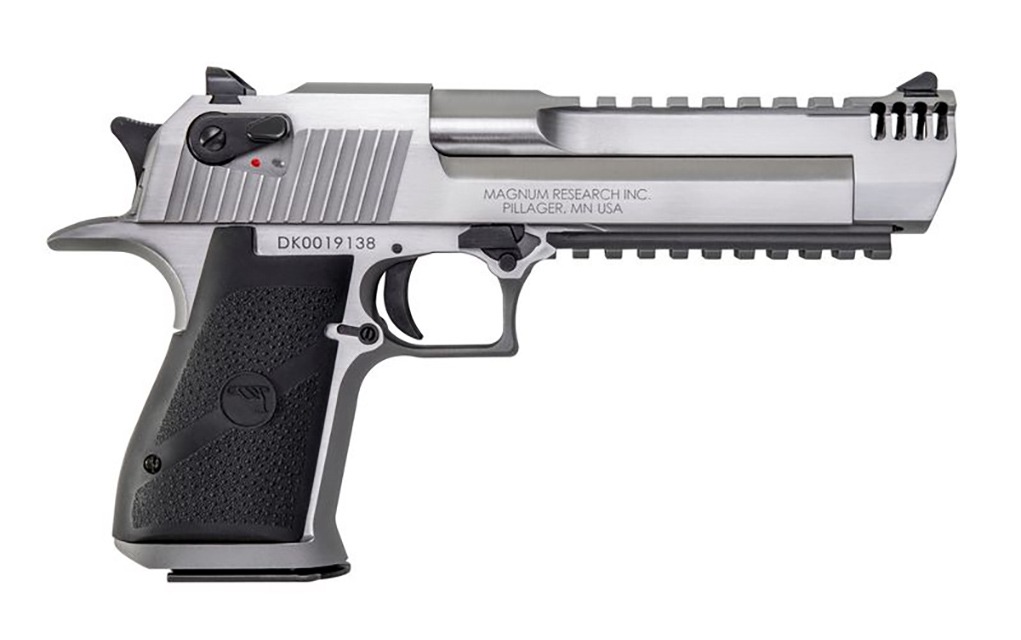
The Desert Eagle is the only extant true semi-automatic .44 Magnum pistol, having been in continuous production since 1983. It's a comically large single-action-only pistol with a slide-mounted safety, a short-stroke gas piston system (kind of like an upside-down AK) and a rotating bolt.  

Desert Eagles are known for sometimes being finicky, with ammunition sensitivity and magazines (8-round capacity) being the usual suspects. However, owners generally report that once you get one dialed in (or get lucky), they tend to be fairly reliable.  

Multiple models with varying features, finishes and barrel lengths are available. MSRP ranges from just under $2,000 to around $2,500, but street prices are closer to $1,500 on the low end.  

LAR Grizzly Mark IV

LAR-Grizzly-44-Magnum-pistol
Photo: Rock Island Auction Company.

The only other commercially successful (up to a point; the company went out of business over 20 years ago) .44 Magnum semi-auto was the LAR Grizzly, manufactured from 1983 to 1999. It was offered in several calibers, including .44 Magnum.  

The LAR Grizzly is essentially a 1911 with an elongated mag well, and in fact shares several parts with the standard 1911 Government model. The Grizzly was hand-fitted and known for having exceptionally good accuracy.  

The standard barrel length was 5.4 inches, but 6.5-, 8- and 10-inch barrels were offered as well (though there were no long-slide models). The 8- and 10-inch guns were popular for silhouette shooting and handgun hunting. All .44 Mag. models had a 7-round magazine.

The most common chambering was .45 Winchester Magnum, but the Mark IV model was offered in .44 Magnum so that would be the one you're looking for. Good luck finding one…and if you do, expect to pay $3,000 to $5,000 as that's about what they command on the used market today.  

Honorable Mention: .44 AutoMag 

TDE-AutoMag
Photo: Rock Island Auction Company.

The .44 AutoMag is not technically a .44 Magnum pistol, as it chambered .44 AMP (essentially a .44-caliber rimless cartridge loaded to .44 Magnum velocities) to abrogate the feeding issues. The AutoMag, made famous by the Dirty Harry sequel Sudden Impact (the last watchable film in the series and the source of “Go ahead…make my day”), was a commercial disaster and bankrupted several companies in the process.  

The .44 AutoMag featured a single-action firing system with a rotating bolt. Only a few thousand were manufactured over a production run of 10 years, so used examples are not cheap.  

However, there's some good news. The rights to the AutoMag pistol were purchased a few years ago, and new production has commenced as the Auto Mag Raven. It’s currently offered with either a 6.5- or 8-inch barrel and MSRP starts at $3,995.  

Honorable Mention: Wildey Magnum  

Wildey
Photo: Rock Island Auction Company.

The Wildey Magnum was another attempt at the magnum semi-auto, offered in multiple calibers including .44 AMP. While not a true .44 Magnum pistol, it was still an innovative design and likewise entered pop culture in Death Wish 3 along with some other films.  

The Wildey, like the Desert Eagle, uses a short-stroke piston system with a rotating bolt, but unlike the Deagle its gas system is adjustable. Interestingly, it is the lone DA/SA pistol among the magnum semi-autos, and therefore also the only one to have a frame-mounted decocker.  

The Wildey pistols had a fairly long production run, lasting from 1983 to 2011, but the rights to the gun and name were purchased in 2016 and new production has resumed under the USA Firearms Corp brand. You can order a Wildey Survivor with an 8-, 10- or 12-inch barrel, and MSRP starts at $2,750.  

Honorable Mention: Mateba Model 6 Unica 

Mateba Unica Model 6
Photo: Rock Island Auction Company.

The Mateba is not technically a semi-auto, but rather an automatic (self-cocking) revolver. Like the Webley-Fosbery pistol, a slide mechanism cocks the hammer to single-action upon recoil and as it returns to battery it rotates the cylinder.  

The pistol was the brainchild of Emilio Ghisoni, an innovative gun designer who was also responsible for the Chiappa Rhino. Like the Rhino, the Mateba's barrel is mounted at the bottom of the frame, putting recoil in line with the hand. 

The .44 Magnum model was offered with a 5-, 6- or 8 ⅜-inch barrel, and in multiple trim levels. Mateba revolvers are rare and incredibly unique, infrequently coming up for sale and commanding a high price (expect to pay $4,000 or more) when they do.  


More On Big-Bore Handguns:

Until It Shines: Using Brass Case Cleaner

1

How to clean your brass the easy way using brass case cleaner.

My gun club ranges have sand and silt floors. There’s also a carpet of brass on top of the sand. When I’m done shooting, I have this habit of picking up my brass, plus whatever is there that’s a caliber I might need, find useful or gotta have. A lot of that other brass is pretty grubby—some of it’s even chocolate colored.

So, I sort the brass and separate it, by caliber and cleanliness, and I end up with boxes (even buckets) of brass that’ll need more than just a run through the tumbler. The muddy stuff gets rinsed in hot water, dried and tossed in with the chocolate brass. And, once a year or so, I’ll set aside a brass-cleaning day (usually a hot summer day) to do the dirty work.

For that, I use Shooter’s Choice Brass Case Cleaner, a solution requiring a certain level of dilution (I tend to not dilute as much as the instructions call for) and then soaking or using an ultrasonic cleaner.

brass-case-cleaner

Once your brass is clean, drain and strain, rinse in hot water (the hotter the better) and then dry. That’s why I tend to do this in the summer. I can pour the hot, wet brass onto an old bath or beach towel and let the sunlight do the drying for me. In the midday sun, it isn’t unusual for the brass to get so hot after a couple of hours so I don’t dare touch it with my bare hands. I’ll pour them from one towel to a new, dry towel and give them another hour or so, until I’m certain they’re fully dry.

Some of you might wonder if the discolored brass is weakened. No, not if the discoloration is just a uniform brown color. If you get green crustiness and patches of it, then the corrosion has advanced to the point that the brass might be weaker. Just brown isn’t a problem.

brass-tumbler
For most brass, going into the tumbler will be enough to clean it.

Take It Easy

Can you overdo this? Yes. You’re using an acidic solution to react to the corrosion and strip it off. If you let your brass soak too long (the instructions specifically say to not do this overnight, so that’s a clue), the acidic solution could’ve worked at a scratch or gouge in the case that wouldn’t have otherwise been a problem, but now you’ve weakened it.

During the decades I’ve cleaned brass this way, I’ve never had a problem, but my idea of a “long soak” is half an hour. In an ultrasonic cleaner, you might need five minutes, or you might need more depending on the level of patina of your brass.

brass-case-cleaner-feature
To get your “chocolate” brass this clean, go to chemistry … not tumbling.

Can you use this method with nickeled brass? Yes. Although, I have to wonder how you go about neglecting nickeled brass to the point where it gains a patina. The whole point of nickel is that it doesn’t do that. But if you miss a nickel case in your sorting and it ends up getting a bath, you aren’t going to ruin the case nor spoil the mix of your cleaner.

Can you clean your regular brass this way? Yes, but unless you have to etch off the patina, why go through the extra trouble? Just toss it in the tumbler. If it’s muddy, a hot water rinse, a dry and then into the tumbler is all it needs.

Editor's Note: This article originally appeared in the November 2023 issue of Gun Digest the Magazine.


More Reloading Info:

Stoeger Double Defense Review: Modern-Day Coach Gun
1

The author reviews the Stoeger Double Defense, a double-barrel shotgun that puts a 21st-century spin on the coach gun concept.

When I was a young Army Lieutenant graduating Officer Basic Course, one of the instructors made a speech in which he outlined some of his sage combat advice earned during the early days of Operation Iraqi Freedom. Among his battlefield tenets, he said: “If someone needs to be shot, shoot them twice.”

We imagine some other gunfighter from centuries previous had the same idea, manifesting this credo in the form of the double-barreled shotgun. While various manner of double-guns can be found across the world and across time, it’s most solidly cemented in the American lexicon. The quintessential coach gun of the Western frontier, from when both justice and power—not always the same thing—spilled from the muzzle of black powder double-barrels like so much lead shot.

Stoeger-Double-Defense-review-feature
The Double Defense uses a tried-and-true break action, adorned with modern enhancements.
Since then, the coach gun has been eclipsed by a number of other firearms as the go-to defender of households and horseless carriages. It could be rightly argued that there are more practical and technologically advanced firearms for the purposes of self-defense. Short-barreled rifles, pistol-caliber carbines, tricked-out handguns, and even suppressed PDWs in messenger bags are all able to defend your life and loved ones as quickly as you can align the sights. But there’s also a lot to be said for things that “ain’t broke,” as the saying goes. Despite all of the competing advancements, there’s absolutely nothing wrong with relying on a double-barreled shotgun, and as Stoeger has proven, the template isn’t immune to being dragged into the 21st century.

Their Double Defense shotguns—available in both over-under and side-by-side configurations—aren’t new guns. But they bring some distinctly modern enhancements to an otherwise timeless firearm. For that, we felt this diamond-in-the-rough was worth a closer look.

Old And New

The format of the Stoeger itself is unaltered from what you know and love about double guns. Our test gun is of the side-by-side variety and laid out exactly as you’d expect. Two 20-inch smoothbore barrels, 2-¾ inch chambers and fixed improved-cylinder chokes are run by a single trigger. The safety is a tang-mounted slider switch that resets every time you close the action. Both versions of the Double Defense are available in 12- or 20-gauge.
Stoeger-Double-Defense-left

We chose the more petite 20-gauge for a couple of reasons. First, we believe that 20-gauge is highly under-discussed as a home defense option. It offers significantly less recoil than 12-gauge, particularly in a locked-breech gun like a double-barrel, with ammunition being mostly readily available and less prone to panic shortages. There are some drawbacks specific to using this gauge as a defensive option, which we’ll discuss below. Secondly, the 20-gauge Double Defense is also incredibly handy at only 6.4 pounds, with most of that weight coming from the black-finished walnut furniture, balancing the gun toward the shoulder instead of the muzzle.
From there, Stoeger went to work on modernizing this Wild West icon. They replaced the bead front sight with a bright green fiber optic, ported both barrels in a similar fashion to what you might get from custom shops like Vang Comp, and added not one but two sections of Picatinny rail. One runs along the top just in front of the action, and a second one underneath out by the muzzle—ostensibly for an optic and weapon light, respectively. Both are removable in the event you don’t need the rail-estate.

Stoeger-Double-Defense-right

Since we wanted to take full advantage of these updates, we decided to adorn the Double Defense with appropriate gadgets after putting some rounds through it in stock configuration. For sighting, we added a Holosun AEMS CORE red dot in an American Defense Manufacturing low mount. The AEMS CORE is a stripped-down version of the more expensive AEMS, lacking the multi-reticle system and solar failsafe cell of the standard AEMS but retaining the same large window and rugged aluminum housing. The bright, crisp 2 MOA dot of the CORE makes an excellent electronic replacement for the bead or fiber optic front sight.
Stoeger-DD-holosun-AEMS

For lighting, we bolted on a Crimson Trace CWL-202. This is a 2-cell, CR123-powered, 900 lumen weapon light that ships with both M-LOK and Picatinny rail mounts along with two tail caps—one for clicky push button activation, the other with a tape switch. The tape switch comes with a hook-and-loop strap on the wire to secure it, but we doubled-down on locking it in place on the gun with a couple of turns of tape as well. The reflector throws a wide beam, and the hot spot isn’t particularly strong, making it a great choice for shotgun work in close quarters.

Stoeger-DD-crimson-trace-light
A Crimson Trace light and Holosun optic round out the upgrade package.

Shell Selection

Before we get into the specifics of how the Double Defense performed on the range, we wanted to get some subject matter expertise on these guns, along with shopping for defensive ammo. So we spoke with Matt Haught of SymTac consulting. Haught and his father, Rob, are arguably two of the preeminent SMEs in our industry on practical use of the self-defense shotgun. In terms of load selection, Haught had this to say:
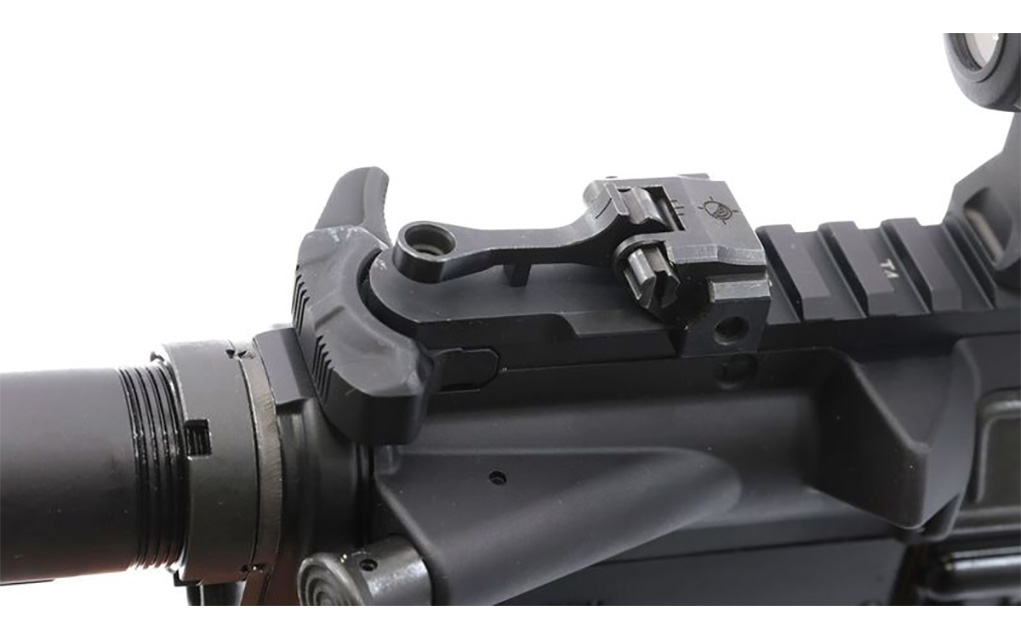
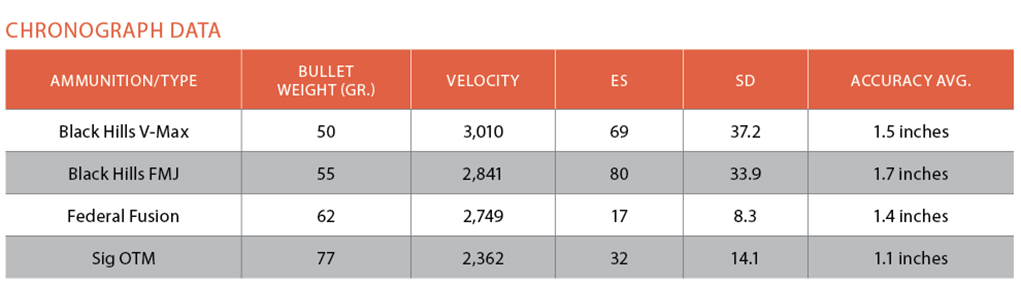
20-gauge kind of sucks for HD loads, in general. I’ve been fruitlessly searching for good buckshot for a long time now. Most of what I’ve seen is either #4 or #3 buck, and I consider both of those just a bit too small to really be useful (they generally won’t quite meet FBI spec in gel through four-layer denim, for instance, or if they do, it’ll only be at very close ranges). Currently, I lean toward some Rio 9-pellet #1 buck for my own use if I had to. Good enough for across-the-room distances, but I wouldn’t want to try a shot across the yard or down my driveway with it. I just picked up some Winchester Defender #3 buck loads but haven’t had a chance to test them yet to see if the plated pellets increase penetration sufficiently, or if the buffering and plating help tighten patterns up to acceptable levels. I also have some S&B #2 buck loads sitting in storage that need testing.

Stoeger-DD-ported-barrel

Unfortunately, we were only able to test two loads out of the Double Defense. One was a Turkish load, made by Sterling and imported by Global Ordnance, loaded with 7/8-ounce of #8 shot, and the other a defense load from Barnes Defense, with 17 pellets of #3 Buck, which translates to .25-caliber pellets. The box is marked “33 percent reduction in recoil” with a muzzle velocity of 1,140 fps. The Barnes load was up first, which we patterned at 5, 10 and 15 yards. At 5 yards we got a nice tight group about 6 inches across with all the pellets in a dense, centered cloud. At 10, the group size just about doubled—still acceptable for putting all rounds inside on a man-sized target. But moving out to 15, the group size expanded to almost 18 inches across. This echoes Haught’s sentiment above about 20-gauge being good across a room, but less so down a driveway. Each time we opened the action, the rim of the shells popped up about a half-inch, just enough to pluck them cleanly out of the chamber and reload.

Then, we tested the Sterling birdshot load. The first two rounds ran fine. We reloaded two more, fired them, then opened the action and the brass rims only ejected a couple of millimeters. We attempted to use a knife, then a flathead screwdriver, and then more tools to pry them out further so we could extract them from the gun.

Stoeger-DD-rail

Long story short, the gun was dead-lined until we could get home and yank the stuck shells out with vice grips. It should be noted that both chambers were lubed prior to test-firing, and we didn’t experience any ejection problems with the Barnes shells. But with the Turkish Sterling, we only got four shells through our test gun before it jammed up so severely we had to halt range testing. Take from that what you will. It’s fair to note that shotgun ammo, as a product class, is notoriously prone to wide tolerance margins and inconsistent standardization. Having said that, we had much higher hopes for our test gun.

Spent Shells

Continuing our discussion with Haught, he had the following to say about the use of 20-gauge shotguns in general:

If you look at the payload mass and velocity, 20-gauge shells generally are identical to low-recoil 12-gauge shells. Given the average 20-gauge shotgun is a pound or two lighter than the equivalent 12-gauge model, this means you pay a recoil penalty with 20-gauge. I love the light, handy nature of 20-gauge guns and I find smaller-statured shooters fatigue less over a day’s training with one, as long as they can get on top of recoil mitigation quickly.

This echoes exactly why we like the 20 as a quick-handling, easy-to-maneuver home defense or truck gun for unexpected close encounters of the violent kind. For this gun in particular, we were reminded of a valuable lesson: Regardless of what gun you use, it’s imperative to test it thoroughly with both your defensive and primary training ammo.

Stoeger-DD-switch
The Crimson Trace light comes with a tape-switch that includes hook-and-loop straps.

In general terms, both 20-gauge and coach guns as a whole remain time-tested and viable options for defensive use. Besides, if there’s ever a problem, you can walk out on the balcony with this double-barreled shotgun and fire two blasts outside the house. The President said so.

Stoeger Double Defense Specs And Accessories:

Stoeger-Double-Defense-Specs

Editor's Note: This article originally appeared in the November 2023 issue of Gun Digest the Magazine.


More On Shotguns:

First Look: Stag Arms Pursuit Bolt-Action Rifles

0

Stag Arms is branching out into bolt-actions with the release of the Pursuit bolt-action rifle series.

Stag Arms is a company known for its precision ARs, but now it’s expanding into bolt-action rifles with the release of the Pursuit series. Initially available in nine configurations, Stag Arms promises that the rifle will elevate your shooting experience regardless of your pursuit, whether that be hunting, competing or anything else.

Stag-Arms-Pursuit-feature

Based on the Remington 700 Short Action platform, Stag Arms Pursuit rifles are being offered in .308 Winchester with an 18-inch barrel, 6.5 Creedmoor with a 20-inch barrel and 6.5 PRC with a 22-inch barrel. Regardless of your preferred chambering, all models feature sporter fluted 416 stainless steel barrels and are sub-MOA guaranteed when using match ammunition. To further aid in accuracy, all models also ship with an adjustable single-stage TriggerTech Primary trigger.

Stag-Arms-Pursuit

As for the Stag Arms Pursuit rifles’ furniture, it’s a 3-piece chassis system that’s available in three colors including black, tan and OD green. The stock’s length of pull and cheek riser height are adjustable, and the stock can be quickly removed without tools for transport or storage. Throughout the rifle you will also find a 20-MOA biased rail on the action for mounting an optic, integrated QD cups, a Picatinny spigot, an attachable bag rider and a threaded muzzle. The guns are also AICS/AWS compatible, and each will ship with a Magpul magazine as well as a ½ Arca Swiss plate.

Pursuit-bolt-action-rifle-on-tripod

All nine variants of the Stag Arms Pursuit rifle are available now and have an MSRP of $1,899.99.  

For more information, please visit stagarms.com.


More On Hunting Gear:

EDC Gear: Rescue Knives Save Lives

0

The author discusses rescue knives, blades purpose-built with materials and features meant to aid people in need.

Rescue knives are an integral part of first responders’ most important gear. They serve as multi-purpose cutting tools like other knives and are heavily relied upon during various rescue operations. Let’s look at the latest rescue knives available on the market. 

rescue-knives-feature
All photos by Marty Stanfield.

Emerson Knives took its existing SARK (Search and Rescue Knife) folder, adapting it to the U.S. Navy’s specifications, and thus the NSAR (Navy Search and Rescue) was born. The 3.5-inch 154CM hawkbill-style blade features a blunt tip and a recessed cutting hook ground into the spine. Other features include an integral thumb rest and Emerson’s signature Wave remote opener designed to catch on the hem of a pants pocket and pull the folding blade open as the knife is withdrawn. 

Knives-2024
This is an excerpt from Knives 2024, 44th Edition, available now at GunDigestStore.com.

The ergonomic G-10 handle showcases an integral front hand guard, palm swell in the middle, and grooves at the thumb rest and rear positions to provide a non-slip grip in any condition. At a little over 8 inches long, the NSAR is a knife that can handle many emergency cutting tasks. A steel pocket clip secures the folder tip-up in the pocket, a configuration that works well with the Wave remote opener. An optional ambidextrous thumb disk deploys the blade more traditionally. 

One of the things I like is the hawkbill blade with a reverse curve that gathers material as it cuts. Customers have a choice of a plain or partially serrated blade, the latter ideal for cutting through tough, fibrous materials. The blunt tip makes it easy to work around accident victims without fear of further injury.

In my tests, the recessed hook worked well, cutting anything that would gather inside its curved diameter. The flat-ground blade is sharpened on one side only like a chisel grind, yielding a keen and easy-to-hone edge. At the local scrapyard where I conducted real-life tests, the NSAR ripped through materials with ease, including seatbelts. It is a major league rescue tool in terms of design, construction and function. The manufacturer’s suggested retail price (MSRP) for the Emerson NSAR is $299.95. 

Anchoring the budget end of the spectrum is the Byrd Cara Cara Rescue 2. A value brand belonging to Spyderco, Byrd knives incorporate the same innovation and style of construction as more expensive Spyderco models, but with different materials that yield amazing value. Most folding rescue knives are on the high end of the price spectrum, placing them out of reach financially to many front-line blue-collar workers. 

Measuring 3.9 inches long, the Cara Cara Rescue 2 blade is ground from 8Cr13MoV stainless steel and sports a fully serrated edge that munches through fibrous materials. The comet-shaped hole in the blade permits ease of one-handed opening and provides a more secure thumb purchase than a standard round hole, especially when wearing gloves. 

Blunt Point Prevents Punctures

The blunt point of the sheepsfoot blade prevents accidental punctures during use. The fiberglass-reinforced nylon (FRN) handle promotes a comfortable, non-slip grip thanks to the unique bi-directional texturing along with grooving, or jimping, on the handle spine. The handle feels solid and showcases dual nested steel liners and screw-together construction. A four-way pocket clip allows the user to select from left- or right-handed, tip-up or tip-down carry. Once open, the blade locks into place solidly. The mid-handle placement of the lock release itself makes it possible to unlock the blade and close it using one hand.

I noticed the handle’s lack of significant chamfering and contouring. Less machining is necessary with a moldable FRN handle, translating into a lower price point. Yes, the Byrd Cara Cara Rescue 2 can feel a bit blocky in hand, but the straightforward design results in a secure grip and a knife that is easy to manipulate when wearing thick gloves typical to a first responder. 

Spyderco engineers some of the finest fully serrated folding knives on the market, with the Byrd Cara Cara Rescue 2 being one of them. The blade easily eats through the toughest materials—cardboard, seatbelts and thick tie-down straps being no match. The comfortable, ergonomic handle rests securely in the palm to instill user confidence. Comfortable to carry in a pants pocket or inner waistband, the thin profile doesn’t add bulk, yet feels good in the grip.

The 8Cr13MoV steel is a Chinese equivalent to Japanese AUS-8, a good mid-range alloy that balances edge holding with ease of maintenance and cost. To those looking for a quality rescue knife on a budget, the Byrd Cara Cara Rescue 2 is the answer. With an MSRP of $53, it is made in China to Spyderco’s exacting specifications. 

When it comes to high-end rescue knives, the Benchmade Auto Triage 9170SBK is a serious piece in any emergency kit. A member of Benchmade’s Black Class line of professional rescue and tactical knives, the Auto Triage packs a bunch of innovations into one comprehensive tool. The 3.5-inch Bohler N680 stainless modified drop-point blade sports a partially serrated edge for cutting versatility. Benchmade’s dual-purpose Auto Axis Lock secures the blade open and seconds as a blade release for the auto-opening folder. Pulling back on the lock release opens the blade automatically. 

Benchmade-rescue-knife
The heavy-duty Benchmade Auto Triage integrates features that allow it to double as a rescue folder and a versatile work knife. The partially serrated, modified clip-point blade can handle any utility cutting chore.

The Auto Triage rests securely in the hand and is easy to operate and completely ambidextrous. An ergonomic handle is constructed of T6-6061 aluminum with a Type III hard-coat black anodized finish. Black G-10 handle inlays provide additional hand purchase, and the grip also features a safety cutting hook for seatbelts and clothing. Pulling back on the lock release button close to the rear of the handle activates the cutting hook that is otherwise tucked away until needed. This is the only cutting hook on the market that is automatically deployed.

Benchmade-seatbelt-tool
The cutting hook of the Benchmade Auto Triage is the only such tool on the market deployed automatically. An effective cutter, the hook deploys instantaneously in high-stress rescue operations.

At first blush, I thought the automatic cutting hook might be overkill, but in considering the thick gloves first responders wear, combined with the stress and adrenaline rush of being in the moment, having an auto-deploying hook makes total sense. The pull-down release works well with gloved hands as opposed to fumbling around while attempting to use a manual rescue hook. A deep-carry pocket clip allows tip-up right-hand carry and a carbide glass breaker at the end of the handle shatters car and other windows with ease. 

Overbuilt Handle

Right off the bat, from the build of the handle, users can see the Auto Triage is a stout knife easily manipulated wearing gloves. While it might feel blocky in hand, when gripping the handle with gloves, one becomes aware of its presence and the knife feels secure. Because there is a secondary cutting hook to manage seatbelts and clothing, the main blade is designed with a sharpened tip. The true rescue tool that it is, Benchmade’s Auto Triage is every bit as much a working folder for general cutting tasks. 

Benchmade-rescue-knives
The semi-serrated, modified clip-point blade of the Benchmade Auto Triage rescue folder can handle any utility cutting task.

Partial edge serrations on the modified drop-point blade easily power through stubborn materials. The flat grind of the blade is another aspect of its exceptional cutting performance, with a thin but strong edge that sails through cutting media with little effort. The Auto Axis Lock release is intuitive and truly ambidextrous, allowing for quick and easy blade release with either hand. It is especially crucial in emergencies for professionals who use whatever hand is available to deploy the blade or cutting hook.

The vanadium and nitrogen inherent to the N680 steel help boost its anti-corrosion properties. The cutting hook works quickly, gathering material as it cuts and slices through seatbelts as easily as pulling a zipper. The keen hook bites into webbing and clothing with little effort and a sliding switch safety on the main blade prevents the Auto Axis Lock from inadvertently deploying the blade. Located on the handle spine just behind the lock release buttons, the sliding safety switch is easily accessed. 

Overall, the Benchmade Auto Triage 9170SBK is a professional, high-quality tool that feels great and secure in the hand and doubles as a general-use folding knife, which further makes it that much more attractive. The Auto Triage isn’t a single-purpose tool like other rescue knives. With an MSRP of $350, the Benchmade Auto Triage is a high-end rescue tool.

Leatherman Tool Group, the company that pioneered pliers-based multi-tools, takes a different approach to a rescue tool in the form of its Raptor Rescue Shears. Modeled after high-leverage emergency medical technician (EMT) trauma shears, the Raptor Rescue incorporates several features that make it a unique rescue tool. 

Leatherman-shears
The Leatherman Raptor Rescue Shears is a unique tool that can cover a wide range of lifesaving tasks and has advantages over a rescue knife.

The Raptor Rescue features several of the most used implements for removing clothing from rescue victims. For starters, the blades of the main shears are each over 1/8-inch thick, and sport super sharp cutting edges. This tool quickly cuts through thick material like nylon webbing and jeans. The full-size handle’s finger loops accommodate gloved hands and folding the Raptor Rescue allows easy access and employment of the tools and other built-in functions. 

Such tools and functions include a carbide glass breaker for shattering side windows of vehicles, a fold-out cutting hook for seatbelts and other fibrous materials, and an oxygen bottle wrench. There’s even a built-in wire cutter behind the pivot of the shears, taking advantage of leverage at that location. The Leatherman Raptor Rescue folds into a compact, easy-to-carry package. The handle halves fold onto themselves, and there’s an ingenious lock on each handle that prevents the tool grips from folding up while in use. 

The heavy-duty plastic holster accompanying the Raptor is designed to keep the tool close at hand until it is needed and does so in one of two positions. First, when the tool is folded, the Raptor slides into the holster and is secured by a pocket clip fastened over the lip of the sheath. A second carry option is with the handles fully open. The blade inserts through a specially shaped hole in the bottom of the sheath, and the shears are locked into place inside the holster for carrying the Raptor in the open position and secured with a locking tab. This method is the most ideal, as one doesn’t have to fiddle with opening the handles. Just grab the shears and go. 

rescue-shears
Leatherman’s Raptor Rescue Shears is an effective emergency tool built around a full-size pair of EMT shears. The heavy-duty shears can take on tough tasks like cutting up this thick hose. The bottom blade is serrated, which helps to hold the cutting medium.

Speaking of being on the go, the MSRP of the Leatherman Raptor is $89.95 in case you want to take one home with you.

Tactical And Rescue Knives

Hogue Knives is a major player in the tactical and rescue knife market. The company designed its Trauma First Response Tool from the ground up as a full-service rescue knife that has all the tools any first responder could need on a call. The Trauma is offered in a choice of a sheepsfoot blade or an opposing-bevel blunt-tip configuration. For this article, Hogue sent the opposing-bevel blade with a partially serrated edge and an orange G-10 handle.

rescue-knife-and-shears
Blade serrations on the Hogue Trauma First Response Tool (top) aggressively eat through fibrous materials, while the Leatherman Raptor Rescue Shears (bottom) quickly cuts through thick media like nylon webbing and jeans.

The Bohler N680 blade is corrosion resistant with additional nitrogen added to the alloy mix. The opposing-bevel grind of the 3.4-inch blade gives it additional strength in the cross-section, and a blunt tip helps greatly reduce injury to accident victims while cutting seatbelts and clothing. Dual thumb studs permit it to be easily opened with either hand, and the blade is secured open by Hogue’s ABLE Lock, a truly ambidextrous crossbar design that is strong and safe. 

The highly visible, ergonomic orange G-10 handle integrates dual stainless liners for strength, and a large finger groove helps index the user’s grip. The thumb rest area of the handle spine has traction notches for a non-slip grip. The handle also incorporates a few important tools that are handy for rescue personnel. First, there is a fold-out cutting hook for performing pull-cuts through seatbelt webbing and clothing as easily as pulling a zipper. A single thumb stud deploys the cutting hook easily, and though a detent secures the hook in the open position, unlike the Benchmade Auto Triage, it doesn’t fully lock open.

There’s also an oxygen bottle wrench incorporated into the left side of the handle, and the final tool on board is a carbide glass breaker in the handle spacer. The glass breaker easily shatters vehicle side windows. Hogue offers two convenient carry options for the Trauma—a deep-carry, tip-up pocket clip and a sturdy ballistic nylon belt sheath. 

Hogue-first-response-tool
The Hogue Trauma First Response Tool has a rescue hook that folds out manually from the rear of the handle to provide quick cutting of seatbelts and clothing.

The Trauma’s cutting performance is top-notch, with the partially serrated blade easily zipping through tough materials. The plain edge portion of the blade is sharpened on one side only, making it easier to maintain. Being a rescue tool, not a working utility knife, edge dings are not a primary concern. The straight-line edge makes the blade perform like a sheepsfoot model, and the serrations aggressively eat through fibrous materials. The cutting hook works nearly as well as the Benchmade Auto Triage, but as noted, does not lock open. This could be a slight inconvenience so long as the user does not lift it accidentally when employing the hook. Any cutting media is easily severed inside the hook. While using the knife with gloved hands is a cinch, accessing the hook can be a bit deliberate, as one needs to open it with the thumb. 

I particularly like the look of an orange handle with a black blade. While orange makes the knife stand out, the Trauma is also available in a black G-10 handle. The MSRP for the Hogue Trauma tested here is $199.99.

Editor's Note: This article is an excerpt of KNIVES 2024, 44th Edition.


More On EDC Gear:

5.7x28mm For EDC?

2

Do pistols chambered for 5.7x28mm cut it for everyday carry? Yes and no and … maybe.

Back in 1990, NATO wanted a special firearm … a personal defense weapon (PDW). This PDW was to be the modern equivalent of the M1 Carbine. Unlike the carbine, however, they wanted something that’d penetrate the soon-to-be-issued Soviet “superarmor”, something that all Warsaw Pact troops would soon be wearing when they swarmed across the Iron Curtain.

The 5.7x28mm came to us in the P90, an SMG-sized firearm familiar to all fans of the Stargate TV show. Its companion, the PS90, came with a 16-inch barrel and no selector switch. In due time, FN offered a 5.7x28mm option in the FiveseveN, a pistol chambered in the cartridge. The ammunition, however, wasn’t the anti-Soviet loading that NATO could get, but various FMJ and polymer-tipped bullets that could be had here.

FN-57-shooting
All three 5.7 pistols discussed here can have a red-dot optic mounted, if you wish. Here, the FN gets some range time.

So, the question is: Is the 5.7 a suitable option as an EDC firearm and chambering? Quick answer: Yes … and no.

Pistol Potential

OK, first up are the pistols. For the longest time, we’ve had just the FN version, the FiveseveN, which is pretty marvelous. Holding 20 rounds of 5.7x28mm ammunition, and with magazine extensions adding 10 rounds available, you can have a full box of ammo plus one, in the pistol and on your belt, with just two magazines. Then, Ruger added theirs, and just recently S&W unveiled a pistol in 5.7 as well.

So, you have choices.

SW-57-Ruger-57-and-FN-57
FN Five-SeveN Centerfire Pistol (left), Ruger-5.7 Centerfire Pistol (middle) and Smith & Wesson M&P 5.7 Centerfire Pistol (right).

Oh, and if it matters, the S&W comes standard with an extended and threaded barrel, so you can mount a suppressor, if you want to, for more giggle-worthy range practice. Plus, the S&W magazine holds 22 rounds, but you’ll have to use the included magazine loader to get it stuffed full. The FN version differs from what we expect in a pistol in that the safety is not thumb-operated, but instead a lever on the frame located for your trigger finger. Both the Ruger and S&W have a safety (ambi) in the expected thumb-actuated location. Still, you can learn the FN safety location.

But there’s a bigger problem with the 5.7 as a defensive pistol: size.

The 5.7 cartridge is long. At 1.59 inches, it’s longer than a .45 ACP or .38 Super, which means fitting it into a magazine, and the magazine into a frame, makes for a larger pistol than “normal.” And then you double-stack it to gain capacity, resulting in a full-sized-plus pistol. The thinness of the cartridge does mitigate the double-stack fattening of the grip, but not enough to make it not big. There’s no getting around it—you’re going to be packing something as big as a 1911 government model, and then some.

57x28mm-ammo-comparison
The 5.7 is long, longer than standard pistol cartridges. Here, you can see some standard (and not-so-standard) 5.7 loads, compared to 9mm, .40 and .45.

If you can get your hand or hands around the frame to hold and shoot it, then great. But if you can’t, it doesn’t matter if it’s the hammer of Thor—you can’t. This does limit the 5.7 to those with large-enough hands who are willing to dress around the gun. We all have to dress around the gun, but the various 5.7 pistols make that a greater task. In the past, I’ve mentioned the various 5.7x28mm pistols as an option for those who aren’t keen on recoil, but (I’m pretty sure) I’ve always been clear: You’ve got to have hands big enough.

Dollar For Dollar

Next up is the cost of ammunition. It isn’t too difficult these days to find practice ammo for a 9mm pistol at $12 for a box of 50 rounds. Granted, the better defensive ammo is going to cost more, but a box of 50 Gold Dots, for example, that runs you $30 will last you for years as carry ammo. But to practice you need to shoot, and shooting means it’s consumed. For that, $12 a box is a better deal, and it leads to more practice.

In the 5.7, practice ammo is going to run you as much as the premium defensive 9mm does—or darned close to it. The lowest-cost 40-grain FMJ I could source was $29 per box, and it went up quickly from there. And, you don’t have the option of reloading to lower practice costs. The case is a bottlenecked one, not always a problem, but while the S&W is a rotating barrel, the Ruger and the FN are both a short-distance blowback design, so case shoulders are blown forward when fired in those pistols. As a result, case life is thus short, and loading data is sparse or vague. There are a host of other problems as well. The quick answer is: No savings here.

FN-57-with-target
FN was first with the FivseveN. While it’s a great pistol, it’s also the most expensive of the trio.

Oh, and while we’re on the subject of cost, the prices have quite the spread. The FN lists at $ 1,409, the S&W at $699 and the Ruger at $899. In an age of a host of 9mm pistols listing for $425 to $450, those aren’t inconsequential price bumps.

Punching Above Its Weight

How about ballistics? Detractors diss the 5.7x28mm as “being an expensive .22 Magnum,” but that’s not true. The little rimfire has its published ballistics rifle velocities, and using it in a pistol chops a bunch of fps off of those figures. Out of a pistol, the .22 WMR delivers around 1,200 fps or a bit more, with a 45-grain bullet. The 5.7 can accelerate a 40-grain bullet to 1,700 to 1,800 fps, which is a significant difference.

Ruger-57

Field reports on the 5.7 aren’t extensive. It hasn’t received anything like the acceptance of the .40 back in the early 1990s, nor the adoption of the latest-generation 9mm JHPs that we can mine for a trove of data. However, there’s one incident we can turn to—the use of a 5.7 at Fort Hood. There, 45 people were shot, 13 of whom died.

The interesting (from a ballistics viewpoint, otherwise it was horrible) aspects of the incident was that, despite all the victims being young, fit and motivated, none were able to close the distance to the shooter. In fact, the 5.7, when it struck bone, broke bones, which isn’t always something a pistol cartridge can do. As I’ve mentioned before, when a “lowly” .22 strikes the femur and breaks it, there’s something going on here we can’t necessarily explain with the various ballistic theories I’ve read. Ballistically, the 5.7 seems to punch well above its weight.

Accuracy Excel, Recoil Is Pleasant

The impressive ballistics delivered don’t come at a cost in apparent recoil. While the 5.7 in any pistol is going to be a bit “bouncy” in recoil, it doesn’t beat you up like others do. A +P load in a .45 ACP is definitely a workout to shoot. A top-end 9mm, or a +P load, while not as hard-hitting on your hands, has more bark to it, and some people find the noise more of a problem than the recoil. Some loadings of the 5.7 are snappy in noise, but none are what you’d call hard to shoot, recoil-wise.

57-on-the-range
The 5.7 doesn’t have much in the way of felt recoil, so you can shoot fast and accurately. You just must have hands big enough to reach around the grip.

In recoil, momentum seems to be a better yardstick of the impression in your hands than kinetic energy is, so we’ll use the power factor (PF) calculation here (weight times velocity). So, a vanilla-plain 9mm load (115 grains at 1,150 fps) posts a 132 PF, while an average .45 hardball load posts a 190 PF. (The top-end loads of each are considerably higher in PF.)

The 5.7? With a 40-grain bullet traveling at 1,900 fps, you’d have an 85.5 PF. So, that’s soft recoil, if you can get your hands around it.

As far as accuracy is concerned, the 5.7 is no slouch. The ammunition—and the pistols—will be more accurate than just about any shooter out there. And all can be had now with mountings for red-dot optics, so you aren’t giving that choice up.

FN-Five-seven

And The Verdict Is?

So, where are we, as far as EDC for the 5.7x28mm?

We’ve got a large pistol, and for that you’ll need proper leather (or Kydex) to carry it and not be noticed. All three options weigh a few ounces less than a G17 and a half-pound less than the weight of a lightweight commander—just a bit more than half the weight of a steel government model. If you’re carrying a spare magazine (and you really ought to), you’ll have one as big as one-plus of a G17 mag or two 1911 magazines. And that’s even before you take advantage of the extra capacity extensions.

SW-57-magazine
The S&W 5.7 magazine holds 22 rounds, which could be very comforting in an emergency.

I gave up on packing a full-sized government model back when Reagan was president, in favor of a more-compact, lightweight commander. I’m not sure I’d go back to that size, even for the capacity of the 5.7.

But I’m old, cranky … and like my comfort.

To sum things up: If you can hide the size and get your hands around the grip, the 5.7 offerings can be very attractive. For a lot of shooters, those are both big hurdles to overcome. And practice will be expensive, because you can’t cut costs by reloading.

But, as I’ve said many times before: This is America, and you have choices.

Editor's Note: This article originally appeared in the 2023 EDC special issue of Gun Digest the Magazine.


More 5.7x28mm Stuff:

The Quick Draw: Hip Shooting And The Value Of Sights

2

The author tests out fast draws, hip shooting and point shooting to demonstrate the value of using your defensive handgun’s sights.

Through Western lore and Hollywood, the quick draw has been promoted as the default approach to gunfighting. There’s no doubt being able to swiftly draw your handgun can be an asset if you have to shoot fast to save your life. But because your trigger finger sometimes decides to operate independently of your brain, and because humans have a propensity for doing stupid sh*t, attempting to draw and shoot a handgun as fast as absolutely possible can lead to a bullet hole in your ass cheek, thigh or foot. If you’re exercising appendix carry, a negligent early/discharge might best be described as a catastrophe.

So, this column comes with a warning: Trying to draw and fire a pistol as fast as possible can be dangerous.

hip-shooting-feature
The quick draw, combined with hip shooting, is a very fast way to engage a threat. It’s also very difficult to get good hits when using this technique.

If you carry a concealed handgun, you should practice your draw stroke, and you should work toward making it smooth and speedy. Your goal is to get the handgun out of the holster and deliver an accurate shot on target—fast. There’s a lot of gibberish about fast draws, hip shooting, point shooting and the value of using sights, and I wanted to conduct a test to see how they actually compared to each other when I’m the one doing the shooting. Now keep in mind, I’m not Jerry Miculek, so my performance will not amaze or impress you.

Shooting With Sights

To start, I placed a silhouette target with a 2.5-inch kill zone at 5 yards. Using my PACT shot timer, on signal I drew the handgun, raised it up in front of my face, found the sights and pressed the trigger as fast as I could. My average time for the draw and a single shot was 1.27 seconds. I hit the silhouette 100 percent of the time, and my shots landed in the kill zone 40 percent of the time. The resulting 10-shot group measured 10.5 inches. Admittedly, I yanked the hell out of the trigger twice, and one shot got away from me a bit early.

hi-power-w-timer-and-targets
Testing yourself with a shot timer can tell you how fast you can get your hits when employing different shooting techniques. You might want to try it.

Point Shooting

I don’t need sights to hit a silhouette target at 5 yards, so I ran this drill again using a 5-inch kill zone to see how much faster I was when point shooting, and to see how much my accuracy would suffer. Instead of finding the sights, I just brought the pistol up in front of my face, shoved it toward the target and pressed the trigger—I probably yanked the trigger about half the time. I hit the target 10 out of 10 times, but only hit the kill zone once, and my average time was 1.11 seconds—12 percent faster than when using the sights. Interestingly, the size of the 10-shot group was only ½-inch larger than the group created by the 10 shots fired with sighted fire.

Hip Shooting

Then, I went Western. I wanted to see how much faster it would be to draw and shoot from the hip like the TV cowboys and gangsters do. By not having to raise the pistol to eye level, I should’ve been able to cut some time off the engagement, and I did. My average time was 0.92 second—17 percent faster than point shooting and 27 percent faster than when using the sights. But this time I used an 8-inch kill zone and never hit it. In fact, I only hit the silhouette 8 out of 10 times.

So, what did I learn? Well, at 5 yards, if all I care about is hitting a silhouette, I can do it just as well by point shooting as I can if I use the sights. I also learned that, if I’m going to try to do any hip shooting, I need to dedicate some time to practicing that art.

hip-shooting-results
These targets show the results—with times—for all 10 shots fired with the sights, by point shooting, and by hip shooting.

Sending Multiple Rounds

But all this shooting got me thinking what the difference might be if I was firing multiple shots. Handguns are notoriously poor at stopping a fight, which is why most defensive handgun firearms trainers teach you to engage a target with at least two rounds, or until it’s no longer a threat. Again, at 5 yards, I repeated the exercise … but this time I rapidly fired four shots instead of one using each technique.

My average time for four shots from the hip was 1.80 seconds, with a silhouette hit rate of 80 percent. My average time for point shooting four shots was 1.90 seconds, and for aimed fire it was 1.95 seconds, both with a hit rate of 100 percent. With multiple shots fired, hip shooting was only 5 percent faster than point shooting, and only 7 percent faster than shooting with the sights. I believe the reason for this is partly because, when point shooting and shooting with the sights, you have two hands to help you control recoil, and also partly because most of the shooting many of us do is either point or sighted fire.

Your skill may vary, but what this exercise mostly proves is the slight amount of time you gain by not using the sights or shooting from the hip demonstrably hinders your ability to place your shots accurately. You can believe whatever theory you want when it comes to stopping power, but the most accepted fact is that shot placement matters most—take enough time to aim your pistol and get a good hit.

point-shooting-vs-hip-vs-aimed
This mock-up target shows the results of the best attempts at the multi-shot drill with each shooting technique. It’s abundantly clear which method would be best for getting good hits.

Dictating Circumstances

Of course, there are times when point shooting or shooting from the hip might be a better option. If your assailant is nearly within arm’s reach, it’s probably not a good idea to fully extend your pistol, and hip shooting might be the best approach. Similarly, if your target is only about 3 yards distant, depending on your skill level, you might be able to reliably get good enough hits faster by point shooting. There’s only one way to discover any of this—you have to try it.

There’s no question that the quick-draw hip shot is faster, and maybe there were some Western gunslingers who employed it and even regularly practiced it. However, sights on handguns have been around as long as handguns have, and I doubt this was the case unless the action was at breath-smelling distance.

You simply shoot better when you use the sights, and it appears those who live by the gun have known that for a long time. When Bat Masterson ordered his pistols from Colt, he gave them very specific directions about the sights. He wouldn’t have done that if he was not planning on using them.

Editor's Note: This article originally appeared in the 2023 EDC special issue of Gun Digest the Magazine.


More On Defensive Handgun Skills:

MUST READ ARTICLES