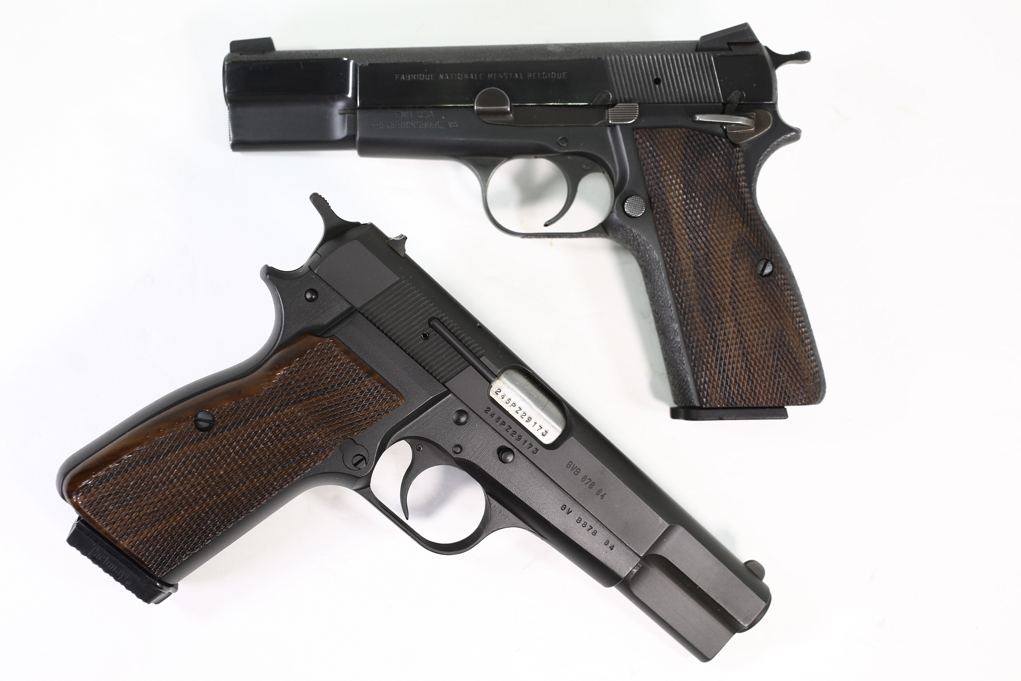
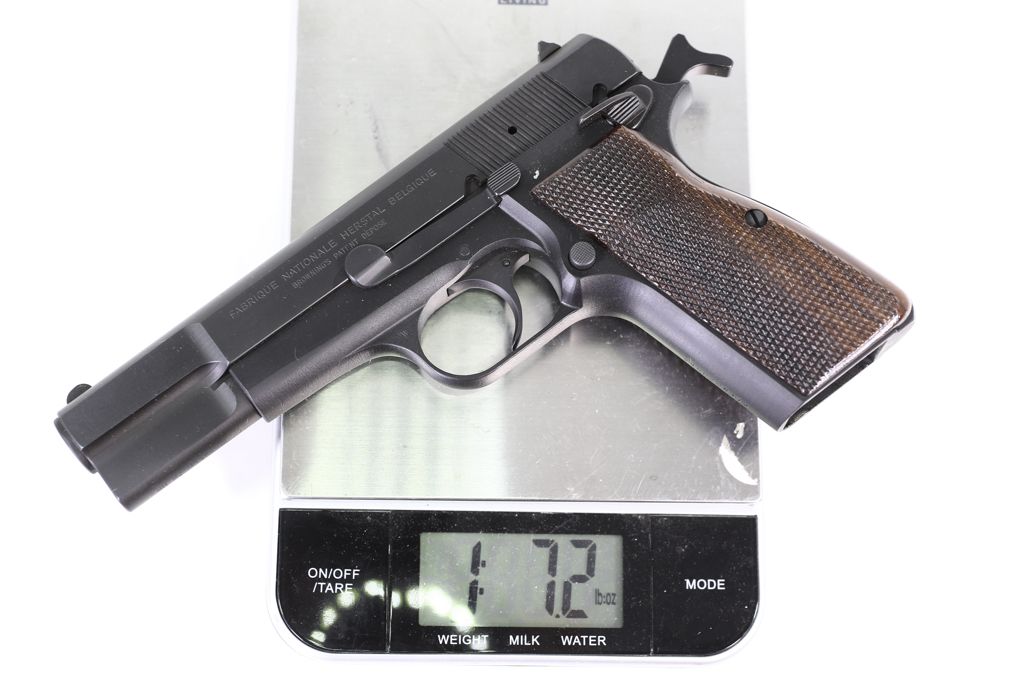
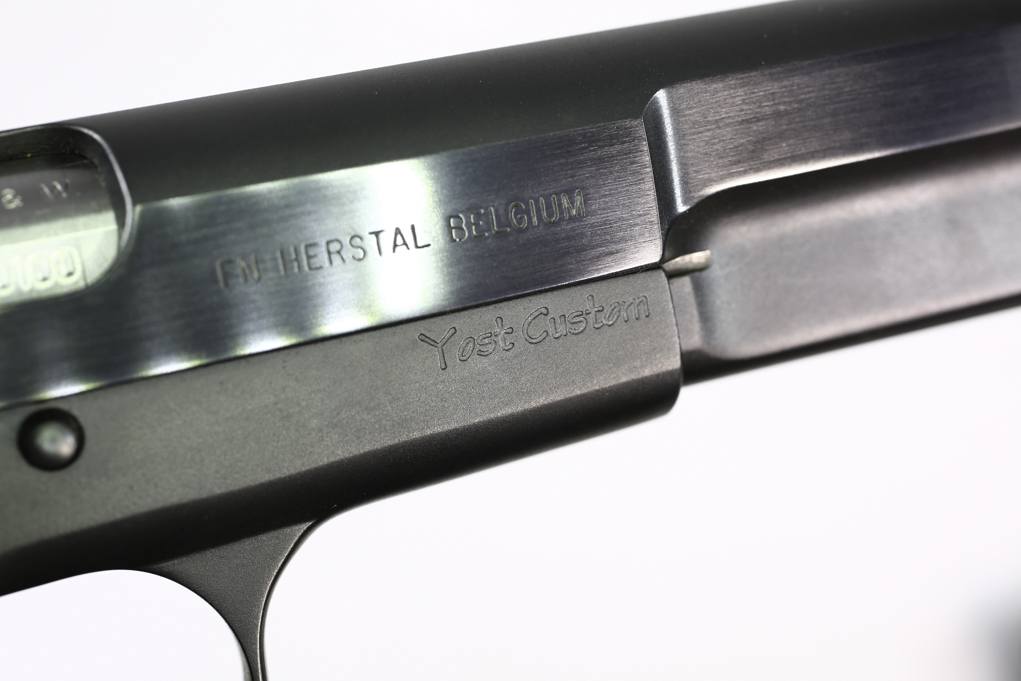
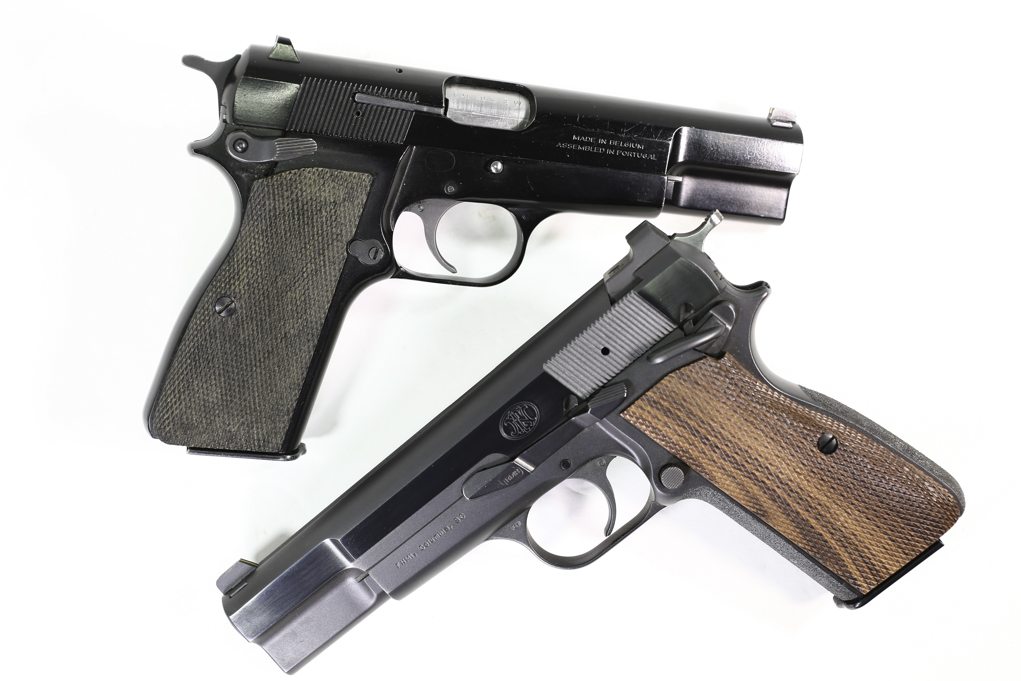
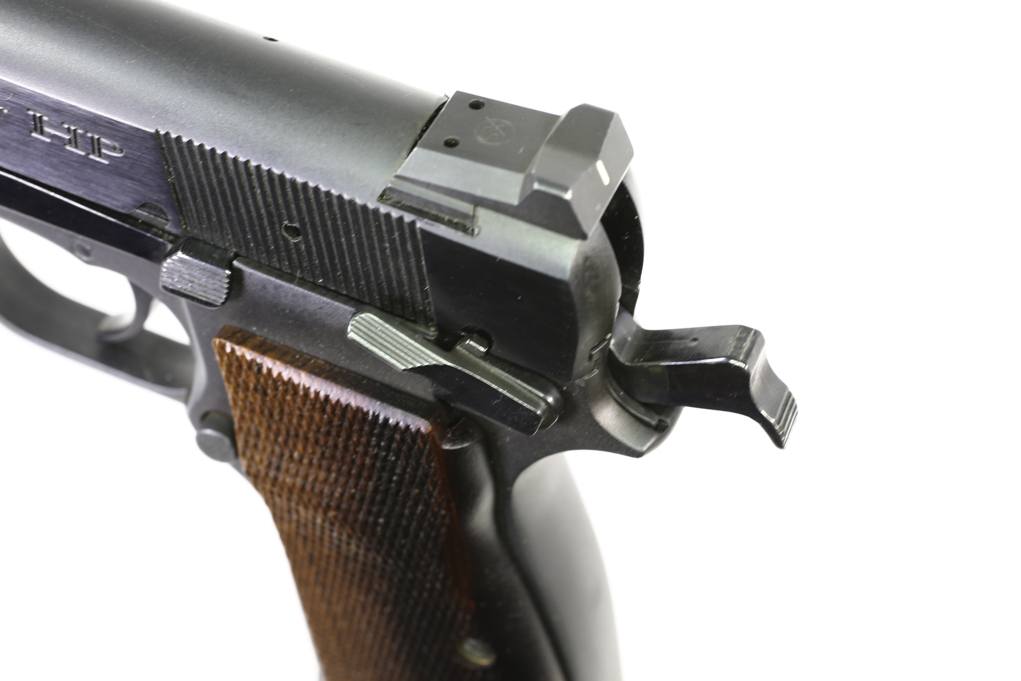
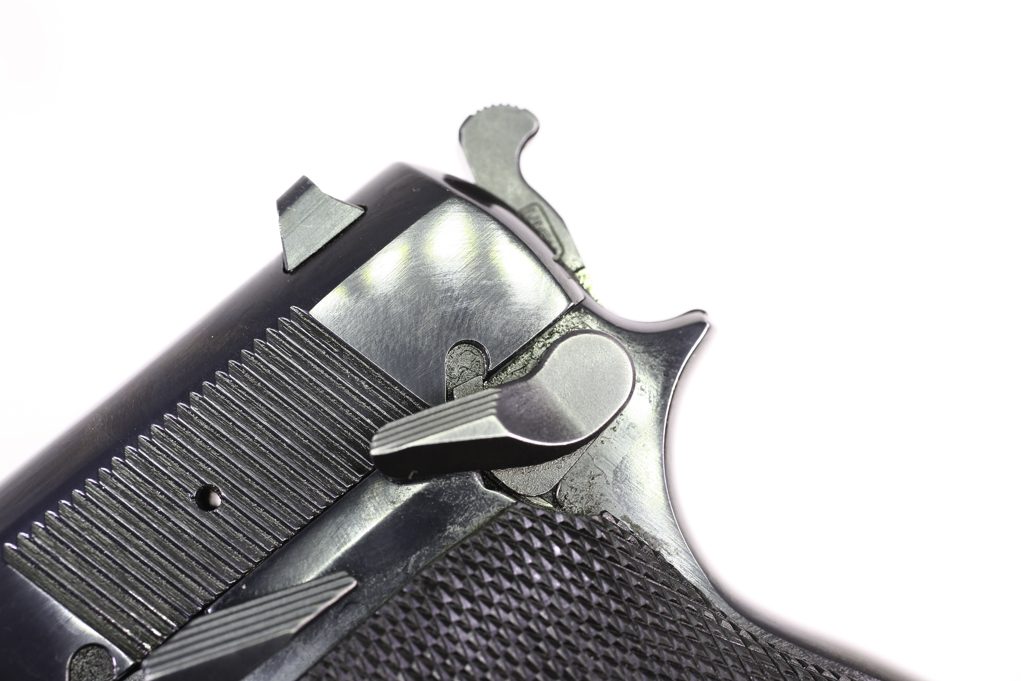
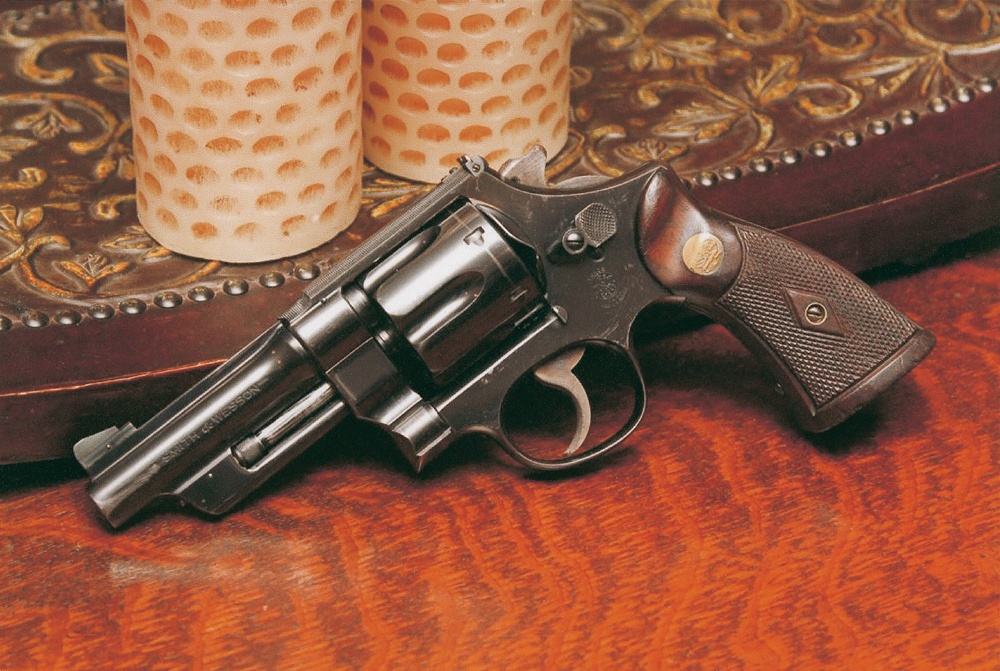
Given its near-global presence, the Browning Hi-Power goes by many names.
Hi-Power name variations and acronyms:
Hi Power
Hi-Power
High-Power
High Power
Inglis
HP
GP
BHP
P-35
What do we call this pistol? Verbally it is no problem, because all the choices, save one, sound the same. But is it Hi Power? Hi-Power? High Power? Or High-Power? FN and Browning varied the spelling over the years and have even used a variant of these to describe the bolt-action rifles FN made and Browning imported. The editorial form is Hi-Power, but advertising over the decades has used all of them.
Then there are the acronyms. There’s HP, GP, BHP, and P-35, the year of introduction. If you travel in Canada, you’ll run into shooters there who call it the Inglis, and on an expedition to (of all places) the island of South Georgia, I ran into a former British serviceman who simply referred to it as “the Browning.”
A pedant would scatter the spelling throughout a scholarly work according to the time, place, and origins of the model being discussed. While precise, it would be somewhere between annoying and maddening to read, and best to be avoided.
Me, I opt for the shorthand (BHP) where I can get away with it. Hi Power everywhere else unless it is a specific model like the Inglis. And “Browning”? In Britain, there may be only the one, but for the rest of us there are more than a dozen Browning guns worth considering. Make it Hi Power or BHP for me, then.
For more information on the Browning Hi Power pistol: Eulogy to the Browning Hi Power Upgrading A Surplus Browning Hi-Power The 9 “Best” John Browning Firearms France, Belgium, Nazis and the FN Hi Power
Building from the bottom up, the first step to solid pistol marksmanship is a good grip.
Intricate and nuanced, pistol shooting – done well – is about sweating the small stuff. Not exactly college-leave linear algebra tough, it requires particular attention to where you focus when aiming, how you present the gun and the steadiness of your trigger squeeze. This is especially true in the beginning, before you program muscle memory to auto drive. At the base of it all, before you learn to concentrate on the front sight or how to break a shot like a dry twig, is a proper grip.
Often overlooked for sexier aspects, if you don’t have a solid handle on your gun you’ll never truly build the speed and accuracy of a proficient shooter. As hand placement on a baseball bat is the foundation of slugging, grip on a pistol lays the groundwork for marksmanship. And few men or women and speak more knowingly on the matter than Mark Redl.
Multiple practical pistol titles to his name, the professional shooter stresses the importance of accurate shooting starting from the ground up. Breaking it down step-by-step, Redl gives you the inside on how to properly grip a semi-automatic pistol so you have the most control over the gun and greatest potential for accuracy. Correctly executed, these simple tips should have you managing recoil better, shooting faster and placing more rounds where you want them to go.
An addendum to anything along these lines, it, of course, takes practice. But a little sweat equity perfecting your grip pays big dividends in the long run.
For more information on Colt, please visit: www.colt.com.
Holster selection for women gets dicey because a lot of holster stuff on the market is designed by and for men. Thus, many of the principles in previous chapters need to be looked at differently to ensure comfortable and successful carry. “Concealed carry for women poses some important questions and challenges,” the blog Well ArmedWomen.com declares. “Women have some unique challenges to effective and safe concealed carry such as: holster locations on our curvy bodies, a variety of clothing styles that can make concealed carry challenging and the way a woman lives out her life.”
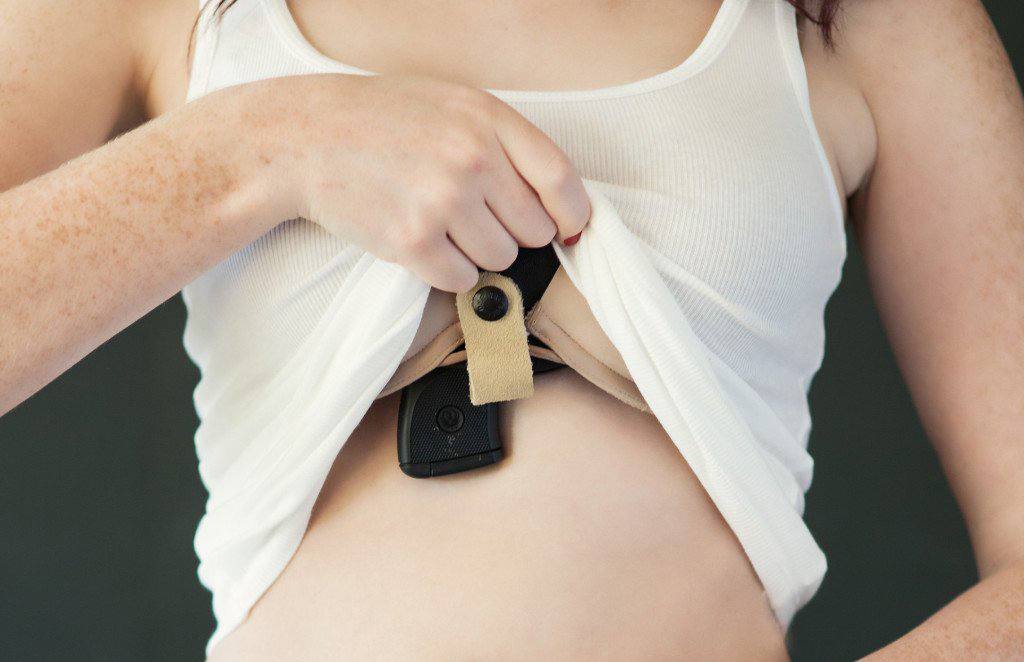
Demonstration of the notorious Flashbang bra holster. It clips to the band between the cups and holds the handgun front-and-center for quick deployment.
Overcome the Clothing Challenge
As a man attempting to write generalities about how women should dress I might as well just stick my head in the microwave and hit the popcorn button. But a few observations are warranted, like how tight-fitting, thin materials don’t bode well for concealing things like handguns and extra ammo. Concealed carry is not just about picking a gun and a holster. It entails a radical change in lifestyle, and that seems especially true for females. If you’re a woman you can still be fashionable, but you may need to rethink how you dress. Don’t shoot me, I’m just the messenger.
Yes, it’s true there are holsters to cover many of your existing styles. We’ll cover some of the better-known ones here. But also keep an open mind in looking anew at your wardrobes. Surely some of your stuff will work with the right holster, but there may be even better dress options for that holster and gun combo. Concealed carry is an awesome responsibility, so make it central to everything and dress around it, rather than trying to cram it into your existing daily dress.
A few tips on clothing include working a gun belt with jeans or slacks into your daily wear. A belt holster is one of your best carry options, and the gun belt is, well, a necessary part of the support system. Consider a loose-fitting vest or light over shirt as an outer concealing garment. Lower-riding jeans will help offset a shorter torso, giving you enough room to get a grip on a beltholstered gun, and still be able to draw. This is one of the biggest challenges handgun trainers see when trying to teach women in concealed carry classes. A handgun that rides too hide for your body’s length simply won’t leave any room to grip and draw. Men — don’t give your wife (girlfriend, daughter, etc.) your belt holster and gun belt and assume that because it works for you that it’ll work for her. Holster systems are like clothing, they need to fit the individual, or you’ll virtually guarantee she has a frustrating and unsuccessful experience.
Belt Holsters for Women
Due to the shape and angle of a woman’s hip platform, many of the holsters on the market — which seem to have been designed for men — simply don’t work when used in the strong side position. However, there are a few ways around this conundrum.
“With practice, you will find a place on your figure that is least susceptible to printing a holstered gun,” writes Gila Hayes in Concealed Carry for Women. (Available at GunDigestStore.com). “For women with a less curvy ‘boyish’ figure, this spot may be immediately behind the strong-side hip; for ladies with a very curvy hourglass figure, it may be just forward of the strong-side hip or in cross draw position just in front of the weak-side hip. A short-barreled gun carried at an angle right behind the strong-side hip conveniently allows you to conceal the gun with even openfronted jackets and vests.”
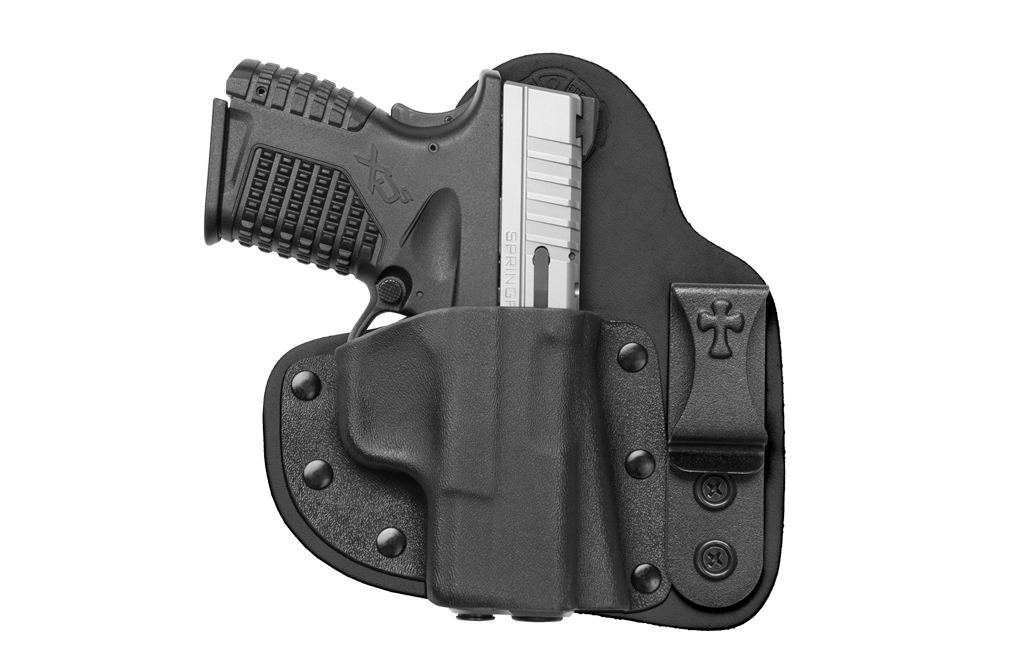
More and more women are finding success with appendix carry, at about the 1-2 o’ clock position in the front. The Crossbreed Appendix Carry is an inside-thewaistband holster designed specifically for this use.
Recently, my girlfriend decided to become armed and we tried several holster options for carrying the Sig P232 — an all-steel single-stack .380 ACP. She is quite petite and very shapely, and likes to wear tight jeans. Ultimately she settled on an outsidethe- waistband holster from Pure Kustom, positioned at about the 4-o’clock position just behind the hip platform. It was mighty comfortable, and with a light shirt over it, completely concealed.
Another good option for women seeking a spot for comfortable belt holster carry is appendix carry. An inside-thewaistband holster located just to the side of the navel in the front is very concealable and many women have found this to be the best solution to comfortable carry.
Shoulder Holster Carry for Women
In the holster type discussion back in Chapter 2, I noted that shoulder holsters are somewhat of a niche application not widely used. However, they do happen to make an excellent choice for armed women. For one thing, they keep the handgun up above the waist and hip platform, the region that causes headaches for so many. For another, they work well with business casual dress.
Many women find shoulder holsters appealing and comfortable. Just be sure you take into account the lines of your torso and choose one with a downward, vertical orientation so it doesn’t print through your shirt. Photo: Concealed Carry for Women by Gila Hayes.
“Most men, in my experience, don’t have the upper body flexibility necessary to draw efficiently or safely from a shoulder holster,” Grant Cunningham notes in the Gun Digest Book of the Revolver (GunDigestStore.com). “Most women do. The more muscular the man, the less likely it is that he’ll be able to make use of the shoulder holster, while women seem to not be so limited regarding their figure. For this reason I tend to recommend shoulder holsters for women more often than I do for men.”
Ankle Holsters
Ankle holsters are another option for those women who can’t find any other carry method or position for a given wardrobe. This method should be reserved for a backup gun, as access is less than ideal. But if there really is no other option it’s better to have a piece on the leg than none at all.
Ankle holsters should be carried on the inside of the leg on the weak-side of the body. Experts advise wearing two pairs of socks — one under the rig for comfort and to prevent abrasion; the other pulled over the holster to aid concealment when the pants leg lifts up, as in seated positions. Speaking of the seated position, Hayes cautions that while the ankle holster is virtually impossible to draw from while moving — running or walking — it is a very good choice for vocations where one is seated or driving.
Thigh Band Holsters
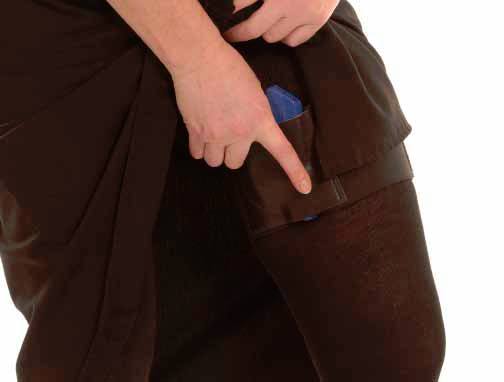
For women wearing dresses or skirts the thigh holster is an option. For men wearing dresses or skirts I can’t help. The thigh-band holster is like a larger version of the ankle holster, and sometimes ankle holsters are actually modified for use on the thigh. They wrap around the leg with either elastic or Velcro to keep the handgun concealed inside the thigh. This is not to be confused with the military or police-style thigh, drop-leg or tactical holster, which attaches to the belt and hangs the handgun in a low position on the outside of the thigh.
Thigh band holsters are basically just ankle holsters only made to wrap around the upper leg. Photo: Concealed Carry for Women by Gila Hayes.
In Concealed Carry for Women, Gila Hayes describes this holster as a “a deep concealment option” sometimes referred to as a “garter holster.”
“Most come with the addition of a nylon waist strap and at least one garter, and often two, attached to the thigh band as insurance to keep it from slipping down,” she writes. “Unlike the belly band, which stops at the hips if it slips down, there is nothing but the tight elastic to keep the thigh band up without the garters.”
You’ll find good thigh band holsters made by Galco, The Well Armed Woman and UnderTech to name but a few.
Bra Holsters
This idea isn’t new and actually has some historical use dating back to the good ol’ days. Today, the brassiere scabbard has been perfected by Lisa Looper of Flashbang Holster fame. Looper’s Flashbang rig wraps around the center support strap of the bra and hangs a smallish pistol or revolver just under the breasts in the front. To draw, you simply “flash” — by yanking up the shirt — and then “bang.”
The Teddy from Flashbang Holsters, attaches to the bra.
I’ve seen mixed reports about this holster design and, like every other holster for women, it comes down to an individual’s physiology. My girlfriend tested both the Flashbang and the Marilyn (which attaches to the shoulder strap and top of the cup, is accessed via the neck opening of the shirt) and did not like it at first. All holsters take some getting used to, but I reckon hanging a pound or pound-and-a-half piece of steel from one’s bra makes for a very unusual day. Even so, every woman who carries should have a Flashbang and Marilyn in their holster drawer and give it a try because it does open up more concealment options. See more on bra holsters in the next chapter.
For more information on concealed carry holsters check out:
Making a single gun fit multiple purposes, conversion kits are proving the wave of the future.
Getting more out of a gun, what shooter wouldn’t be intrigued? For the most part, the industry has moved this direction in recent decades, fueled, in part, by the versatility of AR-style rifles. Modular in design, jumping between calibers and configurations generally is no more difficult than removing a few retention pins and swapping parts. Like wildfire when it comes to long guns, this simple and versatile concept has lagged behind in handguns — until recently.
Spurred on by the U.S. Military’s Modular Handgun System competition, pistols that jump caliber and configuration are starting to swamp the market. One might even argue, they’re the wave of the future. Most certainly, they’re light years away from what it used to take to modify an existing handgun, which required enough effort that it was likely cheaper just to buy a second gun that met your desired specifications.
Before manufacturers took up the cause, a pistol conversion kit generally involved a competent gunsmith, plenty of hand fitting and time. It still takes time to modify the likes of a SIG Sauer P320, but it’s measured in seconds, not weeks and months. The results are quite striking, allowing many pistols to jump from full-sized to compact in just over the wink of an eye. There’s even the potential to incorporate specialty features, such as reflex sights milled directly into a slide, while maintaining a gun’s overall practicality.
With conversion kits, the only limits are the marketplace and your imagination.
For more information on SIG Sauer, please visit: www.sigsauer.com.
It May Be Surpassed, But There’s Nothing Like a Genuine Browning Hi Power!
Basics of the Browning Hi Power:
Designed from 1914 to 1935.
Served from 1935 nearly to present day.
One of the most widely used military pistols in history.
Chambered in 9x19mm, 7.65x21mm and .40 S&W.
10- to 17-round capacity, depending on caliber.
Lock-breach semi-auto.
Browning discontinued production in 2017.
The Browning Hi Power is still an entirely suitable pistol for everyday carry, or EDC. However, you must want one for sentimental or historical reasons, because it will cost you more than a modern polymer handgun.
In the immortal words of the great Dr. Who, “There comes an end to everything. The last door you walk through. The last room you enter.” To which I add: The last Browning Hi Power to be made.
The question is, which one was last? What was its serial number? Where is it located today? I don’t know, because, well, Fabrique Nationale just doesn’t talk much about what goes on inside the walls of their plant. What happens in Liege, stays in Liege, I guess.
But you can hardly buy a brand new Hi Power any longer, and those who import them, or try, can’t get them. How did this happen? To figure that out, we must go back to the beginning.
After the Great War, aka World War I, the smart military establishments planned and stockpiled for subsequent conflicts. However, governments and people were tired of paying for war and, as a result, budgets were tight. It took a while to get around to purchasing new handguns.
The FN-Browning Connection
When the French Army came looking, FN turned to the late, great John Browning as they had for so many previous firearms. He worked up a prototype and it was a doozy. Browning’s creation was chambered in 9mm, held 17 rounds, and the slide portion of the firing mechanism could be removed as a complete assembly. It was, in that regard, just like the Savage pistols. Potentially, you could change the same pistol from a duty trigger to a target trigger and back again in a few seconds. The Browning Museum, in Ogden, Utah has the prototype on display.
The original safety was hopeless. This is the one Ted Yost uses in his builds. It is beautiful, but you must have Ted build the gun to get the safety.
Alas, before he could complete it, John Browning passed away. Work on the pistol then went to Dieudonné Saive, the FN designer who would later design the FN-49, the forerunner of the FAL. Saive ironed out the details of a double-column magazine, which fed to a single feed point, for use in pistols.
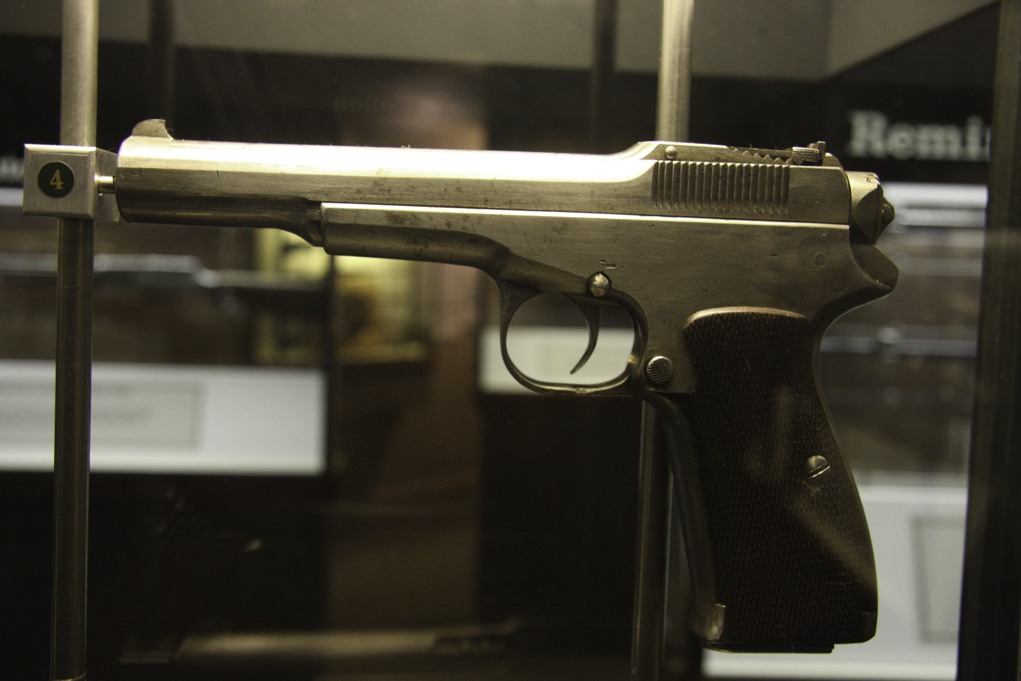
By the early 1930s, the French Army was ready to begin trials but, (and apologies here) being French, they just couldn’t decide. After a few fruitless attempts at trying to satisfy the French, FN made the pistol its own as the P-35. (In the end, the French selected a single-stack .32-caliber pistol, which used a cartridge remarkably like the .30 Pedersen. It was designed and manufactured in France.)
The P-35 was hardly through its initial production run when the whole world came apart. In 1940 the Germans overran Belgium, and once the Nazis had cleared the dust and rubble from the machinery in Liege they had the plant up and running again for the Reich. Despite the quick advance, a few of the essential staff and designers managed to get out of Dodge, as it were. The Hi Power blueprints were spirited off to Canada, where John Inglis & Co. set up production for use by the Allies. Thus began the decades-long irony of both sides in a conflict using a pistol of the same design.
The Germans produced hundreds of thousands of the P-35, noted in inventory and marked as the “Pistole 640(b).” Pretty much everywhere they went, when the Germans took over they kept the production lines of whatever was being made going in their name. Those 640(b) pistols were, for the most part, shipped off to the Eastern Front where they were used, captured, picked up, and later stored in Soviet warehouses.
The Canadian model, the Inglis P-35, went to the armed forces in Commonwealth service, as American troops received 1911A1s and various Colt and Smith & Wesson revolvers, for use in the war.
Sweeney Discovers the Browning Hi Power
My first introduction to the Hi Power came when I was working at The Gun Room, a gun store I called employer from 1978 to 1982 or so.
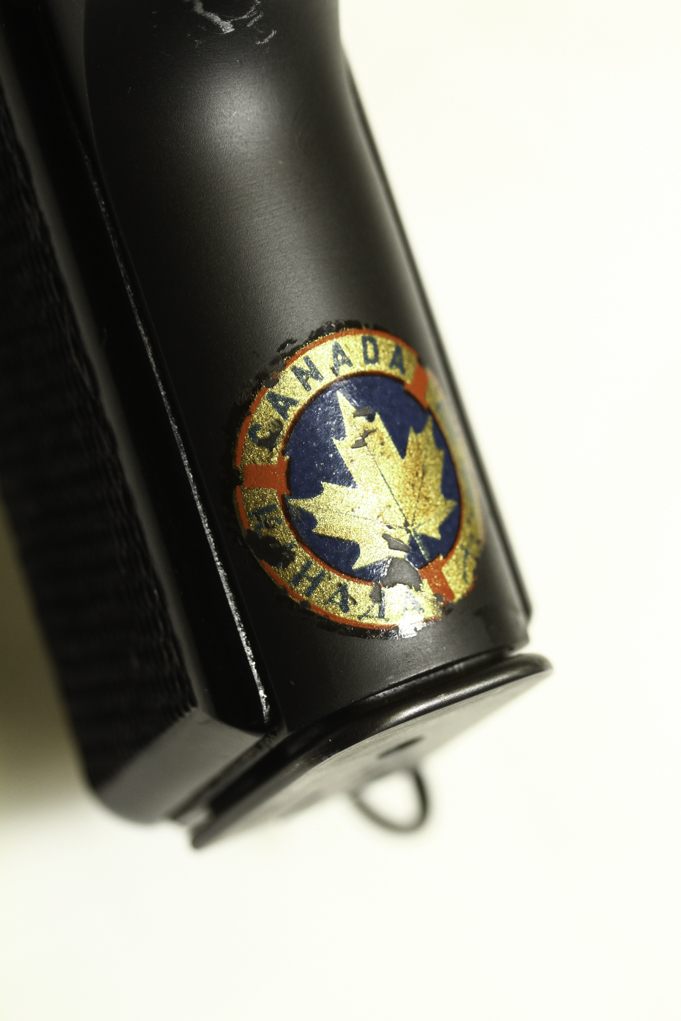
Collectors get excited over things like this. For a while, Canada used decals to mark property. To find a Browning Hi Power with the decal still more-or-less intact is wondrous.
One time, we had a weekend barbeque at the boss’s house out in the country. This included shooting all the odd, rare, different or just loud firearms that we had in the shop or in our personal safes. When the rain began we retired into the walk-out basement and fired out of the sliding door, across the patio. (A brief aside: when firing a handgun chambered in 7.63 Tokarev from inside of a room, it is best to be wearing both earplugs and over-the-ears muffs.) I was handed a Browning Hi Power to shoot.
To give you the full flavor of the event, the pistol was a commercial-polished blue, pre-war, tangent-sight model, but with Waffenampt proofs. It was a pre-war commercial gun, cut for a shoulder stock as many back then were, that had been appropriated by the Germans while still in the FN vaults, stamped, and issued for use in the war effort. It was most likely shipped to a Waffen SS or Fallschirmjaeger unit.
I slapped in a 20-round magazine and began shooting. “Hmm, the recoil seems a bit sharp compared to the other handguns. It does hit to the sights. The grips are a bit blocky.”
Just as I was finishing, my internal monologue was interrupted by the owner. “What are you doing?” Looking down, my reply was, “Bleeding, I think.” The sharp recoil was caused by the hammer biting the web of my hand, and the result was me bleeding all over the Browning. Sorry about that, Roger.
Two valuable lessons learned that day: The P-35 bites if you use the then-new IPSC hand grip. And blood, when properly cleaned from blued steel and wooden grips, does not leave any lasting marks or stains.
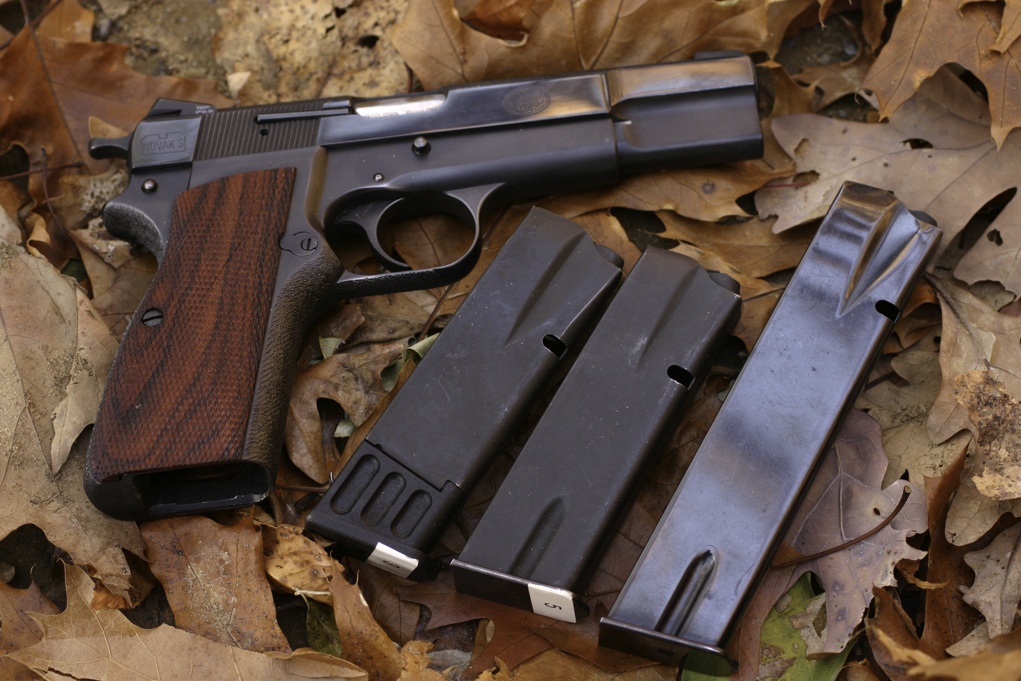
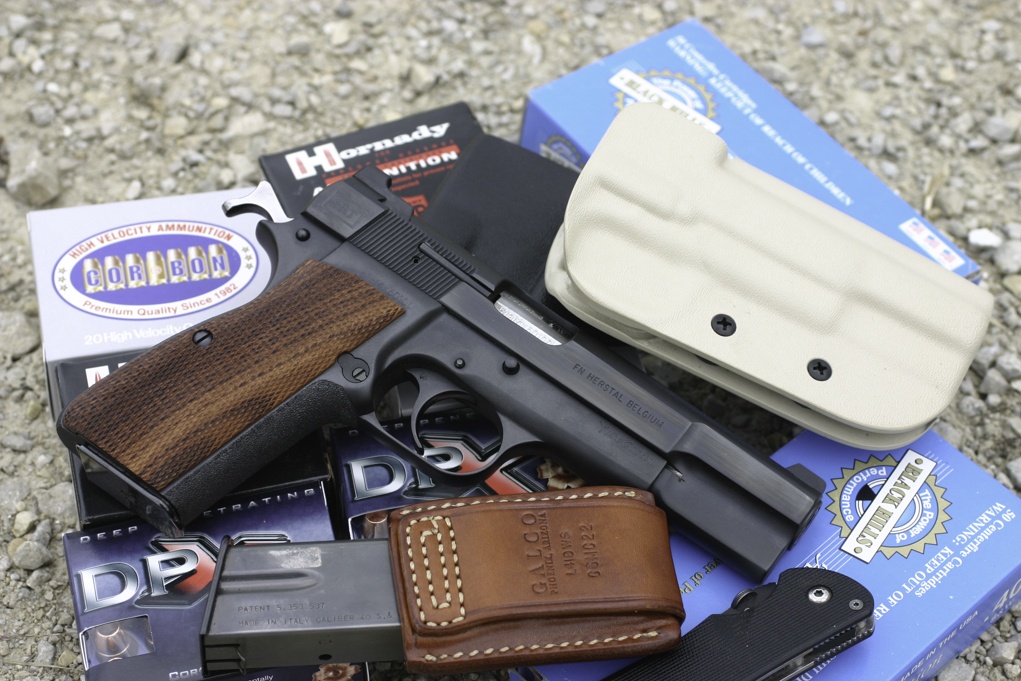
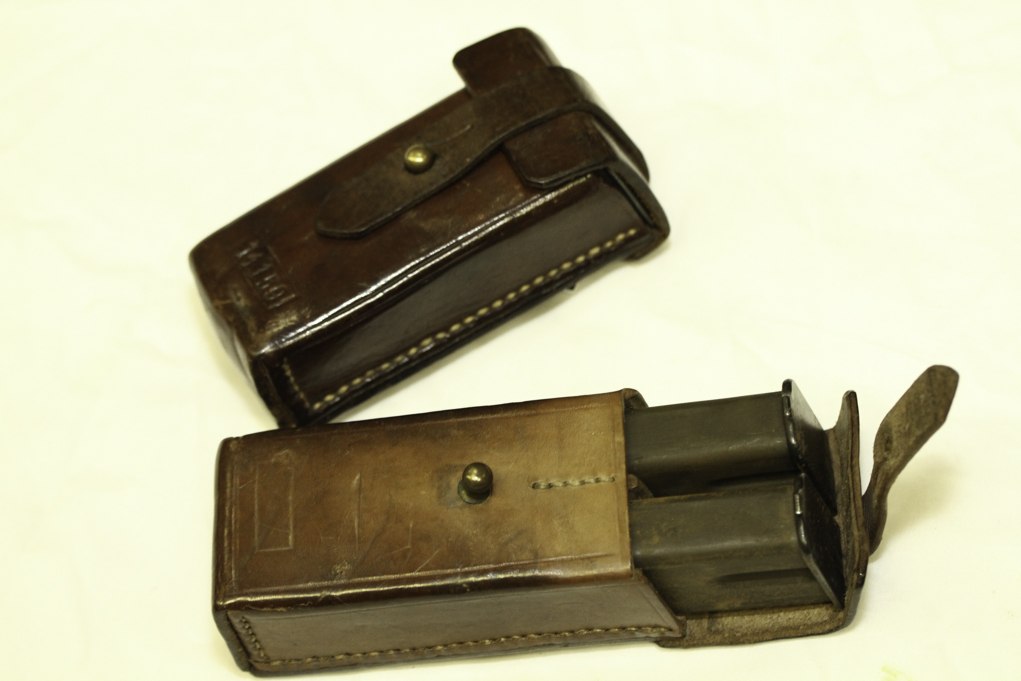
Think so-called hi-cap magazines are new? Here is a pair of 20-round Hi Power mags, complete with belt pouch, for use with a Hi Power.
Hi Powers in WWII
During the war, we bombed and rained artillery down on the FN plant in Liege to deny its output to the Germans, and when they had to leave, they returned the favor. The place was a wreck by late 1944. The Belgians cleaned up the mess, rebuilt the plant, and began planning. You see, the war had changed many things, including the tools to be used in the next war. Nearly everyone took the lessons learned and began improving what they had. But not us. We pretty much stuck with what we had. Hey, we won the war, and what we used had won, so there wasn’t much pressure to change or upgrade.
A lot of countries felt differently. The rifle got the most focus. Once the U.S. Army had forced our allies to adopt a “new” rifle cartridge — the .308 Winchester — new rifles were needed for it. The .308, aka the 7.62 NATO, is essentially a .30-06 with a shorter case and ball powder, which takes up less volume for the same energy. The difference between them is essentially naught.
In the U.S., the rifle change was to adopt the M14, which is pretty much an M1 Garand with a 20-round box magazine. Even the Italians rebuilt their Garands into the M14 configuration, calling them the BM-59.
The rest of Europe went a different route. Saive, still at the helm at FN, took the 10-shot box magazine-fed FN-49 rifle and changed the externals, which produced the FN-FAL — a 20-round box magazine-fed battle rifle of amazing durability, adaptability, and reliability. It was also almost four feet long, but in the 1950s that wasn’t seen as that much of a problem.
How, you ask, does the worldwide adoption of the FAL figure into the history of the P-35, the Browning Hi Power? Simple: the same FN salesmen who were making sure the FAL earned the name “The Free World’s Right Arm” were also busy pushing the P-35. And why not? If you are going to re-arm your military with top-of-the-line battle rifles complete with service, repair, upgrades, and warranty, why not do the same with the sidearm?
It didn’t hurt that it used the ubiquitous 9mm Parabellum cartridge, and that it was used with great enthusiasm by all sides in World War II, and that it was made in the world-famous FN plant in Liege.
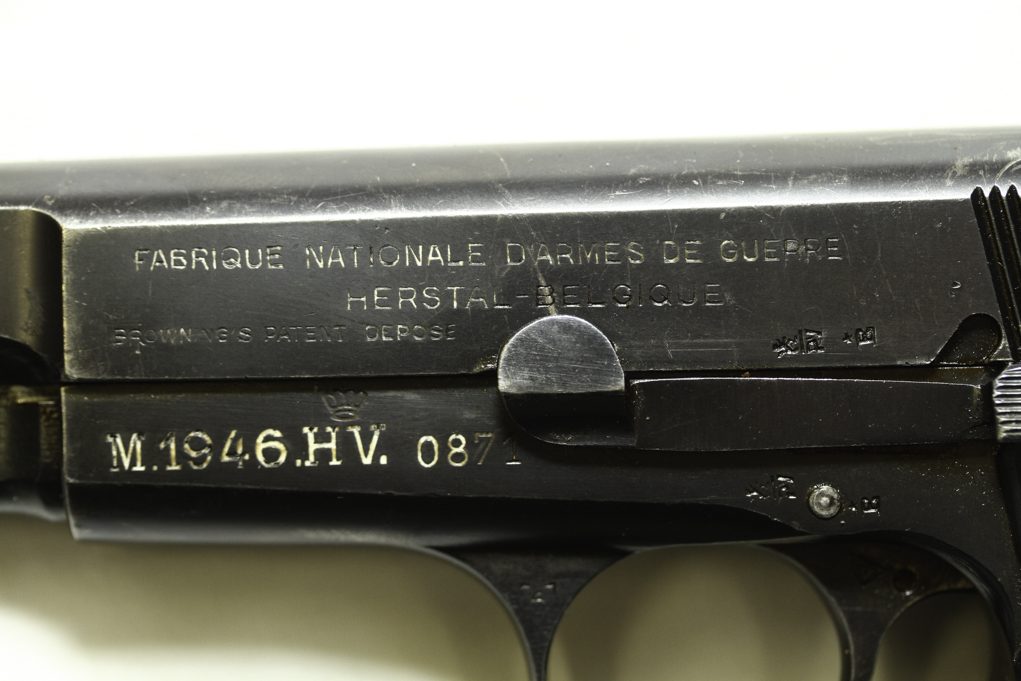
An FN pistol taken into police service in 1946. The proof marks and inspectors’ stamps tell an involved tale. Whole books have been written on marks alone.
A Hi Power for the World
That’s how the Hi Power ended up in service in pretty much every noncommunist (and even some communist) countries. The Commonwealth countries were going to use the Hi Power once it was officially adopted by Great Britain. That meant Canada, New Zealand, Australia, and all the colonies.
Even after they shrugged off the status of a colony, a lot of the new countries kept using the Hi Power. Once in service, it was treated to various modifications, improvements, markings, and tests. The sights were changed and finishes applied. Generally, since there were a million of them out there, the users (or rather, the using organizations) felt free to try their hand at improving it any way they thought possible.
There were other countries that were more interested in having the production of essential arms in-country, and they licensed the manufacture from FN.
The handmade prototype that John Moses Browning had developed before things changed.
Argentina, for one, and Canada kept on using the ones built by Inglis and added more as they needed them. India, after becoming independent, began using the arsenals built by the British to manufacture firearms for their own use. The Indian government licensed the manufacture of the Browning Hi Power from the Inglis company and began making them in Ishapore. One of the other places those pistols went was Nepal.
In my travels around the world, I keep an eye out for the local police and military (in some places one and the same) to see what they are using. In Nepal I saw a truly historic range of firearms.
One museum had two Gurkha guards. One was armed with the utterly wretched Indian-made AK clone-compromise, the INSAS. It takes real work to make an AK-derived firearm that is unreliable, but trusted sources say the INSAS comes as close as any. The other Gurkha guard was armed with an Enfield three-band model 1853 rifled musket, complete with bayonet. I asked if I could take a photo and was given a smiling “No.”
The author hard at work on 300-meter pop-ups, dropping them like bad habits with a Hi Power. Later that day, at the entrance to the local army base, I saw a sergeant armed with a holstered Hi Power. It had to have been either a British pistol dating from WWII or an Indian-made Inglis-licensed copy, but it was a Hi Power.
Later that day, at the entrance to the local army base, I saw a sergeant armed with a holstered Hi Power. It had to have been either a British pistol dating from WWII or an Indian-made Inglis-licensed copy, but it was a Hi Power.
Which brings us to the question.
Why Did the Hi Power Remain in Service for So Long?
The size and shape, to start. The pistol held a useful amount of ammunition, 12 or 13 rounds of 9mm in the magazine. The grip, depending on the panels installed, ranges from comfortable to alluring.
Its size is not burdensome to pack. It isn’t a bundle, as even the smallest carbines of the day would have been. As lightweight and handy as the US M1 Carbine is, it is still a carbine with a stock. Yes, that’s better than a handgun when you need to shoot, but until then a lot less handy, and a lot more of a hindrance than a holstered handgun.
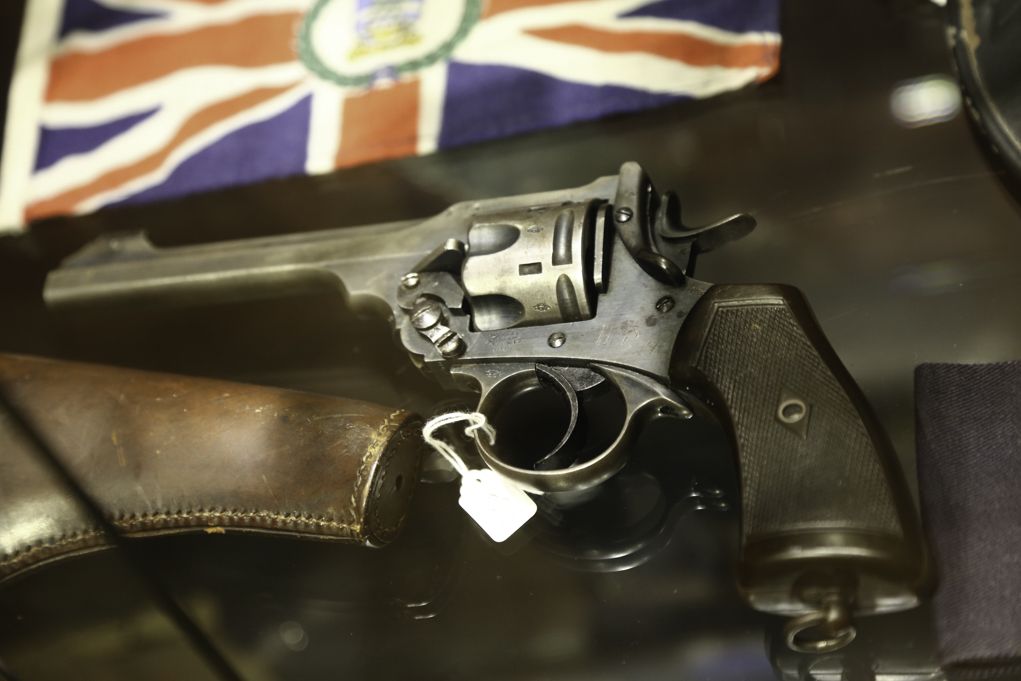
Before the Hi Power, a British officer would likely have carried a revolver like this Webley in .455.
Pistols smaller than the Browning Hi Power often don’t hold sufficient ammo or, if they do, it’s of an undersized cartridge. A sidearm larger than the Hi Power starts to verge into M1 Carbine territory, more hassle. The recoil was not a big deal, as some shooters back then (and yet today) felt the .45 ACP presents.
In many militaries and police departments worldwide, a handgun is a badge of office. In many places, the police are armed with the same rifle that the military uses because law enforcement is just the army dressed in blue instead of green.
The guy in charge of the local group has a holstered handgun because it is his job to supervise the rifle-armed guys, not enforce the laws himself. The holster marks him as the head guy in charge. For that purpose, pretty much anything that fits the holster and fires a bullet will do the job.
Two police pistols. On top, the author’s Novak FBI Hostage Rescue Team clone. Below, a Belgian police lightweight BHP turn-in exchanged for something more “modern.”
Hi Power, High Rank
The panache of the Hi Power extended beyond issue handguns. It was apparently not uncommon to see someone in the Vietnam War, someone who just couldn’t quite be placed as to what organization they were with, armed with the Hi Power. (That was true for non-GI rifles and submachine guns as well.)
Then again, if your senior NCO didn’t object, what was carried as personal gear in Vietnam seemed to be pretty much whatever you wanted. Some organizations were a lot more freeform than others.
The Browning Hi Power was more than just a badge of rank.
The frame was made from forged steel, with the magazine well, slide rails, and other openings machined from the forging. The barrel used the John Browning tilt-down method.
The slide and frame were locked together for a short distance until a cammed face on the bottom lug of the barrel struck the cross-lug in the frame. This caused the barrel to cam down out of the path of the slide, as the slide continued rearward.
Once to the rear of its travel, the slide moved forward, propelled by the recoil spring underneath the barrel. The slide forced a round out of the magazine, collected the barrel, then cammed the barrel up to lock it. Once closed, it was ready to fire again.
Aluminum frame shaves 6 whole ounces from the weight of a comparable all-steel Browning Hi Power.
The locked-breech design allowed the Hi Power (and all other locked-breech pistols) to readily handle the recoil forces of the cartridge.
Without some means of locking the slide and barrel together at the start of the cycle, the upper limit of force the pistol cartridge can generate is limited — limited by the weight of the slide and the force of its spring, and the ability or willingness of the shooter to fire it.
For handguns chambered in anything larger than the .380 Auto cartridge, weight and required recoil spring forces become too great to make a handy pistol, or to find willing shooters.
The efficiency of the cam surfaces makes the Hi Power function with a relatively light slide and recoil spring. That means less weight to carry and less force needed to initially work the slide.
High Power Downsides
However, the design is not without its costs or drawbacks. One is the lack of a barrel bushing on the front of the slide. This makes barrel and slide manufacturing easier, as it eliminates several machining steps. But, the barrel can only be removed from the slide through the rear — unlike the 1911’s barrel that can be removed out the front or rear once the bushing is unlocked from the frame.
This became a stumbling block for pistolsmiths wishing to improve performance decades later. Fitting a replacement bushing in a 1911 allows for a more precise barrel fit and can improve accuracy. You can’t do that with the Hi Power.
When compensators or muzzle brakes became popular in IPSC competition, the Hi Power was left behind. On the P-35, once the brake or comp was attached the barrel could not be removed from the slide. This made cleaning a bit more difficult. On the 1911 it was easy to remove even with a comp or brake installed.
Another obstacle to pistolsmithing was the barrel lockup — specifically, the frame and what FN calls the “barrel seat.” The 1911 cams up and down on the slide stop pin, a removable, replaceable, and easy-to-fit part. The timing can be adjusted by using different-sized barrel links.
The Hi Power employs a cam that is pressed and staked into the frame. It cannot be serviced by anyone but the factory. The cam surfaces on the barrel are machined to a given dimension. Again, they are not serviceable by a pistolsmith, unless he or she obtains a barrel that has those surfaces over-sized and files and machines them to fit the frame and slide.
The Browning’s Trigger Pull and Other Issues
The trigger pull is a problem. When it’s good, it’s fine. When it isn’t, it’s hard to work on. The 1911 (the exemplar here) has a few parts that operate in a simple manner, and many, many replacements to be had. The Browning Hi Power? The trigger pivots or cams against a lever, which likewise pivots, pressing down on the edge of the sear. Working on the Hi Power trigger requires the patience of Job and specialized skills.
If Ted Yost built it, you’ll know it.
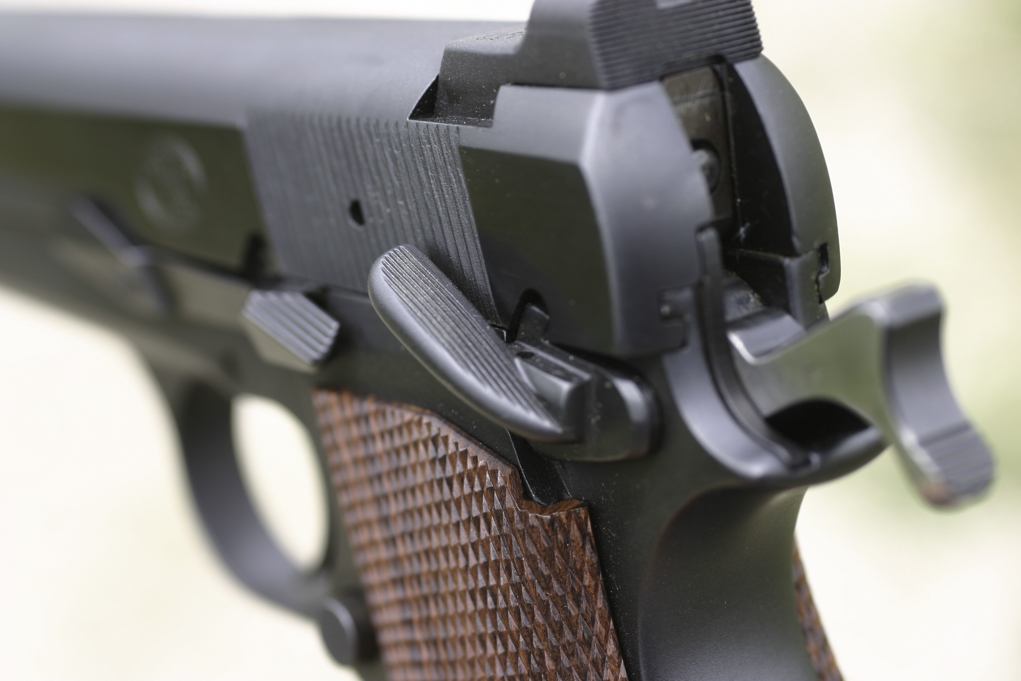
The thumb safety is worse. It is small, unusable as-is, and difficult to replace. You see, the thumb safety shaft is the hammer pivot shaft. Replacing a safety can adversely affect your trigger pull.
In a military setting those were not obstacles, they weren’t even noticed. If a slide, frame, or barrel became unserviceable, it was simply exchanged for a replacement part. That the new part fit somewhat loosely was not a problem, the old one was often no better.
Military organizations were interested in “minute of opponent” accuracy at just-outside-of-the-foxhole distances. And the standard carry method of a handgun in military service was with the hammer down, safety off, and chamber empty. Thumb safety shortcomings were not even noticed.
But, those were big deals to competition shooters and especially American users, who were interested in better ergonomics. Unlike most of the world, where the sidearm is a backup and often even just the badge of rank mentioned above, we Americans view the handgun as a fighting tool.
Yes, you use it to fight your way back to the rifle or shotgun you should not have put down, but you fight with it. It isn’t just a status symbol, and in many instances it is the only tool used.
Two .40 S&W Hi Powers. On top, the author’s range rental score, and below, his Ted Yost custom. One is an off-the-rack, the other a bespoke suit.
The Browning Hi Power in Competition & Police Use
In the early days of the now common but then radical competition known as IPSC, the Hi Power acquitted itself well. Today, IPSC is seen as a 9mm or .38 Super competition. Back then, it was a .45 competition. And yet, of the first four IPSC World championships, two were won with 9mm pistols, and one of those was a Hi Power.
Back in that era, the Hi Power was involved in one well-known conflict where both sides were armed not just with the same pistols, but the same rifles and machine guns as well.
We won’t go into the ownership of Las Malvinas, or The Falklands, but I do point out that the British and the Argentines used Hi Powers, FALs, and MAG-58 GPMGs all made by or under license from FN in Liege, Belgium.
I’ve been to the islands a few times and it is interesting to note that pretty much every bar or restaurant, museum, or public office has a captured, welded-inoperative FAL on display, but there are no Hi Powers similarly shown.
Not only did Charles Daly bring in Hi Powers, but improved the safety. These guns are very good, too bad they’re virtually impossible to find.
Hi Powers and the FBI
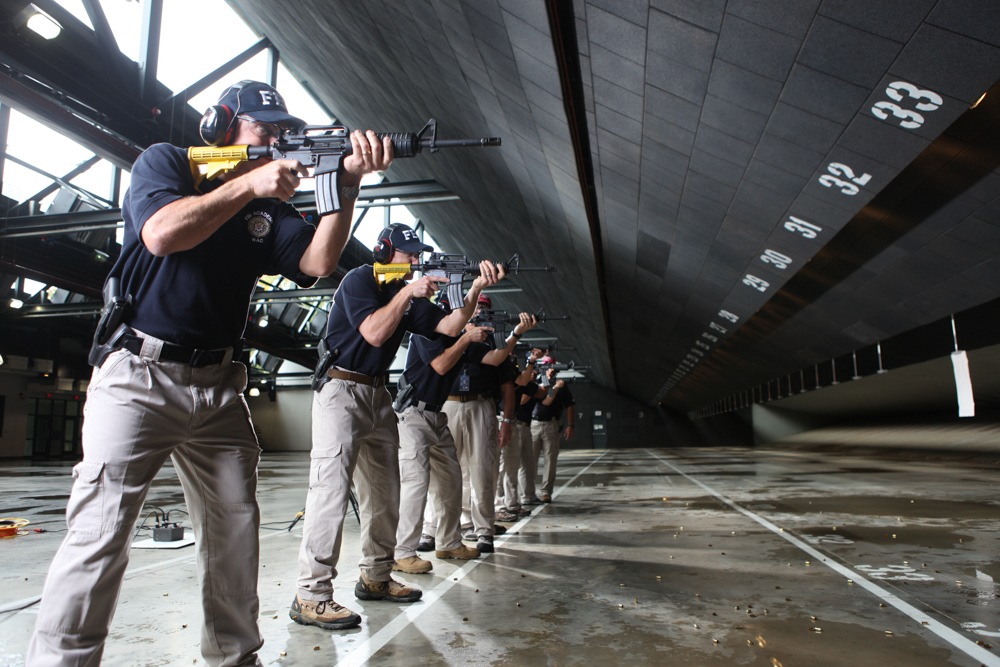
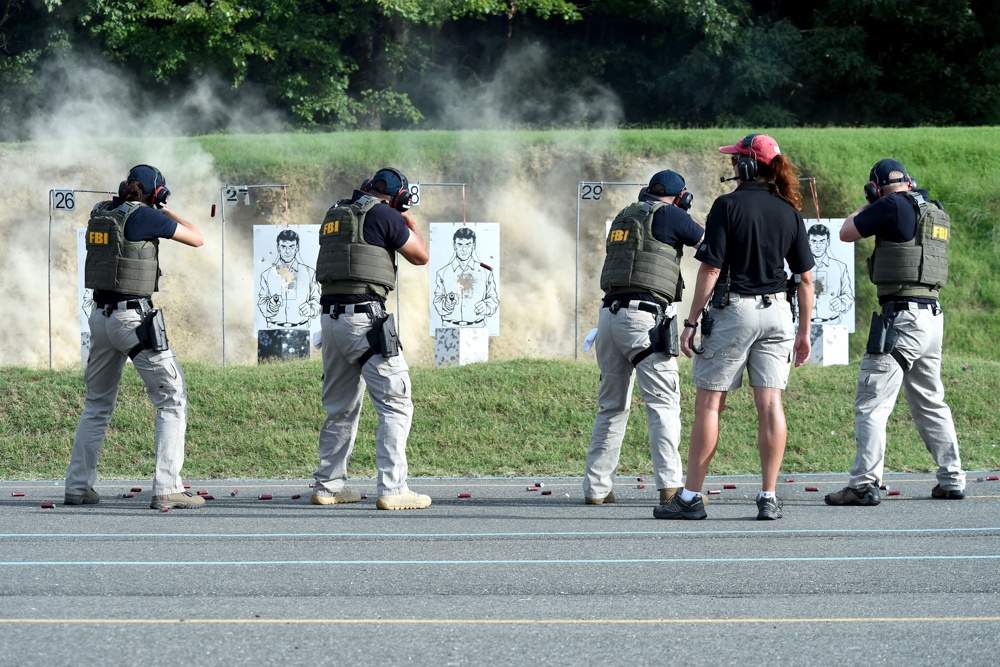
Here in the U.S., one agency that showed a lot of interest in the Hi Power was the FBI, specifically for its Hostage Rescue Team. Although, that was back when the FBI allowed personal weapons for service and the Hi Power was on the approved list.
They went to a great deal of effort in the mid-to-late-1980s to have Wayne Novak build up a batch of Hi Powers for them.
The initial build was to install Novak sights on the pistols, but after various shipments, returns for repairs and overhaul, and requests for improvements, they were a buffet of 9mms with a host of custom features. The plain guns went to the field agents, and (no surprise) apparently the ones with the custom features went to supervisors, office heads, and the like.
What the FBI found out was what we IPSC shooters had learned some years before: the original Hi Power was not a heavy-duty pistol. The FBI did not feed its Hi Powers anything but a steady diet of standard-pressure 9mm ammunition, unlike the U.S. Army and its first problems with the M9 pistol.
The M9 had issues in part because the idea of 9mm ammunition was new to the army. To the FBI, not at all. And despite using only standard pressure (not +P) ammunition, the FBI found, as the rest of us had, that the Hi Power couldn’t take the volume of shooting IPSC required.
In the days of Bullseye competition, you’d be hard pressed to shoot more than 5,000 rounds a year. A match ran you 50 rounds of ammunition. If you shot a match every single weekend and practiced once in between, that came to 5,200 rounds a year. That was considered a lot of shooting.
When I began IPSC competition I was shooting 10,000 rounds a year, and I was not keeping up with the Joneses. When I went to a Dillon loading press, I jumped up to 35,000 rounds a year and kept at it (or more) for the next 20 years.
A 1911, even when firing .45 ACP +P, or 9mm +P or +P+ ammo, can do that for as long as the barrel’s rifling holds up. Once you’ve worn out the bore, you can refit the slide to the frame, install a new barrel, and start over again.
I have several 1911s that have had 100,000 rounds or more through them, and you’d be hard-pressed to tell them from the lower mileage pistols. I am a slacker, as I know of people who have much more than that through their 1911s. The Hi Power? Tens of thousands in the old Mk II or earlier guns meant the end of service.
A Look at the Market
Browning was the importer of Hi Powers made by FN. When Browning wasn’t bringing in as many as the market wanted, other importers shipped in pistols made in places other than Liege. Sometimes, especially once the patents expired, the manufacturer would see if an American importer wanted to buy a batch of “just like Liege” licensed Hi Powers.
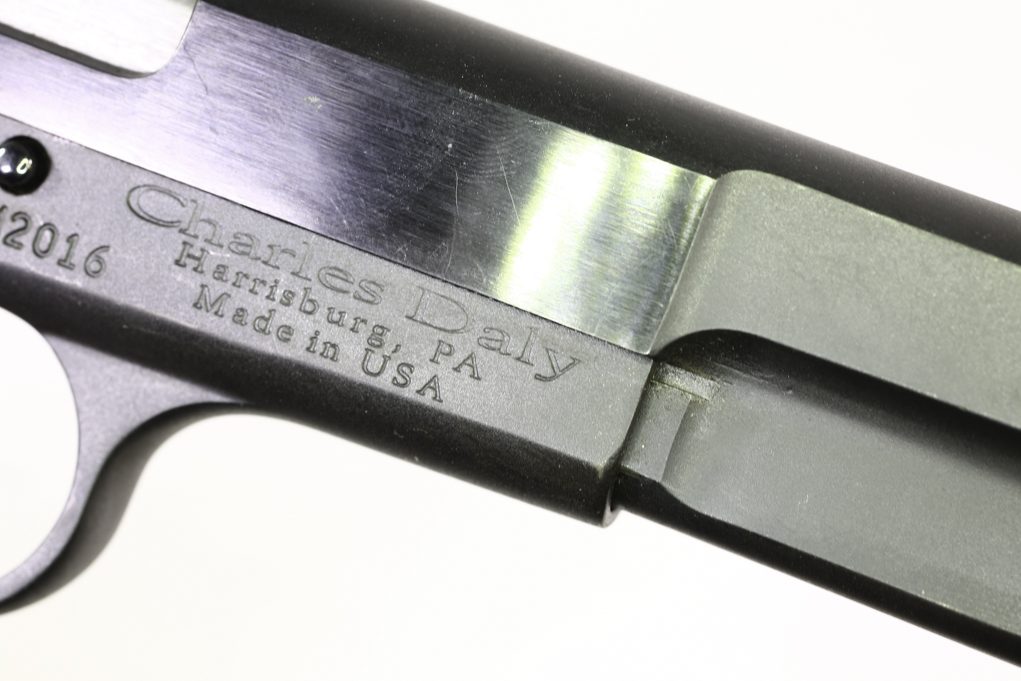
I have one like that, which was imported under the Charles Daly name, back when. These were Hungarian-made clones, and while I haven’t tried to see if small internal parts fit (none have shown signs they need to be replaced) magazines and grips fit just fine.
Interesting tidbit of info: they were imported as parts, assembled and fitted here in the U.S. — hence the “Made in USA” markings they bear.
Don’t get me wrong, the Hi Power will still be dependable even when heavily used. Our gun club’s treasurer a couple of decades ago, who used to work for the city of Detroit, carried a brace of T-Series Hi Powers.
This was during the bad old days when Detroit was aflame, and no one who needed a CPL back then could get one. He carried anyway. He used his so much that the recoil springs were more than a bit tired. I had a spring tester and the standard Hi Power recoil spring measured at 17 pounds.
His two 9mms had springs worn down to 10 and 11 pounds. They still worked.
But when parts start breaking or falling off, it’s time to move on. And move on we all did. So did the FBI HRT. One agency I still wonder about is the Hong Kong Airport Police.
I encountered them while traveling to the 1999 IPSC World Shoot in the Philippines. We changed planes in Hong Kong and the police made us get off the plane and identify our bags, and inspected our firearms transport paperwork.
They were bored, we were fascinated. We closely studied (all of us were gun geeks, there were 30-40 IPSC competitors for the match on that plane) the MP5s they carried, their handguns, holsters, etc. One thing we got tired of studying was their sloppy gun handling.
When one supervisor had trouble reading the paperwork in the fading light (we were out of the plane, on the tarmac, with the other passengers peering out through the plane’s windows at us), one of his subordinates lifted his MP5 over the boss’s shoulder and clicked on the light on its handguard.
Me, I looked around to see what I could hide behind should the inevitable accidental discharge happen. It didn’t, thank goodness.
FN’s SFS, or Safe-Fast-Shooting system, is immediately obvious, in part due to the odd hammer. And the real clue: the hammer is “down” but the safety is on.
FN Struggles with the High Power
FN tried to keep up. One such change was the SFS. The Safe-Fast-Shooting system was an attempt to gain the benefits of a double-action (DA) pistol while retaining the upside of a single-action. The main benefit of the SFS was that the hammer was down. This made it appear to be a DA pistol and not one with a cocked hammer.
Once you loaded the SFS, you pushed the hammer down with your thumb. When it clicked into place, the thumb safety popped up to engage the system. You now had a hammer-down pistol with a thumb safety. On the draw, you could thumb the safety down, which caused the hammer to automatically pop up, ready to go to work.
.40-Caliber Hi Powers
The one big change that made a difference was the introduction of the .40 S&W cartridge. When Jeff Cooper and others were experimenting with a cartridge that was called the .40 G&A, they used a Browning Hi Power as their base pistol. They were happy with the results, but when the actual .40 came out in 1990 (their experiments had happened in the 1970s), things were different.
The prevailing wisdom of the time was that a .40 S&W pistol could be had simply by plugging a .40-caliber barrel into a 9mm model and installing a stiffer recoil spring. When the various pistol manufacturers did that, they found that the job was a lot tougher than they thought. It took a few years and a few model variants for everyone to work out the details.
FN built some .40 prototypes on their Mk II frames and tested them. Those R&D guns died in an embarrassingly short time span. The word on the street was that they lasted about 2,500 rounds, and then were simply scrapped.
The problem? The frames. A forged frame, one in which 85-90 percent of the steel is machined away, simply cannot be all that tough. So, FN went to cast frames for the Mk III.
Since the machining needed is just for cleanup or to reach the final dimensions, they could make the frames of much, much tougher steel. I have one of these, and Wayne Novak built it into his top-end clone of the HRT gun.
Testing the High Power
During testing for an article of the time, I put 23,000 rounds through it. I had two malfunctions in all that time. One was a low-powered lead bullet reload that had somehow gotten all the way to the chamber (but only partially into it) with a great big glob of bullet lube stuck to the case. The other was a seriously tired old 20-round magazine.
The spring, when I extracted it, was a full inch shorter than the spring in a brand-new 20-round magazine. So, both malfunctions were blamed on things other than the pistol.
For those willing to indulge a Major League Baseball analogy, these were chalked up to errors on the part of the fielders, and so not hurting the Hi Power’s ERA.
I have two other Mk IIIs, one a box-stock .40 that was a rental gun at Double Action range in Madison Heights, Michigan. They lost count of the ammo that had gone through it, but other than the usual handling and shop wear from going through a thousand hands, it looks, feels, and works fine. The other is a custom .40 built by Ted Yost. I managed to acquire it for less than the cost of the custom work Ted had done, so it’s a keeper for sure. It is also a tack driver.
The rarest one I have is a lightweight Hi Power. These were made a few times, and only in short runs with aluminum frames, which pared a few ounces off the weight.
A “Made in the USA” Hi Power. Well, assembled in the USA from parts made in Hungary.
Custom & Collectible Hi-Powers
Just before Hi Power production ended, Nighthawk Custom imported a batch of FN Mk IIIs and built them into custom guns. The result was a hi-cap 9mm with more style than most people could handle but at the price of a custom 1911.
They also solved the hammer bite problem by welding on a tang to protect your hand. It was a love-it-or-hate-it proposition. If you must have the ne plus ultra of 9mm pistols, then track down a Nighthawk Hi Power. There will be no one who is not envious of you.
The Hi Power has a lot going for it — mystery, panache, style, grip-fit, and great looks to boot. So why has FN stopped making it? And why should you acquire one anyway? The word is that the tooling is worn out.
Me, I don’t buy it.
Modern CNC machining uses slabs of steel called tombstones to hold the parts. The “tooling” consists of the cutters that are shaped to make the exact cut needed for a part or dimension. Cutting tools are purchased by the gross by big-time manufacturers.
No, the truth is much simpler: the polymer-framed, striker-fired pistols have won. The soul-less, industrial, common-as-dirt with no heart pistol has taken over.
No one wants to pay what it would take to make a competitive Hi Power when you can literally buy a ready-to-go polymer handgun for half that amount.
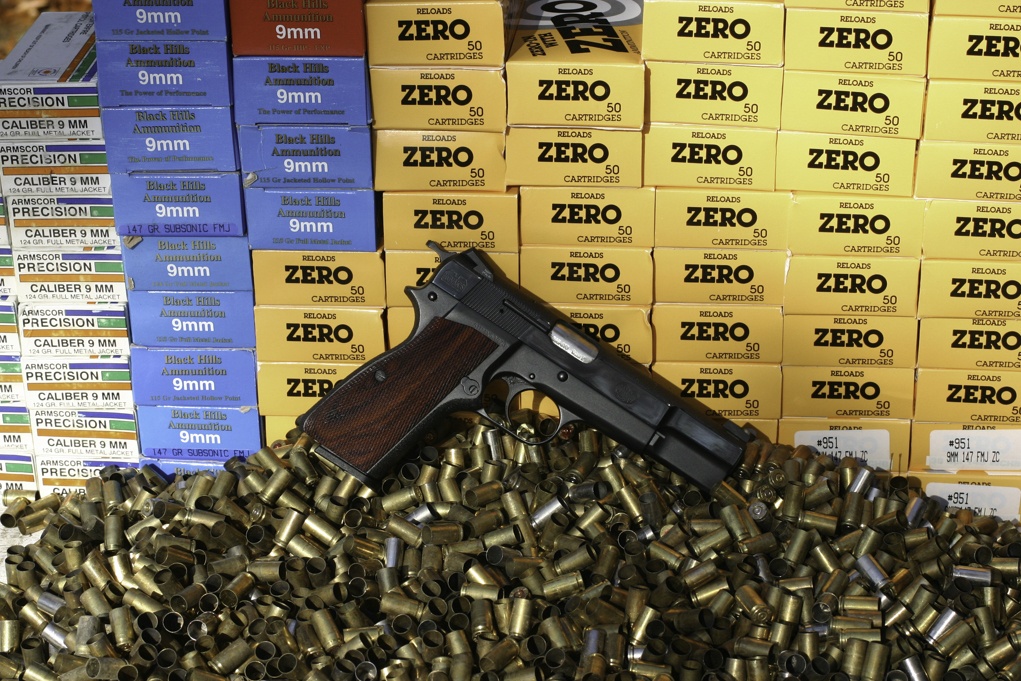
The author’s Novak BHP on a pile of brass and the stacks of ammo it chewed through during testing.
Oh, FN could make a ready-to-go Hi Power, one with a nice trigger, no bite, durability, and a thumb safety you could use. It would cost as much as two Glock G17s or more, and it would still, at best, hold 15 rounds to the G17’s 17+1.
Luckily, there are still makers of Browning’s Hi Power, but those that are not Liege-made will be rougher, and you may have to do some persuading to find a pistolsmith to tame them. My advice? Get a Liege-made one now, while you still can. The Browning Hi Power, there’s nothing like it.
True-to-life courses and the high-stress to succeed, the competition pushes shooters to their limits and asks for more. While pro’s such as Mark Redl make it look like a stroll in the park, when the safety is off and the pressure is on most find it’s anything but. Of course, the Aguila Ammunition-sponsored shooter — self-taught for the most part — has spent decades honing his craft to collect a trophy-room full of championships.
The Modern Shooter crew catches up with the sharp shot in this week’s episode and do more than marvel at Redl’s game-winning practical marksmanship. They get down and dirty, running the courses and try their hand at besting the champ. Note, they “try.” While none can get the upper hand on Redl, through his deft coaching they find out the secrets of scoring big when running and gunning.
While it might sound counterintuitive, putting two on target is possibly the easy part of a shooting competition. Forethought, transition, reloads and safety — these are all essential to a top performance and, if executed imprecisely, are wet sandbags weighing one down. Sharpen up those aspects and you’ll run a course like a pro. Luckily, Redl gives the crew and you the tips you need to take the next step in the competitive game.
For more information on Aguila Ammunition, please visit: www.aguilaammo.com.
Shooters do not live by firearms alone. Find out the great new must-have gear that will make carrying, shooting and caring for your firearms easy as pie.
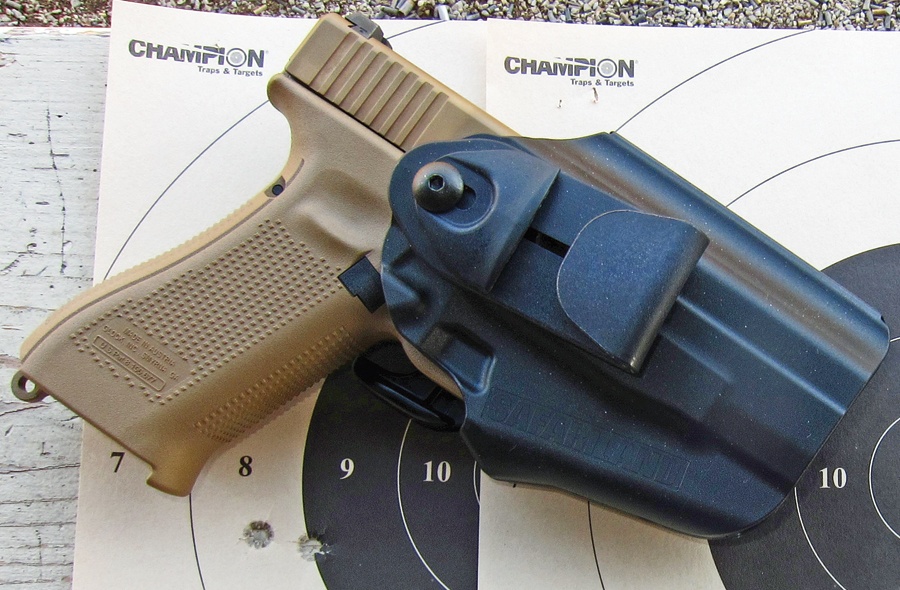
The Safariland Model 575 holster is a multi-fi t inside the waist belt holster, shown here with the Glock 19X.
I’ve been using the Safariland 575 Pro-Fit for some time. As I’ve had to move my concealed carry pistol to the front at times, the 575 Pro-Fit is a good IWB alternative for so-called AIWB carry (say, at 12:30 – 1 o’clock or so). The Pro-Fit accepts takes a wide variety of handguns with minor adjustments. I’ve used this for the Glock 19 Gen4 and Gen5, and the Glock 19X — as well as the S&W M&P9 M2.0 Compact and the new Ruger Security-9. The holster features the “GLS” Grip-Locking System. Seat the gun into the holster and it snaps into place. When you take a firing grip, the middle finger of the shooting hand has to occupy the same space as the lever, releasing the gun. Foam pads are included and can be located in one of two places to force the muzzle out and the grip back into your body, hiding the gun under a shirt.
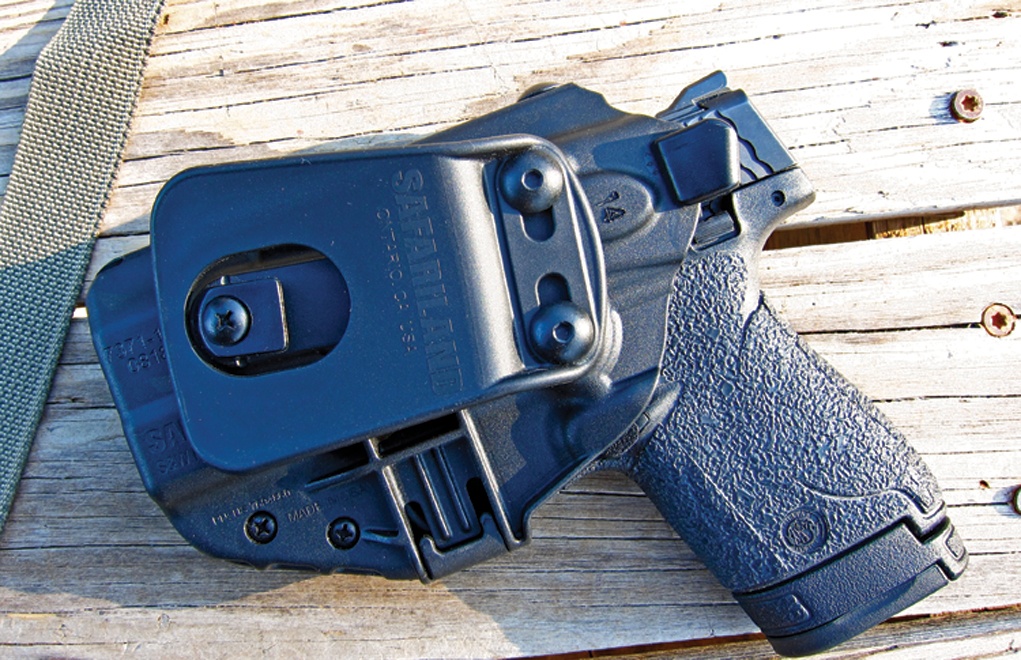
The same maker offers the Model 7371 7TS ALS holster, which is a compact paddle design. A secure rig, the automatic locking system (pistol locked into the holster simply by seating the gun fully) is as fast and as simple as any open-top holster can be. Closing your hand into a firing grip causes the thumb to draw the ALS latch back, freeing the gun. Like other 7TS holsters, the 7371 is durable, weather- and temperature-resistant. Made for the Shield, Glock 42, 43, Ruger LC380, LC9 and LC9s, the 7371 comes with the 571BL Paddle.
The Safariland Model 7371 features the auto-lock system. The thumb-tab release is visible from the back of the holster. Note the small paddle.
I found that my front IWB holster for the Glock pistol line, the Eidolon by RCS, didn’t work for Gen5 Glocks. Enter the Perun. It’s a modular rig that works on either side of the shooter and for southpaws. It’s a “pancake” style rig with the mounting attachments fore-and aft, not behind the holster pouch. The holster is supplied with three pair of 1.5-inch belt loops to allow different modes of carry. The Perun uses a retention slider to adjust the holster to the gun, and it features both inboard and outboard full-height body shields, an open muzzle and will accommodate suppressor-height sights and red-dot optics. You can get it to fit the Glock 17 (22), Glock 19 (23) or Glock 43. For less than $40, there may not be a better modular synthetic OWB available.
Carry For Larger Guns
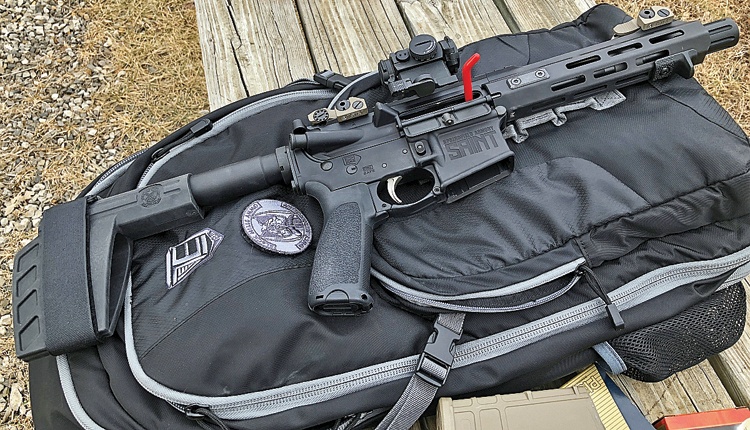
I’ve recently come to use discreet gun bags, one for an AR pistol and the other for the Ruger Pistol Caliber Carbine. The first was for the Springfield Armory Saint AR pistol. I found the gun fits into the large but “non-gun” looking Elite Survival Systems 7725-B Stealth Covert Operations Backpack without being disassembled. There’s room for magazines and other gear — but consider weight — and the Saint-P just barely fits, which is perfect. Padded sides and bottom keep the gun from unnecessary dings. As the Saint I have is configured with Troy Industries flip-up Battle Sights and the Aimpoint Micro T-2 red-dot sight — and still fits — I’ll be interested in seeing what happens when a light gets attached.
The Elite Survival Systems 7725-B Stealth Covert Operations Backpack is a fi t for the Springfi eld Armory Saint pistol with an optic.
For the Ruger PC Carbine, I found the Copper Basin, LLC Gen 3 Takedown Firearm Backpack. An attractive pack with modern sport styling, it doesn’t scream “GUN!”. Originally designed for the Ruger 10/22 Take Down models and other takedown guns, I’d wondered if it’d fit the new Ruger centerfire take down. The website now shows it does accept the PCC — and I’ve confirmed it. If you’re trying to be discreet about being a gun owner — think burglary prevention — having a run-of-the-mill, nondescript bag to throw into the car is a big help to maintain a low profile.
Needed Tools
I always keep a lookout to find easier ways to get maintenance done. Lyman now offers Pachmayr Master Gunsmith Screwdrivers. The Master Gunsmith 10-Piece Screwdriver Set includes a “3-wing” handle design to enhancing turning force while preventing the screwdriver from rolling off the bench. Tips are magnetized and parallel-ground, and included are T-10 and T-15 size six-lobe drivers as well as a 5/32-inch hex driver.
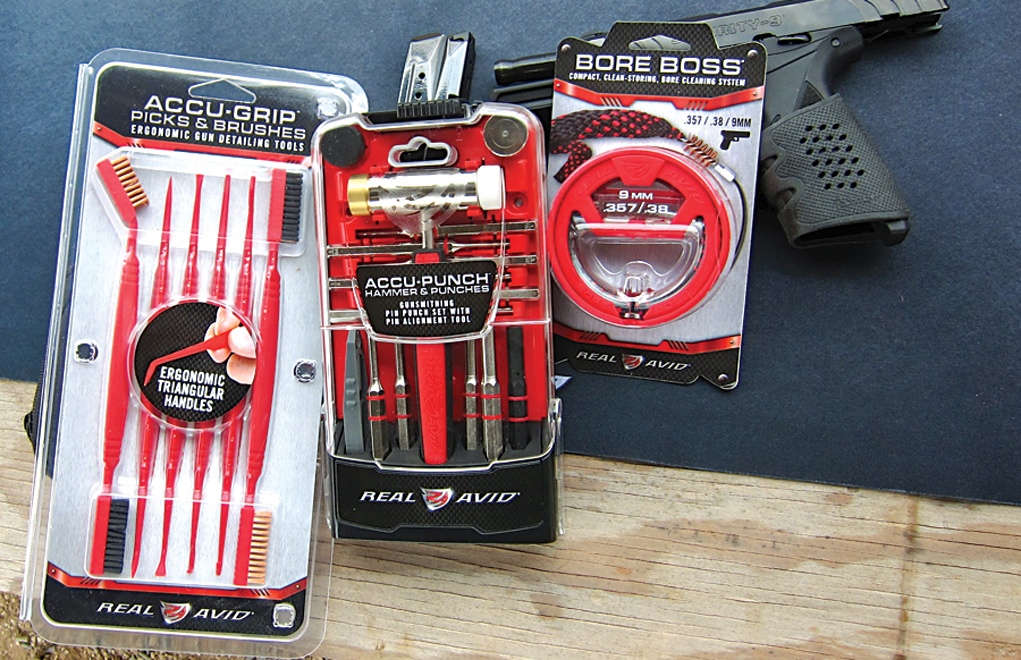
In addition, I received some tools from Real Avid. These included their Accu-Punch Hammer and Punches kit. The hammer face can be brass, steel, rubber and nylon, which is a handy touch. The 10 steel pin punches are labeled for size and feature rubber gripping rings. Made from non-scratching, non-marring materials, the Accu-Grip Picks and Brushes really get into the crevices and recesses of the gun.
Tools from Real Avid included their Accu-Punch Hammer and Punches Kit, and Accu-Grip Picks and Brushes.
I also just received the HolsterOps Rogers Enhanced LCR Grip. Adding support for the full hand, the stock moves the hand higher on the back strap of the revolver to substantially reduce muzzle flip. The material allows a smoother draw from pocket holsters and prevents the grip from grabbing clothing while drawing, and the aggressive textured pads increase control of the revolver while firing. Tabs protrude on either side of the trigger guard allow it to catch and sit on top of the belt so it can be worn as an IWB without a holster. I found out a few things: The hammer can’t reach the distance needed for the single action notch to catch, but the gun can be fired double action. Also, the nice high horns on the stock deliver a resounding blow to the thumb. I imagine these would be just the thing for the .22 caliber LCR lines, but it can get dicey for 38s.
Hearing and Eye Protection
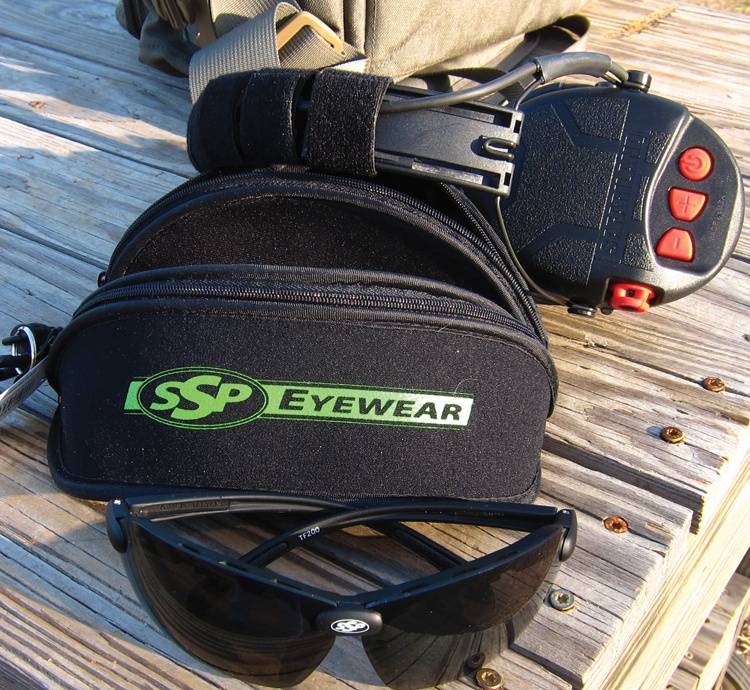
Top focal eyewear from SSP and new, high-quality amplified ear protection from Safariland, the Liberator HP
I saw the news about Safariland’s U.S.-designed and manufactured Liberator HP advanced hearing protection headset. The Liberator HP headset offers dual-mode electronic noise compression and active noise cancellation with sound localization for maximum situational awareness and sound detection. Some would consider it pricey at nearly $260, but what’s your hearing worth? You can’t find this kind of quality cheaper with a comparable feature set.
I recently discovered Specialized Safety Products. Makers of SSP Eyewear, I found their “Top Focal” shooting glasses. Featuring a magnifying segment atop the lens (unlike bifocals with the near vision enhancement at the bottom), they sharpen the view of the front sight — not so much for me with handguns, but definitely when shooting carbines with iron sights. Kits are available with amber, clear and smoked anti-fog lenses, and a zippered pouch.
Range Estimation
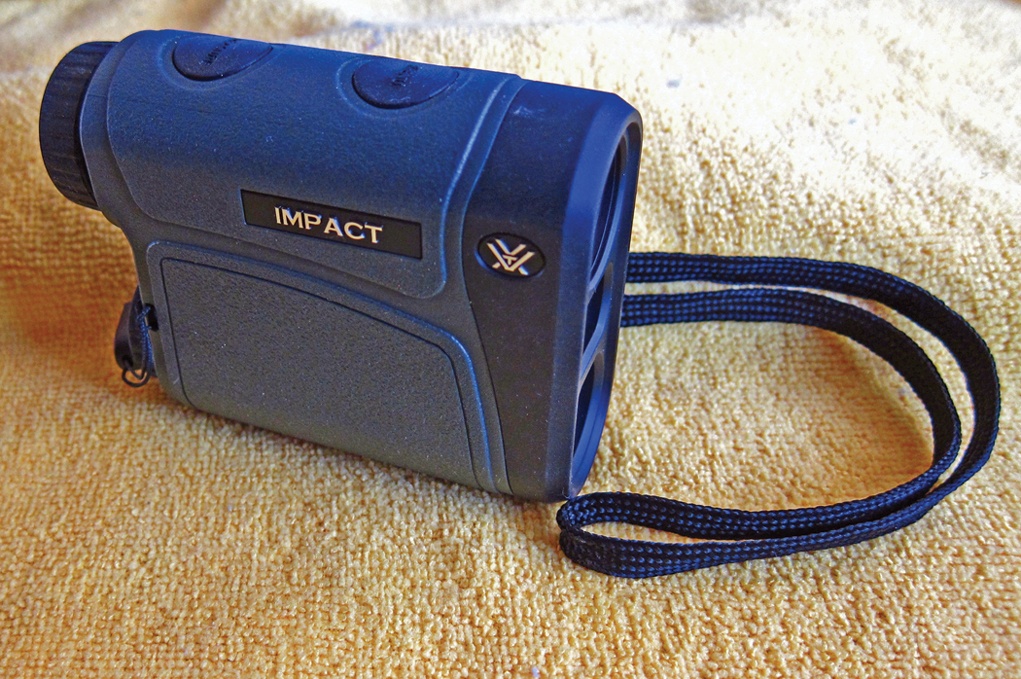
Vortex Optics Impact 850 laser rangefi nder.
Since I’d had several trips to Wyoming on rodent-strafing safaris, my inability to effectively estimate range has bothered me. I also used it on the club range on some of the range bays. During a recent trip, I took the Vortex Optics Impact 850 rangefinder to our second pistol bay – which is unmarked. I was working out with new pistols and wanted to nail down distances. The Impact 850 quickly sorted through those chores, but I also checked distances to various other locations. Use of the device was quick and easy, the controls intuitive. I had to do nothing to set it up beyond installing the battery. It’s a steal at the mid-$200 price range.
Editor’s Note: This article originally appeared in the Great Gear 2018 issue of Gun Digest the Magazine.
Among the most unique long guns, there’s no shortage of choices when it comes pistol-caliber carbine makes and models.
There’s really no need to be PC … unless you’re talking about long guns. Handy and manageable, rifles and carbine that feed off of pistol-caliber ammunition have grown in popularity. There’s no secret why, the firearms are ideal shooting range diversions, teaching tools and home-defense – particularly close quarters.
Shooters tend to think there is only one style of pistol-caliber carbine, the dominant and versatile modified AR-style system. Readily available, these guns are far from the only option out there. Honestly, like the majority of the firearms world, pistol-caliber long-guns are designed to suit every need.
Showcasing a swath of popular options, John Tupy of The Modern Sportsman gun store in Burnsville, Minn., breaks down what this class of firearms has to offer. For close range plenty, from the highly versatile SIG Sauer MPX Carbine to the bit more traditional Ruger PC Carbine. The simple-blowback operated pistol-caliber carbines are chambered in everything from 9mm all the way up to .45 ACP. And they boast some of the more cutting-edge designs in the semi-automatic world, too boot.
As interesting and useful as pistol-caliber carbines are, they tend to have some notable limitations. Chief among these is range. Certainly, kittens in the recoil department, they’ll rattle through a magazine in no time flat, and accurately in competent hands. However, practically speaking, they are a little rusty once they get past the 50-yard mark.
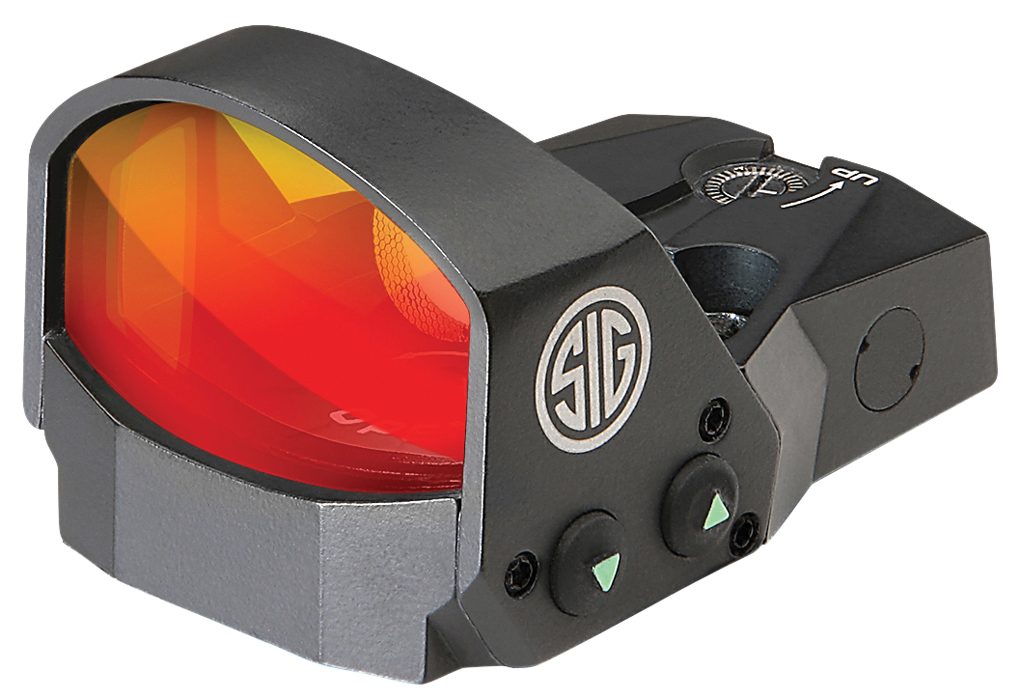
This is a different kind of gun article. It took weeks to put this together because a cursory review was not the goal: I wanted to unequivocally determine the level of reliability that could be expected from the Sig Sauer P320 and the Sig Electro-Optics Romeo 1. This takes time — days, in fact — and lots of ammunition.
I’d been hearing good and bad things about the P320, as well as a lot of pontification on the durability and effectiveness of the Romeo 1 on defensive handguns. I wanted to see some results for myself.
You don’t often read articles like this in gun magazines, because they’re not profitable for the writer. I’ve been in this gun writing business — professionally — for more than two decades. Articles are most commonly generated when a writer sees a gun and queries an editor. Almost as frequently, editors assign writers to review and report on a gun of potential interest.
In both cases, the gun is often fired only a couple hundred times to get a feel for it. If a writer allots a day to arrange an article, a day to shoot, a day for photos and two days for writing, on average they’ll make about $17 per hour. The report then essentially involves one day on a range. This is partly because that’s all the free ammo the writer can get, and partly because the more time spent shooting, the less money is made.
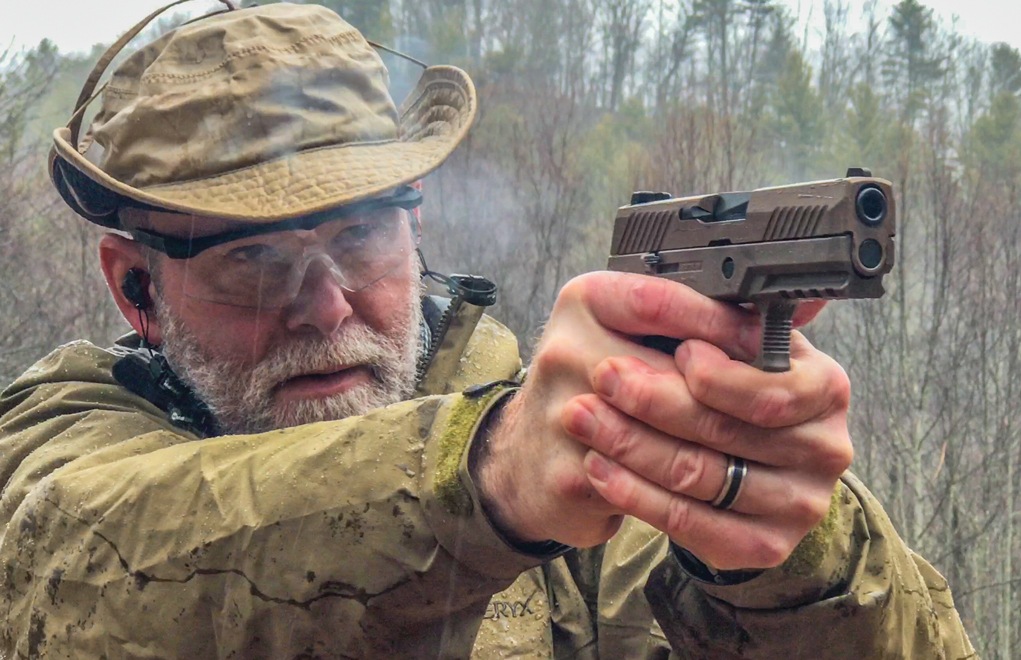
Pull it out of the mud, slosh it off in a water hole, rack the slide using the refl ex sight as a handhold — and if your handgun is a P320 equipped with a Romeo 1, expect it to work.
This model provides hands-on review to the reader while maintaining some efficiency for the author.
However, the best gun writers learn how to provide more than a basic review, and the best editors — thus, the best gun magazines — provide content that goes much deeper than most.
Less common is when a writer fundamentally journals about a specific firearm with which they have extensive experience. In such case, you’ll get to read about weeks, months or even years of experience with a certain gun. In other words, instead of getting a snapshot, you get a comprehensive evaluation.
And, that’s what you have here. It’s a look at how these guns performed — not 1,000 words about how they’re made and how pretty they are.
Building The Gauntlet
I convinced Sig Sauer to send me four pistols, and I convinced various manufacturers to send me lots of ammunition. My goal was to see how reliable the Sig Sauer P320 and Romeo 1 reflex sight were. I did not conduct the usual velocity and accuracy testing: I shot these pistols and had others do the same. We abused these guns and sights — you could say we treated them like a borrowed hammer. We waited for the right conditions, on multiple days, and then did the work.
The four guns:
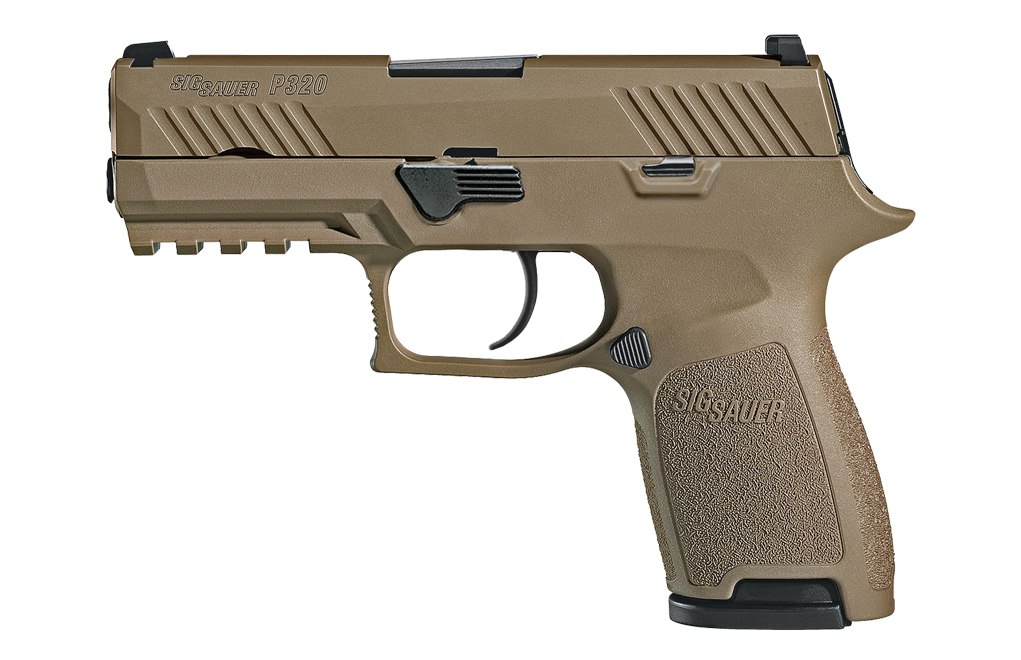
Sig Sauer P320 FDE Compact: $679
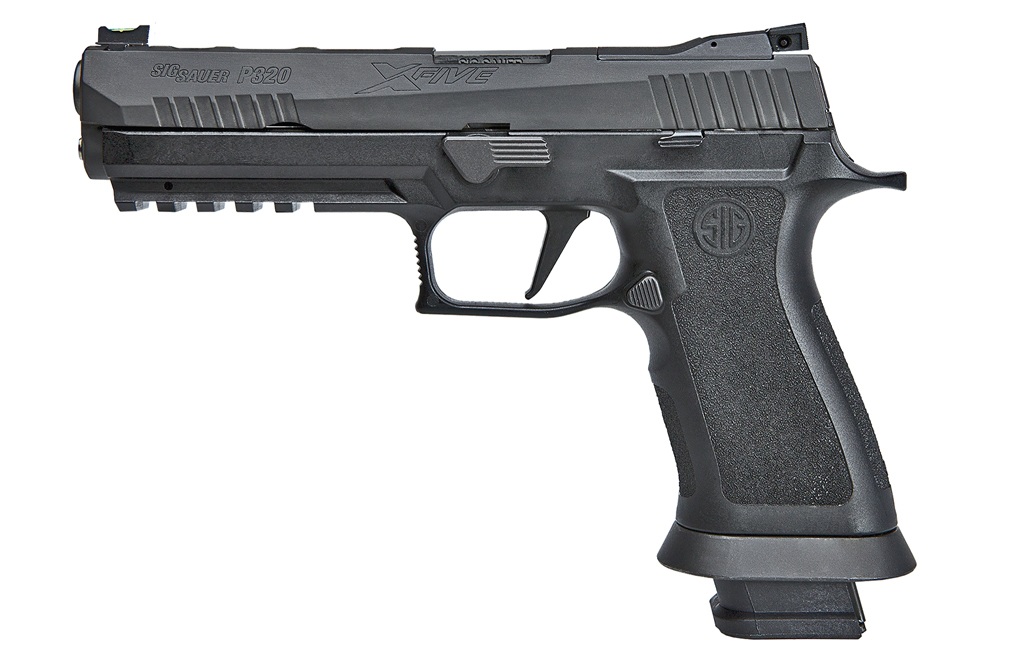
Sig Sauer P320 X-Five Full-Size: $1,005
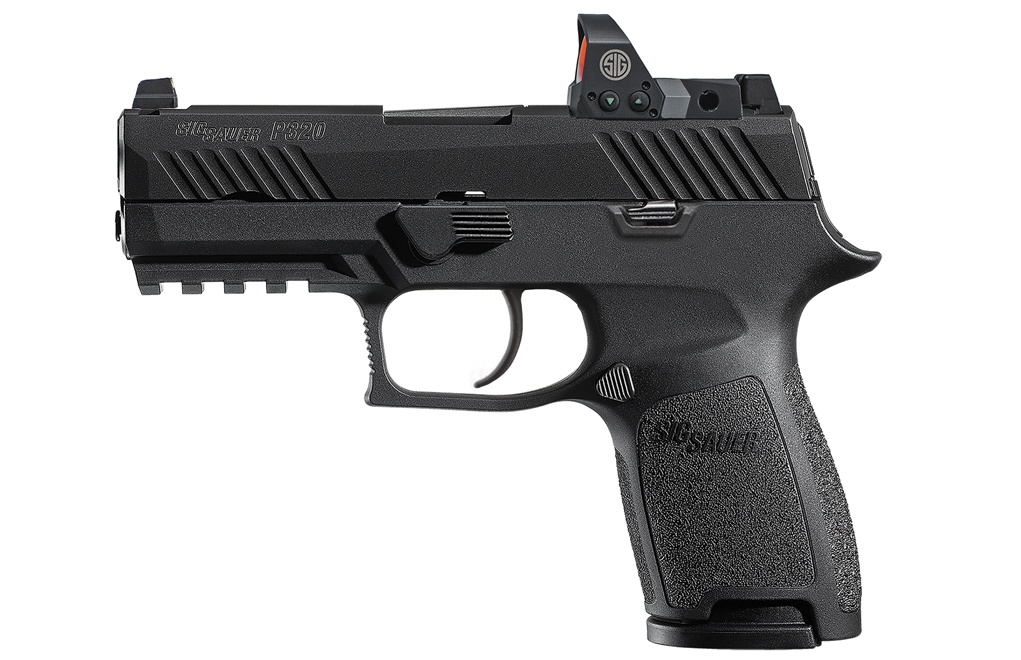
Sig Sauer P320 RX Compact with a Sig Sauer Romeo 1 reflex sight: $952
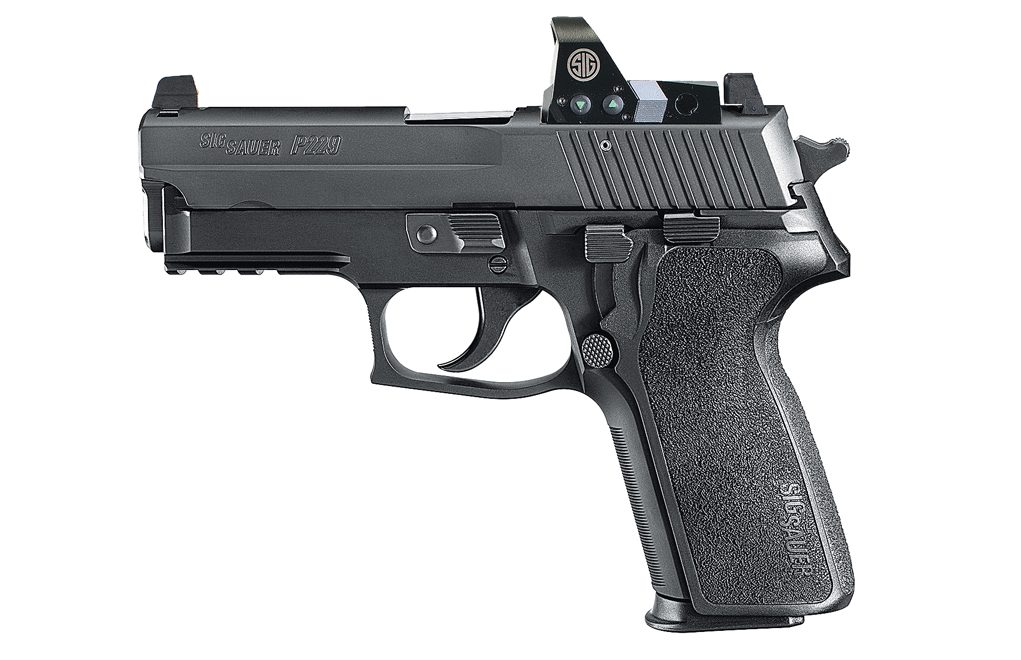
Sig Sauer P229 RX with a Sig Sauer Romeo 1 reflex sight: $1,440
The munitions:
Hornady 9mm +P, 124-grain, XTP, American Gunner: 500 rounds
Remington 9mm, 124-grain, Golden Saber: 1,000 rounds
Remington 9mm, 124-grain, Black Belt: 800 rounds
Sig Sauer 9mm, 115-grain, Elite Ball, FMJ: 500 rounds
Sig Sauer 9mm, 124-grain, Elite V-Crown, JHP: 200 rounds
Sig Sauer P320 FDE Compact
The first pistol we took to task was the P320 FDE Compact. This pistol feels good in the hand and, importantly, it’s not too big — only 7.2 inches long and 1.3 inches wide — for everyday carry. I shot it, my son shot it and a friend of his who was preparing to enter BUDs training with the Navy shot it. We shot it in hot weather, cold weather, in the rain and in the snow. It digested a 1,000-round mixture of all the loads without an issue.
Sig Sauer P320 X-Five Full-Size
Next up was the X-Five. This is a big handgun intended for competition, though I imagine — given its 21-round capacity — it could serve in a tactical environment as well. It has a 5-inch barrel, is 8.5 inches long and some of its unique features include a detachable, wide-mouth magazine well, a straight X-Series trigger and Dawson Precision adjustable sights. This pistol weighed 30.7 ounces without a magazine.
This is obviously a pistol for high-volume fire, and that’s how we tested it. We repeatedly conducted a drill where we dumped four 21-round magazines, as fast as we could, while trying to keep all shots inside a five-inch circle, at five yards. Our best run was one miss out of 84 in 35.02 seconds. Like with the P320 FDE Compact, we shot it in the rain and the snow, and out of 840 rounds of a mixed variety of ammo, there were no stoppages.
Sig Sauer P320 RX Compact
The RX — Romeo 1 equipped — pistols were included, not as much to test the pistol as to test the suitability and ruggedness of the reflex sight on a defensive handgun. This pistol weighed 24.5 ounces — only 0.8 ounce more than the P320 FED Compact without the Romeo 1. Yes, it got the rain and snow treatment, but we also tossed this pistol in the deep mud and drove over it with a big Jeep.
When we dug it out of the goo it was, like a coal miner would say, “gobbed off.” We had to slosh it around in a waterhole to even identify it. A magazine was inserted, the slide was racked — we did have to thumb the slide forward the last ¼-inch — and not only did the pistol run, the sight still worked and was still zeroed. Rounds fired: 750. Stoppages: 0. That’s impressive.
Sig Sauer P229 RX
Figuring 2,590 rounds fired through three P320s in harsh conditions provided a reasonable idea how reliable that platform was, the P229 RX was included to give a second look at the Romeo 1 sight. This pistol/sight combination did not get the mud treatment, but it arguably got something worse. We dropped it repeatedly, stomped it, threw it as far as we could and even beat it against a railroad tie. The Romeo 1 did not fail. Not only did the aiming point remain illuminated, it held perfect zero. At the end of the abuse, we fired a nearly one-hole, 10-shot group, at 10 yards from the off-hand position. Total shots fired: 410. Stoppages/issues: 0.
Observations
I was impressed with all three variants of the P320. They were reliable, the triggers were clean, I shot them well and they felt good in my hands. In fact, I liked P320 better than the P229, and I’m not a fan of striker-fired guns. I especially liked how easy the P320 is to disassemble. You can take it apart and put it back together with one hand in a matter of seconds. Yes, the chance you’ll have to do this is slim, but it illustrates the simplicity of the process. I also really liked the smooth, flange-free trigger.
On the P320 Compacts, I really liked the location and diminutive size of the slide lock. On some handguns — particularly Glocks — the slide lock is positioned well forward and I struggle with keeping my support thumb from contacting it during recoil. When that happens, the slide locks back. On the P320, the slide lock is positioned more like a thumb safety or de-cock lever. Not once did I inadvertently activate the slide lock, which is, by the way, present on both sides of the frame.
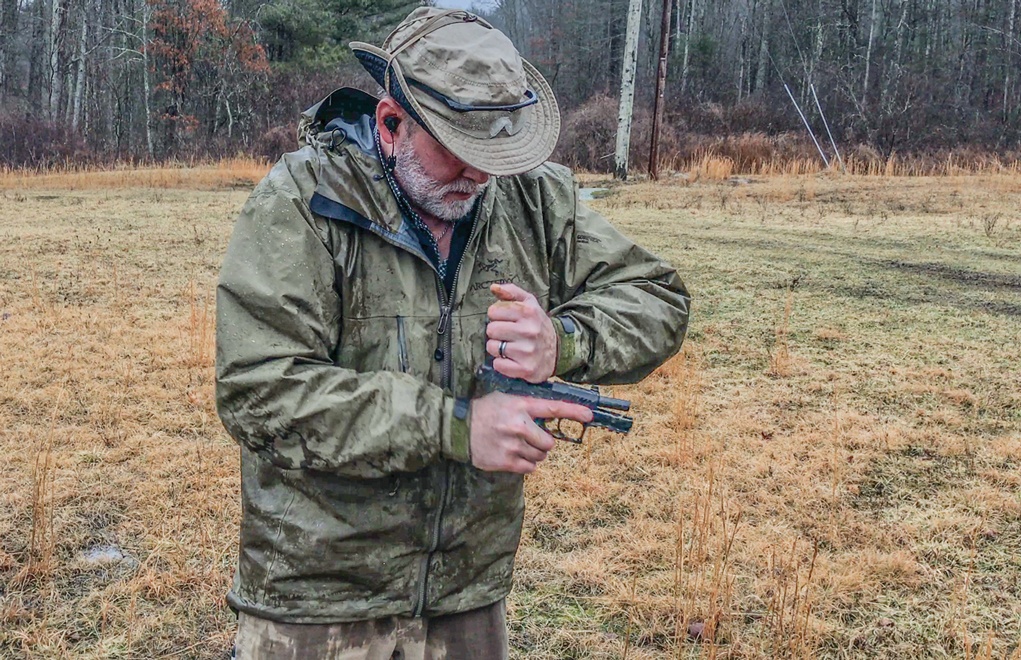
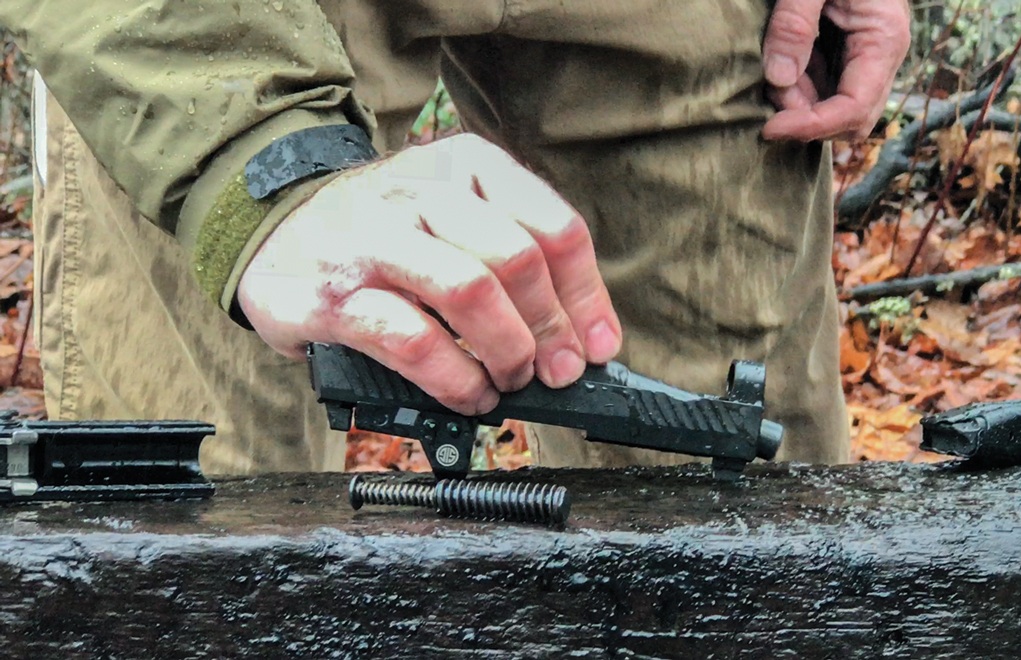
With the P320, you can fi eld strip and assemble the pistol, even in the pouring rain, while using only one hand.
However, on the P320 X-Five — again, a gun intended for competition — the slide lock, though un-shrouded, was just as small. During competition, releasing the slide with the thumb/slide lock — though not something I recommend with a defensive handgun — can be faster. But, it often necessitates an extended slide lock. On a defensive handgun, an extended slide lock might lead to that inadvertent lock-back — which is not good! On the other hand, competition shooters train much more than your average citizen carrying concealed. For those with judicious training, an extended slide lock can make sense, and maybe help them win a match. In my opinion, Sig ought to consider this alteration on the X-Five.
I’m considering buying a P320, but I’m having trouble deciding which model, since there are nearly a dozen to choose from.
The Romeo 1 reflex sight impressed me most. The initial impression is that this sight needs to be babied. After all, it’s extremely petite and has glass in it for heaven’s sake.
That said, I was unsuccessful at making this sight fail. Admittedly, it has to be relatively clean to work; if you drop the gun in the mud you’ll have to wipe it off. However, heavy rain and snow did not render the Romeo 1 unusable. Unbelievably, this sight costs less than $400.
I will add, however, that I could not get hits as fast with the RXs fitted with the Romeo 1. To become proficient with a reflex sight, there’s definitely a learning curve — you don’t just pick it up and go to town on the targets. Accuracy was not the problem, rather it was conditioning myself to look for the dot instead of the sights.
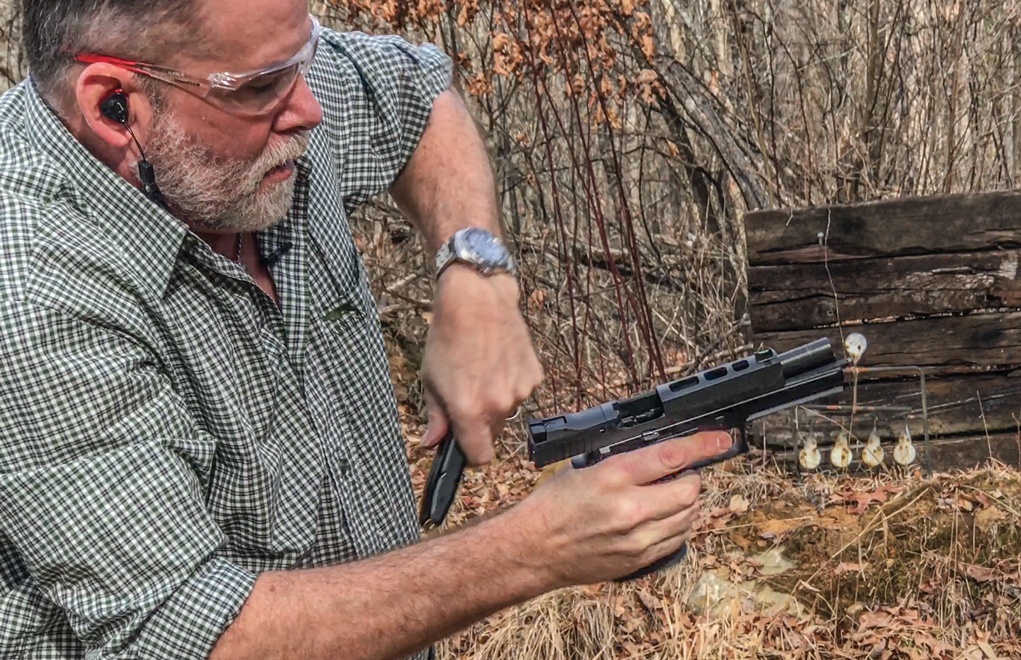
When we worked with the P320 X-Five, the author conducted high-volume shooting drills using four, 21-round magazines.
On a 15-shot drill I often use for training, I was just as accurate but about 20 percent slower with the Romeo 1. With practice, I’m sure this gap would narrow and likely disappear, but I mention it in case you get yourself a Romeo 1-equipped Sig — it will take some getting used to.
This article took longer than most. I got wet, cold and muddy. And, in the end, I made about $5-per-hour while working on it. But it was worth it. No, this is not your average gun article, but now I — and you — have not just an idea, but a real-world, practical impression of the durability and reliability of the P320 and Romeo 1.
I can definitely say, I’d trust my life to both.
For more information on the P320 and Romeo 1 check out:
Weatherby partnered with Krieger to improve the rifle that made Roy Weatherby famous.
How the Krieger Custom Rifle is a cut above the rest:
26-inch fluted barrel from Krieger.
Cut rifling.
Weatherby Mark V action.
Oversized bolt knob.
Cerakote finished metal.
Hand-laid stock with an aluminum bedding block.
LXX adjustable trigger.
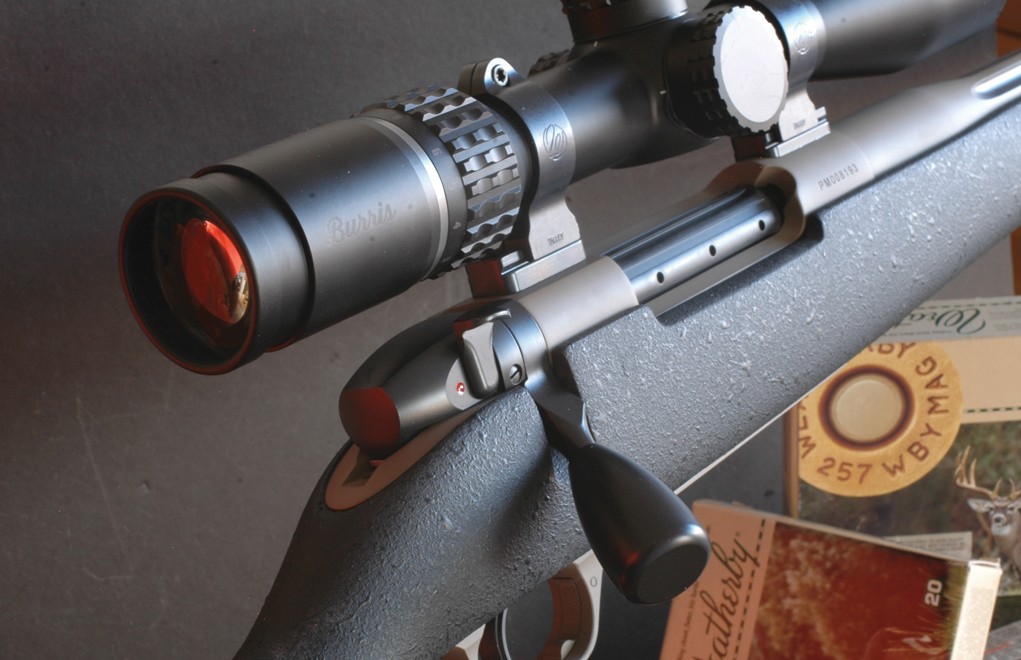
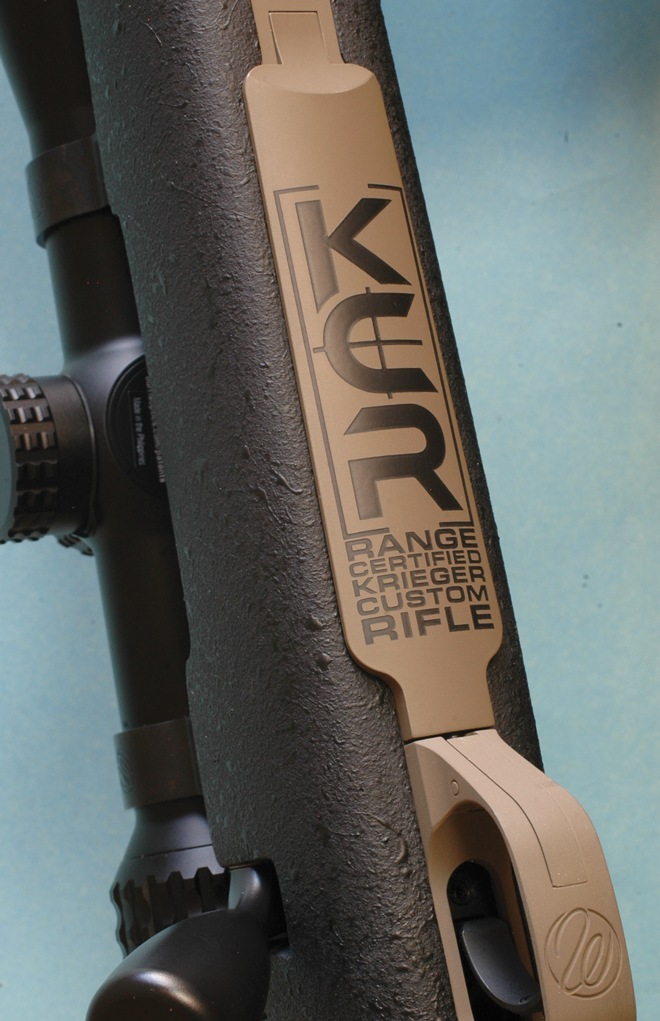
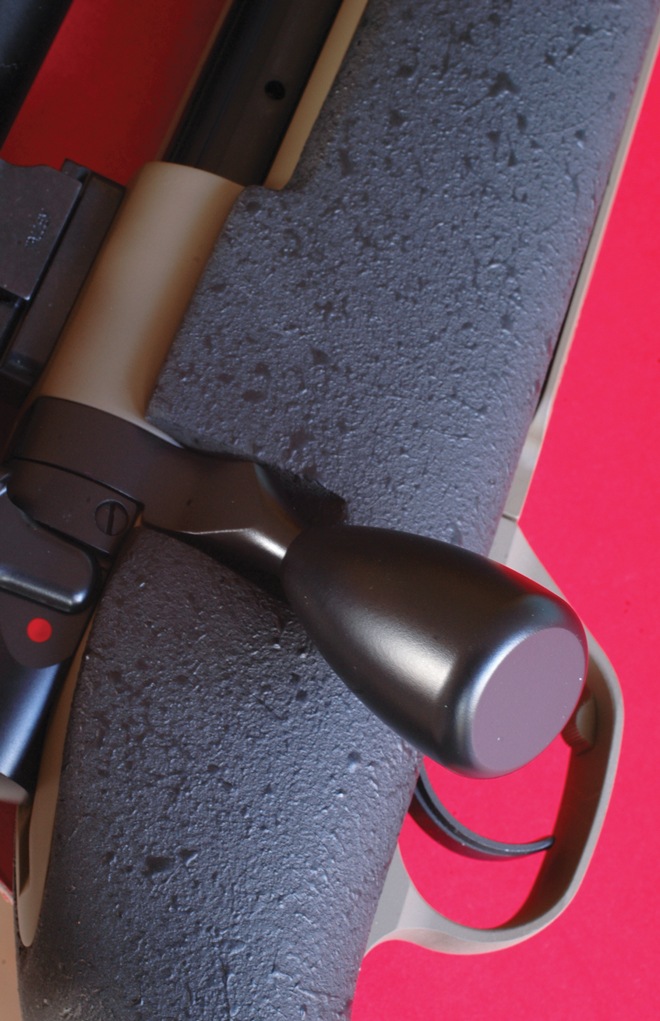
The color grabs you first. Not the matte-black, gel-finished synthetic stock, but the metal. Barrel, receiver and bottom metal wear Cerakote, in flat dark earth that borders on bronze. Barrel flutes and bolt (body, shroud and handle) are black. All told, it’s a fresh, striking look. The oversize bolt knob catches your eye, too. Semi-gloss black and profiled for a perfect cosmetic fit, it’s faster and more positive in operation than Weatherby’s standard knob. And to top it all off, the floorplate wears a distinctive KCR logo that adds to the rugged elegance.
The 26-inch cut-rifle Krieger barrel is fluted and threaded. Chamber specs, installation is done by Weatherby.
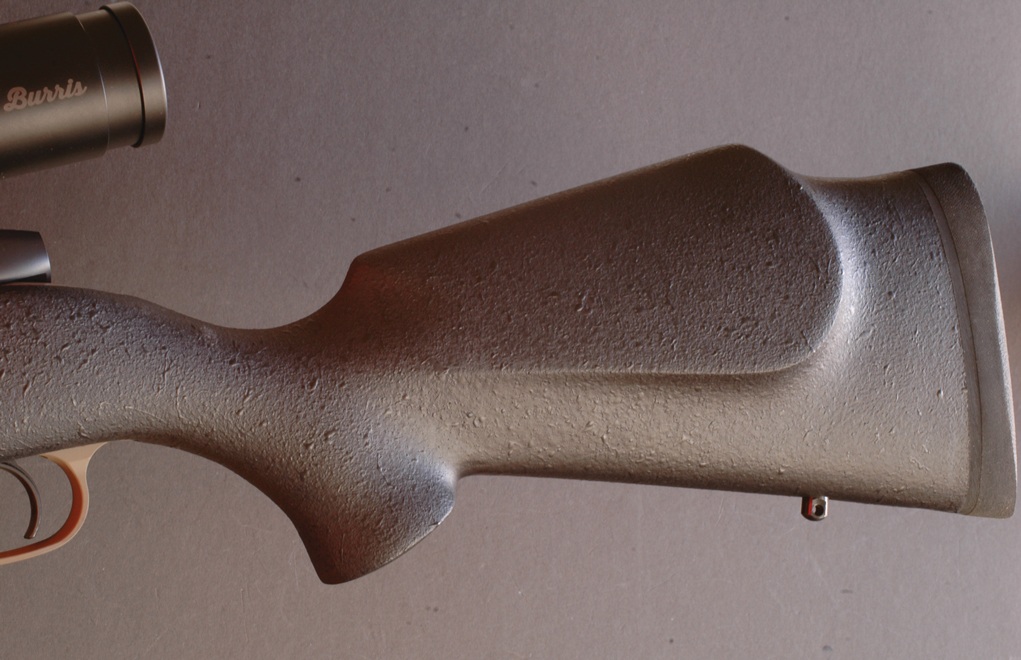
What you can’t see also defines the Krieger Custom Rifle. Its hand-laid stock boasts a long alloy bedding block for increased rigidity and more uniform action-stock seating. Last year, Weatherby tweaked the profile of all Mark V stocks, reducing grip circumference, adding a right-side palm swell and giving the forend a sharper, slimmer profile. They’re subtle changes, but palpable. The LXX trigger (for the firm’s 70th year) is also a recent upgrade: It now has a wider face, is factory set at 3.5 pounds and the pull adjusts down to 2.5 pounds.
Most distinctive is the KCR’s fluted, 26-inch barrel. Of medium contour, it’s manufactured and cut-rifled to .0001-inch groove tolerance in the shop of ace barrel-maker John Krieger. The bore is hand-lapped to 16 micro-inches in the direction of bullet travel, the muzzle threads get a protective cap and the barrel is cryogenically treated there, too.
All Weatherbys have a 1-MOA guarantee. This Range-Certifi ed KCR comes with data for best loads.
“Boring and rifling impose stresses on barrel steel,” Pete Paulin told me many moons ago. “Deep freezing relieves them. During bullet launch, a barrel expands radially and in length. Cryogenic treatment eliminates forces that skew expansion and contraction.”
While the principle has been used since 1940, he explained, it didn’t become practical for barrels until he refined a process in 1992. It begins with a bath at -300 degrees Fahrenheit (absolute zero, or 0 degrees Kelvin, is -457 degrees Fahrenheit). Slow cooling prevents cracking. Like Paulin, John Krieger says “cryo” is no sure fix for ho-hum groups, but it won’t cause any damage and often improves accuracy.
The idea for a Mark V with a cut-rifled Krieger barrel came by way of Adam Weatherby, now the company’s CEO, on a visit to the Krieger shop early in 2017. John readily agreed to send finished barrels, bored to Weatherby’s specs, to its headquarters and assembly center in Paso Robles. But they aren’t the first Kriegers on Weatherby rifles. In fact, button-rifled Criterion barrels, once a Krieger product, have been installed on Weatherbys since 1999 and are standard on Mark Vs now.
It’s All About The Barrel
All Mark V stocks got a recent overhaul: a slimmer grip with palm swell, a crisper profi le and more intricate details.
Rifling a bore can be done with a cutter, a button or a hammer-forging machine. The cutter was developed in Nuremburg in the late 15th century. It’s a small hook in a hard, bore-diameter steel cylinder. Most commonly now, a rod pulls the hook, removing a very thin slice of barrel wall with each pass. The rod indexes to deepen each groove, and the cutter’s rotation setting determines rate of twist.
“A single-point cutter imposes little stress on the blank,” John Krieger says. “But the process is slow.” Like leather seats in a fine automobile, cut rifling pairs with upscale custom rifles. It’s also standard in test barrels Krieger supplies to the ammunition industry manufacturers.
Much faster is the tungsten-carbide button. Mounted on a high-tensile rod and rotated by a head set to the desired twist, the button is pushed or pulled through the finished bore by a hydraulic ram, “ironing in” grooves. The most popular rifling option for .22 rimfires, buttons have an advocate in Steve Dahlke, who by 1982 was making barrels for John Krieger. Now president of the separate Criterion shop, he also supplies buttoned centerfire barrels.
The author likes the appearance and feel of the KCR’s oversize bolt knob for faster, more positive cycling.
Hammer-forging, pioneered on barrels for German MG 42 machine guns, is also speedy. A short, thick barrel blank is fed into the maw of a machine that costs more than the annual GDP of Angola. The machine “kneads” the blank around a mandrel that, like a button, wears rifling in reverse. The hammering produces a terrific din, and enough floor vibration to stagger a horse.
The barrel emerges about 30 percent longer via this process. Its slick bore has finished dimensions, though radial stresses can be hard to remove. Roy Weatherby may have been the first American rifle-maker to hawk hammer-forged barrels, later standard on Mark V rifles.
As for twist rate, “it’s better to over-stabilize a bullet than give it too slow a spin,” John Krieger says. “Lead-free bullets and those with thick jackets are longer than soft-points hunters used 50 years ago, and they require sharper twist.”
Accuracy Through Action
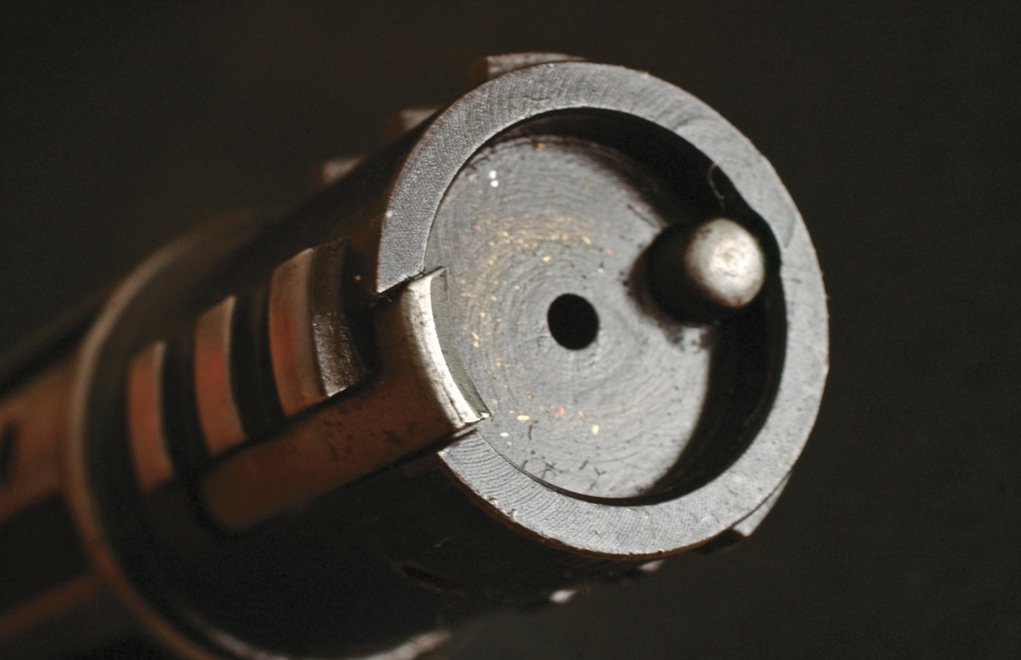
Roy Weatherby and Fred Jennie designed the Mark V Magnum action in 1957. It still features a nine-lug bolt.
Accuracy starts before the bullet meets rifling. A parallel throat acts like a piston sleeve: It must allow easy passage of all bullets, “but it can’t be oversize,” cautions John Krieger. “A little bullet wobble ruins accuracy.” As long throats keep a lid on pressure, Roy Weatherby used them to hike bullet speeds.
The uniformity of finished bores may be checked with an air gauge, a probe that moves through the barrel with air pressure “feeling out” variance down to 50 millionths of an inch! In addition, John Krieger lops an inch of barrel from the muzzle before crowning because “bore finishing can leave a flare.” The KCR has a recessed target crown to protect the bore lip and ensure perfectly square bullet exit.
The KCR’s Mark V action is a refined version of the mechanism Roy Weatherby engineer Fred Jennie developed to accommodate the .378 Weatherby cartridge after its 1953 introduction. To see how a current Mark V rifle comes about, I visited the Paso Robles assembly floor. The KCR had yet to emerge then, but the staff was boxing up rifles in the spanking-new 6.5-300 Magnum. Charitably, Ed Weatherby said: “You might as well build one.”
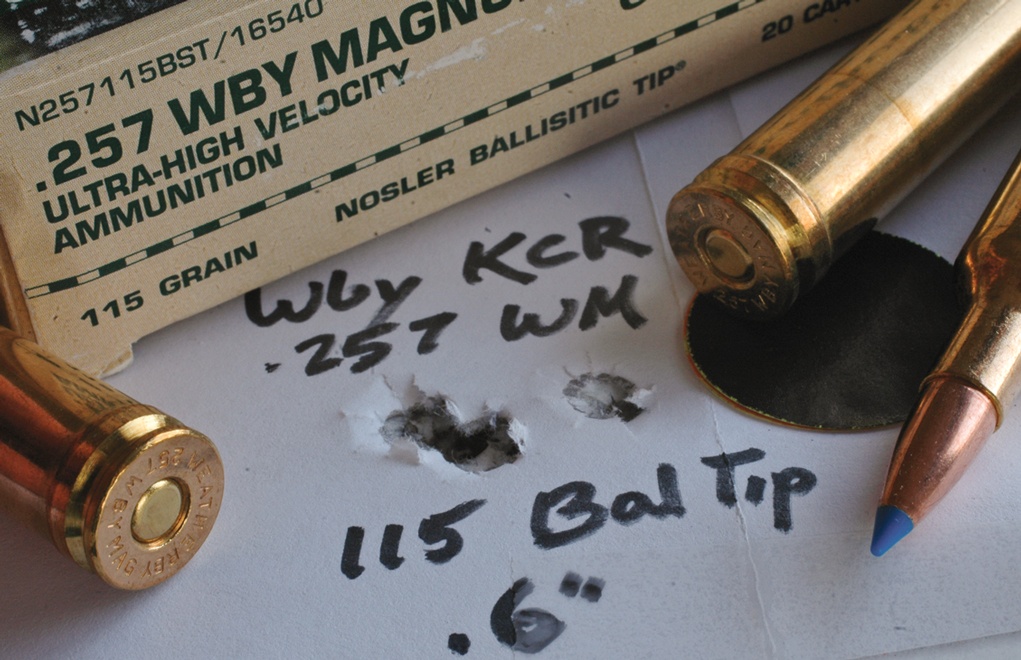
This 0.6-inch knot was the fi rst the author shot with ballistic tips.
He’d have been foolish to turn me loose in that shop. Instead, a handful of skilled rifle builders guided me through 36 shop operations to bring a Mark V from 33 parts to completion. In the test tunnel, it drilled a 0.7-inch knot. “All Weatherby rifles must now meet a 1-MOA standard,” confirms Adam. “Rifles marked ‘Range Certified’ come with a proof target from Oehler’s Ballistic Imaging System, and load data developed by Weatherby for that rifle.”
As I’ve known John Krieger for years and used his barrels on other rifles, I requested a sample of the KCR right away. It comes in four Weatherby Magnum chamberings: .257, 6.5-300, .300 and .30-378. Noise and recoil have become less appealing with age, so I was pleased the crew shipped a .257. One of Roy’s favorite cartridges, it was also one of his first. In fact, its 1944 debut predated his rifle company! Factory-loaded ammo appeared in 1948. The .257 was on Norma’s list when it began supplying Weatherby ammo in 1951. Norma currently lists seven loads under Weatherby’s label, with five bullet weights.
Under The Hood
At 3,870 fps, the 80-grain TTSX bullet in the .257 Magnum is faster at launch than any other load for any Weatherby cartridge. Three 100-grain spitzers at 3,500-3,600 fps also qualify as hotrods. But to get ballistic coefficients above .400 and weights suitable for elk, and to better tap the .257’s case capacity, I turned to 110-grain AccuBonds at 3,460 fps, 115-grain ballistic tips at 3,400 fps and 120-grain partitions at 3,305 fps. Roy Weatherby’s notes on the .257 during his African safari came to mind.
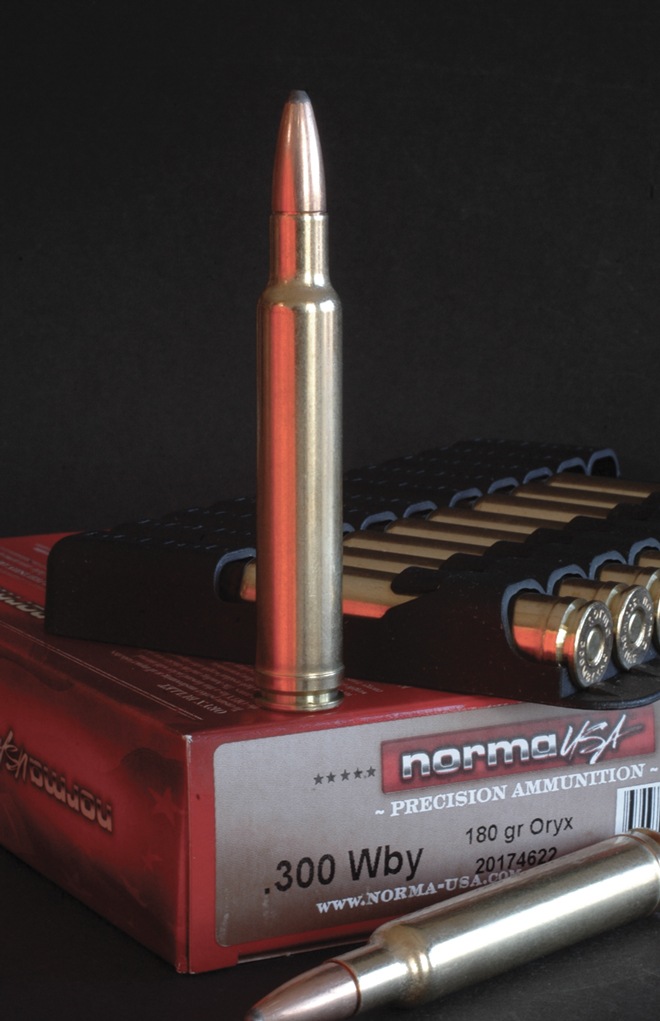
Unveiled in 1945, the .300 Wthby. was fi rst loaded by Norma in 1951.
“The 87-grain bullet seems to have more killing power at 100 yards than does the 100-grain.” Still, his unvarnished reports later showed that light bullet at nearly 4,000 fps didn’t excel in all situations. Thus, it’s no longer loaded. I have limited field experience with this hot .25, but bullets in all weights are much better now. A deer I shot in Idaho at 325 yards dropped as if lightning-struck when my 100-grain Hornady pierced its ribs. After the KCR arrived, I attached a Burris Veracity 2-10×42 scope in Talley mounts. This 30mm glass, with focus/parallax dial and mid-height target knobs, is long enough and heavy enough to dominate lightweight rifles, but it’s an ideal fit for the leggy, 8.5-pound KCR.
At the range, this rifle cycled smoothly and in all other ways behaved without fault. My Timney scale registered trigger weight at the specified 3.5 pounds, exactly. The big bolt knob was a delight. All groups stayed inside the 1-inch maximum, including five shots with the AccuBonds at 0.6 inch, the best three-shot group went to the ballistic tips. I’m still working with it, but 0.6 MOA is mighty fine accuracy. Also, successive bullets went to the same place even as their blazing speed hiked bore temperatures.
Yes, the KCR — one of three new Mark Vs in a field of 18 — is expensive. But in my view, it ranks among Weatherby’s best. Top chambering? I’m fond of the .300 Weatherby. On the other hand, this .257 is so civil in recoil that it’s hard to believe that the three loads I fired bring an average of more than 1,300 ft-lbs. to 500 yards, and the most accurate will keep all bullets inside the mouth of a coffee mug at that range!
Editor’s Note: This article originally appeared in the June 2018 issue of Gun Digest the Magazine.
An Alexander Arms AR in 6.5 Grendel bangs steel fast and furious past 600 yards with ease.
What the 6.5 Grendel has to offer:
The 6.5 Grendel was designed as a medium-bore hunting cartridge for the AR platform.
With high BC bullets in weights from 120- to 139 grains, the cartridge is a long-range winner.
Heavy barrels and long-range scopes tap the cartridge’s full capabilities.
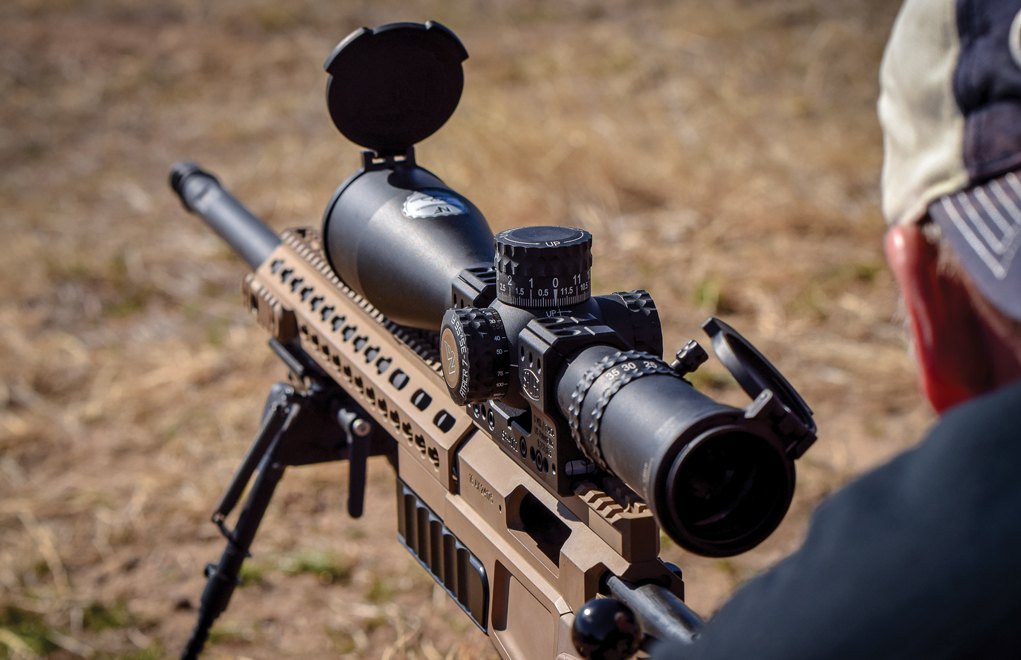
This isn’t the scope the author used to whack steel at 640 yards, but were he to try that again, he’d be more than happy to do so with this optic. The performance of the 6.5 warrants the best glass you can park on top of it.
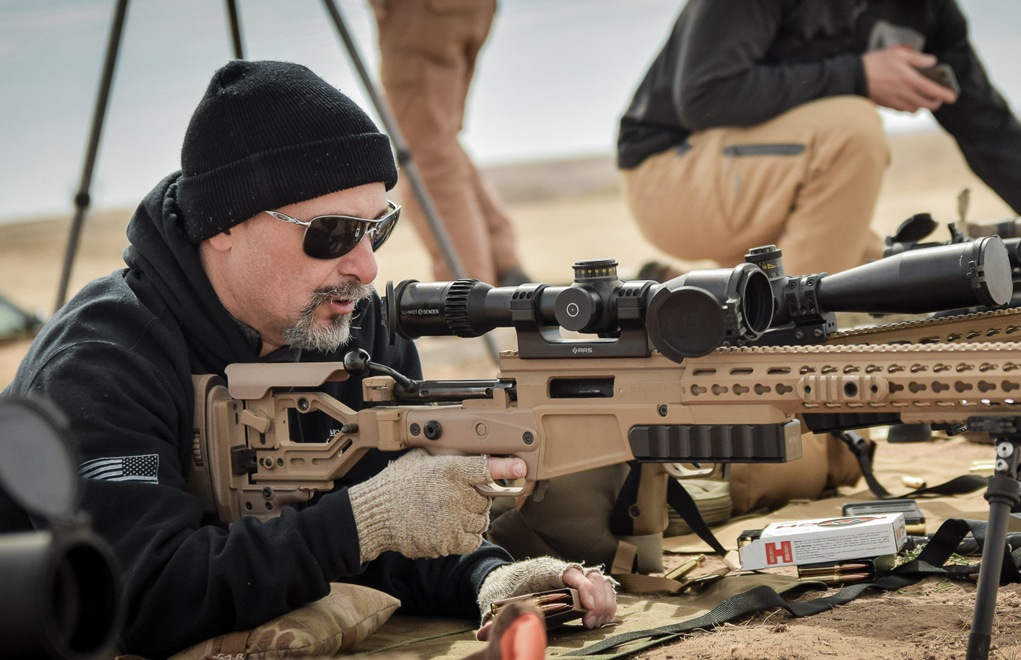
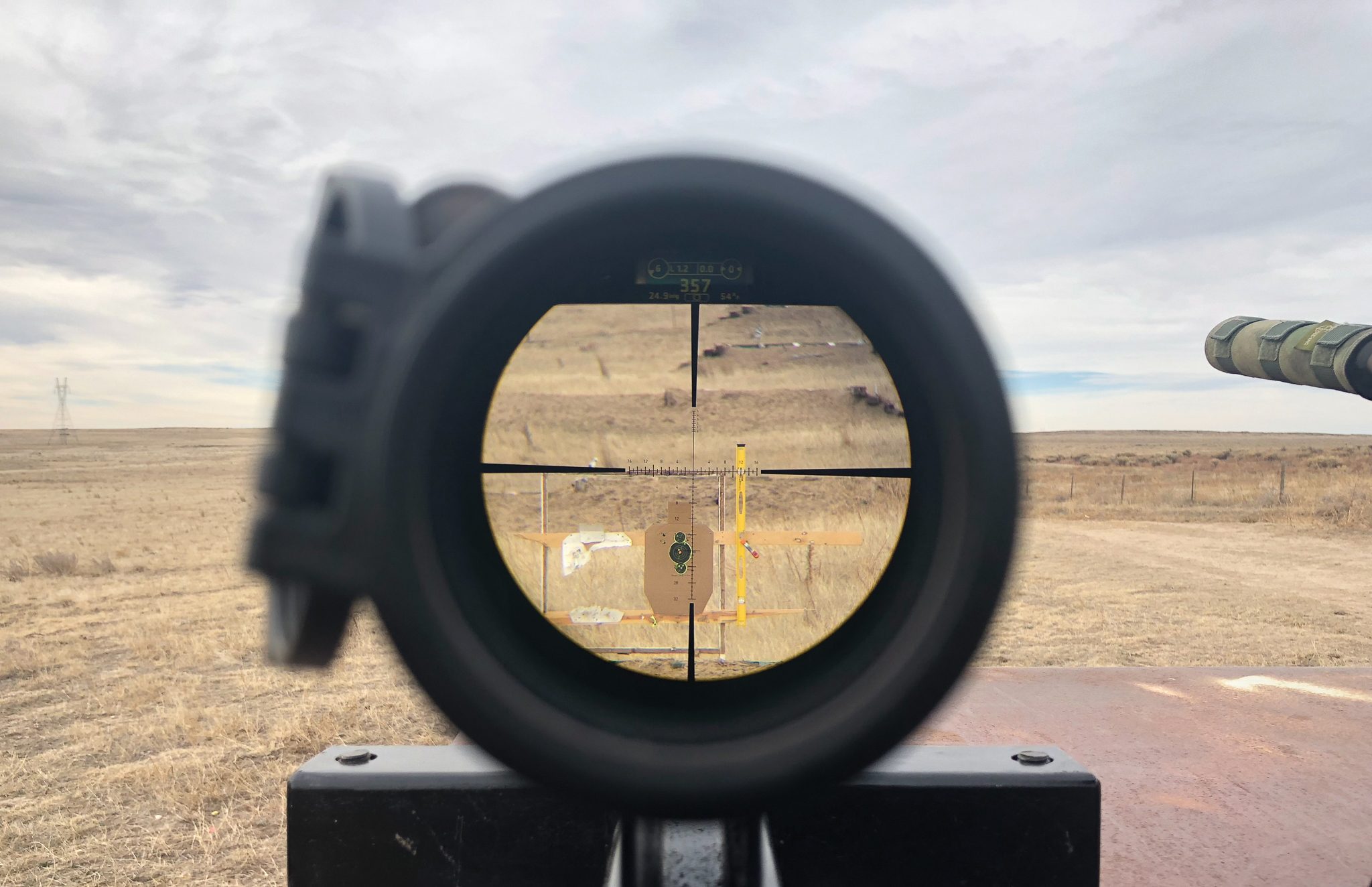
It was a warm summer day. We were a bunch of gun writers on a PR trip, and we had exclusive use of a 600-yard rifle range. At the back end, behind the target frames, was a steel half-silhouette. We lasered it at 640 yards.
We got a rifle zeroed to the point that it was hitting that steel, and someone came up with the idea of a contest. But what kind? Well, most hits. Hmm, we have a squad of competitive types and a mountain of ammo. Who wants to see a barrel burned up as we try to make it 20-30-40 hits in a row?
Best hits out of five shots. Yes, and when we’ve all shot five hits, then what? OK, here’s the plan: five shots, scored the most hits. Shortest time is the tie-breaker, but to add pressure, any shot over ten seconds doesn’t count.
Use anything on the range, table, chairs, bench, sandbags, to build a shooting position that isn’t prone. Time starts on the beep.
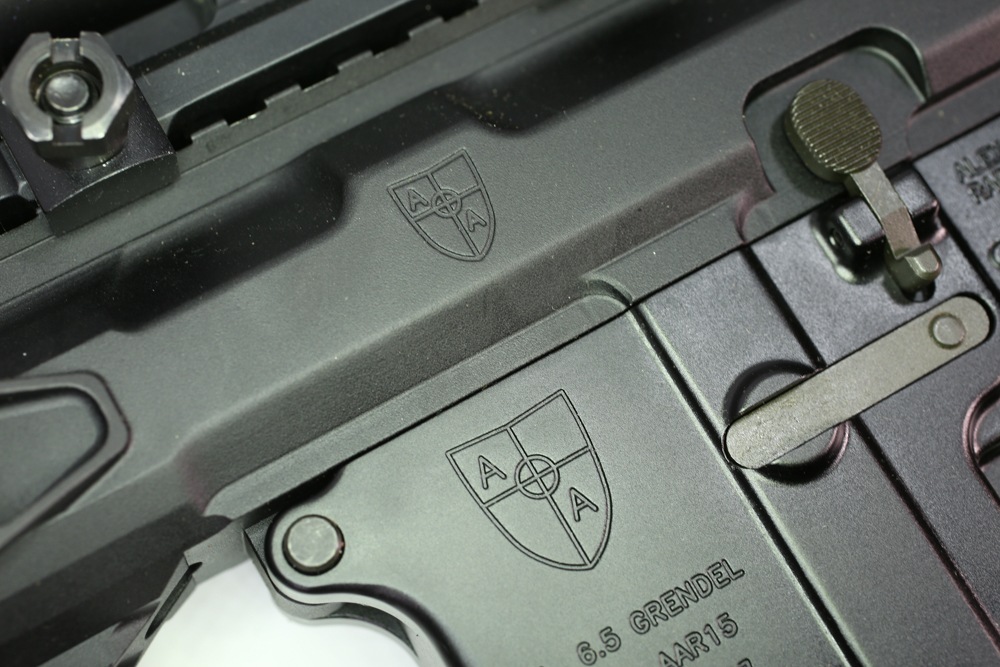
The 6.5 Grendel is the brainchild of Bill Alexander, and he makes cracking good rifles chambered in it. That doesn’t mean you can’t make your own rifle, and eventually you will. Trust me on this one.
For the longest time, four hits in just under ten seconds was the winning score. Then I found a shooting position that worked for me. It was awkward to look at, it had nothing in common with the classic shooting positions, but it afforded me one great advantage: I could see my hits (and misses) through the scope. On my last run I hit the steel five times in five shots, in just over seven seconds. Winnah!
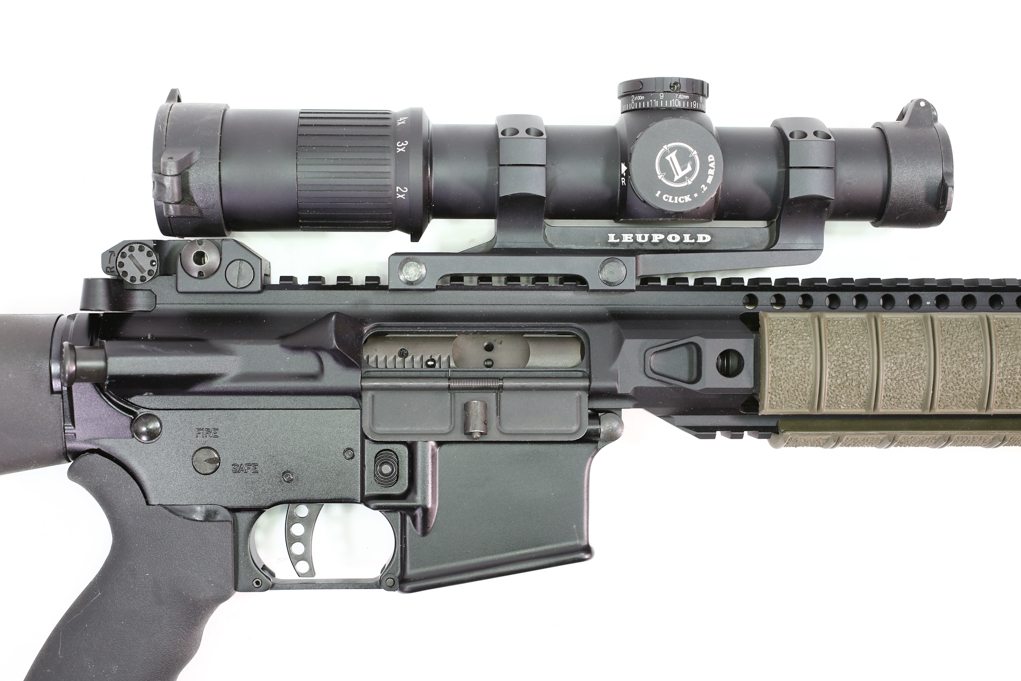
The rifle was an Alexander Arms 6.5 Grendel with a 20-inch barrel and a Leupold 3.5-10x on top. Having won the contest for the day, I had to have a rifle, so I asked Bill Alexander to send me one exactly like it.
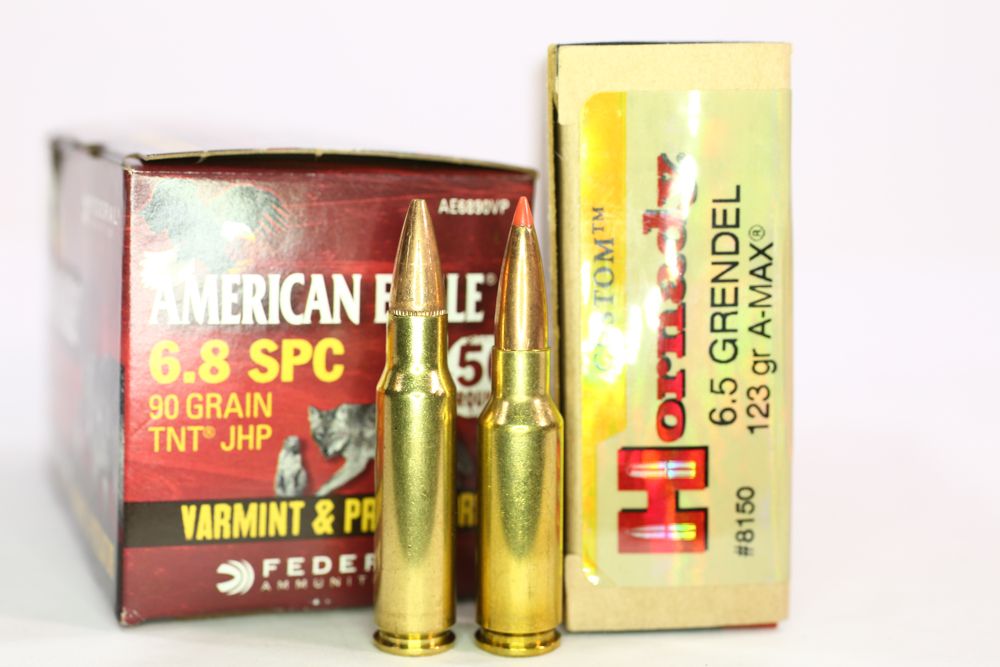
Bill designed the 6.5 Grendel to be the best medium-bore hunting cartridge to be had in the AR. The bonus was the case length allows for long, high-BC (ballistic coefficient, a measure of how easily it slices through the air) bullets in 6.5, and that means it is a really good long-range cartridge as well. How much of a difference?
The competitor here is the 6.8 Remington SPC. A typical bullet for it weighs 120 grains and has a BC of .400. The 6.5 Grendel, with a similar bullet weight of 123 grains, has a BC of .510 (higher is better) and you can buy or load 6.5 with bullets of 139 grains and a BC of .578.
A higher BC means, with all other things being equal, less drop and less wind drift. Drop wasn’t the problem on that afternoon, but wind drift was. Once I knew the drift, I could hold off (Into the wind) and get my hits.
One conversion option of an AR to 6.5 Grendel is to buy a complete upper from Alexander Arms. The advantage is that you have a ready-to-go upper that you can simply install on a ready-to-go lower.
If, however, you want to build one yourself, you need a barrel in 6.5 Grendel, obviously. Brownells lists and makes them. You also need a different bolt. The 6.5 Grendel used as its parent case the 7.62×39. The case was blown out, necked down, and the result was the 6.5. So, you need a 7.62×39 bolt to go with your barrel. (Again, Brownells.)
With bolt and barrel on hand, the rest is all straightforward AR building. The barrel and bolt are designed to fit into standard receivers and carriers, respectively.
At first glance, the 6.5 (right) and the 6.8 (left) are similar in performance. But the 6.5 can use bullets with much better BCs, and that makes the difference downrange.
I did just this, once I had the AA rifle on hand. My barrel came from a maker no longer in business, and fluted to boot.
I used a VLtor CASV handguard (which they have discontinued, unfortunately) for my build. This gave me a big-enough handguard to hold, without weight, and plenty of room for cooling. I then painted it tan and brown, in a pattern I call “ropeflage.” Paint the base color, then drape rope across the surface and over-spray the second color. The base color shows as stripes, in curves, in the overcoat.
Then it is simply a matter of what scope base and scope fit the job I have in mind for this, or the Alexander Arms 6.5.
Oh, and that afternoon? We heated that barrel up to the point of not being able to touch it, just shooting five-shot groups. And the Alexander Arms 6.5 Grendel still held zero. Nice rifle, indeed. Editor’s Note: This excerpt is from Gunsmithing the AR-15: Building the Performance AR, available now at GunDigestStore.com.
Mils and MOA are both useful angular units of measurements, but is one better than the other?
The basics on MOA and Mils:
Mils and MOA are angular mesurements.
MOA is equal to 1.047 inches at 100 yards.
Mil is equal to 3.6 inches at 100 yards.
MOA is converted to Mils by dividing it by 3.43.
Mils is converted to MOA by multiplying by 3.43.
This debate between milliradians (mils) and (minute of angle) MOA is never going to end, but we should at least agree on the facts right out of the gate. Every day we see the uninformed arguments about how one angular unit of measurement is better than the other. The truth of the matter is, one is not better — they’re simply different ways of breaking down the same exact thing.
Personally, outside of disciplines like benchrest shooting and F Class, I think minutes of angle should be retired. We have bastardized the unit to the point that people have no idea that a true MOA is not equal to 1 inch at 100 yards or 10 inches at 1000 — but 1.047 inches and 10.47 inches, respectively. If you round this angle, you create errors that exaggerate at longer distances.
Today, we shoot a lot farther than we have in decades past, and a 5 percent error compounding at an extended range will cause a miss. In fact, this is one of the main reason your ballistic software does not work: You default to MOA when, in reality, your scope adjusts in “inches per hundred yards” (IPHY).
Shooter MOA or IPHY is not a true MOA, and yes it does matter when companies mix them. Having someone question how IPHY is different when they don’t understand that we don’t use 1 MOA — or even 10 MOA — to hit a 1,000-yard target is frustrating to explain. If we consider a .308 Win. as a ballistic point of reference, we’re looking at almost 17 inches of variation between the two units of adjustment.
The Mil Advantage
We can quickly point to the adoption of mils here to demonstrate the ease of use, but then the Americans reading this will argue how they think in inches and yards, as if mils only work with the metric system. A Milliradian is an angle that subtends an arc whose radius is 1/1000th from the center. In other words: 1 yard at 1,000 yards.
Mils vs. MOA: One unit of measure is not more accurate than the other, and both are an angle-based unit of measure. The author recommends gaining a firm understanding of each system and then deciding which works best for your shooting needs.
So, 3,600 inches equals 100 yards, and 1/1000 of that is 3.6 inches. And when adjusting in 0.1 mils, we moved the bullet 0.36 inches per click at 100 yards. See what we did there? We simply moved the decimal point.
Some people believe an MOA is a finer unit of adjustment, but that’s failing to note that 0.3 mils is 1.08 inches at 100 yards. Contrary to popular belief, you can get a mil-based scope that moves the reticle 0.18 Inches per click. Mil-based scopes usually adjust in 0.1-mil increments; however, they do make scopes that adjust in .05 mils.
Mils vs. MOA: Which Is The Best Long-Range Language?
Mils are much easier to master than you might realize. Coming from the USMC Scout Sniper Program, our original M40A1 with the Unertl Marine Sniper Scope used a BDC Turret. The main turret was in yards, and the fine-tune lever was in MOA. Our dope was based on the range we were shooting more so than the MOA value.
In my case, my 500-yard dope back in the day was 5 minus 1. That meant to dial 500 yards on the scope, I turned the main turret to 5, and the lever to minus 1. The reticle was mil-based, and the lever was plus or minus 3 MOA. Today, the USMC is using mils.
Reticle options these days are as diverse as ammo options, and many are designed for specialized disciplines of shooting. Like all other decisions you need to make while building a long-range setup, figure out what works best for you and then get to know it intimately.
While milliradians were added to the metric system many years ago, it was never designed to be a metric-only unit and works outside the metric system because it’s an angle-based unit of measure. Every angle has a linear distance between it, but you should be ignoring this fact and using the angle vs. picking a linear value to adjust your correction. For example, if I’m shooting 873 yards away, saying the bullet struck 6 inches off the target is neither honest nor accurate. You’re guessing. In your mind, it looked 6 inches away, but what if it was 9 inches? Using the linear value is more work, so why not just adjust the angle?
Minutes of angle started out like that too, but — unfortunately — companies took shortcuts and ruined it for everyone. It was easier to manufacturer to 1 inch vs. adding in the 0.047 inch. “Long range,” back in the day, was considered to be distances of 400 to 800 yards. Read any old-school book on ballistics, and it rarely goes past those ranges in their examples. Today, we’re shooting well beyond 1,000 yards, so that extra 0.047 inch matters more than ever, and you have to take it into account.
Defaulting your shooting program to MOA when you’re actually using IPHY is a significant point of error. As a reference, JBMballistics.com is a great place to demonstrate this because you can include both MOA and IPHY in the output. The same amount of adjustment is accomplished with two different values. Mix these numbers, and the result is a miss: Did you dial 40.1 or 38.3 MOA?
I highly recommend you map and calibrate your MOA scope to confirm its actual value. It works both ways, but not every MOA-based scope is TMOA — some are SMOA — and the compounding error is a lot bigger than 0.47 inches.
Again, neither mils nor MOA is more accurate than the other. I can hit the center of any target using either unit of adjustment. You simply need to truly understand the system you choose to employ.
So, Which Is Right For Me?
This is the ultimate question, and it should not be up to someone else to answer it for you. Communication is your number one consideration: What are your friends and fellow competitors shooting? You want to be able to communicate and understand what a fellow competitor is talking about when he walks off the line.
You can convert using 3.43, by multiplying or dividing the competing unit of adjustment against the other. That will give you a direct conversion:
Next, you have your reticle choices. You will find more versatile options when it comes to mil-based scopes vs. one referenced in MOA. However, that’s changing a small amount as manufacturers adapt. But a reticle with 1 MOA hash marks is not as fine as a scope with 0.2-mil lines in it. You now have to break up an already small 1 MOA into quarters. The mil-based scope is already breaking up the milliradian for you.
Pick the reticle based on your initial impression as well as your use. You don’t need a Christmas tree reticle to shoot F Class, and you don’t want to use a floating-dot benchrest scope for tactical-style competition. Put your intended use into the proper context.
There are a lot of articles about the nuts and bolts of mils and MOA. You can dig deep, or you can focus on understanding that we’re using the angle and there is no need to convert to a linear distance. A mil is a mil, and an MOA is an MOA (unless it’s not because you didn’t check). Today, I don’t even teach 1 inch at 100 yards, 2 inches at 200 yards, or 5 inches at 500 yards. It’s an unnecessary step and confusing to a lot of people. Not to mention, it’s not right: That is IPHY, not MOA — remember?
We also match our scope reticle to our turret adjustment, so at the end of the day, “what you see is what you get.” It matches what we see in the reticle, so we can dial the correction on the turret. This helps remove the need to think about adjustments … you just read what your optics are telling you.
If you’ve not made the change to mils, I recommend that you consider it. With a slight learning curve, you’ll find it’s much more intuitive than an MOA-based system. You don’t have to be a resident of Germany to understand it, and you don’t have to use it with meters. All my data is in yards, as mils directly translates to whatever range measure you use.
If the impact is off in any direction, you measure with the reticle and then translate that reading directly to the turrets: 1 mil is always 1 mil, and 1 MOA in any direction is a 1 MOA correction on the turret. Learn to be multi-lingual and speak in both mils and MOA. After that, the choice is yours as to which unit best suits your needs.
Editor’s Note: This article originally appeared in the July 2018 issue of Gun Digest the Magazine.
Don’t overlook this Henry single-shot .243 rifle for simplicity during the hunting season.
Henry’s handy little single-shot rifles are available in blued or stainless steel, in a variety of common centerfire hunting calibers. Photo: Henry Repeating Arms
In a field where “tacticool” has become more than just a popular buzzword for marketers, why would a company produce a new line of firearms that could fit right in with the gun market of 1905?
Every Henry Repeating Arms gun is made in America.
Check out the extensive selection of single-shot rifles and shotguns from Henry Repeating Arms that fits this description.
These old-style singles come in five calibers — .223, .243, .308, .44 Magnum and .45-70 — and debuted in late 2017. Henry sent a .243 model for review,and several things were obvious even before I took the gun to the range.
Single-shot rifles work very well for left-handers.
The rifle’s wood was dense, dark and nicely grained, which seems to be the rule with Henry products. At a time when black polymer stocks are quite popular, seeing wood on a rifle can be a flashback experience, and even more so when a prime cut has been turned into a stock.
The first three shots out of the box with the Henry .243 single shot. Recoil was modest.
Likewise, the rich bluing was pleasing to the eye. Amazingly, all of this came on a gun with a manufacturer’s suggested retail price of just $448.
It would be easy to assume that Henry obtains wood from the abundant tree crop near its Rice Lake, Wisconsin, assembly plant, but the company relies on other suppliers.
“We use American black walnut sourced from Missouri, Nebraska and Kansas,” said Henry Arms owner Anthony Imperato. American is the operative word here, Henry’s motto is “Made in America, or not made at all.”
The black walnut stock is checkered to provide a more secure grip.
Henry’s new line of singles comes with ambidextrous locking lever that opens the action when pushed to the left or right. Since there is no bolt in the face, this type of action is especially well suited for left-handers.
Upper Midwest winter weather made it difficult to take the rifle out for testing. A brief trip to the range on a blustery day provided some trigger time with the Henry. Giving up deer hunting many years ago meant I was rusty on shooting guns made for the field, so there was a certain eagerness to try this one out.
Henry sources American black walnut from Missouri, Nebraska, and Kansas, for use in its stocks.
The mild recoil of the .243 Winchester cartridge combined with an ample rubber recoil pad made the Henry soft on the shoulder. Clearly, this single shot would be a good choice for a wide range of hunters.
It’s capable of bagging whitetail or mule deer, pronghorn antelope and small- to medium-sized hogs.
Testing was done with an adjustable folding rear leaf sight paired with a brass bead at the tip of the barrel. This setup will work at short range, but the rifle comes drilled and tapped with three holes accommodate optics mounts, so most hunters will opt for a scope mounted on a Weaver 82 rail.
Some experimenters have gone to a red-dot sight on a Picatinny rail, which might seem odd on such an old school rifle. It isn’t difficult to visualize an adjustable peep sight on the Henry as a classier option.
My first few offhand shots were in the 2-inch range from 50 yards offhand, but cold and shooter error are to blame for groups opening up after that. Winchester and Remington 100-grain ammo was used.
With more practice time in a warmer climate and the addition of a scope, there’s no doubt the Henry has minute of angle potential.
This target includes a trio of 3-shot groups from a benchrest at 50 yards. The two groups on the right were shot with Winchester 100-grain ammo, while the center triangle is from Remington 100-grain rounds.
The 22-inch barrel has a twist rate of 1:10 and, when combined with the short action of a single shot, makes for a dandy rifle that handles smoothly and carries nicely while hiking in the woods. I didn’t put a gauge on the trigger, but it broke around 6 to 7 pounds — lighter than a double-action revolver.
Generous checkering provides a firm grip, and everything was assembled to tight tolerances. My only complaint was Henry’s choice of an extractor rather than an ejector for spent cases.
The blued version of the Henry Rifles single shot.
All calibers are available with steel frames, but collectors might prefer the brass-framed version available in .44 Magnum and .45-70. (The MSRP is $576 for brass models.) Henry also produces a brass-framed single-shot shotgun in 12, and .410 gauges. Prices for steel and brass-framed shotguns are identical to the single-shot rifles.
One-round rifles are a niche market with dedicated fans. When Harrington & Richardson — the former leader in single-shot sales by volume — left that market a few years ago, it created a void that begged to be filled.
Is that why Henry chose to add this new line of hunting arms?
Known for its lever-action rifles and carbines, Henry also makes a line of very classy and affordable single-shot shotguns, like this attractive brass receiver model. Photo: Henry Repeating Arms
“Consumers and some of our dealers asked us to make single shots,” Imperato said. Since Henry is known for traditional lever-action rifles, extending the firm’s line to single-shots made sense.
Hunters who enjoy the challenge of going afield with just one round on tap have other reasons to opt for a single shot. These rifles are sleek and handle smoothly. A well-made single-shot is much more than a utilitarian game getter.
Looking for more of a hunting challenge? Take a Henry single-shot rifle or shotgun on your next trip. It combines simplicity and the art of the gunmaker.
The H-S Precision HRT (Hostage Rescue Team) .308 sniper rifle is today’s current-issue for Bureau SWAT team snipers. It’s a far cry from the agency’s first sniper rifle — a Remington pump-action Model 760 with a 4x scope! Photo: H-S Precision
The classic FBI hip shooting position seems awkward now. One wonders why it lasted so long. It couldn’t be used effectively if the target was at an angle up or down to the shooter, as on a stairway. Photos: FBI unless otherwise noted.
Lester Limerick, an FBI gunsmith, later became the supervisor of the Gun Vault and held that position for many years.
Agents are now taught the Isosceles position and shoot Glock G17 and G19 Gen 5 9mms.
New agents fire ARs on semi-automatic only. Iron sights are used on the training ARs. The yellow painted stock identifies this as a school gun.
Agents are required to shoot onehanded with both strong and weak hand. Note: In training and during the PQC (Pistol Qualification Course), the agents are required to wear a jacket to cover their handguns.
The FBI Firearms Training Unit staff in the mid–1960s. Front, L to R; Al Booth, Don Hoeting, Don Warter. Back; Bill Ahrens, Bob Cohrs, Bob Monroe, Larry Schmidle.
The tactical shotgun still has a place in the FBI, but training is done more for familiarization than actual use.
FBI Agent Walter Walsh’s registered .357 Magnum revolver. Photo by author
An old postcard shows what an agent might have seen at the old FBI Academy.
A well-known sight to students as they arrive at the FBI Academy.
Author during ammunition tests with shot up ballistic gelatin.
These three rounds were the principal subjects of the ballistic testing at Quantico — 9mm, 10mm, and .45 Auto. Photo by author
Delf “Jelly” Bryce had killed several men while with the Oklahoma City PD and more while with the FBI.
After the Underhill shootout in December, 1933. Front row, L to R, FBI Special Agent in Charge Ralph Colvin and Detective D. A. “Jelly” Bryce, OKCPD. Back row, Special Agent Paul Hansen, Detective Clarence Hurt, OKCPD and Special Agent Kelly Deaderick. Not pictured was Special Agent George Franklin.
Baby Face Nelson’s mug shot. He would kill two FBI Agents and countless civilians before he died.
Special Agent John W. Core firing a Colt Monitor at Quantico in 1936. His son would fire what is probably the same gun five decades later.
New agents in the mid–1980s firing S&W Model 13s.
This set of bookends was made by the Gun Vault and FBI Exhibits Section, using two Colt Official Police revolvers from excess stock. The set was presented to Director J. Edgar Hoover and was displayed in his office for many years. Both revolvers were part of a shipment from Colt to the FBI dated February 23, 1951. This set was shown in the Rock Island Auction Company catalog of September 2015. Photo courtesy of Rock Island Auction Company
This S&W Model 19, heavily engraved, was presented to FBI Director Hoover in 1958 by William Sweet, a Smith & Wesson sales representative. The gun was sold by Rock Island Auction Company in its December 2017 catalog. Photos courtesy of Rock Island Auction Co.
Both Kimber Micro 9 and SIG P938 are slim and potent concealed carry pieces, but which one comes out on top?
Commonground between the Kimber Micro 9 and SIG P938:
Both use a 1911-style platform.
Each has barrels at or near 3-inches.
They utilize single-stack magazines.
The pistols have full-sized sights.
Each has 1911 controls.
Both have sarrated triggers.
The Kimber Micro 9 Desert Tan.
Although both the SIG Emporer Scorpion P938 and Kimber Micro 9 use a 1911-style platform, what separates these two micro shooters is aesthetics, controls and ergonomics. The Kimber Micro 9 Desert Tan (LG) with laser grip and the SIG Emperor Scorpion P938 are both micro 9mm pistols with barrels that measure 3- and 3.3-inches, respectively, and have a single-stack magazine — clearly designed for concealed carry.
These micro 1911s look similar to the full size, but the systems are quite different.
Scaled down for concealment, the Kimber and SIG are packed with 1911 design elements. Those include the controls, single-action trigger, and grip angle, all adding up to make a truly backup-sized 1911. If you are familiar with the 1911 then the transition to one of the micro 1911s will be seamless.
The Kimber Micro 9 Two-Tone (DN) is a subcompact single-action 9mm based on the 1911. The large TruGlo sights make it feel like you are aiming a full-size handgun.
The thumb safety, slide release and magazine release are just like those in the 1911 design. These mini 9mms disassemble with ease so maintenance is not a chore.
For speed testing, I performed the Bill Drill at 7 yards, firing a magazine as fast as I could while keeping hits in an 8-inch circle. The intent of this drill is to improve speed without eroding accuracy.
It also was an opportunity to run the pistols dry, check for slide lock-back, perform numerous magazine changes, and repeatedly use the slide release as well as test rapid sight alignment and trigger press. I started at the low-ready position. Here’s what I found running these micros muzzle to muzzle.
The Kimber Micro 9 Desert Tan (LG) looks like a shrunken Government 1911 model with its rounded slide top and internal extractor. The fit and finish are well executed and held up during testing. The model was equipped with Crimson Trace laser grips, which in my opinion enhances the shootability of the tiny handgun at close range.
The pistol came in a soft case with two magazines, each of which had an extended rubber bumper floorplate that act as a finger rest. The floorplate is rounded on all edges. In fact, the edges of the Micro 9 are rounded making it snag-free for a smooth draw from deep concealment.
I liked the large 3-dot sights. Speaking of sights, those found on both the Kimber and SIG are similar in size to ones used on full-sized guns, which made shooting easier.
The Kimber has a left-side thumb safety like the setup on a Government 1911A1. It’s easy for a right-handed shooter to manipulate the safety with the thumb of their shooting hand, though the SIG provides a bit more safety lever surface area and was slightly easier to manipulate.
A button on the front strap activates the laser grips. Simply grasping the pistol activates the laser. I could also loosen my grip and turn it off. I liked the ease of activation and use. A switch on the left grip allowed me to completely turn off the laser.
The Kimber Micro 9 is a joy to conceal, and accuracy at 25 yards was quite good.
The grips themselves have textured polymer and felt thicker in my hands compared to the SIG. The SIG felt thin and flat. Its mag release button was simple to work and dumped the stainless magazines freely.
The Micro 9 has slightly more hammer surface area for texture than the SIG, so it is a bit easier to cock, though neither were difficult. The Micro 9 has a slightly larger beavertail than the SIG so ham-fisted testers feel more comfortable shooting the Kimber.
The trigger is serrated so your trigger finger pad or first knuckle stick to it better during recoil. There is a polymer insert in the rear strap with fine checkering that helps keep a grip on the gun when shooting. Field stripping is easier than a Government 1911 and is the same for both pistols.
In hand, I liked both guns but be aware these lightweight 9mms can produce recoil. That said, the recoil from either was controllable, even pleasant. The Kimber slide required 14 pounds of force to rack and cock, slightly less than the SIG.
Twenty-five yards is pushing the range of these small pistols but, due to the single-action trigger, large sights, and a rest, I was able to shoot five-shot groups that averaged 4 inches. My best group was with Aguila 124-grain FMJ ammo — a 3.2-inch group. In close range, I was able to shoot them fast and accurately.
SPECIFICATIONS MODEL: Kimber, Micro 9 Desert Tan (LG) CALIBER: 9mm ACTION: Short Recoil, Locked Breech TRIGGER: Single Action BARREL LENGTH: 3.15 in. OVERALL LENGTH: 6.1 in. WEIGHT: 15.6 oz. (unloaded) GRIPS: Checkered Polymer Crimson Trace Laser Grips SIGHTS: 3-Dot, Laser Pointer FINISH: Desert Tan/Matte Black CAPACITY: 6+1, Single-Stack Magazine
The SIG P938 Emperor Scorpion in 9mm.
SIG Sauer P938 Emperor Scorpion
The SIG Sauer P938 Emperor Scorpion is striking in appearance with an FDE (flat dark earth) finish and G10 grips. It comes in a hard case with two stainless-steel magazines; one with a finger rest and one without, the latter of which fits flush in the butt. In the case was a SIG polymer OWB (outside-the-waistband) holster.
I used the magazine with the floorplate finger rest for most of the testing since I liked this setup the best. The finish was well executed on the SIG — no surprise there. I expected the SIG to run and it did. But first, let’s get into what makes the SIG different from the Kimber.
The slide of the little SIG is shaped like those found on SIG’s other models. That is, blockier and squared off. Sights are large, allowing you to be in charge. This model features Siglite 3-dot night sights. It took about 15 pounds of effort to rack the slide and cock it.
I liked the fact the SIG had serrations at the muzzle and rear of the slide. (The Kimber had serrations only at the rear.) I appreciated being able to rack the slide using a variety of methods. I also found the larger sights allowed me to rack the slide on the edge of a Kydex holster, tabletop, and nearly any edge. The outside edges of the SIG are sharper and less smooth than the Kimber.
The SIG features an external extractor and an ambidextrous thumb safety that is slightly easier to manipulate than the Kimber. There is a bit more metal to allow me to flick it on and off without drastically changing my grip.
The serrated hammer has a bit less surface area to grasp and cock than the Kimber. The beavertail is smaller than the Kimber’s, but I did not experience hammer bite. The face of the trigger is serrated, useful when shooting for speed.
The SIG is much flatter and thinner. The rest found on the floorplate is handy — it makes the pistol feel like a larger piece. What set these micro nines apart from other striker-fire or DAO 9mm pistols is their relatively large sights. The SIG is a small pistol, but it feels like a large one and is easier to shoot. Using a rest and shooting out to 25 yards, the SIG was a pleasure to shoot due to its grip, sights and crisp single-action trigger.
I was able to put five rounds into a 3.1-inch group with Armscor 124-grain FMJ ammunition. On average, the handgun grouped 3.5 inches. In terms of accuracy, I would say the SIG and Kimber were comparable. For the speed shooting phase of testing, I favored the toothy texture of the SIG as it stayed adhered to my hand with no discomfort. The front grip strap is checkered, and it has a plastic checkered insert in the rear strap — lots of texture without being raspy to the hand. The Kimber laser grips are slicker to the grasp.
Both pistols performed flawlessly. At close range, the Kimber Micro 9mm is accurate and easy to handle. The laser allows faster aiming in dark conditions while the full-size sights make aiming easier. I like all the smoothed edges and the beavertail.
The SIG feels thinner and has a better texture than the Kimber. The SIG has large night sights that served me well. Recoil is pleasant but more noticeable with these lightweight micro nines.
SPECIFICATIONS MODEL: SIG Sauer P938 Emperor Scorpion CALIBER: 9mm ACTION: Short Recoil, Locked Breech TRIGGER: Single Action BARREL LENGTH: 3.0 in. OVERALL LENGTH: 6.0 in. WEIGHT: 16.0 oz. (unloaded) GRIPS: Piranha G10 with Medallion SIGHTS: 3-Dot, Siglite Night Sights FINISH: FDE CAPACITY: 6+1, Single-Stack Magazine
Once nearly forgotten, the AR-10 has risen to become a military and civilian favorite.
The history of the AR-10 and variants:
Eugene Stoner designed the AR-10 in 1955.
Competed against M14 and FAL to replace the M1 Garand as U.S. Military’s battle rifle.
Failed to in part due to a barrel rupture.
Refined, the rifle saw action with a number of other militaries.
Languished from early 1960s to mid-1990s until Knight Armament dusted off the design.
Stoner aided design in what became the SR-25.
Rifle was enhanced for long-range shooting and partial AR-15 compatibility.
The U.S. Military adopted it designated as Mk11 Mod 0.
Later variant, Model M110 SASS, replaced the M24 Sniper Weapon System.
The winds of change have swept across the AR world in recent years. No longer simply content with enhanced ways to pitch the same ol’ 5.56 NATO ammunition, shooters have scoured the market for new, bigger and meaner cartridges to feed their beasts.
Rifle is the Armalite AR-10 NM with Leatherwood M1000 ART Scope.
For the AR-15, this is a relatively new trend that has resulted in some interesting options — 300 Blackout, 6.8 SPC, .224 Valkyrie. However, caliber flexibility is nothing new to this branch of the black rifle family. The AR-15’s bigger and older brother has been doing it for years.
With more room to work in the receiver, the AR-10 has historically proven more supple when breaking the bonds of its original chambering — .308 Win./7.62x51mm NATO. Aiding its cause, the number of cartridges to come down the line based off the venerable .308 that were naturals in adapting to the semi-automatic rifle — the .260 Rem. and 7mm-08 come to mind. However, those are just the tip of the iceberg with the highly malleable platform.
Capable of digesting everything from a short- to long-action cartridges, the AR-10 has chewed through ammunition as diverse as the iconic .30-06 to modified .45-70 Govt., and even .338 Lapua Magnum. Definitely an asset in a landscape where shooters demand specific rifles, calibers and configurations to meet their purposes. Hence, the AR-10 continues to gain traction with those who demand specific tools for their jobs, be it for whitetail season or a long-range shooting match.
Though, the AR-10 climbing star is a bit surprising. Despite boasting the attributes many modern shooters go to great lengths to explicitly search out, the rifle has had to rise from its own ashes to reach its current popularity. Hard to fathom, but just before the turn of the century the AR-10 was all but set to become a footnote in firearms design.
AR-10 Development
To know the AR-15 is to somewhat know the AR-10. Their stories are somewhat similar, though the larger-caliber direct-impingement rifle’s tale began earlier and was more definitive. At least in terms of its attempt at becoming the U.S. Military’s battle rifle.
Left side view of “Hollywood” AR-10 prototype. Note the gas tube situated on the left of the barrel. Photo: Imgur
Designed by Eugene Stoner in 1955 and produced by ArmaLite, a subsidiary of Fairchild Engine and Airplane Corporation, it was the company’s attempt to replace a legend — the M1 Garand. It was a vast departure from previous rifle designs, not simply for embracing a unique operating system — what Stoner described as “expanding gas system instead of the conventional impinging gas system” — but also for materials used.
Aluminum alloy receiver and woven fiberglass grip, stock, handguards, even in the dawning of the “Space Age,” must have seemed a galaxy away, particularly to the more traditional ordinance officers. The advanced design and materials, however, endowed the AR-10 with unique properties — not least among them weight. The rifle was nearly 2-pounds lighter than most Garands, a welcome attribute given military mobility had grown in and since World War II.
The two hand-build guns of the fourth prototype submitted to the trials were very similar to the AR-10s we know today, including a non-reciprocating charging handle and hinged upper and lower receivers. Additionally, they fed from the original waffle-pattern 20-round magazine (named such for the structural pattern pressed into them). This is the pattern the most widely used magazines are based off today, such as Magpul’s SR/LR PMAGs.
ArmaLite, to Stoner’s objection, pushed the cutting-edge aspects of the rifle too far in the submitted prototypes, proving the AR-10’s downfall. In particular, its aluminum-steel composite barrel, the first of its kind, burst during the 1957 torture test. The failure marred the AR-10 for the remainder of the trials and the rifle never recovered in the eyes of the military, even with ArmaLite replacing them with steel barrels after the incident.
Newly manufactured waffle-pattern AR-10 magazine from Brownells.
It must have been a bitter pill for Stoner to swallow, given his rifle had won high marks up to that point. Gun writers of the time noted testers were impressed with his creation, even going so far as to say it was the best battle rifles ever put through its paces at the Springfield Armory. High praise, especially since it was up against other legendary rifles, such as Fabrique Nationale’s FAL and the trial’s eventual winner the M14.
The AR-10 didn’t go down in the annals of U.S. Military history itself, however, it still left its mark. A scaled-down version of the design, what we know as the AR-15, was submitted to the military trials and was eventually adopted by the military, designated as the M-16 in the mid-1960s.
Service History
Despite missing its opportunity to serve as the U.S. Military’s primary arm, the AR-10 nevertheless saw its share of action. ArmaLite licensed the design to the Dutch manufacturer Artillerie-Inrichtingen, where variations found their way into military service on every continent, the first being in Africa.
Sudan bought the first batch of Dutch-made AR-10s — 2,500 of them — in 1958. This rifle, known logically as the Sudanese model, featured a flash suppressor instead of the original muzzle compensator, a fluted steel barrel to reduce weight, bayonet lug, sight graduations in Arabic and a steel butt plate. Additionally, the gas tube was moved from the left of the rifle to the top in the configuration familiar today.
Artillerie Inrichtingen manufactured AR-10. Photo: Wikipedia
The other well-known configuration named for a nation who purchased it was the Portuguese model. Procured in 1960, the rifle included a telescoping charging handle that doubled as a forward assist and also featured beefed up locking lugs (enhancing the bolt’s strength), improved extractor and simplified three-position gas regulator. Additionally, it had a chrome-lined barrel to help resist fouling and erosion, a feature that would eventually become standard on the early military versions its little brother — the AR-15.
Other countries — Guatemala, Burma, Italy, Cuba — purchased the rifle, but it perhaps saw the most live action in Africa. In Sudan, it was used by the country’s special forces until 1985 and was employed against guerrilla forces and clashes with neighboring countries. The AR-10 was also a mainstay in the Sudanese Civil Wars. In Portuguese hands, it fought nearly 13-year Portuguese Colonial War in Angola, Guinea-Bissau and Mozambique.
Despite gaining some international military traction, the ArmaLite focused on to what it believed to be its more gifted child — the AR-15. The move left the AR-10 to languish from early 1960 on through the 1990s.
The design’s prospected lightened near the mid 1990s, when Knight Armament teamed up with Eugene Stoner to resurrect the AR-10. However, the focus of the rifle changed somewhat, from battle to sniper rifle. Pegged as the SR-25 (Stoner Rifle), the revamped design featured a number of accuracy enhancements, including a longer heavier barrel. Furthermore, it was 60-percent compatible with the ubiquitous Mil-Spec AR-15 making it easier to manufacture and maintain.
U.S. Marine Maj. Gen. Douglas V. O’Dell shoots a 7.62mm KAC (Knight’s Armament Company) SR-25 sniper rifle.
The SR-25 caught the attention of the right people. Eventually, it was adopted by the United States Special Operations Command and designated as the Mk11 Mod 0 sniper rifle. More recently, the U.S. Army replaced its long-toothed M24 Sniper Weapon System with an evolution of the Mk11, the M110 SASS (Semi-Automatic Sniper System).
In some respects, the rifle had come full circle, though it took a half-century. But the long, strange trip in the U.S. Military’s hands didn’t end up simplifying the AR-10 for the civilian world. If anything, it most likely complicated matters much more.
Pattern Differences
The AR-10’s scant military service has done more than belated its embrace by the greater shooting world. It’s made the modular system a plum mess when it comes to building, upgrading and maintaining a system that shooters have become accustomed to picking and placing parts on. The difficulty lies in there is really not one AR-10.
In essences, it’s a misnomer to call anything but the AR-10 — the ArmaLite AR-10 — an AR-10.
It is a trademarked variation of Eugene Stoner’s original rifle and is only compatible with a certain pattern of firearms built to similar specs. In the case of the ArmaLite AR-10, these are Knight’s Armament, LaRue Tactical, Eagle Arms and Mega Arms. Luckily, there is only one other dominant pattern of the rifle out there, the DPMS or LR-308. Examples of players on this team include Palmetto State Armory, Aero Precision, CMMG, Fulton Armory, Falkor and JP Enterprises.
The most notable difference is at the heart of each pattern, their receivers. The AR-10 upper and lower receivers have an angular rear cut, while the LR-308 has an elliptical one. This, for the most part, makes each incompatible with the other — though there are inadvisable exceptions to the rule. Same goes for all the parts — which tend to only play nice with others of their own kind. Furthermore, there are some AR-15 parts that function on its bigger brother — helpful given their abundance — but not all. If that’s not complex enough for you, there are highly proprietary renditions of the original ArmaLite AR-10 that are absolutely anti-social with the rest of the larger-caliber rifle world.
In short, perhaps more than any other modern modular system, the AR-10 — or LR-308, if you like — takes more consideration. Is one particular pattern better than another? Depends on what better is. If it is to stay true to Stoner’s original vision, then the ArmaLite AR-10 might be the better bet. If it is greater access to a variety of upgrades and parts, then you might consider the LR-308.
Whatever your choice, research is the word and diligence the action.
Rifle’s Present And Future
Mil-Spec spoiled us. As long as your carbine or a part has those two little abbreviations then the world is your oyster. A matter of finding what you like to enhance your AR-15 and simply installing it on your carbine. That’s quite a luxury. Not one shared by the AR-10 or LR-308 or any other variation completely, but close enough that they remain among the most flexible and versatile rifles available today.
CMMG Mk3 .308.
True enough, a CQB carbine an AR-10 will not make and that’s OK. Because of the rifle’s talents at mid- to long-range more than makes up for this shortcoming. The U.S. Military realized this with the adoption of the M110 SASS, which not only delivers laser-like accuracy, but also brush-fire fast follow-up shots. For civilian shooters, this translates to a superior rifle for a number of applications — from hunting to long-range competitions. Even general plinking is kicked up a notch with an AR-10, LR-308 or what have you.
Furthermore, the AR-10 caliber selection is unparalleled. In addition to the previously mentioned chamberings, the rifle is available in 6.5 Creedmoor, .22-250 Rem., .300 Win. Mag … the list goes on and on. And it keeps getting better with new and innovative ammunition such as Wilson Combat’s .458 HAM’R coming out every year. A trend likely to continue into the foreseeable future.
The AR-10 might have been a late bloomer, but has proven as talented as the rest of Stoner family.
Looking to go armed, but are stuck in the weeds as to what to arm yourself with? Here are 20 of the best concealed carry gun options that will keep you on the defensive.