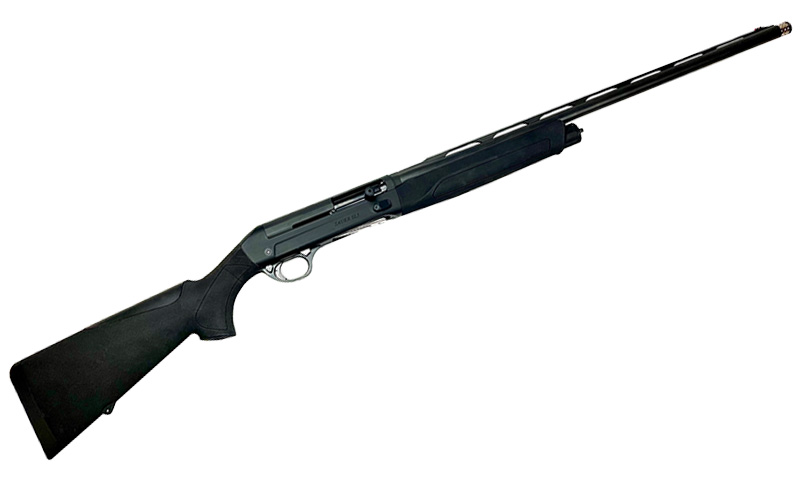
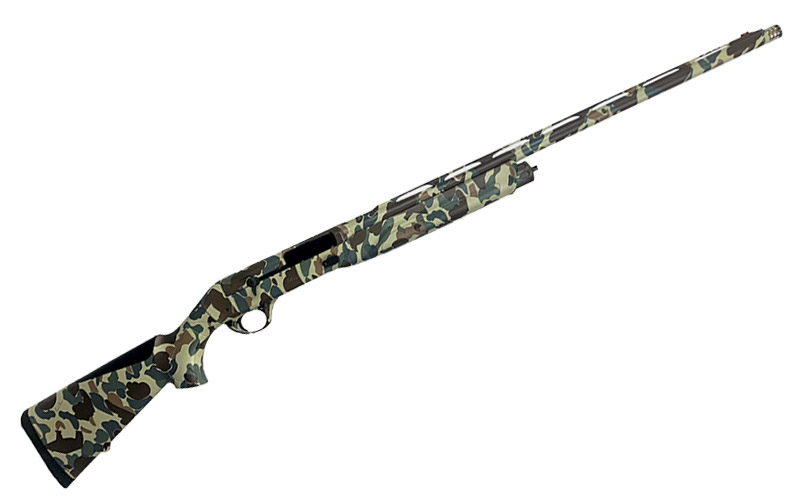
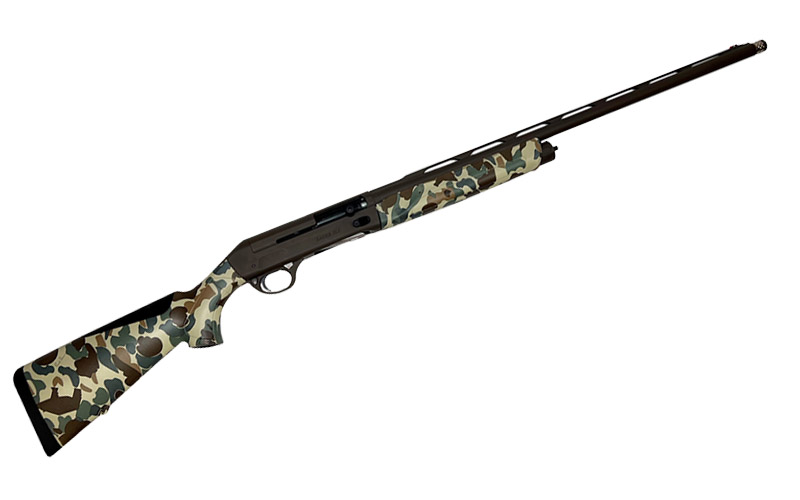
J.P. Sauer & Sohn has just added three new waterfowl models to the SL5 shotgun line.
J.P. Sauer & Sohn has just added waterfowl models to its SL5 line of 12-gauge semi-auto shotguns. The German company already offered turkey, tactical and classic configurations of the SL5, but now three options for waterfowlers are available as well.
Sauer may be German, but like the rest of the SL5 shotgun line, the new SL5 Waterfowl models are made in Italy. Also in common with the previous SL5 models, the Waterfowl line are inertia-driven semi-auto 12-gauge shotguns with a 3+1 capacity and chrome-lined barrels. Unlike the older models, the SL5 Waterfowl guns feature a 3.5-inch chamber. The barrels also feature a stepped rib and are available in lengths of 26, 28 and 30 inches.
Other features of the SL5 Waterfowl series include sling attachment points, a recoil pad, a red fiber-optic bead sight and a rubber comb integrated into the synthetic stock. Each shotgun ships with five extended Crio Plus chokes as well. The three models vary only in their finishes. The standard configuration features black furniture and a black finish on the metal, but the other two are a bit more eye-catching. One sports a Fred Bear Old School Camo coating all over, while the other features the same retro camo on the stock and forearm but with a brown Cerakote finish on the metal instead.
Jason Evans, CEO of Blaser Group, said this about the new waterfowl models:
We are excited to introduce these new, high-performance SL5 Waterfowl shotguns…They are designed to withstand the brutal elements waterfowl hunters experience throughout the season, year after year, and the Fred Bear Old School Camo pattern is a true classic that is popular with many hunters of all ages. We’ve had a lot of requests for this pattern and are happy to finally meet the demand.
All three new models are available now and are backed by a 10-year warranty. MSRPs range from $1,579 to $1,799.
Center-punching tiny targets requires top-notch glass, but what makes a riflescope acceptable for varmint shooting?
Any old scope will suffice for varmint shooting—unless you actually want to hit something. For what’s to follow to make any sense, you must first have some small interest in serious burrowing rodent shooting. I’m not talking about causal dabbling with your favorite deer rifle, or sniping the occasional prairie dog, ground squirrel or farmland woodchuck out of pure boredom, but sure enough serious small-varmint shooting.
Serious typically translates into serious money spent on serious varmint rifles, something chambered in a fast, reach-out-there small bore and holding a chunky tactical-style stock and bull barrel. Something chambered in, say, .204 Ruger, .223 Remington or .22-250 Remington. Something weighing 10 or 12 pounds out of the box. Something capable of at least ½-MOA five-shot groups at 100 yards on a very consistent basis. And shooting regularly resulting in burning multiple hundreds of rounds per diem. That kind of serious.
Of course, small varmint shooting can also involve rimfires, and I’ll get into that too but we’re, again, usually talking about something a little more serious than your childhood single-shot directing bullets with iron sights. My two serious .22 LRs, built on Ruger 10/22 actions, hold $750 to $850 worth of aftermarket parts. So that tells you where I’m coming from when I say serious burrowing rodent shooting.
I’m a real gun nut with a serious addiction, and I shoot small varmints—burrowing rodents mostly—with body counts reaching into the thousands. For instance, I shot 750-plus rounds of ammo in 2½ days at tiny eastern Oregon Belding’s ground squirrels last week. I can rattle off my latest truly impressive shot at the drop of a hat: rock chuck, 403 yards, 10- to 11-mph crosswind, .22 Creedmoor, Berger 85.5-grain LR Hybrid Target (G1 BC .445) sent at 3,202 fps, 300-yard zero, 3.9 MOA come-up, 3.4 MOA wind correction. Cold-shot kill, and I hiked all the way across that rough canyon to take a picture, too.
I always say you can’t hit what you can’t see, and most small varmints grow awful small with the perspective of a couple hundred yards added. I find a single precision kill more satisfying than any number of lucky hits generated by a requisite number of bullets sent downrange.
The ambiguous “they” will warn of the horrors of midday heat shimmer, your every heartbeat telegraphed into wiggling reticles, the difficulty of finding targets and excess weight. The heat-shimmer argument, in my experience, is greatly exaggerated. I just don’t seem to suffer the same degree of problems related in print—but then again, my varmint rifles generally hold glass with MSRPs far greater than the rifles that hold them. It regularly hits me that my high-end variables rarely come off the highest magnification, even on the warmest days. Regarding unsteady crosshairs, well, I just don’t do that much unsupported varmint shooting. There’s usually a portable bench involved or a cradle or bags tossed onto the roof of the truck (to gain some vegetation-penetrating elevation) or situated over the hood of a truck. If I go for a hike—as I often do while hunting rock chucks on rough-and-tumble public ground—my rifle wears a quality bipod.
If you have a difficult time finding your target in the scope, no matter the magnification, I’d say you aren’t spending near enough time behind said optic. Getting on target quickly, even with excessive magnification, comes easier with practice. Or twisting the magnification rings up and down between shots … weight? We’re talking varmint shooting here, not mountain hunting. When sniping tiny, distant targets, weight is your friend.
The majority of today’s rifles are capable of very good accuracy. Top-notch optics, and good shooting techniques, are what ultimately make the difference.
Centerfire Glass
A dedicated varmint rifle, one used exclusively to target burrowing rodents, deserves serious glass. This doesn’t include predator calling, which average big-game scopes cover quite well. When choosing a serious varmint scope, my demands are pretty dogmatic. I want a side parallax knob (not front bell). I insist on exposed turrets. I’ll take ballistic holdover marks only if they don’t become clutter. I want second focal plane—period. A 50mm or larger objective lens and top-notch optics coatings are preferred. As far as magnification, I’d call 6-24x just about ideal.
Side parallax serves double duty; bringing targets into gin-clear focus and—just as importantly when shooting at extended ranges—ensuring reticles are precisely aligned in the image plane, eliminating the absolute need to center the eye perfectly in the scope before each shot.
When taking 150- to 250-yard chip shots, ballistic holdover marks are acceptable, though I cannot abide ultra-busy reticles that only serve to obscure the target. At 300 yards and beyond, hit-to-miss ratios began to erode quite quickly, and this is where turrets take over. Kentucky windage offers no consistent precision at extended ranges, turrets shifting the program from luck to decisive aiming once again. Larger, more wary varmints, such as rock or woodchucks, provide a wider margin for error, prepared ballistic charts usually getting the job done even on longer shots. On smaller burrowing rodents, especially ground squirrels, some trial-and-error dialing (particularly for wind) is sometimes required—which isn’t out of the question, as you’ll commonly receive multiple shots at a single critter, or one of his buddies volunteering at a similar range.
Why dedicated varmint shooters (or big-game hunters for that matter) would choose a first focal plane scope (FFP) is a mystery to me. The common reasoning is that FFP maintains a consistent relation to the target throughout its full range of magnification, which allows making more accurate yardage and moving-target lead estimations through the scope via MOA or MIL marks of known value. This might prove useful to military snipers engaging human targets in fluid battlefield scenarios, but we’re varmint shooters, not military snipers, despite any delusions to the contrary.
The problem in varmint shooting, engaging tiny rodents (not humans), is FFP crosshairs appear coarser in relation to the target at higher magnifications, and often begin to obscure targets at longer ranges—when such magnification is most useful. Too, we own laser rangefinders, so don’t need to judge range via crosshair relations. I prefer the frog-hair-fine crosshairs of a quality SFP reticle, which remain thin at every magnification setting. The ability to aim at a specific point on a rodent, even see hide to each side of the crosshair, goes a long way toward connecting on the trickiest shots.
I’ve pointed to the 6-24x50mm configuration as my top preference, with my three Vortex Viper PST turret scopes responsible for much of that reverence. Some other current favorites include a Trijicon 5-20x50mm AccuPoint, Leupold VX-3i 8.5-25x50mm and Meopta Optika6 MeoPro 4.5-27×50.
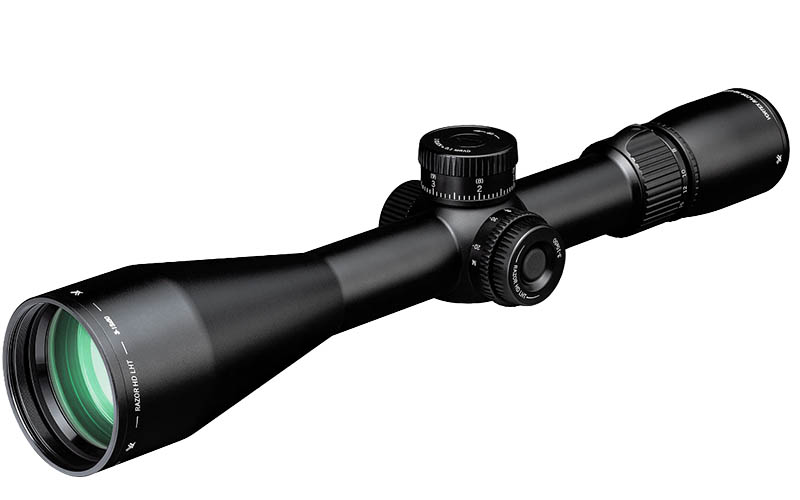
Vortex Razor HD LHT 3-15x50mm.
Rimfire Glass
My tricked-out Ruger 10/22s I’ve mentioned, one holding a match-chamber Volquartsen bull barrel, another a Benz-chambered Adaptive Tactical Tac-Hammer tensioned barrel, both including Little Crow Gunworks’ GRX recoil jobs and professional bedding. Other recent .22 LR experiences involved Ruger’s American Rimfire Long Range Target and Bergara’s B-14 rifles, .22 LRs holding grown-up stocks with adjustable cheekpieces and such. All include accuracy potential far exceeding any high-velocity hollow-point ammo that might be counted on to anchor tenacious burrowing critters. In some places, like eastern Oregon or southern Idaho, bulk packs of .22 LR shells are consumed per diem during these campaigns.
I also spent this past spring shooting an Anschutz 1761 chambered in .17 HMR, despite owning a laminated-stocked, heavy-barreled Marlin XT-17 in the same chambering that’ll hold its own against the expensive German rifle. In some places, against the smallest ground squirrels, in particular (eastern Oregon’s Belding’s, Southern Idaho’s Richardson’s), when wandering northern Idaho’s vast clear-cuts or cruising private ranch roads between centerfire portable-bench setups, I’m simply in a rimfire frame of mind. This doesn’t mean I take this shooting any less seriously than centerfire sniping.
A rimfire scope should include parallax adjustment—simple as that. If it doesn’t, even if it’s given a rimfire label, I’ve zero interest. The reason has less to do with parallax corrections and more to do with focus. A rimfire is generally chosen in high-volume arenas, meaning a “rat” might be engaged out to, say, 150 yards (the point at which even the fastest .22 LR energy drops off exponentially) or pop out of a burrow at 15 or 20 yards. Even if only 15 yards away, I prefer shooting at tack-sharp targets.
Rimfire scopes need not be expensive to remain functional—and I beat mine up pretty hard. Some of the best examples include the two Bushnell Rimfire Optics held by my 10/22s. One, a A22, includes a 3.5-10x36mm configuration, the other a 3-12x40mm. Zeroed at 50 yards, the A22 includes lower hash marks that correspond to 75-, 100- and 125-yard impacts relatively well. The 3-12x40mm includes exposed pre-etched turrets providing options marked 75, 100, 125, 150 and 175—as in yards. The A22 includes an objective-bell parallax (not my favorite, but acceptable on a rimfire) and the other, a side parallax adjustment. I don’t think either one set me back more than $150 to $175.
A rimfire scope need not have a rimfire label to remain viable. That Ruger American Rimfire Long Range mentioned earlier wears a 30mm-tubed Bushnell Engage 2.5-10x44mm big-game scope, for instance. It includes, firstly, side parallax focus, and not only Deploy MOA hold-over marks but exposed turrets. I’ve made some rather long .22 LR shots using both systems. That Anschutz 1761 wore a Burris RT-15 3-15x50mm all spring—a pretty serious centerfire scope with side parallax adjustment and exposed turrets. My Marlin XT-17 is now paired with a Vortex 6-18x44mm Crossfire II with objective-bell focus and ballistic compensation marks. I’ve used all to snipe ground squirrels at ranges well outside what would be considered normal rimfire ranges.
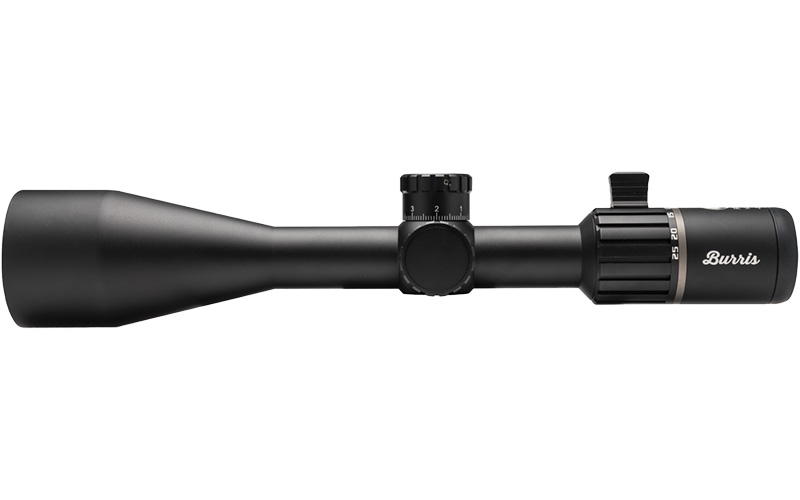
Burris RT-15 3-15x50mm.
Extreme Glass
There are circumstances or times when you simply feel like challenging yourself. I’d say anything past 400 yards (when wind stirs) to 500 yards (on calm days) qualifies here, because we’re talking burrowing rodents and not man-sized steel gongs. I’ve certainly made such shots with standard varmint cartridges in a pinch, but when I know I’ll be going long—or when seeking such scenarios—my varmint rifles become a little more specialized.
Traditionally, this has involved my custom 6mm Remington with a fast-twist barrel or Ruger Precision Rifle in 6mm Creedmoor (both fed sleek, ballistically talented 105- to 110-grain bullets), more recently my Little Crow Gunworks-built, 1:7-twist .22 Creedmoor sending 85.5- to 90-grain bullets with BCs in the .500s at around 3,200 fps. Unlike rounds such as the .22-250 Remington or .220 Swift launching 50- to 55-grain bullets with BCs in the high .200s, these cartridge/bullet/rifle combos trim 10-mph/400-yard wind-drift margins from feet to inches.
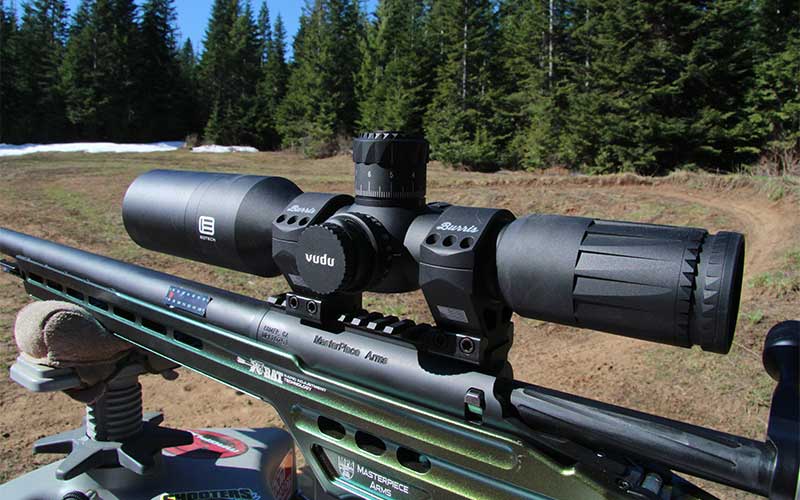
EOTech Vudu 5-25x50mm FFP.
Optic features mirror those already touched on, I just adopt a touch more magnification in the interests of clearly seeing my target way out there. A Trijicon AccuPower 4.5-30x56mm tops my .22 Creedmoor. Hawke’s Frontier 30 SF 5-30x56mm SF Mil Pro graces my 6mm Creedmoor. My 6mm Remington presently holds an EOTech Vudu 5-25x50mm compact, because this has become my walkabout rockchuck rifle. All include exposed, zero-stop turrets that track reliably and easily return to a known zero after substantial vertical corrections. The Trijicon and Hawke sport 56mm objective lens to tame heat shimmer on longer shots in rocky terrain. All include exceptional optics, allowing separating chameleon-like rockchucks from cluttered backgrounds, and nearly microscopic crosshairs to allow precise shot placement. All but the Hawke include alarming price tags.
I’m not all that particular about what optic is tacked on to my big-game rifles. Give me a decent straight-6 and you’ll hear no complaints from me. Big game is, well, big. The burrowing rodents, which hold so much fascination for me, not so much. Interestingly, I also tend to shoot at small varmints at much greater distances than I consider prudent with big game. A gut-shot varmint is still a good varmint—good and dead.
And you simply can’t hit what you can’t see!
Editor’s Note: This article originally appeared in the 2021 Buyer’s Guide special issue of Gun Digest the Magazine.
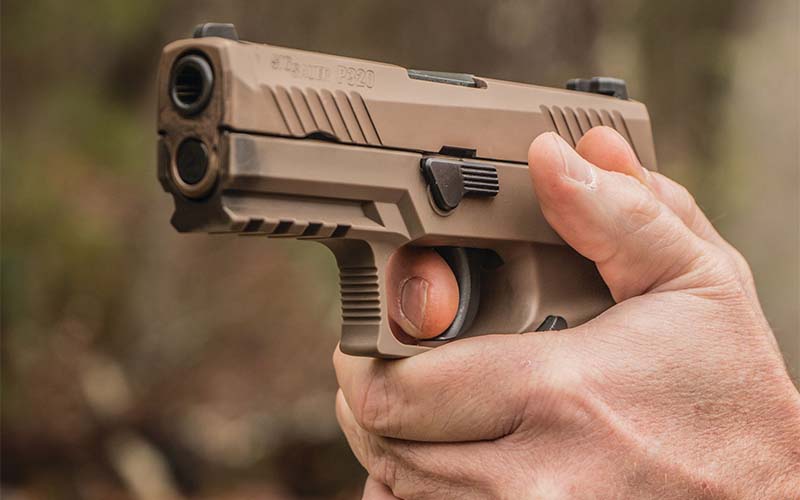
A review of the completely customizable Sig Sauer P320 along with some upgrades from Wilson Combat.
I’m not a fan of hammerless handguns, and I’m not a plastic pistol guy. I’m not suggesting plastic pistols are junk or that you shouldn’t own or like them; they’re just not for me. However, I’m a red-blooded American, meaning that I, as many other patriots do, like to have the same handgun our military trusts. I grew up with a 1911, and it was my standard issue as an M1 tank commander. I also won the West Virginia National Guard Pistol Match with a Beretta. So, in 2017, when the United States Army adopted the Sig Sauer P320 as their new handgun, well, I had to have one. Ironically, I was in the Sig Sauer booth at SHOT Show when the news was announced.
When my P320 showed up, I dutifully took it to the range and shot it quite a bit. I was impressed by the trigger, the way the gun fit my hand and how well I was able to shoot it. However, I cleaned it, boxed it, put it in the safe and continued to carry one of my Browning Hi Powers or my Wilson Combat EDC X9. Sure, on occasion, I’ll pull the P320 out for some range time or to work with it for an article, but beyond that it was a safe queen.
Things change.
Last year, Wilson Combat introduced a fully customized Sig Sauer P320. After receiving the pistol, the first thing I did was call Bill Wilson—Wilson Combat’s founder—and ask him why Wilson Combat, which was founded on the steel-framed 1911, decided to offer a custom P320. Bill’s response was, “Let’s face it, like the 1911 and the M9 [Beretta] being adopted by the military, the P320 is here to stay for a while. Also, we immediately saw ways we could improve on the basic gun.”
And improve on the gun they did. The pistol worked, fit my hand well, had an excellent trigger, was controllable, easy to reload, reliable, and most importantly, I shot it well—better than I did the factory stock version. Almost reluctantly, I had to admit I liked it. This was due in no small part to the Wilson Combat grip module, which is a large portion of the customization. Wilson combat offers 14 different aftermarket grip modules for the P320 in various configurations and in either black or tan. They all retail for $64.95.
Small Change, Big Change
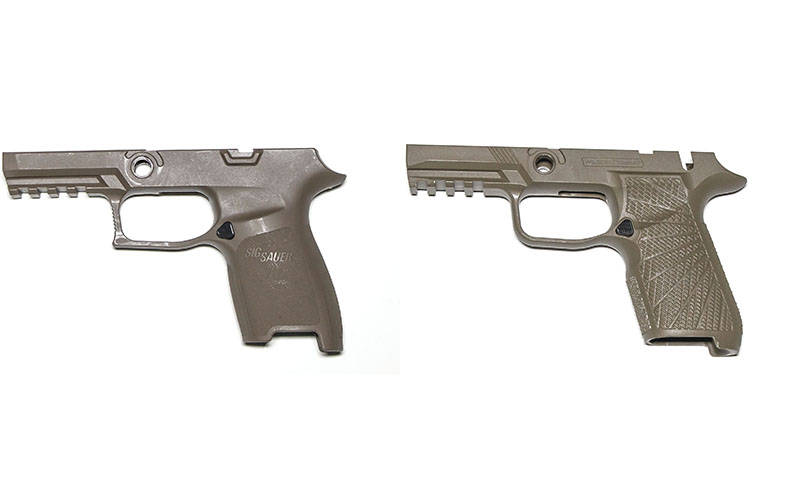
What makes these grip modules so special? The grip size is minutely larger than the Sig Sauer “small” module, but they feature a higher and deeper cut at the tang. They also have deeply dished cuts for the thumb on the sides near the magazine release, and a deeper undercut at the trigger guard. The sides of the grip feature the Wilson Combat starburst pattern, and the front strap and backstrap have a sandpaper-like texture. The magazine well also has a generous bevel, an accessory rail is standard and steel rods can even be added to the module to increase weight.
Here you can see the differences between a factory Sig Sauer P320 Compact grip module (left) and a Wilson Combat P320 grip module (right). Notice the Wilson Combat grip module has the optional cut-out for the manual thumb safety.
I felt the Wilson Combat grip module was more comfortable and stuck to my hand better. At the same time I was working with this pistol, I was also helping Benghazi hero David “Boon” Benton train some local patrol and SWAT officers. Benton, a man with serious combat handgun experience that matters, told me he’s been using a Wilson Combat P320 grip module since it was introduced. He said, “That Wilson Combat frame makes [the P320] feel more 1911-ish, it points better for me as well, so I get a better natural point of aim … and it helps me get higher underneath the trigger guard.”
I mention all this so that you understand how my relationship with the Sig Sauer P320 went from an obligatory patriotic admiration to more of an awakened appreciation of the platform’s versatility. I say platform, because that’s what the P320 really is. I know the gun’s modularity has been hashed out in these and others, but I’m not convinced the average shooter truly realizes what’s possible with it. Though it’s my job to know these things and share them with other shooters, I believe I’ve somewhat ignored this aspect of the P320 as well. I must thank Wilson Combat for helping me get my shit together as far as the P320 is concerned.
A Platform Dissected
So, just so you understand the particulars of this pistol—platform—let’s start with the actual portion of the pistol that’s considered a firearm. It’s not the grip frame, slide or barrel. The serialized portion of the Sig Sauer P320 is what is called the fire control unit. This is a metal assembly of parts that include a frame, slide catch, disconnector trigger bar, trigger, sear and springs. It’s also where you’ll find the serial number.
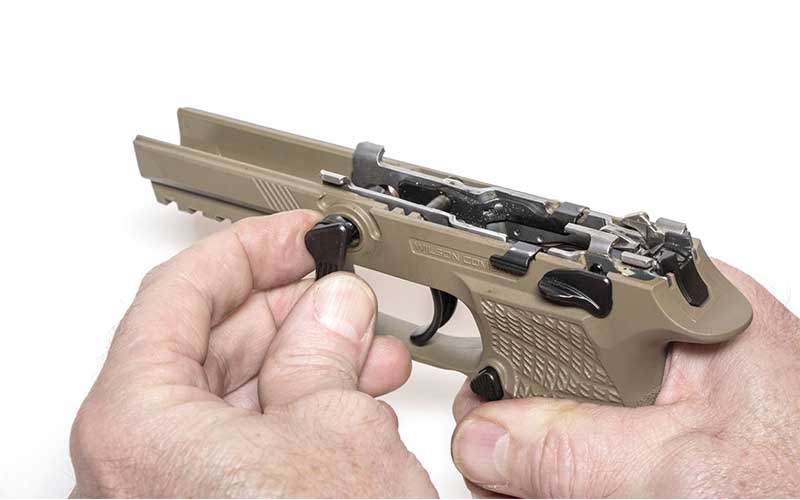
To remove the P320s fire control unit, you must first remove the takedown lever. After the fire control unit is installed in a grip module, the next step is the installation of the takedown lever.
This means that the grip module, slide and barrel are not controlled parts. So, technically speaking, you could have one fire control unit and multiple grip modules, slides and barrels. To put it another way, you can have one fire control unit and several pistols, even for different cartridges.
Essentially, you can get it any way you like it.
The configuration of these pistols around the fire control unit is much easier than you might expect. To remove the fire control unit, you lock the pistol’s slide to the rear, move the takedown lever—clockwise—to about the 7 o’clock position and remove the slide and barrel.
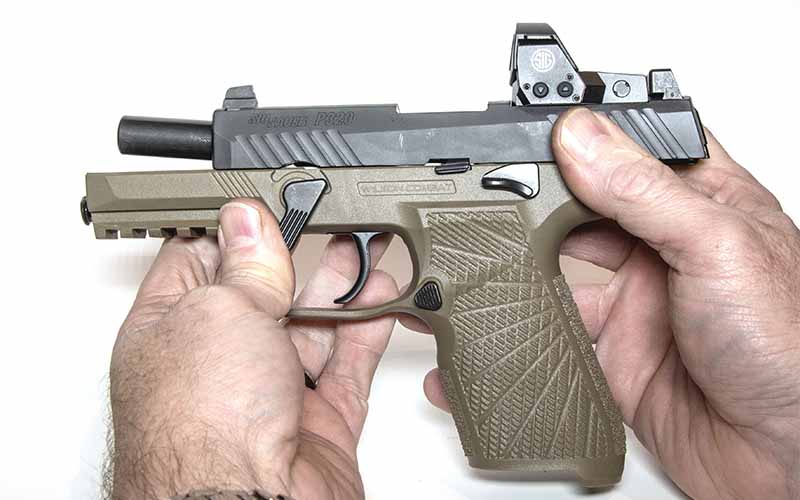
After a new fire control unit is installed in a grip module, and the takedown lever has been fully inserted, you can then install the barrel/slide assembly of your choice.
The next step is to fully remove the takedown lever. To do this, you pull on it and continue to rotate. The fire control unit can now be removed by lifting up and pulling forward on the two slide rails at the front. This will extract the T-shaped flange at the rear of the fire control unit from the tang of the grip module. Once completed, you can then begin to reconfigure the platform in whatever version makes you the happiest.
As an example, my M17 P320, which is the civilian version of the military’s pistol, has a 4.7-inch barrel and an ambidextrous manual thumb safety. Being a 1911/Hi Power guy, I really like the thumb safety, but the 4.7 barrel and slide makes for a big pistol that’s a bit difficult to conceal. I also much prefer the Wilson Combat compact grip module.
I inserted the M17’s fire control unit into a Wilson Combat compact grip module. Then, I took a slide and 3.9-inch barrel from a P320 RXP Compact, which comes out of the box with a Sig Sauer Romeo1 reflex sight and high-profile three-dot night sights that can be co-witnessed and installed them on the Wilson Compact grip module.
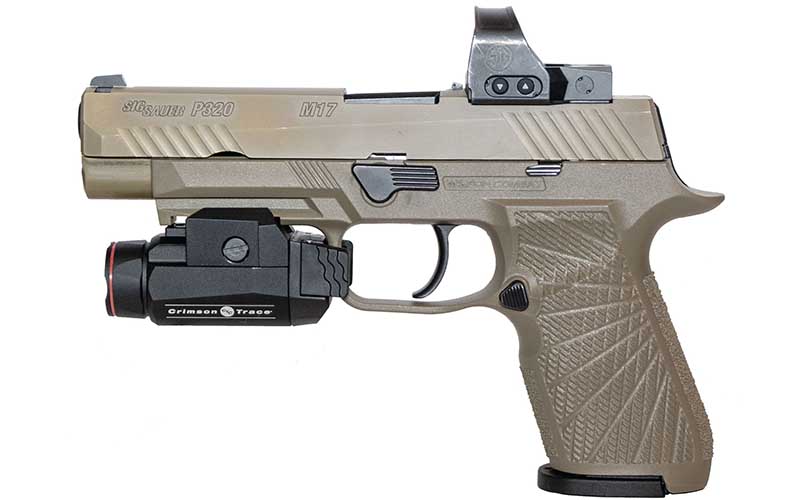
This author’s reconfigured P320 for home defense. It has a Wilson Combat grip module, the fire control unit from a P320 RXP Compact and an M17 slide and barrel, with a Sig Sauer Romeo1 reflex sight and a protective shroud.
This accomplished two things that were very important to me. First, the original P320 RXP Compact didn’t have a manual thumb safety. The M17 fire control unit fixed that. Second, the conversion essentially turned my full-size M17 into a more compact, easier to carry and conceal, handgun.
But just like on those late-night infomercials, there’s more.
I then took the fire control unit from the P320 RXP Compact and installed it in another Wilson Combat compact grip module—one without a cutout for a manual safety—and then took the 4.7-inch barrel and slide from the M17 and installed it on that grip frame. I also installed a Crimson Trace CMR-208 Rail Master Universal Tactical Light on the rail.
I still have two pistols, but one is configured for concealed carry and the other for home defense. Both have the same size grip module, both have reflex sights and both feel identical in my hand. The home-defense version is longer and heavier and doesn’t have the manual safety.
Out of the box and unaltered, Sig P320 pistols are great handguns. However, their modularity combined with the grip module options from Wilson Combat, make them the most versatile defensive handguns you can own.
Now, I could’ve accomplished this switch without the Wilson Combat grip modules, except the P320 RXP Compact grip module didn’t have a cutout for the manual thumb safety of the M17’s fire control unit; Wilson Combat offers compact and full-size grip modules with and without a manual safety cutout. And, given that I much prefer the Wilson Combat grip modules to the Sig Sauer factory grip modules, that was an easy $64.95 answer.
Two Fire Control Variations
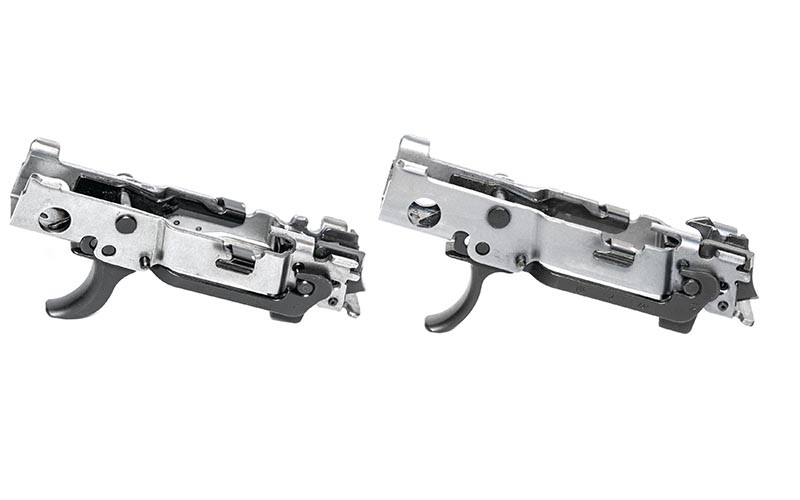
There’s one important point that needs to be discussed. In 2016, it was discovered that the P320 could possibly fire if dropped. Sig didn’t issue a recall but did offer a voluntary upgrade. Due to this upgrade, there are two variations of the fire control unit. If your P320 has a thick trigger, it’s the pre-upgrade version. If it has a thin trigger, it’s the post-upgrade version.
The original fire control unit for the P320 (left), note the thick trigger and lack of a disconnector, versus the post-update version of the P320 fire control unit (right). Note the thinner trigger and addition of a disconnector.
The trigger shape isn’t the only difference; the post-upgrade unit has a disconnector. A pre-upgrade slide will not work with a post-upgrade fire control unit, but a post-upgrade slide will work with a pre-upgrade fire control unit. Keep this in mind when assembling a P320 in a configuration other than in its factory form.
The point of all of this is that the Sig Sauer P320 is much more than just a pistol. It’s a highly modular handgun system that has almost endless possibilities. I’m strongly drawn to the potentials of this platform, much in the same way I appreciate the AR-15’s modularity. I wouldn’t say I’ve become a striker-fired/plastic pistol guy, but I’ll say that you shouldn’t be surprised if you see a Sig Sauer P320—in some form or another—on my side.
Like me, maybe you should give the P320 another—keener—look.
Editor’s Note: This article originally appeared in the 2021 CCW special issue of Gun Digest the Magazine.
The most shot centerfire cartridge in the United States, the 9mm is as pervasive as the air we breathe. Chances are you have one in your collection, even if you’re lukewarm on the caliber. Admit it.
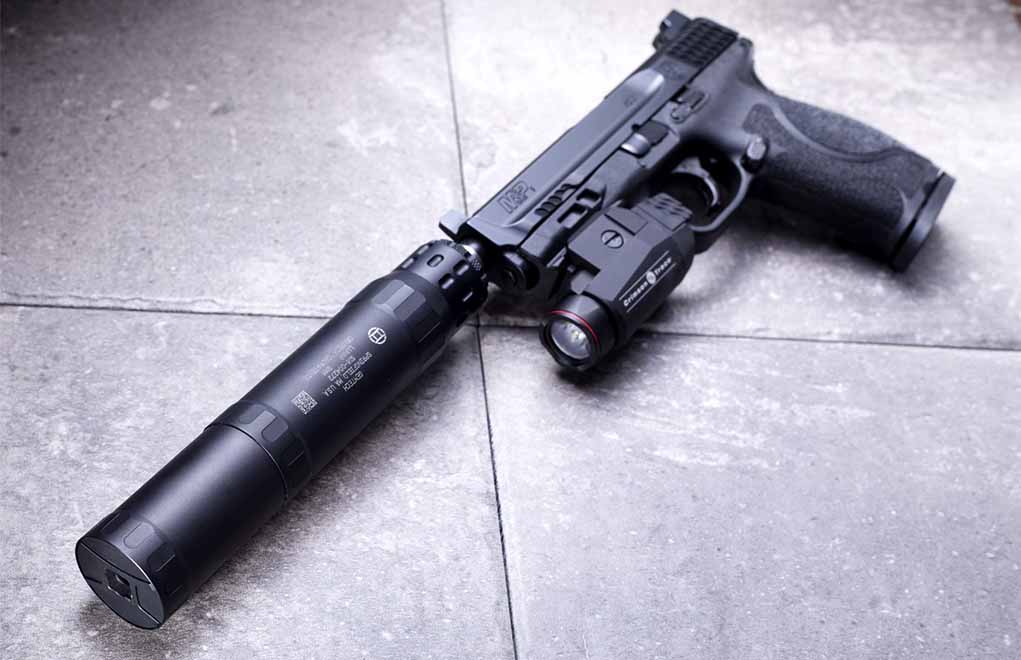
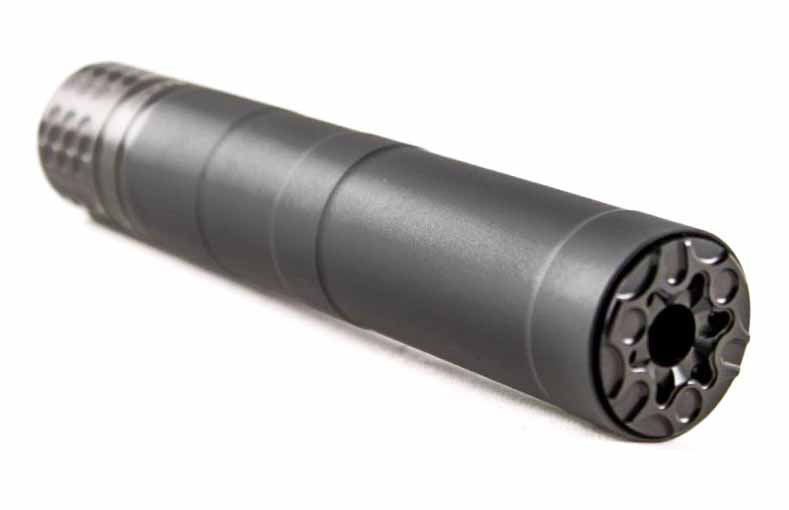
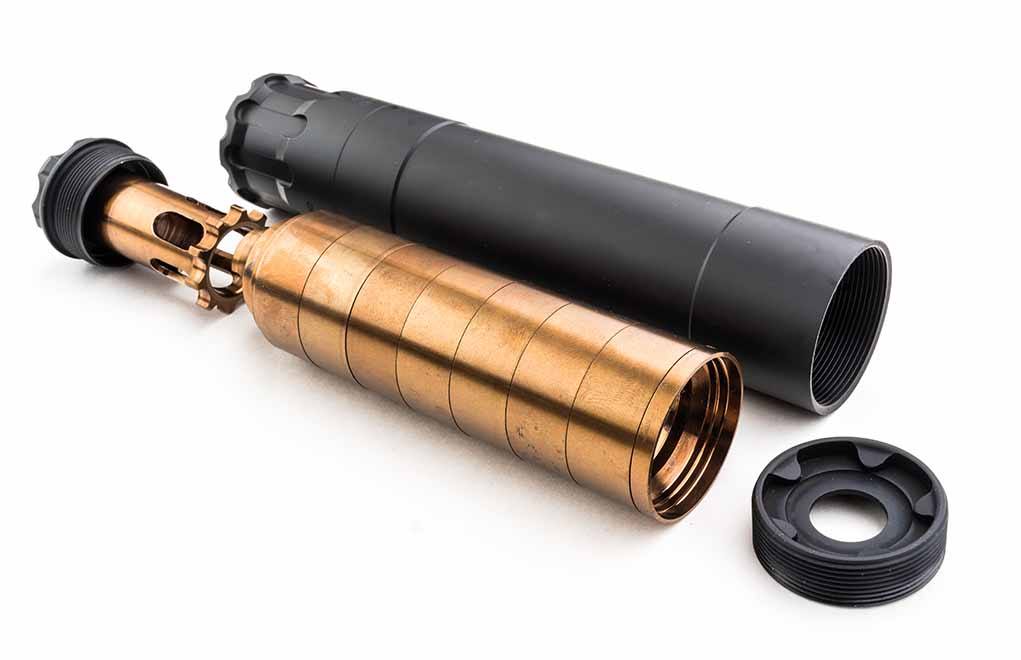
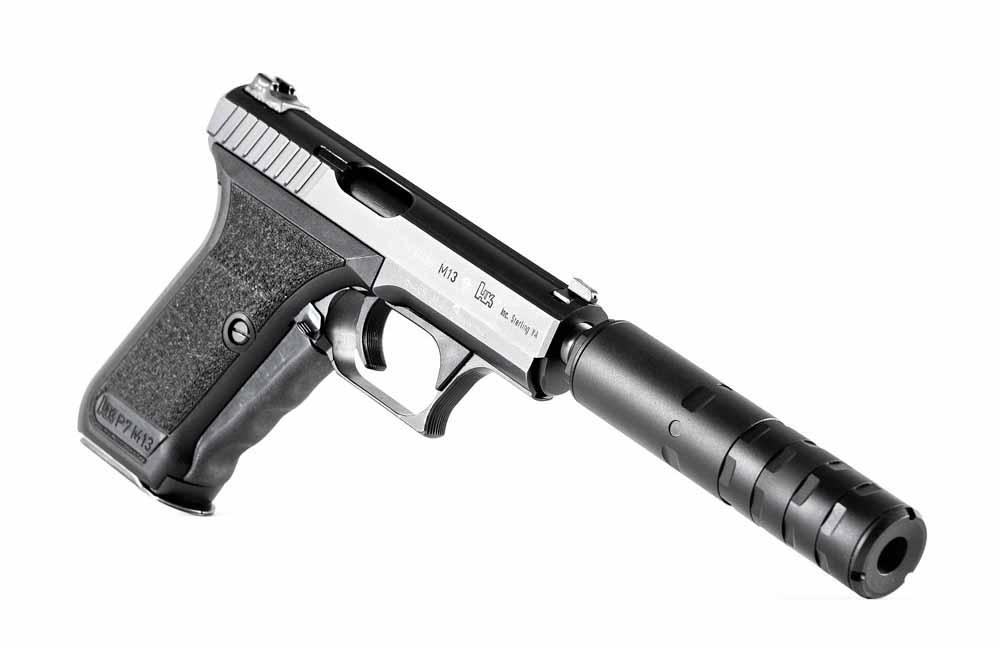
Its prominence is no mystery. The caliber is easy to shoot well, is a capable self-defense option, and is perhaps only eclipsed by the .22LR in economy of ammunition. It is also something else – eminently suppressible. The right can and your pistol – or pistol caliber carbine for that matter – is as stealthy as it gets in the centerfire world. That raises the question, however, what is the right 9mm suppressor?
No easy answer there, like choosing a gun it matters what’s right to you. There are a few facets you’ll definitely want to consider when shopping for an accessory that’s potentially as expensive as your pistol. Among these are:
Size: Do you require something short and dexterous for shooting on the move or will a full-sized unit fit the bill.
Weight: Will it throw the balance of your gun out of whack?
Sound Suppression: How much do you need to achieve your goals?
Flexibility: Is the suppressor dedicated to one caliber or will it sever multiple guns?
Cost: How much can you afford, given you have a tax bill on top of costs?
As usual, you’ll have to assess your own situation and what suppressor ticks off the right boxes. In the meantime, we’ll give you a taste of some of the best choices out there today. On top of their games, these 12 9mm suppressor options fill about every conceivable niche and will certainly keep a lid on your nine.
Best 9mm Suppressor Options
Sig ModX-9
Sig certainly built suspense with its modular pistol suppressor. The ModX-9 made its debut at the 2019 SHOT Show to great fanfare, exciting shooters with the direction the company was taking its burgeoning suppressor empire. Flash forward to the winter of 2020 and the ModX-9 finally hit store shelves.
Despite the thumb-twiddling the wait was worth it, with Sig delivering among the slimmest, lightest and effective modular cans on the market. Thank advanced manufacturing for the ModX-9’s attributes, with the 3D-printed titanium device boasting a flawless fit and function. To its fine points, the 9mm suppressor comes in at 7.75-inches in its full configuration and weighs a very manageable 8 ounces. But it shrinks down to 3.25 with just its blast baffle and end cap for a tidy 5-ounce package. With eight total baffles, shooters can modify it to their situation at hand. No matter the size, it does a capital job of noise reduction, cutting a 9mm’s report to around 127 dB at full length to 145 dB in its smallest alignment.
Sig includes two springs with the ModX-9 with different tensions, two pistons with metric and imperial thread patterns and a fixed barrel spacer. The final point makes the suppressor compatible with carbines and sub guns, where the reciprocation of the entire booster assembly isn’t required. A nice point bout the ModX-9, it carries its weight reward, which adds to its nimbleness even when run at full length.
Sig ModX-9 Specs: Caliber: 9mm Weight: 8/5 ounces Length: 7.75/3.25 inches Diameter: 1.35 inches Materials: Titanium Finish: N/A Attachment: 1/2×28 and M13.5x1LH Average Decibels: 127 (approx.) dB full configuration MSRP: $925
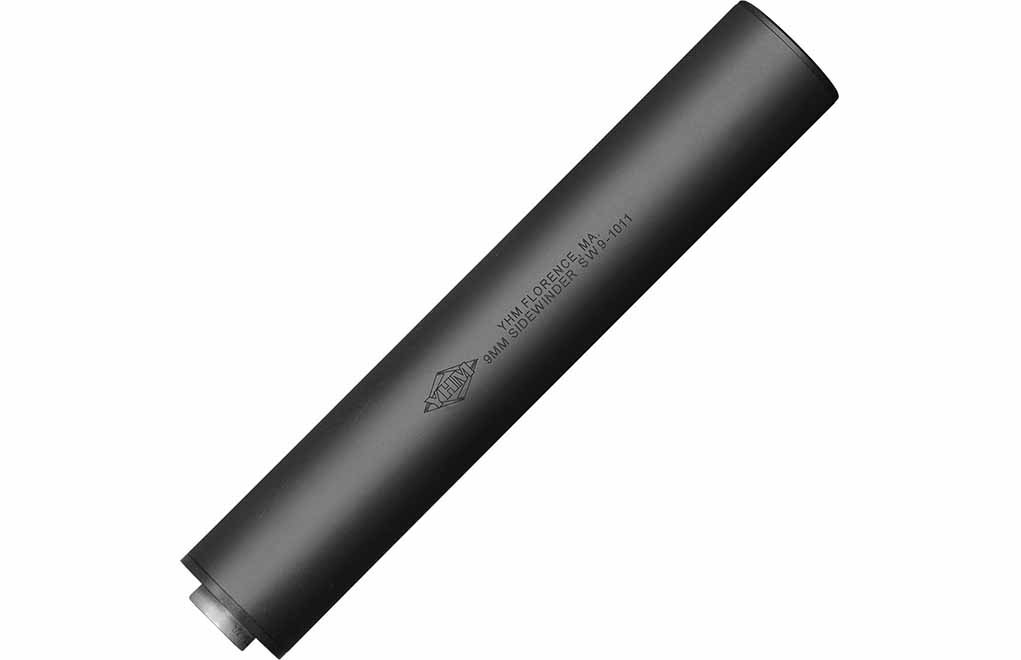
YHM 9mm Sidewinder
Even before ponying up for the tax stamp—not to mention your time filling out paperwork and waiting—a suppressor is often a sizable investment. Most retail just shy $1,000, in turn, often costing more than the guns they’re destined to hush up. This makes the Sidewinder so refreshing. Ringing up at less than $600 at most outlets, the 9mm suppress doesn’t put a shooter in the poorhouse and performs well beyond its price.
Yankee Hill’s can is pretty straightforward, a user-serviceable unit with an aluminum tube and monocore, and stainless steel blast baffle. Yeah, like many monos it suffers from first-round pop—a function of larger chamber volume. But once settled in shooters can expect generous noise reduction in the neighborhood of 36 dB—more when wet. Though, there is a bit of a trade for price and performance. The Sidewinder runs on the heavier end of the spectrum at a hair over 10 ounces, which is fairly hefty particularly for something pistol specific. For many, the Sidewinder might make a better PPC option.
The drawback for those who figure the suppressor is perfect for a carbine, it’s purely a direct-attachment affair. Not a deal-breaker, but certainly a slower switchover compared to quick-attach systems. As to its threads, three patterns are available: 1/2″-28, 1/2″-36 and metric 13.5×1 LH.
YHM 9mm Sidewinder Specs: Caliber: 9mm /.300 Blackout Weight: 10.2 ounces Length: 7.8 inches Diameter: 1.375 inches Materials: Aluminum/Stainless Steel Finish: Hardcoat Anodized Attachment: 1/2″-28, 1/2″-36 and metric 13.5×1 LH Average Decibels: 125 (approx.) dB full configuration MSRP: $745
Gemtech Lunar 9
Modularity, it’s pretty much becoming the norm in suppressors. Why not? Drop the coin and jump the hoops, might as well have a can with versatility baked into the cake. Which makes the configurability of Gemtech’s newest offering a surprise to absolutely no one.
The ability to run two different lengths—7 or 4.7 inches—both extremely lightweight with a 10-ounce top end, makes the Lunar 9 a do-all, perfect for tactical and pleasure shooting. Though, this just the tip of the iceberg. Making matters considerably more convenient, the 9mm suppressor is also compatible—thanks to Gemtech‘s Multi-Mount system—with a variety of the company’s mounting systems—three-lug, direct thread, what have you. As for noise reduction, the Lunar 9 gets the job done, no matter what size you run it. In full configuration, it’ll knock a pistol down into the 120 dB range, shortened up the mid-130s. Not quite enough to go without plugs, but a comfortable level nonetheless.
Gemtech Lunar 9 Specs: Caliber: 9mm /.300 Blackout Weight: 10/7 ounces Length: 7/4.7 inches Diameter: 1.4 inches Materials: Aluminum/stainless steel Finish: Hardcoat Anodize Attachment: 1/2×28 booster included. Compatible with GM-9 mounts Average Decibels: 129 (approx.) dB full configuration MSRP: $654
CGS MOD-9
Doesn’t matter if you’re talking handguns or precision optics, striking a balance is always a challenge. Suppressors are no different, though CGS goes a long way in finding middle ground with its MOD 9. Lightweight, yet durable and an excellent noise-reduction profile, the 9mm suppressor walks the line on all the desirable attributes shooters search for in a can.
Yeah, the MOD-9 is a full-sized, measuring in at 7.7 inches in length, with a 1.37-inch tube diameter. If you aren’t kicking in doors for a living that should prove more than manageable, especially for the payoff. CGS has cooked up a quiet suppressor—mouse-sneeze quiet. Of course, this varies depending on ammo and barrel length, but expect most 9mms with a 4-inch-plus fire tube to generate between 113 and 120 dB with a MOD-9 mounted. Aluminum is the main ingredient of the build, including the suppressor’s 6 baffle stack and tube. This keeps it a light 10 ounces. One last note, the piston assembly is impressive, with 12-point rotational adjustment to dial in for impact shift.
CGS MOD-9 Specs: Caliber: 9mm/.22 LR/.300 Blackout Weight: 10 ounces Length: 7.7 inches Diameter: 1.37 inches Materials: Aluminum tube and baffle stack, stainless steel blast baffle Finish: Black Anodized Average Decibels: 123.7dB full configuration MSRP: $915
Rugged Suppressors Obsidian 45
Technically, the Rugged Suppressors Obsidian 45 is much more than a 9mm suppressor. Rated for .45 ACP, the extremely robust device handles some real heavyweights, including .450 Bushmaster, .45-70 Government and .458 SOCOM—with the appropriate barrel length. Quite a spread, to say the least, making the Obsidian an ideal choice if you not only want to hush up your ‘Nine’, but a load of rifles and carbines.
The versatility doesn’t stop with caliber compatibility. Modular, you can tailor the Obsidian to your firearm and application with an 8.7-inch full configuration and 6.7-inch K configuration. This gives you ideal lengths for use on your rifle or pistol. Either way, the suppressor is full-auto rated for all pistol calibers, as well as .300 Blackout and does a number on your gun’s report. At full length, it knocks a 9mm pistol’s report down to 123.7dB run dry. The unit features a non-slotted piston design, cutting down on gas blowback from handguns, and is constructed of a durable aircraft-grade aluminum tube and stainless steel baffles. This is a true jack-of-all-trades.
Rugged Suppressors Obsidian 45 Specs: Caliber: 9mm/.45 ACP Weight: 10.7-12.8 ounces Length: 6.7-8.6 inches Diameter: 1.37 inches Materials: Aluminum tube, stainless steel baffles Finish: Hard Coat Anodized and Cerokote Attachment: .578×28 Piston Average Decibels: 123.7dB full configuration MSRP: $875
Dead Air Odessa-9
Sound suppression, for obvious reasons, is what headlines suppressor innovation. But what about the little things that make a can more functional and practical to a greater swath of shooters? Dead Air homed in on these and, it’s safe to say, knocked it out of the park with the Odessa-9.
Among the most notable aspects is the 1.1-inch tube. On the surface, the slim design might not sound like much, until you consider it is fully compatible with nearly every pistol’s stock sights. Moreover, the 9mm suppressor adapts to any application put in front of it, given its modular design. You can run the Odessa with all 11 baffles if noise suppression is at a premium or with just one if you need to take the edge off your gun’s report. And it will do its job when run short, with four baffles putting subsonic ammunition at or near safe hearing levels. Full length, the 10-ounce suppressor reduces subsonic 9mm ammo to around 122dB. There’s little argument, the Odessa-9 makes going suppressed a whole lot easier.
Dead Air Odessa-9 Specs: Caliber: 9mm/.380 ACP, .32 ACP, 5.7x28mm, .17 HMR, .22 Mag, .22 LR Weight: 10.6 ounces Length: 8.59 inches Diameter: 1.1 inches Materials: Stainless Steel Finish: Black Nitride Attachment: 1/2×28, M13.5X1 LH Average Decibels: 122dB full configuration MSRP: $899
SIG Sauer SRD9
Move over King Midas! It’s Sig Sauer that has the golden touch—at least when it comes to firearms and firearms accessories. The SRD9 is proof enough of this.
The user-serviceable 9mm suppressor is an absolute top-shelf choice. Made with a Grade 9 titanium tube and high nickel alloy stainless steel baffles, the device isn’t only lightweight (9 ounces), it’s effective. Run dry, the SRD9 knocks a 9mm’s report down to around 128dB. Full-auto rated, the suppressor also is compatible with the most popular pistol calibers: 9mm, .40 S&W and .45 ACP. It also comes with both a 1/2×28 and an m13.5x1LH pistons, giving it the ability to mount across the board, regardless of a gun’s origin. With the SRD9, you’ll pay near an entry-level price, but get pro performance.
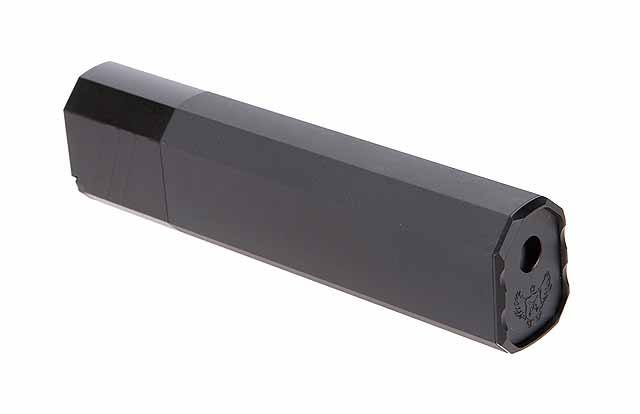
SilencerCo’s uniquely shaped Osprey isn’t a spring chicken by any stretch of the imagination. But that doesn’t make the 9mm suppressor any less effective at doing its job. It’s among the best at cutting down noise, as well as offering one of the best possible shooting experiences.
The eccentric suppressor (meaning the bore doesn’t run down its center axis) offers a load of advantages over its cylindrical counterparts. First and foremost, it provides more internal volume for gases to expand, thus offers more noise-reduction capabilities. A 9mm’s report is reduced to 127dB, which is dynamite. Furthermore, its off-center design helps it stay out of your sight picture, in turn you get to keep your stock sights. Additionally, the device is extremely lightweight, composed of aluminum tube and baffles, and stainless steel blast baffle. Top noise reduction capabilities, user-friendly and lightweight—what’s not to like?
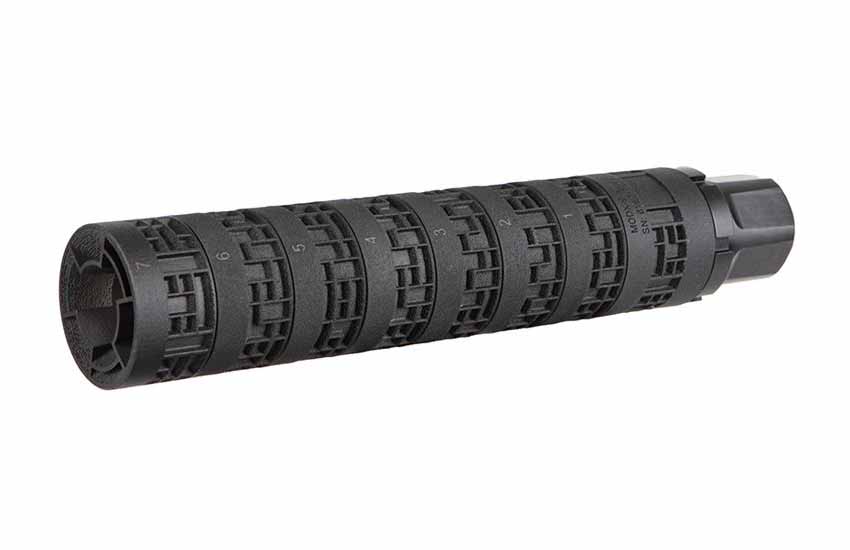
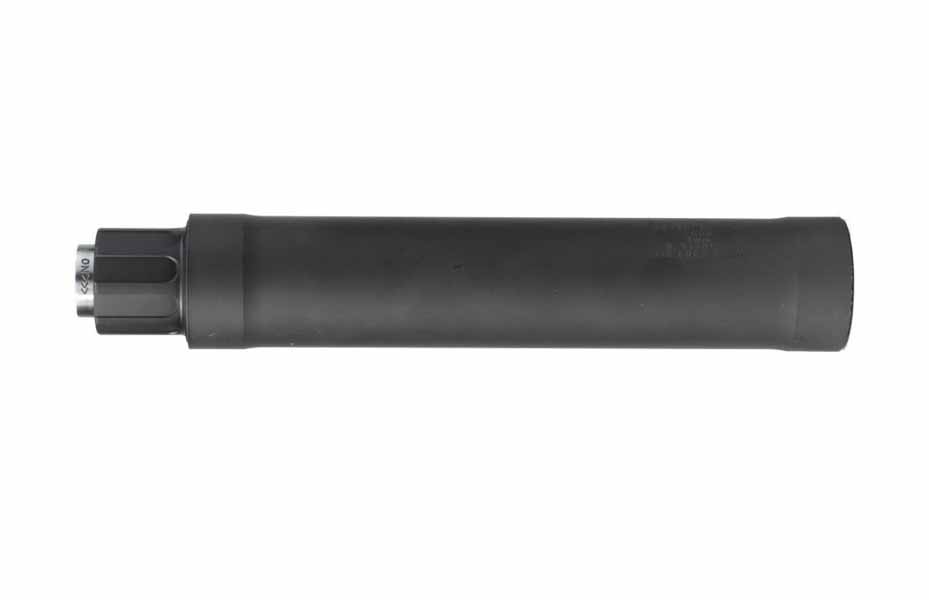
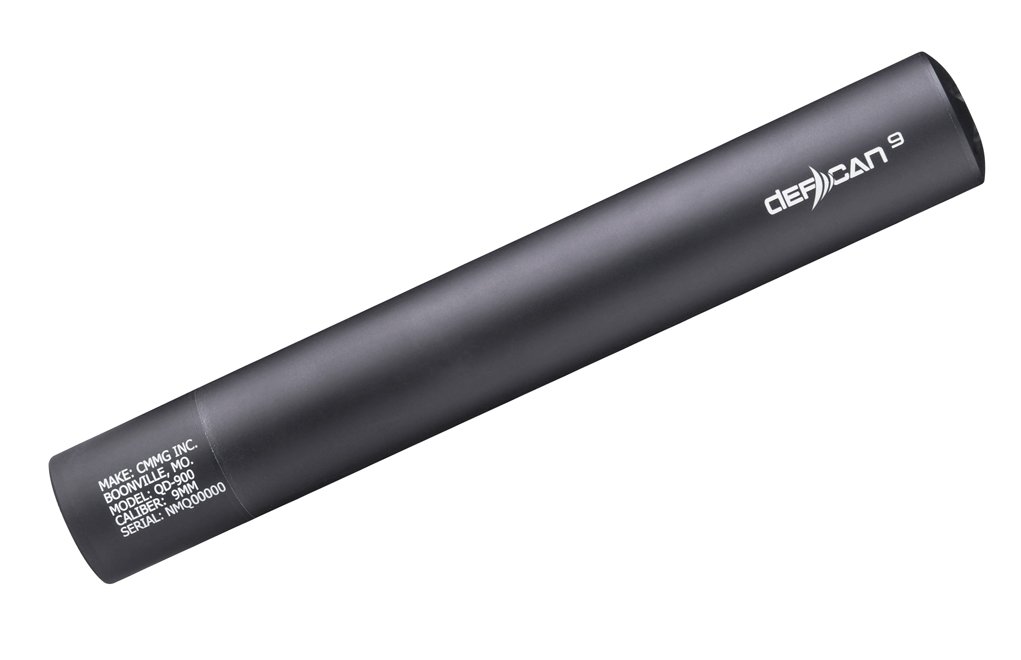
Not everyone shoots 9mm from pistols. In turn, not every 9mm suppressor need be designed for handguns. A fact plain as day to AR specialists CMMG. Jumping into the noise reduction game this past year, the company tailored the pistol-caliber members of its DefCan line for sub-guns and AR pistols, rifles and carbines.
Unmistakably, the DefCan 9 looks the part. While extremely slender (1.38 inches), it is long – long as they come on this list at least. At 10.25 inches, even if it could fit your pistol, you wouldn’t want it there anyway. On a long-gun, SBR or AR-pistol it’s a completely different story. That extra length to dissipate gases does a number on a gun’s report, cutting it 32dB on average.
For its size, the DefCan 9 should prove a second thought mounted, given its featherweight. The suppressor adds a scant 10 ounces to a firearm, which is akin to adding many lighting options to the fore of a rail. Aluminum construction keeps the unit light, as well as imparting it with some desirable thermal properties, dissipating heat in a flash.
In its guts, the DefCan 9 uses a stack of seven M-style baffles, each of which has a squared port on the aperture. The design point further improves noise reduction, directing gas particles laterally inside the tube. The suppressor is completely sealed, in turn, not user accessible. However, it requires no routine cleaning.
DefCan 9 Specs: Caliber: 9mm Weight: 10 ounces Length: 10.25 inches Diameter: 1.375 inches Materials: Aluminum Tube and Baffles Finish: Hard Coat Anodized Attachment: Bi-Lock Flash Hider with Included Peel Washer, Threaded 1/2-28 Average Decibels: 128dB (estimated) MSRP: $700
SilencerCo Omega 9K
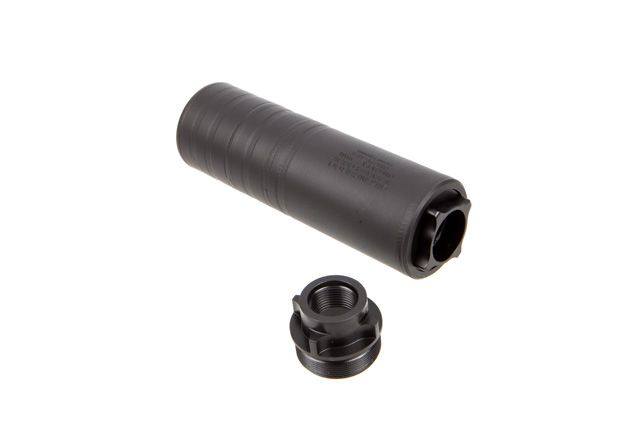
It’s difficult to make a suppressor list without the SilencerCo Omega K rearing its head. That goes for the ubiquitous 9mm. Residing on the tonier end of the market, the Omega 9K is hardly money wasted. It’s light, compact and does what it was designed to do – keep a lid on your noisy guns.
Among the smallest 9mm suppressors on this list, the tubeless Omega K adds a negligible 4.7 inches to the overall length of your gun. Yes, you’ll still know it’s there, but if you happen to compete or engage in any shooting activity that requires agility the suppressor won’t hang you up. Furthermore, at 7.2 ounces, the can won’t knock your pistol out of balance as greatly as heavier options.
Made from stainless steel and stellite (a cobalt-chromium alloy), the Omega K is wang-leather tough. The abrasion-resistant and extremely hard alloy is renowned for its wear resistance, standing up to long shooting sessions as well as the most rugged external punishment.
As to the suppressor’s performance where it counts – noise reduction – it’s a bit below par compared to longer options. SilencerCo pegs the average report of a 9mm outfitted with an Omega at 131.5dB, around 28.5dB of noise reduction. Not top of the charts, not a slouch either – especially for its size. If you need a push over the edge to spend the money, it can digest sub and supersonic 300 Blackout rounds as well.
Omega 9K Specs: Caliber: 9MM AND .300 BLK Weight: 7.2 ounces Length: 4.7 inches Diameter: 1.48 inches Materials: Stellite Tube, Stainless Steel Baffles Finish: Black Oxide Attachment: Direct Thread Average Decibels: 131.5dB (estimated) MSRP: $750
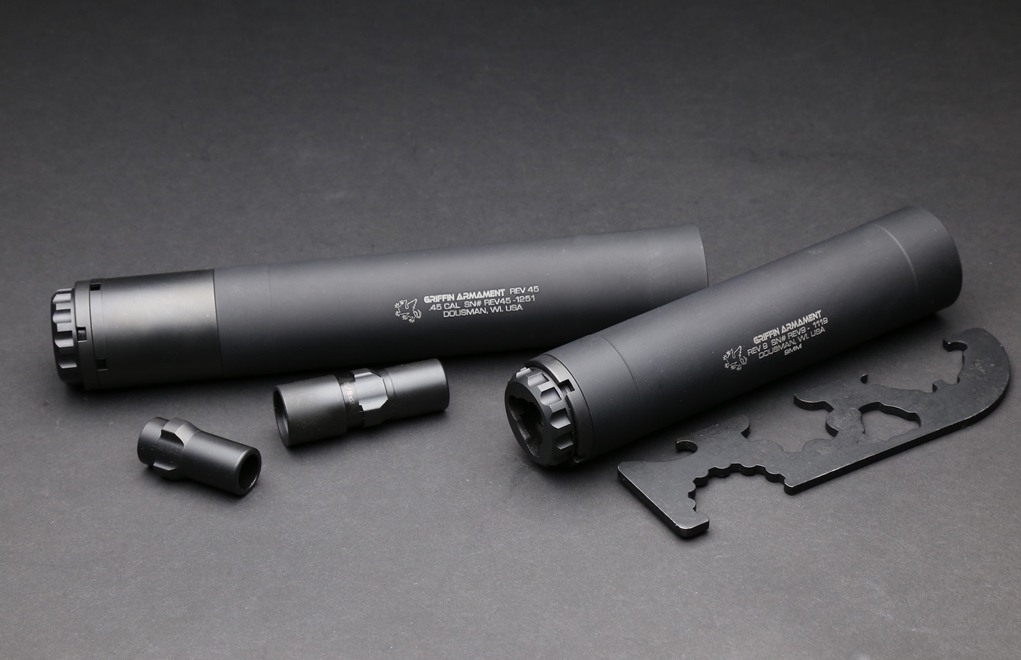
Griffin Armament Revolution 9
Adaptable to your requirements, the Revolution 9 is akin to two cans in one. Modular in design, the 9mm suppressor has two configurations – full length and what Griffin Armament’s call its “K” version. The latter arrangement shaves 3-inches off the Rev 9, making for a more adroit unit, ideal for a nightstand gun or the like.
You guessed it, you run small, you run louder. Never fear, you’ve got plenty of sound suppression to work with in the Rev 9. Booster housing on and all eight baffles in, the 7.6-inch suppressor shaves an impressive 34dB off a 9mm’s report. In the smaller “K” configuration, three baffles removed, it still provides a respectable 32dB of noise suppression.
Griffin Armament designed the Rev 9 as more than a range toy, stoutly constructed with stainless steel baffles and a hard-coat anodized aluminum tube. This, as you might expect, makes the suppressor a bit weightier – 11.2 ounces at full length. However, if you can stand a little more noise the “K” configuration drops the Rev 9 to 9.7 ounces.
Overall, it’s a clever and flexible concept that should cover all your bases, whatever they might be.
Revolution 9 Specs: Caliber: 9MM AND .300 BLK Weight: 9.7-11.2 ounces Length: 7.88 inches Diameter: 1.375 inches Materials: Aluminum Tube, Stainless Steel Baffles Finish: T3 Hard-coat Anodize, Nitride Attachment: 1/2×28 or M13.5×1 LH Average Decibels: 127dB (full length) MSRP: $795
Get More Suppressor Info:
The Suppressor: How Is It Made, It Works And How To Buy One
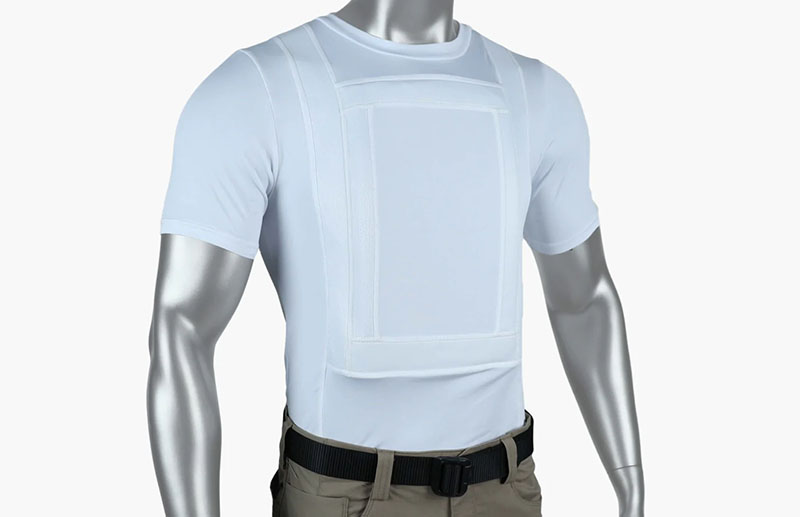
Premier Body Armor has recently released the second generation of the Everyday Armor T-Shirt or EAT2.0, a simple shirt that provides level IIIA ballistic protection.
Premier Body Armor mostly makes traditional armor, with its products spanning a wide range of different ballistic protection levels and intended uses. While the company has offered concealable soft armor before, it wasn’t concealable like the newest generation of the Everyday Armor T-Shirt or EAT2.0.
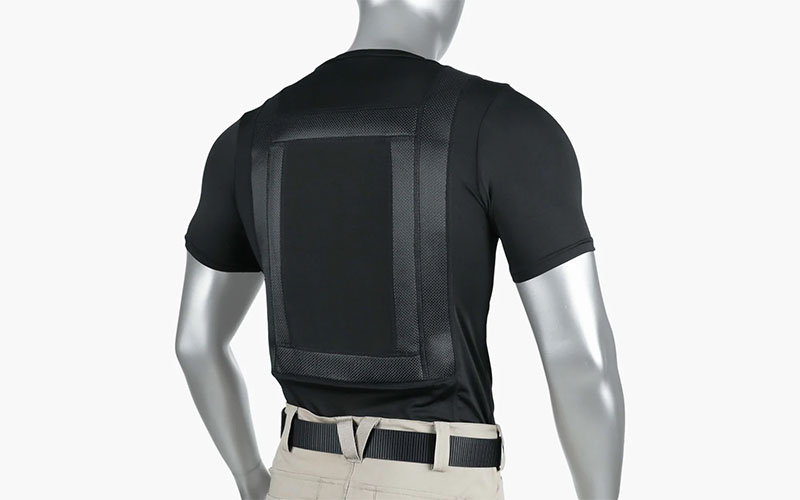
While traditional concealable armor vests are still typically quite bulky, the Everyday Armor T-Shirt takes the comfort and concealability to a new level. The garment itself, available in white or black, is a simple moisture-wicking polyester t-shirt. What makes these special is the fact that they feature built-in ballistic panel pockets on the front and rear.
Each pocket will fit one of the two included ballistic inserts. The panels are NIJ tested to meet level IIIA standards, weigh .8 pounds each and are only .22-inches thick. Each panel is 7.75×12.75-inches in size and positioned to efficiently cover the Cardiac Box while remaining concealable. The newest generation of the Everyday Armor T-Shirt also features concealment channels which help keep the armor panels closer to the wearer’s body.
Alex Stewart, President of Premier Body Armor, said this about the EAT2.0:
Keep your traditional soft armor vest ready and on standby for SHTF situations, but for daily use consider the Everyday Armor T-Shirt 2.0 … This revolutionary product, now in its second generation, is the cutting edge of daily wear body armor. With the EAT2.0 you can wear real, Made in the USA, Level IIIA body armor all day without the awkwardness, discomfort, or lifestyle change that comes with a traditional bulletproof vest. This is the next evolution of EDC body armor.
The EAT2.0 bundle that includes one shirt plus two armor panels has an MSRP of $299. It’s offered in white or black, in sizes small through 3XL and it’s available now.
Taking the fight to presbyopia through the use of red dot optics.
Presbyopia sucks. I’ve written about presbyopia in these pages before, and how I had the prescription for my shooting glasses custom tailored to allow me to see the handgun’s sights and the target with near equal focus. In case you don’t know, presbyopia is the loss of your eyes’ ability to focus on nearby objects. It’s a natural and annoying part of aging and usually becomes noticeable in your early 40s. For shooters, the first sign of presbyopia is the inability to focus on handgun sights.
Prescription shooting glasses are an obvious and common solution to presbyopia. The problem is, at least from a self-defense standpoint, that for glasses to help you see your sights you must have them on. If you must hastily respond to a bump in the night, will you have time to get your glasses—the ones you only use for reading and shooting—on in time?
If you’re out and about in the real world, will you always be wearing them or even have them with you when you might need to shoot an attacker? Maybe, maybe not. Unless you wear glasses all the time, it’s not such a good idea to trust your survival to a situation where you’ll need them.
The addition of the Holosun HS507K X2 sight on the SDS Imports Bantam Carry makes it well configured for home defense, especially since there’s still an option of conventional sights in case the reflex sight isn’t working.
Saved by the Dot
For that reason, reflex handgun sights have become very popular. Sure, they have a heritage rooted in competition and have proven to be faster than conventional handgun sights. But for those of us who need glasses to see conventional handgun sights precisely, reflex sights offer an eyewear-free solution to old eyes that might need to deal with bad guys.
I can swiftly and effortlessly aim a handgun outfitted with a reflex sight and obtain quality hits without the aid of my shooting glasses or any corrective eyewear. No, a reflex sight doesn’t allow me to shoot with the same eyes I had when I was 30, but it allows me to shoot with precision without having to wear something on my head.
Now I’m not suggesting a reflex sight is the ultimate answer to a defensive handgun. In fact, I’m somewhat hesitant to make the wholesale conversion because there are a lot of unknowns. It’s unknown exactly how durable these sights are. We tested some at Gunsite Academy not too long ago and the lens fell out of about 20 percent of them.
It’s also questionable how these sights might deal with light shining toward them or bright reflections. I’ve constructed some situations where light, combined with smudges or dust on the lens, made them unusable. On the other hand, for a handgun that’s specifically used for home defense, I think a reflex sight makes a lot of sense, especially if there’s a redundant set of conventional sights there, just in case.
For example, a handgun kept for home defense can be stored away from where dust or inadvertent finger contact can create lens aberrations. The safe storage also keeps the handgun from banging on things during normal daily wear, creating impacts that make the sight inoperable. Also, if you must quickly grab your handgun after being roused from a deep sleep, you won’t have your shooting glasses on or maybe even within reach. And, finally, nothing simplifies both eyes open shooting like a red dot can.
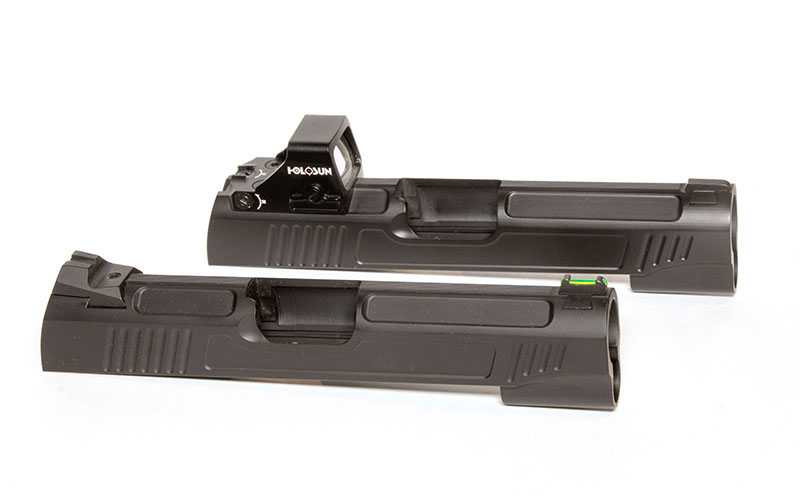
The front slide is the original slide for the SDS Imports Bantam carry. The rear slide is the one machined by Fink’s Custom Gunsmithing to work with the Holosun HS507K X2 sight.
The Home-Defense Handgun
For all these reasons, I recently set up a handgun specifically for home defense that’s outfitted with a reflex sight. After talking at length with Dave Fink of Fink’s Custom Gunsmithing—they serve as the gunsmithy at Gunsite Academy—Fink convinced me to give the concept a try and suggested I give it start with the Holosun HS507K X2.
Fink suggested this sight because he said it holds up well, is offered with either a green or red dot, comes with three reticle options and has an integrated rear sight. Of course, durability is important and so is being able to choose a reticle/dot you like. But the integrated rear sight means this sight simplifies mounting and the need to work around or with a higher conventional sight setup.
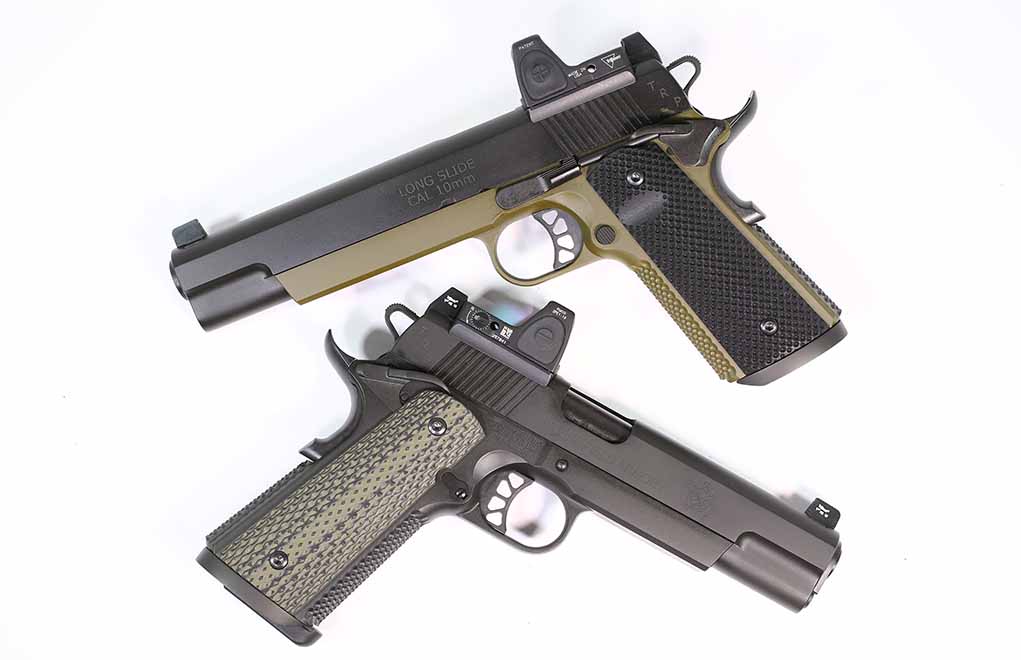
Springfield 10mm 1911s with red dots equipped.
I’ve been shooting a SDS Imports Bantam Carry a good deal and have been very impressed with what it offers for the money. So, I sent an extra slide for that pistol to Fink’s for the Holosun HS507K X2 installation. The milling job they performed on the slide was impeccable and, given the slides unique contour, they managed to make the Holosun look like it belonged there.
Just as importantly, they reduced the height of the front sight to provide point of aim/point of impact match with the integral rear sight on the Holosun. I dabbed a bit of white paint on the face of the front sight to make it a bit easier to see, you know, just in case.
In a few short months, I’ve become very fond of this pistol and its modern sighting system. I can shoot it with the red dot, without corrected vision, just as well and a bit faster than I can shoot it with the conventional sights on the original slide. That gives me some peace of mind when it comes to a late-night gunfight that I hope I never have to have.
I’m still not ready to go to the reflex sight for everyday carry … but I’m continuing to investigate that possibility. One thing is for sure: My eyes—and yours—aren’t going to get any better.
Editor’s Note: This article originally appeared in the December 2021 issue of Gun Digest the Magazine.
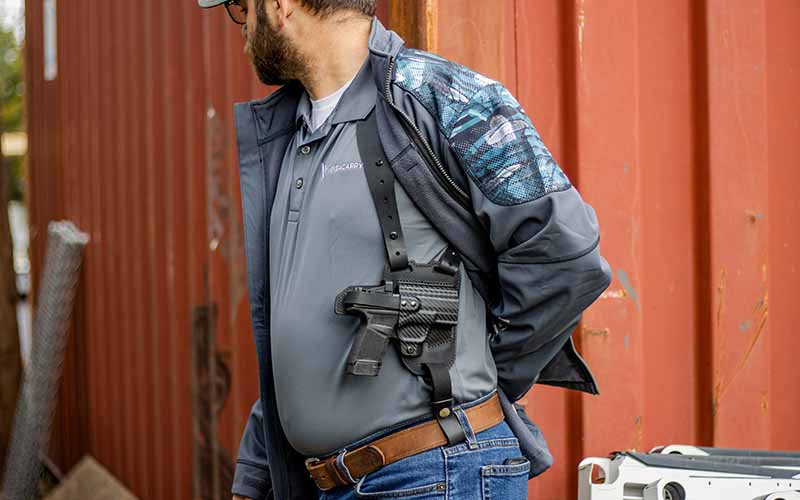
Versacarry has just released the Mayhem Shoulder Holster, the company’s second up-top carry option that now features molded polymer for improved retention.
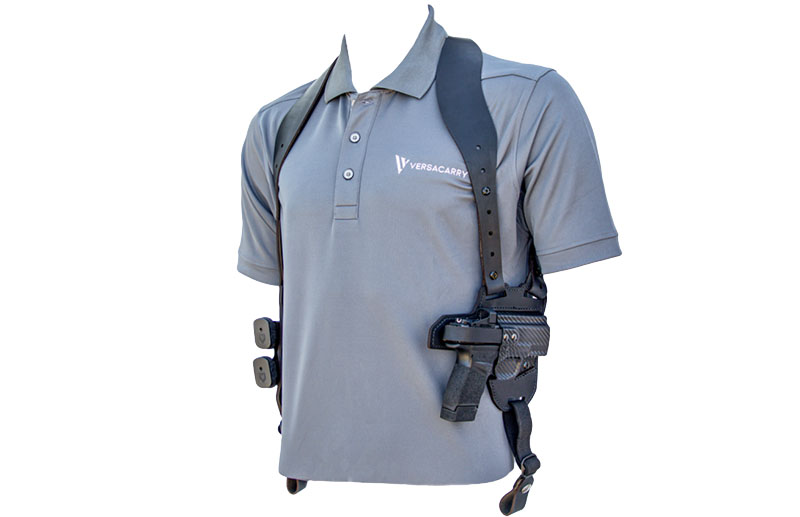
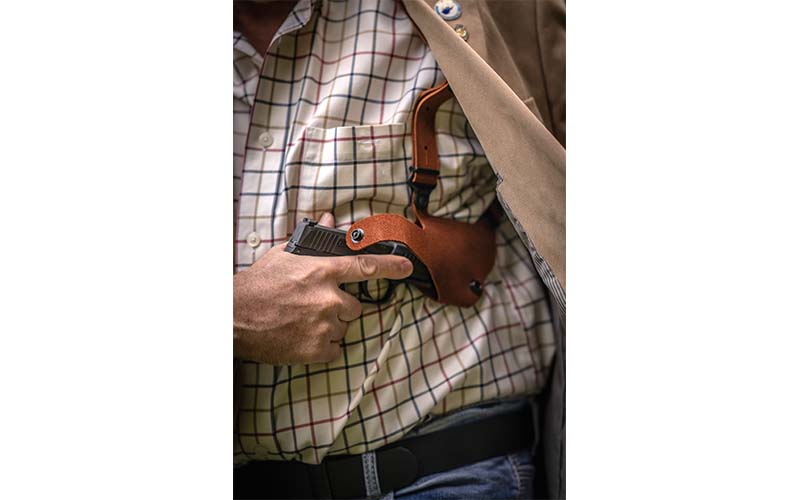
Versacarry has been releasing a lot of holsters this year as a part of its new Versatac series. One of those new models is the Mayhem Shoulder Holster, and it’s only the second shoulder holster to ever be offered by the company. Versacarry’s original model has been a popular choice since its release, but due to its leather construction, it’s a more universal holster in design. Offered in three holster sizes, each size is advertised as being compatible with a wide range of pistols. While these guns may fit just fine, they’re mostly secured by the retention strap. The new Mayhem Shoulder Holster may be compatible with a much smaller list of pistols, but it makes up for it with greatly improved retention.
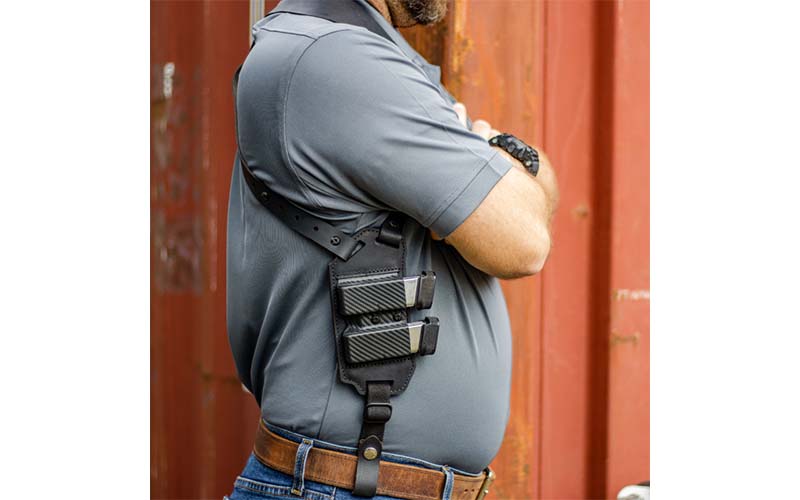
The enhanced retention capabilities are provided by the custom-molded polymer front of the holster. Fit specifically for each model of gun that the Mayhem Shoulder Holster is offered for, it can hold its cargo much more securely than what is possible for leather. The holster’s retention is adjustable and can be tuned to match the user’s desired draw strength, and the dual magazine holders found on the opposite side are made from custom-molded polymer and have adjustable retention as well.
The Mayhem Shoulder Holster is offered for some of the most popular carry pistols currently on the market, including the Glock 19 and 43, the Sig P320 and P365, the Springfield Hellcat and XDM, the Taurus G3C and GX4 as well as the HK VP9SK, Ruger Max 9, S&W M&P Shield, Walther PDP and Kimber Mako. Regardless of the model selected, the design of the Mayhem makes it inherently compatible with optics. The open-bottomed nature of the holsters makes them compatible with threaded barrels as well.
The cherry on top is that the Mayhem Shoulder Holster’s MSRP is set at $154.99, making it significantly less expensive than Versacarry’s original model. It’s currently only offered in right-handed configurations and a black finish, but the holster is available now.
Simplifying some of the more complicated aspects of carrying a concealed handgun.
The carrying of concealed handguns is becoming more prevalent. Even with a push for more stringent gun control by politicians, we’re seeing more and more support for concealed handgun carry by citizens and state governments. Currently, 21 of 50 states have Constitutional Carry, meaning that the concealed carry of a firearm is allowed without a permit. This also means there are now a lot of folks who can conceal carry legally who may have no training at all.
I do not believe in government-mandated firearms training. I do believe anyone intent on carrying a firearm for personal protection should attempt to—on their own accord—obtain as much training as possible. The problem is that basic and more complex instruction on concealed carry and self-defense aren’t provided free of charge. This means those who’ve realized they’re their own first responder must pay for training, buy videos or turn to periodicals like Gun Digest for their education.
Of course, a full education on concealed carry can’t be presented in one training class, video, article or even in one or several books, of which there are many (I even wrote one of them). What can be provided in an article such as this is a critical look and maybe a simplified overview of some of the most important aspects of carrying a concealed handgun for personal protection.
Safety Concerns Simplified
Firearms aren’t dangerous. They don’t mysteriously go “bang” and injure or kill. Humans are dangerous. They’ve committed atrocious acts throughout history and frequently do foolish things with firearms. An internet search will reveal anywhere from four to a dozen firearm safety rules. Jeff Cooper gave us the four most popular firearms safety rules. But, with all due respect, firearms safety isn’t that complicated.
In fact, it could be simplified with one rule: Never allow a firearm to point at anything you don’t want to put a bullet through or destroy. Learn all the rules and strictly follow them, but if you adhere to this one rule, your firearms accidents will only be loud noises.
Handgun Choice
The topic of handgun choice is one of the most argued and debated topics regarding self-defense, mostly because modern humans are driven by gear as opposed to skill or application. As with gun safety, handgun choice can be simplified: You should choose the most reliable and most powerful handgun you can comfortably carry concealed, and that you can shoot with speed and accuracy.
What’s the best defensive handgun? The answer will be different for everyone.
Notice I didn’t name a particular handgun or cartridge. This is because the most important aspect of a handgun that’ll be carried for personal protection isn’t its type, cost, caliber or potential interaction with a threat. The most important aspect is its interface with the user. A Smith & Wesson 44 Magnum would be ideal for shooting someone who is intent on killing you. However, most humans cannot easily conceal a revolver that large or deal with recoil that intense.
When it comes to the selection of a handgun, there’s an unlimited collection of variables to consider. What kind of handgun will your body type and usual dress allow you to conceal? What type of handgun does your strength allow you to manipulate? How much recoil can you tolerate? What type of handgun can you grip comfortably? How good are your eyes; do you need big bold sights or a reflex sight? The list could go on an on. Find what’s right for you; there’s no best answer for everyone.
Carry Method(s)
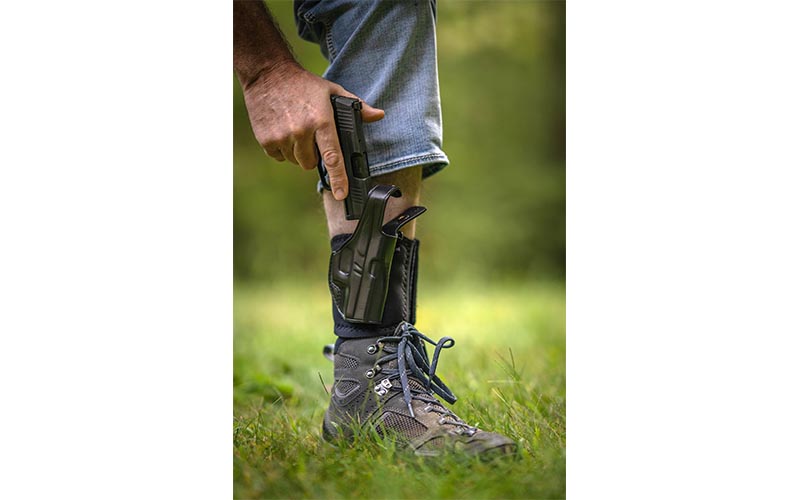
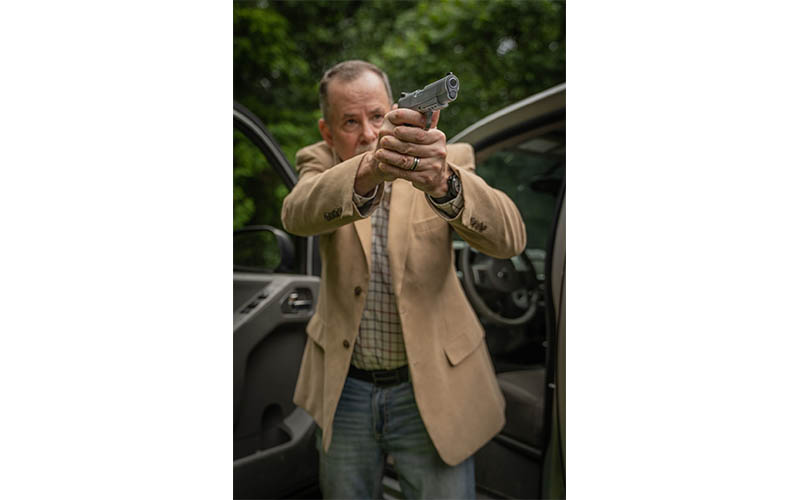
There are a variety of ways a handgun can be carried concealed. Though strong side, inside the waistband (IWB) carry is the most popular, it’s not best for everyone. Neither is ankle carry, pocket carry or the use of a shoulder holster. You see, not only do humans come in all different sizes, but they also circulate in all sorts of social settings. To further complicate choices, few humans exist in only a single environment. You may wear a suit and tie at work but spend your nonworking hours in shorts and a T-shirt.
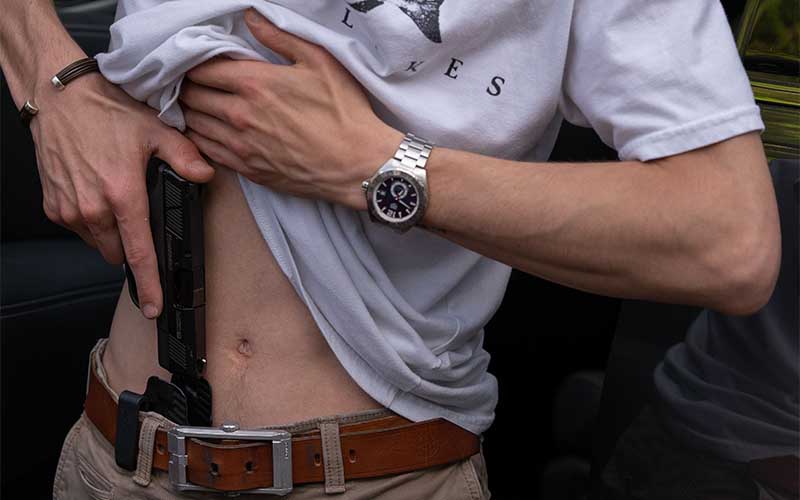
This concealed carrier prefers appendix carry and is exercising good trigger discipline. All should exercise trigger discipline, but appendix carry isn’t for everyone.
Varied public interactions and lifestyles demand different carry methods. They can also mandate different firearms. If you’re a runner, you won’t be able to comfortably conceal a Glock 17 during your course through the park. When you’re vacationing in 100-plus-degree temperatures, your shoulder holster for that 5-inch 1911 won’t work. For me, I’ve found I can conceal a Browning Hi Power or Wilson Combat EDC X9 in and IWB holster almost year-round here in West Virginia. However, there’s times when I need a much smaller gun carried elsewhere. There’s no best all the time answer for everyone.
What’s the best location for carrying a concealed handgun? That depends on a lot of things, and the answer isn’t the same for everyone.
Accessories
I’ve read some gun writers who insist you carry a handgun with two extra reloads, pepper spray, an impact weapon, a fighting knife and even restraint devices everywhere you go. I get it, you need to be prepared. However, some logic and common sense needs to apply as well. You don’t have a fire extinguisher in every room, and you only carry one spare in your car as opposed to four. If you want to carry all that stuff every day, go for it. While you’re at it, maybe you can find a used Sherman tank to drive around as well.
I’ve been in locations where I felt a fully loaded Batman belt wouldn’t have supported enough gear to keep me safe. I’ve found that the best way to avoid that feeling is to avoid bad locations. If your lifestyle demands you frequent bad locations, equip yourself accordingly or maybe reconsider your life choices. Take it from someone who wore a police duty belt for many years; most humans can’t comfortably and normally live their lives carrying around that much stuff. The tools you carry for protection must dovetail into your lifestyle. Be reasonable in your choices, and practice with what you carry, from where you’ll carry it.
Skill Level
For those who conceal carry, skill level varies considerably. Not just with shooting, but with firearms manipulation as well. What most want to know is how proficient they need to be to successfully defend themselves from a murderous attack. The only acceptable answer to that question is that you can’t be good enough. This is because you have no idea what the specifics of a potential life-threatening situation will be. From a training standpoint your only logical approach is to attempt to always improve at every aspect of concealed carry, personal protection and self-defense.
Concealed carry simplified: Choose the most reliable and most powerful handgun you can comfortably carry concealed, and that you can shoot with speed and accuracy.
I recently read on social media where a firearms trainer/gun writer suggested practicing reloading drills was a waste of time because most self-defense shootings are sorted out well before a magazine or cylinder of ammunition has been expended. Well, that’s a ridiculous way to determine your training. Though it varies greatly depending on several factors, by that same logic, you don’t need to carry because the chance of becoming a victim of a violent crime is so small.
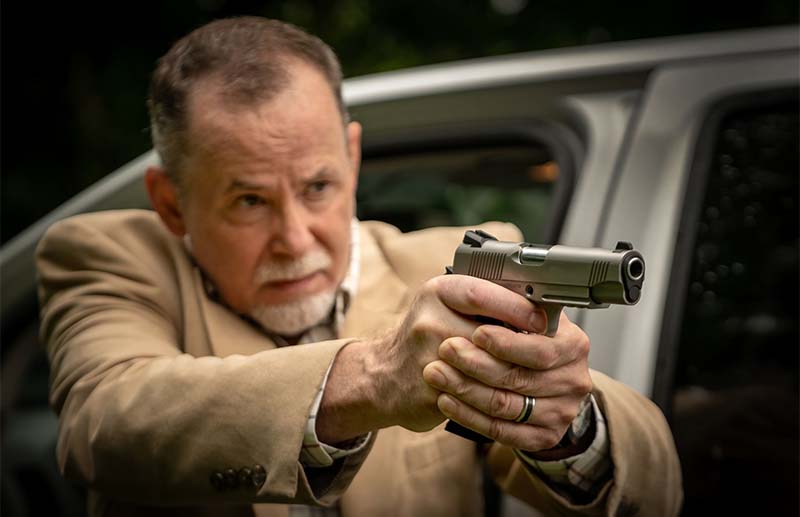
You need to be able to draw your handgun from concealment fast and efficiently. You need to be able to place shots with speed and accuracy out to about 15 yards. You need to be able to manipulate your handgun so you can effectively reload, clear stoppages and keep it in the fight. You need to learn to exploit cover and concealment while doing all those things. And you need to continually work on being able to do all these things better.
How about a shoulder holster? Sure, they’re great, but they require a jacket or cover garment at all times.
Justification
Finally, we get to the most critical aspect of the use of force in a self-defense situation: justification. What will justify your use of a firearm to stop an attack? The truth is that neither I, you nor anyone else knows the answer. Justification is something for a jury of your peers to determine; it’s not determined by a checklist guaranteeing your freedom from incarceration or civil liability.
Oddly, for a question so complex, the answer is quite simple. And while it doesn’t guarantee anything, it provides you some logical guidance. Your freedom will depend on the perception of the jury based on the evidence presented. By the same token, your actions must depend on your perception of the situation as it unfolds. You won’t have time to consider what the jury will perceive; you must, in a moment, determine that shooting is the only way you can reasonably escape death or grave bodily harm. Even if that’s your perception—and an undeniable fact—you may still be found guilty of manslaughter or homicide. However, short of that perception on your part, lethal force can’t be justified.
Editor’s Note: This article originally appeared in the 2021 Buyer’s Guide special issue of Gun Digest the Magazine.
For more information on concealed carry holsters check out:
The debate between .22-250 versus .223 Remington boils down to velocity and price. Do your shooting needs justify the increased cost?
The .223 Remington and .22-250 Remington are both small, light and very fast. Both are also very popular, but one much more than the other. So, if you find yourself deliberating between .22-250 versus .223, the real question is whether the increased velocity and performance of the former outweigh the affordability and abundance of the latter.
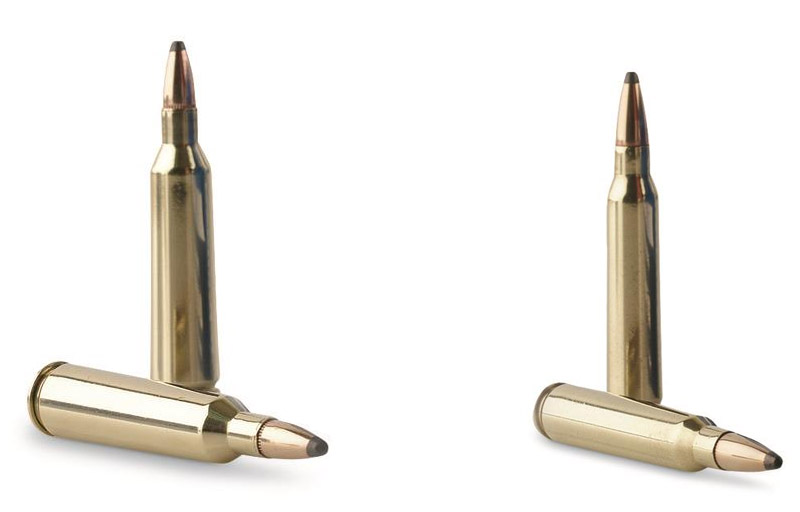
The two 55-grain soft-point loads from PPU that provided the data for this article. .22-250 on the left and .223 on the right.
.22-250 And .223 Ballistics
On average, a typical .22-250 cartridge will launch its projectile 300 to 500 feet per second faster than a .223/5.56mm with about the same increase of energy at the muzzle.
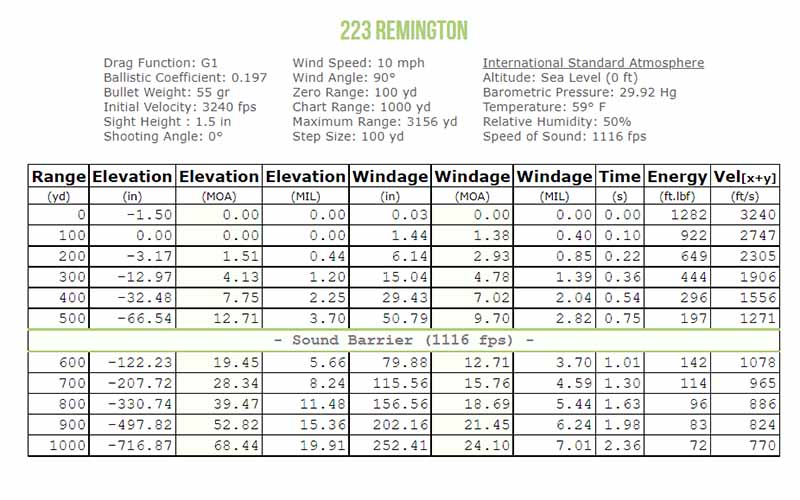
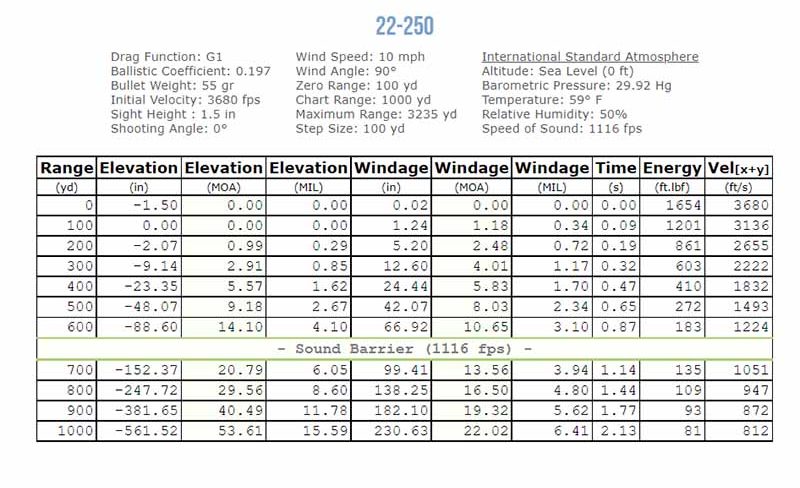
For instance, Winchester Super-X 55-grain soft-point load in .22-250 has an advertised velocity of 3,680 fps and energy of 1,654 foot-pounds. By contrast, the Super-X .223 55-grain soft-point load has advertised figures of 3,240 fps and 1,282 foot-pounds of energy.
Bear in mind that other loads may have a wider or narrower disparity between the two cartridge types, but the Winchester Super-X data represents an average delta.
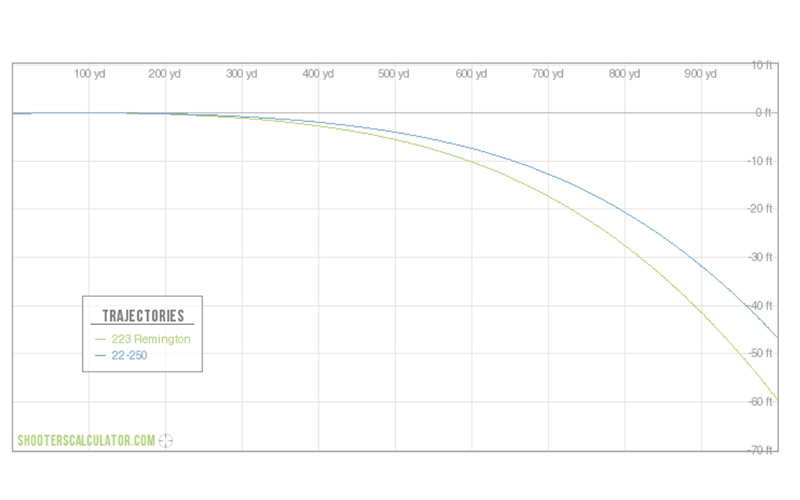
Trajectory graph for .22-250 vs. .223 Remington from shooterscalculator.com. Each load’s data used to calculate this can be found on their respective tables below.
When comparing the trajectories of these two 55-grain loads, we start to see what effect the increased velocity truly has on performance. As the above Shooter’s Calculator trajectory chart shows, .22-250 starts dropping later than .223 and does so less dramatically. The data tables shown below demonstrate that .22-250 is less influenced by wind and reaches its target in less time than .223 as well.
At 600 yards, .223 has dropped a dramatic 33 inches more in elevation than .22-250 and shifted an extra 13 inches of windage as well. While the .223 is transonic by 600 yards, .22-250 doesn’t go transonic until about 650 yards.
Bear in mind, factory velocities are more art than science. Test barrels are typically longer than factory rifle barrels–often 24 to 26 inches. Most factory rifles are 22 to 24 inches for bolt-action rifles. The typical .223 rifle sold today is an AR-15 with a 16-inch barrel.
With this in mind, it makes the average difference between the two cartridges even greater. Unless your .223 rifle has a barrel as long as that of your .22-250, expect the disparity in velocity to be even more extreme.
So…a little extra velocity, a little more energy and a little less drop at distance. That’s certainly something…but that also begs the question of how much that matters in the real world.
After all, 9mm is considerably slower at the muzzle and has considerably less muzzle energy than .357 Magnum, but the reality is both are about equally effective in gun fights. It’s good marksmanship, not caliber, that determines who’s left standing.
So, when it comes to.22-250 versus .223, how much do the differences matter in the real world?
.22-250 Vs. .223 For Varmints
While .223 is a more than credible varmint cartridge, the .22-250 (the artist formerly known as .224 Varmint) is considered one of the finest varmint cartridges available. The velocity (which can top 4,000 fps in some loads) with very mild recoil and modest drop out to 300 yards speaks for itself.
The .22-250 is also very well-regarded for coyotes and other small to middling predators for the same reasons. When it comes to making good hits on small targets, every advantage helps, and .223 drops farther, drops sooner and gets pushed by even mild wind more than .22-250.
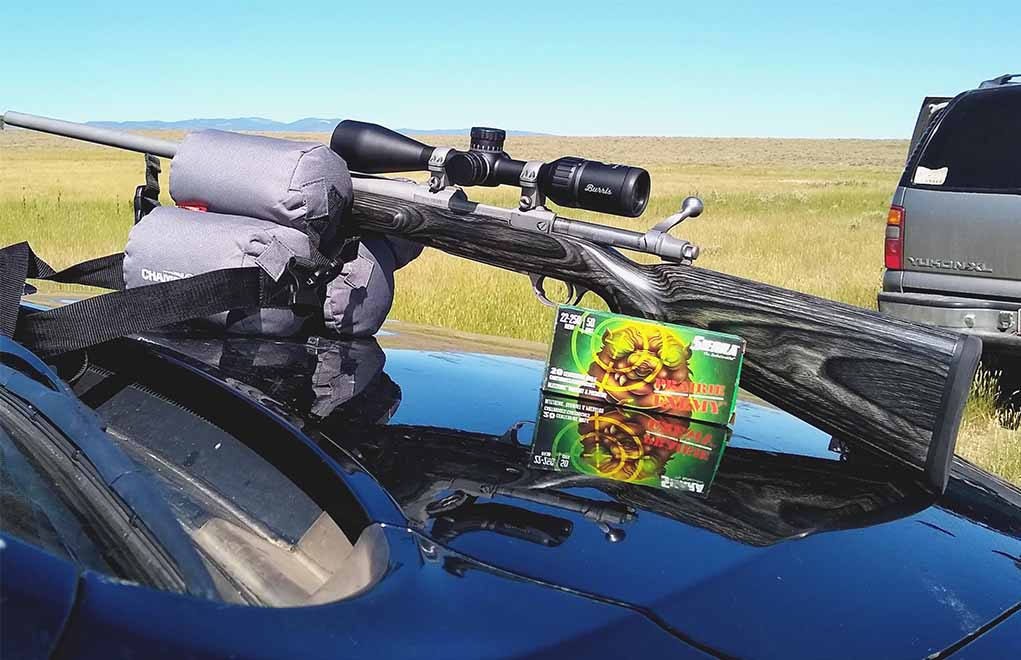
Sierra makes the appropriately-named “Prairie Enemy” flavor of .22-250. Here it’s being used on some Wyoming varmints to great effect.
That’s why .22-250 has been prized as a varmint cartridge in the western states for decades and continues to be.
If you have a rather large property with livestock, a ranch rifle in .223 may not have the same legs as .22-250 rifle depending on how far the back of the pasture is from the farmhouse.
About the only advantage that .223 brings to the table in varmint or predator hunting is that it’s cheaper, more abundant and can be fired out of common AR-15s.
.22-250 Vs. .223 For Medium Game
Here’s a hot take for you.
The .22-250 is better for hunting on paper due to the extra zip on the bullet. Realistically, shot opportunities in most states that allow game hunting with sub-.24-caliber guns are usually close enough for it to not matter.
A good bullet loaded to .223 velocity and accurately placed (a key concept there) is going to be just as effective as a good bullet loaded to .22-250 velocities and placed just as well.
If you’re only shooting 100 yards across a beanfield, frankly, the extra few hundred feet per second isn’t going to make so great a difference to a whitetail or hog that it matters. Both will work. If you picked a good bullet and do your job as a marksman…it doesn’t matter.
The places where it might matter won’t let you hunt with a .22-250 or a .223, so it’s a moot point.
.22-250 Vs. .223…For Defense?
About the only valid argument for using .22-250 over .223 as a defensive cartridge is its more reliable fragmentation at farther distances.
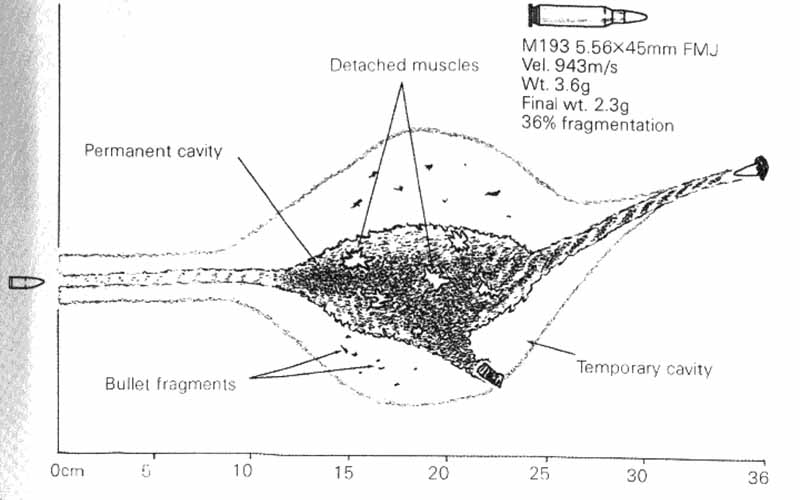
Even when calculated using velocities typical of a 24-inch barrel, a 55-grain .223 load (i.e., the same bullet used in M193) drops below the fragmentation threshold very quickly. The reliable fragmentation threshold for M193 is generally accepted to be about 2,700 feet per second, and .223 starts dropping below that at barely beyond 100 yards. Compare this to .22-250 which doesn’t dip below the threshold until about 200 yards.
This illustration shows the typical effects of a 5.56 NATO M193 projectile in soft tissue when fragmentation is achieved. Image Source: Wikipedia.
Despite this shortcoming, there’s virtually no realistic defensive scenario where one would have to shoot beyond 200 yards, meaning there’s no real practical advantage to using .22-250 for this purpose.
So, when it comes to anything defense-oriented, stick to a normal AR-15 in .223. While .22-250 ARs exist as well, it doesn’t change the fact that the ammo, magazines and guns themselves are less common and more expensive. Sticking with .223 will enable you to practice more often for less money, and good training is worth a lot more in the field than slightly better ballistics.
When And Where .22-250 Is Really Worth It
The .22-250 cartridge shines as a varmint and predator cartridge that is useful and effective at longer ranges than most other varmint cartridges. That’s what it was more or less invented for and that’s where it shines the most.
It can be used for hunting bigger game too, and does make a good caliber choice for a youth hunter in areas that legally and practically allow for it. But the same can be said for .243, .25-06, .257 Roberts and a slew of other calibers as well.
Ultimately, the AR-15 looms over any small caliber cartridge. It’s the 600-pound gorilla in the room and it needs acknowledging.
Unless you need to punch prairie dogs or cull coyotes at 300 to 400 yards, you’re going to get a lot more out of .223 than .22-250. The guns are cheaper. There are more models to choose from. The ammo is cheaper. The magazines are cheaper. There is more aftermarket support.
To get a feel for just how much cheaper .223 is than .22-250, take a gander at the two cartridges on AmmoSeek. At the time of writing, it shows that the cheapest .22-250 ammo of any kind for sale online is from PPU at about $1.35 per round. The cheapest .223 from the same manufacturer is about 55 cents per round. That gives you almost three trigger pulls of .223 for every one of .22-250, and there’s even cheaper .223 available than that.
Unless you plan on taking on a lot of critters at extreme ranges, a setup like this is probably overkill.
For most shooters who purely use their small-bore centerfire rifles to ring steel, punch holes in paper and maybe be kept handy in case of an emergency, then sticking with .223 is the smartest choice. If you do shoot at prairie dogs or coyotes at longer ranges, then .22-250 may very well be worth considering instead.
Ultimately, the .22-250 is “better” than the .223 at pushing the same bullet faster, but there are only so many instances where that really matters. For most people, a .223 is simply the more practical choice.
Whether for home defense or hunting, a 12-gauge shotgun is most effective when paired with the right load of 12-gauge ammo.
Shotguns are among the most versatile firearms in existence. And in this class of gun, the 12-gauge reigns supreme.
Hunting, home defense, recreation–nine times out of 10, shooters opt for the good ol’ 12 bore. Further aiding its popularity, the wide variety of 12-gauge ammo available today for nearly any application.
Such a wealth of loads is a blessing and a curse. On the one hand, no matter how specialized, likely there’s a load tailored for it. On the other hand, how the heck do you know which of the hundreds of options to use?
We’ll hash this out a bit in this 12-gauge ammo guide, go over what’s used for what and help you figure out the best shells for your purpose.
12-Gauge Ammo: Deciding Your Purpose
Like so much in the shooting world, decisions are best made by defining your particular parameters. A dove hunter requires a much different shell than a LEO breaching a door.
Additionally, not only would using the wrong load for the wrong situation be suboptimal, but it can also be dangerous for yourself and others. For example, one wouldn’t want to try and stop a home invader with birdshot, and one wouldn’t want to try and stop a bird with buckshot.
The former case may only result in an even angrier intruder and the latter with a puff of red mist and feathers. Shotguns are only as versatile as they are because of the wildly different styles of projectiles they can fire, so it’s important to use the appropriate type for the task at hand.
Besides selecting 12-gauge ammo based on its inherent physical traits, other factors come into play as well such as local laws and regulations. For example, California legally requires that lead-free ammunition be used when hunting due to the state’s environmental concerns. Someone hunting in California would need to select something that complies with the lead-free requirement when choosing their load.
For every conceivable realistic use that a shotgun has, there are numerous loads of 12-gauge ammo that fit the bill. The trick to getting the most out of the gun is knowing how to pick the right load for the job.
Choosing The Right 12-Gauge Ammo:
When it comes to hunting with a shotgun, the general type of load that should be used is pretty cut and dry. Birds and varmints are generally best dispatched with some kind of birdshot, and medium to large game is best dealt with using slugs or buckshot depending on various factors.
When it comes to the realm of 12-gauge home defense ammo, however, the choice between buckshot and slugs is less clear. While the two types of loads are both good for self-defense, they achieve their performance in very different ways.
Buckshot
Buckshot loadings create dynamic wound channels and energy transfer by firing multiple pellets. The pellets in a load of buckshot are fewer than those in birdshot but are significantly larger in diameter.
For example, common 2 ¾-inch shells of 00 buck are typically loaded with eight .330-inch diameter projectiles. With each ball of shot weighing about 54 grains, that makes each projectile roughly equivalent to a .32 ACP bullet in terms of weight and caliber.
Screenshot from a Brassfetcher video showing 12-gauge buckshot performance in ballistic gelatin. Note that the projectiles are still in motion in this image.
While multiple projectiles are in play when it comes to buckshot, this doesn’t mean that there will automatically be a dramatically wider spread of pellets. In fact, buckshot patterns generally remain quite tight within ranges of about 30 yards.
Certain loadings feature wad technology and plated projectiles that further aid in keeping the pattern tight during flight. Of course, the tightness of buckshot projectiles can also be influenced by a barrel’s choke. Buckshot is particularly effective for self-defense as each projectile will create its own dynamic wound channels upon impact and impart a high degree of energy transfer.
Shotgun Slugs
Slugs feature a single, solid projectile rather than multiple projectiles. This generally results in higher velocity than buckshot and a much greater effective range as well. Granted, when in the context of home defense, it is highly unlikely one would need to take any shots at extended ranges.
The benefit of the higher velocity possessed by slugs is evident in its effect on the target and its efficient fight-stopping capabilities. The velocity of slugs multiplied by their impressive mass results in a lot of energy and devastating terminal ballistics. Another potential advantage of slugs over buckshot is the fact you are only responsible for a single projectile as opposed to multiple.
Screenshot from a Brassfetcher video showing 12-gauge slug performance in ballistic gelatin. Note that the projectile is still in motion in this image.
That last point is worth some consideration when it comes to selecting home-defense 12-gauge ammo because you are legally and morally responsible for every projectile that you send out the barrel. Bullets can behave strangely, and 00 buck provides eight to nine times the likelihood that one of those lead balls ends up somewhere it shouldn’t.
The specific factors of one’s home environment, such as potential engagement distances, will impact whether or not slugs, buckshot or something else entirely will be the safest and smartest choice. Regardless of your selected load of 12-gauge ammo, it is prudent that you practice and familiarize yourself with how it behaves with your specific firearm.
Chokes and Patterns:
When it comes to shotguns, an important aspect of this class of firearm is the effect that chokes and bore tightness have on the patterning of projectiles. Many shotguns feature barrels with internal threads that accommodate a variety of chokes, making them tunable by the end user to match their chosen loads and needs.
Other shotguns, particularly base model defensive shotguns, feature bores that are fixed to a given choke size. For example, a Mossberg 590A1 features a fixed-cylinder bore while a Benelli Montefeltro comes with a set of Crio improved cylinder, modified, and full chokes.
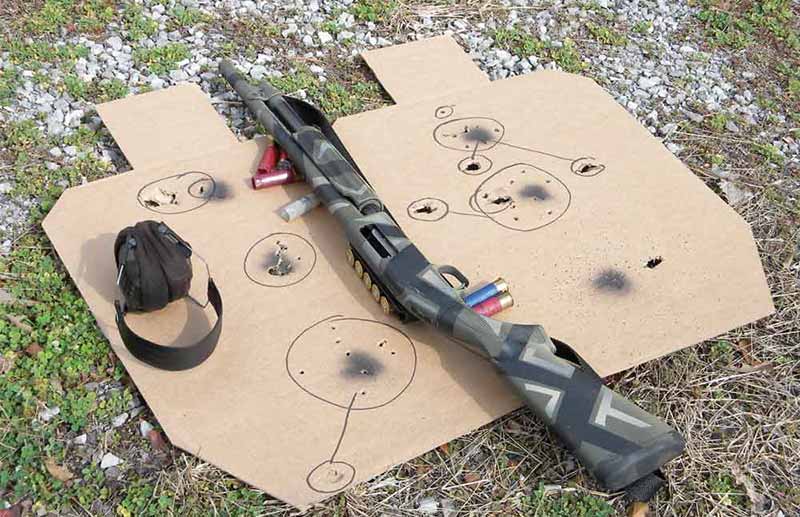
The resultant spread sizes from various kinds of 12-gauge ammo. The patterns could be influenced by adjusting the choke as well.
There are a variety of chokes on the market that exist for both common and specialized uses. The most common chokes one will find when looking for a shotgun are cylinder, improved cylinder, modified and full chokes.
A cylinder choke will produce the widest dispersion of projectiles as the bore diameter is not tightened in any way. An improved cylinder choke tightens the bore, resulting in a tighter pattern than that of a standard cylinder bore. Full chokes feature the tightest bore diameter, conducive to ensuring that the projectiles maintain as concentrated of a pattern as possible during flight. Between improved cylinder and full chokes are modified chokes, providing a middle-ground option when it comes to pattern tightness.
Just like factoring ammunition options into one’s shotgun usage, being cognizant of a shotgun’s choke and bore diameter is an important step in optimizing your shotgun for its given task.
12-Gauge Ammo Shell Size
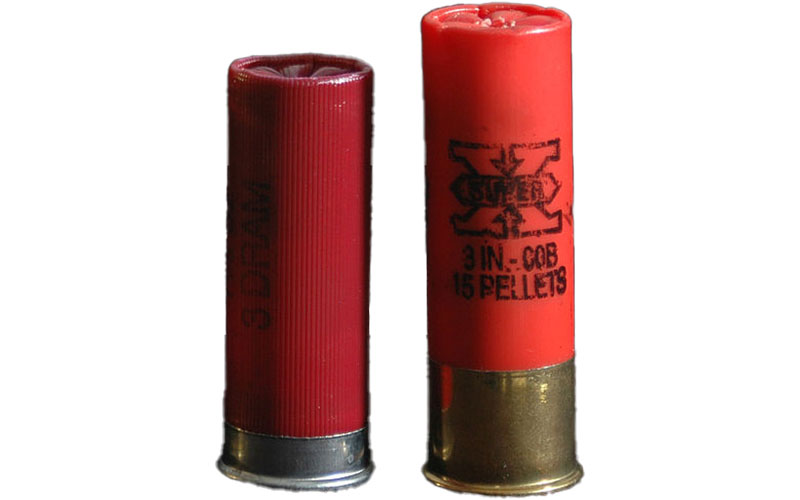
The most common size of shell when it comes to 12-gauge ammo is 2 ¾-inch, but other sizes exist as well. Excluding smaller mini shells which are mostly a novelty, 12-gauge ammo can also be found in 3-inch and 3 ½-inch shells. Naturally, the larger the shell size the more powerful it can potentially be.
A standard 2.75-inch 12-gauge shell (left) versus a 3-inch 12-gauge shell (right). Photo: Wikipedia.
These days, most 12-gauge shotguns come with at least a 3-inch chamber, but double-check before trying to jam anything larger than a standard 2 ¾-inch shell into it. To fire 3 ½-inch shells, one will usually have to go out of their way to find a shotgun with a chamber that can accommodate them. If the task at hand calls for the most powerful 12-gauge ammo available, such as self-defense in grizzly country, it may be worth tracking one down.
12-Gauge Ammo Buyer’s Guide:
Home Defense:
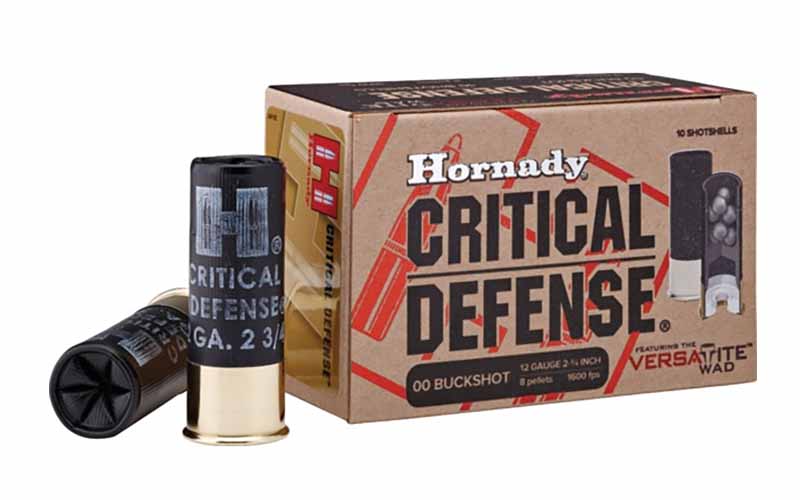
Hornady 00 Buckshot Critical Defense
This 00 buck offering from Hornady is optimized for self-defense and ensures maximum effect on target. With ten rounds per box, that’s enough for most people to fill their gun’s magazine and have a few shells left over to pattern with or throw in a side-saddle. Hornady’s Versatite wad technology utilized in this loading aids in sending a tight and consistent pattern down range. This Critical Defense option is designed to function reliably in semi-automatic and pump-action shotguns alike, making this 12-gauge ammo viable for home defense regardless of your shotgun model.
Shotshell Length: 2 ¾ Inches
Velocity: 1,600 fps
Shot Size: 00 Buck
Shells Per Box: 10
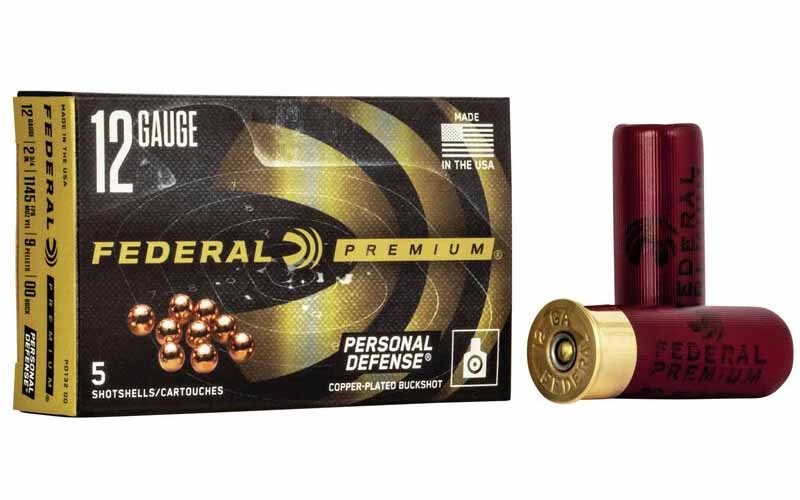
Federal Premium Personal Defense Shotshell With FLITECONTROL Wad
This buckshot loading from Federal Premium is versatile and effective. This load functions reliably in autoloading shotguns such as the Beretta 1301 and Benelli M4, proving itself as a quality option for home defense. Short-barreled shotguns can also effectively utilize this load due to the tight patterns provided by the FLITECONTROL wad. The copper plating on the projectiles is also conducive to producing a tight spread as the pellets will be resistant to deformation and disruption during their flight.
Shotshell Length: 2 ¾ Inches
Velocity: 1,145 fps
Shot Size: 00 Buck
Shells Per Box: 5
Winchester PDX1 12 Defender
This offering from Winchester combines three plated 00 buckshot projectiles with a 1 oz rifled slug. Essentially, this load draws aspects from the two best types of 12-gauge self-defense ammo and offers them in a single package. The inclusion of the 00 Buck projectiles allows for a form of insurance of sorts when it comes to hitting your designated target. This round will provide fight-stopping capabilities that are effective at both close and extended shotgun ranges.
Shotshell Length: 2 ¾ Inches
Velocity: 1,150 fps
Shot Size: 00 Buck + 1-Ounce Slug
Shells Per Box: 10
Small Game Hunting:
Winchester Rooster XR
Winchester’s Rooster XR is a purpose-built pheasant load. The load is advertised as being capable of penetration beyond 50 yards, allowing hunters to efficiently dispatch upland game at further distances. The extended range of the Rooster XR load is complimented by the Shot-Lok technology that helps keep the pattern tight when in flight. This offering from Winchester is a great choice for those who want a reliable upland hunting load that lets them clip wings at longer distances.
Shotshell Length: 2 ¾ Inches
Velocity: 1,300 fps
Shot Size: 4
Shells Per Box: 15
Federal Black Cloud FS Steel
This Federal Premium Black Cloud variant is an excellent load for waterfowl hunting. Federal’s FLITECONTROL FLEX wad will aid in the projectiles flying in a consistent and tight pattern when paired with standard or ported waterfowl chokes. The payload of this Black Cloud loading consists of 40 percent FLITESTOPPER steel pellets and 60 percent Premium steel pellets. This mixture of pellets enhances the lethality of the load and produces a dense pattern.
Shotshell Length: 3 ½ Inches
Velocity: 1,500 fps
Shot Size: 3
Shells Per Box: 25
Remington American Clay & Field
This 2 ¾-inch offering from Remington is a versatile ammunition choice for your shotgun. Remington’s American Clay & Field load will fit the needs of a variety of shooters. If you want to engage in recreational shooting activities and vaporize sporting clays, this load is a solid option. If you need some birdshot for field use, this Remington load is a viable option. Regardless of your intended use, you are getting 25 versatile rounds with consistent patterning and velocities.
Shotshell Length: 2 ¾ Inches
Velocity: 1,200 fps
Shot Size: #9 Shot
Shells Per Box: 25
Medium/Big Game Hunting:
Remington Magnum Buckshot
This 3-inch buckshot loading makes this loading particularly effective for dispatching predators and game alike such as coyotes and deer. Granulated polymer is packed into the case to prevent deformation of the 41 pellets during flight and ensures the pattern’s tightness as it proceeds downrange. This magnum load from Remington is an excellent choice for dispatching medium game.
Shotshell Length: 3 Inches
Velocity: 1,225 fps
Shot Size: #4 Shot
Shells Per Box: 5
Federal Premium Trophy Copper Sabot Slug
This 300-grain slug option from Federal Premium boasts the highest advertised velocity of the options on this list. It should be noted that this load is optimized for use with rifled shotgun barrels. Federal claims that this load is capable of achieving sub-4-inch groups at 200 yards when fired through a rifled barrel. The touted velocity of 2,000 fps paired with the sabot properties of the projectile is conducive to an accurate and hard-hitting load. This load shines for those who plan on utilizing a rifled shotgun for hunting a variety of medium to larger-sized game at potentially extended distances.
Shotshell Length: 3 Inches
Velocity: 2,000 fps
Shot Size: 2/3-Ounce Slug
Shells Per Box: 5
Hornady American Whitetail
This load from Hornady features a 1-ounce rifled slug that is optimized for non-rifled barrels. These Hornady slugs are packed with a serrated, hollow-point 325-grain InterLock projectile that promotes consistent expansion and effect on target. The projectile of this load also benefits from a high velocity due to the inclusion of a compression-style wad. Hornady claims that this 1,600 fps slug has an effective lethal range of 200 yards or more, making it a viable option for longer-range shotgun hunting. Like the round’s branding suggests, this load would be an effective choice for whitetail hunting.
Steiner has just announced the T6Xi riflescope series, featuring four models of illuminated FFP optics.
Steiner recently unveiled the T6Xi riflescope series. It includes four new models of 6X magnification scopes with illuminated first focal plane (FFP) reticles, and each is tailored toward different shooting applications.
The Steiner T6Xi 5-30×56.
The T6Xi series includes the T6Xi 5-30×56 for long-range precision shooting, the T6Xi 1-6×24 for close-range engagements and the T6Xi 3-18×56 and the T6Xi 2.5-15×50 to bridge the gap between the two extremes. Regardless of the model chosen, each will feature 6X total magnification adjustment and an illuminated FFP reticle with eleven brightness settings (seven for day, four for night).
The Steiner T6Xi 1-6×24.
Speaking of reticles, there are three different styles across the T6Xi line to choose from. The three longer-range scope models can be bought with either the Steiner Multipurpose Sniper Reticle or the Special Competition Reticle, but the T6Xi 1-6×24 is available only with an entirely new reticle instead. Called the KC-1, it was developed in collaboration with Kinetic Consulting and was designed to provide quick acquisition at close-range while still being capable of precision shooting at 6X magnification.
The new KC-1 reticle at 1X (left) and 6X (right).
Other features of the T6Xi series include Steiner’s Low-profile Never-Lost turret system, a locking diopter ring and a magnification throw lever. All models have also been tested and certified as fog proof and waterproof down to 33 feet.
MSRPs on the new T6Xi series range from $1,954.99 at the lowest to $2,874.99 at the highest, and Steiner claims that they will be available soon.
Sig Sauer has recently released the MCX-SPEAR-LT series, featuring eight models of rifle and pistol in three different calibers.
Sig Sauer is continuing to develop its MCX line of AR-derived firearms, now releasing the third generation dubbed the MCX-SPEAR-LT series. This newest iteration features eight models in three distinct calibers, being sold in rifle, pistol and factory SBR configurations dependent on barrel length.
MCX-SPEAR-LT 7.62×39 16-inch rifle model.
The biggest addition to the MCX-SPEAR-LT line is the inclusion of 7.62×39 models, bringing the total number of caliber options up to three alongside 5.56 NATO and .300 BLK. The .300 BLK version is available with a 9-inch barrel only, but can be bought as either a pistol or factory SBR (the latter requires a Form 4 to transfer). The 11.5-inch barrel models are available in either 5.56 NATO or 7.62×39 and can be had as either pistols or factory SBRs, and the same two calibers are also available as rifles with 16-inch barrels.
MCX-SPEAR-LT 5.56 NATO 11.5-inch factory SBR model.
Besides the different chamberings, barrel lengths and legal statuses, all MCX-SPEAR-LT models are fundamentally the same. They feature aluminum frames, ambidextrous controls, flat Sig match triggers and Sig quick-detach suppressor-ready flash hiders. Also, thanks to the gas piston operating system, there’s no need for a buffer tube. This allows the rifle and factory SBR models to ship with folding stocks, and the pistol models are capable of accepting folding braces or stocks as well. All models also feature an Anodized Coyote finish.
MCX-SPEAR-LT .300 BLK 9-inch pistol model.
Tom Taylor, Chief Marketing Officer and Executive Vice President of Commercial Sales at Sig Sauer, said this about the MCX-SPEAR-LT series:
The first generation of the MCX platform was designed to be an AR-15 style platform with added modularity. The second generation of the MCX, the MCX Virtus, was purpose-built for rugged durability and brought unprecedented modularity. Now comes the MCX-SPEAR-LT, which incorporates the best of both generations and is the culmination of the latest research, development, and innovation in the MCX platform…
Sig Sauer has not listed individual MSRPs for the different models, but they are starting to become available at dealers now.
So, you’ve decided that enough is enough with the ammunition crunch, and you’re ready to take the plunge into reloading your own ammunition. Yes, it’s absolutely true that reloading components are as rare as ammunition itself right now, but this too shall pass.
Reloading gear is like any other gear-intensive hobby; you can go right down the rabbit hole and get into a five-figure sum quicker than you’d imagine, or you can go minimalistic and set yourself up on the cheap. I’ve done both ways, and while I can say that the best tools will certainly make life easier, you can make fantastic ammo with inexpensive gear if you’re diligent about technique and pay attention to detail.
The Lee primer pocket cleaner is an effective tool, which scrapes burnt residue out of both large and small primer pockets. Photo: Massaro Media Group.
Shortening The Purse Strings
Let’s assume your budget is tight—whose isn’t?—and you want to set up your reloading bench in the most cost-effective manner possible.
Now, as we go through the list of necessary gear, I didn’t necessarily recommended the least costly item in the category, but instead leaned toward the best value to maximize the reloading dollar. If you already reload, then I’m preaching to the choir; you understand the processes and the tools involved. If you’re new to the game, I cover the steps so you can best understand the tools needed.
The act of reloading centerfire metallic cartridges involves reworking a spent cartridge case, bringing it back into proper specifications, then installing a new primer and powder charge and finally seating a new bullet to complete the process.
Sounds easy, right?
It isn’t a difficult procedure … so long as you pay strict attention and give the act the respect it deserves.
Get a Single-Stage Press
Reloadable cases are made of brass or nickel-plated brass and are malleable, yet strong enough to resist deformation in day-to-day handling—this is the primary reason brass was chosen as a case material. When the case is fired, it’ll expand to the (slightly larger) dimensions of the chamber. To reuse it, it needs to be returned to SAAMI specs.
High-quality ammunition can be made with simple tools and a strong attention to detail. Photo: Massaro Media Group.
A reloading press will generate the needed pressures to shrink that brass case back down to spec, and specially made reloading dies are used for each cartridge you wish to reload. A single-stage press is what you’re after. It’ll handle all the needed chores—though it only holds a single die at a time and performs one function at a time.
For this, I like either the RCBS Rock Chucker Supreme (about $214 street price) or the Redding Big Boss (about $195 street price). Both are wonderfully strong and rigid. Both could re-prime your cases, and both will last a lifetime. There are some cheaper models, but I don’t feel they provide the same level of performance as either of these two choices.
Look to Lee Dies
Reloading dies are pretty much universal, so long as they have the standard 7/8-14 die body. The brand of die need not match the brand of press, and for our project, I’d recommend Lee dies. They’re reliable, affordable and, for the beginning reloader, will certainly get the job done.
Lee reloading dies are affordable, and the plastic powder scoop and shell holder are included in each set.
The Lee die set includes the proper shell holder for the cartridge—almost all others require the shell holder be purchased separately. And while other dies might have fancier features, I’ve used Lee dies to make some great ammunition. Depending on the conformation of your case, you may need a two-die set (usually reserved for bottleneck cartridges) or a three-die set (for straight-walled cartridges). Pistol cartridges die sets start at about $39, and prices go up from there.
I also like the Lee dies for the fact that they provide a plastic scoop of appropriate size for the case to be reloaded. Some powders require a bit more than a scoop, and some less, but it’s a handy means of weighing out powder charges in conjunction with a balance beam scale.
A Balance-Beam Scale And A Dial Calipers
You’ll need to measure things in a couple of ways—the weight of powder charges, bullets and sometimes even cases, and the length of things … such as cases and assembled cartridges.
For measuring weight, a balance beam scale is what you’re after, as I feel it’s the most reliable. It needs no power to operate and, with proper care, will last a lifetime. The cheaper models, while they have an attractive price point, tend to drift from true readings easier than the higher-quality models. The Redding Model No. 2 balance beam scale (about $103) is built rock-solid, wonderfully accurate and odds are you’ll leave it to your children to use.
Powder, and sometimes bullets and cases, must be weighed, and the Redding Model No. 2 is a good value. Photo: Massaro Media Group.
Once those powder charges are properly weighed out, a powder funnel like the RCBS (about $6) will keep powder in the case and not all over your reloading bench. To measure the length of cases and cartridges, a set of dial calipers is needed. The Frankford Arsenal dial calipers (about $40) will get the job done without emptying the wallet.
Menial Cleaning, Trimming and Lubing
Dirty cases need to be cleaned and polished to maintain smooth feeding. The Lyman Turbo 1200 Pro Sifter case tumbler (about $65) and some crushed walnut shells or corn cob abrasive media (about $12 to $18) will handle that.
The brass cases will need to be trimmed sooner or later, and for that chore, the Lee Case Length Gauge (about $7 to $12) and Cutter and Lock Stud (about $7) will keep your brass nice and uniform, even if it runs on elbow grease. A locking stud holds the case by the base, while a flash hole-piloted length gauge is attached to a cutting tool. A few twists of the wrist (or the unit is adaptable to a cordless drill), and the case mouth is cut down to the SAAMI-specified length.
Once trimmed, you’ll want to clean the sharp edges off the case mouth. For that, I like the Lee chamfer/de-burring tool (about $5); it’s as simple as it gets and gets the job done. The primer pockets can be scraped clean with the Lee Primer Pocket cleaner (about $4); this dual-sided tool will handle both large and small primer pockets.
Cases will need to be lubricated before the resizing process, unless we’re talking carbide pistol dies, lest you stick the case in the resizing die. Remember, a reloading press generates all sorts of pressure. There are many types of case lubricant. I prefer the simple, small tin of Imperial Sizing Die Wax (about $10); it works perfectly and a little bit goes a long way. Simply rub a small amount between your forefinger and thumb, rub it on the case—concentrating on the base—and you’re good to go.
Imperial’s Sizing Wax is applied with your thumb and forefinger, and a little goes an awful long way when it comes to lubricating cases. Photo: Massaro Media Group.
Erasing Mistakes
Everyone makes mistakes—including reloaders—and there are tools to erase those mistakes. Cartridges can be disassembled via an inertia hammer that pulls the bullet out of the case.
The Frankford Arsenal impact bullet puller (about $17) uses three different collet sizes to pull bullets from cartridges ranging from the .22 Hornet to the .45-70 Government, whether rimmed, rimless or belted.
Should you stick a case in your resizing die—and it’ll inevitably happen (even to the best of us)—a kit like the Hornady Stuck Case Remover (about $20) will sort you out. The concept is pretty simple: A case is stuck in the resizing die with the rim ripped off, so you use the provided drill bit to punch a hole through the primer pocket. Next, tap that hole with the provided tap. Then, the Allen-head bolt is pushed through the small steel cup and screwed into the threaded hole. It takes a bit of effort, but you’ll work the stuck case out of the resizing die. Just be sure to clean the inside of the die really well, as small brass bits will get in there from the drilling and tapping process.
Scrap-Built Organization
There are all sorts of case blocks available for purchase, ranging from simple molded plastic affairs to precisely cut anodized aluminum models. However, if you’re pinching pennies, you can easily make your own. Simply measure the case head diameter of your chosen cartridge and pick a drill bit slightly larger. A scrap piece of 2×4 can serve as a case block once you drill a series of properly sized holes in it.
Get Good Data
Good, reliable reloading data is imperative for any reloader, and each reloader will invariably end up with a small library of good data. If your budget is tight, there are a number of excellent sources of online data of which the reloader can take full advantage.
Hodgdon Powder (which includes Winchester and IMR powders), Alliant Powder and Nosler bullets all publish their reloading manuals and/or data online, so you can print whatever data you need or simply consult your laptop or smartphone for load data. If the reloading bug bites you (and I’ll wager it will), you’ll end up with several reloading manuals.
And, lastly, I’ll recommend you keep a notebook of your reloading endeavors, and this can take the form of a simple spiral-bound notebook, just like you had in high school. I refer to my own quite often.
Editor’s Note: This article originally appeared in the 2021 Buyer’s Guide special issue of Gun Digest the Magazine.
Looking for a new iron or piece of kit to enhance the one you already own? Check out these 7 new bits of guns and gear to grow your firearms wish list.
Rethinking the two-stage trigger, the Rise Iconic shoots to give marksmen a more reactive, consistent and accurate pull. Where Rise’s switch differs from the traditional design is each stage is mechanically separate, thus all but eliminating creep in the system. It achieves this by a simple blade mechanism on the first stage that, when depressed, gives shooters a solid wall before the second stage. From there, the trigger operates like a single-stage with a crisp, 2-pound break and lightning-fast tactile reset. Internal components are made from S7 steel in a 6061 aluminum housing; this drop-in bang switch is built for the long haul. MSRP: $300
Benjamin Armada Semi-Auto PCP Air Rifle
Air power on the quick, Benjamin’s new semi-auto PCP is an ideal option for fast shots on small game. In addition to a 10-round rotary magazine, the Armada brings muscle to the setup with the .22-caliber-kicking pellets in excess of 950 fps. Moreover, it comes with a slew of assets. One to win favor among most shooters is its adjustable length-of-pull and comb that fits the rifle to anyone behind its trigger. The pistol grip is a nice touch, too. Integrated sound suppression keeps shots stealthy, and a 40-shot reservoir allows plenty of action between charges. MSRP: $782
Sig Sauer M400-DH3
Drawing upon Daniel Horner’s years of competition experience and success, Sig Sauer aims to give match shooters an edge. Its new M400-DH3 is configured to match what Horner has been competing with for the past two years, a period where he’s racked up multiple titles. At its heart, the .223 Wylde chambered rifle boasts a 16-inch stainless steel, fluted barrel that’s at once nimble, yet hefty enough to resist heat buildup. The rifle is outfitted with a fully adjustable DH3 competition buttstock, two-stage adjustable Timney trigger and three-chamber compensator. It features an ambidextrous bolt release, as well as a low-profile M-Lok handguard, aiding its overall light profile—it tips the scales at only 7 pounds. Best of all, Sig prices its race gun within reach of nearly any competitor. MSRP: $1,700
Trijicon Dual Defense Kit
Fit a reflex to a pistol and it’s likely you’ll have to upgrade the iron backups piecemeal. Trijicon does away with this ordeal with the introduction of its extremely practical Dual Defense Kit. Quite simply, the kit combines the legendary RMR Type 2 Adjustable LED optic with the company’s Bright & Tough Night Sight. Once installed, the units work in conjunction to enhance shooting speed and precision for self-defense, law-enforcement, military, competition or target-pistol shooters. At present, the system is available for most Glock and Sig Sauer optics-ready models, but it’s likely Trijicon will set its sights on more pistols in the future. MSRP: Starting at $845
Walther WMP
The .22 Magnum pistol is a rare beast, but Walther recently gave shooters a reason to look in the rimfire’s direction. The German gunmaker’s WMP is a full-sized option chambered in the snappy Winchester Magnum Rimfire, which is perfect for plinking or personal defense in a pinch. What makes the polymer-framed pistol such a hotshot is its 4.5-inch barrel, offering up plenty of bore to milk the most out of the round and add recoil-eating heft. Its capacity isn’t anything to turn your nose up at either, with a 15-round magazine (10-rounders available for ban states). Also, the pistol features an optics-ready slide and comes with two adapter plates and is completely ambidextrous. MSRP: $550
FN 15 DMR3 Rifle
Long appreciated by those looking to reach out on the AR platform, FN USA’s DMR has been further enhanced to accomplish its job. FN has particularly homed in on accuracy improvement features and recoil reduction in the newly released third-generation DMR3. This is seen in the rifle’s 18-inch cold-hammer-forged, chrome-lined, hybrid profile barrel made from the company’s famous “machine gun” steel. To this, FN adds a SureFire ProComp muzzle brake, reducing both recoil and muzzle rise and tops it off with a rifle-length gas system. Geissele supplies the switch—its two-stage precision G2S trigger—Radian the charging handle and safety selector, and FN the six-position buttstock. The DMR3 should prove more than enough to get on target. MSRP: $2,152
Birchwood Casey Glock Multi-Tool
Searching for a bit of a tactical bent on your next hunting rifle? Savage has you covered, marrying its classic 110 action to Magpul’s polymer Hunter Stock. Quite a pair. The stock offers an excellent shooting platform with V-block bedding for rock-solid matting with the action. Furthermore, its wide, flat forend provides a perfect rest and offers plenty of M-Lok real estate, while its buttstock is fully adjustable to fit the shooter. On Savage’s end, an oversized bolt handle makes operating the action quick and intuitive, while an 18-inch heavy barrel and renowned AccuTrigger improve the rifle’s overall performance. Available in .308 Winchester and 6.5 Creedmoor, the 110 Magpul Hunter delivers a new twist to a proven rifle. MSRP: $30
Editor’s Note: This article originally appeared in the October 2022 issue of Gun Digest the Magazine.
Ruger has just announced a new Custom Shop variant of the Ruger Precision Rifle chambered for 6.5 Creedmoor.
The Ruger Custom Shop line has expanded yet again, this time with the release of a Ruger Precision Rifle chambered for 6.5 Creedmoor. Developed with input from Team Ruger Captain and renowned competitive shooter Doug Koenig, the new custom Ruger Precision Rifle features some interesting changes intended to improve its performance, handling and function.
The first area of major improvement is the barrel, which is cold hammer-forged from chrome-moly stainless steel, free-floated and is a heavier contour than that of the standard model. Its muzzle is also threaded 5/8×24 and topped off with an effective APA muzzle brake. The M-LOK handguard housing the barrel is free-floated as well, and like the standard model, the custom version can accept any AR-style stock or pistol grip.
The trigger has also been improved on the Ruger Custom Shop model, now sporting an adjustable TriggerTech trigger with Frictionless Release Technology. The trigger is flat and features a red finish to match the controls and new barrier stop, giving the rifle a distinct Ruger Custom Shop look.
Speaking of the barrier stop, this is another new addition to the custom model. While the standard Ruger Precision Rifle has a contoured front magazine well to help better engage barriers, the custom version now has a protruding, textured barrier stop to accomplish the same thing. However, Ruger claims that the stop will provide better stability and repeatability. The only internal change to the custom RPR is a reprofiled firing pin which the company claims will function better with a wider variety of primers and also allow for easier manipulation of the bolt.
The Custom Shop Ruger Precision Rifle in 6.5 Creedmoor is available now and has an MSRP of $2,499.
I spend a lot of time in my truck. It goes where I go, and the reason I drive it is because it can do nearly anything I need it to do. One of the most important things I can and should do is make sure I’m properly armed and equipped in my truck for a variety of situations — including self-defense, the defense of others, survival and sporting opportunities.
The idea of a truck gun is as personal as selecting a concealed-carry gun. Different kinds of people want their truck guns to be able to do a variety of things. Some need their truck guns to pull coyote duty on their ranch out to 500 yards. Some need their guns to protect themselves and their families in close quarters, and some others need their truck gun to do just about everything because honestly, we never know what the hell is in store for us these days.
Here in rural Virginia, truck guns aren’t novelties: They’re practically listed as standard accessories when you buy your 4X4 from the dealership. I live near the Shenandoah Mountains, and our woods are full of deer, bears, coyotes and other critters. Less than an hour from my house, heavy and stressful Northern Virginia traffic can put my truck and me in urban situations where the need for a firearm isn’t sporting at all, but quite possibly a life-or-death situation.
Brownells BRN-180
A BRN-180 upper, lower and stock assembled into a complete rifle.
With a roomy enough vehicle, there’s no reason why a standard AR-15 can’t make for a good truck gun. And as America’s favorite rifle, with most owners being intimately familiar with the platform and sitting on a healthy amount of ammunition and magazines, it makes a lot of sense to choose one for this role. Unfortunately, there’s no getting around the fact that it would be an even better truck gun if their stocks could be folded. There are aftermarket folding stock assemblies for AR-15s too, and those are also worth considering, but why not get something that can fold from the factory?
Eugene Stoner’s next rifle design, the AR-18, solved this issue by eliminating the need for a buffer tube. While never wildly successful itself, the AR-18 has gone on to influence as absurd number of rifle designs that came after it. Brownells’ BRN-180 fits that bill, and its compatibility with standard AR-15 lowers and magazines makes it an even more attractive option than an original from Armalite. Unfortunately, Brownells doesn’t sell a complete version of this rifle, but the BRN-180 upper can be used to very easily assemble one with a folding stock either through the use of the BRN-180 lower or any standard AR lower with its buffer-tube hole filled with a Picatinny rail adaptor. There are many Picatinny-based stock options on the market to then choose from.
However you choose to complete the build, this is an excellent way to have all the benefits of a modern AR-15 in a much more stowable package. They also offer a 10.5-inch barreled pistol version of the upper that could be mated with a folding pistol brace for an even more compact setup.
There aren’t many situations a pump-action 12-gauge shotgun can’t handle, making them another great truck gun choice. And like with rifles, a full-size shotgun can fit in a roomy enough truck as well, but that doesn’t mean that more compactness doesn’t sweeten the deal. Without venturing into the NFA and registered SBSs, most peoples’ minds go to firearms like the Mossberg Shockwave when they think of small 12-gauge pumps. While very handy, it also takes a lot of practice and skill to effectively use these stockless shotguns accurately. If you want to hit what you’re aiming at, a stock is always better, even a crappy one.
Here’s where the Maverick 88 Top-Folding Stock model saves the day. When folded, it’s only about four inches longer than the Shockwave, but a lot more usable. It may not be as comfortable as a standard fixed stock, but since the primary job of a truck gun is to sit around and wait for trouble the tradeoff is worth it. If a 12-gauge pump is what you want as your copilot, this gives you all the utility of a standard model at three-quarters the length (when folded).
The Marlin 1895 Trapper chambered in 45-70 Government is all the stopping power you’ll ever need in this world or the next. Small, powerful and mechanically reliable, a lever-action rifle has been the default truck gun for thousands of Americans long before we started writing stories about truck guns.
Another solid truck-gun choice is a lever-action from Marlin. Here, I’d push aside the gut reaction .30-30 Winchester and go big by choosing a Model 1895 Trapper in .45-70 Government. The gun has a 16.5-inch barrel, Skinner sights and a big-loop Western-style lever … that is not just for looks. The big loop makes it easy to work in a hurry with gloves on. A .45-70 Govt. is going to stop whatever is threatening you, whether it’s a grizzly bear or a T-Rex. Ammo isn’t that hard to find, the gun is small, doesn’t kick all that much and it certainly has more than enough bite. Better yet, a lever-action rifle is arguably the most reliably fast gun one could want or need in a defensive situation. Maybe a .45-70 isn’t your thing. Regardless, I think the lever-action rifle isn’t confined to shooters who favor old Westerns and cowboy hats. It’s an action that works, it comes in small and lightweight sizes, and it’s available in cartridges that can go as big or as small as you want.
The CZ-USA Scorpion EVO 3 S1 Carbine is a 9mm Luger-fed semi-automatic rifle that pairs well with your 9mm Luger handgun.
Yet another great choice in the truck-gun world is from the good folks at CZ-USA. The Scorpion EVO 3 S1 Carbine is a 9mm Luger-fed semiautomatic rifle that gives its users 20 rounds of ammunition per magazine. The stock folds, changing the gun’s profile from an overall length of 34.75 inches to a mere 24.5 inches. Is a 9mm Luger the best cartridge for a truck gun? That’s a debate all by itself, but if your handgun shoots 9mm Luger and your truck gun does too, well … that makes a lot of sense in my book. You can get smaller pistol versions of the Scorpion, but I like the solid size and shape of a rifle in my hands if I have space, and my truck has all the space I need for a Scorpion EVO 3 S1 Carbine.
The Savage Arms Model 110 Scout Rifle was purpose-built to serve as a can-do gun capable of sustained short- or long-range firepower in a small, light and accurate platform.
OK. Lever actions. Pumps. Semi-automatics. Can a bolt-action rifle be a truck gun? Yes, the battlefield-proven bolt-action rifle can and should be a great choice for a truck gun. If I had to choose one bolt-action rifle for a go-anywhere, do-anything job like that of a trusted truck gun, the Savage Scout Rifle in .308 Winchester would be my pick. Colonel Jeff Cooper long ago designed the scout rifle to be a jack-of-all-trades, master-of-none kind of rifle, and putting a scout rifle in your truck just seems to make far too much sense. There are quite a few high-quality scout rifles out there these days, but for my hard-earned dollar, I find it hard to beat the Savage Arms 110 Scout. Plus, the rifle is fed via a detachable box magazine, which means you can have multiple loaded mags at the ready stored in your truck. You can pick your flavor, too, if the .308 Winchester doesn’t do it for you, it comes in .450 Bushmaster and .223 Remington as well. A good selecting, covering about everything you’d expect a truck rifle to handle.
Every truck needs a handgun, and now more than ever Americans have plenty of handgun choices to fit our needs. You have three basic choices: striker-fired pistols, 1911-style pistols and revolvers. Your everyday-carry gun instantly becomes your truck gun when you’re in your truck, but having a truck-dedicated pistol isn’t a bad idea. Me? I’m a sucker for the CZ 75/85 series and use my CZ 85B as my EDC/truck gun. The military-issue 9mm Luger combat handgun was built to handle war. I shoot it well and it isn’t an expensive handgun to own. CZ doesn’t make the 85B anymore, but if you can get your hands on one, you’re going to have a hard time putting it down.
The Kimber Micro 9 Covert is an ultra-small glovebox-style handgun that would serve most of us well in a self-defense situation. It’s an easy enough conceal carry gun to be your every-day-carry sidearm as well.
I’ve also grown fond of a Kimber Micro 9 as a new EDC/truck gun. The pistol fits my hand well, shoots well and is super easy to store in small places. Plus, the Micro 9 (LG) models comes standard with Crimson Trace laser grips, which are an exceptional asset to have on a dedicated truck gun — or in any situation.
The Wilson Combat ARP Tactical Pistol may be the ideal truck gun for you, offering a variety of cartridge choices, short- and long-range capabilities, compact size and reliability.
Another fine choice is the Wilson Combat ARP Tactical Pistol. Need punch? This thing throws lead like Mike Tyson threw punches — fast and furious. It hits as hard as you want because you can get it in a variety of cartridges, including 5.56 NATO/.223 Rem., .300 Blackout, 6.8 SPC and 7.62×40 WT. It holds plenty of ammunition in its detachable magazines, and its small at only 27 inches overall. It weighs 6.3 pounds and comes with a pistol forearm support, so it’s got the mass and grip to hold you steady when you engage it. You can mount any optic you want, but it comes with iron sights as well.
Aside from the actual firearms, truck guns ought to have truck gun tools to keep the guns safe yet accessible and ready for your needs. Quite a few manufacturers make a variety of truck accessories for gun owners, but I’m a big fan of what the folks at Hornady and Tuffy Security offer regarding lockable storage solutions for my truck.
Hornady
Hornady lockable storage solutions can be secured to your truck or moved to and from your vehicle to your campsite, hotel room — or wherever you’re going — during your travels.
Did you say Hornady? As in the ammunition company? Yes. They make terrific lockable storage solutions for a variety of situations. One key point about lock boxes is that they can easily transfer from your vehicle to your hotel room, home, campsite … you name it. Lock boxes come in a variety of sizes and shapes, locking methods and storability — choose from those featuring RFID or biometric technology, or one that operates with a good ol’ key from the key ring you’ve already got hanging from your ignition.
No one wants their truck gun to fall into the wrong hands, and Tuffy Security offers clever lockable storage solutions for most vehicles.
I know Tuffy Security specifically makes a lockable storage cover for a compartment behind the back seat of my Toyota Tacoma, which is an ideal place for a truck gun, some ammo and other bug-out gear. They also make a clever under-hood security lockbox, and a lockable center console box that fits perfectly for my truck — and likely yours as well.
If you have a truck — heck, the same goes for a car — you ought to make sure it’s equipped to handle whatever situations it and you may find yourself in these days. Having a capable weapons platform — or two — that’s easily accessible, safe from sticky fingers and unintended consequences is paramount to operating safely in our day-to-day lives. Regardless, remember that your truck can be a significant self-defense and survival tool if you take the time and money required to outfit it properly.
Be safe out there.
Editor’s Note: Adam Borisenko contributed to this article.
Looking to go armed, but are stuck in the weeds as to what to arm yourself with? Here are 20 of the best concealed carry gun options that will keep you on the defensive.