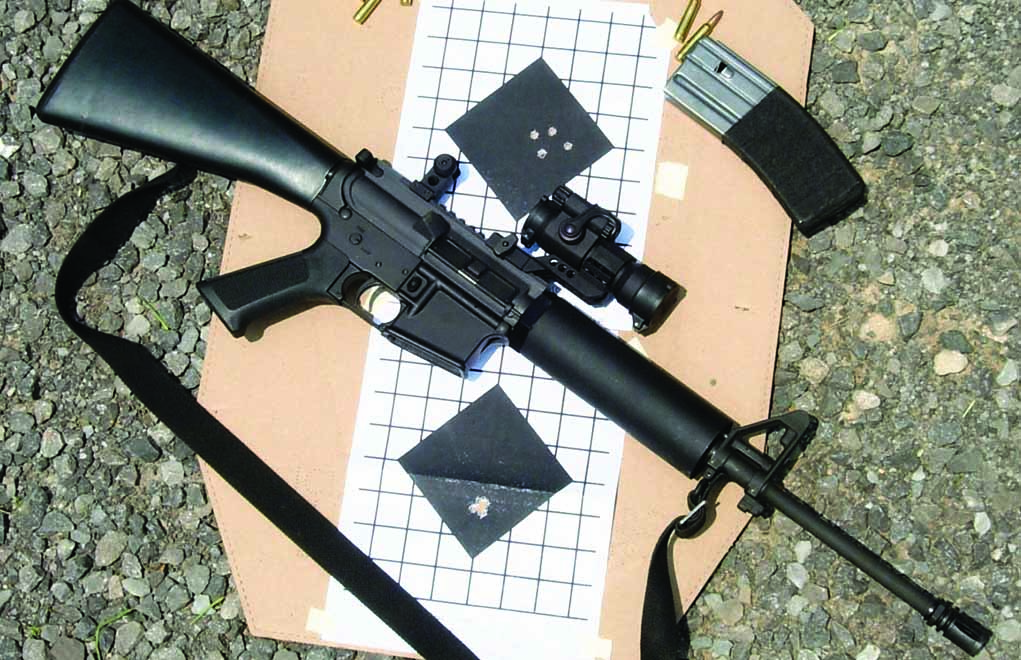
Effective and unassuming, the Crimson Trace Laser Saddle ups the accuracy potential of the Mossberg 590 Shockwave.
Undoubtedly, the most intimidating firearm to line gun store shelves in recent years has been the Mossberg 590 Shockwave. It’s short. It’s wicked. And, in close quarters, it’s highly effective.
What makes the pump-action firearm such a dynamite package is its small stature. At only 26.37 inches in overall length, with a 14.375-inch barrel and a bird’s head pistol grip, the smoothbore gives you everything you need to dominate an intimate self-defense situation. Nimbleness, overwhelming payload and plenty of firepower – it’s all there. Though, the firearm – what it’s technically defined as by the ATF, not a shotgun – does have somewhat of an Achilles’ heel. For the most part shot from the hip or the body, as to control recoil, it’s essentially a point-and-shoot affair.
The Elegant Power Of The Ruger Blackhawk Bisley .45 Colt
This changed in a big way recently with the Crimson Trace Laser Saddle tailored for the Shockwave. While the smoothbore is never going to achieve absolute surgical precision, that’s simply not in its nature, the laser sight goes a long way in enhancing its accuracy to give you the confidence you’ll put shot or slugs where they need to go.
Available with your choice of red or green laser, the saddled is intuitive to use, with three pressure switches at your disposal to activate the unit. The laser itself, projects from the side of the receiver, giving you a clear point of aim that isn’t impeded by hand placement. Arguably, the best part of the unit is it’s unassuming, fitting neatly over the receiver, but not adding additional bulk to the Shockwave. Crimson Trace appears to have cooked up a gem.
The Crimson Trace Laser Saddle is available pre-mounted on the Shockwave, a model with an MSRP of $595. However, the company also offers the Laser Saddle as a standalone to retrofit the pump-action, the red-laser model running $169 and the green-laser model $219.
For more information on the Crimson Trace Laser Saddle, please visit www.crimsontrace.com.
For more information on the Mossberg Shockwave, please visit www.mossberg.com.
Efficient and effective, the Vertx Dead Letter sling bag makes off-the-body carry much more feasible.
You’ve got to get creative. It’s one of the unspoken aspects of concealed carry, but something you soon pick up when you go armed. No matter if you’re talking the garb you wear or how exactly you carry, you’re forced to make a tweak here and there to make a truly effective system that works for you.
To that end, many find a traditional belt holster – OWB or IWB – just doesn’t fit the bill for their lifestyle. In turn, off-body carry very often becomes the most logical solution. And nowadays, there are some pretty slick systems to, not only carry a handgun, but also manage your everyday carry possibles. Take the Vertx Dead Letter sling bag, for instance.
The Elegant Power Of The Ruger Blackhawk Bisley .45 Colt
At first blush, it appears little more than a mild-mannered and fairly attractive sling pack. But at a moment’s notice, a yank of its hot-pull tab, and your handgun is presented in a highly efficient and effective manner. That’d be good enough in and of itself, but Vertx has pulled out all the stops with the Dead Letter bag.
In addition to an intuitive carry option, the piece of luggage has all sorts of extras that not only make going armed simpler, but also your day-to-day routine. Fully ambidextrous, briefcase configuration, generous molly field and an ample load sling, the Dead Letter bag streamlines tactical nomadicity. If that isn’t enough, like all of Vertx’s bags and packs, the sling bag is also body-armor capable. Better safe than sorry.
Certainly, off-the-body carry isn’t for everyone. But for those who choose this route, Vertx has made it all the more feasible with the Dead Letter sling bag.
For more information on Vertx, please visit www.vertx.com.
Micro 9mm handguns are popping up all over, and the Kimber Micro 9 is no slouch.
How the Kimber Micro 9 is set up for concealed carry:
3.15-inch barrel
15.6 ounces unloaded
1.06-inch width
Approximately 7-pound trigger pull
Locked barrel-slide design
No grip safety
Velocities within 100-125 fps of a full-sized 9mm
In one of the old books that I like to read, the author mentions that there are times when one cannot be burdened with a rifle, but the situation may be such that one does not want to be unarmed. Therein lies the virtue of the handgun. Most handguns are portable and provide a measure of protection. With the increase in concealed carry across the country, compact handguns are enormously popular — and the selection is truly bewildering.
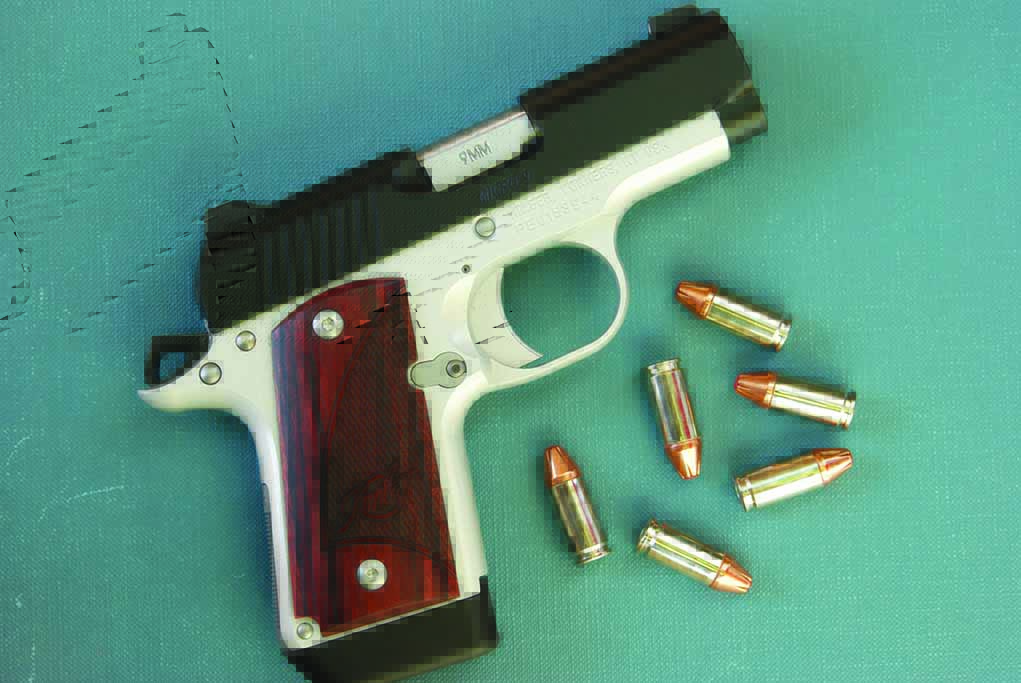
The Kimber Micro 9 is a capable and attractive little pistol.
Small pocketable revolvers have been on the market since the late 1800s, and for well more than a century, the 1911-style has dominated the marketplace. Designed by John M. Browning, the Colt 1911 was the primary handgun of the U.S. military for 85 years. Chambered for the .45 Auto cartridge, the pistol utilizes a single-stack magazine and is fired in the single-action mode. The 1911 pistols incorporate both thumb and grip safeties, and many shooters take solace in the use of two very intuitive safeties.
Kimber offers a vast array of pistols of the 1911 pattern. These include full-size models in .45 Auto, 9mm Luger and 10mm Auto calibers. However, smaller models having 4-inch barrels (the so-called “Commander” size) are also produced in .45 and 9mm calibers, but for discrete carry, models having 3-inch barrels and shorter grips are available.
Newer in the Kimber line are the Micro versions, with the original model being chambered in .380 Auto. These pistols function as a 1911 except for the absence of a grip safety. With magazines that can hold either six or seven rounds, and with a 2.75-inch barrel, the Kimber Micro .380 pistols are easily concealable. However, even though many people want a compact pistol, they desire one with more power than that of the .380 Auto.
Kimber has already taken the next step to produce a more powerful — but yet very compact— pistol. Known as the Micro 9, it’s chambered for the 9mm Luger cartridge and features a 3.15-inch barrel yet, unloaded, it weighs only 15.6 ounces. And because shooters like options, the Micro 9 is available in more than a dozen versions that differ in metal finishes, grip styles, sights and other details.
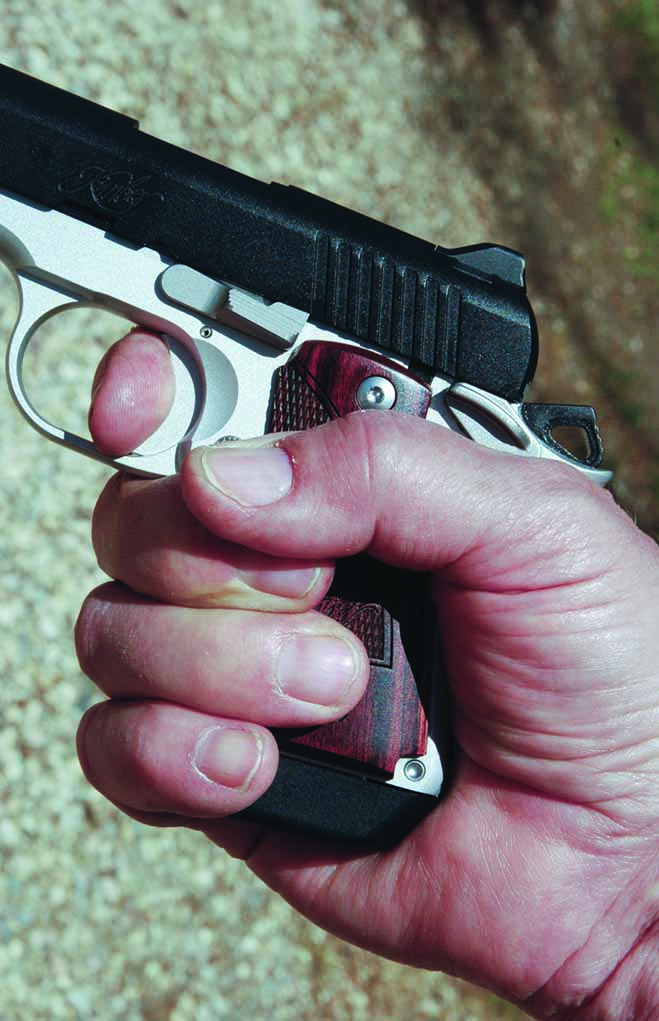
The magazine extension makes it easy to get a good grip on the Micro 9.
My choice was obvious as soon as I saw it: The version known as the “Two Tone” has a blued-steel slide and an aluminum alloy frame that resembles brushed stainless steel. This model may be considered as the “basic” version, but it comes with beautiful checkered rosewood grips and white-dot sights.
Overall dimensions for the Two-Tone are 6.1 inches long, 1.06 inches wide and 4.07 inches high. The sight radius is 4.3 inches, and the trigger pull is approximately 7 pounds — which is not what’s expected for a target pistol, but it’s not bad for the intended uses of a Micro 9. The Two Tone version of the Micro 9 has an MSRP of $654, so it’s not exactly inexpensive, but it certainly is reasonable.
Pistols chambered for the .380 Auto are generally based on a simple blow back action, but this Micro Kimber is no .380 Auto. For a pistol chambered for the more powerful 9mm Luger cartridge, a locked barrel-slide design is necessary. The Kimber Micro 9 features a locking mechanism that involves a large step on the rear of the barrel that mates with the cutout in the slide. Upon firing, the barrel and slide travel rearward for a short distance after which the toggle link pulls the barrel downward. That action moves the locking ridges on the barrel from the recesses in the slide after which the slide continues to the rear to complete the ejection and loading cycle. Unlike most other pistols of the 1911 pattern, there is no grip safety and the safety does not lock the slide.
The seven-round magazine furnished with the Micro 9 has a black extension that allows me to keep three fingers around the grip rather than two on the grip and the little finger below the butt. A good purchase is provided by the checkered rosewood grips, and the trigger is grooved and the backstrap sharply checkered. Altogether, the Micro 9 is comfortable in the hand, and the controls work properly.
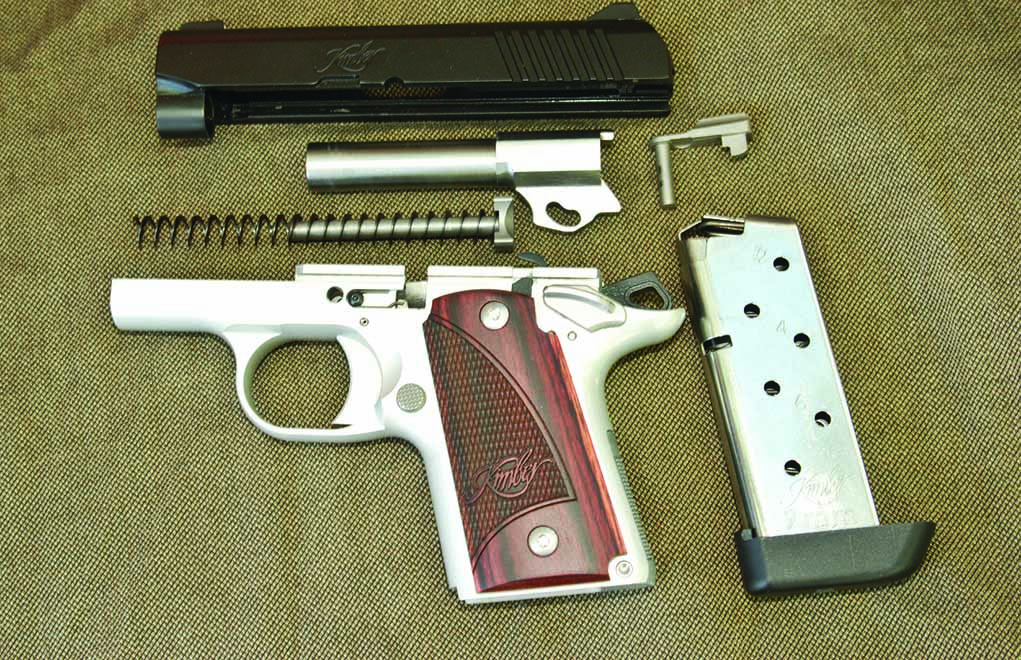
Disassembly and reassembly of the Micro 9 is simple — but it is different from that of full-sized 1911 pistols.
As is the case with full-size Kimber 1911 pistols, when the slide is locked back, an empty magazine must be released before the slide release lever can be moved downward to release the slide. If a loaded magazine is in place, the slide will go forward normally, moving a cartridge from the magazine into the chamber.
Can This Micro Shoot?
With a barrel that measures only 3.15 inches in length, the Kimber is compact for easy carry — but one may ask how much of the performance of the 9mm Luger cartridge is lost with such a short barrel.
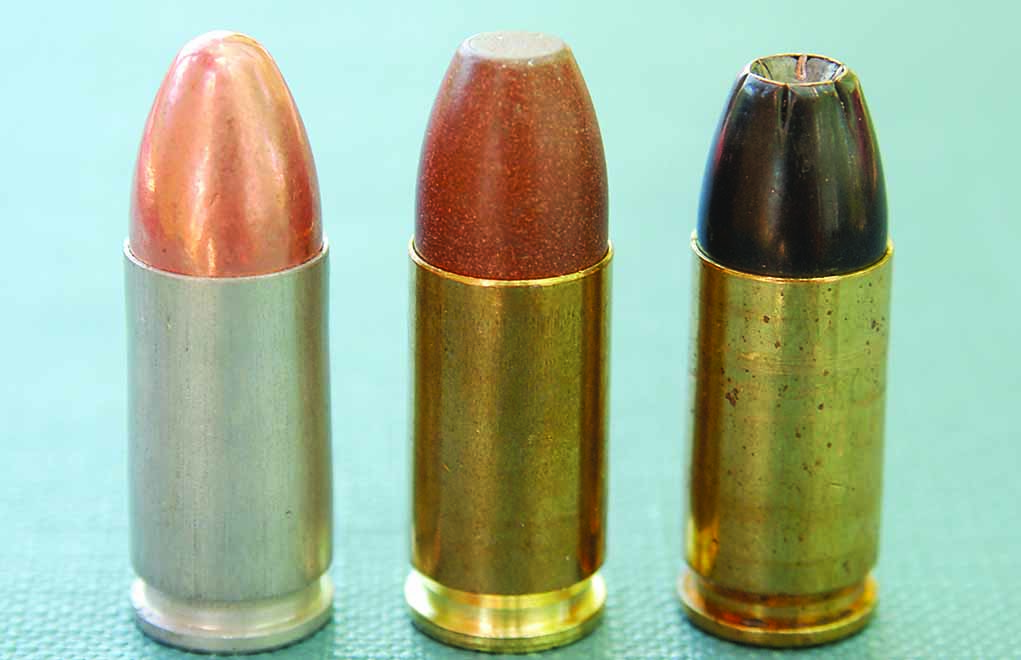
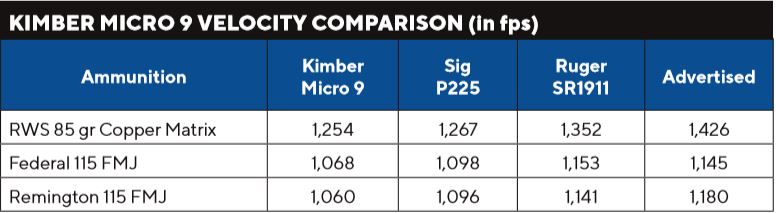
To answer that question, a few types of 9mm Luger ammunition were fired through the Micro 9 (3.15-inch barrel), a Sig P225 (3.6-inch barrel) and a Ruger SR1911 (4.25-inch barrel). The average velocities were measured at 10 feet from the muzzle for those three pistols. Actual muzzle velocities would be slightly higher than those measured at even 10 feet from the muzzle. The data obtained are shown in the accompanying table.
Even using the velocity measured at 10 feet from the muzzle, the little Micro 9 generates 290 fpe with a 115-grain bullet. When used with some of the defensive loads, muzzle energy would be around 300 fpe and that with bullets that give excellent performance. The Kimber Micro 9 may be small, but it’s potent.
The Kimber fed every cartridge flawlessly, regardless of bullet type.
As the data shown in the table reveal, the little Kimber Micro 9 will give velocities that are within 100-125 fps of those produced by full-size 9mm pistols. Velocity loss is expected because of the short barrel, but it’s not substantial. It’s a powerful little beast.
I’ve had a Kimber Micro in .380 Auto for some time and, even though it’s slightly smaller and lighter than the Micro 9, it’s not unpleasant to shoot. However, I had some concern that being chambered for the more powerful 9mm Luger cartridge, the Micro 9 might be a little unpleasant to shoot — that did not turn out to be the case at all. Although recoil is noticeable, firing the Micro 9 is not painful. The bark and jump are there, but not to an excessive degree.
Sights on the Micro 9 are excellent for the intended use of the pistol. The square-topped front mates very well with the square notch in the blade of the rear sight. In order to make the sights stand out in dim light, the three-dot system is used (white dots on either side of the rear notch and on the rear face of the front blade). This combination is both popular and effective. In fact, I find the dovetailed sights on the Micro 9 to be about as good as those on any of my other centerfire pistols that have fixed sights.
Trigger pull on the Kimber Micro 9 is advertised to be approximately 7 pounds. On my pistol, there’s a short take-up movement followed by a crisp let-off, but the trigger pull is indeed heavy. Over many years of shooting many types of firearms, I’ve found that it’s possible to get used to a trigger that has less than ideal characteristics. It took a while to get used to the trigger on the Micro 9, but with familiarity came acceptance — and with acceptance came improved skill.
A shooter who has a Kimber Micro 9 and practices on a regular basis will become accustomed to the trigger action. It will probably be most disconcerting to a relatively new shooter whose experience has been with handguns that are intended for different uses. As a safety issue, one would not want a hair trigger on such a small defensive pistol, but I would prefer let-off to occur with a pull that’s a couple of pounds lighter.
Tiny Reliability
Although the Kimber Micro 9 is not a target pistol, it was easy to get nice clusters of holes in a target placed at 7 yards. In testing several types of ammunition, the pistol fed, fired and ejected reliably with bullets of all types. In addition to several types of factory loads tested, I fired several different handloads and the Micro 9 functioned flawlessly with all loads tested. I have complete faith in the little pistol as long as my target is at short range. The Kimber Micro 9 is available in a plethora of models that range in outward appearance from all stainless to vibrant colors, so there’s a version to satisfy the artistic taste of anyone who wants a compact 9mm that’s similar to the 1911 in operation. The pistols are attractive and fit most hands admirably. The Micro 9 is a surprisingly accurate and adequately powerful little pistol that makes a good piece of defensive ordnance.
Editor’s Note: This article originally appeared in the August 2018 issue of Gun Digest the Magazine.
Aguila Ammunition takes the guesswork out of bulk 5.56 ammo purchases.
Sometimes the best ideas are the simplest. That’s certainly the case with the new bulk 5.56 NATO ammo out of Aguila Ammunition.
Demurring from reinventing the wheel, the ammo-maker continues to offer its uncompromising 55-grain loads shooters have come to love. The difference now is how many they offer per box – 300. If you have any familiarity with AR-15 magazines it shouldn’t take a math genius to see where this is going. It could be 10 fully loaded 30-round or 30 10-round magazines, you’ll always have exactly enough without any pesky stragglers leftover. That’s handy.
The loads themselves are also something to crow about. The 55-grain FMJBT is one of the company’s cornerstone 5.56 options, renowned for its accuracy and reliability. A muzzle velocity of 3,260 fps, the round has the predictable performance at this bullet weight, giving you a range or competition options that is spot on. Aguila Ammunition specializes in range and competition ammunition, so they know their stuff and it shows in its 5.56 offerings. And now it’s all the more convenient that it comes in practical 300-count boxes.
For more information on Aguila Ammunition’s 5mm RRM, please visit www.aguilaammo.com.
Gun Digest 2019, 73rd Edition is jammed full of comprehensive information that firearms fanatics crave. No matter if your passion is long-range rifles, fancy shotguns, gritty Old West single-action revolvers or sleek semi-auto pistols, Gun Digest 2019 delivers. Get Your Copy Now
Remember: Your ballistic calculator is designed to complement your shooting, not become a crutch.
Why you shouldn’t solely depend on your ballistic calculator:
Data provided before shooting is unproven.
Not practical to expect 1-MOA accuracy before shooting.
Doesn’t account for the human element — how you shoot.
Blows some variables out of proportion.
You need to dope your rifle to gather actual data.
The need to focus more on the fundamentals of marksmanship.
Every single day, I’m fielding questions regarding ballistic software. And here’s the problem: People go out to the range with software in hand and can’t quite understand why it’s not matching their setup, or they have trouble “truing” that software after the fact. The Sniper’s Hide Forum is full of people struggling with ballistic software errors.
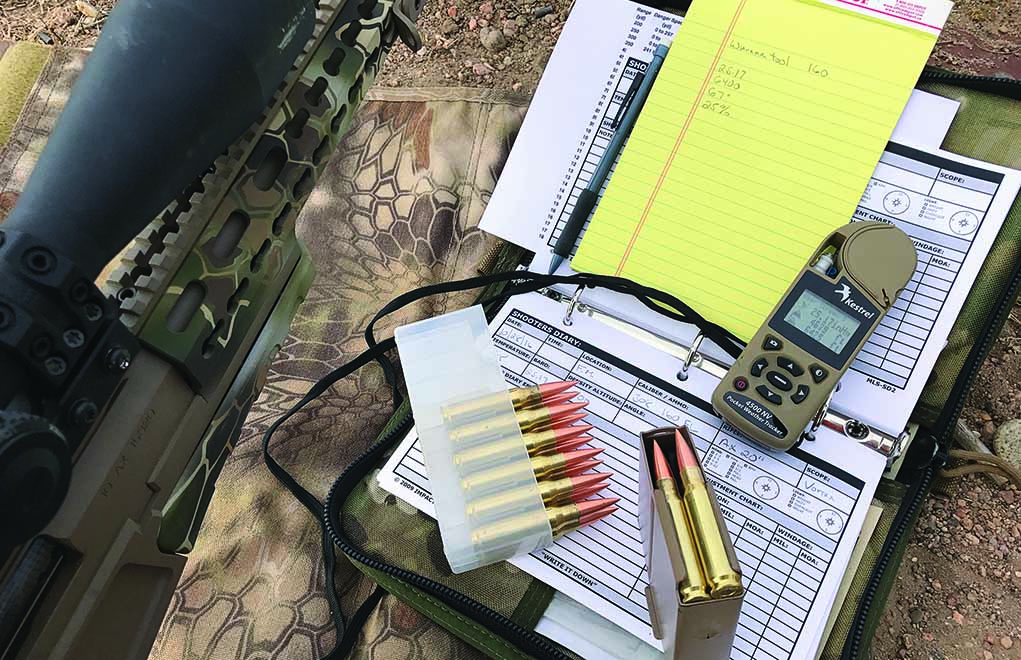
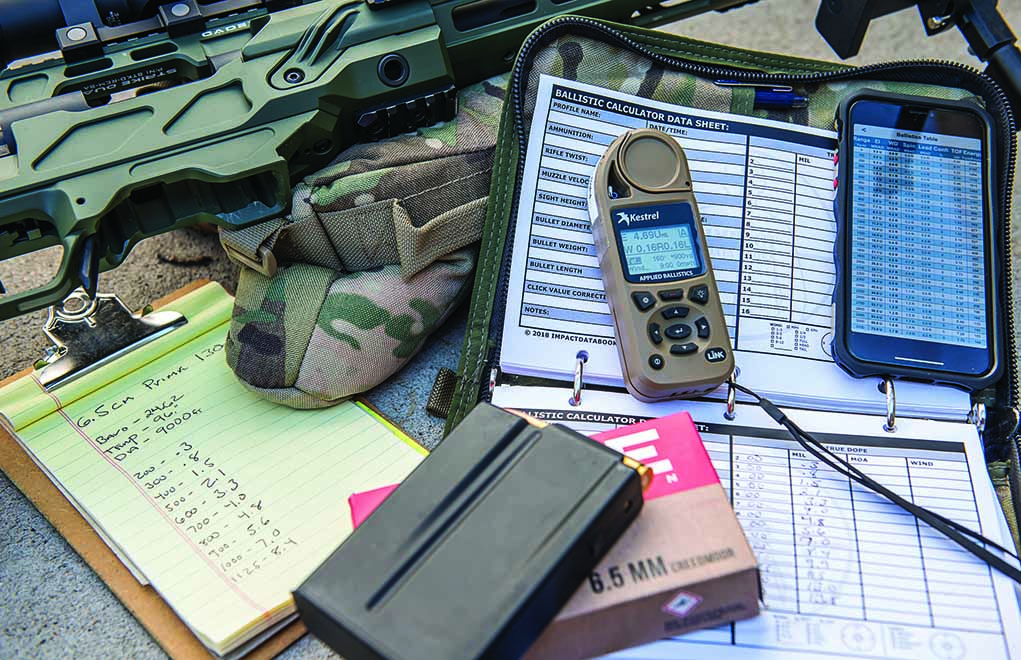
Tools of the trade on display.
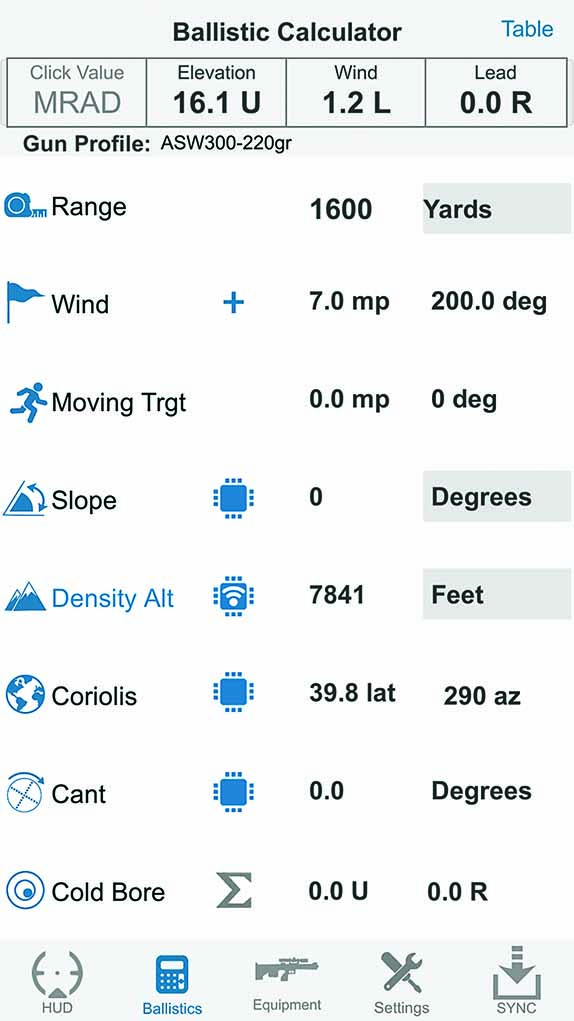
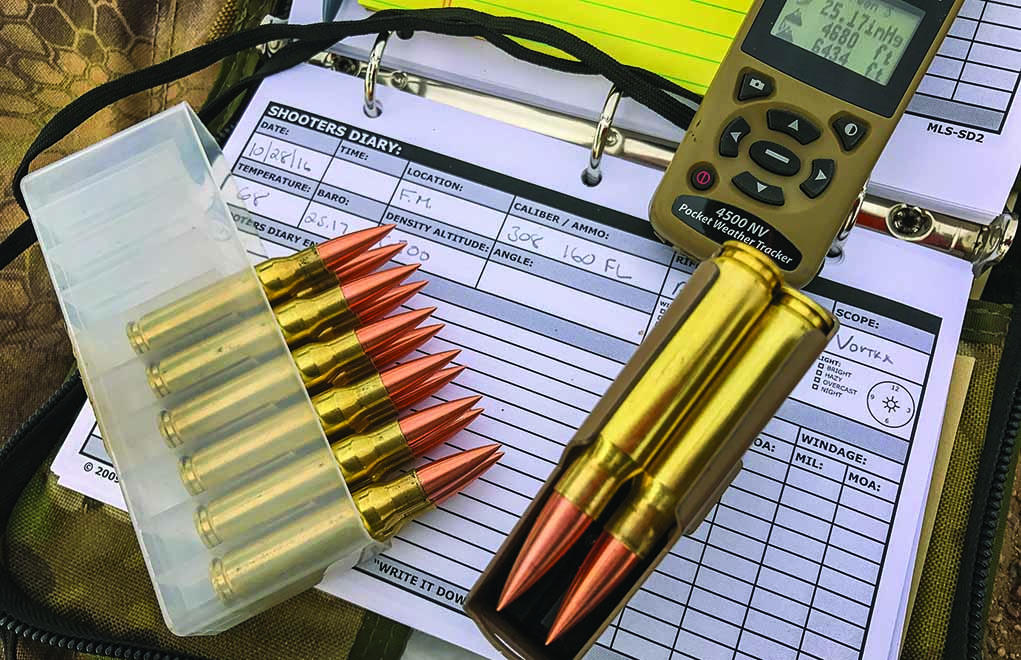
There are several reasons why your software might not line up correctly, but part of the problem is using the software first and not doping the rifle before exploring the ballistic calculator. When using the software before shooting, I call anything the computer spits out as “try dope,” because you’re just trying to touch the target, not much more.
It’s not practical to expect 1-MOA accuracy beforehand. Remember, the manufacturer’s drop data was designed to get you on an NRA 6×6 target board — it’s up to the shooter to fine-tune that drop to hit the center. We never questioned it, and we just knew we needed to put in the effort. It’s just a starting point.
My argument has always centered on the human factor. No amount of tinkering with software can account for the human element, and this has a much bigger say as to where the shot hits versus an untested solution. Simply put: It comes down to recoil management. It’s why one shooter will hit using Solution A; the next shooter needs Solution B or C. How they manage the recoil matters, and it’s why your zero and your friend’s zero are inches apart. No software out there considers you — it only finds an empty, near-perfect world.
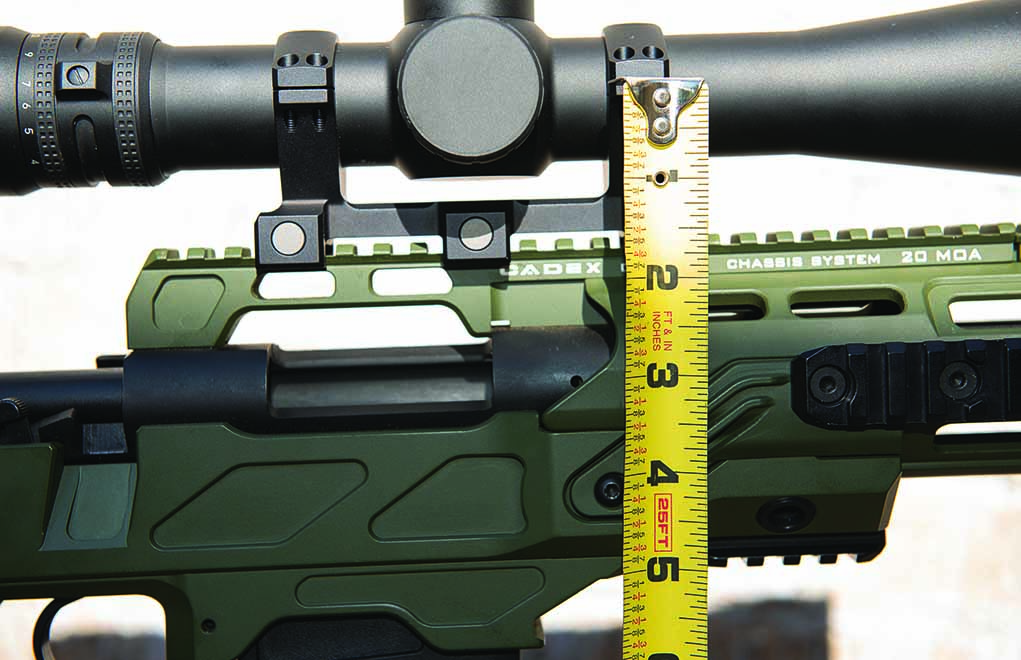
Measure the distance from the center of the bore to the center of the scope when inputting this data into your ballistic solver. The default setting of 1.5 inches is not correct.
The next problem involves the promotion of “drifts.” We have a lot of new data that points to a series of drifts that can affect the placement of the shot, and the promotion of these is a relatively new phenomenon.
Mils vs. MOA: Which Is The Best Long-Range Language?
When I went to Sniper School back in 1986, we didn’t worry about spin drift — it wasn’t even mentioned — we didn’t worry about Coriolis, cross-wind jump or any of the other examples we see today. Today, there are about four drift factors that are discussed, and some people start employing a correction for them as close as 400 yards. Am I saying they don’t exist? No — but I am saying they’re blown out of proportion. I think much of it is used to take the blame away from the shooter.
Here’s Why Testing Is Mandatory
If we gather our dope by walking our shots out — actually shooting each yard line distance and recording the data — we include everything. All the drifts are built into that number. There’s no such thing as a “no wind day.” If you experience one, consider yourself lucky … but practically speaking, no wind doesn’t exist. If it did, Coriolis would not exist. So, under normal circumstances, we zero and dope our rifles with everything already included. Then, when we go to our “data on previous engagement,” it’s taking into account these factors.
We have a lot of tools to gather information on the firing line. Do not go into information overload trying to use them all at the same time.
Let’s say that, today, I’m shooting to 1,000 yards and used 7.4 mils of elevation to hit center along with 0.75 mils of wind for a 5 mph breeze, that assumes all the drifts and drop data is in there. If conditions change because of the location or atmosphere, a computer will help account for it rather than the old, outdated rules of thumb. Still, hitting the target usually happens.
We see this every week in tactical rifle matches around the country. Guys travel from their home location to ranges 500 miles away — and they hit. Why do they hit? They practiced and recorded their dope. Talking to several high scoring PRS shooters, they strive to nail down their data so elevation is a given and their only question becomes wind. In known distance courses, they consider this information their “zero” data. They essentially re-zero the rifle for each yard line.
Learning To Beat Drift
Employing the processes above, the wind has become the most significant drift factor we have, and it will actually offset some of the other drifts. Drift influence still depends on the direction and speed, but it will cancel out or increase several of the other factors. So, it’s important to understand the wind. There’s no dispute that you need to know what’s going on with the current wind because it can control so much of how we hit the target.
There are a lot of ballistic solvers on the market. Many have features common to the others. Find the one you like.
This also includes elevation changes. It’s not uncommon to have a terrain feature in or around a specific yard line that causes an elevation issue, so even if everything with the computer lines up, your 700-yard dope might be off because the wind changes the flight path of your bullet at that specific location. It often has people scratching their head. Why does that one range not line up? Well, it could be the wind.
Still, if we recorded our data, we know what the wind was doing, so if we doped the rifle in a 5 MPH wind, going to an 8 MPH is not like starting from zero. While they might say an 8 mph wind will move the impact 0.1 mils up or down, it’s only 3 mph we’re dealing with. We already accounted for 5 mph, so why add 8 mph on top of that?
If you’re modeling the shot on a computer, I can see the importance of all this. However, it’s not the same as shooting it — not to mention that we miss out on adding our personal spin to the bullet. Poor fundamentals will not line you up with the model.
All you need is your ammo and a hardcopy of your data to be successful.
Let’s say you’re adding 0.2 mils of trigger hook to your shot and you want to call it spin drift — okay, but are we talking about the same thing. Why did I not use any and you’re using 0.2 mils with the exact same wind call? Fundamentals make or break a shot at longer distances.
The point is, while all these factors exist, they’re not equally distributed among the shooters. We all release the shot in our own unique way. So, before you go adding all the drifts to your ballistic calculator, try doping your rifle first without any software. Develop your dope to distance and record everything, then true the software to what you shot rather than worrying about what the computer said before your first round went downrange.
Then — and only then — go back and line up the solver. I think you will find the variations are much smaller than you realize. Solid dope is hard to argue with … we all know the bullet has the last word.
Free From Distractions
A lot of our head goes into shooting a rifle. The human factor is the most significant variable we have to combat. Next to the wind, it’s the No. 1 factor. The fundamentals of marksmanship guide us in so many ways, and deviating from them can cause both vertical and horizontal variations in our shot placement.
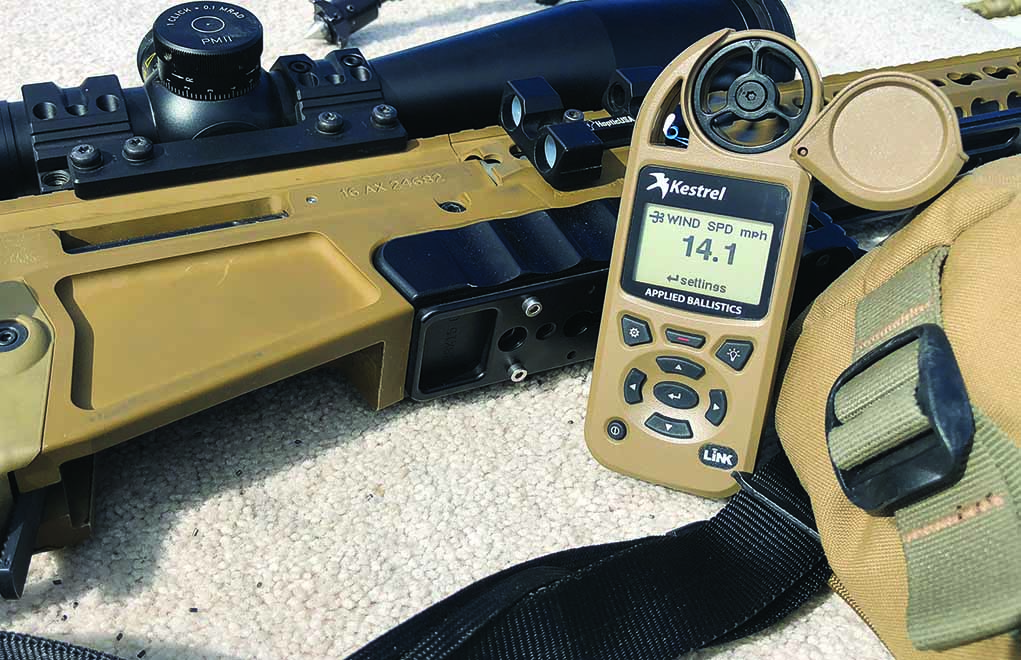
The Kestrel wind meter getting the wind speed on the line.
I recently did a private lesson for a gentleman who shoots for a living. He ran into an incident where his confidence was shaken and needed a fresher course. Immediately during our “fundamental evaluation,” I noticed one of the problems, and the effect was that his initial zero was off by 1.5 inches low and left from center. We worked on his fundamentals together, and after only 40 rounds we were ready to head home. Before leaving the range, I had him check zero. His zero was right back to the center of the ¾-inch dot we were shooting, and we never adjusted his scope. That mental mistake was costing him 1.5 inches at 100 yards.
It’s important we get out of our own head sometimes. If you shoot alone, you end up making numerous adjustments on the fly, never stopping to analyze the cause and effects.
So, here’s an exercise that will force you to take the time to shoot distraction-free for a few series.
1. Put down the ballistic calculator, move the target back and paint it a dark color. Or, better yet, shoot it on paper where you cannot see bullet holes.
2. Placing a paper target beyond 400 yards is the best solution. This way you get a mix of elements at play, and you should not be able to see the holes appear.
3. Start off by doping your rifle for both windage and elevation, and do this based on your standard wind calls. In other words, don’t do anything different. It’s best if you engage in this drill first thing, so the calls are not only blind — they’re also cold.
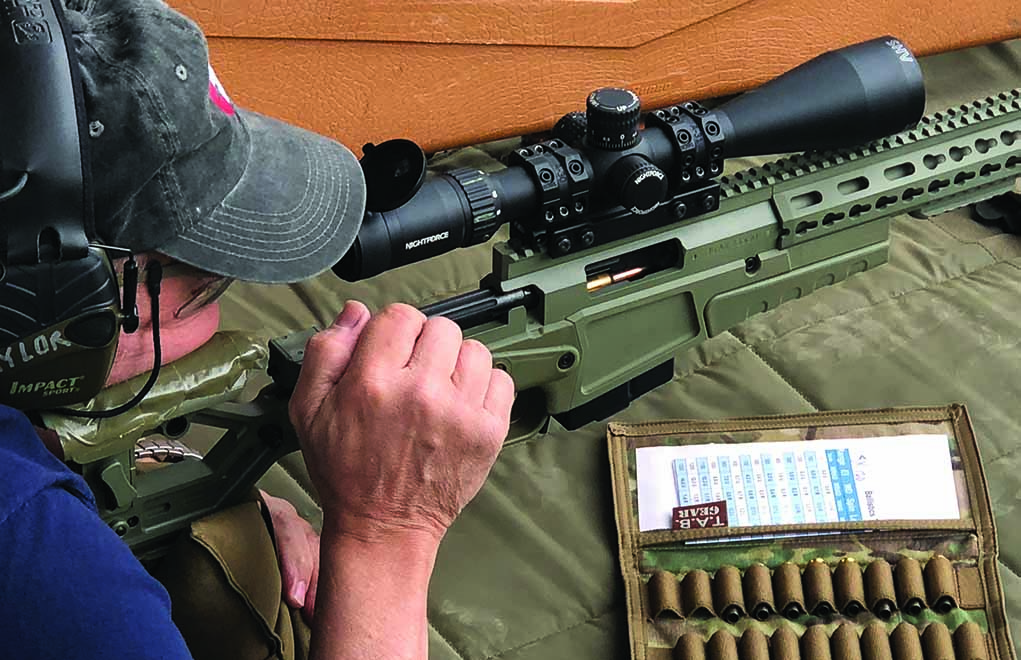
4. Focus in on the target and shoot your group, slow fire. Focusing on body position, use of the support hand with the rear bag, and most importantly, focus on trigger control. If need be, record your call for each, but if you break your position, be sure to reset it properly and don’t just roll into the next shot.
5. Then, go downrange and analyze your target. Look at the group, determine its center and see how that measures up to your point of aim. Look at the horizontal spread and distance from the center. Has the group moved with the wind or against it? Does the group appear open and strung out, or tight and just compensated for by the wind call? All this information should help build confidence and fine-tune your dope.
If steel is all you have, make sure you paint the plate a color where the shot groups don’t show up as well. Sure, you’ll still hear the hits, but you’ll hopefully refrain from making those micro adjustments that center you up. In a word: Don’t chase the impacts.
Dope your rifle first, and try shooting distraction free. Keep your head out of the phone and focus on the fundamentals of marksmanship.
Editor’s Note: This article originally appeared in the 2018 Long-Range Shooting issue of Gun Digest the Magazine.
Back for a limited time, Aguila Ammunition’s run of 5mm RRM should get the rimfire’s fans’ collective hearts thumping.
How Aguila has breathed new life into the 5mm RRM:
Difficult to find current factory-produced ammunition.
Great bridge caliber between the .17 mags and .22 mag.
Available in 30-grain jacketed hollow point and semi-jacketed hollow point loads.
Each load is hot — muzzle velocity of 2,300 fps.
Available in boxes of 50 with MSRP of $30.
A white whale among rimfire enthusiasts, 5mm RRM (Remington Rimfire Magnum) ammo isn’t just a need it’s an obsession. Abundant it is not.
For the everyday 5mm fan, getting fodder for a rifle chambered in the somewhat obscure caliber — most likely a Remington 591 or 992 — is an exercise in eternal hope. Generally, what’s available is squirreled away vintage stock from the 1970s or so that’s been moldering away in the corner of a gunroom or basement. When it pops up sporadically on gun-haggling sites it generally commands a princely sum. But if you have a trigger finger itching for 5mm, what other option do you have? Certainly not reloading.
Given this, it’s no wonder Aguila Ammunition made such big waves recently with its limited run of 5mm RRM. The first 5mm factory ammo to come out in a spell, maybe twice a spell, means only one thing — time to stock up! Otherwise, that 5mm of yours is going to go hungry for a long time or you’re going to pay through the nose to feed it.
Rimfire shooters certainly can’t be disappointed with Aguila taking it upon themselves to roll out ammo for this now uncommon caliber. The company has squared itself away as a rimfire ammunition expert, with a high-performing flavor for nearly any situation. In the case of its 5mm run, Aguila loaded its bottle-necked beauties fairly hot with the 30-grain jacketed hollow point and semi-jacketed hollow point bullets leaving the muzzle at 2,300 fps. This sort of velocity — plus the caliber — the 5mm RRM becomes a nearly perfect bridge between the .17 WSM and .17 HMR and the .22 WMR. At least, it will be dynamite on any varmint unlucky enough to come within 50-yards of you.
Both loads come in boxes of 50 and have an MSRP of $30. The ammunition is presently available, but Aguila will cease production at the end of February 2019.
For more information on Aguila Ammunition’s 5mm RRM, please visit www.aguilaammo.com.
Long-range optics can be somewhat complicated in nature and in their operation, but there are a few key things to remember to simplify the process.
What you need to consider when shopping long-range optics:
Magnification suffers if it doesn’t come with clarity.
A 40x eyepiece is a maximum for a field spotting scope.
The larger the ocular lens, the larger the exit pupil and the more light is transmitted.
Lens coatings reduce light loss due to reflection and refraction.
Variable power spotting scopes tend to be more useful.
Given it shrinks the field of view, too much magnification in a rifle scope can be a handicap.
Too much magnification increases reticle quivers.
It also increases how much mirage you see.
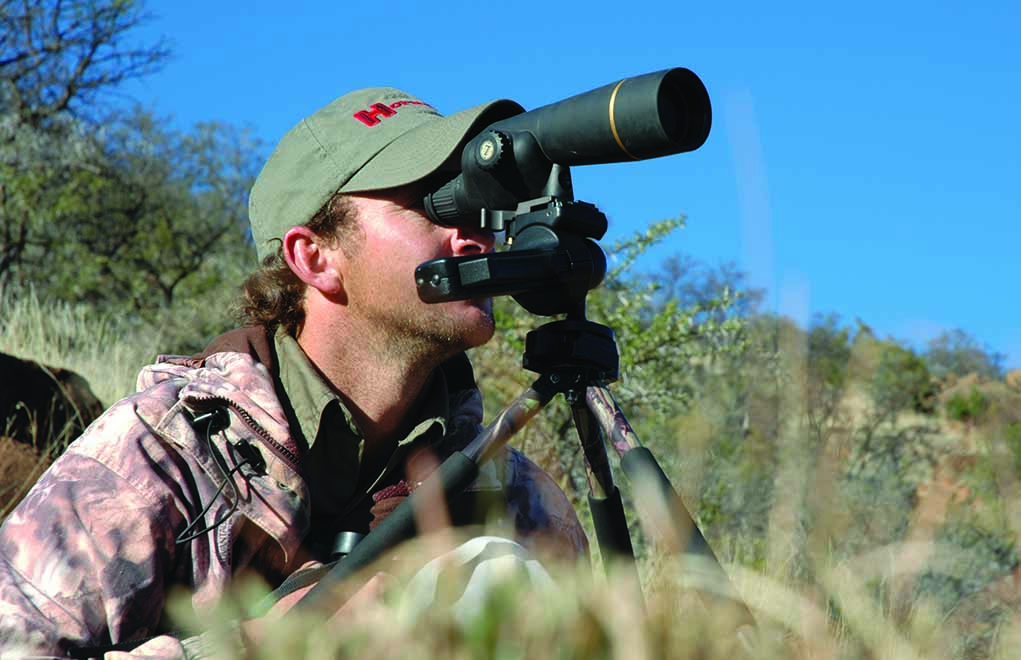
A spotting scope moves things. It pulls things tiny with distance right into your hand. But the “Big Eye” is cumbersome too. On a hunt, you must weigh the benefits of detailed looks at distance against the various costs of making them.
Spotting scopes date way back. In 1608, Dutch spectacle maker Hans Lippershay lined up a pair of lenses on a distant weathercock. A huge chicken appeared, as if by magic! A year later, Galileo Galilei built his first telescope. With it and later versions, he discovered four of the moons orbiting Jupiter and distinguished individual stars in the Milky Way.
Galileo’s first telescopes had a convex objective lens and a concave ocular lens, so the focal point of the front lens lay behind the rear lens. Johannes Kepler changed Galileo’s design to put the image inside the tube. The image was upside down there, but, since these men were viewing stars, upside down didn’t matter! Later, engineers would devise an erector system to right the image. Early ’scopes delivered a fuzzy image, a result of “spherical aberration,” or the failure of light rays to meet at a common point along the lens axis. With no way to refine lens curvature, makers of early telescopes just increased focal length. Some versions had lenses several hundred feet apart! Tubes were both impractical and unnecessary. Compound lenses would eventually correct spherical and chromatic (color) aberrations.
By the time target shooters used spotting scopes to see bullet holes at 600 yards, and hunters took them afield to find bighorn rams, magnification had become an industry. Bull’s-eyes and animals at very long range popped, sharp-edged and super-sized, from a tube no bigger than a rolled-up newspaper. Four hundred years of progress in optics have put close images in a rucksack, and the last 50 years have delivered refinements early astronomers could not have imagined. Still, the Big Eye’s function is the same as it was in the seventeenth century: to help us see better.
Bigger Is Better, But…
Magnification is one assist. But bigger images aren’t sufficient if image quality suffers as a result of the enlargement, or if the image gets dim. In fact, magnifying a recognizable object too much can make it unrecognizable! And the ability of lenses to transmit usable light diminishes as you increase power.
The first requisite of a magnifying optic is that it resolve images clearly. Resolution is a measure of the level of detail you see through a scope. High-resolution optics can distinguish fine detail, separating small objects that, to the naked eye, appear as one at distance. A minute of angle (an inch at 100 yards), is about the limit of resolution for unaided human eyes. A second of angle is a sixtieth of a minute of angle.
In spotting scopes, you’ll sacrifice brightness and resolution for reduced weight and a slim profile.
Given good lenses, boosting magnification improves resolution. So does increasing lens diameter. At high power, a small lens won’t deliver a picture clear or bright enough for you to distinguish what big glass would make plain. A man named Rayleigh came up with a constant that, divided by objective lens diameter in millimeters, yields maximum resolution in seconds of angle. Here’s how it works.
Say your spotting scope has a front lens diameter of 60mm. Dividing 60 into the constant, 114.3, yields a resolution of 1.9 seconds of arc. That figure determines the useful magnification limit of your eyepiece. As your eye can resolve 60 seconds, you divide that by 1.9 and get 31. So, for that scope, magnification of 31x is the usable top end. More power will make the picture bigger, but not clearer; you won’t see any more detail. If you bought a bigger scope — say, one with an 80mm objective—you’d hike the power limit to about 43x (114.3/60 = 1.4; 60/1.4 = 43).
All this is to say that you’re wise to pick an eyepiece of reasonable power. A 20-60x eyepiece may seem wonderful, but the top third of that range is practicably unusable! Even if Rayleigh was off his rocker, 40x is a practical maximum afield, where wind and mirage make still images shimmy, and where you’re often short of light.
Light Transmission And Other Considerations
High magnification means dim images at dawn and dusk. Light transmission is commonly expressed as the diameter of a scope’s exit pupil — that pencil of light making its way to your eye from the ocular lens. Calculate EP by dividing objective diameter by magnification. For example, our 60mm scope with 20x eyepiece offers an exit pupil 3mm in diameter. The bigger the lens, the bigger the exit pupil, if power stays constant. Increase magnification, and the exit pupil shrinks. A bigger exit pupil brings more light to your eye, which can dilate to 7mm in total darkness. As you age, your pupil becomes less flexible, and 6mm may become a more practical maximum. In dim hunting light, 5mm dilation is more likely.
In bright light, your eye doesn’t dilate, it constricts. A tiny exit pupil gives you as broad a shaft of light as your eye can use under brilliant sun. At dusk, a generous objective lens helps you. But the biggest spotting scope practical for field use, one with an 80mm lens, delivers a 5mm exit pupil only at 16x!
Today’s scopes offer a much wider range of magnification than previously possible, which makes them powerful tools for the hunter or shooter.
Lens quality and coatings matter a great deal, and the best are expensive. The price spectrum for spotting scopes reflects real differences in scope and image quality. Still, optics that offer fine resolution and efficient light transmission shouldn’t require a second mortgage. You’ll get them now, even with mid-priced scopes, provided you insist on fully multi-coated lenses. That means all air-to-glass surfaces are coated with compounds that reduce light loss due to reflection and refraction. (Uncoated lenses shed up to four percent of incident light at each surface.) You might also consider ED (extra-low dispersion) or APO (apochromatic) or fluorite lenses. They’re commonly available on top-quality scopes.
While, in my view, most big riflescope objectives deliver fewer benefits than liabilities, you’ll get real value from added lens surface up front in a spotting scope. I prefer 80mm lenses, but 65mm scopes by the likes of Swarovski, Leica, Zeiss, and Nikon are great alternatives, where weight matters.
Another useful feature on spotting scopes is variable power. For hunters, 15-45x is ideal. Keep it at the low end to quickly find an animal you’ve spotted with your naked eye or binocular. Once on target, you’ll appreciate a choice of magnification to match distance and wind and light conditions. I’ve used a fixed 25x Bushnell while guiding hunters. It also served me well on the smallbore circuit, showing .22 bullet holes in targets 100 yards off without undue distortion in mirage or disturbing movement in wind. For hunting, Leupold’s 12x-40x adds versatility. A 15-45x is more useful than any 20-60x afield. Higher power makes sense only at long-range paper, from a very steady support, and then only occasionally.
Less Is More
Because the laws of physics apply to riflescopes as they do to spotting scopes, you should have little trouble picking a sight for long shooting. But remember that a riflescope is for aiming, not viewing, and that its weight and bulk become one with the rifle’s. It must also endure recoil. Many shooters choose scopes that are unnecessarily powerful.
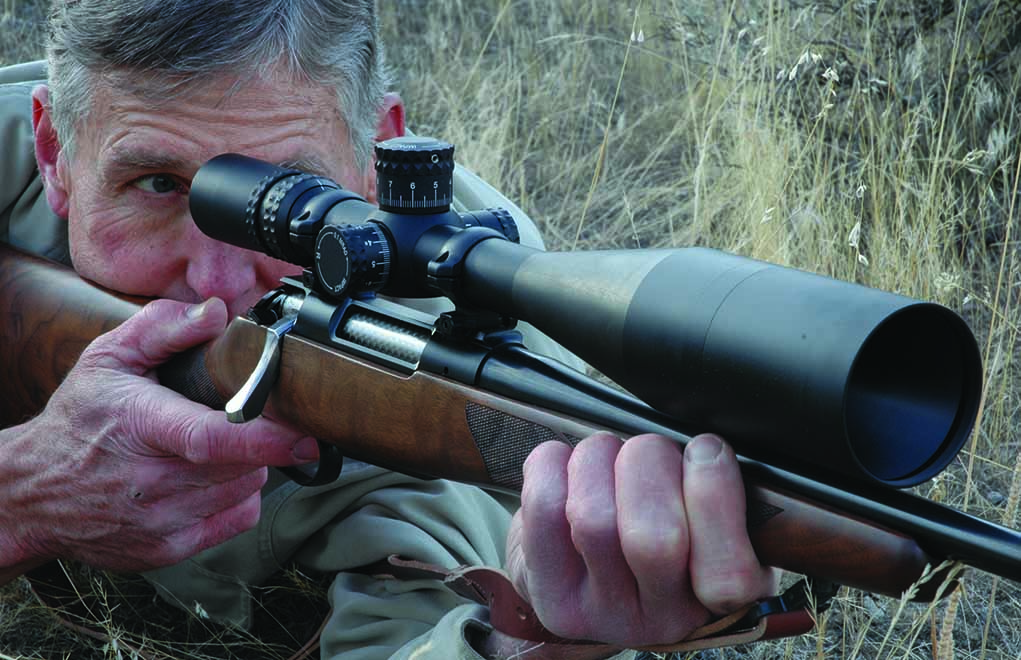
Too much magnification handicaps you in several ways. It shrinks the field of view, so you won’t find the target as quickly as with less. On a hunt, you may not see the huge buck in the shadows to the side of the most obvious animal. High power reduces exit pupil diameter, so, in dim light, the target image won’t be as bright. The magnification that makes that target bigger also bumps up the amplitude of reticle movements due to muscle tremors and heartbeat. Reticle quivers you might not even notice at 2½x become violent dips and hops at 10x. At 20x, you’ll see so much chaos in the tighter field, the target might bounce in and out of view as you try to tame that reticle. A scope helps you when it shows movement you can control. It’s a liability as it amplifies movement you can’t. Instead of applying gradual pressure to the trigger, you wear yourself out fighting the jitterbug image in your sight. As eyes and muscles tire, an accurate shot becomes impossible.
Parallax appears as the apparent movement of the reticle when you move your eye off the scope’s optical axis. Every scope is set for zero parallax at a certain distance, typically 100 or 150 yards in sights designed for centerfire rifles.
Magnification also shows you mirage, a good thing on days when mirage is light and the target is in reasonable range. But, on hot days, when you’re aiming over great distance, the target may appear as a dim, shapeless object stuck below the surface of a raging river.
In general, the least magnification that gives you a clear target image is the best magnification. I use 4x riflescopes for most big-game hunting and think it adequate to 300 yards. A 6x works fine for me at 400. Of course, you’ll want more magnification for small animals like prairie dogs. Deliberate shooting at paper bull’s-eyes and steel gongs brings out powerful glass. I’ve used 16x, even 20x, scopes to advantage in good light, when there’s time for a solid position and precision trumps all else. In smallbore matches, a 20x Redfield served me well. I needed that much power to hold on a .22 bullet hole at 50 meters, or shade to the bottom-right quadrant of an X-ring the size of a bottle cap at 100. I’ve used 25x to good effect on bull’s-eyes, but am inclined to think 20x would have served, too. Higher power is very hard to use.
Variable Power And Adjustable Objectives
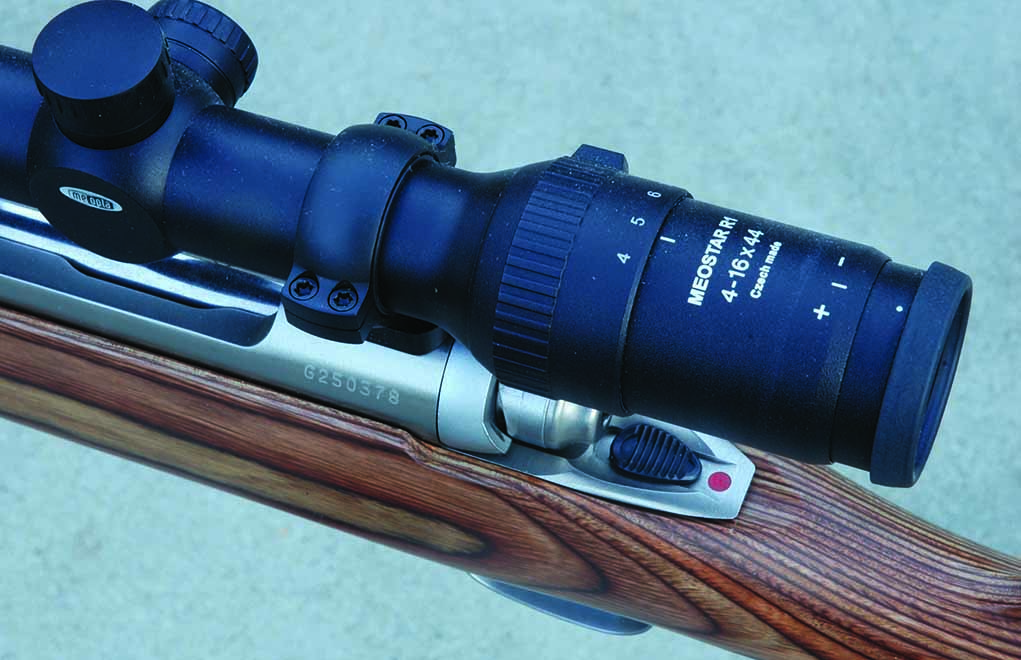
These days, variable scopes offer wide four-, five- and now six-times power ranges; that is, the highest magnification is four, five or six times that of the lowest. So, instead of the 3-9x that once awed sportsmen with its versatility, you can get a 3-12x, a 3-15x, or a 3-18x. Or bump up to 4x on the bottom to get 20x or 24x on the top. Such scopes feature 30mm tubes. These may or may not have a bigger erector assembly (the tube with lenses and magnification cams held inside the main tube). Those with erector assemblies of standard size for one-inch scopes give you more windage and elevation adjustment. That’s an advantage at long range, though a scope performs best with its optical axis close to its mechanical axis.
Keep objective lens diameter modest. The 42mm is big enough unless you insist on very high power. Remember that, with a variable scope, big glass up front enhances brightness only at high magnification. At 7x, a 42mm lens delivers all the light your eye can use in the dimmest conditions. In bright light, your eye won’t be dilated. The 3mm exit pupil of a 14x scope with a 42mm objective is enough.
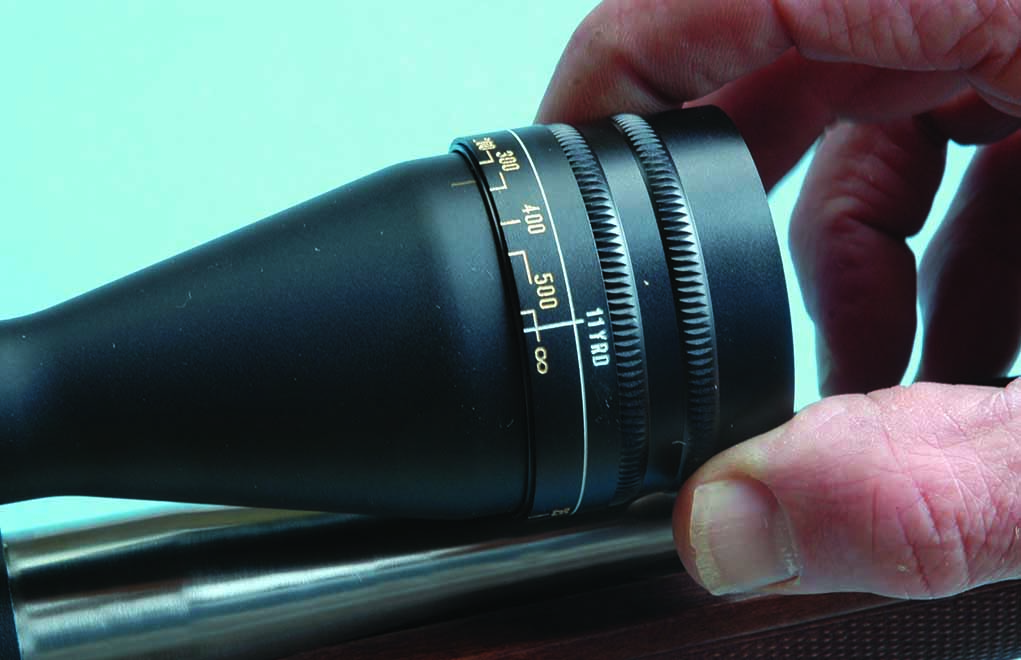
For long shooting, you’ll want an adjustable objective, so you can focus the target and eliminate parallax at the target distance. Parallax appears as the apparent movement of the reticle when you move your eye off the scope’s optical axis. Every scope is set for zero parallax at a certain distance, typically 100 or 150 yards in sights designed for centerfire rifles. At that range, you can move your head up and down or sideways behind the scope, and the reticle will stay on target. At other distances, you may see the reticle off-center when it really isn’t, that is, it wouldn’t be if your eye were directly behind the scope. Adjustable objectives let you zero out parallax. Traditional AO scopes have a sleeve on the objective bell. A knob on the left-hand side of the turret is more contemporary and easier to use.
Reticles And Scope Weight
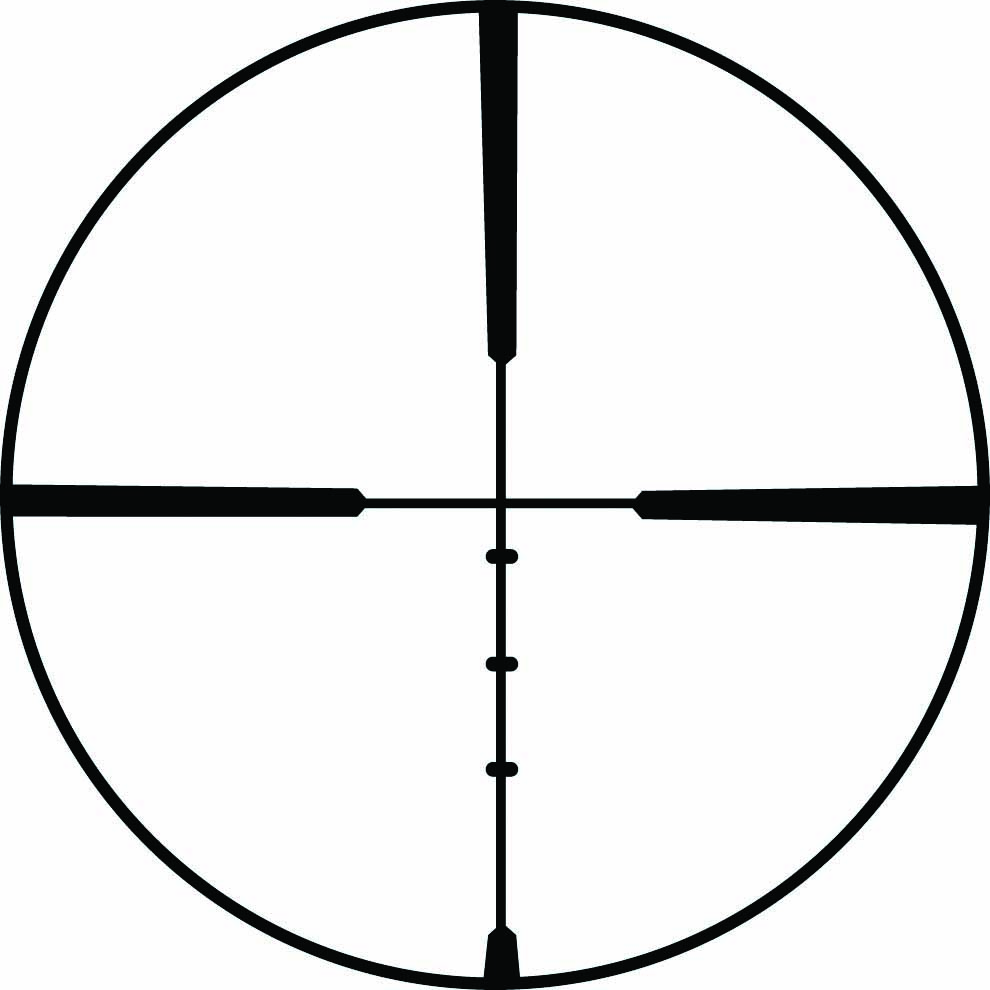
As for reticles, simple is good. For long shooting, a “range ladder” on the lower stem of a standard crosswire or a plex can provide useful aiming points. You’ll want them beyond 400 yards or so. While a fine crosswire yields precise aim, it can cost you a shot if it’s not easy to see in dim light. Avoid jungles of tics and hashmarks and multiple lines that clutter your field. They slow your aim. Picking the wrong intersection has caused many a miss — and the more marks you see, the more likely you’ll make that mistake! The mil-dot is as complex a reticle as I like. Shooters who learn to use it can do well at distance.
Keeping it relatively simple is the best approach with reticles. A few tics are fine, but avoid cluttering your field of view.
While most reticles in scopes marketed stateside have second- or rear-plane reticles, the standard in Europe has been first- or front-plane reticles. Both have advantages and drawbacks. A rear-plane reticle stays the same apparent size (crosswire thickness) throughout the power range of a variable scope. This is good, because most hunters don’t want the reticle to grow in thickness as they boost power for fine aim at distance, nor do they want one that gets thin and hard to see when they dial down for close shots in timber. On the other hand, a first-plane reticle stays the same size in relation to the target as you change magnification, so you can use it as a rangefinding device at any power without recalculating.
Before committing to a scope, consider its weight and dimensions. Besides adding to your burden afield, heavy scopes can slip in their rings under stiff recoil. A long eyepiece can force placement of the scope too close to your eye. Scopes with little “free tube” between bell and eyepiece limit your options for ring location.
Editor’s Note: This article is an excerpt from Mastering the Art of Long Range Shooting.
Introducing full-sized and sub-compact P-10 models, CZ offers a full-catalog of striker-fireds to shooters.
Met with fanfare when released a couple years back, CZ’s latest foray into the striker-fired pistol market hasn’t disappointed. The P-10 proved a studied take on the popular style of pistol, which quickly earned it not only kudos, but a fairly dedicated following in what continues to be a crowded market. CZ hasn’t rested on its laurels when it comes to the polymer-framed handgun line, with a number of additions and upgrades to the P-10 series showcased at the 2019 SHOT Show.
Scuttledbutted about since last summer, the belles of the ball at the firearms/outdoors expo where the freshly unveiled full-sized P-10 F and sub-compact P-10 S. Bookending the compact P-10 C, with which CZ launched the series, the company now has a full catalog of 9mm striker-fireds to cover nearly any shooter’s tastes or needs. The P-10 F is of particular interest, offering up a lot of pistol, including a 4.5-inch barrel, 28-ounce weight and 19+1 capacity. That should do it for about any shooting situation of which you could conceive.
The Elegant Power Of The Ruger Blackhawk Bisley .45 Colt
Of note, both the P-10 F and P-10 S are available optics ready, additionally, there is a suppressor-ready model in the full-sized pistol, as well. Across the board in the P-10 series, CZ has also updated the magazine release, making it ambidextrous and smoother to operate. It should no longer require a break-in period to achieve the action most shooters desire.
For what has been known as a hammer-gun company to most over the years, CZ continues to prove they’re an apt hand in the striker-fired market and continue to give shooters plenty of reasons to consider the P-10.
Enhancing your ability to manage your ammunition, the Versacarry Ammo Caddy is a must have for any lever-action rifle shooter.
How the Ammo Caddy enhances your lever-action rifle:
Handstitched and crafted in America.
Attaches to buttstock or belt in seconds.
Made of premium water buffalo leather.
Holds up to five rounds.
Attaches to base with industrial-grade aerospace grade velcro.
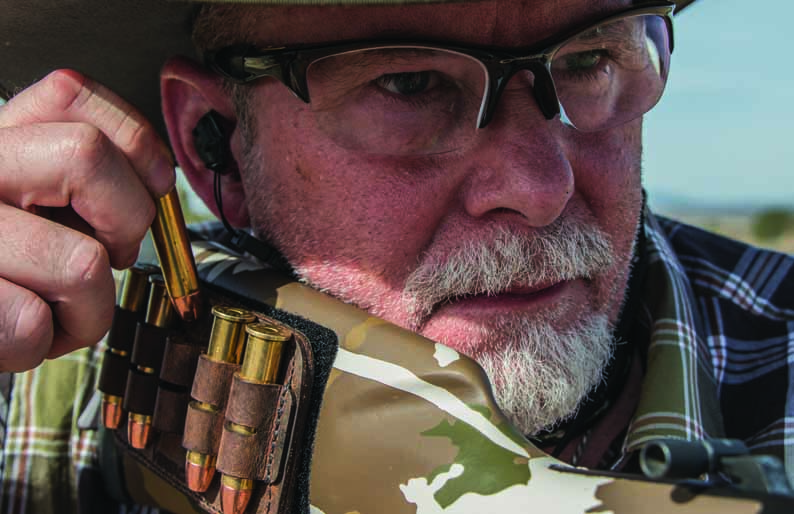
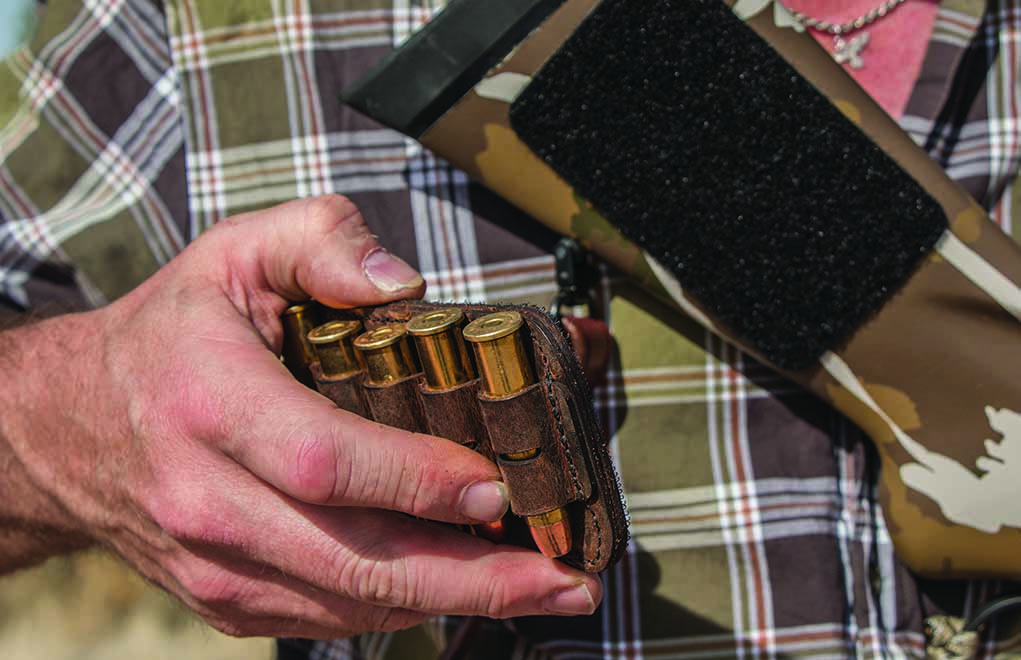
Few rifles require accessories other than the common optical sight and sling. The lever gun is the exception. To take full advantage of what it offers, a quality ammo management device is needed. For years we’ve relied on leather butt-cuffs that strap on the rifle’s stock to hold extra ammo or the field load. These are expensive and cumbersome. The new Versacarry Ammo Caddy is the solution.
The Versacarry Ammo Caddy allows you to easily keep your lever gun loaded to capacity, even during a shootout with an African buffalo.
The Ammo Caddy attaches to the rifle’s stock by a Velcro pad. This allows it to be removed or used in conjunction with extra AmmoCaddys. It also comes with a Velcro-fitted belt carrier, giving you the option of where to carry your Ammo Caddy, or to use more than one — one on the rifle and one on the belt.
More Lever-Action Info:
Big-Bore Lever-Actions: Steel Henry .45-70 Is Golden
I used the Ammo Caddy in Africa on two lever guns. It was the best piece of kit I took on my buffalo hunt, because more than once I needed more ammo in a hurry. I also used it on several other rifles and find it hard to imagine hunting again without it. AmmoCaddys start at $39.99 and are available direct from Versacarry.
Ammo Caddy Specs:
Comes with (1) Belt Attachment
Comes with (1) Adhesive Pad
Outside the Waistband Carry
Available for (26) Calibers
Best Used with Our Double Ply Leather Belt
For more information on the Ammo Caddy, please visit www.versacarry.com.
Introducing reactive light hit indicators at the 2019 SHOT Show, MagnetoSpeed adds a new twist to plain old target shooting.
Better thought of as the home of longhorn cattle and high-caliber college football, Austin, Texas definitely has its geeky side. Strange as it might sound, this is a good thing for shooters.
It just happens that a certain pack of these number-crunching tech types also happen to be gun guys and have turned their studied, data-driven eyes to improving shooting. If you’re into ballistics you might have heard of them — MagnetoSpeed. Yup, the group with the extremely lightweight and convenient barrel-mountable chronograph that uses electromagnetic sensors to deliver insanely accurate velocity readings. Unsatisfied to stay in their own lane, the group of innovators has turned its attention to another area of shooting recently with some interesting results. Fair to say, they’re shedding a whole new light on target shooting.
The Elegant Power Of The Ruger Blackhawk Bisley .45 Colt
The Target Hit Indicator is a simple idea. Basically, it’s an impact-sensitive light that activates once a steel target is struck with a bullet. Pretty uncomplicated, yet powerful. If you’ve ever stretched the legs of your rifle, particularly without spotter assistance, you understand this is a dynamite concept. But it goes way beyond being a notification system to let you know your copper-jacketed lead is landing where you need it.
Programmable, the Target Hit Indicator is also potentially an invaluable training aid, allowing you to test your limits in numerous multiple-target engagement scenarios or under the unforgiving clock. This is a boon for riflemen who, for too long, have been satisfied with banging static steel. Given MagnetoSpeed has a handgun target model available too, the device is also another arrow in the armed citizen’s training quiver. It certainly beats punching away at paper at the local indoor range — just like you did last week, and the week before that.
MagnetoSpeed got its start pushing the limits at the firing line. Now with the Target Hit Indicator, it’s doing the same at the other end of the range.
For more information on the Target Hit Indicator, please visit www.magnetospeed.com.
Do you trust your reloading skills enough to bet your life on them in a dangerous game situation?
Why You Should Consider Handloads For Dangerous Game:
Utmost quality control of ammunition, personally done.
Customized loads for your rifle, your shooting style and the game you’ll pursue.
Ability to utilize the most cutting-edge powders on the market.
Access to bullets that aren’t available in factory-loaded ammo.
I have received more than one sidelong glance when I mention that I handload my own safari ammunition. In fact, along the course of seven safaris to Africa, with the exception of a .22 LR, I’ve never used a factory round for hunting in Africa. Now, that’s not to say that I wouldn’t, because there truly is some wonderful factory ammo out there, but I prefer the reliability and flexibility of my own handloads.
The author with a Cape buffalo bull, taken with a Heym Model 89B in .450/400 3-inch Nitro Express, handloaded with 400-grain Peregrine BushMaster soft-points.
All this includes both plains game and dangerous game, in calibers from .300 Winchester Magnum up to and including the .470 Nitro Express. The level of dedication is the same, no matter the quarry; each and every cartridge needs to be your best work, so that it can be counted on when it matters.
If you’re a dedicated handloader — the type that has gone beyond the hobby phase — and an equally dedicated hunter, as you must be since we’re discussing a trip halfway around the world, I see no reason not to trust your handloads. Personally speaking, I have had more issues with factory ammunition than I ever have with my own handloads. Though they have been few, I’ve seen some eye-opening problems, including entire boxes of cartridges containing the wrong caliber ammo (boxes labeled .30-06 that contained .25-’06 ammunition), primers installed upside down and different projectiles within the same box.
These visible problems can easily be caught by anyone who is headed to the Dark Continent before they leave, as all your ammunition should be checked and checked again (I prefer to run them all through my rifle to ensure they feed properly), but what does that say about the things we can’t see? Is the powder charge consistent? Is the primer the right type for the cartridge? Without trying to make you stay up at night worrying, these are realistic problems.
Quality Control
When we handload our ammunition, it gives us an opportunity to examine — and control — every aspect of the cartridge, and head off any problems at the pass. If a cartridge case isn’t up to snuff, perhaps the flash hole isn’t proper, or some other parameter bothers you, simply discard it. All of the cases, inside and out, will be personally inspected by your own eyes, hand-trimmed and tuned.
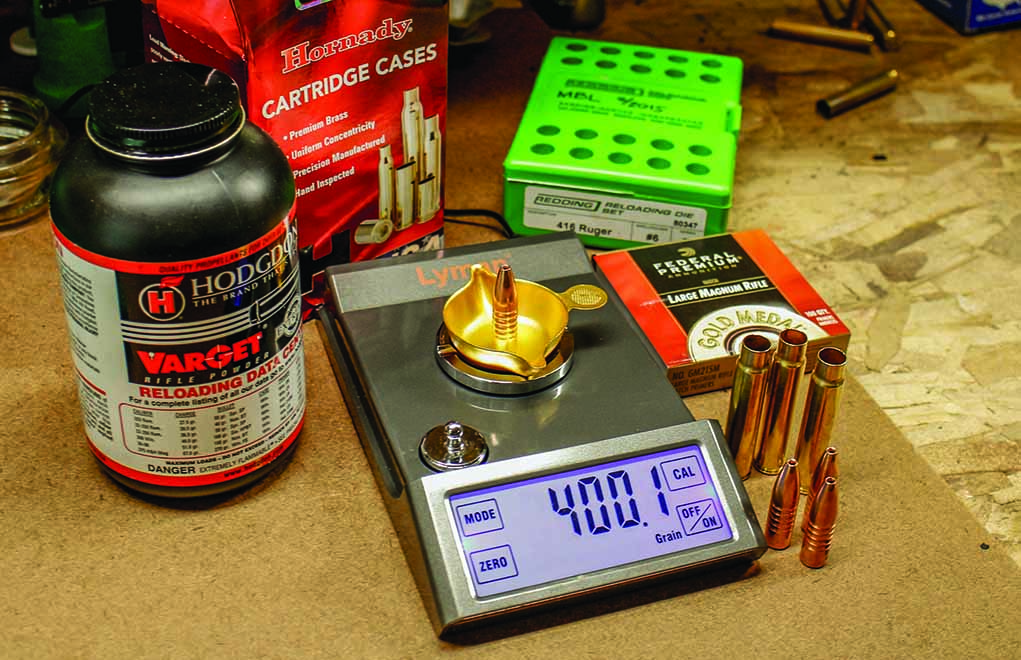
It’s impossible to see what’s going on inside a factory cartridge; you simply must trust that all is well. Again, major problems are few and far between, but I feel the extra steps taken are well worth the effort. The projectiles — the only part of this entire equation which actually touches your game animal — are also subject to the inspection process. Even with the most expensive ammunition, you can’t see if there are defects on a bullet already in the case. Now, we can’t see the internal structure of a bullet, but we can weigh it to make sure that things are as equal as possible. And of course, our powder charges can all be weighed precisely, and our primers can be installed in a consistent fashion.
Custom Options
Beyond the basic parameters of consistency and reliability, we can also control the performance of the cartridge overall. For example, the traditional .404 Jeffery load is a 400-grain bullet at 2,150 fps, with the modern variation being the same projectile at 2,350 fps. If neither deliver the accuracy or performance you want, handloading can solve it. I own two rifles chambered for the old African classic, and both give the best accuracy at a muzzle velocity of 2,280 fps. Perhaps it’s a coincidence, but I might never have experienced that accuracy from any factory load.
With a bolt-action or single-shot rifle, you can easily play with the velocities; reducing the .375 H&H Magnum from 2,550 fps to 2,450 fps with a 300-grain bullet will give a marked reduction in felt recoil — for those who are sensitive — with little or no difference in field performance. In a double rifle, you will be (generally speaking) married to the velocities and bullet weight at which your double was regulated, so it’ll be an experimental procedure, fine-tuning the formula until you find the proper velocity for the regulation.
For cartridges like the .416 Ruger, where factory choices are few, handloading will keep the rifle fueled and in the field.
Of course, once you’ve got it, you can spend much more time practicing, as the cost of handloaded ammo for the big doubles is considerably less than that of the factory rounds. Changing powders in a double rifle cartridge can, however, change the felt recoil while maintaining consistent velocities. The .470 Nitro Express — well served by Hodgdon’s H4831SC — can attain the same velocities with a considerable reduction in felt recoil when using Reloder 15. It’ll take some experimentation, but the results are worthwhile.
Powder Possibilities
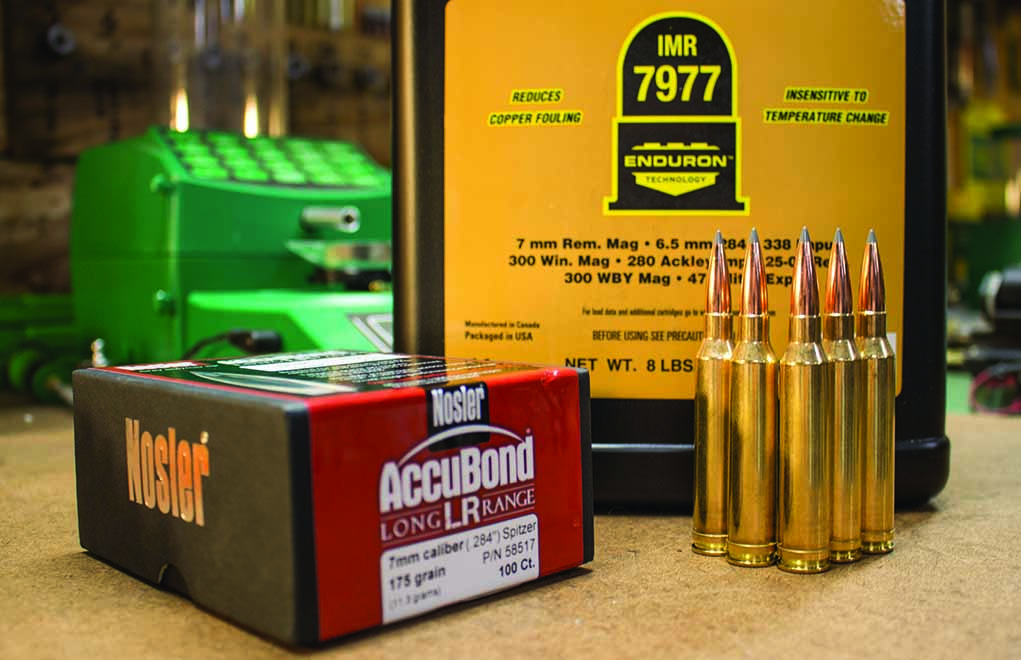
With the new powders available on the market — many of which minimize the effects of temperature fluctuation — the African heat plays less of a role in the ammunition equation. I’ve found that IMR4451, in the Enduron line, has all but replaced IMR4350 in many of my African ammunition. It offers a lower standard deviation on velocity, and works very well in the .375 H&H, .300 Winchester Magnum, .300 Weatherby, 7mm Remington Magnum and other applications where IMR4350 was the standard. I’ve used it in temperatures as high as 114 degrees Fahrenheit with no issues whatsoever. IMR4451 is just one example, and there are others which will give similar resistance to the hottest conditions.
The behemoth .505 Gibbs, with powder charges exceeding 140 grains, will certainly benefit from the temperature insensitive powders like IMR 7977 and IMR 8133. With that much powder, any benefits we can get are well worth it. Whether or not modern factory loaded ammunition takes this into consideration, I cannot say.
The Bullet Bonus
Then there’s the option of using projectiles that simply aren’t available in a factory configuration. The North Fork Flat and Cup Point solids, and their excellent soft-points, are not an option for those who shoot factory ammunition from the major players. And they are excellent bullets, with the ability to handle the largest and most dangerous game on Earth. Either they are handloaded or they’re off the menu. The same can be said for many other of the medium-bore plains game bullets: There are some wonderful hunting bullets that are simply unavailable from the ammunition factories.
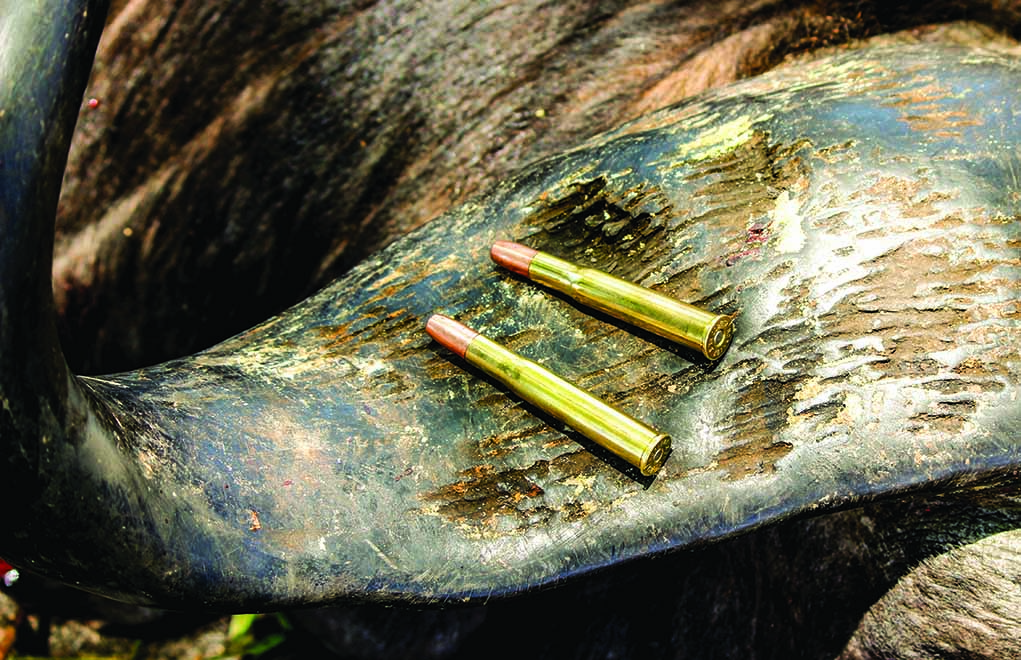
The author’s handloaded .450/400 3-inch NE ammunition, on the horns of an old Cape buffalo bull.
Just as you would buy the best of any piece of safari gear you could afford, I’d recommend the same thing with reloading gear: This is not one of those places where you want to pinch pennies, and the economics of handloading are certainly not the central focus. While I’ve found that the average cost of the handloaded ammunition is indeed below that of the factory stuff, especially with the true big bores and the Nitro Express cartridges, the dies can be expensive — usually about the price of one box of premium ammunition — but they will give a lifetime of service if properly maintained.
In addition, some of the larger cartridges, such as the .500 Nitro Express, .500 Jeffery and the .505 Gibbs, will require larger diameter press threads to hold them. The threaded nut in your press can be replaced, and I keep a separate press for those cartridges.
So, should you trust your handloading skills enough to make your safari ammunition? I vote yes. If you trust your hunting and shooting skills enough to successfully hunt Africa — and its lineup of animals that can kill you — and you handload for other hunts, become a bit more meticulous and take the plunge. As with any hunt where you cleanly take an animal with your own ammunition, it’s a very satisfying experience, perhaps even more so because Africa is such a special place.
Editor’s Note: This article originally appeared in the October 2018 issue of Gun Digest the Magazine.
If you hunt, it’s not fair to keep your AR all penned up at the range.
How the AR is on target for hunting:
Easily configured for the field.
Switch uppers to match caliber with game.
Overall light rifle to carry.
With right caliber appropriate for everything from varmints up to big game.
Proven accurate platform.
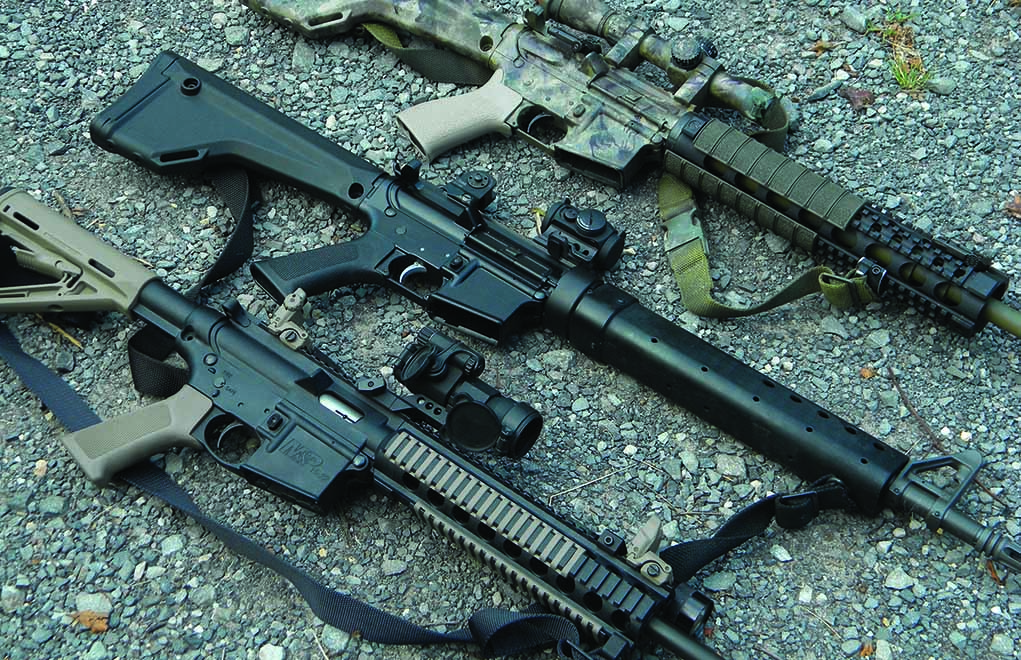
The AR is a versatile platform. Its modular design allows the user to configure the AR to do almost anything, from self-defense and patrol work to long-range precision shooting to run-and-gun competitions. In recent years, the AR has been gaining popularity with hunters. You can truly have one rifle — the lower receiver — and by exchanging a few parts use it for small game and varmint shooting, putting food on the table and defusing the “pig bomb.”
The “modern sporting rifle” — the AR — can be used for much more than just defensive applications. It’s a great platform for hunting, and its modular design makes it even more versatile. Just remember to check restrictions on caliber and magazine capacity, and choose the proper ammo.
The .223 Rem./5.56 NATO is a great round for mid-size game. This caliber is a descendant of the .222 Remington, or “triple duce,” which was introduced in 1950. The .222 Rem. is a flat-shooting, accurate round that immediately found favor with bench-rest and varmint shooters. (The first recorded “one-hole” group — five shots at 100 yards measuring 0.0000 inches — was shot by Mac McMillan in 1973 using the .222 Rem.) In Europe, where military calibers are prohibited, deer hunters put it to good use: The .222 Rem. was stretched out to create the .223 Rem., which leads to the 5.56 NATO military round.
The “modern sporting rifle” concept introduced a new generation of hunters to the AR platform. They discovered that the AR is useful for much more than defensive/combative applications: It’s an easy rifle to shoot, it’s extremely accurate with low recoil and it allows for immediate follow-up shots. The AR is easy to transport, too — just separate the upper receiver from the lower and you’ve got a compact package for travel. And, hunters have learned that the precision AR is something they could assemble, as opposed to spending a lot of money and waiting for a gunsmith to complete a custom build.
It also motivated the design and development of alternative caliber ARs: It’s no secret that you can have a “black rifle” in a variety of calibers and colors. New products, such as free-floating handguards, match-grade barrels and specialty optics, have been specifically designed for hunting and thusly were brought to market.
And again, the AR’s modular design is a big plus for hunters. Push out the two takedown pins and the upper receiver group — the actual receiver, barrel, bolt group and sights/optics — is easily separated from lower receiver group (lower receiver, trigger group, buffer assembly and stock/grip).
The part considered to be the “actual rifle” is the lower receiver, which is has a serial number. So, you can actually have one rifle — the lower receiver — that you can pair with a variety of calibers simply by swapping out the upper receiver.
From Range To Field
Your .223 Rem./5.56 NATO AR will work for mid-size game … with the correct bullet. As mentioned above, the .222 Rem. was a popular cartridge for deer hunting in Europe, and the .223/5.56 works just as well here in the States (some states or areas you hunt might have restrictions/limitations on caliber size, so check the laws).
The AR is one rifle that will do almost anything, and that certainly includes hunting. By swapping upper receivers, you can run a variety of calibers through your lower receiver for a variety of pursuits. Or, you can assemble dedicated rifles for specific purposes — and with the proper tools and knowledge you can do it yourself.
Hunting with the .223/5.56 is all about bullet selection. The standard 55-grain round will function well, but most hunters will step up in bullet weight, using a hunting bullet designed with a hollow-point or ballistic tip. As with any ammunition, you’ll need to test fire for function and to confirm accuracy, making any adjustments required to get a hard zero. Remember, switching ammo — from one weight/type ammo to another — can cause a significant shift in point of impact.
Your AR can also be used for small game hunting. It’s an extremely accurate round, even at long distances, and a favorite for varmint hunting. But, it’s a little too “hot” for small game such as squirrels or rabbits, where you want to harvest the meat.
The solution is to pick up a .22 LR conversion kit. The .22 kits have a bolt group and modified magazines, so converting your AR to .22 LR is easy. Like always, the secret to shooting accurately and reliable functioning is ammo selection. Test fire a variety of .22 LR ammunition until you discover what works best in your kit. At the same time, adjust the sights as required. Also, after using a .22 kit, be sure to clean everything well. The .22 LR rounds can foul the barrel heavily and will sometimes leave residue in the gas system. Clean well, then test fire with your centerfire cartridge to confirm function.
Maybe your hunt needs a little more punch or distance than the .223 Rem./5.56 NATO provides. You can swap out upper receivers and convert your AR to a 6.5 Grendel. Now you’re pushing bullets from 90 to 129 grains with velocities from 2,900 fps with the light bullets to 2,500 fps with the heavier bullets. This provides more thump on target, especially at extended distances. And, you’re using the same .223/5.56 magazines you already have, although mag capacity will be slightly reduced due to the diameter of the bullet’s case.
Another option is converting to the .300 Blackout round. This round is a favorite among pig hunters, especially those using suppressors. The .300 BLK is available in a wide variety of weights, ranging from 70 to 90 grains at around 2600 fps, to heavier bullets in the 220-grain weight moving at around 1,000 fps.
Of course, you also have the option of getting the AR in .308 Win., the original AR caliber used in the AR-10. This caliber is definitely big enough for mid-sized to large game. Or, there are a variety of offerings in different calibers. But, this gets away from the one-rifle concept.
The “modern sporting rifle” is a perfect platform for the modern hunter. It’s easy to use, reliable, accurate and available in a variety of calibers. By easily swapping out parts, you have one rifle that will do and hunt almost everything — and you can even build it yourself. And, if things get really bad, you can still use it for self-defense.
Editor’s Note: This article originally appeared in the October 2018 issue of Gun Digest the Magazine.
Cleaning and lubricating your firearms in one felled swoop, Clenzoil streamlines your gun cleaning process.
There are rare cases where someone enjoys cleaning their guns more than shooting them. Maybe if you worked at the Cody Firearms Museum you might find a certain satisfaction in breathing new life into old steel. Even then, it’s a safe bet that somewhere in the back of your mind you’d still linger on the idea of sending hot lead, not cold cotton, down the bore of an original Colt Single Action Army revolver or what have you.
The Elegant Power Of The Ruger Blackhawk Bisley .45 Colt
Gun owning means gun cleaning. You might as well make the best and most of it, use it as an opportunity to enhance the overall experience and ensure your gun is in tip-top condition the next time you’re behind the trigger. Next to having the right gun cleaning gear, the most important factor in guaranteeing this happens is employing the right solvents and lubricants. Clenzoil streamlines this process, by giving you both of these in one marvelous gun cleaning product.
The one-step cleaner and lubricant has been among the most trusted gun-care products for nearly three-quarters of a century now. Powerful enough to remove oils, dirt, copper, lead and other contaminants, Clenzoil busts up and clears out all the gunk that fouls your gun’s bore and other metal surfaces. It also provides a thin, non-greasy coat that prevents rust and lubricates all moving parts. That’s enough in and of itself to give it a crack, but Clenzoil also does a number on wood and leather. Yes, you heard that right. The same cleaning agent you use to strip copper from your grooves can keep your sling supple and soft as well.
Certainly, Clenzoil won’t stop you from having to clean your guns. But given its incredible versatility, it will make it a heck of a lot quicker and more thorough process.
For more information on Clenzoil, please visit www.clenzoil.com.
The booths are broken down, the convention center cleared out and another chapter of SHOT Show is in the books.
While the sheer magnitude of the event is always enthralling, overall the latest iteration of the world’s largest outdoors and firearms exhibition wasn’t earth-shattering. Pistol-grip smoothbore firearms have been done time and time again. Single-stack polymer-framed pistols are as common as Tuesday now. And the 6.5 Creedmoor, what rifle maker doesn’t have one in their stable?
This situation is unsurprising, given inventories are still high and buying appetites are not nearly as ravenous as they were a few years back. People, wisely or not, feel politically safe for the moment and aren’t racing to make purchases to beat potential legislation to the wire. This makes for the perfect storm where the addition of a thumb safety or FDE finish model constitutes a new release.
Still, even without a nuclear-level release the past week in Las Vegas, there were still quite a few head-turners at the Sands Expo Center. Guns done right, built to perform and well worth the time and effort to check out. To that end, here are four that caught our attention. There a plenty more out there, but these particular ones got us excited about 2019 prospects.
Daniel Defense Delta 5
Best known for their top-shelf ARs, Daniel Defense made a break from semi-automatic rifles this year with its innovative Delta 5 bolt-action rifle. A switch-barrel design, the company presently offers .308 Win., 7mm-08 and 6.5 Creedmoor barrels, and said there is the potential for more calibers down the pike.
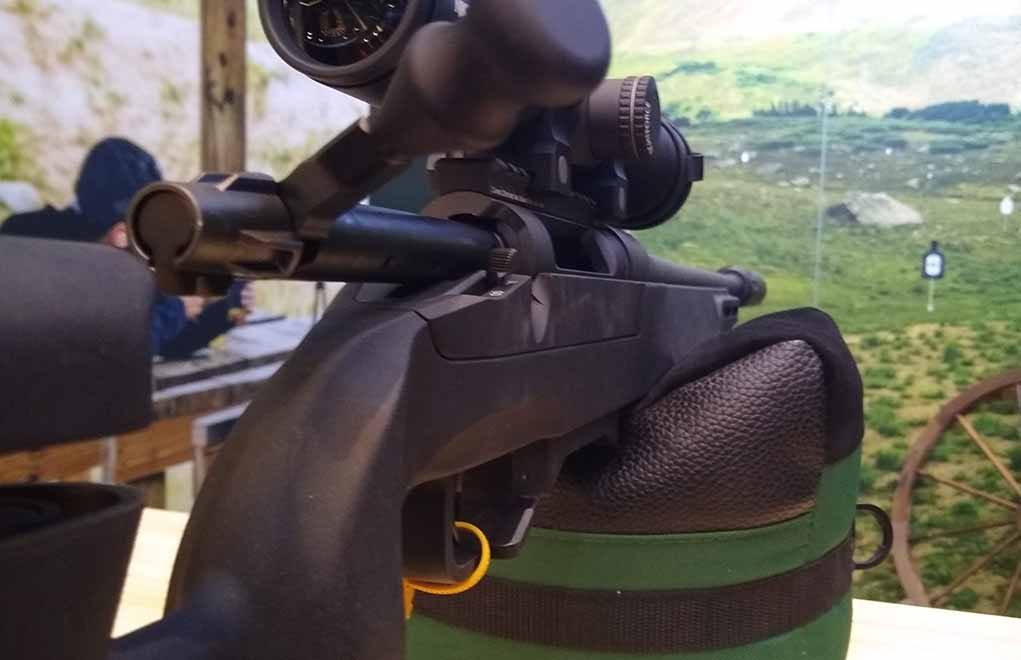
No matter what it’s launching, the Delta 5 is – from muzzle to buttstock – made to land dead on target again and again. To this end, the rifle boasts a fully adjustable carbon-fiber reinforced stock, with a mini-chassis that creates a rigid platform for the stainless-steel action and CHF barrel. Furthermore, its Timney Elite Hunter single-stage trigger – user adjustable between 1.5 to 4.5 pounds – breaks as crisply as you’d expect. Behind the trigger (no live fire this time around), the Delta 5 feels intuitive and a natural choice for anything from an antelope hunt to banging steel the next county over.
More than anything, you get a sense of ownership with the rifle. No matter your application, with the Delta 5 you have the tools at your disposal to have the right rifle.
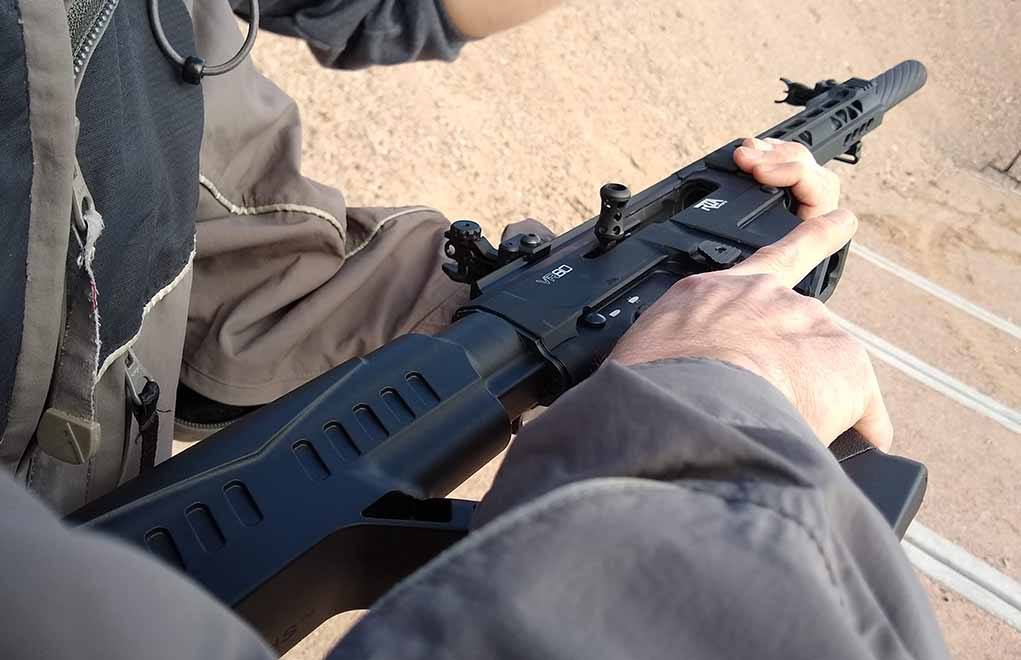
When it comes to box-magazine fed semi-autos, AK-pattern shotguns have ruled the roost. Though, in recent years, AR-style smoothbores have made headway. And if the Armscor VR80 12-gauge is any indication, this familiar configuration’s future looks bright.
First and foremost, the new gun works. Granted, this isn’t backed up with a 1,000-round torture test, by any means. But from limited range time and plenty of scuttlebutt, the short-stroke piston operated gun just plain chews through what it’s fed.
Even better, if you know how to run an AR, you know how to run a VR80. Yes, it does have a side charging handle, but the mag release and thumb safety are right where they should be, making the gun highly intuitive. Furthermore, its nimble frame makes it feel like an AR on the shoulder, only one that pitches, say, 41 pellets of #4 buckshot instead of 5.56 NATO each trigger pull.
For 3-Gun competitors, it could prove a boon – a reliable smoothbore that provides a nearly seamless transition is gold. But, blasting targets or coyotes, you could do a heck of a lot worse than a VR80.
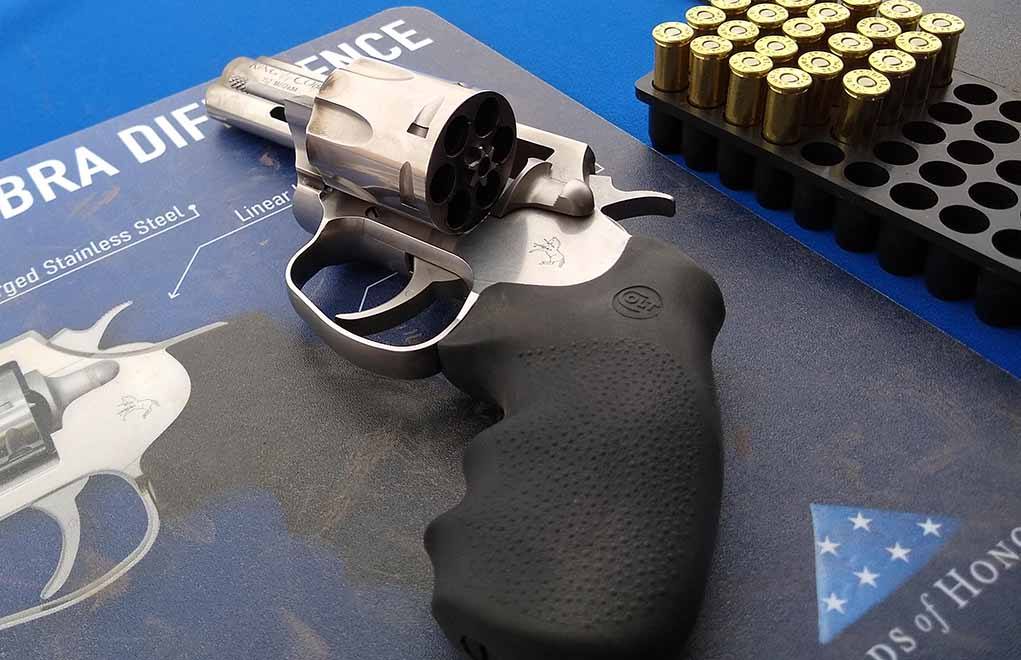
Colt has made waves since the reintroduction of its double-action revolver line and got people jabbering over it again this year. For good reason. The reboot of a .357 Magnum revolver has been a long time coming, and the new King Cobra doesn’t disappoint.
Though, this gun is a long ways from the original iteration. Through and through, the new King Cobra is a carry gun, from its trim 3.5-inch barrel to its integral rear sights. Given the rest of the Cobra line is comprised of snubbie .38 Specials, this should come as no surprise.
Well balanced, the King Cobra performs well above what you’d expect out of a smallish .357. The gun is controllable, and when shooting double-action – thanks to a very smooth trigger – the King Cobra proves highly accurate. Its Hogue Overmolded grips don’t hurt either.
Certainly, there are many who would like to see the rebirth of the Python and only time will tell if this is little more than a pipe dream. But for the time being the King Cobra should more than satiate the hunger for a .357 Colt.
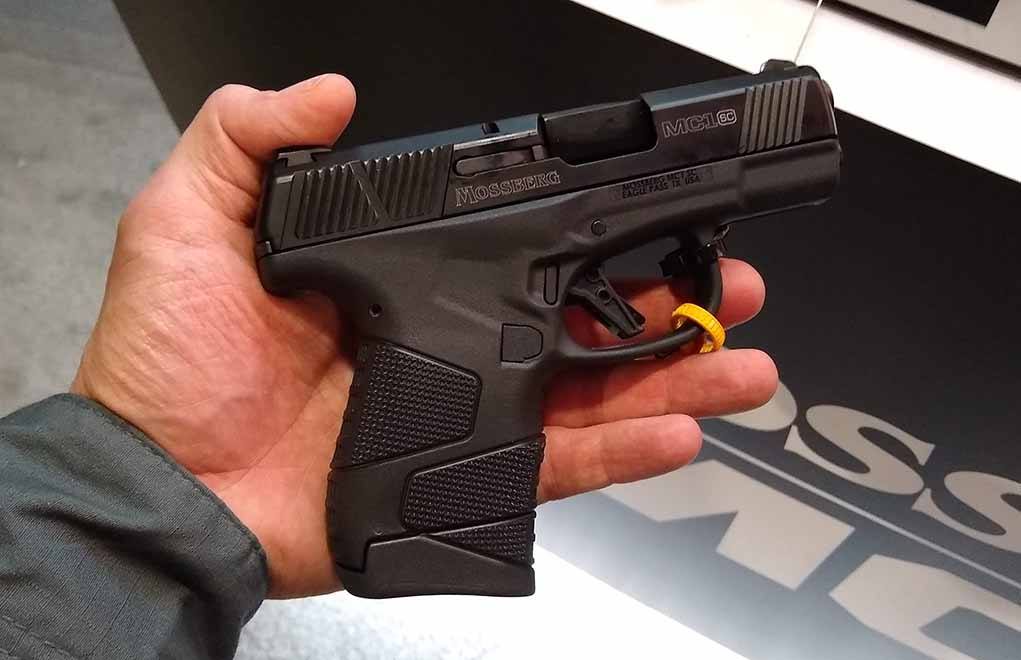
In all honesty, it would have been very interesting if Mossberg would have dusted off the tried-and-true “Brownie” design to jump back into the pistol world. To what end? Who’s to say? But it would have been interesting. The gunmaker, however, did the next best thing – cooked up another small pistol much more applicable to the modern day – the MC1sc.
Outside of the single-stack 9mm coming from Mossberg and a unique removable firing pin takedown, the pistol doesn’t hold many surprises. If you know the class of firearms you know what the MC1sc brings to the table. But just because the polymer-framed striker-fired pistol is familiar in a very established niche doesn’t mean Mossberg doesn’t have something to crow about.
The MC1sc is well put together, with a respectable trigger, is intuitive to shoot and comes with the little extras – steel sights, positive grip texturing, flat-faced trigger. What more could you ask for? If it’s affordability, the 9mm has that in spades to boot. Easily one of the most economical pistols in its class, the MC1sc is hard not to consider if you are shopping the single-stack marketplace. Which should have the competition sweating.
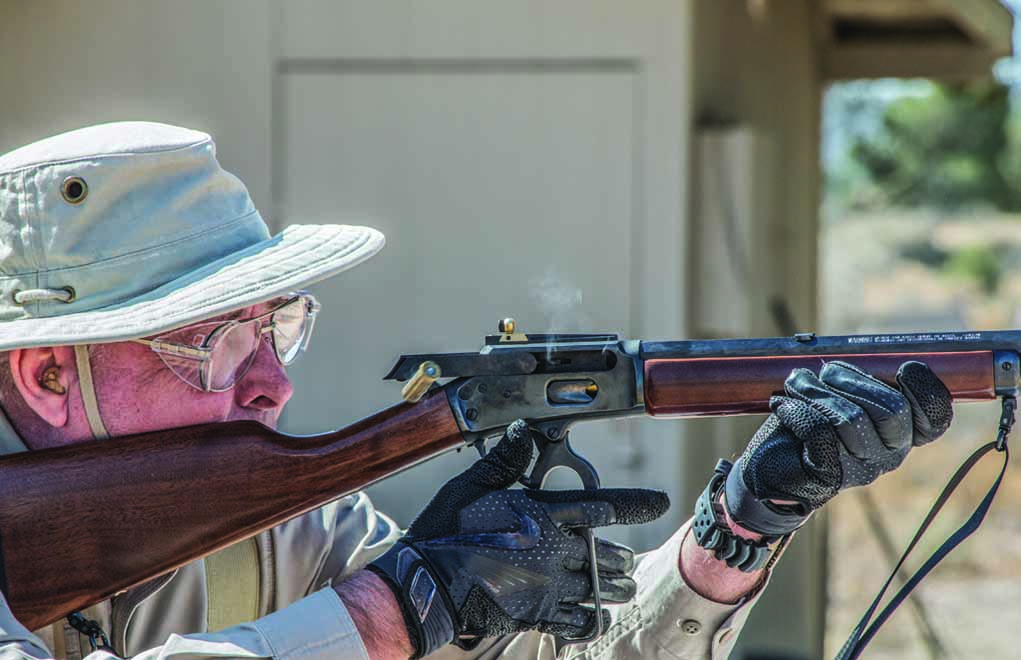
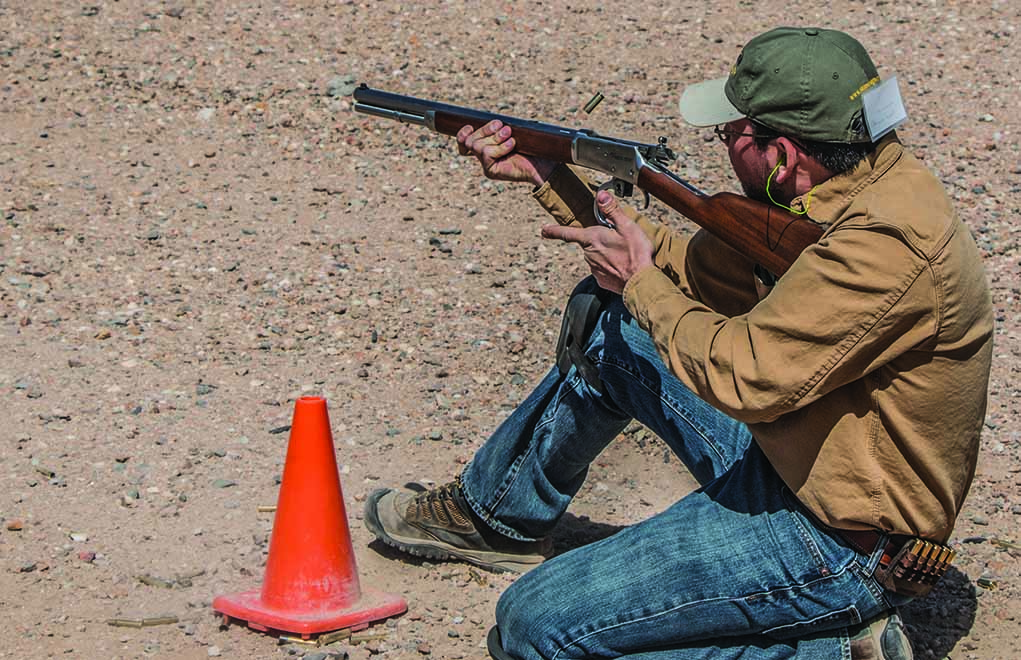
Lever-action rifles have been around a long time. Patented in 1860, the Henry was the first, and they quickly became known as a rifle you loaded on Sunday and shot all week. Next to the semi-automatic, the lever-action is the fastest cycling repeating rifle. This is partly due to its lever-operated mechanism, but also because the last movement when operating the action solids the buttstock into the shoulder. Ironically, for a rifle that’s been around for more than 150 years, few know how to run one properly.
Like with any firearm, the elements of running one correctly are the same: You must be able to confirm its condition, operate it, load it, mount it, fire it, unload it and service it. And, you should know how to clear stoppages. Here’s look at each aspect of running a lever gun, so that you can let all the cowboy in you come to life.
What Condition Is My Lever Gun In?
Firearms are carried or stored in a variety of conditions. The lever gun is no different. Knowing these conditions helps you better have your rifle at the proper stage of ready, and fosters safety.
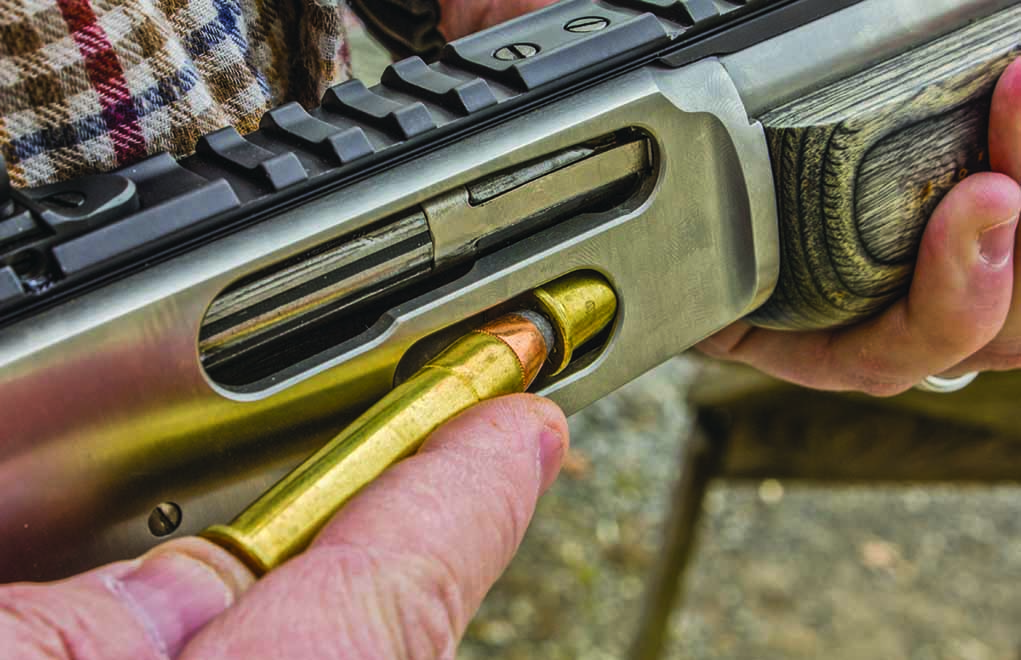
When loading straight-wall cartridges — like the .45-70 Govt. — into the loading gate of a lever gun, you can partially insert them, and then push them home with the next cartridge.
Condition 1: Magazine tube loaded, round in chamber, hammer cocked and safety off. This is the proper condition for a lever-action rifle right before it’s fired. It should not be carried or fondled in this condition. Some lever-actions have a safety. Traditionalists scoff at their existence and they’ve been known to cause a click in the field when the shooter forgets it’s engaged. In Condition 1, the safety is not engaged.
Condition 2: Magazine tube loaded, round in chamber, hammer forward or at half cock, and safety off. This is the generally accepted carry method for a lever-action rifle. The hammer must be manually cocked before the rifle can be fired. For lever guns with safeties, a version of Condition 2 is with the hammer cocked and the safety on.
Condition 3: Magazine tube loaded, chamber empty, hammer forward or at half cock, safety off. Some prefer this method of carry for lever guns. When the need to shoot arises the action is levered as the rifle is brought to shoulder. In Condition 3, the safety — if so equipped — should not be engaged; it creates an additional needless step to execute before a shot can be fired.
Condition 4: Magazine tube empty, chamber empty, hammer forward and safety off. This is the typical condition in which lever guns are stored.
Loading And Unloading
With the exception of magazine-fed lever-actions, like the Browning BLR and a few others, lever guns are loaded in one of two ways. Cartridges are shoved, one at a time, through a loading gate on the side of the action. Or, they’re inserted into through the magazine tube. In either case, during loading the hammer should be forward.
With straight-wall lever gun cartridges — .45-70 Govt., .357 Mag., .44 Mag., etc. — it’s beneficial to the loading process if you only insert the cartridge about halfway into the loading gate. Then, with the next cartridge, you push on the head of the partially inserted cartridge with the bullet of the next, forcing the first into the magazine tube. With tapered cases like the .30-30 Winchester, the cartridge might not stay partially inserted into the loading gate, and this system may not work.
To get a cartridge into the chamber, simply cycle the lever. But, you have to do it like you mean it. A gentle or short stroke can lead to a stoppage. Once a cartridge is in the chamber, you should fire the rifle, place it in Condition 2, or unload it. To place the rifle into Condition 2, place your thumb on the hammer, and while holding pressure, press the trigger. This will release the hammer. As you ease the hammer forward, remove your finger from the trigger and lower the hammer to half-cock. If the rifle is equipped with a safety, you can engage it first to prevent a loud bang should your thumb slip from the hammer.
More Lever-Action Info:
Big-Bore Lever-Actions: Steel Henry .45-70 Is Golden
It’s also a good idea to be able to swiftly load a lever gun that’s empty with a single cartridge. To do this, fully open the lever and shove a cartridge in through the ejection port, bullet first. This is accomplished with the rifle on the shoulder and in the firing position. With practice, savvy lever gun runners can also load the magazine tube through the loading gate while the rifle is on the shoulder. Both skills are good to have and should be practiced.
The easiest way is to unload a lever gun is to cycle the cartridges through the action while the rifle is pointed in a safe direction. While doing this, make sure your finger is out of the lever and away from the trigger. If the rifle is equipped with a safety, it should be engaged.
Lever guns that are loaded directly into the magazine tube are friendlier when it comes to unloading. With the hammer down, remove the plunger from the tube and dump the cartridges out. Then, you can cycle the cartridge in the chamber out by operating the lever while keeping the muzzle in a safe direction.
Mounting A Lever-Action Rifle
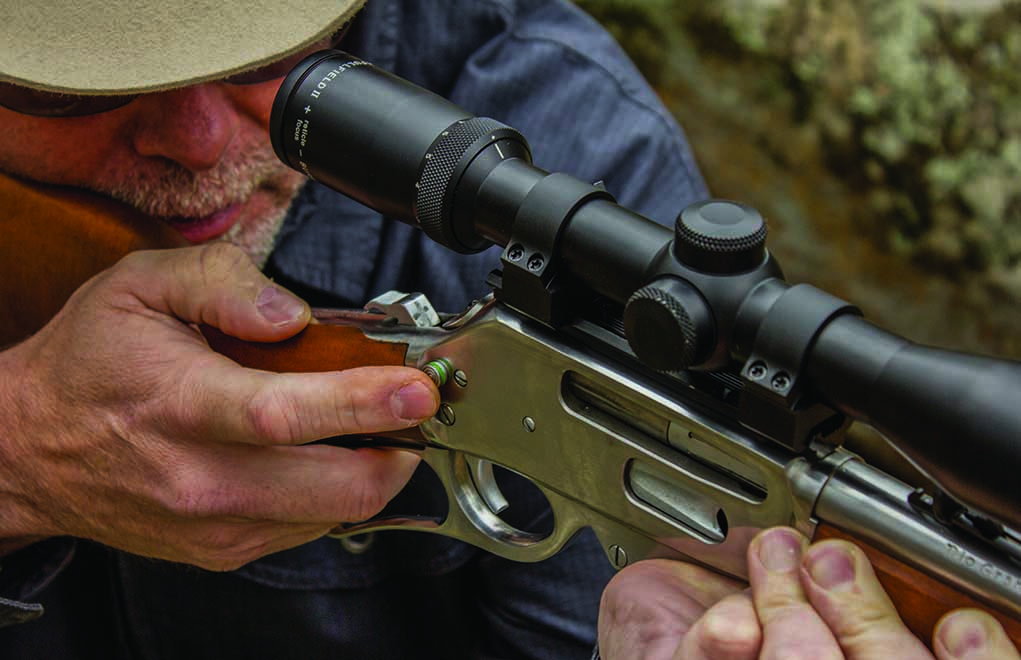
Most lever guns are svelte, quick-handling rifles, lending themselves to snap shooting. Many mistakenly snap the butt of the stock to the shoulder, and this increases engagement time. You should snap the rifle up, level with your eye, with the buttstock about an inch or so from your shoulder. Keep both eyes open and you’ll be able to see the target and the sights. As you do this, cock the hammer or remove the safety to place the rifle in Condition 1. The last motion should be pulling the rifle back, snug, against your shoulder.
Firing A Lever-Action Rifle
When you fire a lever-action rifle, the lever should be cycled immediately. Do not remove the rifle from your shoulder to cycle the action.
As with any gun, concentrate on the sights, and while keeping them aligned on target, apply pressure on the trigger. When the rifle fires, hold the trigger to the rear, and when you reach the top of the recoil cycle, lever the action and press your trigger finger forward against the front of the trigger guard. As the rifle settles back on target you can reacquire the sights and target, and then place your finger back on the trigger. During the entire process, the butt of the rifle should never leave your shoulder.
Preventative Maintenance
Lever guns need lubrication to run smoothly. This does not mean you spray them down with your favorite gun juice. Too much oil will attract dust and gum things up. For best results, take your lever gun apart. This means removing the buttstock to access the lever and trigger mechanisms, and removing the bolt. Consult your owner’s manual for specific instructions.
Once disassembled, apply a small amount of oil to the exterior of the bolt, including all locking surfaces. Next, apply a dab to the actuator or end of the lever, the disconnector and any surface showing wear. Also lightly lubricate the trigger/hammer and hammer spring. Finally, apply a touch to any surface showing wear. Wear indicates metal-to-metal contact. Some oil here will smooth action operation and guard against corrosion. The process should only take a few minutes and about a dozen drops of oil.
Clearing A Stoppage
Lever guns can jam. Sometimes cartridges or empty cases get fouled in the action because it’s not cycled with authority, or because a part is worn or broken. Sometimes a cartridge can jump the stop and slip behind the loading gate. In some cases you can clear these stoppages by holding your mouth right and rattling the rifle. In other instances, you may have to remove the lever and even the bolt to sort it all out. This makes knowing how to field strip your lever gun and keeping a screwdriver handy all that more important.
The best way to avoid a stoppage is to keep your rifle well maintained, only use factory or proven ammunition of the right size and length, and every time you cycle the lever, do it like you mean it.
A Little Bit Of Cowboy
I’ve used lever guns to successfully take game as small as tree squirrels and as large as a buffalo. Though short-range weapons, they make fantastic hunting tools and can aptly serve in the survival/personal protection role as well. But to get in touch with your inner cowboy, you need to know how to run one right.
Editor’s Note: This article originally appeared in the November 2018 issue of Gun Digest the Magazine.
One of the best non-magnum .35-caliber cartridges, the .358 Winchester is both accurate and effective.
How the .358 Winchester tops other .35-caliber cartridges:
Adequate for any North American Game
Capable of pitching a 250-grain bullet 2,200 at the muzzle
Factory performance can be improved upon by reloading
Known as 8.8x51mm in Europe
Introduced in 1955 by Winchester for its Model 70 Lightweight bolt-action and Model 88 lever-action rifles, the .358 Winchester is based on the .308 Winchester case necked up. It’s known in Europe as the 8.8x51mm. Many European rifle makers chamber the round. In the United States, only the Browning BLR lever-action is currently chambered for this cartridge. The Model 99 Savage was also once available in .358 Win. The .358 Winchester is one of the best commercial (non-magnum) .35-caliber cartridges turned out by any American manufacturer. It’s a big improvement over the .35 Remington, slightly more powerful than the old .35 Winchester, and more useful than the .348 Winchester.
As the .308 Winchester is a shortened version of the .30-06, by the same token the .358 Win. is a shortened .35 Whelen. With its spitzer-pointed bullets, the .358 is a good medium- to long-range cartridge with capabilities out to 250 yards on big game. With the 250-grain bullet, it’s better than the .30-06 on heavy game at close ranges. The .358 in a bolt-action rifle with a good scope is as accurate as any hunting cartridge available. Performance can be improved by handloading.
Editor’s Note: This article originally appeared in the October 2018 issue of Gun Digest the Magazine.
Looking to go armed, but are stuck in the weeds as to what to arm yourself with? Here are 20 of the best concealed carry gun options that will keep you on the defensive.