 February 28, 1997 changed the way law enforcement officers and more importantly, their administrators, viewed the deployment of rifles in the field.
A Wake Up Call
That was the date of the Great Los Angeles Bank Robbery. Using fully automatic 7.62 x 39 caliber rifles, two heavily armored and armed robbers shot it out with members of the L.A.P.D. 200 officers responded to the robbery with 9mm pistols and 12 gauge shotguns loaded with 00 buckshot.
As we all know, the officer’s weapons were almost totally ineffective against the robbers. While awaiting the arrival of SWAT, two officers borrowed AR-15’s graciously loaned to them by an area gun shop. Unfortunately one of the officers wasn’t familiar with the AR-15 weapons system, and was unable to use the rifle. The other rifle didn’t have an effect on the final outcome, but the tactical thinking was quite correct-buckshot and handgun rounds are ineffective against armored suspects!
Prior to the LAPD incident, there was a gradual movement towards arming officers with pistol caliber carbines of either 9mm, .40 Smith and Wesson, or .45 ACP calibers. While these weapons found favor because they offered more accuracy than a handgun and reduced recoil compared to a shotgun, they offered no serious ballistic advantage.
Even if LAPD officers were armed with these carbines, they still would have been ineffective against the armor worn by the robbers. The shootout made it clear that pistol caliber carbines were not the solution to a heavily armed criminal element.
In a big ceremony and news conference after the shootout, the LAPD that received a donation of some 200 surplus M-16’s from the military. These full auto weapons were received with fanfare but not immediately deployed due to policy considerations (L.A. certainly didn’t need street officers spraying full-auto weapons around town). This was a watershed moment, because it made the M-16 an acceptable and necessary police tool, and caused it to become the pre-eminent law-enforcement rifle system.
 While the AR-15 hasn’t supplanted the shotgun in the patrol car, it certainly has supplemented it. Prior to the L.A. shootout, it was thought by administrations that the 5.56 mm caliber was too powerful and penetrative for urban/suburban use. However advances in controlled-expansion ammunition and ballistic testing proved that the 9mm fired from a carbine-length barrel provided MORE risk of over-penetration than the 5.56 mm with the right bullet, eliminating liability concerns.
Not only is the AR-15 being issued in the field as a general-duty patrol rifle, but in the shortened M-4 versions, has gained favor over previously utilized entry weapons like the venerable HK-MP5.
In addition to the superiority of 5.56 mm over the 9mm, the AR-15 operating system is much more familiar to the new and welcome influx of combat veterans from Desert Storm, Iraq and Afghanistan into the police ranks. The only thing holding most agencies back from widespread issuance of the AR system has been cost.
For the price of one quality AR-Rifle from the major manufacturers, a department can purchase two to four police shotguns, depending on make. They also could purchase two (or more) pistol-caliber carbines. In this day of ever-decreasing budgets, what can a department do to equip its officer’s with the AR-15 system for either patrol or tactical use when the cost is so high? The answer is the Department of Defense 1033 Weapons Program.
Outfitting Your Agency
The DOD through your individual state Law Enforcement Support Office, (which can be found by typing in DOD 1033 Program on an internet search engine), will provide your agency with a quantity of M-16 A1 full-auto rifles in an amount commensurate with your department’s number of sworn officers and the population of your jurisdiction.
The total cost is approximately $24 per rifle in shipping from the Rock Island Arsenal in Illinois. The only condition to this donation is that the M-16s remain DOD property. They cannot be sold by your agency or traded in since they are not technically yours. If your agency no longer needs them, they are required to be returned to the DOD in originally issued condition.
This doesn’t mean that you cannot modify them; it means that when you return them, they have to be in original condition.
 My agency, the Union County Sheriff’s Office in Marysville, Ohio, decided to make application for a grant of M-16s. Newly elected Sheriff Rocky Nelson recognized the fact that while our patrol area is still mostly rural, our deputies are beginning to encounter urban type threats and approved the application. We applied for 15 rifles and were granted 10.
Although our policy is not complete as of this writing, we envision the rifles being deployed for both tactical team and patrol use, and converted to fire in semi-auto mode only.
The ordering process was relatively simple. The rifles were shipped directly to our office a short time after application was made. The rifles came packaged in individual cardboard boxes and were separated into their upper and lower receiver halves. Each half was wrapped in what appeared to be a Mylar type silver wrapping paper. Included in the box was a new sling and a 30-round magazine, each wrapped packaged in clear plastic.
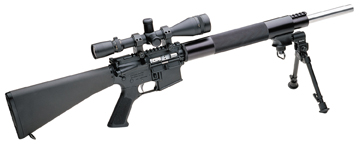
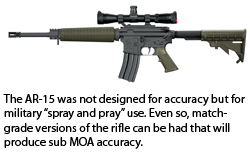
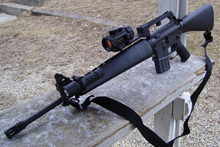
The rifle itself is the A1 model. This means that it has the triangular Vietnam-era handguards, simple but rugged A-1 rear sight adjustable for windage only, forward assist with no case deflector, birdcage type flash suppressor, shorter than current issue buttstock (which is great for the smaller-stature officer or tactical officer wearing heavy body armor), and the original light 6.5 lb weight afforded by the skinny A-1 barrel configuration. Rate of twist is 1 in 12.
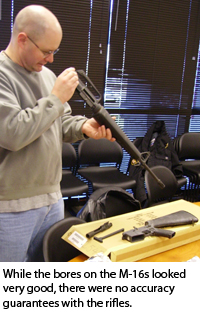
The condition of the rifle was very good to excellent for a military weapon this old. Stored since approximately 1975, there was some minor exterior rust and white aluminum oxidation on the receiver that was easily wiped off. Interior parts were in very good shape showing little sign of wear. The weapon was bone dry from lack of lubrication in storage, but showed no signs of abuse or neglect.
After the rifles arrived, the question was how can turn this basic weapon into a more modern tactical weapon in the most economical way, especially with the condition of not permanently modifying it? Also, what needed to be done to it to optimize it for patrol?
Testing the Weapons
 In our opinion, all we needed to do was to add a high intensity flashlight and a red-dot type optical system. To accomplish the mounting of these systems, I turned to Troy Storch at Midwest Industries. He sent me their MCTAR-15-04 Tactical Light Mount and their MCT-A2C A2 Adjustable Cantilever Optics Mounts.
The Tactical Light Mount is a solid, well engineered system that mounts on any AR-15 with a standard front sight. The mount provides a Picatinny mounting surface on either side of the front sight, and lists at only $34.99. A Surefire G-2 Nitrolon 65 lumen light was attached by single scope ring to the mount. Using the G-2 in this position requires no separate pressure switch; it is operated with the support hand thumb. The G-2 is priced at $34.99. The Cantilever Optics Mount is billet machined from 6061aluminum and is hard coat anodized. It is adjustable and allows co-witnessing between the optics and iron sights. It mounts via a single bolt through the hole in the AR’s carry handle, and is secured by a wide, flat nut designed for easy hand tightening. Price is $116.95.
For testing purposes a personally owned Leatherwood Hi-Lux Red Dot sight from Bushmaster was mounted. This excellent red-dot sight is only $79.95. Total for this basic tactical weapons system? About $280. Of course with the myriad of options available for
AR’s these days, even more customization can be done to it if desired.
After a thorough cleaning, (which made the rifle look as good as new) by Cpl. Matt Warden, we took one of the M-16’s to the range on a very cold March morning and mounted all the hardware. We had a limited test time, and purposes of the testing were three-fold.
First, we wanted to determine the functionality and reliability of these M-16’s, second, to select the most accurate duty load for the M-16 and third, to test that load against an automobile to determine effectiveness against hard targets.
We had only limited time for all three tests. As the M-16’s would be configured to semi-auto only for issuance to deputies in the field we started with some very basic accuracy testing. Full auto fun time, er, testing, would wait until later.
Checking of basic accuracy was important because there was no way of knowing how many rounds have been sent downrange from any of these weapons. The bores look reasonably good but there are no accuracy guarantees. Speaking of bores, as I mentioned earlier, the twist rate is the old 1 in 12 inch rate rather than the 1 in 7 or 1 in 9. This means that the bore can only stabilize bullets with weights of 55 grains or less. While heavier bullet weights for police and military use seem to be a must these days, one is absolutely limited to a weight of 55 grains or less in these rifles. This lack of stabilization of heavy bullets by a 1 in 12 twist barrel was borne out when firing some 62-grain NATO green tip ammo during testing against the automobile. Out of 30 rounds fired, 10 hit the car door exactly sideways, leaving a perfect cookie-cutter outline of the bullet in the door. Not exactly what one wants in terms of accuracy or ballistic performance.
Being limited to 55-grain projectiles is really no problem. Since our law enforcement rifle engagement distances average less than 50 yards, using bullets in the heavier weight ranges that may perform well to 400 yards really aren’t necessary. Nor should our officers be firing at anyone with open-sighted rifles at those distances anyway!
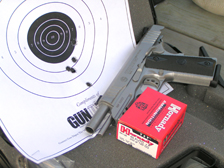
We tested two of the best 55-grain duty loads available-Hornady’s TAP and Winchester’s Ballistic Silvertip, along with Winchester 55-grain FMJ rounds. Five-shot groups were fired. Accuracy of all loads tested was adequate, but not stellar. Several factors affected testing that day. Cold weather with light snow compounded firing prone unsupported. We also used plain brown IPSC cardboard targets against the same colored backstop, and it was hard to maintain a consistent point of aim. Groups ended up hovering around 2 to 3 inches at 50 yards using either the open sights or the Hi-Lux Red-Dot.
I am certain that with a sandbagged bench and better weather conditions and target, groups would improve. One other thing to keep in mind; the M-16A1 was never a tack driver. That is why the A2 was introduced, to improve accuracy at extended range. You simply cannot get sniper rifle accuracy from these rifles but you certainly will get accuracy on par with that of the Ruger Mini-14 for example, which is more than adequate for patrol or close quarters entry use.
In terms of ballistic performance the TAP and Ballistic Silvertip rounds did very well against the auto, a Pontiac Grand AM. Fired through the windshield, each round penetrated front and rear seats, and came to rest denting the inside of the trunk. They did as well on shots through the driver’s door, passing through it and into the passenger door, causing a dimple on the exterior sheet metal of the passenger door. Ideal performance, in our opinion.
This offer from the DOD is one of the best ever made to law enforcement. Every agency interested in 5.56 caliber patrol or tactical rifles should apply for these weapons.
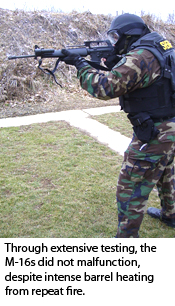
Out of several hundred rounds of practice and duty ammo fired (much of it with FMJ ammo in full-auto mode), there was not one malfunction, even when the weapon became very hot to the touch. If you never handled an M-16 in the A1 configuration, you will be pleasantly surprised. Its light weight allows it to swing into action quickly, and we didn’t find its 4 inches of additional barrel length over the M-4 to be a hindrance in clearing rooms. It might not be quite as maneuverable as an M-4 with the stock collapsed, but is certainly is a capable performer If you choose, you can even keep it in the full-auto configuration, which after the test firing, was tempting but for us out of the question and really not necessary. Don’t miss out, contact your State Law Enforcement Support Agency today.
— Scott Wagner is a Professor and Police Academy Commander at Columbus State Community College in Columbus, Ohio. A 26-year law enforcement veteran, he is a Special Deputy at the Union County Sheriff’s Office in Marysville, Ohio where he works in patrol and training, and is a member of the SRT Team. He welcomes your comments at [email protected].
Resources:
Midwest Industries Inc.
833 West College Ave., Waukesha, WI 53186
Phone:(262)896-6780 Fax:(262)896-6756
https://www.midwestindustriesinc.com
Bushmaster Firearms Inc.
999 Roosevelt Trail
Windham, ME 04062
https://www.bushmaster.com
SureFire LLC
18300 Mount Baldy Circle
Fountain Valley, CA 92708
Toll Free: 800-828-8809
Email: [email protected]
https://www.surefire.com
Hornady Mfg. Co.
Box 1848
Grand Island, NE 68802-1848
1-800-338-3220
https://www.hornady.com
Winchester Ammunition
Att: Product Services
427 N. Shamrock St.
East Alton, IL 62024.
https://www.winchester.com