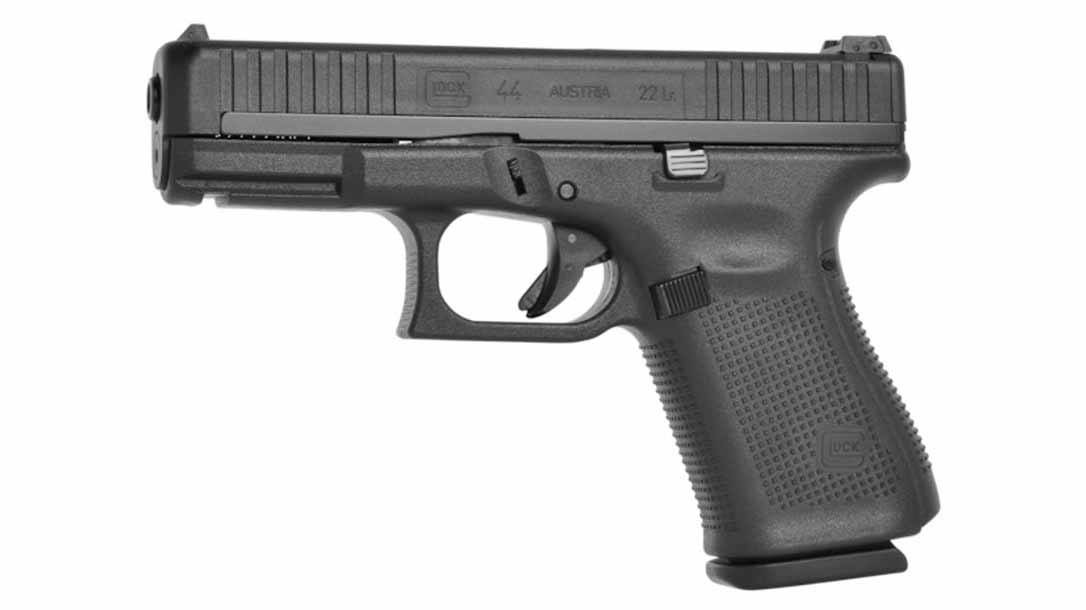
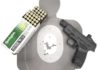
The Glock 44 is the company’s first foray into rimfires and appears a solid choice for an economical trainer.
How Does The Glock 44 Measure Up To Other Rimfires:
Dimensionally mirrors the Glock 19
Lightweight, only tipping the scales around 12 ounces
Tested to work with a multitude of different ammunition
A new Glock gun? Depending on who you are, you’re either doing backflips or gritting your teeth. No matter where you stand on the Glock spectrum (lover or hater), you’ll have to agree the prolific pistol maker has certainly gone a different route with its latest addition. The Glock 44 is the company’s first foray into rimfire pistols and is most certainly made with economical training in mind.
The .22 pistol is styled after the 5th Generation Glock 19, mimicking the same operation and feel of the ubiquitous pistol.
Now, devotees of the iconic 9mm have the perfect tool to bone up muscle memory and skills, but at a fraction of the cost. Though, you needn’t be a G19 fanboy or girl to justify purchasing the Glock 44; by all rights, it should prove an exceptional option for those just cutting their teeth on shooting sports.
G44 Is All Glock
Aside from light recoil and cheap ammo, the G44 has all the desirable assets shooters have come to expect from a Glock. These include a removable backstrap system to fit the gun to the hand, adjustable rear sights, cocking serrations fore and aft, ambidextrous slide lock and ghost hole chamber indicator.
Additionally, the Glock 44 boasts a 4.02-inch barrel and is 7.28-inches in overall length, which mirrors the G19. Except, the .22 LR is much lighter, tipping the scales at 12.63 ounces. Much of this weight savings is due to the rimfire’s hybrid steel-polymer slide; the rails are steel, but the body is polymer.
Glock 44 Capacity and Price
The Glock 44 ships with two 10-round magazines and upon launch early in 2020, a threaded-barrel suppressor-ready model will be available.
Interestingly, the pistol has polygonal rifling, which historically doesn’t play nice with non-jacketed rounds.
That said, Glock said it ran tests into the thousands of rounds with a wide variety of ammunition without a hitch.
As to price, Glock doesn’t have one listed on its site. For what it’s worth, Internet scuttlebutt pegs the MSRP at $400.
For more information on the Glock 44, please visit www.plink44.com.
Glock 44 Specs Length (Overall): 7.28 inch Slide Length: 6.85 inch Width (Overall): 1.26 inch Slide Width: 1.00 inch Height incl.Mag.: 5.04 inch Trigger Distance: 2.76 inch
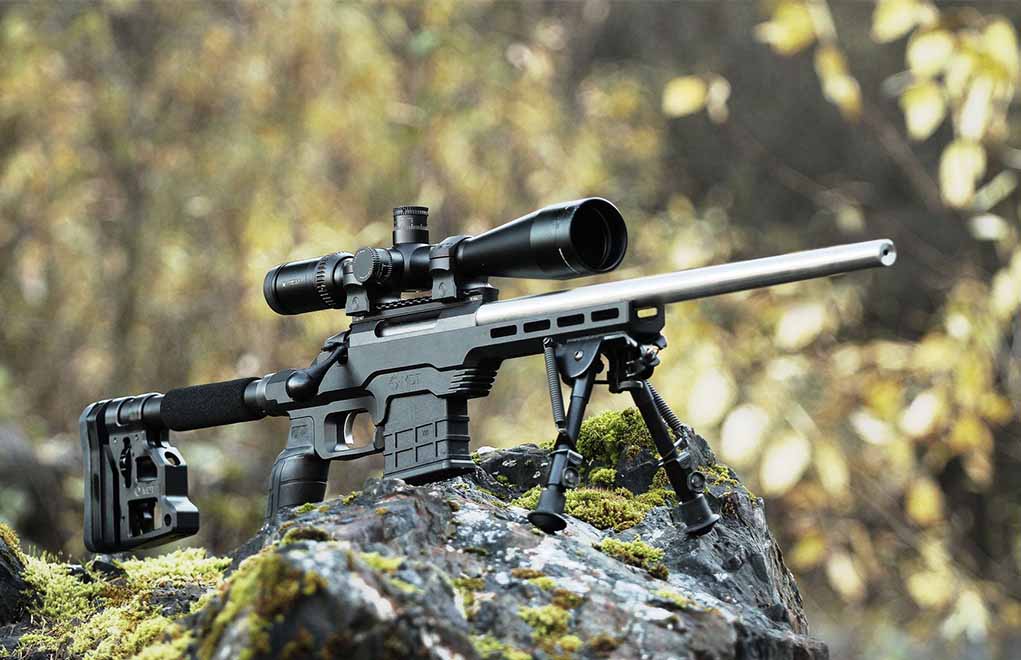
The main reason why a shooter jumps into a rifle chassis is for the accuracy enhancement. Pretty good reason, given the results, are fairly dramatic. Providing the rigidity and custom bedding required to accurately extend a rifle’s range, the system is an out-and-out marvel. But, building a tack-driver isn’t the only benefit of a rifle chassis.
If you purchase one of Modular Driven Technologies’ (MDT) platforms, there’s also a matter of configurability. In that, there’s a lot of it. The company lives up to its name by providing an easily modified system that conforms to individual shooters’ wants and needs.
That’s what we’re going to look at today, some of MDT’s best accessories to truly customize your chassis rifle. Whether you’re shooting for a way to enhance your rifle’s optics or custom fit the chassis to your frame, these 4 top MDT accessories are sure to hit a bullseye.
Once primarily the tool of competitive shooters, the rifle chassis is growing in application. In turn, a weighty, recoil soaking rig – what the precision marksmen prefer – isn’t always the top choice for an everyday shooter.
<
Learn More About MDT Chassis And Gear:
Top 5 Reasons Why You Should Upgrade Your Bolt-Action To A Rifle Chassis
MDT ESS Chassis: Redefining The Modern Precision Rifle
MDT LSS Gen2 Chassis: Flexible Foundation Of A Precision Rifle
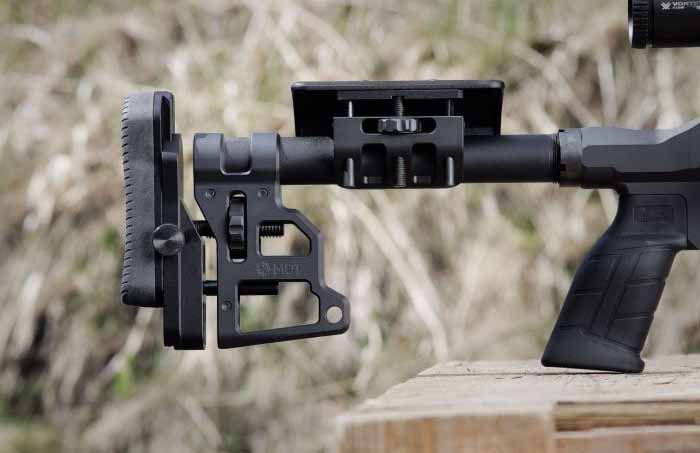
Weight savings is often at a premium for some, which is where MDT’s Skeleton Carbine Stocks shine. With three models to choose from – SCS, SCS Lite and Composite – the stocks tip the scales at between 1.41 pounds and 1.96 pounds. Real featherweights. At the same tick, they don’t skip where it counts – adjustability. Each model has 1 inch of play in length of pull and a full 1.5 inches in cheek rise. Additionally, the SCS has 10 degrees of cant adjustment and vertical butt pad adjustment.
While the carbine stocks work with any of the company’s chassis, with an adapter in some cases, they aren’t limited strictly to MDT. Any chassis compatible with AR-style buffer tubes can be outfitted with the cutting-edge stocks.
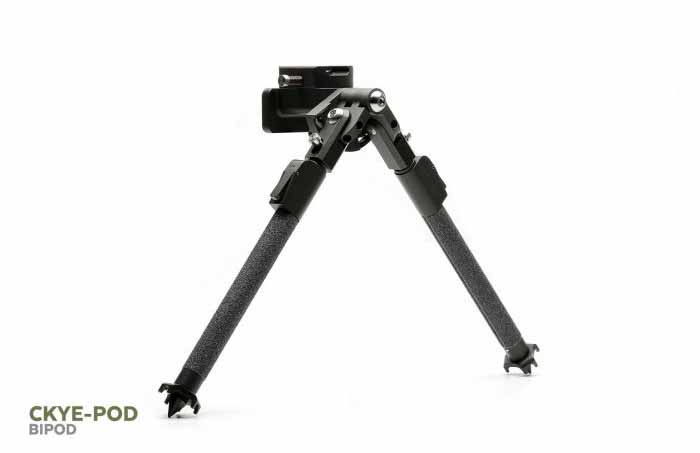
Developed for competitive shooters, the Ckye-Pod has the potential to help plenty of other marksmen get on target. Hunters, for one, should find the 21-ounce bipod useful. Certainly, there are lighter options out there, but few with the versatility and performance of this anodized aluminum unit.
Perhaps the most notable aspect of the Ckye-Pod is its one-hand operation, allowing the user to quickly adjust it from 4.5 to 15.5 inches in height. MDT offers it configured for both right- and left-hand shooters. Furthermore, it delivers 170 degrees of cant, 360 degrees of pan capability and an integrated barricade stop. Pretty much everything to ensure you have a solid rest.
It comes outfitted with a proprietary spiked foot/claw for excellent traction but accepts any Atlas style feet if you need to switch up. Also, it’s available in Picatinny and Arca mount options.
Rigidity doesn’t only play a role in keeping a rifle accurate, but also a scope. If you have a flimsy base, it doesn’t matter how expensive an optic you run you won’t his squat.
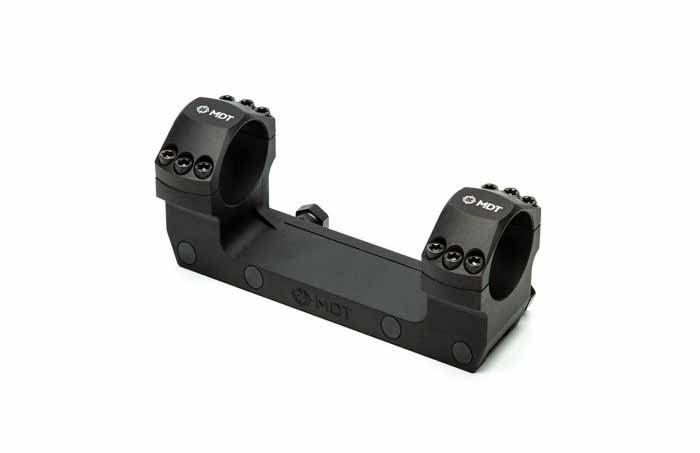
MDT has cooked up a gem when it comes to providing a solid platform for your scope with the One-Piece Scope Mount. While the matching set of precision-machined rings and four cross bolts are impressive on the Picatinny-compatible base, it’s a little extra the company threw in that catches the eye. The mount has an integrated recoil lug, which ensures your rifle won’t kick your scope out of zero. Additionally, when used correctly, you can transfer the scope from platform to platform with better repeatability and less “zero offset”.
A one-piece unit, made from precision-machined aluminum, the mount is available for scopes with both 34mm and 35mm main tube bodies.
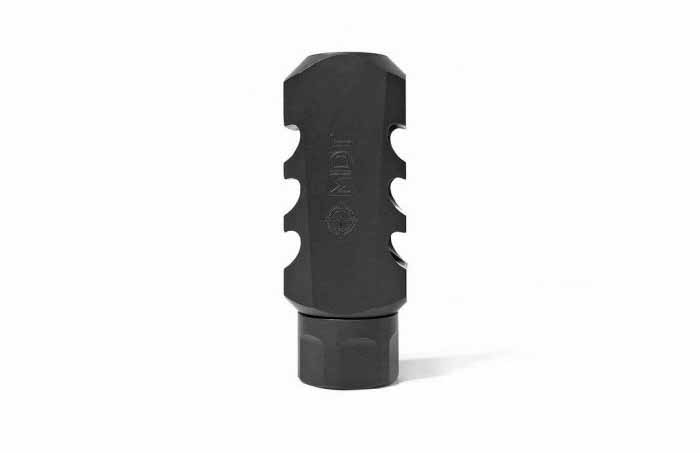
Often times, shooters peg more weight as the only way to fight recoil. But there are other, lightweight solutions. MDT produces one such option with its Elite Muzzle Brake.
Boasting 35-degree angled baffles, the muzzle device reduces recoil up to 66-percent, thus gives you the ability to maintain on target shot to shot. Also, the brake has a straight-cut baffle at the rear, reducing the concussive forces of a shot. In turn, your rifle’s bark won’t bite as much.
The brake is Tunable through an overlapping lock nut, which also makes indexing the alloy-steel device a cinch. Available for ½-28, ⅝-24, ¾-24, 18×1.0 and 18×1.5 thread sizes.
The 8mm Mauser and other 8mm cartridges are deadly accurate and versatile as a Swiss Army knife. So, why are they virtually unknown in the U.S.?
Why Didn’t The 8mm Mauser Make It In The U.S.?
It didn’t realy do anything the .30-06 wasn’t capable of.
Historically, there’s been a lack of bullet weight options.
The bullet diameter change (.318 to .323) years ago confused many shooters.
Some might think success in life is all about who you know.
The same could be said for rifle calibers. Some cartridges ought to be more popular. Case in point—the mighty 8mm Mauser.
Like many successful American cartridges, the German-created 7.92x57mm owes its beginning to the military. (Notice that I didn’t say, “8mm Mauser.”)
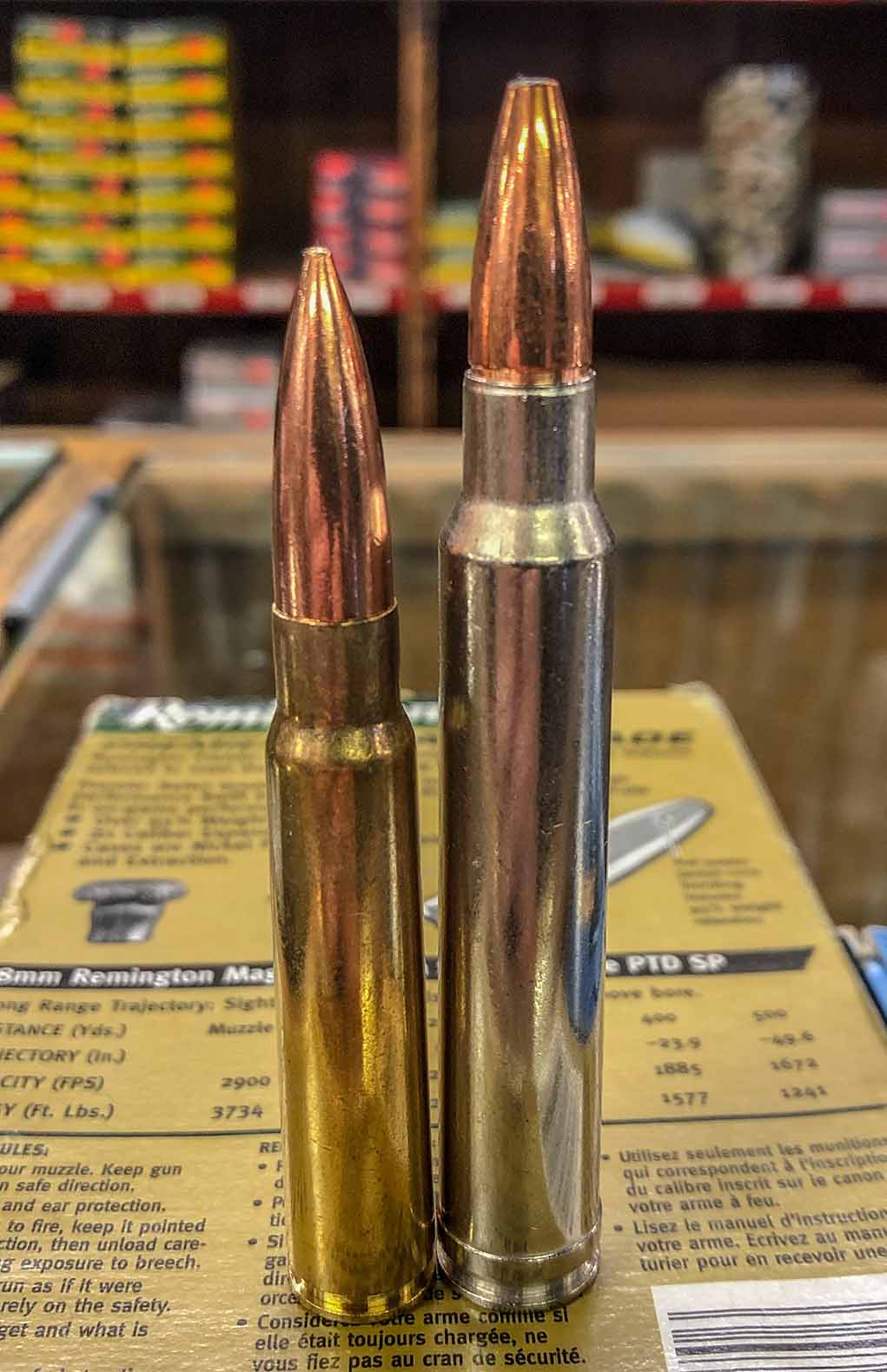
The 8mm caliber has a wide range of cartridges using it because it was developed in the late 1800s. Here, we can compare the relatively mild 8mm Mauser 198-grain load to a 8mm Remington Magnum 200-grain load. The 8mm Mauser is its own case, and the 8mm Remington Magnum was developed from the .375 H&H case.
According to Norma, “The designation, ‘Mauser,’ is actually a misnomer, because the cartridge was developed by a German military commission at Spandau Arsenal for a forerunner of the famous Mauser rifle, which was adopted in 1898.”
Of course, the Swedish ammunition company is right. In 1888, the German Rifle Testing Commission did develop what we commonly call the 8mm Mauser. SAAMI calls it the 8mm Mauser or the 8x57mm, and the European C.I.P. calls the 7.92x57mm the 8×57 IS (which is precisely what’s stamped on the barrel of the brand-new Sauer 100 Classic on loan to me for this story).
Back then, however, it was simply called Cartridge 88 or Patrone 88. You might even know it as the M/88. Regardless, the octo-millimeter pushed a massive .318 (groove)-caliber, 225-grain bullet at 2,000 fps down a lanky, 29.1-inch barrel. In 1888, that was impressive.
By April 1903, the Germans had tweaked the M/88 quite a bit. In 1894, they changed the original .319-inch diameter to .323 to improve the cartridge’s accuracy and reduce barrel wear. It worked. The Germans had figured out that a more aerodynamic bullet that was also lighter flew better than the 225-grain, round-nosed bullet.
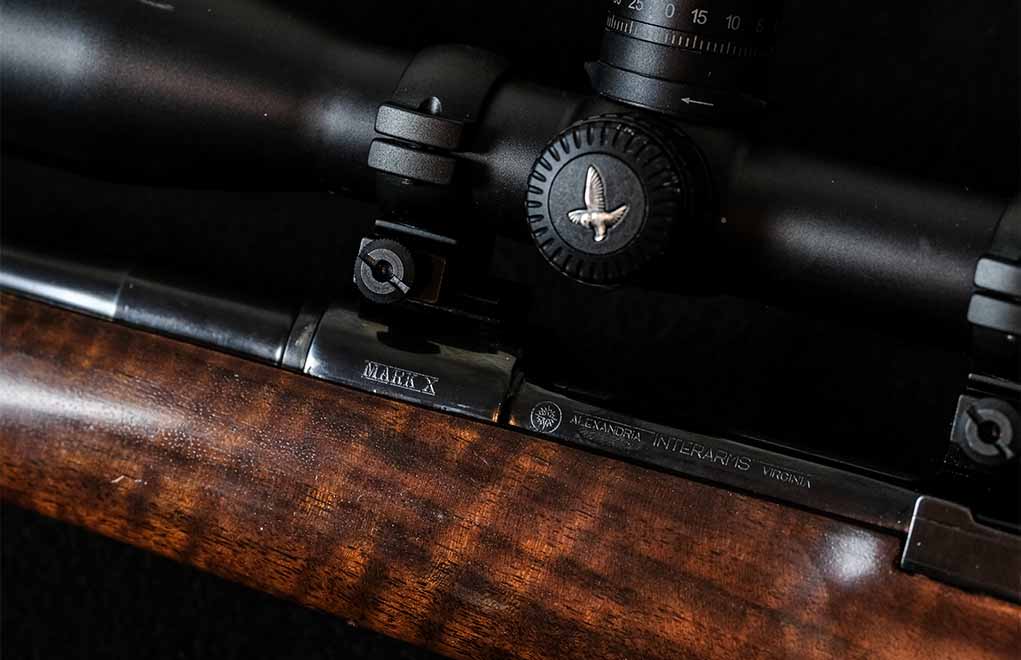
After World War II, there were a lot of Mauser 98 actions available in the United States, with many chambered in 8mm Mauser. While 8mm Mauser ammunition could be found, it was rare, so resourceful Americans rechambered their 8mm Mausers to use the .30-06 Springfield case, and the 8mm-06 wildcat was born. The Interarms X action shown here—actually an 8mm-06 Improved—was built by Zastava of Serbia and imported into the United States under the Interarms X name. It’s a large-ring Mauser 98 action copy and a favorite of many collectors.
As a result, they started loading the 7.92x57mm with a 153-grain, spire-point bullet and created a new gunpowder as well. These changes also worked and, by 1904, the M/88 had evolved into the lighter, faster, longer-lasting 7.92x57mm Mauser S.
Designation Clarification
I’ll let Norma explains the “S” and “J” designations for the 7.92x57mm as follows:
“The ‘J’ in the name stands for ‘Infanterie.’ The ‘J’ is due to a mistake resulting from the previous use of gothic letters in Germany and has no significance regarding bullet size. But, in 1905, the German army switched from a round-nosed, 226-grain bullet to a 154-grain, pointed boattail bullet. At the same time, the diameter of the bullet was altered from .318 inch to the present standard of .323 inch. Accordingly, the ‘S’ (for ‘Spitzer’) means that the barrel is made for .323-inch bullets.”
German Engineering Genius
How good was the new 7.92x57mm Mauser S? Not only did the Germans use it during World War II, so did the Polish, the Chinese … and the British. A bloody 8mm? Yes! They used in it their Besa machine guns. And who could blame them?
Say what you will about the politics of the German war machines of yesteryear, there’s no denying their engineering genius.
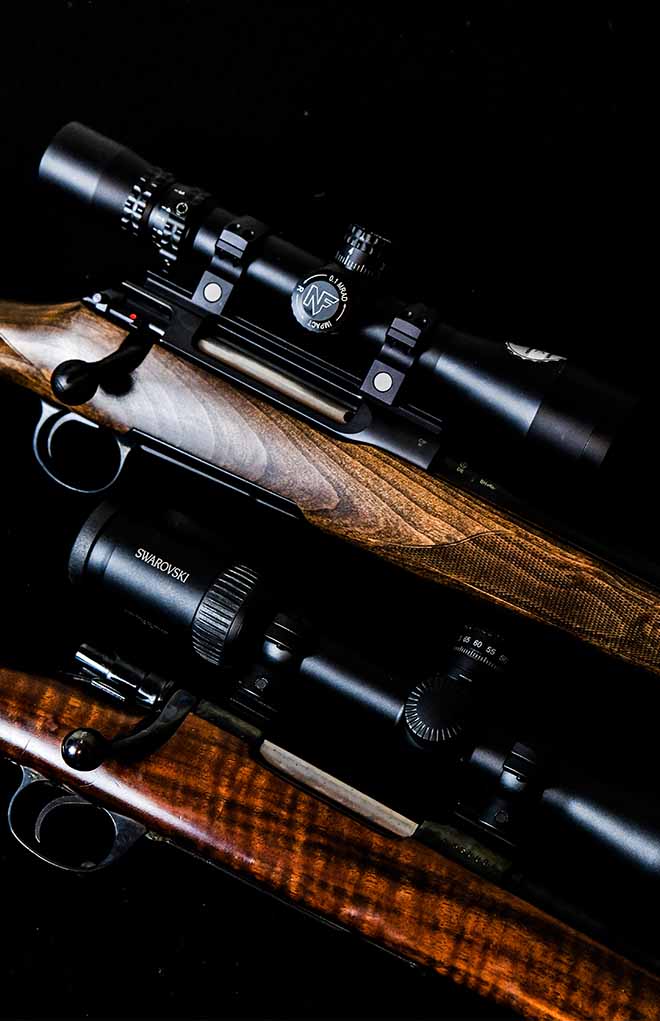
The Sauer 100 Classic chambered in 8×57 IS and the Interarms X custom rifle chambered in 8mm-06 Improved are two examples of how the 8mm Mauser has remained relevant in today’s highly competitive hunting and shooting market. Both cartridges can handle heavy bullets, with the 8mm-06 Improved giving the .323-caliber bullets a bit more speed. The far more common .30-06 Springfield case makes handloading the 8mm-06 relatively simple and is a great choice for new handloaders who want to enjoy a wildcat cartridge.
Case in point: Back in 1933, the German army understood long-range shooting, because it fed its 8mm-armed snipers 198-grain bullets with a ballistic coefficent of .593 (G1), which is so aerodynamically slick that it would make today’s PRS shooters wet their pants. The 7.92x57mm, loaded with the 198-grain bullets, gave the German army arguably the best performing standard rifle bullet of World War II.
One would think a cartridge with that kind of pedigree would have a bigger following in the United States. I do realize that if my only exposure to a cartridge were via it being shot at me, I wouldn’t like it, no matter how well designed it was. Thus, I can forgive America’s Greatest Generation for snubbing its nose at the 8mm Mauser. Still, there are plenty of other reasons the 8mm Mauser (and, honestly, all 8mm-caliber cartridges) doesn’t do well here.
“In my opinion, the 8mm never really thrived in the United States because it didn’t really do anything the .30-06 wasn’t capable of doing,” said Zach Waterman of Nosler Ammunition. “The .30-06 was also the cartridge most members of the military were familiar with at the beginning of the last century; and, in my experience, people generally stick to what they know.
“I believe another limitation of the 8mm Mauser is the lack of bullet weight options that also have relatively low BCs. Nosler offers 180- and 200-grain bullet weight options, and that’s it. Compare that to the ubiquitous (and more powerful) 338 Win. Mag., which has bullet weight options ranging from 180 to 300 grains, making this cartridge more appealing to a broader demographic.”
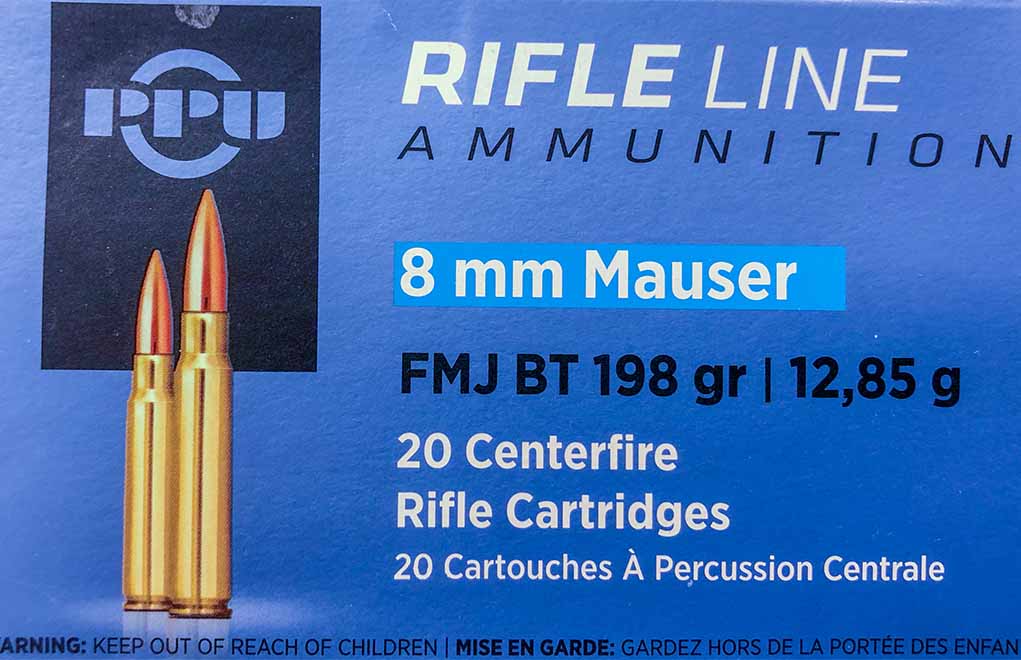
The 8mm Mauser is still very popular worldwide. Here, we see a factory box of Prvi Partizan 198-grain 8x57mm JS full-metal-jacket ammunition used for long-range shooting.
Waterman is mostly correct. However, the 8mm—specifically, the .323-caliber—is a little more popular than just the two bullets he mentioned.
MidwayUSA lists 34 different bullets you can reload. The most popular is Nosler’s 180-grain Ballistic Tip, followed by Hornady’s clever 170-grain SST and Nosler’s do-it-all 200-grain AccuBond. Folks who roll their own ammunition can find bullets ranging from 150 grains all the way up to 250 grains. The most popular bullet weight to manufacture for the .323 8mm is, by far, the 200-grain variety, because MidwayUSA lists no fewer than nine of them for sale. Need a high-BC bullet? Some of the 8mms have BCs as high as the .520s.
Duane Siercks, the lead ballistics technician at Sierra, agreed with Waterman and expands his opinion about the less-popular 8mm-caliber for Americans: “The bullet diameter change (.318 to .323) years ago really confused a lot of shooters. The .30-06 was able to outperform the 8×57. The wildcat 8mm-06 probably did as much for the 8mm as anything.”
The 8mm-06
So, what is an 8mm-06, and why does it exist?
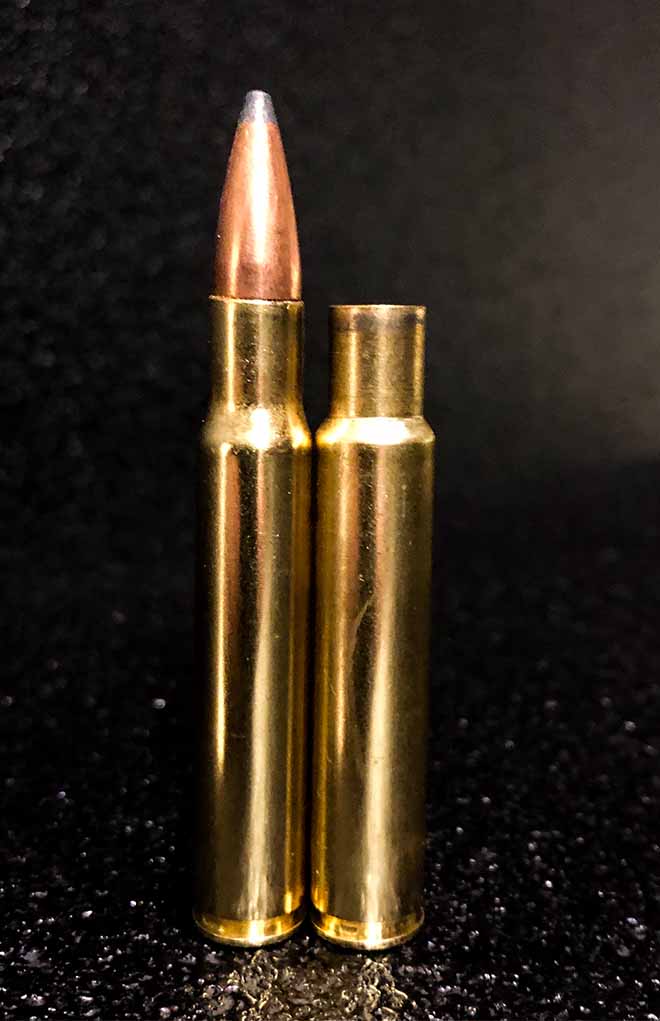
The 8mm Mauser inspired plenty of wildcats; one of the most popular is the 8mm-06 and its peppier 8mm-06 Improved version. On the left is an unfired 8mm-06 with a Hornady 150-grain Interlock bullet loaded with IMR 4064 powder. On the right is the fire-formed “improved” case with a 40-degree shoulder, which added as much as 5 percent more powder capacity. The 8mm-06 Improved cartridges were fire-formed in a custom-built Zastava-built Interarms X-based rifle owned by the author.
After World War II, there were a lot of surplus Mauser rifles available in 8x57JS in the United States. While Mauser rifles were plentiful, 8x57JS ammunition was not. However, Americans quickly figured out how to make 8x57JS ammunition from .30-06 Springfield cases. Wildcatters then figured out that simply necking-up a .30-06 Springfield case to accept the 8mm bullet gave Americans a robust cartridge. The 8mm-06 outperformed the 8x57JS by as much as 200 fps and up to 50 fps faster than equivalent .30-06 Springfield loads.
I own an Interarms X-based custom rifle chambered in 8mm-06 Improved, which adds an honest 1 to 3 percent increase in velocity over the 8mm-06. So, I’m pushing a 200-grain Nosler Partition out of my 24-inch, 8mm-06 Improved barrel at about 2,800 fps. That will do just fine for anything in North America and most things everywhere else. In addition, I can get .30-06 Springfield brass everywhere, and I have a set of custom 8mm-06 Improved reloading dies from Redding.
Nevertheless, the 8mm-06 isn’t the only .323-caliber cartridge still breathing, however faintly, in the United States. The 8mm Remington Magnum and the much newer .325 WSM top the list of 8mm cartridges that Americans use enough of to register sales these days.
“Nosler only offers three 8mm offerings—the 8×57 JS Mauser, .325 WSM and 8mm Rem. Mag., with the .325 WSM being the most popular by a large margin,” said Waterman. “The .325 WSM came out of the gate with a lot of momentum after it was introduced along with the other WSMs, so I think there are a lot of rifles chambered in that cartridge. But not a lot of ammunition offerings are available for those folks, which keeps our ammo sales for that cartridge pretty strong. I’ve personally taken the .325 WSM to Africa, and it performed perfectly on all the plains game I was after. I’ve also seen it shine in the tundra of northern Canada on caribou. My 8mm bullet-of-choice and our most popular offering is the 200-grain AccuBond. If you’re looking for .338 Win. Mag. performance in a short-action, it’s hard to beat the .325 WSM shooting a 200-grain AccuBond.”
Yes, the .325 WSM has helped resurrect the 8mm today—much as the 8mm-06 did after World War II. In fact, the WSM craze a few years ago that spawned the .325 WSM was revolutionary to 8mm-caliber bullet-lovers, because it inspired bullet manufacturers to pay attention to the 8mm again.
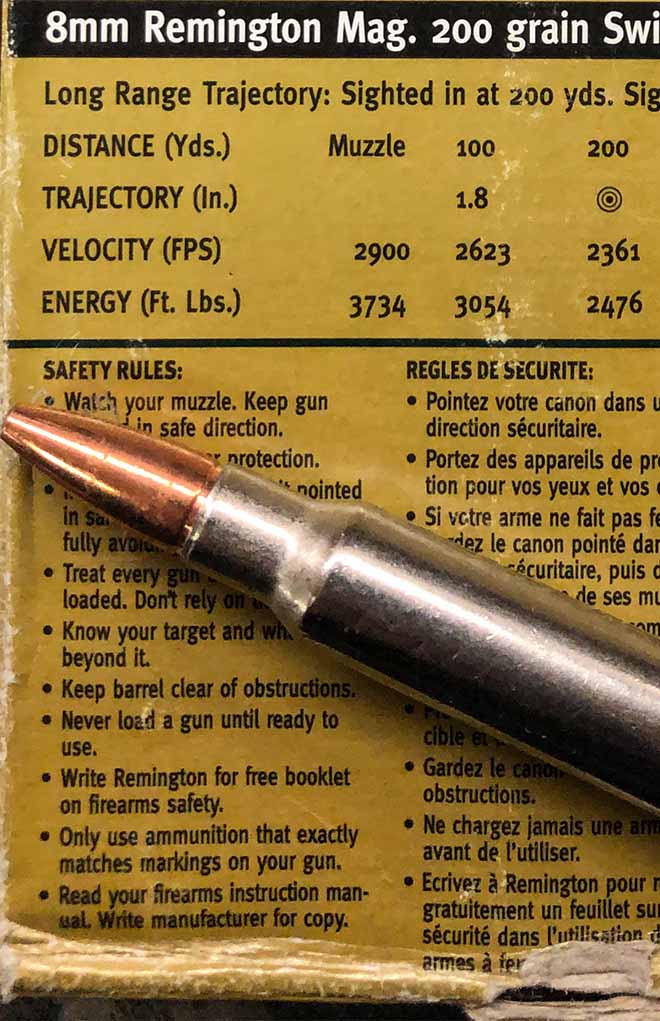
The 8mm Remington Magnum is a spectacular big-game cartridge that delivers substantial energy for .323-caliber fans. Here, the 200-grain Swift A-Frame bullet is factory loaded by Remington to give shooters 3,734 ft-lbs of energy at the muzzle. The 8mm Remington Magnum is a violent cartridge with a significant amount of recoil … and limited fans across the globe.
Newer, better bullets help any caliber, and the 8mm wasn’t any different—with better-built bullets offering high-speed terminal performance and less drag for flatter, faster flights toward the shooter’s intended target. The 8x57JS crowd can, and have, taken advantage of the technology applied to 8mm bullets these days.
According to Siercks, the popular 8mm bullets for them are the 150 and 175 SPTs. “The 8×57 will always have a loyal following. With 150-grain bullets for deer and 175 for elk-sized game, it is a solid performer. The .325 gives considerable ballistic advantage without the punishing recoil of the 8mm Rem. Mag. The .325 is certainly capable of harvesting all but dangerous game.”
Still, in America, the 7mm and .30-caliber bullets reign supreme. Even so, don’t ignore the mighty 8mm-caliber.
Waterman pointed out, “I’ve seen 7mm and .30-caliber bullets do some impressive things in the field, but the 8mm has more frontal surface area and, in my opinion, hits like a Mack truck. It might not possess the higher BCs the 7mm and .30-caliber bullets have, but for distances of 400 yards and in, that’s not really a concern anyway. Flatter trajectories can be achieved with the 8mm options; 9.3s simply don’t have the velocities behind them that the 8mms have.”
Ballistic Coefficients
Let’s take a closer look at the BCs of 8mm bullets compared to similarly weighted .30-caliber bullets. The 8mm (.323) 180-grain Nosler Ballistic Tip gives shooters a ballistic coefficient (BC) (G1) of .394 and a sectional density (SD) of .247. The equivalent .30-caliber Nosler Ballistic Tip gives a BC of .507 and an SD of .271. This one is no contest with the .30-caliber, leaving the .323-caliber, 180-grain bullet in the dust.
Let’s move up to 200-grain AccuBonds. The .323-caliber, 200-grain AccuBond has a BC of .450 and SD of .274. The .30-caliber, 200-grain AccuBond has a BC of .588 and SD of .301. Again, the .30-caliber bullet blows the ballistic doors off the 8mm bullet.
Let’s go bigger: How does the 8mm bullet fare against the popular .338-caliber bullets?
The 8mm (.323) 180-grain Nosler Ballistic Tip gives shooters a ballistic coefficient (BC) (G1) of .394 and SD of .247, whereas the .338-caliber bullet weighing 180-grainers falls short of the .323-caliber with a BC of .372 and SD of just .225. When comparing Nosler AccuBond 200-grainers, the 8mm does better with a BC of .450 and SD of .274, versus the .338-caliber, 200-grain BC of .414 and SD of .250.
Simply put: Physics can’t be denied. The .323-caliber bullets fall ballistically right in between the .30-caliber and .338-caliber bullets— a big “duh” there, folks. Ballistically speaking, it is cursed with what some of us know to be the dreaded “middle child syndrome.”
According to Siercks, “The 8mm cartridges are great for all medium-sized game, but I cannot say they are better than 9.3mm or 30-caliber. Their nearest rival would probably be .35-caliber for performance.”
In the end, does the 8mm Mauser—and, more specifically, the 8mm caliber—do anything better than its more popular American calibers to the north and south of its size? “Not in my opinion,” said Waterman. “I think that’s the very reason it hasn’t taken off in the United States.”
Even so, this Oregon-based bullet PR representative did offer some advice about how to make the .323-caliber relevant: “The only thing I can think of is to reinvent the caliber with faster twist rates and longer, high-BC bullet offerings. That definitely seems to be the trend with folks who are looking to improve upon what they already have.”
The bottom line? The 8mm Mauser and the rest of the .323-caliber cartridges will never be voted “most popular” in the ballistics yearbook then, now or in the future. It will, however, give any caliber a run for its money in another category—”most likely to succeed”—because the 8mm has been, and always will be … enough.
Editor’s Note: This article originally appeared in the September 2019 issue of Gun Digest the Magazine.
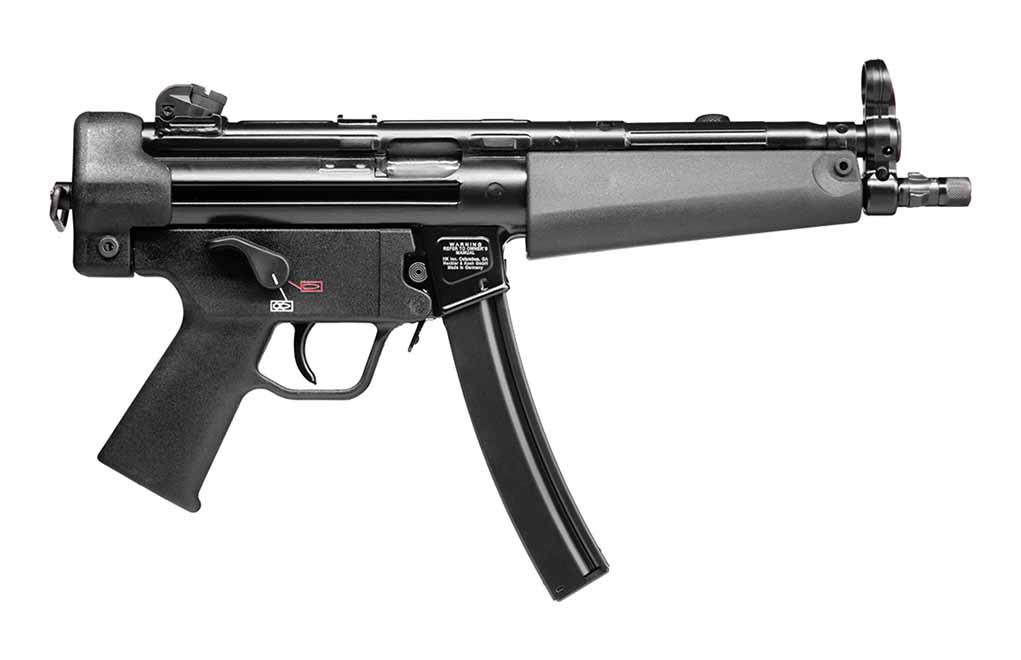
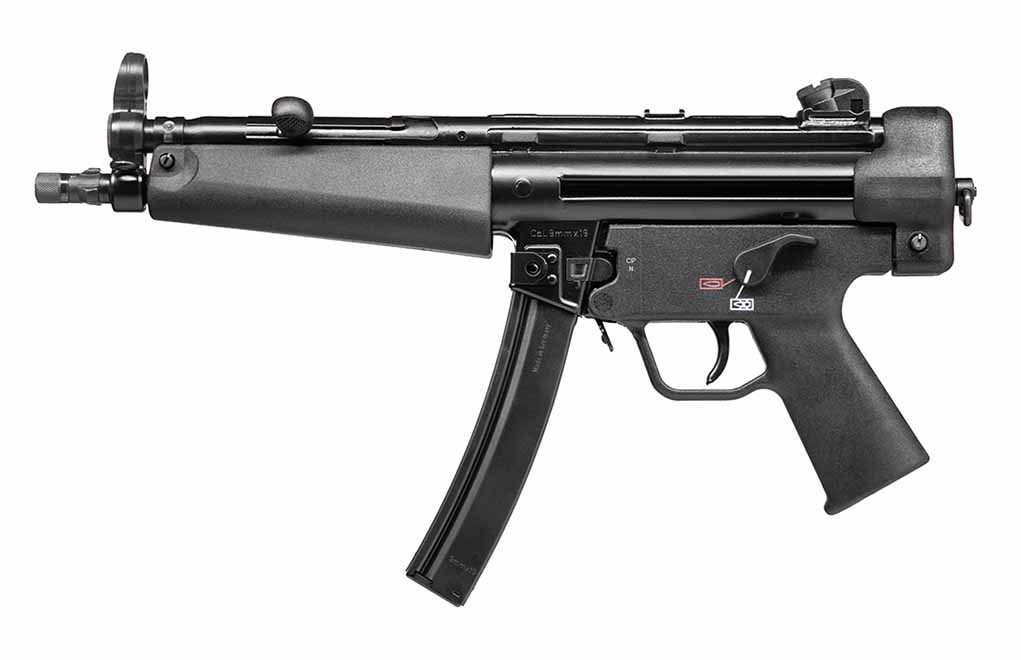
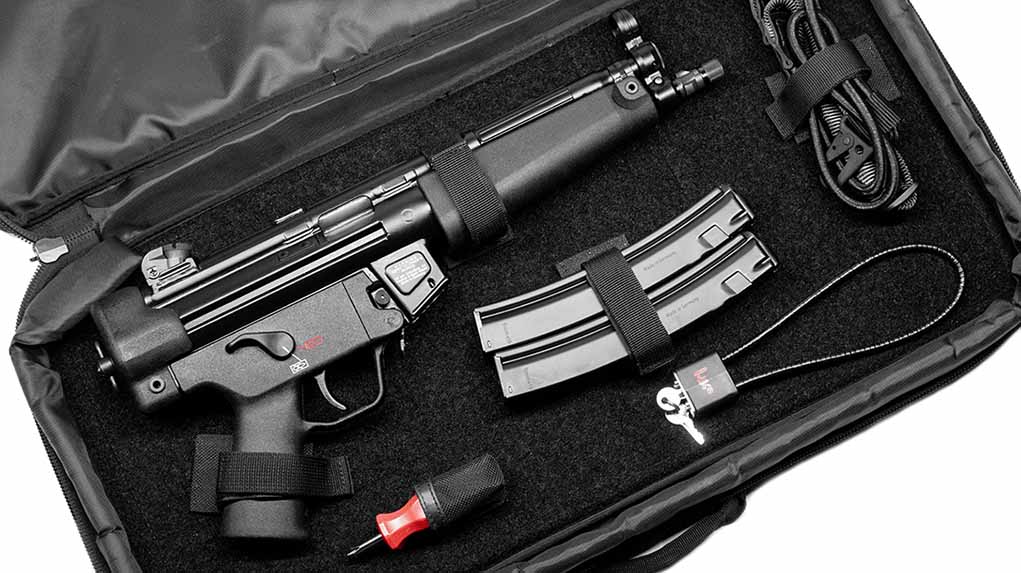
With the same look and feel as the Heckler & Koch MP5, the SP5 is made to mirror the legend.
How The HK SP5 Mimicks The Iconic MP5:
8.86-inch Navy type barrel
Threaded tri-lug adaptor
Paddle magazine release
Fluted chamber and chrome-lined bore
Roller-delayed blowback operated
Well, here’s a little something to stuff a stocking. Dubbed the SP5, the semi-automatic is close as you’ll get to Heckler & Koch’s legendary MP5–short of getting on Secret Service detail. Look, feel, the whole shebang, except full-auto. You can’t have everything.
Still, you get pretty dang close, with the 9mm SP5 boasting an 8.86-inch Navy type barrel with threaded tri-lug adaptor, paddle magazine release, fluted chamber and chrome-lined bore. And, of course, it’s roller-delayed blowback operated, which is a staple of Heckler & Koch. Also, it’s a boon in the semi-auto version, given it should help guarantee the accuracy of the pistol, not to mention make it more pleasurable to shoot. Adding a bit more authenticity, the pistol also rolls off the same line as the MP5 in HK’s Oberndorf factory in southwest Germany. This should reflect in the SP5’s quality, given the same workforce that produces its full-automatic cousin are the folks putting together the civilian variant.
As far as the gun’s specs, it’s 17.8 inches in length, weighs 5.1-pounds and is 2.48-inches in width. It’s outfitted with a rear sling ring, for the use of elastic style slings and, not quite true to form, has rear notch sight drum (the MP5 uses an aperture). Additionally, the rear cap is replaceable with a brace or stock, if you’re up for paying to make it an NFA short-barreled rifle.
The drawback of procuring a fairly authentic civilian rendition of the MP5 is Heckler & Koch isn’t exactly giving it away. The company lists the MSRP at $2,799. Furthermore, HK isn’t turning them out continuously, stating it’s limited to due to other projects.
More From Heckler & Koch:
Columbus, Georgia — Heckler & Koch is proud to announce the US availability of the HK SP5, the only authentic sporting version of the legendary MP5 submachine gun available.
The SP5 was developed by HK as a semiautomatic, civilian sporting pistol that matches the look and feel of the legendary MP5 submachine gun.
“Our whole team is very proud and very excited to finally bring the SP5 to the US,” HK-USA COO/CSO Mike Holley said. “The MP5 isn’t just a customer favorite, it’s an HK employee favorite too. So, we are just thrilled to roll out the most authentic semiautomatic-only version of it we’ve seen in the US.”
Designed and manufactured to meet the definition of a civilian pistol, the SP5 is loaded with authentic features, like a Navy barrel with threaded tri-lug adaptor, paddle magazine release, fluted chamber and chrome-lined bore.
The backbone of the SP5 is the roller-delayed blowback operating system, which is legendary for its accuracy, reliability, and smooth shooting dynamic. Originally perfected on the Heckler & Koch G3 rifle, it has been used on several other HK firearms still serving today around the world.
The SP5 is manufactured in Heckler & Koch’s Oberndorf factory in southwest Germany. It retains many of the critical elements of the MP5, including its precision-machined components and attention to detail. This high level of quality and workmanship is a result of making the SP5 in the same factory, on the same lines, and by the same workforce that has been making MP5s for years.
A wide variety of accessories can be added to increase its functionality. As the world’s most popular pistol-caliber carbine platform, the MP5 and SP5 are supported by an aftermarket loaded with lots of great accessories.
Whether selecting a handgun, a holster or other item of equipment the first thing we must ask ourselves is, “What is it for?” In our context, we need a handgun we can discreetly conceal on our person as we go about our daily routine so we can respond to a sudden, unforeseen crisis in which our life is in immediate danger. That is a pretty specific context.
Don’t ask what is the best concealed carry gun, ask if a particular make, model and chambering have these aspects.
What Are The Requirements Of A Life-Saving Concealed Carry Gun:
Reliable—It must work every time.
Effective—It must be capable of rapidly and reliably putting down a grown man.
Wearable—It must be portable enough to carry at all times.
Ergonomic—It must be easily operated.
The sidearm is a piece of emergency-safety equipment carried on the person in anticipation of need and intended to immediately terminate a sudden, lethal attack. For various reasons, a lot of people who wear a sidearm seem to forget completely the reason it’s there and focus their attention on features such as handiness, how concealable it is, its weight or even cosmetic appearance. Given the very serious purpose of the sidearm, that is sheer folly.
If you are truly convinced you don’t really need a sidearm for your personal safety, why bother to wear one at all? On the other hand, if you recognize such a need, doesn’t the fact that you need a firearm for protection of your life indicate that you should have a piece well-suited to the task? You might remind yourself the only reason we would draw our pistol is because we believe our own life or that of a loved one is in grave, immediate, mortal danger.
A word we need to keep in mind in any facet of this discipline is “context.” When we select any tool, the first question we have to ask is, “What are we trying to do?” If you have a screw sticking out of a threaded aperture, you need a screwdriver. If you have a piece of conduit you need to cut in half, you need a hacksaw. When you need one, the other will likely do you no good. The same is true of equipment in our context.
Cover Your Six, Get More Conceald Carry Info:
Best Pistol Reviews To Find A Superb Semi-Auto (2019)
Gun Digest’s 10 Best Shooting Drills And Firearms Training Posts
For Personal Defense, You Don’t Want A Custom Glock
The true requirements of a personal-fighting pistol run somewhat contrary to fad, fashion and the imagination of certain gun-magazine writers. A good, solid defensive pistol is apt to be less flashy, innovative or sexy than the current fad; but that should not influence your selection. Instead, as with any type of emergency-safety equipment, your selection should be based on the equipment’s intended purpose and the circumstances under which you might need it.
What then are the requirements for a serious personal sidearm? A sidearm must be reliable, effective, portable and ergonomic. Everything else is gravy.
Reliability is the single most important element in the selection of a personal defense weapon. The only justification for firing a weapon at a human being is to stop that person from killing or seriously injuring you or a third party. If you need a pistol for real, you need it very badly indeed. Your pistol must work each and every time you reach for it. If it doesn’t, get it fixed or replace it.
For the next requirement, the pistol has to be effective. To be of use to you in a real-life fight, the pistol must be capable of rapidly and reliably putting down a grown man with as few hits as possible in as short a time as possible. Many handgun/cartridge combinations are simply not capable of this and should be avoided.
The third requirement for the sidearm is it must be wearable, or portable. If you do not have it with you, it will do you no good. This will not be the same handgun for a 5-foot-tall, 105-pound female and a 6-foot-5-inch, 275-pound man. In addition to overall body size and physique, hand size has a great deal to do with handgun selection. There is no one-size-fits-all sidearm and there’s nothing gender-specific about handguns. We need the most powerful and easy to shoot pistol we can adequately conceal on our person, not some tiny little gun that makes us feel better, but will not allow us to fight effectively.
The last requirement is the handgun must be ergonomic, or user-friendly. Controls such as a manual safety, slide latch, magazine release, etc., must be located so they can be worked easily, quickly and with as little shifting of the grip as possible. Many, many handguns are very poorly designed in this regard. That is because the majority of them were not designed as defensive weapons. They were designed as hunting pistols, target pistols or plinking pistols. None of those pursuits share our extreme need to be able to get the gun into action quickly and reliably.
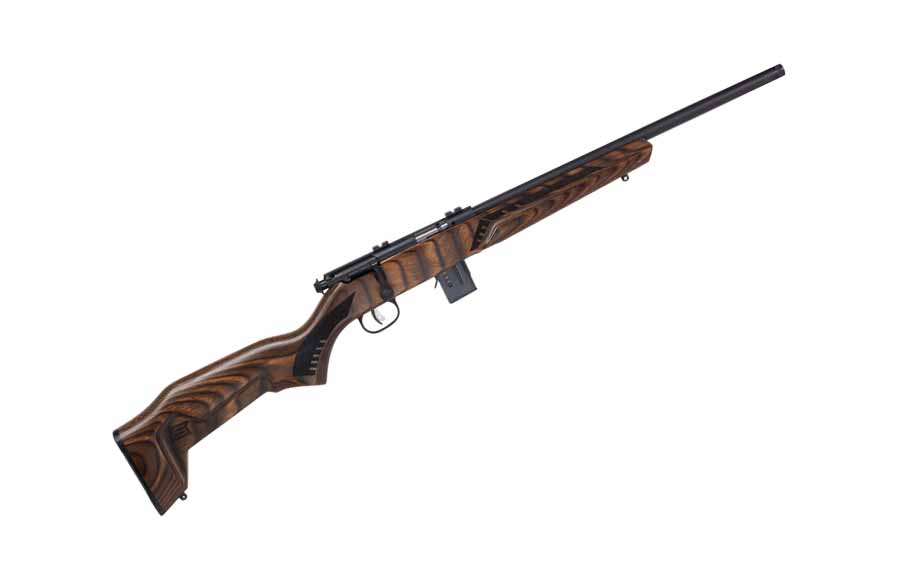
The Savage Minimalist Rimfire Rifle series aims to give shooters more bang for their buck.
How The Savage Minimalist Rimfires Delivers A Solid Deal:
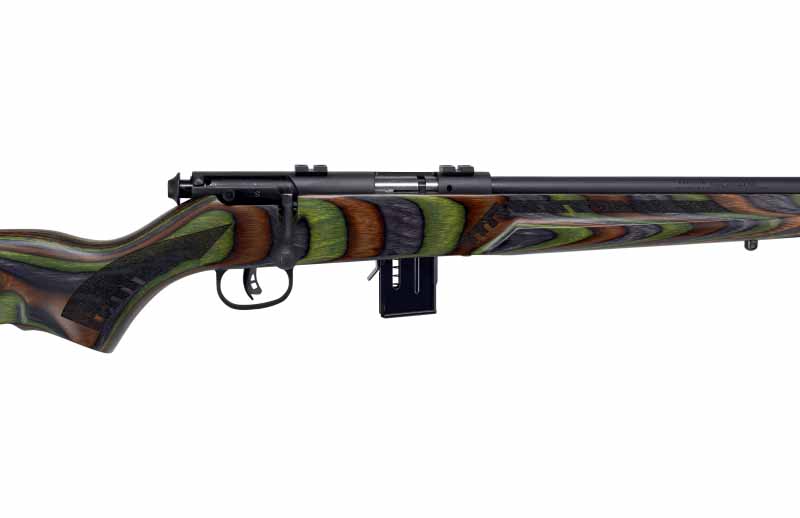
Unique lightweight green and brown laminate stocks
Pre-installed Weaver-style mounts
Sporter-contour, button-rifled barrels
Available in .22 LR, .22 WMR and .17 HMR
An MSRP of $359
To tell the truth, it’s been quiet. Too quiet. Usually, this time of year is rife with sneak peeks and leaks of the upcoming year’s new guns. There’s been a smattering, but overall not like years past. Maybe the gun industry has run out of ideas? Eh, not quite.
There’s been some brainstorming over at Savage Arms, the Minimalist Rimfire Rifle Series is proof enough. A fairly wild departure from traditional bolt-action plinker design, as its name suggests it aims at minimal burden in the field with an overall light 5.68-pound package. If you haven’t figured out how Savage pulled it off, take a second and look at the picture again. Yes, that’s it … there’s a substantial proportion of the butt milled out of the laminate stock. Certainly unique looking, and perhaps practical outside weight savings. Though it doesn’t boast a true hook, there’re more than enough real estate to steady the rifle with the support hand in prone or off a bench.
There’s another minimal to the Minimalist—price. Savage offers the configuration in three models—.22 LR Mark II, .22 WMR 93 and .17 HMR 93R17—each with an MSRP of $359, so right around $300 when they reach your local gun store. Very affordable.
Despite the economical price, Savage didn’t skimp on the Minimalist Rimfire Rifle Series. In addition to the choice of brown or green laminate stocks, the rifles also feature pre-installed Weaver-style bases, matte-black sporter-contoured barrels, threaded muzzles and button rifling. Especially nice, they also feed off 10-round detachable box magazines and are outfitted with Savage’s user-adjustable AccuTrigger. That last feature is pretty nice and not exceedingly common on rimfires.
For more information on the Minimalist Rimfire Rifle Series, please visit www.savagearms.com.
Learn More About Savage Arms:
Savage AccuFit: Putting Accuracy Within Reach Of Every Shooter
Draw a bead on your next smashing smoothbore with Gun Digest‘s best shotgun reviews, lists and videos from the past year.
Be it knocking birds out of the autumn air or smash clays under the summer sun, there’s nothing quite like getting a shotgun to live up to its full potential. Really, no gun collection is truly complete without at least one workhorse smoothbore in the rack. If you or your favorite shooter is short this essential, there’s still time to wrap one up for Christmas.
While many of the Black Friday and Cyber Monday sales have come and gone, there are still deals to be had, particularly on shotguns. To help you separate the wheat from the chaff, we’ve collected 11 of our best shotgun reviews, lists and videos from the past year to guide you along. Whether you need a little something for the spring turkey season or just want to stuff a stocking with a solid scattergun, these posts will get you on point.
Economical over/unders and side-by-sides … might as well ask for bargain diamonds. Except for these seven affordable double-barrel shotguns that definitely buck the trend.
Want more bang for your buck at the reloading bench? Learn the fine art of annealing brass.
What Is Annealing And Why Is It Important For Reloaders:
It’s the process of heating and cooling a case so the brass regains its malleability.
If brass isn’t annealed, it will eventually become brittle and break.
The process extends the life of your cases and saves you money in the long run.
It also tends to improve the accuracy of some rifles.
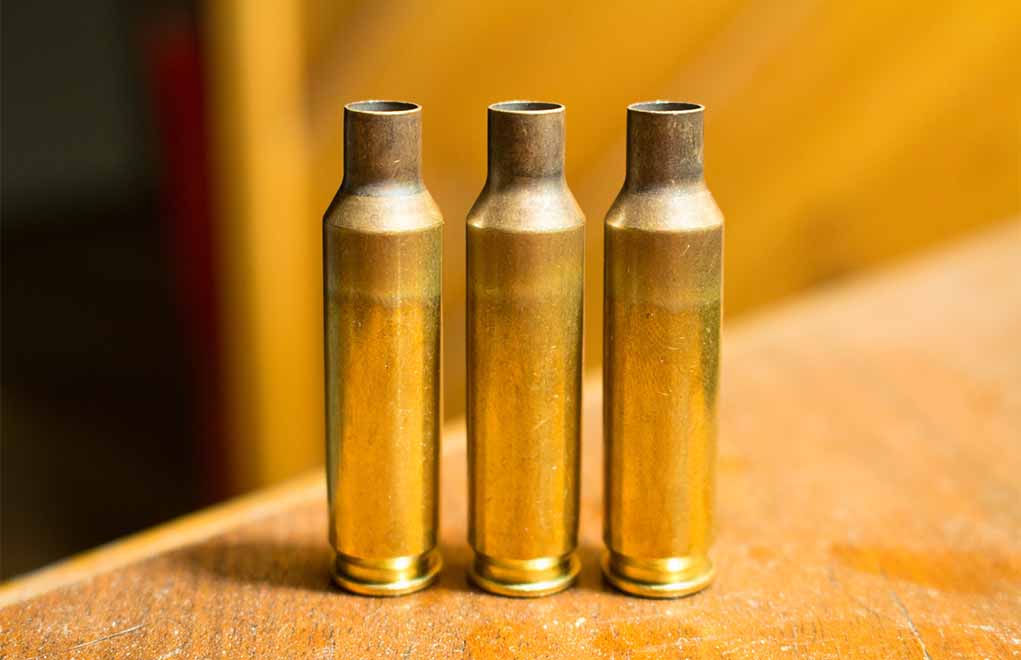
You might have noticed it on the neck and shoulder of your rifle cases—a rainbow-like coloration on the brass case. What you’re seeing is the result of a process called “annealing,” which is a means of keeping the brass soft. Simply put: The brass is heated to a temperature between 500 and 800 degrees (Fahrenheit) and then quenched to cool rapidly.
The Chosen Metal
Brass was chosen as a material for our cartridge cases for its malleability, strength and rigidity. It’s durable enough to withstand the rigors of life (copper was tried, but it proved to be too soft—as the stuck cases from the battle at the Little Big Horn showed), yet it is pliable enough to be easily formed and reshaped.
Brass, unlike steel, becomes softer when heated and immediately quenched. Again, in the opposite manner of steel, when brass is repeatedly worked, it will become brittle and crack.
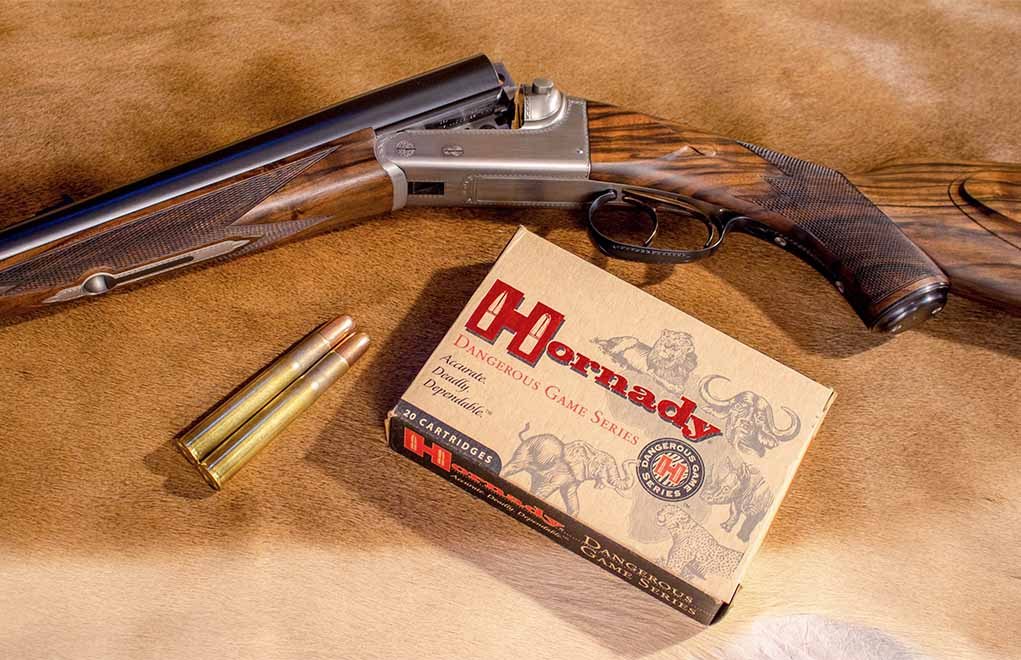
Hornady .470 Nitro Express ammunition. The necks are clearly annealed.
In a perfect world, our cartridge case would be formed to SAAMI specification and, upon firing, the shoulder and neck portion would expand to become a perfect mirror of the chamber, fully sealing the gases in the chamber.
Sometimes, you might find a sooty residue on the neck of your fired cases; this is from brass that hasn’t fully expanded to the chamber diameter. If you see this, odds are the brass isn’t expanding properly. Annealing can solve the problem.
Annealing for the Reloader
Lapua, Norma and Hornady brass often shows the effects of annealing at the factory (that aforementioned hazy rainbow look). And these brands will often show that they can be fired and resized more times than some of the other brands.
Annealed 6.5 Creedmoor brass should give longer life.
For a reloader, the ability to anneal your cases might not be such a bad thing. If you’re forming your own cases—for a wildcat design or making brass cases for an obscure or obsolete cartridge—annealing will help in the forming process and will also help preserve the cases once finished.
For example, I frequently form brass cases for my .318 Westley Richards from .30-’06 Springfield brass, and the process works the material considerably. For this particular operation, the case must be trimmed from 2.494 inches down to 2.370 inches and then run through the resizing die, which relocates the shoulder and opens the case mouth and neck from .308 inch up to .330 inch. That doesn’t sound like a whole lot, but to the grain structure of a brass case, it means a diminished life expectancy, at least in the configuration we need.
The cost of brass cases for big-bore rifles or for the rare and unusual cartridges can be huge and result in a serious investment. Some of the big Weatherby cartridges, such as the .378 and .460 Magnums, along with the big Nitro Express and other safari cartridges, can cost between $3 and $8 per case. As a reloader, I do everything to keep those expensive cases around as long as possible, including annealing the brass.
The Annealing Process
So, how can the reloader anneal their own cases?
Even nickel-coated brass can be annealed, although these 7mm-08 Remington cases from Federal don’t show the marks as clearly as all brass cases.
The principal idea is to heat the neck and shoulder of the case—but certainly not the body and base. A common method that’s inexpensive yet effective uses a blow torch to heat the cases just enough to get a dull-red glow and then place the cartridges into water. Do not overheat the case, because you’ll ruin it. Although the annealing results from this method might not come out as uniformly as others, it’s certainly better than nothing.
Brass Annealing Machine
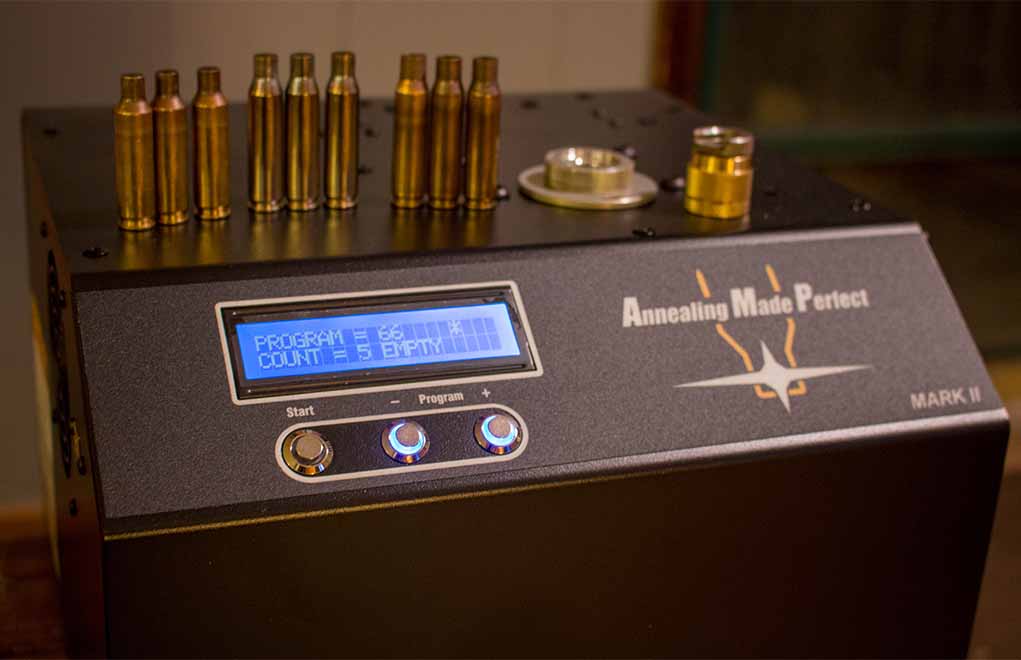
I’ve found a cool (albeit expensive) unit that handles annealing very well. The folks at Annealing Made Perfect (New Zealand; AMPannealing.com) make a machine that gives all sorts of flexibility and will handle cartridges from the .17 Hornet all the way up to the .50 BMG. Described as “the world’s first and only smart annealer,” the machine is easy to use and makes it simple to customize your brass cases.
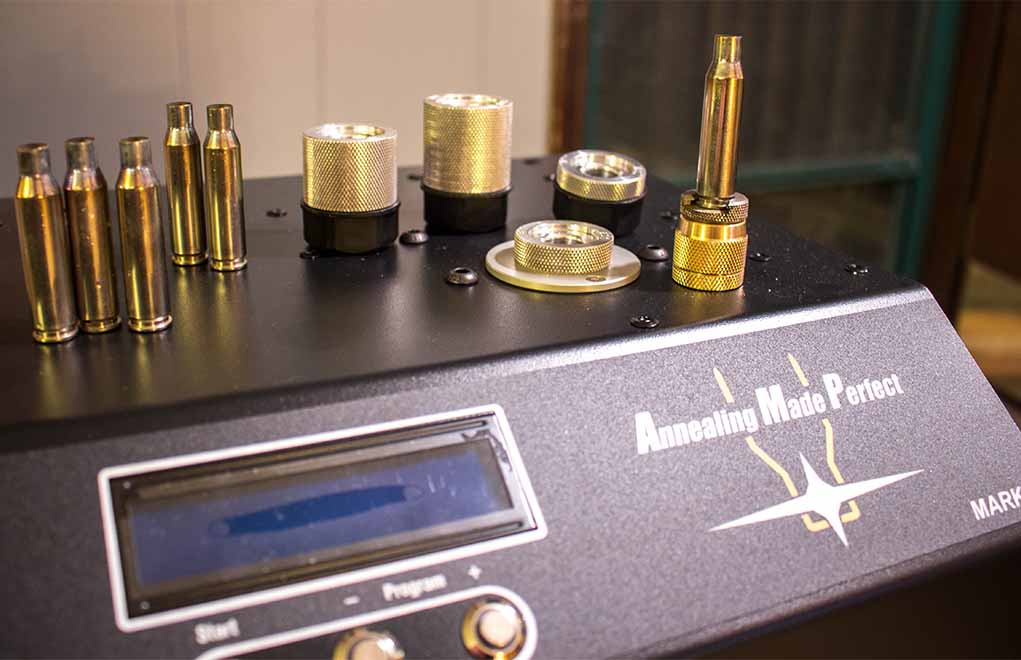
Using induction to generate heat, AMP makes a series of pilots, which work as spacers, to place the case mouth, neck and shoulder at the proper height within the machine. Each family of cartridges—say, the .308 Winchester, .260 Remington and .338 Federal as one family and the .30-’06 Springfield, .270 Winchester and .280 Remington as another—will use a common pilot. Simply thread the pilot into the top of the machine and, using a common shell holder that inserts into a small unit designed to keep your fingers cool, the unit can be set to a specific program time to give the proper amount of heat.
The AMP Mark II annealing machine is easy to use and very consistent.
You will find a chart of varying calibers on the AMP website, and within the caliber, varying brands of brass, along with the appropriate program time. Set the front display to the proper program time and hit the start button. Within seconds, you’ve got as good an annealing as you could ask for. I put the machine through its paces and found it would crank out about 300 cases per hour.
The AMP machine also is compatible with the AZTEC program, which will have the machine test (and ultimately destroy) one of your cases to determine the properties of the case, as well as how long a runtime your particular case will need.
This device should have all sorts of appeal to wildcatters who create their own unique designs. With a street price of around $1,400, this is a major investment for a single reloader. However, for a shooting club or rifle range, a group of shooters could split the cost, and it would make sense.
Is annealing a necessity in order to reload ammunition? No, but it most certainly extends case life—and I’ve also found it to improve accuracy in many of my rifles.
If you find yourself shooting enough to wear out cases, maybe it’s time for you to add annealing to your reloading routine.
Target-focused shooting goes against many of the fundamentals you learned for handgun accuracy but might save your life in an up-close attack.
He was less than a car-length away when he attacks. Despite the surprise, you were able to unholster your gun in textbook fashion. You even punched out before he got within range to grab you. The one thing that didn’t come together, a perfect sight picture. Should you care?
When you’re talking utmost accuracy, particularly when the target gets out 10 yards and further, absolutely focusing on the front sight and getting everything perfectly aligned is imperative. In quick-and-dirty close-quarters combat, such nuances go straight out the window. These fast-paced situations call for a more intuitive style of shooting, which facilitates life-saving hits in the most expedient manner possible. What it calls for is target-focused shooting.
As its name suggests, your plane of focus is on where you’re shooting, not your front sight. Quite a bit different than what most of us have been taught. But honestly, in a lethal-force situation—particularly up close—it’s where your eye naturally draw anyhow. Though don’t fool yourself, this isn’t a point-and-shoot method. Fundamental pistol marksmanship is still in play … presentation, sight alignment, etc. You’re just not focusing on the front sight any longer.
There are limitations to target-focused shooting—primarily distance. Practicing this method, you might find you’re only effective using it out to 5 yards, maybe 3. You have to respect this and understand it only one skill in your overall defensive toolbox and only use in situations that demand it.
The new Savage 110 Classic brings an elevated level of versatility to the traditional wood-stocked hunting rifle.
How The Savage 110 Classic’s Stock Makes It A Modern Classic:
Combines the customizability of a polymer stock with the classic look of walnut.
Push-button controlled adjustable stock lets you tailor LOP and comb height.
Each has 1.5 inches of play.
Button tension can be increased or decreased with an Allen key.
When polymer rifle stocks first emerged in the 1980s, they were viewed with skepticism and disdain by many hunters. It was argued that injection-molded plastic would never have the look and feel of traditional walnut. After all, wood-stocked guns have been serving hunters since the dawn of rifledom, and traditionalists saw no reason to change.
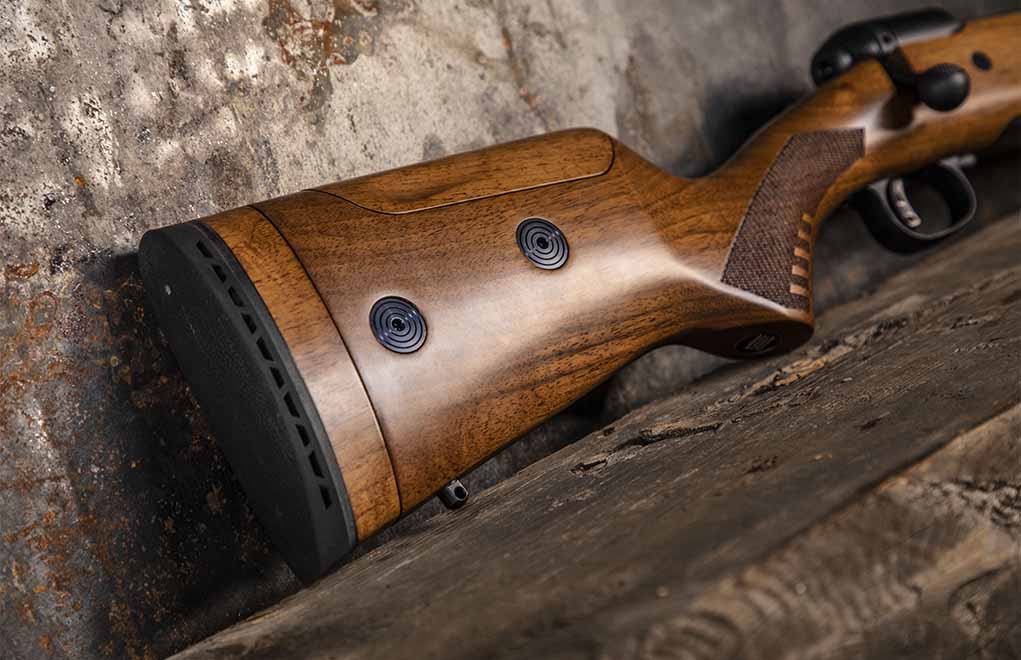
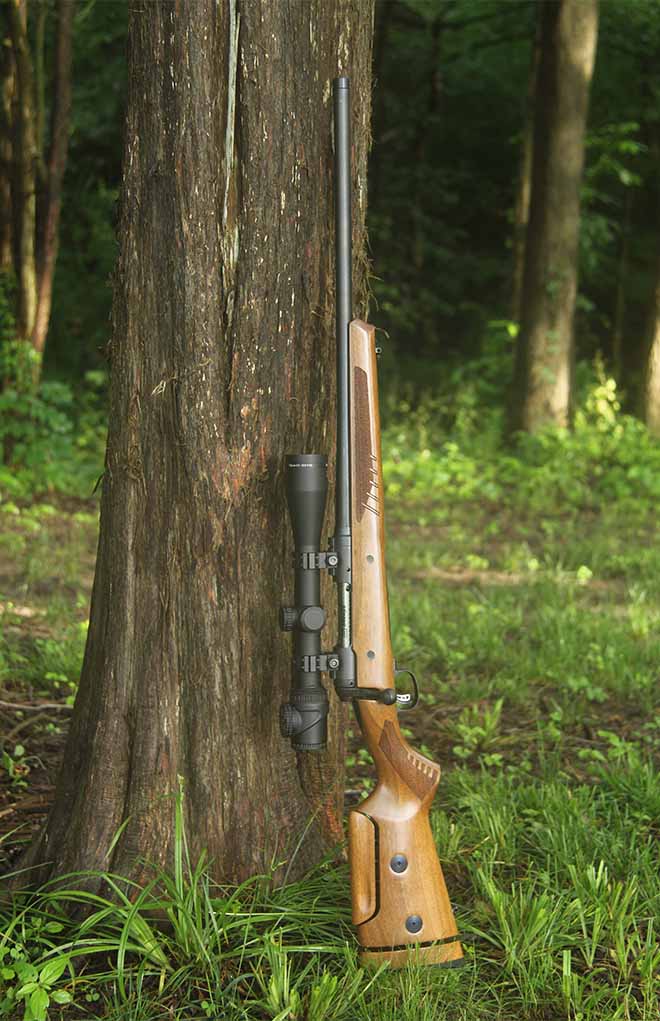
The Savage 110 Classic features an oil-finish walnut stock that easily adjusts for comb height and length of pull, blending the versatility of a polymer stock with the look and feel of wood.
As it turns out, polymer stocks do have some very real advantages over wood stocks: Polymers are tough, inexpensive and, perhaps most importantly, they make it very easy to customize a rifle to fit the shooter.
Customizability + Classic Style
Savage’s new 110 Classic bolt-action rifle manages to combine the customizability of a polymer stock with the classic look of walnut. At first glance, this rifle looks like a traditional wood-stocked rifle; a gun that will appeal to the traditionalist. Closer examination reveals that the walnut stock can be quickly adjusted to perfectly fit any shooter.
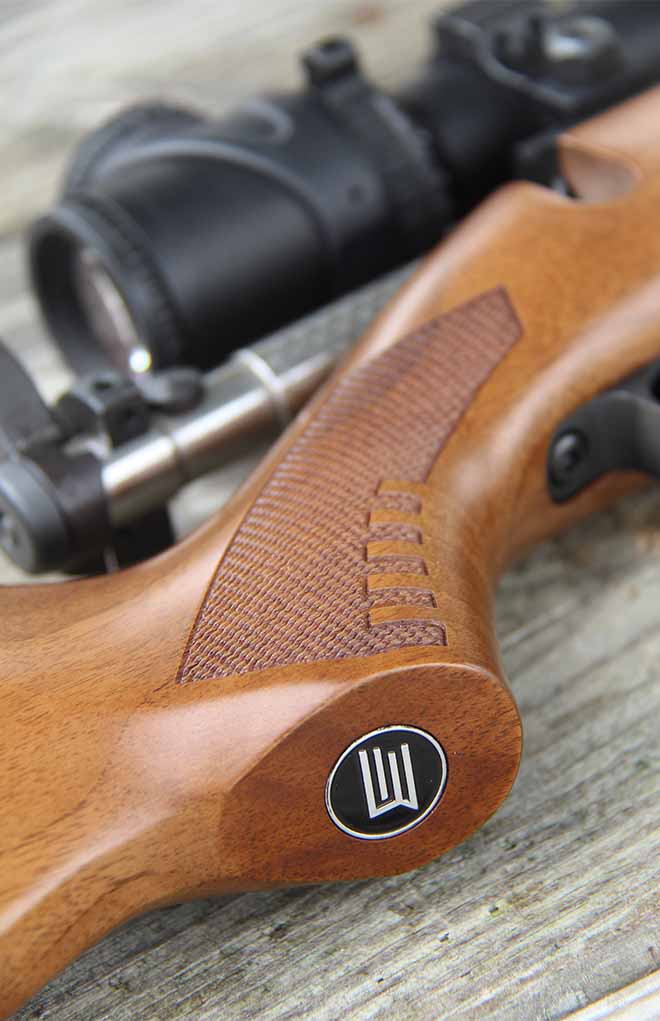
The walnut stock features a comfortable pistol grip with a slight palm swell. The design is comfortable for shooters with various-sized hands, thus adding to the 110 Classic’s versatility.
The principle that Savage uses to accomplish this is similar to what high-end shotgun companies have been doing with competition guns for years: Competitive shotgun shooting demands exact gun fit; and, decades ago, that required shooters to go through the difficult and expensive process of having the stock adjusted.
Many modern competition shotguns have walnut stocks with adjustable comb heights and lengths of pull that allow the gun to be quickly customized to properly fit any shooter. Savage borrowed that technology and transitioned it to the rifle market. The new 110 Classic’s stock has two buttons on the right side of the stock that allow a shooter to adjust both comb height and length of pull by up to 1.5 inches. When the front button is depressed, the comb is released and can be raised, and three steel posts keep the comb secure and properly aligned. The center has cutouts that lock in place, and there are five adjustment points, each of which offers roughly a quarter-inch of adjustment.
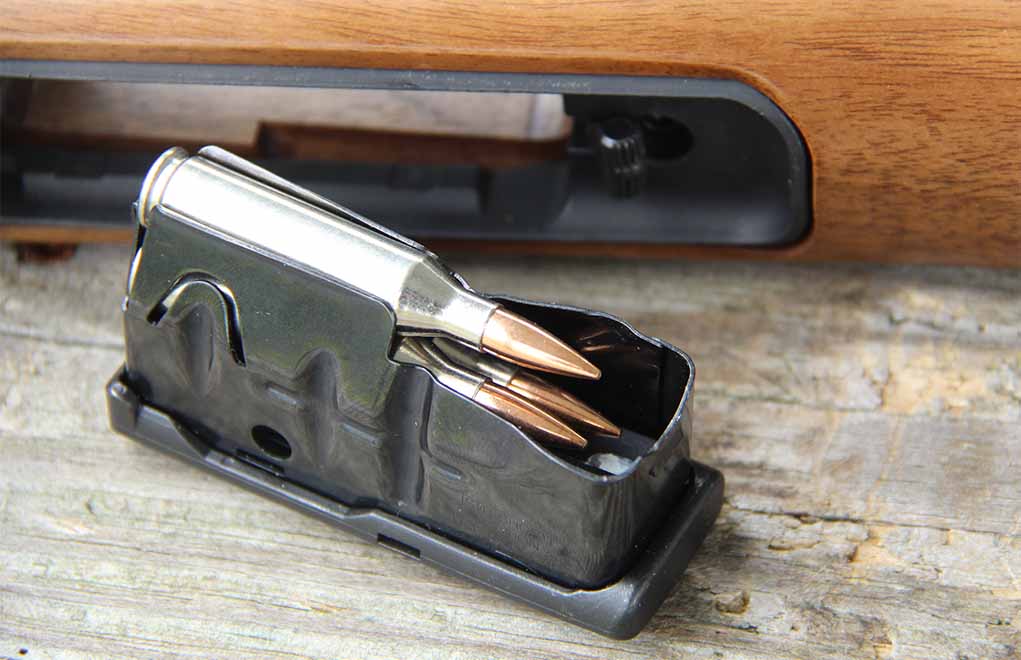
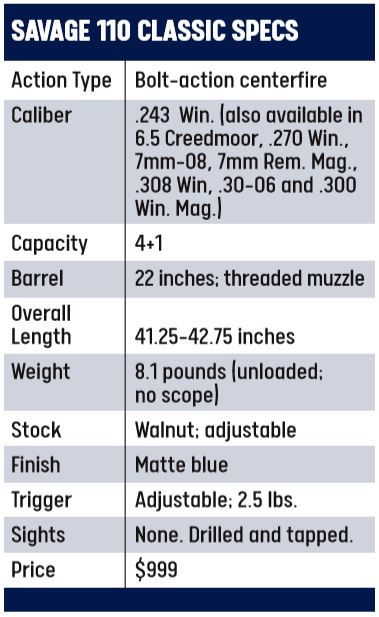
The Savage 110 Classic comes with a drop-out metal box magazine that holds four rounds (three in magnum calibers). The magazine release button is located in front of the magwell.
The rear button controls length of pull in the same manner. Button tension can be adjusted using an Allen key. The adjustment buttons measure almost an inch wide, so they’re easy to locate and operate without taking your eyes off the target. And, the walnut stock has an oil finish that looks good and helps protect the wood.
Features and Details
In addition to its clever stock design, the Savage 110 Classic is a very versatile and well-built hunting rifle. It employs Savage’s proven dual-lug push-feed action with plunger-type ejector, and it also comes with the company’s user-adjustable AccuTrigger, which features a blade design to prevent impact discharges.
The 110 Classic comes with Savage’s AccuTrigger. The design is exceedingly safe and user-adjustable from 1.5 to 6 pounds.
The carbon-steel action and barrel feature a non-glare matte-black finish, and the sporter-profile barrel comes in lengths of 22 inches for standard calibers and 24 inches for magnums. All 110 Classic rifles come with a 9/16-28 threaded muzzle and include a thread protector. Other key features include a removable metal box magazine that holds four rounds (three in magnum calibers) and sling studs.
Learn More About Savage Arms:
Savage AccuFit: Putting Accuracy Within Reach Of Every Shooter
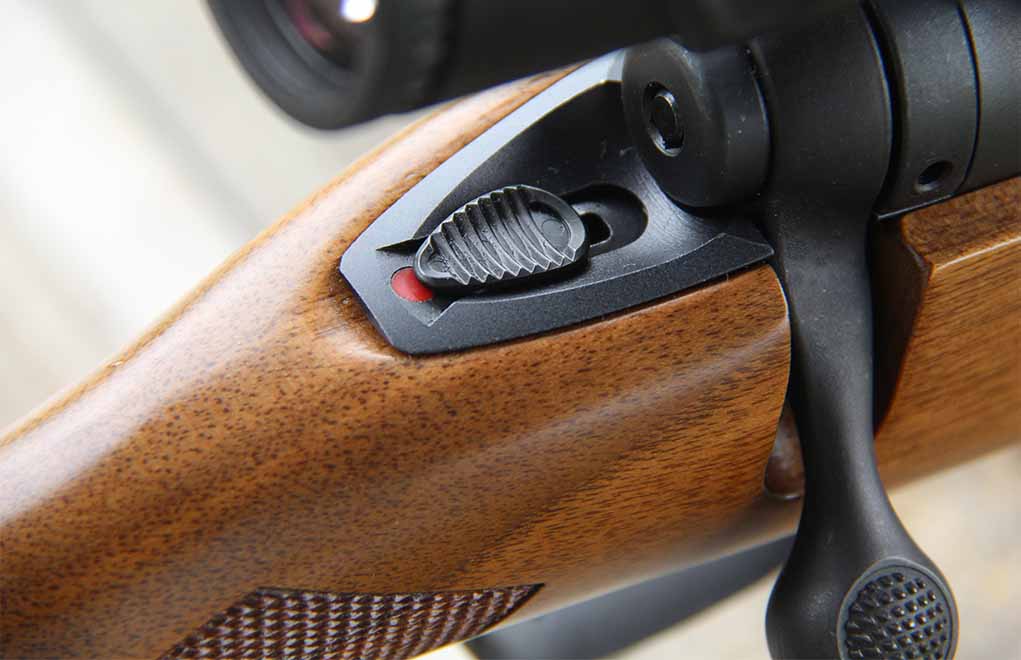
The 110 Classic weighs in at around 8.1 pounds, which is fine for most hunting applications. Overall length for standard calibers ranges from 41.25 to 42.75 inches, depending upon length-of-pull adjustments, and the controls are easy to operate. There’s a three-position, tang-mounted safety that allows you to load and unload the rifle with the safety engaged, and the magazine release button is located at the front of the magazine well. Removing the bolt requires depressing a button on the front of the trigger guard and pulling the trigger.
The 110 Classic is available in eight calibers ranging from .243 Winchester to .300 Win. Mag., all of which carry an MSRP of $999.
Expectations Met… and Exceeded
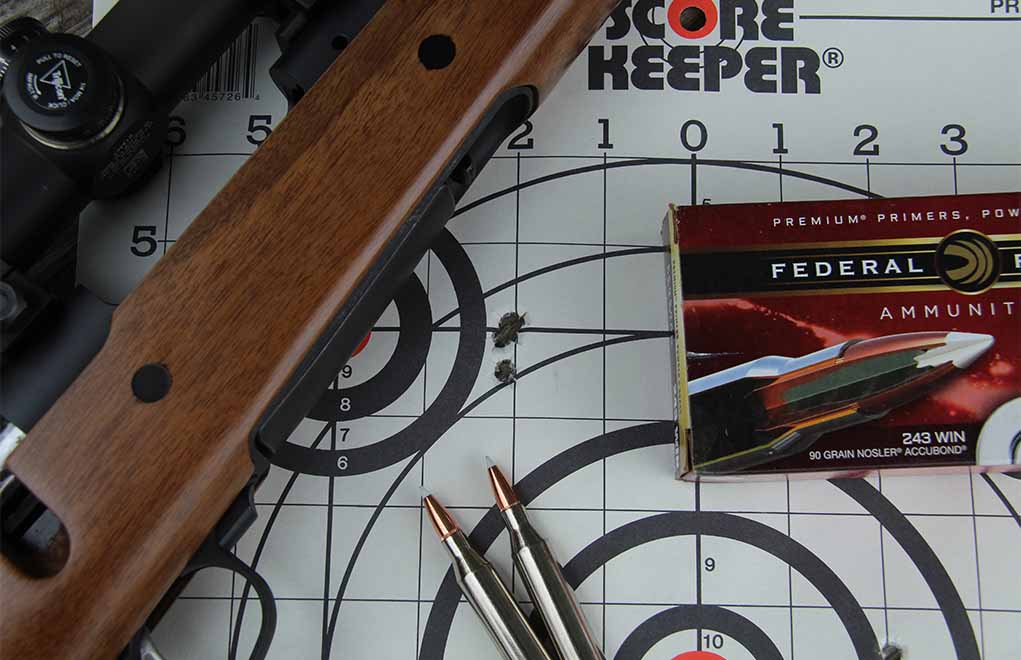
The 110 Classic I tested was chambered in .243 Winchester. I topped the rifle with a Trijicon AccuPoint 2.5-12.5x42mm scope. Removing the bolt for bore sighting or cleaning requires lowering the comb so the rear portion of the bolt doesn’t strike the stock. Once this was done, I reinserted the bolt and adjusted the comb height so that my eye was naturally aligned with the scope.
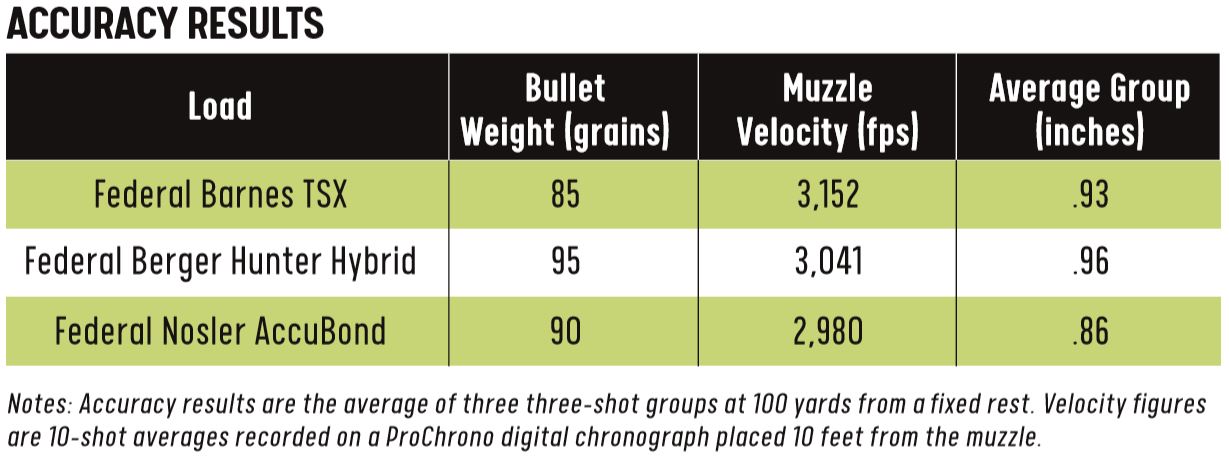
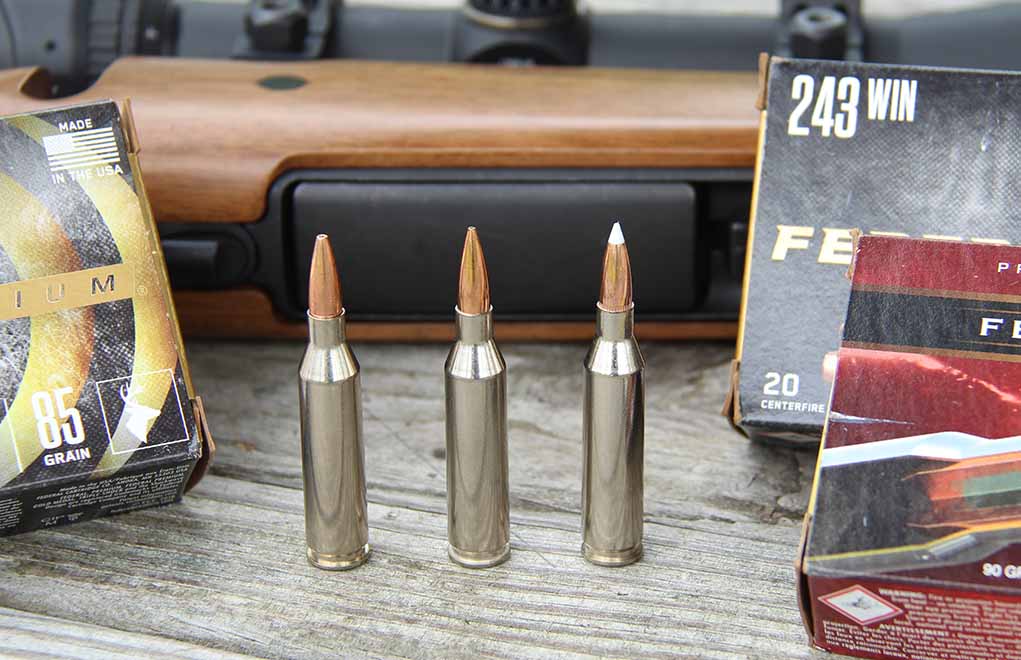
The 110 Classic proved capable of sub-MOA accuracy with the three Federal loads tested. These included (left to right) Barnes 85-grain TSX, Berger 95-grain Hybrid Hunter and Nosler 90-grain AccuBond.
The 110 Classic’s stock allows the shooter to adjust length of pull from roughly 12.5 to 14 inches, and because I have rather long arms, the rifle fit me best with maximum length of pull. Most other walnut stocks are built to fit the “average” shooter, so having the ability to customize the 110’s fit is a worthwhile feature. There’s no need to readjust your shooting position to make up for a stock that’s too short or too long, and the Savage allows the shooter to adopt a more natural shooting position. This increases comfort and also helps mitigate recoil.
Savage has a stellar reputation for accuracy—thanks, in part, to its use of a barrel nut that allows for perfect headspacing.
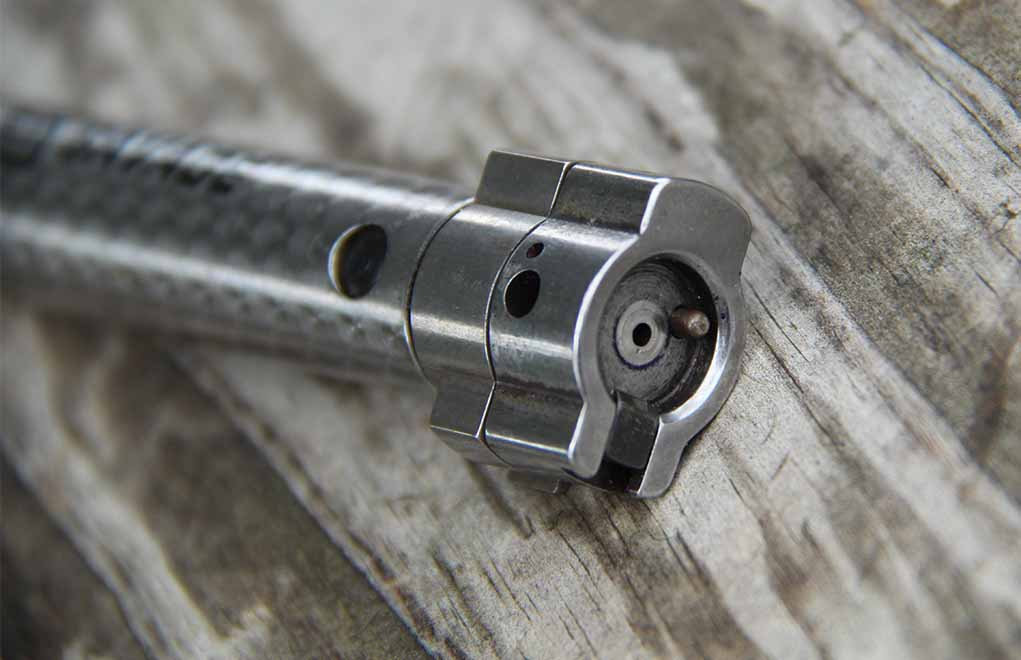
The 110 Classic utilizes Savage’s dual-lug push-feed action with a plunger-type ejector. The surface of the bolt has a jeweled finish.
The 110 Classic not only lived up to those high expectations, it exceeded them, producing sub-MOA groups with all three of the .243 Winchester loads tested (Federal’s Barnes TSX 85-grain, Nosler AccuBond 90-grain and the new Berger Hybrid Hunter 95-grain). All three of the loads were extremely consistent, with group sizes ranging from .68 inch to 1.08 inches at 100 yards. Every load tested averaged under an inch, making this the most accurate Savage rifle I’ve tested. Impressive!
Recoil isn’t much of a factor with a .243, but the 8-pound (10.1 pounds loaded and scoped) Savage 110 proved to be very easy to shoot. I have little doubt that the custom-fit stock improved accuracy.
The 110 Classic features an American-style flat comb. When elevated, the rear portion of the comb rises above the line of the stock. As a result, it’s important to ensure no portion of your face is behind the elevated portion of the stock so the force of the rifle’s recoil doesn’t rake across your cheek (a mistake I made … just once).
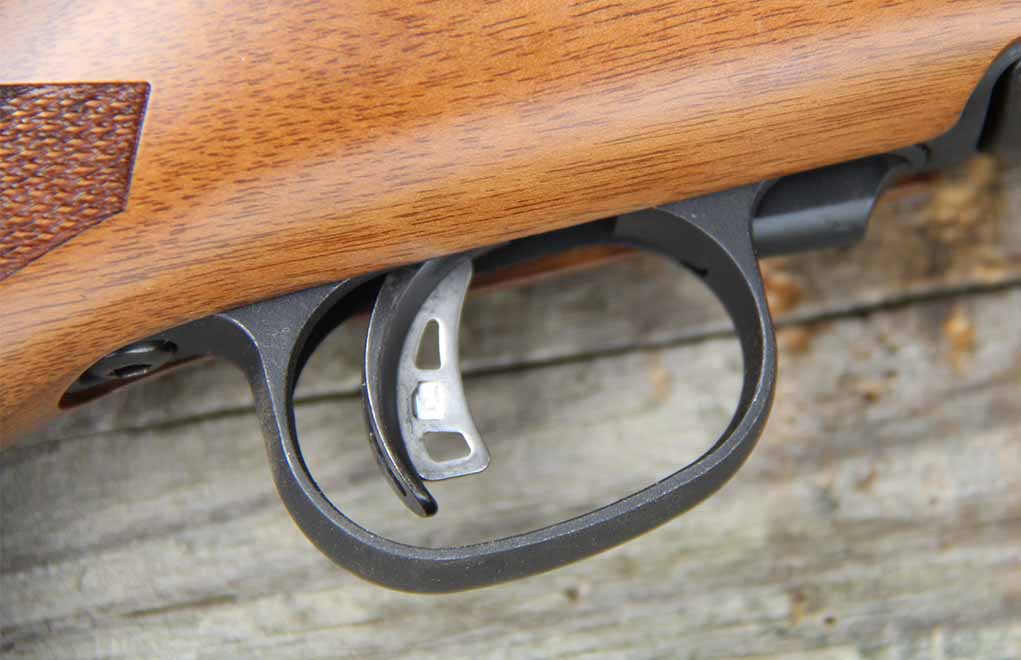
The AccuTrigger revolutionized bolt-action rifle production, and because it’s user-adjustable from 1.5 to 6 pounds, you can customize trigger pull weight. The test rifle came set at 2.5 pounds, which is just about perfect for my taste; however, if you want to adjust the trigger pull weight, it’s a simple process: Simply remove the action from the stock, and the trigger weight control screw can be adjusted clockwise or counterclockwise for a lighter or heavier pull.
Like all 110s, the Classic features a tang-mounted safety that’s easy to reach and manipulate. The three-position design allows the action to operate with the safety engaged in the middle position.
The adjustable stock and comb allow the shooter to get more comfortable when shooting from the bench, but this adjustability also helps when shooting from field positions. Prone shooting is popular because it affords the shooter maximum stability while hunting, but your ability to quickly and efficiently get into a prone position is compromised by the dimensions of your stock: If length of pull is too long, you’ll be reaching too short, and you’ll have to fire from a compacted position, which inhibits a relaxed, comfortable shot. The adjustable comb is also a benefit when shooting prone, because in really awkward positions (steep uphill, steep downhill, uneven terrain), the comb can compensate for unusual head positioning.
Having the proper length of pull allows for faster shooting from kneeling or standing positions, and you can adjust it to compensate for heavy clothing. Normally, I shoot a rifle with a 14-inch length of pull, but in really cold conditions for which I’m wearing bulky clothes, having the option to shorten the rifle’s length to accommodate extra layers is a benefit.
With 1.5 inches of comb adjustment, the Savage 110 accommodates a wide variety of shooting styles. It’s especially valuable when shooting from field positions.
There’s nothing particularly fancy about the 110 Classic rifle, but it is a good-looking and well-executed gun. The walnut stock is rather plain, but the oil finish adds a touch of class. Wood-to-metal fit is pretty good throughout. The pistol grip is comfortably angled with a palm swell that allows for a firm hold on the gun, and the rounded fore arm is equipped with a finger groove. Both the fore arm and pistol grip feature Savage’s signature checkering with interrupting parallel lines.
The action is fairly smooth, and the magazine fits neatly into the rifle without a lot of fiddling. The lone reliability issue came when a single cartridge popped free of the magazine— the rear portion riding atop the closing bolt, which caused obvious chambering issues. Aside from that, the gun performed well.
Savage is breaking ground with the addition of an adjustable walnut stock, and I like the design. Sure, companies offer plastic spacers that allow you to manipulate length of pull, but the push-button design on the 110 Classic eliminates the need to remove the recoil pad when adjusting length of pull. The design certainly makes perfect sense when two or more hunters share a rifle, because, with just a few simple adjustments, a single gun can fit mom, dad and any kids in your house.
The new 110 Classic offers traditionalists a wood-stocked rifle that doesn’t forfeit the versatility of a polymer stock. At $999, the Classic isn’t exactly a budget rifle, but it does shoot extraordinarily well. And, it’s one of the few guns that can instantly fit anyone who fires it.
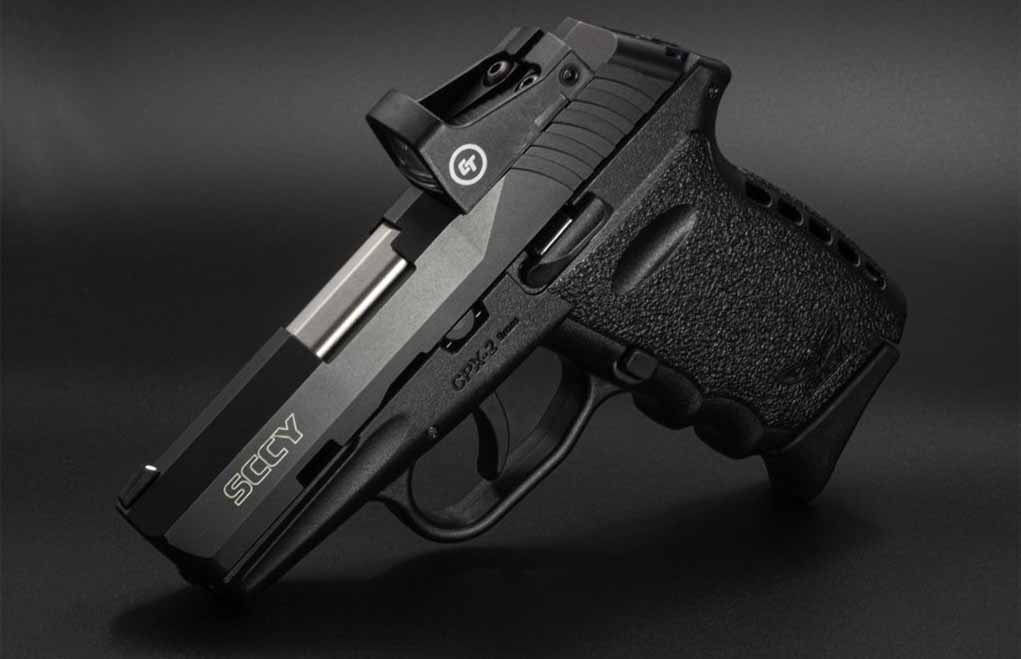
Outfitted with Crimson Trace reflex sights, the CPX series gives shooters an affordable choice in optic-ready pistols.
How SCCY’s CPX line gets the edge on other optic-ready pistols:
Starting a less than $350, the line is among the most affordable in its class.
The Crimson Trace CTS-1500 provides a durable and accurate aiming solution.
The red-dot is attached via a slide cut, keeping it low profile and rugged.
If you’ve used one in competition or simply banging around at the range, you know the first word that comes to mind with a reflex optic—cheating. Once you get a knack for acquiring your target with the red dot, the pace at which you place hits and transition is amazingly fast. Given this, it’s no wonder optics have wandered from pistol matches to more mainstream shooting in recent years. Though at a price.
Outfitting your rig with a red dot comes at a premium, not only due to the addition of the optic itself, but also the mounting system. Slide cut models almost always run well above the standard, even if they only come outfitted with iron sights. Which makes what SCCY has accomplished all the more impressive. The new CPX line not only arms shooters with a fully outfitted optic-ready system, complete with a reflex sight, but does so at some of the best prices in the category.
Learn More About Handguns:
Gun Digest’s 10 Best Shooting Drills And Firearms Training Posts
How low has the gunmaker gone? For the CPX-2RD and CPX 3RD, the MSRP is $339, in the case of the CPX-1RD and CPX-4RD it’s $349. That should leave enough over for a new optics-compatible holster and plenty of ammo.
Budget arms are SCCY’s trademark, but the company hasn’t skimped with its new configurations. The 9mm (CPX 1RD and CPX 2RD) and .380 ACP (CPX 3RD and CPX 4RD) pistols each come factory-outfitted with Crimson Trace CTS-1500 red dot sights, a low-rise optic ideal for a concealed-carry gun. The 3.5 MOA auto-dimming red dot gets 20,000 hours life out of a battery and comes with a three-year warranty. Furthermore, it is mounted to the CPX pistols via a slide cut, ensuring it maintains the lowest-possible profile and utmost ruggedness.
As for the pistols themselves, they’re long on features, including SCCY’s QUADLOCK Barrel for repeatable accuracy (CPX-3/CPX-4), 10+1 capacity, and fixed sights. The CPX series pistols have aircraft-grade aluminum-alloy receivers coupled with a stainless steel slide. The grip frame is made from Zytel polymer, boast finger grooves and an integrated recoil cushion on the backstrap. The one catch point for some on the hammer-fired pistols, they’re DAO. But don’t let this facet scare you off, SCCY has generally produced a more than manageable trigger, even if the pull is more than a striker-fired.
For more information on the CPX optic-ready line, please visit: www.sccy.com.
Need a high-velocity page-turner? Check out the top Gun Digest books from the past year.
Yeah, we all know what we want to unwrap Christmas morning … a gun. Maybe it’s Sig Sauer’s spanking new P365 SAS or a vintage Browning Auto-5. Whatever the case, a dream iron certainly makes the season merry and bright. But there are other gifts to deck the halls with that, while not as enthralling as a rifle or pistol, will still hit the mark with your favorite marksman … even if that sharp shot happens to be you. Perhaps a gun book?
As chance has it, Gun Digest is brimming with some of the most impactful firearms literature to ever roll off the presses, penned by some of the most authoritative and respected authors in the game. From detailed gunsmithing guides to firearms histories, and in-depth looks at some of the world’s most cherished guns, these tomes are certain to score a bullseye with the firearms enthusiasts in your life … no matter their interest. No joke, there’s a warehouse of this high-powered knowledge waiting to be untapped. To make matters a bit simpler, we gathered together the top 10 Gun Digest books from the past year. These are what other gun buffs have been reading and are certain to make dynamite stocking stuffer or your next page-turner.
The definitive gun value guide for more than a quarter-century, offering more of what the firearms enthusiast and collector need — more photos, more prices and more guns!
The annual knife enthusiasts looks forward to and needs. Bursting with full-color photos plus exclusive features not available anywhere else, it’s the final word in knives.
Seven PDF books are among the most detailed firearms references available, with step-by-step instructions and comprehensive photos walking you through the takedown and reassembly of the most popular models of guns.
Packed with over 688 pages of concise information and data on old, new and currently manufactured ammo every shooter and reloader need this in their gun library.
A life-or-death situation is no time to freeze up. Here are 7 steps that ensure you won’t.
When a responsible person first begins going armed, he is usually haunted by two recurring questions, or self-doubts:
If I’m really attacked, and my life is at stake, will I be able to handle it?
What if I screw up and kill an innocent person?
This is a normal reaction, and to a degree it is healthy. We do, however, need to address these issues and resolve them, before a conflict, so they will not raise their ugly heads when we should be concentrating on winning the fight. Remember, if an unavoidable fight is thrust upon us, we MUST WIN! The alternative can be death, or crippling injury.
The first issue to face is that of FEAR. Fear is a normal reaction to physical violence for most people. In addition, since most of us no longer have military experience and live in “civilized” surroundings, we might not have ever actually engaged in a true fight before our moment of truth in a criminal attack. This fear of the unknown is, for many, worse than the fear of being hurt or killed.
Unless you are an exceptional person, a nutcase, or a liar and you have actually been involved in armed conflict, you have tasted fear. I’m not ashamed to say I have been scared several times, and I fully expect to be scared again before my life is over. What you must learn to do is control your fear and do what you must to win.
Cover Your Six, Get More Conceald Carry Info:
Best Pistol Reviews To Find A Superb Semi-Auto (2019)
Gun Digest’s 10 Best Shooting Drills And Firearms Training Posts
For Personal Defense, You Don’t Want A Custom Glock
Fear can be controlled and overcome, even in life-threatening circumstances. This is obviously true, and it is proven every day by hundreds of ordinary people all over the country. Here are some steps you can take to make this process easier:
1. Admit to yourself you are afraid, then move on. Concentrate your mental energies on the task at hand, not on your fear of death, injury, or loss of ego.
2. Avoid dwelling on the chance of failure. Concentrate on finding a way to win.
3. Take control of yourself. Autogenic breathing is the very best and most efficient way to do this.
4. Focus on getting the job done.
5. Have a Plan B. Always, always, always, expect Plan A to fail. Expect your gun to malfunction. Expect the suspect to stay up after being hit solidly. Expect to be injured. If any of these things occur, have a pre-planned option to continue (Plan B).
6. Turn anger into a motivator. Who does this clown think he is? What makes him think he has the right to (rob/rape/kill/pick on) me?
7. Accept an element of fate in every situation. You can get hurt by accident after doing everything right. Control everything you CAN control (selection of equipment, getting adequate training and practice, being alert, thinking tactically) so there are fewer things you CAN NOT control. Stack the odds in your favor, and fate has a lot less impact.
Courage under fire is not a matter of being without fear. It is a matter of being able to control fear and accomplish your mission, which is to stay alive. Only fools are fearless.
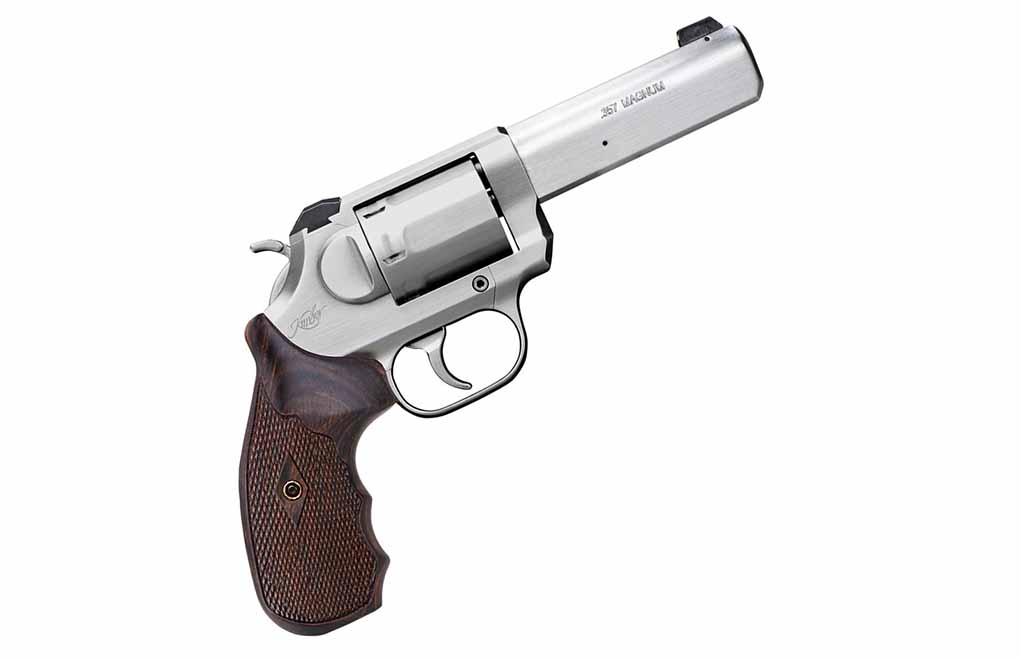
Kimber DASA K6s 4-inch barreled .357 Magnum Combat Model.
Kimber goes big with its new revolvers, introducing 4-inch barreled K6s DASA options.
What the DASA K6s Target and Combat Offer:
Snappy 3- to 3 ½-pound single-action pull weight.
4-inch barrel to milk the most out of the magnum’s ballistics.
Adjust sights on the Target model, low-rise white dot on the Combat.
At its inception, the Kimber K6s was envisioned as a concealed carry revolver. Snub-nosed, flattened cylinder, hammerless—it had all the features that draw armed citizens to wheelguns. But now, the New York gunmaker is taking the line in a somewhat new direction for 2020. You might say, with the K6s DASA Target and Combat models they’re going big with what previously has been a relatively demure series of revolvers.
This is thanks to the inclusion of a 4-inch barrel on the .357 Magnums, giving them plenty of bore to milk the most out of the powerful and accurate cartridge. It makes some sense Kimber would move in this direction, given around a year ago, they introduced DASA model, adding an exposed hammer model to the collection. Plus, it seems to be the way the wind is blowing in the revolver world. Colt added a target model to its King Cobra lineup and Ruger tacked on a 3-inch barreled “Mama Bear” .357 to its LCRx line.
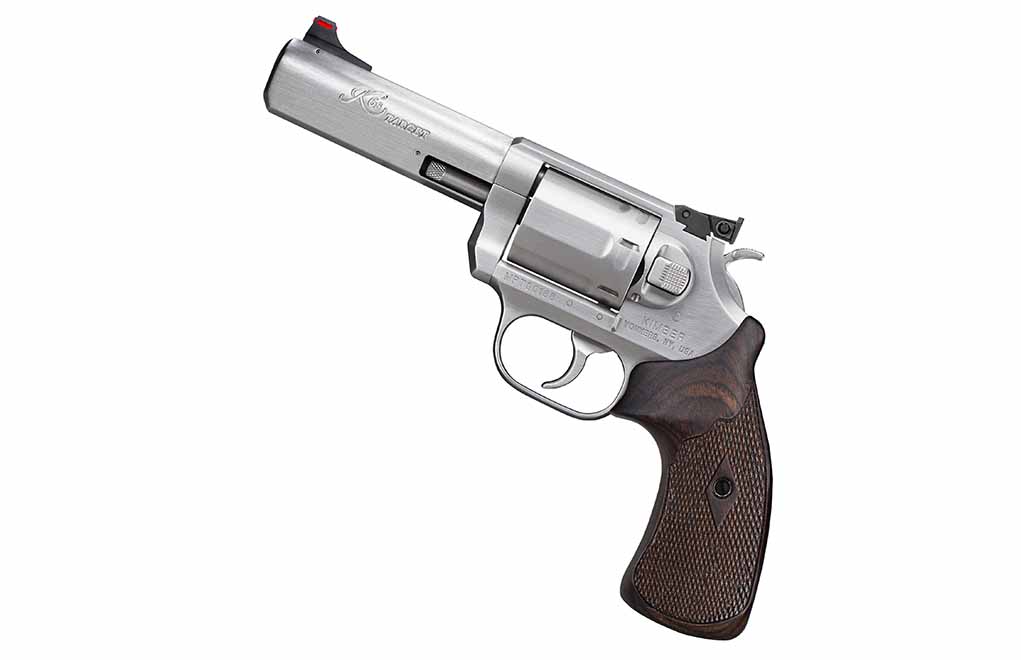
Kimber DASA K6s 4-inch barreled .357 Magnum Target Model.
Though, Kimber isn’t going the whole hog with making the long-barreled options just a target guns. Yes, it’s added the Target model, complete with three-finger grips for superior control and fully adjustable rear sight to dial it in. But the Combat version plays off the K6s’ smooth lines with low-rise white-dot sights (dovetailed rear, pinned front if you want to switch them up). And it’s tacked on extended combat grips, so you aren’t left fishing when drawing the gun. Overall, for those who don’t mind a larger revolver on their hip, the 25-ounce K6s Combat (MSRP $940) is a viable carry option.
That said, the Target model (MSRP $940) does have a lot of appeal. I’ve been lucky enough to get behind a couple of K6s, both the 3- and 2-inch barreled TLE models and was impressed with their performance. Especially the trigger. DAO hammerless revolvers, I had no choice but take the long road to send a round downrange. Yet, this isn’t necessarily a bad thing with the K6s, which is smooth enough to make the 10-or-so-pound pull weight is much more manageable. These aren’t the same triggers on your grandpa’s wheelguns. I can only imagine how much more pleasurable it will be to drop the hammer from single-action (around 3- to 3 ½-pounds) on a Kimber revolver designed to drill bullseyes.
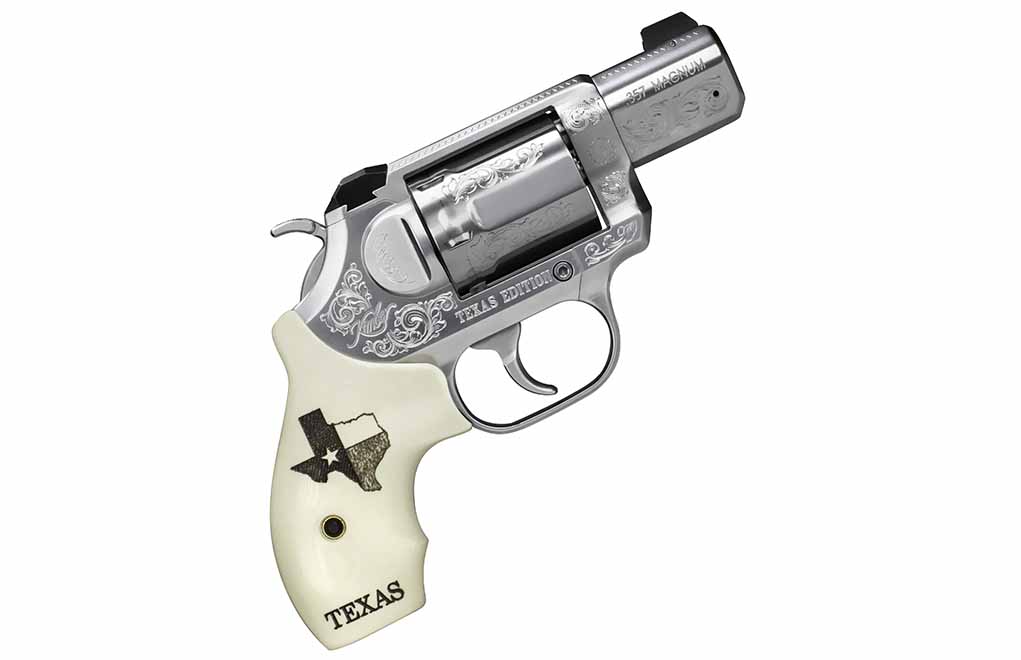
Rounding out the K6s 2020 lineup is something for the collectors—or armed Lone Star residents with a sense of flare. The K6s Texas Edition (MSRP $1,359) is certainly eye-catching, the 2-inch barrel .357 boasts special G10 ivory grips with the TX state motto, name and flag, and Kimber’s timeless smooth satin finish Wrapping it all up, a fine vintage American Western scrollwork engraved on the frame. Definitely a different twist on a BBQ gun.
If you’re after a gritty, dependable and historic rifle that can stand up to the worst of what the world throws at it, then yes, the Mosin-Nagant is worth every penny.
Why The Mosin Nagant Is Still Worth Opening Your Wallet For:
A Mosin-Nagant north of $1,000 … don’t make me scoff. But there they are on some retailer’s websites. Granted this is at the upper end of things, highly desirable models with a dash of provenance. Yet, when talking the Mosin it really makes it feel a world away from where we were a little less than a decade ago.
Back then, in what might qualify as the good ol’ days for Russian guns, there was a flood of reworked Mosin-Nagants on the market. They were so prevalent you could mosey down to your local gun superstore, pull one of the Russian warhorses fresh from its crate and for $100 or so head home with it. The ersatz Eastern Bloc cosmoline was complementary. And boy howdy, did you ever get a deal.
Russian Imperial Army soldier in World War I, with bayonets affixed their M91 rifles.
It’s funny to say this about the rifle. Many bore the ravages of time in rough stocks and worn steel. They represented the pinnacle of economical engineering … from the 1890s. And there are more of them than perhaps any other bolt-action rifle ever made—by some estimates around 40 million. Not to mention, no one would ever classify the Mosin-Nagant as a head-turner—its aesthetics are closer to the south end of a north-bound mule.
Nevertheless, the rifle is beguiling. It’s a war story writ large in birch and blued steel. To boot, those old mil-surp models that went for a song most of the time performed as well at your local range as they would have in the streets of Stalingrad or the sweeping fields of Kursk. Not always, though; there were lemons.
Times have changed, for certain. The basement on the Mosin-Nagant is three, some places four times what it was a few years ago. But even at the princely sums of $300 or $400, the rifle is still worth every penny. As we shall see, there are few other guns as rich in history, performance and practically—especially for the price.
Finland’s and the world’s most prolific sniper, Simo Häyhä, posing with an M28.
History
No rifle has served longer nor appeared in as many conflicts as the Mosin-Nagant. Even today, the odd one shows up on the modern battlefield—a good run, given its first major action came in the 1904-1905 Russo-Japanese War. In short, the rifle has had plenty of time to build a pretty incredible history. Of course, it was the gun that beat back the German hordes during World War II in the hands of average Soviet infantry soldiers. But its most illustrious service came with a sniper at its business end.
Consider this, nine of the top 10 snipers by confirmed kills wielded some variation of the Mosin-Nagant. Finland’s Simo Häyhä put 505 Russians in their graves in the Winter War primarily with the Finnish-made Mosin-Nagant M28/30 and the Soviet’s Ivan Sidorenko did nearly as much damage on the Baltic Front of World War II with his Mosin-Nagant M91/30. No other single rifle will likely ever achieve the same degree of success. If you appreciate history, this alone is enough to add one to your collection.
Accuracy
No, you aren’t picking up the 19th-Century equivalent of a modern chassis rifle. The Mosin-Nagant’s stock is made of wood and it’s outfitted with a less than desirable trigger out of the crate. But overall, with quality ammunition, the gun will hit the mark. A stock Mosin in good condition and shooting match ammo, it’s not unreasonable to expect MOA groups. Not a guarantee, mind you, just an expectation.
As mentioned above, that level of accuracy was good enough for some of the most prolific snipers in history. In turn, it should fit the bill for most modern shooters’ applications. Honestly, if you don’t mind most variant’s unwieldy size—the M91/30, for instance, measures in at 48.5 inches in overall length—they make a solid hunting rifle. Its most prevalent chambering, 7.62×54mmR (aka 7.62 Russian), has ballistics similar to that of the .30-06 Springfield and is as terminally devastating. In short, it’s accurate and powerful enough to handle most North American game.
Durability
If there is any one facet Russian rifles in general, the Mosin-Nagant in particular, are renowned for, it’s their wang-leather toughness. Drop them on rocks, pound them against the pavement, dunk them in mud and the rifle will calmly shake it off, chamber another round and go bang.
It makes sense a Russian rifle would prove so rugged. A nation defined by extremes, it needed a military arm capable enduring both freezing polar winters and sizzling desert summers. Given its staying power in the face of adversity, the Mosin-Nagant has become among the top rifle choices among preppers.
The Soviet’s Vasily Zaitsev (far left) proved more than deadly with his Mosin-Nagant M91/30 in the battle for Stalingrad. If the rifle was tough enough for that scrap, it’ll handle anything you throw at it.
Aftermarket Upgrades
No, the Mosin-Nagant isn’t a modular wunderkind à la the AR-15. But there are plenty of aftermarket parts and upgrades to help tailor the rifle to your application.
Want to keep the rifle true to its original form? There’s about a metric ton of mil-surp across the internet. Looking to doll up your Mosin into a modern tack tapper? There’s no shortage of brand new upgrades to choose from. Timney makes a snappy drop-in trigger and Boyd’s Prairie Hunter stock is compatible with the rifle, to name a few options. All you need to do is figure out how you want to configure your rifle.
Economy
Yes, the days of Mosin-Nagants running $100 or less are over. But honestly, who’s to complain over a tough-as-nails rifle for around $300? What else compares, mil-surp or otherwise?
Search around and you can find affordable 7.62 Russian ammo. Photo: Wikipedia
Furthermore, feeding a Mosin is still chicken feed. Yeah, it’s not as cheap as a 5.56 NATO (what is?), but with 7.62 Russian ammo options that cost less than 40 cents per trigger pull it’s not going to run you an arm and a leg. That’s quite affordable when it comes to .30-caliber. Plus, inexpensive to shoot means you get to spend more time with the rifle, which likely means you’ll shoot it better.
The Mosin-Nagant is still a solid, practical and fun investment if gritty, dependable and historic rifles are your thing. But for all its positives, it does have its downsides—what gun doesn’t? In particular, three major areas stick out to me:
Size: Even the carbine variants are rather unwieldy.
Recoil: It’s similar to a .30-06, but the metal buttplate tends to magnify it, especially for the recoil shy.
Trigger: It’s workable, but not up to modern standards.
If those aren’t sticky points for you, then, by all means, get a Mosin-Nagant in your collection. You’re certain to find it money well spent.
The first iteration of the Mosin-Nagant, the rifle was chambered in 7.62x54mmR (7.62 Russian), was a whopping 51.5-inches in overall length and had a 31.6-inch barrel. It featured a rear ladder sight, front blade and a full-length stock secured by two barrel bands. Before 1918, the rifle was fitted with an octagonal receiver, after which it boasted a rounded version.
More than 9 million of these rifles were built between 1892 and 1922, in Russia (Sestroretsk, Ishevsk, Tula), France (Chatellerault) and America (Westinghouse, Remington). These are the oldest Mosin-Nagants on the market, ones with early production numbers, without a handguard, can demand a premium.
M91 Dragoon
M91 Dragoon. Photo: Arundel Militaria
Made for Russian mounted troops, the Dragoon is identical to the M91 except outfitted with a 28.75-inch barrel and short handguard. This reduced the overall size of the rifle to 48.5 inches and reduced its weight to about 8.5 pounds. Dragoons were exclusively made in Russia (Ishevsk, Tula) as were their kissing cousins the Cossack Rifle. The latter is identical to the former, except fitted with a tangent rear sight and wasn’t issued with a bayonet.
M91/30
M91-30
Prolifically made—more than 17 million rolled off the factory lines between 1930 and 1944—the M91/30 makes up the bulk of the Mosin-Nagant market. Essentially, it’s an improved Dragoon model, about the same size in length and weigh. The main difference is the front sight of the M91/30 is hooded.
The rifle can be found with both the older octagonal receiver and the newer rounded ones. They were produced at Izhevsk and Tula and their origin can be determined by their markings: Izhevsk rifles have a triangle with an arrow mark, Tula a star with an arrow mark.
Reworked versions of these rifles were the ones shooters got accustomed to procuring for a steal. Overall, depending on condition, M91/30 runs anywhere from $300 to $500 generally. Verified sniper variants with original scope can sometimes skyrocket above $2,000.
M38 Carbine
M38 Carbine Photo: Arundel Militaria
Replacing the exceedingly rare M07/10, the M38 was essentially a rear echelon rifle. Given this, it was shortened with a 20-inch barrel and wasn’t equipped with bayonet fittings. Despite its size, it was still a hefty gun, tipping the scales at 7.5 pounds and—relative to other Mosin-Nagants—wasn’t prolifically manufactured. About 2 million were produced at Tula and Izhevsk and can be found with octagonal and rounded receivers. Despite somewhat lower production numbers, their price remains comparable to the M91/30.
M91/59 Carbine
M91/59 Photo: icollector
Not really a new rifle, just a modification of the standby M91. In this case, the barrel was shortened to 20 inches and all the long-range graduations were milled off the rear sight. Many of these conversions were done in Bulgaria and Czechoslovakia, as well as Russia. Overall, these rifles are priced similarly to most M91 and M91/30s on the market today.
M44 Carbine
M44 Photo: Jaybe Militaria
The last Mosin-Nagant produced by the Soviets, it was about 1/2-inch longer than the M38. Production began in 1944 and lasted until 1948 with the carbine going through a bit of an evolution. Early on, they were outfitted with a hardwood stock, but after World War II the Russians switched to laminate. The rifle has a folding bayonet hinged at the muzzle, a rear tangent sight and was rather hefty for a carbine—9 pounds with bayonet. It was also copied by the Chinese and designated the Type 53.
M24
M24 Photo: Armslist
Given before 1917, Finland was part of Russia, the nation has a close association with the larger country’s arms. Once independent, the Finns began improving on the original M91. The M24 is the first example. Essentially the same design as the M91, it featured barrels made by Sig or Böhler Stahl. Outside of the early Sigs, the barrels were larger diameter with a step at the muzzle so they’d accept a Russian bayonet.
M27
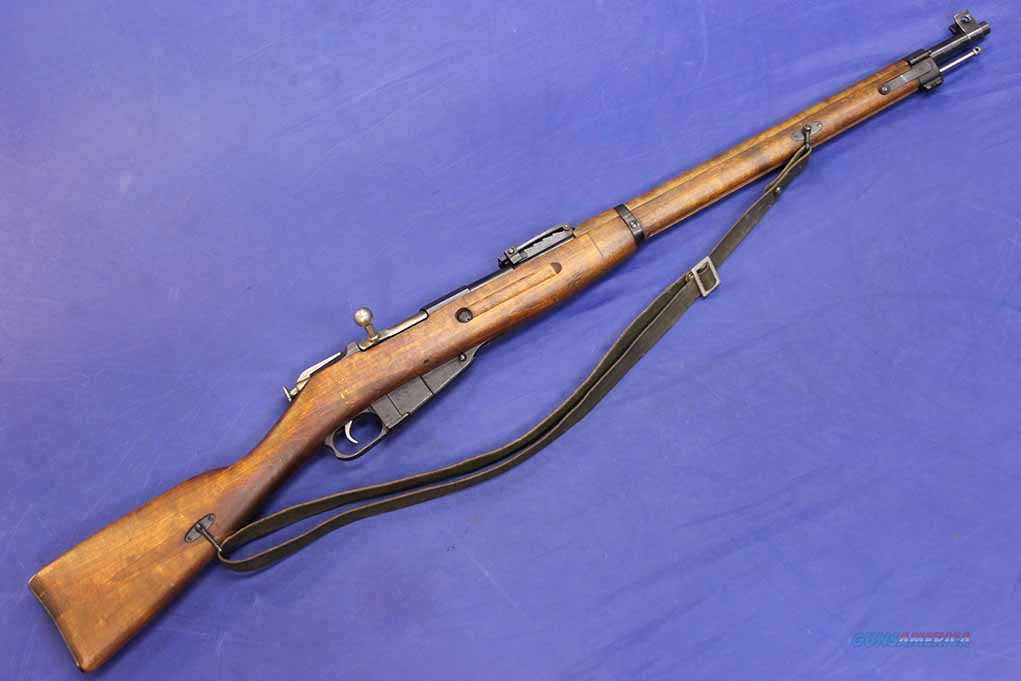
M27 Photo: Guns America
Utilizing a 27-inch barrel made by Tikkakoski, some by VKT, this was the first truly Finnish Mosin-Nagant. In addition to a heavy barrel, it also had a full stock and a new front-sight design, complete with protective ears. Many have fore-ends affixed via the Finnish Finger-joint system. While the M27 can still be had at a reasonable price, a close variant of it—the M27rv Cavalry Carbine—can demand top dollar.
M28
M28/30 Photo: Arundel Militaria
Very similar to the M27, except with minor changes, such as a non-hinged front barrel band. The first 20,000 had Sig barrels and the final 13,000 Tikkakoski. The rifle was used extensively in the Winter War; an improved variant—the M28/30—grew in fame due to Finnish sniper Simo Häyhä, who collected a majority of his 505 confirmed kills behind the rifle. Hunt around for an M28 and you can find them at a reasonable price, not as cheap as the M91/30, but still easy on the pocketbook.
M30 (M91/30)
M30 Photo: Arms List
Tikka made the M30 from 1943 to 1944, about 24,000 in all. They never saw any action in World War II, languishing in storage until 1986 when they were sold as surplus. The 28.7-inch barreled rifle is essentially an M91 with sights calibrated from 100 to 2,000 meters. Given their history, these are usually in excellent condition and can be bought at a competitive price.
M39
M39 Photo: Classic Firearms
While not miles away from the M28/30, the M39 did have some pertinent modifications. Chief among these, a completely redesigned stock, which included a pistol grip. Its 27-inch barrel was also a smaller diameter than its predecessor. Wartime models were made by Sako and VKT, Tikkakoski produced them in peacetime. Again, these run a bit more than comparable Russian models from the time, but not prohibitively so.
The Glock 43, Glock 43X and Glock 48 have burned like a prairie fire through the concealed carry market. Here’s a look a what’s driven their popularity.
What Are The Difference Between Glock Slimline Nines:
The G43 has a 3.41-inch barrel and 6-round capacity.
The G43X has a 3.41-inch barrel and 10-round capacity.
The G48 has a 4.17-inch barrel and 10-round capacity.
The U.S. concealed-carry market has been booming for many years now, and it shows no signs of stopping. As the concealed-carry market has become more and more popular, so have the micro-compact guns that fill the segment, and no caliber is as popular as the 9mm. It’s a full-power load that is able to be packed into a small package, so it’s no wonder why it’s so popular.
The Glock Slimline 9mms have been very popular, ever since their introduction, starting with the first Slimline 9mm, the G43, in 2015. The G43 design is based off the G42, a .380 ACP caliber. There was a slimline pistol prior to that, the G36, but its design was based off the original Glock. The G42 design (and thus the Slimline 9mm) is different from the traditional Glock design, incorporating significant design changes.
The G43 came out just as the first edition of this book was going to print, and the Slimline 9mm lineup has now expanded to include the G43X and G48.
Prior to the introduction of the G43, shooters had been clamoring for a single-stack 9mm Glock for years. And when Glock finally gave them one, in the form of the G43, people were lining up on waiting lists to get their hands on it.
Glock took heat from a lot of fans after not releasing a single-stack 9mm at the 2015 SHOT show. Some took it a little too personally and filled the Internet forums with overdramatic vows never to buy another Glock. Further salt was thrown on the “wounds” of fans, by the other makers who have had single-stack 9mms on the market for several years now.
I believe Glock was simply taking a little extra time to make sure it got it right, after taking a hit when the G42 had some issues coming out of the gate (mostly malfunctions when using overpowered and underpowered ammunition). It was easily remedied with modifications to a few parts, but Glock isn’t a company that takes well to having reliability issues. So, Glock engineers took a little extra time with this one, and judging by my experience, as well as what I’ve seen from others, with the G43, they got it right.
G48
I get to test a lot of guns, which often requires me to carry the gun for EDC, especially when the gun is designed to be a carry gun. However, my go-to carry gun is a Glock: The G19 when my attire permits, the G43 when my attire doesn’t. I’m going to be honest, however, when it released it in 2018, SIG Sauer had me with the P365. Ten rounds in a micro-compact pistol that shoots like a larger pistol, it truly is a game-changer. And it did change the game, because now you see responses from other companies, including Glock. When Glock announced the G43X and G48, I was extremely happy. While the P365 is a fine gun, and has performed perfectly for me, my comfort level really is with the Glock. So, when the G48 (and G43X) were announced, I couldn’t have been happier.
G43X
You might wonder why I went out of numerical order and placed the G43X after the G48. It’s because you really needed to get to know the G48 before the G43X, since the G43X is a hybrid of the G43 and G48, a crossover, which is designated with the “X”. If you take the slide of the G43 and place it on the frame of the G48 (which is exactly what Glock did), you get the G43X. In fact, you can do it yourself. If you already own a G43, and buy a G48, combine the G43 slide and G48 frame and you have yourself a G43X.
By using the G48 frame, the G43X gives you 10 rounds, the same capacity as a G26 and SIG Sauer P365, but with a longer grip than those guns have.
Looking to go armed, but are stuck in the weeds as to what to arm yourself with? Here are 20 of the best concealed carry gun options that will keep you on the defensive.