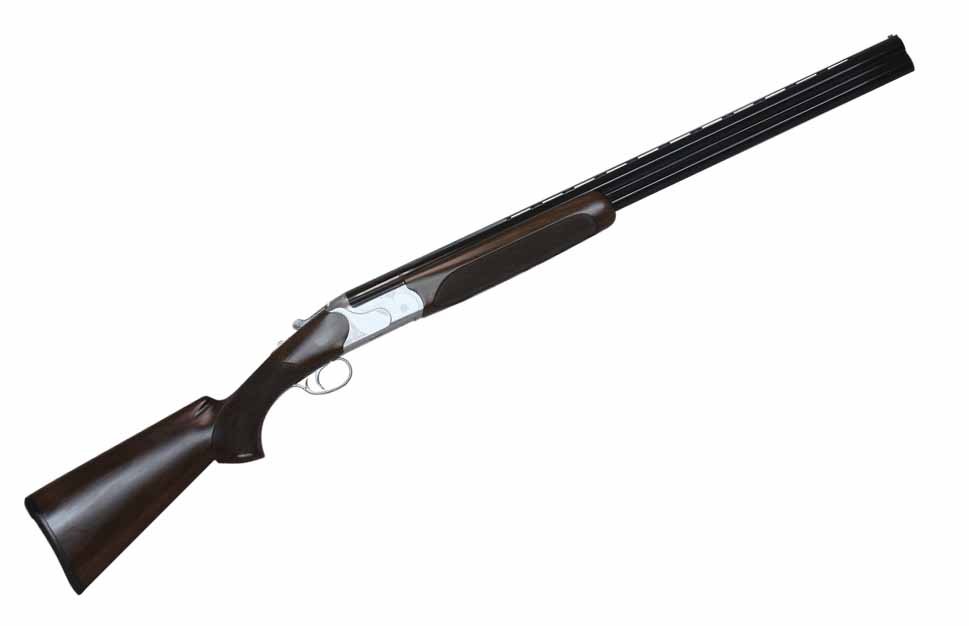
A new twist on a popular over/under line, the 16-gauge CZ Redhead Premier should continue to stoke interest in the classic bore.
What Are The Finer Points On The 16-ga. CZ Redhead Premier:
28-Inch Barrels
Fixed IC and Mod chokes
Turkish Walnut Stock
Single Mechanical Trigger
2 3/4-Inch Chamber
Fine tweed and sharp pointers, there was a time if you weren’t hunting a 16-gauge you weren’t hunting. Particularly if you were a well-to-do swell or fancied yourself patrician. It was the “gentleman’s gauge”, suitable for taking bobwhites and ruffed grouse in the finest of company at the turn of the 20th Century. Not as brutish as the ruffian-class 12 bore, favored by American market hunters of the day. Then the game of skeet killed it … almost.
Languishing through the Second World War and countless American booms-and-bust cycles, the woebegone gauge is finally enjoying a Renaissance. Fueled by what it’s hard to say. But any rock-ribbed shotgunner will celebrate the revival of the 16 and the many affordable doubles in which it now appears. Among the most recent, the CZ-USA Redhead Premier.
Flagship of the gunmaker’s over/under catalog, CZ christening a 16-bore Redhead isn’t surprising. However, this isn’t the company’s first foray into the chambering. Preceding the 16-gauge Redhead by a few years is the lightweight Sharp-Tail, a capable gun, but one that perhaps pales to the new release, if for no reason other than the smaller side-by-side audience. That and the Redhead Premier is right on the money when it comes to price, a very accessible $988 MSRP.
Studied smoothbore fans might already guess what keeps the over/under south of $1,000—its origin, which is the Anatolian Peninsula. Turkish manufacturer Huglu is the name behind CZ’s O/U and has done a solid job turning out a quality scattergun at an affordable price. Amenities abound on the Redhead Premier, including satin silver chrome receiver, laser-engraved scrollwork, Turkish walnut stock, solid 8mm mid-rib, top rib, ejector and Prince of Wales grip. Additionally, the gun has a single mechanical trigger, which switches barrels after a shot. However, there is a manual selector on the tang safety, jumping between the fix modified and improved choke barrels. A tidy package, especially for what most will use as a dedicated field gun.
In the Redhead Premier’s 16-gauge iteration, the gun boasts 28-inch barrels and is chambered for 2 ¾-inch shells. 12- and 20-gauge versions have a 26-inch barrel option, so it will be interesting if the 16 follows suit sometime in the future. Given the long barrels, the gun does tend heavy at 8 pounds, but not unmanageable. Briefly touching on the stock, the grip and fore-end are both checkered, but not overly aggressively—just enough for a solid handle.
The 16-gauge coming back into fashion for the first time since Coolidge was in office is a good thing. So is CZ expanding the Redhead Premier line to include the classic bore.
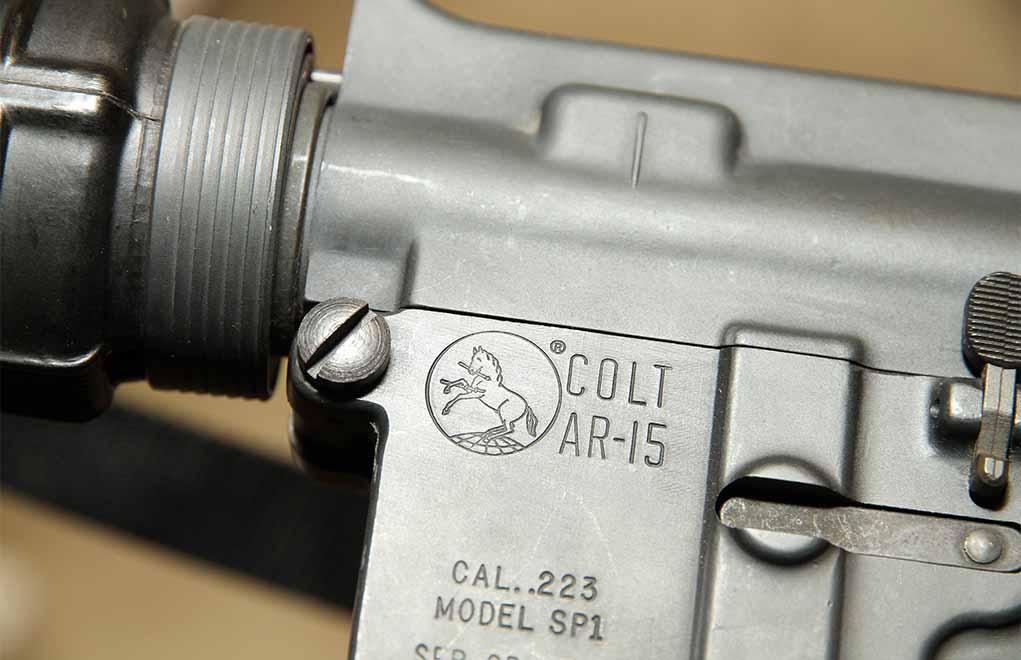
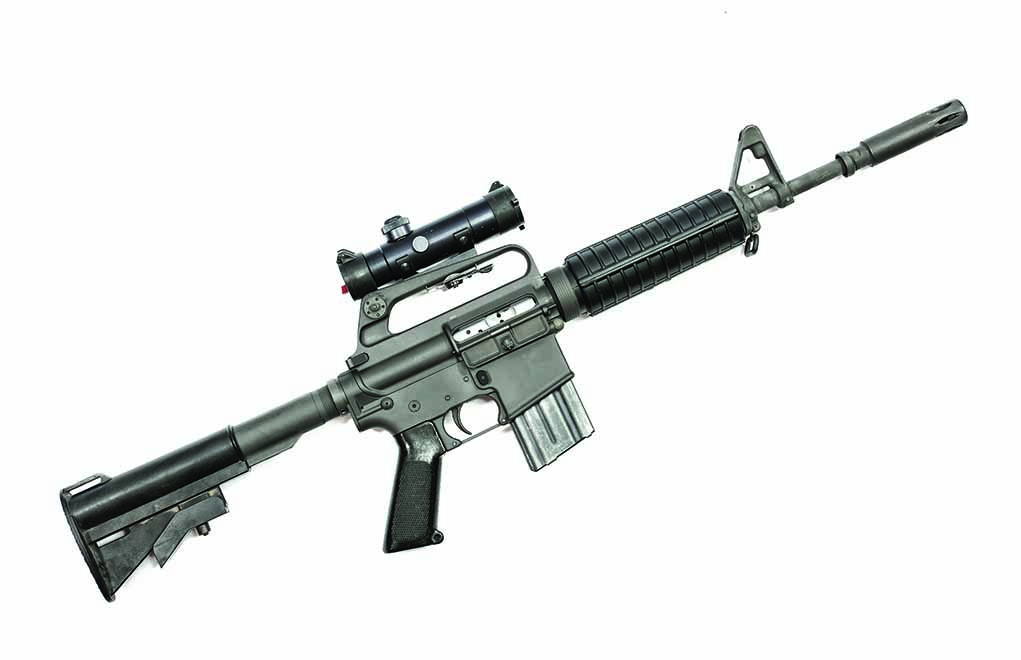
This is one of the Colt rifles with the two-headed hydra takedown pin. Leave it alone and build on something else.
Assembling the AR-15 lower shouldn’t cause a brain cramp, but there are a few tricks to make certain it doesn’t rattle like a jalopy.
You can invest in a standard AR-15 lower parts kit (also known as the LPK) or a premium trigger set. The safety comes in your choice of regular or ambidextrous. I’m not a big fan of ambidextrous triggers, simply because my trigger finger tends to rest in the space occupied by the offside lever on such a design.
The rear takedown pin must be in place as you install the stock, there’s no way to go back and do it after the stock is on. The front is different.
Front Takedown Pin Installation
The dual push pin system of the M16, including the AR-15s that fit them, use nominal 0.250 inch diameter pins with machined heads. The thick head pin is the front, flat head the rear. These have grooves machined into the side where the detent pin rides. The groove has two small depressions at each end. The depressions keep the pin in place when fully opened or closed. To allow the upper to be removed, the groove is closed on each end so the pins do not leave the lower when they are pressed out.
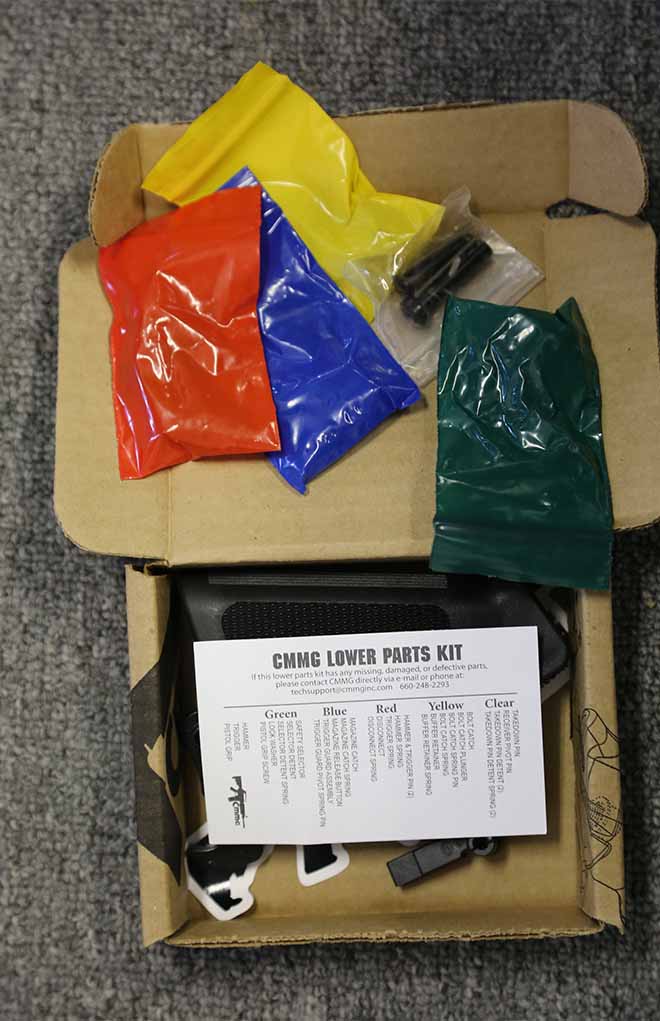
CMMG packs their AR-15 lower parts kits in color-coded plastic bags. That way you can have just the parts you need, for the task at hand.
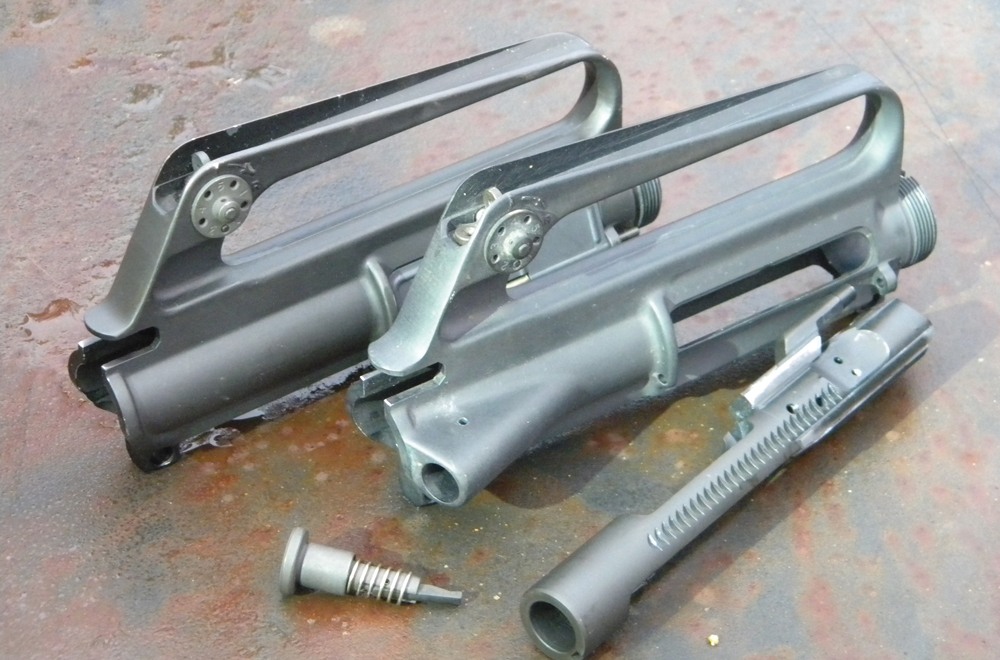
A long time ago, in a galaxy far, far away, Colt manufactured AR-15 rifles for the non-military market with the infamous “large pin” in the front position. (These were made from the early 1970’s to the early 2000’s.) This pin is 5/16 inches in diameter, or nominal .312 inches. The center of its pin hole is offset from that of a regular small pin. The large pin does not use a spring and plunger, but instead is drilled and tapped on the end to the left side of the receiver. Colt fitted a screw threaded bolt there. The head of the large pin and the screw-thread bolt are slotted for screwdrivers. To disassemble the Colt large pin upper, you need a pair of large blade screwdrivers. It is possible to use adapter pins to fit the mismatch together. That is, a large pin and the other a small pin. But it is really not worth it unless you are really stuck with one due to local laws. It’s usually best to leave a large head upper and lower assembled as a set.
Installing or removing the front takedown pin takes a bit of fussing. Starting from a bare receiver, you’ll need the spring and detent, front takedown pin (the front has a flat on the side of the pin head) a 1/8- or 3/32-inch drift punch and the assembly tool.
Assembling the AR-15 Lower, Front Takedown Pin
Insert the assembly tool into the receiver takedown holes from the left side. Use the tool with the bored hole in the lower receiver pin holes. Push the spring through the hole, into the receiver. Depress the detent. Use the punch to compress the detent and spring. When these have been compressed far enough for the installation tool to turn, rotate it a quarter-turn. The detent and spring are now trapped in the receiver. Remove the punch.
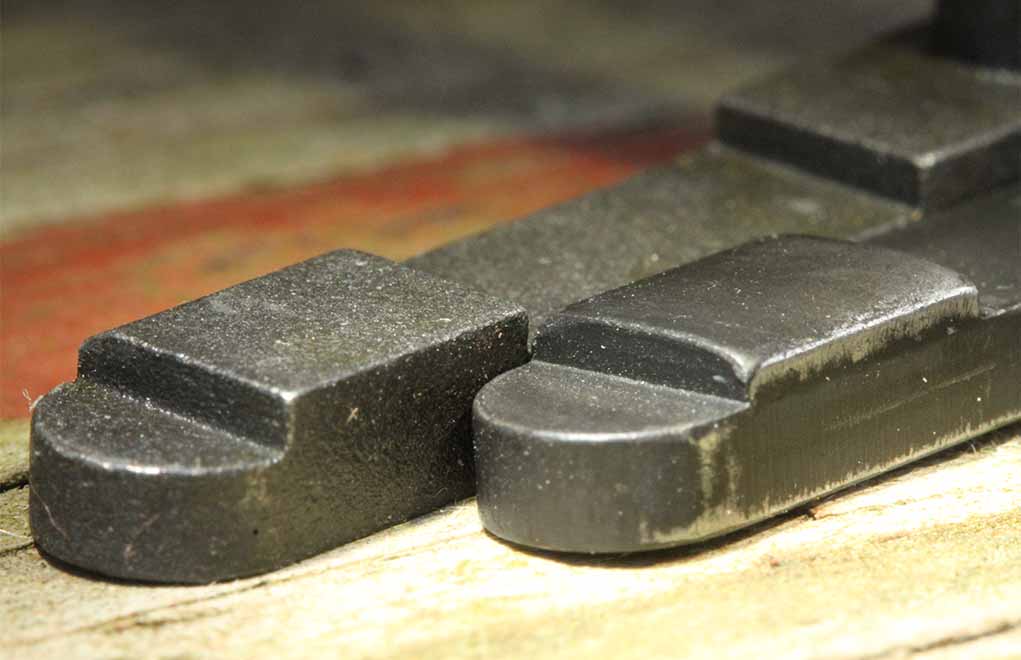
Some parts are, shall we say, marginal. The mag catch on the right kept dropping magazines, and it’s no wonder why. The locking edge is so rounded it’s a miracle it worked at all.
If the receiver lacks a buttstock, stand it on the rear flat. However, one with a buttstock may have to be stood or placed on the seat of your chair, between your legs. Make an inverted “V” with your left hand thumb and forefinger. Place your fingers over the tool at the location of the detent. With your right hand holding the front takedown pin, use the pin to press the assembly tool out of the receiver, while using that V shape of your fingers to keep everything compressed.
You want to prevent the detent and spring from launching themselves. Once down, the detent will snap into the groove (unless you pressed the takedown pin in groove-side toward the detent, in which case it is already captured) and the assembly is done.
To remove the pin, get an angled edge inside the groove to lever the detent back. A 1/8-inch Allen wrench, with the inside edge of the short leg filed on an angle, is the preferred tool. A small screwdriver like those used on eyeglasses will also serve the purpose. The trick is to lever the detent back so it no longer captures the front takedown pin. Once the detent is compressed, rotate the takedown pin. Cover the area with your free hand when you pull the detent out of the lower. Failing to cover this spot almost assuredly results in the detent and spring launching across the room, lost forever to the search party you’ve assembled to find it.
Get On Target With The AR:
Go Small With These 8 Economical AR Pistol Options
The pistol grip captures the safety/selector spring. Take that spring and wrap a tiny little triangle of masking tape around the end. This will let you stuff it into the pistol grip, keeping it from falling out.
Standard LPKs deliver a mil-spec trigger pull and look. If you want something else, you’ll have to hunt down the parts that give you the look or performance you desire.
Next, slide the screw and washer into the pistol grip, holding in place with a screwdriver.
The trick here is to not push the pistol grip all the way down onto the receiver flange. Doing so leaves the screw without guidance, causing it to wobble back and forth. Press the pistol grip on only far enough that it won’t fall off, lining it up by eye. The gap between the inside of the pistol grip and the receiver creates an alignment for the screw. Gently rotate the screw until you feel the threads catch. If you are too heavy handed, you can cross-thread it, and make a mess of your lower receiver.
Once the threads catch, and you have the screw turned in a few turns, push the pistol grip all the way down, making sure you don’t pinch the spring and that the selector plunger is still in its seat. Tighten, and you’re done.
Mag Catch Trick
The easiest way to install the mag catch is to use two buttons for the job. Drop the spring into the hole. Press one button in. Then push the second button down on top of the first one, depressing it deeper into the hole. Screw the L-shaped catch and shaft in from the other side. You want the tip of the threaded shaft to be flush with the first button, and no more.
Check that the edges of the catch aren’t rounded, a condition which can cause magazines to fall out.
Upper to Lower Fit
There is no reason on this green earth to screw around with fitting uppers to lowers. Yes, the military does it, but that doesn’t mean it’s necessary.
Spare parts are good to have. This broken hammer pin brought this rifle to a complete stop.
Uppers and lowers fit together, more or less. You see, the dimensions are available, but the exact specs aren’t, unless you are an honest-to-goodness military supplier. So just check fit. You don’t even have to install takedown pins in the lower to check the fit. Slip the upper onto the lower. Line up the holes and slide the front takedown pin through. Note the fit of the rear pin. Is it too tight for the pin to pass through? Try a different set. Do the upper and lower have excessive wobble? Same thing.
This is easy enough to do, and can be done in a gun shop. Bring your lower (just the lower) in to check the fit when buying a new upper. Then again, the current state of manufacturing, with everyone using CNC machining centers, means that mismatches are far less common. Most everything fits snug. You can also buy an upper with your lower, and have the retailer or supply house fit the pair before shipping.
Take five minutes to check the fit. Life is too short to have a wobbly AR.
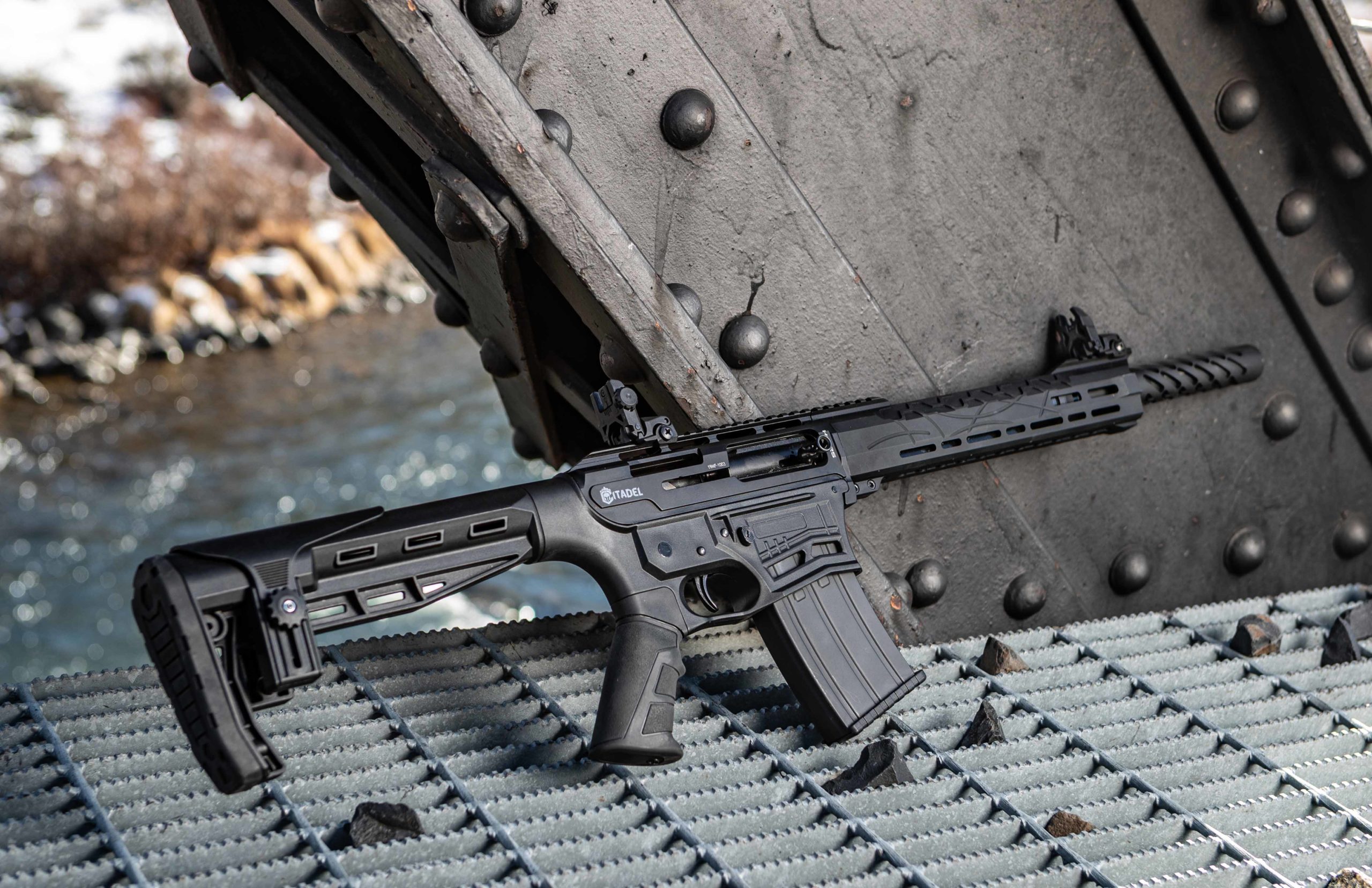
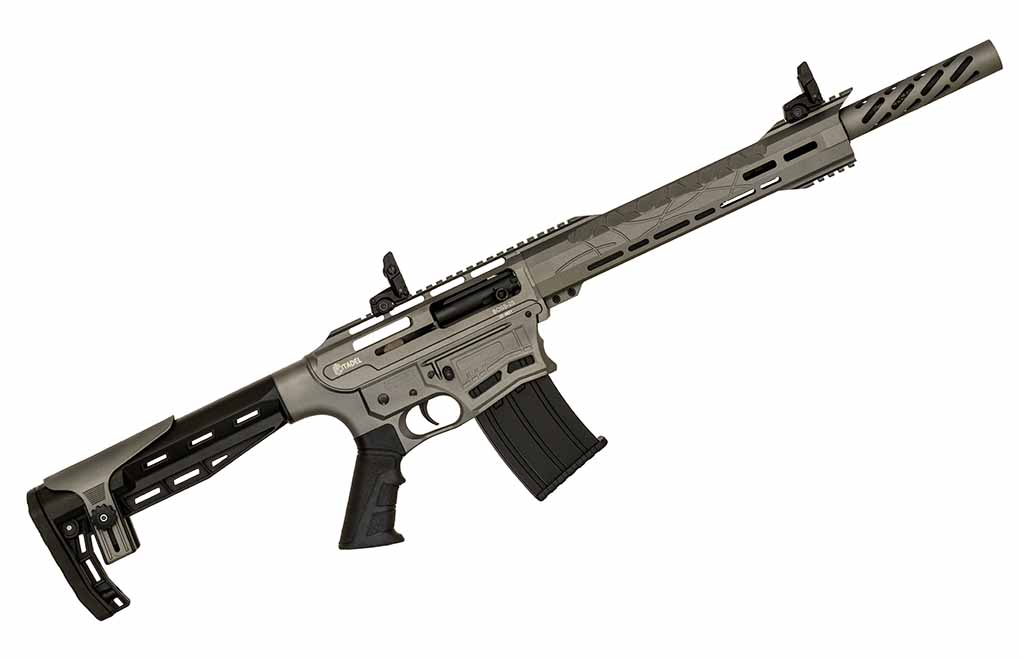
Modeled after the AR-15, the Citadel Boss 25 is familiar … and fast!
Your smoothbore needn’t speak Russian to prattle through shells like there’s no tomorrow. A healthy dose of American muscle—somewhat—has hit the market in recent years, rethinking the tactical semi-auto shotgun.
Legacy Sports International’s Citadel Boss 25 is the latest to join the growing class of AR-style shotguns and there’s plenty to like about what it and others of its ilk bring to the table. Above all, familiarity. Everything where it should be—safety, mag release grip and handguard. Making the Boss 25 as recognizable as a well-worn shooting glove, which makes running one a snap for anyone faintly familiar with the AR-15. Who at this point isn’t?
Bang around under the hood of the 12-gauge, most likely it gets a bit vague to those who speak fluent AR. Though, chances are if you know a word or two of Remington 1100, you’ll get what’s going on. Most gas-operated AR-style shotguns use a similar system to “Big Green’s” legendary semi-auto, generally a ring piston. Though, since they’re box-magazine fed, the piston is typically situated around the barrel, whereas the 1100’s was around the tubular magazine. Think Rock Island’s VP80. A word of warning, however, this is all conjecture concerning the Boss 25 presently. Legacy hasn’t leaked the finer points of the shotgun, so perhaps they’ve strayed from the herd and cook up some novel operating system.
Whatever the case, Legacy pieced together a shotgun trim as a welterweight. The fore-end is especially slim, an M-Lok laden aluminum unit that should prove a boon if you’re partial to a more forward grip. Further back, the polymer stock is also fairly lithe and adjustable—the comb rise is an especially nice touch, making aiming more intuitive. More than simply looking light, it also weighs in as such, right around 8 pounds—a curse or a blessing, depending on how recoil shy you happen to be.
As to other notables, the Boss 25 has a 3-inch chamber, a factory-installed muzzle brake, comes with five chokes and fully adjustable folding sights. It also boasts a top rail, not full, but more than enough real estate to mount an optic to your liking. Additionally, the gun is available in three finishes, matte black, Cerakote FDE or Cerakote Tactical Gray. Shipping with two 5-round magazines, the Citadel Boss 25 comes in fairly affordable, the black model $579 and the FDE and Gray $639.
Top-tier, battle-proven products, Radian Weapons turns out rifles and accessories in which you can trust your life.
At Radian Weapons, we think American gun companies should make or source their parts from right here in the USA. That’s why 100-percent of the firearms products we sell are manufactured in America, by Americans.
We machine the majority of our rifle and accessory components in Redmond, Oregon, using state of the art CNC equipment. At Radian, we’ve prioritized vertical integration of our manufacturing processes over product development to ensure that whenever we deliver goods to the consumer, it’s of the highest quality and reliability standards.
Be sure to enter our American Made giveaway, with great gear from great American companies. Click the tab at the bottom right of page to enter.
The temptation in most industries is to rush new products to market. At Radian, we actively choose not to release “me too” products or rely on sourcing major components for new products from third party vendors. This helps protect our brand integrity, and hopefully gives consumers peace of mind when they purchase Radian products.
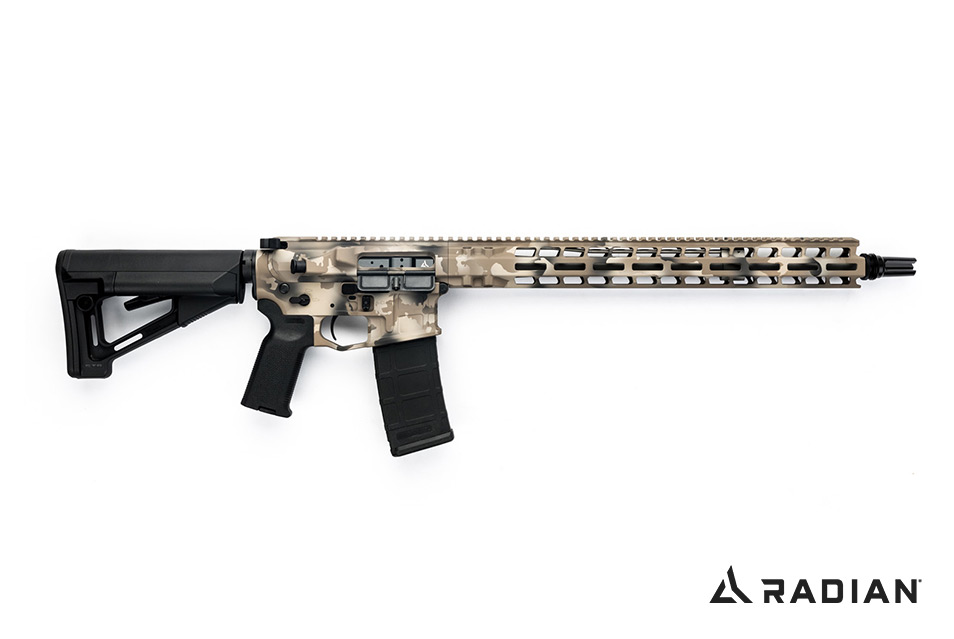
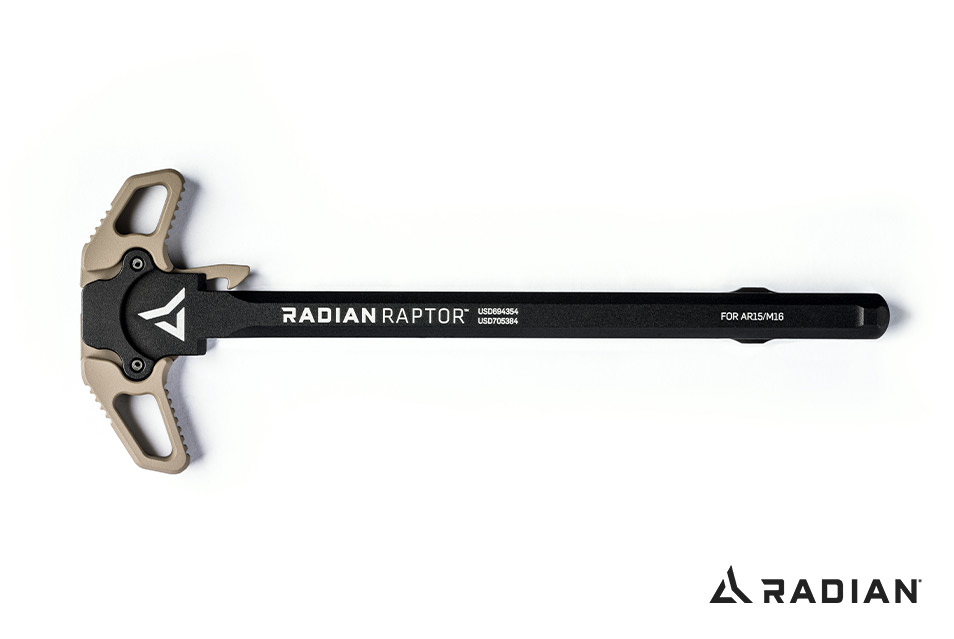
Our flagship products are the Model 1 rifle and related receiver sets, Talon ambidextrous safeties, and Raptor charging handles. Featured here:
MODEL 1 – 17.5-INCH 223 WYLDE
Clandestine Desert™ Cerakote Finish (Cerakoted by our finishing business, High Desert Coatings—www.highdesertcoatings.com)
RAPTOR CHARGING HANDLE FOR A15/M4
The original all-billet design with Cerakoted FDE handles.
TALON 45/90 AMBIDEXTROUS SAFETY
The screwless safety design ensures your levers won’t come loose and gives you two throw degree options to choose from. Finished with FDE Cerakote.
Buy with confidence, as all Radian products are backed with a limited lifetime warranty against manufacturer defects.
For more information on Radian Weapons, please visit radianweapons.com.
Given one is less expensive than custom work by a gunsmith and has better price retention, a Smith & Wesson Performance Center gun is worth every penny.
Why a Performance Center Is Worth The Investment:
The many available upgrades to common production models.
Backed up by S&W’s warranty you, can return it if it needs work.
Performance Center is a known commodity, helping the gun retain value.
There is no wait time for a gunsmith to complete his work.
Generally, the work performed at the Performance Center is less expensive than from a gunsmith.
My editor asked me, “Is the Performance Center upcharge worth it?” My reaction was “Well, yeah.”
“Really?”
So, I had to break the gun writer’s oath and actually do some real thinking and work. Just kidding, just kidding!
Let’s put this in terms of something a lot of you will be familiar with: house upgrades.
You’ll be told by contractors that upgrades are good. They increase the value of your home and make it more livable. Well, yes and no. Some are good, others are not so much.
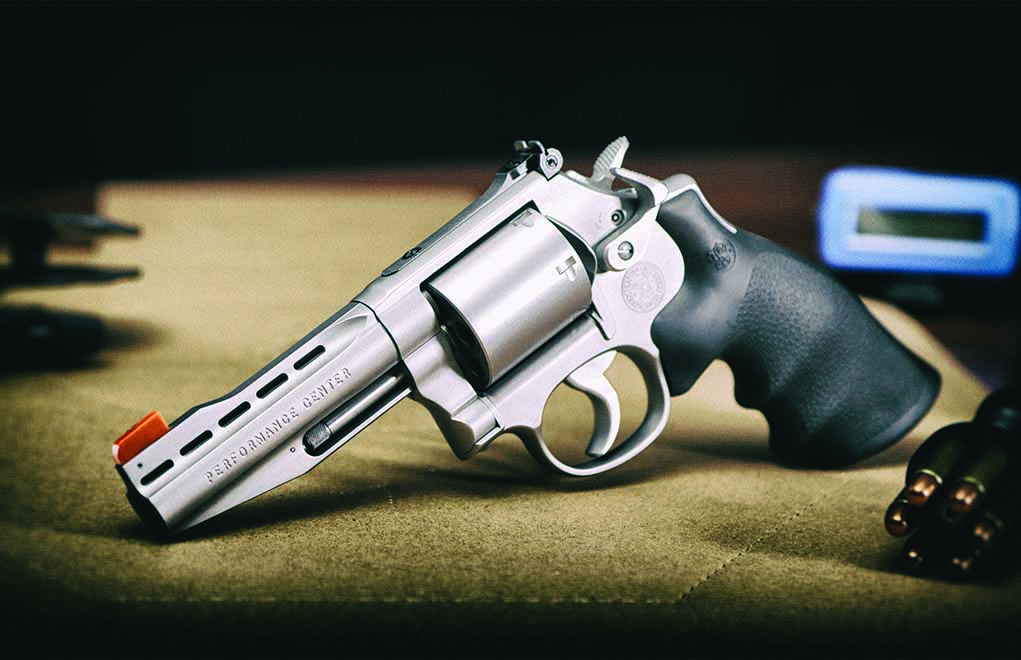
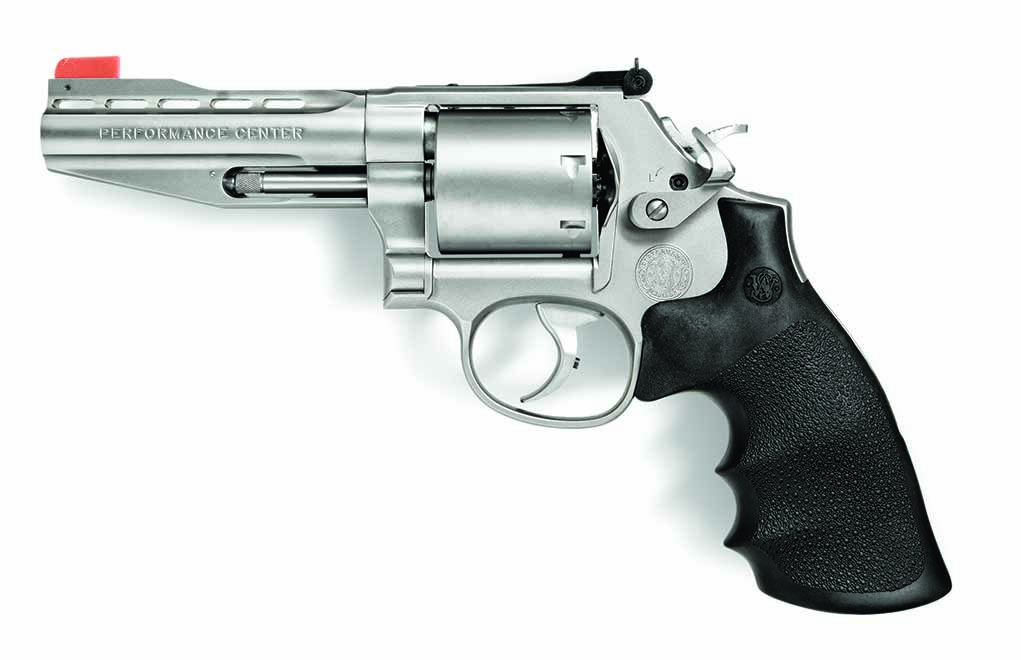
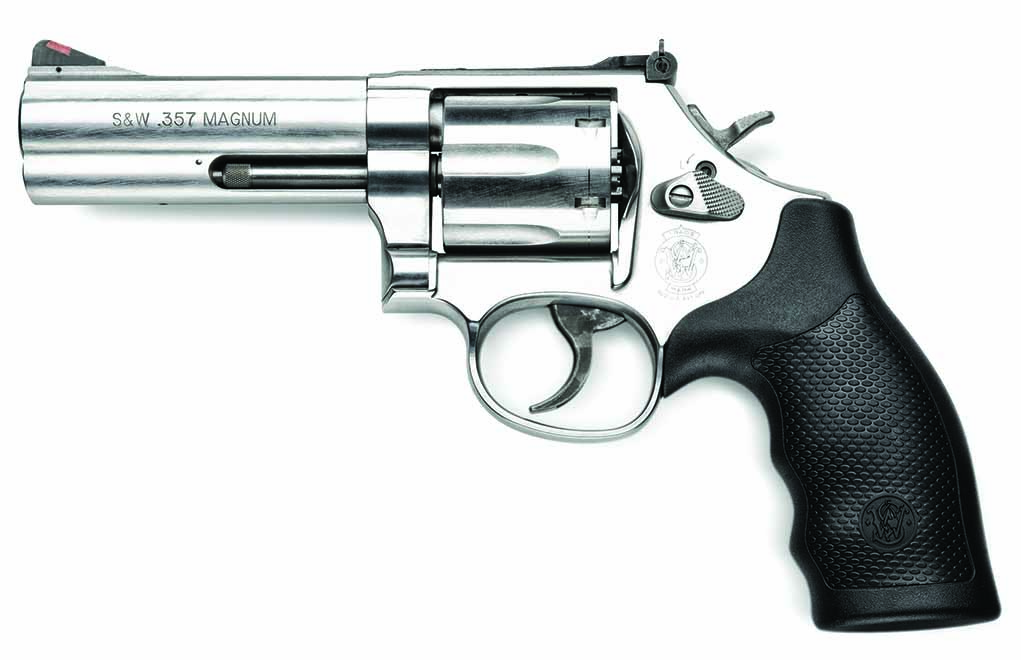
This Performance Center .357 has it all: a bright-orange front sight, adjustable rear, a cylinder latch to the max, trigger stop, soft rubber grips and a smooth, slick action.
Let’s say you’re tired of the decades-old color scheme on the walls. You decide to have them washed and painted. You add onto that by having the hardwood floors sanded, stained and sealed. Add some new draperies, and voilà, you have a new place to live—and at not a lot of cost. That was worth it; so much worth it that I know of realtors who do it. If a house lags in the selling effort, once the owners have moved to their new digs, the realtor will move in, do all that, along with a few other things, and it will sell in a jiffy. It just needed a few upgrades.
How about something that won’t do that? Say, gut the spare bedroom and install a hot tub? Yikes! All-new kitchen counters and cabinets? No way. You aren’t going to get back the money you invested in those anytime soon.
Some firearms mods fall into similar categories. Let me explain.
Upgrading a Basic 686
If you just have to have a new 14-inch barrel installed on your favorite hunting revolver, do so with the knowledge that you won’t ever be able to sell it (unless you keep the old barrel to re-install). Get it polished and re-blued? When it comes time to sell, you might as well have just pulled that money out of your wallet and burned it. No one cares, and no one will pay extra for the blueing you paid for. That’s just life.
If your tastes run more toward a duty-style revolver, a slicked-up L frame is just the thing. It’s a big gun, but remember: Not all carry guns need to be buried in an IWB holster.
Let’s use two S&W revolvers as an example. I’ll go with the .357 Magnum 686. This model has been around for more than 30 years, and there are plenty of them out there. You’d be hard pressed to wear one out shooting it with normal loads. And you can find pistolsmiths capable of working on it in just about every locale where you are allowed to own it (good luck finding a pistolsmith of any kind in New York or downtown L.A.!).
With its 4-inch barrel, stainless steel, six shots (although there’s a seven-shot version available as well), it’s the modern exemplar of the mid-sized revolver: It’s big enough to hunt with and compact enough to use as a carry gun.
The basic 686 has an MSRP of $829. It offers stainless steel, rubber grips, a red ramp front sight, adjustable rear and very nice trigger. If that’s what you want, you can go to that pistolsmith and have him slick up the action, bevel the chamber for speedloading and perhaps change to a different front sight. All of that will take several weeks to months … along with several hundred dollars. If you want more than that, you’ll need to start adding hundred dollar bills to the tab with each request.
The Performance Center 686: A Better Choice
OK, let’s now look at the comparable 686 from the Performance Center—same stainless steel, 4-inch barrel, adjustable sights and rubber grips.
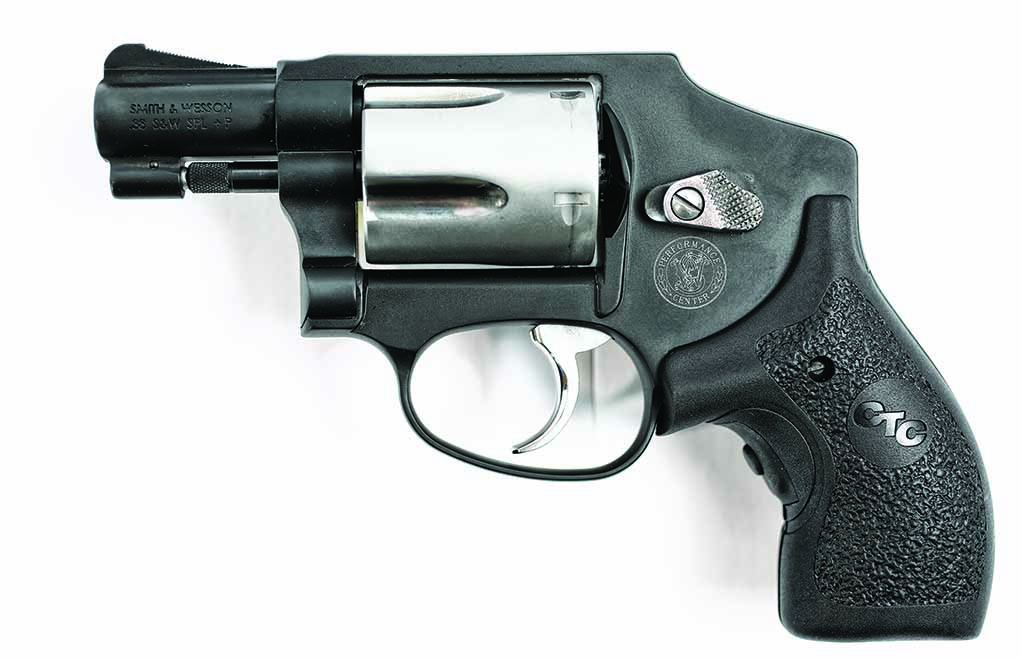
In addition to building competition guns, the Performance Center also builds EDC snubbies, such as this 442.
However, with the Performance Center 686, the trigger job is factory done. That means there’s a warranty on it. Also, the Performance Center shop guys will have installed a trigger stop on the back face of the trigger. This reduces trigger overtravel to a minimum, making the trigger improvements even better. The local pistolsmith who slicks up your 686 action is going to charge you extra for a trigger stop.
The Performance Center 686 has a vented rib barrel, and the profile is sculpted to make the Performance Center version a bit less nose-heavy. Now, if you want weight out front, you won’t like this barrel. But for daily carry, the new barrel profile is a great improvement.
What’s even better is that the bright-orange front sight blade—the one you can’t help but see when trying to shoot fast—is interchangeable. On the standard 686, the front sight blade is pinned in place. To swap it out, you have to drive out the pin, fit the new blade, drill it for the pin and re-install the pin. That’s a chore.
However, the Performance Center 686 comes with one extra that might not be such a good idea on an EDC revolver: the cylinder latch. The Performance Center 686 latch is a large and extended competition-oriented design. It takes up space, and I can see it being a clothes hook in EDC applications. But the good part is this: Putting a standard release onto your Performance Center 686 is easy for the local pistolsmith.
Now, you’re getting a sculpted barrel, a trigger job, an overtravel stop and an easily swapped front sight blade design. All of this is costing you $137 over the base price of the 686.
That’s the good news. The bad news? You probably won’t get all that back if you ever sell your Performance Center 686 (who does such a thing?!). You might get half of it back, but half of $137 is a lot better than the non-Performance Center-modified 686.
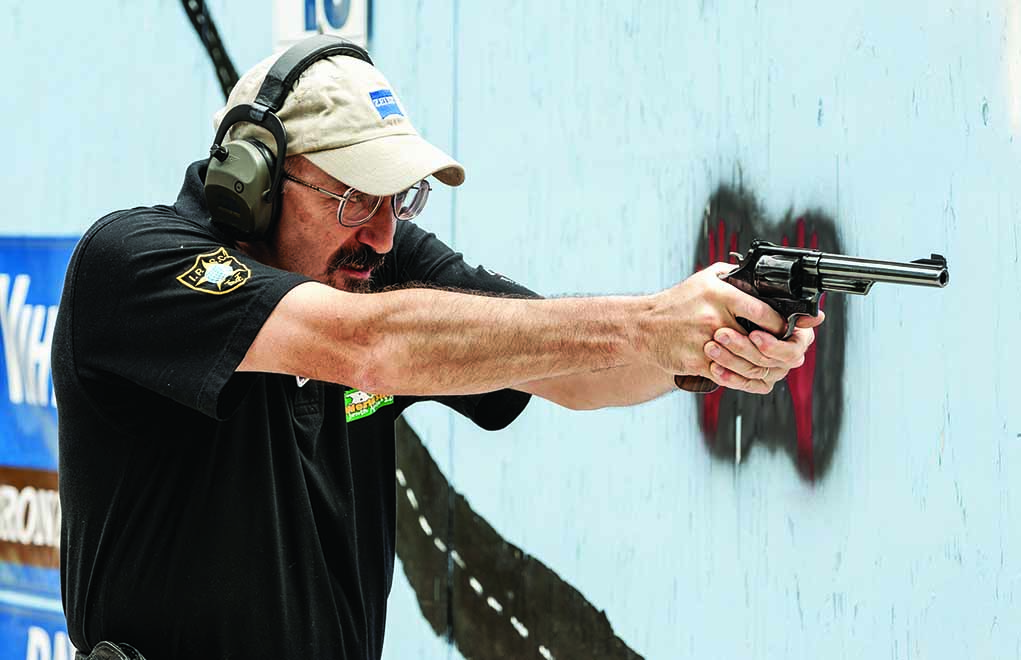
The author’s .45 revolver has been to two continents, had a bazillion rounds through it, been broken once and the cylinder replaced (not related to the break). None of the mods increases its value, but to the author, it’s priceless (in fact, he has two gold medals because of it). (Photo: Yamil Sued)
You see, when it comes time to sell your slicked-up 686, everyone will marvel at the smoothness of the action and the skill of the work. But, they’ll also be suspicious of the work and won’t want to pay extra for it … until or unless they can test the gun for themselves.
We saw it often enough at various gun shops so that we all understood: Modifications we made to standard firearms that couldn’t be reversed were not “improvements.” They were personal choices that we paid for and would pay for again if we sold them (and would pay for only once if we simply kept the modified firearm forever).
So, the answer to “Is the Performance Center upcharge worth it?” is Yes; heck, yes! You get the mods for less cost than with an outside pistolsmith. You get a warranty with the modifications. You get at least some of the modest upcharge back in the event of a future sale.
And Here’s The Best Part: Time
If you had gone with the regular 686, your local gun shop—if it didn’t already have one on hand—would order it from a wholesaler. Then, once you took possession of it, you’d hand it over to a local pistolsmith, who would quote weeks to months for its return. Count on it being months—no, really.
The Performance Center 686? If you order it from a wholesaler who has it in stock, it’s there the same time as the standard 686. And, after it arrives, you’re ready to shoot. This, for an extra $137 in the stated price, less in the actual. Oh, and the Performance Center doesn’t just work on 686s; its smiths work on the full panoply of S&W firearms (such as the 442 I tested just a short while ago).
Sure; I could’ve left my editor’s question at, “Well, yeah” … but where would the fun have been in that?
For more information on the Smith & Wesson Performance Center, please visit smith-wesson.com.
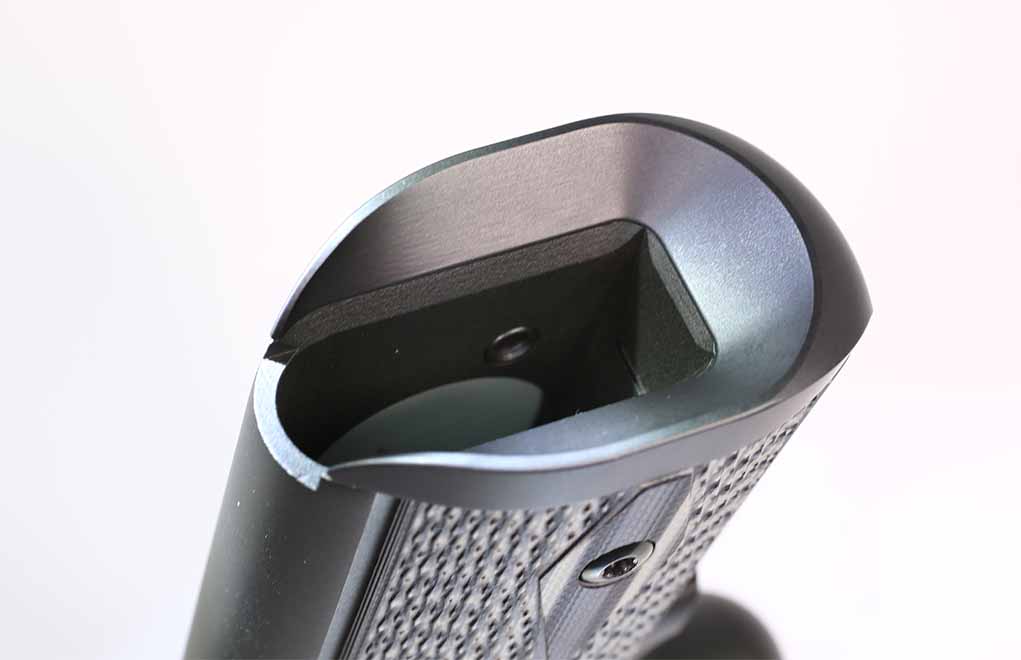
The working end of the Chen Custom SI magwell: It’s everything you need, nothing you don’t—and all in an elegant package.
Drop-in ease and crafted by a master 1911 pistol-smith, upgrades don’t get much sweeter than the Chen SI Magwell.
The arguments will never end. The competition shooters tell you that you must have a great, big funnel on your pistol, because warp-speed reloads are vital.
I’ve seen funnels at matches that were big enough to get your fist into. The tacti-cool set will tell you that if you need a reload, you’ve already done something wrong (I guess the subtext here is: Because you’ve screwed up, you deserve whatever happens).
But I don’t buy it. I’ve had magwells and funnels on my pistols, competition and carry, for many years—decades, in fact. I think the first funnel was a Bill Wilson plastic one. It broke eventually, and I ended up with it super-glued in place.
My first few carry guns didn’t have funnels, but magwells back then were “competition-only,” and I also have the excuse that a magazine funnel on a revolver is pretty ridiculous. But once I figured a way, they all had them, one kind or another.
Both Right, Both Wrong
The two factions are both right … but they are also both wrong. For the gun shop commandos out there: You don’t have to screw up to be needing a reload. Life could have just handed you that bad a hand. There are plenty of instances for which the good guy did everything right and still needed more ammo than came in the gun when he/she started.
And the competition guys are wrong: Your funnel need not be half the size of Kansas to be useful. More than none, but not so large that you look as if you’re wearing some vaguely medical, and perhaps disgusting, controversial device on your belt.
Nevertheless, if you’re using a pistol in EDC mode, you do need a funnel that fits your carry style, works efficiently and doesn’t draw attention to itself.
Chen Shooter Installed Magwell
Well, 1911 fans, Stan Chen has just the thing.
The Chen Custom Shooter Installed (SI) magwell is slick. Stan is the kind of guy you might think has disappeared from America. He gave up the rat race to pursue a dream—and that dream is perfect 1911s.
A Chen Custom full-house 1911 is a work of art that works. It has a wait list of many years, is a house down payment in cost … and is almost too pretty to take out of the case.
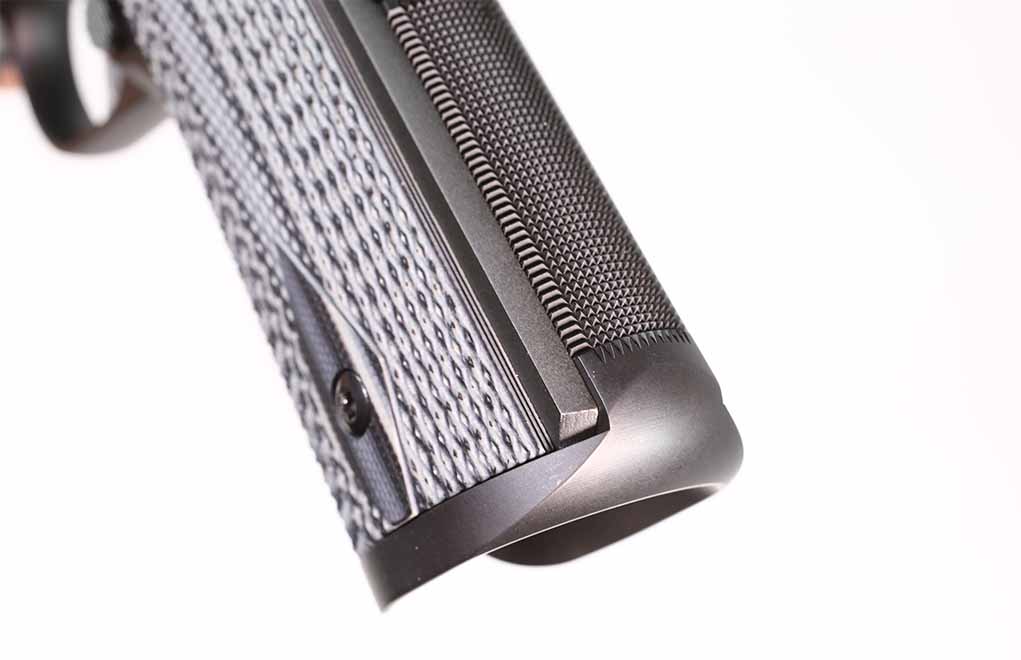
The bottom corner of the Chen SI magwell is smooth and curved, so it won’t print when you’re carrying concealed.
The Shooter Installed magwell is the product of Stan’s refining of parts, and it’s simple: You pull out your mainspring housing, take the parts out, install them in the Chen magwell, and put that on your 1911.
Simple. Done. Unlike some other designs, there’s no soldering, no need to relieve grips for clearance and no need to drill the frame for a new mainspring housing pin hole.
Stan spent a lot of time measuring every 1911 in current production that he could get his hands on to make sure the dimensions work out properly. If a Chen SI magwell doesn’t fit your 1911 properly, my first step would be to blame the pistol. The outside fits the curve of grips. The inside matches the opening of the frame. The front “tongs” are curved in and blended so they aren’t sharp points on the front edge. It’s long enough to aid in reloading but not so long that it makes the now-standard extended magazine pad too short to fully insert.
On the back, Stan put superb, 25-lines-per-inch (lpi) checkering (the magwell is machined from billet, so programming in checkering is not that big a deal for the right programmer), and yet, the checkering stops short of the funnel. The bottom end of the mainspring housing portion of the funnel is left smooth, so it won’t catch on clothing and cause your 1911 to print when going about town in your EDC life. Not only is the end smooth, it has also been rounded to remove a sharpish corner that might otherwise have been there.
No More Magwell Modifications
Because it doesn’t require alterations to the pistol, if you change guns, you can swap out the magwell. Plus, it can be had in blued steel or stainless.
I’ve been putting magwells on or modifying 1911 frames to make magwells for almost 40 years now. I have soldered on steel bars, heated and forged steel, welded on straps, drilled, tapped and bolted extras in place—even glued them on—then machined, ground and polished them, and it took this long for me to say, “I’m done. I’m just buying from now on.”
Don’t be stubborn, and don’t be left behind. Get the Chen Shooter Installed magwell and make life easy.
For more information on the Chen SI Magwell, please visit chencustom.com
The AR-15 upper is more than just it’s receiver. In its complete form, it does much of the platform’s heavy lifting, cycling the gun, ejecting the spent round and cocking the hammer, among other things.
There’s more to the AR-15 upper than a slab of forged aluminum. In its complete form, it’s the heart of the rifle where much of the platform’s heavy lifting is accomplished.
What Parts Compose A Complete AR-15 Upper:
Upper Receiver
Barrel
Muzzle Device
Gas Block
Gas Tube
Charging Handle
Forward Assist
Bolt Carrier
Bolt
Handguard
Ejection Port Cover
The AR is not operated by magic. Little gnomes and fairies do not make the bullets go spitting out the front and empty cases to the side. Lots of other operations will be are key to the carbine’s operation, but as the parts in the AR-15 upper are the most important, they come first.
Method of Operation and Safety Functions
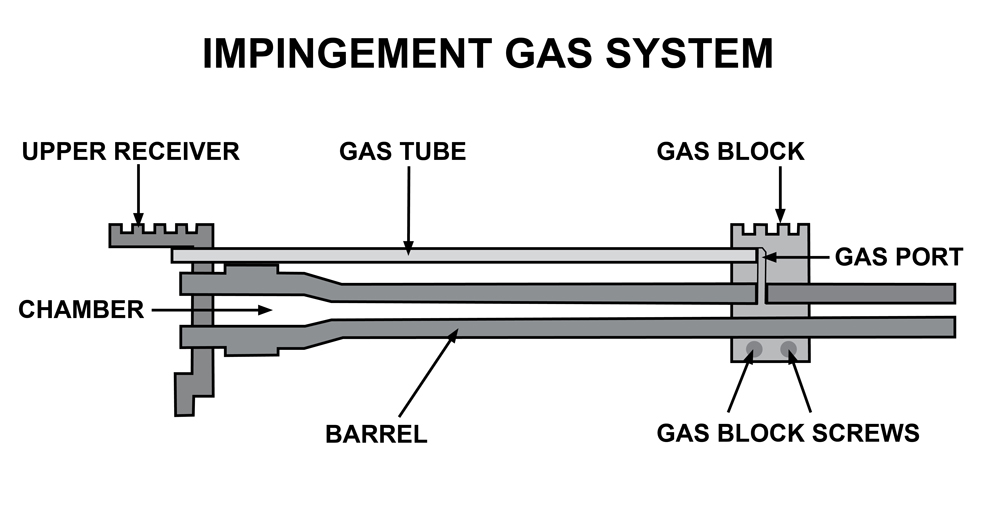
The AR-15/M16 rifles use a method of actuation known as “direct gas impingement.” That is, the gas that is vented out of the barrel (the port is under the front sight casting) is directed through the gas tube back into the upper receiver. There, it launches the carrier backwards, starting the moving portion of the cycle. Unlike other systems, where the gas pushes on a piston, the gas is vented directly into the AR’s upper receiver. The advantages of the DI system are lightweight and accuracy. The obvious disadvantage is gas residue in the receiver.
Gas System
When the chambered round is fired, the bullet leaves the case and travels up the barrel, propelled by the expanding gases. The bullet passes by the gas port, and the expanding gases vent into the gas tube. There is a short time (measured in parts of a thousandth of a second) until the gas reaches the carrier key. While the bullet remains in the bore, it pressurizes the gas system. There is a short time period, from the instant when the bullet passes the gas port until it leaves the muzzle (depending on the length of barrel remaining past the gas port), when pressure builds in the system. Eventually, the bullet leaves the bore, at which time the bullet’s exit allows the pressure in the bore to drop to atmospheric pressure.
With the gas impingement system, gas is diverted from the barrel through a tube and back into the upper receiver to operate the action.
The delay of gas flow from the gas port to the key is called the “gas lag time” and the time until the bullet leaves and the internal gas pressure drops to atmospheric is the “gas dwell time.” The gas port acts as a valve, throttling the gas from the bore to the gas tube and then to the carrier. The larger the port, the sooner, and at higher pressure, the gas reaches the carrier key. Short gas lag time (the usual cause is an overly-large gas port) leads to premature bolt opening, and violent extraction. The longer the barrel is past the gas port, the longer the gas dwells against the key, increasing carrier velocity. (Using a carbine-size port on a rifle-length barrel can cause this.) Increased gas dwell time leads to harsher felt recoil, as the buffer and spring have more energy to deal with.
Get On Target With The AR:
Go Small With These 8 Economical AR Pistol Options
8 Favorite Truck Gun Options For Protection On The Go
A moment here to discuss the finer points of gas flow. The assumption of many is that the gas squirts past the bullet base, through the port, and arrives at the carrier faster than the starship Enterprise. It does not; it takes a finite amount of time for the gas to travel that distance. Also, the assumption is that the gas arrives in the key with the same pressure as existed at the port. Again, not so. Increasing volume and frictional losses make the pressure in the carrier much less than that of the port bleed pressure. Were it not so, the carrier design would have to be different.
The actual pressure inside the carrier depends on a number of variables, but the biggest ones are gas tube length and the powder being used. Typically, a rifle (20-inch barrel, full-length gas tube) will have a carrier pressure of around 1,000 PSI. A carbine (16-inch barrel, short gas tube) will have pressure in the 1,500 PSI range. Conceptually, gas tube condition must have some effect, but it can’t be much. A fouled gas tube will restrict flow, but the tubes seem to be self-cleaning to a pretty effective degree.
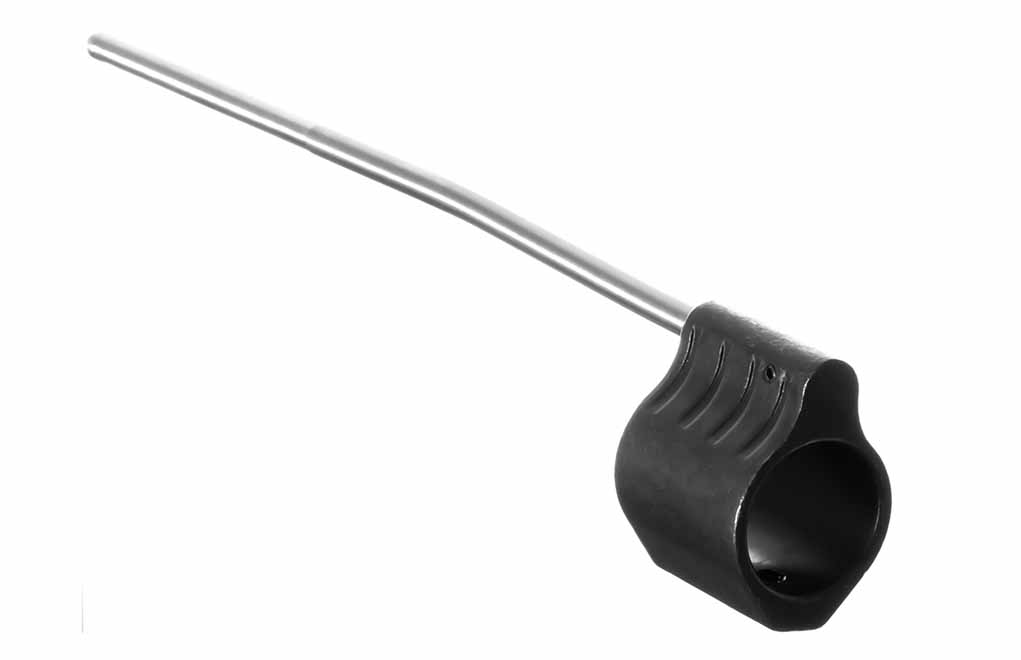
A gas block and tube. It only takes thousands of a second for the gas system to pressurize and cycle the gun, once the bullet has passed the gas port int the barrel.
Once the gas reaches the carrier key, it passes through the key into the carrier opening where the bolt lies. There you’ll find the carrier gas chamber, and the bolt stem and gas rings. The gas expands into the chamber, with the net effect of pushing the carrier to the rear. (Gas expands evenly, and presses with the same force, on all surfaces of a container. That is why a filled scuba bottle remains at rest. If you break the valve off, however, the gas pressure becomes unequal, and the bottle rockets away, hurling itself through the wall.)
At first glance, it might appear that the operational gases have no effect on the bolt. However, in discussing this with some AR manufacturers, it appears that the gas flowing into the carrier also impinges on the rear of the bolt. As such, it presses the bolt forward, taking some of the force off the locking lugs when the bolt unlocks – enough so that bolt service life is actually increased as a result.
On the side of the carrier are vent holes. Gas will jet out of these holes when the rifle is fired. They are part of the self-limiting nature of the gas system.
Of the moving parts, the bolt carrier is the beating heart of the AR-15 upper.
The gas presses against the interior of the carrier gas chamber, with more force to the rear of the carrier than forward, until it has overcome the inertia of the carrier’s mass, called (as before) the “carrier lag time” and the “carrier dwell time.” The sooner, and at higher pressure, the gases reach the carrier, the less the lag time and the less the dwell time. Think of the bolt and carrier as a leaky piston, in a cartridge-operated internal combustion engine.
If the gas key is loose, or the gas rings worn or missing, the system will vent too much gas before it has delivered enough energy to the carrier, and the carrier will not be pushed with enough force to overcome the buffer weight and spring. Delivering more gas (the typical response by the overly-enthusiastic “gunsmith” is to drill the gas port larger) is a poor way to solve those problems. Instead, tightening and securing the gas key, and replacing worn or missing rings, are the proper solutions.
Why is all this important? Because the AR-15/M-16 extractor is small and weakly sprung. The bolt lugs are small and heavily-loaded. Shortening the lag time of the gas and carrier, or increasing the dwell time of the gas in the carrier, causes the bolt and extractor to attempt unlocking and extracting the fired case sooner than designed.
When fired, the case expands to the size and shape of the chamber. The inherent springiness of the brass case allows it to contract from the chamber walls and back towards its original dimension (but not fully) to allow extraction. However, if the chamber pressure is too high (an over-pressure round, or poor-quality reload) the case may have been expanded too much and thus not contract enough to lose its grip on the chamber. If the system is cycled too vigorously, or too soon in the planned timing, the case will not have had time to have contracted from its fired state and it will resist extraction. The friction of case to chamber wall thus may be too great, and the extractor can slip off the rim. Or break part of the rim off. Even if the case is extracted, it may shed particles of brass from the rough treatment it has received. Those particles can build up in the chamber and locking lug recesses and eventually cause the bolt to wedge closed on a chambered round and thus stop functioning.
With rare exceptions, the gas key on your carrier must be staked. Failure to do so will result in a malfunction sometime down the road.
In the short explanation, that’s it: the gas flows, it blows the carrier off the gas tube end, the carrier drags the bolt. They compress the buffer spring, and once the energy has been completely absorbed, the spring pushes buffer, carrier and bolt back to rest. Unless, of course, you’re out of ammo, in which case the magazine locks the bolt open.
The Moving Parts Of The AR-15 Upper
The whole point of the “piston in a rifle” method of operation (indeed, of any self-loading rifle) is to fire a bullet, get the empty case out and a new cartridge in. Here are the mechanics.
Bolt Function
OK, the gas flows, the carrier gets blown off the gas tube, but what exactly is going on there? The bolt rotates, driven by the cam pin riding in its slot in the carrier. The initial rotation creates “primary extraction” where the drag of the bolt on the fired case partially rotates the case, freeing it from the friction of expanding to the chamber size. A good example of a system that lacks primary extraction is any pistol. The barrel drops down from the breechface, but the case is not otherwise broken-free from its grip on the chamber walls. The movement of the slide snatches the fired case straight back out of the chamber without first rotating it slightly to break it free from the chamber walls.
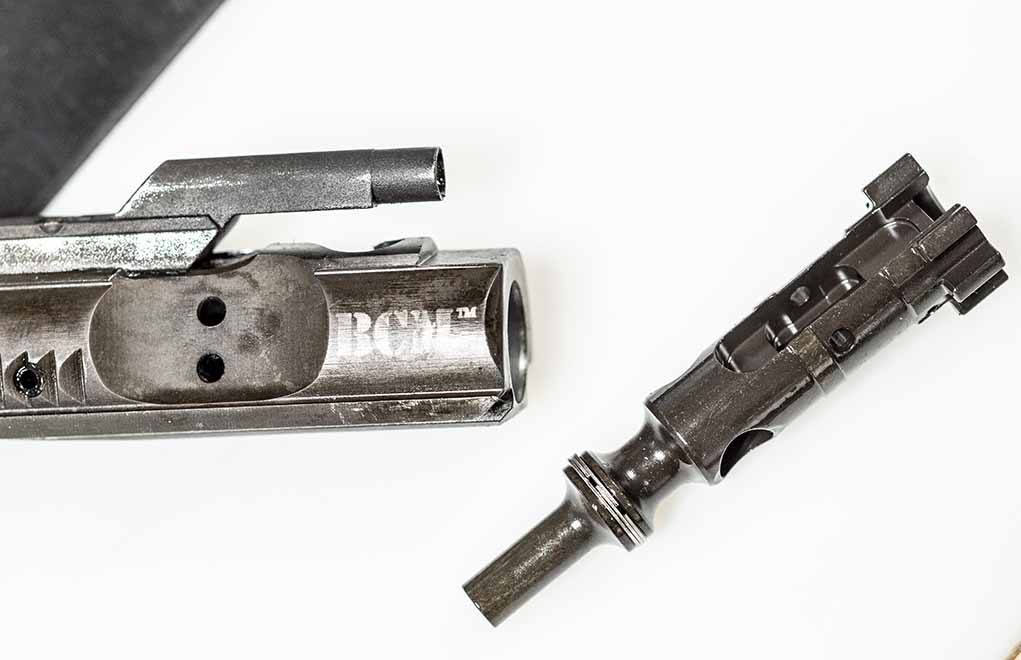
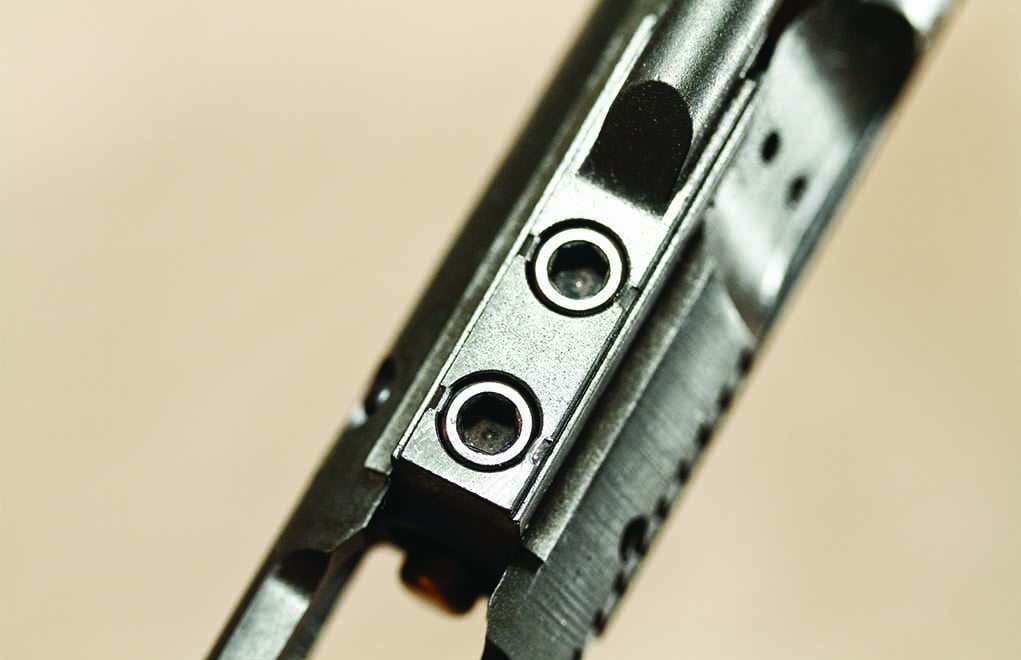
The extractor sits at the 10 o’clock position on the bolt (shown here removed). It has a lug on the outside, and a round claw on the inside that completes the circular bolt face.
If the .223/5.56 case in the AR-15 chamber is over-expanded due to excessive pressure, or the bolt attempts rotation too soon caused by an improperly-tuned gas system, the case will not have had time to shrink from firing, and the frictional bond will not be broken between case and chamber wall. The result can be merely annoying, as the abraded case leaves brass particles in the chamber and feedway as it is rudely snatched from the chamber, particles which are also splattered on the bolt and carrier, and on the inside of the receiver. At worst, the cases will have the rims bent or broken-through, partially extracted and wandering aimlessly about the AR-15 upper receiver. Or the extractor will slip off the rim entirely, leaving the fired case in the chamber.
Ejection, Feed, Chamber, Etc., Etc.
The bolt, having pulled the case from the chamber, hands the job off. The spring-loaded ejector hurls the empty out of the receiver. The bolt-carrier assembly, pushing the buffer and spring behind it, finally runs out of steam. The buffer and spring push them back into battery, stripping a round off the magazine, shoving it in the chamber, and the final act of the carrier in its forward travel is to rotate the bolt to the locked position.
Build a better understanding of the terminal performance of defensive bullets and you’ll find the one that will save your life.
What You Want In A Defensive Bullet:
One that penetrates deep, but does not pass through.
Expansion should be consistant at the typical defensive distances.
The bullet should retain nearly all its mass, ensuring a larger wound channel throughout its path.
Heavy clothing should not inhibt its performance.
Should you ever have the need to draw your defensive handgun in order to save your own life or the life of a loved one, I hope you have the best ammunition possible in the gun. No matter how expensive the handgun, no matter how ornate the scroll engraving and no matter how fancy the color case-hardening, it’s the bullet—and the bullet’s placement—that will make the difference of whether the threat is neutralized.
With a few exceptions, the tale of the modern handgun bullet has many parallels to that of the rifle bullet, but both share the benefits of the recent improvements in projectile design. Being completely honest, with the exception of the huge hunting cartridges such as the .460 and .500 Smith & Wesson, there really haven’t been any radical changes in defensive handgun cartridges in decades.
Perhaps that’s not necessarily a bad thing, because the top two—the .45 ACP and 9mm Luger—have been with us since the first decade of the 20th century and most certainly get the job done. Yes, the big 10mm Auto and .44 Remington Magnum are both stout and effective, as is the .357 Magnum, but the .40 Smith & Wesson falls in line with the .45 and 9mm.
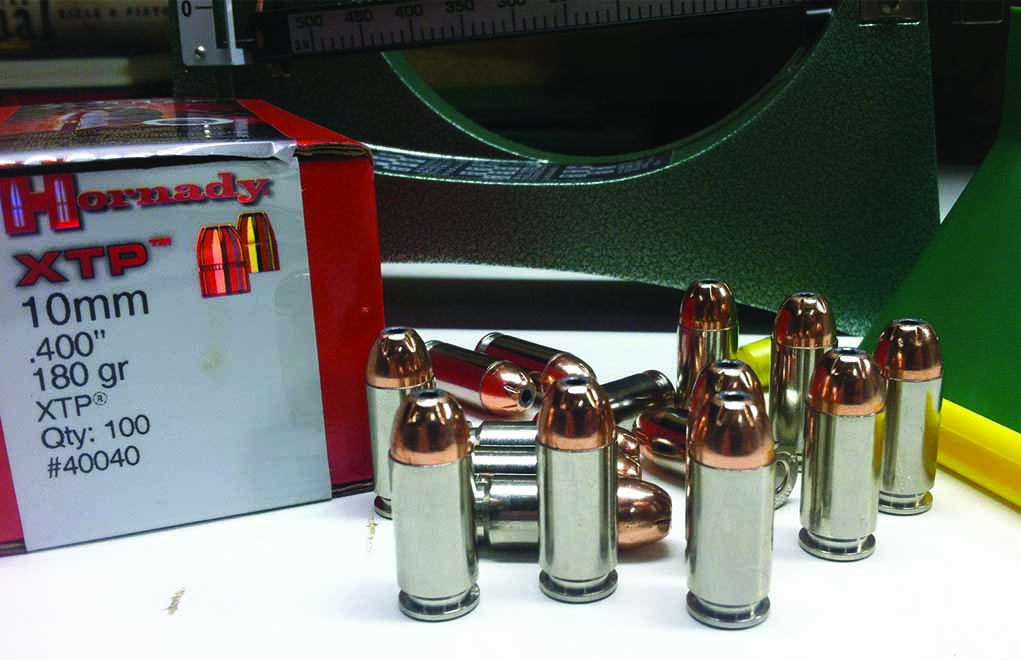
The Hornady XTP is a great choice for a defensive bullet in any cartridge.
As long as we’ve had the modern metallic cartridge, we’ve had the lead projectile. It makes perfect sense, especially considering the era: The 1870s were years of expansion and exploration, with the Indian Wars raging and the Old West in full swing. While those proficient with the cap-and-ball pistols were certainly no strangers to casting their own bullets, the early .44-40 and .45 Colt cartridges could easily be reloaded with the molds and dies provided with the handguns.
Quite obviously, the long list of lives cut short by a lead bullet could be considered a testament to the integrity of the lead pistol bullet, but there are most definitely improvements on the design. Let’s take a look at the cross-section of defensive bullets available, what makes them tick and then put the designs up against one another for comparison.
Expansion and Penetration: Just the Right Amounts
Ultimately, what we’re after in a defensive projectile is the consummate blend of expansion and penetration. We don’t want too much penetration—as you can get from a full metal jacket or other non-expanding design—because of pass-through. Nor do we want too little penetration—as in a bullet that prematurely expands and fails to penetrate enough to stop the threat.
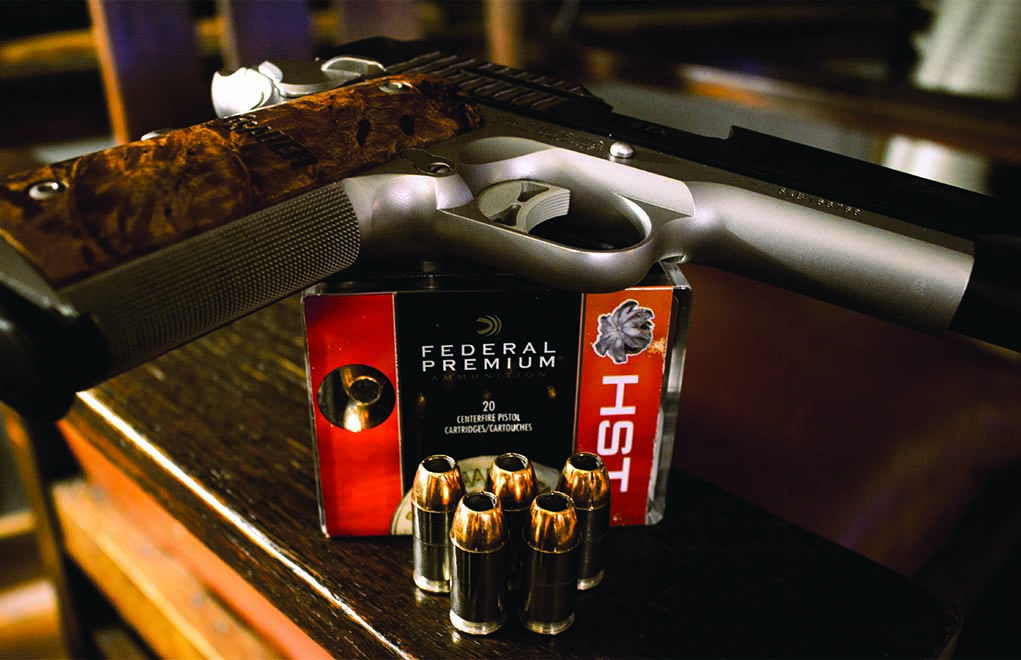
Federal Preimium HST ammo.
In the past, the poor penetration of lead bullets has been shown. In 1912, while seeking a third presidential term, Theodore Roosevelt was saved (thankfully) from an assassin’s bullet when it struck his eyeglasses case and the paper manuscript of the speech he was about to deliver. Had that been a bullet of modern design, history would’ve been rewritten in that instant. Fired from a distance of 5 feet, the .38-caliber bullet stopped short of Roosevelt’s lung, being slowed by 50 folded sheets of paper and that glasses case. (By the way, he delivered his speech—in spite of the gunshot wound.)
In the late 19th century, Eduard Rubin of Switzerland placed a jacket of copper around the lead core of a rifle bullet and changed the game. Jacketed bullets offer a considerable advantage, because they can handle much higher velocities than lead bullets: At speeds of more than 1,800 fps, the surface of a lead bullet can melt, thereby drastically fouling the barrel and ruining accuracy.
However, in the case of the handgun, the jacket helps with structural integrity. Few handgun cartridges can attain a muzzle velocity of 1,800 fps, but that copper jacket will most definitely slow bullet expansion, and that equals deeper penetration. Quite obviously, the sectional density of the bullet will come into play, as it will in any lead alloy that results in a harder material (known as “hard cast”). Generally speaking, though, a jacketed handgun bullet will give better terminal ballistics than a pure lead one.
Speer’s Gold Dot, shown here in 9mm, 147-grain, is a great bonded-core bullet.
Hollow-Points Bullets And Others
The idea of drilling a hollow cavity at the nose of a bullet was one means of reducing the weight of a lead projectile in order to increase its velocity—again hearkening back to the black-powder era of rifle bullet technology—but the concept works perfectly with handgun bullets, especially in situations where over-penetration is a serious hazard.
Upon impact, the hollow-point is subjected to internal pressures that force the meplat to expand outward. This increases the diameter of the bullet, and therefore, the wound channel, but that expansion is often limited to the base of the hollow cavity, allowing for good penetration. Some bullets use a skived jacket and/or lead core to allow faster expansion; others leave the jacket intact.
The separation of the jacket and core—especially upon violent impact—caused bullet manufacturers to look for a means of keeping the projectile in one piece. One of the most popular methods is called “bonding.” During the manufacturing process, the copper jacket and lead core are chemically bonded, slowing expansion and keeping all the parts of the bullet together during the terminal phase. There are also those handgun bullets that use a cannelure or similar groove in the jacket to mechanically lock the two components together during the terminal phase.
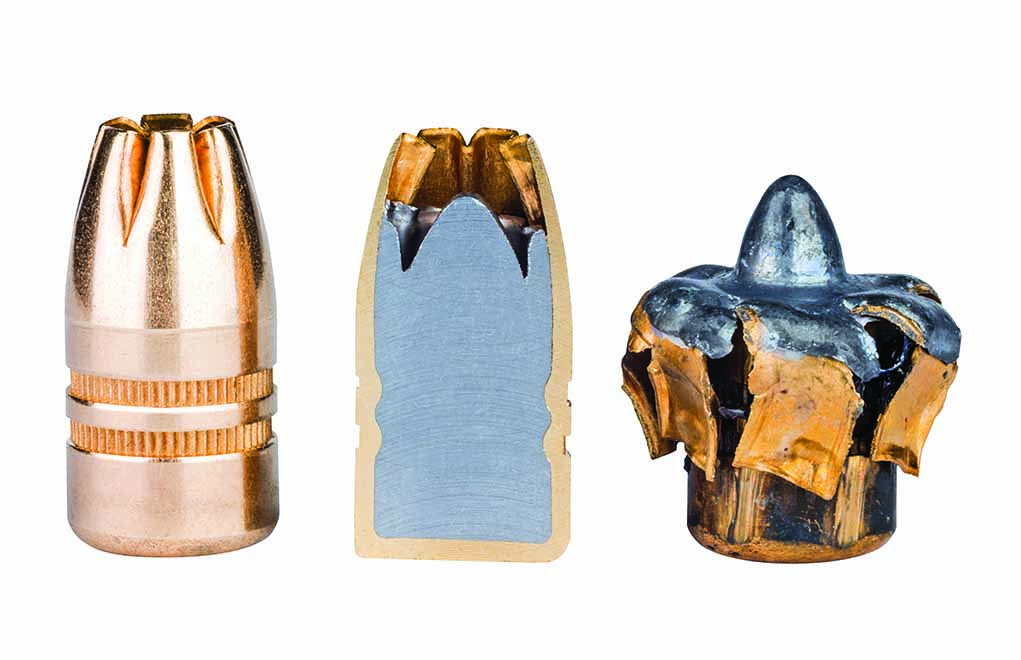
The Federal Hydra-Shok Deep is shown here in both section and upset.
Lead-free monometal bullets are another relatively new design. It offers a unique set of benefits and issues, as we’ll see momentarily. Randy Brooks of Barnes Bullets was a big innovator of the all-copper design, and his concept has translated to the pistol bullets.
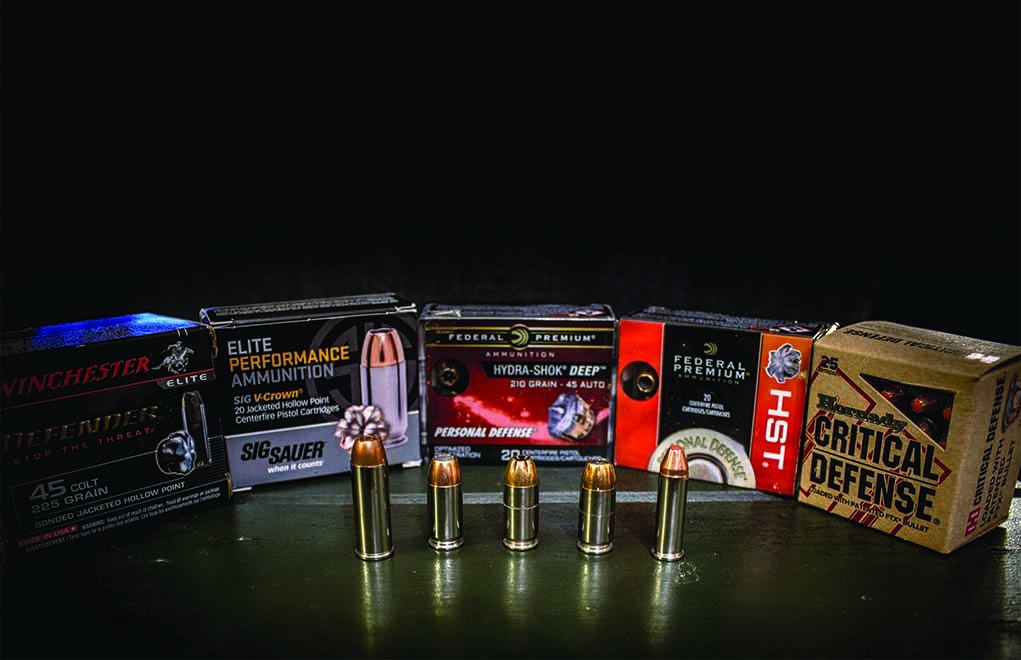
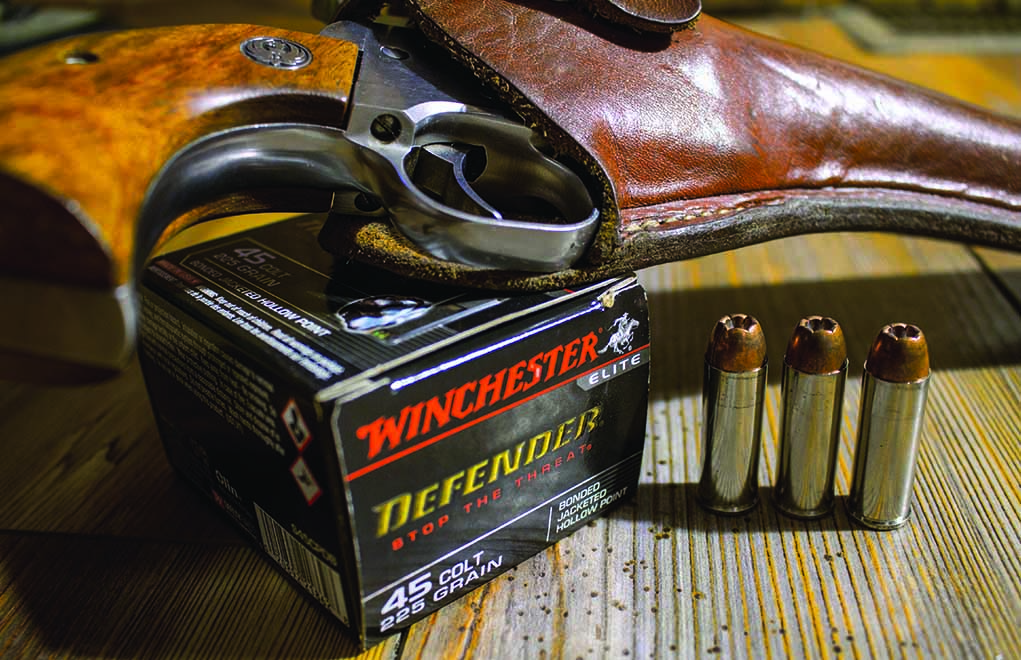
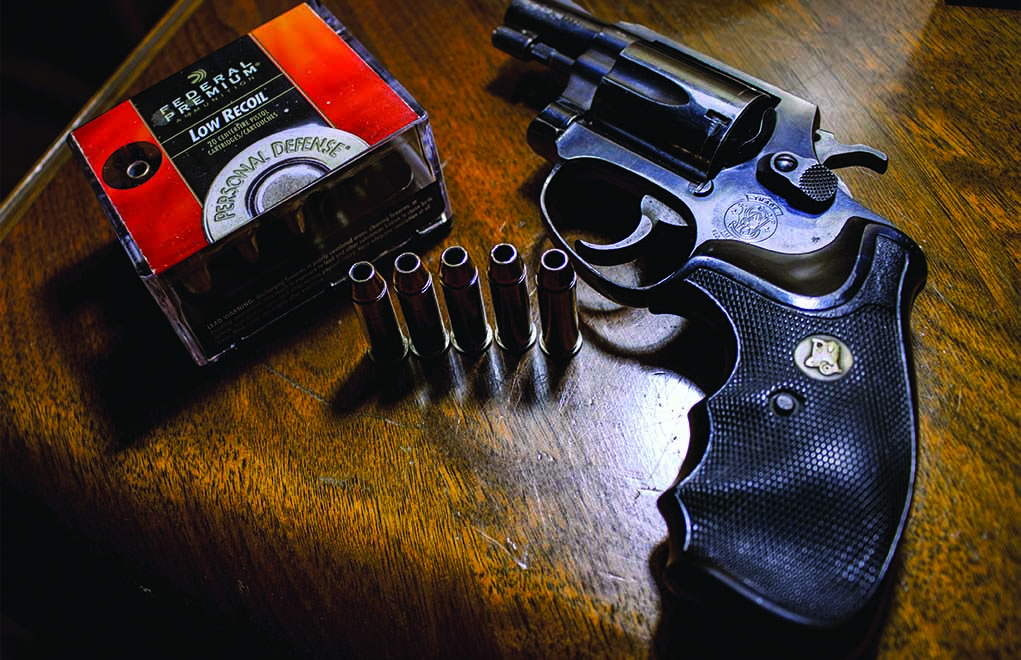
The selection of handgun bullets is wide and diverse, but I’d like to take a look at some of the most popular designs and compare and contrast the features and benefits of them. Within this comparison, I’ll look at the Federal HST, Hydra-Shok and Hydra-Shok Deep; Hornady XTP and FTX; Speer Gold Dot and Gold Dot G2; Winchester Defender; and the Sierra V-Crown—as loaded in the Sig Sauer ammunition line. All are premium bullets, and all have excellent reputations.
Bullet Similarities And Differences
Comparing bullet performance is a difficult task, because no two situations are exactly alike, and when it comes to a personal-defense bullet, the opportunities for real-world testing are very few (for obvious reasons). As with dangerous-game bullets, theoretical testing doesn’t always equate to reality, but it’s one means of comparison. And, although certain protocols have been set up for law enforcement, what we’re looking at here are personal-defense bullets—our concern is to get out of a deadly situation, not pursue the aggressor.
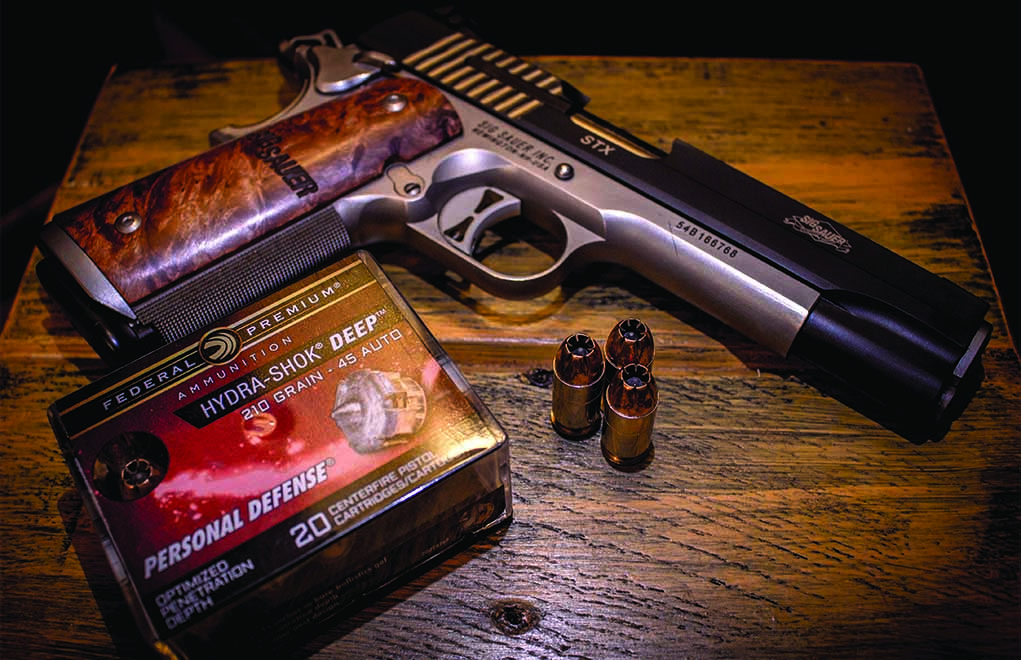
The Hydra-Shok Deep is a modern update of the classic Hydra-Shok … made better.
All these bullets, with the exception of the Hornady FTX and the Speer Gold Dot G2, are hollow-points, and all use a lead core and copper jacket. The Winchester Defender, Speer Gold Dot and Gold Dot G2 are all bonded-core designs. The other bullets are cup-and-core.
Federal Hydra-Shok
Starting with the famous Hydra-Shok—which was the “flagship” of Federal’s handgun “fleet” for decades—we’re looking at the bullet that has been the darling of both law enforcement and the personal-defense community. This is an excellent design by ballistic engineer Tom Burczynski, and it represents a definite advancement in bullet design. Using a skived jacket and unique center post at the base of the hollow cavity, the Hydra-Shok gives good expansion, although I’ve seen the bullet “plug up” in heavy clothing and fail to expand. Still, the Hydra-Shok has a solid reputation.
Federal Hydra-Shok Deep
The Hydra-Shok Deep can be considered a modern update of the Hydra-Shok. The engineers took a look at all the good and bad points of the Hydra-Shok and fixed the bad. The revised center post has made a world of difference in post-expansion and penetration; it seems the Hydra-Shok Deep is everything Burczynski intended the first iteration to be. It’s currently available in 9mm Luger, .40 S&W and .45 ACP, and I can see the Hydra-Shok Deep replacing its predecessor in the not-too-distant future.
The Winchester Defender—a good bonded-core bullet—will hold together in nearly any circumstance.
Federal HST
Federal’s HST uses a deep hollow-point, skived jacket and core to give dependable expansion—often twice the caliber—and a core stiff enough to allow the bullet to penetrate to what many consider the optimum depth (right around the 15-inch mark) in both bare gelatin and through heavy clothing. The resulting upset bullet is a wicked-looking piece of gear. The core and jacket are not bonded. Instead, a cannelure is used to mechanically lock the components together.
Hornady XTP
The Hornady XTP is a simple, yet effective, design, covering many different bases. Hornady states that the XTP is applicable for law enforcement, hunting and self-defense alike, and I can’t argue with that assessment. Using a hollow-point design with a copper jacket of varying thickness in order to control expansion, the XTP—and its beefy brother, the XTP Mag.—can be relied upon as a good, traditional choice for most cartridges. It uses a cannelure—in the revolver cartridges—to lock the cup and core together, and the serrations in the jacket at the nose weaken the jacket just enough to promote uniform expansion.
Hornady FTX
The Hornady FTX has its roots in the development of a new bullet for lever-action rifles. Those classic lever guns use a tubular magazine, with the cartridges lined up with the meplat of one projectile touching the primer of the cartridge ahead of it. A spitzer bullet presents the risk of detonating the cartridge ahead of it—with catastrophic results. Hornady changed the game by adding a flexible, rubbery tip—which easily compresses and eliminates any detonation risk. Hornady applied this technology to handgun bullets, filling the hollow-point with that flexible material. This slows expansion, giving deeper penetration, and it also makes the bullet compliant in those places where hollow-point ammunition is illegal.
The Federal Hydra-Shok is a classic defensive bullet, shown here in 110-grain .38 Special.
Speer Gold Dot
The Speer Gold Dot is a tried-and-true design, embraced by law enforcement and citizens alike. Using a skived jacket chemically bonded to an alloyed lead core, the Speer Gold Dot has been a winner for years, giving repeatable and dependable results. Speer “tunes” each bullet’s hollow-point geometry to optimize expansion and penetration.
Gold Dot G2
The Gold Dot G2 is a departure from the Gold Dot design. Yes, it uses the same bonding process as the Gold Dot, but instead of a deep hollow-point, it uses a shallow dish at the nose, filled flush with what Speer calls an “elastomer.” Internal fissures—built into the bullet—are forced apart upon impact, resulting in a bullet that has been absolutely stellar in all protocol testing.
Winchester Defender
The Winchester Defender is a bonded design with a notched jacket, designed for a balance of expansion and penetration that will get you out of trouble. Upon impact, the Defender’s nose splits into six pieces for expansion up to 1.5 times the caliber.
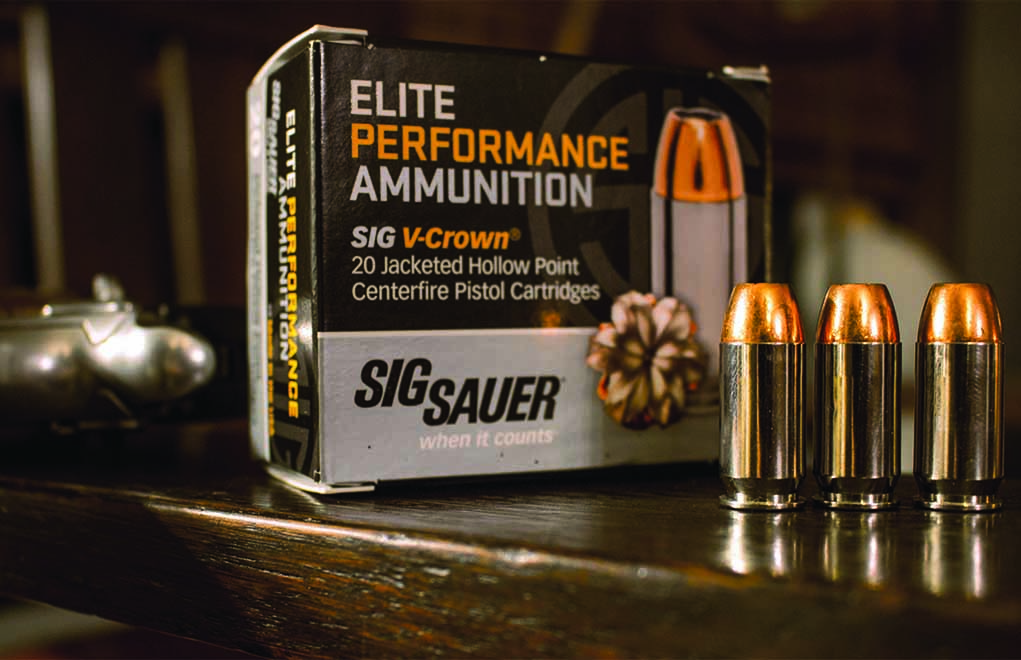
Sig Sauer’s Elite Performance ammunition features the Sierra V-Crown premium hollow-point.
Sierra V-Crown
The Sierra V-Crown is available in both component form and is also loaded in the Sig Sauer factory ammunition. Using a unique “stacked hollow-point” design, the V-Crown gives reliable expansion and has proved to be a very accurate bullet (no surprise from Sierra) in all my experiences.
Conclusions
Looking at all these designs, there are a couple that have stood out, because I feel they represent the best all-around balance of accuracy, reliability and recovered shape. Again, please allow me to remind you that a defensive bullet has few opportunities to be tested in a real-world scenario, so I’ve consulted with LEOs for some insight, as well as making my own observations.
As stated before, I’ve seen the Hydra-Shok plug and fail to expand when shooting through denim, but I can see why the Hydra-Shok Deep (the revamp) is going to be a huge success: It works very well in a number of different conditions. I like the Hornady XTP, especially in revolvers, and I often carry my own handloaded ammunition built around this bullet in my Smith & Wesson Model 36 in .38 Special.
I also have a ton of faith in the Speer Gold Dot and feel it could be a serious contender for the best defensive bullet ever designed. The bonded design will hold together under nearly any circumstance, and I’ve yet to see or hear of a Gold Dot that’s failed to expand. I like the accuracy of the Gold Dot, as well as the way it feeds, and I’m not alone. The Gold Dot G2 is going to be a serious contender.
The Hornady FTX—lighter than the FlexLock bullet designed for law enforcement—has shown that in certain circumstances, it will lack penetration. I personally feel better about carrying Hornady’s XTP over the FTX design.
The Sierra V-Crown is definitely a sound design and certainly worth an “audition.” Those stacked cavities equal good expansion; the bullets are plenty accurate; and penetration tests show more-than-adequate performance in bare gelatin, as well as through clothing.
However, the ammo I carry on a daily basis is Federal’s HST. I’ve shot a bunch of this stuff—primarily the 230-grain HST load—from my Sig Sauer 1911. It’s wonderfully accurate, gives near-perfect penetration, and the resulting upset bullet is picture-perfect. It’s relied upon by law enforcement and has aced the varying protocol tests without giving too much penetration.
There are many good designs on the market, and I suggest you carry what makes you feel the most confident … as long as the bullet performs properly. Take the time and make the investment to find what makes you the most confident. In my case, I enjoy the consistent expansion and penetration of the Federal HST.
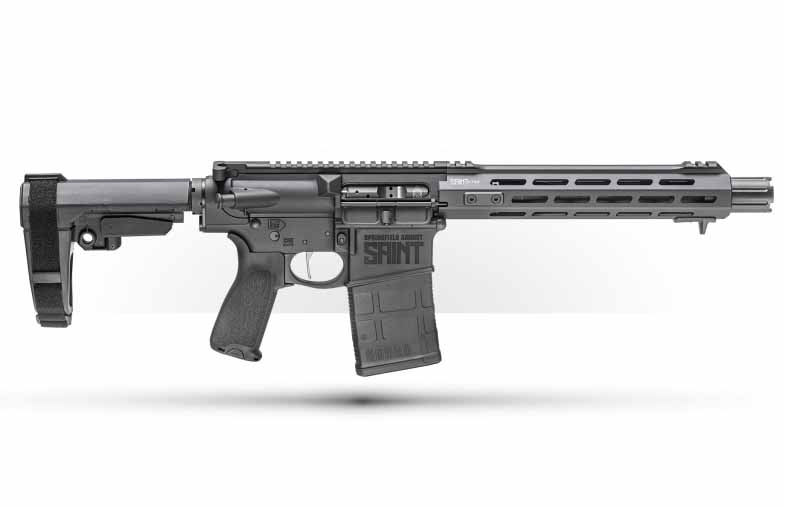
More punch per pound, the Springfield .308 SAINT Victor Pistol is a heavy hitter in a small package.
How The .308 SAINT Victor Pistol Punches Up In Weight:
Forged upper and lower receivers
Accu-Tite tension system
Nickel-boron coated flat trigger
10.5-inch CMV barrel
SB Tactical SBA3 brace
11-inch M-Lok compatible handguard
Factory-install forward blast diverter
If you’re looking to rattle the fillings of the guy three lanes down from you at the range, Springfield Armory has you in spades. With the release of its 10.5-inch barreled .308 SAINT Victor Pistol, the gunmaker has conjured up a heater equal parts bark and bite.
Indeed, flinging .30-caliber from an AR pistol doesn’t quite have a set application. Springfield bills it as a “purpose-built” defensive arm; there’s no arguing it would set any idiot with ill-intent on his duff in a hurry. Though given the .308’s more than ample penetration potential, the SAINT Victor Pistol might not be your go-to home-defense choice. Unless you happen to run AR550 plate behind your drywall. That said, the pistol certainly seems to have the chops to fill the role as the proverbial “truck gun”, one that’s squared away for any work shy of neutralizing a grizzly in one shot. Not that you need to let absolute practically stand in the way of any gun purchase.
As to the finer points of the .308 SAINT Victor Pistol, if you’re familiar with the line it doesn’t throw many curveballs: forged upper and lower receivers, Accu-Tite tension system, heavy tungsten buffer and nickel-boron coated flat trigger. Covering the chrome-moly-vanadium barrel is an 11-inch free-floated handguard with ample M-Lok real estate and a hand stop at the front 6 o’clock. The fairly ubiquitous SB Tactical SBA3 graces the rear and up front, mercifully, Springfield has included a forward blast diverter. Nice on any AR pistol, this seems a necessity on one chambered .308.
As to price, the .308 SAINT Victor Pistol runs a bit more than most of the line with an MSRP of $1,363. A small outlay for more hitting power and felt recoil.
Get On Target With The AR:
Go Small With These 8 Economical AR Pistol Options
8 Favorite Truck Gun Options For Protection On The Go
More from Springfield Armory:
ENESEO, ILL. (4/28/20) – Want the heaviest hitting round available yet in a SAINT® pistol? Then look no further than the new Springfield Armory® SAINT Victor Pistol in .308.
As part of the highly respected SAINT Victor line, this hard-hitting pistol is loaded with premium components. Purpose-built for defensive use, the SAINT Victor Pistol in .308 is a serious use firearm, featuring an HPT (High Pressure Tested) and MPI (Magnetic Particle Inspected) bolt to confidently handle a heavy round count schedule. From its Melonite® finished barrel, to its pinned low profile gas block, to its crisp and grit-free enhanced nickel boron coated, single-stage flat trigger, the SAINT Victor Pistol in .308 adds a potent defensive platform to the SAINT pistol family.
This new SAINT pistol packs .30-caliber power into a 10.3″ CMV-barreled package that measures just over 28″ with the SB Tactical® SBA3™ five-position brace fully collapsed. Round that out with excellent appointments such as a BCMGUNFIGHTER™ Mod 3 pistol grip, 20-round Magpul® PMAG® Gen M3™ magazine, a patented, rock-solid, free float M-Lok® handguard, and an SA 2-Piece Blast Diverter, and you have a pistol that easily tames the .308 cartridge while remaining handy and compact.
“The SAINT Victor Pistol in .308 gives shooters a premium featured AR pistol that delivers serious power in a small, lightweight and easily maneuverable platform,” says Steve Kramer, Springfield Armory’s Vice President of Marketing. “If you want a SAINT Pistol that offers more power than 5.56, then this is the one for you.”
The forged lower receiver features Springfield Armory’s Accu-Tite™ Tension System for a tight, zero-movement fit with the forged upper, and the Picatinny rail allows you to mount the optic of your choice. For iron sight use, the slim, interrupted free-float handguard has Picatinny rail at the muzzle to mount a front sight.
The result is a potent, purpose-built defensive firearm with enough .308 power to handle any situation you may encounter.
.308 SAINT Victor Pistol Specs Caliber: .308 Winchester Handguard: 11-inch free-floated aluminum, M-Lok compatible Trigger: Nickel-boron coated flat GI Muzzle Device: SA 2-piece forward blast diverter Buffer Assembly: Carbine “H” heavy tungsten buffer Charging Handle: GI style Pistol Grip: BCMGUNFIGHTER Mod 3 Pistol Brace: B Tactical SBA3 Weight: 8 lbs 6 oz Length: 28.25″ – 30.5″ MSRP: $1,363
The old buffer tube nut—a ring with a hole through it—is the correct part for a retro build. Unless your AR-15 build is something such as this, don’t use old, difficult-to-manage parts.
Constructing your dream rifle from scratch isn’t knockout difficult, but there are some processes of the AR-15 build that get folks tied in knots.
What Are The Most Common Areas Folks Get Hung Up On Building An AR:
Proper Barrel Nut Torque
Anti-Seize Compound
Staked Gas Key
Staked Castle Nut
.223 Vs. 5.56
Yes, yes, yes; we all know that building an AR-15 is easy enough so that with a little bit of persistence and a big enough bag of treats, you could teach your Labrador retriever to build one. OK; maybe your Australian cattle dog or a poodle. But there are things that shooters, builders and AR-15 owners get themselves tied up in knots over; things that do or don’t matter.
Let’s start at the top—almost literally.
Barrel Nut Torque
The barrel nut torque limits and the precision of alignment are areas I’ve seen shooters obsess over—to the point of spending an entire afternoon doing nothing but this. The “book” torque limits are 35 ft-lbs—not to exceed 80 ft-lbs. (Technically, it’s “pounds-inch,” but we won’t go down that particular rabbit hole right now.)
First, 35 ft-lbs is a force so minimal that you could almost wring the barrel nut on by hand and make 35. If you’re using a torque wrench, I would consider this the absolutely lowest level I’d be cool with, and even then, I wouldn’t be cool with it. My target figure, if I’m ever using a torque wrench, is in the 40 to 50 ft-lbs region.
Not only do you need a good wrench, you also need a way to hold the receiver for your AR-15 build. A clamshell or a reaction rod is just the ticket.
My process is simple: Tighten with a wrench twice and eyeball the alignment. If I can get a tab on the barrel nut to almost-alignment, the third time, I tighten it up until it lines up and then call it done. My standard is that the clearance tab (the one going past the gas tube hole) is almost there. If it stops in the middle or short, I don’t try to force it. I either get out the barrel nut shims, a different upper or my upper facing reamer.
I’ve had to deal with over-torqued barrel nuts on some AR-15 builds and even used an end mill to shave the nut down until I could break it and free the barrel from the upper. Too much is too much, and 80 in-lbs is close to too much.
As far as alignment is concerned, as long as I can weasel the gas tube past the barrel nut tabs, I’m fine with it. I know: I’m a heretic. We’re supposed to fuss over the fit until the nut tabs are so precisely aligned that the tabs don’t touch the tub and the tube is centered. As long as the gas key slides smoothly onto the end of the gas tube, the rifle doesn’t care.
Oh, there’s an accuracy cost, for sure. But the “cost” we’re discussing is at the X-ring or smaller level, at 600 yards and in the hands of an NRA High Master High Power shooter. Is that you? No? Will you be shooting to 600 yards? No? Then why are you spending time in the shop, fussing and refitting the barrel nut?
Not a Myth
The USGI barrel wrenches suck. The flat plate with three nubs in it can be counted on to slip out of the barrel nut tabs, mar the barrel nut or make you bash your hand. There’s a plethora of much better wrenches to be had, and none of them are expensive. Do yourself, your barrel nut and your rifle a favor: Use one of the good ones when you’re building your AR.
Barrel Nut Juice
OK: anti-seize compound or not? I vote not. Why? Because I’ve never seen it matter. Oh, I’m not a barbarian—I do use a bit of oil or other lubricant on the receiver threads, so I’m not spinning on a dry barrel nut. But proper torque (or lack of excessive torque) means I’ll be able to remove that nut 10,000 rounds later.
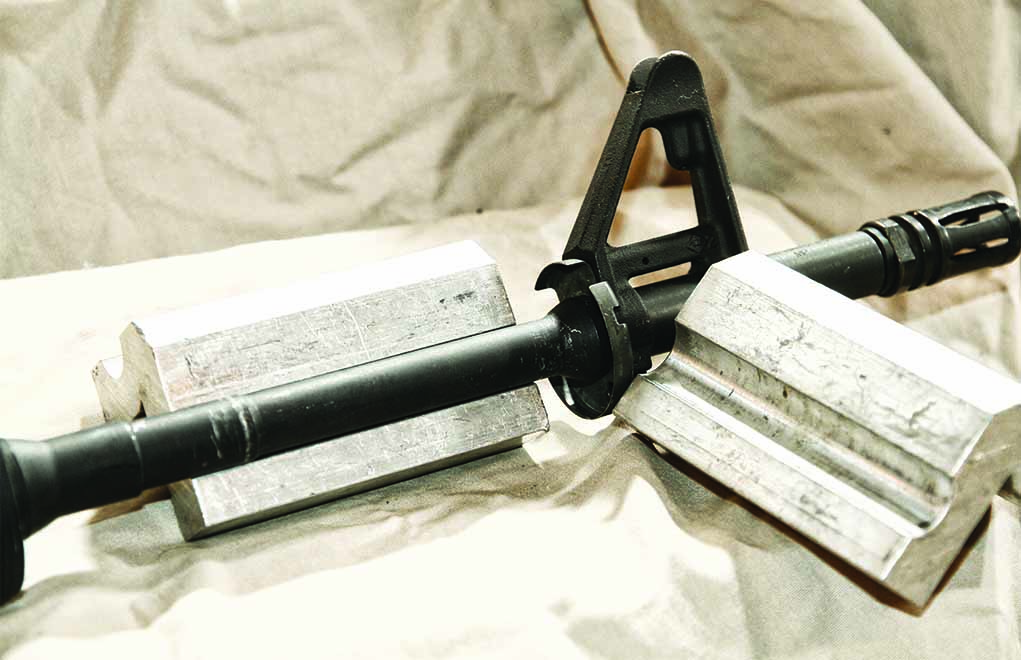
The aluminum blocks will do in a pinch … if nothing goes wrong. Then, they’ll slip and rub aluminum all over your barrel. Not what you want for your AR-15 build.
“But, but, anti-seize compound keeps the parts from galling,” you say. If steel barrel nuts were shredding aluminum receiver threads, wholesale, across America, we’d be hearing about it. If you want to be OCD and use anti-seize compound on your AR build, go ahead. Be sure and use the correct formula for steel-on-aluminum. But please, don’t lecture the rest of us about not using it or eating with our hands.
Not a Myth
Yes, the reaction rod is a good thing. Use either that or a clamshell receiver holder such as the one Brownells makes to hold things in place. Do not—unless it’s an emergency—use the aluminum barrel blocks. Their “one size fits all” means they hold most barrels … poorly. And the barrel will slip in the blocks past a minimal torque level, leaving smudged aluminum on the barrel.
Gas Key Staking
I think the word has been well and properly spread on this particular subject, and that’s this: Gas key screws need to be staked; well and truly staked. If you don’t have an M-Guns MOACKs or a buddy at the gun club with one, then get one.
Make sure the key is snug, and stake the key screws. If you don’t, sooner or later, it’ll come loose.
Improperly staked gas key screws are just asking for trouble. Building an AR-15 means doing it right.
You can’t depend on the key screws by themselves to hold things in place. The torque setting for the screws is 55 in-lbs, and the breaking force for those same screws (unless you‘ve managed to score some really high-grade screws) isn’t much more—in the 60s. If you over-torque them, you increase the chances of failure. I’ve seen rifles with gas key screws that broke the head off because they were tightened too much.
Not a Myth
Screws are not all the same. The top edge, or corner, running around the rim of the screw head might be a square-ish edge; or, it might be rounded. It might be knurled … or not. The amount of staking you’ll have to when you’re building your AR does depend on the shape of the screw head. One thing the MOACKs does is stake in the edge hard enough to engage even the dodgiest screw head.
Castle Nut
And while we’re at it, stake that castle nut as well. I still see AR-15 builds—and even the occasional factory gun—on which the castle nut hasn’t been staked.
The castle nut isn’t an easy part to tighten. Lacking a suitable fixture to hold it in place, the receiver wants to rotate on the bench top. Alternatively, the buffer tube wants to turn just a bit. When I tend to these things in classes, it’s easy enough to have someone hold the receiver in place by placing their hands on it while it rests flat on the bench and then leaning in with all their weight.
A staked castle nut is a good thing.
Some say Loctite is a better solution to the problem than staking. Perhaps. I’ve been known to use a bit of the old blue goo when assembling a buffer tube/stock on a carbine. But I still stake. Why? Because staking is more solid than torque and goo, and it offers an additional protection— visibility.
If you’ve staked your castle nut, even in a perfunctory manner, you’ll have visible proof of its location. If it moves, you’ll be able to tell, because the staking will act as a witness mark. If all you depend on is Loctite, how do you know if the castle nut has shirted a bit? And if you really degrease the threads and hose the Loctite in there, how will you get things apart when you need to? And you know that once you’ve cemented them together for all time, you will have to take them apart sometime in the future. After all, it’s Murphy’s Law, not Murphy’s “Suggestion.”
Now, there is one time you’ll have to depend on torque and Loctite. Some makers of the receiver plate (especially those meant for single-point slings) will make them too hard to stake. Staking depends on bending metal, and if the metal is too hard, it won’t bend. My first thought is to convince you that a single-point sling is a bad choice and that you should use some other method. Failing that, I’ll break out the degreaser and Loctite and make sure the castle nut won’t move until you, we, I or someone else needs it to in the future.
Not a Myth
If you think the current castle nut is a hassle to work with, you haven’t struggled with the original. The first nut that held on the carbine buffer tube was simply a threaded ring with a circular hole through it. The wrench you tightened it with has a single nub on it. Yes, that’s the one—the end of your second-generation barrel nut wrench.
You shouldn’t use these parts unless you’re building a detailed retro carbine; they’re period-correct for the earliest carbines. However, they’re a pain in the neck and are one of the few parts on an AR-15 I consider outside my “no Loctite” rule.
I’ve seen photos of them staked, but the ones I’ve seen in person didn’t have the clearance notch for staking.
.223 vs. 5.56
Your barrel says quite clearly, “5.56 NATO.” Is it? Maybe it is, maybe it isn’t. Does it matter? Yes. The difference between .223 and 5.56 is not the headspace (they’re essentially the same) but the “leade” (the distance the bullet travels out of the case before it strikes the rifling). The 5.56 has more leade and, therefore, a lower peak chamber pressure. The former (5.56) ammunition is formulated to run in 5.56 chambers and the latter (.223) in .223 chambers. Using the “hotter” 5.56 in the shorter leade of a .223 chamber causes the peak pressure to increase. This puts more stress on the rifle and can cause cases to lose their primers upon firing. A loose primer rattling around the inside of your receiver is a bad thing.
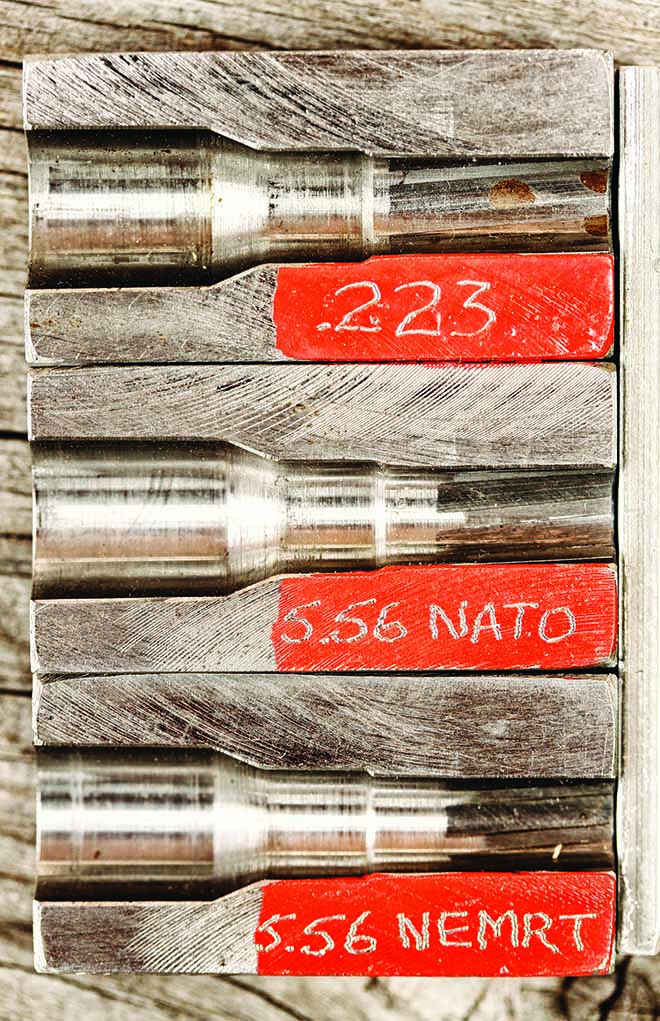
You can see the differences between the .223, the 5.56 and the reamed by M-Guns leade.
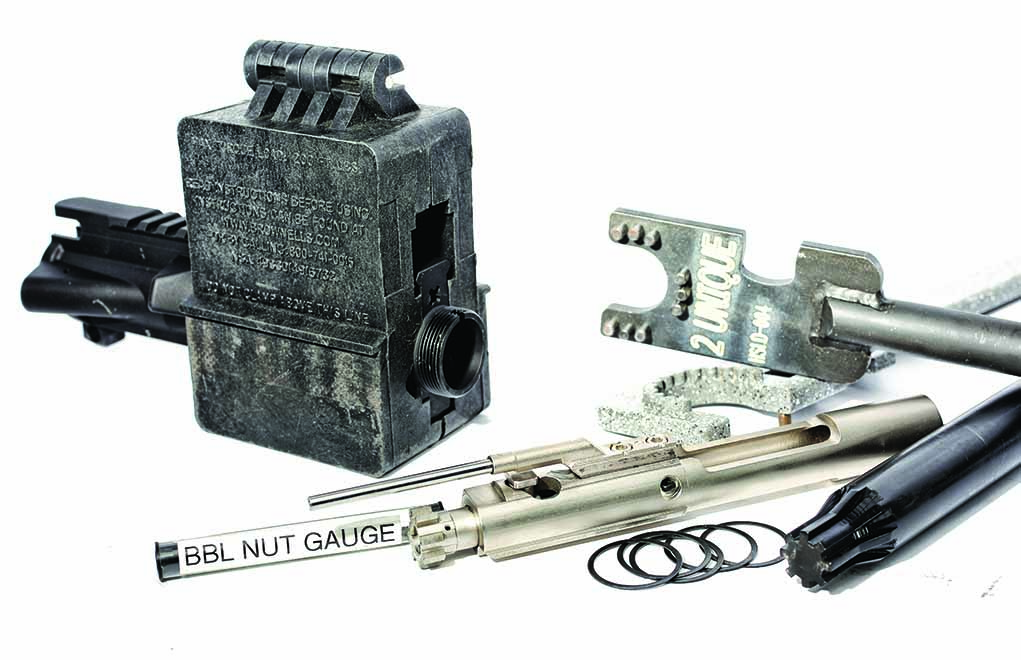
Some manufacturers can be counted on to deliver a 5.56 barrel, if it’s so marked. Colt, Daniel Defense and LMT would comprise good starts. For many others, the only way to be sure is to gauge.
M-Guns has the solution: its .223/.556 gauge. It’s made to be a normal 5.56 leade size, and if you poke it into the chamber and it sticks, that means you have a .223 leade. You then use an M-Guns 5.56 reamer to cut the leade—and only the leade.
Now, if you never use anything but .223 ammunition, there’s no problem. Nevertheless, if you have a .223 leade and you luck into a smoking-hot deal on 5.56 ammo, your rifle will get worked harder. How much harder? Pressure-testing 5.56 ammo in .223 pressure barrels, I’ve had reports back of peak pressures up to, and more than, 70,000 psi.
Not a Myth
Twist in barrels does matter … except when it doesn’t. If you have an old barrel with a 12-inch twist, you’re pretty much stuck with bullets of 55 grains or lighter. However, if you have a 1:9-twist barrel, you’re not necessarily out of luck when it comes to heavy bullets between 69 and 77 grains. The “mil spec or bust” crowd will disparage your use of precious 77-grain Mk 262 ammo in a 1:9 barrel, but by the Greenhill formula for barrel twist, your bullets will be stable. That they don’t shoot with bench rest accuracy is probably a matter of technique, optics, trigger or barrel quality rather than twist rate.
The important thing to keep in mind is this: We’re at the range to have fun and build skills, not brag about equipment we don’t use or can’t use well. Build your AR-15, use it, learn it, and be good with it.
From Customization to Performance: Our Best AR-15 Insights
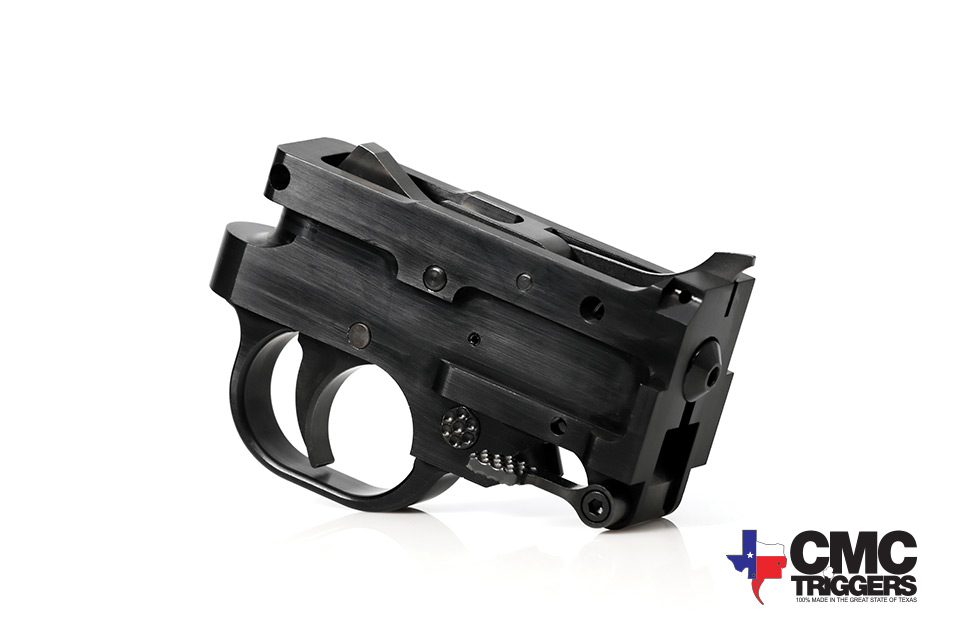
Innovative, self-contained and easy-to-install AR-15 trigger groups, CMC Triggers is where to turn to take your carbine to the next level.
CMC Triggers is the original manufacturer of the ‘Drop-in’ Trigger Group for the AR-15/10 rifle since 2003. We are dedicated to building the finest Trigger designed for our Law Enforcement, our Military and Civilian use.
Our critical sear engagement surfaces have a propriety machining process that renders superior surface finish and dimensional control. As compared to our competition, the techniques we use to establish a 1-2 RMS surface finish as opposed to EDMing, which leaves a pitty 32 RMS, compared to a mirror, which is 0 RMS.
CMC Triggers’ sear engagement overlap is six to eight times greater than our competitors, providing a much safer trigger and enhanced reliability.
Be sure to enter our American Made giveaway, with great gear from great American companies. Click the tab at the bottom right of page to enter.
Trigger components are fabricated from 8620 alloy steel, and S7 Tool steel machined to exacting tolerances and finished for the longest-lasting service life possible. Minimal lock-time is designed into the assembly using controlled hammer weight, and balanced and activated using a Rocket Wire hammer spring. This design feature assures repeatable function, with either commercial or military-grade ammunition.
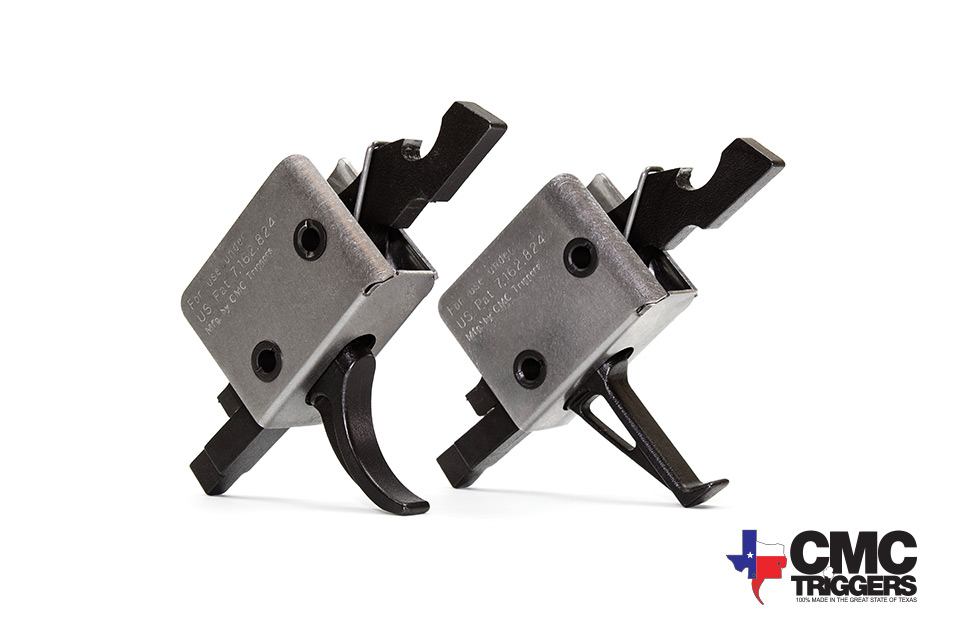
Positive trigger reset allows for a quick follow up shot on target. CMC’s multi-patented one-piece assembly installs in minutes.
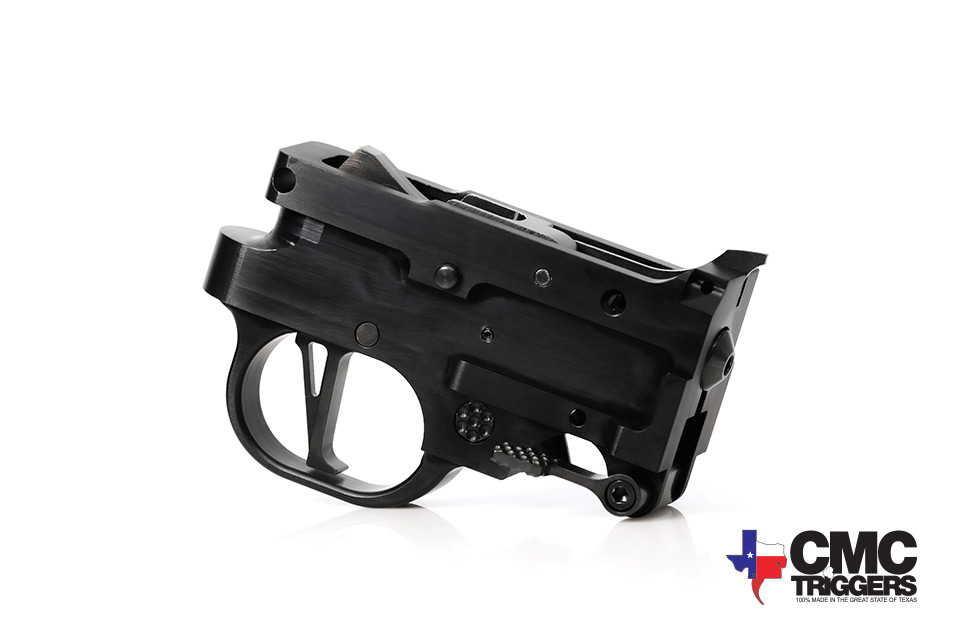
CMC Triggers currently manufactures CMC Glock Triggers, AK-47 Elite Triggers, 9mm Pistol Caliber Carbine Triggers, Remington 700 Triggers, and most recently 10/22 Triggers, all completely drop in and at an affordable price.
In 2017, CMC embarked on a project to expand its offering in the pistol market, an extension of their Glock Trigger aperture to include Match Grade drop-in Glock Barrels. CMC is also proud to offer many AR15 Accessories such as LPK’s, Gas Tubes, Gas Blocks etc.
CMC Triggers boasts a Lifetime Warranty on all its products, Made in the Great State of Texas! The best triggers period! Thank you for choosing CMC Triggers.
For more information on CMC Triggers, please visit cmctriggers.com.
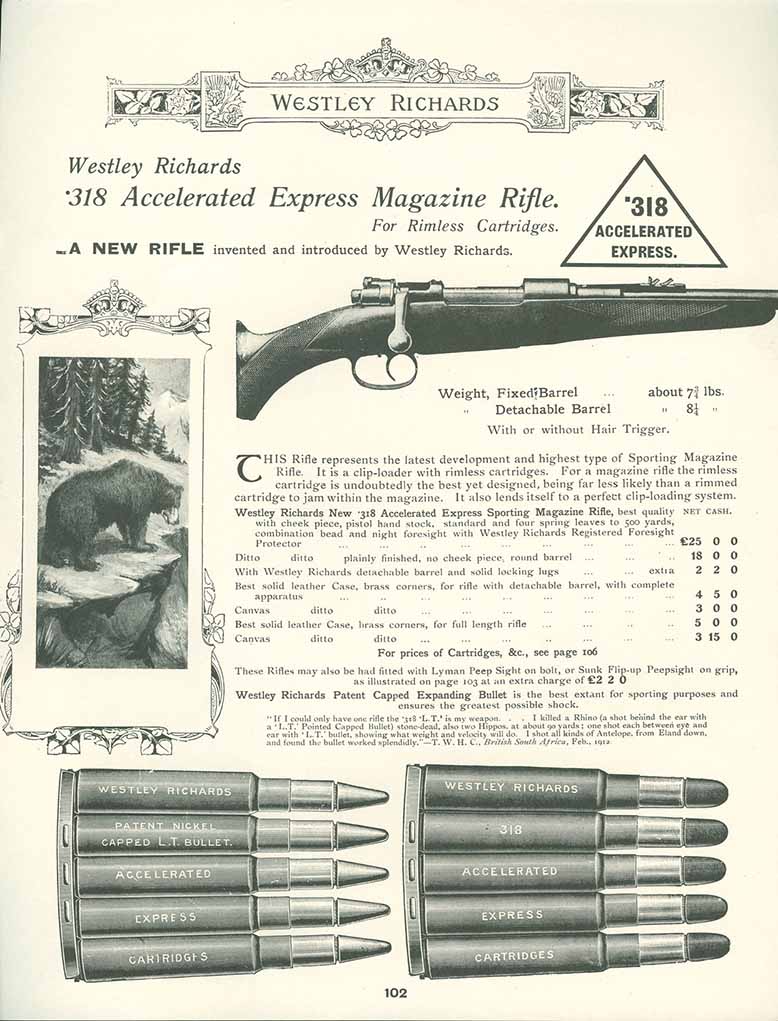
A genesis in the golden age of African safaris, the .318 Westley Richards Accelerated Express is all but a historical footnote. Though the odd specimen still proves potent.
What The .318 Westley Richards Offers Hunters:
Came on the scene somewhere between 1908 and 1910.
Generally offered in light rifles.
Shot a bullet with .330-inch diameter in the neighborhood of 2,400 and 2,700 fps.
Became known for its exceptional penetration.
I’ve long been an aficionado of the “golden age” of African safaris, including its literature—and especially its rifles and cartridges. Those years when safaris really got going—from 1900 to 1914, and then again from 1919 to 1940—saw a parallel era of cartridge development, with some of the newly introduced designs going on to become undeniable classics … and others fading into obscurity.
The .375 Holland & Holland, .416 Rigby, .404 Jeffery, .333 Jeffery, .275 Holland & Holland and the .470 Nitro Express were all released before the outbreak of the Great War, and while some are household names, others have long become unavailable or remain a rarity at best. Among those is a simple, little cartridge that kept popping up in those classic books, as well as in my research on the famous hunters of the era—the .318 Westley Richards (WR) Accelerated Express.
The Remarkable .318 WR Accelerated Express
It doesn’t have a ton of case capacity or a truly heavy bullet, but it does possess a quality that was extremely desirable: It gave excellent penetration. The .318 WR came onto the scene between 1908 and 1910—before the .375 H&H made its debut—and it was touted as an all-around cartridge for both Africa and India, even for elephant.
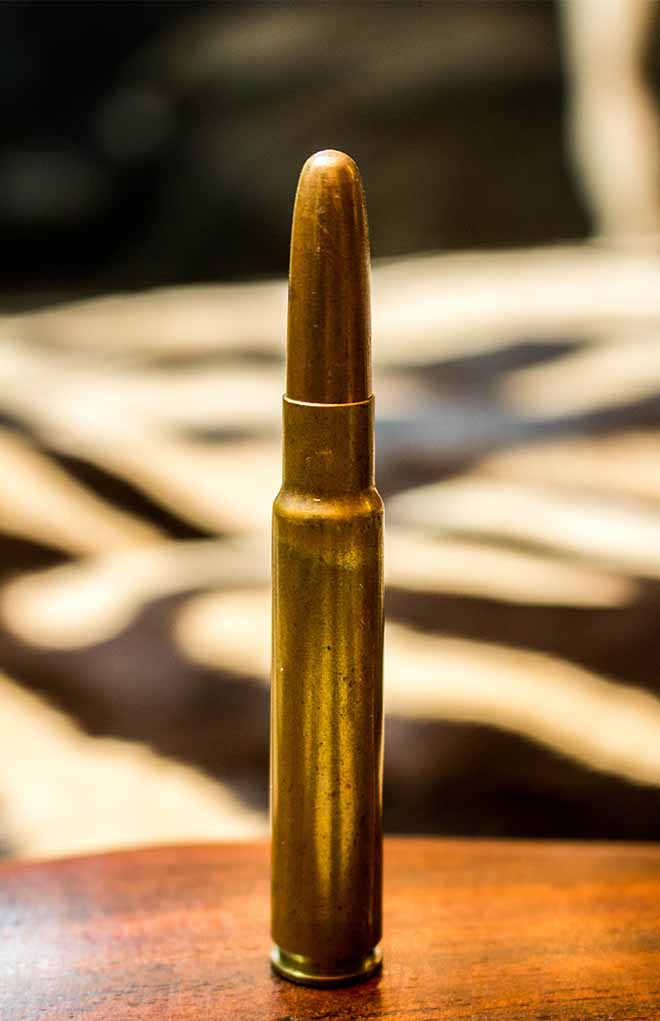
Shown here is a vintage Kynoch .318 Westley Richards cartridge with a 250-grain solid.
The cartridge came in a light, handy rifle, and it was offered with two loads: the 250-grain softpoint full-patch or solid at 2,400 fps, and a 180-grain LT-capped bullet (“LT” were the initials of Leslie Taylor, one of Westley Richards’ engineers) at 2,700 fps, although the lighter load never really caught on. The .318 WR uses a bullet of .330-inch diameter and, at 250 grains, it offers a sectional density of .328. That’s a big part of the famous penetration.
John “Pondoro” Taylor wrote in his famous book, African Rifles and Cartridges, of the .318 WR: “It has quite remarkably deep penetration, fully capable of driving its bullet the length of a big elephant’s body.”
Taking the context of his statement, we can confidently assume that he was writing of the solid bullet. Many hunters of the era (including Major G.H. “Andy” Anderson, Captain Jimmy Sutherland, Quentin Grogan [whose brother walked from Capetown to Cairo] and W.D.M. “Karamojo” Bell) relied on the .318 WR for hunting in more-open country.
From Dream to Reality
But, history is history. The .318 Westley Richards faded away, and the .375 Holland & Holland belted magnum went on to become the darling of the safari community. However, the cartridge stuck in my craw, and I remember reading about Craig Boddington’s exploits shooting bush pigs with a .318 WR he found in a remote gun shop.
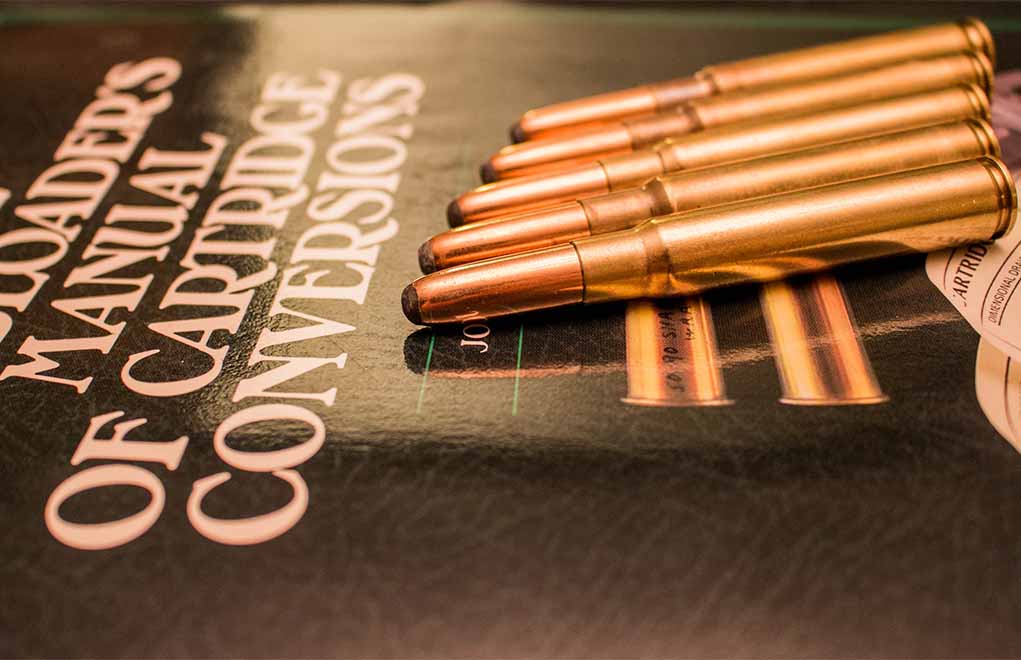
Here’s the good news: Brass for the .318 Westley Richards is easily made from common .30-06 Springfield brass.
That just sealed the deal. I scoured the Internet, looking for a true Westley Richards rifle I could afford. However, that was not in the cards.
Nevertheless, I did happen to have a 1916 Amberg Arsenal Gew. 98 Mauser in my possession, and while the serial numbers matched on each part of the rifle, the barrel was far beyond saving. I contacted my buddy, Nathan Chesney, at Hillbilly Rifles of Newport, Vermont, and he agreed to build my .318 WR. The dream was going to come true.
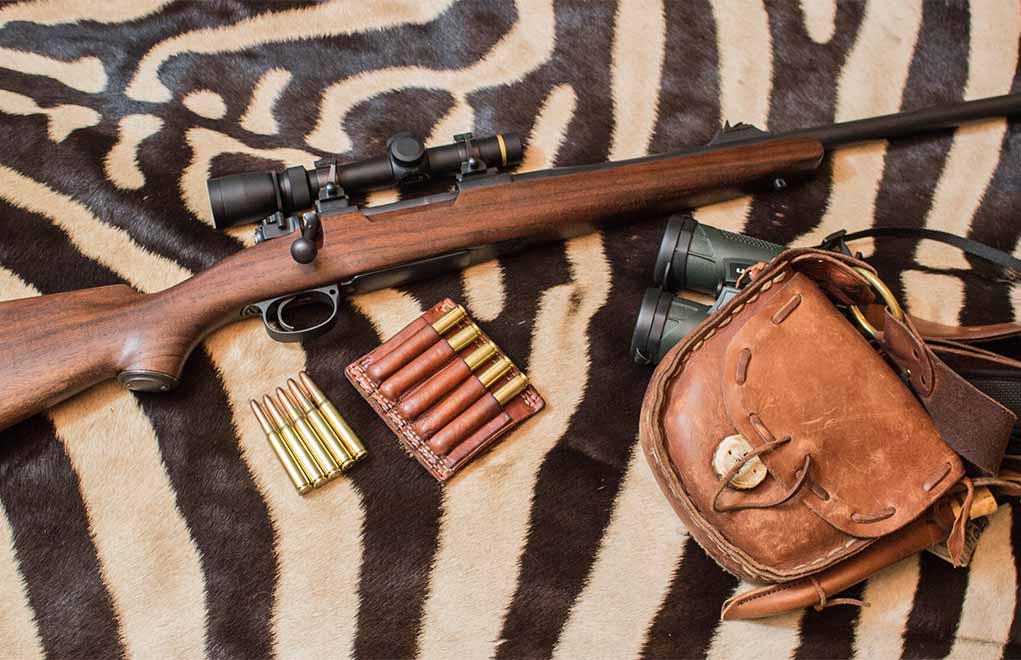
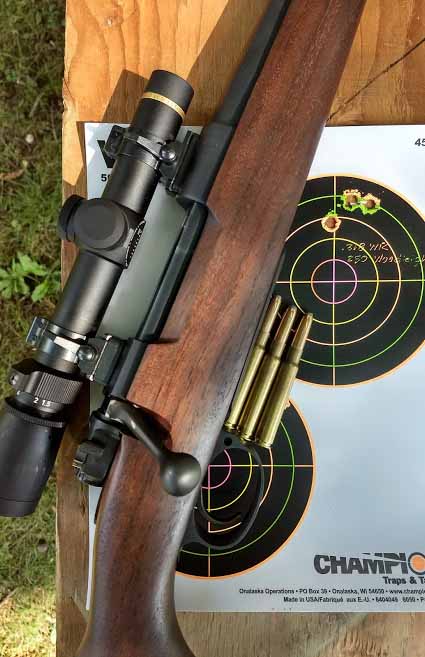
Chesney and I ordered a Kreiger barrel, a three-position wing safety to allow for a low scope mount, Timney trigger, NECG barrel band front sight, Talley rings and bases, and a Leupold VX-3i 1.5-5x scope. For a stock, Chesney found a cool sporter stock from the late 1950s or early ’60s that showed some promise. We retained the action, trigger guard, magazine and bottom metal from the Gew. 98; and, on my shoestring budget, Chesney did a heck of a job transforming the century-old military rifle into a working .318 Westley Richards.
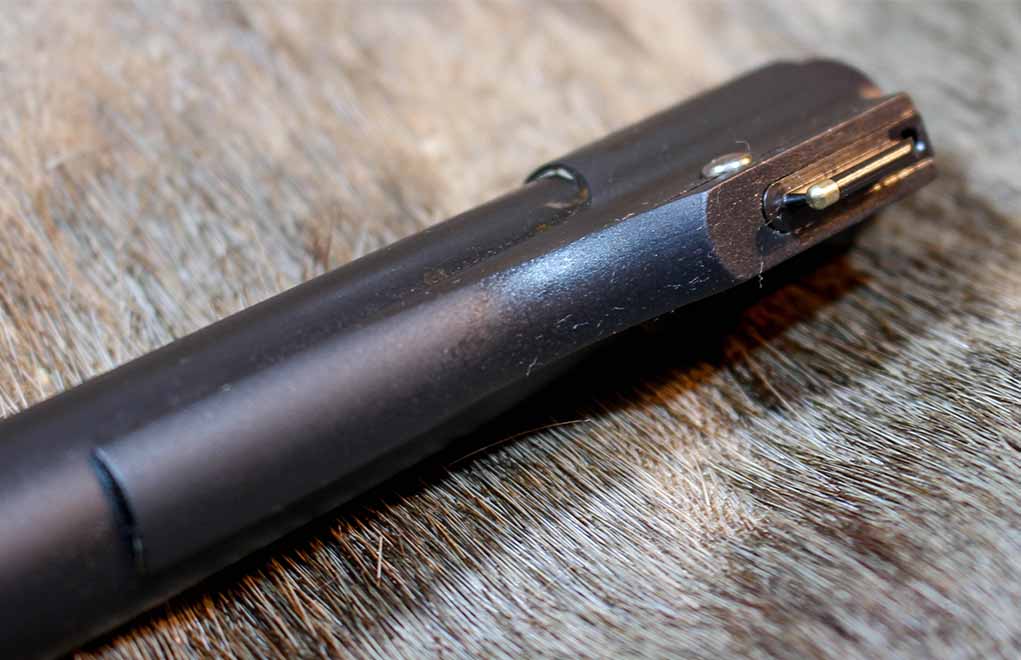
The barrel band front sight of the author’s Gew. 98 .318 Westley Richards was properly installed by Nathan Chesney of Hillbilly Rifles in Newport, Vermont.
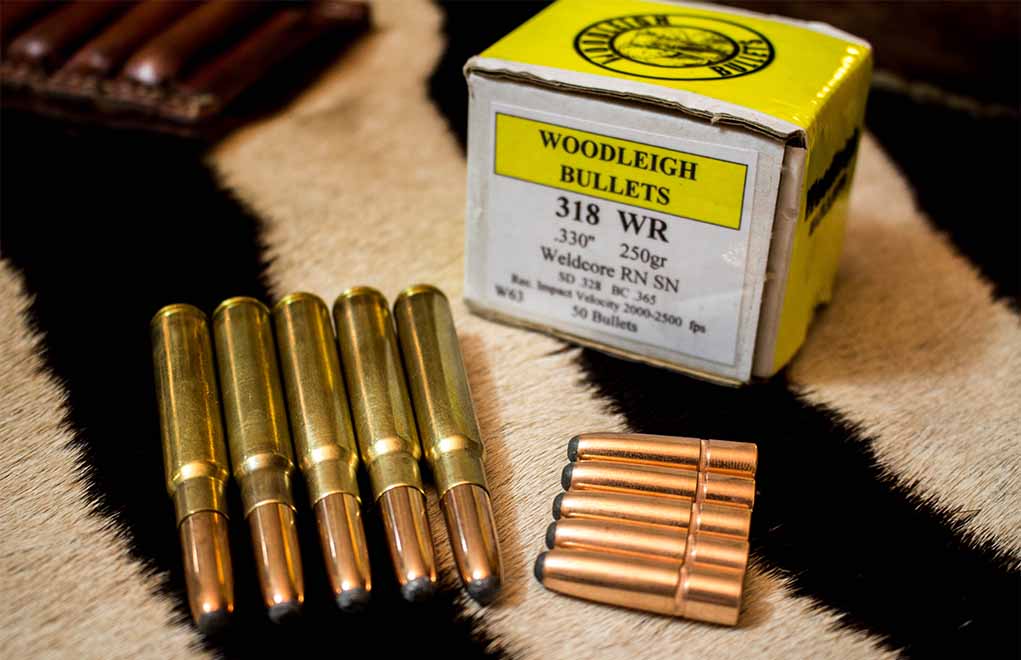
For brass, I procured a set of RCBS dies for the .318 WR and cut down some .30-06 Springfield cases. One pass through the resizing die and a bit of trimming, and I was in business. The first trip to the range turned out to be a real eye-opener: With a 250-grain Woodleigh Weldcore and a healthy charge of Reloder-16, we had MOA accuracy and 2,475 fps of muzzle velocity. I took the rifle out that fall and managed to fill a doe tag. I was grinning ear to ear, because I’d fulfilled my dream of using a .318 Westley in the field.
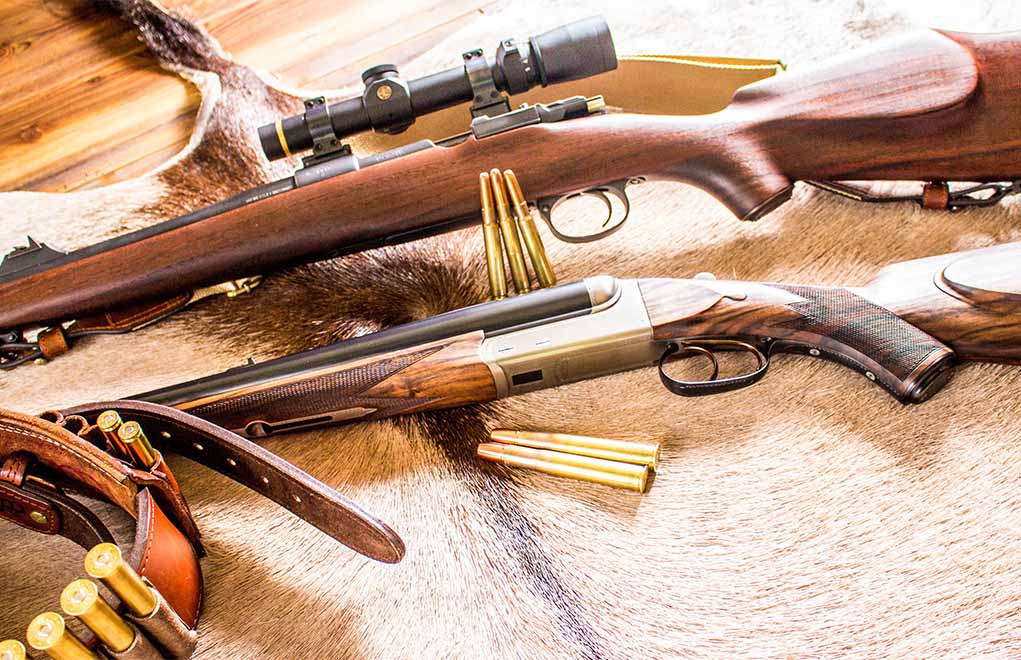
But, things were about to get much better. I was at the Dallas Safari Club convention, sharing a beer with none other than PH Brian van Blerk, when we “made a plan,” as the Africans love to say: We’d be hunting the Chirisa block of Zimbabwe for buffalo (my Heym .470 NE double would handle that), as well as ancillary plains game. The .318 WR and I would be hunting wild Africa together.
Brass, Bullets and Loads
The Woodleigh Weldcore is not the only bullet available for the .318 Westley Richards. There are some boutique bullet companies, such as Hawk Bullets, that will make a run of .330-inch bullets now and again. Hornady makes a 205-grain bullet of this caliber for the 8x56R InterLock spitzer that makes a perfect choice for deer and similarly sized game. But I also found that Peregrine Bullets (in South Africa) makes 200- and 225-grain versions of its excellent VRG-3 BushMaster—the mono-metal hollow-point with the flat, brass plunger at the meplat. Both of these bullets shot very well in my rifle.
The 250-grain Woodleigh Weldcore is, in the author’s opinion, the perfect bullet to recreate the classic .318 Westley Richards load.
For cases, my own trimmed-down .30-06 cases gave very uniform and accurate results (the Reloder 16 load gives an extreme spread of 8 fps), but there’s one little nagging point regarding those cases: Most African countries require that the headstamp on the ammunition matches the rifle. Bertram Brass from Australia is one of the few sources of properly headstamped cases, and while its .318 WR stuff works, it hasn’t been the most consistent.
However, I stumbled across a new company right here in the States that can, and will, make any cartridge case you want. Roberson Cartridge Company (RCC), headed by Jeff Roberson, uses a CNC lathe to turn each case, resulting in a very uniform and consistent product with a different molecular structure than drawn cases possess. I’m happy to report that its .318 WR cases are no exception, and RCC cases have become a favorite of mine.
The Go-To Westley Richards Load
The Reloder 16 and 250-grain Woodleigh load is, most definitely, my go-to load for the .318 WR, because it’s the formula that made the cartridge so popular among hunters a century ago. But the other designs, such as the Peregrine BushMaster and the lighter Hornady, are most certainly going to be put to work.
Although all but forgotten, the .318 Westley Richards is capable of fine accuracy.
There’s some good data for the .318 WR in the Woodleigh Bullets reloading manual, but only for the 250-grain bullet. My own load is not in there (RL-16 wasn’t available at the time it was printed), but I used Woodleigh’s data to develop a load for my buddy, Mike McNulty, who owns a sweet 1952 Coswell & Harrison .318 WR that loves the 250-grain Woodleigh over H4831SC. I have developed a few loads for the lighter bullets using RL-16 and IMR4166; all of them have proved safe to fire in my rifle. They give very uniform velocities and are much less sensitive to temperature swings than other powders, which is perfect for the wide range of environments in which this rifle is used.
The .318 WR in the Field
In the Chirisa block of Zimbabwe, Brian van Blerk and the staff of Sitatunga Zimbabwe greeted us after our 33-hour journey. After one of the best nights of sleep I’ve ever had, we headed to the range to confirm zero on the rifles.
Brian and PH Adam Goosen, who was hunting with Mike McNulty, were both intrigued with the pair of .318 WRs; they’d never seen one on safari before. Our primary goal was buffalo, but there were plains game species on quota that we were both after. The arrangement was for each of us to carry our heavy rifles (that Heym .470 double for me and a Heym .505 Gibbs for Mike), while our respective trackers would carry the .318 WRs in case we encountered one of the target plains game species.
As it turns out, Mike had a great safari, and he took a good buffalo bull and an ancient bushbuck ram; but all were taken with his .505 Gibbs. I, on the other hand, had a couple of opportunities to put the .318 WR to the test.
For his buffalo/plains game safari, the author carried a Heym 89B double rifle in .470 NE, as well as his custom .318 WR.
The wind had ruined our stalk on a buffalo herd. As we made the long trek back to the cruiser, Albert Ndlovu, Brian’s head tracker, stopped and pointed.
“Punda,” he said, using the Kiswahili word for zebra (although Brian and Albert are both native Zimbabweans, they spent years hunting in Tanzania). “Dume mbili, Bwana, punda m’zuri.” There were two stallions, both good specimens.
We began the hunched-over stalk toward the pair. The zebra were feeding gently at about 80 yards, so we had just enough brush between us to prevent taking the shot. What was probably only five minutes seemed like an eternity. Finally, the darker of the two stallions turned broadside, and the .318’s trigger broke. Even through the muzzle blast and the recoil, I heard the bullet hit. The zebra whirled and dropped within 15 yards.
The Woodleigh had completely penetrated both shoulders, taking out the heart on the way. With a jet-black stripe down the middle of his back and a very attractive hide, the zebra made an excellent trophy … and even better table fare. Yes, you read that correctly: Zebra are delicious.
During the “golden age” of African hunting, the .318 Westley Richards had a solid following. Today, history has all but forgotten the cartridge.
The second opportunity came at midday a couple of days later. Temperatures had risen to 114 degrees, and we had given up on the buffalo for the morning. We were headed back to camp for lunch and a siesta when the trackers and Brian became immediately excited, and the truck stopped.
“Did you see the kudu?”
Brian, in less-than-tender words, instructed me to grab the .318 and follow him. Not being one to argue with a man whose advice I was paying for, I did just that.
The stalk was short, but the shot presented was not optimal, because the bull was facing straight away.
“Texas heart shot. Do it now.”
The bull jumped at the shot and ran down into the korongo.
“The shot felt good, Brian,” I reported.
“You hit him hard. Let’s just give him a minute, and the trackers will pick up his spoor.”
The tracking job wasn’t a long one; a handsome kudu bull with 55-inch horns and the scars of a lifetime of fighting for breeding rights lay on his side within 40 yards.
Upon autopsy, the Woodleigh was found against the inside of the breast bone, having penetrated nearly the entire animal. That’s the penetrative quality of the .318 Westley Richards, especially with the high-sectional-density bullets.
I’ve been passionately working to bring the .318 WR back from the grave. In addition, there’s a small movement abroad as a result of guys building rifles and loading ammo to feed the vintage rifles on the market.
The .318 Westley Richards remains an obscure cartridge, but if I have my way, it will see its way back into the hands of hunters in a modern production rifle … with reliable factory ammunition.
Editor’s Note: This article originally appeared in the September 2019 issue of Gun Digest the Magazine.
New classics and first-rate defensive options, it seems you can’t have enough of either. We dig into each with 14 pieces of guns and gear that are certain to serve as safe queens or lifesavers.
Uberti pays tribute to Frederick Courteney Selous, a giant among hunters, with a stunning throwback rifle he would’ve been proud to shoulder. The 7.1-pound, 24-inch Courteney Stalking Rifle is built around the tough-as-nails 1895 falling-block action and comes chambered in .303 British. Sure, .303 isn’t exactly falling off the shelves nowadays, but it goes well with the sweeping and clean English lines of the Uberti rifle. This includes an African hardwood-tipped forend that gives the single-shot a unique look and stays true to the rifle’s inspiration. At the same tick, Uberti includes modern amenities that contemporary hunters find a must, such as a machined base that accepts Weaver-style scope rings. MSRP: $1,729 // uberti-usa.com
Marlin 1894 Dark Series
Lever-action rifles are enduring, but that’s no reason there can’t be a new twist on their timeless design. Marlin did exactly this last year with the introduction of its ominously attractive 336 and 1895 Dark Series. Joining the existing .30-30 Winchester, .45-70 Government and .444 Marlin chamberings, the gunmaker has introduced a pair of heavy-hitter pistol cartridge options for 2020: the 1894 Dark Series in both .357 Magnum/.38 Special and .44 Magnum/.44 Special. These pistol cartridge thumpers are all-weather marvels, with a black webbing-painted stock, Parkerized finish, top rail, paracord sling and lever wrap. The repeater also boasts 16.25-inch barrels, threaded to accept a muzzle device and outfitted with a thread protector. It’s a fitting upgrade for the more-than-100-year-old design. MSRP: $949 and up // marlinfirearms.com
Cimarron 10mm Bad Boy
Old West meets new West in Cimarron’s latest rendition of its popular Bad Boy Single Action Army (SAA) revolver. Now pitching the ascendant 10mm, the six-shooter has a modern twist, not to mention that it gains new usefulness. The snappy pistol cartridge has grown in popularity in recent years and should prove dead-on coming out of this accurate handgun style. A pre-war framed SAA with an 1860 Army-style, one-piece walnut grip, it boasts an 8-inch octagonal barrel, giving it some throwback grace. Made of carbon-alloy steel and outfitted with target sights, the Bad Boy is more than up to enduring the rigors of the powerful 10mm cartridge while keeping it on target. MSRP: $726 // cimarron-firearms.com
Federal Premium Firestick
Hunting with a muzzleloader is simultaneously wildly satisfying and frustrating. Even if you do everything perfectly, you can still be left hearing nothing but a click when you pull the trigger. Federal Premium has come out with a new system that all but guarantees your muzzleloader goes bang! every time you need it to, along with providing a host of other desirable assets: the Firestick, an encapsulated, pre-measured charge of Hodgdon Triple 8 granular powder in which the 209 primer is directly inserted. It makes the muzzleloading process simpler, cleaner and more accurate. However, it’s currently only compatible with a Traditions Nitrofire muzzleloader. MSRP: $26.99 per Firestick // federalpremium.com
Three Affordable Chronograph Options To Check Your Speed
Thompson Auto Ordnance Iwo Jima Series
The Battle of Iwo Jima was one of America’s toughest slogs in the Pacific. Thompson Auto Ordnance remembers the sacrifice of the servicemen who fought in this epic battle (Marines, in particular) with a trio of decked-out period firearms. Comprising an M1911A1, M1 Carbine and semi-automatic Thompson Submachine-gun, the Iwo Jima Series guns feature incredible stock engraving. Adorned with battle motifs and Admiral Chester Nimitz’s famous quote, “Among the men who fought on Iwo Jima, uncommon valor was a common virtue,” these pieces are stirring. The metal is finished in OD green and distressed copper Cerakote, giving the guns the vintage look of actual war memorabilia. These firearms make priceless additions to a collection. MSRP: $1,247 (M1911A1), $1,391 (M1 Carbine), $1,886 (Thompson) // auto-ordnance.com
Traditions Nitrofire Muzzleloader
Traditions has long been a leader in innovating the age-old muzzleloader—but no more so than with its Nitrofire Series. Working in conjunction with Federal and Hodgdon, this rifle is specifically designed to utilize the Federal Premium Firestick, making it among the most user-friendly muzzleloaders around; and, it’s accurate. The breech-charging break-action offers the same tight tolerances as cartridge rifles, which pays a dividend downrange. This is thanks to its ultra-light, fluted chromoly barrel that’s designed for speed-loading, so follow-up shots aren’t out of the question. Furthermore, Traditions’ Elite XT trigger system is as crisp as an autumn morning and ensures you perform when you need to. If you’re into muzzleloading, this is the real deal. MSRP: Starting at $549 // traditionsfirearms.com
Benelli Lupo Rifle
The Lupo, Benelli’s first crack at a bolt-action rifle, is among the most ergonomically flexible (thus, comfortable) rifles on the market. Its length-of-pull adjustment is perhaps the most eye-catching, modifying just above the grip. This makes room for Benelli’s Progressive Comfort System, which does a number on felt recoil. This 7-pound rifle comes with an adjustable comb that can be raised and lowered to provide the perfect eye-to-scope alignment. It features a hybrid chassis system, in which the rifle’s cryo-treated, free-floating barrel is attached to a hardened steel barrel extension and beds into a steel block in the alloy receiver. This creates a rigid and accurate platform—one Benelli ensures is on target with a solid adjustable trigger. It’s available in .30-06 Springfield, .300 Winchester Magnum and .270 Winchester. MSRP: $1,699 // benelliusa.com
Rock Island Armory VRPA40
Intimidating and effective, the smooth-bore is more than adequate for protecting the homestead. Tailored specifically for this job, Rock Island Armory’s VRPA40 arms you with the ideal home-defense pump-action that’s not only configured for CQC, it’s also the utmost for guarding you and yours. To this end, the 20-inch-barreled 12-gauge is magazine fed. In addition to making for light-fast reloads, it also endows the VRPA40 with excellent capacity: 5+1. Furthermore, there’s no shortage of magazines to choose from, because this pump-action is compatible with any other RIA VR Series shotgun. Other notables on the VRPA40 include a heat shield, rail scope mount, fiber-optic front, adjustable rear sights and an overall weight of 6.9 pounds unloaded. MSRP: $279.99 // armscor.com
Bond Arms Grizzly
It’s good practice to have a backup gun of some sort for concealed carry. The same goes for home defense. In either case, Bond Arms’ Grizzly fits the bill perfectly. An age-old design, this 3-inch-barreled derringer is easy to conceal or stow away somewhere within reach. However, Bond Arms ups the game by chambering the single-action, double-barreled pistol in .45 Colt/.410. The pistol cartridge and shotgun shell are both solid, up-close-and-personal options for defense. Bond also gives you some interesting extras, including a push-button cross bolt safety, removable trigger guard and rebounding hammer. The Grizzly ships with a dashing leather holster, so it will always be at the ready. MSRP: $377 // bondarms.com
Hogue Sig EX-T01 Legion Tomahawk
If a felonious meathead gets a gander at the Hogue Sig Legion Tomahawk, he’ll most likely have second thoughts about crossing your threshold. Wicked-looking as it is well-made, this 14-inch edged weapon is an all-around tool to have at the ready. In addition to a flat-grind, hand-honed blade, the tomahawk can also be outfitted with a spike and pry bar, making it a jack of all trades for any situation. This tomahawk is made from cryogenically heat-treated S7 tool steel, so it’s as tough as they come and keeps an edge. It’s outfitted with a G10 scale frame that’s partnered with a magnetic polymer sheath. MSRP: $309.95 // hogueinc.com
Wilson Combat American Combat Pistol (ACP)
For some, the thought of a Wilson Combat 1911 for home defense (or otherwise) is a pipe dream. Finely made as they are, they can be cost-prohibitive. More than understanding this situation, Wilson Combat has introduced the American Combat Pistol (ACP), which offers all the craftsmanship and performance the company is known for, but at a more affordable price point. Wilson accomplishes this by streamlining the manufacturing process and offering a narrow selection of models—full-sized (5-inch barrel), Commander (4.25-inch barrel) and Compact (4-inch barrel). Available in .45 ACP or 9mm, the ACP line features Eagle Claw grip texture, hand-fitted carbon-steel frame and slide, Armor Tuff finish and flush-cut stainless steel barrel. MSRP: $2,495 (.45 ACP), $2,595 (9mm) // wilsoncombat.com
Speer Gold Dot Carry Gun Ammo
Optimized for use in compact and subcompact handguns, Speer’s legendary Gold Dot line of defensive ammunition has never performed better. The Carry Gun line is offered in 135-grain 9mm, 165-grain .40 S&W and 200-grain .45 ACP. Each is improved to perform, even with the lower velocities common in shooter-barreled pistols. The innovation here? The ammo is topped with Gold Dot’s high-performance G2 bullet, which is specially made to achieve better FBI-protocol test scores. These bullets use cutting-edge elastomer polymer fill in the nose cavity, ensuring extremely uniform and consistent expansion and penetration, even through several barrier types. MSRP: $28.99–$33.99 (per box) // speer-ammo.com
Springfield Armory Saint Edge Evac
When it comes to up-close and/or tight-quarters combat, there are few more potent options than an AR-style pistol. Due to their fire and hitting power, the abbreviated versions of America’s favorite rifle have what it takes to guard your home. Springfield Armory raises this to another level with the introduction of its Saint Edge Evac pistol. Perfect for a bug-out bag or a home-defense gun, this takedown pistol is among the tidiest packages to hit the market. Around 7.5 inches long, it fits into nearly any pack or nightstand drawer. Nevertheless, outfitted with a Gear Head Works Tailhook Mod 1 side-folding brace, the 5.56 pistol proves easy to shoot—and it’s accurate, to boot. MSRP: $1,949 // springfield-armory.com
SOG Aegis AT Blue Knife
No matter the situation, it’s imperative to always have a knife at hand. SOG’s new Aegis AT Blue clip-point knife features an ambidextrous assisted opening; its 3.7-inch blade is ready at a moment’s notice, putting some top-quality steel at your beck and call. It’s made from cryogenically treated D2 stainless steel and comes complete with a black titanium-nitride finish, so this clip-point blade keeps a seriously sharp edge. It weighs only 5.15 ounces and offers a reversible pocket clip that adjusts to any style, as well as to the dominant hand. MSRP: $94 // sogknives.com
The article originally appeared in the March and April 2019 issues of Gun Digest the Magazine.
The Remington UltraLight Executive R1 isn’t only sized right for concealed carry, but just might be the best 1911 the company has turned out.
How The Ultralight Executive R1 Measure Up For Concealed Carry:
Its aluminum frame reduces weight by 4 ounces (12 percent) than other R1 Commander models.
A shorter 3.5 barrel makes the pistol easier to keep under wraps.
The pistol is fitted with a proprietary set of 3-dot tritium sights from XS Sights.
The thumb safety is sized perfectly for fast activation on the upsweep and deactivation on the down.
Trigger pull measures in at a crisp and consistent 3 pounds.
Does the world really need another 1911? After all, the 1911 is the most prolific handgun design of all time. It’s the most customizable, and it’s manufactured by more companies and in more configurations than any other pistol. So, the answer to that question is probably, “No” … unless, of course, it’s a really, really good 1911.
Somehow, the Remington R1 UltraLight Executive eased into production without my knowledge; I only discovered its existence while visiting my friend, Carlos Martinez, at Remington headquarters in July 2019. As with the plethora of hillbillies making moonshine during prohibition, sometimes, you have to “know a guy” to find the good stuff.
Remington began the modern manufacture of 1911 handguns about a decade ago with the introduction of the R1. The R1 was what most would call a basic 1911, without a lot of the features such as extended safeties, night sights and checkering that are found on contemporary 1911s generally manufactured for the self-defense market. It was very similar to the first 1911s Remington assembled a century ago. Near the end of World War I, Remington built 1911s for the military, and today, they’re highly sought after by collectors.
The R1 UltraLight Executive easily field-strips by hand into seven pieces plus a magazine.
For the past 10 years, Remington has offered a variety of 1911 pistols (such as the R1 Enhanced, R1 Centennial, R1 Carry and R1 Commander). The company even offers an R1 Limited Single Stack model for competition and a long-slide version of the R1 chambered in 10mm for hunting. The R1 UltraLight Executive is the best 1911 that Remington offers for concealed carry, and it just might be the best R1 1911 it’s ever turned out.
Ultralight Frame
The UltraLight Executive is built on an anodized Commander-sized aluminum frame. The aluminum frame reduces weight by 4 ounces (12 percent). This might not seem like much, but when you carry a pistol all day, that’s substantial. The front strap of the frame has been checkered at 20 lines per inch. But the neatest features are the bobbed grip and smooth mainspring housing.
Remington’s UltraLight Executive comes out of the box with an attractive set of gray/black VZ G-10 grips.
A checkered mainspring housing on a 1911 is a foolish thing: If you shoot much at all, it will eat away at your hand. Remington was smart to use a smooth mainspring housing, and it was a genius decision to radius the bottom rear of the grip to not only enhance the feel of the pistol in the hand but also help keep it from snagging on clothing while carried concealed.
Sized-Right Barrel
Although this pistol is built on a Commander-sized frame, it’s not a Commander-sized pistol. A 1911 Commander—as the term was coined by Colt in 1950—has a 4.25-inch barrel. The Remington R1 UltraLight Executive has a 3.5-inch barrel. This barrel length is most commonly associated with an Officer’s model (another designation created by Colt in 1985). Officer model 1911s—1911s with 3.5-inch barrels—are typically built with a shortened grip frame. This makes them easier to conceal; however, it also makes them harder to hold onto, especially with full-power .45 ACP loads. Another trait that’s common with 3.5-inch-barreled 1911s is poor reliability. Quite often, they’re about as reliable as a politician.
The upswept grip safety enhances the feel of the UltraLight Executive, and the memory pad at the bottom of the safety helps ensure deactivation when gripped.
For the R1 UltraLight Executive, Remington paired a Commander-sized frame with an Officer’s model-sized barrel. Combined with the radiused grip, the result is a very-concealable, easy-to-hold-onto pistol that’s chambered for the .45 ACP. What you have is a pistol that’s, well, perfectly sized: It has just as much grip as it does barrel. It fits well in your hand, points well on target and moves comfortably under recoil.
R1 Slide
But there’s more goodness to this pistol than just its size. The steel slide has a rugged and element-resistant PVD coating. It also has six deep, grasping grooves at the rear and none of those silly grasping grooves at the front (fingers do not belong near the muzzle of a pistol). All the sharp edges have been knocked off, and the front of the slide is drastically radiused to allow for smooth holstering. The Remington logo is proudly cut into the left side of the slide, and the “R1” and “EXECUTIVE” are tastefully engraved onto the right.
The XS high-profile rear sight with a wide U-notch allows for quick sight acquisition and is ledged enough to allow for one-handed slide operation.
Most importantly, the slide is fitted with a proprietary set of 3-dot tritium sights from XS Sights. The rear sight is tall and ledged to help with one-handed operation on a belt or boot heel, and it has a wide U-notch to mate with a substantial white-dot surrounding a tritium vial on the front sight. These sights are bold and fast on target.
Field-Stripping The Executive
Another feature that sets the UltraLight Executive apart is how it is field-stripped. Many 3.5-inch 1911s are as hard as Chinese arithmetic to take apart. Not the UltraLight Executive: You simply remove the slide stop as normal, as well as the slide slips of the frame. The recoil spring and full-length guide rod are captured in the slide with the barrel, but they can easily be removed with finger pressure. Then, the recoil spring plug is removed from the rear of the slide—as opposed to the front (this pistol does not have a barrel bushing). Once the plug is removed, the barrel simply slips out the front of the slide.
Additional Desirables
Some additional features worth noting are the extended thumb safety, which is sized perfectly for fast activation on the upsweep and deactivation on the down. The pistol also has a compact, upswept grip safety that’s very comfortable, with a raised bump at the bottom to ensure positive grip safety deactivation. The trigger is of medium length, serrated on the front and ventilated with three holes. Pull weight averages a consistent 3 pounds.
1911 triggers come in short, medium or long. The medium trigger on the R1 UltraLight Executive seems to fit the hands of many shooters.
And finally, the pistol is fitted with standard-thickness G-10 grips that present a very contrasting and appealing, light-to-dark-gray appearance. I’m not a G-10 grip aficionado, but these look exceptionally good on this pistol. However, I removed the factory grips on my pistol and installed a set of Crimson Trace Master Series Laser Grips, which look very similar.
Remington Ultralight Executive R1 At The Range
After about 50 rounds—just to get used to the pistol—I chronographed five different loads with bullets ranging in weight from 135 to 230 grains. After that exercise, I fired five five-shot groups from the off-hand standing position at 10 yards with each of the five loads I’d chronographed. The average group size for all 25 groups fired was 1.76 inches. I wouldn’t expect to win a bullseye match with this 1911, but it shoots very well, considering its barrel length and sight radius. If you miss at defensive handgun ranges with this pistol, you should probably schedule your immediate attendance at the 250 Pistol Course at Gunsite Academy.
The author installed a set of Crimson Trace Master Series grips on his R1 UltraLight Executive because they enhance the practicality of a defensive handgun.
I also ran the pistol through my favorite practical drill—the Forty-Five Drill—using the 230-grain Federal Syntech load. In this drill, the object is to get five hits in a 5-inch circle at 5 yards in fewer than five seconds while drawing from concealment. Using a cover vest and a Galco Gunleather Avenger holster, my average time was 3.61 seconds, with three of the 25 shots outside the 5-inch circle. Those three shots were part of the fastest three strings I fired; I missed once in each string. To keep all the shots inside the 5-inch circle with the R1 UltraLight Executive, my time on this drill had to be at about 3.75 seconds or slower. For what it’s worth, this is about average for me when using a Commander-sized 1911.
Stoppages
I had four stoppages. On one occasion, a 200-grain SWC got ahead of the extractor while being chambered. A simple slap to the back of the slide pushed the extractor over the cartridge rim and fully into the chamber. On two other occasions, the same Black Hills 200-grain SWC load got a bit wonky during chambering and required a full cycling of the slide to clear. The final stoppage was very likely user induced. It was with the 185-grain Golden Saber load. During a string of fire from the bench, the slide lock engaged. I suspect this was because my support thumb contacted the slide lock during recoil.
Deep, grasping grooves on the rear of the UltraLight Executive’s slide, combined with an extended thumb safety, add to the ideal user interface of this handgun.
Overall, I consider this very good performance. Out of nearly 300 rounds fired—with five different loads and bullet weights ranging from 135 to 230 grains—there were only three gun- or ammunition-related stoppages. In addition, all three occurred with the same ammunition. Interestingly, these three stoppages occurred with the sixth round out of the same magazine. I ran another 28 rounds of this ammo through the handgun with the other magazine that was supplied with the pistol and experienced no issues.
I most often carry a well-used, lightweight Browning HiPower that’s been customized by Novaks. At other times, I’m armed with a Wilson Combat EDC-X9 or a Sig Sauer P365. The pistol I have with me largely depends on where I’m going, what I’m doing and what I’m wearing at the time. I also have an exquisitely customized Nighthawk Commander that I carry when I’m in a .45 ACP kind of mood. I expect that will change, because I like the Remington R1 UltraLight Executive better than the Nighthawk. It’s lighter, easier to conceal and more comfortable in the hand. The rounded butt makes a lot of difference in feel and is one of the reasons I’m so fond of a Browning HiPower and the Wilson EDC-X9.
I think the UltraLight Executive is the best R1 Remington has created to date, and I consider it one of the top 1911s you can buy at any price. You can do a lot worse for a lot more money, and you’re cheating yourself if you don’t give one a try. With street prices of less than a grand, this gun is a steal and one I’d bet my life on … which is why it’s been on my side for several months now.
R1 UltraLight Executive Specs Make: Remington Arms Company Action: Single-action; semi-automatic; 1911 Chambering: .45 ACP Barrel: 3.5 in. Frame: Aluminum Finish: Anodized frame, PVD slide Sights: XS Sights 3-dot; night sights Trigger: 3 lbs. Capacity: 7+1 (shipped with two 7-round magazines) Length: 7.25 in. Height: 5.50 in. Weight: 29.8 oz. (unloaded, w/magazine); 27.3 oz. (unloaded, w/o magazine); 35.5 oz. (loaded w/loaded magazine—230-grain) MSRP: $1,250 Actual Retail: $900–$1,100
For more information on the Remington Ultralight Executive R1, please visit remington.com.
Exceeding OSHA standards and capable of being ground to specific prescriptions makes Hunter’s HD Gold the gold-standard among shooting glasses.
Also known as the “my-arms-are-too-short” disease, presbyopia is the normal occurrence of your eyes gradually losing the ability to see things up close. It’s nothing new. In fact, according to the American Academy of Ophthalmology, the term, “presbyopia,” comes from a Greek word that means “old eye.”
Most humans start experiencing this problem around age 40, and the first indication of its onset is that you have to hold reading materials farther away. This, of course, is when you start thinking your arms have gotten … shorter.
What does any of this have to do with shooting? Well, it ought to be obvious: When shooting a handgun, the sights are generally held at about reading distance. If you can’t focus on them, you can’t hit the target with precision. And, as presbyopia worsens, even the front sight of a rifle can become blurry. The typical solution to this common ailment is the inexpensive “cheater” glasses sold at drug stores. Although they will help you read and even see your sights, they create a new problem: the ability to focus at distance.
Good News, Bad News
The lens behind your iris changes shape to focus light onto the retina. When you’re young, this lens is soft and flexible, allowing you to focus up close and far away. As you age, the lens becomes more rigid and can’t change shape as easily.
The Hunters HD Gold Archer-style glasses are stylish. However, more importantly, they enhance color and contrast and provide a fantastic level of protection.
The bad news is that there’s no way to stop or reverse presbyopia. The good news is that the condition can be corrected with glasses, contacts or blended-vision surgery. However, for open-sight shooters who need the simultaneous close and far focus flexibility, these common corrections all fall short.
I struggled with this condition for a few years … until I had the bright idea to ask my optometrist if he could modify my reading glasses prescription to sort of balance my near and far vision. We discussed where I needed to focus to see open sights on handguns and rifles and how sharp a focus I needed at distance.
He then tweaked my prescription, and I ordered a pair of Oakley glasses with interchangeable lenses. It was expensive—but some of the best money I’d ever spent. However, because of my narrow interpupillary distance, there was only one pair of Oakley glasses that would work for my eyes. Nonetheless, I used these glasses with great success for several years and was damned glad I had them.
Fortunately, earlier this year, I was teaching a scout rifle class, and one of my students was a fellow named Brian Conley. Brian operates a company called Hunter’s HD Gold (HuntersHDgold.com), which makes protective safety glasses that meet the ANSI Z87.1+ standard. In other words, that means this company makes OSHA-approved, ballistic shooting glasses.
Hunters HD Gold are made in America.
Designed to offer contrast and clarity, the unique tint of the photochromic lenses helps with night blindness, macular degeneration and seasonal affective disorder (SAD). And, it also blocks 100 percent of UVA, UVB and blue light.
Just as importantly, the Trivex material (originally developed for the military as visual armor) from which the lenses are crafted is more impact-resistant than regular plastic or polycarbonate lenses and offers more than 43 percent light transmission. These lenses have an anti-glare coating that virtually eliminates reflections from the back, thus optimizing visual acuity and allowing the lenses to be more scratch-/dust-resistant than non-coated lenses. Sure, there’s a wide variety of shooting glasses on the market, but what sets Hunters HD Gold apart is its ability to incorporate your prescription into its lenses.
No Problem!
Conley’s company has been providing the best lenses possible for optometrists and ophthalmologists for more than 40 years. His newfound interest in shooting and hunting led to the creation of Hunters HD Gold glasses. When I described my narrow-eye, presbyopia-affected optical situation, he offered to craft me a pair of glasses to help me shoot better. He also lent me a pair of the nonprescription glasses to try.
The “V” marking on the lens identifies it as photochromic, or transition, lenses. The “+” means the lenses meet ANSI safety standards.
When I returned home, I asked my optometrist if he would send me my corrected shooting prescription so I could forward it to Hunters HD Gold and have a pair of shooting glasses built. He pointed out that because it had been six years since my last appointment, I would have to come in for a fresh eye exam. I tried to explain that my current prescription worked just fine, but he was not interested in helping unless I came in for an office visit.
I then called Brian, explaining the situation. He said it was not a problem and that if I sent him my current prescription shooting glasses, he could extrapolate the prescription and apply it to his glasses.
And that’s exactly what he did. In under two weeks, I received a pair of Hunters HD Gold Archer-style glasses that incorporated my shooting prescription. They work perfectly and, in all honesty, have less edge distortion than the glasses supplied by my optometrist. Hunters HD Gold executed my prescription flawlessly. Not only did some range time with a few handguns prove this, I also used those glasses to help me shoot a buffalo in Africa this summer while using an open-sighted rifle.
If you’re suffering from presbyopia and need prescription shooting glasses, Hunters HD Gold can help you out.
I now have two pairs of Hunters HD glasses. I wear my non-prescription aviators almost all the time. This is partly because of the great impact-resistance they offer and partly because of the aforementioned advantages of contrast and clarity they provide. I wear my prescription Archer Hunters HD Gold glasses anytime I’m shooting open sights, whether they’re on a handgun or a rifle. In short: I’m sold, and if you like, you can consider this a full-fledged endorsement.
Dead-On Shooting Glasses
My suggestion is that if you’re suffering from presbyopia, visit your optometrist and ask him to modify your reading prescription to better balance the focus for shooting handguns or open sights on rifles. Then, send that prescription to Hunters HD Gold and get some shooting glasses that’ll help you hit what you’re aiming at. Hunters HD Gold can build your glasses with whatever prescription you like.
While you’re at it, I’d suggest also ordering a pair of the company’s nonprescription glasses. I’ll bet you find it hard to take them off. (While I was in Africa, everyone who tried mine liked them, and they became known as the “happy glasses,” because they seem to make the world a brighter, cheerier place!)
Hunters HD Gold glasses are great general-purpose glasses that are just as useful inside as out. This is because they block all the harmful light from the sun and even blue light from screened devices.
They sure make me a lot cheerier when I’m shooting with them—simply because I hit what I’m aiming at. Hunters HD Gold glasses are not cheap, but missing your target can get damned expensive. There’s a reason lots of competitive shooters wear them.
For more information on Hunters HD Gold shooting glasses, please visit huntershdgold.com.
Next-gen electronic hearing protection stifles sounds you don’t want to hear, and enhances the ones you do.
Up to when the peanut farmer was president, “grin and bear it” was the hearing-protection norm. It must have been hell, and tinnitus be damned—especially back when the Springfield 1873 was the service rifle.
My, how the times have changed! Show up to a shooting range without protection nowadays, and they’ll 86 you quicker than if you stiffed a two-month-old bar tab. It makes sense, given what we know about bang-tubes and your auditory organs. One shot, in some circumstances, is enough to set your ears permanently ringing like the bells of St. Mary’s.
Yet, even the most diligent shooters sometimes play fast and loose with hearing protection. For instance, there’s as good a case for not using it, as when you’re stalking deer. However, it’s a risky game and one you needn’t play. Modern-day electronic hearing protection is a pitch-perfect balance between safety and perception. And, if used correctly, it gives you little reason to pull the trigger without covering up.
Systems With Potential and Options
You’d be forgiven for thinking the only things muffs and plugs are capable of is noise reduction. For decades now, that’s the only duty they’ve had to pull. But a few clever minds along the way figured that if hearing protection could reduce sounds, why couldn’t they also enhance them? The right ones, of course. Thus was born what we now know as “active hearing protection.”
On the surface, their operation is simple: Outfitted with microphones, the muffs and plugs amplify normal sounds—maybe a firing line conversation or a twig snapping. When a high-decibel noise is detected—say, hot gas escaping a .300 Win. Mag. muzzle—they shut off. In some cases, they even combat that ear-splitting rifle report with gentle white noise.
A system designed to not simply muffle your rifle’s blast has a lot of potential. For instance, the ability to catch the rustling of brush or a grunt might prove the difference come deer season. At the very least, you can keep the conversation going in between flights of ducks. All the while, you don’t have to wring your hands over prematurely shooting yourself into hearing aids.
Better yet, the technology has become relatively affordable over the years. When electronic hearing protection first came out, most furrowed their brows in doubt. Then, they quickly covered their wallets once they got a gander at the price tag. It can, with some of the top-end makes and models, still be that way. But every year seems to bring more options priced to fit the average shooter’s budget.
I recently got my hands on two such examples: the Champion Vanquish Pro (MSRP: $125; ChampionTarget.com) and Venture Gear AMP BT (MSRP: $120; PyramexSafety.com).
Decibel-Destroying Details
Both muffs work similarly. The difference from one set to the other is that the Vanquish Pro has two forward-facing microphones, while the AMP BT has four (two on each ear, front and back).
Four buttons on the left muff of the Vanquish control all the active hearing device’s functions: power, volume and Bluetooth.
Additionally, each is outfitted with Bluetooth. (The AMP BT also has an auxiliary jack for you analog techies.) I’ll wager there’s an age gap for those interested in linking their smart device to their hearing protection … although, honestly, a couple of Johnny Cash ballads while your barrel is cooling isn’t a kick in the teeth.
There’s a convenience factor to this feature too. Because you can take phone calls through these muffs, you potentially could have a “working lunch” target-shooting session. Now, that’s multitasking!
Making Noise With Electronic Hearing Protection
In both cases, the electronic hearing protection devices did what they promised—erased the sound of gunfire to a safe level. The AMP BT is listed at 26 dB of noise reduction, and the Vanquish Pro is listed at 24 dB. I would venture to say they both more than lived up to this outside and even more so while testing them at an indoor range.
The muffs were easy to link to my phone; a simple push of a button. The microphones continue operating, even when you’re using your smart device, which means I had to fiddle with the volume so it wasn’t a noise “stew” of music and ambient noise. Once I did, it was smooth sailing. Even a test call to my wife proofed out well. About the only complaint she had was that I sounded muffled—I figure that’s because the microphones are next to your ears, not your mouth.
Nice as that all was, the impressive aspect of the muffs was, of course, their noise amplification. It sounds strange discussing this aspect when it comes to hearing protection. But, no stretch; I could catch conversations nearly at the end of the 100-yard range. There’s a great possibility in that: Just think of the edge you’d have while stalking game during hunting season.
Venture Gear AMP BT has incredible potential for situational awareness while in use, with microphones on the front and on the rear of each muff.
The AMP BT was a bit bulkier in size. Even so, surprisingly, given its four mics, it was also the lighter of the pair. It only took two AAA batteries, compared to four in the Champion. This lightened the load. The Vanquish Pro, however, felt more streamlined on my head and perhaps more practical in the field (although you might come to a different conclusion … after all, it’d be your head).
Parting Shot
Is electronic hearing protection a necessity? No, their pennies-on-the-dollar foam plug cousins more than get the job done. But the high-tech muffs and plugs do certainly have the potential to make shooting and hunting more enjoyable. And because they’re viable away from the range, they’re safer in the long run.
Looking to go armed, but are stuck in the weeds as to what to arm yourself with? Here are 20 of the best concealed carry gun options that will keep you on the defensive.