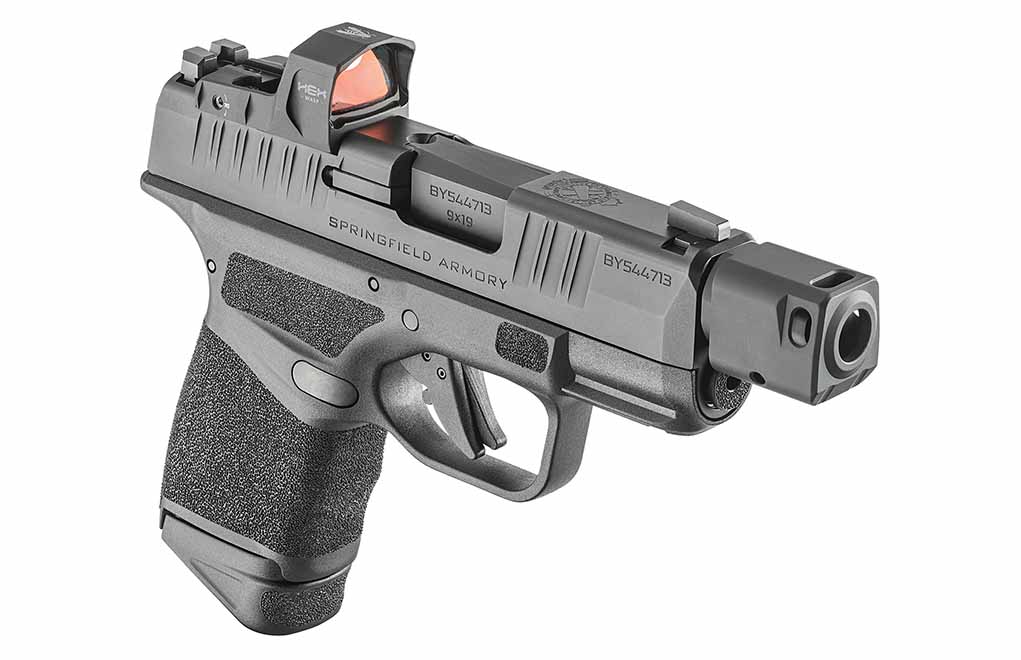
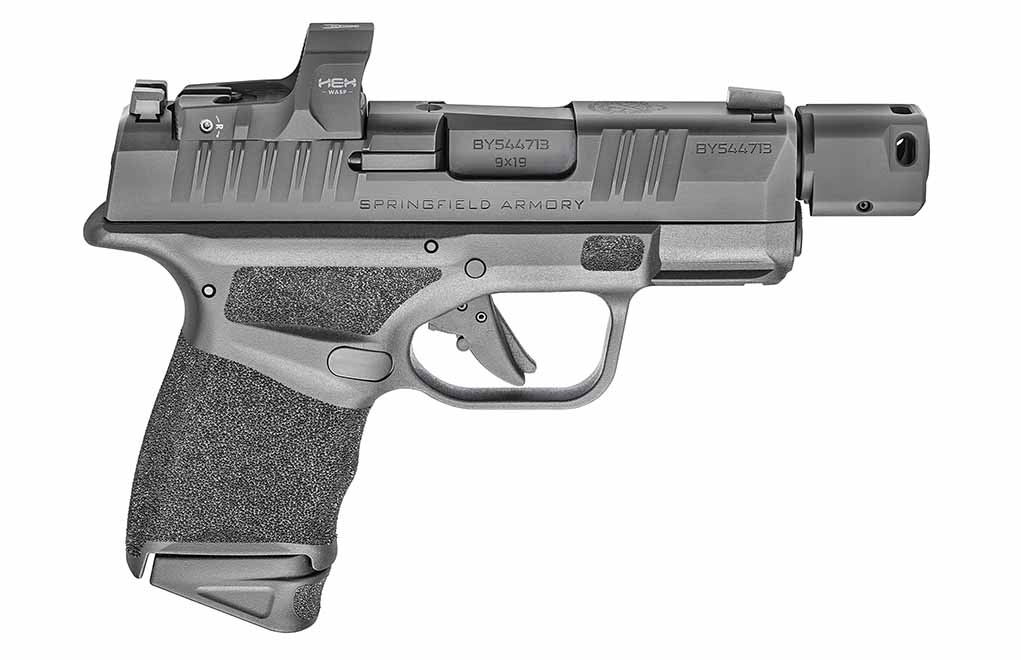
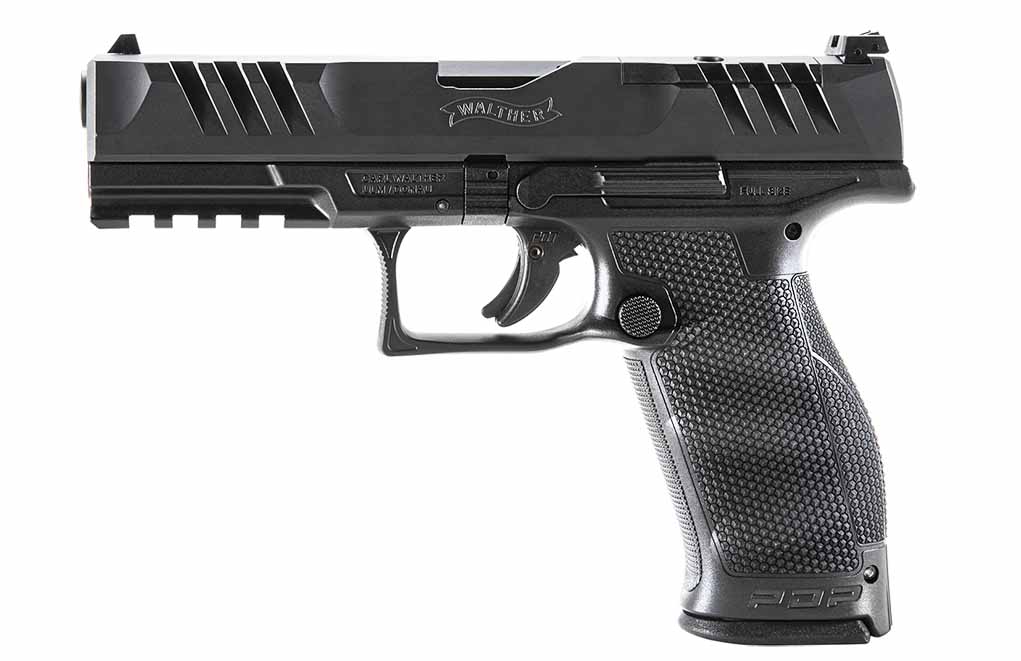
Dubbed the Hellcat RDP, the variant of Springfield’s popular micro-compact comes decked out with features to make it more manageable and accurate.
Springfield Armory struck gold with the introduction of its Hellcat pistol. Among the smallest of the micro 9mm options to hit the market in recent years, the bantamweight also boasted impressive firepower. With 11-rounds on tap with its flush-fit magazine and 13-rounds with its extended mag, the Hellcat had claw enough to come out on top in most force-on-force scenarios. Good as the pistol has proven, the gun company is going the extra mile with the latest addition to the Hellcat family.
Dubbed the Hellcat Rapid Defense Package (RDP), the new pistol boasts all the features that made it popular in the first place, plus a couple of extra accuracy-enhancing assets. Perhaps the most radical of the upgrades is the pistol now comes with a 1/2″-28 TPI threaded muzzle on the 3.8-inch barrel, which comes pre-installed with a self-indexing compensator. Unorthodox as it is, the device does make some sense on the petite package.
Manageable as the original micro-compact proves, its lightweight and abbreviated grip makes it a hair jumpy in the hand for some, thus a bit slower shot to shot. The machined anodized aluminum compensator solves this, eliminating much of the muzzle rise, thus quacking the pace of accurate follow-up shots.
The device might not be everyone’s cup of tea, given it does increase the Hellcat RDP’s overall length to 7 inches. Though even for this group, the threaded muzzle might be appealing opening the gates for the addition of a suppressor and more enjoyable (at least quiet) range time.
As for the other enhancement, Springfield debuts its HEX optics on the Hellcat RDP. Direct-mounted on the slide HEX Wasp red dot provides a low-profile aiming solution specifically tailored for the pistol. With the same footprint as the Hellcat OSP, the ruggedly built, IPX7 waterproof-rated Wasp features an aluminum body and an anti-glare-coated glass lens, and the ability to co-witness with the gun’s iron sights. The Wasp boasts a quick acquisition 3.5 red dot that offers a 65,000-hours run time between battery changes.
Less evident than the other features, the Hellcat RDP is also outfitted with Springfield’s new Gen 2 trigger. Featuring a new flat contour, the shoe proves more comfortable, reduces the felt pull-weight and promotes a more linear path to the break. The pistol is available with or without a low-profile thumb safety, in either case, the MSRP on the Hellcat RDP is $899.
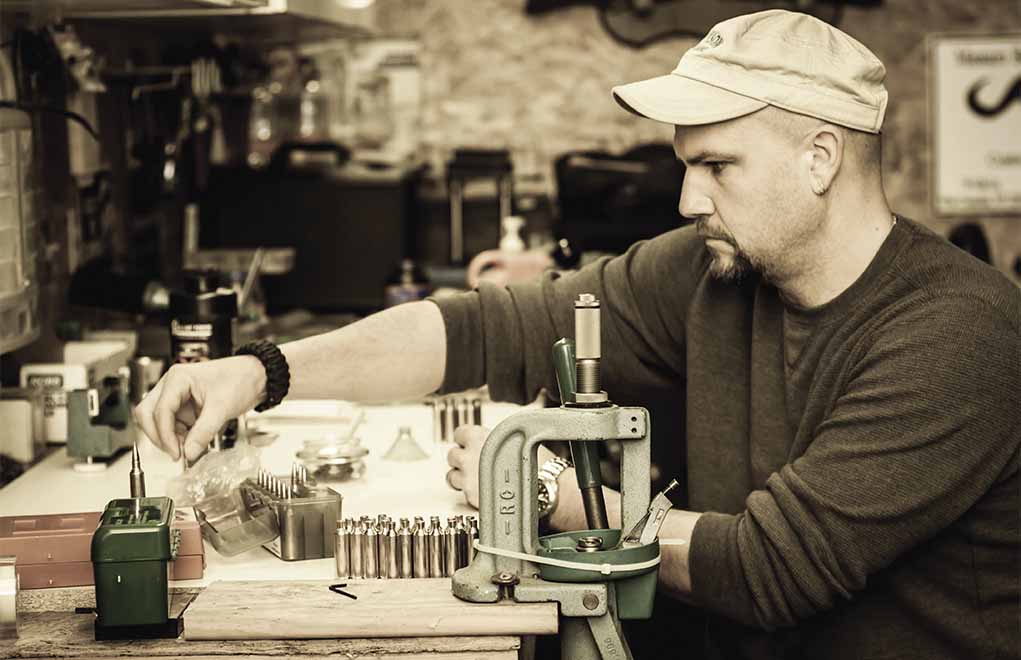
I got into reloading for a couple of reasons: first, it was something I wanted to do with my Dad, as it kept us shooting together in the offseason; second, it allowed me to build premium ammunition at a lower cost than I could buy it. I’m not sure that is true any longer, but it warrants taking a detailed look at the cost breakdown of what it takes to make a box of cartridges compared to what it would cost to buy factory loaded stuff. And, never forget, your time is worth something, even if you spend it performing a labor of love.
The volume of ammo you expend will affect the numbers game, as you’ll need to purchase the same tools to make one box of ammunition as you’ll need to load twenty. And it’ll also depend on the cartridge you’re shooting; the cost ratio of reloading to factory ammo is going to be much different for the 9mm Luger, .45 ACP, .223 Remington, and .30-06 Springfield than it will be for the .455 Webley, .318 Westley Richards, .333 Jeffery, and .350 Rigby Magnum. Then there is the ability to load for rifles and pistols that have no factory ammunition option. You can then only place the value on the ability to shoot that gun, making the cost of reloading irrelevant as it’s the only option you’ve got.
Couple these ideas with the ammunition drought of 2013–2014 and the incredible increase in sales of both firearms and ammunition in the madness that began in 2020, and you’d have to add some value to having the ability to reload when there is almost nothing available on store shelves. No matter what the usual market price of your favorite factory ammo, when it’s unavailable, you’ll pay a premium. The value of handloads increases accordingly.
The Economics
Let’s use the universal and popular .30-06 Springfield as an example for cost analysis, assuming you’re a new reloader and starting with no more gear other than a heaping pile of once-fired brass you’ve saved in a shoebox over the years. Looking at the big picture, at a bare minimum, you’ll need a reloading press, a set of dies, a scale, trimming capabilities, measuring tools, case lube, reloading manual, and other accouterments.
Factory ammunition for a standard chambering such as the .30-06 Springfield is generally available and affordable, but once you experience the freedom of handloading, you may never look back.
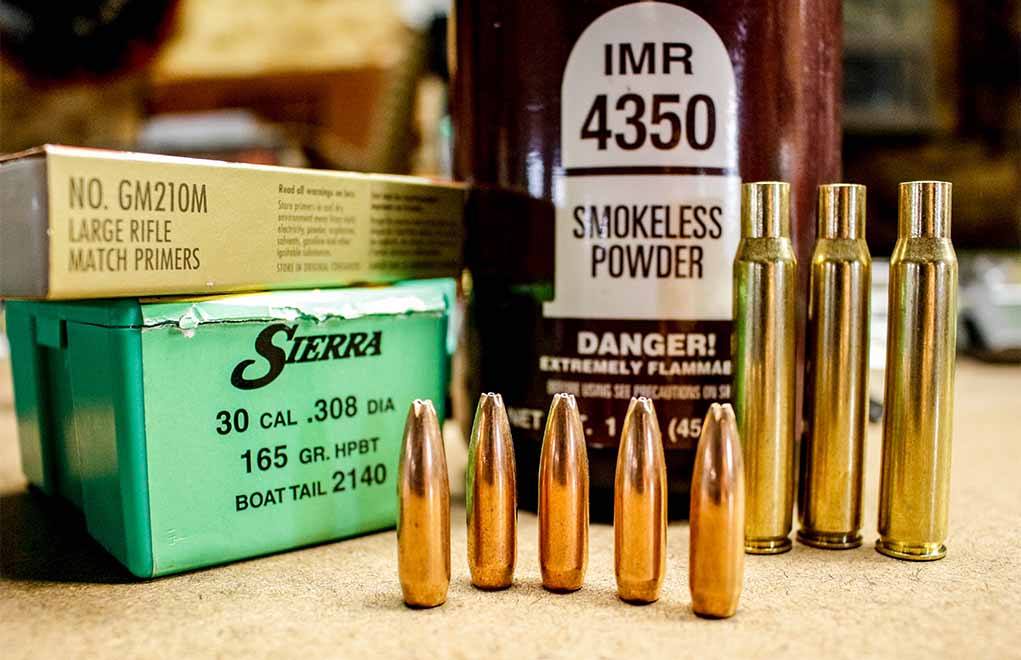
Let’s say you jump into the pool with one of the reloading kits, such as the Rock Chucker Supreme Master Reloading Kit, which has a street price of $400. I’d add to that a trimmer, say an RCBS for $135, and a set of standard dies at $40. Before you buy a single component, you’re now $475 in the hole. You’ll need a pound of powder for roughly $30 and a box of 100 large rifle primers for $4. Let’s use a standard deer hunting bullet such as the Sierra GameKing 165-grain spitzer boattail at $30 per box of 100. You’ve invested $539 and have the capability of loading five boxes of ammo. That works out to $107.80 per box of 20, but that’s not realistic because you can use the tools for decades.
Suppose you take care of your reloading tools, and they last you a lifetime. Further, to simplify the analysis, let’s remove the equipment’s initial cost from the equation. To be conservative, let’s throw in 100 brass cases from Federal at $62/100. Our components for 100 newly loaded .30-06 rounds would come to about $126, or $1.26/round. By comparison, a 20-round box of Federal Premium with that same Sierra 165-grain GameKing bullet fetches $30-$37 — or $1.50-$1.85/round. So, yes, you can handload these rounds for a $.24-$.59 cent per round savings. Not only that, as I write this, there is a run on ammo, and you can’t find that Federal factory load in stock. If you have the components on hand, you can always load some up.
Seeing The Savings
If you’re a one-deer-a-year consumer who generally confirms zero on Ol’ Besty and heads afield, perhaps the factory ammunition is the way for you to go. But if you enjoy recreational shooting and the benefits of routine practice with your big game rifle, you can see how the investment in reloading tools can pay for itself in a short amount of time. If you get a couple of buddies together to share the tools’ cost, you can see a return on your investment even sooner.
Compare this idea to a cartridge such as the .300 Weatherby Magnum, where factory ammunition runs from $40 to $90 per box. Suddenly, your investment in tools seems much more worthwhile. Should you shoot multiple calibers — both rifle and pistol — you will see how reloading gear can quickly provide a return on your money. I’ve also experienced the frustration of finding a factory load that a rifle loves, only to have the factory change the recipe (whether intentional or not, I cannot answer), resulting in ruined accuracy and me scratching my head wondering what happened to the rifle. What’s more, experimenting with different factory loads can be a hefty investment, especially if you’re shooting a rare and costly cartridge. The initial investment of the reloading tools, and the cost of components, coupled with the time spent developing a load, are all well worth it to me. I can grab primer X, charge the case with my known charge of powder Y, and seat bullet Z on top to arrive at the load that will serve for the rifle’s life.
I gave the example of purchasing a reloading kit, and that is certainly a sound idea, but you could also buy your tools individually. Depending on your budget, you can make the tool list as expensive or inexpensive as you choose. One benefit of reloading: dies and presses are interchangeable — should you choose a Redding press, you could easily use a Hornady resizing die, an RCBS seating die and a Lee crimp die, or just about any combination. You can buy as you go, keeping your eyes open for specials and deals on reloading gear to keep costs to a minimum.
Considerig reloading requires an upfront investment in tools and components, bulk factory ammo might be a better value (when you can get it) for some shooters.
Online shopping has become popular, and that applies to reloading as well. But primers and powder require a Hazardous Materials fee on shipping. This fee can add a considerable amount of money to your components’ cost, so keep that in mind and try and order in bulk, even if you have to combine orders with a friend or two. I recommend combining primers and powder on the same order under the same HazMat fee.
Looking For Deals
For the high-volume handgun shooter, there are many quality, inexpensive projectiles available that will keep the cost of ammunition down. Federal’s SynTech is a great example. It’s a synthetic-coated lead bullet, perfect for the indoor ranges, which cost between $23 and $27 per box of 100, or roughly 2/3rds the cost of Federal’s premium handgun bullets. It runs clean and is accurate for practice. If you don’t mind scrubbing lead from your bore, companies such as Meister Bullets offer hardcast lead bullets in bulk that can be as cheap as $0.07 per bullet for the classic 230-grain round-nose .45 ACP bullet if you buy them by the 1,000 count. Berry’s Bullets offers plated projectiles for both rifles and pistols at an affordable rate; they are accurate, and you can use them in an indoor range.
Rife with obscals and challenges, defending yourself in a vehicle requires a different set of self-defense tactics.
If you’re like most Americans, you spend an inordinate amount of time in your vehicle. It’s both the curse and blessing of a mobile society. Familiar as your car or truck is, however, the space can become a challenging and unforgiving terrain in a self-defense situation. From stick shifts to seat belts and tight quarters, there about every type of obstruction to hamper or completely hinder your ability to defend yourself. Given the riotous situations on the nation’s roadway last year, it’s obvious not knowing the way around your vehicle can put your life at peril.
While there are many facets to defending yourself and your loved ones inside a car, Jamey Caldwell goes to the bedrock of the topic in the above video. Much of what the former Sargent Major in the Army’s Special Mission Unit and firearms instructor preaches is situational awareness. It doesn’t matter if you’re walking down the street or pulling up to a red light, observing and evaluating conditions around you is perhaps the A-No. 1 self-defense skill. However, he also touches upon another pertinent concept important in defending yourself in a vehicle—environmental awareness.
Sounds silly, right? You know your way around your car, so much so you can tune in your favorite radio station while changing lanes and never bat an eye. Well, there’s a nasty illusion in that example. You have a lifetime of practice operating your vehicle; chances are you don’t defending yourself in it. That’s not a comforting thought.
Caldwell covers some of the main concerns armed citizens confront in facing lethal-force events in vehicles, from avoiding getting hung up on a seatbelt to shooting through a windshield. But the overall thrust of his message goes beyond mere tactics. Like anything pertaining to self-defense, deftly maneuvering in and around a vehicle in a defensive situation requires practice—plenty of it.
For more videos from Panteao Productions, please visit panteao.com.
Among the most famous of all handgun cartridges, the .45 Long Colt has proven unsinkable. Versatile as it is historic, there’s little wonder why.
I’d received the good news that my New York State pistol permit had been approved by the powers that be, and I doubt a chisel would’ve removed the grin from my face. I then proceeded to set about choosing what would be my first handgun.
It was a topic my father and I’d discussed at some length, and “Ol’ Grumpy Pants” had imparted his wisdom: “Buy a snub-nosed Smith & Wesson .38 Special; you’re gonna carry it a whole lot more than you’re gonna shoot it.”
While he wasn’t entirely wrong, and a Model 36 S&W—which was identical to his (with the exception of the beefier Pachmayr grips)—would come later, I had a different path in mind.
First of all, I’m a hunter. Second of all, I wanted something fully capable of taking deer, bear and other big game; and I also wanted something classic at the same time. I knew it’d be a wheelgun—and a strong, modern action at that, while paying homage to the time-honored designs. I settled on a stainless Ruger Blackhawk, chambered in .45 Long Colt and with the 7½-inch barrel.
The gun could handle any .45 Colt ammunition on the market, because its design is much stronger than the traditional Colt Single Action Army pistols. However, it has the clean lines of a classic six-shooter. The longer barrel, while a challenge to carry and nearly impossible to conceal, certainly wrings every last bit of velocity out of any load but also makes it easier to hit distant targets. The beauty of the .45 Colt is that it has many faces. It’s a pleasure to shoot, with the mild loads mimicking the original 1873 formula and the modern developments, which inspired the larger .454 Casull.
It’s been a movie title, a television series, a major league baseball team name and (although there’s some speculation about the possible tie-in with an NFL runningback), a malt liquor. It‘s served the U.S. Army, laid bad hombres down for good in the hands of sheriffs, deputies and marshals, and has been used by the outlaws as well. The .45 Colt, along with the .44-40 WCF, embodies the Old West: The .45 Long Colt is the OK Corral; it’s “Bat Masterson” and “Butch Cassidy.” But, most importantly, the .45 Colt is, was and always shall be … cool.
It was developed as a joint effort between Colt and the Union Metallic Cartridge Company, beginning in 1871 and concluding in 1872. The cartridge and the Colt Single Action Army six-shot revolver were soon accepted by the U.S. Army and would serve from that date until 1892.
(And, just for the record, the first Colt Single Action Army—bearing serial number 1—was found in a barn in New Hampshire in the early 1900s; and yes, it was chambered for the .45 Colt.)
The design of the cartridge was simple: a rimmed case measuring 1.285 inches in length with a rim of 0.512 inch and maintaining a cartridge overall length of 1.58 inches. It was loaded with (roughly) 40 grains of fine black powder under a 255-grain lead bullet, moving at slightly more than 875 fps. For its time, this was a formidable load, and its performance was unmatched.
The .45 Colt. It’s been with us since 1873, and it isn’t about to fade away. It can purr like a kitty or roar like a lion.
Although it was replaced by the .38 Long Colt in 1892 as the U.S. Army’s official sidearm, the miserable performance of that combination in the Philippine-American conflict forced the powers that be to rethink their choice. The Moro juramentados—frenzied Moro warriors—would take several shots from the .38 Long Colt without being stopped. This simply wasn’t the case with the .45 Colt, and so it was revived for a brief time … until John Browning’s .45 ACP in the M1911 won the contract for the new service sidearm and completely changed the idea of what a soldier’s sidearm should be.
It can instigate an argument in the blink of an eye, and it’s as aggravating to those who study the history and development of cartridges as it is when I show someone a photo of a Cape buffalo from Africa and they respond, “Nice water buffalo!”
Consulting the list of SAAMI-approved cartridges, the official cartridge designation is “45 Colt” (we can argue about the decimal point later)—excluding the word, “Long.” There are those who believe the “Long” was added to differentiate the Colt cartridge from the shorter .45 Schofield or .45 Smith & Wesson.
Others insist the designation was brought over from the .38 Short Colt and .38 Long Colt pair: Just as the .38 Short Colt can be fired in the chamber of the .38 Long Colt (and both can be fired in the modern .38 Special chamber), the .45 Schofield can be fired in the chamber of the .45 Long Colt.
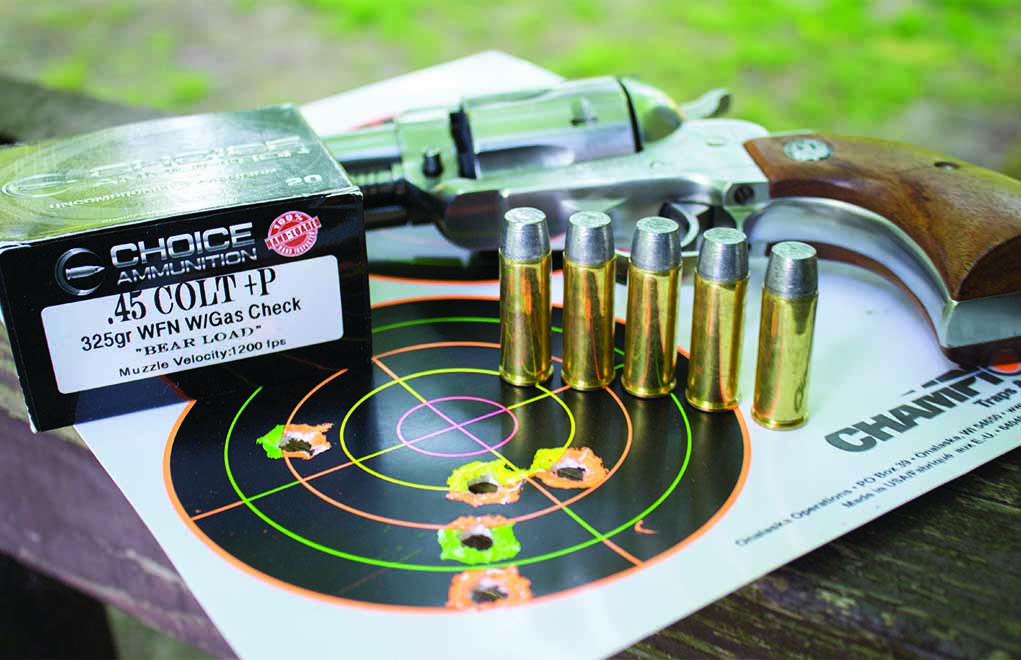
The author’s preferred load for bear country: a 325-grain hard-cast from Choice Ammunition, which leaves the barrel of his Ruger Blackhawk at slightly more than 1,300 fps. But, you do want to hang on for the ride … although this 40-yard target engenders confidence.
Regardless, the proper name for the cartridge is “.45 Colt,” which is completely different from the rimless .45 ACP (Automatic Colt Pistol). And that’s that.
From Lamb to Lion
The .45 Colt of 1873 is not the modern .45 Colt; the modern handguns can handle pressures far greater than the older Single Action Army design can.
My Ruger Blackhawk is one of the strongest designs out there, but there are others, such as the Freedom Arms Model 83, Ruger Redhawk and T/C Encore. However, those Colt Single Action Army revolvers and the clones—the Ruger Vaqueros and similar guns from Cimarron and Uberti—need to be held to a lower pressure limit, along the lines of the original ballistic formula.
Much as Elmer Keith, who had a healthy respect for the .45 Colt, experimented with the .44 Special cartridge to arrive at what would become the .44 Remington Magnum of “Dirty Harry” fame, Dick Casull used the .45 Colt cartridge to develop his .454 Casull. And while there’s no denying that the .454 Casull is a raging beast of a handgun cartridge (the Casull is simply an elongated .45 Colt at higher velocities), the high-pressure .45 Colt loads have no flies on them.
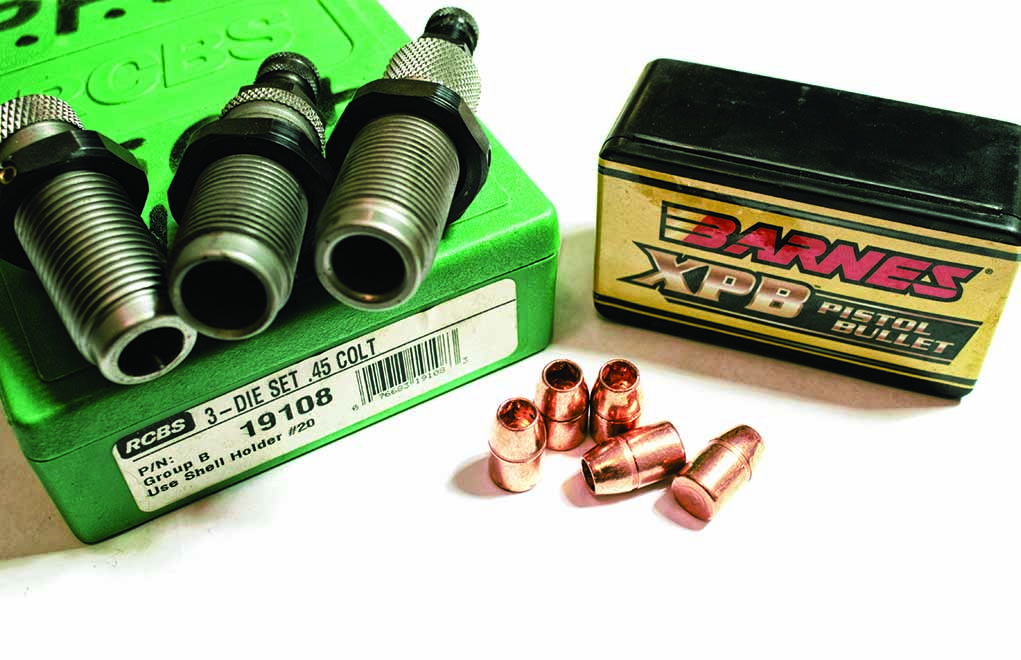
I’ve developed several handloads based on the 250- and 300-grain Hornady XTP Mag bullets. Should you want something a bit beefier, there are the Swift A-Frame Heavy Revolver projectiles and the Barnes XPB projectiles.
The Taurus Judge, a handgun capable of firing both .45 Colt ammo and .410-bore shotshells, has gained a huge following.
The .45 Colt wears many hats, in that the simple, 255-grain lead bullets at 1873 velocities are as effective as they were nearly 150 years ago. But, in the proper handgun—or even a lever-action rifle—the heavier bullets at higher pressures are certainly a step above the Old West power level. The stronger actions can see a 300-grain bullet pushed to more than 1,200 fps, which is both hard hitting and hard kicking.
My Ruger Blackhawk isn’t particularly finicky. With its 7½-inch barrel, I feel I’m good to hunt out to 50 yards with open sights. I like the wide variety of loads available, and a trio of loads from Choice Ammunition highlights the capabilities of the .45 Colt very well; I use all three.
The Choice Cowboy loads, designed for cowboy action shooting and using a 200-grain RNFP Hi-Tek Black coated-lead bullet at a sedate muzzle velocity of 445 fps, allows nearly any shooter to learn how to handle a .45 Colt without the wrist-twisting characteristics of the full house loads.
I observed an average muzzle velocity of 460 fps from my gun … but the light report of the ammo caused my dad to wander out to the backyard shooting bench, wondering if I’d handloaded some ammo with a powder charge that was too light.
“Did those things penetrate the target?” he chided.
Imagine his surprise when I showed him how a lead bullet at that mild velocity would penetrate a 2×8-inch target every time. Anyhow, he enjoyed the mild report and very low recoil as much as I did.
The Barnes XPB 200-grain, monometal hollow-point is a sound hunting bullet and is California-compliant as well.
Using the same Hi-Tek Black bullet coating—which reduces friction and leading simultaneously—on a 250-grain, round-nose lead bullet, Choice Cowboy offers the classic formula for the .45 Colt, driving that bullet at a muzzle velocity of 820 fps for a combination suitable for all the various .45 Colt handguns. This load will work well for plinking, target shooting and hunting alike, although I’d want to limit it to deer-sized game. If you want the classic .45 Colt experience, this is it.
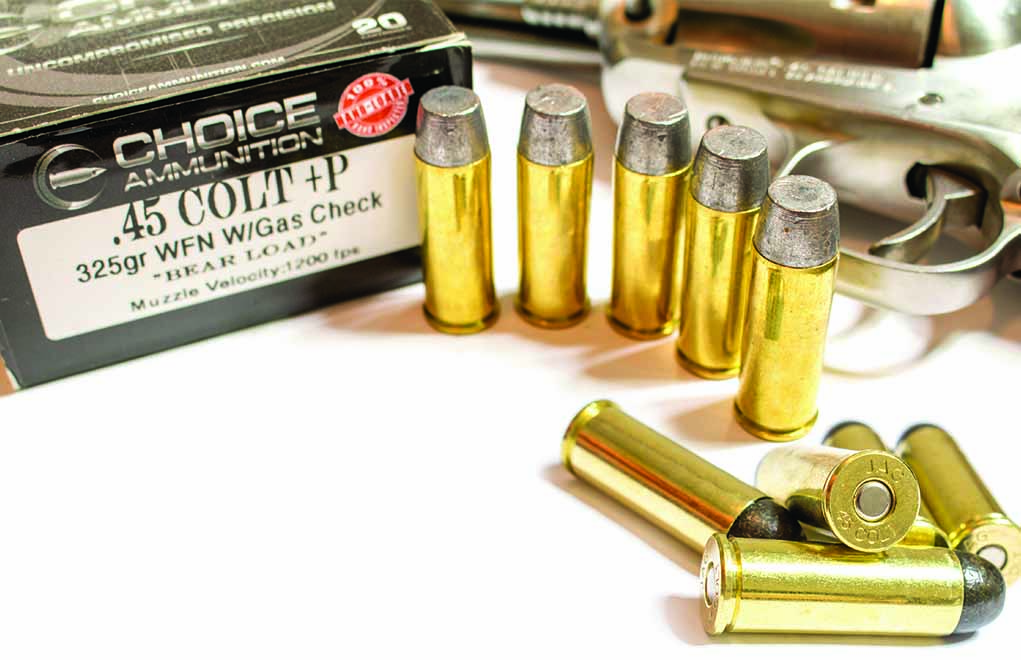
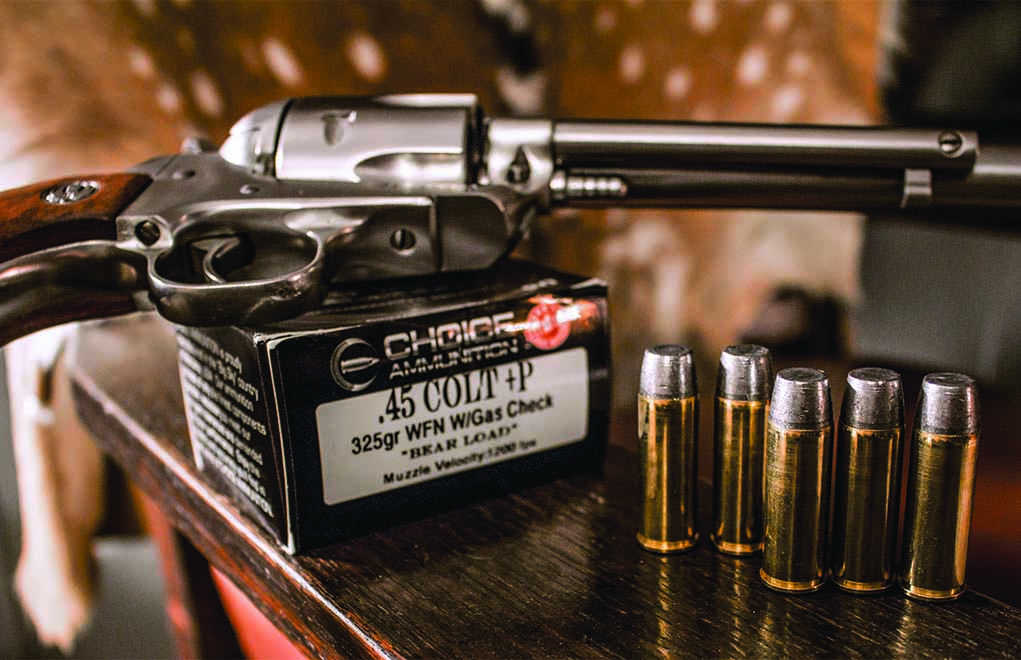
On the top end of the power spectrum, I really like the Choice .45 Colt +P “Bear Load,” driving a 325-grain Wide Flat Nose Gas Check hard-cast lead bullet that leaves my barrel at 1,305 fps. This load immediately lets you know it’s +P, because the muzzle jump is such that the unassuming shooter might lose their grip on the handgun. In other words: Hang on to it, or you’ll be picking up your revolver off the ground.
Generating 1,229 ft-lbs at the muzzle, this is surely a sound choice for a sidearm in bear country. I can keep five of these in a 4-inch group at 40 to 45 yards, and I like the authority with which this load speaks.
Want to use your .45 Colt for a defensive handgun? There’s nothing wrong with putting your faith in the Army’s old sweetheart. My Blackhawk likes the Winchester PDX1 Defender load (a 225-grain, bonded-core hollow-point at 850 fps—and it runs very close to the time-honored .45 ACP formula.
For the lead-free areas, or for those who simply enjoy the performance of monometal expanding bullets, look to the Barnes XPB bullets for a great option to take the .45 Colt hunting.
Is it as fast as the .44 Magnum? It gives up a little to Elmer Keith’s brainchild, but not much. Does the .45 Colt get shelved for the .454 Casull? Not in my opinion, because the heavier loads from Choice, Grizzly and Buffalo Bore are formidable for certain.
Even so, the affordability and diversity of ammo and gun choices give an advantage to the .45 Colt. Yes, the Casull can fire .45 Colt ammo, but the price of a Freedom Arms can be a real eye-opener.
The bottom line is this: Like the .45-70 Government, the .45 Colt remains relevant because the design was so good to begin with. Clearly, the .45 Colt isn’t going away anytime soon.
Editor’s Note: This article originally appeared in the August 2020 issue of Gun Digest the Magazine.
Built to dominate the Carry Optics division, the Sig P320 Max is long on gold-medal features.
When it comes to Sig Sauer, all the chatter as of late has been around the P365. Makes sense, given the surge of gun buyers, most angled at picking up a personal-defense piece. Though a bit less heralded in recent years, the micro 9mm’s big brother—the P360—still has the stuff to impress, from its inherent accuracy to flexible platform. Now, the protean pistol is tackling the competitive world.
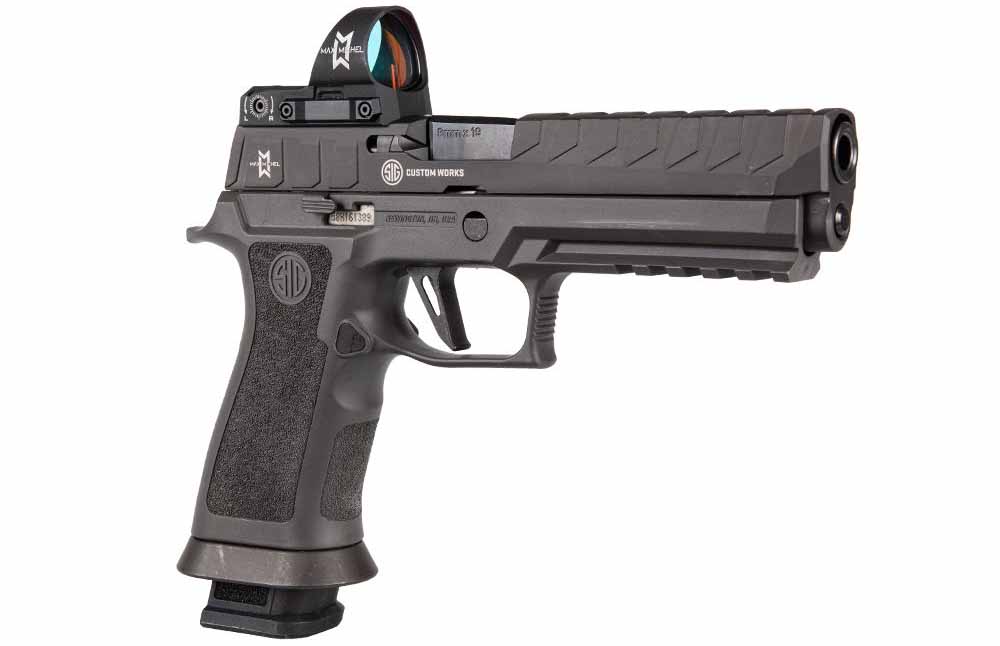
A race gun through and through, the Sig P320 Max has features soup to nuts to get a skilled shooter gunning for gold. It should, given the 9mm was designed with input from dominant pro pistol competitor Max Michel—hence the moniker. But there’s more to the gun than Michel’s name stenciled on the slide.
Sig P320 Max
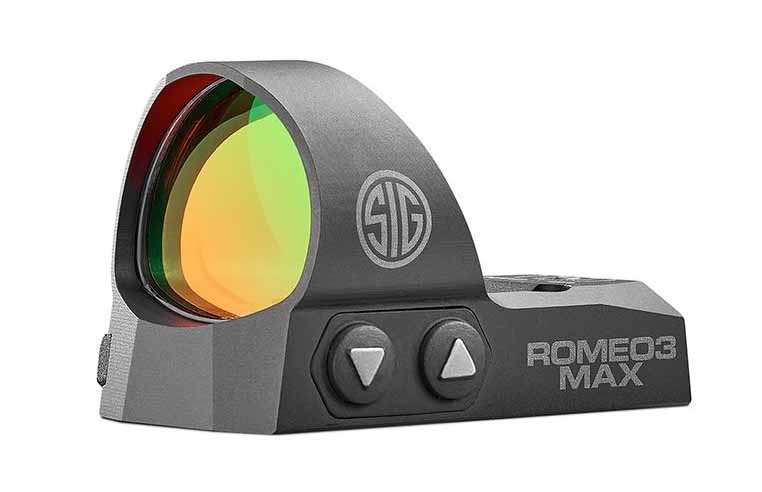
As those who follow competitive shooting may have already guessed, Michel being part of the project means the pistol is optics ready. The pro dominates in the Carry Optics division—winning every USPSA championship in the division since its inception. In turn, Sig includes a ROMEO3MAX 1×30 competition reflex sight factory install on the P320 Max. Made for fast target acquisition and transition, the optic has among the widest fields of view available today, as well as a 6 MOA red dot, with 110 MOA of elevation adjustment and 80 MOA of windage (1 MOA increments).
Nice as the extra is, the optic isn’t the truly intriguing aspect of the P320 MAX. The striker-fired’s shootability is. Primarily, this is thanks to the pistol’s heavy TXG tungsten-infused grip module that ups the gun’s mass to a hefty 43.5 ounces. Yeah, not a contender for concealed carry. But expect the nearly 3-pound pistol to do a number on recoil and muzzle flip, therefore run like the wind, accurately so.
Ergonomics also get the once over, making the P320 Max all the more conducive to being run hard. In particular, Sig makes the pistol eminently simpler to manipulate thanks to wrap-around cocking serrations running nearly the entire length of the slide. Wide, yet shallow, the feature gives a solid handle at any contact point, picking up the pace of reloads and addressing malfunctions on the fly. Additionally, Sig has done away with the front sight on the upper. Purpose-built for competition, the omission facilitates a clearer sight picture with the optic, theoretically making it faster target to target.
Sig Romeo3 Max
Capacity, the P320 Max doesn’t want. Shipping with four 21-round steel magazines, the pistol has enough on tap to make reloads rare stage to state. And the 9mm has the assets to put them on target without a hitch. These include a 5-inch match-grade bull barrel, skeletonized flat trigger, one-piece stainless steel guide rod and 1911-style recoil spring. The gun ships with two springs, 12 and 14 pounds to customize to the user’s preferences. Other notables include an amply undercut trigger guard to facilitate a fundamentally high grip, positive texturing on the panels and front and back straps, and accessory rail at the fore.
As to price, that’s a good question. Sig doesn’t list the MSRP, however, several online retailers have the P320 Max on pre-order in the $1,500 neighborhood.
A .30-30 case necked down for a 7mm bullet, the 7-30 Waters improves on its parent’s velocity and range, but not enough to dethrone it.
What’s The Skinny On The 7-30 Waters:
The cartridge was the work of Ken Waters, a well-known gun writer and ballistics expert.
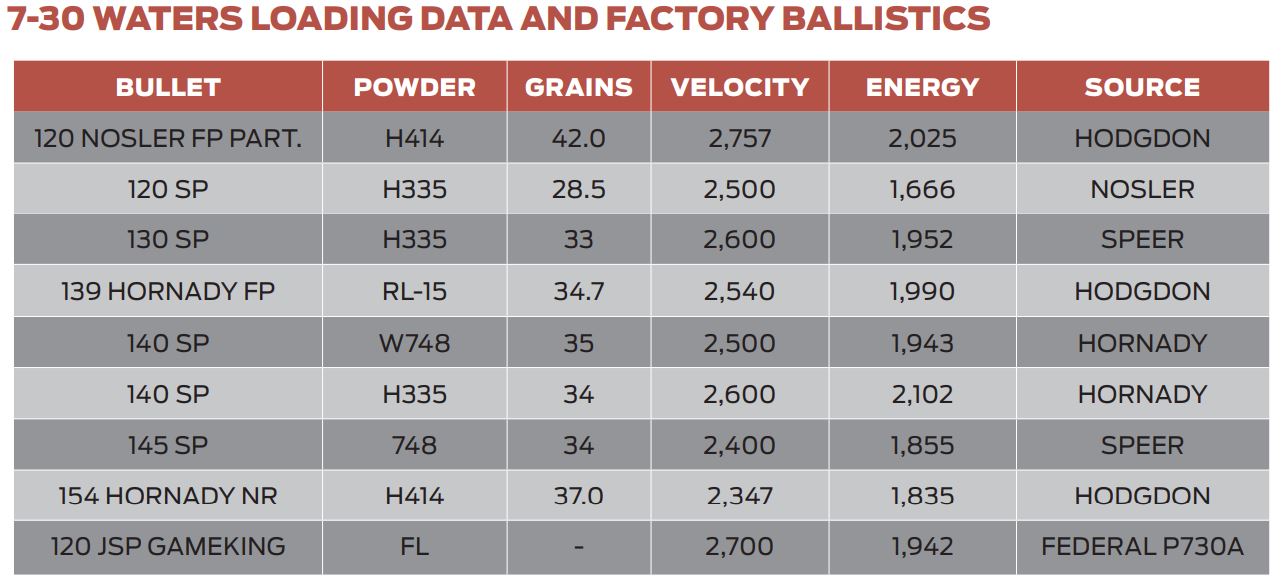
It’s capable of pushing a 139-grain 7mm bullet at 2,600 fps.
It performs best out an rifle-length barrel, somewhat a drawback given it’s designed for lever-actions.
Excels in broken country, where shots range from 75 to 175 yards.
The 7-30 Waters was introduced in 1984 for the U.S. Repeating Arms Model 94XTR Angle Eject rifle and carbine. The cartridge was the work of Ken Waters, a well-known gun writer and ballistics expert. He began planning the cartridge in 1976 as a high-velocity, flat-trajectory round for short, handy, lever-action carbines.
There are many problems to be overcome by those who’d improve on the performance of the .30-30 cartridge class in lever-action rifles. Severe restrictions are imposed by tubular magazines, the length of the action and permissible working pressures. However, by 1982, Waters had developed a cartridge that’d push the 139-grain 7mm bullet at 2,600 fps.
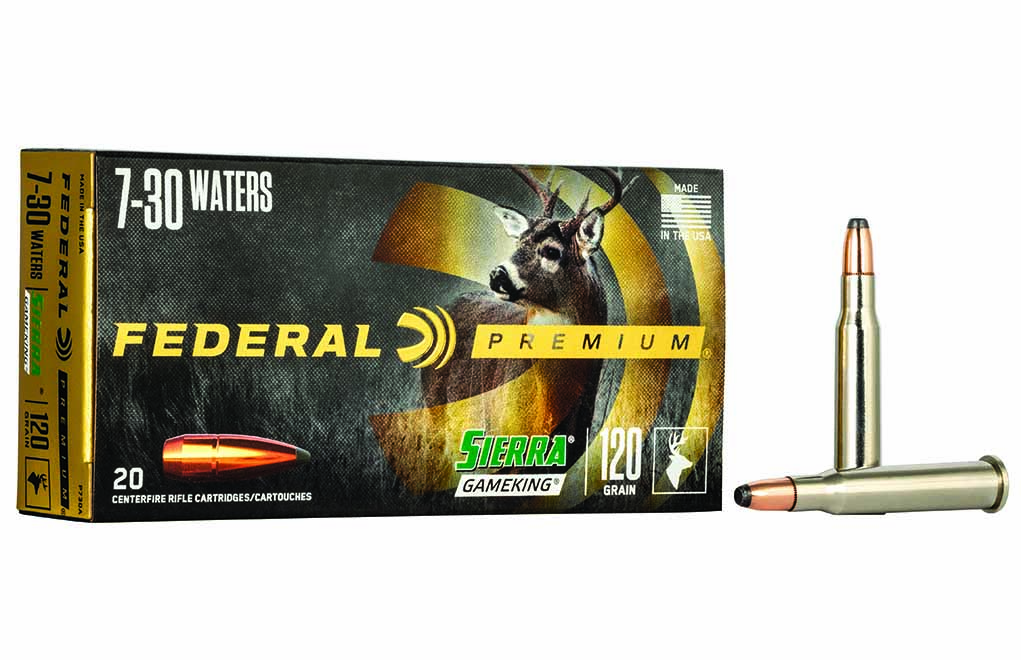
At this point, U.S. Repeating Arms Co. became interested in the project and decided in 1983 to produce Model 94 lever-action rifles in this new cartridge. Federal Cartridge Co. then completed the final version of the cartridge by making various dimensional changes and opting for a lighter 120-grain bullet to achieve higher velocity at less pressure. The current commercial loading uses a 120-grain Nosler Partition bullet that develops a muzzle velocity of 2,700 fps when fired from a 24-inch barrel.
General Comments On The 7-30 Waters
The 7-30 Waters does offer improved performance for those who like lever-action carbines or rifles. This should make a good deer- and black bear-class cartridge. However, the majority of .30-30 lever-action shooters prefer the short carbine, since most are woods hunters. The 7-30, with its light 120-grain bullet, is unlikely to best the .30-30, .32 Special, .38-55, etc., with shots at close range.
Also, it’s not going to be the answer for the long-range plains or mountain hunter. When fired from a 20-inch barrel, its performance is considerably reduced. So, anyone interested in this cartridge will be better served if they buy the rifle rather than the carbine. The light recoil of this cartridge makes it an excellent choice for anyone sensitive to recoil. The 7-30 is at its best in broken country, with shots varying from patches of brush and trees to open areas, with shots ranging from 75 to 175 yards.
Special Mission Unit Sargent Major Jamey Caldwell demonstrates his “1 Mo” Drill, honing situational awareness and post-shooting preparedness.
Practice like you play. Familiar to anyone who’s swung a baseball bat or strapped up a football helmet, the words are as familiar as two-a-days. Simply put, you’ll perform on Saturday the way you prepared the days proceeding. By no means is self-defense a game, but the old saw about practice holds as true for the armed citizen as it does any athlete.
Accuracy, presentation, even manipulation are somewhat easy skills to hone. But what about mindset? Jamey Caldwell has at least one piece of the puzzle squared away in a modification of dot torture, what he calls his “1 Mo” drill. Essentially, the former Sargent Major in the Army’s Special Mission Unit’s regimen squares away continues situational awareness after the shooting is done. The “Mo” is one more sight picture and magazine change.
The idea is a four dot, timed course of fire, anywhere from 3 to 10 yards out, punctuating the competition of some dots with a mag change and everyone with one final sight picture. Sight picture is the big deal here. While seemingly small, presenting the gun and building the sight picture one final time forces shooters not to get complacent in the face of a threat—even one they’ve made hits on. In most drills, the shooter will either retreat to high ready and scan or outright hang up their iron. Realistically, that’s not being at your most prepared.
For more videos from Panteao Productions, please visit panteao.com.
Next to a gun, an EDC light (flash or weapons) is the most useful tool to keep on your person. But there’s plenty of fiction floating around this useful device.
“A light will give away my position.” Have you ever heard a fellow gun owner utter these words? There are more than a handful of myths about lights and guns, rooted in a poor understanding of using them effectively together.
The reason most gun owners don’t understand how a light works when paired with a firearm is simple: It’s difficult to practice in low-light conditions. But, it’s very important that every gun owner shoot in low-light conditions at least once … if, for no other reason, than to experience the challenges first hand. Ideally, you should seek out a reputable trainer with a low-light course.
There just isn’t a good reason to not join the 21st century and embrace high-performing lights, regardless of the myths. Bad things happen all the time—especially when the sun isn’t out.
Shedding Some Light on Defensive Lighting
There are some basic concepts and terms that, if you’re familiar with them, will help you spot those nasty myths.
Photonic Barriers: Photonic barriers are anything that makes your EDC light less effective than it could potentially be. Examples of these performance-stealing variables are the very same ones that impact how well your car’s headlights work: fog, rain and even how clean the lens is. Other more extreme examples of photonic barriers include gun smoke, dust in the air and other light sources being aimed back at you. Most of these barriers can be overcome with a sufficiently powerful light, but others might require you to change how you use a light.
Umbrella or Baseboard Lighting: Just because an EDC light has a high output doesn’t make it unusable in confined spaces. Instead of pointing it directly where you’re looking, pointing the light at the ceiling and creating a reflective umbrella of light that covers everything in that room is a great way to make sure you don’t overwhelm your eyes with a ton of light.
What if you’re in a place with a super-high ceiling? Point the light at the baseboard, floor or ground. Sure, you aren’t going to get the same level of illumination as umbrella lighting, but it’ll work in a pinch. Umbrella lighting is best employed with handguns and handheld lights; baseboard lighting is better suited for long-guns because they often have more powerful lights mounted to them.
Constant-On and Momentary-On: Most of the time, momentary light activation is best paired with a long-gun, where pistol lights are best employed with a constant-on switch. Depending on your individual use case, a handheld light can be used effectively with both a constant-on and a momentary-on. The reason constant-on is preferred with a pistol is simple: It can hurt the fingers after a bit. A long-gun, on the other hand, isn’t anywhere near as difficult to use in momentary mode.
Lumens vs. Candela: You might have heard the term “lumens” thrown around a lot, but what about its lesser-known but more important brother, candela? Lumen is the measurement unit for the total amount of light coming out of the lens. More lumens technically means brighter, but that light might not harness those lumens efficiently and leave you with a less effective light than you think you have. Candela is a measurement of the amount of light in a particular spot in the beam pattern, which can be used to determine how efficiently that light projects.
As EDC lights have become more powerful, there’s a growing segment of folks who believe there’s such a thing as too much light. The idea that “X lumens is enough” is that if you have too much light you might blind yourself if you shine your light on a white wall or mirror.
One light isn’t going to solve every problem. Balancing size, output and throw is just as important as selecting your defensive carry ammunition.
Why It’s Wrong: Even with a very low output light, bad technique can blind you. Learn your home’s layout, identify what surfaces reflect enough light to impair your vision—and practice. The umbrella and baseboard lighting techniques ensure that even if you have a Modlite Archimedes Death Ray slung under your pistol, you aren’t going to blind yourself.
If you haven’t already, turn the light out in the bathroom and shine a flashlight on the ceiling and the base of the wall to see what it does. Magic.
Myth 2: A Light Will Give Away My Position
This self-explanatory myth—that should absolutely be a concern in a military context—is often applied to civilian defensive use. The idea is that turning an EDC light on to see is like flipping on a neon sign above your head.
Why It’s Wrong: There’s some validity to the argument if we’re talking about a SEAL Team conducting a night-time snatch and grab, but the legally armed citizen likely isn’t going to be presented with a situation that requires a high level of light discipline while making a late-night Arby’s run.
When it comes to pistols, turning your light to constant-on as you draw can be done much easier when you add some PHLster switches to your light.
Because the use of a high-output weapon light can control a threat in some cases, the possibility to avoid being forced to use deadly force is a welcome tool. Plus, the information you can gather with light is a hell of a lot more thorough than what you can gather without ample lighting.
Myth 3: A Gun With A Light Is Hard To Conceal
Adding a light to your EDC pistol will add bulk. That’s fact. However, the idea that a light added to your pistol transforms it into something you couldn’t possibly conceal most certainly is myth.
Why It’s Wrong: Advancements in holster design over the past decade have made concealing a gun with a light attached much easier than ever. Additionally, lights like Streamlight’s excellent TLR-7 A add nearly no bulk to the pistol while still delivering acceptable performance.
Holster makers to investigate for concealing a pistol with a light attached are Bawidimann, Tenicor and PHLster for AIWB; Raven Concealment’s Perun LC is a great option for OWB if you aren’t comfortable with appendix carry.
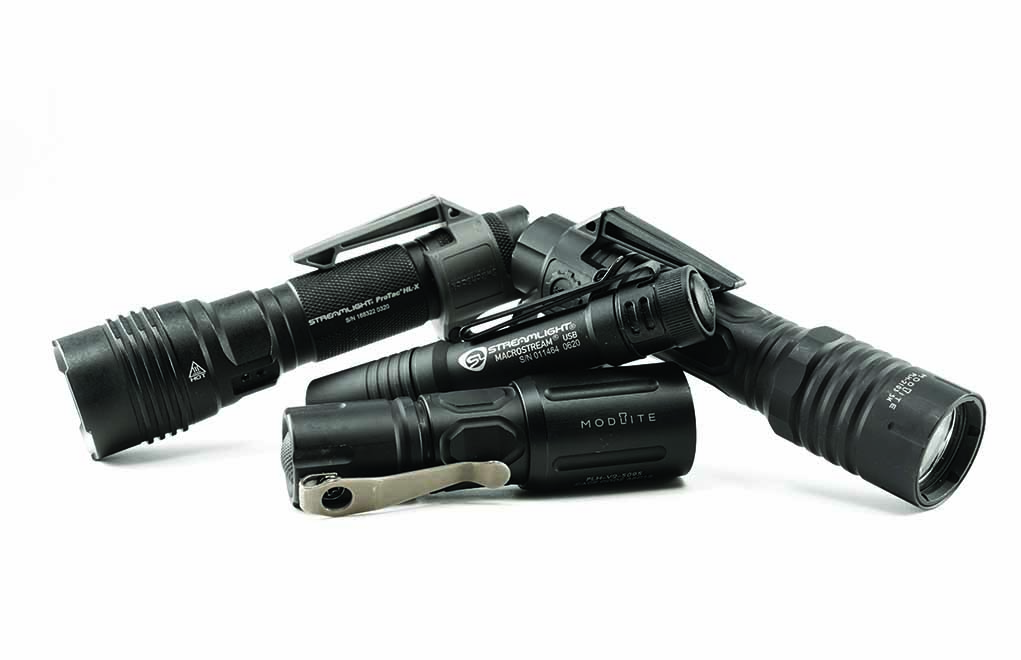
Still can’t seem to pack a gun with a light? Carry a handheld like Streamlight’s ProTac HL-X USB or Modlite’s PLHv2 and get proficient using it.
Myth 4: A Gun Isn’t A Flashlight
While the argument that you shouldn’t use a gun as a flashlight is sound, this argument against weapon-mounted lights is most commonly delivered as: “I wouldn’t want to point a gun at my family if I was clearing the house.”
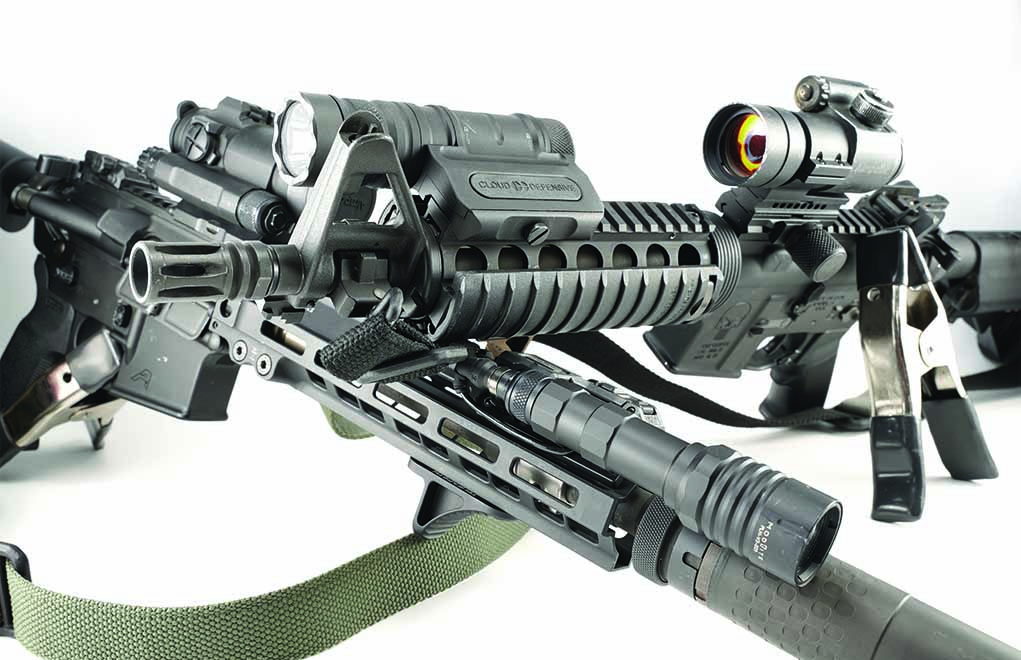
Companies like Cloud Defensive and Modlite are rewriting what we consider acceptable performance from weapon lights.
Why It’s Wrong: Your firearm isn’t a task light, and Jeff Cooper’s rules for firearm safety always apply. Don’t point your firearm at anything that you don’t intend to destroy. Just about any modern light from a reputable manufacturer is more than capable of lighting up a large room when using a technique like umbrella lighting. This misconception is rooted in a lack of understanding in how to use an EDC light effectively.
Still worried about it? The answer is adding a handheld light to your EDC and nightstand.
Myth 5: If I Can’t See, Criminals Can’t See
If you can’t see, obviously criminals won’t be able to see you either … right? This myth seems to make sense if you take it at face value.
Why It’s Wrong: A criminal only cares that you appear to be an opportune target; they don’t need to see exactly what’s in your hands. You, on the other hand, not only need to see the outline of the criminal, but you also need to know exactly what’s in their hands. If you use deadly force, no one’s going to care that the banana the bad man was pointing at you looked like a gun; all that anyone will care about is that it wasn’t a gun.
Myth 6: The Strobe Function Disorients Attackers
The myth that the strobe function on a flashlight disorients an attacker has roots in the theory that rapidly flashing light will overload the visual system and cause confusion.
Why It’s Wrong: There’s a reason most top low-light instructors don’t teach the use of strobe in their classes—and very few serious duty-rated lights actually include a strobe function—it doesn’t work. You have a far better chance at disorienting someone with a constant blast of lumens than throwing them a disco party.
The only result you’ll get from a strobe is less information about what the attacker is doing and what’s in their hands. The point of adding a light as part of your defensive toolbox is to gather more information to make better decisions.
Myth 7: I Don’t Need A Light During The Day
Daytime is bright. There couldn’t possibly be a need to have a flashlight during the day. After all, the sun has way more lumens than any pocket light saber you might be considering … right?
Why It’s Wrong: The idea that you won’t encounter a situation that would benefit from a flashlight, just because the sun is out, is asinine. How often have you walked out of a dimly lit store and found yourself squinting?
That big glass door that you walked through does a great job of backlighting people. With a high-powered flashlight, you can overcome that photonic barrier and make the best decision for that particular situation. Again, carry a handheld light in public: You don’t want to be drawing on anyone unless the threat in eminent.
What You Should Do
The best way to go about determining which particular concepts work best for you is to try them out in your home and in your daily routines.
If in doubt, here are some solid practices to live by:
Carry a handheld light regardless of whether you have a weapon-mounted light.
Get specific low-light training from a well-respected instructor. YouTube doesn’t count.
Practice in your home with an unloaded gun. Learn how to get the most out of your tools in a controlled situation.
Editor’s Note: This article originally appeared in the 2020 Everyday Carry issue of Gun Digest the Magazine.
Hornady truly is solely dedicated to building accurate, deadly, dependable bullets.
The economics of the firearms business can be summed up with this analogy: Do you want to sell dogs or dog food? For Hornady, the answer was simple: ammunition. After all, all firearms need ammunition … and they always will.
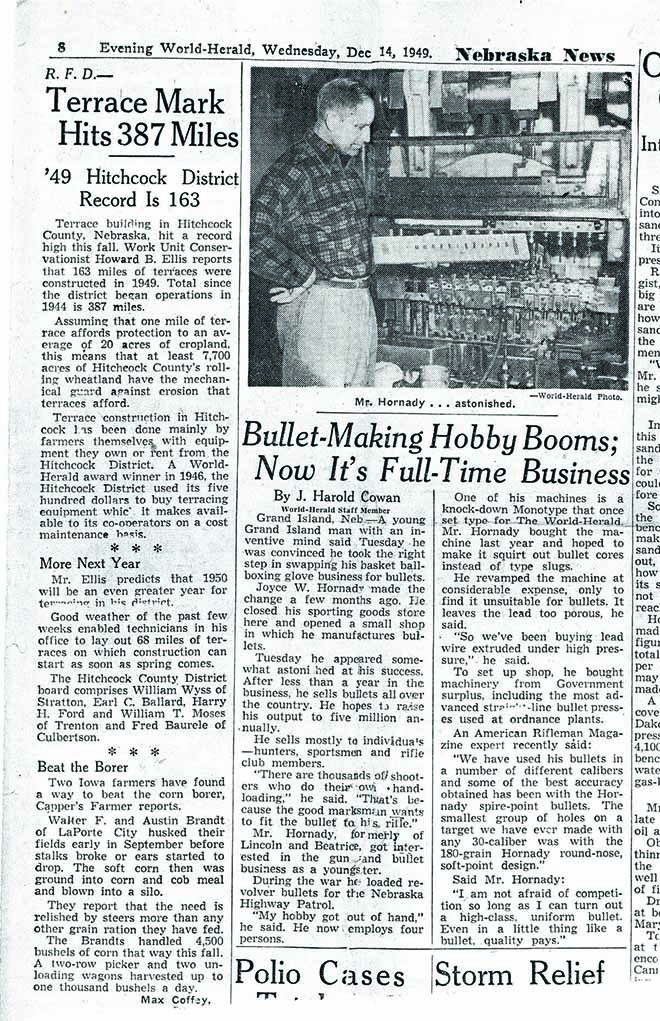
The Hornady ammunition story began because Joyce Hornady saw a need in the firearms industry emerging after World War II. He thought a lot of shooters, like him, would need a good bullet to reload. He knew he was right long before the banks did, and he forged ahead with his dream.
The Dream Begins
From the beginning, Joyce Hornady made it clear to the world that his business would be brave, daring and practical. Fueled by his core values of building “accurate, deadly, dependable” bullets, Hornady Manufacturing Company continued to grow.
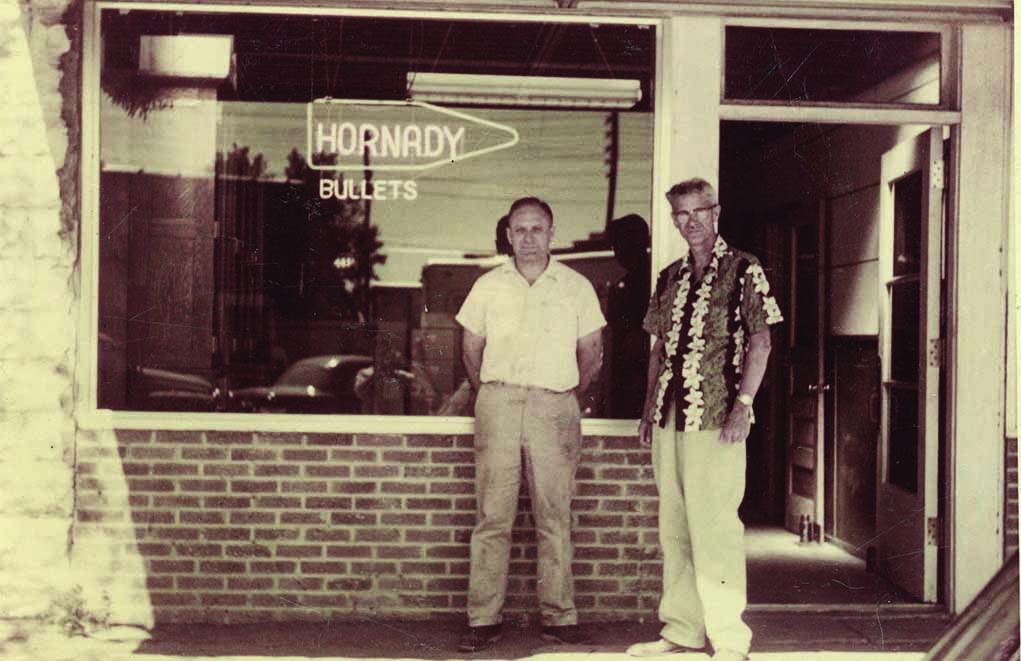
Where Hornady began. The company started off as a dream and grew into a reality.
Hornady’s climb to success wasn’t an easy one, however. In 1981, with the Hornady brand well-established and growing, its founder and leader, Joyce Hornady, along with Hornady engineer Edward Heers and Hornady customer service manager Jim Garber, was killed in a tragic plane crash while on the way to SHOT Show, which was held in New Orleans that year.
Few businesses, no matter how well-run, can survive the loss of their visionary leaders. But, this wasn’t just any ordinary business; it was the Hornady family business. And thanks to the sound parenting and leadership of Joyce Hornady, his dream didn’t die with him. Rather, it grew stronger, brighter and more innovative than ever.
After the Tragedy
According to Hornady’s historic records, here’s what happened next:
Joyce Hornady started his business in 1949 in Nebraska. Decades later, Grand Island, Nebraska, is a Hornady town.
“After the immediate shock and grief abated somewhaat, a giant question remained. What was to happen to the company? There were those who doubted it could survive the tremendous loss of its first and only leader. That was not the belief of Marval Hornady (Joyce Hornady’s youngest son, Steve’s, wife). The family needed to regroup, and so it did. Steve Hornady became president and Marval the chairman of the board. Daughter Margaret Hornady David and her husband, Don, left careers at Polaroid to become vice president and chief engineer, respectively. A new era had begun.”
Today, Steve Hornady is the leader of his father’s dream. Together with his family, Steve has grown Hornady into the “largest independently owned maker of bullets, ammunition and tools in the world.”
Long-Range Game-Changer: Hornady ELD-X Long Range Bullets
Behind the Hornady Brand
A success story such as Hornady’s shouldn’t be ignored, so Gun Digest sat down to talk with Steve to find out what Hornady is like behind its brand.
Joyce Hornady’s love for bullets was rooted in his lifelong love of hunting and shooting.
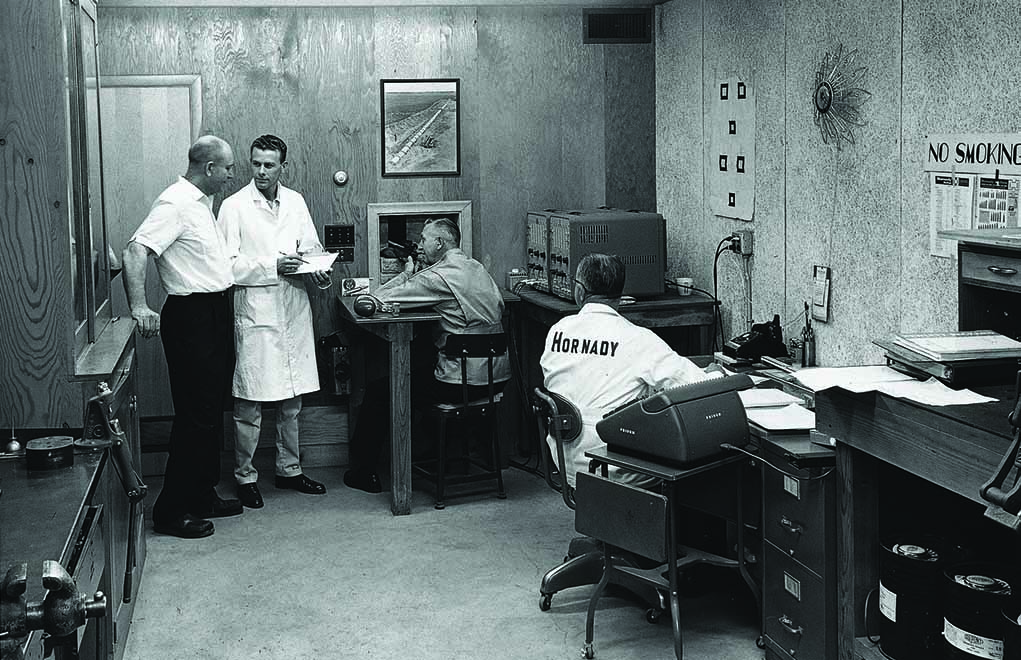
Before his unfortunate death in 1981, Joyce Hornady spent a lot of time in the laboratory testing bullet designs.
“My father was an avid pistol and varmint shooter pre-World War II. Obviously, with the war, it became difficult to enjoy his recreation,” Steve explained. “He worked with Vernon Speer—who had a machine shop in Lincoln, Nebraska—to develop a way to make varmint bullets out of spent .22 rimfire cases.”
From this foundation, Joyce combined his ballistically inclined engineering mind with a strong entrepreneurial spirit at the end of World War II. He realized that after the war, thousands of American soldiers would be returning to hunting and shooting.
“Post-World War II, he and Vernon continued making more bullets for handloaders and selling them by mail order,” Steve continued. “Dad and Vernon eventually went their own ways. Dad bought surplus bullet-making machinery and started making his own bullets, starting with a .30-caliber, 150-grain Spire Point.”
As Hornady grew, Joyce’s goals remained simple, genuine—and tangible to shooters.
Steve Hornady has embraced his family’s rich tradition in hunting and shooting by traveling around the world after all kinds of wild game.
“I don’t know that Dad had any specific goals, other than to try to make really good bullets and keep serving the market,” Steve pointed out. “Naturally, that led to growth, and I think he simply enjoyed the process of trying to do more.
“We started making ammo with surplus fired .308 and ’06 brass, because Dad felt people really wanted to shoot his bullets but didn’t want to handload.
“From the very beginning, our premise was that our bullets were what made our ammo. We didn’t have ammo production numbers to meet; we had bullet accuracy specs to meet—and that made all the difference.”
‘Honest’ Bullets
Hornady built its brand purposely and has always remained centered on Joyce’s fundamental desire to provide the world with a good, honest bullet.
According to Steve, “We’ve built our brand by simply doing the right thing for our customers. We always pursued what we thought would be a good idea and not necessarily what would bring the most revenue. We didn’t go after high volume by lowering our standards, and we didn’t go after high revenue by setting high prices. We did make bullets Dad thought customers would want or need—even if it didn’t make economic sense (for instance, the .458-caliber, 500-grain FMJ).”
Joyce Hornady hunted with the bullets he created.
I once met Steve at a SHOT show, and it didn’t take me long to see he was a feisty and honest—but fair-minded—businessman. He struck me as the kind of guy who’d have my back in a bar fight. That kind of loyalty is exactly what I’ve seen in the performance of Hornady bullets; that is, they’re there when you need them, and they offer simple, reliable performance.
A Hornady 154-grain Interlock (7mm-08) that I handloaded took my first black bear in Maine, and other Hornady bullets have cleanly taken countless whitetails, mule deer, coyotes and a Wyoming pronghorn. The bullets work because that’s the way Joyce Hornady first designed them. And Steve and his family have continued Hornady’s bullet-design genius based on several lifetimes of well-established pedigrees of success hunts around the world.
Meet Steve Hornady
Aside from his family influence, what else has helped shape both Steve and Hornady?
According to Steve, “I’ve been in this biz now for almost 55 years. I started mowing lawns at the factory when I was 15, and I’ve been here ever since. As a result, there have been quite a few people I’ve learned from … . They’re not in any particular order: my father and mother, of course, Larry Steadman, Jim Lagiss, Jim Devere, Larry French, Charlie Dunkin, Arlen Chaney, Bob Delfay, Jerry Bersett, Bob Scott, Ted Rowe, Bob Behn, Tom Gura, Jack Durrett, Larry Barnett—and many more—but you get a pretty good idea.”
Steve (right) and son Jason Hornady with a bull moose they took using Hornady ammunition.
When asked about his hunting and bullet design success, Steve pushed the spotlight aside and instead shined it on his father and the rest of the Hornady family.
“I appreciate the compliment, but I don’t think I’m particularly keen or possess any specific expertise,” Steve said. “I think I’ve probably adopted my parents’ sense of simple fairness in how we treat our staff, our customers and the shooters. We’re still trying to make the best products we can and not use marketing “BS” to convince the shooter. Rather, we convince the shooter by delivering the product. It’s being validated every day by winning matches and providing more and more performance to consumers, law enforcement and military.”
Looking Toward the Future
The next set of questions I asked captured Steve’s personality and Hornady’s “boxer” mentality.
Gun Digest: With regard to the ammunition industry, where have you seen manufacturing and sales succeed and fail, versus that of your own product?
Steve Hornady: I think I’ve seen mistakes by others; some are still [making mistakes]. I’m not going to say which ones … because I want them to continue.”
GD: Have there been milestone choices other manufacturers have made that you disagreed with?
SH: Ah, yup! And I’m glad they did and are still doing so.
GD: If so, what were they, and why did you go a different direction?
SH: Nunya! (I can only assume that this was Steve’s shorthand for “None of your business!”)
GD: Like any firearms industry company, Hornady must endure and balance external influences and factors. Which ones have impacted Hornady the most? Politics? Labor costs? Manufacturing skill sets? Technology? COVID-19?
SH: Well, all, to some degree. Starting in the late 1980s, as our ammunition business was growing, it became evident that it was going to be self-limiting to rely on the very same companies that were our competitors for our cartridge brass. That got us started making our own brass. The technology and manufacturing skills were things we didn’t possess and had to learn—sometimes, the hard way—what to do.
Today, we’re pretty darned good; and, of course, that’s allowed us to innovate with cartridge design—not trying to make the most bad-ass powder burner, but to deliver the best bad-ass performance. In this case, I use “accuracy on target” and “performance” interchangeably. It’s not how fast you can push a bullet; it’s getting that bullet to go where it’s supposed to go, each and every time.
As for the industry, I certainly don’t need to remind everyone of the forces out there that are trying to “get us.” It’s not paranoia when a candidate for president says he’s coming for your guns or an activist billionaire commits a fortune to build a coalition to drive our industry into the ground. There are literally millions of people who don’t understand the basic fundamental principle of self-defense, both personally and as a bulwark against an adventurous government. They’re sheep.
In Front of and Behind the Hornady Brand
Steve’s vision for the future of Hornady is close to its present.
“I think I want the brand to be what the brand is perceived as now,” he said. “We build the very best ammo—and at competitive prices. We supply premium products across the board, even in ‘commodity ammo’ categories (.223 FMJ and 9mm, for which we load our bullets and not some generic cheapie). Hornady’s business continues to grow. The Hornady family, its employees and, ultimately, its brand have leadership in place to carry the company forward through the next few generations.”
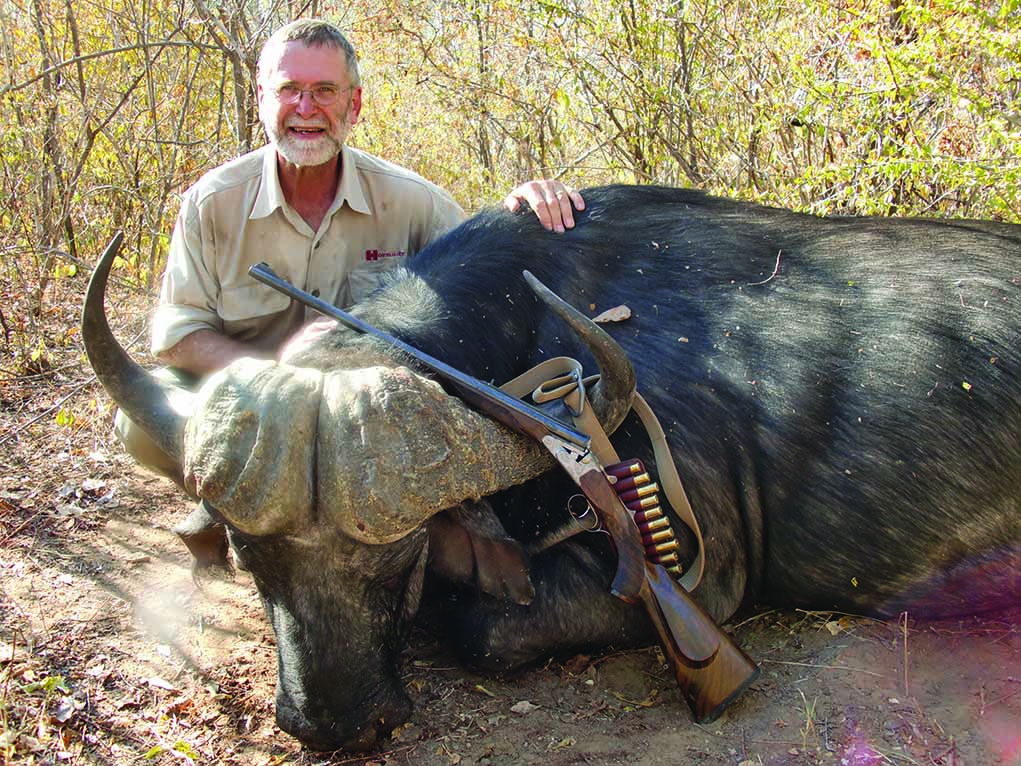
Steve Hornady with a Cape Buffalo he took in Africa. Hornady began in 1949 with Steve’s father, Joyce.
What does Steve have planned for tomorrow?
“I think we’ll continue to improve both what we build and our ability to deliver it at a competitive price,” he said.
So, what is Hornady behind the brand? It’s the same as it is in front of it. The Hornady brand isn’t a marketing scheme; it’s a mirror that reflects almost 100 years of bullet-making ingenuity started by a man who was willing to bet on himself when the banks didn’t believe in his dream. And that’s about as American as you can get, folks.
The bottom line is that Steve and the entire Hornady family want customers to know that when they choose Hornady ammo, “they’re getting the commitment of everyone here to deliver the very best we know how to do.”
And, what Hornady best knows how to do is build “accurate, deadly, dependable” bullets.
For more information on Hornady Manufacturing, please visit hornady.com.
Editor’s Note: This article originally appeared in the July 2020 issue of Gun Digest the Magazine.
Replacing the PPQ , the new Walther PDP offers a number of enhancements on the cornerstone concealed carry line.
Had the SHOT Show gone off, certainly, this would have made top billing. There would have been a banner with the visage of Walther PDP pistol hoisted above the gunmaker’s booth and endless gallons of digital and actual ink would have been spilled over the 9mm. Here we are in February, with no streamers or on-the-spot announcement over the German-American heater. But that doesn’t make the moment any less impactful.
Wait, one second …. How exactly is yet another polymer-framed, striker-fired impactful in any way, shape or form. True enough, the world is awash in black plastic. But the Walther PDP (Personal Defense Pistol) marks not only an entirely new line for the manufacturer, one that puts another favorite to bed. PPQ fans take a moment to brace yourselves. Yes, after 11 years Walther is discontinuing its cornerstone concealed carry line (outside the steel-frame Q4 and Q5) in favor of a new flagship. Take heart, because if you appreciated the PPQ, the PDP has as much to offer … if not more.
Walther PDP Full-Size, 4.5-inch Barrel
The PPQ forms the base of the Walther PDP, quite apparent at first blush. The pistols share a similar profile, particularly in the curvaceous ergonomic grip. But the PDP incorporates and several upgrades shooters have encouraged the company to pursue for some time now. This is particularly seen in the manipulation enhancements.
That hexagonal pattern on the grip, rightly jumps out. As does a very un-Walther-like slide. To the former first. The texturing is what Walther calls Performance Duty Texture, pyramidal structures that are supposed to offer the best of both worlds. On the one hand, the PDP’s grip isn’t so aggressive as to score the skin of your palm, but the texturing is designed such that there’s no fear of the pistol slipping out of hand. As to the latter, Walther has gotten much more assertive with the gun’s cocking serrations. Protruding above the surface of the slide, the wide-spaced ridges pick up the pace of manipulation, making reloads and clearing failures much quicker. Furthermore, the controls—mag and slide release—are reversible, thus ambidextrous.
Also, take a gander at the top of the slide. Yup, optics ready. Not surprising, given nearly every new heater sports a slide cut or other mounting system. Walther opts for mounting-plates with the PDP, accommodating a wide swath of footprints and attaching easily via two screws. As for those who scorn red dots, the gun comes with traditional white-dot irons, the rear adjustable.
Walther PDP Compact, 4-inch Barrel
Size-wise, well it depends on what PDP you’re talking about. Walther serves up three models, a 4- and 4.5-inch barreled version on a compact frame and three full-sized frame models with the choice of 4-, 4.5- and 5-inch barrels. Across the board, the gun doesn’t leave the shooter wanting in capacity. Go compact, you’ll have 15+1 onboard. Full-sized, 18+1. More than enough to handle nearly any situation, at the range or in a dark alley.
Other notables of the Walther PDP include polygonal rifling, stepped chamber, undercut trigger guard, Performance Duty Trigger (around 5-pound break) and accessory rail. As to price, all models have an MSRP of $649, which should translate to around the $600 mark when they hit store shelves.
Walther PDP Specs Caliber: 9mm Capacity: 15+1 rds. (Compact); 18+1 rds. (Full Size) Barrel: 4 and 4.5 inch (Compact); 4, 4.5 and 5 inch (Full Size) Overall Length: 7.5, 8 inch (Compact); 7.5, 8 and 8.5 inch (Full Size) Width: 1.34 inch Height: 5.4 inch (Compact); 5.7 inch (Full Size) Weight: 21.4, 23.1 ounces (Compact); 21.5, 22.3 and 23.8 ounces (Full Sized) Sights: 3 white dots, adj.; optic ready Trigger: 5 pounds, 6 ounces Safety: Trigger safety; striker safety, disconnect safety MSRP: $649
For more information on the Walther PDP, please visit waltherarms.com.
Looking for a new iron or piece of kit to enhance the one you already own? Check out these seven new bits of guns and gear to grow your firearms wish list.
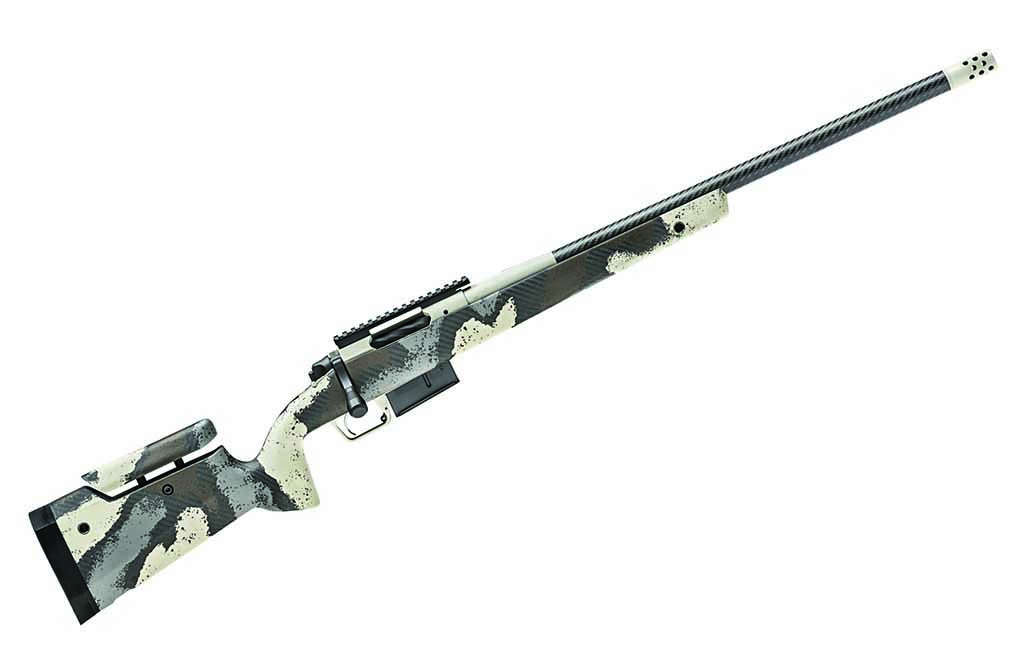
With its first bolt-action rifle, Springfield Armory provides a top-shelf option to upgrade your next hunt. Like any rifle worth its salt, the heart of the Model 2020 Waypoint is a strong action. Constructed from stainless steel and kept to exceedingly tight tolerances, the Model 2020 action features glass-smooth EDM-machined lug raceways, fluted bolt and dual cocking cams. Lightening the load is a hand-laid stock from AG Composites, complete with full pistol grip, optional adjustable comb and pillar bedding. Added to this is an optional carbon-fiber wrapped barrel from BSF barrels, and you have an iron that in its lightest models tips the scales at well under 7 pounds. MSRP: Starting at $1,699
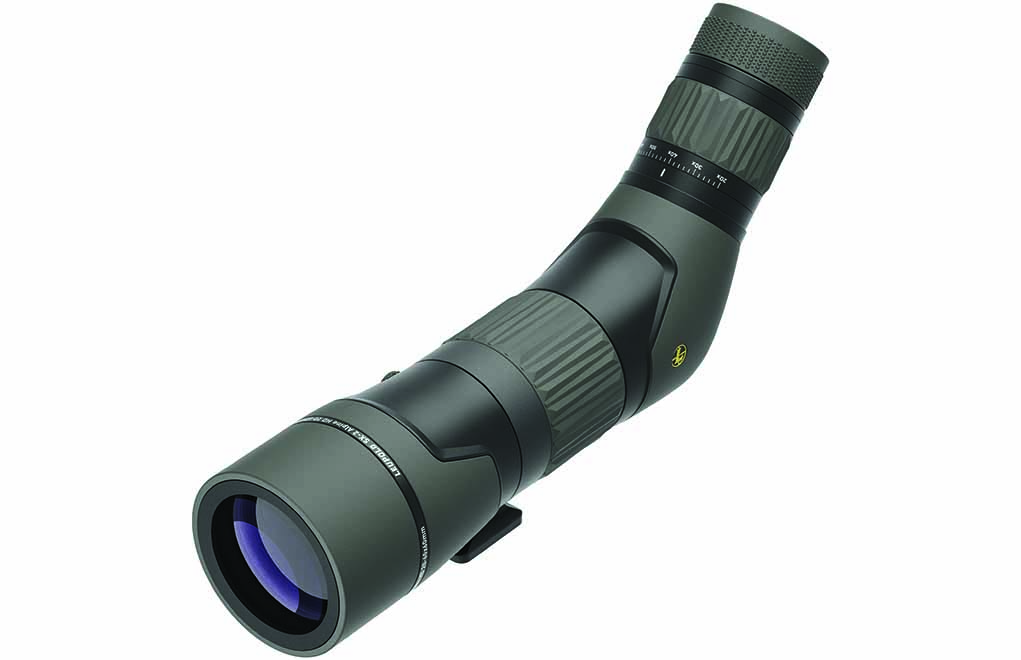
Leupold SX-2 Alpine HD
SX-2 Alpine HD 60×60 180143
Enhancing a hunt in big country means stepping up your optics. Recently introduced, the SX-2 Alpine HD spotting scope line delivers impeccable images and ample magnification. Available in two models—a 20-60x60mm internal optics and a 20-60x80mm option—the scopes offer best-in-class features, ergonomic designs, and field-rugged durability. Oh yeah, and they’re priced in the range most shooters can afford, too. What’s included: generous eye boxes to reduce eye strain, comfortable oversized eyepieces and water and fog proofing. Of course, it boasts Leupold’s Twilight Max Light Management System, which extends the scopes’ usefulness into low-light conditions. Additionally, the optic is field tough, with the company’s Diamondcoat lenses making them nearly impervious to scratches. MSRP: Starting at $519
Real Avid Master Sight Pusher
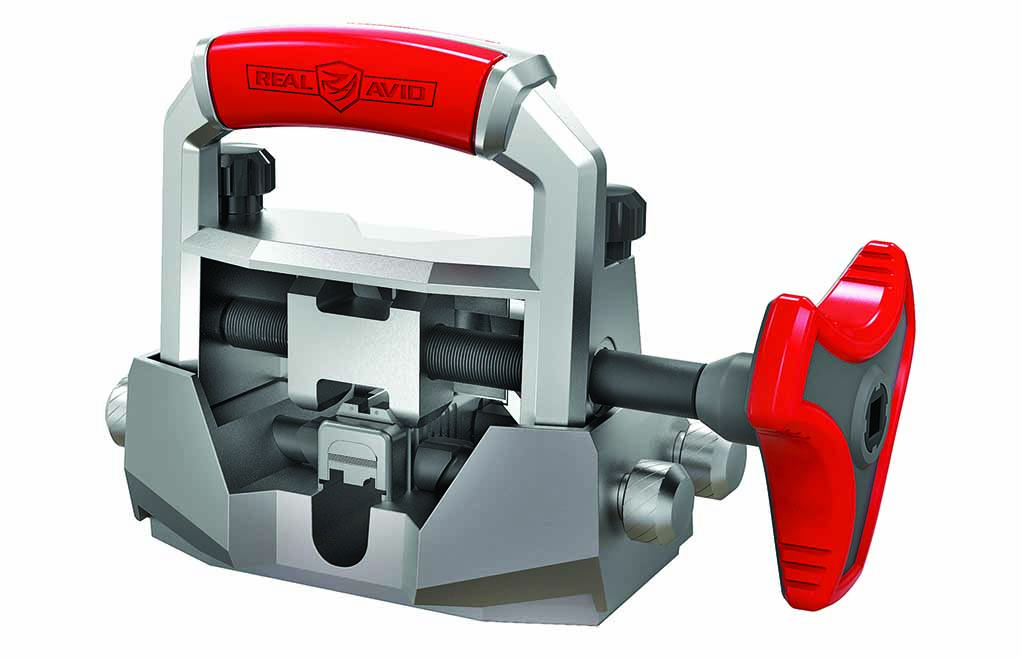
One of the least expensive ways to improve a pistol is investing in high-quality sights. The only trouble is getting them on and dialed in typically involves a gunsmith, or at least a competent gun-counter guy. For those who swap out sights on the regular, there’s no better addition to a tool kit than the Master Sight Pusher. Compatible with nearly any make and model of handgun, the device precisely and quickly removes and installs both front and rear dovetail sights. Unlike many other options, Real Avid’s pusher doesn’t require a vice, with enough heft to keep it in place during the procedure. And large, rubberized handles make torquing sights into place a snap. MSRP: $149.99
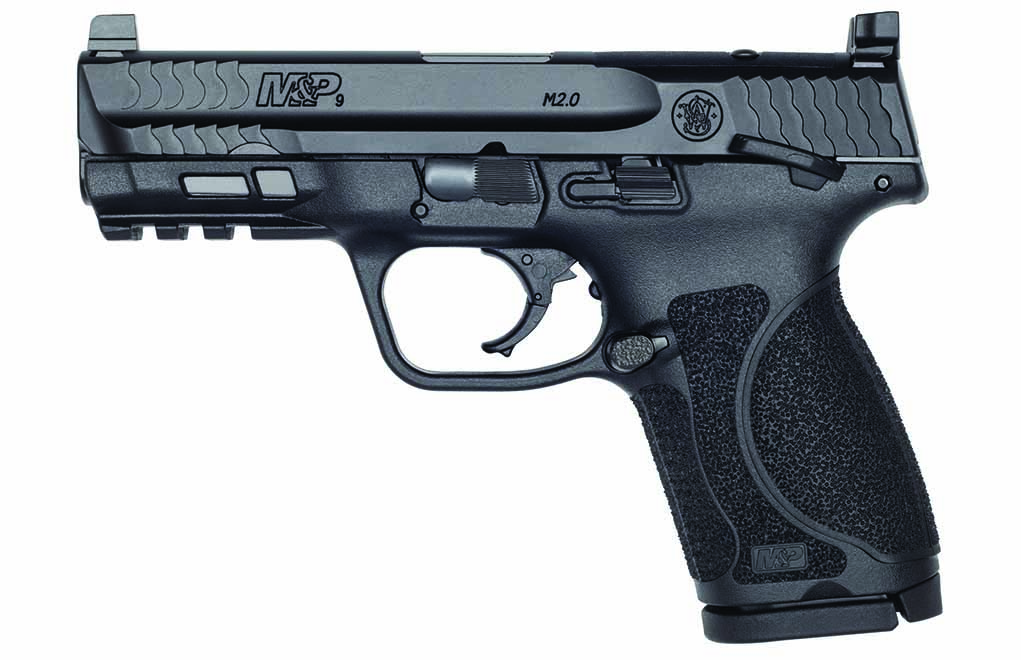
More and more gunmakers are embracing the advantages of reflex optics with pistols tailored to mount the enhancement. Latest in the game, Smith & Wesson. Long a favorite in self-defense circles, the M2.0 Compact is now available with an optics-ready milled slide, creating a rock-solid platform for a red-dot sight. Keeping the optic low profile and protecting it from the 9mm’s recoil impulses, the slide cut also keeps most standard red-dots in place and impervious to everyday rough and tumble. Additionally, Smith & Wesson ensures you can still aim even if the optic goes out with high-rise iron sights, designed to co-witness through the red-dot. Boasting all the features that have made the M2.0 a hit, the optics-enhanced version more than has you covered. MSRP: $619
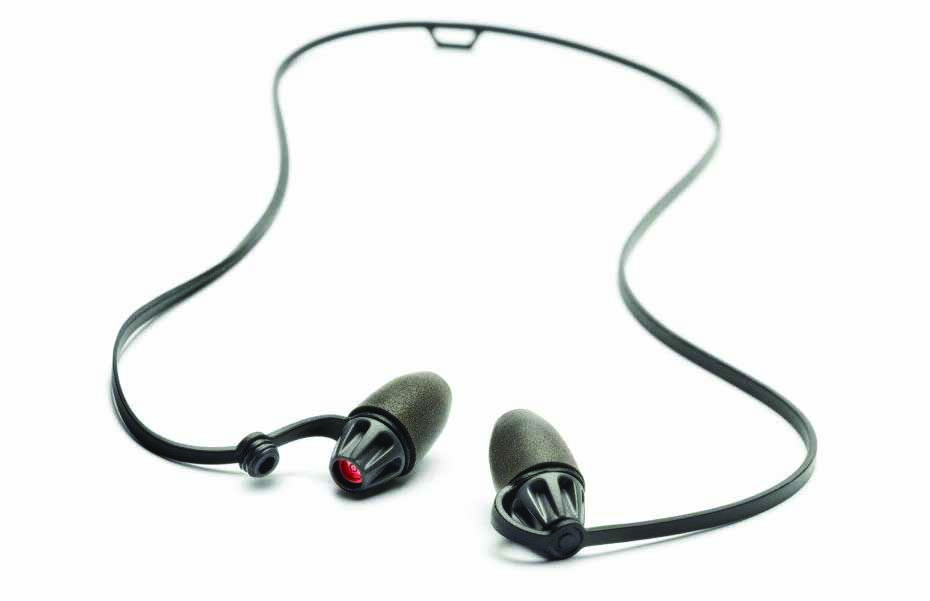
Improved gear doesn’t always connote top dollar. Take Safariland’s new earbuds, for example. Priced affordably enough for any shooters, the foam hearing protection offers nearly unparalleled defense for your ears. At the peak, the earbuds offer 38 dB of noise reduction—so you won’t damage your hearing, even if you’re blasting off belted magnums. Impressively, the buds are adjustable for ambient noise as well, offering both 13 dB and 20 dB continuous noise reduction, allowing you to adapt them to your circumstances. Best of all, Impulse buds aren’t electronic, so you never have to worry about changing batteries. MSRP: $14.99
Sector Optics F1 Rangefinder
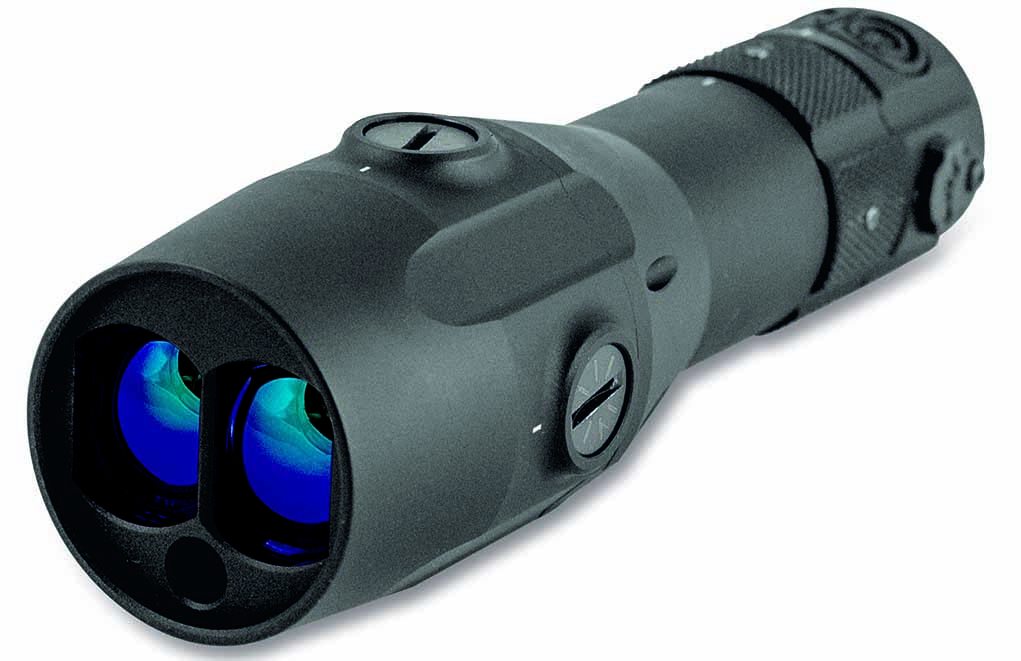
If you don’t know the range, you can’t get on target. Sector Optics all but erases this perpetual shooting challenge with its first stand-alone rangefinder. But there’s a big twist on this fairly long-toothed piece of shooting tech: It attaches to traditional riflescopes. The pretty ingenious concept essentially transforms analog optics into digital marvels. About the size of a small flashlight, the F1 gives shooters linear range and horizontal equivalent readings out to 1,000-plus yards. And it cuts down on shuffling through gizmos to get a shooting solution. Best of all, the rangefinder is small and light enough that it won’t throw off the balance of a rifle. Now that’s an upgrade! MSRP: $1,049.99
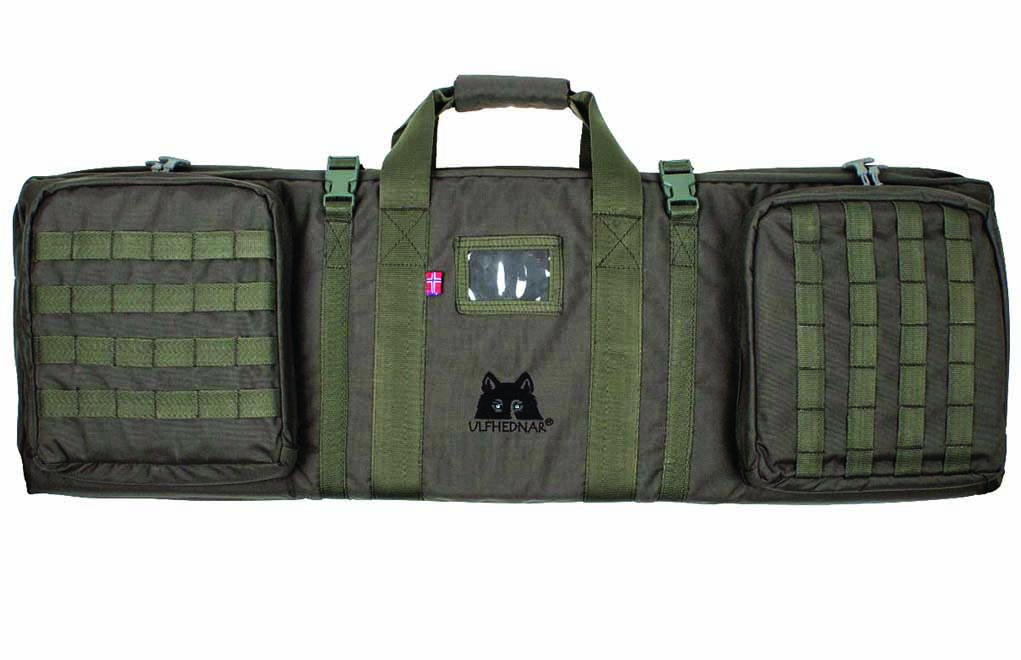
Ulfhednar UH034 Guncover/AR Soft Case
Rugged as the Norwegian landscape it hales from, Ulfhednar gear is built to last. That goes for the gear manufacturer’s new soft case. Designed to tote AR-style rifles and other firearms with a tactical bent, the case not only provides the protection of a Cordura nylon exterior, but practical-tactical convenience. This is seen in its two large carry straps along with ergonomic backpack straps, ample loops on the interior, Velcro rifle secures, padded exterior pockets and Molle system on the outside. Heck, it even boasts oversized pulls on the YKK zippers, so opening and closing the case with gloves on is a snap. For certain, Ulfhednar’s soft case is head and shoulders above nearly any other gun transportation system. MSRP: $201.37
Editor’s Note: This article originally appeared in the December 2020 issue of Gun Digest the Magazine.
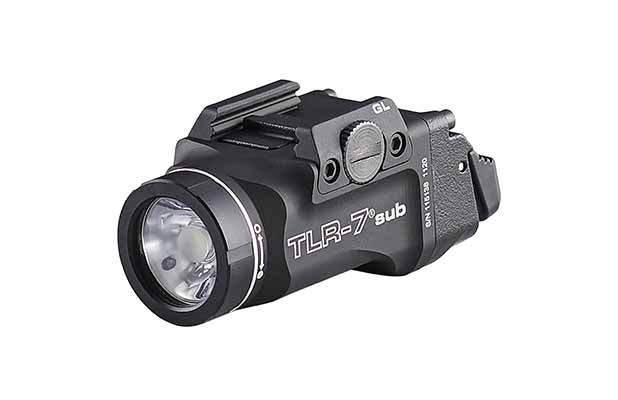
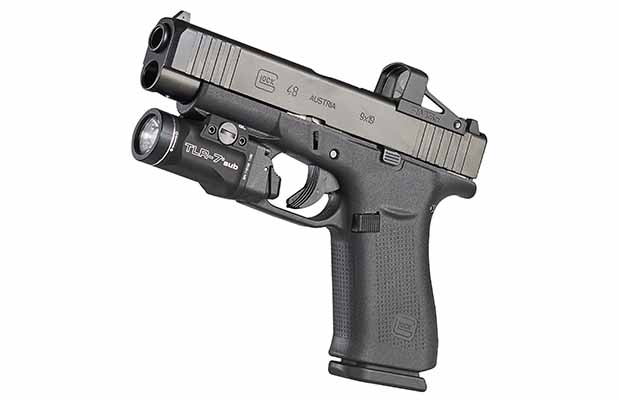
Sized right for subcompact pistols, Streamlight’s TLR-7 Sub is a perfect companion for a concealed-carry pistol.
Chances are if you face a life-or-death situation, lighting will be sub-par. Criminal types have a tendency of cloaking their felonious misdeeds in the dark, complicating matters for armed citizens. Since echolocation is out of the question, a wise shooter has a light source at their disposal at all times for just such circumstances.
Streamlight has made the task simple over the years, decking every shape and size of pistol out with top-end torches. Now the weapons light specialists have an ultra-compact model hitting shelves, tailored to some of the smallest heaters on the market. The Streamlight TLR-7 Sub is designed to incorporate seamlessly into the popular subcompact class of handguns from all the major makers—Glock, SIG Sauer, Smith & Wesson, Beretta, Springfield Armory and Heckler & Koch. Not an easy task, given the guns are minute by any standards. But the TLR-7 Sub pulls it off flawlessly.
Taking into account the idiosyncrasies of particular models, Streamlight doesn’t shoehorn one version onto every pistol. Instead, the TLR-7 Sub is available in three different models, fitted specifically to particular firearms, reducing its overall footprint on the gun. One version is slimmed down for Glock’s Slimline series, including the G43X and G48. Another is proportioned for Sig’s exceptionally small P365 line of 9mm pistols. And finally, there’s a model that attaches to various 1913 short-rail subcompacts, including the Beretta PX4 Storm Compact/Subcompact, Heckler & Koch HK45 Compact, Smith & Wesson M&P M2.0 Subcompact and Springfield Armory’s XD-E and XD-S.
Small, 2.39 ounces and 2.51 inches in length, the TLR-7 Sub doesn’t compromise on performance. With a flick of its toggle switch, the weapons light’s LED delivers 5,000 candela and 500 lumens over a beam distance of 141 meters. More than enough illumination to light up a dimly lit room or identify an approaching threat. Additionally, it offers two modes of operation, a plain beam and strobe—the latter an excellent option for dazzling an assailant, while keeping them off balance of your position.
“The latest addition to our popular line of TLR-7 weapon lights is an extremely compact and low profile model that can be mounted on railed subcompact weapons,” said Streamlight President and Chief Executive Officer Ray Sharrah. “Like other models in the line, it has a high power LED that provides extreme brightness for maximizing visibility and targeting capability in personal defense and other tactical situations. And its rear switch on the left and right of the trigger guard allows for ambidextrous operation.”
The Streamlight TLR-7 Sub also proves fairly convenient. Powered by a single 3 Volt CR123A lithium battery, it delivers 1.5 hours of run time and features a convenient one-hand attachment system, making it a snap to mount and remove. Each model of the TLR-7 Sub also features a specialized clamp system for mounting to rails using the provided key kit. As for operation, Streamlight makes it intuitive, with an ambidextrous toggle switch at the rear positioned right where a trigger finger indexes. And the unit is built to last, with an aircraft aluminum body—black anodized—making it both impact and water-resistant.
With an MSRP of $225.75, the TLR-7 Sub isn’t a bargain-basement lighting option. But for low-light encounters, the weapons light should prove priceless.
For more information on the TLR-7 Sub, please visit streamlight.com.
The semi-auto vs bolt-action debate comes down to a numbers game among the cartridge used, system weight and intended end-use.
Why The Bolt-Action Rifle Out Performs Semi-Autos In Precision Work:
Bolt is locked for the entirety of firing, thus no loss of gas.
Chambers are generally cut tighter.
It’s a more rigid system, producing less flex when fired.
Bolt guns’ maximum barrel diameter is equal to its receiver.
Magazines are longer, leaving room for long loads.
Today, we have a skewed perception of exactly what “long range” is. The definition is fluid, but “long range” can be boiled down to two things that are inseparably connected: rifle type and target type. This relationship determines the bullets, cartridges and general support equipment that are used.
Long range for a hunting-class .30-06 on deer is very different than long range for a .338 Lapua on steel plates. With the old aught-six, you must be concerned, not just with hitting the deer, but also hitting it in a vital place … and you’ll want to know what your bullet does when it gets there. With the .338 Lapua, you’re only concerned with simply getting the bullet to contact steel.
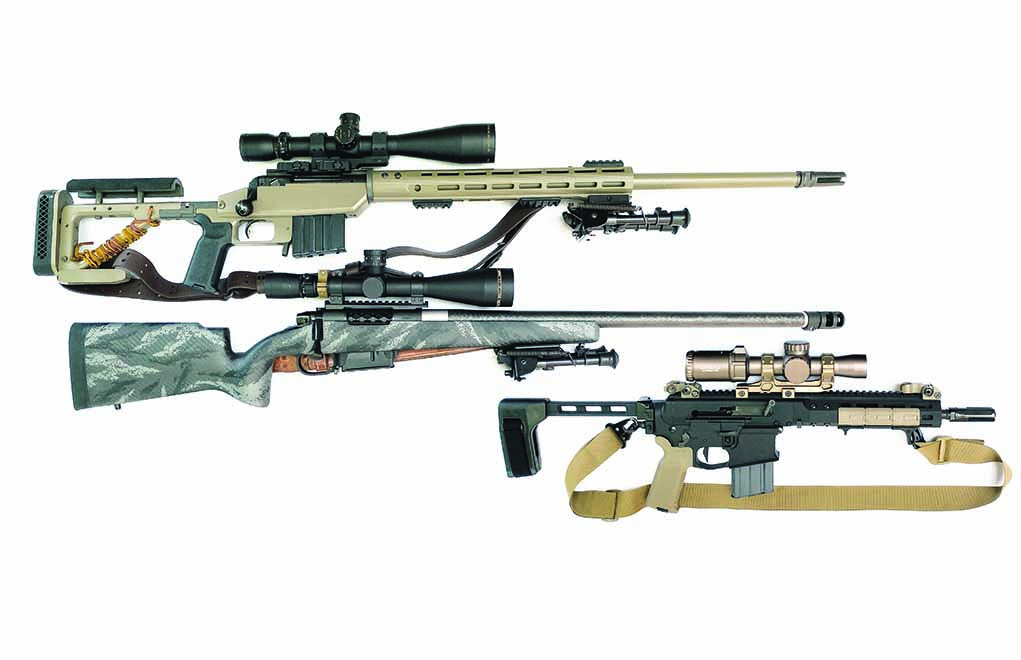
Rigidity is very important for precision at any range. The three guns featured here are all extremely rigid and take advantage of today’s best materials. That rigidity comes in various forms, such as a short, stiff barrel and thick-walled upper receiver on the BRN180S; a light, but super-strong, material application of carbon fiber on the Mesa rifle; and good, heavy steel on the MK4 Mod7.
In general, “normal” range for rifles is considered to be about 500 yards. The old-timers consider that to be iron sight distance. Past 500 yards, things change—and, for many, the “midrange” is between 500 and 800 yards. “Long range” for many target shooters starts at about 900 yards (880 yards being a half-mile) and goes to about 1,500 yards (just over ¾ of a mile). Beyond this is “extreme range,” which has no real limit.
Bolt-Actions Vs Semi-Autos
Today’s semi-auto rifles are substantially better than they were, even five years ago, to the point that many long-range shooters and military circles have been moving to them for general use. However, today’s bolt-actions are also better than they were and are not at all being replaced for roles for which maximum precision is needed.
The first, most basic and most important factor in the bolt-action vs semi-auto conversation is the number of moving parts in the system. For this reason alone, bolt guns as a class will always have greater inherent accuracy potential than a semi-auto. The bolt is locked up for the entirety of the firing process, and there’s no real loss of gas due to the barrel being untapped for a gas system. When it comes to ammunition in a bolt-action, there’s no finicking with getting loads to cycle, and chambers can be cut tighter.
On the other hand, a semi-auto can be restrictive and picky. The sheer number of moving parts in a common AR-pattern rifle is astounding, and their reliable operation depends on all sorts of factors, from buffer weight to the gas port size. Just because it’s reliable doesn’t mean it’s accurate (and vice versa). There has to be a happy medium when it comes to reliability and accuracy, and this can be hard to realize.
Bolt-action vs semi-auto optics? Most scopes today don’t use the “1X for every 100 yards” rule. These optics are variable power, first focal plane and have 0.1 mil adjustments. Current optics are so easy to use that they allow for a shorter learning curve.
Next, rigidity is a critical component of the variances between bolt guns and semi-autos. A bolt-action, especially with a modern metal chassis, is extremely rigid.
Exactly what is “rigidity,” and where does it fall in this equation? Well, rigidity is simply how stiff the entire rifle is. The more rigid it is, the more repeatable it is. Repeatability is a factor here, in that we don’t want parts moving that shouldn’t be moving. This applies to the firing cycle and the gun’s firing duration. This is important in a match, during which a high round count can introduce heat into the receiver and barrel.
Part of rigidity is bedding. Most bolt guns’ actions are held in place to the stock by screws. In some guns, bedding blocks are used; others are bedded in place with epoxy to make the stock-to-action fit exact. Most modern metal chassis use a V-block system that doesn’t require traditional bedding. Because of how the action fits so tightly with the stock, there’s no play or movement during the firing cycle.
A semi-auto AR struggles with rigidity because of how it’s designed. The upper and lower receivers will virtually always have some play between them due to them being two pieces. When it comes to the upper receiver, the entire assembly needs to be as rigid as possible with as strong a hand guard as possible. Pinning the gas block isn’t recommended for accuracy on a precision rifle.
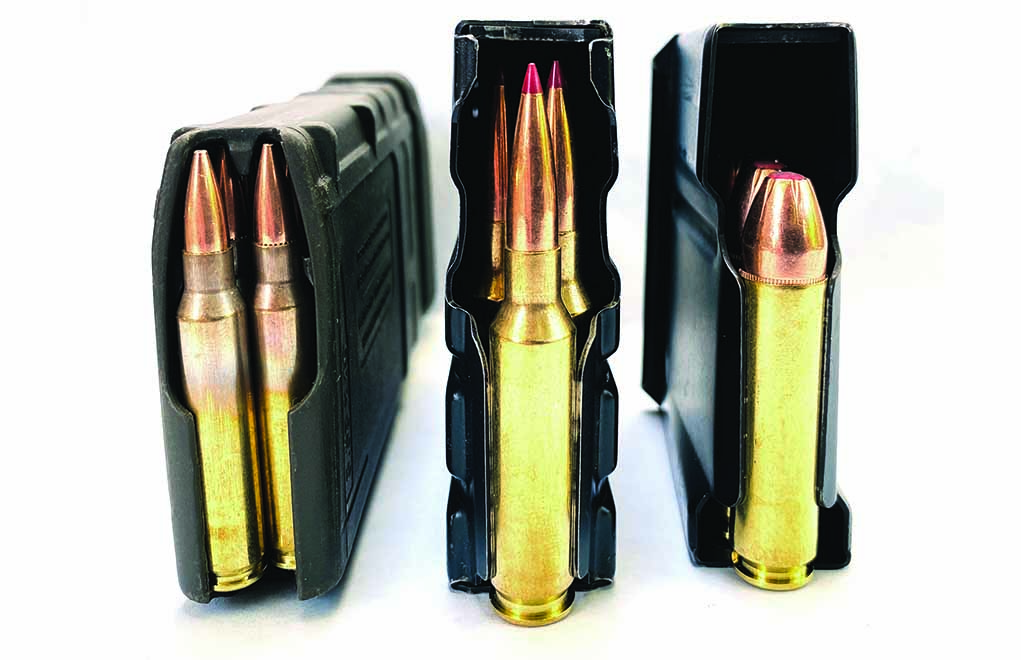
Overall length of the cartridge is usually determined by the magazine. Here, 77-grain 5.56mm (left) is almost touching the front of the mag, but the 143-grain 6.5 CM (middle) has plenty of room for longer loads. The .450 Bushmaster on the right is a demonstration of just how much room you can have in a bolt-action mag and still feed reliably. Try that with an AR!
Other limiting factors are the weight and size of the barrel used on an AR. Only diameters capable of fitting into the confines of the upper with gas system in place will work, and most of these are quite thin by comparison to those available on a bolt-action. Most bolt-actions have a maximum barrel diameter that’s the same width as the receiver, itself, thus making heat concerns and system weight very flexible for the end user.
Optics and their means of attachment actually vary very little between these two rifle types. The common monolithic AR scope mount is something of a standard now, because people now understand that scope height is not as critical an element as it was thought to be in the past. This, combined with adjustable cheek rests, has definitely improved how we mount optics today.
The optics in this article comprise a Leupold VX-3i LRP 6.5-20x50mm in a Geissele Super Precision mount and a Sightron SIII SS 6-24x50mm in a Midwest Industries QD mount. They’re easily swapped between/among rifles and are completely repeatable upon re-installation.
The long-range game is ever-changing. Technology keeps marching on (but this is a critical point of the discussion). Today, we’re innovating within existing platforms and living by the limits of receivers and magazines—not necessarily inventing new systems to accommodate high-performance cartridges.
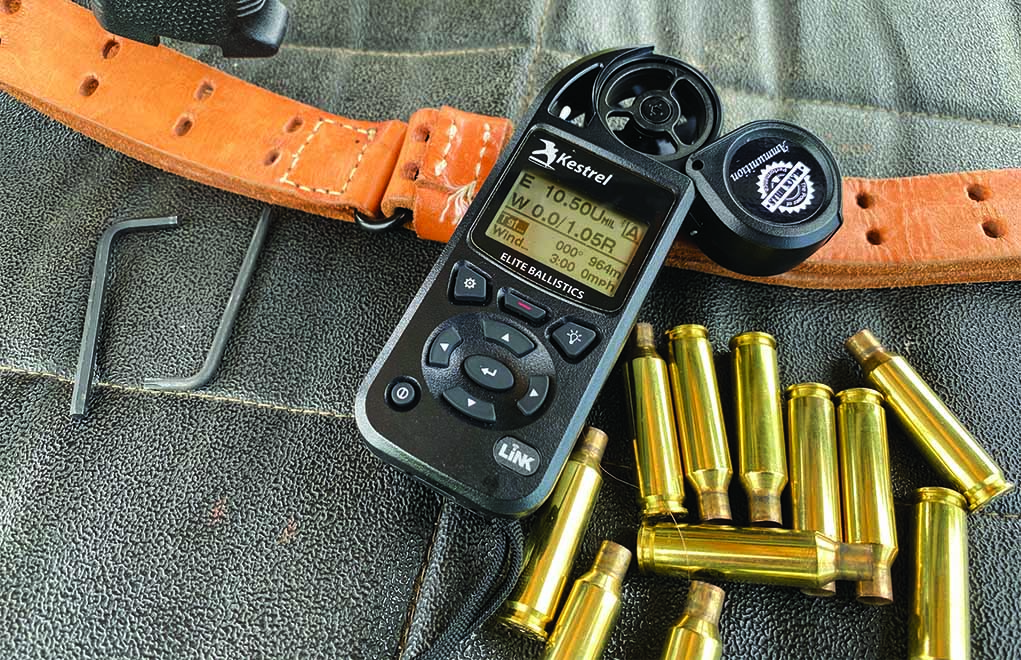
A Kestrel weather station can be programmed to your exact rifle and load. It gives you live weather readings and firing solutions. It can help you immensely when dealing with the wind.
The popular 6.5 Creedmoor is a fantastic cartridge. When it first began gaining popularity, I was skeptical of it and saw it as something of a “gateway cartridge” to better long-range rounds. My initial impression was that it would “fall off the wagon,” along with dozens of other fads that have come and gone. But, it didn’t, and it’s now my preferred long-range round, even over new developments that are technically better.
The reason the 6.5 CM became so popular was that it exceeded what the .308 Win. could do in the same size action. The .300 Win. Mag. is easily better than 6.5 CM, but more people own AR-10s and .308-class rifles than they do the big magnums for portability and low recoil. The upgrade was only a barrel change for ballistics that rivaled larger rounds. The 6.5 CM just made too much sense.
Today’s long-range game fits within the constraints of common actions and parts. When it comes to bolt-action vs semi-auto systems, bolt-actions field a far wider variety of long-range cartridges due to their overall simplicity. The magazines typically work with any case of similar size.
The Alpha Mags magazines featured in my custom 6.5 Creedmoor will work with that caliber, as well as .308 Win., .260 Rem., 6mm Creedmoor, .22-250, .338 Federal, .450 Bushmaster … and so on. AR magazines are much pickier and typically have to be specifically designed to feed with a given cartridge. Special magazines are required for .224 Valkyrie, 6.5 Grendel, 6.8 SPC, 7.62x39mm, .450 Bushmaster and .458 Socom.
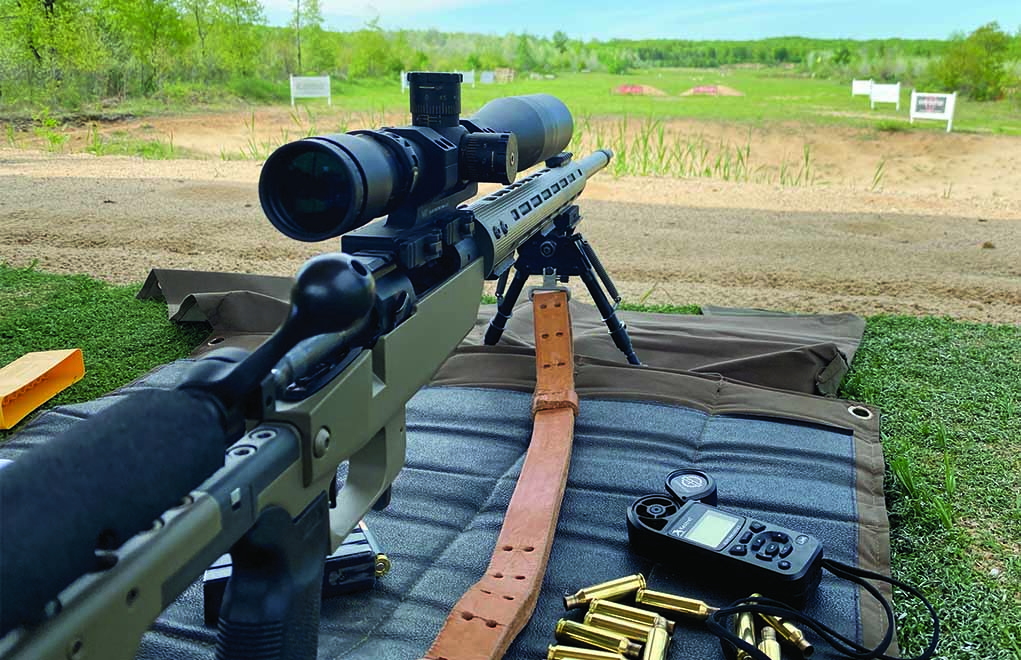
The MTC facility is huge and sprawling. There are dozens and dozens of plates at known and unknown distance. It’s one of the only facilities of its kind in the Midwest, making it a destination for long-range enthusiasts.
The long-range semi-auto’s most seriously limiting factor consists of the size limitations imposed by the magazine and how those factors correspond to reliable feeding. Most bolt-action magazines have room for long loads, but the same isn’t so in AR-pattern magazines.
Single-shot adapters are common in match shooting with the AR past 500 yards, where the long-for-caliber, 80- to 90-grain bullets need to be fed in, one at a time. Gun sizes of .308 and 5.56mm are standard for semi-autos; anything else is a massive step up in cost and rarity, and the calibers are very limited. There’s little payoff when moving to a semi-auto .338 Lapua or .300 Win. Mag. when a far more accurate bolt-action can be procured for far less money.
The Outer Limits
To test some of the differences in bolt-action vs semi-auto platforms past 1,000 yards, I used a 6.5 CM (which is designed for maximum performance at those distances) and the state-of-the-art semi-auto from Sig Sauer—the SIG716 G2 DMR, also in 6.5 Creedmoor. The Sig rifle is a field-dominating precision rifle and is just about as good as an off-the-shelf semi-auto rifle gets.
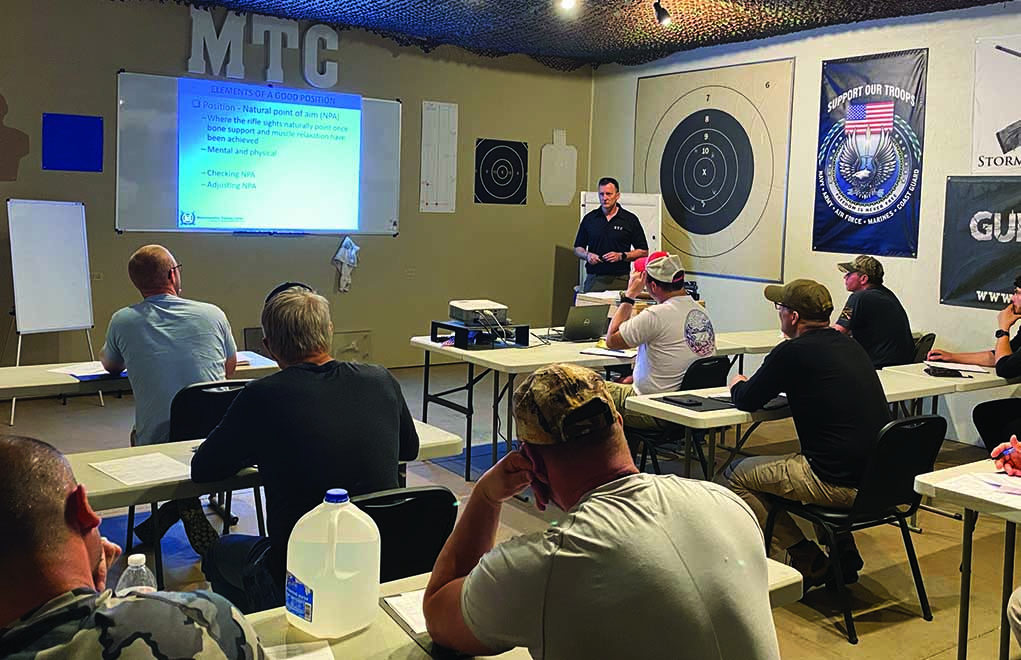
I traveled to the world-class Marksmanship Training Center in Lake City, Michigan, to see what these differences looked like.
The MTC range has steel targets spread out over a vast 1,000-plus-yard range at unknown distances, which makes it a great challenge. The hit probability with the 6.5 CM is high in general, if you apply the basics.
Aren’t sure where to start? A long-range class is a great place to begin. Here, MTC instructors show the students in a beginner’s class some basics before jumping to live fire.
However, where things began to change was surprisingly at the 400-yard line. At those ranges, follow-up shots are slow, so the speed of target acquisition was not that different between the two, because both are low recoil. Hit probability with the bolt-action was 90 percent at ranges to 900 yards on the plates. That last little bit out to 1,050 resulted in a 75 percent hit rate on 18×18-inch plates—mostly due to wind deflection—but once I was on, tight groups resulted.
My bolt-action easily does ½ MOA at 1,000 yards with 143-grain Black Hills Gold in 6.5 CM. To make it fair, this was the primary load tested in both rifles, although Sig Sauer 140-grain match loads were also used, because the 716 came with a test tunnel target displaying accuracy potential with that load.
The 716 DMR was excellent on body-sized targets out to 800 yards, but I could tell it wasn’t keeping up past that. Head targets were hard to hit, even with the help of the Kestrel weather station. The 143-grain bullets left the muzzle a full 200 fps slower than the bolt-action, which was slinging them at 2,800 fps. The lower muzzle velocity, lighter weight and thinner barrel made for a fast package … but at the cost of some precision.
The differences between the two types of rifles are the theory of application. The Sig rifle is state of the art and is designed for multiple roles. It was very capable of hitting past 1,000 yards, but it wasn’t as easily done as with a dedicated—but very heavy and clunky—long-range bolt-action. All things considered, the Sig 716 is a far more useful rifle for most people and is actually more cost effective, as compared to a custom bolt-action. It can, and did, do well at long range, but I was far more comfortable at 400 to 800 yards, and it was much more maneuverable among barricades.
Bolt-Action Vs Semi-Auto: The Decision Is Yours
The argument of bolt-action vs semi-auto rifles comes down to a numbers game among the cartridge used, system weight and intended end use. These factors are then applied against your financial investment.
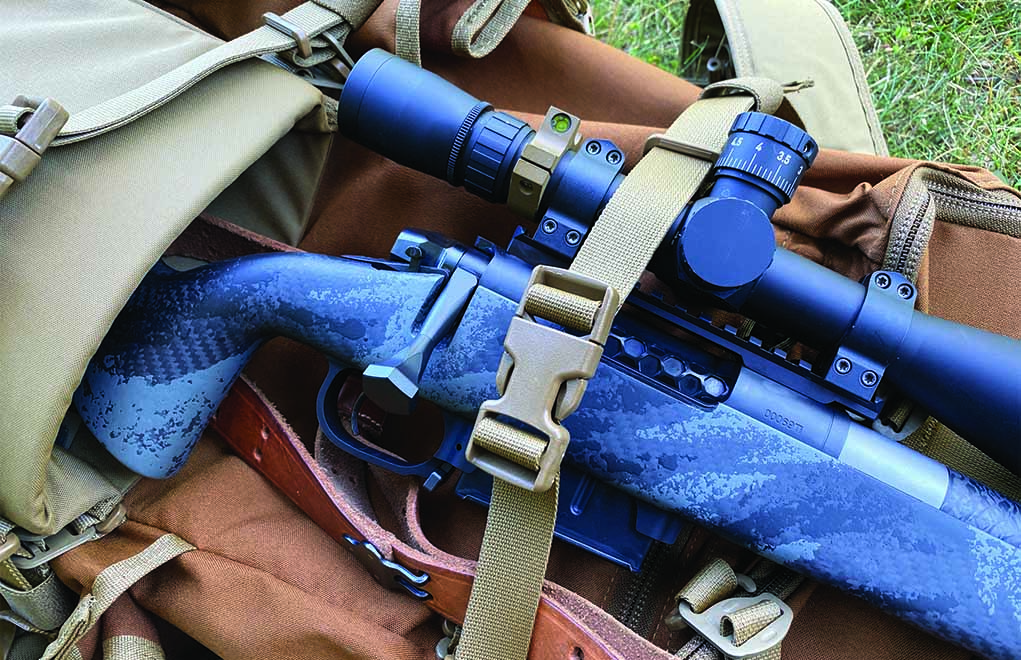
A lightweight carbon-fiber Mesa Precision rifle in 6.5 CM is as accurate as most heavy match guns. However, it’s lighter than most common hunting carbines. If you plan on packing out to a hunt, the Mesa Precision rifle is a gem. Coupled with a Hill People Gear pack, you can hunt virtually anywhere with the same accuracy as with a PRS match rifle.
The Mesa Precision carbon-fiber rifle shown here is just over half the weight of the 716 and a full one-quarter the weight of my heavy target rifle. But, it’s just as accurate as the latter … it’s also twice as expensive! The price of “no compromise” is high, and a rifle such as the Mesa is out of the reach of many shooters who have to decide among weight, accuracy and dependability.
If you plan on maximum precision, a bolt gun is your best bet, in terms of accuracy generated per dollar spent. You’ll never really get the same on-target accuracy using a semi-auto for equal or greater expense. Get the best system for the ranges at which you plan on shooting. If you’re 100 percent inside 800 yards, a semi-auto makes sense for most people. If you get past that to 1,000-plus yards, a bolt-action takes over noticeably and is a substantially better investment.
I’ll admit that I quite often utilize Mexican carry. In case you don’t know what “Mexican carry” is, please don’t speculate that it’s a racist term conjured up by someone with “TDS” (Trump Derangement Syndrome) to describe carrying illegals back across the border.
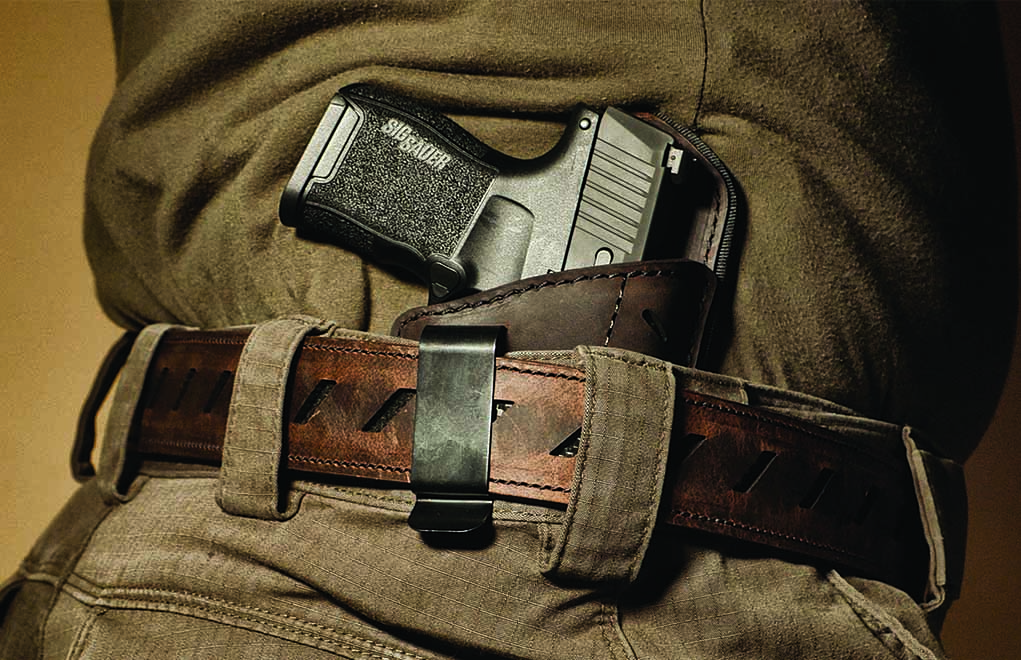
Mexican carry refers to the practice of carrying a handgun in your waistband without a holster. When Mexican citizens were stripped of their right to carry firearms, they began to carry handguns without the aid of gun belts and holsters. If approached by any federales, they could ditch their pistols, and there were no holsters to signify they’d ever had one.
The practice is very similar to the OSS string holster, for which operatives in France during World War II would take a loop of string—or a shoestring—and wrap it around their belt. They would then shove their handgun through the loop. It actually holds the handgun in place reasonably well; and, if the operative were approached by Germans, they could ditch their handgun with no remaining evidence that they’d ever been armed.
I’m not suggesting either method is the best way to carry a handgun, but I will offer that a Browning Hi Power tucked into your waistband is about the most comfortable high-capacity carry option that exists in this modern world. But it does become an issue if your actions become “athletic”—your pistol just might slip out. Additionally, when you go to the restroom, you have to be careful.
Holsters are not mandatory for the concealed carry of a handgun but, in most instances, they make good sense. Finding an affordable holster, one you like—one that’s also comfortable—isn’t easy.
I was once carrying a Lightweight Colt Commander in Mexican style and forgot about it. I had to make a quick pit stop at a rest area and was in what you might call a desperate hurry. When I dropped my drawers, the 1911 hit the floor. The guy in the next stall was apparently of the, shall we say, excitable type. I’ve never seen a fellow exit a stall and a restroom with more haste! Also, the pistol landed on its rear sight with enough force to damage it.
Ideally, most of the time, you should carry a handgun in a holster. The problem is finding a holster that’s comfortable. I have a box full of holsters that, for lack of a more eloquent description … suck! I’m always looking for that better “mouse trap”—a holster that works, that’s comfortable and that doesn’t cost half as much or more than the gun I’m carrying.
Here are four affordable holster options I recently discovered, and they all seem to be well-designed. You might find one of them perfect for you and the way you carry. The good news? You won’t have to spend a fortune to try them.
For more information on concealed carry holsters check out:
Strong-side, outside-the-waistband (OWB) carry is probably the most comfortable way to carry a handgun in a holster. However, it’s also the most difficult to effectively conceal. For those who prefer this carry method, there’s also some concern about weapon retention. Some worry that if they become engaged in a physical confrontation, their attacker(s) might take their exposed gun from their holster.
Outside The Waistband: Safariland Model 637 ALS
Safariland 637 ALS
The new Safariland Model 637 ALS Belt Slide Holster is a concealment holster that has an integrated thumb release, which must be activated before the handgun can be withdrawn. This holster fits many popular defensive handguns and is soft and flexible to fit around the wearer’s body. It has 1.5-inch belt slots and even features a tension adjustment. MSRP: $55.50; safariland.com
Inside The Waistband: Versacarry Comfort Flex Deluxe
Versacarry Comfort Flex Deluxe
Inside-the-waistband (IWB) holsters are much easier to hide, but many find them uncomfortable for long wear. Some even require belt removal to take them off. Versacarry’s new Comfort Flex Deluxe Holster is both comfortable and easy to put on and remove. It’s made from buffalo leather and attaches via an industrial-strength, heavy-duty belt clip that will securely hold it in place. It also has a soft material backing to prevent sweating and enhance comfort. Four sizes are offered to fit duty-sized handguns, 1911s and compact handguns, and there’s even a specific model for the Sig Sauer P365. MSRP: $45; versacarry.com
Appendix Carry: DeSantis Variable 87
DeSantis Variable 87
Another new affordable holster, and one that should also work well for appendix (AIWB) carry, is the DeSantis Variable 87. This is a lightweight holster made from 1060 ballistic nylon and closed-cell foam. It’s also lined with a slick cloth and is fitted with the DeSantis Tuckable 360 clip for unlimited cant adjustment. This allows the wearer to adjust the cant of the holster to enable the best presentation/draw possible, depending on where along their waistline they choose to wear it. The Variable 87 is offered in five different sizes. MSRP: $39.99; desantisholster.com
Unconventional Holster
I’ve never been a fan of a fanny pack for handgun carry. This is probably mostly due to the fact that I just don’t like to wear fanny packs. It’s not that I think I’m too “macho” for a fanny pack (although that could be part of it); I really just don’t like wearing them. However, for those living the athletic lifestyle or who like to jog and engage in other physical activities in public settings, a fanny pack is likely the most viable option. And, for moms who have to deal with smallish children, I also think it’s a better option than a handbag, primary because the gun is at least kind of attached to you.
Off Body: Galco Gunleather PAC Waistpack
Galco Gunleather Fastrax PAC Waistpack
The fanny pack has more or less fallen out of fashion for concealed carry. However, with the new influx of women and others living an active public lifestyle—and who are also serious about personal protection—Galco Gunleather has created the Fastrax PAC Waistpack. This fanny pack is unique: Inside it, there’s a pivoting holster with an activation cord. This makes the handgun much easier and faster to access. It also has a front pocket to store other valuables, such as a wallet or phone. For those who might seriously need to have an athletic lifestyle, it will fit waist sizes up to 50 inches. MSRP: $79; galcogunleather.com
Always a bride’s maid, never a bride. For those who’ve tracked the progression of the 6.8 SPC (Special Purposes Cartridge) that fairly sums up the intermediate cartridge’s military experience. Even some 16 years after its introduction, the Army still flirts with the 6.8, gets hopes up, then fades back into the scenery leaving the cartridge—and its devotees—in limbo. Maybe someday.
Even without its name etched in military lore, the 6.8 SPC has more than proven itself an adept addition to the AR-15 family. Delivering more energy and poking larger holes than the demure 5.56 NATO, the squat .270-caliber improves on the small-bore’s terminal performance. Considerably so. A fact many hunters have come to grasp. Additionally, it can fly with the best of them. Sure, a 6.5 Grendel bullet of comparable weight edges the 6.8 SPC in ballistic coefficient (BC), but their trajectories and range track much closer than most think.
This all leads up to, why don’t you have a 6.8 SPC in your arsenal? Certainly, there are ample 6.8 SPC uppers and complete rifles available by some to the top names in firearms. The addition is simple as slapping down your hard-earned cash and taking one home. Though, if a gun just isn’t a gun unless it has your time, effort, blood, sweat and tears incorporated, there are more humble ways to jump into the cartridge. By this, we mean a complete build and at its heart a quality 6.8 SPC barrel.
Ground Floor Of A 6.8 Build
There are a couple of points to keep in mind before jumping into a complete 6.8 build. While not Gorgon-Knott complicated, it’s a few steps out of the ordinary compared to say, scratching together a 5.56 or 300 Blackout. You can thank the .30 Remington for this.
The parent case of the 6.8 SPC, the .30 Remington—essentially a now-defunct rimless .30-30 Winchester—is larger in diameter than the 5.56 family of cartridges. In particular, its case head. Whereas the 5.56 and its lineage have heads .378 inch in diameter, the 6.8 is a more rotund .422 inch, which doesn’t play nice with one main AR component—the bolt. Luckily, there are many fine options available from companies who’ve remained dedicated to the SPC from the start. The likes of the APR Superbolt, and other specially designed 6.8 bolts are worthwhile components, designed not only for flawless performance but longevity.
Less dramatically, the other aspect that requires special investment is magazines. More than one internet expert will claim plain old PMAGs and the like will cut muster. True enough, you can shimmy the cartridges in and likely they feed … for a while. Sooner or later, you’ll find this is a weak-link strategy.
Designed for a smaller case diameter, the magazines do not stagger SPC cartridges properly, thus do not feed them properly. Which is to say, you’re tinkering with a failure going this route. Fine if you live to clear malfunctions, but the rest of us enjoy shooting. Even if the magazine feeds perfectly, they’ll ware out sooner. Just resign yourself to buying 6.8 magazines.
Star Chamber
If you’re tinkering with building an AR from the ground up, likely you know the difference between a 6.8 SPC and 6.8 SPC II. Though, just to cover all the bases we should spill a smattering of digital ink on the subject.
While the “II” seems to connotate a different cartridge, it refers to chamber design. The cartridge is the same, at least dimensionally.
SAAMI 6.8 SPC Chamber Drawing
We won’t get into all the particulars of why the chamber required redesigning and why the flawed design is the one sanctioned by the Sporting Arms and Ammunition Manufacturers’ Institute (SAAMI). If you want the whole sorted affair, please read our history of the 6.8 SPC; otherwise, accept this brief explanation—mistakes were made.
Anyhow, the difference between the SPC and SPC II is minute—.050 inch of lead—but makes all the difference in the world. In particular, the SPC II .100 inch of lead ensures there aren’t any dangerous pressure spikes and allows for cartridges to be loaded full strength. Though today the issue is fairly moot. Unless you’re buying a vintage gun, don’t expect to find any newly made 6.8 SPC options on the market. It’s a 6.8 SPC II world now and the roll marks on new barrels say as much.
Brief Note On Buyer’s Guide Stipulations
Overall, we’re aiming for “best in class” with this buyer’s guide, the crème de la crème of 6.8 SPC barrel. To this end, not only does this mean they boast the proper SPC II specs and optimal twist rate for barrel length. It also entails the barrels being made to the highest standards from the best possible materials. In many cases, this means these components demand top dollars. But the frontend investment pays off in long-run accuracy.
General Purpose: Daniel Defense 16-Inch Mid-Length
Despite a heavy-barrel profile, Daniel Defense’s 16-inch 6.8 SPC barrel is an excellent jack-of-all-trades. At 2.31 pounds, it’s a bit heavy, but not to the point it proves unwieldy when nimbleness is at a premium. Plus, the thick tube is a boon in precision work. Reining in the 6.8’s already polite recoil, the extra material also resists heat better than a thinner-profile barrels, thus negates barrel whip. In short, follow-up shots are on target.
Excellent strength to weight ratio, the cold-hammer forged chrome-moly-vanadium barrel takes abuse. And at 16 inches in length, crowns a true carbine-length build. Other notables include mid-length gas port, 5/8×24 TPI threaded muzzle, mil-spec heavy phosphate finish, 1:11-inch twist rate and chrome-lined bore. MSRP: $310; danieldefense.com
Hunting: Proof Research 18-Inch Carbon Fiber
Vastly cutting down on the bulk of a build, Proof Research’s carbon-fiber wrapped 6.8 SPC barrels are top-notch hunters. We like the 18-inch option, given it milks a bit more velocity out of the cartridge, while not making for a bulky, sluggish gun. The tube tips the scales at 1.81 pounds, for crying out loud! Steel pistol-length options weigh in more.
Add in the strength and heat-resistance qualities inherent to carbon barrels and you have a package tailored for optimal performance in the field—particularly on a varmint or predator gun. The cut rifling in the stainless-steel barrel proper—a 1:11-inch twist—is flawless, and forms the bedrock of a match-grade tack driver. Other notables include a mid-length gas port and a 5/8×24 TPI threaded muzzle. MSRP: $920; proofresearch.com
Match: Bison Armory 22-Inch Heavy Stainless Target
With the heft and length to squeeze every last bit of ballistic potential out of the cartridge, Bison Armory’s 6.8 SPC match barrel is a rarity in the caliber. But a welcome one.
Bison has a long history with the SPC and knows it inside out. It shows in some of the enhancements it’s made to the heavy barrel. Most notable, the button-rifled tube boasts a 1:10-inch twist rate, optimized for heavier bullets (120- to 140-grain range) with higher BCs. Additionally, Bison runs a rifle-length gas port that, along with the barrel’s mammoth 3.4-pound weight, lends to precision build that run as fast. Though, if you desire, the company will flute the barrel, lightening it a hair.
However, the match-grade tube isn’t compatible with muzzle devices. Instead, it’s cut with a target crown. MSRP: $250 unfluted, $300 fluted; bisonarmory.com
Short-Barrel: Wilson Combat 11.5-Inch Match Grade
Simple and straightforward, Wilson’s match-grade shorty is ideal for creating the perfect 6.8 pistol or short-barrel rifle. (Do your paperwork if it’s the latter!).
As to the barrel itself, while there are shorter 6.8 SPC barrels available, given the cartridge’s case capacity it tends to perform better with a little extra bore. At a minimum, expect less bark and muzzle flash, at no cost to nimbleness.
A Tactical profiled, the medium contour barrel resists overheating and gives a build a bit of forward weight to combat muzzle rise. Its thermal qualities are further enhanced by the use of stainless steel for the tube. Additionally, it runs a carbine-length gas system, thus it is a bit milder mannered. Other notables include bead-blasted finish, 5/8×24 threaded muzzle and 1:11-inch twist rate. MSRP: $230; wilsoncombat.com
With an exceptionally powerful rangefinder and crystal-clear glass, MeoPro Optika LR binos go the distance … and then some.
Some things were just meant to go together. Clock and radio, peanut butter and jelly, laser rangefinder and binoculars. Long-range shooters, hunters and any other marksman that appreciates improved function and less bulk in the field get why that last example is so important. Thankfully, the marketplace has provided.
Among the latest entry into this specialized corner of the shooting world, Meopta’s MeoPro Optika LR series. As the “LR” at the end of its name suggests, the glass is tailored for long-range shooters who routinely push the limits of their rifle’s range and those who hunt open country. This not only goes for glass engineer to go the distance, but also the laser rangefinder that goes the extra mile.
The MeoPro Optika LR line encompasses two models—10×42 HD and 8×50 HD—each with impressive range-finding capabilities. The integrated laser rangefinder measures out to 2,600 yards in the 10x binos and out to 2,950 yards in the 8x. Additionally, the rangefinder features three ranging modes—auto, near ranging and far-ranging. Auto is a continuous setting, giving shooters constant readings on a moving target. Far and near ranging are just like they sound, measuring the distance to the furthest and nearest objects in the aiming circle. The rangefinder also puzzles out incline data, in case a shooter finds themselves above or below their target’s elevation
The binoculars have a simple push-button operation, intuitively situated at the top of the optics and automatic shutoff to extend battery life. Able to read in both yards and meters, the MeoPro Optika LR optics also has four levels of brightness for a clear display in all lighting environments.
As for the optics proper, the Optika LR line boasts HD fluoride glass, coated with the company’s MeoLux lens coating. The combination produces exceptionally clear and bright images, with maximum resolution and contrast. Ample objective lenses do their part to ensure low-light functionality Housed in a lightweight magnesium alloy body, with rubber armoring, the MeoPro Optika LR binoculars withstand rough treatment and brutal environments. As for price, the 10×42 HD has an MSRP of $1,499.99 and the 8×50 HD an MSRP of $1,874.99.
For more information on the MeoPro Optika LR binos, please visit meopta.com
Looking to go armed, but are stuck in the weeds as to what to arm yourself with? Here are 20 of the best concealed carry gun options that will keep you on the defensive.