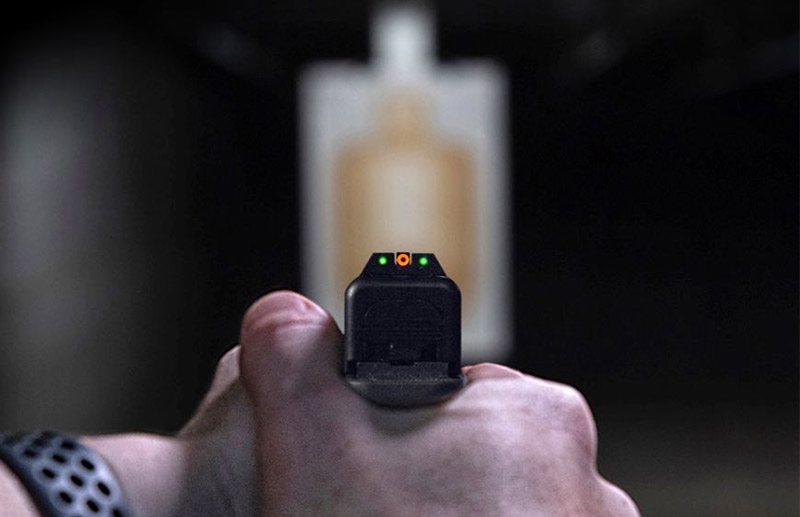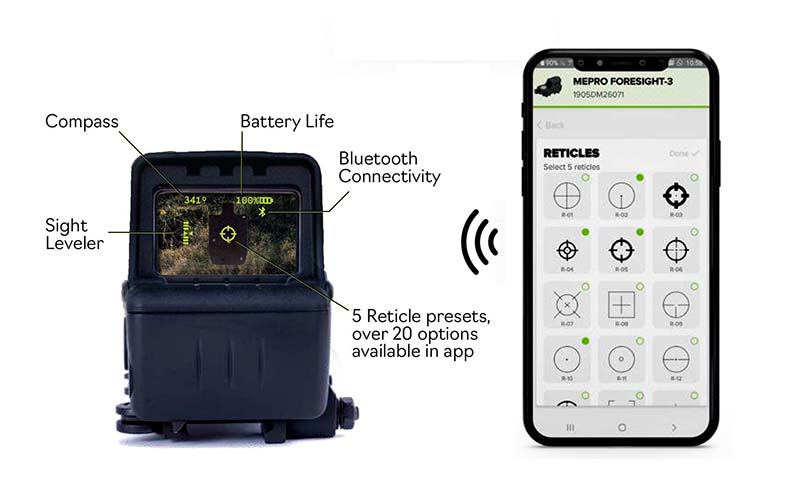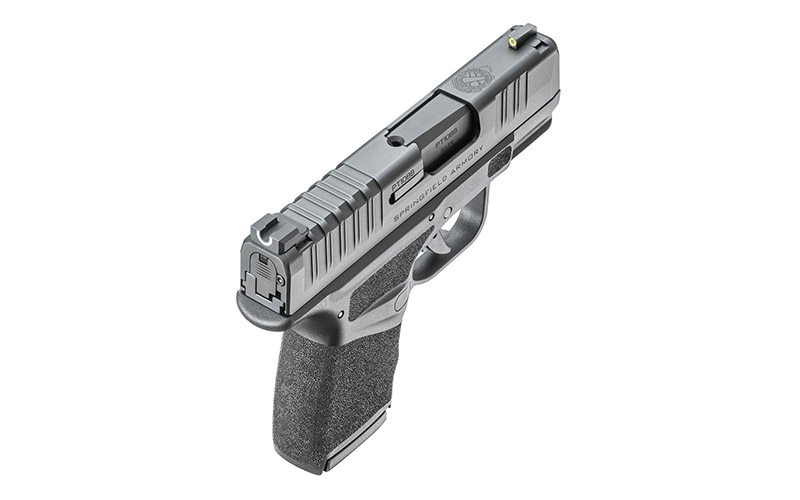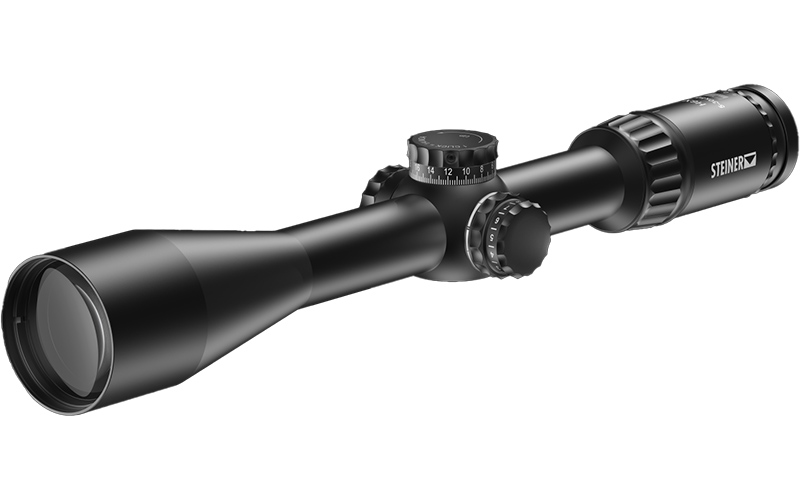
Vortex Optics just announced the Razor HD 4000 GB Ballistic Rangefinder, now featuring an on-board GeoBallistics solver.
Vortex Optics’ newest laser rangefinder, the Razor HD 4000 GB, does a lot more than just read distance. This is thanks to its new on-board GeoBallistics solver, made possible in part by Vortex’s recent acquisition of GeoBallistics. The device’s new capabilities allow it to sync with the GeoBallistics smartphone app to calculate drop and windage corrections based on your specific ballistic profile and the surrounding environment.
As far as the laser rangefinder itself is concerned, it’s essentially identical to the existing Vortex Razor HD 4000 in terms of appearance and capability. That means it can still range reflective targets out to 4,000 yards and less-reflective targets such as deer out to 2,200 yards. It also has the same four target modes (Normal, First, Last and ELR) as well as the Horizontal Component Distance (HCD) range mode that compensates for angles.
The only readily apparent difference is the addition of some buttons that pertain to the device’s new GeoBallistics functions, such as the BAL range mode. In this mode, the on-board GeoBallistics solver uses inputted ballistic data and surrounding environmental data to tell you exactly how to dial windage and drop compensation for a target at a given range. The device uses Bluetooth to pair with the GeoBallistics smartphone app (purchasing the Razor HD 4000 GB unlocks the “Pro” version of the app as well) where custom profiles can be built and uploaded to the device. The rangefinder comes preloaded with three common ballistic profiles and the app features a bullet library, but completely custom profiles can be added too.
The device also features on-board temperature, pressure and humidity sensors as well as the ability to take that data from a local airport. Wind measurements can either be entered into the rangefinder manually, taken from a paired Kestrel device or obtained using the rangefinder’s new Wind Bearing Capture Mode. This mode uses the Razor’s built-in compass and wind speed gauge to determine the wind’s strength and direction. After capturing this, the device provides accurate windage corrections regardless of which way it’s pointed.
There’s plenty more that could be said about Vortex’s new Razor HD 4000 GB, but we’ll save that for the full review we have planned. Until then, just know the rangefinder is available now and has an MSRP of $1,199.99.
For those running America’s rifle chambered for the AK’s cartridge, here are the best 7.62×39 AR magazine options.
While some cartridges like .300 BLK were designed to function in standard 5.56 AR mags, other chamberings require their own, special magazines. ARs chambered for the Soviet 7.62x39mm cartridge are among them.
Since 7.62×39 ARs aren’t nearly as popular as 5.56 variants, there is less factory support for 7.62×39 AR magazines. This means that many of your typical go-to manufacturers like Magpul and Okay Industries are no longer an option.
Here we’ll be going over what makes 7.62×39 AR magazines different, what to look for when buying one and our top picks for the best options on the market.
A 7.62×39 AR-15 from PSA/Lead Star Arms featuring a C-Products 30-round Duramag.
Why Do 7.62×39 ARs Require Proprietary Mags?
Simply put, the issue is that the 7.62x39mm case has more taper than the .223/5.56 case. The Russian 7.62×39 cartridge tapers from 11.35mm in diameter at the rim to 10.07mm at the shoulder, whereas .223/5.56 barely tapers at all (9.58mm at the web to 9.00mm at the shoulder).
Case taper is what determines how curved a magazine needs to be to feed a given cartridge properly, and it’s why AK magazines have that distinctive “banana” curve. Naturally then, problems arise when attempting to design a very curved magazine for a rifle with a straight magwell like the AR.
As you can see, the taper of 7.62×39 (left) results in a much more curved magazine than 5.56×45.
Historically, one of the best ways to design a new rifle from a clean sheet is to start with the cartridge. Once established, a reliable magazine is designed to feed it. Only then is the gun itself designed.
Well, it seems that Kalashnikov and Stoner both did that, as both of their rifle designs have excellent magazines. When the industry decided to combine Mikhail’s peanut butter with Gene’s chocolate with the advent of 7.62×39 ARs, the magazines, unfortunately, could not live up to the reputation of either parent rifle’s mag.
The result is that 7.62×39 AR magazines have historically been a crapshoot in virtually every capacity that they’re offered in. Common failures include the top round sitting too low to be picked up by the bolt as well as nosedives leading to failures to feed.
What Makes A Good 7.62×39 AR Magazine?
What you want to look for is a magazine manufacturer who has invested the time to come up with a follower, floor plate and magazine body that seats and feeds correctly. That means they need to be designed by shooters, for shooters, not mere products to meet demand.
Anti-tilt followers are a must, and in truth should be in any AR-15 magazine you buy regardless of its caliber.
Unfortunately, what you can't see until you physically have the magazine is that the top cartridge should fully contact the feed lips. If it doesn't, it can mean there will be some issues stripping the top round.
If possible, don't buy any 10-round 7.62×39 AR magazines. Since 10-round mags are straight, it means that the cartridges are not being pushed up as efficiently as possible due to the taper. These have given people more problems than quality magazines of larger capacities.
The 28-round Duramag (left) has noticeably less curve than the 30-rounder.
If mag pouches are a concern, look for 28-round magazines as the curve is slightly less pronounced than with true 30-rounders.
Also, you don't need to worry about deciding between polymer or aluminum. All examples that you're going to find are made of steel.
What About AR Lowers That Take AK Magazines?
It's easier to adapt the AR-15's lower receiver to take AK-47 magazines than it is to adapt the AR-15 magazine to feed 7.62x39mm. Some companies have realized this and started making AR lower receivers that can accept standard AK mags. On these, the magwell is removed and replaced with an AK magazine catch.
A PSA KS-47, one of the available 7.62×39 AR-15s that take AK mags.
The reality of the situation is that these lowers are a better solution for getting 7.62×39 to run in an AR than trying to convert AR-pattern mags to feed it. The downside, of course, is that it requires a new upper and lower. A large reason why people are interested in the 7.62×39 AR concept is that they could use their existing, standard AR lower to fire the cartridge, only needing a new upper and mags. ARs chambered for this caliber that feeds from AK mags are the better design, but it also defeats the purpose for most.
If you’re reading this, it’s probably because you have or want a 7.62×39 upper for your standard AR-15 lower, and that means you’ll need magazines for it. While they may not be as good as 7.62×39 AK mags or 5.56 AR mags, the good news is that some are well-proven and shouldn’t give you any real issues.
The Best 7.62×39 AR Magazines:
C-Products Duramag
This is the gold standard. Duramags are one of the no-brainer AR-15 magazine brands, so this should arguably be your first choice unless it turns out they don't work in your specific setup.
They're available in 5-, 10-, 20-, 28-, and 30-round capacities, but all have a stainless steel body, a Teflon coating, revised feed lips for total contact and anti-tilt followers. C-Products does things right, and it designed them from the ground up to function. MSRP ranges from $18.90 to $29.30.
ASC
ASC is another excellent AR magazine manufacturer, and while it specializes in aluminum GI-style mags, the company also offers its stainless steel line in 7.62×39.
The mags are offered in either black or FDE, with chrome silicon springs, anti-tilt followers and a stainless steel floor plate. They're available in 5-, 10-, 20- and 30-round capacities. MSRP is $21.99 for the 30-rounders, though factory seconds (cosmetic issues only) are a bit cheaper.
D&H Tactical
The magazines from D&H feature carbon steel bodies with a QPQ finish and anti-tilt followers specifically designed for the 7.62x39mm cartridge. They're available in 10- and 30-round capacities. MSRP is around $40 for the 30-rounders, but these are buy-once/cry-once magazines. D&H builds them like tanks.
AR-Stoner
AR-Stoner is the house brand of MidwayUSA, and its 7.62×39 AR magazines are said to be capable, but that comes with a caveat. Some individuals report having issues with them out of the box, but after some minor tweaking, they can run like a top.
They're offered in 10- and 30-round capacities, with stainless steel bodies, anti-tilt followers and chrome silicon springs. MSRP is only around $20 for the 30-rounders, making them one of the more affordable options.
E-Lander
E-Lander is an Israeli manufacturer mostly known for producing magazines for its country’s military, and it does not skimp on build quality or reliability. It only exports a 17-round 7.62×39 AR magazine because it was the only one that ran reliably enough for its standards.
The body is stainless steel with a stainless floorplate and features an anti-tilt follower and corrosion-resistant finish that's said to be rated for over 60 hours of continuous salt spray. These magazines are tough, and what they slightly lose in capacity they more than make up for in reliability. Street prices are usually around $30.
You should be aware that the AR-15 is an incredibly popular rifle platform in America, and for good reason. Relatively inexpensive, light recoiling, reliable and easily adaptable to a particular role are all huge factors in why it’s grown to be crowned as “America’s Rifle.”
Have a plan when you start buying AR-15 accessories and parts; a simple rifle doesn’t mean less capable.
And if I may be completely frank, those are the same reasons that we have a sea of subpar AR-15 accessories and parts all over the market. Experience and several hours of exhaustive research on Facebook tell me that the carbine is misunderstood by a huge number of AR owners.
So, before you jump on AliExpress and order all of the Chinesium “upgrades” you can find, this is where I would start to get the most out of my rifle—and get the most from my money when considering upgrades.
The AR-15: Not LEGOs
It’s easy to think that building an AR-15 is just like snapping together some LEGOs … but you couldn’t be more mistaken. It wasn’t until I had the good fortune to attend an armorer’s course from William Larson, the AR-15 Yoda himself, that the number of out-of-spec AR parts on the market sunk in.
One of the sayings that Will was fond of is, “AR-15s aren’t LEGOs because LEGOs have a spec.” Armed with new knowledge, I started to pay closer attention to aftermarket AR15 accessories and parts than I ever had before. And as you might expect from Yoda, Will hit the nail on the head.
The ultra-strong Magpul UBR Gen2 is a perfect companion for the Vltor A5 system.
The truth is that most of the ARs on the market—and the majority of aftermarket parts—labeled as mil-spec … well, they aren’t. On the civilian market, that dirty little term “mil-spec” means that the part is sized to fit the wide range of specifications found on commercial AR-15s, not that it meets the standards outlined in the actual technical document that outlines the real mil-spec.
Just because that bargain-priced part says it’ll fit doesn’t mean it will. You might have to rely on time-tested gunsmith techniques—such as holding your tongue just right between your lips, a large hammer or even a Dremel tool.
If you prefer sparing yourself the guessing game, stick to high-quality parts; you might not need to rely on the Dremel after all.
Have A Plan
The saying “Jack of all trades, master of none” is just as applicable to rifles as it is people. The “one rifle to rule them all” simply doesn’t exist. Every rifle has specific weaknesses and strengths based on how the rifle is spec’d out from the factory, plus whatever changes are made to it after purchase.
An 18- to 20-inch barrel rifle might be perfect for some hunting, Cold War engagement distances or use in a DMR role. Will it work in a CQB role while defending your home? Sure—but it isn’t going to be ideal.
An 18-inch DMR rifle would make a less-than-ideal home-defense rifle, but it’s great at distance.
Similarly, I recommend that you don’t choose a 10.5-inch 5.56 NATO SBR or pistol to compete in a Precision Rifle match. That MK18/CQBR-inspired gun is far more at home in the tight confines of a structure, such as your home.
Whatever role you have for your rifle, make sure you follow local and federal laws. Yes, many can be considered unconstitutional, but failing to do so could land you in much more trouble than you’re interested in handling.
It Isn’t ‘Just As Good’
I’m not going to shame anyone for the Zombie Slayer 9000 that was built to kick-start their second career as a “gunfluencer” by propelling an online social account to legendary status. The truth is that rifle is probably as functional—if not more functional—than the GM Hydramatic M16A1 clone hanging on my wall.
Cool-looking guns are cool, and there isn’t anything wrong with that until you start believing that the Zombie Slayer 9000 is “just as good” as a proven rifle from Sons of Liberty Gun Works, Sionics, Geissele, Knights Armament, FN America and a pile of other AR manufacturers with guns that are proven reliable.
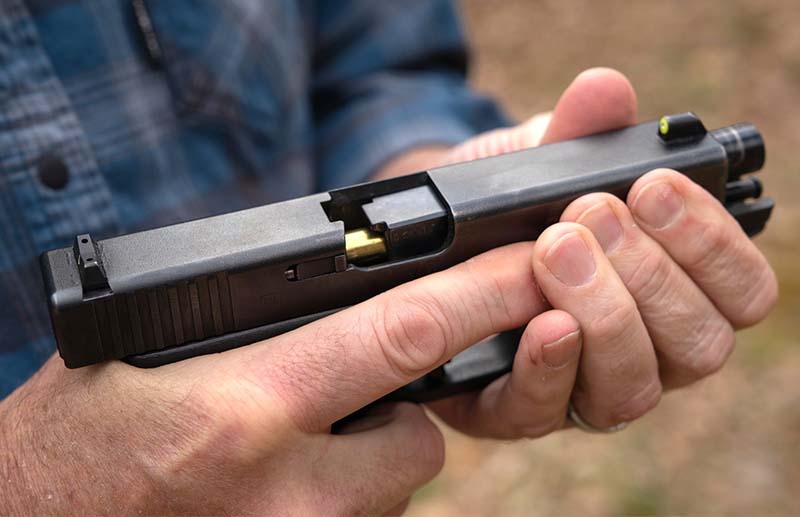
M-Lok has become the new standard for attaching AR-15 accessories; a 1913 rail is still serviceable, but avoid KeyMod at all costs.
The same thing applies to knock-off parts that are priced significantly below the cost of the original one. Better materials, more research and development, innovative design and better quality control are going to play a factor in price, making the original version likely more expensive.
Instead of blindly cutting corners with part quality, think hard about the part you intend to save a few bucks on … and then think about how badly you might get hurt if that part blew up during a catastrophic failure. Buy the quality; it’s always worth it.
A sling is essential, maybe the most important AR-15 accessory. Period. It can be used to carry a rifle, provide more stability when lining up a shot, and retain your rifle should someone try to grab it away from you.
Blue Force Gear Vickers Sling
The single-point sling is easier to use in cramped spaces due to the amount of movement they offer, but that’s also the weakness of the single-point design. When the rifle is slung, it swings all over the place, hitting your knees, shins and everything else in its path.
There are a bunch of well-made examples of single-point slings, but if you’re determined to buy one, get a Magpul MS3 or MS4 sling that can be converted to a two-point easily.
Preferably, choose a quick-adjust two-point sling, which offers more stability when carrying the rifle and shooting it than a single point will. The two-point sling also excels when carrying the rifle slung in front, side or back.
Models to consider are the Blue Force Gear Vickers Sling, the SOB B-Sling, and other similarly built models. Pick a high-quality design and you won’t be disappointed.
Step Up Your Optics Game
We live in the future with the entire internet in our pocket, and adding a red-dot or low-powered variable optic (LPVO) to your rifle reliably enhances your ability to aim the rifle.
LPVO technology is to the point that shooters who’ve acclimated to the more versatile optic are about as fast as the folks using a red-dot. Not only is most of the speed you get from a dot available, but there are also 10x scopes—like the Vortex Razor HD Gen III 1-10x—that you can crank up when precision is needed.
If the minimum buy-in for a high-quality LPVO of $1,000 is a bit steep, a good red-dot might be the ticket. Among Holosun, Aimpoint, Sig Electro-Optics and EOTech, there’s a dot that fits your needs. However, beware of the bargain dots: The market is flooded with cheap sights that will die or lose zero at the worst times.
Also, don’t forget a high-quality mount for your new optic to ensure you don’t move the optic should you bump it on something. Not all rings and bases are created equal, either. Not even close.
Floppy Barrel Fix
Did you know that when you apply pressure to your plastic clamshell handguards by leaning into a bipod that it actually changes your point of impact?
A free-float rail nearly removes that deviation and also gives you somewhere to attach lights, lasers, sling mounts and index points, such as a Gripstop. Look for a high-quality Picatinny rail model or preferably, something with M-Lok slots. Avoid KeyMod since it isn’t heavily supported anymore. M-Lok is the clear winner in that popularity contest.
Any high-quality brand should do you well, but there’s a handful of proven performers: Geissele, Sons of Liberty Gun Works, Hodge Defense, Bravo Company and Knight’s Armament. Cover the full length of the barrel, but don’t extend over the muzzle.
Triggered
You don’t really need to upgrade your trigger, the standard mil-spec style trigger that’s found in most rifles will be perfectly adequate for most shooters. However, upgrading a mil-spec trigger almost always offers immediate performance improvements.
Should you decide that you want to upgrade the trigger on your rifle, I suggest that you look for a trigger that isn’t housed in a drop-in cassette. It’s possible that this design can trap debris in the trigger mechanism, leading to a malfunction.
A good old Geissele not only provides a snappy break but also is easy to maintenance.
Geissele made their name with their triggers, and for good reason. Regardless of the role you have identified for your rifle, Geissele has a trigger that’ll work for you. There’s a budget-friendly option—the ALG Defense Advanced Combat Trigger—if the regular Geissele line is more money than you’d like invest.
New Furniture Livens The Place Up
An A2 grip and M4 stock will do just fine in a pinch, but those are often among the first things that get ditched on a new rifle. Sadly, the M4-style stock is missing a QD attachment point for a sling, which is a good enough reason for me to chuck the stock one into the recycler. As for the grip, many aren’t fond of the “bump” between the middle and ring finger placement … and they ditch that as well.
Magpul UBR Gen2 Stock
There are a ton of great grips out there: Which one you choose really depends on the role of the gun. The Magpul series of grips that accept an insert are a solid option because you can stow some extra oil, some Skittles or even a spare bolt and firing pin with one of the available inserts.
What stock you choose is equally dependent on the gun’s purpose. If you have a dedicated precision-focused rifle, you might choose the Magpul PRS stock or B5 Systems Precision Stock. A general carbine might be better off with something a bit less expensive yet still offering a wide range of adjustability.
Folding Stock
While a LAW Tactical folding stock adapter might not strike you as a common-sense upgrade, it really is. A LAW folder isn’t a must on every AR-15, but it’s a useful addition to rifles or pistols that you might want to carry discretely.
The ability to chop the buffer tube and stock off your rifle for storage and transportation opens up a bunch of possibilities in terms of rifle bags, in addition to where you’re able to stow that bag. Pair a LAW folder and a discrete rifle bag from Tuff Products, and those awkward moments in the hotel elevator while attending an out-of-town training class or match are in the past.
While a folding AR-15 might seem unnecessary, the robust LAW Tactical folder is a must-have on many of the author’s rifles.
Be cautious of knock-off folding stock adapters or ones that copy the design of LAW Tactical that are made from inferior metals. You might save a hundred bucks or so at the cost of replacing durable steel construction with substantially weaker 6000 series aluminum. Personally, I don’t like the idea of my face being close to a reciprocating bolt and bolt extension that passes through a joint that needs to be precisely aligned, only to be housed in “good enough” materials.
AR-15 Accessories: It Can Be Like LEGOs
The AR platform is nothing short of amazing. It checks just about every box that you can think of and, if it missed one, just change the rifle so it checks all the boxes for you.
Even though the commercial model AR-15s doesn’t have a spec now, maybe one day manufacturers can settle on some standards.
If that happens, AR-15s might actually be like LEGOs.
Editor's Note: This article originally appeared in the 2020 December issue of Gun Digest the Magazine.
Looking for a new iron or piece of kit to enhance the one you already own? Check out these 7 new bits of guns and gear to grow your firearms wish list.
Overpowering nearly any other commercially popular pistol cartridge, the 10mm gives those who can wield it effectively a definitive edge. Unveiling a 180-grain Golden Saber option in the hard-hitting pistol cartridge, the self-defense “Perfect 10” just got a little more perfect. Loaded with Remington’s famous bonded-core bullet, the ammunition offers a hollow-point option that not only expands like the dickens but also retains a majority of its weight at the target. This means larger and deeper wound cavities that increase the odds of neutralizing a threat. Additionally, the loads are fairly balanced for maximum terminal effect and shooter controllability, with a muzzle velocity of 1,150 fps. MSRP: $48, box of 20
Meopta MeoSight IV
Improving accuracy, target acquisition and follow-up shot speed, the simple aiming solution of a red-dot performs wonders. Meopta offers a solid option with its smallest and lightest micro red-dot—the MeoSight IV. Weighing only 1.2 ounces, the MeoSight IV has a length of 1.89 inches and a width of 1.41 inches, the 3-MOA red dot proves anything but cumbersome on a pistol. Its 30,000 hours of run life on a single battery and automatic illumination setting mean it’s always ready regardless the conditions. MSRP: $299
Holosun DRS
While not on the market yet, Holosun is giving shooters an entirely new way of looking at red-dots. The Digital Reflex Sight (DRS) is a hybrid sighting system, marring the fast acquisition aiming system with thermal and night vision options. It’s a pretty intriguing system, with the company’s popular AEMS closed emitter forming the base and a fairly intuitive system to transition between normal red-dot and thermal/NV. The DRS-TH (thermal model) and DRS-NV (night vision) could prove game changers and definitely have the potential to enhance home defense, among other things. MSRP: Expected to start at $1,000
940 Pro Tactical/Holosun Micro Dot Combo
The 940 has already made a name for itself as a nearly flawless running semi-auto, and the Pro Tactical puts the shotgun’s firepower and ease of use into a perfect package to guard hearth and home. Now, Mossberg has sweetened the deal, offering the scattergun factory outfitted with a Holosun Micro Red Dot. It’s a definite upgrade for the 940 that takes advantage of its milled optic-ready receiver. Tailored for CQC, the Pro Tactical is a terse 37 inches in length, boasts a 7+1 capacity, has an adjustable length-of-pull and chambers up to 3-inch 12-gauge shells. MSRP: $1,333
FN Rush 9Ti
In the close confines of the home, a suppressor can prove an excellent defensive upgrade—mitigating recoil and avoiding shell shock from a pistol’s report. FN America now offers civilian shooters this advantage. The company’s first commercial suppressor (it’s made them for militaries only in the past), the Rush 9Ti is designed to enhance nearly any 9mm pistol with a relatively svelte and light suppressor. Mountable on any 1/2×28 threaded muzzle, the titanium can with an aluminum and stainless-steel baffle stack comes in at just under 11 ounces. Furthermore, its 1.3-inch diameter offers a fairly clear line of sight on most pistols, while its 7.3-inch length keeps it relatively wieldy. MSRP: $850
Oracle Arms 2311
If the 1911 and Sig P320 had a love child, it’d likely look like the Oracle Arms 2311. New to the scene, Oracle Arms’ enhanced-capacity pistol brings together the best of what each of the classics has to offer. Available in five models, perhaps the biggest selling point is its P320 magazine capacity, giving the metal-framed gun plenty of firepower on board—15+1 in its Compact model, 21+1 in its Combat Elite and Competition models. The 9mm line also has a snappy single-action trigger, enhanced 1911 ergonomics, simple linkless barrel and bushing-free design, and a hammer (because everyone loves hammers!). MSRP: Starting at $1,700
Sig Rose
The new Sig Rose serves up an attractive and enhanced option meant to get first-time women shooters up to speed … fast. The pistol is a P365 with a touch of rose-gold accents, an understated rose motif on the grip and available in both 9mm and .380 ACP. However, there’s more to it than just a heater. The Rose is sold as a complete package, which comes with two magazines, a TSA-approved Vaultek Lifepod pistol safe, five polymer dummy rounds for dry-fire practice, a mag loader and access to the QuickStart guide and online training series. Overall, it’s a fairly solid system for those just getting into the shooting game. MSRP: $800
Editor's Note: This article originally appeared in the April 2023 issue of Gun Digest the Magazine.
The author takes a closer look at the Taurus 856 Defender T.O.R.O., the world's first factory optics-ready revolver.
There’s something about the blending of old and new firearms technology that’s always gotten my motor running. So, when I saw that Taurus had red dot-equipped revolvers at SHOT 2023 I naturally had to take a closer look.
Despite never being much of a revolver guy, and only recently venturing into the world of red dot-equipped handguns, I immediately liked the concept. I mean, why not? Virtually every other style of handgun comes optics-ready these days, so why not revolvers too? It was only a matter of time until someone put the two together, but Taurus happened to be the first with the release of the 605 & Defender 856 T.O.R.O.
The 605 is a 5-shot .357 Magnum and the 856 Defender is a 6-shot .38 Special +P, and I brought in the latter for testing.
Upon its arrival, I was both impressed and somewhat surprised by how simply the company converted its standard 856 Defender into a T.O.R.O. (Taurus Optic Ready Option) variant. Yet, I was left feeling more work could have been done for the concept to truly be perfectly executed.
The Heart Of The Bull
As mentioned, there really isn’t much difference between a Taurus 856 Defender and the new 856 Defender T.O.R.O. model. The standard Defender variant is just a Taurus 856 but with a longer, 3-inch barrel and larger rubber grips.
For the T.O.R.O. version, the company merely taps and dies the top of the frame twice to accept an adaptor plate and throws the relevant hardware in the box. It also comes with the smaller, standard-sized 856 rubber grips. Besides that, the two guns are identical, and without an optic installed the iron sights work just as good on either version.
As far as the rest of the gun goes, there isn’t a ton to say. The matte black finish may not be very pretty, but it does seem to be very durable and functional. The cylinder latch was initially quite stiff and took some effort to swing the cylinder out, but it loosened up after some use and would likely continue doing so. Outside of the ability to add an optic, it’s the same old Taurus 856.
The cylinder was initially pretty stiff to swing out, but it didn’t take long for it to loosen up.
On The Range
While the double-action trigger was on the long and heavy side, I thought that the single-action trigger was actually quite nice. It’s not the lightest I’ve ever felt, but it was very crisp. In double-action, the trigger is easy to stage, but the long pull results in an equally long reset. While it’s somewhat endemic to DA/SA revolvers, I did notice that when trying to shoot very fast it was easier than normal to lock the trigger after pulling on a false reset. Plenty of other revolvers have this quirk, however, so it’s just something to be aware of and factor into your training.
The compact rubber grips that come with the gun work fine, but they’re obviously designed to be more concealable than comfortable. Unless you specifically are looking at an 856 T.O.R.O. for carry, I would definitely put larger grips on this for the range or home defense.
My final small complaint with the 856 itself is regarding the hand ejector. While the revolver ejected spent cartridges with about the same consistency as others that I’ve shot (most of the shells most of the time, but it’s not rare for one or two to get stuck), the ejector rod itself got frozen in the downward position more than once. I don’t believe that I was hitting it too aggressively, but it still needed an encouraging pinch before the spring could return it to its original position. This would likely fix itself after more of a break-in period or with some lube on the rod, but that’s certainly not something you want to happen while reloading in an emergency.
The author found that it was easier to shoot the 856 T.O.R.O. than any red dot-equipped automatic pistol that he’s tried. When pointed naturally, the dot always appears in the window.
While the optic is mounted pretty high in relation to the bore, at least compared to automatic pistols, some of the revolver’s innate qualities compensate for it. Many shooters feel revolvers point more naturally than automatics, and the red dot helped highlight this phenomenon. I’ve shot most major automatic handgun styles equipped with red dots, and for me, it was easier to acquire the dot with the 856 T.O.R.O. than with any of them.
When I put a red dot on my Makarov (Gun Digest Volume 40, Issue 3), it took some practice to quickly find the dot from a draw. With the Taurus, I could instantly and consistently find it every time. Since one of the arguments against putting red dots on handguns is the learning curve associated with using them, this is a big point in favor of the optics-ready Taurus. I feel that just about anyone, regardless of their experience level, could pick one of these up and start making accurate hits with relative ease.
Another benefit of the red dot revolver concept is the fact that there is no slide for the optic to reciprocate on. With red dot-equipped automatics, the optic moves with every shot, only adding to the challenge of reacquiring a sight picture while firing. Because revolvers have no slide, it allows the red dot to remain in place which in turn facilitates faster follow-up shots. As long as you can learn how to properly manage the recoil, it’s possible to keep the dot visible in the window throughout an entire string of shots.
Despite not being a frequent revolver shooter, the first time I took the 856 T.O.R.O. to the range with a red dot I was clearing plate racks faster than usual. It’s a slick combination.
As you can see, the Bushnell RXC-200 has an impressively clean and crisp red dot.
T.O.R.O. Time
When it comes to the T.O.R.O. side of the 856, I see both pros and cons regarding how Taurus accomplished it. Firstly, despite being simple, the system is well-made. Installing the plate and optic was incredibly easy and everything was still tight and secure by the end of the review. All the screws and tools needed to install the plate are included in the box, and once mounted, it’s ready to accept any micro red dot with a Holosun K or compatible footprint. I put on one of Bushnell’s new RXC-200 sights.
A clean-looking setup, but the author still feels that the red dot could have been mounted slightly lower if the optics plate wasn’t as thick.
While the simple design does allow Taurus to only charge $16 more for the T.O.R.O. version, in my view, it also resulted in the company taking some shortcuts. While it undoubtedly would have resulted in a higher price tag as well, with more effort, I’m confident that Taurus could have mounted the red dot a little lower. As it stands, there is zero material removed from the top of the frame and the plate itself is about 4mm thick. It doesn’t sound like much, but if the optic sat just a few millimeters lower, the front sight would only need to be a few millimeters taller for co-witnessing to be possible.
Some don’t think co-witnessing is a big deal, but I appreciate having the option to, so the fact it’s impossible with the 856 T.O.R.O. was disappointing. The benefit of Taurus’ method is that without an optic installed, the factory iron sights still work, but who buys a red dot revolver to shoot with irons? For what’s being touted as the world’s first red dot revolver, I would have preferred it if Taurus fully committed to the concept.
The way that it is, the installation of a red dot already makes the front sight unusable. To co-witness, one would have to replace it with a comically tall front sight (not a great idea for a carry gun), so removing it entirely may be a better idea. It’s pinned in place at least, so this is possible to do if desired.
The front sight is pinned in place, so it could be removed entirely if desired.
Who Exactly Is The Taurus 856 T.O.R.O. For?
Considering that it appears to have been designed as a carry gun, I’m a little confused about who exactly the 856 T.O.R.O. is for. Most people who carry a gun today choose an automatic. Those who still opt for a wheelgun generally do so primarily for one of two reasons in my experience: compact size or familiarity. Those who appreciate just how small a snub-nose .38 can be in a pocket likely won’t want a 3-inch gun with an optic mounted on top. Those who are intimately familiar with shooting revolvers are almost certainly also accustomed to using iron sights, so most won’t be too interested in the addition of a red dot.
While I’m sure there are some excited to carry one, frankly, I feel that the T.O.R.O. concept would have been better applied to some of the other revolvers in Taurus’ lineup. The company offers several larger revolvers in various calibers intended for different applications, ranging from .44 Magnum woods guns to .22 LR target revolvers and other .38 Special/.357 Magnum models with larger grips that are easier to shoot. Whether you wanted a bear-defense/hunting revolver, a range plinker or a nightstand gun, all seem like better potential hosts for a red dot than a concealed carry revolver… at least to me.
The 856 T.O.R.O. pictured with some defensive .38 Special hollow points. If you were serious about carrying a revolver with a red dot, the 605 (5-shot .357 Magnum) T.O.R.O. variant would probably be the smarter choice.
When it comes to carrying an 856 T.O.R.O., holsters are supposedly in development, but at the time of writing no official models are yet available to the public. If Taurus wanted to push this as a carry gun, I feel that the holsters should have been ready to go at launch.
Parting Shot
In total, I put around 200 rounds of PPU 158-gr semi-wadcutters through the 856 T.O.R.O. and didn’t experience any malfunctions. Any issues outlined earlier in this review were minor, would likely be solved by more break-in time or lube and are somewhat expected of a sub-$500 revolver. Overall, I was impressed with the gun. At its heart it’s still a no-frills .38 Special Taurus, but it makes for a better-than-expected red dot host and does so very affordably.
The Taurus 856 does work with HKS 10-A speedloaders as seen here, but Taurus recommends the HKS DS-A for a better fit.
Regardless of how many people may actually be interested in carrying one, the Taurus Defender 856 T.O.R.O. is a sleek little package that worked exactly as intended. For those who enjoy shooting revolvers and are open to the idea of red dots on handguns, it’s definitely worth checking out.
In this review, the author takes a closer look at the Tisas D10, a 10mm Auto 1911 pistol imported out of Turkey.
The 10mm automatic (auto) pistol cartridge has always had a special allure to those looking to deliver as much power on target as possible … from a concealable pistol. It’s also considered one of the best handgun hunting cartridges suitable for a conventionally sized auto-pistol. And the cartridge is indeed powerful: It can generate muzzle velocities exceeding 1,700 fps, with muzzle energies as high as 800 foot-pounds.
Of course, as Newton told us, for every action there is an equal and opposite reaction. When put into language the average hillbilly can understand, it means 10mm handguns have a lot of recoil. In fact, with the hottest loads, they’ll recoil with more than twice the force of a 9mm and as much as 30 percent harder than a .45 auto with +P ammunition.
The cartridge was originally designed for the Bren Ten pistol, and both the cartridge and pistol were influenced by gun writer Jeff Cooper. But the Bren Ten and the birth of the 10mm are old news—40 years old, to be exact.
Since then, the popularity of the 10mm has seen ups and downs. For a time, it was even chambered in an issue service pistol by the FBI. However, with the introduction of the 10mm Lite—.40 S&W—interest in the 10mm auto waned. While it remained popular with hunters, it did not get a lot of attention for concealed carry.
Interestingly, when the FBI decided to ditch their .40s and return to the 9mm, the 10mm started to once again garner interest. All this means that, today, there’s a wider selection of 10mm auto handguns and 10mm auto ammunition than ever before. In defiance of its excessive recoil, it’s safe to say the 10mm auto cartridge is now more popular than ever.
The Tisas D10 is a well-made 1911 that’s reliable and accurate. Given its performance, it’s a lot of gun for the money.
One Special 10mm
Tisas firearms are imported from Turkey into the United States by a company in Knoxville, Tennessee. For the past several years, Tisas has been shipping a lot of 1911s to America, and they’re selling very well and have become popular because they’re accurate, reliable and affordable. I have several Tisas 1911s chambered for the 9mm and the .45 Auto, and for the past couple months, I’ve been testing a new Tisas 1911 called the D10.
Yes, the Tisas D10 is made in Turkey just like all other Tisas 1911s. That’s not a bad thing. Tisas is known for the fine firearms they offer, and it’s one reason the pistol is as affordable as it is.
This Tisas D10 is a 5-inch 1911 built on a forged stainless-steel frame with a matte stainless finish. The frame’s front strap and mainspring housing are checkered at 25 lines per inch, but this isn’t sharp checkering that’ll chew skin; it’s just aggressive enough to help you hold onto the pistol.
Here you can see the checkered mainspring housing and flat bottom G10 grips on the Tisas D10.
At the frame’s junction to the lower part of the trigger guard it has been relieved for the middle finger to help provide a more comfortable grip. However, the attractive gray/black G10 grip panels have a flat bottom like you’d want if you were installing a magazine well. Depending on hand size, the bottom edge of these grips can dig into your palm a bit. I’m not sure why Tisas didn’t use standard beveled-edge 1911 grips.
The magazine well on the Tisas D10 has been beveled to aid with loading.
The slide is also forged, but it has a black Cerakote finish, and its most notable feature is its fully adjustable target sight. I think an adjustable sight makes sense if you’re hunting, but for concealed carry it’s not that important. Additionally, it also has a sharp front edge that could have been radiused to prevent discomfort when manually cycling the slide. The front sight is a serrated black post—but very surprisingly, the dovetail base of this sight has been contoured to match the radius of the slide. This is a treatment usually only seen on high-end 1911s.
Many 1911s that deliver the level of precision seen from the Tisas D10 require a bushing wrench for disassembly. The pistol does not.
The slide, which houses the 5-inch ramped barrel, also has wide grasping grooves—11 on the rear and eight on the front—to aid with manual operation. Though I think front grasping grooves look cool, I have no use for them and prefer a slide with a slick front. Aesthetically, the pistol is attractive, and on its right side there are no markings.
A large X (the roman numeral for the number 10) is etched on the left side of the D10’s slide.
On the left side, however, there’s a large Roman numeral X denoting the model of the pistol. Also, at the rear of the slide, behind the rear grasping groves, there’s an etched Tisas Eagle. It’s also important to note that this is a series 70-style 1911; there’s no firing pin block in the slide.
The D10’s good looks are enhanced by the contrasting black Cerakoted controls. The skeletonized trigger, slide lock, grip safety, hammer, magazine release and manual safety are all black. My only other complaint with the D10 is with two of these controls and the bottom edge of the slide. Tisas took the pains to inset the frame pin for the takedown lever on the right side of the frame—another treatment generally reserved for high-end 1911s—but they didn’t radius the edges on the slide, slide stop or ambidextrous safety. Understandably, the intent was to make this gun affordable, and it is. However, I believe many would happily pay a bit extra for that little extra attention.
The Tisas D10 differs from most 1911s in .45 auto in that it has a ramped barrel.
On the Range
In total, I fired 350 rounds out of this pistol, which consisted of a least one box of every load listed in the accompanying chart. This wasn’t a torture test, which I think is a silly undertaking when you only have one sample to work with. If one part breaks or something doesn’t work on the gun you’re testing, that doesn’t mean that all similar guns are poorly made. To establish the true durability of a firearm design, you’d need to test multiple samples and then compare results. This was a test to evaluate the reliability, shootability and precision potential of the pistol … and those three factors make a good focus for this report.
Reliability:
I experienced zero malfunctions or stoppages with this pistol; there were no failures to feed, failures to fire or failures to eject, with any of the loads tested. That’s quite impressive considering bullet weights with the test ammo ranged from 115 to 220 grains. Similarly, these loads exhibited a wide range in velocity, from a low of 1,121 fps to a high of 1,780 fps. All the loads were tested from both of the 8-round magazines that come with the pistol.
Shootability:
With most loads, the recoil was stout, and I’ve already mentioned there are a few sharp edges on the handgun. But out of the box, the pistol shot to point-of-aim. I liked the thick, 0.126-inch-wide front sight and the large and serrated rear sight blade. However, I would’ve liked a bit wider notch in the rear sight to provide some more light on the sides of the front sight. This would help with sight acquisition during speed engagements or when hunting in low-light conditions.
As with every defensive-style handgun I test, I ran the D10 through the Forty-Five Drill—five shots at 5 yards at a 5-inch target from the holster—using the Federal 200-grain HST load. My average time for five runs was 3.98 seconds, which is about a half-second slower than my times with similar-sized .45 auto running +P ammo.
In terms of feel, the trigger was exceptional. Even though my trigger scale listed it at 5 pounds, when pulling it I would have sworn it was closer to three. The hammer release felt as good or better than that on any of the non-custom 1911s I’ve recently tested.
Precision:
This pistol also impressed me with the level of precision it delivered on target. I tested all 10 loads from a sandbag rest at 10 yards, and not a single group measured larger than 2 inches—most came in under 1.5 inches, and a few broke the 1-inch mark. Just for fun, I also took some 100-yard shots from the offhand standing position at a steel torso target at 100 yards, hitting the target way more than I missed it. In short, this pistol has all the precision you’ll need for self-defense or hunting.
Notes: Reported muzzle velocity (MV), standard velocity deviation (SD), maximum velocity deviation (MD) and muzzle energy (ENG) were obtained by firing 10 shots over a Caldwell G2 chronograph with the screens positioned 10 feet from the muzzle. Temperature: 51 degrees; pressure: 29.74 in-Hg; humidity: 83 percent; and elevation: 2,200 feet.
Final Thoughts
My nitpicking might mean very little to you; admittedly, I’m a bit of a 1911 snob. But my job is to nit-pick. Even with the things I didn’t like about the D10, at its suggested price of $799.99, this is unquestionably a fantastic pistol. A competent gunsmith can radius the sharp edges that offended me … and even slightly open the notch in the rear sight for just a couple hundred bucks. And of course, you could replace the grips with some that have a tapered bottom for a lot less than that. Alternatively, if you add a magwell, that stock grips will fit perfectly.
Going forward, Tisas would be wise to offer this pistol with a set of fixed, high-profile combat sights, along with a slide cut to accept a miniature reflex sight. I’m not convinced a reflex sight is the best option for personal protection, but for a hunting handgun it’s far superior to open sights of any type.
Regardless, it’s clear Tisas has a winner with their D10. Any way you look at it, it’s a lot of gun for the money. And, in today’s world, that means a hell of a lot.
Editor's Note: This article originally appeared in the April 2023 issue of Gun Digest the Magazine.
FN America has recently announced the FN Reflex and FN Reflex MRD, two new micro-compact 9mm carry pistols.
As the popularity of micro 9mm pistols marches on, FN America is the latest company to throw its hat in the ring with the announcement of the FN Reflex and FN Reflex MRD. Based on the pistols’ size and specs, they look like they will be strong competitors to Sig’s P365 series.
Sporting a 3.3-inch cold hammer-forged barrel, a 1-inch total width and a magazine capacity of up to 15 rounds, the FN Reflex is accurate, concealable and can hold an impressive amount of ammunition. Each pistol will ship with two magazines, either a flush-fit 11-round mag and an extended 15-round mag or two 10-round mags. The 11-rounders also come with an optional pinky extension baseplate. Further, the FN Reflex uses an internal hammer rather than a striker-fire system, enabling it to have a crisp SAO 5-pound trigger pull. FN claims that the internal hammer system doesn’t just make for a great trigger, but also reduces the amount of force required to rack the slide.
Both FN Reflex models ship with three-dot iron sights with a tritium front sight, but the FN Reflex MRD is also optics-ready. Its slide is milled to allow the direct mounting of Holosun K- and RMSc-pattern red dot sights, meaning that no adaptor plate is required.
The new guns get their name primarily from their grip angle, as FN says that it was developed specifically to provide a natural point of aim to aid with rapid sight acquisition. Other features of the Reflex pistols include aggressive grip texturing, front and rear slide serrations and an accessory rail for compact weapon lights. Both models will be available with either a black or FDE finish, and the MSRP for the standard FN Reflex is $599 while the MRD variant has an MSRP of $659.
Tiger McKee, the director and founder of Shootrite Firearms Academy and regular author for Gun Digest has sadly passed away.
Today, April 17, 2023, news broke that the shooting world has just lost a valuable member. His name was Tiger McKee, and he was the founder and director of the Shootrite Firearms Academy. Those who had the pleasure of receiving instruction from him remember McKee as an excellent and knowledgeable teacher.
In-person classes were not the only way that McKee shared his skills with the world, however, as he was also an author who wrote articles and books for several publications. For Gun Digest specifically, he was a longstanding contributor to the magazine with his AR Essentials column as well as the author of AR-15 Skills & Drills: Learn To Run Your AR Like A Pro.
Other notable accomplishments of his include being awarded an expert rating with handgun and rifle by Colonel Jeff Cooper, serving as an adjunct instructor at Thunder Ranch and for the FBI as well as generally being considered one of the nation’s best firearms instructors.
Whether McKee was covering AR-15s, defensive handguns or the general skills associated with gunfighting, he was always appreciated for being a wealth of knowledge. His input in the shooting industry will be sorely missed.
The New SIG P365 Rose is more than a pistol angled to arm women. It's a complete firearms system.
SIG Sauer released one of the first truly revolutionary handguns we’ve seen in a long time with the SIG P365. A new genre of handgun, the micro-compact, was born, and since then the rest of the handgun industry has been scrambling to release a micro-compact of their own as SIG churns out more and more variants of the hit P365.
Today, we’re going to take a look at one of the newest additions to the P365 lineup, the P365 Rose (the P365-380 Rose to be exact), a special edition of the gun that includes some accessories and extra features tailored for women looking to get started with concealed carry.
Is SIG just pandering to the growing market of female gun owners, or has a major industry player finally released something that actually addresses the needs of women without a lot of firearms experience who are looking to defend themselves?
Let’s find out.
Not Another Pink Gun
When I heard that SIG Sauer was releasing a version of the SIG P365 designed specifically for women, I was immediately intrigued.
Being a woman, particularly one who has made a career out of educating gun owners, and also being a big fan of the P365, it was like a delayed Christmas gift when the January SHOT Show announcement was made debuting the new P365 Rose, and the overall Rose program.
The Rose program is, in essence, a female-focused starter kit for women looking to carry a gun for the first time. What we saw at SHOT was a sharp-looking gun, with sensible accessories for a first-time gun owner, and it came paired with some training videos by the greatest female shooter of our time, Lena Miculek.
A lot of what I do is helping new shooters learn to protect and defend themselves, particularly women (who historically get overlooked a bit by the wider firearms industry), so I was absolutely giddy with excitement.
I was also nervous and a bit cautious. Bordering on suspicious even.
So much of what gets marketed to women who want to get into firearms is just…a pink gun. Just a pink version of whatever small concealed-carry gun is already selling well, with no consideration for any of the challenges that are inherent with a woman trying to get into firearms for the first time.
Would the Rose P365 and the Rose program be more of the same? I was very keen to find out.
A Rose By Any Other Name
With the Rose Program, I’m happy to say that SIG has not just slapped some pink Cerakote on the P365 and called it a day. There are two models in the Rose line at the time of writing, including the P365-380 Rose and the P365-XL Comp Rose.
Functionally, the guns are identical to the base P365 models which is fine as far as I’m concerned.
Both guns have stellar reputations and are as well-designed as anything on the market right now. Both are flawlessly reliable, accurate, easy-to-shoot and come with the increased micro-compact capacity that made the original P365 such a success.
The Rose edition upgrades consist of some very elegant-looking rose gold accents on the trigger, slide release, takedown lever, backplate and safety, which add a bit of class to an already good-looking gun.
There’s also a nicely color-matched Rose edition logo on the slide, and a rose in the stippling on the grip too. All in all, the Rose upgrades bring a touch of additional interest to an otherwise fairly plain polymer-framed pistol, which is great, but that’s not the whole story.
The bigger draw is actually the Rose program itself and the accessories that come with it.
What’s In The P365 Rose Box?
On the accessories front, you get two standard 10-round magazines, one flush-fit and one extended, as well as a magazine loader, all of which are also included with the standard versions.
With the Rose kit, you get some additional goodies in the form of 5 inert training rounds and a Vault-Tek Lifepod quick-access safe. The safe is perfectly sized, as it’s large enough to accommodate the gun, accessories and ammo, but small enough to remain portable and easily fit on a nightstand.
The last thing you get is, I think, the most important. In your box, you’ll find a little note from Lena Miculek which is very sweet, but it also gives you access to a series of videos that go over the basic use of a firearm. This includes everything from safety, loading, racking the slide and all of the other little things that a beginner needs to know.
There are shooting drills, advice on drawing and holstering, as well as important info on choosing a holster, all taught by 8-time world champion Lena Miculek, a woman the NRA calls “The world’s greatest all-around female shooter.”
She’s also the daughter of Jerry Miculek and Kay Clark-Miculek, legendary world champion shooters themselves, and she’s been winning major competitions since she was a child.
You’ll also get access to the Rose Community on Facebook, which is currently sitting at a little over 5,000 Rose-edition owners and climbing every day. This group is full of women learning from each other and sharing information, and Team Sig, including Lena, is very active in the group.
All of this gives anyone who buys a Rose edition P365 a solid foundation with their new handgun, a foundation that many women can feel a bit lost without. None of this will entirely replace an in-person concealed carry class, but that’s not the goal.
The goal is to give women who buy into the Rose program the information and training they need to feel confident taking that class. To give Rose owners the foundation they need to feel comfortable with their new gun so that they can learn and grow as gun owners on their own.
A few videos (more are in the works) and a Facebook group may not sound like a lot to someone who grew up with firearms or who already has some training. To the woman that’s looking for protection but doesn’t have someone in their life to get them started with firearms, it’s a huge step up.
The real power of the Rose program is not the prettied-up gun, or in the dummy rounds, or the nice Rose-branded case…it’s in the community, and the training led by the most accomplished woman in the world of shooting sports.
The Rose program provides an often-missing bridge between buying a handgun, and knowing enough about carrying one to be safe, as well as where to go to find additional training and advice on things like choosing a holster, legal concerns, and other info that armed citizens need to be aware of.
The gun is great, but it's really the included access to the Rose program that makes the package so incredibly valuable to women looking to concealed carry for the first time.
But of course, we can’t just talk about the Rose program without looking at the gun itself.
Overview of the SIG P365-380 Rose
Specs & Features:
Caliber: .380 AUTO
Capacity: 10+1
Overall length: 5.8 inches
Overall height: 4.2 inches
Overall width: 1.1 inches
Barrel length: 3.1 inches
Sight Radius: 4.9 inches
Weight (w/magazine): 15.7 ounces
If you’re familiar with the standard P365 or P365-380, there’s not a lot new here mechanically or functionally. It’s the same size as the standard P356-380, and the 9mm version too for that matter.
You have an overall length of just under 6 inches, and a height of just over 4 inches, making this a very compact gun. I have size small hands and I can get most of my pinkie on the grip with the flush-fit magazine, which is great.
All in all, the micro-compact form factor makes for a very shootable gun, and the longer-than-average sight radius (for the overall size) is a big part of that. The P365 line also has a phenomenally low bore axis, which makes the gun less “snappy” than other pocket-sized pistols.
And of course, the 10+1 capacity is an enormous improvement over the tiny 9mms and .380s of just a few years ago where you typically got a 6+1 capacity and were grateful for it. Well, the days of having the same capacity as a revolver are over.
In a situation where you might have to deal with multiple attackers, that extra ammo can be a lifesaver and, it has to be said, a gun for inexperienced shooters should have as much ammo on board as possible.
No one has ever died because they had too much ammo in their gun, at least not that I’m aware of.
Up top, you get XRAY3 Day/Night sights to help with shooting in low-light scenarios, as well as a Nitron-coated slide that is cut for a SIG RomeoZero optic. Conveniently, SIG has a matching Rose edition of that optic for you as an upgrade if you want it.
You can also get various mounting plates to mount any appropriately sized optic that you might want, and there’s a rail for a light underneath that you can take advantage of as well.
Taking The P365 Rose To The Range
When we took the gun to the range, it was business as usual for the P365 line. It shot well, better than it has any right to for a pistol this size to be perfectly honest. The trigger pull is a little long, but very crisp and with a quick and tactile reset.
The sights are wonderful, and I had no problem using them in low-light situations (even with my bad night vision). Groupings amongst the folks I took to the range varied, with the best coming in just under 1.5 inches at 15 yards.
Everyone, myself included, found the recoil to be super manageable, even by .380 standards. The aggressive stippling helps you get a very positive grip, which is always nice on such a small gun. And hey, the stippling is a laser-engraved Rose which, while not a practical benefit, is very sharp looking.
The one issue we did have is that the magazine springs were a little stiff at first, but leaving them loaded overnight fixed the issue completely.
I have seen some people in the Rose groups have issues with “limp wristing” (not really an accurate term) causing ejection issues, but this is more an issue with a new shooter and the .380 cartridge itself than any issue with the gun.
If you find your Rose not ejecting with authority, make sure it’s lubed correctly, and then check your grip to make sure the gun is held securely. If you aren’t gripping it tightly, the gun can fail to eject or fail to go back into battery.
Other than that, this is a truly excellent gun that has been elevated by the care and attention SIG and Mrs. Miculek have put into the accessories and training that come with it.
And it looks like something a sexy femme fatale would carry in a Bond film, which doesn’t hurt either.
Parting Shot
For a long time, there hasn’t been a great way for many women to get into carrying a gun for self-defense without them having to do a lot of research (while filtering out the garbage info out there) and figure things out on their own.
Now, with the SIG Rose line, women looking to protect themselves have a well-designed and welcoming path to becoming safe, responsible gun owners with the ability to defend themselves effectively.
For years, I’ve gotten questions from women new to carrying a gun about what gun to buy, what holster to get, where to find training, and how to be safe with their new purchase. And for years, I’ve responded with a handful of guns and holsters, lists of blogs and trainers to look into and articles about safety and how to drill.
The next time I get asked, I might just say “Check out SIG’s Rose program.” and leave it at that.
Biofire has just announced what may be the world’s first practical, biometrically secured smart gun.
As long as the concept has been floating around, it’s no surprise that a company is finally bringing one to market. The company is Biofire, and the product appears to be the world’s first truly practical and commercially available smart gun. While smart guns from science fiction typically do things like auto-lock onto targets, here in reality, the new Biofire Smart Gun is simply protected by biometrics.
A biometrically secured firearm that can only be fired by certain approved individuals is impressive technology in itself, but it does open a can of worms considering that anti-gun groups have endorsed the concept in the past and states like New Jersey have introduced legislation attempting to restrict future sales of firearms not equipped with this tech. Gun Digest will be keeping an eye on the Biofire Smart Gun to see where this all goes. The company has, however, already released a statement declaring its opposition to mandates such as the New Jersey law and its support for private ownership and freedom of choice.
That all said, how does the Biofire Smart Gun actually work? It uses “capacitive fingerprint identification and 3D infrared facial recognition” to determine if the individual holding the firearm is approved to fire it. Biometric data is captured by the gun during user enrollment and stored only on the gun; biometric data is never directly exposed by or stored on the dock. Once the system detects either an approved user’s fingerprint or face (whichever comes first), it quickly unlocks and can be fired like a normal handgun.
The system is also protected by “solid state, encrypted electronic fire control technology” to prevent tampering and is the first handgun to utilize “fire-by-wire” technology typically only used on fighter jets and missiles. Further, Biofire claims that the system can work even if the user is wearing a face covering or gloves. The pistol itself is 9mm, striker-fired and feeds from 10- or 15-round magazines.
The standard variant of the Biofire Smart Gun is slated to begin shipping in Q2 of 2024 and will have an MSRP of $1,499. Preorders are currently open and the guns can be ordered in either left- or right-handed configurations and in several color combinations.
When it comes to feeding your AR-15, is green tip 5.56 ammo top-shelf, bottom of the barrel or somewhere in between?
Whether you know it as M855, SS109, or just green tip 5.56, this variety of 5.56x45mm NATO ammo is somewhat controversial. On the one hand, it’s been standard military issue for decades. On the other hand, “military issue” doesn’t mean that something is inherently the best at anything!
So, let's delve into the myths about 5.56 green tip, its origins, what it's actually good for and what to keep in mind while buying it.
The First 5.56mm NATO Cartridge
What we now call “green tip” 5.56mm NATO ammunition was originally developed by FN Herstal in the late 1970s. The idea was to create a standardized (STANAG) NATO cartridge that would work with service rifles like the M16 family, FAMAS, CETME-L and Steyr AUG, as well as FN's (then) upcoming Minimi light machine gun, which would soon be adopted by the U.S. as the M249.
The cartridge had to exhibit certain performance characteristics, including penetration potential at long range as well as stable flight. To accomplish this, FN added a 7-grain steel tip insert which moved the center of gravity a little further back and raised the total bullet weight from 55 grains to 62 grains.
The added steel tip was able to penetrate a mild steel plate (roughly similar to the thickness/metallurgy of a .135-inch thick USGI steel helmet from WWII) at 800 meters. It satisfied this and all other requirements and was adopted as the standard load for 5.56x45mm NATO.
FN's internal designation for the bullet core and design is/was SS109. The American military gave it its own designation, M855, and painted the tip green to distinguish it from other issued loads.
An improved version, M855A1, was eventually introduced with a revised jacket over a copper bullet with a steel penetrator made from a harder steel alloy. That, however, is a discussion for another day.
Lake City M855.
Is Green Tip5.56 Armor Piercing?
Green tip 5.56mm can pierce some armor, but it isn't made for that purpose. Yes, part of the original development cycle was piercing very light armor, but that alone does not armor-piercing ammunition make.
Bear in mind that one of the original tests of M193 (55-grain FMJ) was penetrating a USGI steel helmet at 500 yards, which it passed. Further, M193/XM193 has been repeatedly proven to penetrate AR500 steel plates while M855 has a track record of less reliably doing so.
M995 “black tip,” which is a 52-grain bullet with a tungsten core, is absolutely an armor-piercing round as it was designed to fill this role. When it comes to M855, it’s closer to the truth to say it can pierce certain kinds of armor, but A.) it isn't made to, and B.) there's some evidence it's not very good at it anyway.
M855 Vs. Other 5.56 Loads
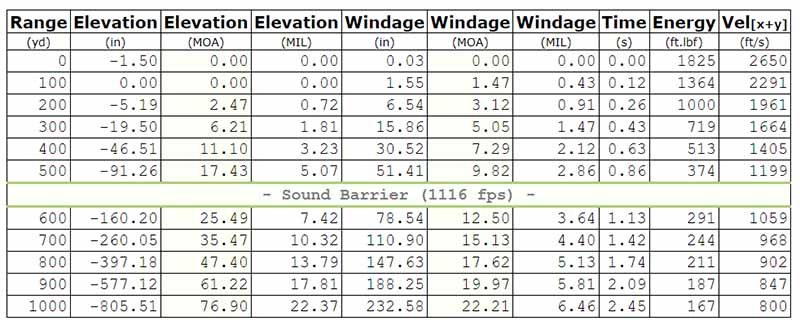
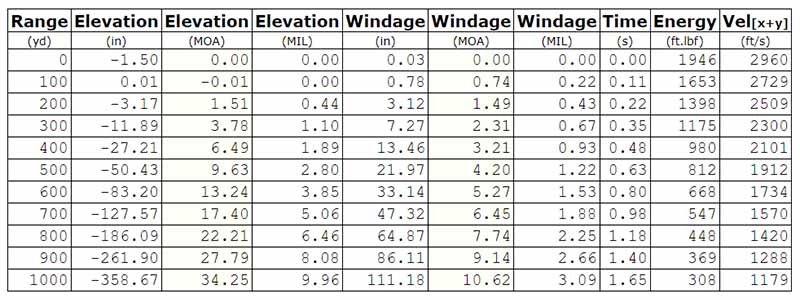
Using ShootersCalculator, we cooked up some tables representative of each load in question. Here’s a 1,000-yard trajectory table for green tip M855, made using the average G1 BC of .304, a muzzle velocity of 3,062 fps and a 2.6-inch sight height to account for standard AR-15 irons. All tables were made presuming a 100-yard zero, a 10 mph 90-degree crosswind and zero corrections for atmosphere.
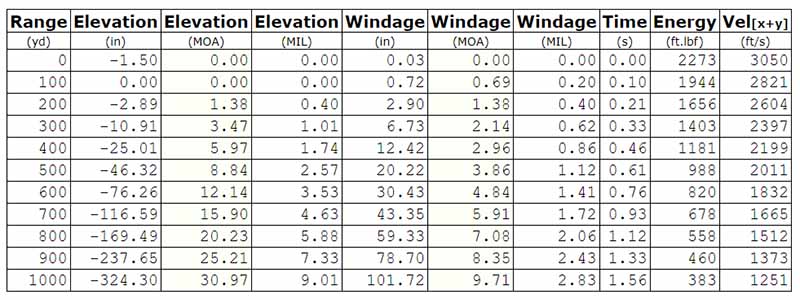
And here's the same table for M193, presuming muzzle velocity of 3,100 fps and a G1 ballistic coefficient of .243, which is standard for M193 ball.
As you can see, M855 stays supersonic for an additional 150 yards, has drifted 10 fewer inches and dropped about 7 fewer inches at 500 yards, all while retaining more energy than M193.
However, bear in mind that the fragmentation threshold for M855 and M193 is roughly 2,600 fps (below this velocity, both projectiles become unlikely to reliably fragment). M855 drops to that velocity in 150 yards, and M193 at 125 yards.
While M855 clearly has slightly longer legs than M193, there are more loads available than those two. Here’s a trajectory table for something a bit less common.
This is a trajectory table for Mk262, the Black Hills 77-grain Sierra Match King load issued by the military that has an advertised G1 BC of .373 and muzzle velocity of 2,863. Compared to M855, it stays supersonic for an additional 100 yards, but because the SMK bullet has a lower fragmentation threshold of around 1,900 fps, it actually extends the nominal effective range to just over 400 yards. Compared to M855’s nominal effective range of 150 yards, that’s quite impressive.
Point being, while M855 is marginally better than M193 on paper, it’s also not the best 5.56 load available. Whether you’re after maximum range or maximum effect on target, there are many better options than either of these surplus loads.
Green Tip5.56 For Defense
Frankly, green tip 5.56 is a lousy choice for self-defense.
Fragmentation and yawing (tumbling) on impact are ostensibly the big benefits of 5.56x45mm NATO’s terminal performance, but the steel penetrator changes the center of gravity of the bullet.
That leads to what's called “fleet yaw,” a phenomenon (discovered by Dr. Martin Fackler) wherein some projectiles from the same lot of ammunition will yaw and fragment, but not all will. The same lot of ammunition has been observed to perform flawlessly in one rifle, but terribly out of an identical rifle.
When green tip doesn't yaw or fragment, it's basically just ice-picking the target with a .224-caliber bullet.
Wound ballistics of M855 when it successfully fragments. Source: Dr. Martin Fackler.
Veterans of the Battle of Mogadishu reported similar findings. Some who served there were completely satisfied with 5.56 green tip while others reported having to hit a target several times before they were incapacitated.
Ballistic testing shows that 62-grain green tip 5.56 does not yaw as reliably or as soon in tissue when compared to M193, typically only doing so until it’s 7 or 8 inches deep. It also does so less reliably at shorter ranges and when traveling at the slower velocities produced by rifles with short barrels.
Other 5.56x45mm loads, such as bonded soft points and 77-grain OTM, have more reliable expansion or yawing at shorter ranges and at slower velocities. They're also superior when used for hitting targets through intermediate barriers.
So, green tip is lousy self-defense ammunition. It's also lousy for hunting, and guess what the recommended 5.56mm hunting loads are? 55- and 62-grain bonded soft points.
When it comes to range ammo, M855 has pros and cons. While it is generally pretty cheap and available, its use is also banned at many ranges. This is because the steel insert is hard on steel targets and poses a bigger risk of starting a fire.
If you want to use it to shoot your own steel targets on your own land, that's up to you, but if you primarily use public ranges then green tip isn't the best choice.
Not All Green Tip 5.56 Is Created Equal
Green tip 5.56 ammo can suffer from the same problem as AR-15 rifles and 1911 pistols. Anyone can make them…which means some people are going to cut corners to fill a demand rather than turn out a good product.
In other words, not all green tip 5.56 is created equal. Dozens of ammunition factories, ranging from Lake City to Winchester to IMI to PMC to cowboy outfits that you've never heard of all make their own M855 clone, and not all of them are necessarily good.
They also aren't all identical, even when they share the same name. Military ammunition is made to strict specifications that lay out every single technical detail, from the primer to the propellant to the projectile and all points in between. When buying a commercial copy of M855 rather than true military surplus, you have no guarantee that whoever made it did so correctly.
For instance, the powder for actual M855 is supposed to be WC 844/Hogdon H335. While H335 is hardly the rarest propellant in the world, it's certainly the case that you can approximate the velocity with a different and cheaper powder, but that's going to change the pressure curve (which matters in a gun that runs on gas!) and so on.
Does any ammunition manufacturer you know of specify what powder they use? What primer? Some advertise which bullet, but not much else.
Green tip 5.56 is also a popular load for remanufactured ammunition, and while plenty is of good quality, a lot of it isn't. That's why a lot of top shooting schools and instructors don't allow remanufactured ammo in their courses.
The “LC” stamp indicates that this M855 was manufactured at the Lake City Army Ammunition Plant.
Point being, M855 is one of the most reproduced/cloned loadings in the world, and the further you get from the original the more problems may arise. You probably won't have too many issues with, say, Winchester white box M855 or PMC Bronze, but you might from someone else's. Manufacturers that primarily serve the military such as Lake City are the safest bet.
Due to its low price and high availability, green tip 5.56 remains a fine choice for training ammunition. Just be aware that the load possesses no mystical qualities and isn’t particularly better than any other variety of 5.56. If you’re looking for something to use for defense or hunting, there are many better options out there.
A review of some regal German engineering in the form of the Mauser M18 bolt-action rifle.
It was 1955, and I was a 12-year-old kid hunting deer in Minnesota’s heavy timber northwest angle with my dad. The years after World War II had the USA awash with surplus military rifles of every kind. As such, my rifle, as assigned by dad in those days, was a German Model 98 Mauser chambered in the German military standard 8mm. That was my first rifle, and on the hunt resulted in my first harvested whitetail.
During the years that followed, the Mauser brand in German surplus rifles, and also a few lookalikes in additional brand names, were a major part of my total experience when it came to learning the craft of using a rifle. Model 95s in 7mm, make-over rifles chambered in 30-06 and even .45-70 (large ring) took up their share of space in the old-school-style basement gun room. Even today, far too many years later, I still carry a blue-printed receiver Mark X Mauser that mounts to a custom barrel and is chambered in .224 Valkyrie. Old habits die hard.
With a call from one of my brand contacts in July of this year, I became quickly involved with the introduction of a totally new Mauser, German built and engineered from the buttstock up. With just a few words over an email introducing the basic rifle, I became hooked at once on another very famous, and to this day solid brand-named offering, in firearms.
What’s In A Name?
Mauser’s Model 18, which also carries the name “Sauana” attached to it, is a hunter’s rifle to the core. Upon its arrival for testing and overall evaluation, I noticed the design in its polymer synthetic stock to be very attractive to the hunter who covers a lot of ground and can’t deal with massive amounts of excess weight. While the rifle is also offered in a wood-stocked model, the synthetic design carried soft grip inlays as well as buttstock storage for some small items that fit the bill perfectly for the long-distance mountain hunter. Every single ounce counts when on the move.
Push-button storage locker buttstock. Small area for muzzle cap, extra ammo or other smaller items.
This rifle stock is adequate for the type of rifle that the M18 is, built for tough use with a lighter-weight handling. I found the barrel at 22 inches to be free floated to the receiver ring and lacking any advanced bedding systems, as you’ll soon see little in the way of a general-purpose hunting rifle out-shooting this new offering by Mauser.
With a carry weight load of 8½ pounds—including a scope—the new Mauser 18 would be classed as a light porter and designed well away from the current trend in heavy chassis rifles and other long-range big-game offerings. Mounting the GemTech Dagger suppressor, the rifle’s weight comes up just under 10 pounds. Keep in mind that this rifle is offered as a medium cartridge system (.308/6.5 Creedmoor), as well as a heavy magnum version. Carry weight will vary with different chambering and add-on elements associated with sight system and sound suppression.
The stock drops down to a slim forend that mounts sling swivels and also houses a wide, generous box magazine design that makes use of an inline magazine. Just ahead of the magwell is a button that functions with total ease when dropping the box for loading.
Magazine flush with stock. Easy load in and out.
So many times this is where rifles fall short: The magazine itself allows a very smooth, easy cartridge drop straight down into it, and when installed again down into the magazine well, the fit is perfect and retains a solid lock. Nothing is worse than having a magazine drop into 6 inches of powder snow with a trophy buck looking straight down the barrel as you’re working the rifles action.
In exact terms of chambering for this rifle, Mauser is offering it in the following cartridges: (mini models) .222 Rem. and .223 Rem.; (medium models) .243 Win., 6.5 Creedmoor, 6.5×55, .270 Win., .308 Win., .30-06 Springfield, 8×57 IS and 9.3×62; and (magnum models) 7mm Rem., and .300 Win. Mag. The total magazine capacity is five rounds for the medium-grade cartridges, and four rounds as applied to the magnum group.
In terms of barrel length, 22 inches meets the yardstick, and this is a nice length when applying a full-size suppressor, like my GemTech military-grade unit.
The Ever-Evolving Action
The rifle’s action is a major change from the old-school Mauser-style turn-bolts. This action makes use of a straight, clean 0.805 one-piece bolt tube that retains a rotating head, button extractor and three locking lugs. The bolt handle will produce a pivot turn when at full function of 60 degrees regarding an opening angle. I found this to be a very fast bolt design, and it didn’t require much, if any, forced lifting of the bolt when in the process of making shots off-hand or from benchrest positions during a second shot. The action was very smooth, and lockup was fast and solid regarding my selected 6.5 Creedmoor fodder. The bottom line is that I like this rifle a whole lot from a hunter’s perspective.
Red pin indicator showing rifle cocked. Bolt designed for short-stroke operation.
The controls on the rifle are field-dirt simple, with a thumb safety on the right side of the receiver housing that’s a push-forward firing-position design. I found the safety to be a bit noisy when operated with a single thumb push, but when using two fingers to guide the latch, all sound leaves the function.
Bolt assembly—clean one piece and button extractor ejection and three locking lugs.
The safety is a trigger-lug design and a direct link to the rifle’s firing mechanism. The safety has three-position full safe, ready and fire. Keeping the rifle in full safe position, being all the way to the rear, the action is locked, but the magazine can be removed. Using the second position, the action can be opened but the fire controls remain locked. With the safety lever full forward, the rifle is now operational. The system is outstanding for use in rifle scabbards when on horseback or packed into vehicles. In full safe, the bolt won’t open, which has been an issue in the past for many mounted hunters in Western states. When the rifle is cocked, a red pin indicator is protruding from the rear of the bolt. Upon firing or release of the cocked bolt, this red pin recedes back into the rear of the bolt face. These are a hunter’s dream features and will be well received by owners of this rifle.
Downrange
If lacking accuracy, I don’t care what a rifle offers in terms of handling and looks—and the heart of the hunting rifle is its accuracy. What can’t hit can’t function. This, however, isn’t the case regarding the Mauser M18. This rifle shoots. Even on the first day—after mounting a better grade 3-18x50mm Zeiss Conquest V6 over the standard Remington Model 700 bases by way of pair of six screw sniper-grade 30mm rings—it was time to see what made the new rifle tick.
Shooting for zero and bore sighting required two rounds sent to 50 yards. Right off, the rifle handled like a dream. (I own some much more expensive big-game rifles that don’t have the smooth feel and control of this rifle.)
After just returning from a 100-yard to one-mile shooting event in Wyoming, and because we handload by way of Federal and RSCB all of our long-range loads via the 6.5 Creedmoor chambered rifles, I elected to run my handloaded Berger 130-grain Match bullet loads for starters in the live-fire test phase regarding the Mauser M18.
A wide range of ammunition was tested in the M18. This rifle liked everything, but heavy bullets were a touch better in the super tight group department.
With a cold bore and green pipe to match, the rifle flat-out put bullets exactly where I wanted them. From the basic bore sighting round, one hit 3 inches high and 3 inches to the right of target center. It was sight correct and onto round two. Setting click adjustments by way of the ¼ MOA turret adjustments put the bullet spot-on with the second round fired.
Not caring to burn off my competition-grade handloads on a short range zero target, I moved at once to the 100-yard target to see what a three-shot group would look like. Keeping in mind that the barrel was green and the rifle was a light sporter, I was pleasantly surprised when the bullets impacted within a rough 1-inch group. What that told me was to get down and get serious on the next series of rounds downrange.
It needs to be noted here that in terms of testing for the M18’s accuracy, both the standard barrel and a suppressed run were applied to the overall test. The rifle would be hunted out on the Dakota Missouri breaks using a suppressed system, and it has been my experience that rifles can change points of impact when the suppressor is installed or removed. It should also be pointed out that those first runs returning MOA results, and a quick zero as well, were the results of a suppressed weapon.
Easy load magazine—no hard push, fast load under hunting conditions.
Getting out to the big 1,000-yard range and taking on steel from 200 through 500 yards proved interesting. Using a database DOPE developed as part of a previous hunt shooting 6.5 Creedmoor, the rifle slapped steel like a champion while shooting the handloaded 130-grainers. Suppressed, the rifle hissed moving air out beyond the barrel, and the bullet slammed steel with a loud crack. Selecting steel at variable ranges, as in a shot at 300 yards followed up with a second shot at 500 yards, made for some turret twisting, but I also began to develop a trust in the rifle’s performance.
The single-stage, 3-pound adjustable trigger was a dream to use. Set to a solid wall with no creep whatsoever, it was simple process: depress the crisp, 3-pound, let off the trigger and wait for the slap of a bullet on steel.
On hold for a good day lacking the normal South Dakota prairie wind, it was a week later that I again returned to the range for some serious group and long-range work with the M18. Targets included 100-yard group shooting, and coyote full-size silhouettes at 200 through 400 yards.
Bolt latch rear receiver. Rifle has clean lines.
Observed and measured was that the push-feed bolt-action Mauser trimmed of all the old-school long-extractor mountings, safety via a three-position design directly on the bolt rear face, and a long-lift bolt handle. The gun didn’t return anything over 1 MOA.
These results involved 10 different brands and bullet types throughout my accuracy range work. In fact, the Mauser M18 actually produced some groups with specific ammunition that would qualify it as “bench rest accurate.” Now I know that’s a mouth full to be sure, but facts indicate by bullets on paper the above to be absolutely true.
Bolt head with three locking lugs. Strong and part of an accuracy system close to benchrest results with most ammunition (6.5 Creedmoor).
Final Observations
During the testing of the Mauser M18, I was advised by some circles that the rifle bolt tends to bind upon closing with a live round chambered. I found this to be true, but only when questionable sizing of rifle cases were involved. In effect, the Mauser M18 is so closely machined regarding chamber tolerances that only a perfect turn metered cartridge will slip into the rifle’s chamber, lacking any felt contact with the chamber walls whatsoever.
While some won’t say much about a current issue, I’ll state—being a consultant for direct manufacturing companies in the ammunition industry—that with the dreaded COVID mess now behind us, we’re still left with poor supply chains, availability of materials and very different sources deviating from normal channels that have led to some inconsistencies among even major name-brand manufacturers. My point here is simply don’t be too quick to blame the gun.
The Mauser M18 is one nice turn-bolt big-game rifle.
When Black Hills Ammunition stepped forward and offered their new multipurpose 6.5 130-grain Creedmoor ammunition for testing, during its use I could close the bolt on the M18 with two fingers.
With the Mauser M18 generating almost perfect accuracy, built with top-end German design and engineering—and modestly priced—this rifle is about to see a whole lot of field time among American big-game hunters.
Editor's Note: This article originally appeared in the January 2023 issue of Gun Digest the Magazine.
Hi-Point has just announced a new variant of its Model 995 carbine chambered for 30 Super Carry.
In 2022, Federal Ammunition announced 30 Super Carry, also known as 30 SC. In a nutshell, the new cartridge was designed to offer similar ballistics to 9mm but in an overall smaller package, therefore allowing for larger magazine capacities in compact, concealed carry handguns. Despite this design goal, Hi-Point Firearms has just announced the Model 995 30 Super Carry carbine, the first commercially available rifle to be chambered for the cartridge.
The new Hi-Point Model 995 30 Super Carry.
Besides the new chambering, the Model 995 30 SC is identical to existing models in other calibers. It features a 16.5-inch barrel with a 1/2×28 threaded muzzle, an adjustable rear sight and a manual safety. It also has a skeletonized polymer stock as well as Picatinny rail on top of the receiver and beneath its handguard for attaching accessories. The 30 SC Model 995’s magazines are also like those of existing models given that they share a capacity of 10 rounds.
This image is of a 9mm Hi-Point Model 995, but the 30 Super Carry variant is virtually identical.
Since one of the cartridge’s biggest selling points is its potential to increase capacity, it’s somewhat surprising that Hi-Point opted to retain the same size magazine for the new 30 SC model. However, this choice likely has to do with the fact that all Hi-Point firearms are designed to accept single-stack magazines, so increasing the capacity for the 30 SC model would require a redesign of not only the magazine but of the carbine itself. Instead of focusing on capacity, Hi-Point is instead highlighting the benefits of sharing a common ammunition type between one’s rifle and handgun. If you’re a dedicated 30 SC user and are looking for a rifle to match your pistol, the Model 995 30 Super Carry is currently your only option.
The Model 995 30 Super Carry is not yet available, but Hi-Point will be displaying it at the 2023 NRA Annual Meeting in Indianapolis, IN. MSRP for the carbine will be $359.
Howa recently announced the Hera H7 series, bolt-action rifles featuring influence from both hunting and precision guns and available in two calibers.
The Japanese rifle manufacturer Howa has recently announced the Hera H7 bolt-action rifle series. The guns draw inspiration from both modern hunting rifles as well as tactical precision rifles, resulting in an interesting mix of features. What’s more, when selecting a Hera H7 model, one has a choice between two chambering options, three barrel profiles and three chassis colors.
The first choice to make when considering a Hera H7 is the caliber, as they are available in both .308 Winchester and 6.5 Creedmoor. Next is the barrel, which will either be 22 inches for the standard profile or 24 inches for heavy steel or carbon fiber profiles. Finally, depending on your aesthetic preferences, the stock portion of the Hera H7 chassis can be ordered in either black, tan or OD green. Regardless of the model selected, all come with a 5-round AICS-style magazine and a threaded barrel.
Speaking of the new chassis, Howa describes it as “a modern and easy-to-use stock system for the Howa (short action) system.” While the forend is made out of aluminum, the rest is made of fiberglass-reinforced polymer. It features an aluminum V-block as well and comes with two stock spacers and a polymer cheek rest. The chassis also has M-LOK mounting points throughout for accessories.
All Howa Hera H7 rifles are advertised as being capable of sub-MOA accuracy and come with a lifetime warranty. The MSRP for the standard barrel version is $839, MSRP for the heavy steel barrel model is $899 and MSRP is $1,299 for the carbon fiber barrel variant.
Capable yet affordable, in this review the author takes a closer look at the Swampfox Warhawk 5-25×56 FFP.
Swampfox Optics recently released its highly anticipated FFP line of riflescopes—the Warhawk. This line of optic has been in the works for literal years. “Warhawk was originally launched with a limited run in May 2020. Given limited material supply, and our unwillingness to sacrifice on glass quality, we immediately sold out and couldn’t relaunch until August 2022. We are just now completing our series by releasing the 2-10x,” commented Miles McKinney, operations director at Swampfox. This particular scope, the Warhawk 5-25×56 FFP, is the highest magnification range in the series.
With an MSRP of $689, you get a lot of scope for the money (on Amazon, at the time of writing you can get it delivered within a day for less than $600). While I wouldn’t call it a budget scope, as that brings up notions of cheaply made optics consisting of “Chinesium” metals and subpar glass. This one is what I would call a “cost conscious” scope. Its nearest competitor, to my mind, would be the Vortex Venom—another 5-25x FFP scope. However, this one comes with a standard illuminated reticle unlike the Vortex as well as more accessories in the box. And I’m not hating on Vortex, I run a 5-25x Strike Eagle on one of my long-range gas guns and love it, but for the same money (even slightly less) you get a lot of scope with the Warhawk.
Other scopes in the Warhawk series have various magnification ranges as well as other reticle options. The 2-10×44 and 3-15×44 are available with the Sharpshooter MOA reticle as well as the RECCE MIL reticle, the latter of which is kind of a fast-acquisition reticle set up. The Sharpshooter MIL reticle—which is the one I opted for—is only available in the 4-20×50 and 5-25×56 scopes. However, the Sharpshooter MOA reticle is available in all magnification ranges.
Now, let’s take a closer look at the Swampfox Warhawk 5-25x FFP.
Glass Quality
The glass itself is great for the price point. Is it the best glass? Certainly not. But for less than $700 MSRP, it’s plenty clear with a true-to-color view and little hazing as you get higher in magnification. The glass quality proved to be more than adequate for the type of shooting I used the Warhawk for—punching paper at 100 yards and smacking steel out to 600 yards—so it should be plenty for most other consumers as well. The main thing the folks at Swampfox said is that they did not want to compromise on the glass. When you compare this to something like the Vortex Venom, the glass and features are much better.
Overall, the 34mm tube lets in plenty of light and allows the shooter to see what they’re looking at, even in dusk or pre-dawn shooting conditions, and it’s clear when you dial in the diopter and parallax adjustments as needed. Like most modern-day scopes, it’s fully multi-coated, anti-fog and hydrophobic; I’ve shot it on cold days and unseasonably warm days with no fogging, hazing or other issues.
Reticle
The reticle is one of the sticking points for me on the Warhawk 5-25x FFP, as it’s a bit small and ill-defined on lower power. I found myself cranking up the magnification at shorter distances more than I usually would to get a MIL reading (yes, I shoot MIL dot, not MOA). Only the center of the reticle is illuminated rather than the whole thing, which I have mixed feelings about. While yes, I only need the contrast on the middle of the reticle, it can be a little distracting on lower magnification settings. The MIL grid (seen below) should be familiar to most, if not all shooters, and makes holdovers and ranging easy. They even include a little booklet to give new shooters a crash course in the wonders of milliradians.
Warhawk 5-25x FFP Features
Out of the box, it comes with a variety of goodies—sunshade, lens cloths, manual and 0.1-MIL tactical turrets that are much easier to zero than other scopes in this price range (ahem, Vortex). To adjust them, just unscrew the top with an included plastic tool or flathead screwdriver and line up the 0 with the hash mark. Boom, re-zeroed. No need to use another piece like a revstop insert. The eyepiece focus and adjustable parallax are on par with many other scopes on the market. While the glass isn’t in Strike Eagle 5-25x territory, that’s also several hundred dollars more. I think for a $600 scope, the Warhawk punches above its weight class.
It also includes a honeycomb glare reducer for the front of the scope, a nice addition for hunting or a tactical application that I didn't know it would come with. What’s more, it has a 1-meter submersion rating, something that will definitely be appreciated on a hunting rifle setup. Another small detail that I welcomed is that the scope came with flip caps instead of a bikini cover (which I always lose).
Turrets And Controls
The turrets are quick and intuitive tactical turrets, but they do feel a bit less crisp than some other manufacturers I’ve used. They click in and out easily, but there is a bit of “plasticiness” when you adjust. The magnification is hard to work at first, but if you install one of the included throw levers, it mitigates that and breaks in over time.
The parallax is spot on, where targets at known ranges come into clear view when you dial in the distance, and long shots appear clear when you start dialing it to infinity. The illumination knobs have 12 settings, and one little feature I really enjoy is that in between each power setting the reticle turns off. This means that you don’t need to fully rotate it back to the space between 0 and 12 every time. Just one click in either direction and she’s off.
Mounting The Warhawk
Probably one of the most impressive things was Swampfox’s cantilever mount system. I threw this on an AR-15 with an 18-inch barrel for precision work, and it’s held zero and hasn’t moved. Even after a precision rifle match or two where my gun got banged around, I’m still shooting 0.5-MOA with match-grade 77-grain rounds. They also have rings that you can utilize for mounting the scope on a bolt gun if that tickles your fancy.
Loose Rounds
Overall, for the money, and for those of you that like me were just dipping your foot into the long-range competitive shooting game, you could do worse than the Swampfox Warhawk 5-25x. It gives you plenty of optionality and scope for the money. Is it something you’ll outgrow? Eventually. But you also won’t have buyer’s remorse for spending a mortgage payment on that Nightforce you never use.
While it’s not the best glass, nor the crispest adjusting scope, it has plenty of features for a casual precision shooter or an entry-level scope for a budding long-range shooter. And hell, I’d use this for hunting since it’s pretty solidly built and has a 50,000-round warranty, very similar to Vortex’s VIP. If you’re looking at scopes from Vortex, Primary Arms, and similar manufacturers, you should give the Warhawk a look as well.
When it comes to big game hunting, there are few better tools for the job than .45-caliber rifle cartridges.
We were preparing for our first Cape buffalo safari—a seven-day jaunt to the famous Selous Reserve of southern Tanzania—busily working up handloads for the rifles. The game plan was that I’d be using my Winchester Model 70 in .416 Remington Magnum, and my father would be borrowing my .375 H&H Magnum.
As I pulled up to Ol’ Grumpy Pants’ house, where we have a very convenient 100-yard shooting range, he informed me he’d made a decision. “I’m borrowing a Winchester in .458 Win. Mag.; the components and dies are in the basement. Let me know when you’ve got it grouping.”
So began my trials and tribulations with the .458 Winchester Magnum, the first of a number of .45-caliber stopping rifle cartridges that would cross my path during the next 15 years.
Prior to this, my experience had been limited to the .45-70 Government, as my dad had purchased a centennial Model 1886 Browning when I was young, and I’d helped him develop a beefy handload for a bison hunt in South Dakota in ’03. That rifle, with its curved steel butt plate culminating in two lovely sharp points, was unforgettable from the bench, as the velocities broke 1,800 fps and then 1,900 fps with 400-grain bullets.
But every journey begins somewhere, and my experience with .45-caliber rifles has certainly grown over the years. Let’s take a look at the vast lineup of cartridges that deliver the .458-inch-diameter bullets, their history and applications.
Hunters have long relied on .45-caliber cartridges to stop dangerous game animals.Photo: Massaro Media Group.
The .45-70 Government
As American as apple pie, the .45-70 Government represents the first American .45-caliber rifle cartridge. Developed in 1873 for use in the famous “Trapdoor” Springfield rifle, the .45-70-405 (as named by the U.S. Army) would use a .458-inch-diameter bullet of 405 grains, over a 70-grain charge of black powder. This cartridge would replace the .50-70 Government, and despite the fact that its trajectory pales in comparison to many modern cartridges, it remains a favorite for many hunters and shooters.
With a case measuring 2.105 inches, a rim diameter of .608 inch and a body diameter of .505 inch, the rimmed case gave good extraction from the single-loaders and the later lever rifles chambered for it. The original loads—using pure lead bullets—would obtain a muzzle velocity of roughly 1,350 fps with all the power needed to hunt any of the game animals on the North American continent, albeit longer shots would pose an issue due to the extreme arc of the .45-70’s trajectory.
Hornady’s LEVERevolution ammo gives the classic .45-70 Government a face-lift; the Heym Model 26B o/u double rifle made a great choice in the woods. Photo: Massaro Media Group.
In older firearms, pressures need to be kept low, in deference to the metallurgy of the era. In modern firearms, the pressures and performance can be ramped up. Hornady’s LEVERevolution load uses a 325-grain FTX (Flex Tip eXpanding) bullet with its flexible polymer tip that allows the use of a spitzer bullet in a tubular magazine at a muzzle velocity of 2,050 fps, allowing a 200-yard zero to be employed and generating over 3,000 ft-lb of muzzle energy. Federal’s HammerDown line uses a bonded-core 300-grain soft-point at 1,850 fps, optimized for lever-action rifles by offering the best blend of expansion and penetration.
The .45-70 Government (left) has the same rim and body diameter as the longer .45-120 (right) and uses the same projectiles. Photo: Massaro Media Group.
In the years following the release of the .45-70—which didn’t take long at all to make its way to the hunting field—there were variants with longer cases, such as the .45-90 Sharps (2.40-inch case), .45-100 (2.60-inch case), .45-110 (2⅞-inch case) and the .45-120 (3¼-inch case), all designed for the exploding buffalo market. The largest of the lot, the .45-120, didn’t hit the market until roughly 1880 when the game was pretty much over.
The .577/450 Martini Henry
Developed in the early 1870s—almost simultaneously with the .45-70 Government—the .577-450 was adopted as the standard issue for Her Majesty’s Army throughout the British Empire. Based on the .577 Snider, the Martini Henry featured a brass foil-wrapped case, which was easily dented and damaged. While not a true “stopping” cartridge, the .577-450 Martini Henry did play an important role in British military history—look up the Battle of Rorke’s Drift and the 1963 movie Zulu. The Martini Henry would drive a 480-grain bullet to a muzzle velocity of 1,350 fps.
The .450 3¼-inch Nitro Express
John Rigby’s 1898 release of the .450 Nitro Express set the benchmark for a dangerous game-stopping cartridge, arriving at a formula that’d be relied upon by both professional hunters and traveling sportsmen alike. The straight-walled, rimmed case was based on the earlier .450 Black Powder Express—which also used a 3¼-inch case and a .458-inch-diameter bullet—but used the new smokeless propellant.
The .450 NE used a 480-grain bullet, both soft-point and solid, at an advertised muzzle velocity of 2,150 fps for just under 5,000 ft-lb of muzzle energy—though we rather routinely discover that the ballistic values of that era were slightly exaggerated. Hunters found that the .458-inch-diameter bullets at that particular weight offered a wonderful blend of striking power and acceptable recoil, especially when compared to the .577 NE, 8- and 4-bore rifles. Famous hunters like Philip Percival, Denys Finch Hatton and John “Pondoro” Taylor relied on the .450 Nitro Express.
There were variants made shortly after the .450 NE saw the light of day, including Eley’s .450 No. 2, a bottleneck cartridge with a larger body and rim diameter and a 3½-inch case, and Holland & Holland’s .500/450, a bottleneck cartridge with a 3¼-inch case, made most famous in the hands of Theodore Roosevelt on his 1909 to 1910 safari. Both of these cartridges used a 480-grain bullet at 2,175 fps. Today, they’re both a rarity yet remain perfectly effective.
President Theodore Roosevelt’s Winchester Model 1886, chambered in .45-90. Despite the receiver markings, there’s no proof it ever saw Africa. Photo: Massaro Media Group.
The insurrections in the British colonies of India and Sudan in the early 20th century caused the ban of all .45-caliber ammunition into those colonies in order to prevent the insurrectionists from obtaining projectiles for the .577/450 Martini Henry rifles they’d obtained. This led to the immediate development of cartridges of similar performance level but differing diameter, including the .470 NE, .475 NE, .475 No. 2 Jeffery’s, .476 NE and more. All use a bullet between 480 and 500 grains, and a muzzle velocity of 2,150 fps or thereabout, to replicate the .450 NE’s performance.
In the post-World War II era, supplies of sporting ammunition began to severely dwindle, although sportsmen began to travel abroad once again. Many of those beautiful double rifles sat in the rack with little or no ammunition to feed them, as Kynoch (the main supplier of British ammunition) began to cease production.
The .458 Winchester Magnum
Winchester offered a belted variant of the formula established by the .450 NE for use in a bolt-action rifle when they released the .458 Winchester Magnum in 1956. Photo: Massaro Media Group.
To fill that void left by Kynoch, Winchester set their engineers to work on developing an American cartridge that’d be available, affordable and effective. They began with the belted .375 H&H case, shortened it to 2.500 inches in order to fit in a long-action receiver, and took out the taper in order to hold a .458-inch-diameter bullet.
In 1956, the release of the .458 Winchester Magnum came, advertised to drive a 510-grain bullet to a muzzle velocity of 2,150 fps, to mimic the field performance of the .450 NE and .470 NE; the only issue was that the cartridge never met those values. The short case had a lack of powder capacity, and there were many instances of severely reduced velocities, extremely poor penetration, and caked-up powder charges; the early reputation of the cartridge wasn’t exactly fantastic.
The .458 Win. Mag. (left) has been criticized for its case capacity; the slightly longer .458 Lott (right) helps solve that problem. Photo: Massaro Media Group.
The modern iteration of the .458 Winchester Magnum has benefited from advancements in powder and the reduction in bullet weight from 510 to 500 grains, with factory ammo giving advertised velocities between 1,950 and 2,140 fps. Today’s .458 is an effective and reliable cartridge.
Because of the early issues with the .458 Win. Mag., there were several wildcat versions of the .458, using a longer case for additional powder capacity. There was the .450 Watts Magnum, using a .375 H&H-length straight-walled case at 2.850 inches, and the .450 Ackley Magnum at the same length but with the slightest shoulder introduced into the body.
But the success story of all the belted offspring of the .458 Winchester Magnum is the .458 Lott. Jack Lott had a bad experience with a wounded buffalo in Mozambique when using a .458 Winchester Magnum and set out to build a better mousetrap. Using the H&H belted case trimmed to 2.800 inches with no shoulder, the .458 Lott would give a velocity boost in comparison to the .458 Winchester Magnum. Factory loads have a 500-grain bullet leaving the muzzle at 2,300 fps for 5,872 ft-lb of energy at the muzzle.
A good controlled-round-feed rifle chambered in .458 Lott is a reliable choice for stopping any game animal on any continent.Photo: Massaro Media Group.
The .460 Weatherby Magnum
When Roy Weatherby reached for a new level of performance with his 1953 release of the .378 Weatherby Magnum (a case loosely based on a .416 Rigby but with a belt), I’m not sure that he immediately envisioned that case holding .458-inch-diameter slugs. Yet, just six years later, his .460 Weatherby Magnum would hit the market, assumedly in response to Winchester’s release of their .458 Magnum.
There was a wildcat version from a Montana gunsmith named John Buhmiller—he called it the .45 Weatherby—but Roy himself produced the cartridge commercially. Pushing a 500-grain bullet to 2,600 fps, the .460 Weatherby will generate over 7,500 ft-lb in modern ammunition and rifles. This does come at a price: The recoil of the .460 Weatherby has been described as hellacious and soul-crushing. The .460 has a long case, measuring 2.913 inches, and the overall length of 3.65 inches requires the use of a magnum-length action. Weatherby offer the pair of Hornady soft-point and solid bullets at 500 grains, and the lead-free Barnes TSX at 450 grains, the latter having a higher muzzle velocity of 2,700 fps.
The .460 Guns & Ammo
This is a bit of an oddball, which had a brief following in the 1970s and ’80s. Tom Siatos used the .404 Jeffery case, increased the shoulder angle to 15 degrees to improve headspacing while maintaining smooth feeding and necked the cartridge up to hold .458-inch-diameter bullets. With a muzzle velocity of 2,350 fps or so, it’s a bit hotter than the .458 Lott. However, it doesn’t have the case-stretching issues associated with belted cartridges, and like its parent cartridge, feeds wonderfully for a box magazine. Famed Botswana Professional Hunter Johan Calitz still enjoys his .460 G&A.
The .450 Rigby
Based on the .416 Rigby necked up to hold .458-inch-diameter bullets, Paul Robert’s .450 Rigby offers some serious stopping power. Photo: Massaro Media Group.
John Rigby & Co. have long been involved in dangerous game rifles and cartridges, with the .416 Rigby and .450 Nitro Express to their credit. In the early 1990s, Paul Roberts was at the helm of Rigby and, while on an elephant hunt, decided that their lineup needed a cartridge for a repeating rifle with more bullet weight and frontal diameter than the .416 Rigby offered. The solution was both simple and logical: neck up the .416 Rigby to use .458-inch-diameter bullets.
The .450 Rigby is a heavy-hitter, with factory loads delivering a 500-grain bullet at a muzzle velocity between 2,350 fps and 2,500 fps, depending on the brand, and Norma’s African PH ammo line offering a 550-grain Woodleigh Weldcore and FMJ solid at a muzzle velocity of 2,100 fps. Sharing the same 45-degree shoulder and rimless design of the .416 Rigby, the .450 Rigby offers a bit more muzzle energy and bullet weight, making it a better choice as a stopping rifle.
The .450 Marlin
The turn of the 21st century saw Marlin and Hornady pair up to develop a modernized version of the hot-rodded .45-70 loads on the market, designed for use in modern firearms with strong actions. While the .45-70 can be loaded to velocities far exceeding the capabilities of the Trapdoor rifles of the late 19th century, the .450 Marlin gives that level of performance without the possibility of using the wrong ammo in an older rifle.
Based on the .458×2-inch American cartridge—a shortened .458 Winchester Magnum case—the .450 Marlin wears a different belt than the traditional H&H to prevent it from being accidentally chambered in a .300 Winchester Magnum or 7mm Remington Magnum rifle, the results of which could be catastrophic. Hornady offers a 325-grain FTX bullet in their LEVERevolution line at a muzzle velocity of 2,225 fps for just over 3,500 ft-lb of energy, making an impressive lever gun, perfect for game with teeth and/or claws in thick cover, as well as larger game species inside of 300 yards.
The .458 SOCOM
For those who appreciate the AR platform, the .458 SOCOM is the cartridge that’ll offer a whole bunch of stopping power with rapid backup shots. Based on the .50 Action Express cartridge, the .458 SOCOM uses a rebated rim (measuring 0.473 inch, the same as the .308 Winchester family to fit the bolt face of the AR-10 rifle) and a case with minimal body taper and a very slight shoulder.
The .458 SOCOM is a big thumper designed for use in the AR-10 platform. Photo: Massaro Media Group.
Pushing 300-grain bullet at a muzzle velocity of 1,900 fps, the .458 SOCOM turns a handy rifle into a big game stopper and has proven to be wonderfully accurate, as well as mild on the shoulder. For a projectile, I really like the 300-grain Barnes TTSX, as it has the integrity to handle the impact velocity of close shots, yet will open reliably at moderate ranges. If you want to turn your AR-10 into a rifle fully capable of handling the nastiest boar in the thick stuff, look to the .458 SOCOM to solve that issue.
Pick Your .45-Caliber Poison
While you’ll notice the majority of cartridges designed for the thick-skinned African game species center around the 500-grain bullets—and I’ll condone that choice based on the Sectional Density alone—and the American cartridges like the .45-70 and .450 Marlin use lighter projectiles, the frontal diameter alone of the .45s is an impressive factor in choosing a cartridge for game which can hurt you.
I’m also going to be completely honest and admit I’ve long been a proponent of cartridges in the lower .40s—including the .404 Jeffery and .416 Remington Magnum—for their blend of penetration, trajectory and energy values, but will admit that the .45-caliber bullets are better in the stopping department. There’s a reason that the .450 Nitro Express set the benchmark for dangerous game cartridges: a 458-inch-diameter bullet weighing between 480 and 510 grains at a muzzle velocity in the neighborhood of 2,100 to 2,300 fps just plain works, irrespective of species.
Editor's Note: This article originally appeared in the May 2022 issue of Gun Digest the Magazine.
Looking to go armed, but are stuck in the weeds as to what to arm yourself with? Here are 20 excellent concealed carry gun options that will keep you on the defensive.