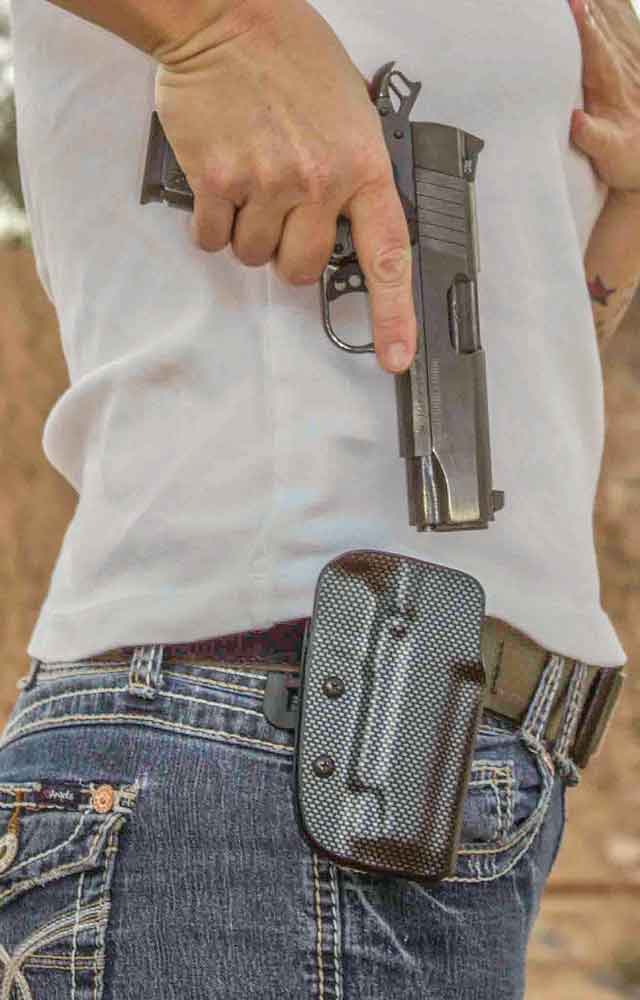
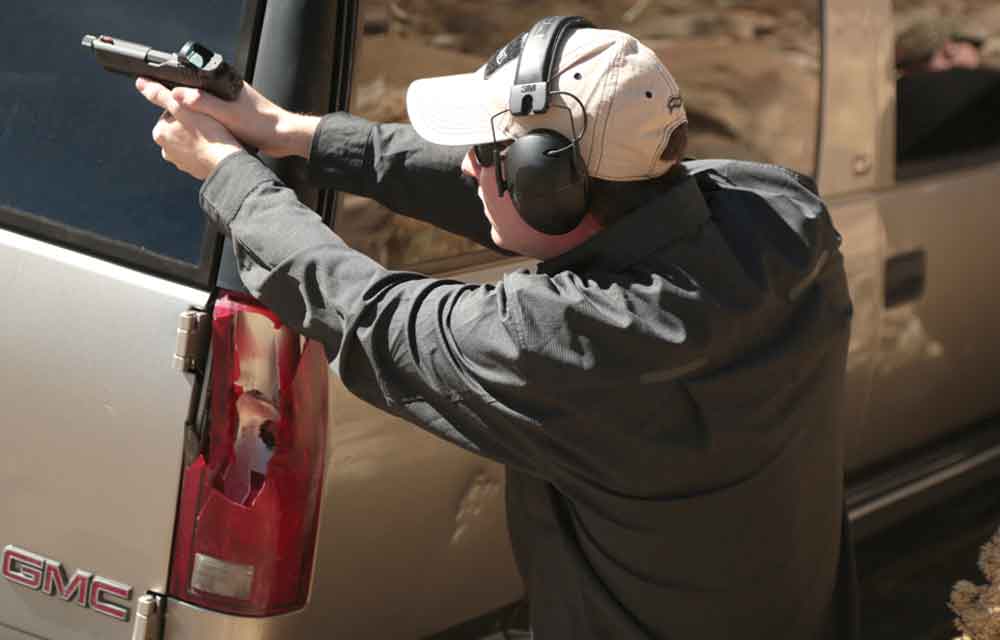
The need to practice fast-holstering a handgun for self-defense is debatable and, in many cases, dangerous.
Why practicing quick holstering a handgun might not be needed:
Many shooters overemphasize fast holstering in practice.
This training can be dangerous and in a real-life scenario most likely unneeded.
Holstering a drawn handgun should be a slow deliberate process.
You should only worry about holstering a gun once you are certain it is not needed.
Because of my vocation, I spend a lot of time on the range. I won’t say I’ve seen it all, but I’ve seen a lot. And, to be honest, a lot of what I’ve seen just does not make a whole lot of sense. Take for example the motions some handgunners go through after they shoot their gun. They’ll pull the handgun in close to their body, jerk their head left and right like they’re trying to shake water out of their ears, and then shove the handgun back in their holster faster than Bill Hickok could have pulled one out of his.
Take your time when you holster. Make sure your finger is off the trigger and that there is no further need to have your handgun out.
Though I’m sure I’ve not considered every scenario, the times that you’ll need to holster your handgun in a hurry are as rare as the times you’ll hear Britney Spears whisper in your ear, “My place or yours?” As a cop, I pulled my handgun countless times. I also saw other cops do the same. Never was I in, or did I witness a situation where, the handgun had to be holstered in a hurry. That’s a good thing because holstering a handgun in a hurry is one of the leading causes of self-inflicted gunshot wounds.
In a defensive situation you should only holster your handgun when the shooting is over or when you realize shooting will not be needed. In either case, there is no rush; you’re safe and the threat is no longer present or has been neutralized. Yet, too many shooters practice fast holstering on the range. Either they think it looks cool or they’re in a hurry to run a drill again. Eventually, they’ll forget to remove their finger from the trigger and when that finger contacts the holster it is often followed by a loud noise and the creation of extra unneeded but mostly unwanted holes in the body.
When it’s time to put your handgun away, take a breath, slowly and carefully evaluate your surroundings, address ammunition needs, and then, deliberately, slowly and reluctantly, put that hog’s leg away. That soft thing you sit on and those legs that carry you around will appreciate the consideration.
Editor’s Note: This article originally appeared in the January 2018 issue of Gun Digest the Magazine.
Defensive firearms training should go well past range time to realistic situations that prepare you for actual lethal force encounters.
How immersive training sharpens you for the real thing:
Until you train to respond to a deadly force encounter you won’t truly know how to respond.
While range work is important, scenarios training injects realism and the adrenaline factor.
Mistakes will be made in this sort of training, but in an environment where they can be corrected.
This sort of training is wise, ensuring you are fully prepared and confident with your self-defense skills.
In an article on active shooter response training that ran in Gun Digest the Magazine some time back, author Bob Whaley, a Gunsite-certified instructor and law enforcement veteran of more than 28 years, wrote with regard to training: “You don’t know what you don’t know until someone points it out.”
I remember at the time thinking that it was an elegantly simple way of pointing out something that, in truth, was quite profound. Until you have trained in how to respond to a deadly force encounter, you truly will not know how to respond.
I received a great reminder of this when Walther invited a group of us writers and editors out to Utah to debut its new PPQ SC and send us through a training course the staff at Deliberate Dynamics had prepared. Among the two most striking exercises trainers had us do were a live-fire house clearing scenario and a night shoot in which we used flashlights in our support hand paired with a handgun in our dominant hand.
The live-fire house-clearing scenario was designed to mimic what an armed citizen might face in a potential home defense event. Even in a controlled environment, which the shoot house was, the stress of decision-making in a dynamic setting, as opposed to training on paper or steel at a range, amped up the adrenaline factor. And even when trying to keep in mind the training you’d just received, mistakes were almost always inevitable. At the end of the scenario, one of the instructors would point out simple mistakes — not covering this corner or that or lingering within a field of fire too long — but mistakes that in a real event could prove deadly.
Similarly, the nighttime shoot proved to me that if you’ve never trained in low- or no-light shooting with a flashlight, you’re almost certainly not going to be ready if you’re forced to do it in the real world — especially during a high-stress event such as a defensive shooting.
The short version of this is that anyone who intends to carry concealed or defend their home with a firearm really, really should invest in the training to help them properly do so. The simple truth is that if you don’t have the knowledge and skills, as well as the mindset, to best defend yourself, it’s likely you won’t be fully prepared if and when that moment arrives.
Editor’s Note: This article originally appeared in the March 2018 issue of Gun Digest the Magazine.
Giving the ROMEO1 a rough once over, Richard Mann tries to find out if the red-dot is as rugged as SIG claims.
Once known strictly as a gunmaker, SIG Sauer has branched out in recent years, offering a complete suite of accessories and ammunition. Perhaps one of the company’s more exciting endeavors came in 2016, with the introduction of optics, from high-tech long-range riflescopes to lightning-fast reflex sights.
Of these, the Romeo 1 Red-Dot has stolen its share of the limelight. In part, this is due to the miniature reflex sight’s inclusion as a factory-installed accessory on a number of SIG pistols. But it’s more than simply a perk. It’s a performer.
Featuring a molded glass aspheric lens, with high-performance coatings for superior light transmission and zero distortion, the ROMEO1 is designed for fast target acquisition. And the sight’s 3 MOA red-dot, with 50 MOA of elevation and windage adjustment and multiple intensity settings, helps it deliver once the target is found. Too boot, the ROMEO1 is smart as a whip, powering up when it senses motion and down when it doesn’t. Simply put, the sight is built for action and is ready for it the moment the shooter draws.
Of course, trepidation remains among some about slapping a unit like the ROMEO1 on a pistol, particularly one holstered for self-defense. While there is evidence red-dots enhance accuracy, there are qualms concerning their ability to stay on target through the bump and shuffle of everyday carry. An understandable apprehension, one Richard Mann lays to rest in the above video.
The Gun Digest writer manhandles the ROMEO1, mounted on a SIG P226 RX Compact, with the gusto typicaly reserved for a malfunctioning vending machine. The results, well, the video speaks volumes to the red-dot’ s resiliency — not to mention Mann’s arm.
Given the manufacturing quality of SIG in general and ROMEO1 in particular, ruggedness shouldn’t be a question. What should: whether you can get your pistol on target no matter what.
Editor’s Note: This video is one of several that were created during a torture test of Sig Sauer P320 series pistols. Stay tuned for more videos, and keep an eye out for Richard Mann’s full article in an upcoming issue of Gun Digest the Magazine.
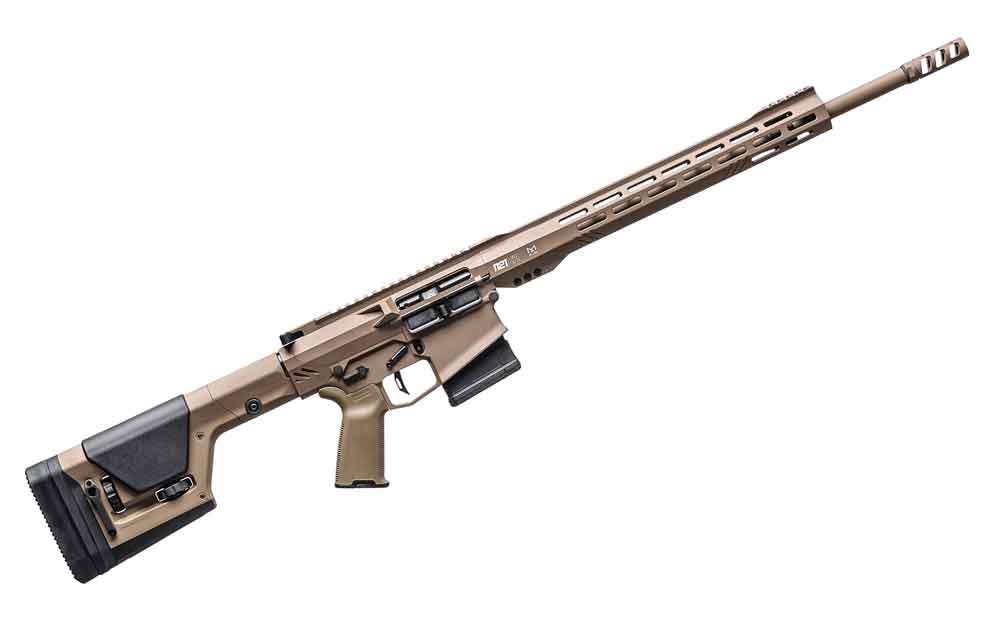
Now chambered in 6.5 Creedmoor, the 1121XR precision rifle appears ready to go the distance.
How Rise Armament decked out the 1121XR for the 6.5 Creedmoor:
At tick over 10 pounds the 1121XR is manageable as a field rifle.
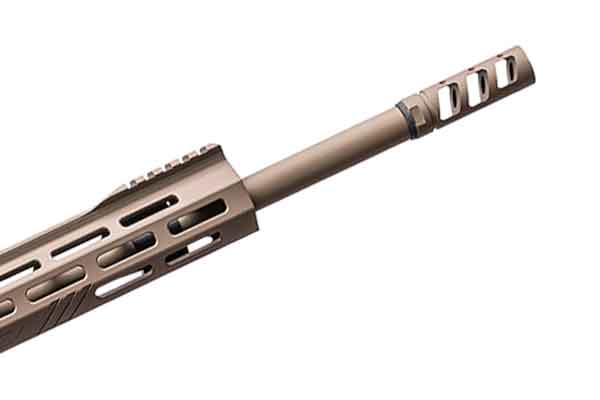
It boasts a 22-inch stainless steel barrel, topped with a proprietary compensator.
The rifle comes with Rise Armaments RA-535 trigger, which break at 3.5 pounds.
The 1121XR runs $2,449 and comes with a hard case and two 10-round magazines.
Time was when you wanted a 6.5 Creedmoor it was strictly a bolt-action affair. But as the popularity of the long-range cartridge has grown, so have the options for launching it. Inevitably, this has meant a growing selection of semi-automatics.
In recent years, rifles that go the distance and provide lightning-fast follow-up shots have popped up in droves. Rise Armament is the latest black-gun specialist to jump on the Creedmoor bandwagon and has chosen a dandy platform for the caliber expansion. The 1121XR precision rifle, a gas-operated AR-10, has already won kudos in its original .308 Win. chambering and has the potential to turn even more heads as a 6.5.
Will there be a tree line distant enough for a hog to escape when the 1121XR is on the hunt? The Oklahoma gunmaker is betting not, given it’s designed the rifle as a doer — not just benchrest candy. While more than capable of ringing steel set at the horizon in competition or for fun, the 1121XR looks to have a heart of a field gun. At a tick over 10 pounds, the rifle finds a sweet spot between precision-enhancing heft and manageability in and out of a stand.
As expected with a precision rifle, Rise Armament’s 6.5 comes with the features that make certain it performs. Chief among these are the 1121XR’s solid upper and lower receivers, machined from aircraft-grade aluminum billets to form the rifle’s rigid core. From there, the company has attached a 22-inch button-rifled stainless steel barrel and topped it off with its proprietary compensator. This final feature is a nice touch, certain to maintain shot-to-shot accuracy by dampening recoil.
Surrounding the barrel is a 15-inch handguard, also machined from billet aluminum and outfitted with M-Lok-compatible slots its entire length. The 1121XR also comes equipped with Rise Armament’s RA-535 Advance-Performance Trigger, which offers a crisp 3.5-pound pull, no overtravel and a short reset, which should aid it in breaking off follow-up shots with expediency. The 1121XR 6.5 Creedmoor also boasts a precision-engineered bolt-carrier group, finished with black nitride to make cleaning a snap.
Overall, the rifle has a durable Cerakote finish available in three color schemes — black, foliage green and flat dark earth. The 1121XR ships with a hard case and two 10-round magazines. And at present, it has an MSRP of $2,449. The rifle is due out in 2018, but is yet listed on Rise Armament’s website.
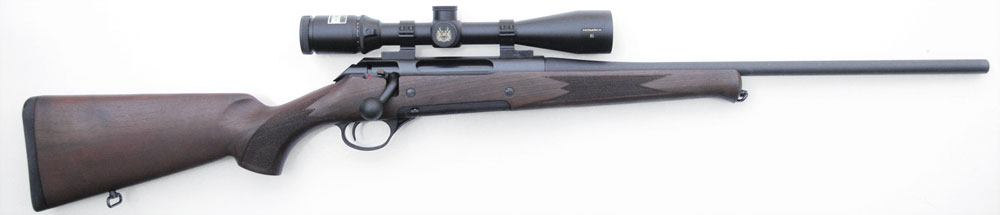
For the better part of the bolt-action rifle’s history, the twin-lug design has dominated. But in recent years there’s been a new kid on the block challenging the time-tested configuration’s supremacy.
The tri-lug full-diameter actions, what Jon R. Sundra calls “fat-bolts,” have been sweeping over the rifle world. And why not? They’re stout as sycamores and tend to run well less — due to less machining — than more traditional designs. And, best of all, there are about a metric ton of options available to match nearly any shooter’s pocketbook.
With that in mind, here are five notable fat-bolt rifles worth a look. No matter if chasing deer or punching bullseyes, these guns will get the job done. This iconic German rifle manufacturer’s least expensive rifle prior to this year’s introduction of the MHR-16 was the RX Helix, which starts at $3,295. This is an unabashed fat bolt rifle, which is how Merkel is able to produce it at a cost that’s not that much more than our domestic equivalents. I’ve tested this gun, and considering its quality and heritage, it’s pretty amazing they can offer it at a price of $799.
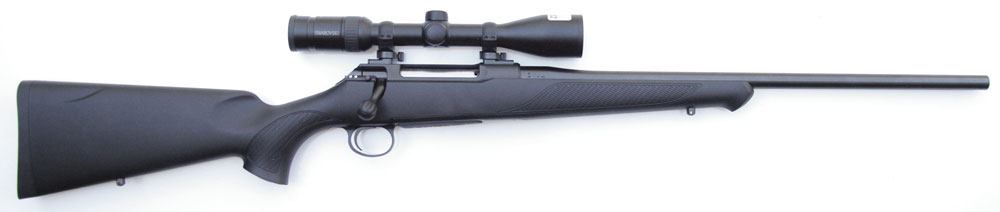
Sauer 100 Classic XT
Although this 100 Classic XT was introduced in 2016, it has become readily available just this year, so I’ve chosen to include it here. Another member of the fat-bolt genre, this rifle is noteworthy for the same reasons stated for the Merkel: It’s of German quality, yet it carries an almost unheard of price of $699. And except for the subtle Schnabel forend tip, its stock would look right at home on any American-built rifle.
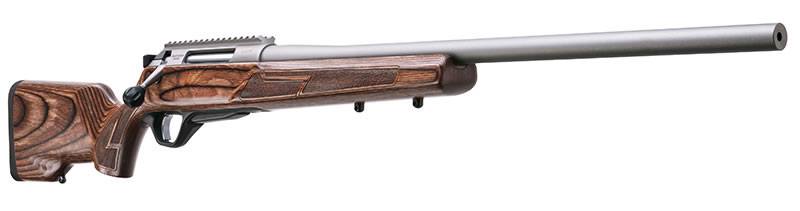
Lithgow LA102
Yet another fat-bolt tri-lug design, this Australian-made bolt-action imported by Legacy Sports (which also handles Howa rifles) is the work of that country’s military armaments supplier and represents its first venture into sporting rifles. The example I tested was quite impressive, but then its MSRP of $1,255 takes it well out of the “value-priced” market. It does, however, offer a few upscale features to justify the price.
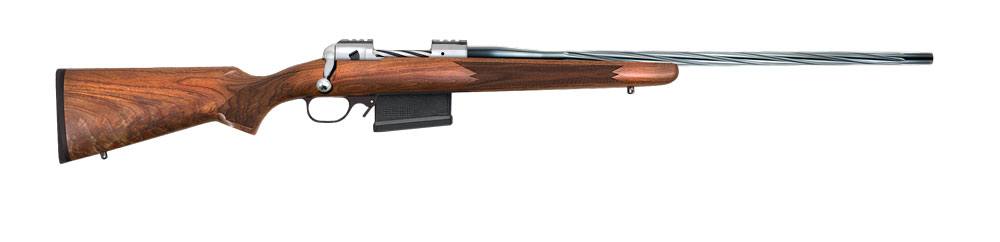
E. R. Shaw Mark X
Announced more than 2 years ago, this controlled-round feed version of a Savage 100 series-type action is now available. It makes my list because, with a starting price of $1,399, it offers what is probably the highest degree of customization for the price. I’m talking choice of barrel length; contour and fluting; length of pull; metal finish; and a choice of more than 100 calibers. Unlike the Savage action, the Mark X features an integral scope mount rail and recoil lug, and no barrel lock nut.
Barrett Fieldcraft Rifle
Known for its .50-caliber sniper rifles used by our U.S. Armed Forces, as well as many other countries in the world, Barrett has thrown its hat into the sporting rifle arena with its ultra-light Fieldcraft. Nothing new here; it’s a Remington 700-type action — but it’s beautifully machined and finished to tight tolerances. Despite a soda straw barrel and a weight of just 7.25 pounds with scope, the example I tested in 6.5 Creedmoor was a genuine MOA rifle.
Nikon’s first foray into reflex sights, the P-TACTICAL SPUR appears to have everything to get a shooter on target fast.
Hunters, competitive shooters and plain old plinkers have always sought the optimal balance between price and performance when it comes to optics. Face it, saving coin can mean strapping a clunker on a rifle and going top shelf can result in a second mortgage. Not exactly the frying pan or fire most want to get caught in.
There is a rare middle ground in this aiming solutions conundrum, one which over the years Nikon has staked a steady claim. Once better known for its cameras, the Japanese manufacturer has won many shooters’ hearts with scopes long on performance and relatively short on price. And now it has turned its attention to another nook of the optics market with the introduction of its first reflex sight: the P-TACTICAL SPUR.
Presently available at a number of retailers, the sight is tailored for close- and medium-range applications and is compatible with nearly any pistol, rifle or shotgun via a Picatinny Rail. And with a MSRP of $219 — backed up by Nikon’s reputation and a 5-year warranty — the red-dot optic should be within reach of the greater shooting public.
One of the more notable aspects the P-TACTICAL SPUR brings to the table is its economical battery use. Nikon pegs the 1x magnification optic at 15,000 hours of run time off one battery. Given many opt to use reflex sights as a back-up option, the exceptional battery life should offer peace of mind the TACTICAL SPUR won’t poop out in a pinch.
The 1.1-ounce optic is unobtrusive at a hair over 1 inch in length and offers all the functionality shooters have come to expect from red-dots. The 10 intensity settings — two of them night vision compatible — help the P-TACTICAL SPUR thrive night and day. Its 3 MOA red-dot is centered in an extra-wide 27mm x 16mm sighting window facilitating fast target acquisition. And Nikon’s proprietary TRUCOLOR lens coating ensures a clear sight picture once the target is found.
The P-TACTICAL SPUR is also ready to tackle the muck, dust and water of hard use. Built on a lightweight aluminum chassis, the sight has an IPX7 rating, which means it can endure most wet or wild situations.
Houston Astros pitcher Lance McCullers trades his glove up for an AR-15 to showcase his all-star shooting skills on Modern Shooter.
A dominating force on the mound, Lance McCullers is familiar with bringing the heat. The starter in the winner-take-all game seven of the World Series, the pitcher was integral in the Houston Astros’ historic first championship. Away from the diamond, the right-hander is equally as steely.
In addition to a wipeout curveball, McCullers is no slouch behind the trigger. And this week on Modern Shooter, he trades up his glove for an AR-15 to showcase all-star shooting skills at Houston’s MAST Solutions. Joined by former teammate Jason Castro, the duo run and gun through the facility’s challenging situational training. And like baseball, they show thriving behind the trigger is more than just a matter of showing up.
They are more than up to the challenge. And they should be. As McCullers goes into, growing up on a ranch outside Tampa, Fla., guns and shooting have always been a part of his life. And as should be familiar to many shooters, firearms go way beyond being just tools for McCullers. They are also a tie that binds him to friends and family.
Carrying a concealed sidearm involves a lot more than just strapping on a gun, putting on a jacket, vest or some other cover garment and heading out the door and into the world.
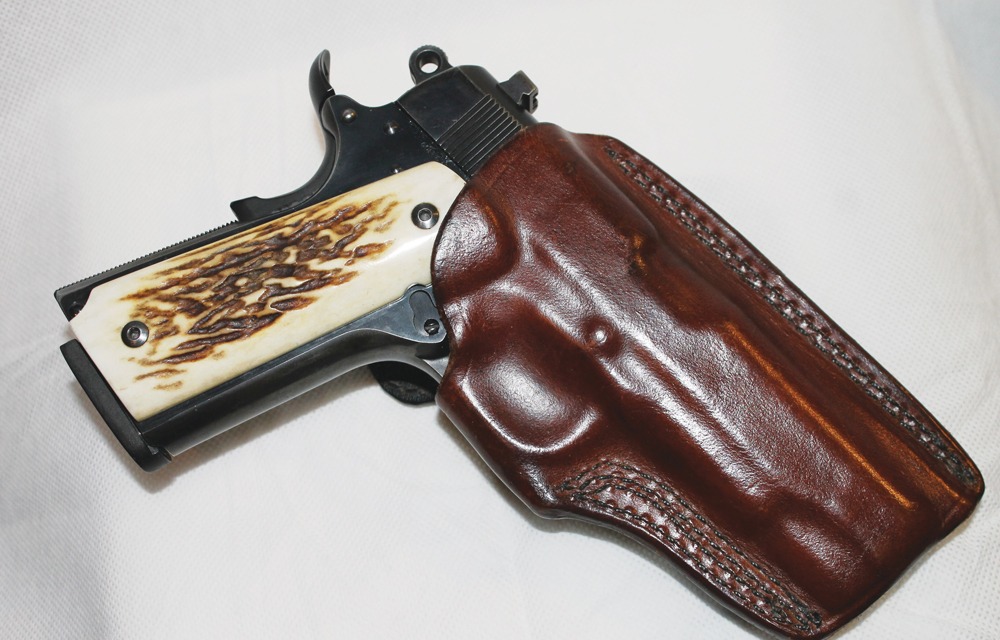
A holster fits the handgun snugly, like this formed-to-the-gun belt holster from Greg Kramer. This holds the gun firmly, yet allows for a smooth draw.
You might never need to draw that handgun in an emergency, but if the time ever comes that you find it necessary, your holster needs to work. Alas, some simply are not up to the task, no matter how much hype one might read in an advertisement or on some Internet forum where the level of expertise can often be measured by the nicknames people give themselves.
Having carried a personal sidearm for more than 40 years in any number of positions from the ankle to the armpit, strong side and weak side and even small of the back, and having built holsters for people all over the map, I’ve had the chance to form opinions based on actual experience.
Here are five solid holster considerations for the armed citizen.
#1: Finding The Right Fit
The No. 1 thing to remember when selecting a holster is to be sure it fits both your gun and your body. And don’t forget your wardrobe. People who pick a one-size-fits-all holster are begging for trouble. Your defensive carry holster should fit your gun like a glove, and it must allow the sidearm to disappear completely under a cover garment.
Also, make sure your sidearm is capable of being concealed on your body. Don’t be the show-off who gets the biggest handgun you can find and think you will impress everybody with a big bulge under a jacket or vest, or sport a holster that’s longer than your cover garment. That’s an invitation to trouble.
The author’s well-used rough-out IWB rig has a curved profile, and it has married itself well to his strong-side body curve.
I recommend holsters that are minimal and functional to the task, either belt rigs or IWB (inside the waistband) concealment models. Proper fit involves more than just a snug gun. Well-made leather holsters can “marry” themselves to your physical form, especially the IWB holsters. Carry a holster and work with it a lot, and soon it will feel like part of you — there at the touch but comfortable enough to ignore while going about a daily routine.
If carrying a revolver concealed, I suggest a high-ride pancake-style holster over all others. This rig tends to hug the revolver close to the body fore and aft, and the grip is less likely to tilt away from you, thus printing through your cover garment. The pancake holster can be adjusted forward or rearward depending upon where your belt loop is located.
Of course, for a big revolver — which few people can truly carry completely unnoticed — a shoulder holster is a must. You will want to carry it under a windbreaker or parka to avoid being spotted. I’ve carried a .41 Magnum S&W with a 6-inch barrel in the winter, but in fair weather, that gun stays in the safe.
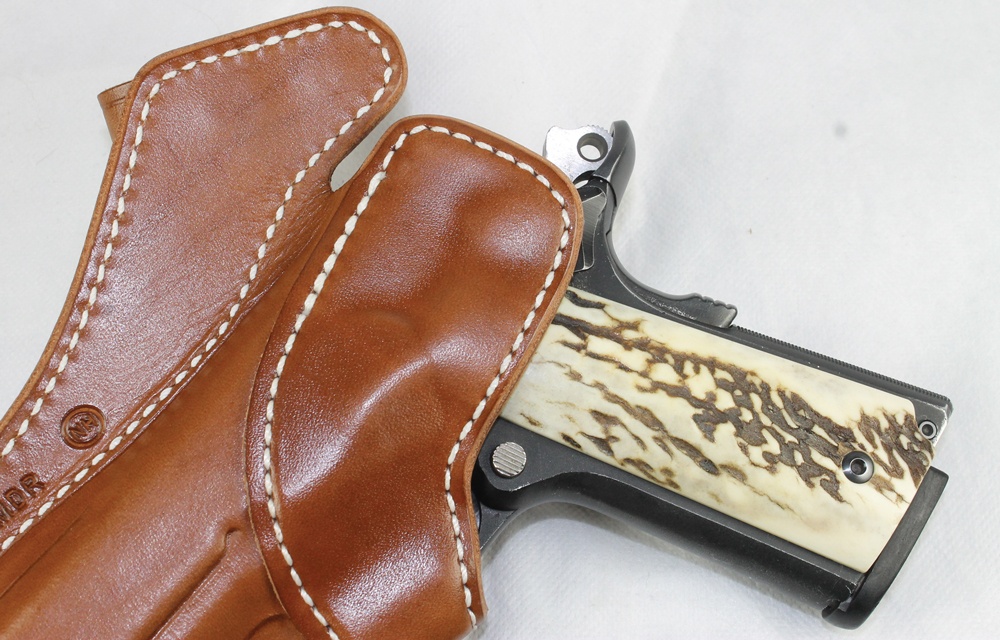
My daily carry rig for a .45 ACP Commander is an IWB rough-out model. It doesn’t slide around and it carries essentially in the same spot one day to the next. Many, if not most such IWB rigs are based on a designed by the late Bruce Nelson called the Summer Special, offered by Milt Sparks. The rough-side-out Summer Special is a classic minimalist design using only enough material to make it superbly functional.
In addition to Sparks, the top makers of leather concealment holsters include Mitch Rosen, Gene DeSantis, Greg Kramer (who specializes in horsehide), High Noon and Galco, and that list only scratches the surface.
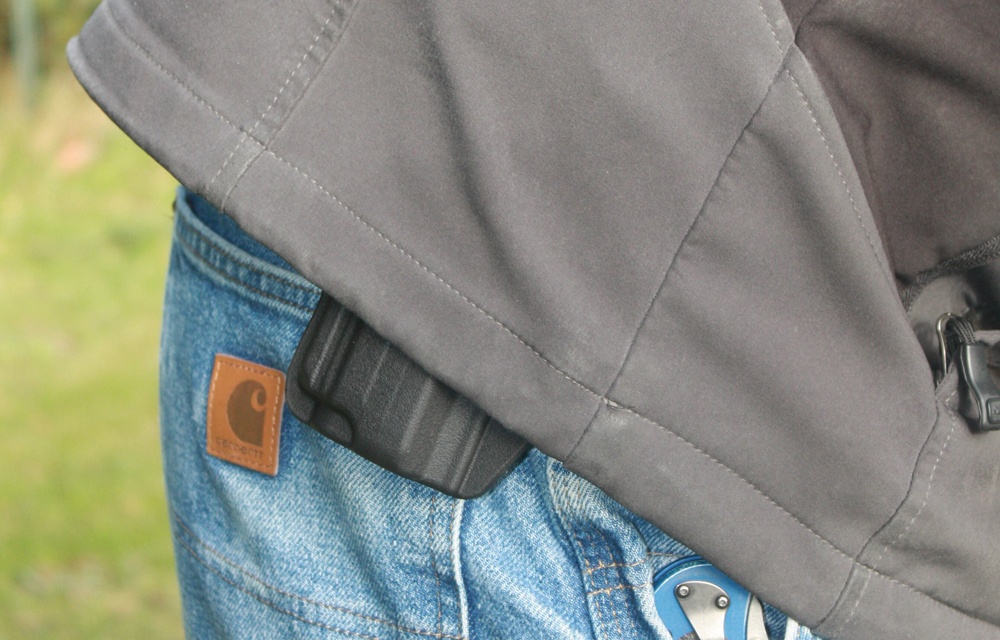
You can sure tell this guy is packing a big gun because the holster is too long and the jacket is too short, so the slightest bending at the waist tells the world there’s a pistol in the neighborhood.
I’ve carried sidearms in holsters made by all of these outfits. They are reliable and certainly represent the best in American craftsmanship.
#2: A Stand-Up Solution
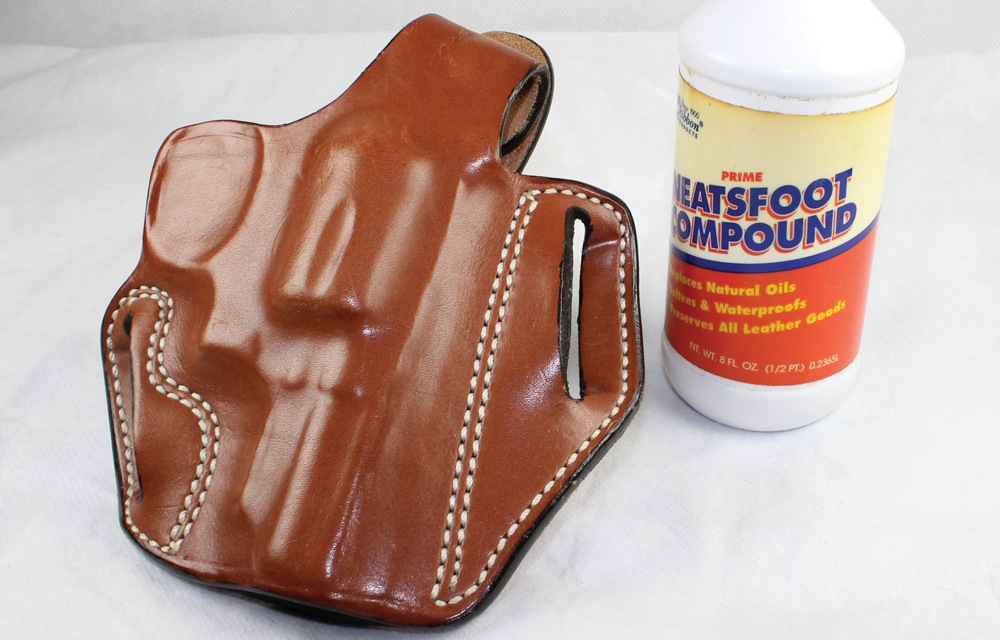
If you carry leather, or a hybrid leather/Kydex rig, never apply any kind of softening agent to the leather. Your rig needs to hold its shape, particularly for one-hand re-holstering. I’ve found that one that retains its original shape is inherently faster, and this can be enhanced with a drop or two of Leather Lightning, a surface treatment sold by Mitch Rosen that will wear off, but it does quicken the draw.
Things to avoid: Neatsfoot oil, saddle soap or anything that contains lanolin. Don’t use liquid shoe polish. If your holster gets beat up as they sometimes do, you can touch-up the appearance with Kiwi or Lincoln wax polish, but remember that those products can leave a stain on your garments, so use some discretion.
Neatsfoot oil and saddle soap are good for boots, saddles and other leather gear — but for concealment holsters that must remain stiff, they are best avoided altogether.
In the event your leather holster gets wet, let it air dry. Living in the Pacific Northwest has given me plenty of experience with wet holsters. It’s an environmental hazard, especially in late fall and winter, that you could get wet. Drying it out with heat can damage the leather.
#3: Hoards Of Holsters
Resign yourself to the fact that you will own more than one holster for your carry piece. I don’t know a single serious handgunner who doesn’t claim ownership to a box of holsters.
Don’t use a softening agent on your carry leather. Neatsfoot compound is good for boots, shoes and other leather, but your carry rig needs to retain its shape and rigidity.
Most defensive handguns can be carried in different places on the body, in different holsters. It might be in a belt rig one day, a shoulder holster the next, and — depending upon the gun — in a pocket holster or IWB holster the following day.
For my J-frame S&W .38 Special, I own the following: a Mitch Rosen ankle holster, a Rosen deep cover rig he calls The Workman that I designed and a Gene DeSantis pancake-style holster. The Workman was the original “tuckable” holster.
My Model 19 S&W snubby rides comfortably in an old Bianchi or DeSantis, in a vintage upside-down Safariland shoulder holster, or in a personally built high-ride belt holster.
Kramer offers a paddle holster that slides on and off and rides outside the pants while anchored to a wide leather paddle reinforced with a thin piece of Kydex. The paddle forms to the body and it’s quite comfortable. A snap strap goes around the belt to hold everything in place.
#4: Quality. Period.
Don’t buy cheap, flimsy holsters. They collapse immediately when the handgun is drawn, and then you cannot easily re-holster, if at all.
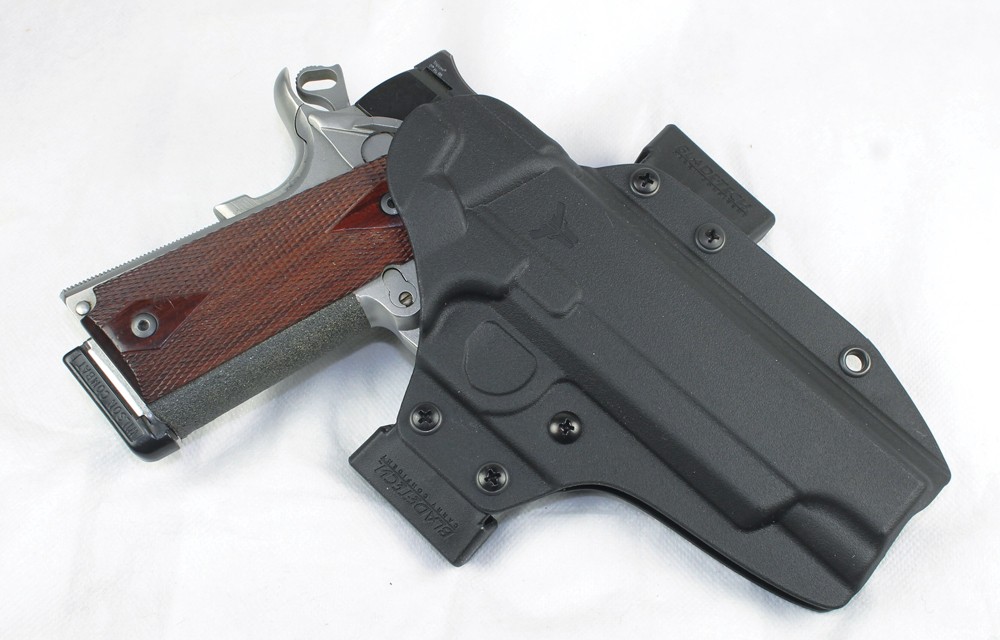
When it comes to Kydex, Blade-Tech turns out a good example of a lightweight, tough, inexpensive holster that’s impervious to weather while holding the pistol snug.
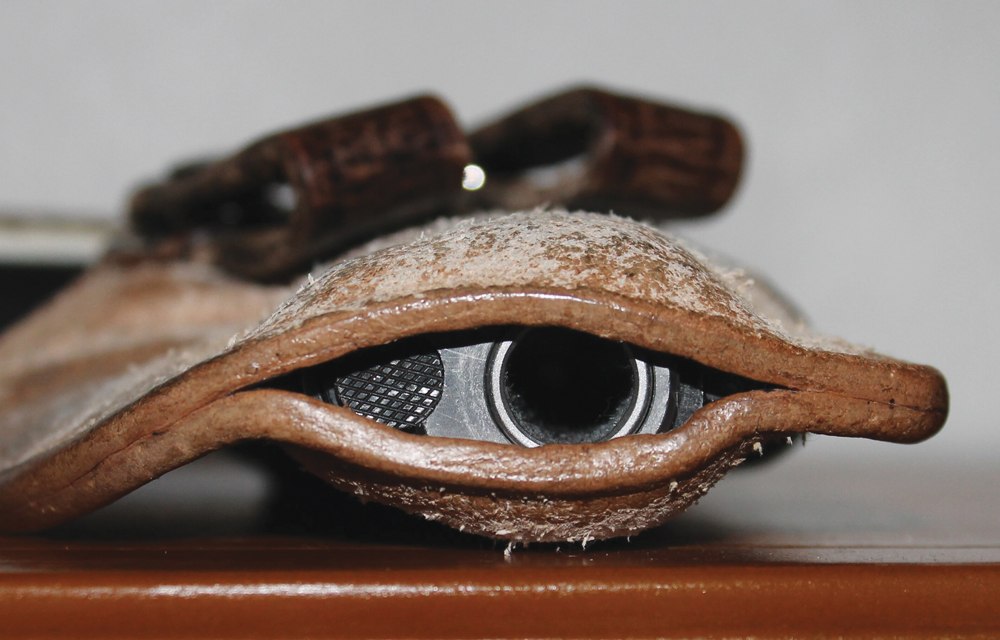
A good holster remains open at the top to allow for one-hand re-holstering. This is accomplished frequently by stitching a piece of thin spring steel between two layers of leather at the top around the opening. Holster makers use different approaches, but the result is the same: The holster always remains open.
You should be prepared to pay up to 15 to 20 percent of the price of your handgun for a reliable, high-quality leather holster. My first carry gun was a little Beretta for which I spent about $10 for one of those clip-in soft suede holsters that only some personal modification has saved from the trash bin.
There is a big “however” to this rule. Kydex holsters, or combo Kydex/leather rigs, or even holsters that combine leather and polycarbonate are less expensive, and they are popular, especially with newer-generation armed citizens.
That’s not an insult; it’s simply a fact of life. I prefer leather, others don’t. Rigs from Blade-Tech, CrossBreed, N82 and others meet certain budget limitations. After all, not everyone can afford a $900 defensive sidearm, and thankfully, a lot of manufacturers build quality concealment handguns for much less. The same goes for holster makers.
#5: Subdue The Sweat
The holster should have some sort of sweat shield between the gun and your shirt or skin. This “ear” comes up on the back/inside surface of the holster to prevent, or at least diminish, contact with the gun. It might be a narrow extension, or it might be a couple of inches wide to cover as much of the inside surface of the concealed handgun as possible.
This not only prevents chafing of skin or wear on your shirt, it reduces the likelihood of snagging during a draw. That sweat shield also provides a guide of sorts for re-holstering with one hand when keeping your eye on the target, which is sometimes necessary.
A good IWB rig will have a sweat shield like this to keep the handgun away from the shirt or body.
What about retention devices? Some holster designs use tension screws to keep the handgun in place, while others utilize a traditional thumb break that comes up over the hammer or rear of a striker-fired pistol.
I’ve found that a good IWB holster will retain the handgun by belt tension and therefore doesn’t need a retention device. And this is a good time to mention belts: Get one that supports your holster. Thin dress belts are no good for concealed carry. Most holster makers also offer belts. If you don’t care for such a belt, I suggest a good Western belt made from decent leather.
Another design feature to look for is how the holster covers the trigger. You want the trigger covered for safety — that should be a given.
Final Draw
Be prepared to shop around before selecting a holster. Pay attention to the little things, such as stitching and how the edges are burnished. A holster is an investment, and you want the best you can afford.
A holster is a critical component of your defensive equipment, and it just might make the difference in a gunfight because, as the late Bill Jordan observed, there’s no such thing as a second-place winner.
Editor’s Note: This article originally appeared in the Concealed Carry 2018 issue of Gun Digest the Magazine.
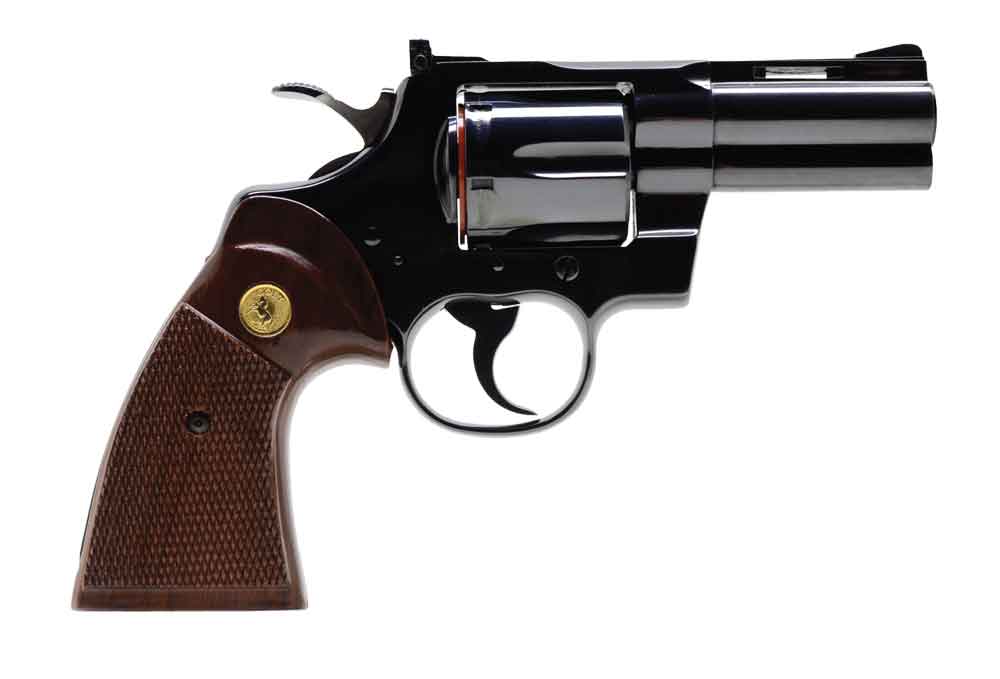
The Colt Python is widely considered to be one of the best revolvers ever made, and with production ceased for more than a decade, it’s also among the most collectible.
What makes this classic revolver the “queen” of a collection?
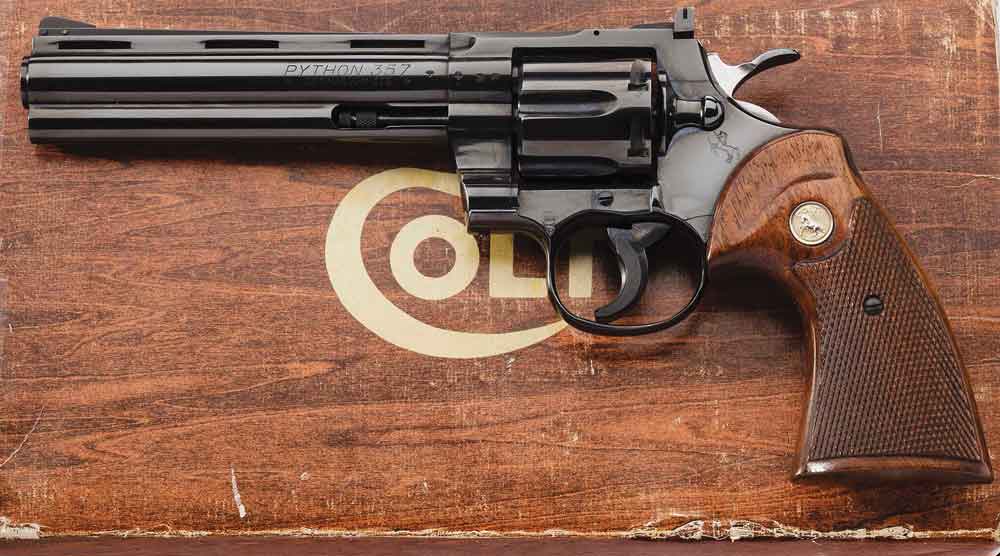
The Colt Python was released in 1955 and is considered by many the best gun made by the company.
The revolver was built on the Colt I-frame, also known as the “old .41 frame.”
In the Python’s early years it ran a mere $125.
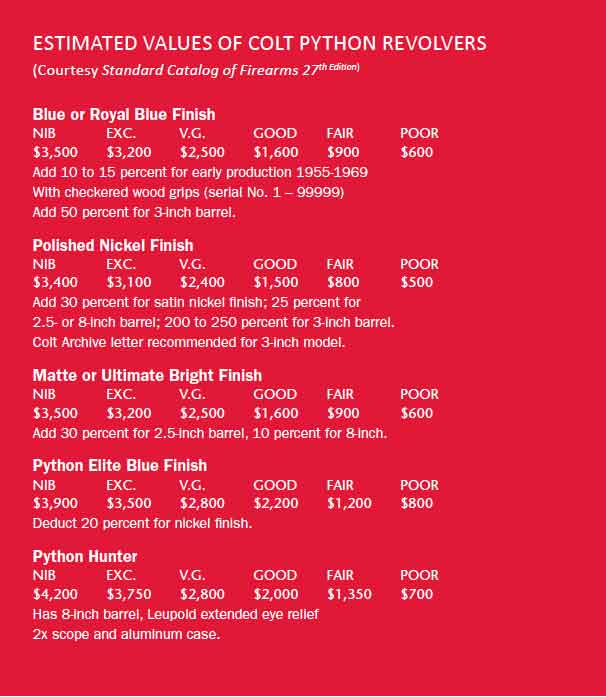
Presently, it’s not unusual for the .357 Magnum to demand $3,000 to $4,000.
What makes the Colt Python desirable is its tight tolerances, hand-fitting and hand-polishing.
The revolver was produced up to 1996 and by special order until 2005.
Those of us who are old enough to remember the ’50s know what a great time it was to be a kid growing up in America. And the middle of the decade, 1955, was a really good year. The number one song on the radio was “Rock Around the Clock” by Bill Haley and the Comets, considered by some to have been the first rock ‘n’ roll song. It was the year that Ford introduced the Thunderbird, Walt Disney opened Disneyland, and a new TV western, “Gunsmoke,” went on the air.
A 6-inch barreled blue-finish Python from 1965. The original box adds to the gun’s collector interest and value.
For fans of firearms, 1955 gave us several historically important new handguns. After years of insisting it would never happen, Colt brought back the Single Action Army revolver, in part because of the great popularity of TV shows like “Gunsmoke.” Bill Ruger also saw the trend and, to give Colt some head-to-head competition, introduced the company’s first centerfire, the single-action Blackhawk. And 1955 is also remembered as the year Colt introduced what many consider the finest Colt ever made, the Python.
A Legend Is Born
Some gun historians say it was the best revolver ever made. It was built on the Colt I-frame, which also was known as the “old .41 frame,” referring to Colt’s earliest swing-out cylinder, double-action Army and Navy models of the late 1800s and early 1900s. It has been said that some internal parts of these older models will interchange with those in the Pythons.
The first mention of the Colt Python I have found in print was in the 1956 edition of the Gun Digest Annual in an article about new revolvers by Major General Julian Hatcher, one of the very top gun writers of the day. It was just a short paragraph in the form of an editor’s note by John Amber, the renowned editor of the book for many years.
Among the rarest Pythons is this 3-inch barreled model. Its rarity means top dollar.
“Another late offering from Colt is their new Python Model in .357 Magnum caliber. Features of the new revolver are a ventilated rib — the first time this has been factory installed — a new barrel form, and target type grips as standard equipment. Price has been set at $125.”
General Hatcher and John Amber would be amazed at the prices being paid in recent years for Colt Pythons. Of course, condition is a big factor, but $3,000 to $4,000 is not unusual for the higher levels, and you can double those amounts for short-barreled nickel-finish models.
Fine In Form And Function
Why are these prices so much more than comparable Smith & Wessons, Rugers or other makes? The Python was a hand-fitted, hand-polished model and was often described as the Cadillac of Colt revolvers. Depending on one’s taste, like a classic Caddy from the ’50s, a Python is a thing of beauty and craftsmanship.
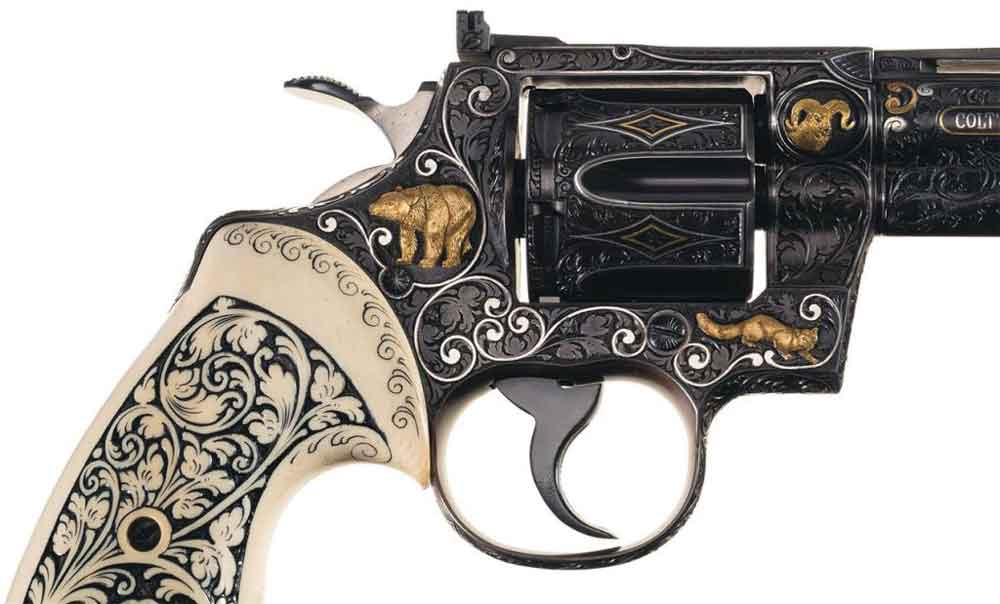
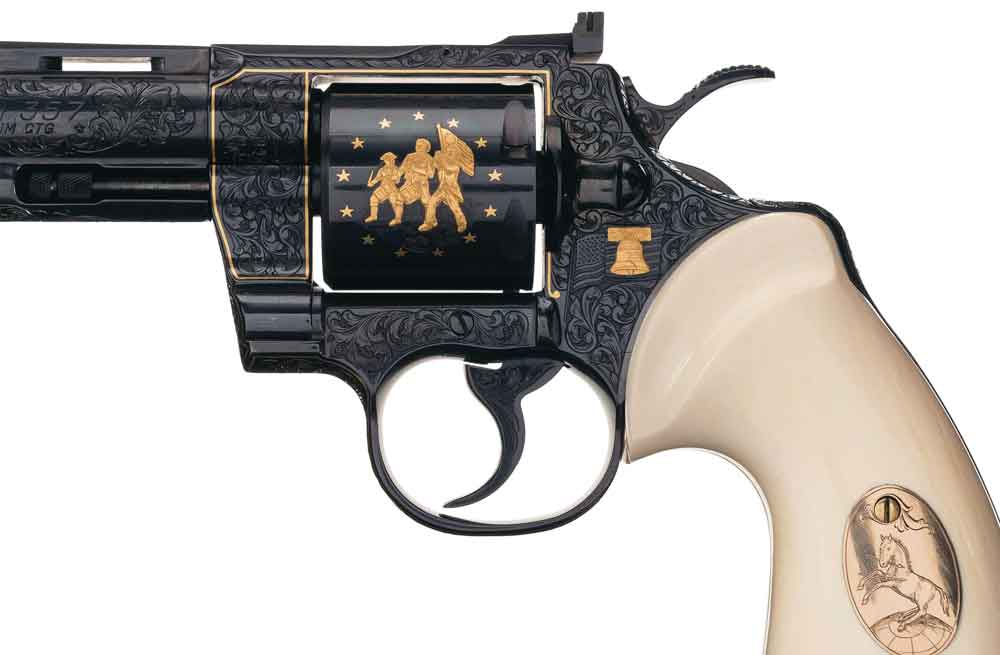
Pythons have often been favorite palates for engravers. This one belonged to Elvis Presley.
But it wasn’t just an attractive firearm; it was also very accurate, due to its tight tolerances and handwork. Many shooters describe the trigger as being smoother than any other gun they had fired. It has been considered somewhat of a status symbol, especially in recent years as prices have skyrocketed. I’m sure many could be called “safe queens,” which are taken out of the safe for show, but seldom if ever are fired.
It was originally intended to be an elite target gun in .38 Special. The .357 Magnum was announced by Remington and Smith & Wesson not long before the Python was ready to go into production. At the last minute Colt management decided to chamber their new gun for the magnum. Of course, it could also chamber the .38 Special. Later in the 1980s, a few Pythons were made in .38 Special only.
A Prized Possession
The Colt Python was in regular production from 1955 until 1996, and was offered in many different model variations with a wide range of barrel lengths, grips and finishes. After 1996, it was available only by special order from the Colt Custom Shop until 2005 when the model was discontinued. So it is now more than a decade since the last Python was produced, and “they aren’t making them anymore” is a factor.
A Colt Python .357 Double Action Revolver. A fantastic piece of Colt firearm art by famed Master Engraver Howard Dove (1942-1994). Dove signed this extensively engraved and gold embellished masterpiece
One of the common questions on gun forums is “will Colt ever bring back the Python?” As previously mentioned, the gun required a lot of hand fitting and polishing, skills that are hard to find today in the firearms industry. Even if you had the people to do the job, the time and talent involved would result in a very expensive gun. Most shooters, and certainly collectors, would rather put their money into an original Colt Python.
For several years, the Python has been one of the most sought after collectible guns. And, sad to say, this has resulted in many fake barrel lengths, finishes and other features. Readers are strongly advised to get an expert opinion before buying or selling one of these models that are described as excellent condition, new or unfired. It is also important to obtain a letter from the Colt company showing information on the background of the particular gun.
Editor’s Note: This article originally appeared in the April 2018 issue of Gun Digest the Magazine.
Although not as potent as powder-fueled firearms, airguns are now capable of delivering power equivalent to that of large-caliber handgun cartridges.
How modern airguns are set to blow shooters away:
Airgun power is supplied in many ways: pump, break-action piston and pre-charged pneumatic.
PCP airguns are capable of achieving pressures high as 3,000-3,600 psi.
Some of the popular PCP hunting rifles are chambered in .25, .30, .35 and .45 caliber.
The drawback of PCP rifles: They require a pump or scuba tank to fill their reservoir.
Some .357 PCP rifles can achieve muzzle energy akin to a .38 Special.
Guns that launch projectiles by means of compressed air are nothing new. In fact, an airgun accompanied Lewis and Clark on the Corps of Discovery Expedition of 1804-1806, and airguns were not new even way back then. In the early 1900s, multi-pump airguns became common, with one of the most common models being the Benjamin.
The Hatsan Hercules has a length of 48 inches and weighs 13 pounds. It’s available in .30-, .35- and .45-caliber configurations.
Although the Lewis and Clark airgun was a .33-caliber model, the most common calibers were .177 and .22 for many years. In 1948, the .20-caliber Sheridan multi-pump appeared, and the Sheridan was popular for many years. In spite of these historical aspects, recent developments have resulted in a new generation of airguns that are vastly more capable than the common models of yesteryear.
Power Plant Options
Power is supplied to airgun projectiles in several ways, even though compressed air is the common denominator. In the case of a multi-pump model, a lever is operated through a stroke that draws in air in one motion and forces it into a compression chamber in a reverse motion. By means of several complete strokes, the air in the compression chamber can achieve a pressure of several hundred pounds per square inch (psi). At the time of firing, a blow to a release valve allows the air to escape behind the pellet forcing it down the bore. As a result, multi-pump air rifles have variable power options.
Another type of air rifle, the break-action, utilizes the barrel as a cocking lever, and the cocking motion moves a piston in the receiver to the rear drawing air into a compression chamber inside the receiver. As the piston moves to the rear, it compresses a strong spring that drives the piston forward at the time of firing, which compresses the air and drives the pellet forward for the shot. Although only one cocking motion is involved, the effort required is considerable and may be as much as 50 pounds for a powerful airgun.
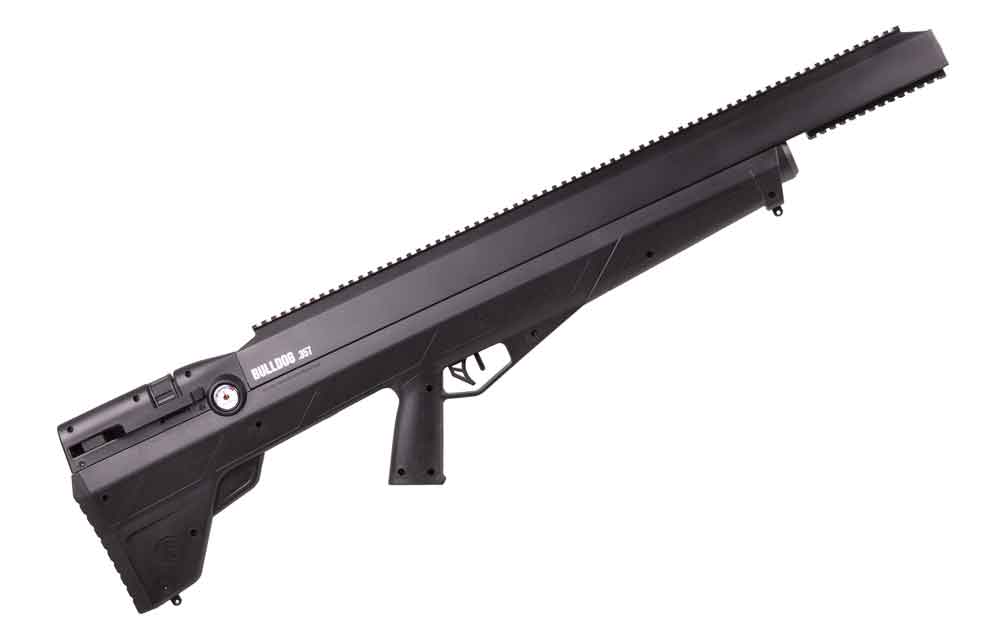
Crosman Corporation offers the Bulldog in .35 caliber for those wishing to hunt or shoot with a shorter and lighter air rifle.
One disadvantage of this type of rifle is that, upon firing, a heavy piston and spring jump forward — giving the rifle recoil to the rear. When the piston reaches its most forward position, it yanks the rifle forward. These motions make it difficult to shoot the rifle accurately, and the opposite motions of the rifle can quickly ruin scopes, most of which can withstand recoil only in one direction.
A third type of power plant is the pre-charged pneumatic or PCP version. In a PCP rifle, a reservoir is filled with air under high pressure by some external means. The two most popular compressing techniques are by means of a special hand-operated pump or a scuba tank. By either of these means, it’s possible to achieve a pressure as high as 3,000-3,600 psi. With this much pressure, the force on the base of the pellet is considerably greater than with either of the other power plants, so pellet velocity can be higher. Couple that with a heavy pellet of large diameter, and the result is a very powerful airgun. For hunting applications, some of the most popular calibers for PCP rifles are .25, .30, .35 and .45 caliber.
PCP rifles tend to be bulky and heavy because they have large, sturdy reservoirs. Also, they require some sort of external source of compressed air to fill the reservoir. They do, however, have advantages other than just the high power level. The reservoir holds a sufficient amount of air under high pressure to make it possible to fire several shots in quick succession.
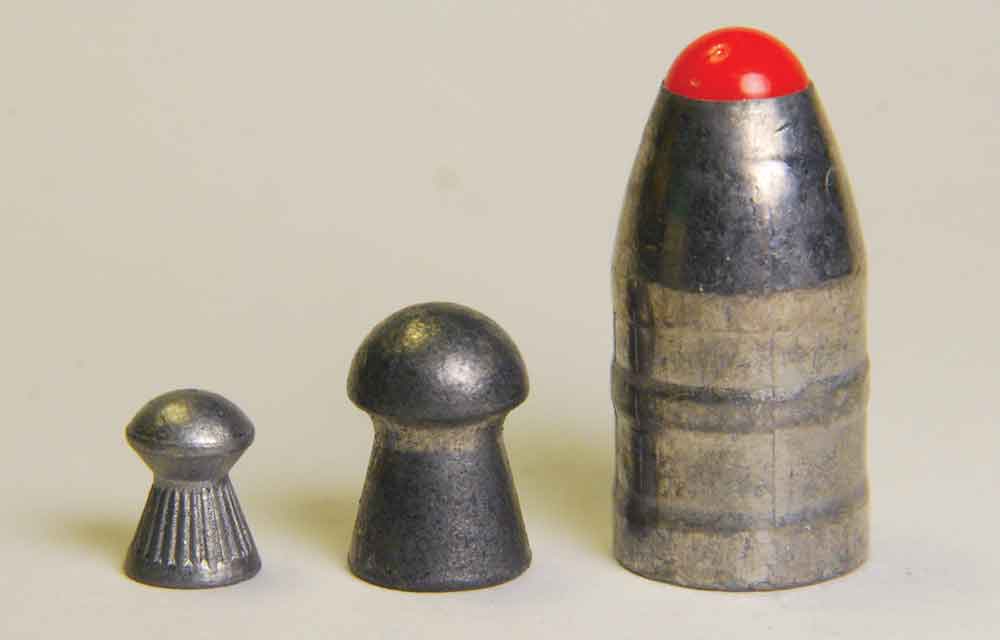
The relative size of .177-, .25- and .35-caliber pellets gives an indication of their uses and overall lethality.
Therefore, many of the PCP rifles are repeaters that hold several pellets in some sort of magazine, the most common of which is a rotating cylinder. These features make a PCP rifle the best choice for use in hunting. In fact, hunters are able to use the large-caliber rifles to kill deer or hogs. Although air rifles may be practical for hunting medium game, they’re not necessarily economical. Most of the .35- and .45-caliber rifles are priced around $700 or higher. Also, you will need a special pump or a scuba tank to fill the reservoir.
Practical Pneumatic Ballistics
Even a pressure of 3,000-3,600 psi is nowhere near that at which typical firearms operate. For example, most loads for a .38 Special revolver generate a pressure of approximately 16,000 psi, and those for a .357 or .44 Magnum run twice that high. Some popular .357 PCP rifles give a projectile weighing about 150 grains a velocity of 800-900 fps and, thus, produce muzzle energies in the 200-300 fpe range, about equivalent to a .38 Special load. Even a .45-caliber model generates energies in the 400-500 fpe range, about the equivalent of .45 Auto or .45 Colt loadings. Although these energies are high for airguns, they do not approach even the power of a lowly .30-30 Winchester, which gives around 1,800 fpe.
Some potent .25-caliber air rifles drive a pellet weighing approximately 30 grains at a velocity of close to 1,000 fps. A .22 Short standard velocity load drives a 29-grain bullet at 1,045 fps, which corresponds to a muzzle energy of 70 fpe. My .25s are powerful airguns, but they are still just that — airguns.
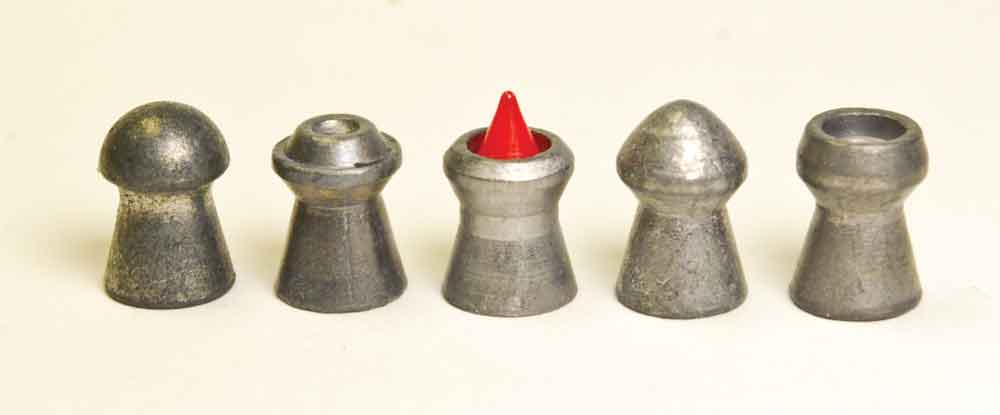
Pellets are available in a wide range of designs, as indicated by these .25-caliber versions.
Despite having considerable power, the velocity produced by even “magnum” airguns is relatively low. A .357 model can have a velocity that’s less than 1,000 fps, and a pellet is not aerodynamically efficient. The result is that the trajectory has a lot of curvature, so the rifles do not shoot flatter than a .22 LR. Even potent air rifles are short-range tools compared to “standard” firearms. As a result, hunters using air rifles need to be able to get close and place the projectile accurately.
Modern high-powered airguns are marvelous devices, but they are really suitable for use at rather short ranges. The trajectory is simply too curved because of the relatively low velocity. Also, the pellets are blunt-nosed, which results in their losing velocity rather rapidly. With a pellet having a ballistic coefficient of approximately 0.125 traveling at a muzzle velocity of 1,000 fps, an effective range of perhaps 75 yards is reasonable if the rifle is sufficiently accurate. Although they’re used to take larger species, even high-powered airguns are at their best on pests and predators.
Pumping a multi-pump rifle draws in air that can be compressed. At high altitude, the atmosphere is “thinner,” so atmospheric pressure is less. Each pump stroke draws in less air at high altitude, so with the same number of pump strokes, pellet velocity is lower than at low altitude. The same situation exists for a break-action air rifle. Both types of rifles give lower velocity at high altitude, but the multi-pump can be given an extra pump or two to compensate for the thinner atmosphere. It’s not possible to do that with a break-action model. In the case of a PCP rifle, the reservoir is filled to give a specific pressure, which is independent of the external atmosphere. However, it will take more pumping at high altitude to achieve that pressure. Altitude has no effect on the velocity produced by a PCP rifle.
Projectiles
Not only have airguns undergone significant development in recent years, but so also have the projectiles that they launch. Using only compressed air for propulsion, the working pressure of air rifles is low compared to gas pressure in a firearm. Accordingly, the pellets must be made of lead in order to reduce friction and to produce a good seal in the bore. Jacketed bullets or those made of hard alloys do not work well.
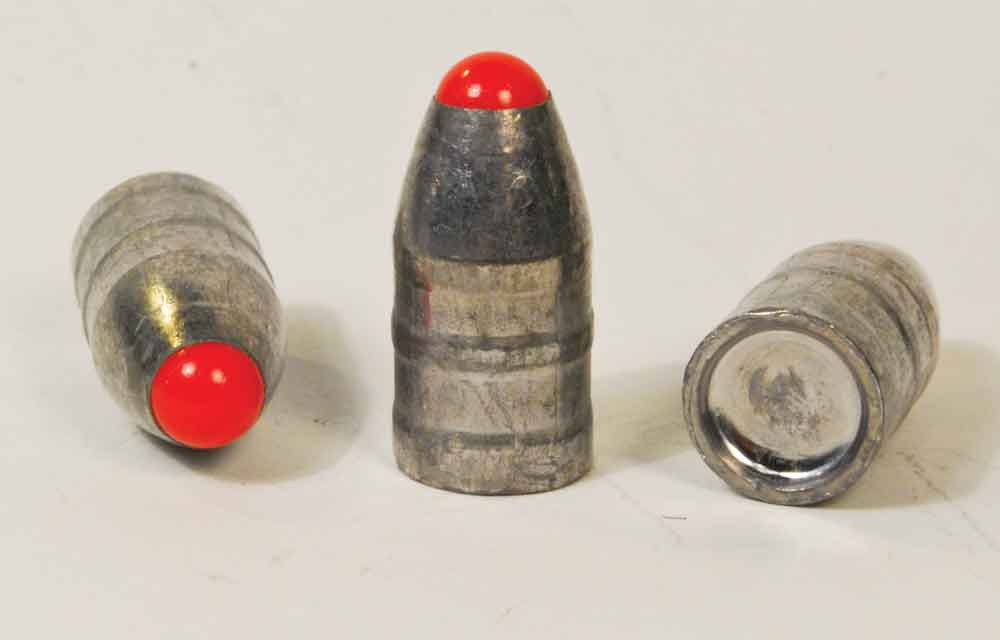
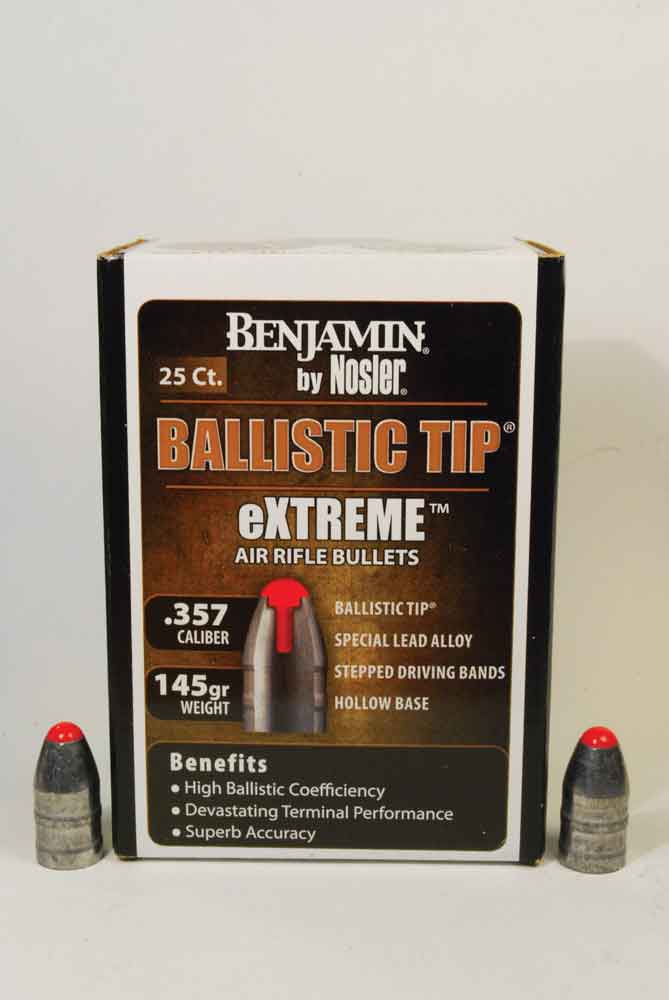
The .35-caliber Benjamin Ballistic Tip provides a good balance between weight and shape.
However, even with those limitations, there are many pellet designs. Some have rounded, pointed or hollow noses, whereas others have polymer inserts. Projectiles of all these types are available in .177, .20, .22 and .25 calibers, but the choices in .30, .35 and .45 calibers are much more limited. In the large calibers, the projectiles tend to be solid and resemble the bullets used in firearm ammunition.
Several years ago, Hornady began producing handgun ammunition featuring bullets that have a hollow point in which a polymer insert is placed. Other bullets with polymer tips include the Hornady V-Max, Sierra BlitzKing and Nosler Ballistic Tip. With the development of a .357-caliber Benjamin rifle, Crosman introduced the Ballistic Tip eXtreme that has a polymer tip.
Produced by Nosler, the projectile weighs 145 grains and has a polymer insert in the nose. Because air rifles operate at low pressure, the bases of projectiles are often hollow or have a thin skirt so that they will expand to provide a good seal in the bore. Large-diameter projectiles for airguns are specialty items, and some versions cost approximately $1 each. In some of the large calibers, the choice of pellets is limited.
Featuring a polymer tip to give better aerodynamic profile and a hollow base to provide a good seal in the bore, the Benjamin Ballistic Tip represents a state-of-the-art airgun projectile.
In recent years, the craze to achieve high velocity has not been restricted to powder-powered firearms. With power plant design limitations being what they are, higher velocity can be achieved by using pellets of lighter weight. As a result, several manufacturers have introduced pellets made of lightweight alloys. However, there’s no free lunch, so these lighter pellets lose velocity quickly and rarely give accuracy equal to that of lead pellets. This situation is improving, and some of the lightweight pellets perform very well and are even used in target matches.
Even though Lewis and Clark took along PCP rifles having the reservoir in the butt stock on the voyage of 1804-1806, airguns of today are a far cry from those produced even a half-century ago. Those in .25 or greater caliber are becoming more popular for use in various types of hunting that’s not limited to pests and small game. However, laws regarding such usage may not be the same as those dealing with centerfire or rimfire firearms, so check before assuming that one can use an airgun in the same way.
Editor’s Note: This article originally appeared in the February 2018 issue of Gun Digest the Magazine.
Richard Mann tests the dependability and accuracy of the Sig Sauer P320 X5 over the course of 84 rounds in less than 60 seconds.
Over the years, Sig Sauer has come out with some fairly innovative handgun designs, with some true classics peppered among them. For the most part, a majority of these pistols shared one thing in common — a hammer.
Perhaps, this is why the release of the P320 back in 2014 turned so many heads. The striker-fired pistol was a pretty big break for Sig and left many scratching their heads. Why, when you’re among the top in your firearms niche, do you go about messing with a winning formula?
Typical of Sig, the P320 wasn’t just another polymer-framed plastic-fantastic looking to live off name recognition alone. It was the striker-fired reimagined, not only offering a whole host of options, but also more versatility than is found nearly anywhere in the greater handgun market. What made it a winner — aside from Sig’s high manufacturing standards — was one simple word: modularity.
The P320 is a top-tier transformer, capable of jumping between caliber and configuration. The original standard 9mm pistol could go from compact carry 9mm to full-sized competition .45 ACP in less time than it takes to load its magazine. In turn, there were few handguns or systems out there that matched its adaptability, not to mention ease of use.
These facets helped the P320 to win the U.S. military’s XM17 Modular Handgun System (MHS) competition. And along the way, it has turned more than one civilian shooter’s head. Simply put, it was born to run.
In addition to its ease of operation and simple field stripping, the pistol has proven to thrive in the muck and under the hardest use. And Richard Mann puts the full-sized P320 X5 through some hard use in the above video. He squeezes off 84 shots in less than 60 seconds, all without flaw.
Editor’s Note: This video is one of several that were created during a torture test of Sig Sauer P320 series pistols. Stay tuned for more videos, and keep an eye out for Richard Mann’s full article in an upcoming issue of Gun Digest the Magazine.
The Smith & Wesson 929 is a high-quality, moon-clip-fed 9mm revolver that’s ready for anything.
What to know about the Smith & Wesson Model 929:
The Model 929 is based on Smith & Wesson’s N-Frame revolver.
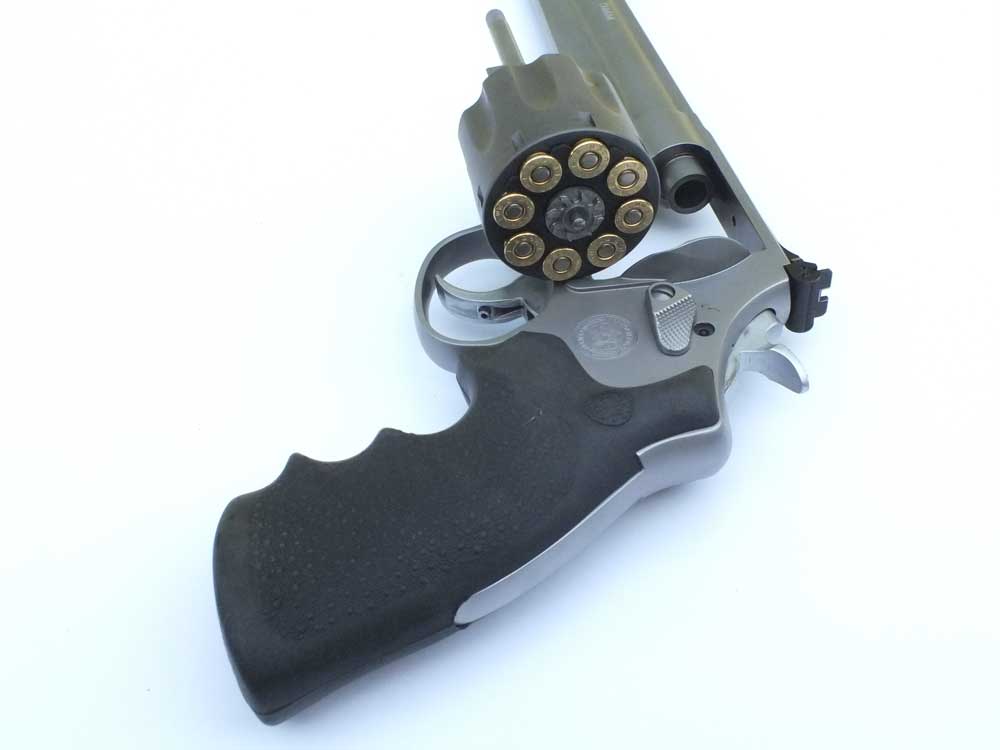
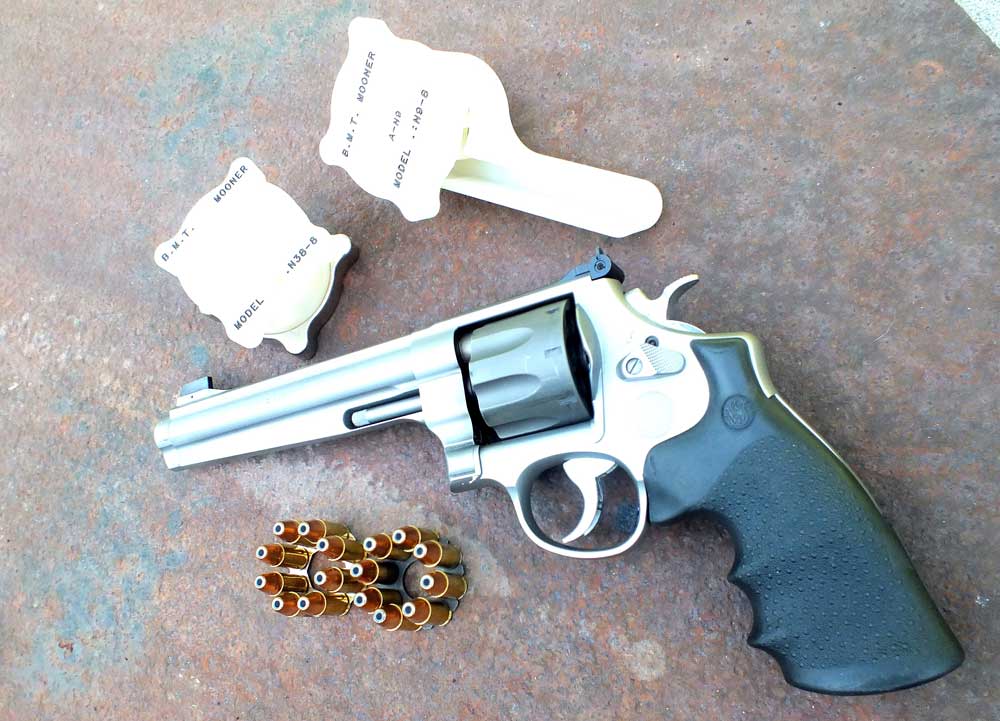
Because of its larger frame, it holds eight rounds of 9mm.
Being a Performance Center gun, the 929 has a slick trigger and a compensator.
For what you get, the 929 has a pretty respectable MSRP of $1,189.
Before the .50 BMG, before the .30-06, before the .45 ACP — and before dozens of popular modern calibers — there was the 9mm Luger round. Also referred to as 9mm Parabellum, 9mm NATO and 9x19mm, it was developed in 1902 by Georg Luger for what eventually became the German P-08 pistol, commonly called the Luger. The 9mm Luger round might have been around for a long time, but it’s more popular in spades than any pistol caliber introduced since.
For commercial consumption, 9mm Luger is the most popular centerfire caliber … and for good reason. It’s the most economical centerfire caliber to shoot, sometimes getting remarkably close in price to .22 Long Rifle. It’s a great round for training because recoil is manageable for new shooters. It’s powerful enough for personal defense thanks to modern developments in bullet construction, and finally, it allows about 30 percent more magazine capacity than other popular defensive calibers.
Devising A 9mm Revolver
So, if the 9mm Luger is such a great round, why have 9mm revolvers only been available recently? The answer is extraction. The cartridges originally designed for revolvers all achieved their headspace on the rim, and that rim served double duty, also allowing easy extraction in revolvers. Rimmed cartridges create problems in magazines so, like most cartridges designed for semi-automatic pistols, the 9mm Luger normally headspaces on the case mouth.
There’s no problem making a revolver fire a rimless case; the problem comes when you extract the fired case. Of course, single-action revolvers use a different extraction system that doesn’t use the cartridge rim, allowing Ruger to make a Blackhawk .357/9mm convertible revolver several decades back.
The original solution for rimless cartridges in double-action guns came when the U.S. Military wanted to use .45 ACP ammunition in the large-frame revolvers made by Colt and Smith and Wesson. The solution was the moon clip. The original moon clips held three .45 ACP cartridges and were crescent shaped, hence the name. Two moon clips would fill the cylinder of a M1917 revolver and allow extraction of the rimless .45 ACP round. To allow revolver use without moon clips, the .45 Auto Rim cartridge was created.
It took almost a century for someone to adapt the same solution to the 9mm Luger. In 1993, Smith and Wesson introduced a J-frame revolver chambered for 9mm using full moon clips. Instead of being crescent shaped and holding half a cylinder load, full moon clips are circular and hold a full cylinder load. Consensus is that the company dropped the model in 1993 because of poor sales. Taurus brought out a moon clip-equipped 9mm revolver in 2012, and in 2014 Ruger introduced its popular LCR in 9mm using a five-shot full moon clip system.
S&W’s 929 Wheeled ‘Nine’
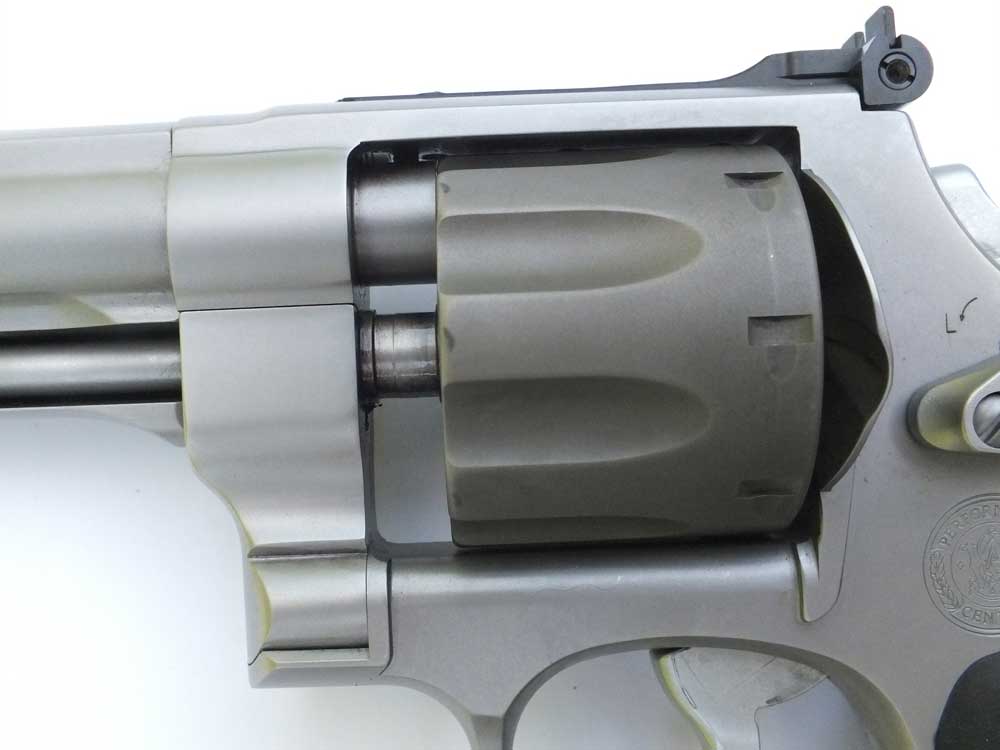
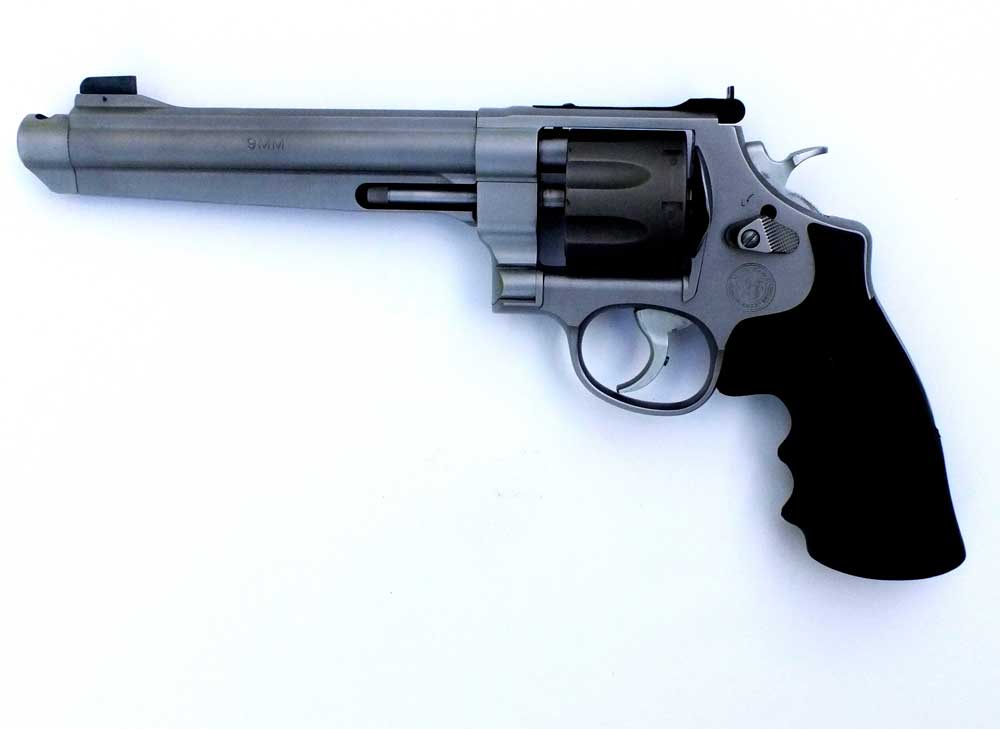
In 2014, Smith and Wesson introduced the first competition-capable moon clip pistol, the Model 929 and 986 Performance Center revolvers. The 986 is based on the smaller L-frame and is a seven-shot revolver. The 929 reviewed here is on the larger N frame and is an eight-shot gun. The cylinder is titanium, and the rest of the gun is matte finish stainless steel. For better contrast, both the pinned-in, Patridge front and adjustable rear sight are black.
The 929 is a Performance Center competition revolver and is adorned with Jerry Miculek’s signature on the right side plate. When I received the test gun, I looked up my photos from the 2012 Bianchi Cup and sure enough, the gun I got looks remarkably like Jerry’s competition gun in my wife’s hands. The differences I could see were that Jerry swapped the Patridge front sight for a red ramp front, bobbed the hammer, and used an un-fluted cylinder.
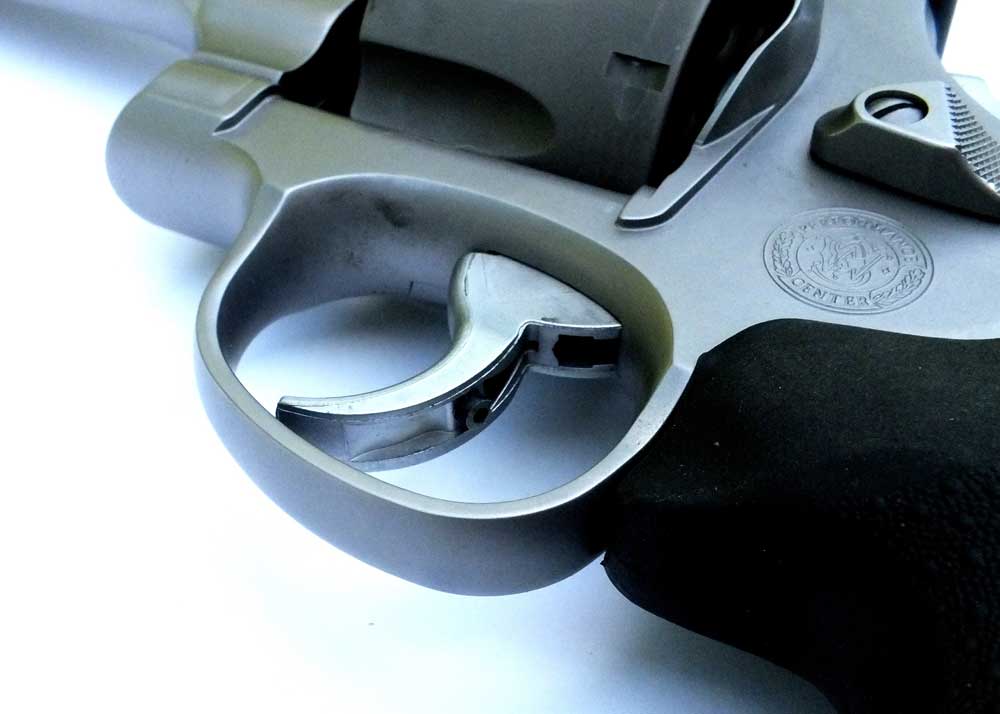
Barrel length of the 929 is 6.5 inches with a full-length under-barrel ejector shroud that tapers and is slightly reminiscent in appearance of the Remington percussion revolvers of the past. The gun comes out of the box with a compensator, but the box contains a muzzle cap that interchanges with a single Allen screw. There’s a larger-than-standard hammer surface, and the trigger has an overtravel adjustment screw.
As a Performance Center gun, the double-action trigger pull is predictably smooth and relatively light. The single-action pull was also clean and crisp, but as a competition gun, almost no one will use single action. The grip is a black synthetic one-piece unit with finger grooves.
The True Test
Because this is a competition gun, I decided to shoot a match with it. I’m perfectly willing to try almost any kind of match, but I hold no illusions I’m going to win the match. For shooting the match, I chose the Blade-Tech OWB holster my wife had used a few years back when she shot the Bianchi Cup with a Smith and Wesson R8. To make the holster work better with the long barrel, I did a bit of surgery, cutting the front of the holster down and opening up the sight track. The finished product still works fine with the R8 but allows a faster draw with the longer-barreled 929.
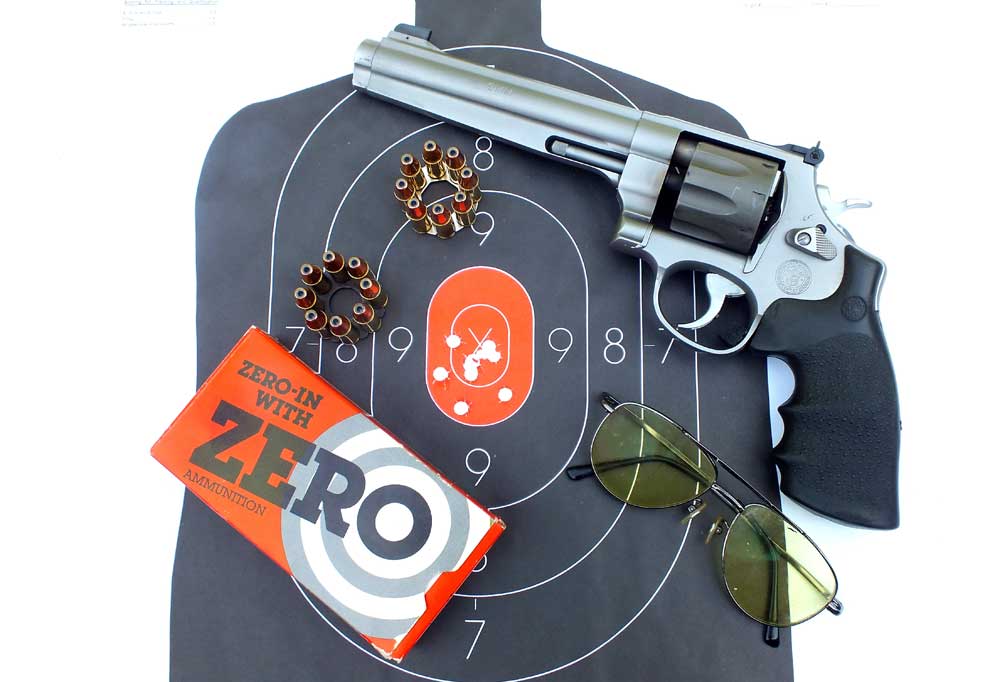
I chose the local plate match at Piedmont Handgunners Association and used the excellent Zero Bullet 124-grain load. Because I rarely shoot plate matches, I suppose a bit more practice would have been a good idea, but I managed a respectable 79 of a possible score of 96. Hardly an exciting score, but I was far enough from last place to keep my head up as I packed up my gear. The Bianchi plate match consists of targets at 10, 15, 20 and 25 yards with a time limit of six seconds at the 10-yard line and increasing by one second every 5 yards.
It was easy to clean the plates at 10 yards, and most of my misses came at 20 and 25 yards. The trigger was certainly smooth enough and the sights were easy to see, the black sights contrasting well on the white-painted plates. I removed the muzzle brake before the match, but I was still pleased with the level of recoil. I had little trouble recovering the sights in the time limit. Even though the sights are nice and black, I used the old NRA High Power trick of smoke blacking them before each 48-plate stage.
There are eight reloads required in the 48-shot match, and I acquired some moon clips and a moon clip loader from TK Custom. Loading the moon clips is easy with the TK Custom tool; unloading is a bit more difficult. I carried my loaded clips in a fanny pack for the match, but there are special carriers available from North Mountain that will carry eight loaded clips with ease. The carrier rides in front of the shooter and the clips ride on posts that retain them.
Dissecting The Details
Of course, no matter how suitable a gun is for use when just looking at it, the real proof is in the shooting, and I really enjoyed the 929. I began by accuracy testing it at 25 yards off sandbags and quickly learned the limitation for group size was directly related to my ability to see the sights. Clearly, this gun/ammunition combination was capable of greater accuracy than I was capable of. Because this is a double-action revolver intended for double-action use only, I felt a better test would be to shoot it standing and unsupported in double action on paper targets.
I fired eight shot strings at 15 yards on a B34G half-scale target with my IPSC Shot Timer app set at 9 seconds. The par time chosen approximates the same split as would be the 7 seconds for six shots on a standard falling plate rack. With an empty weight of just over 44 ounces and a generous grip, recoil from the 929 with target ammunition was minimal. In fact, it felt like I was shooting something between a .38 Special and a .22 rimfire. I suppose I’m so used to guns intended for carry that guns meant for precise shooting feel light.
True to form, the trigger pull caused me no trouble at all, and while some might think this a little strange, many shooters find they shoot more accurately at moderate speeds with a double-action revolver. I suspect this is because pulling a long, light trigger forces a surprise break, and for most shooters better accuracy with a handgun comes when we don’t quite expect the shot.
Drawing the 6 ½-inch barreled 929 from the modified Blade-Tech OWB holster was as easy as if I was drawing a 4-inch revolver because of the surgery performed. Results were excellent, with most of my shots staying in the ten ring with an occasional nine.
Wanting Just A Bit More
Of course, all guns used for competition get tweaked, and I did find a couple of areas for improvement. My first complaint was more related to personal preference than general acceptance: I didn’t like the one-piece synthetic grips supplied on the 929 because they felt too narrow, and I’ve never been a fan of finger grooves. I like my hand higher on the gun than the finger grooves want them to be. Maybe it’s because I’m eligible for a monthly Social Security check, but I prefer the old standard wooden target S&W grips or the Pachmayr Presentation square-butt grips.
My second complaint related to reloading. In events like the Bianchi, where the 929 should shine, the reload isn’t done under time. Each stage has a par time, and the reload occurs between strings. For matches where the shooter reloads during shooting time, the as-delivered 929 would have been problematic because the loaded moon clips needed a bit of jiggling to get them to drop in.
This is an easy fix for a reasonably competent owner. After removing a screw and taking the cylinder off, a Dremel tool with the appropriate grinding spindle will allow putting a slight chamfer on each chamber. I watched a friend do this to his 929 and 986, and it isn’t hard, but on a Performance Center gun, Smith and Wesson should have taken care of this issue before the gun left the factory.
The Bottom Line
In summary, this is a competition-ready revolver that’s capable of winning revolver or production class at a local plate, or Bianchi style match, straight out of the box with good ammunition. Almost all competitors will tweak it a bit, but it’s very good as it comes. With an MSRP of $1,189, you couldn’t modify another revolver to be as good for that money, and it has the bonus of shooting an economical caliber with lots of load options.
No wonder Jerry didn’t let his own version out of his sight.
Editor’s Note: This article originally appeared in the Concealed Carry 2018 issue of Gun Digest the Magazine.
Barrel, ignition, propellant, projectile. What makes a gun a gun has remained incredibly consistent since that first Chinese gentleman set match to touch hole nearly 900 years ago. Yet, today’s firearms are a world away from the ancient gonnes and fire lances that started it all.
From frizzens to rifling to cold hard steel, improvement has been the standard when it comes to guns. And the modern shooter has reaped the benefits of man being man and never leaving well enough alone. Consider today’s simple budget rifle; the jaw of a marksman from a century ago would sweep the floor given its shot-to-shot accuracy.
While many of the great leaps have come about from nameless blacksmiths and unheard-of basement tinkers, there are gun designers that tower over the firearms world. With that in mind, we’re going to look at 10 of the greatest gun designers from America. In one way or another, these men made guns faster, more accurate, easier to operate and just plain better. Not to mention, they cranked out some of the all-time classics shooters still relish today.
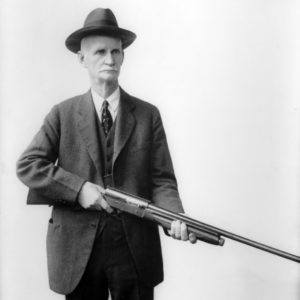
John M. Browning
This list has no particular order. That said, John Browning still deserves to lead. Regardless of field or endeavor, few people can boast the impact of this prolific, self-taught firearms genius.
Had his only contribution been the 1911, he would have been considered one of the top gun designers. Throw in the 1919 light machine gun and the M2, perhaps among the greatest to ever come down the pike. But with more than 120 firearms and firearms parts patents, Browning is far and away the most influential man to ever tinker with guns.
From his humble roots in the Utah foothills, he touched nearly every corner of gun design. Winchester Model 1894, Browning Auto-5, Browning Hi-Power, Browning Superposed, Colt Woodsman — the list goes on and on.
Even today, creeping up on a century after his death, he still casts his shadow over the entire gun world. And in all likelihood will for generations to come.
Samuel Colt
Contrary to popular legend, Samuel Colt did not invent the revolver. He did, however, modernize the concept to make it a practical handgun, one that dominated the 19th Century and beyond.
Despite mechanical difficulties, the Colt Paterson, introduced in 1836, popularized the revolver with Americans. Extricating U.S. soldiers from sticky situations in the Mexican-American War and saving outgunned Texas Rangers a number of times, the handgun proved the advantage of superior firepower. Won over, the nation flocked to Colt’s next-generation revolvers, especially the iconic Single Action Army.
Less recognized, but perhaps more important was Colt’s contribution to firearms manufacturing overall. At the forefront of modern manufacturing, maybe his biggest impact was the use of interchangeable parts. Hard to imagine otherwise today, but the simple idea revolutionized gun production, not to mention made for a heck of a lot more reliable firearm.
Benjamin Tyler Henry
The lever-action, as we know it today, was not the sole handiwork of Benjamin Henry. His is an improvement on Walter Hunt’s mechanism used in his 1848 Volition Repeating Rifle. But arguably, Henry’s refinement of Hunt’s concept —the 1860 Henry Rifle — not only made the lever-action commercially viable, but also a better gun. It also formed the bedrock of nearly all lever-actions to come.
Reliable ammunition — the .44 Henry Rimfire — was one part of the equation. The other was a self-cocking mechanism that acted in concert with the lever-action. A rifle ready to fire the moment the lever loaded another round was dang near like when peanut butter met jelly. And it was put to good use.
A Henry Rifle was a cherished possession by Union soldiers in the American Civil War. And could be used to devastating effect, as the Sioux and Cheyenne more than demonstrated at the Battle of the Little Bighorn.
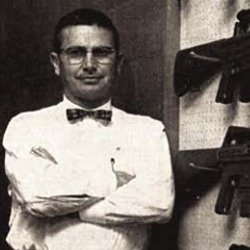
Eugene Stoner
The cards were stacked against Eugene Stoner and his little plastic rifle from the start. But the AR-15’s elegantly simple design would come to dominate modern firearms like no other.
America’s most popular rifle presently, the AR has carved an enduring niche into a majority of the gun world’s hearts. And its military variations — the M16 and M4 — have been decisive tools in protecting peace here and abroad.
As far as American gun designs are concerned, at least circa the 1950s, the AR-15 was a radical departure. Plastic, aluminum, small caliber — it seemed to run counter to all intuition that this rifle would eventually take the place of the wood and steel of the past.
Stoner had a way with materials and ergonomics, redefining how a rifle looked, felt, weighed and fit. And he didn’t relegate his ingenuity to semi-automatics. Equally as clever was the AR-5 — a hardscrabble survival rifle designed to keep downed bomber crews alive.
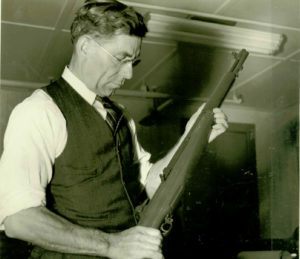
John Garand
As one of 12 children — six of them boys, all with the first name St. Jean le Baptiste — it wass difficult to stand out. John Garand found a way. He simply invented the backbone of America’s victory in World War II — the M1 Garand.
By far the most advanced infantry weapon of the conflict, the first successful semi-automatic rifle put into military service, the M1 outgunned nearly everything on the battlefield. On top of that, it was as tough as Ironwood, capable of chewing through .30-06 ammo in the freezing snow of Bastogne and the tropical muck of Guadalcanal.
Perhaps as rugged as his rifle, John Garand endured plenty etching his name into firearms history as one of the greatest gun designers. From humble beginnings, the French-Canadian immigrant worked his way from sweeping factory floors as a child to machining tools as a young man to engineering guns in the prime of his life.
And his caliber of dedication was on full display in perfecting his masterpiece, which he slaved over for 15 years to perfect. It was lucky for U.S. soldiers that such men existed.
Dr. Richard Gatling
It’s no understatement, Richard Gatling’s gun reshaped military firearms. The precursor to the modern machine gun was the first firearm capable of laying down a high volume of aimed fire for a continuous period of time through a mechanical loading system.
Previous to the advent of the Gatling Gun in 1862, the best a military could muster was a volley gun, which suffered from slow reload times and inaccurate fire.
Those familiar with Gatling find it no surprise he’d cook up something as unique and just plain clever as the multi-barreled gun. The man had tinkering in his blood, spending the better part of his life concocting solutions to the problems of his day. The Gatling Gun itself borrowed from another of the good doctor’s inventions — a seed planter.
A medical doctor by training, Gatling was inspired to create the gun with the hopes of shrinking armies, a bid to lessen soldiers’ exposure to the greatest wartime killer of the time — disease.
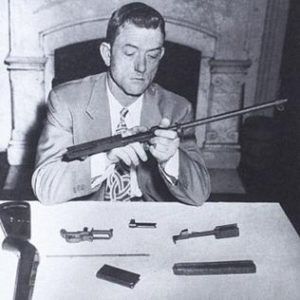
David Marshall Williams
Prison gives a man plenty of time to think. And during his stint for second-degree murder, David Williams’ mind was firmly planted on firearms.
Williams cooked up the short-stroke gas piston used in many semi-automatic rifles and the floating chamber, which made full-sized guns capable of firing .22 rounds in his time behind bars. Upon his release after serving 8 years of a 30-year sentence, he refined these concepts and eventually presented them to the War Department.
He is best known for the gas piston system used in the M1 Carbine, a vital military small arm from World War II through the Vietnam War. His contribution to the rifle and a little Hollywood dazzle earned him the nickname “Carbine” Williams. Though, in truth, he had little to do with the overall design of the M1.
This isn’t to downplay Williams’ design genius, or his place on this list of great gun designers. His concepts were groundbreaking. Even General Julian Hatcher of the Ordnance Department and Hatcher’s Notebook fame went so far as to say Williams had the “greatest native ability of anyone [I know] of” when it came to gun design.
John Thompson
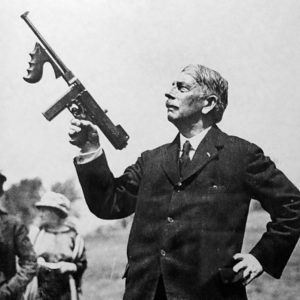
Seeing the difficulties of clearing dug-in positions in the trenches of World War I, John Thompson became obsessed with the idea of a “trench broom.” It would sweep the enemy away like the pump-action shotguns in use during the Great War, but only with more firepower. The result is among the most iconic submachine guns of the 20th Century — the Thompson.
Chambered in the man-stopping .45 ACP, the Thompson went into full production in 1921 and then served all the way up to the Vietnam War. Though initially it was not a success in peacetime, the U.S. Military finally adopted the submachine gun late in the 1930s.
Thompson originally wanted it to fire a more powerful cartridge; however, he found the friction-based Blish lock delayed blowback action had its limitations. Pistol-caliber ammunition, however, had its advantages. Depending on the variation, a soldier could thumb off 600 to 1,500 rounds per minute behind the Thompson’s trigger.
Christian Sharps
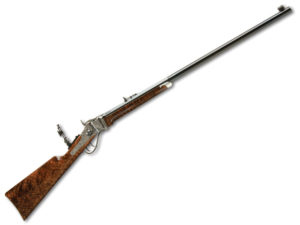
The Sharps Rifle was not the first-breech loader, a concept that dates back to the 16th Century. But it arguably was the first successful one. From 1848, when Christian Sharps received the patent for his falling-block rifle, up until his company ceased production in 1881, more than 120,000 Sharps were made.
This was ample time for the rifle (and carbine) to etch itself in American and firearms history. The Sharps was the most used carbine of the American Civil War, giving mounted troops the ability to crack off 8 to 10 shots a minute. It then went on to become an icon of the West, particularly as the choice rifle of many commercial buffalo hunters.
In addition to harnessing the power and speed of the metallic cartridge, the single-shot rifle was also deadly accurate. In perhaps its best-known chambering — .45-70 Government — a Sharps could easily hit targets past 1,000 yards.
Christopher Spencer
Christopher Spencer doesn’t get the credit he deserves. Perhaps it’s because few of the concepts represented in his Spencer Rifle survive today. But it’s difficult to argue the man who came up with the first repeating rifle adopted by a military didn’t have an important impact and wasn’t worth including on this list of influential gun designers. He, in essence, ushered in the era of long-gun firepower with his truly unique design.
At 14 to 20 rounds per minute, the Spencer’s rate of fire vastly outgunned nearly everything in the American Civil War with the exception of the Henry Rifle. And even there, the Spencer might have had a leg up, at least concerning reload time. With the aid of a Blakeslee cartridge tube, the rifle’s seven rounds were replenished in one fell swoop, where it was a cartridge-by-cartridge affair with the Henry.
Like his rifle, Spencer the man seemed to be well ahead of his time. In addition to his work in firearms, he also came up with the first full automatic turret lathe and also tooled around with a steam-powered horseless carriage of his own design.
We sharpen our aim at the range. We study the law to understand our obligations. But do we really practice what matters most when it comes to going armed — decision making? After all, the choices we make in those few split seconds a gun is drawn can have ramifications for years to come.
Double Eagle Tactical Training aims to make certain shooters are armed with this vital skill, providing some of the most rigorous situational training available today. Armed citizens won’t confront anything more true to life outside of an actual self-defense scenario.
Modern Shooter travels to the heart of New York’s Catskill Mountains to get a first-hand look at the Double Eagle system. And as the above clip shows, the trainers absolutely put their students through the wringer — both mentally and physically.
The simulated backyard disturbance Gun Digest author and custom ammunition manufacturer Phil Massaro confronts is filled with ambiguity and danger, forcing him to make split-second decisions that are a matter of life, death and potential legal tumult. When it’s all over and he and the trainers break down his judgment, it’s easy to see how taxing these scant few seconds were, even on a shooter as seasoned as Massaro. The guns and ammo might have been fake, but the adrenaline was real.
Catch the rest of the action of this heart-pounding episode of Modern Shooter 10:00 p.m. EST Friday on the Pursuit Channel. The episode rebroadcasts Monday at 12 p.m. EST and Tuesday at 11:30 a.m. EST.
The gear listed below features the things I’ve used during the past year while training and shooting. Though a few of these items aren’t technically new for 2018, I consider them must-haves and thus felt them to be necessary additions in order to make this list complete.
Carry Gear
Sometimes, depending on what I choose to wear, I find it’s impossible to carry my handgun in the usual manner of my preference. Other times, I’m trying a different gun for articles. Regardless of reason, flexibility in carry is good — whether it’s age-related medical issues for long driving trips … or to accommodate a new gun.
Galco Shoulder Systems The basis of Galco, Richard Gallagher’s holster company, is the shoulder system: a shoulder holster on one side with spare ammunition under the opposite shoulder. Due to some back issues, I elected to see if shoulder carry, thus taking the weight off of the belt, would help.
The Classic Lite ($105) I have is for the S&W M&P Shield. Made of light leather, the rig is easy to wear, easy to hide and surprisingly cool. A single magazine pouch is located under the non-gun arm. The horizontal holster also features a tension screw to adjust tightness and a thumb-break snap for retention. The magazine pouch is vertical with the snap flap down. It holds the eight-round Shield 9mm magazine with no trouble.
The Vertical Holster System ($230) I have is for the Glock 19. It carries the gun muzzle down and now features a tie-down option for either side. I have the holster secured to my belt. The holster is tightly molded for the gun and features a finger-break strap. The magazine pouch rides diagonally when the straps are properly adjusted.
In addition to comfort on long drives, these shoulder systems are also handy for keeping the gun and spare ammo together when one retires for the day. If you have to quickly leave the hotel for a fire alarm, shrug the rig on and pull on a covering garment on your way out.
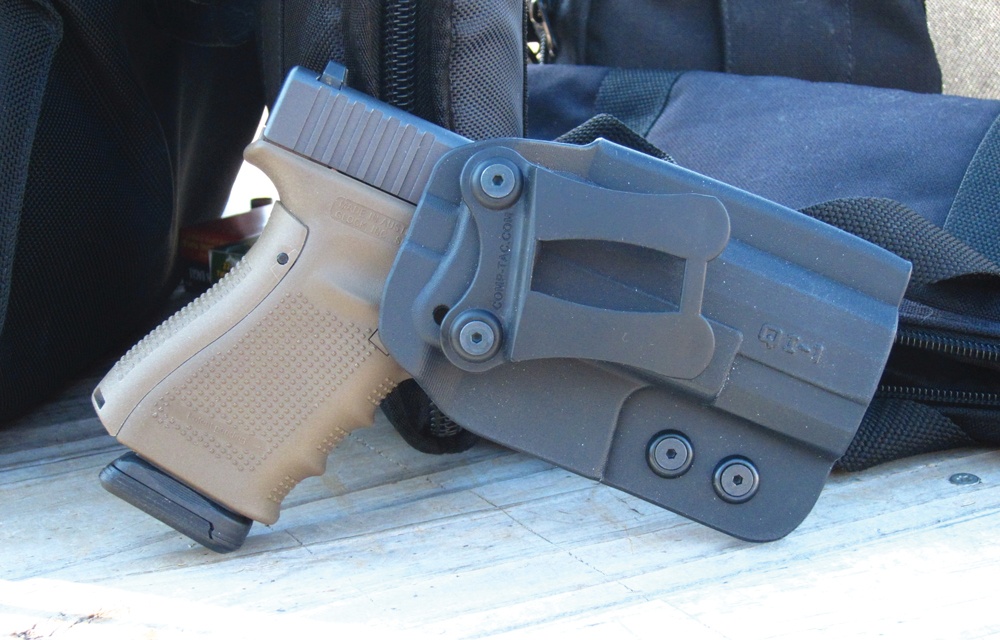
Comp-Tac Q-Series Holsters The Q Holsters from Comp-Tac Victory Gear are multi-fit holsters designed to lessen that “pile of holsters” handgun people often end up with. Three holsters in four sizes cover a range of modern popular pistols — and two of the holster styles are bilateral, meaning they can be used for right-handed or left-handed shooters interchangeably.
The Comp-Tac QI-1 fits inside the waistband and is one of the most widely used range holsters.
For two of the three holster styles, you simply move the mounting hardware to the other side and it’s converted from right- to left-handed, which is a good deal if you’ve sustained an injury or simply to train with that “other” hand.
The QI ($45) is an inside-the-waist holster with a belt clip and is described as “easy-on and easy-off.” It’s bilateral, with mounting holes on both sides of the holster body. The holster shell is open, meaning that it will take similar-frame-size pistols across slide/barrel lengths. For example, set it to fit the Glock 19 and you can use the Glock 26 “mini-Glock” and the Glock 34 long slide. The sight channel is extreme for those with “suppressor-height” sights, and the holster mouth is wide, making holstering easy.
The QB ($50) is an outside-the-waist holster that shares a range of features with the QI — the Kydex shell, open-ended bottom for varying lengths of pistol slides, retention adjustment, bilateral nature of the holster (right- or left-side carry), funneled holster mouth and large sight channel.
It differs in mounting attachment — a nifty push-button mount — to attach to your belt or elsewhere. The button locks into place and the mount is widely adjustable for cant.
Shooting From The Bench
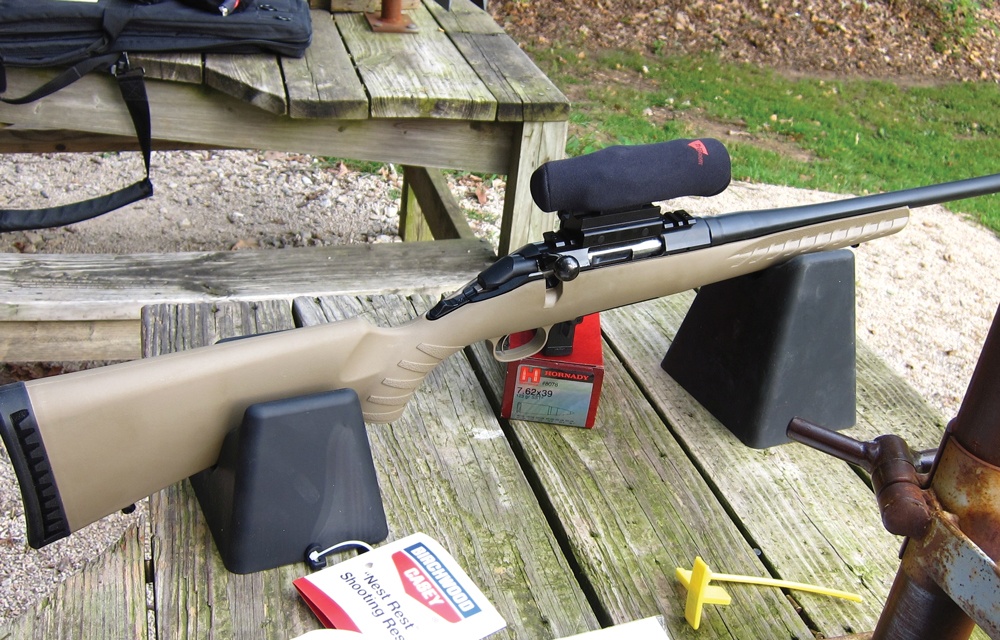
Not everything on this list is expensive. The Birchwood Casey “Nest Rest” ($30) has made a number of range trips so far this year.
The Birchwood Casey “Nest Rest” is a light, portable solution for keeping a firearm still when being shot from the bench.
Lightweight and easily transported, the Nest Rest amounts to a pair of large and small rubber-molded gun rests. Putting the larger rest forward for the front of the rifle and using the short one for the stock, you can achieve a very steady position. Place the smaller of the rests inside the larger for transport or storage. I’ve used the smaller rest atop the large one to elevate an AR and for accuracy testing handguns.
Targets
If you’re shooting, having a target to judge your skill is critical. As I use them, the full-size IPSC/USPSA/IDPA target is too big. I consider “D” zone hits as misses — expecting the worst — but I’m not in it for competition. With handguns, starting from 50 yards, I need a target covering the USPSA “A” and “C” zones as well as the “B” headbox.
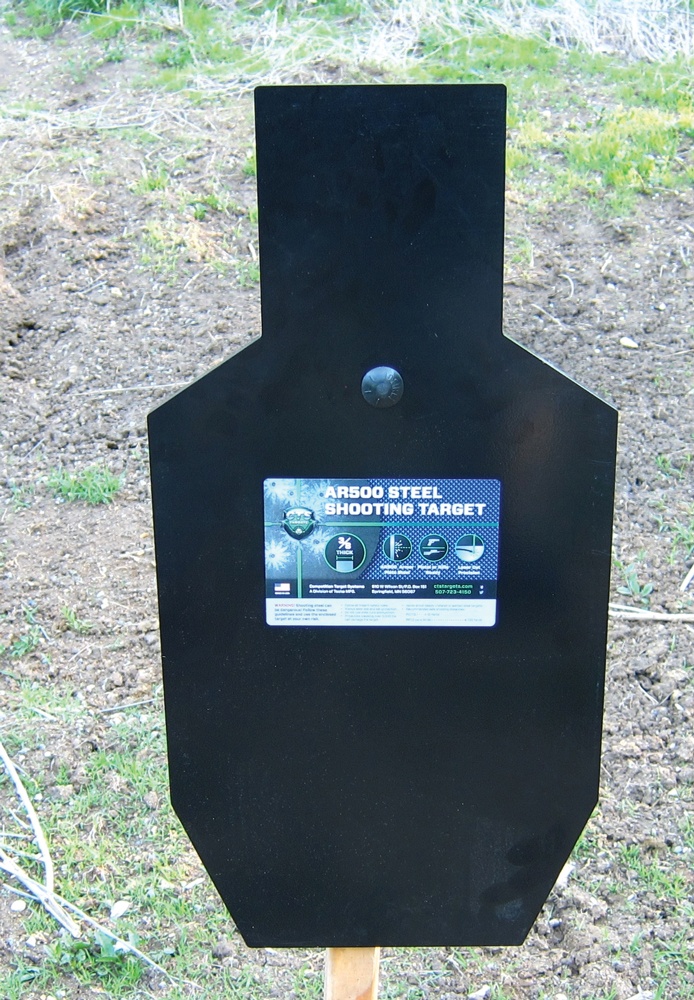
The Competition Target Systems “ABC Zone” Steel Target arrived already painted as a professionally finished steel target. The target is designed to stand on a customer-supplied 2×4 that fits into the stable X-base.
Competition Target Systems’ “ABC Zone” Steel Target ($115) does just that. It’s a 12-inch by 24-inch plate in 3/8-inch AR500 steel. Mounted on their X-base and using the Pro Hanger to mount the target to a (customer-supplied) 2-inch by 4-inch board, it’s easily transported, assembled, used and removed. The CTS sample is well made and arrived painted.
Tools
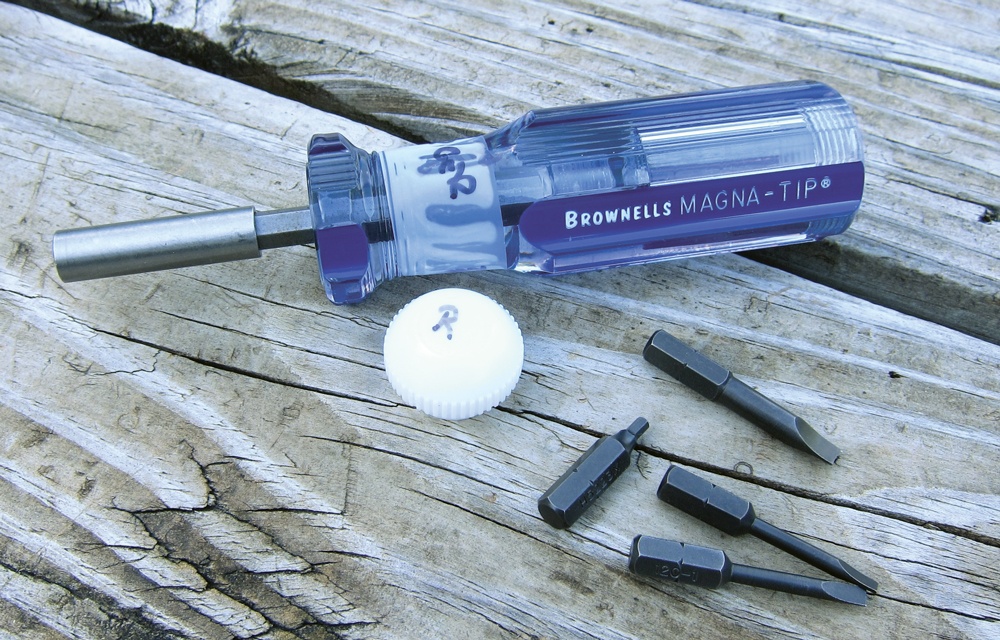
Brownells’ Screwdriver Set for Ruger Handguns ($20) is a must-have. I heard about this specialized screwdriver set from retired Border Patrol Agent, Gunsite Instructor and writer Ed Head. It’s a real “Ruger range kit.” It includes Brownells’ hollow handle bit driver, 3/32 Allen wrench bit for stock screws, the tiny windage screw slot bit, one for the elevation screw and the narrow slot bit for mount screws on top of the receiver. For less than $20, you can work on your Ruger pistol at the range or in the shop.
The Brownells Ruger Screwdriver kit has the bits you need to adjust sights or tighten stock screws — at the bench or at the range.
Wheeler Armorer’s Handgun Sight Tool ($230) has been here since the last quarter of 2016 and has been used around a dozen times by me — once by an armorer friend — to install and adjust sights. As a sight “pusher,” it clamps the pistol slide from the top and both sides. The reference marks help when your aim is simply to press the rear sight across the dovetail to zero the gun to the hold and vision of the individual shooter. The pusher block can be reversed: There’s an angled notch for rear sights, which slant up, and a straight notch for flat-sided sights. I can’t recommend this tool enough.
Lighten Up
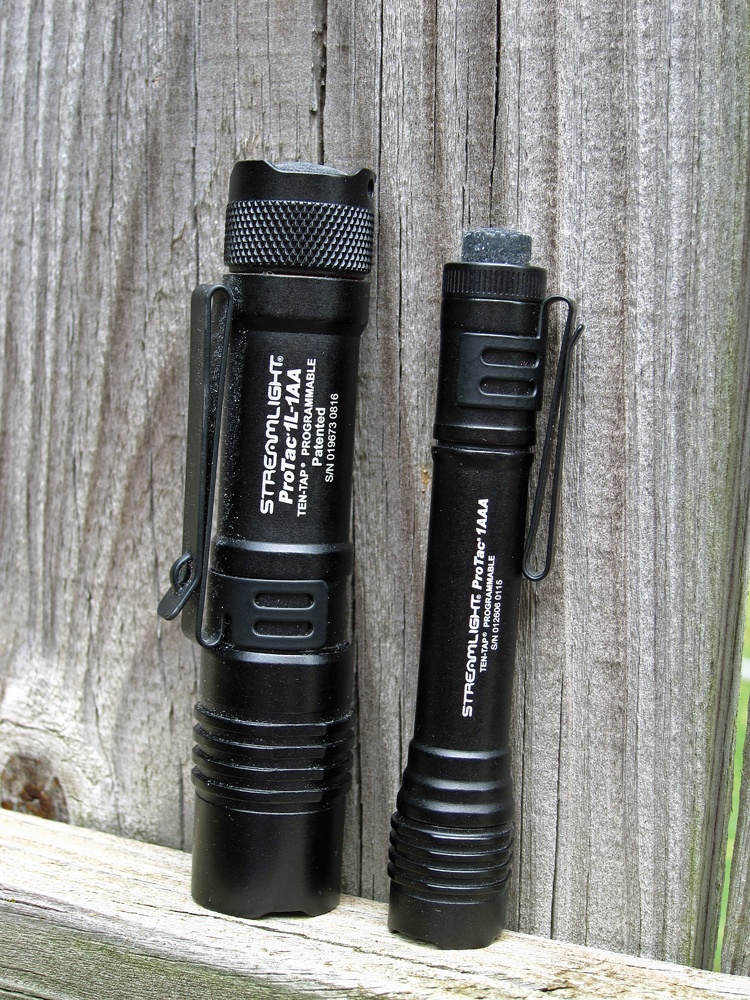
Unless you can see in the dark, you need a flashlight. As you age, you need more light to see. I’ve had really good luck with a pair of lights that have been with me every day of the year.
The first is on my belt every day — the ProTac 1L-1AA ($40). It’s a dual-fuel compact flashlight that accepts a single lithium or alkaline battery for flexibility. It’s rare that you are unable to find AA Alkaline or AA Lithium batteries. For a smaller, even more handy light, look at the ProTac 1AAA ($30). This “back-up” flashlight takes a single AAA battery; the alkaline will give you about 30 minutes of light at around 70 lumens from the C4 LED lighting element. A lithium cell will give you longer run time.
Pistol Sights
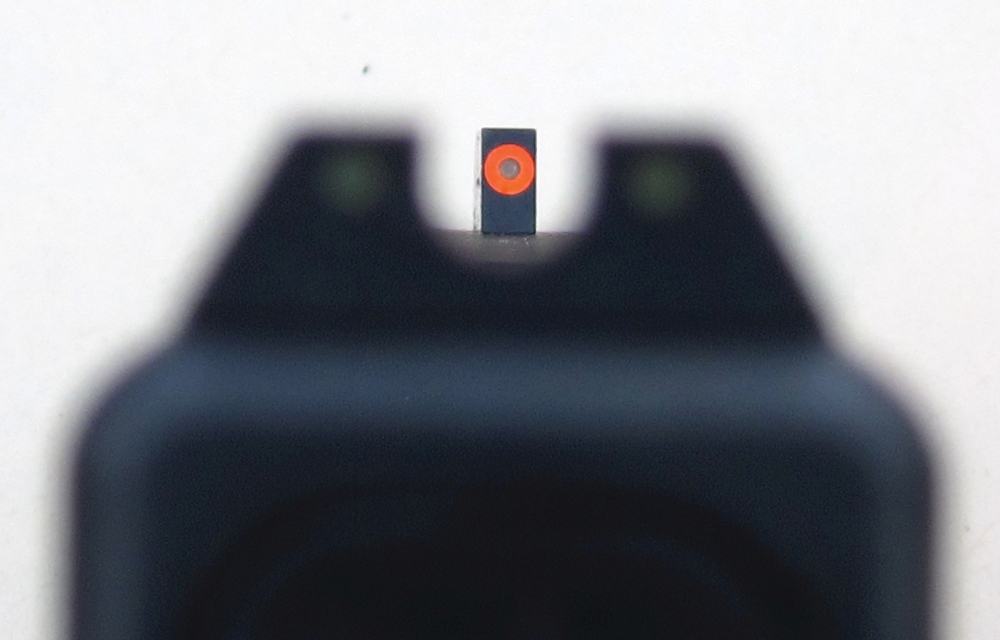
I’ve long been a fan of Trijicon HD sights. Just this year, I found their HD-XR sights ($100-$175).
The front sight of the Trijicon HD-XR sights is very narrow and brightly colored. Among all the great high-visibility pistol sights available, the HD line is a top choice.
The rear sight body is massive and flat at the front, and it features a generous “U” notch. The front sight “ring” is orange or yellow around the front tritium vial and is only .122 inch wide — giving plenty of daylight on each side of the front sight when gazing through the rear sight notch. This is for those requiring a bit more precision or who require more light just to see. I have these mounted on a Glock 17 and on a Smith & Wesson SD9VE.
Hearing Protection
The Walker’s Razor X earplug set is light, easily packed for travel and is active, electronic hearing protection.
For most applications, I use robust electronic earmuffs. When traveling or making a quick trip to the rimfire/black powder bay at the Club, I use the Walker Razor X ($120-$160) ear plugs. They’re a band worn round the neck with the plugs on the end of tethers that double as wires. Turning the unit on with the plugs in amplifies ambient noise: Think someone calling for a cease-fire. At loud noises — gunfire — the amplifier cuts out, letting the form fitting ear plugs block the noise. It’s rechargeable via the mini-USB port. A cable with a 110-volt plug ships with the unit.
Spare Ammo
I’m a believer in carrying a spare magazine — mostly for use in clearing a stoppage or for refilling after using some of the rounds already in the gun. During the past year I’ve come across two newer magazine pouches.
The Copia magazine pouch from Raven Concealment Systems can be used for a wide range of magazines from 9mm to 40 S&W, fits closely to the body and can carry magazines with the projectile to the front or back.
The first has been around a while but is new to me: the “accordion” style Model 71 Magazine Pouch ($15-$29). It fits most 9mm, .40 caliber, single-stack and double-stack .45 ACP magazines, as well as flashlights, knives and multi-tools. It fits fairly close to the body and holds the magazine securely.
The second is the Raven Concealment “Copia” ($40) magazine pouch. Curved like the human body, it has attachment points fore and aft instead of on the back of the pouch. It’s cut low, allowing a good grasp on the magazine body and has a tension adjustment setup. The top of the pouch is funneled, facilitating your return of the magazine to a pouch.
Why would you want that? Well, I only carry one spare. If I topped off, I’d put the depleted (but not empty) magazine back in a pouch — so I can get to it in the unlikely event I need it. It’s available in single and double configurations.
Field Jacket Or Barn Coat?
The Blackhawk Field Jacket is comfortable, has snap pockets, a zipper closure and has three internal pockets.
The Blackhawk Field Jacket ($150-$160) came along at a handy time. Introduced in 2016, I got to wear it through the cooler months into this year. Made from reinforced canvas, the seams are bar-tacked and are triple stitched for durability where you need it. The pockets are traditional in appearance and have snap closures. Three internal zipper pockets can hold daily necessities including your phone. It’s simple and looks good.
Editor’s Note: This article originally appeared in the Winter 2017 issue of Gun Digest the Magazine.
When you knock a pheasant out of the sky or shoot a duck on the wing, there’s likely a 12-gauge on your shoulder. It’s hard to frown upon this. The large bore is the Swiss Army Knife of shotguns, easy to favor because it plain gets the job done.
Unfortunately, the 12’s dominance in the modern era has overshadowed some classy and downright exciting gauges, well worth consideration. For some still, you’re not shooting upland unless you’re at the business end of a 28-gauge. And the .410, those yearning for a challenge, this small bore delivers. This goes for sport shooting as well.
The steady-nerved games of small-gauge and sub-small-gauge skeet put these bores and their shooters to the test. But it requires more than a fine gun and quick reaction time to dominate. Quality loads also play a role in owning the high and low house throws — a fact of which Aguila Ammunition is more than aware.
Best known for its Mini Shells, the ammo manufacturer has turned its attention to small-gauge shotgun games in 2018, releasing a full suite of shells tailored to breaking clays. Luke Hartle gets the rundown at the 2018 SHOT Show from Aguila pro shooter Derrick Mein. What the Gun Digest Editor-in-Chief discovers is if your score isn’t improving with Aguila in the chamber, you’d better start working on your swing.
Hardened shot, optimized powered, high quality hulls — the ammo maker has put together everything you need to own the range.
Looking to go armed, but are stuck in the weeds as to what to arm yourself with? Here are 20 of the best concealed carry gun options that will keep you on the defensive.