Home Blog Page 175

Henry Shotgun Options In .410 Prove Quick Fun

0

Quick shooting and eye-catching, the small-bore Henry shotgun models are instant classics.

What these Henry Shotguns offer:

  • Based on Henry’s .45-70 Government rifle.
  • Available in two models: 20-inch barreled Rare Carbine and 24-inch shotgun.
  • Carbine has semi-buckhorn sights and blade front with brass insert.
  • Shotgun has simple brass bead front sight.
  • Carbine has integral cylinder choke, the shotgun a removable invector-style choke.
  • Chamber 2 1/2-inch shells.
  • 5-round capacity.
  • Both models weigh around 7.5 pounds.
  • Each is stocked in straight-grained American walnut.

Not exactly continuing where Benjamin Tyler Henry left off, Henry Repeating Arms nevertheless has kept the classic lever-action not only relevant in the age of semi-autos, but sought after. Masterworks in hardwood, steel and brass, perhaps no single gunmaker has inspired more devotees in the past three decades than the New Jersey concern.

Honestly, Henry fans’ enthusiasm knows no bounds and they have the bulging gun racks, cabinets and safes to prove it. Get behind a Big Boy, or any of their other lever guns really, and you’ll quickly understand their fanaticism. 
Henry-Shotgun-1

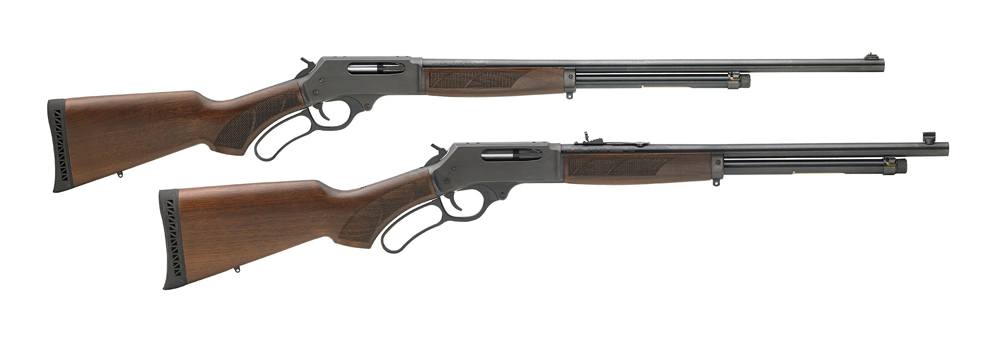
Henry rifles — faithful replicas and modern-day improvements alike — have and are the company’s bread and butter. However, the manufacturer struck out in a new direction in 2017 with a pair of lightning-fast smoothbore lever-actions that are as fun as they are timeless. Chambered in mild .410, the lever-action Henry Shotgun and Rare Carbine Shotgun offer shooters of nearly any age possibly the classiest and most unique small-bore scatterguns to pitch shot around today.

Perhaps not as versatile as others in their class (namely because they’re not a dual-purpose .45 Colt — no rifling), the shotguns still prove desirable and, for small jobs, practical. Jackrabbits in the sage, pigeons on the roost, coyotes too curious for their own good — none are safe with a Henry shotgun loaded and a capable man or woman on the lever. Equally so, any fun-gunning target of which you can conceive.

It’s not much of a stretch to claim, Henry may have turned out one of the most enjoyable smoothbores in recent times. One any shooter would be proud to add to their collection.

Surveying The Henry Shotguns

Likely to spark a bout of déjà vu, the Henry shotguns seem very familiar. Hadn’t the company done this before? In fact, they had and do, except as a .45-70 Government.
Henry-Shotgun-Rare-Carbine

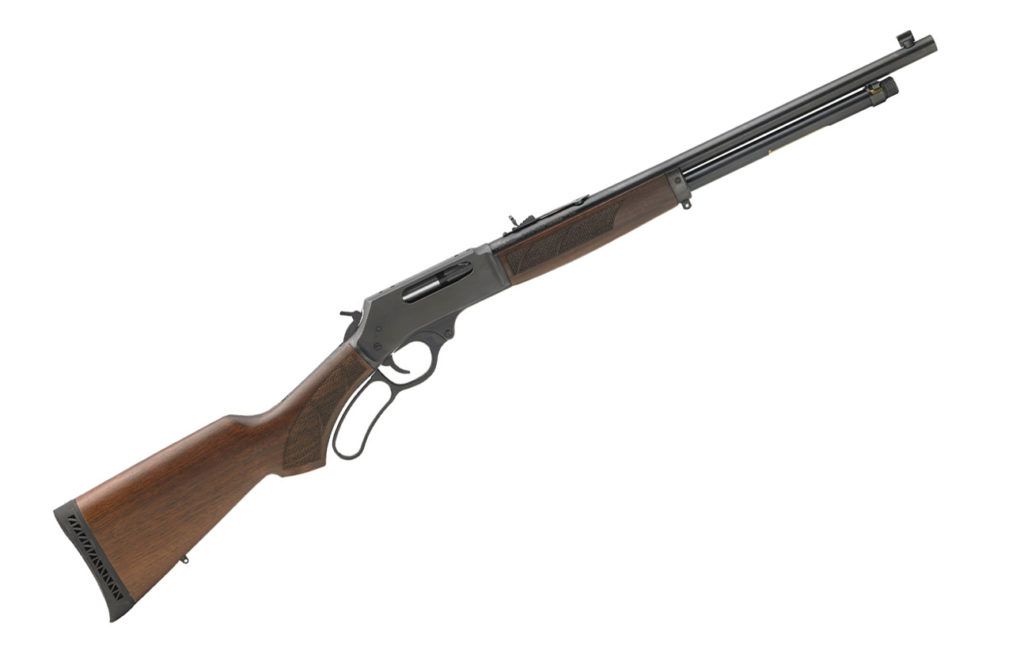
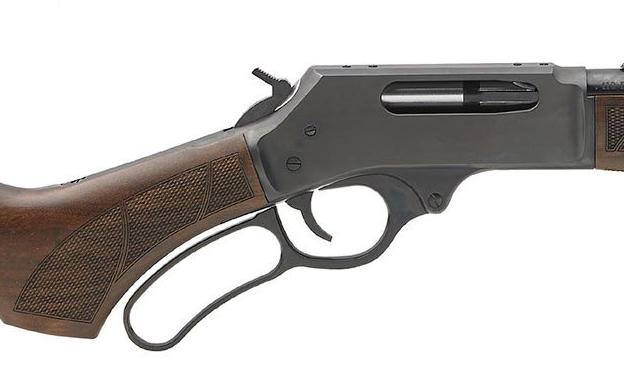
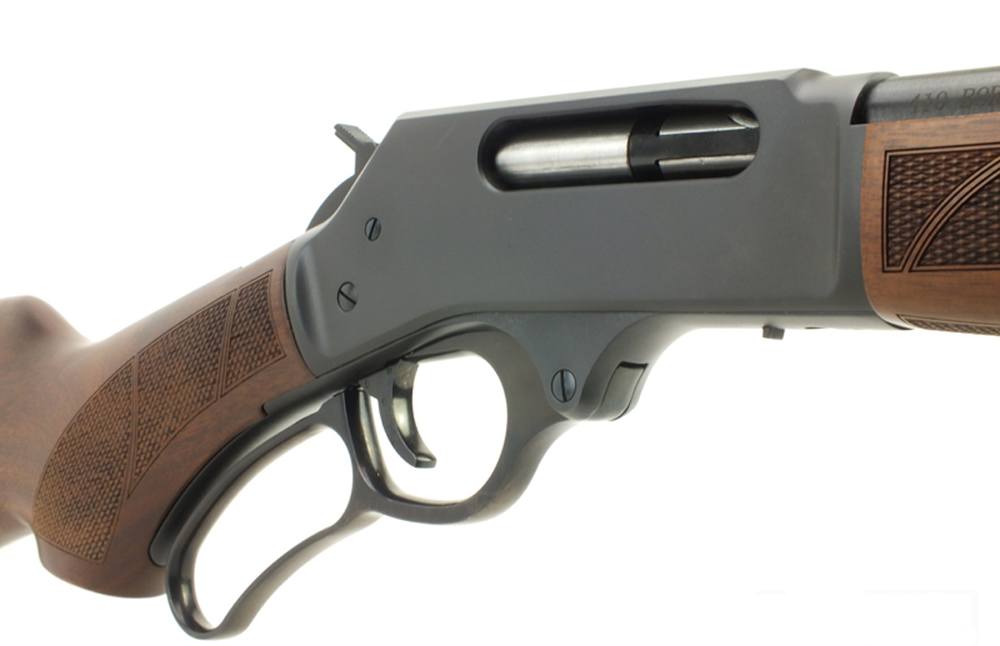
Based on the blued model of the large-bore rifle, the small-bore shotguns are, for the most part, spitting images. The echo between rifle and shotgun is especially pronounced with the 20-inch barreled Rare Carbine, given it boasts a fully adjustable semi-buckhorn rear sight, in addition to coming fully drilled and tapped for a scope, like the .45-70. The 24-inch barreled model, on the other hand, has a much more shotgun feel to it, with a simple brass bead.

Both configurations of Henry shotgun feature a tubular magazine that holds five 2 1/2 -inch shells. The shell size is adequate, but certainly won’t win accolades from those who insist on 3-inch magnums. Yet, there is plenty of exceptional fodder to feed on in the 2 1/2 pasture — there are loads for nearly any operation you could possibly demand of a .410.

Aside from sights and barrel length, the choke is the other point of departure in the shotgun models. The Rare Carbine has a cylinder bore integral to its barrel; the 24-inch barreled shotgun has a factory-installed removable invector-style full choke, opening up patterning options.

Built for practical use, the .410s boast a number of features modern shooters will find convenient. Steel swivel studs help make the guns more mobile. The absence of a cross-bolt safety makes them faster to get into the game. And thanks to a transfer-bar safety, the guns can be safely carried with a round in the chamber and the hammer down. Additionally, the shotguns lack a half-cock position for the hammer.
Henry-Shotgun-2

Then there’s the aesthetics, which both shotguns have in spades. Similar to almost every Henry, the head-turner of the guns is their richly finished sticks of straight-grained American walnut. The hardwood is set off with rich bluing. The only complaint in the looks department — no brass-receiver model.

Ammo Options

Buckshot, such as Remington HD Ultimate Defense or Federal Premium Person Defense, performs admirably out of the shotguns. Tight-patterning in general, once you get over the fact you’re shooting self-defense shells you appreciate the potential for other targets, such as close-quarters coyotes. For small game up to turkey, No. 4 and 6 shot is more than enough medicine and nearly every ammo maker offers something in this range — Winchester and Remington leading the way. There is also an abundance of slugs, which opens the Henry shotguns up for deer season or a bit more distant attempts at running dogs. Brenneke has a 1/4-ounce option and Winchester a 1/5-ounce. In either case, they should prove more than adequate 50-yards and beyond.

What’s It Good For?

Not a world-beater compared to a 12- or even 20-gauge, the .410 is still a potent bore. Whitetail (it is legal for deer in many states) and smaller quarry are all fair game. There is no more testing game than sub-small gauge skeet. And for general firearms enjoyment, there are few that hold a candle to the smallest commercial bore.

Certainly, you’re working with fewer pellets per trigger pull, but learning to close in on quarry can make up the difference. The Henry’s alleviates some of the density issues with a leg up in speed. With practice, lever-actions are among the quickest shooting firearms short of a semi-automatic. Add in the light recoil of the .410, the Henry shotguns have the potential of blinding speed shot to shot. Where this pays off particularly, outside of a missed single in skeet, are bulk shooting opportunities. Arguably, there are few potential pest eradicators more suited for the job than the Henrys, whether you’re talking about a den of pesky raccoons or a hayloft full of rock doves.

Furthermore, the Henry shotguns’ bores are well suited for the job, particularly in ever-more-common crowded rural areas. Unlike a .22, there’s little worry of most reasonable shots endangering an unseen neighbor out trimming a bush or clearing brush. And the report is minimal enough to make a noise complaint improbable.
Henry-Shotgun

How about self-defense? Undoubtedly, the Henry shotguns could fill the role in a pinch and there are ample loads to transform this fun gun into a defensive maven. However, given the guns’ large sizes and the dubious effectiveness of some .410 loads, they might not top the list of self-defense long guns.

Parting Shot

Given the multitudes of larger bores, it’s difficult to get whomped up about a .410. Henry, nevertheless, has found a way. The drawback of the guns are their steep prices, particularly for a small bore. The 24-inch barreled model runs $947 and the carbine a slightly more affordable $893. Examples of more economical smoothbores are legion and possibly more attractive for casual shooters.

If money is no object, then these Henry shotguns are what jackrabbit hunting dreams and high-speed casual shooting sessions are made of. All in all the guns are quite a feat. Like the lever-action itself, Henry has found a way to make the smallest commercial bore not only relevant, but desirable.

Shotgun Specs
Barrel Length: 24″
Barrel Type: Round Blued Steel
Rate of Twist: Smooth/Full Invector Style Choke
Overall Length: 44.5″
Weight: 7.54 lbs.
Chamber: 2 1/2″
Receiver Finish: Blued Steel
Rear Sight: none
Front Sight: Brass Bead
Scopeability: N/A
Stock Material: American Walnut
Buttplate/Pad: Black Ventilated Rubber Recoil Pad
Length of Pull: 14″
Safety: Transfer Bar
Choke: Screw in Invector Choke
MSRP: $947

Rare Carbine Specs
Barrel Length: 20″
Barrel Type: Round Blued Steel
Rate of Twist: Smooth/Cyl. Bore
Overall Length: 40.5″
Weight: 7.33 lbs.
Chamber: 2 1/2″
Receiver Finish: Blued Steel
Rear Sight: Fully Adj. Semi-Buckhorn w/ Diamond Insert
Front Sight: Brass Bead
Scopeability: Drilled and Tapped
Stock Material: American Walnut
Buttplate/Pad: Black Ventilated Rubber Recoil Pad
Length of Pull: 14″
Safety: Transfer Bar
Choke: Cylinder Bore
MSRP: $893
Pushing The Limits With Extreme Long Range Shooting Competitions

0

Shooting’s new super sport: extreme long range.

What is and does it take to compete in Extreme Long-Range shooting:

  • Beyond the 1,000-yard mark, generally starting around 1,500 yards.
  • Targets are 36-inches square.
  • From a cold rifle, a shooter must put three shots on target.
  • Variants of the .375 CT are generally the most successful rifles.
  • .30-caliber magnums and .338s are also viable.
  • Clarity and resolution are more important optics qualities than magnification.
  • Bullets require speed combined with a high ballistic coefficient.

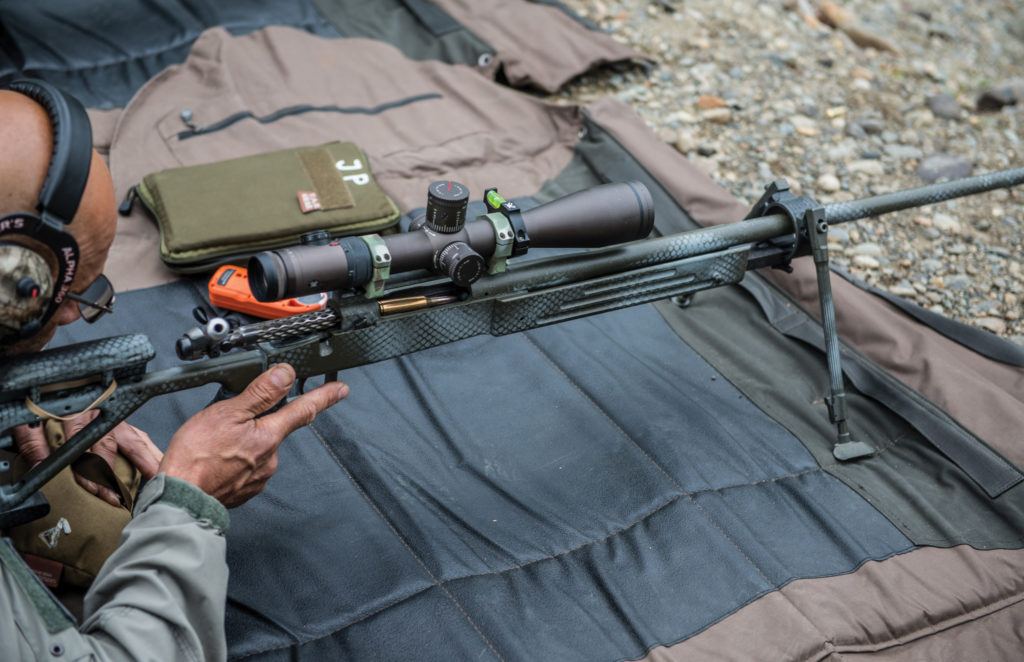
Shooting precision rifles at extended ranges is growing increasingly popular. Extreme long-range (ELR) shooting is often defined as distances beyond 1,000 yards, though some many argue ELR “starts” at about 1,500 yards. Wherever that answer lies for you, more people are shooting out to ELR distances — and claiming various levels of success along the way.

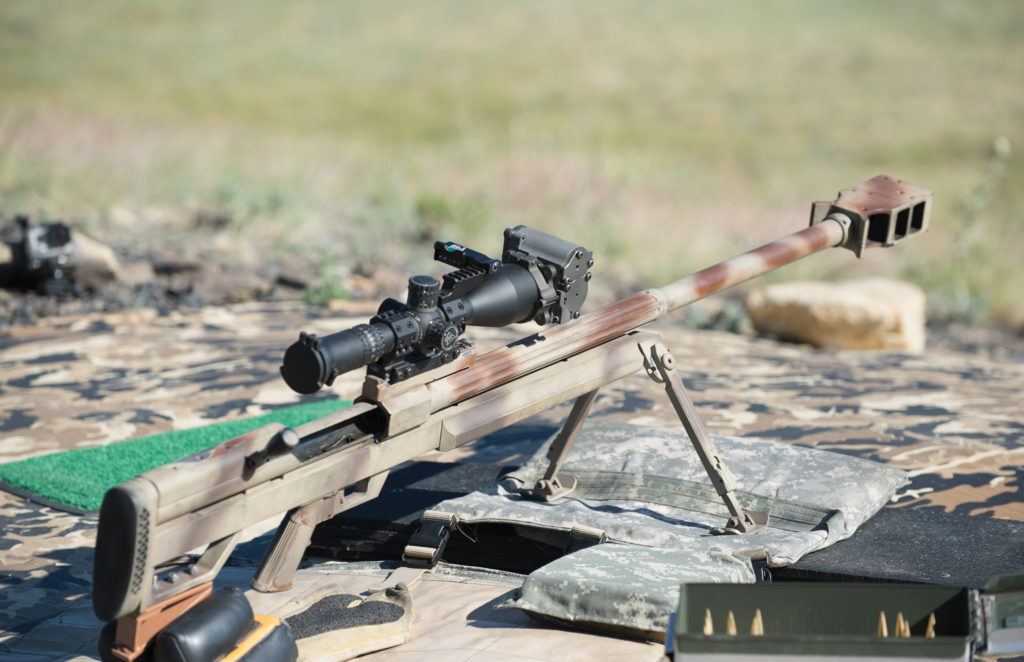
In the ELR game, nothing comes cheap. Heavy actions, feeding long barrels and built on massive stocks, are the norm.

As part of Sniper’s Hide, I have been involved in Extreme Long-Range shooting for many years. I enjoy it so much that I’m also working with a group of like-minded shooters to standardize what constitutes a “World Record Shot.” Alongside the likes of companies such as Applied Ballistics, McMillan Stocks, Cutting Edge Bullets and Warner Tool, as well as with individuals such as David Tubb, standards are on the horizon.

Too often we see videos of guys launching a single round at an incredible distance only to find out they expended 15, 25, 50 — even 200+ shots to get a single hit on steel. Cue the cheers, stand up and drop the mic.

But not so fast. The goal of precision shooting is to promote precision and accuracy, and launching anything more than five rounds at a time without a hit is neither accurate nor precise. Let’s face it: If you shoot enough shots at the target, odds are you will eventually hit something. There’s no skill involved in getting lucky with a cone of lead.

In their defense, however, shooting a target at more than 2,500 yards away is as close to a drug habit as you can get without the side effects. When you see that round land just a few feet from the target, it’s incredibly hard to control the urge not to fire another round … followed up by more. The next thing you know, five rounds turns into 10, which turns into 20 — as the shooter mumbles “just one more time.” More familiar with drugs is the cost of shooting at ELR distances. In this sport, things can add up very quickly.

Extreme Long-Range Rifles

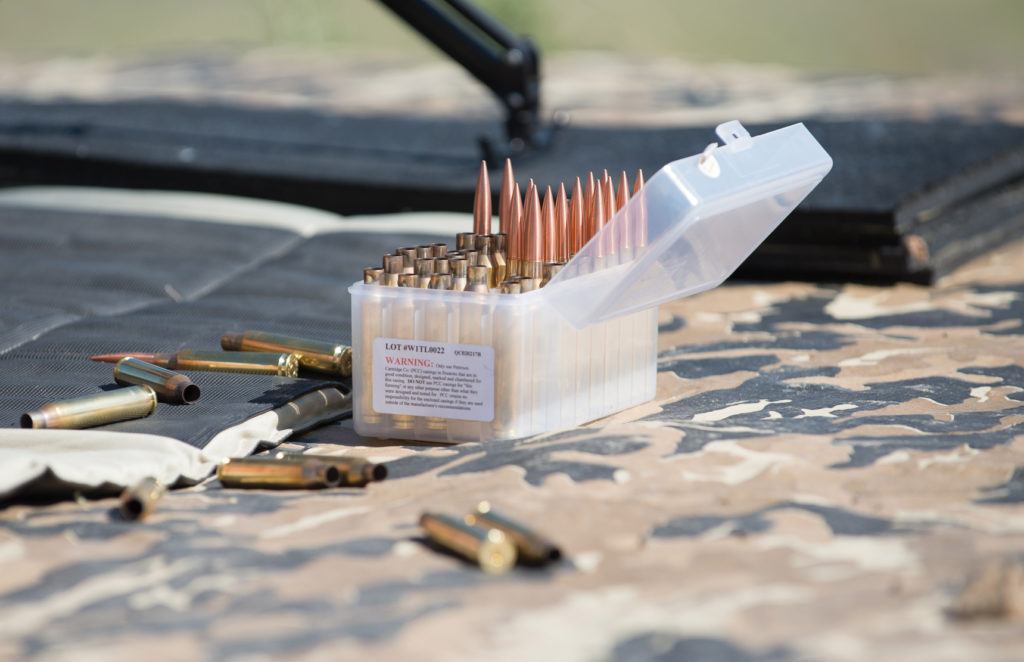
The rifle is the heart of the Exteme Long-Range shooting equation. Depending on how far your intended goal is, most are seeing some version of success with a .375 CT variant. This caliber is not only large, but it’s also costly to shoot. Guys can spend close to $8 a shot attempting to squeeze every bit of speed and accuracy out of the caliber.

Like all shooting disciplines, success can be defined by the shooter and is built with a successful rifle, optics and bullet combination. And as a general rule to ELR success, big, heavy and fast are mandatory.

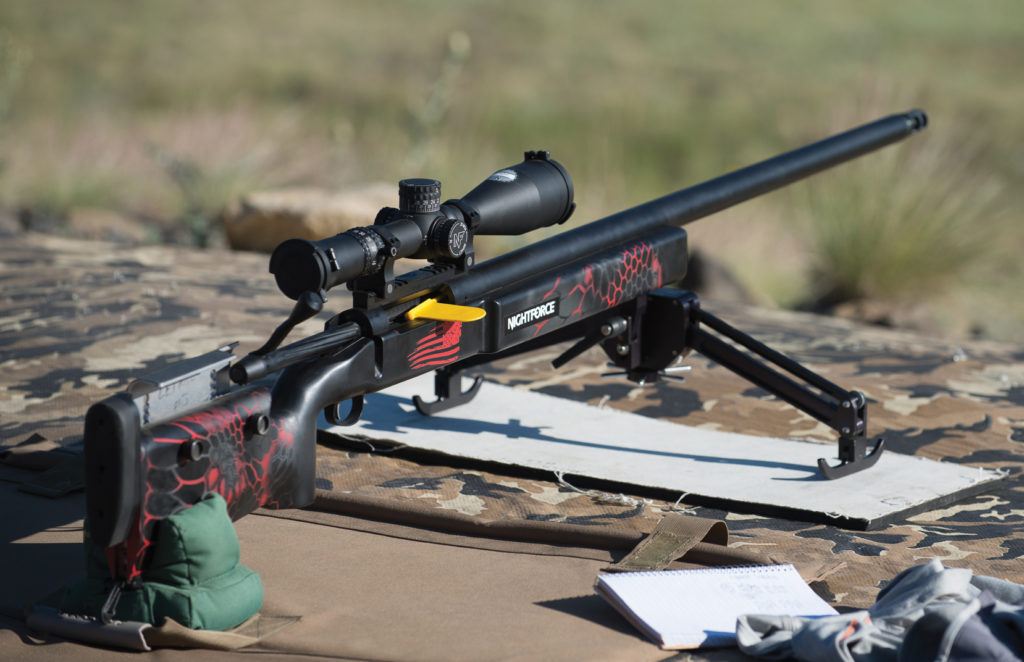
In addition, extra-large actions are needed, as well barrels that may grow to be more than 32 inches in length. Tying that extremely hefty barreled action together is the stock. McMillan calls their ELR stock “The Beast” because it needs to hold all that in place. A well-constructed Extreme Long-Range shooting rig is going to run the shooter more than $5,000 — and that’s being conservative.

That said, you can certainly shoot inside 2,000 yards with smaller caliber rifles. Heavy .30-caliber rounds, such as the .300 Norma Mag., have proven very successful to these distances. I’ve accurately shot my .300 Norma Mag. to 2,500 yards. The caliber performs exceptionally well pushing a 230-grain Berger Bullet to 2,997 fps with a 25-inch barrel, and it’s not nearly as big and bulky as your typical Extreme Long-Range shooting rifle. In addition, .338s are also very popular, and they can be equally successful out to 2,500 yards. The key with the .338 is getting the muzzle velocity up to more than 2,850 fps with a 300-grain bullet.

As a side note to building a capable Extrem Long-Range shooting rifle, I want to talk left-hand gain-twist barrels. Everyone focuses on the latest scopes or the newest bullet, but many miss out when it comes to barrel upgrades. I’m using several left-hand gain-twist barrels from Bartlein Barrels. They create some of the best barrels on the market, and the left-hand gain-twist barrels are working. The gain-twist technology isn’t like it used to be — it’s much subtler as well as very accurate. It helps when shooting a variety of bullet weights, not to mention the recoil pulse supports the shooters vs. working against them.

If you’re building a new rifle for Extreme Long-Range shooting and you live in the Northern Hemisphere, consider a left-hand gain-twist barrel. You can thank me later.

Extreme Long-Range Optics

Optics are the next consideration in the overall Extreme Long-Range shooting package, and you need to consider several factors: construction and reliability, elevation adjustments, reticle type and optical performance.

Extreme-Long-Range-Shooting-3
Notice I didn’t mention magnification. When it comes to optics, Extreme Long-Range shooting is not about magnification — it’s about clarity and resolution. Considering the conditions one might encounter, mirage can completely obscure a target if you’re trying to put too much magnification on it. The more power you use, the more you magnify the negative elements in the air.

Nightforce is one of the most common options on the ELR line, followed by Schmidt & Bender and Vortex Gen 2 Razors. These scopes have a lot of elevation and are known to hold up to the recoil of the rifle.

Second focal plane scopes can be an advantage in this game, too. The tall, angled base used on some Extreme Long-Range shooting rifles is designed to get the most elevation out of the scope. With a second focal plane scope, you can cut the power in half and then use the reticle to double the value of the subtensions. A 10 mil/MOA reticle will instantly adjust 20 mils/MOA when placed at half power.

Today, the better option is the Charlie Tarac Unit sold by TacomHQ, which is a prism device that attaches to the rifle or scope to instantly increase the elevation. I used this device to shoot a factory .338 Lapua with factory ammo to 4,000 yards. The “Taco Unit,” as we call it, can give the end user as much as 150 mils of additional adjustment. In MOA, the prism can be preloaded with 300 MOA of internal movement — then you fine-tune your dope using the scope. Remove the device and you’re right back to your 100-yard zero.

Extreme Long-Range Bullets

After you’ve assembled your rifle, the most significant element is, of course, the bullet.

The 6.5 Creedmoor becomes all but worthless when the word “extreme” is placed in front of “long range.” Some shooters continue to work with the .338 Lapua, while many have settled into a .375 CT variant.

Picking the right bullet is more than just a weight question: You need speed combined with a high ballistic coefficient, and that might mean going a bit lighter. Years ago, we did a very detailed bullet test and found with a .338 Lapua that the 285-grain bullet was a better performer than the 300-grain bullet. The difference was speed. You need muzzle velocity to get the advertised results. Sure, you can float the bullet into the subsonic zone, and many will work — but you kill your predictability. Speed wins.

If you genuinely want to be successful shooting at ELR distances, consider solid bullets. They have a higher ballistic coefficient and they can be lighter to give you more speed. The best part is that you can push them harder, meaning not just more velocity but increased spin stability. Jacketed bullets can deform under similar conditions, thus killing performance. A fast load with a small, single-digit standard deviation is critical.

The 3×3 Standard

So where is the standard going? We’re using a 36-inch square target from 1,500 yards and beyond. We want a size that’s practical and can be replicated anywhere in the world. From a cold rifle, the shooter must put three shots on target for it to be considered a record. A shooter may only make two attempts a day, and these must be the only shots of the day. Have I mentioned you need a 4-hour window between attempts?

This basic standard is reducing the record ranges, but it’s also making those records much more meaningful. At this past SHOT Show, we had a World Record attempt with the guys from ELR Central and ELRHQ. Only three shooters out of 27 managed to hit three out of three on command. One of those shooters was John Armstrong, who was using a 7mm Rem. Mag. hunting rifle with a Super Sniper scope. He demonstrated what can be done when the shooter focuses on the shot more than his equipment. Gear matters, but as the old saying goes: “Fear the man with one rifle — he may know how to use it.”

We encourage those who want to push the limits, but we ask for accountability and data. The more we understand the conditions along with the data used to make the shot, the better off the sport will be moving forward.

Good shooting, and no wind.

5 Excellent Double-Action Revolver Options

0

Five top revolver choices from large bore to pocket pistol and everything in between.

What are some the best revolver options:

  • Smith & Wesson 629 Delux
  • Ruger GP100 Match Champion
  • Colt Cobra
  • Kimber K6s
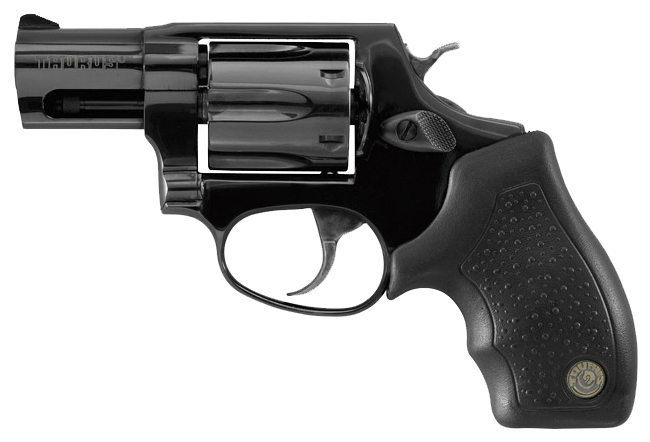
  • Taurus 856

Some things change, some stay the same. When it comes to picking a revolver, you can still depend on S&W. Big to small, mild to ferocious, they offer the complete selection. They offer so many that you would have to narrow down your needs or desires before we could even begin discussing the best one to choose.

Taurus-856
Taurus 856

For a classic experience — but updated — the new S&W 629 Deluxe is a stainless .44 Rem Mag. that will fill the bill.

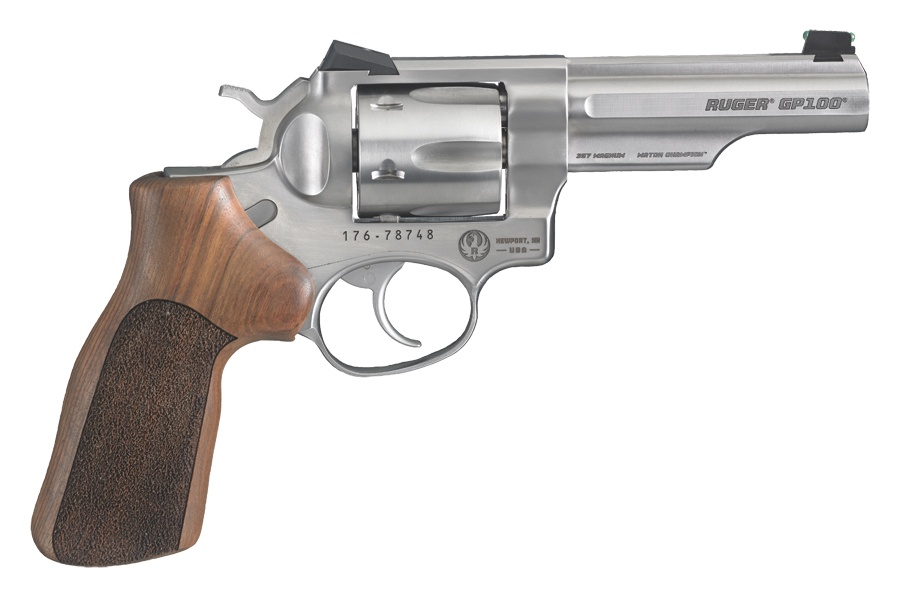
If you want big bores and medium ones, Ruger makes plenty of double-action revolvers. That wasn’t the case when I started, and I still have to remind myself that Ruger is new to this, since they have “only” been at it for just shy of 50 years. How about the new Ruger GP100 Match Champion?

Colt used to be a big player, but they fell out of the marketplace a bit some time back. They have, however, come back in a big way, in the compact carry segment, and you should look at Colt’s Cobra if you’re looking for an EDC snubby.

Ruger-GP100-Match-Champion
Ruger GP100 Match Champion

A recent surprise entrant to the revolver market is Kimber, with the K6s. They now offer it in a variety of finish and sight options.

The newest item from Taurus is their 856, a six-shot snubby that I recently had a chance to shoot. I only had to stop when it became clear that others wanted to shoot it, and I couldn’t hog all the ammo.

Editor’s Note: This article originally appeared in the 2018 Shooter’s Guide issue of Gun Digest the Magazine.

Video: Successfully Reading A Sporting Clays Station

0

Champion shooter Cory Kruse’s tips for sporting clays success.

Watch any professional sport sooner or later there’s a “How’d-they-do-that” moment. Maybe it’s an NFL quarterback finding a seam in lockdown coverage or an MLB slugger divining the sweet spot on a wicked slider. Either way, they create magic in what otherwise seems an impossible situation.

Easy to chalk up to pure unadulterated athletic skill, there’s perhaps a more important element in their success — insight. Tens of thousands of hours spent honing their craft, athletes cultivate the innate ability to know when a receiver has a step and how to read the seams of a baseball. Shooting sports are no different. The good thing for recreational and club shooters, a little forethought stepping into the box and they too can develop the acumen to bust clays like they’re shooting with radar.

Cory Kruse has a solid handle on reading a sporting clays station, and the hardware to prove it. Texas and U.S. Open champion, the pro makes dusting doubles look simpler than yelling “pull” and chalks up much of his success entering a station with a plan. Breaking down a cross pair for Gun Digest Editor-in-Chief Luke Hartle, Kruse provides his step-by-step analysis and technique for making certain blue rock doesn’t escape unscathed. Overall, his pointers are simple, but that doesn’t mean there isn’t a challenge.

There’s a difference between knowing and executing. The latter taking range time to make it concept transform into action. A fair share of misses must be endured to excel in trap, skeet or sporting clays. The plus side of the process, practice means shooting, which rarely proffers many complaints. 

For more information on Aguila Ammunition, please visit www.aguilaammo.com.

JM Pro Adjustable Match Trigger Advantage

0

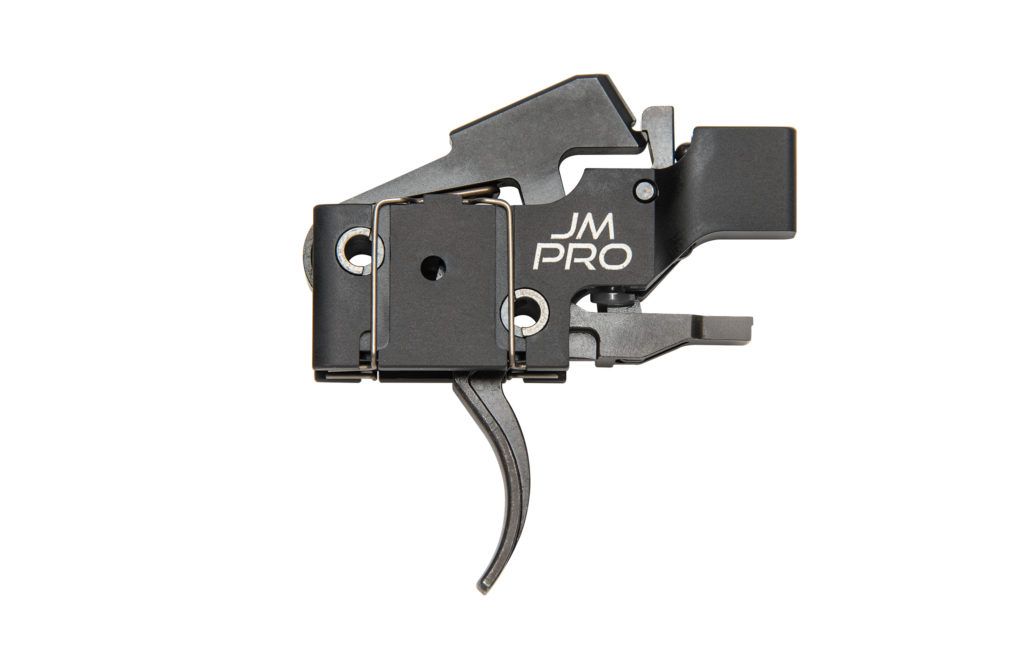
Mossberg shoots to improve AR accuracy with the release of the economical JM Pro Adjustable Match Trigger.

What Mossberg’s trigger brings to the table:

  • 3- to 6-pound pull-weight adjustment.
  • User-adjustable overtravel.
  • Compatible with AR-15 and AR-10 rifles with .154-inch trigger and hammer pin holes.
  • Drop-in design for easy installment.

You needn’t be a graduate of the U.S. Army Sniper School to know a bad trigger is an accuracy thief. And on no firearm is this truer than AR-style rifles. The run of the mill mil-spec trigger found in the majority of standard AR-15 and AR-10 rifles is frustratingly below average dabbling into the downright poor. Luckily, it is among the easiest upgrades (wisely your first) of an off-the-shelf black rifle.

JM-Pro

Certainly, you can make the rationalization you’re shooting nothing but point-blank with your carbine. Fine, good for you. Keep squeezing that gritty, squishy unit that came with your rifle. But if you hanker to get more out of your AR, especially a budget one, than sooner or later you’re going to have to up your game.

Thankfully, the proposition is getting less painful by the year, to the point now it’s almost inexcusable to shoot mil-spec. Case in point, Mossberg’s new JM Pro Adjustable Match Trigger. With an MSRP of $161, the drop-in unit does little to tax your pocketbook, yet should do plenty for your accuracy. Tunable from 3 to 6 pounds and compatible with AR-15 and AR-10 rifles (at least those with .154″ trigger and hammer pin holes), few improvements will give you more bang for your buck.

From Mossberg:

North Haven, CT – O.F. Mossberg and Sons, Inc., a leader in the firearms industry with over 100 design and utility patents and one of the most innovative firearms manufacturers, is pleased to announce the release of the JM Pro Adjustable Match Trigger, a drop-in adjustable precision trigger that is compatible with standard AR15 and AR10 rifles. Working with world-renowned, 3-Gun shooter, Jerry Miculek, Mossberg engineered the new JM Pro Adjustable Match Trigger as a standard rifle upgrade for competition and recreational shooters and hunters where trigger control and great shot placement are keys to success.

Designed and constructed for consistent, shot-after-shot accuracy with a crisp, creep-free break, this patented drop-in trigger design will fit all standard Mil-Spec AR15 and AR10 lower receivers with .154” trigger and hammer pin holes. The JM Pro trigger housing is precision-machined and the trigger pull weight is user-adjustable with a 3 to 6-pound range of adjustment. The trigger also features user-adjustable overtravel, allowing for personalization.

The JM Pro Adjustable Match Trigger (96010) is available as a Mossberg accessory (MSRP: $161) and is also featured as standard equipment in the latest MMR™ (Mossberg Modern Rifle) offerings – the MMR Tactical OR (Optics-Ready), MMR Tactical Vortex® Red/Green Dot Combo with Strikefire II optic, both chambered in 5.56mm NATO/223 Rem and the MMR Pro chambered in 5.56mm NATO/223 Rem and 224 Valkyrie.

For more information on the JM Pro Adjustable Match Trigger, please visit: www.mossberg.com

Custom AR-15 SBR Truck Gun Build

1

When you really need a short, handy AR-15, nothing beats an SBR truck gun.

  • SBRs, or Short-Barreled Rifles, require an NFA tax stamp and ATF paperwork. Don’t forget!
  • Truck guns are short and handy, can be deployed quickly and pack a punch.
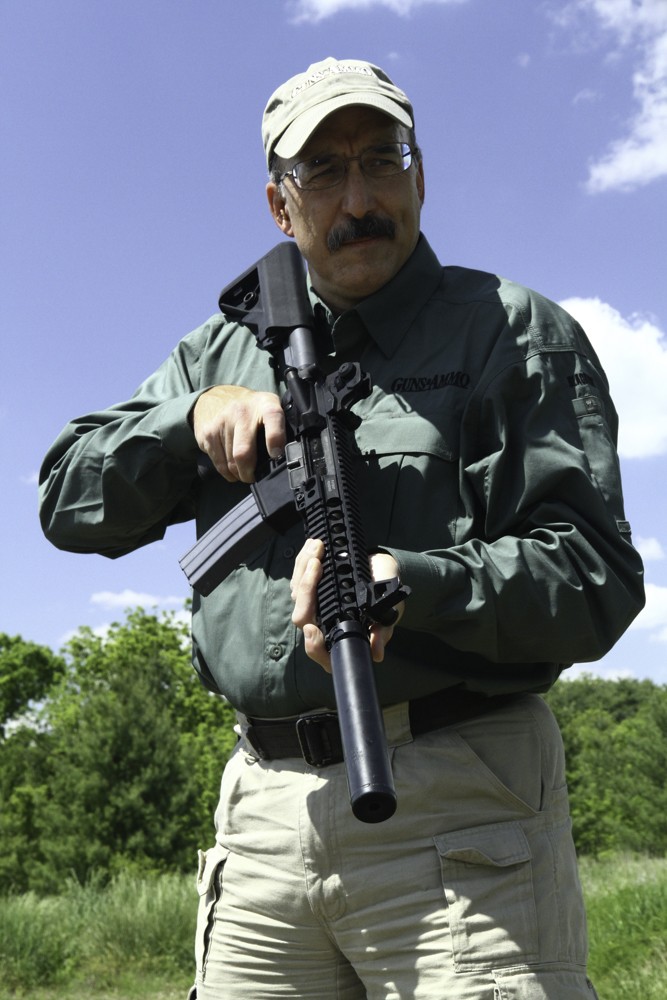
  • The author used a lower from Primary Weapons Systems and upper from BCM.
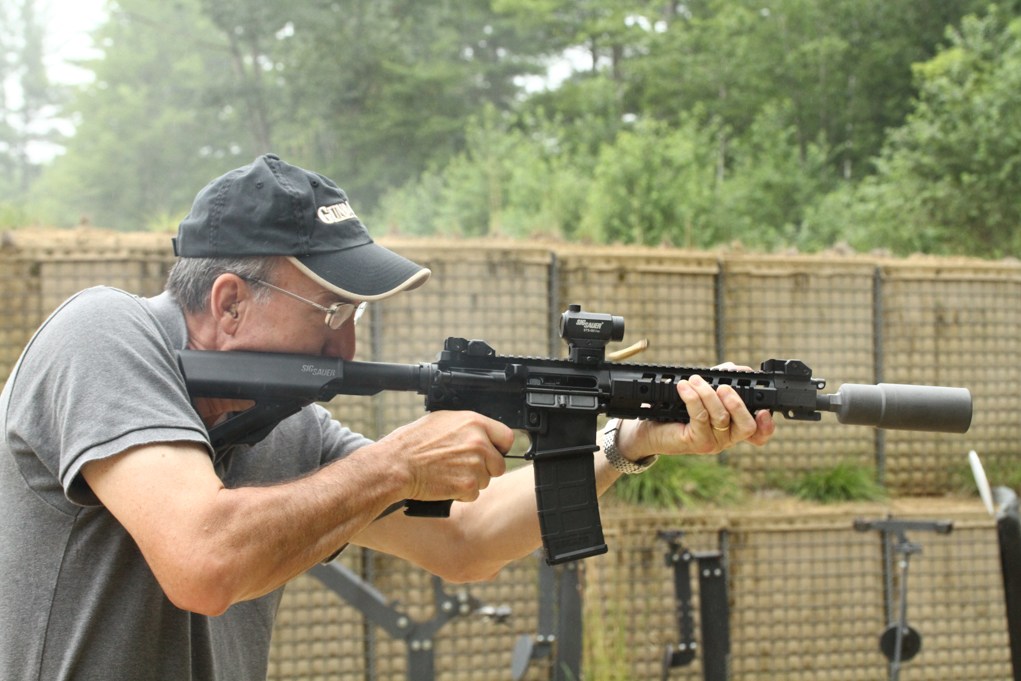
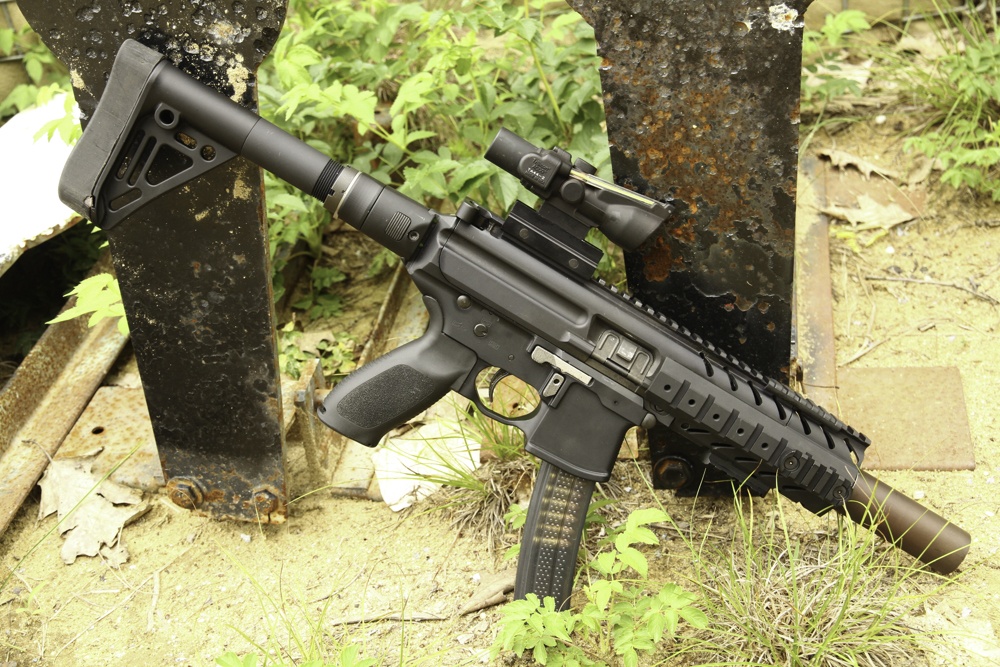
Performance-AR-SBR-Truck-Gun-LEAD-1021 Here is a ready-to-go SBR, a Sig M400 with a factory 11.5-inch barrel. Put a compact can on it and you have a very handy package. Or, build a clone of it.
Here is a ready-to-go SBR, a Sig M400 with a factory 11.5-inch barrel. Put a compact can on it and you have a very handy package. Or, build a clone of it.

Here we bite the bullet, accept that we’ll have to pay for the transfer tax, and build an honest-to-God SBR truck gun. Since we’re all-in on this, there’s no point in going half-measures on the parts and the build. So, we start by … wait a minute, we don’t start. We plan.

You cannot proceed in any way to making or buying an SBR until you have the approved form, with its tax stamp, in your grubby paws. Oh, you can have a rifle and the handguards, muzzle brake/flash hider, light, optics, etc., but you cannot have the barrel on-premises until you have the stamp.

Yep, SBRs have lots of flash. Ammo selection can cut that down, but the best choice is a suppressor.

And I’d even be leery of something cute, like having the SBR barrel, which you will install after you get the stamp, stored up at your cabin by the lake.

You still own it, have access to it, and unless the cabin is by a lake that requires an airline flight, it is easy to get to. No, do this by the book, buy the barrel only after you have the stamp.

As fun as they are to train and compete with, a pistol-caliber SBR as a truck gun is not the best choice. Vehicles are hard to get into or through, and using a pistol caliber makes it harder. That said, the 9mm carbine or SBR is fun, inexpensive to practice with, and easy on target steel.

Or, just buy the SBR, complete, but built/assembled to your specs.

The big advantage of an SBR is that even with a suppressor it isn’t any longer than a regular carbine.

Me, I grabbed one out of the rack. (To steal a line from the late Alan Rickman: “Benefits of a classical education.” In this case, years as a gun writer.)

I used an SBR lower from Primary Weapons Systems. It was built with one of their piston-system 7-inch barrels on it, and it has worked very well. It’s been reliable and accurate, but the muzzle blast is … oppressive. Seven inches is just too short, the blast is bad, and the velocity loss is too great. But boy, is it handy.

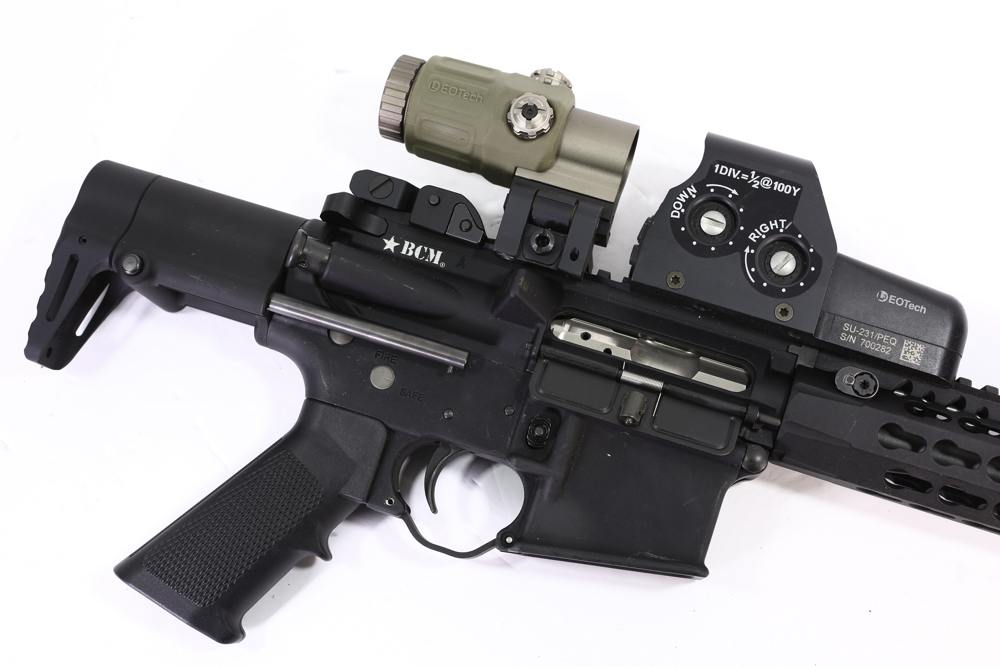
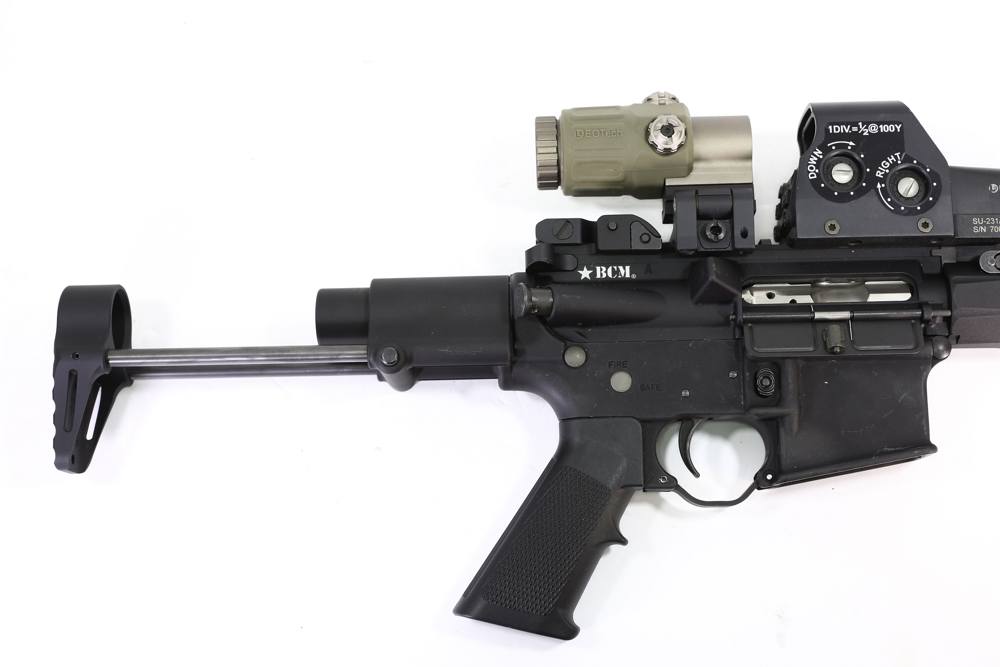
So, I replaced the upper with a BCM 11.5 slimline upper. This is a direct-impingement system, the traditional AR system.

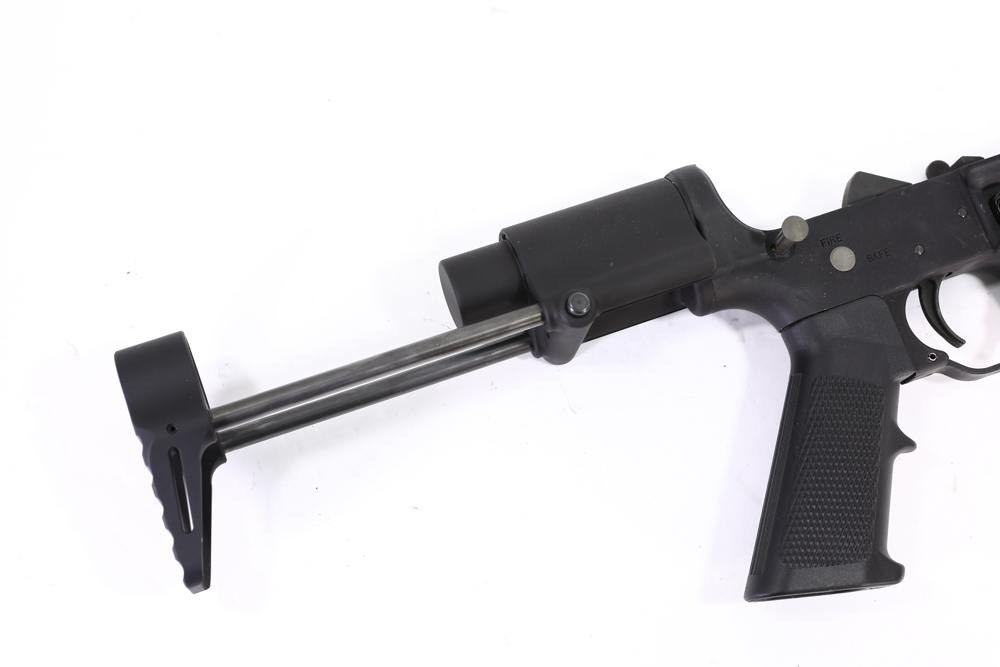
The LWRC PDW stock is very compact, but has some quirks to it.

The handguard is a free-float design, it comes directly from Bravo Company, and is called their KMR. It has KeyMod slots (you can also have M-Lok if you wish) and comes out 10 inches from the receiver, close up behind the flash hider on an 11.5-inch barrel.

It is slim, and I can really wrap my hand around it. It uses a proprietary barrel nut, and the clamping screws pass through the clearance slot in the nut, so the handguard is rigidly attached to the upper.

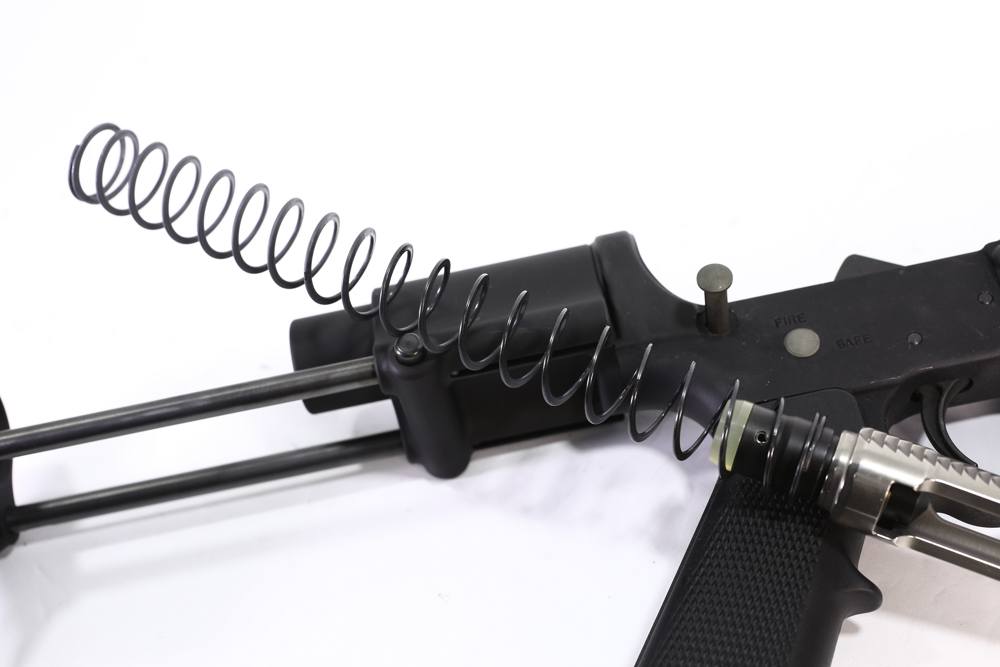
The LWRC stock uses a proprietary spring and buffer weight/cushion that fits on the back of the carrier. Right now, it is for the LWRC piston system, but there is a DI gas system model on the way.

This was built with a BCM barrel, 11.5 inches long, and put into an M4 upper.

For the lower, I used an SBR’d lower, and installed the LWRC PDW stock on it. This is a telescoping stock that is the absolute shortest a stock can be. It requires a replacement carrier, since the buffer weight is pinned to the carrier. And, you have to choose between DI and piston.

Once installed, the collapsed LWRC PDW stock is very compact. It’ll store in a very small space, even with optics on the upper receiver of your SBR.

The buffer tube of the LWRC PDW stock is shorter than any other, and this requires that they include a socket for your torque wrench, to reach into the housing and mesh with the castle nut teeth, to tighten the stock assembly. Once it is in place, the SBR can’t be assembled or taken apart as a hinge-open firearm.

Press both takedown pins out, and then lift and pull the upper assembly off of the lower.

Once extended, the assembly is long enough to be used as a stock, albeit a short one.

To re-assemble, put the carrier and bolt into the upper, and the spring in the lower, and use the carrier tail to compress the spring back into the lower as you join the upper and lower. It is a bit involved at first, but once you learn the trick, you’re fine.

Editor’s Note: This excerpt is from Gunsmithing the AR-15: Building the Performance AR, available now at GunDigestStore.com.

Get On Target With More AR-15 Knowledge

Double-Action Revolver: Secret To The Trigger

0

Working the trigger of a double-action revolver quickly and accurately isn’t rocket science, but there is a learning curve.

How to manage a double-action revolver trigger pull:

  • Grip the double-action revolver high as possible on the frame.
  • Trigger on your trigger finger’s first joint.
  • If you trigger cock, refine your aim upon cocking and break the shot.
  • If not, continue to press smoothly through while keeping the sights on the target.
  • Either technique, keep the front sight buried in the target.

You don’t shoot a double-action revolver the same way you shoot a pistol. The lining up the sights, following through and not flinching — that’s all the same. But revolvers require a bit more work in the steps leading up to that. Shooting single-action is no big deal: Thumb-cock the action, aim and press. Double action? That’s different.

Double-Action-Revolvers-8

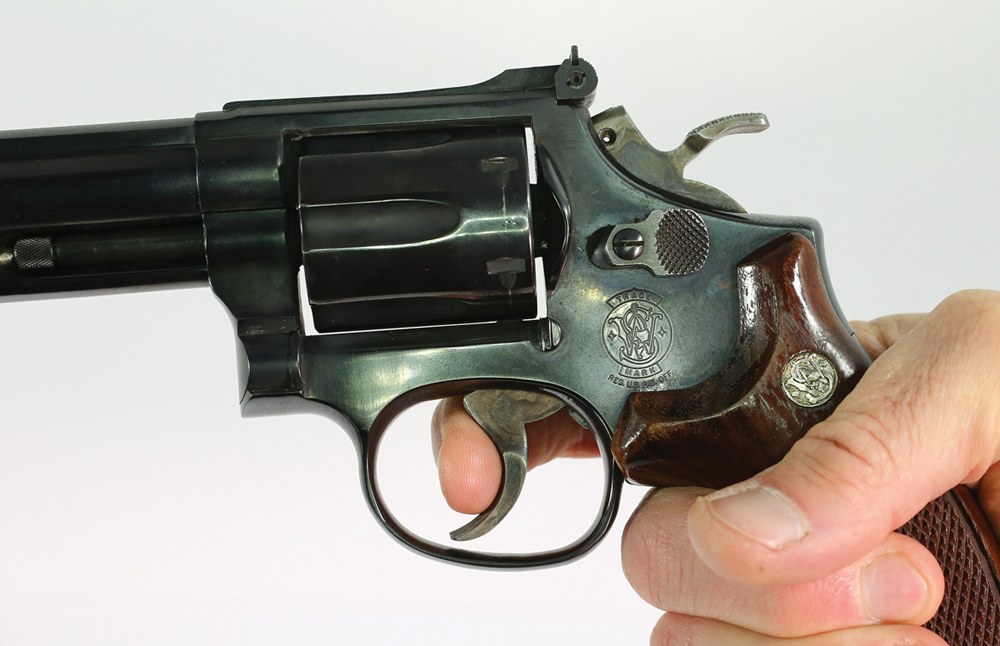
First, we need to be on common ground, knowing how a double-action revolver works. When you press the trigger, this happens in the following sequence of events:

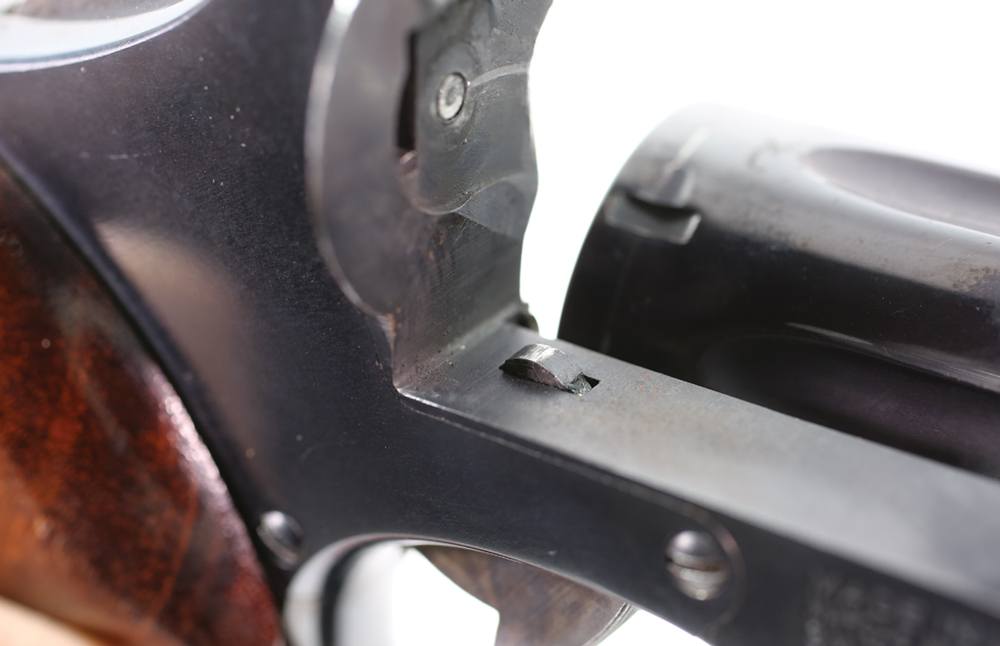
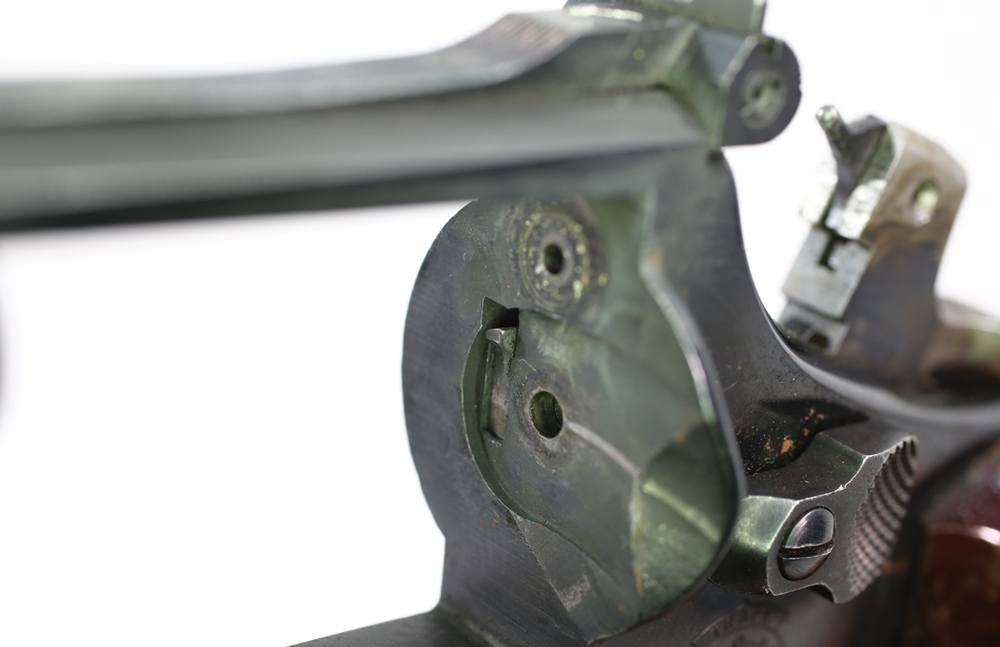
The trigger starts by depressing the cylinder lock. This allows the cylinder to move as the trigger progresses. With the cylinder lock down, the hand — that part that moves in a slot in the recoil shield —begins lifting, and the tip of it contacts the rear of the cylinder. The area it contacts is the ratchet, which is a part of the extractor star. The tip of the hand presses up on one of the teeth of the ratchet, and this begins the rotation of the cylinder.

The hand lifts the cylinder until the next charge hole has come in line with the barrel. This is called carry-up. Before the cylinder has finished rotating to carry-up, the trigger releases the cylinder lock. It snaps back up, ready to drop into the next slot in line. The early release of the lock is what causes the “drag line” around the cylinder. The drag line is a cosmetic problem unless the trigger is releasing the lock so soon that you can’t advance the cylinder.

When the cylinder lock is dropping into the next lock slot, the hand has to stop lifting the cylinder. If the ratchet is not correctly timed, the action binds just as you get to the end. This is bad for accuracy. Typically, on a well-fitted revolver, the hand slips off the tooth of the ratchet but presses it from the side, making the lockup tight.

Do not grip the revolver with your hand directly behind the trigger. Get as high on the grips and frame as you can.

You can see this with an empty revolver. If you dry-fire it (it’s safe, except with rimfires) and hold the trigger back, and then try to wiggle the cylinder, you will notice it’s tight. Let go of the trigger and the cylinder has some play to it.

Revolvers are timed one of two ways. One is “staged” and the other isn’t. In an action that’s built staged, you can trigger-cock the action and stop to aim with the hammer back. You can, with practice, trigger-cock the action through the entire cylinder and never drop the hammer as if firing. Once staged, there’s still a small amount of extra trigger press needed to fire the revolver. An action that’s not staged will drop the hammer as soon as the cylinder lock drops into place.

Why do you want either? A staged action allows you to trigger-cock, then refine your aim, and fire the shot. For revolvers that were not built staged, we would attach a compressible stop behind the trigger or a shelf on the grips. For faster shooting, staging is nice, but it’s not needed.

Now, all of this happens independently of the springs inside the action. It’s possible for an action to “stack,” which is the trigger force needed to complete the operation, increasing near the end. The old Colt revolvers with a “V” spring in the action stacked. But now, with everything using coil springs, stacking is more likely caused by a very small binding in the ratchet/hand fit at the end of the stroke.

Making It Happen

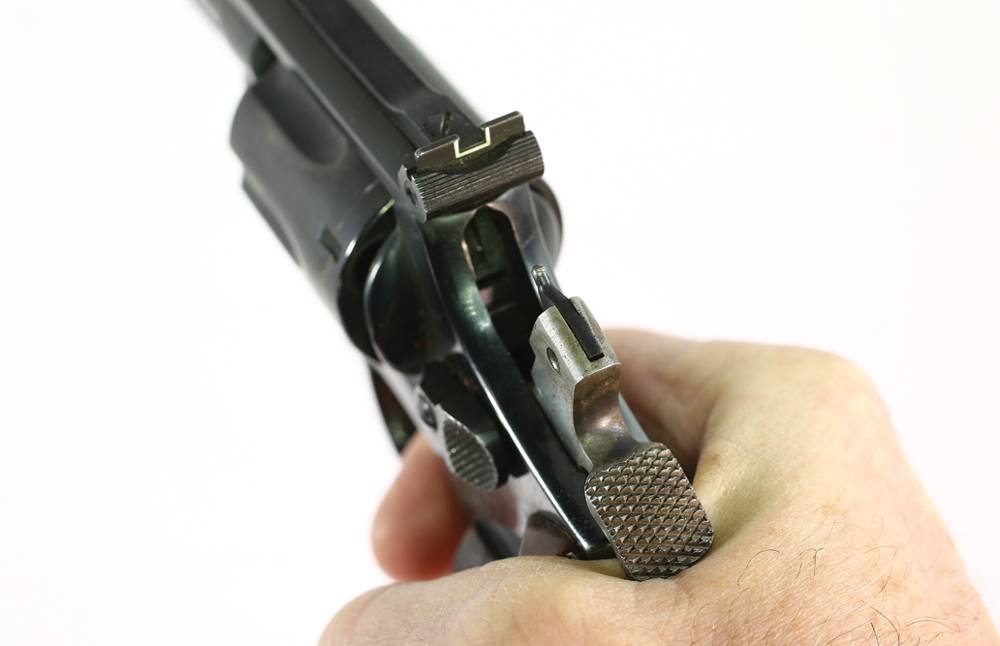
Let’s get to how you operate the mechanism. First, there’s the grip. You want your hand as high on the frame as you can get it. My hand gets so high on some revolvers that when the hammer comes back on double-action, the spur touches my hand. The axis of the bore is higher on a revolver than on a pistol, and you want to take away as much of that leverage as you possibly can.

This is the author’s grip, high up on the frame. When the hammer comes back, it brushes the web of the author’s hand because his grip is so high.

Your trigger finger must rest on the trigger, not on the tip or pad, but on the first joint. The tip or the pad is fine for pistols, but you will be moving the trigger a significant distance. You can’t do that with just the tip of your finger. You also can’t do a short re-set of the trigger. It’s currently en vogue to let the trigger forward on a pistol only as far as needed to let the mechanism rest. On a revolver, that’s a sure way to make yourself crazy. When you push your finger forward to re-set the trigger, do it with as much enthusiasm as you do the press.

Next, you have to decide what kind of shooter you are. Are you going to trigger-cock the action, refine the aim and then break the shot? Or do you want to be faster than that, which will require a different approach?

Either way, you’re going to benefit from the great advantage that the double-action revolver offers you: cheap practice through dry-firing. You have your empty revolver, you have the safe location and you have targets. First, get your grip. Aim. Now press the trigger back slowly — smoothly — in a single motion. While you do this, keep the sights aligned on the target.

Don’t Stop. If the sights wobble off the target, keep pressing and get them back on target. Keep them lined up properly, don’t lunge, and don’t jerk. The only time you stop is if you have a staged revolver and you want to shoot that way. Then you press through smoothly until it stages, then refine, and continue the press until the hammer falls.

At the start of the fi ring sequence, the cylinder lock is up, locking the cylinder in place.

“But, that isn’t fast, and double-action shooting has to be fast,” you say.

This is not instant gratification. This is building skills. You’re teaching your brain to keep the sights aligned while your trigger finger works the action. At first, 10 minutes will do. As you build hand strength, add time and pick up the pace. Once you’ve done this for a while, and you can keep the sights on the target, add a different skill-building exercise.

Start the next sessions without aiming, just point at the floor, and dry-fire your revolver 10 times as fast as you can. Then do your normal work. You’ll notice an increase in your trigger speed while still keeping the sights on the target. Once you start this, every time you begin your dry-fire practice, do this and build speed.

You can, at any time, go to the range and verify your skill-building. Ideally, you’ll use a steel target, and take paint with you. Paint the target a uniform color, and then shoot a small group in the center, slow-fire or single action. Use that as your aiming point, and begin the double-action revolver work. For live-fire work, start from low ready. Bring the revolver up, and start the trigger stroke as soon as the sights get near your cluster of hits. Aim, stroke, recover and repeat.

The hand is what pushes against the ejector ratchet in order to rotate the cylinder.

If your hits start to wander, you’re doing one of three things wrong: One, you’re looking at the target. Watch the front sight. Two, you’re shooting too fast — slow down. Three, you’re getting tired. Take a break.

Once you have a groove, do the same thing with your live-fire practice that you did with the dry-fire. Only you aim this time. To start your practice, get to a range where you can be close to the backstop. Load up, and from low ready, come up on a spot on the hill and shoot all six rounds, double action, just as quickly as you can and stay reasonably close to the aiming point.

The progression of your skills works like this: First, you teach your brain to aim and press the trigger while still aiming. Then, you add very fast double-action to that dry-fire skill. Next, you learn to aim and trigger-press, with real recoil, while staying in a reasonably tight group. Finally, you teach your brain to see the sights at high speed, and to work the trigger quickly.

This is all brain work. If you think of it simply as muscle memory and building up hand and finger strength, you’re missing the point. You aim by seeing, and your brain does the computing to correct aim. You want to build mental skills, not just physical skills.

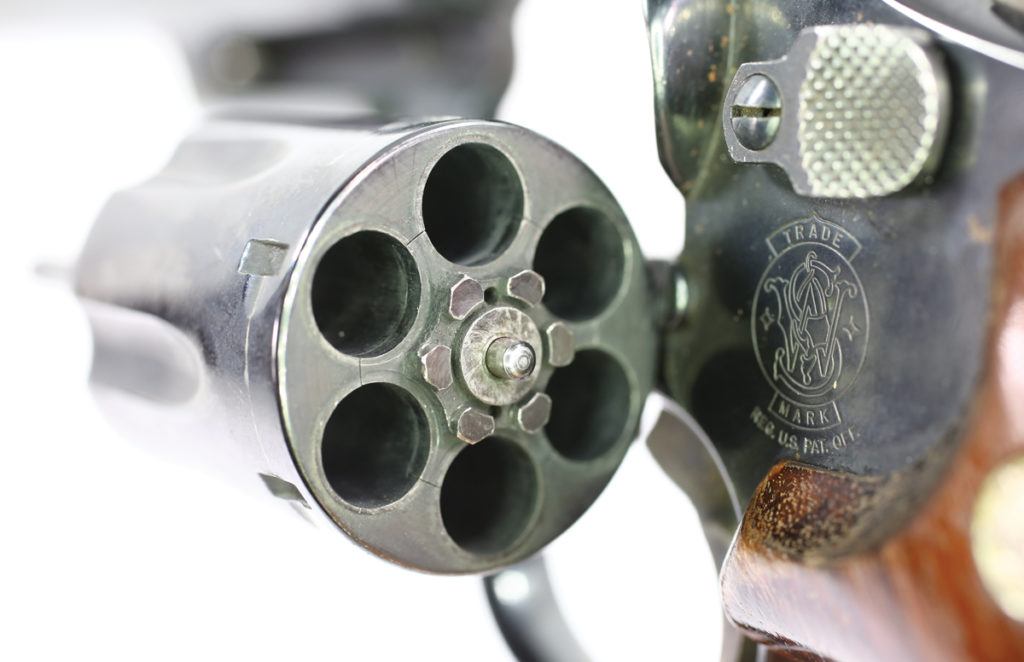
The ratchet, on the back of the cylinder, is what controls timing, cylinder rotation and lockup.

And what of the staging, or not staging? Generally, you have to pick one. If you’re going to shoot very small groups in double-action, you will have to learn to stage. If you want to shoot fast and accurately, you have to learn straight-through trigger pressing. To take a more difficult shot, you simply press through more slowly.

In short, just learn to keep the front sight buried in the middle of your target, while you smoothly, cleanly, quickly, press the trigger all the way through.

This article originally appeared in the 2018 Shooter’s Guide issue of Gun Digest the Magazine.

Video: How To Shoot Steel Targets Safely

0

It’s not simply a mount-and-shoot affair, steel targets take special consideration.

Once you start banging steel, it difficult to stop. Whether you’re talking about blazing through magazine after magazine in a Steel Challenge match or honing your handgunning skills on a piece of your land, the satisfying gong when you strike a steel target is addictive. And it’s cost effective to boot.

Like everything with shooting, there is more than meets the eye when it comes to popping steel targets. Unlike paper shooting targets or the synthetic variety, cold-hard steel requires some serious consideration before jumping into the line of fire. Contrary to popular opinion, they’re not simply a mount-and-shoot affair.

A lifetime of punishing steel plate, Mark Redl is more than familiar with some of the shooting target’s unique challenges and hazards, and what can go wrong when throwing caution to the wind. For the pro shooter for Aguila Ammunition, the two main concerns — ricochet and spall. Looming over each and every shot at steel, the risks are mitigable and year’s of enjoyment possible if you take certain precautions.

More than anything, safely shooting steel targets is a matter of making certain your equipment is in working order and you’re at a safe distance. Pockmarks have the potential of sending a bullet careening in a dangerous direction and shooting any closer than 10-yard ups the potential of catching a bullet shard when it smashes into the target.
Good equipment goes a long way in diminishing risk as well; a strong, hard steel plate target is less likely scare and quality safety glasses ensure errant fragments don’t cause serious damage. Follow these tips and you’ll find shooting steel not only safe, but plum irresistible.

For more information on Aguila Ammunition, please visit: www.aguilaammo.com.

Modern Shooter: H&H Precision Rifle’s Shooting School

0

The Modern Shooter team sees what it takes to make a shot connect from a country mile at the H&H Precision Rifles’ shooting school.

It happens more than most think. Expecting to knock the spade out of an ace card from the next county, a novice to intermediate shooter buys a decked out long-range rig. Chassis, scope, caliber, lock, stock, barrel… 1,000 yards and a couple boxes of fliers later and they figure out there’s more to this whole distance game than simply owning the equipment.

A simple deduction, know-how is the missing ingredient. While trial and error might eventually get them on target there is a more efficient and, quite frankly enjoyable method to going the distance. Tapping into the seasoned expertise of long-range mavens, shooting classes hack through the bugaboos that haunt those new to this level of marksmanship. And one of the top precision rifle makers around hosts among the premier long-range courses available today.

Unfortunately, there’s not a sign-up sheet for H&H Precision Rifles’ class open to the general public. Exclusive as it comes, the course is held once a year and is only open to shooters who have bought an H&H rifle. However, those lucky few learn how to make their firearms connect like a right jab.

Modern Shooter takes a behind-the-scenes look at this exclusive shooting institution to find out exactly what it takes to make one of H&H’s high-performance beauties live up to its full potential. Spoiler: It’s plenty. From the fundamentals of shooting positions to controlling for environmental variables, the class leaves no stone unturned.

It’s hard work, but there isn’t a single shooter who will argue it isn’t worthwhile. Simply put, there nothing like the feeling of making a speck of steel sing like a soprano everytime a shot breaks.

Check out the rest of H&H Precision’s elite shooting school on the next episode of Modern shooter, 10:00 p.m. EST Friday on the Pursuit Channel. The episode rebroadcasts Monday at 12 p.m. EST and Tuesday at 11:30 a.m. EST.

Hunting Big Country With The Bushnell Forge Scope

0

The Bushnell Forge optics proves equal to New Zealand’s rugged backcountry.

The advantage offered by the Bushnell Forge line:

  • Includes two riflescopes models, binoculars and spottingscope.
  • Scopes available in 2.5-14x, 3-18x and 4.5-27x variable powers.
  • Each has a 50mm objective lens.
  • Side parallax adjustment.
  • Exo Barrier lens coating scratch and fog resistant.
  • Coating also increases light transmission.
  • Depending on model, prices range from $750 to $950.

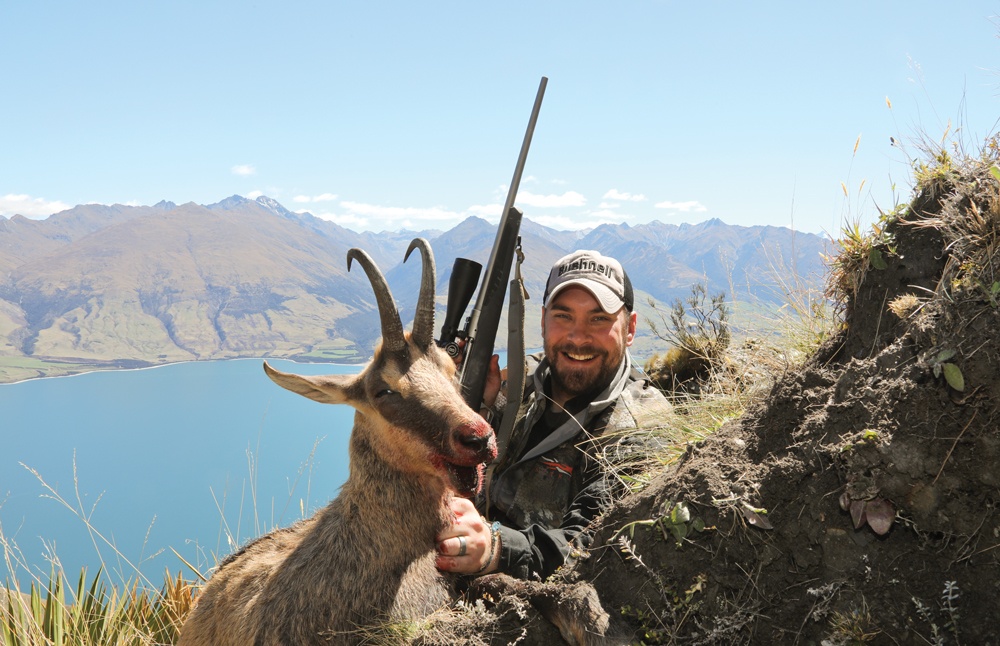
I had problems keeping up with the little New Zealand goat at first. Known for being exceptionally nimble in some the nastiest terrain on the planet, the sure-footed chamois had covered more than 75 yards before I could get settled prone across my pack. Settling wasn’t easy — it’s a rare challenge to commit full mental attention to making a shot when I couldn’t get my mind off the 200-foot drop less than 5 feet to my right. To further test my mettle, my feet were higher than my head. There I was: Slightly inverted, at the edge of a cliff, trying to settle in for a shot at a tiny target.

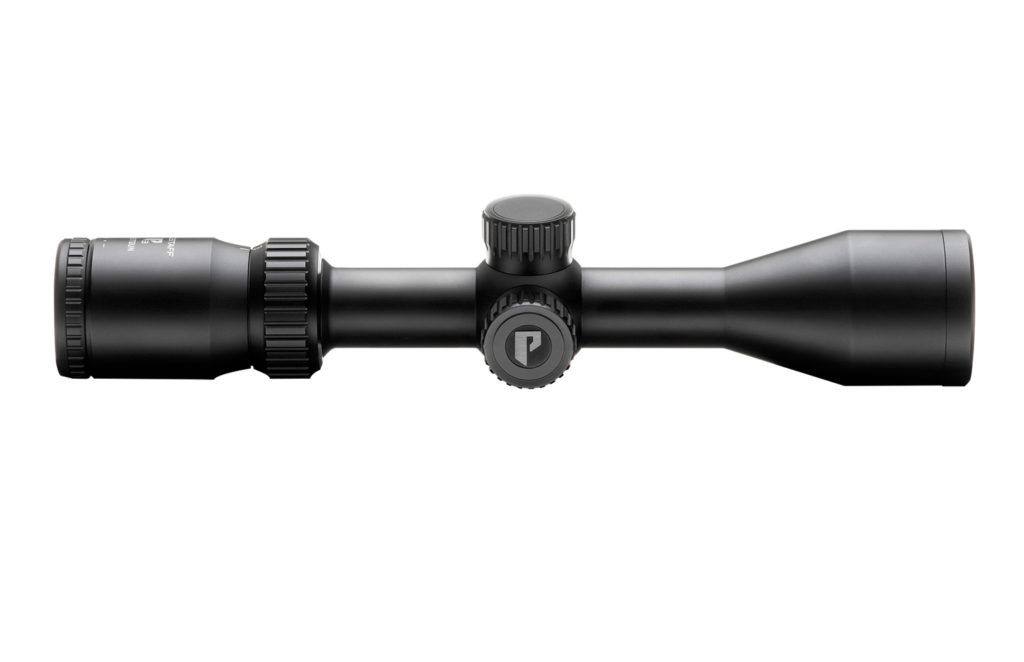
The smokin’ new Bushnell Forge rifl escope is packed to the turrets with features, led by a bar-setting new lens coating called “Exo Barrier” and a really innovative — and simple to use — zero stop system.

I learned a true appreciation for a throw lever at that exact moment. Every time I’d finally settle in, the chamois had moved just far enough that I’d have to reposition — and there was no way I was repositioning without coming off the gun slightly and keeping an eye on that cliff. This went on for a minute or better, during which I used that throw lever to work back and forth between 3x and 18x at least a half-dozen times.

And to further strain the quickly growing neck cramp, my guide was having a hell of a time trying to figure out if the chamois in my crosshairs was a buck or a doe. They look an awful lot alike, but there is only one way to tell for sure when trying to distinguish between males and females of any mammal species…

So began the search for the, um… accessories, and it was at that moment I gained yet another appreciation for ultra-clear lenses. I had traveled half-way around the world and my hunt had come down to being able to spot a pair of peanuts at 350 yards — and that wasn’t easy.

Though shooting cross-canyon, I had a slightly elevated position and my retina was close to burning a hole through the lenses of the Bushnell Forge. I watch, and waited … and finally confirmed that the chamois was indeed a buck and clicked the safety to fire. That’s when the debate began.

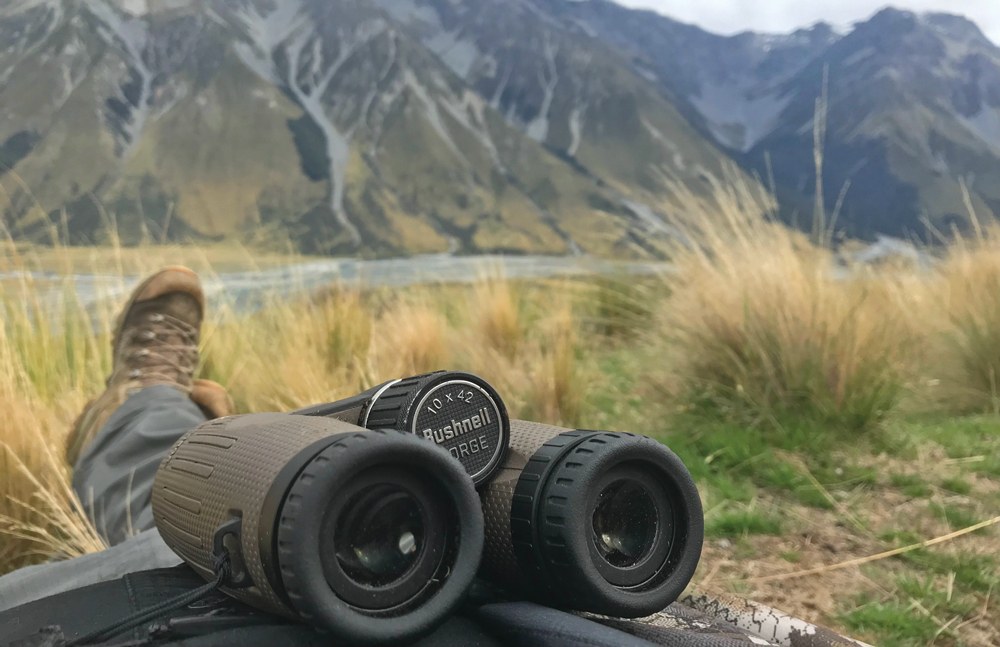
The Forge family currently consists of rifl escopes, binos and spotters. Bushnell also recently released the Nitro and Prime lines.

“I can see them clear as he walks away. When he turns broadside I’m going to send it. Give me the shoot-to distance.”

“I’m not sure,” he said. I took my head off the rifle and looked at my guide. He was tucked in directly behind me, staring through a pair of $2,500 binoculars of the same magnification as my Bushnell Forge — and he couldn’t see what I needed him to see. “Are you sure?”

I got back on the rifle, worked the throw lever and waited for the buck to leave full broadside and turn away so I could reconfirm.

“I’m 100 percent positive.”

“Your shoot-to distance is 253 yards. When you’re ready.”

I depressed the blade of the AccuTrigger and waited for the buck to turn back broadside, and when he did, I disrupted the silence of that steep mountain face.

As it turns out, even after all the evaluating, making that shot was the easy part.

A Land Like No Other

The folks at Bushnell believed they had developed a massive victory with the birth of the Forge Optics line, and right out of the gate, they were more than willing to put everything they’d built to the test in some of the nastiest terrains on the planet.

The chamois is the ideal animal to pursue for rifl emen looking to test their gear on some of the roughest terrain on the planet.

Everything about New Zealand is a paradox. Never have I been to a place where the vistas were so magnificent yet the terrain so relentless and unforgiving. The Lord Of The Rings comments got old quicker than a 15-hour plane ride, but I do get it… there’s no way to describe the vastness of the country. The best any of us could come up with was “epic.”

As a hunter, New Zealand offers game and terrain unique to only this little corner of the world. From chamois to red stag to Himalayan tahr, it simply can’t be replicated like parts of Africa can be “cloned” in Texas. For the shooter, cross-canyon above-the-clouds vistas can make it exceptionally difficult to focus on the target.

And for an optics test — well, the weather and the near vertical terrain were going to make every piece of the gear step up and earn it.

Upon bullet impact, my guide and hunting partner, Jake Edson, watched the chamois tumble at least 1,000 feet before we lost sight of it in another ravine — and there was no indication of it slowing down. I didn’t see that coming. We collected our gear and began searching for a scalable way to navigate down the cliff I was so nervous about toppling off while making the shot.

The road to that chamois was non-existent, as we slipped, scraped and clawed our security out of each step we took. Never in my life have I been to a place where each step had to be strategically calculated in the name of self-preservation. There were times when a single misstep would’ve meant a multi-hundred-foot fall ending in serious manglement or permanent lights out.

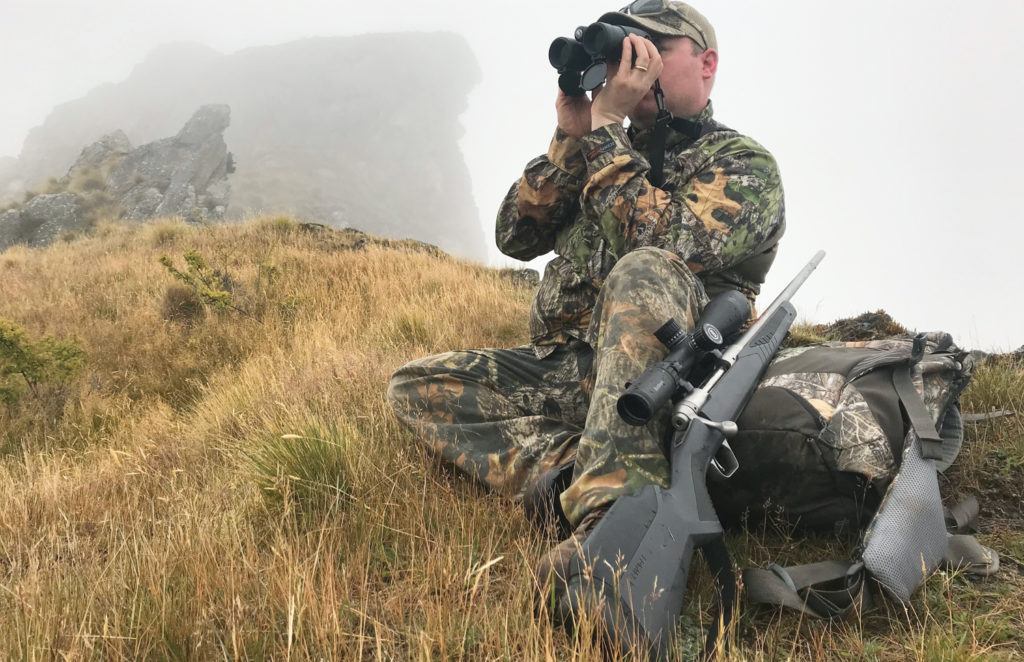
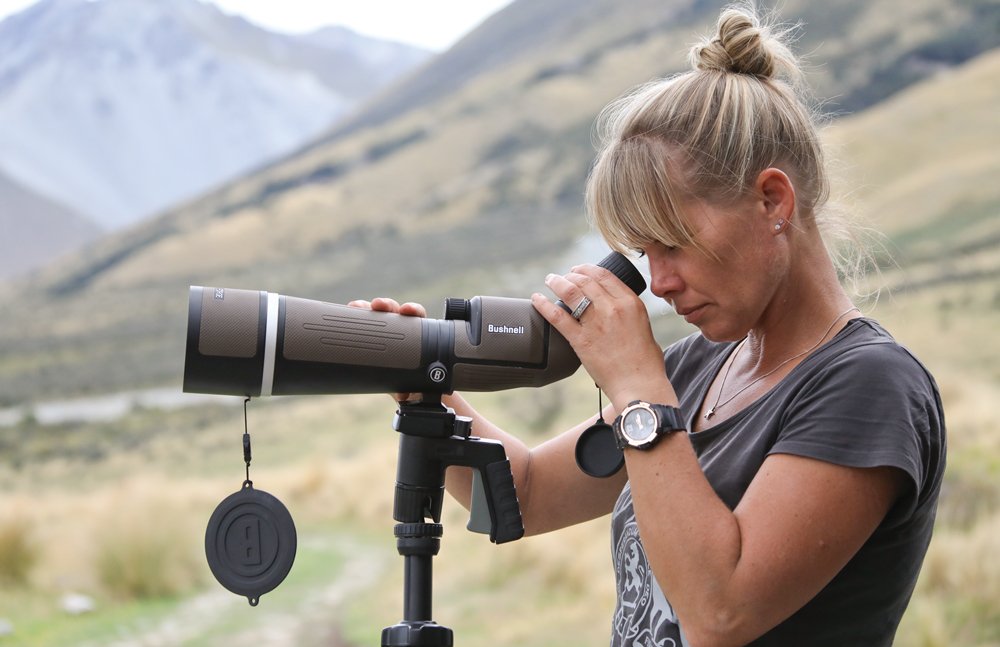
In big country, great glass is the difference between truly effective searching with your eyes and burning a whole lot of boot leather to accomplish the same tasks.

It took us nearly 3 hours to locate and get to the buck, and during those 3 hours, gear preservation was not at the forefront of anyone’s mind: personal preservation was. We snapped some pictures, packed up the chamois and made the hike back up the way from which we had come. There simply were no other options.

Back up top, we took water and inspected gear and ourselves. Though no scratches were deep enough to challenge the integrity of the rifle, the stock looked as though it had gotten into a fight with a rabid bobcat.

My Bushnell Forge had no less than a dozen small dings and scratches across its entirety, and Jake’s — well, there was one particular life-saving slide on a rock mogul course that ended with a pretty hefty dent on the end of the objective bell.

With Jake up next the following day and me with a tahr tag burning a hole in my pocket, we hit the rifle range to assess the true damage we had done to the rifle and the Bushnell Forge. I settled in prone from 200 yards, got good and cozy across my daypack, and I tucked two bullets within a half-inch of one another just an inch high of center.

Jake took a few more rounds to settle in, but when he did, it held beautifully. And, quite frankly, expecting a scope to hold zero after getting walloped hard enough to leave a dent is like firing a round and expecting it to never drop. But a scope that can come bouncing back after a blow like that is a true traveling companion in my book.

A Final Look

I beat the crap out of my Bushnell Forge — unintentionally, granted — for the next few days. It turns out that tahr country is no less forgiving than chamois country. Maybe a little less steep but with a whole lot more rocks. And you’ll have to forgive the pun, but my optics and I forged on, no worse for the wear.

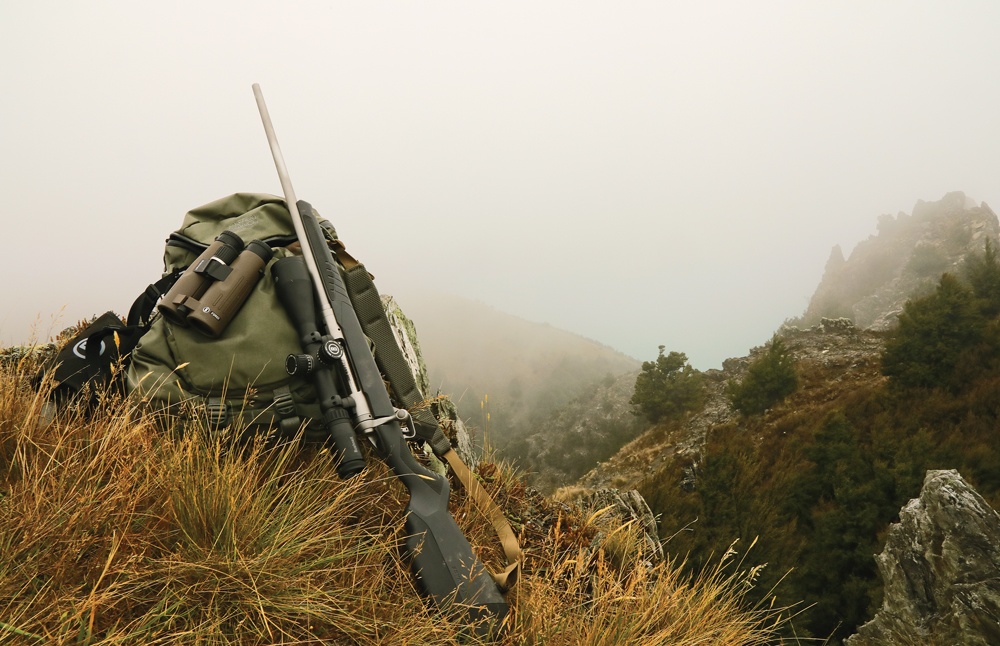
Bushnell-Forge-Scope-Rifle

This entire experience taught me a few things. First: You can’t price-profile optics. Don’t think that you have to spend an uncomfortable amount of money to get top-tier performance. Those days are gone. And second: Bushnell is no longer just a “blue-collar” brand. Stigmas are challenging to overcome, but I’ve watched the product lines evolve these past few years, starting with the Engage line and now the Forge Line. They challenged their gear to perform for me on the hunt of a lifetime halfway around the world, and perform it did. 

For more information on the Bushnell Forge line, please visit: www.bushnell.com.

Editor’s Note: This article originally appeared in the 2018 Shooter’s Guide issue of Gun Digest the Magazine.

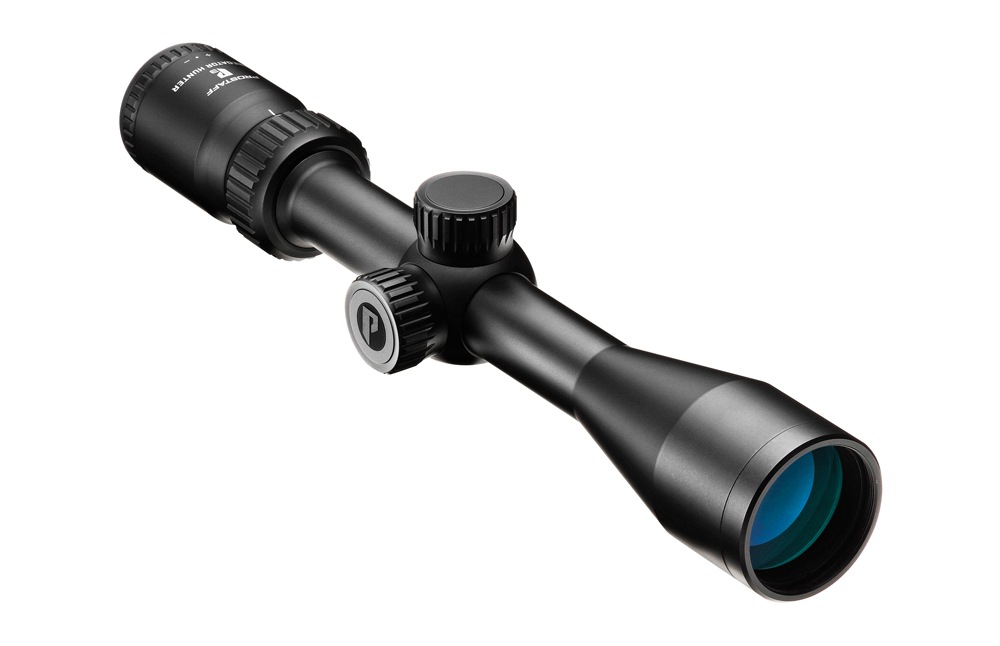
Nikon PROSTAFF P3 Line Of Scopes Tailored To Platform

0

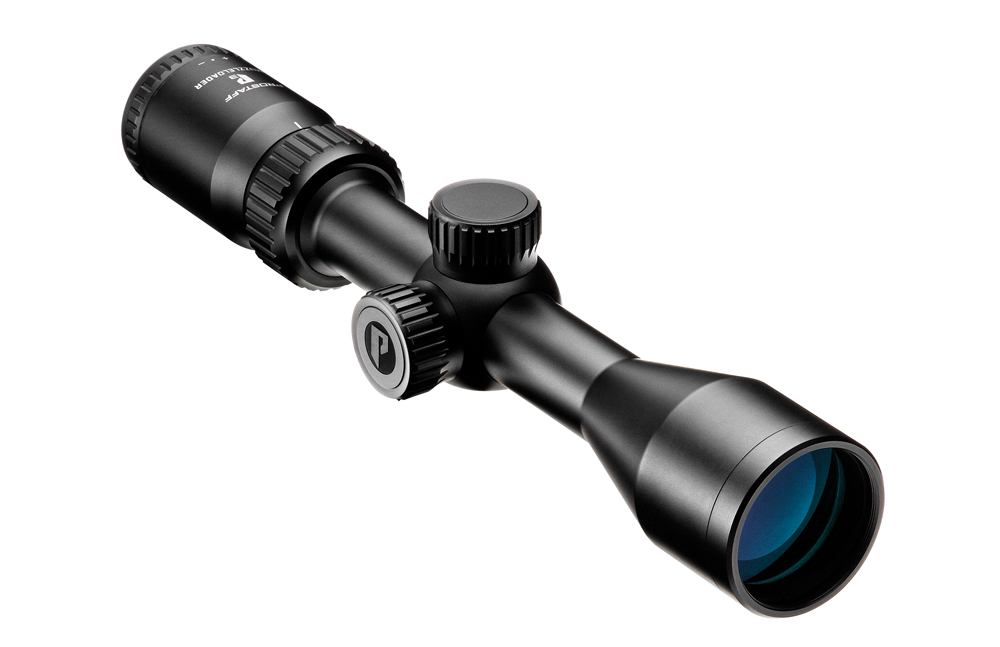
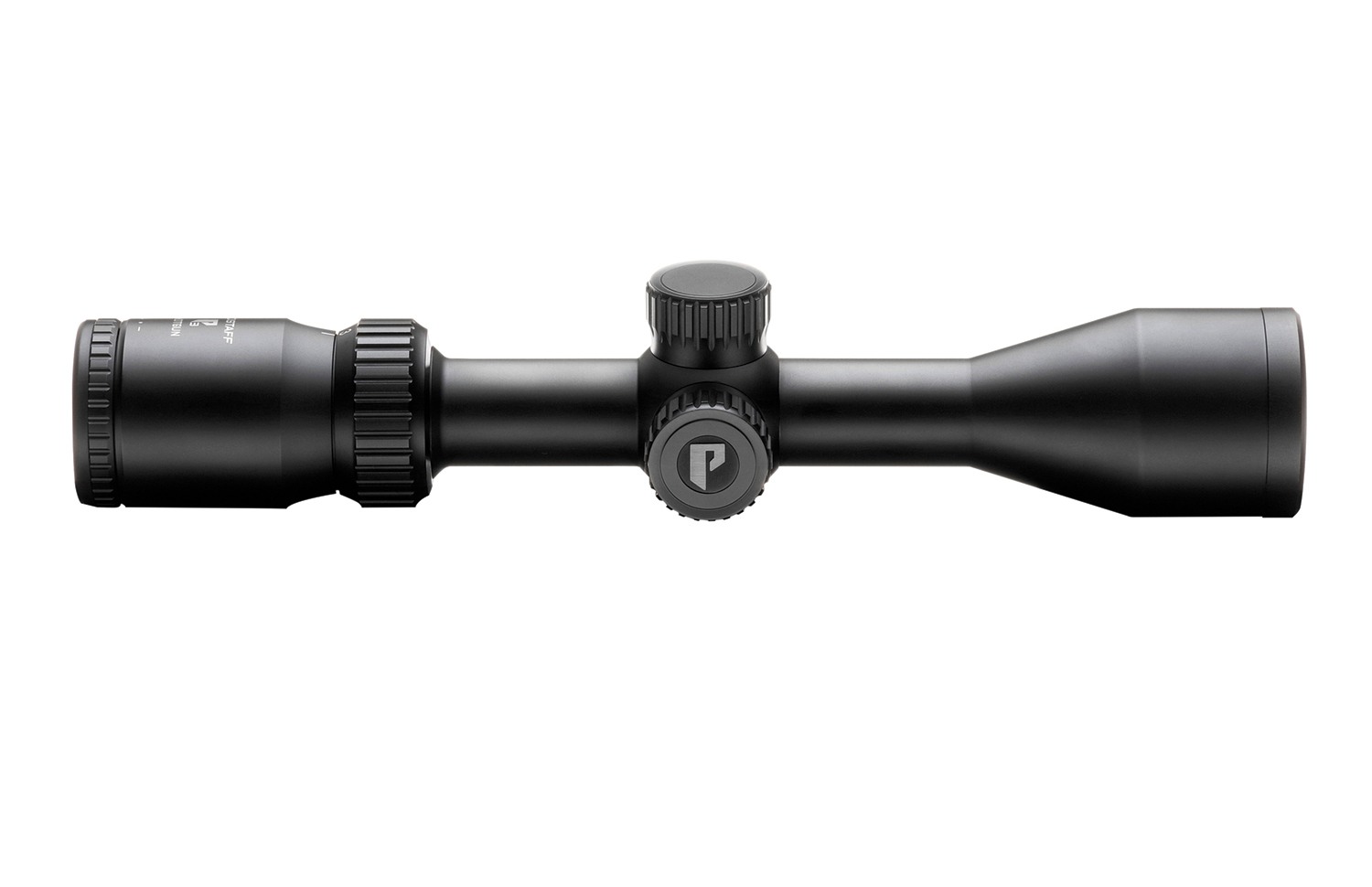
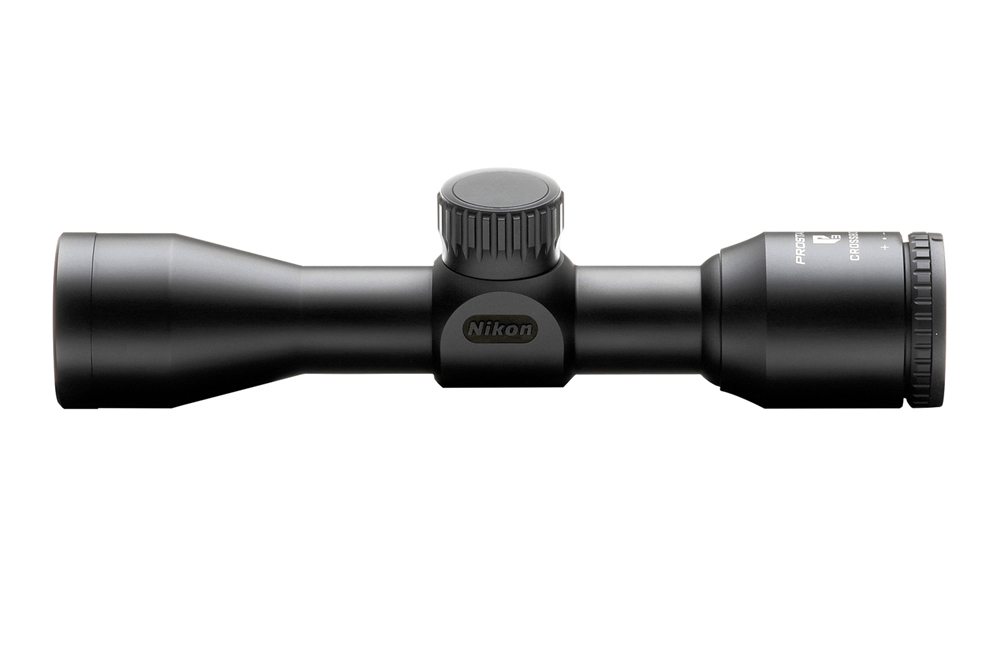
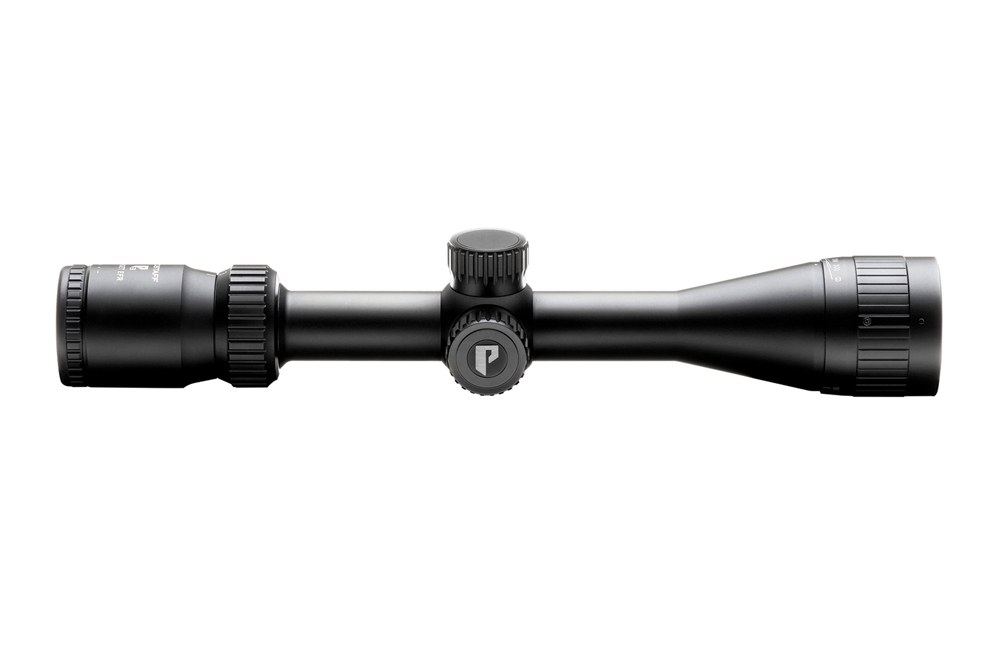
With five new purpose built scopes, the PROSTAFF P3 Line aims to get everyone from shotgunners to arbalists on target this hunting season.

What the PROSTAFF P3 Line Offers:

  • Models tailored to shotguns, muzzleloaders, rimfire and air rifles, predator rifles and crossbows.
  • BDC retile desing optimized for the range, velocity and trajectory of each firearm (and crossbow).
  • Maginification options from fixed 3x to variable 4-12x.
  • Affordable price range from $160 to $300.

PROSTAFF_P3_SHOTGUN_3-9×40

No doubt about it, Nikon has burned the midnight oil in 2018. Making a sizable leap early this year into previously untrod territory, the company has followed up to the introduction of its first red-dot optics with an impressive expansion of one of its best-known series. Relatively affordable and solid performers, PROSTAFF scopes have become a favorite of hunters and are certain to earn a more diverse cross-section of devotees with the newly minted P3 line. Purpose built for certain platforms, the five new scopes are meant to offer tailor-made aiming solutions for shotguns, muzzleloaders, rimfire/air rifles, predator rifles and even crossbows.

At first blush, what separates the PROSTAFF P3 family from other scopes (aside from size in some examples) is a head-scratcher — at least when it comes to the hunting-specific models. But gaze through the ocular and things become clearer. Nikon has etched BDC (Bullet Drop Compensation) reticles optimized for the velocity, trajectory and range of each firearm (and crossbow), giving marksmen (and arbalists) an ideal way to put meat on the table no matter the distance. The rimfire/air rifle reticle is a beat off, boasting more traditional crosshairs with a fine center dot meant to draw the eye.

Commonplace nowadays, Nikon has turned to technology to fine tune a scope to a load with its Spot On Ballistic Match Technology (available as a free app or website). But what should catch shooters’ eyes more than anything is price, with the scopes running from $160 to $300.

More from Nikon:

Nikon introduces a new line of purpose-designed riflescopes just in time for the upcoming hunting season and summer shooting activities. The new PROSTAFF P3 line-up of scopes includes eight new models specifically designed for muzzleloaders, slug guns, predator hunting, crossbows and rimfires/air rifles.

The all-new Nikon riflescope family consists of platform-specific models bearing PROSTAFF P3 MUZZLELOADER, PROSTAFF P3 SHOTGUN, PROSTAFF P3 PREDATOR HUNTER, PROSTAFF P3 CROSSBOW and PROSTAFF P3 TARGET EFR names. Shared features throughout the line include bright, fully multicoated optics, crisp hand-turn reticle adjustments (1/4 MOA except for the CROSSBOW model’s 1 MOA graduations) and generous consistent eye relief. Other features common through the family include rugged, all-aluminum one-inch main body tubes, turret caps and eyepiece quick focus adjustment rings (with rubber insert). The zoom ring on variable power models is also aluminum.

Each of the PROSTAFF P3 hunting riflescope models integrate a specialized Nikon BDC reticle designed for the specific application at hand, including the BDC 300 muzzleloader reticle, BDC 200 slug gun reticle, BDC Predator reticle and BDC 60 crossbow reticle.

Each of the BDC reticles can be optimized for many ballistic aiming possibilities using virtually any load. These can be calculated with the use of either the Spot On Ballistic Match Technology app or website software—both free from Nikon.

The PROSTAFF P3 TARGET EFR (extended focus range) model utilizes Nikon’s Precision reticle, designed to draw the eye into the small dot at the reticle center for precise aiming at small air gun and rimfire targets. This specialty target model features an adjustable objective lens for parallax-free focusing from 10-yards to infinity.

All of the PROSTAFF P3 riflescopes reflect Nikon’s passion for optical performance, lasting quality and overall value and are backed by Nikon’s Lifetime Repair/Replacement NO FAULT POLICY. Suggested retail price for the PROSTAFF P3 specialty riflescope models ranges from $159.95 to $299.95.

16603_PROSTAFF_P3_MUZZLELOADER_1
PROSTAFF P3 MUZZLELOADER 3-9×40 BDC 300
Magnification: 3-9x
Objective Diameter: 40mm
Tube Diameter: 1 in
Eye Relief: 3.6 in
Eyepiece Outside Diameter: 44 mm
Weight: 15.2 oz
Overall Length: 11.4 in
Adjustment Graduation: 1/4 in
Waterproof/Fogproof: Yes
Matte Finish: Yes
Reticle: BDC 300
MSRP: $200

PROSTAFF_P3_SHOTGUN_3-9×40
PROSTAFF P3 SHOTGUN 3-9×40 and 2-7×40 BDC 200
Magnification: 3-9x and 2-7x
Objective Diameter: 40 mm
Tube Diameter: 1 in
Eye Relief: 5 in (3-9x); 3.8 in (2-7x)
Eyepiece Outside Diameter: 44 mm
Weight: 15.2 oz (3-9x); 14.3 oz (2-7x)
Overall Length: 11.4 in (3-9x); 11.5 in (2-7x)
Adjustment Graduation: 1/4 in
Parallax Setting: 100 yds
Waterproof/Fogproof: Yes
Matte Finish: Yes
Reticle: BDC 200
MSRP: $200 3-9×40; $160 2-7×40

PROSTAFF_P3_CROSSBOW_
PROSTAFF P3 CROSSBOW 3×32 BDC 60
Magnification: 3 x
Objective Diameter: 32 mm
Exit Pupil: 10.7 mm
Field of View: 35.6 ft @ 100 yds
Tube Diameter: 1 in
Eye Relief: 3.4 in
Eyepiece Outside Diameter: 41 mm
Weight: 10.9 oz
Overall Length: 8.2 in
Adjustment Graduation: 1 in
Parallax Setting: 20 yds
Waterproof/Fogproof: Yes
Matte Finish: Yes
Reticle: BDC 60
MSRP: $160

16603_PROSTAFF_P3_MUZZLELOADER_1
PROSTAFF P3 MUZZLELOADER 3-9×40 Silver BDC 300
Magnification: 3-9x
Objective Diameter: 40 mm
Tube Diameter: 1 in
Eye Relief: 3.6 in
Eyepiece Outside Diameter: 44 mm
Weight: 15.2 oz
Overall Length: 11.4 in
Adjustment Graduation: 1/4 in
Waterproof/Fogproof: Yes
Silver Finish: Yes
Matte Finish: Yes
Reticle: BDC 300
MSRP: $220

PROSTAFF_P3_TARGET_EFR
PROSTAFF P3 TARGET EFR 3-9x40AO PRECISION
Magnification: 3-9x
Objective Diameter: 40 mm
Tube Diameter: 1 in
Eyepiece Outside Diameter: 44 mm
Weight: 16.6 oz
Overall Length: 12.5 in
Adjustment Graduation: 1/4 in
Waterproof/Fogproof: Yes
Matte Finish: Yes
Reticle: Precision
MSRP: $190

PROSTAFF_P3_PREDATOR_3-9x40_1
PROSTAFF P3 PREDATOR HUNTER 4-12×40 and 3-9×40 BDC PREDATOR
Magnification: 4-12x; 3-9x
Objective Diameter: 40 mm
Tube Diameter: 1 in
Eye Relief:  3.7 in (4-12x); 3.6 in (3-9x)
Eyepiece Outside Diameter: 44 mm
Weight: 15.5 oz (4-12x); 15.0 oz (3-9x)
Overall Length: 14.1 in (4-12x); 12.4 (3-9x)
Adjustment Graduation: 1/4 in
Waterproof/Fogproof: Yes
Matte Finish: Yes
Reticle: BDC Predator
MSRP: $300 4-14×40; $160 309×40

For more information on the PROSTAFF P3 line, please visit: www.nikonsportoptics.com.

FBI Handguns: Revolvers of the Past

1

Before the present era of high-capacity semi-auto handguns, FBI handguns were of the revolver variety. Here’s a look at the FBI handguns that were fielded not that long ago.

What revolvers were the G-men packing:

  • Early FBI handguns were primarily Colts and Smith & Wesson revolvers in .38 Special.
  • Later, some FBI agents fielded the Model 19 .357 Magnum.
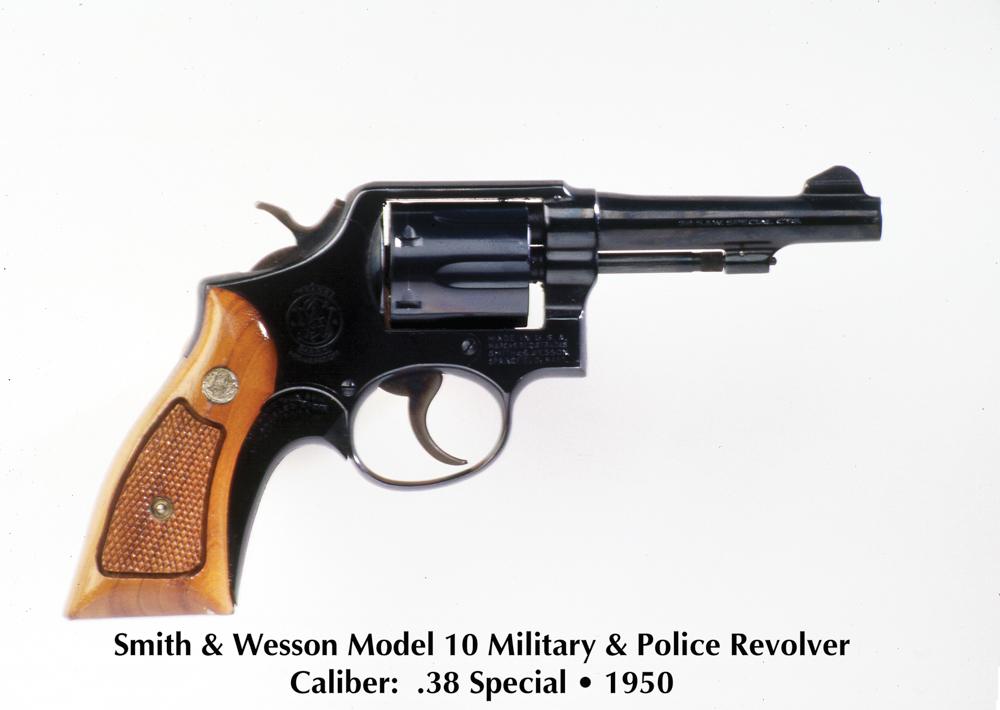
  • The Smith & Wesson Model 10 was, and still is, a fine-shooting and accurate revolver.

Early FBI Handguns

While it seems the initial FBI issue of .38 Special revolvers were Colts — primarily Official Police and Police Positives — the Smith & Wesson Military & Police (M&P), later called the Model 10, was soon issued and eventually became the sole issue revolver for new agents.

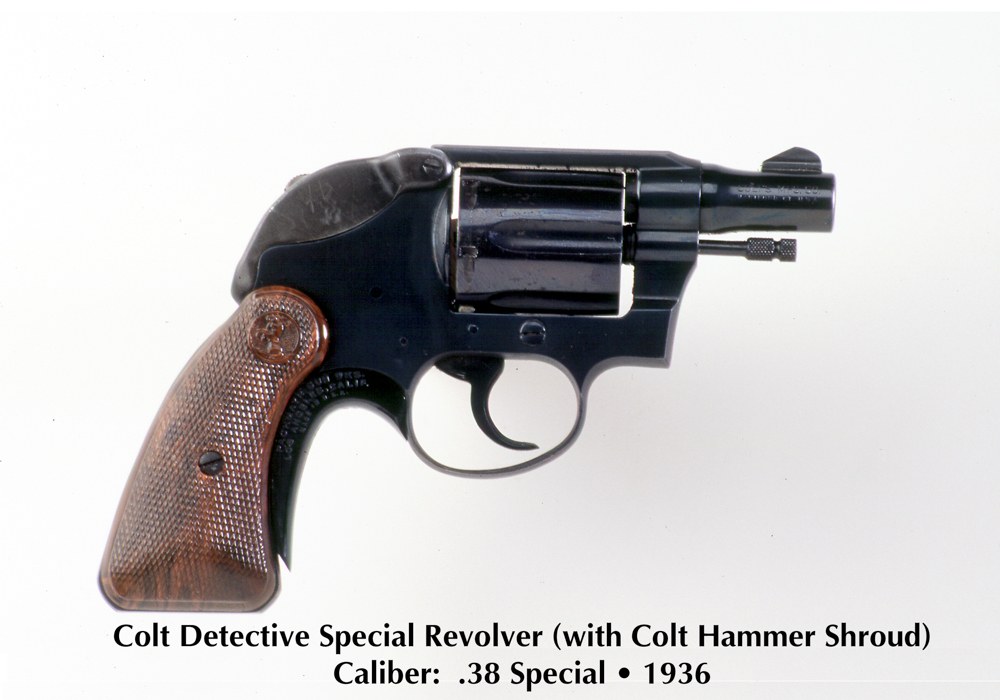
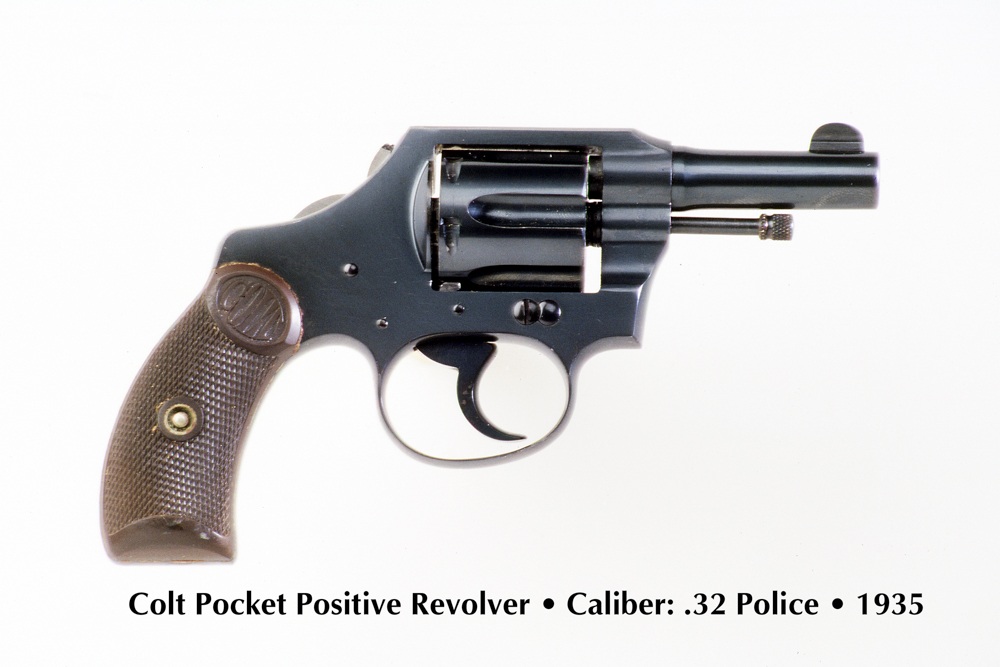
Other Colts had also been obtained and issued, including the Colt Pocket Positive in .32 caliber. A Police Positive in .32 caliber was also issued as well as a Colt Detective Special in .38 Special. The Detective Special was often issued with a factory hammer shroud installed.

Colt Detective Specials were issued later, usually equipped with a hammer shroud. All photos FBI unless noted.

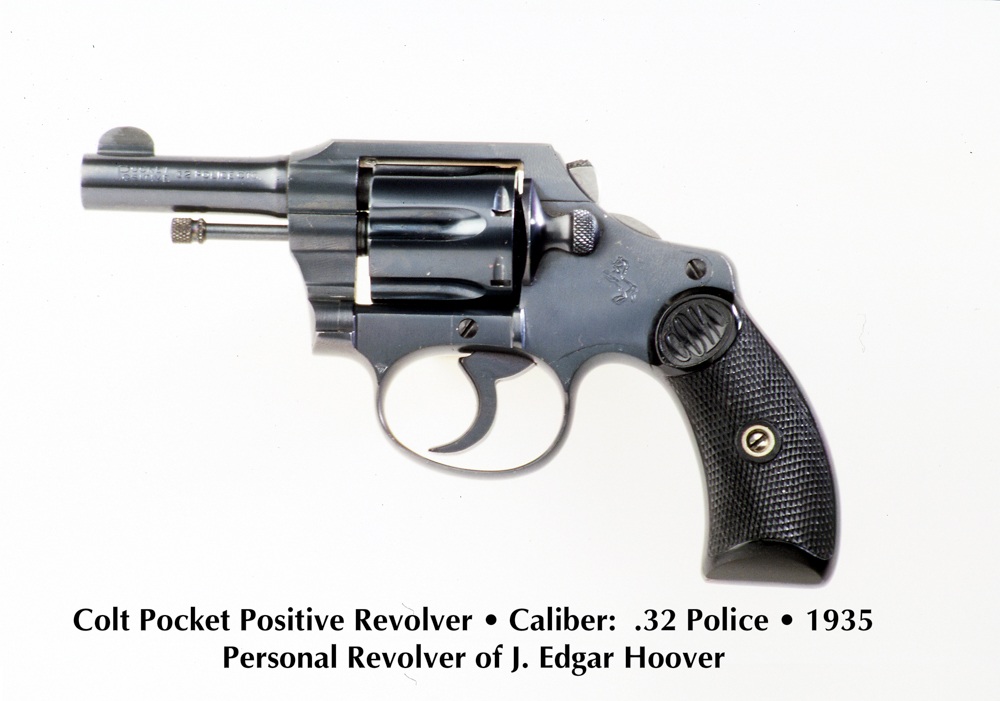
Director Hoover was known to have owned or been issued a Colt Pocket Positive in .32 caliber with a bobbed hammer.

In 1934, he was given a Smith & Wesson .357 Magnum, Registration Number 1. Years later, when S&W introduced the Combat Magnum, the Model 19, he was presented with one. S&W historian Roy Jinks and Sandra Drein’s book, Images of America: Smith & Wesson shows a photo of Hoover receiving an engraved Model 19 from an S&W representative.

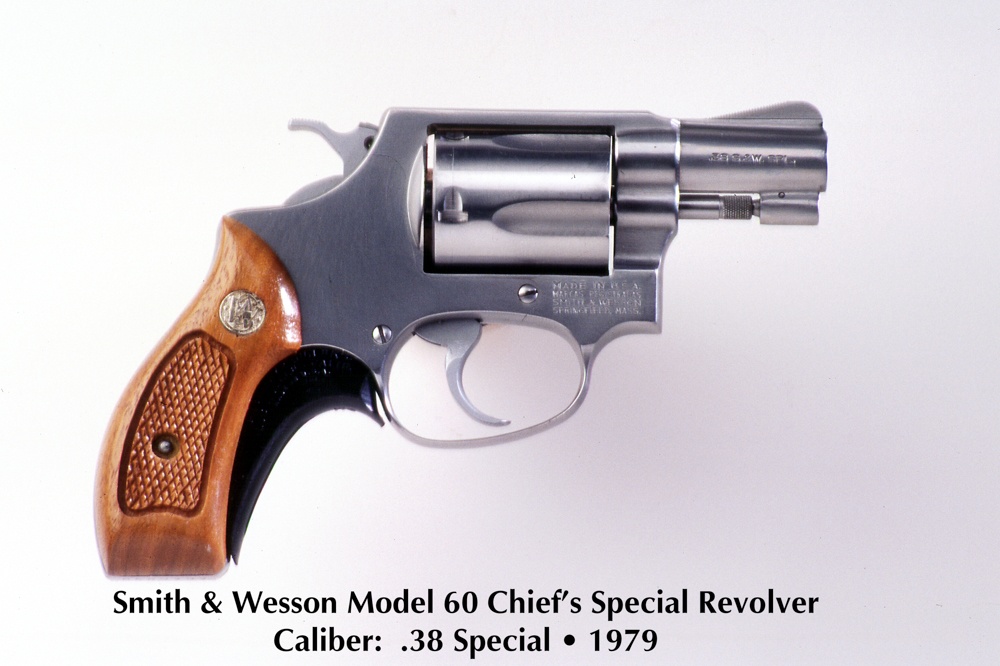
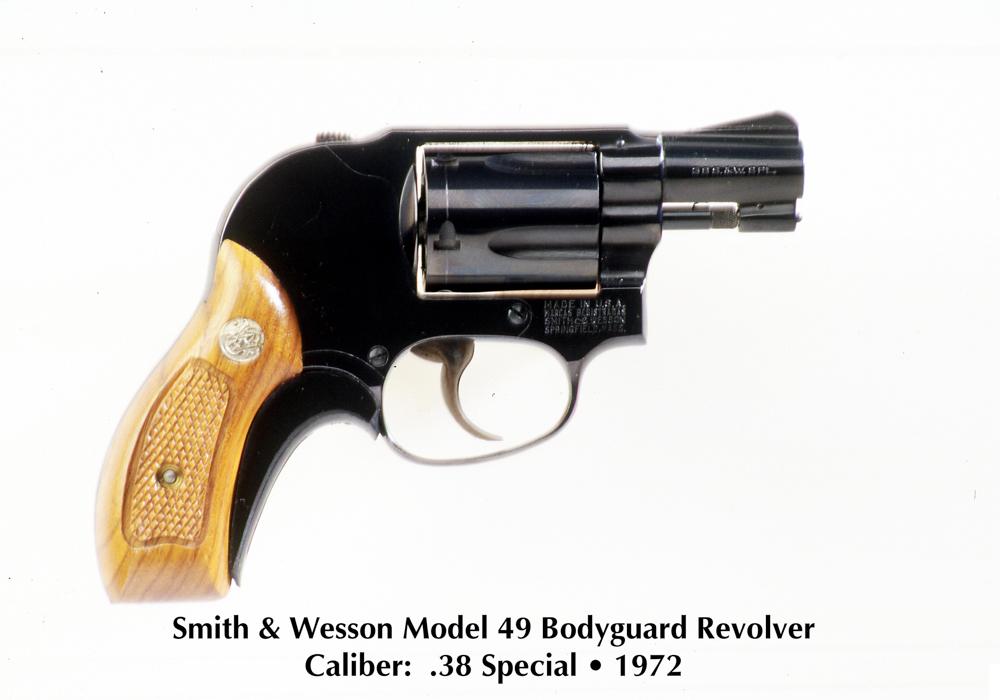
When I entered on duty with the FBI in November of 1973, I was issued a S&W Model 10. It had a standard (slender) 4-inch barrel, PC (plain clothes) stocks and grip adapter. It was new or almost so and had a conservative action job. About that time, the Bureau also had in its inventory the Model 49 (“Bodyguard”) and the Model 60, the stainless steel Chief’s Special for special issue.

Agents were also allowed to purchase and carry their own revolvers and most selected the smaller versions. Agents who had Bureau-approved weapons were known to carry the smaller guns on the street but qualify with their issued 4-inch models. Because of this practice, new FBI regulations required qualification with all models agents had in their inventory, including their issue guns.

Colt Pocket Positive in .32 caliber. Early issue for agents.

I was talking with an old friend, Claude Duffey Brown, who joined the FBI in 1956, and who had later sent me an email on his experiences as a new agent. “My firearms training was just before Christmas, 1956, and then during the first weeks of January 1957 — being some of the worst weather I had ever seen; (Duffey was from Texas.) snow, ice, etc. but told that can’t pick weather for a gunfight, so tough it out. Our class was issued .38 Colt Official Police revolvers, which were believed to have a better single action than the S&W.

The S&W M&P was the other type revolver that could have been issued. The .38 Colt Official Police was on a .41 frame (Colt Police Positive was smaller frame, as was Detective Special — but not issued, while the S&W was on a regular .38 (K) frame.

The S&W had the best double-action pull — the Colt double action got harder as the trigger was pulled, while the S&W seemed to be smoother, and the last part of pull maybe easier that (sic) at first. I was shooting satisfactorily with the Colt, but a senior instructor, Bruce Hodge, told me that the Colt was too large for my hands, and after the first week, I was issued a .38 S&W, and my score greatly improved.

“I was tall and thin — wore a 28-inch belt, and even the .38 S&W seemed to get heavier each hour; plus I made more fast draws just to save my pants from falling; so for Christmas of 1957 I bought a .38 Chief Special revolver, with 2” barrel and 5 shot. Also, bought a Berns-Martin holster per advice of a firearms instructor.

This Colt Pocket Positive was Director Hoover’s personal handgun. Note bobbed hammer spur.

This was the fastest rig ever made. It was a break-front holster. The revolver could not be lifted straight up, but one just pushed forward and out it came! Better have a good grip, because it was going to move forward and out. I practiced holding a penny match box up high, turning loose, and getting barrel of gun under it at about waist high. I really think this type holster was the one used by Jelly Bryce, but can’t determine — yet it had to be!”

Brown continued: “I was on the New Jersey FBI pistol team from fall 1957 through season ending in April 1958. Did not try for following season since I thought would be transferred soon, and also had some ear/hearing damage. Never heard of ear muffs, or rubber plugs in those days.”

Brown had heard he was going to be transferred to the New York office. The Texan resigned from the Bureau in June of 1959. A lawyer, he worked in private practice for several years and became an Assistant United States Attorney in 1961 and retired in 1997. He still remembers the class being sent out their first day to buy wide heavy belts and snap brim hats.

Agents were not allowed to modify their issue revolvers in any way and once their personally owned weapon was approved, all repairs were required to be performed by the FBI gunsmiths. Plastic or stag grips were not allowed as it was found that chips from these could drop into the lock work, jamming the gun.

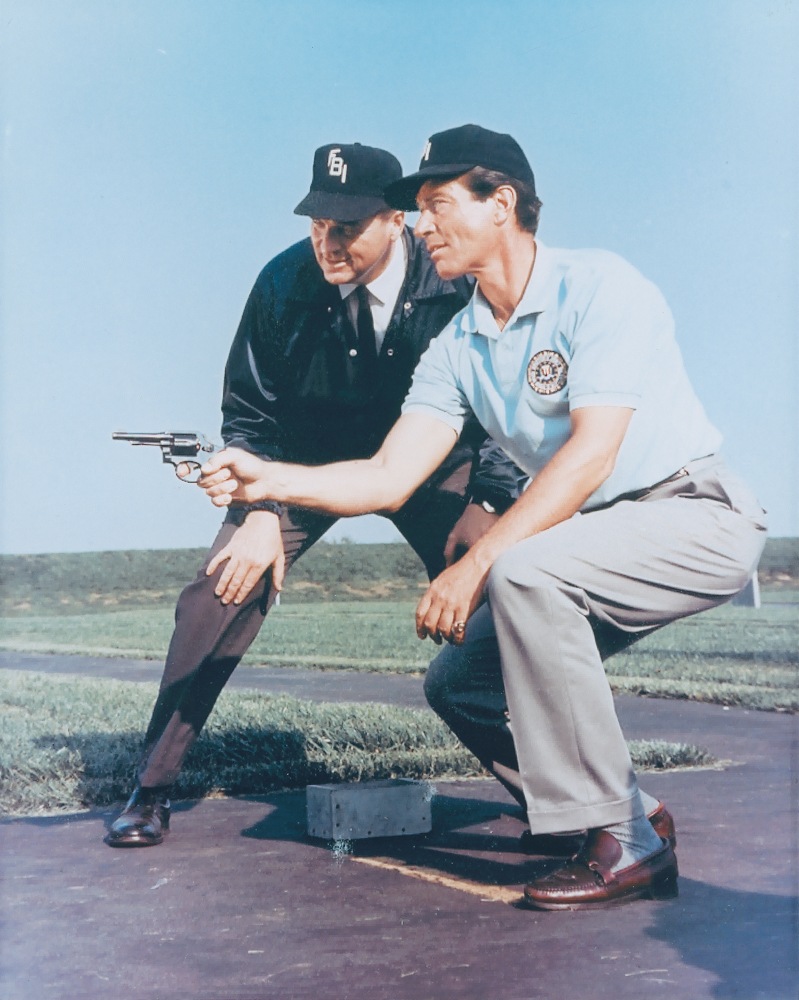
Special Agent George Zeiss and Efrem Zimbalist, Jr. training for the TV series “The FBI.”

After a study by FTU instructor Special Agent Glenn Ing, trigger shoes were specifically forbidden on FBI or Bureau-approved revolvers. It was found that they could slip on the trigger, preventing the gun from firing. And they made double-action shooting difficult.

By the mid-1970s, to achieve a compromise between caliber and size, the S&W Model 10-6 and later the 10-8 were adopted for new agent issue. This was a K frame, .38 Special with round grips and a 2 ½-inch barrel.

Yet it proved to be an unpopular choice as the ejector rod was too short to eject the fired cases efficiently and the short sight radius made lowlight sight alignment difficult. Some agents, myself included, had the rear sight notch on their guns opened up to allow a better sight picture. (Instructors then were required to carry the same gun as issued to new agents, at least around the academy.)

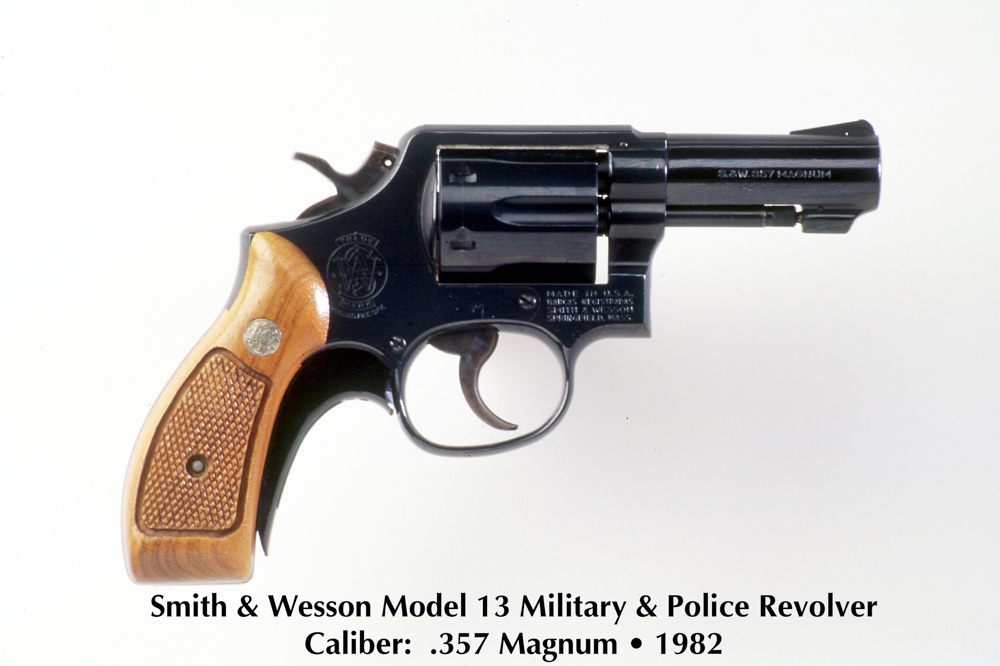
The next attempt in an issue revolver was an unqualified success. The Model 13 was a round butt K-frame Smith & Wesson with a 3-inch barrel in .357 Magnum caliber. Most agents still carried the .38 Special load in them (a 158-grain lead hollowpoint +P) but could carry the Bureau’s magnum load, the Winchester 145-grain Silvertip, if required. The Model 13 was the last revolver issued by the FBI.

Smith & Wesson Military & Police (M&P), later the Model 10, was standard issue in the FBI for many years. It was the author’s first issue handgun in 1973. All were equipped with grip adapters and “PC” or plains clothes stocks.

The magnum rounds were a handful and some PFIs (Principal Firearms Instructors) in the field required the agents to demonstrate their ability to handle the hot load before being allowed to carry them. During new agent training, the trainees were only required to fire a small number of magnum rounds. I recall one trainee in one of my classes showing me her split thumb web caused by the recoil.

Smith & Wesson was going through some ownership changes during this time and it occasionally affected quality control. The last batch of Model 13s the Bureau purchased was so bad that we sent a Bureau gunsmith to their factory to inspect them before acceptance.

He rejected so many that it appeared he would be in Springfield way too long, so the balance of the revolvers was accepted as is and later transferred to another federal agency with the warning that they would require extensive gunsmithing before use. I recall that on the cylinders of some the cut leading into the cylinder notch was missing!

After more than fifty years, the primary sidearm of FBI agents would become the semi-auto pistol. But before that change was made, an interesting event occurred at the Firearms Training Unit. Early one morning, before the classes were due to start, I was called into Unit Chief Tom Miller’s office.

S&W Model 60s were the first stainless steel handguns in the FBI. They and the Model 49s were usually carried by Inspectors and others with administrative assignments.

He asked me if I knew who General Dozier was. I did. General James Dozier was assigned to a position in Italy and on December 17, 1981, was kidnapped by members of the Italian Red Army Brigade, a terrorist group. He was held for 42 days before being rescued by NOCS also known as The Leatherheads, an advanced SWAT team. After his rescue, General Dozier gave a talk to staff members at the FBI Academy.

The Unit Chief told me that General Dozier had been contacted by Ross Perot, who thought it would be a nice gesture to reward the SWAT team members with some token of appreciation. Perhaps a gift handgun. Perot would pay for them. (A total of ten if I recall correctly.)

Tom Miller gave me the assignment to select the model and arrange for their delivery to the General. What kind of gun, I asked. Didn’t matter. My choice. The only problem was time. This was a Wednesday morning and the general and his staff were leaving for Italy the following Saturday morning!

I left his office and spoke with the other instructors. I asked what model should be chosen. The model 19 was mentioned. Finally, my old partner Bob Dean said, “You know Bill. The Italians are really semi-auto oriented. Why don’t we give them Smith 459s?” (The 459 was our current SWAT issue at that time.) Great idea. That morning I called Lee Deeters, Smith &Wesson President and explained the situation.

The S&W Bodyguard, also known as the Model 49, was issued for special assignments.

They were pleased to be of assistance. A half-hour later, Bob Haas, VP of Sales, called me back.

“Interesting problem, Bill. What kind of guns do you want?” I asked him if I could get ten Model 459s. No problem, he replied. “Do you want standard or FBI sights?” (The Bureau guns had fixed sights, red front and white outline rear.) I took the FBI sights.

I explained the tight deadline and stated that I didn’t even know where Ross Perot lived, let alone how to bill him for the guns. No problem, Hass stated. He then asked if I needed anything else.

I hesitated and then asked if it would be possible to include a presentation case with each gun. Again, no problem. By noon, Haas’ secretary called me and advised the guns would be on an Eastern Airlines flight arriving at National Airport Friday evening. (Talk about service!)

The Smith & Wesson Model 13 was a .357 Magnum revolver with a 3-inch barrel and was very popular with the agents. Most still carried the .38 Special service load in their guns, the +P 158-grain lead hollowpoint.

That evening, I was talking with a friend about the gift guns. He told me that the Italian government had a prohibition on private ownership of any handgun in a “military caliber,” which included 9mm. With that in mind, I called the general’s aide, a colonel, who advised me that arrangements had been made to get them to the team members.

The swap was made at National Airport and on Saturday morning, the guns (with General Dozier and staff) were in route to Italy … where they hit the proverbial brick wall. I understand the guns stayed locked up there until Smith & Wesson had special barrels made for them in .30 Luger caliber, sent a gunsmith overseas to fit them and then they could be presented to the Leatherheads.

I never did find out if Smith & Wesson ever billed Ross Perot.

Editor’s Note: This excerpt is from Guns of the FBI, A History of the Bureau’s Firearms and Training, available now at GunDigestStore.com.

Concealed Carry: Vickers Elite Commander

0

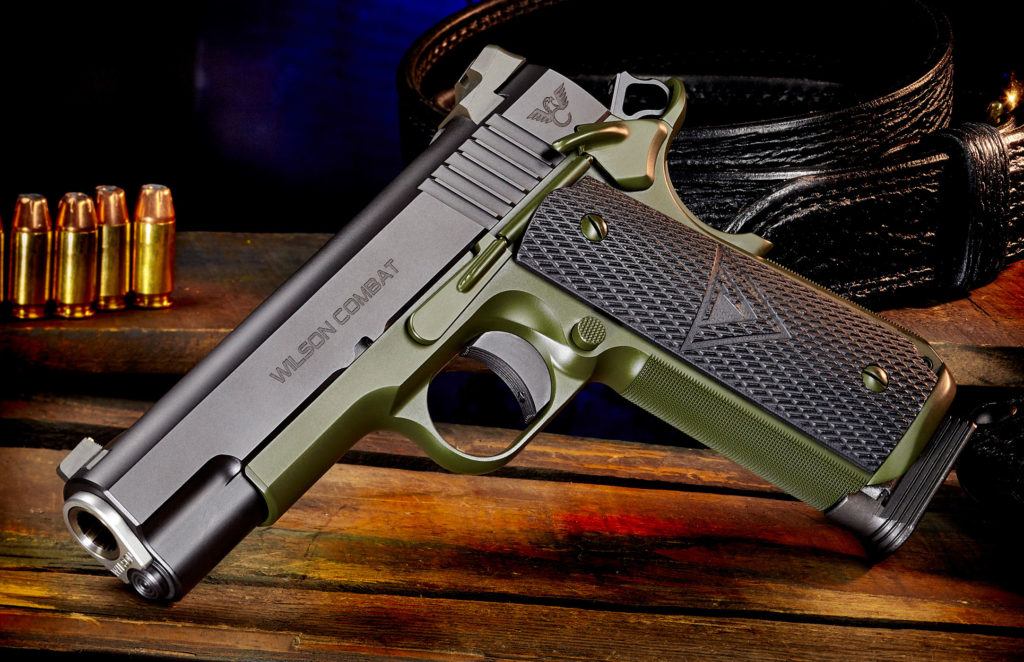
Designed for concealed carry, Wilson Combat’s Vickers Elite Commander is long on performance.

What the Vickers Elite Commander offers :

  • Carbon-steel frame and slide.
  • 4.25-inch stainless-steel match-grade barrel.
  • Available in .45 ACP and 9mm.
  • Long 5.6-inch sight radius.
  • 8+1 capacity in both calibers.
  • 30 LPI checkered front strap.
  • G10 grip pannels.
  • Battlesights with gold bead front sight.

Vickers-Eliet-Commander-1

If you’ve missed out on Larry Vickers, you need to increase your YouTube consumption. Watch any sort of gun content and sooner or later the US Army 1st SFOD- Delta combat veteran and IDPA co-founder will show up and expounds (knowingly) on the firearms’ topic at hand. That particularly applies to 1911s. Hand-fitting custom examples of the pistol, in addition to fighting and competing with them, he developed the repute of knowing what makes them tick and pushes them to near perfection.

Given this, it came as little surprise Wilson Combat’s Vickers Elite lived up to its namesake’s reputation. A full-sized government model, the 1911 had a number of enhancements, including improved cocking serrations, thicker flange bushing and an improved magazine. Wilson and Vickers continue to collaborate, and recently unveiled the follow-up to their 2015 efforts — the Vickers Elite Commander. A mamma-bear model, the 4.25-inch barreled 1911 boast’s all the features of the line’s originator in a package a bit more practical to carry day to day.

Vickers-Elite-Commander-2

Like the first Vickers pistol, the commander boasts spartan performance. Along with that, a hefty price tag to get one in your holster – the .45 ACP model has an MSRP of $3,850 and the 9mm $3,960.

From Wilson Combat:

The Vickers Elite Commander, by Wilson Combat, is the concealed carry version of the famed Larry Vickers designed full-size Vickers Elite model 1911. This 4.25” bushing barrel Commander version is a top choice of traditionalists who prefer a more compact carry gun with a bushing style takedown.

The Vickers Elite Commander starts with Wilson Combat’s hand-fitted, forged slide and frame combination along with their forged stainless steel bushing barrel for impeccable reliability and precise accuracy. Wilson Combat’s rigorous hand-fitting specifications yield a match-accurate defensive pistol that you can count on regardless of shooting scenario.

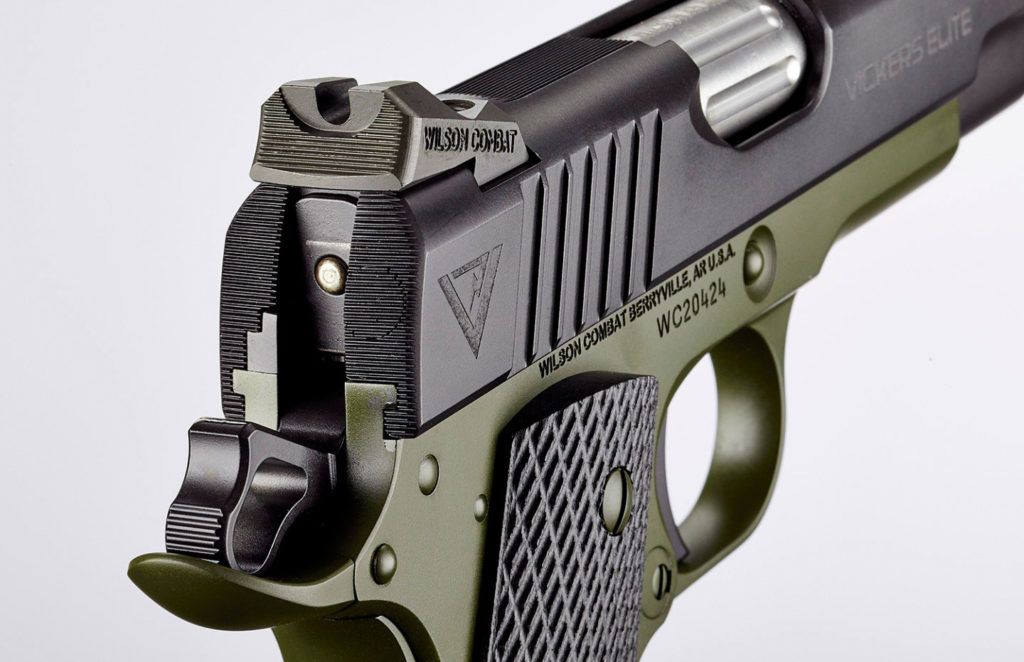
The Vickers Elite Commander wears the Vickers Tactical logo, special wide serrations, and proprietary G-10 grips to immediately identify this model in the field. Our one-piece, Bullet Proof Magwell adds a practical, tactical touch for enhanced reloading under stress.

Vickers Elite Commander
Caliber: .45 ACP, 9mm
Magazine Capacity: 8 Rounds
Barrel Length: 4.75″
Overall Length: 7.85″
Sight Radius: 5.95″
Height: 5.6″
Width: 1.3″
Weight Empty: 39.6 oz.
Weight Loaded: 45.2″
Accuracy Guarantee: 1.5″ at 25 yards
MSRP: .45 ACP ($3850) | 9mm ($3960)

SPECIFICATIONS

  • Professional-Size Carbon Steel Frame
  • 30 LPI High Cut Checkered Frontstrap
  • Bullet Proof Round Butt Magazine Well
  • Bobbed High-Ride Bullet Proof Beavertail Grip Safety
  • Tactical Bullet Proof Thumb Safety
  • 3 ½# – 4 ½# Crisp Trigger Pull with Medium Length Pad
  • Bullet Proof Magazine Release
  • G10 Vickers Elite Logo Grips
  • Countersunk Slide Stop
  • 4.25” Carbon Steel Slide
  • Heavy Machine Chamfer on Bottom of Slide
  • Battlesight with Gold Bead Front Sight
  • 4.25” Stainless Match Grade Barrel and Thick Flange
  • Bushing, Flush Cut Reverse Crown
  • Fluted Chamber
  • 30 LPI Slide Top Serrations
  • 40 LPI Serrated Rear of Slide
  • Wide Rear Cocking Serrations
  • Ball Endmill Cuts

For more information on Wilson Combat’s Vickers Commander, please visit: www.wilsoncombat.com.

9mm ARs: Pair of Wilson Combat AR9s

1

Engineers at Wilson Combat took a fresh look at its cutting-edge ARs and decided to create a dedicated 9mm platform — the AR9 series.

Fill out

  • Wilson Combat ARs are renowned for their quality and accuracy, these 9mms are no different.
  • A 9mm AR makes perfect sense for home defense, these Wilsons can take mags from your handgun.
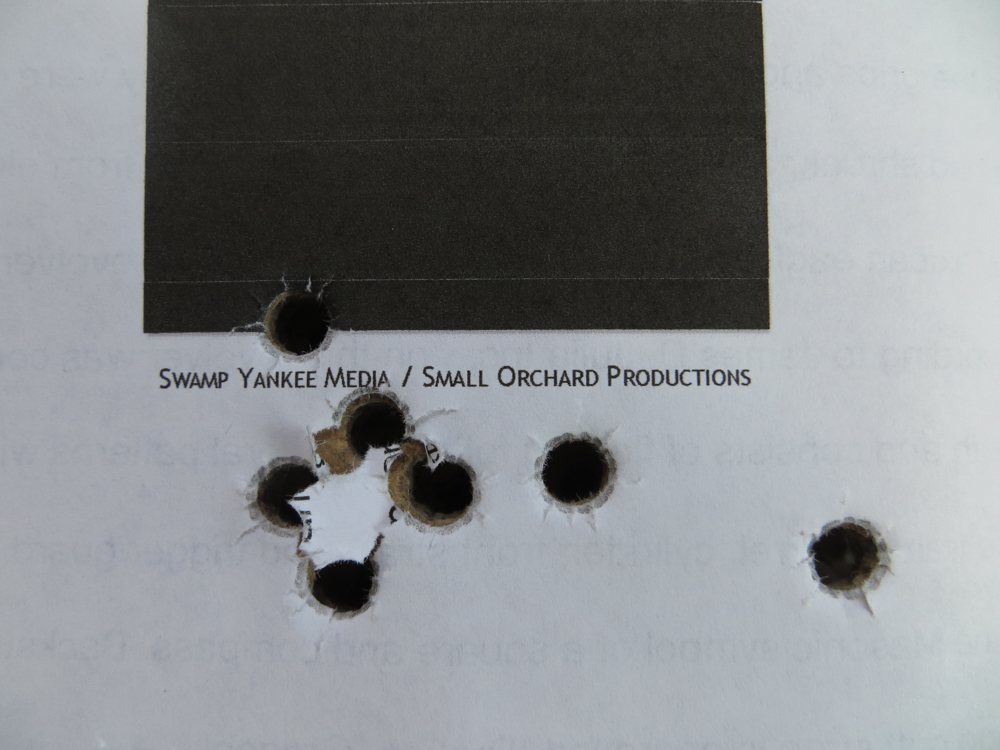
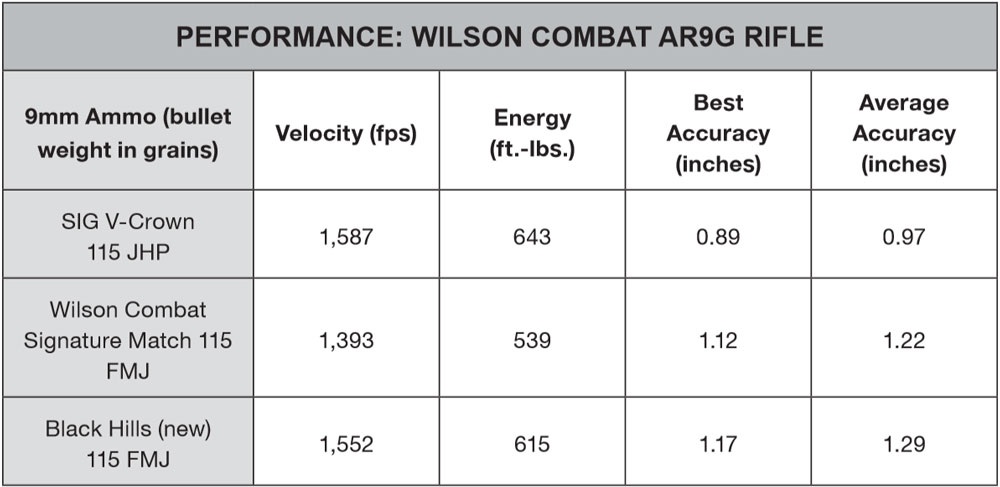
  • Wilson guarantees its AR9s will shoot 1.5-inch, five-shot groups at 50 yards with premium ammunition.
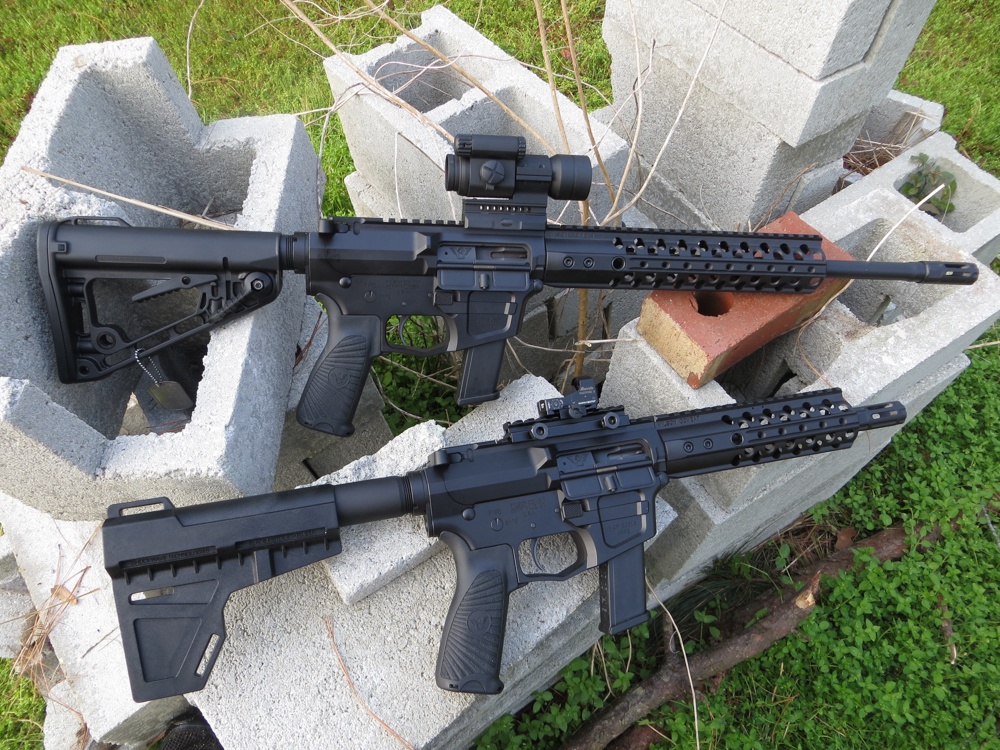
The Wilson Combat AR9 rifle (top) is a dedicated 9mm that feeds off Glock Gen4 magazines. The AR9 pistol (bottom) packs all the features of the rifle but in a compact package.

Available in carbine, SBR and pistol configurations, Wilson’s new AR9s are compatible with Glock, Smith & Wesson M&P, and Beretta 92 magazines.

These are three of the most popular handguns, so Wilson Combat has made it easy to pair your favorite 9mm handgun with a duty-ready, AR-platform pistol or rifle. Not only do the weapons use the same ammunition, but they’ll also share the same mags.

The ability of these ARs to use common 9mm service pistol magazines makes them ideal candidates for cost-effective training, offering less recoil and muzzle blast compared to 5.56mm AR platforms.

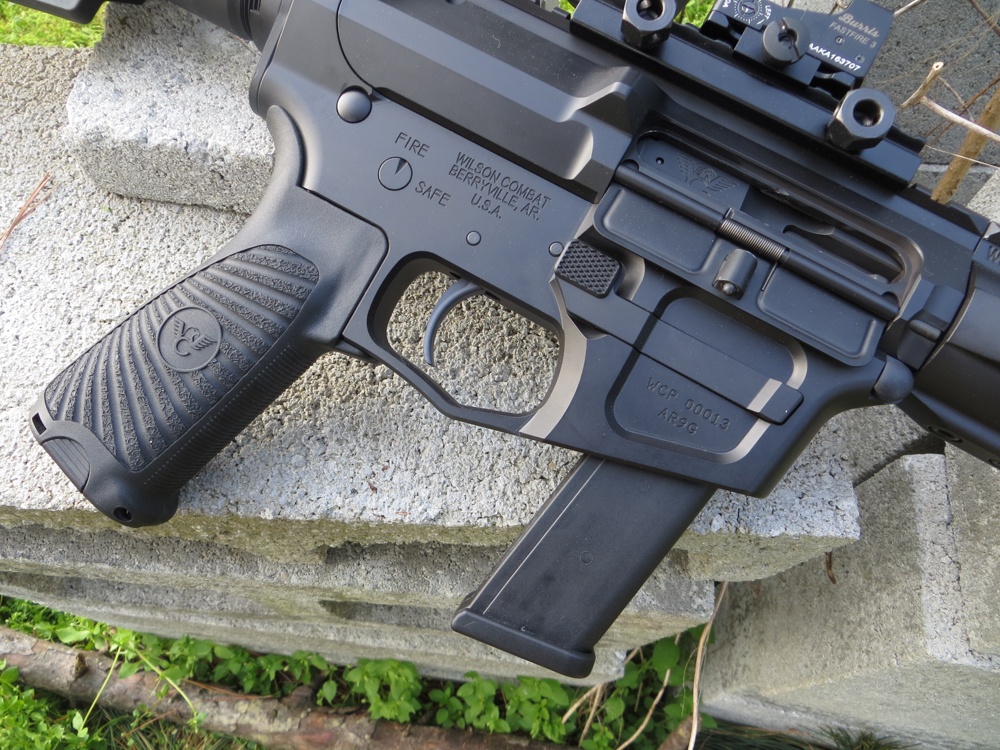
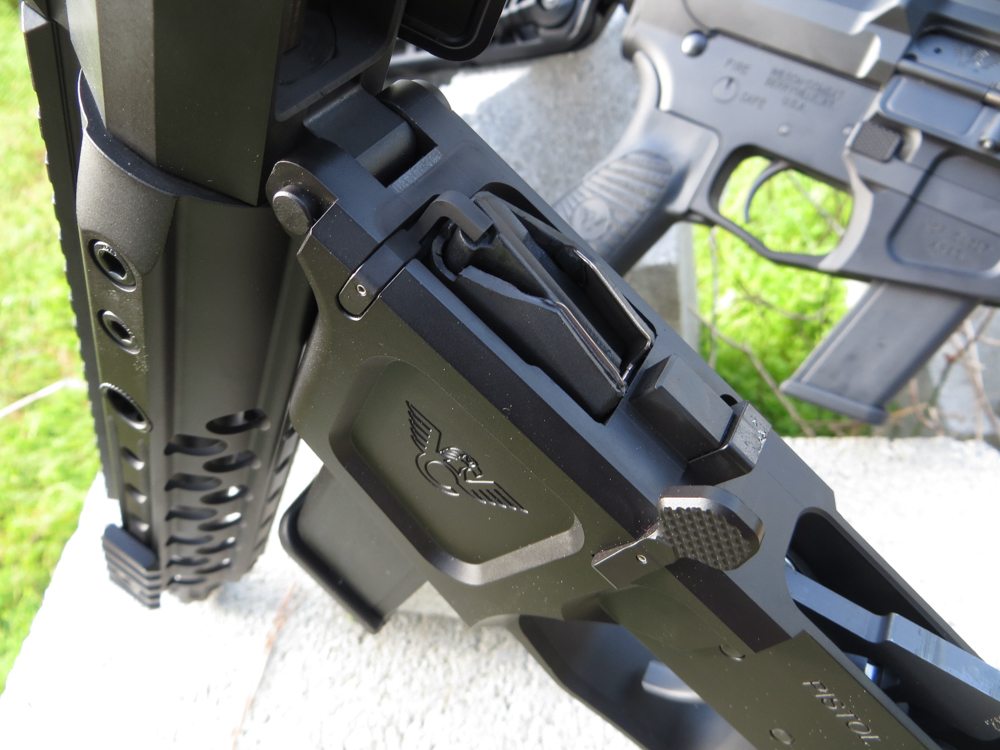
The magazine release on the Wilson Combat AR9 is oversized for faster manipulation.

For home defense, the 9mm comes in a wide variety of bullet options to prevent overpenetration, yet the cartridge is finally being loaded to its full potential to stop threats. The FBI switching back to the 9mm round is prima facie proof that the round provides the required performance.

Load Up On More 9mm Knowledge:

Several manufacturers have converted the AR platform to 9mm over the years, but it takes some well-thought-out engineering to make an AR run consistently on a pistol caliber diet. According to Bill Wilson, “Those old Colt-style magazines were unreliable, and if you drop a fully loaded one, it will most likely bust open and leave you stuck.”

That is why Wilson Combat designed the AR9 series around proven, reliable mags like those from Glock, S&W, and Beretta. These magazines are durable, reliable and quite common. Drop one on a cement floor and they won’t split open.

And while older designs use a magazine well block to convert an existing 5.56mm lower to be compatible with a skinny 9mm mag, Wilson’s AR9s are built from the ground up for the nine.

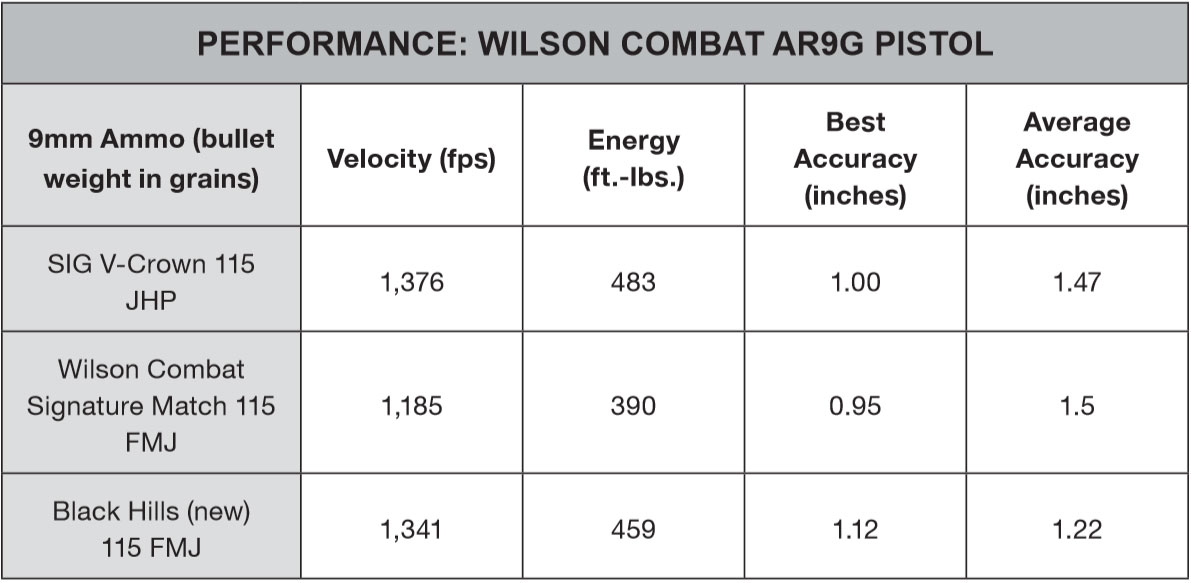
I recently got my hands on the Wilson AR9G Carbine and AR9G Pistol for testing. These models use Glock Gen4 and Gen5 magazines, hence the “G” in their names. They work with any 9mm Glock Gen4 or later magazine, from tiny G26 mags all the way up to 31-round G18 ones.

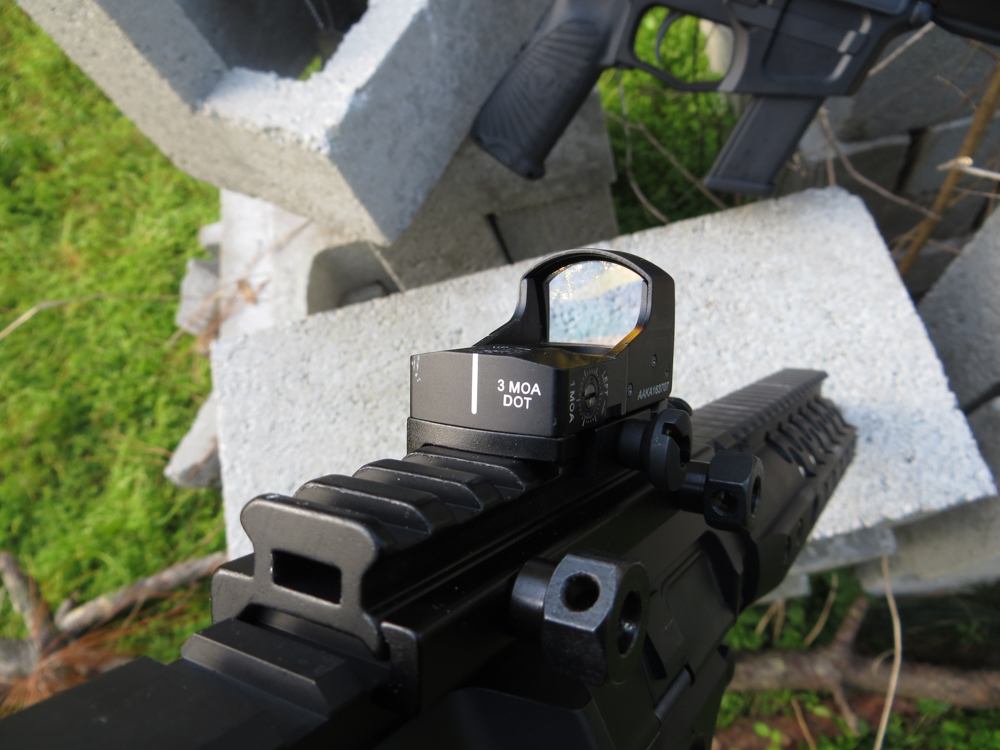
Optics versatility is one reason to consider a 9mm AR to complement your handgun.

The guns start with Wilson Combat’s proprietary BILLet-AR upper and lower receivers, which are made from 7075-T6 aluminum and designed to accept standard AR parts like triggers, charging handles, buttstocks, optics, and more.

The lowers sport integral trigger guards and heavily flared magazine wells for fast reloading. Working a skinny magazine into a lower designed for a larger mag has its challenges, but the magazine wells on the AR9s I tested literally funneled the handgun magazines home with confidence. This lower/magazine combination is designed so that the bolt will lock back after the last round is fired.

Like most other 9mm ARs, Wilson’s AR9s use a closed-bolt blowback operating system, and my test guns were very smooth shooters. Wilson Combat invests a lot of time and effort into making its ARs run smoothly, and the AR9 series is no exception.

The internal parts are slick in operation; the charging handle and bolt carrier group work with you, not against you. In operation, the blowback system harnesses the force of the fired bullet to send the bolt carrier group rearward, and the recoil spring in the receiver extension sends the bolt forward.

With such a wide variety of ammunition on the market, it says a lot about Wilson Combat quality that the AR9s I tested ran so smoothly and flawlessly. No matter what bullet shape I tested — round nose or flat hollowpoint — all of it exhibited excellent feeding.

The AR9 series employs a dedicated 9mm lower for superior function and reliability.

The uppers are rated for +P ammo, and since their barrels are longer than a G17’s, I recorded higher velocities and energy with each test load. The AR9 bolt carrier group is a proprietary design with a heavy-duty claw extractor and plunger ejector tuned for enhanced reliability.

The bolt carrier group looks similar to that of a direct-impingement AR, but it’s heftier and without the bolt carrier key, cam pin, and a few other pieces. The extra weight of the bolt carrier group is needed for the blowback system to operate, and this is what makes some 9mm ARs recoil more harshly as the bolt slaps back and forth. You won’t notice that on AR9 weapons, however.

The AR9 lacks the extended shell deflectors you’ll see on other 9mm ARs; they use shell deflectors like those of other Wilson Combat 5.56mm NATO ARs, and the same-sized ejection port. Wilson optimizes its AR9 barrels for suppressors with minimal gas blowback. Made from carbon steel, the match-grade barrels feature 1-in-10-inch twist button rifling.

The muzzles are threaded 5/8×24 TPI and come equipped with QCOMP flash suppressors, which have multiple ports to reduce muzzle climb. My test AR9G Carbine came with an unfluted 16-inch barrel (fluted 16- and 14.7-inch barrels are available) and the AR9G Pistol had an 11.3-inch barrel (8-inch tubes are an option).

A Burris FastFire 3 reflex-style optic makes an ideal sighting system for the Carbine, it sports a 3 MOA dot and makes target acquisition scary fast!

My test AR9Gs shared many similar Wilson Combat features, including the company’s TRIM handguard, Starburst-textured Bravo Company pistol grip, two-stage Tactical Trigger Unit (TTU) set at 4 pounds, and matte black Armor-Tuff external finish. Aside from their barrels, the Carbine and Pistol vary when it comes to their stocks.

The Carbine has an adjustable, wiggle-free Wilson/Rogers Super-Stoc. On the other hand, the AR9G Pistol came equipped with a Shockwave Blade forearm support for greater stability while firing. I ran both on the range with some extra G17 Gen4 and G19 Gen4 magazines loaded with ammo from Black Hills, SIG Sauer, and Wilson Combat. For targeting, I added an Aimpoint CompM4 and Burris FastFire reflex sight to the Carbine and Pistol, respectively.

Wilson guarantees that its AR9s will shoot 1.5-inch, five-shot groups at 50 yards with premium factory ammunition, and it was finally time to put this claim to the test. My testing of the AR9G Carbine began at 25 yards, where I could easily keep five-shot groups under 2 inches offhand.

This setup was near perfect, with the bolt operating smoothly and efficiently. The bolt and magazine release buttons are oversized with aggressive checkering. Combined with the flared magazine well, my reloads were very fast. The muzzle brake stifled muzzle rise when shooting rapid-fire strings, and I could still achieve tight groups.

Wilson Combat guarantees that its AR9 will shoot 1.5-inch, five-shot groups at 50 yards with premium factory ammunition.

Using a rest at 50 yards, my groups measured about an inch. With SIG Sauer’s V-Crown ammo, I was able to squeeze out a five-shot group that measured 0.89 inch.

That kind of accuracy is exceptional, especially when you consider that the 9mm was never designed for use in a rifle. In short, there are really no compromises in terms of the AR9G Carbine’s performance or accuracy. The first thing I noticed about the AR9G Pistol was how great it looked and shot.

The Burris FastFire’s 3-MOA reticle allowed me to get on target quickly. The Burris red-dot allows shooting with both eyes open, so grasping the pistol with both hands and centered to my chest yielded excellent control in rapid fire. The AR9G Pistol performed exceptionally — it was smooth, accurate and consistent. With a tactical light mounted to the handguard, it’d make an excellent home defense weapon, especially paired with a handgun that shares the same magazines.

I keep saying it and it bears repeating: Pairing your sidearm with a rifle makes a lot of sense, and Wilson Combat has done a great thing by offering so many AR9 variants to satisfy shooters with Glock, Smith & Wesson, and Beretta magazines. And they’re Wilson Combat ARs — so you’re getting top-quality weapons that are truly accurate and reliable.

SPECIFICATIONS
MODEL: Wilson Combat AR9G Rifle
CALIBER: 9mm
ACTION: Blowback, Semi-Automatic
BARREL LENGTH: 16 in.
OVERALL LENGTH: 31.25-32.75 in.
WEIGHT: 6.4 lbs.
HANDGUARD: Wilson Combat T.R.I.M. Rail
STOCK: Rogers Super Stock
GRIP: Wilson Combat/BCM Starburst Gunfighter
SIGHTS: Optics Ready
FINISH: Matte Black
CAPACITY: Glock Gen4 Magazine Compatible, 17+1

SPECIFICATIONS
MODEL: Wilson Combat AR9G Pistol
CALIBER: 9mm
ACTION: Blowback, Semi-Automatic
BARREL LENGTH: 11.3 in.
OVERALL LENGTH: 24.25-27.55 in.
WEIGHT: 6 lbs.
HANDGUARD: Wilson Combat T.R.I.M. rail
BRACE: Shockwave Blade
GRIP: Wilson Combat/BCM Starburst Gunfighter
SIGHTS: Wilson Combat QDS Flip Up Sight System
FINISH: Matte Black
CAPACITY: Glock Gen4 Magazine Compatible, 17+1

Rifle-Perfromance
Pistol-Performance

Bullet weight measured in grains, velocity in feet per second, energy in foot-pounds, taken 15 feet from the muzzle by a ProChrono digital chronograph; accuracy in inches averaged from three, five-shot groups at 50 yards.

Editor’s Note: This excerpt is from 9mm: Guide to America’s Most Popular Caliber, available now at GunDigestStore.com.

Precision Shooting: McMillan’s Adjustable A-5 Thumbhole Stock

0

McMillan puts a new twist on its popular precision line with the introduction of the Adjustable A-5 Thumbhole Stock.

What the Adjustable A-5 Thumbhole Stock offers:

  • Ambidextrous thumbhole grip.
  • Spacer system to adjust length of pull.
  • Available with and without Screw adjusted cheekpiece.
  • Wide and flat beavertail forearm.
  • Can be inlet for most Remington actions.

ADJUSTABLE-A5-THUMBHOLE-WEBSITE-first

Caliber dominates the conversation, but much of what defines a precision rifle is the main feature that interacts with the shooter – the stock. To that end, McMillan has been way ahead of the curve, providing precision platforms long before every shooter with trigger finger aimed to connect at a country mile. The Arizona company helped define high-performance fiberglass stocks and continues to do so today. Its latest creation won’t ring every marksman’s bell, but for those who swear by thumbhole stocks, the new model of the A-5 is certain to pique interest. The line is a favorite of competitive shooters and could gain a few new fans in the ranks of varmint hunters and benchrest shooters with the Adjustable A-5 Thumbhole Stock. That is if the price is right, which is up in the air presently as McMillan has yet to release an MSRP. Though, most of the company’s stocks generally run from the low-$300 to mid-$500 range.

Press release follows:

McMillan Fiberglass Stocks continues to expand its line of precision tactical bolt rifle stocks with the recent release of the Adjustable A-5 Thumbhole stock. This new stock design capitalizes on the core A-5 design while providing shooters with a thumbhole configuration that some find more suitable to their shooting style.

For many shooters, a thumbhole/pistol grip style stock offers a more comfortable wrist alignment—particularly for long shooting sessions—and a straighter trigger pull for improved shot consistency. The Adjustable A-5 Thumbhole stock delivers on both accounts, making it one of the most comfortable, ergonomic stocks available for precision tactical and long-range shooting. In addition to the thumbhole design, the McMillan Adjustable A-5 Thumbhole stock also features an available adjustable cheek piece for achieving an optimal cheek weld.

As with the original McMillan A-5 stock, the Adjustable A-5 Thumbhole stock includes a wide and flat beaver-tail forearm that’s perfect for shooting on bags or on ad hoc rests. The barreled action sits low in the stock for maximum stability while the integrated butt hook lets shooters control the rifle with the non-trigger hand.

The new Adjustable A-5 Thumbhole stock is offered in a wide assortment of color and finish options and can be further customized at the factory with the customer’s choice of butt plates and pads, cheek pieces, pre-installed pillars, and assorted accessories.

For more information on McMillan’ Adjustable A-5 Thumbhole stock, please visit www.mcmillanusa.com.

5 Top Bullet And Ammo Advancements

0

Here are the top new bullet and ammunition breakthroughs helping redefine accuracy.

What’s new in bullet and ammunition designs:

When you close the bolt what do you think about? Most likely it’s the impending shot and the proper mechanics to make it come to fruition. It’s understandable, but to a certain extent a shame. Aside from marksmanship fundamentals, what’s in the chamber is responsible for those little clover-leaf groups you’ll sprout or the steel you’ll bang from the next zip code. And that’s worth pondering a bit.

Enough to make a mind reel, advancements in bullets and ammunition in the past quarter-century have been truly astounding. High tech and engineered to the hilt (or meplat, if you will), the payloads move faster, shoot further and hit harder than ever before. And as time marches on, they continue to grow more specialized and arguably better and better.

What’s on tap presently concerning cutting-edge projectiles? Glad you asked, because ammo makers and ballistic wunderkinds keep on pushing the envelope. Just a taste of the fruits of their labors, we gathered up five of the newest bullet and ammunition breakthroughs to hit the scene recently. No matter your application, these high fliers will take care of business.

Hornady ELD-X Bullets

Bullet-Hornady-ELD-X
Hornady’s new ELD-X (Extremely Low Drag eXpanding) hunting bullets and the company’s factory ammo loaded with them are the greatest quantum leap in bullets and ammo for, oh say, the century! The new bullets have the patented “Heat Shield” polymer tip that prevents deformation by frictional heat at long ranges. They’re incredibly accurate and expand at short or long ranges. They’re the real deal. www.hornady.com

Trophy Bonded Tip Bullets

Bullet-Trophy
In the 1980s, Jack Carter invented a bullet he called the “Trophy Bonded Bear Claw.” It was a terrific game bullet, and Federal offered them on factory ammo in the 1990s. In 2008, Federal announced a new version called the “Trophy Bonded Tip (TBT) bullet, but it’s now available as a reloading component. It has a 95-5 shank, with a bonded lead alloy core, an orange polymer tip, and is nickel-plated. I have used it on game, and performance is terrific. www.federalpremium.com

22 Nosler

22-Nosler-Bullet
The 22 Nosler is a high-velocity 22 with the dual missions of varmint shooting, and to feed the long-range craze. The round has been out for about a year, and is a potent and accurate cartridge for the AR platform. www.nosler.com


224 Valkyrie

Bullet-Valkyrie
The 224 Valkyrie from Federal/Savage is based on the 6.8 PC case. The velocity and long-range capabilities are, at least on paper, superior to just about all other “long-range” cartridges, but has substantially less recoil. www.federalpremium.com


25-45 Sharps

Bullet-Sharps
The 25-45 Sharps, developed by the Sharps Rifle Company. No they don’t make falling-block buffalo rifles, but rather high-end ARs. The round is the .223 case necked up to .25-caliber, with no other change. Its goal is to duplicate the ballistics of one of the best deer rounds ever conceived, the 250 Savage. The original 250 in 1920 launched an 87-grain bullet at the then astounding velocity of 3,000 fps. The 25-45 comes so close that no deer will ever notice the slight difference. Everybody should have one. www.srcarms.com

Editor’s Note: This article originally appeared in the 2018 Shooter’s Guide issue of Gun Digest the Magazine.

MUST READ ARTICLES