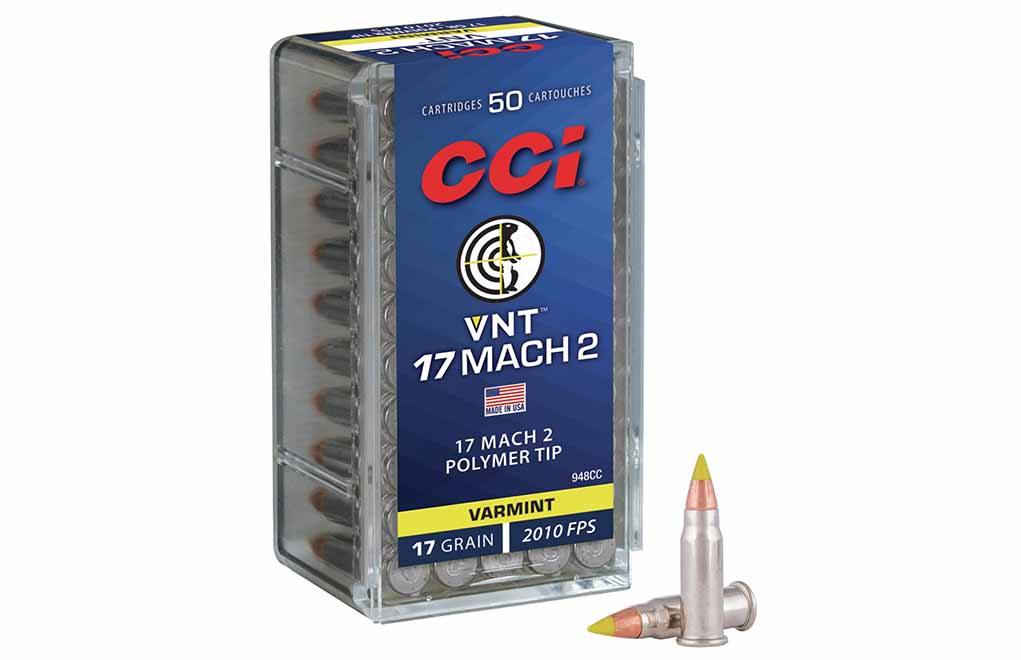
Designed for explosive performance, CCI’s VNT .17 Mach 2 and .22 WMR are designed to put varmints in check.
How VNT .17 Mach 2 and .22 WMR Excell Against Varmints:
Muzzle velocities in excess of 2,000 fps
Extreme terminal performance of Speer VNT bullets
Nickel-plated cases to resist corrosion
The thaw of summer is finally here and the suns out. No better time to put varmints in check. And CCI has you covered with two new hot rounds certain to get rock chucks and prairie dogs hopping.
Billed as explosive rounds by the ammo maker, VNT .17 Mach 2 and .22 WMR certainly appear to have what it takes to put varmints in check. Both rounds leave the muzzle in excess of 2,000 fps and are topped with the thin jacketed Speer VNT bullet, which features a polymer tip. This final feature flattens the trajectory of the bullet, as well as initiates expansion once it reaches the target. Also, nickel-plated cases, so the ammo is a bit more corrosion resistant.
The CCI VNT .17 Mach 2 (17 grain) and .22 WMR (30 grain) are available in boxes of 50, with the MSRP on the .17 running $10.95 and the .22 15.95.
More from CCI:
LEWISTON, Idaho – – CCI Ammunition introduces new VNT loads in 17 Mach 2 and 22 WMR, offering precision performance for varmint hunters and target shooters. Shipments are being delivered to dealers.
In 2018, CCI extended the range and devastation of magnum rimfire with the VNT bullet design. Now, it’s offering VNT loads in 17 Mach 2 and 22 WMR. The new loads feature a Speer bullet with an extremely thin jacket and polymer tip that team up to offer flat trajectories, superb long-range accuracy and explosive terminal performance on impact.
Features & Benefits •New 17 Mach 2 and 22 WMR loads •Speer VNT bullet design •Very thin jacket combined with precision-built polymer tip •Devastating terminal effect on varmints •Flat shooting and highly accurate to maximize effective range •Consistent CCI priming •Nickel-plated cases
In 1934, the National Firearms Act became law. The National Firearms Act (NFA) requires the registration, with the federal government, of fully-automatic firearms (termed “machineguns”), rifles and shotguns that have an overall length under 26 inches, rifles with a barrel under 16 inches, shotguns with a barrel under 18 inches, and firearm sound suppressors (termed “silencers”). Although modern terminology often refers to silencers as suppressors, silencers don’t actually silence a firearm — they only reduce the noise level, but for clarity in this article, I’ll be using the term “silencer.”
Prior to 1934, silencers, machine guns and short-barreled rifles and shotguns weren’t regulated. The idea of requiring a $200 tax stamp was to seriously curtail private ownership of the affected items. In 1934, $200 was a princely sum, equating to $3,774 in 2018 dollars. The cost of the tax stamp has never changed, making it a reasonable addition to the cost of a firearm or silencer.
Because of this and because of the concept of using a trust for NFA items, silencers are one of the fastest growing segments of the firearms market. Silencers have real advantages to shooters who shoot in more populated areas, and many states have adopted laws that allow them for hunting. Silencers potentially make training new shooters easier because the loud report of a firearm contributes to the involuntary reaction we often refer to as “flinch.”
If you’ve never shot silenced firearms, you’ll be pleasantly surprised at how much fun it is to shoot without the need for hearing protection. The report of sub-sonic ammunition is often so quiet that you can hear the action of the firearm, and centerfire rifles like the .223 Rem. and .308 Win. are no louder than an unsilenced .22 rimfire.
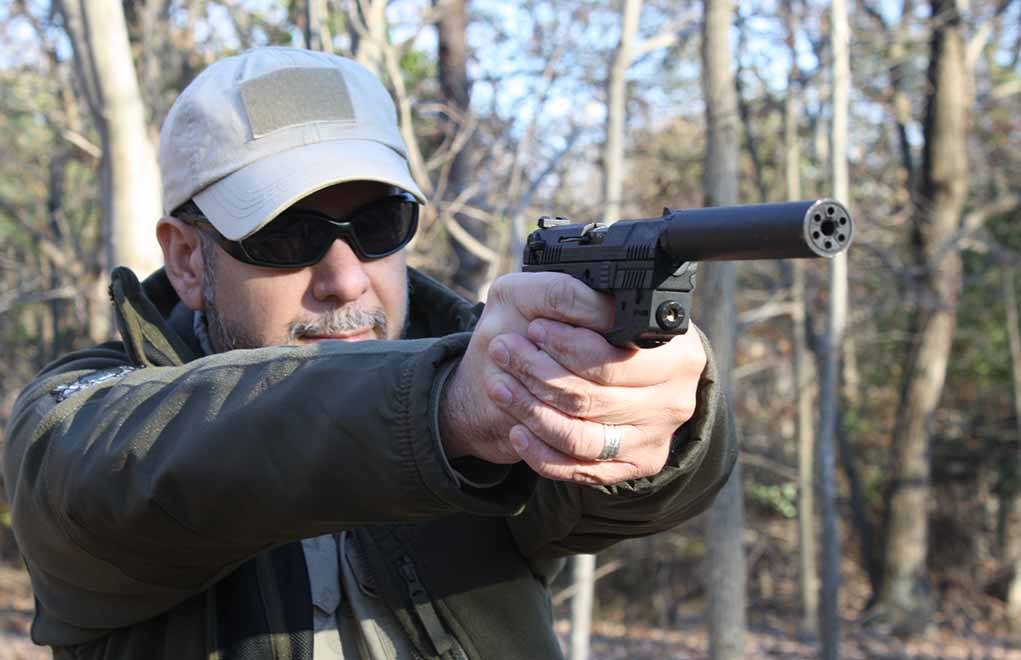
Silencers on centerfire pistols are big enough to preclude holster use, but they’re very pleasant to shoot. Notice the higher sights required because of the diameter of the silencer.
There are two systems of silencer operation: dry and wet. Wet systems are quieter and allow the use of a smaller and lighter body, but they are effective for a limited number of shots before replenishing.
We’re Making Noise About Suppressors:
The Suppressor: How Is It Made, It Works And How To Buy One
Unfortunately, there’s no silencer that will do everything well. Theoretically, you could make a silencer that would effectively work on almost any gun you own, but it would be too bulky and heavy for some applications and impede the operation of some firearms. Because silencers can’t be easily transferred from one individual to another like regular firearms products, it’s a good idea to think through what your needs are and make a wise and informed choice. Serviceability, bulk, weight and level of noise reduction should all be considered to make sure you choose wisely.
Rimfire Suppressors
While no silencers are truly silent, generally speaking, the rimfire silencers come closest to being “Hollywood quiet.” With sub-sonic ammunition, you can often hear the sound of the hammer falling in guns that aren’t semi-automatic.
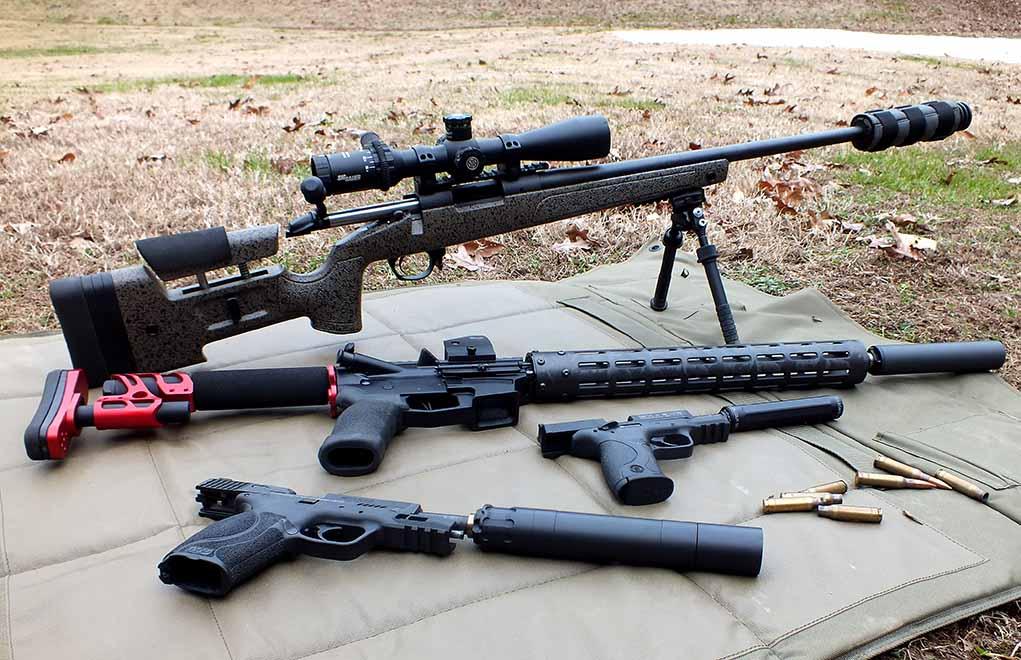
With a 9mm silencer for pistol and carbine, a .30 caliber silencer for hunting and a .22 rimfire silencer for pistols and rifles, a shooter would be reasonably covered for most noise suppression applications.
For rimfire silencers, you should consider serviceability. Rimfire ammunition is inherently dirty, and the silencer must be periodically cleaned. Silencers work like the muffler on your lawn mower: There are chambers and baffles that redirect high-speed gasses and reduce them to sub-sonic speeds while enclosed in the housing. Those surfaces pick up carbon and lead from inherently dirty rimfire ammunition. Without regular cleaning, the silencer will eventually be rendered useless. All rimfire silencers are designed to be disassembled and cleaned. Some have individual baffles and some use a mono-core design with fewer parts.
Weight and bulk are another consideration, because most silencers are mounted on the end of the barrel and affect the balance and feel of the firearm, especially in pistols. Providing the same level of sound reducing engineering, the volume of the silencer body contributes to sound reduction, so the smaller silencers are generally not as quiet.
Pistol Suppressors
For centerfire pistol silencers, cleaning is also required — though not as often as with rimfires — provided jacketed bullets are used. Again, weight and volume affect the way the gun handles, and centerfire pistol silencers must be larger and heavier than rimfire silencers because they handle a much larger volume of gas. Because of cylinder-to-barrel gap, silencers don’t really work with revolvers and the added weight of the silencer on the barrel of recoil-operated pistols will cause operational problems unless steps are taken.
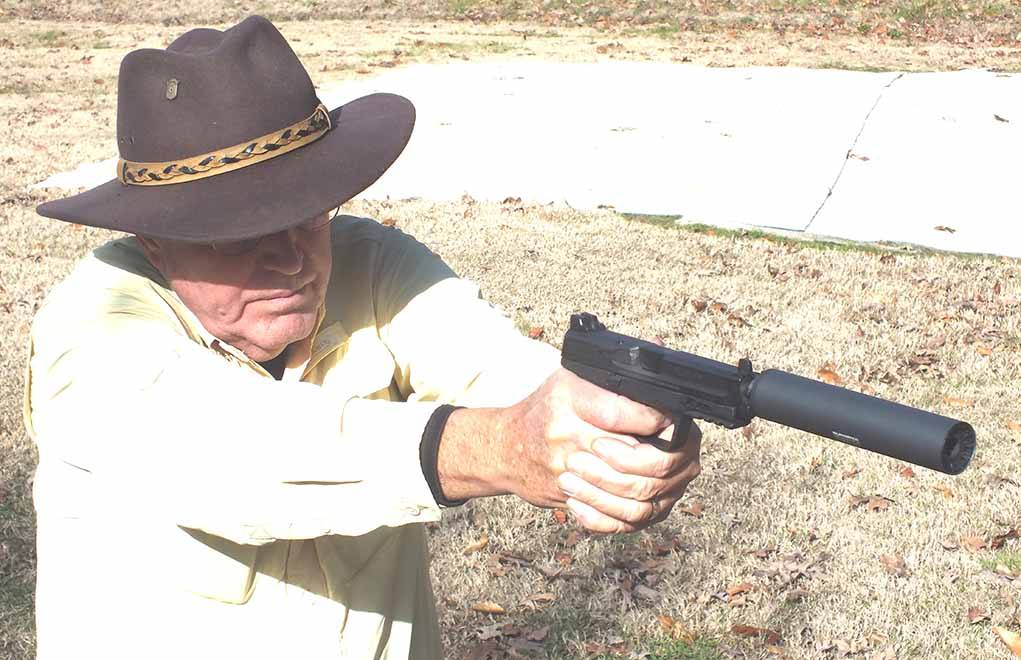
While a silencer suppresses the sound of the shot, the snap of the bullet is still as loud as a high-velocity .22. Notice the back pressure pushing gas out of the ejection port.
Because most centerfire pistols use the tilt barrel method of operation, the barrel has to move back in the slide and unlock for semi-auto operation. The added weight of the silencer restricts the movement of the barrel due to added weight, and the barrel can’t move properly to unlock, preventing semi-auto operation.
The solution to this problem is to prevent the silencer’s weight from impeding the slide by letting it float forward during recoil and snap back into position once the recoil cycle is complete. Different companies achieve this differently, but the effect is the same: When the gun fires, the silencer compresses a spring and slides forward during recoil, returning to its original position at the end of the cycle. Because of the weight bearing down on a barrel in a slide, there’s likely to be a change in point of impact.
Rifle Suppressors
Generally, centerfire rifle silencers also have to deal with much higher pressures than rimfire or pistol-caliber silencers, and they must be constructed to handle that pressure. As a result, they’re normally heavier and constructed of materials that handle the pressure. The good news is that silencers used for high-speed rifle calibers generating at higher pressures tend to clean themselves. In most situations, direct-impingement gas-operated guns with silencers are likely to require more cleaning because of the back pressure generated by redirecting the gas inside the canister.
Another factor that also applies to pistol and rimfire silencers is the sonic impulse generated by the projectile in supersonic ammunition. As a result, there will be an easily discernable “crack” generated by the bullet, no matter how effective the silencer. This is the reason the .300 Blackout has become a popular caliber for AR 15 platform rifles. Sub-sonic loadings in .300 Blackout are commercially available that will take down medium-sized game like hogs and deer with a much less audible report, making them popular for controlling hog and deer predation.
Top Suppressors For 2019
Bowers Bitty
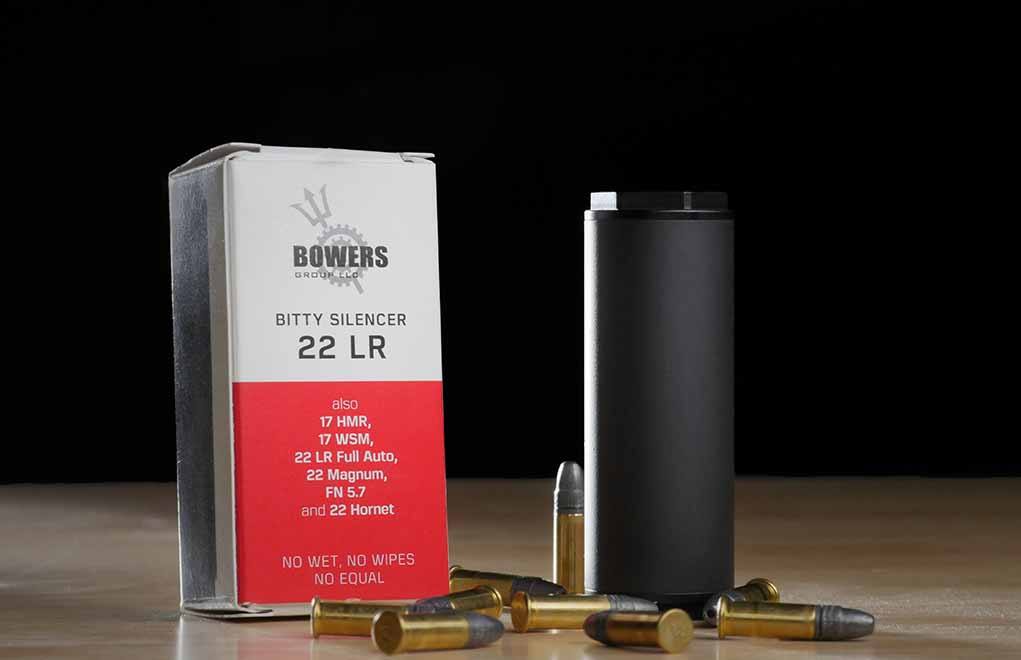
One of the smallest rimfire silencers is the Bowers Bitty. At just 2.6 ounces with a diameter of 1 inch and a length of less than 3 inches, the Bitty is the smallest and lightest magnum-rated rimfire silencer. It may not be as quiet as larger silencers, but it’s still “hearing safe.” The Bitty uses three baffles in a titanium tube with aluminum caps on both ends for easy cleaning. It has a black Cerakote finish and is rapid fire capable. MSRP: $325
SilencerCo Hybrid
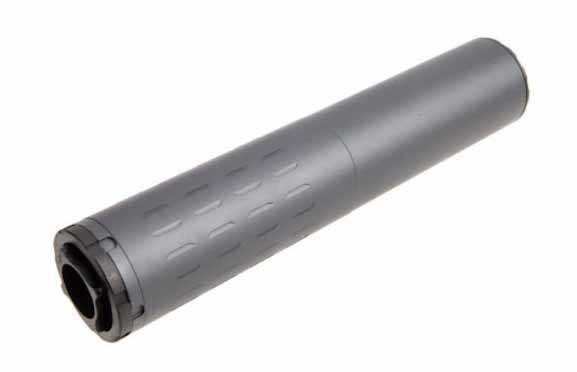
An interesting approach to silencers is SilencerCo’s Hybrid. Designed to handle a broad range of calibers from 9mm to .45/70 Govt., it has a titanium housing and heat-treated stainless-steel baffles. The finish is grey Cerakote and it weighs 13.8 ounces with the direct thread mount. It’s a bit less than 8 inches long and just over 1.5 inches in diameter. It provides hearing safe (below 140 Db) suppression in every caliber from 9mm to .458 SOCOM.
Modular in nature, it’s available with different direct and quick-release mounts, as well as piston housings and front caps for pistol use. Obviously, anything that’s made to work over a broad range of applications may not be the optimum choice for a specific application, but since there’s such a significant advantage to versatility in silencers, the Hybrid is a remarkable solution. MSRP: $799
Gemtech Aurora 2
While it’s easy to see hunting and recreational applications for silencers, silencers can have a viable advantage in personal defense. Anyone who’s ever fired a gun in an enclosed space — like a vehicle or building — knows that the sound is much worse than in an open environment. In fact, firing a centerfire handgun in an enclosed space precludes reasonable hearing for a substantial amount of time and is likely to do permanent damage.
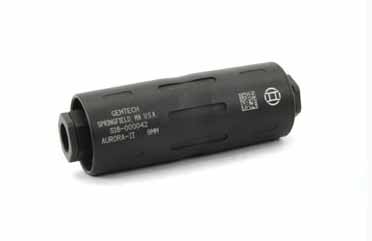
The Gemtech Aurora 2 is designed for just such situations. It’s a wet system micro 9mm silencer that weighs just 3.2 ounces with a length of just 3.3 inches. Originally designed for downed military pilots, it uses eight replaceable “wipes” inside the tube located by aluminum spacers. No booster device is needed for semi-auto use because it’s so light. The “wipes” will only suppress sound efficiently for about 20 shots before they need to be replaced, but the advantage of being able to hear during a defensive situation is potentially lifesaving.
Because lead, frangible or jacketed bullets could possibly begin expansion when they contact the wipes, it’s designated for use with FMJ ammunition only and is also rated for rapid fire. MSRP: $399
Editor’s Note: This article originally appeared in the January 2019 issue of Gun Digest the Magazine.
Application of AR-15 fundamentals must occur subconsciously, freeing up the mind to make bigger decisions.
What Are The AR-15 Fundamentals You Need To Focus On:
Safety
Accuracy
Manipulation
Working The Charging Handle
Operating The Bolt Catch
Learning Your New Equipment
Safety
Ask someone what the “fundamentals” of firearms are and you’ll get a variety of answers, and usually multiple responses from one person. There’s obviously safety to consider. Your primary focus whenever handling firearms, regardless of the reason, is safety. This, as you know, is the foundation of all other fundamentals.
“Marksmanship excellence is achieved through thousands of rounds on the range, backed up with exponentially more dry practice.”
Accuracy
Then there’s the fundamentals of marksmanship, though this is a skill set no one ever masters. I can tell you that — backed by more than 25 years of teaching and decades of personal experience — the one problem we all have, at least occasionally, is shooting too fast.
“But,” you say, “In the match/field/fight I need to shoot fast.” The purpose of shooting is to hit the target; accuracy is first and foremost. The speed you shoot is dictated by distance and size of the target. Bad shots or misses most often indicate that you fired too fast. The fundamentals (aim, hold, press and follow-through) apply for each and every shot, thus ensuring hits.
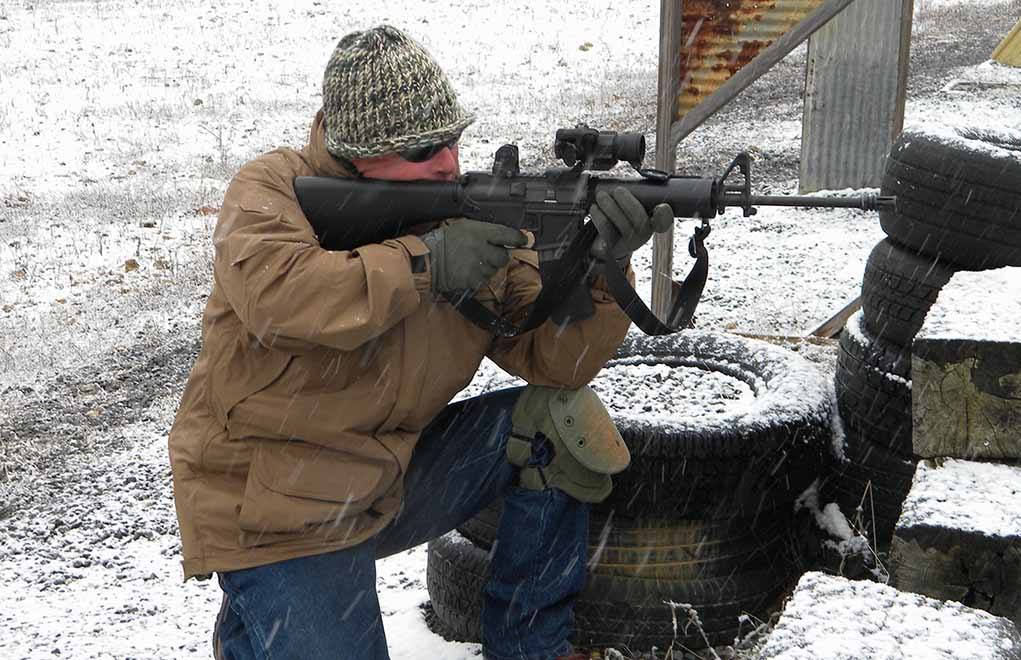
Whenever possible, you should practice in adverse weather conditions. Manipulations are a fundamental skill, but things might change when you’re wearing gloves or layers of bulky gear.
Marksmanship excellence is achieved through thousands of rounds on the range, backed up with exponentially more dry practice. You fire one accurate shot, taking all the time needed to ensure each shot is done “right.” After one hit, you stop, reset everything physically and mentally, and start over. One shot at a time — a slow, methodical process.
Get On Target With More AR-15 Knowledge
Buyer’s Guide to the Best AR-15 Rifles for Any Budget
Once you can hit any target — within reason, of course — you begin to think about making two hits. Regardless of the number of shots, it’s about repeatedly applying the four fundamentals. The fundamentals, after all, ensure good hits, almost effortlessly, during the match/hunt/fight.
Manipulation
The ability to properly manipulate the AR is another fundamental skill — and it takes more resolution than any skill. The only way to learn this is through repetition, but it’s necessary because the AR is more complicated than some firearms, especially pistols. ARs have many advantages over a handgun: accuracy, magazine capacity, extended range and terminal ballistics — and limited penetration. To become proficient in manipulating the AR (which means safely and efficiently) requires resolution, because the definition of “repetition” is boring.
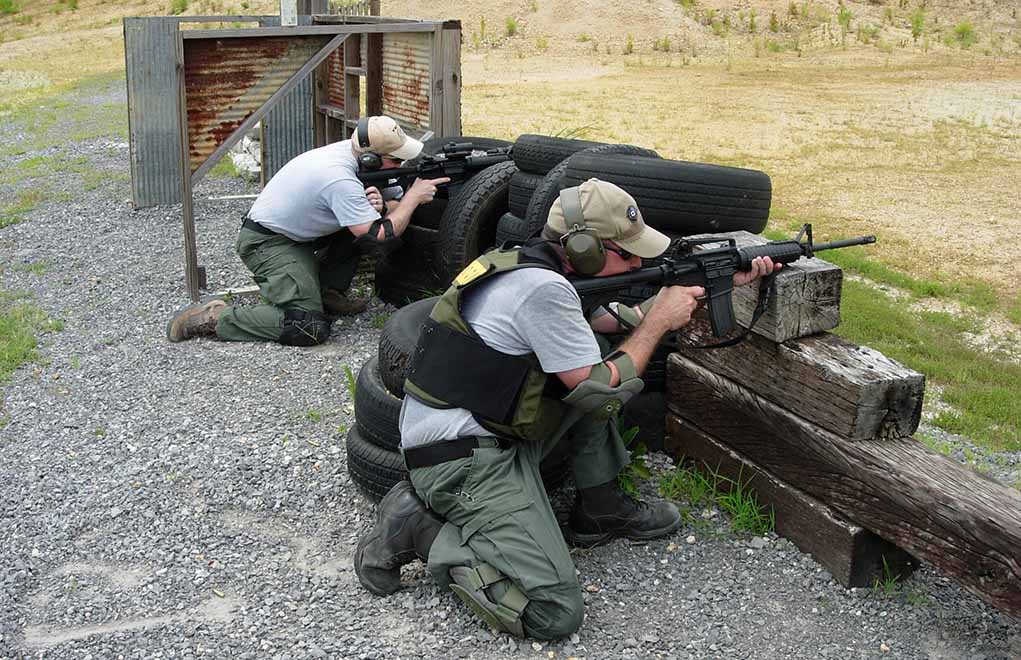
Accuracy depends on stability. You create stability by bracing against solid objects and by lowering your center of gravity. Learning the fundamentals on traditional firing positions will help you create a more stable modified position.
Learning how to load, unload or confirm the status of the AR — what I call administrative manipulations — and clear stoppages or malfunctions — functional manipulations — starts with learning how to properly cycle the charging handle.
Working The Charging Handle
Working the charging handle is a fundamental all by itself. It’s a three-step sequence, and it starts by positioning the thumb on the back of the handle in the center. Properly positioning the thumb here provides a good purchase, and it helps ensure you don’t twist or torque the handle as it’s racked rearward. Next, use your first finger to unlatch the handle. Failure to do so will either cause your hand to jerk off the handle without cycling it, or I’ve seen really strong guys rip the latch off the handle.
Some applications require a lot of kit, which increases the work on fundamentals. You spend an enormous amount of time to become fluid and efficient with your gear. At the same time, don’t carry gear you really don’t need. As always, think about your application.
Pull the handle straight back, with your thumb following the centerline of the stock rearward. The physical action to cycle should occur in your elbow — not the shoulder — making sure you don’t twist the handle. “Twisting” creates friction, wear or bending the handle out of shape, locking up your AR’s action. Finally, once the handle reaches full extension to the rear, you release it, making sure your hand doesn’t impede the bolt’s forward motion.
Operating The Bolt Catch
Reloading is another functional manipulation. During reloads, when the bolt is locked to the rear, use the bolt catch as a release to chamber a round instead of manually cycling the charging handle. This is how the AR is designed to function.
Using the bolt catch to chamber a round is much more ergonomic than cycling the handle, and the more you mess with that handle the more likely is it that you’re going to mess it up, like letting your hand ride the handle forward, retarding the action and creating a stoppage. The fundamentals of manipulating the AR are about details, and the small ones make a big difference.
Learning Your New Equipment
Maybe your AR goal for 2019 is a new piece of equipment. You’ve had your eye on a new optic, a different caliber, or a brand new rifle, carbine or pistol. Now it’s time to buy, and again, the fundamentals are important.
The first thing you need to do with a new piece of gear is read the instruction manual. Learning how it operates saves time, money and mental frustration. Keep in mind that a piece of equipment cannot overcome bad fundamentals.
The first thing to do with new gear is read the instructions. I know — I can hear you groaning — but this is fundamentally important. Familiarization is fundamental; not knowing how something works severely limits your ability to use it well. I’ve seen people send a lot of expensive match-grade ammo downrange before discovering something was off. If for no other reason, read the manual to get the most out of your new purchase. And remember: If your marksmanship fundamentals aren’t up to speed, you won’t be pleased with your skills or your new investment.
Parting Shot
Working with the AR — for plinking, protection, shooting for competition or putting game on the table — is always about the fundamentals. In a defensive encounter, fundamentals are literally life and death. The fundamentals like safety, manipulations, accuracy — which includes different firing positions, shooting from cover and engaging a moving target — and the ability to use your gear efficiently must be over-learned.
Application of these skills must occur at a subconscious level. This frees up the conscious mind, which can only think about one thing at a time, to focus on the bigger decisions. Ultimately, what you’re striving for is efficiency; this will make you quick and provide the results you need.
Make a resolution now to get these fundamentals squared away. It’ll be too late to learn when you really need them.
Editor’s Note: This article originally appeared in the January 2019 issue of Gun Digest the Magazine.
Find out what makes and models of suppressors are out there and what will best serve your needs.
The advantage of a suppressor, at least its main one, is fairly self-evident. Damping the report of a rifle or a pistol makes shooting – particularly in the confines of an indoor range – much more pleasant. However, the muzzle device’s magic doesn’t end at simply trimming decibels. A quality can enhances the accuracy of your firearm, especially shot to shot, by reducing its recoil.
So, more enjoyable and more on target – plenty of reasons to get sold on suppressors. If you are, the next obvious question is, “Which is right for me?” While not as difficult as solving a differential equation, picking a can that will do you the most good is somewhat complex. If for any reason the number of makes and models available. Combine that with what your overall objectives are, how much you want to spend and the types of guns you want to suppress, well your decision-making process quickly become intricate.
We’re Making Noise About Suppressors:
The Suppressor: How Is It Made, It Works And How To Buy One
Mike Tupy of The Modern Sportsman goes over some to the top suppressors available today in the above video. Along with this, he touches on some of the finer points you’ll need to consider, such as how the device is made and functions with particular firearms. Certainly, there’s more to picking the right suppressor, but you Tupy gives you an idea about what you’re looking for before you go out shopping.
I won’t lie to you: Sometimes, being a gun writer is work — real work. Even torture. I mean, someone has to look at what’s coming that’s new, and they have to decide what’s tops on the list of must-haves. Hey, I’m willing to make that sacrifice so you won’t have to. You’re welcome.
Here, in no particular order, are the best pistols you should hunt down, check out and consider adding to your inventory for 2019.
Smith & Wesson 642
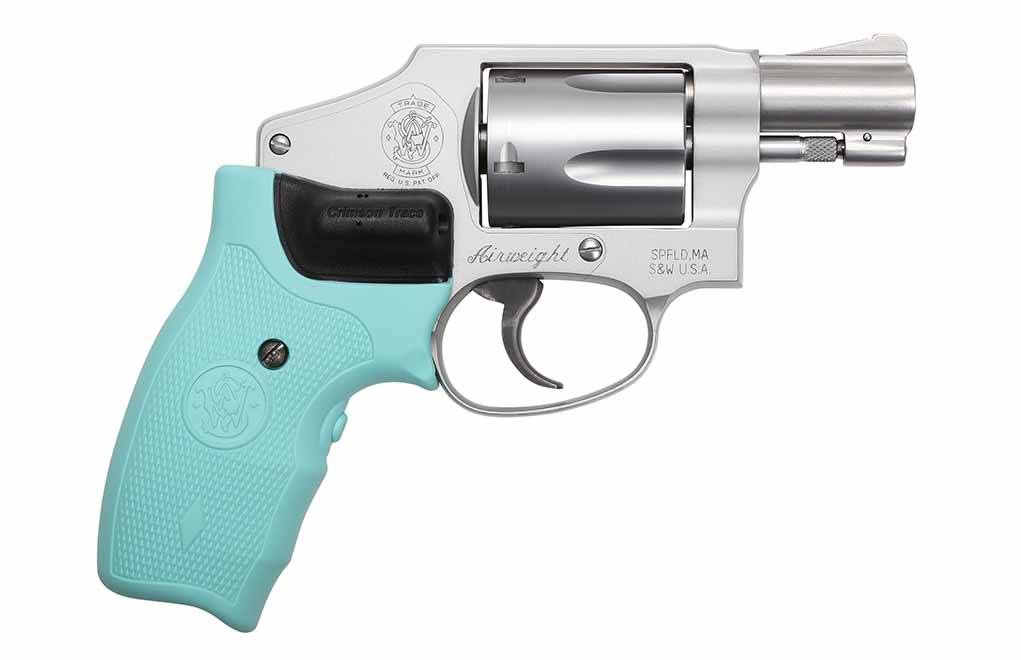
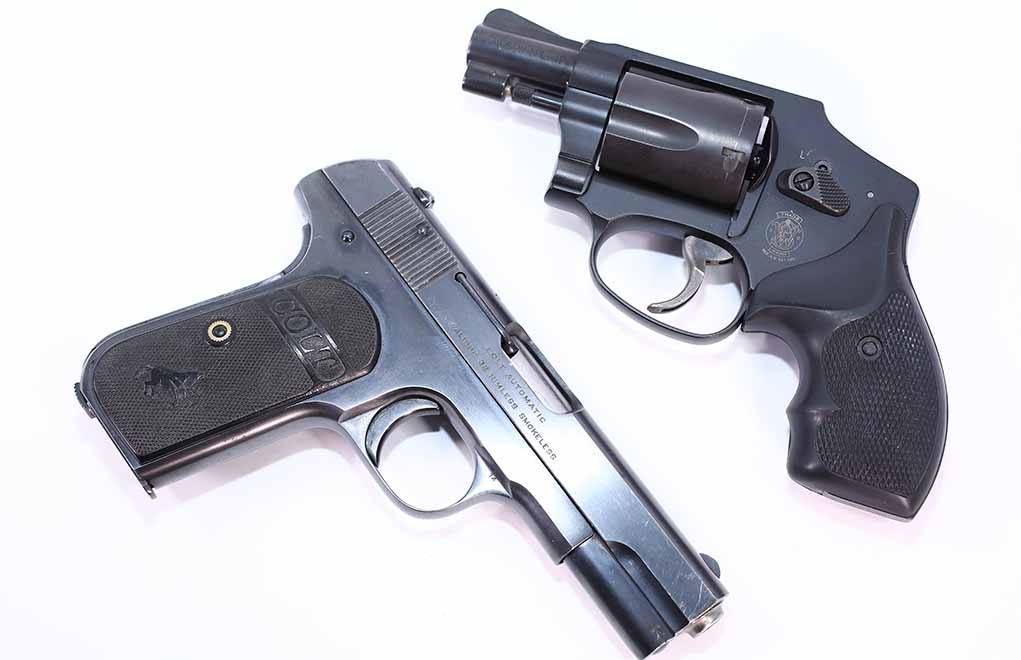
Despite having been around for more than a century-and-a-half, S&W does not fail to deliver. The latest for EDC is their 642. You know, the compact .38 Special five-shot revolver with an enclosed hammer. That means you don’t have to worry about lint, dust or whatever miscellaneous debris about your person that can fall into the hammer slot. There isn’t one.
The short barrel, which is a fraction under 2 inches in length, is plenty long enough to be accurate and deliver the velocity you want from .38 Special ammo. Although, I have to warn you, while the 642 is rated for +P ammo, shooting .38 Special +P loads through a revolver that weighs an ounce less than a pound is not going to be easy.
With all of this comfortable-to-pack defensive sidearm goodness on your belt, S&W had taken another step to improve it: They have installed a CTC laser, the integral-to-the-grip version, and the grips are done in robin’s egg blue. So, this gun is lightweight, utterly reliable, stylish, easy to carry and chambered in .38 Special. What’s not to like?
Nighthawk Firehawk
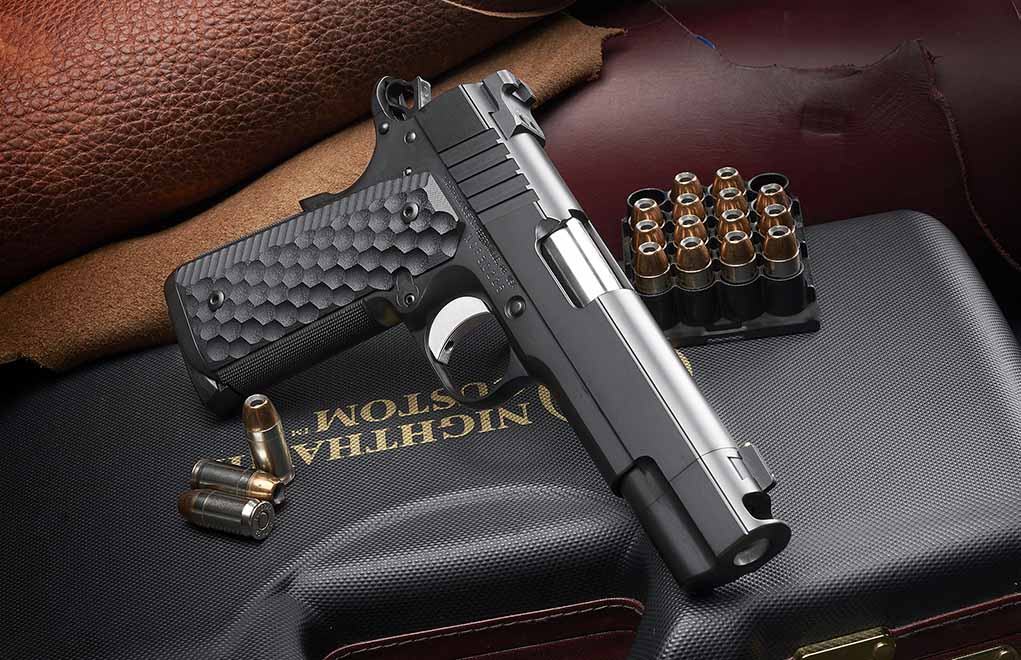
My checkbook should be afraid: Nighthawk decided to go and make a compensated pistol, and in their usual obsessive method they spent an inordinate amount of time and computer cycles in designing, testing and tuning a comp. Instead of simply putting a comp on the end of an extended barrel, they shortened the slide, blended the comp to match and made the entire pistol no larger than a standard government model. The magazine well receives a funnel, the grips are aggressively textured G10 and the result is an accurate, soft-shooting-but-hard-hitting pistol.
Being a Nighthawk build, the details are all exacting. The slide and comp have a French border, the frontstrap is lifted and checkered, the fit of slide to frame to barrel is done by master pistolsmiths, and the end result is not just beauty — but performance.
The rear of the slide is serrated, the front sight has a gold bead and you can have your Firehawk in 9mm or .45 ACP. There’s no 10mm upgrade right now, but as with all things, that might change … not that you should refrain from acquiring a Firehawk while waiting on the future chance of a 10mm pistol.
Expensive? Perhaps, depending on how you measure such things. But when you consider that it’s going to last long enough to leave to your grandkids in your will, that’s not so expensive.
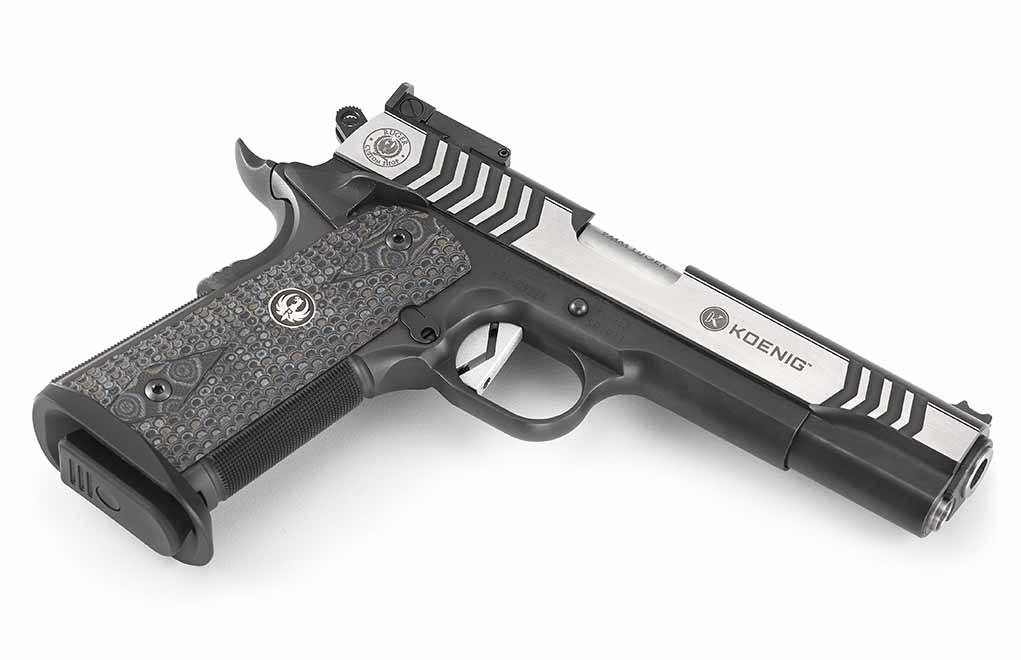
Ruger Koenig Custom Shop 1911
Ruger, having made the transition from “ugly blocky 9mm pistols” to the 21st century of AR-15s and 1911s, has taken it a step further. Teaming up with Doug Koenig, they now offer Custom Shop 1911s. The start is a 9mm full-sized 1911, the easiest centerfire pistol in the world with which to learn to shoot — and one of the most fun. Combine a clean trigger with sharp accuracy and lower-than-modest-recoil, and then top it off with cheap 9mm ammo costs, and you have a fun gun par excellence.
The details, such as the Hogue G10 grips, the checkered frontstrap and fiber-optic front sight, just make the Koenig Custom Shop Ruger 1911 one of the top pistols to be tempted by in 2019. And if a 9mm isn’t on your must-have list, then it can’t be too long before Ruger offers it in .45 ACP. I’ll go ahead and say it, if no-one else will: Everything should be available in .45 ACP. And if you want it for daily carry, or to use in competitions, it won’t let you down there, either.
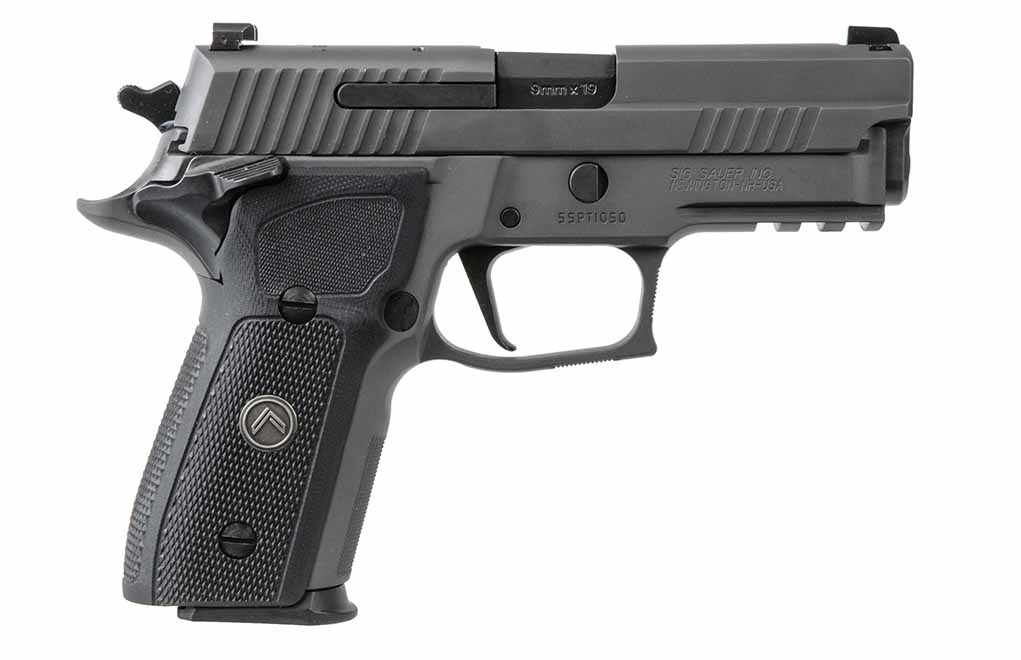
OK: If you could improve the Sig 229, what would you do? When Sig asked themselves that question, the obvious answer came up: Add it to the Legion lineup. So, they did. They took the rock-solid P229 and added the Legion gray PVD coating, and they fitted it with G10 grips featuring the Legion logo. They put on tritium night sights, and not just any, but their Electro-Optics XRay3 hi-viz sights, and they packed it with three magazines. It got the X-Five frontstrap undercut, frontstrap checkering and the slide received front cocking serrations. Then Sig installed a solid steel recoil spring guide rod, for extra mass low and forward to reduce felt recoil. For EDC, they installed a low-profile slide stop and thumb safety.
Having done all that, what else could they do for 2019 to further improve the P229? Simple: They made it a single-action-only pistol. The trigger mechanism is now not a double-action to single-action design, but single-action only — for a cleaner, crisper trigger pull. Sure, you give up the DA second-strike capability, but we all know that if a primer fails to go off you don’t give it a second chance — you ditch it and get to the next one. For an EDC 9mm with high capacity (15 rounds in the standard mags), the Sig P229 Legion SAO is a steal.
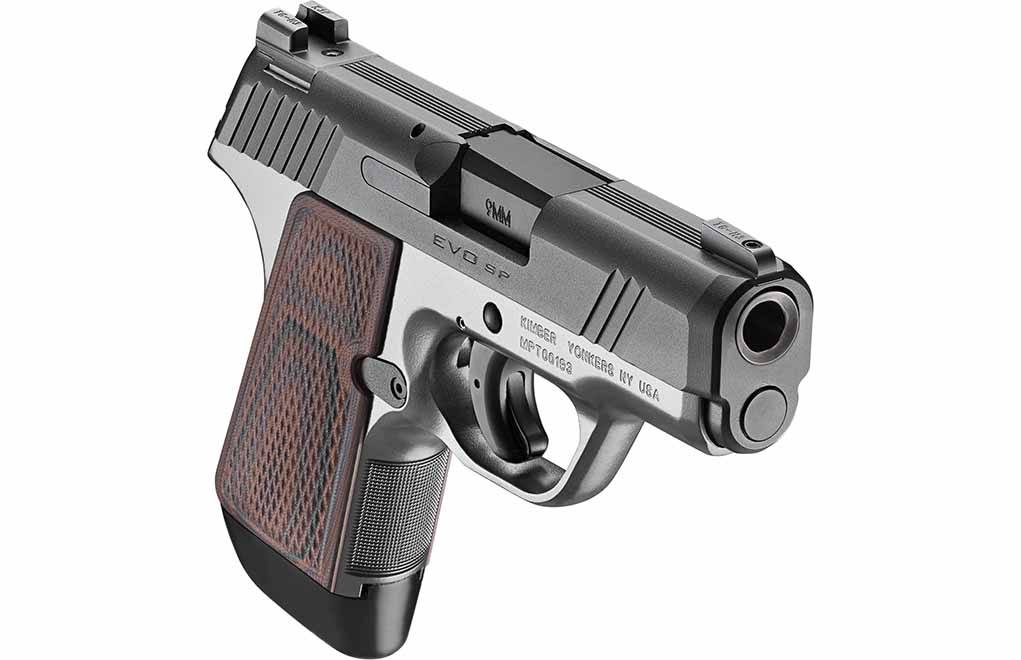
Kimber EVO SP
If a full-sized pistol is not what you’re looking for, then the ultra-compact Kimber EVO might be just the thing. New for 2019, the EVO is now a striker-fired pistol, the EVO SP, so the rear of the slide is enclosed. This helps keep lint, dust and the basic everyday carry crud that accumulates on our gear, out of your pistol.
Kimber made the magazine release one that can be swapped for right- or left-handed shooters. They also performed some trickery on the grips: I had to actually read about the EVO SP (oh, the horror) to realize one detail that was different about the pistol — there are no screws or other external hardware holding the grips on. The rear sight has a ledge machined in it, so if you need (and it would be a pretty drastic need) to work the action one-handed, you can. With three finish ensembles and the Kimber Custom Shop to call on, you can pretty much have your EVO SP any way you want it, provided you want it in 9mm Parabellum.
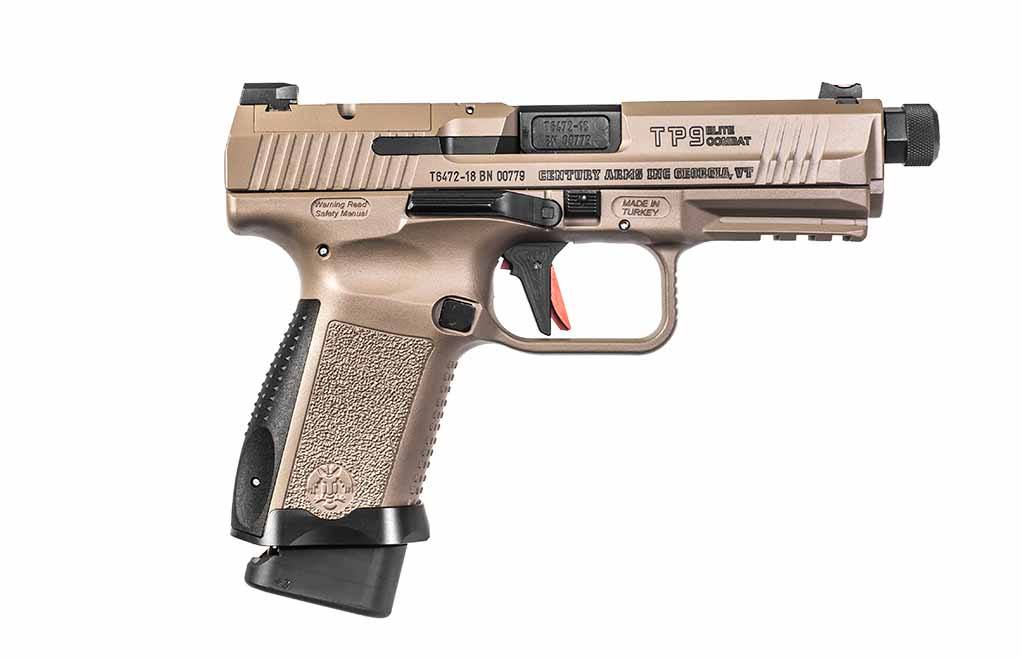
Canik TP9 Elite Combat
The Turks make solid guns. The Canik is the exemplar of the modern service pistol: a striker-fired, polymer-framed hi-capacity 9mm that you can have in black or FDE. However, for the latest model, Century Arms — the importer of Canik — went to Salient Arms for upgrades.
On the barrel, they extended it and threaded it for mounting a suppressor. The slide gets a fiber-optic front sight in your choice of two colors. The slide also gets machined for a red-dot sight, and the TP9 Elite Combat comes with that machined area sporting a filler plate, just in case you don’t want a red-dot sight. Yet. The frame, with its replaceable backstrap to accommodate your hands, gets a magwell funnel for speed reloads, and the trigger is replaced with a flat-faced one while the striker system has been tuned for a cleaner trigger press. All of this for a pistol whose price won’t break the bank, and in 9mm, which also means feeding it won’t break the bank.
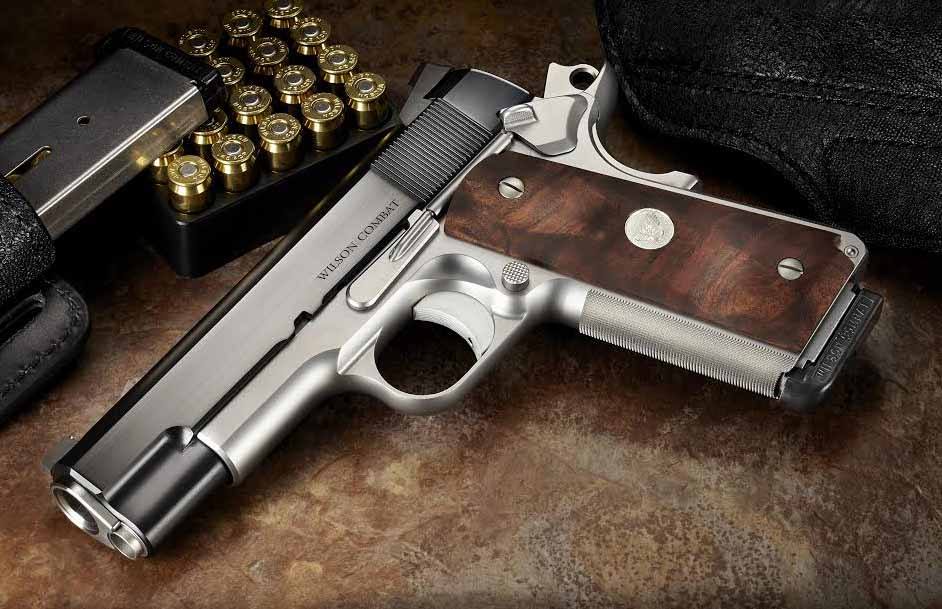
Wilson Combat Supergrade Commander Special
The Wilson Combat Supergrade line continues to expand. The latest is the Supergrade Commander Special. The crew starts with Wilson’s own forged frame and slide, machined in-house and fitted by pistolsmiths with years of experience. (It takes 5 years just to learn how to do all the tasks they do to a 1911.) Then, it gets a Wilson match commander-length barrel and extra touches for those of you planning on everyday carry … such as a low-profile USGI-derived thumb safety and an abbreviated grip safety that still protects your hand from the rowel hammer but minimizes printing when carried.
They then combine old with new, including USGI cocking serrations with ball-end cuts on the slide. The white/gold bead front sight is on a blued slide. You can have your hand-polished Supergrade Commander Special in all-blue, or blue slide over stainless frame. Carry in style, carry in comfort, carry something comforting, carry the Supergrade Commander Special.
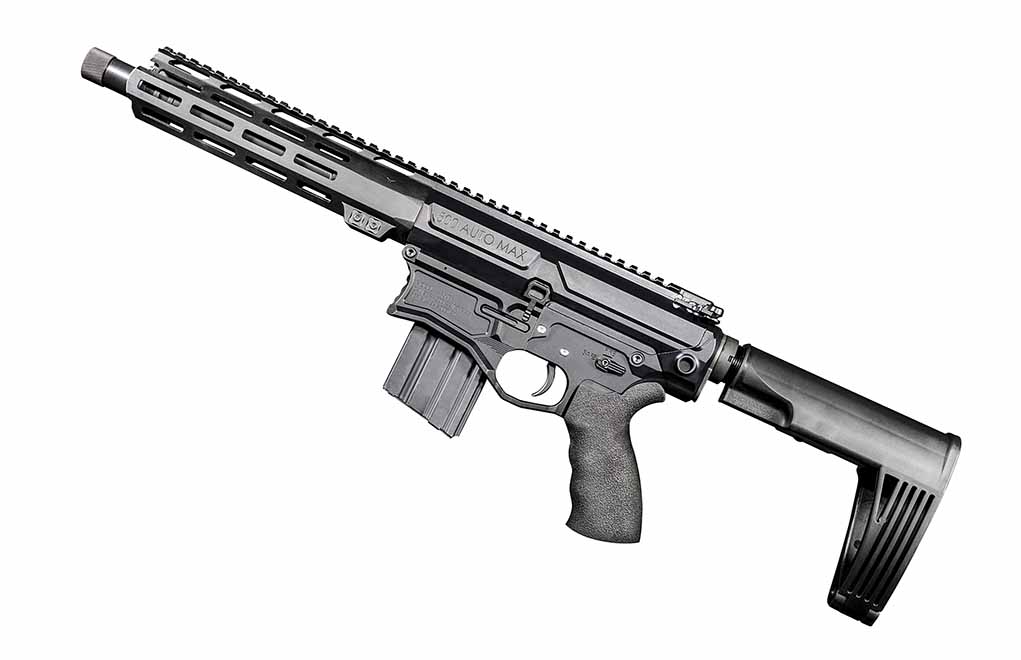
Big Horn Armory AR500
If there’s one advertising/marketing tag line I hate, it’s “taken to the next level.” But there are times when it is actually true. Big Horn Armory has done just that, by taking their .500 Auto Max rifle and crafting an AR pistol out of it. Big Horn takes a new AR-10-based receiver set, with the magazine well broached for an AR-15 sized magazine, and puts an Alien Gear Tailhook arm brace on the back end and a 10-inch barrel on the other end.
The .500 Auto Max is a .500 S&W case with the rim turned off, and you can have ammo loaded with bullets from 350 to 440 grains. Or, you can load your own, as it uses standard .500 S&W Magnum loading data. The result is a compact, relatively lightweight (you don’t want a brute like this to be too light, now do you?) pistol that would be perfect as a close-range hog hammer, a camp bear gun or just the range gun to impress your friends. Ammo is available from several sources, and new brass can be had from Starline. As a final note, should you desire, the barrel is threaded, and putting a suppressor on it is thus possible.
There you have it: a few reasons the job of being a gun writer can be so much work. This is my list, and it should be your list, too. No, don’t thank me: I’m happy to be of service.
Editor’s Note: This article originally appeared in the January 2019 issue of Gun Digest the Magazine.
The trend in concealed carry is to go light on gun and gear. But when you consider life-or-death circumstances that might not be the best choice.
Considerations In Carrying More Gun And Gear:
A larger caliber (9mm minimum) is mandatory.
Veer away from off-body, pocket and ankle carry and get a hip holster.
Plan on having 16 to 30 rounds (including what’s loaded in your pistol) at the ready.
A knife is a wise addition to your EDC kit.
Carry your cell phone and the business card of your attorney.
It’s advisable to have a tourniquet or pressure bandage at the ready.
We’ve all done it: We’ve slipped down to the store, packing just a J-frame, and sometimes we don’t even have a reload onboard. Tsk-tsk. Or, the emergency tool option is a light, compact .380 pistol, because “you’ve got to have a gun” but don’t want the hassle of a “real” gun.
Revolvers are viable carry options, but not when they are five-shots-only and you don’t have a reload.
One of my friends in the gun writing biz, James Tarr, can always be found packing a hi-cap 9mm and a spare magazine or two. A long-time friend of mine, a retired chief of police, packs not only a full-sized all-steel 1911 — with spare magazines — but he carries a backup gun, a reload for that one as well, and a tourniquet.
Every time I think, “Maybe I’ll go light today,” I think about them, and I wonder what comments they would make were they to catch me with just a snubby in my holster? The teasing and jokes would not be pretty, and the ordeal would last a long time.
Playing The Odds
The usual response to suggesting that you actually carry a big gun and a reload is to bring up that dreaded subject of school — statistics.
“The average gunfight lasts X seconds, with Y shots being fired, at Z distances.” Usually 2-3 shots are fired, inside of 7 (or 5) yards, and lasting a handful of seconds. You’ve heard all the averages.
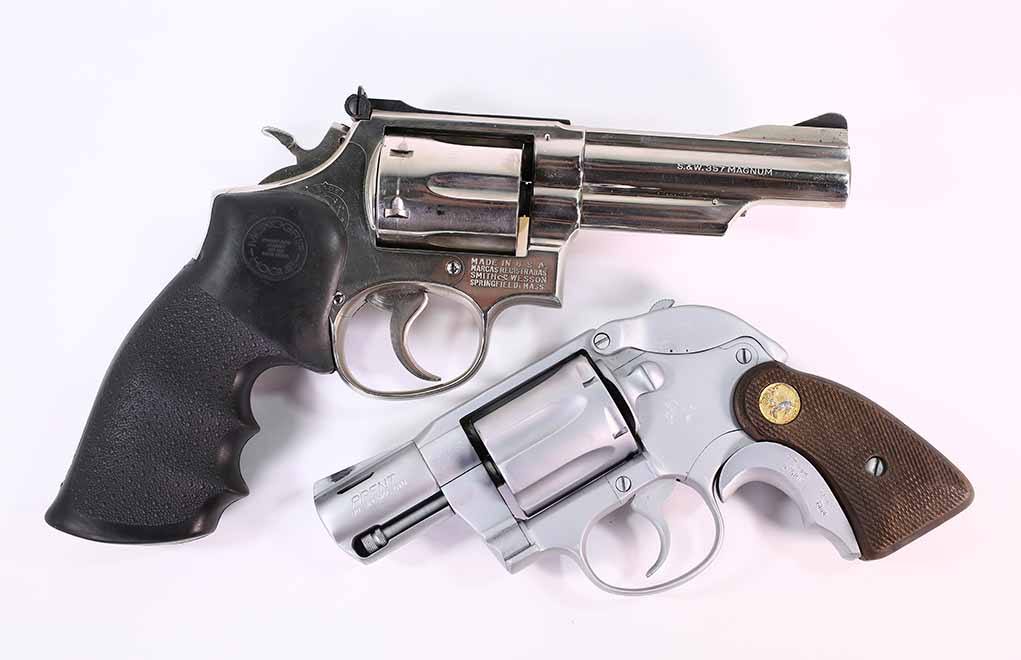
A nice touch for a backup is identical capacity. Instead of a five-shot backup, using a Colt Agent gives you six in the spare. Counting can be difficult under stress, so it’s best to keep it simple.
It has been a while since I delved deeply into the law enforcement statistics of shootings, but I do remember one detail when I was regularly reading the NYPD SOP-9 reports (back when you could actually obtain copies). The “average” was obtained by toting up every single incident where an officer was involved, and when firearms were discharged. So, the AD/ND, at home or at the precinct house, the animal dispatch incident, the suicide — those all got lumped in with the “real” gun battles. And, the usual result of a shootout in the city was that it ended with an empty revolver, which meant five or six shots fired by the officer, maybe one or two, or all five or six for the perp as well. It takes a lot of “empty revolver” shootouts to out-weigh the accidental discharges and the rest.
Those all pull down the average. And that was back when revolvers were the norm, before hi-cap 9mm pistols were ubiquitous.
But here’s the kicker, the stat most people don’t think about: If you’re going to go by statistics, then you won’t be packing a firearm at all. The statistical likelihood that you will need a firearm is so low that, were you looking at the odds, you wouldn’t be packing. No, really. The number of firearms-needed incidents in the United States is a tiny fraction of the daily events of the population as a whole. If you are playing the odds, you won‘t pack a gun, and you don’t buy lottery tickets.
You are, however, packing a gun. You have made the decision to carry a firearm, to be part of the EDC crew, if you will, so you must look at it differently.
Assessing Requirements
There are two ways to assess the requirements and preparations needed for an emergency (if ever there was something that qualifies as an emergency, it’s when you need a firearm).
Yes, we’ve all done it: Leaving the house with a snubby, or a pocket pistol, and some of us have compounded that by not having a reload with us.
They are: the likelihood of occurrence, and the cost of unpreparedness.
The likelihood of occurrence is what insurance companies do. They crunch the numbers and they figure how many times a certain insurable event will happen within their underwriting area. They then add to the replacement cost of the event, item — whatever — a nice profit margin, and hand you the policy. Sign it or not, those things will happen. They might happen to you, they might happen to someone else, and they might not happen at all during the time you are in the insurance companies’ Area of Operation. If it happens to you, and you’ve paid for the policy, you win the bet. They lose. If you have paid, and nothing happens, they win. If you don’t pay, they lose, and if whatever happens does happen to you, you lose, too.
The odds of your needing a firearm are so slight that the “policy” of carrying one is an instance of paying a premium and never collecting on the insurance policy. I will, however, point out that not needing to use your EDC handgun is, unlike the insurance policy example, a win.
The cost of unpreparedness perspective is best illustrated, of all the examples to be found, with Strategic Air Command. Nuclear war? Especially today, highly unlikely. However, if you need the nukes, and you don’t have an up-and-running program to use them effectively and quickly, then you lose. You lose big. We all lose big. So, despite the very small probability of needing them, we have them, and a way to use them, because not having them means incurring a huge cost if you need them.
If you want to carry a gun with longer barrel, then carry a gun with a longer barrel. The author carries this gun regularly; the trick is finding a comfortable holster, which is easily done.
You deciding to EDC is, not to make too much of it, more of a SAC decision than a local insurance agent decision. If you need it and you don’t have it, then you lose. So, since you have decided to carry, you should do it properly.
Going All In
First, a real pistol is mandatory, in a big caliber (9mm Parabellum, minimum) and carried in an actual holster. No “pocket carry” and no gimmicks. This can be leather or kydex (or whatever the latest miracle of modern chemistry material might be), but it has to be a holster — one that covers the trigger guard. A security device or not is your personal preference.
As much as I don’t like giving Glock any credit, the baseline against which you will measure everything else is a G19. This gives you fifteen rounds of 9mm in the gun. If you happen to prefer a single-stack, like a 1911, then you go with a commander, lightweight or not. There, you get eight or 10 shots in the gun.
Where on your person do you carry it? That is between you and your back. Between you and your tailor. Between you and the temperature and humidity outside. Personal preference and all-day comfort rule here. And I mean it: on your person. Packing an EDC firearm in a case, purse, external garment or the like is not prudent. And it’s only called for it you are going to be carrying some place where you simply can’t have it on your person. Need I point out you shouldn’t spend any more time there than absolutely necessary?
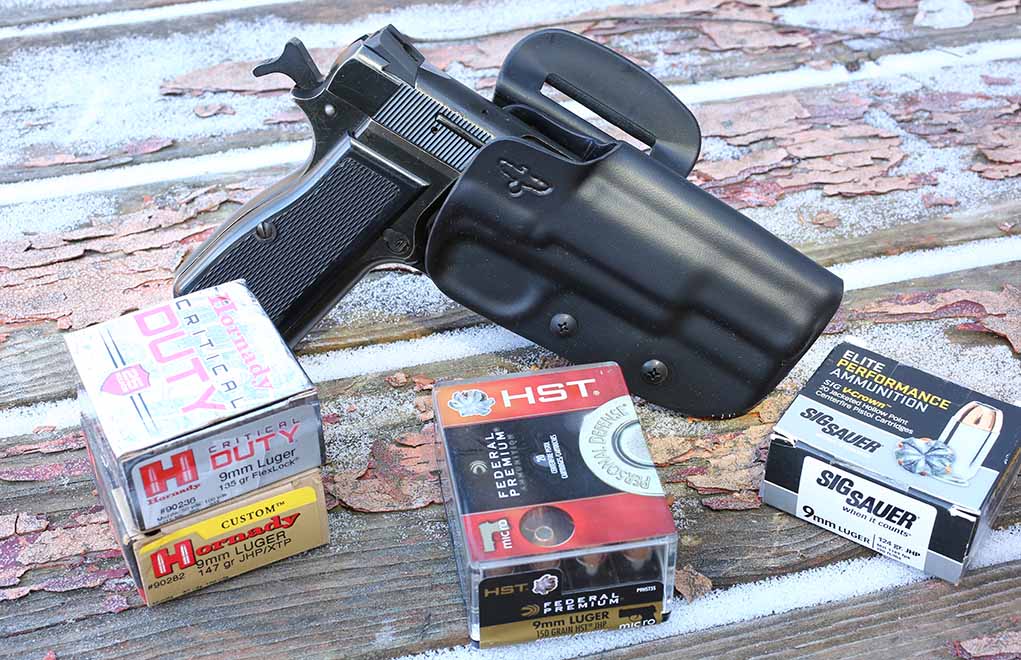
Modern defensive ammo is so good that you can obsess over the last percentage of performance — don’t. Test known-good ammo, and then use what’s most accurate in your EDC handgun. If your gun has definite preferences, do what the gun tells you. Lucky for me, this P35 shoots all four of these loads brilliantly.
On some other place on your person, you carry spare ammo.
How much? If you’re packing a hi-capacity pistol, then a single spare should serve you just fine. You carry a spare magazine as much for the possibility that the one in the pistol stops working, as for needing extra ammo. Early Glock magazines had a penchant for launching baseplates, followed by spring, follower and ammo, when they got hooked on something. That’s not so much a problem now, but if it happens, having a spare would be good. If you are carrying a single-stack pistol, then two spares are called for. That gives you 16 to 20 more rounds, and two chances of replacing a bad magazine.
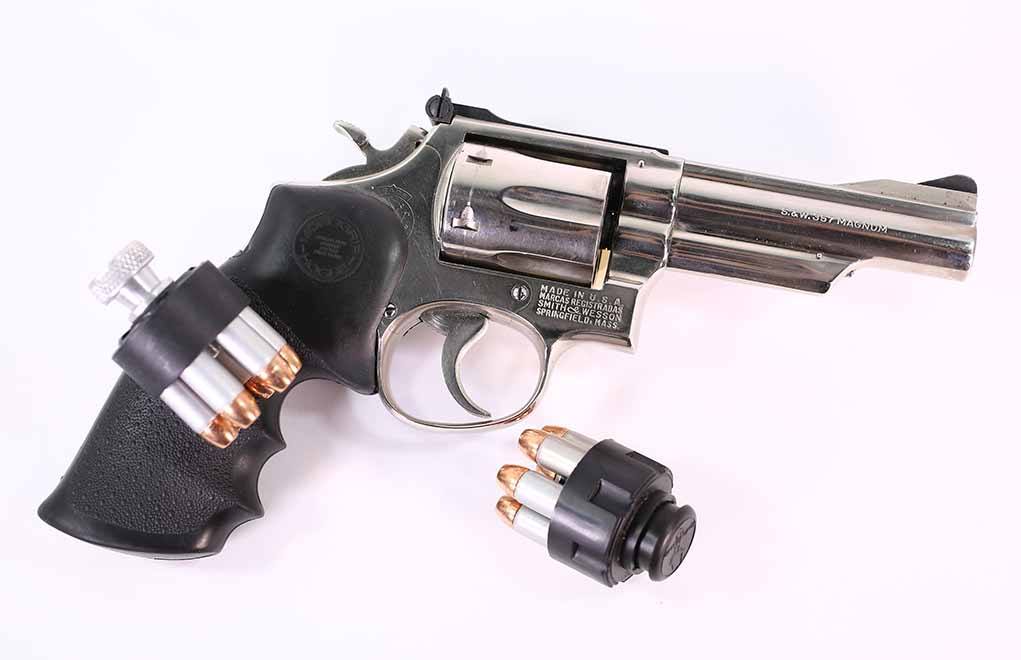
Oh, and revolver shooters? You should expect to have a pair of speedloaders on your belt. That gives you 12 more rounds (I really, really want to discourage you from packing a five-shot J-frame as your “main” gun), and Galco makes a super-click speedloader holder for that. It positions the speedloader over your belt, so three rounds are outside of it and three others are inside of it. It takes up less room than the spare magazine your pistol-packing brethren are using.
This is really not too much. You may (read: probably will) have to change your idea of what is “properly dressed” to accommodate the gear, but that isn’t too difficult. Not dressing like a slob will get the job done. However, the preparation for the job isn’t done.
Concealing More Than A Gun
You would be well-advised to be carrying a knife. Now, this will depend on local laws, but a locking folder — or better yet, a spring-assist folder — would be a good thing to have. My friend the police chief carries two, one on each side, and for a simple reason: If someone decides to “catch up on old times” vis-à-vis their arrest a decade ago, my friend can use either hand to access either knife and get himself separated from the bad guy.
You will, of course, have your cell phone to call for help, and the business card of your attorney — you know, not the one who handles the family deeds and wills, but the Criminal Defense attorney, the one who handles use-of-force problems.
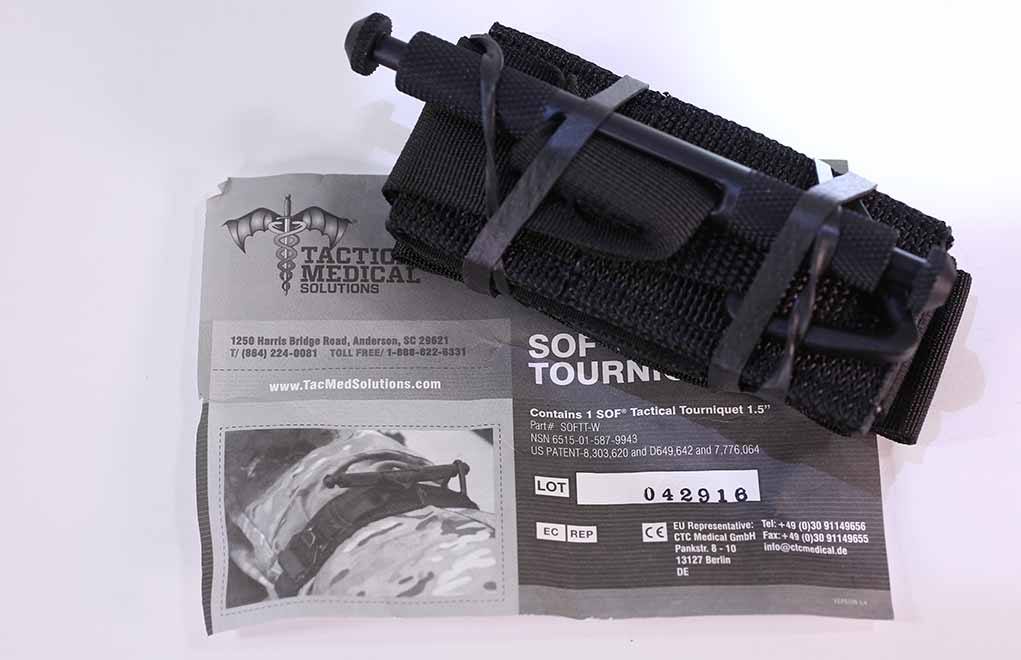
If there’s a shooting, there’s a good chance of someone needing attention. That someone might be you. Yes, I know people who pack a tourniquet as part of their EDC ensemble.
And there’s one more item: a tourniquet or pressure bandage. Wait, what? Again, if you’re in for a penny, you’re in for a pound. If you expect that you will be using the handgun that you are packing, there will be leakage — and it might be you.
Parting Thoughts
There was an incident a couple years back where a police officer who was carrying off-duty had an AD. The shot severed her femoral artery in two places. A fellow officer in the room used the tourniquet he was wearing to stop blood loss, and they took her to the hospital. Had the tourniquet been in the next room, she probably would not have made it. When there is shooting, even if you are the winner, you might have gotten shot. Having something to use to stanch the blood loss is prudent.
You may have heard the motto: Two is one, one is none. The idea is that if you have but one of an object, and it breaks or fails, you have nothing. Now, you can take this a bit too far. An acquaintance of mine never leaves the house without his minimum load out: two full-sized 1911s in .45 ACP. Plus two spare magazines for those pistols. And two J-frame revolvers, with a reload. And two locking tactical folders. Plus two flashlights. This, in addition to wallet, keys, phone, and whatever else.
For those who must use .357 Magnum ammo, an all-steel snubby is just the ticket. Colt has re-introduced the Agent, and a six-shot stainless steel revolver will see you through a lot of EDC.
I sometimes josh him about avoiding soft soil, lest he sink out of sight. He works in a very dangerous city, carries a badge, and he takes being safe seriously.
He’s in for a penny, all right. Are you?
Editor’s Note: This article originally appeared in the Concealed Carry 2019 issue of Gun Digest the Magazine.
Richard Mann’s Shadowland Drill sharpens important handgun skills in a single course of fire.
If you played football at some time in your life, you most likely remember the Oklahoma Drill. Ball runner and tackler lie on their backs, 15-yards apart or so. On the whistle, they pop up and go at each other in a semi-open field situation. It’s a classic. Yet, does it really mimic what happens in a game?
Not really. But that doesn’t mean the time-tested – and absolutely fun – bit of gridiron training wasn’t without merit. It built situational awareness, the ability to make split decisions and forged physical and mental toughness. The same might be said of Richard Mann’s “Shadowland Drill”.
Tune Into More Gun Digest TV:
The Elegant Power Of The Ruger Blackhawk Bisley .45 Colt
Certainly, the former law-enforcement officer and self-defense instructor’s personal-defense drill far from mimics most lethal force events. Yet, for one drill there a number of important skills you can sharpen by running the Shadowland Drill. Among these include accuracy, target transition and tactical reloading. Additionally, given the time element, the drill also puts the pressure on your performance. Needless to say, that’s generally not the case if you’re simply popping off from the firing line at your local range.
Yes, the Shadowland Drill is to self-defense what the Oklahoma Drill is to football. But in the end, both improve necessary skills for each discipline.
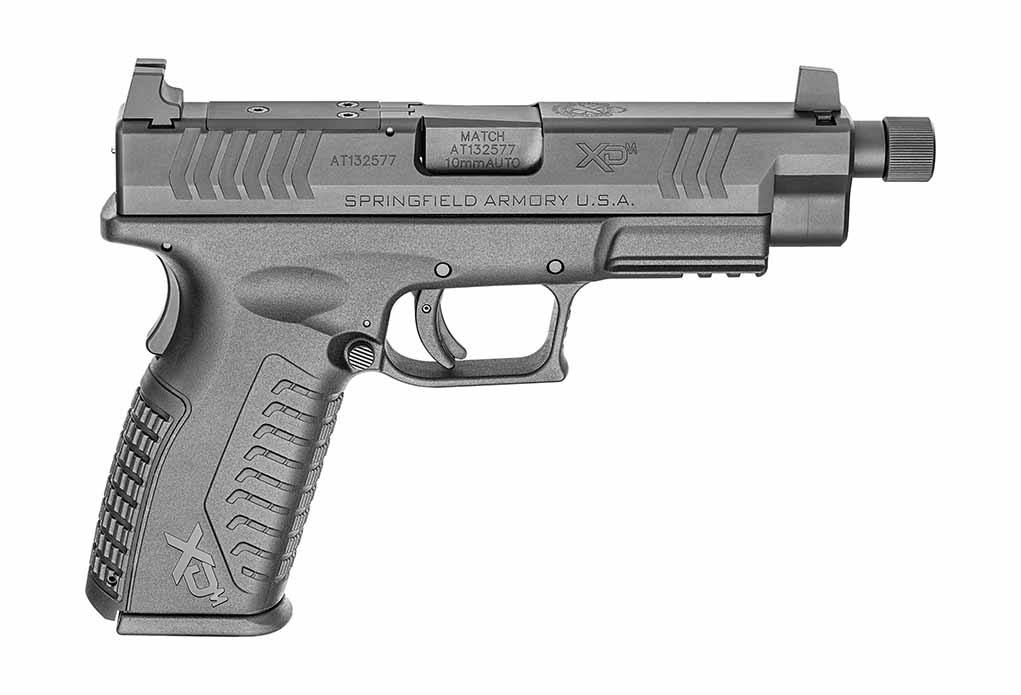
Moving its XD-M OSP to 10mm, Springfield Armory gives shooters an affordable, optics-ready option in the powerful caliber.
What the XD-M 10mm offers:
Comes with three base plates making it compatible with seven reflex sights.
Suppressor-ready threaded barrel.
Suppressor-height iron sights, that should work as a backup aiming system if an optic breaks down.
Given the waves it made Springfield Armory made with its plain-Jane 10mm, it’s surprising this is just coming out. That and the XD-M OSP (Optical Sight Pistol) has a couple of years vintage now. Yet, it might have been worth the wait for those dying for an affordable “Perfect 10” with an integral optics mounting system.
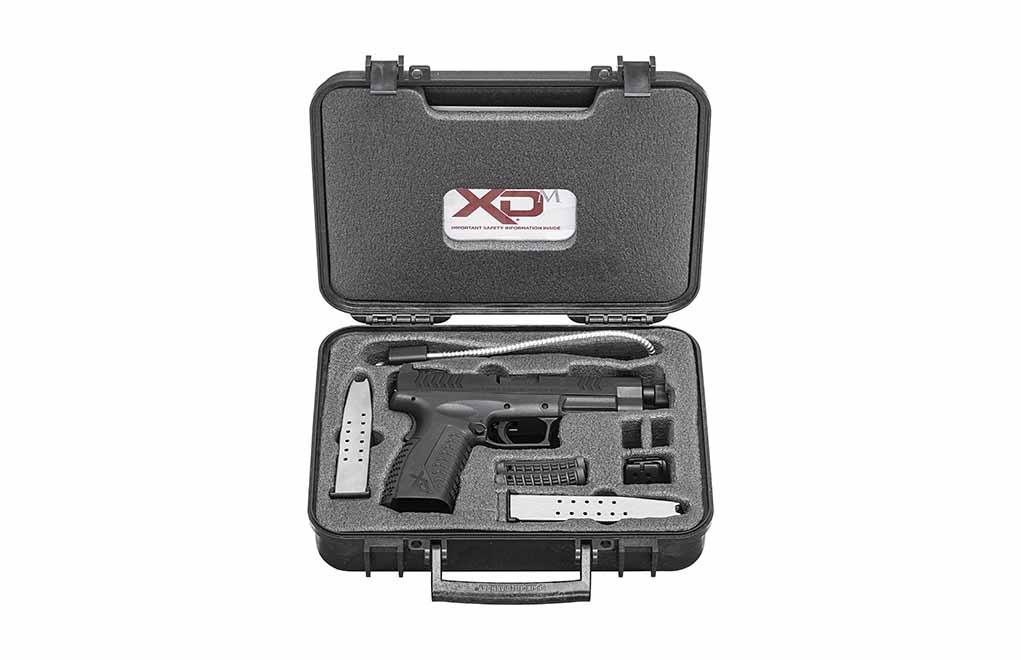
In all, the XD-M OSP 10mm comes with three base plates, making it compatible with Vortex Venom, Burris FastFire 2, Burris FastFire 3, Leupold DeltaPoint, Leupold DeltaPoint Pro, JPoint Sights, and Trijicon RMR sights. Furthermore, it boasts a threaded barrel and co-witness suppressor-height iron sights, so you can see over your can. They should also work in a pinch, if your reflex sight’s battery dies.
However, the eye-catcher for those who have a yen for an optics-ready 10mm, is the price. With an MSRP of $695 the XD-M 10mm comes in at the low end of the price range compared to similarly decked out pistols. Not bad, since this make-caliber combination has proven itself fairly popular already.
More from Springfield Armory:
GENESEO, ILL. –Springfield Armory is proud to announce the XD-M Optical Sight Pistol (OSP) in 10mm.
Power is a matter of perspective and the all new XD-M OSP in 10mm delivers both in our most potent and versatile platform. Optics ready out of the box, the XD-M OSP in 10mm ships with three adapter plates to accept today’s most popular red dot optics.
This optics-ready pistol features a threaded barrel and factory milled slide, allowing the operator to choose the optic and suppressor or muzzle device that fits their needs.
The 5.3” hammer-forged, Melonite® treated, threaded barrel comes with a thread protector, and the suppressor-height sights co-witness with your choice of optic, allowing the iron sights to be used through the optic if necessary. The short-reset trigger has a minimal trigger break for quickly putting accurate rounds on-target.
For those who love the power of the 10mm round, the XD-M is an ideal platform to manage recoil and provide a soft-shooting experience. The full-size grip frame with Mega-Lock grip texturing provides a secure fit in your hand, and the three interchangeable backstraps allow the shooter to customize the grip to their preferred fit and feel.
The versatile XD-M 10mm has been meticulously engineered to be as robust and reliable a defensive handgun as possible, proven through a grueling 10k round torture test without a single failure.
Three mounting plates are included to fit the Vortex® Venom, Burris FastFire™ 2, Burris FastFire™ 3, Leupold DeltaPoint®, Leupold DeltaPoint® Pro, JPoint® Sights, and Trijicon® RMR®.
Whether law enforcement, military or personal defense, Glock pistols are everywhere in the modern gun world. But why exactly do the pistols continue to dominate the market?
What Are The Assets That Drive Glock Pistols’ Popularity:
Simple, intuitive controls that streamlined the manipulation of the pistols.
A polymer frame, the pistols are consistently lightweight compared to its competitors.
Efficiently manufactured, the company has always offered an economically priced product.
With few parts, the pistols are easy to maintain and troubleshoot.
Rugged as they come, most last a lifetime, perhaps beyond.
Ample aftermarket upgrades, you can tailor the pistols to your exact needs and tastes.
More than proven in professional use by the world’s militaries and law-enforcement agencies.
Unless you’ve only recently given up a near half-century of monastic life, you’ve heard of Glock. It’s impossible not to have, even if you aren’t a gun guy or gal. The polymer, striker-fired pistols are abundant as the air we breathe and cut a swath wide as the Amazon River at flood stage. The pistol is here, there, everywhere. But why?
Absolute classic pistol designs abound in the modern world. And at reasonable prices, if you’re willing to do a bit of hunting. It’s as feasible to get your hands on a quality 1911 or a Sig Sauer P226, even a vintage Browning Hi-Power that ticks like a clock as it is one of the many models of Austrian perfection.
Yet, Glock dominants like no other, filling the holsters of military, law enforcement and armed citizens worldwide. Love ‘em or hate ‘em it’s quite a feat. Yet there are some pretty basic qualities Gaston Glock engineered into his pistols that make them as popular as free $100 bills.
Let’s take a look at what makes the Glock – no matter the model – among the most used pistols of the here and now.
Intuitive Controls
Glocks are as plain as a drive through Kansas. This is a good thing. When you’re talking about a firearm intended for defensive use you want a streamlined system.
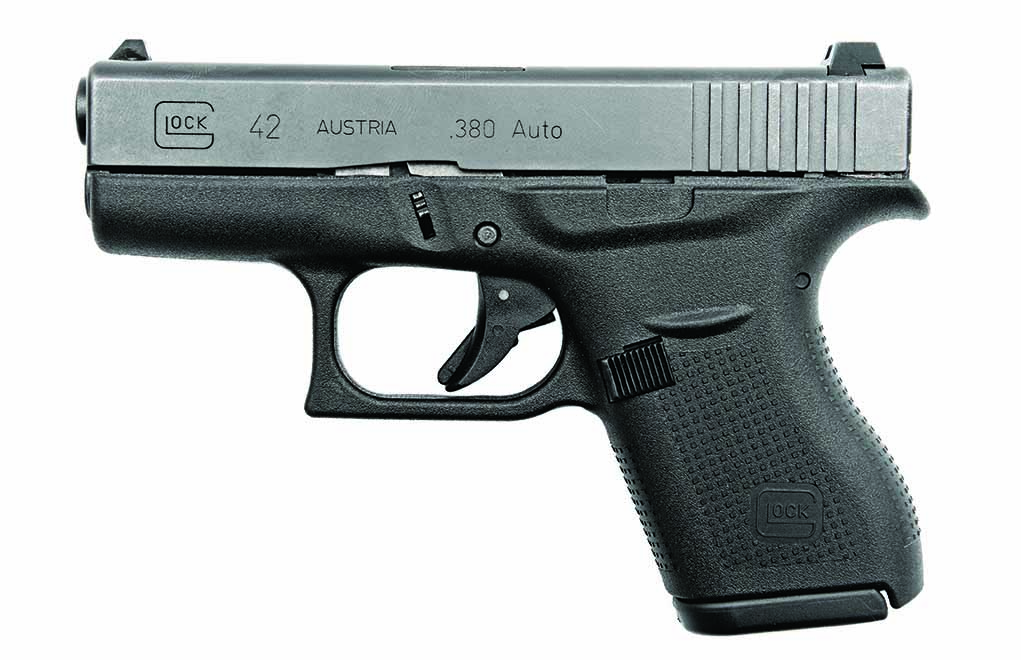
In fact, there are only three external controls you have to master – magazine release, slide stop and slide lock. The external safety is a second thought, given it’s incorporated into the trigger and deactivated when you place your finger on the bang switch.
The factory trigger also plays a role in making the pistols user-friendly. While commonplace now, a 5-pound pull weight was a marked break from the 10- to 12-pound pulls the double-action revolver, which dominated the early 1980s. Suddenly, folks that were fair to middling shooters started knocking the bullseye out on a consistent basis.
Lightweight
Glock pistols are also light. Certainly, a boon for professionals who could trim their overall daily burden substantially carrying the polymer pistol.
For instance, the 6-round .357 Magnum Smith & Wesson Model 13 was utilized by the FBI weighed in at around 31 ounces unloaded. Compare that to the 17-round 9mm G17, which comes in at right around 22 ounces unloaded. That’s substantially less heft, with a load more firepower. An aspect not lost on armed citizens when concealed carry picked up steam.
Economically Priced
Gaston Glock wasn’t originally a firearms manufacturer. He actually made knives and entrenching tools. Though this lack of experience might have helped ensure the company kept its overhead low.
Given Glock had the design of the G17 before he has the facilities to build it, the company tailored its manufacturing to the gun. In turn, they put together what became highly efficient and profitable process.
Given almost all gunmaker’s pistols are identical in function and design, the company continues to offer guns that are competitive with or well below its competition. Unless you’re paycheck only allows you to shop the budget pistol bin, most likely you can afford a Glock … maybe more than one.
Simple As Checkers
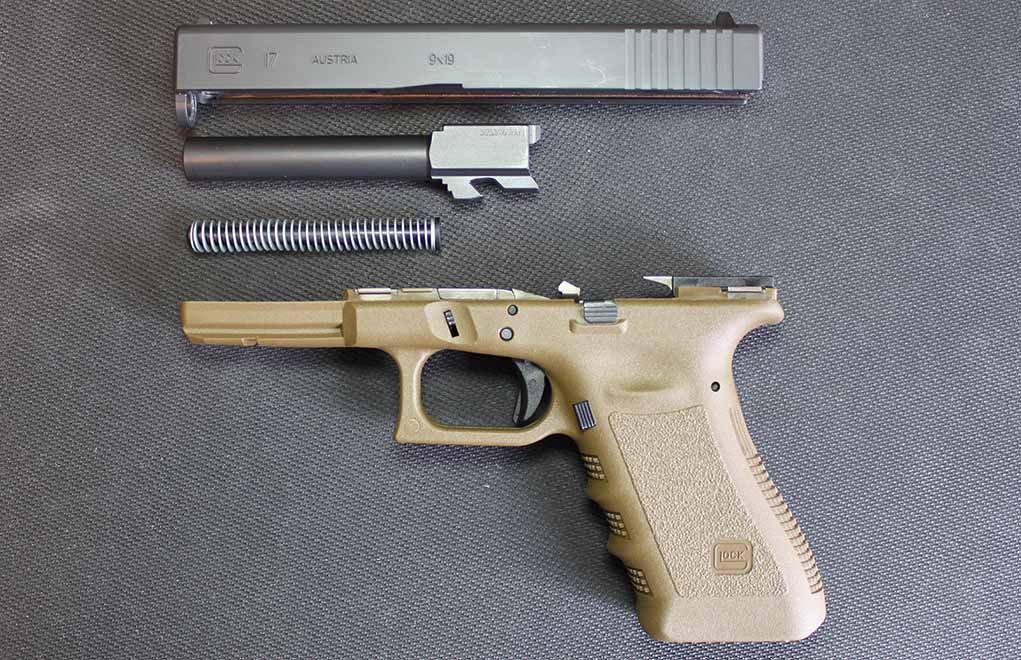
The pistols are frighteningly simple. Robb Manning lists out 35 in his book the Glock Reference Guide. Ballpark, the pistols have nearly half the parts of many other designs.
To a certain extent, this makes the design more robust. Fewer parts mean fewer parts to break. Furthermore, it doesn’t take a mechanical genius in the line of John Browning to understand a Glock. More than likely, most shooters can troubleshoot general issues with the pistols given their simplicity.
Rugged
As mentioned previously, the pistols are simple, thus resilient systems. Beyond that, they have become known for their durability. It might sound counterintuitive, given the company proudly boasts their guns are made up of less than 86% steel. The company is notoriously secretive about the polymer formula used to create the frame, but the results speak for themselves.
Besides meeting the standards of numerous militaries around the world, there are some who have pushed their Glock to absurd lengths. One gun writer claims to have run more than 365,000 rounds through his Gen 2 G17 and it’s still kicking. Still, less hyperbolic assertions of 50,000-plus rounds – fairly commonplace – are impressive.
Tons Of Aftermarket Upgrades
Out of the box, a Glock is pretty darn good. But you can make it a whole bunch better if you so desire. The aftermarket is swimming in upgrades.
Factory slide stop too small? Throw on an extender. Want a more responsive trigger? Install a 3.5-pound trigger connector. Need to make your pistol low-light operational? Get a set of tritium night sights.
The sky – and your wallet – are pretty much the limit when it comes to making your slice of Austrian perfection a bit more perfect.
Proven In Professional Use
Not really a design point, but worth noting.
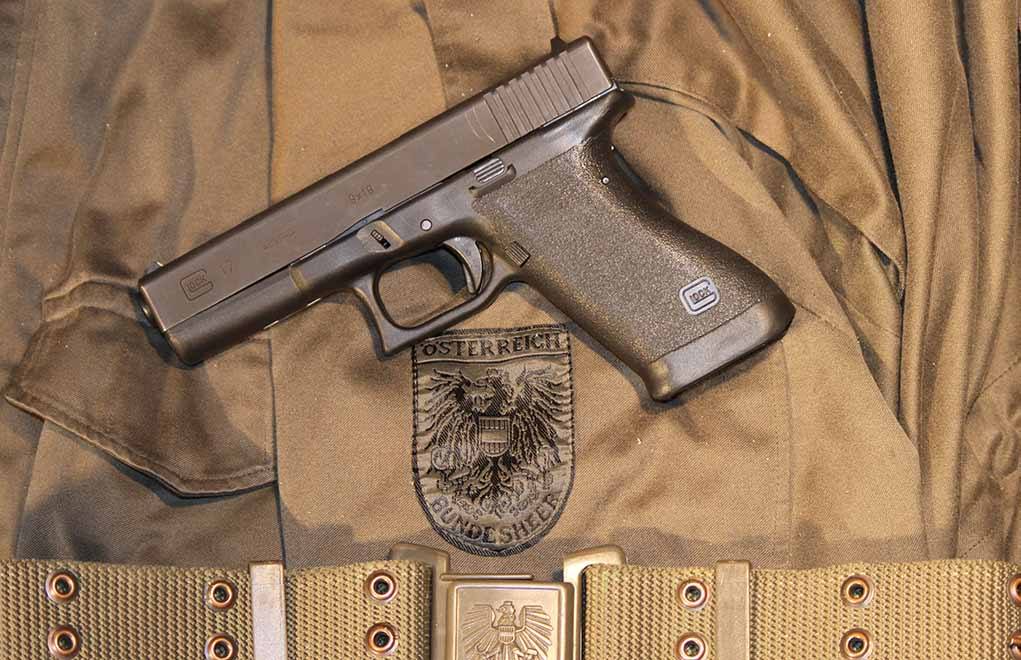
Since the G17 was adopted by the Austrian Military in 1982, only strains of the flu have spread across the globe faster. More than 50 countries’ armed forces, security agencies and police forces have adopted some model of Glock as their sidearm. And, it remains among the most used gun in American law enforcement today.
Certainly, there is an economic factor, in the company produces affordable pistols. But there’s more to it than simple dollars and cents. Glocks perform and, for the most part, good shooters perform well behind the business end of one.
Glock Articles You Need To Read
Now that we’ve gone over why Glock pistols, in general, are so popular, it’s time to look at individual models. Here are some looks at and reviews of the ubiquitous and hard-charging pistols. Consider it your one-stop clearinghouse for everything Glock.
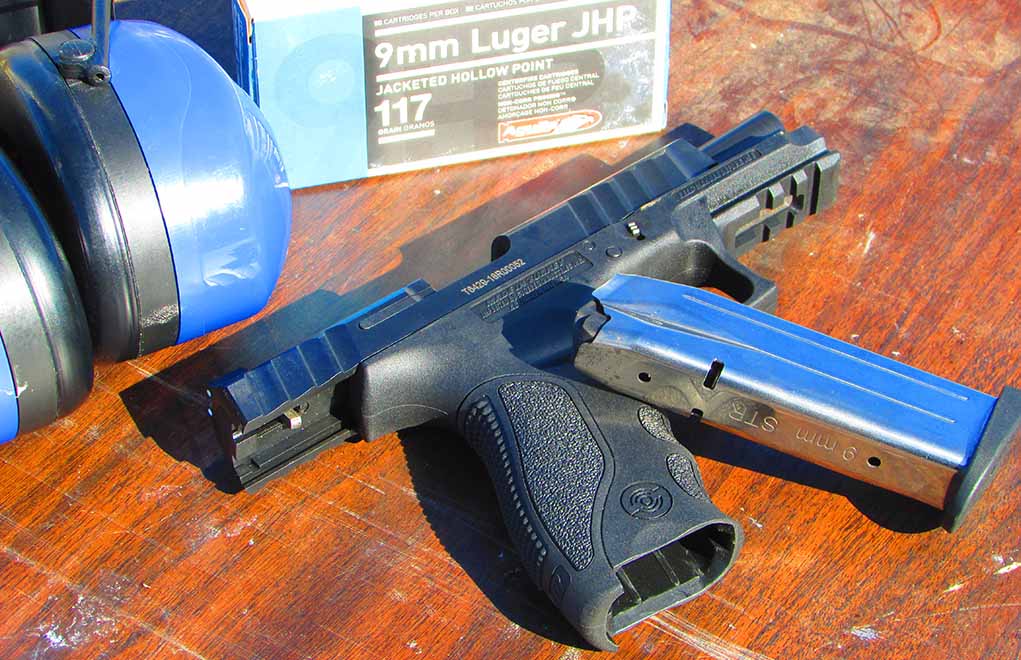
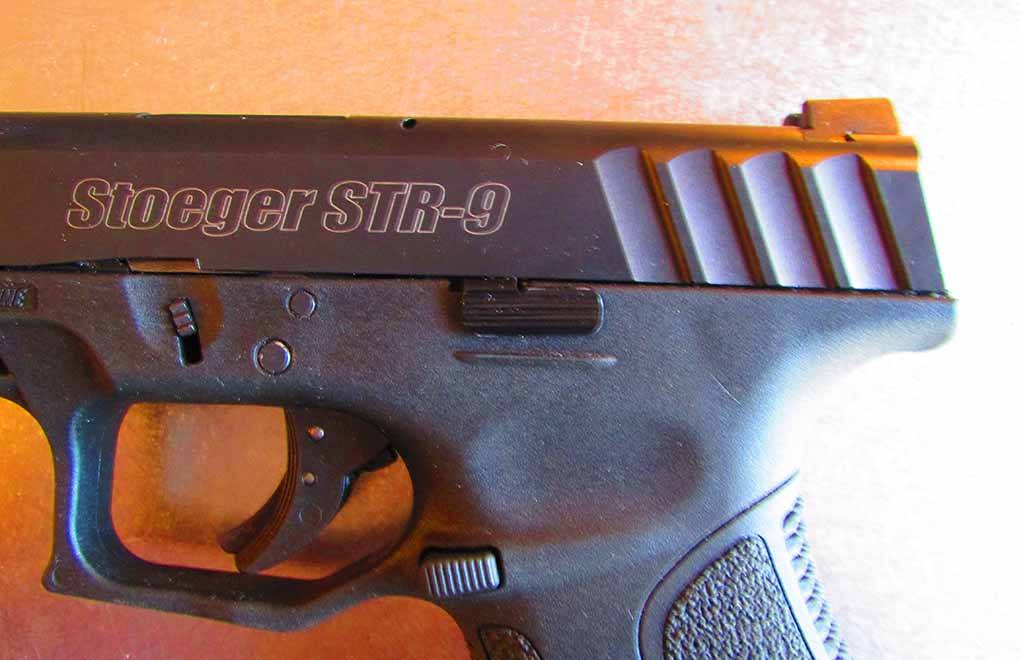
The Stoeger STR-9 keeps pace with the best of the striker-fired market for a price that you can’t beat.
How The Stoeger STR-9 Stacks Up Against Other Striker-Fired Pistols:
Smiliar in size, weight and internal function to the Glock 17.
Agressive cocking serrations makes the slide simple to manipulate.
Decent, yet slightly heavy 7-pound trigger.
Replacable backstraps have large and ample checkering, which keeps the gun in the palm.
Boasts 15+1 capacity and the base package come with one magazine.
Proved extremely accurate and fired a variety of different ammo without a single malfunction.
Starting at $329, it is among the most economical full-sized striker-fired pistols available.
The fact a new striker-fired, polymer-framed pistol hit the market isn’t a surprise. Who’s churning out the latest addition to the ever-growing corner of the handgun world is.
Performing up to par with the best striker-fired pistols, but at a fraction of their cost, the Stoeger STR-9 is ready to make noise.
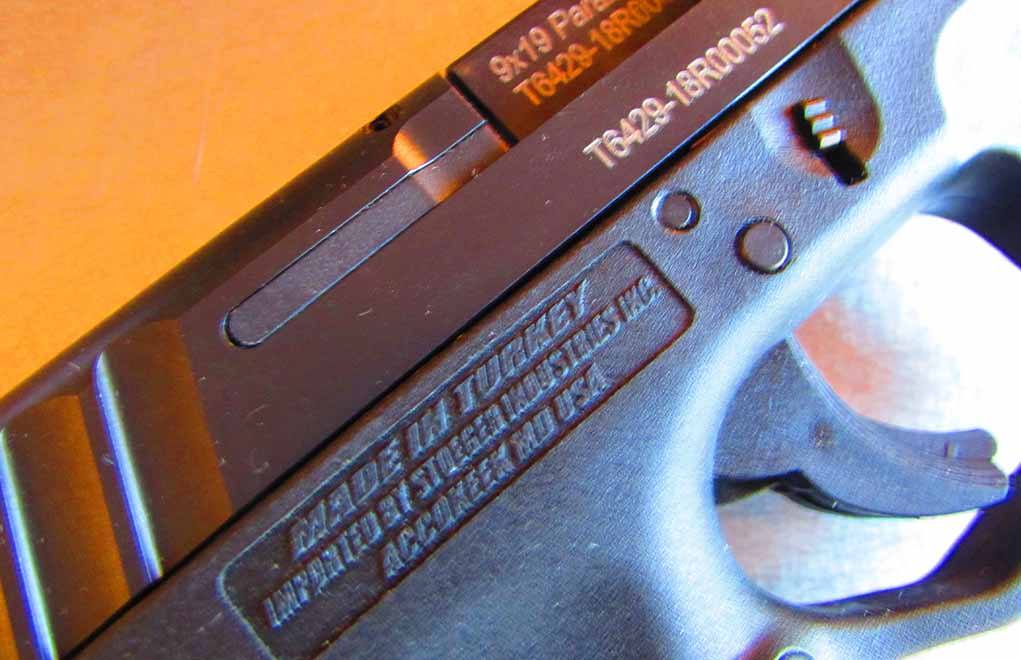
Stoeger. Yes, the company with those easy-on-the pocketbook shotguns has turned its attention yet again to pistols. And there was no lack of clucking at the last SHOT Show over the surprise move by the Turkish concern.
More than anything, this was simply due to the STR-9 coming so abruptly out of left field. Who would have expected a company that’s earned its daily bread arming waterfowlers and wingshooters to go 9mm, striker-fired and polymer-framed? On the other hand, at this point, if Daisy added a Glock clone next to its Red Ryder, would any jaws drop?
So, given the utter profusion of polymer guns, has Stoeger made a wise move with the STR-9? Or is it simply another face in a vast crowd? Given a few assets – including an incredible price – the smoothbore specialist might have a pistol that can shoot with the best of them.
An Echo Of Echoes
If the emanate catcher and baseball manager Yogi Berra were a gun guy, he might quip the STR-9 is “déjà vu all over again.” Certainly, most modern pistols for nearly 40 years are, almost all echoes of a certain Austrian gunmaker’s creations. But the STR-9 seems an echo of echoes. While most closely resembling a Glock 17 in profile, it appears an amalgam of other popular striker-fired pistols. Aside from the G17, the one that came to mind for me was Beretta’s striker-fired APX.
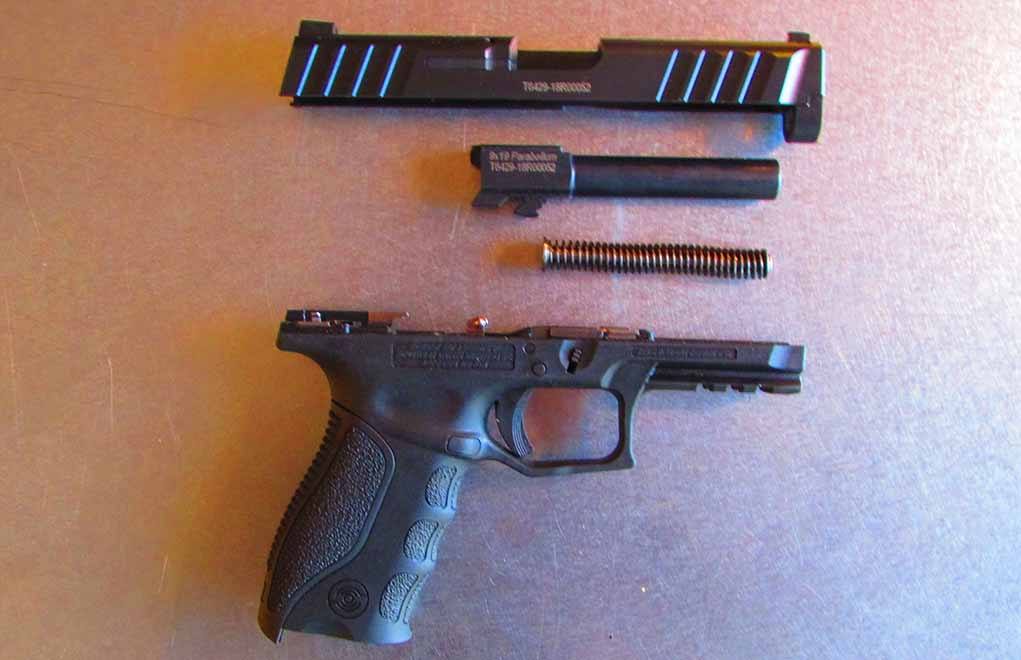
Breaking down similar to the Glock 17, the STR-9 has a very familiar feel. The internals too don’t throw any curveballs to those familiar with the Austrian pistol.
While not a dead ringer by any stretch of the imagination –the STR-9 is not modular – it’s similar enough to have a family resemblance. Makes sense, since both companies are under the Beretta Holdings umbrella.
This is particularly notable in the guns’ cocking serrations. Though the geometry and placement are different, their aggressiveness and amplitude are comparable. Along with that, the STR-9 boasts a similar grip rake, texturing and ergonomics to the Italian pistol.
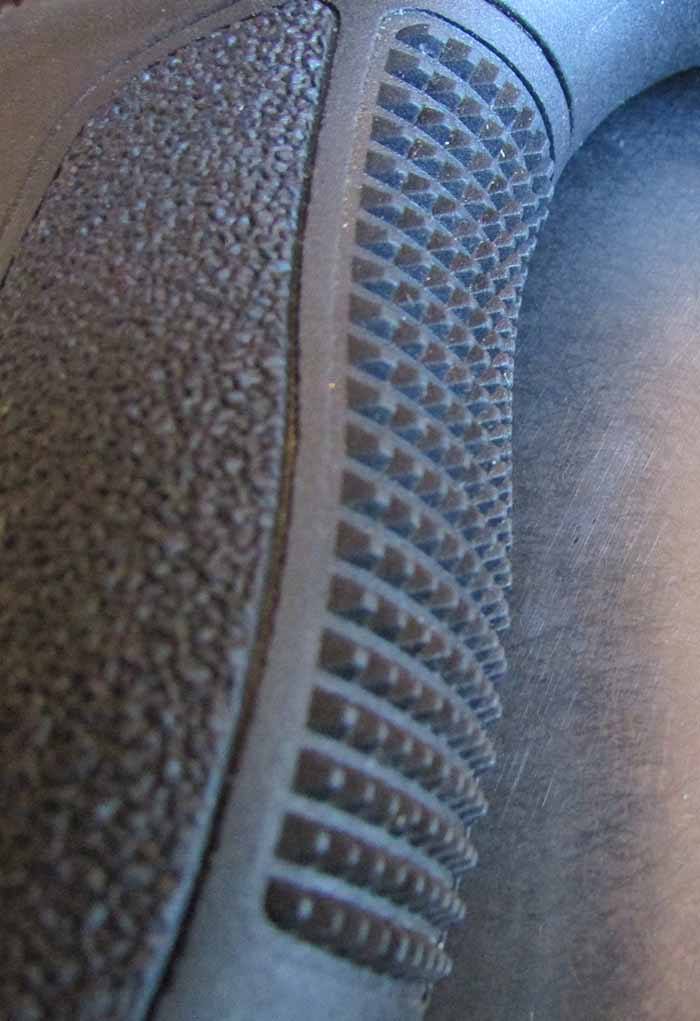
When it comes to the pistol’s handle, finger grooves, stippling and checkering on the backstrap all seem to mimic the APX. Though, there are a couple departures. Whereas the APX uses checkering in the finger grooves, Stoeger opted for the same pebble texturing found on the STR-9’s palm swell.
Furthermore, the 12-lines per inch checkering on the STR-9’s backstrap is more pronounced than the Beretta’s. As told in the Stoeger booth, the aggressiveness is intentional, keeping the pistol firmly in the hand when fired. Though, with a firm grip, the toothy backstrap teeters on almost too assertive (more on that later).
The STR-9’s backstrap has aggressive texturing, which can bite. However, it allots ultimate control over the pistol.
Of course, an interchangeable back-strap system is also part of the mix. But you can hardly say that mimics anything, except the whole of polymer-framed pistoldom nowadays.
On the other side of the coin, the STR-9 pistol is more Glock-like in its takedown system and internals. Very familiar for anyone who’s handled a Glock, you pull the STR-9’s trigger after pulling down on the slide-lock crossbar to remove the slide. Then, if you know your way around the Austrian pistol, it’s safe to say you’ll know your way around the Turkish one. Though different specs, their guts are spitting images.
The STR-9 stands on its own legs in some minute details. It has a shorter barrel and slide, and is a smidgen thinner than the APX and wider than the G17 – by tenths of an inch that is. And then there’s capacity. Whereas the other aforementioned pistols come with 17-round magazines, the STR-9 is a 15-round affair at present time.
STR-9 Affordability
Aside from its familiar form, the STR-9 got the rabble exceptionally roused with a different spec: price tag. Coming in a bit higher than first rumored, the pistol’s $329 MSRP is exceptional, even for a style of handgun already considered affordable. That probably translates to right around $300 on a store’s shelf.
The STR-9 won’t cost you an arm and a leg, however, the entry-level package isn’t filled with the amenities many have come to expect.
Some of the economics obviously stem from its place of origin. Turkish guns are renowned for running less than their competition. There’s also the factor of what you get when you buy into an STR-9. The rub is how the starting price nets you, by today’s standards, a stripped-down package.
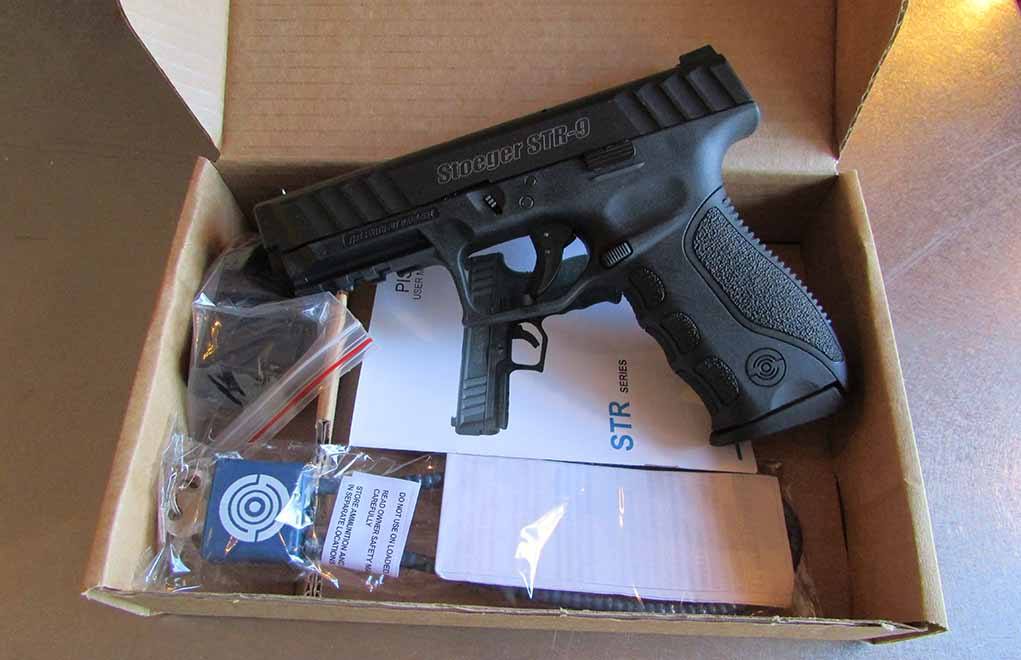
Forget the hard case, extra magazine and holster that many consider standard fare. Instead, the pistol comes neatly packaged in a corrugated cardboard box with one magazine, one-backstrap (medium), a reloader, Allen wrench, lock and instruction manual. Spartan, to say the least, but if you’re in the market for a concealed carry piece, it’s all you should require.
Stoeger offers two other packages: one complete with three magazines and three backstraps (small, medium and large) for $389 and a further upgraded model with all that and Tritium night sights that runs $449.
The On-Target STR-9
For testing, Stoeger graced me with the base package, which, if anything, was only disappointing for the fact reloading its one magazine took time away from shooting the STR-9. All in all, the pistol performed magnificently, especially considering its price.
Steel three-dot sights are dovetailed into the slide. The rear sight has a flat front, so you can rack the slide with it, if need be.
In the accuracy department, the Stoeger pistol vastly exceeds what the company is asking for it. Shooting off sandbags at 15 yards, the STR-9 produced groups around 1 ½ and just over 2 inches. It seemed to like Sig Sauer 124-grain V-Crown JHP the best as it produced the tightest group of the day.
It was equally on target shooting freestyle from 7 and 10 yards, consistently punching a ragged hole center mass. Any fliers I encountered fall squarely on my shoulders, not the STR-9.
Ammunition
Advertised Velocity
Best Group Inches
Average Group Inches
SIG Sauer 124 Grain V-Crown JHP
1,165
1.54
1.91
Speer Gold Dot 124-grain +P
1,220
1.69
1.98
Aguila 117-grain JHP
1,150
1.83
1.95
Federal Premium 150-grain HST JHP
900
2.01
2.27
Admirably, the STR-9 didn’t have a hiccup in my time with it. It chewed through Sig Sauer V-Crown, Federal HST, Speer Gold Dot and Aguila JHP like it had been starved for a week. This was no torture test, mind you, but its omnivorous appetite for disparate defensive ammo straight out of the box – with little more than a routine cleaning – was heartening.
Turkish Delight
One asset that makes the pistol eminently shootable is its trigger. No featherweight to start, right around 7 pounds, it broke in over the course of a couple hundred rounds. Yet, top to bottom, it was extremely crisp with zero play on its x-axis. The reset, too, is worth note. Not race-gun pithy, it was more than adequate for most practical shooting.
Plenty of extractor on the STR-9, which helps it chew through anything it’s fed.
Where the pistol really comes into its own is manipulation. One would hope this would be a quality, given the cocking serrations. However, it’s not simply the slide that deserves kudos, but also Stoeger’s attention to some other important features. The extra real estate on the slide release doesn’t leave you fumbling. Nor does the magazine release (reversible for lefties), which is tactilely easy to find, given its texturing and size.
To be fair, not everything was roses and bulleyes with the STR-9. The backstrap checkering, as mentioned before, has teeth. I felt it bite by the time I cracked into the Speer +P. Shooter judgment deserves some blame, as I held off on the hot stuff until near the end of the session.
The gun fit my hand well with the included medium backstrap. Still, I would have liked to have tried the smaller option for the sake of comfort. However, although the pistol nibbled at my palm, it stayed in place as promised.
Parting Shot
The STR-9 is hardly Stoeger’s first foray into handguns. The company boasted such models as the DA/SA Cougar 8000 (based on the Beretta pistol of the same name) and the rather slick American Eagle Luger. But after what feels like a lifetime since the release of the Cougar – the newer of the two pistols – handguns seemed an afterthought at Stoeger.
A nice sized magazine release and slide-lock lever make the STR-9 intuitive to manipulate. The trigger as well is solid, breaking around 7 pounds and very crisply.
That’s no longer the case. The STR-9 has all the makings of a performer, one at par with the mainstays of the striker-fired market. Moreover, given the price, there’s little doubt in my mind Stoeger has hit the mark with the pistol and found a place in the crowd. The STR-9 seems ideal as both a full-sized carry gun and a little something to knock-around range pistol. Either case, it’s fit for any budget.
Overall, the only disappointment I can really register is Stoeger waiting so long to get back into the pistol game.
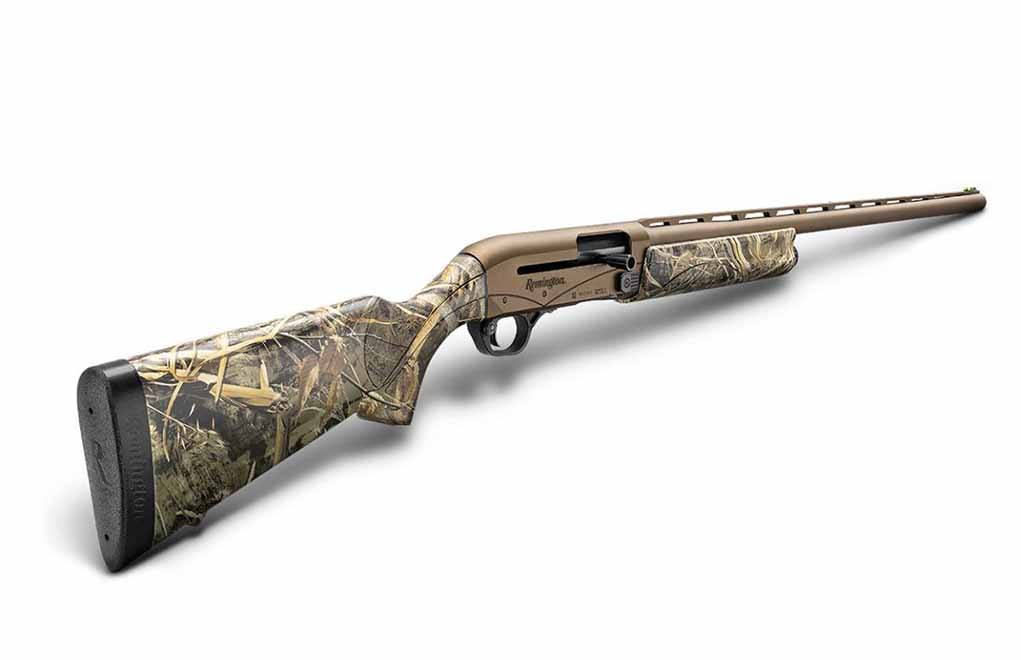
Remington has gone through ups and downs as of late. The renowned New York gunmaker declared bankruptcy in 2018 along with its sister brands, including DPMS, Marlin, Bushmaster and Dakota Arms. But it has come roaring back this year with a full slate of top rifles, handguns and shotguns. Jay Pinsky was lucky enough to get a peek at what the company cooked up, spending 3 days with the Remington staff at one of their ammunition facilities in Lonoke, Ark. And what the next generation of Remington guns was nothing short of spectacular. So, without further ado, here are four brand new for 2019 Remington shotguns.
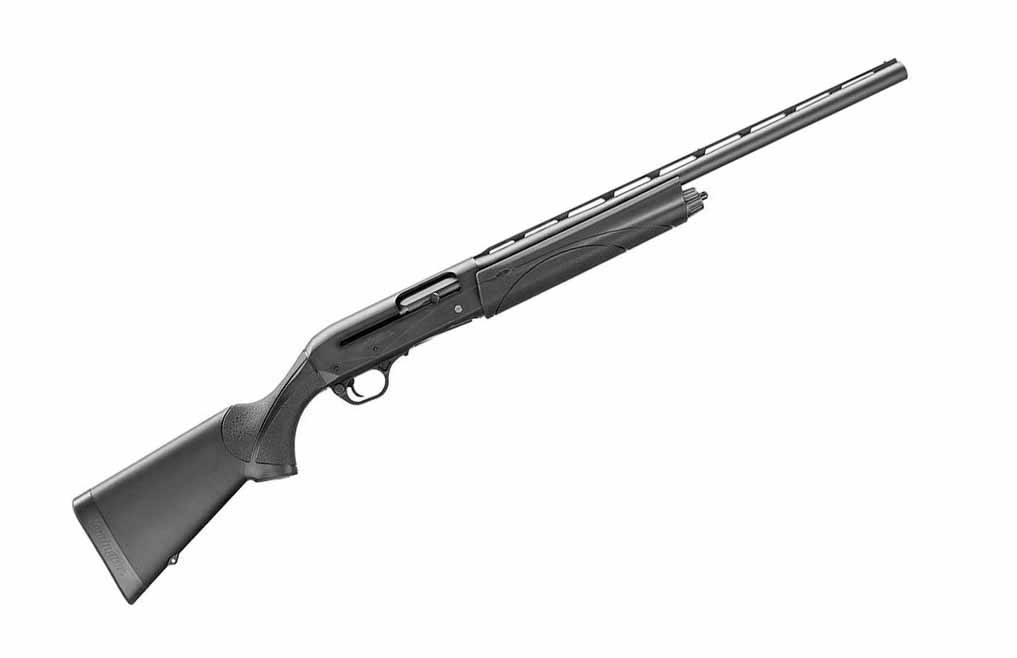
Remington V3 Compact
Remington’s popular V3 line of shotguns now comes in a compact version. The V3 Compact is engineered to balance the shotgun’s action and recoil cycle toward the middle of the gun, which translates into a soft-shooting and easy-to-manage multi-shot-capable platform — and that is exactly what any semi-automatic shotgun should strive to be. It comes in a matte black finish, a 1-inch length-of-pull shorter-than-standard stock with LOP adjustment shims included, a compact 21.5-inch Rem choke barrel, ivory front bead and a steel mid bead, Supercell+ recoil pad, and cast and drop adjustment shims. Available in 12 Gauge. MSRP: $915
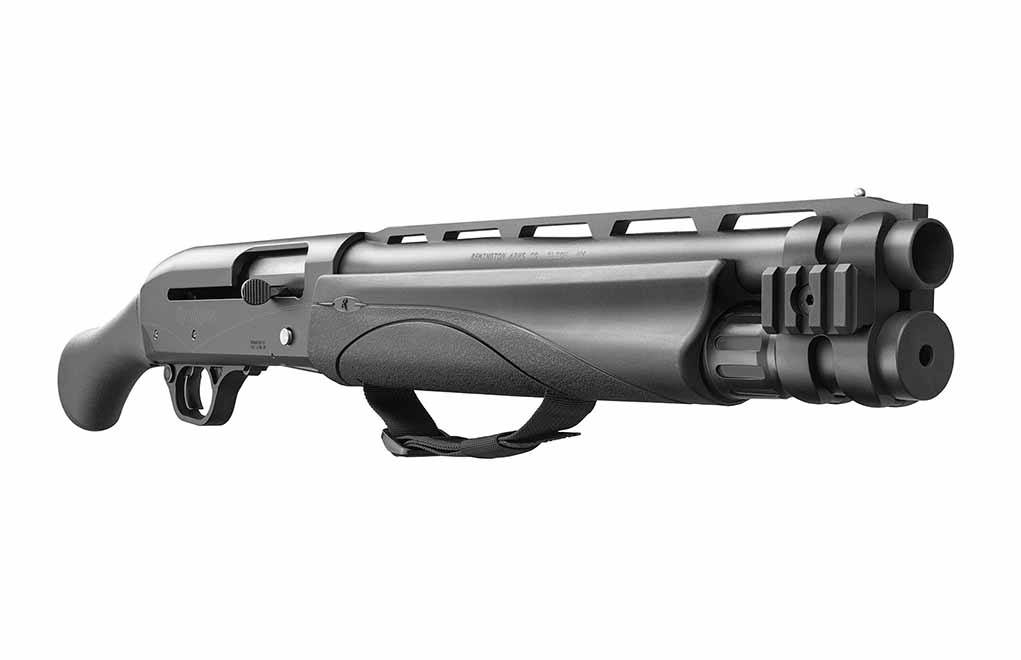
Remington V3 Tac-13
The V3 line of shotguns goes tactical with the V3 Tac-13, which features a 13-inch cylinder-bore barrel with a bead front sight, Shockwave Raptor pistol grip and synthetic forend with a retention strap, an extended magazine capacity of 5+1, is non-NFA and can manage heavy and light loads down to 1-ounce target loads. MSRP: $915
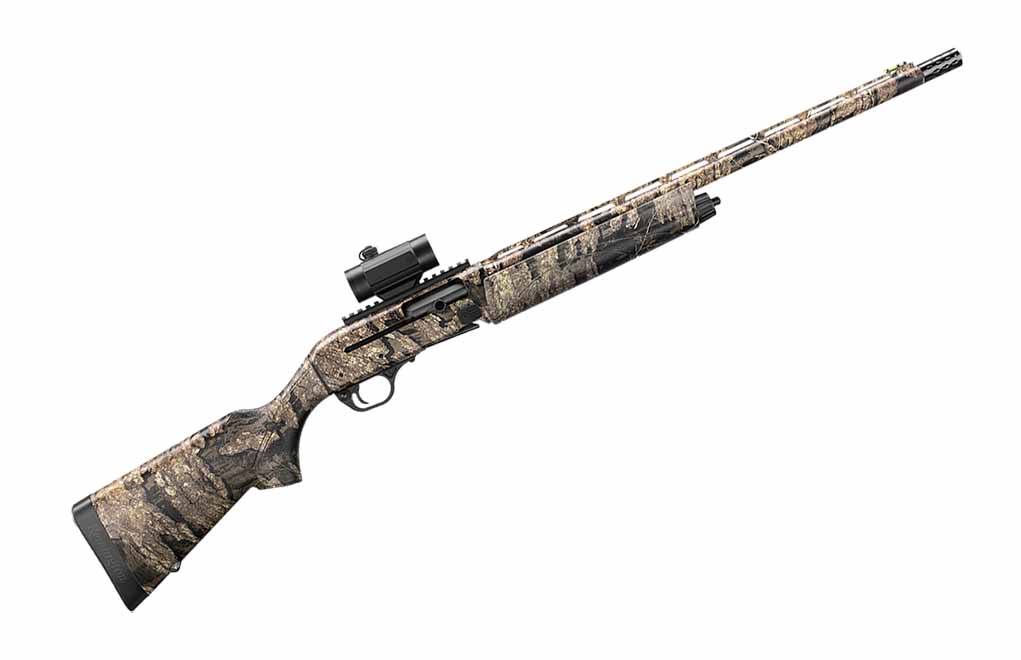
The V3 lineup gets a dedicated turkey gun for 2019 with the V3 Turkey Pro. The 12-gauge semi-automatic shotgun features useful turkey hunting tweaks, such as an oversized bolt handle, oversized safety, oversized bolt release, smoother opening loading port, full camouflage in Realtree Edge and comes with a Picatinny rail and TruGlo optic bore-sighted to 40 yards for easy patterning. MSRP: $1,195
Remington V3 Waterfowl Pro
Duck and goose hunters have their own dedicated V3 shotgun from Remington now, thanks to the V3 Waterfowl Pro. The 12-gauge comes in two waterfowl-specific camouflage patters: Realtree MAX5 and Mossy Oak Shadow Grass Blades. The shotgun features an oversized bolt handle, safety and bolt release; an improved opened loading port; Cerakoted receiver and barrel; Hi-Viz fiber-optic front sight and steel mid-bead; three extended black chokes; and a sling. MSRP: $1,195
This article originally appeared in the January 2019 issue of Gun Digest the Magazine.
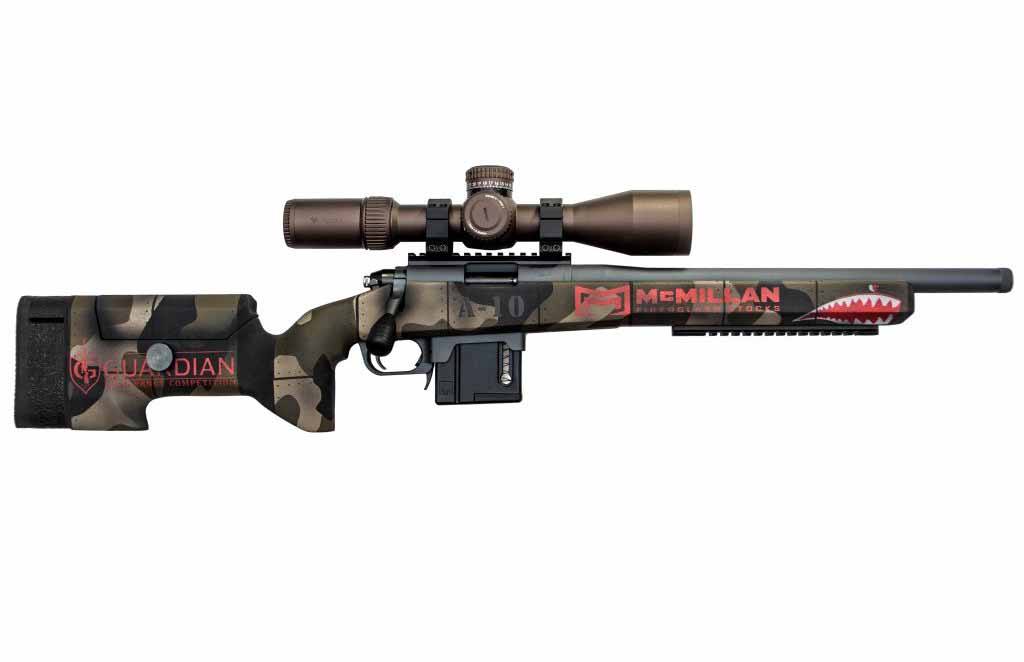
Thinned down and shortened in the right spots, the McMillan A-10 Stock gives small-framed shooters a tactical option.
McMillan A-10 Stock Specs:
Overall length of stock: 31 inches
Depth of action area: 1.9 inch (will vary depending on action model)
Max diameter action: 1.5 inch
Max diameter barrel: 1.450 inch str
Forearm width: 1.9 inch
Grip width: 1.8 inch
Buttstock width: 1.560 inch
Max L.O.P. with 1″ recoil pad: 13.5 inches (spacers can be added to lengthen LOP)
Drop at comb: adjustable cheek piece
With more women and youths trying their hands at long-range shooting, this makes sense.
Winnowed down in the right spots, the McMillan A-10 Stock should prove easier to handle smaller-framed shooters. In particular, it has a thinner forearm and a vertical grip positioned further forward to facilitate a more natural grip and finger placement. Most importantly, you can dial the length of pull all the way down to 12 inches.
At the same tick, McMillan didn’t skimp on the A-10’s tactical features, including a butt hook, shelf for consistent hand placement, adjustable cheek riser. The company offers three options to purchase the stock, a no-inlet version for $338, a basic inlet version (action and barrel canal outline) for $390 and a full inlet version (action, floorplate and barrel canal) for $548.
More from McMillan:
Phoenix, AZ – McMillan® Fiberglass Stocks – From top-level competition and long-range military applications to big-game hunting and recreational shooting, McMillan stocks are widely known for their accuracy-enhancing features and durable construction. McMillan’s all-new A-10 rifle stock, a PRS-style tactical stock designed for shooters of a smaller stature is now available to ship.
The A-10 incorporates many features of McMillan’s popular tactical stocks but in a compact format to facilitate the ergonomic needs of smaller-frame shooters. It combines a thinner forearm reminiscent of the A3-5, a butt hook similar to the A-5, and the sleek lines of the A-6 into a well-balanced tactical package. The vertical grip is positioned further forward than other A-series stocks, which allows for a more relaxed 90-degree trigger finger placement due to the shorter trigger reach—perfect for shooters with smaller hands. The grip also features a small shelf that serves as a hand stop to assist in consistent hand placement and reduce fatigue. To further accommodate smaller-frame shooters, the adjustable buttstock can deliver a length-of-pull as short as 12 inches. An adjustable cheek riser ensures optimal head alignment.
“We consulted many of the top shooters in the country throughout the R&D process of the A-10,” said Britainy McMillan, McMillan VP of Operations, “including Regina Milkovich, one of the top competitors in Precision Rifle Series competition. We wanted to know what the pros would like to see in a precision stock, and the result is the A-10. We feel this is the optimal rifle platform not only for women and other small-stature shooters, but especially for the youth shooter. The overall design, coupled with full adjustability in length-of-pull and cheek piece height, provides a stock that younger shooters can ‘grow with and not grow out of.’ We also went with the A-10 designation because this is a totally new stock in the McMillan lineup.”
McMillan offers fiberglass stocks across the tactical, hunting, benchrest, competition, and ultralight categories, with many customization options to fit the individual shooter, including adjustable butt plates, cheek pieces, colors, and finishes. Factory- inletted stocks are offered for most popular rifle configurations by an extensive list of leading firearm manufacturers or choose between flat top or basic inletting for gunsmith-level custom builds.
In addition to the all-new A-10 stock, other highlighted McMillan stocks are featured on the website, including the Adjustable A6, Adjustable A-5 Thumbhole, Sentry, A5-22, and the MC3—the industry’s first molded polymer stock inletted for a drop-in fit for the popular Remington 700 short- and long-action rifles.
For more information on the McMillan A-10 Stock, please visit www.mcmillanusa.com.
Take these three basic elements into consideration and you’ll go a long way in figuring out the best concealed carry pistol for you.
Going armed shouldn’t be a snap decision. Certainly, you may have a brush with violence that pushes you that direction or simply wake up one day and decide you need to take your own wellbeing into your hands. But even then, there are many considerations you must take into account before you strap a self-defense handgun onto your hip. You’ve got to weigh the importance of training, holster, ammunition, laws and a host of other factors to carry responsibly. You also need to figure out what gun will fit you best.
It sounds simple enough. Just read a few gun reviews and talk to the guy behind the gun counter and you’ll be all set. The reality is the process is much trickier. While a majority of today’s guns are well designed and made, there’s about an Army arsenal’s worth of makes and models. Not every one of them will fit your skill level, risk profile, style of carry, among other things.
Tune Into More Gun Digest TV:
The Elegant Power Of The Ruger Blackhawk Bisley .45 Colt
Most likely, you won’t get it right on the first try. Picking the perfect concealed carry revolver or pistol requires trial and error. But a better understanding of the factors that go into a defensive handgun can make the process quicker and more effective. In the above video, Richard Mann boils picking the right gun down to three essential elements:
Size
Weight
Capacity
Take these into account and apply them against the other variables in going armed and you’re certain to find the right concealed carry pistol.
Romantic and fast on the hunt, the double rifle nonetheless has its drawbacks well worth considering before staring down dangerous game.
What You Need To Consider In A Double Rifle:
It is, primarily, a close-quarter rifle, though there are means and methods that can be employed to stretch things out a bit further.
Figure out what species you plan to hunt, this will give you a handle on what caliber you’ll require.
Given some of the rare chamberings, you need to take ammunition availability into account or pay through the nose to shoot it.
These are generally large caliber rifles, therefore you must realistically appraise your personal recoil tolerance or suffer accuracy issues.
Many feature two triggers, in turn, require practice to master.
A proper stock fit is a must to manage recoil, milk the most speed out of the rifle and improve accuracy shot to shot.
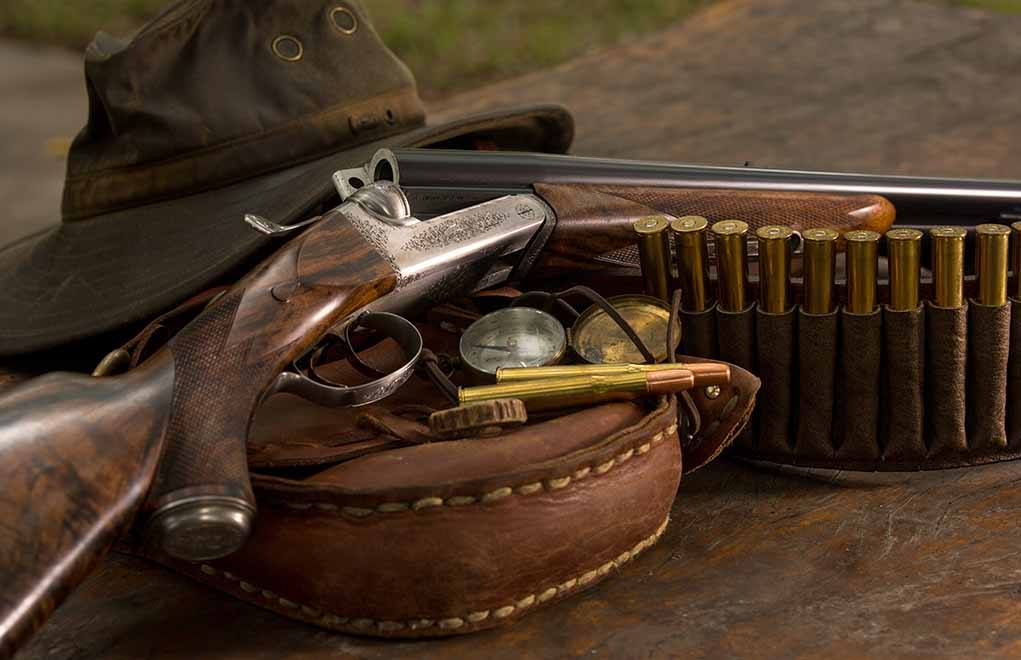
More likely than not, you’ve seen the images or read the stories: a broad-shouldered African professional hunter standing on the grassy plain, with a large-caliber double rifle over his shoulder, held just shy of the muzzle. It’s most definitely an iconic image, evoking a link to the Golden Era of Safari, and it’s an image that inspired me as a young hunter.
Double rifles certainly have a romantic appeal; they’re usually chambered for the larger Nitro Express calibers, they have clean lines and they offer a fast second shot for stopping dangerous game. While all of this may be true, there are some caveats that need to be addressed for those who may own or plan to own a double rifle. There are also many pleasures associated with owning a double, and I feel the two sides of the equation should be explained.
The Cartridges
While there are quite a few double rifles in smaller calibers — the various 7mms, some .30s and certainly the 8mms — it’s the double rifles in the dangerous-game calibers that garner the most attention. I consider the bare minimum bore diameter for dangerous game work to be the 9.3mm; while it’s not legal for dangerous game in all countries, it really is a capable diameter, offering 286- and sometimes 300-grain bullets at respectable velocities.
You’ll need to practice with your double, the author is at the range with a Heym .450/400 3-inch NE.
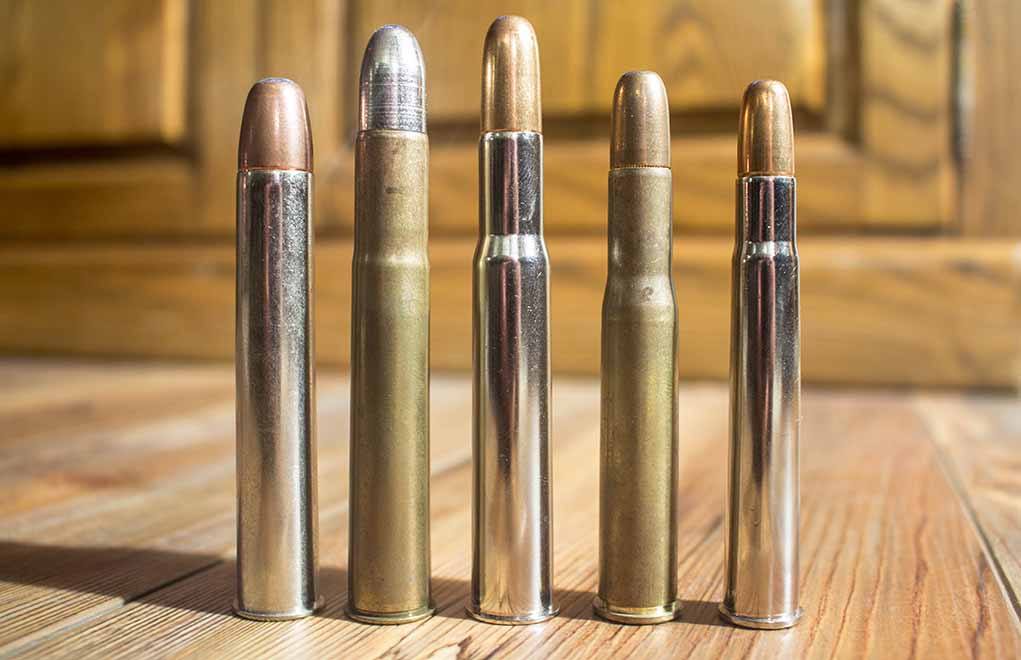
The dangerous-game calibers run up though the .577 and .600 Nitro Express, and for the truly brave, the .700 Nitro, though the latter two are certainly rarities. The most popular choices for the double rifles, which predominately house rimmed cartridges, are the .450/400 3-inch NE, the .450 NE, the .470 3¼-inch NE and the .500 3-inch NE, with the .375 Flanged and 9.3x74R pulling up the rear. There are many choices among used double rifles, including the .450 No. 2, .475 No. 2 Jeffery, .500/465 NE, as well as the .375 H&H Belted, .458 Winchester Magnum and other non-rimmed cartridges.
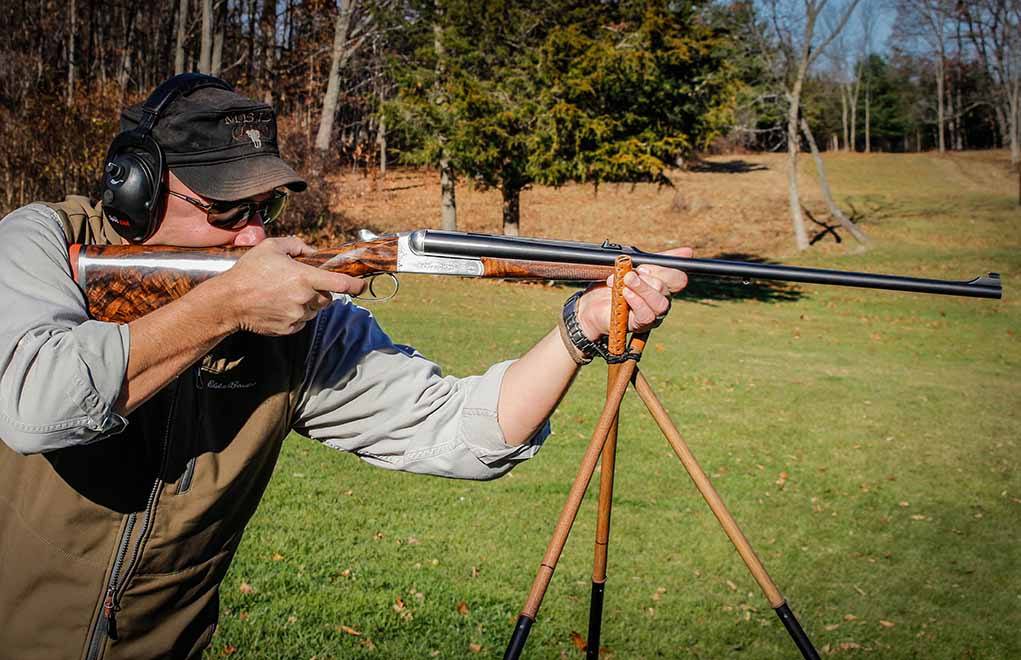
It’s these cartridges on the larger side of the spectrum that are relied upon to successfully hunt, and often stop, a dangerous animal. The majority have a rather sedate muzzle velocity, ranging from 2,050 fps (in the case of the .450/400 3-inch NE) up to 2,400 fps, with most aiming for the 2,150 fps mark. These mild velocities result in a rifle/cartridge combination that isn’t exactly stellar for long-range work, but that’s also not the role that the double rifle is trying to fill. The double rifle is, primarily, a close-quarter rifle, though there are means and methods that can be employed to stretch things out a bit further, but more about that in a moment.
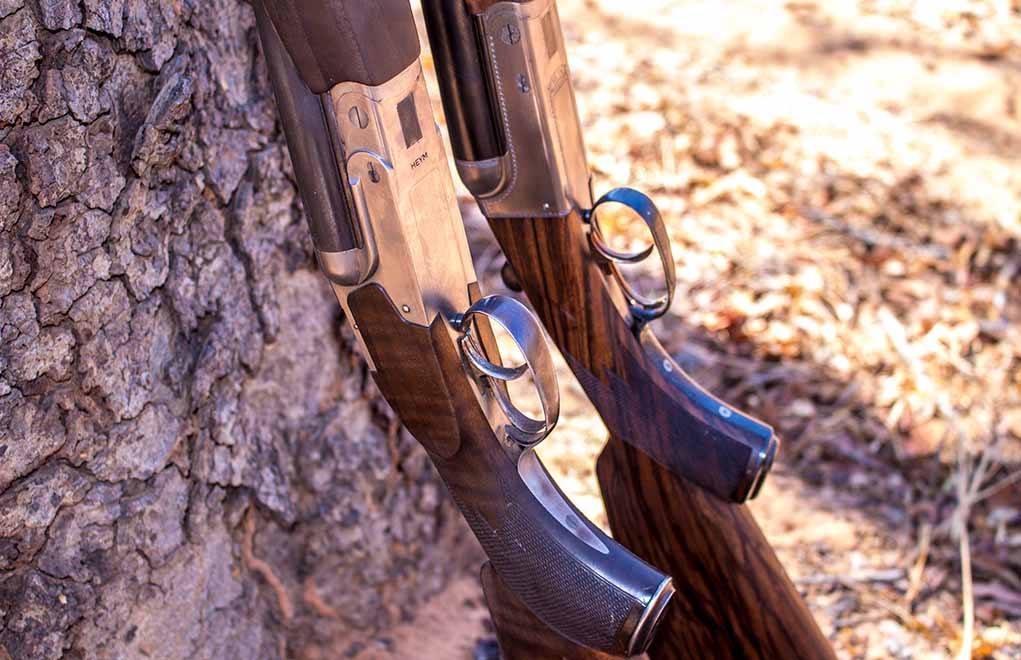
A pair of Heym rifles on safari; Brian van Blerk’s Heym 88B in .500 NE, and the author’s 89B in .470 NE.
Were I to offer advice on choosing a cartridge for your double rifle, I would have you look at the following points: potential species to be hunted, availability of good ammunition and your personal recoil limit. There’s no point in carrying a .500 NE if you can’t shoot it accurately; a .450/400 3-inch in the right place is worth ten .500s in the wrong place. Finding a great bargain on a .475 No. 2 Jefferys won’t do you much good if you can’t obtain reliable, quality ammunition for it. It’s also unwise to purchase a double rifle in a caliber which won’t effectively handle all of your hunting needs; if you’re serious about hunting elephant, choose a cartridge that will cleanly take the big pachyderms under any circumstance.
Hunt Out More Dangerous Game Rifles And Ammo Info:
The double rifle is a unique situation, when it comes to the performance of the ammunition. Unlike a single-barreled rifle — which will have a selection of varying bullet weights and velocities for which the sights or scope may be easily adjusted — the double rifle will be regulated for a particular bullet weight, at a specific velocity.
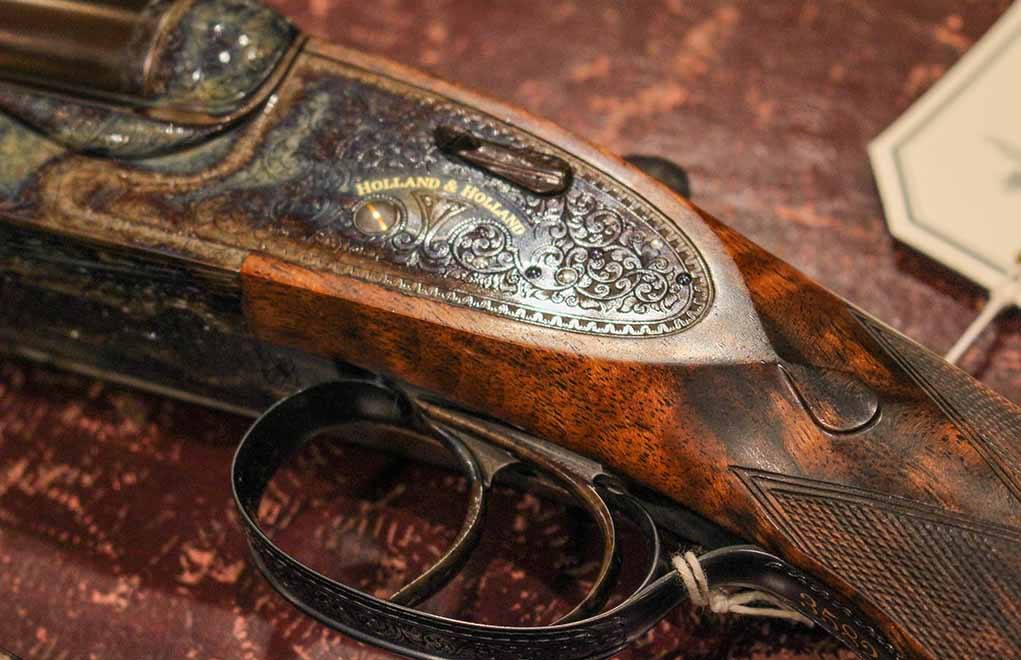
A handsome Holland & Holland sidelock.
For example, if your .470 NE was regulated with Hornady ammunition — as my Heym Model 89B was — it will give its best performance with that ammo, or other ammo that replicates the bullet weight/velocity formula. During the regulation process, the manufacturer will wire the two barrels together and carefully place small wedges between the barrels until they obtain the accuracy they desire; only then will the ribs be permanently attached. Some of the inexpensive rifle manufacturers have been known to adjust the crown of the muzzle to regulate the rifle; while some of them have shot well after that treatment, it’s not an ideal technique. Most double rifles are set to have the bullets cross paths at about 75 yards, giving acceptable accuracy out to 150 yards or so, in a perfect world.
When you receive your rifle, my advice is to shoot it with the regulation ammo — you may need to contact the manufacturer to find out what your rifle was regulated with — in order to establish a benchmark of your abilities with the rifle. At that point you’ll have a feel for what the rifle can do, and then start to experiment with other ammunition.
Please just keep in mind that if you have a .470 for example, it will almost always be regulated with 500-grain bullets, and you’re married to that bullet weight. My own .470 was regulated with Hornady ammo, and if I deviate from that velocity too much, the bullets start to strike a different place, and possibly show degradation in group spread.
Using my own rifle as an example, I shot the excellent Federal Premium load, featuring the 500-grain Trophy Bonded Bear Claw bullet. While the ammunition is wonderfully precise – I get 1-inch pairs from a right/left barrel combo — the velocities are a bit hotter, and the bullets print about 3 inches high and 3 inches left. This could be adjusted with a higher front sight and a drift of the rear sight, but I opted to use their component bullets to handload my ammunition at the velocity the rifle was regulated for. If you were ordering a new rifle, I think it wouldn’t be too difficult to specify which ammunition you’d like to use, and have the company regulate the rifle for that ammunition.
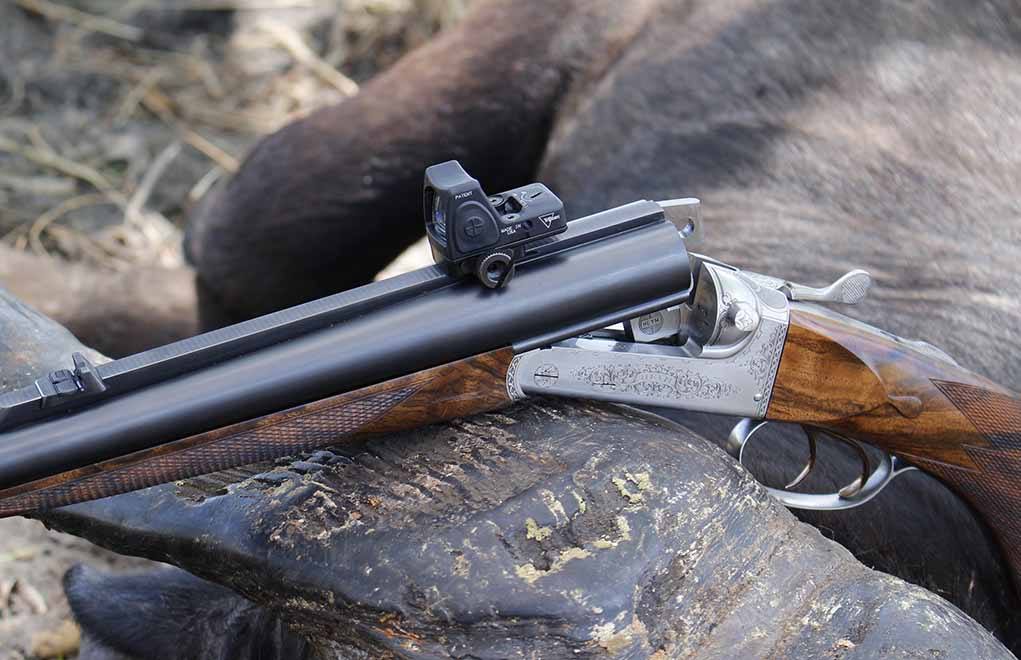
The author with PH Brian van Blerk, with a good Zimbabwean buffalo taken with an iron-sighted .470 NE double.
As a point of interest, the Hornady ammunition my rifle was regulated with clocks in a 2,095 fps instead of the target 2,150 fps, and that’s no issue at all. Subtle variations in barrel construction can have that same effect in any single-barreled rifle, and the double rifle is equally prone to that phenomenon.
Sighting Systems For Double Rifles
The classic double rifle is set up with iron sights in the safari express pattern, that is a 140-degree wide “V” rear sight, and a rather bold brass bead front sight; sometimes multiple rear leaves for extended distances will be provided. The timeless irons are still very effective, though they certainly have their limitations, especially as the shooter ages.
A good red dot, like the Trijicon RM09, makes the double rifle more versatile, allowing a single focal plane for older eyes.
Simply put, as we age, our ability to focus three objects simultaneously declines. In addition, the front bead covers nearly 10 inches at 100 yards. While I’ve used iron sights to take many dangerous game animals, the use of iron sights does come with a price: You will want to get closer, though that’s not always a terrible thing. Elephant hunting is a game played inside of 40 yards, but buffalo can offer shots a bit further.
Scoping a double rifle is not an impossibility, though I can attest to the fact that it does affect the balance of the rifle. One of the best benefits of the double rifle is the quick pointing nature, and scoping your double definitely gives it a different feel. At the very least, you’ll need a set of detachable mounts so you can access your iron sights. However, I feel that all the benefits of a scope on a double rifle can be achieved with the use of a red-dot, without any of the balance issues.
The bold front bead of the author’s Heym Model 89B .470 NE.
The red-dot sighting systems alleviate a couple of issues with a double rifle. One, it relives the user of the need for multiple focal planes, as you simply superimpose the red-dot into the aiming point. Two, the dot is available is varying diameters — my personal favorite is the Trijicon RMR RM09, which has a 1-MOA dot — so the issue of a big, brass bead covering much of the target is gone. That RM09 weighs a mere 1.2 ounces, and balance is not affected in the least.
I’ve used this sight on a Heym .470 for a huge-bodied water buffalo in Arnhemland, Australia, at just 17 paces, and it was wonderful. My buddy Chris Sells used the same rifle later that week to take another good bull at 125 yards. The Trijicon is not the only one on the market; I like the Docter sight as well. If you have issues with iron sights, I’d highly recommend either of those to solve the issue, while maintaining the clean lines and balance of your rifle.
Two Triggers, Different Mindset
A double rifle, according to some, was designed to be two rifles in one package; should something happen to one barrel/trigger, a hunter in the wilds of the world would still have the other to get him through. Most doubles will come equipped with two triggers, and a hunter who is unfamiliar with that setup — shotgunners are likely to be familiar with a two trigger setup — will have to do some practicing.
A vintage Rigby .470 NE, still going strong after many years of service.
Many shooters, the author included, will find themselves reaching for the front trigger again after firing that barrel. It will take practice — and I recommend a good set of snap caps for inexpensive practice — to develop the mechanics to reach for the second trigger each and every time. Some folks swear that using the back trigger (left barrel) first will prevent an accidental double discharge; however, that feels completely unnatural to me. Instead, I do a ton of snap cap drills, repetitively firing the combination of right barrel, then left barrel.
Rifle Fit
As with any hard-kicking dangerous game rifle, stock fit is paramount, but with a double rifle — designed for quick pointing, close-quarter work — you want that gun to come to shoulder like a fine shotgun. Almost all doubles are stocked for use with iron sights, and a proper double rifle will be stocked to fit your frame; I was measured for the stock of my Heym 89B, and it has quickly become an old friend.
Massaro with a Kreighoff 8x57R double rifle in Poland.
Proper stock fit invariably results in better shooting, and that counts when it comes to dangerous game in thick bush. A poor-fitting stock will ramp up felt recoil, and no matter how attractive the price, it can make an otherwise manageable cartridge rather uncomfortable. I personally feel that stock fit is one of the most important characteristics of a proper double rifle; if you have an opportunity, get measured by a knowledgeable salesman, and then handle a rifle that fits you well. I’d bet you’ll be shocked by the length of pull that fits you properly, and how natural the rifle feels.
The Brand Name Game
I’m not going to make any bones about it; I’m a Heym guy for a number of reasons: Their product is very well-designed — the German engineering is outstanding, and the modern revisions give the rifles a British feel — as well as affordable, as far as doubles go. If you are well-heeled enough, there are many British brand names that have an impeccable reputation.
For the author, two barrels equals twice the fun.
Holland & Holland, Westley Richards, John Rigby & Co., Purdey — all are excellent rifles. I’ve had the pleasure of shooting some of these, and they’re wonderful, even if some models come with six-figure price tags. There are more affordable choices, like Krieghoff, Merkel, Verney-Carron, Chapuis and others; if they fit you well and you’re comfortable with the appointments, they can give excellent service. All double rifles are expensive, and you usually get what you pay for, cosmetics aside.
Side Lock Vs. Box Lock
This argument has raged on among double rifle owners for decades, with no end in sight. Side locks are classy and strong, and box locks are simple and strong enough. Personally, I feel that the side lock rifles are wonderful to look at, but the additional cost puts them out of my price range.
Chris Sells of HeymUSA and Massaro, with a good Cape buffalo bull in Mozambique, taken with a Heym .450/400 3-inch.
The various box locks have more than proven themselves over the years, and when given extra reinforcement — like the Greener crossbolt added to the already strong Anson & Deeley box lock on the Heym 89B — can be stronger than needed.
Reloading For Double Rifles
Reloading for the doubles requires a different mindset. The consistency in technique is still important, but what you’re trying to do is take two barrels that are welded together and get them to strike the same point of impact. The mission is to obtain the velocity that the rifle was regulated for, and in my own case that was right around 2,000 fps. The chronograph will certainly be one of the most useful tools for this particular project, as the target will show you how the accuracy will come together as the target velocity is approached.
Generally speaking, you should make up several pairs of cartridges, from the lowest charge weight to the listed maximum, in 1-grain increments. As the velocity starts out low, with the lowest charge weight, the pair of bullets will print low on the target, with considerable separation. As the regulation velocity is approached, the pairs will print closer together and closer to the point of aim. The hotter loads will rise in comparison to point of aim, and then widen in the opposite direction.
This bull was taken seconds before his brother, two bulls with a right and a left.
Keeping an eye on the velocities and the consistency between the barrels, you will have to find the sweet spot for your chosen bullet/powder combination. It’s the synchronicity between the barrels that will matter more than the last few fps, as most of the cartridges offer enough energy to get the job done, even if velocities drop off 50 fps or so.
Powder choice can and will make a huge difference in certain cartridges as well, as I found in my .470 NE. Using the standard H4831SC for my safari handloads with Peregrine softpoints, I did achieve acceptable accuracy and velocities, driving the 500-grain slugs at 2,140 fps. However, after discussing the matter with Chris Sells of Heym, he steered me to Alliant’s Reloder 15. It uses much less powder — 87 to 90 grains of RL-15 compared to 110 to 112 grains of H4831SC — but the ultimate benefit was a considerable and much-appreciated reduction in recoil. The lighter charge weight in that big 3¼-inch case requires a filler to keep the powder evenly pressed against the primer; I used the Kynoch No. 2 wads.
Massaro with an Australian water buffalo, taken with a Heym .470 and a Trijicon red-dot.
Sparked by a Federal Gold Medal Match GM215M primer, I got two Peregrine softpoints to print about an inch apart at 100 yards, at 2,160 fps. Two Cape buffalo bulls in Zimbabwe’s Chirisa Safari Area did not approve of the effectiveness of this load. Backed up by Federal’s Trophy Bonded Sledgehammer solids, these soft-points provided all the accuracy I could ask for from an iron-sighted double and my 47-year old eyes.
Handloading your safari ammunition gives you both the ability to customize your ammunition, as well as reducing the financial burden. Factory ammunition for the Nitro Express cartridges isn’t cheap — sometimes in excess of ten dollars per round — and handloading cuts that in half, if not more.
In Conclusion
Is a double rifle a necessity for hunting dangerous game? No, even the largest game animals can be taken cleanly with a bolt action rifle, which is considerably more affordable. However, the history and panache of the double rifle is undeniable. There is no faster second shot on dangerous game than a double rifle; however, the bolt rifle offers a faster third shot. I love them both, but carrying my .470 into the jesse bush of Zimbabwe, or in the thick forests of Mozambique where elephant and buffalo are encountered at less than ten paces at times engenders all sorts of confidence.
Is the double rifle for everyone? Probably not, but new rifles are in high demand, and in my opinion the double rifle has survived the turmoil of the 1970s and early 80s, when Nitro Express ammunition was virtually unavailable and safari at its darkest hour. I know that I cherish every moment with my own double rifle, and every scratch on the stock and worn patch of bluing has become a fond memory to me.
Editor’s Note: This article originally appeared in the December 2018 issue of Gun Digest the Magazine.
Developed by Col. Jeff Cooper, the failure drill prepares you for defensive shooting situations where a center mass shot doesn’t do the job.
Sometimes center mass simply isn’t enough. Maybe the assailant is amped up on adrenaline or perhaps drugs, even wearing body armor. Whatever the case, a well-aimed shot to the chest doesn’t get the job done. In turn, you must be ready and capable to respond. This is why the failure drill should be part of any armed citizen’s training.
Developed by Col. Jeff Cooper, and sometimes known as the “Mozambique Drill,” the exercise sharpens you up for circumstances when center mass shots fail to neutralize a threat. As the story goes, the drill was inspired by Mike Rousseau’s experience in the Mozambican War of Independence. Running into an armed guerrilla soldier, the mercenary performed a double tap, delivering two shots to the mans’ chest. Despite the new orifices, the man continued coming, until Rousseau attempted a head shot. Needless to say, since the mercenary was able to relay the story the final shot did the trick.
Tune Into More Gun Digest TV:
The Elegant Power Of The Ruger Blackhawk Bisley .45 Colt
The failure drill attempts to recreate this feat and while you may never use it, it’s certainly a potent arrow in your quiver. Essentially, you deliver two shots to the chest, then one to the head. Sounds simple, but executing it in a timely manner is a challenge – even for seasoned shooters. And it’s most certainly a transition you need to practice on at the range to make effective in real life. Headshots are notoriously difficult, particularly in the flash of a self-defense situation. Not exactly something you want to just wing. Thus, you should definitely find time to work the failure drill.
The Model 1934 is still in high demand by both collectors and pistol shooters through 84 years of service.
Why the Beretta Model 1934 remains popular with collectors:
The main service pistol of the Italian armed forces in World War II and was also used by some military units in Germany, Romania and Finland.
Chambered 9mm Corto, what we know as .380 ACP.
Design evolved from the Model 1915/17, which saw service in World War I.
Standard blowback design with a single-action trigger.
The barrel is 3¾ inches, the weight is 23½ ounces and it utilizes a 7-round magazine.
More than a million Model 1934s were manufactured between 1934 and 1992.
The Model 1934 is one of the best-known Beretta pistols. During World War II, it was the main service pistol of the Italian armed forces and was also used by some military units in Germany, Romania and Finland. After the war, the M1934 continued to serve Italy’s military into the 1960s, and with the Italian police through the 1970s.
The “XX” marking refers to the 20th year of the Italian Fascist Regime, 1942.
The Model 1934 was chambered for the 9mm Corto, which we know as the .380 ACP. Relatively short and compact, especially when compared to the Government Model 1911 .45 Auto, captured 1934s were popular with U.S. GIs as a back-up gun on the battlefield. Many of these pistols were brought to the United States after the war as souvenirs.
A post-war version of the 1934 model was known as the Cougar. Those made for export to the United States have the “Cougar” name on the pistol and most were imported by the now-defunct J.L. Galef Company. Some of the later models were marked P.B. 1966, the “P.B.” for Pietro Beretta.
The Evolution Of The Model 1934
The M1934 design evolved from the Model 1915/17, which saw service in World War I. It was the first of several later Beretta models to feature an open top slide, such as what is still seen on the famous Model 92 and all its variations. The Model 1915 was chambered for the 9mm Glisenti cartridge, also known as the Mo. 910, which was essentially a 9mm Luger Parabellum downloaded to operate safely in the small frame of the 1915. It failed to function reliably enough to suit the Italian military brass, so it was replaced by an improved design known as the Model 17, chambered for the 7.65 (.32 ACP).
Smooth lines and a comfortable grip still make the M1934 a popular model after almost 85 years.
It should be remembered that, in those days, “stopping power” was not a concern with most European armies. The handgun was more a symbol of authority than a serious weapon, and John Browning’s very popular little .32 ACP was very popular in military and police circles throughout the Continent.
In 1934, the Italian government, now in the 12th year of Benito Mussolini’s Fascist regime, decided to adopt a handgun that was to be used by all branches of the armed forces. This latest evolution of the 1915 open-top design was chambered for the .380 (9x17mm Corto) and given the Model 1934 designation. A .32 variant was known as the Model 1935 and was preferred by the Italian air force because of its slightly lighter weight.
The 1934/1935 is a standard blowback design with a single-action trigger. Sights are fixed and the overall length is 6 inches. The barrel is 3¾ inches and the weight is 23½ ounces. Magazine capacity is seven rounds, and the grips are black plastic with steel backing. Most military models have a Parkerized finish, while civilian pistols feature a blue finish. A thumb safety on the left side of the frame, above the trigger, also acts as a slide lock to be used to disassemble the pistol.
Figuring Out Your M1934
Model 1934/35s made during the Fascist Era had several various markings that are of interest to collectors. The Fascist Era began in October of 1922, and pistols made after that date sometimes were marked in Roman Numerals indicating the year of the era. For example, a pistol made in 1939 could be marked XVII or XVIII, depending on the time of year it was manufactured. Standard Arabic numerals might also be stamped on the guns.
The familiar open-top slide, shown here on a modern day M9, has long been a familiar Beretta feature. It started with the Model 1915 and was perfected in the M1934.
Other markings for the different branches of the Italian armed forces include RE (Regio Esercito) for the army, RM (Regia Marina) for the navy and RA (Regina Aeronautica) for the air force. The air force models were also marked with an eagle wearing a Royal Crown. Pistols made for the Italian police forces were marked PS (Publica Sicurezza). Those made for the Romanian military have the caliber marked as 9mm Scurt (for “short”), and for Finland forces, SA (Suomen Armeja) for “Finish Army.”
More than a million Model 1934s were manufactured between 1934 and 1992, and it remains one of the most popular WWII pistols with shooters and collectors worldwide. The size competes well with more modern models for concealed carry, and the grip is a nice fit for most hands, making it more comfortable to shoot than many .380s. The classic Beretta open-top design reduces the weight of the slide, which also results in less felt recoil. All in all, it’s a fine pistol that still has its niche 84 years after its introduction.
Editor’s Note: This article originally appeared in the January 2019 issue of Gun Digest the Magazine.
Looking to go armed, but are stuck in the weeds as to what to arm yourself with? Here are 20 of the best concealed carry gun options that will keep you on the defensive.