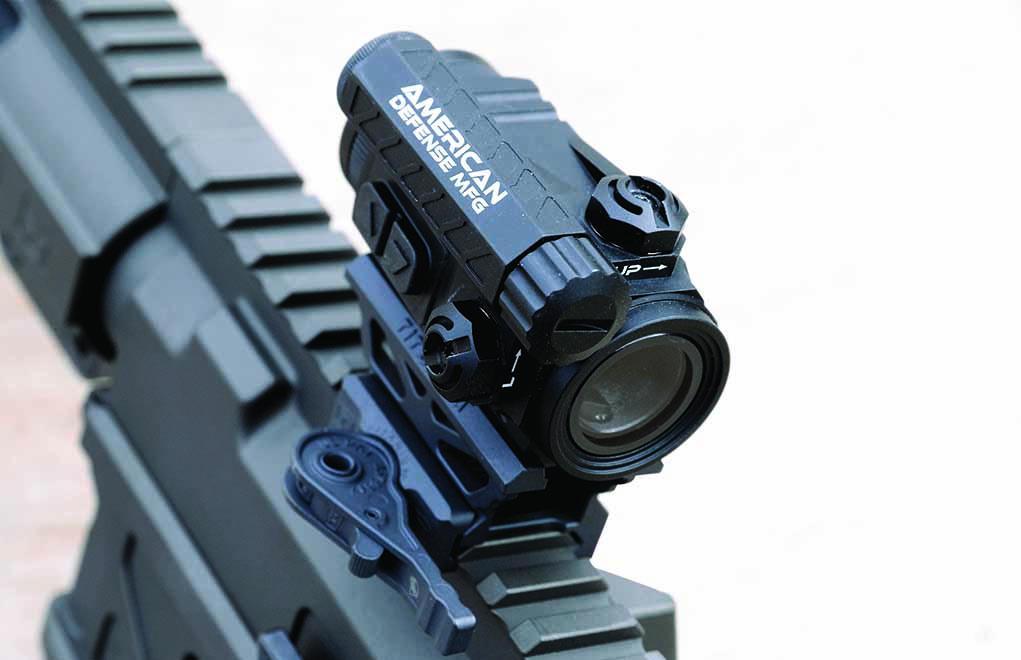
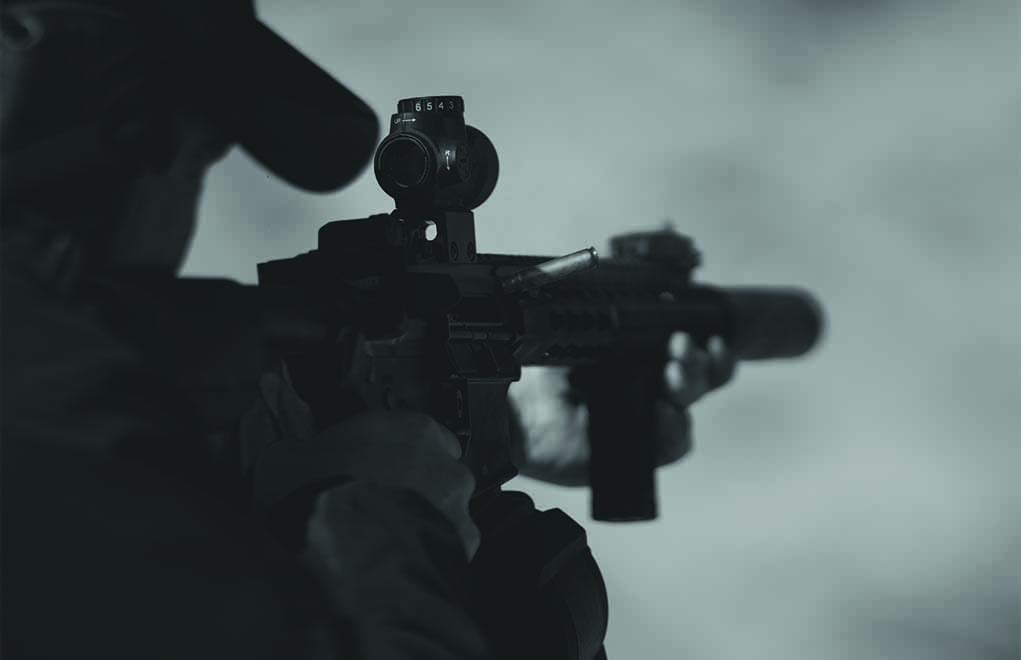
Already known for their mounts, American Defense Manufacturing has gone the whole hog with the Spek red-dot.
How The ADM Spek Is On Target:
1X magnification facilitates shooting with both eyes open.
2 MOA dot makes for quick target transition and more precise shots.
Weighs in at a scant 3.9 ounce.
Runs 5 years off a single AAA battery.
American Defense Manufacturing (ADM) has been making optics mounts for some years now. I’ve got red-dot and magnifying optics mounts on rifles, and I’ve always been pleased with their performance.
The system uses a throw lever with a built-in locking tab, so you aren’t depending solely on friction or the cam geometry of the lever to keep it closed. And, the lever tightness can readily be adjusted. All of this can be done without tools—no Allen wrenches or tiny socket wrenches to adjust this or that. The company even manages to shave off a bit more weight by using titanium in the construction of some of the mounts. However, titanium costs, and you don’t save weight by saving money. That’s life, folks.
The Spek, with the throw lever and its locking button in view—and all from one source, pre-assembled!
But now, ADM is also offering ADM-branded red-dots to go with its mounts.
ADM Spek Specs
The ADM Spek is a 1X red-dot that comes with a 2 MOA dot. There are the expected 10 power settings, and it runs on a single AAA battery. Now, the current standard is either an AA or a lithium 123 battery, but the AAA has its advantages—mainly, weight and size. If you’re crafting a red-dot optic that weighs 3.9 ounces with an AAA battery, how much more weight will it have if you jump up to an AA or a 123? It isn’t just the battery; it’s also the extra weight of the larger housing.
The rated life of the AAA battery in the Spek with the power setting at “5” is five years. So basically, if you install the battery and leave it set at 5, you can change the battery during each presidential election cycle and not have to worry about it running out on you. (Five years? I’ll lose the package that has the other three or seven AAA batteries before then!)
Because ADM makes mounts, you can order your Spek already installed in a mount; and, you have choices. You can have a low mount, a lower-third co-witness or a co-witness. Additionally, you have all three choices in both aluminum or titanium-upgraded mounts. As I mentioned, titanium is extra, adding a whopping $56 to the cost.
Zero In On Aiming Solutions:
Best Concealed Carry Optics: Red Dot, Green Dot Or Iron Sights?
I had a chance to give a Spek-equipped rifle a test run at the 2020 SHOT Show (as it turned out, maybe five minutes before COVID-19 overran the Las Vegas area), and I was pleasantly entertained. The dot was crisp, and I could dial it up enough for it to be seen in the bright desert sun, even against the sandy background.
Mounting is easy: There’s a button on the throw lever. Press the button (once you get a feel for it, it becomes second nature. The first few times, you might have to actually pay attention) and rotate the lever forward.
With the jaws open, place the mount over the rail of your AR (or other firearm). You might have to tip it a bit to get the jaws to clear. That’s normal.
The ADM Spek, mounted on a rifle, showing the adjustable lock nut on the far side from the throw lever.
Then, rotate the lever back, and you’ll feel it cam tightly against the rail. Once the lever comes down flush, the lock button will cam itself into position and keep the throw lever from opening.
Spek Mount Adjustment
If you find that your rifle has an out-of-spec rail, here’s how to adjust the mount:
Do you see the nut on the far side of the mount—the eight-sided nut? If your mount is too tight or too loose, open the throw lever all the way and then press it in toward the base. When you do this, you’ll see the lock nut on the other side get pushed out of its seat. You can now hand-turn (no need for tools) to tighten or loosen the fit. Clockwise tightens; counter-clockwise loosens.
Adjust it a flat or two and then check the fit on the rail. There’s no need to hurry here. Get it so that it’s hand-tight on the rail. Too tight, and you’ll need a pry bar to open it (once you press the lock button, of course). Too loose risks adding vibration, which means a wandering zero, battered parts … and a short service life for your optic.
There you have it: a ready-to-go red-dot optic, complete in its own base—one that doesn’t require any tools to mount or adjust.
Editor’s Note: This article originally appeared in the 2021 Long-Range Shooting issue of Gun Digest the Magazine.
Rimfire ammunition tailored for self-defense? Federal is shooting for it with .22 LR Punch ammo.
How Federal Tailors .22LR Punch For Self-Defense:
It’s 29-grain bullet is engineered to leave a 2-inch barrel at 1,070 fps.
Bullet’s profiel and composition designed for maximum penetration and minimal deformation.
Nickel-plated case ensures smooth feeding in nearly any handgun or rifle.
Passions run high discussing the merits of the little .22 LR for self-defense. One side contends the rimfire is too small and too weak to reliably neutralize the threat. While the other claims, despite its shortcomings the caliber is one any person can master to deliver accuracy and deadly fire. (If you’re interested in more on this debate, Richard Mann wrote an in-depth article on .22 LR for self-defense.) While it certainly won’t end the debate, one of the nation’s largest ammunition manufacturers is siding with the latter group, introducing a .22 LR load specially tailored for defensive use.
Federal Premium recently unveiled .22 LR Punch ammunition, an option the company calls the first viable self-defense option in the caliber.
“Self-defense isn’t one size fits all. So, whether shooters want to carry a .22 LR handgun as a backup gun, do not feel comfortable with centerfire pistols, or simply want to get more versatility from a rimfire handgun,” said Federal’s Rimfire Product Manager, Dan Compton, “Punch makes the .22 LR cartridge a viable defensive choice for the first time ever.”
Federal Punch Ammo Basics
Most ammo geeks are familiar with the Federal’s Punch line. Released in 2020, the defensive handgun ammunition was specifically designed for the commercial market, a break from the past. Previously, all Federal’s defensive ammo was developed with law enforcement in mind. The difference, other lines are engineered to pass FBI barrier tests, while Punch was optimized for the FBI bare gel and covered gel penetration tests. Two factors spurred this move: cost per round and likely scenarios faced by average armed citizens. The thought is, every day CCW holders don’t often shoot through car doors.
Among the main changes found in Punch ammo is the use of a softer lead core that didn’t need to hold together through plywood, windshields and sheet metal. Though it’s not downloaded. Velocities are what you’d expect for defensive ammo. Only, it has gone through rigorous laboratory testing required for law enforcement fodder.
22 LR Punch Features & Performance
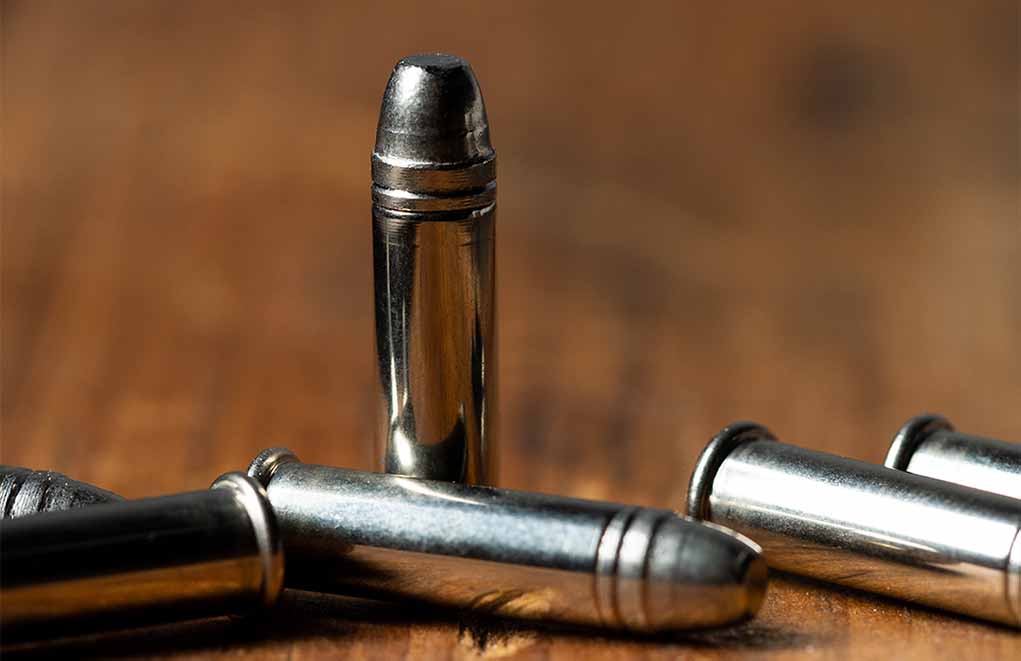
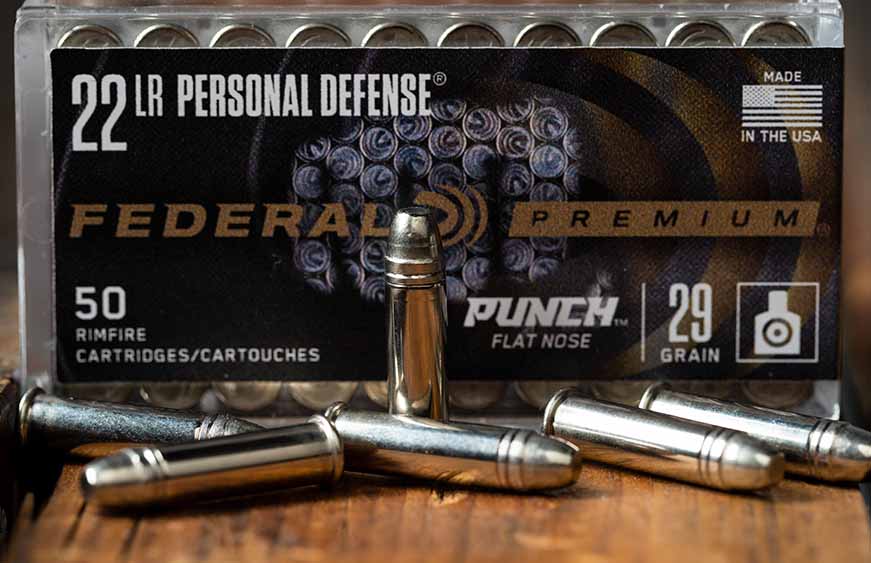
As to the .22 LR Punch, it’s pretty unique, particularly it’s projectile. It utilizes a 29-grain nickel-plated lead-core bullet, with a flat nose and a heavy jacket. Essentially, the bullet is designed to hang together and minimally expand, thus increasing penetration depth. As to ensuring the bullet bores an appropriate distance, Federal soups up .22 LR Punch, with the ammo listed at 1,070 fps from a 2-inch barrel. Even if for those who don’t subscribe to the rimfire as an appropriate self-defense option, the offering is intriguing nonetheless.
What does it cost? Federal lists the full retail price of .22 LR Punch at $9.99 for a box of 50. Pretty cheap to upgrade a rimfire for a self-defense role.
For more information on Federal .22 LR Punch, please visit federalpremium.com.
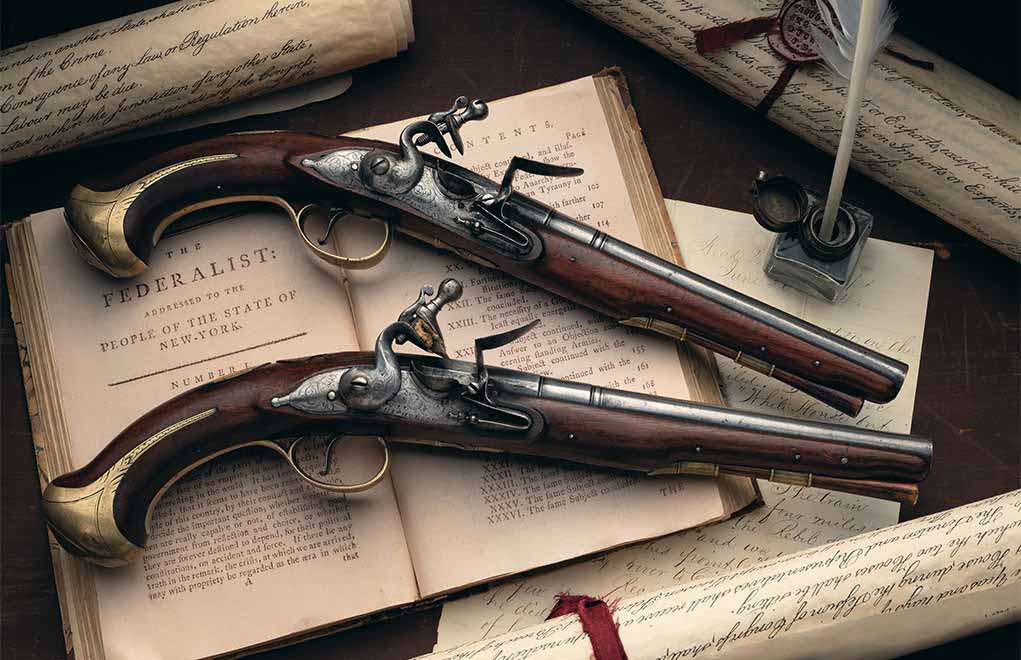
With a history pre-dating the founding of the country, Alexander Hamilton’s pistols are expected to draw a record-breaking price.
Why Alexander Hamilton’s Pistols Are Nearly Priceless:
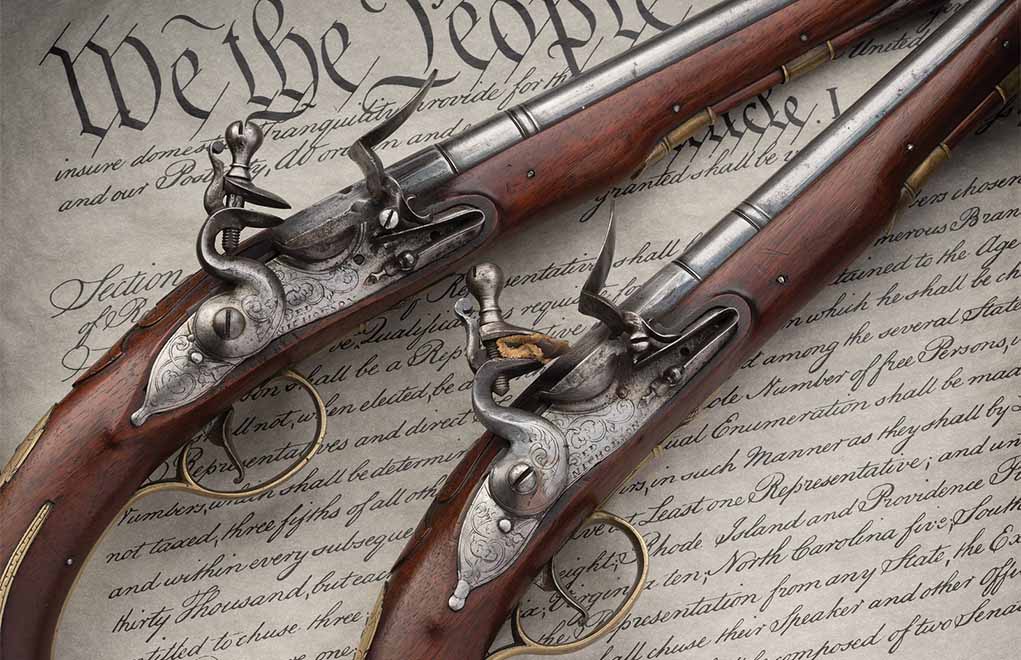
Pistols are described as 9-inch barreled .58-caliber flintlocks with a bright blue finish and walnut stocks.
Expected to sell for between $1 and $3.5 million.
Pistols were a honeymoon gift to then Colonel Hamilton by his father-in-law General Philip Schuyler.
Were Hamilton’s personal sidearms during the Revolutionary War.
More so than the guns themselves, their provenance drives the price. Prove a heater was once in some historical person’s hand and it goes from mere specimen to peerless artifact faster than you can say John Hancock. Or in this case, Alexander Hamilton.
A pair of the Founding Father’s flintlock pistols are set for the block at the Rock Island Auction Company’s May 14-16 Premier sale. And already, the renowned marketplace for some of the world’s rarest firearms anticipates a blockbuster take for the first Tresurary Secratary’s muzzleloaders. In a press release, Rock Island foresees the pistols raking in between $1 million and $3.5 million, putting the guns in the running for a world record for highest priced firearms ever publicly sold. Not surprising given the legacy of the flintlocks and the renewed interest in Hamilton, since the popular musical bearing his name.
As expected, the guns have an enthralling history. The pistols were a honeymoon gift to then Colonel Hamilton by his father-in-law General Philip Schuyler during the Revolutionary War, sometime after the Battle of Saratoga. According to the company, the flintlocks were Schuyler’s personal arms and saw action with the officer and the eventual United States Senator in the French and Indian War that preceded the American Revolution. Though not officially documented, there is a likelihood the guns were with Hamilton in his triumph at the Siege of Yorktown, where his battalion of light infantry played a key role in forcing the British to surrender, thus leading to the end of the war.
“These pistols represent Hamilton’s physical ability to wage war on the enemy. They are his physical ability to achieve revolution and start the republic,” RIAC President Kevin Hogan said. “However, they also transcend arms-specific collecting. They are an American institution in and of themselves and an intimate way to be a part of the past.”
The pistols were passed down through four generations of the Hamilton family until in 1942 they were sold to pioneering firearms collector Robert Abels. Rock Island does not list the present cosigner, though he provides affidavits of ownership through the Hamilton family to contemporary owners, one of which happened to be former U.S. Secretary of the Treasury William E. Simon. Auctioned alongside the pistols are the epaulettes Hamilton wore as an officer.
As for the pistols themselves, they are described as 9-inch barreled .58-caliber flintlocks with a bright blue finish and walnut stocks. As pointed out in Rock Island’s write-up, the guns are incredibly austere with very sparse ornamentation. Logical, given the pistols were not presented to Hamilton as a mark of achievement or rank, but to wage war. In short, they are a fighting man’s guns.
This is not the first historically significant firearm to pass through Rock Island Auction Company. Previously, the auction house sold very desirable guns owned by former United States Presidents, including John F. Kennedy’s M1 Garand, Ronald Ragan’s Colt revolvers and Theodore Roosevelt’s factory-engraved Colt Single-Action Army. The last set a world record price for a public-sale firearm, when in 2020 it sold for an unprecedented $1.46-million. Impressive as that is, there’s a fair chance it won’t hold a candle to what Hamilton’s flintlocks will draw when the gavel drops.
Does your gun oil bring out the best in your firearms?
When was the last time you gave as much attention to your gun oil as your ammunition, magazines, optics or lights? Because lube can’t attach to a Picatinny rail, get laser-etched or dipped in the latest absolute invisibility camo pattern, probably very little.
When was the last time you considered what’s in your lubricant and how that impacts the performance of your firearm? Probably the same answer.
100-Year-Old Lubricant
Sadly, many American firearm owners lubricate their guns with “what they’ve always used” and live with its shortcomings. In fact, the top-selling gun oil in the United States was introduced in 1913—before World War I! It was designed first and foremost to prevent rust; lubrication was a distant second, and cleaning only happened with aggressive scraping and additional harsh chemicals.
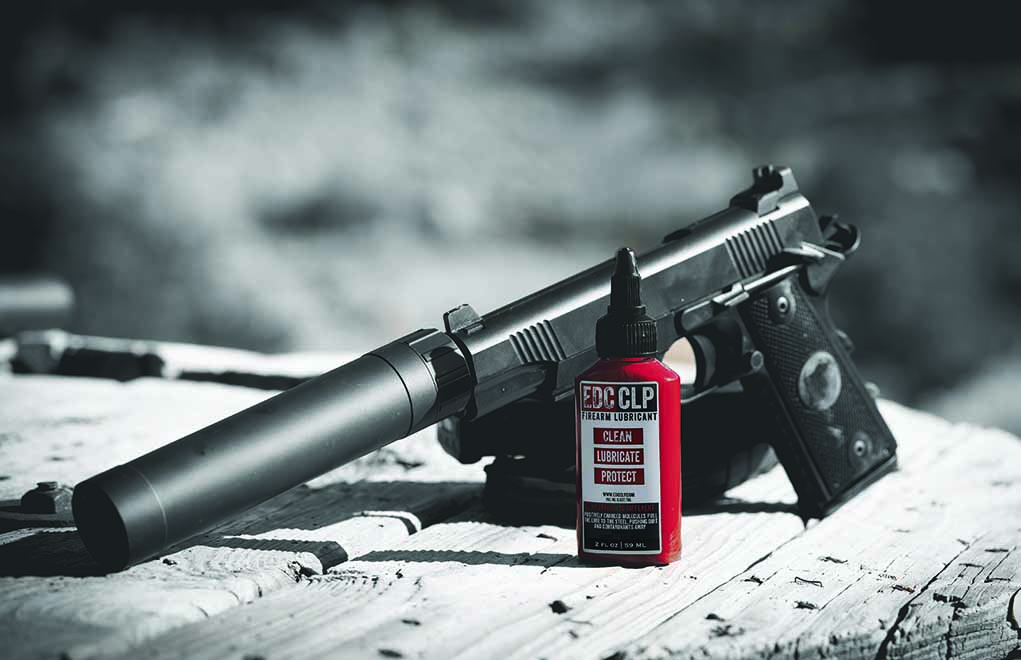
Used more broadly today than at any time in history, a suppressor’s downsides comprise the extra gases and heat channeled back through the action. How does your typical lubricant hold up when you’re running a can?
However, this historical “blindness” isn’t without cause: Until the end of the 20th century, the single greatest enemy to carbon-steel and wood firearms was rust. The cleaning process for firearms of this era required harsh chemicals and often hours of scraping that put excessive wear on internal components. But, it had to be done: Rust was every gun’s “public enemy number one.”
Worse, neither the firearm’s function nor its reliability was materially improved by this method or lubrication. Not only were gun owners fighting a losing war against the ravages of rust, but also against heat, friction and chemistry.
Modern Performance and Reliability Enemies
Today, rust isn’t the threat it once was. Most modern firearms are made from a combination of synthetic materials, stainless steel or coated metals. But, along with modern materials come gas-operated designs with smaller, faster-moving parts and tight tolerances. Today, friction, heat and compounded contamination are the modern enemies to reliability and performance.
Why? The same gases used to propel the bullets and cycle actions carry contaminants around—and into—every angle and crevice of your firearm. Driven by heat and pressure, these gases bake layer after layer of carbon onto moving parts and into gas ports. Eventually, the layers build up and change the parts’ geometry. The contaminated parts can no longer move within or past one another, and function slows … or ceases outright.
For the modern firearm powered by its own gases, staying lubricated under heat, pressure and friction—and fighting carbon buildup—is critical. More importantly, how quickly can you remove the unavoidable contamination from the parts and get your AR reliably back into action?
The historical solution, often sold as a “character-builder” by generations of drill sergeants, is to scrape parts with metal tools, chemicals, picks and brushes to remove every visible fragment of carbon. This approach damages the parts with each cleaning, often to the point of failure—or, if an armorer is lucky, deemed “out of spec”—and replaced.
This self-defeating process is separate from the excessive time wasted for such a laborious process that just about any reasonable person would rather spend doing something else … such as shooting.
So, if modern firearms require a different lubricant solution to support their unique functional requirements and materials, what should it contain?
A high-quality synthetic lubricant base capable of enduring the high heat and pressures of modern firearms without breaking down, being displaced by water or gelling in low temperatures, along with a rust-prevention additive.
A penetrant to reach the micro-crevices between small parts that can become clogged with contamination.
A detergent to clean the moving parts and bearing surfaces while the weapon functions, yet is still safe on synthetic materials and finishes.
A dispersant to prevent the contamination from re-adhering to the metal, particularly under heat and pressure.
Functionally, a modern gun oil should also speed cleaning and lengthen the amount of time between required cleanings. This element is particularly important if you’re serving in an austere environment in which a reliably functioning firearm could determine your ability to defend yourself from harm.Today, while rust is a factor any quality lubricant should inhibit, the contamination buildup in the bolt carrier group can change the geometry of the parts and lead to failure.
Ask yourself: If you had two identical firearms you carried and utilized daily, wouldn’t the more reliable of the two be the one with a lubricant that functioned consistently and for more extended periods under heavy use, yet was easier to clean? Viewed in a military context, isn’t the ability to stay in the fight longer and be cleaned quickly also a significant tactical advantage?
Modern Gun Oil
One recent entrant to the market—born on a poncho at Fort Benning, Georgia, amidst an array of AR parts, picks, brushes, patches and issued chemicals—might’ve cracked the code.
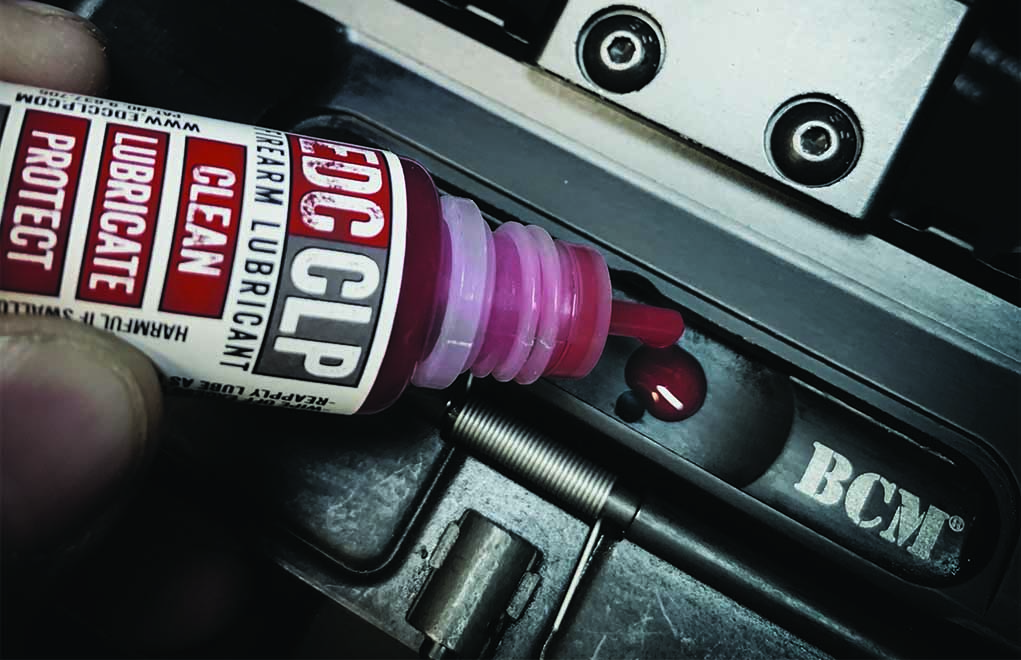
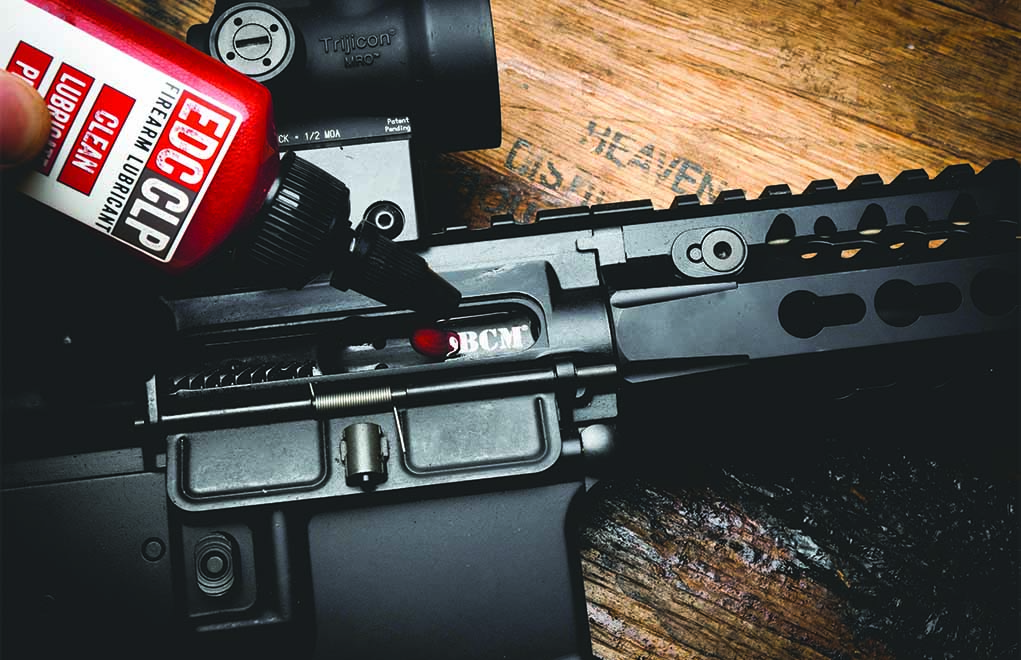
Created with modern firearms and their needs in mind, EDC-CLP’s patented chemical components not only continue to clean and lubricate for extended periods under excessive heat and pressure, they also reach into the micro-crevices contaminated with baked-on carbon that picks and brushes cannot reach.
One key addition to the formulation is a “high-pressure additive” with positively charged molecules that adhere to the metal. In other words: It keeps the product in and on the parts—cleaning and lubricating—during use, rather than being forced off by friction and gases. The high-pressure additive also provides the added benefit of suspending the contamination in the lubricant that the dispersant and detergent elements slough loose from the parts.
How does it perform outside the chemistry lab?
EDC-CLP’s positive impact on your gun’s function is both immediate and gradual. After a single application, a user will feel an instant improvement in lubricity (slipperiness). In most cases, follow-up cleaning requires little more than a wipe-down and reapplication.
EDC-CLP doesn’t require special preparation of the weapon’s parts in a sterile environment in order to work. It can be applied on top of existing gun oils or lubricants if necessary.
So, ask yourself, Which “war” is your lubricant fighting?
For more information on ELC-CLP Lubricant, please visit edcclp.com.
Editor’s Note: This article originally appeared in the 2021 Long-Range Shooting issue of Gun Digest the Magazine.
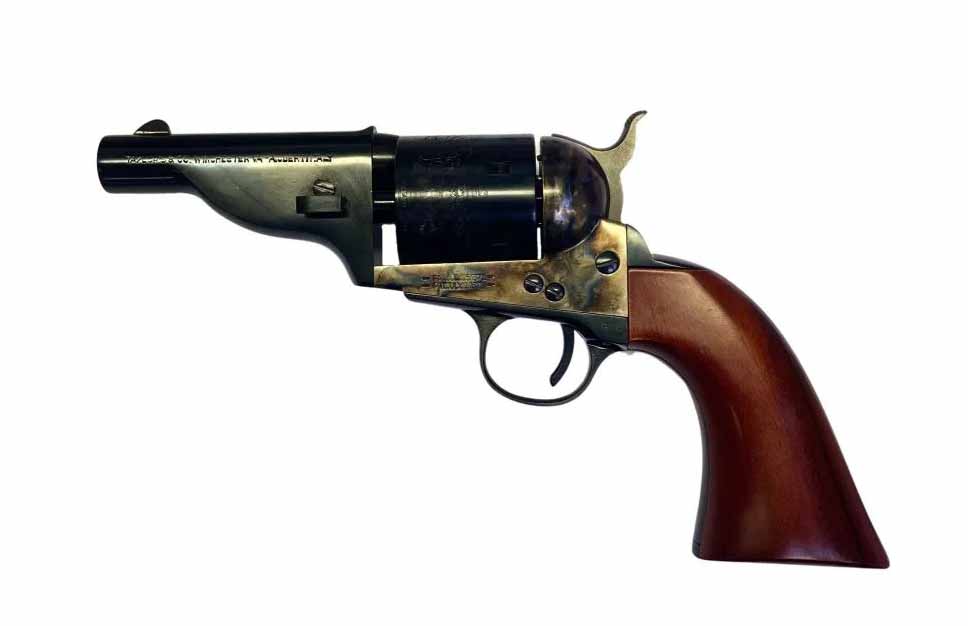
A tweaked throwback Colt Open-Top, the Taylor & Company Hickok is as dashing as its namesake.
What Makes The Hickok A Unique Open-Top Replica:
Maintains a similar frame and open-top design, but with a 3.5-inch barrel.
Chambered for modern .38 Special and .45 Colt cartridges.
Features case-hardened forged steel frame and walnut grip give the pistol great appeal.
A pair of Colt 1851 Navy Model cap-and-ball revolvers were supposedly “Wild” Bill Hickok’s most prized guns. And when he was gunned down by Jack McCall in a Deadwood, SD saloon he was wearing a Smith & Wesson Model No. 2 Army revolver. So how exactly Taylor & Company ended up naming its new Colt Model 1871-72 Open Top after the “deadliest pistoleer” in the west isn’t exactly clear. But the abbreviated rendition certainly appears as dashing as its namesake.
The Colt Open Top is a unique design and has a certain appeal to aficionados of Old West guns. In particular, it’s desirable given it’s considered the parent of the famed Colt Single-Action Army revolver, the acme of the handguns of the era. In essence, it’s a bridge between the SAA and the cap-and-ball conversions that preceded it, maintaining many of the Colt Navy’s design points, but specifically designed for metallic cartridges.
Don’t expect a dead ringer to the original with the Taylor & Company Hickock. While it maintains a similar frame and open-top design of the original, the gun company has tweaked it in several ways to make it more appealing to modern shooters. At least the ones that aren’t wed to historical accuracy in replicas.
Nowhere is this more evident than in the Hickok’s barrel, which comes in at an abbreviated 3.5 inches. For reference, the original Open-Top was a monster, with 7.5-inches of barrel with which to pitch .44 Henry rimfire. What it lacks in authenticity, the revolver is certain to more than make up for in agility, with the near snub-nose likely to prove much more widely than the six-shooter its base on.
Chambering is another break from the past. Since .44 Henry isn’t exactly spilling out of retailers’ ammunition departments, Taylor opted for two much more accessible options—.38 Special and .45 Colt. The .38 option seems especially fitting for the configuration, given its mild recoil and inherent accuracy out of short-barreled pistols. Though, in recreations from this era, it’s difficult to go wrong with .45, even if it might make the Hickok a bit more bucky in the hand.
As to the gun’s aesthetics, Taylor seems to hit the nail on the head, delivering the look of the Old West. The Hickok comes from an 1860 army snub nose revolver made with modern shooters in mind. It features a large Army-size grip for increased comfort and stability. Blued parts with a case-hardened forged steel frame and walnut grip give the pistol great appeal. Other features include a front blade sight and rear sight on the back of the barrel.
As to price, the Taylor & Company Hickok has an MSRP of $616.14.
Expensive large-caliber rifles and more variables than you can shake a stick at, do you have what it takes to compete in King of 2 Miles?
Basic King Of 2 Mile Requirements:
Rifle Weight: Fewer than 40 pounds
Other Equipment Weight: Fewer than 25 pounds
The shooter must be able to carry all equipment to the firing line in one trip.
The bipod must attach at a single point.
The bipod must contact the ground at no more than two points.
Any monopod or rear bag that’s as long as the monopod must be attached to the stock.
Imagining settling yourself in behind a rifle as tall as a 6th-grader, taking careful aim, pressing the trigger to the rear and launching a bullet that might weigh in at over an ounce. Your rifle barks, and the muzzle brake and 40 pounds of mass soak up some of the recoil.
As you settle back in from the rifle’s recoil for a second sight picture, seconds pass. Your spotter is silent.
Four seconds pass … 5 … 6. You hear a bell cut through the air, indicating an impact on the 48×60-inch target 3,525 yards away.
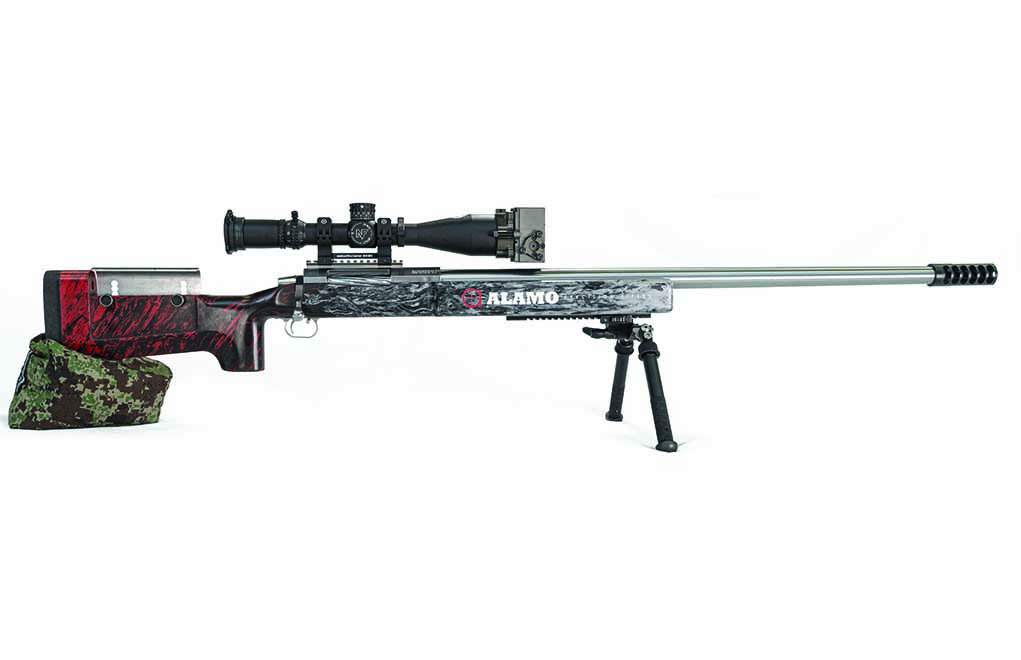
A King of 2 Mile rifle can easily reach the 40-pound weight limit … once you start bolting on optics, bipods and other accessories.
Congratulations! You and your team managed to hit the final target in the King of 2 Mile extreme long-range shooting competition.
Your spotter calls, “Same shot!” The rifle bucks, and the process starts all over.
What’s the Point?
Is a 40-pound rifle going to be ideal for hunting or defensive uses? No. But what these rifles do offer is a testing platform that’s propelled long-range shooting tech since the inaugural match in 2015.
The goal is to push the boundaries of what’s possible with a rifle considered “man-portable” by the Fifty Caliber Shooters Association (FCSA)—the event’s sanctioning organization.
We sat down with Robert Waggoner of Alamo Precision Rifles in Hurst, Texas, to get a better idea about what kind of equipment it takes to be competitive at King of 2 Mile. Waggoner not only co-owns (along with Jason Davidson) one of the top precision rifle shops in the country, he’s also an accomplished precision shooter, hunter and the president of the Extreme Long Range Shooting Organization (ELRSO), which offers some unique matches that can reach out to 3,500 yards to help shooters build the qualifications needed to secure a spot at King of 2 Mile.
Caliber Choice and Component Selection
As you might guess, choosing the caliber your rifle will be chambered in will likely affect other aspects of the rifle. Because the goal of the competition is to further development for man-portable long-range rifles, the choices you make should be focused on maintaining a balance between capability and portability.
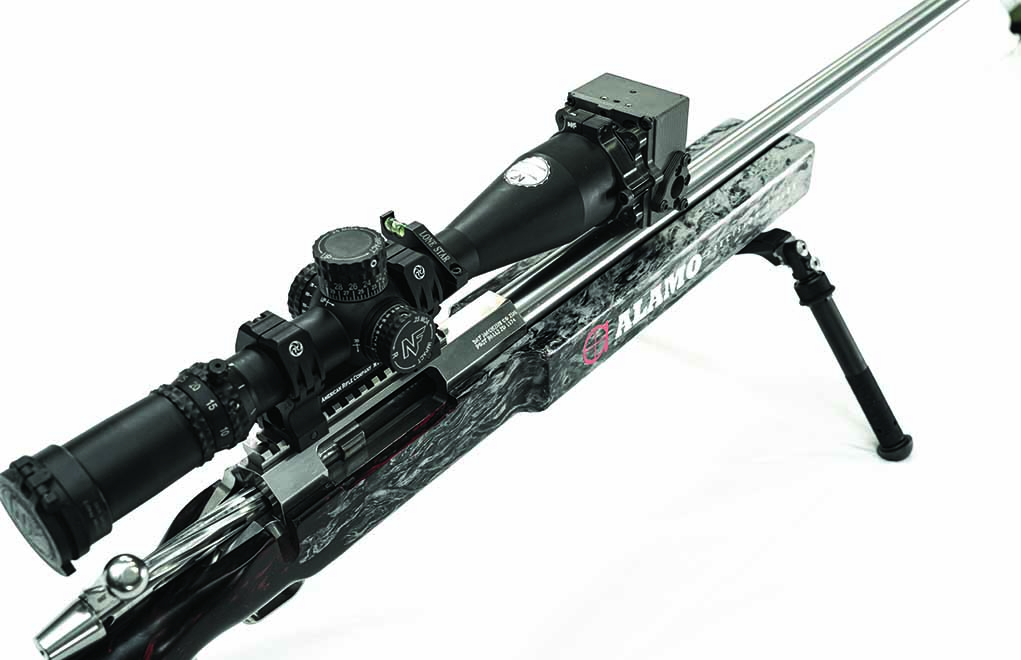
The massive action, barrel and stock make this Nightforce 7-35x56mm ATACR’s 34mm tube look tiny.
A heavier bullet is going to give you more splash with missed shots—at the expense of heating the barrel a bit faster and creating more recoil. Should you choose a caliber with a lighter projectile, it might be harder to spot splash, but there’s less heat, recoil and concussion from the rifle.
In an effort to remove as many variables as possible, ammunition is almost universally hand-loaded for this competition. The basic recipe is to use one of those lathe-turned, solid bullets and a bunch of slow-burning powder in a meticulously prepared case in which you carefully put a quality primer. Ammunition components beyond the bullet vary so widely that even narrowing down the common ones is a nearly impossible task.
.50 BMG: The obvious choice would be .50 BMG, because the event is held by the Fifty Caliber Shooters Association. With only 40 pounds to work with, lighter and more-efficient cartridges have almost completely replaced the .50 BMG in competition.
.460 Steyr: The first cartridge that was developed from the .50 BMG case is the .460 Steyr, developed in 2004 for areas that had banned the .50 BMG. The .416 Barrett is often confused with the .460 Steyr’s history, but the cartridge does well in ELR competitions. The .460 is an attractive choice for those seeking a big, heavy bullet that’s still efficient at distance.
.416 Barrett: There’s some Internet lore surrounding the reason for the .416 Barrett. Some “forum commandos” incorrectly believe the cartridge was designed as a result of California’s ban of the .50 BMG. In reality, the .416 Barrett was designed at the request of the Naval Surface Warfare Center Crane Division in 2004. Barrett offers a Model 99 and the Model 82A1 in that caliber. The .416 Barrett is a popular choice—thanks to very efficient heavy-bullet options. Again, remember that weight means larger dirt splashes, which are easier to spot and call corrections from.
One of the purposes of the King of 2 Mile competition is to spur development of “man-portable” rifles. As a result, bipods that are no wider than 8 inches when folded are required.
.375 & .408 CheyTac: Both the .408 and .375 CheyTac are derived from the .505 Gibbs, an old, English big-game cartridge that’s primarily found in beautifully crafted Mauser 98-based bolt-actions. The old .505 Gibbs was designed to handle only about 39,000 psi—nearly 25,000 psi short of the pressures the .408 CheyTac generates—so the case was strengthened. You won’t see the .408 on the King of 2 Mile firing line nearly as much as the more efficient .375 CheyTac, which offers a better ballistic coefficient, is less affected by wind and produces less recoil. As with everything else in life, there’s no free lunch: While the .375 CheyTac offers a lot, you do lose bullet weight … which means harder-to-spot misses. With only five attempts at the target, a miss from which your team didn’t see splash could cost the team dearly in points.
Wildcats: It shouldn’t be a surprise that there’s a constant need to look for small improvements that give a competitor an edge over others. Most of the wildcats are based around a .375 bullet, such as the .375 CheyTac Improved, .375 Warner and .375 Libert. Obviously, the sky’s the limit with wildcats … as long as your rifle complies with the event rules.
Off-the-Shelf Rifles
There are some off-the-shelf rifles that have the capability to hit that 3,525-yard target, but they might not meet the rules or be as competitive as a custom rifle.
If you’re intent on trying your hand at ELR shooting, Cadex Defense, JJ Rock Co., Desert Tech, Victrix Armament, Barrett, Noreen Firearms and several other manufacturers have off-the-shelf options that might fit the bill for you. Keep in mind that a production or semi-custom rifle might not be as competitive as a rifle tailored for the event.
Some rifle builders offer semi-custom packages (such as the Azle Mirage ULR, TX, Hill Country Rifles or Gunwerks) that comply with the rules of the event but, again, might not be ideal to go toe to toe with some of the most accomplished ELR shooters in the world and their custom-built rigs.
Custom Rifles
While semi-custom rifles are options, full-custom rifles are the most common sight on the firing line and are likely the direction most competitors will take.
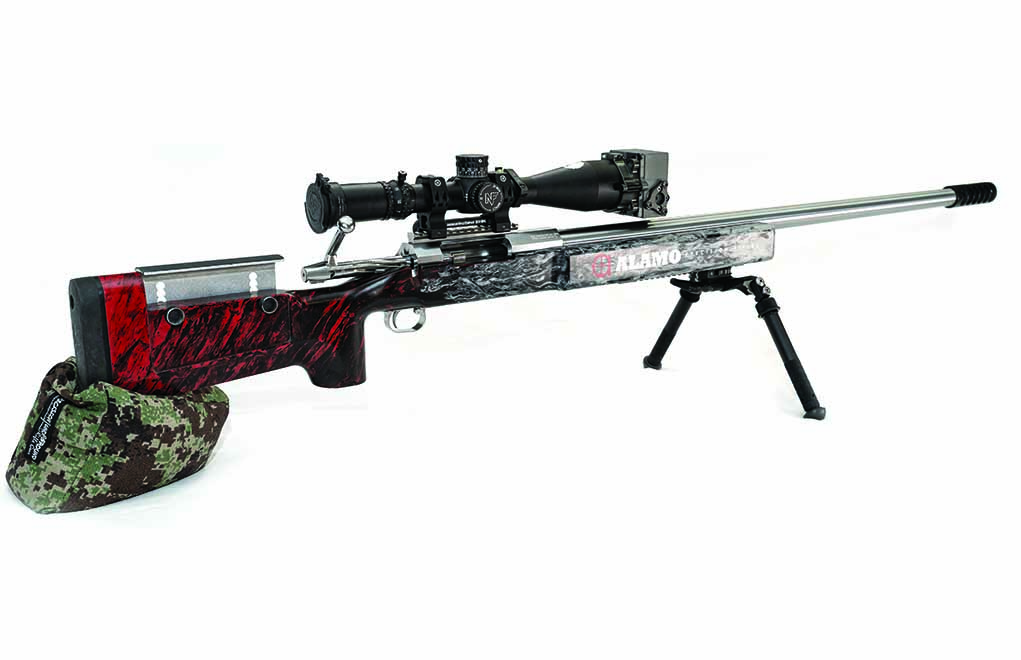
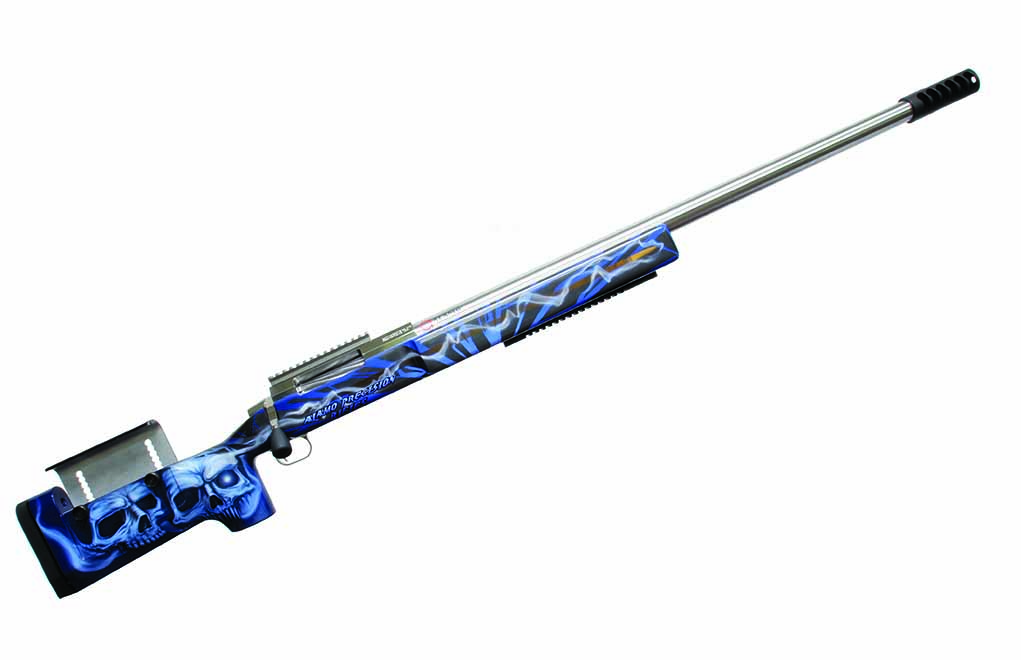
As in every competitive shooting sport, making your firearm look a bit “racy” isn’t uncommon for King of 2 Mile competitors.
A full-custom will allow you to tailor your rifle to your team’s specific needs, because each component is selected and specified by your team, as the name implies. Most highly skilled rifle builders will be able to help you with one, but do your research on the shop: There’s no shortage of snake oil in the precision rifle game. In addition, before you drop that deposit money on your build, make sure the shop has experience building a rifle in the ELR category.
Action
Because you’re really limited to three that are capable of chambering the super-mag cartridges ideal for the event, there aren’t a lot of options to choose from for the action. None of the actions I located with BMG or CheyTac bolt faces accommodates standard safeties (but more on that when we get to triggers).
The BAT Machine has two options to choose from: its Model EX and the newer Model EXS, which was added to make it easier for competitors to meet the 40-pound weight limit at King of 2 Mile. If BAT Machine’s offerings don’t excite you, and your team selected a CheyTac-based cartridge, something such as the Barnard Model P-Chey, the JJ Rock Co. SuperXL or the Stiller TAC 408 action might be the right call.
When it comes to selecting your action, and if this is your first dive into an ELR rifle, it’s always best to check with your rifle builder to get their feedback.
Barrel and Muzzle Device
As is the case with other precision rifle competitions, barrel manufacturers are all over the place, with nearly every one being represented at some level of the competition. Most of the barrels hover in the 30- to 38-inch range in order to stay within weight limits while getting the most out of the slow-burning powder most teams use.
All three of these Alamo Precision-built ELR rifles are sporting the Phoenix Precision bipod. It was the preferred bipod before the rule changed to only permit bipods that are 8 inches wide when folded.
Some of the brands that do make regular appearances are K&P Barrels, Bartlin and Kreiger, but remember that the quality of the barrel is just as important as who chambered the barrel. As long as your gun builder is willing to stake their reputation on a barrel brand, it’s probably going to perform. Muzzle devices are a hearty mix of muzzle brakes and suppressors. Some of the stand-out muzzle brakes are from Area 419 and the T5 Terminator.
Stock
Although chassis systems have taken over other aspects of precision rifle shooting—thanks to the ability to tack stability-enhancing accessories onto the rifle—they haven’t taken the ELR crowd by storm.
McMillan has a strong foothold in the ELR market. However, its presence in other precision shooting sports has started to become less commonplace due to chassis rifles taking over PRS. That said, the McMillan Beast II was purpose-built for ELR shooting, making it one of the most common choices of competitors. The McMillan A5 and A6 Supermag stocks are also favorites, primarily with shooters who come from a PRS-style competitive setting.
McMillan isn’t the only stock maker to have a model designed for the needs of the ELR shooter. Manners designed its MCS-LRT, which sports tactical features, especially for King of 2 Mile. You can get the MCS-LRT for a .50 BMG-size action that also works for .416 Barrett. Alternatively, you can opt for the version of the stock that accepts a 1.6-inch-diameter action if you’re going to be shooting a CheyTac-based cartridge.
Lastly, the Mirage ULR chassis is one of your best options if you’re a die-hard chassis lover. Mirage ULR has been doing great things for the ELR community for some time. Not only is it a world-class rifle builder, it also has one of the most common ELR chassis on the market. With a call to its shop or an e-mail, you can have one configured exactly as you want.
Trigger
Just about any Remington 700-pattern trigger that can either be run with no safety or with a bottom safety is going to work just fine. Some of the popular triggers come from TriggerTech, Bix’n Andy, Timney and Jewell.
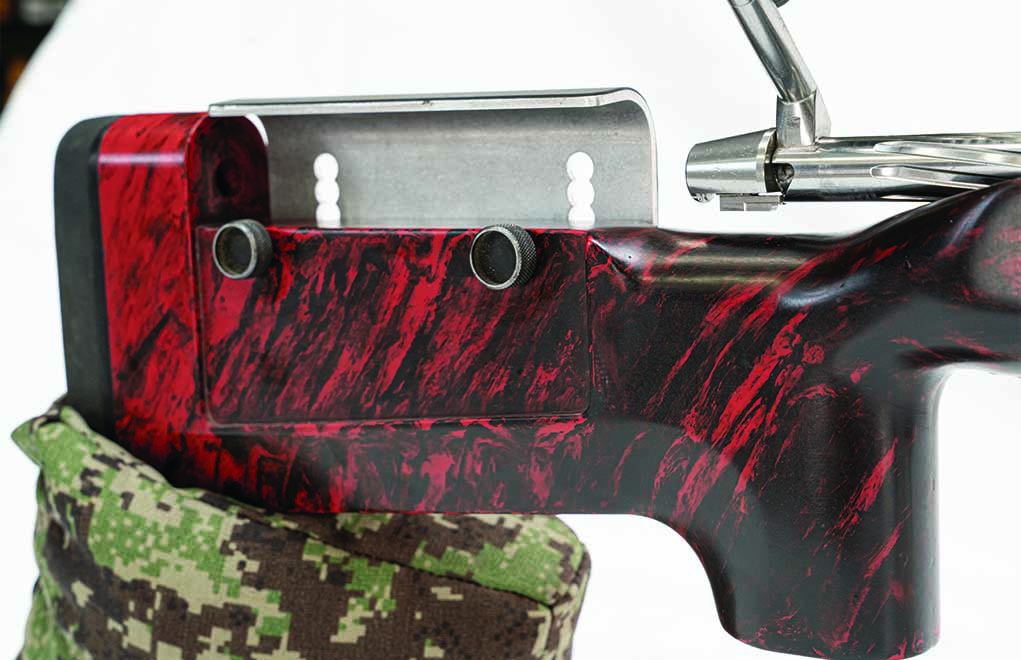
The McMillan ELR Beast fiberglass stock features an incredibly adjustable cheek piece to accommodate adjustable and fixed scope bases that add several hundred minutes of additional elevation.
You might wonder why you need a trigger without a safety or a bottom safety inside the trigger guard. Simply put: Because the actions are so big, the relief cut to slide a traditional 700 safety to the top of the receiver isn’t present, making a bottom safety or no safety the only way to go.
Optics and Mounts
Even though milliradian-based scopes are the “cat’s pajamas” in other precision rifle sports such as PRS, MOA is more common by a large margin. In other disciplines, the ability to quickly dial elevation or windage might be an advantage, making the more-coarse milliradian (mil) adjustment preferred. Without getting too deeply into the math, that means that while one click on a mil scope will equal .1 mil, the same single click on the typical ¼ MOA adjustment scope is equivalent to 0.0741 mil. When pushing a rifle out to the final target, that could mean a rather large variance that starts to bring some unpredictability—a precision shooter’s enemy.
Add More Elevation
A means of adding more elevation than you’re used to seeing on a traditional precision rifle is a must unless you’ve paid for a purpose-built ELR scope such as the March Genesis 6-60X56mm ELR scope. It has enough elevation to take a .375 CheyTac past 4,000 yards.
Those shooting with a more traditional scope, such as the Nightforce ATACR 5-25x56mm or ATACR 7-35x56mm, will need a means of adding the elevation they need. One of the popular options is an adjustable base from Cold Shot, which adds in an extra 300 MOA of vertical adjustment to your scope. Pair it with a Spuhr scope mount or an adjustable mount, such as the Ivey adjustable mount or ERA-TAC’s adjustable mount.
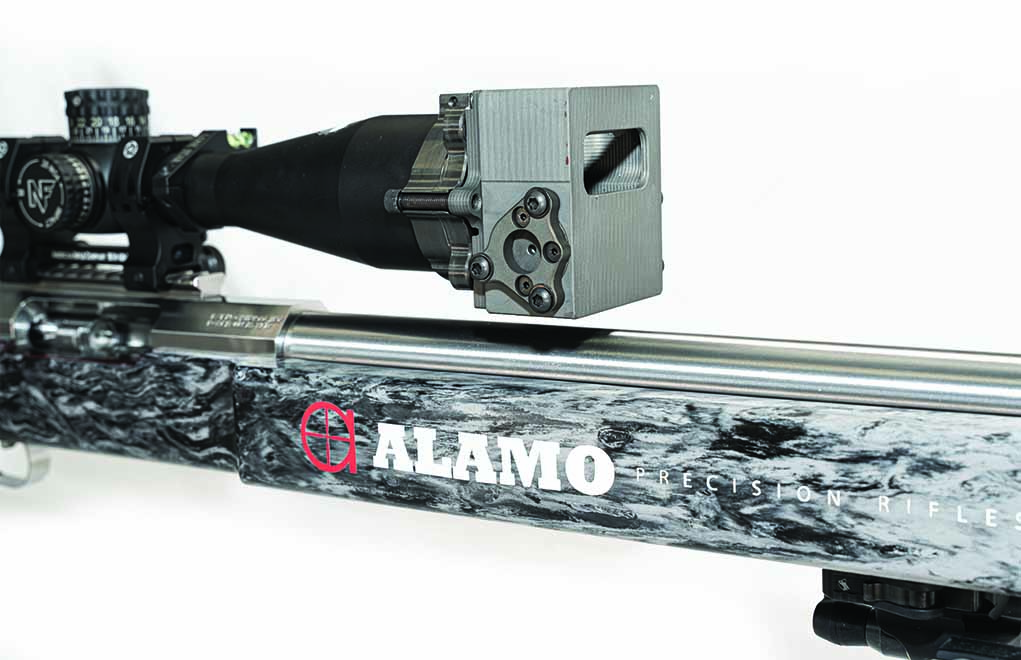
Lastly, there’s a prism unit that cleverly adds in elevation by using mirrors: the TacomHQ Charlie TARAC (sometimes called a “Charlie unit” or “taco”). This clever device can be permanently affixed to the rifle or scope with some wingnuts. Alternatively, it can stay in place, thanks to some high-powered magnets that interface with a ring on the scope bell.
Spotting Scopes
You’re going to need two high-quality spotting scopes or binoculars for your teammates. Your spotter might like to have a spotting scope with a reticle so they can call corrections quickly and easily. Remember: You only have 10 minutes to finish the course of fire, so time is of the essence.
In order to connect with that 3,525-yard target, you’ll need a means of adding more elevation.
Pretty much every quality scope manufacturer has something that’ll fit the bill, but some of the ones to look at are the Athlon Optics Cronus 20-60×86 UHD, Hensoldt Spotter 45 or Spotter 60, Swarovski ATX or BTR, Kowa’s Highlander binoculars and the well-proven Leupold Mark 4 spotting scope.
Your wind coach is also going to need a high-quality spotting scope that’s at the same level as your spotter’s, but the reticle is less important. It isn’t a bad idea to just buy two of the same spotting scopes if you’re starting from scratch.
Bipods and Bags
The 2020 rules changed the bipod requirements: The highly adjustable, precision-built Phoenix Precision bipods were no longer within the rules. Now, the bipod must fold as you expect a bipod to fold and be no wider than 8 inches when folded against the rifle. The bipod must also attach to the rifle at a single point and only contact the ground at two points.
As far as rear support, any rear bag is acceptable, so choose one and run with it … or go with a monopod. The monopod must be attached to the rifle’s stock in order to be within the rules; no mechanical rear rests are allowed that aren’t attached to the rifle.
Ballistics Calculators
The amount of math needed to figure the firing solution for a 3,525-yard target is enough to cause migraines. In order to avoid feeling as if your brain’s going to explode, King of 2 Mile teams use ballistic calculators such as a Kestrel. While each calculator has its own merits, some of the cell phone-based programs you can look at to get a feel for what a ballistics calculator does are GeoBallistics’ BallisticsARC, StrelokPro and Ballistic Advanced Edition. There are some far more advanced programs out there, but those three should give you a place to start.
Rifles built for the King of 2 Mile event are almost always a single-shot action such as this BAT Machine Model EX.
The Cost of Being Marginally Competitive
To put it mildly, getting into ELR shooting at the competitive level isn’t a cheap endeavor. Just putting together a package of the major items comes out to about $23,524.95 (that’s nearly the base price of a brand-new, base-model Honda Accord).
If you were wondering what that shopping list might look like, I’ve broken it down, trying my best to keep the costs “reasonable.” Keep in mind that these prices are for an entry-level setup, not a top-tier “Gucci” rifle:
Alamo Precision Rifles custom rifle in .375 CheyTac: $5,050
Nightforce ATACR 7-35x56mm: $3,600
TacomHQ Charlie TARAC: $800
Spuhr scope mount: $400
Atlas Super CAL bipod: $399.95
Rifle case: $600
(2) Swarovski BTR spotting scopes: $9,656
(2) Really Right Stuff TVC-34L tripods: $2,320
Kestrel 5700 Elite handheld wind meter: $699
Editor’s Note: This article originally appeared in the 2021 Long-Range issue of Gun Digest the Magazine.
Do particular primers really matter? The short answer; yes and no.
Average Loads: When Primers Don’t Matter
If you’re using vanilla-plain loads, something in the middle of the range of powder weight and burn rate, in the middle of the pressure range, in the middle of standard bullet weight, no, it doesn’t matter one whit.
The usual reason given to pay attention to primers is pressure control. As in, if you change primer brands, you might add several thousand PSI to your pressure (or, just as likely, lose several thousand PSI), and that could get you in trouble.
Let’s take, for example, the .45 ACP with a bog-standard load, a lead 200-grain semi-wadcutter. Let’s borrow from our good friends at Hodgdon and use their loading data chart, where we use 4.6 grains of 700X. That gets us 821 fps, which is right on the cusp of making major. The listed pressure is 12,100 CUP, which we can’t translate directly to PSI, but is 5,000 under the max CUP for the .45 ACP. This load is running at 71 percent of maximum. We aren’t straining anything. In this example, who cares if changing primers adds a couple of thousand CUP to the maximum pressure? If anything, it might make the 700X burn a little cleaner.
Now, let’s up the ante. We use the same bullet, but we load for some performance, such as blasting bowling pins. We want some 950-plus fps here, so we go to a slower-burning powder. We settle on SR-4756, where 8.2 grains nets us 966 fps. If we change primers to one that boosts pressure, we go from 17,100 CUP to 19,100 CUP, which is more than max of the .45 ACP but well less than the .45 ACP+P pressure ceiling. We’ve boosted pressures but not so much that is actually a problem.
So, as long as you stay in the middle (at least here, in our .45 ACP example) you can’t get in trouble with changing primers.
So, when does it matter? For one, it can matter in accuracy. Here you run into an individual preference, when a handgun shoots a given load accurately with a given primer. Or, more accurately, with one brand than with others. There is no way to predict such a situation. If you stumble upon one (say, your 9mm steel challenge gun shoots fantastic groups with a bullet/powder combo driven by the XYZ primer), you just accept it and stick with it.
Another situation occurs when you have pushed performance right to the red line. Let’s take a different example.
We’ll load a .44 Magnum to the max for hunting. We take a Nosler 240-grain JHP bullet and load it over Hodgdon Longshot. (Again, I’m looking directly at the Hodgdon data.) They show the 240 maxing out at 1,331 fps over 12.1 grains of Longshot, at 34,500 PSI. They do not mention the primer, but let’s assume, for the sake of our thought experiment that changing to a different primer can increase or decrease the pressure by 2,000 PSI. Do we really want to use something that now has a maximum average pressure of 36,500 PSI just from changing primers? Remember from the statistics chapter, the average means some (generally half) of them will be less, but half will be greater. Thus, it’s possible that our new combo can have one round in a box that generate 38,000 PSI and one in a hundred that generates 40,000 PSI.
So, when you get close to the red line, pay attention to what happens to pressure signs (if you can see any beside sticky extraction), and don’t switch primers “because these are cheaper” or some other nonessential reason.
The support-hand-only draw isn’t an easy maneuver, but it can be a life saver.
The support hand is often neglected. We’re not talking about in typical shooting scenario, where it’s doing its main job of applying grip pressure and stanching the dominant hand. Most shooters do a good job with these fundamentals. It’s a little matter of actually drawing and shooting with the wrong paw that’s overlooked. Not good, given your support hand just might save your life in a lethal-force encounter.
Jamey Caldwell, Jamey Caldwell, an instructor at 1-Minute Out and former special operator, demystifies the particulars of a support-hand-only draw from concealment in the above video. Get ready, because it’s not the easiest maneuver known to man.
The hang-up, aside from working with what is likely your weak hand, is the position of the grip, particularly if a holster is worn in the appendix to the hip. Generally speaking, at these points most folks find it difficult to turn their hand to reach the grip. In turn, there’s another element added to the draw sequence—a reversal of the gun. Caldwell demonstrates two of the most popular methods, using the thighs as a grip to maneuver the gun and using the holster to turn it around. Both work well but require an investment of sweat equity to hone.
Those who wear their holster closer to 6 o’clock have an easier time, as the arm more naturally turns behind the back for most. Though, this requires time and effort to master as well.
In either case, dryfire practice with an unloaded pistol is typically the best place to work on your support-hand-only draw. Given the trigger guard is exposed during some of the manipulations, the possibility is there that something on person could find its way in there. Best to diagnose this with an empty chamber. But above all, it should be part of your training regimen.
Since self-defense situations are defined by their unexpected variables, you never know if your off-hand is the one that will save your life.
Perfect middle ground. In a sense that sums up the .357 Magnum. On the one hand, the souped-up .38 special offers exceptional velocities in most of its loads and plenty of punch when it reaches the target. On the other, with practice and the right handgun, nearly any shooter can become proficient with the granddaddy magnum—something that can’t be said for most other cartridges of this class, which at best are cranky.
Is the .357 Magnum a good fit for you?
Twin virtues shining through, it’s little wonder the .357 Magnum flourished in the 20th Century, perhaps the most popular handgun of that era. Now, it’s overshadowed by pistol cartridges, given the greater shooting world has flocked in that direction in the past 40 years. However, changing tastes have done little to tarnish what the iconic revolver magnum brings to the table.
Yes, even in a world awash with polymer, high-capacity heaters the .357 Magnum remains a viable choice for self-defense. Is it for everyone? No, but what cartridge is? We’ll take a look at the time-tested cartridge’s pros outweigh its cons and if it’s right for you.
Brief History Of The .357 Magnum
Before tallying pluses and minuses of the .357 Magnum, it’s worth a moment to consider its roots. The cartridge was the brainchild of Elmer Keith and Phil Sharpe, both of whom were tinkering with hot-rodding the .38 Special in the 1930s. Though, it was Sharpe and Major Douglas B. Wesson who were responsible for bringing the magnum to market; Keith fell away from the cartridge with his interest shifting to developing what would become the .44 Magnum.
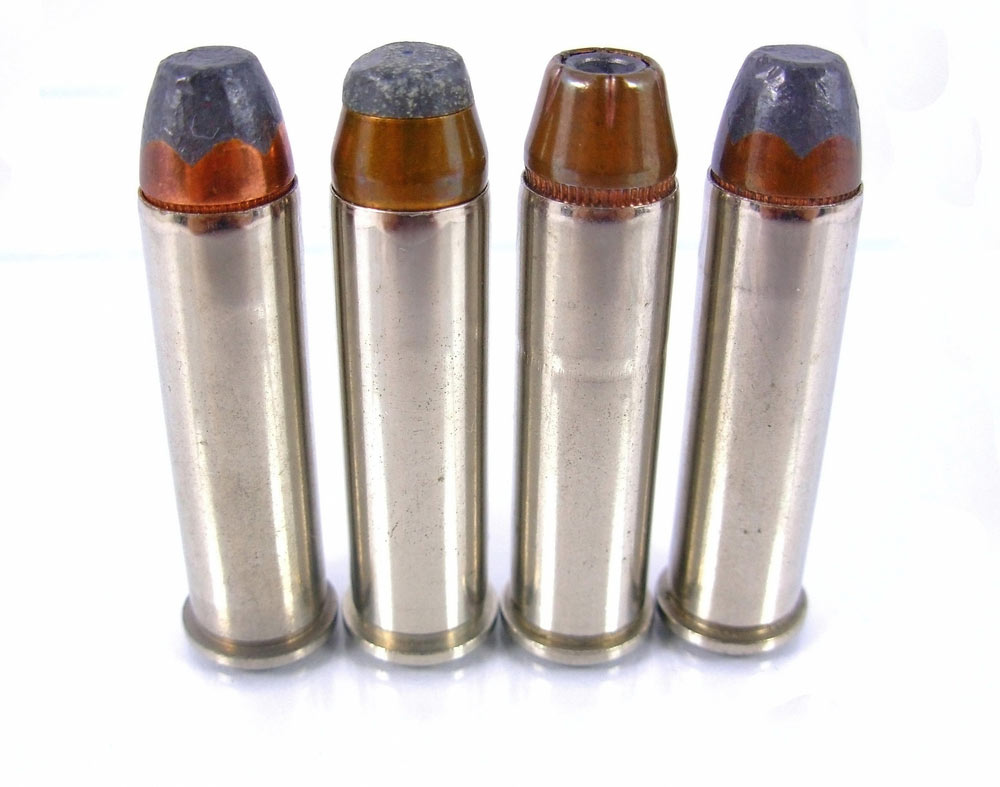
Essentially, the .357 is a .38 Special with 1/8-inch added to the case length. A small improvement with immense results. The larger case capacity vastly improves velocity over its parent case. An example. A .38 loaded the 158-grain Hornady Custom sends a bullet flying at around 800 fps from a standard service-length revolver barrel, whereas a .357 loaded with 158-grain Hornady Custom sends it screaming 1,250 fps from the same setup. That’s a 34-percent improvement in velocity!
That muscle had a lot of appeal when it was released in 1935 in Smith & Wesson’s “Registered Magnums”. Everyday shooters appreciated the inherent accuracy of the cartridge, particularly out of longer-barreled revolvers. And law enforcement welcomed an option with the ability to penetrate common barriers, such as car doors—something the .38 Special struggled accomplishing. Rumrunners and mobile bank robbers of the day made officers conscious of this deficiency.
The .357 Magnum is simple a .38 Special cartridge that has been lengthened by 1/8 of an inch.
While it perhaps never exceeded the .38 Special in law enforcement use, the .357 Magnum was still among the most profuse options utilized by the long-arm of the law. And it’s fairly safe to say, had not a wave of semi-auto pistols washed over the shooting world in the 1980s, the .357 Magnum would likely be the most popular handgun cartridge today.
.357 Magnum Pros And Cons
Talk to five different shooters about any given cartridge or gun, you’ll likely get five different opinions and a load of particulars to boot. Opining upon the .357 Magnum is no different. There’s plenty more nuance to the cartridge than the litany of six pros and cons we’ve put together here—as any true .357 aficionados no doubt would be more than happy to tell you. But pertaining to self-defense in general, we believe these considerations are among the most important when weighing if the cartridge and the guns chambered for it are a proper fit for you.
Proven Self-Defense Cartridge Used and studied extensively, the .357 Magnum has, again and again, demonstrated itself a superior self-defense cartridge. Is it the cock-of-the-walk option touted in the once-popular “stopping power” studies, able to neutralize a threat in one-shot 80-plus percent of the time? Given those survey results are shaky at best and useless at worst, we’ll leave that to the gun forums to hash out. However, the cartridge has acquitted itself well in the hands of law enforcement over the years and has one of the widest selections of ammunition capable of passing the FBI penetration tests. For the average armed citizen, the .357 Magnum has more than enough punch to neutralize a threat in most circumstances.
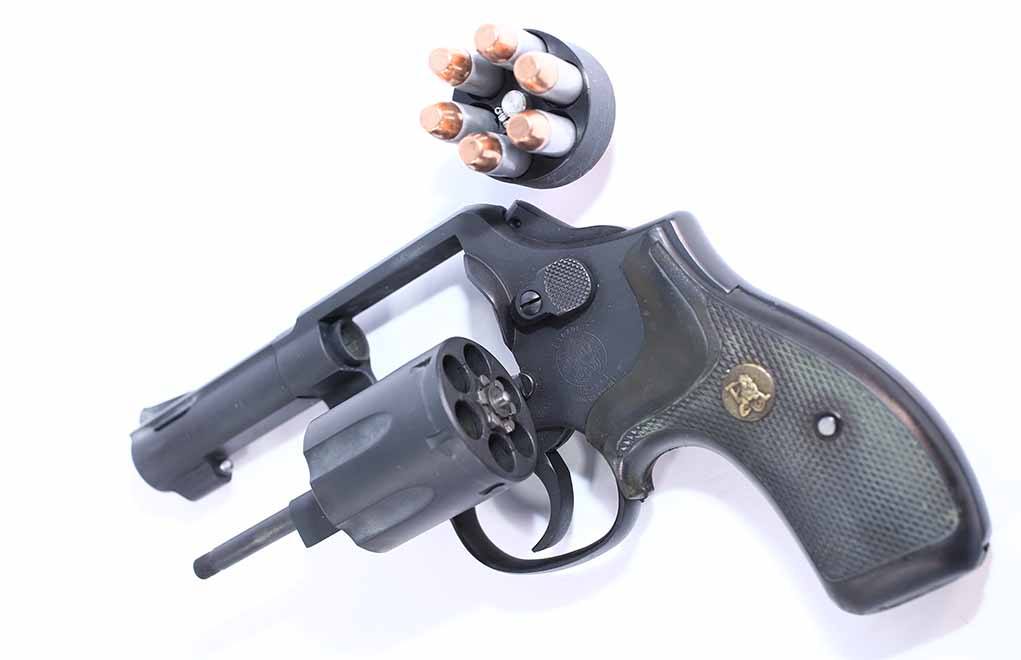
Simple Manual of Arms Given the majority of guns chambered for the .357 Magnum are revolvers, armed citizens enjoy one of the most robust handgun systems ever devised. Most times, solving troubles is as simple as pulling the trigger. This makes for a much simpler manual of arms as compared to semi-auto pistols, which require plenty of drilling to efficiently address stoppages. This isn’t to say revolvers are malfunction-free. They aren’t. What’s more, trouble-shooting one that’s jammed is involved compared to the tap-rack-bang of semis. Usually, something like a pulled bullet requires a gunsmith to right. That said, these catastrophic stoppages are rare to the point most shooters will never confront one.
Need to solve a malfunction with a .357 Magnum revolver? Just pull the trigger again.
Manageable For Most There are a lot of gray areas here, given the variability of cartridge-gun combinations. But for the most part, a great swath of guns chambered in .357 Magnum are accessible to the better part of the shooting world. Outside of the .327 Federal Magnum, this isn’t a claim most other magnums can make—certainly not the .41 Magnum or .44 Magnum. The medium- and large-frame revolvers in which the .357 is chambered keep it well mannered, with more material and weight balancing against the cartridge’s recoil. Additionally, the medium bullet diameter also plays a role. This doesn’t mean every shooter can expect to step behind the business end of a .357 and proceed to shoot the lights out. But the learning curve is less steep than most magnum cartridges.
Cons of .357 Magnum for Self-Defense
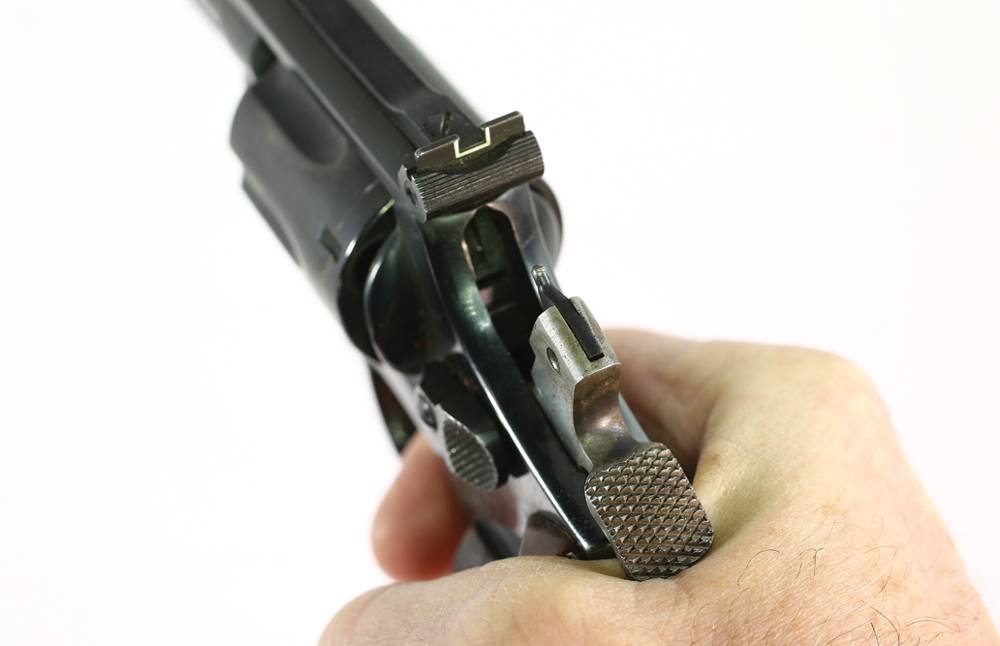
Double-Action Trigger The other edge to the aforementioned simple manual of arms is the feature that makes it elementary—the double-action trigger. Handy as the system is, it’s not the easiest to master. Generally speaking, DA triggers are long and heavy and require a proper technique to consistently stay on target. This is why for most novices a revolver—unless it’s your only option—isn’t the ideal first concealed-carry gun. Expect to practice and continue practicing to get this facet down pat.
Shorter Barrels Notible Reduce Velocity The old saw about snubbie .357 Magnum revolvers is they’re no more powerful than .38 Special shooting +P ammunition. A vast overstatement anyway you cut it, there is a kernel of truth in the myth. The .357 is particularly sensitive to barrel length, perhaps more so than many handgun cartridges and has diminished returns in an abbreviated bore. Yes, you’ll still have a better velocity profile out of a 2-inch barreled .357 Magnum revolver than a .38 Special, but it’s still fairly off the mark of what shooters expect out of a magnum. Not to mention, all that excess powder burning outside the bore of snubbie .357’s produces enough muzzle flash to light a stogy.
One of the stickiest points on the .357 Magnum, it comes in double-action revolvers, which generally have long and heavy trigger pulls.
Limited Capacity This isn’t purely confined to the .357 Magnum, but any revolver cartridge. In most cases, expect a revolver to hold 6 rounds, 5 if it’s tailored to concealed carry. Not a ton. Add in a little matter of revolver reloads being much more involved than semi-auto pistols—taxing fine-motor skills under stress—capacity becomes a sticky point for many. Should it be? That depends on your standpoint. FBI data puts the typical officer-involved shootings at around 5-feet and involving two to three rounds fired. Given that, yes a .357 revolver should prove more than enough. But if you value redundancy in your life-saving tools, it looks like a razor-thin margin of error.
Parting Shot
The .357 Magnum is among the most iconic American handgun cartridges and still treasured today. Despite losing favor in the past few decades, it isn’t going anywhere. The granddaddy magnum has too much going for it, particularly as a defensive tool. That said, determining if it’s the right option for you takes some consideration, not only of the cartridge itself but your skills as a shooter. Take the time to mull these factors, add in range time with make/models you’re interested in, and it should become clear if the .357 is a fit.
A throwback Glock? You heard right and the P80 has all the utilitarian charm of the original Pistole 80.
The term “retro” is all the rage lately, with some gun companies making “retro” versions of their most popular models. The term also has different meanings for everyone. For me, it means something that’s modern yet brings back memories of yesteryear. With the popularity of the “retro” style in the firearms industry, I was pleasantly surprised when Glock presented their Limited Edition P80 Pistol.
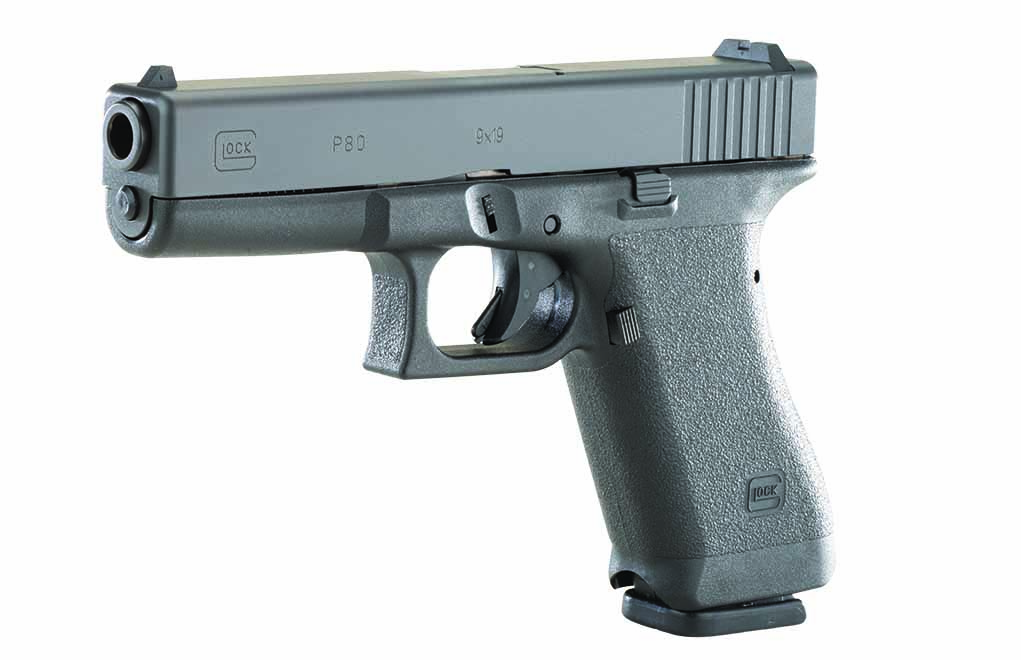
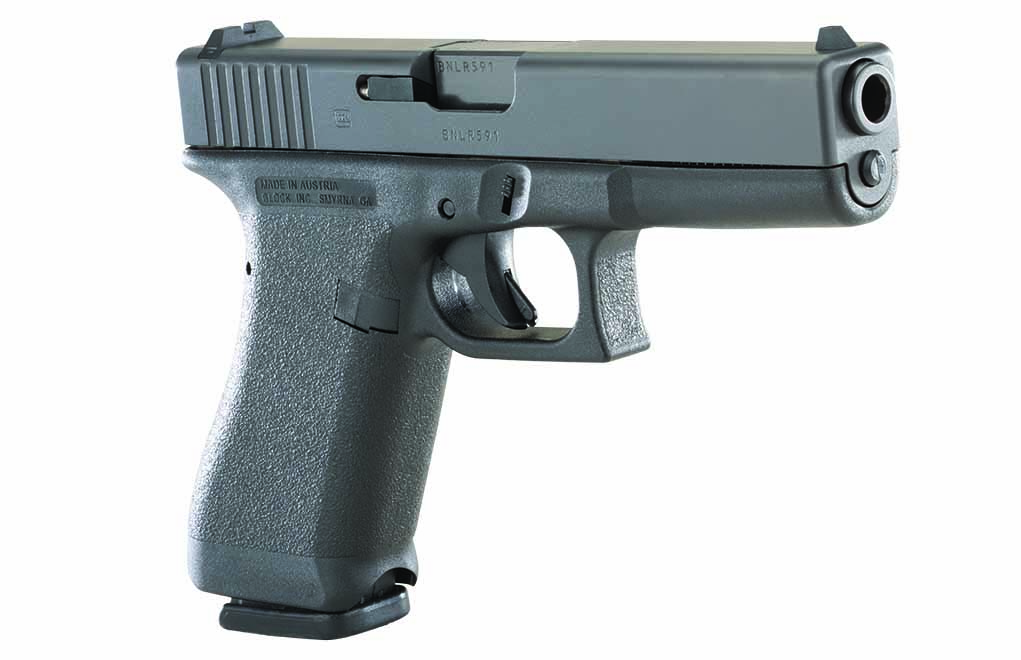
The P80 is not an exact replica of the Pistole 80, and it is very similar to the G17 Gen 1.
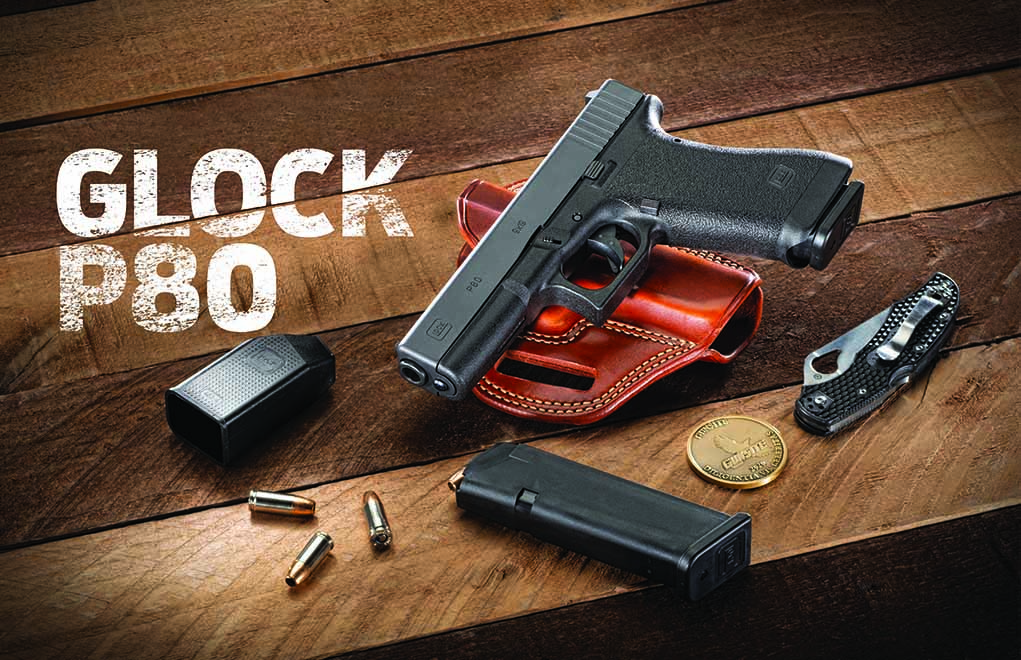
The Limited-Edition Glock P80 is a very close reproduction of the original “Glock Pistole 80,” which eventually became the popular Glock 17. The original Glock Pistole 80 was the pistol that Gaston Glock submitted in the early ’80s to the Austrian Army. This recreation of the Glock P80 is not an exact replica of the 1980s Pistole 80 or the Glock 17 Gen 1, but it’s a very close approximation and tribute to the pistol that started it all.
The Limited Edition Glock P80 is a collaboration between Glock and Lipsey’s Inc. to commemorate the adoption of the P80 by the Austrian Army.
“The Glock P80 was Glock’s first pistol and was the catalyst that led to the introduction of the G17, which revolutionized the pistol market and launched Glock as the pistol manufacturer trusted around the globe for over 30 years,” said Bob Radecki, a national sales manager for Glock.
The Glock P80 will be distributed in the U.S. through Lipsey’s, a Louisiana-based distributor. According to Jason Cloessner, VP & product development manager at Lipsey’s, “Glock took painstaking measures to recreate the original frames and packaging to make this P80 edition as close to the original as we could get. Not only is this edition a great shooter, it helps tell the amazing story of how Glock came to be.”
Take Me Back
The Glock P80 ships in a very nice commemorative box, but the surprises start when you open the box. Inside the fancy magnetic lid box is the original Glock Tupperware box, identical to the boxes we got with the first generations of pistols—yes, that one that you had to fire the pistol in order to put in the box.
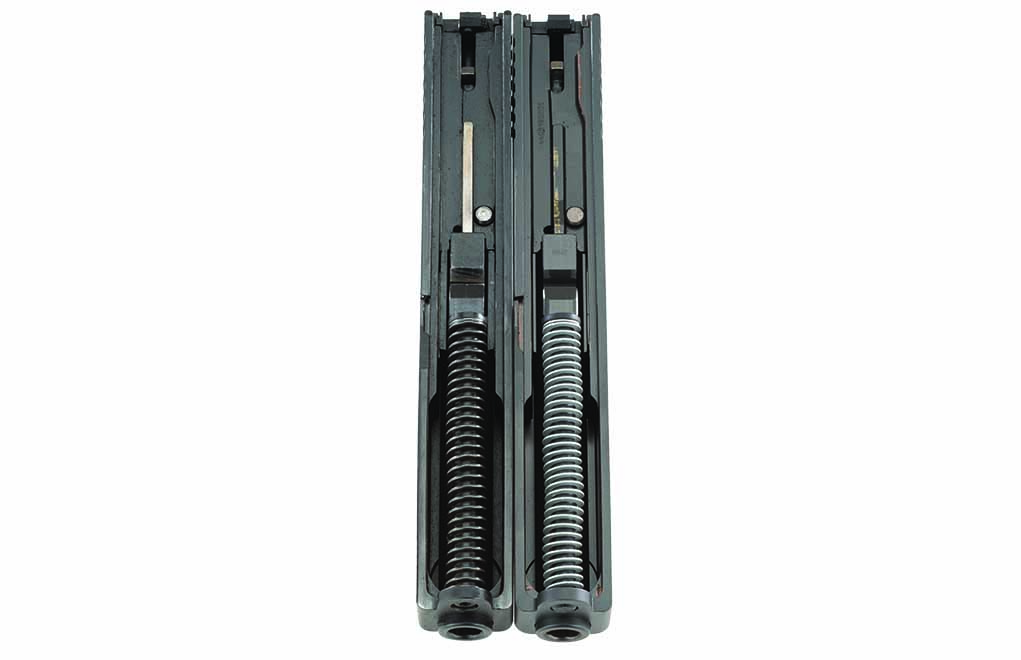
The upper assemblies on both pistols, when seen from the bottom, are virtually identical.
The first thing I did was remove the white “warning” sticker on the box. I wanted to see the Tupperware box the way it was originally shipped. That’s when I got really nostalgic for the mid ’80s … it was like I could hear Duran Duran playing on the radio.
At first glance, the Glock P80 looks identical to the original first-generation Glock 17. The only difference that I could actually see is the extractor. The Glock P80 has the slanted extractor adopted in the third-generation pistols, not the square, 90-degree extractor present on the original Glock pistol.
I wanted to determine what else was different between the new P80 and the original 17 Gen1, so I reached out to my buddy, James, who owns a Gen 1 Glock 17. He brought it over and photographed both pistols at the same angles with the same lighting conditions so I could highlight the differences between these two pistols.
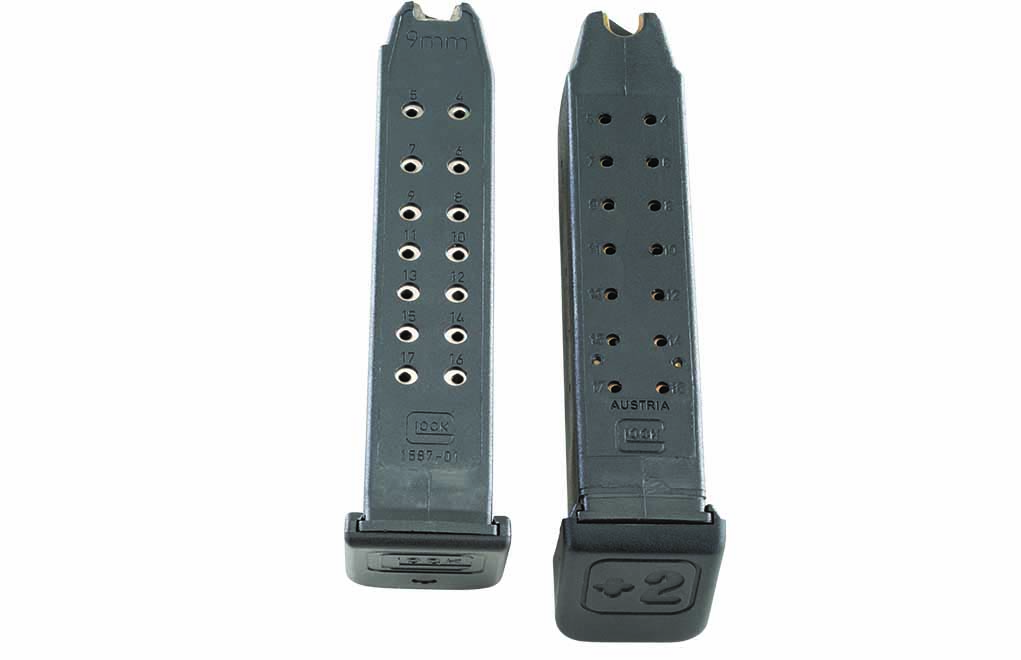
The magazines are another difference. The P80 ships with Glock Gen 4 magazines, with the ambidextrous magazine release cuts—something that doesn’t surprise me. It would’ve been strange if Glock shipped the P80 with the original non-drop-free magazines of the mid ’80s. But after some testing, the P80 accepts and functions perfectly with just about any Glock 17 magazine I could find … and a couple aftermarket models, too.
The biggest improvement on the P80 is the Gen4 magazines. With every generation, the magazines get better and better.
Honestly, other than the extractor shape, these two pistols are almost identical. The main differences are that the front and rear sights are slightly different and the guide rod on the P80 is the modern captured style. Other than that, you have to spend a whole lot of time inspecting the photos to be able to tell them apart.
I know Glock probably didn’t want to make them exactly identical so people wouldn’t pass the new P80 as a vintage Glock, but they’re very close indeed.
After spending some time dry-firing the P80, it was time for the fun part—shooting. For the testing platform, I used the new Ransom International Multi Cal. Steady Rest, a sturdy aluminum rest with all the comforts and adjustability I need. I selected Truglo Tru-See Splatter Targets, and I set them at the distance of 10 yards. I wanted to see how the pistol performed, not my ability to shoot the pistol.
For ammunition, I chose two new offerings from Federal: the new Punch 124-grain JHP and the newly packaged Practice and Defend 100-round Combo Pack, which conveniently packages 50 rounds of 124-grain Syntech Training Match ammo and 50 rounds of 124-grain HST JHP ammo. This convenient combo pack allows the shooter to practice with the Syntech Training Match ammo and load at least two magazines, depending on the pistol with the HST JHP ammo for personal defense.
All three of these rounds tested have an advertised muzzle velocity of 1,150 fps and, given that they all have the same projectile weight, you can expect about 364 foot-pounds of energy.
My results weren’t surprising. I’ve used both the 124-grain Syntech Training Match and the 124-grain HST JHP in the past, and I know how accurate they can be, but I had never used the brand-new Punch 124-grain JHP. It was as accurate as the other two rounds. With the 124-grain Syntech Training Match, I achieved a 1.185-inch five-round group. With the 124-grain HST JHP, I got a .995-inch group and with the new Punch 124-grain JHP, I got a 1.080-inch group.
After my range test, I fired 100 rounds of various reloads to test reliability. Like any other Glock, the new P80 performed perfectly. I had to take some time to clean it, but again, like any other Glock, that’s not hard at all.
After performing my accuracy and reliability test, I considered who’d be the target market for this “Retro” Glock P80. Collectors? Shooters? Glock enthusiasts?
The Upgrade Option
Then, I talked to others who purchased the new pistol and shared ideas with some of them—in particular, my friend Ed Head, retired U.S. Border Patrol Agent and current instructor at Gunsite Academy in Paulden, Arizona. Ed picked one up, and the first thing he did was customize it.
“What?”
Ed was looking for a Glock without finger grooves and without a light rail. Then, it all came into place. Gen1 and Gen2 Glocks, which have the features Ed wanted, are few and far between and generally very costly. This new P80, even though a limited-edition pistol, comes in at a lower cost and with the modern enhancements mentioned.
I asked Ed about his upgrades plans: He started with the AmeriGlo Hackathorn Sights, Wolf Competition Pack Spring Kit and would eventually finish it with an Apex Gen 3 Trigger Kit. Ed mentioned that, even though he liked railed pistols for home guns and duty guns, he didn’t like them for EDC purposes—a very good choice if you ask me. Ed also said he’d eventually get another Glock P80 just to leave it as is as a collectible.
After my conversation with Ed, I got to thinking … What do I want to do with my Glock P80? Well, the answer is simple: I’m going to shoot it and shoot it and shoot it. I might leave it as is, with no modifications whatsoever. It’s a great performer, very accurate and … what else can I say—it’s a Glock; it’s pretty much indestructible.
With ample supplies of replacement OEM parts from Brownells, this pistol can be kept running for decades to come. Besides, we might get a special edition of this pistol in 35 years or so. Who knows?
For more information on the Glock P80, please visit lipseysguns.com.
Editor’s Note: This article originally appeared in the January 2021 issue of Gun Digest the Magazine.
Mossberg & Sons has grown to one of the world’s foremost firearms manufacturers by pursuing one simple goal: putting quality firearms within reach of every shooter.
Every gun company has an aura about it. Some pinch pennies, while others insist you wear a dinner jacket before you handle their guns. O. F. Mossberg & Sons’ aura is neither.
“From day one, the Mossberg philosophy was to design its products with the working class in mind,” said Mossberg’s Linda Powell. “Mossberg was a visionary from a marketing perspective, because the working class has always outnumbered the ‘high social’ class. From the Brownie to the Model 500 pump-action shotguns to today’s centerfire rifles and pistols, look at the sheer numbers of Mossberg firearms that have been made available to, and affordable for, the general public.”
The Mossberg ‘Aura’
I discovered Mossberg’s “aura” as a lawn mower-funded teenager in the late 1980s. A Mossberg was a firearm I could obtain—and did: a Model 500 shotgun. It wasn’t cheap, yet anyone could afford one with a little effort. Once you got one, however, regardless of your tax bracket, you were proud of it. Why? Because you felt the value in every dollar you’d spent in the functionality and quality of the gun, from the buttstock to the muzzle. Mossberg didn’t waste its design and engineering time (or its customers’ money) on the extravagant. It still doesn’t.
My shotgun always worked … every, single time. Like any good hunting dog, my Model 500 was still ready for any adventure, and it always “barked” when it needed to. It wore its hunting-earned scratches and nicks as mechanical tattoos of pride. Every time I took to the woods with my Mossberg, I walked with the boyhood swagger of confidence—which can only come from hunting with your very best friend. This is O.F. Mossberg & Sons’ long-standing aura.
It’s been that way since Mossberg first opened its doors in 1919.
Mossberg understands loyalty because, in the beginning, that, along with O.F. Mossberg’s tinkering genius, is all it had.
Oscar Frederick Mossberg and his two sons, Iver and Harold, founded O.F. Mossberg & Sons, Inc. in 1919. The company has remained a family-owned business to this day and is the oldest family-owned firearms manufacturer in America.
According to Powell, “In the early years, it was difficult for the company to keep financially afloat. The young company received assistance from family, friends and a small group of investors. Mossberg demonstrated its loyalty to those individuals by buying back their stock and, in some cases, hiring those individuals. If you helped Mossberg, you were never forgotten. This mindset remains today, and many current and former employees sound a recurring theme: To work for the Mossbergs is like being part of an extended family.”
There’s a term we all know and understand: It isn’t just blood that can make a family.
“The Mossberg family wants everyone to be able to enjoy the traditions of hunting and our shooting sports,” Powell pointed out. “Mossberg’s success over the years has been driven by the company’s vision to produce high-quality firearms at an affordable price.”
Indeed, like family, Mossberg has done more than simply build guns so people all over the world can enjoy hunting and shooting. It’s also built relationships with everyone and has provided everything a hunter or shooter needs to learn, experience and sustain hunting and shooting for generations.
O.F. Mossberg & Sons, Inc. is the largest pump-action shotgun manufacturer in the world … leading the way with more than 100 design and utility patents to its credit and standing as the first ISO 9001 certified long-gun manufacturer.
Powell continued, “Providing the firearms to enjoy those traditions is central to the business, but Mossberg goes beyond by supporting numerous organizations within the industry to promote firearms safety, education, conservation and the preservation of our Second Amendment rights.”
Creativity and Balance
Mossberg is more than just one of your most loyal, capable firearms friends, though. As history has shown, it might also be your most creative.
How creative? According to Mossberg, it stands as the first IOS 9001 certified long-gun manufacturer and has more than 100 design patents to its credit. Mossberg is also recognized for many “firsts” in history, such as its rifle telescope and unique mounting system; a 3.5-inch, 12-gauge shotgun; a cable lock device for safe firearms storage; an integral scope mount (cantilever); a dual-comb stock (which allows for a high or low comb height with the use of an insert); a muzzle-loading conversion barrel for the 500 pump-action; and the first bolt-action rifle to accept and reliably feed on AR-style magazines. In addition, the Mossberg 500 platform is the only pump-action shotgun to pass the U.S. military’s mil-spec tests and is in use by all five branches of the U.S. military.
But being creative takes more than brains—it also takes courage.
In Mossberg: More Gun for the Money, written by Victor and Cheryl Havlin, Alan Mossberg explains how Mossberg did both.
Quality, durability and dependability are hallmarks of the Mossberg reputation. Since 1979, Mossberg shotguns are the only pump-action shotguns purchased by the U.S. government that meet or exceed rigorous mil-spec and NIJ (National Institute of Justice) requirements.
“It’s a question of balance, really,” he explained. “On the one hand, reducing risks so that we can stay competitive and maintain profitability. On the other hand, you have to take risks so that you can grow, develop new products, serve new markets. The key is knowing which risks to take and which risks to eliminate.”
Adaptability Is Key
Nevertheless, one risk Mossberg has never taken is to rest on its laurels.
“As a company with vision, Mossberg is always looking ahead, knowing that there will be external pressures—production challenges, such as those with the recent surge due to COVID-19; changes in the way the company markets and sells; and legislative issues,” Powell pointed out. “However, with the company’s steadfast approach to safety, quality, value and continued improvement, Mossberg has been able to survive those external pressures for decades and is recognized as an innovative leader in the firearms industry.”
Regardless of the times, one thing that’s always remained the same has been what to expect when you buy a Mossberg.
“When someone chooses a Mossberg firearm, they should be confident they’re purchasing a feature-rich, well-built firearm that will provide years of reliable service,” Powell explained. “And also knowing that Mossberg is never content with the status quo but is always keeping a constant eye on innovation in the design and manufacturing of our firearms.”
How has Mossberg been able to establish and maintain itself as a firearms industry innovator? According to Powell, it’s all about Mossberg’s adaptability.
The Mossberg Patriot centerfire bolt-action rifle is just one of many innovative firearms that fit Mossberg’s reputation of manufacturing high-value guns.
“One area in which the company excels is in its ability to incorporate a design change within weeks or even a new product at a more rapid pace than competitors. Oscar, Iver and Harold were all involved in designing improvements and their next firearm—always keeping an ear to the ground for changes in consumer preferences and industry developments. That same level of engineering and manufacturing efficiency continues today.”
Powell expanded on her words by describing Mossberg’s approach to meetings.
“During weekly meetings that include team employees from every department within the company, new products are discussed, as well as improvements that might be incorporated into existing product lines.
“An example, from a few years ago: Iver Mossberg brought up the idea of adding an adjustable stock to our 464 lever-action and a tactical-style forend. The following week at the team meeting, one of the engineers brought in a mock-up of our lever-action with a six-position adjustable stock, as well as the forend that Iver had described. Just a few weeks later, a group of Mossberg employees was out in the field, testing what would become our 464 SPX lever-action.
“More recently, at a media event at which we previewed the MC1sc—Mossberg’s first handgun in nearly 100 years—Mossberg engineers and executives listened to the comments from the media attendees. Then, a year later, we invited back the same group of media people to unveil the MC2c pistol … which incorporated a number of their recommendations.”
Steadfast Company Philosophy
Today, O.F. Mossberg & Sons continues to grow. Why? It’s clearly about more than just making guns.
The MC1sc is another innovation from Mossberg. It’s received rave reviews from the firearms industry and customers alike. Many people think this was Mossberg’s first handgun, but handguns helped build Mossberg.
Powell pointed out that “the key to Mossberg’s continued success lies with its core management team, implementing lean manufacturing and the ‘Kaizen’ philosophy (teamwork, personal discipline, improved morale, quality circles and suggestions for improvement). And, never losing focus of the vision Oscar Mossberg had for the company: innovative new products, awareness of improvement to proven products, pride in craftsmanship and delivering reliable, high-quality firearms to the working class.”
For more information on Mossberg & Sons, please visit mossberg.com.
Editor’s Note: This article originally appeared in the August 2020 issue of Gun Digest the Magazine.
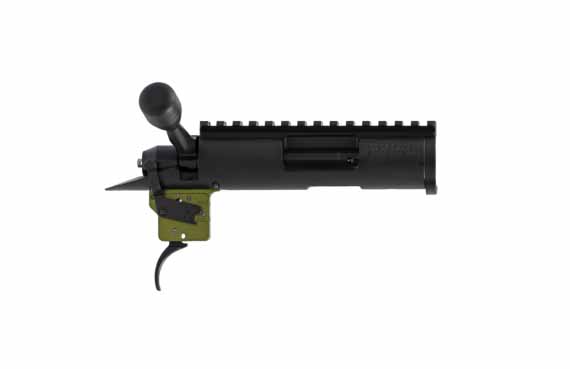
With more clearance thanks to a 60-degree bolt throw, the Three 60 plays nice with larger optics.
Time was, you could wrestle up a Ruger 10/22 or CZ 455, drop a few shekels on a scope, and claim you had a precision rimfire. Those were simple days. Not anymore. Drop-dead serious small-bore shooters pour-over parts and sweat over builds with the same intensity as the most severer long-range centerfire marksmen. Which is to say, Vudoo Gun Works more than has a market base.
The high-end manufacturer of everything precision rimfire has a new creation rolling out of its Southern Utah laboratory certain to set exacting shooters’ hearts collectively aflutter. Meet the Three 60 action. Essentially a melding of features from two of Vudoo’s popular existing actions, the action offers one particular feature shooters have demanded from the company for some time—a 60-degree bolt throw. While the potential is there to pick up the pace running the action with an abbreviated throw that’s not why Vudoo fans have been barking up this particular tree. Instead, it has to do with optics.
With more clearance than a 90-degree throw, the Three 60 is compatible with larger scopes. Not only should this appeal to NRL22 competitors looking to gain an edge in optics, but dedicated long-range shooters who want to run the same scope on their rimfire trainer as they do on their centerfire.
Similar to proceeding Vudoo actions, the Three 60 also boasts a Remington 700 footprint, in turn, it plays nice with a wide variety of stocks and chassis. Additionally, it’s friendly with nearly any 700 trigger assembly, so you can throw your favorite bang switch on it. Making maintenance much simpler, the bolt disassembles into three pieces without the need for tools and features Vudoo’s anti-rotation groove that keeps the bolt-face true about its axis. As to the three-lugs, they not only facilitate a shorter throw but also make it much lighter—something nobody can complain about.
As to where the Three 60 fits into Vudoo’s catalog, right along with its other actions. The action will not replace any of the fan favorites, only exist as another option. The Three 60 action is available on all Vudoo rifle models, as well as Three 60 rifle (MSRP $1,920).
The all-steel Taurus 1911 Commander pulls off the compact iteration of the icon flawlessly at a price that can’t be beat.
The government model in .45 ACP isn’t for everyone. In fact, it’s not the best choice for a lot of people. Taurus makes 1911s, and they knew the above, so it shouldn’t come as any great surprise to see the pistol we’re testing here.
Taurus keeps expanding in the firearms market, and at this rate, they’ll soon have to expand into ICBMs if they aren’t careful. Their latest is the 1911, but in a commander size and chambered in 9mm—simply known as the Taurus 1911 Commander. The 1911 is so well-known that background and details of the general pistol aren’t needed.
What we do need listed are the things that Taurus has changed or has done well, and what utility this pistol has for us.
The commander size resulted from the U.S. Army wanting to change pistols, back in the early 1950s. The Army wanted smaller, lighter, and 9mm. Colt offered an alloy-framed 1911 with a shorter barrel and slide, and 9mm. They even offered to rebuild the bazillion 1911/1911A1 pistol in inventory to 9mm. The Army decided they didn’t really want to change, but Colt offered the Commander to the market, and those who carried on a daily basis snapped them up, year after year.
Later, Colt offered the commander with a steel frame and changed the terminology a bit. The old one became the Lightweight Commander, and the all-steel became the Combat Commander.
Today, everyone calls either “commander” and then specifies steel or aluminum. And with the shift of everything to 9mm, you have to specify if it isn’t a 9mm.
Taurus’ Take
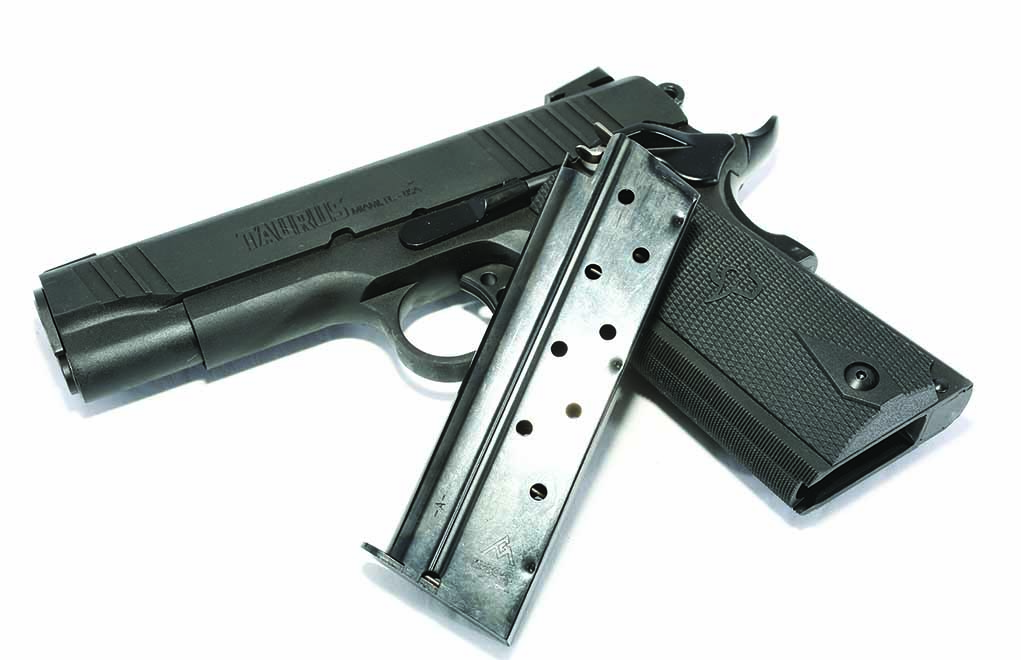
So, we have an all-steel commander from Taurus in 9mm Parabellum.
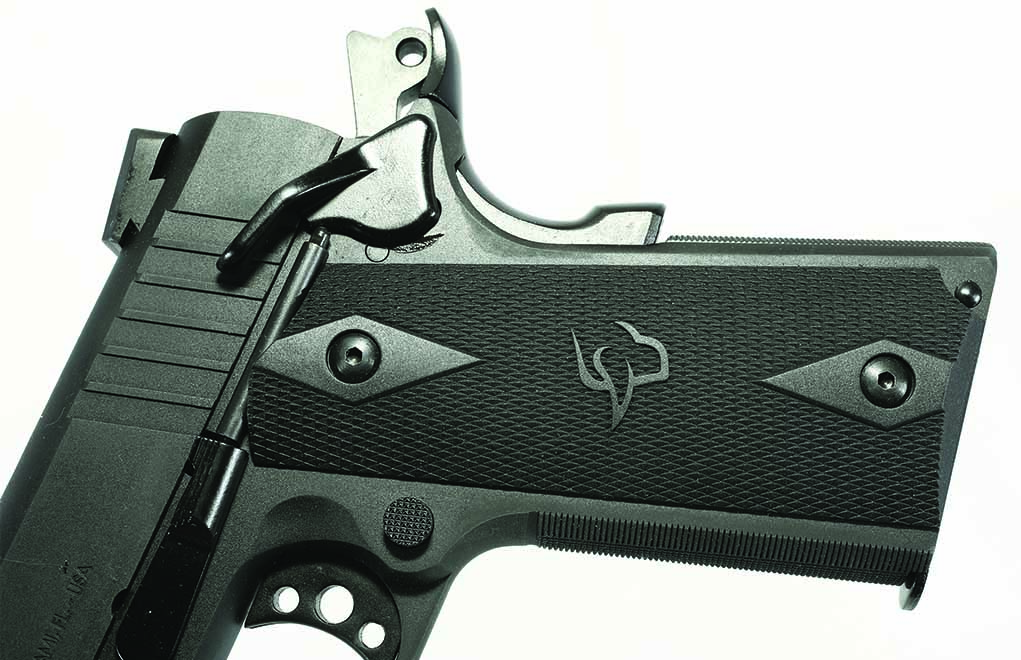
Grips: rubber, double diamond, with the Taurus logo in them.
The slide has cocking serrations in the regular place and up near the muzzle. The sights are both Novak-compatible, so you can swap the factory sights out if you wish. If you’re a fan of the three-dot combat style, then no need to change. The ejection port is the now-normal lowered and scalloped, for ease of ejection. The barrel, slide, and frame all bear the serial number.
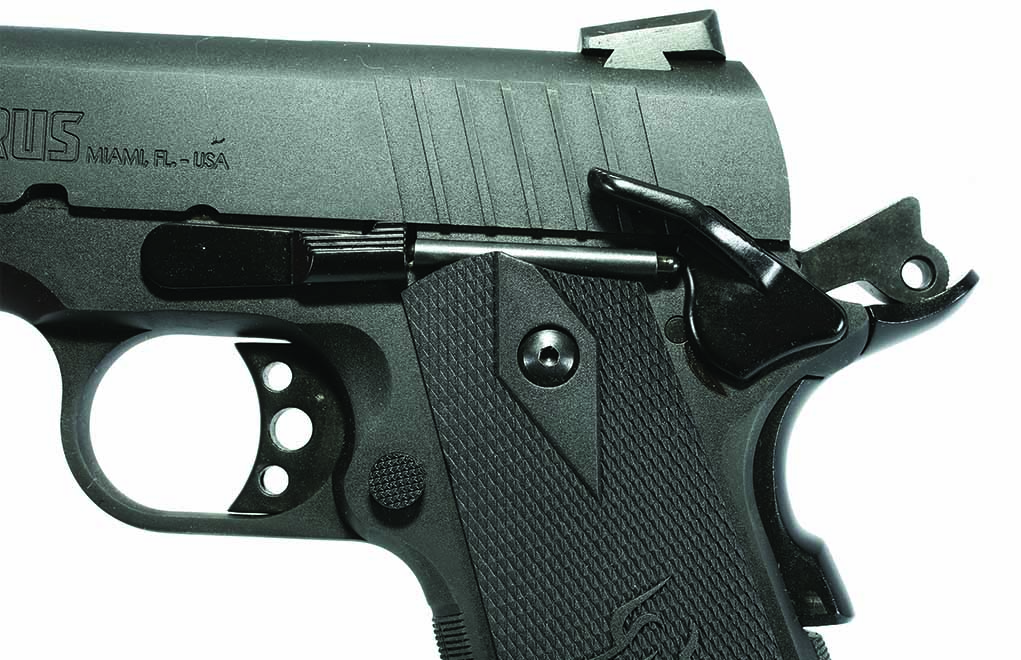
The frame lacks an accessory rail (not a problem on a 1911, for most situations). The slide stop is a standard checkered stop; the thumb safety is clearly an Ed Brown design, as is the grip safety. These you won’t need to change, as they’re among the best designs to have on the 1911. The trigger is lengthened and lightened by means of three holes drilled through the bow.
The front strap of the Taurus 1911 Commander hasn’t been lifted; that is, the radius from front strap to trigger guard is the expected curve. The front strap is a bit “chunky” in that the outer radius doesn’t mirror the inner radius. This makes the frame feel a bit thicker, but unless it’s pointed out, most shooters won’t notice.
The front strap is checkered and while the diamonds and bars have flats on them, the lines are clean, straight, and parallel. If you wished the checkering to be sharper, it’d be easy enough to have a pistol smith chase them or learn it yourself. Be aware, however, that sharp checkering can be tough on people whose hands are office-soft.
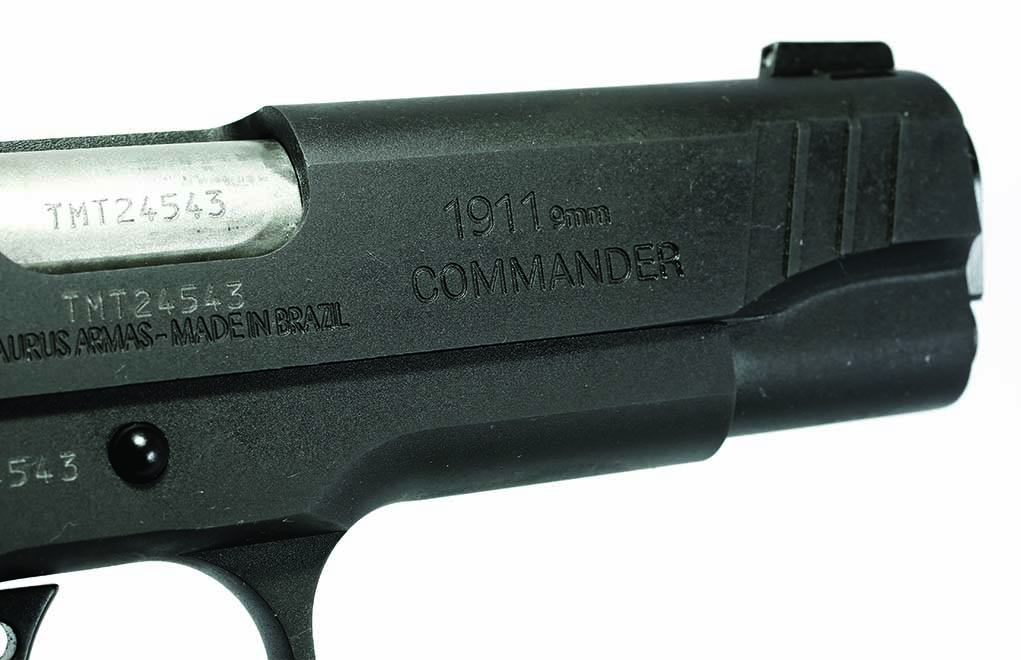
Taurus clearly marks the commander. Oh, the serial numbers? It’s a Taurus thing.
The mainspring housing is flat and checkered. Well, the “checkering” has all the hallmarks of being a casting, as the “diamonds” are more round in shape than pyramids. However, like the front strap, you can chase the checkering yourself. Maybe even start here and go to the front strap once you’ve learned the tricks. And if you mess up the mainspring housing, it’s perhaps the most easily changed part on a 1911.
Why do I mention working on the commander? Because, Taurus does. They’re more than eager to tell us that it’s “easily customized, as it is built with industry-standard parts.” In other words, go to town.
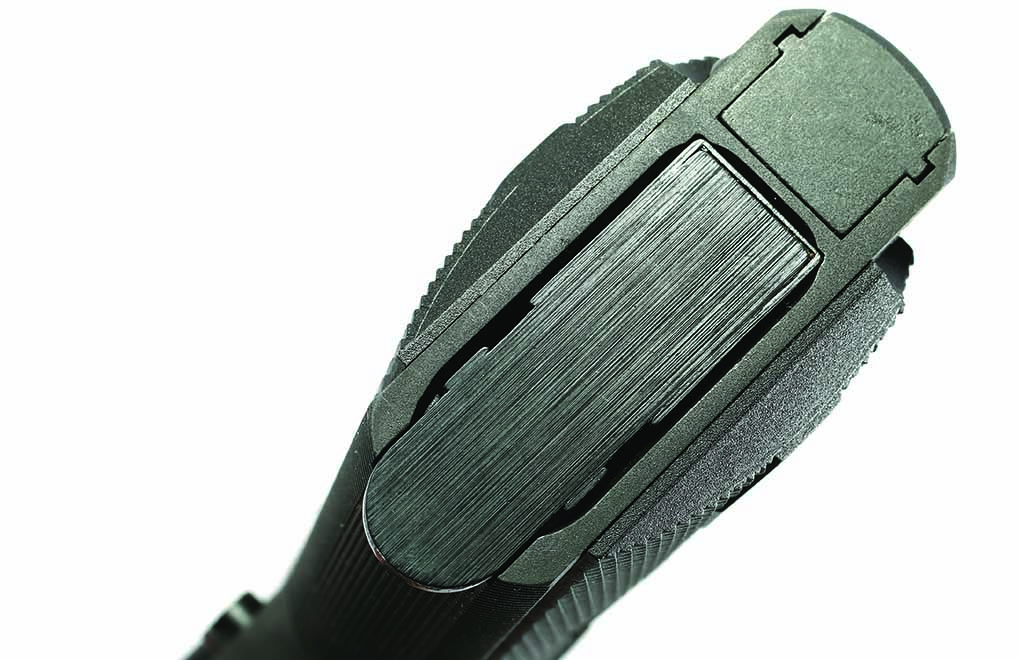
The barrel is a hard-chromed, integral-ramp barrel that uses a bushing. It isn’t a coned lockup, making it suitable for competitions where coned barrels are prohibited. The magazine well has a small but noticeable bevel to it, making reloading a bit easier.
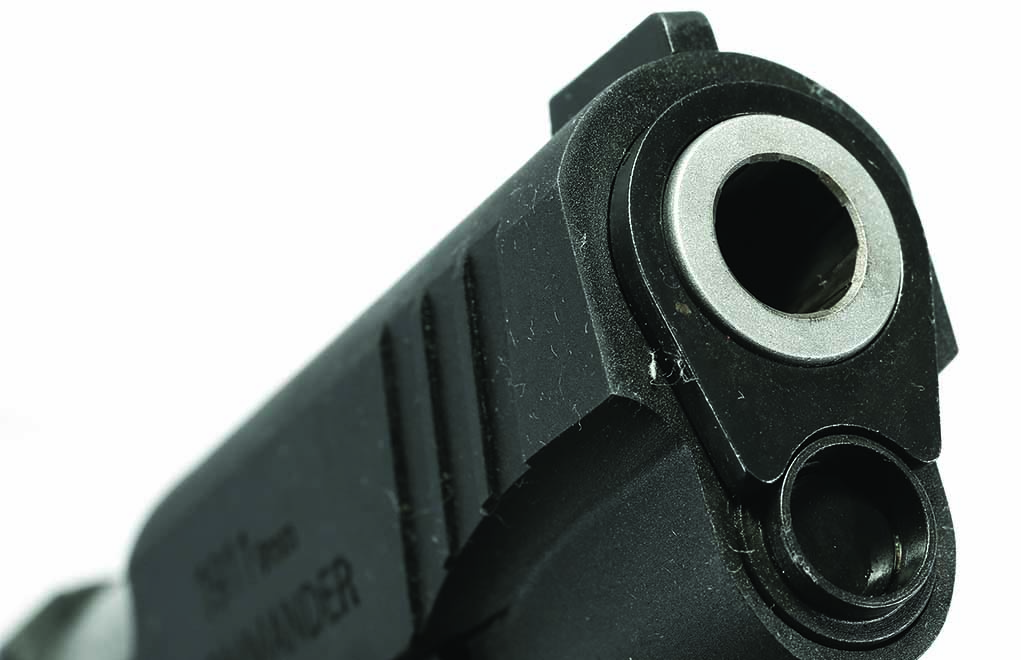
One thing that Taurus has done that might not be so good is the firing pin block. This is a Series 80-type setup, and some don’t like them. I don’t object, as long as everything works as designed, and this one does. Another slight oversight is the crown, or the lack of one. The muzzle is flat, with only the smallest of bevels or radii at the meeting of the bore to the muzzle. As thick as the barrel walls are there, I’d liked to have seen a more aggressive crown machined into it.
The Taurus 1911 Commander muzzle. The crown probably should be more than flat with a small bevel, but the tested pistol shot well enough as is.
The recoil spring assembly uses a full-length guide rod. This is one of those details that can create religious-level acrimony among shooters. If it bothers you, it’s easily changed. While I much prefer the design that St. Browning originated, if the current system works, I usually leave it alone. But, since Taurus has made the commander so “rebuildable,” you could easily swap the parts needed to make it more like what John Moses had in mind.
The grips are molded rubber, double-diamond style with the Taurus logo inset in the checkered pattern.
The magazines are blued and made by Mec-Gar (a very good choice). To accommodate the 9mm cartridge, the rear of the tube has a sheet metal spacer held in place by means of stab crimps. The 9mm 1911 world goes back and forth about this. Some think the best way to hold, position, and feed the cartridge is to park it at the front of the tube—hence, the spacer in the rear. Another camp deems that holding it in the back of the tube and using the front as an extra feed ramp geometry control dimension allows for the most reliable feeding. There’s a third camp (isn’t there always?) who feels no spacer is needed, and you can use .38 Super magazines. Whatever works, or blows your skirt up, go with it.
Here’s the dirty secret of the 1911 world: Your pistol will tell you what it likes. Use what it likes.
The magazine well of the Taurus 1911 Commander is minimally beveled, but this is better than we used in competition guns for many of the early years of IPSC competition.
Now, as an all-steel pistol with an integrally ramped barrel, the Taurus will have no problems with 9mm+P ammunition. At 38 ounces, you probably won’t either. Vanilla-plain big-box-store FMJ ammo will be soft in recoil and a pleasure to shoot. As with the magazines, your pistol will tell you what it likes as far as accuracy is concerned.
If the Shoe Fits
So, what’s the purpose of a pistol such as this one?
For one, it makes a fun practice and just blastin’ pistol. It’s all steel, so you won’t wear it out anytime soon. Recoil won’t kill you. In fact, with the softest-shooting ammo you can find or load, it’d be perfect for a new shooter. It’s accurate, has low recoil, and it’s a “real” gun, not an airgun, or a rimfire. (Yes, I know those are real guns, too, but a lot of new shooters make a big distinction between them and a 9mm. A 9mm is real to them, more so than a .22 LR.)
Accuracy will be better than most owners. If you need more, I refer you back to all steel—an industry standard. If you want a more accurate barrel, it’s easy enough to find and have one installed. Or start your 1911 ’smithing adventures by installing a tighter-fitting bushing and see what results you get.
The thumb safety and grip safety are patterned after the Ed Brown design. The slide stop is a classic grooved ledge.
As a competition gun, the Taurus commander might be a bit lacking. The sight radius of the shorter slide is going to cost you a few points. You’d best check with the details of the competition you want to enter to make sure that some aspect of the Taurus doesn’t put you on the outside. But it’ll get you started, and even a long way toward winning before you have to move up.
As a daily carry gun, it’d be great. Yes, a bit heavy, but a proper belt and holster will make it comfortable.
As a home-defense gun, its only lack is that there’s no place to mount a light. But there are techniques to holding a light and pistol that you can find—practice and use the most comfortable one.
Last bonus: the price. You really can’t touch it for a reliable, all-steel 1911.
Taurus 1911 Commander Specs Type: Single-action pistol Caliber: 9mm Parabellum (.45 ACP also available) Capacity: 9+1 rounds Barrel: 4.2 inches Length: 7.9 inches Weight: 38 ounces Trigger: 4 pounds, 4 ounces SA Finish: Blued steel (PVD Prizm available in .45 ACP) MSRP: $640 Maker: Taurus USA
For more information on the Taurus 1911 Commander, please visit taurususa.com.
Editor’s Note: This article originally appeared in the October 2020 issue of Gun Digest the Magazine.
Going on two decades now, concealed carry has been the driving force in the handgun world. Specialized heaters meant for competition or pleasure still abound, but more than anything on-person personal defense has defined the modern pistol. And when it comes to calibers for the task, more armed citizens have drifted to one in particular—the 9mm.
Is the good ol’ Parabellum the best possible choice? That’s a matter for barbershop debate and comment section flame wars. Suffice to say, with quality ammunition and a well-placed shot it’s more than adequate to get the job done. Furthermore, given its mild recoil out of most handguns, the average shooter can become proficient enough with the 9mm to ensure they’ll deliver a potential life-saving shot.
This raises the question, what exactly is the best 9mm pistol for the task of concealed carry? As has been uttered again and again, that all depends. Risk profile to skill level and even wardrobe (if it’s light garb a big gun might not be your best option) among a host of other factors play a role in determining what handgun is best for you. While we can’t hash out those for you, we can showcase some of the best options you have at your disposal. In this case, double-stack 9mm pistols.
What Is A Double-Stack?
Since we’re talking about double-stack 9mm pistols, the question might be raised “What exactly is a double-stack?” Fair enough. Essentially, there are two dominant magazine configurations for handguns and rifles, single- and double-stack. In the single stack, the ammunition sits atop each other in a linear fashion, while in the double-stack they are staggered in what is best described as a zig-zag pattern.
Double-stack magazines hold more ammo, but are much thicker.
There are advantages and drawbacks to each, which should play a role in determining the best concealed carry option to fit your needs. Single-stack mags are whisper-thin, helping keep guns that utilize them usually less than 1-inch in width. In turn, these pistols tend to be more comfortable and easier to conceal. The tradeoff is capacity. Not a hard and fast rule, the upper limit of single-stack magazines is typically 10 rounds; the iconic 1911 in traditional .45 ACP is eight rounds by and large. Typical encounters with felonious jackasses, this should prove more than enough firepower for the proficient handgunner. Black swan defensive situations … practice your reloads.
Single-stack magazines cut a much slimmer profile.
Peace of mind when it comes to firepower, the double-stack magazine in most cases has a 50- to 70-percent capacity advantage over its straight-and-narrow counterpart. Expect to find most pistols arming you with 15 to 17 rounds standard. Plenty of ammo on tap, double-stack pistols have redundancy built into the system, not to mention the means to handle rare, but more deadly multi-attacker encounters. There’s a but … which is these guns are girthy—generally more than 1 inch in width—which makes them a bit harder to keep under wraps. Less talked about, those with small paws can find a solid grip tricky.
Why A Double-Stack 9mm Pistol?
Though new single-stack handguns have made headway in recent years, the double-stack 9mm pistol remains the dominant choice for a concealed carry gun. We’ve already touched on one of the reasons why—capacity. Don’t wrinkle your nose, it’s a huge advantage. Every time you have to reload your gun is out of the fight—a potentially deadly disadvantage. Important as this facet is there are some other advantages to 9mm double-stacks.
The 9mm itself is an ideal middle-ground defensive caliber, very shootable and very potent. It is no stretch to say most citizens looking to go armed—with the right amount of practice—can become proficiently accurate with a nine. Shot placement the predominant variable in neutralizing a threat, it goes without saying a handgun that is easily shot accurately is a leg up. Conversely, there isn’t a huge tradeoff in the 9mm’s terminal ballistics. Thanks to modern ammunition advancements—particularly more reliable and consistent expanding bullets—the caliber has become a more dependable threat stopper. The greater the wound channel, the more vitals are damaged and blood is lost, the better the chance an attacker will be thwarted. Sure enough, the good ol’ .45 ACP will always possess a greater margin of error in this department given its diameter, but to say it’s a world better presently would be a vast overstatement.
Finally, the double-stack 9mm pistol is a bit heftier than its slimline counterparts. Yeah, fully loaded the pistols will weigh more on the hip, which might not appeal to everyone. Taking on this burden, however, generally means a more controllable gun. Weight soaks up recoil, in turn, the gun is easier to keep on target shot to shot, thus potentially upping the speed at which you can fire it accurately.
Top Double-Stack 9mm Pistols
Sig P365
Few pistols have created as much upheaval as the P365. It happens when you do about everything right. The demure double-stack 9mm is among the most compact options on the market, but doesn’t compromise one tiddle. The magic is in the magazine, which Sig took extraordinary pains designing. Not only does it hold 10-rounds with its flush-fit magazine (12- and 15-round extend mags), but it does so while achieving near single-stack dimensions—1.1-inch width and 17-ounces in weight. That’s minuscule, particularly for the class of pistol.
Size and firepower are only part of the equation. Sig built the P365 as a fighting pistol and it has the assets to fill this role. A crisp and light trigger aids immensely in keeping the 3.1-inch barrel pistol on target and its short and positive reset means it can run fast when you need it to. Steel night sights, larger than you find on many in the class, are quick to build a sight picture, yet they aren’t obnoxious enough to impede a draw. Add in elementary school math simple takedown—plus an easily removed fire control group—makes it an afterthought to keep the pistol in tip-top shape. It’s easy to see why the P365 is the hottest ticket in defensive pistols presently.
Unless throwback designs and metal frames are your things, Walther often gets overlooked in the defensive realm. A mistake for certain. In the game longer the most, the gunmaker understands what works and what doesn’t. This more than shows in the expertly executed PDP.
On this list, the newly minted pistol (2021) replaces another top-notch Walther, the PPQ, which has been discontinued. Fret not, because the PDP offers everything its predecessor did and more. In particular, Walther maintains much of the PPQ’s feel, while improving its ergonomics. Enhanced texturing on the striker-fired, a hexagonal pattern with a pyramidal structure, offers both comfort and an extremely positive grip. Additionally, Walther has gotten much more assertive with the gun’s cocking serrations. Protruding above the surface of the slide, the wide-spaced ridges pick up the pace of manipulation, making reloads and clearing failures much quicker. Furthermore, the controls—mag and slide release—are reversible, thus ambidextrous. As to the size of the optics-ready PDP, we prefer the 4.5-inch compact (there’s a 4-inch model as well as a 5-inch full-sized option), given it’s not much larger than the smallest iteration, but offers an improved sight radius. As a side note, the pistol is backward compatible with PPQ magazines.
Walther PDP Specs Overall Length: 7.5, 8 inch (Compact); 7.5, 8 and 8.5 inch (Full Size) Width: 1.34 inch Height: 5.4 inch (Compact); 5.7 inch (Full Size) Barrel Length: 4 and 4.5 inch (Compact); 4, 4.5 and 5 inch (Full Size) Weight: 21.4, 23.1 ounces (Compact); 21.5, 22.3 and 23.8 ounces (Full Sized) Sights: 3 white dots, adj.; optic ready Trigger: Striker-Fired MSRP: $649 waltherarms.com
Ruger Max-9
To some extent, Ruger has bucked many of the dominant trends in concealed carry, and has been successful in going rogue. Though, its latest endeavor—the Max-9—is decidedly mainstream, fully embracing the wave of micro-compact, double-stack 9mm pistols flooding the market. And shooters should count themselves lucky the massive gunmaker decided to go with the flow.
Not only is the Max-9 on par with class leaders in form and function, but it also comes in at a much more affordable price. As to the tale of the pistol’s tape, it measures 6-inches long, 1 inch in width, boasts a 3.2-inch barrel and weighs in at 18.4 ounces unloaded. By most people’s standards, that’s fairly compact, enough to stay undercover in light summer garb, without having to compromise firepower. And the Max-9 has plenty on tap, feeding off 10+1 flush-fit magazine and 12+1 extended capacity. Overall, the pistol proves very comfortable with aggressive grip texturing keeping it in hand, and fore and aft cocking serrations making it easy to manipulate. The trigger is snappy to boot.
Sig isn’t the only gunmaker that knows how to go small. Shake hands with the Springfield Armory Hellcat. Concealable in every sense of the word, the double-stack 9mm offers firepower well beyond its size. To be exact, its flush-fit magazine holds 11 rounds and its extended 13. More than enough to dissuade even the most determined criminal nitwit. Yet the gun is decidedly a micro-compact—1-inch width, 3-inch barrel, 4-inch height and an extremely manageable 17.9 ounces. Quite a feat.
For its size, the +P-rated Hellcat is surprisingly easy to manage. Assertive grip texturing keeps the pistol in place, a snappy little trigger aids in keeping it on target and ample and aggressive cocking serration fore and aft make the slide a snap to manipulate. The Hellcat’s sights are a bit different, a U-notch rear and tritium front, nonetheless instinctive. And if you run a red-dot optic, the OSP model comes with milled slide for direct mounting. Best of all, the Hellcat comes in at an affordable price, opening it up to the vast majority of the market.
Like it or not, the Glock 19 is the measuring stick by which all other double-stack 9mm pistols (perhaps all defensive pistols) are measured. Is it perfect? Not quite. But a mixture of a forward-thinking ergonomics, almost boring accuracy and a design so simple it almost never fails, it’s practically perfect. More than can be said for others.
Compared to the micro double-stacks, the G19 is on the largish side, but interested parties shouldn’t let this scare them off. Certainly, at 1 ¼ inch in width and 21 ounces in weight (unloaded), the pistol takes a bit more consideration keeping under wraps. Yet, those that do are rewarded with exceptional firepower with a 15-round magazine coming standard and 17-round extended capacity more than feasible for carry. Also, the sight radius. This doesn’t get talked about enough but plays an important role—particularly with new shooters’ accuracy. At 6-inches the G19 has plenty of it, making alignment a heck of a lot less shaky when you’re mastering a fast and effective sight picture. Also, if there’s anything that doesn’t quite cut it with the Glock, you can upgrade. The aftermarket is bristling with top end parts to get the most out of your pistol.
For certain segments of the shooting world, the M&P9 represents the best of the best when it comes to striker-fired, polymer-framed pistols. It should. Smith & Wesson didn’t attempt anything over the moon with the 9mm double-stack, just a dead-on reliable defensive pistol that has everything you need to save your skin.
First and foremost, the M&P9—now in its second generation—is reliable as a faithful hound. There are examples with thousands of rounds run through them without so much as a hiccup. Reassuring in a gun meant to save your life. Additionally, it’s familiar. By this I mean, S&W modeled its form and feel after one of the all-time greats—the 1911. This is particularly seen in the 18-degree angle of its grip, which many argue is more conducive to two-hand shooting than pistols with a steeper rake. Similar to many in this class, the 9mm is tailorable to your hand size through replaceable back straps and fits tightly thanks to a notable palm swell. Furthermore, the 4-inch barreled Compact (the most logical model for carry) won’t leave you hanging on capacity holding 15+1 rounds. The pistol is weighty for its class (27 ounces unloaded), but not prohibitively so.
You may have forgotten, the VP9 was a big deal when it came out. Not H&K’s first foray into striker-fired guns, the pistol was a drastic break for a company that had poured its heart and soul into hammer guns. The double-stack 9mm didn’t disappoint. Ticking like a Teutonic timepiece, the top-shelf striker-fired pistol was everything shooters expected and more.
Ergonomics are a big draw for the pistol, it just feels right in the hand and is a natural pointer. Much of this is thanks to adjustable grips via an interchangeable backstrap system and lateral grip panels. Also helping, rather understated finger grooves that situate the hand for a high, commanding grip on the pistol. Additionally, Heckler & Koch has included some interesting design points on the pistol, such as polymer charging handles at the rear of the slide. The gun is a shooter with an excellent trigger, which boasts a short reset (.24 inch) that lets you pick up the pace as needed. Very manageable in size and weight, the 4-inch barrel VP9 costs a bit more than most on this list, but still proves a great value.
A basic skill, learning strong-hand-only draw, presentation and shooting ensures you’re never out of the fight.
Ideally, we’ll have both hands at our disposal when we draw our concealed carry pistol. In reality, there’s a good chance we’ll only have one to work with. There are a multitude of scenarios that potentially put only one hand at our disposal. It could be shielding a child or loved one from danger or an injury that denies us use of that particular hand. Either way, incapacitation can’t stand in the way of self-defense, which makes it wise to learn how to draw and present our defensive arm with one hand.
Jamey Caldwell, an instructor at 1-Minute Out and former special operator, covers the fundamentals of a strong-hand-only draw. This is the first of two videos covering this topic, we’ll follow up later with training on a support-hand-only draw. Either case, it’s challenging but doesn’t veer too far off typical draw from concealment techniques.
In synopsis, the main challenges to a strong-hand-only draw are clearing garments and trigger control. The latter is especially touchy, given all your grip pressure comes from your dominant hand, which can hamper the fine motor control of the trigger finger. Caldwell gives advice on overcoming both of these in the video. Left unsaid, though evident in his demonstration, your stance likely will have to modify to shoot accurately one-handed, as well.
Sufficed to say, practice is the key to master the strong-hand-only draw, presentation and shooting. So make certain you spend time at the range and in your dryfire regimen honing this skill.
PS Turkey Hunter is tailored to bring home the big bird.
If you happen to track the smoothbore market, you’ve most likely noticed the dominant trend in recent years. Perhaps only second to tactical variations, turkey shotguns of every shape and size have been rolling off gunmakers’ lines. In part, this has been driven by the resurgence of interest in bagging a gobbler, but also the recognition there was a demand for tools specific to the task.
Escort Shotguns is among the latest to join the fray. The brand, manufactured by Turkish gunmaker Hatsan, recently unveiled its PS Turkey Hunter, part of the company’s popular gas-operated, semi-automatic shotgun line. In addition to some intriguing features to help bag the big birds, the gun also comes in at a very competitive price with an MSRP of $499. But thriftiness isn’t the smoothbore’s only attractive point.
The PS line of shotguns has won kudos over the years as a fairly proficient entry-level option, particularly thanks to two features—its FAST Loading system and Smart Valve Piston technology. The former makes the gun much quicker to load one-handed, due to the loading button serving as both a carrier latch release and bolt release. In turn, hunters can maintain their shooting position, while topping off the gun’s magazine. As to the latter, the self-regulating Smart Valve ensures the PS Turkey Hunter cycles no matter what ammunition it’s fed. That means everything from low brass 2 3/4 -inch shell up to thumping 3-inch magnums are fair game, giving the gun plenty of versatility. Nice feature, especially if you happen to mix loads in the field.
Outfitted with 5-inch-long cantilever optics Weaver-style rail above the receiver, the gun is optics-ready out of the box. Scopes aren’t a must-have, however, given Escort includes a traditional sighting system, with a fully adjustable fiber-optics front and rear sights. The gun boasts a chrome-lined barrel (24 or 22 inches depending on gauge), making it impervious to corrosion and improving its durability. And it comes with the choice of Realtree APG and Mossy Oak Bottomland camouflage patterns.
Concerning gauges, the PS Turkey Hunter comes in three flavors—12-gauge, 20-gauge and .410 bore. The shotgun ships with three chokes—Turkey, Full and Improved Modified—and has a 4+1 capacity in all chamberings. The gun is also impressively light, all gauges weighing in at less than 6.5 pounds, thanks in part to the gun’s aluminum alloy receiver. Finally, the gun has both sling swivel mounts, as well as a cross-bolt safety. Overall, a tidy package for bringing home a Tom.
Looking to go armed, but are stuck in the weeds as to what to arm yourself with? Here are 20 of the best concealed carry gun options that will keep you on the defensive.