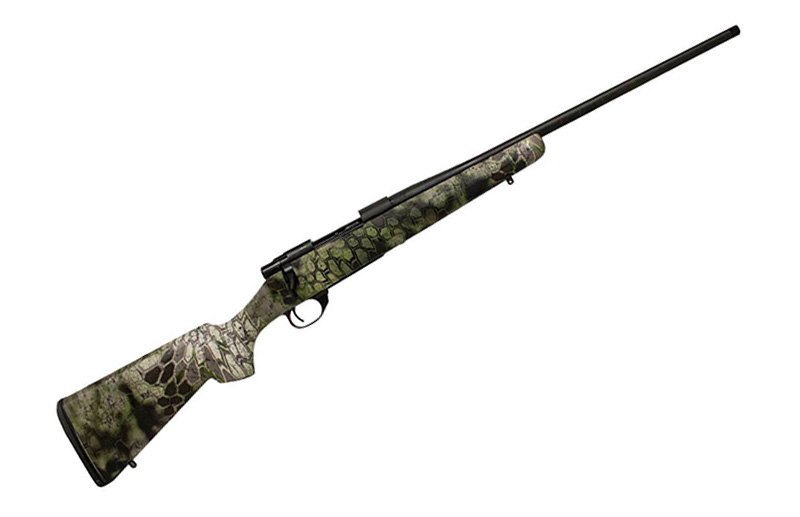
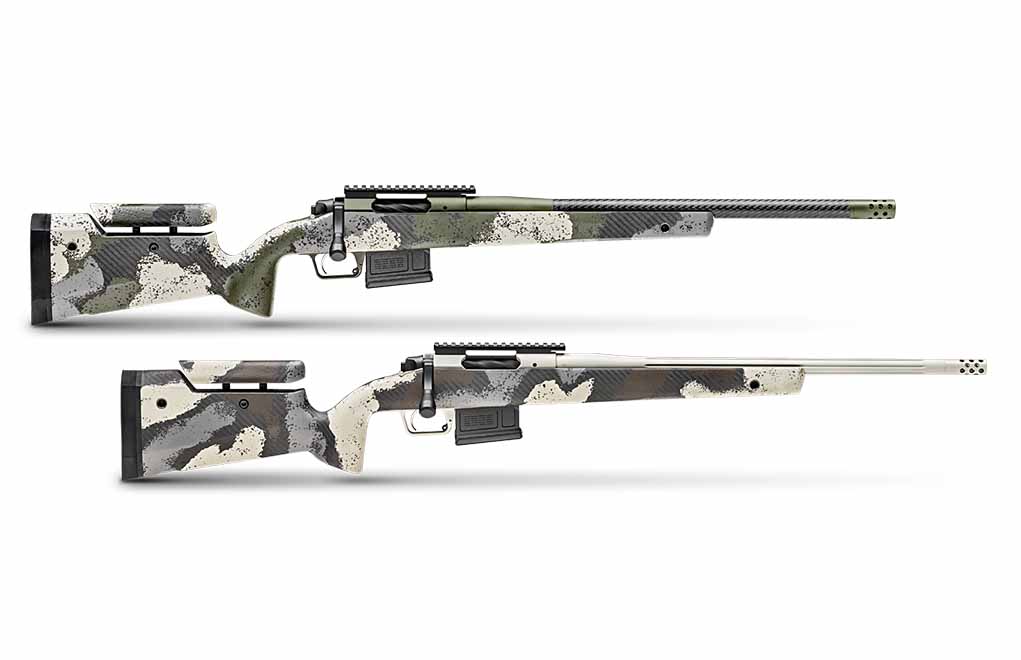
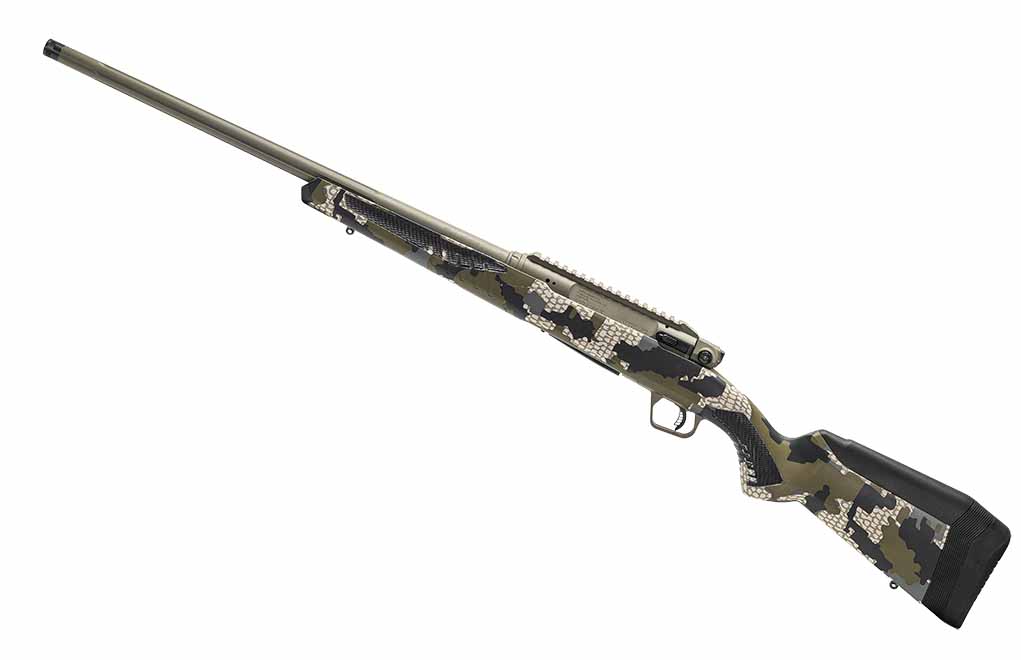
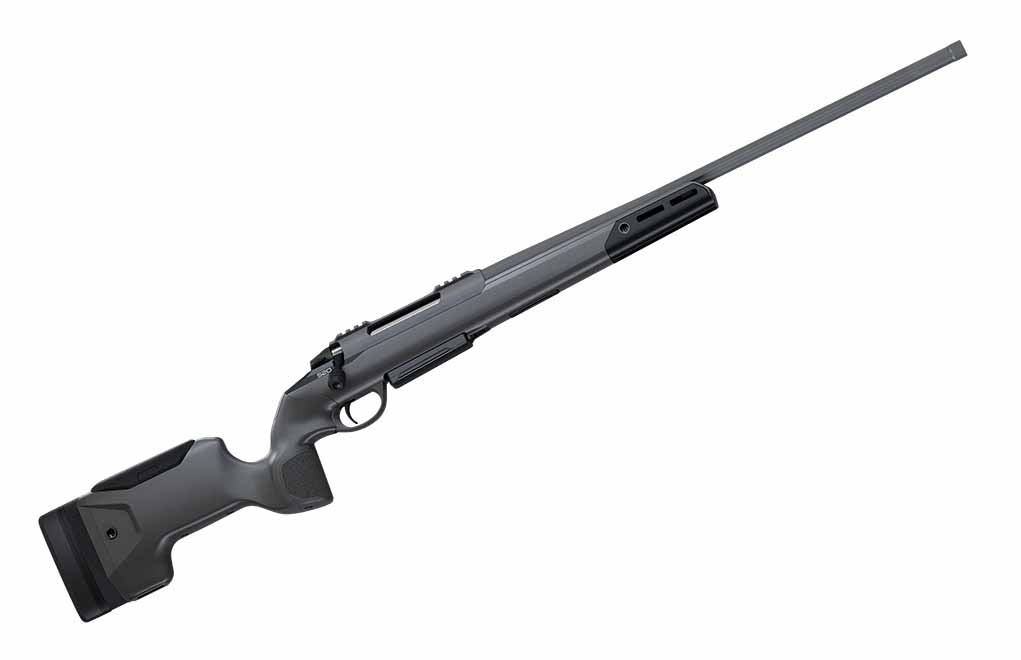
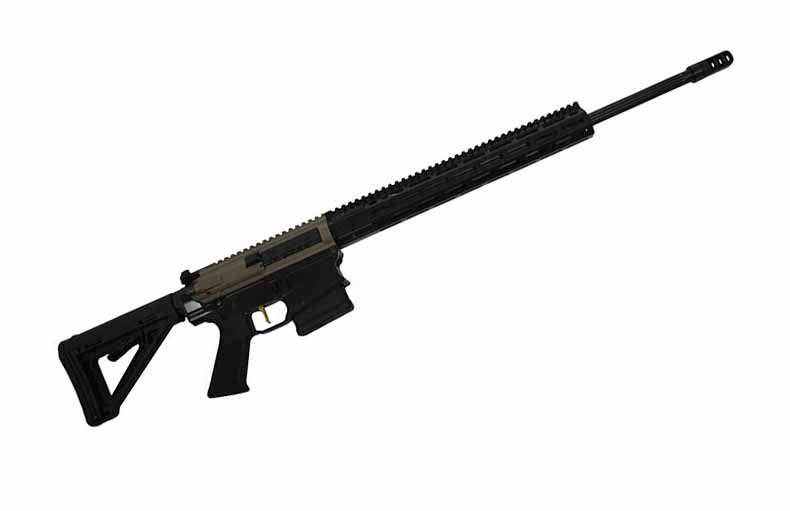
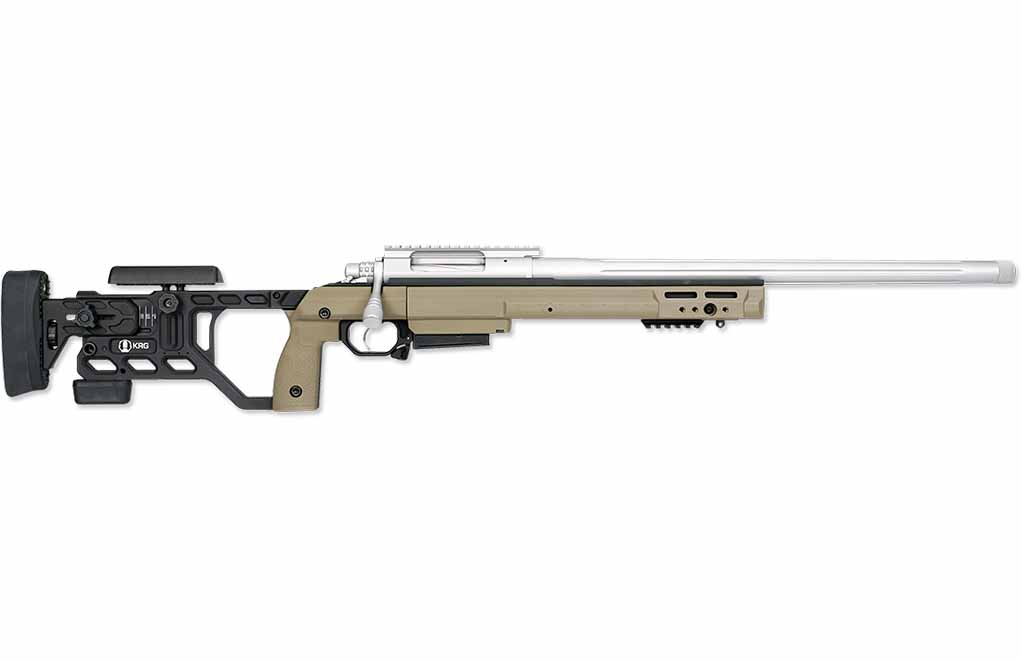
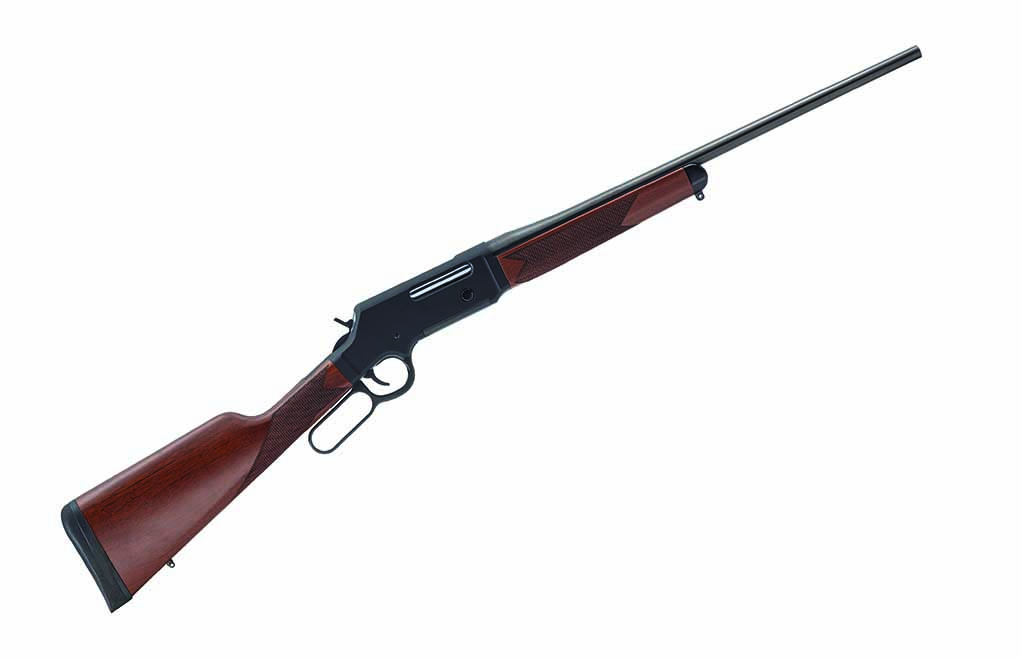
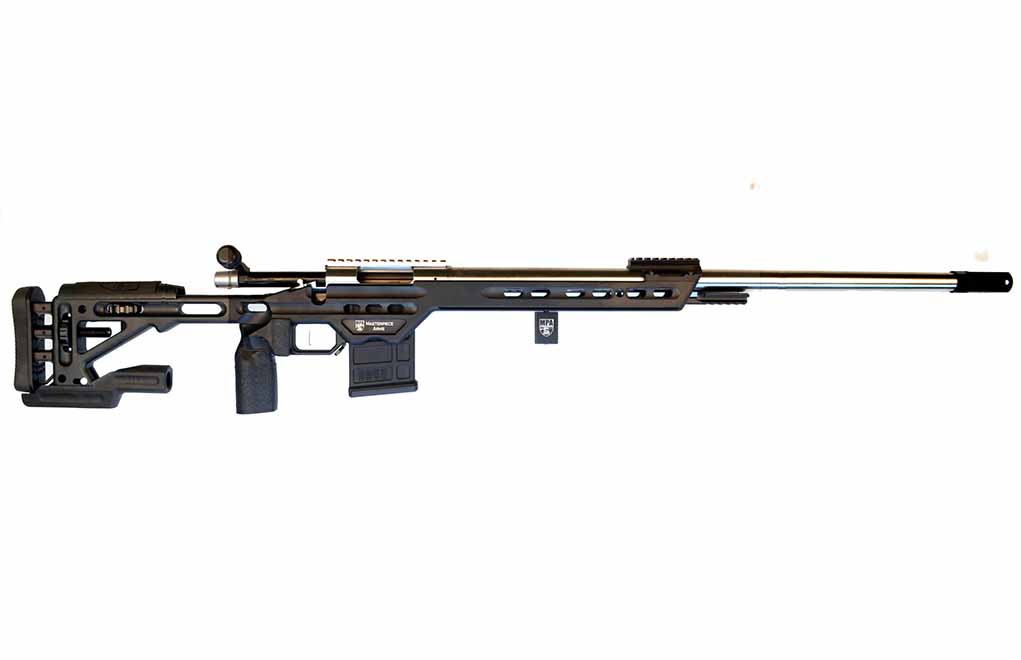
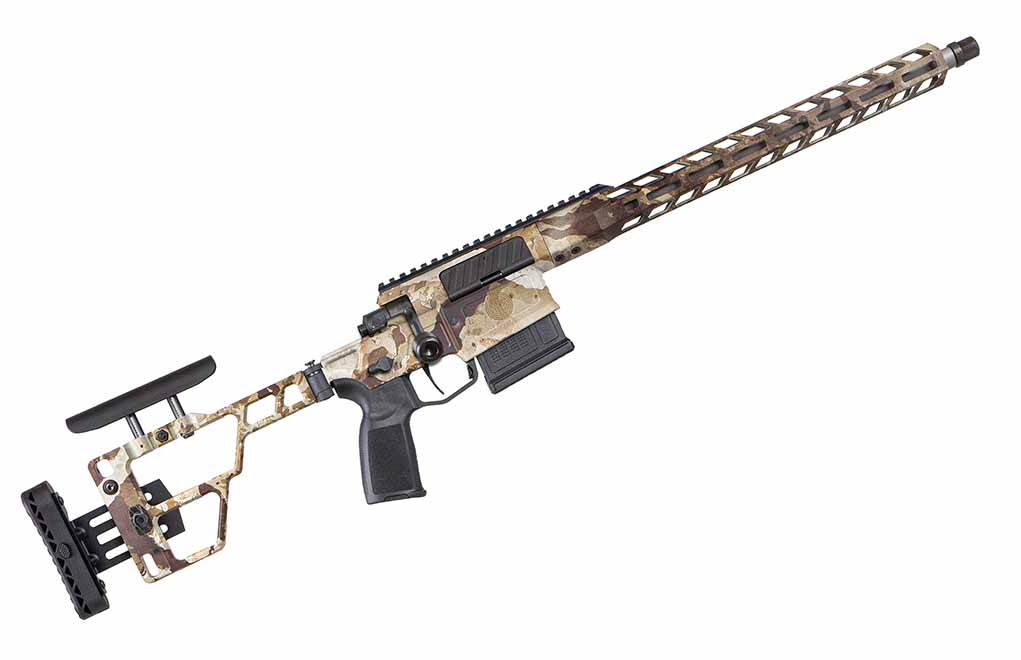
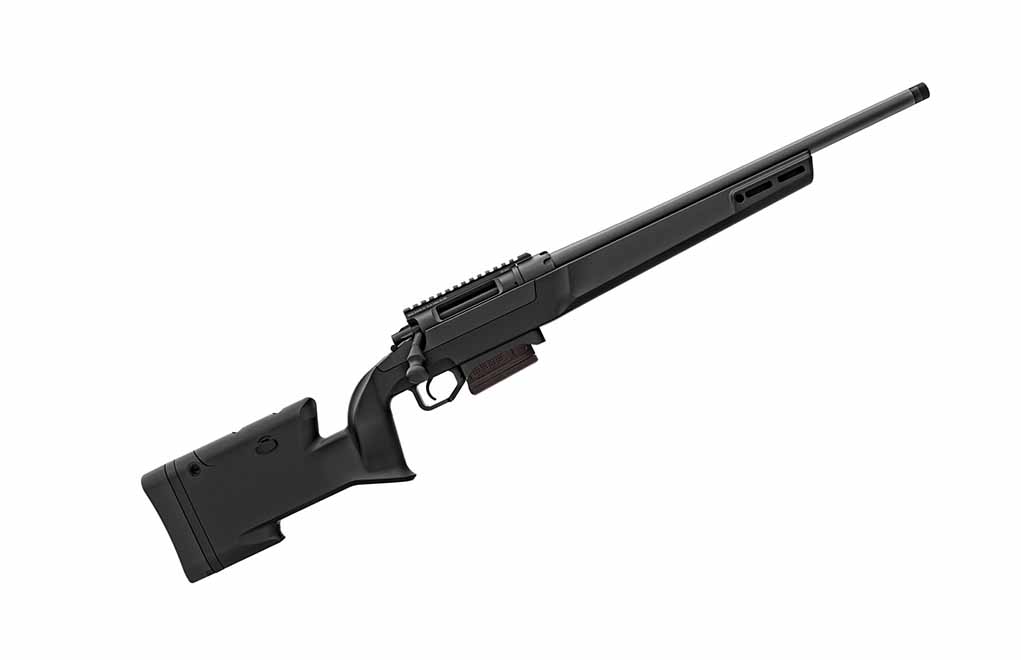
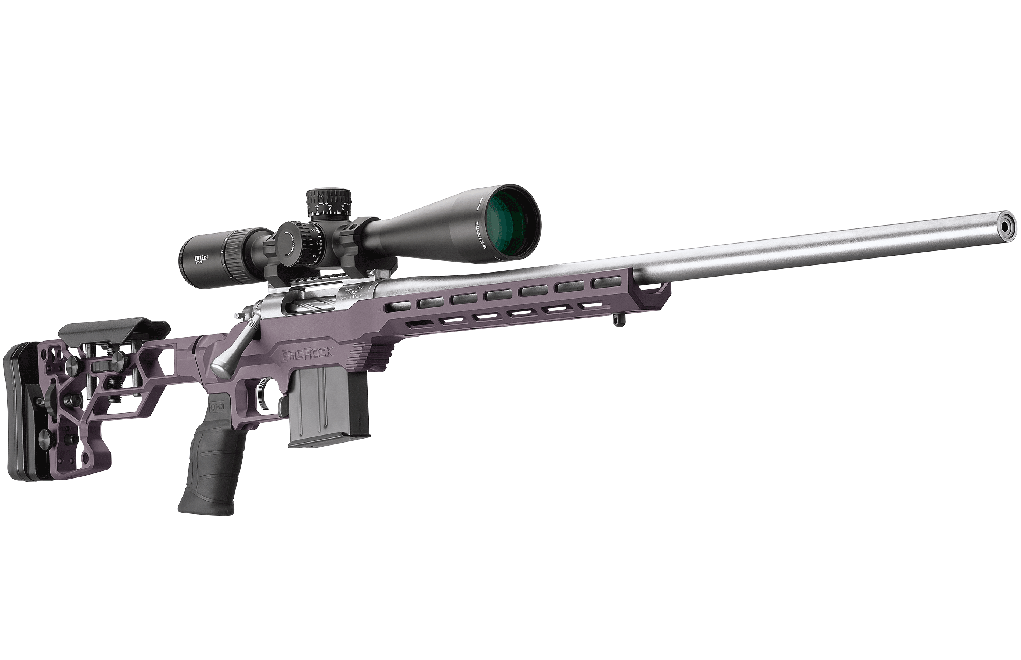
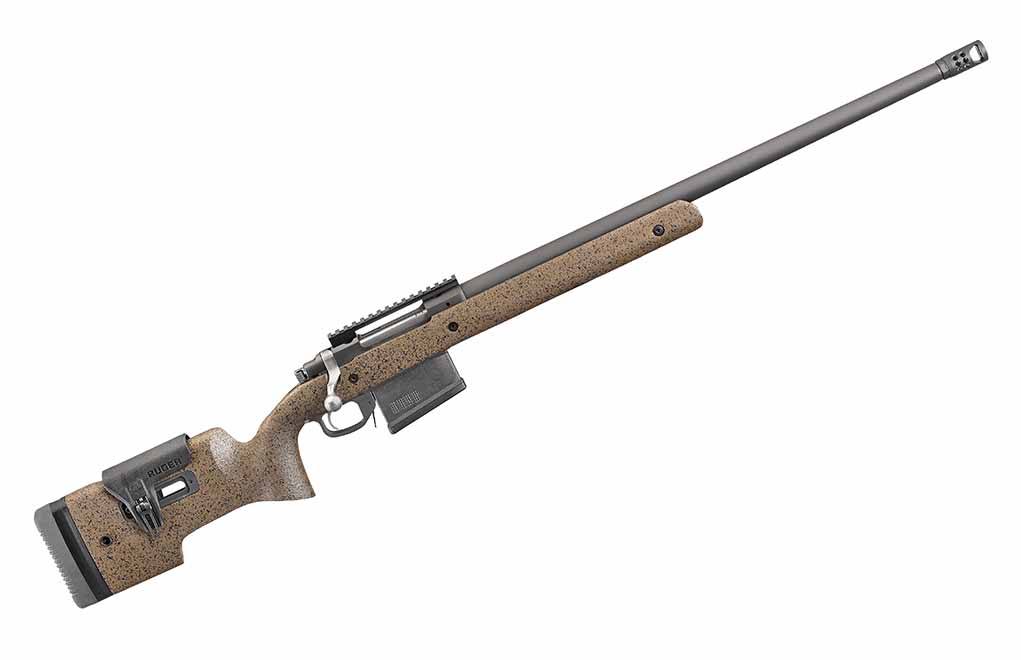
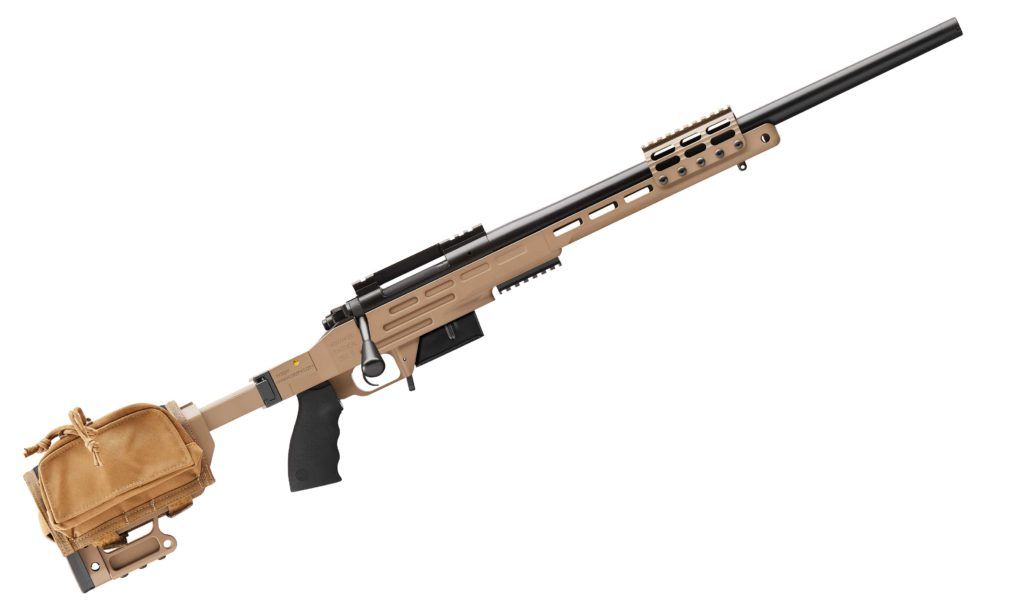
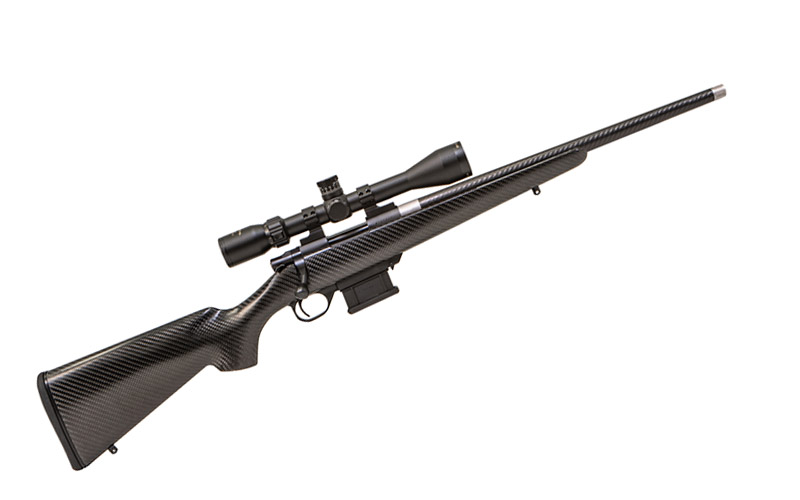
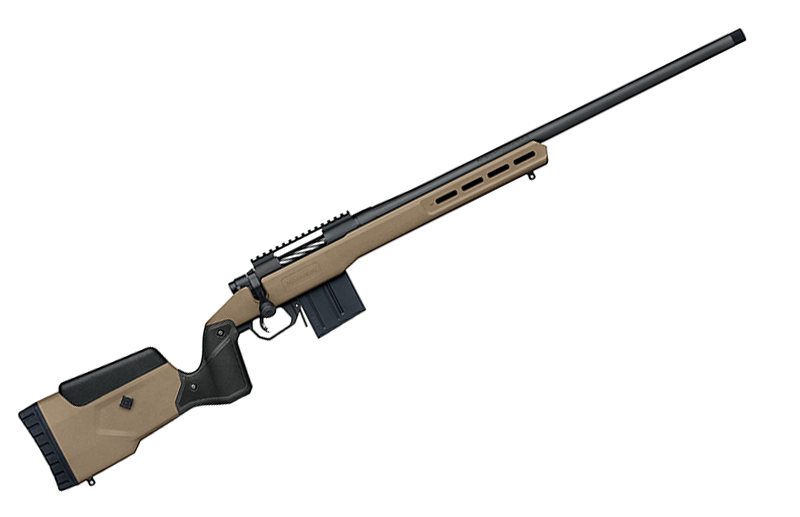
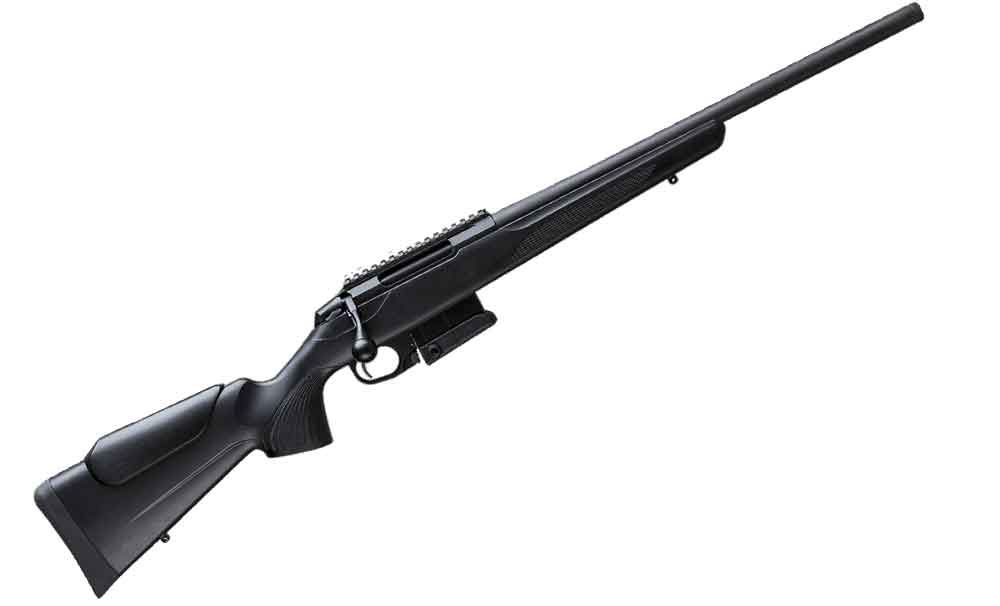
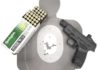
Lighter bullets result in higher velocities, and here’s how speed can improve your long-range shooting game.
Growing up, they always told me things would get smaller and lighter as we—as in society and technology—moved forward. Today, “we” see it in a variety of industries, but the shooting community has been slow to respond. There lacks a balance, and the shooting world is subject to wild swings of the pendulum in an effort to find and incorporate those modern advancements in technology.
One of the first areas we ventured into was barrels. We started wrapping steel in carbon fiber to save weight. Then, we questioned the technology to the point where people invented reasons not to use carbon-fiber barrels.
The modern carbon-fiber barrel is outstanding in every way. Yes, if you overheat it, the mirage directly in front of your magnified optic will shift the point-of-impact, but we knew this. Mirage shields aren’t new; we used mirage bands on stainless steel barrels, so when target shooting with a carbon-fiber one, it only makes sense to include it.
Packs are another area where we’re slow to follow. We like big, heavy, military-style packs; the most popular include a gun bearer feature to haul the rifle together with your gear. The problem is, they’re copying military gear from the ’80s. Modern packs weigh in the ounces versus the most popular shooting packs, which come in around 8 pounds empty. It’s that heavy Cordura we covet that adds pounds to our equipment. If you shaved 4 pounds from the pack and added 2 pounds to the rifle, the improvements made are highly noticeable. You gain performance across the board.
See what I mean? As a shooting community, we evolve … but we’re also very set in our ways.
Unbalanced Bullets
All this brings to me to bullets and rifles: I believe we’re missing a balance in our choices. I see a lot of people who run immediately to too big and heavy. They want to shoot a .338 Lapua Magnum with 300-grain bullets, when the 250-grainers work so much better … and 6.5 Creedmoor will do the same job.
Now, we know rifle weight is stability, and bullet weight helps carry the round farther. That said, I still feel speed wins, and when you look at the balance between the two, regaining speed is the smarter side of the equation.
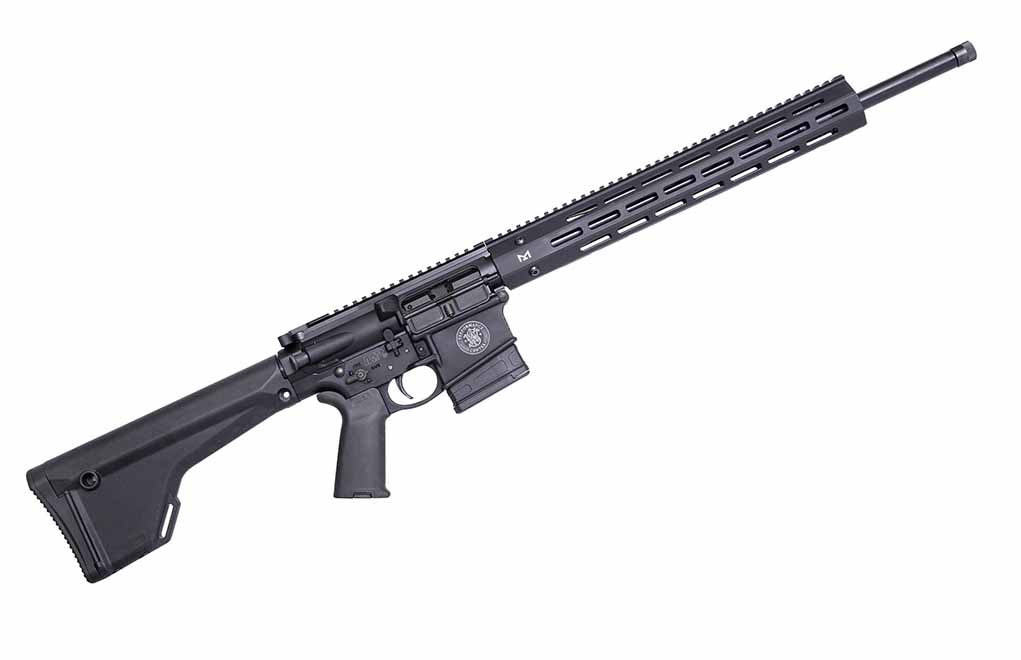
Recently, I had a real eye-opener when two cartridges for the AR platform were introduced. See, I’m a bolt-action, precision rifle guy. I do shoot a lot of large-frame ARs, which drive very differently from the smaller-frame AR-15s. Each one must be addressed from a slightly different place if you want to be successful downrange. This fact created an accuracy problem; people were doing great with an AR-15 and shooting poorly in an AR-10. It happens. I see it all the time. It’s a training issue, but training takes time to correct.
So, we want to address 600- to 800-yard targets without carrying a bigger gun or having to build a better marksman. How about a cartridge to bridge the gap?
Don’t’ be afraid to try the smaller offerings out there. You might find the ballistics to be very close with a lot less recoil.
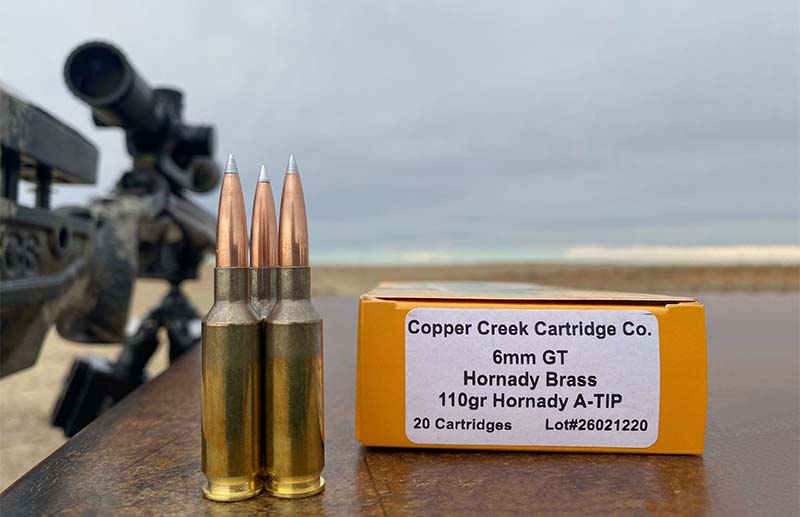
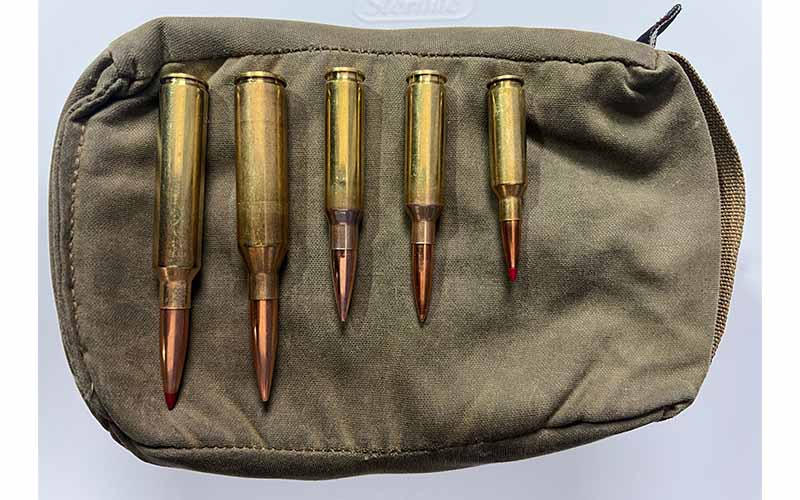
Enter the Valkyrie … or now, the 6mm ARC. I could focus on the 6.5 Creedmoor, but I want to focus on these two offerings, because we see 6mm in precision rifle competition and the Valkyrie because of the “misfire” in the release.
The 6mm Craze
The 6mm Creed is a great round; it’s fast, light, accurate and has it all but barrel life. It’s Grandpa’s .243 Winchester, only with a long-range twist-rate and huge bullet library. Guys went from the .308 Win. in precision rifle competition to the 6.5 Creedmoor, and once they fell into the 6mm world, they never looked back.
What’s its greatest advantage? Speed. Because precision rifle competitions have a speed limit of 3,200 fps, the 6mm Creedmoor—at 3,175 fps—was perfect. Except it killed barrels, had recoil and didn’t really do anything over the 6.5 Creedmoor. Enter the 6mm Dasher with less recoil; it dropped the speed from 3,175 fps to 2,850 fps. It has all the performance, less recoil and a bit more barrel life. The Dasher led to host of other 6mm cartridges, finally settling with the 6 GT.
Today, many 6mm rounds hover between 2,850 and 2,950 fps in muzzle velocity. It’s a nice balance of weight and speed. The competition crowd usually stays over 100 grains in bullet weight, topping out around 115 grains. When you combine these values, the drop and drift are outstanding. My personal load, with a 108-grain factory ammo, is 6.8 mils to 1,000 yards, which is great.
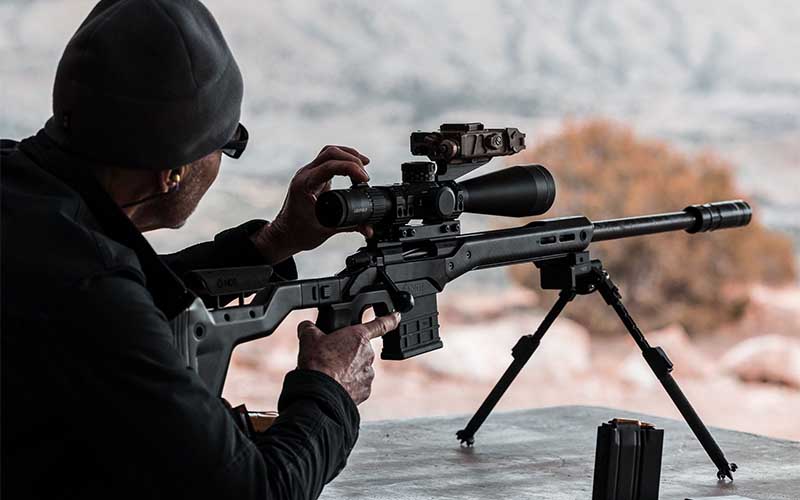
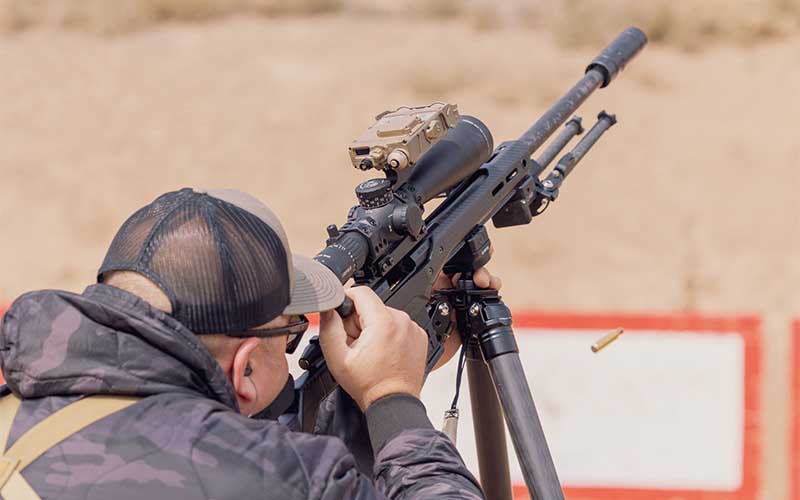
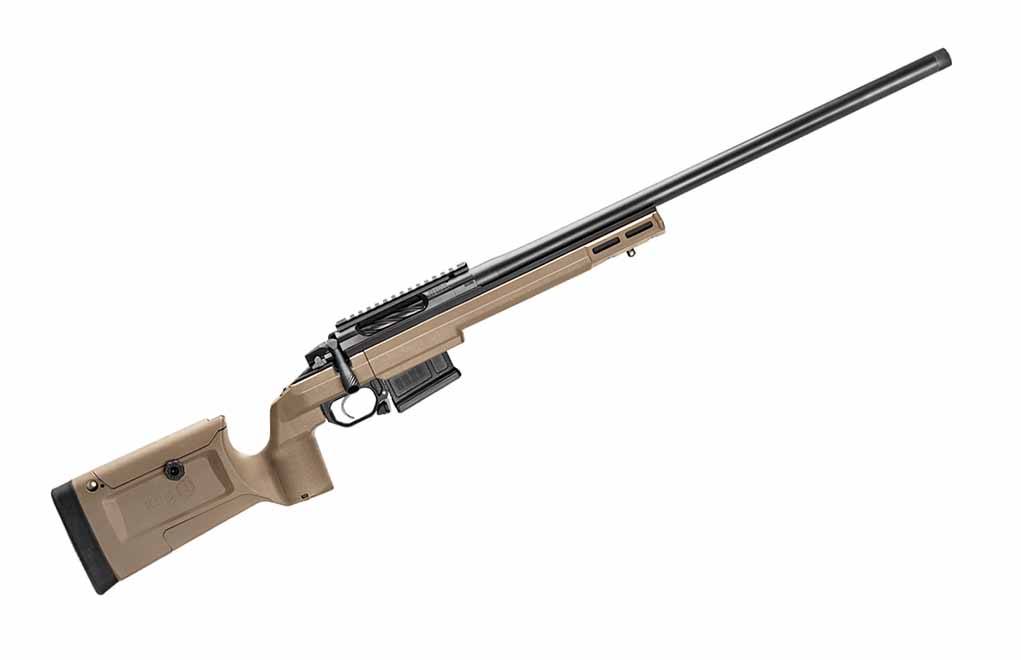
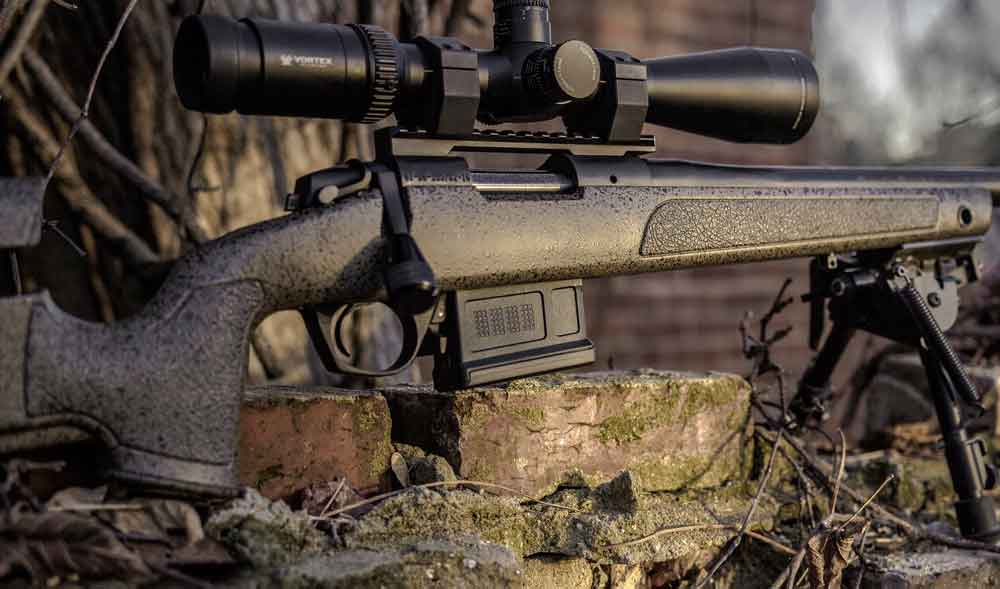
A precision rifle student using the lightweight Valkyrie bolt-action rifle to engage targets to 1,200 yards with much success.
Lighter bullets offer up less recoil, and less recoil translates into better accuracy for the shooter. The marksmanship advantages come into play through recoil management. Recoil management tells the bullet where the barrel is upon release. All 6mm bullets, being light and fast, will exit the barrel quickly and with less disruption to the shooter. By adding this bullet to a small-frame AR-15, the weight and speed equations balance very nicely.
What am I really working toward by going lighter and what system is being affected by the increase in speed from reducing the bullet’s weight?
Time
The time it takes for the bullet to leave the barrel is less, so shooter actions behind the bolt are minimized. The time it takes for the bullet to reach the target is reduced, which means less drop. It also means less wind interruption. Time of flight is a major factor.
Sure, I can take a big, heavy bullet and float it like a softball in the air and absolutely hit the target repeatedly. But I’m increasing my chances of a miss from an errant wind gust—not to mention the higher the bullet goes, the more the wind increases and becomes less predictable.
The .22-Caliber Option
I have a confession to make: I love the .224 Valkyrie, but I strongly believe it “misfired” upon release. I feel like my grandchildren might never know the Valkyrie, because it might not survive. If it does, it’ll be due to sheer willpower. The bright side? The .224 Valk has reintroduced .22-caliber centerfires as a viable, long-range cartridge.
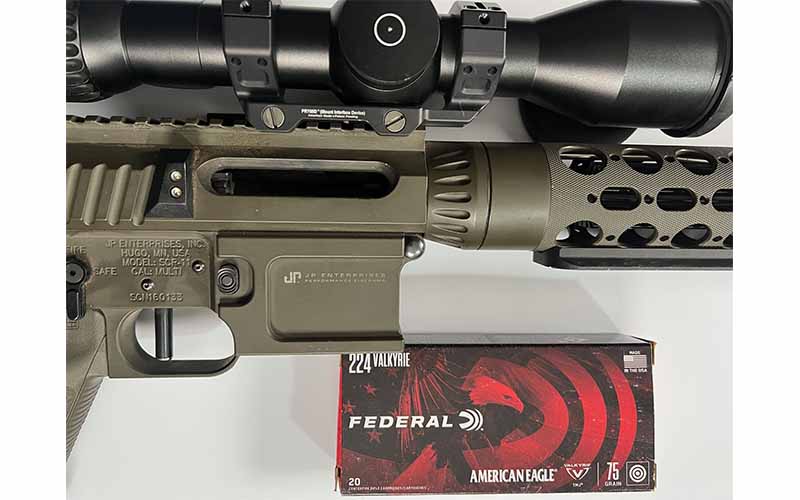
The JP SR chambered in . 224 Valk is a proven winner. This was the initial thinking with these smaller long-range cartridges to use the semi-auto platform.
When the Valkyrie first hit the market, I got a JP SR15. Exactly one week after Hornady released 88-grain ammo for it, I shot a Guardian match and landed in the Top 15. I loved it; in my mind, it performed as advertised. Sure, spotting impacts beyond 800 yards was tough, but overall, I thought it was perfect for an entry-level precision-rifle cartridge.
These small-frame ARs with long-range cartridges had revolutionized the game. I want to own 600 to 800 yards, and if I can do it in a smaller caliber, I’m all for it. But, at those distances, consistency can be a struggle with the light factory loads. The 90-grain stuff is hit or miss in most semi-auto rifles and, while the 88-grain Hornady Ammo is working, that can be hard to find. At 400 yards, the .224 Valkyrie is a laser beam. Consistent performance to 600 yards is expected but, at 800, things can start to fall apart. The balance of weight and speed was just slightly off.
How do I balance this equation and figure out the sweet spot? A .224 Valkyrie bolt gun.
I went with a Zermatt Bighorn Origin action, one of the least expensive custom actions on the market. The Bighorn Origin has a replaceable bolt head, so it’s easy to pair it with the 6.8 bolt face.
Next is my secret weapon: a left-hand gain-twist Bartlein Barrel. Gain-twist barrels don’t care about bullet weight, the recoil pulse is better, and the speeds and pressures are exactly where they need to be. And to clarify a myth—the bullets aren’t running over the lands and grooves multiple times. It’s not putting any extra scoring the bullet.
The Bartlein gain-twist barrel let me shoot the 90-grain load from Federal at speed and to distance more accurately and effectively than through a gas gun. A box of 90-grain Federal was running 2,750 fps with single-digit SD numbers.
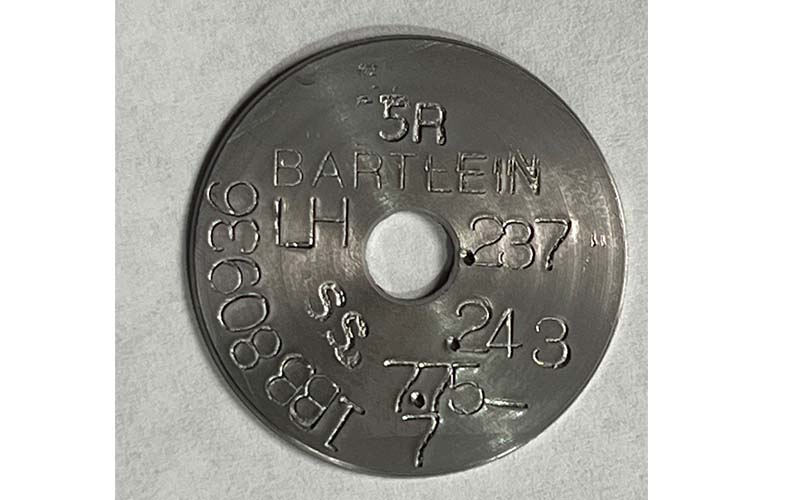
Here’s the end of a Bartlein gain twist barrel. This 6mm barrel goes from 7.75 to 7.0.
This isn’t the case of the gas gun being less effective due to movement; it seemed that the Valkyrie liked the extra speed. We know it wasn’t the 1:7 twist rate of the semi-autos that caused many of the issues: It’s the speed needed to get the performance. This same principle applies the 6mm ARC. The 6mm is a bit easier to load, but it still wants speed. If a setup is running 200- to 400-fps slower than performance would like, you can’t expect the same results.
The bolt-action rifles in. 224 Valkyrie were performing. In fact, the instructors at CR2 Shooting Solutions followed my lead and used a bolt-action version as a student rifle. With this setup, I’ve seen second-round hits in 12-mph winds at 1,200 yards, and impacts out to 1 mile.
All this points to how effective the right .22-caliber can be at long distances: There’s now a .22 Creedmoor and a .22 GT, which is very similar to a 6.5×47 necked-down .22 caliber, but with a slightly different case. And remember, the smaller bullets like speed.
Shooting the Valkyrie at Cameo in Colorado, this rifle is light and effective. Weighs less than 12 pounds and, up at elevation, is capable of hits beyond 1,000 yards.
Weigh Your Options
Don’t overlook the smaller calibers and smaller bullets when trying to shoot long distance. And, when paired with ballistic software, shooters can read results quickly and move to a more effective load to increase performance.
Balancing bullet weight and speed might mean going lighter. Don’t be afraid to try it.
Editor’s Note: This article originally appeared in the June 2022 issue of Gun Digest the Magazine.
More On Long-Range Shooting
Mils vs. MOA: Which Is The Best Long-Range Language?
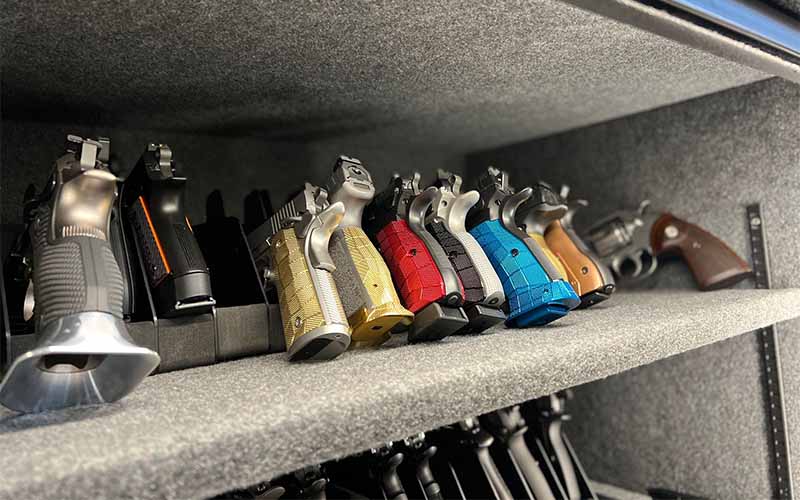
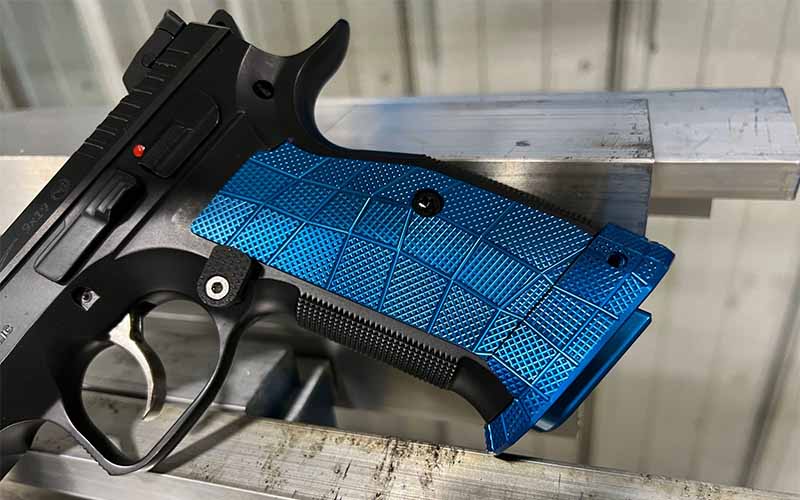
Aftermarket handgun grips can help improve your shooting, and LOK Grips are some of the best available.
Within the past decade, there’s been a significant trend toward both modularity and ergonomics—not just in relation to rifles, but all the way down to pocket pistols. The ability of the individual to quickly fit a gun to their hand—in the comfort of their home—is a relatively new field; until recently, it was the territory of custom houses and gunsmiths.
The science of grip making is on the upswing, and every day there are new materials being tested and new means of manufacture.
A Grip On History
Historically, there were only a few common types of grip materials. The most common of these was wood, the second being hard rubber. Of course, throughout the years, there were always grips made out of materials like ivory, bone and various early plastics, but for the most part, walnut was the go-to material. Wood grips are still, of course, very valid today, and it could be argued that they’re still the most attractive type of grip. They are, however, not exceptionally durable and are usually the first thing to break given enough time and wear.
The interesting thing about pistols is that, for much of history, there wasn’t a particular emphasis placed on how people interfaced with them. In previous issues of Gun Digest, I’ve talked about the fact that, despite the insistence of some individuals and supposed common knowledge, most pistols weren’t designed with the human hand in mind. Many guns, even ones such as the famous single-action army revolver, weren’t inherently designed to have the properties that were later assigned to them.
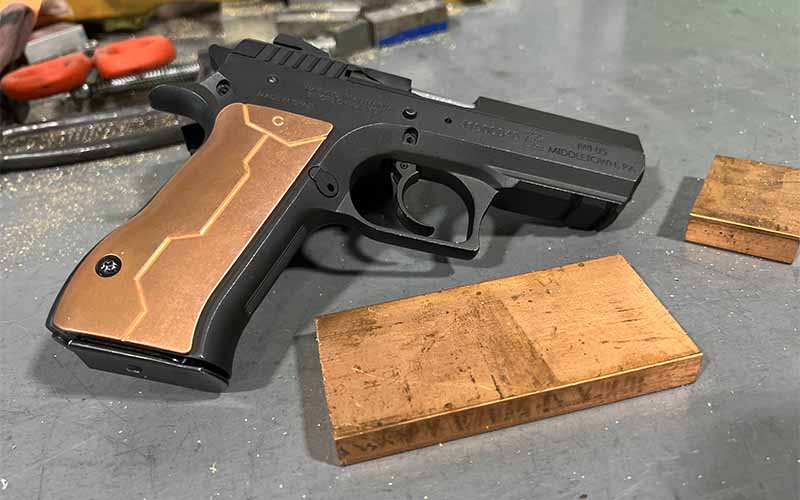
I’ll bet you’ve never seen a set of machined copper grips. LOK can make these from a solid piece of copper stock. Yes, it’s heavy, and yes, it’ll make your gun stand out.
You’ve likely heard the whole “it rolls under recoil,” but this isn’t something that it was designed for as much as something it did spontaneously with powerful cartridges. Historically speaking, that grip shape is an evolution of Colt’s designs across decades—in a sense, it’s a highly refined appendix. It wasn’t until much later when the Bisley-style grip came out that significant emphasis was placed on how the gun fit in the hand.
Most of the designs that existed up until quite recently focused on the firing mechanism of the gun itself. This is why you see such a random disparity in grip shapes and the placement of those grips across the past 150 years. There have, of course, been very successful designs, such as the C96 “Broomhandle,” but you can’t really call that design a complete ergonomic masterpiece.
Really, what you see with these designs is an intentionally created feeding and firing mechanism that then has to be adapted to work in practicality … meaning that a person has to hold onto it and fire it. Sometimes, it appears that the designers simply added whatever grip they could onto their mechanism as opposed to designing a gun from the ground up around the hand.
LOK keeps a library of guns on-hand so they can ensure fit is as precise as possible.
Popular designs, such as the 1911, have always lent themselves to a bit more customization. However, because the frame is a relatively static set of dimensions, some people have a hard time with the size front-to-back, as opposed to just its width. These fixed dimensions essentially preclude a large amount of the population from being able to comfortably use this everyday firearm. I’ve heard it many times: “I shoot a 1911 well because I have large hands.”
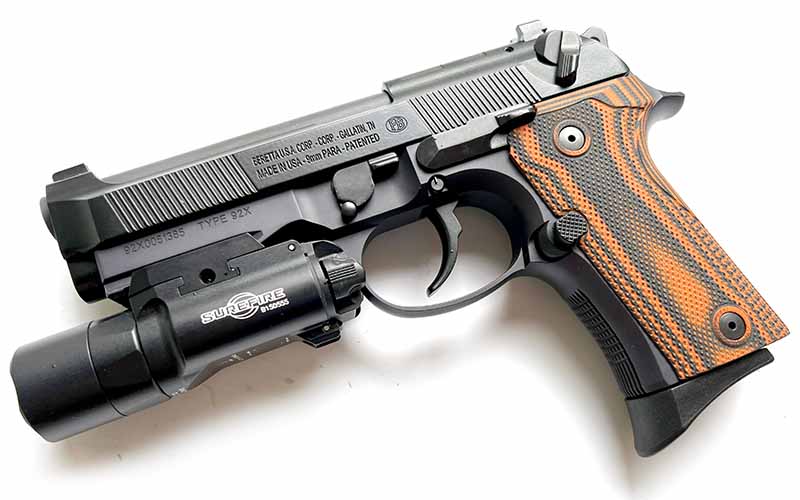
Likewise, many service members I’ve known over the years have expressed disdain for the Beretta M9 due to its relatively large grip area. As women have become a major share of the gun market, we’ve seen a wide-reaching set of characteristic changes corresponding to the uptick in them carrying concealed, and their increased presence at the range and in competitions.
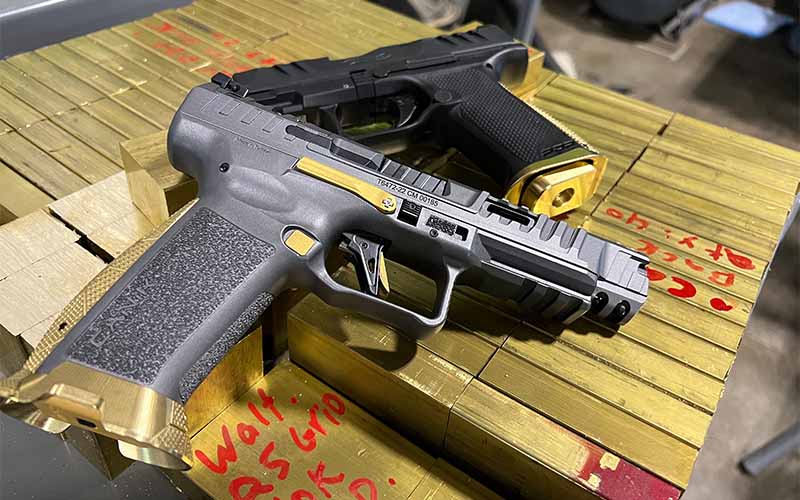
Brass parts on polymer guns? You bet. These Canik and Walther pistols benefit from added lower weight and certainly look as cool as can be.
I’ve been paying close attention to this subset for more than 15 years, and I’ve noticed that not only are modular options increasing, but they’re also becoming much more common in far smaller guns. As a male-dominated industry for almost its entire existence, it cannot be coincidence that this change has come at the time when women are carrying guns in greater numbers than ever. In short, there are more hands than ever on more guns than ever, and those hands aren’t fond of one-size-fits-all solutions.
The advent of the “chassis pistol” has had a significant impact on handgun ergonomics. Sig Sauer has led the way on this type of gun; it could be described as a serialized internal module that can accept un-serialized grip frames. Without this, we wouldn’t be seeing what we have today. Not only can you change the grip size, but you can also change the entire shape of the lower half of the gun. You can also do it inexpensively and immediately. Guns like the P320 and P365 can be instantly modified with a few tools and no gunsmithing experience. It’s a drop-in proposition to change out the entire group module.
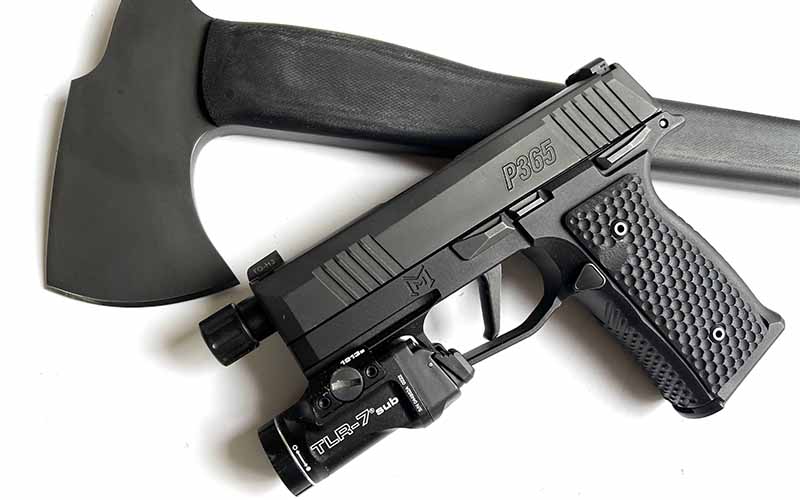
Materials might seem similar, but they’re apples and oranges. The black G10 panels on the Mischief Machine P365 grip module are a totally different material than the black canvas laminate on the Winkler Combat Axe. Despite some of these materials being referred to by the same names quite often, they’re far apart in terms of internal structure and other properties.
I recall when Sig released the metal AXG module. This design didn’t just have a metal construction, it had interchangeable parts on the module itself. This meant that not only could you swap it out instantly, but you could also swap out the parts on it to change the texture and thickness. This wasn’t just an attempt to make a crossover between the old P226 and P229 lines; it changed the game. The P320 is the most user-friendly pistol ever made, and lots of companies capitalize on that, surprisingly with Sig’s up-front support.
Kicking It Old School
Companies like Hogue and Pachmayr are the category mainstays of production gun grips. As polymers and rubbers became more feasible, the late 1970s and into the 1980s saw a widespread adoption of these materials. The first gun to benefit from rubber grips were models that had a large degree of recoil … especially the popular double-action revolvers of the day chambered in .44 Magnum, .454 Casull and .41 Magnum. These groups featured a hard plastic core that rubber was molded over. Because the rubber had a degree of cushion, it could absorb some of the sharpness of recoil.
While various types of early plastics have been used for grips for decades, the 1980s saw this material reach a level of maturity and take over wood on virtually all military handguns. While not the first American military weapon to feature synthetic furniture, the Beretta M9 was the first pistol in widespread military use stateside without wood grips.
The 1980s would also see the explosion in popularity of guns that had one-piece frames, such as Glock and HK. Guns like the G17 and USP set the stage for virtually all pistols released from then on, and it’s only today that we’re seeing a return to metal frames.
Companies like Hogue have introduced many modern materials into their lineup, but they’re still one of the prominent makers of rubber-coated aftermarket grips. I’ve never cared for the cosmetics of rubber grips, though I do admit that whenever I’ve fired a big-bore revolver, I’m reminded that looks aren’t everything. There’s something to be said about the end-use of a gun, and while I probably wouldn’t make a point to show it off the same way I would fancy hardwood, I’d very much prefer a set of Hogue rubber grips on a field revolver.
LOK Grips And The New Frontier of Grip-Making
Started as a small, part-time shop making 1911 grips, LOK Grips has since grown into one of the industry’s premier grip makers and now boasts a sprawling production floor running two shifts to feed more than 100 dealers worldwide. They work closely with companies such as Sig Sauer, Kimber, Walther and more, as well as supporting grip production for smaller companies like Live Free Armory and Mischief Machine. They make grips for a massive number of guns and individual models including various IWI, Beretta, CZ, Laugo Arms and Taurus pistols, as well as mainstays like the 1911.
Anodized aluminum grips start life as bar stock, and after removing some chips, they become a comfortable and functional addition to your comp gun.
What separates LOK Grips from many others is that they employ a full design team, as well as a full inventory of the actual firearms they make grips for. Because of this, they’re able to quickly address the market and shooter demand, nearly in real time. The marketing and design team at LOK is constantly in touch with hundreds of competition shooters, industry professionals and influencers. It’s an ingenious strategy, and one that has played out well for them given that their products are in use by some of the best shooters in the world.
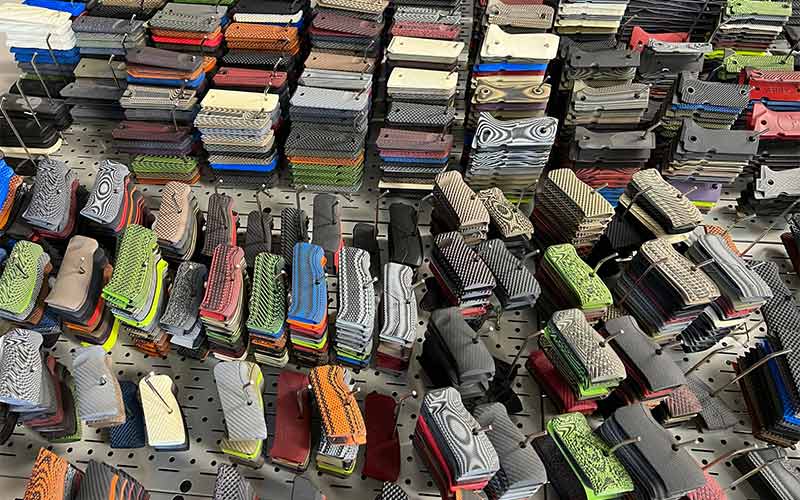
A pre-packaging area at LOK’s factory gives a little taste as to how much variety they can produce.
Because of how modular different types of guns are nowadays, the engineers at LOK are able to design various sizes of not just grip panels, but specific individual parts on the modular setups, meaning that you can custom order different shapes and swells that will allow your pistol of choice to conform closely to your hand. If you’re shooting competition, having a grip matched to your hand is of utmost importance, as you need to know exactly where it’s pointing without having to fight its rotation or torque under recoil.
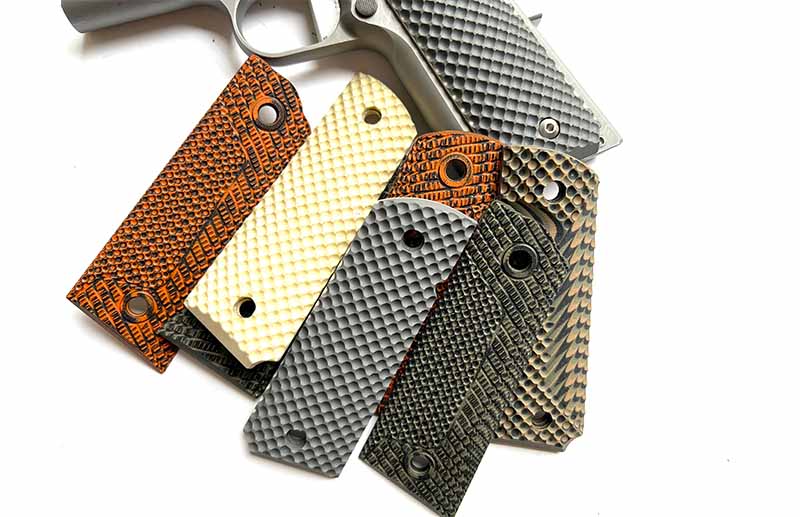
G10 is the primary material used by LOK. Contrary to popular belief, this material isn’t plastic; rather, it’s an extremely strong form of layered fiberglass. It’s much stronger than simple polymer or Micarta, which itself is a tightly packed set of layers comprised of epoxy and cloth fabric. In regard to durability, G10 is far superior to wood or any of the other listed materials. It doesn’t swell or take on moisture, nor does it become tacky or easily rip or crack like rubber. Guns equipped with G10 grips will maintain their texture and feel, even in rain and mud. Because they’re not painted, the G10 colors last much longer and will not wear like wood or scuff like plastic.
G10 comes into the factory in large sheets.
In addition to making grips from the excellent G10 material, LOK also makes some very interesting and advanced metal grips. Of particular interest are their grips made of machined brass. A rather unique product, LOK introduced these in 2020. As a testament to their ability to quickly react to changes in the market when the USPSA guidelines changed the upper weight limit to 59 ounces for competition, LOK ordered brass that day and had prototypes ready almost immediately.
The extra weight of these metal grips has been a game changer for competitors, and the company has begun making brass grip parts for a large number of guns. In theory, if you were trying to stay within the weight limit, you could combine the brass elements with LOK’s aluminum parts to perfectly balance the gun and fit the grip to your hand. The possibilities are endless.
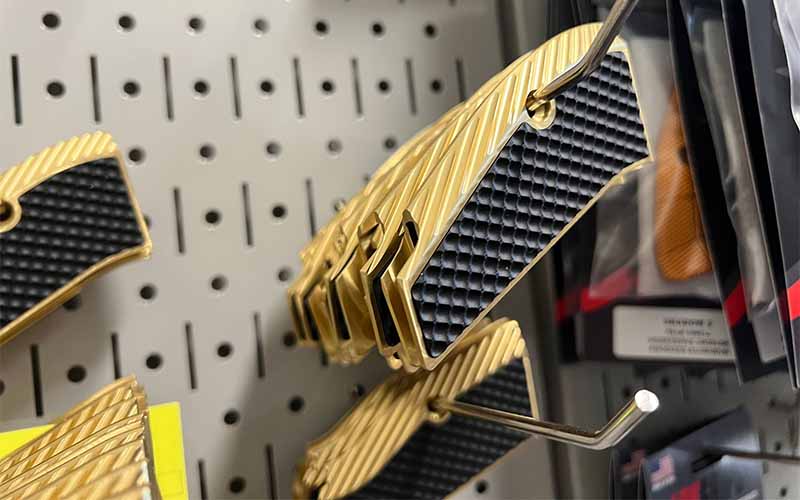
LOK Grips makes some unique stuff, including brass grips with G10 inlays.
Adding to their portfolio is their hybridized grips that feature metal construction with G10 inlay, as well as a custom shop that allows you to design your own grips that can include anything from logos, pop-culture icons and text. The sky and your imagination are the limit on what you can do.
Editor’s Note: This article originally appeared in the December 2022 issue of Gun Digest the Magazine.
In the face of HB 1240, Washington’s proposed assault weapons ban, some retailers like Stag Arms have stepped up to prioritize shipping orders to the state.
The state of Washington unfortunately appears to be on the brink of a new assault weapons ban being passed into law. Called HB 1240, it’s slated to ban over 60 firearms by name as well as “scary assault weapon” features such as telescoping stocks, threaded barrels, muzzle breaks and pistol grips.
While this is an unfortunate development for the rights of Washington residents, they still thankfully have a chance to stock up before the law takes effect, and the effort is being supported by several pro-2A companies. These companies, such as Stag Arms, are providing a great service by expediting the processing and shipping of orders to the state of Washington. If you live there and are worried about the availability of these soon-to-be banned items, now is the time to order from one of these retailers to ensure that you have what you need or want. The following companies are doing everything they can to ensure that you receive them before the legal cutoff date.
Pro-2A Retailers Expediting Orders Heading To Washington:
Wojtek Weaponry (plus get 10% off with code “ftgfyg” on orders over $65)
Washington residents who want to help preserve their Second Amendment rights by voicing their opposition to this proposed law can do so by contacting The Washington State Legislature Office at 1.800.562.6000 or [email protected].
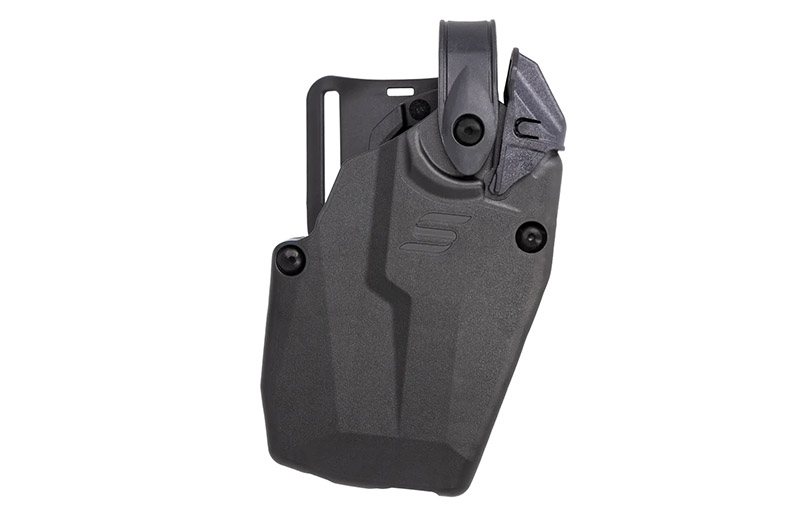
Safariland has just started shipping its new SafariVault line of retention duty holsters, featuring increased crush resistance and other improvements.
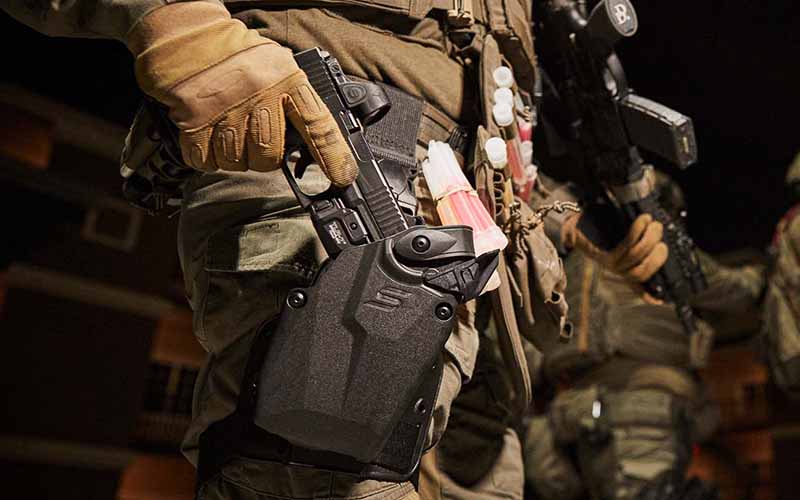
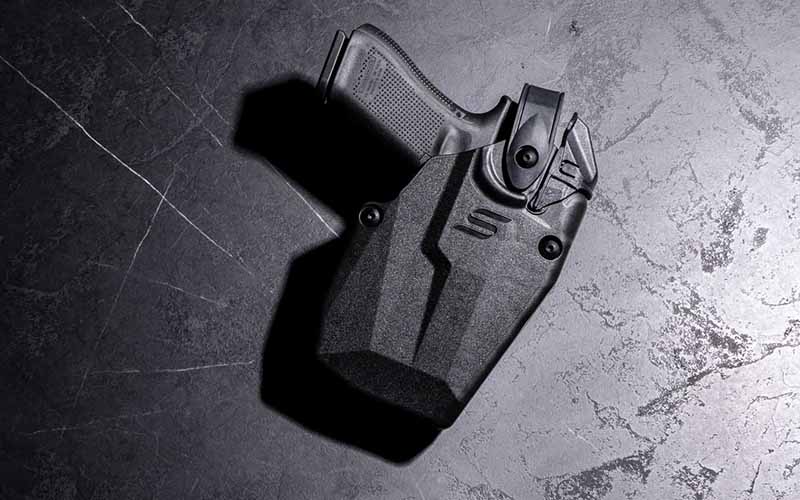
Duty-style holsters aren’t just for law enforcement anymore, as many civilian shooters have been using them for competition, training and other activities for years now. This style of holster offers fast access, solid retention and the ability to easily carry full-sized and accessorized handguns. Safariland has been the go-to manufacturer of duty holsters for years now, but the company’s new SafariVault line is poised to bring the concept to the next level.
Safariland claims that the SafariVault line features “the strongest holster body” of any holster the company has produced. The increased structural integrity of the design reduces flex and improves their impact and crush resistance capabilities. For the latter, it was tested up to 300 pounds. The holster is also rated from -50F to 150F, allowing it to remain functional in nearly any terrestrial temperature.
Besides toughness, the SafariVault line has plenty of other appealing features. It’s compatible with weapon lights, muzzle devices (thanks to its open-muzzle design) and red dot sights (both open- and closed-emitter designs). They feature a removable and self-clearing optics cover as well. The holsters also have a magnetic slide guide to aid with holstering, an auto-tension device to remove rattle and a more easily accessible ALS release mechanism. All SafariVault holsters use the Safariland 3-hole mounting pattern and are compatible with existing holster attachment accessories.
Eric Gasvoda, GM of Duty Gear for Safariland, said this about the new holsters:
SafariVault offers uncompromising strength and incorporates the adaptability required for use with an ever-expanding array of lights and optics, without sacrificing peak performance.
SafariVault holsters are shipping now, and current handgun fits include the most popular Glock and Shadow Systems models. MSRP starts at $190.
Curious about alternate carry methods and strategies for regular people? Look no further than the concealed carry fanny pack.
Recent years have seen a massive influx of people exercising their right to carry. Not only is the market growing exponentially, it has also spawned some interesting and creative means to make sure you have your gun at the ready. This has consequently spawned many schools of thought regarding just how to carry and what readiness is, and what self-defense looks like.
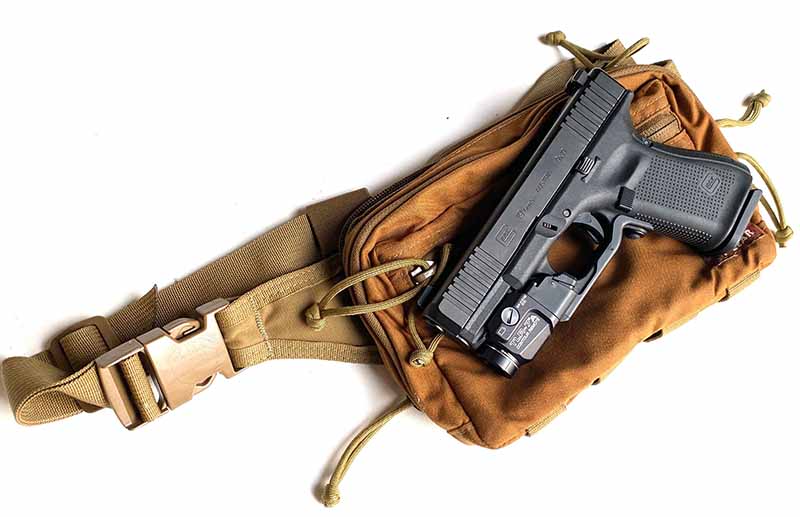
The Hill People Gear Snubby Belt Pack is large enough to comfortably carry a Glock 19 with a compact light, here a Streamlight with pressure switch.
The Training Echo Chamber
I’ve studied up on many philosophies regarding guns, defense and situational preparedness. What I can say is that, despite the adamant assurances of a slew of popular authorities, there remains no one way to be 100 percent equipped for 100 percent of situations. You just never really know what will happen.
As you read these words, where is your nearest firearm? Can you get to it in the time it takes you to finish reading this sentence? What about the end of this paragraph? Is it loaded? In a drawer or in your belt? Are you in public or at home? I can go on, but I think you get the picture. The feasibility of having a loaded gun ready to draw isn’t a guarantee, and in most cases, it’s best to just have a plan of escape.
I’m sure plenty of you are armed around the clock, but everyone has to sleep at some point. Vulnerability is just part of the human condition. What we see in the training community is what I’d largely call playing make-believe. Classes I’ve attended want outside-the-waistband holsters, mag carriers and sometimes even plates and rifles … for a home defense course. Once, I was at an event and the instructor flat-out said he kept night vision goggles in his drawer and a carbine next to the bed—a statement that has become my favorite example of this type of thinking.
I fail to see how this is realistic or relevant, as I seriously doubt he has the main power beaker to his home in the nightstand as well. I’m at a loss as to how he expected to clean house when the power was still on. Moreover, what would happen if a bad guy simply flipped on the lights and washed his NVDs out? There’s such thing as being over prepared to the point of absurdity, and much of this has to do with how people perceive readiness and threat level. Some of the tactical guys I know, while honest and well meaning, are simply unaware of how the average gun owner perceives this level of prep.
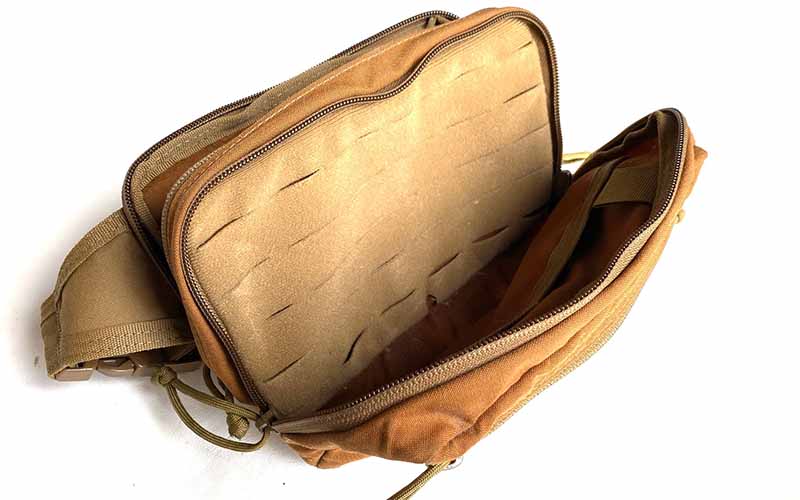
The HPG Snubby Belt Pack has a great deal of usable space considering how small it is. The great part is that the PALS webbing and hook-and-loop surfaces make it so that your gear won’t move around inside.
Much of the breakdown in carry methods comes down to the fact that there’s a large rift between people who carry reluctantly and those who carry enthusiastically. I’m a reluctant carrier these days. I often don’t wear a belt on my pants. I prefer to have my guns available to me, but I’m not usually in the mood to carry in a holster, which I find to be uncomfortable and bulky.
There was a quote, I forget what personality said it or if it can even be attributed to one, that went something like “carrying a gun is the comfort, and it may not be comfortable.” I just don’t agree. If a gun is heavy or hurts to carry, people just start leaving them at home to avoid the inconvenience. I’m one of those people. If I can’t carry in comfort, I don’t like to do it.
Yet, there’s a prevailing group of enthusiastic carriers who expect people to carry a gun with dot sight, light, holster, two mags, a backup light and occasionally more lest they be unprepared—that’s often comparable to the weight of, if not heavier than, a full two-gun cowboy rig. I now glaze over when I get asked what “retention system” I’m “running.” I’m not sure one can “run” a pocket holster or a fanny pack, but hey, it’s a brave new world.
You don’t need to be a member of a SEAL team to carry. It’s not an all-or-nothing game, and having a firearm is substantially better than not.
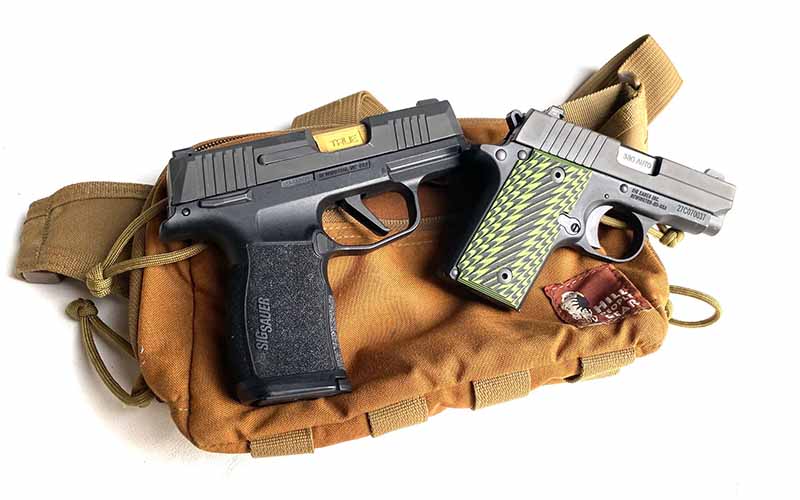
Super tiny guns, like the Sig P238 in .380 ACP, are great for carry in this method, but, in the author’s opinion, are best reserved for pocket carry. The fanny pack is large enough that it can support a bigger carry gun; you may as well use the space you have available to you … and the magazine capacity.
Off-Body Types, Strategies And Awareness
Depending on where I go, I may want extra discretion. This usually means trying to hide the gun in plain sight rather than altering my wardrobe around a holster setup. I rarely, if ever, “kit up” to just go pick up some dinner or hit the hardware store, but I do have a gun on me. It’s usually carried in what I call “near off-body,” meaning in a discreet fashion but still not in a holster directly on my body.
Off-body carry is usually defined as having your firearm in a completely separate bag or pack, usually not directly attached to one’s body. Concealment purses have been common for a very long time now and, for the most part, reached a point of perfection in terms of construction and draw speed. I don’t know a single super tactical trainer who likes them, and none that allow training with them at classes.
This has to do with the fact that these purses are essentially cross-draw setups in that they’re carried under the weak arm and drawn across the body, technically resulting in a sweep of the instructor or rest of the class. This is a valid concern, but I want to see more out there in terms of practice since it’s a common carry method. It’s arguably one of the most popular methods among women, with virtually all armed women I know carrying in a purse at least part-time.
Tactical backpacks that men often carry can easily mark you as the guy with the gun, especially if you cover it in patches denoting your blood type or other obvious meme moral patches. I’d rather carry openly than carry something everyone knows has a gun in it that will be slow to draw.
But how does a person carry their AR pistol if not in a backpack? Easy. Carry it back to your house and leave it there. Generating liabilities for yourself isn’t a particularly wise thing to do, and while you may feel vulnerable in public, I repeat myself by saying that it’s fully possible to be overdoing it.
When I go into public, my favorite method of carry is in a fanny pack. I’m a young father and dress in flexible athletic materials; the fanny pack doesn’t look out of place with a stroller, diaper bag and look of exhaustion. I never wear a Molon Labe shirt or put those awful Punisher stickers on my car. I don’t want to be noticed in public or be seen making a statement or taking a stance; I never want anyone to suspect I’m armed.
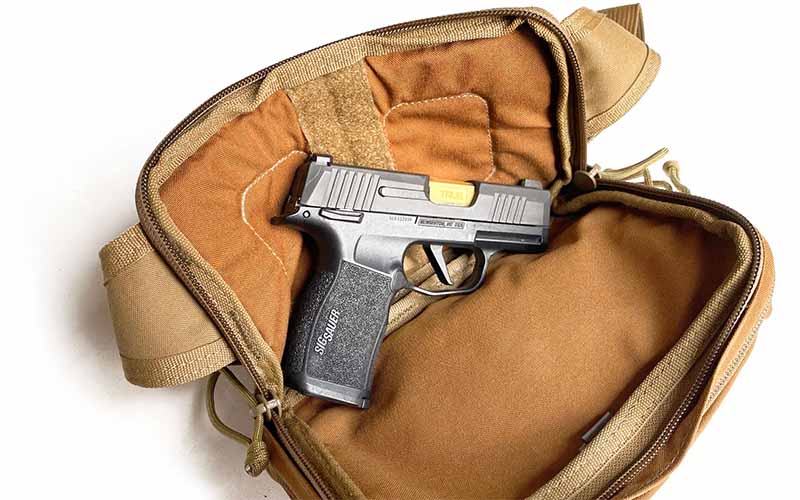
Guns like the Sig Sauer P365, here with a manual safety, 12-round grip module and True Precision barrel, are just about ideal for fanny pack carry. Not only is it light, but it also has most of the capacity of the G19 and is just as easy to shoot.
The cool guys call this being a “gray man,” but even then, there’s a certain flavor to that sort of individual. I can often tell if I see an off-duty cop or a former high-speed guy, usually due to their mannerisms. A preceptive person is always looking for rip-stop pants and that baggy look common to people trying too hard to blend in as regular Joes. Cop, operator or wannabe, I’m avoiding you immediately if you appear to be armed or give off that vibe. Even if you’re a good guy, I still want nothing to do with you because I don’t want to be noticed.
An important note, as mentioned above with carry purses, is to practice your draw from off-body or near off-body. Knowing how to draw under stress is the most important thing, and I do this regularly at the range. It’s different than from a holster, but if it’s the way you carry 99 percent of the time, you need to master it knowing you won’t be as fast as Doc Holliday.
Speed of draw is really quite irrelevant if you’re not actively being shot at, and even then, you should be focused on getting yourself and loved ones to cover—not trying to play catch up from second place in the surprise quick-draw contest. I certainly think that there’s a time and place for the stand-and-fight mindset, but getting away and actively creating distance between you and an attacker is a substantially better bet. I don’t want to be drawing fire when I have my kids with me; I’m not looking to be a hero and save everyone at the price of risk to my own family.
I’m a huge fan of the fanny pack for near off-body carry. I like it because it’s on my person, and I know which direction the pistol is secured. Gen Z has popularized this accessory again, and they’re now in every store at the mall.
Surprisingly, the generic fanny pack you get at places like Zumiez or Hot Topic are completely functional in this role so long as you find one with a robust zipper. I need to stress the zipper thing here. The zipper is absolutely critical for your draw. I strongly recommend against a fanny pack that screams “tactical” or is covered in webbing, but there’s nothing out of place with a hiking or recreational variety.
The fanny pack I use regularly is the Hill People Gear (HPG) Snubby Belt Pack. This little guy is small enough that it’s almost unnoticeable on the body but roomy enough to fit a Glock 19. If you carry guns like the G19, P365, a 2- to 3-inch 357 or 38, and other small guns, it’s a dream come true. Unlike a carry backpack, this item is always on me but easily removed if I need to and has no risk of being accidentally left on a bench or at a restaurant. Because I’m wearing it, it’s far less likely to be swiped like a purse.
The nice part of the HPG Belt Pack is that it’s available in bright, sporty colors that don’t look tactical. Mine is in a rather basic elk brown, as I intended it to not be a feature item of my wardrobe but rather a part of a somewhat generic look where no particular part of what I’m wearing stands out. I’ve worn this pack for thousands of hours so far, and it has been my most common carry method for 2021.
The main problem with conventional fashion fanny packs is that they’re not as good with smaller guns, such as a little J-frame or P238. These tiny guns just tend to float around in there, and you don’t want that. The HPG product has a dedicated gun pocket with a hook-and-loop backer, allowing for a holster to be added.
Guns like the G19 take up the whole pocket, and I don’t use an internal holster if carrying one that size. The pocket is the rearmost one, so it sits closest to the body and is the most supported. I like this because it keeps the gun tight up against the torso and prevents the pack from sagging forward. There are two other zippered pouches ahead of the gun pouch, allowing for carrying regular items like your phone, wallet, keys and other daily items.
Revolvers, like the S&W 340, are perfect for the jogger or trail hiker and will be reliable, while taking up minimal space inside a fanny pack if you’re trying to prioritize other outdoor gear. The gun is ready when you need it, but things like a knife, compact water filter, and signaling gear can be stowed alongside it with ease.
Have Gun, Will Travel
If your gun is too heavy or over accessorized to the point where you stop carrying it, you really should look for a way to make sure you’re armed, even if it’s at the cost of draw speed or looking a bit dorky with a fanny pack. The first rule of a gun fight is to have a gun, and your fully kitted-out pistol does you no good sitting back home in your safe.
Editor’s Note: This article originally appeared in the 2022 CCW special issue of Gun Digest the Magazine.
The pros and cons of ultra-subcompact, subcompact, compact and full-sized handguns for concealed carry.
I grew up immersed in the car culture. Brands, models and trim packages were all background information to me, as well as the relative sizes of the models. When I got old enough to drive, that information was important, because it gave me a clue as to what I could fit into. At 6 feet 4 inches, some were simply impossible. (A friend once offered to give me a lift. I took one look at the Karmann Ghia he drove and said, “Got something in a 42 long?” He didn’t get the joke until I tried to get in.)
Well, handguns come the same way, if in a different direction. There might be something too big to carry concealed. Let’s take a stroll through the racks and see what sizes we can cover, and give you a quick idea of their pros and cons.
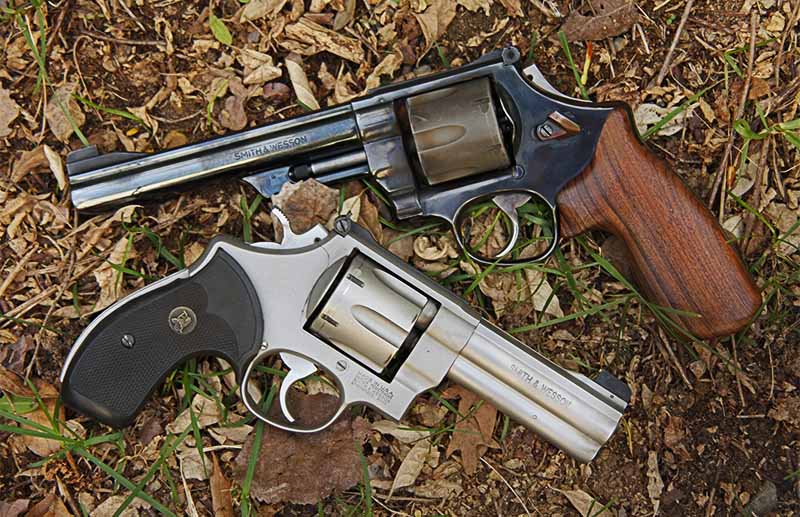
Big revolvers used to be common. Now, they are really big, and don’t hold as many rounds as big pistols. But they can still do the job.
Ultra-Subcompact Handguns
Here reside the ultra-small guns. In the old days, that meant .22s and .25s, but today no one would risk the man-card deductions, and we see only .32s (rarely) and .380s (more common).
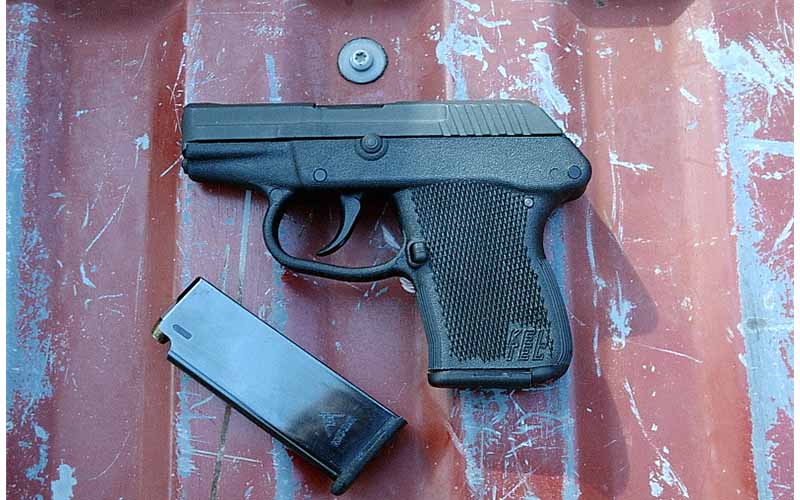
The examples here are the Beretta Pico and the KelTec P32 or P380. The Pico is a .380 and holds 6+1 rounds, and the KelTec is (obviously) a .32, and holds 7+1. Both are flat, light, easy to pack and meant for deep concealment. While some might use it as a main gun (often only because anything bigger would be noticed, and they work and live someplace where they absolutely cannot be found out), both of these are usually backup guns.
I view the ultra-subcompact pistols as tertiary blasters, not the second one. Well, I did when I was packing daily at the gun shops. Now I’d be like most of you: It’s the backup when something bigger just won’t fit the daily routine.
The pros are obvious: ease of carry and ease of keeping concealed. The cons? They don’t hold much ammo, aren’t hard-hitters … and they’re tough to shoot, with small grips, tiny sights and short sight radii.
Subcompact Handguns
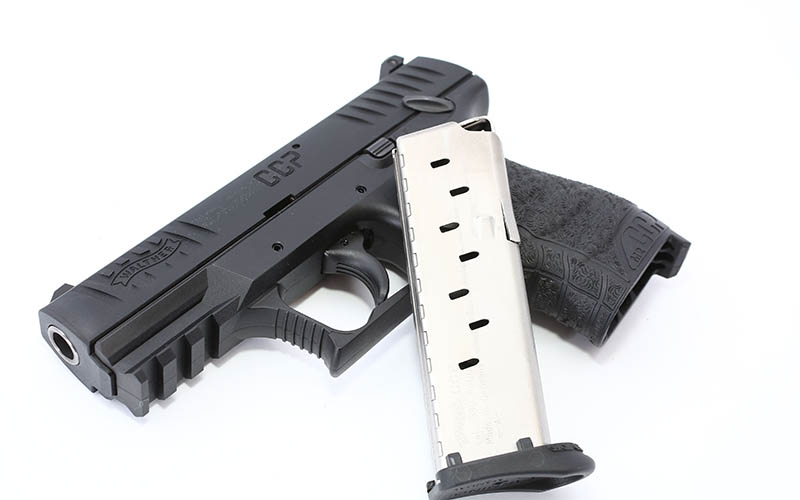
The difference between the ultra-subcompact and the subcompact is caliber. Subcompacts are all 9mm or .38 Special, not .380 or .32. A subcompact would be something like a Taurus GX4, and not only do you get something more in caliber, but you also get more in capacity. Subcompacts often now have 10- to 11-round magazines, where only a few years ago they would have single-stack 7-round magazines. An example there would be the Walther CCP, with eight shots but a single-stack magazine.
The Walther CCP in .380 is a single-stack carry gun that can be an ultra-subcompact or a subcompact, depending on your needs and clothing ensemble. It’s a single stack, however, so you’ll be giving up a few rounds to the wide-body subcompacts.
The modern one here, and one I have kept around, is the Springfield Armory Hellcat. They call it a micro-compact, but it’s the size I have always thought of as a subcompact pistol at 6 inches in overall length. The magazine holds 11 rounds, and you can, if your clothing choices permit, use a 13-round magazine in place of the 11-shot version.
The pros here are the bigger caliber, but subcompacts can be tough to shoot. The fatter grips of the double-stack mags make it easier, but if you’re using defensive 9mm ammo out of a pistol that tips the scales at 17 ounces, it’ll be work.
Compact Handguns
The compact category is perhaps the most commonly seen (or not seen, this is for concealed carry, after all) pistol because it offers the goldilocks option: enough size to be shootable, but not so big that it’s a hassle. It has enough rounds to be useful, but again, not so big that it makes life difficult. And it’s big enough—but not too big.
OK, let’s just get this right out front: The example of compact carry pistols is, and has been for a long time, the Glock G19. There, I said it. That they were the first does not mean they are the best, as you have to put up with the Glock trigger, but a lot of people seem to not have a problem with that. If you want a better trigger, then the Sig P365 is the same size with a better trigger. If you’re looking to get more value for money and put the savings into ammo, then the Taurus G3 is your choice here. For accuracy, nice trigger, price and availability, the Springfield Armory XDm in its compact size should be one of your top choices.
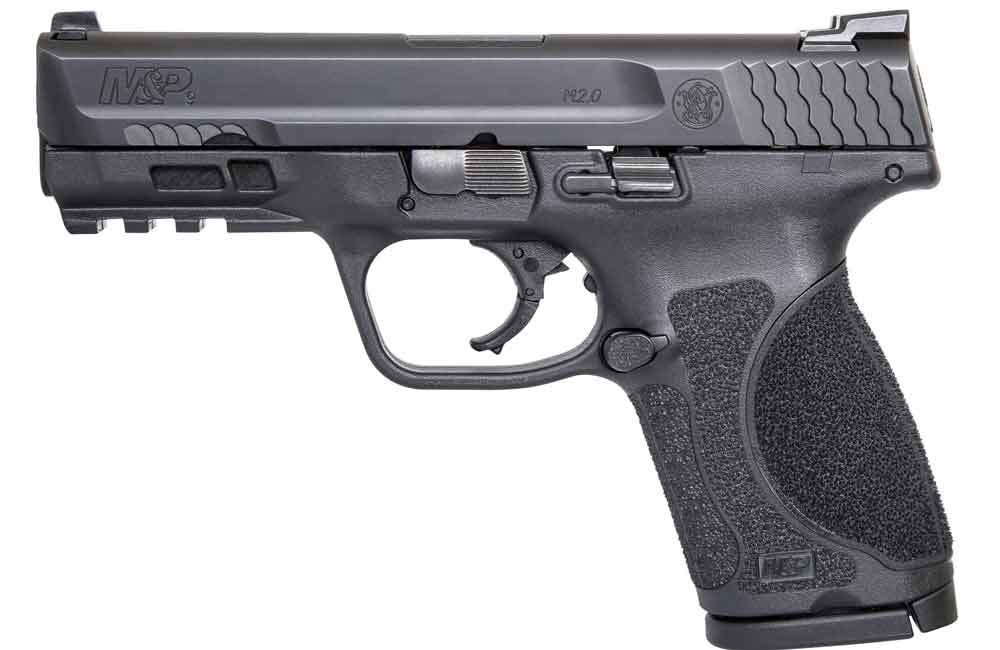
The sleeper here is the S&W M&P Compact. It’s the same more-or-less 7 inches overall, with a 15-round capacity like the others, a nice trigger and interchangeable backstraps that you can build to suit your hands.
A S&W M&P M2.0 Compact.
Since this is a popular size, the offerings make for a crowded field. And this is a historically popular category, so there have been choices since, well, pretty much forever.
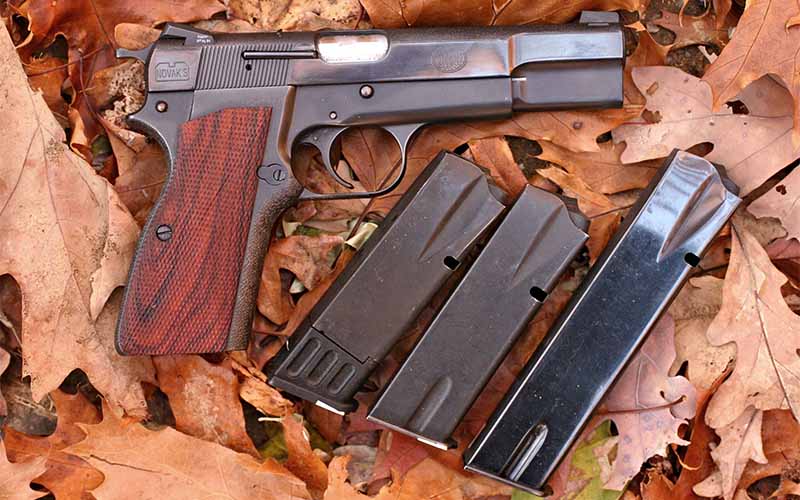
One is the Colt Lightweight Commander, an alloy-framed 1911 with the slide and barrel shortened by three-quarters of an inch. The trick here, if trick there be, is that the 1911, as is the next pistol, a single-action design, and thus must be carried “cocked and locked.” That is, with the hammer back and the safety on. Holding 7+1 in .45 ACP, and 9+1 in 9mm, it was the mainstay of carry for pistoleros in the pre-Glock days. The other is the Browning Hi-Power, a 9mm holding 13+1 rounds, which has been brought into the 21st century by Springfield Armory, among others.
The pros of the compact pistols are many. They are a lot easier to shoot than the smaller guns, and many now can be had with optical sights … or be ready for one. They hold a more than useful amount of ammunition, and their slightly longer barrels (generally 3.5 inches to the sub-compacts 3-inch bore) gains you a bit more velocity. The cons are that they start to become a bit more difficult to conceal and keep concealed.
Full-Size Handguns
Now we’re up to the G17, the XDm in its full size, the Taurus G3, the Beretta (pick one, from the original 92 to the present day) and the Sig P320. All of these offer big magazines, with 16, 17 and 18 rounds or more. If you thought you were spoiled for choice in the compact category, you have an overwhelming set of options here. Because everyone who made a 9mm pistol (or 40, back in the days when that was cool) made one that was full-sized.
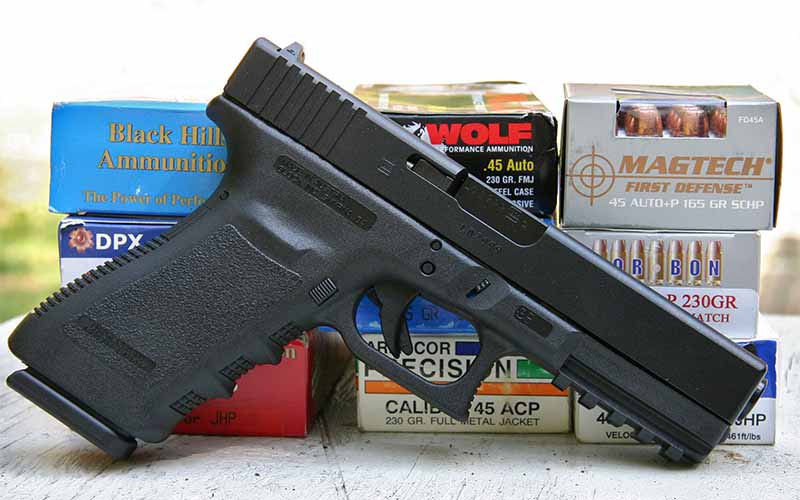
If you want big, then Glock can do that. This is a G21SF, and despite the “small frame” designation, it’s a big gun.
Also called “duty” sized, these have barrels more than 4.5 inches long, full-sized grips, are easy to shoot well and soft in recoil. They’re also a real bear to carry concealed. Well, the concealing part isn’t so hard; you just have to use the correct holster. What makes them hard is their weight and size, which can wear on you in the course of a day. If your comfort starts to flag, you’ll move differently, start adjusting the fit and location without realizing it … and a sharp observer will notice.
You can go even bigger, and pack a Glock, a G20 or G21, or an XDm in 10mm or .45 ACP, if you want both big bores and lots of bullets.
In the classic, this is where the 1911 enters the picture. Even if you find a model with an aluminum frame, the government-sized 1911 is going to be big and bulky. We carried them in the old days, but it was because there weren’t many other choices.
I was at the range recently, testing some firearms and doing video work, when one of the members of that club came by. In the course of talking, and within the first few minutes, he adjusted what he was wearing several times. The second time he did so I realized he was test-wearing a hard armor rig under his winter coat. That’s the sort of thing that attracts the attention of those who know, and those whom you don’t wish to know.
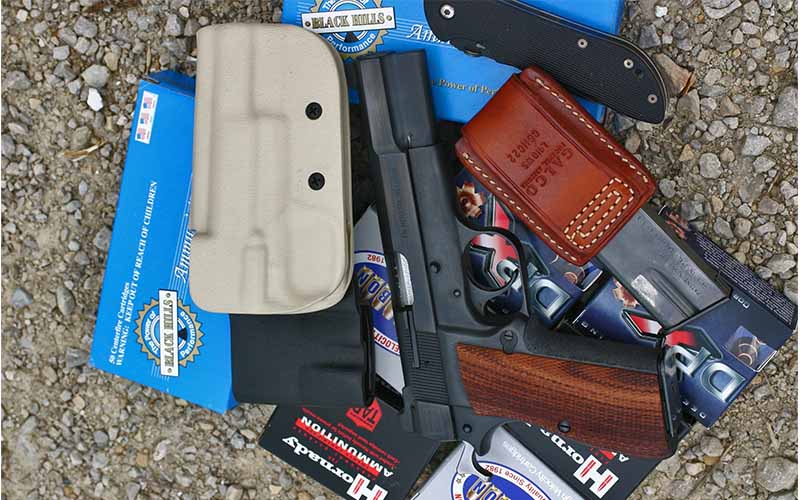
The classic carry gun in the compact size is a Browning Hi-Power. This—in a good holster, with a spare mag and a tactical folder—is easy to carry all day long.
So, if you’re going to pack a full-sized pistol, the first thing is to have a proper holster, and the second thing is to have a proper holster that’s comfortable to wear.
The pros are obvious: They hold lotsa bullets, they’re easy to shoot … and easy to shoot well. The cons are just as obvious, as they’re the biggest options to be had in an EDC pistol.
Revolvers for CCW
Wheelguns don’t have ultra-subcompacts, because the smallest to be had, the S&W J frame and the Taurus 605 or 856, are subcompact handguns. The J and the 605 hold five rounds, while the 856 holds six. The example here is the S&W 442, a hammerless .38 holding five shots.
Small- and medium-sized revolvers are a lot easier to carry than big revolvers. But for the size you don’t get as many rounds as a similar-package 9mm pistol holds.
If you move up to the compact, you’re in the region populated by S&W K-frames, the .357 M-19 and the Taurus 65 and 66. These hold six rounds and are the smallest you’d want to shoot in .357 Magnum. Oh, you can get smaller ones in .357, but you won’t enjoy shooting them. If you want more, you can opt for the Taurus 608, holding eight rounds of .38/.357.
And finally, the full-sized, or duty sized: that’s the S&W N-frame, in .357, .44 and .45. While I know of people who in the old days carried those, and even carried those in the 6-inch barrel versions, can we get real? You have to be dedicated to packing an EDC revolver, to manage an N-frame. Yes, it can be done. Will it be easy? Hardly.
Oh, and if you want to go light, be careful. The most obnoxious firearm I ever shot was an airweight .44 Magnum—easy to carry, but murder to shoot.
The worst range experience was shooting an airweight .44 Magnum. Yes, it carries easily and shoot small groups, but boy was it work to shoot.
You Gotta Know You
You must always keep in mind that, when it comes to EDC, it’s not simply a matter of “what size can I carry?” That depends on where you live, how hot or cold it is, what socioeconomic level you are dressing to and how “permissive” the environment might be. An ER doctor, working in scrubs, in an inner-city hospital where getting caught means finding a new job, might decide that, despite all the shortcomings, an ultra-subcompact is the only choice.
Someone working a mostly rural area, who might have to deal with not just people but wildlife, livestock and sturdy intermediate barriers could pack a 4-inch .44, and since most people wouldn’t care, not worry as much about keeping it absolutely concealed.
The Browning Hi-Power is all steel, and that seems a bit quaint in today’s world of polymer, but with magazine options from 10 to 20 rounds, you won’t lack for ammo capacity.
The rest of us are somewhere in-between and have to make choices. What worked on a cool October day might not pass on a steamy, humid August evening.
You might not—and you probably won’t—find a “one choice fits all” handgun, holster and wardrobe. Welcome to the real world.
Editor’s Note: This article originally appeared in the 2023 CCW special issue of Gun Digest the Magazine.
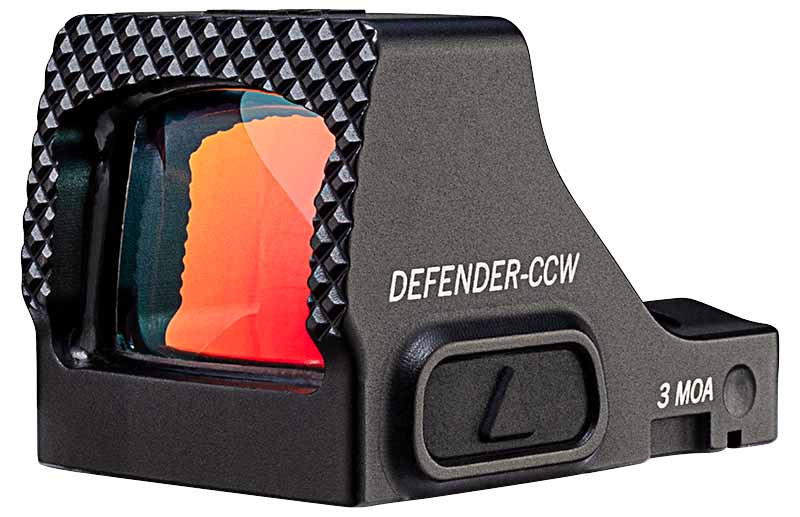
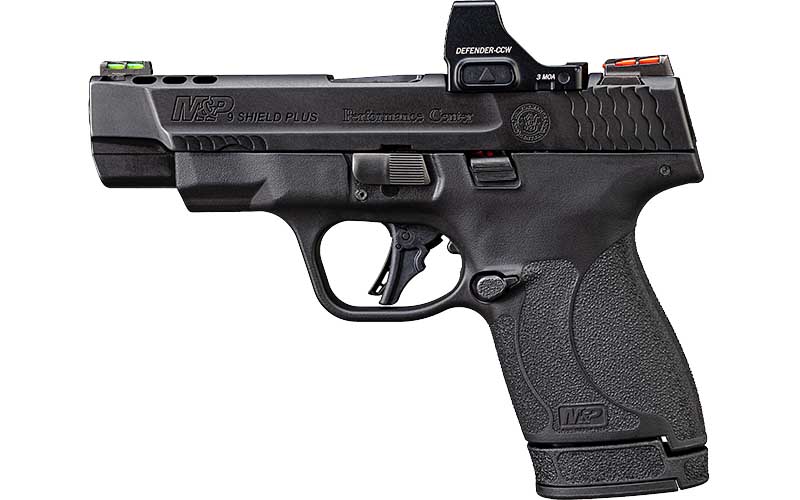
Vortex Optics has just released the Defender CCW, a new micro red dot sight for concealed carry pistols.
Vortex Optics has just released the Defender CCW micro red dot sight, a new pistol optic designed for small concealed carry handguns. The optic is loaded with all the features that shooters have come to expect of modern pistol red dots, and it has some new tricks up its sleeve too.
The Defender CCW is available with two reticle options—either 3-MOA or 6-MOA—and it mounts via the common Shield RMS footprint. The optic is small enough to be used with micro-compact handguns (as well as full-size pistols), but Vortex claims that it features “the biggest sight window in its class” to help users shoot with both eyes open and maintain superior peripheral vision and spatial awareness. The unit is 1.6 inches long, has a weight of only 0.95 ounces and was designed to have a slim profile for a snag-free draw.
Modern carry optic features found on the Defender CCW include a large, aspherical lens for a distortion-free image, a SHOCKSHIELD polymer insert for added durability, a motion-activated reticle and auto-shutoff to save battery life when not in use (14-hour timer). The Defender CCW also has a manually adjustable brightness setting and the battery can be replaced without removing the optic from the weapon (takes one CR1632).
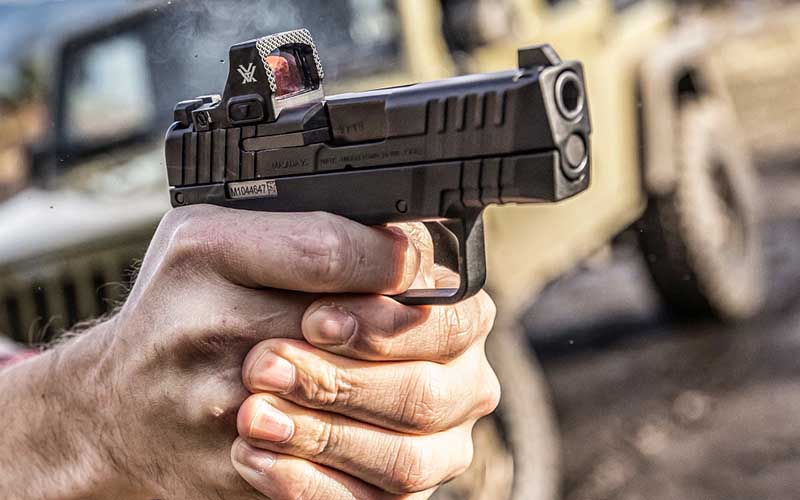
A new feature on the Defender CCW, and the most visually distinctive, is what Vortex is calling Fast-Rack. Simply put, it’s texturing on the front face of the red dot that allows for easier one-handed racking off of unorthodox surfaces. This is a great idea for a self-defense pistol red dot, as one can never count on having both hands available in an emergency situation. The texturing helps contribute to the optic’s rugged aesthetics as well.
Each Vortex Defender CCW will ship with a 1-inch shim plate, a Picatinny mount, a protective rubber cover, a lens cloth, a battery, a tool and multiple sets of the most common mounting screws. It’s available now and has an MSRP of $349.99.
Now that Enduron has been discontinued, what are some good substitute powder options for reloading?
Following my professional hunter through the acacia thorn and scrub brush of South Africa’s Waterberg district, the long, spiraling horns of the kudu bull made me forget all about the blistering heat. The late October temperatures had soared to more than 110 degrees, and though the morning hunt had been thirsty work, that bull made it all worthwhile, especially when the tape stretched to just over 55 inches.
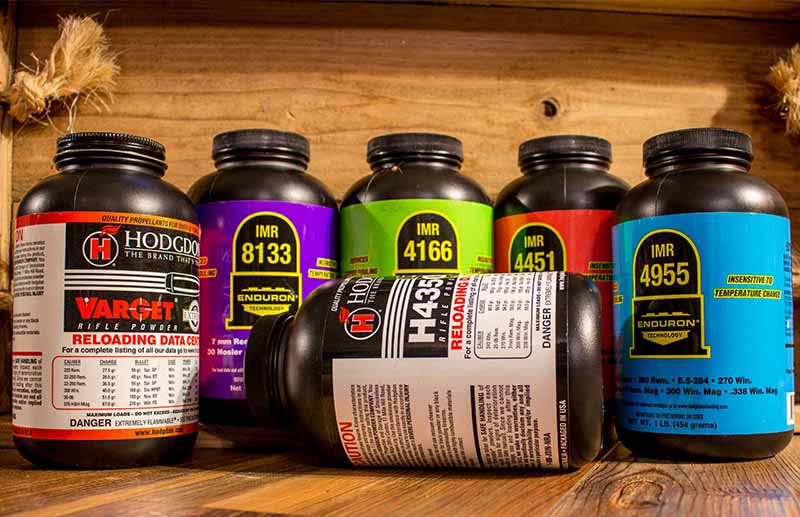
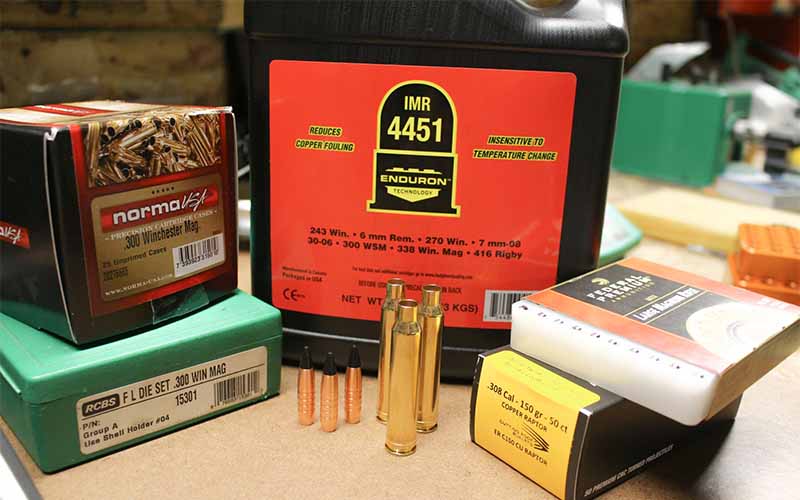
For that safari, I loaded my .300 Winchester Magnum ammunition with IMR 4451—from the then-new Enduron line—in the event of just such a heat wave in late-season Africa. Engineered for temperature insensitivity, the Enduron powders made a considerable splash when they came onto the market; they possess a burn rate correlative (yet not interchangeable) with many of the popular IMR powders dating back to the 1950s, including IMR 4064, IMR 4350, IMR 4831 and more.
Powder availability seems to change from week to week; we reloaders must make do with what we can obtain. Photo: Massaro Media Group.
These powders have been very good to me, and I’ve used them in cartridges ranging from .22-250 Remington to .300 Winchester Magnum, up to the .375 H&H Magnum, .404 Jeffery and .470 Nitro Express. However, late last summer, Hodgdon (owners of IMR Powder) announced this powder line would be discontinued, much to my chagrin.
As reloaders, we tend to hang onto our proven ammunition recipes like heirloom spaghetti sauce recipes. And once we’ve repeatedly demonstrated that the bullet/primer/powder combination will deliver the goods, we tend to try and stock up on those particular components … or at least we should.
The author used IMR 4451—from the Enduron line—to combat the effects of the heat of South Africa at the end of the season. Photo: Massaro Media Group.
Changing Tides
The past few years seem to have been a never-ending challenge for the reloaders. Whether it’s a favorite bullet (I know the availability of Sierra bullets has been diminished, to say the least), a proven primer (if you can find any at all) or any powder, prices have assuredly risen significantly and availability has fallen. Regarding powder, what exactly is going on? Why would a company as big and successful as Hodgdon discontinue an apparently successful product line like their Enduron powders?
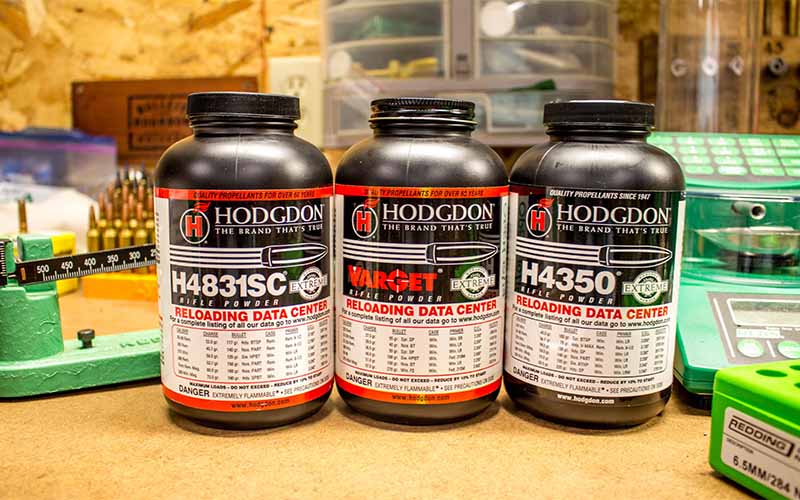
To best understand the situation, we need to understand exactly where our smokeless powders come from. Hodgdon—longtime purveyors of smokeless powders—as well as Alliant, Ramshot, Accurate, IMR and Winchester, use several different manufacturers around the globe. Some of our favorites are made here in the USA (primarily, ball powders), like H380, H414, StaBALL 6.5, Unique, Herco, Bullseye and TiteGroup, while others are made in Australia, including popular choices like Varget, H4350, H1000 and H4831SC.
Three of Hodgdon’s most popular powders—H4831SC, Varget and H4350—are all manufactured in Australia and were unobtain-able during the COVID lockdown. Photo: Massaro Media Group.
Considering the impact of the COVID-19 shutdowns, you can understand why that quartet of Aussie powders have been so difficult to obtain. Now that Australia is up and running again, we’re seeing those powders again, even if in small quantities.
Europe provides many different smokeless powders, with almost all the Ramshot lineup—including TAC, Hunter, BigGame and Zip—coming out of Belgium, and the majority of Alliant’s Reloder rifle powders being manufactured in either Sweden or Switzerland. Many of our favorite IMR powders—both the classics and the Enduron line—are produced in Quebec, Canada. Hodgdon manufactures the bulk of blackpowder substitutes here in the U.S.
Whether it may be supply chain issues, labor challenges, governmental restrictions or raw component availability, the bottom line is that those who design, market and distribute the powder often cannot get it to the masses. Such is the case with the Enduron powders; yet I guarantee that Hodgdon would love nothing more than to sell as much of this product as possible. Bottom line: They can’t sell what they can’t have manufactured.
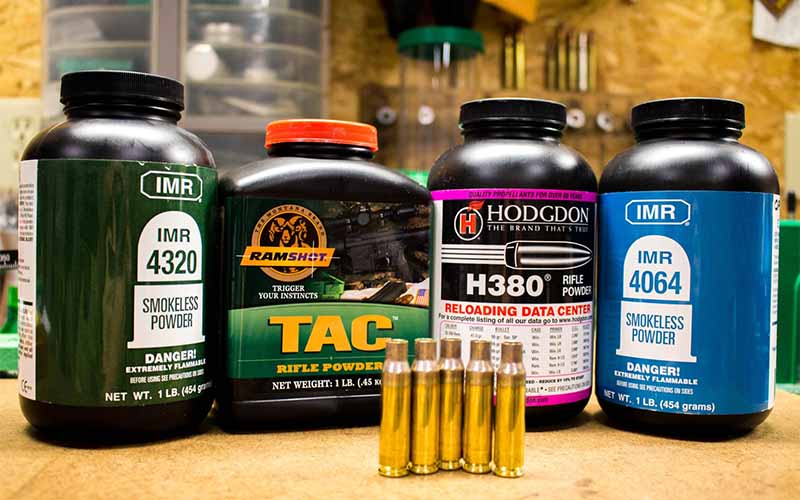
Four good choices for fueling the .308 Winchester. IMR4320 has been discontinued, Ramshot TAC is from Belgium, H380 is made in the U.S., and IMR4064 is made in Canada. Photo: Massaro Media Group.
I reached out to Hodgdon’s Vice President of Sales & Marketing, Aaron Oelger, for further insight into the market conditions right now. Considering that Hodgdon has their own brand—IMR, Winchester, Ramshot and Accurate powders—under their roof, I figured he’d have the proper insight:
“We’ve seen a lot of rumor and conjecture about the state of the reloading components market, and my response to consumers is to be skeptical unless you see news directly from the company or brand in question,” said Oelger. “Specific to gun powder and Hodgdon, I can tell you we continue to ship record amounts of powder to our dealers and wholesalers. While we experienced challenges with manufacturing and transportation specific to our Hodgdon Extreme line of powders several years ago, most of those challenges have been resolved. Most of our other brands like IMR, Accurate and Ramshot have also seen record shipments. And in Winchester Powder, the addition of StaBALL 6.5 has provided an additional alternative to powders like H4350.
“Demand for our powders continues to be strong, especially for those loading for precision rifle shooting,” added Oelger. “As shipping and raw-material costs have increased, we have been forced to take targeted price increases. Some of our powders may be more difficult or time-consuming to make, so we have chosen to prioritize other powders to maximize our shipments to our customers. We continue to prioritize high-demand powders, so we recognize consumers will not always be able to find the powder they want … and may be forced to use a substitute.”
So long, Enduron powders; you’ve been very good to me. Photo: Massaro Media Group.
I remember my sadness when it was announced that IMR had discontinued their 4320 powder; it was a staple on my bench for cartridges from .22-250 Remington, .308 Winchester, .30-06 Springfield, .250-3000 Savage and .300 Savage. Like the load data I’ve developed with the Enduron powders, I’ll just have to start again, perhaps with something similar or with whatever is available.
Being honest, I’m saddened that the Enduron line is being discontinued, but I am happy that Varget, H4350 and H4831SC are available again. Now, if those prices could drop, I’m sure we’d smile a bit more. In comparison to the rest of the economy, however, it’s no surprise that the costs are what they are. We’ll all have to be more flexible in the years to come, and hopefully each of us can find an adequate supply of the pistol or rifle powder we need.
Editor’s Note: This article originally appeared in the January 2023 issue of Gun Digest the Magazine.
Rock River Arms recently announced the Operator DMR rifle series, including six new models in two popular calibers.
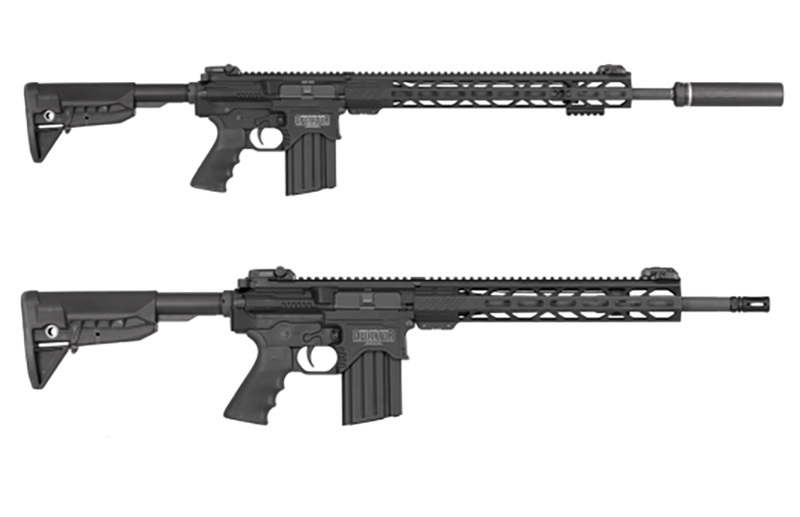
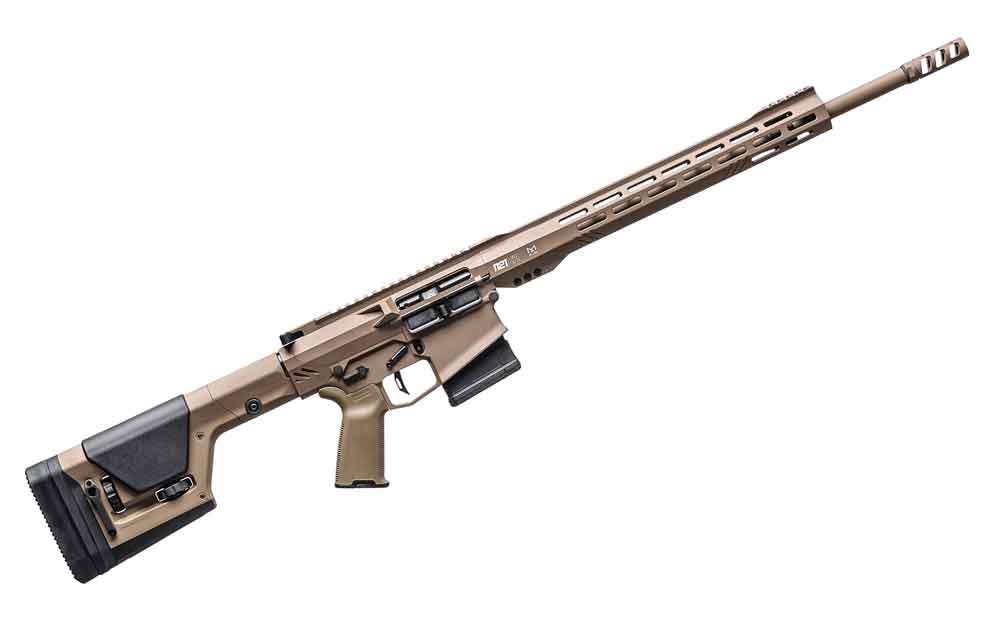
Rock River Arms’ catalog of AR-style rifles is extensive to say the least, including a wide variety of models chambered for different cartridges and designed for various purposes. However, the company is now turning its attention to more precision-oriented rifles with the announcement of the Operator DMR series. DMR stands for Designated Marksman Rifle, and the Operator DMR series will feature four variants chambered for .308 Winchester/7.62 NATO and two variants chambered for .223 Remington/5.56 NATO.
The 7.62 Operator DMR rifles include four variants in total, the OP1005BT and the Enhanced OP1007BT, and the OP1010BT and OP1012BT. The names don’t exactly roll of the tongue, but the rifles’ differences are pretty straightforward. The OP1005BT and the Enhanced OP1007BT both feature 20-inch chrome-lined barrels, and the only notable differences between the two are the enhanced variant’s inclusion of a SilencerCo Chimera 300 suppressor, an extra RRA 3-slot rail assembly and an ARCA Swiss Rail Adapter. Both versions otherwise share mid-length gas systems, low-profile gas blocks, two-stage Ultra Match RRA triggers and Magpul flip-up Pro Series MBUS iron sights. For furniture, both models also ship with BCM SOPMOD buttstocks, Hogue rubber grips and free-floated M-LOK handguards.
The 7.62×51 NATO OP1010BT and OP1012BT models have 16-inch barrels, but besides that they share the same features as their 20-inch counterparts described above. The OP1012BT is the “enhanced” version that includes the SilencerCo suppressor and other updgrades.
Of the two 5.56x45mm Operator DMR rifle models, there is no enhanced variant, and they only majorly differ in barrel length. The OP1505 has a 20-inch chrome-lined barrel with a 1:7 twist while the OP1510 has a 16-inch chrome-lined barrel with a 1:9 twist. Both also include lightweight M-LOK handguards of appropriate lengths (17-inch for the longer version, 13-inch for the shorter model). The other features are the same as the 7.62 models besides the use of carbine-length gas systems instead of mid-length.
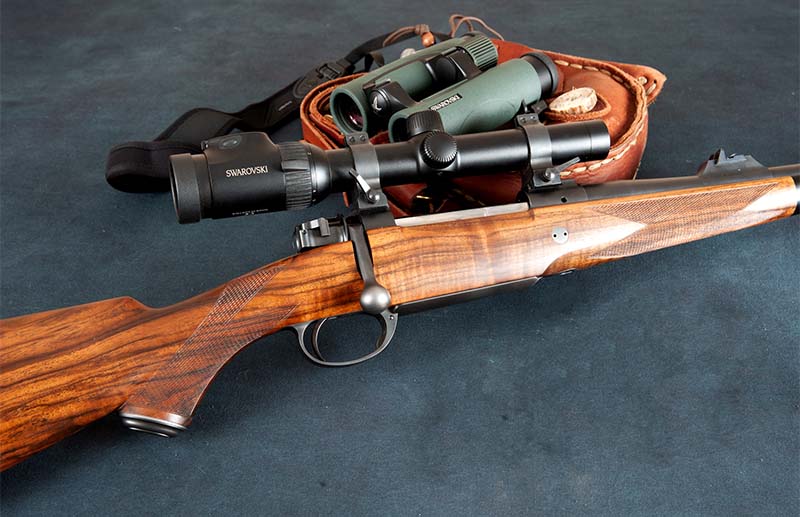
A closer look at the Heym Express by Martini, an elegant twist on a classic big-game rifle.
“That’s a good bull right there; let’s try and get just a bit closer.”
So uttered Professional Hunter Cornus duPlooy, as the pinks and purples still flared in the South African sunrise, and the taste of good coffee still lingered in my mouth. We weren’t all that far from camp, in a lightly wooded area pocked with acacias and other thorny vegetation, when the blue wildebeest bull followed a cow into the opening.
“He’s at 185 yards.”
Steadying the forend in the sticks, I exhaled halfway, put the crosshair on the bull’s shoulder and slowly broke the Heym’s trigger. Even through the muzzle blast, I could hear that wonderful whunk of the bullet hitting flesh; Cornus’ hissing “yes” told me it went where it was supposed to. The big bull did the whirling dervish dance, crashing within 15 yards of the shot, breaking a 4-inch-thick tree when he went down. I had taken my first animal with my Heym Express by Martini, chambered in the classic .404 Jeffery, but it most certainly wouldn’t be my last.
Photo: Massaro Media Group.
Heavy Metal
In a market dominated by bolt-action rifles, the big-game hunter has myriad choices of tools with which to head to the wilds. Many factors can come into play when making the decision. Yet, I feel the Heym Express by Martini ranks at the top among rifles for large and dangerous game. It has become, unequivocally, my favorite bolt-action rifle ever made.
Founded in 1865 in Suhr, Germany, Heym rifles is the namesake of Friedrich Wilhelm Heym and remains in Germany to this day, having changed gears from time-to-time to survive two World Wars. Some of the finest bolt-action rifle designs have come from Germany—that Mauser fellow sure had some good ideas—and the designs remain the basis for a good number of manufacturers of fine bolt-action rifles. Heym’s Express is highly reminiscent of the Mauser Gewehr 98 in the fact that it has a two-lug bolt face, non-rotating claw extractor, fixed-blade ejector and three position safety, though there are some significant differences.
The Heym Express by Martini has one of the smoothest actions the author has ever come across, and that includes many high-end boutique gunmakers and British bespoke companies. Photo: Massaro Media Group.
Where the Mauser action uses a bolt of 0.700 inch in diameter, and the Brevex magnum action uses a beefy bolt 0.750 inch in diameter, the Heym Express uses a 0.780-inch diameter bolt. If you like a strong action, that Heym bolt is the basis of one for sure. The tolerances of the Heym Express receiver are very tight, and the raceways and bolt are properly polished so there’s no chatter and minimal resistance upon working the action. In fact, among the healthy number of professional hunters who’ve handled my lovely .404, many come away wide-eyed and impressed. “Don’t lose that rifle” is the most often uttered phrase.
The three-position safety is closer to the design of the Winchester Model 70 than that of the Mauser 98, situated low on the right side of the receiver and allowing a riflescope to be mounted low, unlike the flag safety on a Mauser. The Heym Express uses a classy straight bolt with an unadorned knob; while I love the vintage look, it does necessitate the use of high rings with some of the scopes with larger ocular housings or bigger magnification rings.
The Heym Express isn’t just for big game; this South African impala ram was taken quickly and humanely with the .404 Jeffery. Photo: Massaro Media Group.
For the majority of species, I use a Leupold fixed 2.5x Compact scope, as it’s enough magnification for dangerous game, and it has the slimmest design I found that could reliably handle the recoil generated by a .404 Jeffery. The scope is mounted in Talley Detachable rings, which work perfectly because the Express’ receiver has integral bases milled to use the Talley 19mm base rings designed for the front part of a CZ550 (the one without the tab). And, I like the fact that the scope can be removed for access to the iron sights yet can be replaced confidently with a return to zero.
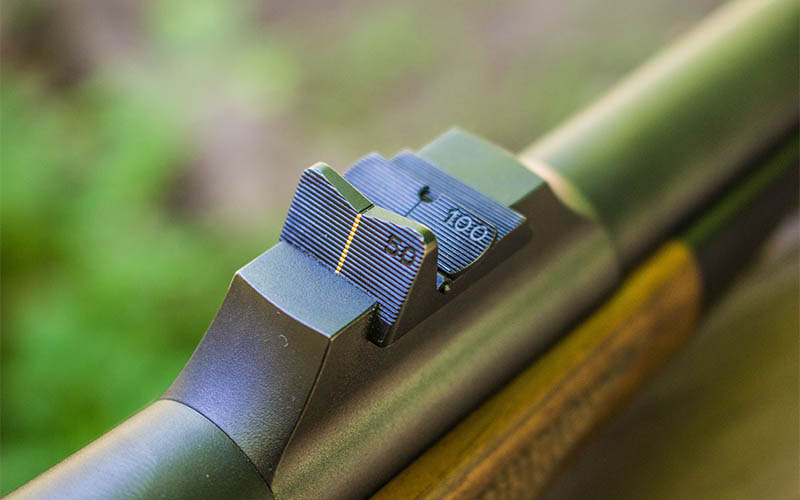
Heym has equipped the Express with a very useable set of iron sights; a bold 3/32-inch brass front bead is mounted in a banded ramp and is mated with a wide “V” safari rear sight designed for 50 yards … and a fine “U” flip-up sight for 100 yards. Those sights are mounted to a 24-inch cold hammer-forged Krupp steel barrel—manufactured in-house by Heym—of a proper contour for each caliber offered.
The rear sight of the author’s .404 Jeffery, with a fixed 50-yard wide “V” and a flip-up 100-yard finer sight.Photo: Massaro Media Group.
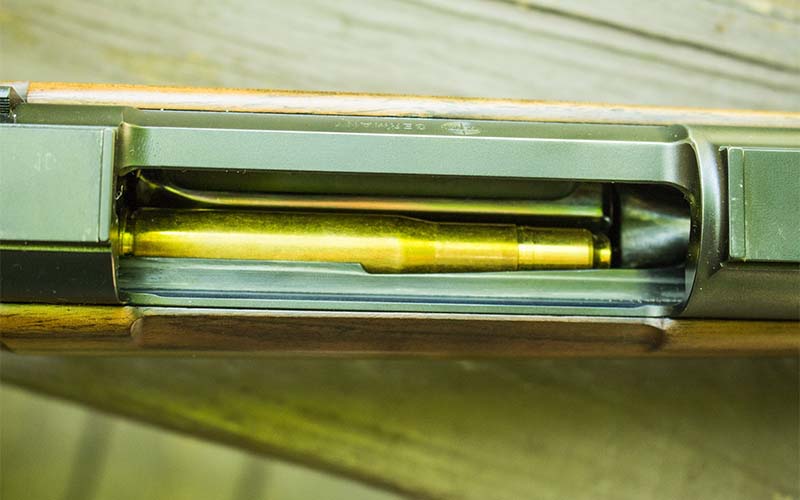
The Express by Martini has a magazine that’s made to a specific geometry for each cartridge offered in the rifle, and this is one of the most attractive features of the metalwork. Whereas some companies will construct their magazines for a family of cartridges (the .375 H&H Magnum, .416 Remington Magnum and .458 Lott lumped together), Heym builds it for each cartridge, and the result is absolutely flawless feeding. When you rely on a rifle to save your life or the lives of others, reliable feeding is paramount, and I’ve never used a rifle that feeds like my Heym Express. My .404 Jeffery holds four rounds down in the magazine, and there’s a hinged floorplate with the release located in the front portion of the oversized trigger guard.
The trigger is crisp, with nary a trace of creep and just a hint of overtravel; in the models I’ve measured, the trigger breaks somewhere between 3½ and 4 pounds, which is perfect for a dangerous-game rifle. The bolt handle, receiver, barrel, trigger guard and floorplate are blued in a matte finish, and the magazine follower and bolt are chromed.
Heym builds a unique magazine for each of the cartridges they offer, and that results in easy and reliable feeding.Photo: Massaro Media Group.
Shaken, Not Stirred
German gunmakers are famed for their metalwork, and while I’ve raved thus far about the excellent action and barrel, the “Martini” portion of the Express by Martini is absolutely other-worldly. Famed gunsmith Ralf Martini—German-born but now a Canadian resident—was employed to create the revised stock for the Heym Express rifle. If you’ve ever been fortunate enough to have shouldered a rifle stocked by Martini, you already know that this man is a poet whose medium is walnut.
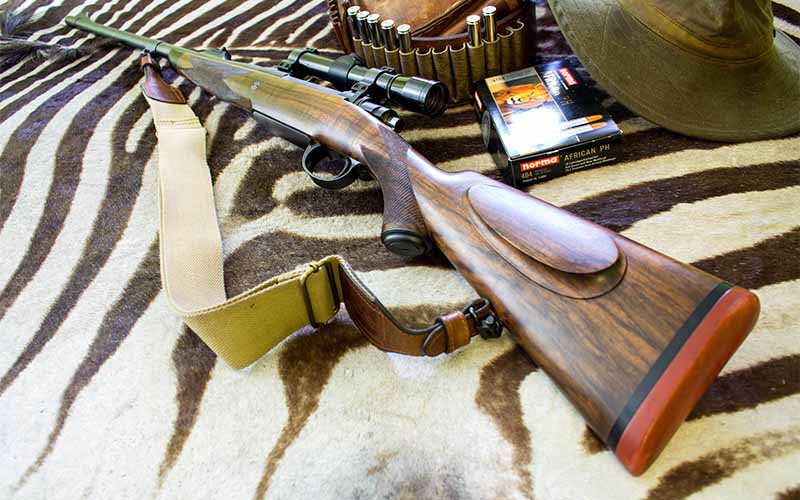
The open pistol grip is perfect under even the heaviest recoil. The comb and cheekpiece feel as though the man understands the human physique better than da Vinci, and the gently tapering forend—culminating in an offsetting black ebony forend cap that gives an appealing look—fits in the off-hand perfectly, giving a grip that’s best described as “absolutely natural.”
Ralf Martini was called upon to redesign the Heym Express stock, and it remains one of the author’s favorite stock designs ever made. Photo: Massaro Media Group.
Heym will stock your rifle for a length of pull to best fit your frame (mine is tailored to me at 14½ inches), and the NECG Universal recoil pad helps take the sting out of the largest safari calibers. It’s checkered at the pistol grip and forend, with sling swivel studs in the rear stock and on a barrel band as well.
The Heym principal, whether it be a bolt gun or a double rifle, is to keep the weight of the rifle between the shooter’s hands. Balance is key, as a dangerous game rifle needs to come to the shoulder quickly, smoothly and, most of all with a hard-kicking big bore, correctly. The Heym Express checks all of those boxes, and my hat is off to Martini for cooking up such a good design.
Decisions, Decisions
Heym offers the Express in magnum-length cartridges, including the .375 Holland & Holland Magnum, .416 Rigby, .404 Jeffery, .458 Lott, .450 Rigby, .500 Jeffery, .505 Gibbs and, in limited production, .300 Holland & Holland Magnum. The best choice of cartridge will depend on your hunting situation and your level of recoil tolerance.
I feel the .375 H&H Magnum is the most useful cartridge ever invented, so if you were looking for a universal choice, there’s your baby. If you like the stopping rifles, I’m certain you’ll be well-served by the .505 Gibbs, or the .500 Jeffery, .458 Lott or .450 Rigby. And while few will deny the pedigree and panache of the .416 Rigby, I chose the .404 Jeffery for its unique— and unsung—history.
Released in 1905, the .404 Jeffery is a rimless cartridge, using a slight 8-degree shoulder and a 400-grain, .423-inch diameter bullet. Original loads drove that 400-grain bullet to a muzzle velocity of 2,150 fps, generating 4,100 ft-lb of muzzle energy. There was a 300-grain load, but that never really caught on, and the 400-grain load did the vast majority of the work. Though the .416 Rigby and .375 H&H were romanticized—with good cause—the .404 Jeffery was issued to many of the African game rangers for animal control work, and the cartridge maintained a small yet passionate following. Modern loads bring the cartridge into the realm of the .416 Remington Magnum and .416 Rigby, pushing the 400-grain bullet to 2,350 fps. Should you want more, look to the Norma PH ammo line, which sees a 450-grain Woodleigh Weldcore cruising at 2,150 fps.
The author took this Zimbabwean crop-raiding elephant cleanly with the Heym Express by Martini in .404 Jeffery, utilizing the rifle’s iron sights.Photo: Massaro Media Group.
My Heym .404 Jeffery has been all over the world, having taken elephant in Zimbabwe, buffalo in Mozambique, all sorts of plains game in different countries and making the long trek to Australia. While it wears a pretty piece of wood, it isn’t ornate by any means. It is, without exception, the one rifle I would keep if I could keep only one—and that includes my Heym 89B .470 double rifle, my Winchester Model 70 .300 H&H and my Mauser 98 .318 Westley Richards.
My own rifle weighs in at an even 10 pounds unloaded, measures 45¾ inches from muzzle to butt, and it will put a half-dozen factory loads and handloads into sub-MOA groups. With prices starting at $13,000, this rifle probably isn’t going to be seen at too many yard sales, but it assuredly has what it takes to become a family heirloom. You could spend a lot more money on a lot less rifle, and though it’s costly, the Heym Express by Martini is a good value.
I’ve bet my life on it before … and I’ll do it again.
Eighty-Seven Thousand Big Ones
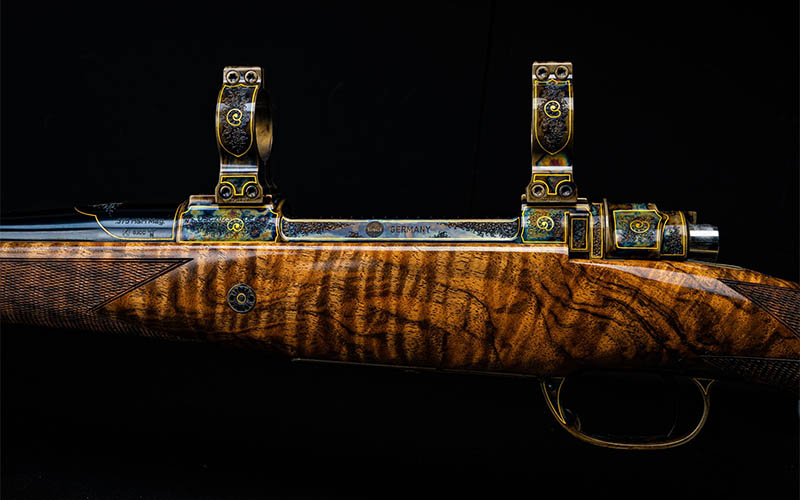
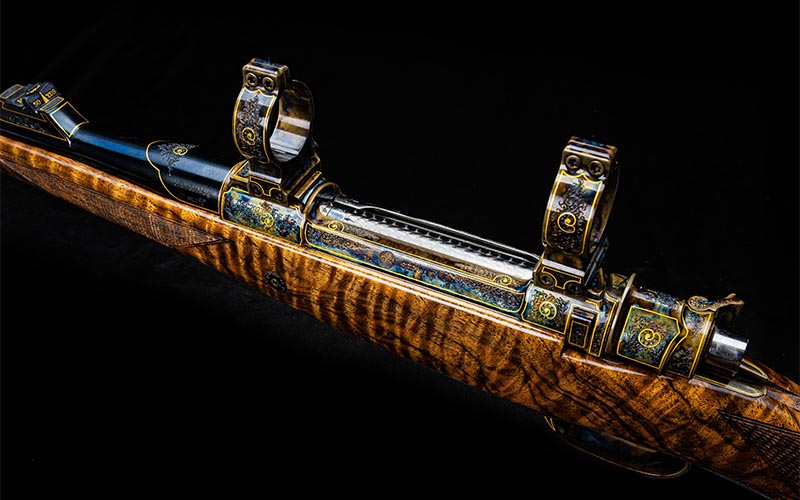
While my own rifles are on the simpler side, Heym has produced some absolutely stunning pieces, including the 2023 Dallas Safari Club Convention rifle. It’s an Express by Martini chambered in .375 H&H Magnum and stocked in a piece of walnut that might make you weep openly, with a color-case hardened receiver. A deep, rich bluing is offset by an ornate (but not gaudy) gold inlay. A set of matching Talley rings—blued, case-hardened, engraved and inlaid—were created to go with the rifle. The bolt is jeweled, and the floorplate is adorned with a gold inlay with a golden leopard prowling along the savannah.
The 2023 DSC auction rifle features a gold-inlaid leopard on its floorplate and was even prettier in real life than in photos.Photo: Massaro Media Group.
As a means of raising funds for the Dallas Safari Club’s numerous and excellent efforts in conservation—which run from protecting hunter’s rights globally to effective anti-poaching, to protecting the habitat that’s so crucial to propagating wild animal populations—this Heym Express rifle sold for a whopping $87,500. Wildlife will invariably benefit from the sale, but there is a very happy rifle owner out there somewhere, probably still staring into the mesmerizing case hardening and multi-dimensional walnut stock.
The Dallas Safari Club Convention auction rifle was a jaw-dropping effort and garnered $87,500 for conservation. Photo: Massaro Media Group.
Heym has all sorts of engraving and inlay options for their rifles. From the simplest patterns to intricate scroll work, they offer some very attractive color case-hardening and plenty of wood upgrades. Initials can be engraved in the grip cap, animal scenes may be engraved onto floor plates or side panels, and all sorts of caliber labeling or whatever the imagination could produce can be realized if your pockets are deep enough … and if you’re patient enough to wait for the craftsmen to do the work.
Editor’s Note: This article originally appeared in the March 2023 issue of Gun Digest the Magazine.
Debating .338 Lapua versus .50 BMG for your next long-range cartridge? Here we break down which will best serve your needs.
If you look at the cartridges used for the longest recorded sniper kills, you’ll notice that two, in particular, dominate the list. So, when it comes to .338 Lapua versus .50 BMG, which is the better long-range cartridge? Like with most questions in the shooting world, that depends on what you’d like to use it for.
.338 Lapua Vs. .50 BMG Ballistics
Despite both cartridges being popular for long-range shooting, they have quite different properties, the most apparent being bullet weight.
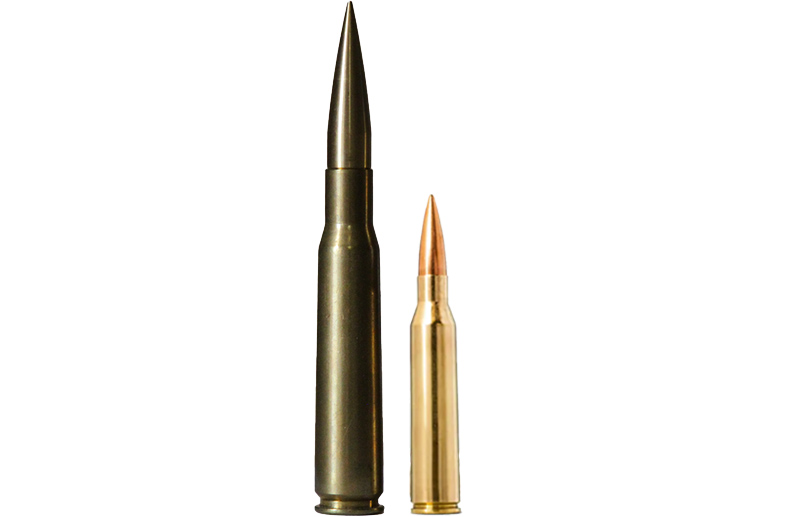
The most common .50 BMG projectiles weigh between 647 and 800 grains, while .338 Lapua Magnum bullets typically have weights of between 200 and 300 grains. Despite this, both cartridges have very similar average muzzle velocities, generally ranging between 2,500 fps and 2,900 fps for .50 BMG and between 2,600 fps and 3,000 fps for .338 Lapua.
The large difference in projectile weights but similar velocities explain the great disparity between the energies of these two cartridges. While .338 Lapua typically produces 4,700 to 4,900 foot-pounds of energy, .50 BMG produces between 12,000 and 14,000 foot-pounds.
While having increased energy can be useful for certain applications, it also comes with downsides, one of the most major being recoil impulse.
The .338 Lapua Magnum is stern, but not completely ridiculous. A 9.5-pound rifle firing a 225-grain bullet at 3,000 fps will produce about 37 foot-pounds of recoil energy, only about 2 foot-pounds more than what’s produced by common 225-grain .338 Winchester Magnum cartridges which are usually loaded to around 2,800 fps.
By contrast, a 647-grain bullet fired at 2,710 fps from a .50 BMG produces about 70 foot-pounds of recoil…from a 30-pound gun. While stout recoil can normally be dealt with by simply gritting one’s teeth and bearing it, when it’s this significant, it should play a factor in one’s decision.
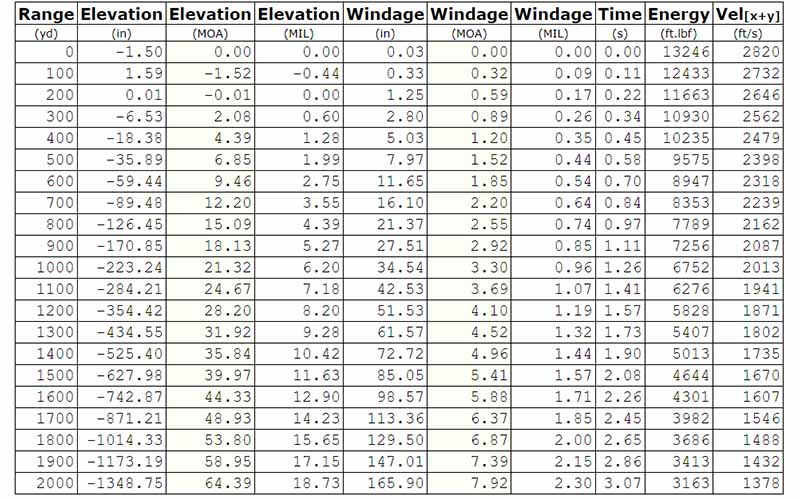
Next, let’s talk about trajectories by looking at 2,000-yard tables for two comparable loads. First up, we have Hornady’s 750-gain A-MAX .50 BMG load, which has a G1 ballistic coefficient of 1.050 and an advertised muzzle velocity of 2,820 fps.
All tables were made using ShootersCalculator with a 200-yard zero, 1.5-inch sight height, a 10 mph 90-degree crosswind and zero corrections for atmosphere.
As you can see, it’s still supersonic at 2,000 yards (one mile is 1,760 yards) and retains well over 3,000 foot-pounds of energy. It will impressively remain supersonic out to 2,625 yards, at which point it still carries more than 2,000 foot-pounds. In fact, it still has more than 1,000 foot-pounds of energy at two miles. That’s more than a .44 Magnum at the muzzle.
The good velocity retention is primarily what makes .50 BMG such a formidable cartridge for defeating light armor and vehicles. Velocity is what defeats armor after all, and .50 BMG has it in spades considering that it stays supersonic until about 1.5 miles.
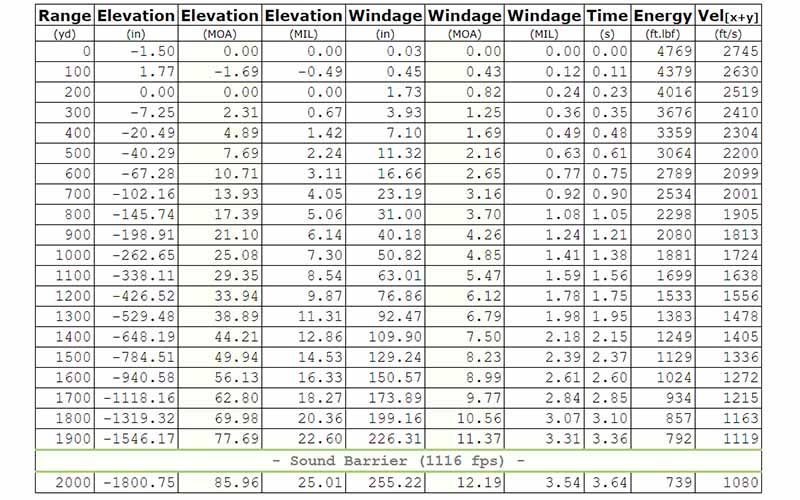
But what about .338 Lapua? While Hornady doesn’t offer a factory load with the A-MAX bullet, they do offer the ELD Match, which is a nearly identical design (tipped hollow-point boat tail). Here’s the table for it, featuring a 285-grain bullet with a G1 BC of 0.789 and an advertised muzzle velocity of 2,745 fps.
As you can see, the .338 Lapua loses velocity, loses energy and drops at a faster rate over the same distance (in fact dropping almost 700 additional inches at 2,000 yards) compared to .50 BMG, so its effective range is not nearly as impressive.
However, it should also be noted that the bullet doesn’t drop below supersonic velocity until around 1,925 yards where it still has more energy than a .357 Magnum does at the muzzle. At 1,760 yards (1 mile) it’s still supersonic with almost 900 foot-pounds of energy, easily lethal to humans and medium game.
So, while the effective range of .338 Lapua is ostensibly shorter, it’s still greater than one mile. That’s more than most shooters are capable of actually putting to use!
Obviously, there are many other loadings for these cartridges. These trajectory tables are only meant to give you an understanding of the general differences between them.
.338 Lapua Vs. .50 BMG: What Do You Need One For?
Comparing the two also raises he question of what you might use one for.
In a military context, both have their place. A .50 BMG sniper rifle is capable of punching holes in vehicles, light aircraft and light armored vehicles from very far away, and is an effective anti-personnel cartridge at staggeringly long distances too.
A USMC member with a .50 BMG Barrett rifle. Photo: Wikipedia.
The .338 Lapua Magnum is not as capable. While light armor-piercing ammunition exists and has been used, its effective range against armor is shorter. The maximum effective anti-personnel range is also shorter, but it’s still far better than most other rifle cartridges.
If your intended purpose is ringing steel silhouettes a mile away, neither cartridge will be a problem; your ability to hit the target is more relevant. That has a lot more to do with your scope, reticle, and knowing your holds. You will need more of your Christmas tree with .338 Lapua than with .50 BMG, but you could use either cartridge at ranges greater than what you’re probably capable of reliably hitting.
If your goals are more entertainment-oriented than practical, then .50 BMG has obvious appeal. For blowing up watermelons and the like, this will be the more impressive cartridge to do it with due to its significantly higher energy.
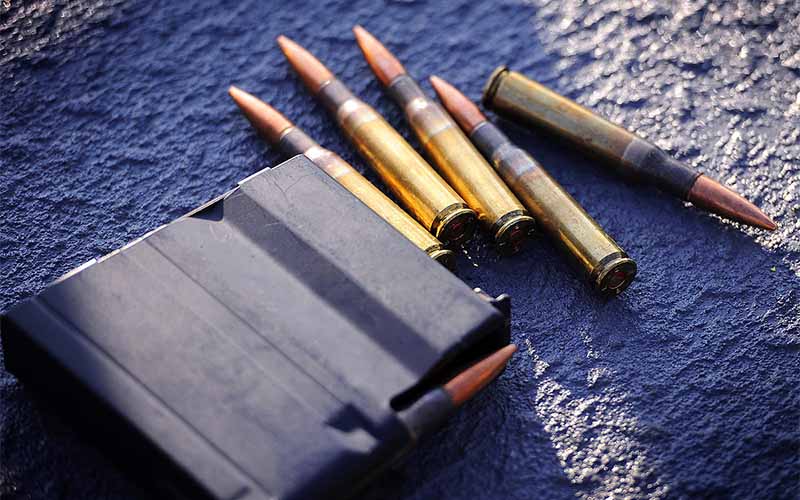
.50 BMG ammo and a Barrett magazine. Photo: Wikipedia.
A .338 Lapua Magnum can be used for both extreme long-range shooting as well as hunting. It’s a .338, so the bullets are the same as the .338 Win. Mag., one of the best hunting cartridges for anything short of the African Big Five. There may be no finer cartridge for long-range shots on elk, black bear, and similarly sized African game at distances beyond 500 yards…if you’re capable of actually hitting the target, that is! Marksmanship, after all, is the lion’s share of lethality.
The .338 Lapua Magnum is on the border of acceptability for dangerous game hunting. While some African jurisdictions (Nairobi, for instance) will allow you to hunt with one, most will not. It still falls just short of the energy/caliber requirements.
Some may have considered getting a .50 BMG rifle in case of some SHTF scenario, but it really only works in a fixed position or as part of a larger squad. The rifles are large and heavy, the ammunition is large and heavy, and while technically portable, none are nearly as portable as a 10-pound rifle in .338 Lapua Magnum. Unless for some reason you anticipate needing anti-material capabilities, .50 BMG will almost certainly prove to be more bullet than it’s worth.
Due to the prohibitive weight and recoil of .50 BMG rifles, .338 Lapua Magnum is more useful in the real world on paper, but let’s pump the brakes a bit. Both types of ammo are very expensive, but at the time of writing, the cheapest available .338 Lapua ammo is about $1.25 more per round than .50 BMG ($3.75 versus $2.50). While .338 will definitely be lighter on your shoulder, you’ll feel it more on your wallet. If you plan on shooting it a lot, that matters.
.338 Lapua Vs. .50 BMG: Which Is Better?
The better cartridge for long-range use is a bit academic.
On paper, .50 BMG is better if you’re shooting at something more than a mile away. While sniper shots have been made with .338 Lapua Magnum beyond a mile, a lot more has been made with .50 BMG. So, if the longest of long-distance shots is what you have in mind, .50 BMG is the ticket.
If you want to blow big holes and things and just enjoy a big rifle that makes an enormous noise, .50 BMG is also better at those things. We should also acknowledge another factor here: .50 BMG has a certain je ne sais quoi given it is essentially the biggest and most powerful ammunition you can own a firearm for without registering a destructive device.
.338 Lapua Magnum is more practical, verging on useful in the real world. While overpowered for small to medium game like hogs, deer or pronghorn (and a good deal of African game), it’s dynamite on medium to large game. Unlike .50 BMG, rifles can also be reasonably carried.
A Savage 110 Precision in .338 Lapua Magnum. It’s easy to see the advantage of carrying one of these instead of a .50 BMG.
Since more people are willing to take longer shots on elk, moose or bear at distances beyond 400 yards, you want to have a cartridge that’s capable of effectively harvesting game at that distance. The .338 Lapua Magnum is one of the best rifle cartridges for that purpose. It’s great for long-range precision target shooting as well.
In short, like with most cartridge debates, it ultimately comes down to you to decide which will best serve your needs. Between .338 Lapua versus .50 BMG, the former will likely offer more utility to the average shooter, but the higher ammo cost and far lower energy ensure that .50 BMG still has a place too.
Howa has just expanded its popular Mini Action bolt-action rifle line to include 6mm ARC, available in seven different configurations.
Announced in 2020, 6mm ARC is a relatively new cartridge, but it’s been steadily becoming more popular ever since. Some of its allure is that it has much better ballistics than 5.56 NATO all while producing similar recoil and being short enough to be used in reduced-size bolt-action rifles. It’s that last point that led to Howa’s recent announcement that 6mm ARC is now an available chambering option for its popular Mini Action rifle series.
Previously, Howa Mini Action rifles were available in .223 Remington, 6.5 Grendel, 7.62×39 and .350 Legend. Each has its uses, but none particularly excelled at long-range shooting quite like 6mm ARC does. It has slightly better velocity and trajectory than .308/7.62 NATO despite having less recoil and a shorter overall cartridge length. Being short enough to function in Howa’s Mini Action line made it an obvious choice for a new chambering option, as it provides all the benefits of a smaller and lighter bolt-action rifle while still being as capable as a full-sized one chambered for .308. Howa is currently offering 6mm ARC Mini Action rifles in seven configurations, including Standard Synthetic, Carbon Stalker, Carbon Elevate, HS Precision, EXCL Lite, Walnut and the APC Chassis.
Howa Carbon Stalker Mini Action in 6mm ARC.
All the new 6mm ARC Howa Mini Action variants are available with either a standard 22-inch barrel or a 20-inch light varmint barrel, but both come threaded and ready to accept a suppressor or other muzzle device. Both barrel versions also feature a 1:8 twist rate. The rifles are shipping now, and although MSRPs are not listed, the Howa Mini Action Carbon Stalker in 6mm ARC is currently priced at $999.99 by online retailers.
The 6.5 Creedmoor, heard of it? If you haven’t, then perhaps you’re new to firearms or maybe you’ve been cloistered in some cave outside Moab for the past decade living off prickly pears and raw fish. At this point, those are about the only acceptable excuses why you haven’t caught wind of the hottest cartridge to hit shooting since .30 met aught six.
The cartridge has gained notoriety for its ability to clip a gnat’s ass at 1,000 yards without the shooter enduring rented-mule levels of punishment. However, the cartridge is really only one half of the story; the other is the marvelous array of precision shooters to deliver the long-range wunderkind where it needs to be.
With this in mind, here are some of the top 6.5 Creedmoor rifles on the market today. These babies will deliver, no matter the round, all you have to do is provide a steady hand.
Best 6.5 Creedmoor Rifle Options
Springfield Armory 2020 Waypoint
To some extent, the 2020 Waypoint shows how far the long-range craze has gone at this point. Strip away the camo and featherlight build and Springfield Armory’s bolt-action hunter would fit right into a precision match, no questions asked.
At the heart of the 6.5 rifle, a tough-as-nails Model 2020 action. Springfield didn’t reinvent the wheel here, basing it off the time-tested Remington 700. But with exceedingly tight tolerances for smooth-as-glass operation, it takes the omnipresent action to a different level. The same goes for the fire tube. With the choice of a fluted stainless steel barrel or ultralight Proof Research carbon-fiber wrapped barrel, shooters are rewarded with an extremely rigid system that eliminates a majority of flex for repeatable accuracy.
Light years away from a traditional hunter set up, Springfield mates the barreled action to a carbon-fiber stock with a hybrid match profile. A wide fore-end offers more area to rest the rifle. A pistol grip enhances control. And a high comb (there’s an adjustable model too) ensures consistent cheek weld. Tack on a smooth trigger and ultra-fast lock time, you can’t miss with the Waypoint. MSRP: $2,173; springfield-armory.com
Savage Arms Impulse Big Game
Typically, to pick up the pace with the 6.5 Creedmoor shooters shopped AR-10. Savage Arms opens up the game with a rarity this side of the Atlantic Ocean in the Impulse Big Game. A straight-pull, the 6.5 Creedmoor rifle runs just a tick under a semi-auto, while offering up the advantages of a bolt-action. In this department, expect a system as unyielding to flex thanks to its stoutly-built action and thick-enough, medium-contour barrel.
Of course, it’s difficult to focus on the fundamentals of accuracy with the engineering Savage has poured into the Impulse. Utilizing six ball bearings instead of lugs, the straight-pull has an airtight lockup that runs as fast as you can operate the bolt. To aid the process, Savage includes an oversized handle and a relatively short linear throw. Additionally, the Impulse has a few extras shooters have come to expect on precision irons, such as threaded muzzle (5/8-24), fully-adjustable stock (AccuFit), fully-adjustable trigger (AccuTrigger) and rigid hybrid chassis (AccuStock).
Sure, Savage aims the straight-pull at hunters. But anyone who appreciates speed and accuracy is sure to love the Impulse. MSRP: $1,449; savagearms.com
Sako S20
In the past, shooters had essentially two choices when it came to a 6.5 Creedmoor rifle—one tailored to hunting or one tailored to match shooting. Sako took a look at this line and dashed it to pieces with the S20. What might be the first true hybrid hunter/match rifle on the market, the Finnish company marries the two sometimes contrary disciplines with a truly elegant system.
The secret is in the stock, or more exactly stocks. Boasting an interchangeable chassis system, the bolt-action rifle jumps between tactical and hunting configurations in a blink of an eye. Out for coyotes, slap on the thumbhole stock. Looking to drill bullseyes at range, go with the fully-adjustable tactical model. Did we mention, you won’t have to zero after making a switch? Pretty sweet.
As expected from Sako, the S20’s over-engineering extends past its interchangeable V-bedding chassis system. Such features as a rock-solid three-lug bolt, cold-hammer forged stainless steel barrel, adjustable trigger and integrally machined optics rail are all on target. The only question that remains, what’s best configuration for your objectives? MSRP: $1,598; sako.fi
Roam R-10 Great Plains
When you’re hale from Grand Forks, ND, you’re painfully aware of the magnitude of the American West. Perhaps this is why Roam puts a premium on portability in its gun designs, particularly its AR-style 6.5 Creedmoor rifle. The Peace Garden State gunmaker understand you have to put miles under your boots to put meat on the table.
The R-10 Great Plains is optimized for this very job, among the lightest 6.5mm AR-10 (DPMS variant) options out there at an extremely manageable 7.28 pounds. Roam achieves this by turning to lightweight magnesium alloys for the receiver and handguard. The material matches the strength of aluminum while dropping a third of the weight. This weight savings allows for a longer 22-inch fluted heavy barrel, arguably better suited for the 6.5 CM, without upping the heft.
Enhancing the R-10, the choice of the excellent ATC Hybrid AR Gold or JMT Saber Single Stage triggers, upping its accuracy potential. It also has a load of other assets, such as a Radian ambidextrous charging handle, Hogue pistol grip, and Magpul stock with Limbsaver recoil pad. Arguably, it’s the cream of the AR hunter crop. MSRP: $3,245, roamrifles.com
Rock River Arms RBG
Safe to say, Rock River Arms (RRA) pulled out all the stops catching the precision-shooting wave. Newly minted, the RBG 6.5 Creedmoor rifle is a top-end build that demands a top-end price. Nobody ever said accuracy comes on the cheap.
At the heart of the system is RRA’s stainless steel short action, mated to a 20-inch fluted Wilson barrel, complete with threaded muzzle (5/8-24) and protector. Air gauged and cryo-treated, the barrel is manufactured to exacting standards to deliver consistent sub-MOA accuracy.
Kinetic Research Group provides the chassis, its Whiskey-3, which is a gem—fully adjustable buttstock, precise aluminum bedding, tool-less adjustment, ample attachment points—the whole shebang. If that not enough, RRA also includes a Triggertech Trigger, oversized knurled bolt handle and built-in bubble canting device standard. It might run a pretty penny, but the RBG still is a great value. MSRP: $4,450, rockriverarms.com
Henry Repeating Arms in a precision rifle list? Sounds crazy, but the purveyor of quality lever-action rifles more than deserves its place with the Long Ranger. The 6.5 Creedmoor rifle delivers accuracy akin to a bolt-action, but with the speed of a repeater.
It pulls off this feat through some ingenious engineering, a bolt that essentially mirrors a bolt-action’s lock-up. The 6-lug rotary head adds an element of consistency, which is easily seen downrange. Not to mention, breathes new life into the lever-action, particularly for long-range hunting.
Aiding the Long Ranger is Henry incorporating a 4-round magazine, making it safe to chamber the rifle 6.5 CM. American walnut stock and richly blued 22-inch barrel and receiver, the rifle might be the most beautiful on the list. MSRP: $1,243, henryusa.com
MPA BA PMR “Pro” Competition Rifle
If you compete in or even mildly follow the Precision Rifle Series, you’re cognizant MasterPiece Arms commands respect—and top dollar. While the Georgia gunmaker isn’t jettisoning its premium label, it is making its gold-medal rifles a bit more accessible. Designed to meet the revised standards for the PRS Production Class—less than $2,500—the MPA BA PMR “Pro” Competition Rifle chips down on price, but not quality.
The 6.5 Creedmoor rifle’s heart is MPA’s BA Competition Chassis, a legend in its own right, which boasts unique V-bedding that allow clearance for glass bedding for both the action and straight section of the barrel. From there, MPA mates the chassis with Curtis Custom’s 3-lug short action and a X-Caliber stainless steel barrel (M24 contour). Finally, you get the choice of a Trigger Tech Special (set to 1-3lbs) or Timney HIT (set to 6oz – 2 lbs range) trigger.
All this and about a ton of other features, too numerous to list, make MPA’s Production Class rifle one of the best values to hit the market this year. MSRP: $2,200, masterpiecearms.com
Sig Sauer CROSS Rifle
Up to this point, when you wanted a 6.5 Creedmoor rifle for hunting you had two options. A pure sporter, not quite tuned to get the most out of the cartridge or precision rifle, and drag a boat anchor around the backcountry. Sig Sauer saw an opportunity in this divide and produced what might be the perfect compromise between the two. A hybrid, the CROSS Rifle delivers all the accuracy enhancements of a match iron, with the lightness of a true mountain rifle. That’s a deadly combination.
Ultra-lightweight, the CROSS Rifle tips the scales at a mere 6.5 pounds—around 40-percent less than anything else in its class. It boasts a fully-adjustable, folding buttstock—LOP and comb height—skeletonized to keep it svelte. Sig outfits it with a free-floating match barrel (18-inch in 6.5 CM) topped with the taper-lock that works with any of the company’s suppressors.The barrel also is swappable without the aid of a gunsmith, giving you a host of other chambering options.
Other notables include a two-stage adjustable match trigger, M-Lok handguard, ACIS magazine compatibility and interchangeable Picatinny rail. There’s more, but as is, it’s safe to say Sig has rethought the hunting rifle for the better. MSRP: $1,779, sigsauer.com
Daniel Defense DELTA 5
Taking the modularity of the AR-15 and applying it to a bolt action, Daniel Defense’s DELTA 5 is among the most versatile 6.5 Creedmoor rifles to hit the market. That’s because the turn bolt is more than simply the county-mile wunderkind. It’s also a .308. Crazy, huh? A switch-barrel, the rifle jumps seamlessly between the two long-range standbys, giving you perhaps everything you need in a single precision boomstick. And Daniel Defense makes certain, no matter the caliber, you’ll connect.
Indeed, the gunmaker has pulled out all the stops, decking out the rifle with a 24-inch stainless-steel Palma-profile barrel, mechanically bedded stainless-steel action, over-sized bolt knob, three-lug bolt and cutting-edge stock. The stock is particularly eye-catching, an advanced carbon-fiber reinforced polymer system that’s fully adjustable for length-of-pull and comb height. The DELTA 5 also comes with a total of 14 M-Lok slots and three QD points, making it a breeze to add accessories and a sling. MSRP: $1,871, danieldefense.com
Badrock South Fork
Not exactly cheap, but an incredible value, the South Fork 6.5 Creedmoor rifle teeters on custom-made performance. Makes sense, given Badrock is a division of Defiance Machine, well known for their tailor-made competition-grade actions. The company applies this expertise to piece together the dead-nuts chassis, yet keep the price sane. A steep task, known to turn a gunmaker’s hair gray early.
At the heart of the South Fork is a rock-solid modified Remington Model 700 action, upgraded with a coned bolt-nose, fixed ejector and modified controlled-round feed. The gunmaker mates the action with a 26-inch match-grade stainless-steel barrel, then fits them into a Modular Driven Technology LSS-XL Gen2 chassis (fully adjustable, of course). Meant to meet production rifle standards for competition, the system does make some sacrifices to achieve its price point. The scope base and muzzle device are extras. But for what you get on the South Fork as is, that’s not much to complain about. MSRP: $2,995, badrockrifles.com
Ruger Hawkeye Long Range Target
Since Ruger released the Long Range Target a few years ago, shooters have been champing at the bit for a 6.5 Creedmoor option. That wait is over. And the results, nothing short of magnificent.
Originally released as a .300 Win. Mag., the Hawkeye is a cruiserweight precision rig, offering among the sturdiest platforms to launch the 6.5. Thanks to a target stock made of laminated wood, the hefty 11-pound rifle soaks up recoil and anchors like a tick. Furthermore, its two-way adjustable comb and adjustable LOP ensures a perfect fit. QD attachment points and flush-fit M-Lok rail below the forearm gives you a way sling it up and accessorize it. And the 6.5 Creedmoor rifle features a heavy contour stainless-steel barrel paired with Ruger’s famous M77 action, which boasts a one-piece bolt. Yup, it’s controlled feed. Topping it off is a responsive two-stage adjustable target trigger and Ruger’s Precision Rifle Hybrid Muzzle Brake. More than capable of achieving ½ MOA accuracy, the Hawkeye is a gem in 6.5. MSRP: $1,619, ruger.com
Howa Oryx Chassis Rifle
As previously shown on this list, Howa has carved a niche as a purveyor of affordable tack drivers. And the company doesn’t show any sign of letting up. Its latest 6.5 Creedmoor rifle is a collaboration with Modular Driven Technologies, a partnership that – for the moment – has created among the most penny-wise chassis options on the market.
The M1500 Oryx features MDT’s Spartan, yet effective monolithic aluminum Oryx chassis. While it doesn’t boast the bells and whistles of some other options, it has what counts – spacer-adjustable length of pull, set-screw adjustable cheek riser, M-Lok mounting points below the forend and an overmolded grip. Howa’s 1500 barreled-action is no slouch itself, featuring a two-lug push-feed bolt, which has built a reputation for tight groups on the cheap. A hair over $1,000, there are few other chassis that come close to what the M1500 Oryx offers. MSRP: $1,059, www.howausa.com
Seekins Precision Havak Bravo
The Havak Action is something special. One of the more innovative to hit precision rifles in a spell, the custom job isn’t simply built like a tank, but also is among the easiest to operate. It’s also the heart of Seekins Precision’s production-class rifle – the Havak Bravo. Given the action alone runs around $1,200, it’s difficult to fathom how the gunmaker pulls off the rifle. Regardless, shooters benefit.
What makes the Havok Action unique is it’s smooth as warm butter to work. A benefit if fast shooting and shot-to-shot accuracy are your goals. Part of this is thanks to a unique helical extraction cam, which sends the bolt back immediately when it’s thrown. The other half of the equation is the 50/50 cocking mechanism, which splits the operation between the bolt’s up and down strokes.
Seeking Precision marries the action with a 24-inch stainless-steel match-grade barrel and mounts them in a KRG Bravo chassis. As expected, the stock is completely adjustable. The 6.5 Creedmoor rifle is finished off with a Timney 510 trigger, which ups the fire tube and your potential accuracy. MSRP: $1,950, seekinsprecision.com
Smith & Wesson M&P 10
As far as 6.5 Creedmoor AR-10 rifles are concerned, there are few that come close to what Smith & Wesson offers for the price. In its second generation, the M&P 6.5 Creedmoor Rifle is a jack-of-all-trades – as adept on a hunt as it is in a match. Best of all, the Performance Center creation doesn’t skimp. You have everything you need to milk the most out of the Creedmoor.
Foremost, S&W has opted for a longer 20-inch barrel, ensuring optimal performance with a cartridge that prefers more bore. This is 5R rifled, which, in theory, should help retain the ballistic integrity of the bullet once it’s left the barrel. Keeping recoil in check, the company moved the gas block forward – maintaining shot-to-shot accuracy. To this end, its 9.5-pound weight is a nice middle ground, once again eating up some of the kick, but not making the rifle unwieldy. Furthermore, the Smith & Wesson boasts a Troy Industries 15-inch free floated handguard and a respectable two-stage match trigger. Only the stock leaves a little to desire, given it’s fixed – a Magpul MOE. But given the rest of the rifle’s pros, that’s easy to overlook. MSRP: $2,095, smith-wesson.com
Barrett Fieldcraft
A backcountry rifle worth its weight in backstraps must be two things: accurate and light. Not always conducive goals. But it’s something Barrett has accomplished in spades with its phenomenal Fieldcraft bolt-action.
Light as a daydream, the 6.5 Creedmoor rifle tips the scales at 5.2 pounds. You heard that right – 5.2. The secret behind the weight savings is Barrett drawing inspiration from NULA’s custom action. There’s simply no excess material left to weigh you down, given the action is built around the cartridge for a glove fit. Paired with a thin No. 1 contour barrel, then seated in a hand-laid carbon-fiber stock, you’ve got a rifle you can lug around all day, then some. Not that it doesn’t come with drawbacks. Its litheness increases the generally mild-mannered 6.5’s recoil, but not too unbearable lengths. Certainly not enough to knock you off a follow-up shot on that trophy bull across the canyon. MSRP: $1,879, barrett.net
Standby 6.5 Creedmoor Rifles
Ruger Precision Rifle
Arguably the gun that kicked off the long-range shooting craze, the Ruger Precision Rifle remains among the top in 6.5 Creedmoor rifles. Built around the American Rifle action, Ruger fitted a 24-inch cold hammer-forged medium contour barrel, complete with 5R rifling to protect the integrity of the 6.5’s bullets. Mated to a pre-hardened 4140 chrome-moly steel upper, the platform provides rigidity and a true free-floating barrel.
Additionally, its inline recoil system, which directs kick straight backwards, makes the rifle more accurate shot to shot. A mainstay now, the Precision Rifle (also chambered .308 Win. and 6mm Creedmoor) was among the first economy long-range shooter to offer a fully adjustable stock. The Precision Rifle’s competition has grown, but it more than has the yarbels to hold its own among other 6.5 Creedmoor rifles and otherwise. MSRP: $1,929, ruger.com
Bergara B-14 HMR
Suited to tackle any shooting situation you get a 6.5 Creedmoor tangled up in — from match to field — Bergara’s B-14 HMR (Hunting & Match Rifle) is as flexible as they come. Not as tactically aggressive as some long-range rifles, the B-14 HMR (also available in .308 Win. and .450 Bushmaster) nonetheless is as advanced, with an aluminum skeleton (mini-chassis) molded into the polymer stock to provide indispensable rigidity any precision platform requires. Furthermore, fully adjustable length of pull and cheek riser fits the stock perfectly to any shooter.
Renowned for their actions and barrels, Bergara does not disappoint with its tack-driver, outfitting it with a 22-inch bull barrel and rock-solid B-14 action, known for its silky-smooth operation. A 3-pound trigger, threaded muzzle, AICS detachable box magazine and integrated QD flush cup mounts round out the system. If you can’t truly decide your ultimate aim in the world of 6.5 Creedmoor rifles, Bergara’s economical Jack-of-all-trades is your ticket. MSRP: $999, bergara.online/us
RISE Armament 1121XR
Designed for those who expect more out of their firearms, the 1121XR delivers in the form of a light and capable AR-10 chambered for the 6.5 Creedmoor. The gas-operated semi-auto (also chambered .308 Win.) dispenses bolt-action sub-MOA accuracy with lightning speed aided by RISE Armament’s exceptional RA-535 Advanced-Performance Trigger with a 3.5-pound pull, terse release and micro reset.
Furthermore, the 22-inch barreled rifle has all the accouterments to make life easy off the bench or in the field: streamlined billet aluminum M-LOK compatible handguard, Picatinny upper rail and an overall weight just a tick north of 10 pounds. Additionally, the whole shebang gets a durable Cerakote finish available in three color choices — black, foliage green and flat dark earth. If that’s not enough, RISE Armaments throws in two 10-round magazines and a hard case to safely transport the tactical gem. Of all 6.5 Creedmoor rifles, the 1121XR is most certainly the fastest to get you on target again and again. MSRP: $2,575, risearmament.com
Savage Model 10 GRS
A no-compromise precision rifle with a relatively decent price point, Savage’s 10 GRS comes outfitted with a stock certain to help you deliver a 6.5 round where it needs to go. Constructed of 65-percent fiberglass and featuring pillar-bedding blocks, the Norwegian made stock is the sturdy and stiff platform long-range shooters aim for in their rifles. Moreover, slip-nut controls make length of pull and the cheek rest adjustment push-button matters and an ergonomic full grip gives you the ability to provide the needed rear pressure for solid shouldering.
Time-tested, Savage’s Model 10 short action is a near perfect heart for the rifle and gets matted with a 24-inch fluted barrel, which provides great harmonics, while keeping the overall platform at a reasonable weight — a hair under 9 pounds. The GRS also comes chambered in .308 Win., and 6mm Creedmoor. The 6.5 Creedmoor rifle feds off AICS magazines, boasts Savage’s popular adjustable AccuTrigger and comes outfitted with optics rail and sling swivels. MSRP: $1,449, savagearms.com
Browning X-Bolt Hells Canyon SPEED
Built for long-range backcountry hunting, Browning’s X-Bolt Hell’s Canyon SPEED is wickedly effective at everything it’s designed to do, particularly not bog you down. At 6 pounds 5 ounces, the rifle (available in 13 calibers) is among the lightest 6.5 Creedmoor rifles on the market, hastened by its featherweight composite stock and just enough barrel (a 22-inch sporter) to ensure optimal ballistic performance.
Solid as a concrete slab, the X-Bolt remains a top choice among precision hunters with its fast-operating 60-degree bolt lift, dependable detachable rotary magazine and three-lever Feather Trigger. Drilled and tapped, the receiver comes ready for scope mounts and the free-floating barrel is hand chambered to ensure the tightest tolerances. MSRP: $1,349.99, browning.com
Kimber Advanced Tactical SOC II
Engineered to meet the exacting needs of military, law enforcement and serious precision shooters, the Kimber Advanced Tactical SOC II (Special Operations Capable) comes with a sub-0.5-MOA guarantee, which it delivers. The fastidiously designed and executed instrument is hand built, outfitted with an adjustable aluminum folding stock, 22-inch stainless-steel barrel and threaded muzzle with protector.
Moreover, Kimber hits the right notes with traditionalists in the SOC II (also chambered .308 Win.) with a Mauser Action, complete with an oversized claw extractor for controlled feed. Rounding out the rifle, a whisper-break trigger factory set to 2.5 pounds, a match-grade chamber and M-LOK compatible accessory rail. The SOC II runs at the upper end of 6.5 Creedmoor rifles, but is worth every penny. MSRP: $2,661, kimberamerica.com
Howa Carbon Elevate
If you want your 6.5 Creedmoor rifle to be as light as possible, the Howa Carbon Elevate is a top contender. Starting at only 4 pounds, 10 ounces, this model is packed to the brim with carbon fiber components.
It features a Stocky’s super lightweight carbon fiber stock with a Limbsaver buttpad and ACCUBLOCK lug bed, as well as a 24-inch heavy carbon fiber threaded barrel. The ability to mount a brake or compensator is extra appreciated for a rifle that’s this lightweight.
Howa’s tagline for the rifle, “Carbon on Carbon,” couldn’t be more appropriate. The generous use of carbon fiber isn’t cheap, but it still isn’t the most expensive rifle on this list. While it may not have all the bells and whistles of a chassis rifle, if weight savings are what you’re after, the Carbon Elevate has it in spades. MSRP: $1,639, howausa.com
Mossberg Patriot LR Tactical
Getting started in long-range precision shooting can be expensive, so affordable options are always appreciated as act as a gateway for new shooters to extend their range. Of the affordable 6.5 Creedmoor bolt-action rifles, few are as feature-rich as the Mossberg Patriot LR Tactical.
Sporting a 22-inch medium threaded (5/8”-24 TPI) bull barrel with a target crown, it’s ready to accept a suppressor or compensator right out of the box. An adjustable LBA trigger, with no creep and a very crisp break, helps you extract the most accuracy out of the Patriot as you can.
The setup is finished off with an MDT chassis system, featuring aluminum V-block bedding, M-LOK slots, sling swivels and compatibility with AICS-style magazines. The chassis is a bit heavy at 8 pounds, so it may not be the best mountain rifle, but the extra weight will help absorb recoil when shooting at the range. MSRP: $1,085, mossberg.com
Tikka T3x Tactical Compact Rifle
6.5 Creedmoor rifles generally tend toward long barrels, but Tikka gives shooters a more petite option with this neat little tactical gem. Available with a 20- or 24-inch semi-heavy contour barrel, the T3x Tactical Compact Rifle can fill the role of traditional long-range shooter or nimble sniper rifle.
Built around Tikka’s broached action, the Finnish rifle (also available in .260 Rem., and .308 Win.) is stiff as starched sheets and features an enlarged ejection port making it possible to feed a round directly into the action. More traditional, the lightweight rifle’s fiberglass-reinforced stock nevertheless provides desired rigidity to the firearm and an oversized bolt handle makes the bolt-action lightening fast in operation. An interesting touch, the buttstock comes with a foam insert to keep the rifle whisper quiet when stealth is at a premium. MSRP: $1,275, tikka.fi/en-us
Springfield M1A Loaded Precision
A staple in match shoots for decades, Springfield took the M1A’s accuracy a step further with the introduction of a 6.5 Creedmoor model. The semi-automatic version of the M14 platform (also available in .308 Win.) has everything you need to shoot a country mile in a New York minute: air-gauged National Match barrel, 4.5-pound two-stage trigger, front blade and rear aperture sights.
However, this M1A goes a step further than its siblings boasting a stock fully adjustable for length of pull and comb height. The rifle is a beast, tipping the scales at 11.4 pounds and measuring 45-46.25 inches, but the extra material should make the M1A among the softest shooting 6.5 Creedmoor rifles at the range or anywhere else. MSRP: $2,149, springfield-armory.com
Do you have a favorite you think should figure into this list? Think we’ve included a stinker? Tell us about it in the comments.
Short-barreled rifles are restricted under the NFA, but here’s how to get started with the eForm process so you can legally build an SBR.
I love AKs, particularly those chambered for 7.62x39mm. One of the greatest advantages of this cartridge is how well it performs out of shorter barrels when compared to lighter rounds such as the 5.56 NATO or 5.45x39mm.
This fact is what originally spurred my desire for a short-barreled AK, but for years I was hesitant about going through with registering one as a short-barreled rifle (SBR). Thanks to the proliferation of pistol braces, millions of Americans have been able to enjoy short-barreled firearms without the pain of dealing with the National Firearms Act (NFA). For a while, I was tempted to follow suit, but none of the AK pistol braces on the market appealed to me. After eventually concluding that my short-barreled AK would need a real buttstock, I begrudgingly began to learn about the NFA process.
Dealing with the NFA is never fun, but the satisfaction of having a real buttstock makes it all worth it.
While the ordeal was time-consuming, confusing and philosophically frustrating, in the end it wasn’t as bad as I was expecting. Like most Second Amendment advocates, I believe that the NFA infringes upon basic constitutional rights; however, as of 2022, the law is still in effect and must be abided by if one would like to own any of these restricted items without breaking the law.
For the project, I purchased a Romanian WASR Paratrooper and converted it to an SBR on a Form 1 using the ATF’s eForm system. I won’t be walking you through each step of the process, as National Gun Trusts already has an excellent online guide for that, but I will share my experiences with the system and what I had wished I had known before diving into it.
Form 1: To eFile, Or Not To eFile
If you’re interested in manufacturing your own SBR, the process starts with submitting a Form 1 to the ATF. This form is known as the “Application To Make And Register A Firearm.” The word “make” is used here because, in the eyes of the ATF, the conversion of an existing gun into an NFA item constitutes the manufacturing of a new firearm.
Your Form 1 can be submitted either the old-fashioned way via snail mail, or by using the ATF’s online eForm system. I chose the latter, and it streamlined the process more than I was expecting. While some might argue that filing a paper form is the safer way to transmit sensitive personal data, the eForm website is secure and offers several advantages over the traditional method.
In short, eForms not only eliminate shipping times from the equation, but they leave less room for clerical errors as well. If you make a mistake on a paper Form 1, you won’t find out about it until the ATF physically reviews it, denies it and sends it back to you. With eForms, however, most possible mistakes are automatically flagged by the system, and you’re forced to correct them before being allowed to submit. Unless you don’t have internet access, I see no reason to not file via eForm in 2022.
Picking A Project
While it’s possible to sell one’s NFA items, the process is about as complicated as acquiring them. For this reason, when deciding on the base firearm to use for your SBR conversion, you should pick one of relative quality and longevity. This is why, for my own project, I chose to use a Romanian AK.
Romanian AKs have received plenty of valid criticisms over the years over things such as their utilitarian finishes, but nobody would deny that Cugir guns are built like tanks. I had already loved my Cugir WASR-10 for years when I started this project, so I decided to stick with the Romanians for my SBR. In particular, I went with a WASR Paratrooper.
The pre-conversion WASR Paratrooper.
For similar endeavors, many people use a Draco pistol as the base firearm. These are a great choice as well, but I opted to use a WASR Paratrooper instead. The WASR Paratrooper is essentially a Draco that’s imported as a rifle rather than a pistol, and their features suggest that they were designed with Form 1 SBR projects in mind. As rifles, they come from the factory with 16-inch barrels, side-scope rails and standard rear trunnions capable of accepting normal buttstocks.
To convert a WASR Paratrooper into an SBR, one must only chop and thread the barrel. This is a far less arduous task than the rear trunnion conversion required to convert Dracos.
Regardless of whether you’re planning to SBR an AK, an AR or any other style of firearm, just make sure it’s one that’s built to last.
Taking The Plunge
Once you’ve decided on your base firearm for your SBR project, you’re almost ready to get started filling out your Form 1. I say almost, because there are a few things one should be aware of before starting the process. Without prior knowledge of these details, you’ll likely be forced to pause your application halfway through to straighten things out. If prepared ahead of time, however, filing your Form 1 will be smooth sailing.
Photo: If you’re filing an eForm 1 as an individual, you’ll need to digitally upload a passport-style photo of yourself before submitting the application. This picture can be taken at home as long as it complies with the ATF’s outlined requirements.
Fingerprints: You’ll need to physically mail your fingerprints to the ATF’s NFA division within 10 days of submitting your eForm. The ATF’s guidelines about fingerprint cards are quite particular, so make sure you follow them carefully. There’s more than one way to obtain your fingerprints in the correct format; I used a local gun shop that I knew was familiar with the NFA process. If no such store exists near you, you can also have them taken at your local police station. Because these need to be ready to be mailed off soon after submitting your eForm, it’s a good idea to have your prints ready ahead of time.
Gun Details: Another important note is that part of the Form 1 process includes submitting information specific to the firearm you plan on converting. Because you’ll need to input the gun’s make, model, country of origin, caliber and serial number, you’ll need to have the firearm (or at least its receiver) in hand before completing the Form 1. You’re also required to provide what the weapon’s barrel length and overall length will be post-conversion.
Tax Stamp Fee: The last point worth discussing is the $200 tax stamp fee. This upcharge is the bane of all NFA guns and devices. And, with the eForm, proves a bit tricky as well. One of the first pages of the eForm asks you to select a button that says “Tax Paid ($200)”, despite you not having paid anything yet. Confusingly, this is the correct option. Once you certify the eForm, a new window will appear, allowing you to pay via credit card. Know that if your application is denied, this fee can be refunded.
Soon after successfully submitting your eForm 1, you should receive an email from the ATF with the relevant pages you’ll need to print and mail off. This includes a copy of your Form 1 application for your CLEO (chief law enforcement officer), as well as a cover sheet to be sent to the ATF, along with your fingerprint cards.
Once this is done, it’s time to hurry up and wait.
If you’re lucky, you might get your approval email in less than a month, but be prepared to wait much longer. My application unfortunately got caught in background check purgatory and took a whopping 116 days before it was approved. Sitting at home for this long with a half-completed SBR project is frustrating, but keep in mind that you can’t legally finish the conversion until you’ve received your approved tax stamp.
Before the installation of extra accessories, this WASR Paratrooper SBR is very similar to a Romanian military PM md 90 carbine.
The Final Steps
Once you see your approved application from the ATF in your inbox, you’re legally allowed to finish the SBR conversion process. Unfortunately for AR owners eager to replace their brace, they’ll still likely need to visit their friendly neighborhood gunsmith. That’s because as the new legal manufacturer of your SBR, its receiver will need to be permanently etched with your name, city and state before you’re technically allowed to “manufacture” it. Anyone with an engraving machine can complete this step, but make sure they abide by the ATF’s technical guidelines about placement and depth.
Get all this behind you, and the true SBR conversion can finally begin. If SBR-ing an AR, the process may be as simple as replacing the pistol brace with a buttstock or swapping the upper for one with a shorter barrel. If converting a gun like an AK, however, more work needs to be done.
The SBR in its near-final form. It’s sporting a BelOMO PK-A Venezuela red-dot sight, Hogue rubber pistol grip, Blue Force Gear Vickers AK sling and a Khyber Customs AKM light mount with a SureFire G2X.
For my WASR Paratrooper, I could’ve chopped the barrel and threaded it at home with a hacksaw and thread die. Because I planned on eventually suppressing it, however, it was best to leave that job to a professional. After finding an AK-centric gunsmith in my area, I paid him to pull the barrel from the receiver and cut it on a lathe to ensure concentricity. I also had him thread the barrel, engrave the required information and install an enlarged magazine catch.
AK mag catches can be a pain to replace, so the author had the smith install an FB Radom extended mag release while the gun was already in the shop. This little upgrade makes reloading much easier.
A quick word of advice if you’re thinking about using a Romanian AK to build your own SBR: Cugir’s AKs are known for having issues with barrel concentricity. While not enough of a problem to affect the installation of a standard muzzle device, it’s often enough to cause problems with suppression. In my case, the WASR would support a suppressor when threaded 1/2×28, but not with the standard 14x1LH pitch that I had originally wanted. Shout out to Dave Ruble at the 2nd Amendment gun shop in Cedar Rapids, Iowa, who caught the issue when he was working on my conversion.
This barrel wasn’t concentric enough to be threaded 14x1LH and still be suppressed, but the smith managed to make everything properly aligned by going with a 1/2×28 pitch instead.
Claiming Your Prize
After such a long and convoluted process, it almost didn’t feel real when I first brought my SBR home without a 16-inch barrel. What I could feel was how short, light and handy my AK had become. All I had left to do to finish my build was install the accessories I had planned on attaching to it.
Now, the only piece of the puzzle left for my SBR is the addition of a suppressor. That, of course, requires yet another foray into the NFA process. Having done it once already makes the thought of doing it again far less intimidating.
The paperwork, fees and wait times are certainly painful, but it all pays off once you get to take your gun home. This is one endeavor where the destination is far better than the journey.
Editor’s Note: This article originally appeared in the June 2022 issue of Gun Digest the Magazine (before the ATF’s recent unconstitutional decree regarding pistol braces).
Looking for a new iron or piece of kit to enhance the one you already own? Check out these 7 new bits of guns and gear to grow your firearms wish list.
Has it been 50 years already? Apparently so, as Browning honors perhaps its most famous and popular over/under shotgun with a special anniversary edition. The Citori High Grade 50th Anniversary capstones the line’s endurance in the market with a stunning tribute to Browning’s design. Grabbing you immediately is the sharply chiseled floral engraving cut into the 12-gauge’s silver-nitride receiver sides and bottom, offset with gold accents and a Grade IV Turkish walnut stock. Less apparent is the inclusion of the Invector-Plus Midas choke system, a triple trigger system (you heard right) and HiViz Pro Comp sight enhanced with an ivory mid-bead. Like what you see? Hurry, because Browning is only making a limited run of these beauties. MSRP: $8,400
Tristar LR94
Once a relic of the past, the lever-action shotgun has made a resurgence in recent years—at least as a .410 bore. Tristar has dipped its toe into the end of the market recently, with the release of the LR94—a classy-looking smoothbore that should prove quite useful in the field. The gun, it comes in a blued and nickel finish, is available with a 22- or 24-inch barrel, comes dressed in a nice stick of walnut and holds five 2½-inch shells. Additionally, it boasts an adjustable rear sight as well as a firing pin block. Whether a quick-shooting turkey gun or a starter option for the burgeoning hunter, the LR94 looks to fit the bill. MSRP: Starts at $990
Chapuis Armes X4 Double Rifle
French gunmaker Chapuis’ new double rifle has all the trappings of a functional classic, but with some modern twists. This is evident in the barrel construction of the X4, which overcomes the difficult task of joining the firetubes, while maintaining the accuracy of both. This is accomplished by joining the rib to the left barrel while free-floating the right, then stabilizing them with a guiding ring at the muzzle. This allows a gunsmith to easily adjust the system, so both shots hit their mark. Aside from the technology, the gun itself is a stunner, loaded with walnut, scrollwork (on the receiver) and excellent finishing work across the board. Available in .30-06 and 9.3x74R, both come with adjustable sights and Recknagel scope mounts. MSRP: Starting at $7,299
POF-USA Tombstone Tactical Lever-Action
POF-USA has released its take on one of America’s most collected guns and, boy howdy, is it a different take. Somewhere between Wild West gunslinger and space cowboy resides the Tombstone Tactical Lever-Action Rifle. Feeding off a 20-round detachable box magazine (optional 10-rounders are also available), the 9mm packs plenty of firepower with the convenience of quick reloads. Furthermore, the 16.5-inch barreled carbine is a relatively light affair, tipping the scales at just a hair over 7 pounds. A lightweight aircraft-grade aluminum receiver, Magpul SGA stock and 10.5-inch MRR forend (M-lok compatible) are to thank for the weight savings. As for performance, a slightly enlarged loop—good for gloved hands—keeps up the rate of fire, and a crisp single-action trigger that breaks at around 3.5 pounds keeps the gun a target. MSRP: Starting at $1,962
Rossi RM66
Rossi rolled out new wheelguns this year, and chief among them is the RM66. At first blush, the .357 Magnum has everything to become an affordable classic. Aside from a dazzling satin stainless-steel finish, the double-action sixgun boasts a host of other assets certain to endear it to revolver fans. To this end, the 6-inch barrel with full underlug will raise eyebrows, milking all of the ballistic potential from the magnum cartridge, as will the gun’s fully adjustable rear target sight. Keeping the gun on target is a non-stacking trigger with a very smooth break, and a rubberized grip making the gun more comfortable to shoot and fast on follow-up shots. Best of all, Rossi prices the MR66 to move and for nearly any shooter’s budget. MSRP: $620
Taurus 605/856 T.O.R.O.
There was a time when mounting an optic on a revolver was a custom project. Not any longer. Taurus stirred the pot in 2023 by introducing among the first optic-ready production revolvers on the market—the .357 Magnum 605 and .38 Special +P 856. The T.O.R.O.s (Taurus Optic Ready Option) are based on the company’s Defender series of small-framed revolvers and feature a mounting plate system compatible with Holosun K footprint micro red-dots. Both models are fairly similar in weight (around 23 ounces), barrel length (3 inches) and features—such as removable front blade sight. The only notable difference is that the 856 has six rounds on board, while the 605 has five. MSRP: 856 starts at $445 // 605 at $450
Beretta 80X Cheetah
Many concealed carriers turn their noses up at .380 ACP, but this little pistol just may be sweet enough to change some minds. Developed from Beretta’s classic Model 84, the new Beretta 80X Cheetah brings the concept into the 21st century. While it retains the same demure size as its predecessor, the 80X now features an optics-ready slide, an accessory rail, a frame-mounted safety/de-cocker and an updated grip angle. For those in the market for a new carry gun, see if you can give one of these a try before committing yourself to a larger caliber: It might just win you over. MSRP: $799
Editor’s Note: This article originally appeared in the March 2023 issue of Gun Digest the Magazine.
Some Glocks are big and some are small, but the Glock 48 MOS may be just right.
The Glock 48 MOS (and its iron-sighted variant) are something of the middle children in Glock’s catalog—not big enough to be duty guns, but just big enough to be (relatively) easy to shoot well. Slim for easy concealment and light, but with just the right amount of substance.
Here, we’ll take a closer look at why the Glock 48 may just be the pinnacle of “Glock Perfection” when it comes to concealed carry pistols.
Glock 48 MOS Specifications
The Glock 48 was originally announced at SHOT Show 2019 along with the Glock 43X. It was billed as a slim, compact pistol with a similar barrel length to the Glock 19, but a 10-round magazine to make it legal in ban states (except California) and, as the rumor goes, in Canada.
The Glock 48 MOS and 43X MOS (Modular Optic System) were announced in April 2020.
Glock doesn’t publish MSRP, but $485 to $490 is about the average of what you should expect to pay in-store. I bought my Glock 48 MOS using my own money (Glock doesn’t know I exist).
The controls are right-hand-only, with a single-side slide stop and magazine release. The mag release can be swapped to the other side, but the slide stop cannot.
Standard polymer white dot sights are included (Glock 43 sights), and the case comes with a cleaning kit (a patch rod and cleaning brush) along with a gun lock, some literature, two 10-round magazines and a speed loader.
The Glock 48 MOS also has a railed frame for attaching a subcompact weapon light, forward cocking serrations and an optics-ready slide.
The Glock 48 MOS Specs:
Barrel length: 4.17 inches
Overall length: 7.28 inches
Overall height: 5.04 inches
Width at the grip: 1.1 inches
Trigger reach: 2.64 inches
Trigger pull weight: ~5.5 pounds
Unloaded weight: 18.31 ounces
Loaded weight: 24.97 ounces
Capacity: 10+1 of 9x19mm Parabellum
MSRP: ~$485
Glock 48 MOS Vs. Glock 19 And Other Glocks
How does the Glock 48 MOS compare to the company’s other compact 9mm pistols?
Besides having a smaller accessory rail, a lower magazine capacity and a consequently thinner frame, the Glock 48 is about the same size as the Glock 19. This is good, because skilled shooters experience virtually no difference in performance between the G19 and its full-sized Glock 17 counterpart, contributing to the 19’s reputation as the gold standard of handguns. Because of this, any commonalities between it and the Glock 48 work in the latter’s favor.
Despite these qualities, the Glock 19 is not perfect for every person or occasion. Those with small hands may struggle to shoot the pistol well due to the thicker grip, and the thickness can also make it more difficult to conceal under light clothing.
This is where the Glock 48 really shines. Its thinner profile makes it more concealable and easier to grip for those with smaller hands, but it’s otherwise G19-esque size keeps it more shootable than any of the subcompact models. Some people with larger hands and bodies will still prefer the full grip and greater capacity of a Glock 19, but most average- to smaller-sized individuals will likely appreciate what the Glock 48 brings to the table for concealed carry. This is especially true given the rise in popularity of appendix carry and the fact that more women are carrying concealed than ever before.
A Glock 48 (left) versus a Glock 19 (right). Image: HandgunHero.
What Optic Is The Glock 48 MOS Cut For?
The Glock 48 MOS and 43X MOS are cut for the Shield RMSc footprint, one of the most common footprint patterns out there. There are many red dots available from popular manufacturers at a wide range of prices that are compatible with this pattern. It is not, however, universal, and care should be taken when selecting an optic for a MOS Glock.
For instance, Holosun K series optics (407/507) require additional slide milling or an adapter plate before they can be mounted.
With such a variety of optics mount footprints on the market, it can be difficult to determine the exact hardware you need. This is why you must be very careful to research the length of the mounting bolts that come with your optic, as they may cause issues with Glock’s MOS slides. More on that later.
For my Glock 48 MOS, I purchased a Sig Sauer Romeo Zero, the 3-MOA version in FDE. I have no real affinity for anything in FDE, the truth is that model was on sale.
Glock 48 MOS Review Trials And Tribulations
To review the pistol, I took it to the BLM land I normally shoot on as being outdoors with fresh air and no range fees are usually better than paying to shoot indoors.
For the testing, I brought out some 115-grain Herter’s, 124-grain Blazer, 147-grain Federal FMJ and some Federal 124-grain HST.
Zeroing the optic consumed far more ammunition than I anticipated as the Romeo Zero lacks click adjustments, so you have to hope that you didn’t go too far with every incremental turn.
Once zeroed, I was set to start shooting for groups to test the Glock 48’s mechanical accuracy. However, it was about this time the gun started having serious cycling issues. After experiencing failures to feed, eject and go into battery, it eventually dawned on me that an optic mounting bolt might be interfering with the extractor rod.
After removing the optic and test-firing the gun without it, it ran flawlessly.
In my defense, I had never heard of anyone having issues mounting a Romeo Zero to a Glock 48 or 43X MOS, whether in-person or on forums or social media (something I specifically researched before purchasing). I had heard of issues with the Springfield Hellcat, but not the Glock Slimline guns.
Buried deep on Sig Sauer’s website, however, is a Hellcat/Glock mounting kit which includes a protective steel shroud and mounting bolts of the correct length. So, I went to my nearest Sig Sauer optics dealer to see if I could get the right ones.
The kind folks at SharpShooting Indoor Range And Gunshop had some of the correct bolts laying around (you need the 6mm length; Sig’s M4 bolts are too long) and they reinstalled the optic free of charge. With that, the review was back on track.
So, I bought some more ammo and rented a lane to re-zero and see if I could finally put the pistol through its paces. I dumped a magazine’s worth of doubles and triples to get a feel for how the gun needs to be gripped and then set up for some more serious work.
Since the Glock 48 MOS is designed as a concealed carry gun, I decided to take it through the Rangemaster Baseline Assessment Drill, a simple 20-round course of fire at 5, 7 and 10 yards. It’s a good standard for concealed carry skills, and it gives you plenty of feedback without burning too much ammo.
It’s shot on a B8 Repair Center target (or an FBI-IP-1 bullseye or LTT-1 target) with 200 possible points. Shots that are over time and anything outside the 8-ring are considered misses.
After having so much trouble getting this pistol ready for real testing, the shooting gods finally smiled upon me, allowing me to achieve a score of 178.
While not outstanding, that’s pretty darned good (89 percent) and I’ll take that any day. I cut the par times close and only dropped two, pushing one shot into the 7-ring on the 10-yard string and one shot off-target during the weak-handed string.
So, I didn’t get to do anywhere near as much evaluative shooting as I would have liked, but I got in just enough to get some solid takeaways.
Glock 48 MOS Impressions
The Glock 48 MOS is more capable than its lithe frame and light weight suggests, but you need to do your part.
With a good high, tight grip, it’s controllable. The dot will just barely leave the window (probably about 0.75 inches above the top of the housing) but returns quickly. Splits of 0.5 seconds or less are definitely achievable, and possibly as little as 0.3 seconds for a very skilled shooter.
For a personal protection pistol, the Glock 48 is absolutely enough gun to be shot quickly and effectively.
That said, it isn’t likely to make any short lists of competitive sports pistols. While legal for IDPA and IPSC/USPSA, you’ll be in the same division as Glock 19-sized pistols and 1911s, putting it at a disadvantage.
The Glock trigger is…the Glock trigger. It works, but there’s room for improvement. The slick controls are usable, but I have the common problem of Glocks not reliably locking back on empty due to my thumb position.
It ran 115-, 124-, and 147-grain round nose, flat top and JHP ammo without issue. No surprise there. In terms of recoil, 147-grain was its sweet spot with a smoother impulse, so I will most likely switch to a 147-grain carry load.
Besides the optic, I also purchased a Dark Star Gear Apollo IWB holster. After some customization (I added a Modwing and a whole lot of foam) for appendix carry, it conceals incredibly well, carries comfortably and functions superbly.
The Glock 48 itself, however, definitely has some areas that can be improved with aftermarket accessories.
The grip texture is next to useless and, as mentioned, the controls are barely usable. Additions I will make and would heartily recommend to anyone include an extended mag release, a Kagwerks extended slide release and a Langdon Tactical Striker Control Device.
I could also do without the frame rail. My opinion on weapon lights is that if the gun can’t mount a TLR-1 (or another quality weapon light of similar size and output), then it’s not worth fooling with. Putting a compact light on a Glock 48 will increase its bulk and reduce holster options.
The 10-round capacity also warrants discussion. What about Shield Arms magazines, you ask? Their potential to increase the Glock 48’s capacity to 15+1 is very alluring. However, reliability in the real world seems to be a mixed bag. Some people, including some very reputable shooters and instructors, have had fantastic results. Others, including some other very reputable shooters and instructors, have not.
That means the Shield Arms mags are a crapshoot, and to me, OEM magazines that are cheap ($20 online) and will run reliably with 10 rounds trump $40+ magazines of 15 that might.
What about the G48’s direct competitors like the Sig P365XL or Hellcat Pro? They certainly have better capacities, but magazines are generally a bit harder to find and more expensive. While these pistols do have significant aftermarket support, it’s still not nearly as extensive as it is for Glocks. When you stick with the original Austrian plastic fantastic, you will never be left wanting for holsters or accessories.
So, as long as you aren’t wrapped completely around the axle of carrying capacity, the Glock 48 MOS has a lot to offer. It’s pleasant enough to shoot and carry, and it’s capable of impressive performance if you do your part as a shooter.
For those interested in carrying a Glock but want something slimmer than a double-stack model and more shootable than a subcompact, the Glock 48 may be just right.
Looking to go armed, but are stuck in the weeds as to what to arm yourself with? Here are 20 of the best concealed carry gun options that will keep you on the defensive.