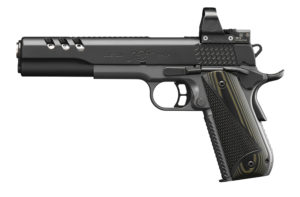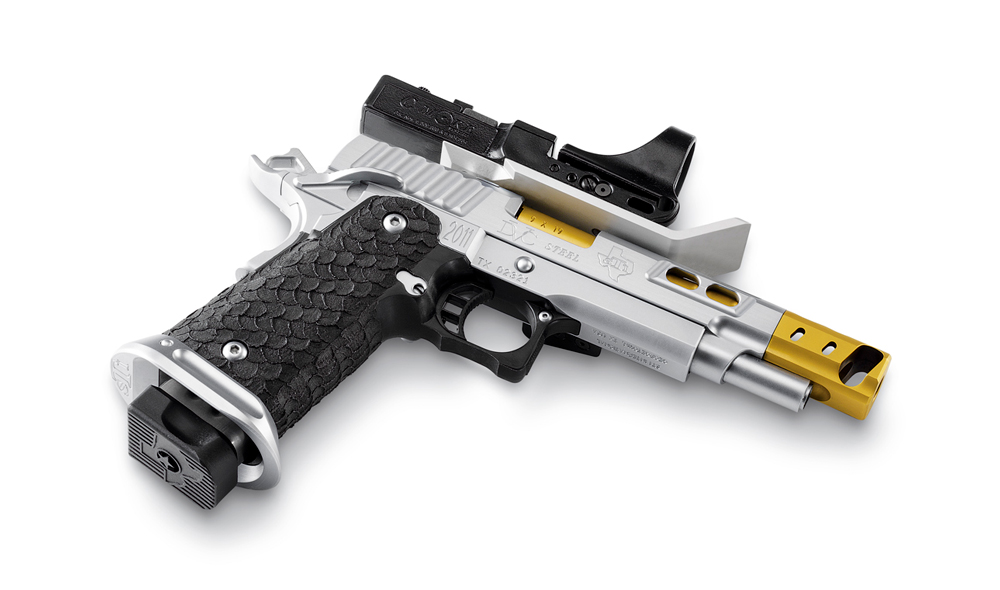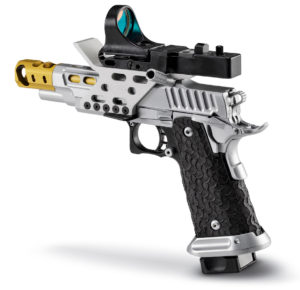
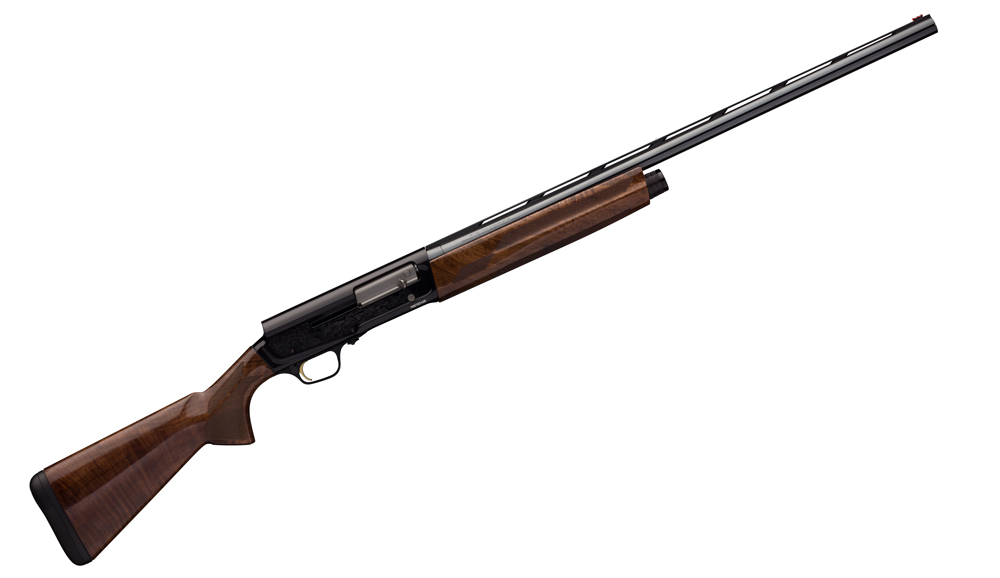
Since its introduction back in the late '50s, Colt's Gold Cup pistol has been known as one of the finest-shooting semi-autos available to competitive shooters. In the competitive realm, it has traditionally enjoyed a great reputation, combining an excellent match barrel with a crisp, wide target trigger.
Now, for 2017 Colt is looking to continue upon that tradition with its new Gold Cup Trophy pistol. Although some in the industry have known about it for some time, the American manufacturer went wide with the gun at the 2017 SHOT Show in Las Vegas.
The new Colt Gold Cup Trophy pistol features the well-respected Gold Cup Series 70 Wide Target trigger, set between 4 to 6 pounds, as well as a 5-inch polished, stainless steel National Match barrel. This pairing, as with earlier Gold Cups, results in an incredibly accurate pistol.
Along with a group of other gun writers and members of the media, I was able to shoot the new Gold Cup this fall – a few months before it officially launched – and I was certainly impressed with the gun's accuracy. The trigger is smooth and breaks cleanly, and I had no trouble hitting the steel the folks at Colt had set up downrange.
The excellent sights also help in that department. The front is a genuine Novak red fiber optic, while the rear is a fully adjustable Bomar-style sight. The fiber optic shows up clearly in a variety of light conditions, and the adjustable rear helps ensure you get the bullet exactly where you want it to go (provided you do your part).
A few other nice features on this new Gold Cup include an integrated magwell and 25 LPI checkering on the front and backstrap. The blue G10 grips are also checkered and incorporate a scallop, and the gun has an upswept beavertail grip safety. The integrated magwell encourages fast and smooth reloads, while the checkering on the straps and on the grips themselves improves control without unnecessarily digging into the hands. The upswept beavertail helps keep the pistol low in the hand, also for increased control.
Slide and frame on the new Colt Gold Cup Trophy are brushed stainless steel, and the slide is of the round-top variety. Simple, but effective, slide serrations at the rear help manipulate the slide without being ostentatious, as some tend to become.
The new Gold Cup Trophy is available in either .45 ACP or 9mm. In the .45, capacity is 8+1 rounds, and the 9mm version adds an extra round.
For more detailed information on the new Colt Gold Cup Trophy pistol, check out the specifications below, or visit Colt's website.
Specifications:
Colt Gold Cup Trophy Type: Semi-auto, single action Caliber: 9mm, .45 ACP Barrel: 5 in., National Match, polished stainless steel Overall Length: 8.5 in. Height: 5.5 in. Width: 1.25 in. Unloaded Weight: 38 oz. (.45 ACP), 40 oz. (9mm) Frame: Stainless steel Slide: Stainless steel, round top Finish: Brushed stainless Sights: Genuine Novak fiber optic front, fully adjustable Bomar-style rear Trigger: 4-6 lbs., Gold Cup Series 70 Wide Target, three-hole aluminum Grips: Blue G10, checkered with scallop Manufacturer: Colt
Ammunition reloading has come a long way in the last few years, not just in popularity but also technology.The firearms niche has seen an explosion of new gizmos to get the most performance out of a cartridge and to make handloading all the more precise. RCBS has been at the forefront of this progress, offering some of the latest and greatest reloading bench upgrades. And this year is no different, with the company releasing three new pieces of equipment at the 2017 SHOT Show. Here’s a look at RBCS’s new gear.
ChargeMaster Lite The ChargeMaster Lite is the little brother of the RBCS’ electronic powder measure line. While it holds almost as much powder as the original ChargeMaster (nearly a pound), the unit is much smaller — making it ideal for crowded work spaces. Small in stature, the tool is big in features and performance. The one-piece unit can weigh out charges between 2-300 grains with a +/- 0.1-grain accuracy and is easily programed with its touchscreen LCD display. It can switch between 120 VAC and 240 VAC power, comes with an ambidextrous scale pan, wind cover and features a built in bubble level — to ensure it is dead on. Perhaps most handy of all, it comes with a quick-drain system that makes flushing out the existing powder a breeze. Presently, the ChargeMaster Lite’s MSRP is $299.95.
Ultrasonic Case Cleaner-2
Ultrasonic Case Cleaner-2 The Ultrasonic Case Cleaner-2 might be a godsend for those with a lot of brass — or firearms parts — to clean, with little time to see to the task. The new model is nearly twice as large as RBCS’s old case cleaner with a 6.3-quart capacity. The unit has been outfitted with a second heater, making the cleaner more powerful and effective at scrubbing off powder residue and grime. And it is outfitted with simple and easy-to read LED display, making programming a snap. The Ultrasonic Case Cleaner-2 can be set to run up to 30-minutes and comes in a 120 VAC model and a 240 VAC model. The MSRP on the 120 VAC model is $399.95 and the 240 VAC model is $429.95
Vibratory Case Polisher
Vibratory Case Polisher Have 14-pounds of brass that needs shining? The Vibratory Case Polisher might be your answer. The extra-large polisher holds a mass of brass with all the medium required to get it spotless. To boot, the unit is designed to run quiet, powered by its 120 VAC thermally protected motor. It also features a sifting lid to help separate the medium and grit from the brass. Present MSRP on the Vibratory Case Polisher is $116.95.
Learn How to Get Loaded Right
If you’re an avid rifle or pistol shooter, chances are you’ll benefit greatly from learning how to reload ammo. Luckily, the process of handloading or reloading your own ammunition is explained in great detail in Gun Digest Shooter's Guide to Reloading by Philip P. Massaro. Filled with illustrations and step-by-step instructions, the process of reloading metallic cartridge ammunition for both rifles and pistols is clarified with both a simple overview, as well as specific details of the process. Order Your Copy Now
The annual SHOT Show in Las Vegas serves as a stage for gun companies to introduce new products for the new year. This year’s crop of new centerfires includes a little bit of everything, from light mountain-hunting guns to heavy target rifles with features that appeal to long-range shooters. Here’s a look at some of our favorite new guns for 2017.
Ruger's Precision Rifle is now being chambered in the highly accurate 6mm Creedmoor.
Those sexy sixes — what match shooter’s mind doesn’t go to the center of the bull’s eye when they’re mentioned?
For the most part, it’s been the 6.5 Creedmoor that has ruled the roost the past decade when it comes to those passionate about precision. The excellent ballistic coefficients and sectional densities the bullets offer have made the round a knockout when it comes to sub-MOA groups and top-places on the podiums. But a slightly more svelte six has made headway in recent years, capturing more and more match shooters and long-range hunters’ attention.
The 6mm Creedmoor has become a popular choice for competition shooters and is making headway as a commonplace cartridge. At least it is in the Sturm, Ruger & Co., Catalog.
Shortly before the 2017 SHOT Show, the New Hampshire-based gunmaker unveiled both its American Rifle Predator and Ruger Precision Rifle in the tack-tapping round. These new offerings — for the time being — should cover most of the bases for Ruger when it comes to the 6mm Creedmoor. It does, however, come at a cost.
The company has discontinued the Precision Rifle in .243 Win., opting for the 6mm in its place. But the move should go a long way in cementing the bolt-action as a legit long-range rifle, with it now chambered for three of the most poplar competition rounds — 6mm Creedmoor, 6.5 Creedmoor and .308 Winchester.
The American Rifle Predator model is set to extend varmint hunters' range now that it shoots 6mm Creedmoor.
Matched with the bells and whistles on the Precision Rifle, the 6mm Creedmoor has the potential to be a sweet shooter. The rifle’s free-floated 24-inch barrel, fully adjustable stock and in-line recoil path should milk plenty of accuracy out of the round.
The 6mm American Rifle Predator also has plenty to offer, especially to shooters more comfortable with a traditional shooting platform. The rifle has a 22-inch free-floated barrel with a heavy tapper, which should all but erase the already light recoil of the round. And its threaded muzzle makes the addition of a suppressor a snap.
Presently, the 6mm Creedmoor is not offered in the Predator package — which mates it with a Vortex Crossfire II 4-12×44 scope. But given the 6.5 Creedmoor in this model comes with this accoutrement, it wouldn't be surprising to see one on the 6mm sometime in the future.
It doesn’t matter if you are a fan of revolvers, semi-autos, classic remakes or improvements on existing pistols and revolvers, there was something for every handgunner at the 2017 SHOT Show, the largest firearms and hunting trade show in the world. Not only did manufacturers unveil a wide variety of new models and new configurations of old models, a handful of custom gun makers even introduced guns that are as beautiful as they are functional.
These days, more and more shooters are recognizing the potential of the AR platform for use in the field. The guns are fairly accurate, offer plenty of power for suitable game species and provide fast follow-up capabilities if needed. Lots of gun manufacturers have been capitalizing on this by developing hunting-specific ARs that are tailor-made for field work.
Ahead of the recent 2017 SHOT Show in Las Vegas, the popular AR and accessory manufacturer Yankee Hill Machine, Co. (YHM) announced it was bringing out two new field-ready rifles for the new year. Dubbed the Hunt Ready Rifle series by the company, these two ARs are hydro-dipped in Kryptek Highlander camo, are hand tuned and are topped with a Bushnell Trophy scope that is factory zeroed at 100 yards.
There is a Rifle model and a carbine model in the new Hunt Ready series. The Hunt Ready Rifle utilizes a 20-inch free-floated 4140 steel diamond fluted barrel, while the Carbine's is slightly shorter at 16 inches. Both have receivers forged from 7075-T6 aluminum, and both are equipped with YHM's Rifle Length MR7 M-Lok Handguard and YHM's low profile gas block.
The Hunt Ready Rifle features an A2 trapdoor stock, while the Hunt Ready Carbine wears an adjustable M4-style telescoping butt stock. The Carbine also has YHM's Phantom 5C2 flash hider/compensator on the muzzle; this is not present on the Rifle model.
The Bushnell Trophy scope featured on both guns utilizes a mil-dot crosshair reticle, and YHM uses its own manufactured one-piece scope mount to hold the Bushnell in place. The YHM mount has been designed to hold the optic at the same height as the rifle's iron sights.
Each rifle package also comes with a sling from Grovtech. The sling's length can be adjusted with just one hand, and it incorporates a wide padded, rubberized shoulder area to reduce strain and fatigue on the user's shoulder in the field, while remaining firmly in place.
The YHM Hunt Ready Rifle will be available in either 5.56 NATO or 6.8 Remington SPC, while the Hunt Ready Carbine will add .300 BLK to that list. MSRP on the Rifle is listed as $1,611 for the two 5.56 NATO models (one has a 1:7 twist barrel and the other has a 1:9 twist barrel) and $1,654 for the 6.8 Remington SPC version. Pricing on the Carbine is $1,579 for 5.56 NATO and .300 BLK models and is $1,633 for the model chambered in 6.8 Remington SPC.
Ever since Benelli introduced its innovative and durable Super Black Eagle semi-auto shotgun many years ago, the SBE name has been somewhat revered in hardcore waterfowl hunting circles. For years, hunters from across the country, and likely the world, have used the original Super Black Eagle, and the second-generation Super Black Eagle 2, to bring down a host of winged critters, from the marshes of the deep south to the vast plains of the far north, and to the salty shores of both coasts. The Super Black Eagle has proven itself rugged, reliable and high-performing in all scenarios.
During the 2017 SHOT Show in Las Vegas, Nevada, Benelli excited fans of this excellent platform and serious waterfowlers everywhere when it revealed that it had brought out the Super Black Eagle 3 for 2017. Impressively, Benelli has managed to further improve on the SBE's design, incorporating elements that enhance ergonomics, functionality and style.
Obviously, the new shotgun retains an inertia-driven action, but it also receives an upgrade in the Easy-Locking System, an improved breech-closing system that eliminates the potential for shooter error when trying to gently close the bolt and prevents it from slipping out of battery if the gun is hit hard or knocked over. This was an issue that had afflicted earlier Benelli models; when a shooter tried to ease the bolt closed on a shell, proper lockup would not occur, resulting in the inability to fire. Benelli addressed this issue in its Ethos line of shotguns, and it's good to see that this same technology is now being implemented in the SBE 3.
Due to the Super Black Eagle's reputation as a waterfowl gun designed to be used in any and all conditions – including extremely frigid temperatures – Benelli designed the new SBE 3 to be very user-friendly to those wearing gloves. The new Super Black Eagle 3 incorporates an oversized bolt release on the receiver, an oversized safety and an enlarged loading port for easier loading in less-than-ideal conditions.
Instead of the typical rounded magazine cap at the front of the magazine tube below the barrel, Benelli has also chosen to utilize a triangular cap with a heavy texture. This design helps to facilitate a more secure grip, even when the hands are gloved.
The engineers at Benelli have also worked on improving comfort with the new Super Black Eagle 3. This includes an Easy Fitting System that features a shim kit allowing for up to eight different cast and drop configurations. And a new stock and forend design, plus a rounded trigger, give the shotgun a smoother feel and make it easier to swing.
In terms of recoil reduction, Benelli uses its third-generation ComforTech stock, which includes additional shock-absorbing chevrons that have been optimized in terms of size and location. The manufacturer has also developed a new cheek comb pad, which it's calling Combtech, that's designed to reduce the impact of felt recoil on the cheek and face. And with some of the heavy 3- or 3-1/2-inch waterfowl loads, any increased reduction in recoil certainly makes a difference.
To meet the distinct needs of hunters, the new Benelli Super Black Eagle 3 will be available in four different patterns: the standard black synthetic, Realtree Max-5, GORE OPTIFADE Timber and Mossy Oak Bottomlands camo. The SBE 3 will also be offered with either a 26- or 28-inch Crio-treated barrel.
The MSRP on the new Super Black Eagle 3 is currently listed at $1,899 for the standard black synthetic and $100 more for the different camo models. For more information, visit the Benelli website, or check out our full specifications on the new SBE 3 below.
Specifications:
Benelli Super Black Eagle 3 Type: Semi-auto, inertia-driven Gauge: 12 Chambering: 2-3/4, 3, 3-1/2 in. Capacity: 2+1 Barrel: 26 or 28 in. Overall Length: 47.6 in. (26-in. barrel), 49.6 in. (28-in. barrel) Weight: 7.05 lbs. (26-in. barrel), 7.2 lbs. (28-in. barrel) Chokes: Extended Crio® (IC, M), Flush (C, IM, F) Sights: Red bar front sight, metal bead mid sight Length of Pull: 14-3/8 in. (adjustable +/- 1/2 in.) Drop at Heel: 2 in. Minimum Recommended Load: 3-dram, 1-1/8 ounce MSRP: $1,899, $1,999 (camo versions) Manufacturer: Benelli
The dot on the better scopes can be adjusted for brightness to compensate for changing light conditions in the field or out on the range. It is probably the best solution for low-light hunting situations, making target engagement easy to attain in a hurry. Some red-dot type sights also feature an adjustable dot size, enabling you to adjust diameter up or down to better serve the conditions. In low light, where black crosshairs may be hard to see, the red dot can be adjusted to shine brightly.
There are essentially two types of red-dot sights: a tube type that resembles a riflescope and is adjusted and mounted in the same manner, and the holographic sight that projects a red dot on a small screen. The holographic-type is quite compact and may not necessarily add any bulk to your hunting rig. However, it may not be the best choice in inclement weather as it can be difficult to keep the screen clean for an unobstructed view of your target. Holographic types also tend not to be as rugged, as much more of the mechanism is exposed and not enclosed in a tube — something else to consider.
The relatively new Ultradot 6 features four dot sizes and two reticle patterns.
However, there are some very good units available, such as the Trijicon RMR. In general, red-dot sights are light in weight and don’t change the balance of your gun in any significant way. Be sure to speak to the manufacturer prior to spending your money. Make certain the red dot you choose is up to the task of withstanding the recoil of your handgun (a recurring theme here!).
In any case, a good warranty goes a long way in customer confidence. Ultradot produces a whole line of economical and rugged red dot-type sights that come with a lifetime warranty. I am a big fan of Ultradot’s products for a number of reasons, but mainly for the reliability of their products.
The author took this wild hog in North Carolina with an Ultradot 30 equipped BFR in .500 JRH.
I have had an Ultradot 30 (this is a 30mm tube diameter, hence the designation) on a number of my heavy recoiling revolvers and can report that it has exceeded my expectations by a dozen miles. Thousands of full-tilt .475 Linebaugh rounds (420s at 1,350 fps) and a full complement of heavy load development for my .500 JRH BFR have tested the very integrity of that Ultradot. The poor unit even resided on my ultra-abusive lightweight Ruger Super Redhawk in .500 Linebaugh. The only failure I have experienced was a set of rings that broke from the vicious recoil generated by the .475. But the Ultradot 30 never missed a beat. To add insult to injury, I even mounted that sight on my 8-pound .416 Remington Magnum Mauser (yup, I do own a rifle) for load testing.
I have not been kind to my Ultradot. But like a loyal dog, it keeps coming back, tail always wagging. The only drawback with any red-dot sight is that battery failure can leave you high and dry at the worst moment. Remember to always carry a spare battery and the tools necessary to change it in the field. From supported and unsupported shooting positions, the red dot shines.
Thompson/Center Arms has always marched to the beat of its own drummer. After all, it was the firearms company founded on a single-shot, break-action pistol. And despite turning its attention to more mainstream styles of firearms, little has changed for the 52-year-old gunmaker with an eye for the unique.
Look no further than Thompson/Center’s new Compass bolt-action rifle for proof. For the price point — $399 MSRP — there are few other rifles that are as feature rich.
Gun Digest Editor-in-Chief Eric Conn had the opportunity to discover the over engineering of the Thompson/Center Compass firsthand in his trip to Smith & Wessons’ facilities in Springfield, Mass. What caught Conn’s attention right off the bat was the rifle’s smooth and responsive trigger. The adjustable trigger is preset at the factory to the lowest possible pull weight, but can be customized to any shooter’s needs.
But that isn't the only trick up the rifle’s sleeve. The Compass, which comes in 11 calibers, has a rock-solid 3-lug bolt, threaded muzzle just crying for the addition of a suppressor and a built in cheek piece — the only firearm in its price range that can boast the feature.
Check out the entire video to catch all the goodies Thompson/Center has integrated into its new bolt-action rifle. It appears shooters have a lot of reasons to set a course for the Compass.
The Krebs KV-13 has 9.5 inches of Picatinny rail on top, ideal for optics, lights and other add-ons.Get the most out of your Kalashnikov with the Gun Digest Guide to the Modern AK.
Marc Krebs from Krebs Custom in Wauconda, IL, is arguably the best custom AK manufacturer around. It seems he’s always experimenting, looking for ways to improve the AK platform. He even manufactures several aftermarket improvements as well as working on customers’ rifles. And makes his own complete rifles, usually from Russian Saiga receivers. His latest, the KV-13, really exemplifies what he has achieved.
For this build, he selected another Russian AK-pattern rifle: the VEPR made by the famous Molot (Vyatskie Polyany Machine Building Plant) factory. VEPR AKs are rock-solid reliable. What sets them apart is that the traditional gun made by Molot was the RPK squad automatic weapon.
Notably, the VEPR uses a standard stamped receiver that has been beefed up for heavy use and is 50 percent thicker on each side. It uses a heavy duty front trunnion, which is where the barrel connects to the receiver and the bolt locks. This makes the receiver much stronger with less flex when fired. The rear of the receiver has an angled cut that requires the use of an adapter to install different stocks.
The Krebs Custom KV-13.
Krebs first cuts the barrel down to 14 inches, then adds a permanently attached muzzle brake to bring the legal barrel length to 16 inches. The four-prong brake itself is made by Krebs and very effectively reduces muzzle flash. The gas block is the modern type with a 90-degree angle, but it is hard to see because of the custom KeyMod handguard.
This handguard provides 9.5 inches of Picatinny rail on top between the front sight and the dust cover. The sides and bottom of the aluminum unit feature the KeyMod system, co-developed by Noveske and VLTOR, allowing you to more easily install rails or accessories anywhere along the handguard. It runs 12 inches from the front of the receiver almost to the muzzle brake and facilitates a hands forward grip, while doing an excellent job of dissipating barrel heat.
The Krebs KV-13 is fitted with a four-prong brake that is very effective at cutting down muzzle flash and recoil.
As for the action, Krebs takes this already reliable system and improves it by smoothing and dehorning the edges. The trigger has been tuned and is far crisper and more comfortable than any standard AK trigger I have ever tried. Krebs adds an outstanding safety selector that can operate as a bolt hold open and bolt release using just the trigger finger and a finger extension. This safety selector is an easy upgrade to most any AK.
The sights on the KV-13 are outstanding. Instead of the usual short radius post and notch sights you find on most AKs, Krebs has installed true AR-style peep sights with a 19-inch sight radius. The rear sight is adjustable for windage, the front for elevation. The left side of the receiver has the standard AK optics rail for installing a scope.
The polymer pistol grip is the TAPCO SAW style, which is large but comfortable and features significant interior storage space. An ACE folding stock adapter has been installed and mated to a mil-spec AR buffer tube so any compatible AR collapsible stock will fit. In this case, Krebs installed the six-position Magpul CTR stock. Folding the stock is fairly easy and really makes this a super compact gun for transport or storage. Of course, it can be fired with the stock folded.
The KV-13’s safety selector doubles as a bolt hold open device.
The KV-13 will accept any standard AK magazine, one steel mag was included. I found the fit to be a bit tight. The fit and finish on the rifle is quite good, using the KrebsKote solvent-proof finish to replace the standard Russian bluing.
On the range, it was very handy and well balanced. Empty cases are ejected brusquely and tended to land about 20 feet away and slightly forward. There were certainly no failures of any sort.
For accuracy, I used a forward-mounted Zeiss Z-Point red dot sight. I tested at 100 yards, which worked fine with the 3.5 MOA dot on the Z-Point. Accuracy was combat-acceptable with groups ranging between 3 and 5 MOA. No one ever claimed that the AK was a target rifle, but it is most certainly reliable and tough. Krebs can build AKs to suit your tastes, so many options abound.
With stock folded, the KV-13 is a compact package with a lot of punch.
SPECIFICATIONS Krebs Custom KV-13 CALIBER: 7.62x39mm BARREL: 16 in. with brake OA LENGTH: 26 in. folded / 33.75 in. collapsed / 37.75 in. extended WEIGHT: 8.5 lbs. empty STOCK: Polymer collapsible folding stock SIGHTS: AR-style peep ACTION: Semi-auto FINISH: Blued CAPACITY: 30-round magazine PRICE: $1,850 847-487-7776 www.krebscustom.com
It’s a striker-fired world any more. Shooters need not look further than Heckler & Koch for proof.
For the better part of its existence, the German manufacturer has made a name for itself as one of the world’s premier hammer-fired semi-automatic pistol makers. Legends such as the USP and P30 have graced many a service holsters and have become staples for concealed carry practitioners across the country. But even with its success in this niche of the firearms industry, H&K couldn’t resist the siren call to comeback to striker-fired pistols.
Similar to other H&K models, the VP now has a suppressor-ready iteration.
Jumping back into this style of firearm after nearly a quarter of a century away has proven a boon to the company and shooters. Heckler & Koch’s VP line — VP9 and VP40 — has stood out in the crowded striker-fire market, offering shooters the precision, reliability and quality the company is know for in a style of pistol that keeps growing in popularity.
And the company continues to roll with the success of the VP with three new additions to the line. Shooters now have the VP Tactical, VP FDE (Flat Dark Earth) and VP Grey to choose from, in addition to the two existing models.
Of the new iterations, the VP Tactical offers the biggest jump in features, easy to discern with a quick glance at the pistol. As the barrel thread protector on the muzzle indicates, the Tactical addition is the first suppressor-ready VP. This is a logical move for Heckler & Koch, threaded barrels have grow in popularity with more and more shooters taking the plunge into suppressors. But it is also typical of the company, who has offered many of its models in a tactical edition.
Outside of being a bit longer, the new VP Tactical has all the features of the line.
The threaded barrel on the new VP9 and VP40 Tactical are a bit different than what the company has offered in the past when it comes to suppressor-ready firearms. The main break, they do not feature the O-ring assisted lockup, a proprietary feature that is meant to ensure better slide-to-barrel lockup and more accuracy.
The new model is also a bit different than the rest of the VP line, mainly in dimensions. At 4.7 inches, the VP Tactical boasts a slightly longer barrel, an obvious modification to make room for a suppressor. Overall, this makes for a slightly larger pistol than the standard VP, but not dramatically so; both the 9mm and .40 S&W are 7.95 inches in length, just a few tenths of inch longer that the standard model.
Shooters looking for something bit different now have the VP Grey and VP FDE to choose from.
From there, the VP Tactical becomes very familiar to those who know the line, outfitted with the exact same features as previous models. Some of these include cold-forged cannon-grade steel barrel , polygonal bore profile, Picatinny Rail, three changeable grip backstaps and six side panels, and 15-round capacity for the 9mm and 13 for the .40 S&W.
The VP FDE and Grey are also identical to the standard VP, not only in features but also dimensions. But each offers shooters a choice in frame color, an appealing proposition for those who want a bit more flare than matte black. At the moment, FDE is offered in 9mm and .40 S&W, while the Grey is only available in 9mm.
Presently, the MSRP for the VP Tactical is $899, and the MSRP for both the VP FDE and Grey is $719.
The Ruger American Rifle series has earned its place in shooters' hearts. The short time the line has been around, it has grown to include nearly every popularly caliber and has been configured to meet nearly every shooter’s need. Best of all, Ruger has found the sweet spot between features, performance and price point. It’s an everyman’s rifle at an everyman’s price.
And Ruger is still finding new niches for the series to fill. The latest target the company has laid its crosshairs on is precision plinking with the introduction of the American Rimfire Target Model. The new iteration of the rimfire wing of the American family is available in three calibers — .17 HMR, .22 LR, .22 WMR— and comes with a load of features that should grab the attention of the precision minded.
Chief among these is the bolt-action rifle's .860-inch diameter target barrel. The bull barrel on the rifle should make it a tack tapper at the range, especially during those long shot strings, where inaccuracy from heat can come into play. The heavier barrel should also make recoil on these calibers non-existent, making the Target model all the more pleasurable to shoot.
The threaded bull barrel and Alexander Henry forend aren't just functional, but give the rifle a slick look
As is common in the American Rifle family, the barrel is threaded and comes with a factory installed knurled thread protector. This is a feature that is becoming more typical industry wide as more and more shooters employ suppressors. And like the rest of the line, the Rimfire Target employs Ruger’s Power Bedding system, blocks that free-floats the barrel, thus ensuring proper harmonics.
Another interesting addition to the American Rimfire Target model is its Alexander Henry forend. Typically seen on Ruger No. 1 rifles, the groove not only adds a dash of character to the black laminate stock, but also makes it more functional, steadying a shot made off of sticks or a bipod.
The rifles come outfitted with a one-piece Picatinny rail situated above the receiver for the quick addition of an optic. And it comes standard with the company’s Marksman Adjustable trigger, which allows shooters to tweak the pull weight between 3 and 5 pounds.
Picattiny Rail, adjustable trigger and over-sized bolt handle all come standard on the new Target model.
Giving the rifles a touch of the tactical is the over-sized bolt handle. But it’s more than just for looks, allowing for fast cycling, and thus, quick follow-up shots. As a nice touch, the bolt itself can be completely removed without pulling the trigger, making the rifle a bit safer.
The American Target Rimfire .22 LR comes with a 10/22 BX-1 10-round rotary magazine but accepts all 10/22 magazines across the board. The .17 HMR and .22 WMR both use the 9-round JMX-1 rotary magazine. The rifles have a tang safety for intuitive engagement and come with pre-mounted sling swivels. And like the rest of the American Rifles, the price is right on the Rimfire Target model, with all three calibers' MSRPs at $499.
Bergara has made a name for itself in the gun world adhering to tenants of old-world craftsmanship. The Spanish barrel maker’s devotion to quality manufacturing and precision machining ensured a custom rifle had accuracy in addition to elegance.
Since expanding into full-scale rifle making in recent years, Bergara hasn’t jettisoned its dedication to precision. But at the same tick, the company hasn’t pigeonholed itself with traditional bolt-action rifle designs. Mixed in with its catalog of tried-and-true Monte Carlo-style stocks is the next generation of rifle.
The New Style
Bergara's B-14 BMP Chassis Rifle features a fully adjustable butt stock that does not require tools to tweak.
The New B-14 BMP Rifle is a radical departure from Bergara’s old-style, but one that is most certain to set long-range and precision shooters’ collective hearts aflutter. The heart of Bergara’s latest addition to the B-14 line is the BMP (Bergara Match Precision) Chassis Rifle. The fully adjustable system is engineered to milk every ounce of precision out of each shot and add an entirely new dimension of versatility.
The B-14 BMP features an adjustable butt stock, allowing shooters to tailor the length of pull to their frame, as well as cant. It also is outfitted with an adjustable cheek piece, facilitating a more intuitive shouldering of the rifle. And the rifle can be adjusted on the fly with the tweaks not requiring any tools.
Versatility
The B-14 BMP has a number of aspects that make it more versatile. The butt stock can be removed for a standard AR-style buffer tube, and Bergara also offers a side-folding adapter, for those shooting to make the rifle more compact. The system also features a barrel nut engineered to facilitate quick and easy barrel changes, if the situation calls for it.
An extended barrel nut facilitates quick barrel changes on the B-14 BMP and a threaded barrel makes a suppressor a quick addition.
The chassis stock is crafted from aircraft-grade aluminum (7075-T6) and features QD attachment mounts and accessory mounting slots. The slots are compatible with Magpul M-LOK capable accessories.The magazine well accepts AICS-type magazines, and the front is designed to function as a support brace. And, the stock is topped off with an AR-style grip, to add an extra level of control over the rifle.
Barrel and Chambering
The 11-pound rifle is outfitted with Bergara’s B14 action and a Chrome-Moly button-rifled barrel. It has a threaded muzzle, making it suppressor ready and comes with a sub-MOA guarantee from 100 yards with the use of match-grade ammunition.
Presently, the B-14 BMP is offered in .308 Win., and 6.5 Creedmoor. The 30-caliber version has a 1:10 twist rate and a 20-inch barrel, while the Creedmoor has a 1:8 twist rate and a 24-inch barrel.
Bergara has released the B-14 BMP Chassis with an MSRP of $1,699.
An original, blued Model 75, made in Czechoslovakia.Become an expert on one of the world's most popular firearms companies and its guns with Gun Digest Book of CZ Firearms.
The CZ 75 is a masterpiece in firearms design. It is one of the original wonder-nines, a term coined in the late 1970s. A wonder-nine is a pistol that is 9mm (of course, hence the “nine”), double-stack magazine (read: high capacity of 12 or more rounds), double-action trigger, and of polymer, stainless, or alloy construction for ease of maintenance. Remember, at the time most police departments still carried .357 revolvers with a 6-round capacity. It was a big deal to have a gun that carried, at a minimum, twice that. And the semi-auto that Americans were most familiar with — the 1911 — you had to have a cocked hammer to fire the first round because it was single-action only. The ability to carry the weapon on safe with the hammer down, take the weapon off safe, and fire it without manually cocking the hammer was also a big deal.
Unfortunately, the CZ 75 didn’t catch on in the U.S. upon it’s release, as it did elsewhere. Not many Americans got to handle one because it was born on the wrong side of the Iron Curtain. Only a few got to hold it and shoot it, and most of them raved about it.
The pistol was designed in 1974 by CZ’s best weapon designers of the time, brothers Josef and František Koucký. Despite the Iron Curtain, it was actually designed with export to the West in mind, and it’s unfortunate that it was never exported to the U.S. It would have made a fine military side arm for someone, but of course that would never happen with any of the Warsaw Pact countries — Czechoslovakia included — because of the requirement to use the 9×18 Makarov. The CZ 75 was designed around the 9×19 Luger from the start, so it’s only hope for use as a service gun would have been with the west.
The CZ 75 slide is only moved back far enough to line up the disassembly lines.
The CZ 75 is CZ’s flagship handgun. The centerpiece of all other new handgun production. It’s iconic. It’s a legend. It’s reached a status that few other handguns have reached. That category includes the 1911, Walther P38, Beretta 92FS, Walther PP/PPK, with the newest handgun to be added to that list being the Glock. It would have been possible to include the CZ 75 in the Cold War chapter in this book, because that’s when it was made, and for a long time it had that “Iron Curtain” aura in the West, because it was unobtainable. However, it fit best in the current production guns, because, chiefly it is current production. But also because at the time it was built, as I said in the previous paragraph, the Czechs built it to Western standards, Western tastes, and it was really built for sale on the Western market.
The 75 is an all-steel, locked-breech semi-automatic handgun. Two locking lugs are machined into the top of the barrel and, upon lock-up, fit into the matching recess in the slide. It uses the Browning design to unlock the barrel when the slide is pulled to the rear. It uses a selective double-action trigger, which means it can be carried cocked and locked (like the 1911) for a first-round single action pull, or it can be carried hammer down for a first round double action pull. The choice is yours.
The most notable feature of the CZ 75 is the slide rails fit inside of the lower frame assembly, and not the other way around. It’s generally the first thing people notice, and it does give it a bore axis much lower than any other hammer-fired handgun. This design was first seen in the SIG P210, designed in 1949, then the CZ 75. There are not many handguns that have been manufactured since then that incorporate this into their design — the Bren Ten is one that comes to mind — with exception of 19 different companies making clones and imitations.
The CZ 75 is most famous for the slide-inside-frame design.
I feel inclined to say something about those clones. There are some that are better than others, and I’ve even heard that some of the clones are pretty darn good. It’s unfortunate, though, that due to the communist system that the 75 was designed under, the design wasn’t patented. So, no one was paid for creating one of the most prolific handguns ever made — other than a communist worker’s salary — no one was compensated the design being used, and there are no royalties paid. Companies freely copied the design, and others poached design elements from the pistol and incorporated them into their own. It’s a shame, really, and for both the maker and the consumer. The consumer suffers, because since CZ had no control over the design, they also had no quality control over the products that were made by other companies. An example of this is Taurus, who makes a clone of the Beretta 92 FS. They have the license to do so, they paid for the license and rights to make it, and Beretta had control over the quality.
In general, I like the slide-inside-of-frame design of the 75, though it does have one drawback. When charging the slide to chamber a round, if you’re used to a large slab of slide to grasp, this only has a narrow bit of slide available for grasping, making it a little more difficult to rack the slide.
On a whitetail hunt at the JL Bar Ranch in Texas two years ago, I tagged out early and my guide asked if I was interested in spending the remaining mornings and evenings calling gray fox on the far side of the ranch. The cover was thick over there, he said, and since there were no deer hunters on that side of the property we wouldn’t blow anyone’s chances at a big buck. I should have been working—I had a deadline looming, I clearly remember—but I simply couldn’t pass on an opportunity to hunt predators in a new part of the country.
I was glad that I took him up on the offer. We hadn’t been set up for more than two minutes when the first gray appeared, almost literally, in our lap. That fox came so quickly and was so close that no one had a chance to shoot, but within 30 seconds another fox approached us at a trot from the opposite side. This time we were ready, and when the gray stopped at 40 yards and the .17 HMR barked, he went down hard, the first of several we took over the next few days.
Considering All the Options
A really outstanding predator hunt like the one I had at the JL Bar can be as exciting as just about any type of hunting. But despite the affordability and availability of predator hunting, there are certainly some important decisions that need to be made with regard to caliber. You need a gun that matches the style of hunting and the country, so a big, heavy-barreled rifle chambered in one of the hot .22s, which is a great choice for calling coyotes from a hilltop setup in Wyoming, isn’t the best option for a hunt that will require a lot of walking and quick, close shooting like our fox hunt in Texas. Conversely, the .17s that served so well in Texas won’t be very effective for those long-range setups in windy country where your closest shot might be a couple hundred yards.
The 10 Best Predator Calibers of All Time
Some of the top predator cartridge choices, from left to right: .22 LR, .22 WMR, .223 Rem, .243 Win., .257 Wby Mag.
There’s a lot of diversity, then, on our 10-best list. These cartridges may not suit all hunters, but no matter what type of predator you are hunting, from weasels to wolves, there’s a round on this list that deserves top billing.
The .17 Remington was a fine moderate-range varmint and predator cartridge, but it never really was a commercial success. The .17 HMR, which was released by Hornady in 2002, however, was exactly what the .17 shooters were looking for. It could reach high (2,500 fps-plus) velocities and shot flat, but that little bullet didn’t destroy pelts, and it was an effective killer. There are lots of good, cheap loads, and Savage is now offering its affordable and deadly accurate A17 semi-auto rifle in this caliber. Recoil is barely noticeable, muzzle blast isn’t awful, and when ranges are moderate, this is an outstanding option for smaller predators. It’s also a great option for new hunters.
The .17 Winchester Super Magnum (WSM) is based, of all things, on a modified .26-caliber nail gun cartridge. But the parent cartridge’s thicker case walls allowed for higher pressures, so the .17 WSM can drive a 20-grain bullet at more than 3,000 feet per second. It pushes the .17 to new levels, but pelt damage is minimal and recoil is nil. At close to moderate ranges, it kills coyotes dead, and rifles from Savage and Ruger are affordable, available, and accurate. And while it hasn’t achieved the level of popularity of some of the other cartridges here, it has a loyal following, and those who use this cartridge are generally very satisfied with its performance.
The .204 Ruger is based on the .222 Remington Magnum, and it is capable of firing a 32-grain bullet at better than 4,000 feet per second, so it is a legitimate long-range predator cartridge that can topple even the largest coyotes at a quarter mile. Available bullets range in weight from 24 to 55 grains, but the most common options are between 32 and 40 grains. The .204 doesn’t produce the recoil of the hotter .22s, and it has proven to be extremely accurate. For that reason, it is certainly one of the very best all-around cartridges on this list for the predator hunter who plans to pursue small game like raccoons and gray fox yet wants a rifle that will work to longer ranges on ‘yotes. Best of all, ammo is cheap and rifles are widely available.
Bobcat pelts are valuable, so you don’t want to damage them with an explosive bullet. At close range, the .17s and .22 WMR will work, but these elusive cats are oftentimes hard to bring to the call so the flatter-shooting .22 centerfires are probably the most versatile option.
Although its applications are limited, the .22 Long Rifle is not a cartridge that should be overlooked by predator hunters who pursue small game at close range. For starters, .22 ammo is now once again widely available and cheap, and hundreds of rifles are available starting at rock-bottom prices. Is it the most versatile option here? Not by a long shot, but if you hunt smaller predators like raccoons over bait or by calling or simply want a gun that can keep small vermin under control, then the .22 is still a fine option. Not all .22 ammo is created equal, but there are some real standouts for those who prefer this caliber, cartridges like CCI’s Stinger, which pushes a 40-grain HP at 1,640 feet per second. If you sell your hides, there is no better option to preserve pelts and maximize profits.
The .22 WMR is a ‘tweener cartridge, a rimfire that pushes heavier (28- to 50-grain) bullets than most other loads in this class at around 2,200 feet per second. It shoots flatter than the .22 Long Rifle, has plenty of coyote-stopping power at moderate ranges, and doesn’t kick or bark like hotter loads. It pushes the limits of what a rimfire can accomplish in terms of predator rounds, but with ammo available as cheap as a quarter a shot, it’s affordable to shoot and there are a lot of great lightweight, accurate rifles available. With 40-grain hollow points, it drops game, and pelt damage is very minimal. If there’s one knock against this cartridge, it is that its popularity sometimes makes it hard to find factory ammo on store shelves.
The .220 Swift was one of the original hot .22 centerfires, having debuted in 1935 in the Winchester Model 54 rifle. It was based on the old 6mm Lee Navy cartridge, and original loadings pushed 40-grain bullets well past 4,000 feet per second. Like many other cartridges, the .220 Swift was ahead of its time; those blistering-fast early loads gave this cartridge the reputation as a barrel-burner, which was accurate, but modern metallurgy techniques and slightly reduced loads mean that case and barrel life with this cartridge is now on-par with other hot .22s. If you want to maximize the range of your .22-caliber rifle, this is an ideal round, perfect for dropping coyotes that hang up at a quarter mile or more. The two primary knocks are availability of rifles and ammo, and the need to be careful with shot placement and bullet selection if you want clean pelts, but the Swift is certainly an outstanding predator round.
If you’re going to use multiple setups and walk a lot, you need a rifle that is light enough to carry all day yet accurate enough for long shots on coyotes that hang up. The centerfire .22s, particularly the popular .223 and .22-250, are ideal choices if you might need to shoot at 300 yards or more.
I’m lumping these two together because many hunters today use 5.56 ARs and feed them .223 Rem. ammo. No matter the platform, the .223/5.56 is probably the ultimate predator round in terms of versatility. There are tons of ammo offerings in a variety of bullet weights and plenty of choices when it comes to rifles. The .223 will do almost anything the hotter .22s will, and recoil is scant. I have used a Mossberg MMR rifle with 55-grain bullets on coyotes for several years now and that gun is deadly accurate, light enough for all-day carry and offers me the fastest follow-up possible. In truth, if I do my part, there’s no need for a follow-up, though, and there are so many bullet options available that you can achieve exactly the kind of performance you are looking for. The .223 has become to predator hunting what the .30-06 is to big game hunting. There are a lot of other choices, but there’s a reason this do-all round is on top of the pile in terms of popularity.
Based on a necked-down .250-3000 Savage, the .22-250 started life as a wildcat cartridge in the 1930s and was later adopted by Remington, which gave the cartridge both its name and the clout it needed to win over the masses. This round remains one of the most popular predator cartridges, and with good reason; bullets are widely available, it’s easy to reload, shoots flat, and it’s very, very accurate. Plus, this is a cartridge that serves dutifully in a variety of bolt-action rifle designs. It’s the perfect complement for a heavy-barreled, long-range rifle with a high-magnification scope, but it also works in lighter sporters that are great for multiple setups where you need to cover a lot of ground. It beats the .223 in terms of trajectory and velocity, and it is one of the absolute best do-all predator rounds for foxes, coyotes, and bobcats out to extended ranges. Recoil isn’t as mild as it is in some of the other .22s or .17s but is still quite manageable and a fair tradeoff given this level of performance.
The .243 Winchester has been around since 1955, and it debuted the same year as Remington’s .244. The .244 Remington (now 6mm Remington) was ballistically superior, but Winchester offered a 1:10 twist rate that allowed the gun to shoot heavier 100-grain bullets accurately, making the .243 more versatile. That versatility has made this cartridge what it is today—the perfect crossover cartridge for those who want to hunt coyotes and foxes one day and deer and antelope the next. It’s based on the .308 Winchester necked down, and it will drive a 70-grain bullet faster than 3,500 feet per second. There are a bunch of affordable ammo options and lots and lots of rifles in almost every configuration imaginable, and with lighter bullets at moderate velocities, it isn’t absolute overkill on smaller predators at long ranges.
The hot .22s, like the .22-250, are great for hunting coyotes. They offer plenty of range, plenty of knockdown power and produce little recoil and minimal pelt damage with the right bullets. Photo by Ben Gettinger.
I may have lost some of you with this one, I know. The .257 Weatherby Magnum is far and away more potent a round than is needed for a 200-yard shot on a coyote (Roy Weatherby actually killed a cape buffalo with this round just to prove that it could be done), but with a muzzle velocity near 3,900 feet per second with an 80-grain pill, this cartridge shoots very flat and hits very, very hard. Very few people that would choose this as their go-to coyote gun, but it works, though pelt damage will be more pronounced than with other cartridges listed here. The .257’s greatest virtue, however, is its outstanding versatility, for it will kill deer, antelope, sheep and even elk at long ranges, and it will also topple a coyote crossing an open pasture at a quarter mile. With an 80-grain Barnes TTSX bullet in Weatherby’s factory load you can sight your rifle in just under 2 inches high at 100 yards to hit dead-on at 300. At 400 yards, that bullet will be just 6.4 inches low, taking much of the guesswork out of long-range shooting. Weatherby’s Vanguard rifles are chambered in this round, and they are both accurate and affordable, and ammo isn’t nearly as expensive for this load as for some of Weatherby’s other offerings. Additionally, now that wolf hunting is legal in the Lower 48, there’s a whole new class of canine predator, and the Weatherby is up to the challenge.
If it is newer than M855 (the mid-1980s) and it is military, you can be sure it is 5.56 and should be treated accordingly.
A .223 Remington and 5.56×45 are not the same. The 5.56 has a longer leade, a longer distance between the bullet start and the onset of the rifling. Here's why it matters.
Ammo companies know what they make, and they mark it accordingly. This is 5.56 ammo, and you should not be using it in a rifle with a .223 leade.
The rifle and cartridge designers did that deliberately to allow for a hotter load and higher velocities because the longer leade allows for more run-up to the engraving.
Some 5.56 chamber drawings show a larger diameter in the leade proper than is in a .223. This larger diameter is there less for pressure than function. In a really harsh environment, a scosh more room in the leade can keep a rifle running, where one with a tight leade (not a short leade, the two differ) would choke. The government is more interested in a rifle that keeps working, even if it means they have to accept a 3 MOA accuracy level, instead of a 2 MOA potential.
When you put 5.56×45 ammunition, meant to utilize a longer leade, into a chamber cut for the .223 with its shorter leade, you get a pressure spike. How much? To find out, I sent some 5.56 ammo off to a test lab. No big secret, the ammo was a batch of Federal XM-193, 55-grain FMJ brown box. I had them test it for pressure in two laboratory barrels — one chambered in 5.56, and the other in .223.
In the 5.56 test barrel, the XM-193 produced 48,000 PSI. A little on the low side, but since it delivered the expected velocity, why should Federal have loaded it any hotter? In the .223 barrel, the same ammo produced 62,000 PSI. That’s a big spike. Now, someone is going to say that it is no big deal. They’ll assert your AR can shrug off a diet of 62,000 PSI ammo, after all, it isn’t that much more than the 55,000 PSI the spec calls for, and hardly anything over the NATO pressure.
Remember my advice about people you can ignore? This is one example. A pressure increase of 29 percent is not “nothing.” And what if the original pressure had not been 48,000, but something more like what we’d expect, say 52,000? Then a straight 29 percent increase (and this is not usually a linear response) would make it 67,000 PSI. I have talked to other gunsmiths and AR-savvy people who have done the same thing and their experience of a 52,000 original round has been more along the lines of 72,000 PSI.
A 29 percent increase is pretty close to the increase in pressure that a proof round produces. How do you know if your barrel is .223 or 5.56? Measure it with a gauge produced by Ned Christiansen. If you have a .223 instead of the 5.56 you thought you had, ream it with a 5.56 reamer, also from Christensen.
The gauge has a short section that replicates the neck and leade of a 5.56 chamber drawing. Start by dropping the gauge into a recently cleaned chamber. If the leade has been cut to .223 dimensions, it wedges in place. However, if by turning the receiver upside down, the gauge falls out, you have a 5.56 leade.
This is the result of using the reamer from Ned Christensen. A clean, 5.56-length leade that will control pressure spikes in your rifle.
Use a felt-tip marker to darken the gauge to see exactly where it is binding. But while that can be fun, it does not correct a short leade.
And a reminder, this has nothing to do with headspace.
The reamer is designed so that it will cut the leade and only the leade. It is meant for carbon steel, stainless steel and chrome-plated bores. It will not cut a barrel treated via the Melonite process, and attempting that will only dull the reamer. You can spend all day using it in the appropriate barrels, and not change the headspace at all. The process goes like this. Having cleaned the chamber, apply a bit of lube to the cutting flutes of the reamer. Insert the reamer and turn clockwise as it bottoms out. You’ll feel it cutting. Once you feel that it is no longer cutting, keep on rotating it in the correct direction as you pull it out.
Do not rotate backward. Do not simply drop it in. Keep rotating clockwise as you lift it out.
Brush the chips off the reamer, and put it away. Swab the chamber, then push a patch down the bore to get all the chips and cutting oil out of the bore. Done.
Our Top Articles on AR-15 Builds and Performance
Buyer's Guide to the Best AR-15 Rifles for Any Budget
Looking to go armed, but are stuck in the weeds as to what to arm yourself with? Here are 20 excellent concealed carry gun options that will keep you on the defensive.