Home Blog Page 213

The Best Rimfire Cartridges Ever Made

1

Best Rimfire Cartridges main image

The Beginning

It was a warm October afternoon, and my Dad was sitting maybe 10 or 12 yards away, on a smooth oak stump, looking up. The subtle, furtive motion of his index finger directed me to look up into the big oak we were watching, and I could see the flicking tail of the gray squirrel. Within seconds, a fuzzy head appeared, replete with yellowing chompers, and twitching whiskers.

The younger me slowly raised the rifle, aligning the iron sights just as Ol’ Grumpy Pants had so often instructed, and squeezed, not jerked, the trigger. The resulting report and the sound of something landing in the freshly fallen leaves were music to my ears, for something monumental had just happened: I became a hunter.

I still have that .22 LR; it is a 1985-vintage Ruger Model 77/22, and I use it often, as both a training tool and a hunting rifle. There’s no denying the validity of the .22 Long Rifle cartridge, but it isn’t the only rimfire cartridge out there. As matter of fact, there are many rimfire catrirdges, and it may warrant owning several. Let’s take a look at some of the best—and not so obvious—rimfires ever made.

The .22-caliber Rimfires

The .22 Long Rifle is, invariably, the most popular of the rimfire cartridges, for good reasons we’ll get into momentarily. However, it wasn’t the first, and it isn’t alone. It has many siblings, like the BB cap and CB cap, but among the most popular are a couple of older brothers, and a younger brother.

Best Rimfire Cartridges - .22 shortThe .22 Short

Being the smallest of the bunch, the .22 Short has been with us for 160 years. Originally a black powder cartridge, the .22 Short has survived the transition to smokeless powder and is still a fun cartridge to shoot. Using a 29-grain bullet at just over 710 fps, the Short is an effective tool for small game like squirrels and rabbits at close ranges, say within 50 yards or so. Many “parlor” guns were chambered for the .22 Short, and while it’s become a bit of a novelty, if you want to hunt at close ranges, the .22 Short will present a fun challenge.

The .22 Long

A bit longer and just a bit younger, the .22 Long was an improvement over the .22 Short, using 20 percent more powder and a 45-grain bullet. CCI still offers ammunition, using a 29-grain bullet at a muzzle velocity of 1,215 fps. Like the .22 Short, it has become a rarity, but it’s still a fun cartridge to shoot. You’ll see many older rimfire rifles marked as being capable of handling .22 Short, .22 Long and .22 Long Rifle. If you have one and want to give the .22 Long a whirl, it’ll work, but I think you’ll find the search for ammo more trouble than it’s worth, considering the performance of the .22 Long Rifle.

Best Rimfire Cartridges .22 LRThe .22 Long Rifle

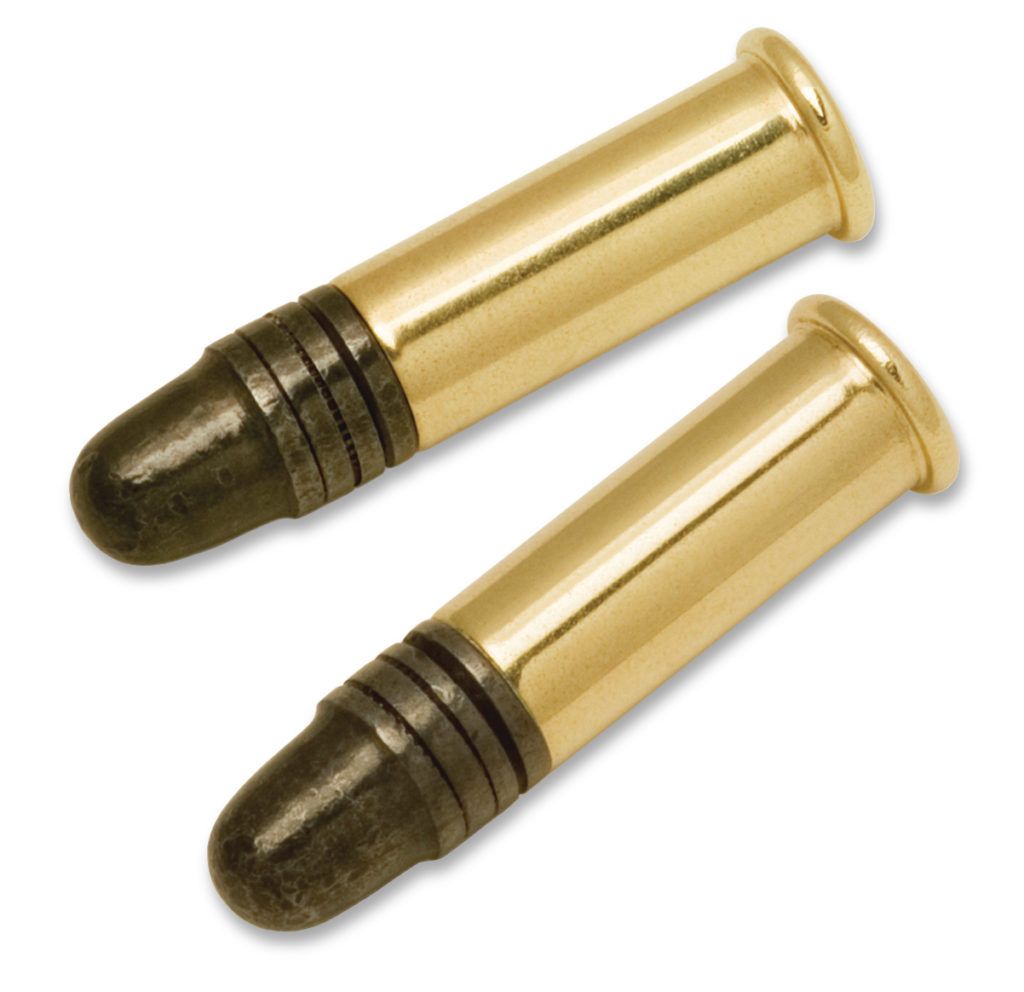
Few cartridges can claim the success that the .22 Long Rifle has achieved. I don’t know any hunter that doesn’t have at least one .22 LR in their cabinet; it is that popular. It dates back to 1887—like the others, it started off fueled by black powder—and has been offered in a multitude of action styles, including single-shots, pumps, bolt guns and autoloaders. The standard loading is a 40-grain bullet at a muzzle velocity of 1,240 fps or so, depending on the manufacturer. There are many hyper-velocity loads, some using lighter bullets, some a hotter charge, which will extend the range of your .22 Long Rifle.

Best Rimfire Cartridges - .22 LR CCI The CCI Stinger, using a light bullet and a slightly elongated case, was among the first, and remains a solid choice. The Remington Yellow Jacket and Viper, and Browning BPR ammo will also give higher-than-normal velocities. On the other end of the spectrum, there are many good subsonic loads for those who like to keep things as quiet as possible. Norma Sub-Sonic .22 and CCI’s Quiet-22 are good choices for quieter loads for hunting or for training a new shooter. Please be aware that many of the autoloading rifles and pistols require a certain muzzle velocity, or more specifically, an energy level, to cycle the action.

There are all kinds of projectiles available for the “twenty-two,” as it’s known here, or the “two-two,” as it’s known across the pond, from waxed lead bullets to plated hollowpoints to shotshells to fragmenting bullets. If you think about it, the .22 Long Rifle might just be the most versatile cartridge ever invented.

The .22 Winchester Magnum Rimfire

Developed in 1959, the “.22 Mag.” is definitely a different sort of rimfire cartridge, delivering a 40-grain bullet at 1,900 fps or more. This combination makes for a 150-yard gun, without problem, and it is fully capable of taking coyotes and foxes. Like the .22 LR, there are many projectile types available, from the full metal-jacketed slugs, to frangible hollowpoints to polymer tipped bullets—as used in the CCI .22 Mag. V-Max load, built around the 30-grain Hornady bullet. If you want a .22 rimfire with a bit more reach than the LR, look no further than the .22 WMR. It can be a bit harsh on squirrels and rabbits, but it’s a better choice for larger furbearers and distant varmints.

The .17-caliber Rimfires

Best Rimfire Cartridges - .17 HMRThe .17 HMR

Shortly after the turn of the 21st century, Hornady announced the first new rimfire cartridge since the .22 WMR: the .17 Hornady Magnum Rimfire (HMR). Using the .22 WMR case necked down to hold .172-inch bullets, the new cartridge would push a 17-grain bullet at 2,550 fps, resulting in a flat-shooting small game rimfire cartridge. While it is susceptible to wind drift, under good conditions this cartridge can make solid hits out to 200 yards, and sometimes more. The light-for-caliber frangible bullet does less damage to furbearers, yet will create the “red mist” when used on prairie dogs and woodchucks. Recoil is virtually non-existent, and the .17 HMR can be very accurate. It has caught on, and it makes a good choice for those who prefer rimfire cartridges to the bigger cases of the .17 centerfires.

Best Rimfire Cartridges - .17 Mach 2The .17 Mach 2

Two years later, Hornady struck again, using the CCI Stinger case (just slightly longer than the standard .22 LR case) necked down to hold the same bullets as the .17 HMR. There are two bullet weights offered: a 15.5-grain bullet and the same 17-grain bullet the HMR uses. While it is a fun gun to shoot, the Mach 2 is declining in popularity. Velocities for the 15.5-grain bullet run at 2,050 fps, while the 17-grain pill is moving at 2,100 fps.

Best Rimfire Cartridges - .17 WSMThe .17 Winchester Super Magnum

This may be the sleeper of the bunch, and I like this cartridge quite a lot. Winchester used a .27-caliber nail gun blank as the parent case for this little gem, and it will drive a 20-grain bullet to an even 3,000 fps. I’ve used this cartridge in the windy plains of South Dakota to effectively kill prairie dogs out to 300 yards, and sometimes more. Were I looking for a true, long-range rimfire rifle, I’d look no further than the .17 WSM; it’s hot on the heels of the .17 Hornet, and one helluva lot of fun to shoot.

The Others

There are other rimfire cartridges that have either fallen to the hands of time or a lack of following. The 5mm Remington had a brief moment in the sun, but never caught on. There are some classics, like the .44 Henry Rimfire—think Kevin Costner in “Dances With Wolves”—and a whole slew of larger caliber rimfires that were designed for both rifle and pistol. They were early developments, and while the odd firearm may pop up once in a while, the ammunition is very difficult to come by. In our age, the rimfire cartridges are relegated to .22 or .17 caliber, but what we have is very useful. Long live the rimfires!

Editor’s Note: This article is an excerpt from the Spring 2017 issue of Gun Digest the Magazine.
Howa Long Range Rifle is Ready to Go the Distance

0

Howa Long Range rifle 1

Japan can often be an afterthought when talking about modern firearms manufacturing. Perhaps it’s the nation’s Draconian gun laws or the fact that the sector, in the scheme of the greater gun world, is rather narrow. Whatever the case, the Land of the Rising Sun typically doesn’t make it into gun banter.

Maybe it should, however, given the quiet role it plays in the American gun market. Howa Machinery Company in particular has become a major player in the U.S. over the years, producing components for a number of well-known and popular American gunmakers. The manufacturer has especially built a name for its precision machining and quality barrels, drawing on more than a century of Japanese industrial know-how. The company has also carved a comfortable niche for itself in the consumer market this side of the Pacific with the help of importer Legacy Sports International.

For four decades, the Model 1500 has been a popular choice in many hunting and target-shooting circles. And Howa’s tried-and-true design has been tweaked this year and configured to satiate the growing throngs of shooters aiming a country mile. The Long-Range Rifle (HLR) — available in 6.5 Creedmoor and .308 Win. — integrates much of the company’s proven designs into a platform meant to hit the mark no matter the distance.

Of Howa’s time-tested technology is the 1500 bolt action that features a two-lug bolt and M16-style extractor. It is topped off with a 26-inch heavy bull barrel (#6 contour) and the company’s two-stage HACT trigger that has a pull-weight range of 2.8-3.8 pounds (factory set for 3 pounds).

Howa Long Range Rifle
With a Bell and Carlson tactical stock, the new Howa Long Range Rifle is ready to go the distance.

Where Howa has tweaked the rifle to go the distance is dressing it up with a Bell and Carlson tactical stock. The rigid composite stock should provide the steadiness to make precision shots, no matter the difference.

It features a raised cheek piece to more intuitively shoulder the rifle and has a wide-based forend, meant to better facilitate a solid reset or incorporate a bipod. It also has been outfitted with ports beneath the barrel, to help it cool on longer shot strings, comes with with a Pachmayr Decelerator Recoil Pad and is available in green/black or tan/black color choice.

Unsurprisingly for any rifle even remotely sold as tactical at the present time, the HLR comes with a threaded barrel, giving users the opportunity to add a suppressor right out of the box.

Similar to past rifles, Howa’s new long-range model can be purchased as a stand-alone gun or scoped. With the scope package, the HLR comes topped off with Nikko Stirling’s new Diamond First Focal Plan 4-16x44mm scope, which should give shooters enough power to hit the bull’s eye right off the bat.

The MSRP on the stand-alone rifle is $1,015, while the scope package runs $1,299. Given the price and the accouterments, Howa could get shooters talking Japanese guns when it come to long-range options.

HLR Specs:
Calibers: 6.5 Creedmoor, .308 Win.
Overall Length: 46 inches
Length of Pull: 13.5 inches
Barrel Length: 26 inches
Weight (w/o scope): 9.5 pounds
Weight (with scope): 11.4 pounds
MSRP: $1,015; with scope $1,299

How To: Simple System for Zeroing the AR

0

There are a variety of methods or formulas for zeroing the AR, but this might be one of the simplest and most precise systems out there.

Zeroing the AR means adjusting the sights so your point of impact — where the bullet strikes the target — is the same as your point of aim — where you are holding the sights. There is a variety of methods or formulas for zeroing the AR. Instead of trying to use different size targets at various distances and flipping back and forth between one aperture and the other on the rear sight — as required by some methods — I prefer to use the simple technique described below.

In my opinion, to get a “hard” zero with the AR you have to actually shoot it at the distance you’ve chosen for your zero, rather than simulate distance by using smaller targets. Once you’ve zeroed the AR, it’s time to fire it various distances to discover what the difference will be between your point of aim (POA) and the point of impact (POI).

When it comes to choosing the distance for your zero there are several factors to consider. First is the offset between the sights and the barrel; the sights are higher than the barrel. This offset comes into play especially at close distances, where the POI will be lower than the POA. You have to aim or hold high for your round to hit where you need it to go. You also have to consider the trajectory of the round. For example, with a 55-grain bullet firing with a one hundred yard zero the POI will be approximately two inches low at 200 yards.

Before beginning the zero process you need to pick the distance for your zero. I use a 100-yard zero. The sights are adjusted so that at 100 yards the bullet strikes the exact point the sights are holding. A 75-yard zero gives you the least deviation between your POA and POI between 25 and 100 yards. At 25 yards the POI will be roughly one and one half inches lower than your POA. The POI at 100 yards will be and one half inches higher than your POA, which will give you a POI of about an inch or so low at 200 yards.

Take your time during the zeroing process. This isn’t something you can do quickly. For the best results, work from a bench, with rests or bags for support. Make sure the handguard is supported, as opposed to the actual barrel touching or resting on the bags. If the barrel is making contact with your rest, it will throw the shots off. For example, when the bottom of the barrel is touching the rest it will throw the shots high. Your goal is to create a solid, stable position – consistency – and apply the fundamentals of marksmanship for every shot.

Start the zeroing process at 25 yards. Make sure you have a steady position, using a rest in order to take out as much of the human element as possible. Normally I’ll fire five or six shots, enough to satisfy myself that I’ve got a good group established. By firing several rounds, even if you have one or two shots that weren’t good, you’re still going to have a solid group to work with.

After establishing a good group you’re ready to adjust the sights — elevation and windage — but first unload the AR. Do not get into the habit of adjusting or doing any work on your firearm while it’s loaded. Unload, check and check again to confirm it’s clear, and then remember the safety rules are still in effect. After making adjustments you load and start again. The additional benefit of all this is that you’re getting in practice on your manipulations.

Zeroing the AR
When zeroing, work in the most stable position you can, using rests or support to create stability.

As mentioned earlier, at 25 yards your bullets should be hitting lower than where you are aiming. This low POI is necessary because of the offset between the sights and barrel. (Don’t get too worried about exact measurements here; you’re just looking to get it close, and will fine tune the sights as you move back, creating more distance.)

Once you have a rough zero at 25, again with the bullets striking about two inches below your point of aim, move back to 50 yards. Fire a good group, and adjust as necessary. At this distance your point of impact will be closer to the center of the target where you’re aiming. As you increase the distance the POI will move upward towards your POA. For example, if you’ve decided to work with a 100-yard zero, at 50 yards the bullets should be hitting about an inch below where you are aiming.

Fire a good group, and then adjust the sights as needed. Normally I will only adjust one direction at a time. For example, I’ll adjust the elevation with the front sight until getting that right, then adjust windage to get it in the right spot. Trying to adjust both the elevation and windage at the same time can sometimes get a little complicated, for example as you adjust the windage it can change the elevation slightly. You may find that after adjusting the front sight and then the rear sight for windage that you have to go back to the front sight for final adjustments.

After getting close at 50 yards, move back to 75 and repeat the process. If you want a 75-yard zero your bullets should be hitting where you’re aiming. Point of aim and point of impact are the same. For a 100-yard zero you’ll need to move back to that distance and repeat the process one last time, adjusting until your POI is spot on for where you are aiming.

Zeroing the AR
New versions of the AR have rear sights with elevation adjustments. When zeroing, make sure to start with the drum on it’s lowest setting, 6/3 or 8/3.The rear sight on early versions of the AR requires a sight tool or bullet tip to adjust. The newer versions have a drum that can be adjusted by hand.

You’ll also need to shoot it at distances closer than your zero, again to find out the difference between your point of aim and the point of impact. Remember, the sights are offset, higher than the barrel, so as you move closer than your zero the point of impact will begin to drop. At distances closer than 25 yards you’ll be aiming about two and one half inches high to compensate for this offset. (XS Sights have a modified rear sight that has a notch on top of the peep sight that you use for aiming at close distances that compensates for the offset.)

For zeroing a red-dot sight or a more traditional optic with magnification I use the same process. I start at 25, get a rough zero with the point of impact two to two and one half inches lower than the point of aim. Don’t’ worry about an exact measurement, you’ll have to be making more adjustments as you increase the distance.

This article is an excerpt from AR-15 Skills & Drills — Learn to Run Your AR Like a Pro.

Daniel Defense Adds Finish Options to DD5V1

0
Daniel Defense
Daniel Defense Tornado finish.

Daniel Defense is offering two new finish options to its lightweight .308 platform, giving shooters the ability to give their rifles a custom look.

Daniel Defense took its first foray into .308 Win. not long ago with relatively good success. The DD5V1 proved to be a light, maneuverable semi-auto, executed with all the deftness of the rest of the Georgia gunmaker’s catalog. And now the manufacturer is adding a splash of color to the high-performance rifle.

Daniel Defense has added two new finish options to the basic black with the grayish Daniel Defense Tornado and the tan Mil Spec +. In both cases, colors options are thin-filmed polymer-ceramic Cerakote finishes, which shouldn’t only add to the shooter’s ability to customize their firearms, but also extend their lifespan.

Cerakote protects the exterior metal from impact, corrosion, wear and chemical exposure, as well as provides a certain level of additional hardness. In short, the finish does a pretty solid job of adding an extra layer of protection, giving shooters the piece of mind that their rifle will withstand the harshest environments.

DD5V1
Mil Spec + finish.

The Mil Spec + is a bit flashier than the typical Flat Dark Earth, having a slightly metallic tone to it, while the Tornado is a bit flatter in finish, but equally eye-catching in color. Whatever the case, the somewhat unusual color choices certainly give the rifle a sleek appearance that could turn heads at the range — if that’s the shooter’s aim.

The new finishes protect the same top-of-the-line features and design points of Danial Defense’s original DD5V1. Some of the features include a unique four-bolt connection system securing the barrel and handguard to the upper receiver, oversized cam pin and dual ejectors on the bolt and Key-Mod handguard.

The new finishes tack on about $100 to the DD5V1’s base price, with the MSRP on the rifle with the color options being $3,198.

Gallery: Top Concealed Carry Guns and Gear

0

[imagebrowser id=487]

Any carry gun is a good one when you need it, but some just outshine the competition. They feel a little better, they shoot straighter and they do exactly what they are supposed to do every time you pull the trigger. That’s why Gun Digest is highlighting a handful of firearms in this Gear of the Year issue. Of course, a concealed carry gun needs to be carried and concealed. We’ve also included some of the best holsters on the market. They not only give you a place to put your favorite CC gun, they allow you to carry in comfort and style.

Editor’s Note: This article originally appeared in the Winter 2016 edition of Gun Digest the Magazine.

Video: Importance of Magazine Rotation

3

Making certain a defensive firearm is in working order is imperative, but simple. They need cleaning, lubrication and, if magazine fed, magazine rotation. What’s that last one, you say? Magazine rotation? Yes, like any mechanical device, a magazine is prone to ware. Particularly, if loaded consistently, the springs can soften and eventually lead to a failure to feed. In turn, it’s important to give the magazines a rest and call a fresh one into action. Firearms instructor and member of Colt Combat Unit Ken Hackathorn goes over a simple magazine rotation system in the above video that ensures they perform when they’re called into duty. Granted, the system costs a little extra money, given it requires having extra magazines on hand. But it will get more life out of each magazine and, more importantly, ensure they function flawlessly if ever called into duty.

A Rifleman’s Rifle: Remington Model 7 LS

0

Remington Model 7 LS rifle In 1983 Remington introduced the Model Seven. Best described as a compressed model 700, it was sort of a replacement for their discontinued model 600. It had a suggested price of $449.95, and at just a shade more than 6 pounds and less than a meter in length, riflemen immediately adored it. I always thought the LS version with the laminated stock and fixed sights was the best of the bunch. It was discontinued in 2005.

For 2016 Remington revived the model Seven LS. It’s the first Seven in a long time with the short 18.5-inch barrel and iron sights. I ordered one immediately and haven’t put it down since. This is partly because I lusted after a model Seven in 1983 – the year I graduated high school – and partly because this rifle has satisfied my craving for a model 600, like Jeff Cooper built his first scout rifle on.

I did not intend to mount a scout scope on this rifle; I wanted to build it with rugged iron sights, making it a general-purpose rifle like the 600 Cooper carried to South America. However, I could not resist installing a traditional riflescope to see how well it would shoot. So, I ordered a set of Talley steel rings and the company’s one-piece base and mounted a Leupold 1-4x VX2. This upped the weight to 7 pounds, 3 ounces.

Remington Model 7 LS leupold scopeBefore any shots were fired, I addressed the only real issue I had with the rifle. The factory trigger broke crisp but at a shade more than 6 pounds. A rifleman’s rifle should never have a trigger pull weight of more than half the rifle weight. I ordered the best replacement trigger I could find, a Calvin Elite from Timney Triggers, and had it set for 2.5 pounds at the factory. (When Timney owner John Vehr asked Calvin Motley – his lead engineer – to build the best trigger he could, Vehr was so impressed with it, he named it after the man who created it.) I installed the Timney in about 15 minutes.

Timney Trigger - Remington Model 7 LSI was not disappointed. Six loads, firing three, three-shot groups, were tested from a bench at 100 yards. The average group size was 1.67 inches. Fortunately for me, the standout load was Hornady’s new Custom Lite 125-grain SST load. It averaged 1.03 inches, was very comfortable to shoot, and is totally deer or bear capable at any range I can shoot accurately with iron sights.

My intent all along had been to install an XS aperture rear sight and the company’s white-striped post front. But before I went there, thinking having the option to mount a scope might be a good thing, I ordered a Talley Back-Up Peep Sight. This sight installs directly on the Talley base, all you have to do is file down the rear lug. The result is a back-up sight option that can be installed in seconds, without loss of zero. Then, I turned my attention to the front sight.

Remington Model 7 LS - filing for back sightIn the past, it’s been possible to drive the bead out from the dovetail in Remington sights but new Remington front sights are one-piece units. Additionally, instead of using two screws, they’re attached with one screw and a stud that’s molded into the sight base. The XS sight kit for the model Seven comes with only a dovetailed post front sight. I had to order a front base from XS. This worked but I had to shorten the screws provided with it. XS Sights is revamping their model Seven sights to work with the newer rifles.

With the front base and sight installed, I tried out the Talley Back Up Peep sight. Because this sight is mounted a tad higher than the XS rear sight – which is designed to work with the XS front sight – the point of impact was off. To make this sight work I would’ve needed a front sight 0.20 inch taller. In the end, I decided to go with the XS rear aperture sight and forget about the scope. I have plenty of lightweight scoped rifles anyway.

Remington Model 7 LS - peep sightWith the XS Sights, my bench accuracy did not suffer all that much. In fact, I managed to shoot some groups just as small as those I shot with the scope. Surprisingly, with a tight sling from the seated position at 100 yards, I shot more than one group measuring less than 1.5 MOA.

The rifle proved to be a jewel from field positions. I could repeatedly drop into the prone position and hit a 6-inch target at 100 yards in about 10 seconds. The action was amazingly smooth and reliable; it was as good as any Remington action I’ve worked, and it was no problem to hit a 6-inch circle at 25 yards three times in about 6 seconds. With the XS Sights and the Galco Gunleather RifleMann sling, the rifle weighs 6.63 pounds.

Remington Model 7 LS - field position shootingTo round out the setup, I installed Galco Gunleather’s leather Butt Cuff. With five cartridges inserted, it ups the weight to 7.25 pounds. The idea with the butt cuff was not to provide a means to carry extra ammo, but to serve as storage for the field load of five rounds, four in the magazine and one in the chamber. This way the rifle can be stored or hauled unloaded with a full compliment of ammo on board.

Remington Model 7 LS ScopedAfter a lifetime of lusting for a Remington model 600 and 33 years of yearning for a Remington model Seven, I finally have mine. In 1983 the median household income in the U.S. was $19,000 and a model Seven was 0.023 percent of that. Today, with a median household income of $53,000, the model Seven is a tad more affordable at 0.020 percent. I can’t argue with the price and, I think I ‘ve configured this rifle perfectly for general-purpose use.

You might prefer yours with a riflescope and the Back Up Talley Peep. I take no issue with that, but I’m going for the – Jeff Cooper in South America – old school version.

Specifications:

Remington Model 7 LS specificationsRemington Model 7 LS
Type: Bolt action
Caliber: .223 Rem., .243 Win., 7mm-08 Rem., .308 Win.
Barrel: 18.5 in., light contour
Overall Length: 37.88 in.
Weight: 6.4 lbs.
Stock: Brown laminated hardwood
Sights: Rear notch, ramped bead front
Capacity: 4+1
Price: $1,039
Manufacturer: Remington

Editor’s Note: This article is an excerpt from the January 2017 issue of Gun Digest the Magazine.
First Look: Colt Wiley Clapp Lightweight Commander

0

Colt Wiley Clapp Lightweight Commander 1This past November I was able to attend Colt’s Media Day Event down at the legendary Gunsite Academy in Paulden, Arizona. While there, I was able to shoot some of Colt’s new rifle and handgun models for 2017. Unfortunately, I was unable to talk about these new introductions publicly until back in January, just a little bit before the 2017 SHOT Show.

Since that time, I’ve discussed most of the new handguns debuting in 2017. The exception to that is the TALO-exclusive Colt Wiley Clapp Lightweight Commander, a lightweight, carry-friendly, Commander-style 1911 designed with input from respected gun writer Wiley Clapp.

Wiley Clapp LW Commander - oval gripsFor those who aren’t familiar with Wiley Clapp, he’s a writer who’s published work in various firearms magazines and has authored and co-authored a number of books, including several for Gun Digest. He also served as a Marine during the Vietnam War and was a deputy sheriff in Southern California for about two decades following his service.

Bone Up On Legendary Colt Firearms

In recent years, he’s been collaborating with Colt on a line of 1911-style pistols bearing his name, and the new Wiley Clapp Lightweight Commander is one of the latest designs he’s contributed to. Clapp’s motto of “Everything you need, nothing you don’t,” shows up all over the page on Colt’s website devoted to Clapp’s namesake pistols, and this new Lightweight Commander definitely lives up to that credo.

Wiley Clapp LW Commander barre/slideThe new Colt Wiley Clapp Lightweight Commander I shot at Gunsite comes with Colt’s excellent Series 70 firing system, and to keep things lightweight, as its name suggests, Colt has gone with an aluminum alloy frame with a black anodized finish and a blued carbon steel slide. Total unloaded weight is right at 30 ounces, which makes it a good fit for all-day carry or for extended trips to the range.

As on some of Clapp’s previous Colt 1911s, the sights on this Lightweight Commander consist of a Novak brass bead front sight and an extra-wide black rear notch for quicker target acquisition. Genuine Novak sights are widely viewed as some of the best in the business, and these were no exception. I generally prefer a bright fiber optic front sight, but I had absolutely no difficulty in acquiring and rapidly engaging the steel targets Colt had set up at the range with the bead/wide rear notch combo.

Wiley Clapp LW Commander front strapLike with other Colt Wiley Clapp 1911s, this one also comes equipped with oval grips with fingerprint checkering, a comfortable upswept beavertail grip safety and Pete Single’s unique 25 LPI (lines per inch) checkering on the front strap and mainspring housing. These features all combine to result in a 1911 that looks fairly striking to the eye, and fits the hand quite well. Having shot both this new Lightweight Commander and the Wiley Clapp Stainless Commander, introduced in early 2016, I can say that the grips and Pete Single checkering are some of my favorite aspects of both designs, and really add a lot in the comfort department while shooting.

Wiley Clapp LW Commander - 9mmBeing a Commander-style 1911, the pistol utilizes a 4.25-inch polished, stainless steel barrel and has an overall length and height of 7.75 and 5.5 inches, respectively. Width is the standard 1.25 inches, and the trigger pull is plenty sufficient at between 4.5 and 6 pounds. The gun also uses a low-profile thumb safety, similar to those found on other Wiley Clapp 1911s Colt has produced.

For more information on the Colt Wiley Clapp Lightweight Commander visit the Colt website, or check out the specifications below.

Specifications:

Colt Wiley Clapp Lightweight Commander
Type: Semi-auto, single action
Caliber: 9mm
Barrel: 4.25 in., polished stainless steel
Overall Length: 7.75 in.
Height: 5.5 in.
Width: 1.25 in.
Weight: 30 oz. (unloaded)
Frame: Aluminum alloy, black anodized
Slide: Blued carbon steel
Sights: Novak brass bead front, Novak black, extra-wide rear notch
Trigger: 4.5-6 lbs., solid aluminum
Grips: Oval with forward taper, fingerprint checkering, 25 LPI checkering front strap and mainspring housing
Capacity: 9+1


Find Out More About Iconic Colt


Nikko Stirling Goes Long with the Diamond First Focal Plane Scope

0

In recent years, the firearms industry has gone long.

From bullets streamlined to slip through the air nearly unimpeded to purpose-built rifles meant to sling copper-jacketed lead a country mile, long-range shooting has been all the rage. The optics end of the market has definitely been riding high on the crest of this wave.

More and more riflescope manufacturers have been turning their eyes to aiming solutions designed to draw a bead on a flea’s behind from 300-plus-yards out. One of the most recent to unveil its high-powered wares was Nikko Stirling, who released an entirely new line dedicated to precisely going the distance.

The company released its Diamond First Focal Plane Scope at the 2017 SHOT Show. And from the looks of it, the 4-16x44mm and 6-24x50mm optics in the line should have the chops to put shooters on target, no matter how many zip codes away it’s placed.

At the heart of the Diamond line is the Skeleton HMD reticle. The red/green illumination reticle delivers a clear sight picture allowing shooters to precisely place the crosshairs no matter the light condition. As the line’s moniker suggests, the reticle is etched on the front focal plane — a must to accurately utilize the .5 MIL subtensions at any magnification. Also, being FFP, the reticle increases in size in the same proportion as the target, ensuring the crosshairs do not blot it out.

The scope is built on a 30mm aircraft-grade aluminum tube and is outfitted with large objective lenses. The 44mm and 50mm lenses should provided excellent light gathering capabilities, always a concern when attempting a distant shot. The scope’s light gathering proficiency is further enhanced with all of its lens surfaces coated with Nikko Stirling’s proprietary Microlux ETE GEN III coating — designed to reduce glare, enhance contrast and sharpen images.

Diamond First Focal Plane Scope
With an illuminated reticle and plenty of magnification, the Diamond looks to be a gem for long-range shooters.

The Diamond First Focal Plane scope features oversized elevation and windage turrets that have tactile and audible clicks, and adjusts at 1/10 MIL increments. The elevation turret is also outfitted with a zero stop, which halts the rotation after one turn turn and allows it to quickly return to zero. The stop can be removed, allowing the elevation turret to rotate freely and adjust to extremely long shots.

The scope is also outfitted with a side parallax adjustment that can be tuned from 10 yards to infinity, ensuring a shot always lands dead in the bull’s eye.

The scope ships with a sunshade, two elevation drop turrets (one blank) and comes with the option of a side-wheel. The MSRP on the 4-16x44mm Diamond First Focal Plane Scope is $459 and the 6-24x50mm is $490.

Kimber Releases New Models of K6s Revolver

0
K6s
K6s Stainless (LG)

While designed for the utmost performance, there is another aspect shooters can expect with a Kimber firearm — aesthetics. The Younkers, N.Y., gunmaker has shown a knack for producing some of the most fetching 1911s on the market today. But a year ago, Kimber turned its trained eye on another style of handgun with equally pleasing results.

K6s
K6s Stainless

The K6s is a purpose-built concealed carry revolver, configured to slip away unseen at the belt line or ankle and never weigh its user down. At 23 ounces, it is the world’s lightest small-framed 6-round .357 Magnum. But the wheel gun’s design points aren’t the only striking aspects of the gun — it also boasts the clean and impressive lines shooters have come to expect from Kimber.

The Kimber K6s’ design has become all the more attractive, not to mention useful, with the release of five new models for 2017, including three new stainless steel variations, one decked out concealed carry variant and a limited edition model.

K6s
K6s First Edition

The K6s Stainless features a low-glare brushed stainless steel frame and is outfitted with black rubber grips and white 3-dot sights. The grips provide a more positive hold on the pistol, help deaden the recoil and give shooters the piece of mind they’ll have complete control over the revolver no matter the conditions.

The K6s Stainless (NS) has the same features as the K6s Stainless, except its sights are configured for enhanced low-light operation. The white-dot sights have been swapped out for tritium night sights, allowing a clearer sight picture in dark conditions.

K6s
K6s Stainless (NS)

The K6s Stainless (LG) takes the revolver’s aiming abilities to the next level with an integrated laser sight. The handgun features Crimson Trace Master Series Lasergrips, which are constructed out of black wood and rubber. The grips are ergonomically designed allotting the shooter more control and automatically activating the laser sight when the pistol is gripped.

The K6s DCR (Deluxe Carry Revolver) has a smooth satin silver frame finish and heavily checkered Millennium Rosewood grips. It is outfitted with a red fiber optic front sight and black rear. Kimber has also released a limited edition of the revolver, the K6s First Edition. The handgun has a high-grade mirror-polished stainless steel frame, Pao Ferro wood grips and limited run of serial numbers.

K6s
K6s DCR

Like the original Kimber K6s, all of the pistols are double-action only and have an enclosed hammer to ensure it never snags on the draw. Presently, the MSRPs on the revolvers are as follows: K6s Stainless $899, K6s Stainless (NS) $919, K6s Stainless (LG) $1,177, K6s DCR $1,088 and K6s First Edition $2,039.

Mossberg Gunning for Gold with MMR Pro Rifle

0

MMR Pro Rifle

Mossberg & Sons is shooting at another platform in 3-Gun with the release of a rifle tailored for the competition. Here is the Mossberg MMR Pro Rifle.

There are few things that hold a candle to the non-stop action of 3-Gun. The multi-platform competition demands the most out of shooters, requiring a deft mixture of speed, precision and awareness.

Mossberg & Sons has long been a part of this fast-and-furious run and gun, producing the preferred shotguns of many competitors. And the Connecticut-based gunmaker is shooting to stake another claim in the popular and still fast-growing shooting sport with the newest release in its MMR (Mossberg Modern Rifle) line.

The MMR Pro Rifle appears to have all the bells and whistles the competitive minded look for in a rifle that will gun for the gold. Which should come as a little surprise, given five-time 3-Gun Champion Jerry Miculeck had input in the AR-style rifle’s design.

Miculeck’s heaviest influence came in the trigger that bears his name. The JM Pro Drop-In Match Trigger offers shooters a smooth pull that breaks crisp and clean at 4 pounds. It has been designed to eliminate all creep and offers a desirable extra in its user-adjustable overtravel. In short, the trigger should do everything to keep a shooter on target during the shot and get them reset to take the next in a blink of an eye.

The 35.75-inch rifle, chambered in the standard .223 Rem./5.56x45mm NATO, is deck out with Mossberg’s revamped AR furniture. What this mainly pertains to is the company utilizing the M-LOK modular mounting system on its handguard. The cutouts on the slim 15-inch handguard should be a nice addition, given the system tends to hold accessories more firmly, while allowing quick switchouts.

MMR Pro Rifle
Outfitted with the JM Pro Drop-In Match Trigger, the new MMR Pro Rifle looks to be a sweet shooter.

The buttstock of the direct-impingement gas system rifle is adjustable to six positions, providing an ample 3.25 inches of adjustment to length of pull. The LOP can be fine tuned with Mossberg’s FLEX recoil pad system with three different pad thicknesses.

The MMR Pro Rifle is outfitted with an 18-inch stainless steel barrel, bored with an 1:8-in. twist rate, which should stabilize a wide variety of bullet weights. The free-floating barrel is topped off with SilencerCo’s ARS 3-port muzzle break, eliminating muzzle rise and making the rifle more controllable shot to shot. The break can be removed and switched out for suppressors with a 1/2×28 thread.

Mossberg has rounded out the 7-pound rifle with an ambidextrous charging handle, making it righty and lefty compatible. And it has outfitted it with a forward assist, a feature not found on the MMR Carbine (base model).

In the scheme of rifles designed for 3-Gun, Mossberg has made it easy to get behind the trigger of the MMR Pro Rifle, price wise. The gun is a value in terms of competitive rifles, with an MSRP is $1,393.

MMR Pro Rifle Specs

Caliber: 5.56mm (.223 Rem)
Capacity: 31
Barrel Length: 18 in.
Twist: 1:8-in.
LOP: 11 – 14.25 in.
Barrel Finish: Stainless Steel
Weight: 7 lbs.
Length: 35.75 in.

Gallery: Hot New Semi-Automatic Pistols

0

[imagebrowser id=485]

In a world where striker-fired pistols rule the roost and the number of 1911-style pistols is too many to count, these select manufacturers have debuted new semi-automatic pistol models that offer a new way of thinking with refinement and attention to details. These are the standouts that stand out in the crowd.

Editor’s Note: This article appeared in the Winter 2016 Gun Digest the Magazine.


You Guide to Concealed Carry Handguns

Are you interested in carrying a handgun for self defense, but don’t know where to start? Perhaps you’re already an armed citizen and are looking for a new carry choice? Let the Gun Digest Guide to Concealed Carry Firearms be your complete guide to the fast-growing world of concealed carry handguns. With practical, real-world advice and insight from an author with decades of experience, Gun Digest Guide to Concealed Carry Handguns can help you make the best possible choice for a concealed carry handgun. Get Your Copy

Gallery: Great New Long Guns

0

[imagebrowser id=486]

Although the market for AR-style rifles and concealed carry guns has exploded in recent years, long guns such as shotguns and more traditional rifles have always been, and remain, a huge sector of the firearms industry. Because of this, manufacturers have continued to devote a great deal of resources toward developing all new rifles and shotguns, and toward improving and innovating existing models. Whether you’re a dedicated hunter looking for a dependable gun for the woods or the open prairie, a hardcore long-range shooter searching for something capable of ringing steel at 1,000 yards, or someone wanting a great new plinker for the range, there’s a firearm for you in this gallery of great new long guns.

Editor’s Note: This article appeared in the Winter 2016 Gun Digest the Magazine.

The Ultimate Predator: SIG Sauer M400 Predator Review

2

SIG Sauer M400 Predator review mainNot so long ago, the notion of bringing a Modern Sporting Rifle (MSR) into the field as a serious hunting tool seemed like a highly foreign concept. Indeed, over most of the 20th century, the hunting woods were almost exclusively the domains of traditional bolt- or lever-action rifles. These rifles sported a classic wooden stock that may or may not have been scratched up, depending on how often they were used; if their owners cared more about practicality than looks, some might also have featured synthetic stocks. And there might have even been a few traditionally designed semi-autos.

But an AR-15 or similar gun used as a hunting rifle? Unlikely.

Of course, this has changed tremendously in recent years. The market for AR-style rifles has flourished over the past decade or so, and in this boom of black rifles, manufacturers and shooters have branched out from the AR’s typical territory as a “tactical” rifle. People using the AR to hunt have begun to realize that the platform’s relatively good accuracy and the ability for a rapid follow-up shot makes for a pretty darn good hunting rifle, especially when paired with the right load. Manufacturers, on the other hand, have been able to market their black rifles to a new, previously unreached segment of the market.

While it’s probably fairly naïve to say that MSRs are anywhere near as commonly used afield as bolt-action rifles or shotguns for hunting, or that they’ve started to eclipse the bolt gun as the preferred hunting firearm, their use in the field has grown dramatically. This is especially true in some of the less traditional hunting spheres, such as hog and predator hunting, where the opportunity for multiple shots is more common and the regulations less restricted.

The AR-15’s standard chambering, the 5.56 NATO/.223 Rem., has always been respected as a highly capable, flat-shooting predator and varmint cartridge, so it makes sense that today’s manufacturers are finding ways to improve other aspects of these rifles to make them even more suitable for hunting use. A perfect example is SIG Sauer’s new M400 Predator.

SIG Sauer M400 Predator 1Revamped Rifle
SIG Sauer introduced the original M400 Predator back in 2013, building off its earlier M400 base model. The basic M400 was significant for SIG because the manufacturer was already well known for producing gas piston-operated designs, and the M400 used a more traditional direct-impingement gas system like those found on the majority of ARs. The original M400 Predator incorporated this same system, but came with a longer 18-inch barrel, a fixed Magpul MOE stock, and an aluminum free-floated, tube-style handguard—features designed to aid the shooter in precise shooting at extended ranges, such as those sometimes facing predator hunters.

This past year, SIG went back to the M400 Predator design to upgrade it once more. Most readily apparent, the manufacturer swapped out the fixed MOE stock for a more versatile telescoping MOE Carbine stock and traded the previous forend for ALG Defense’s Ergonomic Modular Rail (EMR) V2, a slim-profile, free-floated aluminum forend with M-LOK attachment points for mounting forward accessories and a small Picatinny rail section near the front for an iron sight.

Both of these changes seem beneficial to the overall rifle. The stock allows shooters to adjust length of pull to fit their needs, which, for a bundled up predator hunter in the middle of winter may be very necessary. The new ALG Defense handguard also seems like a definite improvement, being quite slim and lightweight while offering ample mounting points for things like a light, laser or bipod. Although those accessories may seem inconsequential to some hunters, for those in states that permit hunting predators at night using lights and/or night vision devices, having that capability is certainly appreciated. Not to mention the fact that the forend itself feels very smooth and comfortable in the hand.

SIG Sauer M400 Predator - forend
ALG Defense’s Ergonomic Modular Rail (EMR), V2 M-Lok forend.

The new and improved M400 Predator also features an 18-inch stainless steel barrel that comes pre-threaded with ½-inch-28 threads for those wanting to run the gun with a suppressor, an increasingly popular addition given the growing number of states permitting the ownership of cans and their use in hunting applications. The rifle comes equipped with a thread protector for when the shooter isn’t using a muzzle device.

Another accuracy-enhancing feature is the two-stage, match-grade trigger that comes installed on the gun straight from the factory. This is something any predator hunter—or competitive shooter, for that matter —should appreciate as a standard feature. Take-up is smooth, and the trigger breaks crisp and clean at around 4.5 pounds, making for a truly accurate platform. The trigger is one of the most important aspects of any rifle designed for hunting or competition, and the one on this new rifle is quite good, and it pairs nicely with the ergonomic Hogue rubberized grip with pebbled texture.

Like the original M400 Predator, the upgraded gun utilizes durable, hard coat anodized aluminum receivers, with the upper being a flat top design featuring a section of Picatinny rail for optics. No factory iron sights are included. Also similar to the original rifle, this new M400 Predator has a 1:8-inch twist barrel for stabilizing both the lighter bullets, such as those of the 55-grain variety, as well as heavier bullets in the 70-grain range that many hunters prefer.

The new M400 Predator also remains a very lefty-friendly design. The gun retains the ambidextrous controls found on the original rifle, including an ambidextrous safety selector, ambidextrous magazine release and ambidextrous QD sling attachment points. The charging handle and bolt release are non-ambidextrous; however, the bottom of the bolt release does feature a slightly enlarged paddle that makes holding the bolt open easier.

SIG Sauer M400 Predator rifle with scopeAt the Range
All these features are great, of course, but when it comes time to take a shot on a wary coyote or similar predator, you need a rifle that offers plenty of accuracy afield. There are plenty of instances in which your quarry may hang up at a relatively long range, and if your rifle isn’t accurate at moderate ranges, things certainly won’t improve as the distance stretches. Thankfully, the new SIG Sauer M400 Predator offers plenty in that department.

For testing purposes, I equipped the rifle with another one of SIG’s great products, the Tango 6 3-18x44mm riflescope. The manufacturer has developed a ton of excellent riflescopes, spotting scopes, rangefinders and red dots in its relatively new Electro-Optics line, and the Tango 6 is a shining example. The model I used featured a first focal plane reticle with illuminated milling marks and 1/4-MOA adjustments and came with SIG’s LockDown Zero System turrets. It was a very nice optic, and one well suited for mid- to long-range tactical shooting, as well as hunting.

SIG Sauer M400 Predator stock
The telescoping MOE Carbine stock is a great option that allows users to adjust length of pull to meet their needs.

During testing I used two different loads to measure performance: HPR’s 55-grain FMJ .223 Rem. load and SIG’s heavier 77-grain Elite Performance Open Tip Match (OTM)  .223 Rem. projectile. Velocities were measured using a Competition Electronics ProChrono Chronograph from Brownells placed approximately 15 feet from the muzzle. Accuracy data was the result of three, five-shot groups taken at 100 yards using a Caldwell Matrix shooting rest, also from Brownells.

SIG Sauer’s Elite Performance 77-grain OTM load produced the best accuracy overall, with the average group size at 1.63 inches. The best group with the 77-grain OTM load was 1.3 inches. Meanwhile, the 55-grain FMJ HPR load produced a 1.87-inch average group, while its best group was 1.23 inches. These groups probably speak more to my abilities and the conditions present than what the M400 Predator is capable of in terms of accuracy. It was a cold, windy day on Colorado’s Front Range and I had done a fair bit of shooting before I set up to do the accuracy test. Regardless, these numbers are perfectly acceptable for most shooters, and I would feel plenty confident going after coyotes or any other predator with this rifle, especially given the gun’s completely malfunction-free operation during my time with it.

SIG Sauer M400 Predator rifle - right sideParting Shots
The hunting field is no longer the sole domain of the bolt-action rifle. With manufacturers building quality, dedicated hunting ARs, the prospect of going afield with a MSR is looking better and better to many shooters. SIG Sauer’s new M400 Predator is a perfect example of a gun maker building an AR from the ground up to serve the hunting community.

With its two-stage, match-grade trigger, pre-threaded 18-inch stainless steel barrel and slim, extended ALG Defense EMR V2 forend, this rifle is ready for any predator hunting task. And since it ships with a five-round detachable box magazine, it is already compliant with most state hunting regulations. Of course it will also accept standard AR magazines with larger capacities as well for those who want to use the gun for home defense, as a tactical carbine or for competition purposes. Overall, the M400 Predator is a reliable, accurate and sweet-shooting AR that comes with a host of great features, and it comes at a relatively affordable price for what you’re getting at $1,446. If you want a MSR that comes ready for serious hunting or competition right out of the box, look no further than SIG’s M400 Predator. The Tango 6, likewise, is a fully capable optic that performs with other elite glass and carries a price tag to match.

Editor’s Note: This article is an excerpt from the February 2017 issue of Gun Digest the Magazine.
Video: Examining Colt’s New Combat Unit Carbine

0


Colt’s new Combat Unit Carbine is the Connecticut manufacturer’s first production AR with a mid-length gas system and comes with a host of other upgrades.

Colt has a long and illustrious history with the AR-15, so it comes as no surprise the company continues to cultivate and improve the popular rifle. One of the Connecticut manufacturer’s newest twists on the more than half-a-century-old design is the Colt Combat Unit Carbine. Developed in conjunction with renowned firearms trainers Mike Pannone, Ken Hackathorn and Daryl Holland, the carbine features a number of refinements that should make it more controllable, accurate and dependable. Holland goes over these new aspects in the video above, including the most dramatic upgrade to the platform — Colt’s new mid-length gas system. Moving the gas port closer to the muzzle should make for a better balanced rifle that’s quicker on target transitions, as well as one that produces less recoil. Check out the video to get the entire skinny on the Colt Combat Unit Carbine (MSRP $1,299).
Nikon Introduces New BLACK Riflescope Line

0

Nikon BLACK riflescope 6-24x50With the incredible boom in the AR market in recent years, lots of optics and accessory manufacturers have been developing products specific to black rifles. Nikon is one of the latest companies to bring out an optic line built for America’s favorite rifle, as well as other tactical-type rifles.

Nikon’s new BLACK riflescope line will consist of five models and is designed to meet the needs of both precision long-range shooters and action-shooting AR enthusiasts. The line is expected to be available to shooters sometime in the Spring of this year.

Nikon BLACK riflescope X100 4-16x50BLACK 1000
The first offering in the new Nikon BLACK riflescope lineup is the BLACK 1000. Tailored more toward precision shooters, the BLACK 1000 will be available in 4-16×50 and 6-24×50 models featuring either X-MOA or X-MRAD tactical-style reticles synchronized to elevated windage and elevation turrets. These new reticle designs offer clean views, while also providing added functionality to the shooter, and the elevated turrets should make precise dialing for windage and elevation quite easy.

There are three 4-16×50 models available. Two are available with illumination and either the X-MOA or X-MRAD reticle, while the other model features a non-illuminated X-MOA reticle. Meanwhile, the fourth model is the 6-24×50, which comes with an illuminated X-MRAD reticle.

Nikon BLACK FORCE 1-4x24mmBLACK FORCE 1000
For shooters looking for a riflescope for closer, more rapid engagements or action shooting, Nikon will also be offering its BLACK FORCE 1000 a 1-4×24 riflescope that utilizes Nikon’s unique SpeedForce reticle. The reticle features an interesting, illuminated, double horseshoe pattern in the center, which serves as a speedy reference point in rapid target acquisition and engagement. However, the SpeedForce MOA reticle also incorporates BDC circles and hash marks for accurate and precise intermediate-range holdovers.

All of these models in the new BLACK riflescope line feature a 30mm main body tube constructed from aircraft-grade aluminum alloy with Type 3 hard anodizing, meaning the scopes are rugged and ready for hard use. Other great features across the board include Nikon’s lead- and arsenic-free Eco-Glass lenses, which also sport a multi-layer surface coating; spring-loaded instant zero-reset turrets; and a waterproof, fog proof and shock proof design. Also, each scope is backed by Nikon’s No-Fault policy.

Pricing on the new BLACK riflescopes varies from $399.95 to $699.95, offering shooters several great options for the money. For more on the new BLACK riflescope line, visit the Nikon website.

MUST READ ARTICLES