Do you have what it takes to make the most challenging long-range shots come in? Find out on the next Modern Shooter.
Today’s gun media talks about it like it’s a cakewalk with extra icing, but 500-yards is a long shot by anyone’s account. How about a mile? You’d better have clear sights and your nerves steady if you expect to beat the distance and ring steel. Brass tacks, the range is a challenge in and of itself. Add these variables in, it’s an entirely tougher nut to crack.
Truer to what a marksman might actually encounter in the field, moving targets, angled shots, and cross-canyon wind gusts make it a magnitude or ten more difficult to drop a round in than having your feet firmly planted on the firing line. But when your DOPE is straight and you hear the ringing of steel… WOW!
Testing the limits of marksmanship, the Modern Shooter crew heads to the high, rocky ridges of Colorado to see if they have what it takes to score on long-shots. A beautiful backdrop and the smell of burned powder, it doesn’t get better. Well, maybe when you connect from a mile out with a shifting 10 MPH crosswind it does.
See if you have what it takes to go long on the rest of this episode of Modern Shooter, 10:00 p.m. EST tonight on the Pursuit Channel. The episode rebroadcasts Monday at 12 p.m. EST and Tuesday at 11:30 a.m. EST.
True masters of their trade, the craftsmen at Turnbull Restoration Company take ordinary firearms and make them extraordinary.
If you’ve been around the gun world for any amount of time, you’re more than familiar with the name Doug Turnbull. A virtuoso at his trade, he and the rest of the master craftsmen at Turnbull Restoration Company are renown for transforming firearms into masterpieces. Bluing deep as midnight and color-case hardening as brilliant as the Fourth of July, the New York gun concern’s work is unmistakable.
Producing some of the most sought-after custom guns around, Turnbull and crew take the new and old and make them extraordinary. Be it a brand new Ruger GP100 revolver or a classic Winchester 1886 rifle, the guns not only leave the shop one-of-a-kind, but also functioning better than the day they rolled off the assembly line.
The functional pieces of art aren’t born overnight, especially through Turnbull’s process. An eye toward tradition, the company relies on skilled workmanship, years of knowledge and a couple buckets of sweat to produce functional art. Hand engraving, checkering and fitting ensure absolute precision when a gun it on your shoulder. But in some case, it can take over a year to finish a product.
Holding true to the old way doesn’t mean Turnbull scorns innovation. Far from it. Take the company’s proprietary cartridge, the .475 Turnbull, for example. Designed to provide modern ballistics out of a tried-and-true lever-action rifle (1886 to be exact), Turnbull has used up-to-date engineering to keep historic firearms relevant.
It fair to call what Doug Turnbull and his team does magic. It’s certainly cast a spell over the lovers of fine guns.
Gear, tips and secrets for transporting firearms from a vagabond rifleman.
The essentials for transporting firearms:
Airline Approved Gun Case
TSA-approved combination locks (more than one)
Lockable ammunition box
Proof of firearm ownership (international travel)
Permits or licenses for destination country
A firm understading of your destination’s rules and regulations
Livingstone, Zambia, September 2011. We stood in the queue at the airport, waiting to meet our host for a 3-day visit to Victoria Falls. I collected the baggage — including my rifle case — and greeted the lady who would house us while we visited one of the wonders of the world.
“You have a firearm?!?” I knew immediately this wasn’t going to go well, as she was obviously of the anti-gun mindset, not to mention anti-hunting, and we were just off a 7-day buffalo safari. “Yes, and all the correlative paperwork,” I explained, showing her the large packet of forms and necessary documents. “Still, we’re going to have to store that with the local police,” she insisted. Here we go …
The “local police” didn’t exactly look as official as I’d have preferred, and they insisted I keep my .416 in the “armory.” When I asked if I could see the armory, the emphatic “no” didn’t engender any confidence, and when they brought out the dirty notebook that served as the official log, all the red flags in the world were raised in my head. Some folks make life harder than it has to be.
Using a mixture of Nyanja and Swahili, I explained that all my papers were in order, and that there was no reason not to let me take my rifle with me. It finally took a cell call to my PH to have him sort the “officials” out, but I carried the Model 70 out of the station that day.
Traveling with a firearm — especially when traveling to foreign countries — can be a hassle at best, and sometimes can pose serious legal problems if you don’t have your ducks in a row. I absolutely love hunting trips to far-off destinations; they are full of exotic experiences, unfamiliar landscapes and comprise some of my fondest hunting memories. But it requires a different level of attention, especially to the small details that can help things run smoothly, as opposed to sitting in a small room for hours, explaining to the local authorities what has transpired.
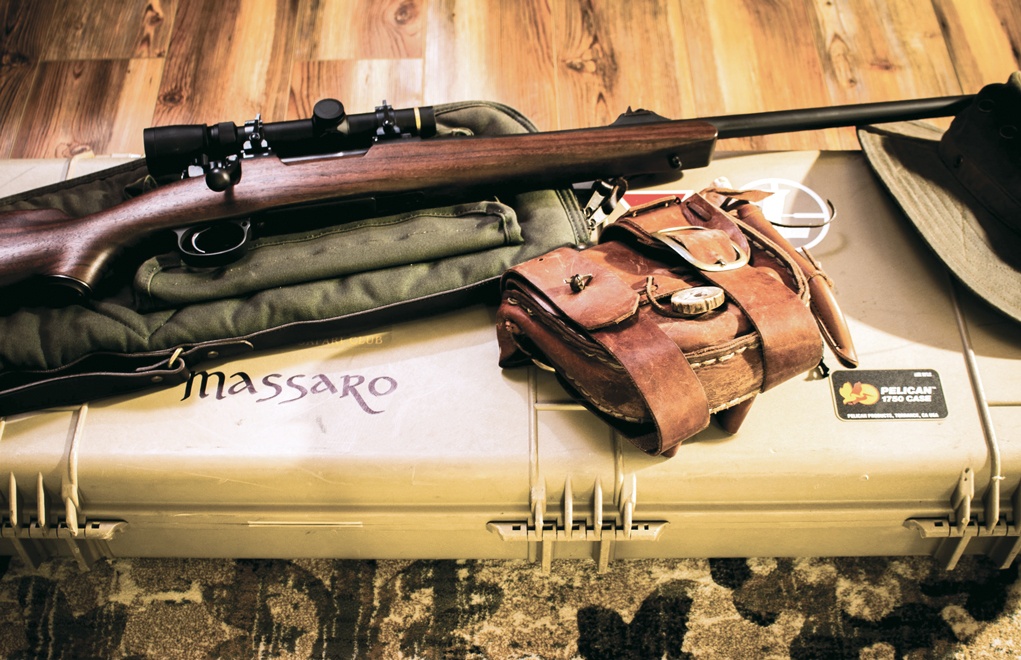
A good rifl e case, like the Pelican Model 1750, will serve the traveling hunter well around the globe.
Here’s some advice, based upon both the good and bad experiences I’ve had around the globe.
The Gun Case
This is where it will all begin. Your gun case needs to be rock-solid, as more often than not the airline employees will perform a torture test that even the manufacturers cannot replicate. I’ve used several models, including a heavy-duty aluminum model from Randolph, and one of Pelican’s cases, while some friends swear by a Tuff-Pak. I also have an SKB case for double rifles and shotguns that can be broken down.
Brand choice aside, you’ll need a case that’s airline approved and will stand up to the rigors of travel. The various luggage belts in airports will squeeze and twist your case, and I’ve been pulled off an airplane to rearrange my rifle case once it was given a thorough beating.
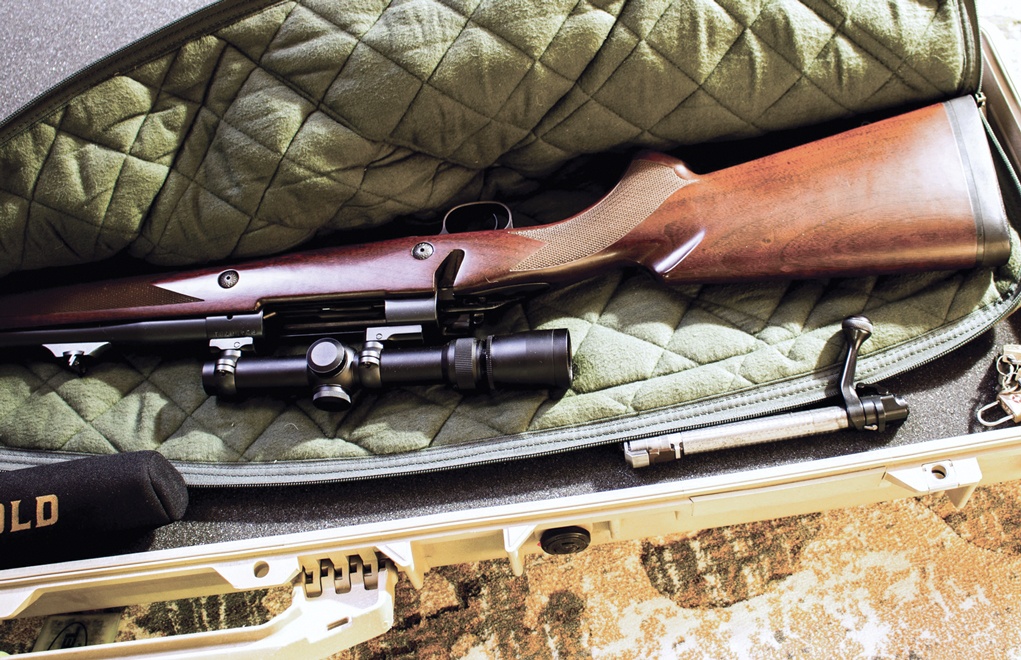
The Pelican cases offer a foam insert that can be cut out for an exact fit for your particular rifle or rifles, and that certainly works, but I go a different route. I remove the uppermost layer of foam so that I can place my gun in a soft case — which I’ll need to bring along anyhow — and I put that in the Pelican, killing two birds with one stone and making some room in my luggage.
More Information For Transporting Firearms Check out:
Underneath the foam, I keep a copy of my passport, the applicable Form 4457 (more about that in a bit) and copies of other pertinent paperwork. I lock the rifle case with the TSA-approved combination locks that you can buy at any box store, and I throw a half-dozen more of them in my carryon luggage — they will, invariably, be broken off at some point in your journey, and should an official need to open the case, they will do less damage with the smaller locks than with the large padlocks. And believe me, if they want in, they’re gonna get in.
I use a simple little Plano lockable ammo box to keep all my ammunition in, and that goes in my checked suitcase. It’s a requirement for bringing ammo to Australia, but I use it all the time now, keeping my ammo organized and well protected. It seems to be a hit with the customs officials as well, and that’s never a bad thing.
When presenting your rifle case at the luggage counter, I use the following phrase: “Hello, I’ll need you to contact TSA, as I’m traveling with an unloaded and disassembled hunting firearm.” Only once, on my first safari, have I had a ticket agent lose their mind. She was obviously new and acted as if I were trying to check a nuclear warhead. I remained calm and politely instructed her to contact TSA and the police. All went well, and we both learned something that morning.
Which brings us to the packing of your firearm: This is one point to which you want to pay strict attention. Double and triple check to be sure that no ammunition — not even empty cases — is in your gun case. An argument with TSA Agents is one you’re not going to win, and one that doesn’t need to happen. Render the firearm inoperable if possible, removing the bolt on a bolt-action rifle, lock the action open on autoloaders, remove the magazine if possible, drop the lever on single shots and lever guns. In other words, let the agents know you’re responsible when opening your case for inspection.
Paperwork — Lots Of It
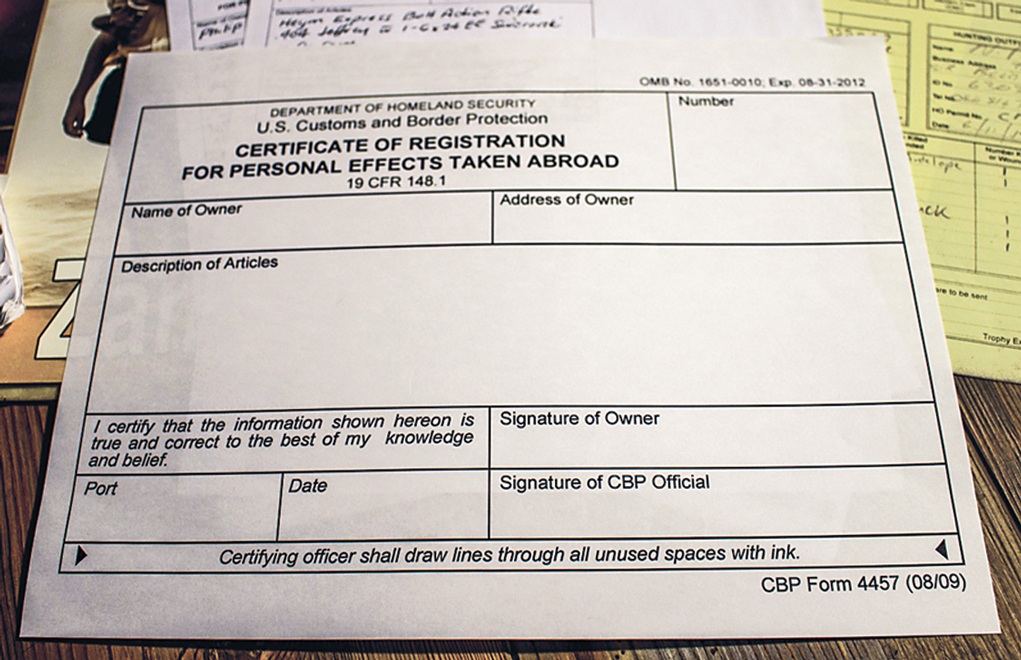
U.S. Customs Form 4457 is ultra-important — it’s the proof that you owned the firearm here in the States, and it’s required for bringing your firearm home.
Domestic flights won’t require paperwork, but any international travel most definitely will. Start with Form 4457, as this is the proof you’ll need that you owned the firearm here in the United States. You’ll most definitely need it for re-entry. A simple appointment with U.S. Customs and Border Patrol — and I highly suggest you call ahead — will garner the form, signed by a Customs Officer, and is good for life.
You will, however, need one for every firearm you intend to take abroad. It will contain make, model, serial number and caliber, and I usually throw the make and model of the optics on there just to avoid any complications. I keep the original on my person, and I make copies for both my luggage and my gun case. If I lose the original, the agents can always look up the certificate with a clear copy.
Depending upon your destination, there will be varying permits, forms and/or licenses required to temporarily import a firearm. Many of these forms can be found online, and if you can have them filled out ahead of time, I highly recommend that you do so. Some countries, such as Australia, require an exorbitant amount of paperwork to be filled out far in advance. Canada will allow you to obtain an import upon entry, as will South Africa, but it will go much smoother if you have your paperwork already filled out.
Back to Australia: There is a strict licensing system, which requires the licensee to apply well head of time in order to receive the Police Department’s approval, and to have on your person at all times, including when entering the country. There is, in addition to the approved paper forms, a credit card-sized ID/license, replete with your photo and reasons for the firearm permit.
When Things Go Wrong
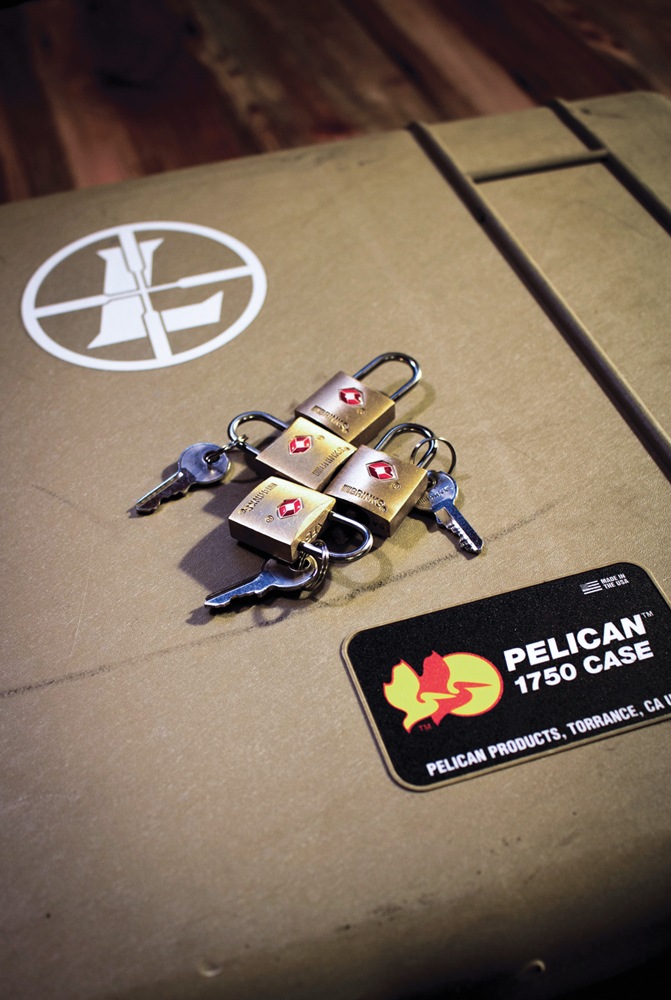
Your locks need not be indestructible as TSA will get into your case by any means necessary, but the author recommends bringing lots of extras.
I had a nightmarish travel scenario when I went to Australia. The Australian governmental officials were most helpful, but it was a glaring example of Murphy’s Law. I was headed to hunt the Northern Territory, and my itinerary was Albany, New York, to Charlotte, North Carolina, and on to Dallas, Texas, where I was to meet up with Chris Sells of Heym USA — from there we were headed to Sydney, onto Darwin and then a charter into the bush.
Sells was bringing a Heym 89B double in .470 NE, and I was bringing my Heym Express .404 Jeffery for backup. I should’ve known the trip had a hex on it when I got to Albany, and some pie-faced ticket agent adamantly insisted that Qantas (the international carrier) would absolutely not allow firearms on their flight. Showing him all the licenses and proper paperwork, and in a state of frustration, I politely insisted that Mr. Moonpie call Qantas, and I reveled in his apology when he found out I was right. My bags were checked all the way to Sydney, and I was underway.
I landed in Charlotte, boarded the connector to Dallas, and watched the blue skies turn apocalyptic. Two-and-a-half hours later, still on the tarmac, I was texting Chris to keep him apprised of the situation. Finally, we took off, and I knew it’d be super tight connection. As we hit the runway in Dallas, Chris sent me a message that they were pulling away from the gate. Wonderful, just wonderful. So, I’d be 24 hours behind the group — no problem.
I spent the night in Dallas, was rerouted through Los Angeles to Brisbane, and then to Darwin. As I boarded in Dallas, and again in Los Angeles, I asked the ticket agent to verify that my luggage and rifle were on board. “Oh, yes!” I was assured, but as you can guess, I arrived exhausted in Brisbane, Australia, to find that I had only my carry-on. No rifle, no suitcase (like an idiot I packed almost all of the essentials), no nothin’. How do you clear customs with a firearm that isn’t there?
Instead of cutting the foam to match the rifle’s profile, the author removes one foam insert and carries the rifle in its soft case within the hard case.
I went to the nearest Customs agent and explained my horrific dilemma. She was an absolute sweetheart, understanding to my plight and willing to do whatever she could to assist. Her supervisor came over, and between them they tracked down my bags and rifle — they took a wonderful trip direct from Dallas to Sydney. They called the Sydney Customs office and both coordinated a plan. To be brief, they reunited me with my gear at the Darwin airport 2 days later. It’s the only time I’ve had a rifle clear customs without being in my presence, and the Australian Customs crew was incredibly accommodating.
You’re Not Alone
My friend Steve Turner owns Travel With Guns, a travel agency that specializes in making a hunter’s life easier. He and his team are intimately familiar with global travel and the legal ramifications involved, even if you’re simply traveling through a country. KLM airlines — the Dutch Airline that’s a popular hub for African hunters — charges a fee for traveling through Holland with a firearm. British Airways can be a problem when flying through London because if you need to claim your luggage and switch airports, which is a common occurrence, you may not legally possess your firearm in Great Britain.
Travel with Guns will help avoid these issues, as well as provide you with the necessary forms and procedures for getting your guns into your destination country. Yes, they charge a fee, but when you’re going through customs seamlessly and you see the poor soul who doesn’t have their ducks in a row, it’s a worthy investment. Travel With Guns books your airfare, and presents you with an informative bound packet that will come in very handy, as it includes local customs, maps and other useful tidbits. Travel with Guns isn’t the only company out there, but I’ve used them often and feel very comfortable with their staff.
Tips And Tidbits
Ammunition can sometimes be a surprise, as some countries will charge you a fee for every round you shoot. Mozambique counted the amount of ammunition I had coming in country, and there was a $1 fee for every cartridge fired. There is an airline imposed limit of five kilograms (11 pounds) of ammo, so if you’re shooting a big-bore with a heavy bullet, be sure and weigh your ammo before you go. For an average safari, 40 rounds for your heavy rifle, and 60 for your light rifle, should be plenty and make the weight limit.
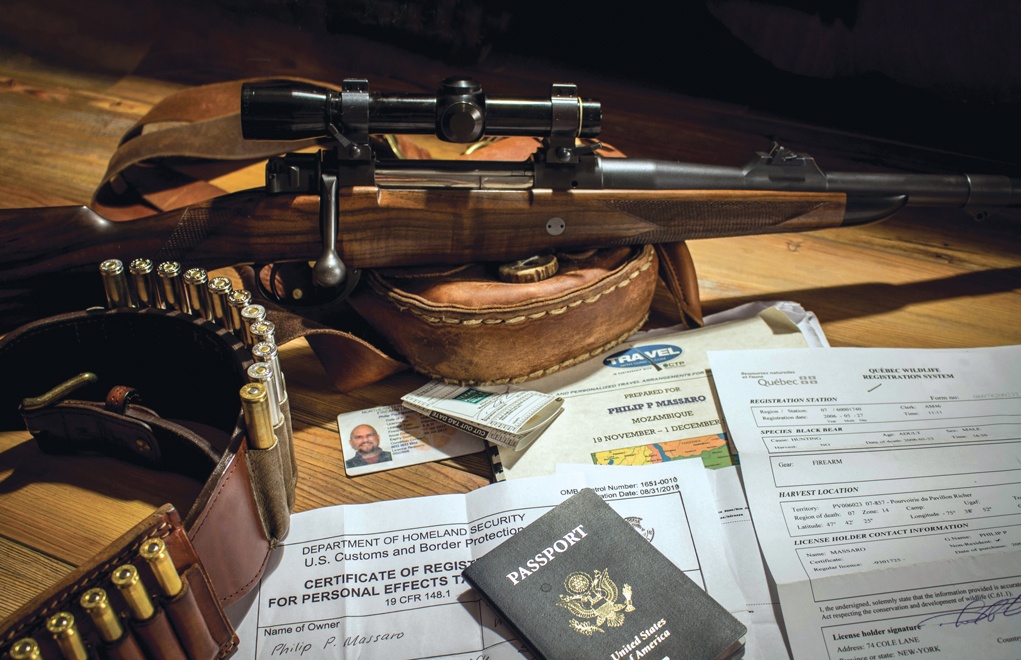
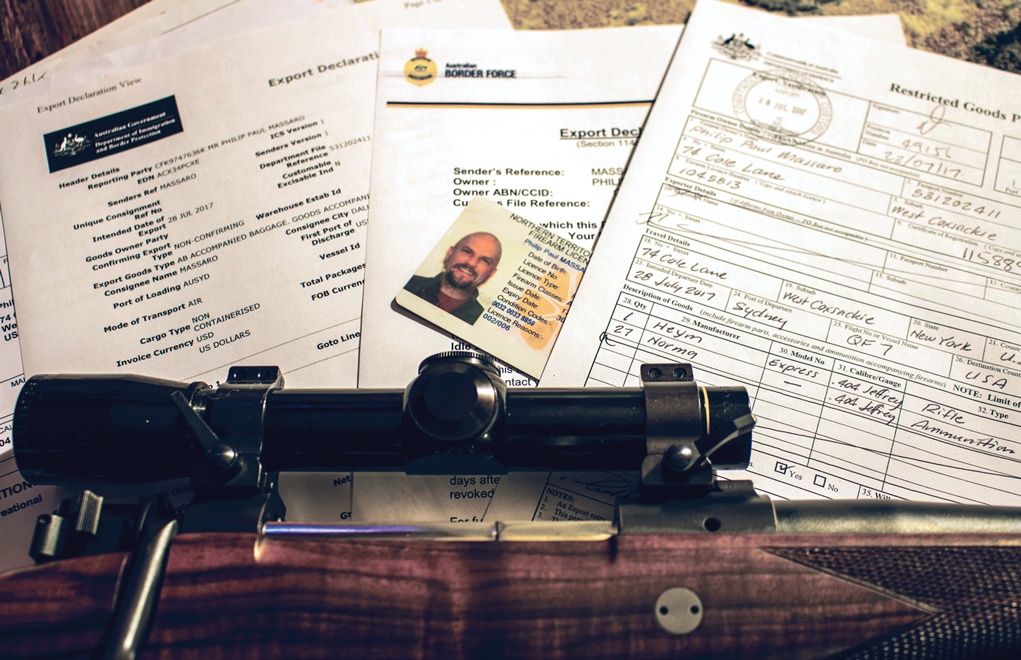
Just a smattering of the various paperwork and ID Cards required for bringing a firearm to and from Australia; that’s one destination where you need your ducks in a row long before you leave.
If you’re headed to South Africa, you are prohibited from bringing two rifles of the same caliber, and I’d had friends get hung up over this. One more interesting note about South Africa: You must be 21 years of age to possess and/or import a firearm.
As many gun cases can look the same — especially at the height of hunting/safari season — I make sure and mark my case with my name in bold letters so I end up with my own rifles and not someone else’s, and vice versa. More often than not, your rifle case will not come out on the normal luggage belt; it will be in the oversized baggage claim. I’ve had to show proper identification on numerous occasions to claim my rifle case from the oversize baggage department.
I also know that even driving through some U.S. cities with a firearm could potentially cause a legal issue. No matter what your GPS indicates as the fastest route, I’d avoid Washington D.C., Chicago, New York City and the like. I routinely have to fly out of JFK International Airport for hunting trips, and there’s no way to get there without bringing a firearm through the City, but it’s a concern every time. I understand there’s a legal provision for traveling through these difficult places, but again, I do my best to avoid conflict, and I always keep the outfitter’s name and phone number handy in case I have to explain and verify my destination.
It’s a sad state of affairs, but this is the world we live in. Many of the situations I’ve described herein are the reason some hunters either ship their rifles (domestically) to the hunting lodge, or arrange for a rented firearm at the destination. On some European hunts I’ve used borrowed rifles because the logistics of bringing my own gun along simply wasn’t worth the hassle. Do your research, brush up on the local laws as best as possible, and you should be making memories in no time.
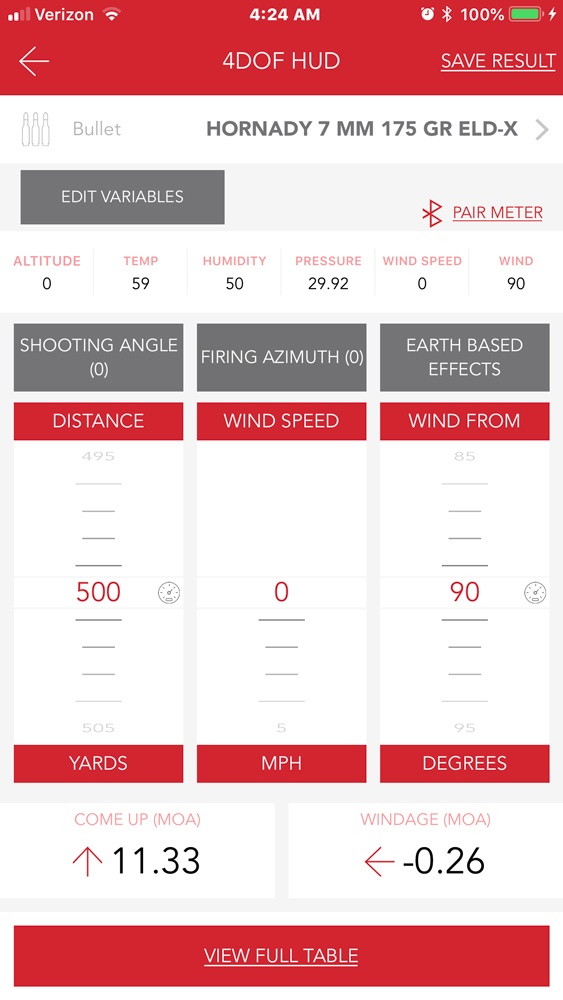
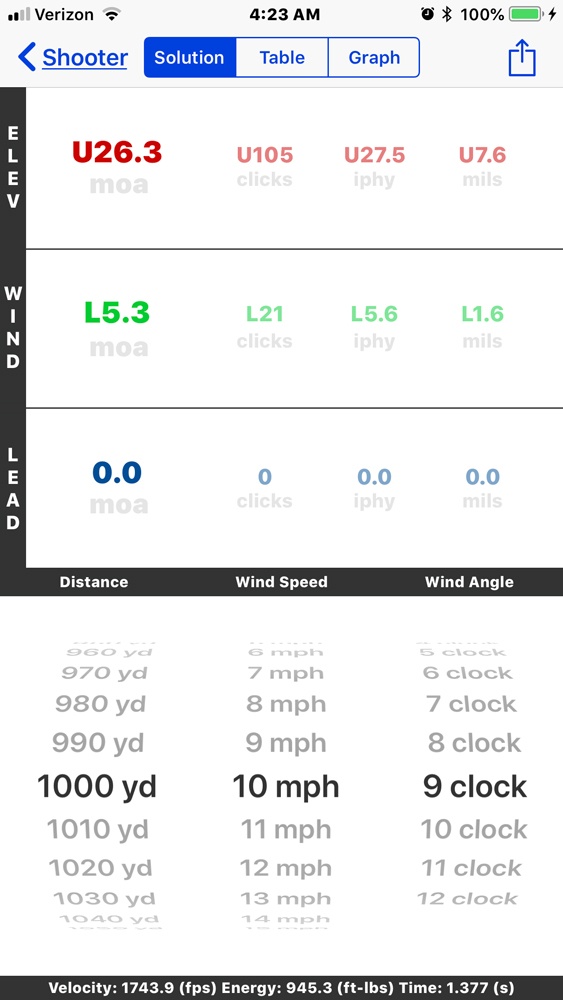
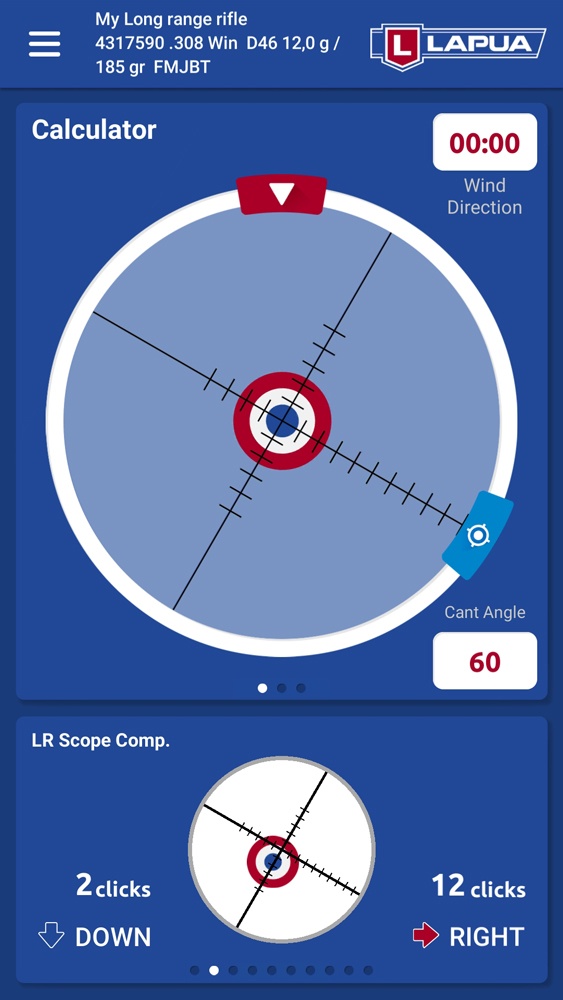
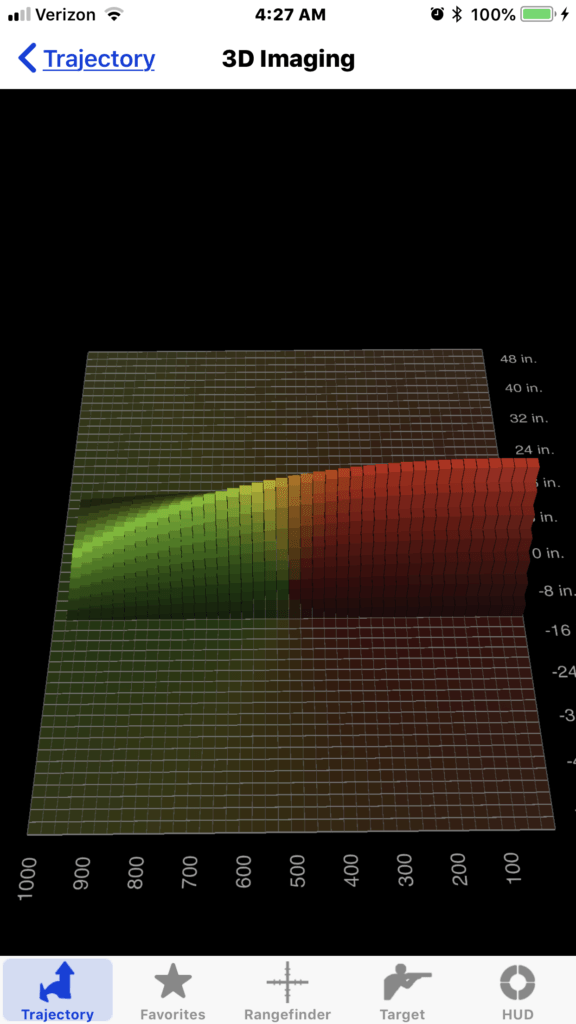
Like so many things in our modern lives, precision shooting solutions have found their way onto our smartphones. Ballistic calculators or “solvers” have evolved and miniaturized from large computers to handheld devices — and now into smartphone apps. But are the phone apps any good? And if they are, what does the average shooter get from spending money to purchase one and investing the time to learn the systems?
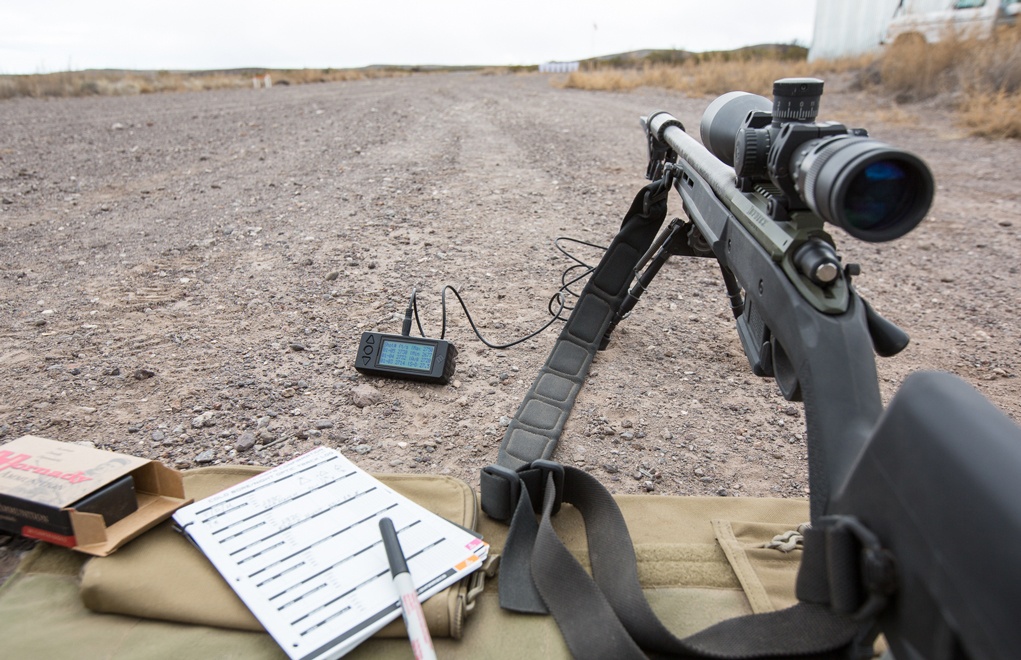
Accurate muzzle velocity measurements specific to your rifle and your load are critical inputs to enable the calculators to function correctly. The Magneto Speed chronograph mounts to the muzzle, or the suppressor in this case, to measure the velocity of the bullet as it exits the rifle.
The good news is that the cost of a smartphone-based ballistic calculator ranges from free to $29.99. For the average shooter, a free app can considerably improve his or her ability to accurately engage targets and, more importantly, learn the consistency and limitations of a rifle and load combination. And because none of them are overly expensive, you can download several and pick one you like best from the crowd.
As for investing time, the complex math is handled behind the digital curtain, and the inputs are typically the familiar rolling tumbler interfaces to select settings or blank fields to type in data. But before you go thinking you’re about to become a 1,000-yard long-range ninja, there are a few things to keep in mind about what a ballistic calculator will — or will not — do for you.
How will a ballistic calculator help my shooting?
Aside from the inherent attraction of knowing how one’s bullet flies through space (we’re gun nerds, after all), a ballistic calculator tells you where your bullet will strike a target at given distances, under pre-defined conditions. The forces of gravity, wind and your cartridge’s load and projectile behave in a mathematically predictable but sometimes non-linear manner as the bullet flies through super-sonic, trans-sonic and sub-sonic speeds.
These changes, and the required aiming adjustments along with a vast library of load and projectile data, are the reasons to own a solver. But does all this technology and math matter? It depends. If you’re a whitetail deer hunter who rarely takes shots outside 100 yards in a dense forest, then no — much of this data will not help you. The shorter the distance to the target, the less impact external forces have on a projectile, so your time and money would be better spent practicing good form in multiple shooting positions using a consistent load appropriate to your quarry. If you’re into long-range target shooting as a discipline or hunt in areas where longer shots are ethically more frequent, a solver can be a profoundly useful tool, and you should take the time to master its functions.
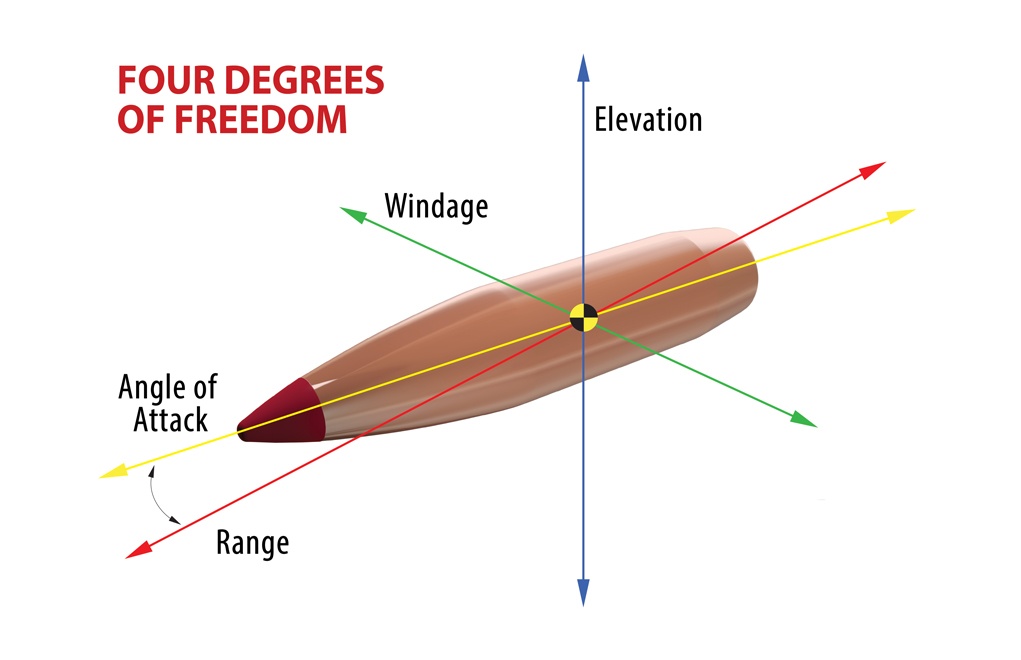
This diagram shows the “Four Degrees of Freedom” the Hornady 4DOF calculator measures to predict the path of the projectile. Note the “Angle of Attack,” which is the added variable in addition to windage, elevation and range.
GIGO: Garbage In = Garbage Out
Like any computer program or math problem, the results are only as good as the inputs. In other words, if you’re using incorrect rifle and load-specific data, the solutions any solver spits out will be equally and sometimes exponentially incorrect.
The key data points you should be able to collect are:
Muzzle Velocity: How fast the bullet is moving when it exits the rifle.
Cartridge Load: The caliber, projectile shape and powder charge.
Atmospherics: Temperature, altitude, barometric pressure, etc.
Muzzle velocity is arguably the most critical input variable in calculating the downrange performance of a particular round. Keep in mind that there are variances in every cartridge created by differences in powder charge, thickness of the brass wall, seating depth and a multitude of other factors. Talk to any handloader and they’ll opine endlessly as to which of these factors matter most and when, but the bottom line is that in both handloaded and factory ammo, variations from one round to the next will inevitably occur. This translates to different speeds at which a projectile exits the rifle’s muzzle, and therefore how far the bullet will travel during a fixed period of time (i.e., 1 second).
A good rule-of-thumb is to take the average of at least five rounds. Most shooting ranges will have chronographs for rent or a rangemaster who will chrono your rifle for a fee. I prefer a MagnetoSpeed barrel-mounted chronograph because there is no device to shoot through (as with a chronograph on a stand) or get blown over in the wind, nor do you have to call a range halt to walk a traditional chronograph in front of the firing line.
Use your instincts: If the measurements vary wildly, start over and compare the averages of several five-shot groups if necessary. So much of the ballistic math depends on this single data point that it’s worth your time to get as accurate a number as possible. Muzzle velocity is an average, and like many other calculations the solvers will make, some assumptions and rounding will occur, so where you can control the inputs you need to make them as perfect as possible.
If you’re not a handloader, use cartridges from the same box and lot whenever possible because factory conditions can vary from day-to-day. Always avoid different brands and bullet weights. What you’re trying to establish is a baseline for a single load (powder charge) in a particular rifle of a specific bullet (full metal jacket, open-tip match, soft-tip hunting round, etc.).
Regardless of which ballistic calculator you choose to employ, the “garbage in, garbage out” mantra applies: The information you get from that app is only as good as the information you give it to work with.
Again, there’s a multitude of smaller factors that can affect performance, such as heat and cleanliness of the barrel, but knowing the mass of the projectile flying through the air, and that it’s the same from shot to shot, is critical. Throwing together several projectile weights and brands will give you inconsistent data, skew your results and ultimately waste your time.
It’s important to note the factory velocities and bullet drop tables on the side of the box will almost never match your rifle. The box data does not tell you the length of the barrel through which the bullet travelled, the atmospheric conditions when the round was fired or how many shots were tested. It’s an approximation, and one you can use if you must — but where possible, collect the data yourself.
For example, the factory might have used a 24-inch barrel to log the velocity data. Your rifle might have a 22-inch barrel, which will likely reflect lower velocity (generally, shorter barrels see a reduced velocity, all else being equal). Inputting the higher velocity number from the box will skew the calculations. It’s also worth noting that some solvers will have functions that allow you to back into a rifle-specific velocity by using the factory numbers and adjusting for barrel length, but this will never be as accurate as data collected yourself.
Atmospherics — the external conditions such as temperature, humidity, barometric pressure and altitude — will all affect how a projective flies through space over distance. Some solvers can download real-time weather data into their calculations. This feature is convenient, but keep in mind the data will likely come from the nearest weather station that might be miles away and at a different altitude. The best method is to have a local meter such as a Kestrel 5700 or similar device. If neither of these are available, many public ranges will know the specific altitude of the range and have a thermometer and barometer mounted for the shooters. If you don’t see one, ask the rangemaster or other shooters if they know … someone likely will.
Download Away
Presuming you have a consistent rifle setup with good glass that allows for repeatable adjustments that reflect the windage and elevation adjustments the ballistic calculator will derive, here are a few apps to consider. Given that several are free, download them all and compare the results and ease of use and use the one you prefer.
I’ve used all of the listed calculators to a greater or lesser degree, and each has performed consistently. How each solver uniquely calculates trajectory is beyond the scope of this piece, but these are all solid options, and each allows for “trueing” a rifle to create ballistics tables to adjust for how a round performs in a particular rifle vs. how the math says it should.
Hornady went back to the drawing board and used Doppler radar to measure (in addition to the standard windage, elevation and range inputs) bullet trajectories to include a fourth factor: the angle of attack. This method takes into account the angle of the bullet’s launch from horizontal, which can have an impact on its flight. Hornady also departed from the traditional ballistic coefficient (BC) measurement of the efficiency with which a bullet flies through the air, and instead they used a drag coefficient (CD) vs. Mach value. Hornady feels this system reflects a more accurate representation of a bullet’s flight, but the program can also utilize BC values to calculate tables for projectiles upon which they have not collected data. It can also communicate via Bluetooth with other external devices.
Developer: Kennedy Development Group, LLC Price: $9.99
The Shooter app’s greatest strength is its simplicity. It’s simple, fast and easy to use. In addition to having a built-in library of more than 1,300 bullets, it also has G7 BC data collected by engineer and ballistician Bryan Litz, and it can interface with atmospheric data collected by Bluetooth enabled Kestrel devices.
Lapua Ballistics took the four degrees of freedom and Doppler radar concept two steps further and added the impact of the rotational movement on the elevation and range axis to derive an even more precise prediction of a bullet’s flight over time and through space. The only drawback of this system is it only includes Lapua’s projectiles.
The “M” version of BulletFlight is the most expensive offering in the Runaway Technologies line, but it has been designed with Knight’s Armament for military applications and includes ballistic tables for specific issue rifle and ammunitions setups, such as the KAC M110 with M118LR ammunition. BulletFlight M also features an internal accelerometer that calculates the angle to the target if the phone is mounted perpendicular to the rifle’s bore.
Editor’s Note: This article originally appeared in the July 2018 issue of Gun Digest the Magazine.
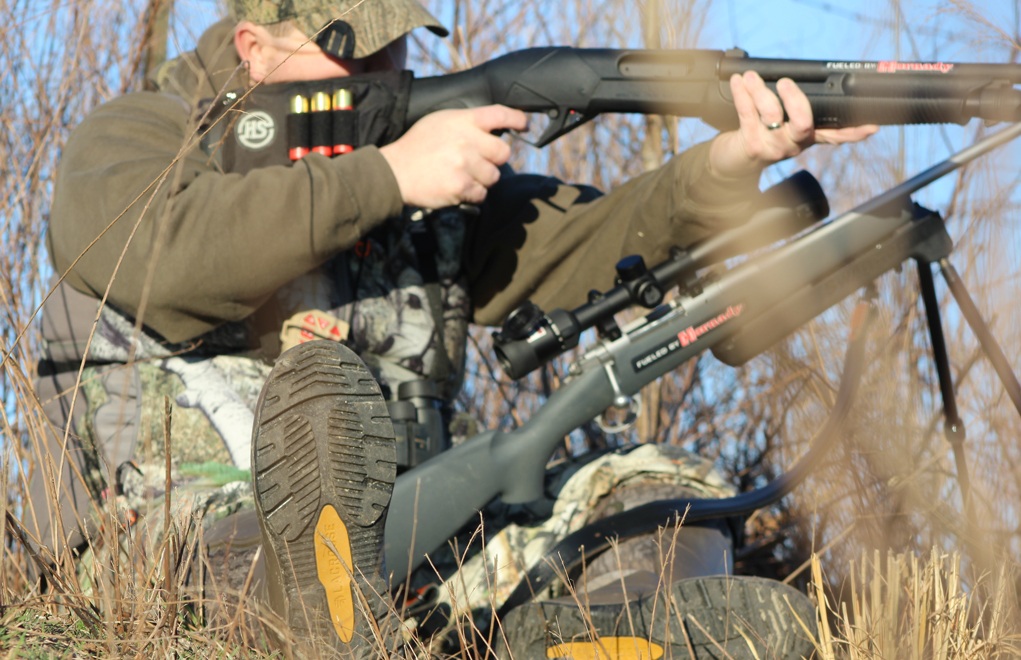
There are plenty of reasons why you should consider shotgun hunting coyotes, chief among them is the excitement level.
Editor’s Note: This article is sponsored content from TruGlo.
After hearing a few crunches of leaves, I was confident that a coyote was nearby. I’d stopped calling and was letting Mother Nature do the rest when I caught movement out of the corner of my eye: A coyote was at 25 yards and coming my way to see what all the commotion was. That was the last mistake it made. I was able to make a perfect shot with my Winchester SXT 12 gauge shotgun. The shot leveled the coyote — it never made another move.
Don’t get me wrong: Taking a coyote with a high-powered rifle at several hundred yards is rewarding as well as exciting. However, having a coyote come into a range that’s close enough for an effective shot with a shotgun is incomparable.
Hunters have been using shotguns on coyotes for many years — and for various reasons. The No. 1 reason seems to be due to the excitement level of being up close and personal with the most popular hunted predator, leaving the hunter with a one-of-a-kind feeling. For predator hunters who harvest fur, using a shotgun increases the chances of having less damage to the pelt that sometimes occurs when using a rifle.
Another reason shotguns are used on coyotes — and the main reason why I carry both a shotgun and a rifle the majority of the time — is more shot opportunities. Carrying both types of guns allows for multiple shots when one or more coyotes come to the call. The ideal situation is shooting the closest coyote with a shotgun first, then using a pup distress sound to slow or even stop the next coyote to shoot with a rifle.
Even though hunting coyotes with a shotgun is not something that was just discovered, it’s becoming an increasingly popular trend among today’s predator hunters. For first timers that want to carry a shotgun here a few tips that I have learned along the way that will help ensure a more successful hunt.
Choke Tube And Ammo
As with hunting turkeys, waterfowl or upland birds with a shotgun, there’s ammo specifically designed for use when hunting coyotes. Several companies have developed hard-hitting loads that cause minimal pelt damage. Some of my favorites include Hornady Heavy Magnum Coyote, which is a 3-inch, 1½-ounce, 00-buck load with a nickel-plated BB that. Used with an improved cylinder or modified choke, is load deadly up to 50 yards.
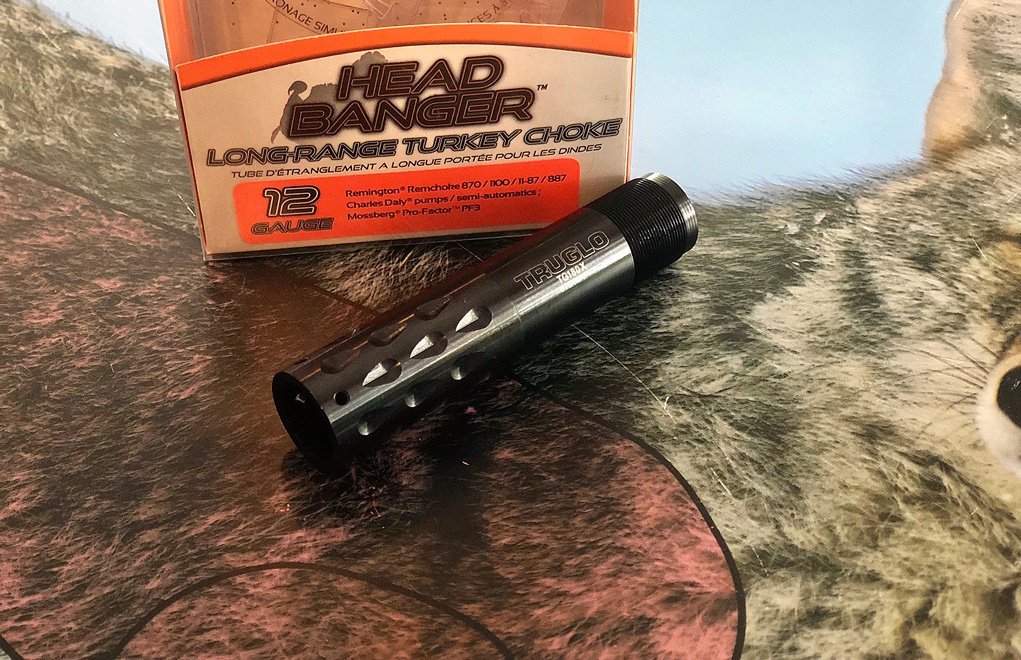
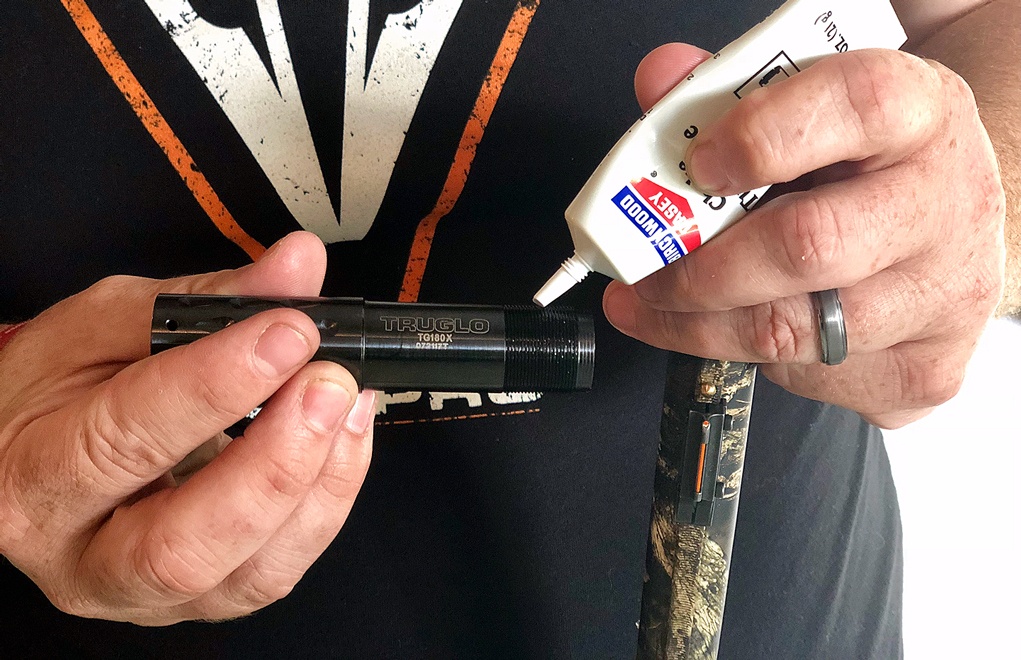
Another favorite is Winchester’s Varmint X — also a 3-inch, 1½-ounce load — has Winchester’s Shot-Lok Technology to provide a great pattern at 40-plus yards when paired with a good choke. Out of TruGlo’s new Head Banger Long Range Turkey Choke it can’t be beaten. Even though this choke is for turkey hunting, it’s designed to handle a great pattern at a long distance, and it’s also able to handle heavier coyote loads … even the heaviest loads on the market, such as Hevi-Shot’s Dead Coyote.
As with hunting any animal, hunters should shoot at a target to pattern and see which one performs the best out of a specific gun. Knowing how the firearm patterns at different ranges and with different loads is essential.
Tools For Shotgunning Coyotes
After getting a shotgun paired with the right ammo and choke tube, then practicing with it on the range, it’s time to hunt. Often, both a shotgun and rifle accompany hunters to the field. Beginning shotgun hunters often seem to have the same question in mind: How will I know when a coyote is within range, and which gun should I use?
When multiple coyotes are racing in at full speed, it can be a challenge to decide quickly which firearm to use. Most predator hunters know this happens fast. Therefore, I always carry a rangefinder such as Nikon’s Black RangeX 4K. This rangefinder is capable of not only ranging at several hundred yards for my rifle, but I also use it to set up my decoy and electronic caller exactly 30 yards from my setup. Knowing the range of my decoy I can quickly determine how far one is from that point and if it’s within range.
Even when using objects such as caller or decoy as a range marker, the first thing I do when sitting down is to range multiple distances. I will range multiple landmarks such as a tree, rock or even a barn so that I know where my effective ranges are: not only for my shotgun, but my rifle as well. Always do this before the first call is ever made and it should make ranging and gun choice a breeze.
Setup For The Shotgun
When calling coyotes and trying to determine where to set up there are two major factors. The first, of course, is the wind. My favorite setup is one with a crosswind. However, no matter the situation, I always try to face where I can see downwind. The second factor is always making sure there’s a shotgun opportunity.
For example, when sitting on the edge of a field, I try to keep my back to cover and keep the spot I believe a coyote could enter the field within shotgun range. This method is especially good when hunting with a partner. In this circumstance, one of us is set up in the shotgun position with the other facing the open area with a rifle.
No matter if I’m hunting alone or with a partner, my ideal setup includes a rifle outfitted with a Swagger Bipods on my right (I’m a right-handed shooter) and a shotgun to the left, on the ground or across my lap. The goal is to have the shotgun close enough so if a coyote comes racing in I can reach it with no obstacles. There’s another reason I keep the shotgun on my left side. If a coyote doesn’t quite make it to shotgun range I can easily lay it down slowly and get back on my rifle.
Try The Shotgun
In previous years, when I was still a novice predator hunter, I hardly ever carry a shotgun, unless I was in heavy timber or brushy areas. Basically, areas where it was my only option.
However, when I finally began carrying a shotgun on all my predator hunts I began to see more shot opportunities. In turn, more dead coyotes. I call the shotgun a secondary option; however, I set up and prepare for a shotgun harvest in every hunting situation. If you do this the opportunity to shoot more predators will increase dramatically.
For more information on the TrueTec Xtrem Red-Dot, please visit: www.truglo.com
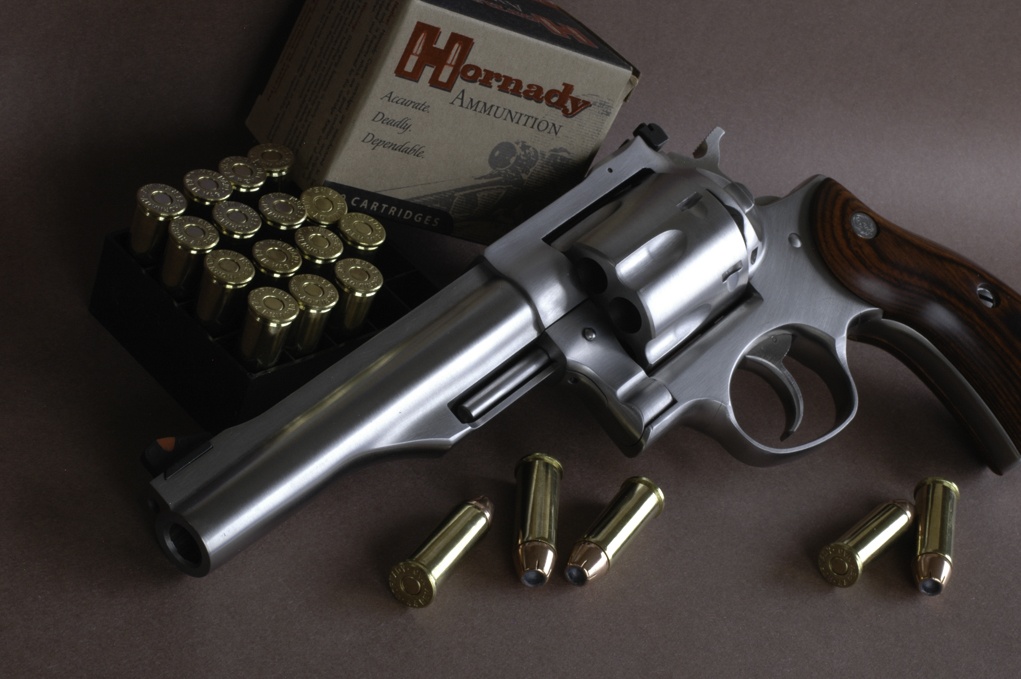
Ruger’s Redhawk and Super Redhawk are both classics, but chambered in powerful .44 Magnum does double-action revolver outshine the other?
Ruger Redhawk .44 Magnum Specs:
Capacity: 6 rounds
Barrel Length: 4.2 to 7.5 inches
Overall Length: 9.5 to 13 inches
Weight: 47 to 59 ounces
Frame: Stanless Steel
Finish: Satin
Front Sight: Ramp
Rear Sight: Adjustable
MSRP: $1,079 to $1,159
The author’s .44 Magnum Redhawk has a 5 1/2-inch barrel. Ideal balance, one-hand control, lovely lines.
Some people choose powerful firearms for the reason adolescent boys crave muscle-cars: image. My drift to 1911 pistols and large-frame revolvers was instead pragmatic. My pork-chop paws engulfed smaller handguns. Finger curled about the trigger like a shrimp, my leading knuckle crowded the muzzle. But to give pocket guns a fair shake, I ran the numbers. Ruger’s LCP and LCR measure about 5.2 and 6.5 inches in length. My hand tapes 8.7.
Revolvers that fit me date to the 1840s, though I don’t. Economic depression followed the panic of 1837. In 1841, Samuel Colt’s Paterson plant closed. Colt found work with Samuel Morse, until in 1846, a visit from Samuel Walker of the Texas Rangers turned his attention again to guns. The resulting Walker Colt was a 4 1/2-pound .44, to be manufactured at Ely Whitney’s plant. Few were shipped. Short months later, Captain Walker fell to a Mexican lance at the Battle of Juamantla.
The Redhawk grip frame is one with the cylinder frame. Springs operate parallel with the cylinder pin.
War clouds fueled development of Colt’s 1860 Army. The 1873 Peacemaker followed, an instant success. The .45 Long Colt, initially loaded with 28 grains black powder behind a 230-grain bullet, earned its deadly reputation with a 40-grain charge, a 255-grain bullet. The U.S. Army adopted this single-action sidearm in 1875. Three years later, Colt bored its 1873 Model P Peacemaker Single Action Army for the .44-40, already available in Winchester’s 1873 rifle. That dual chambering profited both firms, ensuring a ready supply of .44-40 ammunition across the West and absolving customers of packing two loads.
Meanwhile, Smith & Wesson saw promise in double-action revolvers. In 1905, a full decade after smokeless powder arrived, it built a .44 Special revolver for a black-powder load, 26 grains driving a 246-grain bullet through nine 7/8-inch pine boards! The .44 Hand Ejector appeared in 1907. The .44 Military Model of 1908 became the “Triple Lock,” as it latched at the breech, forward of the extractor and between yoke and extractor shroud. Refinements followed. The Fourth Model, or 1950 Target, got the attention of an Idaho cowboy, who began crusading for a revolver cartridge to upstage the .357, announced in 1935 on S&W’s .38/44 frame. Elmer Keith’s .44 Special handloads presaged an even more potent round.
As the .357 got its zip from a case slightly longer than a .38 Special’s, so the .44 Magnum gained its edge on the .44 Special. In 1954, Remington’s first factory loads hurled 240-grain bullets at 1,350 fps, effectively doubling the blow of the .45 Colt. Smith added steel to its 1950 frame, hiking pistol heft from 40 to 47 ounces. The Model 29 .44 Magnum revolver went public in 1956.
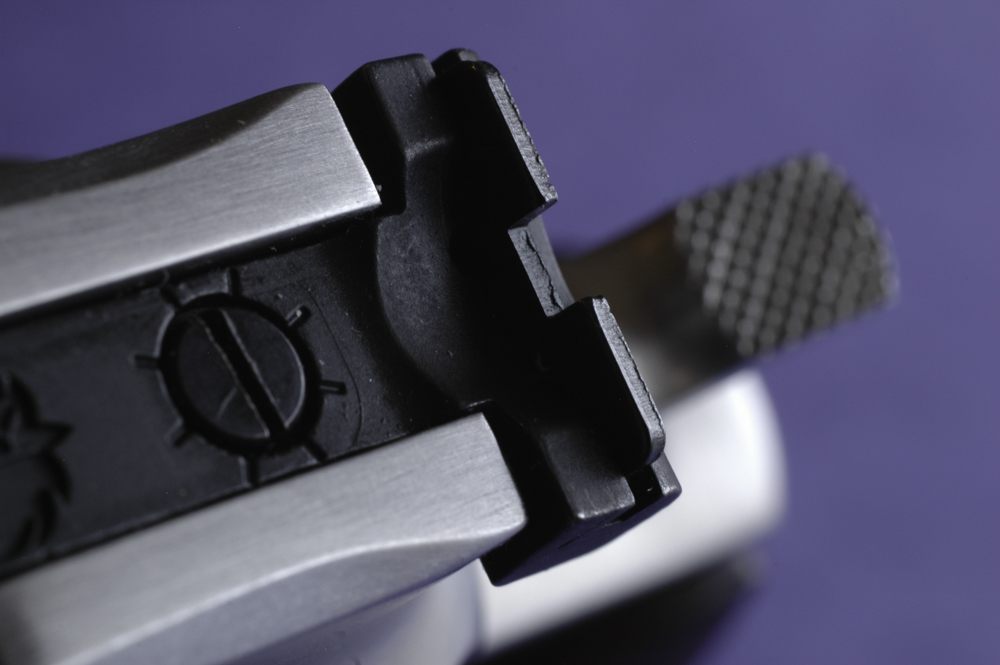
An adjustable, blued, square-notch sight (RH and SRH) contributes to a crisp picture, accurate aim.
Sturm, Ruger came late to the revolver game but quickly showed Bill Ruger’s genius. The .357 Blackhawk appeared in 1955, the .44 a year later. These “Flattops” anchored a single-action series that’s still strong at market. A medium-frame .357 double-action arrived in 1970, but the big news from Ruger that decade came at its end. During the NRA show in San Antonio in May 1979, the company unveiled its Redhawk, a six-shot DA .44 Magnum. That year was Sturm, Ruger’s 30th — and most profitable. Sales reached $68.9 million, the net topping $7.9 million. Those figures surpassed 1978 returns by 15 and 13 percent. Clearly, Ruger was producing what shooters wanted.
Struggling into solvency after college, I wasn’t then able to snare a .44 Redhawk. But it was soon in my sights, an alluring combination of strength and elegance, tradition and innovation. Engineers Harry Sefried and Roy Melcher made the Redhawk what it is, but Harry credited Bill Ruger with the offset ejector rod. Breaking with tradition, it’s not in the frame’s center and doesn’t rotate coaxially with the cylinder. So located, it permits a beefier frame next to the rod. The steel there is nearly twice as thick as it would have been with a frame-centered ejector. Another departure from the norm is the cylinder latch. Instead of a sliding tab, it’s a button that releases when depressed. I prefer it, as firing with gloves on big hands can accidentally move a fore-and-aft latch.
The Redhawk’s crane locks into the frame, where it’s held much more securely than if relegated to a forward under-barrel lug. Ruger described this as a “triple-locking” (not Triple Lock!) revolver, the cylinder secured “front, rear and bottom.” In this respect, the Redhawk was more rugged than any other DA then on the market. Sefried observed the lockup “would last about indefinitely.” The barrel has plenty of brawn, too, with 3/4×20-pitch threads.
A flat-nosed hammer falls on a transfer bar. A single coil spring powers two linkages: one to push the hammer, the other to return the trigger. Smith & Wesson DAs have two springs, a system Sefried said increases trigger pull without adding hammer thrust. Colt’s two-legged flat spring yields a lighter pull but does not assist the hammer. Bill Ruger insisted on a trigger-weight setting “in the range of conventional double-action revolvers,” so I shouldn’t have been surprised when Redhawk pulls I weighed came in at 6 1/2 pounds SA and 11 DA. Both were smooth and felt lighter. According to Ruger engineers, the Redhawk reliably ignites primers with a DA pull as light as 7 pounds.
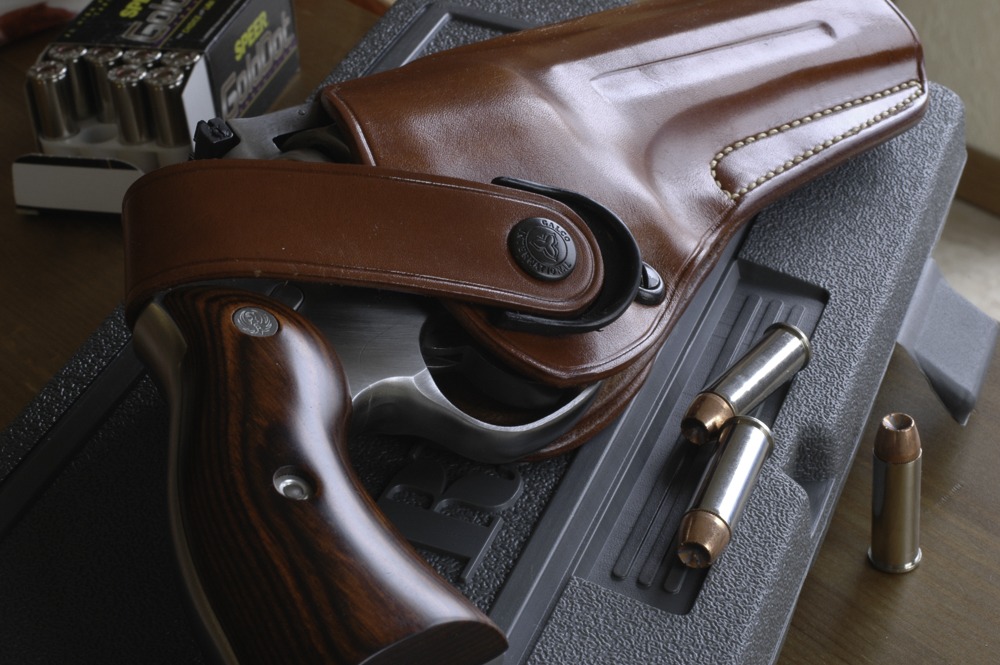
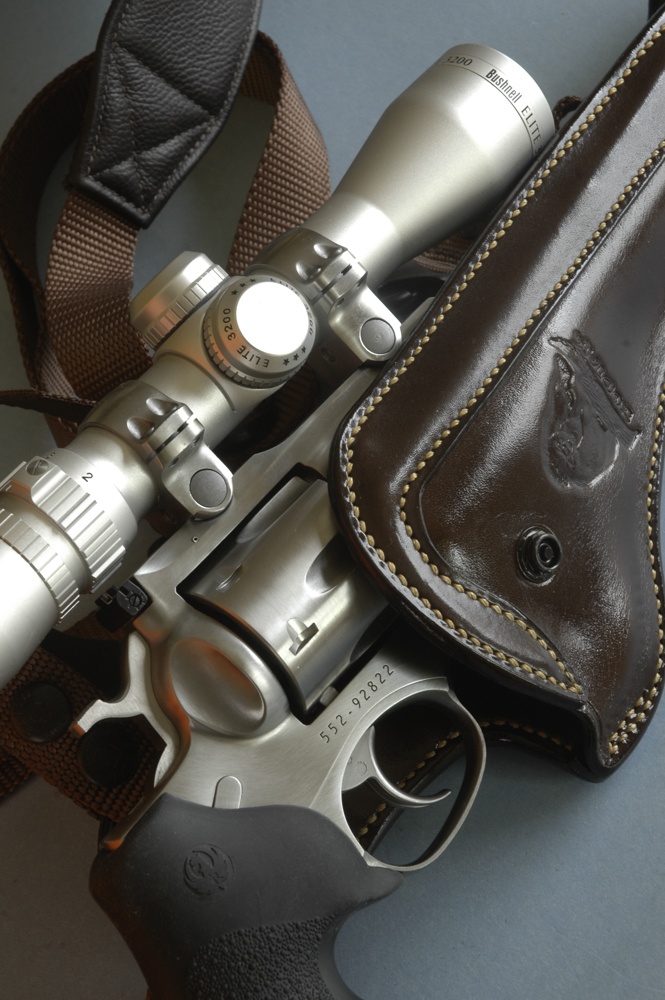
For the Redhawk, author likes the Galco DAO (here) and Phoenix holsters. Note strap tab, tension screw.
Introduced with barrel lengths of 5 1/2 and 7 1/2 inches, the .44 Magnum Redhawk arrived as the “logical evolution of the now-famous line of Ruger double-action revolvers.” But it was also an “entirely new firearm, representing the most significant advance in the development of heavy frame double-action revolvers in many decades.” The company also noted, “With the accuracy and power of the .44 Magnum cartridge [the Redhawk will] be widely used as a hunting revolver.” It’s since been chambered in .357 and .41 Magnum, and in .45 Colt. Ruger’s latest catalog lists the .44 Magnum with hardwood grips and 5 1/2- and 7 1/2-inch barrels, including a Hunter model with scope ring dimples on the 7 1/2-inch rib. There’s a .45 Colt/.45 ACP version with hardwood, a .45 Colt or .44 Magnum with Hogue Monogrips. Both have 4 1/4-inch barrels. A new round-butt, hardwood .357 holds eight shots behind a 2 3/4-inch barrel.
In past years, this pistol has been listed with blued chrome-moly steel, but now all versions are of brushed stainless. Sights are blued C-M. The replaceable front blade has a red plastic insert, the adjustable rear a white-outline square notch.
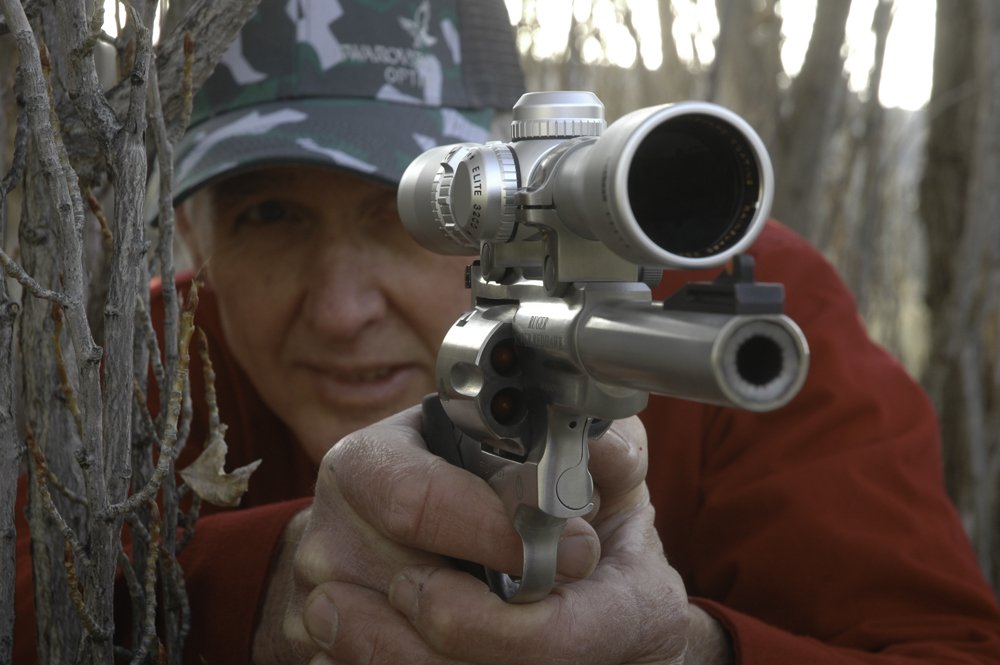
Scoped, a 52-ounce Super Redhawk becomes a two-hand gun. It’s still a handgun, and easy to carry.
When life became unbearably hollow without a Redhawk, I yielded. The price had climbed well above the 1980 MSRP of $325. My consolation: it has kept rising. Good things seem never to go on sale, and I suspect the current figure ($1,079) will soon be eclipsed. I picked the 5 1/2-inch .44 because I like wood grips and think a 5 1/2-inch barrel gives a big revolver visual and physical balance. Recoil is more violent in shorter, lighter .44s, which also sacrifice sight radius. A 7 1/2-inch barrel brings heft from 49 to 54 ounces, quickly making the Redhawk a two-hand gun. Even if I almost always use two, it seems to me a handgun shouldn’t require both.
Unlike later Ruger DAs built with separate grip frames, the Redhawk’s grip is integral with the frame proper. There are no sideplates. You can disassemble the Redhawk without tools, but I used a screwdriver to release the grips. A pin fell — from where I could not tell. Read the instructions, Dummy! The manual confirmed what I’d suspected. The pin has no function in the assembled pistol; it secures the mainspring and strut during disassembly.
Firing the Redhawk won’t put you to sleep, but the hardwood grips are thoughtfully shaped and mercifully smooth. They slip slightly in your hand as the gun rotates up in recoil, absorbing bite. While pliable rubber absorbs shock, it also ensures that all the kick reaches you before it leaks energy moving the pistol. Redhawk sights give me the square, sharp image I like in irons.
Bill Ruger is credited with designing a stout “triple-locking cylinder” that stays tight after much use.
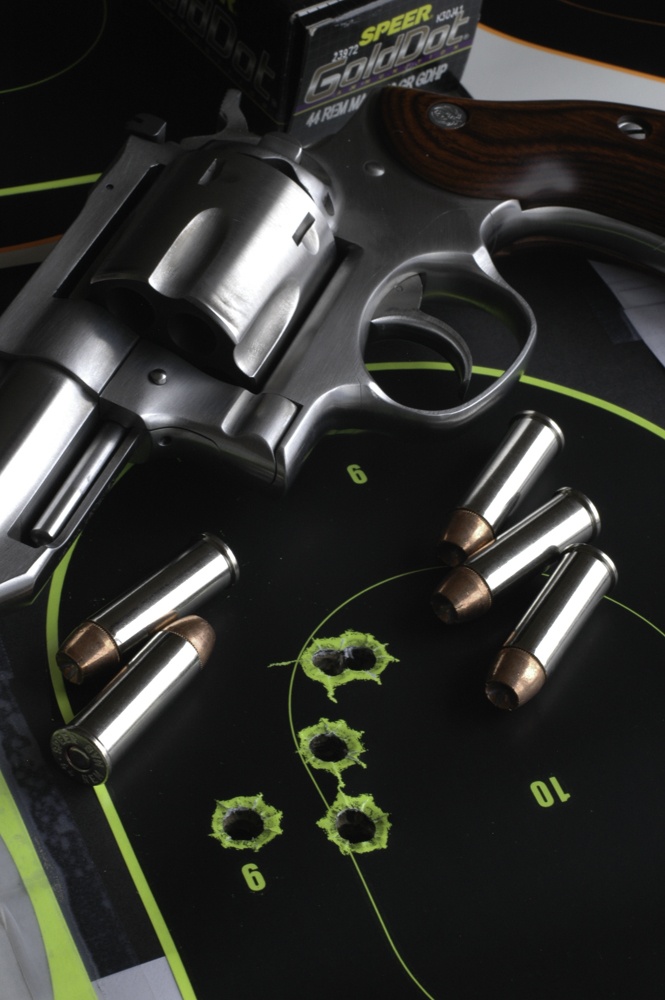
In range trials, my Redhawk has printed pleasing groups with bullets of 180 to 300 grains. Nixing shots I pulled or wobbled out, I managed to threaten the 2-inch mark at 25 yards with the loads at hand.
Load
Group (in.)
Remington 180-gr. SJHP
2.1
Hornady 200-gr. XTP
2.2
Speer 210-gr. Gold Dot
1.9
Federal 240-gr. JHP
2.2
Winchester 250-gr. PTHP
2.4
Black Hills 300-gr. JHP
2.3
Vertical spread between loads reflected the wide velocity range. Unlike rifles, handguns typically send heavier missiles higher into close targets. Trajectory disparities due to bullet speed and profile matter less than do exit points in the recoil cycle. Fast, light bullets exit early in the muzzle’s climb. Slow, heavy bullets leave later.
For some time, I figured any DA enthusiast with a Ruger Redhawk had all the handgun he or she needed. But then a Super Redhawk followed me home.
Introduced in 1986, just seven years after its predecessor, the Super Redhawk distinguishes itself with an extended frame, essentially a barrel collar. Besides adding beef to the barrel-frame juncture, this frame has more steel in the top strap and around the ejector rod. It’s long enough to support a scope. Ruger machined it for scope rings and has furnished them on every SRH except the Alaskan, with its 2 1/2-inch barrel. That fistful of recoil didn’t debut with the first Super Redhawk, which featured hard synthetic grips with wood insets, and barrels of 7 1/2 and 9 1/2 inches, chambered only in .44 Magnum. Weights: 53 and 58 ounces.
Author used a range of loads (180- to 300-grain bullets) in accuracy trials. These guns aren’t fussy.
The Super Redhawk embodies features of the Redhawk — same triple-locking cylinder and offset cylinder notches that dodge the thinnest points in the cylinder. Same cylinder latch button and transfer bar ignition. The rear of the frame, the guard, trigger and hammer appear at a glance identical. Sights are the same too, albeit the SHR has an island ramp in the front, not a barrel-length rib. Both .44s have six-groove rifling with 1-in-20 right-hand twist.
Internally, however, the two revolvers are quite different. The Super Redhawk has the “peg” grip frame of Ruger’s GP-100 instead of the Redhawk’s traditional full-size grip frame. All three coil springs behind the standing breech of a Redhawk operate nearly parallel with the cylinder and barrel axes. The biggest spring in the Super Redhawk is pretty much centered in the grip and runs parallel to it.
The SRH has not been chambered in .357 Magnum or .45 Colt; but since its introduction, Ruger has added the .454 Casull, .480 Ruger, .41 Magnum and 10mm Auto to the original .44 Magnum chambering. Of course, you can fire .45 Colt ammo in revolvers bored for the Casull. While Super Redhawks in .44 Magnum, .41 Magnum and 10mm have the fluted cylinders of the original, .454s and .480s lack flutes. All SRHs now feature Hogue Tamer Monogrips, to help absorb recoil and ensure a secure hold with wet, cold or gloved hands.
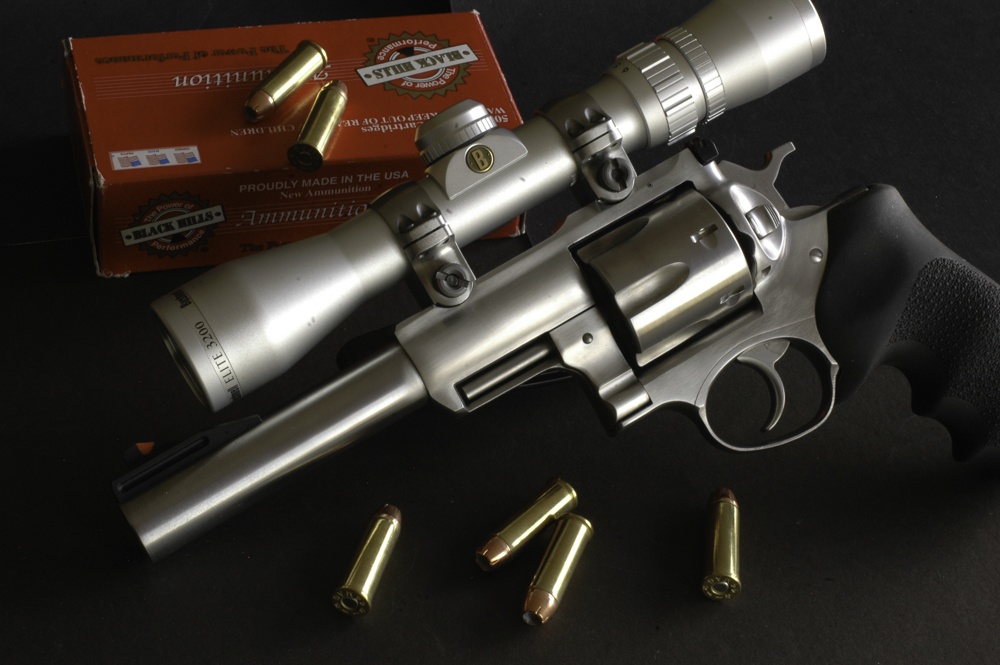
Content with my 5 1/2-inch Redhawk, I had little need for its longer, heavier progeny. Then, short months ago as I write this, Ruger announced a “distributor exclusive” for AcuSport. This 52-ounce Super Redhawk, available through any dealer served by AcuSport, wore a 6 1/2-inch barrel. Long enough to tap the potential of the .44 Magnum, and wring hunting accuracy from iron sights or scope, it seemed to my eye a perfect match for the leggy SRH frame. You don’t have to need a revolver to buy one. Though the price of Super Redhawks had risen from $510 at its debut to a starting MSRP of $1,159, I bit.
Revolvers have brought to bag only a few animals on my big game hunts, so by any measure I’m a rookie in this arena. But scoping the Super Redhawk with a Bushnell LER 2-6x variable gave it a lethal look indeed. So equipped, it was clearly a use-two-hands, find-a-rest handgun. Still, it balanced well and, unlike longer revolvers, this .44 felt more like a pistol than a carbine.
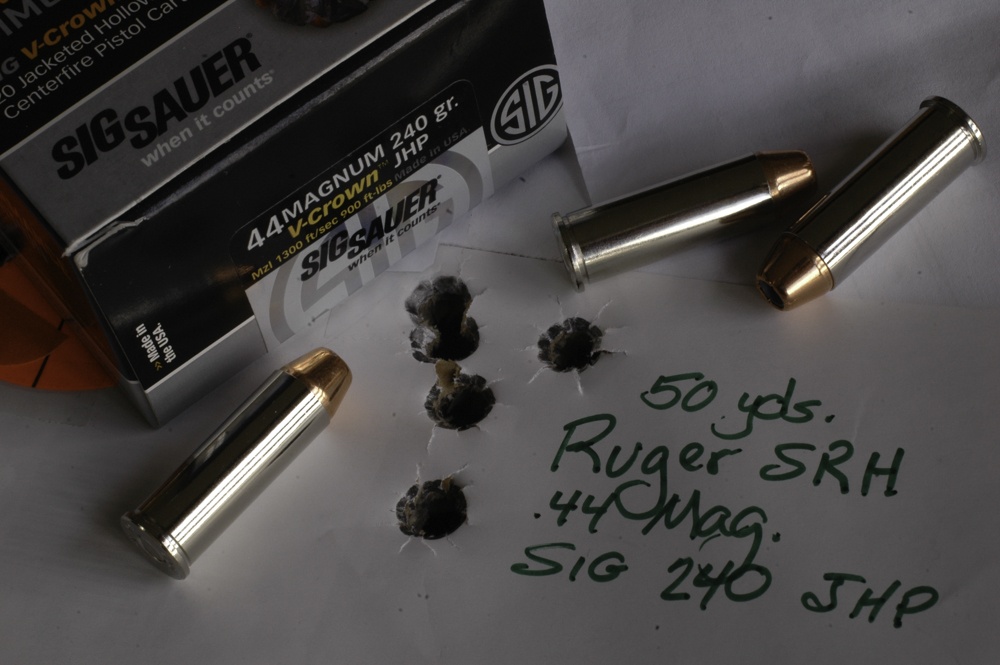
Rifle-like accuracy! The Super Redhawk shot this knot with SIG loads, nearly equaled it with others.
I usually zero big-bore handguns at 25 yards, for point-blank aim to 75. That’s near the effective reach of traditional bullets at 1,100 to 1,400 fps. Federal, for example, loads a 280-grain Swift A-Frame to 1,170 fps. Zeroed at 25, it hits an inch high at 50 yards, 3.7 inches low at 75. Federal’s 225-grain Barnes Expander at 1,280 fps reaches 50 yards just half an inch high and drops 2.8 inches at 75. These bullets fall 8.6 and 6.9 inches at 100. After zeroing my Super Redhawk over a Caldwell bag, I tacked another target at a scope-friendly 50 yards and again took aim. Four bullets clustered inside 1.1 inches! Alas, fifth-shot gremlins would not be denied, and my final hollowpoint opened the group to 1.8. To my delight, a second series shot into 1.5 inches. I’m not skilled enough with a handgun to expect better. Nor is the SRH finicky. It herded all types and weights of bullets into snug knots. Black Hills 300-grain JHPs at 1,150 fps and 240-grain SIG JHPs at 1,300 delivered five-shot groups under 3 minutes of angle.
Now, 3-minute accuracy from a stock revolver with off-the-shelf ammunition would ordinarily put spring in my step. In this case, it posed a dilemma. I had just assured my editor at Gun Digest I could write compelling narrative about a revolver I prized above all others. One good gun. My Ruger Redhawk was now one of two good guns. Perhaps their common genesis, manufacture and features will ensure that both appear in the final copy. Both deserve the honor!
This article is an excerpt from Gun Digest 2019, 73rd Edition. Click here to learn more and get your copy of “The World’s Greatest Gun Book.”
Beyond running and gunning, shooters must master the prone positions to excel in competitive pistol matches.
It’s an easy trap to fall into. At the range, plinking around, pistol shooting is something we most often do with our feet firmly planted on the ground. It’s like we anticipate real life will come at us as if we’re on the firing line, leisurely chewing through a few magazines with all the time in the world.
The stark reality, the real world doesn’t play clean. In turn, you should prepare as such. This means stretching your abilities to their limits, training like you’d potentially have to fight. In many cases, jettisoning the Weaver, isosceles or whatever stance you use and getting down and dirty and off your feet.
Practical pistol competitions are ahead of the curve here. Over the years, the course of fire has grown to include more realistic shooting positions — kneeling, sitting, and prone. Taxing, the stage designs force competitive shooters out of their comfort zone and into the dirt. Furthermore, they entail greater forethought. Running and gunning no long win the day exclusively.
Tough? You bet. Impossible? Not with the right tools.
Mark Redl provides these, breaking down how he attacks non-traditional prone positions — perhaps the most difficult in competitive shooting. Much of it is intuitive, such as how to efficiently get into position and when to plan on doing so. But some of it may not have occurred to you, even if you’re seasoned. There are tricks, such as using recoil to more efficiently engage multiple targets, that give an edge.
As always, the secret to mastering marksmanship without your feet under you is practice. And while Redl tackles this subject from a competitive shooter’s standpoint, all handgunners would do well to work prone shooting into their training regime.
Modern Shooter gets a first-hand look at the creation of functional art with a visit to Turnbull Restoration Company.
Face it, owning a piece of artwork is a dull proposition. Unless it’s one of the masterpieces created by Doug Turnbull.
Working in cold steel and hot gold, the master firearms restorationist and his team at Turnbull Restoration Company take the ordinary and make it extraordinary. Beyond that, the guns that receive their once over are more than pretty faces, mere “wall-hangers.” They are 100-percent functional and ready for the toughest hunts and most rugged use. Honestly, what good would they be otherwise?
Turnbull (the man) practices what he preaches when it comes to utilizing what he creates. Showcasing a personally restored and customized Winchester 1886 rifle, the master craftsman proudly proclaims it does more than demonstrates his talent. With more than 70 animals to its name, it proves a dependable hunting rifle.
A point of pride, Turnbull’s team customizes guns exactly to the owner’s specifications. Most opt for the company’s vivid color-case hardening, a signature of the firearms virtuosos. But as far as engraving and inlays are concerned, Turnbull will put scrollwork down to the screw heads if requested. Simply put, the sky is the limit when a gun goes under his studied eye and steady hand.
Beauty, function and reliability. Doug Turnbull’s results speak for themselves.
Catch the rest of Turnbull’s incredible creations in this episode of Modern Shooter 10:00 p.m. EST Friday on the Pursuit Channel. The episode rebroadcasts Monday at 12 p.m. EST and Tuesday at 11:30 a.m. EST.
Given a sight picture varies with range and size of the target, how much is adequate in a self-defense situation?
Building a sight picture:
Arms in full extension.
Sights aligned properly.
Front sight at six o’clock or dead on the target.
Focus on the front sight.
Some shooters wonder how much sight picture they need. According to Gunsite Instructor Cory Trapp: “If you have the physical space to bring the handgun up to full extension, you should be looking for a sight picture. Some contend that’s simply too slow, or that at close range point-shooting works perfectly well.
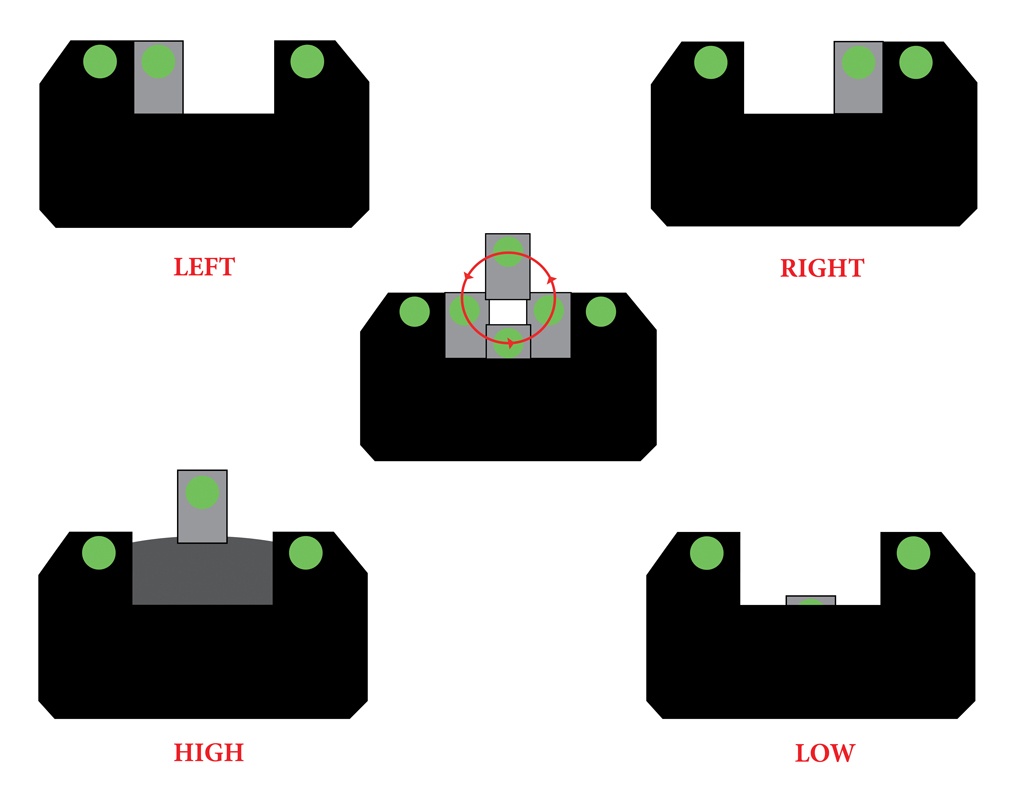
In this diagram, the front sight is shown in four different positions. If you fire a single shot with a duty handgun, using each of the four sight pictures shown, you will still have a group of about 10 inches at 5 yards.
My response is, ‘If you don’t think you have time to aim, I doubt you have time to miss.’ The only way to be certain of the alignment of the pistol is to look at the sights. The problem is when we say, ‘sight picture,’ most think we mean a perfect view of the sights.
“The reality is, the amount of sight picture you need to see varies with the range and size of the target. I run a drill where you hold center at 5 yards, then move the front sight out of the notch to the left, then right, then all the way down and all the way up, firing one shot with each change. With full-sized pistols, many are amazed to see all the shots are still in a 10-inch circle.
One can shoot quite well with no sights, just using the shape of the slide itself as an oversize set of sights. Learn what the limits are with your own handgun and your speed will increase when you simply see only what you need to see to get the hits.”
Do you want more consistent handloads? Then develop a consistent cleaning regimen for your reloading equipment.
Tools for maintenancing and cleaning reloading equipment:
Bottle Brush
Solvent
Rags
Cotton Swabs
Ultrasonic Cleaner
Toothbrush
Gun Oil
Hoppe’s Gun Medic
Brake Cleaner
Reloading is such a wonderful hobby; it can be economical, educational and — I dare say — romantic to its own strange degree. The diligent hours put in at the reloading bench seem to be reverted to a simple pile of brass in a fraction of the time while seated at the shooting bench, but once you’ve got the reloading bug and have fallen down the rabbit hole, there’s no turning back. But, things back at reloading bench can get dirty, sometimes filthy, and cleaning your gear is a necessary evil.
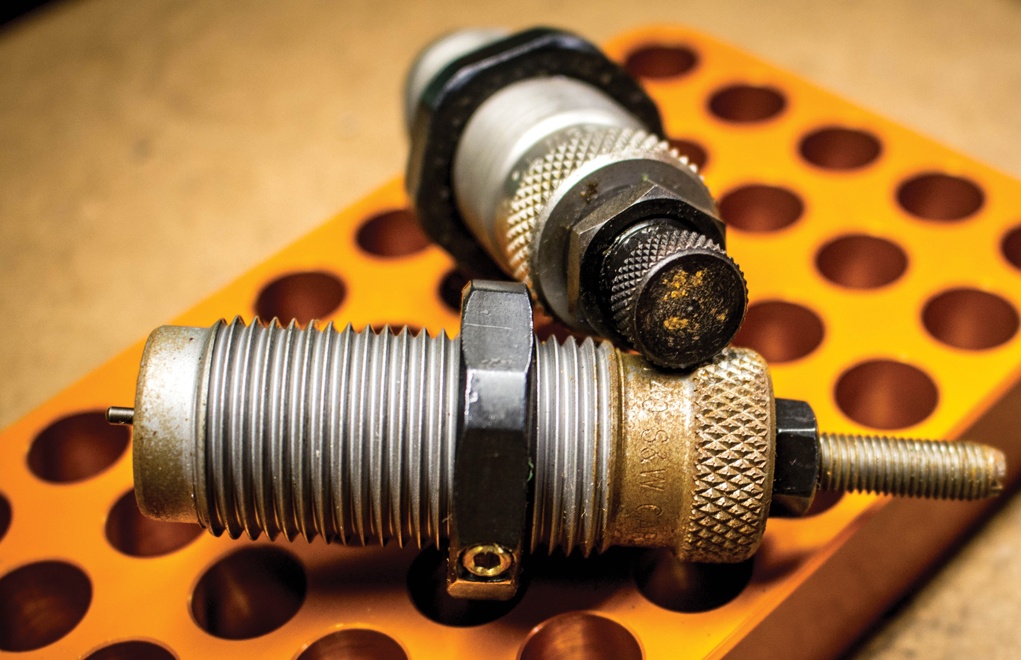
The set of 40 S&W dies was stored for a while, and it developed rust inside and out that must be removed.
We need to use lubricants for resizing our brass — doesn’t matter if it’s a graphite lubricant, aerosol or gel — and invariably, that lubricant and little bits of brass will end up everywhere. Shell holders, die bodies, expander balls and seating plugs can all get gunked up with a lovely amalgam of brass shavings, powder residue and lubricant. Rust can always pose an issue, especially if you live in the more humid climates, and it will be a concern if you store your dies for extended periods. It must be dealt with accordingly. Let’s examine some ideas — some obvious and some not so obvious — to keep your reloading gear clean and in top running condition.
Love For The Loaders
For the single-stage loaders, the operation can be easily halted while you clean any one of the components. For the progressive press crown, a gummed-up die can screw up the works very easily. A routine cleaning of your dies for the progressive press is a very good idea.
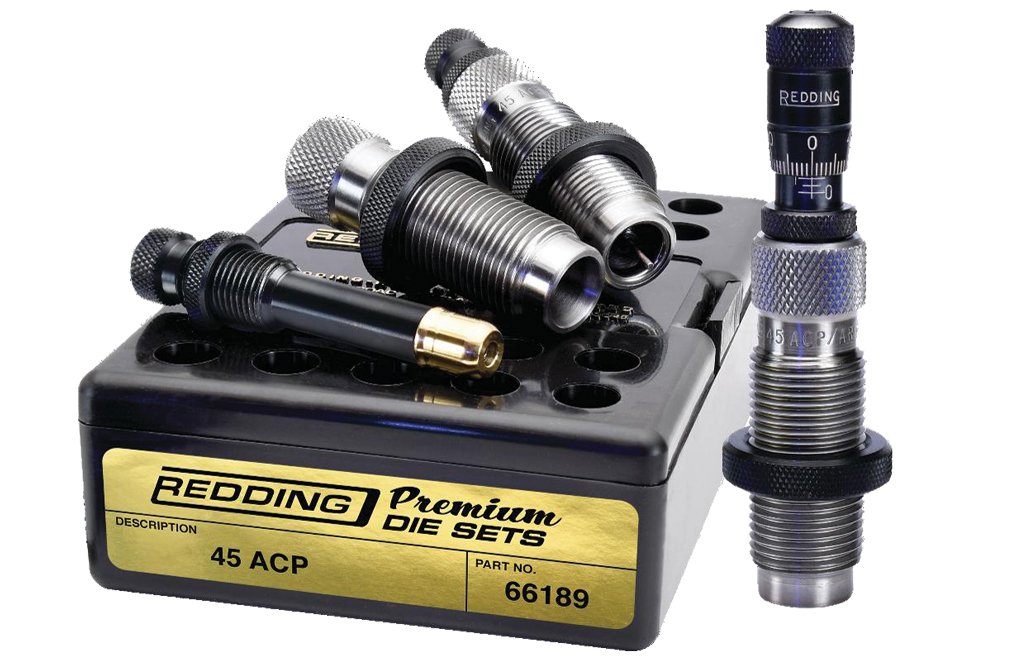
Redding has actually taken this into consideration, with their new Premium Die Set for handgun calibers. Using their Titanium Carbide sizing die — no lubrication is needed, and therefore less goo ends up in the die — resizing brass is a quick and simple procedure. The Special Expander Die is an eye-opener, as it uses a unique expander specifically designed to best prepare the brass cases to receive the projectile. What’s more, the expander has a proprietary coating that will not get gunked-up with brass flakes or any other dirty concoction of lube and metal filings. I like them for single-stage work, but in the progressive presses they really show their value.
Detailing Dies
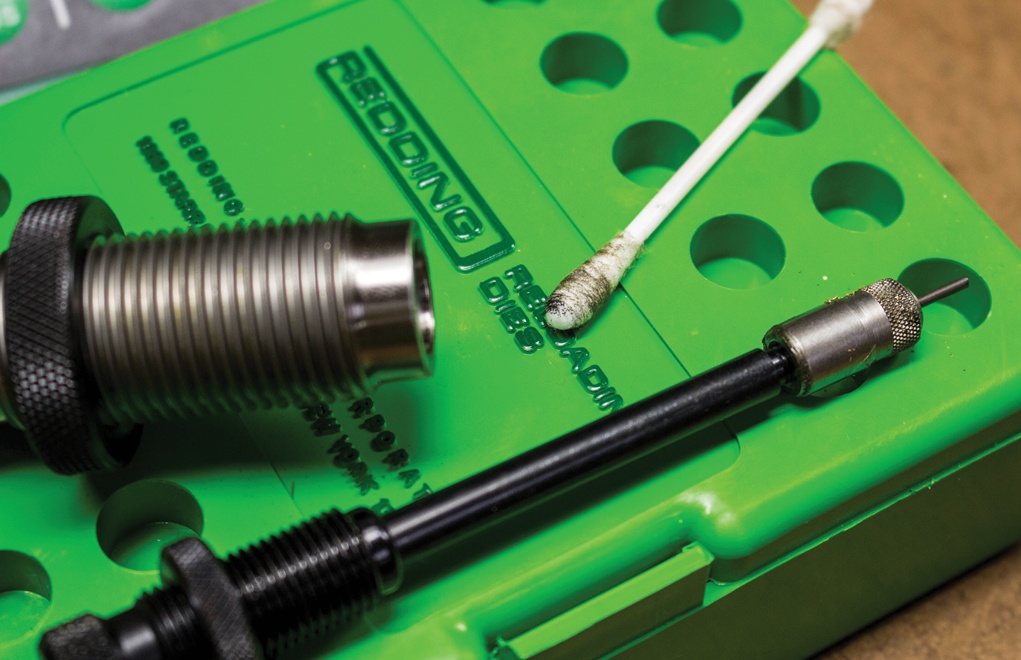
Cleaning a reloading die isn’t exactly a difficult process. I like to disassemble the die, as far as I can, for cleaning. I want to remove any foreign materials, and I want to take any and all residue out of the die. You can do this with a bottle brush and some solvent, or even a rag twisted into the die, but I prefer a two-stage cleaning method.
Redding’s new Premium Die Set for pistol cartridges is a perfect choice for the progressive presses; the proprietary coating on the resizing die keeps things much cleaner.
I like to use a rag or cotton swab to get the majority of the gunk out of the die body, and to remove any loose material from the rod and expander ball. Then, I give the parts a good bath in an ultrasonic cleaner; you’d be shocked as to how much material will come out of a die that you’ve just cleaned with a rag or brush. The same goes for the shell holders: The little crevices can build up that gooey mixture that has actually made placing a cartridge into them a difficulty.
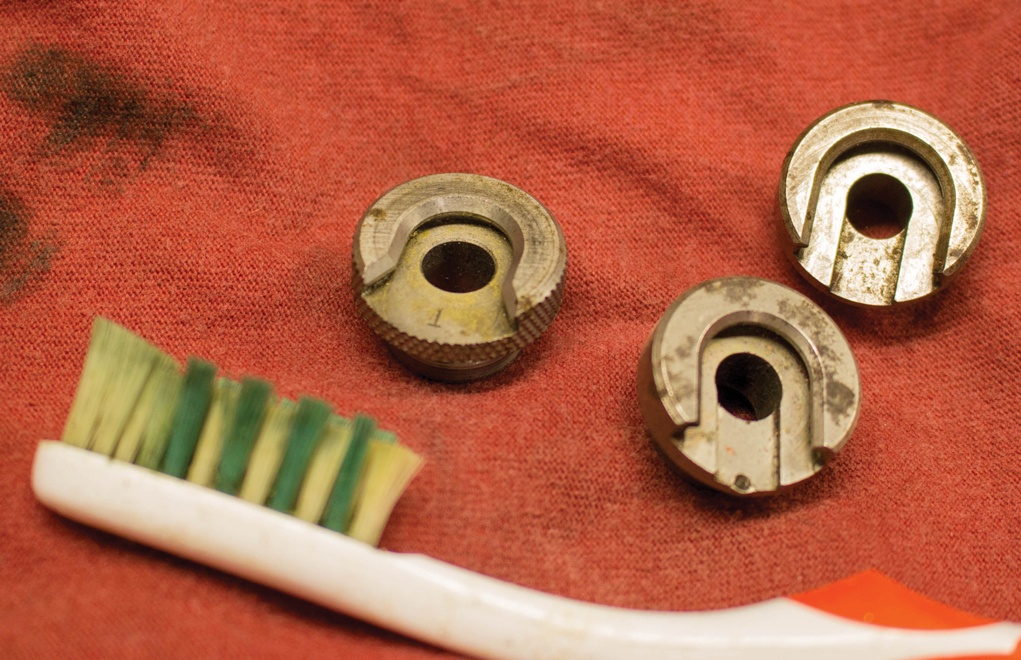
I use a toothbrush to give the textured expander balls a good scrubbing, and then I start the drying and reassembly. If it’s summertime, I’ll set the dies in the hot sun to fully dry, and then reassemble, using a light gun oil to coat them, wiping off any excess. In the winter, I’ll put the dies on the heat grate to dry. Both get the job done, but I want all of the liquid solution to evaporate thoroughly.
I keep a dummy round for each bullet I use in a particular caliber, with the bullet seated to the exact depth I use. This allows me to reassemble the dies and get the seating plug very close to where it needs to be by setting it to the dummy’s length. I generally don’t move the lock rings — especially if the die is set up for roll crimping — unless things have gotten very rusty.
Rust is a problem if things are left for a while, or, if you’re like me, the salt in your hands nearly melts steel. Seriously, I can wear the bluing off a rifle on a 10-day safari, and my hands have the same effect on steel reloading dies and press parts. I save the little silica gel packs to place in the die boxes — you can find them in beef jerky packets and shoe boxes — to keep as much moisture away from my dies as possible. To keep them rust-free, I like the Hoppe’s Gun Medic cleaner/lubricant in the spray can; it’s not as sticky as RemOil, and it spreads easily. I use it on the dies and presses alike.
Stop The Presses!
Brass chips, lubricant and other gunk builds up inside your reloading dies, and it needs to be removed regularly to maintain proper and precise function.
Speaking of presses, I like to give them a good cleaning every now and again. The threads are definitely a place where gunk and goo can and will accumulate, and I like to take some solvent and a toothbrush to get in there and give them a good scrubbing. There’s no sense in taking all the time to clean the die bodies (and their threads as well) just to screw them into a set of grimy threads on the press.
My favorite press, the Redding T7 turret press, has more moving parts than most of the single-stage presses, and I like to clean and re-lubricate it from time to time. It requires a bit of disassembly, but I feel better once all the grime is removed from the rotating head. I like to degrease all the hinge points of a press with some good old brake cleaner, and I give it a shot of the Hoppe’s Gun Medic, or even better some M-Pro 7 gun oil (that stuff is great) to lubricate the hinges.
Polished Brass
To minimize the amount of residue and debris, I clean and polish my brass before I resize it, removing as much of the powder residue as possible before introducing the cases into the resizing die. I also use a soft, clean cotton rag to wipe off as much of the lubricant as possible after sizing. If I need to trim the cases, I use a good case brush to remove as much of the lubricant as possible, thereby keeping the seating die as clean as possible.
Even shell holders can build up residue and debris, and they will rust from being handled often. A good scrubbing with an old toothbrush and light lubrication will keep them in good shape.
It may be a small factor in the overall accuracy and consistency of your ammunition, but regular cleaning extends the life of your gear, and that’s always a good thing. While I’m nowhere near as meticulous in cleaning my truck — or any other faction of life, at least according to the Mrs. — keeping my reloading gear clean is an important step in the process of developing the best ammo I can create.
Editor’s Note: This article originally appeared in the July 2018 issue of Gun Digest the Magazine.
Tests can contradict each other, so how do you go about figuring out what defensive handgun and ammo you should choose?
Parameters to make a defensive handgun choice:
Caliber adequate for defense
Concealable
Ample capacity
Accurate for your proficiency
Many organizations, agencies and even individuals have developed theories to rate the effectiveness of defensive handgun ammunition. Most of the results, though they seem definitive in nature, are contradictory. Here’s a brief snapshot of more than 100 years of speculation.
The search for the perfect defensive handgun load has spawned elaborate testing contraptions and procedures, all looking for the magic bullet that doesn’t exist.
In 1904, U.S. Army Captain John Thompson and Major Louis LaGarde shot live steers and dead humans to determine which cartridges were most effective. Julian Hatcher, a former Technical Editor at American Rifleman, based his theory of Relative Stopping Power on this study, concluding the .45 ACP twice as effective as a 9mm. In 1975, the National Institute of Justice finalized what they called the Relative Incapacitation Index, which was later updated in 1985. This study was based on hypothetical assumptions and a computer-generated man. The study rated the 9mm twice as effective as the .45 ACP.
After the shoot-out in Miami in 1986, the FBI began basing its ammunition opinions on bullets fired through various intermediate barriers and into 10-percent ordnance gelatin. The FBI’s conclusion was that the minimum acceptable penetration was 12 inches. This is how we ended up with the 40 S&W. The supposed bad bullet that prompted the FBI’s now legendary testing protocol, surprisingly performed very well in a 1987 test conducted by the Secret Service. It was based on a bullet’s ability to deposit energy in the first 5.9 inches of 20-percent ordnance gelatin. The supporting logic was the greater the energy deposit, the greater the potential for tissue damage.
In 1991, a privately funded research group began studying the physiological effects of bullet impact on medium-sized animals. The objective was to isolate the mechanism responsible for rapid incapacitation of man-sized targets. This event — though some contend it never really happened — became known as the Strasbourg Tests. Supposedly, more than 600 goats died during the experiment.
That same year, the Naval Weapons Support Center (NWSC) tested a bunch of 9mm loads. Along with terminal performance and reliability, accuracy was also evaluated. Unlike the FBI, the NWSC used 20-percent ordnance gelatin because the Wound Ballistics Lab at the Letterman Army Institute of Research determined it best simulated muscle tissue.
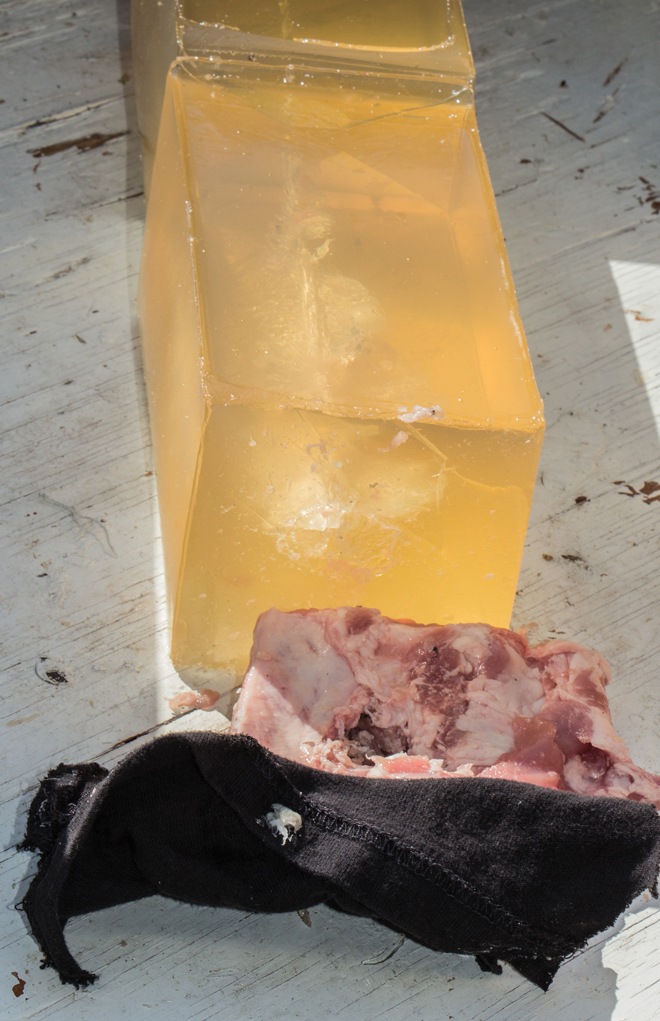
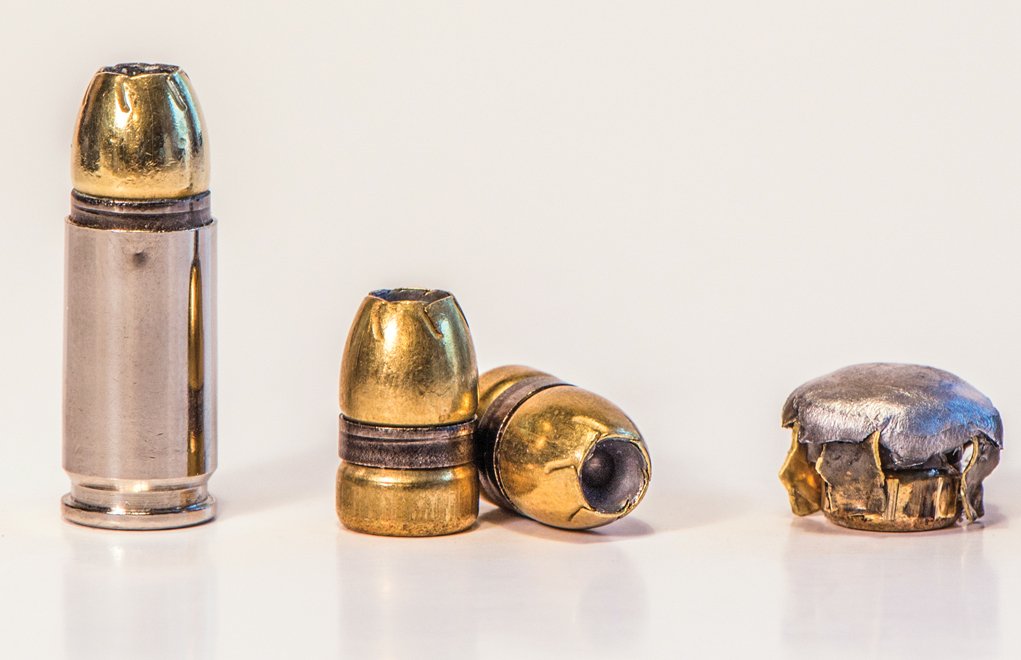
Conducting independent testing on your own is a good way to learn about terminal performance so you can make an educated decision when it comes to ammo selection.
All this illustrates is that nobody seems to agree on, well, hardly anything — at least when it comes to stopping bad guys with handguns. The problem is, humans cannot resist the urge to rate everything from football teams to members of the opposite sex with numbers. College basketball fans know how effective the numerical rating systems are; just this year a 16th ranked team beat a No. 1 for the first time in playoff history. Similarly, there’s very little consensus on whether Britney Spears is a 5, 8 or maybe an 11. A shooting is a chaotic event and numbers cannot value chaos. And, no matter the criteria, the bias of the evaluators always creeps in, and anomalies always exist.
Which study should you believe? Trust? What cartridge/load should you select? Do the research and conduct your own tests. I have, and I encourage it — not because you’ll discover a magic bullet, but because you’ll learn stuff. I have my theories, but guess what? They’re no more valid than others. Still, there’s nothing wrong with a practical approach, consistent with the doctrine I think best employed with almost everything in life: Keep it simple.
Though vastly underrated, Remington’s Black Belt ammunition performs very well — and it’s proved reliable in many handguns.
Here are three keep-it-simple rules for defensive handgun and ammunition selection:
Rule #1: Carry the largest caliber, highest-capacity handgun you can comfortably conceal on a daily basis.
Rule #2: Load it with flawlessly functioning ammunition, delivering high energy levels and deep penetration, for your cartridge of choice.
Rule #3: Prove you can consistently use that combination to put five shots, inside a 5-inch circle, from 5 yards, in less than 5 seconds.
I’m constantly asked what ammunition I trust in the handguns I carry. What might surprise you is that I’m not all that picky. For me, priority No. 1 is reliability. If it does not go bang every time, the most wicked cartridge, loaded with the most wicked bullet, will only result in one hell of a wicked let down.
Editor’s Note: This article originally appeared in the July 2018 issue of Gun Digest the Magazine.
The Kolar Arms Over/Under Shotgun is making waves in trap, sporting clays and skeet.
Kolar Shotgun Models
MAX Trap T/S
MAX Trap T/A
MAX Skeet
MAX Lite Sporting
MAX AAC All Around Combo
The Kolar Max Skeet over/under is the epitome of classy sporting shotguns today.
Kolar is a name in shotgunning that is not well-known to those outside the high stakes world of professional skeet shooting. But to those in the know, it’s the sporting scattergun to have if you want to compete against the best in the business. Kolar guns are entirely made right here in America — in Racine, Wisconsin, to be exact. But how did the Kolar over/under come about?
Don Mainland is the man behind the Kolar concept. In the 1960s, ‘70s and beyond, Mainland was making parts for the auto and aero industries to tolerances of +/- .003-inches — unheard of at the time. Pioneer Products (one of three companies he owns) had more than 50 parts on various space shuttles.
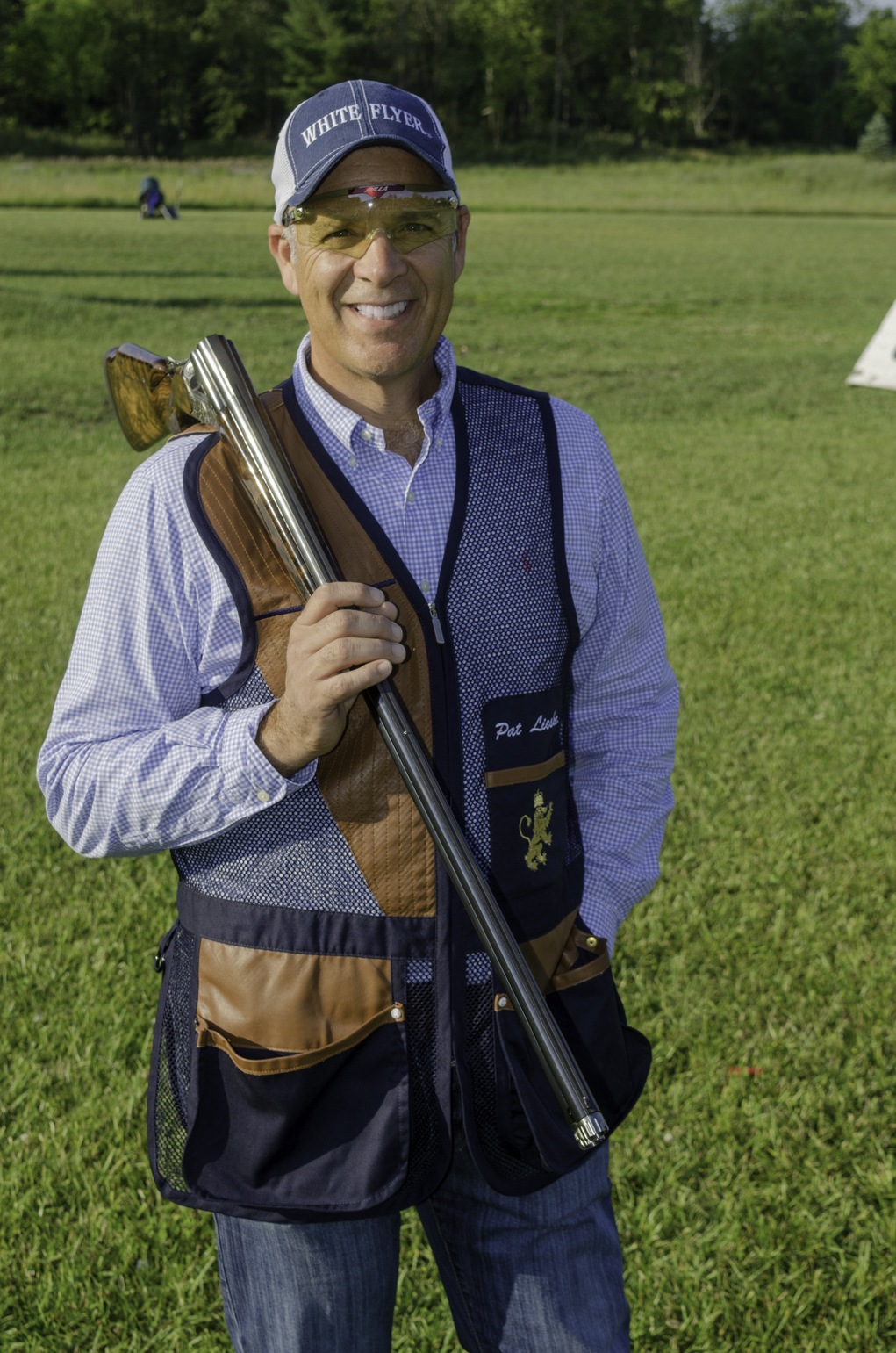
2015 National Sporting Clays Champion Pat Lieske.
Mainland was shooting a lot of skeet in the early 1980s with Ed Scherer and Debra Raschella, both Skeet Hall of Famers. For those who don’t know, skeet is a four-gauge game involving the 12-, 20-, 28- and .410-gauge shotgun. Leading up to the 1980s most competitors shot four-barrel sets with one 12-gauge receiver using interchangeable 12, 20, 28 and .410 over/under barrels, thus the term four-barrel set. But coming on strong by the early 1980s were “tube sets.”
These were light aluminum alloy full-length tubes precision fit to individual 12-gauge barrels. The tubes were tapped into place with a tight fit and had stainless-steel chambers (titanium chambers for lighter weight were later used).
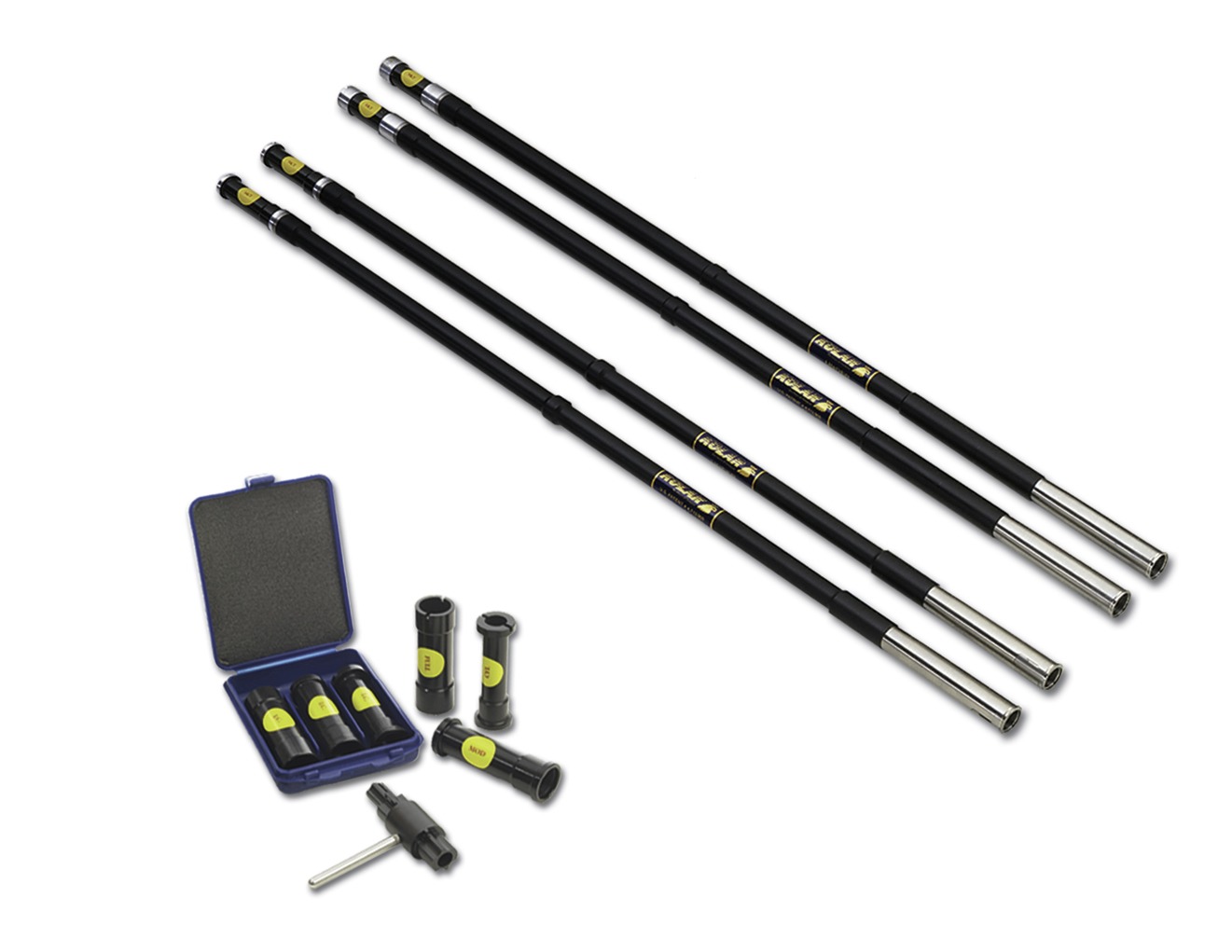
It was Ed Scherer who suggested Mainland meet with Larry Kolar. During that time Kolar was making skeet tubes under his own name and was initially reluctant to sell. But after Mainland visited for several days Kolar decided to sell his sub-gauge tubes. Today these are called Kolar Max Lite AAA Sub-Gauge Tubes.
Kolar AAA sub-gauge tubes allow shooters to compete in smaller gauge competitions.
Sometime around 1990, Remington Arms had an idea for a single-barrel trap gun that was eventually called the 90-T. Don Mainland made ten of these trap guns under contract with Remington. After extensive testing, Remington gave Mainland a contract to manufacture the 90-T. So, all Remington Model 90-T trap guns were made by Don Mainland’s company, not Remington.
Gun companies were very concerned about barrel blowups, which were often caused by overloads with reloaded shells. Mainland developed the technology to measure wall thickness the full length of the barrel. For the Remington 90-T, Mainland’s company rejected any barrel that was out of tolerance by +/- .003-inch wall thickness down the full length of the barrel. He told me that Remington did extensive testing trying to blow up 90-T barrels, but they couldn’t.
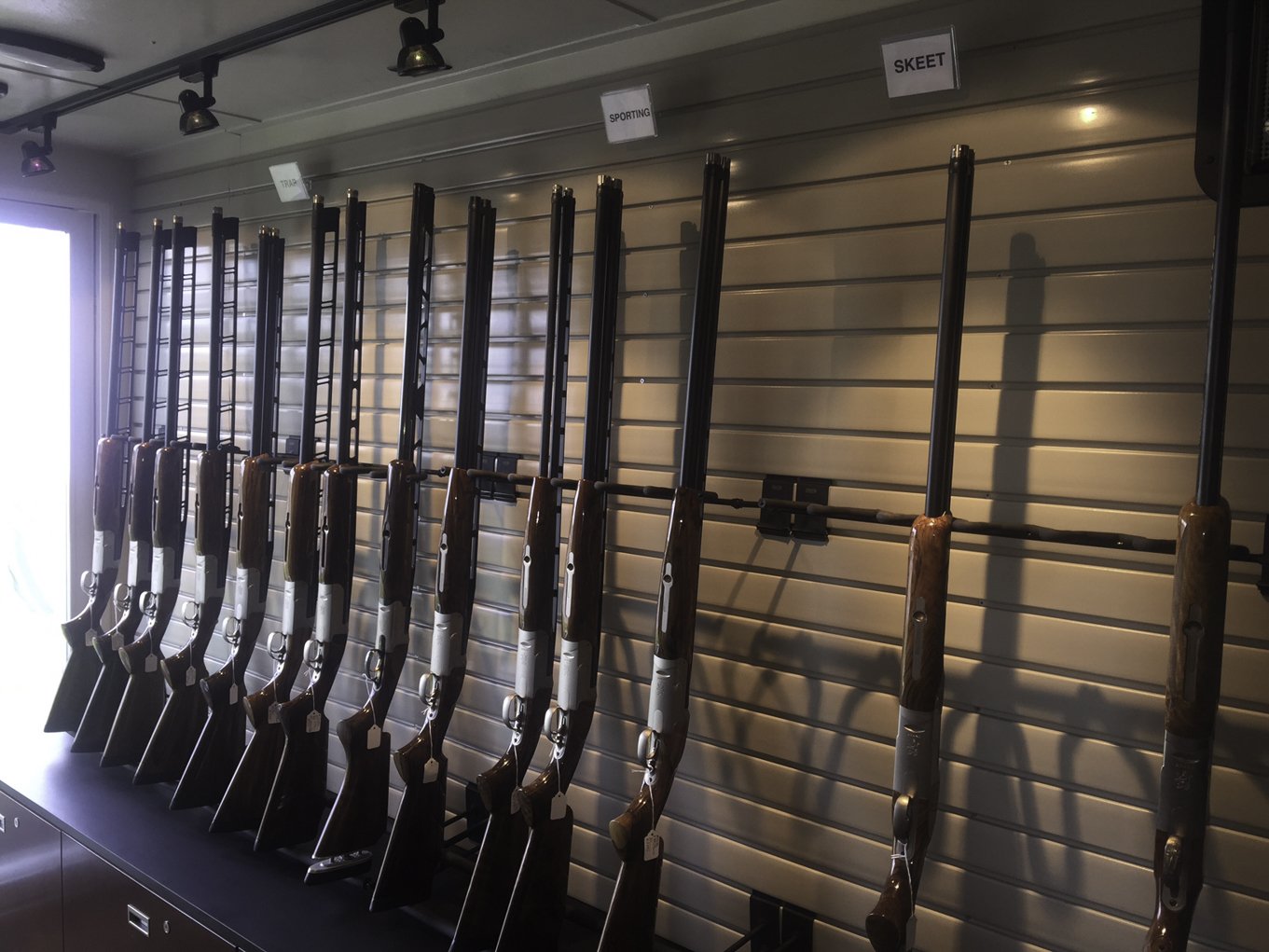
Inside the Elite Shotguns traveling mobile sales van, where many high-end Kolar shotguns are on display and for sale.
Remington was going through a sale of the company when it came time to renew the contract for more model 90-T trap guns. Perhaps because of the impending sale Remington did not want to renew the contract for additional 90-T single-barrel shotguns. So, what was Mainland to do with the tooling he had set up to make this Remington trap gun?
He made a few starts trying to make over/under shotguns for at least one other manufacturer, but then he got the backing, in the way of orders, to come up with his own Kolar shotgun — the gun originally named the Kolar Competition — and the first orders came from Hal DuPont and Robert Paxton, both very well-known names in clay target competition. Later in this article Paxton gives more insight into how the Kolar gun got started.
In coming up with the design of the Kolar, Mainland already had the concept and technology to make barrels of consistent wall thickness, i.e. no thin areas. He also looked at areas that had failed in other competition shotguns, even if those failures took hundreds of thousands of rounds before occurring.
Mainland redesigned these parts, made them stronger, removed sharp corners and more. He also beefed up the sides of his new receiver, adding more strength. As Mainland put it to me, “I overbuild everything.”
The Kolar triggers went through three generations of design. Some of the trigger design changes were to ensure the gun wouldn’t fan fire. The latest triggers were also designed so they could quickly be changed back and forth between pull and release. Release triggers are of great importance to trap shooters.
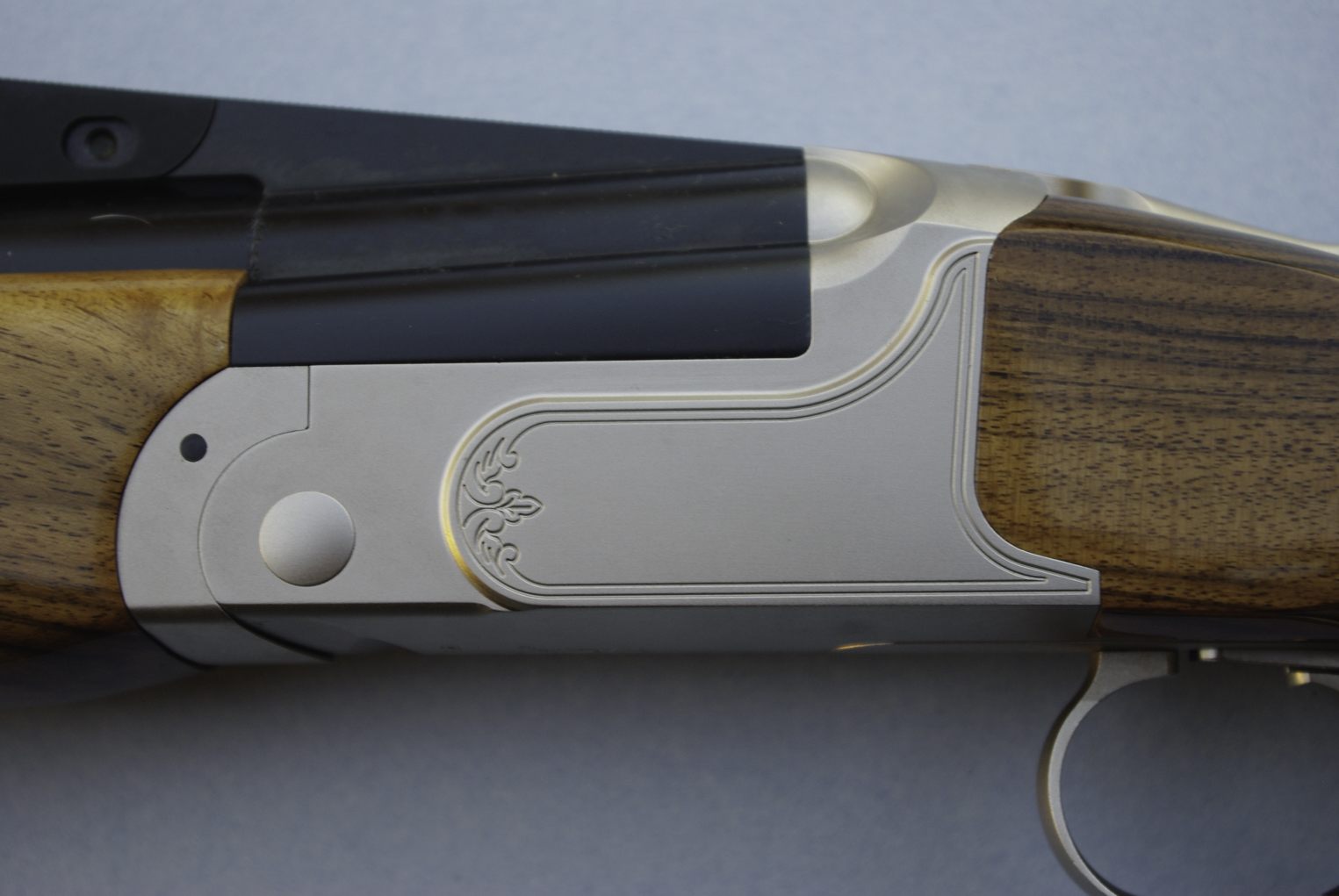
The look of the standard-grade Kolar receiver with nickel finish.
Mainland also designed the Kolar O/U so it would be easy to work on. No complicated tools were required by a gunsmith other than those virtually all gunsmiths had on hand. This is not true of many other shotgun receivers.
Enter John Ramagli, who came along during the early years of Kolar gun production. Ramagli was particularly interested in .410 patterns. He used Mainland’s indoor range for seemingly endless experiments.
Ramagli described those experiments. “In those years, used .410 Remington semi-auto 1100 barrels could be bought for as little as $50. I’d take them to Kolar’s indoor patterning range and start cutting barrel muzzles back a small amount at a time, thus reducing the choke trying to see if I could improve .410 patterns. I also painstakingly polished chokes, thus polished away some more choke … to see if I could improve those .410 patterns. But my results were sketchy.
“Next, I started overboring those Remington 1100 .410 barrels from .410 to .412 to .415, to even .420. It was overboring that improved my .410 patterns. This was the technology that we began building into our .410 sub-gauge tubes. Eventually, we overbored all our sub-gauge tubes.”
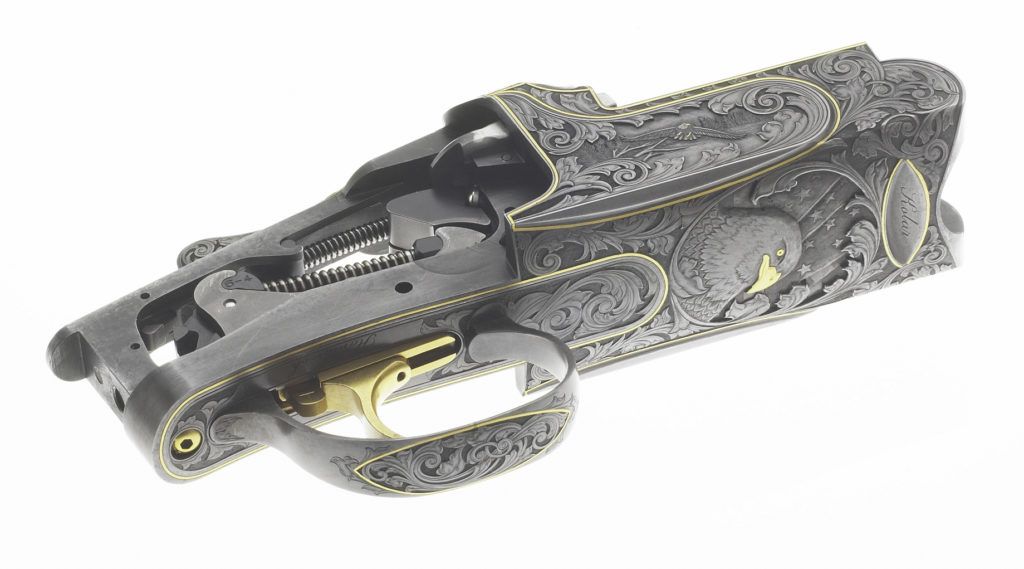
A highly engraved Kolar receiver — beautiful and functional.
Back to chokes. Another thing Ramagli discovered with his choke experiments was that a conical shape worked best in sub-gauge tubes. Most of us have always assumed that a parallel/taper was the best way to build a choke. After all, the latter way is more time-consuming and expensive, so it should be better. Not so according to Ramagli’s experiments.
If discovering the benefits of overboring was the first bonus Ramagli brought to Kolar, it wasn’t the last. He invested in the company and is now President of the company. As Don Mainland had been the guiding and shining light behind the Kolar gun concept, Ramagli was getting ready to take the gun to new heights.
“Shooters are going to see more innovation at Kolar in the next 10 years than they have in our previous 10 years,” Ramagli said.
Kolar over/under sales started only with Hal DuPont and “K Guns” and Robert Paxton with Paxton Arms near Dallas, Texas. After a few years, Ramagli spread sales of the Kolar to several other high-end dealers, but his current financial plan has been to reduce the number of gun shops that sell it to a select few.
Robert Paxton is still on, big time, as is Pat Lieske with the Bald Mountain and Island Lake Shooting Centers in Michigan, the Indiana Gun Club with Phil Baker and their mobile sales units manned by John Harden, and now the joint venture between Dan Lewis on the West Coast, Murry Gerber’s Elite Shotguns in Pennsylvania, and mobile sales units manned by Aaron Willoughby.
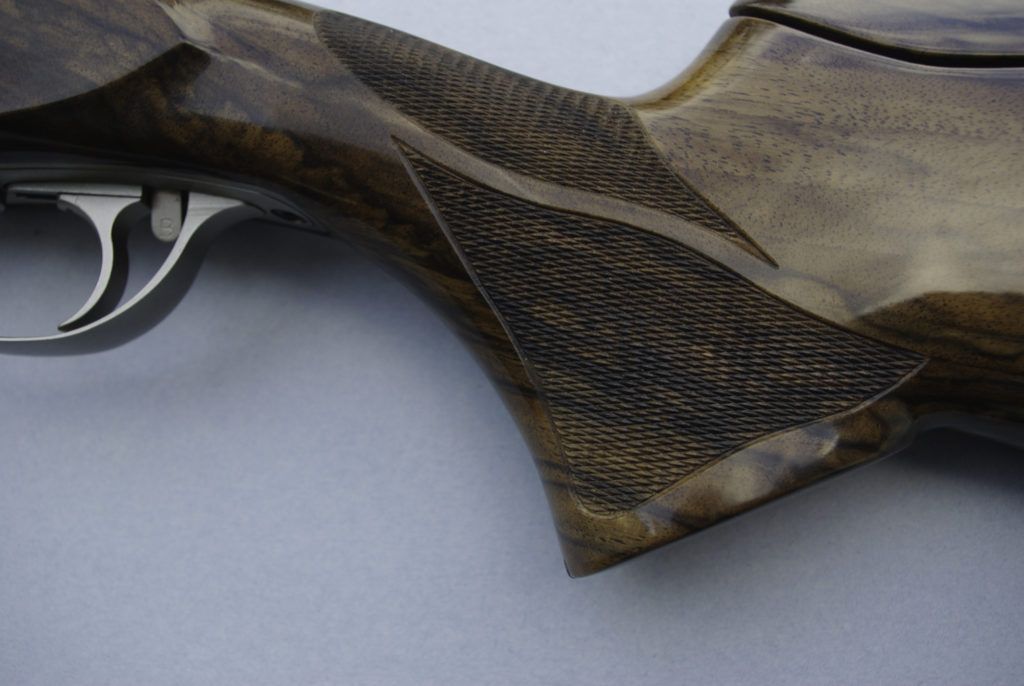
The typical high-quality checkering pattern on the Kolar Max.
What shot the Kolar over/under through the figurative roof in popularity is not only the company’s financial plan, but also its shooters. And Kolar relies heavily on these shooters (as well as regular Kolar customers) for input on how to make the Kolar O/U better. In the skeet realm it has been mainly Paul Giambrone III. He not only shoots a Kolar and has for years, but also has provided suggestions for the current Kolar Max Lite Skeet model. Guys like Giambrone don’t suggest major changes, but the little tweaks are what make great guns better. For close to 10 years, Giambrone has been just about unbeatable on skeet’s biggest stages.
For trap input, Ramagli relied heavily on All-American Ricky Marshall (now an employee) and other All-American trap shooters. While the Max Trap is still available with an adjustable rib, with Marshall’s input (and other trap shooters) the Kolar has recently reintroduced the fixed rib — both a standard and an elevated one. Other subtle changes have gone into the current Kolar trap model.
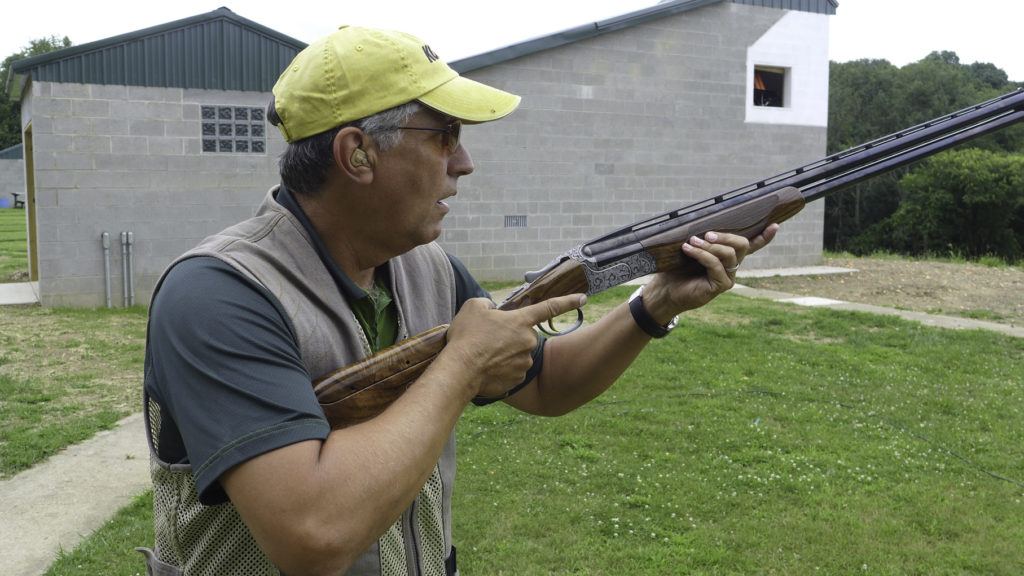
Similarly, Kolar has listened to their customers and professional team members to tweak the shotgun for sporting clays. One result: the Max Lite Sporter. This input came from shooters like Doug Fuller, who won the National Sporting Clays Championship in 2000; Pat Lieske, who won the National Sporting Clays Championship in 2015 and the National F.I.T.A.S.C. Championship in 2015; and Derrick Mein, who won the National Sporting Clays Championship in 2017 and the 2016 World F.I.T.A.S.C. Championship in Italy.
Murry Gerber of Elite Shotguns.
Another aspect that keeps the Kolar models ahead of the competition is the wood. “Dollar for dollar we put on the best walnut of any gun in the industry,” Ramagli said. “We know our shooters love a great piece of wood on their gun, and we go overboard to produce for them. Great wood is not easy to find. I’ve spent two decades contacting the best wood producers.”
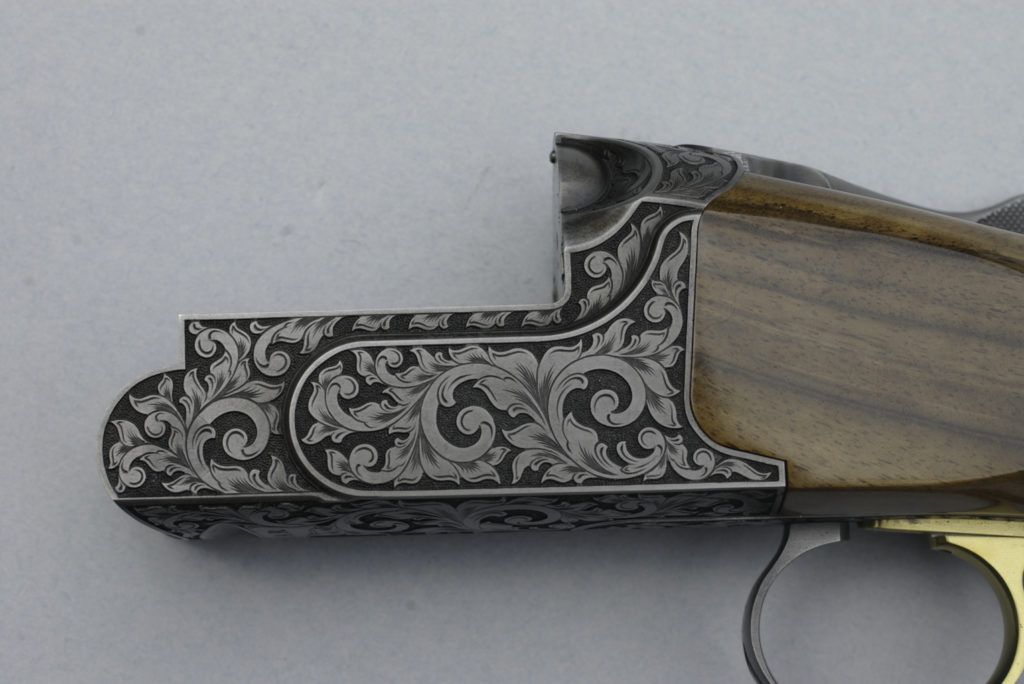
In addition to superb wood stocks, the company is also putting more and more emphasis on engraved guns. The Standard model is engraved (with either a blued or nickeled receiver), but an increasing number wear significant engraving that pushes price tags to well over $100,000. These high-grade Kolars are selling about as fast as engravers can turn them out, according to Ramagli.
The lockup system of the Kolar is super strong, with two lugs protruding from the sides of the inside of the receiver that fit into two recesses milled into either side of the barrels upon closing the gun. Barrels pivot on trunnions. Receiver wall thickness is wider than most at .329 inch. When Ramagli started with Kolar he wanted a lighter receiver. Mainland was dead set against doing that. These days, Ramagli admits Mainland was right. Other over/under manufacturers have redesigned their receivers similarly.
“The receiver is the key to virtually everything about the Kolar,” Ramagli explains. “Strength is only the beginning. The gun stays in balance whether we hang 30- or 32-inch barrels on that receiver. However, most importantly, it’s how easy the receiver is to take apart, repair and put back together. That’s Don Mainland’s genius. Virtually every gun that comes in for service goes out the same or next day. They are that easy to take apart, that easy to service. And no special tools are needed to undress a Kolar receiver. “Recently a very low serial number Kolar came in — I think #244. It was bought by a trap shooter in 1996. Reportedly, he had shot over two million rounds through the gun. It had never been to Racine for any service! That says a lot about how well these guns are built,” he said.
“I’m so proud to have been a part of this Kolar story,” he continued. “The success certainly has not been all my doing. The sales team that’s now assembled with Robert Paxton, Pat Lieske, Phil Baker, Murry Gerber and Dan Lewis — we’re going to be around for a long, long time.”
To get more of the Kolar story, I next spoke with Jeff Mainland (Don’s son) and Jeff’s son, Sean.
Another engraving style offered on the Kolar Max series.
Jeff Mainland, President of US Competition Arms, Inc. (the company is the affiliated entity that produces the Kolar), explained that Kolar barrels have gone through a few changes over the years. Input from shooters advised that original barrels were a bit heavy. Jeff attacked this issue first by overboring the barrels — first to .740 inner diameter, then to .750, then even more — to reduce weight.
Those significant inner bore dimensions were abandoned when it became evident that .740 inch offered the best patterns. Jeff and others worked on the technology to machine metal from the outer diameter of the barrels instead. The result is an even greater weight loss compared to boring metal from inside the barrels. Recall earlier how Don Mainland developed the technology to measure barrel thickness every few inches to ensure uniform thickness. The net result of reducing the outer diameter of the barrels was the removal of 8 to 10 ounces of barrel weight. Now the new Kolar guns became even more lively.
The further result was the introduction of three new guns — the current Max Lite Skeet, Max Lite Sporter and Max Lite Trap. These three guns are the current state-of-the-art from Kolar, and are winning big in serious competition. When it comes to new skeet guns sold, 99 percent are shipped with 30-inch barrels as well as the Kolar Max AAA Sub-Gauge Tubes. Most are sold with a low-profile adjustable rib and comb (all Kolar guns now come with an adjustable comb — save the ones that are individually fitted to a customer). All three models are stocked with a 14.75-inch length of pull (LOP).
As Jeff says, “Few shooters require a longer stock than that.” If necessary, reducing LOP is easy. All stocks come with a Monte Carlo step-down at the rear (see photo). This stock configuration reduces felt recoil as the gun tends to come straight back — not up into the face.
Full-length view of the Max Lite Sporter.
Four different stock configurations are available in the skeet, sporting and trap models, and left-handed stocks are offered as well. All stocks are crafted in-house via close-tolerance CNC machinery. Jeff has become a master stock fitter, and with many of the Kolar guns sold customers come into Racine for his special fitting. This takes all day. After considerable work fitting a customer, he uses CNC machines to mill small segments of the stock — always leaving a bit of extra wood. Final stock dimensions are completed by hand.
According to Jeff Mainland, one customer from Utah asked for trap guns that printed patterns 80 percent above the point of aim, then ordered additional Kolars that shot 100 percent above point of aim. More and more Kolar trap guns are going out the door with these two configurations. The idea behind the very high shooting guns is that the rising trap target is still in view when the trigger is pulled. With patterns printing 50/50 the bird is usually covered by the barrels, thus not seen when the trigger is pulled. According to him, Kolar has 20 different stock/rib choices for trap shooters.
Jeff’s son Sean came on at Kolar a few years ago. That makes three generations of Mainlands at the company. Sean is the one who attends many of the trap, sporting and skeet competitions. These events are attended to obtain shooter input that will make a great American-made competition gun even better.
What about the special distributors that sell Kolar competition guns? The first to come on board was the aforementioned Robert Paxton. Paxton is one of the most seasoned shotgunners to ever break clay. A many-time All-American and member of the Skeet Shooting Hall of Fame, Paxton’s introduction to Don Mainland came via phone. Mainland had ordered a competition over/under with a set of sub-gauge tubes. A few weeks later, he ordered another gun and set of tubes, then a third, fourth — perhaps a fifth set — all within only a four-month period. Paxton was thinking, “This is my best customer!”
Shooting the Kolar is an experience that is tough to put into words. There’s a reason why competition shooters are flocking to the brand. And new shooters, too.
Eventually, Paxton asked Mainland what he was doing with all those expensive guns and sub-gauge tube sets. Mainland was dissecting them, cutting them into small pieces trying to find out what made them tick, thus how to make his gun better. When Mainland bought Kolar Sub-Gauge Tubes, Paxton was the first on board to sell them.
Mainland made his first 12 prototype Kolar shotguns and gave them to a dozen serious shooters with the request they shoot them for two years and report back. Robert Paxton received #4 and, like the other field testers, shot that prototype for two years. Skeet-shooting legend Wayne Mayes also received one of the prototypes. From 1994 until his untimely death, Mayes shot the same Kolar O/U. In fact, Mayes was significantly involved with Mainland and Ramagli as an adviser.
“This is a great American story – not just a gun company story,” Robert Paxton began. “When Mainland retired from bicycle competition he was looking for something new to do. His successful companies already employed hundreds, thus he began making a shotgun — not out of profit motive but of a genuine love for the shotgun game. You can see that by his creating twelve prototypes and giving them to serious shooters to shoot for two years. He wasn’t about to rush into anything. He was taking his time!
“It has been great to work with not only an American gunmaking company, but to work with one of the finest companies anyone could work with. Kolar has always been about quality, not quantity.”
Phil Baker, another Kolar distributor, heads up the Indiana Gun Club where only shotgun shooting takes place — trap, skeet and sporting clays. But this club also has an extensive gun room where all the popular competition guns are displayed and sold. “The Kolar guns outsell any of the other high-end shotguns,” Baker said. “We sell mostly trap guns, but also sell our share of sporting and skeet guns.”
Baker also has a mobile sales unit run by John Hardin. The vehicle is filled with all the competition guns Baker sells at the Indiana Gun Club, with a special concentration on Kolar models. The mobile unit stays on the road visiting the bigger shoots — especially trap shoots — showing shooters the guns inside often with the offer to test fire them for a round or two. This traveling truck has been a very successful way for Phil Baker to market more of his shotguns.
Jerry Stillions’ highly engraved Kolar Max Lite Skeet. Stillions spent a full day at the Racine, Wisconsin, factory to have Jeff Mainland do a custom gun fitting. When you order a Kolar, it will fit you like a glove.
Pat Lieske has two gun ranges — Island Lake Shooting Range just north of Ann Arbor, and Bald Mountain Shooting Range near Detroit. His gun shop is in Bald Mountain. Both clubs offer sporting clays, trap, skeet, 5-stand and rifle and pistol ranges. Lieske is no stranger to clay target shooting. Previously a many-time skeet All-American and multiple skeet champion, Lieske found sporting clays some years ago and, evidently, has never looked back. Some of his wins have been highlighted previously. He negotiated with John Ramagli to become a Kolar dealer. No doubt winning the National Championship with a new Max Lite Sporter sealed that deal.
Actually, Lieske shot a Kolar years before when barrels were a bit heavier, but he told me the new Max Lite Sporter was a significant improvement. “The balance, dynamics and lack of recoil put this current Kolar Sporter in a class by itself,” he said. Lieske hasn’t been the first person I’ve talked with who is adamant about the Kolar’s lack of recoil.
He now shoots a low gun at sporting clays unless the targets being presented suggest a mounted gun. “When shooting low gun, the balance and dynamics of a shotgun are even more important than when shooting a mounted gun. Here again the new Kolar shines.”
He also told me that both he and his customers like dealing with a company that makes its guns right here in America. “Further, this is the only gun ever designed from the beginning to accommodate sub-gauge tubes. Small-gauge sporting competition is becoming more important, so the gun’s design for 12-gauge and sub-gauges again set the Kolar apart.”
Murry Gerber started Elite Shotguns, based north of Pittsburgh, five years ago. In a short time, he and his staff of only two have experienced a meteoric rise in shotgun sales, especially Kolars. When Gerber was starting his gun shop he had several choices for a high-end clay target over/under. He and his partners researched the possibilities and found Kolar was an American company. The fact that Kolar guns were made in America made the decision for them. But how to convince Kolar to have Elite become a distributor?
A CNC milling machine is used to rough out the shape of all Kolar stocks prior to extensive handwork and application of the finish.
Gerber and partner Don Watt flew to Racine after they had set up a meeting with John Ramagli. In addition to promising to place a significant order with Kolar, Ramagli wanted more and Gerber wanted to give more. Elite was adamant about giving customers exceptional service. Elite also committed to support clay target tournaments.
Regarding those promised tournaments, Elite became a sponsor of what had been the Great Eastern Skeet Championships. The last two years the tournament has been called the Elite Classic, so this relatively new company has made the commitment to support competitive shooting. But Elite has gone further, supporting such events as the World Skeet Shooting Championships, National Sporting Clays Championships, and the U.S. Open Championships in both sporting and skeet.
Unique in the world of clay target shooting, Elite is the driving force behind their Pro Shooters Weekend. During this springtime event, Kolar pro shooters are invited to Western Pennsylvania for a three-day shoot. For a small entry fee, participants get lessons from these pros in trap, sporting and skeet, including shells and targets. “This is a prime way of giving back to our customers,” said Gerber. “Once we sell them a great clay target gun we want them to use it most effectively.”
Paul Giambrone III, longtime Kolar champion skeet shooter and advisor.
“This is clearly a world-class product,” said Gerber. “More and more shooters are seeing the gun’s advantages and switching to it. When customers come to us with a problem, Kolar has been so cooperative. Their customer service is exceptional, and customer service is a main reason our company was started.”
Two years ago, Elite Shotguns teamed up with Dan Lewis, who is based in California. Lewis had become the top Kolar distributor in the Western U.S., and Elite was the leading sales shop in the East. Since then, the two have purchased space on Industry Row at the National Gun Club in San Antonio, another venue to sell their shotguns.
Your ammo choice is more important than what you attach to your quad rail.
Considerations to find the best AR-15 ammo:
Chambering
Ramp Type
Case Material
Twist Rate
Bullet Style
Choosing ammunition for your AR is as important as every other gear consideration. You have to feed the machine in order for it to function properly — and “properly” starts with reliability. Accuracy, which becomes more critical as distance increases, is another consideration. For defeating a violent attacker, the round has to stop the threat as efficiently as possible. And let’s face it: The AR fires a small round, and the smaller the round, the more critical ammunition becomes.
Loading For Reliability
Choosing ammo starts with identifying how your AR-15 is configured. Start by determining what chamber your AR has. There are three type chambers you’ll come across — discounting aftermarket variations like the .300, 6.8 and 7.62 versions. AR-15s come with a .223 Rem. chamber, a 5.56 NATO chamber and the .223 Wylde chamber, and they’re all slightly different.
You can fire .223 Rem. ammo in the 5.56 and Wylde chamber. And, 5.56 ammo can be used in a Wylde chamber. But never shoot 5.56 ammo through a .223 Rem. chamber. Chamber size is usually stamped in the barrel, along with twist rate, but if you’re unsure, contact the manufacturer to confirm.
What type feed ramps does your AR have? The feed ramps are located at the end of the barrel extension and guide the bullet into the chamber. Older ARs usually have “rifle” ramps that don’t extend down into the upper receiver.
Newer ARs have M4 ramps. These are cuts machined in the upper receiver that lengthens the ramps to ensure feeding of longer bullets into the chamber. With M4 ramps, there shouldn’t be any problem with any bullet type you choose to shoot. Some older rifle ramps, however, will have problems with different types of bullet tips, such as soft points. Just be sure to test fire enough ammo to ensure it feeds in your weapon — every time.
In addition, I use brass-case ammo almost exclusively. The AR was not designed to cycle steel-case ammo, so if you choose to shoot it, you’ll need to keep an eye on a few things: Clean the barrel and chamber more often.
The receiver on the left is cut for M4 feed ramps. This provides a smoother transition for the round to feed from the magazine into the chamber. At right, the receiver is a “rifle” receiver, or older-style AR. This design can cause feeding problems with some types of ammo.
Steel doesn’t expand as much or as fast as brass, so there’s more blowback of powder residue and carbon into the chamber. And if the chamber becomes too tight due to residue, cases start sticking. This is especially true if you switch to brass-case ammo after shooting a lot of steel-case rounds. Steel is also rougher on the extractor than brass, so inspect it and the extractor spring regularly, which you should do anyway.
Most steel-case ammo is loaded with a bullet featuring a steel jacket with some sort of thin copper coating over the steel. There’s a big debate on whether steel-jacketed bullets are harmful to the barrel or not. I think they do harm the barrel. An average shooter may not have a problem, but a full-time shooter will shorten their barrel life by about 50 percent, from around 10,000 rounds down to 5,000 or so.
During classes, I see more function problems with steel ammo than with brass rounds because steel-case ammo can cause additional feeding problems by binding up in the magazine — it’s not very slippery. My advice: If you’re spending a lot of time and money on a shooting trip, take brass-case, high-quality ammo. And no matter what, always test-fire enough of any ammo to make sure it functions properly in your gun.
After you’ve selected a round, you’ll need to test-fire it for function. When you’re at the range, inspect each round prior to loading it in a mag. Ammo companies are running high production rates, and increased production means more faulty rounds. Physically and visually inspect each round before jamming it into your mag.
There’s no reason your AR should not be reliable. Keep it well lubed, clean as necessary and feed it the right ammo, and it will serve you well. If you try to run questionable ammunition through your gun, you’re going to see problems. For plinking on the range, this might not be an issue, although I can’t abide it. When shooting in a match, for hunting or for personal defense — life and death — a stoppage due to faulty ammo is unacceptable. Good ammo ensures you hit the target time after time.
Loading For Accuracy
There is a variety of ammo available for the AR. You can easily identify the type of tip the bullet has, but to know the rest of the details — including bullet style, weight and length — you’ll have to check the manufacturer’s specs.
The definition of accuracy is very subjective. For precision shooters, accuracy is hitting the target at hundreds of yards. For many military applications, it doesn’t really matter where you hit them, as long as you hit them — though precision is always best of course. A sniper needs pinpoint, surgical accuracy. For defensive purposes, things are going to be a lot closer, usually “handgun” distances. So, the question becomes, “How much accuracy do you need?” For self-defense, a round that will hold 1 to 2 minutes of angle is more than suitable.
One of the big considerations is the twist rate of your barrel. Heavier bullets, which are longer, require a faster twist rate. The original 55-grain M193 round worked well with a 1:12 twist rate. As bullets began to get heavier and longer, the twist rate increased. Today 1:7, 1:8 and 1:9 twist rates are the norm, and each will stabilize heavier, longer bullets that weigh 60 grains or more.
Loading For Self Defense
Manufacturers invest a lot of research and study into designing, testing and constructing a round for defensive purposes, and the various departments and agencies on the ground will research, study and test when choosing their duty ammo. Selecting ammunition for self-defense is just as serious.
Self-defense ammo must stop the threat efficiently, transferring its energy into the body. The better the round dumps its energy into the body, the less chance of over-penetrating and passing through the threat. I still like the original M193 55-grain full metal jacket round: It tumbles and fragments in the body, creating multiple wound channels. Just be careful when purchasing it. True M193 has an exposed lead base at the back of the bullet, hence the “explosive” results.
Due to environmental concerns, a lot of companies make a “M193” round, but with a copper jacket that covers the entire bullet — including the base — in order to reduce the shooter to lead exposure created by that round as it’s fired. This completely changes the dynamics of the round, and it doesn’t perform the same as the exposed-base design.
Accuracy is subjective. What might work fine for self-defense may not provide the accuracy necessary to place a surgical shot at 100 yards. Think about your application, then don’t get too caught up in how tight a group your AR can shoot. Most of them shoot much better than we’re capable of as shooters.
Steel-case “ball” ammo should never be used for self-defense, unless it’s “the end of the world as we know it” and that’s all you have. Steel-jacketed rounds punch right through the threat, doing little damage — and over penetration is also a major concern. The same is true of M855 “green-tip” penetrator ammo. I’m also not a fan of soft-point rounds. Often, these will not deform, expand or tumble, leading to over penetration.
Matt Weathers, Chief of Alabama’s Conservation Officers, issues his officers a 55-grain hollow-point round. He has personally had to shoot over three hundred deer in his career — putting down severely injured deer and for fetal research — with the .223/5.56 AR. This field research has shown that the 55-grain hollow-point performs best, with little chance of over penetration. For interior work, such as personal defense in the home, a 40-something-grain hollow-point reduces the chances of over penetration even more.
Remember the research that departments and agencies put into choosing a duty round? Their concerns are the same as yours (military matters are completely different.) This might mean the ammunition they use is a good candidate for you, too.
Final Thoughts
The ammo you choose is dictated by what you’re shooting at. Make sure the ammo fits the application — taking into account chamber size and barrel twist. Then, test for function to ensure reliability and accuracy. And then practice. After all, the purpose of shooting is to hit, and hitting the target depends on your skill.
Modern Shooter gets a first-hand look at firearms training taken to the next level.
This isn’t your everyday defensive shooting class — not by a long shot.
Specializing in tactical training, Houston-based MAST Solutions’ courses are akin to boot camp at Paris Island, with potentially as many superlatives. Physically and mentally challenging, the advanced weapons training steeps its students in more than simply the art and science of modern combat. It breaks down and rebuilds its pupils, forming a knife’s edge, ready to operate at the highest level under the most demanding circumstances. And it boasts the personnel to get this job done.
One such example, Ray “Cash” Care. A former Navy SEAL, the MAST instructor knows about the next level — he’s lived there most of his professional career. Through some pretty unorthodox methods, Care hollers and challenges his students to do the same, pushing them to the brink until the beg to go over. Extreme it may be, but it serves a purpose.
Beyond honing everyday armed citizens, MAST counts the U.S. Military, Homeland Security, Border Patrol, DEA and various SWAT teams among their clients. High-level operators require high-level training. And at MAST the focus far exceeds mere firearms. Hand-to-hand combat, knife combat, CQB, fitness, emergency medical procedure and leadership are all part of the curriculum. Be you professional or citizen, MAST strives to teach you how to tap into you’re A-game.
Catch more of this extreme form of firearms training on the next episode of Modern shooter, 10 p.m. EST Friday on the Pursuit Channel. The episode rebroadcasts Monday at 12 p.m. EST and Tuesday at 11:30 a.m. EST.
The backbone of a concealed-carry system, don’t waste time on anything other than quality gun belts.
What to look for in quality gun belts:
Quaily leather or synthetic material
Ability to hold holster and gun in place
Comfortable to wear throughout the day
Lightweight
Resistant to stretch
Gun belts don’t get the respect they deserve. All the glory goes to that top-notch pistol you spent weeks if not months poring over, nailing down every pertinent particular. It goes to the ultra-concealable, not to mention comfortable, holster that took forever to find and now feels like a second thought. It even goes to the defensive ammo you researched and test shot and compared against a litany of other viable options.
Bigfoot Gun Belt Leather Gun Belt
When it comes to a belt, typically, there isn’t any enthusiasm left. Any old one will do, right? Maybe, you can save a buck, passing off your everyday dress one for a while.
If this sounds comparable to your experience, don’t feel alone. Perhaps no other concealed-carry accessory is more overlooked by newly minted armed citizens. Yet, perhaps no other single piece of gear plays a more important role in ensuring a successful concealed-carry system.
Get it right and a gun belt enhances every aspect of carrying a defensive handgun. Choose wrong or ignore it all together and it will leave you dragging.
What Gun Belts Do
Feel the middle of your back. Unless you’re a jellyfish or sea slug, you ran your fingers over that familiar vertical stack of 33 bones known as your spinal column. It’s the support system that makes walking, running, sitting, lifting objects and nearly any other activity consider human — or mammalian for that matter — possible. Pretty important, to say the least.
Crossbreed Crossover Gun Belt
A quality gun belt plays a similar role. It’s fair to consider it the backbone of your carry system. All other aspects of how you carry and how well you do it branch off this simple strap around your waist, so you’d better know what your getting when you go to buy.
Similar to any accessory, gun belt makers promise all sorts of benefits to their product. The intricacies shouldn’t be ignored, but any quality gun belt should be capable of the following:
Hold a pistol and holster in place
Distribute the weight of gear
Resist stretching over time
Aid in concealing a handgun
Prevent a gun drop
Enhance the ability to access a firearm
Additionally, a gun belt should be comfortable, because you’ll curse the day you bought it if it isn’t. And it won’t hurt if it looks good. A minor point, but stylish gun belt options abound today, so might as well take advantage of them.
How A Gun Belt Does Its Job
Hang a gun off your dress belt and almost immediately you’ll see a couple things happen. Right off the bat, it will likely twist, jutting the gun’s grip away from your body. And it will probably transfer a great amount of the pistol’s weight to your britches, inevitably making them slouch like a high school freshman. Neither is ideal, making concealment difficult and a clean draw more like a comedy routine.
Hank’s Belts Gunner Freedom Belt
The simple reason why this is, the belt was designed to hold the weight of your pants, little else. Gun belts are devised for much greater loads, 20-ounces-plus of holster, pistol and perhaps extra magazines. And there’s little secret to how it accomplishes this feat —better material, more of it and, in many cases, reinforcement.
Leather Gun Belts
Top-notch gun belts are made from double-thick leather, stiff as an oak stave and, in heavy-duty models, wrapped around a solid core. In many cases, the core is Kydex, a strong yet flexible type of plastic, favored in holster making. But in the top-of-the-line variety, the reinforcing material is spring steel. The combination of this material, when properly constructed, a belt is malleable enough to comfortably serpentine around the waist, yet yields little to vertical pressure. Leather is by far the most common material available and options abound, including excellent examples from Bigfoot Gun Belts and Alien Gear. On the plus side, they’re extremely durable and typically sharp looking. But, over time some show surface wear where the belt contacts the holster loops.
Synthetic Gun Belts
Like leather gun belts, the synthetic variety get the majority of their strength from extra material. Thick nylon webbing provides support, but they are also available in reinforced models with a steel or synthetic cores to increase stiffness. Though tactical in appearance, thus perhaps not the three-piece-suit armed citizen’s cup of tea, synthetic gun belts tend to offer more comfort and flexibility. Not limited by pre-punched holes in most cases, the belts easily adjust to fit perfectly every time. Older models did have some wear issues, fraying at the tip after time. In recent years, companies have addressed the issue through the use of epoxies, such as with Galeco’s Instructor’s Belt, which virtually eliminates this unsightly erosion.
Gun Belt Considerations
Aside from a gun belt’s functionality and comfort, holster compatibility is of significant importance. If the two don’t play nice, well then you’re not going to get the most out of your system. In general, gun belts come in 1 ¼- to 1 ¾-inch width, so check your loop size before you buy.
Galco Instructors Belt
Size is also an extremely important consideration and sometimes a frustrating number to come up with, simply because how makers measure. Some start at the loop at which the buckle attaches, others at the end of the buckle. You should plan on legwork to eliminate guessing. Get on the gun belt makers’ websites or give them a call and find out how they want you to measure your size and proceed accordingly. They want to get it right as much as you do, so take advantage of their expertise.
Parting Shot
Concealed carry is greater than simply the gun, like good marksmanship is more than just front-sight focus, grip or trigger pull. It’s a system — from mindset to training to gear. And, inevitably, it’s only as strong as its weakest link. Given the wealth of options and superior modern construction, there’s no excuse to allow something as simple and vital as a gun belt to turn into the faulty linkage.
For more information on concealed carry holsters check out:
Ensure your AR is safe, secure and ready at a moment’s notice.
In terms of self-defense, an unloaded gun makes a dandy club, not much else. But does it always make sense to have one in the chamber, particularly when it comes to firearms that aren’t on your person continuously? Say an AR-style rifle.
One of the most popular options in home defense, AR-15s and M4-style carbines take consideration as to how they’ll be secured, yet kept at the ready. The bad news, there’s not a set-in-stone correct answer. Much of it depends on your lifestyle and living conditions, say if you have children or others in your household who might gain access to your guns. What mode they should be kept in the home takes a bit of consideration.
Breaking down nearly every potential condition – if that term can be loosely applied to a long gun — shooting instructor Ken Hackathorn gives shooter some valuable food for thought. The brass tacks of this conversation, how the gun is stored should reflect the state of readiness you deem necessary for your personal situation. For some that means a loaded magazine secured away from the rifle, others a fully chamber gun that simply requires a flick of the safety to be ready for action.
Obviously, this takes some forethought and reflection on what makes the most sense for you. It also requires being honest with yourself and accurately assessing your circumstances. Do these things and the answer should become self-evident.
For more information on Colt, please visit: www.colt.com
Looking to go armed, but are stuck in the weeds as to what to arm yourself with? Here are 20 of the best concealed carry gun options that will keep you on the defensive.