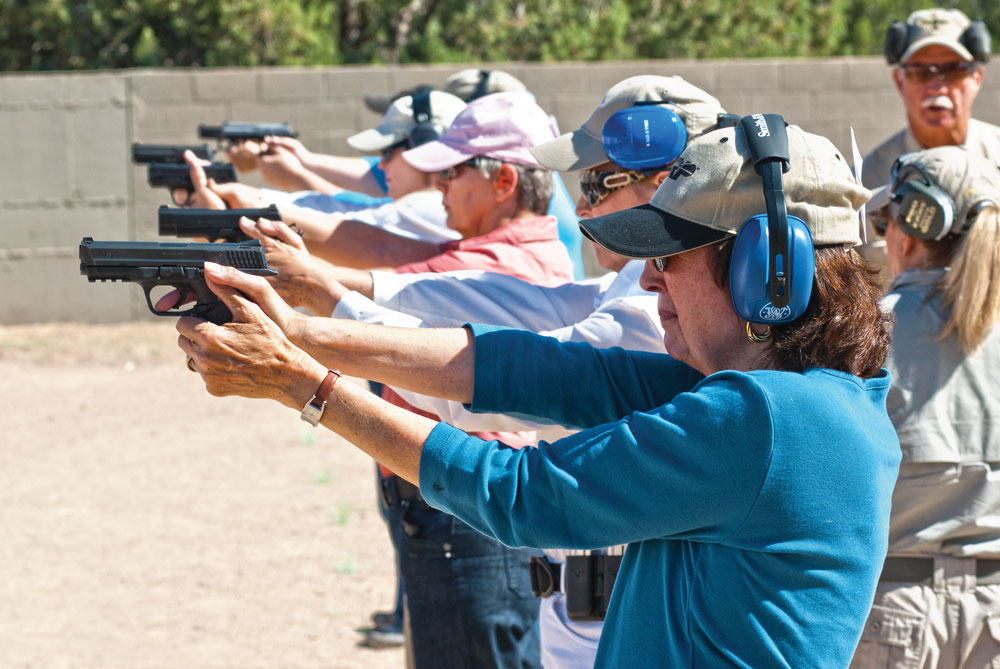
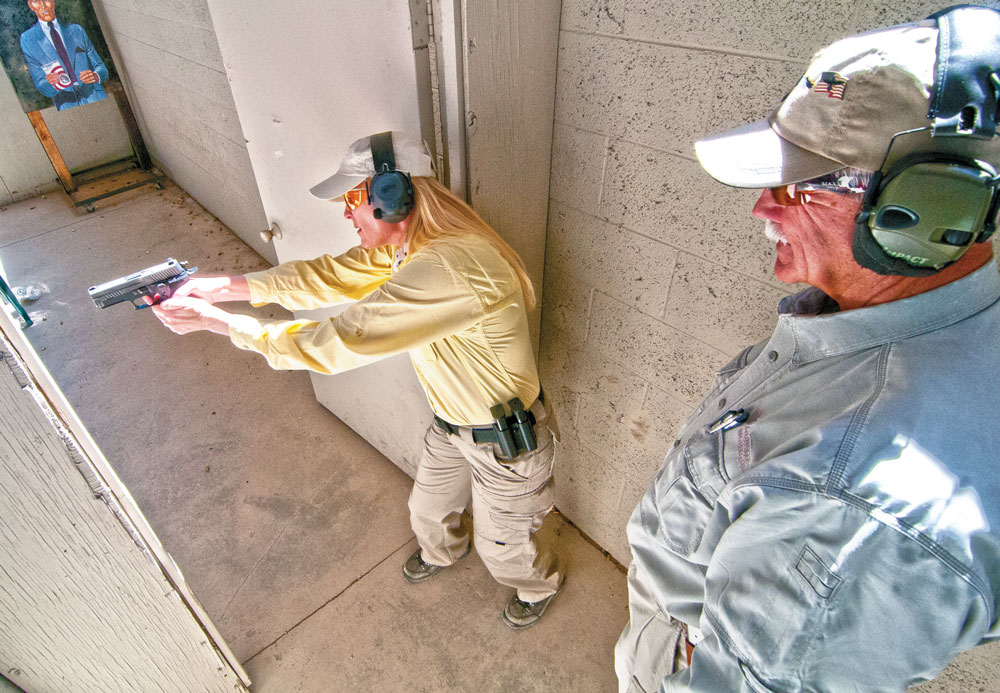
No single shooting stance is the best for a defensive situation. In turn, you must learn how to fight with your handgun no matter your position.
Why A Fundamental Shooting Stance Secondary In A Defensive Scenario:
Proper stance is impractical in many defensive situations.
You must be able to adapt to the circumstances at hand.
This may entail using many different stances or no fundamental stance at all.
It seems any and everyone associated with firearms training wants a technique or drill tied to their name. Some television/Internet trainers go to great efforts to talk trash about one stance in order to promote their own. This has been a common theme since Jeff Cooper codified the Weaver stance in his Modern Technique of the Pistol.
The Internet is rife with arguments about shooting stances, with proponents preaching the wonders of everything from the Weaver to a turtled-out isosceles. This leaves the average defensive handgunner wondering exactly how they should stand when they’re shooting their handgun.
The problem is that if you go to five different handgun training schools, you’ll learn at least five different stances—or at least five different variations of the same stance. Is everybody right? Are there really that many different ways to skin a cat?
The answer is actually very simple and complex at the same time: They are all right, and they are all wrong. There is no one best stance for shooting a defensive handgun.
MMA Fighters and Boxers
Have you ever watched an MMA (mixed martial arts) fight? If you haven’t, you should. And, you should watch someone who is a really talented mixed martial artist, such as John Jones or Connor McGregor. I say this because fighting with a handgun is a martial art and because you can learn something from fighters who’ve been successful.
That “something”? Operating out of the same stance is not conducive to winning. The mixed martial artists who are the most successful seem to effortlessly flow from one stance to another. They do this because the different stances allow them to better interact with the different situations they’re in.
Now, watch a boxing match. Boxers tend to stay in the same stance almost all the time. Yes, they might alter it slightly, but not anywhere near the extent to which an MMA fighter will.
Cover Your Six, Get More Conceald Carry Info:
Best Pistol Reviews To Find A Superb Semi-Auto (2019)
Gun Digest’s 10 Best Shooting Drills And Firearms Training Posts
For Personal Defense, You Don’t Want A Custom Glock
Why the difference? Rules. A boxing match has very stringent rules; it’s a match, not a fight. By contrast, MMA doesn’t have as many rules, and it’s not a match to see who can score the most points (although that is sometimes the case). It’s essentially a fight to see who can kick the other’s … tail.
Gun Competition vs. Real-World Self-Defense
By comparison, during a life-and-death fight for your life on the street, there are no rules, and you cannot out-point your adversary.
Comparing this to the gun world, you’ll find that in competition, most of the really good shooters stick to the same stance all the time. They can do this because there are all kinds of rules and because they know exactly what the course of fire will be. They pre-plan their assault and know how many times they will shoot from each location, when they will move and when they will move there.
By contrast, during a fight for your life, you might be able to make a quick plan. However, more likely than not, you’re going to have to react/respond to the situation.
You have to be able to use something like a Weaver stance in order to allow your support hand to do other tasks—such as opening doors, operating a flashlight, calling 911 and controlling innocents or loved ones—all while your shooting hand remains ready to engage. You also have to be able to effectively use something such as an isosceles stance and even turtle-up and dump a full-load center mass.
But that’s not all. You need to be able to shoot around, over and maybe even under cover. You need to be able to shoot while moving in any direction, shoot with either hand and perhaps even shoot while you’re on your back, side, backside or tummy. As a point of fact, there is no single shooting stance that will allow you to do all those things.
What about the center axis relock stance? Sure, it’s cool, it can work and, in some situations, it makes sense—especially if you’re filming a movie or teaching a class and want to look “cool.” Just as with shooting from the retention position, the speed rock or point-shooting, there is a place and time when just about any shooting stance will work. Some instructors suggest you find the stance that works best for you and then practice it until you have mastered it.
Hey, great idea! But what if you’re in a situation for which that stance is not practical?
Seamless Transitions
Here’s the deal: You need to be more like an MMA fighter than a boxer. You need to be able to seamlessly transition among various stances to the point at which it really does not seem as if you’re in any particular “named” stance at all.
You need to shoot from a fighting stance, because if your life is at stake, it is a fight. If you are accosted by a goblin on the street, you might draw into something similar to a Weaver as you remain head-erect and cognizant of your surroundings. When it’s clear the threat is singular, at your front and imminent, you might transition into more of an isosceles. However, at the moment of truth, as you’re dumping a magazine of Golden Sabers center mass, you might turtle-up between round one and the last to execute maximum recoil control and shooting speed.
Don’t get caught up in the shooting stance argument; learn how to fight with your handgun in any situation. The only stance that matters is the one that wins the gunfight. That might be the same stance that wins a shooting match, and, just as likely, it might not be.
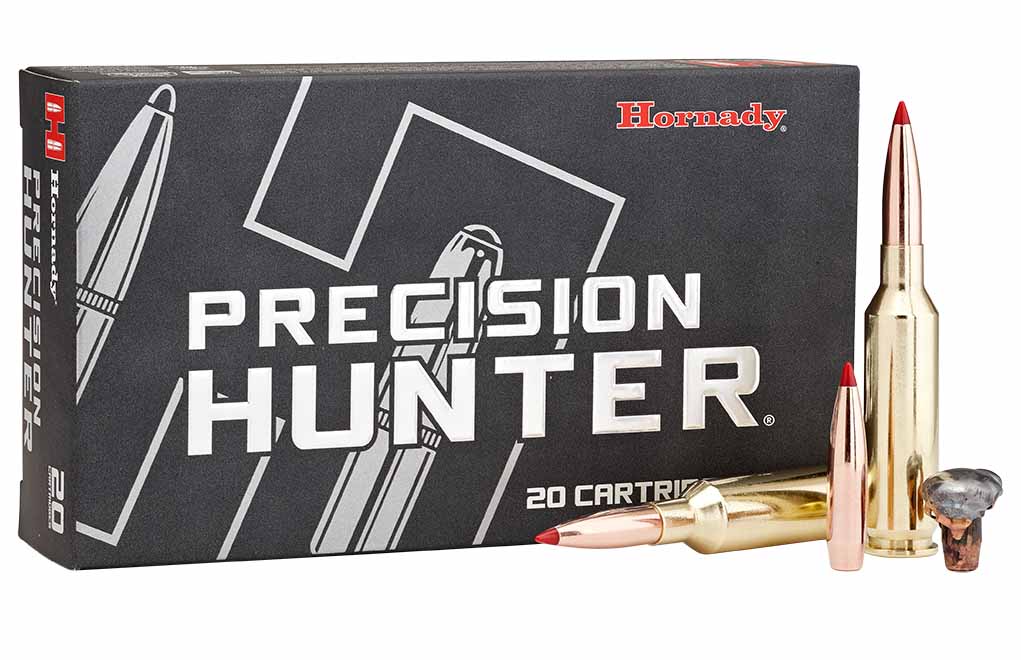
Spawn of the highly popular 6.5 Creedmoor, the smaller 6mm Creedmoor has the assets to go the distance.
What The 6mm CM Offers Precision Shooters:
A near ballistic twin of the .260 Remington
Pushes a 100- to 108-grain bullets to around 3,000 fps
Draws upon the .243-diameter bullets’ excellent BC
The 6mm Creedmoor was the putative brainchild of gun writer John Snow, who began developing the wildcat publicly in 2009 as a magazine article project. But Snow, himself, explained that the idea began as far back as 2007, when the 6.5 Creedmoor had been introduced, and it’s likely that a lot of shooters simultaneously had the notion to neck down the 6.5 Creedmoor case to accept .243-diameter bullets.
Other mild case changes in the 6mm Creedmoor include pushing back the 30-degree shoulder 0.022 inch, which, likewise, shrinks the shoulder diameter 0.002 inch. Both have a maximum case length of 1.920 inches. In early 2017, Hornady introduced 6mm Creedmoor factory ammo; this makes sense, because the company had been instrumental in producing the original wildcat version.
Snow’s 6mm Creedmoor wildcat was originally chambered in a custom rifle built by George Gardner, owner of GA Precision. The major rifle components were a Sako 85 action, McMillan stock, Bartlein barrel, Surefire muzzle brake and sound suppressor, along with a Warne custom, one-piece 20 MOA Picatinny rail. However, it soon began winning Precision Rifle Series (PRS) competitions, because its extremely long, high-BC bullets could be chambered in AR-10 rifles, and PRS matches have a time component.
The 6 CM succeeds at long distances at which the .243 fails. In the .243, when loaded with target bullets to full length, cartridges won’t fit in an AR-10 magazine—a problem the 6mm Creedmoor solves. It’s this success that has propelled the 6mm Creedmoor to its recent commercial acceptance. It’s reported that more than a million pieces of 6mm Creedmoor brass have already been sold.
General Comments
The 6mm Creedmoor is a near twin of the .260 Remington, but the former has about 5 percent less internal volume than the latter. The 6 CM performs much like the .243 Winchester and the 6mm Remington, pushing 100- to 108-grain bullets to around 3,000 fps from the muzzles of 24- to 26-inch barrels. But the 6 CM will shoot long, high-BC bullets accurately at long distances with the right twist rates of 1:7 and 1:8. Several makers are producing factory rifles in 6mm Creedmoor, including Browning’s X-Bolts, Seekins Precision Havak, Barrett Fieldcraft, Savage 10 BA Stealth Evolution, Bergara Premier Series Long Range, Ruger Precision Rifles and Ruger American Predator. Semi-auto rifles include the Savage Arms MSR 10 Long Range and Franklin Armory Militia Model Praefector-M.
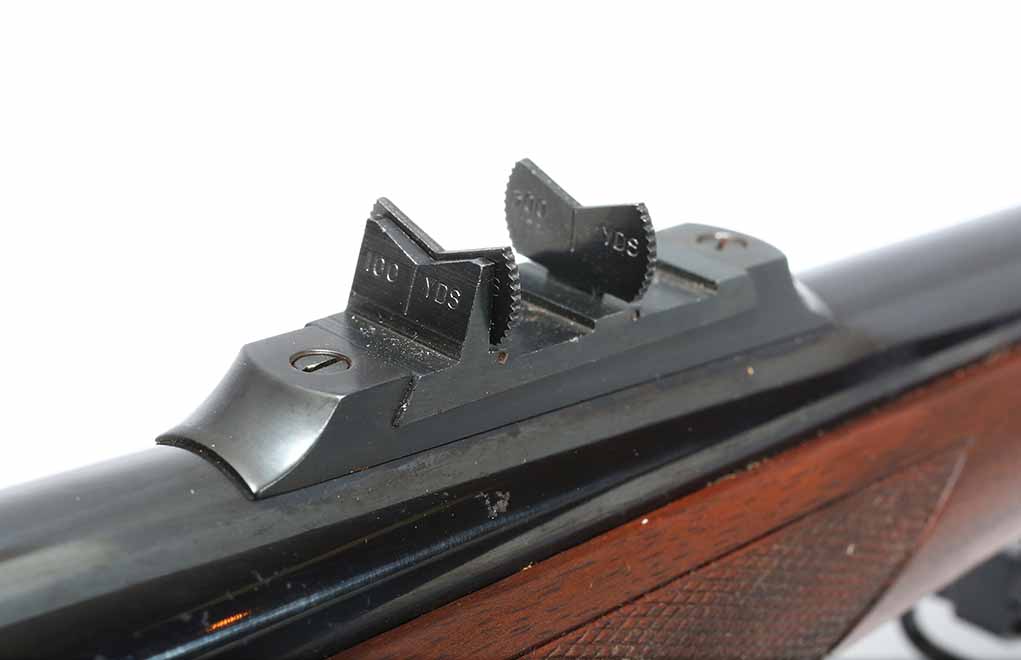
A shallow “V” for distances past 100 yards? Whom are we kidding? But for up-close work that needs to happen extremely quickly, this setup is hard to beat.
You needn’t scour the world around to find the perfect big-bore rifle optic, only look at what’s on the market for AR-15s.
What Do You Need To Look For In A Big-Bore Rifle Optic:
Firearms with big bores have always been an attraction for some shooters. There might be some argument about what constitutes a “big” bore, but we can all agree on the rock ’n’ roll motto, “Some is good, more is better, too much is not enough.”
As much fun as it is to shoot the big boomers, you still have to hit what you’re aiming at. The traditional large-bore rifle sight setup came to us from the British—the “express” sight. This is a front sight, often with a large bead on its face, and the rear sight is a blade shaped in a shallow “V”—again, often with a line up the center to the point of the V.
Yes, it’s wicked fast. But you have to remember one thing: It was developed for use on bespoke rifles—rifles fitted to their owners as if they were shotguns for game shooting. Once fitted (and the shooter properly trained), they could almost shoot and hit simply by shouldering the rifle. The bead was for the last bit of precision in aiming.
How well does such a sight system work if the rifle isn‘t fitted (not bespoke)? As well as any other … and not as well as some. A big bead and a shallow V are great up close, but if you need to take a precise shot out at, say, 100 yards, it starts to be a hindrance. And with the three-leaf sights seen back in the day? “Optimistic” is one word.
The Best Tactical Red-Dot Performance-to-Price Option?
Shifting Winds: SIG BDX Changing Shooting For The Better
And so, we Americans decided that scopes are more than just long-range or sniping tools.
We find ourselves in a curious situation: The scope for a big-bore rifle is pretty much the same scope as for a lightweight AR-15 or other such defensive carbine. Why? Because we need something that will be as fast as possible at close range, offers precision when it’s needed and won’t be used much past 100 to 150 yards. And, it has to be durable.
Think about it: As Hemingway once commented, “What game is more dangerous than human beings?”
So, for your big-bore scope, you need low magnification, a bold reticle, durability and simplicity of use. We’ll cover those in turn … and leave a very important detail for the end.
Low Magnification
You do not need a 3-9x scope for the thickets or for critters than can stomp, claw or bite you. The low end offers a wider field of view, is more forgiving of eye placement and also provides faster target acquisition through the scope when you shoulder your rifle.
Bold Reticle
A bold reticle will stand out against brush and background clutter better than one with a fine line on it. My favorite is the German three-plex. This comes in various names, but it’s three bars. The lower one comes up from the bottom of the field of view and ends in a pointed tip. The others come out from 3 and 9 o’clock and do not connect to the bottom post. Your brain can easily and quickly find the center of these bars, and you can make a really fast shot. If you need precision: Again, the post is your point of impact.
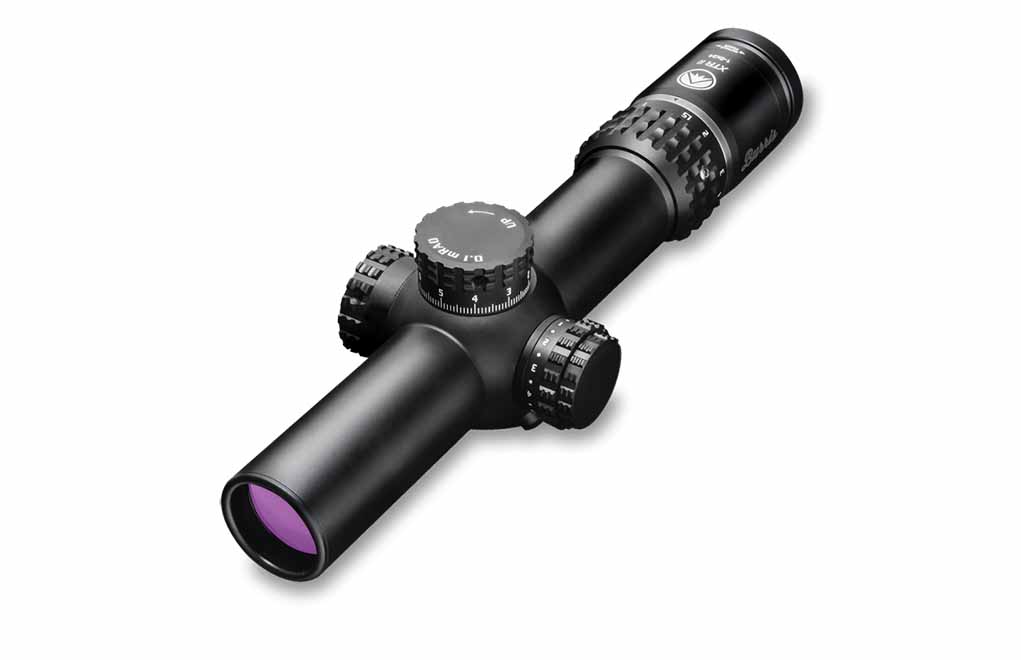
Burris XTR II
Durability
Durability is a lot more of a given today than it was when I was first lusting after something bigger than a .30-06. The longest-term experience I have had with scope durability is with Leupold: A customer brought in his rifle, which was broken … as in, broken in two. His horse had fallen off the trail. They had recovered the saddle and rifle, but the stock was snapped in two, the barrel was bent, and the scope was broken in two.
The scope was a Leupold, and they fixed it, no charge and no questions asked. By then, the customer had bought a different scope and didn’t want the Leupold, so I mounted it on my 3-gun AR and proceeded to wear out three barrels in competition.
These days, I’m sure Nikon, Burris, Meopta, Weaver and a bunch of other makers are just as up on QC and customer service. But I still have that Leupold—39 years later.
Simplicity of Use
“Simplicity of use” means that the scope has little in the way of extras. You don’t need to have 100 mils of vertical travel in your adjustments or side focus (although it can be nice) or even much in the way of parallax adjustment. A big boomer used for dangerous game is going to be a 100-yards-and-in proposition. You want adjustments that are easy enough to establish a zero and stay that way. Target knobs, external elevation markings—these are extras you don’t need and that might also cause problems.
Eye Relief
The last thing we have to consider is eye relief. On a big boomer, recoil is big. “Scope eye” is the term that many use for when the scope isn’t far enough forward, and under recoil, it comes back and busts the shooter right in the eyebrow. At the least, it will bruise. It is entirely possible you will bleed, and it can even leave a scar.
Now, you can “earn” scope eye even when you have enough eye relief. John, a friend of mine, kept a photo of himself— bleeding. The scope mount screws had broken off his .458 Win. Mag. rifle during recoil, and the scope, with rings and base still attached, bounced off his face. All I can say is, if the rifle still uses 6-48 screws, get them drilled and tapped to 8-40 for more strength.
Which Scope Is for You?
Which scopes fill the bill? To reference just the names I’ve listed so far, Leupold has its VX-R 1.25-4x, which can be had with a Firedot reticle. Burris has the XTR II, a 1-5x. The reticle is more tactical than for Cape buffalo, but the center ring is illuminated, and that makes it very useful. Meopta offers its MeoStar R2, a 1-6x scope that is heck for tough and can be had with Meopta’s 4C/1 reticle—very close to the German plex. Weaver makes the Super Slam riflescopes in a 1-5x model; and, in Super Slam, you get to choose from four different and very useful reticle designs.
One More Thing
Oh—and your scope has to be locked down in a lapped set of rings on a base practically welded to the receiver. If anything is done halfway or “just OK,” recoil will prove it not to be. (Ask John about that.)
Editor’s Note: This article originally appeared in the June 2019 issue of Gun Digest the Magazine.
Rumors have flown at the trap ranges about grizzled, blue-rock busters cooling their barrels on hot afternoons via a vat of water.
Old-time buffalo hunters did something similar (used liquid) to keep their irons from overheating under the blazing prairie sun. Needless to say, they didn’t have a tub of water at hand—usually only a full bladder—as if the corrosive percussion caps and primers of the day weren’t hard enough on a gun.
Either way—the dunk tank or dropping trow—it seems barbaric. Particularly nowadays. Still, if you have any interest about where you’re hitting, not to mention keeping your rifle’s chamber throat smoother than alligator skin, helping your barrel keep its cool has to remain at the top of your mind.
No Use Getting Hot Under the Collar
In a more leisurely era, the cure to a hot barrel was time. Yup; you let your rifle sit for a spell until it dissipated enough heat. Those were the days when most ranges didn’t have an hourly rate akin to electricians, dentists and ladies-of-the-night.
Even if they demand more of your hard-earned shekels, these pauses in action remain necessary. If a barrel gets too hot, all sorts of bad things happen … and frustration follows.
The most notable is accuracy decay. Squeeze the trigger 10, maybe 20, times uninterrupted, and your barrel heats up enough so that its harmonics go out of whack. “Barrel whip” is what most of us know it by. The rifle walks, groups loosen, and nerves fray.
Get On Target With Precision Shooting Gear:
MDT LSS Gen2 Chassis: Flexible Foundation Of A Precision Rifle
MDT ESS Chassis: Redefining The Modern Precision Rifle
Chronograph: Why Checking Your Speed Proves Invaluable
With the advent of long-range optics, another consequence of a hot barrel became apparent—heat mirage. Generally a boon downrange as a wind indicator, it plays havoc in front of your objective lens when emitted by gun metal. Get your fire tube fired up, and a distant target is about as clear as the back of a cataract.
In either case, this is definitely not good; and God help you if you’re working up a load.
A heavy-barreled rifle staves off some of this … somewhat. Because this rifle takes longer to heat up and is inherently stiffer to begin with, whip and mirage are less of a concern. But riding a bull doesn’t mean you’ll completely avoided the perils of your powder’s deflagration.
This raises the question: How do you cool a barrel quickly enough so that you aren’t costing yourself money and trigger time?
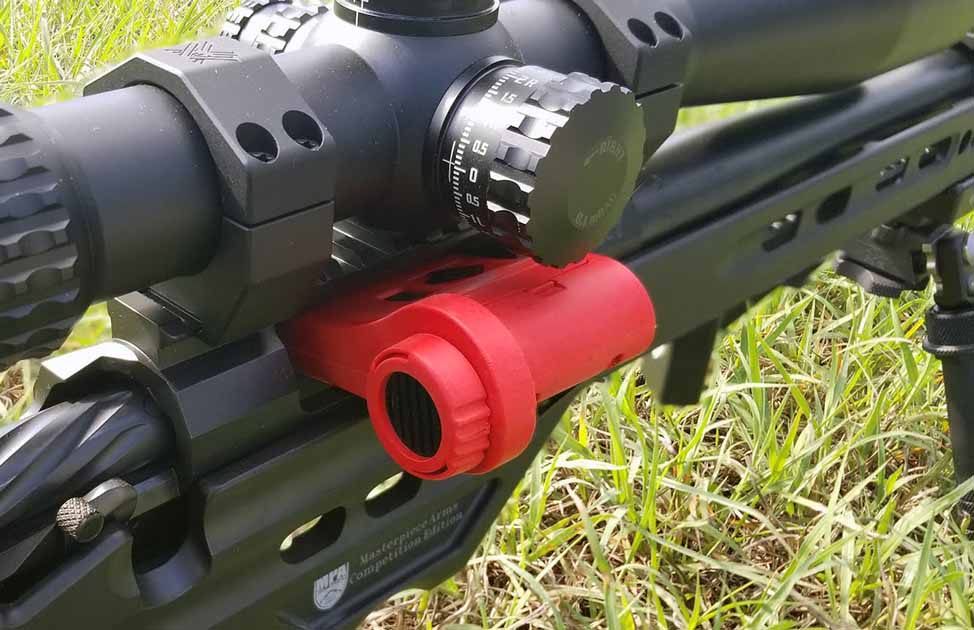
MagnetoSpeed’s RifleKuhl
Made by MagnetoSpeed, the high-tech RifleKuhl features a 50-micro replaceable filter to ensure you don’t introduce any extra fouling to your barrel, and it features a chamber seal on the nozzle, ensuring the air goes where it will do the most good.
As expected from MagnetoSpeed, the RifleKuhl is engineered to the hilt. Among the more interesting features is a 50-micron replaceable filter—another level of protection from gunk in your bore. Additionally, a neodymium magnet keeps it in place, and the nozzle seals against the chamber to maximize the cooler’s effect. Generally, it makes a barrel shootable in fewer than 10 minutes. MSRP: $59.99 www.magnetospeed.com
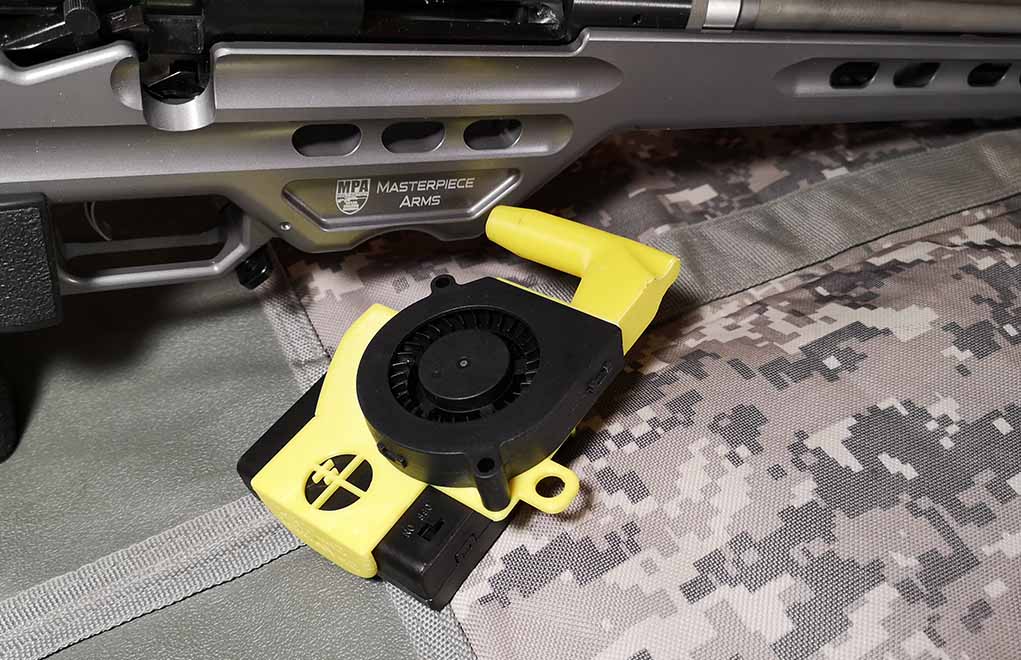
Chamber Chiller
Growing in popularity with precision rifle and F-class shooters, chamber and barrel coolers, such as the Chamber Chiller, are becoming more common at the range.
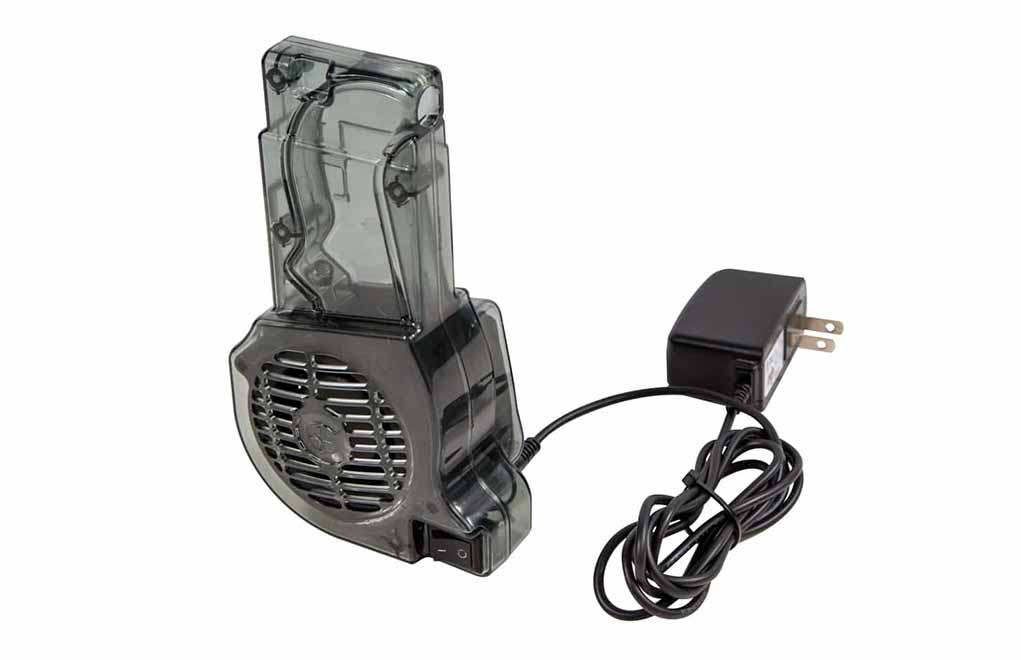
There are two different models to fit the type of gun you shoot: a Magwell Chamber Chiller for AR-style rifles and an ejection port unit, which is better suited for bolt-actions. The Chamber Chiller company tailors them to the particular calibers. So, if you pitch .50 BMG, you have a fan that’s up to the job. Conveniently, these chillers can run off both batteries and a USB cable, ensuring you always have a power source at your disposal. MSRP: $38.60 www.chamberchiller.com
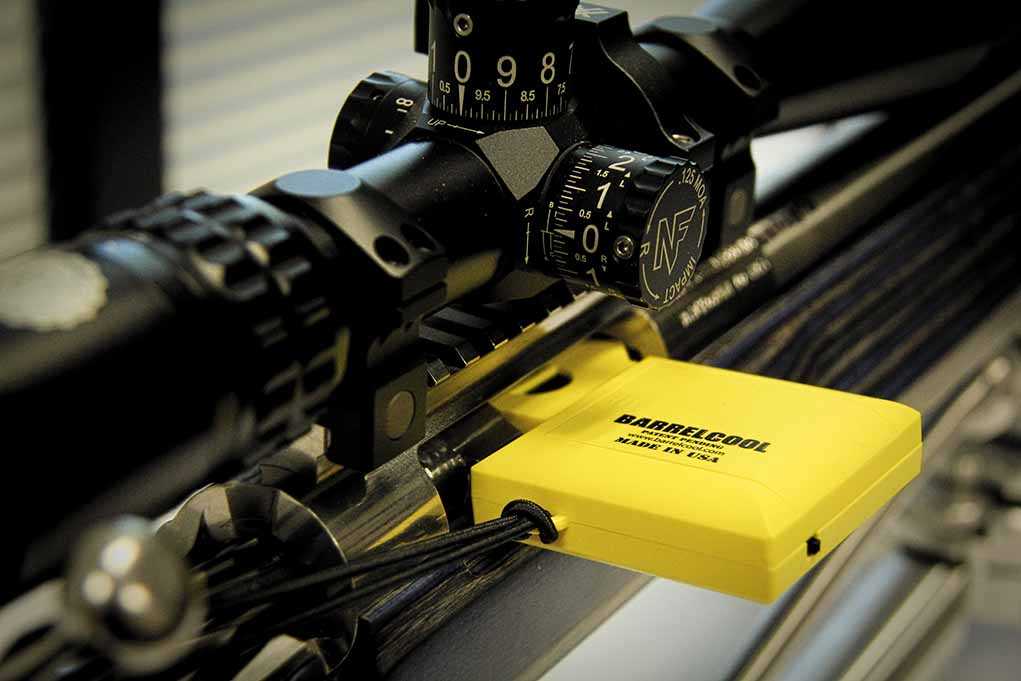
BarrelCool
Given that a hot barrel eats away at accuracy, Barrel Cool’s device is a perfect addition to a range bag. Shaped and colored to match an NRA-certified empty chamber flag, it works away when there’s a cease-fire.
This is a very compact cooler to add to your range bag. The nozzle is customizable to the chamber length of your rifle, guaranteeing that the unit pumps air where it’s needed most. Unless you shot an iron hot enough to fry eggs, the BarrelCool can get it back down to an operational temperature within 10 minutes. Furthermore, it’s shaped and colored like an NRA-certified empty chamber indicator, so it’s ready to pull double duty. MSRP: $36.99 www.barrelcool.com
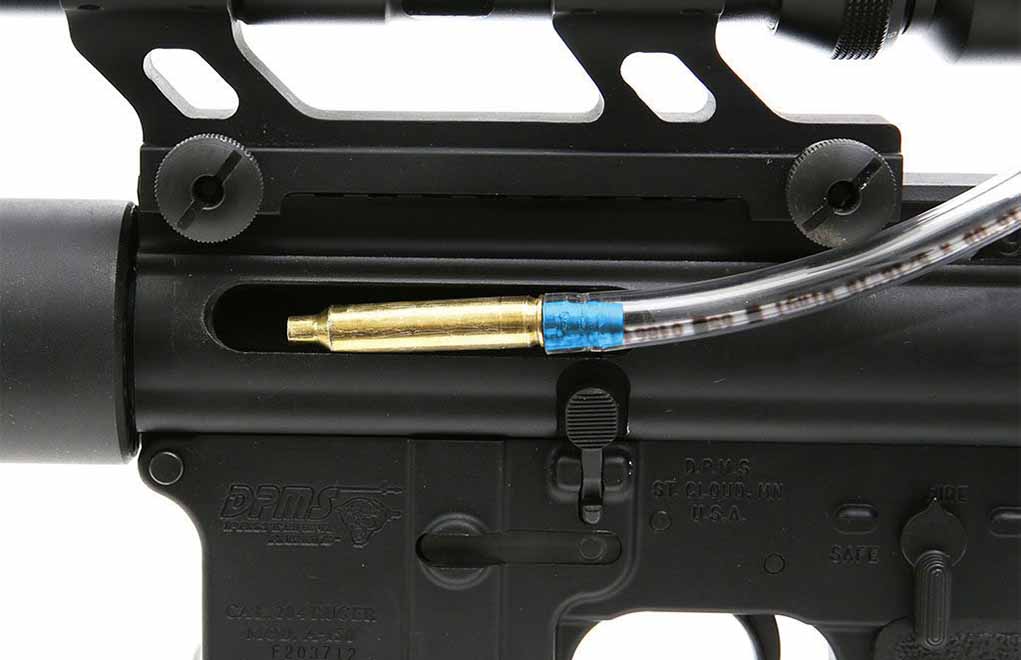
The Original Barrel Cooler
What the company calls its “cooling case,” The Original Barrel Cooler efficiently cools your rifles chamber and barrel by making sure no air escapes.
This cooler has an interesting configuration: The fan unit operates well away from the chamber and connects via a length of hose and a caliber-specific attachment. This is beneficial, however, because you can situate it away from any ambient heat of your rifle, thus speeding up the cooling process. It’s a bit bigger than others, but the extra weight is worth its efficiency. MSRP: $59.95 www.area1sports.com/
Caldwell Accumax AR Cooler
It’s big, but it gets the job done with a large fan and large air port. Best of all, the Caldwell Accumax AR-15 Barrel Cooler is rechargeable, so it’s ready when you are.
Caldwell is an AR specialist, so its barrel cooler device has a number of things going for it. It has a huge fan, so it pulls in a good deal of air. Its exit port is also sizable, directing the airflow directly down the chamber. And it’s rechargeable. Certainly, a barrel cooler is a bit of a luxury, but whether you’re an F-class shooter or just working up a load, it’s a luxury worth having. MSRP: $47.99 www.caldwellshooting.com
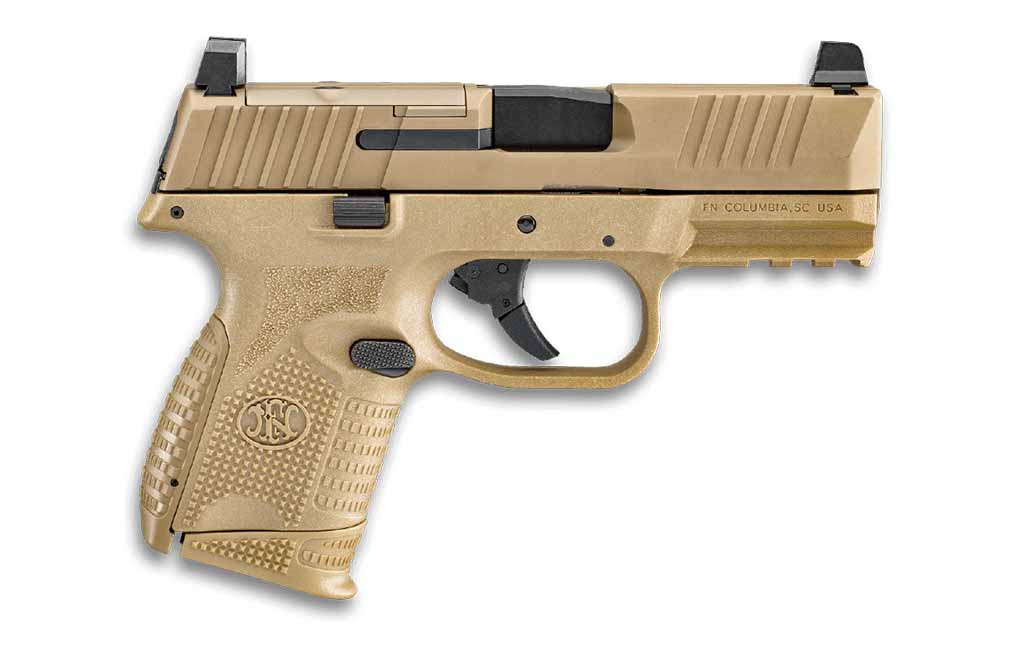
FN gives shooters a built-for-carry, optic-ready addition to its popular striker-fired line with the 509 Compact MRD.
FN has played coy in expanding its popular line of polymer striker-fired pistols. The 509 series has grown, but over the course of years. Still, the wait has been worth it, particularly for those who have been champing at the bit for a true-to-form concealed carry pistol.
The recently announced 509 Compact MRD is long on features along with the performance on which the line has built its renown. In particular, the 3.7-inch barreled 9mm pistol boasts the MRD line’s low-profile optics-mounting system, compatible with most miniature red-dots presently on the market. As is the case with other 509 MRD models, the compact also features blackout iron sights configured to co-witness, in case your red-dot happens to go out at the moment of truth.
The 509 Compact MRD offers 12+1 capacity while maintaining an overall low 4.8-inch height and manageable 25.5-ounce weight unloaded. The double-stack comes in much slighter than many in its class, and even outdoes comparable single-stacks. Additionally, the pistol has a flat-face trigger, interchangeable backstrap, ambidextrous controls and an accessory rail. It ships with a 12-round flush-fit magazine, 15-round extended-grip magazine and zipper case. The MSRP on the FN 509 Compact MRD is $799.
More From FN:
McLean, VA – December 20, 2019) FN America, LLC is pleased to announce the release of the smallest addition to the FN 509® family of pistols, the FN 509 Compact MRD, an optics-ready compact pistol featuring the company’s patented FN Low-Profile Optics-Mounting System,™ further expanding the optics-ready FN 509 models to four.
The FN 509 Compact MRD is chambered in 9mm and is striker-fired. It features a 3.7-inch barrel and compact slide, and is available in both black and flat dark earth (FDE) finishes. The patented optics mounting system allows for a low-profile, direct mount through a carefully developed plate system that perfectly positions the optic so that the focal point allows for a low-profile mount and co-witness with the all-black iron sights that minimize interference with the optic.
The frame, reduced in overall size for concealability, features a MIL-STD 1913 Picatinny rail that accepts most compact pistol lights, improved controls to aid in manipulation, improved texturing on the two included backstraps for better recoil management, and a new flatter faced trigger allowing for more controllable trigger press and cleaner break.
Each pistol ships in a branded soft-sided, zippered case with FN Low-Profile Optics-Mounting System™ plate kit, one 12-round magazine with pinky extender and one 15-round magazine with grip sleeve or in an all 10-round magazine configuration for states with magazine capacity restrictions. The FN 509 Compact MRD also has the capability to accept all higher capacity FN 509 magazines with use of a sleeve. Manufacturer’s suggested retail price of the FN 509 Compact MRD pistol is $799.00 and is available to purchase through authorized retailers.
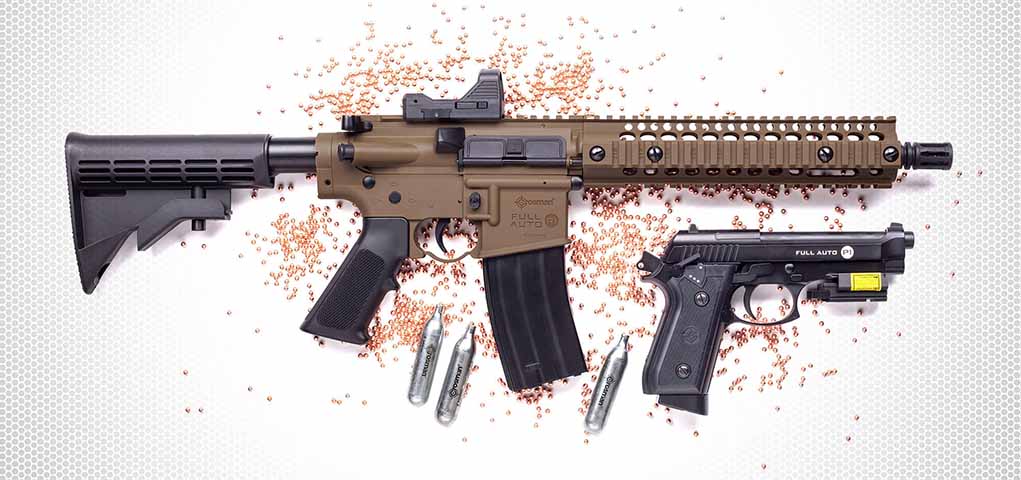
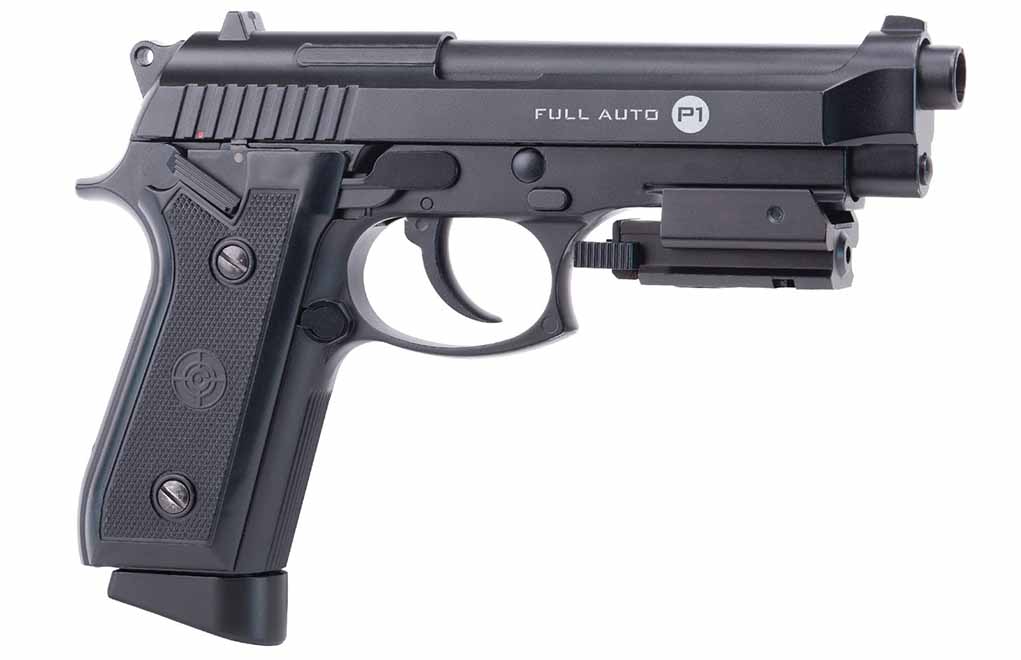
Full-Auto and a realistic feel, the Crosman R1 Rifle and P1 Pistol airguns kick up the fun factor.
1,400-rounds-per-minute rate of fire
480 fps muzzle velocity
Powered off 12-gram CO2 cartridges
R1 has a reciprocating bolt, P1 a reciprocating slide
Both feed off removable box magazines
Unless your heart is as cold and callused as winter asphalt, there’s some nook that holds a special place for BB guns. Before you stepped up to a trusty .22 LR and centerfire guns, the smooth-bore shooting irons were most likely where you first learned to build your sight picture and practiced your trigger control. For those of us trapped in our suburban cages, they may even still have a place in our lives. You’ve got to have something to blow off steam or keep the squirrels away from the suet feeder.
Still, there are plenty out there who have strayed away from the style of gun and see no need for one, at least until they have kids of their own. If you fall into this category, Crosman is about to bring you home.
Recently released, the New York-based airgun specialists continue to unleash what might be the most intriguing—if not fun—BB launchers in a spell. That is, unless you don’t consider full-automatic fun.
Next-Gen BB Guns
The Crosman R1 Rifle and P1 Pistol are the latest in the company’s dive into full-auto BB guns.
A few years back, the airgun maker got into the unique niche partnering with DPMS on a short-barrel rifle FA BB gun and followed up with a Bushmaster MPW model. Both were met with great fanfare and why not? A style of gun almost purely defined by pleasure, Crosman delivered unadulterated delight.
Both the Crosman R1 Rifle and P1 Pistol spit steel spheres for as long as you keep your finger on the trigger and your magazine juiced. And we’re not just talking a pew … pew … pew step above semi-auto rate of fire. By Crosman’s numbers, the R1 Rifle pitches 1,400-rounds-per-minute and the P1 Pistol 850 rounds—each at 480 fps. In a word, both are blistering.
They’re also on the spendy side for CO2-powered guns. The R1 Rifle has an MSRP of $170 and the P1 Pistol $120, well out of the pricing tier of the old lever-action models most cut their teeth on. But, aside from the fun factor, Crosman sets you up with a solid package in both cases.
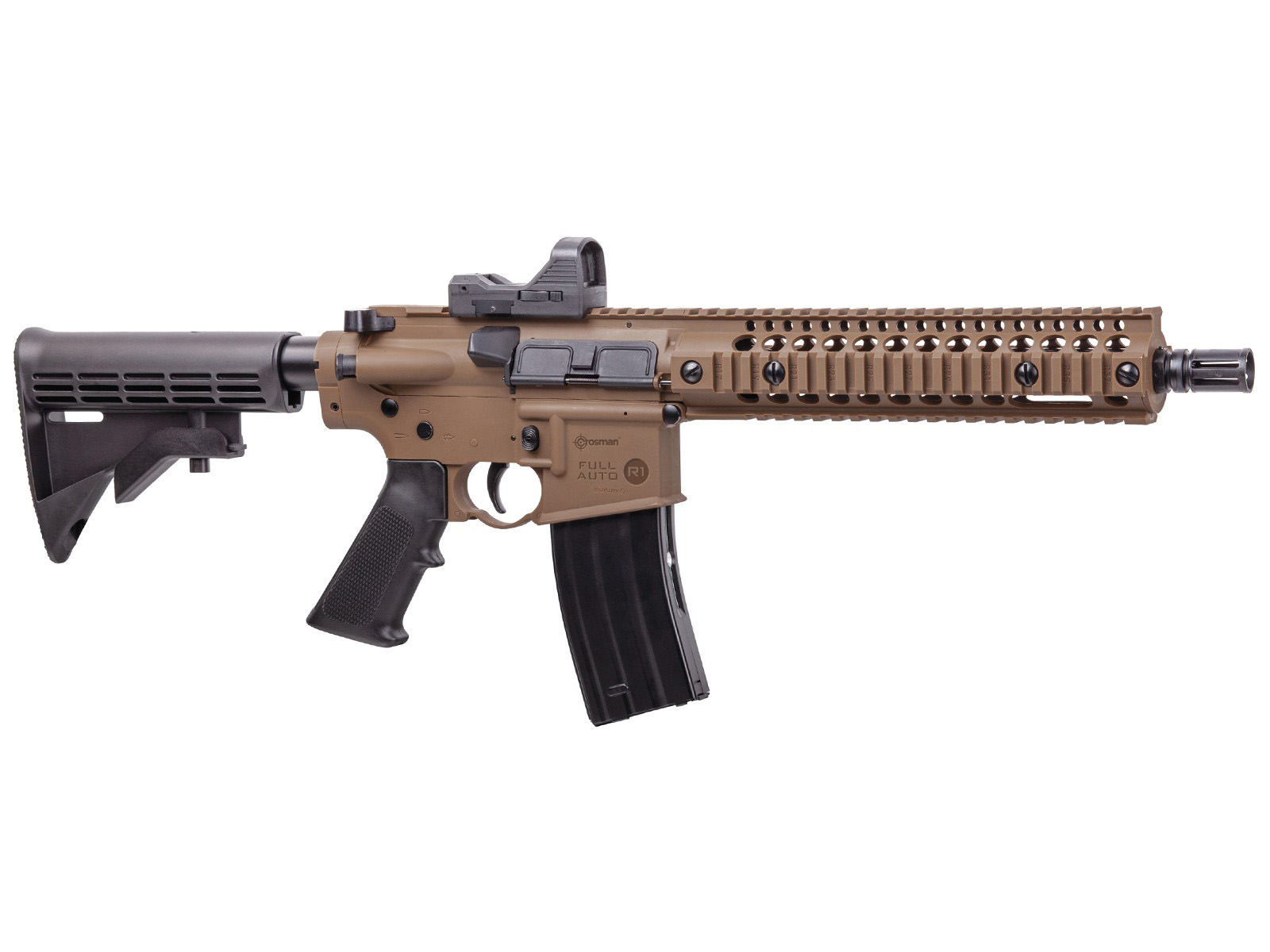
Crosman R1 Rifle
While not modeled after a particular AR-style rifle, the R1 gives you an authentic feel alongside full-auto operation. Full-sized and the controls in the right places, it’s akin to stepping behind your favorite centerfire and could legitimately make the claim of being a trainer. This isn’t just due to the synthetic-framed BB-gun’s realistic weight and configuration.
It also feeds from a 25-round box magazine that drops free and reloads like an actual AR. Furthermore, it boasts a 6-position adjustable stock; though if you don’t like Crosman’s furniture, you can swap it out with any mil-spec upgrade you have in mind. If that isn’t enough, the R1 has a removable bolt-carrier that reciprocates when firing. Heck, a red-dot sight is included with the package to ensure you stay on target.
If you harken back to your BB-gun days (even if that was yesterday), the one drawback to the system was the CO2 cartridge. They just never seemed to have enough gas. That might be the one drawback to the R1 system, given it runs off two 12-gram cartridges, which means you’ll go through twice as much just as fast. Still, not much to gripe about, it’s still cheaper than thumbing off 5.56 NATO.
Crosman P1 Pistol
Machine pistol aficionados will most likely find something familiar about the P1 … something awful Beretta. While it doesn’t come out and say so, Crosman appears to have styled the gun after the select-fire Beretta 92—the 93R. A nice touch, if you happen to have a yen for the Italian gunmaker’s creations.
Similar to the R1, Crosman has striven for the utmost reality in the pistol’s operation and feel. Hefty for a BB-gun and full-sized, the metal-frame pistol has an actual firearm quality in the hand, accentuated by its blow-back operation (the slide reciprocates) and authentic controls (the thumb safety is where it should be). Moreover, it feeds off a 19-round box magazine that drops and reloads like an actual.
Crosman ships the P1 with a removable red-laser sight that attaches to a completely functional accessory rail. While the sight might make it easier to keep the gun on target, it is also outfitted with traditional iron sight; though they are fixed.
Again, the pistol is fueled by CO2 cartridges (12-gram), which is a blessing and a curse. Blessing, in their available nearly anywhere and are generally cheap. A curse, because it’ll seem like you never have enough of them with the P1.
Parting Shot
While BB-guns have been, still are and will continue to be the choice to introduce youths to the shooting sports, that doesn’t mean they’re child’s play. If you’re looking for an addition to your collection that provides anytime fun and training opportunities, look no further than the Crosman R1 Rifle and P1 Pistol.
This isn’t to say, they wouldn’t make a dandy gift to your son or daughter. Only, you’d have to pry yourself off the trigger to give them a shot.
For more information on the Crosman R1 Rifle and P1 Pistol, please visit www.crosman.com.
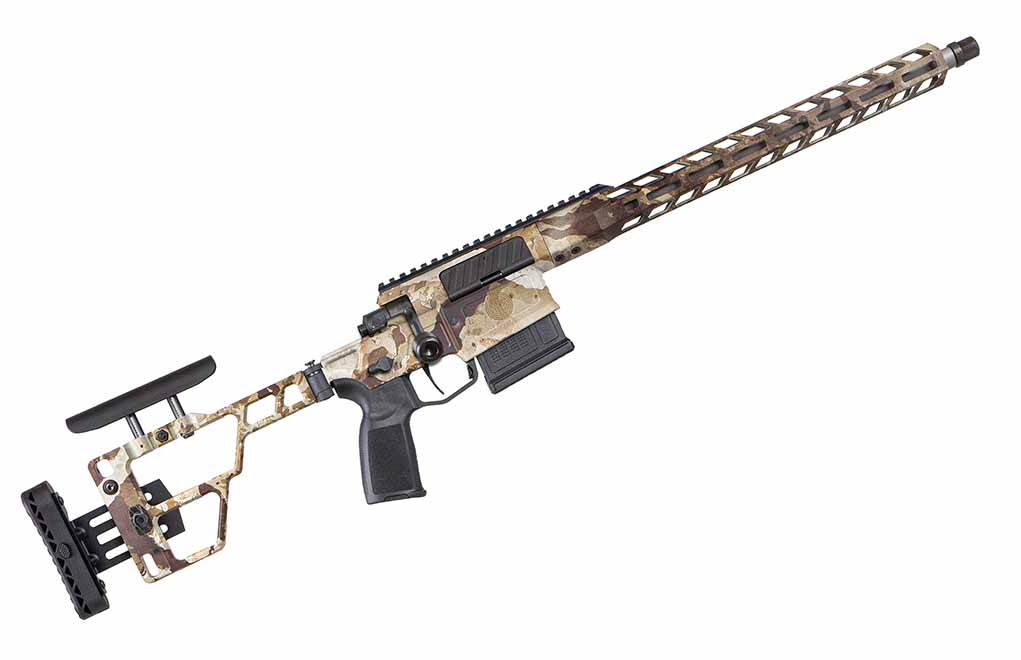
Sig Sauer reenters the bolt-action game with the lightweight precision Cross Rifle.
How The Cross Rifle Is Configured For Precision Hunting:
Lightweight, 6.2 to 6.4 pounds
Chambered 6.5 Creedmoor, .308 Win., .277 Sig Fury
Robust three-lug bolt head
One-piece Receiver
Barrel secured via barrel nut
Name the last bolt-action Sig Sauer came out with. Unless you’re an out-and-out fanatic of the gunmaker’s wares, the model most likely didn’t trip immediately to mind. Born in the waning salad days of the 1990s (’98 to be exact), the Swiss Hunting Rifle 970 was a solid turn-bolt, but didn’t exactly ripple across the gun-buying world. The company’s latest endeavor into this end of the market might be another story.
Following recent trends, the newly minted Sig Sauer Cross Rifle is decked out to win precision shooters’ hearts, no matter if they spend most of their trigger time on the bench or in the field. Even more so, given the rifle is the first American-made bolt-action to roll off the company’s New Hampshire factory’s line.
While the Cross Rifle has the look and most certainly could be used purely as a precision rifle, Sig is angling the iron at a different crowd. The firm tags it as a precision hunting rifle, perfect to make those dream cross-canyon shots hit right on target. To that end, where it seems to differentiate itself from its explicit match/long-range cousins is the weight department, coming in a svelte 6.4-pounds in its 6.5 Creedmoor chambering and 6.2-pounds in its .308 Win./.277 Sig Fury. As well as barrel length, 18-inches in the former caliber and 16 in the latter.
If you were paying attention, you’ll have noticed the Cross Rifle also ushers in a new cartridge. The .277 Sig Fury is still awaiting SAAMI approval, but is essentially a commercialized rendition of the 6.8mm ammunition developed for the US Army’s Next Generation Squad Weapon program.
It, and the other cartridges, should have a dandy launch pad in the Cross Rifle. In addition to what has become more common accuracy enhancing features, such as a skeletonized and fully adjustable buttstock, it has some more nuanced assets to get it on target. In particular, the short action is built on a one-piece receiver, with the barrel secured via a barrel nut, a combination that not only creates a rigid platform, but offers superior head spacing. Driving everything home is a robust three-lug bolt head, riding on a modular bolt carrier that locks into the barrel extension and has a 60-degree throw.
As to price, the Sig Cross Rifle isn’t a freebie, but it’s not exactly a bank breaker in the scheme of precision rifles with an initial MSRP $1,799.
NEWINGTON, N.H. – SIG SAUER, Inc. is pleased to introduce the CROSS Rifle. The first SIG-built precision bolt-action hunting rifle is designed by SIG SAUER engineers, completely manufactured and machined at the SIG SAUER facilities in New Hampshire, and tested by premier competitive shooters, the world’s best long range shooters, and a team of professional hunters that the CROSS is built for.
“When our product management team and engineers researched developing a bolt-action rifle, they looked at what was missing from the market, and what new innovation SIG could bring to hunters and precision shooters,” began Tom Taylor, Chief Marketing Officer and Executive Vice President, Commercial Sales. “Hunting rifles are typically focused on less weight, and accuracy is secondary. Precision rifles are designed for extreme accuracy, with no weight limitations. What was missing from the market was a true crossover. Our product management team and engineers took the best of both worlds and developed the CROSS featuring the characteristics of a hunting rifle, with the accuracy of a precision rifle.”
The CROSS Precision Bolt-Action Hunting Rifle is a lightweight precision rifle with a push button, foldable SIG precision stock, a one-piece aluminum receiver that eliminates the need for bedding the action, and AI magazines for creating the most accurate precision hunting platform. The CROSS features a stainless-steel rifled barrel with a free-float M-LOK handguard, a 2-stage match-grade trigger externally adjustable from 2.5 – 4 lbs., ambi-safety, a three-lug bolt design with a 60-degree throw and interchangeable bolt handle. The precision stock is spring-loaded for one handed operation and can be fully adjusted in the field for length of pull and comb height with no tools. The rifle has a full-length replaceable picatinny rail that allows for direct optics mounts, 20 MOA, and O MOA. The CROSS is available in 6.5 Creedmoor, 308 WIN, and the soon-to-be-released 277 SIG Fury Hybrid Ammunition with a black anodized or First Lite camo finish.
“Right out of the box the CROSS comes loaded with new innovation and features that hunters and precision shooters will appreciate at a very affordable $1,779.00 MSRP price point,” continued Taylor. “The CROSS delivers on all fronts, and we are especially proud that everything about the CROSS from concept to completion is 100% SIG SAUER and comes directly from our U.S. operations here in New Hampshire.”
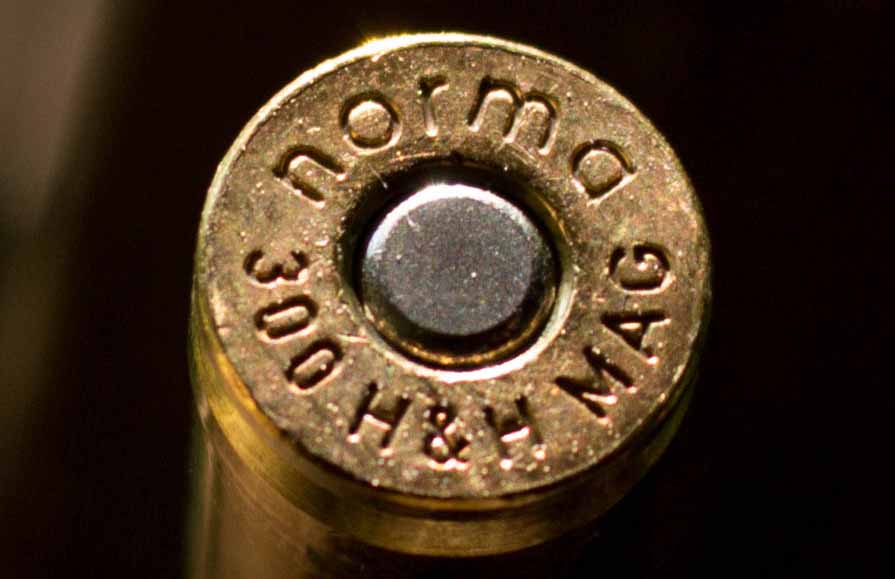
The .300 H&H Magnum might be old, but it’s certainly not dead.
Why The .300 H&H Magnum Clings To Life:
It is a good all-around choice for larger big-game, except dangerous game.
Few cartridges feed and extract as easily or as smoothly.
It proves relatively simple to handload for, and there are some good factory loads available.
Its recoil in most rifles isn’t much more than the .30-06 Springfield.
The herd of Hartmann’s mountain zebra stood scattered across the valley floor, with the stallion taking his position at the rear to protect his harem.
Namibian PH Jamy Traut was lying next to me, prone, on a slab of ancient granite. He pointed out the big male.
“He’s on the right at 275 yards,” Jamy informed me, still looking through the Bushnell rangefinder. “Just let him turn a bit and take him.”
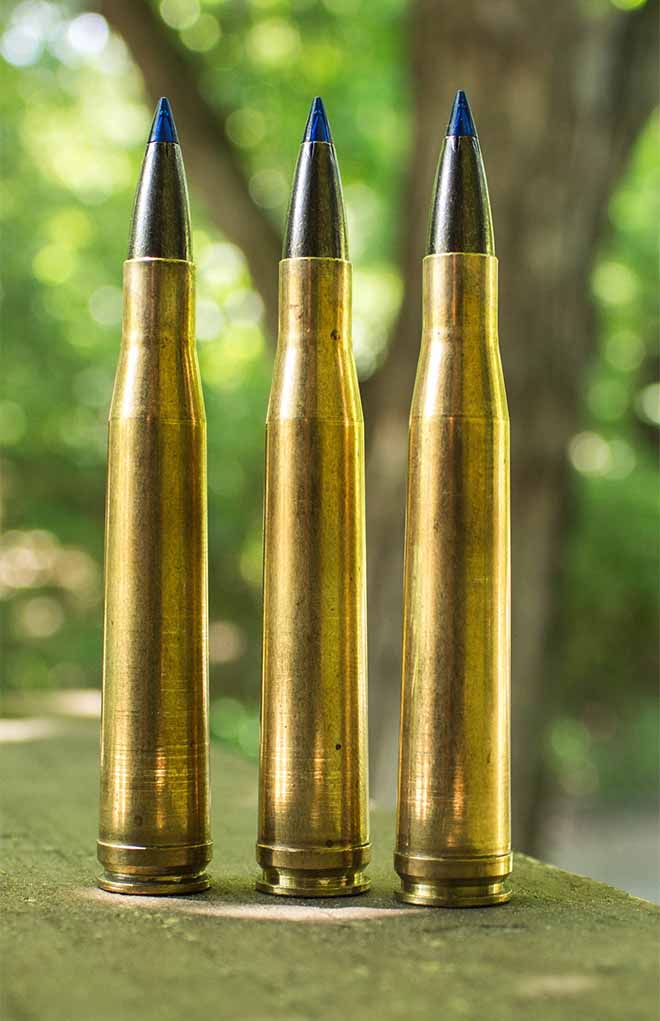
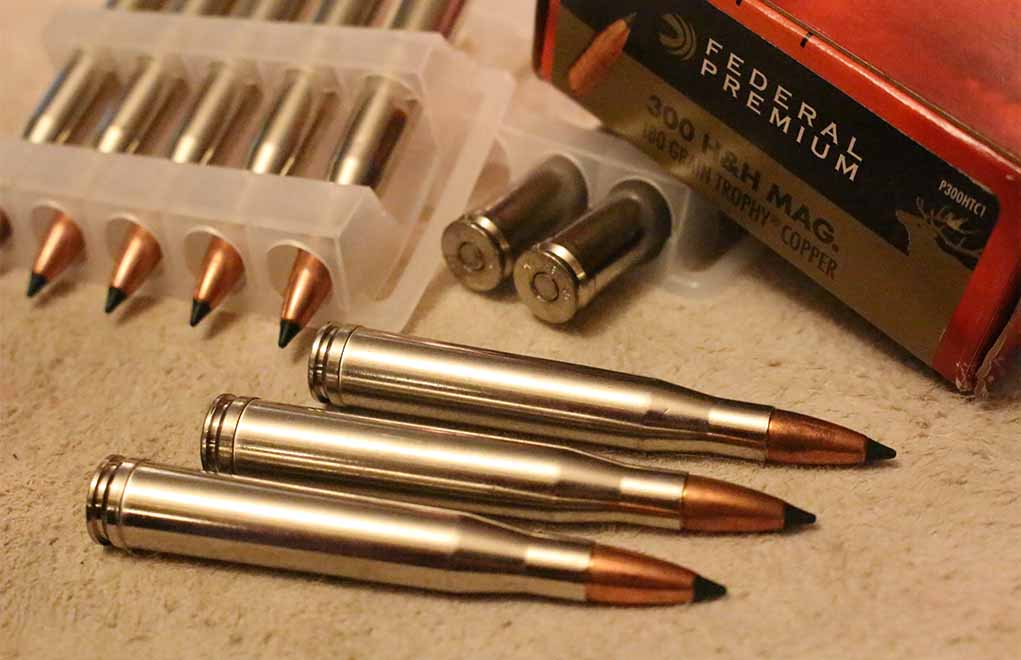
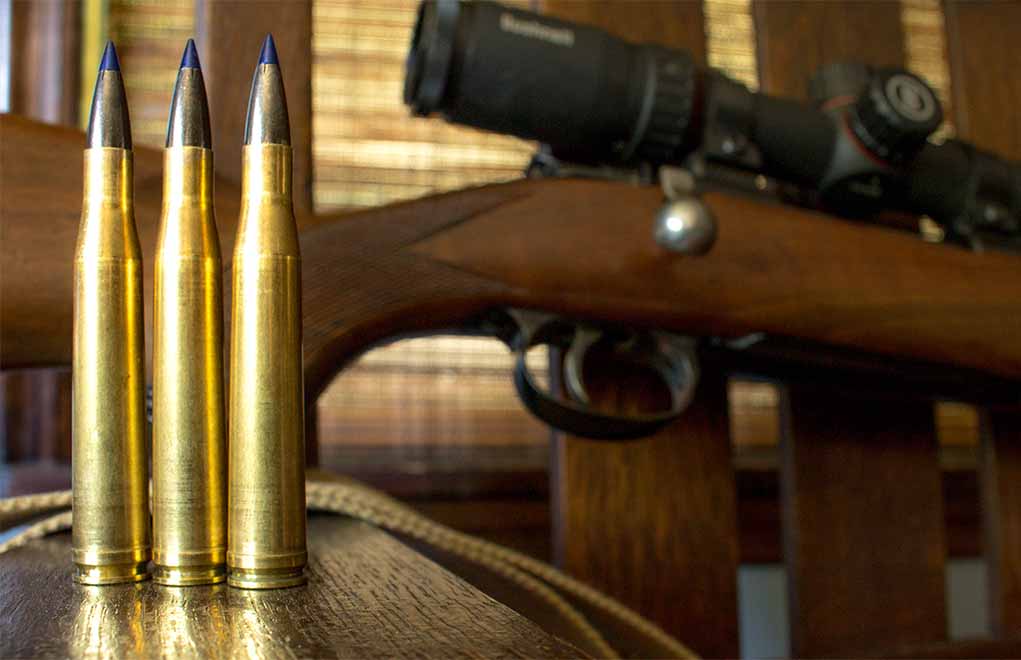
Launching the 175-grain Federal Edge TLR at a muzzle velocity of more than 2,900 fps, the .300 H&H can handle a wide variety of hunting ranges and is a very manageable magnum.
I let my second deep breath halfway out, and the crosshairs steadied on the triangle of stripes on the stallion’s shoulder as the trigger of the Colt rifle broke cleanly. In spite of the recoil, I heard the smack of the Federal Trophy Bonded Tip bullet, and Jamy gave that “yassssss” that PHs give when the shot is placed properly. The stallion, mortally wounded, did his best to follow his herd, but as he paused again at just shy of 300 yards, a second 180-grain bullet ended the game.
A British Classic
To have the opportunity to hunt such a majestic game animal was wonderful, but to have done it with such a classic rifle and cartridge made the hunt that much better. I had a 1959 Colt “The Coltsman,” chambered in .300 Holland & Holland Magnum, although the barrel was labeled simply “.300 Magnum.”
Long before the .300 Winchester Magnum or even the .300 Weatherby Magnum had reared their heads on the scene, there was but one improvement over the .30-06 Springfield: Holland & Holland’s .300 Magnum. Also known as Holland’s Super .30, it would drive a 180-grain, .308-inch-diameter bullet to more than 2,800 fps, bettering the velocity of the Springfield by 100 fps, making it a magnum length equal to .300 Winchester Magnum (which would take nearly four decades to arrive on the scene).
H&H Magnum Backstory
The year of 1912 saw the prestigious London firm of Holland & Holland release its .275 Holland & Holland Magnum—a 7mm cartridge so close in form and function to the 7mm Remington Magnum of 1963 that it’s uncanny—and the undeniable .375 H&H Magnum.
Even though the .300 H&H Magnum lands outside most popularity circles, options abound for both reloaders and those searching for high-quality factory loads.
These two cartridges feature a belt of brass just above the cartridge rim, used for headspacing. The .375 H&H the hunting world would come to love has a 15-degree shoulder (very slight in comparison to many of the modern designs) that has been associated with easy feeding and reliable extraction. The .275 would take a half-century to catch on—and only then in a different marketing scheme and under a different moniker.
1925 saw the release of the .300 Holland & Holland Magnum, a slope-shouldered cartridge the same length as the .375 H&H Magnum—3.600 inches, to be exact—yet designed with an 8-degree, 30-minute shoulder and that same useful brass belt, which serves as a false rim. It gives the positive headspacing of a rimmed cartridge but offers the easy feeding of a rimless cartridge from a box magazine.
A decade after its release, Ben C. Comfort shot the .300 Holland (in a rifle built by Griffin & Howe on a Remington 30-S action and with a 30-inch barrel) to win the 1935 Wimbledon Cup.
.300 H&H Merits
The virtues of the .300 Holland & Holland were not lost on the ballisticians and engineers at Winchester. In 1937, the year the rifle was introduced, Winchester added the cartridge to the lineup of its prestigious Model 70 rifle. With ammunition already available from the Western Cartridge Company, hunters and shooters immediately picked up on the benefits of the higher velocity and increase in striking energy. Remington followed suit, offering both ammunition and chambering its reliable Model 721 rifle for the long cartridge.
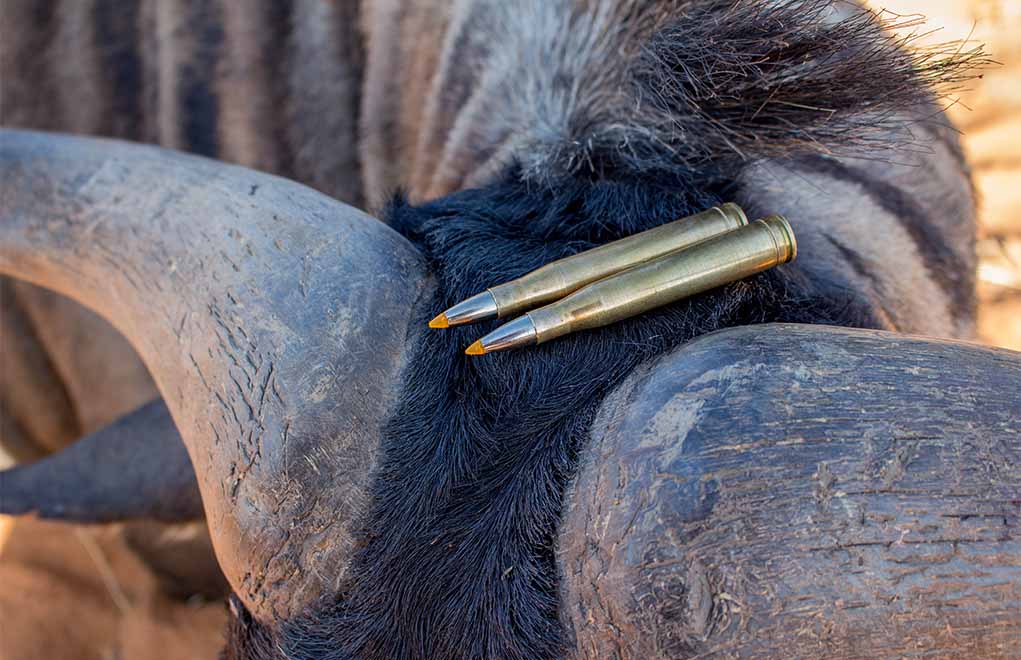
The .300 H&H still makes a great all-around choice, whether for deer, elk and bear in the United States … or for tough African plains game such as this blue wildebeest.
It was regarded as a good all-around choice for the larger big-game species of North America, along with all but the thick-skinned dangerous game of Africa. It also had its place in hunting literature. John “Pondoro” Taylor stated that “everything the .30-06 will do is done better by the .300 Magnum … .” The cartridge was also featured in Robert Ruark’s Uhuru as PH Brian Dermott followed up with a wounded leopard in the thick bush. It was also the cartridge that John Nosler had in hand when his bullets—I’m not sure of their brand or weight—failed on the shoulder of a mud-caked moose, resulting in the development of the now-famous Nosler Partition.
Three factory loads were available early on: a 150-grain load at 3,000 fps; a 180-grain load at 2,700 fps; and a 220-grain load at 2,350 fps. As time progressed and powders improved, velocities increased. Hunters loved it; target shooters loved it. So, what happened to the popularity of Holland’s Super .30?
The Downhill Slide
Even with affordable American-made rifles and reliable ammunition—readily available from two of the biggest makers—the cost of producing magnum-length rifles continued to increase.
The .375 H&H required a magnum-length action, but as the 1950s saw the definite move to the long-action (.30-06 length) receiver, Winchester’s trio of 1950s belted magnums based on the H&H case (the .264 Winchester Magnum, .338 Winchester Magnum and .458 Winchester Magnum) all gave excellent performance from a long-action receiver.
Author Phil Massaro went on safari in Namibia with a 1959 Colt rifle chambered for .300 Holland & Holland Magnum. Good glass and a flat-shooting rifle are the safari hunter’s friends. A good rangefinder, such as the Bushnell Nitro 1800, makes getting the bullet on target that much easier.
The .308 Norma Magnum, introduced in 1960, showed that the ballistics of the .300 H&H Magnum could be reproduced in a long-action rifle, and Winchester’s 1963 release of the .300 Winchester Magnum spelled serious trouble for the .300 Holland & Holland.
It had a great reputation among African hunters, because it pairs very well with its “big brother,” the .375; but the simple fact is that the .300 H&H Magnum never did achieve the popularity of the .30-06 Springfield, the 7×57 and 8×57 Mauser, or the .303 British. Couple that with the accuracy and affordability of the .300 Winchester Magnum, and you can easily see the reason for the decline of the .300 H&H.
’Old’ Is Not ’Dead’
Despite being “pronounced dead” by more than one writer over the last two decades, the .300 Holland & Holland still clings to life. Let me make this perfectly clear: From the standpoint of practicality, anything a hunter can do with a .300 Holland can be done with a .300 Winchester Magnum. They are so close in performance that no game animal could ever tell the difference.
People have often criticized the .300 Winchester’s neck length (less than 1 caliber at 0.264 inch), but it has never posed a problem for me. And although it uses the H&H belt, the .300 Winchester headspaces off the shoulder. The older Super .30 design might not be on the cusp of modern cartridge design, but there is something unique, nostalgic and attractive about the .300 H&H. In fact, I will be the first to admit I have a weakness and a penchant for vintage British cartridges; and the .300 H&H is high on the list.
The .300 H&H, handloaded with 175-grain Edge TLR bullets.
I feel comfortable saying that there are few cartridges that will feed and extract as easily or as smoothly as the .300 Holland & Holland; it feeds as if the cartridges were greased, and that makes keeping the rifle on the shoulder for the follow-up shot that much easier. I will also say that the cartridge has proven relatively simple to handload for, and although there are some good factory loads available from Federal, Hornady and Nosler, it will be through handloading that your .300 H&H will come into its own.
I spent a good amount of time developing some loads for the .300 H&H and have found that heavier bullets have given me the best results. The 180-grain Swift Scirocco II, 180-grain Federal Trophy Bonded Tip, 175-grain Federal Edge TLR and the 220-grain Hornady InterLock roundnose have all given excellent results.
The 180-grain bullets like powders such as IMR4350, Hodgdon’s H4831SC and Alliant’s Reloder 19, 22 and 23. I’ve been able to achieve both good velocities and accuracy with all these bullets using Norma brass and Federal’s excellent Gold Medal Match GM215M large-rifle magnum primer.
In spite of the Coltsman being an old rifle (I have no idea how many shots have been sent down that barrel, although it still shoots very well), I’d happily take that setup on any hunt for which a .30-caliber rifle would be suitable.
As far as rifles go, there are many modern used options available—from the CZ550 Safari Classic, Remington 700 Classic and Ruger No. 1 single-shot to the Browning X-Bolt. The chambering seems to be produced in limited runs by a particular company … only to be dropped and then picked up again by another company.
In the Field
For Namibia, I settled on the duo of sleek Federal Edge TLR and Trophy Bonded Tip component bullets at 175 and 180 grains, respectively. Loaded with Reloder 22 for the Edge TLR and Reloder 23 for the Trophy Bonded Tip, I achieved velocities of 2,955 and 2,940 fps and a point of impact so close as to call it the same. I had the opportunity to take five animals with the nearly century-old cartridge; they ranged from the aforementioned Hartmann’s mountain zebra to gemsbok and wildebeest, as well as red hartebeest and the mighty eland.
Mainly due to the terrible drought that Jamy Traut’s Panorama concession was experiencing, the shot distances were definitely on the long side. The closest was a gemsbok at slightly more than 100 yards, with the other shots ranging between 275 and 325 yards. My rifle was topped with a Bushnell Forge 3-12x44mm with a good duplex reticle, so I had a good, clear image at midday, as well as at first and last light.
I’m happy to report that the old case design and the modern bullet designs got along just fine. And although I couldn’t recover a single bullet (I was shocked that an eland bull at more than 300 yards wouldn’t stop a Trophy Bonded Tip), all the animals were taken cleanly.
The recoil of the .300 Holland & Holland—at least in the Coltsman rifle I have come to love—isn’t much more than the average .30-’06 and is certainly easier on the shoulder than any .300 Weatherby Magnum I’ve spent time with. From the bench, it is more than tolerable, and from field positions, well, suffice it to say that from shooting sticks and from the prone position, I truly don’t recall the recoil.
In Conclusion
We have a whole bunch of good .30-caliber cartridges—from the venerable .30-06 Springfield and its little brother, the .308 Winchester, through the .300 Winchester Magnum and .300 Weatherby Magnum up to the seriously fast cartridges such as the .300 Remington Ultra Magnum and the behemoth .30-378 Weatherby Magnum.
New developments, such as the .300 PRC and .30 Nosler, put a new twist on things, offering very usable trajectories and energy figures. But if you want the measure of the .300 Holland & Holland Magnum, tell your PH in Africa you’ve brought one along on safari as your light rifle … and watch his face light up. I can certainly tell you that Jamy Traut asked to hold the rifle more than a few times during our time together afield, and I could see him get that same nostalgic look that I had while carrying it.
The rifle? It belonged to me once, but I sold it to Dave deMoulpied, a dear friend who was generous enough to let me take it to Namibia to experience a safari with an absolute classic. I’ve helped him develop several loads for the old girl, and he takes it afield at least once each deer season. After all, classics shouldn’t be locked up in a safe.
If you base your rifle purchases on sheer practicality (like my dad, Ol’ Grumpy Pants, does), the .300 Holland & Holland might not be for you. But if you like to hold a bit of history in your hands, a good rifle chambered for the .300 H&H might just tickle your fancy.
There are good choices among factory ammunition, including lead-free options, such as Federal’s Trophy Copper load, as well as a factory version of the Trophy Bonded Tip load. Hornady loads the 180-grain InterBond bullet, and Nosler loads its Partition (it’s fitting that it solves John Nosler’s original problem) and AccuBond in several weights.
Because there are so many choices, along with the myriad choices for the handloader, I can’t come up with a single excuse not to buy that sweet, vintage .300 H&H you might find in a dusty corner of your favorite gun shop.
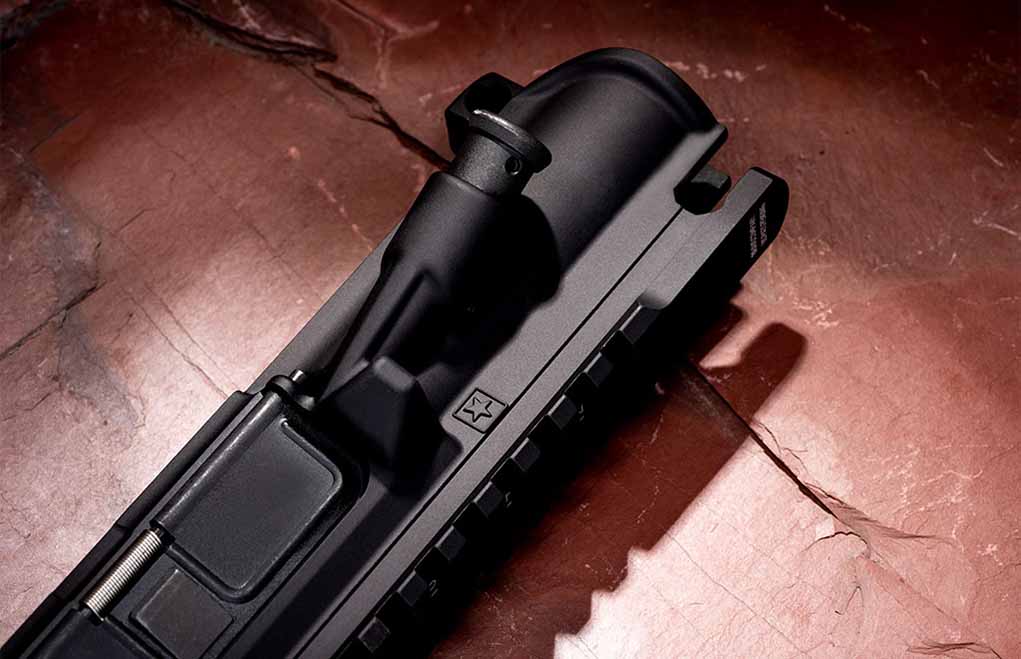
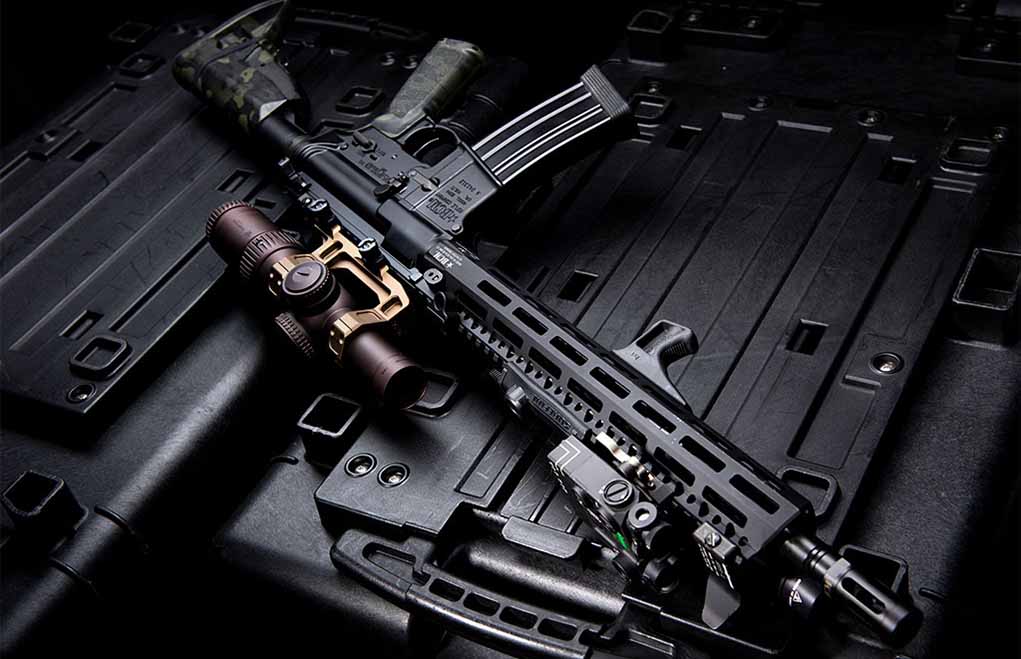
Addressing a common weakness in the modern AR-15 receiver design, BCM’s MK2 Upper creates a stronger, more accurate carbine.
How The BCM MK2 Upper Improves The AR Design:
More material at the top of the upper creates a stronger and stiffer receiver.
Gas venting has been improved so it goes away from the user’s face.
Forward assist positioned to create additional clearance side charging handle and end-plate mount slings.
To many, there’s no improving on the AR-15. It’s practically perfect in every way, thank you very much. But that doesn’t mean there aren’t firms out there who figure they can make the tried-and-true rifle just a bit better than what’s come before.
Count Bravo Company among those who are bound and determined to reinvent the wheel. But with their latest release, the Wisconsin company just might have pulled it off—at least in some subtle, yet important ways. Foregoing a complete revamp, the BCM MK2 Upper Receiver fortifies some standard weaknesses of a typical AR, and enhances it to function seamlessly with what have become more common accessories.
So, what the heck does that all mean? Namely, they’ve made the top of the receiver—particularly around the ejection port—more robust, as well as made them play nicer with optics and suppressors.
To the former design point, a somewhat winnowed receiver top came about on many ARs when the military moved from carry handle to flat-top receivers as optics became more accepted. Basically, there was simply less material up there, which BMC addresses with the MK2 Upper by bolstering the top by moving material there from non-critical areas. Overall, this creates a stiffer receiver, reducing barrel deflection and enhancing bore tolerances, improving barrel alignment, consistency and accuracy.
As to the latter aspects of the MK2 Upper, the receiver—of course—is optics ready and features an added gas expansion area and new channels around the charging handle opening to vent gas away from the user’s face. If you run a suppressor, you understand this means less distraction and a more functional rifle.
Also, a bit minor compared to the MK2 Upper’s other facets, BCM has also fine-tuned the forward assist position. Simple but practical, this creates additional clearance for right-hand side charging handle manipulation and end-plate mounted slings.
The MK2 Upper Receiver also retains all USGI components in assembly and works with all USGI bolt carriers, charging handles and barrel assemblies. It’s forged from 7075T6 aluminum, which retains a form following grain structure which maximizes achievable strength. Presently, the BCM MK2 Upper has an MSRP of $129 on the company’s website.
If you love military surplus, you won’t want to miss these mil-surp M17 pistols Sig Sauer is releasing in the market.
What The Mil-Surp M17 Pistols Offer:
All coyote tan finish, including controls and slide.
Configured to shoot high pressure military ammo; second guide-rod assembly for standard velocity ammo.
One 17-round and two 21-round magazines.
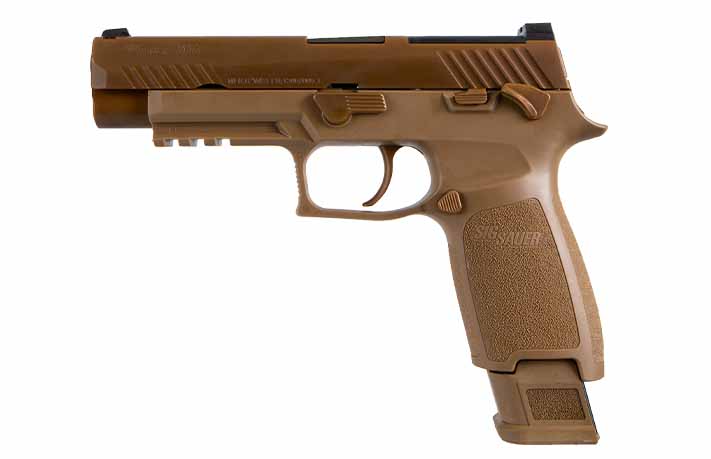
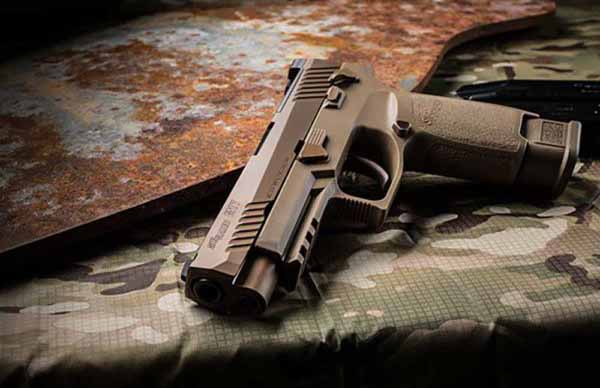
Military surplus… there are few sweeter words in the English language. (Maybe select fire.) If your ears perk up when you hear them, you’ll want to pay attention to the news coming out of Sig Sauer. Almost a heartbeat after the U.S. Military adopted the P320 (designated the M17) as its service pistol, surplus models are now being offered in the civilian market. Quite a deal when you think about it.
First off, given many of the M17s will have seen use and are surplus, they should come in at a discount (no promises). How much? Good question; Sig isn’t saying and a cursory web search didn’t turn up any surplus M17s at the usual outlets. Secondly, the guns aren’t that old. The longest in the tooth are only pushing three years old; yes, hard use could make a rag out of one in that time. Still, the design is relatively new and replacement parts and upgrades are abundant. Finally, mil-surp guns just tend to be cool in and of themselves. It’s always nice to have a gun with a bit of history to it, even if it’s extremely recent.
A few notes on what you’ll get with the military surplus M17. The pistols are in the original all coyote tan finish, where later contract models had black controls and slide. Furthermore, these M17s were tested and configured to shoot military spec ammunition, high-pressure 9mm, akin to commercial +P. If you happen to shy away from the relatively bucky ammo, Sig has you covered, including a guide-rod assembly with a lighter spring so the gun will cycle standard velocity rounds. The mil-surp M17 also comes with one 17-round magazine and two 21-round extended capacity magazines.
NEWINGTON, N.H., (December 17, 2019) – SIG SAUER, Inc. is honored to bring authentic, M17 Military Surplus handguns to the commercial market. The M17 Military Surplus handguns were manufactured under contract with the U.S. Army according to the original specifications of the Modular Handgun System (MHS). This is an exclusive, limited availability offering from SIG SAUER and the condition of the handguns will vary based on field use.
“The M17 Military Surplus handguns are a very special release from SIG SAUER, that gives consumers the opportunity to own a piece of history, and includes a certificate of authenticity,” said Tom Taylor, Chief Marketing Officer and Executive Vice President, Commercial Sales. “These handguns were originally issued by the U.S. Army and fielded during the initial domestic and in-theater deployment of the Modular Handgun System. The unique, one-of-a-kind, features of the M17 Surplus handguns include coyote controls, the original government-issue markings and serial numbers, and orange rear and green front SIGLITE Night Sights, which will make them coveted by both military and firearms collectors alike.”
The M17 Surplus handgun is a 9mm, striker-fired, P320-based handgun platform, featuring a coyote-tan PVD coated stainless steel slide, coyote-tan controls, a coyote-tan medium carry grip module, with the U.S. Government slide markings and serial numbers. The handguns are equipped with SIGLITE sights (orange rear & green front), removable night sight rear plates, and the same optic cut as specified by the MHS contract, and ready to fit a SIG SAUER Electro-Optics ROMEO1Pro Optic. The M17 features an ambidextrous manual safety, ships with (1) 17-round and (2) 21-round magazines, includes an official SIG SAUER M17 Certificate of Authenticity, and comes packed just as the handguns are delivered to the U.S. Military.
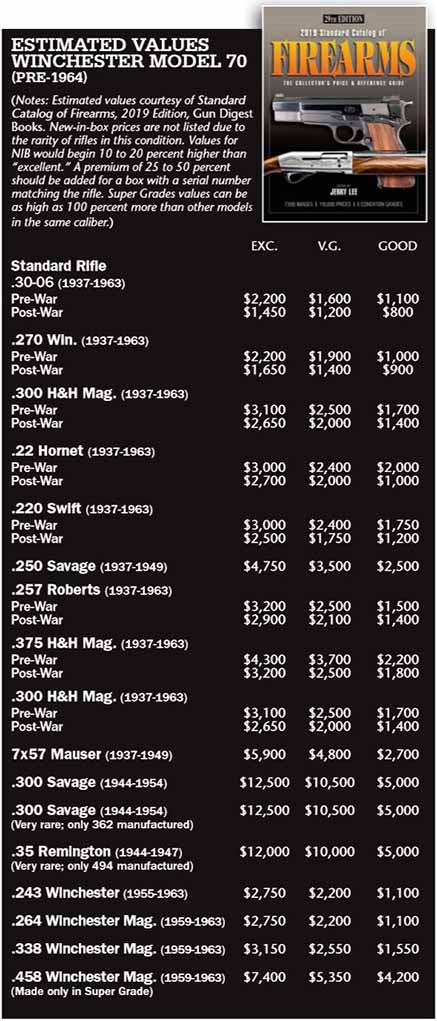
Throughout its various production periods, the top-of-the-line Model 70 has been the Super Grade.
The rifleman’s rifle, the Winchester Model 70 still stirs shooters souls.
What Made the Pre-’64 Model 70 So Desirable:
Oversized Mauser claw extractor
Excellent hand checkering
Bolt handled allowed for a lower scope position
Recoil lug and bedding system created a stiffer action
Just plain accurate
For many years, Winchester’s Model 70 was the standard by which all other centerfire bolt-action rifles were compared. Introduced in 1936, it was a time when bolt-actions were well on the way to replacing the great lever guns of the prior century. Our doughboys who served in World War I with 1903 Springfields came home with an appreciation of the inherent accuracy and rugged reliability of bolt-actions.
During the Great War, the major American gun companies were already making plans to develop new firearms for the civilian market. Not long after the war was over, Remington, along with Winchester and Eddystone Arsenal, had supplied troops with the Model 1917 Springfield and developed a civilian version in .30-06 known as the Remington Model 30. Savage unveiled its first bolt-action—the Model 1920 Hi-Power in .250 Savage and .300 Savage. Winchester engineers had been working on a bolt gun for several years and, in 1925, the company introduced the Model 54, chambered for the .30-06 and a new cartridge known as the .270 Winchester.
Winchester’s Model 54
The Model 54 combined some features of the M1903 Springfield, the M1917 and the M98 Mauser. It was offered in 10 different model variants and 10 chamberings and was generally well-received in the marketplace.
Learn More About Legendary Winchester
9 Greatest Winchester Rifles And Shotguns Ever Made
But timing is everything, and the 1929 market crash and subsequent Great Depression kept sales low, not just for the Model 54, but for other Winchester models as well.
This ad appeared in several outdoor magazines in 1950. (Photo: Winchester Repeating Arms)
After 65 years of numerous management changes and being controlled most of that time by one family, Winchester Repeating Arms was forced into receivership. On December 22, 1931, Western Cartridge Company purchased the gunmaker. The Model 54 had seen several improvements since 1925, but under the new management, the engineers made plans for a totally new rifle.1
The Model 70
The Model 70 was announced on January 1, 1937. It had some of the same features as the Model 54 but with numerous improvements. These included a hinged floorplate, straighter stock with superior checkering, a forged-steel trigger guard and an adjustable trigger based on the override trigger of the Model 52 .22 rimfire target rifle, which was well-known for its crisp letoff. Changes were made to the bolt handle and the safety lever to allow a lower scope position, as well as to the recoil lug and bedding system to obtain a stiffer action and improved accuracy.2
The Model 70 quickly gained a solid reputation for its design, accuracy and workmanship. At the time, Jack O’Connor was on his way to becoming “the dean of American gun writers,” and he referred to the new Winchester as one of the two best rifles in the world (the other being the M98 Mauser).3
Most collector interest in Winchesters is for models made before 1964—the year the company made significant changes to its manufacturing methods and gun designs. These changes gave Winchester a better position in the marketplace to compete with gunmakers that were using more-modern ways to make their products.
Among the changes made to the Model 70 were a redesigned action with a push-feed bolt instead of controlled-round feed, a free-floating barrel and a new style stock with impressed checkering. In the barrels, instead of broached rifling and cut chambers, both were cold-forged or swaged. There were many other internal changes, including a move to precision casting for many parts instead of machined bar stock, redesigned ejectors and extractors, and a wider trigger.4
Many well-known gun writers of the day were quite critical of the new Model 70, and soon, their opinions sparked a “pre-’64/post-’64” debate that continues to this day. It’s obvious that the older rifles, especially those made before World War II, have more hand fitting of parts and better polishing. However, to say that all pre-’64 rifles were “better” than all post-’64 rifles, well, that’s a great way to start an argument.
Criticisms received by the company following the introduction of the new Model 70 did not fall on deaf ears. It wasn’t long before the free-floating barrel was discontinued; and soon, there was a return to cut chambers while keeping the swaged bore and rifling. Other modifications were made through the 1970s and ‘80s; and, in 1994, there was essentially a return to the pre-’64 action on many models.4
FOOTNOTES 1, 2: The Rifleman’s Rifle, Roger Rule; 1996 3: The Rifle Book, Jack O’Connor; Alfred A. Knopf; 1964 4: Standard Catalog of Firearms, Gun Digest Books; 2019
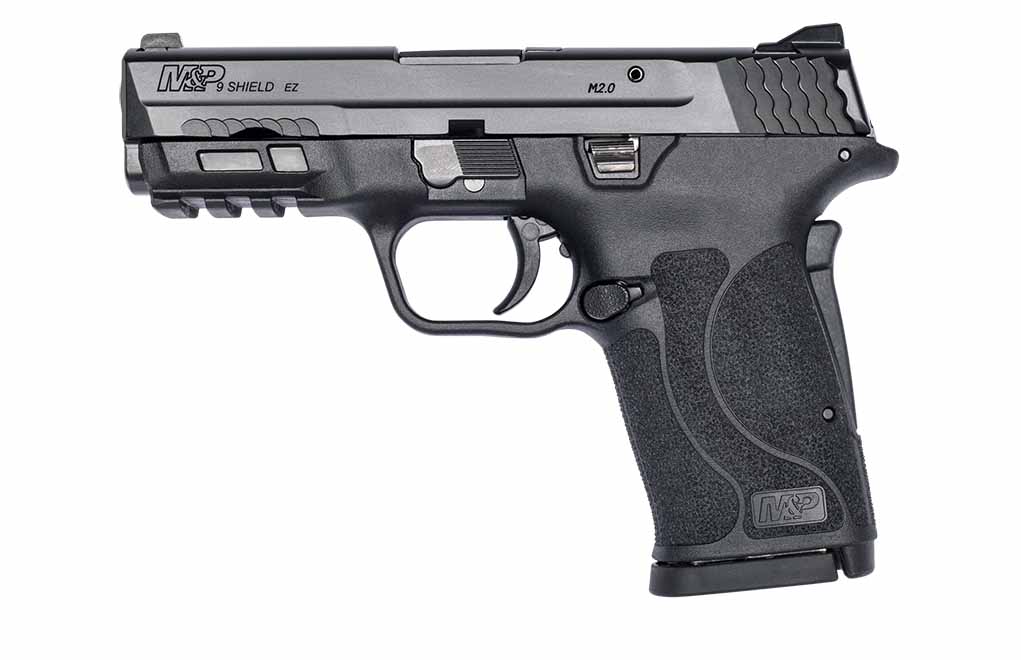
With less slide resistance, the M&P9 Shield EZ opens the semi-auto pistol to more shooters.
How The Smith & Wesson Pistol Is Easier To Operate:
Easy to rack slide
Crisp, light trigger with tactile and audible reset
Easy-to-load, slide-assisted magazine
Grip safety
Disassembles without pulling trigger
Tactile Loaded Chamber Indicator (TLCI)
Facets—semi-auto pistols have a cut diamond’s worth, each requiring mastery. In the shuffle of reloading and clearing malfunctions, slide manipulation is among the most overlooked. Generally, because most people have written it off as the nature of the beast. Racking a semi-auto is always going to pose a challenge, even for those with vice-like grips. But what if the slide’s operation is so overwhelming a shooter pretty much writes off the style of handgun?
It was a question Smith & Wesson asked not long ago and answered with the M&P380 Shield EZ. The gunmaker obviously struck a nerve, given they recently followed up with a “big brother” version—the M&P9 Shield EZ. Chambered in more powerful 9mm, the gun remains as simple to manipulate as the .380, creating quite a potent platform that’s open to a wide swath of the shooting world.
Like its predecessor, much of the magic for the M&P9 Shield EZ is thanks to Smith & Wesson breaking from market logic. Opting for an internal hammer, as opposed to the dominant striker-fired, the company was able to incorporate lighter springs into the gun. This, in turn, means less resistance from the slide and less force required to manipulate it in an effective and efficient manner. While the dominant design point, it’s not the only feature Smith & Wesson has included to make the gun accessible.
Learn More About Handguns:
Gun Digest’s 10 Best Shooting Drills And Firearms Training Posts
The pistol also features aggressive fore and aft cocking serrations common to the M&P line, a flared section of the slide at the very rear for a better grip and magazine with slide-assist loading. The M&P9 Shield EZ is also sized right for concealed carry. The pistol is outfitted with a 3.675-inch barrel and weighs in at 23 ounces, which makes it comparable to many sub-compacts in its class. The only knock on it for some shooters is capacity, with the single-stack only holding 8+1 rounds.
The M&P9 Shield EZ comes in at a reasonable price, with an MSRP of $479. And ambidextrous thumb-safety and factory-installed Crimson Trace Red Laserguard models are available.
More from Smith & Wesson:
SPRINGFIELD, Mass. – Smith & Wesson Inc. today announced that it has expanded its award-winning M&P Shield EZ pistol series to include the new M&P9 Shield EZ, chambered in the popular 9mm caliber. Built for personal protection and every day carry, the M&P9 Shield EZ further expands the M&P Shield EZ pistol platform, which was released in 2018 and features an easy-to-rack slide, easy-to-load magazine, and easy-to-clean design.
Lane Tobiassen, President of Smith & Wesson, said, “When the M&P380 Shield EZ was released in 2018, we received overwhelmingly positive feedback on the easy-to-use features of the innovative pistol platform. From that point on, we knew we would expand the M&P Shield EZ line with a pistol that incorporated the same features, chambered in the powerful and popular 9mm caliber. The new M&P9 Shield EZ is easy-to-rack, easy-to-load, easy-to-shoot and easy-to- clean, appealing to a wide range of consumers seeking out these popular features in 9mm. With over three million M&P Shield pistols adopted by consumers, we believe the ‘M&P Shield’ name has become synonymous with personal protection. This much anticipated release is the next evolution of the personal protection pistol.”
Built for personal and home protection, the new M&P9 Shield EZ pistol is the latest addition to the M&P M2.0™ family and features an 8+1 round capacity and a 3.675” barrel. The M&P9 Shield EZ pistol ships with two 8 round magazines that feature a load assist tab for quick, easy loading, as well as a picatinny-style equipment rail to accommodate accessories. The pistol also features an optimal M&P pistol 18-degree grip angle for a natural point of aim, white-dot front and adjustable white-dot rear sights, and a light, crisp trigger. The MSRP on the M&P9 Shield EZ pistol is $479.
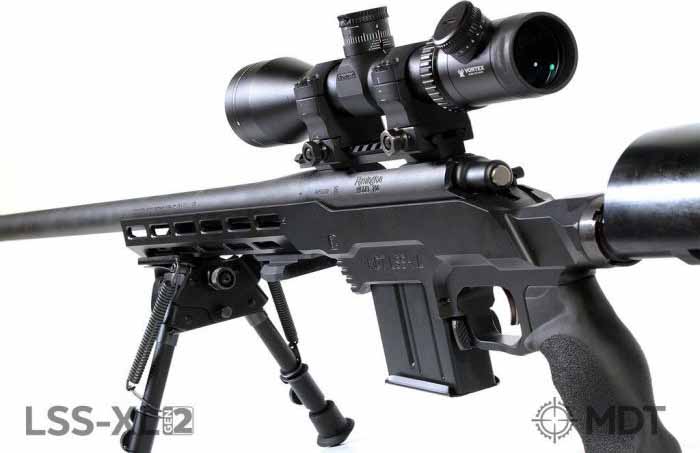
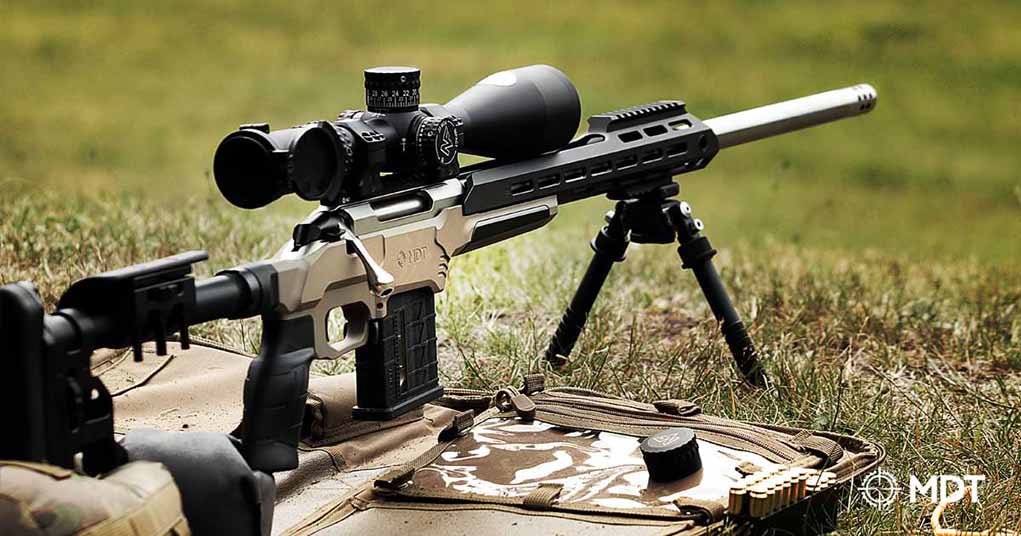
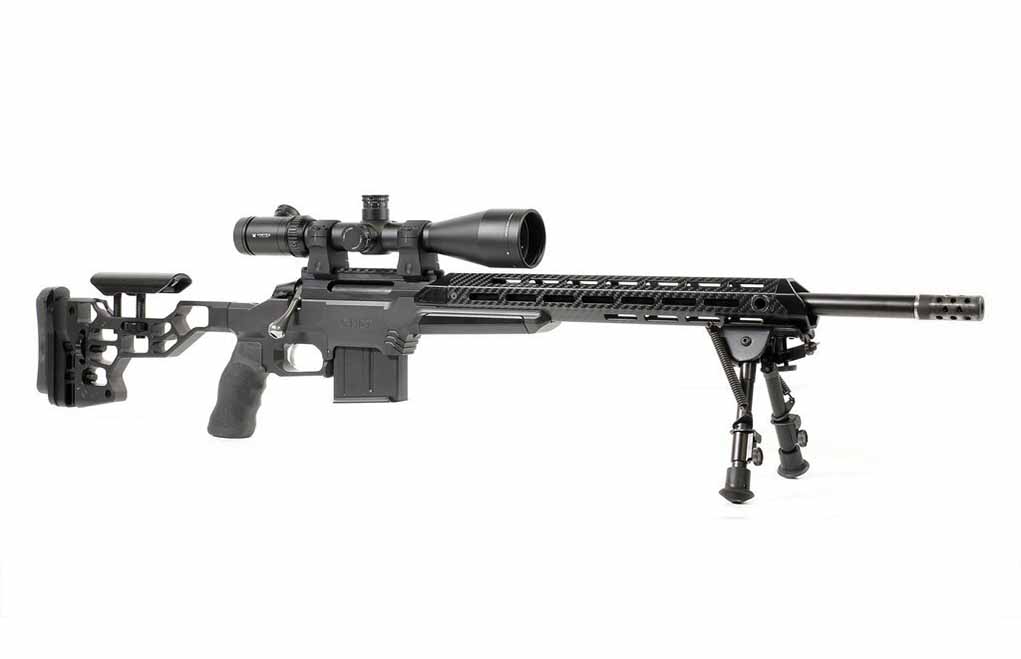
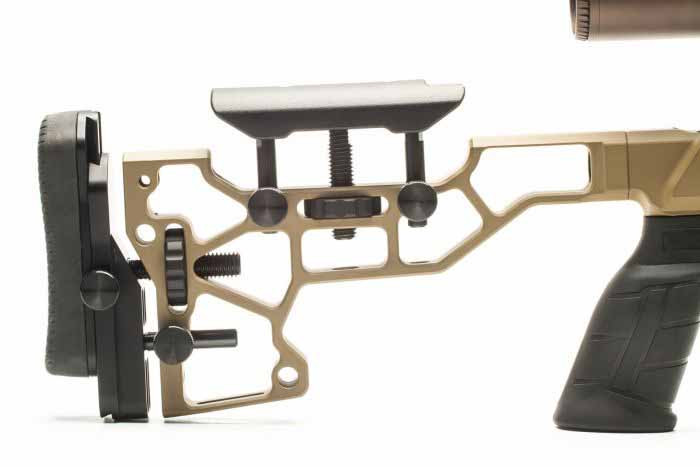
Flexible and affordable, the MDT LSS Gen2 Chassis is everyman’s entry to sharp-shooting performance.
How The LSS Improves A Bolt-Action’s Accuracy:
Modular design allows you to customize the chassis to particular applications.
Solid aircraft-grade aluminum creates the rigid platform needed for accuracy.
V-block bedding ensures tight mating between action and chassis.
The definition of practical accuracy is fluid. In your grandfather’s day, anything dead on a deer’s vitals out to about 250 yards was proudly heralded as hair-splitting. Of course, we’re most likely talking a rifle that had little more than iron sights and a barrel touching a majority of the stock. Given the standard, the results are understandable.
By today’s yardstick – measured in fractions of milliradians and minutes of angle – consistently banging away at a dinner-plate sized target hardly raises an eyebrow. Technological leaps of the past 20 years or so have shifted the marksman’s expectations. It’s shrunk them to a certain extent down to the size of a perfect cloverleaf group. Superior rifle making techniques, high-performance long-range optics and meticulously engineered projectiles are to thank for this golden age of precision shooting. That and the rifle chassis.
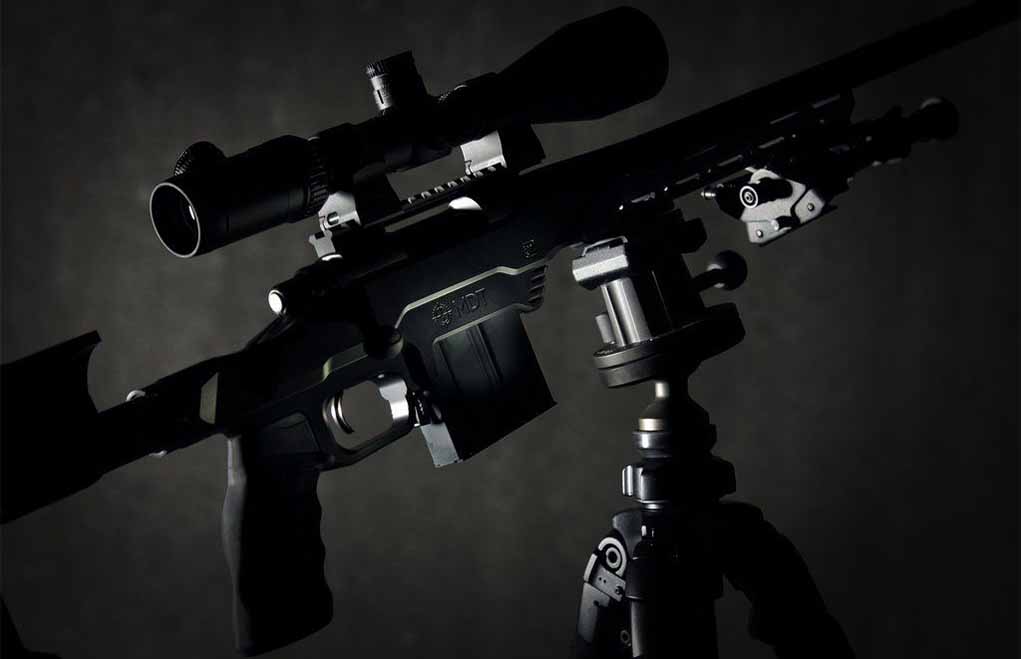
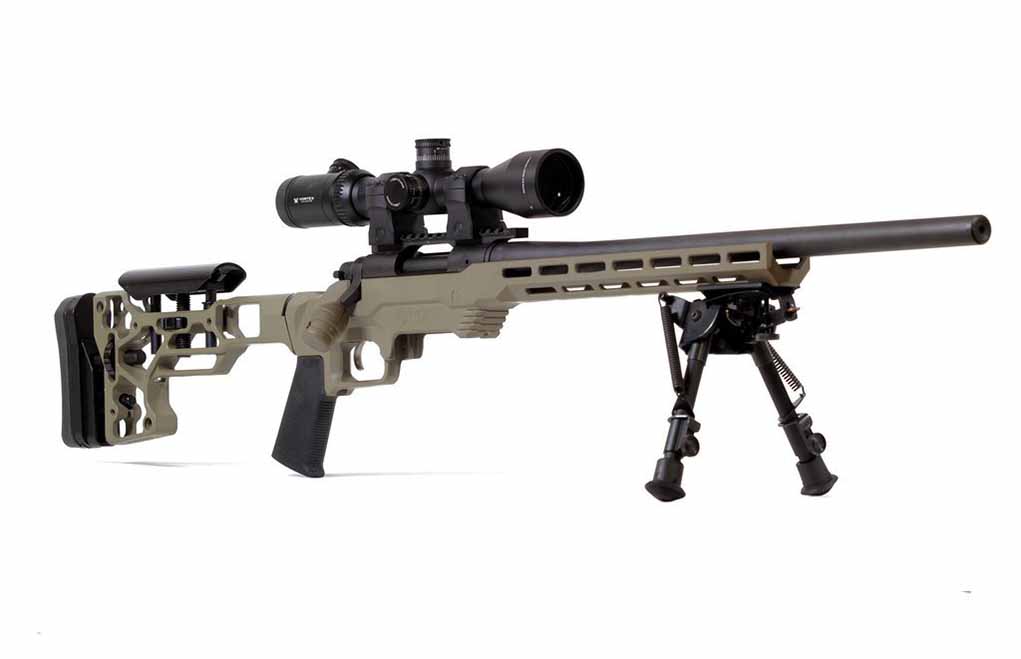
Perhaps no one element has done more to consistently get shooters on target than the rifle chassis. And few options better equip the average, everyday shooter to take his marksmanship to the next level than the MDT Lightweight Sniper System (LSS) Gen2. It’s the everyman’s entry to sharp-shooting performance.
MDT’s Modular Ethos
For those unfamiliar with MDT, the company has two driving ethos – accuracy and modularity. Both play out perfectly in the LSS Gen2.
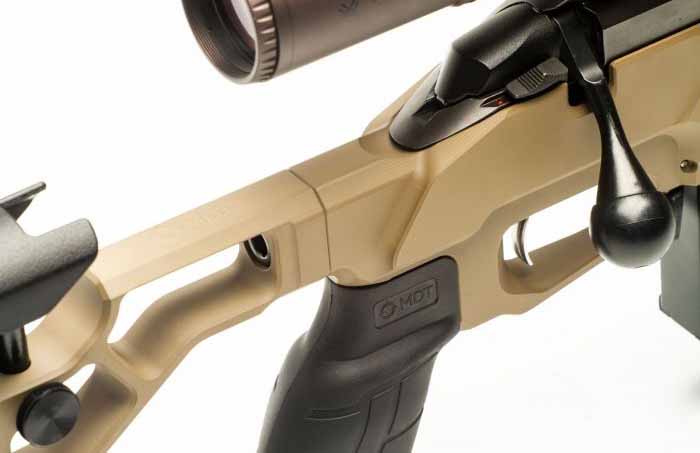
Unlike a majority of other chassis options, the lightweight system is a blank slate – intentionally so. What I mean by that is, all you get is the chassis itself. The rest you must supply yourself – buttstock and pistol grip. For some souls, this might sound like a nightmare, given they’ve become accustom to the layout and controls of a particular manufacturer. But if you’re just making the leap into a rifle chassis or have your heart set on a jack-of-all-trades, this is potential a boon.
You aren’t hemmed into any one way of doing things with the MDT LSS Gen 2, before you know what really works for you. And you have a system that modifies at your whims. That and how much your wallet can bear. Given the chassis is compatible with generally affordable AR buttstocks and pistol grips, you’ll find it can bear a lot.
Learn More About MDT Chassis And Gear:
Top 5 Reasons Why You Should Upgrade Your Bolt-Action To A Rifle Chassis
MDT ESS Chassis: Redefining The Modern Precision Rifle
Furthermore, you have at your disposal a chassis fit for potentially anything you aim it at – from a backwoods surgical hunter to a lights out target rifle, even something for a precision match. Configured correctly, the LSS Gen2 can be all these things.
As to the accuracy end of the equation, the LSS Gen2 might classify as entry-level, but it doesn’t scrimp where it counts. The 1.6-pound rifle chassis is milled from a single piece of billet 6061-T6 aluminum, an extremely lightweight material, yet rigid as short-cut rebar. In turn, even if you lay a real thumper caliber into the chassis, you don’t have to worry about an errant bullet trajectory.
The LSS Gen2’s bedding system too does its part in creating a rock-solid rig. Similar to the company’s top-of-the-line ESS competitive chassis, the system features V-block bedding. The geometry of the main interface between action and chassis creates a monolithic contact point between the two elements. To translate, once you mount your barreled action it’s not going anywhere. Aiding this is an ample barrel lug recess, capable of handling beefier custom jobs (up to .350 inch) that some shooters run.
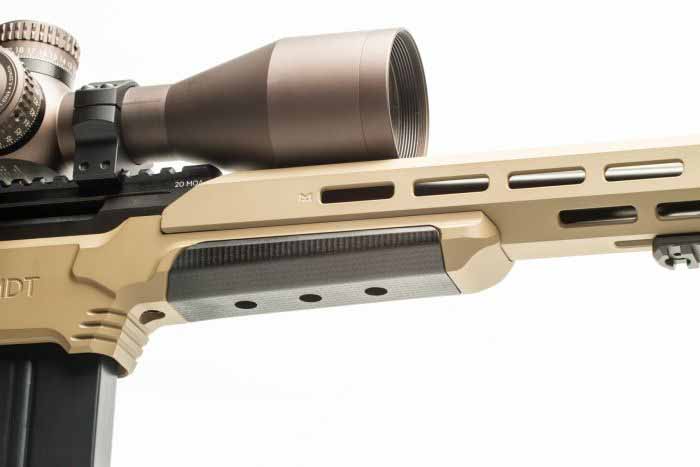
Finally, MDT has left ample room for barrel clearance in the fore-end, making certain it free floats no matter its profile. The company claims it can keep a barrel the same circumference as the action free and clear, a boast that seems true when you see the negative space with a bull barrel installed. A note about the fore-end, it’s slim. This might not appeal to a diehard Precision Rifle Series shooter used to a full handguard. Though, this shouldn’t prove a turn off for most interested in the LSS Gen2, given MDT’s overall crossover intention.
LSS Extras
Impeccable ergonomics, the LSS Gen2 has all the little things shooters have come to expect out of a high performance chassis. Thumb rest, ambidextrous magazine release and barricade stop on the front of a recessed mag well are standard and make a difference. And there’s plenty of space to tack on your most important accessories, with ample M-Lok slots.
This is an improvement on the Gen1 LSS, which was without them. And it’s a huge convenience compared to other rifle chassis that use proprietary attachment systems. Additionally, the chassis comes with a swivel stud, if you need. Nice it’s there, just in case. But I can’t help but think 90-some percent of shooters replace it with a section of rail. Maybe I’m wrong?
Best of all, the chassis uses ACIS magazines. This alone on many actions is worth the price for entry. Standard fare for AR-style rifles, the magazines are ubiquitous and cheap. To boot, you can pick the exact capacity you require.
Accuracy On The Cheap Talk to most accuracy minded folks who’ve yet to leap into a rifle chassis, there’s generally a similar sticking point – price. No argument. Traditionally they’ve been on the spendy side as a matter of their customer base. Competitive shooters shell out on their rifles and manufacturers are more than willing to take their money. The LSS Gen2 erases this concern in a big way.
Priced at $400, it lines up with the cost of a majority of aftermarket stocks. Compared to other chassis, it’s an absolute bargain. At the same tick, the Canadian manufacturer gives you more than you’d expect out of an entry-level option. Maybe more than some of the high-end chassis you seen out there.
Parting Shot Many envision a lone competitive shooter maliciously ranging his shot and double-checking his D.O.P.E. when they think of a chassis rifle user. Get that out of your mind immediately with MDT LSS Gen2.
No argument, you could configure a rifle as a competitor with the chassis, however, it’s meant for more than gunning for gold. Be it a versatile and accurate way to collect your next trophy buck or the building block for a gnat’s ass plinker, the affordable option will most certainly get you on target. All you need is the desire for a more accurate rifle.
You can rave all you want about how we won two world wars with the .30-06 and how the Colt Peacemaker is the iconic symbol of American freedom.
However, when it comes to the firearm that truly represents our country, it is, without question, the lever-action rifle. I’ve often said it’s because every American has a little cowboy in them, but there’s more to it than that. Lever-action rifles are so loved by the freest men in the world because they are so useful. They provide all the accuracy necessary for most of the shooting that needs to be done, they’re handy, fast to operate and, well, singularly American.
When I was young, I was all about the bolt-action, because I looked at lever guns as ancient artifacts. But, as I grew older and gained more experience, I realized every man needs at least one lever gun—and ideally, several.
Here’s a look at my five favorites. All are guns I use regularly for everything from squirrels to buffalo. They might give you some ideas about configuring your own perfect lever gun.
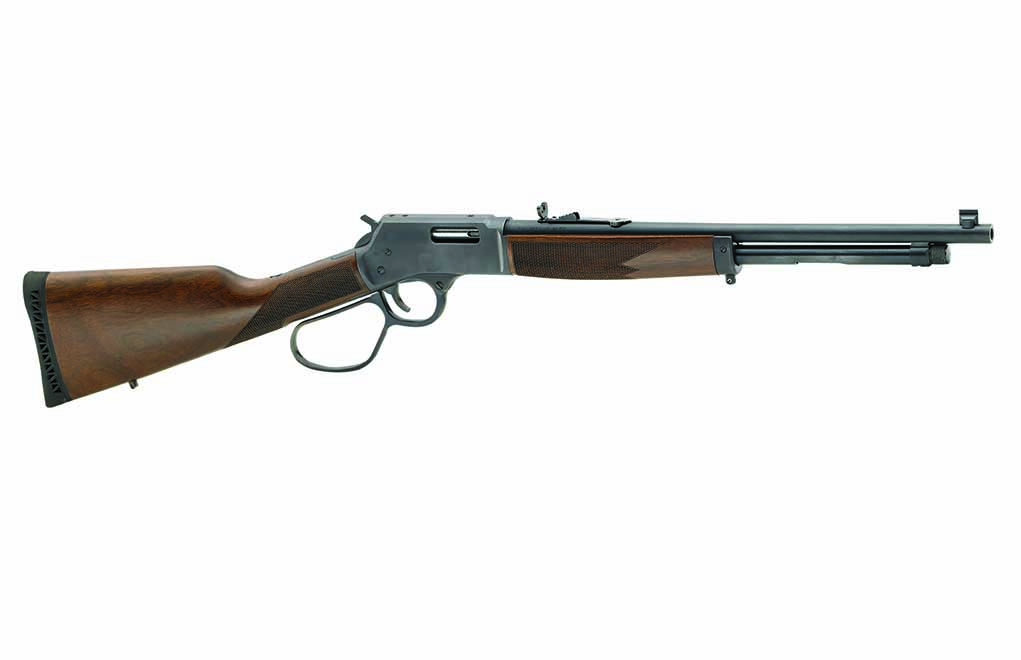
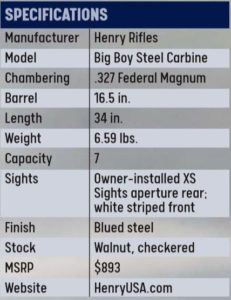
Henry Big Boy Steel Carbine .327 Federal Magnum
The Henry Big Boy Steel Carbine is a compact and handy rifle. In true lever-action fashion, it doesn’t have a redundant safety—the hammer is the safety.
I’ve been a fan of the .327 Federal Magnum cartridge since its inception. This is a good-shooting, compact carbine that will handle both .327 Federal Magnum and .32 H&R Magnum ammunition. It comes with a leaf rear sight with a ladder and a brass-beaded front. I installed an XS Sights fully adjustable aperture rear sight. This required a new front sight—and a tall one at that. (If you decide to install XS Sights on your Henry Big Boy Steel, the front sight will need to be about 0.65 inch tall.)
This is one of my guns that stays loaded. It lives in my closet beside my bed with a magazine full of Federal’s 100-grain JSP loads. They’ll generate more than 2,000 fps from the Henry’s barrel and are just as capable for dealing with bad guys as they are for deer. The carbine’s trigger has a good, crisp pull weight of 3.5 pounds, and I really like the straight grip. It, in conjunction with the large loop, makes the rifle easy to carry at my side in one hand.
My favorite feature is the lack of an extra safety. This rifle is made the way a lever gun ought to be: The hammer and trigger are the safety. In the Henry tradition, the Big Boy is loaded through the magazine tube. This makes loading as you go impossible, but it also makes unloading at the end of a hunt easy and safe.
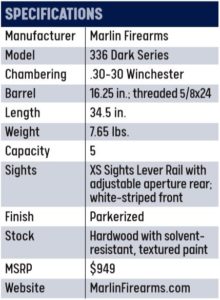
Equipped as shown, this Marlin Dark Series 336 in .30-30 Winchester is suitable for hunting a wide variety of game and even for personal protection
I coach a high school boys’ soccer team, and my assistant runs a pawn shop. I was visiting one day and noticed a used Marlin on the rack. We haggled for a moment, and I ended up getting the rifle for under $150. Given that I’d scored such a sweet deal, my intention was to lightly customize this lever gun and create sort of a general-purpose rifle.
The project got moved to the back burner, and a year later, the only thing really new was that Marlin had introduced its Dark Series.
The features of the Dark Series 336 in .30-30 Winchester almost mirrored the customizations I’d planned for my pawn shop score. It has a hard-coat textured paint on the stock that’s solvent resistant, a black, parkerized metal finish, an XS Sights Lever Rail and a 16-inch barrel with a threaded muzzle. It even comes with a paracord-wrapped big loop lever and sling. The only thing I added was a Leupold VX-II 1.5-4x scout scope that has had a German No. 1 reticle installed by the Leupold Custom Shop. This is an extremely handy rifle and a rugged setup.
So, I now have a great project lever gun for sale. If you’re looking for a good deal on a used .30-30, give me a call. However, I’m betting that you—like me—should probably just opt for one of the new Marlin Dark Series 336s!
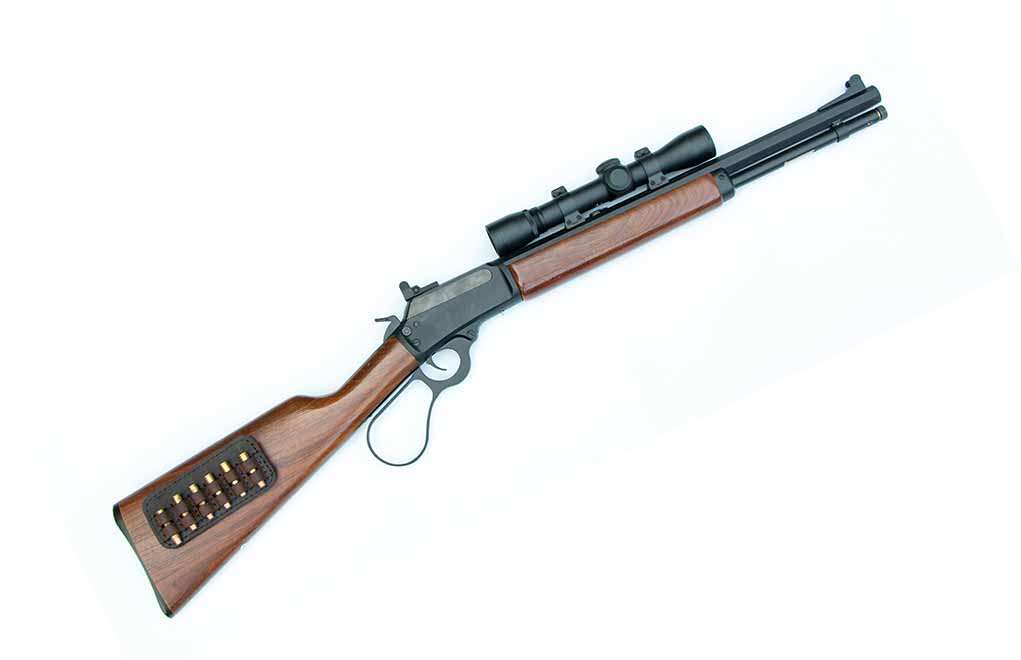
Brockman Custom Marlin 1894 .327 Federal Magnum
Jim Brockman’s masterful machining work on the octagonal barrel of this Marlin 1894 allows for the direct attachment of a scout scope in Talley rings.
About a decade ago, Marlin offered its 1894 Cowboy chambered for the .32 H&R Magnum. It was intended to appeal to cowboy action shooters who were running .32 H&R Single Sixes. Marlin did not make many of these and, in a couple of years, it was discontinued. Look hard, and you can find one used … but expect to pay north of a grand.
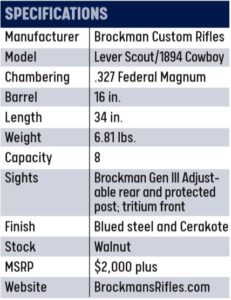
Because I’m a devotee of the .327 Federal Magnum, I purchased the first one of these rifles I could find with the intention of having it rechambered. The man I found to do the job was Jim Brockman of Brockman’s Custom Rifles. In addition to opening the chamber to .327 Federal Magnum, Jim cut the long, 24-inch barrel and magazine to 16 inches and gave the muzzle a deep crown. He opened the loop on the lever, performed an exquisite action job and installed a set of his Gen III adjustable/tritium sights. But the coolest modification Jim performed was to cut receptors in the octagonal barrel for Talley scope rings. This allows me to go between the open sights and a scout scope with just the twist of two levers. (In case you’re wondering, this customization requires a high level of gunsmithing skill.)
The little Marlin is now one of my favorite rifles. I don’t let a deer season go by that I don’t take it to the timber, and I’ve used it for groundhogs, squirrels and a variety of vermin around my home. In fact, my oldest daughter took her first deer with this rifle.
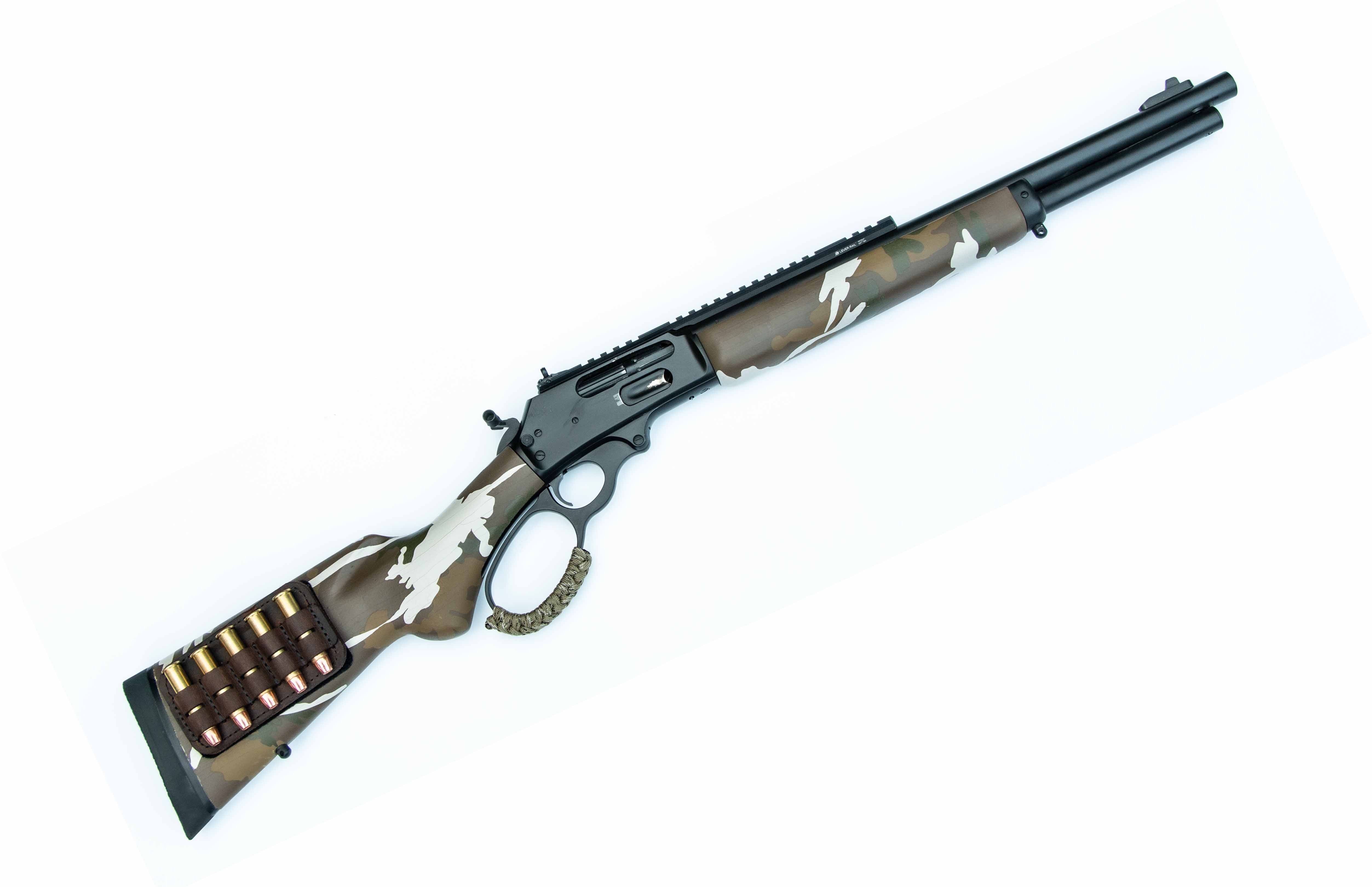
Marlin Custom Shop 1895 Modern Lever Hunter .45-70 Government
Offered with a variety of finishes, the Marlin Custom Shop Model 1895 Modern Lever Hunter is an attractive and finely crafted lever gun
The first time I hunted buffalo in Africa, I did so with a factory-stock Marlin 1895 SBL. This is a short-barreled, stainless steel version of the standard 1895, but it has a pistol grip stock, larger lever loop and an XS Sights Lever Rail. I really enjoyed the rifle during the safari, taking a warthog, reedbuck and, after a bit of a gun battle that ended a lot closer than I would have liked, a buffalo.
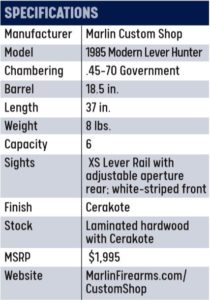
That was in 2013. In 2018, I had the opportunity to do it again. Although I’d planned to use the same rifle, as fortune had it, I ended up with a Marlin Custom Shop version that’s very similar: the 1985 Modern Lever Hunter out of the Marlin Custom Shop. It’s one of the shop’s top sellers and is configured very similarly to the 1895 SBL. However, it comes with a tuned action and a variety of finishes on the metal and wood. Mine is covered in Cerakote. It’s black on all the metal parts and sports a cool camo pattern—to match my Remington Custom Shop Scout Rifle—on the stock. It’s fitted with an XS Lever Rail, but for this hunt, I decided to forego optics and run the open sights.
Due to a poorly placed first shot (my fault), the buffalo hunt turned into another gun battle. But the rifle performed flawlessly and was used to take a variety of other game, including several warthogs and a mountain zebra. The Modern Lever Hunter does not get a lot of use here, at home, but it’s comforting to know it’s there in the safe … just in case I need to knock the snot out of something.
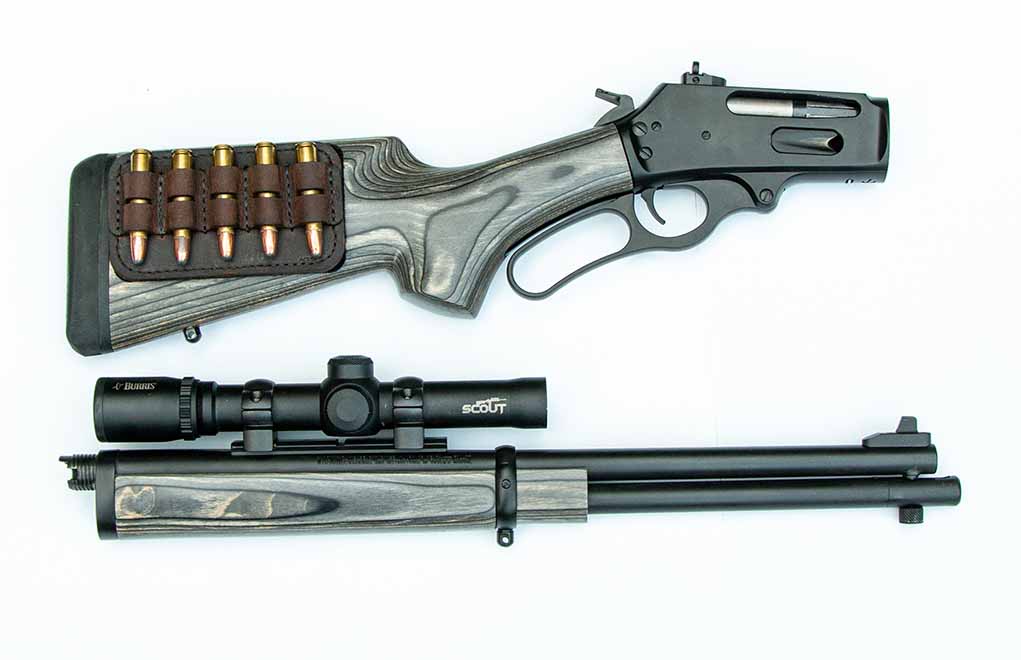
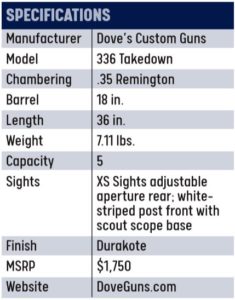
Dove Custom Marlin 336 Takedown .35 Remington
The Dove Custom takedown model 336 is a work of art and is ideally adapted to vehicle or backpack portage.
I’ve always had an ongoing affair with the .35 Remington and have owned several, including a limited-edition Marlin 336 built like its famous Guide Gun. It was a fantastic rifle, and I took several deer with it. However, the integral muzzle brake made it unpleasant to shoot. A couple of years ago, a friend in Florida found me a pristine 336 in .35 Remington, and I snagged it for a good price. My local gunsmith—Jerry Dove of Dove Custom Guns—had been making takedown lever guns, and I figured this would be the ideal platform for his genius to work on. Jerry crafts a cool and very rugged steel junction just forward of the receiver and mates it with a screw-locked magazine tube. This allows you to take the rifle apart—right in the middle—in about 10 seconds. It’s an ideal solution for a gun you might want to carry in your pack (it will even fit in a motorcycle saddlebag) or keep conveniently stored behind the seat in your pickup.
In addition to the nifty takedown feature, Jerry also installed a scout scope rail on the barrel, along with XS sights. A slicked-up action, fantastic trigger, VersaCarry AmmoCaddy and a saddle-ring safety replacement from Beartooth Mercantile that allows the rifle to work with a single-point sling all round out what is probably my favorite of all the lever-action rifles I own. I’ve yet to take it to the timber, but when I do, the critters had better look out—this gun and I get along quite well.
Editor’s Note: This article originally appeared in the October 2019 issue of Gun Digest the Magazine.
The MDT ESS chassis is the cream of the crop and just the ticket to get your bolt-action to live up to its full potential.
How The MDT ESS Chassis Makes A More Precise Rifle:
Solid metal frame provides rigidity required to improve accuracy.
Buttstock is completely adjustable, fitting any shooter’s frame.
Modular design allows shooters to tailor chassis to particular applications.
Drop-in installation for a wide spectrum of today’s most popular rifle actions.
Accurate rifles are nothing new. Irons that could knock the eye out of an eagle on a quarter at 100 paces have nearly always existed. Getting your hands on one … that’s another matter. Either they took a fat wallet and good gunsmith in your hip pocket or hours of free time and plenty of know-how to turn one out. Working knowledge of glass epoxy didn’t hurt either.
Those days have vanished with the smoking section in restaurants and TV antennas on houses. Much as we might gripe about this and that in the firearms world, there is no better time to live if you’re a shooter.
Off the shelf, ammunition is engineered to the level of jet fighters. Modern optics deliver clarity once only available at a planetarium. And off-the-shelf rifles are so consistently made, you could choose one at random and expect near tack-driver performance.
Impressive as these great leaps forward are, they pale in comparison one advancement in particular. The rifle chassis is the tie that binds all the other advancements together, ensuring they live up to the meticulous work put into perfecting them. And few options provide more punch for the penny than Modular Driven Technology’s Elite Sniper System or ESS. At the business end of this Canadian masterpiece, 1,000 yards is much closer than you think.
At The Heart Of The MDT ESS
When you shoulder the MDT ESS you’re struck by one thing – this thing is solid. Brick outhouse solid. Which is good, given the chassis is aimed primarily at competitive shooters and those serious about taking their marksmanship the distance … then some.
Learn More About MDT Chassis And Gear:
Top 5 Reasons Why You Should Upgrade Your Bolt-Action To A Rifle Chassis
MDT LSS Gen2 Chassis: Flexible Foundation Of A Precision Rifle
Weighing in at just shy of 5 pounds, I’m not sure it would do for much outside a precision rifle or F-Class match, unless you happened to be a glutton for punishment hunting. Yet, MDT has designed the chassis to modify to whatever objective you might have at hand. Much as their name implies, the company emphasizes the modularity of their systems, almost as heavily as they do their accuracy. It’s the heart of their systems and apparent on the ESS – particularly its fore-end.
Attaching via pair of Allen screws, the component removes as quickly and easily as a barreled-action slips into the chassis itself. And with four fore-end options to choose from, the rifle chassis has a wealth of configurations. These include aluminum full rail, night vision rail and even a streamlined, no rail versions, with length options of 13, 15 and 18 inches. More recently, for the weight conscious and tactically minded, MDT added a carbon fiber option to the mix, which they’ve been promising for some time.
In each case, the ESS fore-ends come with ample M-Lok slots, which is a boon, as anyone who’s shot a chassis rifle knows. For a long time, proprietary accessory attachment points were the rule, making it somewhat a hassle to get a cant level or other kit installed.
Interestingly, MDT also includes a sling swivel in addition to QD cups on their fore-ends. Though, paint me dubious, I figure 9 out of 10 shooters replace the swivel with a rail fairly quickly after opening the box.
The buttstock also gets the modular treatment, with MDT giving you the choice between standard SRS-X, folding SRS-FS and SRS-X Elite models upon order. No matter your choice, you get supreme customizability to your body frame via thumb wheel adjustments for both length of pull and comb rise – 1 inch each. Also, there’s no worry about knocking them out of adjustment, as both have locking bolts. Additionally, the butt pad is height adjustable, which lets you dial the main interface into yourself.
A quick note on the stock options. All of them are on target, but you do get a couple extras with the Elite version, including a steel buttpad for added balance and a stability-enhancing second guide rod.
Installation
If you’ve ever dealt with an aftermarket stock or even an ill-fitting factory one, you understand the challenge you face. It’s a balancing act of sorts, removing and adding just the right material so your barreled action fits without so much as a wiggle. It’s about the furthest thing from an out-of-the-box experience as there is.
Given its materials, the ESS comes to you nearly custom fit for your action. No epoxy or Dremel tool required. This means you can pop your rifle into the chassis the day you receive it and expect to see results. Generally, it’s just a matter of removing the barreled action from its old stock, putting it into the chassis and torquing down the new action screws MDT provides.
Fit and convenience aren’t the only advantages of the ESS. It’s bedding is also miles away from what you’re most likely used to. In fact, MDT’s V-block bedding beats about everything else hands down. The geometry of the main interface between action and chassis creates a monolithic contact point between the two elements. Simply put, this means the barreled-action isn’t going anywhere, no matter the recoil. Furthermore, the recoil lug mortise in the ESS not only accommodate factory spec options, but also beefier aftermarket upgrades, up to .375 inch and tapered.
Ergonomics And Shooting Enhancements
You never knew you needed cruise control until you finally bought a car with the option. Then, most likely, you were ruined for all time on models without it. Fair warning, the same holds for the MDT ESS’s ergonomics.
You might not have thought you needed a pistol grip or a thumb rest on your bolt-action. But brother, when you’re holding on target for an extended period, attempting to execute pristine trigger control, you’ll wonder how you did without them. And that goes for several other facets of the ESS system, each improving your accuracy, increasing your comfort and just plain enhancing your turn bolt.
A wide fore-end, perfect for nuzzling down on a rest, and barricade stop on the front of the mag well, are two such examples. The one that particularly sticks out is the ambidextrous magazine release situated between the trigger guard and magazine well.
When you become familiar with the ESS’s controls, it’s quite possible to drop an ACIS magazine (what the system is compatible with) and reload all without pulling your eye from the scope. That’s a major advantage, one not generally found on traditional stock options.
Parting Shot
The MDT ESS is a competitive-level chassis, designed to deliver on the most challenging shots. If you’re looking for a little something for your next match gun, the chassis should be on your radar. Especially if you aren’t looking to break the bank. Few top-shelf options compete with its $990 MSRP.
That said, even if you aren’t gunning for gold, the ESS still should remain a consideration. Certainly, it might not fit the bill for a lightweight, surgical hunter or entry-level accuracy enhancer. But for those unwilling to settle for average groups or truly want to test their and their rifle’s potential, the MDT ESS will deliver. That’s what it was designed to do.
Myths, such as the one about using your sights in a defensive scenario, are common but should be dispelled by competent instructors.
There are many myths out there when it comes to proper defensive handgun training techniques. Here, seven of the most common are debunked.
1. YOU WON’T USE YOUR SIGHTS IN A GUN FIGHT
I know; we have study after study, reams of empirical evidence and the commentary of really smart folks that say you will not use your sights under stress (Oh Lord, I hate that word). Most of the studies are based either on simulated gunfights under laboratory conditions or interviews with individuals involved in gunfights. In the case of the former, no simulation, no matter how carefully constructed, can exactly re-construct what occurs in real life. More on that later.
In the latter case, I’ve read lots of studies based on participant interviews, and with those supporting the “won’t-use-your-sights” theory, one thing always jumps out at me. We will accept that an individual will perform any number of actions without conscious thought as a result of deeply ingrained training leading to unconscious competence.
When, however, that same participant expresses any doubt about using the sights—an action they have performed literally thousands of times—the researcher will immediately conclude the sights were not utilized. If you accept that the shooter performs various actions due to ingrained training, why do we discount that phenomenon when it comes to using the sights? Could it be that the shooter used the sights and just didn’t register the action because it was so ingrained he performed it without conscious thought?
Your training is what you’ll fall back on in a defensive situation. Make sure you’ve trained to a high level.
Well, I’ve done my own study. Thirty years of police work with 15 years on my department’s full-time SWAT team and (wait for it) two shootings. I know two is not a big number, but it’s a whole lot more than most of the researchers have experienced! And I used my sights in both instances. Friends of mine who have preformed well in shootings will say they performed well because they used their sights. We used our sights because we trained with outstanding instructors who demanded excellence. Then we obtained the experience to remain calm under pressure.
I will add one more thought on the use of sights in a gunfight. If you disregard your sighting system (iron sights, red dot or visible laser) and fixate on your target, you will most likely miss. I trained in instinct/unsighted/reflexive fire throughout the years, and it is impressive on a static range. History has shown, however, that unsighted fire leads to failure in actual shootings. Remember, the universal hit rate is 100 percent. A hundred percent of the time you launch a projectile down range, you will hit something.
Using the sights gives you the best chance of hitting your intended target and solving your problem. Fixating on the threat and blowing rounds somewhere down there ensures you’ll likely miss your intended target and hit an unintended target. That unintended target may be an inanimate object or a 4-year-old child. It’s your choice. Ensure success or accept failure.
2. FORCE-ON-FORCE TRAINING IS JUST LIKE THE REAL THING
No. Nope. No way! Don’t get me wrong. Force-on-force training is a vital category of training and, if done right, can give you a low-level base of experience—the final level of training. But force-on-force is not “exactly like real life.” How do I know? Remember those two shootings?
First, force-on-force training should be carefully constructed to validate training presented in the class. The training should provide you with all the answers. All you need to do is figure out the question during the exercise. Next, the best exercises are based on real world events, not the instructor’s imagination. Last, the instructor should not allow the exercise to descend to the level of a paintball game or allow the students to “stress out” (Man, I hate that word). Exercises should be carefully controlled so the student achieves all the needed training goals. But, to be clear, force-on-force is not “just like real life.”
3. YOU WILL RISE TO THE OCCASION
In fact, you will default to your level of training. Further, in a real event, your skills will likely deteriorate, at least in the initial encounter. You must have highly developed physical and mental skills to perform at a level that will ensure success. A fighting or combat mindset without the skills to back up that mindset is useless. Mindset alone is “talking the talk.”
Developing skills to back up your mindset is “walking the walk.” You have to have both. So many people in the defensive weapon craft community want to take short cuts in training. Go ahead, it’s only life and death. What is your life worth to you? Put in the work, and you won’t have to rise to the occasion. The occasion will have to rise to your level of competence, and you will have won before the fight even begins.
4. IT’S NATURAL/INSTINCTIVE
This comment is usually attached to the instructor’s favorite technique, position or method of performing a given act. With the exception of natural point of aim, there’s nothing about using a gun that’s instinctive or natural. It’s learned behavior.
You either learned it in a class, saw it on TV, heard someone talking about whatever it is you think came natural or you learned it by some other means. How do I know? I know because I make pretty good money teaching fighting arts, including use of a variety of firearms. If this activity was natural or instinctive, anyone of any age could shoot. They wouldn’t need to be taught; they would instinctively know what to do. It would be truly hardwired behavior.
Ask yourself: Did you know how to shoot before someone taught you? Of course not! Shooting is learned behavior. You will learn, accept and perform what you believe is relevant to you and what you believe is valid. An instructor that explains everything by saying a given action is natural/instinctive either doesn’t know what he’s talking about or is too lazy to explain his training program. Either way, he’s shortchanging the student. The technique may be perfectly valid. But it’s learned behavior. Find an instructor who knows how to teach.
5. EVERYONE DOES THIS (INSERT INSTRUCTOR’S FAVORITE TECHNIQUE)
Virtually no aspect of shooting is instinctive or natural. Only training will ensure you act appropriately in the situation.
There are no universal actions in response to stimuli of any kind. How we react/respond is based on our individual experiences, training/education and perceptions. A couple examples come to mind. Years ago, there was this popular idea that—when surprised—everyone would crouch down and square up to the perceived threat. Remember that thing about me being assigned to a full-time SWAT team for over 15 years? Well, my buddies and I thought about that. Want to see someone surprised? Knock down their door and burst through pointing guns at them, throwing flash bangs and yelling to get on the ground. Then you see what people really do when startled. Freeze in place, turn and run, assume a fetal position (lying, sitting or standing no less) but very few squared up to us because those were the ones that got launched, and very few got launched! Most people, after an initial shock, followed directions. The reactions to our induced shock were individual. Nobody did the same thing as the last guy.
The second example is the universal startle reflex, i.e. throwing up their hands in response to sudden stimuli. Ummm, ever been hit in the face by a fist, pillow, ball etc? Hands didn’t come up, eh? Let that happen enough, and you’ll get those hands up. Practice it enough, and throwing your hands up in a startle response indeed becomes ingrained. It can become ingrained to the point you may just do that instead of what is really needed in the moment like moving, going directly to your gun or deflecting an incoming punch or gun pointing at you.
You can build similar actions among a training population. That can be good or bad based on the nature of the instruction. Responses have to be based on the circumstances of the event. Broad-based skills are important, but you must be able to remain calm enough to select the right tool for the job. If you buy into the universal action myth, you may just find the universal action you had to be taught anyway doesn’t fit your problem. That means you’ve wasted time, and time is a commodity you don’t have in a life or death situation.
O.K., I admit, I’m a horrible person. I wanted to test this theory, so I used my 3-year-old granddaughter as a guinea pig. I took a sponge ball (not a baseball, so I guess I’m not too bad) and tossed it at her head. In response to that stimulus, she did not, in fact, perform a universal action of lifting her hands to protect her head. In fact, the sponge ball bounced off her head. She thought that was hilarious! It was a sponge ball! After several attempts and Pawpaw showing her how to get her hands up, she’s starting to get pretty good at getting her hands on the ball. Catching will come. She had to learn how to lift her hands to protect her head.
6. HEART RATE DETERMINES YOUR ABILITY TO PERFORM PHYSICAL ACTIONS
Ok, here’s an admission. Nothing I’ve stated so far is my original idea. I have read comments and counter comments to virtually all the myths presented here and compared the credentials of the commenters. Heck, bouncing the sponge ball (come on, it was just a sponge ball) off the granddaughter’s head wasn’t even my idea! So when this myth came up years ago, I was curious if it had validity.
I talked to doctors and a variety of trainers who both did and did not agree with the concept. The trainers were split just about 50/50 for and against the concept. The doctors, who included sports medicine specialists and cardiologists, all said the concept was without merit. I deferred to the docs, and this myth has pretty much been de-bunked over time.
The docs all indicated the same thing. If your heart beats too slow or too fast, it eventually stops working. Not good! That’s the only effect your heart has on performance. As long as your heart beats within a range that doesn’t adversely affect your health—in other words you die—you can pretty much do whatever you have trained to do. Pretty simple actually.
7. EVERYONE RESPONDS TO STRESS IN THE SAME WAY
Stress—Oh Lord, I really hate that word! This myth relates to myth #5 in that the proponents of this myth advance the idea that everyone will experience the same effects under stress (Oh Lord, oh Lord, I really, really hate that word). First of all, we all do not perceive the same things as stressful. Some folks can sleep soundly through the craziest of circumstances while others fall apart if their mail is late. Beyond perception, we are all wired differently in relation to our individual ability to manage stressful situations. Training and experience can help us manage critical incidents more efficiently, but on a virtual cellular level, some folks will just always do better than others in these situations.
Why do I hate the word stress so much? It’s a perfectly good word. It’s only six letters. It’s easy to spell. And it’s also so overused it has virtually no meaning left. Everything is stressful to someone. There’s no way we can say that any of us have universal responses to stress. Folks, simply put this one out of your mind. Might you be excited in a shooting? Yep. Might you wet your pants? Yep. Might you stand there and sling lead like you’ve done it everyday of your life and it’s a perfectly normal part of you day? Yep. And you won’t know exactly how you’re going to react in that situation until you’ve been there.
So, there they are. Seven myths I’ve encountered in my many years of training and engaging in the defensive application of firearms. Some are the result of well-meaning individuals attempting to explain something they just did not really understand or because they didn’t have the skills necessary to investigate the issue. Others have come about because someone was simply trying to differentiate his training program from another instructor’s. Either way, they are myths that absolutely get in the way of training proven over time in the hands of competent operators. If anything, I hope this information can help you avoid these myths and keep you from wasting your limited training time and money on non-productive concepts.
Looking to go armed, but are stuck in the weeds as to what to arm yourself with? Here are 20 of the best concealed carry gun options that will keep you on the defensive.