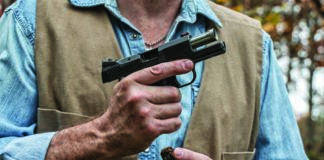
Whether you realized it or not, shooting with night vision requires some special techniques. Here they are.
Granted, shooting with night vision isn’t a skill set applicable to every shooter. The No. 1 reason, most are short the coin to get into a solid NVS setup. Yet, for those that are already kitted up or have the deep pockets to make this an option, it’s worthwhile nailing down the finer points of utilizing your handgun with your night vision.
As the former special operator and current instructor with 1-Minute Out, Jamie Caldwell, points out in the above video, the man thrust of shooting with night vision is equipment management. Much of this will happen well before you ever have to pull your handgun in live-action. In particular, the type of sighting system determines the particular technique you apply in getting your pistol on target with an NVS.
The easiest way is to invest in a red-dot optic, preferably one with brightness settings tailored to night vision. In addition to their fast target acquisition qualities, these devices require almost no special technique to work in conjunction with an NVS. The dot is visible through the system, in turn, you simply aim and fire with your googles deployed—simple as that.
Things get trickier with iron sights. A workable sight picture with iron sight and night vision don’t go hand in hand, thus you’ve got to find a way around your NVS. Flipping them up takes too much time, therefore Caldwell suggests simply tipping your head back to see underneath the googles. Generally, this technique is used in tandem with a weapons light, flipped on when you’re ready to take the shot.
This whole peering under the googles raises the question: What about the eye cups? The answer is easy as pie—do away with them. Removing this feature not only allows the quick use of a pistol’s iron sights but also opens up your peripheral vision. A human’s normal field of vision is 200 degrees. Most night vision systems cut this down to 40 degrees, panoramic to 98 degrees. So, yeah, you don’t need the cups.
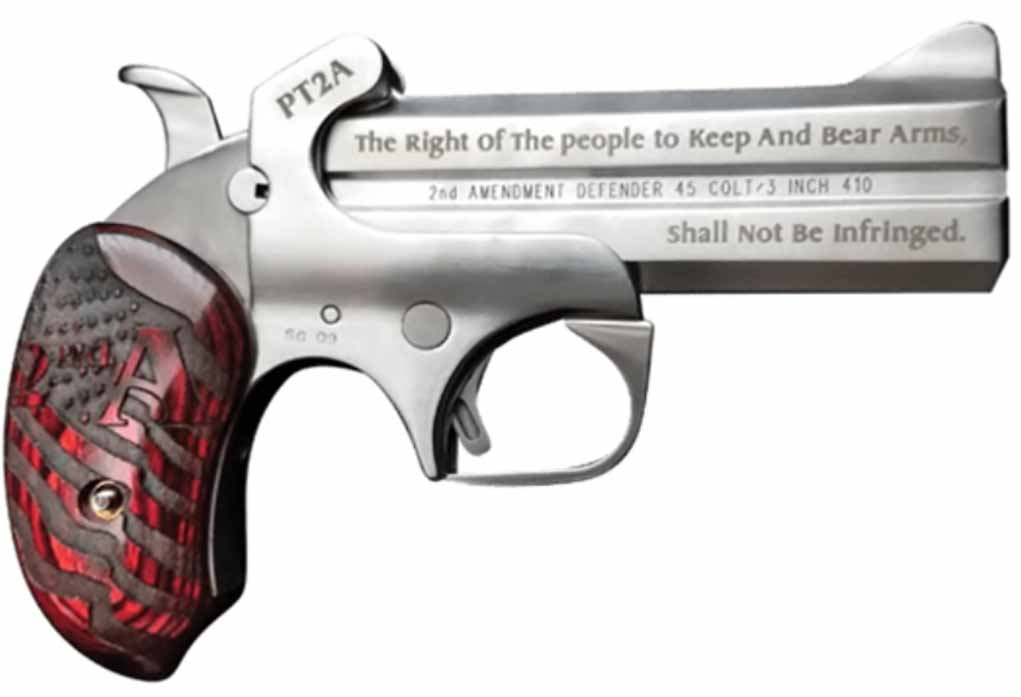
Some people memorize the 2nd Amendment, others carry a pocket constitution. Why do that when you could have it engraved right on your gun? The Bond Arms PT2A is a little pistol with a lot of style.
Bond Arms PT2A.
A Modern Derringer:
2 Model Choices
4 Caliber Choices
Rosewood Grips
Stainless Steel Construction
Included Leather Holster
Not Just For Doc Holiday
Bond Arms got their start when they realized that derringer-style pistols needn’t be relegated to cowboy movies or Wild West reenactors. The two-shot, double-barreled pocket gun once favored by gamblers still has a place in the modern concealed carry world. Perhaps not as a primary carry piece, as not even the most skilled shooters would recommend only carrying a two-shot gun. But for a deep-concealed backup pistol you’d be hard pressed to find one much smaller. Bond Arms’ Protect The 2nd Amendment, or PT2A for short, puts a new twist on their old line of derringers.
Legend has it that Doc Holiday actually did die with a derringer in his hotel room. Not just any derringer either, but a Remington Model 95, the same classic model that Bond Arms based their design on.
19th Century Concepts Meet 21st Century Engineering
Unlike the original Remington Model 95, the Bond Arms PT2A handgun is built from stainless steel using modern construction techniques. The result is a gun just as small as its predecessor but with a lot bigger punch. Capable of withstanding much higher chamber pressures, the Bond Arms PT2A’s two variants can fire four different modern calibers. One version is chambered for .38 Special and .357 Magnum, while the other can take either .45 Long Colt or .410 bore shotgun shells. Whichever chambering you choose, just know that you’re doing a lot better than the anemic .41 Short found in an original Remington 95.
Other features found on Bond Arms derringers help bring the gun to modern safety standards. The PT2A has retracting firing pins, a cross-bolt safety, a spring-loaded cam-lock lever, and a rebounding hammer. These elements ensure that you can carry your PT2A without worrying about it going off in your pocket. Despite this, please remember that carrying in a holster that covers the trigger is always safer than pocket-carry.
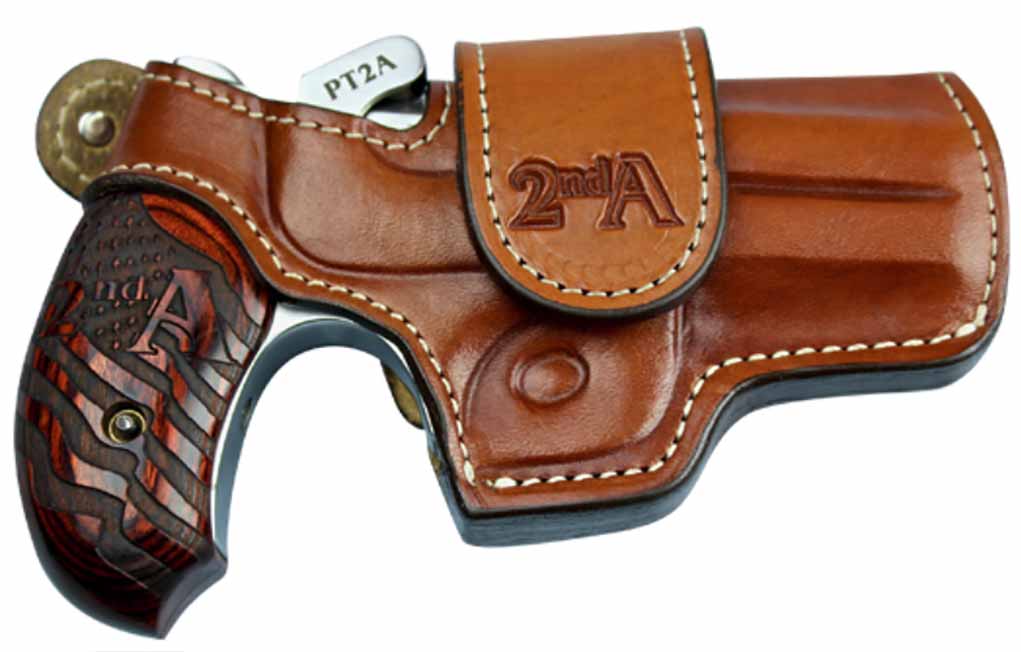
Speaking of holsters, the Bond Arms PT2A comes with a BAD premium leather driving holster. The “2nd A” embossed on the side makes the holster thematically consistent with the engraved derringer it houses, and the brown leather compliments the gun’s wooden grips.
PT2A in holster.
Other modern features of the PT2A include extractors that automatically eject spent casings and the ability to swap the engraved 4.25 inch barrel with any other standard Bond Arms barrel. Alternate barrel length options range between 2.5 inches to 6 inches. Keep in mind that changing the barrel also means losing the words of the Second Amendment that are engraved on the original. MSRP for the PT2A is $887.
Protect Yourself While Protecting the 2nd Amendment
By purchasing a PT2A, your support for the Second Amendment couldn’t be more apparent. Not only are the words of the Second Amendment proudly engraved into the side of the pistol’s barrel, but “2nd A” can also be found on the carved, high gloss rosewood grips and on the holster as well. It’s not just symbolic support, either. With every purchase of a PT2A, Bond Arms donates a portion of the profits to organizations that fight to protect gun rights in the United States. Whether you’re in the market for a practical little derringer for defense, or for a piece of patriotic art to hang on the wall, the Bond Arms’ PT2A is a good choice both mechanically and aesthetically.
For more info on the PT2A, please visit bondarms.com.
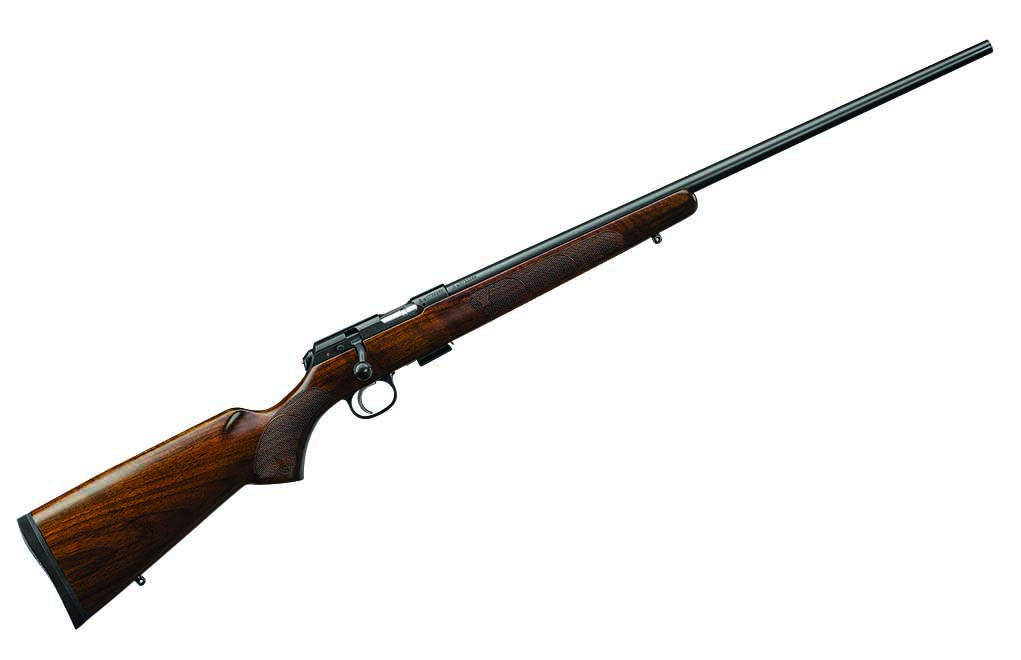
Accurate as they come, versatile and affordable the CZ 457 has earned a dedicated following among rimfire shooters in the know.
Why The CZ 457 Appeals To Rimfire Shooters:
Modularity, including a switch-barrel design, the rifle offers flexiblity over most other rimfire bolt-actions.
Aftermarket stocks are extensive and allow it to be configured to suit a shooter’s application.
A 60-degree bolt throw makes the rifle fast to cycle and allows for larger scopes.
The trigger is ajustable and pretty dang sweet.
The CZ 457 lineup of bolt-action rimfire rifles has a dedicated cadre of fans. Spend anytime behind one on the match line or in the squirrel woods, and it’s easy to see why. For those in the know, CZ remains the unquestioned best value in rimfire shooting. Simply put: You just get more for your money with CZ. To fully understand why, it’s best to consider the history.
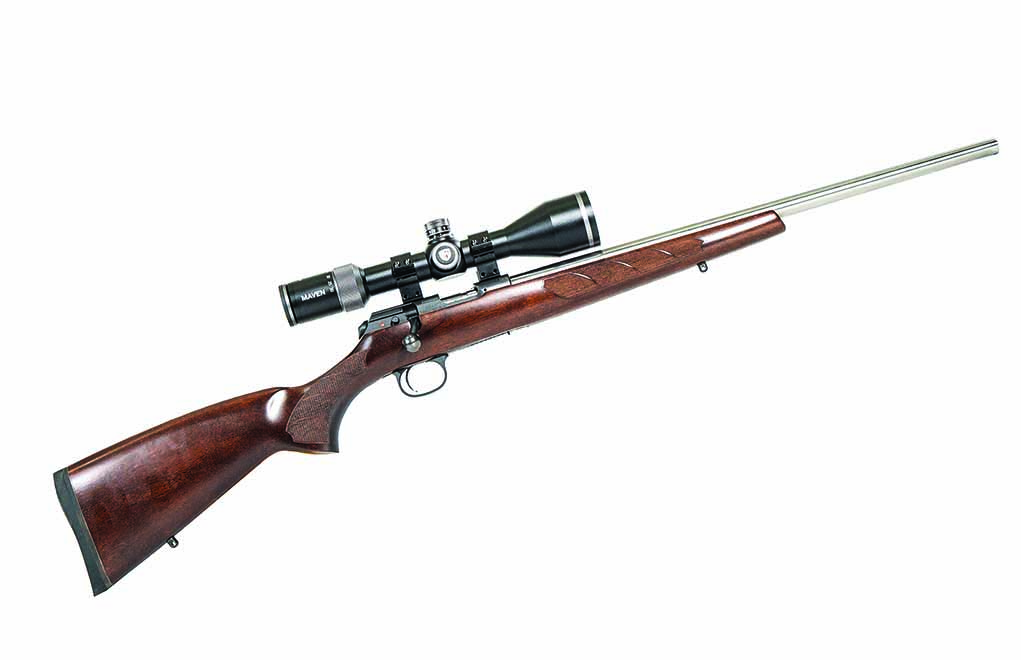
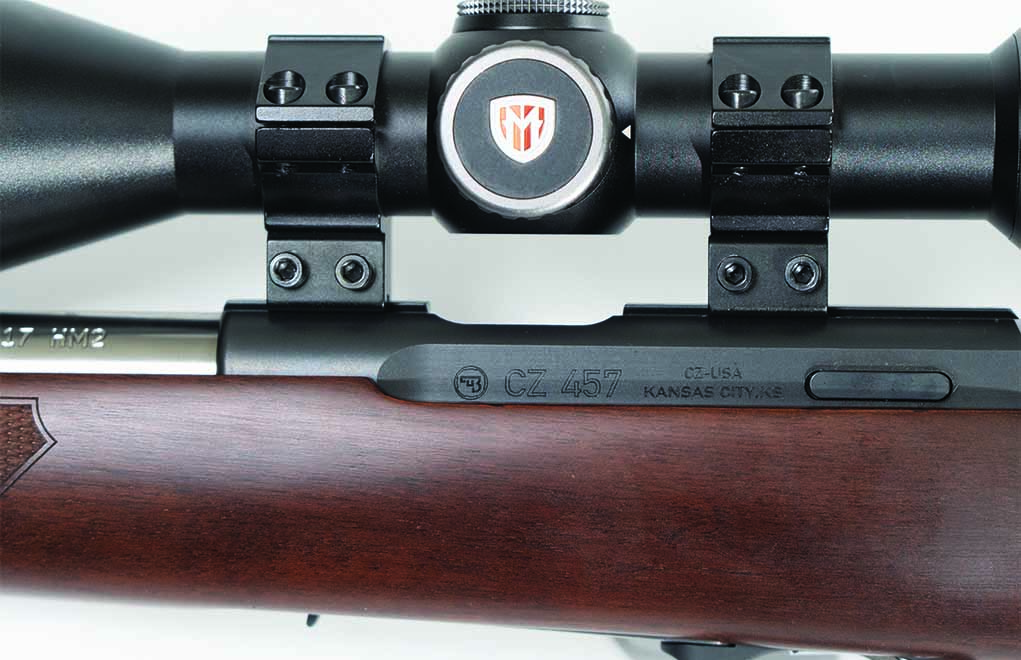
The author’s pet project, a tree squirrel rifle that started as a CZ 457 Primer sporter, with the barrel channel hogged out for a Lilja .17 HM2 tube, the action bedded and the whole thing topped with a high-power Maven RS.5. This rifle has stoned bushy tails with headshots out to 80 yards.
Wayback With CZ
The earliest Czech firearms can be traced back to the 1370s, but like so much of modern European manufacturing, the most relevant threads spin out of Nazi Germany and the political fallout of World War II.
In October 1918, the Czech and Slovak people declared their independence from the Austro-Hungarian Empire and established the new state of Czechoslovakia. The new government created the national Československá Zbrojovka, or “Czechoslovakian Armory,” in the city of Brno.
After the Treaty of Versailles disarmed Germany, Československá Zbrojovka and Zbrojovka Brno, or the “Weapons Factory of Brno,” began production of Mauser and Mannlicher rifles. In the mid 1920s, a new factory in Brno brought automobile production lines under roof, as well as expanded bolt gun and machine gun production. In the 1930s, it diversified further with Remington-licensed typewriters and tractors.
In 1936, Adolf Hitler openly rejected the terms of Versailles with the remilitarization of western Germany along the French border. As the specter of war reemerged on the continent, Československá Zbrojovka opened a new weapons factory in Uherský Brod in eastern Czechoslovakia—far away from the German border. Early production focused on military arms, particularly aircraft machine guns, military pistols and small-bore rifles. Two years later, the Nazis annexed the Czech-controlled Sudetenland, before pushing into historically Czech lands in March 1939. With the Czechoslovakian government in exile, the Germans took the territory, managed under various sham governments, but all as part of the Third Reich.
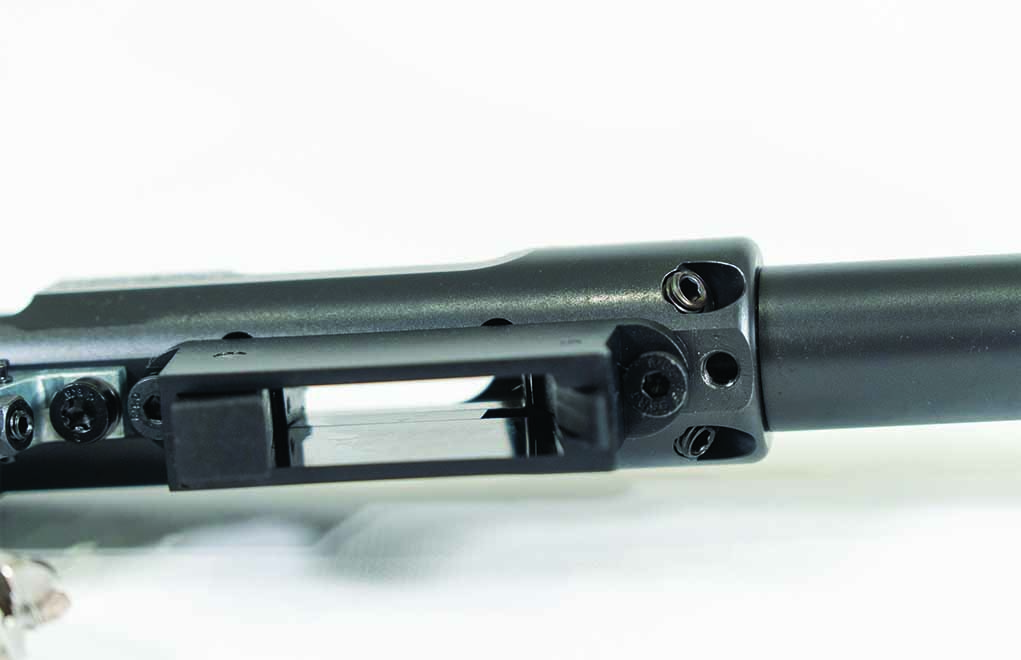
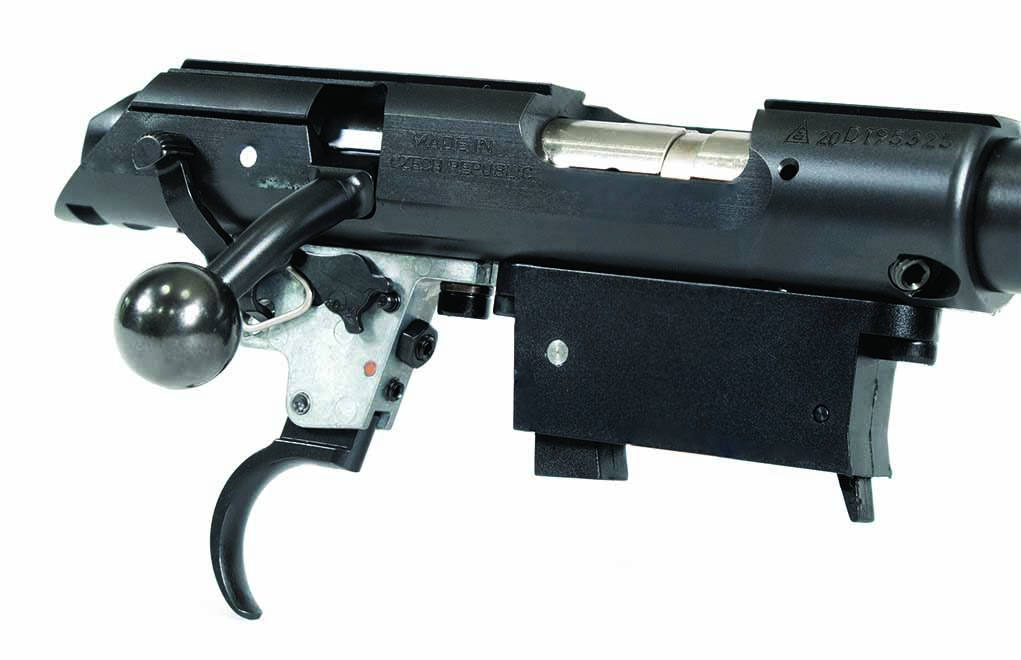
The underside view of the 457 receiver shows the two grub screws that index and secure the barrel. Unscrew and the barrel can be swapped out easily.
At the end of the war, when the victorious Allies divided Europe, the Czech and Slovak people landed in Soviet hands. Czechoslovakia, along with their highly regarded manufacturing facilities Zbrojovka Brno and Uherský Brod, went Communist.
The Wehrmacht and the Communists both wanted a quality .22 LR military training rifle, an inexpensive, mass-produced firearm to train marksmanship on the cheap. In 1943 or 1944, at the request of the occupying Germans, Zbrojovka Brno developed what became known as the BRNO Model 1. In 1947, the Model 1 was mass produced for export, and, in 1954, a parallel model was released, as the BRNO Model 2, stamped ZKM-452—an acronym for Zbrojovka (for the national arsenal), Koucký (for the rifle’s designer, Josef Koucký) and Malorážka (literally “small arms” in Czech).
Zbrojovka Brno was destroyed by Allied bombing at the end of the war, and most Česká Zbrojovka arms production continued on at Uherský Brod, known now by its initials CZUB. The communist Ministry of Foreign Trade and Czechoslovak Proof Authority soon after decided any rifle built for export would bear the name Brno, as it had greater international name recognition. (Zbrojovka Brno was rebuilt, and continued to make their own BRNO rifles into the 1970s.) In 1989, after the Velvet Revolution, the one-party communist system collapsed, and, in 1993, Czechoslovakia amicably split into two countries, the Czech Republic and Slovakia.
During that political transition from Communism to Democracy—and one country to two—CZUB was privatized. Over the decades, the Uherský Brod facility has expanded with the factory walls built out to the city streets on all sides. Today, it’s the largest small arms facility in the world, as measured by square footage under roof, and it employs more than 1,800 people. The author’s pet project, a CZ 457 Primer with a Lilja 455 .17 HM2 stainless barrel. Note that CZ 457 and 455 barrels and receivers are interchangeable.
In 1997, the subsidiary CZ-USA was established to import small arms into the U.S. BRNO Model rifles, widely known for their accuracy and affordability, had trickled into the U.S. through the 1960s, ’70s and ’80s, under various exporter/importer agreements, but with CZ-USA the front door blew open—and soon came wide availability of the CZ 452.
Compared to the Model 1, the Model 2 had a rear sliding tangent sight marked off from 25 to 200 meters. (For collectors, this is the fastest way to identify them.) The Model 2 also came with an improved Winchester Model 70-style trigger, vent holes in the bolt, a narrower crescent-shaped ejection port and a Mauser-like perpendicular top safety. There were various other BRNO rimfire models (Model 2E, 3, 3S, etc.), but the Model 2 in its true “military trainer” style was by far the most produced. CZ keeps production numbers close to their chest, but collectors believe about 140,000 Model 2s were produced, compared to around 7,000 of the target-specific Model 3, for example.
The cold hammer-forged carbon steel barrels were central to the success of these early rifles—a process still used in part today. It began by “seasoning” the steel, leaving it outside and exposed to the elements for at least one year—forcing the metal through several natural freeze/thaw cycles.
“It’s a little science and a lot of tradition,” says Zachary Hein, marketing communications manager for CZ-USA, who traveled to the BRNO workshop to watch the 452 Grand Finale rifles built on the original machines, with this original process. Barrels were sourced from the Uherský Brod factory, where the blanks were being drilled with a bore diameter greater than .22 RF and are then fed into a cold hammer forge, a machine which Hein says is about “the size of a semi tractor.” The barrel steel is drawn over a .22 RF mandrel as the forge’s giant circular hammer slams down around it, molding the rifling into the barrel by brute force.
The CZ 457 receiver, bolt and trigger assembly can be housed in a wide variety of aftermarket stocks and chassis.
After that, barrels were lapped and threaded at the tenon, except in the case of the .17 HM2 rifles where the barrels were pinned to the receiver. Headspacing was done by feel. “They screwed the barrel onto the receiver, then the builders physically used their hip—literally, they put their body weight into the breaker bar to make sure it was tight,” Hein remembers. “It was incredibly old school, but that’s the way they used to build them.”
On gun store shelves, consumers couldn’t spot the old-world build techniques. What set the 452s apart from so many other .22s was the wood. In the 1990s and early 2000s, many rifles, especially inexpensive rifles, moved away from walnut and into polymer and synthetic stocks. CZ shelved a few synthetics, but the company never slowed down on more classic styles in American and Turkish walnut, and less expensive models in beechwood.
The stock lines and handling of many of their designs were true sporters—nimble and quick-pointing. Some of the walnut even had excellent figuring, which no one expects from a $500 rifle. CZ fans refer to these specimens as “hitting the wood lottery.” Even today, order a walnut-stocked CZ and you might get one commiserate with the price, or you might get something many degrees nicer.
The Model2/452 design ran in regular production from 1954 to 2011, when CZ updated the design with 455. There was also briefly a 453 with a French-style set trigger. Die-hard 452 fans collectively groaned when the rifle was discontinued—replaced really, with the switch barrel 455—so CZ-USA spearheaded a final run of 452 Grand Finale edition rifles as a final goodbye. It’s a premium build with a walnut and ebony stock, hand-engraved metalwork and a jeweled bolt. A fitting end for a design that was birthed in conflict, that outlived communism and which found widespread success in the land of the free and the home of the brave.
New School: The 455 & 457
It’s not easy to own a gun in Europe. This is why switch-barrel rifles, where the shooter can swap various caliber barrels—and multi-barreled firearms, like drillings—are so popular across the pond. Legally, it’s one gun.
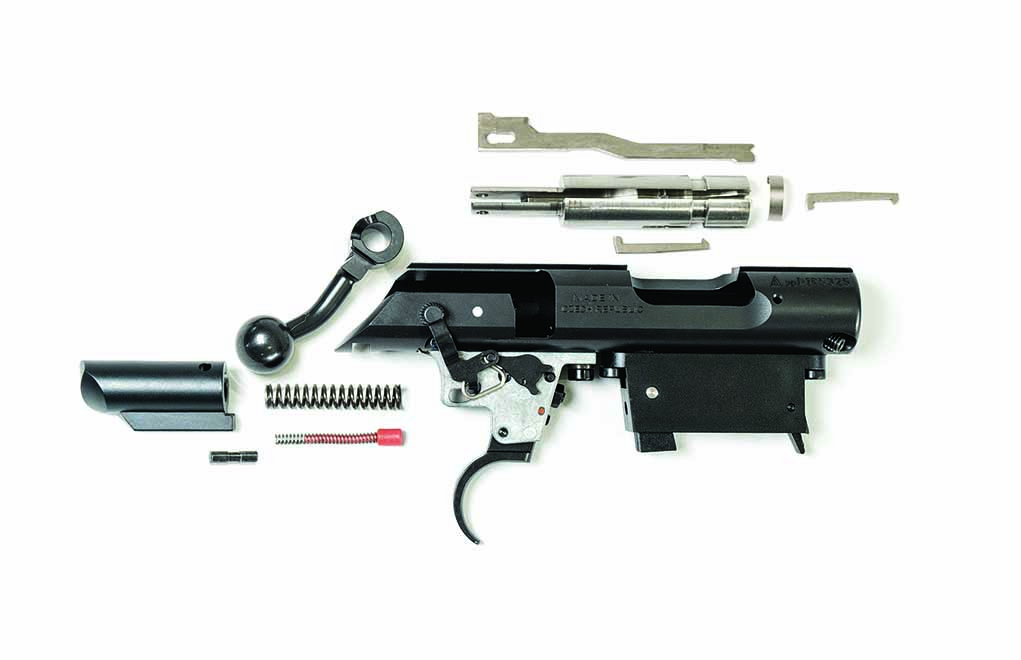
The 455/457 bolt disassembles very easily. Shown here with the naked action.
When the Czechs planned the updated 455 with a switch barrel, the Americans at CZ-USA enthusiastically supported it. “From the start, we wanted to build of a culture promoting and encouraging modularity and aftermarket support,” Hein said. “When they talked up the new design, we were like, Heck yeah! We looked at it like the AR-15 model.”
With the 452, different calibers had different bottom metals and different stock inlets. With the 455, that was all standardized. The machinery that made the new receivers was upgraded, too. While the 452 was a milled receiver, the 455 was cut on a CNC to much tighter tolerances.
By standardizing the receiver mounts, footprint, barrels and triggers across the lineup, it created a kind of swapability and aftermarket of custom options in the rimfire world only seen with Ruger’s 10/22. But this was a bolt gun. A parent could buy their kid a CZ 455 Scout, with a short iron-sighted barrel and youth-sized stock, and swap it for a full-sized stock with longer barrel and optics as the child grew up. Or, more likely, a serious rifle shooter could build a full-sized .22 LR that replicated the look and feel of their centerfire precision rifle.
As the 455s came into the U.S. in late 2010 and early 2011, CZ-USA cultivated this idea of a serious .22 LR for a serious shooter. They partnered with Boyd’s and rolled out a model in “Tacticool” stock (now called the Pro Varmint) with a tactical-inspired vertical grip, raised Monte Carlo cheek piece and a butt hook for shooting off bags. All of a sudden, there was a “sniper style” .22 LR on the market for around $500. Chambered in .17 HMR, it quickly proved an excellent and affordable varmint rig to about 300 yards.
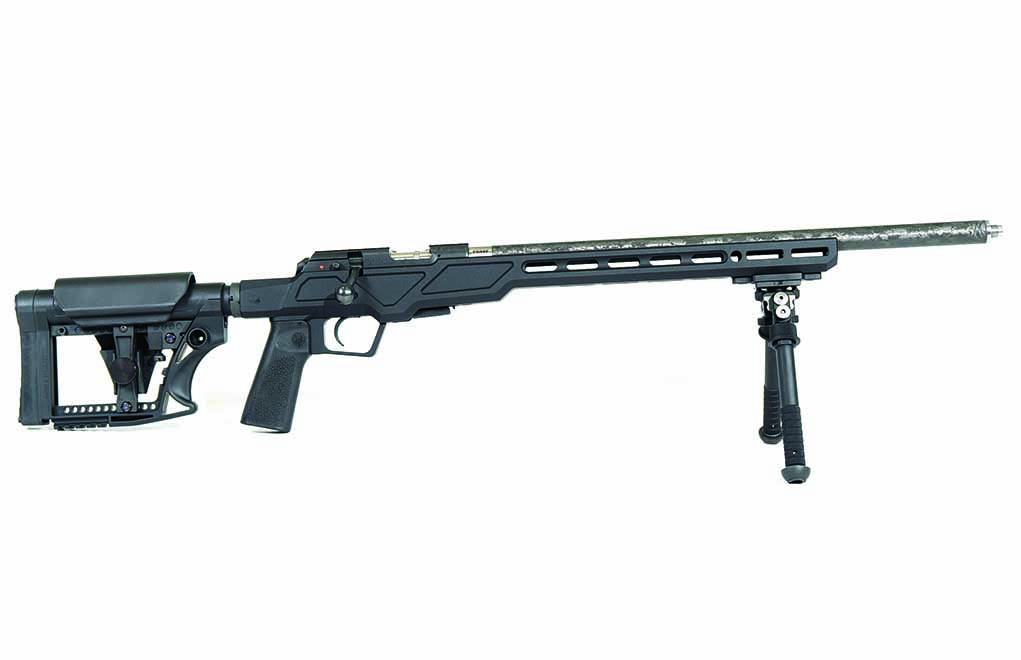
A work in progress. This is a CZ 457 Varmint Precision Chassis with an 18-inch Proof carbon-fiber barrel, sitting on an Atlas PSR bipod. With a better buttstock and good scope, it’ll compete with custom .22s that cost twice as much.
CZ also partnered with fellow Kansas City business, Manners Composite Stocks, and rolled out the CZ 455 Varmint Precision Trainer in .22 LR. As long-range PRS-style shooting skyrocketed in popularity, competition rifle shooters started asking for “trainers” for low-cost, low-recoil practice—very much the same ask militaries had in World War II and the postwar years.
Fundamentals of hitting what you aim at don’t change, whether it’s a .22 LR or .416 Barrett. With the CZ 457 Varmint Precision Trainer, guys running a 6.5 Creedmoor in a Manners at a weekend match now had a weekday trainer that could safely spit .22 LRs at steel targets off the back deck. Make those steel targets 1 inch or smaller, and all of a sudden, it’s possible to drill positional shooting like kneeling, sitting or shooting off a barricade at 25 or 50 yards—skills that translate 100 percent when shooting larger calibers at long distances.
The 455 was a huge success, but there were many things that the European design didn’t get 100 percent correct for an American market. These were largely corrected in the 2019 update, the 457. The stamped bottom metal was swapped out for a sculpted two-piece system. A push-to-fire safety was installed, instead of the “backward” European version on the 455 and its many predecessors. The bolt rotation was tweaked from 90 degrees to 60, so big scopes can be mounted lower, and the action can be run faster with one hand while in firing position.
CZ also lightened the firing pin for faster strikes, and cut almost an inch off the overall action length, and slab sided it to make it as trim and lightweight as possible. The ho-hum 455 trigger, which needed aftermarket springs to really sing, was replaced with a fully adjustable model that can be taken down to nothing right out of the box.
The 2019 rollout of the CZ 457 was a big deal in the rimfire world, with nine models ranging from a new Manners-stocked Varmint Precision Trainer to the traditional sporter American and the youth Scout. This year, it was updated with a 457 Varmint Precision Chassis model, in a CZ-USA-designed billet aluminum chassis with a Luth AR buttstock, and a very European hogsback 457 Jaguar with a 28.5-inch iron-sighted barrel. But what really set the 455—and now the 457—apart, was that thriving aftermarket. It was possible now to not only buy a high-quality, affordable and accurate .22 LR bolt-action, but also to take that rifle and really make it your own.
The Best Value In Rimfire
When it comes to rimfire rifles, there are generally two schools of thought in the U.S. The first I consider the Savage model—make a rifle that shoots great, and is affordable, with a great price-versus-performance ratio. The second is the Ruger model—make a rifle that’s affordable, and modular, then support and encourage an aftermarket.
The CZ 457 Varmint Precision Trainer took the ideal .22 LR training rifle and made it mainstream. CZ was the first major manufacturer to get behind what’s now the hottest thing in rimfire, if not all of rifle shooting.
CZ’s straddles these two schools of thought. On the one hand, a CZ 457 American Combo with a .22 LR and .17 HMR barrel set can be found online for $420. They shoot incredibly well right out of the box. Half-inch groups at 50 yards should be expected from the entire 457 lineup. But for a tinkerer who wants to work their rifle to the next level, the 457 platform makes that possible.
There are stock and chassis options from all the great builders, like Manners, MDT and Masterpiece Arms. There are barrels from Proof and Lilja, among others. (I’ve topped a CZ Varmint Precision Chassis with a Proof that’s among my go-to NRL22 rigs. My new squirrel gun of choice is a 457 with a limited run Lilja .17 HM2 stainless tube and Maven RS.3 optic.) There’s trigger springs and kits from YoDave and BScar. From muzzle to buttpad, there’s options to make the CZ more accurate and make it your own.
Or you can take it straight from the box, never touch it, and still have an excellent rifle.
The current vogue in precision rimfire is Remington 700 everything. Vudoo, RimX, Bergara and Ultimatum all have near custom-level .22 LR actions that fit a R700 footprint, opening the wide world of aftermarket Remington stocks, triggers and accessories to smallbore. The same can’t be said of the 457, but what the CZ has where the others fail is performance at a price point most shooters can get behind. It’s a good rifle as sold, but can expand as a shooters interest does. This should not be understated.
There’s also something to be said for not having an oversized ACIS pattern magazine that Vudoo invented, and we’re now seeing in RimX, Bergara and other rifles. Like fellow European Anschutz, the .22 LR magazines from CZ just work. You don’t have to pay special attention to how you load them: They feed well, they don’t often mar bullets, they’re inexpensive and, from a pure rimfire shooter perspective, they’re not clunky.
The CZ 457 American represents incredible value. It’s a walnut-stocked small game and plinking rifle with enough raw accuracy to compete in a precision rimfire event.
I run a small monthly NRL22 match, and the question I’m always asked by new shooters is, “What rifle should I get?” I send them what’s become a form email, linked out to a few different write-ups, with options ranging from $330 to well over $1,000. Nine times out of 10, these new shooters come back with a CZ. Why? Because when you do your homework, there isn’t a better deal in bolt-action rimfire rifles. There are more expensive rifles. There are more accurate rifles. But with CZ, you get every nickel worth … and then some.
For more information on the CZ 457, please visit cz-usa.com.
Editor’s Note: This article originally appeared in the November 2020 issue of Gun Digest the Magazine.
From Dracos to WASRs to PSLs, Cugir Arms imports have long been a staple of the U.S. gun market. Now that the demand for Dracos is higher than the supply can provide for, what does the future hold for this little Romanian pistol that punches above its weight?
Dracos-What Are They?:
Semi-Automatic 7.62x39mm AK Pistols From Century Arms
There Are Four 7.62x39mm Variants-Three Made In Romania And One Made In The U.S.
Romanian Draco Variants Differ In Three Major Ways-Barrel Length, Handguards, And Rear Sight
New Ones Have Not Been Imported In Several Months, Very Hard To Find One Currently [May 2021]
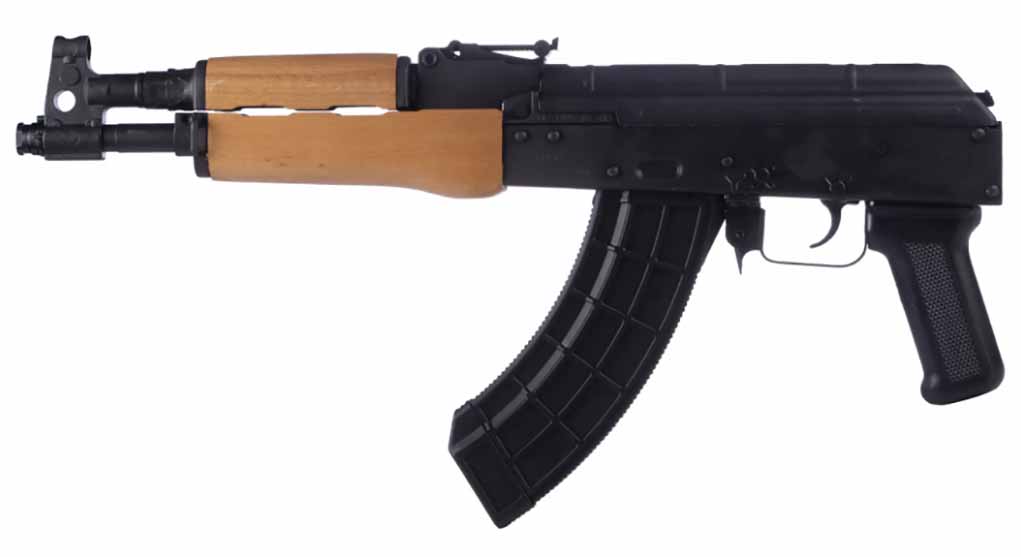
Cugir made Draco Pistol, imported for the US market by Century Arms.
As an importer as well as manufacturer, there are many AKs for sale with “Century Arms” in the name. All the imports are good to go, but the domestically produced models should generally be avoided if you are looking for a serious rifle with the famous reliability of a Kalashnikov.
The Draco AK pistol, manufactured in Romania by Cugir Arms Factory and imported by Century Arms, is ubiquitous enough that “Draco” is now used by many as a generic term for any model of AK pistol. For years they were bought and loved by a variety of people. Military history buffs bought them to make PM md. 90 clones. People looking for a truck or backpack gun bought them for their compactness. Gangster-rappers flashed them as status symbols.
Now in 2021, AKs of all kinds are as popular as they’ve ever been in the United States, but the once abundant Draco is sold out everywhere you look. As I write this, there are multiple Draco guns listed for auction on Gunbroker, with active bids going for well over $1,000. From the best I can tell, the last time Romanian Dracos were in stock and being sold new online was five months ago and they were listed for $699.
Did the supply and demand really become so skewed these past few months that these guns have doubled in price? A year ago they were less than $600, so what happened? Full sized WASR rifles have been imported more recently and sold for relatively normal prices for the times, so why no more Dracos? Before we dive into that question, let’s briefly talk about the history of the Cugir Arms Factory and the weapons they have to offer.
Cugir History
Located in Cugir, Romania, the Cugir Arms Factory can trace its weapon manufacturing roots back to the late 18th century during the Austro-Hungarian Empire. Today they are a subsidiary of ROMARM, the state-owned defense conglomerate.
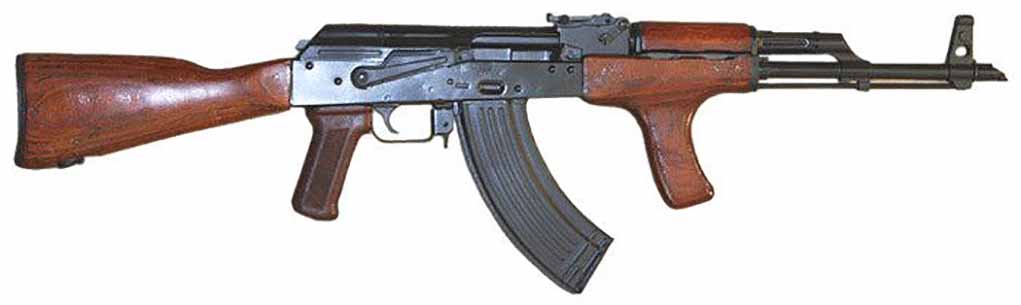
After the second world war, Romania became a socialist republic and member of the Warsaw Pact. During the early 1960s, the Soviet Union encouraged all Warsaw Pact states to domestically produce their own assault rifles chambered in 7.62x39mm. Romania accomplished this in 1963 when they produced their first AK variant, a clone of the Russian stamped AKM that they called the PM md.63. The underfolding variant came as the PM md.65 two years later. They would eventually also develop a side-folding carbine variant with a shorter barrel and combination front sight and gas block (as opposed to standard AK variants where the front sight is a separate piece from the gas block) called the PM md.90. This variant is what became known in the United States as the Draco, although it was obviously imported as a semi-automatic pistol for legal reasons.
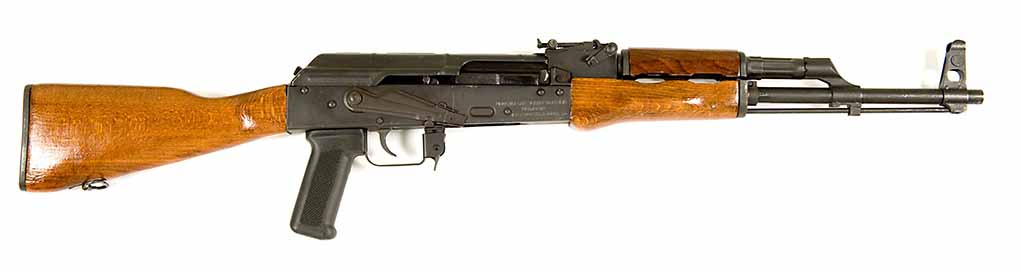
The first Romanian AKs to be imported were during the Federal Assault Weapons ban of 1994 to 2004. Skirting prohibitions in the law, they lacked several features found on standard Kalashnikov rifles. Without getting too bogged down in the convoluted history of different variants, the first imported Romanian AK you should know about was called the ROMAK-1 and it became available in 1999. This is the model that eventually became known as the WASR-10, but it was also imported under the names CUR-1, WUM-1, and SAR-1.
Cugir SAR-1 semi-auto AKM. Predecessor to the WASR. Photo: Wikipedia
Romanian AK … Worth A Dang?
The reputation of imported Romanian AKs in the U.S. has been all over the place since they first started coming in. Some of the criticisms are warranted, while others are not. The fact of the matter is that there have only ever been two significant and real problems with these guns, one of which was caused by Cugir and the other the fault of Century.
The first of these problems that you may have heard about were canted sights, meaning that the front sight post was not installed on the barrel at the correct vertical angle. The result of this is generally a fully functional rifle that will likely need the front sight drifted to the extreme right or left in order to obtain a proper zero. In the most serious cases the rifle is unable to be zeroed. This was mostly a problem in the early 2000s when Cugir was having some quality control issues. When shopping for a Romanian AK, especially an older import, this is certainly something you should check for. Since then, Cugir has improved their QC and this has not been an issue with their new rifles for years.
The second issue was caused stateside by Century during the importation process. For legal reasons, foreign AKs can only be imported into the U.S. with non-standard magazine wells sized to fit single-stack magazines. Once imported, Century completes some light modifications to bring the rifle into standard spec. One of these modifications conducted by Century is the opening up of the magwell to accept standard double-stack AK mags. Once upon a time, like the canted sights, this was an issue. The magazine well would either be opened up too much or too little, resulting in magazines fitting in the rifle too tightly or too loosely (some amount of mag wobble is normal for AKs, but too much is bad). Again, this ceased to be an issue quite some time ago.
Small, But Mighty Draco
Cugir produces three 7.62×39 Draco variants for the U.S. market, the Mini Draco, the Micro Draco, and the standard Draco with a 12.25 inch barrel. The standard version is the most desirable for its ability to take standard AKM pattern handguards, unlike the Micro or Mini versions. The 7.62x39mm cartridge performs extremely well out of shorter barrels, only losing a couple hundred feet per second of velocity when compared to a standard 16.3 inch barrel. That being said, the 12.25 inch barrel still results in better ballistics than the 7.75 or 6.25 inch barrels of the Mini or Micro, again making the standard Draco the preferred variant. Furthermore, as civilian shooters often like to emulate what militaries do or use, the 12.25 inch Draco is much closer in form to several military AK variants than either two of the other models.
As they come out of the box, Dracos in their pistol format are essentially range toys. They can be used to blast for fun, but without any proper way to utilize the sights one can’t expect to make good hits with it outside of a few yards. This may be fine for the casual shooter who just thinks little AKs are cool, but many people who purchase these intend for them to be serious fighting rifles if the need ever arises.
Because of this, the single most important modification that can be performed to a Draco is the installation of a pistol brace or rifle stock following proper ATF approval to register it as an SBR. With the additional point of contact provided by the brace or stock, the Draco’s standard AK rifle sights become usable again. This is what brings the Draco out of toy territory and makes it a truly functional weapon.
When it comes to modifying the rest of the pistol, it accepts any standard pattern trigger, handguard, dust cover, safety selector or magazine that can be installed on a normal AKM. The barrel is also threaded for 14×1 LH so it can take a wide variety of common muzzle devices. Once SBR’d, Dracos can be transformed into handsome military clones such as the original Romanian PM md.90 it was developed from, or the Russian AK-104.
Romanian Military PM md.90 Short Rifle. Photo:Wikipedia
The Romanian Draco AK pistol is a versatile little gun ideal for a variety of applications. When combined with a folding brace or stock they have nearly the same firepower and usability as any full-sized AK variant but in a package small enough to be stowed under a car seat or in a backpack. It is easy to see why this gun is desirable enough that many people are willing to shell out twice as much as they would have a year ago to get one today. But where are the new ones?
Are They Avialable?
I reached out to Century Arms about the status of more imports hitting American shores, but have not heard back yet. If they respond I will update this article with their answers. In the meantime, it unfortunately seems that Draco pistols will continue to sell for ludicrous prices on the second-hand market until more are imported, if ever. Until that day, I recommend that you keep an eye out for any fairly-priced imported AK, Cugir or otherwise.
Century Arms’ AK Offerings
Imported Models
Domestic Models
WASR-10
VSKA
WASR-10 UF
VSKA Synthetic
AES 10B
C39
WASR M
C39V2
PSL 54
RAS47
Draco (Romanian Made)
Draco (U.S. Made)
Mini Draco
Micro Draco
Draco NAK9
For more information on imported Cugir AKs and Dracos, please visit centuryarms.com.
No argument, the .22 Magnum is top dog when it comes to .22 rimfire cartridges. But what does that add up to?
What Are the .22 Magnum’s Assets:
The .22 Mag can propel a 40-grain bullet 1,900 fps at the muzzle.
At this velocity, the muzzle energy is 325 ft-lbs.
Its recoil is mild as is its report.
When it comes to rimfire cartridges, it’s among the best varmint options.
Potentially too much for game bound for the pot.
The year is 1959, Dwight Eisenhower is President of the United States, the first American astronauts are announced and the nation’s magnum cartridge craze is in full swing. The last is an apt endeavor for an era that started shooting for the moon, and it left nearly no caliber untouched. But this particular year saw the birth of one of the most beloved if not peculiar magnums take root. By this, I mean the .22 Magnum.
Out of a revolver, the .22 Magnum will outperform most other .22 rimfire cartridges out of a rifle.
Smashing ballistics, velocity to spare, shootable as any other rimfire, the snappy cartridge was the epitome of the bigger, better, faster post-war America. Yet, there’s a conundrum engineered into the .22 Magnum, most folks only realized much after the fact. It certainly moves like the dickens and hits, relatively speaking, like a bone-rubbed hickory stick.
Great. In practical use, what the heck is it good for?
From Whence The .22 Magnum Came
Breaking down a cartridge, it’s always a worthwhile endeavor to dig to its roots. With the .22 Magnum, in some respects, the concept of a hot-rocks .22 round wasn’t anything particularly new when it hit the scene.
Properly known as the .22 Winchester Magnum Rimfire (.22 Magnum or .22 WMR for short), the cartridge was essentially an elongated version of the .22 Winchester Rimfire (or if you like, its twin, the .22 Remington Special). The older cartridge was minted around 1890, and as noted by Todd Woodard in Cartridges of the World, 16th Edition, was the first notable improvement in the killing power of various .22 rimfires. Never considered as accurate as the .22 LR, it was much more reliable at taking game at ranges where the Long Rifle became spotty—around 75 yards give or take.
As is common in straight-walled cartridges—rimfire and centerfire—the improved range of the .22 WRF was thanks to case elongation. The designers cajoled diameter as well, but that was a matter of getting the case to accept the whole diameter of the bullet when seating. Anyhow, the larger case gave the .22 WRF roughly a 200 fps edge over the Long Rifle. Not bad for tacking on .352-inch more brass. But in the mid-20th Century, Winchester figured it could do better.
Keeping the same diameter of the .22 WRF, the company further elongated the case to 1.055 inches to create the .22 Magnum. Furthermore, they topped the cartridge with a much sturdier jacketed bullet as compared to the solid lead projectiles generally found on the Rimfire and Long Rifle. The results were stunning.
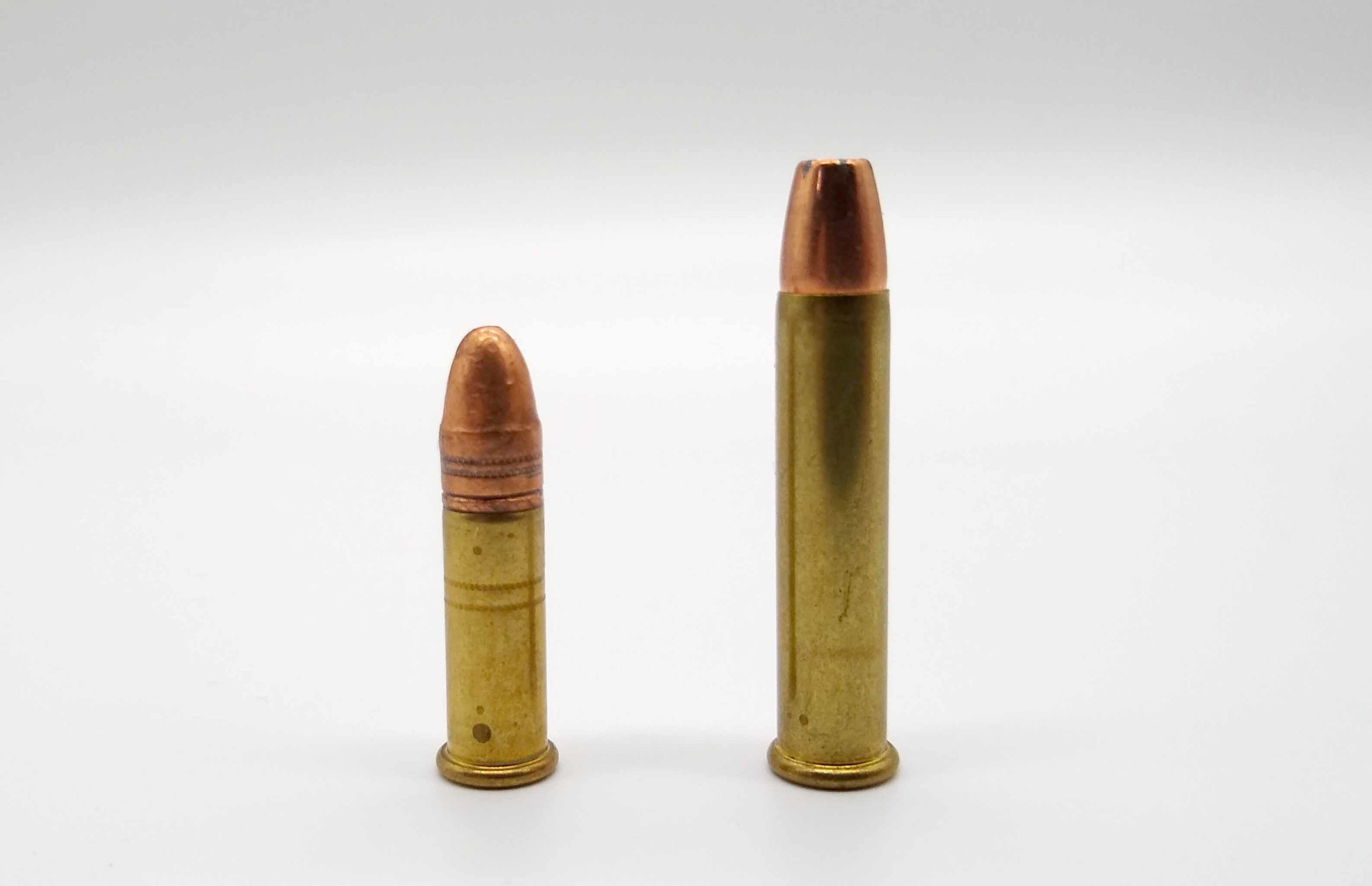
As is seen, the .22 Magnum (right) had much more case capacity as compared to the .22 Long Rifle (left).
Loaded with a 40-grain bullet—the original choice and among the most popular today—and depending on the firearm launching it, the cartridge produced velocities in the neighborhood of 1,900 fps. Even in the more abbreviated barrels of handguns the cartridge still shined. Send it through a revolver or pistol with a 4-inch barrel or longer and it will generally outperform any other .22 rimfire shot from a rifle. No matter how you slice it, the .22 Magnum moves.
So, what does this add up to? We needn’t parse numbers down to a gnat’s ass between cartridges that have in most cases 600 fps or more separating them, as does the .22 LR and .22 Mag. A rudimentary understanding of ballistics should tell you the .22 Mag shoots further and flatter than its predecessor and hits harder. Which it does.
As for practical application, the .22 Magnum is a viable hunting option past 100 yards, flirting the 130-yard mark in the hands of a skilled hunter. Target shooters can expect to push the round further—say the 150-yard range. Though, much further and things start to break down, with most loads going sub-sonic at or around this distance. Still, not shabby for a rimfire with a little to no recoil.
So there you have it, the .22 Magnum is the king of all .22s, hands down. Right? There’s always a “but” to these things and there are a couple of noteworthy ones with hot small-bore rimfire.
.22 Mag For Self Defense
Given it’s a bit of a hot topic, we should touch on this. Though, a section of a greater article is not the best place to discuss a multifaceted subject, such as is the .22 Magnum good for self-defense. If you’re looking for a more nuanced discussion, I’d suggest Richard Mann’s piece on the .22 Long Rifle for self-defense, which digs much deeper into the pros and cons and is applicable to the .22 Magnum.
In brief, it’s safe to say the .22 Magnum isn’t the first choice as a self-defense cartridge. Certainly, it’s more viable than the .22 Long Rifle and it is deadly. However, it’s questionable if it’s wise to rely on the .22 Mag to neutralize a threat to your life. Is it better than nothing? Of course. And for some people it might be the only option at hand. But for the vast majority of shooters, sticking with defensive cartridges with a better track record in this role—.380 ACP on up—is the more prudent move.
Target Shooting And Plinking
The .22 Magnum is positively lights-out accurate in most guns, which makes it an attractive target or competition option. Heck, if you’ve got the range to utilize, it’s also loads of fun in the role of the plinker. However, overtaking the more established .22 Long Rifle as casual and competitive bullseye wizard isn’t likely to happen anytime soon. It’s not a matter of performance, but price. Whereas .22 LR ammo can dip below a dime per trigger pull, in most cases .22 Magnum runs more than double that. Half the fun at twice the price isn’t typically a huge selling point.
Hunting The .22 Magnum
There’s little arguing the cartridge will kill most varmint-sized game graveyard dead. But does a hunter really need them that dead? The issue most contend with when hunting the .22 Magnum is damage to the meat, which is typically more extensive than what is found with the Long Rifle. This is particularly acute with smaller game, such as squirrels, but is even an issue with larger critters, such as cottontail rabbits and hares.
The Savage 93G is inexpensive, but it’s a good rifle for varmint hunters on a budget.
This isn’t to say the .22 Magnum isn’t an adept game getter. It is. Many enjoy the greater range the cartridge allots, and are quite skilled in pulling off a long-shot that leaves the meat edible. But that’s not every small-game hunter. Some cherish the tight confines of a shelterbelt and the close and quick shot. If that’s the way your tastes run, the .22 Magnum might be overkill. Just something to consider when analyzing if the cartridge fits your style of hunting.
Quite A Pest
OK then, if the cartridge isn’t hot for self-defense, too expensive for plinking and blood shots small game, where does it excel exactly? The answer is simple, hunting—just not for things you generally eat.
When it comes to pest control the .22 Magnum stands nearly alone. Its low recoil makes fast follow-ups possible. Its range is enough to catch a critter at the edge of your property. It’s very polite in the report department, keeping nitpicky neighbors off your back. And its terminal ballistics are, in a word, overwhelming. It’s the complete package.
Everything from prairie dogs to skunks, woodchucks and raccoons are mincemeat at the receiving end of the .22 Magnum. Even chicken coop-raiding foxes and coyotes are little more than pelts versus the cartridge. Though, I don’t know if I’d go so far as to call the .22 Mag a dedicated predator cartridge. Just an occasional one. For many of us, that’s all it needs to be.
Parting Shot
To be sure, the .22 Magnum isn’t a jack-of-all-trades like its cousin the .22 Long Rifle. Yet what it does do, it does well. With one at hand, gardens will remain undisturbed and hen houses will go un-molested.
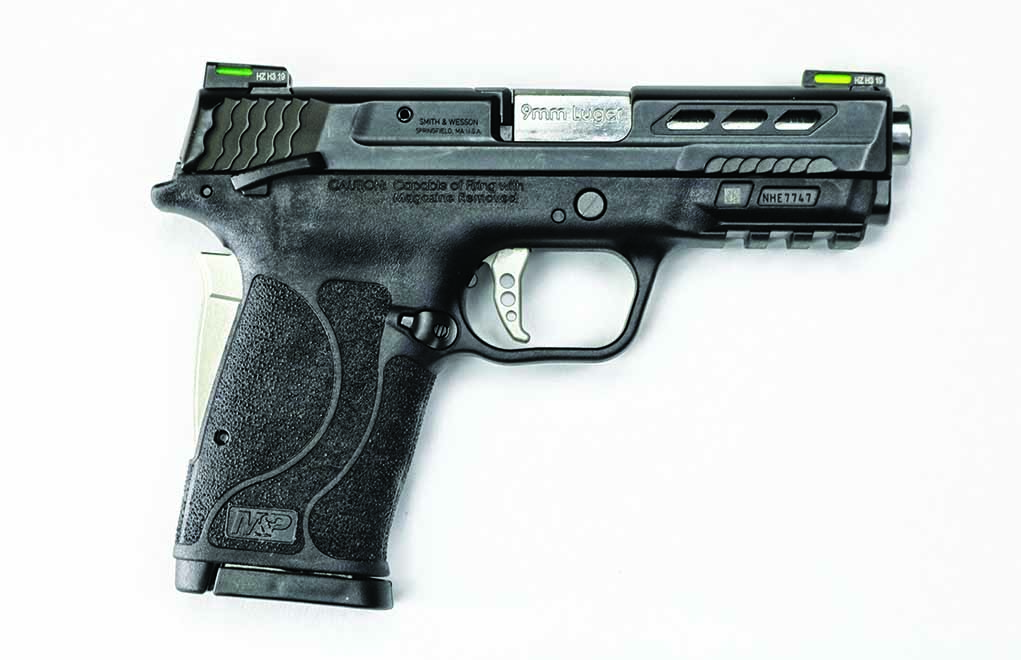
The M&P 9 Shield EZ feels like a .380 Auto, performs like a 9mm.
How The M&P 9 Shield EZ Sets Shooters Up For Success
A slightly heavier slide and lighter springs are used to make manipulation easier.
Magazine release is reversible, making the pistol lefty and righty friendly.
Hi-Viz LiteWave H3 sights make for quick target access in daylight and low-light conditions.
A consistent and smooth trigger, plus a short reset, aids in the pistol’s accuracy and speed.
In 2018, Smith & Wesson released the Shield M&P EZ in .380 ACP to specifically address complaints that some shooters had problems racking the slide or manipulating a defensive semi-automatic handgun. Most manufacturers would’ve called it a day and raked in the money for a concealed-carry piece that checks all the boxes.
However, Smith & Wesson has never been known to rest on its laurels.
They had the right dimensions, safety features and mode of operation. They addressed complaints from shooters who had special needs regarding shooting, manipulation and maintenance. Yet, the caliber was an issue. Most firearms instructors recommend .380 ACP as the bare minimum caliber for self-defense. Yet, those same professionals will say they carry a 9mm.
Smith & Wesson followed up with an M&P Shield EZ in 9mm in 2019, and the end result was so popular that we now have a Performance Center offering of this pistol, and it couldn’t have come at a better time.
During the past few months, there’s been a surge of new shooters and first-time firearm buyers joining the ranks of gun owners. Whether they’ve never shot a firearm before or haven’t in some time, they’re concerned primarily with personal defense and concealed carry. This means it can be very hard to find a handgun on the shelves of sporting goods retailers—particularly if you have special needs as a shooter.
In this instance, it might be smaller-framed people or folks suffering from carpal tunnel syndrome or arthritis. Remember, these aren’t the people who’ve been accustomed to shooting for decades, and unfortunately with the way things are going in some areas, they won’t have the time to get up to speed like most shooters can take for granted.
The Performance Center M&P 9 Shield EZ lets these people have an immediate tool for concealed carry and home defense, and a lot of these features will make it a winner for any shooter—regardless of skill level or ability.
Slide and Frame
Like all of the Shield pistols, the Performance Center M&P 9 Shield EZ has a polymer frame, and this one sports a three-slot rail so the shooter can add a tactical flashlight, laser or a combination of both. There are no interchangeable backstraps as you might find on other M&P-type pistols.
The slide is made from stainless steel and coated in black Armornite. Smith’s wavy, cocking serrations are on the rear and a single row of snake skin-type serrations are located in front. The serrations up front give some shooters an area to press check the slide … plus, they simply offer a nice, custom look.
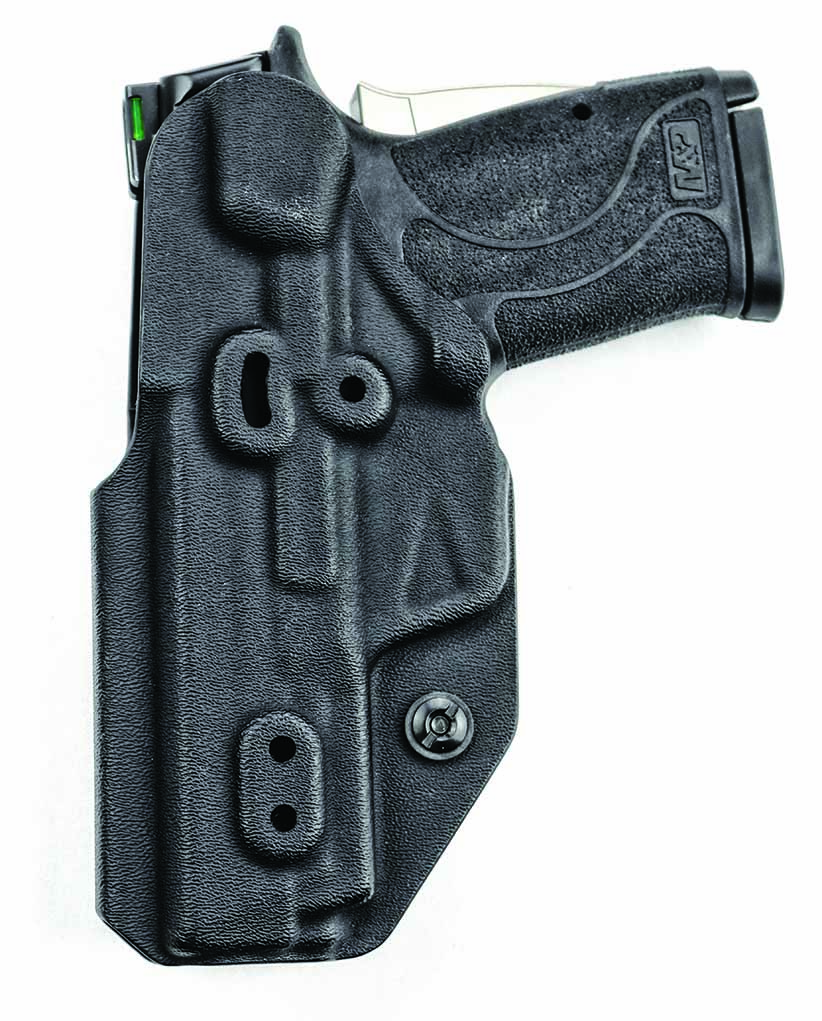
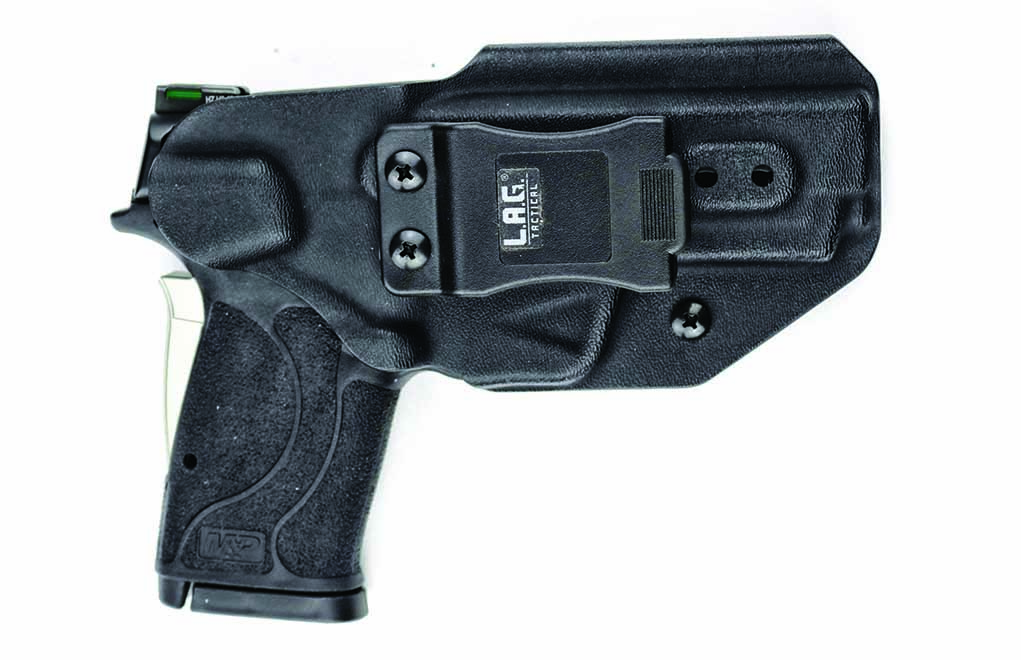
We like the holsters of LAG Tactical, they truly fit the firearm like a glove and offer superb retention.
We found the slide to be slightly heavier than one on an M&P Shield, but that’s to be expected. Ease of manipulation is the name of the game with this one, and in order to make it easier to rack the slide, a lighter recoil spring was used. That dictates more weight to slow the slide down.
In spite or that, three horizontal lightning cuts are made on either side to show off the barrel for a nice custom touch.
A loaded chamber indicator is present on the slide; this should help shooters eliminate press-checking by letting the shooter know instantly and perhaps in the dark if their pistol is loaded.
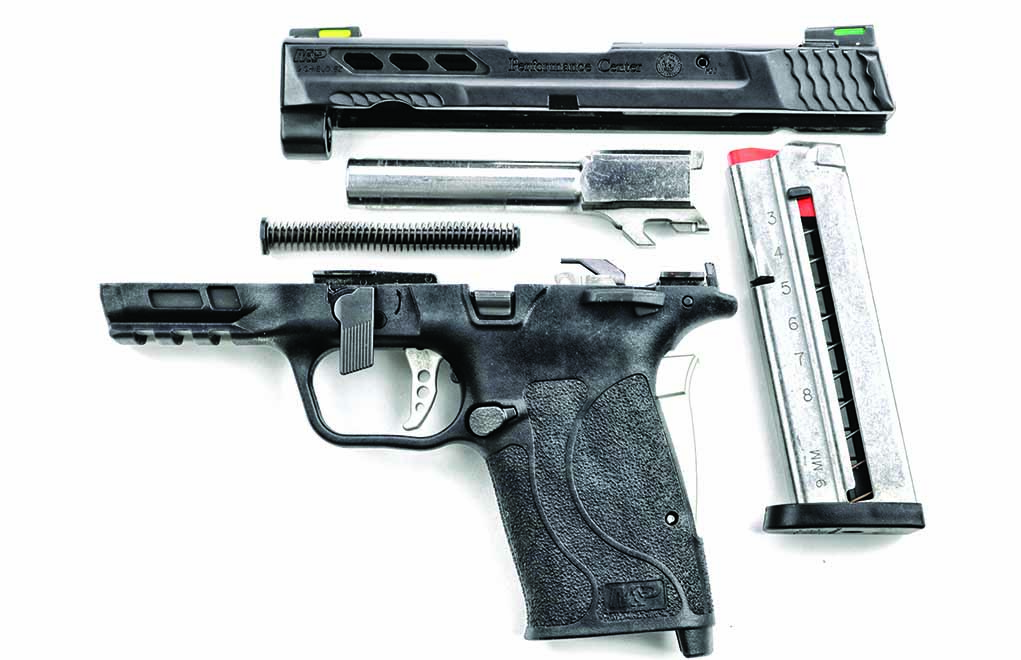
Disassembly is achieved by means of a takedown lever on the middle part of the frame above the trigger. The shooter locks the slide to the rear, rotates the lever to the 6 o’clock position and pushes the slide off the frame. The recoil spring and guide rod assembly lift out, and the pistol is ready to clean.
Lastly, the magazine release is reversible for left or right-handed shooters and ejects the magazine purposefully every time.
Sights
The Performance Center M&P 9 Shield EZ ships with a set of Hi-Viz LiteWave H3 sights that provide fast sight acquisition and a bright sight picture, day or night. Hi-Viz combines Tritium with their patented Litepipe fiber-optic tubes, allowing for a perfect sight picture during the day and in low-light conditions.
When shooting in the daytime, the Litepipes use the power of the sun for illumination. In a low-light scenario, the tritium picks up. In full darkness, you might see the Tritium but not necessarily your target. Turn on your weapon-mounted light or your handheld light, and the Litepipes will take over again.
The rear sight and the front sight, for that matter, can be drifted for windage adjustments if needed. There’s no provision for mounting a red-dot optic of any kind.
Barrel
The barrel on the Performance Center M&P 9 Shield EZ is slightly extended past the front of the slide and contains a single angled port. This is intended to reduce muzzle flip, and it works extremely well in this role.
The S&W M&P Shield 9mm EZ PC disassembles quickly and easily for both novice shooters and those who might have problems with manual dexterity.
Ignore the chair-borne rangers who tell you that the flash will blind you, destroy your night vision and set your clothes on fire. This is a matter of simple physics and it allows for a faster follow-up shot.
Trigger
When they first hit the market, I loathed the factory trigger on the Smith & Wesson M&P pistols. They could be fixed with an Apex trigger and sear, but we wanted a proper trigger from the factory. Thankfully, Smith & Wesson caught up with customer demands and gave the Shield EZ PC an excellent one.
It probably helps that this is a hammer-fired pistol and not one that relies on a striker assembly. As anyone who shoots striker-fired pistols at this price point can attest, there are numerous internal safeties and moving parts under tension that a shooter must overcome. An internal hammer can allow for a smoother trigger squeeze because there are generally fewer moving parts.
Anodized to match the barrel and grip safety, this trigger breaks at 4.5 pounds and has an extremely short reset. There’s a slight take-up followed by a nice, clean break. The flat face will please a lot of shooters, and we loved the short reset.
Grip Safety
Perhaps the most significant external change between the original Shield and the Shield EZ was the introduction of a manual grip safety.
The grip safety runs almost the entire length of the backstrap and, in this case, matches the stainless steel accents on the pistol. The only fault we found with it was the top edges of it were particularly sharp. A shooter who prefers a high handhold on a pistol, like yours truly, will find discomfort with it.
The PC M&P 9 EZ is large enough to easily control, yet small enough to easily and comfortably conceal.
There are a few remedies here, such as stoning the edges or getting a replacement grip safety from Smith & Wesson. According to my cohorts who have experience with this model, our test pistol isn’t an isolated incident either. However, this is touted as a Performance Center pistol from Smith, and it never should have left the factory this way.
Other Safeties
This Performance Center M&P 9 Shield EZ has an ambidextrous frame-mounted safety installed by the Performance Center. S&W also offers a model without. External safeties have become anathema to many shooters and trainers because of the prevalence of striker-fired pistols in the market.
Sometimes they miss the point of view of a new shooter who might be concerned about the lack of an external safety. For some new people, this may be compared to a set of training wheels on a bicycle. They need it as a confidence booster until they feel ready to go without one. There are two good things about Smith & Wesson M&P safeties: They don’t prevent movement of the slide, meaning the shooter can load and chamber a round with the safety engaged. Secondly, they can be removed by an M&P armorer at a later date with little to no fuss.
Keep in mind that this is a hammer-fired pistol and not one that’s striker-fired. So that safety lever makes a lot more sense.
Magazine and Accessories
The magazine holds eight rounds and, like most Smith & Wesson magazines, it’s a functional work of art. We particularly liked the tabs on the sides for ease of loading. While initially going over the pistol as a whole, we noticed nearly every feature made the pistol easier to manipulate. Magazine loading, however, can be particularly difficult for the intended market for this pistol, and Smith & Wesson addressed this in a wise fashion.
Smith & Wesson may have been the first manufacturer to make use of the grip safety feature over 125 years ago to allow safe carry of a loaded revolver in a pocket or purse.
Smith & Wesson included a Performance Center-branded cleaning kit with this model, containing a collapsible cleaning rod with rotating T-handle, nylon cleaning brush, bronze bore brushes, an assortment of nylon jags and tips and, of course, cotton patches. This is a great cleaning kit, especially for an entry-level shooter.
A mandatory cable lock is included for shooters who may wish to store their firearm unloaded and locked up.
At the Range
To test, we burned up six boxes of Federal 115-grain FMJs. We fired 300 rounds with no issues. At 50 feet, our best group was eight shots in 2.75 inches. This is well within the standard for any quality concealed carry handgun. A match-grade handgun will definitely perform better, but that’s not what the Performance Center M&P 9 Shield EZ pretends to be.
Recoil was minimal, and the pistol pointed well. The port keeping the muzzle from rising, coupled with the extremely short reset, made for a very fast and capable sidearm with regard to follow-up shots.
We would compare shooting this pistol closer to the experience of firing a 1911 pistol as opposed to a typical polymer-framed handgun.
Concealed Carry
The greatest pistol in the world can be a failure if there are no viable holsters on the market. We reached out to LAG Tactical in Reno, Nevada, for an OWB or AIWB holster for the Performance Center M&P 9 Shield EZ, and they supplied us with one of each.
We found that the pistol carried well in AIWB, and LAG’s Liberator holster helped greatly in that regard. The Liberator is one of the best-designed CCW holsters we’ve come across, and we use it whenever we can.
However, we were keeping in mind that this was a pistol designed for new shooters who may not be comfortable with that mode of carry and gave an equal amount of time to the more traditional carry method. DeSantis also offers several holster designs for this handgun in IWB and OWB configurations, as do a variety of other manufacturers.
Final Thoughts
All in all, this was a fine pistol that not only looked good but was fun to shoot.
Hopefully, Smith & Wesson includes a provision for the mounting of a red-dot optic on a future iteration of this pistol. These types of sights are constantly improving with regard to size, visibility and battery life.
The only part of this pistol that we didn’t like was the grip safety. It’s not that they’re a bad feature or unwarranted, but the top part of the safety has sharp edges that could’ve been cleaned up at the Performance Center. Many new shooters or folks relying on this pistol because they may have problems with hand strength may not have the knowledge, tools or ability to remedy this on their own.
Aside from that, the accuracy, ease of manipulation and inherent safety features make the S&W Performance Center M&P 9 Shield EZ a great personal defense gun. It’s affordable for a Performance Center pistol and definitely checks all our boxes for a recommendation with regard to a concealed-carry handgun.
That includes the caliber.
A 9mm with low recoil that was easy to fire, manipulate and disassemble for a novice shooter was a true unicorn a few years ago. Smith & Wesson’s Performance Center took these challenges head on and made it easy-peasy with the EZ PC.
Track game through the morning fog or the cover of darkness with Liemke’s Kieler thermal monoculars, now available in the United States.
Possible Uses Of A Thermal Imaging Device:
Locate lost game after sunset
Night hunting
Hunting in areas with regular high fog or mist
Nature Observation
Surveilling your property at night
Locating a leak in your HVAC system
Developing and testing firearms or suppressors
Once only available to Europeans, Germany’s premier thermal imaging manufacturer has begun importing their monoculars into the United States, giving American hunters access to the same game-changing tech that our friends across the pond have been enjoying for years.
Liemke has been producing thermal imaging gear for both civilian and government use since they were established in 2008. Cutting-edge German engineering quickly made Liemke an industry leader in the European thermal market. Now that they are expanding their sales to the United States, companies like FLIR and Pulsar have new competition in town.
Night hunting has grown in popularity in recent decades, in no small part due to booming boar and coyote populations that need culling. When tracking game without the assistance of sunlight is your goal, thermal monoculars and scopes are the best way to locate animals without compromising your own position with illumination.
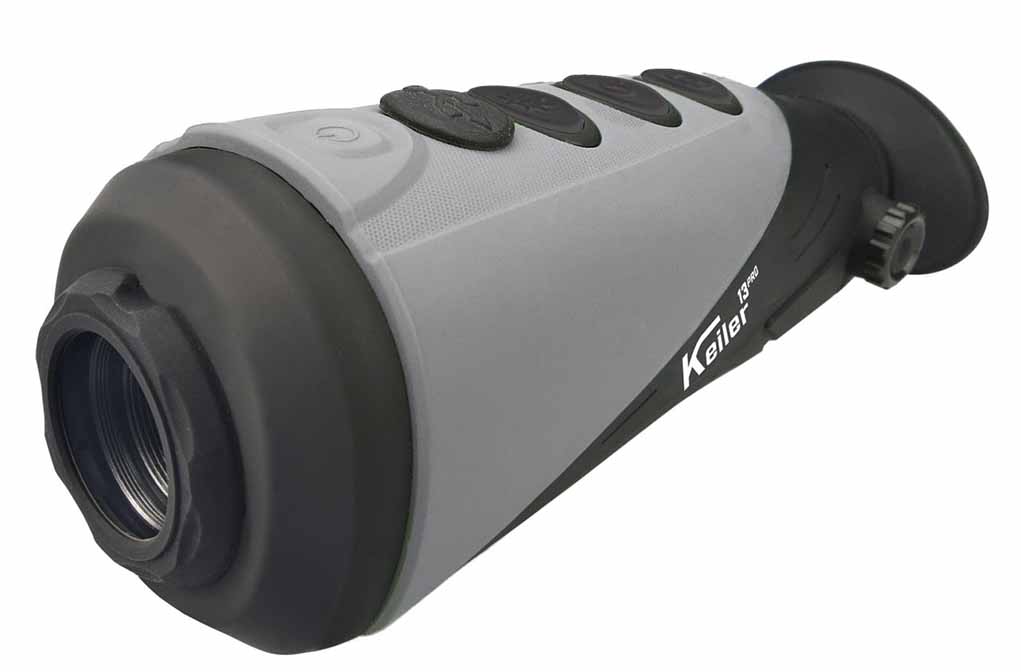
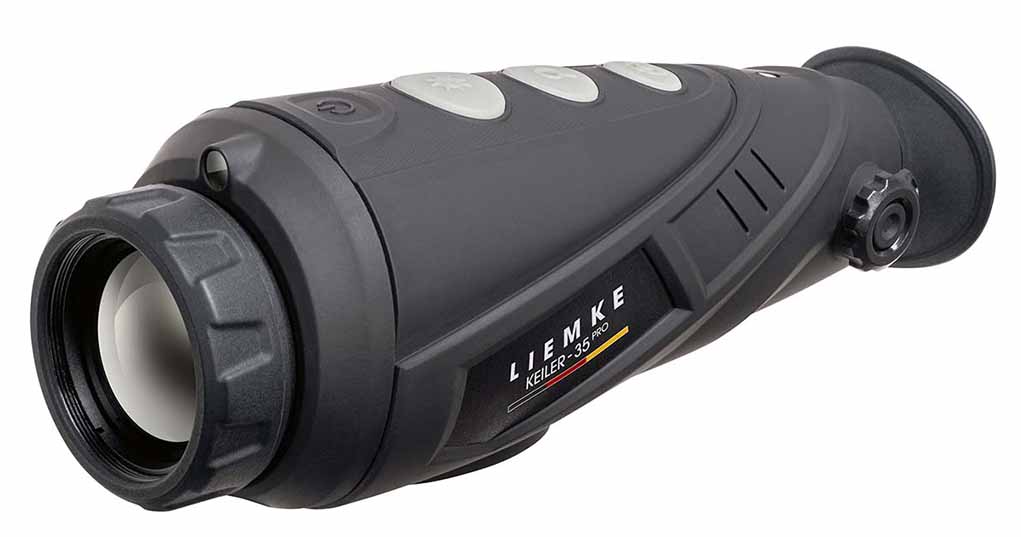
Liemke is initially entering the American market with two thermal monocular offerings, the Keiler 13 Pro and the Keiler 35 Pro. Both models have recording capabilities and internal storage of 16GB, which can be transferred to another device via cable for the 13 Pro or via Wi-Fi for the 35 Pro. They record at a 50 Hz refresh rate to ensure the footage is smooth and the image quality is high. All Liemke products also include a three-year warranty.
Keiler 13 Pro
Keiler 13 Pro Ceramic
Featuring a 13mm objective lens, this pocket-sized monocular brings high-performance in a small package. As rugged and waterproof as any other sized model, the Keiler 13 Pro detects heat signatures at a maximum of 500 yards, with a field of view of 50 meters at a 100-meter distance. The resulting image is viewed on the 720×540 pixel resolution display. It has an optical zoom level 1.2x and a digital zoom of 2x, providing for a total capable zoom of 2.2x.
The Keiler 13 Pro, the more compact model of the two, weighs only 11.64 ounces and is described by Leimke as pocket-sized. Pockets come in many sizes, however, so it would be appreciated if Leimke posted the device’s actual dimensions. It is powered by a rechargeable lithium-ion battery that can run continuously for 12 hours. With such a small size and long battery life, the Keiler 13 Pro seems ideal for those looking to carry a light pack into deep country. MSRP is $1,332.
Keiler 35 Pro
Keiler 35 Pro
As the 13 Pro features a 13mm objective lens, the 35 Pro has a 35mm lens. Larger in every way, the 35 Pro is capable of detecting and recording heat signatures up to 1,350 yards away. Its 2.5x optical zoom combined with a 2-4x digital zoom means that the 35 Pro can enlarge an image up to 10x its original size. The image is displayed on a 1,280×960 pixel screen, higher resolution than the 13 Pro.
The 35 Pro is also powered by a rechargeable lithium-ion battery, but it is only guaranteed to have a minimum of a 7-hour battery life due to the more demanding power requirements over the smaller model. At 14.81 ounces, it is only about 3-ounces heavier than the 13 Pro. This model is more suited for those who value performance over portability or price. MSRP is $3,332.
For more information on Liemke thermal imaging devices, please visit liemke.com.
Savage’s Renegauge is setting the bar for reliable semi-auto shotguns. Whether you’re aiming your bead at clays, birds or bears, the Renegauge will cycle the right load for the job.
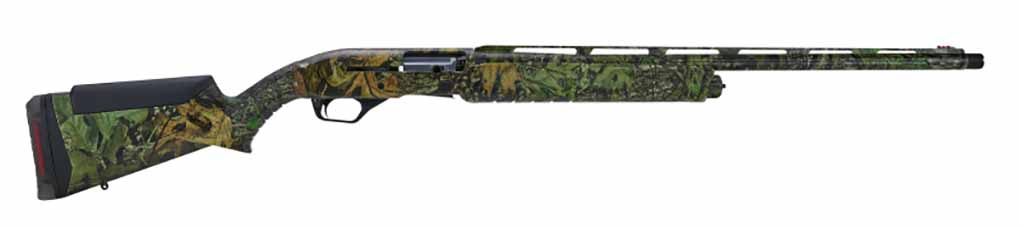
Renegauge Turkey Bottomland 12GA
Renegauge Specs (All Models Besides Competition):
Caliber: 12 GA Capacity: 4+1 Action: Semi-Auto Barrel Length: 28 inches Length Of Pull: 14.25-15.07 inches Weight: 8 lbs.
The Savage Renegauge was released in 2020 after eight years of development were spent refining and perfecting this semi-auto 12 gauge’s gas system. After its reliability in the field was proven to be as good as advertised, the Renegauge won multiple shotgun of the year awards and quickly became a popular choice for shooters who want one shotgun that can do everything.
What Sets The Renegauge Apart?
There are other reliable semi-automatic shotguns on the market, but only the Renegauge has Savage’s patented D.R.I.V. Gas System. Capable of reliably and consistently cycling loads for a variety of applications, the Renegauge’s unique Dual Regulating Inline Valve Gas System also reduces felt recoil and minimizes wear on the gun. Many other semi-auto shotguns either have difficulty cycling lower-powered loads, or they are over gassed and cycle weaker loads at the cost of excess wear and recoil. Savage’s D.R.I.V. system ensures that regardless of load strength, the bolt carrier travels at the ideal velocity within the receiver.
The D.R.I.V. system cleverly accomplishes this by venting excess gas out the front of the system before it is diverted back into the bolt carrier and the shooter’s shoulder. The two regulating valves of the D.R.I.V. system know exactly how much gas the gun needs to cycle, and that is all it will allow back into the action. This means that when firing low-powered target loads, all or most of the gas is being used to run the action, but when firing 3 inch magnum slugs a good amount of that gas will exit the system out the front near the muzzle. For a shotgun to be able to impart the same force upon the shooter across such a range of load strengths is truly an accomplishment. If a car were to be released that spat on Newton’s laws of motion as much as the Renegauge does, it would be capable of accelerating like a Tesla while the driver felt the G-forces of a Prius.
Renegauge Options
The Renegauge comes in six different configurations to suit your exact needs and environment. Regardless of model, all include Savage’s AccuFit adjustable synthetic stock that enables the user to customize pull length and comb height to their desired positions. Length of pull is adjusted using different sized recoil pads in conjunction with shims for fine-tuning the size. All Renegauge models also include oversized controls and a beveled magazine port designed to assist both the speed of the competition shooter and the dexterity of the glove-wearing hunter.
Internally, all Renegauge models utilize the D.R.I.V. Gas System as well as the other core components that make the Renegauge the shotgun that it is. That includes the bolt carrier group and action bar which are chrome-plated to decrease friction and increase cycling speed, among other benefits. The fast-venting D.R.I.V. system paired with the slick carrier and tuned action result in a gun that can truly shoot as fast as you can pull the trigger. If you’re like me, you’ve outshot your gun before while trying to hit that bird or clay that got by, only to hear a deafening click instead of a bang. The reliable speed of the Renegauge is a feature that will surely be appreciated by competition shooters and hunters alike.
Renegauge Field
Renegauge Field
The most basic Renegauge offered by Savage, the Renegauge Field, is still a premium shotgun. All the previously mentioned features of the Renegauge are included in this model, making it a very fine choice for hunting, competition, or both. It includes improved, modified and full chokes using the Beretta/Benelli choke system. MSRP is $1,539.
Renegauge Turkey Bottomland
Renegauge Turkey Bottomland
Featuring Mossy Oak Bottomland camo, the Turkey Bottomland package includes extended turkey, improved cylinder, full and modified choke tubes utilizing the Beretta/Benelli choke system. The Bottomland camo pattern includes a bark-heavy color scheme making it ideal for hunting in darker wooded environments. MSRP is $1,649.
Renegauge Turkey Obsession
Renegauge Turkey Obsession
This package is identical to the Turkey Bottomland besides featuring the Mossy Oak Obsession camo pattern instead. This turkey gun’s camo makes it better suited for the woods in the spring or early fall when there are brighter colors in the trees. MSRP $1,649.
Renegauge Waterfowl
Renegauge Waterfowl
As the names imply, the previous two models were made with turkey hunting in mind, while this gun was designed more for ducks and other waterfowl. It also utilizes a Beretta/Benelli choke system but only includes improved cylinder, modified and full chokes. The Mossy Oak Shadow Grass Blades camo is ideal for the flooded environments that water birds favor. MSRP $1,649.
Renegauge Prairie
Renegauge Prairie
This model comes with the same three chokes as the Field and Waterfowl models and features TrueTimber Prairie Camo for blending into the more arid environments found in the western and midwestern United States. MSRP $1,649.
Renegauge Competition
Renegauge Competition
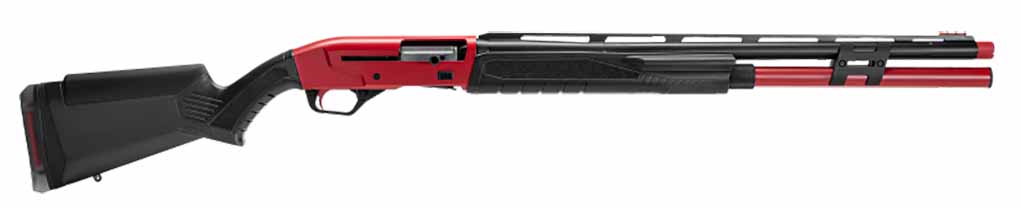
This model is an outlier in the Renegauge family as it is the only one that doesn’t conform to the same list of general specs as the others. Developed with competition use in mind, this model features a shorter barrel, extended magazine tube, red Hi-Viz Tri-Comp front sight, and a red Cerakote finish. The extended magazine brings its capacity to 9+1 instead of the standard 4+1. It has an extended choke using the Beretta/Benelli choke system and includes an extended Skeet2 Light Mod. Choke. The oversized controls and beveled magazine port that come standard on all Renegauges are even more appropriate on this competition model. MSRP $2,019.
For more information on Savage Arms Renegauge shotguns, please visit savagearms.com.
Reloading for semi-auto pistols isn’t rocket science, but requires a solid understanding of the process to produce workable ammo.
What Are The Challenges To Reloading For Pistols:
The cartridges headspace off the case mouth, thus squaring the case mouth is imperative.
Length is also an issue, give they need to run smoothly through a magazine and still headspace once in the chamber.
A tapered crimp is required to hold the bullet in place and maintain headspace.
Not only does this require a special seating die or taper crimp die for the process.
These days, the ammunition shelves seem to be as bare as they’ve ever been. A few, short months ago both guns and ammunition were plentiful. The record gun sales—handgun, rifle, and shotgun—of April, May, and June, coupled with those who want to have an ample supply on hand, have seen ammunition flying off the shelf at an unbelievable rate. Simply put, factories just can’t keep up with demand.
More folks are turning to reloading to keep their firearms fed, and while that’s a sound means of keeping yourself in ammunition, there are some points to discuss when it comes to reloading for semi-auto pistols. Unlike the cartridges designed to function in the cylinder of a revolver—which more often than not use a rimmed cartridge—the semi-autos need a case that’ll feed reliably from a magazine. While there are many, the 9mm Luger, .40 Smith & Wesson, and .45 ACP are, inarguably, the most popular.
Pistol Case Headspace
All of these straight-walled, rimless designs headspace off of the case mouth (in theory). As a result of that design, I start with a good, square case mouth to help keep things running smoothly. Trimming cases to a uniform length—usually no longer than that length prescribed by SAAMI—is a good idea, so a good set of calipers or a case length gauge will be needed to verify the cases are of the proper dimension.
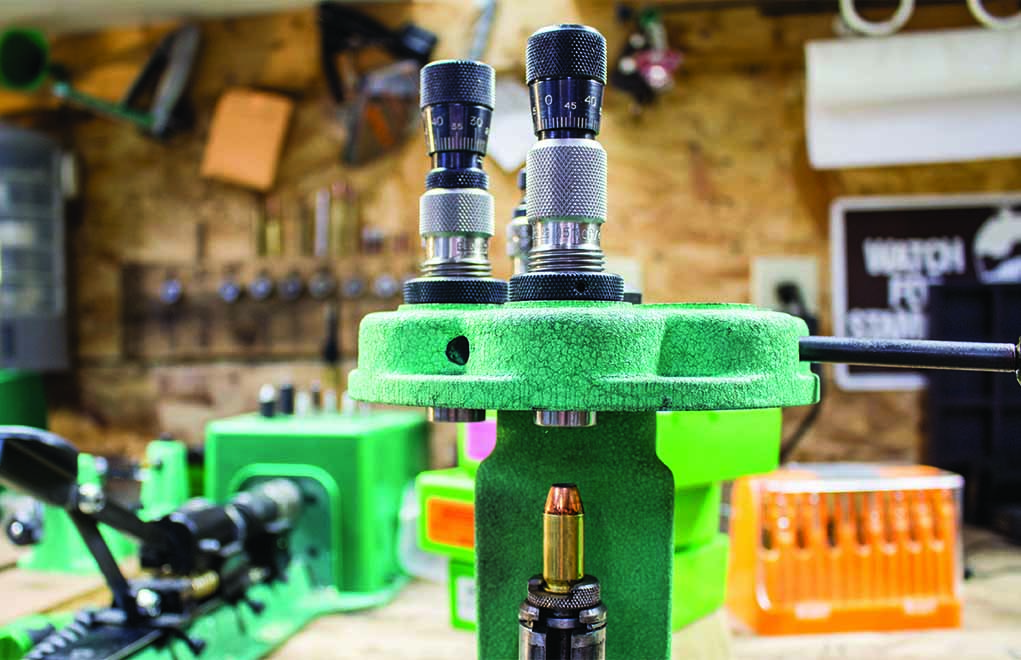
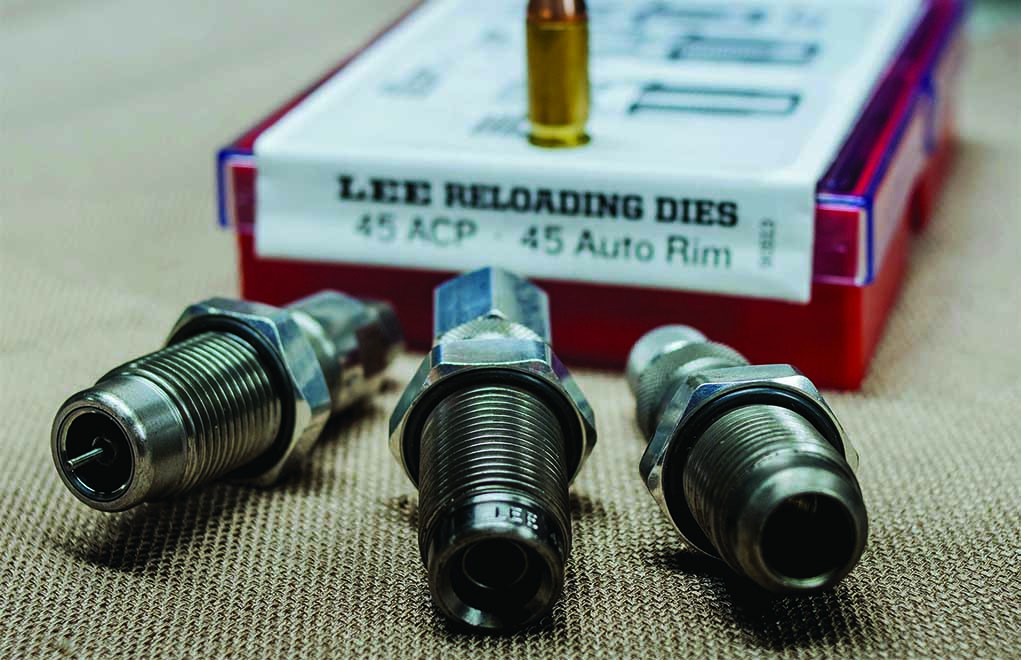
The author keeps four dies in the turret press for .45 ACP ammo: the carbide resizing die, expander die, seating die, and lastly, the micrometer adjustable taper crimp.
If the cases are trimmed too short, they won’t headspace properly and might rely on the extractor for stability. This probably happens more often than you’d think, yet it rarely becomes a problem. If the cases have stretched and are too long, chambering could be a problem. SAAMI offers a certain tolerance level (+/- 0.010 inch in the case of the .45 ACP) for the ammunition, and the manufacturers have a tolerance for the chamber dimensions, so you might have to do some experimentation regarding the length that’ll work best in your pistol. At the very least, I feel comfortable using a case gauge, in order to weed out any potential problems.
One important aspect of the straight-walled rimless cartridge is that they require a taper crimp in order to keep the bullet in place. Because of the means of headspacing, rolling the case mouth into a cannelure or crimping groove just won’t do. So, instead of using the seating die to both seat the bullet and roll crimp in the same operation, you’ll need a seating die when reloading for semi-auto pistols, which offers a taper crimp or a separate taper crimp die to squeeze the case walls around the bullet. This operation provides enough tension to keep the bullet from being driven into the case as it hits the feed ramp, as well as preventing the bullet from creeping out of the case and giving chambering issues.
Lee dies are both affordable and effective. While they might not possess some of the bells and whistles of other brands, they function properly and work for reloading for semi-auto pistols.
The amount of crimp applied to the case is—generally—calculated by adding the bullet diameter to the thickness of the case wall (times two for both sides), then subtracting 0.004 inch for proper tension, measured at the case mouth. Again, speaking in generalities, because differing brands might give different readings, case walls measure about 0.010 inch. So, looking at the .45 ACP, a good taper crimp would produce a loaded case measuring as follows: 0.452 inch for the bullet, plus two case walls at 0.010 inch each, minus the 0.004 inch for the taper crimp for a grand total outside dimension (OD) of 0.468 inch. For the 9mm Luger, you’d add the bullet at 0.355 inch, plus 0.020 inch for the two case walls, and subtract 0.004 inch for an OD of 0.371 inch. It’s a simple formula, but if the crimp isn’t coming out right you might want to examine the case thickness.
An overly taper crimped cartridge can actually crumple the case wall below the bullet, rendering that case useless, and if you’re using lead bullets, or even thinly plated bullets, you can deform the bullet to the point where accuracy becomes wild. If you use too light of a taper crimp, the bullet can move within the case, and that doesn’t work out well at all. That nice, square case mouth should end up squeezed against the bullet’s sidewall, and if you scrape it with your fingernail, you can feel the change brought on by the taper crimp. A properly applied taper crimp will also help to keep velocities more uniform.
Taper Crimp Dies
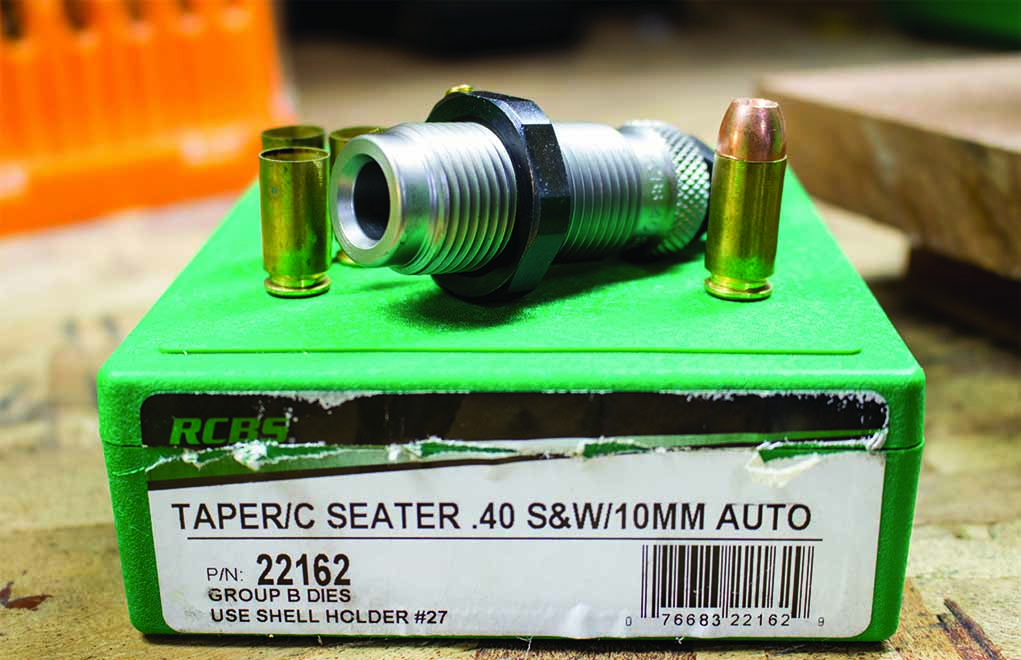
There are plenty of good taper crimp dies on the market; some come as part of a set, as in the RCBS seater die with taper crimp instead of roll crimp, and others are sold separately. The Lee taper crimp die is a popular choice. Among the conventional taper crimp dies, accurate adjustments can be a challenge at times. The 7/8-14 threads of a standard die can require several attempts at adjustment before you get things just right, and that can be a frustrating experience.
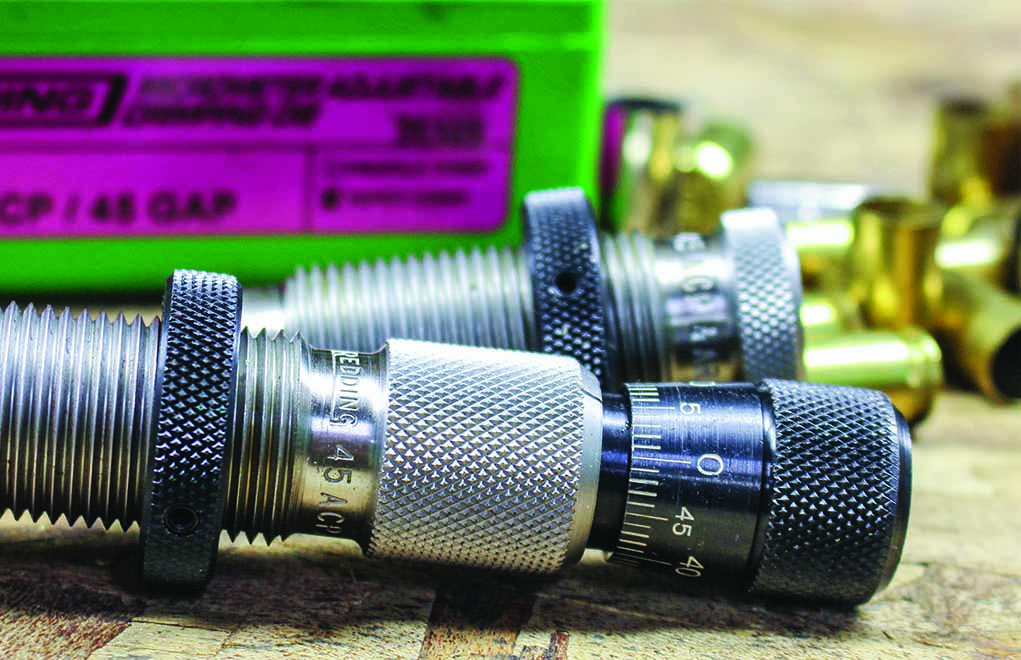
Redding’s taper crimp dies: The micrometer adjustable die is in the foreground, and the standard die is behind it. This high-end option can provide a leg up when reloading for semi-auto pistols.
Redding saw the problem and, as usual, offered a sensible and reliable solution. The Micro Adjustable Taper Crimp die gives 0.100 inch, up and down, of adjustment without having to touch the lock ring. A blued, knurled adjustable dial—clearly marked and graduated—sits atop the die body, and I can attest to the fact that the crimp responds properly to the adjustment. If you segregate your brass, you can make an adjustment in crimp when you change brands, but I will tell you that it’s wonderful to just twist that knob to set things right again.
I find it amazing how fast our ammunition situation changed from readily available to nonexistent. But this isn’t the first time it has happened in the past decade, and it probably won’t be the last. Reloading ammunition might not be for everyone, but I’m starting to believe that it’s a skill every shooter should possess. With a good set of dies and some components, you can continue to train with your chosen handgun for relatively little money.
Editor’s Note: This article originally appeared in the October 2020 issue of Gun Digest the Magazine.
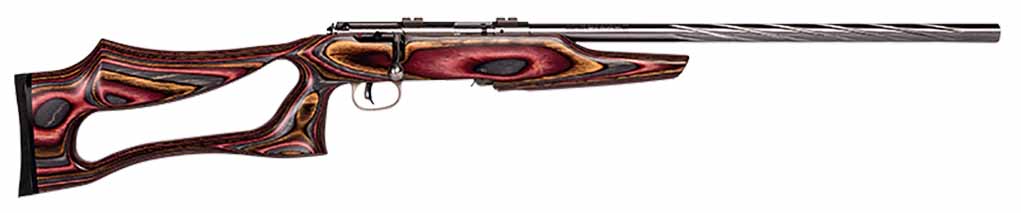
If you are in the market for a rimfire rifle of any kind, Savage likely has you covered. Offered in a wide variety of calibers, configurations, materials, and even colors, Savage’s expansive line of rimfire rifles is sure to have something that will catch your eye.
How Many Different Rimfire Rifle Models Does Savage Offer?
A17—9 Variants
A22—11 Variants
B. Mag—6 Variants
B17—10 Variants
B22—19 Variants
Mark I—4 Variants
Mark II—23 Variants
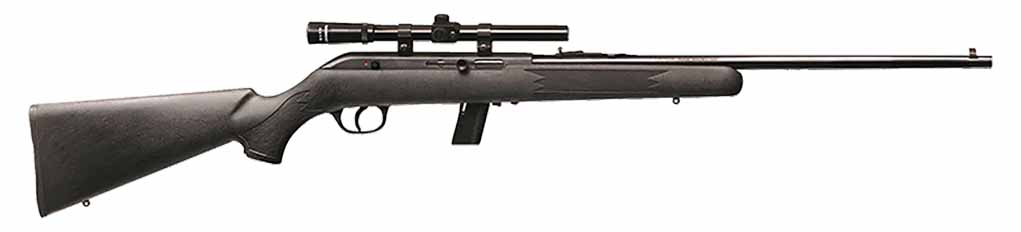
64—12 Variants
93—38 Variants
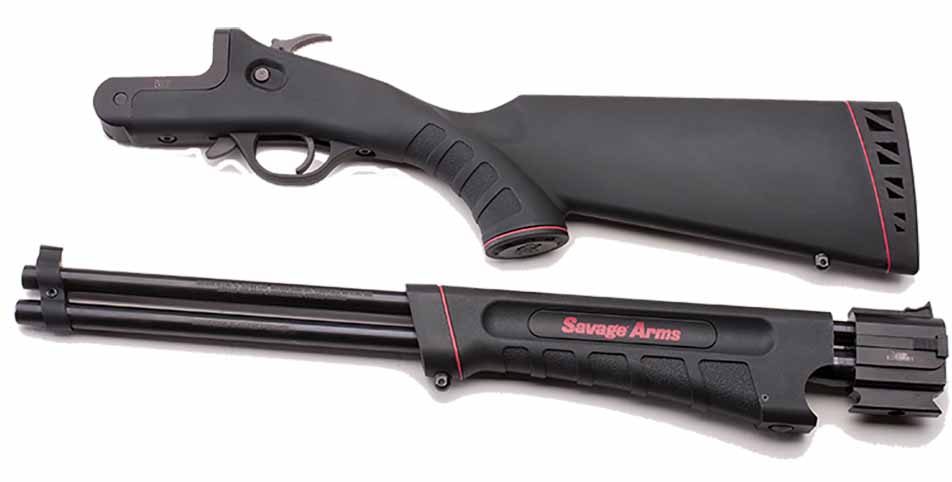
42—2 Variants
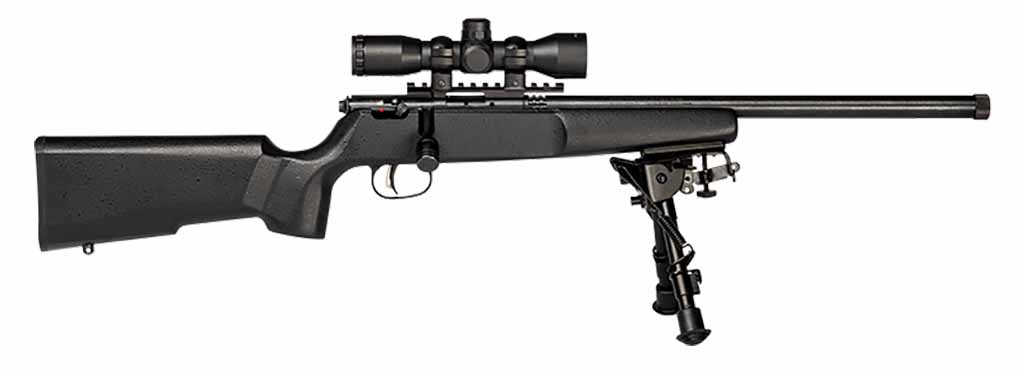
Rascal—25 Variants
Savage B17 G
Founded in 1894 by Arthur William Savage, Savage Arms is one of America’s oldest lasting firearms manufacturers. They have designed and produced guns for both the civilian and commercial markets as well as military contracts during their time, having provided weapons for the Allies in both world wars. While they no longer offer Lewis guns or Thompsons for sale, Savage Arms is still a prominent and reputable manufacturer of hunting and sporting arms.
Which Savage Model Is Best For You?
Savage’s catalog of rimfire rifles includes 11 basic model distinctions and enough variants of each one to total 159 unique different rifles to choose from. With such minute variations between models such as barrel length, barrel profile, left or right-hand setup, metal finish, stock color, and rail options, there is not enough room to detail each small difference in this article. Outlined below are the general models of the rimfire rifles Savage has to offer. Whether you are interested in precision rifle competitions or plinking soda cans, hunting rabbits or teaching your children the fundamentals of firearms, Savage makes a rifle that will be perfect for the job.
The A Series
Savage A22 Pro Varmint
Like many of their rimfire rifles, Savage’s A Series is offered in several chamberings. These include .22 LR, .22 WMR, .17 HMR, and .17 HM2. The A Series are all semi-automatic rifles utilizing a blowback style action, delayed blowback for the magnum cartridge variants and direct blowback for the rest. The stock is available in several colors and camo patterns on either a synthetic or wooden stock. The wood models are made in both traditional profile and thumbhole style stocks. Some variants have segments of picatinny rail for mounting optics, and all include Savage’s adjustable AccuTrigger. The MSRP ranges from $299 to $709.
The B Series
Savage B22 Precision
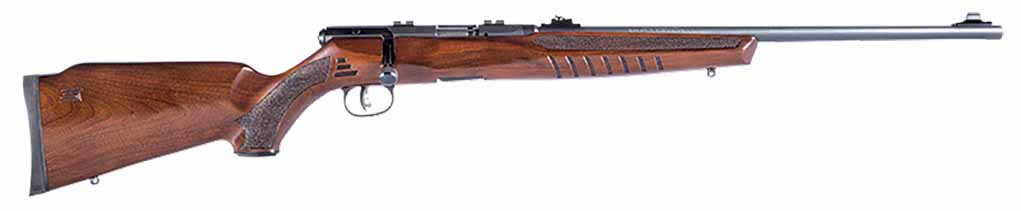
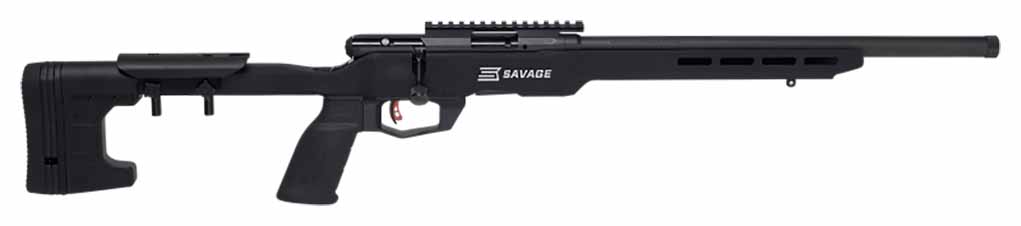
Unlike the A Series, Savage’s B Series rifles are all bolt action designs. The A and B Series guns both feed from 10-round rotary magazines except for the Precision variants which instead use 10-round detachable box magazines. The B series can be broken up into three main categories, the B. Mag, the B17, and the B22. Magnum caliber rifles in the B Series include the B. Mag variants chambered in .17 WSM and the B22 Magnum variants which are in .22 WMR. The rest of the B17s and B22s that comprise the B Series are chambered in .17 HMR and .22 LR. Like the A Series guns, the stocks can be made of either polymer or wood. The polymer models are either black, grey, or camo painted, while the wooden stocks can be either laminate or hardwood. All B Series rimfires come with an AccuTrigger as well. The MSRP for the B Series starts at $309 and goes up to $639.
Mark I And Mark II Series.
Savage Mark II BSEV
All Mark I and II guns are bolt action and chambered for the ubiquitous .22 LR cartridge, the only major difference between the I and II is that the Mark I guns are single shots and the Mark IIs accept detachable magazines. With 27 variants all chambered in the same caliber and with the same action, the Mark Series of rifles mostly differentiate from one another in the form of barrel, stock, and sight configurations. Some notable models of Mark Series guns are the Mark II FVX and FVXP that come with a Bushnell 3-9x40mm scope, and the Mark II FVT which has target-style peep sights. MSRP starts at $299 for a basic single-shot Mark I model and goes all the way up to $679 for the Mark II BSEV which features a heavy-profile, fluted stainless steel barrel. The MSRP of a basic Mark I is $269 and the fanciest Mark II goes for $679.
The 64 Series
Savage 64 FXP
The 64 family of guns are Savage’s .22 LR semi-automatic line. Utilizing a direct-blowback action and 10-round detachable box magazines, these little plinkers are fast and handy. With three scoped options and two takedown models available, the 64 you choose can be tailored towards either accuracy or compactness depending on your needs. Other variants include barebones models as well as optics-ready models with picatinny rail or drilled and tapped receivers. All the 64 stocks are more traditional in profile compared to some other Savage rimfires but are still available in either polymer or wood versions with one camouflage variant. MSRP is from $159 to $389 depending on options.
The 93 Series
Savage 93 FV-SR GATOR CAMO
The 93 series is the most expansive and varied family of rimfires from Savage, all 38 variants are bolt action, magazine-fed, and chambered in either .22 WMR or .17 HMR, making this the magnum line of rifles. If you are in the market for a rimfire rifle with punch as well as accuracy, this is the line to look at. There are scoped and camo models for hunters, models with fluted barrels and thumbhole stocks for competitors, and more basic models as well. The gator camouflage variant is quite slick looking in my opinion, but I have to say, if the environment you are trying to blend into is comprised entirely of alligators- you have a problem. MSRP on the 93 family ranges from $289 to $699.
42 Takedowns
Savage 45 Takedown Compact
If you are into backpacking, camping, or prepping for the apocalypse, you know that takedown style guns offer unparalleled compactness and versatility when it comes to transporting and storing weapons with rifle-length barrels. The two models of 42 Takedowns from Savage are identical except for the length of pull, with the shorter one designated as the 42 Takedown Compact. These single-shot, break-action survival guns have two barrels, a .22 LR on top and one for .410 bore shotgun shells on the bottom. This is an ideal backpack gun and is capable of taking a wide variety of small game. The rear sight can be removed and replaced with a scope base if so desired, and the whole package comes in an included carrying case. MSRP is $549.
Rascals
Savage Rascal Target XP
These single-shot .22 LRs are ideal for young shooters to train with, and that’s exactly what the Rascal was designed for. They are simple to operate and don’t have the risk of unintentional follow-up shots like magazine-fed guns do. They are available with iron sights, scope mounts, and even bipod mounts for the aspiring junior sniper. All Savage Rascals come with an adjustable AccuTrigger which not only provides a better pull but increases the firearm’s safety as well. There are left and right-handed models available in classic hardwood stocks or synthetic stocks in colors ranging from black to yellow to pink. The basic model’s MSRP is $199 and goes up to $439 for the Target XP.
For more information on Savage Arms rimfire rifles, please visit savagearms.com.
Love ’em or hate ’em, 2D data matrix codes on guns are likely to stick around.
What Are 2D Data Matrix Codes And What Purpose Do They Serve:
The are machine-readable images used to store data, generally laser etched on to the frame of a gun.
Manufacturers use them to track the production of a firearm as well ensure the intrigity of serial numbers.
Information stored in each code is proprietary to each manufacturer.
They do not take the place of the serial number and other information required by the BATF.
No, a QR scanner won’t read them … sorry.
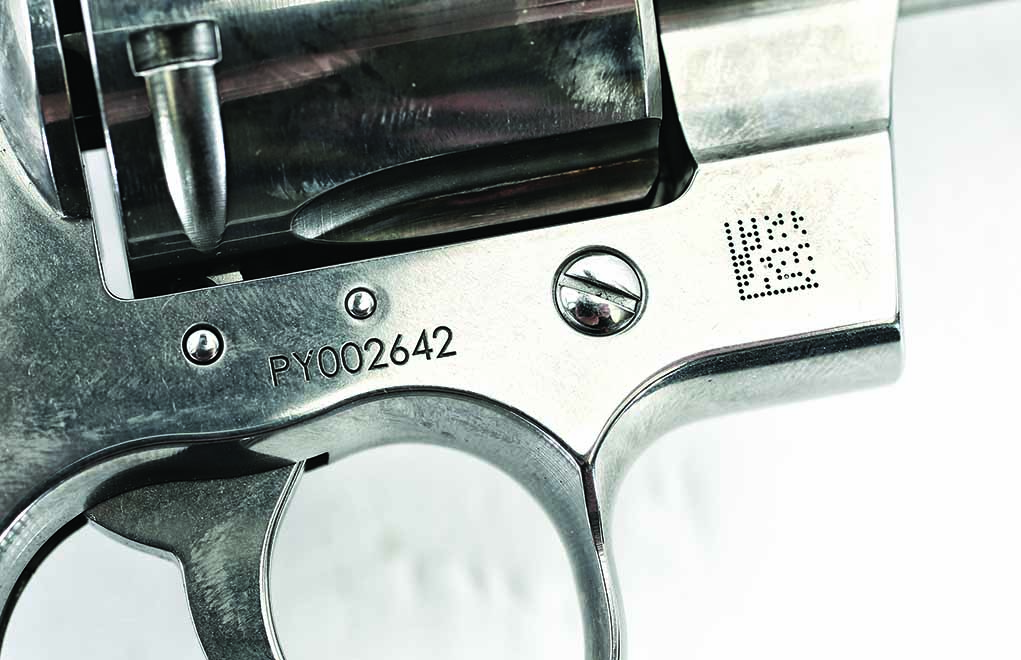
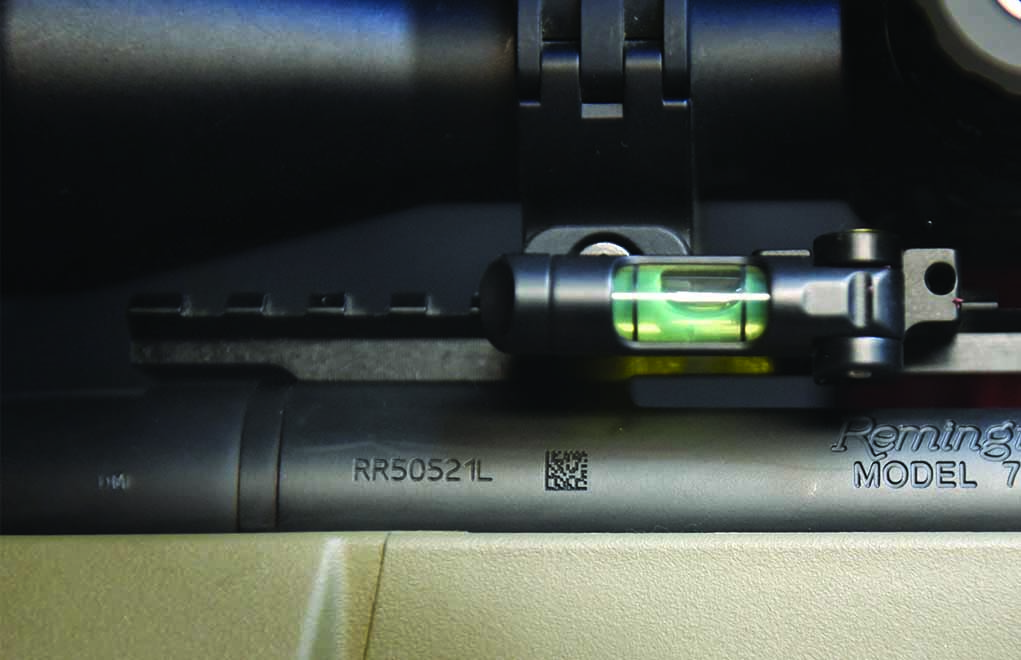
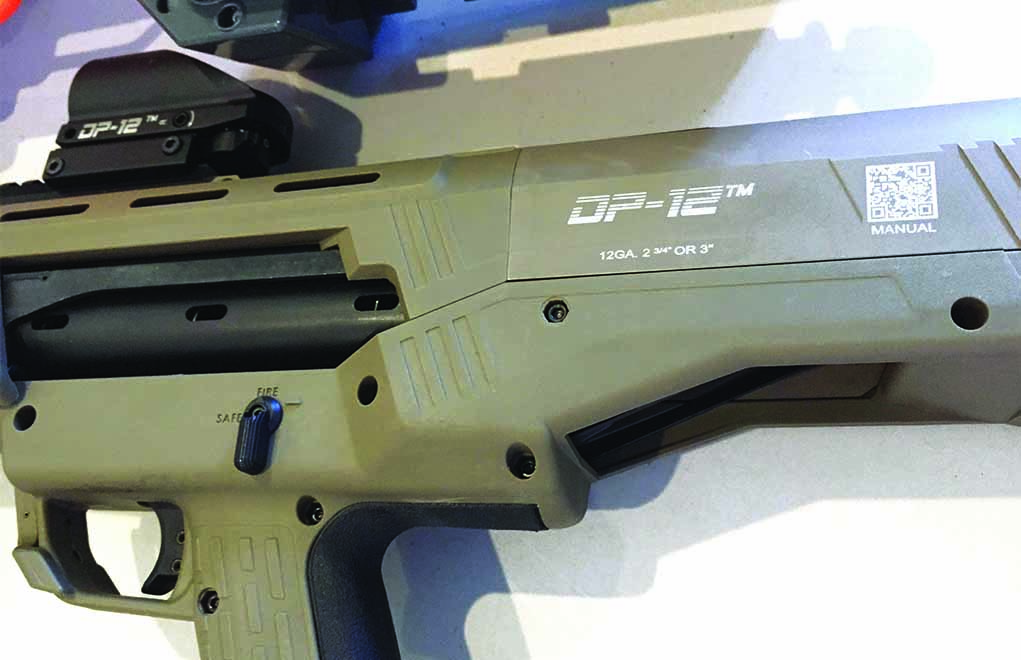
If you’ve purchased a new firearm recently from one of several major manufacturers, you might’ve noticed a small, square pattern of dots, where before only the company’s engraved name appeared along with the gun’s model and serial number.
In an industry where the final turn of a filigree’s orientation from one model year to the next doesn’t go without notice, adding a square of asymmetrical pockmarks is sure to raise eyebrows. And to no surprise, it did, too.
As more firearms appeared on the market with these marks, discussion boards lit up, recoiling and opining endlessly on the illegible and unwelcome addition. Many views are almost comical if not misinformed, but make no mistake: Your eyes do not deceive you—something is afoot.
What is a Dot Peen Marking?
A dot peen marking is an image created using what’s known as stylus pin marking, micro pin marking, or percussion marking device to create a succession of dots that form digits, text, logos, and two-dimensional (2D) Matrix Codes. The latter being the most recent and certainly most cosmetically offensive. As a gun owner, you’ve slowly habituated to this technology without knowing it.
Several firearm companies began printing serial numbers using this technology some years ago. In recent years, lasers took the place of impact tools to create these marks. Most marks simply look like letters and numbers made from a series of dots. However, serial numbers and firearm manufacturer’s information are important and must be more than just “present and eye-readable.”
Located in between the BATFE-required serial number and name of the manufacturer and model, the 2D Matrix Code is readable by internal tracking machines at the Remington plant. The code isn’t required by law and is used to track serialized parts through the assembly process.
According to Bureau of Alcohol, Tobacco, Firearms, and Explosives (BATFE), firearm serial numbers must meet the following requirements:
Must be conspicuously engraved, cast, or stamped (impressed) on the firearm frame or receiver.
The serial number cannot duplicate the serial number appearing on any other firearm the importer previously imported.
For firearms imported after January 30, 2002, the engraving, casting or stamping (impressing) of the serial number must be to a minimum depth of .003 inch and in a print size no smaller than 1/16 inch.
Markings must also include the name of the manufacturer, the firearm’s country of origin, model designation (if assigned), caliber or gauge, name of the importer, and the city and state of the importer. Interestingly, if a foreign manufacturer didn’t mark their firearms to this standard, the importer must do so within 15 days of their release from Customs and Border Patrol Custody.
Section 478.2 (a)(1)(i) also specifies: By engraving, casting, stamping (impressing), or otherwise conspicuously placing or causing to be engraved, cast, stamped (impressed,) or placed on the frame or receiver thereof an individual serial number. The serial number must be placed in a manner not susceptible to being readily obliterated, altered, or removed … That’s no small amount of information, but what does that have to do with the unsightly square of dots?
The Illegible And Offensive 2D Matrix Code
At the risk of allowing the loud voices of a few speak for the majority’s opinion, most of the commenting firearm forum enthusiasts found the square of dots, the 2D Matrix Code mark, well … ugly. At a minimum, most found the mark as cosmetically welcome as Ike Turner at a NOW convention, not to mention the object of several government conspiracy theories.
The Standard Manufacturing DP-12 shotgun is one of the rare exceptions with a QR Code to access the owner’s manual. Unlike the 2D Matrix, this mark has some value for the end-user, but isn’t used in the manufacturing process.
Both the numbers and letters made from a line of dots, and the squares of asymmetrical dots, are designed to be read by a machine—usually with a laser inside a tooling machine or the handheld device of a factory line technician. The marks allow manufacturers to read and track a serialized part through the assembly process and into an integrated order tracking system. The parts, and ultimately the assembled firearm, can then be located anywhere on the factory premises during production and electronically logged to a specific customer when shipped.
So, if the BATFE requires this information and it must be visually legible, why do manufacturers also need an ugly mark so a machine can read it? The simple answers are efficiency and liability. In addition to production tracking, manufacturers can also ensure serial numbers are neither omitted from a series (requiring the manufacturer to account for a gun never made) or duplication (stamping two guns with the same serial number). Sorry, collectors.
Again, the 2D Matrix Code is simply a machine-readable image able to store much more information per square inch than a series of dots shaped like numbers or letters. They’re not readable by common devices such as your smartphone like Quick Response (QR) Codes and have no value to the end consumer.
However, the marks are regulated for industrial quality and consistency standards by AIM, the Association for Automatic Identification and Mobility. The exact information contained in a specific 2D Matrix Code mark is proprietary to each firearm manufacturer. So, you’d have to get the manufacturer to agree to have their machine read your mark and then share what it says.
Epidemic Or Pandemic?
Are the 2D Matrix Codes a COVID-like global pandemic for firearm aesthetics, or are they more akin a regionalized malaria epidemic. The answer is the latter. The BATFE doesn’t require manufacturers to use an electronically readable marking device, a 2D Matrix Code, nor an integrated part tracking system. Smaller manufacturers would have to reach a scale where replacing people with machines is economically sensible. In other words, if you make millions of guns a year, the investment makes sense. If you’re a small custom shop, it’s unlikely.
The 2D Matrix and QR Codes differ in appearance and use. The 2D Matrix (left) can be identified by the straight lines along the bottom and left sides. The QR Code (right) has three squares at the corners. Smartphone apps can scan the QR Code to link to websites or documents.
In silent acknowledgment of this electronically induced wart, some manufacturers managed to nest their 2D Matrix Code in less obvious locations, such as under a pistol slide. Still, most production line machines need the marks to be external and visible in order to read and track a part.
Not A QR Code
I’ve no doubt some shooters will try it, but 2D Matrix Codes aren’t designed to be scanned for information relevant to the owner or open an internet page via a scanning app on your smartphone. That’s what a QR Code does.
Visually, you can tell a 2D Matrix Code from a QR Code as the latter will have three large squares in the corners in addition to the array of dots or squares. The 2D Matrix Code will have solid lines at the left and bottom of the mark and no squares in the corners. Also, neither 2D Matrix Code nor QR Codes are the same as the more familiar bar codes that come on consumer packaging. So, for God’s sake, don’t attempt to scan your pistol at the grocery store checkout.
However, some airsoft and air rifle companies have added QR Codes to their rifles along with the serial numbers, often on a decal, as they’re not bound by ATF marking standards. In one exceptional case, the Standard Manufacturing DP-12 pump shotgun uses a QR Code on the synthetic stock to reference a website for its user’s manual. The QR Code is a clever, techie addition and not out of keeping with the shotgun’s futuristic aesthetic design of the shotgun. However, it’s not to be confused with the 2D Matrix Code, nor would it satisfy BATFE requirements.
So, love them or hate them, that’s what’s showing up on some of your new firearms. You can remove your tinfoil hats; there’s no secret chip in the gun, GPS locator, or biometric scanner—at least not yet.
Editor’s Note: This article originally appeared in the October 2020 issue of Gun Digest the Magazine.
Beretta brings the rough and ready French MR73 revolver to the American market.
How The MR73 Is A Cut Above The Rest:
Features triple adjustable trigger features overtravel, hammer force and hammer spring weight adjustment screws.
Outfitted with LPA target adjustable rear sight.
Comes with ergonomic Trausch grips.
Battle test by French GIGN counterterrorism unit.
Ah, France! Home of the Eiffel Tower, good wine and revolvers as salty as Charlemagne. Wait … what? You heard that right.
True enough, France isn’t exactly the first country that comes to mind when discussing high-performance European firearms, however, the nation has a long and storied history innovating guns. OK, the Chauchat was a deadly lemon, but a mere mote on an otherwise outstanding record.
Manurhin MR73 Gendarmerie cylinder open
In contemporary times, count the Manurhin MR73 among these triumphs. Built for match accuracy and operator toughness, the .357 Magnum possibly vies for the title “best revolver in the world”. And Beretta is bringing it to America.
What’s So Dang Special About the MR73?
Certainly, it’s a thumb in any red-blooded American’s eye to claim another country—particularly France—makes a better wheelgun than us. But as far as production revolvers go, this could very well be the case with the Manurhin MR73. It had to be among the best, given the demands placed upon the gun by an elite unit of the French national police force unit—Groupe d’intervention de la Gendarmerie Nationale (in English National Gendarmerie Intervention Group or GIGN).
Formed in 1973, the GIGN’s missions include hostage rescue, threat surveillance, protecting government officials and, most notably, counterterrorism. Initially, the tactical unit employed Smith & Wesson revolvers, but the guns were unable to withstand the GIGN’s rigorous training regimen, which includes firing 150 rounds daily. The French pistol, however, could and in the unit’s skilled hands has acquitted itself well.
Manurhin MR73 Sport from the rear, showing the adjustable sights.
Most famously, and mention nearly anytime the MR73 is, is the revolver’s role in the 1994 rescue of hijacked Air France flight 8969. The point man in the rescue, Chief-Warrant Officer Thierry Prungnaud, killed two of the four hijackers—members of the Armed Islamic Group of Algeria—and neutralized a third with his MR73. Mind you, this was with the entirety of the flight’s crew and passengers onboard. There’s little arguing Prungnaud’s skill in a tense scenario with ample opportunity for collateral damage, but his tool responded admirably, as well. Incidentally, he did earn seven rounds of 7.62x39mm for his efforts—and survived. Tough dude.
In this particular case, it’s likely GIGN Chief-Warrant Officer used his 5.25-inch barreled MR73. But members of this unit also were issued a 3-inch barreled concealable model for protection duties and an 8-inch barreled urban sniping variant. French police forces utilized 2.5-, 3- and 4-inch fixed-sights MR73s, and Manurhin has offered all the iterations as sport models. An aside, it’s not unheard of for an issue GIGN MR73 to have more than 250,000-round life, which also speaks volumes to the gun’s ruggedness.
Beretta is slated to import two variants of the famous Manurhin revolver (made by Chapuis Armes)—the MR73 Sport and the MR73 Gendarmerie. The difference here is barrel length, the former with a 5.25-inch pipe, the latter a 4-inch option. Both versions of the 6-round revolver include a cold hammer-forged barrel, LPA target adjustable rear sight, front ramp sight, ergonomic target grip, and a premium target trigger.
The trigger merits comment. Manurhin’s triple adjustable trigger not only features a built-in overtravel screw but also a hammer force adjustment screw and a hammer spring weight adjustment screw. The latter features are built into the frame and offer a shooter more control over the performance of the trigger than most revolvers on the market. And the grips, Ruger fans will most likely recognize them as a Jacques Trausch creation, given he produced a model for the SP101. In essence, the unique rubberized grips are heralded for their fine recoil mitigation qualities and control improvement.
The MR73 Sport in its lockable hardcase.
The aesthetics of the revolver are pleasing as well, with a full underlug, a rich black finish and gold trigger and hammer. Controls are also familiar, with a cylinder release similar to Smith & Wesson’s, placed on the left-hand of the frame.
Pretty top-shelf, perhaps akin to another top-end European revolver maker—Germany’s Korth. Guess what, the Manurhin MR73 runs you nearly as much. Both the MR73 Sport and Gendarmerie run a cool $3,300. Spendy, but look at it this way, it works out to around $.01 a trigger-pull if you get it to 250,000 rounds.
The perfect size to throw in your glovebox or range bag, Fix It Sticks’ new All Purpose Driver Kit makes light work of field repairs.
Fix It Sticks All Purpose Driver Kit, in open case.
Included In The Kit:
Ratchet T-Handle with Locking Hex Drive
T-Handle extension
Magnetic velcro patch
22¼-inch Drive Sockets
SAE: 5/32, 3/16, 7/32, 1/4, 9/32, 5/16, 11/32, 3/8, 7/16, ½ and 9/16 inch
Metric: 4, 5, 6, 7, 8, 9, 10, 11, 12, 13 and 14 mm sockets
46¼-inch Electroless Nickel Plated Hex Bits
SAE Hex: 0.05, 1/16, 5/64, 3/32, 7/64, 1/8, 9/64, 5/32, 3/16, 7/32, ¼ and 5/16 inch
Metric Hex: 1.5, 2, 2.5, 3, 4, 5, 5.5, 6, 8 and 10 mm
Torx: 6, 8, 10, 15, 20, 25, 30, 35, 40, 45
Phillips: 0, 1, 2 (x2), 3
JIS: 0,1,2,3
Slotted: 3, 4, 5, 6, 7
Stay On The Range Longer
I know I’m not the only one who has had range days cut short by unforeseen problems that I didn’t have the tools to fix. I have tried too many times to tighten a screw with the blade of a knife. Some of my guns would certainly have been less scratched if I had had an All Purpose Driver kit in my bag.
Fix It Sticks are intended for use on any machine with bolts, nuts, or fasteners. Cars, guns, and everything in between can be fixed utilizing the tools found in this small case with dimensions measuring 8.25 X 5.5 X 2.375 inches.
The included bits and sockets come in both metric and standard sizes and can be attached to either the T-Handle directly, or to the T-Handle extender for additional reach and leverage. The MSRP is $200. Fix It Stick T-Handle.
For more information on Fix It Sticks All Purpose Driver Kit, please visit fixitsticks.com.
More than 100 years and still going strong. Few firearms can make this claim. Then again, few firearms are the 1911 pistol.
Born from the genius of John M. Browning, the handgun is among the most iconic of all time. Honorable service through two world wars, countless other conflicts and in the hands of law enforcement and armed citizens alike tends to elevate stock. So, today the venerable pistol remains a giant among guns, even with the onslaught of polymer pistols flooding the market.
In fact, safe bet that next to plastic striker-fired pistols there are perhaps more makes of 1911 than any other handgun. In other words, navigating the market is confusing, especially for first-time gun or 1911 buyers. This raises the question, where to start?
Thumbnail History Of The Icon
Not absolute imperative to purchasing a modern 1911, it’s worth the time to understand the gun’s roots. (Though, if you want to skip ahead to the buyer’s guide, you’re more than welcome.) We won’t dive deep into the ins and outs of its development here, instead, point you to some out-and-out experts on the 1911 have produced deep dives into the gun’s history. Among the suggested reads include Robert Campbell’s The Birth of The 1911 Pistol and Patrick Sweeney’s 1911: Before the Great War. You won’t find a much more thorough background on all facets of the gun’s development.
For our purposes, will home in on two facets imperative to the topic at hand—the modern 1911 pistol. First off, through extensive testing, John M. Browning’s design proved eminently dependable—almost as steadfast as the march of time. One famous example of the pistol’s reliability, not failing through 6,000 rounds of testing in its 1907 field trials. Pretty stout showing to say the least.
The other facet to consider, the pistol was designed as a man stopper. Certainly, extensively used in competitive shooting in modern times, the 1911 has outgrown this pigeon hole. However, its resume as among the deadliest handguns ever developed has been proven over and over, across the globe in some of history’s bloodiest conflicts. Important today, given the 1911’s potential as a lifesaving option for the armed citizen. Of course, on this point, the pistol only gets to take partial credit.
.45 ACP
Ammunition also plays a role in the potency of the 1911, and the .45 ACP certainly offers that in spades. Also developed by Browning, in conjunction with U.S. Army Colonel John T. Thompson (Thompson submachine gun fame), the cartridge defined non-magnum power for most of the 20th Century. Though, in truth, the low-pressure cartridge is relatively mild to shoot and by no means as speed demon out of the muzzle.
Instead, where the .45 ACP makes hay is its diameter. Essentially, a threat is neutralized by massive neural or cardiovascular damage or pain. Bullet breath, especially with non-expanding military full-metal jacket bullets, greatly increases the chances of inflicting one of the three. Depending on who you talk to nowadays, this is considered a negligible advantage in modern defensive handguns. Given the improvements in ammunition, particularly more consistent bullet expansion, some contend the 9mm is just as good as the .45 ACP.
There is some truth in this. The 9mm is absolutely a viable self-defense option and its effectiveness has only been enhanced with ammunition improvements. But even with leaps in terminal ballistics, not every bullet expands and the .45 ACP also reaps the benefits of better bullets. No matter what, a .45 bullet will almost always cut a larger wound channel than any other mainstream self-defense option on the market.
Buyer’s Guide Stipulations
A brief word on the buyer’s guide. Chamberings for the 1911 are legion, as are sizes and styles. We’d be here all day with a phonebook-length post attempting to list every worthy 1911 to come down the pike. In turn, there are some stipulations to the picks. Well, three.
As the title says, we’re looking at models best suited for concealed carry. In turn, large Government-sized models and those decked out for competition are absent.
On chamberings—we’re sticking with .45 ACP models. Yup, this leaves out many a fine gun, but we’re suckers for tradition. And it doesn’t get much more traditional than a .45 1911.
The final facet, the pistols are in production today. Again, there are some fine classics out there—some coming in at decent price points—but availability is an issue. While shopping GunBroker.com is fun, we aren’t shooting to send you on a wild goose chase. Also, these are production and semi-custom guns. If you’re purchasing a top-to-bottom custom gun you certainly don’t need a buyer’s guide.
Raise Your 1911 IQ:
Power On The Cheap: Best Affordable 10mm 1911 Options
For an all-around gun at this price point, Springfield Range Officer is your best bet. For a fighting 1911, it’s the Ronin Operator … particularly the Commander-sized 4.25-inch barreled model. Where Springfield did right is the aluminum-alloy frame, trimming up the pistol to a near featherweight (for a 1911) 29.5 ounces unloaded. Lack of heft makes it more conducive to everyday carry.
The pistol boasts a traditional barrel bushing system, foraged steel slide ample checkering on the mainspring housing and a nice set of laminate wood grips complete with Springfield’s dual cannon logo. Combat sights—fiber optic front—are low enough to ensure a clean draw and are quick to build a sight picture. And a “Mama Bear” thumb safety—left-side only—is large enough to intuitively engage and disengage, without creating a dig point in your side when holster. For the money, the Ronin Operator is a top concealed carry 1911.
Classics are difficult to beat. A staple for personal defense since 1950, the Combat Commander definitely qualifies as one. Following the original aluminum-frame design, the 1911 qualifies as a concealed carry piece tipping the scales at 27 ounces unloaded. Certainly, lightweight equates to a bit more buck in the hand but makes it all the more conducive to carry on an everyday basis.
In 2016 and 2017, Colt upgraded a number of its pistols’ standard features, including the Lightweight Commander. These improvements included the manufacturer’s dual recoil spring system, an upswept beavertail, undercut trigger guard, G10 “Black Cherry” grips and genuine Novak sights. Excellent fighting sights, they sit close to the slide, but the familiar three dots grab the eye. Unfortunately, Colt continues to make the Commander with a series 80 fire control—a drop-safety system that results in a trigger not nearly as snappy as the original series 70. Comparably crisp to what you’ll find on nearly any striker-fired, this is far from a deal-breaker.
Colt Lightweight Commander starting at $900 at Armslist.com
Fusion Firearms Riptide-C
Yeah, it pushes the price ceiling of this tier, still, the Riptide-C is perhaps among the best values on the list. Founded by the former president of Dan Wesson, the manufacture is probably best known for custom 1911s and parts. A few years back they jumped into the production pistol game with very impressive results.
It’s difficult to go wrong with any of the Freedom Series, however, the Riptide-C stands out as a gem concealed carry 1911. It’s the little things that make it a self-defense winner—mainspring and frontstrap checkering, fastback grip cut, lowered and relieved ejection port, front cocking serrations, among other things. And the 4.25-inch barreled pistol is 100-percent steel. A bit hefty, but appreciated when you pick up the gun’s pace. Make no mistake you can run the Riptide-C fast. Outfitted with a tradition Series 70 firing system, it offers a very predictable and light break—right around 4 pounds. A side note, consider the price listed hear as a starting point. Spend a bit more money and Fusion will customize any aspect of the Riptide-C.
Fusion Firearms Riptide-c starting at $995 at Armslist.com
Best 1911 Pistols $1000-$2000
Dan Wesson Vigil CCO
Fit tight as a drum and finished to turn heads, one wonders how Dan Wesson can hang such a relatively low price on the Vigil CCO. By the company’s standards, it’s entry-level, but heads and shoulders above nearly anything in its price tier and below. Every part of the gun is forged or tooled, including its lightweight aluminum frame. In short, the Vigil CCO is a quality gun.
It’s also fit for carry. For those unfamiliar with the CCO 1911 configuration, it’s simply a Commander-length slide on an Officer-sized frame. Drastically cutting down on the pistol’s height, the main culprit of printing, a CCO maintains a longer sight radius and more weight up front. It’s a nice compromise, keeping it low-profile, yet extremely shootable. You sacrifice a round and the grips are abbreviated, yet Dan Wesson doesn’t leave you hanging (maybe your pinky).
Ample checkering on the frontstrap and mainspring housing, as well as hardwood grips allows supreme control. Also worth note, the pistol comes with a tritium front sight and tactical rear, making it low-light ready.
Comfortable as well-worn shooting gloves, the Wiley Clapp Lightweight Commander might be the ergonomic masterpiece of this buyer’s guide. Oval grips comfortably fill the hand and, combine with 25 LPI checking fore and aft, create a positive surface from which to control the gun.
While lightweight, the gun is a bit more middle-ground for aluminum-framed irons at 30 ounces. Far from prohibitory for everyday carry and a benefit when exercising the gun’s series 70 trigger to its full potential. Similar to most Colts rolling out of Connecticut, the Clapp LW Commander has top-notch accouterments—genuine Novak sights and dual recoil springs. Particular to Clapp models, the rear sight has an extra-wide rear notch for faster target acquisition and boasts a low-profile thumb safety (pro or con depending on who you are). Designed as a fighting pistol that’s exactly what shooters get with the Clapp Commander.
Colt Wiley Clapp Commander starting at $1,250 at Armslist.com
Sig Fastback Nightmare Carry
Best known for DA/SA beasts and military-grade striker-fired pistols, Sig Sauer’s 1911 catalog is somewhat overshadowed. Pity, the manufacturer turns out a dang nice version of Browning’s masterpiece. When it comes to models tailored for concealed carry few outshine the Fastback Nightmare.
As its name suggests, the gun’s defining feature is its rounded frame, making for a smooth-drawing pistol that won’t hang up and is less likely to print. But the gun’s assets don’t stop there. Boasting a 4.2-inch match-grade barrel, a smooth 5-pound trigger and Siglite low-profile night sights, the gun gets on target quickly and hits where aimed. Of course, there’s the Nightmare’s slide. Depending on the beholder, the squared hunk of steel is either a welcome update to the tried-and-true design or sin against nature. Functionally, it’s responsive, thanks mainly to deep and aggressive cocking serrations at the rear.
Why spend the money on a top-shelf 1911? Get a CQB Compact in your hands and you’ll understand the difference. Fitted and tuned by master gunsmiths, the pistol has an utterly exemplary slide-to-frame fit, which at the range or in a defensive situation makes it run like a sewing machine. It also won’t poop out on you, always good on a concealed carry piece.
Wilson Combat lays the pistol out well. Its High-Ride Bullet Proof beavertail grip safety is especially pleasant, making a fundamental high grip on the pistol intuitive. Also appreciated is the ample mainspring housing and frontstrap checking that frame the starburst G10 grips. Add all of these together and you get a gun that’s natural to handle and stays put, even under stress.
Wilson in-houses nearly every part, which is seen in little details such as the low-rise combat sight’s shelf on the rear unit. Good for one-handed slide manipulation. Yet, be aware, this is an all-steel pistol and comes in at a hearty 37-ounce unloaded. That will do a number on recoil, and also on less than structurally-sound gun belts.
For the money, you get exactly what you expect out of the No Name CCO—an impeccably built 1911 that won’t fail and is as concealable as they come. Gad, what more do you need? Not much, given the Guncrafter 1911 is a no-frills fighter.
Yes, there are some functional ergonomics considerations, such as the soberly extended thumb safety. But overall, what it appears the gunmaker was striving for was a streamlined piece that didn’t step on itself with trimmings. As is the case with many 1911s, the trigger is the belle of the ball, smooth at polished marble and breaking like thin ice—4 pounds or a hair under.
To get on target, you get the choice of GI tritium sights, with a square or U-notch rear, and choice of blackout front post or fiber optic standard. Again, this is CCO configuration (explained above), in turn, it feeds off 7-round magazines. But the No Name’s smaller frame makes it a bit lighter (33 ounces) and a cinch to keep undercover.
No matter the Nighthawk, you’ll purchase uncompromising execution. Like nearly every example at this tier of 1911, the pistols are built to excruciating tolerances, by masters of the craft, with top-grade material and customizable in any way you can imagine. Though, even if you stuck with the base model of the Talon II, you wouldn’t compromise in any way.
The commander-sized pistol boasts several features that make it an exceptional choice for concealed carry. Chief among these is a forged aluminum frame, lightening the pistol to a hair under 35 ounces. To this, Nighthawk installs upgraded controls, including a bilateral safety with matching paddles on both sides of the gun, a beavertail grip safety with memory pad and a conventional slide lock. Constructed of aluminum, the trigger boasts an adjustable overtravel stop, and its guard has a high cut at the where it and the frontstrap meet. All this makes for very intuitive manipulation and shooting.
The Talon II is outfitted with Heinie Slant Pro Straight Eight Tritium night sights, for low-light operation, as well as a match-grade barrel to hit what you aim at. Checkering abounds fore and aft, and Cocobolo grips gives the pistol a timeless look. In short, it’s the whole package.
Capable of precision shots right out of the box, Bergara’s new Premier Competition Rifle was designed with shooters’ needs in mind. Loaded with features more typically only found on custom built rifles, the Bergara aims to make precision rifle competitions as accessible as any other shooting sport.
Standard Features Of The Bergara Premier Competition Rifle:
Arca-Swiss Rail
MPA BA Competition Chassis
TriggerTech Trigger
Heavy Profile Stainless Steel Barrel
Bergara Premier Competition Rifle, profile
The Rifle
Available now chambered in 6.5 Creedmoor as well as 6mm Creedmoor sometime later this year, the Bergara Premier Competition Rifle is only an optic away from being a very capable long-range rifle. The MPA BA Competition Chassis that the rifle is housed in provides for a very solid base, capable of maintaining extreme accuracy even while suffering from abuse in the field.
Several points of adjustment on the stock ensure that the shooter can get behind his scope as comfortably as possible. The Arca-Swiss rail on the front end of the handguard allows for three different mounting options. The special screw hole on the bottom is designed to accept standard camera tripods, and picatinny rail on the lower and upper halves can mount a bipod and night vision respectively. The rifle’s #7 profile stainless steel barrel is 26 inches long and features a 1:8 twist rate for the 6.5 Creedmoor chambering. Manufactured in-house by Bergara, the barrel was designed to stay cooler longer and to have minimal impact on accuracy when it finally does heat up. The rifle feeds from 10-round detachable box magazines.
Bergara Barrel, stainless steel #7 profile.
Guns From Spain, Si Or No?
When I think of Spanish guns, I admittedly think of Stars, Llamas and CETMEs before I think of precision competition rifles. That being said, Spain has one of the longest histories of firearms development in the world and I have full faith in their ability to manufacture quality products.
Spanish firearms have sometimes had a less than stellar reputation in the United States, but this is mostly due to Spain’s unique copyright laws that allowed them to legally manufacture many clone weapons of other country’s designs. Rumors were once spread that these Spanish copies used subpar materials in their construction, but this has been proven false and the once-cheaply-imported Spanish surplus has gone up in value as more people recognize their quality. Bergara Rifles are quite a different beast than the Spanish imports of yesteryear, but they are certainly still holding themselves to the very high standard that is necessary for precision rifle manufacturers.
The Bergara Premier Competition Rifle is guaranteed to be capable of producing at least 1 MOA groups at 100 yards using match-grade ammo. Its MSRP is set at $2499.
For more information on the Bergara Premier Competition Rifle, please visit bergara.online.
The Lyman Trigger Pull Gauge makes measuring trigger break easy as pie. But this raises the question, do you need one?
How The Lyman’s Gauge Get A Handle On Pull Wieght:
Accurate within 1/10 ounce or 2 grams.
Reads to a maximum of 12 pounds or 5.4 kilograms.
10-reading memory.
Comes with hard case.
Gun writers are expected to be multitalented. Not only are we supposed to be expert shots, encyclopedic historians, wizard reloaders, and skilled photographers, we also have to be able to measure everything (we’ll leave out the “thrifty” and “wise” part).
The Lyman trigger pull gauge—complete with its hard case and the measuring rod extended.
Readers, shooters, and the editor all obsess over trigger pull weight. In the old days, that was a real hassle. Using dead weights—iron discs hanging from a rod—I could spend an inordinate amount of time measuring triggers and dodging dropped weights.
It’s a Snap! Now, Lyman has made it easy. Its trigger pull gauge, the electronic version, makes it a snap to snap.
The process is simple: Unload and lock the firearm in place. Turn the unit on, ready it, and then place the extended rod against the trigger and exert pressure. Now, this does require a certain amount of finesse: If you vary the location of the rod on the trigger, you’ll get varying readings; if you change the angle, you’ll get varying readings.
Well, in any case, you’ll get varying readings, but only varying within an ounce or so; and you can press the “average” button to find what the set so far averages at. The gauge measures from 1/10 ounce up to 12 pounds. Beyond that, you’ll have to rig up something … and then also get that trigger corrected.
If you have a metric urge and you just have to know the trigger pull weight in grams, you can switch over to that. When you do so, you can expect your gun club buddies to make fun of you at the next range session. But, in this international world, Lyman would be un-clever to have two separate trigger pull gauge units—one English and one metric—and this company is not un-clever.
Do You Need A Trigger Pull Gauge?
How does this work? Well, the same way we measure pressure in cartridges these days. There’s a piezoelectric chip epoxied to an aluminum bar inside the unit. The piezo changes its electrical resistance as it’s compressed, expanded or bent. The electronics simply read the change in electrical resistance as the aluminum bar flexes, flexing when you apply pressure as you pull.
You get a direct readout in pounds, ounces, and tenths of an ounce right on the screen. And, you can average up to 10 measurements with just the push of a button.
Now, if you have a fine trigger pull—and you’re happy with it—perhaps you shouldn’t weigh it.
I found that out awhile back when I was working on my 1911: The First 100 Years book. I had a chance to handle a bunch of prewar and World War I 1911s that had been unaltered since then.
Nice trigger, I thought to myself on the first one. And then, I weighed it: It was more than 6 pounds. But, it was clean and crisp, with no grit, creep, or other obnoxious things. The others were the same. If you hadn’t known the weight, you’d think, Nice trigger; must be 3½ to 4 pounds.
So, if you like your trigger, you might not want to measure it. However, if you’ve paid for a trigger job and specified a certain weight, you’ll want to know. If you’re a competition shooter and you have multiple thousands of rounds through your gun, you’ll want to know if the trigger pull has changed since you started. Changing is usually bad and is an indication that something is wearing and needs tending to.
And if you’re a gun writer, you absolutely must provide the trigger pull weight for every firearm you review … or your editor is going to be more than a little put out. That’s why my Lyman trigger gauge rests in its provided hard case, and I have spare batteries in my gear bag.
I won’t go so far as to say that I won’t leave home without it, but if I’m going to the range, it definitely goes with me.
For more information on the Lyman Trigger Pull Gauge, please visit lymanproducts.com.
Editor’s Note: This article originally appeared in the September 2020 issue of Gun Digest the Magazine.
Looking to go armed, but are stuck in the weeds as to what to arm yourself with? Here are 20 of the best concealed carry gun options that will keep you on the defensive.