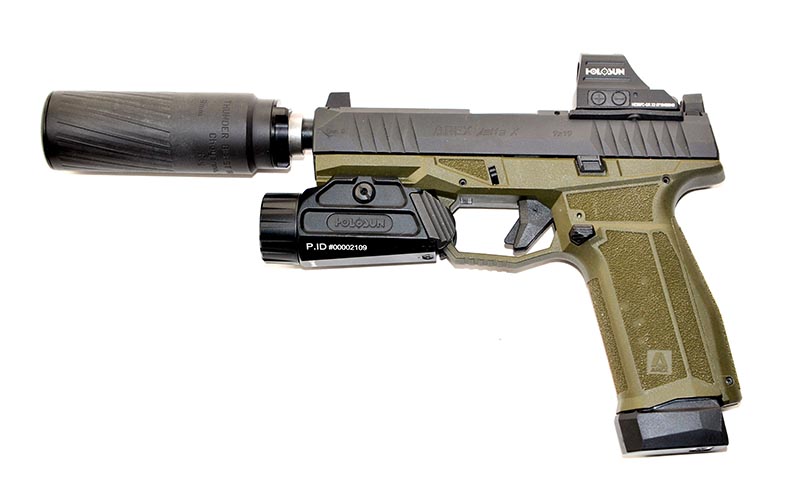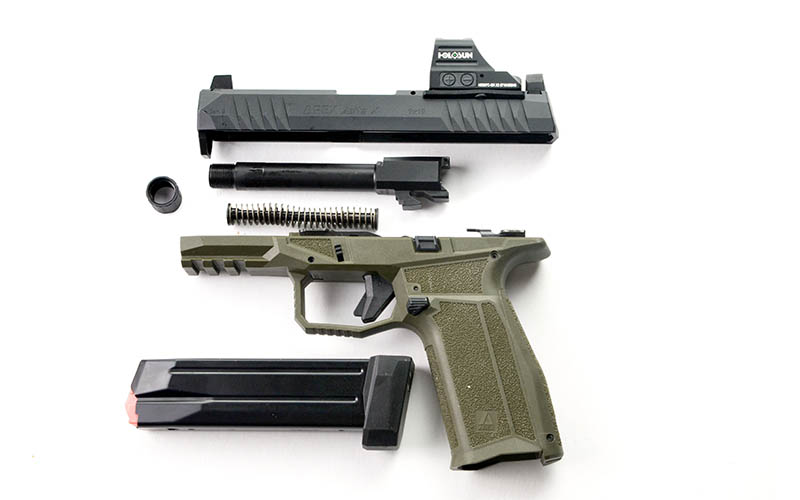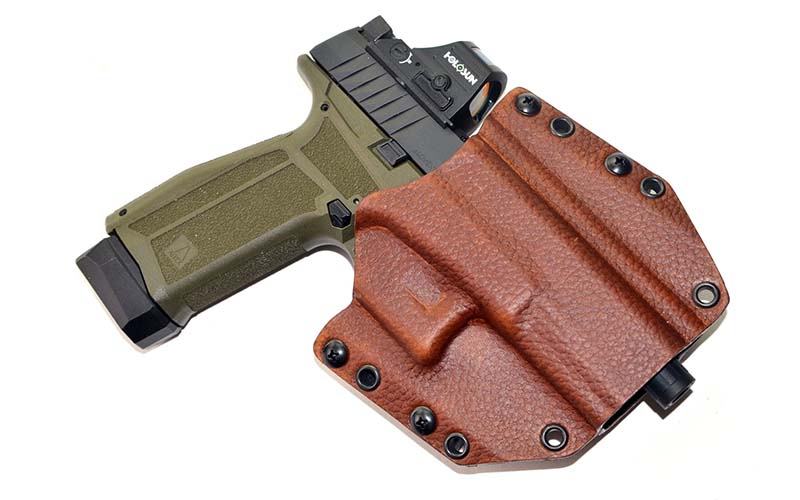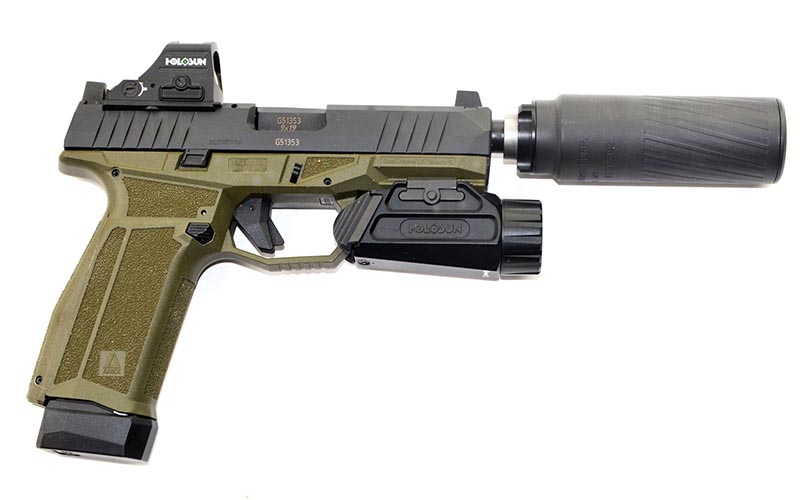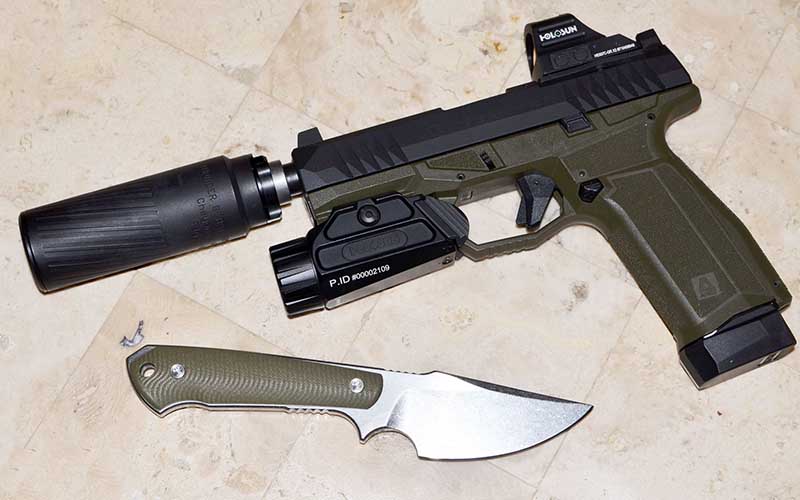
FN has just released the Rush 9Ti, the company’s first-ever commercial pistol suppressor.
The Rush 9Ti is a new 9mm suppressor from FN, and it’s the company’s first pistol suppressor available to the general public. The fact that FN distinguishes the Rush 9Ti as its first commercial pistol suppressor implies that the company has manufactured them for military contracts before, and given FN’s long history of selling to armed forces around the world that wouldn’t be surprising.
The Rush 9Ti was designed for optimal performance with FN 509 Tactical pistols, but they can be mounted to any 9mm with a 1/2×28 threaded muzzle. The “Ti” in the suppressor’s name stands for titanium, alluding to the tube’s titanium-hybrid construction. The internal baffles are made of both high-heat stainless steel and aircraft-grade aluminum. These materials help keep the Rush 9Ti both light and durable, weighing in at only 10.8 ounces (without piston).
FN claims that when paired with a 509 Tactical, users can expect supreme reliability, accuracy and longevity. The blast chamber, baffles and advanced booster assembly with a tight piston gas seal all help to keep back pressure low and blowback at a minimum. This not only provides a more pleasant shooting experience but also improves reliability and puts less wear on the suppressor and host gun. The cherry on top of the Rush is that it can be easily broken down by the user for cleaning and maintenance.
John Ryan, Director of Product Management for FN America, said this about the new can:
When selecting a suppressor, customers often have to choose between effective sound suppression, reduced blowback or felt recoil; you very rarely get all in one…Our team developed a suppressor that delivers an unmatched shooting experience straight from the box. You no longer have to settle for one or the other with the Rush 9Ti.
The FN Rush 9Ti is available now in either FDE or black, both with an MSRP of $849. Each suppressor will include a 1/2×28 TPI piston, a booster assembly, an end cap and front cap assembly tool, a storage case and FN’s limited lifetime warranty.
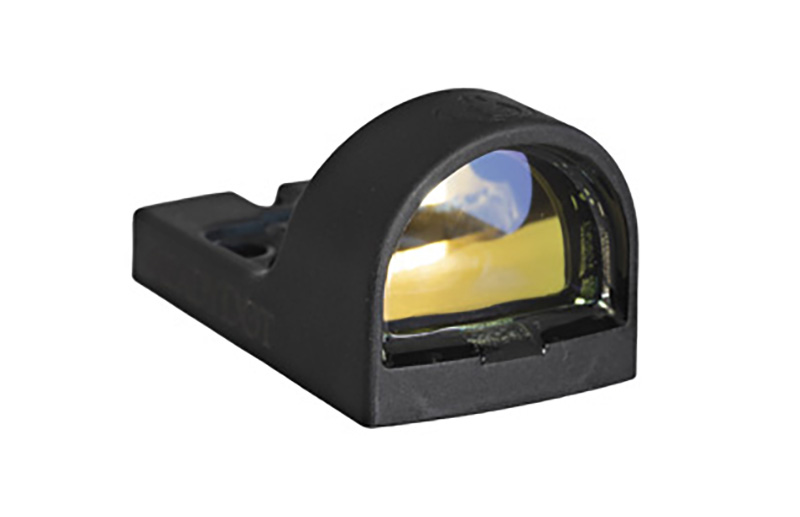
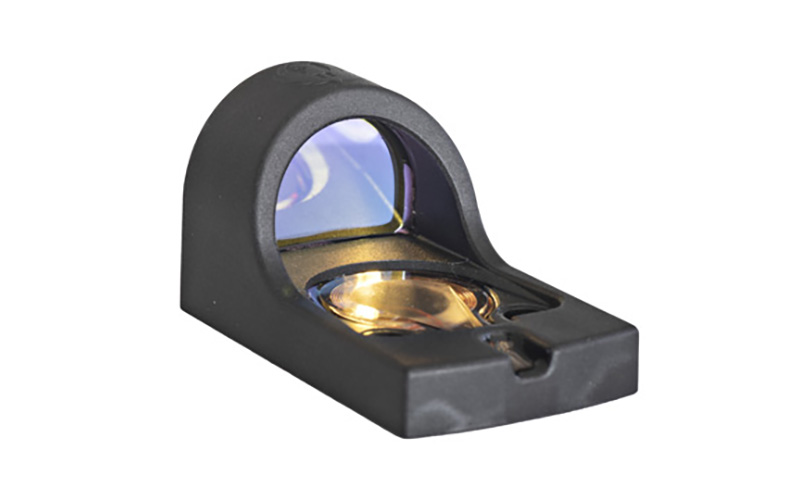
In this Swampfox Kraken review, the author analyzes the pros and cons of the company’s new closed emitter pistol red dot sight.
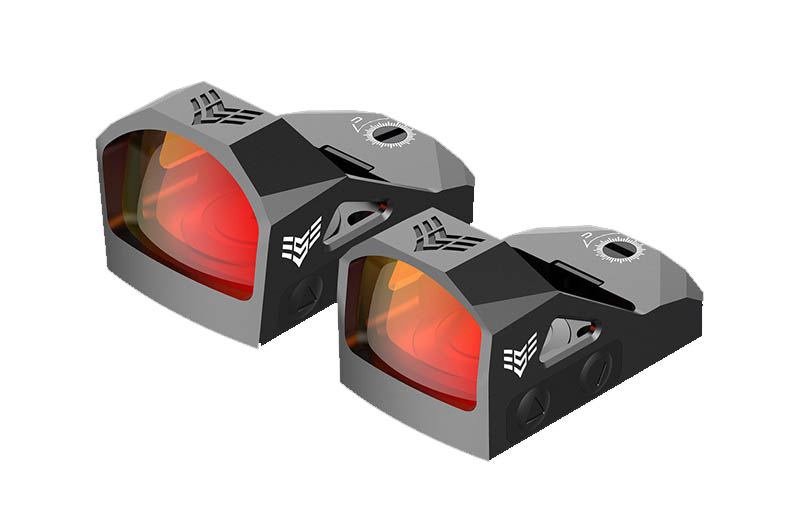
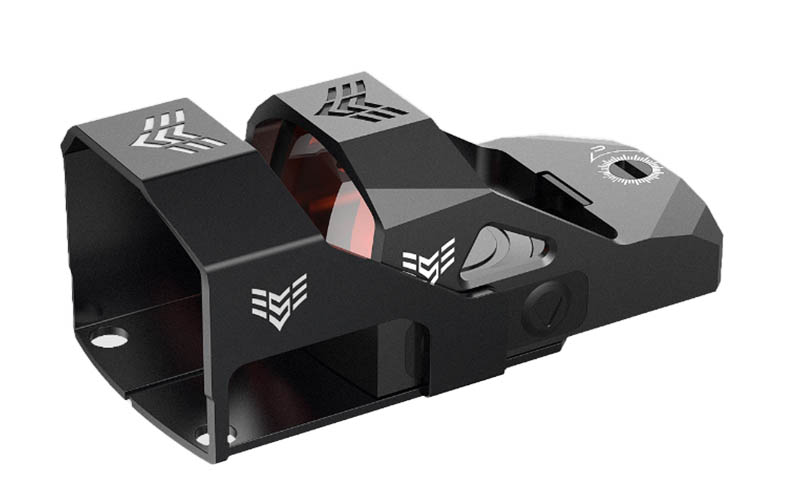
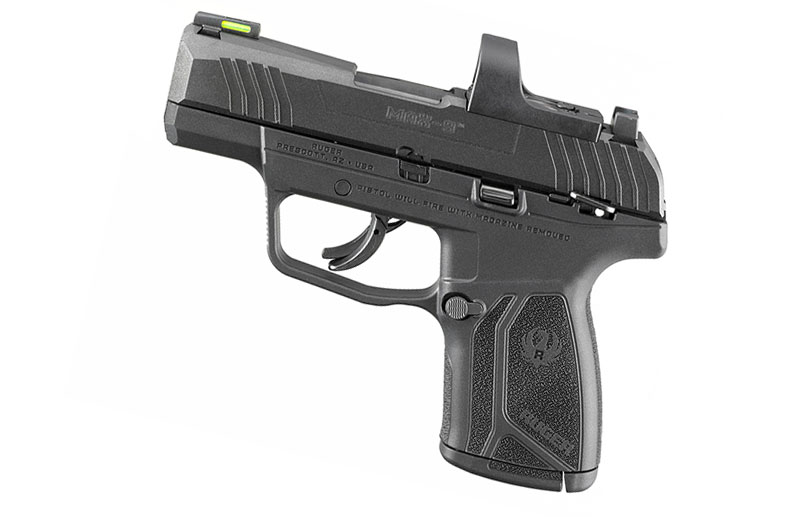
Released in 2022, the long-awaited Swampfox Kraken closed emitter pistol red dot sight is finally here. The optic is small, rugged and compatible with nearly any firearm. From pistols to rifles to shotguns and everything in between, the Swampfox Kraken is ready to perform regardless of the platform it’s mounted on.
Swampfox itself already conducted a rigorous torture test on the Kraken, and the company claims that it passed with flying colors. According to Swampfox’s test, the optic is capable of surviving being submerged for 24 hours, frozen, set on fire and racked off many objects including a dumpster. It would be difficult to top those tests at home, and since the optic’s ruggedness is already ostensibly proven, today we’ll be focusing more on the features and performance that the Kraken has to offer.
Overview And Features
The Kraken is Swampfox’s newest optic as of this writing, and the company clearly has its sights set on the closed emitter red dot market that is currently dominated by the Aimpoint ACRO, Holosun 509T and the Steiner MPS (Micro Pistol Sight).
In addition to its rugged 7075 aluminum construction and enclosed emitter design which helps shield it from the elements, the Kraken has some nice quality-of-life features as well. The tactile buttons, small adjustments (0.5-MOA per click) and use of common CR2032 batteries all enhance the optic’s functionality, and the Kraken logo emblazoned on the side gives it some visual flair too.
The included mounting plates allow it to fit on any RMR or Glock MOS footprint. While some pistols require custom milling to fit closed emitter optics, this is not the case for the Kraken. If you can run an RMR or Holosun 407/507 series, you can run this too. Admittedly, I’m not crazy about adaptor plates as they increase the height of the optic while also creating another failure point, but this is a versatile mounting option that allows users to mount the Kraken to any RMR-milled slide or Glock MOS.
Besides the two adaptor plates, all Swampfox Krakens ship with an adjustment wrench, a lens cloth, a battery, blue threadlocker and four sets of screws.
Fitment
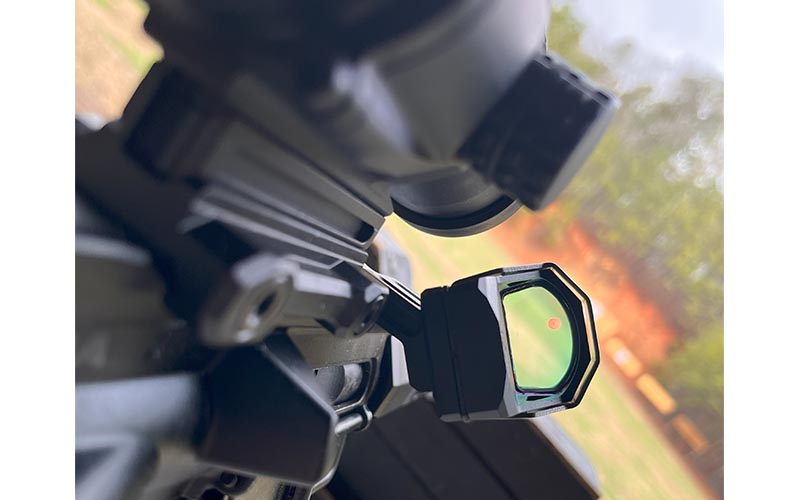
The Kraken fit every gun that I tried to mount it to without issue. As an offset optic it can be a little bulky, but trading some height for a more reliable and rugged RDS with a closed emitter may be worth it. On top of a pistol, I don’t like the size, but I tend to prefer smaller red dots so that’s mostly my personal preference. The 16mm lens seems bigger than it reads on paper, and I had no problems picking up or tracking the crisp 3-MOA reticle. The battery compartment juts out a bit more than I’d like on the right side, I will note, but it does house a very common CR2032 battery that can be replaced without removing the optic.
Loadout
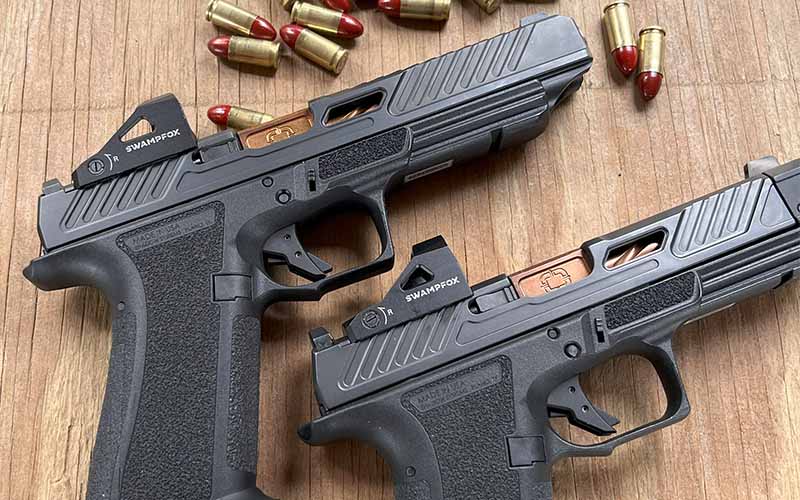
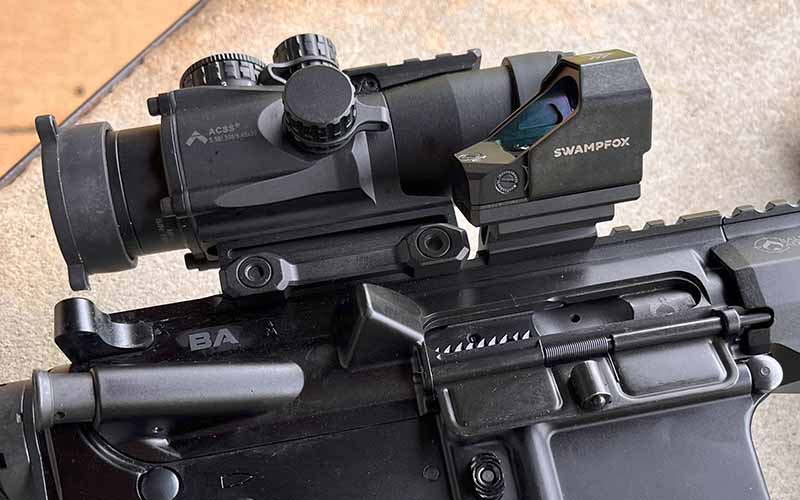
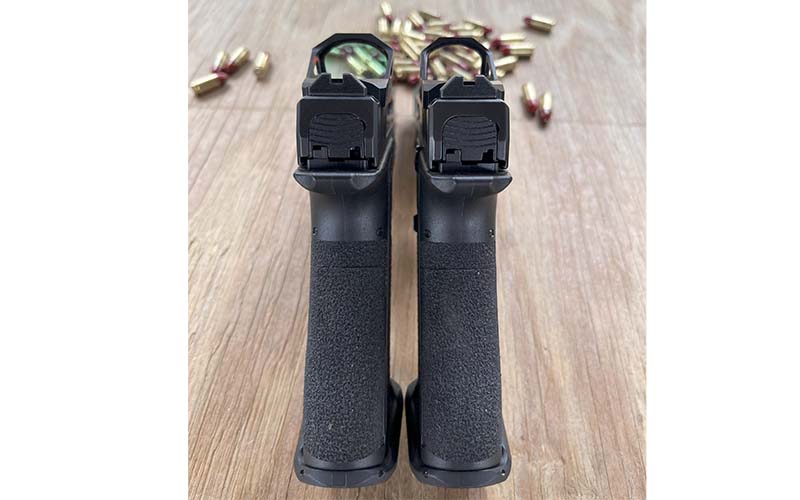
In all, I tried running the Kraken on top of a Shadow Systems MR920 Elite, on top of an AR Pistol and on my Ballistic Advantage AR-15 as an offset to my Primary Arms 3x Prism scope. Swampfox’s battery-saving “Shake N Wake” technology is welcome and appreciated on all platforms, but even more so if you’re going to run the optic on a home defense or duty weapon. The 3-MOA dot is available in either red or green, but both models feature 10 brightness settings including two levels that are compatible with night vision. The buttons used to adjust the brightness are also very tactile and easy to use.
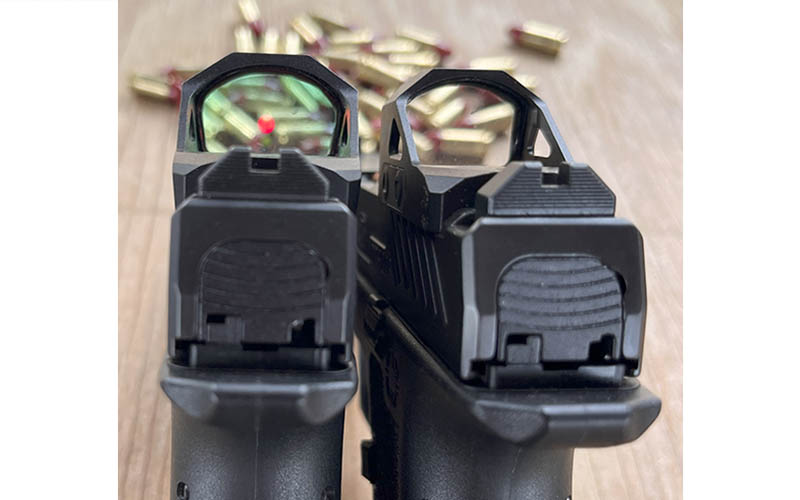
One downside worth mentioning is that when mounted to an AR using Swampfox’s Rebel Riser, the Kraken does not co-witness with Magpul MBUS sights. Many similar red dots on the market do co-witness when mounted with their respective manufacturer’s standard AR mount, so take note that if you want co-witness capabilities with this optic you’ll have to find a different mount elsewhere.
When running the Kraken with Swampfox’s 45-degree Rebel Offset mount, it performed well. As mentioned, it is a bit bigger than a standard pistol RDS, but what you gain in bulk you make up for with dependability. Its IPX7 waterproof rating means if you find yourself fording rivers or shooting in the rain, you don’t have to worry about the water droplets interfering with your dot or inducing malfunctions. I ran the offset Kraken alongside a 3x prism optic, and I found the combo very easy to use when transitioning between targets inside 30 yards.
Likes And Dislikes
There are many things I like about this optic. It is completely capable of competing with other closed emitter red dots on the market, and I think that’s what Swampfox set out to do for a fraction of the price. Heck, it takes the same batteries as most all of them and even has similar aesthetics to the ACRO, 509T and MPS. I actually like some aspects of the Kraken a bit more, namely the tactile clicks of the buttons and the 0.5-MOA adjustments (as opposed to 1-MOA adjustments found on many other optics, lending the Kraken to use on rifles as well). The optic’s versatility is also appreciated, as it will be right at home on nearly any platform from handguns and rifles to shotguns and PCCs.
Throughout the Kraken’s evaluation, it didn’t lose zero or present any issues. The 3-MOA dot was crisp and easy to pick up regardless of what platform it was mounted on, and it was easy to re-zero when I moved the optic between firearms.
My dislikes are few—and this may be more of an indictment of enclosed emitters and my personal preference—but on a pistol, it just strikes me as too damn big. I found myself wondering if this mailbox has its own zip code when it was on top of my MR920. That’s not to say that it didn’t perform, because it did. It performed as well if not better than the RMRs and Holosun 407/507s that I’ve run for hundreds if not thousands of rounds. But I carry most of my guns with optics, and this just added another inch on top of a pistol that’s large enough that it would be hard for me to conceal the setup without dressing around it. It will likely end up living on top of a full-size duty gun like a DR920 or my competition CZ SP-01.
With concealability out of the question, all the Kraken’s other benefits would be still very useful. It’s Impact resistant, generally rugged, waterproof to 1 meter and most importantly it has a closed emitter that can’t be affected by the environment.
My final complaint is that it didn’t co-witness with my iron sights when mounted to my handgun. Almost every other optic I’ve run on a Shadow Systems MR920 provided at least a lower one-third if not absolute co-witness. I know this will not be a deal breaker for some.
However, on a rifle as a primary optic or on a 45-degree offset mount, I have zero complaints. In fact, I’m a big fan of the Kraken as an offset optic because it’s rugged, enclosed, and can take a beating. If your primary optic goes down, like an LPVO or 3x prism in my case, you can rest assured that you still have some type of optic to get the job done be it during a match or when defending your home.
Overall, if you’re looking for an enclosed emitter to put on your pistol, rifle, or shotgun, don’t sleep on the Swampfox Kraken. They have a solid warranty and I’ve experienced nothing but good things from their customer service and build quality.
Swampfox Kraken Specs:
Dot Size: 3-MOA
MOA Adjustment: 0.5-MOA per click
Magnification: 1x
Lens Diameter: 16mm
Waterproof: 1 Meter/ IPX7
Illumination Positions: 10
Brightness Adjustments: Up/Down Arrows
Shockproof G Forces: 1500Gs
Battery Type: CR 2032
Max Battery Life: Approximately 2-Year Real-World (Shake ‘N Wake)
Dimensions: 1.85 inches(length) x 1.38-inches (width) x 1.27 inches
Weight: 2.5 ounces without battery
Lens: “Multi-Coated Ruby Red – Red Dot or Multi-Coated Silver – Green Dot”
Self-defense involves much, much more than the act of in-the-moment survival, and the case of Kyle Rittenhouse can teach us some important lessons.
Kyle Rittenhouse. A name that many Americans—and most in the self-defense world—will recognize, has been the subject of discussions, blog posts, articles, news and videos around the country … and around the world.
On August 25, 2020, during a Kenosha, Wisconsin, protest over the police shooting of Jacob Blake, Rittenhouse killed two men and wounded a third. Many in the media have called Rittenhouse a vigilante and immediately accused him of setting out to wantonly kill anyone in his path.
Photo: Adam Rogan/The Journal Times via AP.
This piece will attempt to parse the facts of what happened that night, and perhaps bring some clarity to a confusing situation. Opinions vary … and this one is mine.
Ultimately, my opinion, and the opinions of scores of writers and columnists, doesn’t matter. The final verdict is always determined by a group of citizens called the trier of fact, otherwise known as the jury.
Early Moments
Unrest and protests occurred in Kenosha over the police shooting of Blake, a black man. The officers were white. He was shot seven times by police as a neighbor caught much of the incident on video. Blake survived but is permanently paralyzed. Racially charged protests ensued.
Kyle Rittenhouse, then a 17-year-old, traveled from Illinois to Kenosha, in response to a call from local militia, with the goal of protecting area businesses and residences from looting and destruction during the riotous protests. It was during this riot that Rittenhouse shot and killed two men, Joseph Rosenbaum and Anthony Huber, and wounded a third, Gaige Grosskreutz.
But was Rittenhouse acting as a vigilante as many have claimed, or did he act in self-defense? Many naysayers have been quick to label Rittenhouse a murderer, without fully understanding the law and without the ability to apply it properly.
Jurisdictional Details
In Wisconsin, as in most jurisdictions, you may use deadly force against another when you reasonably believe that other person intends to do great bodily harm, or cause the death of you or another person. However, you may use only a level of force that’s proportionate to the force being used against you.
For example, if someone intends, or is attempting to use, an object against you that could cause your death or great bodily harm, you’re authorized, under law, to use any level of force, up to and including deadly force, to stop that threat.
Next, you cannot provoke or incite the attack in order to claim self-defense. In other words, if you’re the initial aggressor, or the one who starts the fight, your claim of self-defense will most likely fail. In many jurisdictions, if you’re the initial aggressor, you must make every reasonable attempt to avoid using deadly force by attempting to run, escape, avoid the attack or prevent the attack, before resorting to using deadly force, and even announce to the other party that you’re done fighting and don’t want to fight any more in order to regain your innocence.
Video retrieved from that night shows Rosenbaum chasing Rittenhouse into a used car lot in the midst of the riotous environment. Authorities say it shows Rosenbaum throwing an object (later determined to be some type of plastic bag) at Rittenhouse, and an attempt was made by Rosenbaum to take Rittenhouse’s rifle away from him. Rittenhouse fired his AR-15-style rifle at Rosenbaum, killing him.
When someone, other than law enforcement, attempts to disarm a loaded weapon from your person, can you assume they intend to use it against you? This can be a difficult question to answer, and it depends on several factors that might be in play.
In law enforcement training, when a subject attempts to disarm a police officer of their weapon, deadly force is authorized. It’s presumed that the subject’s only reason for disarming the officer is to use that weapon against him or her. Can we make the same presumption when a civilian attempts to disarm another civilian? Perhaps.
Perception Matters
However, it may come down to what you reasonably perceived, in the moment, in the totality of the circumstances and whether you’re able to articulate the reasonableness of a deadly force threat. Rittenhouse, and others in the self-defense world, contend that Rosenbaum threw the plastic bag at Rittenhouse in an attempt to distract him, with the goal of disarming him.
Following the first shooting, Rittenhouse appears to be running toward police, and away from an angry mob chasing after him, when he trips and falls in the street. The video clearly shows a mob of protesters—I counted at least 8 to 10—chasing him down the street. At one point, a protester appears to kick Rittenhouse in the head when he was down on the ground.
Tripping and falling to the ground, Rittenhouse was in a position of disadvantage, with what appears to be multiple attackers quickly gaining on him. Can Rittenhouse reasonably believe that he is about to be attacked by multiple people? One of them kicked him in the head; what would the others do? Taking a blow to the head, while in a position of disadvantage, with multiple people about to jump on you, can certainly cause a person to reasonably believe this attack can lead to death or great bodily harm.
At this point, Huber appears to stumble over Rittenhouse as he hits Rittenhouse with the end of a skateboard. Huber is shot as he grabs the barrel of Rittenhouse’s gun. A skateboard is a large, solid-wood object, with four hardened wheels, and isn’t intended to be used as a deadly weapon. However, using any object as a weapon that can cause death or great bodily harm is considered deadly force.
Was it reasonable for Rittenhouse to believe he would be struck again, or that the ensuing mob would overpower him, with each rioter taking turns raining blows down on him? Rittenhouse has at least four attackers within lunging distance of him and his rifle. Almost immediately, Grosskreutz approaches within about 2 feet of Rittenhouse with what appears to be a handgun. Rittenhouse shoots Grosskreutz, wounding him in the arm.
In the totality of the circumstances, would Rittenhouse’s actions stack up to the elements of self-defense?
The five elements of self-defense, which have been identified by Attorney Andrew Branca in his book, Law of Self Defense, are imminence, innocence, proportionality, avoidance and reasonableness.
These elements of self-defense can be found, for the State of Wisconsin, in Wisconsin Statute §939.48 (2014), Self-defense and defense of others.
It states, in part:
A person is privileged to threaten or intentionally use force against another for the purpose of preventing or terminating what the person reasonably (Reasonableness) believes to be an unlawful interference with his or her person by such other person (Avoidance, or no statutory duty to retreat. See State v. Wenger). The actor may intentionally use only such force or threat thereof as the actor reasonably (Reasonableness) believes is necessary (Proportionality) to prevent or terminate the interference. The actor may not intentionally use force which is intended or likely to cause death or great bodily harm unless the actor reasonably (Reasonableness) believes that such force is necessary to prevent imminent (Imminence) death or great bodily harm to himself or herself.
• Imminence can be defined as, where in time does the threat fall? Imminent means it’s happening right now—it isn’t happening 5 minutes from now, and 2 minutes ago is too late. The threat must be happening right now, in the instant, and requires your immediate action.
• Innocence addresses who started the fight. You can’t start a fight, escalate it to the point the other party draws a weapon, and then innocently use deadly force claiming they drew first. It doesn’t work that way. Regaining innocence, in many jurisdictions, means you must announce to the adverse party your intention to stop fighting. Furthermore, additional action would be appropriate such as a retreat or moving to a position of safety. If, after regaining your innocence, your adversary pursues you, they may be considered the initial aggressor and you may use the appropriate level of force allowed under law.
• Proportionality means you can use only that level of force necessary to stop the force being used against you. Someone grabs your purse; you can generally grab it back. However, if force that can cause death or great bodily harm is used against you, you may use deadly force to stop that threat.
I want to insert a note here: In the Wisconsin statute, the term “unlawful interference” is used. Please don’t take this out of context: An unlawful interference could be unwanted touching. However, this would not be a deadly force threat. Read the next sentence of the statute. “The actor may intentionally use only such force or threat thereof as the actor reasonably believes is necessary to prevent or terminate the interference.” So perhaps using only enough force as to remove the hand of the person touching you would be warranted.
• Avoidance is the duty to retreat. In some jurisdictions, you must make an attempt to retreat to a position of safety before deadly force is allowed. Michigan, my home state, is more of a hybrid duty-to-retreat state. In other words, a person does not have to retreat as long as they meet certain elements of the law. However, Michigan has a jury instruction that allows the jury to use the fact an actor did not retreat, when they could have (or should have), in their verdict decision, if they determine the actor was culpable at some level. Typically, no duty to retreat hinges on two primary factors: the actor is not in the commission of a crime, and he or she is in a place they have the legal right to occupy.
• Reasonableness is simply looking at all elements, in the totality of the circumstances, and applying the standard of the average person, in the same set of circumstances, with similar general knowledge and life experiences, to the facts at-hand. Each element must be present; reasonableness is the umbrella that covers the other four. Keep in mind, in a true case of self-defense, you (your defense team) must prove all five elements to acquit; the government must disprove only one to convict.
The Acquittal
Before we get into the details of lessons learned, I want to clarify something: I alluded to the Rittenhouse defense team would need to prove their case by a reasonable doubt. Allow me to clarify.
The burden of proof is beyond a reasonable doubt; this burden falls on the prosecutor. They must prove the case by that standard. In a case of affirmative defense of self-defense, however, the defense has the burden of production and should produce some type of evidence, at some level above zero, to show self-defense.
The old standard was the defense must prove self-defense by a preponderance of the evidence. This is no longer the case as the last holdout state, Ohio, changed its statute. This went away March 19, 2019, and is now the standard in all 50 states. You might still see preponderance of the evidence used in a self-defense immunity hearing. If immunity is not granted, then the case can go to trial. If immunity is granted, case over.
Burden of proof is on the prosecution to prove the charges against the defendant at trial, beyond a reasonable doubt. Beyond a reasonable doubt is a high standard. Although most legal scholars are hesitant to place a threshold number on the standard, many agree it’s somewhere north of 90 percent.
However, the defendant, in any criminal case, may sit mute and not offer any evidence or testimony, relying solely on the lack of ability of the prosecution to prove the charges against them (at least they hope so). Although the defense does not have to offer anything, typically the burden of production falls on the defense. In other words, the defense has the burden to produce some minimal amount of evidence, to the trier of fact, to dispute the prosecution’s charges.
We received plenty of emails and inquiries into the actual trial process of State of Wisconsin v. Kyle H. Rittenhouse. Many wanted to know why the defense team wasn’t objecting more often. It’s called trial tactics. I’ve watched plenty of trials where I sit and scream internally, “Objection!”
But let’s parse this a little more. If the defense counsel objects to everything they can, it can paint them as abusive, overly interruptive and generally in a negative light to the jury. Juries don’t like that. They want to hear the facts without interruption and make their decision.
However, the defense should object when the prosecution goes awry. Additionally, the defense must object at certain times to get their objection on the record in case they need to appeal; it preserves the issue. So, trial attorneys object when needed, object when required, but many times they won’t object if opposing counsel is making their case for them, as we saw multiple times in Rittenhouse.
What All This Means For You
The first lesson we learn from this case is to make sound decisions regarding events and situations in which we choose to involve ourselves.
I’ve been to protests and marches in both Detroit and Chicago. I chose to be there because of the historical aspect of the protest. I have attended these events as an observer, not an active participant.
When Tucker Carlson interviewed Rittenhouse, Rittenhouse stated he had permission to watch one of the auto stores to prevent looting. I’ve also worked in the armed security industry. Never was there a time I showed up with a team without proper pre-planning that was done a day or so before the security event. To show up to a racially charged protest that has national significance without proper planning, surveillance, experience and training is never a good thing. Stay away from people with a mob mentality.
Next, don’t bring a skateboard to a gunfight. I don’t say this sarcastically; I say it with all sincerity. Making a conscious decision to involve yourself in a deadly force situation, or really, in any level of force situation, be sure to have the adequate tools to defend yourself. This is one element in the mob mentality that happens when groups of people believe they are invincible and believe they can get their whacks in and then move out of the situation without suffering harm.
Please don’t be that person. Be a good witness. Call 911. Run away.
In our concealed carry classes, we should be taught to move to cover and avoid making ourselves a static target. If I see the other person has a gun, I don’t purposely move into the fray thinking I’ll hit him with my club and get away without being shot. That’s stupidity. I realize that, sometimes, we could be placed in a situation where we only have what we can use in our immediate environment to defend ourselves. In those situations, too, we need to be thinking about getting out of harm’s way—not running into it.
Third, I’ve read many comments in the gun forums (and one nationally recognized trainer) saying it’s a waste of time, or that it’s even silly, to focus on the lessons we can glean from the way the trial played out in Kenosha. I believe what we can learn is an important aspect of the entire event.
Realize that if you’re involved in a self-defense incident, you will be scrutinized to no end by family, media, outsiders, organized anti-gun groups, neighbors, etc. Perhaps you won’t be scrutinized at the national and international level Rittenhouse was, but you will suffer the damage emotionally, physically and mentally. It’s a proven fact in post self-defense incidents.
Many books have been written about how the body reacts to post-traumatic events. Once a person survives an attack and successfully defends themselves against their assailant, only then does the journey through the mire of emotional and physical stress play out. In the Tucker Carlson interview of Rittenhouse, Rittenhouse seemed very succinct in most of his answers. However, his journey has only begun. This is something he will never forget, and the aftermath of stressors will follow him the rest of his life.
Additionally, be prepared for the government to come after you in ways you’ve never imagined. The role of the prosecution in any criminal case is not to get a conviction; it is to seek justice. Granted, getting a conviction against a serial sex offender may very well be justice. But attempting to try a case because of political motivations or pressure because you don’t agree with the defendant’s actions is certainly not silly. Expect the government to go after you with the vitriol with which they went after Rittenhouse.
Lifelong, Hard-Learned
Folks, some will miss the point here. I speak with people every day who truly think self-defense is the in-the-moment act of surviving. Imminent survival is only one part of the equation, although, granted, it is the most important. However, pre-survival is going to the range, training, role-playing, visualization and training in medical skills, to name a few.
Also consider post-survival skills and their role. The pre-survival training in medical skills might come in handy if you’re injured and need to apply those skills for yourself or a loved one. Post-survival skills may also be needed months—even years—after the incident. PTSD, emotional, psychological and physical issues may continue for years as well. They not only affect the survivor, but also their spouse, children, friendships and other relationships.
Learn from the Rittenhouse case. Prepare pre- and post-self-defense incident, because the effects of the 3-second self-defense incident will last a lifetime.
About The Author:
Art Joslin, J.D, D.M.A. is the director of Legal Services for the Armed Citizen’s Legal Defense Network. His background includes law enforcement, court officer, use-of-force expert witness, Level 4 Commando Krav Maga instructor, firearm instructor, and Massad Ayoob Group staff instructor. He holds a law degree from Thomas M. Cooley Law School in Lansing, Michigan.
Editor's Note: This article originally appeared in the February 2022 issue of Gun Digest the Magazine.
Dan Wesson and CZ have come together to bring the DWX pistol, a 9mm competition-style handgun that blends the best of each company’s designs.
First teased at SHOT Show 2019, the DWX is finally here. A collaborative effort between Dan Wesson and CZ, the DWX takes the best elements of each respective company’s designs and combines them into one pistol. This means that the handgun is primarily derived from the CZ-75 but has 1911 elements sprinkled throughout as well.
The DWX is a 9mm competition-style handgun that feeds from 19-round CZ P-09/P-10 magazines. The frame is primarily CZ-75 inspired, lending it the same excellent ergonomics and compatibility with widely available CZ-75 grips. The included red aluminum grips are low-profile, however, so an upgrade may not even be necessary. For added grip stability, the front strap of the frame is textured too.
Other CZ-style features on the DWX include the takedown process and the bushing-less, locked-breech barrel system that’s similar to a CZ P-09/P-10.
As for the Dan Wesson 1911-style features, the most significant is the single-action trigger. The trigger is K-style and features a flat, textured face. The DWX also features an ambidextrous manual safety, a 1913 Picatinny rail and a match-grade 4.95-inch barrel.
The CZ and 1911 features combine the most when it comes to the DWX’s sights. It has a 1911-style dovetail front sight (it ships with a fiber optic front sight installed) and CZ Shadow 2-style rear sights (click-adjustable HAJO). Many aftermarket CZ and 1911 components, including sights, will fit the DWX as well.
The Dan Wesson DWX pistol is available now and has an MSRP of $2,099.
Springfield Armory’s new SA-35 is a high-honored nod to the Browning Hi-Power.
Springfield Armory’s rendition of the Browning Hi-Power has recently been the dominant topic on social media. It’s indeed big news, especially because a few years ago, Browning ceased distribution of the Belgium-made version of that same pistol. Ironically, that was not big news. It seemed most folks didn’t give a damn that an 82-year-old firearm design was being discontinued.
So, what’s the big deal with its reintroduction?
At only 31 ounces and with a 15+1 capacity, the SA-35 makes for an excellent everyday carry self-defense handgun.
Word on the Street
Springfield Armory says they reimagined the Hi-Power and to not call it a “classic.” I assume they’re afraid “classic” will be misconstrued to mean antiquated. But whether they’ll admit it or not, they’ve revived a classic.
They also say it’s made in the USA from a forged steel slide and frame. That’s true. What they don’t tell you is the frame and slide come—80 percent—from Tisas in Turkey (Springfield Armory wouldn’t confirm this but I have it on good authority). However, that’s not a bad thing, and given Springfield Armory sources other handguns and parts from outside the U.S., it shouldn’t be a surprise. Tisas is a very capable manufacture that turns out high-quality products, and this is one way Springfield Armory managed to keep the cost of the SA-35 manageable … and I applaud them for it.
Five-shot, off-hand groups at 10 yards averaged at around the one-inch mark.
Roy Huntington with American Handgunner compared the introduction of this new pistol to an earthquake, claiming, “Right now, John Browning is smiling.” Browning died in 1926. He might be metaphorically smiling, but the Hi-Power as we know it was introduced nine years later. Browning’s original design looked like something other than a Hi-Power; it was striker-fired and the patent wasn’t approved until after his death.
Dieudonné Saive of Fabrique Nationale deserves the lion’s share of the credit for the Hi-Power. Most importantly, featuring a pivoting trigger, double-stack magazine, and link-less barrel, it was the foundation for almost every modern semi-automatic handgun since. Had Saive incorporated Browning’s striker design, we would’ve had a steel-framed Glock more than 80 years ago.
Jeremy Stafford of Guns & Ammo offered the opinion that the SA-35 would reignite the old battle between Hi-Power and 1911 shooters. I thought this was settled in 1977 when Dave Westerhout and Peter Maunder took first and second in the IPSC World Shoot using Hi-Powers, allowing Rhodesia to edge out the United States and their 1911s for the top spot. That was a tremendous accomplishment considering they were shooting with the minor power factor handicap.
Funny thing: Since 1977, the 1911 design has undergone substantial revision, but the Hi-Power—even the new SA-35—is pretty much the same as it was then. Maybe those in the know knew it didn’t need much work, and all the efforts were directed at tweaking a major power 1911 to outperform it.
James Reeves with The Firearms Blog begins his SA-35 review commenting that, unlike the 1911, the Hi-Power remains relevant today. This should place everything else he says as suspect, such as his remark that original Hi-Powers could give some shooters “slide bite.” Slide bite has never been a problem with the Hi-Power. What has been, is the tendency for the hammer—when pushed to the rear by the recoiling slide—to pinch the web of the hand between the hammer and the tang of the frame. That’s hammer bite, not slide bite.
Hammer bite has always been an issue with the Hi-Power design. Springfield Armory’s commander-style hammer on their SA-35 does a good job of preventing this for most shooters. Those who use a high grip and have large hands may still get pricked.
Springfield Armory addressed this by installing a 1911 Commander-style hammer. It’s not a new approach, but it is one that does work for most shooters. If you have large hands and shoot with a very high grip (as you should), you might still get a little pinching with the SA-35. I did.
The best fix for this an extension to the tang of the grip frame. This is a custom and expensive solution. It’s exactly how Nighthawk crafts their Hi-Powers. However, a much less expensive alteration is the installment of a no-bite hammer from pistol guru Wayne Novak. It will eliminate hammer bite at much less expense. Maybe we’ll see either a tang extension or a no-bite hammer on later iterations of the SA-35. I’m sure Springfield Armory has other versions of this pistol on the drawing board.
If not, someone there needs firing.
Almost every review of the SA-35 highlights the pistol’s beveled magazine well. Generally, beveled magazine wells are always a good thing. However, I’ve been carrying and shooting Hi-Powers for half my life. Shoving a drastically truncated double-stack magazine into a large hole has never been a problem. Those reviewing the SA-35 treat this “modification” as monumental. Does it make the pistol easier to load? Yes, but maybe only immeasurably.
For those who appreciate steel framed fighting pistols, the Springfield Armory SA-35 is a lightweight, high-capacity, 9mm design, with a long record of reliable service.
By Which All Others Are Measured
All of this might come across as me dissing on the new SA-35. That is far from the point I’m trying to make. Before we get into more detail on the pistol, let me say I believe this to be maybe the most important handgun introduction since 1982.
Why? Because I also believe the Browning Hi-Power was and remains one of the top three fighting pistols ever created. Present any argument you like, but it’s still in military use all over the world and has been used by more militaries than any other handgun. In fact, the Hi-Power has likely killed more people than any other handgun; during World War II, it had the distinction of being used by opposing forces.
Additionally, with its double-stack magazine, pivoting trigger and link-less barrel, the Hi-Power laid the blueprint for all modern semi-automatic handguns. Hi-Powers are reliable, accurate, slim and not too heavy, easy to carry, and arguably have the most ergonomic grip of any duty-style pistol ever engineered.
I have three Hi-Powers and I liked the SA-35 enough to buy it. Hell, I might even buy two of them. Thousands of other Hi-Power aficionados will do the same. But, maybe more importantly, what Springfield Armory has really done is open the eyes of Gen X, Y and Z, as to what a truly proven and rock-solid fighting pistol really is. Now all of us can get one for less than $700.
Under The Hood
Enough pontificating; let’s look in detail at the SA-35.
The slide and frame are machined from forged carbon steel. The steel has a matte blued finish and is very well executed. The gun does have a few sharp edges, such as the forward edge of the dust cover, around the slide stop latch, at the end of the slide stop pin, and along the corners of the tang. Beyond that, I rate the look and feel of the gun as nearly exquisite.
The fully checkered walnut grips are much more handsome than any of the grips ever offered by Browning when the pistols were made by FN. In fact, being somewhat of a Hi-Power snob who has looked long and hard for good aftermarket grips, they’re as tasteful and well executed as any I’ve seen.
Springfield Armory chose very nice grips for their new SA-35. They should sell these separately because many Hi-Power owners will want them
The sights are possibly the best upgrade Springfield Armory applied to this pistol. The front sight is a 0.125-inch blade that stands just shy of 0.20-inch above the slide. It has a single white dot positioned at the top center. The rear sight is a ledge-type sight with a 0.14-inch U-notch. I would’ve liked a slightly wider notch, but those with good eyes should find this front and rear sight combination agreeable and very fast. The rear of the rear sight is serrated and is devoid of any of the ridiculous dots so common on modern defensive handguns. If you don’t like these sights, both the rear and front are dovetailed for easy replacement.
Other features include the already mentioned beveled magazine well and a single 15-round magazine. Original Hi-Power magazines held 13 rounds, and while many are giving Springfield Armory credit for the increasing capacity, 15-round Hi-Power magazines have been available from Mec-Gar for some time. And Mec-Gar appears to be the manufacturer of the magazine included with this pistol. The SA-35 also features an extended and comfortable to operate thumb safety, and as also discussed, the Commander-style hammer.
The manual thumb safety on the SA-35 is sized perfectly and better than previous options offered on Browning factory Hi-Powers.
As for the trigger, Hi-Powers have always had a magazine disconnect that would not allow the gun to fire if the magazine was removed. This system connected to the trigger and was the primary cause for bad triggers on Hi-Powers. Hi-Power owners have removed this linkage for years, and it’s not that hard to do. The SA-35 comes without the magazine disconnect and this makes the pull of the SA-35 trigger very nice, with just a bit of take-up and very minimal overtravel. My trigger scale said it broke at 4.75 pounds, but it felt more like 3 pounds. But, good Hi-Powers triggers always tend to feel like they break at less pressure than is measured.
Beyond all that, the SA-35 is just a Browning Hi-Power. I would not say the SA-35 is a reimagined Hi-Power, but I would say it is a damned fine example of one. I fired almost 800 rounds of mixed FMJ and hollow-point ammunition through the test pistol and it functioned flawlessly, just like you’d expect a Hi-Power to.
Slow-fire, off-hand groups at 10 yards were in the 1.25-inch range, and from the holster I could put five shots into a 5-inch circle, at 5 yards, in less than 4 seconds, consistently. Failure drills at 5 yards were easily completed in three seconds or less. For me, hammer-bite was still present, but it was diminished from previous factory Hi-Powers.
Failure drills conducted at five yards were easy to complete in 3 seconds or less with the SA-35.
Where Ya Been?
The Springfield Armory SA-35 should get the gun of the year award for 2022, and I’ll offer it as Springfield Armory’s best-ever contribution to the world of firearms.
My question to all the other firearms journalists who’ve been fawning over this new pistol like nude images of Salma Hayek is, “Where were the hell were you just a half-decade ago when you could buy one, though maybe not quite as nice as the SA-35, from Browning?”
The same folks who are now telling you what a wonderful and magnificent pistol the Hi-Power has always been, ignored it until Springfield Armory put their name on it. Had those journalists been doing their job, the SA-35 you should now most certainly be buying, would most likely not be your first Grande Puissance.
Editor's Note: This article originally appeared in the February 2022 issue of Gun Digest the Magazine.
Savage Arms is continuing its expansion into the handgun market, this time with the introduction of Savage 1911 Government Model pistols.
Savage Arms released its first handgun in over 100 years in 2021 with the introduction of the Stance pistol, but the company is now expanding its catalog to include Savage 1911 Government Model pistols as well. There are 12 different model variations to choose from, with half chambered for .45 ACP and half chambered for 9mm.
Of the 12 Savage 1911 models, all feature a 5-inch machined stainless steel barrel with an 11-degree target crown. Externally, the pistols appear to be mostly traditional 1911s with forged stainless steel frames and slides, but Savage implemented a few nontraditional performance upgrades as well. Internally, Savage 1911s feature dual recoil springs and fully machined sears and hammers. The ejection ports have been lowered and flared, and the firing pins are titanium with a nitride finish. All models will feature an ambidextrous safety, VZ G10 grips and Novak rear sights, and the rail and two-tone models will also include a tritium front sight.
Speaking of the different models, this is how the Savage 1911 options break down. They can be ordered with any combination of finish, caliber and frame style, coming to a total of 12 models to choose from. Caliber options include 9mm and .45 ACP, finish options include black nitride, stainless and two-tone, and frame styles include rail or no rail. The .45 ACP models ship with two 8-round magazines and the 9mm models ship with two 10-round mags.
All 12 new Savage 1911 models are available now and MSRPs range from $1,350 to $1,500 depending on options.
8.6 Blackout from Q is the new cartridge on the block, but what does it really bring to the table?
The 8.6 Blackout, aka 8.6 BLK or 8.6mm Creedmoor, is a new cartridge developed by Q, the company that brought us the Honey Badger, The Fix bolt-action rifle and the company’s own line of suppressors.
The 8.6mm is .338 caliber, and while it's an absolute wimp compared to standard .338 cartridges (.338 Win. Mag. laughs at your weakness!) it's designed to make putting a whole lot of lead downrange much easier.
So, is 8.6 Blackout all tactical hat and no cattle? Well, that sort of depends on what you might use it for…
8.6 BLK on inside, .300 BLK on outside. Photo: Faxon Firearms.
8.6 Blackout Specifications
The 8.6 Blackout is actually a modern version of an old idea.
In broad strokes, 8.6 BLK is an intermediate medium-bore cartridge. Those aren't new. The .351 Winchester Self Loading and .35 Remington cartridges were the exact same thing and both pre-date World War I.
That isn't a bad thing, however, as .351 WSL and .35 Remington were very popular and for good reason. Within reasonable distances, they allowed you to smack something like a deer or hog with a heck of a lot of lead without beating up your shoulder too badly.
Left to right: .308 Win., .35 Remington and .223 Remington. Photo: Wikipedia.
However, 8.6 Blackout also has a particular angle in that it was created with suppressed shooting in mind, and indeed, is even optimized for it. That’s enough of a difference to essentially revitalize the old cartridge design ethos for the 21st Century.
The 8.6 BLK cartridge uses 6.5mm Creedmoor as a parent case, with the case trimmed to 1.685 inches (the 6.5mm Creedmoor's case, based on the .30 TC case, is 1.92 inches) and necking it to 0.338 inches so it can seat the same .338 caliber bullets as other cartridges of this caliber. Just like 6.5mm Creedmoor, the bullet is seated to a rather shallow depth in the case to preserve powder capacity.
While ostensibly almost any .338-caliber bullet could be seated in the case, few factory loads are currently available. What is available is entirely from one manufacturer, Gorilla Ammunition.
Gorilla currently offers a 300-grain self-defense and hunting load with a copper flat hollow point, a 300-grain Sierra MatchKing subsonic, a 210-gr Barnes TSX and a 285-grain fracturing subsonic load which appears to be similar to the 300-grain self-defense/hunting load.
Gorilla 300-grain Sierra MatchKing 8.6 Blackout ammo.
You can order your Gorilla ammunition optimized for a 16-inch, 12-inch, or 8- to 12-inch barrel. The lone supersonic loading is the 210-grain Barnes TSX load that the factory advertises at 1,970 fps from a 12-inch barrel.
However, Faxon Firearms and Q published some load data for a broader range of projectiles and loadings. According to their data, a 210-grain Barnes TSX would achieve 2,065 fps from a 16-inch barrel and 1,950 fps from a 12-inch barrel. Their 160-grain Hornady GMX load was advertised at 2,200 fps from a 16-inch barrel and 2,085 fps from a 12-inch barrel.
The max velocity Faxon gave was 2,400 fps, which was a 160-grain Barnes TTSX bullet on 35.8 grains of Accurate 1680 from a 16-inch barrel.
Q designed the chambering to have a blistering twist rate of 1-in-3 inches for maximum stabilization. The typical twist rate for .338 caliber rifles is 1-in-10.
But how do these numbers translate to reality?
8.6 Blackout Ballistics
Based on these velocities and bullets, we can get an idea of the trajectory. All the following tables were calculated with ShootersCalculator using a 100-yard zero, a 2-inch height over bore (common with AR-platform rifles), 10 mph of 90-degree crosswind and no corrections for atmosphere.
The 300-grain Sierra MatchKing bullet has a G1 ballistic coefficient of .750 below 1,800 fps. Calculated using a velocity of 1,030 fps, here's the 500-yard trajectory for this 8.6 BLK load:
In this case, the bullet rises to over 3 inches above the point of aim at 50 yards and drops to almost 5 inches below the point of aim at 125 yards, and it begins to sink like a stone past 200 yards. However, it retains momentum incredibly well, with almost 90-percent of velocity (and almost 75 percent of muzzle energy) retained at 500 yards.
That gives it excellent potential for penetration. While the trajectory makes .30-30 look almost flat-shooting, it still appears a very viable cartridge for hunting any game inside 200 yards—typical hunting distance for much of the country—with a short-barreled rifle or AR pistol whether suppressed or not.
But what about a supersonic load? Using Faxon's load data for 210-grain Barnes TSX (a velocity of 2,065 fps and G1 of .404), here's what the trajectory would look like with the same zero and height over bore:
The bullet goes transonic past 625 yards, but it retains 1,000 foot-pounds of energy (the legal minimum in some states for big game) to 525 yards. The maximum point-blank range is short (less than 150 yards) and the big pill has dropped fully 5 feet at 400 yards…but it's still hauling almost 1,300 foot-pounds of energy, more than 55-grain M193 from the muzzle of a 20-inch barrel.
Recoil energy is less than 20 foot-pounds so it will shoot softly even compared to .338 Federal, which is a pussycat at less than 23 foot-pounds compared to .338 Win Mag or the more unhinged .338 magnums.
But what about its older yet smaller brother, .300 BLK?
Using Sierra load data, here's a trajectory table for 155-grain Sierra MatchKing HPBT (G1 of .443), at a typical trajectory (1,900 fps) for a 16-inch barrel.
Just like 8.6 Blackout, .300 Blackout supersonic loads will go transonic around 600 yards, and likewise begin to drop quickly after about 225 to 250 yards. However, .300 BLK drops below the 1,000-foot-pound mark just past 100 yards, and 8.6 BLK is carrying more energy at 400 yards than .300 BLK has at the muzzle.
And here's the subsonic trajectory using Hornady's 190-grain Sub-X load (G1 of .437) at a velocity of 1,050 fps.
The 8.6 BLK subsonic loads have more energy at 500 yards than .300 BLK subsonic loads do at the muzzle, though velocities are within 100 fps of each other. So, it drops about the same as .300 BLK does in subsonic loading, but its bullet having a much higher mass the 8.6 carries much more energy into the target.
But what does this ballistic profile portend?
It will poke deep holes in things and poke them good and hard with a lot of lead for a rather soft-shooting cartridge. However, long-range is not its forte unless you have the right scope (you'll need an awful lot of Christmas tree!) and you put in enough time behind the gun.
8.6 BLK versus .300 BLK from Gorilla Ammunition.
Available 8.6 Blackout Rifles
Currently, 8.6 BLK rifles are available from Faxon Firearms as well as from Gorilla Ammunition.
The Faxon Sentinel line includes an 8-inch AR-10 pistol, a 12-inch AR-10 pistol and a 16-inch carbine. Faxon's Overwatch bolt-action rifle line includes a 16-inch rifle with a traditional stock, a 16-inch rifle with a pistol grip and a 12-inch pistol with a pistol grip.
Faxon Sentinel 8.6 BLK pistols.
MSRP starts at just under $2,300 for the Faxon Sentinel, and starts at $3,299 for the Overwatch series.
Gorilla Ammunition offers their GF-10 8.6 Blackout carbine with an 8- or 12-inch barrel as well as their aptly named GF Bolt Action Rifle with a 16-inch barrel. These rifles start at $3,499 before options.
Gorilla GF bolt action rifle.
The cartridge was developed with bolt-action rifles and semi-autos in mind, so AR-10-pattern rifles and modern skeletonized/tactical bolt-action rifles are going to be the default offerings.
So…Is There Any Reason To Bother With 8.6 BLK?
New calibers are usually little more than the veneer of a blackguardly conspiracy to sell new rifles. Just because Q is a mainstay of Gun Culture 2.0 instead of Gun Culture 1.0 doesn't somehow mean that there's anything new under the sun in that regard.
If that's news to you, we have a pallet of 7mm Remington Express sitting on a bridge that we've got for sale.
However, it's not that 8.6 BLK is worthless. There's a niche for it. The question is whether you live in that niche.
The excellent velocity and energy retention would make it a serious brush gun. If you hunt in heavy timber or foliage and wanted a compact (and suppressed) rifle that will bash hogs or whitetails flat without kicking your head off…8.6 BLK looks like a perfect fit on paper.
If you want to hit deer, hogs or what have you really hard and make them go down, 8.6 Blackout would seem to be a dynamite selection.
At present, there isn't enough information to say it's an appropriate choice for personal defense. It would seem to have the potential for that role, but—again—it's a little early to say much more.
Given its excellent potential for barrier defeat, it could find a home with police departments and possibly even some military units as a better round for punching through vehicles, glass, or light structures.
And, of course, it will make one heck of a “dinnnnng!” if you shoot a steel silhouette with it. For some, that’s reason enough to give the new round a try.
While 8.6 Blackout may not be a game changer, it certainly has good potential and it will be interesting to see where it goes from here.
XS Sights has just released Lever Rails for Henry Big Boy carbines, designed to allow users to more easily mount optics.
While XS Sights is primarily known for its handgun sights, especially of the tritium variety, the company makes some aiming solutions for long guns as well. The newest additions to the catalog include two models of XS Sights Lever Rails for Henry Big Bore carbines chambered for .357 Magnum and .44 Magnum.
The Lever Rails are designed to be an easy-to-install solution for adding a Picatinny rail to a Henry Big Boy lever-action. The rails are made from aircraft-grade, hard-coat anodized aluminum, so they should be both durable and lightweight.
The XS Lever Rails can be simply bolted to the barrel of a .357 Mag. or .44 Mag. Henry Big Boy carbine, and once installed allow the user to mount an optic of their choice as they would on any other Picatinny rail. The rail extends from the rear of the receiver to the front sight dovetail cut, giving plenty of real estate for larger scopes. There are two models of rail, however, and they must be specifically ordered for the caliber of Henry you have due to differences between the barrels. They are also only compatible with carbines with round barrels and steel receivers. Those who have a brass receiver or octagonal barrel are out of luck.
The XS Lever Rails have an MSRP of $72 and are available now. XS Sights also has an installation video guide embedded in the store page.
The reintroduced Marlin 1895 Trapper is a fast-handling thumper.
I’ve always been a history buff with interest in military firearms and especially armored vehicles. I’m sure that’s partly why I joined the Army and became an armored crewman and eventually a tank commander. But, as cool as those modern tanks I crewed were, there was a German tank from World War II that always captivated my imagination. That tank was the sleek and very fearsome Jagdpanther—hunting panther. It was an agile tank destroyer equipped with the legendary German 88mm gun.
Marlin’s new—reintroduced—1895 Trapper reminds me of that tank.
There are several reasons for this. Though heavier than the American-built Sherman tank, the Jagdpanther was just as fast. With its powerful main gun that could fire a variety of munitions, it could defeat every armored vehicle on the battlefield. The Jagdpanther offered a great balance of mobility, firepower and armor. Similarly, the Marlin 1895 Trapper is a heavy-duty lever gun chambered for the .45-70 Government, for which there are a variety of munitions that make it suitable for any game animal on Earth. It’s compact and handy—maneuverable—and like the Jagdpanther, it’s a hunter.
Marlin first offered the 1895 Trapper in 2018 while under the control of Remington. It was well received, but like a lot of the Marlin firearms produced then, reports of problems were common. Ruger acquired Marlin in 2020 and, though it took some time, their first lever gun was released before the end of 2021.
It was the 1895 SBL, and I detailed it here not all that long ago (Gun Digest May 2022 issue). I wrote that I felt the rifle was, “The best shooting lever-action rifle of any brand, style or design I have ever fired.” I felt that way because the quality of construction on that rifle was superb, and because two of the four loads tested delivered sub-MOA precision. As much as I liked that rifle, I like the new 1895 Trapper even better.
The Details
The new 1895 Trapper is built on the same stainless-steel action and has the same big loop lever as the 1895 SBL. And, like the 1895 SBL, it’s also chambered for the .45-70 Government. The primary difference is in barrel length; where the SBL has a 19.1-inch barrel, the Trapper’s barrel is 3 inches shorter. But just as with the SBL, the Trapper’s muzzle is also threaded at an 11/16-24 pitch for brake or suppressor attachment.
The muzzle of the 16.1-inch barrel on the new 1895 Marlin Trapper is threaded at a 11/16×24 pitch. A protective cap is standard issue.
Another obvious difference is the stock: The SBL had a gray laminated hardwood stock, and the Trapper’s stock is much darker. Aside from that, the stocks are identical, even down to the checkering, thick recoil pad and stainless-steel sling swivel attachments.
However, when you look closer, you’ll see the other differences. The SBL is fitted with a Picatinny sight rail that stretches from the rear of the receiver partially out the barrel. An adjustable aperture sight is incorporated in the rear of this rail and is paired with a Tritium fiber-optic front sight. Also, the rail allows for a variety of optical sights to be attached.
Instead of a rail, the Trapper utilizes a Skinner Sights rear aperture sight paired with a white-striped Skinner, Bear Buster front sight. The rear sight is screw-adjustable for elevation, and the rear screw slot is elongated to allow for windage adjustment. The other difference between these two rifles isn’t so obvious until you see them side by side. All the stainless-steel metal surfaces on the Trapper have a muted satin finish, which is perfect for a hunting rifle.
The combination of a satin stainless finish and the blackened laminated hardwood stock give the new Marlin 1895 Trapper a serious “I’m here for business” look.
A Little Customization
Unboxing this rifle, I was immediately smitten. It’s so compact and handy; it almost feels like it could fit in your pocket. Even if you’re on the short side, you can grasp it at the wrist of the stock and let it dangle, and the muzzle will still not reach the ground. When shouldering the Trapper, it seems like it wants to jump up and onto target. The action is smooth, the trigger is good and this rifle gives you the impression it was made for fighting it out with a pissed-off grizzly.
As much as I liked the look and feel of this rifle, I’m not a fan of the rear sight that comes on it. It’s a great sight, but for a .45-70 that might be used as I would use one—for a wide range of applications—it’s not what I want. This is mostly because with so many varied .45-70 loads available, I would have to constantly re-zero the rear sight. At 100 yards, the point of impact between power level one and power level two .45-70 loads can be more than a foot.
The 1895 Trapper comes with this adjustable Skinner aperture sight and white-striped Bear Buster front sight. To add versatility to the rifle, they were replaced with a scope-mount version of the same Skinner sight and a shorter Bear Buster front sight.
I called Skinner Sights and explained I wanted an aperture sight I could zero for the heaviest .45-70 loads, but which would also permit scope mounting, allowing me to easily zero for whatever .45-70 load I might want to use. Skinner suggested I replace the sight on the Trapper with another version they offer that has an integral groove for Talley scope rings. This way I could zero the aperture sight and mount the scope right over top of it. And, too, the excellent Talley rings would permit the scope to be removed and installed without loss of zero.
By swapping out the standard Skinner rear sight for a version with integral grooves for Talley rings, the versatility of the 1895 Trapper was vastly enhanced.
This is an ideal approach, and Leupold’s FX-II Ultralight 2.5x20mm riflescope seemed to be the perfect match. However, to keep the riflescope low enough to see through it with a good cheek weld, I had to screw the aperture sight all the way in. This resulted in a front sight that was too high to provide a zero with the heavy-hitting .45-70 loads I wanted the open sights zeroed for. I reached out to Skinner again, and they sent me a shorter version of the Bear Buster front sight, and then everything fell into place.
I mention all this, not to say that the sights that come on the Trapper are bad—they’re not—but unlike with a .30-30 Winchester lever gun, where all the available loads will have a similar point of impact, that’s not the case with the .45-70 Government. If you only plan to shoot one load in your Marlin Trapper, pay no attention to any of this. However, if you want the Trapper to be able to exploit everything the .45-70 has to offer, this is a fantastic solution.
Shots Fired
There are lots of ways to classify rifles, and I’d put the Marlin Trapper in the “man’s rifle” category. With power level 1 ammunition, the free recoil energy is only at about 17 pounds, which is like a .308 Winchester. However, when you step up to power level 2 loads, things change. The recoil increases by 25 percent, taking you to .300 Winchester Magnum levels. With power level 3 loads, you’ll feel the force because recoil energy almost doubles. You cannot ignore more than 40 foot-pounds of energy impacting your shoulder.
The 1895 Trapper uses the same and very smooth Ruger/Marlin-influenced action as does the new 1895 SBL that was released last year.
But it’s not so much the push: Because of its light weight and short barrel, this rifle bucks like a wild mustang. Also, .45-70 loads, like Federal’s 300-grain Power-Shok, will generate a fireball larger than a beach ball. Others, like the Federal 300-grain HammerDown load, create no fireball at all.
From the bench, the Trapper can be intimidating. However, with the 2.5X Leupold, at 50 yards most of the loads tested put three shots into a cluster measuring less than an inch and a half. Open-sighted benchrest groups were only slightly larger. At 100 yards, groups were about twice as large, but I still managed a couple smaller than 2 inches while using the low-powered optic.
The .45-70 is unique in that there are three power levels of factory ammunition available for it. Buffalo Bore is the best source for factory .45-70 loads of all power levels.
Of course, this isn’t a bench rest rifle. This is a rifle you carry, and it’s a rifle you shoot while standing on your hind legs. Conducting snap shots from the high ready at 50 yards, most of the time I was able to keep all my shots inside a 6-inch circle, and I was able to do it—on average—in less than 2 seconds, both with the scope and the open sights. Yeah, the rifle bucks a bit, but you soon get used to it. I found that I could get good hits with follow-up shots in about 1.5 seconds with power level 2 loads.
There’s little a hunter couldn’t handle with an 1895 Trapper outfitted like this one.
Already a Favorite
I’ve yet to do any hunting with the new Marlin Trapper, though having taken a variety of critters, to include two African Buffalo, I’m fully aware of what the .45-70 Government is capable of. And, after several hundred rounds down range with the Trapper, I know what it and I together can do. I have an African buffalo hunt planned for next spring, and the Trapper is the rifle I plan to use. I’m sure it will also see some time in the West Virginia hills looking for bear and deer.
Marlin’s new Trapper, outfitted with a scope-mount rear-sight base and Bear Buster front sight from Skinner Sights, a Leupold fixed-power riflescope in Talley rings, a Galco Quick Adjust Hasty Sling and a Versacarry Ammocaddy.
I still believe that the newest version of the Marlin’s 1895 SBL is best-shooting lever gun I’ve ever fired. But, as of now, the new Marlin 1895 Trapper might be the favorite Marlin lever gun I’ve ever fired. It’s well made, and it handles like a short sword. It shoots plenty good to extract all the reach .45-70 ammo can provide, and with it in hand you get the feeling you and this rifle could tackle anything.
Marlin’s new Trapper is an agile beast—you could say it’s a hunting panther.
Editor's Note: This article originally appeared in the December 2022 issue of Gun Digest the Magazine.
MDT has just released its newest precision rifle chassis system in the form of the ACC Elite, compatible with rifles that utilize a Remington 700 SA.
Based on MDT’s renowned ACC precision rifle chassis system, the company’s newest performance-enhancing product is called the MDT ACC Elite. Developed using the input of top-tier shooters from around the world, it’s packed full of improvements and features and may just be MDT’s best chassis to date.
The ACC Elite is designed for competition, and it strives to deliver a perfect interface between firearm and shooter. Made from CNC-machined 6061 aircraft-grade aluminum, it was designed to be more rigid, balanced and adjustable than its predecessor. The weight is 6.1 pounds—heavy enough to help absorb recoil while keeping the overall package maneuverable—but the forend and buttstock also allow for the addition of weights for those who prefer a heavier rifle.
The weight attachment points are not the only modular aspect of the ACC Elite, as the chassis can be very finely tuned and customized to match a shooter’s wants and needs. The SRS-X Elite buttstock can be rapidly adjusted without the use of tools, and the MDT Vertical Grip Elite features an adjustable M-LOK thumb rest. The forend is also ready to accept M-LOK accessories as well as MDT’s Night Vision Hood or Control Bridge.
There’s plenty more to love about this futuristic hunk of aluminum, but the major features alone should be enough to get many serious shooters excited. The MDT ACC Elite chassis has an MSRP of $1,599.95, is available now and can be bought with either a black, FDE or Titanium Blue finish. It is currently only compatible with rifles that use a Remington 700 short action.
Just how tightly are rifle weight and rifle accuracy interwoven?
Today’s practical rifle is seldom its namesake. Frank Galli wrote a great column in these pages in the June 2021 issue titled Practical Precision, and he details the desire to return to what he called the “fighting rifleman,” where he criticizes the trend toward tournament and series-style events and begs returning to a hunting-style approach with rifles a man might carry into the field. He’s careful to say that innovations coming from the former have been beneficial but, in his view, unrealistic or unable to translate to the world at large.
I don’t necessarily believe that the weight of a rifle immediately determines its usefulness, as the 12-pound .338 Lapua is going to be a bit of a different story than a 12-pound .22 LR. Based directly on my practical experience, I think that physical balance (center of gravity) and a pairing of weight-to-cartridge is overlooked, to the detriment of many riflemen.
The main argument for a practical rifle should be that it, at a bare minimum, is able to be carried easily and pointed naturally. Rifle shooting in competition has become something of a supported, stationary event that favors extremely heavy guns that bear virtually all their weight in the barrel. Since hits are all that matter, even energy on target is an afterthought.
So, how do we get back to a practical rifle in weight, balance and cartridge, knowing that most of what’s out there today is trending to the games that favor puny bullets fired from boat anchors?
The first thing to do is start with the cartridge and go from there.
Caliber, Weight and Balance
The first hurdle to selecting a practical rifle is deciding what exactly you want to shoot with it. Finding the sweet spot between balance, accuracy and cartridge is a challenge in some respects and gets more challenging as you move up in power, where weight is needed to absorb recoil.
For me, the 6.5 Creedmoor can do what I need it to do for 95 percent of my hunting and match uses. I’m competitive at 1,000 yards but also able to hunt large game. I get an edge over the .308 Win. for target shooting and am equally capable on most American game inside 500 yards—a distance I consider to be the maximum for myself in real terms and the distance to which I believe that the cartridge is at its most effective.
Knowing that I’m going with the 6.5 Creedmoor, let’s look at four 6.5mm rifles I have and just what my round of choice does well. Each of these rifles is designed for a specific purpose, and only one I consider to be the definition of practical for all general use.
(Above) The custom Savage 110 in 6.5 CM is an accuracy machine, but it’s also a massive beast to move and carry. It’s a competition rifle, and pretending it’s something else will make for a long walk wherever you’re going to hunt. (Below) The 6.5×55 Swedish Mauser is a long, slender rifle. It’s light at 8.5 pounds, and the center of gravity and point of balance is just ahead of the floor plate. Compared to a modern rifle that weighs twice as much, the Mauser seems handy and graceful. It’s ideal for CMP matches and recreational hunting at medium ranges.
Custom Savage 110 MK4 Mod7
The tan-colored Savage action in a custom chassis is a competition rifle I built myself. The barrel is 26 inches long, and I can fire 140s loaded hot at 2,900 fps. It’s 19 pounds as pictured and is balanced for me to be able to make offhand shots. Note that my comb and stock on this gun are set for me: Length of pull is short at 12 inches and the Sig optic sits quite far forward to account for offhand head placement. The center of gravity for this rifle is at the tripod interface. It’s a rifle that I consider too heavy for field hunting use, but just about ideal for non-static shooting.
Bipods have changed as rifles have become heavier for target use. The Atlas (top) is much beefier than the Harris (bottom), but it adds a good deal of ballast toward the muzzle. Accessory weight is very important to consider.
Tuebor Legion Titanium
My pick for a true practical rifle is this build. Coming in at 13 pounds, it has all the same ergonomics but is just over half the weight of the tan Sweet Potato Tuebor discussed below. This is the type of rifle that I could carry afield with ease. The gun recoils quite a bit more than the heavy target 6.5s, but the balance is right at the recoil lug, making it easy to shoot from offhand or with limited support.
It’s something of an overdressed modern hunting rifle. The balance alone makes it much easier to use, as the support needed to deploy it into action is minimal. The Magpul Pro 700 chassis is a bit bulky; however, the rifle as a whole strongly benefits from its adjustability. I’d say that as far as overall practicality for all-around use, the 24-inch Proof carbon-fiber barrel and titanium action save enough weight to justify a large USO scope and folding chassis. The rifle is set up for any use, is powerful enough for hunting, light enough for carry and accurate enough for matches.
Two Tuebor Precision rifles, both 24-inch 6.5 Creedmoors—however, the Legion Titanium (bottom) is 10 pounds lighter than the Sweet Potato (top) by benefit of carbon fiber and titanium. Material alone can determine a tremendous amount of useful qualities in a rifle. In this case, one is basically a stationary piece; the green-stocked version can be carried and hunted with easily.
Sweet Potato
The tan Tuebor Precision is lovingly referred to as the Sweet Potato. It’s heavy at 21 pounds with a 24-inch M24 contour Brownells Premium barrel. Balance? You’re kidding. If you look up front-heavy in the dictionary, you’ll find Sweet Potato right there. The rifle is meant for stationary proposition open-field hunting off a tripod. It’s extremely accurate, firing Federal 130-grain Berger factory loads in 6.5 CM into one hole at 100 meters. It’s heavy enough that I don’t consider it to be practical in a real sense; in no way is it a walking or stalking rifle. Offhand or a hasty field shot is extremely difficult.
The Fix (top) weighs roughly a third of what the M24 contour, all-steel rifle beneath it weighs.
The Q Fix
Dropping to half that in weight is another 6.5 CM, this time the 16-inch The Fix from Q, also the subject of its own article. At 6.4 pounds without optics, it’s super light for an all-metal rifle. It’s minimalistic and utilitarian, and even with optics, it’s difficult to make it crack 8 pounds. It, with a full set of accessories including bipod and sling, is still in the 7.5-pound range.
This type of rifle is very accurate; however, the lack of mass becomes noticeable in terms of recoil quickly. To put it in context, three of these rifles would add up to one Sweet Potato. The balance in this rifle is in the action, making it very fast to point and easy to shoulder quickly. It’s quite ideal for hunting at short to medium range.
Realities of Weight, Balance and Rifle Accuracy
It’s not really important what your gun does at the range: If you can hold 1 to 2 MOA in the field after walking miles, spotting game and overcoming adrenaline, you should probably be writing this not me. Field shooting with “real” rifle calibers isn’t easy in the slightest. What you see in the games result in no consequences; there’s no wounded animals, no moral obligations to finish a chase and no downside to using a small bore with low mass and energy. Hell, you usually don’t even have recoil to worry about.
I like a rifle with more weight than The Fix. Most of my own hunting rifles are in the 10-pound range, and I like it that way because I’ve never once had a textbook shot present itself where I was able to address it with textbook stability. For me, a 13-pound 6.5 CM is just about where it’s at for all-around use including shots from offhand.
Tripods are a necessity when firing heavy rifles. The old days had Sharps rifles taking down buffalo over crossed sticks and, while Matthew Quigley may disagree, it was necessary for how heavy those old guns were. Our modern evolutions have fancier support, but the idea is still the same.
If I was out hunting with a rifle like The Fix, weight is already my main concern, and I’d be knowingly sacrificing some range and steadiness. You may say, “Josh, set up for your shot, you novice.” However, I’ve been out of breath for more shots than I can remember, not counting cold and hungry. Plenty of hunters I know get the shakes or can’t hold steady, and a lighter gun won’t help any more than one that’s unbalanced.
Can Small-Bore Rifles Be a Practical Choice?
I don’t want you to come away with the impression I’m only going to disparage small-bores; it’s only that I don’t want to agree with the sentiment that a 25-pound 22 BR with a 28-inch bull barrel is somehow a practical or pragmatic choice. The trend to increase weight and reduce caliber is simply a matter of gamesmanship that drives a competitive edge. In all fairness, you can do great with a heavy gun shooting slippery 90-grain bullets out of a .22 bore in terms of making hits. This is part of a specific game that shouldn’t be misconstrued with a field-use rifle. That said, a .22 bore has plenty of use, just on small game at medium distance.
Modern rifles are often equipped with folding stocks or are completely modular. The .224 Valkyrie AR-15 is heavy for caliber but offers superior ballistics and capacity per pound.
One of the most practical and well-balanced rifles I have is a 22-inch medium weight .224 Valkyrie, coming in at 12 pounds fully kitted out. This is somewhat heavy for an AR, but it shoots 1/2 MOA at 100 meters and can be fired from the shoulder offhand with great accuracy. This rifle is well-balanced, with the center of gravity being low and just ahead of the magwell. It’s superb out to 800 yards and duplicates the trajectory of my 6.5 Creedmoors using the Federal 80.5-grain factory match load. It has some recoil, but not much.
The AR platform is extremely modular and is probably the easiest rifle type to balance out for offhand or poorly supported shots. As pictured on the .224 Valkyrie build, I use a medium weight barrel and a heavy Magpul PRS stock, thus making the rifle sit comfortably in the shoulder without strain on the support arm.
I really like this rifle because it’s fun to shoot. However, in terms of real use, I’d probably never take it after anything other than coyote or small pigs. It has utility as a deer rifle for small individuals, but I don’t know any hunters who are using the .224 Valkyrie on deer, though it’s a young cartridge. Federal makes a 90-grain soft point that should work well on whitetail at closer ranges and give a similar effect to .243 Win. inside 200 yards.
Small-bore rifles are lots of fun to use and can cut out the bite of recoil; however, there’s little meaningful energy for them to be truly called practical at any distance beyond 300 yards, which is even sketchy for some common hunting rounds.
I hear all the time of 700- and 800-yard shots with 6mm and .22 bore rifles, but I rarely see those hunters bring home as much game as I do with a .450 Bushmaster and .45 ACP at close range. Hitting them isn’t usually the problem, but killing or even finding them is another story. I’d never, regardless of rifle, take a shot on a deer-sized animal with a .22 bore or 6mm at any distance beyond 200 yards and that, I believe, is the true Achilles’ heel of the small-bore rifle.
This .450 Bushmaster is the author’s personal deer rifle. It has been inlet and weighted to provide perfect balance to the front action screw. It handles like a dream and weighs about 9 pounds, which is enough to soak up recoil while being comfortable for tricky field shots.
Conclusion
In returning to the “fighting rifleman,” as Galli says, the most difficult thing in our day is wading through the mire of available options to find what works best as a do-all rifle—something that I feel is in the vein of Jeff Cooper’s scout rifle or a military “Recce” rifle. Small-bores have their place.
A rifle, however, must be the sum of not just its parts, but how those parts are assembled and in what caliber. That is, at least to me, not something you’ll find with anything too small to reliably knock over a plate at 500 yards.
Editor's Note: This article originally appeared in the November 2021 issue of Gun Digest the Magazine.
Looking for a new iron or piece of kit to enhance the one you already own? Check out these 7 new bits of guns and gear to grow your firearms wish list.
For most, there’s no more DIY than hunting, which means gathering up the right equipment for the job. While typically thought of as a tactical option, Butler Creek has scratched up a single-point sling aimed at hunters, which looks to streamline their system. Constructed of 1.25-inch high-strength nylon webbing with bungee for added support and comfort, the system boasts a lightweight foam pad, designed to reduce the felt weight of a firearm. Attaching via HK snap hook or QD swivels, the unit hooks up to a wide variety of sling systems and presenting hunters with a lightning-fast way to mount their rifle is a whole different take on toting your firearm in the field. MSRP: $40
Primary Weapons Systems Bravo Delta Echo 762
Perhaps no accessory has dominated the firearms scene as of late like the suppressor. Why not? Cooling the blistering report of a gun, while making it more manageable—there are few upgrades with more upside. Primary Weapons System has unveiled its new line of cans. Kicking off the Bravo Delta Echo series is a beast designed to handle some of the snappiest calibers. Rated up to .300 Winchester Magnum, the 762 is built to handle heavy hitters. The unit is constructed out of a durable 3D-printed titanium alloy and is modular, allowing for five different configurations. Compatible with 1.375×24 TPI mounts and adding only 17 ounces (in largest configuration) to a rifle, it’s an interesting addition for any 30-caliber shooter. MSRP: $1,100
Redding Reloading NXGen Carbide Sizing Dies For Straight Wall Cases
For handloaders, Redding holds a rarefied position. Few other equipment companies are more synonymous with dead-nuts accuracy than the New York manufacturer. And there’s good news for fans of straight-walled cases: Redding has turned the attention to these standbys with its NXGen Carbide Sizing Dies. These dies help maintain the excellent bullet retention of previous generations of dies, but without excessively oversizing the entirety of the case. For one, say goodbye to the “Wasp Waist” often found on a case after running them through a single-ring die. Moreover, expect improved dimensional accuracy from the dies, leading to better chamber fit and downrange results. MSRP: Set at $123 and up
Marlin 1895 Guide Gun
Few things have been as highly anticipated as the relaunch of Marlin Firearms under Ruger’s banners. So far, the new owner hasn’t disappointed. The second rifle released under Ruger, the 1895 Guide Gun, is one of the classics of which diehard lever-gun aficionados have been champing at the bit. Chambered .45-70 Government, the big-bore brute brings the muscle hunters expect in a brush gun fit for any North American game. And, featuring a 19-inch cold hammer forged barrel, threaded muzzle, 6-round capacity, oversized loop on the lever-action and fully adjustable semi-buckhorn sights. Throw in an attractive brown laminate stock—well checkered for a positive grip—and you have one heck of a gun. MSRP: $1,149
Brownells BRN-180 Upper Color Variations
Part of the attraction in building your own carbine is complete control over your creation—within reason. This is why Brownells addition to color choices to its BRN-180 uppers is a welcome development. For those who might have forgotten or didn’t hear, the BRN-180 is the company’s take on the classic AR-180—a short-stroke piston variation of the AR-15, a popular option among those who appreciate a folding stock on their carbine. Alongside the original matte black, shooters can now choose from Olive Drab Green and Gray Cerakote finishes. The gray versions are presently available in .223 Wylde, with 16- and 10.5-inch barrel options, while the ODG comes in .223 Wylde with a 10.5-inch barrel. Expect more calibers and barrel options in these colorful uppers soon. MSRP: $1,000
Luth-AR Sidekick Balance Weight
Looking to tune your AR to clip a gnat’s hind-end? When it comes to buttstocks, Luth-AR’s MBA-1 and MBA-2 are the tickets. Fully adjustable for comb height and length of pull, the stocks are perfectly tailored to the person behind the trigger. Things are now getting a bit sweeter, with the company adding the Sidekick Balance Weight to the modular system. While not for every shooter, the weight system should prove popular for those aiming to add recoil-eating mass to their guns or balance out a front-heavy system. Simply attaching via three screws, the Sidekick is as easy as pie to add to an MBA stock. MSRP: $70
Frankfort X-10 Progressive Press With Case Feeder
There comes a time in every reloader’s career when a single stage simply won’t cut it. Enter the Frankfort X-10. A progressive system that’s essentially like your own personal ammunition plant, the relatively affordable progressive press turns out precision ammo in mass. First off, the X-10 is a 10-station, all-steel, automatic indexing reloading press purpose-built for serious reloading. Add to that a slew of extras, such as powder measure, swappable tool head and shell plates, comfortable roller handle and an LED light and you have everything you need to turn out loads of quality ammo. Additionally, case and primer feeders mean you have to do little more than pull the handle. MSRP: $1,200
Editor's Note: This article originally appeared in the December 2022 issue of Gun Digest the Magazine.
Safariland has just released the SCR or Safariland Chest Rig, a new chest holster mounting platform compatible with 6000 and 7TS series holsters.
Safariland is one of the most trusted holster manufacturers around, but until now the company’s catalog has been missing a chest holster option. Called the SCR, or Safariland Chest Rig, it’s a new chest-based mounting platform compatible with Safariland 6000 and 7TS series holsters.
The SCR’s mounting platform shares the same three-hole pattern as holsters in Safariland’s 6000 and 7TS series, allowing these models to be worn either as traditional holsters or on the chest with the new rig. This also keeps the SCR versatile, as it is fast and easy to swap which holster is mounted. Once attached, a holster’s cant can be adjusted as well. All the plastic bits are made from injection-molded TPE for durability and flexibility, and the SCR’s quick attachment buckle can be operated one-handed. The straps are nylon and 1.5 inches wide with a padded shoulder section for added comfort.
Tim Drnec, VP of Marketing for Safariland, said this about the SCR:
We are thrilled to introduce the Safariland Chest Rig to customers…We have been working hard on its development, and I am certain all will appreciate the increased stability and retainment options it provides.
The Safariland Chest Rig has an MSRP of $99 and is available now. However, it is currently only available in a right-handed configuration.
Do you still carry a handgun with iron sights? It may be time to get with the now, so here’s a look at some of the best pistol red dots on the market.
Red dot sights are becoming the default optic for almost every weapon platform. They already are for rifles and shotguns, but now they’re even becoming the standard for handguns. Red dots are better than iron sights in most regards, modern ones are more than durable enough to be relied on and even the most affordable models are starting to get pretty decent. Since you probably already have one for your carbine, why not consider a pistol red dot too?
A Brief History Of Pistol Red Dots
Red dot sights are an electronic version of an earlier optic called a reflex sight. These use a collimator to project the image of a reticle onto a lens using ambient light. The user sees the reticle, free (or mostly free) of parallax out to infinity.
The first electric version was the Giese Electric Gunsight released in 1947, but it failed to gain much traction.
The first reflex sights for pistols emerged in the 1970s, with early examples like the Weaver Qwik-Point and Thompson Insta-Sight optics, which used a beam-splitting fiber optic to project ambient light as a dot reticle.
In 1975, the first true pistol red dot sight emerged in the Aimpoint Electronic. The Aimpoint Electronic projected a literal red dot via an LED onto the front lens.
Early Aimpoints found some adoption in Open class IPSC (and later USPSA) competition, with notable adopters like Jerry Barnhart and Doug Koenig scoring overwhelming victories in the '80s and '90s.
Jerry Barnhart with an early Bushnell Holosight mounted on a 1911. Photo source: jerrybarnhart.com.
Military units began experimenting with Aimpoint optics in the late 1980s and early 1990s as well, with one notable early adopter being the U.S. Army’s Delta Force.
Modern miniature red dot sights arrived at the end of the 20th century with the Docter (Noblex) miniature optic. Like a lot of first-gen tech, it was less than perfect, but the next serious take on the concept was the Trijicon RMR (Rugged Miniaturized Reflex sight) in 2009. The modern iterations of this sight remain an industry standard to this day.
Optics-Ready Pistols
Until recently, mounting an optic on a pistol (except for certain handguns designed for it like the Thompson Contender) required a gunsmith to machine the frame or slide to mount some sort of rail to it.
The modern pistol red dot arrived with the Docter red dot sight which established the footprint system.
A “footprint” is essentially a series of holes that have to be tapped into the slide, some threaded and some not, to accommodate both mounting bolts as well as holes for lugs on the bottom of the optic.
An FN FNX-45 Tactical plate-mounting system featuring adaptor plates compatible with two different mounting footprints.
The optic goes onto the slide, the lugs go into the holes, and then the optic is bolted in place.
Trijicon devised its own footprint—the RMR footprint—and some others have emerged as well. Before pistols came optics-ready from the factory, you had to send your slide in to have it milled for the footprint of the optic you intended to mount.
Eventually, some smart folks figured out you could instead mill the slide for an adapter plate. This allows the user to use whatever optic they want so long as there’s an adapter plate that exists for it.
Today, optics-ready pistols are offered for most new handguns from most major manufacturers. Some are milled with a specific footprint—such as the Shield RMSc footprint, common on compact and subcompact pistols—while others are milled for an adapter plate.
Types Of Pistol Red Dots
Pistol red dots are often differentiated by being either closed- or open-emitter designs. Open-emitter red dots, such as the Trijicon RMR for instance, have the emitter on top of the optic body, projecting the image onto the panes of glass. Closed emitter red dots house the emitter internally and better protect it from the environment.
A Trijicon RMR open-emitter sight.
Open-emitter sights are usually more cost-effective, but the emitter is theoretically more susceptible to damage or being interfered with. How likely that is to happen in the real world depends a lot on you and your situation.
A Holoson EPS closed-emitter optic.
Several other features differentiate pistol red dot sights from one another such as shake-awake/motion-sensing activation, brightness settings and solar panels, but not every person will necessarily find them relevant. Again, depending on how the red dot-equipped pistol is intended to be used, some features may be more useful than others.
Why Put A Red Dot On A Pistol?
The human eye is not designed for iron sights. We can accommodate—meaning switch focus from one object to another—but we can't focus on multiple objects at once.
When you shoot with iron sights, you're aligning three objects (front sight, rear sight and target) when your eye can literally only focus on one. Red dot sights cut it down to two.
Put dot on target area, press trigger. It's a simpler and more biologically congruent sighting system than iron sights. If scopes are better for shooting rifles, so are red dots, and it turns out that they work pretty well on pistols too.
The notion of why you'd want to make shooting your concealed carry gun or duty gun easier while increasing your hit probability speaks for itself.
That is why Carry Optics divisions of the shooting sports are already some of the most packed divisions of IDPA and USPSA and why more police departments are switching to optics-equipped pistols as well. Even the M17, the U.S. Army’s new sidearm, now comes optics-ready. The concept just makes too much sense.
A customized Sig P320/M17 equipped with a pistol red dot sight.
Known Drawbacks
The first is the expense. While there exist some very affordable optics that are more than sufficient for most shooters, it's still an additional expense on top of the gun.
The second problem is what you do if the optic fails. If the battery dies, your sight dies. Irons don't need batteries.
Like any mechanical system, it's an added complication and every added complication is a new failure point. Battery terminals can wear out or short, and glass can break.
Then you have the learning curve, as a pistol optic demands a consistent presentation with the dot in the window and will require sufficient practice to use effectively.
Then you have added bulk, which is certainly a consideration with a concealed carry gun.
With modern micro pistol red dot sights paired with micro CCW handguns, the overall setup can remain very small.
That all said, modern pistol red dots from quality manufacturers are often very durable, have exceptional battery lives and some even come with integrated backup iron sights. Ultimately, it’s up to you whether you think it’s worth it to make the switch, but if you do, here are some excellent models to consider.
The 5 Best Pistol Red Dot Sights
Holosun 509T
The Holosun 509T has emerged as a class leader for closed-emitter pistol optics. Features include their EOTech-style reticle (32-MOA circle, 2-MOA center dot) shake-awake circuitry, a solar panel and a side-load battery that lasts up to 50,000 hours.
It can be a tad tricky to conceal a pistol wearing one, but far from impossible. MSRP is a bit stiff at $505.87, but that will be money well spent.
Trijicon RMR Type 2
The Trijicon RMR Type 2 is one of the most proven pistol optics on the market. At one point, it was the only tenable choice. You can choose a 1-MOA, 3.25-MOA or 6-MOA reticle.
It has an auto-dimming feature and shake-awake technology to conserve battery life, a stress-relieved housing to minimize the chance of breakage if dropped and it can be had with or without a fiber-optic solar feature.
The only serious drawbacks are a bottom-loading battery and cost, as MSRP starts around $700.
Sig Romeo Zero Elite
The Sig Romeo Zero is designed with compact to subcompact pistols in mind (with a 24mm lens) as well as being a solid budget-friendly option. It's available with a 3-MOA dot or a 2-MOA/32-MOA circle/dot reticle.
The Romeo Zero Elite is made at Sig's factory in Oregon and comes with a steel housing shroud for extra drop protection. Battery life is up to 20,000 hours, and it is compatible with the Shield RMSc and Glock MOS footprints.
MSRP is $203 for the 3-MOA dot and $220 for the circle/dot reticle. A slightly larger version called the Romeo Zero Pro is also available.
Holosun 407k X2
The Holosun 407k series is one of the most highly regarded carry pistol red dots. It has a shake-awake feature, a side-loading battery, an integrated rear sight notch and uses a modified RMSc footprint that may or may not require an adapter plate.
The 407k X2 has a 6-MOA dot and a battery life of up to 50,000 hours. Everything you need, nothing you don't, and can be easily found for right around $200. You could spend a little less on a different optic…but why would you?
Sig Sauer Romeo2
The Sig Sauer Romeo2 uses a modular housing that lets the user configure it as an open-emitter or closed-emitter optic by attaching a shroud and rear lens/emitter cover. The Romeo2 is available with a 3-MOA dot, 6-MOA dot or a bullseye-style circle/dot reticle.
It also has Sig's MOTAC (shake-awake), a side-loading battery, a battery life of (estimated) 25,000 hours and it uses the Delta Point Pro footprint. About the only drawback is its stiff MSRP of $768.99.
The handgun market may be saturated with fantastic plastic pistols, but the Shadow Systems MR920 is special enough to deserve another look.
“Plastic Fantastics,” as I like to call them, are everywhere now. Glocks used to be the only polymer firearms in the late 1980s—and were often derided for it—but now every major manufacturer has one in their lineup. Springfield, HK, Walther and even the OG makers of the Wonder Nines—Beretta and CZ. They’re here to stay. Easier to manufacture, maintain, and modify, if you throw a rock these days, you’ll likely hit a poly-pistol.
So, why is the Shadow Systems MR920 special? A few reasons. Feature-richness. Flat shooting. Interoperable.
I’ll explain.
A side view of the MR920 Elite.
The Shadow Systems MR920 took Glock perfection and made it more perfect. I’ve run this gun for about two years, thousands of rounds through it, dropped it, thrown it in my bag, shot USPSA, IDPA, 2-gun and taken classes with it and I haven’t had to re-zero it once. It’s one of the fastest and flattest shooting guns I own, and I shoot CZs in competition rather often. That’s saying something.
Grip Frames And Ergonomics
One of the most alluring things about this pistol is the grip frame. You have the ability to change the grip angle right out of the box via Shadow System’s innovative NPOA (Natural Point Of Aim) system. The medium backstrap feels closest to a Glock 19 Gen 4 or Gen 5, whereas the large backstrap adds some ass to it, and the S gives it more of a 1911-like profile. You can tweak it and see which style points the best for you. You can swap them out with a roll pin (punch included) and you wouldn’t even know that the grip is customizable. It's so discreet. There is also the ability to add a magazine well to the pistol, which is slightly bigger than Magpul’s. I personally find it a little ostentatious for concealed carry and if I carry this pistol, I take the magwell off, but that’s me.
It comes out of the box with a light stipple that isn’t aggressive enough to chafe, but has enough texture to allow a positive purchase with wet hands. The trigger guard is undercut, textured on the front of the trigger guard, and also has a ledge—which I love—that helps you both index the gun and shoot faster as it helps manage recoil. They even added some material by the slide stop to prevent people from engaging it with a high-shooting grip. These guys are shooters, for sure.
The MR920's grip stippling and magwell.
With a high beavertail, you get a deep purchase of the handgun when you press out, which lends itself to flat shooting. It reminds me of a CZ P-01 in this regard, a pistol I venerate as one of the best compact pistols of all time.
It points naturally and shoots even better. I have zero issues tracking the dot under fire and even less issues finding it when I press out. I have a Glock 19 Gen 4 with a milled slide (by Shadow Systems as it were, but they don’t make them anymore) and I had to train pretty hard to find the dot without fishing. With the MR920—given the ledges I can index on and the ergonomics out of the box—my dot is where my eyes are almost every time. I have to try to lose it. I’m not being hyperbolic, either.
The Slide
The slide is another area where the Shadow Systems MR920 shines. The machining is superb, with lightning cuts and directional serrations on the top, front and rear of the slide. This makes the reciprocating mass lower, and thus mitigates recoil, but also gives the user plenty of options for press checks and, as far as the top of the slide, texture to use to rack off of a table or belt. What’s more, they removed the corners from the front and the rear so those of you with love handles carrying IWB at 3 or 4 o’clock don't get a slide digging into you. It not only gives the gun great lines, but removes it from the “brick” aesthetic endemic to the Glock line.
Slide Machining on the MR920 with a TiNi Spiral Fluted Threaded Barrel. Don’t mind the gunk, I told you I shoot this alot…
The most innovative part of the slide though is the optics mounting system. This patented system uses some of the longest and widest screws on the market, and you can mount virtually any red dot to the slide without the use of plates. Why is that important? Plates are just another failure point. The engineers at Shadow Systems moved some internal components around to bring us this innovation of long, wide, deep screws that lend themselves to extreme abuse. They even tested it with a dead blow hammer to see if it would hold zero, and in many cases, they broke optics before losing zero. Trevor Roe, CEO of Shadow Systems told me this in a phone interview in 2020 when this pistol debuted.
You can mount an RMR, Holosun, Leupold, Swampfox, Burris and even Vortex pistol sight to this, just by using the right shim (if you can, you can opt to go shimless, cowboy) and screw combo. It’s really remarkable.
The slide also comes equipped with blacked out rears and a Tritium front sight that co-witnesses with your optic. Yes, you can get a lower-third co-witness without goofy suppressor height sights with this pistol, right out of the box. I love that feature, as red dots do, and have, died mid-fire on me. It’s good to have a backup.
And like I said, I’ve dropped this gun, thrown it in my range bag, worn it for dynamic courses of fire in multigun where I was running and bumping into barricades, and also in personal security detail classes where we were scrapping. I’ve never had to re-zero it. Not once.
The MR920 is capable of a lower-third co-witness right out of the box.
The Barrel
The Shadow Systems MR920 barrel is conventionally rifled, match-grade and capable of more accuracy than I am. Cool enough, they are also capable of firing lead cast bullets—if that’s your thing. The one I have sports a threaded (1/2×28) TiNi barrel that is spiral fluted. It looks cool, but it’s also hella accurate. I make head shots at 35 yards with this thing all day. I do have another Shadow Systems barrel though that isn’t threaded, but is fluted and has a DLC finish. This one is just as accurate, and changes the aesthetic from Gucci to understated.
From Precision to Performance: All About Shadow Systems
It’s one of the flattest-shooting 9mm pistols I own, and I run a CZ SP-01 or Shadow Target in USPSA sometimes. It’s right there with them. It’s flat, fast and accurate. Partially due to the ergonomics, but also due to the low reciprocating mass of the slide, I can burn through Bill drills and mag dumps without the dot or muzzle moving much. And this thing is light—21 ounces by my scale with a Holosun 407C V2 mounted on top. It takes Glock magazines and ships with two Magpul Pmags, so you don’t need to worry about running out and buying new magazines. Any double-stack Glock pattern magazine will do the trick if it’s 15+ rounds. It’s light, it’s fast and it’s easy to get on target.
It’s also eerily familiar, given that it’s modeled off of Glock’s tried and true design. The controls are where they need to be, the magazine release is textured and raised just enough to be able to hit fast reloads but not drop accidentally.
Between the high beavertail, low bore axis, comfortable (and customizable) grip angle, texturing in all the right places and low reciprocating mass of the lightning-cut slide, this thing runs like a lethal sewing machine.
I’ve touched on this but it’s far more accurate than you (or I) will ever be. From a rest, it’s easy to create one ragged hole all the way out to 35 yards with an optic. I can clear a plate rack in less than 3 seconds without a miss with this gun. A match grade, conventionally rifled barrel that comes standard, coupled with the flat face aluminum trigger that breaks at around 4.5 pounds by my gauge, how could it not be accurate? The trigger is similar in feel to an Overwatch Precision once you break it in.
I have to try hard to find something to ding this pistol for. I can only find two things to say that are “bad.”
It’s “over-engineered” but I don’t think that’s a bad thing. It’s built by shooters, for shooters, and good-to-go right out of the box. You have stainless guide rods, outstanding small parts like extractors, and little nuances like a re-designed slide to make it more comfortable to carry and holster. Unlike a standard Glock that needs new sights and a trigger right out of the box ($80 here, $100 there) plus whatever other bells and whistles you want to add—this gun is ready for battle or competition when you get it.
Well, not so fast. Shadow Systems recommends a break-in period, and I personally would say run about 500 rounds through it. The pistol has tight tolerances, but in the long term that means impeccable accuracy. In the short term though, it means FTEs or other malfunctions, potentially. I had a few of them when the gun was new, but this is clearly stated in their manual. Also, it’s not a good idea to just buy a pistol and carry it without it proving itself to you.
The MR920 is one of the most feature-rich, accurate and flat-shooting guns I’ve even wrapped my hands around. It’s versatile, interoperable with Glock 19 mags and accessories, and damn it shoots fast. If you are considering the Shadow Systems MR920, get off the fence. It’s worth the money and then some.
Holosun has just released a version of the SCS red dot sight that is direct-mount compatible with the Smith & Wesson M&P 2.0 family of handguns.
Earlier this year, Holosun released the SCS-MOS, a red dot sight that was designed to integrate into a Glock’s slide seamlessly by mounting directly to the MOS-pattern footprint. No adaptor plate required. Now, Holosun is expanding the SCS line and concept with the release of the SCS-MP2 for the popular Smith & Wesson M&P 2.0 line of handguns. The new sight is nearly identical to the original model besides its mounting footprint and aesthetics.
The SCS-MP2 is compatible with Smith & Wesson M&P 2.0 full-size and compact models in either 9mm or .40 S&W. It will not mount to an M&P 1.0 or a Shield. The outward appearance of the SCS-MP2 has been changed from the MOS version as well, now designed to perfectly blend in with the lines of an M&P 2.0 rather than a Glock.
As mentioned, the rest of the features are identical to the MOS model. The SCS name still stands for Solar Charging Sight, and it still has a solar-rechargeable 20,000-hour advertised battery life. The reticle is green, auto-adjusts to ambient brightness and the user can alternate between a 2-MOA dot, a 32-MOA circle or a combination circle-dot. Weight, size, construction materials and durability ratings are all the same between the SCS-MP2 and the SCS-MOS as well.
MSRP for the Holosun SCS-MP2 is $411.75 and it is available now.
Looking to go armed, but are stuck in the weeds as to what to arm yourself with? Here are 20 excellent concealed carry gun options that will keep you on the defensive.