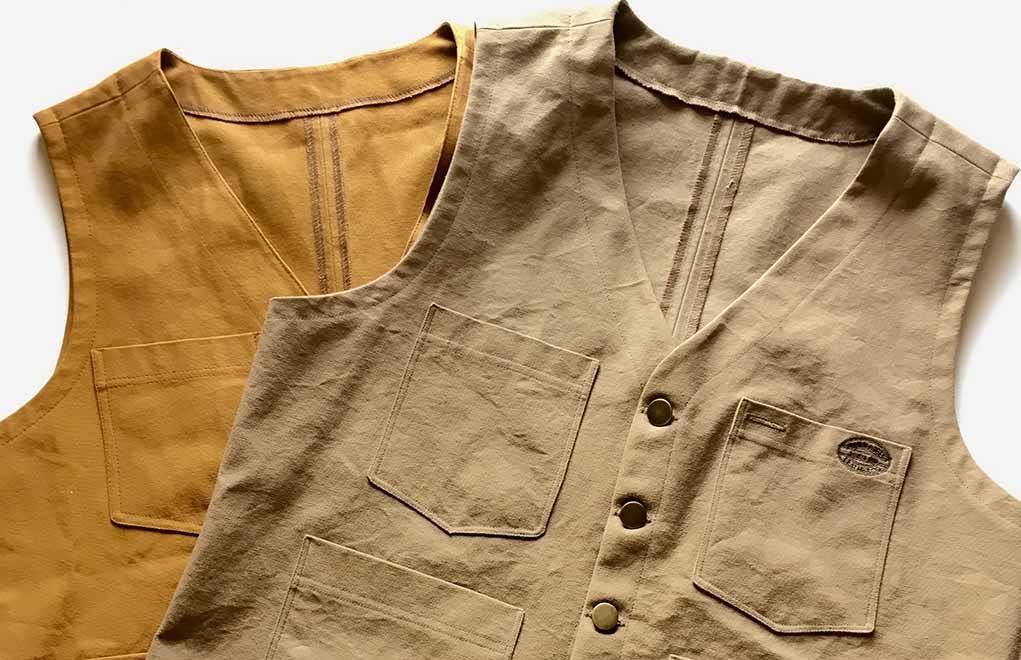
Purpose built as a concealed carry overgarment, the Swift Cover Vest is a stylish and effective way to keep your gun under wraps.
How The Swift Cover Vest Enhances Concealed Carry:
Ruggedly made of cotton and canvas its made to last.
Appropriate for all-seasons.
Four exterior and two interior pockets ease carrying extra gear.
Strategically placed weights aid in sweeping vest back on the draw.
Long enough it provides excellent concealment when carrying OWB.
The trick to carrying a concealed handgun is concealing it, but not to the point that you cannot access it easily and swiftly. Vests have been and continue to be a popular method of concealment because they can, in most circumstances, be worn year-round. Of course I’m sure you’ve heard various tactards suggest that wearing a vest — something like a photographer’s vest — is a dead giveaway that you have a gun on your hip. I’m not convinced of that. In fact, I think the now popular un-tucked shirt might even be more of an indicator. At the same time, the two states I frequent the most — West Virginia and Arizona — both have Constitutional Carry, so even criminals, who are a fry or two short of a Happy Meal, suspect that everyone around them is carrying.
Here’s the thing: A vest adds a bit of flare and character, if not gravitas, to your appearance. Through a vest on over a flannel shirt and you immediately go from a redneck to a renaissance man. I probably have a half-dozen vests I wear depending on the season — and situation — primarily for the purpose of hiding a gun. What I’d been missing was a kind of all-season vest. I found the answer with the Swift Cover Vest.
Granted, there’s no shortage of cover vests specifically designed for concealed carry on the market. The problem with most is that they are designed to carry and not hide the gun. Stick 20-some ounces inside your vest and it becomes cumbersome and uncomfortable.
The Barranti Leather Swift Cover Vest was designed by a guy who carries a gun, specifically for guys who carry a gun. It’s made of rugged cotton canvas, comes in two colors, has four exterior and two interior pockets, and can be had with or without a lapel. It also has strategically placed very small weights to help you “sweep” the vest on the draw.
It retails for $125 and it takes about 4 weeks to get one. If you see me out without a jacket, I’ll probably be wearing it. You could assume that means I have a gun on me, but that pretty much applies no matter what I’m wearing or where I’m at.
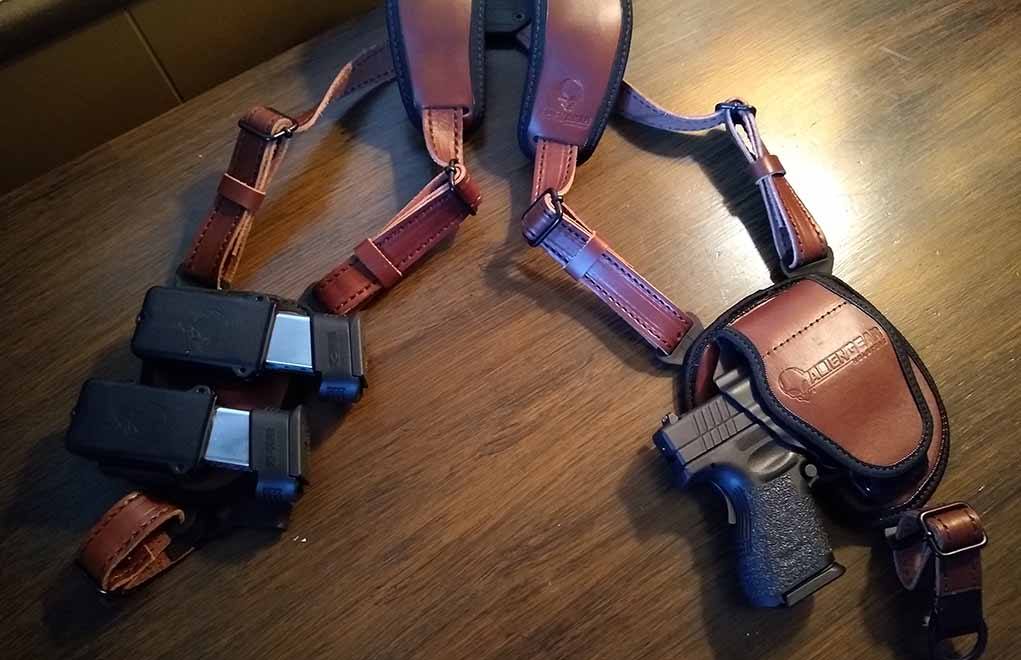
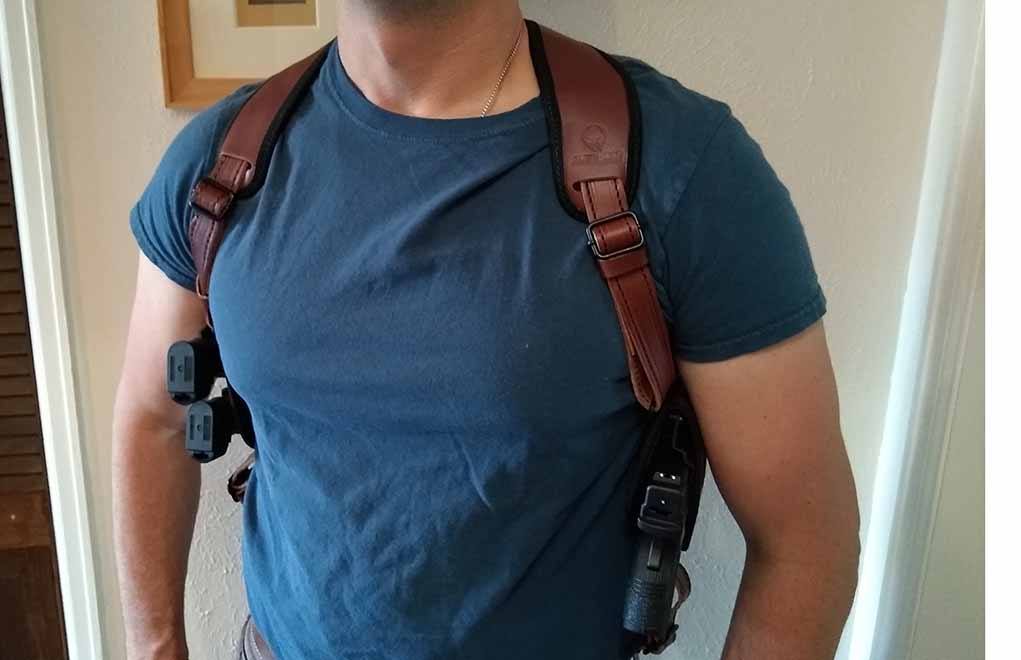
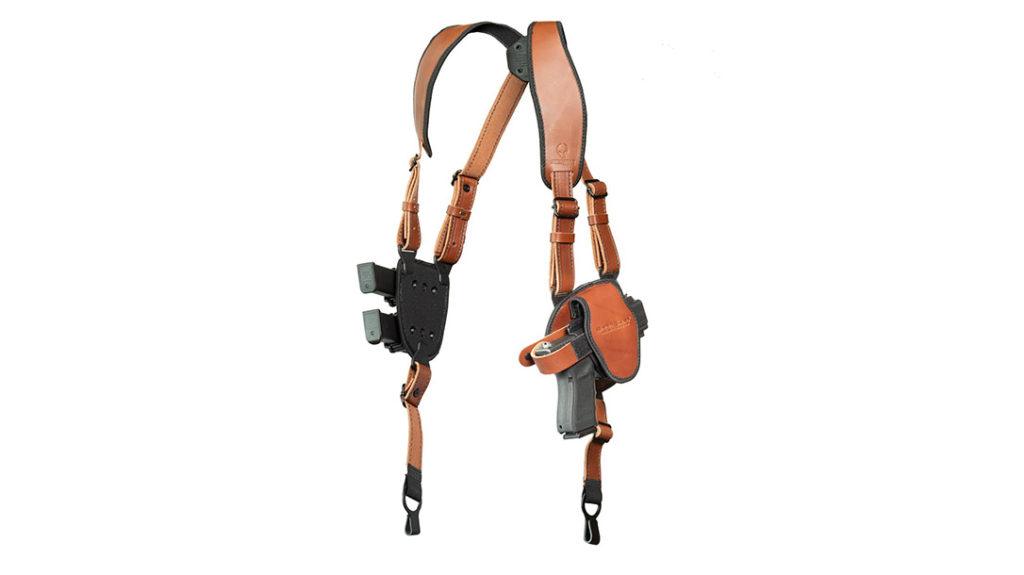
Using the hybrid concept, Alien Gear has produced a comfortable and efficient shoulder holster system.
Comfort, convenience and performance, Alien Gear’s shoulder holster system opens upper-body carry to more armed citizens.
How Alien Gear Has Made A Better Shoulder Holster:
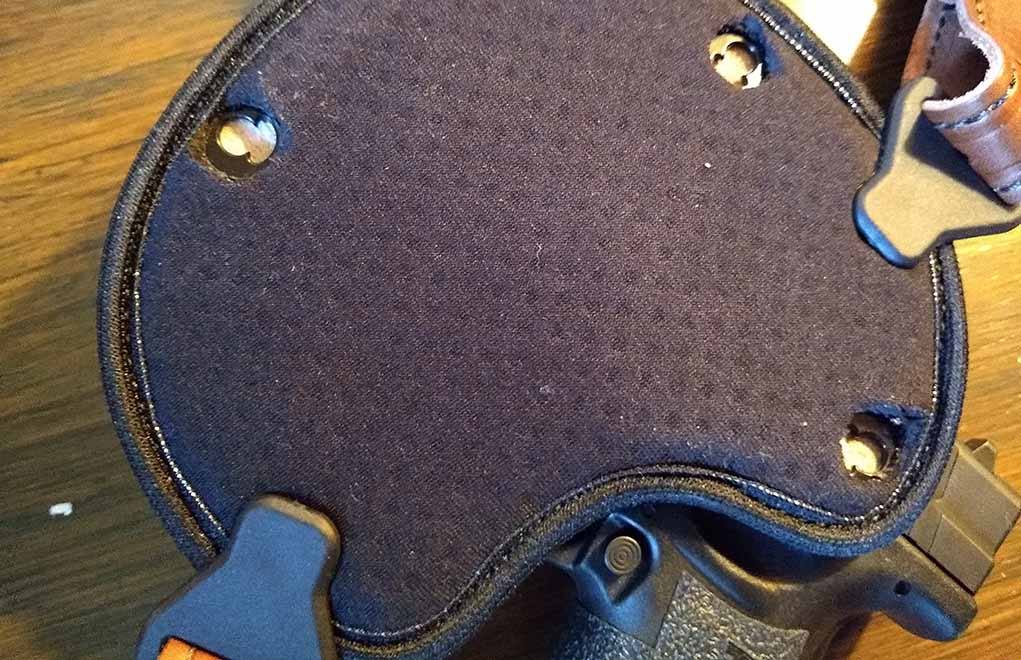
CoolVent neoprene backing takes the bite out of the system’s leather and Kydex parts.
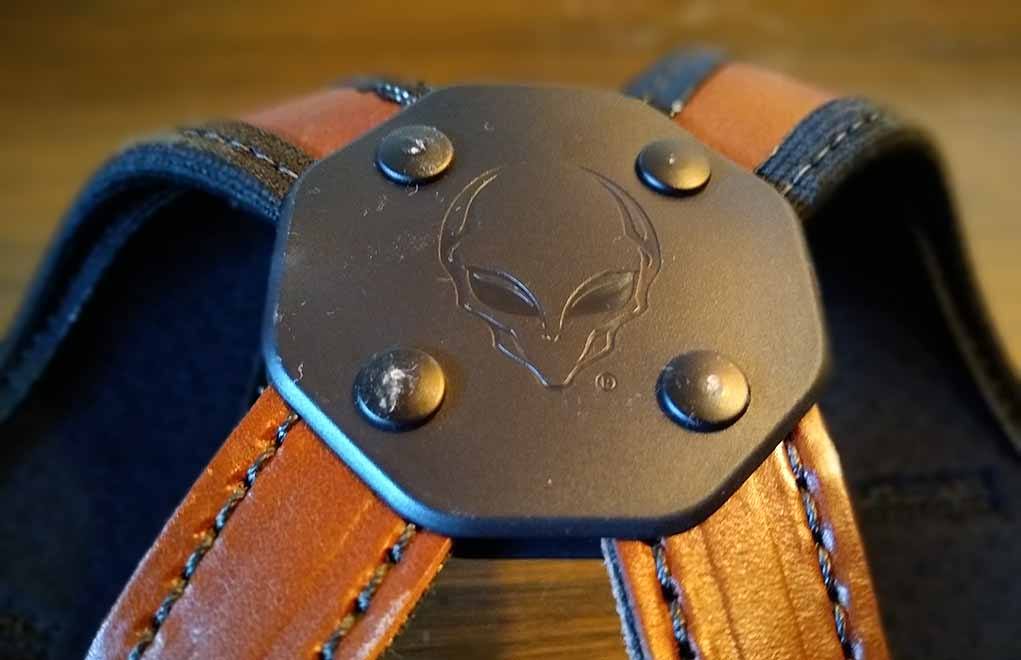
Four-point swivel backplate and elastic connectors helps holster mold to the body and move with it.
Excellent passive retention keeps pistol in place.
Comes with a Level 2 retention device, a removable Velcro thumbbreak.
Superstructure composed of rugged English bridle leather.
Parachute pants, popped collars and shoulder holsters. If you grew up in the 1980s, likely at some time you wore the first two and thought every handgun holster was the latter. Thank the warped lens of Hollywood. Up until then, nearly every big-screen good and bad guy short of Popeye Doyle (French Connection) carried their heater under their arm.
It stands in stark contrast with reality, where the belt holster reigns supreme, then as it does now. That doesn’t mean the shoulder holster should be written off as mere cinematic fantasy. The intriguing upper-body rig has its place away from the movie house, especially with what Alien Gear has cooked up.
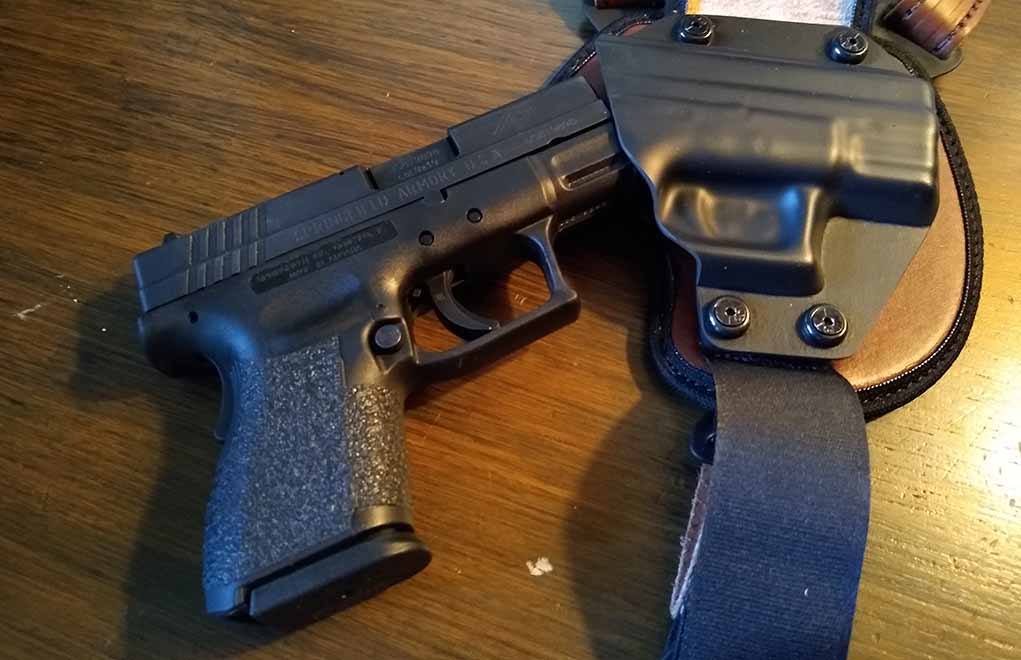
The ShapeShift’s Kydex shell provides excellent passive retention when adjusted right.
The ShapeShift Shoulder Holster rethinks upper-body carry without reinventing the wheel. A delicate balance, but one that opens the style of carry to a greater swath of armed citizens. And, in truth, makes this often overlooked method all the more viable.
Hybrid Comfort
As its name suggests, the ShapeShift Shoulder Holster is part of Alien Gear’s extremely flexible line of modular holsters. This means, if you already have a belt rig, you can buy the strap system (MSRP $99.88) and convert over. If you’re new to the line, Alien Gear sells the whole shoulder holster system (MSRP $133.88). Though nice, the shoulder holster’s protean nature is just icing on the cake.
Mesh wrapped CoolVent neoprene padding is one of the ShapeShift’s secrets to comfort.
The upper body system’s biggest selling point is addressing one of the main complaints about this style of carry: comfort. In the bad old days, shoulder holsters were usually as plush as a plow yoke. Turning to modern materials, a trademark of Alien Gear, the ShapeShift tackles this issue head-on.
While the superstructure of the system is good ol’ English bridle leather, all the key touch points are well padded with Alien Gear’s CoolVent neoprene. Firm padding is a necessity, eliminating the structural material’s bite—particularly the shoulder strap’s leather and the magazine carrier and gun holster’s Kydex.
Made To Move
Alien Gear has made two further simple, but effective tweaks to the traditional shoulder holster design: a four-point swivel backplate and elastic connectors under the shoulder straps. More than comfort enhancements, these better conform the straps and holster to your body, dynamically so. By this I mean, no matter how you twist and turn the ShapeShift consistently presents your gun. Additionally, the elastic provides a bit of shock absorption, so your pistol and magazines don’t get knocked about.
The ShapShift Shoulder Holster cuts a low profile and is extremely easy to wear.
Adding a layer of resilience to this aspect of the shoulder holster, a solid lower securing system. Hooks attach to your belt, giving you four anchor points in all to ensure the rig doesn’t slip off.
Pick’n Slim
Alien’s modular ShapShift line gets a lot of kudos for its versatility. But a frequently overlooked aspect is the series’ overall slimness, no matter what carry method. The company has always done a number on knocking down bulk. On the shoulder holster this is much needed. Make one too large and a demure pistol is akin to carrying firewood under your arm. Which goes without saying, is noticeable to the rest of the world.
An everyday button-up shirt is enough to keep the ShapeShift under wraps.
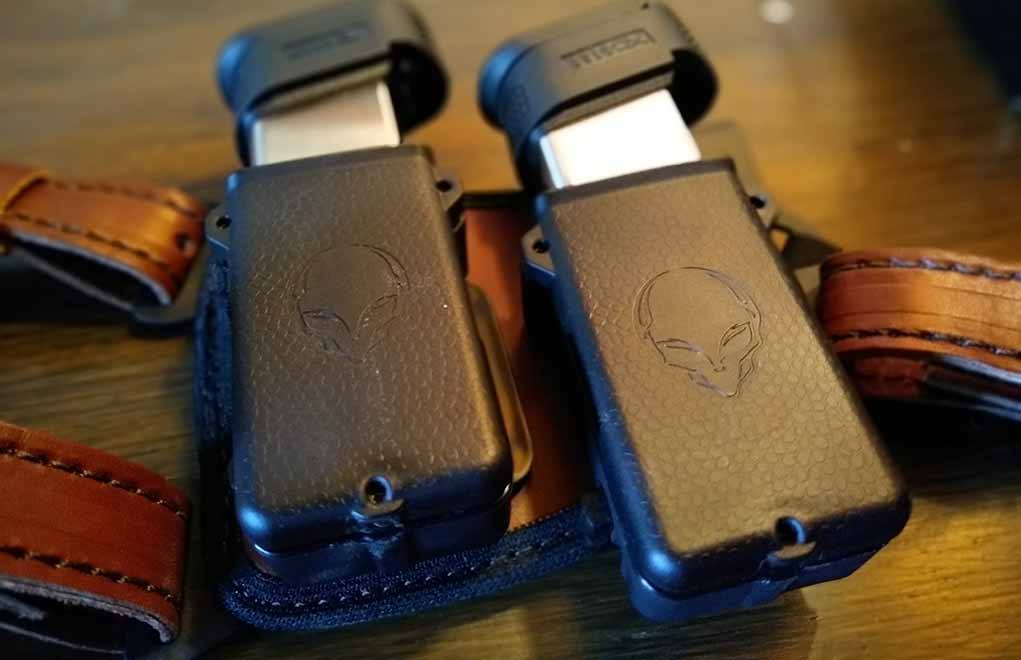
It was immediately evident, without even slipping on the rig, this wasn’t the case with the ShapeShift. Out of the box, it cut a slim profile, particularly the holster. Impressive, given the Kydex is enveloped in leather to protect your gun and improve comfort. Same goes for the adjustable mag carrier, which tucks right in against your body to stay out of the way.
Safety First
The shoulder holster, more than any other carry method, takes some special consideration when it comes to safety. Most, even the angle adjustable variety, can muzzle sweep objects and people behind you—something to keep in mind. And they’re cross-draw systems, which means you need to fine-tune your retrieval so, again, muzzle sweeps are limited. But by and far, the most imperative issue revolves around the system’s reputation for gun drops.
This is the nature of the beast, given regular body movement can and does face the holster’s mouth directly at the ground. Good holster makers understand this and address it in their shoulder system’s design, as Alien Gear has.
For more information on concealed carry holsters check out:
With the ShapeShift, retention is built in with an adjustable passive system you can really wrench down. However, if you need more security, Alien Gear includes a Level 2 retention system—a removable Velcro thumb break. Jumping the gun on the review section, I have to say the passive system proved enough to keep my Springfield XD subcompact in place. And for general day-to-day activities, I believe it would be enough to safely carry. But it’s nice to have the option to further secure your gun if you believe you’ll really be on the move.
Drawing An Ace
Overall, I was impressed with what the ShapeShift Shoulder Holster brought to the table. The strap system distributed the weight of my subcompact and two 15-round magazines well enough it was easy to forget I was carrying.
Magazine carriers keep spare rounds on tap.
Drawing was simple and intuitive with the rig, which consistently presented my pistol’s butt no matter what position I was in. This is important, given a shoulder holster’s big advantage is supposed to be unfailing ease of draw. Given how natural the ShapeShift accomplished this facet of its duties, I believe it would make an excellent option for those who find themselves seated or driving a majority of their day.
As far as concealability, it was excellent. I adjusted the ShapeShift for a more horizontal angle, facilitating (at least for me) a quicker draw. This angle, however, puts more the butt away from the body, generally opening the possibility of printing. But it wasn’t the case. A light windbreaker or button-up shirt were enough to make my gun disappear like it wasn’t even there. Definitely an attribute that makes the holster more useful, not only a heavy-clothing option.
The four-point swivel back plate helps the ShapeShift move with your body.
My only complaint, the thing creaked more than granddad’s rocking chair. Virgin leather, what are you going to do? Nothing really, maybe a little strategically placed talcum powder, the rest is break in.
Parting Shot
Given its assets, will the ShapeShift Shoulder Holster dethrone belt carry? Unlikely, but that’s OK. Upper-body carry has and will remain a niche option. But given its comfort, convenience (it’s available for nearly every conceivable handgun) and performance, Alien Gear has come up with a shoulder holster more viable for more armed citizens. In short, they have given the silver screen star a role in real life.
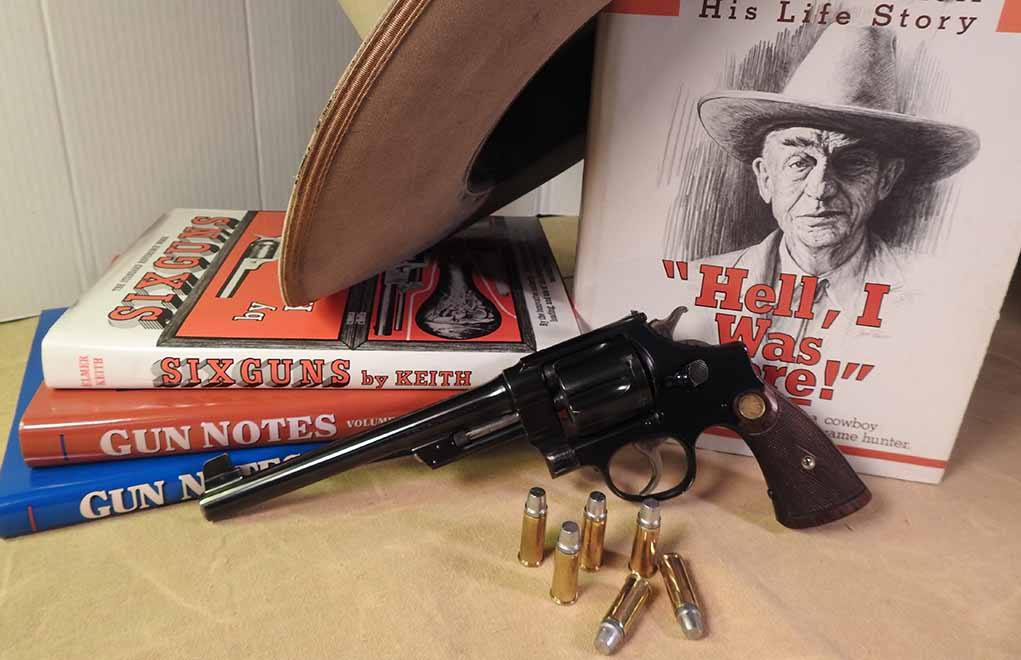
Elmer Keith proved that with practice and know-how, long-range shots with a revolver are possible.
What’s Special About Smith & Wesson Triple-Lock:
Built on S&W’s N-frame.
Cylinder has three locking points making it fit for larger and more powerful cartridges.
Original Triple-Lock did not have special heat-treated cylinders.
Available with barrels from 3.5 to 8.5 inches.
At first, there were two major models, one with fix sights and the Target Model with adjustable sights.
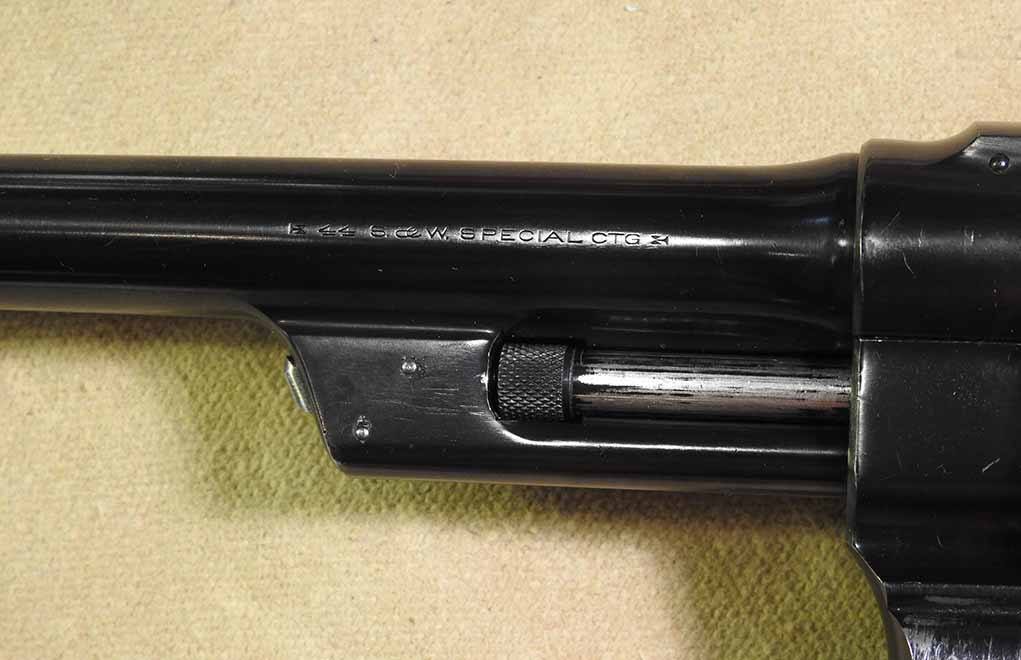
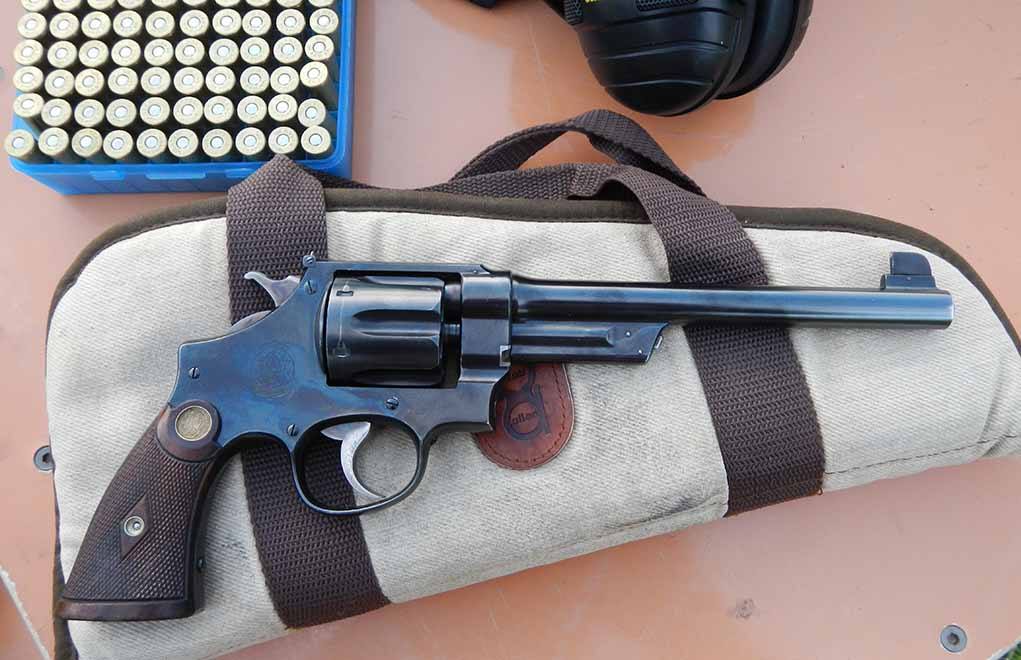
Item No. 17 on the auction list reads, “.44 Hand Ejector First Model (Triple-Lock) serial number 4325, .44 S&W Special, 7.5-inch barrel, blue finish, shipped April 7, 1910, Honeyman Hardware Co., Portland, OR.”
This is interesting in its own right for wheelgun aficionados, but it’s even more so when you ponder the revolver’s journey from Oregon and its intervening experiences in those 100-plus years between 1910 and 2016, at which time it landed in the hands of a Nebraska firearms collector.
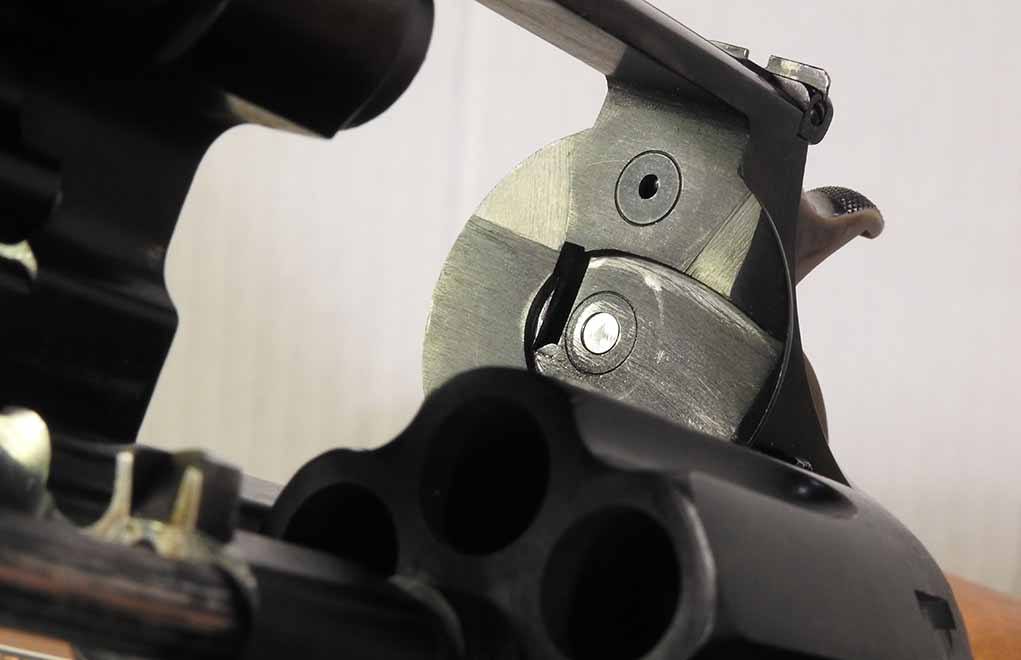
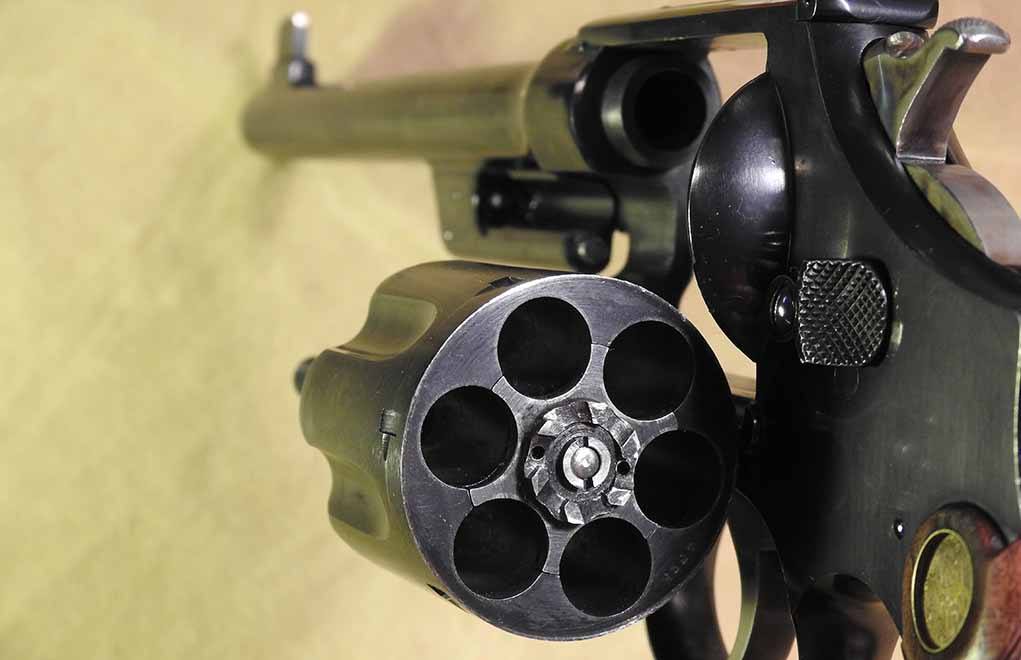
A bolt mechanism locks into the face of the cylinder, providing a solid lockup of the frame to cylinder.
Although much of the Smith & Wesson revolver’s early history is unrecorded; and it might have remained unnoted, perhaps being passed anonymously from generation to generation, owner to owner—had it not landed in the hands of one of the foremost pistoleers of the 20th century: Elmer Keith.
About Elmer Keith
I know you know about Elmer Keith. But humor me while I briefly describe his influence as one of the top gun writers of his day, which is to say a good portion of the mid-1900s. To give you an idea of the Elmer Keith era, he published his first firearms book, Sixgun Cartridges and Loads, in 1936, and his last, Hell, I Was There in 1979.
Keith was a rancher in Idaho, as well as a hunter and firearms enthusiast. He is perhaps most often associated with handguns and handgun hunting, but he was also an expert with the rifle and shotgun and made significant contributions to all three of those disciplines.
A man of small physical stature but a large personality and reputation, Keith favored a large Stetson cowboy hat and cigar; sometimes, a pipe. In addition to books, Keith wrote popular firearms columns and articles for American Rifleman and Guns and Ammo magazines, as well as other magazines (for one, True magazine). He’s best known, in my mind anyway, for his affiliation with Guns and Ammo, even though I have some 1950s-era editions of American Rifleman listing Keith on the masthead. This included the March 1950 edition, in which Keith was introduced as a staff writer—or as they put it, “Keith Joins Rifleman Staff: The noted Western gun writer augments Dope Bag panel of experts.”
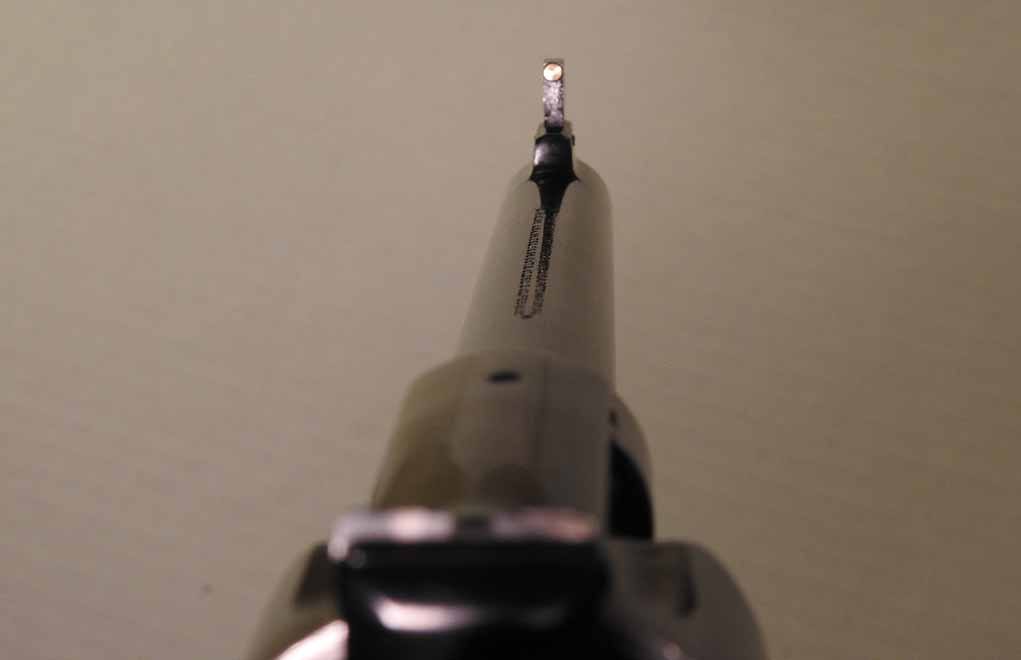
Elmer’s revolver features a McGivern Gold Dot inset on the front sight.
Keith was known for his fondness of big-bore firearms, particularly handguns—even more particularly, revolvers. A serious hunter who believed in using enough gun for the job at hand, Keith was not content with the handgun cartridges of his day. Large, slow bullets were not for him, nor were light, fast bullets. He wanted large, fast bullets, and he experimented with available cartridges, pushing the limits of cartridges and firearms alike.
Hefty, Hefty, Hefty
The beefy Triple-Lock, also known as the New Century (it was introduced in 1907), was right up his alley.
In designing the Triple-Lock, Smith & Wesson set out to create a large-frame wheelgun that could fire more-powerful loads. Based on earlier swing-out cylinder double-actions, such as the .32 Hand Ejector, .38 Military and Police and .38 S&W Special, the new revolver was beefed up, especially in the frame, to handle the company’s newly designed .44 Special cartridge, which was based on lengthening the .44 Russian case to provide additional space for powder. The result is often considered one of the finest revolvers ever made.
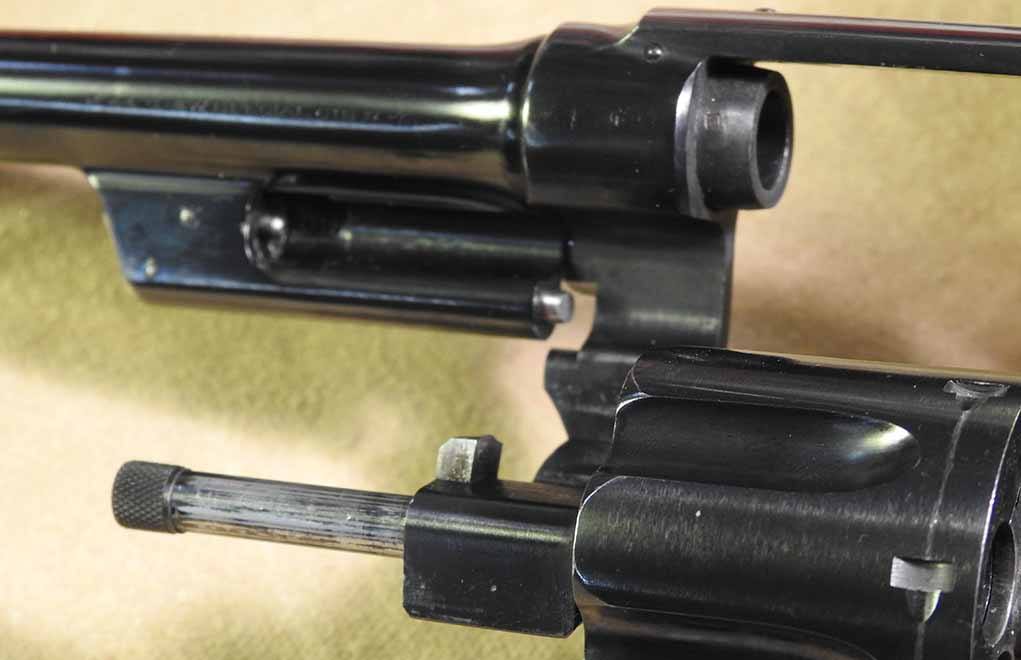
The “Triple-Lock” aspect of its name came from a design that incorporated three locking mechanisms—one at the forward end of the ejector rod, one locking into the face of the cylinder and the third in between a notched lug and bolt forward of the cylinder but at the rear of the ejector shroud. The three mechanisms provided solid lockup and a strong foundation capable of handling more-powerful loads, such as the .44 S&W Special.
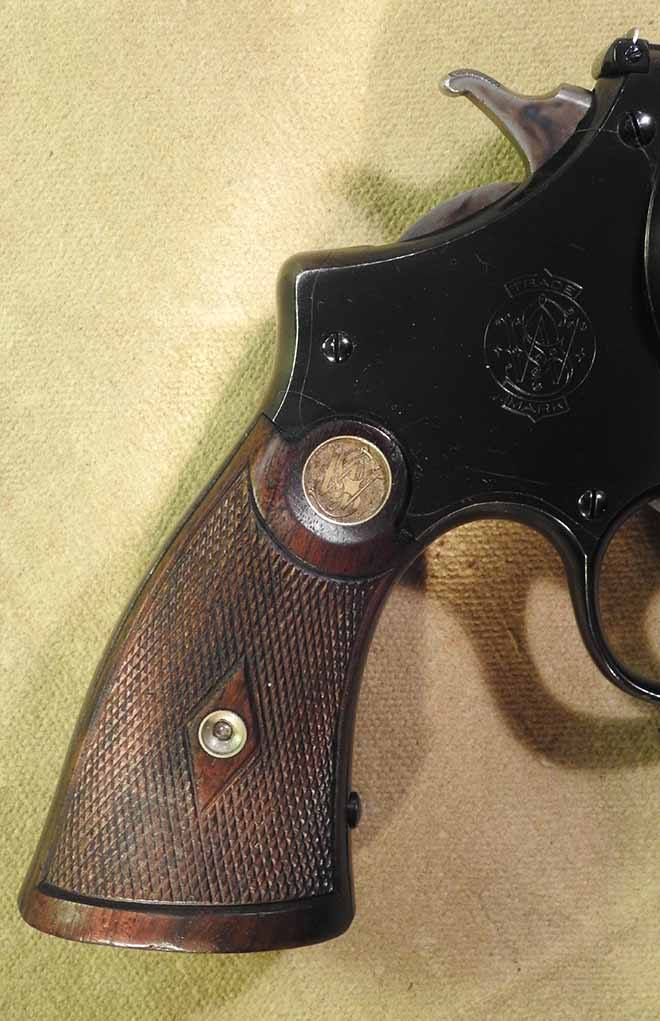
Detail of the slim, checkered handle. Keith preferred slim, rather than bulky, grips for the better fit they provided his hand.
And that gets us back to Elmer Keith. He is acknowledged for his work in heating up handloads for the .38 Special, .41 Long Colt and .44 Special—and pushing firearms and ammunition manufacturers to follow suit. This resulted in the development of Magnum cartridges we know today: the .357, .41 and .44 Magnums.
If you play firearms word association with a handgun aficionado and say, “Elmer Keith,” the response will likely be “.44 Magnum.” (We’ll save for another discussion Keith’s work with wildcat rifle cartridges that was instrumental in developing other cartridges. .338 Winchester Magnum, anyone?)
King of the Six-Gun Cartridges
But back to the .44 Special. Keith reportedly proclaimed the .44 Special “king of the six-gun cartridges,” but he continued to push it, using it as a basis for reloading and range experiments to push velocities of heavy bullets. He is known to have used triple-locks (as well as Colt single- actions) in his work with the 44 Special.
As the reliable reference book, Cartridges of the World, points out, as an accurate and powerful big-bore revolver cartridge, the .44 Special was never factory loaded to its full potential. “It was left to the handloader to develop truly effective hunting loads … Experiments to maximize the .44 Special’s big-game hunting potential by men like Elmer Keith culminated in the .44 Magnum.”
A detail shot of the .44 Special marking on the barrel.
But we were talking about this particular Smith & Wesson .44 Special—the one purchased from the Keith collection after his death in 1984.
A Shooter, Not A Collector
Ben Heskett, owner of Serial No. 4325, can attest to Keith’s penchant for overpowered, if not overpowering, loads.
“It obviously saw a lot of heavy loads and a lot of shooting, because it was noticeably out of time,” Heskett said. “And that’s kind of the curse with Elmer’s hot-rod .44 Special loads.”
Heskett sent it to a gunsmith, Alex Hamilton of Ten-Ring Precision in San Antonio. “[He’s] one of the few remaining Smith & Wesson revolver meisters left,” Heskett said. “He re-timed it and went all through it.” However, otherwise, he left it intact.
Heskett doesn’t just set the revolver on a shelf to admire; he shoots it.
“I agree with what Elmer once wrote: ‘I’m a shooter, not a collector,’” Heskett said. “That’s why I shoot it—albeit with milder loads.”
He brought it out and let me shoot it too. We went through about 100 rounds of Heskett’s handloads with a formula he picked up from gun writer John Taffin: 6.0 grains of Unique powder with a 250-grain Keith bullet (an Elmer Keith semi-wadcutter design).
The action and trigger pull were smooth, accuracy consistent. It fit the hand well. Elmer was known to prefer smaller stocks. He was not a big guy. And that stock worked well for me. The front sight featured an inset Ed McGivern-designed Gold Dot, which provides a nicely noticeable visual reference point, even in subdued light.
Heskett explained that the smooth action and trigger pull are inherent, not a tune-up.
“That’s exactly the way I got it. It’s pretty characteristic. The early (Smith & Wesson) guns were noted for being very, very smooth … back when quality control was at the top of the list.”
Heskett purchased the revolver in March 2016 from gunbroker.com. Previously, it had been sold at a 2015 auction offering Keith’s nearly intact firearms collection.
Other than the authentication from the auction house, including notes from Keith’s son, Ted, Heskett knows little of the role the revolver played in Keith’s work, how it came into his possession or its previous owners. He does know it was sent back to the factory in the 1920s for rebluing, but he doesn’t know if it was sent by Keith or a previous owner.
Heskett, a former police officer in Lincoln, Nebraska, and lifelong firearms collector, is now a rancher near Arnold (central Nebraska). He preferred not to reveal the price he paid for the revolver but said he was a long-time admirer of Keith and gets satisfaction of owning one of his personal handguns.
“I’ve been a big fan of Elmer’s ever since I was a kid. I suppose I shared a commonality with him—the love of six-guns; the fact that he had been a cowboy, rancher and a big-game hunter. And there was that connection with the West. I was basically all of those things, too, at one time or another,” he said.
Heskett said he admired Keith’s proficiency with wheelguns, in part, because he used to shoot in police competitions.
“I shot thousands and thousands of rounds through my competition revolvers, and I do love what you can do with a six-gun at long range,” he said.
Keith wrote about a 600-yard shot he made to stop a wounded deer from escaping over a hill. He drew criticism for taking the shot but made it clear he only did it because the deer had been hit by another hunter. He described walking the shots in and connecting, preventing the possible loss of the wounded animal.
With practice and know-how, long-range shots with a revolver are possible, Heskett said.
“It can be done, and Elmer was the one who could prove it. And he kind of led others to it.”
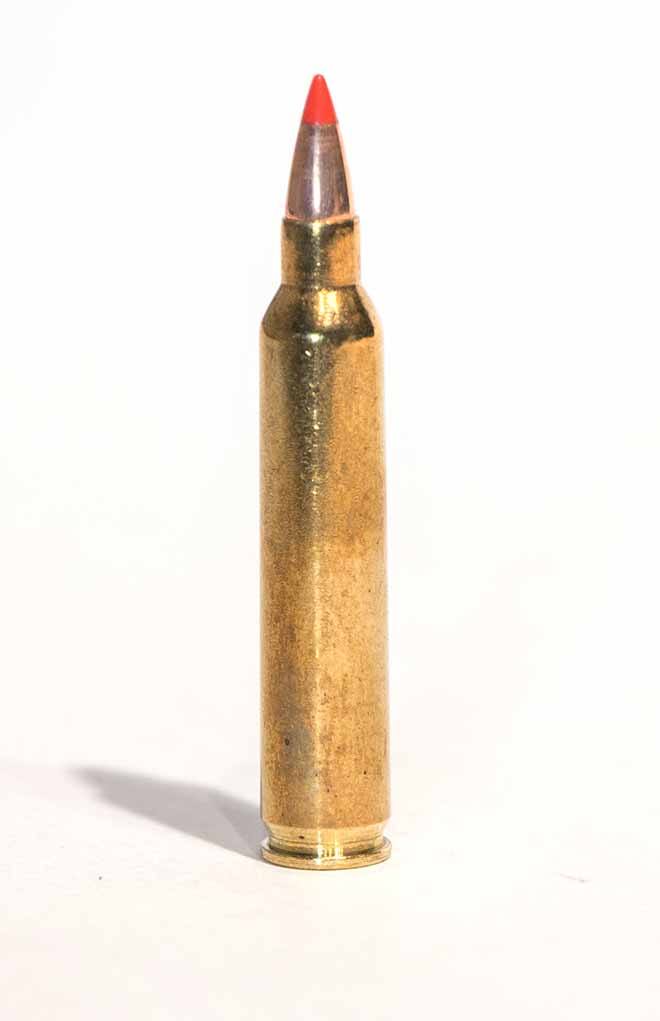
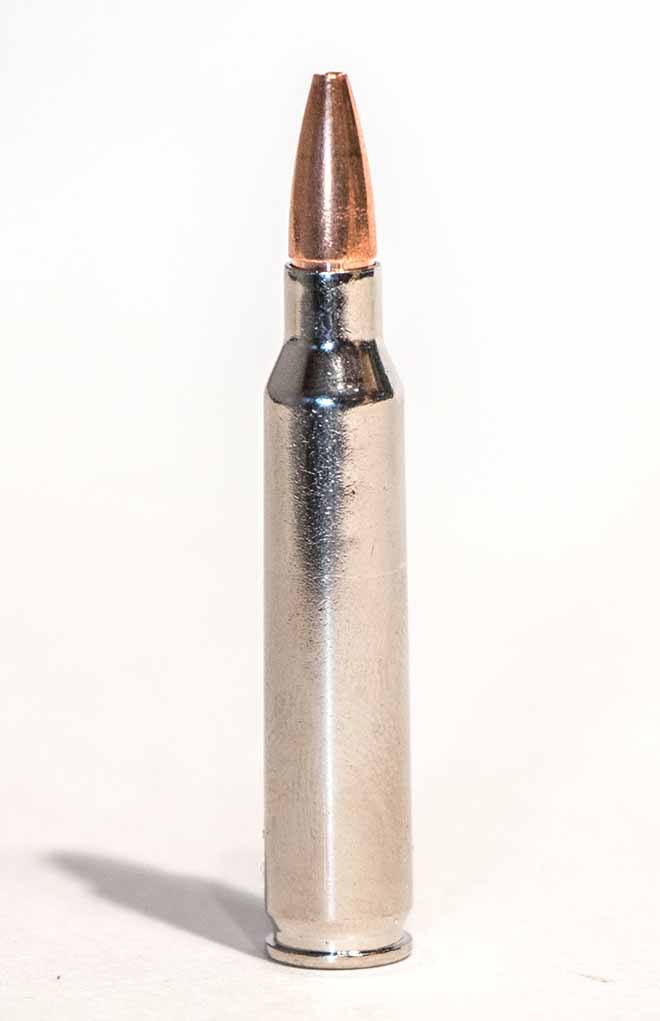
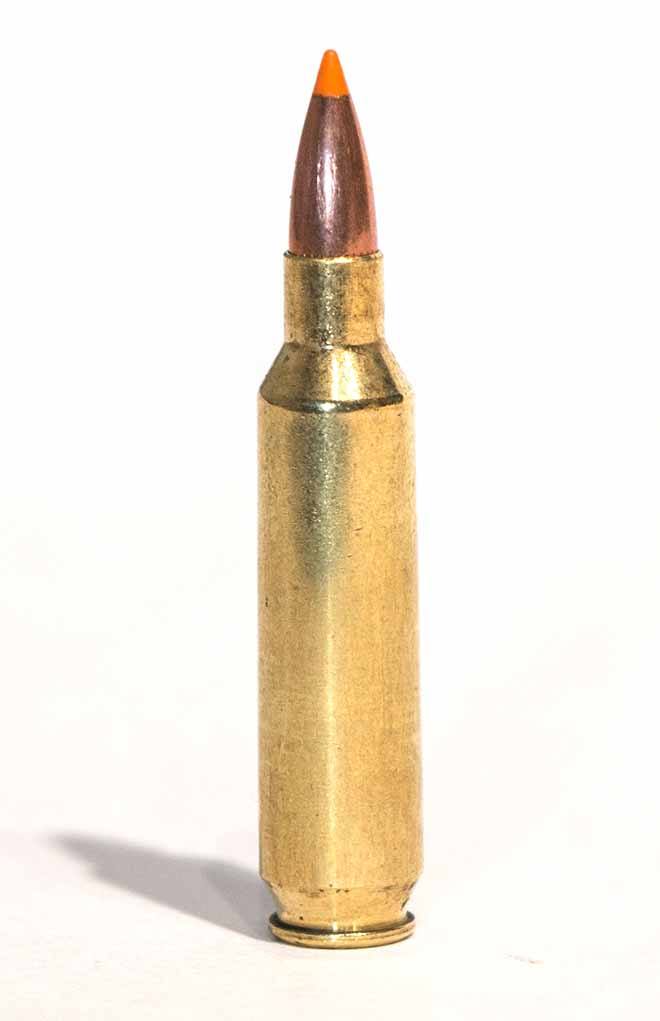
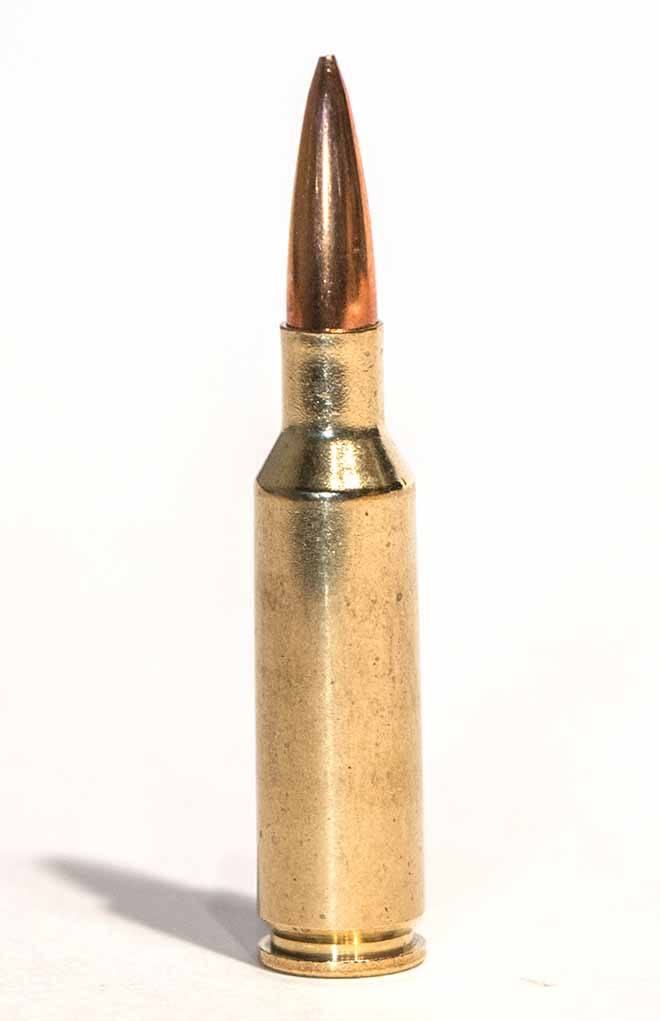
You want to buy an AR-15 but can’t decide for which cartridge it should be chambered. Well, maybe this rundown will help. The key to getting the right cartridge for an AR-15 is to perfectly match the cartridge to the jobs you’re going to ask the rifle to perform. Choose wisely, or you might have to choose again. However, in the end, choosing more than one might actually be the best and the right answer.
The .204 Ruger
The .204 Ruger is strictly a varmint cartridge, and it excels very well in that venue.
Introduced by Hornady in 2004, the .204 Ruger’s parent case is the .222 Remington Magnum. It’s loaded with a 0.204-caliber bullet typically weighing between 32 and 45 grains. Intended as a fast-stepping varmint cartridge, it’s capable of pushing the lightest bullet weights to well beyond 4,000 fps. Early on, it seemed that the .204 Ruger would be very popular, but a lack of rifles available for it has led to a diminished attractiveness.
These days, you’ll have trouble finding complete rifles chambered for the .204 Ruger, with the DPMS LR-204 being one of the few currently available. If you want one, your best bet is to build your own rifle or upper, which, given the modularity of the AR-15 platform, is not all that hard to do. The .204 Ruger is ideal for prairie dog shooting and target work. Given the minimal recoil, it’s especially pleasing to watch your bullets impact these little vermin.
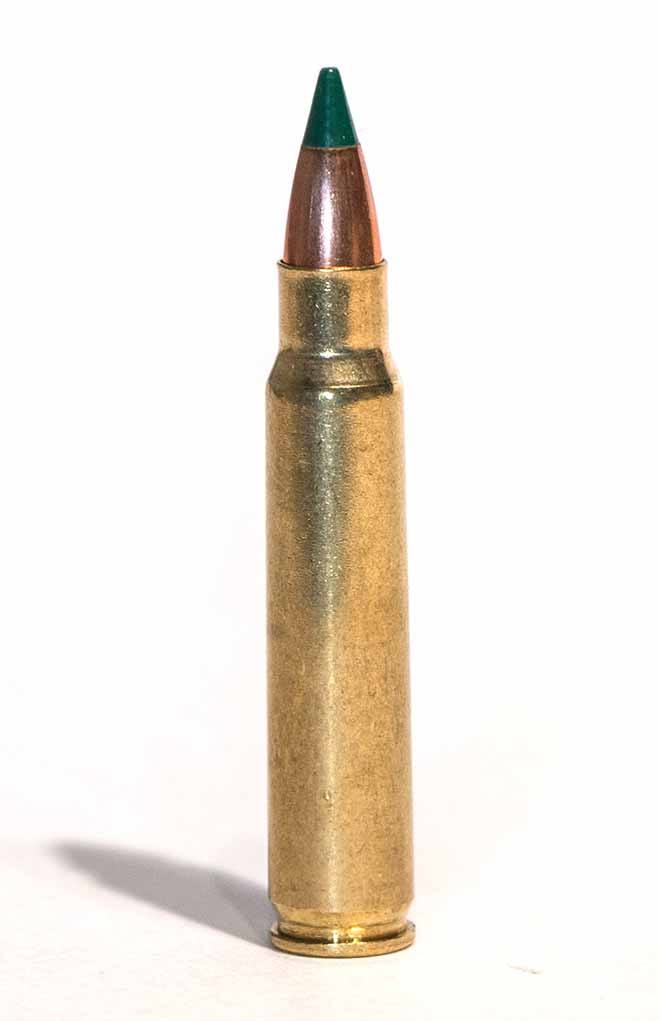
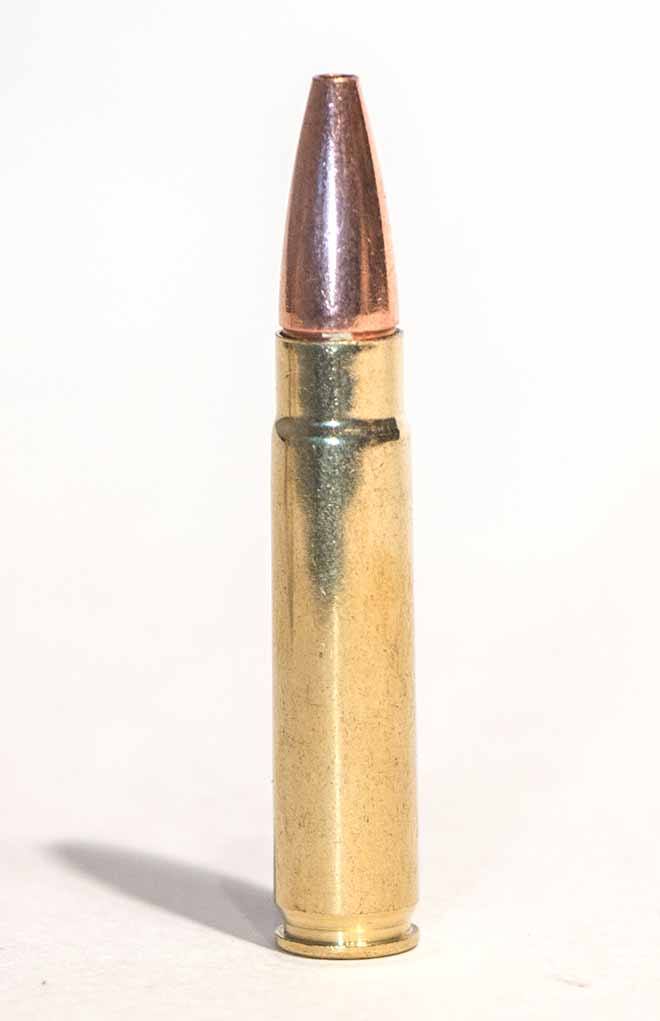
Unquestionably the most popular and maybe the most versatile cartridge for the AR-15, the .223 Remington/5.56 NATO, is king as a result of its performance and the wide selection of factory ammunition.
Because the .223 Remington is unquestionably the premier cartridge for the AR-15, you’ll find more ammunition options for it than any other. To some extent, this cartridge is interchangeable with the 5.56 NATO. However, 5.56 NATO ammunition should not be fired in rifles marked “.223 Remington.” On the other hand, feel free to shoot .223 Remington ammunition in a 5.56 NATO rifle.
With a wide selection of factory loads, and with bullets ranging in weight from 35 to 75 grains and available in many styles from frangible to monolithic, the .223 Remington is the most versatile AR-15 cartridge. It’s ideally suited for varmints, home defense and even game as large as feral hogs and deer (bullet selection is paramount).
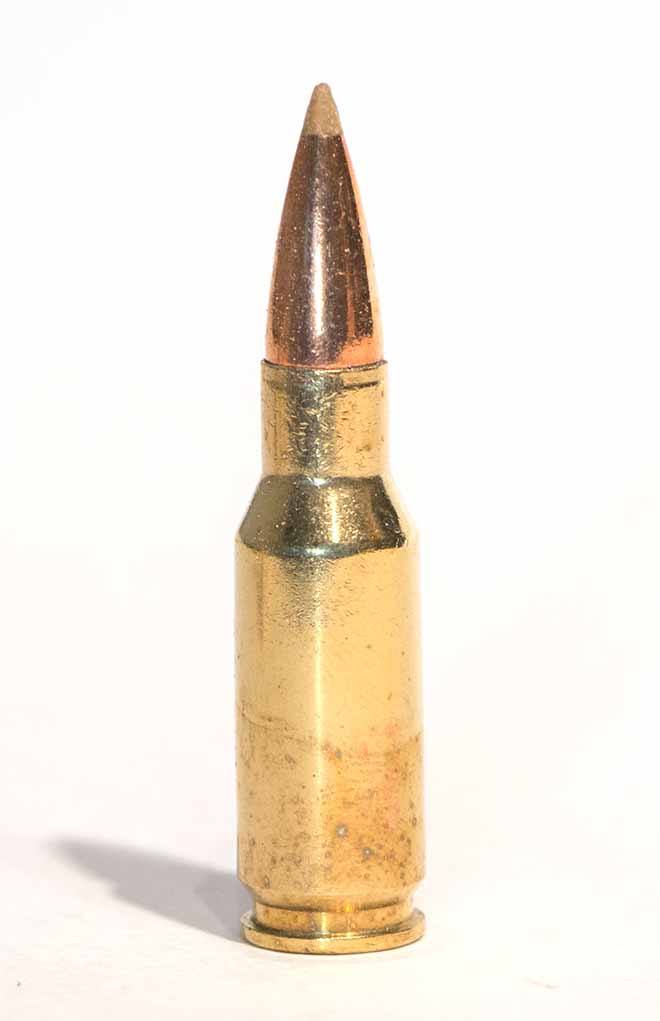
If speed is what gets you excited, the .22 Nosler is the AR-15 cartridge for you, especially if you want one that will work on varmints and deer-sized game.
Based on the 6.8 SPC case and necked down to .224 caliber — but with a rebated rim the same size as the .223 Remington — it’s easy to convert an AR-15 in .223 Remington/5.56 NATO to .22 Nosler. All the conversion requires is a new barrel and 6.8 SPC magazines. Unfortunately, Nosler is the only company offering ammunition for this cartridge.
With almost 25 percent more powder capacity than the .223 Remington, the .22 Nosler has the ability to push bullets devilishly fast. Depending on the bullet style, it can be argued that the .22 Nosler is the fastest- and flattest-shooting AR-15 cartridge. It will push a 55-grain E-Tip bullet to 3,300 fps, which is more than sufficient for deer hunting. The 55-grain Ballistic Tip at about the same speed is ideal for varmints, coyotes and such.
The .224 Valkyrie
If you want to get hits at stupid long range with an AR-15, the .224 Valkyrie is the way to go. And, deer- and hog-capable factory loads are available.
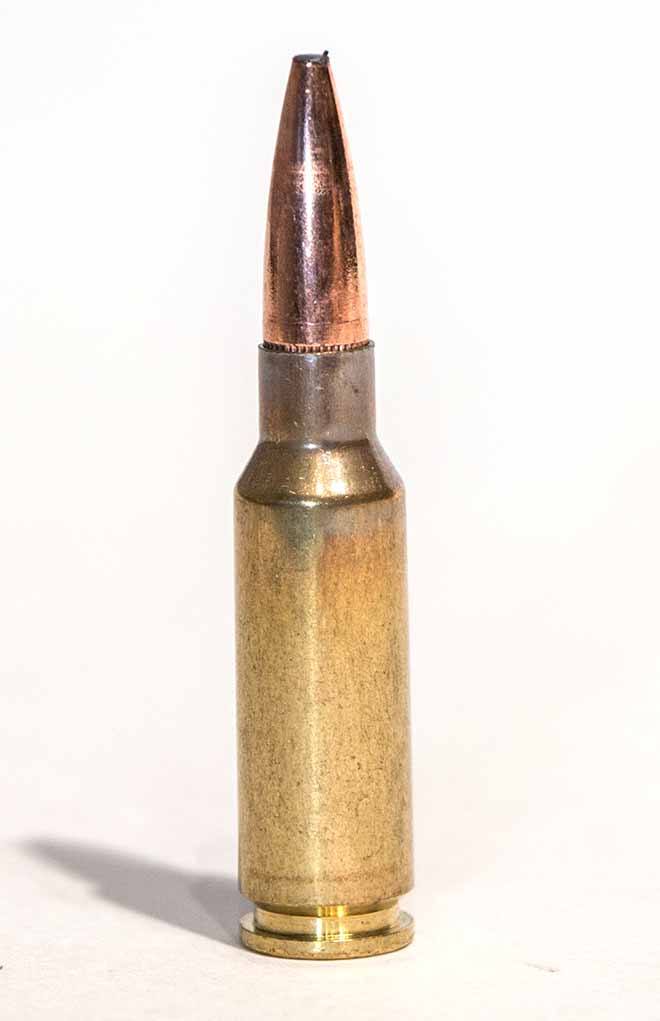
With a case shape inspired by the 6.5 Creedmoor, the .224 Valkyrie is one of the newest AR-15 cartridges. The 75-grain Hornady hollow-point load has a muzzle velocity of 3,000 fps, and the 90-grain Federal Sierra Match King load will leave the muzzle at 2,700 fps. The first is ideal for varmints, and the latter is great for long-range shooting. However, Federal also offers a 90-grain Fusion soft-point load that will work splendidly at extended ranges for hogs, deer and pronghorn.
Like the .22 Nosler, the .224 Valkyrie is based on the 6.8 SPC case. However, the Valkyrie retains the 6.8’s 0.422 rim diameter; but the case is highly modified to work with long and slender bullets with high ballistic coefficients. The cartridge seems to be gaining lots of traction with those who wish to push the distance with an AR-15. And, with a wider variety of loads from several sources, it looks to soon outperform the .22 Nosler, at least from the standpoint of sales.
The .25-45 Sharps
The .25-45 Sharps had a lot of potential in the AR-15. In truth, it still does, but it’s being overshadowed by faster-stepping .22-caliber and harder-hitting large-caliber options.
Created in 2008 to make the AR-15 big-game legal in every state that allows bottlenecked rifle cartridges for deer hunting, the .25-45 Sharps is nothing more than a .223 Remington case necked up to .257 caliber. It approaches the ballistics of the time-proven .250 Savage with an 87-grain bullet, and it allows the AR-15 to be used in the few states that will not allow .224-caliber cartridges for deer hunting.
The .25-45 never really got off to a good start commercially; no major manufacture is offering ammunition for it, and what little popularity it had seems to be in decline. Regardless, it’s an ideal cartridge for the AR-15. It offers varmint and big-game capability and minimal recoil, and because it uses the .223 Remington case, handloaders should never be short of ammunition.
The 6.5 Grendel
The 6.5 Grendel is a good option for just about any application if you want to deliver a hard hit at distance with the AR-15.
If there were ever a cult cartridge for the AR-15, the 6.5 Grendel is it. Based on the .220 Russian/7.62×39 Soviet case, the 6.5 Grendel was introduced in 2003 by Bill Alexander of Alexander Arms. It’ll push a 120-grain bullet to 2,700 fps; and because of the naturally high ballistic coefficient of 6.5-caliber bullets, the Grendel shoots very flat.
Interestingly, the Grendel has never really caught on with mainstream AR-15 aficionados. This is somewhat perplexing, because it’s one of the best multipurpose cartridges for the platform. And, factory ammo is offered by a variety of manufacturers, such as Hornady, Federal, Alexander Arms and Underwood Ammunition. If you’re looking for a do-all AR-15 cartridge, the Grendel will suffice … and you can belong to a cult group that thinks it’s the best cartridge of any kind that has ever been invented.
The 6.8 SPC
At one time, the 6.8 SPC seemed to be the future of the AR-15. However, it now seems to have fallen from grace.
Designed between 2002 and 2004, the 6.8 SPC was created by Remington with assistance from the Army Marksmanship Unit to possibly replace the .223 Remington as the primary small arms cartridge for the military. Initially, it was very popular, and those who used it claimed it was superior to anything else that could be fired from an AR-15.
However, as of late, the popularity of the 6.8 SPC has waned. And, too, now there’s a 6.8 SPC II version with different chamber dimensions — and this totally confuses potential buyers. (6.8 SPC ammunition shoots just fine in a rifle with a 6.8 SPC II chamber.) Ballistically, the cartridge cannot compete with the more modern .224 Valkyrie, which will handle much more-aerodynamic bullets.
The .300 Blackout
The .300 Blackout is head and shoulders ahead of any other AR-15 cartridge when it comes to subsonic performance.
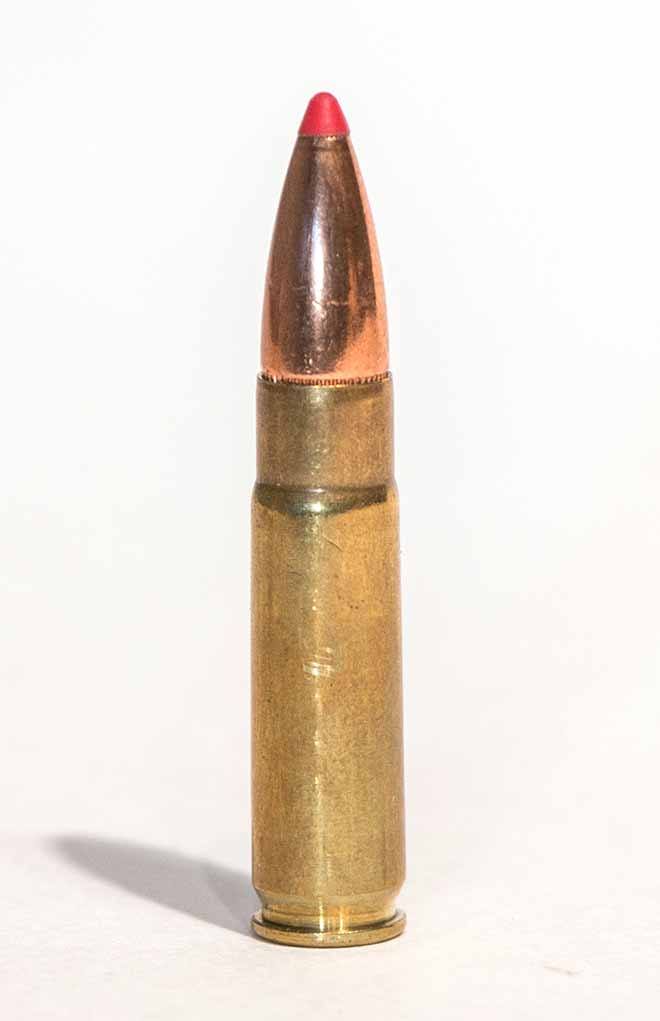
Partially because of its name, and partially because of its ability to provide fantastic subsonic performance, the .300 Blackout was at one time very popular. To some extent, it still is, but mostly in its subsonic form. Shooters soon found that obtaining one-hole, .300 Blackout accuracy — with both supersonic and subsonic ammunition — was near impossible.
One thing the .300 Blackout does have going for it is minimal recoil with supersonic ammunition. This makes it a great cartridge for young or new shooters who are looking to hunt with the AR-15. And, there’s a good selection of supersonic hunting loads to choose from. However, the true forte of this cartridge is subsonic work, and there, it reigns as the supreme subsonic cartridge for the AR-15.
The .300 Ham’r
Next to the .30 Remington AR, the .300 Ham’r is possibly the best general-purpose cartridge for the AR-15.
Introduced in 2018 by Wilson Combat, the .300 Ham’r might be the best general-purpose cartridge for the AR-15 platform. It essentially duplicates the external ballistics of the .30-30 Winchester, which makes it suitable for most of the big game on the planet … at least at modest ranges. Wilson Combat offers a wide variety of factory ammunition for the .300 Ham’r, with loads that are suitable for varmints, personal protection and big-game hunting.
Right now, the cartridge’s weakness is that ammunition is only available from one source; and, given its .30-30-like ballistics, it’s only suited for moderate-range engagements — regardless of the target. Still, unless you want to play on the other side of 300 yards, it’s a fantastic multipurpose cartridge for the AR-15.
The .30 Remington AR
The .30 Remington AR is unquestionably the best big-game cartridge for the AR-15. The problem is, no one seems to realize it.
Introduced by Remington in 2008, the .30 Remington AR is, indeed, the best big-game cartridge for the AR-15. The problem is that Remington screwed it up, and few could see past what they feared was a looming ban on their favorite rifle. First, it was introduced right about the time the AR-15 craze hit America, and the masses were only — mostly — buying ARs chambered for the .223 Remington. Then, Remington did a terrible job marketing the .30 Remington AR. For example, it released external ballistic data that listed the cartridge’s 300-yard velocity as its muzzle velocity. Not good!
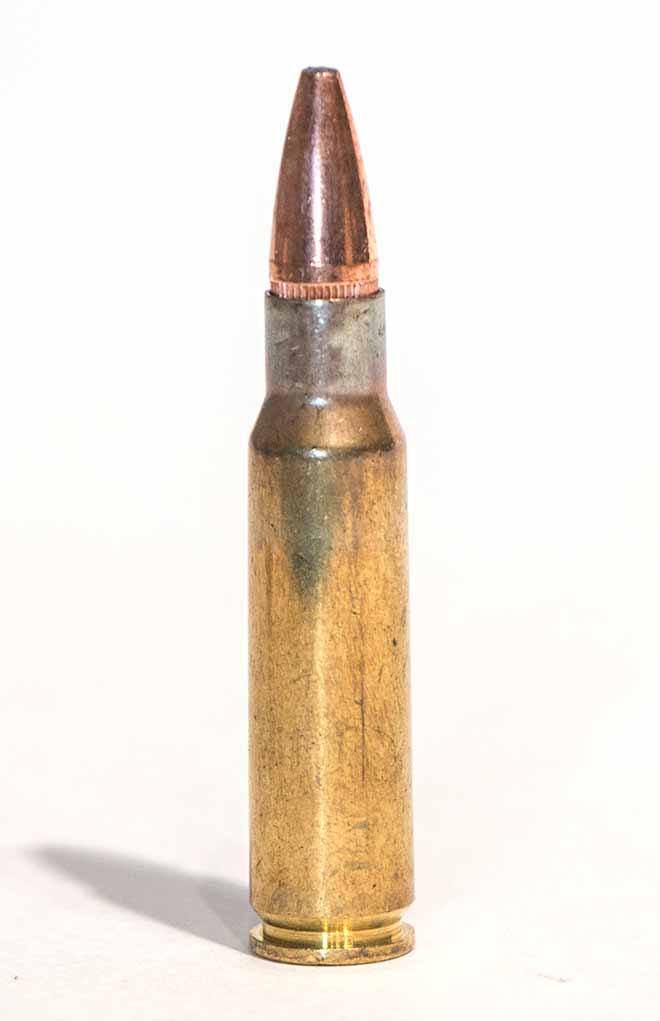
The truth is that the .30 Remington AR — which requires a specially configured bolt — will push a 125-grain bullet to 2,800 fps and a 150-grain bullet to almost 2,600 fps. This level of performance is unmatched by any cartridge compatible with the AR-15 platform, and it nearly duplicates the performance of the respected .300 Savage. Sadly, no .30 Remington AR AR-15s are currently being produced … and good luck finding factory ammo. To make it even less appealing, you cannot make .30 Remington AR cases from any thing else.
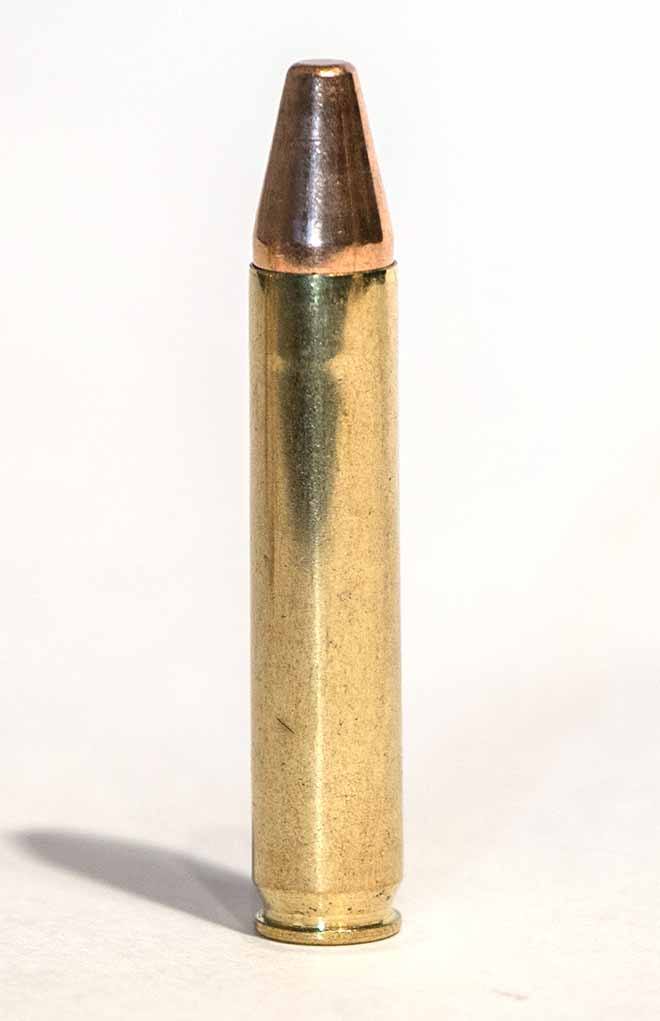
The .350 Legend
The .350 Legend was created specifically for deer hunting in states now allowing straight-wall cartridges. However, it’s too early to tell if will be a hero or a zero.
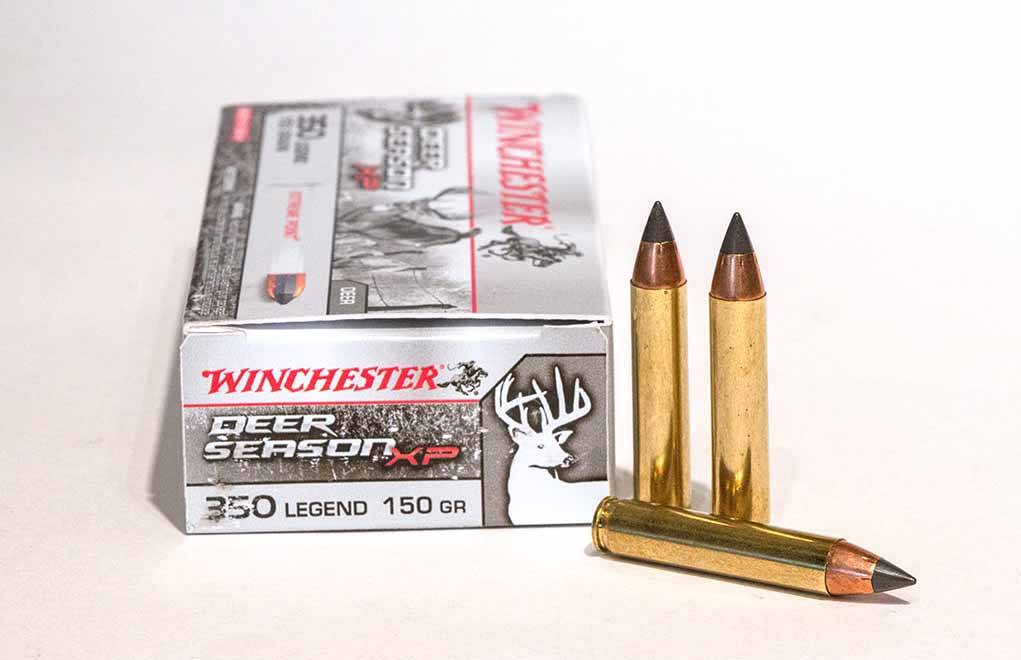
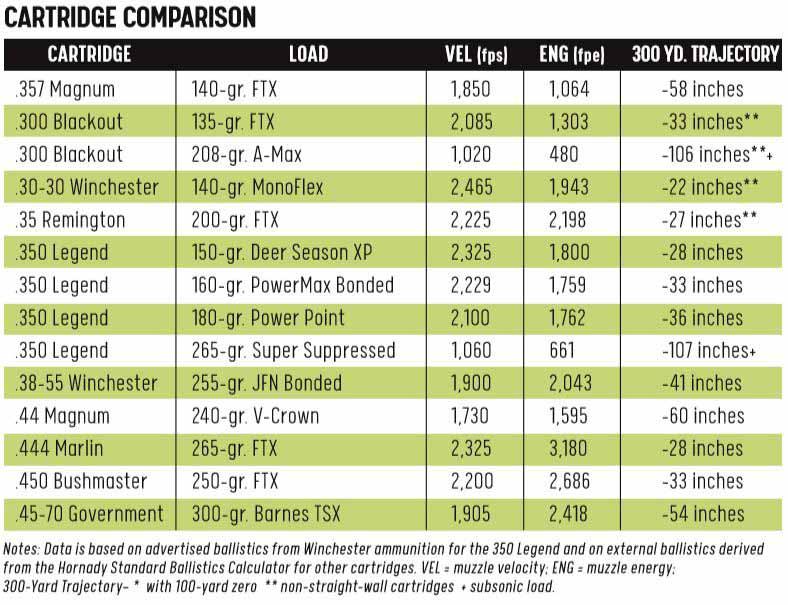
Created specifically for deer hunters in states now allowing straight-wall centerfire rifle cartridges, the .350 Legend is essentially a .223 Remington case with no taper and a .35-caliber bullet. At the muzzle, it can produce more energy than the .223 Remington, .30-30 Winchester and .300 Blackout, and it recoils 20 percent less than the .243 Winchester.
Winchester is offering a wide array of factory loads for the .350 Legend, with bullet weights ranging from 145 to 265 grains. Make no mistake: This is a cartridge designed for deer hunting. Could it be used for other things? Things such as feral hogs? Sure. Personal protection? Sure. Will it find the love and affection of AR-15 aficionados, or will it go the way of the .30 Remington AR? That remains to be seen.
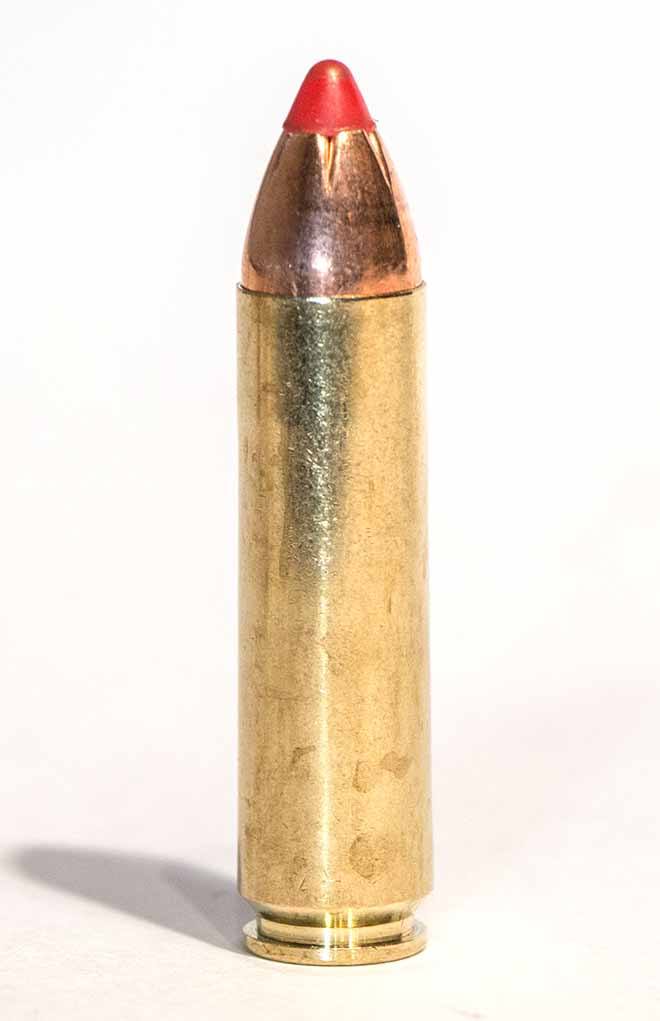
The .450 Bushmaster
The .450 Bushmaster is best suited for whacking hogs and for states allowing straight-wall centerfire cartridges for deer hunting.
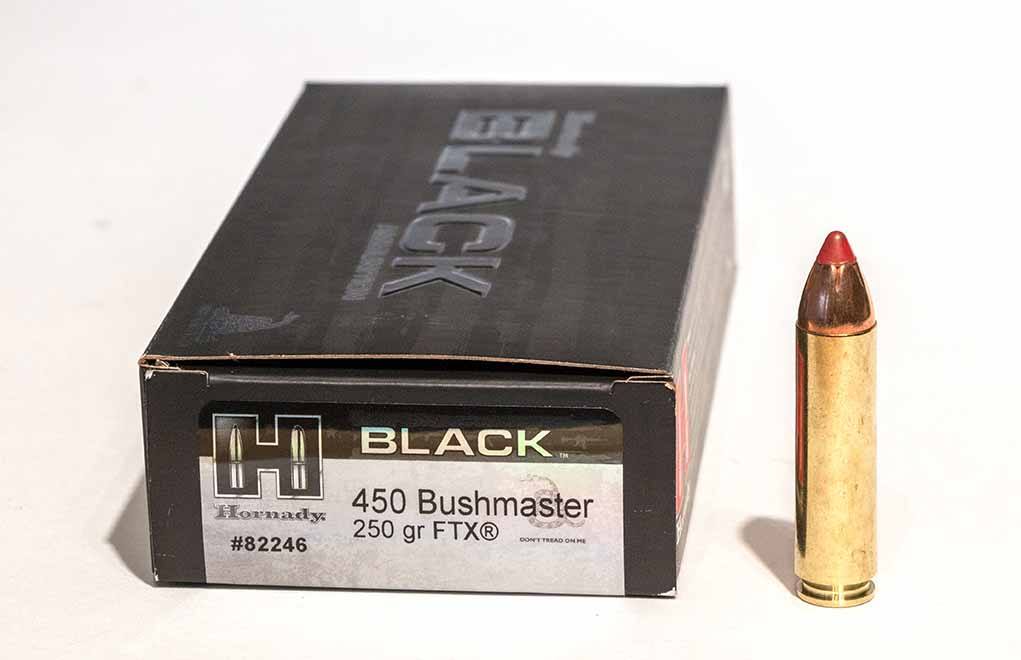
Introduced about a decade ago, it looked as if the .450 Bushmaster was going to be the hottest new thing for the AR-15. It was for about a year. Then, it seemed as if no one cared anymore. It’s a powerful cartridge; it will push a 250-grain bullet to 2,200 fps. But, it has a trajectory like a rainbow, and the recoil will get your attention in a lightweight AR-15. Until last year, it looked as if the .450 Bushmaster was the .450 “Forgotten.”
But then, the same new laws that spawned the .350 Legend brought the .450 Bushmaster back to life. Hunters in states now allowing straight-wall centerfire rifle cartridges for deer are flocking to the hard-hitting .450 — and not just in the AR-15: Several manufactures are offering bolt-action rifles for the Bushmaster, and they’re selling as fast as they can be made.
Make Your Choice
If you’re looking for an AR-15, the best thing you can do is consider the tasks you’ll be asking the rifle to perform. You can never really go wrong with the .223 Remington, unless you’re in a state in which it’s not permitted for big-game hunting and big-game hunting is what you want to do. If that’s the case, the 6.5 Grendel or .300 Ham’r is likely your best option.
For varmints, the .224 Valkyrie is probably the best choice, and if a straight-wall cartridge is what you need, the new .350 Legend might just be the bee’s knees. But here’s the thing: With the AR-15, you can always have multiple upper receivers, which means you can have multiple cartridges at your disposal at all times. That’s the real beauty of the AR-15. It is the most versatile and adaptable rifle ever created.
Giving you concrete goals to reach, a shot timer is an indispensable tool for training your handgun draw.
Famed Old West lawman Wyatt Earp was fond of saying, “Fast is fine, but accuracy is final.” This age-old gunfighting wisdom has trickled down through the years and is still with us today. Any defensive firearms trainer worth his or her range belt will emphasis accuracy over all other factors. If he or she doesn’t it’s time to turn a cocked eye. That said, focusing on well-placed hits isn’t license to toss an expedient draw out the window. Far from it.
A speedy draw that doesn’t affect your accuracy is a valuable skill, one that might prove a life-or-death margin. And there’s no more apt tool to pick up the pace than a shot timer. Though some might think otherwise, the device isn’t pigeonholed strictly to recording split times between shots. Given shot timers are programmable—particularly the delay function and par time—they’re absolutely a dynamite implement for training any handgun skill of which time is of the essence. The draw is one such example, reloads are another.
While you don’t necessarily need a shot timer to hone either, it does provide a big advantage compared by going just by feel. In particular, you get quantifiable feedback. Essentially, you develop a concreate baseline from which you can improve, otherwise you’re fumbling around with guesswork. Not a good habit to get into.
Equally important, a shot timer is as useful in dry-fire training as it is in live. More than anything, this takes away any excuses for not improving your draw, including legitimate ones, such as a firing range not allowing it. Your living room, den or gun room typically will suffice, you just have to make the time.
Speed is obviously the goal if you start working on your draw or reloads under the clock, but not at the expense at anything else. Presentation, sight alignment, trigger control and follow through all should remain fundamentally sound. Because no matter what, Earp had it right—accuracy is what will get you out of a gunfight alive.
It’s no secret that readers of Gun Digest have been described as “long-time firearms enthusiasts” — “super users,” if you will — with a deeper-than-average knowledge of firearms. That level of firearms knowledge comes from a lifetime of learning.
With that long-term interest in firearms often comes a considerable investment. It’s not at all unreasonable to think that many of the gun gurus flipping these pages have more than $50,000 invested in firearms and related items. In fact, I know many who far exceed that level.
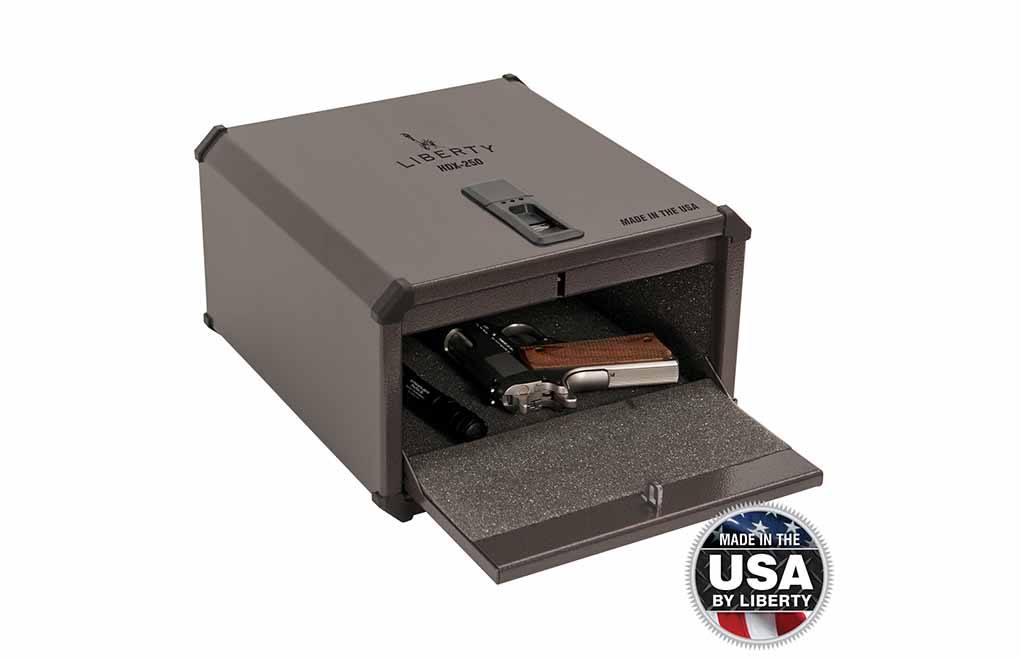
A small, fast-access safe provides instant personal defense when positioned near sleeping quarters. Because of this safe’s biometric lock, a defensive gun can be accessed in under one second.
That information, along with receiving my annual bill for insurance on my guns, as well as a story from a client named Alan, prompted me to consider this article on the subject. For Alan, the story was a sad one. For you, I hope for much brighter days. But, as the saying goes: Fortune favors the prepared.
The Tale of Alan
Alan had two gun safes, but he wasn’t a regular shooter. Although he kept most of his guns in safes, like many people who have no children in their homes, he kept a revolver in a nightstand drawer and a .22 rifle in a closet.
Coming home from work one day, he noticed the door was open. On the surface, nothing was missing, but upon looking closer, he discovered the revolver was gone. He then checked the closet and found the .22 rifle still there. He went into the room with the gun safes and found one safe standing open. Some of his guns were missing. He checked the other safe; it was locked. But when he opened it, he found some of his best guns were missing. He estimated his loss at $40,000. His homeowner’s policy paid $2,500.
This isn’t an unusual occurrence. Statistics show that a burglary occurs in the United States every 9 seconds, and there are about 350,000 home fires annually. Of course, not all burglaries involve loss of firearms, but I suspect most losses aren’t sufficiently covered by insurance. Besides financial loss, the possibility of your stolen firearm being used in a crime is daunting.
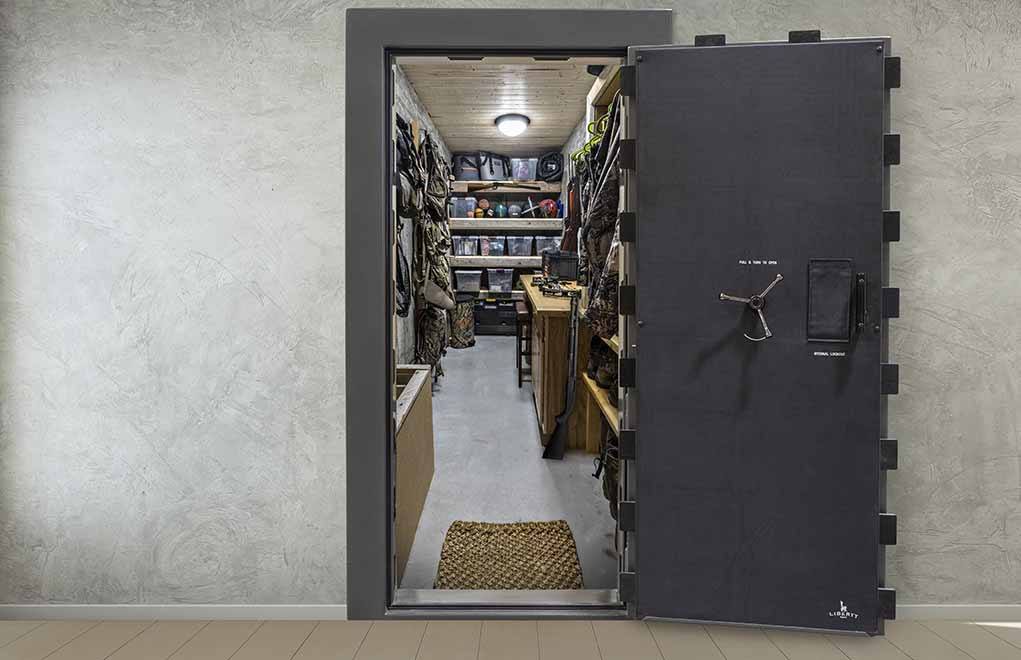
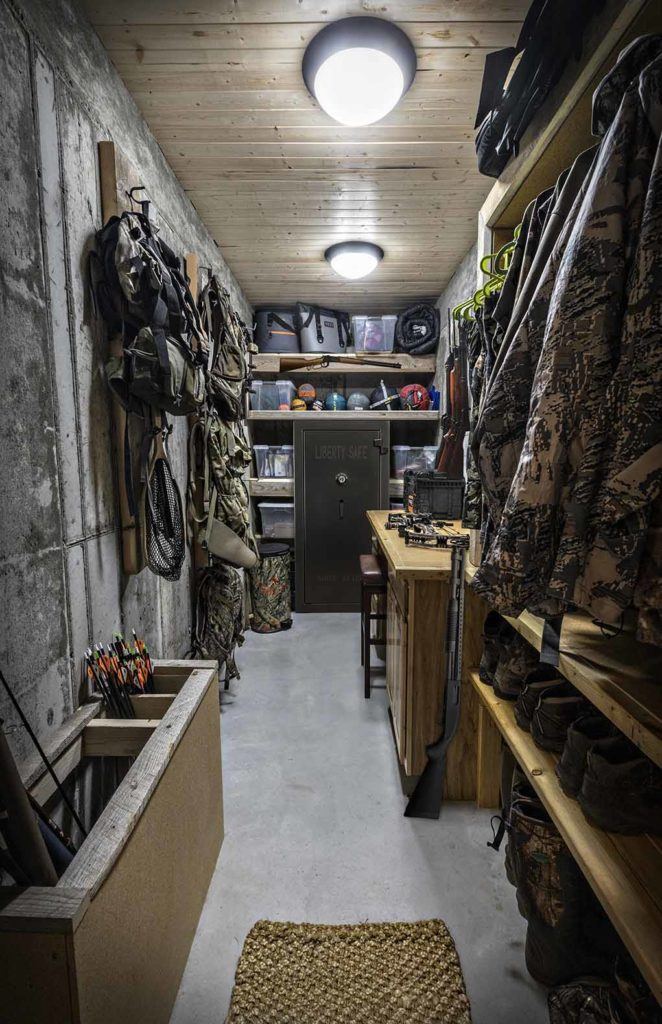
Arguably, the optimum solution is a built-in vault system. Liberty’s Tactical 12 vault door can be built into the basement of a home and provides the ultimate level of fire and theft protection.
Several years ago, when I was running our state’s rifle team, a Director of Civilian Marksmanship M14 was stolen from the home of a team member. It was later discovered in a drug raid in Miami, Florida. (As you might suspect, most firearms used in crime and gang-related activity are stolen.)
Of course, basic firearms security begins with a safe and normal security measures, but there are many other considerations. In Alan’s case, the safe he found open had an electronic lock — and he never figured out how it was compromised. The other safe had a rotary mechanical lock, but it was left in the “fast-access” setting, where only one number opens the safe. Apparently, the thieves knew about that feature and simply opened the safe. So, even if safes are securely locked, theft is still possible.
Several years ago, Mike, a member of my rifle team, had one safe completely stolen, and another was staged at his front door when he came home from a daily routine. Apparently, the thieves knew he owned a lot of guns and had figured out his schedule.
Mike later suspected he was watched and that the thieves left the other safe because they were alerted that he was coming. His safes were bolted to the floor, but the thieves had gone under the house and removed the nuts from the bolts through the floor. Yeah, that’s determination! The only certain deterrent of locks is to prevent theft by honest people. Determined thieves are difficult to deter.
Storing in Safes
Safes are a major part of firearms protection. As in almost any other field, the best costs more money.
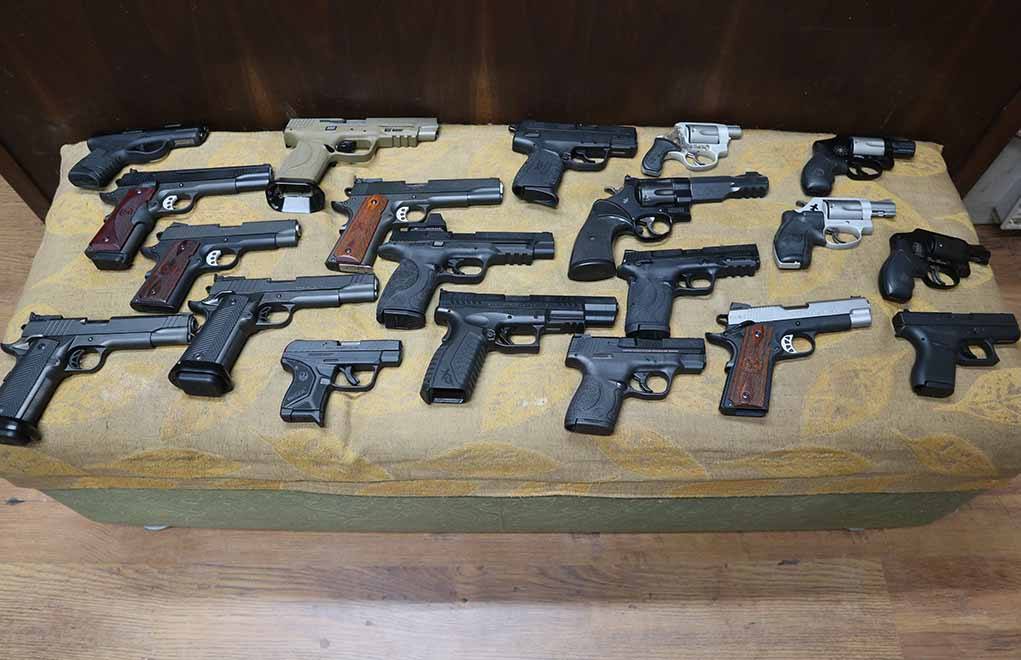
Guns that are current production models don’t need extensive documentation of condition. A simple group photo will do fine for insurance purposes.
The first thing to note is that any conventional gun safe with a fire endurance rating of UL 72 Class 350 will provide basic protection for the safe contents in the event of a fire. This basic protection means that the gun safe will keep an interior temperature of below 350 degrees (F) for 2 hours when exposed to a fire burning at 1,700 degrees or for 1 hour at 1,850 degrees, depending on the unit’s construction.
Even with that rating, there’s still some possibility of damage: Imagine putting your favorite guns in your oven and setting the heat to 350 degrees and the timer for 2 hours. Safes are great, and they’re a necessity, but there’s only so much a safe can do.
Besides fire ratings, lock systems are the next decision you’ll need to make. Mechanical locks are more secure and reliable than digital locks, but they’re much less convenient. If you’re constantly accessing the contents, an electronic lock might be a better choice, because you’re less likely to leave the safe unsecured. Some electronic locks offer a keyed backup system, and this option works great.
Consider bolting in the safe, adding the use of alarm systems and simply living under the radar. All these little things contribute to an additional level of theft security.
Storage Methods
In the past, I was an avid collector of classic shotguns, and numerous times, I’ve seen really nice guns that were damaged by being stored in gun cases. Gun cases can hold moisture and prevent air from circulating, and they have probably ruined as many guns as they have protected because of those who lock a case and forget it.
You should inventory your guns on a regular basis, checking their condition and upgrading your list for insurance purposes.
Commercial gun socks allow air to circulate and will prevent nicks and scratches when guns are moved around in the safe. Often, collectible guns are stored for long periods of time without attention, so make sure you open the safe and wipe them down from time to time.
While I’m fully aware that the following statement will bring the ire of some, I’m a strong proponent of using a cloth dampened with WD40 to wipe down guns. WD40 is a remarkable product that’s widely misunderstood. It isn’t a lubricant; it’s a water displacement product. I’ve used it for decades without a single problem, both with wood finishes and metal. During that time, I’ve never experienced a problem, and I use it exclusively to wipe down guns.
Insurance for Assurance
A safe is the first line of defense in protecting your firearms investment, but Mike’s story indicates just how difficult it is to protect it from truly determined thieves. While we normally think of collectible firearms as the most likely target because of their value, stolen handguns can be very valuable on the black market.
In both Mike and Alan’s cases, their homeowner’s insurance didn’t cover the value of their loss, because such policies have a pretty low limit of coverage on certain items. Most homeowner policies offer riders for firearms and similar items, but the cost per thousand is quite high.
Several years ago, I added a rider to cover my guns. It was quite expensive. However, while at SHOT Show, I found Collectibles Insurance, a company dedicated to coverage of firearms and other collectibles such as art, antiques and coins. I investigated and found a savings of more than 50 percent over my standard insurer.
You determine the level of coverage you need, and the cost per thousand is based on the level selected: The higher the level, the lower the cost per thousand. To determine your cost, simply call Collectibles Insurance with a level of coverage, and you will be given a quote. If you have a loss, the value of the lost items is determined by the company through standard methods, with rare and collectible item values based on searches of auctions and dealer networks. With standard modern firearms, only basic record-keeping is required. However, for high-value and rare firearms, documentation of their condition is important. Photographs are also important in helping dealers and auction houses determine value.
Records: Taking Notes
Of course, record-keeping is important and should be upgraded on a regular basis. Your records should cover serial number, model, caliber, condition, estimated value and any accessories or modifications. Guns no longer in current production should be documented with photographs. Store records in a separate location from the guns — preferably on a thumb drive and in another location. It’s a good idea to recheck your inventory at least once a year. Check for rust or other issues at that time as well.
I know it sounds tedious and potentially unnecessary, but in the event of fire or theft to your firearms collection, that thumb drive containing meticulous records will become as invaluable as your collection.
For many firearms owners, their total firearms inventory is as valuable as — or more valuable than — the family vehicle. Unlike most cars, gun collections appreciate in value. Therefore, it only makes sense to do everything you possibly can to protect that investment so it can be passed down in excellent shape as part of your legacy.
The 6.5 Creedmoor has swept the rifle world, but is its performance up to snuff in the multi-purpose Steyr Scout rifle?
Why The Steyr Scout Rifle Beat Others In This Class:
Negative drop at the comb reduces felt recoil.
SBS bolt system’s roller wheel can be locked, reducing the risk of a negligent discharge.
Full-length rail allows a multitude of sighting options.
Features built-in backup iron sights.
Threaded muzzle for the easy addition of a suppressor.
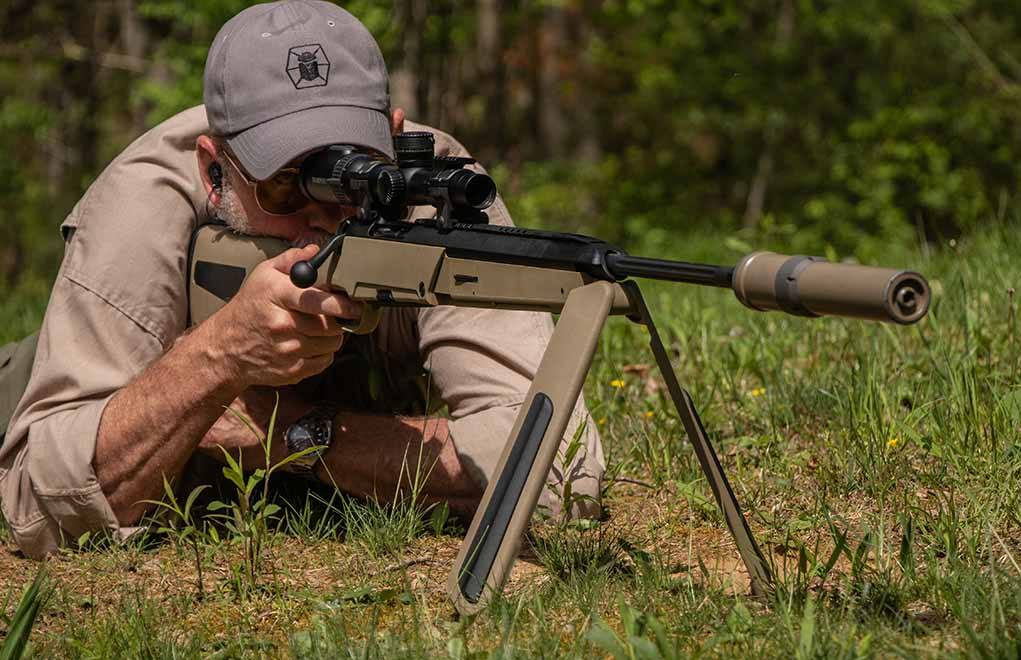
Integral bipod deploys quickly.
The Steyr Scout Rifle has been around since late 1997. It was inspired by former Marine Lt. Col. and American Pistol Institute (now known as Gunsite Academy) founder Jeff Cooper. Steyr followed a codified blueprint established by Cooper. Its goal was to build a rifle complying with his notion of what an ultra-handy, general-purpose rifle should be. Cooper believed in the one-rifle concept, offering that while it might not be perfect at everything, it was capable of doing just about anything.
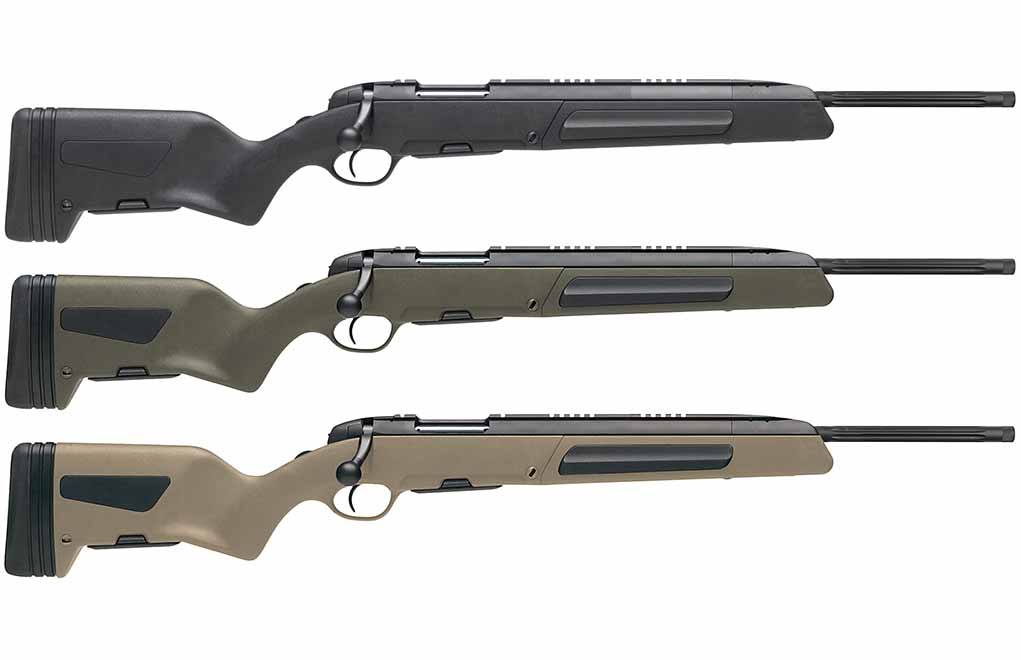
The Steyr Scout Rifle in 6.5 Creedmoor is available with several different-colored stocks.
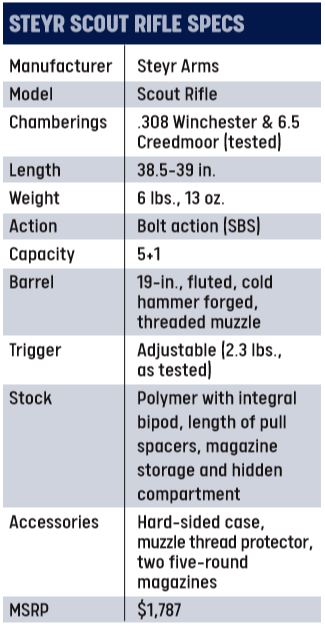
When introduced, the Steyr Scout Rifle had a suggested price north of $2,000. That was a bit steep for everyone except Cooper’s followers and those who bought into the concept of a one-rifle battery. Ultimately, the rifle would also be offered in .243 Winchester, 7mm-08 Remington, .223 Remington and the heavy-hitting .376 Steyr. Over time, all but the .308 Winchester (the original chambering) were dropped from the lineup.
However, for 2019, Steyr introduced its Scout Rifle chambered for the 6.5 Creedmoor.
6.5 Creedmoor and Scout Compatibility
The 6.5 Creedmoor is not a cartridge many would think suitable for scout rifle chambering. One of the aspects of a scout rifle Cooper felt was paramount was that it be compatible with a cartridge of universal distribution. His thinking was that this would allow the owner to secure ammunition almost anywhere.
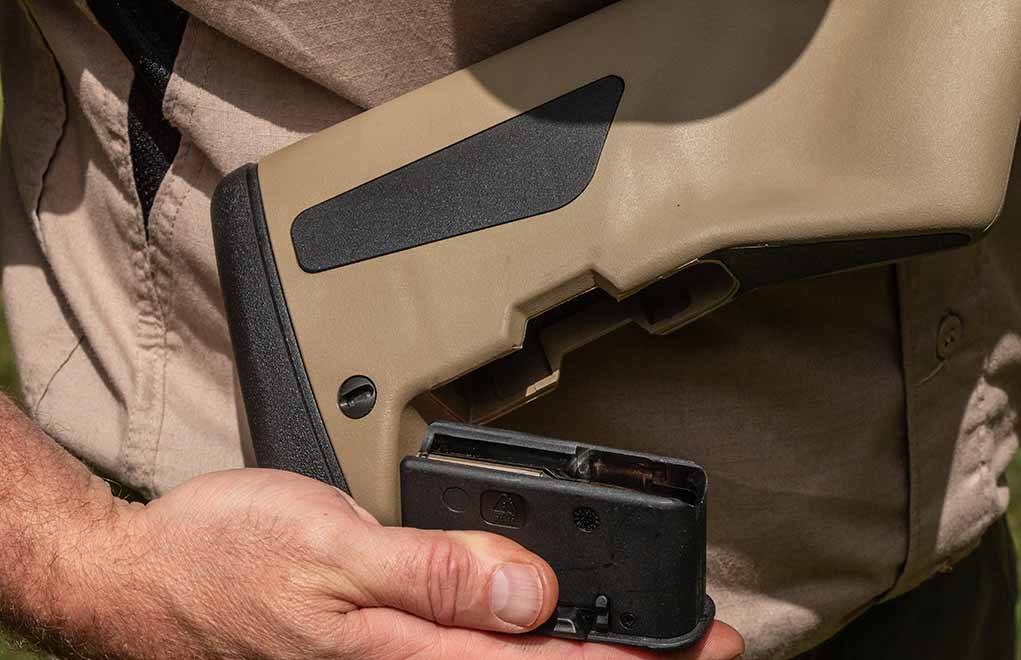
How many other rifles do you know of that permit the storage of an extra magazine in the butt stock?
He also felt the cartridge should be suitable for game weighing up to around 1,000 pounds. Some of those who attend the scout rifle “church” argue that Cooper would never have approved. Others feel the 6.5 Creedmoor is just a long-range cartridge.
For starters, if a cartridge is suitable for long-range use, then by ballistic fact, it will also work at closer distances. So, that argument has no standing.
The 6.5 Creedmoor—a very close ballistic twin to the Swedish-moose-killing 6.5×55 Swede cartridge—will work well up close and is really only limited at distance by the projectiles it fires. As for what Cooper might have thought about this combination: With all due respect, who cares? Not only is he not here to voice his opinion, but who’s to tell you what cartridge best suits your needs.
The integral bipod on the Steyr Scout Rifle is a standard feature. It does allow for cant but is not adjustable for height.
Based solely on its configuration, and from a pragmatic position, the Steyr Scout Rifle is a truly fantastic general-purpose rifle. By the same token, the 6.5 Creedmoor is a fabulous general-purpose cartridge. I’ve used it with great success for everything from coyotes to moose and have used or seen it used on targets as close as 40 yards and out beyond 500.
What many are not familiar with is the Steyr Scout Rifle. So, let me explain why it’s so special.
Steyr Scout’s Stock
The stock on the Steyr Scout Rifle is made from polymer. When it was introduced in 1997, that was less common than it is today. But this is not just a plastic stock. You see, the engineers at Steyr, with input from Cooper, created a stock that was, by any measure, well ahead of its time.
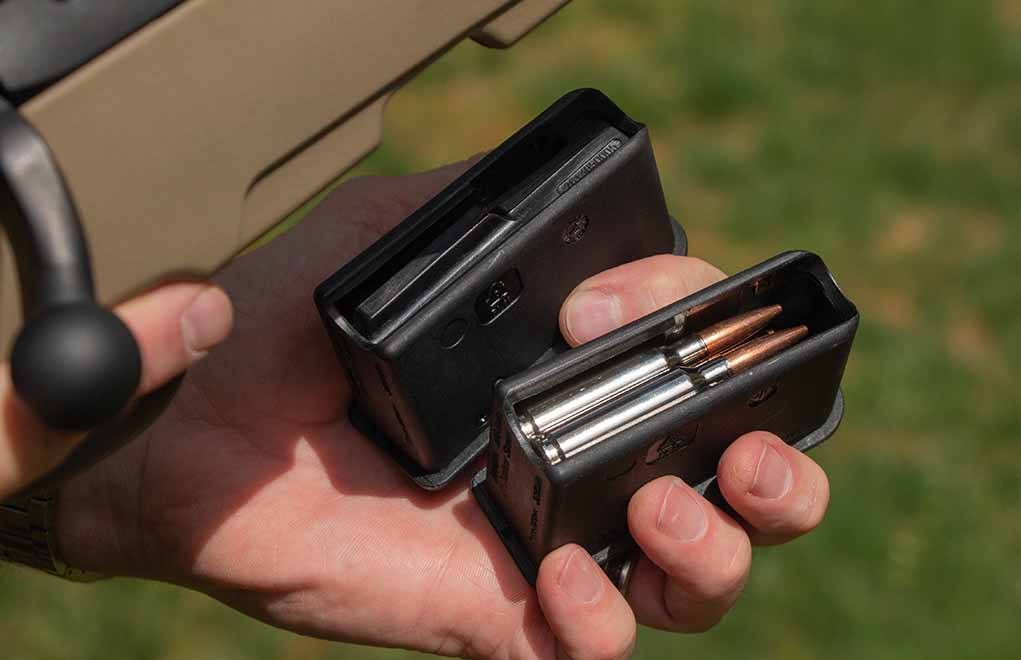
Because the Steyr Scout Rifle has two magazines on board, it makes conducting a tactical reload in the field very easy.
Let’s start with one of the least obvious features: the negative drop at the comb.
Most rifle stocks show drop from the nose of the comb to the heel. This has been a long-standing tradition, and it’s how stocks are shaped so shooters can get their eye behind open sights. The problem with this concept—and it boggles the mind that we’re still building stocks this way—is that it increases felt recoil because it drives the comb into the shooter’s cheekbone. Not only that, but common open sights are now about as rare as unicorn poop. The comb on the Steyr Scout Rifle rises from the nose to the heel. This helps to better position the eye behind the optic and allows the comb to slip painlessly past the shooter’s cheekbone.
But, wait … there’s more. The stock is fitted with a spacer-style length of pull adjustment. Yeah, I know, that seems common today. But remember, this rifle was introduced in 1997. As with many modern rifles, you can adjust the length of pull by removing or adding spacers. The butt of the stock also has storage for an additional detachable magazine, and there’s a hidden compartment in the grip cap in which you can store other essentials. One of its least-known features is a double-detent magazine well that allows you to hold the full magazine in reserve as you feed and fire individual cartridges. And, get this: Integral to the forearm is a retractable bipod with a built-in cant feature.
Steyr Scout’s Action
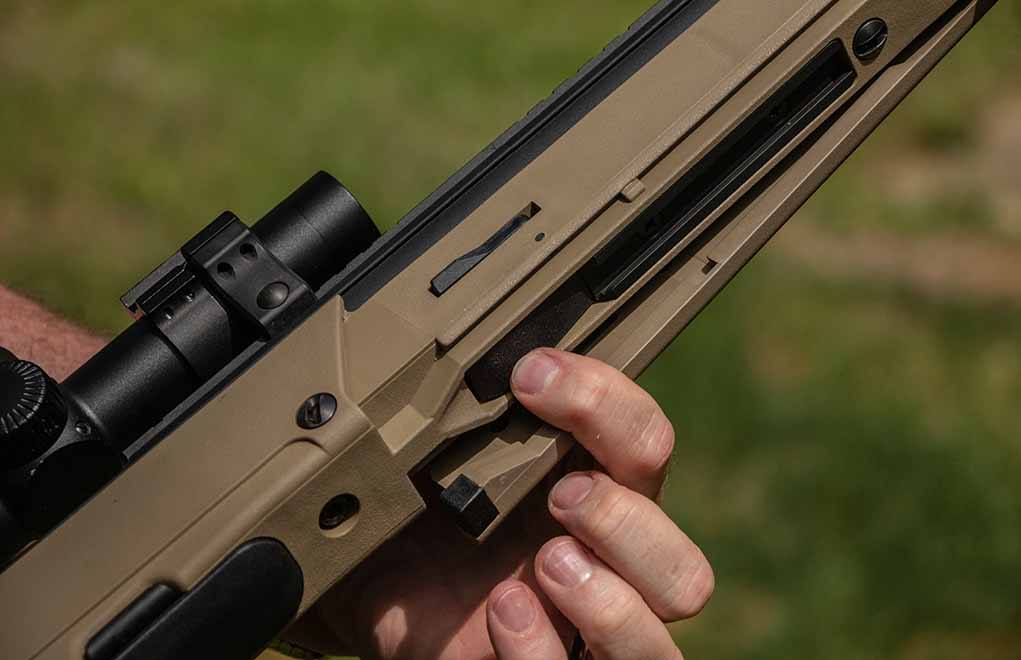
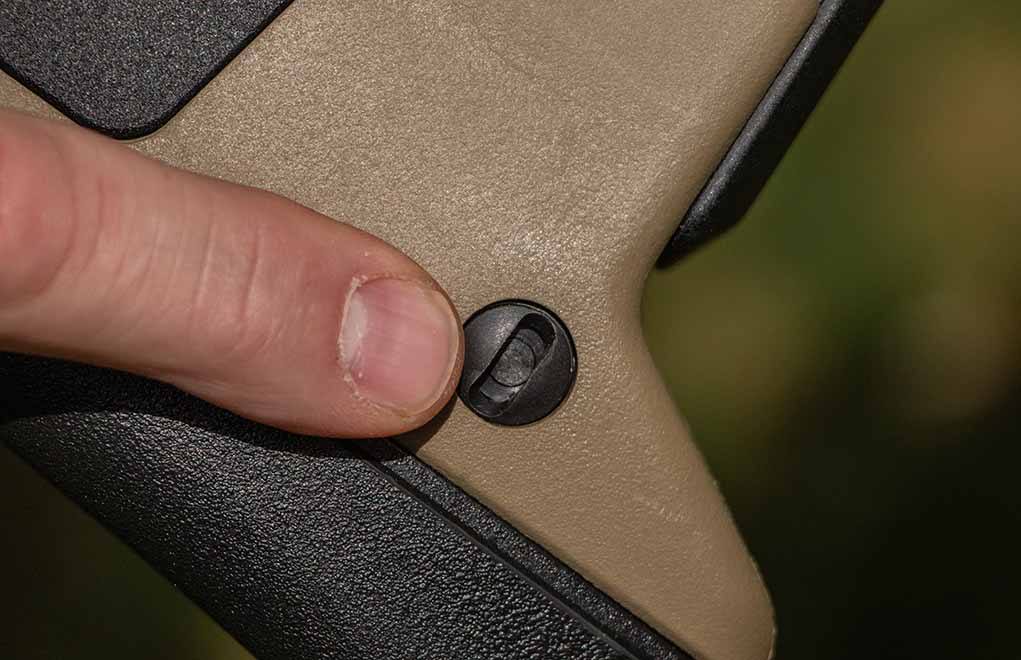
Steyr built its Scout Rifle around the company’s SBS bolt system, which very well might be the safest bolt-action ever engineered. It has a three-position safety that is configured as a roller wheel and is located on the top center of the grip just behind the action. The roller wheel has a lock button that must be depressed to move the wheel to the center or most-forward position. And, while in the most-rearward position, the bolt is locked, and the sear and firing pin are blocked. This design feature was incorporated so that paratroopers could safely jump from airplanes with a loaded and ready-to-fire rifle.
The Steyr Scout Rifle comes with five hammerhead sling swivel inserts. One is located on each side of the toe of the butt stock; two are located on each side just forward of the balance point; and the fifth is located in the center of the bottom of the forend. (Photo: Sabastian “Bat” Mann)
When the safety wheel is moved to the center position, the rifle is still on “safe,” but the bolt can be operated, allowing the weapon to be unloaded or loaded in that condition. And then, of course, the most-forward position is the “fire” position. The concept takes a bit of getting used to, but after a day on the range, you learn to depress the actuation button on the safety to release it and slap the bolt, locking it down when shooting is complete.
The Rail
Perhaps the most distinguishing feature of the Steyr Scout Rifle is its full-length rail. Integral to the action, and encircling the barrel in a free-float format, this rail allows for a multitude of sighting options. You can mount a traditional rifle scope, scout scope or a red-dot or reflex sight. With quick-detach rings, you can do all this without loss of zero and switch between the system that best suits your needs at any given time.
Cooper had a serious distrust of optical sights. Supporting his position was that prior to the turn of the century, the failure rate of optical sights was pretty high. Because of this, he mandated that a Scout Rifle be fitted with emergency backup iron sights. Steyr listened to Cooper: The Steyr Scout Rifle has a flip-up rear aperture sight and a pop-up post front sight. They are fully adjustable for windage and elevation.
Suppressor Ready
Steyr recognized that suppressed fire is becoming more prevalent in America; so, to make its 6.5 version of the Scout Rifle even more appealing, the company added a threaded muzzle. If there was one thing Steyr got wrong, it was the thread pitch used, which is ½X20. This means you’ll need an adapter to attach almost any suppressor.
Of course, I would be remiss if I didn’t mention that one of the attributes—maybe the most important one—of the Steyr Scout Rifle is its handiness. Attaching ½ pound and 8 more inches to the end of the barrel destroys the handling characteristics of this rifle. That having been said, you might want to use your Steyr Scout in a situation for which handiness is not at the top of the list.
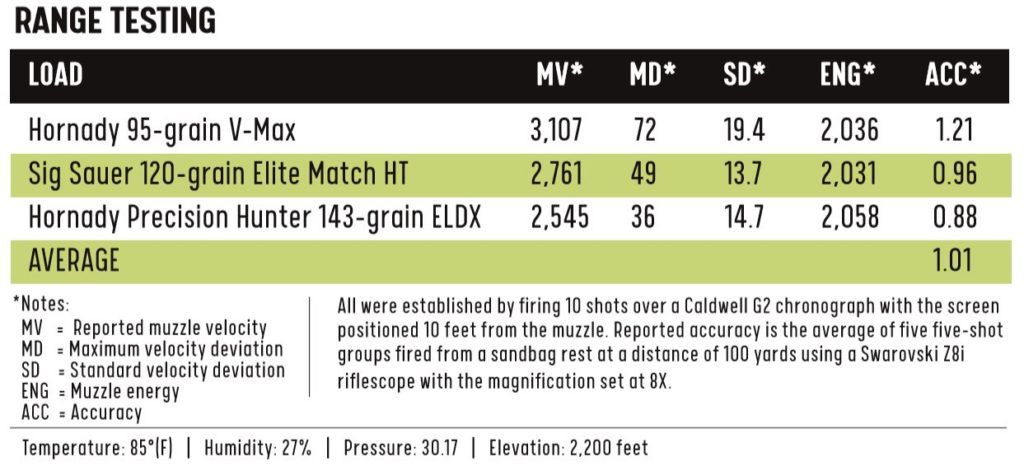
To test the 6.5 Creedmoor version of the Steyr Scout Rifle, I mounted a Swarovski 1-8X Z8i riflescope in the traditional position. I also attached the thread adapter and screwed on my StingerWorx Hunter suppressor. Then, from the bench, I fired five five-shot groups with three different loads. The best group fired was well under an inch, and the largest didn’t even approach 2 inches. The average for all 15 groups with three different loads was 1.01 inches. That’s about on par with the accuracy I’ve seen from the half-dozen or so Steyr Scout Rifles I’ve fired that were chambered for the .308 Winchester.
The only negative comment I can muster about this rifle is that, unlike the .308 Winchester versions, the 6.5 Creedmoor cartridge must be inserted into the magazine for it to feed. If you drop a 6.5 Creedmoor cartridge in through the ejection port—on top of an empty magazine that is fully inserted—the cartridge will most likely bind and not chamber.
I’ve worked with two 6.5 Creedmoor Steyr Scouts, and with one, this occurred 100 percent of the time. With the other, it occurred about 50 percent of the time. As a side note: If the magazine is in the retracted position on the second detent and has rounds in it, you can drop that 6.5 Creedmoor cartridge through the port, and it will go right into the chamber when you close the bolt.
The Verdict
We’ll likely never know how Jeff Cooper would have felt about a Steyr Scout chambered for the 6.5 Creedmoor. We know he was OK with the rifle in .243 Winchester, 7mm-8 Remington and .376 Steyr. We also know he despised the rifle in .223 Remington.
In my opinion, the 6.5 Creedmoor, because of its versatility and light recoil, is an excellent addition to the Steyr Scout Rifle. I think it will help Steyr sell more rifles, and I think it will introduce more folks to the scout rifle concept Cooper spent so much time developing.
And, I should probably add one more thing: With the purchase of any Steyr Scout Rifle, Steyr is offering two days of free Scout Rifle training at the Steyr Academy—that’s a $650 value.
What is a gun without ammunition? Or ammunition without a gun? Not a lot, other than some shiny metal and a bit of nice walnut … maybe fiberglass-reinforced polymer. Each is essential to the other, like engine and gas or martini and gin. Someday, the same might be said about a range-finder and binoculars.
A bit of an overstatement, to be sure, yet the two indispensable pieces of shooting gear have a natural and effective symbiosis. After all, if you’re going to identify a target, you should have the capability to range it as well. It only makes sense, especially nowadays. As average shooting distances leap toward the horizon, the marksman is tasked with toting more gear into the field to ensure a hit. Given these circumstances, consolidation is a logical goal.
Thankfully, the industry has responded with a slew of high-power, ultra-precise range-finding binoculars. Less gear, better dope, more hits … what’s not to like about the proposition these nearly obligatory shooting instruments bring to the table?
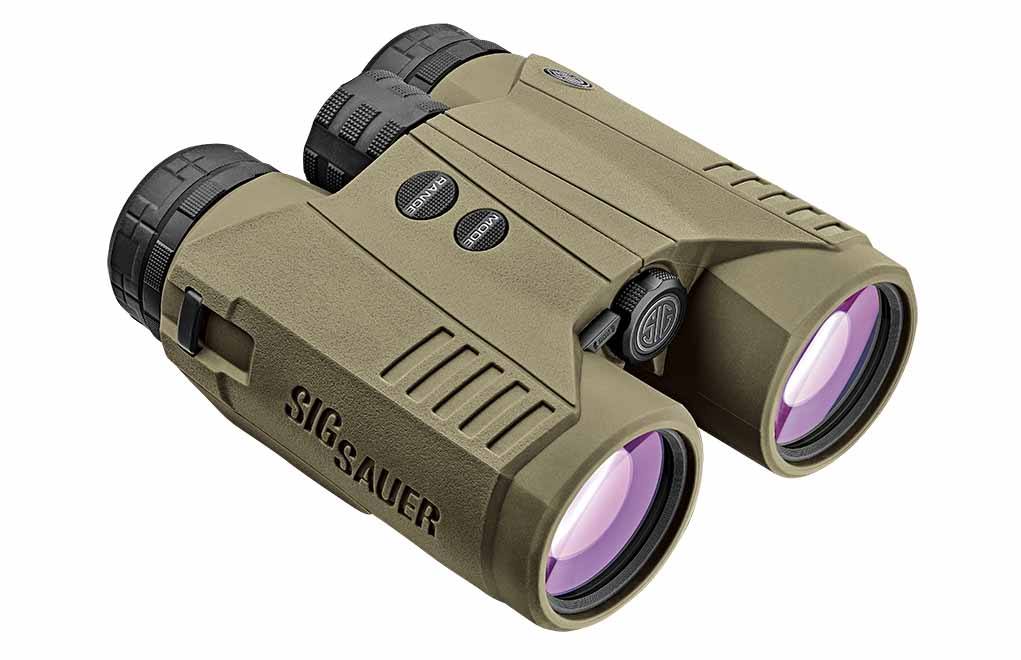
Sig Sauer KILO3000BDX
Sig Sauer has been on its game when it comes to optics. Look no further than its KILO3000BDX range-finding binoculars for proof. In addition to absolute top-shelf glass, the 10x42mm binos have the technological edge on nearly everything out there. It only starts with precise LightWave DSP range finder, a unit powerful enough to take readings out to 5,000 yards (nearly 3 miles!) on reflective targets. Where the magic happens is Sig’s linkable technology. Like many of the company’s optics, its binoculars have a brain—your smart device. It links up with this ubiquitous equipment and Sig’s Ballistic Data Xchange app, crunching the number of that next zip-code target and spitting out a rock-solid shooting solution. Heck, if you happen to run a Sig BDX scope, it goes a step further and precisely plots the proper holdover on the reticle. It’s hard to miss running that sort of system. MSRP: $1,440 www.sigsauer.com
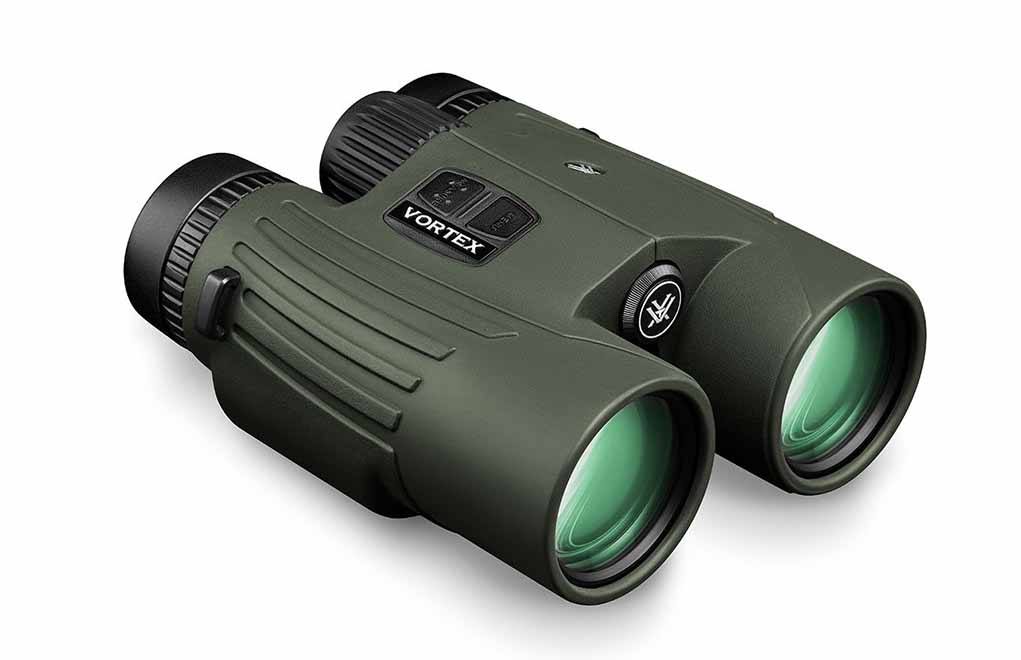
Vortex Fury HD 5000
Vortex fans are fiercely loyal to the brand. Looking through a set of Fury HD it’s little wonder why. Crystalline images and gnat’s ass focus capabilities, it has legs to stand on as binoculars alone. Tack on a range finder that gives you exact readings out to 5000-yards (again a 3 miler) on reflective targets, and you’ve got a piece of shooting gear that’s a sin to forget at home. Designed with hunters in mind, the 10x42mm binos have several features that make them second nature in the field. Chief among these, streamlined push-button controls located at the top right, where your fingertips naturally rest. This makes toggling between its three modes a one-handed ordeal—a godsend when you’re dealing with a load of backcountry kit already. And it offers plenty of measurement modes: Horizontal Component Distance for angle compensation, Line of Sight range and a scan feature. If you’re looking for an edge this elk season, you’ve just found it. MSRP: $1,600 www.vortexoptics.com
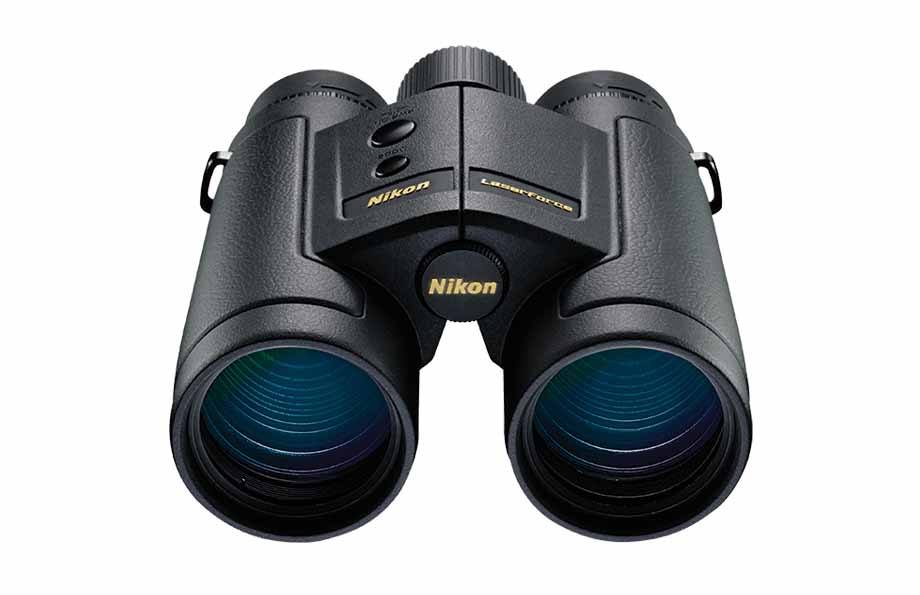
Nikon LaserForce
Yeah, 1,900 yards readings on a reflective target (think 600 yards or so on a deer) might sound pedestrian next to range-finding binos that take things to the extreme. But honestly, unless you’re Carlos Hathcock (and you’re not) Nikon’s LaserForce will cover 99.9-percent of the shooting situations you’ll run across. And it will do so extremely accurately, no matter your vantage. The edge the LaserForce brings to the game is more angular compensation than you can shake a stick at. Nikon lists it at +/- 89 degrees; harken back to grade-school geometry, that’s nearly straight up or down. A definite advantage if you happen to chase game in some of the more rugged corners of the country. Per usual with Nikon, the design is clean, the construction is tight and the glass is good on the 10X42mm binoculars. Outfitted Extra-low Dispersion glass, the LaserForce has excellent edge-to-edge clarity, rich, deep images, and offers exceptional light transmission for dawn and dusk operation. MSRP: $1,200 www.nikonsportoptics.com
The Best Tactical Red-Dot Performance-to-Price Option?
Shifting Winds: SIG BDX Changing Shooting For The Better
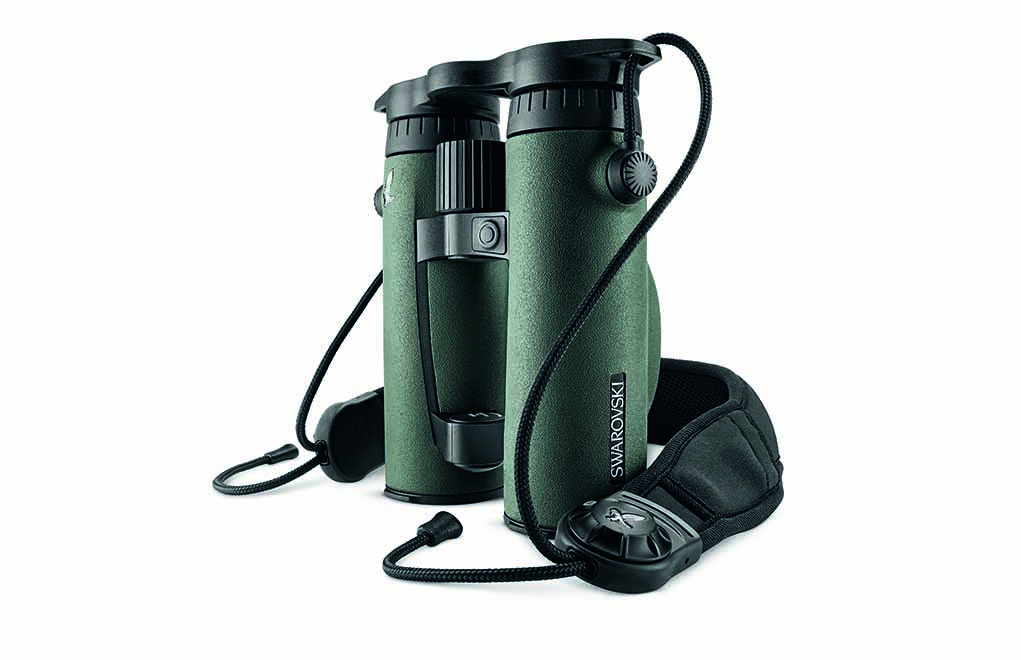
Swarovski El Range
One thing you can expect when you put a Swarovski to your eyes is the industry’s best image. Truthfully, they’ve the clarity to count a fly’s nose hair at 100 yards. The El Range is no exception and worth the money as stand-alone binoculars. However, its range-finding capabilities take the optics to an entirely different level of functionality. Admittedly, the 10X42mm (also available in 8X42mm) binos leave a little to be desired in ranging ability, relatively speaking. Precision shooters might scoff at its 1,500-yard limit. For the rest of the shooting world, it encompasses nearly every ethical field shot in the books. Especially given its powerful angle compensation function. The El Range does, however, have a somewhat strange Achilles heel when it comes to ranging—it won’t take a reading closer than 33 yards. No big shakes for rifle hunters, but disconcerting if you also head out for bow season. MSRP: Starting at $3,632 www.swarovskioptik.com
Bushnell Fusion 1 Mile ARC
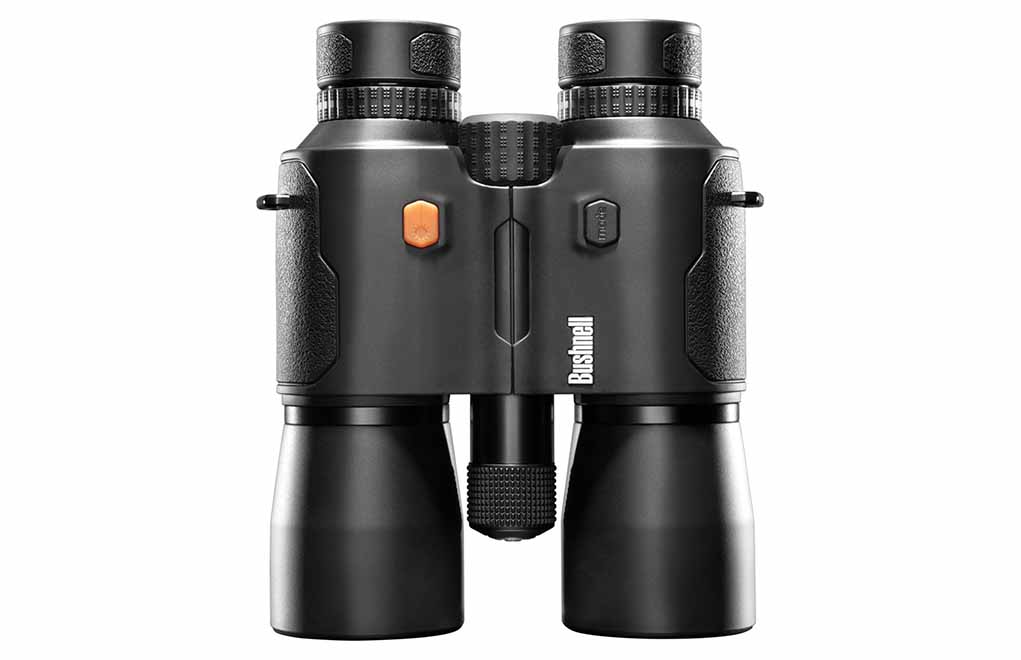
Honestly, there’s a reason range-finding binoculars cost so much—from lenses to laser, there’s a lot of technology packed in them. Given this, Bushnell’s pulled off the seemingly impossible feat of making the precision optics/measuring device fit nearly any shooter’s budget. And they deliver. As its name suggests, the Fusion 1 Mile ranges out 1,760 yards, which is plenty powerful enough for deer, elk or antelope season. Furthermore, it’s not specifically designed for rifle-season trophy shots, though it’s more than capable of doing so. With separate bow and rifle modes, the Fusion 1 Mile delivers readings specific for each tool, such as holdover for rifle and true horizontal distance for bow. The 10X50mm (also available in 10X42mm) binoculars also have the eminently useful scan function, providing constant readings on a moving target or as you scan the geography. Fusion binos are also proportioned right for the field, weighing you down with only 31 ounces. Not bad for a two-way threat. MSRP: Starting at $840 www.bushnell.com
Generally takes three shots before velocity degrades to the point the PCP needs refilling.
At close range, able to take most medium to small game.
When I mentioned I was hunting wild hogs in Texas with an air rifle, a lot of people looked at me as if I were crazy. The usual questions were, “You’re going to shoot a mean-tempered wild boar with a BB gun?” or, “What are you taking as backup when he charges?”
“No, no, no!” I exclaimed.
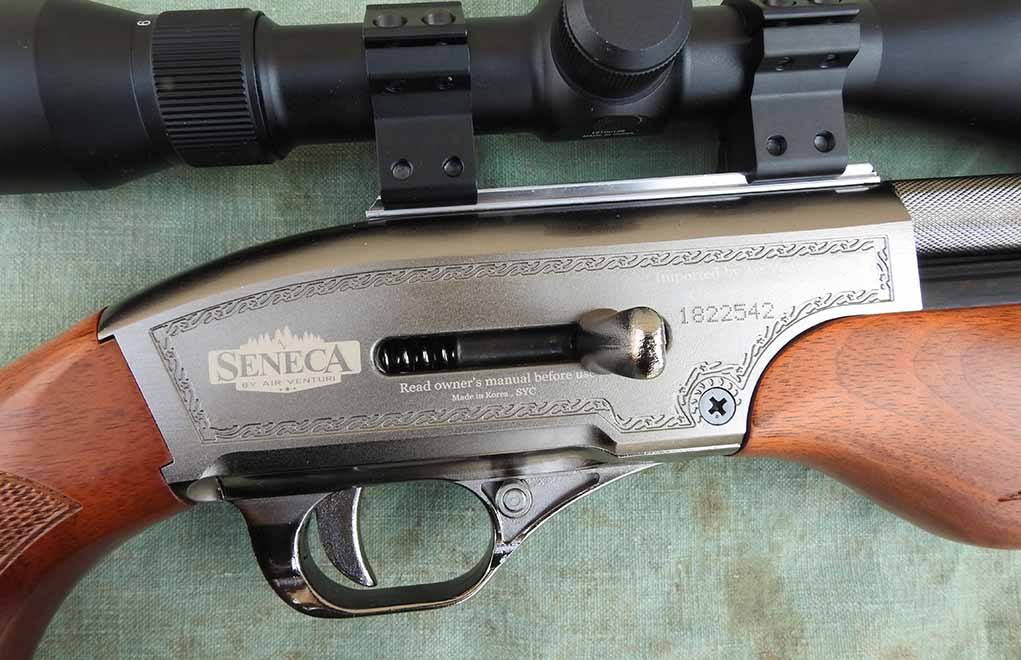
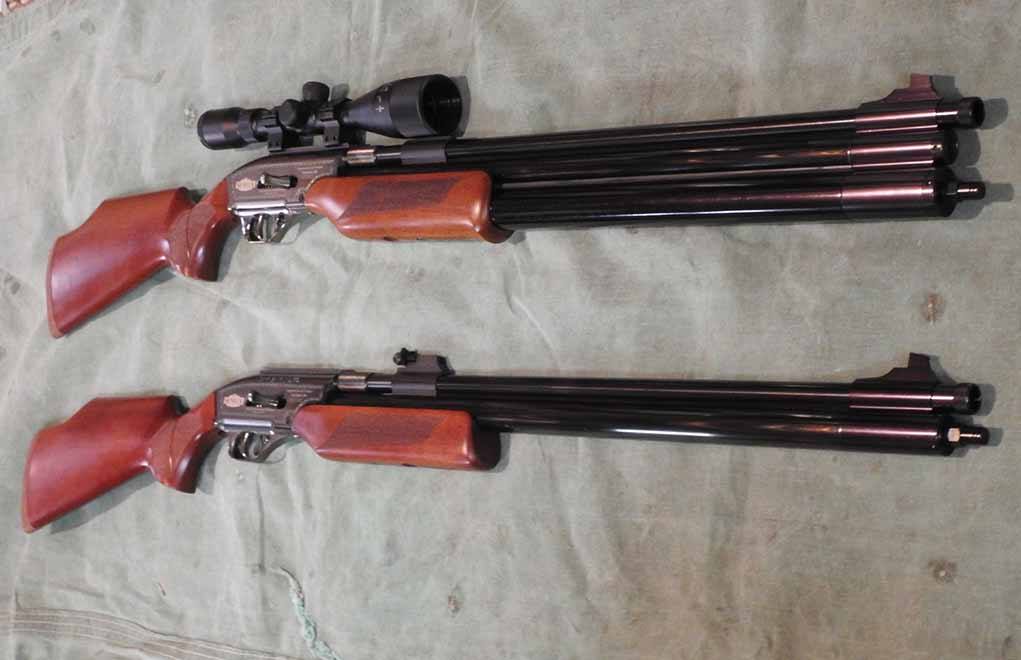
Here, details of the engraved receiver are sharp and crisp. It’s strange to see a bolt handle without an ejection port nearby.
Air rifles have changed since we were kids. And, it’s no BB gun; it’s the 50-caliber Air Venturi Dragon Claw, firing stout chunks of lead—210-grain pellets, if you can call a 210-grain lead projectile a “pellet”—at serious velocities. Test results with a 225-grain projectile hit 679 fps and 230 ft-lbs of energy at the muzzle.
Here’s the kicker: The Dragon Claw also shoots an Air Bolt, a 23-inch arrow designed to be fired out of an air rifle. And, not to overload you, but it will also shoot shotshells and shot-filled projectiles … but that’s another story.
Long, Deep Roots
Big-bore air rifles have been a thing for centuries. You have to go back to at least 1580, the date of the oldest-known preserved air gun, which is located in a Swedish museum. But air guns were really coming into their own around 1780, when Tyrolean gunsmith Bartolomeo Girandoni (1729–1799) developed a .46-caliber air rifle with a removable iron flask that served as the stock. The air-tight flask could be hand pumped (1,500 strokes for a full charge) with air pressure to fire lead balls. These could be loaded 22 at a time into a tube paralleling the barrel. The lead balls were gravity fed to a push-button loading mechanism that placed the ball in battery.
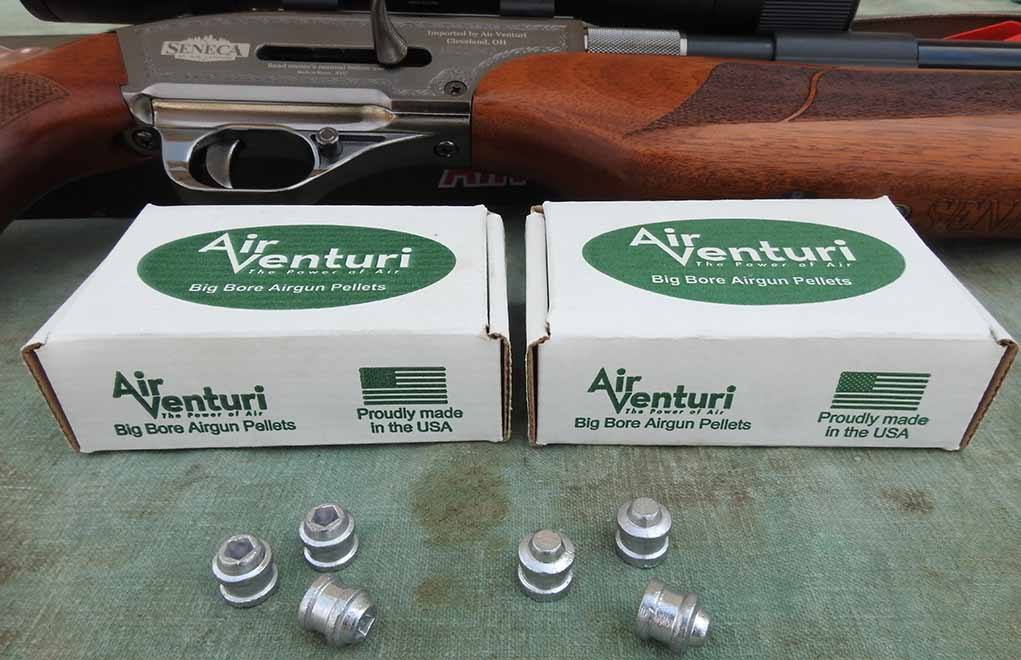
Fifty-caliber air gun pellets, 185-grain hollow-points and 210-grain flat-noses. Though technically correct, it’s hard to define these projectiles as “pellets.”
Closer to home, and more importantly, to U.S. history, Meriwether Lewis purchased a Girandoni rifle that had made its way across the ocean. He took it on his and William Clark’s Corps of Discovery across the Louisiana Purchase and back. According to journals, Native Americans were greatly impressed with this weapon, which produced results without the smoke and fire of blackpowder.
These demonstrations are generally credited as perpetuating an elaborate bluff that impressed and intimidated the tribes, preventing them from amassing a force to overpower the expedition (which never numbered more than 38 explorers). So great was its historical significance as a key component in Lewis and Clark’s returning to promote Western expansion that Lewis’s Girandoni is on special display at the Pentagon.
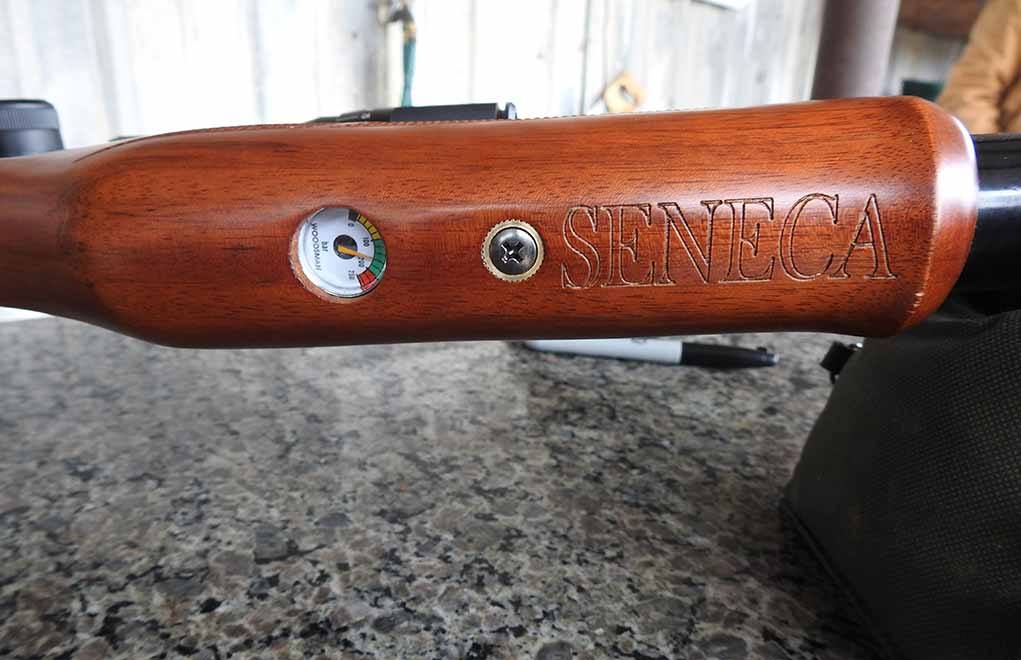
The built-in pressure gauge monitors the Dragon Claw’s air pressure when refilling, as well as letting the shooter keep an eye on pressure drop, shot after shot.
Fast-forward the history of air guns to the late 1970s or early 1980s. Air guns gained popularity, especially in Europe, as laws on firearms ownership began to tighten and firearms design and technology began to focus on getting more power out of other sources “that don’t depend on fire and gunpowder to generate energy,” said Air Venturi President Val Gamerman. “And that’s when some of the modern-day PCPs were born.”
The Rise Of The PCP
PCPs are “pre-charged pneumatic” rifles that carry a pressurized air source that provides propulsion. Other popular types of air guns include variable-pump rifles; these, as the name implies, can be pumped to various pressure levels. Spring-piston rifles, which are cocked between shots, compress a heavy spring that, upon firing, pushes a piston to compress air (these are cocked between shots); CO2 air guns that are powered by vaporizing CO2 stored in small cylinders; and gas ram or nitrogen pistons, in which the cocking action compresses nitrogen to build propulsion power.
Air Venturi’s Seneca Dragon Claw comes with single or dual tubes that hold the pressurized air. Performance is the same, but with the larger air supply of the dual-tube model, shooters get more shots between refills.
However, we’re talking about PCPs, which utilize a reservoir of pre-charged air to propel pellets (or Air Bolts) shot after shot until the pressure diminishes. And that brings us back to big-bore air guns, which have seen a surge in popularity since consumer demand and popularity in Europe, along with accompanying improved design and technology. All of this transferred to the United States in the form of accurate and affordable air guns.
Air Venturi has been selling the Dragon Claw for about 10 years, and more companies have been getting on board the wave of big-bore air gun popularity.
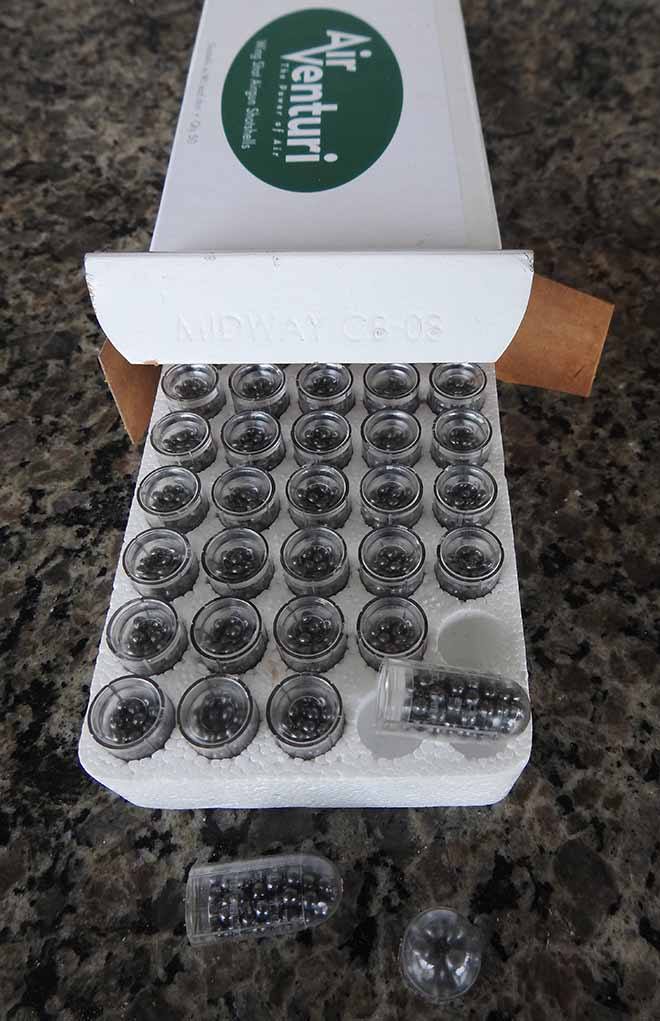
Air gun shotshells add another dimension to the Dragon Claw, which also shoots lead pellets and Air Bolts. The capsules are filled with 85 No. 6 or 125 No. 8 lead pellets, which provide about a 12-inch pattern at 20 yards.
States, too, are recognizing air rifle capability, and more are allowing air rifles for hunting—even for medium- to large-sized game. An interactive air gun map on the Air Venturi website (AirVenturi.com) or the Airgun Sporting Association’s website (AirgunSporting.org) lets you check air-gun regulations state by state, species by species.
The Dragon Claw
Air Venturi calls the Dragon Claw a PCP rifle—the workhorse of its Seneca line. It features a classic hunting firearm look with laser-etched, checkered Monte Carlo hardwood stock, forend and the engraved receiver.
Air power is stored in two under-barrel tubes—there’s also a single-tube version—that will hold enough compressed air for eight or more effective shots per tank filling (or about four shots with the single-tube version). The Dragon Claw does not regulate the pulses of air (some designs meter the pulse of air so each shot goes out under consistent pressure), so velocity drops from shot to shot—but almost imperceptibly for the first handful.
Air Venturi tests (with a 225-grain projectile and filled to 3,000 psi) show the first shot travelling 679 fps; the second at 668; third at 624; fourth at 552, fifth at 457; and sixth at 363.
Shooters can count on those first three shots to be consistently on target. Then, a refill is called for. And you don’t fill a PCP air rifle with a standard shop air compressor. Handy, take-along compressors and carbon-fiber tanks are available.
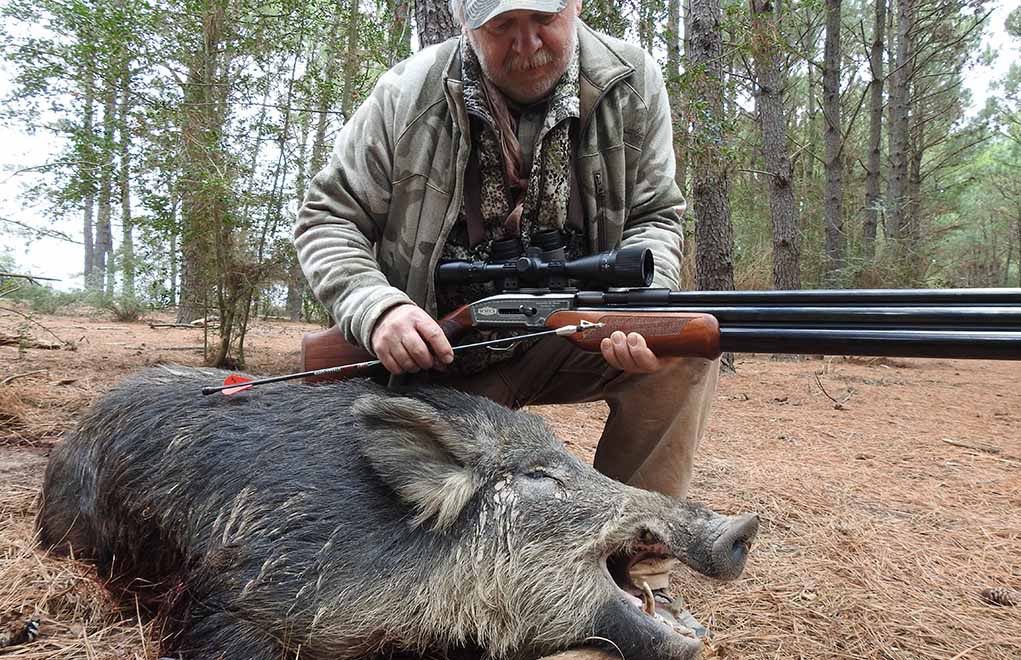
The proof is in the pork: The author and the Seneca Dragon Claw made quick and lethal work of a sizable Texas hog.
A magnetic dust cover protects the male quick-connect fitting on the muzzle end of the air tube; the female fitting of the tank or compressor fits into that. And a quick tip: Do not rush the filling process. Doing so could cause heat to build up and skew pressure readings.
Sighting in the Dragon Claw, which was topped with a 3-9x-40mm Mantis scope, was done at 30 yards. I have to admit that the report was a bit more than I expected. I was expecting a puff of air, but there was a sharp report … though not as sharp or loud as the crack of a centerfire rifle.
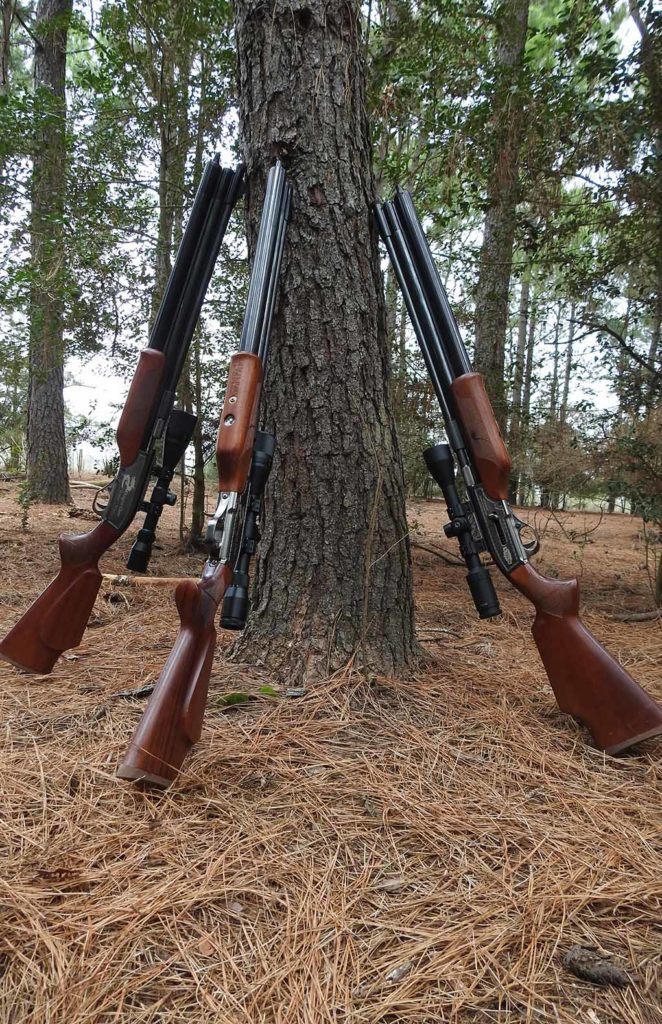
A battery of Dragon Claw air rifles awaits hunters in search of hogs.
It was a simple matter to dial in the scope for the 210-grain pellets on paper and then switch to an archery target for the 23-inch Air Bolts, which had similar points of impact and similar-sounding reports.
Venturi Air introduced Air Bolts in 2016 after two years of perfecting the design. Made of carbon fiber, they weigh 430 grains with a 100-grain tip. They come with field points for practice but accept broadheads for hunting. Instead of a nock, they have a flat end with an O-ring that seals inside the barrel so pressure propels it. Plus, it’s soft enough to squeeze into the rifling, creating spin to increase accuracy.
It’s true that air rifle technology has come a long way, so much so that calling one as such is almost a misnomer. BB guns they are not. Big game hunters they are.
What do you get with Leupold’s legendary lifetime warranty? A refurbishment so complete it’s like taking aim with a fresh-from-the-box scope.
What Does Leupold Do When You Send A Scope Back To Its Factory:
Scope is logged in and tracked through the process.
Scopesmith disassembles and visually inspects every aspect of the scope.
All the mechanical processes are checked.
All surfaces of the lenses are cleaned; if need be replaced.
It is placed in a low-temp oven to make sure there’s no moisture inside.
It is gas purged.
Elevation and windage are checked for full range of motion.
It is hand cleaned and checked to make certain it as the proper dials, caps and indicators.
It’s been said that you can’t teach an old dog new tricks. Yet, Leupold & Stevens Inc. did just that when it retrained my “antique” riflescope.
What were you doing in 1993? Twenty-six years ago, off the coast of the United States, I was cutting my military teeth — and knuckles, for that matter — as a wide-eyed machinist’s mate aboard the ballistic missile submarine USS Daniel Boone (SSBN 629). It was the beginning of a military-inspired adventure I doubt I’ll rival between now and when I meet my maker.
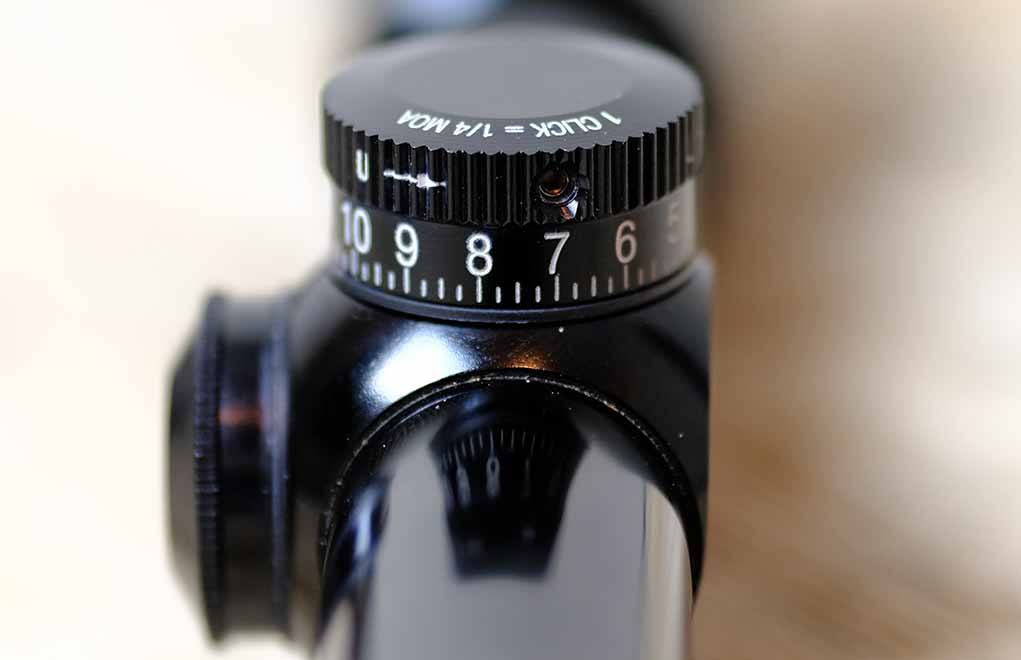
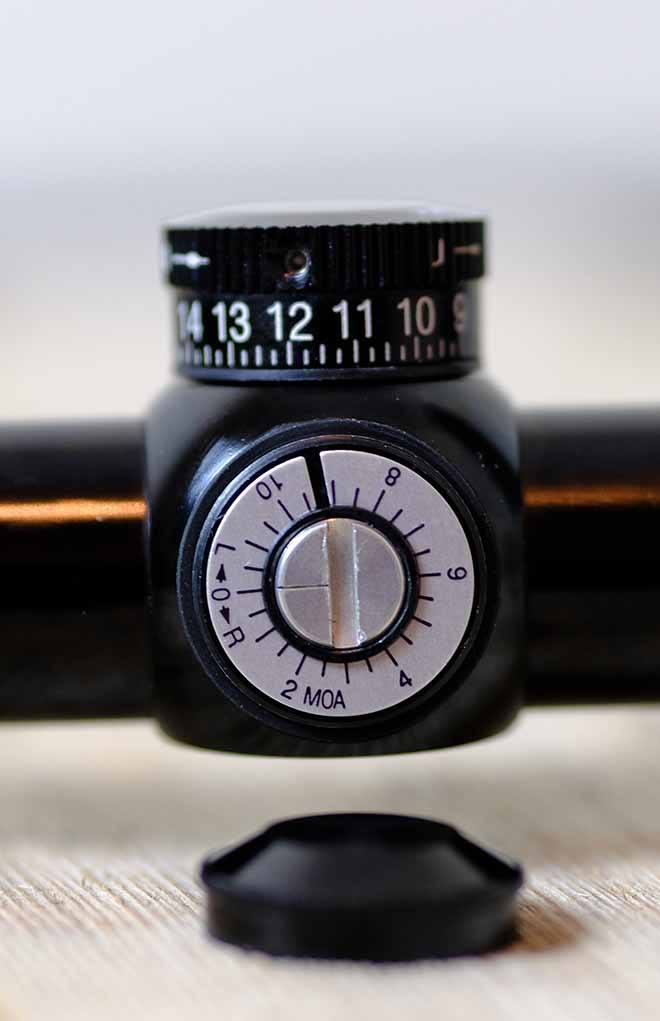
One of the upgraded features to the refurbished riflescope was the Custom Dial System (CDS) for the elevation turret. This enables the shooter to make precise, in-the-field adjustments to the optic, taking into account variables such as the cartridge and caliber, bullet weight, bullet make and brand, bullet type, bullet coefficient, muzzle velocity, average elevation, average temperature, sight height and zero distance.
At the same time, a sleek, black riflescope with the serial number 189681A was rolling off the Leupold & Stevens assembly line. The scope was planned, built and born in Beaverton, Oregon … unlike yours truly, who was made and born in what was then West Germany, thanks to the U.S. Army. Both the riflescope and I have had more than our fair share of adventures since then, but only one of us came with a lifetime guarantee.
Yes, I’m talking about the world-famous Leupold lifetime warranty. Leupold’s legendary lifetime warranty was then, and still is now, why you hear experienced folks say that you can’t go wrong with a Leupold — a priceless endorsement earned from decades of consumer testing. After all, no company can fake a stellar word-of-mouth reputation, nor can it market itself out of a bad one. The bottom line is that if it says “Leupold” on the optic, that’s all the warranty you’ll ever need.
Oh, Yeah? Prove It!
“We repair and work on scopes because they’re built to last a lifetime,” said Leupold & Stevens’ Nic Kyltica.
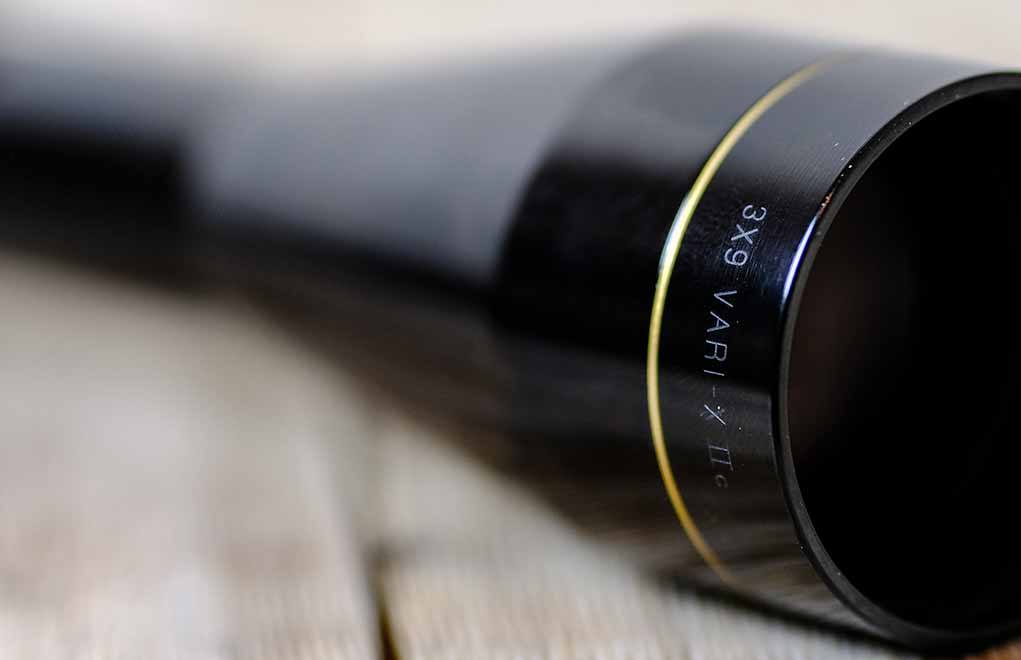
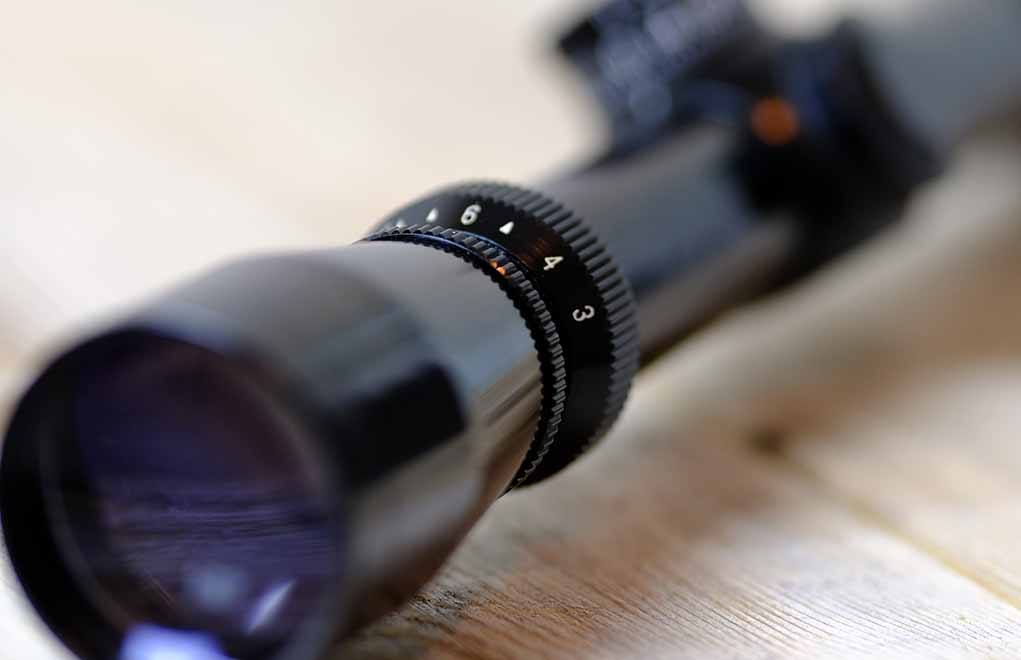
I not only took Kyltica at his word, but I embraced it by sending in my well-used, well-traveled, as-American-as-optical-apple-pie 1-inch-tubed VX-IIc 3-9X40mm — not because it was broken (it wasn’t), but for a checkup. You can, indeed, send your scope in for preventative maintenance. In fact, Leupold likes it when you do.
Despite its age, the 26-year-old optic was found to be in good mechanical and optical condition upon its arrival. Leupold’s lifetime warranty then was the same as it is now: The company stands behind every riflescope it makes.
Here’s the kicker: I’m not the original owner. In fact, there’s no telling how many owners this old riflescope has had. I bought the scope a few years ago off the used shelf at Clark Brothers Guns in Warrenton, Virginia, because I felt my right-as-rain and steady-as-a-rock backup rifle (a Winchester Model 70 Compact chambered in .308 Winchester) needed a scope that has worked, would work and will work as long as I’m upright.
Think Leupold cared I wasn’t the original owner? Not a bit.
“We see many scopes come in that have been handed down, and the next owner just wants us to make sure everything is working correctly,” said Kyltica. “A lot of them carry some heavy sentimental value. If there’s ever a question about the functionality of the scope, send it in. It’s free, and you don’t have to be the original purchaser or have a receipt or anything like that.”
So, with a heavy heart and a now-optics-barren backup rifle, I boxed up my scope and sent it west. After 26 years of unknown use, I had no idea what the scope mechanics would say to me.
The Diagnosis
Kytlica’s initial report: “The scope was in extremely good condition, and you could tell it’s been well-cared for.”
One of the drawbacks to the 1993-era optic was that Leupold technicians were unable to add a windage-adjustment CDS turret, because the engineering to add and hold the gas inside the scope tube went through the windage turret. Leupold countered this limitation by replacing the basic Duplex reticle with an MOA windage reticle.
Still, if you think time is hard on our bodies, imagine what it does to a tech-heavy industry such as optics.
Kyltica added, “That being said, those optics are no comparison for modern glass. Advancements in lens technology have increased drastically within the past decade. Our entry-level VX-Freedom will outperform an older Vari-X III any day of the week. Our current scopes have to go through even tougher tests than when your scope was manufactured, so that concept definitely doesn’t hold water.” (That’s his way of politely saying, This is a great older scope, but … .)
Mils vs. MOA: Which Is The Best Long-Range Language?
“Leupold scopes won’t lose performance as they age,” Kyltica explained. “I hear stories time and time again on how someone’s scope their dad gave them back in the ’80s tracks and holds zero like the day it was made. These precision instruments are truly built to last a lifetime.
What customers will see is how older lenses perform against newer, more advanced technology. That doesn’t mean the older lenses are bad; it’s just that technology changes, and certain coatings and processes are refined. For instance, the interior of a Ford F-150 from 1993 definitely looks and functions differently from a 2019 F-150’s interior, but both will get the job done.
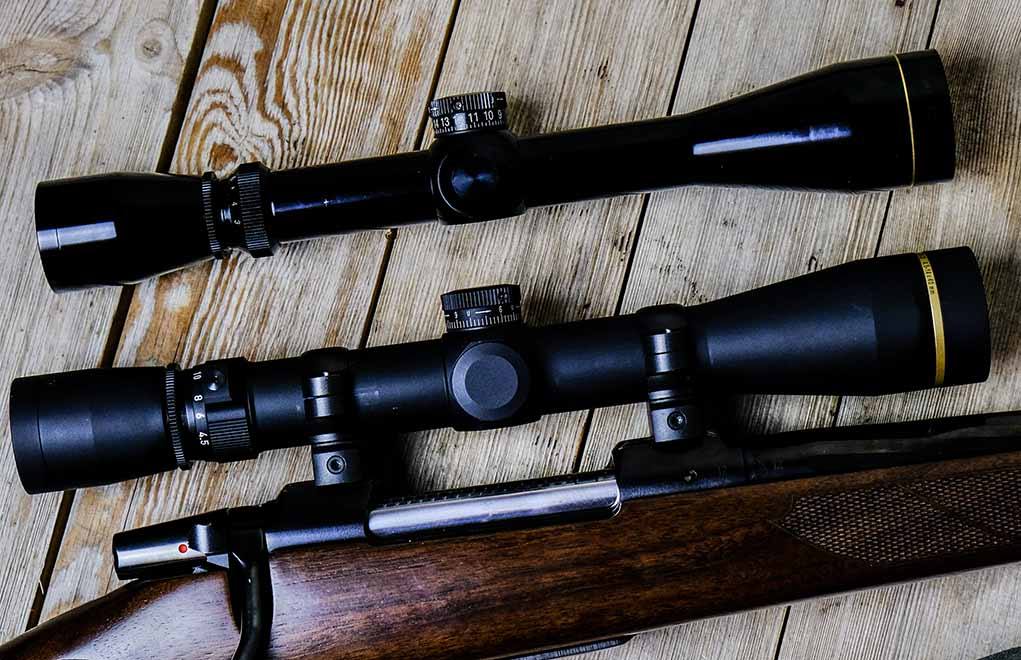
Here, the 1993 VARI-X IIc riflescope is compared to a 2018 Leupold VX-3i.
According to Kyltica, here’s what happens to a riflescope sent back to Leupold:
1. “When the scope arrives in the product service area, it’s logged in to the system. This allows us to track the scope throughout the repair process and record the work and what parts were used. Then, the scope is sent to one of our highly trained scopesmiths.”
2. “Mechanical improvements are limited on scopes that are already manufactured. The scopesmith disassembles the scope and visually inspects every aspect. The most common improvements made are re-greasing any surfaces that might cause friction and replacing O-rings and cam followers (little parts that help the magnification lens elements move back and forth).”
3. “All of the tests performed are mechanical. All the lenses are cleaned, but there’s no measuring light transmission, contrast or glare. Those aspects of the scope are inherent in the type of lenses that were used and generally won’t change over time; although you will rarely see a lens that has the coatings separating — these fall under warranty replacement and will be swapped out for new modern lenses.”
4. “After the scopesmith is done, it will move to the final check process, which are the exact checks and tests conducted in assembly on new scopes. They’re placed in a low-temp oven to make sure there’s absolutely no moisture inside. Then, they’re filled with gas. The scope is next placed on a collimation tool to check that the scope’s elevation and windage adjustments have full range of motion and that the lenses within the system are all aligned correctly. Finally, it’s cleaned by hand and checked to make sure it has all the proper dials, caps and indicators.”
According to Kyltica, three people touch the scope: the person logging it in, the or scopesmith and the final technician.
Years Of Evolution
So, we know my scope was built in 1993, but how much has really changed in 26 years?
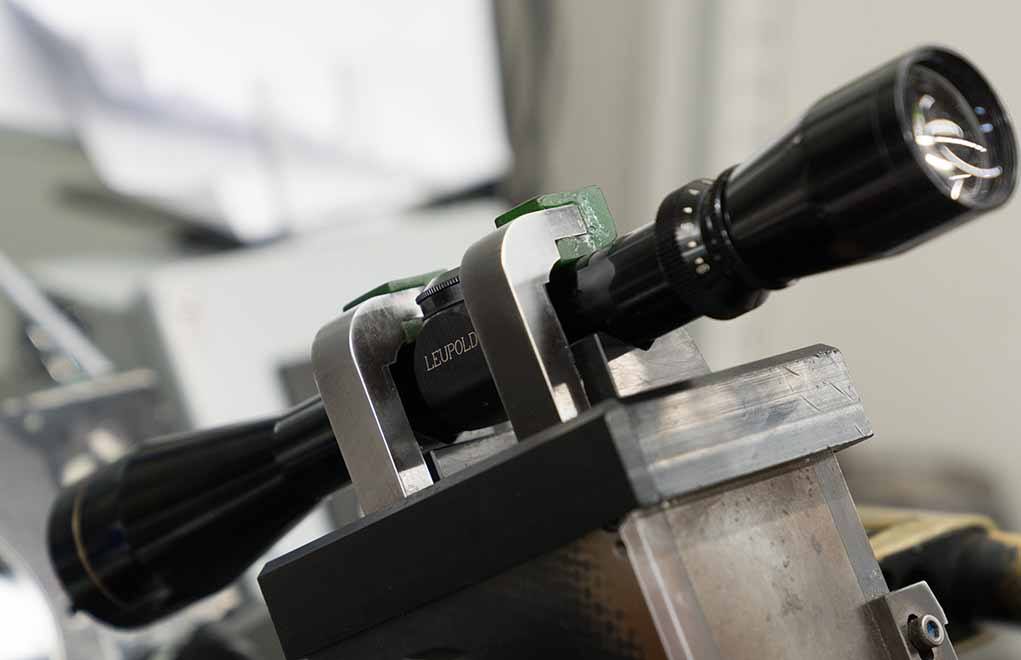
The author’s personal VARI-X IIc 3-9x40mm riflescope undergoes testing and evaluation at Leupold’s repair facility in Beaverton, Oregon.
“The glass in modern scopes is much different than even back in 1993,” Kyltica pointed out. “The advancements, especially in low-light performance, is night and day [pun intended!]. We now, of course, have state-of-the-art CnC machines that hold extremely tight tolerances. Back then, we had less-sophisticated cam machines, and maintubes were built in up to five different pieces. Most newer scopes use an argon/krypton blend of gas, which outperforms the old nitrogen gas that was used with your scope. Some reticles are still built with wire and soldering, while some use highly advanced fiber-optics technology and lasers.”
Indeed, the scope is older. I am, too. Unlike me, though, the master craftsmen at Leupold had a few tricks up their sleeves to teach my old optical dog a few new tricks. So, with my permission, they hot-rodded my riflescope. Kyltica explained what the technicians were and were not able to do to improve my scope. (Cue the theme from The Six Million Dollar Man.)
The first thing Leupold did was help me overcome a problem that shooters have battled long before 1993: wind.
“We upgraded the standard Duplex reticle to a WindPlex reticle,” Kyltica told me.
The next thing Leupold did was allow me to adjust my 26-year-old optic without having to take the turret covers off. Again, I let the optics expert speak:
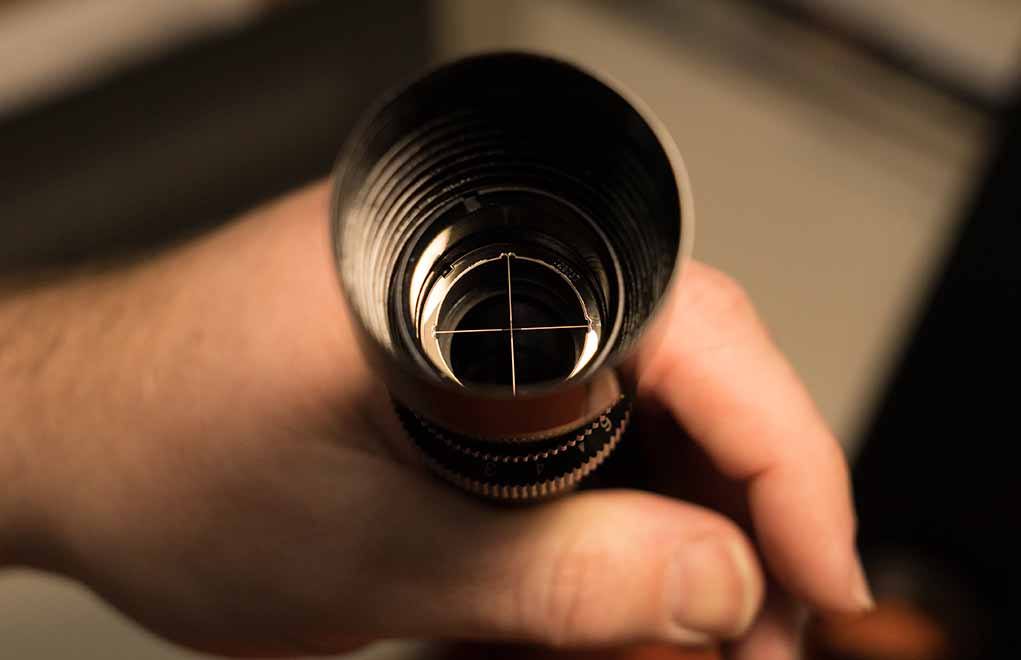
The author’s personal VARI-X IIc 3-9x40mm riflescope has its basic DUPLEX reticle replaced with a modern MOA windage reticle.
“That reticle works perfectly with our Custom Dial System (CDS), which we installed on the elevation adjustment,” said Kyltica. “This external dial gives the shooter the option to send us their specific ballistic information for the rifle and ammo they are shooting, and we can make a custom dial for them. We take those ballistics, figure out the MOA drop at 50-yard increments and laser them on the dial.”
Still, 1993 technology did retrain the optical wizards at Leupold just a wee bit.
“The one limitation is that we couldn’t install a CDS dial on your windage adjustment (some customers like having both),” said Kyltica. “This model of scope actually is gas-filled through the windage adjustment, so only the original adjustment design will work.”
The 1993 technology was good, but Leupold made it better by enabling me to adjust my elevation without removing my turret cover, and, thanks to the new reticle, I can now adjust for windage without ever having to take my eye off my target.
“The level of expertise and knowledge the entire team has is pretty incredible,” Kyltica pointed out.
One thing he wanted to make sure all Leupold customers knew was this: Feel confident that an expert is handling your product when you send anything back. They also take great pride in what they do, and the majority of them hunt or shoot as well, so they understand the importance of the performance of the scope in the field.
Regardless of what I do with the VX-IIc in the future, one thing will not change: Leupold will remain committed to its craftsmanship, because that lifetime warranty won’t do the one thing we all eventually do — expire.
CMMG has tackled the Holy Grail of pistol-caliber ARs with the release of the 10mm Banshee.
How The Banshee Enhances The 10mm AR Platform:
Radial Delayed Blowback system safely cycles the powerful cartridge, while lightening the firearm.
Unlike many pistol-caliber ARs, Banshee boasts a last-round hold-open feature.
Guns ship with 30-round SMG magazize, allowing for standard AR capacity.
Fast-deploy RipStock and RipBrace come standard on some models.
A regular screamer in pistol-caliber ARs, the CMMG Banshee revolutionizes the resurgent firearms niche. No bigger than a minute, the line of short-barreled rifles (SBR) and AR-style pistols are among the most reliable and varied, with a slew of caliber choices. Only thing missing from the line-up of technologically adept small-fries—10mm. Well … until now.
CMMG has tackled the Holy Grail for many pistol-caliber fans, introducing the 10mm Banshee. In all, the Missouri company offers six configurations—three SBRs and three pistols—chambered for the hard-hitting cartridge. And the guns have plenty going for them, outside of spitting Col. Jeff Cooper’s pet downrange.
Chief among these is the Banshee’s revolutionary Radial Delayed Blowback (RDB) system. Developed by CMMG, the company has used the system with great success to safely shoot more powerful pistol calibers. Its guts are reminiscent of a standard AR, given the RDB system utilizes a bolt carrier group (BCG) similar that found on direct-impingement guns. However, it operates much differently. After the shot, the bolt’s forced rotation to unlock slows down the BCG enough to safely cycle loads such as 10mm. Furthermore, it has the added benefit of lessening felt recoil and lightening the firearm, given it doesn’t rely on robust buffer systems found on straight blowback ARs. Definitely a plus, given CMMG aims for the utmost nimbleness with the Banshee line.
“From the moment we first introduced the Radial Delayed Blowback operating system back in 2017, our customers have repeatedly requested that we use this innovative system to chamber 10mm,” said Chris Reinkemeyer, CEO/CFO at CMMG. “We are proud to say that we have now answered the call. Not only do our 10mm offerings work with the wide range of ammunition available today, they also tame the felt recoil by a significant margin. The wait is finally over, BANSHEE 10mms are shipping to retailers now.”
The Banshee’s magazine is of note as well. The guns come with one 30-round SMG magazine that happens to be Glock pattern. In a word this is great. As those who shoot 10mm are aware, magazines north of 15 rounds are the ivory-billed woodpeckers of the gun world—rare, though spotted more in recent years. With this addition, you aren’t left wandering the aftermarket desert searching for a way to make your Banshee standard capacity.
The new 10mm Banshee utilizes AR-style controls, so familiarity is engineered into the gun. This includes a last-round hold-open function, which shooters are sure to appreciate, given it isn’t standard fare in the realm of pistol-caliber ARs. Facilitating this is the gun’s Bolt Catch Linkage System, a dual-pinned affair that not only speeds up reloads, but also adds a layer of resilience to the guns.
An H3 buffer and 3.5-ounce tuning weight come pre-installed in the carrier, but CMMG also includes a standard carbine buffer for running lighter loads. The company sells an 8-ounce buffer separately, for shooters who plan to run the Banshee suppressed. Additionally, the Banshee 200 and 300 series SBRs feature CMMG’s RipStock, a slick 6 position retractable stock that is preset then deployed at the flick of the wrist. Similarly, the 200 and 300 pistols feature the RipBrace, which operates the same way but is a non-NFA brace.
All in all, “Perfect 10” seems a good fit for the Banshee family. Particularly given CMMG has taken the time to configured the line to get the most out of the cartridge.
Banshee 100 Series Pistol
CALIBER: 10mm BARREL: 8″, 1:16 twist, Medium Taper, 4140CM, SBN MUZZLE: SV Brake, threaded .578-28 GAS PORT LOCATION: N/A RECEIVER: Forged 7075-T6 AL M4 type upper, Forged 7075-T6 AL Lower HAND GUARD: CMMG RML7 M-Lok hand guard FINISH: Hard Coat Anodized Receivers and Hand Guard (Can be upgraded to Cerakote) CHARGING HANDLE: CMMG Mil-Spec PISTOL GRIP: CMMG A2 RECEIVER EXTENSION: CMMG Pistol Receiver Extension w/Ambi Sling Plate TRIGGER: CMMG Single Stage Mil-Spec Style Trigger TRIGGER GUARD: Integrated Into Lower SAFETY SELECTOR: CMMG Mil-Spec MAGAZINE: SGM 30rd Glock Magazine WEIGHT: 5lbs 2oz(unloaded) LENGTH: 23.9″ MSRP: $1,299.95
Banshee 200 Series Pistol
CALIBER: 10mm BARREL: 8″, 1:16 twist, Medium Taper, 4140CM, SBN MUZZLE: SV Brake, threaded .578-28 GAS PORT LOCATION: N/A RECEIVER: Forged 7075-T6 AL M4 type upper, Forged 7075-T6 AL Lower HAND GUARD: CMMG RML7 M-Lok hand guard FINISH: Hard Coat Anodized Receivers and Hand Guard (Can be upgraded to Cerakote) CHARGING HANDLE: CMMG Mil-Spec PISTOL GRIP: Magpul MOE PISTOL BRACE: CMMG Standard RipBrace with 6 Position Enhanced Receiver Extension and Ambi Sling Plate TRIGGER: CMMG Single stage mil-spec style trigger TRIGGER GUARD: Integrated Into Lower SAFETY SELECTOR: CMMG Mil-Spec MAGAZINE: SGM 30rd Glock Magazine WEIGHT: 5lbs 9oz(unloaded) LENGTH: 24.3″(brace collapsed) MSRP: $1,449.95
Banshee 300 Series Pistol
CALIBER: 10mm BARREL: 8″, 1:16 twist, Medium Taper, 4140CM, SBN MUZZLE: SV Brake, threaded .578-28 GAS PORT LOCATION: N/A RECEIVER: Forged 7075-T6 AL Lower, Forged 7075-T6 AL Upper HAND GUARD: CMMG RML7 M-Lok hand guard FINISH: Cerakote Receivers, Hand Guard, and Ejection Port Cover (choice of 10 colors) CHARGING HANDLE: CMMG Oversized Ambi PISTOL GRIP: Magpul MOE PISTOL BRACE: CMMG RipBrace with 6 Position Enhanced Receiver Extension and Ambi Sling Plate TRIGGER: CMMG Single stage mil-spec style trigger TRIGGER GUARD: Integrated Into Lower SAFETY SELECTOR: CMMG Ambi MAGAZINE: SGM 30rd Glock Magazine WEIGHT: 5lbs 9oz(unloaded) LENGTH: 24.3″(brace collapsed) MSRP: $1,649.95
Banshee 100 Series SBR
CALIBER: 10mm BARREL: 8″, 1:16 twist, Medium Taper, 4140CM, SBN MUZZLE: SV Brake, threaded .578-28 GAS PORT LOCATION: N/A RECEIVER: Forged 7075-T6 AL M4 type upper, Forged 7075-T6 AL Lower HAND GUARD: CMMG RML7 M-Lok hand guard FINISH: Hard Coat Anodized Receivers and Hand Guard (Can be upgraded to Cerakote) CHARGING HANDLE: CMMG Mil-Spec PISTOL GRIP: CMMG A2 BUTT STOCK: CMMG M4 with 6 Position Receiver Extension w/Ambi Sling Plate TRIGGER: CMMG Single Stage Mil-Spec Style Trigger TRIGGER GUARD: Integrated Into Lower SAFETY SELECTOR: CMMG Mil-Spec MAGAZINE: SGM 30rd Glock Magazine WEIGHT: 5lbs 9oz(unloaded) LENGTH: 24″(stock collapsed) 26″(stock extended, no muzzle device) MSRP: $1,349.95
Banshee 200 Series SBR
CALIBER: 10mm BARREL: 8″, 1:16 twist, Medium Taper, 4140CM, SBN MUZZLE: SV Brake, threaded .578-28 GAS PORT LOCATION: N/A RECEIVER: Forged 7075-T6 AL M4 type upper, Forged 7075-T6 AL Lower HAND GUARD: CMMG RML7 M-Lok hand guard FINISH: Hard Coat Anodized Receivers and Hand Guard (Can be upgraded to Cerakote) CHARGING HANDLE: CMMG Mil-Spec PISTOL GRIP: Magpul MOE BUTT STOCK: CMMG RipStock with 6 Position Enhanced Receiver Extension and Ambi Sling Plate TRIGGER: CMMG Single stage mil-spec style trigger TRIGGER GUARD: Integrated Into Lower SAFETY SELECTOR: CMMG Mil-Spec MAGAZINE: SGM 30rd Glock Magazine WEIGHT: 5lbs 9oz(unloaded) LENGTH: 24.8″(stock collapsed) 26.8″(stock extended, no muzzle device) MSRP: $1,449.95
Banshee 300 Series SBR
CALIBER: 10mm BARREL: 8″, 1:16 twist, Medium Taper, 4140CM, SBN MUZZLE: SV Brake, threaded .578-28 GAS PORT LOCATION: N/A RECEIVER: Forged 7075-T6 AL Lower, Forged 7075-T6 AL Upper HAND GUARD: CMMG RML7 M-Lok hand guard FINISH: Cerakote Receivers, Hand Guard, and Ejection Port Cover (choice of 10 colors) CHARGING HANDLE: CMMG Oversized Ambi PISTOL GRIP: Magpul MOE PISTOL BRACE: CMMG RipStock with 6 Position Enhanced Receiver Extension and Ambi Sling Plate TRIGGER: CMMG Single stage mil-spec style trigger TRIGGER GUARD: Integrated Into Lower SAFETY SELECTOR: CMMG Ambi MAGAZINE: SGM 30rd Glock Magazine WEIGHT: 5lbs 9oz(unloaded) LENGTH: 24.8″(stock collapsed) 26.8″(stock extended, no muzzle device) MSRP: $1,649.95
For more information on the 10mm Banshee, please visit www.cmmginc.com.
There was a time when rifle cartridges did not look as “sexy” as they do today. The cartridge cases were long and short but without shoulders. Cartridges such as the .45-70 Government and .44-40 Winchester—both circa 1873—were common long-gun chamberings. But the self-contained centerfire cartridge advanced into the 20th century, and cartridge cases shaped like those of the .30-30 Winchester and .30-06 Springfield became the norm.
For the most part, the straight-wall cartridge has been obsolete for more than 100 years. Ironically, it’s once again becoming popular.
The reason has nothing to do with modern ballistics: It’s all about the law. Several states that used to allow only shotguns for deer hunting are now permitting straight-wall rifle cartridges. Even the most ballistically inept hunters—such as those who will not accept or understand the advantages of the 6.5 Creedmoor—are savvy enough to understand that just about any rifle cartridge has more reach and precision than a shotgun slug.
This newfound legal opportunity has brought back interest in old cartridges that were near teetering on extinction or just holding on due to nostalgia. It’s also spawned a new cartridge (humans will always find a way to use the “law” to their advantage).
The .45-70 Government
The .45-70 Gov’t is a grand, old, straight-wall cartridge, and with modern ammunition, it’s capable of taking anything that walks.
Developed for the Springfield 1873, the .45-70 was potent for its time. Initially loaded with a .458-caliber, 405-grain bullet and ahead of 70 grains of blackpowder, it generated more than 2,000 foot-pounds of energy at the muzzle. Yes, by modern standards, those numbers are anemic, but modern .45-70 loads—in modern .45-70 rifles—turn the .45-70 into a cartridge of another order.
The Barnes VorTx 300-grain TSX load generates 25 percent more energy than the original .45-70 load and is suitable for just about any critter anywhere. With more than 3,500 foot-pounds of muzzle energy, the Buffalo Bore 430-grain, hardcast bullet is suitable for anything walking on four legs. In fact, I’ve used that load to take two African buffalo.
Doubletap offers a similar loading, and the LeverEvolution loads from Hornady shoot flat enough to make hitting at 250 yards uncomplicated.
The .444 Marlin
With Marlin’s reintroduction of its Model 1895 in .444 Marlin, this cartridge should see resurgence, particularly in states only allowing straight-wall cartridges for deer hunting.
Mostly a longer version of the .44 Magnum, the .444 Marlin uses a 0.429-caliber bullet. Designed by Marlin in 1964, it became a favorite cartridge for deer hunters and developed an almost cult-like following. This is understandable: The ability to launch a bullet of 250 grains or more at 2,300 fps was impressive. Hunters felt the push when they pulled the trigger, and the deer felt the whack when the bullet hit home.
The .444 Marlin is not as popular as it once was. This is partly due to the acquisition of Marlin by Remington Arms, along with the subsequent discontinuance of the lever-action rifle it was chambered in. However, for 2019, Marlin reintroduced the .444 in the Model 1895 rifle; and, as straight-wall cartridges go, this is a good one.
The .375 Winchester (.38-55 Winchester)
The .38-55 is an old warhorse. Although its original ballistics were rather uninspiring, this load from Buffalo Bore is a stomper. And, it can be fired in .375 Winchester rifles in good working order.
Introduced in 1978, Winchester’s .375 was designed specifically for its Model 94 lever-action rifle. It’s essentially nothing more than a shortened version of the much older (1876) .38-55 Winchester that’s loaded to a much higher pressure. While no modern rifles are chambered for the .375 Winchester, you can find them on the used market, and Winchester still offers a 200-grain Power Point load at 2,200 fps. It will shoot a bit flatter than the .45-70 Government or .444 Marlin.
Originally loaded with black powder, the .38-55 is about as extinct as a cartridge can be, but ironically, several companies load ammunition for it. The Winchester factory round is rather anemic; it launches a 255-grain bullet at about 1,300 fps. However, Buffalo Bore has a 255-grain load rated at 1,950 fps. And—get this—it can be fired in any .375 Winchester rifle or any .38-55 designed to be used with smokeless powder.
The .357 And .44 Magnum
In a modern lever-action rifle, the .357 Magnum is a fine deer cartridge at short range. It’ll shoot with much more precision than a rifled slug.
There is a variety of lever guns chambered for the .357 Magnum. Some mistakenly consider it light for deer, but it’s an ideal short-range whitetail cartridge that’ll shoot much more accurately than any slug. One of my good friends has one in a modern 1873 Winchester, and during one season, he and a handful of other hunters used that rifle to take over a dozen deer, all with one shot each.
Generally, and more than most shooters can take in a revolver, the .44 Magnum makes an ideal straight-wall cartridge for deer hunters. There’s a wide array of factory loads to choose from and, like the .357 Magnum, it will deliver better accuracy than slug guns. A compact lever gun in .44 Magnum is an excellent walking-around whitetail rifle in any state.
The .450 Bushmaster
The .450 Bushmaster was almost extinct until some states started allowing straight-wall cartridges for deer hunting. Now, it’s seeing a comeback.
The .450 Bushmaster was designed specifically for the AR-15. A straight-wall, .452-caliber cartridge with a rebated rim, it’s capable of pushing a 250-grain bullet to 2,200 fps. At introduction, it received a lot of fanfare but soon faded into, well, near oblivion. This was partly because it was introduced at about the time of the AR-15 craze that hit the United States (at that time, everyone wanted an AR in .223 Remington). It was also partly because few rifle manufacturers got behind the cartridge.
Now, the .450 Bushmaster is seeing a grand resurgence, and it’s all because of the straight-wall cartridge allowances. Ruger and Mossberg are offering it in compact bolt-action rifles, and we are starting to see new ammunition being introduced. Of course, its compatibility with the AR-15 is tempting to a lot of deer hunters who were previously regulated to shotguns.
The .350 Legend
Winchester is even offering a suppressed load and an FMJ practice load for its new .350 Legend cartridge.
Humans have a way of working around legislation: Give us a rule, law or guideline, and we’ll find a way to circumvent it. This is exactly why the .350 Legend exists. It’s an ideal cartridge for states with straight-wall cartridge allowances. This is partly because it was designed from the ground up for that purpose but also because it’s compatible with “America’s Rifle,” the AR-15.
Winchester released the .350 Legend at the 2019 SHOT Show. It’s nothing more than a .223 Remington cartridge case with the shoulders blown out to form a straight-wall case that will accept a .358-caliber bullet. You might call it a .357 Magnum “on steroids.” Winchester seems to believe the cartridge will be a hit—even in states without the straight-wall restriction, and they might be right.
Ballistics are a wonderful thing, because they provide legitimate/scientific data to support estimations of cartridge effectiveness.
Winchester is offering five factory loads for the .350 Legend. The numbers tell us just what can be expected from this new kid on the block (see the chart above). It should be clear what the .350 Legend brings to the table. Not only will it ballistically compete with traditional deer hunting cartridges such as the .30-30 Winchester and .35 Remington, it also outperforms the .300 Blackout, which is also AR-15-compatible. It should be a hit in states previously allowing only shotguns. For that matter, hunters in other states might find it appealing, specifically because, like the .300 Blackout, it’s also subsonic-capable.
Winchester is even offering a more affordable non-hunting practice load in its USA line. It’s loaded with a flat-tipped, 165-grain FMJ bullet.
I won’t be so bold as to predict the future of the .350 Legend. This is partly because it’s essentially intended for just a smattering of states. Yes, those states have a lot of deer hunters, but it would not surprise me that if in a few years, those same states open up rifle season to more-traditional rifle cartridges. If that happens, the .350 Legend will, in truth, be little more than a legend.
Choose Wisely
If you hunt in one of the states now allowing straight-wall rifle cartridges for deer, it might be a good idea to pick up a new rifle.
Regardless of the cartridge/rifle combination you pick, you should experience better accuracy and reach than you have with your smooth-bore. The question is, Which straight-wall cartridge is best? Although many like to argue that one cartridge is better than another, that’s really not the case; they all have strengths and weaknesses … and even appeal.
I tend to be a bit old school and would probably go with the .45-70 Gov’t. After all, with modern loads, you can do just about anything with this old warhorse. However, if deer hunting in a previously shotgun-only state were all I ever planned to ever do, a new Ruger or Mossberg in .450 Bushmaster might be the way to go; and the .350 Legend has a great deal of appeal, given its external ballistics, lesser recoil and subsonic capabilities.
Bottom line: Pick the one you like the best. If you can shoot, it really won’t matter all that much: They’re all deer-killers.
Editor’s Note: This article originally appeared in the 2019 Shooter’s Guide issue of Gun Digest the Magazine.
The first full-sized pistol of Taurus’ G-series, the G3 boasts all the line’s desirable qualities, including an affordable price.
What The Taurus G3 Has To Offer:
Longer 4-inch barrel
Enhanced-capacity 17-round magazine
Unique striker-fired system, capable of second strike
Cocking serrations fore and aft
Taurus caught some lightning in a bottle with the G2c. Hitting the sweet spot for price and performance, the long-on-features polymer-frame pistol has become among the bestselling handguns of recent years. Its single-stack sibling, the G2s, hasn’t fared badly either.
Taurus hopes to keep the ball rolling with the unique striker-fired series as they go large with the release of the full-sized G3. Essentially a scaled-up version of the G2c, the double-stack 9mm has all the features of the older iteration, but boasts a 4-inch barrel. It might not sound like a lot, but the extended sight radius and bit more heft have the potential to make the G3 all the more accurate, particularly shot to shot.
It’s a bargain too, just like the rest of the G-series. Taurus lists its MSRP at $345.23, which means it should move around the $300 range once it hits your local gun store’s display case. Pretty decent, particularly since that’s nearly half the price of most comparable pistols in its class, and with what all the G3 offers.
Like the compact and slim versions, it has both a manual, passive and trigger safety, drift adjustable rear sight (white three-dot system) and decent ergonomics. But its trigger is where the action is at. The line has an interesting fire system, offering second-strike capabilities, which is quite out of the ordinary for a striker-fired pistol. Nevertheless, it’s hard to argue against the piece of redundancy, particularly on a personal-defense handgun.
It will be interesting to see if the up-sized G3 sparks the same interest as its smaller G-series compatriots.
More from Taurus:
(Miami, FL) – Taurus®, a leading innovator in handgun technology for personal defense, hunting, and competition, is excited to announce the release of their first full-size G-series pistol. The new G3 9mm semi-auto represents the next generation in the Taurus G-series polymer-frame handguns.
For the last several years, the Taurus G2c pistols have been among the most popular everyday carry 9mm handguns due to their ergonomic design, reliable performance, ease-of-operation, and class-leading cost-to-performance ratio. Since the G2c series debut, consumers and dealers have been asking for a 4-inch barrel version of this innovative pistol. Those calls have now been answered with the release of the new Taurus G3.
The G3 continues the proven polymer-frame profile of the G2c but in a full-frame configuration. Highlights include generous stippling patches across the grip for maximum control and retention in any shooting condition, an ergonomic palm swell and side-frame Memory Pads that provide quick, positive, and repeatable hand positioning. The frame also incorporates an integrated Picatinny rail. A manual safety and slide release lever are optimally positioned above the thumb for easy manipulation.
Another refined element of the G3 is the 6-lb. trigger. It is designed with a smooth take-up and a surprisingly crisp, clean break exceeding that of typical striker-fired pistol trigger performance. A short reset promotes quick, controlled follow-up shots. Unlike most single-action firing systems, the G3 offers second-strike capability.
Although full-frame in size, the G3’s profile makes it well-suited for concealed carry. Uniform beveling along the front of the slide and frame combined with a steep contoured bevel along the back of the slide minimize clothing snags. Generous front and rear machined serrations along the slide ensure a no-slip grip for cartridge chambering and slide manipulation. Additional slide features include a drift-adjustable rear sight, loaded chamber indicator, steel guide rod and spring assembly, and the choice of carbon steel or stainless-steel finish.
The Taurus G3 comes in six different models, offering consumer options in slide finish and magazine capacities (two 10-round mags, two 15-round mags, or one 15- and one 17-round mag), with MSRPs of $345.23 or $360.70, depending on the model configuration.
Taurus G3 Specifications Caliber: 9mm Luger Capacity: 10, 15, or 17 (with extended magazine) Finish: Matte Black / Matte Stainless Grip/Frame: Polymer Firing System: Single Action with Restrike Capability Action Type: Striker Safety: Manual and Trigger Safety, Striker Block Sights Front: Fixed (White Dot) Sights Rear: Drift Adjustable (White Dots) Slide Material: Carbon Steel, Stainless Steel Slide Finish: Matte Black / Matte Stainless Overall Length: 7.30″ Overall Width: 1.25″ Overall Height: 5.20″ Barrel Length: 4.00″ Weight: 25 oz. (unloaded) Magazines Included: 2×10, 2×15, or 1×15 and 1×17 Packaging Size: 12.5″ x 6″ x 1.75″ Packaging Weight: 2.75 lbs. Additional Feature: Picatinny Rail (Mil-STD 1913)
The P6, like all modern SIG pistols, does not use a barrel bushing. In that respect it’s like the Browning Hi Power.
Affordable and effective, the West German-built P6 continues to be a bargain worth hunting down.
P6 Vs. P225
P6 has a heavier 24-pound mainspring.
Its rollmarks are next to the ejection port and include the police department it was sold to.
The feed ramp on the original P6 was designed for FMJ ammunition.
Notch on the hammer was designed to bend or break to avoid a discharge if the pistol was dropped.
I did not expect to be drawn into a cult. But that’s what happened. In 2000, Germany’s police departments were dumping their P6 pistols on the surplus market. There were loads of surplus SIG SAUER P6 pistols suddenly available. Back then, a double-stack 9mm pistol was on everyone’s bucket list.
Why would you want a 9mm that held only 8+1 rounds when 15+1 and 17+1 capacity pistols were available? Think girth. I have average-size hands and some double-stack 9mm pistols can be a chore to grasp comfortably. I’ve always preferred thin-gripped pistols for two reasons: I can grip the pistol better and I usually can shoot them better. When I saw a 9mm SIG SAUER P6 for about $350 I was interested. When I picked it up out of its bright blue plastic box and held it, I immediately knew the gun was going home with me.
The SIG P6 is a compact 9mm handgun that handles like a full-size pistol. The author carried it concealed until, due to fear of having to replace expensive parts, it was “retired” in favor of more modern choices.
The grip was comfortable and easy to control. The P6 was compact yet felt like a full-size pistol. But then there was the trigger, a long stroke that tested finger muscles. It was not as heavy as the trigger pull of a surplus Polish P-64, but in the same neighborhood. I told myself springs were made to be replaced and left with the P6 under my arm. I would soon find out the P6 was an efficient single-stack nine, and little did I know I had just joined the tribe called SIG. I would soon learn why these fantastic pistols garner such a cult-like following. I had become a SIG initiate.
The history of the P6 is like many firearms built for the military or law enforcement: There is a need to sharply cut the production cost of the weapon, yet ensure it is reliable, safe, accurate and easy to operate. In the mid–1970s during the height of the Cold War, when Germany was divided into East and West Germany, the West German police force decided to replace its aging handguns and created a set of specifications for a new pistol. The German police were carrying a Walther PP chambered in .32 ACP. That pistol had been introduced in 1929. It was a good pistol, but was dated and chambered an anemic cartridge. The German police wanted a similar-sized pistol, only chambered in 9mm.
Front grip-strap serrations provide a good hold on the P6. These features, coupled with its 9mm chambering, make it a very controllable handgun, and quite accurate.
All the big players — Walther, SIG SAUER and Heckler & Koch — ramped up to develop a new pistol that would meet the spec. Back then, steel stamping was a manufacturing method that greatly reduced material and labor cost. Walther offered up the P5, which was basically an up-dated World War II-era P38. Heckler & Koch overthought the German police specifications and created the P7. This was a compact 9mm with a squeeze cocker, and gas-delayed blowback locking action. The P7 would also become revered among semi-automatic pistol aficionados, but it turned out to be too expensive to build and the German police passed. SIG presented the P225, which was a slimmed-down version of its P220. The P225 used all the features of the P220 but in a more compact size. (The P225 is 6.9 inches long and has a 3.6-inch barrel while the P220 sports a 4.4-inch barrel.) At its widest point, the P225 measures 1.3 inches while the grip is 1.2 inches thick. Unloaded it weighs 30.5 ounces.
The P220 was unique as it used a modified Browning link system, which has since been copied by numerous pistol manufacturers. The SIG system locks the barrel and slide together using an enlarged breech section on the inlet of the barrel lug. Upon firing, the barrel and slide move rearward together, then the barrel tilts as the slide continues rearward to eject the empty case and scrapes a fresh round from the magazine, loading it into the chamber. The P220 also uses a double-action/single-action (DA/SA) trigger system, where the first shot is fired double action and all subsequent shots are fired single action. What SIG added to the P220 was a decocking lever that allowed the right-handed user to decock the hammer and place the pistol in double-action mode.
The P225 had all these features but the real innovation was the way the pistol was manufactured. The slide was made of stamped steel and welded together with a steel breechblock pinned into the slide. It was inexpensive to produce and that ultimately was one of the reasons the German police purchased it.
Marking on the right side of the slide indicates this is an authentic German police-issue SIG. “P6” indicates the model, “NW” for Nordrhein-Westfalen state police, and “9/80” means the pistol was proofed in September 1980.
Safety features on the P225 included an automatic firing pin block that is deactivated when the trigger is pressed fully rearward. It also incorporated a drop safety. The SIG P225 was safe, accurate, reliable, inexpensive and chambered in 9mm. The German government approved pistols for sale to police and designated the models with a “P” for police (Polizei) and, after the P225 was configured to West German standards, it was called the P6.
So what are the differences between the P225 and P6? The P6 has a heavier 24-pound DA trigger pull. That was the trigger pull I first experienced with the P6. A long, heavy trigger pull was considered an added safety feature. It takes real effort to pull it. The P6 mainspring weight was increased to 24 pounds from the 18-pound mainspring in the P225. Perhaps the most noticeable difference is the odd-looking spur hammer, specification for which came directly from the German pistol standard. The notch was intentionally designed to bend or snap off due to an accidental drop. It serves as a visual indicator of a dropped gun incident.
The SIG P6 field-strips quickly and easily. This also endeared it to the German police agencies that used it.
Another difference with the P6 was the barrel feed ramp. The shape of the P6’s ramp differed slightly from the P226. The P6 was designed to use FMJ ammunition — the standard ammo of the time. You might find your P6 doesn’t tolerate modern JHP ammunition.
Lastly, the markings on the P6 differ from the P225. The P6 is void of the SIG P225 rollmarks and has “P6” stamped on the right side of the slide just forward of the ejection port. West German agency markings can also be found on the right side of the slide and are typically two to three uppercase letters. Mine reads “NW” for Nordrhein-Westfalen state police. Toward the muzzle is the date code production in the form of month and year. Mine reads “9/80” which indicates a pistol proofed in September 1980. The side and barrel also share the same last three digits of the serial number, which tells me my P6 has all matching serial numbers.
P6 disassembly breaks down into a few components, easy to clean and maintain.
When I first handled the P6 I experienced its superbly designed grip. It’s thin, yet has some palm swell, which was an improvement over the plain-checkered plastic grip. It’s compact and points well, and tears down like most SIG DA/SA pistols, which means disassembly for cleaning is fast, simple and intuitive. It is an older pistol so you won’t find a captured recoil spring like you will on a modern model. The sights are modern, meaning they are large and allow you to easily acquire the target. As I wrote earlier, the trigger was the feature that dated the P6. Trigger reach was excessive and took too much effort to fire in DA. In SA, pull was about half the weight of the DA pull.
My P6 shows no preference for bullet type and in fact chews through JHPs as easily as it does FMJs. After I purchased the P6 I carried the pistol concealed for a while and retired it only because I was afraid a part would break, and I wouldn’t be able to find a replacement or the parts would cost as much as a new polymer-frame pistol. I’ve had various SIG handguns pass through my hands and the P6 is the one I’ve kept.
I tend to speak with reverence about the P6 as do others. It’s compact and yet performs like a full-size pistol. As us proud members of the SIG cult know all too well, there are many reasons why the P225 was reintroduced!
SIG SAUER P6 (P225) SPECS CALIBER: 9x19mm Parabellum ACTION: Semi-Automatic, short recoil-operated, locked breech TRIGGER: Single-action/double-action BARREL LENGTH: 3.9 in. OVERALL LENGTH: 7.1 in. WEIGHT: 30.4 oz. (unloaded) GRIP: Checkered polymer SIGHTS: Fixed, notch rear/blade front FINISH: Blued CAPACITY: 8+1, single-stack magazine
Rare and unusual, Fitz Special snubbies hold a special place in serious Colt collectors’ hearts.
What Is The Fitz Special And Why Is It So Unique:
Created by and named after Colt engineer J. Henry “Fitz” Fitzgerald.
The custom revolver featured a bobbed hammer and open-front trigger guard.
Fitzgerald modified several Colt models along these lines, including the Detective Special and Police Positive.
Collectors have paid in the five figurer for actual factory modified Fitz Specials.
One of the most interesting snub-nosed revolvers of the early 20th century was the Fitz Special. Created by Colt engineer and exhibition shooter J. Henry “Fitz” Fitzgerald, the Fitz Special was a customized revolver with two distinguishing features: These were a bobbed hammer and trigger guard with the front half ground completely off, both designed to help the shooter get his double-action revolver into action faster.
Fitzgerald performed these modifications to several Colt models, including the Detective Special. In fact, his Fitz Special modification to the Colt Police Positive led to the company’s introduction of the Detective Special. No Fitz Specials ever appeared in a Colt catalog, and the exact number made is not known. These were essentially custom guns made to order. Some estimates are that no more than 100 were made at the factory. Many others have been made, and are still being made, by various gunsmiths on Colt, Smith & Wesson and other guns.
J. Henry Fitzgerald probably did not realize it at the time, but he was the creator of some of the rarest Colt revolvers. As Rick Hacker stated in his article on the Fitz Special in the Gun Digest 2018 Annual Edition:
“So while FitzGerald may not have originated many of the concepts he used, he certainly made them popular. Charles Lindberg carried a Fitz Special, as did Col. Rex Applegate, whose ivory-handled presentation gun bears the inscription, ‘To Rex from Fitz.’
“On the other side of the law, Clyde Barrow of Bonnie and Clyde fame carried a nickel-plated Colt Army Special with a cutaway trigger guard and a bobbed hammer, although it is not known if these modifications were actually done by the Colt factory. Still, it can’t be denied that Barrow obviously was a fan of the Fitz concept. Many gunwriters of that earlier generation, including the late George Nonte and Col. Charles Askins, Jr., were also Fitz Special fans. In more modern times, during the first season of the popular CBS television series ‘Blue Bloods,’ Tom Selleck, in his role as Police Commissioner Frank Reagan, is seen carrying a Colt Official Police ‘Fitz Special,’ which, according to the script, originally was to have belonged to Frank’s policeman father, thus implying multi-generations of use.
“Previously, values of authentic Fitz Specials have been difficult to determine, as they so rarely came on the market. However, in early 2017, Gunbroker listed an authentic, factory-documented Colt Detective Special Fitz Special in .38 Colt, serial number 462183, in 95 percent condition, and complete with its original box and an accompanying factory letter which states, under Special Features: “Furnished with a cutaway trigger guard and a 3 lb. trigger pull.” This gun was shipped to a buyer in Middlesborough, Kentucky on November 24, 1939. Offered for sale by Kirkpatrick Collector Arms of Prescott, Arizona, a firm that specializes in quality Colts, on February 12, 2017 it sold for $10,525.”
Editor’s Note: This article originally appeared in the March 2019 issue of Gun Digest the Magazine.
Learn to accurately shoot on the move, and you’ll give yourself a leg up in a self-defense situation.
There’s an old adage concerning gunfighting: “If you aren’t moving you ought to be shooting, and if you aren’t shooting you ought to be moving.” Sound and self-evident advice. Yet, it perhaps misses one important point: You should learn to shoot on the move.
While it sounds simple on paper, incorporating movement into shooting is a tall task. If for any reason, it’s difficult to maintain accuracy while scooting around. Think about it this way, you practice breath control to limit minute body movement when breaking a shot, which pales to hoofing it around.
Though, dynamic marksmanship isn’t a lost cause. In fact, it’s a potent arrow to have in your self-defense quiver, giving you the ability to escape danger, while at the same time neutralizing it. Mastering the shooting on the scoot is just a matter of practice and proper technique.
The key is body control. Up top, you must provide a stable platform to stay on target by minimizing torso and arm movement. Down below, you’ve got to get where you’re going, while minimizing the shock of each step. A tricky balance to achieve, to say the least, but achievable with enough practice and well worth the effort. If you can get down dynamic shooting with a handgun, you most certainly have an advantage over most other shooters.
Looking to go armed, but are stuck in the weeds as to what to arm yourself with? Here are 20 of the best concealed carry gun options that will keep you on the defensive.