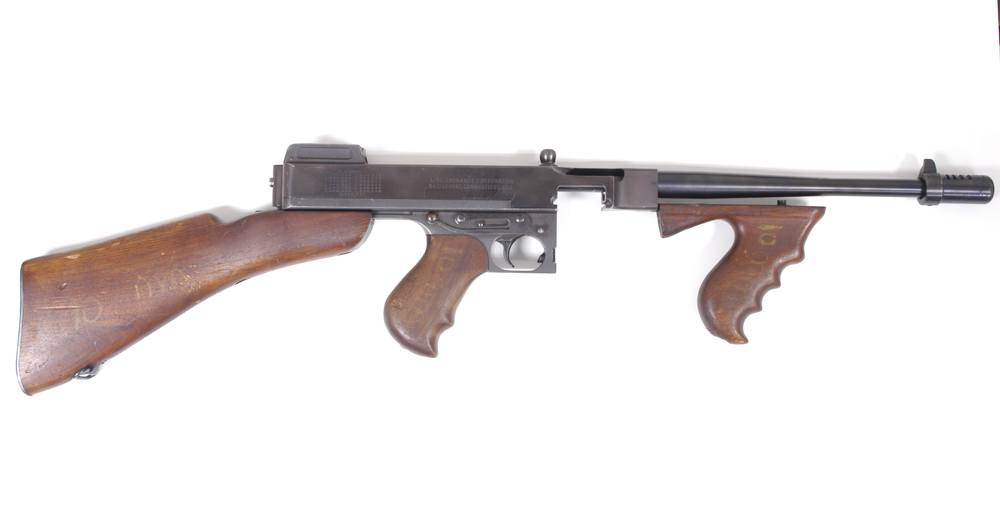
Contrary to public opinion, the Thompson submachine gun was not only used by Prohibition-era gangsters. In fact, the “Tommy Gun” was a favorite among early FBI agents as well.
The Thompson can be fired from 20-round box mags, or 50- and 100-round drum magazines.
Rate of fire of the Tommy Gun is 1,500 rounds per minute.
The Thompson was used in the FBI until the early 1970s.
Of all the weapons identified with the FBI, the Thompson submachine gun tops the list.
The Thompson submachine gun was created by retired General John T. Thompson, who founded the Auto Ordnance Corporation to develop the design. The original gun had no stock or sights and fired at a rate of 1,500 rounds per minute. The design was modified and, in 1920, Auto Ordnance signed a contract with Colt Firearms to build 15,000, which were designated the Model 1921AC.
This model was equipped with a removable shoulder stock and an elaborate rear sight. It could be fired with 20-round box magazines or 50- (L) or 100- (C) drum magazines that required disassembly to load and featured a spring that had to be “wound up” like an alarm clock.
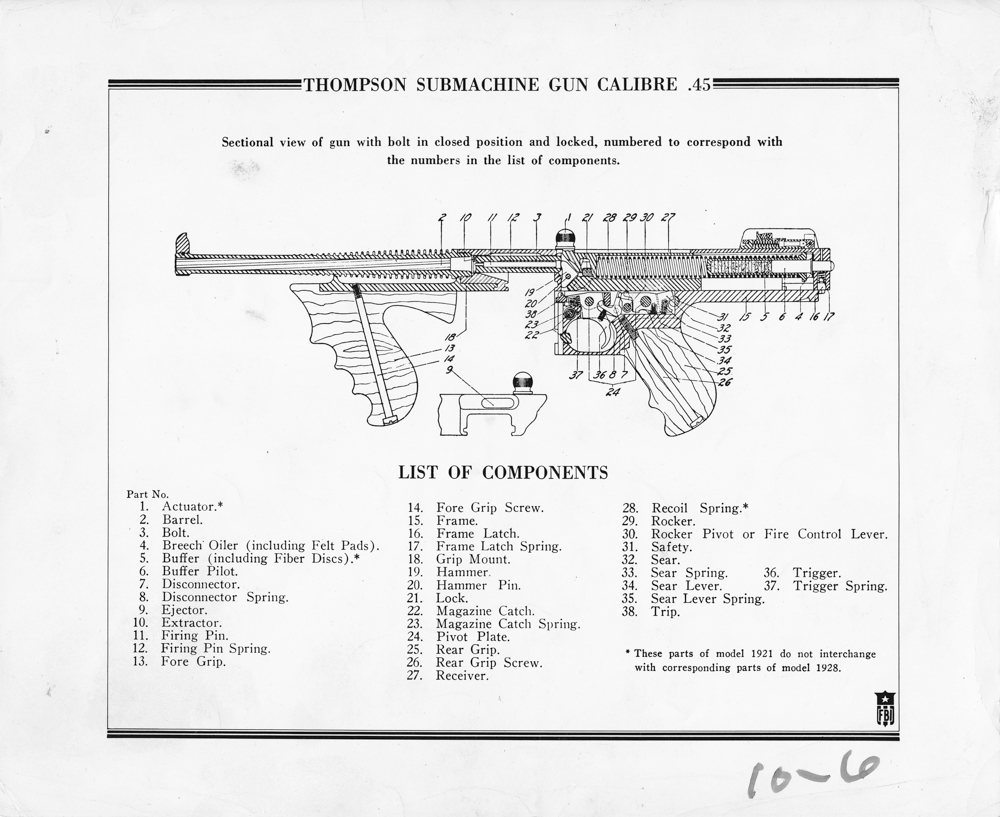
FBI handout of the schematic of the Thompson submachine gun.
The military version had a horizontal forearm, but the FBI purchased theirs with a vertical foregrip. Most versions originally had a finned 10.5-inch barrel and a Cutts compensator to help control the recoil in full-auto mode.
The gun weighed about 10 pounds and with stock attached was just over 31 inches long. The design was based on a bronze lug that retarded unlocking the action, called the Blish Principle.
However, experiments years later showed that this didn’t have much effect and the weight of the bolt assembly controlled the pressure. The rate of fire of the Model 1921 was about 800 rounds per minute and this was thought to be too fast for military use. So most of the guns built by Colt were modified with a heavier bolt and stiffer recoil spring. This brought the rate of fire down to about 600 rounds per minute.
To identify these modified guns, the Model number was overstamped with number 8 over the last digit. These were then identified as Model 1928 Navy Model and often called “Overstamps.” This is the model most purchased by the Bureau. The gun was made in .45 ACP caliber. However, a few were made in a more powerful .45 Thompson caliber and even in .30 Carbine, but neither were used by the FBI.
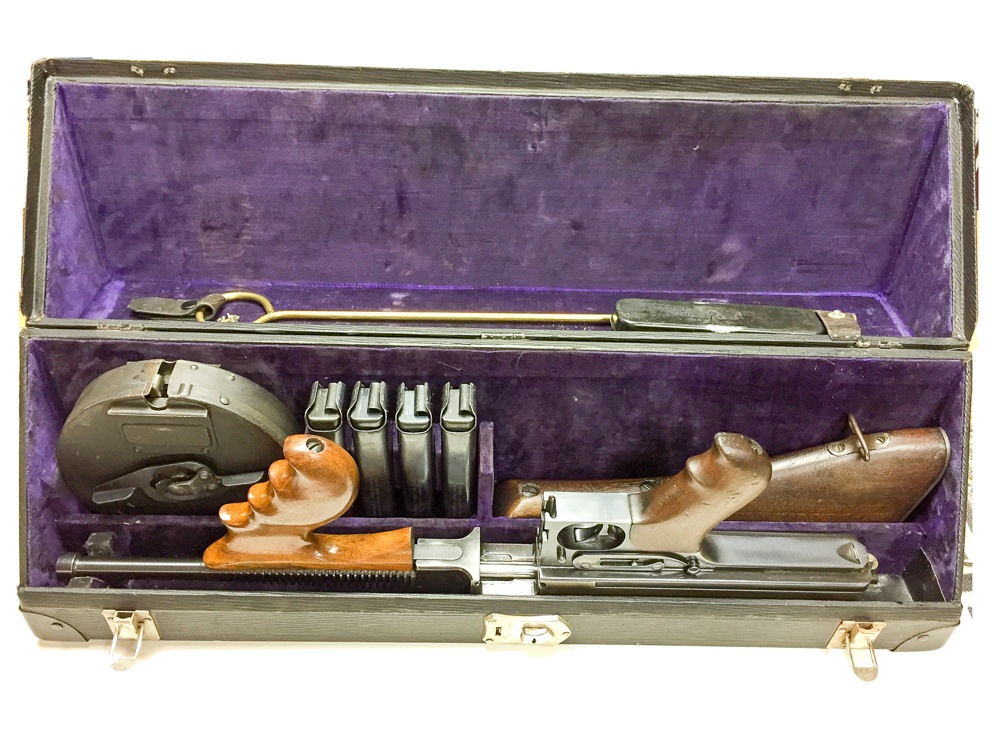
Thompson submachine gun in FBI case with all accessories. Photo: Tracie Hill
The Thompson, also known as the Tommy Gun and the Chicago Typewriter, particularly in the press, was used extensively in the FBI until the late 1960s or early 1970s. When John Cox went through new agent training in 1961, his class shot Thompsons.
Back in the 1930s when the Thompsons were in heavy use, a carrying case was designed and built to FBI specifications. The black case, made by the Kansas City Trunk Company, held the gun with stock stored separately, a cleaning rod, and had room for four 20-round magazines and one 50-round drum mag.
They are now, of course, prime collector’s items, as is the spare parts kit in the shape of a 20-round magazine. During World War II, the Thompson was simplified to a straight, blowback design known as the M1. The bronze lug of the Blish system was dropped but the rear of the receiver had to be reinforced for reliability. The FBI never issued the newer M1 Thompsons.
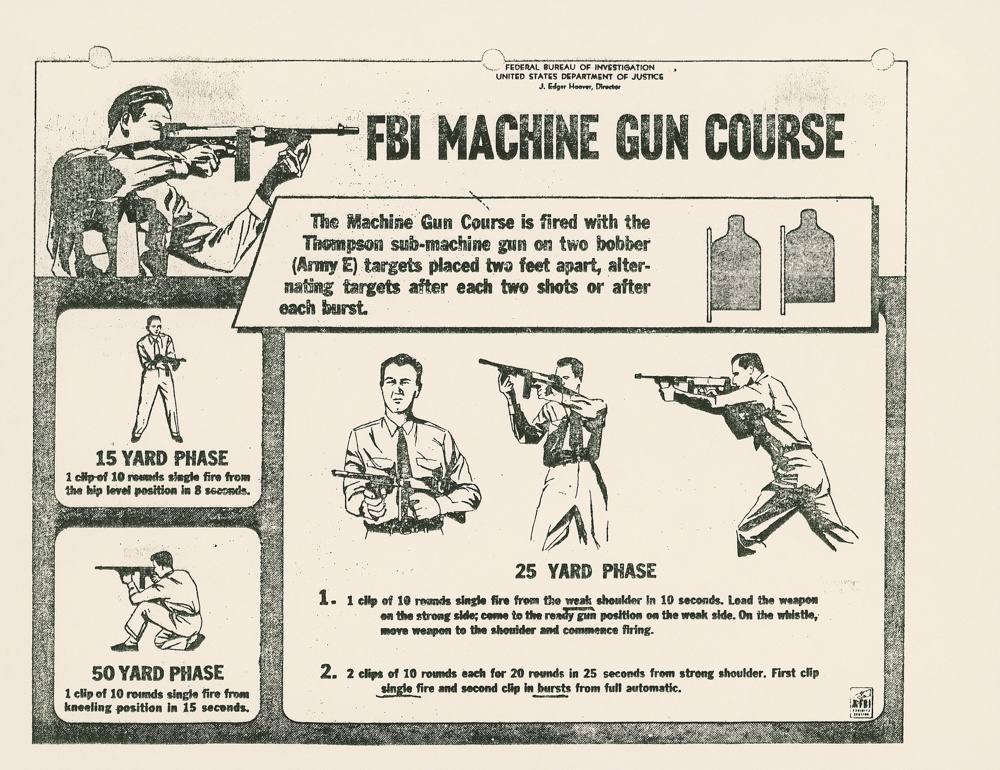
Several courses were designed for the Thompsons. One was the “FBI Machine Gun Course.” (The Bureau continued to call them machine guns even though technically they were submachine guns, firing handgun rounds instead of rifle rounds.)
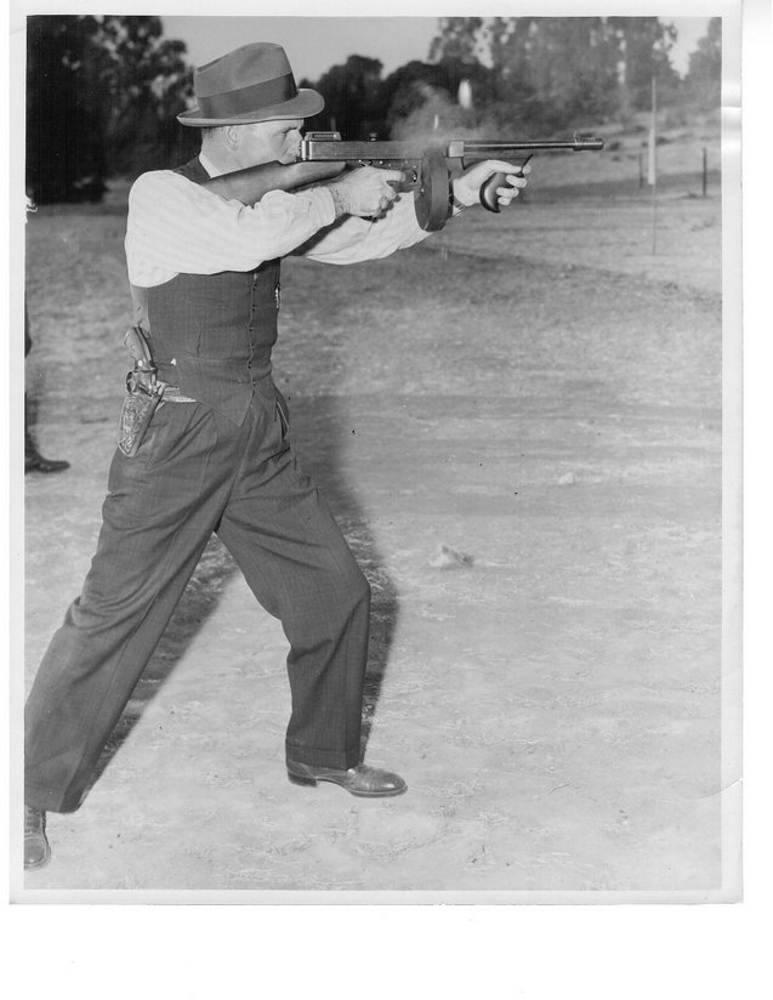
Author fires the Tommy Gun during demonstrations at the FBI Tour, FBIHQ.
The course consisted of 50 rounds fired from 15 to 50 yards, both single fire and full-auto in bursts. The one-page sheet on the course erroneously called the magazines “clips.” The agents fired on a pair of Army E bobber targets, side by side.
Of course, the Bureau wasn’t the only agency that acquired Thompsons. Many police agencies, large and small, bought them. Unfortunately, this became a prime source of Tommy guns for gangsters. Many crooks, including Dillinger, stole them from police departments. (As were National Guard armories that were targeted for Browning Automatic Rifles.)
Around 1970 or ’71, FBIHQ ordered the destruction of most Thompson submachine guns in the field. The various field offices could keep a small number for tours and shooting demonstrations, and a few were kept at Quantico for use on the popular FBI tour in Washington, DC. In total there were 749 guns destroyed.
A few more were retained at Quantico. This destruction order was found to be premature, as there was no official replacement designated. The Bureau was then without operational submachine guns. The shortage caused a scramble for temporary replacements and several substitutes were acquired.
Lou Padula, the Principal Firearms Instructor at Washington Field Office, picked up many M3 and M3A1 “grease guns” from the military and many were retrofitted at the Quantico Gun Vault with thumb safeties. They were, of course, in .45 Auto but one arrived in 9mm Luger, probably a fugitive from British Lend Lease. The Gun Vault already had a grease gun in .45 caliber in its reference collection with a curved barrel for use by tankers. Several MAC 10s were also acquired.
Former Agent, Tom Riley, who also happened to be my firearms instructor, told me that he arranged with his contacts in the Marine Corps to obtain surplus firearms from the Navy depot at Crane, Indiana. He and other FTU instructors drove a Bureau car there, rented a trailer and hauled it back full of M3 “grease guns” and M1 Garands.
Later, he borrowed sample weapons from the Marines to evaluate for possible replacements for the Thompsons. They were particularly impressed with the H&K MP5 but FBIHQ didn’t want to purchase foreign weapons, at least at first.
The Bureau didn’t lack any spare parts for those Thompsons. Prior to their being phased out, the Academy Gun Vault received an interesting phone call from a supply unit of the U.S. Marine Corps. They asked if the FBI still used Thompsons and if the agency needed any spare parts, free of charge and transportation included. The Gun Vault replied yes and soon forgot about the offer.
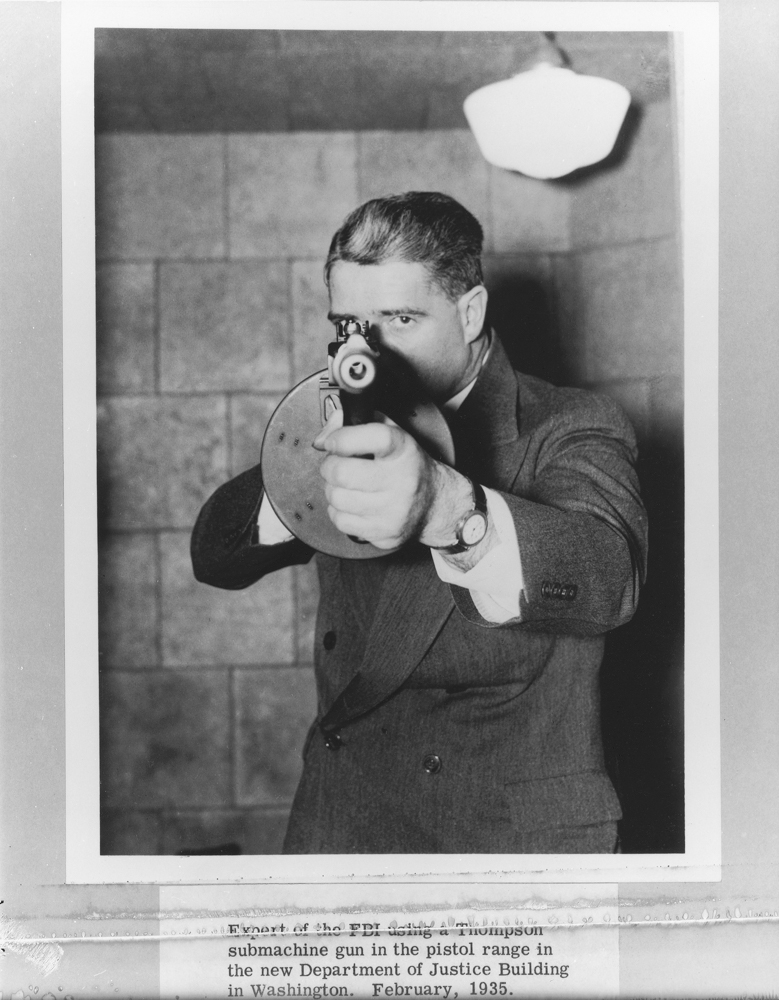
In this posed photo, a special agent holds a Thompson with a 100-round drum magazine in the Justice Department range. The photo is dated February, 1935.
Some months later, a phone call from Mainside, Quantico, advised the shipment of parts had arrived. Lester Limerick, then head gunsmith, told them he would have a pickup truck sent to the depot to pick them up. The reply: ‘Better send something bigger than a pickup. There are most of two boxcars full of parts for you!’
The Marine Corps had found a way to clear all its old inventory off the books with one call. The Gun Vault had to sort through thousands of parts, many still wrapped for long-term storage, to pull what they needed. A rumor is still going around that most of the parts were buried somewhere on the academy grounds. Indeed, the FBI could probably buy a new range complex for what those parts would be worth today.
“Jerry” Campbell, another alumnus of OKCPD, participated in both the Dillinger and Ma Barker shootouts.
The FBI finally adopted, in my opinion, what was at that time the finest submachine gun in the world, the Heckler & Koch MP5. We had already had experience with the short version of this gun, the Kurtz, and the SD, the suppressed model. The Bureau acquired the single-fire model, the SFA2, for field agents and the select-fire version for SWAT.
The gun was accurate, reliable and easy to fire. Its one drawback was that it didn’t lock back on the last round. To help overcome this, 9mm tracer ammunition was made available to some SWAT and HRT members who wished to add them to the bottom of their magazines as an advanced warning that they were about to go dry, a trick used by fighter pilots during WWII.
I recently discovered one of the most unusual Thompsons the FBI ever owned. Tracie Hill, President of the Thompson Submachine Gun Collectors Club told me about it and even sent me a photo. It was of a Thompson in 10mm! I couldn’t believe him. What on earth would the FBI want to convert one to that caliber? But my latest trip to Quantico confirmed that one was in inventory, assembled at the Academy Gun Vault, but no one still there could tell me why it was made.
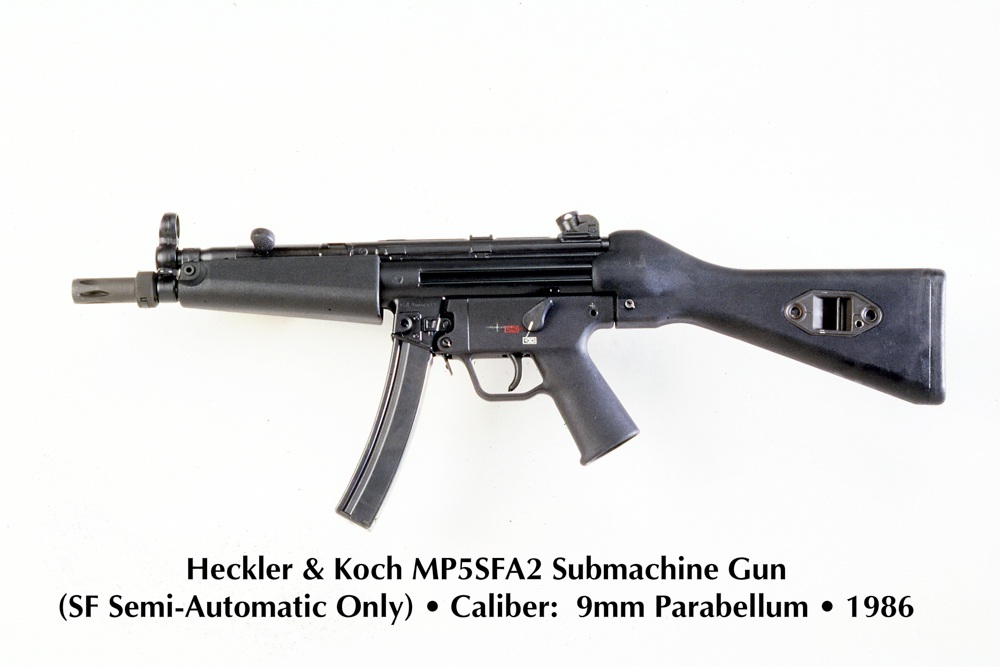
The H&K MP 5 SFA2, which replaced the Tommy Gun. This was the semi-auto-only version with a solid stock for use by non-SWAT agents. It was chambered in 9mm.
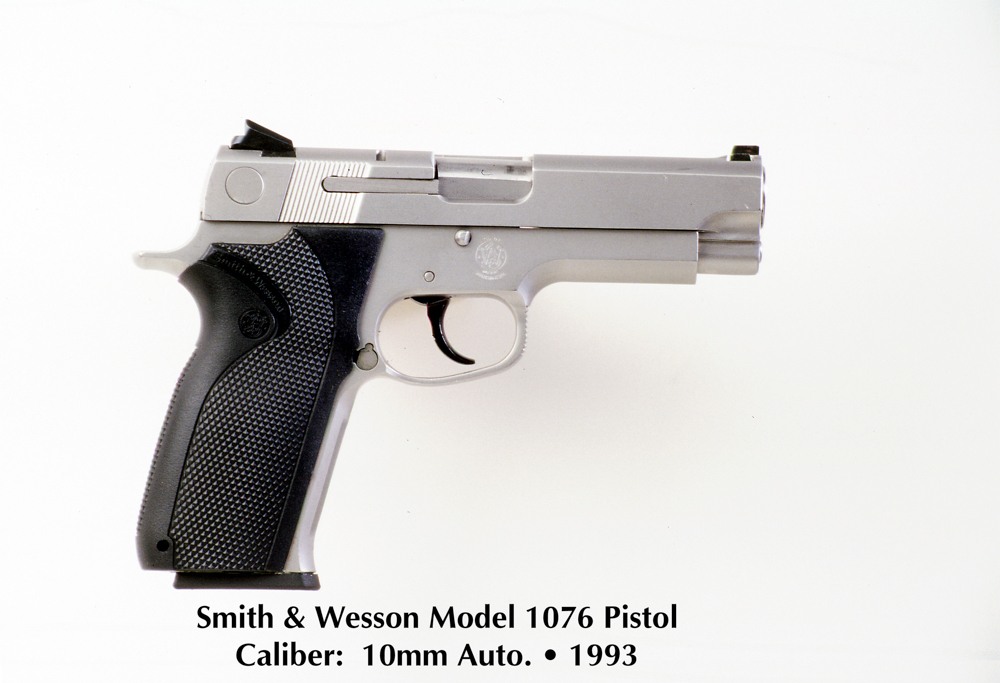
When the Smith & Wesson Model 1076 was being adopted by the FBI, at least for a short time, it was decided to purchase MP5s in 10mm caliber. It took Heckler & Koch a lot of research and design work to make the conversion.
By the time they had the project completed, the 1076 was being dropped but they were so far along the FBI decided to still purchase the guns. It turned out that 10mm ammunition cost over twice as much as service 9mm but FTU thought it too late in the procurement process to change them to .40 S&W caliber, to match the new Glocks. There are still MP5s in the field, in both 9mm and 10mm, but they are seldom used.
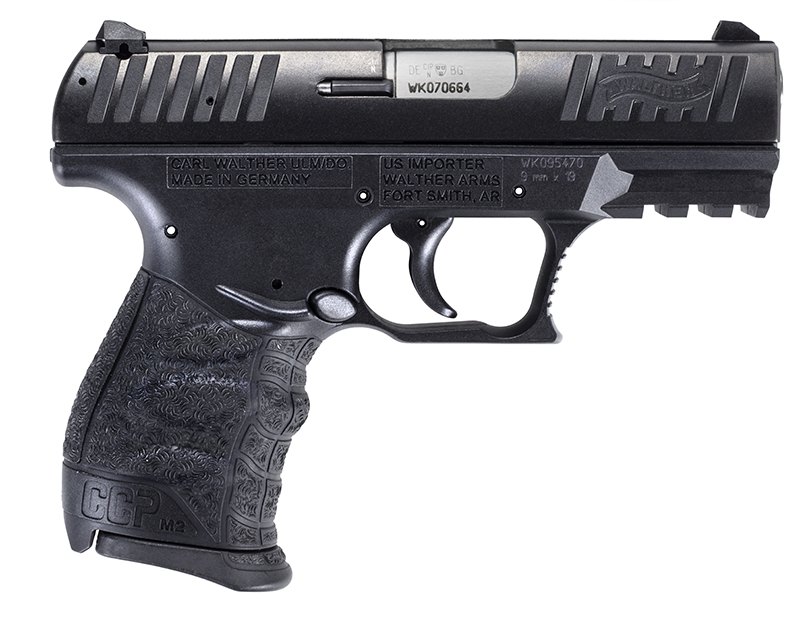
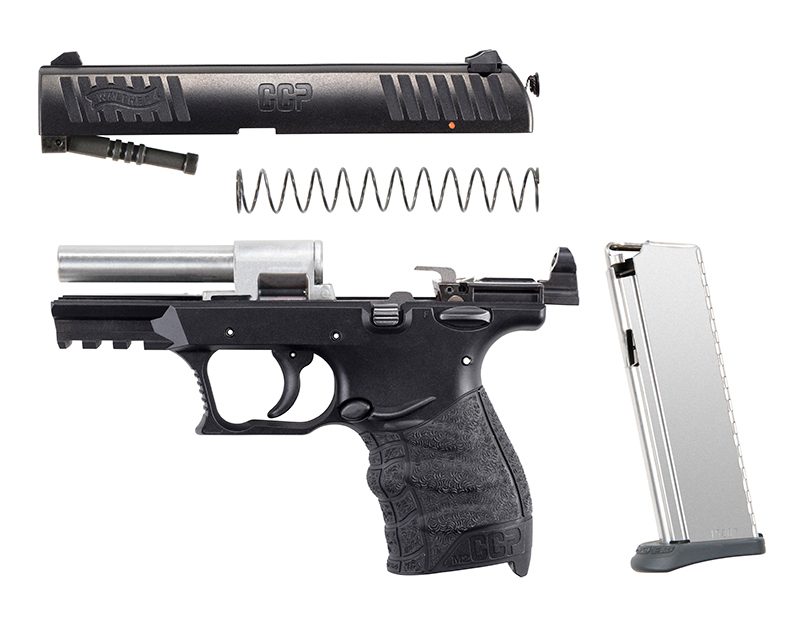
Easier to field strip, the CCP M2 makes routine maintenance a snap.
What the CCP M2 offers:
Tool-less takedown.
Gas-piston delayed blowback operation.
Cocking indicator.
3.54-inch barrel.
5.5-pound trigger pull.
1.18-inch width.
8+1 capacity (9mm).
22.33-ounce weight.
Smooth shooting and svelte aren’t exactly the first things that come to mind when talking blowback 9mm pistols. Yet, it’s what Walther achieved in 2014 with the release of the CCP. Innovative, the pistol utilized a piston system (in Walther argot, SoftCoil Gas Technology) that delayed the blowback, deadening the recoil along the way. Quite a feat, the CCP was a kitten to operate and shoot, all without boat-anchor heft. All ideal for concealed carry.
So much going for it, you’d think the spry little single-stack nine would have few nits to pick. Overall, it didn’t, save one — takedown. Almost an afterthought with most handguns, field stripping was a bit more arduous with the CCP, requiring something dreaded among all handgunners — tools. Not a deal breaker, but certainly less convenient than a takedown lever. Though now it appears the days of the pistol’s special disassembly tool (or at a bare minimum a screwdriver) are numbered.
Eagerly anticipated by Walther fans, the newly released CCP M2 requires little more than a functional finger break down. Now, a simple flick of a lever at the aft of the pistol springs the slide from the frame, making routine maintenance much less sigh-inducing. Maybe not an out-and-out gamechanger, but unquestionably tool-less takedown does make the pistol more appealing.
Outside of easier takedown and a blaze-red striker indicator, there isn’t a ton of difference between the CCP M2 and the original. Not necessarily a bad thing. Walther improved where it needed to and left what worked with the striker-fired, including its slim 1.18-inch width, 22-ounce weight, 8-round capacity and, of course, utmost shootability. Also, price; the CCP M2 has an MSRP of $469, same as the first generation pistol.
Other notables on the CCP M2 include a 3.34-inch barrel, 5.5-pound trigger pull, .27-inch trigger travel, Picatinny rail on the frame, manual thumb safety, three-dot polymer sights and ambidextrous magazine release.
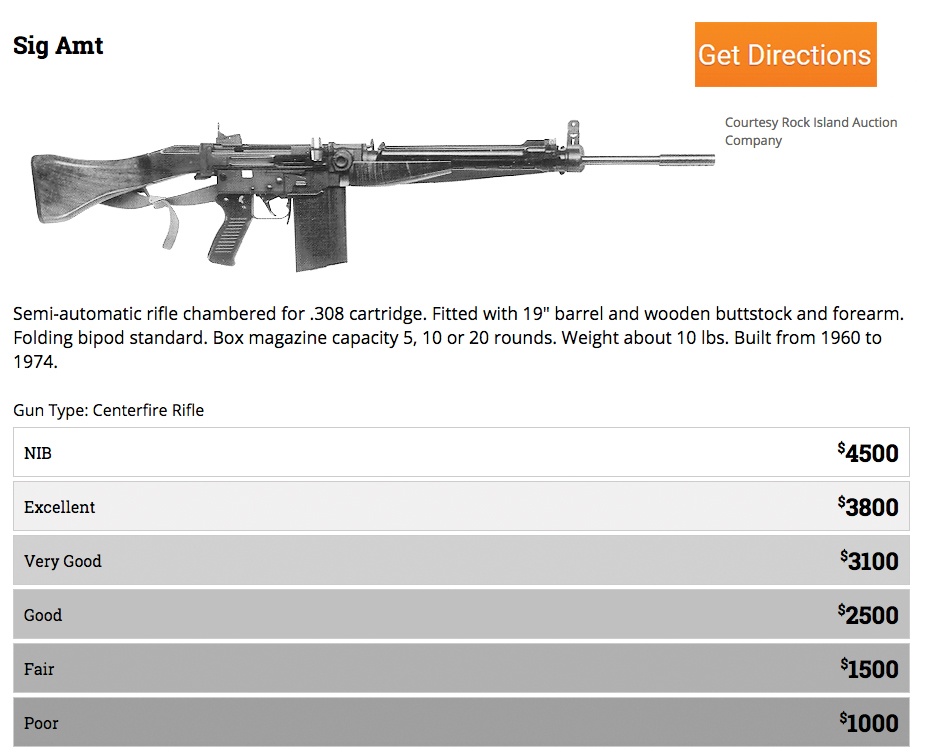
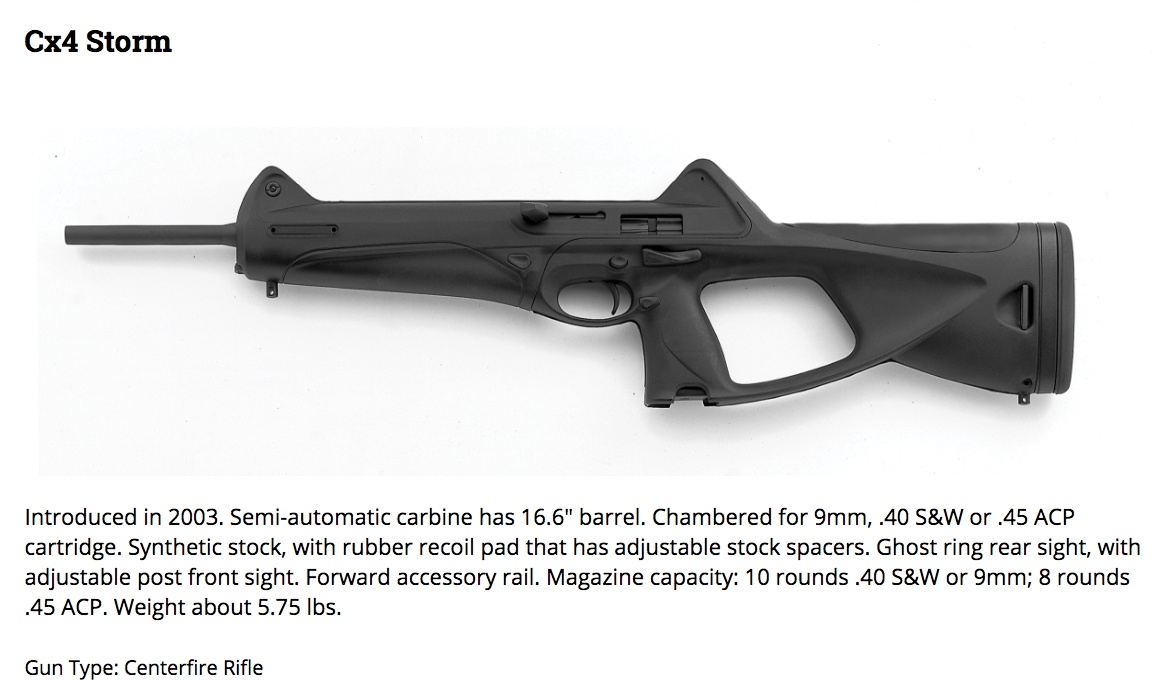
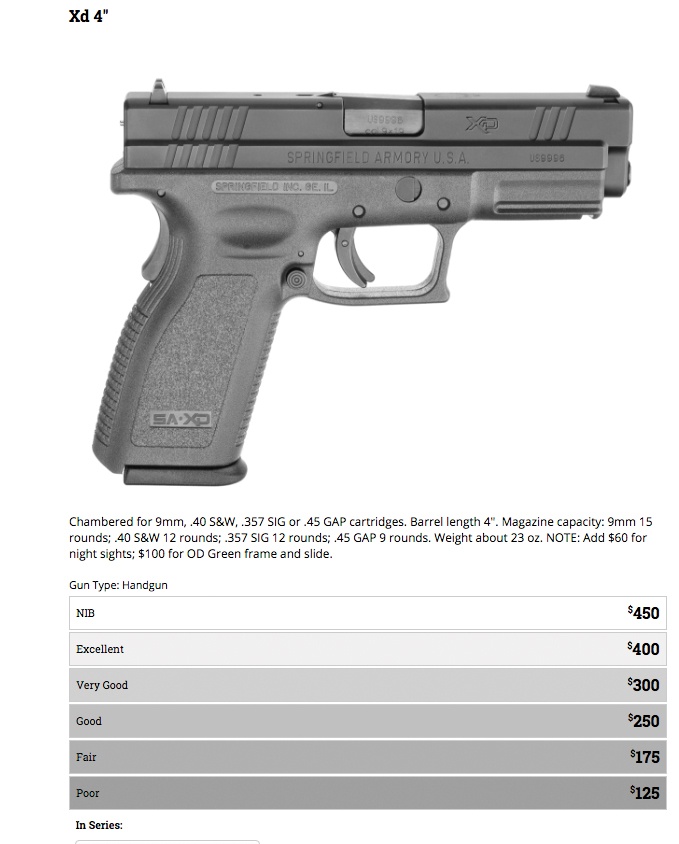
Gun Values by Gun Digest lists more than 18,000 firearms models dating back to the early 19th century, offering more than 110,000 prices over six condition grades.
Information from Standard Catalog of Firearms.
Lists some 18,000 firearms models back to the early 19th century.
More than 110,000 prices over six condition grades.
Subscription options from 3-day access to monthly and annual packages.
Free firearms descriptions and images.
We live to shoot. That pretty much sums up being a gun guy or gal. And few things compare to hours smashing clays or pitching rounds down range. Well, maybe one: getting a new gem to add to your gun safe.
As luck would have it, we live in an absolute golden age of gun selling and buying. With gun stores, auctions, online retail outfits and gun shows seemingly multiplying by the minute, the gun marketplace arms you with nearly unlimited firepower. But with great power, as they say, comes great responsibility. When it comes to making a deal over a gun, you must take the time to avoid a dud, no matter which end of the transaction you’re on.
Just like you’d choose the right rifle and scope to make a 1,000-yard shot, you need to pick the right tools to drop the hammer on a square deal. That requires doing your homework and getting rock-solid pricing from a source you trust. In short, it means turning to a reputable resource such as Gun Values by Gun Digest (GunValues.GunDigest.com).
The Power Of Knowledge
Gun Digest takes its value guides seriously and set out with one purpose in mind regarding Gun Values — design an online gun values resource for serious collectors and retailers … or the enthusiast looking to buy or sell a single gun. Given their demands, any old website would never cut muster. Only high-grade, relevant information would do, which meant turning to the most trusted name in gun pricing and identification.
Those in the know can already guess that means the Standard Catalog of Firearms. The value guide has stood alone as the most comprehensive book of its kind for nearly 30 years. And it’s easy to see why, listing some 18,000 firearms models back to the early 19th century, and offering more than 110,000 prices over six condition grades. On top of that, the prices themselves come from the most trusted sources around — the nation’s biggest and most respected gun stores, auctions and shows.
It’s like a yearly snapshot of exactly what’s happening in the firearms marketplace, and every line item of it is now available at the push of a button at GunValues.GunDigest.com.
And like the Standard Catalog, Gun Values sets itself apart from similar resources with the depth of its information. Far from simply a litany of dry and vague prices, the website features more than 7,500 firearms images, along with detailed descriptions and histories of nearly every model. Amazingly, this vital material is free of charge at the website.
To some, all that extra stuff might sound like overkill. Hardly, given variations in the same model gun can sometimes be measured in hundreds or even thousands of dollars. This identification information is more than pricing: It’s essential to your bottom line. Could you tell the difference between a Grade II and a Grade III Belgium Browning .22 Auto Rifle off the cuff? The wrong answer would cost you nearly $1,600 dollars.
Why Not Just Buy The Standard Catalog?
Of all the things the Standard Catalog of Firearms is, easily portable isn’t one of them. Honestly, who would want to carry that boat anchor around the next gun show?
Convenience, in turn, is where Gun Values really shines. Configured for intuitive use on your home computer, smartphone or tablet, the site is available anywhere and anytime you need gun pricing information. Additionally, it’s not an app, so there’s no worry about having to download anything or eat away at precious memory.
As for ease of use, if you can check your email you can navigate GunValues.GunDigest.com. Either type in the make and model you’re looking for and execute a direct search, or browse an alphabetical list of manufacturers to find your firearm. It doesn’t get much easier than that. Neither does subscribing.
With affordable options from 3-day access to monthly and annual packages, the site has a plan for any budget and need, be you a weekend warrior or a to-the-quick collector. Additionally, the monthly and yearly plans come with no-hassle automatic renewing, so you don’t have to worry about logging in every 30 or 365 days to keep it activated. Of course, this is optional and a subscription can be canceled at any time, no questions asked.
Parting Shot
Like you need a DOPE sheet for precision shooting, you need solid data to hit the mark on a firearms deal. In short, you need to know what a gun is worth from a source you can trust, otherwise, you’re going to miss the mark — maybe big — sooner or later. It’s not worth the risk and doesn’t have to be an option when you load up right with Gun Values by Gun Digest.
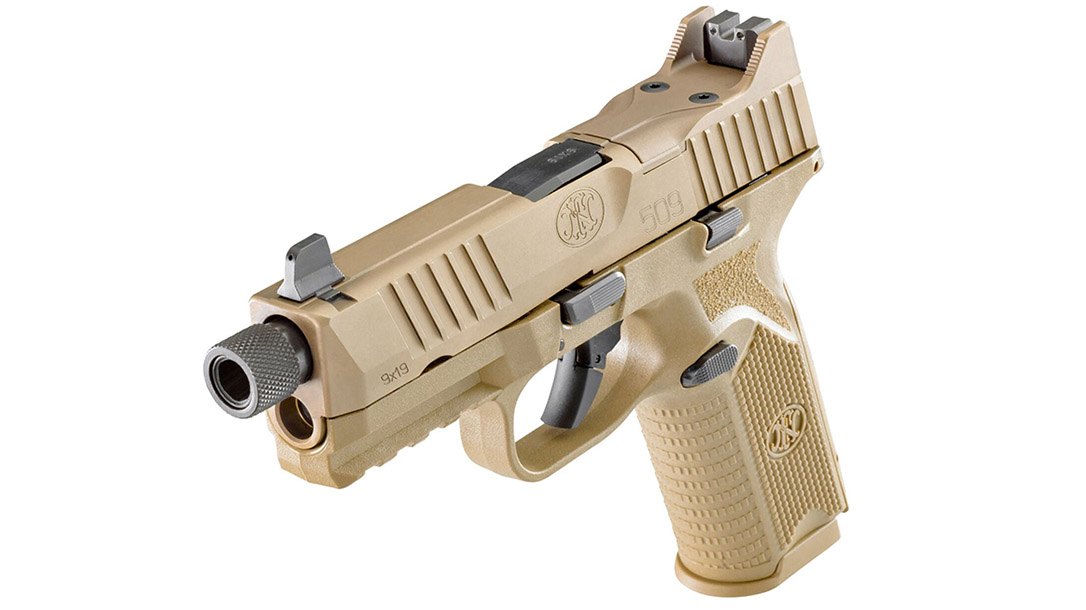
With a forward-looking design, the new FN 509 Tactical comes factory ready for the addition of a suppressor and optic.
What the FN 509 Tactical offers:
1/2” x 28 threaded barrel.
O-ring sealed thread protector.
Suppressor height night sights.
FN Low Profile Optics Mounting System for optics.
5.5 to 7.5 lbs. trigger pull.
MIL-STD-1913 accessory mounting rail.
Interchangeable backstraps.
Fully ambidextrous slide stop lever and magazine release.
MSRP $1,049.
The likes of the Browning Hi-Power and the U.S. Army’s M4 contract on its resume, it’s fair to say FN Herstal knows military firearms. Given this, it was absolutely no surprise the Belgium company tossed its hat in the ring when the Army went hunting for a new sidearm. The FN 509 was its submission, and while it didn’t earn a place in the U.S. combat arms’ pantheon it nonetheless proved a solid pistol.
FN has taken the original striker-fire, polymer-frame 9mm to the next level with the release of the FN 509 Tactical. The gun expands on the capabilities of the original 17-round semi-automatic and turns an extremely forward-looking eye to the shifting tastes of modern pistol shooters. This is particularly obvious fore and aft, with the gun’s threaded muzzle (comes with a O-ring sealed thread protector) for the quick addition of a suppressor and unique rear sight. Yeah, something definitely up back there.
The suppressor-height, night-capable, three-dot irons are protected by wings, which FN claims provides a better bite when tactically manipulating the slide – say off a table or belt. Additionally, the extensions protect the sight from going out of whack if you happen to work the slide in this fashion. As they say on late-night infomercials, “Wait, there’s more!” The “more” on the FN 509 Tactical is its Low Profile Optics Mounting System, a removable slide plate that allows the addition of a reflex sight in a milled recess in the slide.
One other point to mention on the FN 509 Tactical, it comes with a 24-round extra magazine. Perhaps not ready to carry, unless you can convince people you have a sometimes carbuncle, but potentially enjoyable nonetheless. MSRP on the FN 509 Tactical is $1,049.
From FN Herstal:
(McLean, VA) FN America, LLC announces today the expansion of the FN 509® Series of striker-fired pistols with the release of the FN 509 Tactical, an optics- and suppressor-ready 9mm pistol. The pistol features the company’s patent-pending Low-Profile Optics Mounting System™ that enables the platform to accept more than ten commercially-available miniature red dot (MRD) optics and remain adaptable to future optics releases with no requirement of direct milling of the slide.
“The FN 509 Tactical and the FN Low-Profile Optics Mounting System are another leap forward in the optics-ready pistol market,” said John Keppeler, vice president of sales and marketing for FN America, LLC. “FN set the trend for factory optics-ready pistols with the release of the FNP-45 Tactical nearly a decade ago and we’re set to do it again with this release. From barrel to base plate, the FN 509 Tactical really is the ultimate tactical pistol.”
The FN 509 Tactical, an extension of the FN 509 family, is based on FN’s submission pistol that the U.S. Army tested for its Modular Handgun Trials, but includes the significant improvements to the design that were implemented in the FN 509. Like the optics mounting system, FN’s team of engineers set out to develop the ultimate tactical pistol by addressing the market’s existing limitations.
As a result, the FN 509 Tactical features an FN-signature 4.5-inch, cold hammer-forged, stainless-steel barrel with target crown, ½” x 28 threads that accept the bulk of 9mm suppressors available and thread cap with integrated O-ring to prevent loosening during use. Lastly, the 24-round magazines, nearly identical in length to the pistol’s slide, maximize ammunition capacity without impacting carry convenience.
The optics mount accepts the majority of MRD’s on the market with no need to direct mill the slide, allowing for a low-profile mount and co-witness with the suppressor-height iron sights. The slide cap, for use when not shooting with an optic, has raised sight wings that protect iron sight alignment if the pistol is dropped or jostled, and provides a textured ramp for racking the slide against a belt loop, pant pocket or boot.
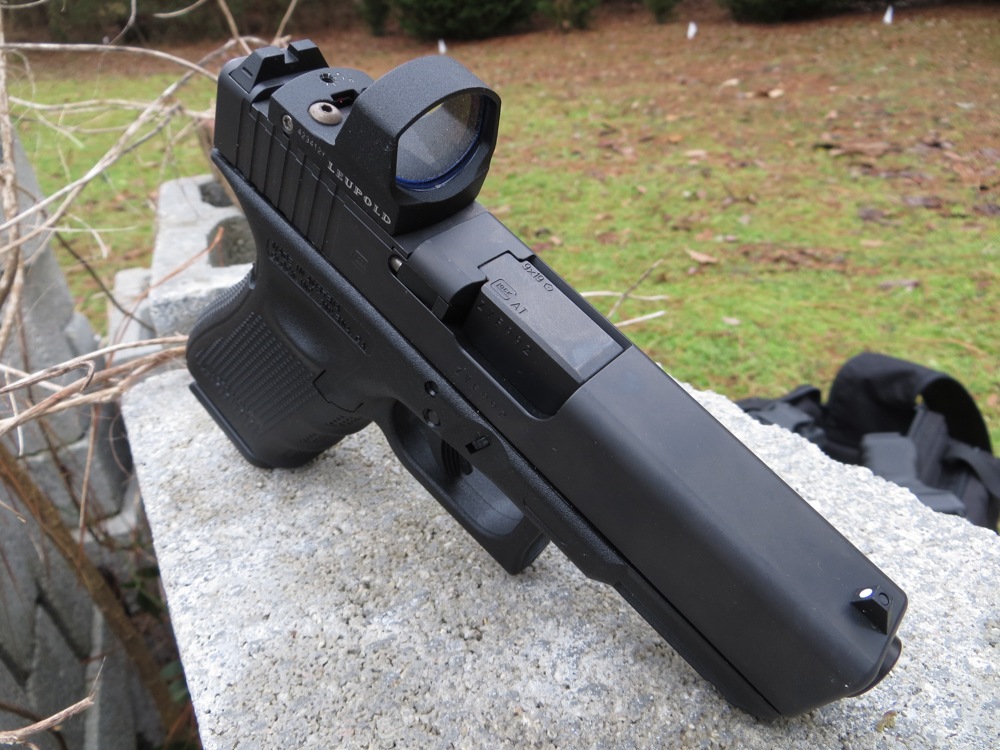
Is there a place in concealed carry for 9mm handguns with reflex-style optics? In this Glock G19 MOS review, Robert Sadowski answers with an unequivocal yes!
With a little practice, concealing, drawing and shooting are very doable with a reflex-optic handgun.
The Glock MOS G19 was fast on target and even quicker on follow-up shots.
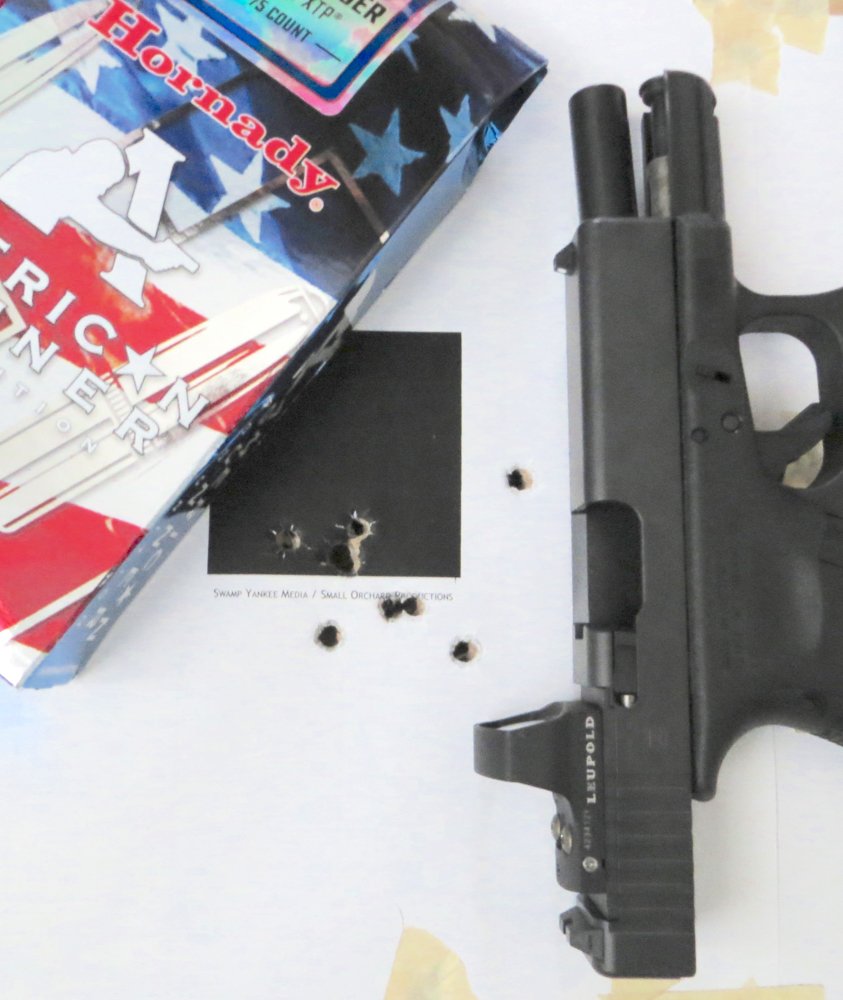
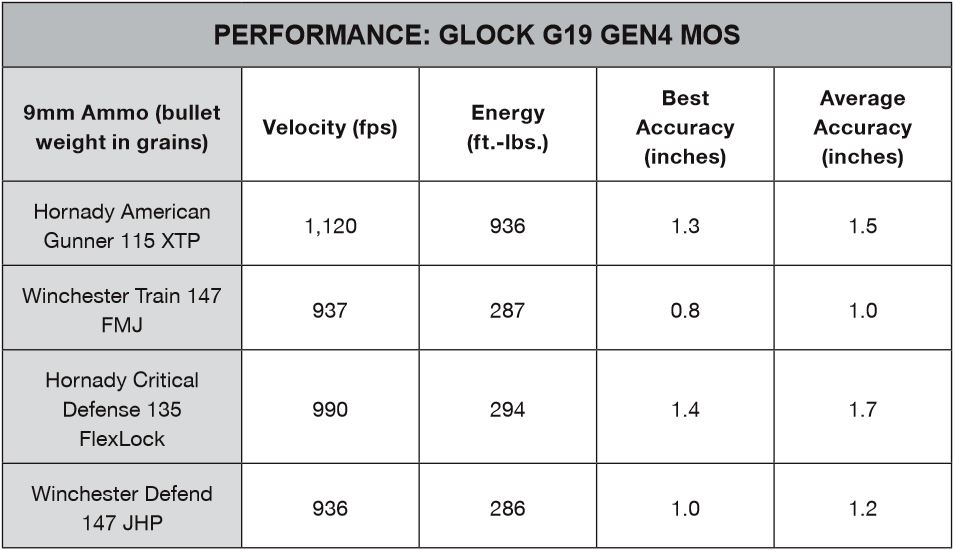
With groups around an inch at 25 yards, it’s hard to argue with the accuracy of the reflex-sighted Glock.
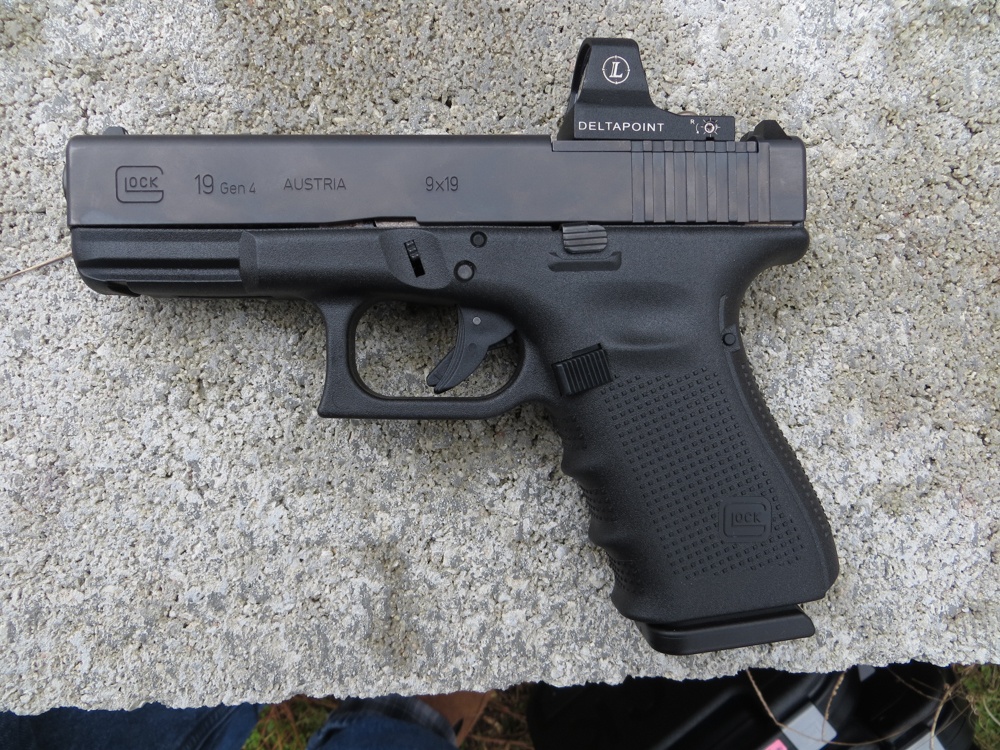
The Glock G19 Gen4 MOS allows the operator to mount a small reflex red-dot sight. This will no doubt change the way the next generation of concealed carry users defend themselves.
A dramatic change in how concealed carry pistols are equipped has evolved with the G19 Gen4 MOS (Modular Optic System).
This Glock allows you to easily mount a small reflex red-dot sight and will no doubt change the way the next generation of concealed carry users defend themselves. Fast target acquisition and easy-to-conceal reflex sights are the next step in high-tech defense and this Glock made the transition from irons to optics seamless.
I put a G19 Gen4 MOS pistol through the day-in and day-out tasks we all do: strapping on a holster, holstering and carrying the gun, then removing it and starting all over the next day.
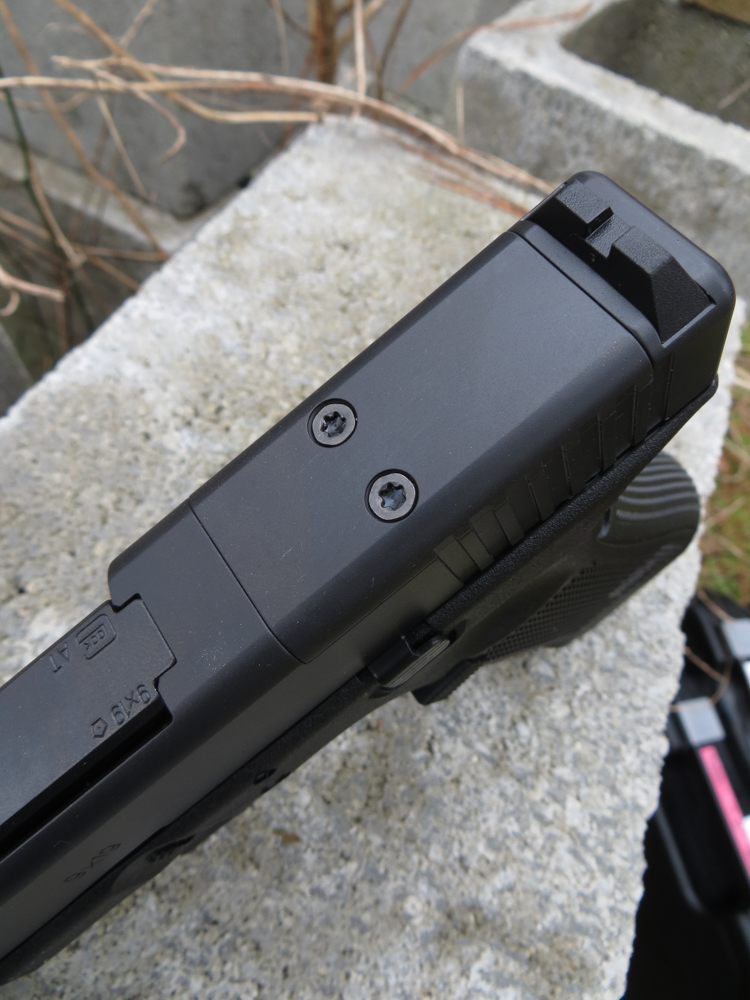
The G19 Gen4 MOS is nearly the same as current Glock 19 pistols except for a cover plate just forward of the rear sight.
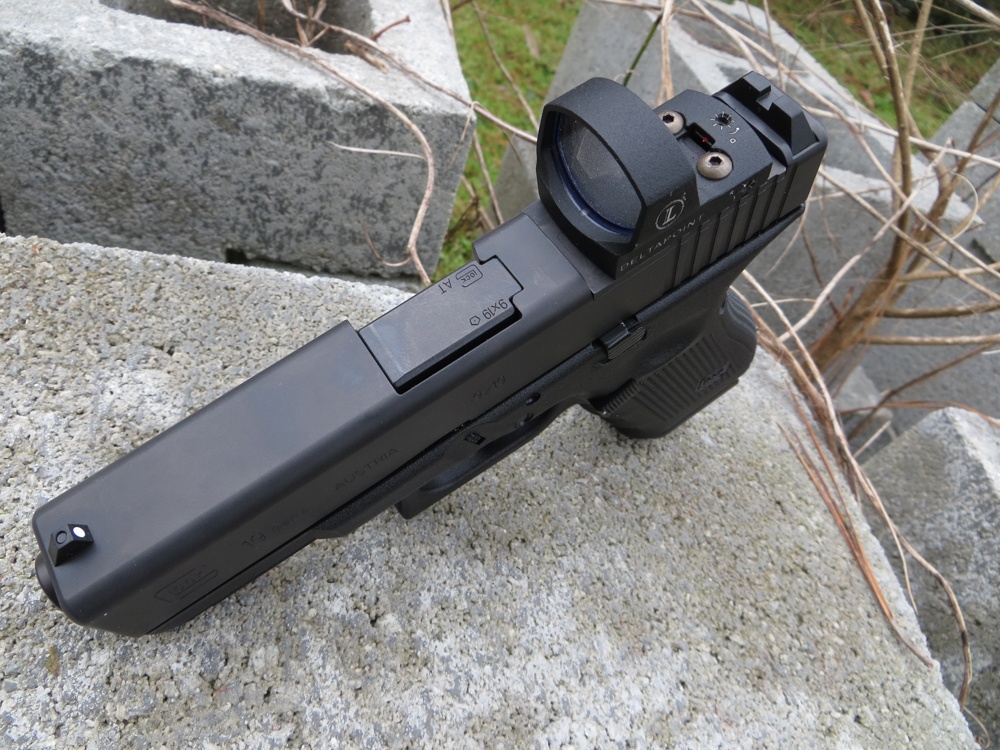
But the carry portion is only part of the story of the optics-ready Glock. The G19 took well to the Leupold DeltaPoint it wore. After a box of cartridges, I was drawing, aiming and hitting targets like I had carried it for years. Will iron sights become backup as they have on AR rifles? I say yes, and Glock has made it easier and infinitely more practical to mount an optic on a concealed carry pistol.
The Glock compact G19 is one of the most popular defense pistols available. It really does not need any introduction.
My expectation was the handgun would perform flawlessly, adapt to my hand size, and be extremely reliable. The G19 Gen4 MOS is nearly the same as current G19 pistols except for a cover plate just forward of the rear sight.
In MOS configuration, it is only a matter of removing two screws and the cover plate, choosing the MOS adaptor plate that is compatible with your reflex sight, mounting the adaptor plate to the slide, and affixing optic to the adapter plate. It actually takes more time to describe mounting an optic on the Glock than doing it.
The MOS adaptor plates are compatible with reflex red-dot sights from a number of manufacturers: Trijicon, Leupold, Meopta, C-More, Doctor, and Insight. The footprint of the adaptor plate on the slide is small, but the actual optic footprint will vary in width and height depending on the manufacturer. They all weigh nearly the same.
The G19 Gen4 MOS is nearly the same as current Glock 19 pistols except for a cover plate just forward of the rear sight.
The Leupold DeltaPoint I mounted sits low on the slide. Its width is 1.2 inches, while the width of the G19 slide is 1.0 inches. An eighth of an inch of the DeltaPoint hangs over each side due to the shape of the sight’s widow. It sits at an inch high, while standard Glock sights poke up 1/8-inch.
I’ve used red-dots for competition shooting, which affords greater speed over traditional iron sights. Plus, there is only one plane to focus on when aiming a red-dot. The three sight planes of traditional open sights — rear, front and target — need to be aligned for shots to hit accurately.
It takes practice and training. A reflex sight is far easier to acquire the target, aim, fire, and get back on target. Carrying a concealed pistol equipped with a reflex red-dot sight does not pose a drastic change in the way you carry, but it will change the ease with which you aim.
The iron sights on the G19 are standard height and do not co-witness with the DeltaPoint. Battery life is an issue with any electronics. Optics are rugged and can take abuse, but there is that voice in the back of your head asking what happens when the batteries die.
Here’s one thing I found: In a pinch if the battery dies you can use the window of the reflex sight as an extra-large makeshift peep sight in conjunction with the front blade. For close distance, I tried that very thing out to 10 and 15 yards and it worked effectively allowing me to hit a target 18 inches in width or about the width of the average human torso.
Battery life should not be an issue barring unforeseen circumstances. Even if dropped in water the DeltaPoint is waterproof. Using any battery-operated accessory requires an additional maintenance task, routinely changing batteries like you do in a flashlight or smoke detector. It becomes second nature and ensures you are not caught unawares.
To carry the G19 I used a DGS Arms CDC (Compact Discreet Carry) Kydex IWB (Inside-the-Waistband) holster. I’ve used this holster to carry a standard G19 in appendix carry. Using a pencil, I marked the holster and used a Dremel tool to cut a slot to allow the handgun with mounted DeltaPoint to be completely holstered.
There are now several makers producing holsters for red-dot-equipped handguns.
I found the red-dot did not affect my concealed carry routine. I did need to slightly modify my training when drawing the new Glock from concealment. The taller sights have the potential to snag on concealing garments when drawing if you don’t grab that shirttail and yank it as high as you can (which you should do anyway regardless of your carry gun’s sights).
From a rest, the author attained surgical accuracy with the Glock. He was using the Hornady American Gunner ammo loaded with 115-grain XTP bullets.
I did find the DeltaPoint made a great handle to rack the slide if needed. I admit I used it as a handle a lot to see if the sight would come loose or go out of zero. Nothing doing. I even employed the sight to rack the slide against the edge of the shooting bench, my holster mouth, and with my hand during a reload. Using the sight as a grip means it gets fingerprints.
Concealed carry also means lint can build up in the sight window. Part of my new routine became to blow out any lint or debris that would build up using the same canned air I use to clean out my computer keyboard.
The real test is making holes in paper. I averaged about 1.7 inches for 5-shot groups using a rest. Firing offhand and finding the red-dot in the sight window took a bit of ramp-up time. By the second magazine, I was drawing and aiming as if I had always used a red-dot on my concealed carry pistol.
SPECIFICATIONS MODEL: Glock G19 Gen4 MOS CALIBER: 9mm ACTION: Locked Breech, Recoil Operated BARREL LENGTH: 4.02 in. OVERALL LENGTH: 7.28 in. WEIGHT: 21.16 oz. (empty) SIGHTS: Fixed, Dot/Outline TRIGGER: Striker Fire FINISH: Matte Black GRIPS: Textured Polymer Modular Backstraps CAPACITY: 15+1
Though not difficult, mastering shooting on the move is a matter of learning to walk all over again.
Most folks go to the range and become razor sharp at printing trim groups standing in one spot. Might sound kosher, but there’s more to shooting — the practical kind — than static performance off the firing line. Movement, be it transitioning targets in competition or the tactical variety that might save your rear, is a real-world likelihood. In short, the ability to accurately shoot while on the scoot is a leg up of which every shooter should strive.
Few people know more about dynamic handgun skills than Mark Redl, and the pro shooter is a huge advocate of learning to shoot on the move. He demystifies much of what goes into mastering the skill in the above video, and it’s less daunting than you might think. All in all, it’s simply a process of learning to walk all over again.
More than anything, retaining accuracy on the move is a matter of body control. Up top, your torso and arms must provide a stable platform to keep your shots on target. Down below, your legs have to get you where you need to go, while minimizing the shock of each step. It’s a tricky balance, but achievable with enough practice and well worth the effort. If you can get down dynamic shooting with a handgun, you most certainly have an advantage over most other shooters.
Modern Shooter gives you the tactics to survive an up-close-and-personal lethal-force event.
So close you can feel them breathing, could you survive an attack this personal? Generally, as armed citizens, we don’t train to handle these sorts of situations — the near-in ambush, the assault within speaking distance. Yet, they’re uncomfortably common and particularly deadly.
Far from a cut-and-dry draw and presentation, getting your handgun into the fight in these circumstances requires a specific skill set, not to mention iron nerves. Honing his up-close-and-personal fighting abilities, Phil Massaro discovers exactly how challenging learning these lifesaving skills are in Modern Shooter’s trip to New York’s Double Eagle Tactical Training. They’re a relatively simple series of movements, yet they’re complicated with the intimacy of the event and brevity of response time. As always, the key to mastering the skill — particularly if it’s new – is slowing down the drills in an effort to build muscle memory. This is particularly true here.
Not only is Massaro forced to realistically position his off arm to push an assailant back or block a blow, he is shooting one handed and from the hip. Additionally, the little things — cant of his body, keeping the pistol out of snatching distance — further muddle the situation. A wrong move or a break in concentration has the potential to end in injury or worse. Attention and mastery are at a premium when acquiring these skills.
Learning to engage a threat so close you can count nose hairs is challenging, to say the least. However, the advantage it allows you in a near-range encounter is well worth the sweat and struggle.
Continue to sharpen your self-defense skills on the next episode of Modern shooter, 10 p.m. EST Friday on the Pursuit Channel. The episode rebroadcasts Monday at 12 p.m. EST and Tuesday at 11:30 a.m. EST.
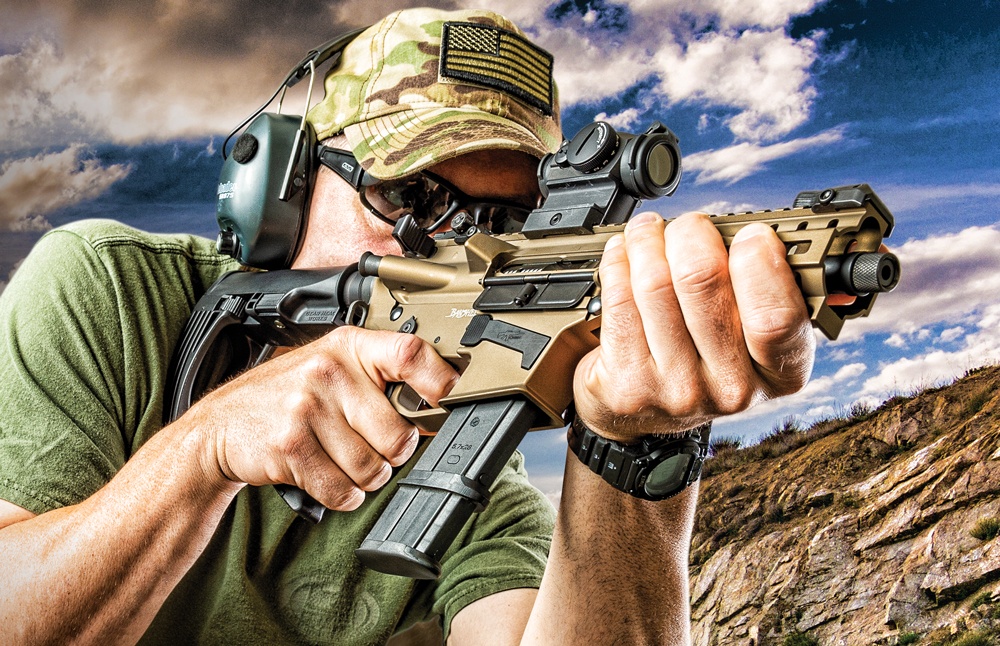
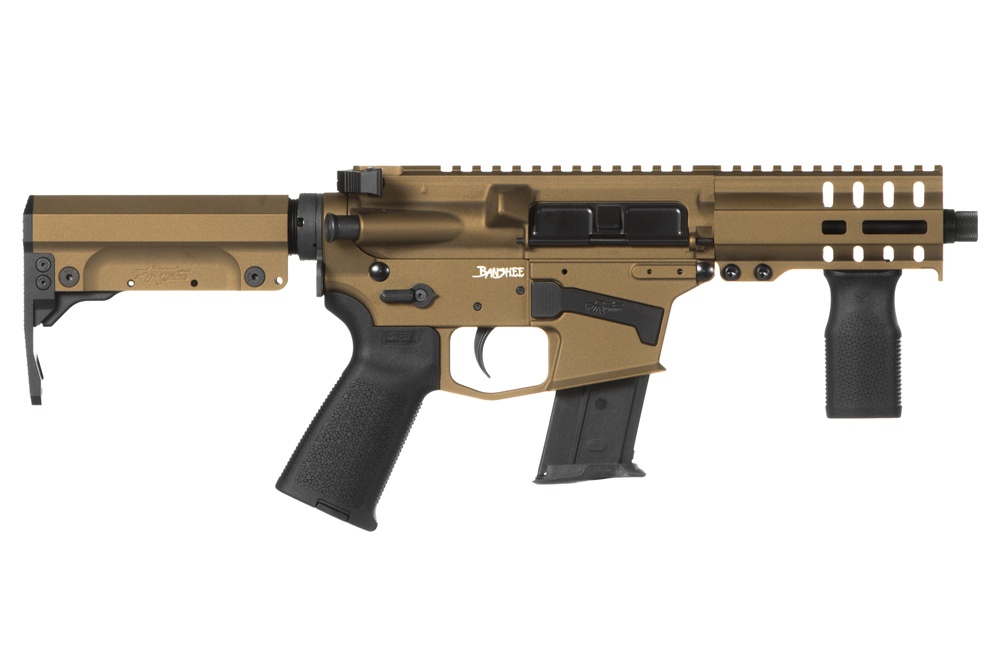
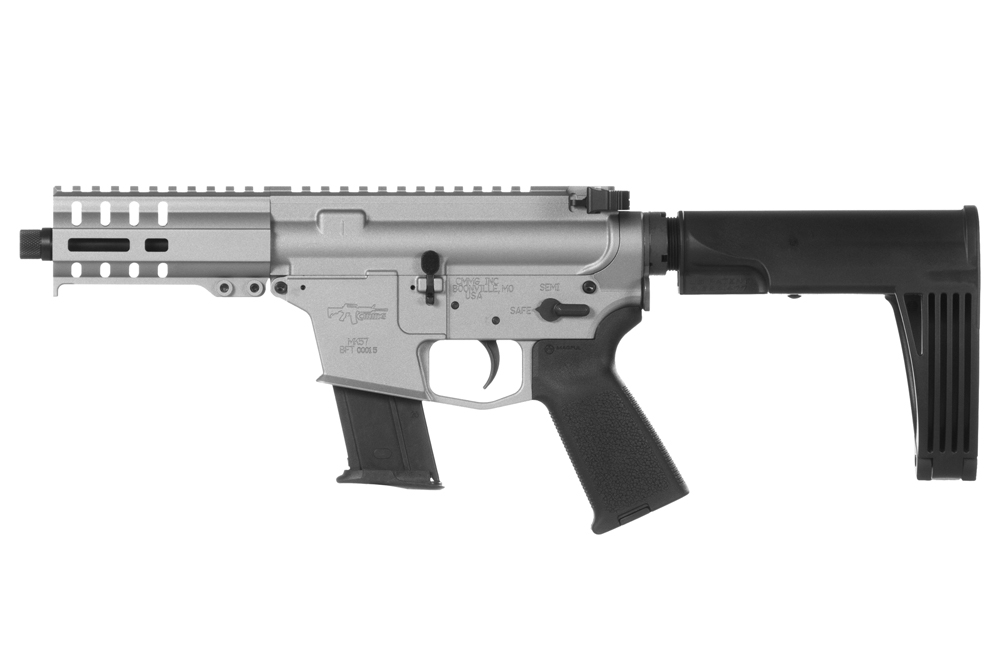
Uniquely chambered, CMMG’s Mk57 line is soft shooting and hard-hitting.
What the Mk57 line offers:
5-inch barreled BANSHEE pistol and SBR.
8-inch barreled PSB pistol.
Chambered for FN 5.7x28mm.
CMMG’s Radial Delayed Blowback Operating system.
SBR stocked with CMMG’s RipStock.
PSB Pistol outfitted with KAK Shockwave Stabilizer.
Give credit, CMMG keeps you on your toes. The Missouri AR maker has built a reputation for embracing unique calibers and configurations, but might have outdone itself with the recent expansion of its pistol and short-barrel rifle catalog. The new Mk57 GUARD lineup harnesses the power of the FN 5.7x28mm. Yes, you heard right, the crazy bottle-neck squirt that offers some impressive armor-piercing ammunition options.
Treading into rare territory, the new 5-inch barreled BANSHEE and 8-inch PSB won’t have a ton of competition chewing on the cartridge. There’s Fabrique Nationale Herstal, AR-57 and Masterpiece Arms, that’s about it when it comes to company’s that have embraced 5.7x28mm. Despite a relative trickle of firearms, there is a fairly decent ammunition selection for the caliber — not vast as .22 LR or as cheap, but enough to keep you shooting.
The pistols and SBR’s utilize CMMG’s Radial Delayed Blowback operating system, a rotating bolt head that slows down the bolt carrier group enough to safely cycle rounds too powerful for straight blowback. The company touts the system’s ability to lessen recoil, which should mean the 5.7x28mm will feel like a stiff breeze coming out of the Mk57 GUARD guns. Additionally, the Banshee SBR configuration boasts CMMG’s RipStock, a fast deploy stock sans locking tabs. And all the guns are compatible with FN Five-seveN magazines. The Banshee configuration runs $1,550 and the PSB pistol $1,400.
From CMMG:
Boonville, MO — CMMG has announced the release of a new line of AR pistols and short-barreled rifles (SBR’s) chambered in FN 5.7x28mm. Available in 5-inch barreled BANSHEE and 8-inch barreled PSB configurations, each model in the new Mk57 GUARD line is fed from FN 5.7 pistol magazines and uses CMMG’s patent-pending Radial Delayed Blowback operating system.
“The 5.7 is an intriguing round that is perhaps best known for its relatively lightweight bullet design and impressive velocities. From an engineering perspective, we were excited to pair the 5.7 with our Radial Delayed Blowback system. I think it’s safe to say that this combination makes the Mk57 one of the lightest recoiling pistol caliber carbines on the market,” said Chris Reinkemeyer, CEO of CMMG.
At the heart of the Mk57 is CMMG’s Radial Delayed Blowback operating system designed to minimize felt recoil. It features rotating bolt that requires the recoil impulse of a round being fired in order to unlock. As each round is fired, a portion of the rearward force is exhausted in unlocking this bolt prior to driving the carrier rearward and cycling the action. With less rearward force to compensate for, CMMG is able to use a lighter carrier and buffer than a standard blowback design would allow, thus reducing the overall reciprocating mass.
CMMG will also offer a separate lightweight buffer for use with subsonic ammunition. To overcome the reduced backpressure with subsonic loads, the lightweight buffer can help ensure that the bolt locks back after firing the last round.
The FN 5.7×28 was designed and introduced by FN Herstal with the intention of replacing the 9mm for military and law enforcement usage. While the caliber has been adopted by several agencies throughout the world, its real success came with its entry into the civilian market in the early 2000’s.
After the original Mk 12, the government used Knight’s Armament handguards for the Mod 1 version of the Mk 12. If that’s the one you want, then go forth and find Knight’s hardware to build yours.
The Mk12 Mod 0 is a heavily customized AR-15 for mid-range sniper use. Here’s how to build your own.
What you need to build a Mk12 Mod 0:
With parts from PRI, A.R.M.S., Knight’s Armament and Leupold you can build a Mk12 Mod 0.
The Mk12 is a heavy AR-15, super-accurate and ideal for long-range shooting.
If building isn’t your thing, complete Mk12 uppers can be had from PRI, Bravo Company and Brownell’s.
The genesis of the Mk 12 was the desire in some quarters for an accurate but not heavy (these things are relative) sniper rifle. The Navy had just adopted the Mk 11, which was the Knight’s M110, a rifle chambered in .308, aka 7.62 NATO.
But, not every job calls for a .308, and not every mission can take the weight. A loaded M110 has a “book” weight of 15.3 pounds. As if.
You want a tight fit of the barrel extension in the upper receiver if you wish to wring all the accuracy out of your barrel.
In addition to the optics and the loaded magazine, the already-bipodded rifle gets more gear. Add a sling. Add a laser targeting designator. Add a suppressor. The rifle is soon up to or even over 20 pounds, and that is before the end-user starts stuffing loaded magazines into his tac vest.
All that gear will add to the full-up weight of a 5.56 rifle, but it will at least start at a lighter weight, and offer more shots per added pound of payload to the tac vest.
It would seem obvious that rifles are tools used to shoot one’s enemies. And in order to do that, they must be accurate.
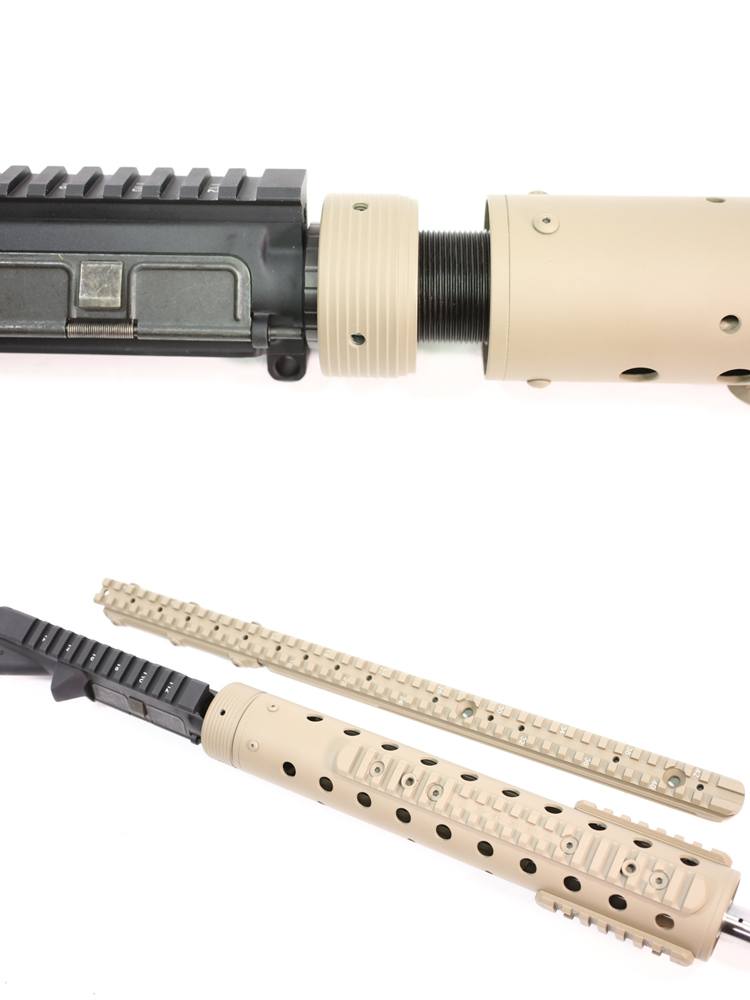
The PRI Mk 12 Gen II handguard uses a proprietary nut and handguard locking assembly.
Building a Mk12 Mod 0
This is involved, partly because so much of it is not like your normal AR-15 assembly, and partly because the desired end result is an accurate, reliable rifle, and if you cut corners you won’t get that.
Start with a ready-to go lower, because that is not unusual. Ideally, you’d use a retro-style A1 lower, but since the Mk 12 was meant to go on whatever was available, you can get away with using an A2 and few will complain. (Oh, someone will, but ignore him.)
The first thing you have to do is source a barrel. After all, the Mk12 is meant to be a really accurate rifle, so building one that won’t shoot well is kind of pointless. I opted to go with a BCM Mk12 barrel, because I have had good luck with BCM gear and in fitting and using their parts.
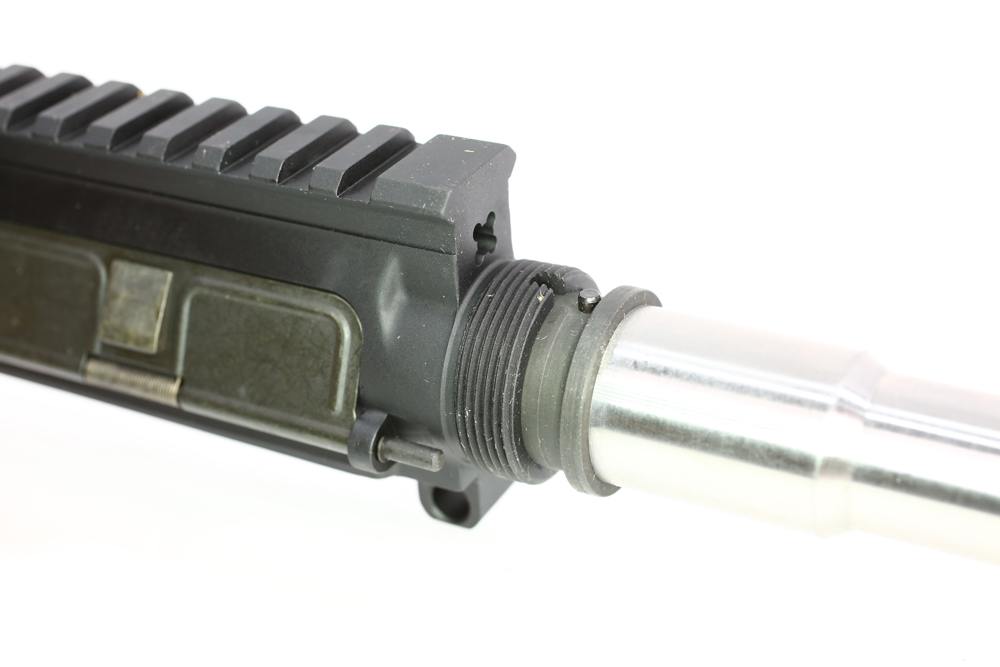
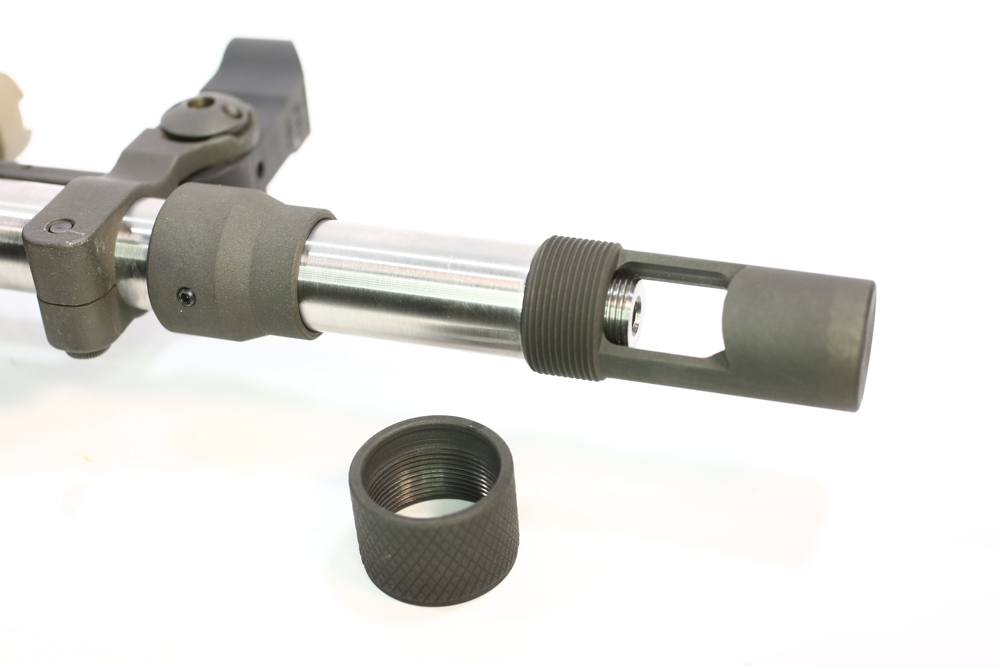
The muzzle brake is also the suppressor thread part, and you need to get the brake aligned so the openings are to the sides.
The barrel is a bull barrel, stainless steel, and with a 1/8 twist. To gain the most accuracy from it, it should be properly bedded into the upper receiver. You can do fine just bolting it in, but to wring the last few bits of accuracy out of it, go with the full-on barrel installation as described in the barrel chapter.
Next up, the PRI handguard.
The PRI handguard uses a proprietary barrel nut, so you’ll have to plan ahead and do a bit of juggling.
The nut also includes a rear locking cap. Put the cap on, then the barrel nut, and tighten the barrel nut. You‘ll have to align the barrel nut for a perfect gas tube clearance, and then use the alignment studs on the rear of the handguard tube, inserting them into the front of the barrel nut.
The PRI handguard assembly comes with an extra rail, the ARMS rail, which adds extra stiffness to the upper by bridging the receiver and handguard.
Now, Gen I of the PRI handguard uses a larger-diameter nut than the handguard tube. The Gen II has a locking nut that is the same size as the tube, but the process is the same. You have to get the nuts precisely aligned, for gas tube clearance and to align the top rail and receiver with the handguard rail.
This is where you want to be careful and precise. The handguard aligns on the barrel nut. The handguard also has to allow for the top rail to be bolted across he handguard rail and the upper receiver rail.
If the handguard tube is the least bit mis-aligned, you will find the two rails and the top connector won’t play well with each other. If you try to get it “close enough,” you’ll have a situation where the tightened-down top rail is stressing the handguard, receiver or both.
Keep adjusting and checking until there is no disagreement and the two rails (handguard and receiver) are in agreement that they are straight and will smoothly be clamped by the top rail. Use a strap wrench to tighten the barrel nut cap. Then install the top rail and clamp it down securely. If you want, you can use blue Loctite or paint-in the nuts once tightened.
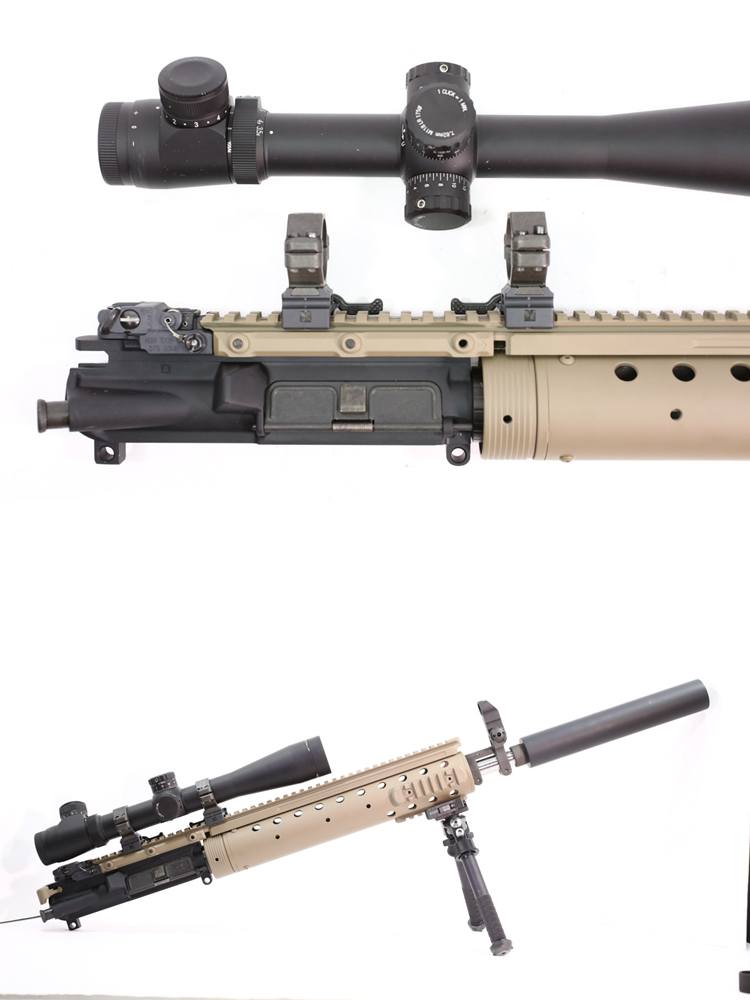
The Leupold 3.5-10 scope goes on top, in ARMS 22 medium-height rings. The rings are quick-detach, not that you’ll be taking the scope off and putting it back on much. You do it because that’s the way the military built it.
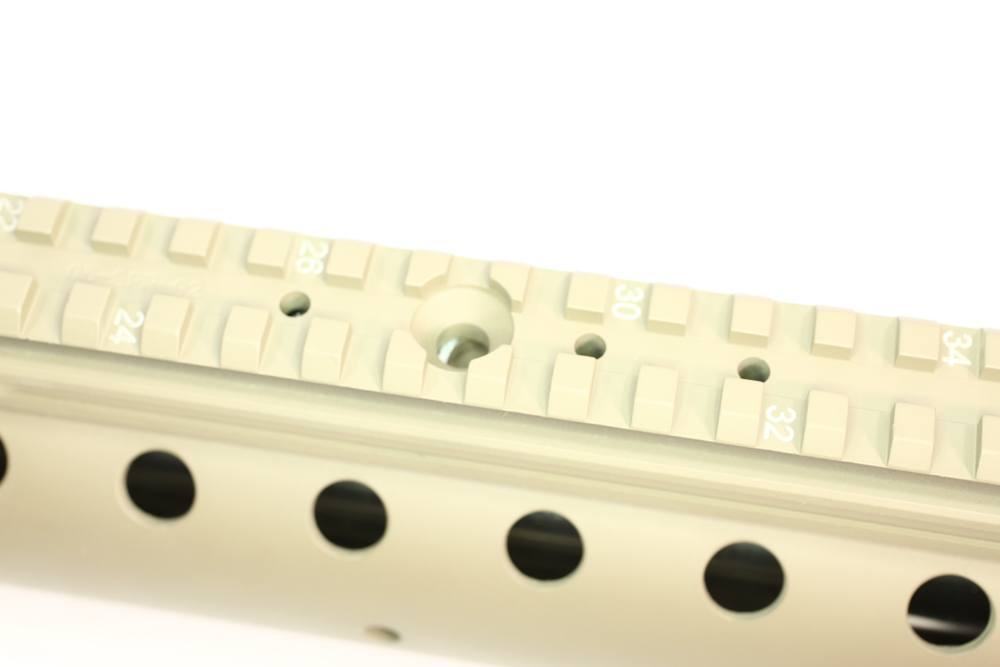
The top rail uses five screws. Three of them go across the top, through the slots of the receiver rail. Two others go down from the top of the top rail and screw into the rail of the handguard.
Install the rear sight and paint it in as well. Now we’re ready to get to the test-fire stage, once we get the gas block/front sight on.
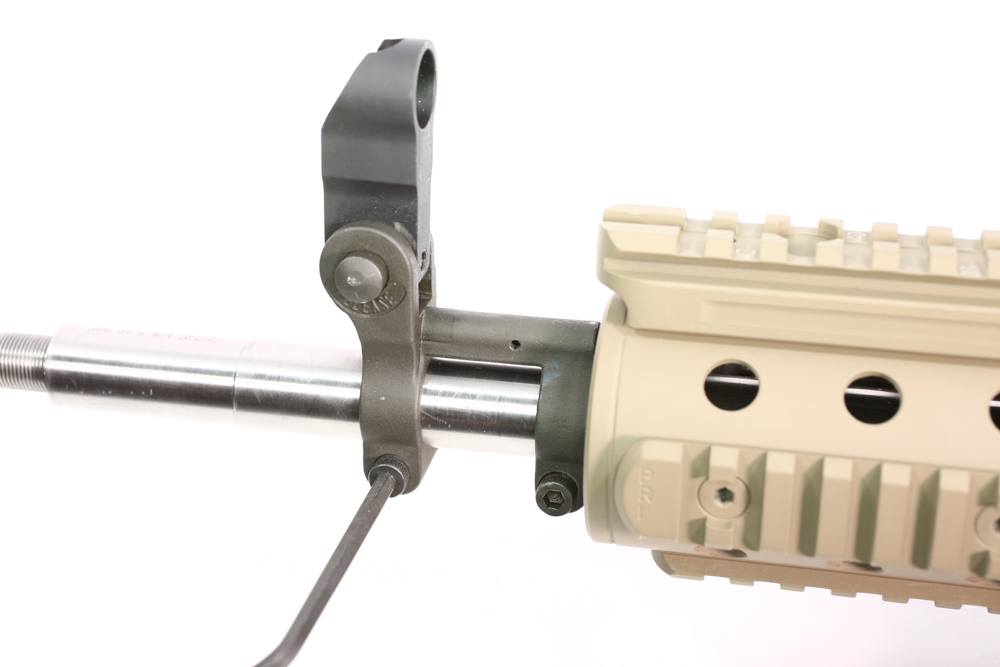
Once you have the barrel nut in the right place, slide on the gas block/front sight assembly, align the gas tube and tighten the clamping screws. Don’t Loctite them yet. Next up, range trip. Use common, inexpensive ammo, and if you are in favor of this process, use the opportunity to break in the barrel. Me, I don’t care.
Ideally, you do this at the gun club, with the range to yourself, and on a nice, sunny, dry day. Make sure your rear sight is at the exact center of its adjustment range. Load one round, use the iron sights, an aim at an obvious mark on the hill. Fire. Where did it hit? It most likely was not on-center.
If it hit left, your front sight is too-far right. And vice-versa. Loosen the screws, tip the sight a small amount in the correct direction and tighten the screws. Now take a moment to make sure your gas tube is still properly aligned. Fire again. Repeat this boring, detail-oriented process until your iron sights are hitting dead-center. Your front sight is now aligned and centered, and life is good.
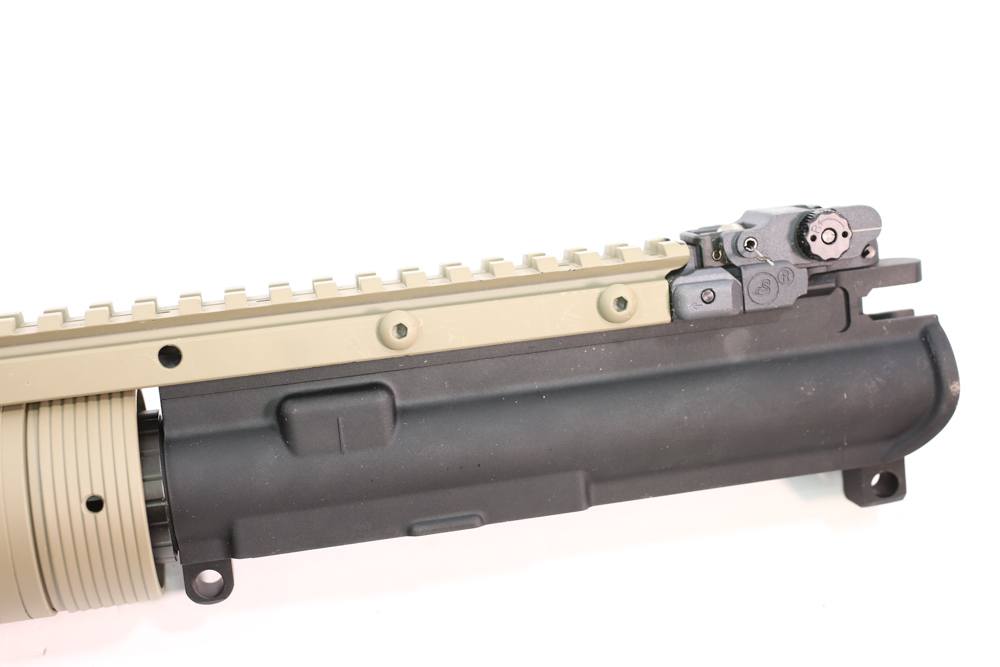
Here’s the upper receiver, ready to install on the lower of your choice. The originals were meant to be put onto M16 lowers, but they proved so useful and so popular that they ended up on top of pretty much any lower that got the job done.
Back to the shop, to finish the rest of the build. Once there, loosen one of the two front sight screws, but do not remove it. Hose it and its recess in the sight assembly with wicking Loctite. Tighten and leave it alone. The next day, do the same to the other screw.
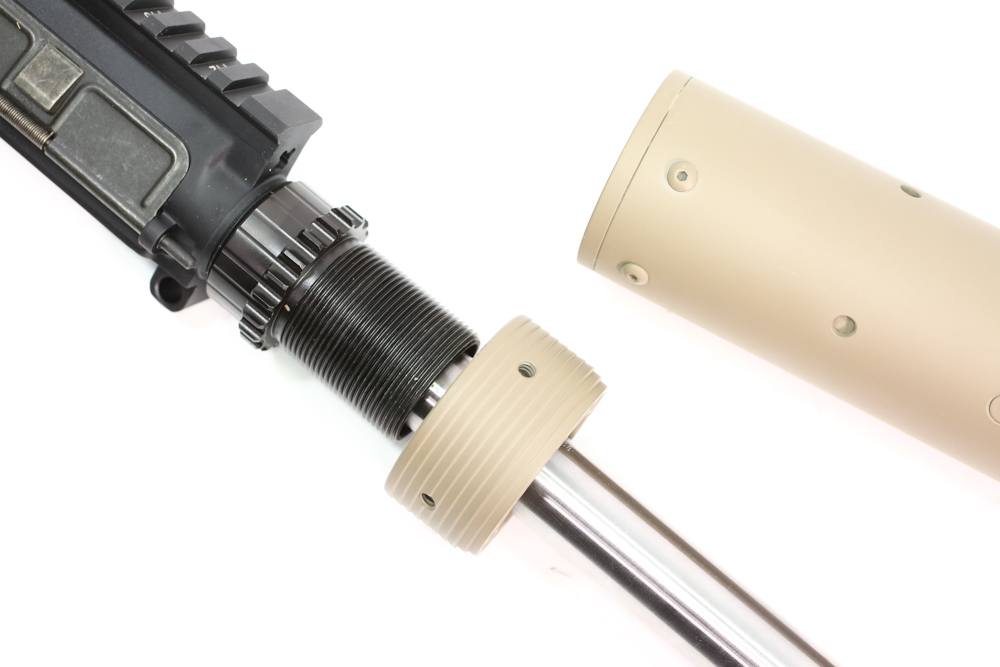
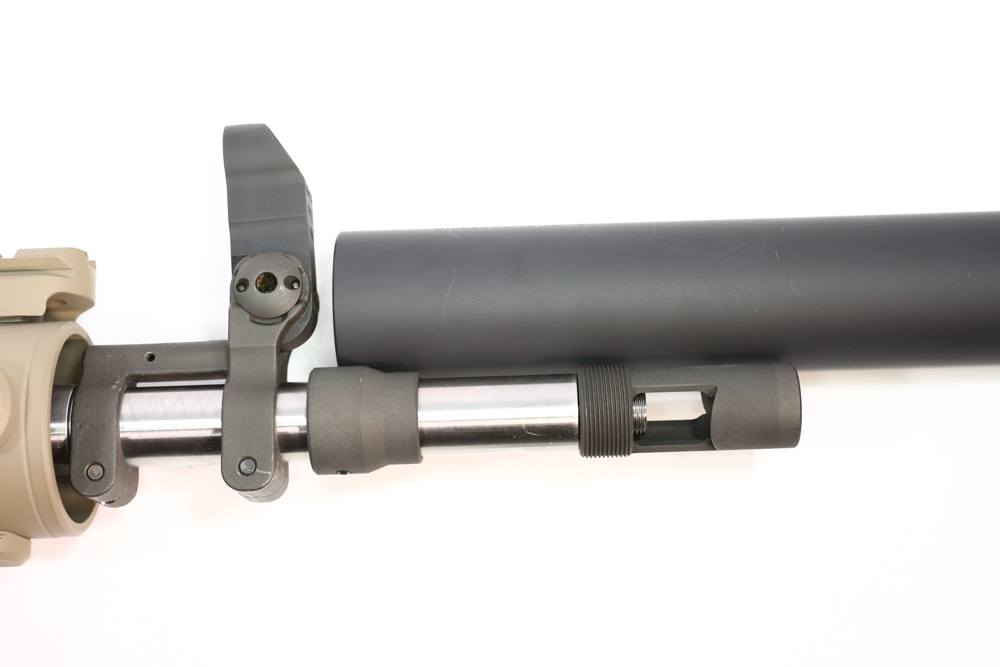
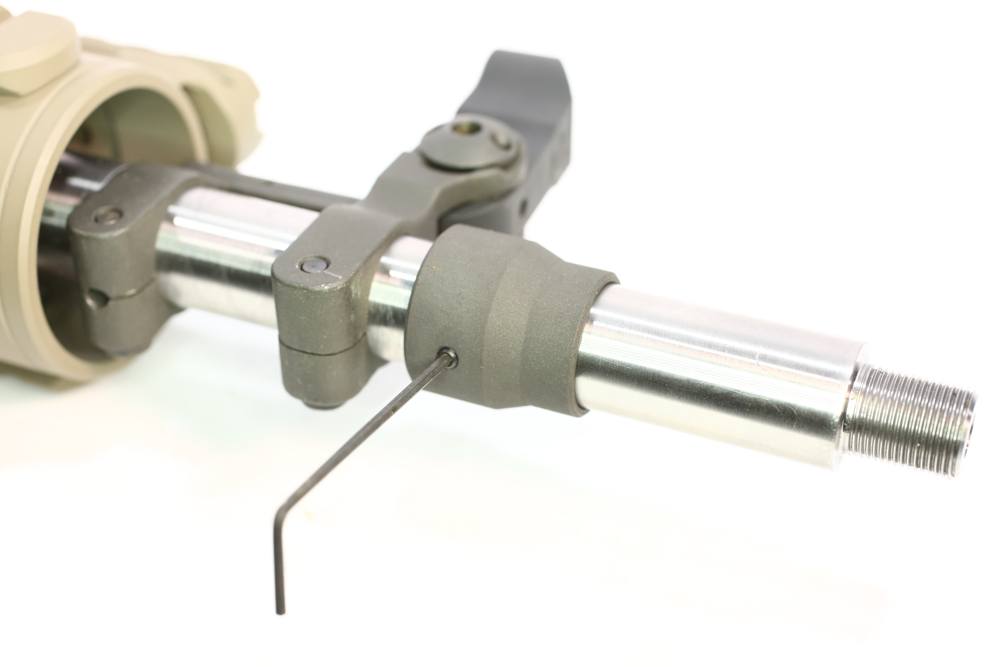
Next up, fitting the muzzle brake and suppressor mount. The suppressor alignment collar slides over the barrel, down to the step in front of the gas block/front sight assembly.
There is a small setscrew to hold it in place. In talking about this with my contact, I asked if they did anything more than tighten it. “We used a bit of Loctite to hold the setscrew in place. It held, even without the barrel being dimpled, as you suggested.”
I don’t want to argue with real-world success, but I’d feel a lot better if the collar was more secure than that. But that’s for the end of this process.
With the collar in place, use the setscrew to keep it there and not rattle around or spin. Screw the muzzle brake on, and get it more than hand-tight. Don’t worry if it isn’t timed properly, not yet.
Now, spin off the knurled collar you see on the muzzle brake. That covers the threads for the suppressor.
Of course, you check alignment during assembly. You don’t want to Loctite or Rocksett parts in place that don’t line up. And you use a Geissele tool to check alignment.
Spin the suppressor on, bring it down to seat on the collar, and then use your Geissele alignment rod to check alignment. It should be just fine, everyone involved in this has worked hard to keep things correct. If not, you will have to adjust the fit until your suppressor is aligned and central on the bore axis.
The suppressor, if a proper Mk 12 one, is now being made by Allen Engineering, and Ron Allen, the owner, was the guy who made them for the company who was making them for the government. The model is now called the AEM5, and it is a reflex suppressor.
Instead of all of it being forward of the muzzle except for the mounting hardware, a reflex suppressor fits over the barrel. This provides a greater volume for the same overall length, and the first chamber, the expansion chamber, is also much greater in volume. The design also offers greater support for alignment. The two bearing areas, the threads up front and the collar in the rear, keep the suppressor aligned even when banged around.
Reflex suppressors have the disadvantage of being limited to barrels no larger in diameter than the inside of the suppressor overlap tube. But, you get more volume and more quiet without an extra foot of tube on the end of the barrel.
Once you know the suppressor is aligned, you’re ready to wrap this part up. Tighten the setscrew enough to mark the barrel. Take it off, dimple the barrel, re-install, and check suppressor fit again. Still good? Pull it off, degrease everything, hose in the Loctite, slide the collar back on and tighten the setscrew.
The suppressor alignment collar rests on the shoulder turned into the barrel and is held in place with a simple screw. Ideally, once everything is checked, you’ll go back, dimple the barrel at the locking screw location and Loctite the collar on.
Now loosen the muzzle brake and hand-turn it until it is as close to the stop shoulder as possible and correctly aligned. This is with the venting directly to each side.
Use a feeler gauge to measure the gap. Assemble a stack of flat washers of that thickness to fill the gap. Hand-screw the muzzle brake on and check. If it stops at about 10 o’clock short, good. If it hand-tightens all the way up to twelve, re-do your washer stack a bit thicker. This is one of those cut-and-try processes; it can’t be reduced to a chart of “if this much, use that washer.”
Once you have the washer stack the proper thickness, remove all of the brake and washers, degrease the threads, brake, and washer, and re-assemble (once dry) with Rocksett.
Torque up to top dead center. Leave the upper alone for a day. You have Loctite and Rocksett curing, leave them be. Check the assembly in an hour or less, and if you see any of the goo leaking out, wipe up the excess.
The front sight is also the gas block, held in place by two clamping screws. Get them snug, but remember: you’ll be loosening them to get the iron sights zeroed, so you don’t want to Loctite them in place until after that step.
Optics for Your Mk12
Once the locking stuff has cured, you are ready to install the optics.
The scope for the Mk 12 is/was the Leupold Mk4, either the 3.5-10×40 M3 or the Mark 4 2.5-8×36. The Mk4 is no longer being commercially made, but you can, if you must have the absolute correct optics, have one made by the custom shop for you. Rather than do that, I opted for a more modern Leupold, the 3.5×10.
When the Mk 12 was being developed there were choices for scope mounts. However, since the top rail, rear sight and other gear came from A.R.M.S., then the scope rings did as well. These are 30mm, throw-lever, individual rings and bases, mounted where the operator finds most comfortable and useful, and allows for the use of other gear.
Put your scope where it works for you, and do not get too wrapped up in poring over photos trying to find the exact set of slots in the top rail “used by SEALs.”
The last bolt is down through the top of the top rail, and secures it to the handguard along a different axis than the other locking bolts. If you do your part, this is not going to move.
The big advantage of the Mod 0 over the Mod 1 is the continuous top rail. You can mount the scope or other optics anywhere along the rail, and not have to deal with the gap between receiver and handguard that the Mod 1 presents.
Zeroing the Mk12
Where you zero it to depends on where you will be using it. If you are going to run through a 3-gun or multi-gun match with your Mk 12, well, good for you.
Zero for the distances that will work best in the match, and remember, most match organizers will put you in Open or Tactical Division if you run it with the suppressor on it. You’ll be running and gunning against the guys and gals with super-tuned competition rifles. Have fun.
The top rail bolts to the upper receive by means of through bolts that pass along the notches in the upper receiver rail.
If you will use your Mk 12 as a varmint rifle and hose prairie dogs, then again, zero at the distance most effective for your uses.
If you want to zero it “at the distance operators used,” well, I’ve got some news for you: there‘s the “book solution” and then there is the real-world solution.
Once an operator got to where he was going to be using his rifle, he figured out what worked best, adjusted, kept notes, and worked with it.
It’s your rifle, not the government’s, do what works for you.
Mk12 Use & Abuse
The Mk 12 got used a lot in Iraq and Afghanistan. As a precise bullet-delivery tool out to moderate ranges it was just the ticket. One example would be a team going into a village, not a large one, and putting a fire team with Mk 12 gunner on overwatch, on a hill on the outside. (Better yet, two of them, at a ninety-degree angle to each other, so you get as much coverage as possible.)
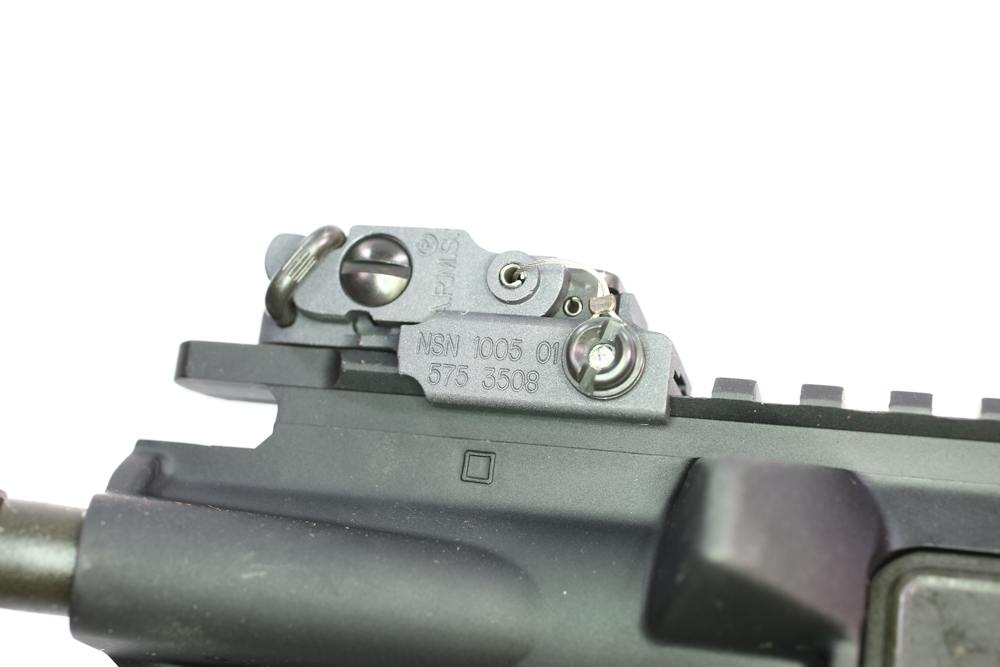
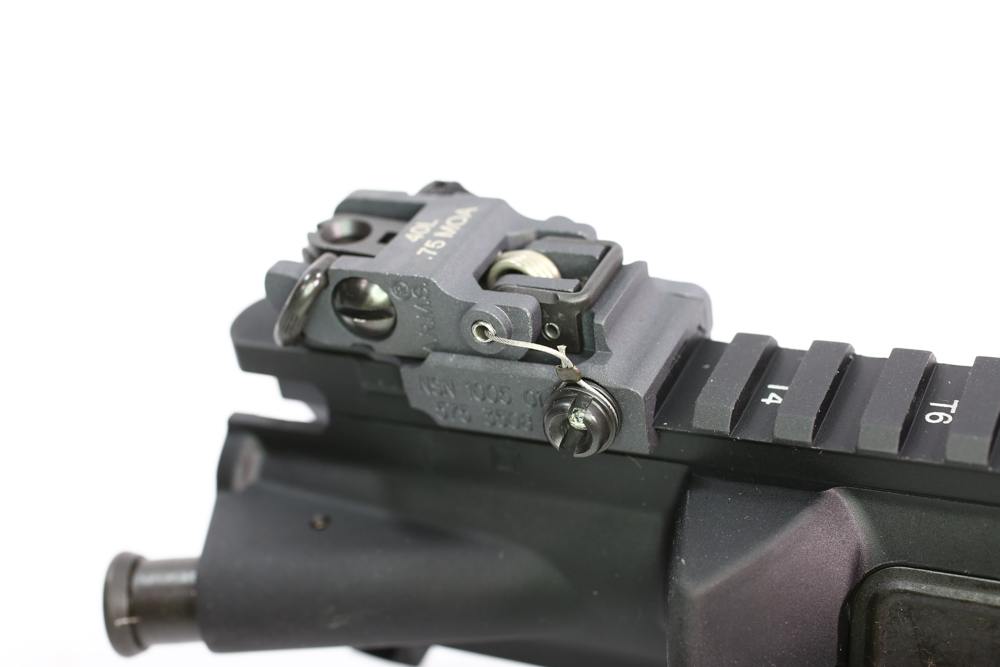
The ARMS 40 is designed to ride on the rear of the upper receiver and clear the back end of the added top rail that you will be bolting in place.
Having used magnified optics on the computer pop-up course out to 300 meters, a 10X scope makes a shot like that pretty much like plinking. Stretching it to 400 or 500 meters is a matter of knowing the drop and calling the wind, something in which a Mk 12 operator would have been well-schooled.
Beyond 500 meters, you really need a bigger caliber than the 5.56, as loss in velocity starts to become a real problem. The best ammo for use in this would be the M262 Mod 0 or Mod 1. That 77-grain bullet, by 500 yards, is going less than 1,700 fps and takes three-quarters of a second to get there.
The ARMS 40 rear sight is the correct one for your Mk 12 build.
But you can easily hit a 5” circle at that distance, once you know the drop, which can be pretty steep by then and still, a hit is a hit. With a 300-yard zero, your drop at 500 is 26.5 inches, and that’s a bunch to keep track of.
If you are a movie buff and a gun buff, then the movie Lone Survivor has Mk 12s used in it. It could also give you ideas about how to paint your Mk 12 once it is done, and what other added accessories might be correct.
A Last Note
If you really want a Mk 12 but find that building one is going beyond your abilities (heresy, in a book like this, but what are you gonna do?) you can always buy one. Yes, PRI and Bravo Company offer complete uppers. Well, complete except for the optics and mounts. And you can hit up Brownells for uppers or complete rifles. The price will be steep, but it saves time, and you have a ready-to-go, guaranteed rifle.
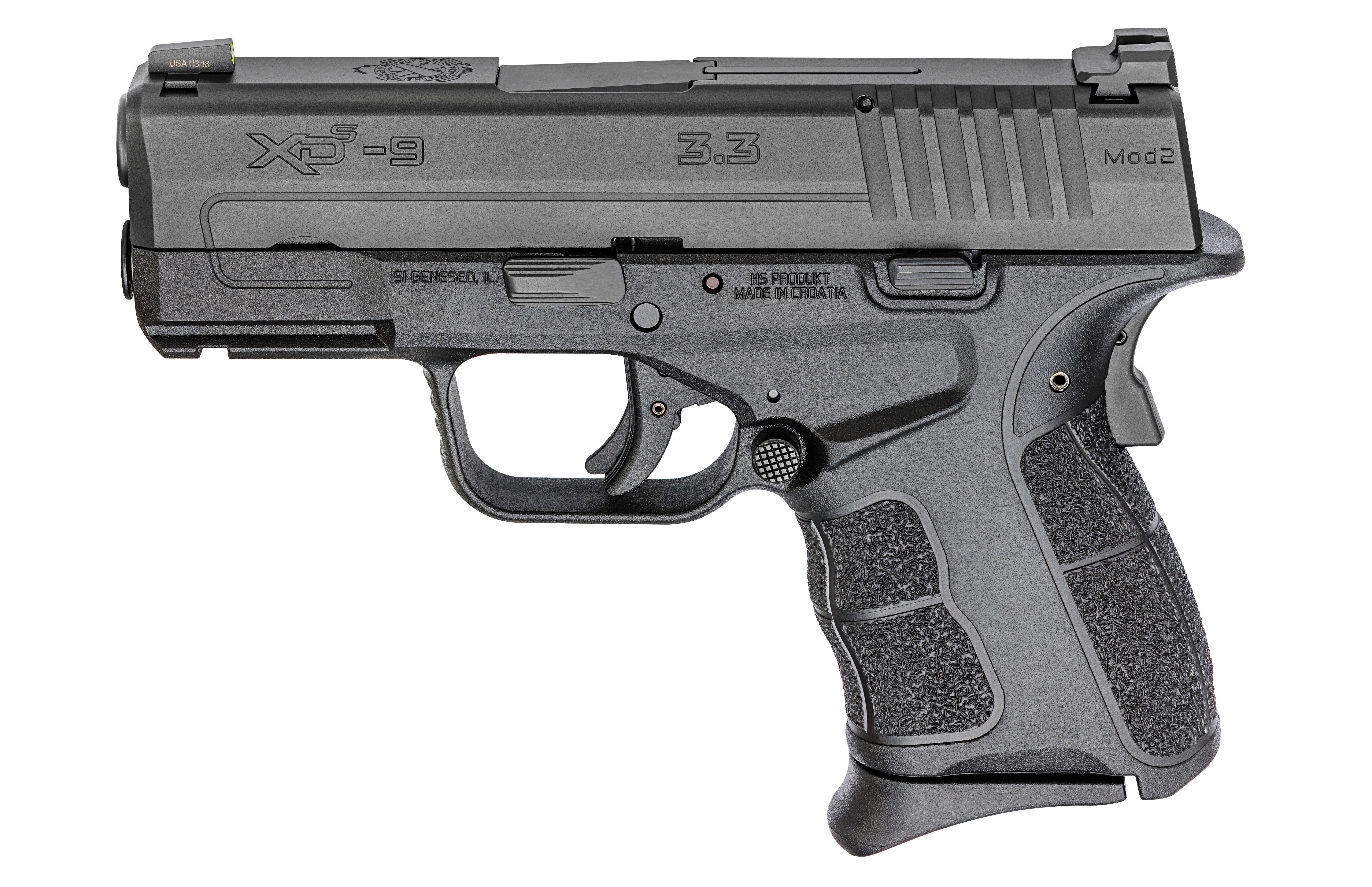
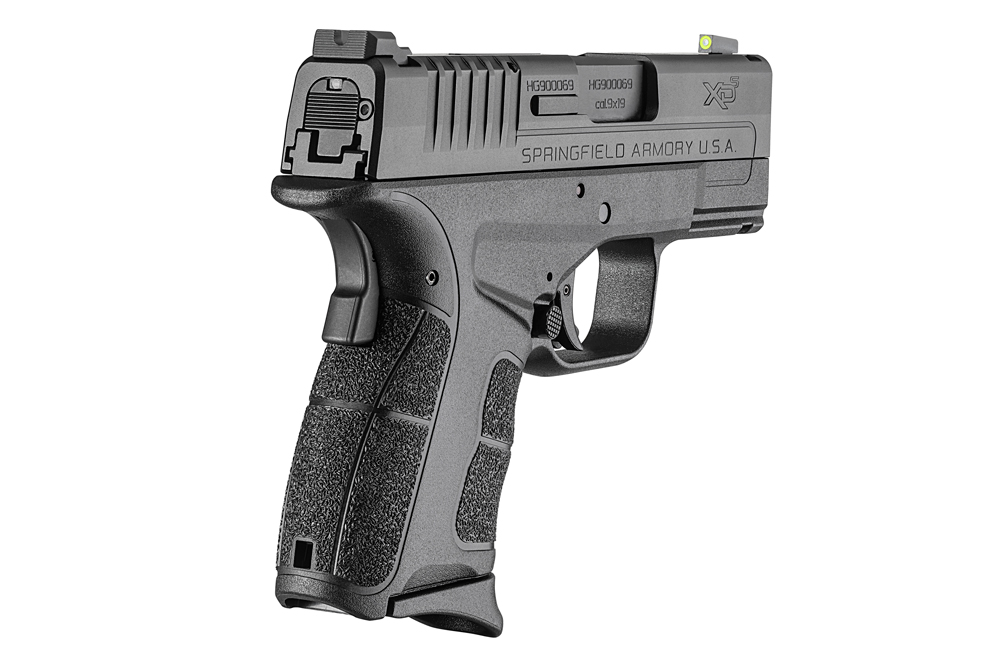
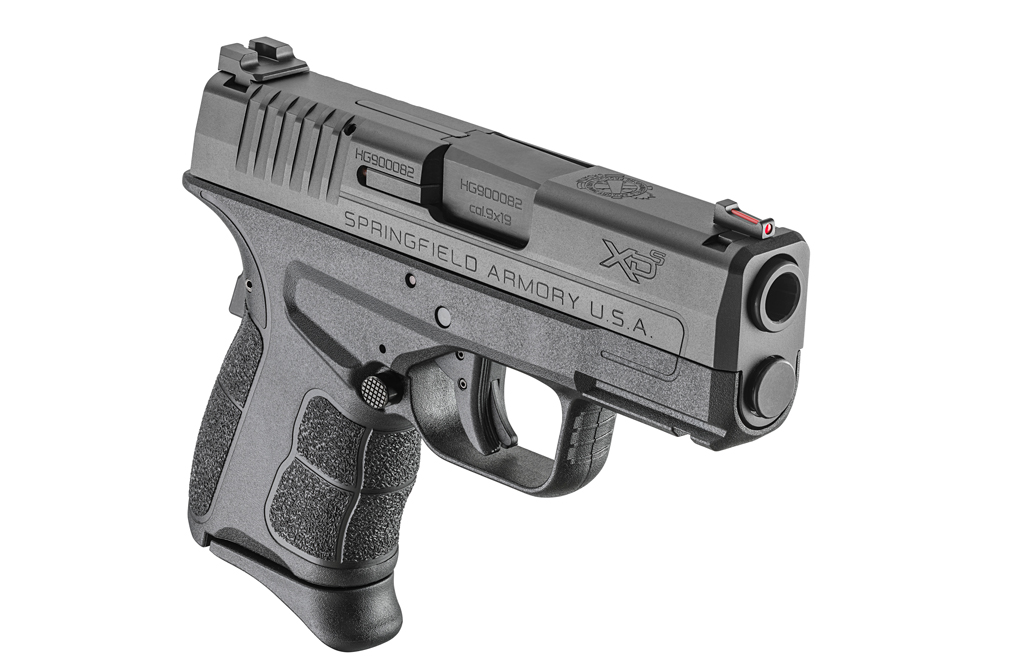
The highly popular XD-S Mod.2 is now chambered for America’s most shot centerfire cartridge — 9mm.
What’s new on the XD-S Mod.2 9mm
Enhanced Mod.2 grip texturing.
Steeply stepped rear sight for tactical manipulation.
“Grip Zone” not emblazoned on the grip.
Without buttplate upgrade, old XD-S extended mags not compatible with new pistol.
Given American’s seemingly insatiable appetite for 9mm firearms, it was a bit of a shocker Springfield Armory opted to initially release the next generation of its popular single-stack striker-fired pistol in .45 ACP. In this day and age, it almost gave the impression of being plum backward.
That said, it was inevitable as the march of time the XD-S Mod.2 would eventually feed upon Parabellum and Springfield has not disappointed. The Illinois company followed up with its January release of the .45 model of the most popular pistol in its stable today with a 9mm version. Like the large-bore handgun, the new nine XD-S Mod.2 has the same ergonomic and trigger upgrades, as well as a more tactically adept rear sight.
Most notably, the pistol boasts the enhanced grip texturing familiar to other Springfield Mod.2 pistols and is leaps and bound of an improvement over the spikey and some might argue awkward texturing on the original XD-S. Mercifully (did I mention mercifully), the next generation of slim carry guns does not have “Grip Zone” emblazed down the center of the grip. The rear sight is also worth mention, as Springfield has replaced the gently slopping version of the old XD-S with a steeply stepped design. All steel, the 90-degree cut should make the concealed carry option more useful as an option to rack the slide off a belt or table if the occasion ever called for it.
The rest of the XD-S Mod.2 – dimensions, weight, barrel length, capacity – are nearly identically to the previous generation of the pistol. Even the old XD-S flush-fit magazines will work in the new pistol, however not the extended versions, which require a new Mod.2 buttplate for compatibility. The MSRP for the base model of the XD-S Mod.2 is $524.
From Springfield:
GENESEO, ILL. (8/01/18) – The next generation of the most popular pistol ever produced by Springfield Armory is now available in the most popular caliber with the introduction of the XD-S Mod.2 in 9mm.
Since the release of the XD-S Mod.2 in .45 ACP earlier this year, Springfield Armory has engineered a pistol specifically designed around the 9mm round, resulting in a smaller frame and slimmer profile in this latest version of the XD-S Mod.2. With a frame less than 1-inch wide, the XD-S Mod.2 9mm disappears under even the lightest clothing.
Built on a time-tested platform, the XD-S Mod.2 in 9mm was designed to achieve maximum concealability while maintaining life-saving reliability when you need it most. The XD-S Mod.2 in 9mm survived a grueling 25,000 round torture test without a failure. This is an amazing testament to the quality of the pistol especially when considering its small size.
The XD-S Mod.2 in 9mm features upgrades chosen to perfect the pistol for concealed carry. An AmeriGlo™ Pro-Glo tritium front sight makes target acquisition quick and accurate, while the tactical-rack serrated rear sight provides the added benefit of being able to rack the slide against available surfaces such as a belt, doorway, boot etc. should it become necessary to cycle the gun one-handed. A model is also available with a fiber optic front sight and tactical-rack serrated white dot rear sight. The enhanced grip texturing allows for a secure yet comfortable grip, wet or dry, and the new, longer Posi-Wedge slide serrations make the slide easier to grab and operate. A loaded chamber indicator allows shooters to not only see the condition of the gun, but to feel the condition of the gun when it’s placed in a holster, or in darkness and low-light. A newly designed grip safety immediately readies the gun to fire when gripped, but keeps the gun safe from firing during appendix or off-body carry. An additional drop safety in the striker block, in conjunction with the grip safety, prevents the gun from firing if dropped.
The XD-S Mod.2 frame positions a shooter’s grip higher on the gun, closer to the bore axis, for better recoil control and accuracy. Coupled with the dual captive recoil spring and full length guide rod, the XD-S Mod.2 in 9mm is soft shooting and well-balanced. An enhanced short reset trigger makes for fast, controllable follow up shots.
The XD-S Mod.2 ships with two stainless steel magazines: a 7-round mag with a pinkie rest and additional flush floor plate for carry and one 9-round extended magazine – perfect for home defense. An 8-round extended magazine is also available for purchase.
For those looking for a trusted every day carry handgun, the Springfield Armory XD-S platform is consistently amongst the most popular and widely-chosen carry guns on the market. The XD-S Mod.2 in 9mm will provide superior reliability, safety, and concealability when you need it most.
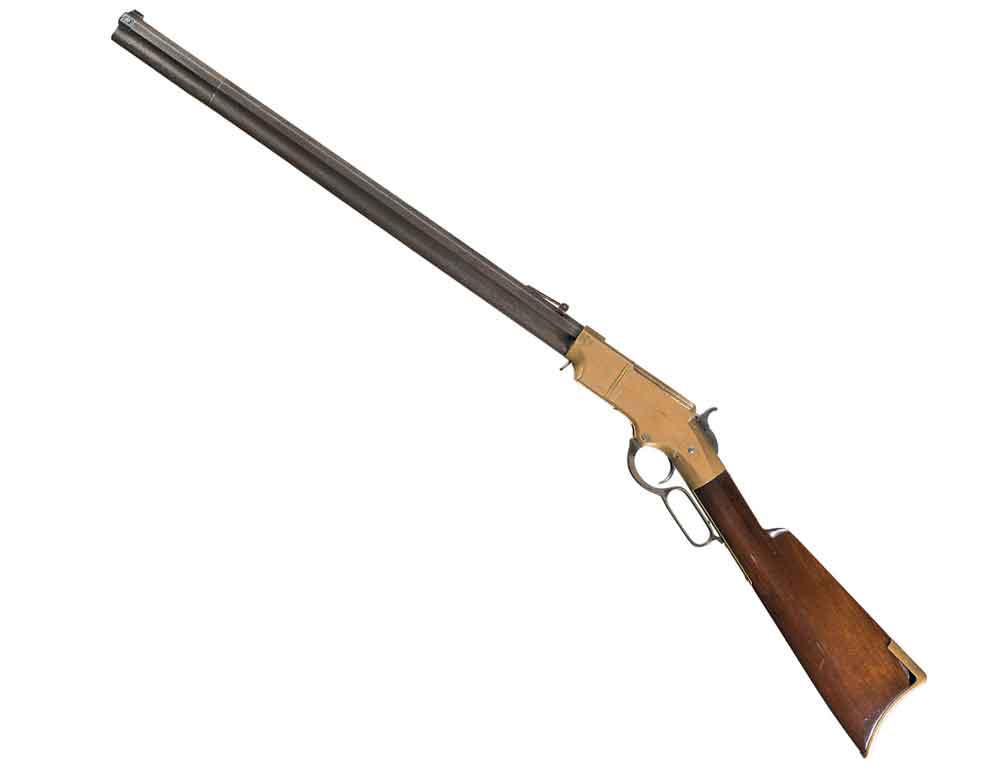
The 1860 Henry Rifle is among history’s most influential firearms designs and continues to soldier on today.
Why the 1860 Henry Rifle remains important:
The first commercially successful repeating rifle.
Basically an improved Volcanic Rifle.
Design enhanced with a self-cocking mechanism.
Ammunition also upgraded to .44 Henry Rimfire.
Saw action in the Civil War and the American West.
The predecessor of the iconic Winchester rifle line.
Henry and Uberti offer modern-day replicas.
Contempary rifles chambered .44-40 WCF and .45 Colt.
When Benjamin Henry began tinkering with repeating rifles in the mid-19th Century, he was working with an old concept. Predating the Volcanic Rifle he improved to become the 1860 Henry Rifle, the idea of a long-gun capable of multiple shots off a single loading was more than 200-years-old in execution. However, examples such as the Lorenzoni System and Lagatz Rifle were as rare as baths back then, particularly due to their exceptional cost compared with traditional muzzleloaders of the time.
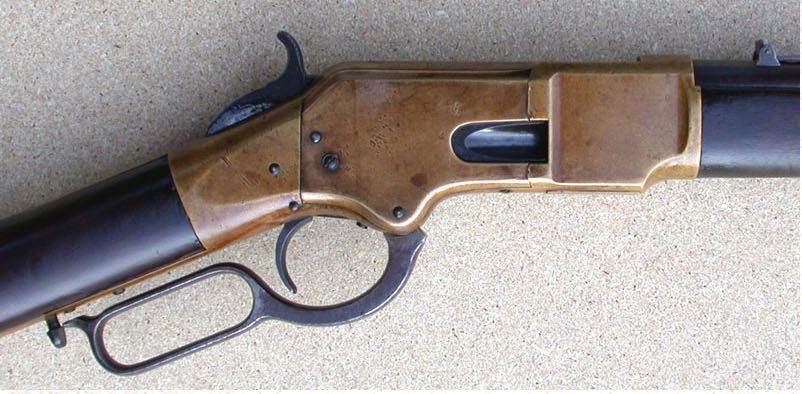
Where the brass-receiver beauty (there was also an early iron-framed model) left its mark was as the first commercially successful repeating rifle. At nearly three-times the coast of the Springfield Model 1861, the predominant military arm of the day, a Henry still wasn’t cheap. Performance preceding price, however, the common man was willing to scrimp and save and pony up to harness the advantage the repeater offered.
Gunmakers took notice, which led to the other great success of the 1860 Henry — it became the pattern of the modern lever-action rifle and soldiers on today. Bits and pieces seen in modern gun designs, this simple and elegant repeater continues to exert influence and arguably remains one of the most important designs to come down the pike.
Brief History of 1860 Henry Rifle
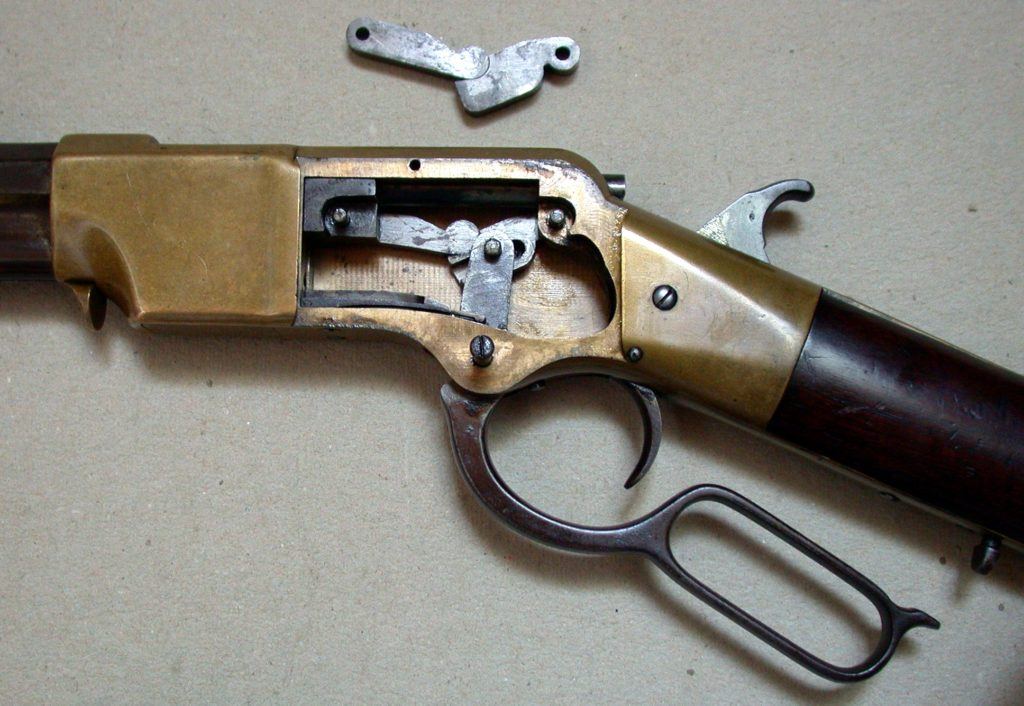
At its heart, the Henry is Walter Hunt’s lever-action 1848 Volition Rifle (later Volcanic Rifle) with two main improvements. Henry (the man) enhanced the original design with a self-cocking mechanism that worked in concert with the lever-action. A simple advancement, it vastly improved the 1860 Henry’s rate of fire to the point there simply wasn’t a long gun of the era that could match it.
Furthermore, the New Haven Arms Company’s (what eventually became Winchester) plant manager upgraded the rifle’s ammunition to .44 Henry Rimfire — as the name suggests, a cartridge of his design. Albeit moderately powered compared to other self-contained metallic cartridges of the day, the big-bore cartridge was leaps and bounds better than what the Volcanic Rifle previously attempted to spew — Rocket Ball. Innovative in concept, the ammo endeavored to integrate the propellant directly into the bullet itself; the results were fickle ignition and spit-wad-level power — less than a modern mouse gun, except from a rifle.
The advancements of the 1860 Henry Rifle wrought had an immediate impact and the gun almost instantly left its mark on the pages of history. Though never formally adopted nor widely used (maybe around 7,000 saw action), the 15-round, 24-inch barreled repeater developed mythical stature in the American Civil War, out-gunning anything it met on the battlefield. Furthermore, had a devastating effect on the American frontier, particularly in the hands of Sioux, Cheyenne and Arapahoe warriors in the Battle of the Little Bighorn. The U.S. Army’s single-shot Model 1873 “Trapdoor” Springfield was no match, especially firing jam-prone copper case ammo.
Despite valorous showings in these and other engagements, the 1860 Henry Rifle was not without its faults. Chief among them was, in hindsight, an ill-conceived tubular magazine. Open to the world at the bottom, the magazine was an excellent exposure point for grit, grim and everything else that might foul the follower and jam a Henry at the wrong time. Moreover, the 1860 Henry did not have a fore-end stock. A small point for shooters who might use the rifle exclusively for hunting, but awful tough on a fella’s hands when running the gun hot in the heat of battle.
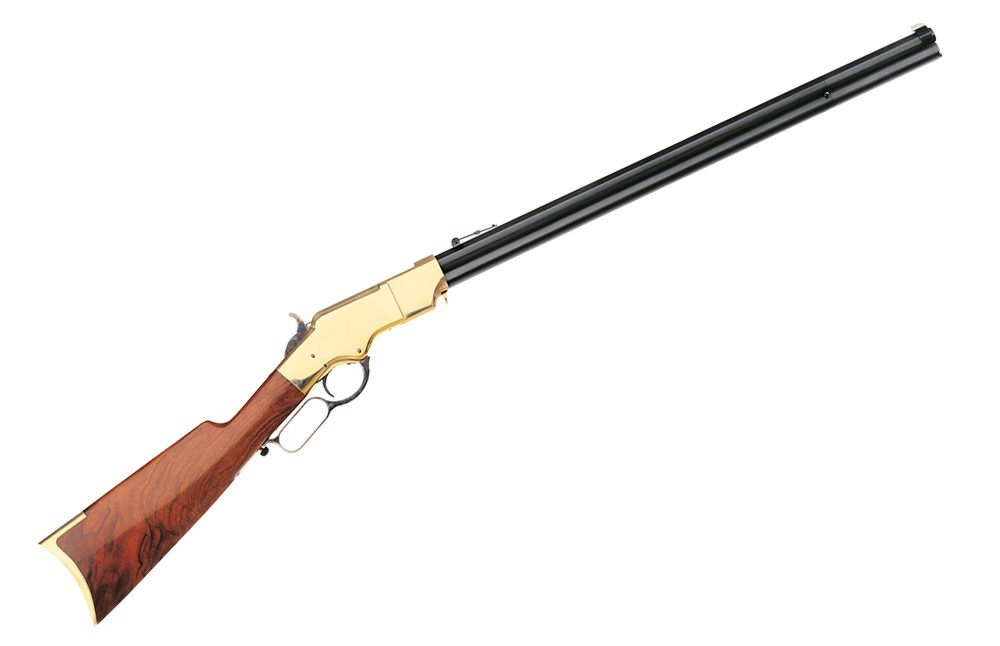
The 1860 Henry Rifle spawned one of the most successful lever-action lines, starting with the Winchester Model 1866. Photo: Wikimedia
Undesirable as these traits might have been, solving the issues of the 1860 Henry Rifle proved serendipitous, spawning perhaps the most famous line of lever-actions in history — the Winchester rifles. Through the talents of designer Nelson King, the next evolution of the Henry was the Model 1866 “Yellow Boy.” Essentially an 1860, it featured a wooden fore-end and sealed magazine, which resolved the two most pressing issues with the earlier rifle. Additionally, King added a handy loading gate, a necessity with the exposed follower omitted, which made reloading much simpler and faster.
From there it was off to the races with Winchester evolving and innovating off the original 1860 concept to create some of the most storied rifles of all time — the 1873 (the rifle that won the West), 1876, 1886 and so on. The guns went on to conquer the American West, fight in conflicts across the world and firmly leave the 1860’s footprint across the globe.
Collecting 1860 Henry Rifle
In 2013, a rarity crossed the block at the Rock Island Auction Company — an iron-frame 1860 Henry Rifle. For die-hard collectors, the opportunity was up there with getting a crack at a Honus Wagner baseball card or a Guttenberg Bible. They bid for the rifle that way too. When the dust settled, one of the most sought-after firearms in the world left the legendary auction house to the tune of $603,750. At the time, it was the most ever paid for a 19th-Century American-made rifle. If another such specimen ever went up for sale there’s a fair chance it could beat that mark.
Granted, iron-frame Henrys are phantoms (it’s estimated less than 400 were ever made), thus a hot ticket. But the garden variety brass Henrys are by no means bargain basement. RIA has three set for their September 2018 Premiere Auction and each is expected to bring in $30,000 to $45,00 apiece. That isn’t beanbag nor for the anemic of bank account.
Going The Replica Route
Thankfully, you needn’t go real McCoy to enjoy working the lever on a piece of American history. Henry Repeating Arms and Uberti-USA offer much more affordable options, manufactured to modern specifications that don’t require white gloves and a climate controlled environment to enjoy.
Uberti’s fairly spot on replica of the 1860 Henry Rifle. Photo: Uberti USA
Given the demand for 1860 Henry Rifles isn’t at Civil-War levels nowadays, guns tend to run on the expense end — even compared to other replica or modernized version of classic lever-actions. Depending on model, the American made Henry’s New Original Henry runs $2,415 to $3,870. Slightly less expensive, the Italian manufactured Uberti options still run on the steep side at $1,369 across the board.
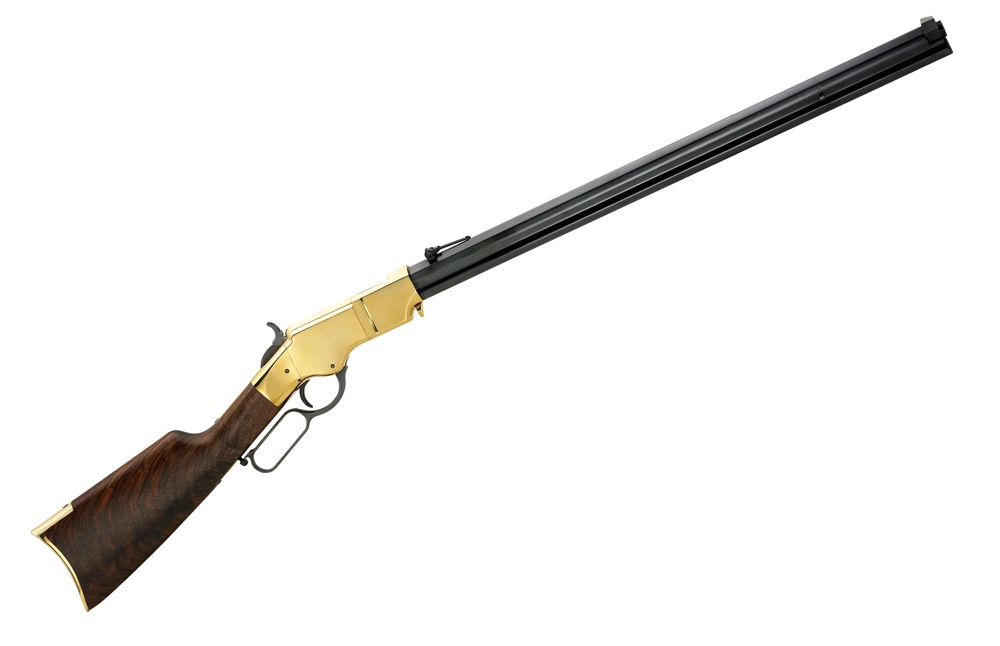
Thoroughly modern, the guns stay true to many of the aspects of the original 1860 Henry Rifle. To this end, Henry and Uberti’s rifles are both toggle-link lever-actions (with lever locks) outfitted with octagon barrels, graduated ladder rear sight, half-cock positions for the hammers and tubular magazines with followers. Of course, they also offer brass frames, which, aside from the history of the 1860, attracts many to the rifle.
Authentic to a point, there are a number of contemporary tweaks. The available chamberings are perhaps the most notable. Allowing .44 Henry Rimfire is near as rare as the rifles that shoot them, both gunmakers opted to chamber their guns for rifle/pistol-caliber .44-40 WCF and .45 Colt. More powerful than the original rimfire, it is still possible to match .44 Henry ballistics with the .44-40 for the sake of authenticity.
Old new again, with Henry Repeating Arms Original Henry. Photo: Henry Repeating Arms
Given cartridge length, you won’t get a full 15-rounds out of a modern Henry, no matter what you work the lever on. The closest you’ll come is 13+1. Furthermore, the gunmakers have spinoff models that greatly break from the original Henry’s configuration. Each company makes a carbine variation: Henry’s 20-inch barreled Rare Carbine and Uberti’s 18-inch barreled Trapper. Additionally, Henry makes the Silver Deluxe Engraved Edition 1860, which nearly teeters on looking like a completely different rifle.
Even if you can’t buy a down the line facsimile of the 1860 Henry Rifle, the respected gunmakers get close enough to the original that it’s hardly worth the notice, and no less entertaining.
Parting Shot
Classic firearms are difficult to define, there’s a possible argument plenty of the determination lies in the eye of the beholder. Speak of iconic guns things become clearer. Engineering masterpieces, these one-of-a-kind guns go on to earn not only timeless popularity, but redefine their class of firearms — perhaps even the gun world itself. When you think about it’s not difficult to muster one to mind — 1911, Model 1897 Shotgun, M1 Garand, Colt Patterson and, most certainly, the 1860 Henry Rifle. The simple repeater’s reach far exceeds its six years of manufacture and shaped more than the art and science of gun design. Plain and simple, the brassy rifle and its lineage helped fashion the world we know today.
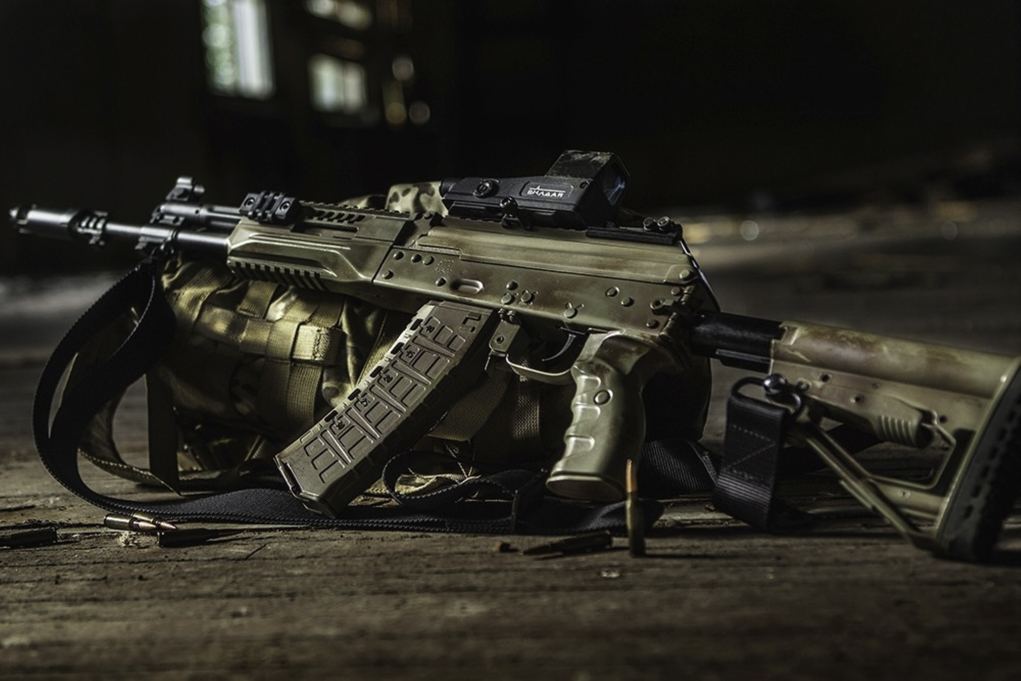
The AK-12 has improved ergonomics and modularity over the AKM, AK-74 and AK-74M.
Introduced in 2012, the AK-12 is the latest AK-47 variant, though even it has evolved to today’s version.
Improvements include better ergonomics, less recoil, faster cooling and can be loaded one-handed.
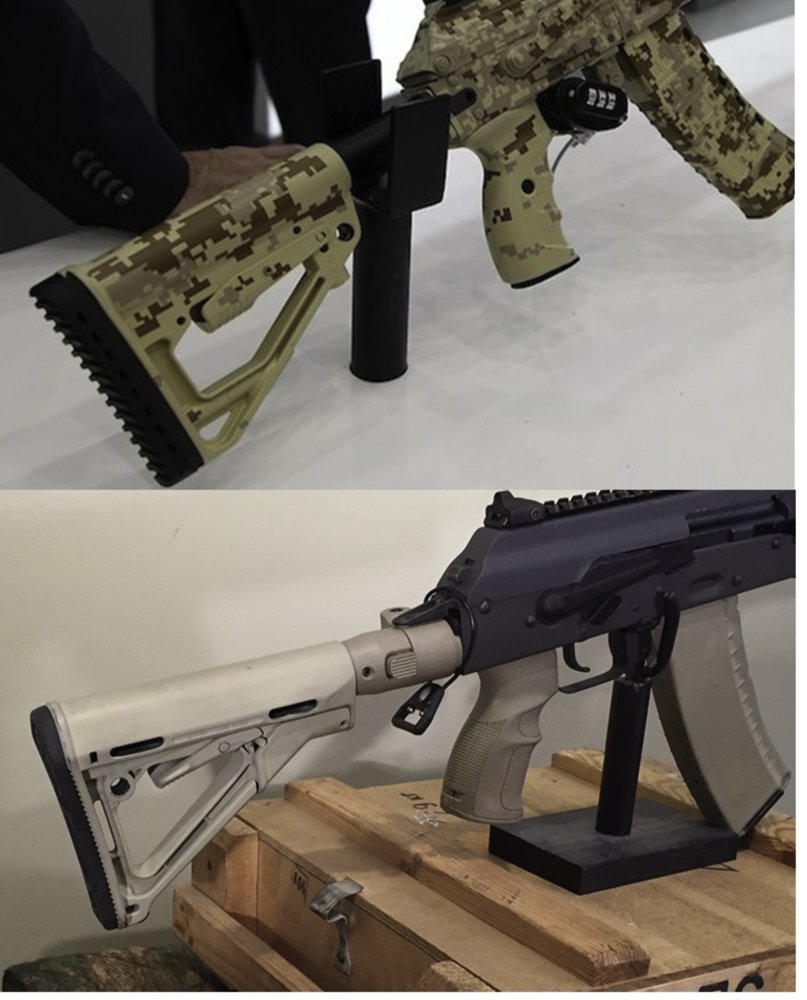
The latest AK-12 uses an AR-style telescoping stock.
Thanks to the import ban, the author made an AK-12 clone based on an I.O., Inc. prototype rifle.
The author’s replica used parts from FAB Defense, Brownells, Geissele Automatics, Legion USA and K-Var Corp.
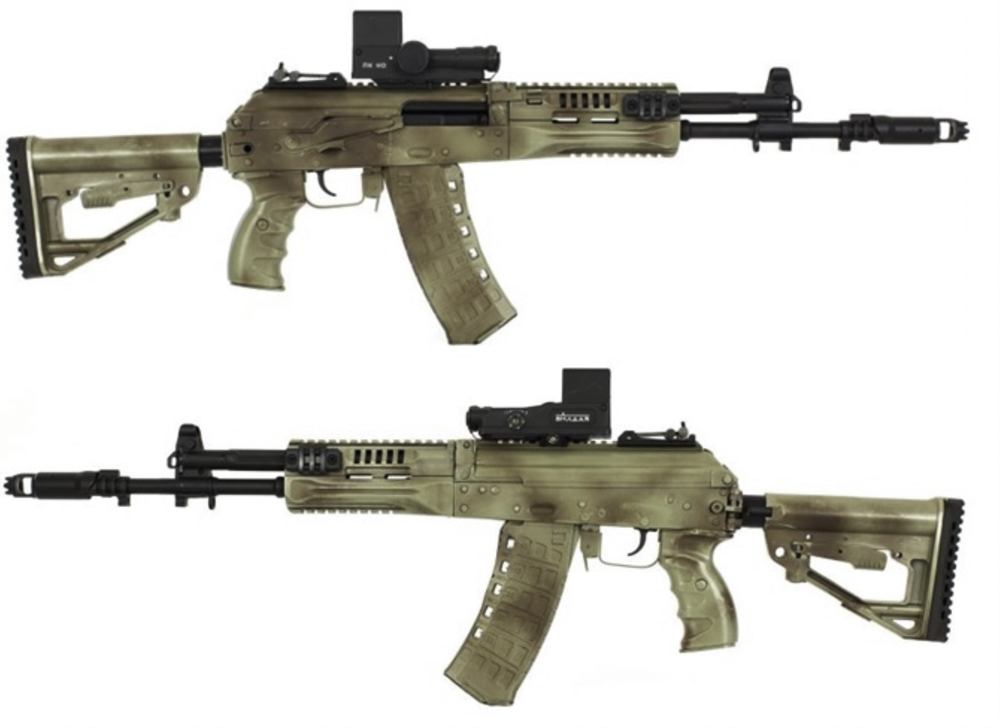
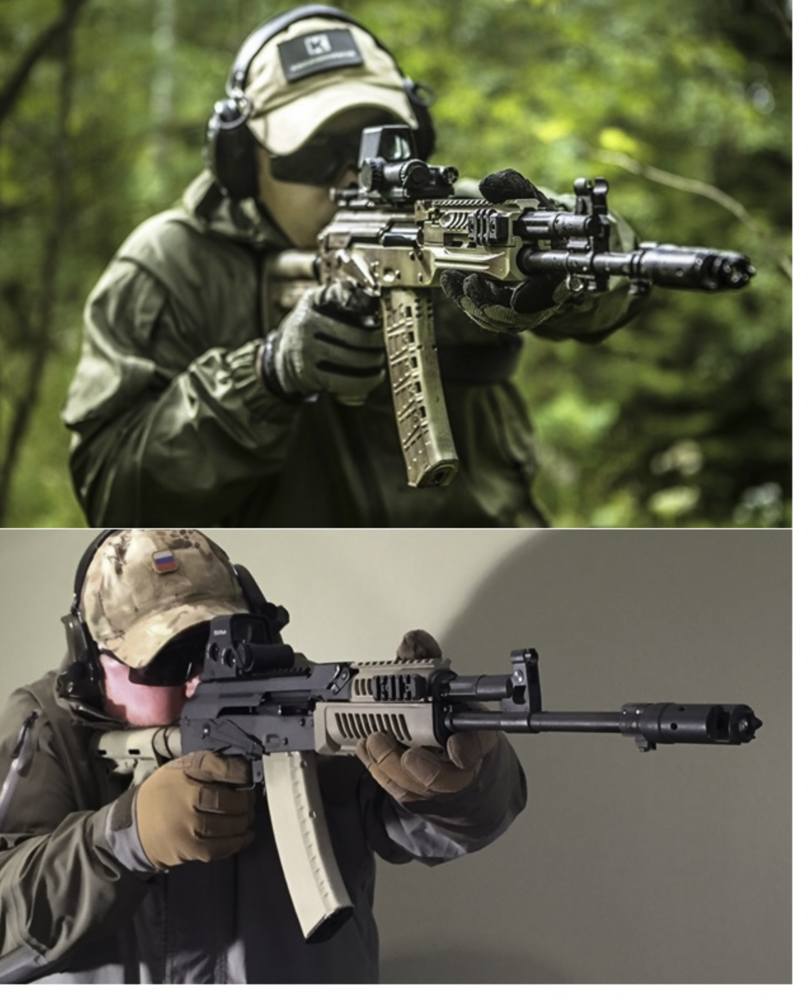
The new and perhaps final version of the AK-12 is very different from the gun the Russians unveiled in 2012.
As the AK evolution continues, it will reach critical mass when drastic gun re-design must occur to guide further development of the AK. The AK-12 Avtomat is the newest version of the Kalashnikov-designed rifle, created in 2012. It is a promising product developed by the Kalashnikov Concern at its Izhevsk Plant.
The main feature of the AK-12 is improved ergonomics and modularity in comparison with its predecessors, the AKM, AK-74 and AK-74M. According to the gun designers, they improved the service life, reliability and accuracy of the gun.
The AK-12 demonstrates excellent characteristics during initial testing. It has less recoil, better cooling, is lighter and shorter, and can be reloaded with one hand. That’s why in 2015 the AK-12 Kalashnikov Avtomat was adopted and will be used as the main personal weapon for the Russian individual soldier equipment complex Ratnik.
The newer version of the AK-12 in its design was brought back to the original Kalashnikov system. However, it now also included most of the ergonomic, handling and modular features of the previous model.
Is it the same AK-12 they demonstrated in 2012? Not really. In fact, not at all.
The development of the new machine started in June 2011 under the leadership of the well-known chief designer of Izhmash, Vladimir Viktorovich Zlobin. It was entirely an Izhmash initiative.
The new AK was based on the work and experience accumulated over the last 10 years. In 2011, the prototype was completed and testing of the fifth-generation Avtomat with the name AK-12 began. The AK-12 is designed to replace the previous versions of the AK-103, AK-74M, AK-74 and early AKM, AKMS and all other AKs still in service.
For the first time, the AK-12 was shown to the public in January 2012, hence its index “12.” The main goals in the development of the AK-12 were to:
Increase the universality of the gun.
Improve the ergonomic characteristics.
Preserve and possibly improve the gun’s main performance characteristics (accuracy of fire, survivability, reliability in different modes).
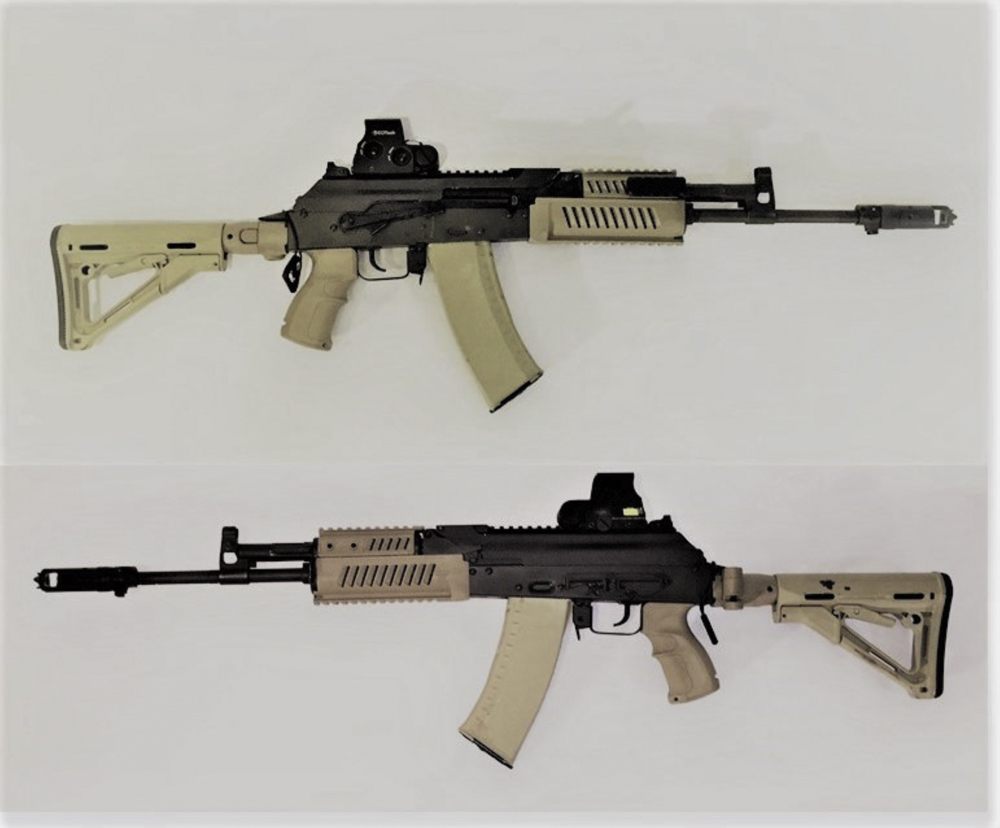
To match the look and most importantly the functionality of the AK-12 stock and pistol grip, the author used the FAB Defense M4-AK P folding plastic AR tube, MagPul’s CTR stock and a FAB Defense AG-47S grip.
The Russian government was not eager to provide any support to development of the new Avtomat, citing the success of old AKs. So, they didn’t. During the period of 2013 and 2014, the AK-12 encountered some opposition from the Russian military under the pretext of many shortcomings, so state financing of the trials was denied. Nevertheless, on February 21, 2015, the Ministry of Defense evaluated the characteristics of the newly upgraded AK-12.
As a result, it was adopted as the main weapon for the Ratnik individual equipment complex, alongside its more expensive and heavier competitor, the A-545. It also received a preferential role over the balanced automatics Avtomat.
In 2015, after preliminary tests, the fifth-generation Avtomat, already adopted for service, got a number of upgrades. The highlighted deficiencies were not critical to the design and would be corrected within a year. After the new Avtomat was tested again and passed the government tests with flying colors, its arrival in the Russian armed forces was slotted for 2016.
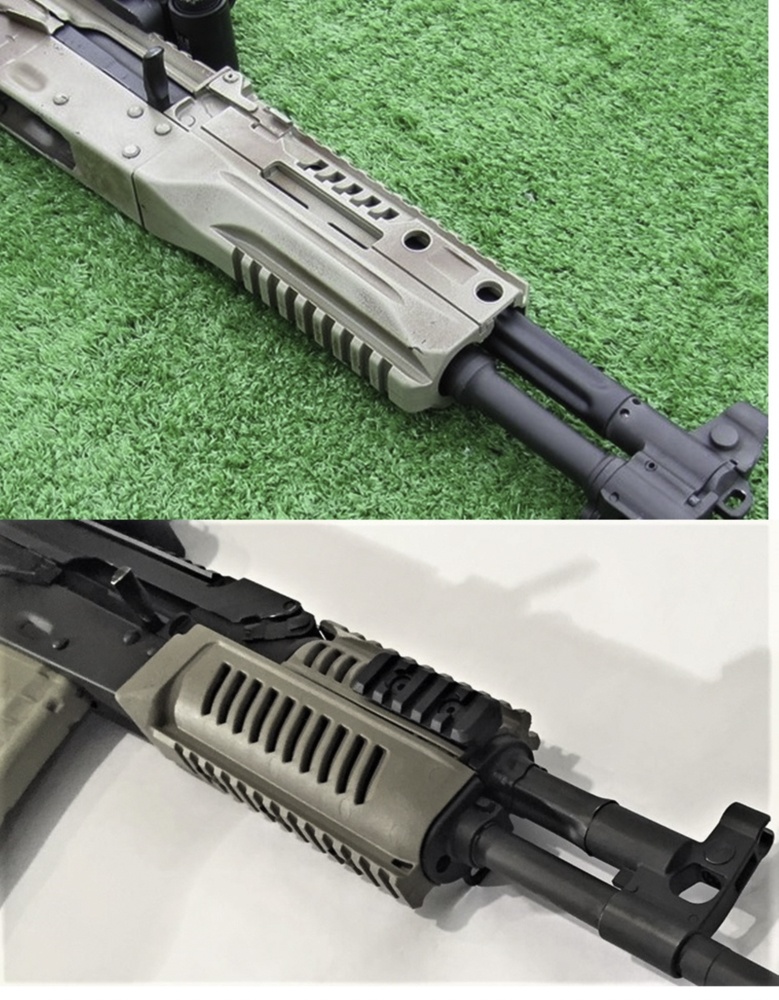
The FAB Defense AKL-47/74 handguards proved to be a pretty good match for the AK-12 guards.
The AK-12 has the following tactical and technical characteristics:
Caliber: 5.45x39mm
Length: 730/940 mm (29.75/37 inches) with stock folded/unfolded
Weight (without cartridges): 3.2 kg (7.1 lbs.)
Barrel length: 415mm (16.3 inches)
Bullet velocity: 900m/s (2,952 fps)
Rate of fire: 650 rds/min.
Max. aiming range: 1,000 m.
Max. effective range: 600 m.
Magazine capacity: 95 rounds for drum magazine, 30 or 60 rounds for box-type mags
Firing modes: automatic, fixed 3-shot burst and single shot
All of this is in line with its previous model. You do not have to be an experienced firearms designer or famous gunsmith to see that the new AK-12, though it is a clearly a new weapon type, is still an AK. In fact, it appears to be a compromise between the original AK-12 and the modernization kit.
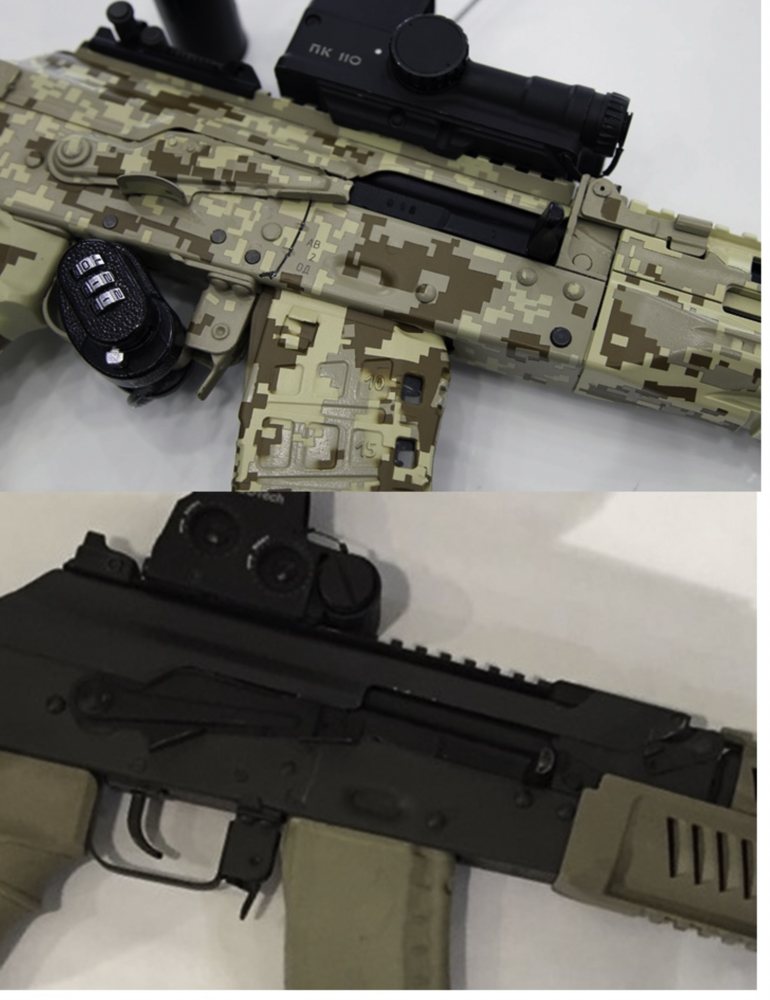
It appears to have the standard AK-74 stamped receiver, which encompasses the standard trigger and bolt groups. It takes a slight departure from the norm in a copy of the Krebs enhanced safety lever, which is not what the highly publicized original AK-12 had. There is no button mag release. Instead, the regular AK latch is used.
The AR-style telescopic stock is installed instead of the multi-functional stock of the original gun. The stock-folding mechanism is identical to the AK-74. My very own AKS had the same one 30 years ago. The pistol grip is more ergonomic, and similar to one from Israel’s FAB Defense or CAA.
The Russian-made Red Heat AK dust cover provided by Legion USA with full-length Picatinny rail section in combination with original Russian safety/selector lever were a spot-on match.
The top cover is hinged, using completely new mounting and retention mechanisms, but similar to the modernization kit nonetheless. The rear sight block is modified and no longer supports the rear sight. Instead, it is now used for the top cover hinge and to retain the upper handguard more firmly.
The rear sight block is now removable and can be installed anywhere along the Picatinny rail that runs the entire length of the top cover and aligns perfectly with the section atop the upper handguard. The upper handguard has two mounting spots for small Picatinny rail sections, one on each side. The matching lower handguard has the rail at the bottom. The length of the handguards is about the same of those on the AK-74 with exception of the upper.
The differences begin forward of the handguards. Although the gas tube appears to have the same length and similar design, minus the upper handguard brackets, the gas block is a different story. It is a gas/front sight block combination of new design. It is higher than the standard AK and has the gas chamber going all the way forward, where it is topped with a gas regulator. The accessory lug is at the bottom of the combination block for mounting a grenade launcher.
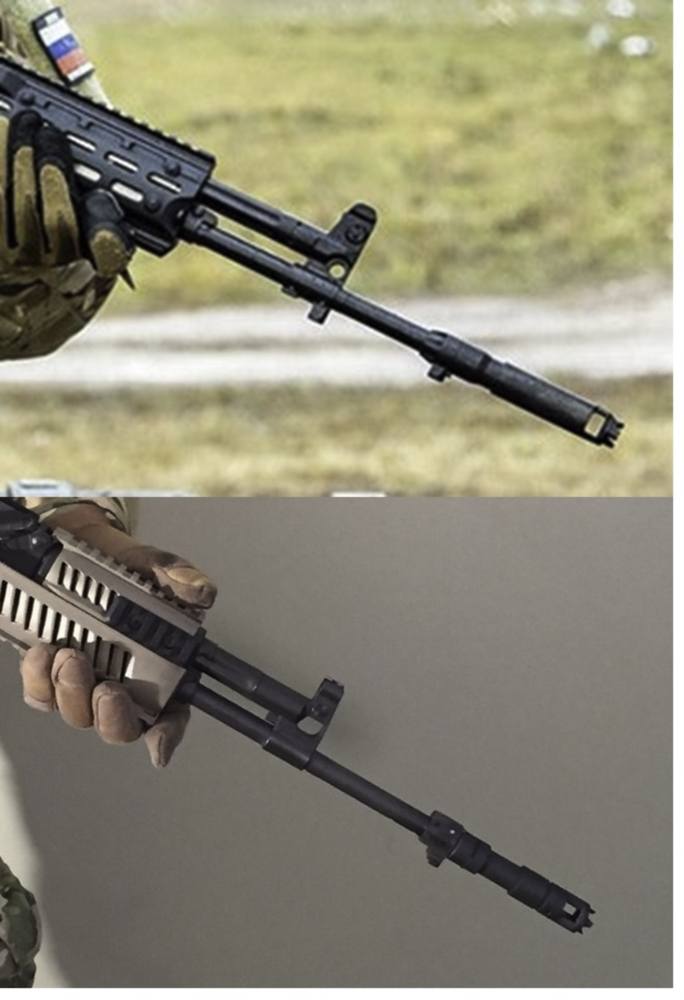
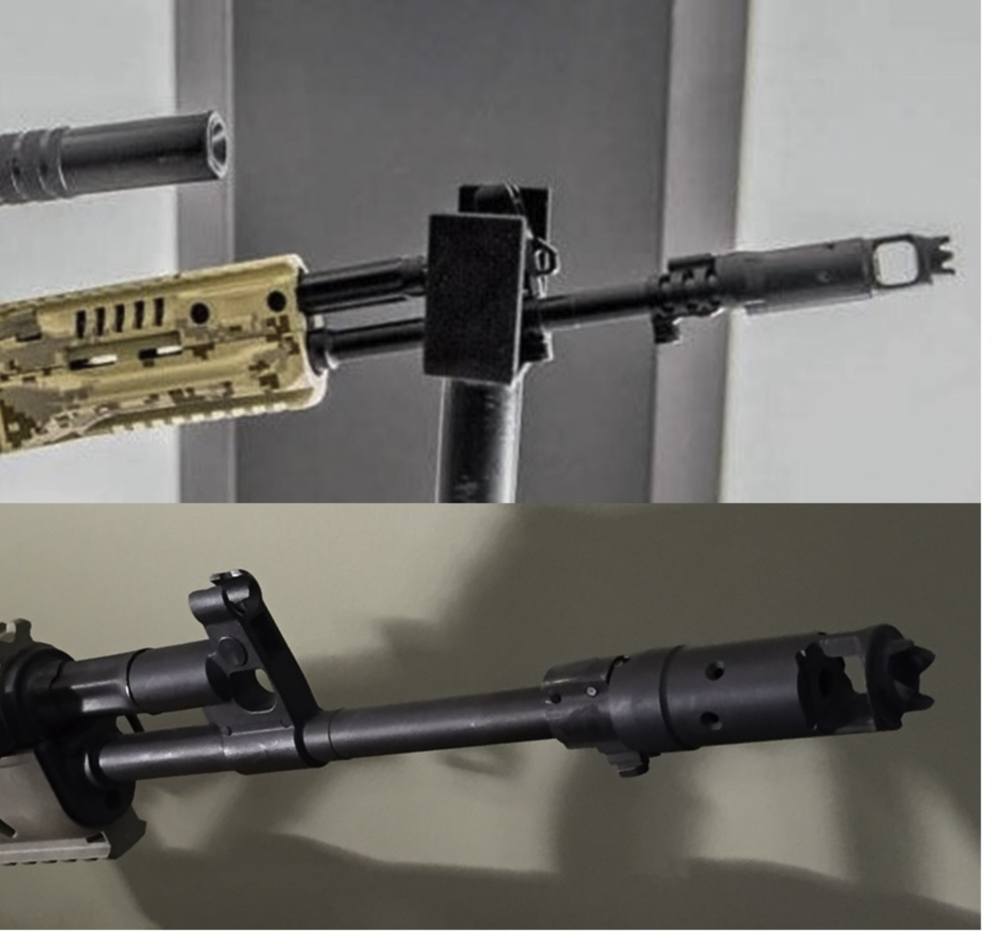
The muzzle of the upgraded AK-12 is tipped with a threaded block that sports a detent pin and bayonet lug. The gun uses two different muzzle devices. One is a modified version of the AK-74 brake and the other is similar to that of the Polish Tantal rifle.
It is slimmer than the original AK-74 brake and much longer. According to AK-12 designers, this was done for use with foreign rifle grenades. I like the idea. I also think that the Polish Tantal muzzle brake is very effective.
The earlier version of the AK-12 muzzle device was a departure from the standard AK-74 type brake. It resembled the Polish Tantal device, affording the ability to launch rifle grenades.
That’s it. That’s what the AK evolved into. I don’t know why the Russians didn’t go with the original AK-12 design and instead settled for this one. Most likely, it was a question of funds needed for retooling the plant and more complicated (read more expensive) manufacturing process. However, I rather like it.
It is intimately familiar to AK fans, it has all the features that a modern gun should have, it’s lightweight and looks like a comfortable rifle. In addition, if you believe the designers, it is a better shooting AK than its predecessors. I would not mind owning one.
However, since there is no possibility of the AK-12 in its Saiga livery ever making it here, I have to build one.
Building Your Own AK-12
By now you know I had to see if the latest solutions employed by the Kalashnikov Concern’s gun designers could be replicated. I had to build one of my own to find out if it handles or shoots as claimed. I once more embarked on the exciting journey of replicating something I cannot have otherwise.
My biggest challenge initially was to find a donor gun in the proper caliber. There were two ways to do this. One was to find a complete gun with gas/front sight combination in 5.45x39mm. The other was to get a standard AK-74 and press off the gas block and front sight and replace them with the combo. I spent a week looking around and considering my options.
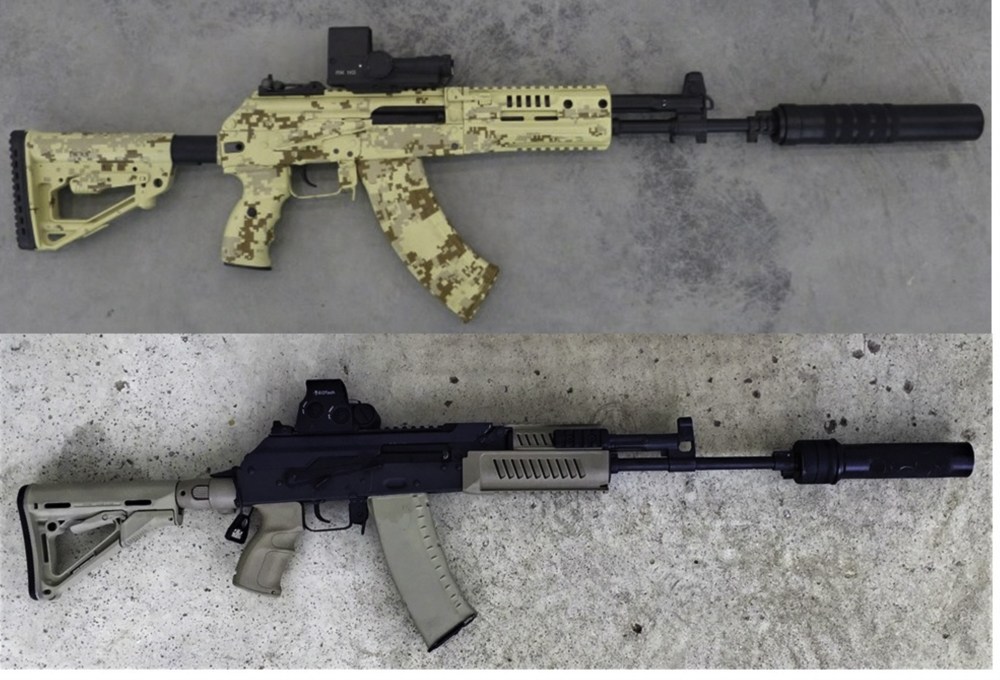
The later version of the AK-12 sported a familiar muzzle device, though slightly modified for flash and sound suppressor installation.
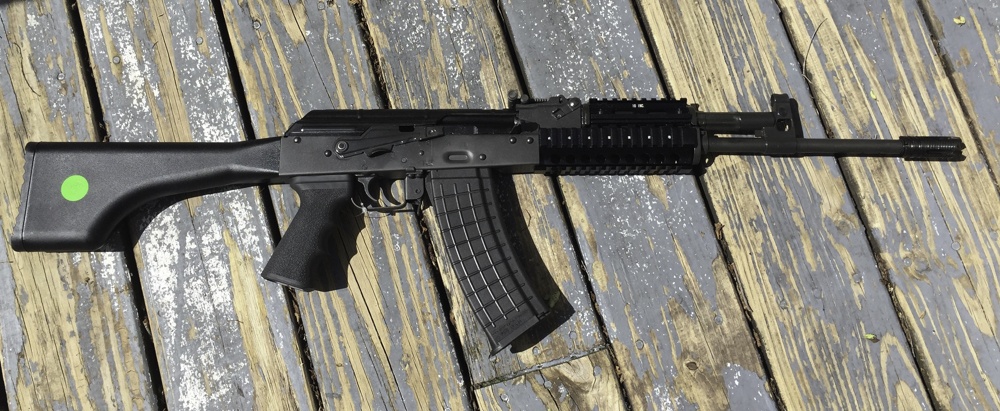
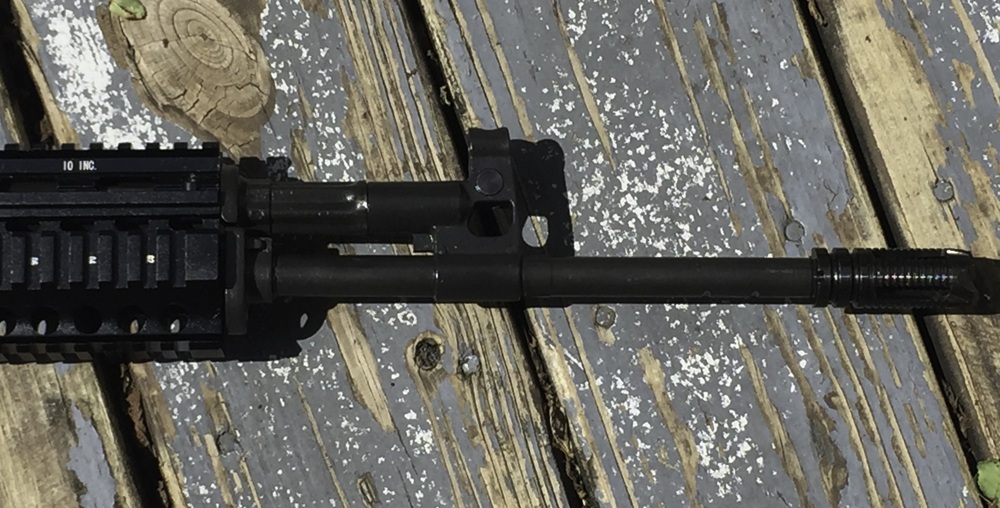
The solution was an I.O., Inc., prototype rifle. The new rifle the company was working on was a combination of its M214 rifle and the AK-74. The new rifle had a combination block and threaded barrel. Exactly what I needed.
Having obtained a donor rifle, it was time to collect the rest of the components. By analyzing images of the new Russian AK-12, I came up with a list. Yet again, I tapped into FAB Defense, Brownells, Geissele Automatics, Legion USA and K-Var Corp. as sources for the needed components. Additionally, I anticipated some actual gunsmithing work would need to be done to finish this project.
As always, I started with the buttstock because it is the easiest thing to replace. By looking at the new AK-12 stock, I could not help but notice that it bears an uncanny resemblance to MagPul’s CTR model. Telescopic and folding features for the AK-12 were easier to copy. Out of consideration for weight, I went with the FAB Defense plastic joint M4-AK P folding tube and MagPul CTR stock, once more provided by Brownells.
Just like the earlier model AK-12 and the modernization kit, the new gun’s pistol grip is essentially a copy of CAA’s ergonomic grip, the G47. FAB Defense was gracious enough to provide its AG-47S grip for the project; it is similar in design and fits perfectly on the gun.
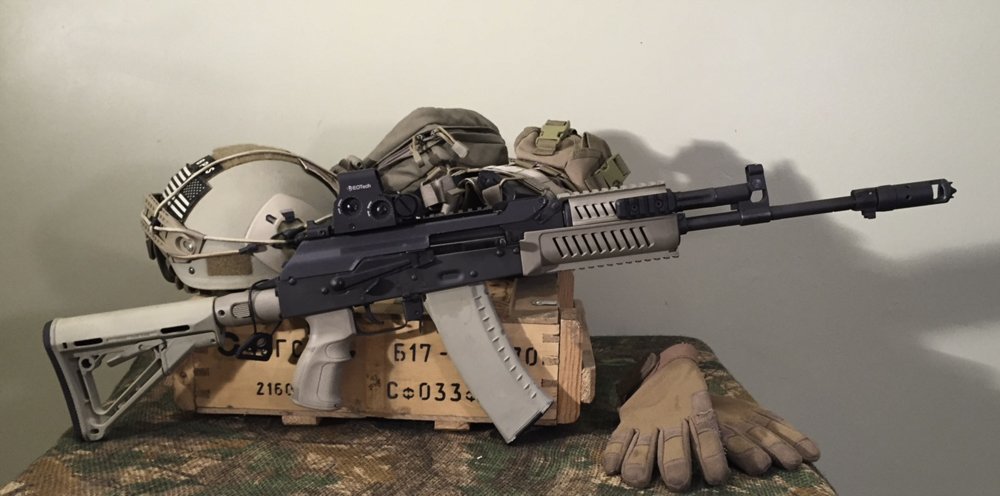
In the end, the author was successful in cloning the newest Russian AK Avtomat. The clone gun appears to have a longer barrel. This was dictated by the location of the gas port on the original Bulgarian barrel.
I had to ponder which handguards to use on my AK-12 clone this time. The new Russian AK has handguards that are matching in length and parallel, with rails at the top and bottom. The clue came from the way the side rail sections mount the handguards.
The AK-12’s Picatinny side rails mount to the upper handguard, instead of the more traditional way to the lower. FAB Defense makes its AKL-47/74 guards with the same mounting option. After taking a closer look at these handguards I thought they were very similar to the originals. I got the FAB Defense handguards and installed them on my gun using standard AK brackets and hardware. I chose the dark earth color for my accessories to most closely resemble the original.
The next step turning the I.O., Inc., gun into the newest Russian AK was the hinged top cover. As previously noted, I have considerable experience with these and used them on previous builds. My preferred railed top cover was the Parabellum AKARS.
Except this time I wanted something else. My search revealed the Russian Red Heat AK dust cover with rail from Legion USA. It installed into the rear side leaf hinge and dropped into place as if it was an original part. Once on the gun, I noticed that it matched the upper handguard rail height perfectly. My rifle was starting to look like the original AK-12. Nevertheless, there was still plenty to do.
It was not possible to match the new gun’s entire list of features, like the adjustable gas system or additional accessory lug. However, the author came pretty darn close.
One more part that came from Legion USA was the Russian version of the Krebs Enhanced Safety lever. I thought I would stay as authentic as I could and used it on my clone along with the Geissele ALG AK High Energy Hammer Spring and the two-zone compression return spring.
I decided to try a different trigger group for the AK-12 this time. I opted for the FIME Group’s (affiliated with K-Var Corp. and Arsenal USA) FM-922US trigger group. It was a drop-in replacement and had the look of the regular AK trigger, but with definite performance improvement.
The main body of the gun was done with the updates and, from the front sight/gas block back, it looked pretty close to the AK-12 Avtomat.
It was time for gunsmithing. I needed to find a block with detent pin and bayonet lug that would be pressed over the threaded barrel. Also, there was the matter of which muzzle brake to use. After a search, I decided to go with Polish Tantal parts. The Tantal’s front sight had the bayonet lug and detent pin I needed. All I had to do was cut it, grind it and press it on. The Tantal muzzle device is highly effective as a brake and happens to be one of my favorite brakes.
Choosing a gun for the AK-12 build was a challenge. Needing an AK-74 with front sight/gas block combination, the solution came in the form of I.O., Inc.’s hybrid of a Bulgarian kit-built AK-74 and the M214 rifle.
Additionally, there was an issue with the gun’s open sights. Since I had to remove the original rear sight, I had to find a substitute to go on top of the receiver cover with one caveat, it had to be very low. There was only one that I knew about, the TWS peephole sight, and I got it.
The front sight also presented a problem that required some milling. The original I.O. front sight had a circle hood over the sight post. The higher-sitting handguards and a rail on the top of the receiver cover rendered the original sight useless. I needed to mill the top off the sight to provide more room for the post.
With my unfinished gun and with several parts in tow, I headed to the Erie Ordnance Depot (EOD) shop in Portage, Northern Ohio. Jim Weishuhn, owner of EOD, is a master gunsmith I often call upon when I reach the limits of my gunsmithing abilities. Having a full shop, he often helps me with my projects.
This time was not different. We cut the Tantal front sight, creating a detent pin block, ground it into shape and pressed it on the barrel of my AK-12 clone, past the threaded tip exposing enough thread to install a muzzle brake.
Jim pinned the block in place with a working detent pin. Next, he machined an opening in the enclosed front sight hood, making it more suitable for front sight adjustment and better looking. With the gun nearly complete, we moved on to the two muzzle brakes. All we had to do was modify the tips of both brakes to mimic the Russian parts. After Jim machined both muzzle brakes, all that was left was to refinish the modified parts of the gun.
I.O. Inc.’s rifle had two very important features: the front sight/gas block combination and the 14mm left-hand thread at the muzzle.
It was done. Stepping back and looking at my creation, I was very satisfied with the way the AK-12 looked. It looked very close to the original. I did try to use most of the accessories in Dark Earth color to match the Russian AK-12, but stopped short of painting the whole gun, instead retaining the option of reconfiguring it later.
Nevertheless, my AK-12 felt light and had an aura of “niftiness” about it. I have shouldered it several times and it felt almost intuitive. The ergonomics were improved and, at the same time, it retained the AK familiarity. Other than that, it looked and felt like a foreign gun and it also looked and felt like an AK. It cycled very well with no hang- ups. All controls worked as they should, and the two-stage FIME Group trigger group felt very crisp. The only question was, would it shoot and would it shoot well?
At the range, I set up at 50 yards, as I was more interested in the gun’s function than accuracy. I would check that later. For the first series of tests I installed the modified AK-74 brake to see if there was a difference between the standard AK-74 and my newly minted clone.
First shots did not disappoint. The clone worked great and, in the best AK-74 tradition, was easy to shoot with no appreciable recoil.
Not only did the author’s AK-12 clone closely resemble the Russian Avtomat, it also shot exceptionally well.
I switched the muzzle devices, installing the modified Tantal brake. With the Polish-design brake, the next series of shots was surprising. The gun was noticeably smoother and its already almost negligible recoil was reduced even further. I was impressed to say the least. So far, the gun was working well. Of course, I could not compare it the original. However, assumptions could be made. And, if the Russians did similar internal upgrades as I’d done, the new AK-12 is better than the AK-74M.
I’m not putting myself in the same group with Russian firearm designers, engineers and gun makers. Even though I’m a mechanical engineer, I don’t know the intricacies of thete firearm design. All I can do is wrap my head around the mechanics of it, add some physics principles, and try to replicate a result, sort of a “proof of a concept,” if you will.
So, as far as I was concerned, it worked. My AK-12 clone looked very similar to the Russian AK-12 Avtomat and shot exceptionally well, enough for me to adopt it as one of my work rifles.
At the range, I continued to test my new gun. I used its open sights to see if it would produce a decent group and it did. All 30 rounds nestled in a tight group at the 1 o’clock spot, approximately 1 inch off the bull’s eye of the target. At 100 yards, my group opened up some, but was still way within my expectations.
In my hands, I had a gun that not only looked and felt great, but also worked well.
After installing a generic red-dot sight, I went to work on steel silhouette targets set up at 50 and 100 yards. It was a pleasure to put it mildly. The AK-12 clone’s meager recoil allowed me to maintain a dot on the target while firing at all times and at both distances.
Here it is, the author’s very own, the latest in the AK Evolution species, the AK-12 that he built mostly in his basement, with a little help from friends.
Rapid semi-auto fire was an easy task. The gun felt like something you want to fire on the move during a carbine course or competition. I love the fact that I was able once more to build a gun that closely mimics the appearance and possibly the performance of the newest Russian Avtomat, and I did it with parts available in the U.S. at reasonable prices.
Is the AK-12 the last AK, the last link in its evolution? I don’t know. In fact, no one does. As the “Old Guard” gun makers die off or retire, more and more voices in Russia today call for a completely new firearms system. It is time to replace the ancient technology, they say.
I’m not sure I agree with them. One part of me, the engineering part, agrees. I would always love to see something new and different. But, would I stake my life on it? That’s where my other side takes over, the practical side, the soldier side, the reasonable side.
Why would anybody want to replace a gun platform that has been in service for 80 years? Maybe I let the Russian in me take over with its trademark conservatism. If it’s not broke, don’t fix it, I say.
Custom guns are beautiful to behold, but they might also be one of the best firearm investments. Here’s why.
Why custom guns are worth the money:
Create an enhanced firearm potentially more accurate.
Added unique embellishments particular to that gun.
Enhance the overall aesthetics of a firearm.
Potentially create a gun that will increase in value over time.
Italy’s Trompia Valley, also known as the “Valley of the Gun,” has been the heart of European firearm manufacturing since the 16th century. The massive iron forges that once lined this valley have been replaced with modern, high-tech factories, and companies like Rizzini and Beretta rely on precision CNC machining equipment to produce their products. This modern technology allows manufacturers to keep tolerances tight and costs relatively low, a real win for gun buyers.
This Republic Forge 1911 has a distinct look, with its contrasting frame and slide coloration, special VZ grips, rail and Trijicon sights. But these 1911s are true custom guns, built one at a time by a single gunsmith in their Perryton, Texas, facility to customer specs. Carlos
But not every firearm that comes from the Valley of the Gun is strictly a product of high-tech machining. When I visited the Fausti manufacturing facility in the Trompia Valley, I noticed that the factory was divided into two halves. The southern half of the factory was filled with rows and rows of bulky white CNC machines that churned out shotgun parts at a rapid pace. The northern half of the factory, though, is occupied by a group of Italy’s best custom gun makers and engravers. Every Fausti gun begins life in the southern portion of the factory, but the brand’s Boutique guns — which are custom-built to each customer’s specifications — spend a few weeks or even months in the northern half of the factory where each gun is hand-fitted, oil-finished and engraved. The engraving alone can take up to 700 hours per gun, but the finished product is a spectacular firearm that’s built from the ground-up to meet the needs and wants of the customer.
If you appreciate fine guns, it’s hard not to lust after a fine custom firearm. When you combine detailed machine work with hand fitting and the finest materials, the final product is spectacular. But have you ever considered actually purchasing a custom gun? Sure, they’re more expensive than production firearms (all that hand fitting and one-off detail work comes at a price), but the end result is a gun that suits your wants and needs perfectly. And, in some cases, custom guns are actually a very solid investment.
What You’re Getting With A Custom Gun
Custom guns require extra attention and labor for production and, in many cases, the component parts that are used in the assembly of a custom gun are of a higher grade. Those are the primary reasons that custom guns cost more than production guns. It’s important, however, to know what you’re paying for when you purchase a custom gun. If you’re buying a beautiful hunting rifle with express sights, a grade “V” walnut that’s been cut to fit and detailed engraving, that doesn’t mean that it will shoot any more accurately than the stock production rifle upon which it was based. Very accurate rifles might have aftermarket barrels, blueprinted actions, custom trigger jobs and the like, but that doesn’t always mean they’ll be beautiful.
Here’s an example of true custom engraving: a photo of the gun’s owner that has been superimposed on the sidelock of a Fausti shotgun by a master engraver using a hand tool known as a bulin. This kind of work is neither cheap nor quick (engravings like this require up to 700 hours of hand labor), but it’s the highest form of firearm art.
Buying a custom gun requires spending some time considering the end use for the firearm and balancing what your wants and needs are with your budget. For instance, custom gun builders have used affordable Remington and Howa actions as the basis for custom guns for years, and the resulting guns that I have encountered have shot well. Saving a few bucks on the action allows them to add upgrades to the rifle. In fact, upgrading your existing hunting rifle can be pretty simple. Sometimes buying an aftermarket stock, having a gunsmith install a better barrel, truing the action or bedding your rifle are all affordable steps that can dramatically improve accuracy.
The market for custom pistols is as large as the one for long guns, and there’s a noticeable difference between the custom guns I’ve tested from Republic Forge, Nighthawk, Ed Brown and others when compared with production guns. For starters, hand-fitting and polishing work means that the gun operates with supreme precision. Custom pistols have slides that move as if they were riding on ball bearings. Everything fits tight. In some cases, you’ll need to spend some time breaking in the gun to loosen it up so that it operates perfectly. The majority of custom guns are based on 1911 designs, but there is a growing contingent of shooters who are customizing their polymer carry guns with special finishes, upgraded sights/barrels/triggers, slide cutouts and so forth. Whether you’re looking for something stunning and exclusive or practical and affordable, you can touch up your sidearm to the degree you see fit.
There’s a very simple axiom when it comes to pricing walnut for stocks: The prettier it is, the more it costs. And the very prettiest walnut stocks can be very, very expensive. In many cases, these stocks will be cut to fit, and there will be a tremendous amount of handwork, including checkering and finishing work, which will increase the price even more. But a beautifully crafted stock with exceptional color is a true treasure, a combination of natural and human handiwork that serves a practical purpose — so long as you’re willing to risk nicks and mars when you take it to the field. If you aren’t willing to pay for wood or want something that’s more durable, then synthetic stocks are on option. And, increasingly, there are more options with custom synthetic-stocked guns than before; Remington’s Custom Shop offers hand-painted stocks to customer specifications.
Engraving adds an unmistakable touch of class to any rifl e. Even the scope rings on this Remington custom rimfi re, which was on display at the SCI convention in Las Vegas, are engraved and feature gold inlays.
Besides attention to detail and material upgrades, you’re also paying to have exactly the gun you want. Not one that’s close, not one that’s similar; a gun as you would design it. And when you choose a good builder, the care and attention shine through.
The Custom Process
The Safari Club International Convention in Nevada serves as a stage for custom gun builders to show off their products. One of the largest custom gun shops belongs to Remington, which also incorporates Marlin, Dakota Arms, Nesika and other companies.
“Every custom gun starts with a conversation,” says Carlos Martinez of the Remington Custom Shop. “Not all of our customers are gun aficionados. They may not know why we blueprint actions. But we can sit down with them and discuss what they’re looking for in a gun.”
Machines can only do so much. For a truly custom touch, you’ll need to send your gun to a skilled artisan who can add those special touches. This Fausti shotgun features a CNC machined boxlock action that is being custom mated to a custom Turkish walnut stock in the company’s Italian facility.
Carlos said that a qualified custom builder could also talk a customer out of potential mistakes. If you have your heart set on building a .338 Lapua with an 18-inch barrel, the team from Remington will build that gun for you, but they’ll also tell you why that’s a bad idea. Ultimately, the purpose of a custom gun is to give the buyer exactly what they want within budget constraints. But it can help to have someone to talk to and walk you through the decision.
How long does it take to see a finished gun come down the line? That depends on the builder you choose and how many boxes you check. The Fausti guns described in the opening of the article might take several months or a year depending upon the detail on the engraving. A built-from-scratch custom gun from a very busy builder might take a year or more. In many cases, though, you can have a custom gun built in six months or less. But it’s important to speak with your builder and know exactly when your firearm will be in your hands. If you’re designing a custom rifle in July to use on an elk hunt the following October, you’re on a pretty tight schedule, and you can bet that if I were in that position I’d have a backup rifle zeroed and waiting.
Stock selection often begins by choosing a blank. The stock is then shaped and molded to the rifl e and, in some cases, to fi t the individual shooter. The price of a custom walnut stock correlates to the eye-appeal of the wood.
Lastly, you need to determine what you are getting and how much you are paying. More than one shooter has agreed to purchase a rifle at a certain price and then, over the course of the build, they have agreed to additional upgrades that end up driving the price higher than expected. Then, you need to find a custom builder with a solid reputation. Hopefully that’s someone who has built a number of guns and can put you into contact with some very satisfied owners — after all, you can buy a well-built, accurate production gun for $1,000, so if you’re paying custom gun prices, you need to be certain of what you’re getting. Probably the single biggest point of contention is group size, and when I talk to those who have experience with custom guns — both as buyers and sellers — they agree that this is a sticking point. Is there an accuracy guarantee, does it cover the caliber you selected (some accuracy promises don’t include big-bore calibers), and is there a certain ammo specification?
Semi-Custom
There are a number of companies that can offer both complete custom guns and semi-custom packages that don’t offer a blank-slate approach to gun building but that provide you with a number of options to build a gun that suits you. Many companies have in-house Cerakote shops, and in some cases, you’ve got the option to add custom touches to a firearm without spending a lot of money. E.R. Shaw in Pennsylvania does just that, offering a number of stock, finish, caliber and barrel length options for their rifles while keeping the price at or just above what you’d pay for some factory guns, and accuracy is superb. Likewise, companies like Weatherby, Nosler, Remington, CZ-USA, Benelli and Montana Rifle Company have in-house custom shops that allow them to make some minor changes to their guns. Many of these aren’t full-out ground-up builds, but if these companies have rifles or shotguns you like and you want to make a few minor touches, that’s not a problem.
Are Custom Guns Really Worth The Money?
Guns are investments, and just like any investment, there are winners and losers. But of the handful of custom guns in my gun safe, I feel my money was well spent. I got the gun I wanted, a firearm perfectly suited to my needs, and even though I paid a bit more for them, I know I can get most of my money back.
You’re only limited by your imagination and the resources and skills of your gun builder when it comes to designing a custom gun. These 1911 R1 pistols came from Remington’s Custom Shop.
If you’re buying one custom gun — your dream gun — you don’t necessarily need to be so concerned with ROI. After all, you’re probably going to keep the gun the rest of your life, and there’s a certain intrinsic value to handing down a one-of-a-kind firearm to the next generation of shooters. If, on the other hand, you’re buying a custom gun that you might well part with, then you’ll need to be certain that the gun is marketable in the future. My Republic Forge 1911 pistol is one that I plan to keep, but because it has widespread appeal — a Commander-length .45 with lots of nice touches that make it fun to shoot and beautiful to behold — I know that it would be attractive to buyers if I ever decided to sell (which I won’t). Generally speaking, the better the work, the more eye-catching the gun and the more widespread appeal it has, the easier it will be to get a solid return on investment.
Ultimately, though, a custom gun is about your appreciation for a firearm maker’s skill and your desire to own your own “perfect gun.” Whether you’re looking for the ultimate mountain rifle, the ultimate competition shotgun or the ultimate conversation piece for your next backyard barbecue, you won’t have to settle for someone else’s idea of the ideal gun.
Editor’s Note: This article originally appeared in the April 2018 issue of Gun Digest the Magazine.
Are the new TSS shotgun shells all they’re made out to be? Can they be used for home defense?
How TSS shotgun shell perform better than lead:
TSS stands for “tungsten super shot.”
Tungsten is denser and harder than lead.
Whereas water is 1 g/cc in density, lead 11.3 g/cc, tungsten is 18 g/cc.
The density allows the TSS to fly further.
Hardness allows shot to maintain its form, thus create a better pattern.
Tighter patterns make smaller gauges more viable on longer shots.
Unless you have been living under the proverbial rock, you’ve likely heard some scuttlebutt about TSS shotgun shells. TSS — meaning “tungsten super shot” — has become all the rage in the shotgun world, mainly in turkey hunting circles. But a little testing proved it can do so much more.
Although not new, TSS has recently been brought mainstream by Federal Ammo. Turkey hunters are salivating, but the new load also has plenty to offer those who like a shotgun for home defense duties.
TSS is not new. An almost cult-like group of turkey hunters has been handloading TSS for several years.
Reports of this mysterious shot began to surface on the internet, and several websites sprang up where members of the TSS cadre would meet and talk over recipes for loads. Word of incredible patterns at ranges previously unheard of spread across the land. The word was out, and for shotguns, TSS was the new magic metal.
Federal Brings TSS To The Masses
Federal Premium Ammunition introduced a new TSS shotshell this past January at SHOT Show, and the buzz was immediate. The HeavyWeight TSS load was greatly anticipated and hit the market about a year after Apex Ammunition started selling TSS shotgun shells. The HeavyWeight load features TSS shot in No. 7 and No. 9 shot in three gauges: 12, 20 and .410.
Who needs a .410 turkey load? One of the virtues of this shot that TSS devotees like to preach is that the heavier-than-lead material makes the smaller gauges a viable option over the bigger 12-gauge boomers.
Besides the TSS shot, Federal’s new load has some other qualities going for it, including buffering the shot and a rolled crimp on the end of the shell. Buffering the shot is as important with TSS as it is with lead.
“Buffer evenly distributes the ignition force throughout the payload, allowing for uniform separation of the shot at muzzle exit,” said Federal Premium Shotshell Engineer Adam Moser. “Buffering lead shot also helps reduce pellet deformation caused by ignition forces.
The 3-inch No. 9 Federal HeavyWeight TSS shoots with a muzzle velocity of 1,200 fps, and put 611 pellets in a 5-inch circle from 10 yards with an extra full choke. When used with an open bore above, the pattern turns into a clean, single hole. Sound backward? It’s all about the relationship between the choke and the wad.
“A roll crimp on the shell helps provide uniform compression of the buffered payload, which generates consistent ballistics and better pattern efficiency,” Moser added. Combined with a clear plastic card wad, it also ensures that the entire buffer remains sealed inside the cartridge.
Another important aspect of the HeavyWeight TSS load is the FliteControl Flex Wad, which was introduced with the launch of Federal Premium’s redesigned Black Cloud waterfowl shotshells. The wad’s design is meant to improve pattern density and consistency when fired through ported and non-ported chokes.
“The wad’s redesigned rear-deploying brake fins and side-mounted vents stimulate the payload for separation from the wad at the right moment for the densest, most consistent patterns,” said Dan Compton, Shotshell Product Line Manager. To do this, Federal Premium engineers beefed up the wad’s brake system, starting by reinforcing the wad’s flexible rear fins with sturdy supportive gussets.
“We rely on gas pressure from inside the barrel to flex the fins and open them, which triggers the shot to separate from the wad,” Compton added. “If there’s not enough pressure, the wad doesn’t slow down enough for optimum separation.”
Intrigued as always with anything that comes out of shotgun, I decided to find out more about this scattergun magic potion. What is TSS, anyway? How does it compare with conventional shotshells? Are TSS loads good for anything besides turkey hunting? Can I really kill turkeys at 85 yards with TSS (OK, I’m kidding on that one, but just a little)?
Pay attention now, class — today’s lesson is on Tungsten Super Shot.
TSS 101: The ‘Magic Metal’
Tungsten is a rare metal found naturally in the earth and is also known as “wolfram.” The name tungsten comes from a Swedish term, tungs sten, meaning heavy stone, and it’s used to make several items including tungsten-carbide drill bits and filaments for light bulbs. Although tungsten is mined all over the world, most comes from China and tungsten shot is made there as well. The TSS shot we shoot is about 95 percent tungsten, with the remainder being made up of nickel, iron or copper.
For turkey hunters, comparing lead and tungsten is like comparing apples to oranges. Where tungsten really shines is in pellet count (using smaller pellets while retaining energy), and especially at extended ranges.
It’s tungsten’s weight (density), along with its hardness, that makes it shine as a pellet for shotshells. Density is usually measured in grams per milliliter, and most tungsten shot is 18 g/cc. Water, by comparison, is 1 g/cc, and lead is about 11.3 g/cc.
For our purposes here in comparing the performance of shotgun pellets, think of two pellets of equal size— one is lead and the other is tungsten. Now, think about playing fetch with your dog and throwing two balls of equal size; one is a whiffle ball and the other is a baseball. The baseball is heavier and denser than the whiffle ball, which will fly farther and hit a target with more force.
Don’t do as I did and confuse density with hardness: they are two different things. If you put a lead and a tungsten shot pellet in a set of pliers and clamp down on them, you’ll deform the lead pellet long before the tungsten.
A shotgun is an imprecise weapon, and shot pellets have a wild ride from the muzzle to the target. Lead pellets are bumping into each other and shot in the rear is pushing on pellets in the front of the load. Lead will deform under these conditions, and misshapen pellets tend to fly erratically and make holes in the pattern.
Tungsten shot, being many times harder than lead, maintains its form and will hold a better pattern. Because it’s harder and heavier, smaller tungsten shot will perform on the level of much larger lead shot. Number 9 shot, once thought of as unheard of for hunting purposes, has become the darling of the TSS world. The difference in loading No. 9s compared to No. 4 shot is phenomenal. A 3-inch, 1¾-ounce load of No. 9 shot will contain about 637 pellets, while the same load of No. 4’s will give you about 256. It’s all in the math.
How Does It ‘Stack Up?’
There are dozens of shotshell loads available for comparison to TSS ammunition. To simplify things, I wanted to compare TSS performance with a standard turkey load and a home defense shotshell. I have used Remington Nitro Turkey loads for several years and know others who have as well, and I’ve seen more than a few turkeys fall to this shotshell.
While the TSS patterns are impressive, you pay for what you get. A cache of Federal HeavyWeight No. 9s will run you north of $40 per fi ve-count box.
The Remington Nitro Turkey loads (12 gauge, 3 inch, 1 7/8-ounce No. 4 lead shot) and the Federal HeavyWeight TSS (12 gauge, 3-inch, 1¾-ounce No. 9 tungsten shot) were fired onto paper targets and into Clear Ballistics gel at 35 yards. Clear Ballistics is a synthetic gelatin created to test terminal performance of projectiles from firearms. The material is completely reusable and transparent, so you can easily see the penetration of bullets or pellets after the shot. It’s really cool stuff and reveals a lot of info.
The shotgun used for this was a CZ-USA Magnum Reaper (CZ’s new turkey gun), which is an over-under shotgun with 26-inch barrels. The choke tube used was the Xtra Full choke that’s supplied with the CZ Magnum Reaper.
At 35 yards, the Remington Nitro load put 45 pellets in a 5-inch circle, with an estimated velocity of 800 fps; this translates to 204 foot pounds of energy (fpe) delivered to the target. The Federal HeavyWeight round hit the 5-inch circle with 103 pellets, at an estimated velocity of 750 fps, creating 155 foot pounds of energy smacking the target. The Remington lead No. 4s penetrated the Clear Ballistics gel approximately 6½ inches, and the Federal TSS tungsten shot penetrated 6 inches.
I found it interesting that the Federal No. 9 TSS shot embedded in a mostly uniform pattern, with the majority of the pellets having traveled the same depth in the ballistic gelatin. The Remington No. 4 lead pellets pierced the medium about 6½ inches — a few went deeper than that, and several traveled less. While I don’t have any real slow-motion video proof, this would indicate the TSS load is delivering the shot charge to the target in an even manner, with a short shot string.
Some would say this is an unimpressive showing for the TSS load because it produced slightly less foot pounds of energy and velocity to the target. You must, however, look at the number of pellets. While 45 pellets for the lead in a 5-inch circle is certainly not bad, 103 TSS pellets is twice as good. It should also be noted that a TSS-specific choke tube would produce a higher pellet count on the target. Double the number of pellets would certainly give more room for error when taking a bead on a turkey’s head.
The TSS Takeaway
A bonus for the advent of using TSS shot is going to be the increased use of the smaller gauge shotguns. You will see more 20 gauge and .410 shotguns used on turkeys than ever before. This will translate to older hunters with bad shoulders, lady hunters, kids and really anyone tired of being pounded by 12-gauge loads going afield, and that’s a good thing. Look for a revival in the use of the .410 shotguns.
TSS shot, because of its properties, is going to deliver more shot on target, be it paper, ducks or turkeys. At traditional or moderate ranges (up to 40 yards), some would question the need for the much more expensive TSS loads (MSRP for a box of five 12-gauge, 3-inch Federal HeavyWeight TSS shells is $44.95; a 3½-inch box of five will run about $49.95), but for every hash mark past the 40 yard line, tungsten shot is going to prove its worth exponentially. Think of it this way: How many times are most of us going to pull the trigger during turkey season anyway?
Editor’s Notes: This article originally appeared in the May 2018 issue of Gun Digest the Magazine.
Like day and night, the AR-15 and AK-47 were designed for different purposes. Which one is right for you?
The major differences between AR-15 and AK-47:
AK-47s shoots 7.62x39mm.
AR-15s were originally chambered 5.56x45mm.
AKs have a maximum effective range of about 300 yards.
ARs have a maximum effective range of about 800 yards and beyond.
The Russian gun operates with a long-stroke piston.
The American rifle utilizes a variation of the gas impingement system.
ARs are more modular than AKs.
Debating on whether the AR or the AK is “better” is like arguing whether a Ford Mustang is superior to a John Deere tractor. Both have four wheels, engines and transmissions, but they were designed for completely different applications. The AR and AK do exactly what they were designed to do, and they both do it well.
The AR was a rifle, firing the intermediate cartridge. Only later was it produced as a carbine with a 16-inch barrel. The AK was designed for the 7.62×39 cartridge, and is a large submachine gun.
WWII was the catalyst for both weapons. There was no more trench warfare — the Germans had launched the “Blitzkrieg,” or “lightning war.” This principle relied on tanks, artillery and aircraft, and plenty of ground troops to smash through the enemy, overwhelming their defenses. During the first half of WWII, the Germans were almost unstoppable. Post war, the winners began studying, testing and designing weapons and tactics based on this new paradigm.
The time of the “intermediate” cartridge had arrived. During the war, battle rifles ruled the field. These rifles fired full-size cartridges — the 7.62x54R Mosin Nagant or the American .30-06 M1 — with an effective range of 800 yards or so. Studies from WWII showed fights occurred at much shorter distances, and more rounds fired increased the chances of winning. Full-auto fire used by Germans during the war was the path to victory. The intermediate cartridge, the German Sturmgewher, was smaller and fired from a shorter, lightweight platform and was controllable during full-auto fire. The smaller round also allowed soldiers to carry the ammunition necessary to sustain a high rate of fire.
What’s interesting is that the Soviets, known for their heavy-handed bureaucracy, moved quickly through development and fielding of the AK-47. Design began in 1945, and the AK-47 was issued to troops in 1949. The United States, known for its innovation, took a longer route. Due to political pressure, financing or stubbornness, the United States adopted the .308 caliber M14 in the mid 1950s. The M14 is still a heavy battle rifle, and the .308’s recoil was too much to control on full auto. It didn’t perform well against the automatic fire of the AK in Vietnam, and it was replaced by the fully automatic AR-15, known now as the M16, in the mid ‘60s.
Design Differences
The AK-47, which was attributed to Kalashnikov but designed by a team, is a simple, rugged and reliable large submachine gun. Although it’s simple, don’t let that fool you: As Soviet weapon designer Georgy Shapgin said, “Complexity is easy. Simplicity is difficult.” In fact, Kalashnikov’s original designs were too complex, and the team made hundreds of modifications before the final design.
The AR is a little more complicated than the AK. Here you can see the bolt groups, with the AK components on top, which are not made to be taken apart. The AR allows you to change out things like the extractor or spring without special tools or knowledge.
The AK is easy to manufacture and cheap to produce. The original design used stamped and welded receivers, with furniture made from birch wood laminate, which is cheap and durable. It was built with loose tolerances, making the AK a “self-cleaning” carbine because its fired dirt and debris were blown out of the AK.
The AR/M16 is almost a direct contrast to the AK. Although Stoner borrowed from others, just as Kalashnikov, the ultimate product was unique. It’s more complex in design and manufacture. The AR-15/M16, originally only offered as a rifle, utilized aluminum, plastic and a unique gas impingement system that made recoil extremely controllable. In design and application, the AR-15/M16 is for professional soldiers.
Due to the AR’s modular design — it’s easy to swap out parts — the civilian market contributed heavily to the development of aftermarket parts. This included free-floating handguards, a variety of barrel/caliber options and improved trigger assemblies, just to name a few. The introduction of the flat-top upper receiver in the early ‘90s was a major factor. Instead of a carry handle, the upper has Picatinny rail on top to attach various sights. The military incorporated many of these features into specialized rifles and carbines.
It took longer for accessories for the AK to come to market. One factor was the lack of availability. AKs didn’t really become popular and available in the United States until the 1990s. Plus, the AK is not as modular as the AR. Today, there are plenty of aftermarket parts for the AK, and radical customizations are available. It’s almost at the point where it’s sometimes difficult to rapidly distinguish between an accessorized AR and an AK.
Function Differences
The AK’s simplicity makes it easy to “learn.” A large number of Soviet troops were uneducated, couldn’t read or write and spoke various languages. You don’t need a technical manual to learn how to operate and maintain the AK: It field strips down into six main parts, which makes it easy to maintain. Critical components with tight tolerances are not made to be disassembled unless absolutely necessary. In fact, it’s so simple it became the standard weapon for child soldiers, small boys forced into combat during the African civil wars of the late 20th and early 21st centuries.
On the left is the .223 Rem./5.56 NATO. In the middle is the 7.62×39, with the newer 5.45×39 round for the AK-74. Each round does exactly what it’s designed to. Which one you need depends on what you’re doing.
The AR is more complicated than the AK, but its ergonomics are much better. For example, it has a charging handle and a bolt catch. When the bolt is locked to the rear, such as during an empty reload, you use the bolt catch as a release as opposed to cycling the charging handle. This is much more efficient than cycling the charging handle — with the AK the charging handle is used for everything. Once you know the right techniques, it’s easy for a right- or left-handed shooter to operate the AR efficiently.
Reliability Differences
Nobody questions the AK’s reliability. It has functioned well in every kind of environment and under all conditions. The gas piston design is perfect: You can bury an AK in the dirt, come back a year later, crack the bolt open with your foot on the charging handle, dump some motor oil in it and bang away. AKs work.
Initially, the AR experienced some growing pains due to specs changed in the design and the components used in the ammunition. Since then, it’s definitely earned the title of “America’s Rifle,” and it’s the longest serving standard-issue rifle of America’s armed forces. Most people think the AR’s gas impingement functions too dirty for reliability. They will run dirty — we have one with more than 20,000 rounds through it without a cleaning. The key, however, is lubrication. Keep your AR “wet” and it will run reliably. At some point you may need to replace an extractor or ejector spring or the gas rings on the bolt, but this is an easy task.
Accuracy Differences
The AK-47 fires a 7.69×39 round (the AK-74, an updated version of the classic, fires the 5.45×39 caliber). Due to its loose tolerances, the AK isn’t known for surgical accuracy. It will group 6 inches or so at 100 yards, with a maximum effective range of about 300 yards. For the AK’s design and purpose, this was deemed good enough. Today, there are accurized versions of the AK, but to me this goes against the grain of its design.
The AR is built to tighter tolerances than the AK, making it extremely accurate. The first Colt H-Bar I bought in the 1980s shoots 1-inch groups at 100 yards exactly as it came from the factory. With the proper barrel/twist rate and the right ammo, the AR is capable of getting accurate hits out to 800 yards and beyond.
Which One?
So, which one is best for you? I recommend at least one of each! Both the AK and the AR are reliable, easy to shoot and fun, and they perform exactly as designed. I prefer to stick with the original concepts — my ARs are gas impingement and fire .223 Rem./5.56 NATO. My AKs are 7.62×39 with no modifications.
But, if you so desire, you can have an AR with the AK’s gas piston design, one that fires 7.62×39 ammo or an AK that shoots .223/5.56 ammo. Regardless of which direction you go, remember that it’s up to you to learn how to use it safely and efficiently, and to have the knowledge and parts to maintain it, ensuring reliable service for years to come.
The FBI’s brief dalliance with 10mm handguns led to the development of the .40 Smith & Wesson cartridge, and experts are still divided on the question of the 10mm’s application for law enforcement.
The history of the 10mm and the FBI:
The Miami shootout of April 11, 1986, led to bullet penetration and ammo tests for the FBI.
The FBI’s move to 10mm was short-lived, with incessant problems with the S&W Model 1076.
10mm ammo proved expensive, large-framed handguns difficult to shoot, leading to the development of the .40 Smith & Wesson cartridge.
While the FBI no longer uses 10mm handguns, what it learned following the Miami shootout and subsequent testing of the 10mm and .40 S&W influenced today’s 9mm ammunition and handguns. Photos: FBI unless otherwise noted.
Why FBI Considered and Tested 10mm Handguns
After the official inquiry by FBIHQ into the Miami shootout, the Training Division sent a group of instructor/agents to the scene under the direction of FTU Unit Chief Tom Miller, not to determine what the Miami agents had done right or wrong, but how their training and equipment had performed, and what had to be changed. I was part of that group.
Several factors, including regulations on firearms, were changed. But one striking flaw was discovered: the performance of the ammunition. Key to this was a shot taken by Jerry Dove, whose 9mm projectile hit one of the subjects in the arm, penetrated the chest, and then stopped just short of the heart.
Up to that time, the penetration of the round was not considered as important as expansion. Federal and local agencies measured expansion almost solely anticipating a target facing the shooter squarely with only 10 to 12 inches of penetration required. No thought had been given to subjects sideways to the shooter or arms and guns in the way. But now it became apparent more penetration was critical.
Back at the Academy, a team of experts was assembled, including ballistic technicians and top medical examiners from around the country. This resulted in the Wound Ballistic Workshop, held for three days at the FBI Academy in September of 1987. One of the key members of this committee was Colonel (Dr.) Martin L. Fackler, MD, FACS, who was at that time the U.S. Army’s chief wound ballistics expert and was stationed at the Letterman Army Institute of Research.
Initial testing included the .38 Special service load as a standard, against the 9mm, 10mm loaded by the FTU at about 950 fps and the .45 Auto. Photo by author
Another very important member was Dr. Vincent J. M. DiMaio, one of the nation’s leading authorities on wounds and wound ballistics. He is the author of the 1985 book, Gunshot Wounds. The findings of this gathering identified criteria for future ammunition selection, predominately a requirement for penetration of at least 12 inches in 10 percent ballistic gelatin.
Caliber was not considered as important as bullet placement and penetration and the 9mm vs .45 ACP controversy was initially sidestepped. As a stopgap, the Bureau adopted the 9mm Winchester 147-grain subsonic jacketed hollowpoint as its service round.
This highly accurate round, originally designed for suppressed military handguns, gave excellent penetration. In fact, it is still in use by many law enforcement agencies who have chosen to stay with the 9mm. The new FBI service load, recently adopted, is a similar subsonic load, the Speer 147-grain jacketed hollowpoint designated the G2.
I started formal testing of Winchester’s new 147-grain subsonic load in August of 1987. The round had gone through extensive military testing, primarily through the Naval Weapons Support Center. The original projectile weighed 140 grains in two bullet designs. These bullets in a subsonic loading did not reliably operate the gun action, or the “impulse” of the round.
Technicians estimated an additional 5 percent bullet weight was required, hence the unusual weight of 147 grains. The loading was originally intended for the S&W “Hush Puppy,” a modified Model 459 with suppressor, built for the Navy Seals. At that time, terminal ballistic testing was conducted in 20 percent gelatin. After the Wound Ballistic Workshop concluded, we changed to 10 percent to be in line with the majority of other test facilities.
After further testing of the round, the FBI adopted it for all 9mm weapons in inventory. The fact the round was subsonic was not a criteria, although it was used in the few MP5SDs (suppressed) in Bureau inventory. A bonus came to light as Olin Winchester started testing its round for commercial use. It was found to be very accurate, so they marketed it as the “Olin Super Match” or OSM.
The infamous Smith & Wesson Model 1076. It suffered from the pressure of trying to obtain the best gun/ammunition combination for the FBI in a short time period.
The loading gave excellent performance, though was later replaced by the Federal 147-grain subsonic, after I was removed from the ballistics program. The Federal version tended to fragment when fired in long-barreled weapons but was continued in use for several years. It is interesting that the latest 9mm loading for the Bureau is a 147-grain subsonic, this one manufactured by Speer utilizing its Gold Dot bullet with modifications.
In April of 1988, due to increased interest in the original round by other law enforcement agencies, I wrote a published report entitled, Adoption of the 9MM 147-Grain JHP By The FBI explaining why this particular round was selected.
The FBI Ballistics Program
Then the FBI’s ballistics program became official. I was initially appointed to head up the group on a full-time basis and received valuable assistance from other personnel in and out of the Firearms Training Unit as well as from the firearms and ammunition industry. Hundreds of pounds of ballistic gelatin was prepared and shot. This was new territory and we had to design test racks for the various tests, material to shoot through that could be duplicated. We even had to contact car companies to obtain specifications on window glass and door panels.
We took over the left lane of the indoor range. Targets were shot with both test barrels as well as actual service firearms. In the end, it became apparent that the ideal round for law enforcement, or at least for the FBI, might be a .40 caliber, aka the 10mm, the exact midway between the 9mm and .45.
But it was recognized that not all shots against subjects occurred without some sort of barrier between. Shooting statistics were studied and, over time, a .40-round protocol was developed, using automobile glass, sheet steel, plywood, plasterboard and layers of clothing. These tests eventually became the standard of ammunition testing for law enforcement and were adopted by most ammunition companies. While it has changed somewhat during the following years, it is still the basis for selection by many agencies, including the Bureau.
This testing resulting in the FBI’s adoption of the 10mm round, downloaded to about 950 fps, using a Sierra 180-grain jacketed hollowpoint. The long round, however, required a very large frame pistol. Adopted was the Smith & Wesson Model 1076.
For accuracy results with a test barrel, a sketch by the author resulted in this unique machine rest built by Joe Kiesel in the Gun Vault. Photo by author
A shorter 10mm round, already loaded as a “wildcat,” would have been ideal, but the development of the .40 S&W was then a closely held secret between Smith & Wesson and Winchester. The shorter round would have allowed the use of medium frame pistols, much more practical for law enforcement use. Apparently, S&W didn’t want the competition.
The Smith & Wesson 1076 exhibited some problems from the start. Guns were returned to the factory for adjustment. To confuse the situation even more, some performed flawlessly throughout new agent training. Others continued to have problems.
One new agent enjoyed a perfectly performing pistol until the last qualification, just before his graduation, when his 1076 seriously jammed up. An entire new agent class lost confidence in the gun and requested a different make and model. But to be fair, the pressure to develop something good and fast created a lot of pressure on both Smith & Wesson as well as the FTU personnel tasked with the procurement. It was a steep learning curve for both.
Then an agent in the Miami office participated in a heavy arrest. When he arrived at the jail with the subject, he tried to unload his 1076 and found it jammed shut. After booking the prisoner, he went directly to the Bureau’s nearby range and tried to fire it without success. Nor could he unload the gun. A mallet had to be used to get the pistol open.
When word of this reached the Gun Vault at Quantico, instructors were given permission to leave any problem guns loaded and send them to Quantico. They didn’t have to wait long. Another handgun, this time in the Tampa Division, also jammed up. The special agent involved flew to Washington, DC with the gun on his hip (and another brand for backup) to deliver to the Gun Vault.
A test stand was designed and built by the academy shops to handle the various tests to be performed.
The 1076 was shortly dropped from FBI use due to reliability problems and the Bureau went back to the SIG P228 and P226, still using the subsonic 9mm loading. The Bureau would later issue Glocks in .40 S&W caliber, with basically the same ballistics as the FBI handloaded 10mm.
Had the S&W 1076s worked flawlessly, in my opinion they still would not have been popular with the agent population due to their size and weight. One evaluation occurred for the new pistol when a variety of agents from around the country were called to Quantico to fire the weapon on numerous courses. At the end of the week, they were given the opportunity to evaluate their findings. On the evening of the last day of the session, my phone rang at home.
It was a woman who had been in one of my new agent classes. She was a lawyer from a large Eastern city and had done well in my class. She was in tears. She told me that the 1076 was so large and so heavy that she had serious difficulties shooting it. She concluded by saying, “If they make me carry that gun, I will have to resign.”
On September 5, 1991, the Firearms Training Unit published a document entitled, SMITH & WESSON 10MM MODEL 1076 SEMIAUTOMATIC PISTOL. The document gives the timeline for the procurement, starting in January of 1990 when the contract was signed for 9,500 pistols and ending in August of 1991 with the recall of the (decocking) S&W 9mm, 10mm and .45-cal. pistols. It describes the number of malfunctions of the 1076 vs. the SIG P226 and detailed charts listing the number and type of malfunctions. Under Conclusions, the document lists:
1. S&W has not demonstrated the ability to produce a reliable, durable weapon for the FBI. 2. There is and will be a confidence problem concerning the S&W Model 1076 in the minds of FBI Special Agents. 3. The FBI has spent enough time and money in this effort.
And under Recommendations: 1. Terminate the contract with S&W for the Model 1076 (funding can be restored). 2. Prepare for another emergency procurement of pistols (up to 2,000 weapons for approximately $1 million. 3. Conduct weapons needs analysis for the FBI. 4. Write specifications and RFP (solicitation); Test weapons and begin new contract.
The test results were confirmed by Special Agent Steve Band PhD. and his associates, members of the Institutional Research and Development Unit. Photo by author
In April of 1991, then Director William Sessions approved the formation of a working group to study the 10mm situation. The group looked into the original procurement, the problems with the sample and issue guns and made recommendations to correct any problems, one way or another.
The group was headed up by Special Agent in Charge Danny O. Coulson, who had plenty of experience with weapons as the first head of the Hostage Rescue Team. The group was composed of agents from headquarters and the field spread throughout Quantico, instructors, students, gunsmiths and supervisors.
When the study was completed, Coulson presented a memo through channels that was dated May 30, 1991. In it, there were 23 recommendations. Among them, the group suggested the Training Division immediately recall all Smith & Wesson 1076 pistols to make modifications to ensure their reliability and cease issuing this model to agents and agents in training.
All agents who have personally owned weapons or are trained in other Bureau weapons be instructed to utilize them while their 1076s are being repaired or be retrained to another Bureau weapon. That the current contract requirement for S&W to supply 11- and 15-round magazines be dropped and that only 9-round mags be issued.
The report went on to recommend that Gun Vault personnel make no adjustments to 1076s prior to issuance. (There was some controversy if the Gun Vault repairs or adjustments contributed to the problems with the pistols and the study group wanted to eliminate this consideration.) In addition, it was recommended that future pistol contracts call for a longevity of less than 40,000 rounds. Another was that the FBI abandon the concept of a single model handgun for all agents. The report reads, “The developmental phase of the S&W Model 1076 pistol embraced the concept that the FBI would have one gun for all of its agents, that gun being the 1076. It is the finding of this Study Group that that is an inappropriate concept and one that should be abandoned.
“It is the finding of this Study Group that the FBI should pursue a ‘family of weapons’ that would provide sufficient flexibility to our agents based upon personal abilities, personal preferences, and assignment. These weapons should include revolvers, 9mm pistols, 10mm pistols, .45-caliber pistols, and .40-caliber pistols.
“It should be noted that the .40 caliber Smith & Wesson that was developed parallel to the development of our 10mm round and pistol achieves approximately the same ballistic characteristics as the FBI 10mm light. Because of its shorter case, a .40 caliber Smith and Wesson pistol can be made smaller, and it can be double stacked to allow for higher capacity magazines.”
The group also recognized the possibility of including another Smith & Wesson model, the smaller 1086 in double-action only. They wrote, “One new female Agent of small stature and hand size was determined to be incapable of qualifying with the Model 1076 pistol.
The report of the Wound Ballistic Workshop has been studied by countless law enforcement agencies as well as the majority of ammunition manufacturers.
This agent’s hands were not large enough to cycle the double action trigger pull on the Model 1076. As a result, she had not qualified with this weapon. Unit Chief PLEDGER arranged for the purchase of a Model 1086 10mm Smith & Wesson in double action only. After being issued this weapon, and after an appropriate period of training, she qualified on her next attempt with this weapon. The foresight of Mr. PLEDGER in providing her with this weapon allowed us to keep on the rolls a qualified individual who we may have lost to the attrition of a firearms failure.”
“This Study Group has determined that a significant number of individuals interviewed and those who responded to surveys produced by the Study Group, are critical of the relatively large size of the current 1076.”
As to ammunition, the group recommended the adoption of a less expensive training round and suggested changing procedures for future procurements. At that time, the FBI was paying considerably more for 10mm ammunition than any other handgun round.
In 1990, the ammunition program was turned over to Special Agent Wade Plucker and Technician Ted Hollabaugh, a former Marine Corps and FBI armorer. Jointly, they ran the Ballistic Research Facility (BRF) for several years, making changes in techniques and equipment.
Today, the BRF is the ultimate in ammunition testing. Headed then by Supervisory Special Agent Buford Boone, this modern, multi-million dollar facility tests ammunition from around the country and the world. Buford and his staff answered inquiries from law enforcement and military agencies on a constant basis, often more than a hundred a month, supplying technical information not affordable to the average agency. Official letterhead requests are required.
The agencies receive data, not opinions. The results of testing at the BRF are not available to the public but test results of ammunition are supplied to the respective manufacturers to improve their products.
On a 2011 visit to the facility, located in an inconspicuous building at the FBI Academy ranges, Buford pointed out to me two charts, depicting expansion of service ammunition. One showed about half of the forty projectiles tested had expanded. The other chart illustrated 100 percent expansion in the various tests. “That is the result, in part, of our feedback to the manufacturers.” Buford stated. “By studying our test results of their ammo, they can improve their own product. And we all can benefit from that. Our forty-round test protocol today is fully repeatable, scientific and valid.”
The report on the FBI’s adoption of the 9mm, 147-grain round also attracted attention from the law enforcement and ammunition field.
The testing currently performed at the facility is way beyond what was done back in the 1990s. The state-of-the-art facility now includes high speed photography, extreme temperature testing from minus 40 to plus 140 degrees and accuracy evaluation with instant results downloaded to computers. And it is not just limited to ammunition. BRF also assists in weapons and body armor testing as well and conducts R&D for theoretical ballistic load development. BRF can handle interior, exterior and terminal ballistic testing and to that end, maintains a library of reference firearms in house. Its reloading area would make any varmint hunter jealous.
Supervisory Special Agent Boone retired in 2012. His successor had already been chosen. Supervisory Special Agent Scott Patterson had been on board then for more than 18 months and had a healthy overlap to “learn the ropes.” By the time of his retirement, Buford was so well respected by the industry that Speer produced a special run of .40 S&W ammunition with his name on the headstamp.
With the assistance of his capable staff, the Ballistic Research Facility is still in good hands. Recently, we discussed the new 9mm service round. Patterson stated that extensive testing has proven that it is at least as effective as any .40 S&W load. The nine is easier on guns and is easier to fire accurately. But he went on to say that there is no so-called wonder bullet. “The best bullet in the world can’t overcome a miss,” he said. And to that I add: you should continue to fire until your target is no longer a threat.
Looking to go armed, but are stuck in the weeds as to what to arm yourself with? Here are 20 of the best concealed carry gun options that will keep you on the defensive.