Whether you live in an urban apartment or a country estate, protecting hearth and home shouldn’t be taken lightly. You’ll spend big money finding just the right pistol, holster, belt and ammo to carry concealed, shouldn’t you be as discriminating when it comes to defending your home? With that in mind, we gathered up seven top guns and pieces of gear dedicated to keeping your abode safe and secure. After all, it is your castle, best to be prepared for any barbarians looking to storming the gates.
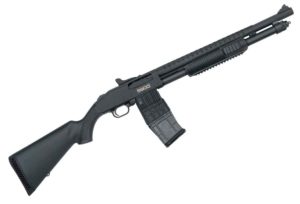
At this year’s SHOT Show in Las Vegas, Mossberg launched its own line of detachable magazine-fed shotguns with the 590M. The scattergun feeds from a double-stack, 10-round shotgun magazine — the world’s first according to Mossberg — and optional 5-, 10- and 20-round magazines are also available as accessories. One cool feature about the design of the gun and the magazines is that they rock in very similarly to how AK magazines feed into that rifle. And, as a bonus, the magazine release is positioned so that it does not interfere with the cycling of the action in any way. Two models are currently available: One is a more standard version while the other is more tactically oriented and features a Tri-Rail forend. $721-$801
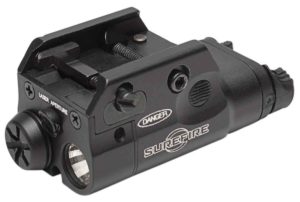
Surefire XC2 handgun light
The new XC2 is Surefire’s smallest, most lightweight handgun light with an integrated laser. It has a 300-lumen MaxVision Beam for illuminating and identifying threats and a 635nm red laser. The XC2 is less than 2.5 inches in length and weighs just 2 ounces, but it’s plenty durable due to its aerospace aluminum construction and Mil-Spec hard anodized finish. It features an ambidextrous activation switch for easy momentary- and constant-on activation. $449
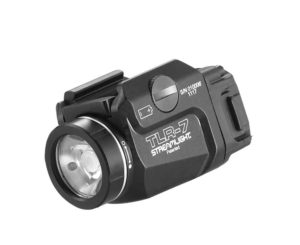
Streamlight TLR-8
Streamlight has added two new low-profile models to its TLR rail-mounted tactical light line for 2018; one of these is the TLR-8, which combines a 500-lumen LED light with a red laser sight. The TLR-8 runs off a 3 volt CR2 lithium battery and has a runtime of 1.5 hours in light only, light and laser, and strobe modes, whereas runtime in laser-only mode is 18 hours. The new TLR-8 is compatible with a wide range of compact and full-size weapons and utilizes a one-hand snap on/tighten interface as well as a safe-off feature, which locks the device so it cannot be activated accidentally. $350
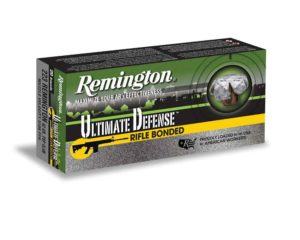
Remington Ultimate Defense Rifle Bonded
Remington’s Ultimate Defense line has been around for a while in the form of buckshot loads for shotgun users, but this year Big Green also added a rifle option to the line. This new load utilizes a Core-Lokt Ultra Bonded bullet that features a lead core metallurgically adhered to a progressively tapered jacket. This provides consistent expansion, penetration and weight retention for those who choose a rifle for defense. Currently, the only offering is a 62-grain .223 Remington load. $22.99
Stack-On AOTT Safe
The new Auto Open Table Top (AOTT) Safe from Stack-On is a quick-access, secure-storage device that features a gas-charged shock on the lid for ultra-fast firearms access. The AOTT has a stylish, geometric design, but the real beauty of it is the automatic door, which opens quickly after access is granted. Available in an electronic keypad or biometric fingerprint scanner version. $120-$140
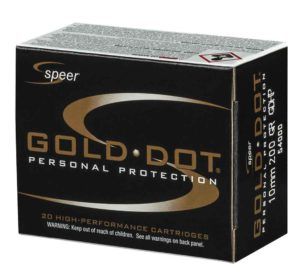
Speer Gold Dot Personal Protection 10mm Auto ammunition
For those who prefer to use a 10mm handgun, or carbine, for their defensive needs, Speer is now offering a load in its revered Gold Dot line that takes full advantage of that caliber’s potency. The 200-grain bullet is loaded for optimal 10mm performance, unlike some other 10mm loads, which are sometimes closer in comparison to .40 S&W. As in other Gold Dot loads, the bullet is built using Speer’s Uni-Cor method, wherein the jacket is bonded to the core one molecule at a time for the ultimate in defensive performance. $35/box of 20
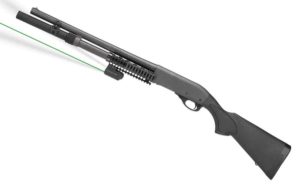
Crimson Trace Rail Master Pro CMR-300
For 2018, Crimson Trace has debuted a new rail-mounted combination light/laser sight designed for use on long guns. The device features a green laser sight and a 300-lumen white LED light, and it comes equipped with Crimson Trace’s classic Instant Activation. It has four modes of operation: laser and light, laser only, light only and laser plus light strobe. $249
Editor’s Note: This article originally appeared in the March 2018 issue of Gun Digest the Magazine.
Even with the recent ascent of 6.5 cartridges, the original 6.5×55 seems to be overlooked. But this old-timer is more than capable of going the distance.
What makes this old Swede so special:
The 6.5×55mm was developed in the Scandinavian countries in 1891 as a military service cartridge.
While popular in Europe, the cartridge did not catch on in the U.S., given the lack of rifles.
The attraction of the 6.5×55 is it’s mild recoil and superb down-range performance.
Ample bullet selection — 90 to 160 grain — gives the cartridge plenty of versatility and makes it a gem for reloaders.
A higher sectional density gives the 6.5 better penetration than other caliber bullets of a similar weight.
And near best-in-class ballistic coefficient means the bullets it pushes maintain their velocity and resist wind defection.
The 6.5 fever is real.
Thanks, lately, to the astounding success of Hornady’s superb 6.5 Creedmoor, hunters, competitive and tactical shooters are catching the 6.5 fever like school kids catch the flu. Unlike the flu, however, I doubt anyone is looking for a cure for the cronic 6.5 sickness.
The 6.5 fever, as it were, isn’t a new discovery. In fact, the 6.5 caliber has been around longer than anyone reading this story without a Ouija board. The global 6.5 success story is a tale told by many great 6.5 bullet-topped cartridges, such as the short-action .260 Remington, the over-caffeinated 26 Nosler and .264 Winchester Magnum, the bulldog short powerhouse 6.5 Remington Magnum, the AR-15-compliant 6.5 Grendel and the Swedish military service rifle sensation, the 6.5×55.
In fact, the 6.5 bullet has a long history of military service, seeing use in other military service rifles besides the 6.5×55, including — and I’m sure I will miss a few — the 6.5×54mm Mannlicher-Schönauer, 6.5×58mmR Krag–Jørgensen, 6.5×58mm Portuguese, 6.5×53mmR Dutch Mannlicher, 6.5×50mm Arisaka, and the 6.5×52mm Carcano, which well-educated historians of the John F. Kennedy assassination know all too well, as the Warren Commission stated it was a 162-grain round-nosed bullet from a 6.5x52mm Carcano fired from a surplus Carcano Model 1891/38 short rifle which took Kennedy’s life.
Of all of today’s more popular 6.5 cartridges, though, the original 6.5×55 seems to be the least talked about, and for the life of me, I just don’t understand why. I’ve owned four, and outside of a dangerous game hunt in Africa or Alaska, the 6.5×55 is probably all the rifle I ever needed to hunt anything and everything I ever wanted. Every rifle I owned — which included two CZs, a Steyr and an honest-to-God Swedish M96 Mauser — carried, shot and handled well. My current in-house 6.5×55, a CZ 557, is one of the softest shooting and fastest handling big game rifles in my safe, which is why I bought the loaner gun after just one day of load development testing for this story.
CZ-USA’s Jason Morton said the 6.5×55 still sells surprisingly well in the U.S. market, but those familiar with the 6.5×55 aren’t surprised. After all, the 6.5 bullet, which has excellent aerodynamics and target penetration from the 55mm case, gets pushed to good velocities in low-recoiling accurate rifles, which, as many shooters will tell you, are the main ingredients in any ballistic recipe for success. This recipe is and was a good idea not just for shooting the enemy, which is why the Scandinavians developed it as a military service cartridge way back in 1891, but also for shooting paper targets, coyotes, deer, elk, black bears and even moose.
More To The Story
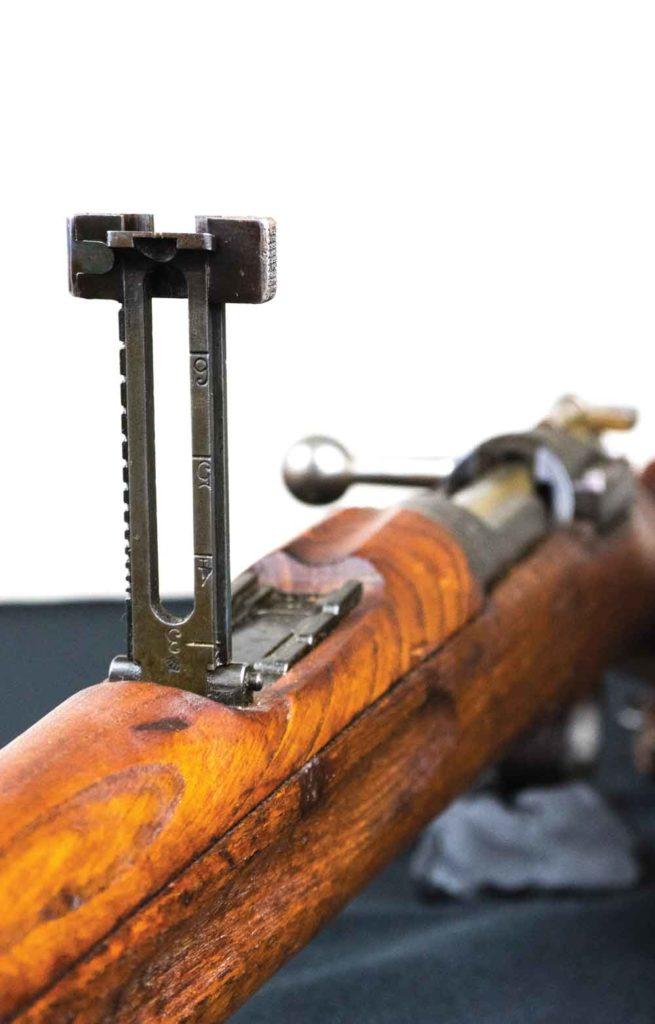
The m/1896, like other military rifles, used a simple but effective iron-sighted system. Here, you can see the rear leaf sight with a V-shaped notch. Soldiers weren’t handicapped without modern day optics with this sighting system, which, when folded down, graduated from 300 to 600 meters. When the sight is flipped up, it is graduated from 700 to 2,000 meters.
To help unravel why the 6.5×55 didn’t catch on as well in the U.S. as other 6.5 cartridges, I reached out to some experts in the ammunition community. My first stop was with the good folks at RUAG, a European-based company, which includes the well-known ammunition manufacturer Norma. Norma certainly doesn’t neglect the 6.5×55 — it offers seven factory-loaded choices for it.
According to RUAG, it all comes down to rifle availability, timing and overall ammunition support. “It’s my understanding that surplus military rifles did not reach the U.S. market until the 1950s, and the availability of ammunition was limited until the 1990s,” said Amund Skoglund, Commercial Director North America, RUAG Ammotec USA, Inc. “Whereas in Scandinavia, both rifles and ammunition have been readily available since the early 1900s. Almost every hunting and/or shooting household in Scandinavia owns a 6.5 due to its versatile applications.”
Skoglund’s take makes a lot of sense. Here in the U.S., after WWII, lots of shooters turned surplus Mausers into accurate and inexpensive target and hunting rifles. Think .30-06 Springfield, .270 Winchester, etc. The European built and fed 6.5×55 rifle and its ammunition just wasn’t available stateside. Which is too bad, because over in Europe, the 6.5×55 was proving to be as useful as, well, a Swiss-Army knife. It still is …
“There’s not much you can’t do with a Swede,” said Skoglund. “In Scandinavia, it qualifies (with 156-grain bullets) to be a class 1 weapon, meaning you can hunt all the large game including brown bear, moose, reindeer, red deer, wild boar, etc. We do recommend using a bonded bullet on large game since the shoulder joint on a moose can be hard to penetrate with a cup-and-core bullet. In terms of African game, it’s an excellent choice for antelope; personally I would not hesitate to use it on oryx- and wildebeest-sized animals, but with a bonded 150-grain-plus bullet.”
A Sweet Shooter
One of the biggest reasons for the popularity of the 6.5×55 — and really of all 6.5 cartridges — minus maybe the 26 Nosler, the .264 Winchester Magnum and the 6.5 Remington Magnum, is that you don’t need a lot of gunpowder muscle to make a 6.5 bullet work. With less bite to the shooter’s shoulder, low-recoiling rifles go a long way toward enabling shooters to provide accurate and sustainable rounds downrange — whether the target is a 1,000-yard gong, a trophy-class white-tailed deer or someone who intends to do you harm. Skoglund gets right to the point of the 6.5×55 cartridge’s main advantage to hunters these days by stating the 6.5 x55’s ability to enable hunters to shoot with manageable recoil plays a key role in shooter success.
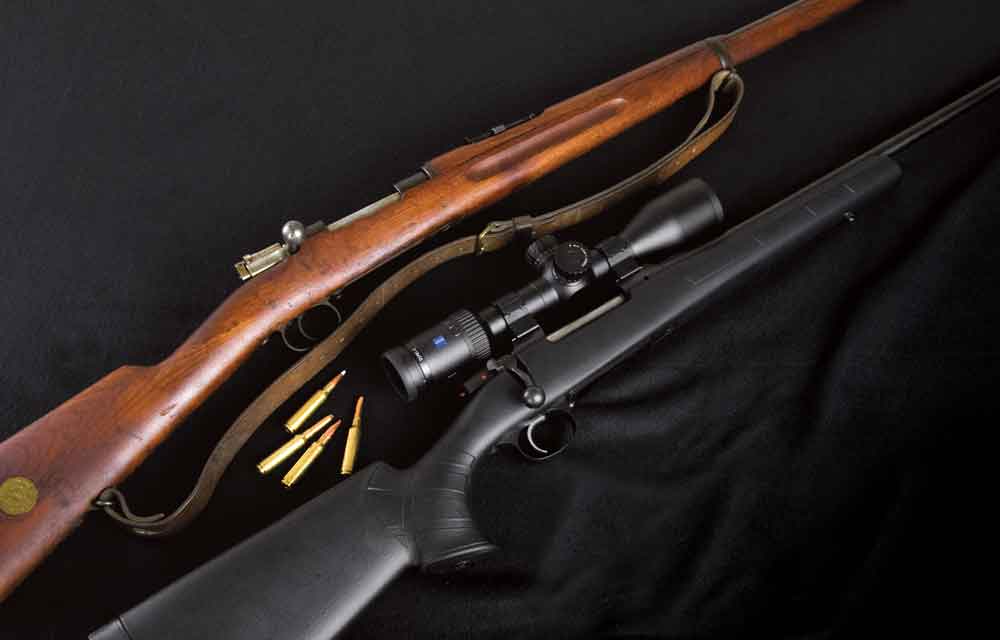
Carl Gustafs stads Gevärsfaktori in Eskilstuna, Sweden began manufacturing the Swedish Mauser, m/1896, in 1898. Gustafs made 475,000 m/1896’s between 1896 and 1932. This particular rifle was created in 1916.
“A lot of hunters won’t admit to it, but I am convinced that the success of this cartridge is due to its design (moderate velocities and great range of bullet weights),” said Skoglund. “Nobody likes to get punished by heavy recoil, and normally shoots better when not in pain (or waiting for a painful hit). Also, the availability of cheap surplus rifles that enables both target practice and hunting in one rifle helps the Nordic success of this caliber.”
All About The Bullet
Aside from low recoil, the next best part of the 6.5×55 is the bullet. In fact, some might say the 6.5 mystic is all about the bullet, and there are a lot of them. MidwayUSA lists 99 different 6.5mm choices of reloading bullets available, with weights ranging from a snappy 90-grain bullet all the way up to a 160-grain round-nose.
“The number of 6.5mm bullets make it great for reloaders, and the newer CIP (Permanent International Commission for the Proof of Small Arms) spec with the higher pressures for modern rifles helps expand the opportunity as well,” said Robin Sharpless, vice president of Redding Reloading Equipment. Sharpless added that the new name of the 6.5×55 is now the 6.5 SCAN, “as Sweden, Norway, etc., settled on a single standard.”
Of these bullets, the ones in the 140- to 150-grain range with exceptionally high ballistic coefficients (BC) are the ones that enable the 6.5 caliber, whether it’s a 6.5×55 SCAN, 6.5 Creedmoor or the 26 Nosler, to outperform most other non-6.5-caliber cartridges, especially regarding penetration. Ballistically speaking, what makes the 6.5 bullet family have the magical penetration reputation it does versus other calibers? To find out, I asked Hornady’s own Neal Emery.
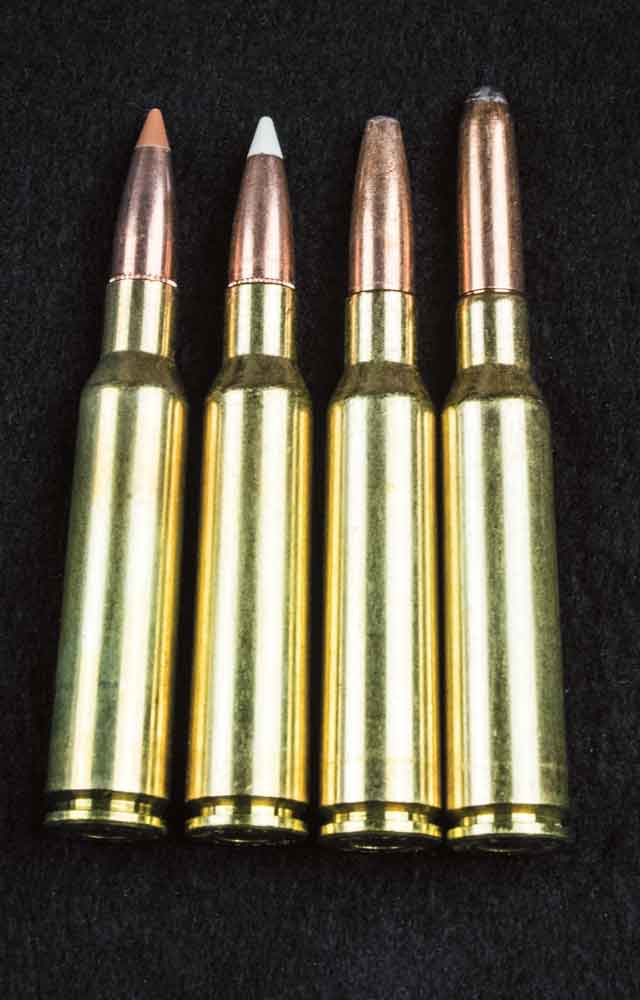
Here is a small sample of some of the factory-loaded ammunition available today to 6.5x55mm shooters. From left to right: a Norma-loaded 120-grain Nosler Ballistic Tip, a Nosler-loaded 140-grain Accubond, a Norma-loaded 156-grain Oryx and a Norma-loaded 156-grain round-nosed Alaskan.
“It’s definitely a 6.5 thing — all sectional density,” he said. “A controlled expansion bullet in .30 caliber weighing 140 grains would be rather short for its weight. A 140-grain controlled expansion bullet of the same construction in 6.5mm is going to be longer; therefore, it has a higher sectional density and will penetrate further.”
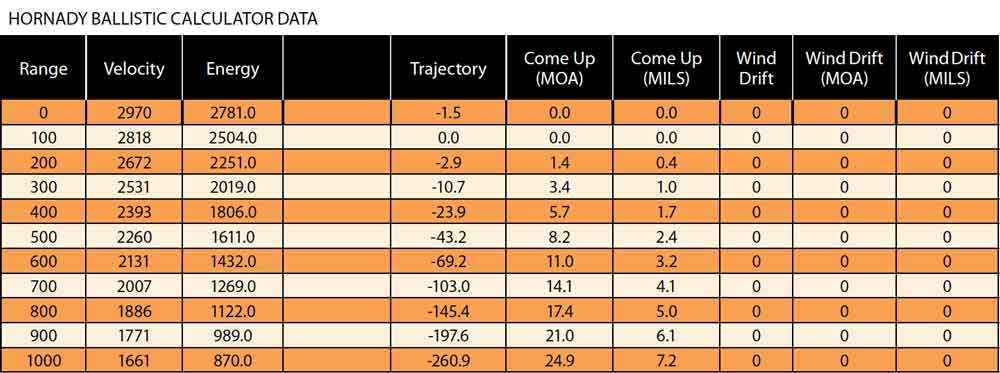
Handloaders can really make the 6.5×55 SCAN scoot. Public reloading data from Nosler, for example, gives handloaders quite a few choices. Published load data for the company’s magnificent 142-grain Accubond Long Range bullet, which, by the way, sports an impressive .625 BC, lists Alliant’s Reloder 22 as the most accurate powder in the manufacturer’s 23-inch test gun, but it states that Hodgdon’s H1000 got testers the most speed at an impressive 2,790 fps.
Hornady’s ballistic calculator (see accompanying chart above) offers the load data results to give us a general idea of what kind of flight trajectory you can expect based on the bullet’s BC and published muzzle velocity.
This is just one example of what modern powders, bullets and rifles are capable of with the 1891-era cartridge. Mathematically speaking, the gray-haired 6.5×55 SCAN is more than capable for today’s hunters. The scientific fact of 6.5 bullets flying farther and faster per powder per capita than most other bullets due to its inherently high BC figures is becoming more well-known to shooters who are devouring the 6.5 bullet market.
Based on MidwayUSA’s website data as of January 2018, the most popular 6.5 load is Hornady’s new 147-grain ELD Match bullet, which boasts a slick .610 ballistic coefficient. Compare this to Hornady’s 160-grain round-nosed 6.5 offering, which has a very pedestrian BC of just .283.
What exactly is ballistic coefficiency and why is it so useful? According to noted ballistics expert, Bryan Litz, of Berger Bullets, BC is explained like this: “Without getting into the math, I’ll define the ballistic coefficient in words as: The ability of the bullet to maintain velocity, in comparison to a ‘standard projectile.’ A high-BC bullet can maintain velocity better than a low-BC bullet under the same conditions. All measures of ballistic performance including drop and wind deflection are related to the bullet’s ability to maintain velocity. In short, the higher the BC, the better the all-around ballistic performance of the bullet will be.”
Brand New Rifle Options
Finally, in 2018, shooting a 6.5×55 SCAN in a brand-new rifle, like the CZ 557, gives me quite a few manufacturing advantages over the 6.5×55-loving crowd back when the 6.5×55 pulled its first tour of Scandinavian duty. CZ certainly isn’t the only manufacturer chambering for the 6.5×55 today.
Blaser, CZ, Sauer & Sohn, Steyr, SAKO/Tikka, Howa and even Barrett currently offer rifles chambered in it, and I’m sure there are others. If you need factory loaded ammunition, there’s no shortage of help either with manufacturers such as Federal, Swift, HSM, Winchester, Nosler, Sellier and Bellot, Lapua, Prvi Partizan, RUAG Ammotec, Remington Arms and Hornady all offering loads.
While I doubt the dedication to craftsmanship is better now than it was with the superb gun makers who built my 1916 M96, today’s firearms manufacturers simply have better tools and materials, and hundreds of years of experience to create better rifles. CZ’s 557 is a fine example of this evolution in firearms manufacturing. Instead of pushing a 6.5 bullet down the 29-inch barrel of my Carl Gustaf-built 1916-era M96, which is a cock-on-close, clip-fed, wood-stocked military service rifle, I’m pushing different flavors of 6.5×55 SCAN ammunition down a 20.5-inch barrel, in a CZ 557, which is a cock-on-open, blind magazine fed, synthetic-stocked hunting rifle.
Despite my 6.5mm first love, the 6.5×55 SCAN, Emery helped me understand why the 6.5 Creedmoor zipped right by the 6.5×55 and even the .260 Remington in sales as well.
Wouldn’t it be great if all rifles came with a Carfax report? This disc on the back of the m/1896 is basically just that, giving rifle users a rifle condition inspection report from the Swedish armorer at the time. There are three kinds: one-screw discs, an early two-screw, and two-screw discs. This rifle is a one-screw disc m/1896. The disc gives three different kinds of information about the rifle: condition of the bore, elevation aiming error with standard Swedish m/41 service loads, and barrel wear. Thus, from this disc, we can determine I had — at the time of the rifle’s inspection — a rifle bore grade of “1”, that my rifle shot point of aim, and that its measured bore and groove was precisely 6.51mm. So, mechanically speaking, this is a terrific rifle.
“The Creedmoor has quite a few things going for it. It’s a true short-action cartridge that allows long, heavy bullets to be seated out. The .260 Rem. requires the same long, heavy bullet to be seated farther into the case or the use of a long action. The 6.5×55 is even longer. The Creedmoor also benefits from close adherence to both the chamber design spec and the ammunition spec — everyone essentially makes it the same.”
While many American shooters might forget about or simply ignore the 6.5×55 SCAN as a superb hunting cartridge, I can assure you this 6.5-caliber cartridge will be the last thing any wild game you choose to shoot remembers. Regardless, the ongoing debate over not just which 6.5 cartridge is best, but even what hunting cartridge is best can be settled once and for all by modifying a quote about dogs by W.R. Purche: Everyone thinks they have the best rifle cartridge, and none of them is wrong.
Editor’s Note: This article originally appeared in the April 2018 issue of Gun Digest the Magazine.
Swing and follow-through aren’t the only aspects that get you shotgun on target. Master fundamental footwork and you’ll bag more birds.
Nothing is more exhilarating than the sound of a pheasant’s wings beating the cold autumn air. And nothing more frustrating than hearing them continue to pound away into the distance after you take your shot. Missed birds downright stink.
Swing or follow-through generally take the brunt of the blame for unscathed fowl, but there could be a less obvious culprit involved. Shotgunning, shooting in general, is such an upper-body dominated discipline stance often plays a distant second fiddle in considerations. But how you plant your hooves just might be what’s costing you birds.
From Dave Miller’s experience, hunters have a tendency of getting off on the wrong foot when they flush a bird. They rush, barely moving their feet, particularly with birds on the periphery. In turn, they bunch up on the initial shouldering of their gun and limit their range of motion on a follow-up shot. That’s all the makings of a miserable day in the field.
Luckily, the Guinness World Record holder for most clays broken in an hour (3,653), shows how to get in the right stance, while not blowing the shot in the above video. Honestly, there’s not a lot of hocus-pocus to it either. It’s mainly an exercise of remaining conscious about getting in a position for success, then executing it in a smooth and natural fashion.
Anyone can do it. The challenge is moving your feet this way every time without fail, even when thumping of a rooster taking flight has you shifting into overdrive.
For more information on Aguila Ammunition, please check out: www.aguilaammo.com
While it’s never really caught on stateside, the 8mm Mauser has a great pedigree and is more than capable on the battlefield or on the hunt.
Why the eight is great:
It was the official German military rifle cartridge through both World Wars.
The cartridge was official adopted in 1888 with a diameter of .318 inch, which was increased to .323 in 1905.
In the same class as the .30-06, the 8mm is adequate for any North American big game.
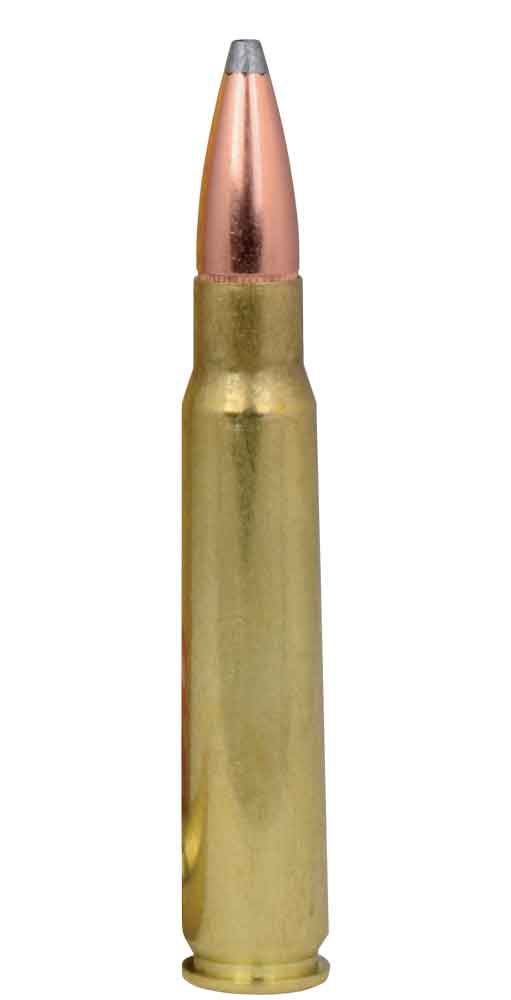
The 8mm — or 7.92 — Mauser was the German military rifle cartridge through both World Wars. It was officially adopted in 1888 with a bullet diameter of .318 inch. In 1905, the bullet diameter was increased to .323 inch. In Europe, the 8mm Mauser and several other 8mm cartridges are available in both sizes. The larger size is always designated as “S” or “JS” bore. In the United States, ammunition companies load only the .323-inch diameter or “S” bullet.
The 8mm Mauser is widely chambered in European sporting rifles, but American gunmakers have not adopted it to the same extent. The “J” or “I” in the name denotes infantry ammunition. The German capital “I” was mistaken for a capital “J” by U.S. military interpreters after World War I, and the “J” misnomer came into common use here and even in Europe thereafter!
The 8mm Mauser had not been very popular in the U.S. prior to World War II. However, the large number of obsolete, surplus 8mm military rifles sold here since the end of the war has increased its use substantially.
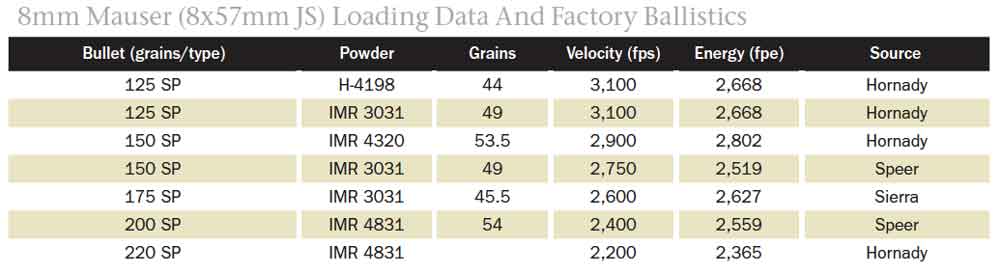
As loaded by Norma and by other European companies, such as RWS, it’s in the same class as our .30-06. It’s adequate for any North American big game if the proper bullets and full loadings are used. A large variety of good .323-inch bullets are now available for the individual handloader, and this has dramatically increased the usefulness of the 8mm Mauser for the American shooter.
Editor’s Note: This article originally appeared in the April 2018 issue of Gun Digest the Magazine.
A simple stencil in the shape of a sight picture could get you shooting the stuffing out of center mass on your next trip to the range.
Pick-up any book dealing with concealed carry or self-defense shooting and there’s a good chance they’ll contradict each other on 101 different points. From caliber to gear to the best apparel, they’ll chip at each other like old men debating the designated hitter. But get to the part about bullet placement and they’ll sing in better harmony than a church choir.
There’s a reason for near discipline-wide accord, quite simply it is the most important aspect of an actual defensive shooting itself. If a bullet doesn’t hit center-mass vitals, there is a fair chance you’ve lost the game. And there are no participation trophies in a lethal-force encounter.
Hence the reason why, as armed citizens, we spend countless hour’s honing our shooting skills, fretting over minutia, until placing rounds high-center mass is as natural as breathing. But for those new to handguns, getting peace-of-mind cloverleaf groups to sprout where they’ll save lives can be a painful process. For the gun world’s newly anointed, sights are bedeviling and play nasty tricks between alignment and trigger pull.
Defensive shooting instructor Michelle Cerino has a simple remedy for this off-the-mark shooting — sight-picture stencils. When you think about it, blacking out the exact area where a shooter needs to aim is almost forehead-slapping obvious. How else are they going to learn their shooting geography without road markers to point the way?
With this method there is little confusion where to aim, after all, it’s right in front of the shooter, literally in black and white. Additionally, it has potential for a more seasoned shooter as a diagnostic tool. With everything perfectly in line, but rounds not hitting, it might be perfect for ferreting out flinch or an off trigger pull.
For more information on Aguila Ammunition, please check out: www.aguilaammo.com
Watch a master at work! Turnbull’s Tom McArdle freehand engraves an antique Winchester. How steady are your nerves?
You won’t find Douglas Turnbull’s work hanging in the Louvre, but to shooters his art is as precious as any Picasso, Monet or Michelangelo. The firearms restoration specialist and manufacturer works magic on guns, turning both the priceless and pedestrian into peerless one-of-a-kind masterpieces.
This week, Modern Shooter goes behind the scenes where the magic happens with a visit to Turnbull Restoration and Manufacturing in upstate New York. There, Turnbull’s master craftsmen tirelessly ply their art — not to mention a dab of blood and sweat — to make ordinary extraordinary. And there skill is a wonder to watch.
The steadiness of Tom McArdle’s nerve is only matched by the nimbleness of his hands in the above clip. Amazingly, the master engraver works without a net, free handing from memory a classic scrollwork pattern on an antique Winchester. This work is so intricate and detailed it would be impossible to pull off without the aid of a microscope. But McArdle practiced fingers never slip working in the most unforgiving mediums — cold, hard gunmetal.
As deft at his craft as McArdle might be, he freely admits he his simply on cog in greater Turnbull’s machine. Art is a team effort — from the gunsmiths who get a firearm ticking like a clock to the finishers who apply the company’s trademark color-case hardening, everyone chips in. And there’s no arguing the results — guns elegant enough to hang in a museum, but tough enough to bag next year’s deer.
Catch the rest of Turnbull’s incredible creations in this episode of Modern Shooter 10:00 p.m. EST Friday on the Pursuit Channel. The episode rebroadcasts Monday at 12 p.m. EST and Tuesday at 11:30 a.m. EST.
Sporting clays shooters go to all ends to break more blue rock, but could greater consistency be as simple as loading your shotgun early at a station?
Ever watched a basketball player who can shoot the lights out of a gym and maybe the street lamp on the corner? You can bet a pair of Nikes before he puts a bend in his knees and cocks his arms, his eyes are glued to one spot — the hoop. You might say he acquires his target before pulling the trigger.
That’s sound advice that transfers nicely to the sporting clays arena. Obviously, it’s impossible to know the exact courses the pigeons will come flying at a particular station, but you’ll know their general direction. A few moments study to map the geography, build a game plan and dial in your concentration, in Dave Miller’s opinion, is enough to get you dusting more orange more often. The Team Aguila Ammunition shooter should know, holding the Guinness World Record for clays broken in an hour — 3,653.
Unfortunately, in Miller’s experience many sporting clays shooters get into some pretty nasty habits when it comes to getting their mind right. Either they rush, starting a station without pause or they take the time to study, but then fiddle around with their gun or shells before they shoot. That’s looking at the ball, not the hoop.
Miller’s cure is as simple as it is elusive — a routine. Loading your shotgun early, analyzing the station, and then focusing on the impending shots is a formula vaporizing more blue rock. And like free throw shooting, it takes discipline to execute each and every time you step to the line. But the results, and the looks on your buddies’ faces, are more than worth the effort.
The newly redesigned TPR line offers an improved trigger, better ergonomics and more features.
How Bersa has evolved this line of DA/SA pistols:
The company has smoothed and lightened the double-action pull, ensuring it doesn’t stack.
It has shorted the TPR’s reset so follow-up shots are lightning fast.
The pistols are available in 9mm, .40 S&W and .45 ACP.
The MSRP on the TPR line starts at $508.
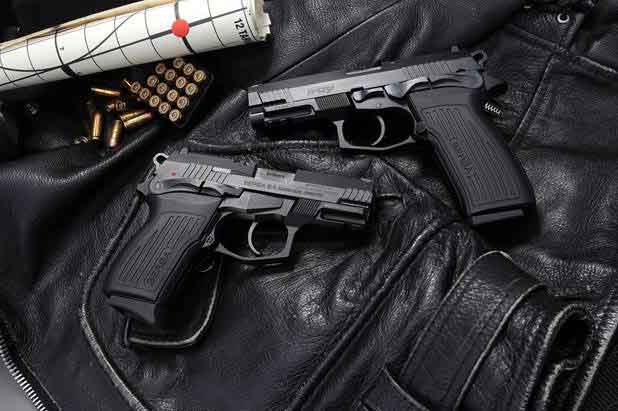
Typically, if there is ink spilled over Bersa it’s about one in particular model — the Thunder. The compact and generally affordable pistol has won its share of advocates over the years as a solid and unobtrusive concealed carry option. But there’s more to the Argentinian gunmaker than its diminutive .380s.
While perhaps not as well known as its little brother, the Bersa Thunder Pro line nonetheless has squared itself away as a performer in the DA/SA marketplace. And in 2018, Bersa has given shooters more reasons to give the full-sized and compact configurations a look with the next generation of the line — the TPR series.
“We’re excited to bring this next generation of Bersa TPRs to American consumers,” said Michael Sodini, president of Eagle Imports. “Once available only to military and law enforcement personnel, it’s always offered rugged durability and impressive accuracy. This new evolution makes the TPR officially one of my favorites for self-defense and sport.”
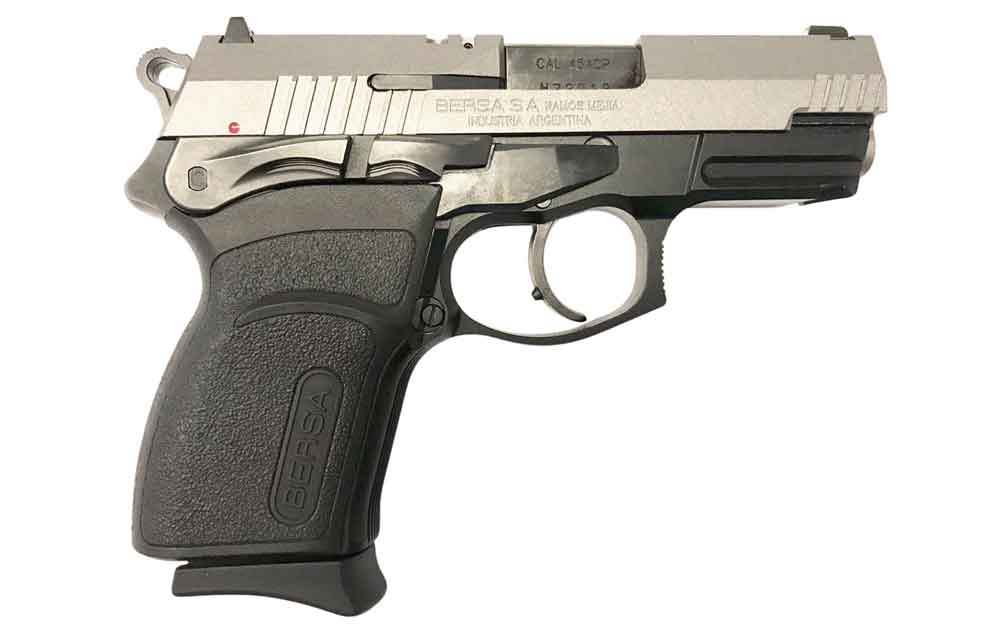
Where Bersa has concentrated its redesign efforts with the TPR series, primarily, is on one of the main sticky points of DA/SA pistols — the trigger. The company has smoothed out the double-action pull, ensuring it doesn’t stack, and lightened so it consistently breaks. Furthermore, the reset is minuscule, giving it a lightning-fast transition from initial to follow-up shot.
Bersa has trimmed the grip of the TPR as well, giving shooters more reach to the trigger and more ability to get a solid purchase on the pistol. Moreover, the company has improved the overall ergonomics with small tweaks, such an amply undercut trigger guard and improved grip texturing. A bonus, Bersa has also made TPR pistols more lefty friendly, with ambidextrous decocker and slide release. Though, the magazine release still remains exclusively right-hand oriented.
Additionally, the aluminum frame and slide have seen enhancements, with serration added to the fore of the slide and grip texturing at the front of the frame for thumb support and a memory position for indexing.
The full-sized TPR model comes chambered in 9 mm and has a 4.25 barrel, while the 3.25-inch barreled compact configuration is available in 9mm, .40 S&W and .45 ACP. Other notable features include integrated Picatinny accessory rail, compatibility with SIG Sauer aftermarket sights and loaded-chamber indicator.
In line with most of the rest of the market, the handguns’ MSRP starts at $508 and are presently available at Bersa dealers.
Franklin Armory’s F17-L is a rimfire AR that offers performance above its weight class.
How this hot little number sizes up:
Released in 2014, the F17-L followed on Winchester’s introduction of the .17 WSM.
For a time, the F17-L was the only gas-operated semi-automatic .17 WSM in an AR-type platform.
It utilizes a custom-designed bolt-carrier group, and adapted buffer and proprietary magazine.
It is gas-piston operated, since a simple blowback system isn’t equipped to handle the .17 WSM’s pressure.
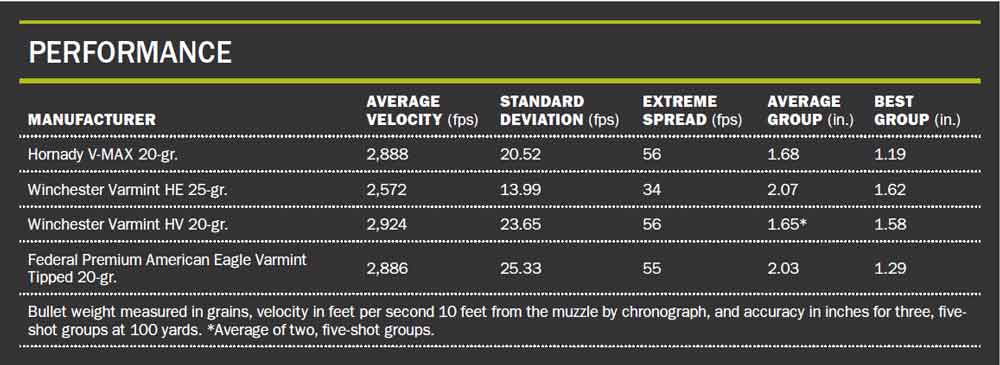
In testing at 100 yards, the best groups (1.65″ average) came with 20-grain Hornady V-Max.
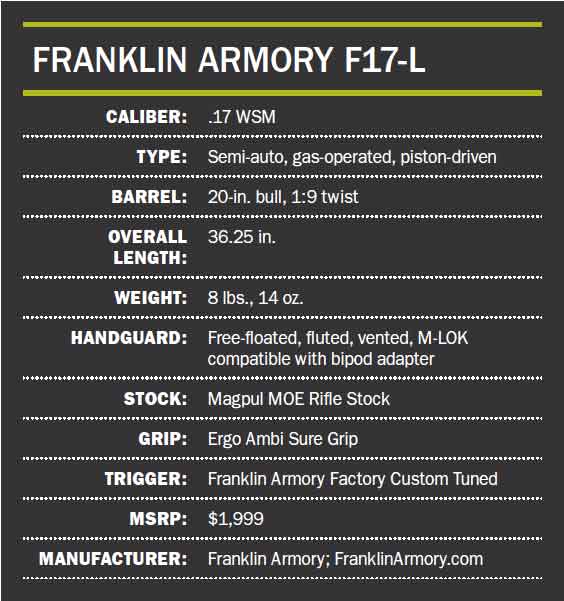
The MSRP of the F17-L is $1,999.
For some time now, Franklin Armory has been producing quality AR-style rifles, SBRs, pistols and parts, with a special emphasis on crafting legal firearms for citizens of states with restrictive gun laws. These laws, enacted under the guise of improving safety, essentially strip away many of the modern sporting rifle’s most appealing features. While some debate whether gun makers should even build firearms to fit these laws, the California-based Franklin Armory has resolved to make lemonade with lemons.
Over the years, the company has become quite adept at working within the confines of restrictive laws while also skirting the edges on its designs. Although it also manufactures full feature firearms for free states, some of its most intriguing products are those that seek to liberate shooters stuck behind enemy lines. One of these is the F17-L rifle.
Bridging the Gap
First introduced at the 2014 SHOT Show, the F17-L followed on the heels of Winchester’s introduction the previous year of the .17 Winchester Super Magnum (WSM). Winchester developed this unique cartridge by taking what was then a .27-caliber nail gun blank and necking it down to accept a .17-caliber projectile. The results were impressive, with the .17 WSM spitting a 20-grain bullet at velocities around 3,000 feet per second (fps), roughly 625 fps faster than the popular .17 HMR and very near those of centerfire .223/5.56 NATO loads pushing a 62-grain projectile.
This innovative new design closed the distance between rimfire and centerfire cartridges—at least in terms of velocity inside 200 yards (the lighter bullets shed velocity quicker). And at the time, the F17-L was the first and only semi-auto chambered in .17 WSM. Volquartsen developed one, but the F17-L remained the only gas-operated semi-automatic .17 WSM in an AR-type platform.
What this meant was that shooters in non-free states could now buy a street legal rimfire AR with a lot more punch than those chambered in .22 LR. Because there were fewer restrictions on rimfire rifles, the F17-L escaped regulations like the much-maligned “Bullet Button,” a device that requires a tool in order to swap out an otherwise easily detachable magazine.
For these reasons, the F17-L remains an excellent option for those who can’t own a standard AR. However, it’s also a great gun for those in free states as well.
Making It Work
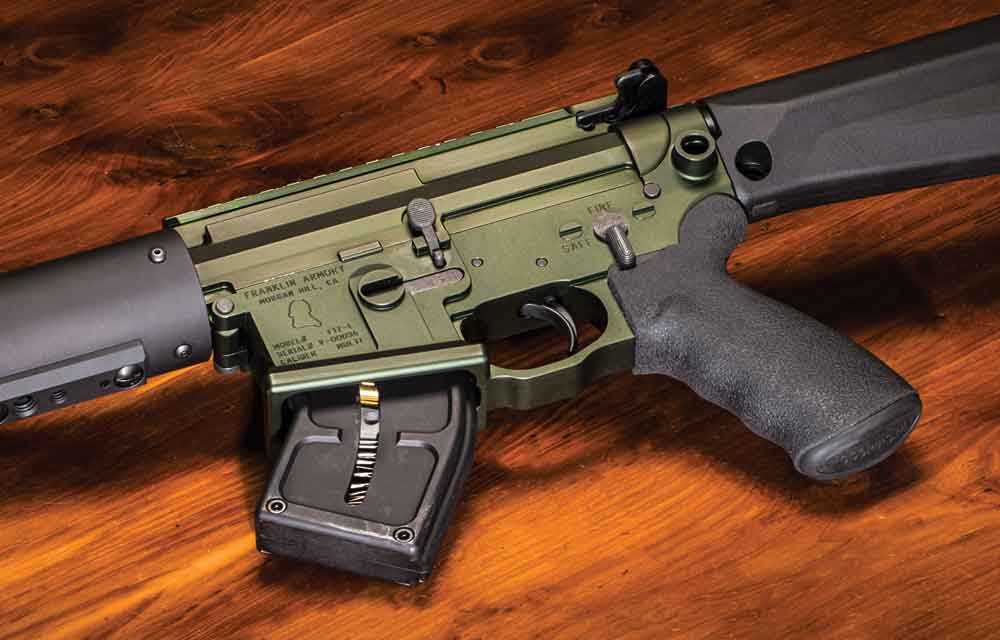
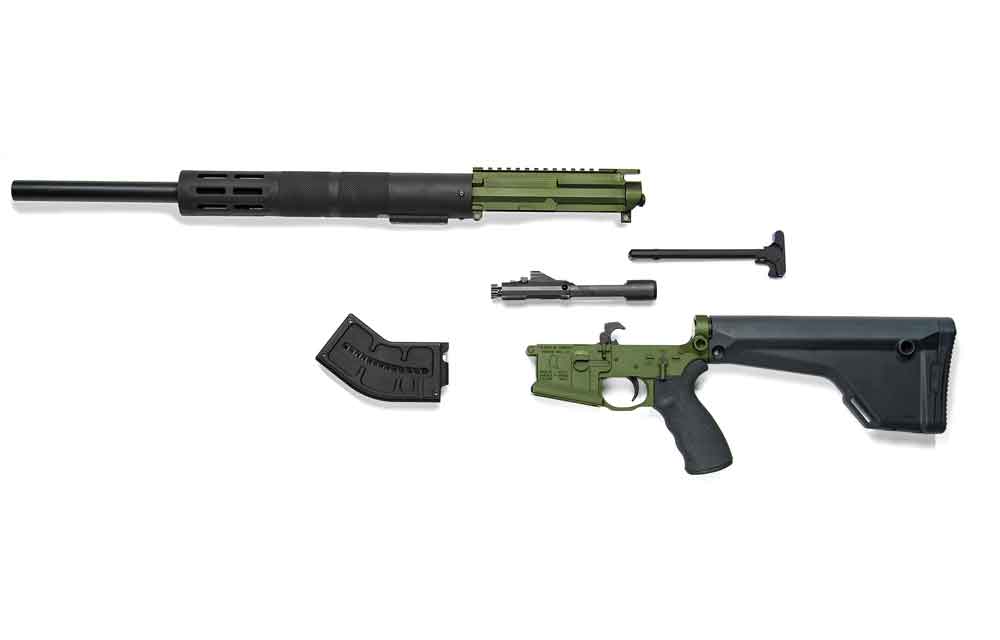
To accommodate the .17 WSM chambering, Franklin Armory had to make several changes from standard AR designs. For starters, the rifle utilizes a custom-designed .17 WSM bolt carrier group, a .17 WSM barrel, an adapted buffer and a proprietary magazine. Obviously, without these necessary alterations, the concept would be dead in the water.
However, another important design choice by Franklin Armory is its use of a gas-piston operating system. A simple blowback system isn’t equipped to handle the pressures of the .17 WSM (33,000 PSI) and, as most shooters are aware, rimfire ammo often runs incredibly dirty through a firearm, to the point of causing functional issues if the gun is not maintained regularly. With the cleaner gas-piston system, Franklin Armory is able to handle the higher pressures and keep the F17-L running smoother, longer.
The gas system found in the gun is of the pistol-length variety, which Franklin Armory determined works best with the .17 WSM. The system itself is the result of a partnership between Franklin Armory and Osprey Defense, which specializes in drop-in gas-piston conversion kits for ARs.
The aforementioned proprietary magazine, which features an aluminum design, holds 10 rounds and has a curved shape for compatibility with the rimmed .17 WSM. This curve, while not too dramatic, does slightly affect loading. The magazine’s interchange with the magwell isn’t butter-smooth, but neither does it require significant effort to slide it into place. The magazine is also somewhat difficult to load, especially after about the sixth round, but there’s a circular slot in the follower where you can use a cleaning rod, screwdriver or some other tool to compress the spring for easier loading.
The F17-L features 7075-T6 billet aluminum upper and lower receivers, which are also a proprietary design. They receive a stylish and durable hard coat anodized Olive Drab Green finish, instantly distinguishing this gun in the sea of black rifles. The upper receiver has a forward assist; however, its use with the rimfire chambering is problematic and the F17-L’s user manual details these risks in full. The lower is equipped with useful features such as a flared magwell for easy loading and an enlarged trigger guard for gloved shooting, something dedicated varmint hunters are sure to appreciate.
While the upper and lower of the rifle incorporate many of the controls and features AR users are accustomed to (charging handle, magazine release, safety selector, forward assist, bolt release), not all of these function the same way. The forward assist has been mentioned, but there are other changes, too.
For example, the carrier does not lock back on an empty magazine, nor is there a way to keep the bolt held open, which is slightly baffling when you first pick up the rifle and try to hold the action open in the usual fashion. This is partly because of the altered buffer mentioned earlier, which is about 1 inch longer than a standard buffer, and this is due to the decreased distance the bolt carrier has to travel for the shorter rimfire cartridge.
The rifle utilizes a 1:9 twist, 20-inch bull barrel that receives a salt bath nitride treatment and comes with a target crown. The barrel is set inside a free-floating aluminum handguard that is fluted and vented and offers M-Lok compatible slots as well as an integral bipod/tripod adaptor.
The F17-L stock is a Magpul MOE Rifle Stock, which is smooth to shoulder and sling mountable. Meanwhile, the grip is a comfortable and sturdy Ergo Ambi Sure Grip that, when paired with Franklin Armory’s Factory Custom Tuned Trigger, makes for an excellent package.
Range Performance
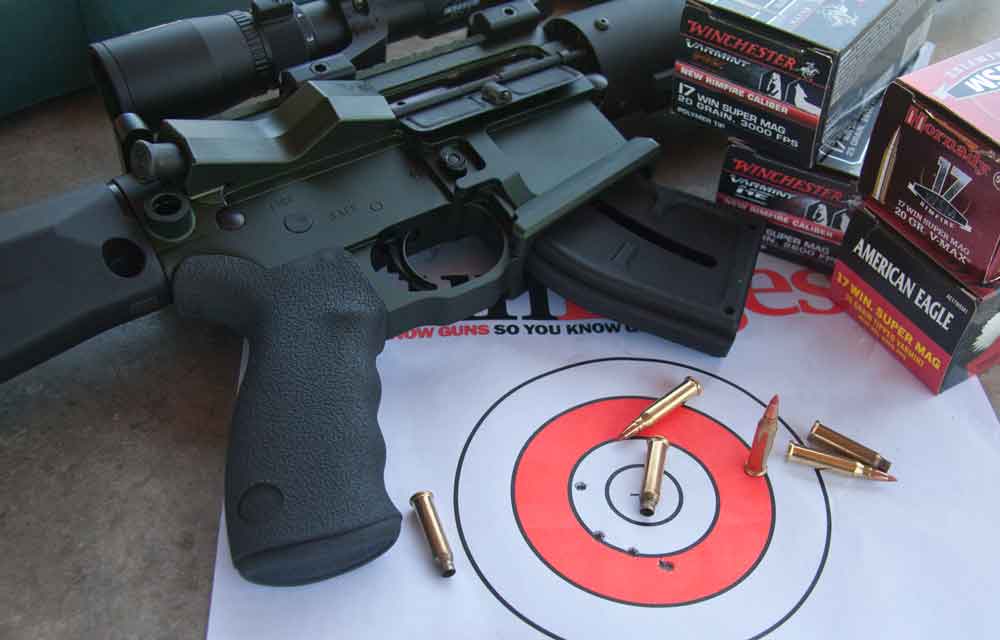
The F17-L is built to be a varmint slayer, and for testing, I equipped the rifle with a Nikon Prostaff Rimfire II 3-9×40 BDC 150 scope, which features Nikon’s BDC 150 reticle. While the reticle is set up for high-velocity .22 LR loads, using Nikon’s Spot On website and ballistics program, you can plug in the caliber and load you prefer, and it will tell you what each of the drop markers represent in terms of trajectory for a given zero.
I used four loads during testing: Winchester’s 25-grain Varmint HE and 20-grain Varmint HV, Hornady’s 20-grain V-MAX and American Eagle 20-grain tipped varmint loads. Velocities were measured through a ProChrono Chronograph from Brownells about 10 feet from the muzzle. Accuracy data for each load was acquired from three, five-shot groups taken at 100 yards using a Caldwell Matrix rest, also from Brownells.
During much of my time with it, the rifle ran without fault, but I did run into a few issues as testing progressed. I encountered some light primer strikes. Also notable, in several instances the rifle failed to extract spent cases; occasionally, cases would become stuck within the barrel, which would then naturally lead to misfeeds as the gun attempted to chamber another round.
Aside from these issues, however, I was very impressed with the F17-L. Groups were decent, despite the stout wind during testing. The 20-grain Hornady V-MAX posted the best group overall at a respectable 1.19 inches, while the Winchester 20-grain Varmint HV load rated the best average at 1.65 inches. The other loads had best groups hovering between 1.2 and 1.6 inches or so.
Parting Shots
Built partially to meet the needs of shooters in restrictive states, the F17-L excels in that capacity. It’s a unique design that remains a first for the firearms industry, taking the blistering little .17 WSM and working it into the semi-auto AR platform. Because of the looser restrictions on rimfires, residents of states like California can get an AR-type rifle with all the AR’s great features and with more bite than the .22 LR. Meanwhile, hunters in free states are also sure to love a semi-auto .17 WSM that can pot varmints at greater distances and with more authority than other rimfire calibers. All in all, the F17-L is an innovative design that stretches the boundaries of what is possible with rimfire ammunition and with the AR platform.
Editor’s Note: This article originally appeared in the July 2016 issue of Gun Digest the Magazine.
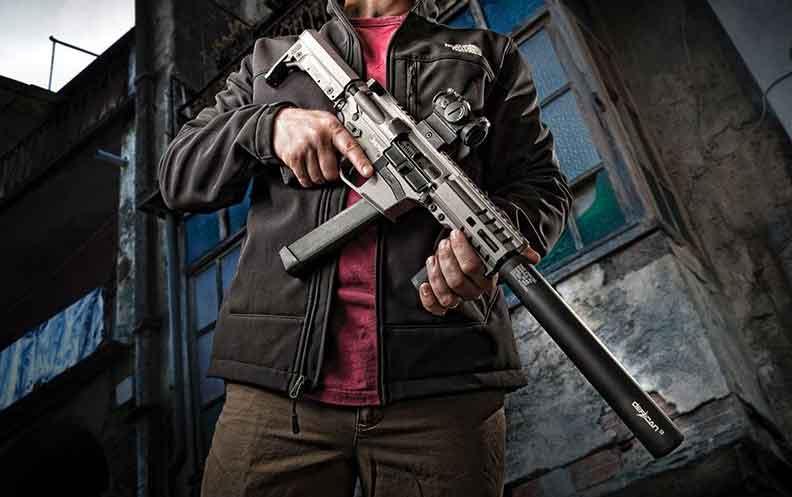
With five variants covering a wide-spectrum of calibers, CMMG’s DefCan Suppressor line is ready to hush up a lot of rifles.
What’s the noise on the DefCan line?
The release of its suppressor line coincides with CMMG’s introduction of its Banshee SBR line.
The company has models tailored for .30 caliber, 5.56 NATO, 9mm, .45 ACP and .22 LR.
Depending on model, DefCan reduce noise from 30 to 40 dB.
The suppressors have a price range from $325 to $900.
Perhaps no single accessory has stormed the market in the modern era like suppressors. Once shrouded in mystery and seemingly accessible by a select few, the noise-reduction devices have become nearly as common as the guns they’re attached. Pretty striking, given hoop jumping and extra cash the NFA-regulated doodads require on top of their base price.
The suppressor world continues to grow and by a large bound recently with CMMG jumping into the game. It seems a natural move for an AR-maker known for its extensive catalog of accessories and upgrades, in addition to unique pistols, carbines and rifles. And the introduction of the DefCan Suppressor line walks hand-in-hand with another recent product expansion — the Banshee line short-barreled rifles and AR pistols.
“DefCan is an exciting new step for CMMG. Combined with our new line of BANSHEE SBRs, DefCan suppressors will give us a strong presence in the NFA market. Additionally, the DefCan suppressor line complements our current firearm product line-up very well and will be an integral part of our plans going forward,” CMMG CEO Chris Reinkemeyer said in a press release.
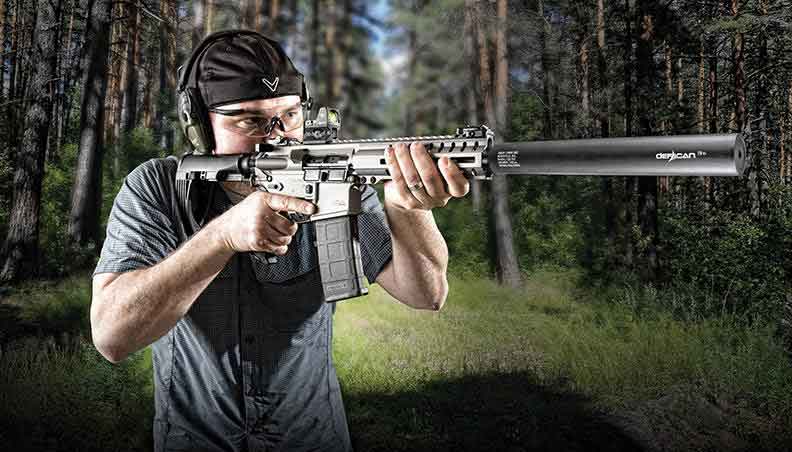
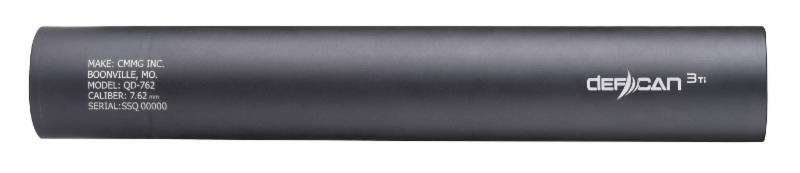
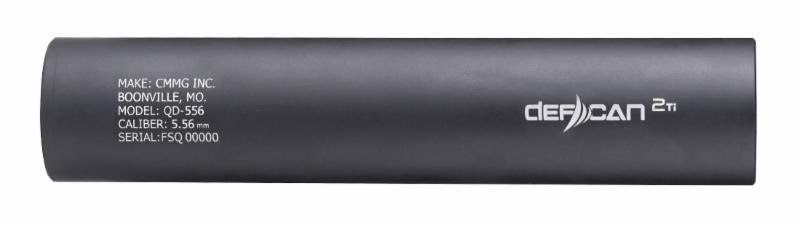
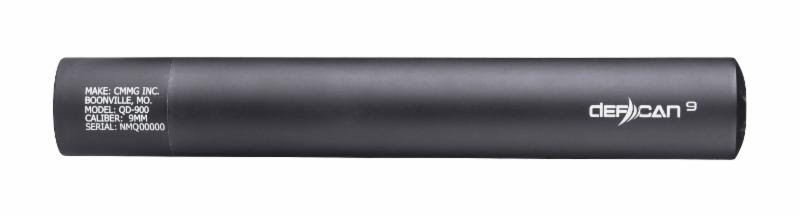
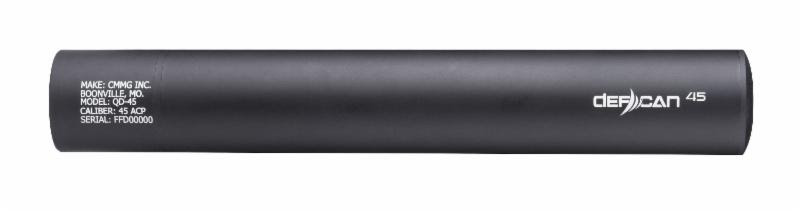
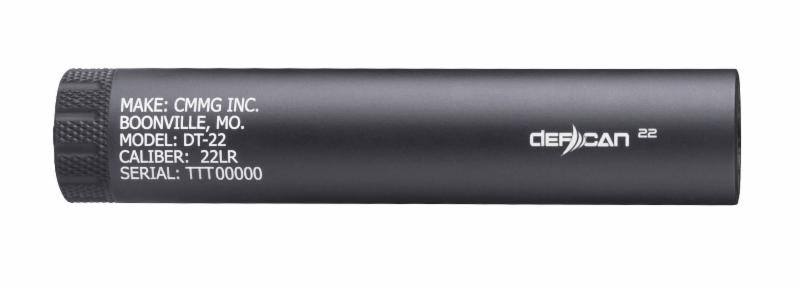
CMMG enters the fray with five variants in its suppressor line that cover a wide-spectrum of calibers: .30-caliber DefCan 3Ti, 5.56 NATO DefCan 2Ti, 9mm DefCan 9, .45 ACP DefCan 45 and .22 LR DefCan 22. All the suppressors, except the DefCan 22, are completely sealed and require no cleaning and are full-auto rated. As far as noise suppression, the rifle- and pistol-caliber models offer 32 dB of reduction, the .45 30 dB and the .22 40 dB.
CMMG also offers some wiggle room in how the DefCan line attaches to a rifle. The 3Ti and 2Ti come in a traditional direct thread variant and a quick attach bi-lock QD model. These cans are the only ones with this option, as the 9mm and .45 models are both exclusively bi-lock QD and the .22 is a direct thread. Finally, the 3Ti and 2 Ti suppressors are each finished with a high-temperature Cerakote, while the rest of the line is hard-coat anodized.
Price is always a sticky point in the gun world, but CMMG doesn’t appear to have lost its mind with the DefCan line. The QD 3Ti is at the top of the price range at $900 and the .22 LR at the bottom at $325.
For more information on the CMMG’s DefCan line of suppressors please check out: www.cmmginc.com
DefCan 3Ti (Bi-Lock QD) Caliber: 7.62mm NATO Sound Reduction: 32 dB Length: 9.2 inches Diameter: 1.5 inches Weight: 17.5 ounces Finish: High Temperature Cerakote MSRP: $899.95
DefCan 3Ti (Direct Thread) Caliber: 7.62mm NATO Sound Reduction: 32 dB Length: 7.8 inches Diameter: 1.5 inches Weight: 13.1 ounces Finish: High Temperature Cerakote Thread: 5/8-24 MSRP: $824.95
DefCan 2Ti (Bi-Lock QD) Caliber: 5.56mm NATO Sound Reduction: 32 dB Length: 7 inches Diameter: 1.5 inches Weight: 13.1 ounces Finish: High Temperature Cerakote MSRP: $824.95
DefCan 2Ti (Direct Thread) Caliber: 5.56mm NATO Sound Reduction: 32 dB Length: 6.18 inches Diameter: 1.5 inches Weight: 13.1 ounces Finish: High Temperature Cerakote Thread: 5/8-28 MSRP: $749.95
If you reload, your ultimate pursuit might be absolute control over your handloads … just don’t fall too far down the rabbit hole.
Why go to the trouble of reloading ammunition?
A common thread among serious reloader is the ability to control the parameter of ammunition.
Some people ask why? give the excellent bullet choices and the tight tolerances of today’s factory ammunition.
Reloading, however, allows us to tailor each round to its job.
Additionally, it leads to a better understanding of ammo and the experimentation can make you a better rifleman.
“The control — and possible obsession — over our ammunition gives us another small facet of the shooting equation, and it makes things fun.”
If there’s one common thread among serious reloaders, it’s the ability, or more accurately — the need — to control the parameters of our ammunition. Many people ask me why I reload my ammunition, whether for target use or for the largest game animals on earth, when modern factory ammunition is so good. And, while they might have a good point, my response is simple: I prefer the control I have in every aspect of the ammunition. We reloaders are control freaks. There’s no denying it.
Handloading gives the shooter complete control over his or her ammunition.
Factory ammunition is better than it has ever been, and I even own a couple of rifles that will shoot factory ammunition better than any of my handloads. We have excellent bullet choices, and the tolerances have become very tight.
However, in the same manner that I carefully choose a rifle/cartridge/scope combination, I like to tailor the ammunition to the job at hand. Yes, there are times where a factory load might get the job done in an equally effective manner, and there are times where I do opt to use factory ammunition, but I much prefer to handload whenever possible.
Indulging In The Obsession
Reloading ammunition has undoubtedly led to a better understanding of how ammunition works, and the resulting experimentation has made me a better rifleman. It has also led to an unquenchable thirst for knowledge in the field of terminal ballistics. I’m a bullet hound, and I will eagerly root through the entrails of an animal in pursuit of my bullet. However, sometimes all of this control can pull you down the rabbit hole.
That’s not necessarily a bad thing, though I do see some handloaders become argumentative regarding this technique or that, and that’s more than likely just our human traits rearing their ugly heads. Let us not lose sight of the prize — especially in the hunting world — and that is to effectively kill an animal with the first shot, and put the second and third in the same spot if needed.
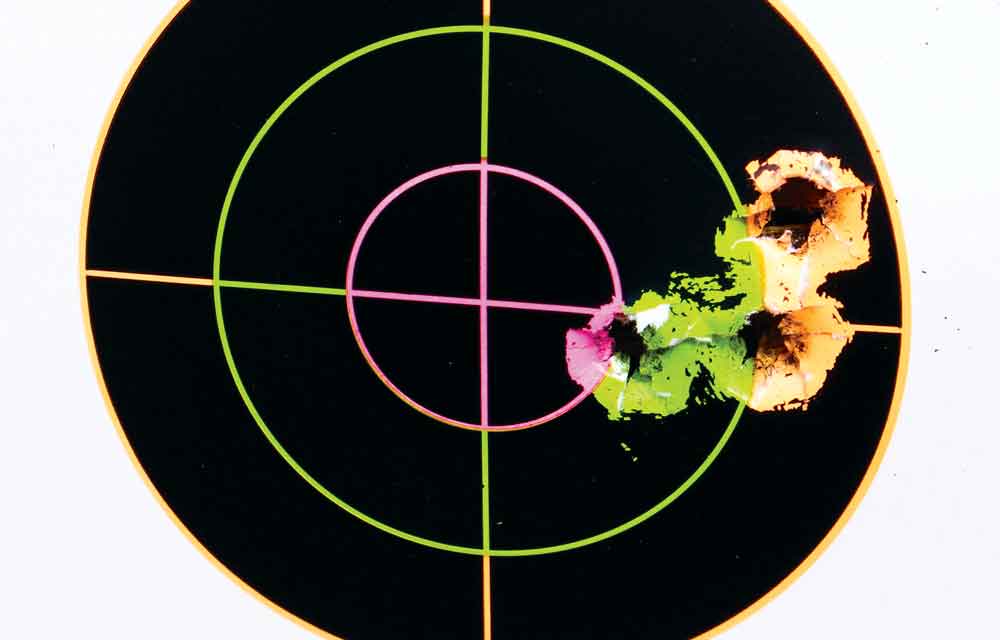
While this 100-yard target doesn’t exactly represent hair-splitting accuracy, it will certainly suffice for big game hunting.
How you get there is up to you, and that’s one of the individual beauties of creating ammunition. A rifle/shooter combination that will put three shots into a group measuring 1.5 MOA will certainly get the job done in the hunting world — big game, anyhow — and perhaps he or she is content to stop right there.
Then there are those who absolutely will not stop until they get the rifle to print sub-MOA, preferably ½ MOA or less. I might or might not be guilty of holding a life membership to that organization, but that’s not the point. The control — and possible obsession — over our ammunition gives us another small facet of the shooting equation, and it makes things fun.
I recently saw an Internet video in which the narrator condemned neck-sizing ammunition. Now, I’ve used neck-sized ammunition as a last-ditch effort to get troublesome rifles to shoot for a couple decades now, but the orator had a valid point in that the difficulty in chambering a round precluded the process.
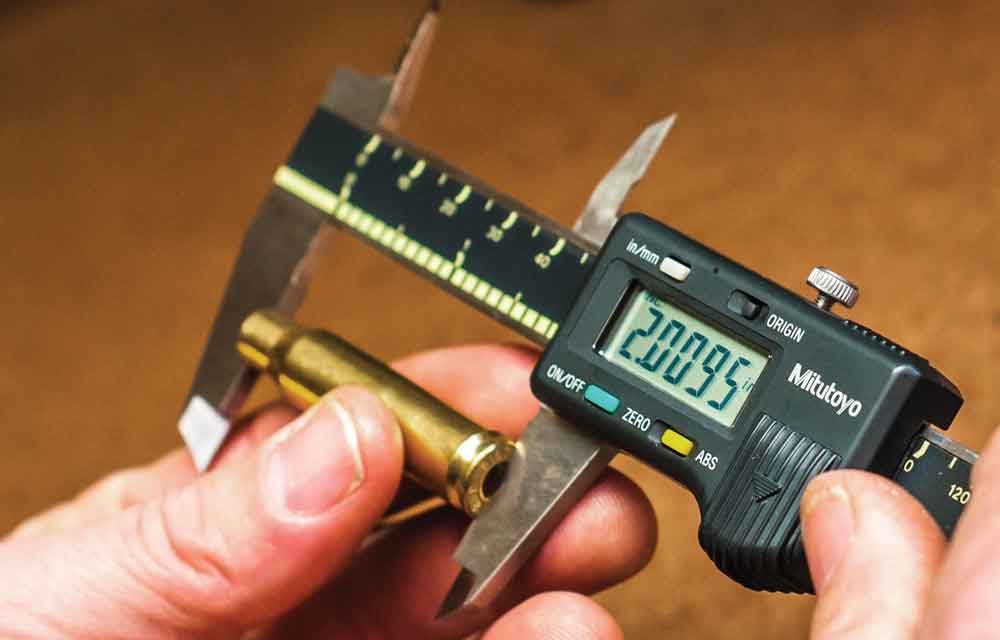
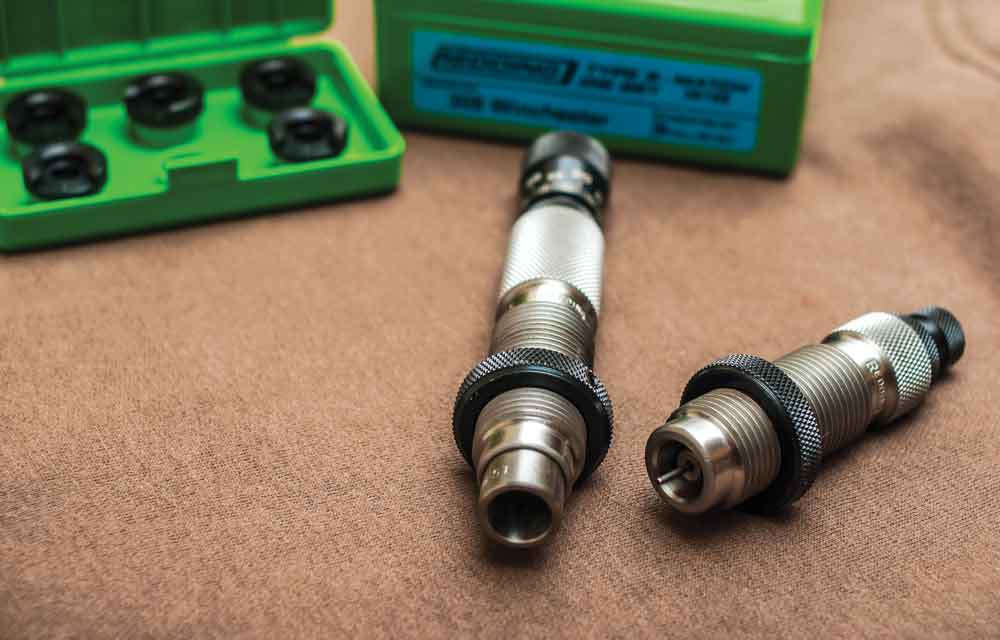
That got me to thinking about how to obtain accuracy without those issues, and I came back to the Redding Custom Competition shell holders. These little gems, along with the Redding Instant Comparator, allow us to match the overall datum line of our ammunition to the chamber of our rifle, all the while full-length resizing the cases. This gives us ammunition that will match the chamber length of a particular rifle, yet feed like factory ammo. Accuracy undoubtedly will improve, and the issue is resolved.
Bushing dies are also a recent development that will fit right in with reloading OCD; they definitely increase brass life, and in my experiences they help improve accuracy as well. Simply measuring the outside diameter of a loaded cartridge — using a singular brand of brass, and assuming that it’s all rather uniform — the correlative bushing will, when inserted into the resizing die, stretch and shrink the brass as little as possible, thus extending the overall life of the case.
Dies are important for any reloading pursuit. The author recommends getting the best reloading dies you can afford after purchasing a solid press.
These are just two examples of modern reloading gear dramatically affecting the capability of our ammunition, and it brings me to another thought: Reloading, like golf and fishing, can suffer from “gadget-itis.” You’ll read — even within the confines of this column — about a good many pieces of gear that can, and often will, make life a bit easier, but that’s in no way intended to infer the idea that all of it is absolutely necessary.
The Bare Minimum
I clearly remember, in the not too distant past, having to make do with what gear I could afford. I scooped powder into a balance beam scale with either a plastic scoop repurposed from some other application, or with a homemade design, saving spare change for the best dies I could buy. Some items are not that expensive at all, and some others cost more but offer a great value.
Were I to advise a new reloader about where to spend the most and what to avoid, I would say that a rock-solid press should come first, and then the best dies I could afford. There are many choices, but I really like the Redding UltraMag press — a simple but beastly one-hole single stage press — and even their basic die sets will give results that will turn heads. Add in a means of measuring powder and even bullets (a reliable balance beam scale will always be a part of your bench) and a means of trimming your cases, and you can make ammunition with the best of them. It doesn’t require a major financial investment — however, when I look at what I’ve spent over the years, I question that statement — but it does require a special level of dedication and attention to detail.
Going All In
To become one of the Control Freaks, you’ll have to delve deep into the wealth of knowledge that has been printed in between the covers of the numerous reloading manuals. There are many books written on the subject, including my own efforts, but they are merely stepping-stones on the path of knowledge.
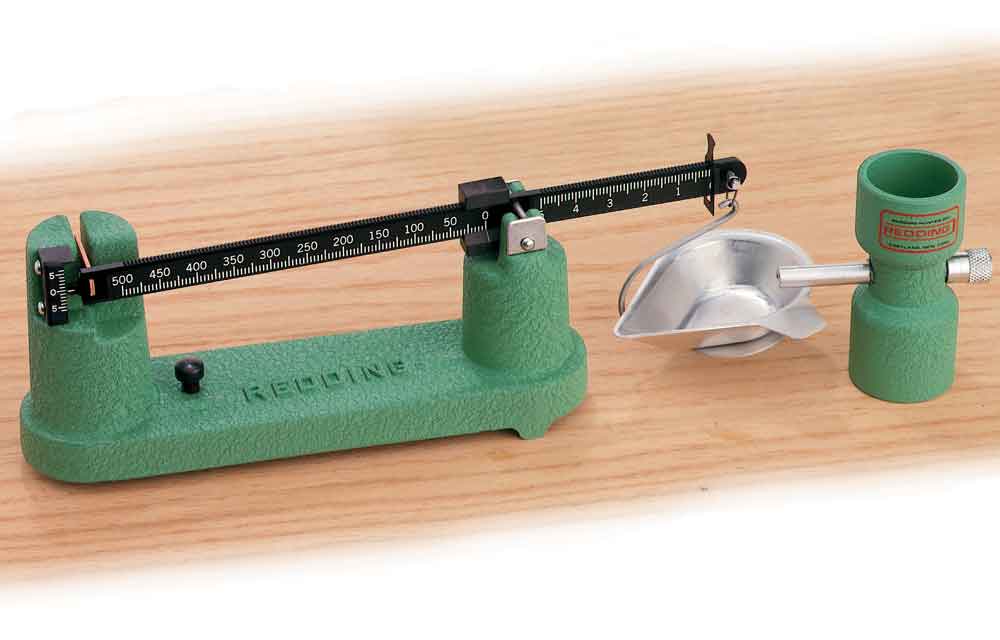
A balance beam scale will be an integral part of your bench, no matter how many gadgets are developed. Gravity doesn’t wear out.
One thing is for certain: The basic technique of reloading metallic cases hasn’t changed in almost a century. Philip B. Sharpe’s Complete Guide to Handloading (the much more famous reloading Philip) has been in print since 1937, yet the processes described therein are still sound. Read, ask questions, make friends with other handloaders, compare notes, and follow the processes outlined by reliable sources.
As your knowledge base grows, you’ll be able to decipher which gadgets will actually make a difference in your life and which are the pet rocks of the reloading industry. And, as my dad always told me, “There are no shortcuts.” We’re all doing it the same way, if we’re doing it right.
Learn about headspace. Experiment with seating depth to see for yourself what effect it has on things. Consult the powder companies about their new developments. My favorite loads might not work in your rifle; reloading can be a highly rifle-specific science. I’ve seen some reloading recipes printed on internet forums that are downright dangerous, so please take everything you read with a grain of salt, and consult as many different sources as you can.
If you’re an old hand at reloading ammunition, you’ll be able to relate to these concepts. And if you’re new to the reloading game, spend some time with the veterans.
I’ll see you guys somewhere down the rabbit hole.
Editor’s Note: This article originally appeared in the March 2018 issue of Gun Digest the Magazine.
Boasting the high-performance RA-535 trigger, the new 1121XR is born to own the bullseye.
Dollar to donuts, if you have a whiz-bang shooter of an AR, you’ve decked that baby out with a best-of-the-best trigger. No single facet, no single upgrade does more to ensure a rifle cracks bullseye round after round than a top-shelf bang switch.
It’s the sad truth that most tactical rifles available today (and yesterday for that matter) don’t come outfitted with what you need to stay on target. At best Mil-Spec triggers are gritty at worst they’re like squeezing a rotten banana. And slow shot-to-shot — third-class mail could deliver a follow-up faster in some cases. But RISE Armament is out to change the way shooters buy an off-the-shelf AR.
Its 1121XR Precision Rifle has all the accouterments to make it a world-class shooter, but chief among them is its trigger. RISE literally built the rifle around its top-end RA-535 Advance-Performance Trigger, giving this vital aspect all the support it needs to drop each shot where it needs to be.
With a 3.5-pound pull, the single-stage unit has short pull and an incredibly crisp release with virtually no overtravel it as an absolute gem. And as RISE Armament’s Camille Torres points out in the above video, it has among the fastest reset available on the market today. The 1121XR isn’t just accurate, it’s bottled lightning to boot.
Luke Hartle some intimate range time with a 6.5 Creedmoor 1121XR (it also available in .308 Win.) at the 2018 SHOT Show and came back raving over the rifle’s potential. But more than any other aspect of the overachieving rifle, the 1121XR is what left him near speechless. Which for a talker like Luke, speaks volumes to what RISE Armament had brought to the table with the 1121XR.
Think pitching 220-grains of 10mm lead out of a Glock is bone jarring? Massad Ayoob proves otherwise.
Glock has won legions of fans and die-hard enthusiasts over the years for one big reason — their pistols are reliably boring. The polymer-framed pistols can be ridden hard, put away wet, and still be rearing for more action.
That’s exactly what you want to hear about a semi-automatic primarily designed as a self-defense arm. And is the reason why a great many duty and concealed carry holsters have a piece of “Perfection” hanging in them. But in recent years, another clan of shooters, one known for their exacting standards when it comes to handguns, has woken up to the advantages the company’s handguns offer.
Increasing numbers of hunters have given the company’s 10mm options the nod for deer, hogs and other medium to large game. And it’s not just the capacity and fast reloads that has them enraptured. It’s the pioneering ergonomics Glock brings to the table that makes their guns more manageable to shoot, thus potentially more accurate. Massad Ayoob gives a fairly good example of this in the above video in a side-by-side comparison with a Gen 4 Glock 20.
First the iconic self-defense expert runs defensive rounds through the gun — PMC Bronze 170-grain JHP. They’re snappy, to be sure, but nothing most shooters can’t handle. He then loads a magazine full of red-hot hunting rounds — Buffalo Bore 220-grain hard lead bullets, the heaviest a 10mm can pitch. The rounds leave the muzzle at around 1,200 fps and deliver more than 700 ft/lbs to a target, so they’re smok’n. Yet, coming out of the Glock 20, they don’t prove much more punishing than the PMC ammo.
It’s amazing how the little things, such as the pistol’s replaceable backstraps, RTF grip treatment and double-captive recoil spring guide rod add up to tame the gun. But also makes it understandable why more sportsmen are lining up to give Glock a crack on their next hunt.
For more information on Glock please check out: www.glock.com
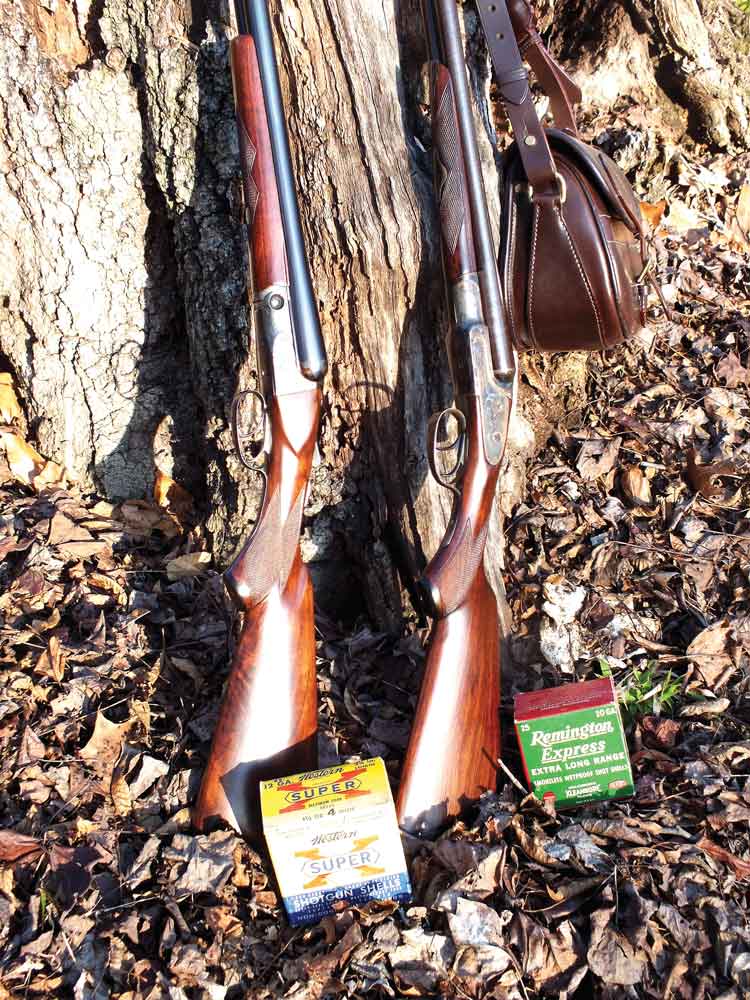
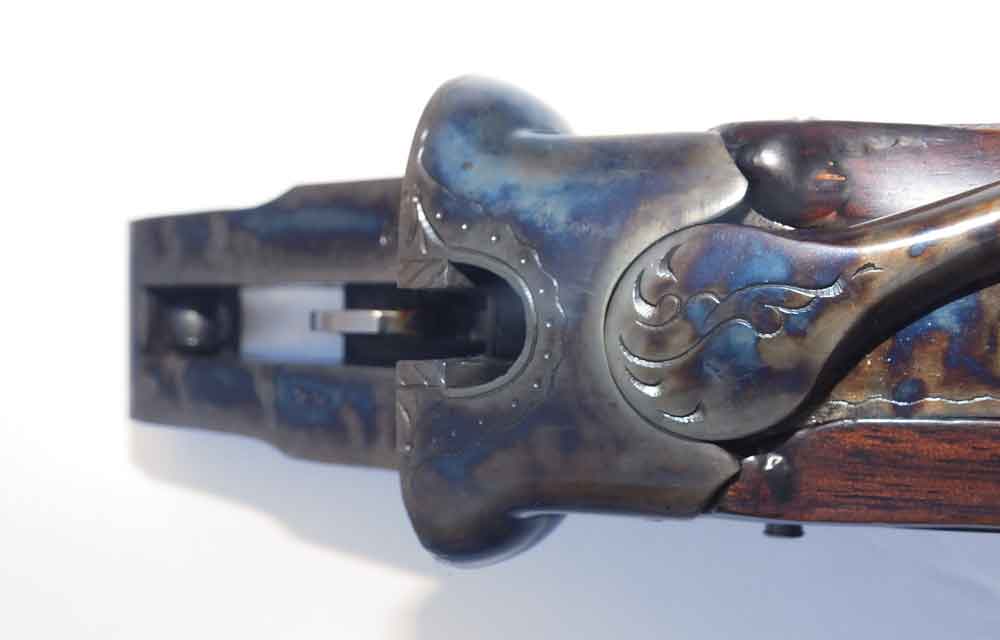
While neither a true sidelock nor boxlock, the Syracuse Lefevers were among the most innovative and possibly the most well designed of the classic American doubles. This refurbished G-grade features moderate engraving and utilizes the ball and screw hinge instead of a hinge pin.
There are great deals on vintage shotguns for those willing to shop, but you better ask the right question before putting cold, hard cash on the table.
The best place to shop for a classic shotgun is online. Always search the most recent listings first. If searching auctions, look at the number of bids. There’s some risk since you can’t actually see the gun in most cases, but most sellers have reasonable return policies, and you can see more guns in one evening than you could by attending 20 gun shows. The main thing is to ask the right questions. I composed this list when I first became interested in doubles. I’ve added to it a couple of times. There is also an explanation of a few of the questions. Hope it helps.
Vintage Shotgun Questions:
Are there cracks or chips in the wood?
Is there evidence of repair to the wood?
Is the level of the wood lower than that of the metal (proud metal)?
Is the checkering clean and in good shape?
Has the checkering been finished over?
Does the gun’s metal appear refinished?
What’s the length of pull to the front trigger? (Length of pull should be about 14 inches to the front trigger)
Is the forearm loose?
What’s the percentage of case color?
Is the engraving sharp?
What’s the percentage of bluing?
Is the lettering on the blued surfaces sharp? (Poor refinishing often affects engraving and lettering.)
Are the screws damaged? (Screws on these guns were timed, and slots should all orient from front to rear.)
Is the lever right of center? (Lever right of center indicates excessive wear.)
Is there movement between the barrel and receiver with the gun closed and the forearm removed?
Is there sideways movement between the barrel and receiver with the gun open?
Does the gun operate properly?
Are the trigger pulls light and crisp?
Do numbers match?
What’s the length of the barrels?
What are the chokes?
Is there any pitting in the barrels?
Are there any dents or bulges?
Is there any metal pitting externally?
Has the gun been personalized with numbers, initials, etc.?
By asking these questions, you can eliminate 95 percent of the surprises that inhibit most folks from buying on the net or making a bad purchase. If you’re buying in person or on the web, use these questions as a checklist to make sure you check everything.
This article originally appeared in the April 2018 issue of Gun Digest the Magazine.
They might not be as well-known as some European manufacturers, but there were a number of great American double-barrel shotgun makers in the late 19th and early 20th centuries. These guns remain highly collectible, and many are also fine shooters.
Beyond the fact that old double shotguns are the only handmade shotguns you can buy for less than $5,000, there are other rewards to owning old shotguns: Most vintage American double guns were so well made they’ve survived for close to a hundred years without requiring a repair. Knowing the gun you’re shooting has more history than you do also helps enrich the experience. While it’s rewarding to own such a gun, there are things to be considered before buying one.
The Golden Age
During the golden years of American double guns, there were several primary companies making guns. All originated in New York State except Parker, in Connecticut, and early Foxes originating in Philadelphia, but later made in New York. The Golden age of American shotguns lasted only about 40 years, from about 1890 until the Great Depression. Guns were made after that time, but most collectors agree that quality began to decline after the depression. The only quality American double introduced after the Great Depression was the Model 21 Winchester, showing up in the ’30s. While it was a fine gun and equal in quality to the others, the Model 21 really doesn’t fit with these older guns because of the time frame and because it was a lot more expensive.
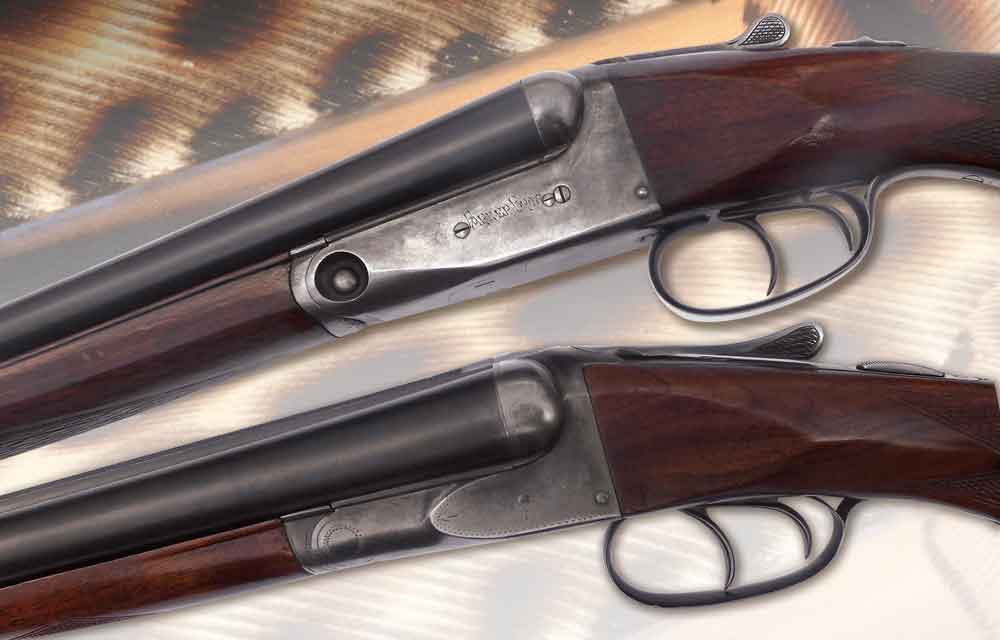
Shown here are two original-condition lowest-grade 20 gauges. The upper is a Parker Trojan with its distinctive recessed and rounded hinge pin. The lower is a Fox Sterlingworth. The Fox action is simpler and much more compact. Parker came in multiple frame sizes, but Fox had only three.
All the companies during this period offered guns at different price levels with different levels of adornment and options. Generally, graded guns were a custom-order arrangement with the buyer specifying barrel length, choke and stock configuration, and almost any other option desired. The top grades represented the highest levels of the gun maker’s art and rivaled the finest English shotguns. The lowest grades were affordable to the average working man, though still a considerable investment for the time. All these makers had a field grade level of gun that came in a basic stock configuration with little adornment and different barrel lengths, as well as gauge and choke choices.
Double Gun Considerations
Early guns often had Damascus barrels, and most who plan to use their doubles extensively avoid them. Damascus barrels can be used with low-pressure loads but should be checked for pits, dents and bulges by a competent gunsmith before use. In fact, it’s a good idea to get any gun from this era checked out before shooting it. In quality guns, I don’t worry about Damascus. At the time most of these guns were made, high-quality Damascus barrels cost more than fluid steel barrels.
Guns built in this era had chambers shorter than 2¾ inches. In spite of this, most aficionados of old doubles agree they have no trouble digesting modern ammunition as long as you stay away from high-pressure loads. RST makes 2½-inch shells in case you worry about chamber length, as well as lower-pressure shells for those who worry about 100-year-old wood and metal. Shooting heavy loads in these older guns isn’t a good idea, even for the ones with fluid steel barrels or longer chambers. Metallurgy at the turn of the century wasn’t what it is today, and 100-year-old wood shouldn’t be subjected to the stresses of heavy recoil.
Totally functional while being remarkably beautiful, a fully restored G-grade Lefever and a 1910 Fox Sterlingworth pin gun. Called a pin gun because the earliest Sterlingworths used the same recessed and rounded hinge pins that made Parker guns so identifiable. Only a few thousand of the early Sterlingworths had this feature.
While these guns work well in the field, it should be remembered these older designs didn’t have inertial firing pins or intercepting sears. This makes them a bit less safe than modern guns, so special care should be taken to keep them pointed in a safe direction when they’re closed. On upland birds, I generally hunt with the gun open and only close it when the dog has pointed. Most of these guns had double triggers. Single triggers were available on most models, but the mechanisms were quite complicated, prone to trouble and expensive to repair. Ejectors are an option that adds value, and most systems were reliable, but problems with ejectors can be expensive to rectify.
The American classic shotguns were available both as boxlocks and sidelocks. Boxlocks tend to be stronger and simpler, and most agree sidelocks have a more graceful appearance. Though sidelocks are currently much more expensive to make, they were competitively priced during the classic double gun period because all guns were basically handmade anyway. Today, quality 12-gauge field grade guns from all the American makers during this era can be found and purchased for less than $1,000. Smaller gauges progressively cost more, with 20-gauge guns generally bringing at least twice the price of a 12 gauge. Sixteen-gauge guns generally fall somewhere in between. Guns chambered for .410 and 28 gauge bring a premium.
Decisions, Decisions, Decisions!
Parker Guns
Parkers bring the most money of the American classics and are often considered the best of the American classics. Internally, they were more complicated than some other brands, but they were so well made they rarely have mechanical problems. Parkers come in several different frame sizes for different purposes, allowing for light and handy 12-gauge bird guns and substantial 12 gauges for waterfowl hunting. Parker offered more choices of grade and frame size with twelve frame sizes and ten grades, A1 being the highest and “V” being the lowest grade, with a field-grade gun called a Trojan.
A.H. Fox Guns
Foxes are probably next in the lineup, and I believe they were a better design, though I’m sure this will raise the ire of Parker owners. The Fox design was simple with less moving parts and coil springs. The receiver was also much smaller, with a Fox 12-gauge frame smaller than the frame of a 20-gauge Parker. Fox guns were direct competitors, and a Parker sold for about the same price when new. Fox guns were available in only three frame sizes, but there were four different barrel weights. The 12-gauge guns came in two frame sizes, the larger intended specifically for waterfowling. The same frame was used for both 16- and 20-gauge guns. Fox grades begin with A -grade and end with F-grade. The field grade was designated as the Sterlingworth.
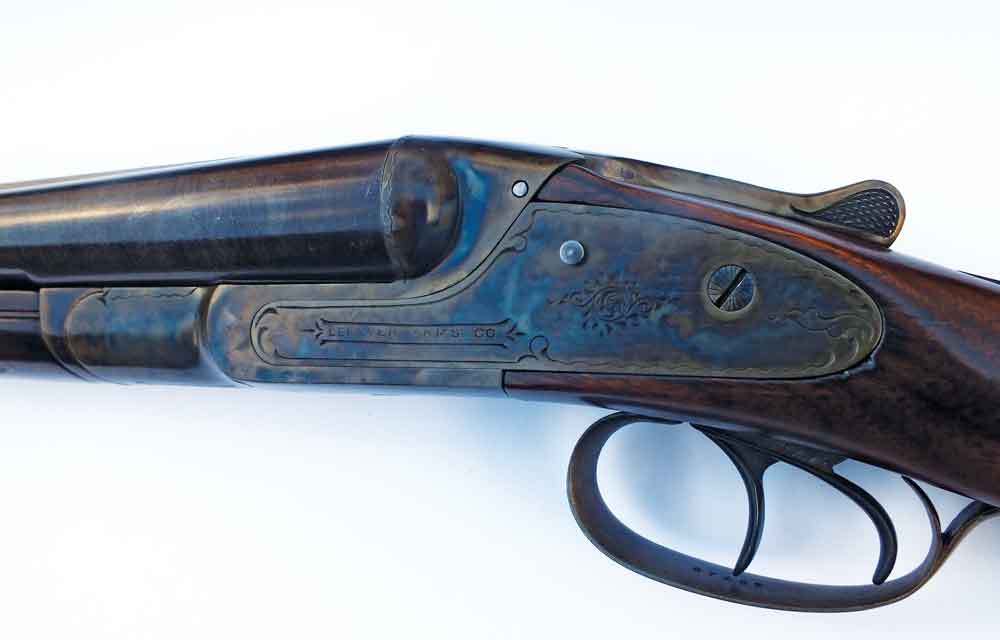
What makes these guns so interesting is the amazing level of detail, even on lower-grade models. This G-grade Lefever has intricate hand-cut engraving bordering the fences and top lever. The beautiful case coloring was part of the hardening process and wasn’t just cosmetic.
Lefever Guns
Neither a sidelock nor a boxlock, another truly fine American shotgun was the Syracuse Lefever. The Syracuse Lefever is not to be confused with the Lefever Nitro, a cheaper version of an Ithaca made after Ithaca bought out Lefever. The original Lefevers were both well made and innovative of design, and many consider them the pinnacle of American shotguns. They use a unique and innovative hinge system that’s never been replicated, and I believe it was a superior design to anything made since. Instead of a pin on a half circle, the Lefever hinged on a ball and socket and the ball could be adjusted for wear. Extremely well made and graceful in design, they’re currently appreciating in price faster than any other maker. The AA grade was highest, with the G-grade lowest and a field grade designated the DS for Durston Special.
L.C. Smith Guns
L. C. Smith shotguns were true sidelocks. L. C. Smiths are graceful, slender and pleasing to the eye, but the sidelock design compromised the strength of the stock, and many of them have cracked or repaired stocks. They were available in eight grades and in gauges from 10 to .410. While other makers designated their grades using letters, L. C. Smith guns used names from Field to Deluxe, with only 30 Deluxe guns being built. In higher grades, the side plates allowed more room for engraving, and they have a strong following.
Ithaca Gun Company Guns
Similar to the L. C. Smith in value and quality was the Ithaca. There were more different designs of Ithaca guns than any other American classic, including both hammer and hammerless models. The most recent design was the NID or New Ithaca Double. Earlier versions are not as strong as those of the other manufacturers, and, while they can still be used, they shouldn’t be used with modern high-pressure ammunition on a regular basis.
Baker Guns
Less known than the other brands, the Baker isn’t as well thought of as the other makers, but they were fine guns. Bakers were also sidelock guns, and they sold for a little less than the other brands, but they were very well finished both inside and out.
While neither a true sidelock nor boxlock, the Syracuse Lefevers were among the most innovative and possibly the most well designed of the classic American doubles. This refurbished G-grade features moderate engraving and utilizes the ball and screw hinge instead of a hinge pin.
Parting Shots
Owning old guns like these admittedly isn’t for everyone. They aren’t as versatile as modern guns, they don’t have the same safety features, and they’re limited in ammunition options. They are truly handmade guns, though, and if you do your homework before buying, they are almost certain to escalate in value over time. There’s also an element of pride in their ownership. Every time I take one of my old doubles afield, someone comments on how beautiful it is. The history of these guns captures the imagination.
My favorite gun is a 1917 Fox Sterlingworth in 16-gauge. It has a slim and delicate grip, balances like something alive, and weighs just 6 pounds. I’ve hunted with it all over the country and have taken everything from pheasants and ducks to bobwhite and Gambel’s quail. It’s been restocked with beautiful figured American walnut and functions just like it did 100 years ago when it left the factory in Philadelphia.
Even the field grades of these wonderful old guns were made with real hand craftsmanship, at the hands of men who truly cared about what they produced. They can be used as they are, with the patina of their long years of service, or restored to look like they just came from the factory. Either way, they’re firearms that are a joy to own and be proud of. I often wonder who will be the next owners of my favorite little Sterlingworth after I’m gone. I hope they enjoy this fine old gun as much as I have.
Editor’s Note: This article originally appeared in the April 2018 issue of Gun Digest the Magazine.
Zeroing in on the front sight and executing a clean trigger press keeps a handgun on target no matter its movement.
From Zen-like breathing drills to the perfect proportion of push and pull in a grip, much is made about mastering the the natural wobble when shooting a handgun. But in the scheme of things, is it ado about nothing?
Certainly, proper sight alignment is key to sending a round from a handgun to where it needs to go. And the natural oscillation from breathing, muscle tension and, in certain circumstances, adrenaline has to be overcome. But wouldn’t it be nice if this problem could be whipped without resorting some far-fetched timing up of respiration, bodily tremble and breaking a shot. Quite simply there is and it relies on two of the most down-to-earth, day-one fundamental aspects of handgun marksmanship — focusing on the front sight and clean trigger pull.
Sound hard to believe? It shouldn’t. But if you need proof, Gunsite instructor Mike Moore more than provides it in the above clip.
Moore has a student’s hands and handgun wobbling like it was happy hour, yet each shot lands center mass — actually in a group many steady shooters would like to consistently print. The secret is really no secret. Concentration on the front sight keeps you on target every time and a smooth trigger press, complete with follow-through ensures the proper alignment at the moment of truth.
Simple as it may sound, these are still handgun skills that require practice to master. But, this minutia is worth the effort. When faced with life-threatening circumstance, you better believe your gun is going to dance. The only way to make sure it doesn’t become a factor in surviving the incident is ensuring front-sight focus and a technically-sound trigger press are second nature.
Click here for more information about Gunsite and the extensive firearms instruction they offer.
Looking to go armed, but are stuck in the weeds as to what to arm yourself with? Here are 20 of the best concealed carry gun options that will keep you on the defensive.