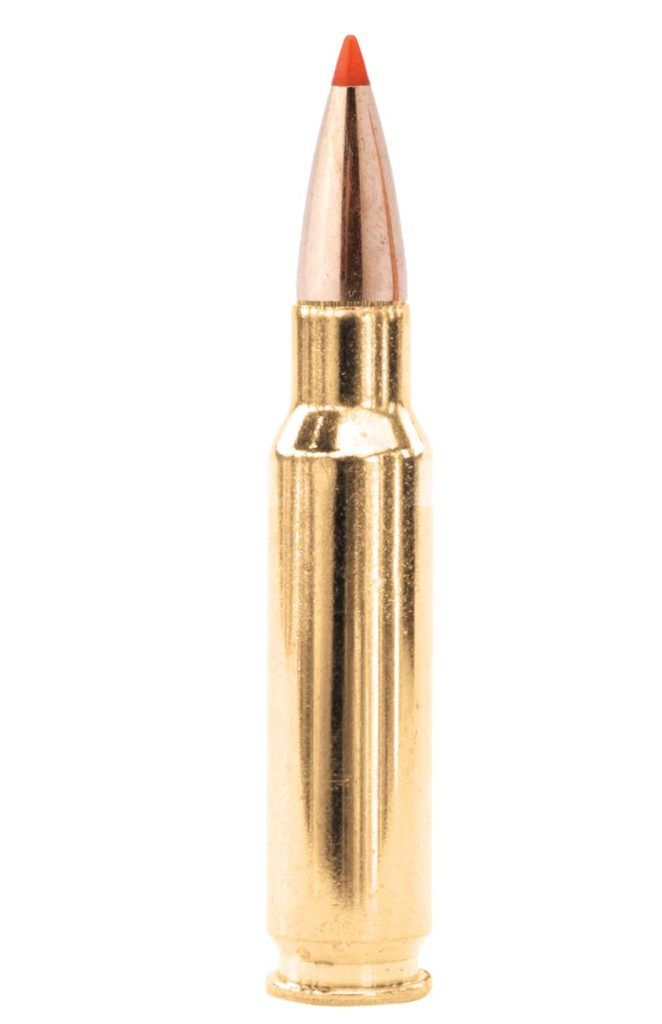
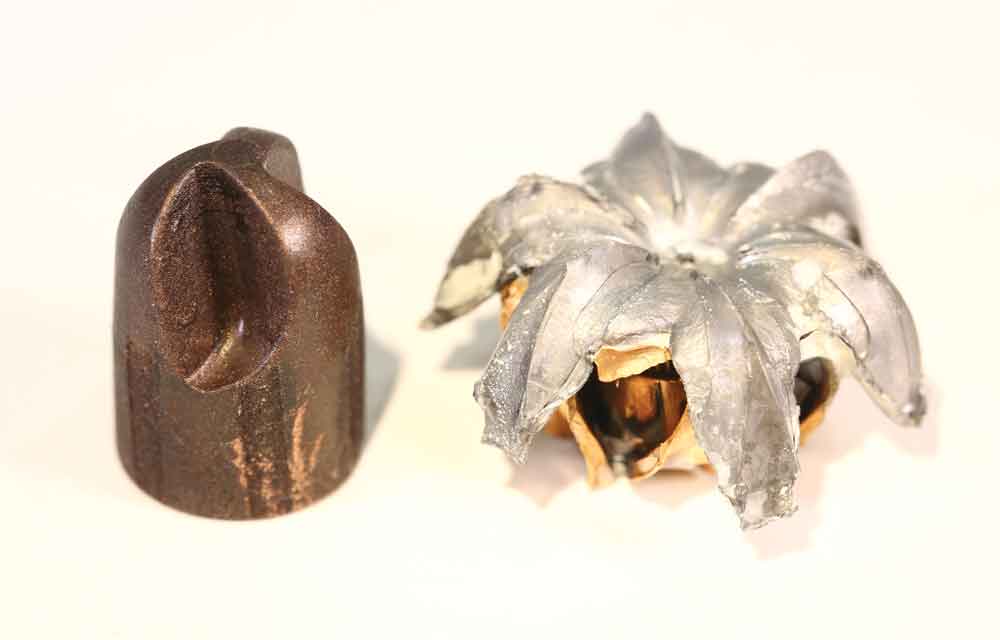
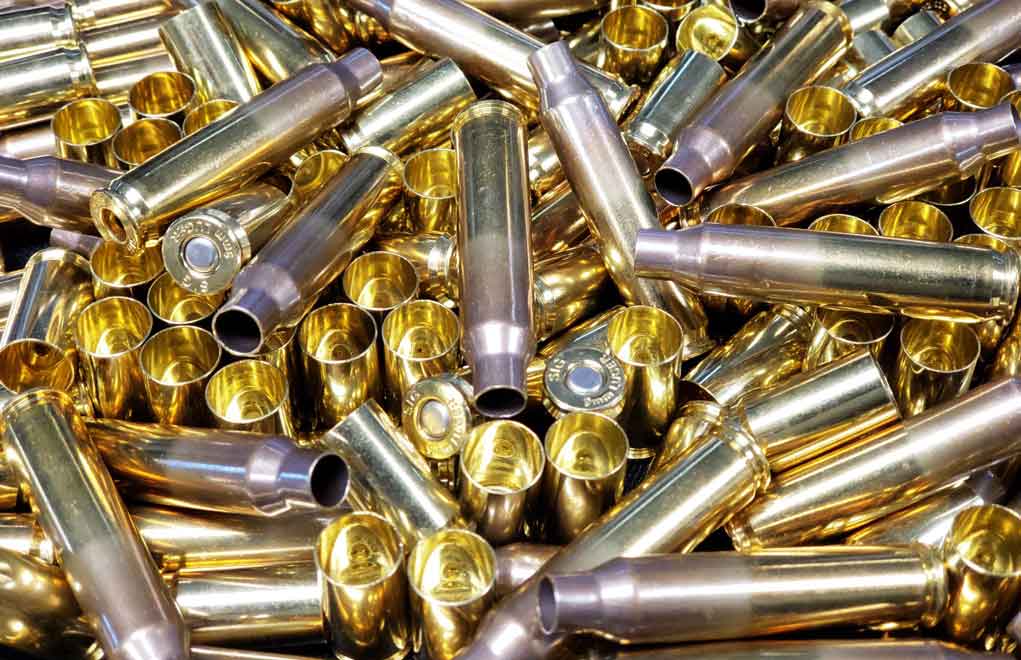
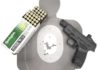
The .30 T/C was a great performer that never gained traction in the shooting world.
The odd saga of this .30-caliber:
The .30 T/C is essentially a .308 Win. shortened with a sharper shoulder angle.
Despite less capacity, it exceeded the .308’s performance through light magnum technology.
Thought, when utilizing the same technologies the .308 performs just as well.
This left many shooters wondering what was the point in the first place?
The .30 T/C was developed by Hornady for Thompson/Center, and introduced in that company’s Icon rifle. Basically a shortened version of the .308 Winchester case with a sharper 30-degree shoulder angle, it has less powder capacity than that cartridge and yet, due to the utilization of light magnum technology previously developed by Hornady for other cartridges, it exceeds in performance standard loadings of the .308 Winchester and equals the performance of the .30-06 Springfield when the three cartridges are loaded with a 150-grain bullet.
Despite impressive velocities for its size, the .30 T/C is rather an odd duck, and this has raised questions among hunters and shooters about its existence. The Icon rifle was introduced with a short action and had the action been too short to handle the .308 Winchester, the .30 T/C would have made sense — but this was not the case. Not only is the short version of the Icon action long enough to handle the .308 Winchester, but that was one of the first chamberings offered in the Icon rifle. And, while it’s true that, in its factory loading, the .30 T/C delivers higher velocity than standard loadings of the .308 Winchester, it’s also true that light magnum loadings of the .308 Winchester from Hornady are just as fast. When both are handloaded with bullets of the same weight and to the same chamber pressure, velocity will be a bit lower with the .30 T/C, due to the smaller case capacity.
Editor’s Note: This article originally appeared in the May 2018 issue of Gun Digest the Magazine.
Takedown rifles appeal to a variety of hunters and shooters because of their unmatched portability, and they’re a favorite firearm of campers, hikers and survivalists because they fit neatly into tight spaces where a full-length rifle simply can’t be stored.
But there are other advantages to owning takedown rifles as well, primarily that these guns don’t immediately look like a firearm (so they’re less likely to draw attention from thieves) and, in many cases, they are so compact and well thought-out that you can neatly fit them in a backpack or bugout bag. These guns piece together in a hurry and their design allows for repeatable accuracy after each reassembly.
Here’s a look at seven of the best takedown rifles available today, perfect for everything from high-mountain hunts to serious survival situations.
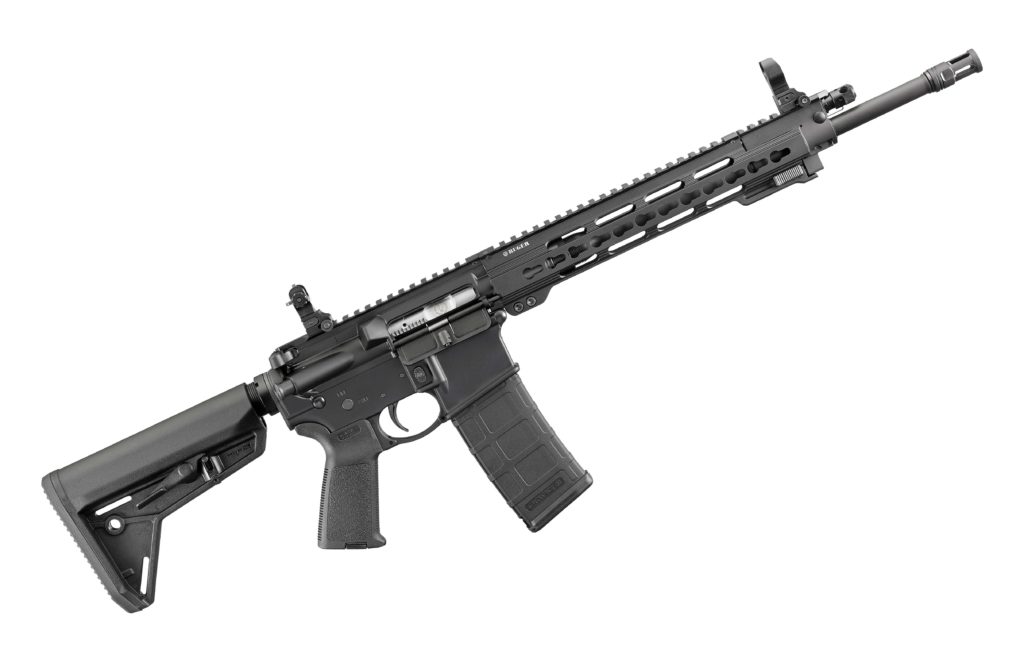
Ruger SR-556 Takedown
Ruger SR-556 Takedown
I suppose you could argue that any AR-15 rifle is a takedown rifle. However, Ruger took that one step further with its SR-556 Takedown model. Instead of breaking down into just upper and lower components, the SR-556 Takedown allows you to remove the barrel, too, and doing so requires nothing more than moving a slider bar back toward the breech of the rifle, twisting and removing the barrel. This piston-operated AR features a multi-stage regulator and you can perfectly match the rifle to your load, making this a durable, versatile AR that will work properly in even the worst conditions on the planet.
Ruger offers a .300 Blackout barrel as well for the SR-556, so you can modify this rifle as needed. Magpul furniture is also included, as is Ruger’s 452 AR two-stage trigger.
This gun comes with a convenient nylon carry case that allows you to transport the broken-down rifle, magazines and ammo easily and efficiently, even when you’re walking over rough ground.
With the SR-556 Takedown, you get the capabilities of an AR rifle combined with the reliability of a piston action in one of the most portable, easy-to-transport models ever developed. Even shooters who believe an AR is an AR is an AR can appreciate the design features on this ultimate survival tool. MSRP: $2,199
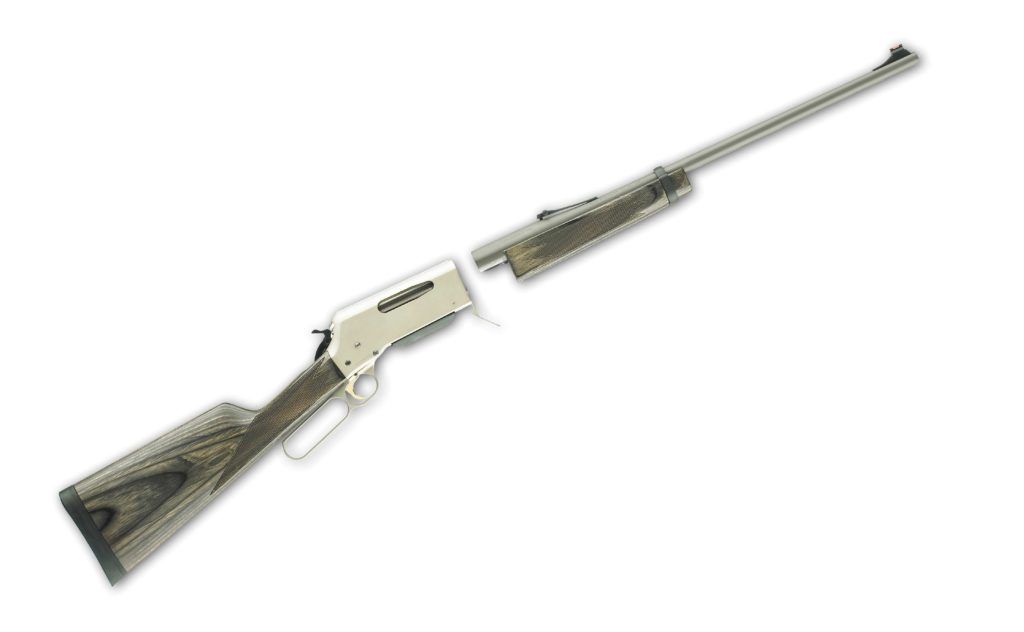
Browning BLR Lightweight ’81 Stainless Takedown
Browning BLR Lightweight ’81 Stainless Takedown
Browning’s BLR rifles combine the time-tested reliability of a lever-action rifle with the convenience of a takedown gun. BLRs use detachable box magazines so they can be chambered for modern cartridges loaded with spitzer-type bullets, and there are 13 caliber options ranging from .223 Rem. to .450 Bushmaster.
Browning has modernized the lever gun action by including a rack-and-pinion system and a rotating bolt head positioned inside an aircraft-grade alloy receiver so these rifles can handle magnum cartridges, such as the .270 WSM and .300 Win. Mag., without problems. The side-ejection design makes it easy to mount an optic on these rifles, but if you prefer iron sights, they come standard on the BLR so there’s no need to worry about optics breaking, fogging or coming loose. The heat-treated chromoly steel barrel is precision button rifled, and accuracy potential with these guns is truly excellent — even at extended ranges.
To assemble the rifle, simply slip the two component parts into place and a lever on the underside of the gun locks the receiver to the barrel via a locking lug that engages with the bottom of the receiver. Breakdown is also simple: Unlock the lever, twist 90 degrees and the two halves separate for transport.
The laminate stock and durable matte nickel receiver finish will stand up to the worst elements, too, so this is a durable centerfire that’s easy to carry and store anywhere. Weights range from 6 pounds, 8 ounces to 7 pounds, 12 ounces, depending upon caliber. MSRP: $1,229.99-$1,299.99
Marlin 70PSS
Marlin 70PSS
The 70PSS is the modern version of the classic Papoose rifle that has been among the most popular takedown rifles for years. This lightweight, blowback-operated .22 LR repeater is a natural choice for camping, hiking and survival bags because it breaks down easily and is durable enough to withstand some rough handling.
To further reduce bulk and weight, the black polymer stock cuts off at the confluence of the barrel and the action, and there are two sling studs in case you prefer on-shoulder carry of the assembled rifle. The 16¼-inch stainless-steel barrel features Micro-Groove rifling and is topped with an adjustable rear sight and hooded front sight with a high-visibility orange post. The receiver is also grooved for adding a scope or other optic, and the rifle can be taken apart in seconds by simply loosening the barrel nut.
Each 70PSS comes with a seven-shot nickel-plated magazine, and the crossbolt safety is easy to use and intuitive. The assembled rifle measures less than 3 feet long and weighs a scant 3¼ pounds, so it’s among the lightest and most portable survival guns on the market. Plus, the combination of a fiberglass-filled synthetic stock and stainless-steel metalwork makes this one tough survival gun.
The 70PSS even comes with a padded case with built-in flotation, and it’s one of the most affordable survival guns on the market. MSRP: $345
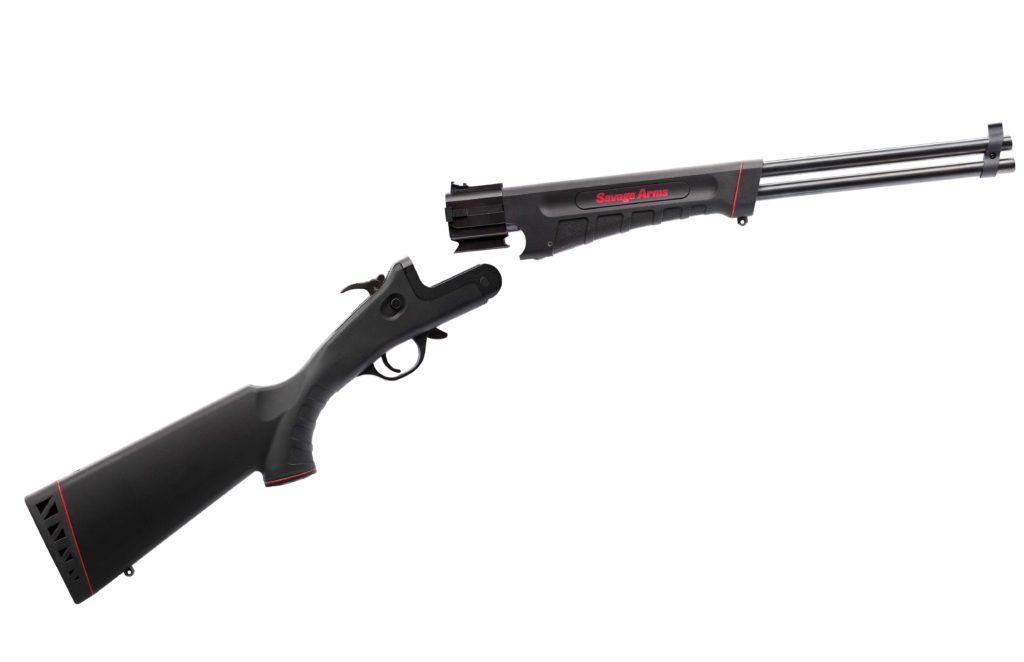
Savage Model 42 Takedown
Savage Model 42 Takedown
Based on the venerable Model 24, Savage’s Model 42 is simply one of the best survival guns available. It offers break-action simplicity and reliability and fires either a .22 LR or .22 Mag in the top barrel and a .410 shotgun shell from the bottom pipe. A barrel selector is located on the large hammer, and the adjustable rifle sights can be removed if you want to add an optic.
But the trim, 6-pound Model 42 is primarily a camp, survival and close-range hunting weapon, and in that capacity it shines. It breaks apart with the touch of a button and can fit into just about any pack or bugout bag. The 20-inch barrels offer a long enough sight plane to shoot vermin at a distance, but they’re still compact enough to carry in heavy cover. The stock is made of durable polymer, which helps keep weight down and stands up well to the elements. The .410 barrel has a 3-inch chamber, adding to the versatility of this little gun, and the 42 is as well-suited for lazy autumn days in the field hunting squirrels and rabbits as it is for survival situations.
Campers love the gun because it’s ideal for popping small game or shooting grouse or other birds for the pot, and it also serves as effective backup in the wilderness when you’re faced with dangerous two- or four-legged predators. MSRP: $499
Henry Arms AR-7
Henry Arms AR-7
The AR-7 was originally designed by Eugene Stoner, who also invented the AR-15 rifle. Built as a survival rifle for troops, the AR-7 design has long been a favorite of anyone who needed a lightweight, compact semi-auto rimfire for the direst circumstances, and around the turn of the 21st century, Henry Rifles tweaked the design to make this perhaps the most appealing civilian survival gun on the market.
For starters, all of the AR-7 components can be broken down and stored within the rifle’s waterproof polymer stock, which measures just 16½ inches. The blowback action is rugged and reliable, and each of these guns ships with two, eight-round .22 magazines. The rifle is quickly assembled by piecing together the receiver with the 16½-inch barrel (via a barrel nut), and these guns weigh just 3½ pounds, ideal for carrying in a backpack or bugout bag.
This is also among the most popular takedown rifles for campers because it’s so compact and lightweight that the entire rifle — plus ammunition — will fit easily into a standard day pack and there’s no need to worry that precipitation or spills during creek crossings will impede the rifle’s function. These takedown rifles also come with iron sights and a top rail if you want to mount an optic.
There are three color options: black, and True Timber Viper Western and Kanati camo patterns. MSRPs are $305 for the black version and $368 for the camo models. If you’re serious about survival, you can purchase the Henry Survival Pack that includes an AR-7 rifle and various other items you may need in an emergency, such as a Buck Rival knife, fire steel, paracord, emergency food, a water purification straw and much more. MSRP for Henry Survival Pack: $550
Browning SA-22 Grade I
Browning SA-22 Grade I
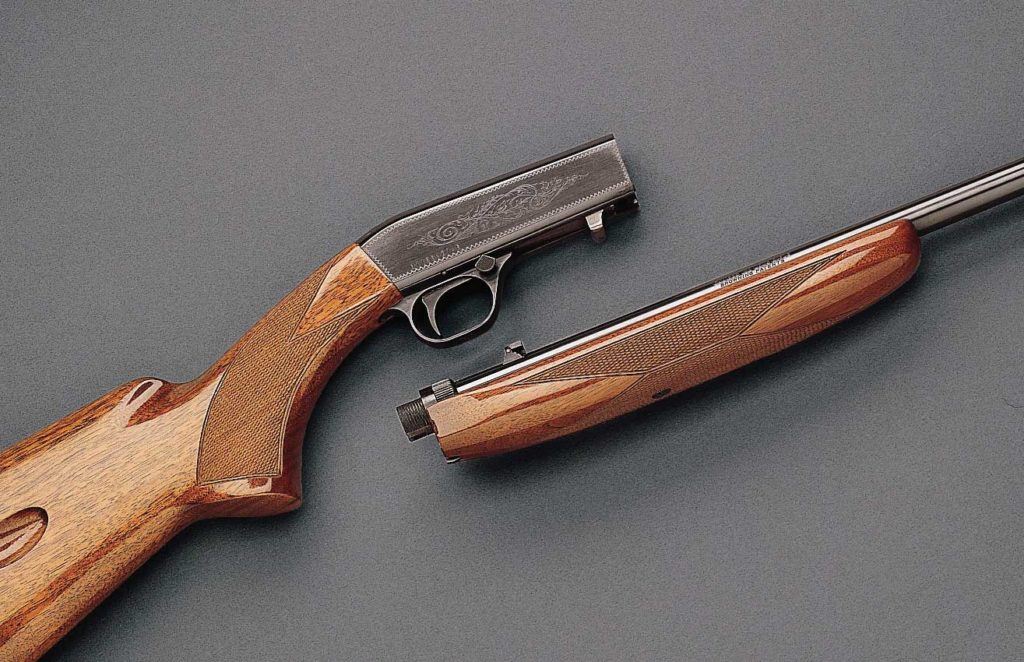
This could be the classiest of the takedown rifles. The SA-22 is one of John Moses Browning’s last designs, a semiautomatic .22 rifle that ejects spent shells from the bottom of the receiver, which is loaded using a port in the stock. The Grade I version comes with a glossy walnut stock and a blued steel receiver with scroll engraving. The trim SA-22 weighs in at just 5 pounds, 3 ounces, and measures 37 inches with its 193/8-inch barrel.
There’s a nut on the barrel that allows the buttstock and receiver to be easily separated from the barrel and forearm, and since the scope mounts and iron sights on the SA-22 are affixed to the barrel and not the receiver, there’s no issue with return to zero after reassembly. These takedown rifles are loaded by turning a lever and drawing the follower from the stock, then loading through the port on the right side of the gun. When the tubular magazine is full, the follower is pushed back into place and locked, one of John Browning’s sleekest designs.
But don’t let the SA-22’s beauty fool you: This gun has what it takes to be a survival rifle. Its adjustable iron sights (folding rear, gold-bead front) and easy-to-use crossbolt safety make it as functional as it is handsome. The svelte little SA-22 is a beautiful gun that’s pretty enough to display in the home and functional enough to serve as a life-saving tool. MSRP: $699.99 (Grade I)
Ruger 10/22 Takedown Lite
Ruger 10/22 Takedown Lite
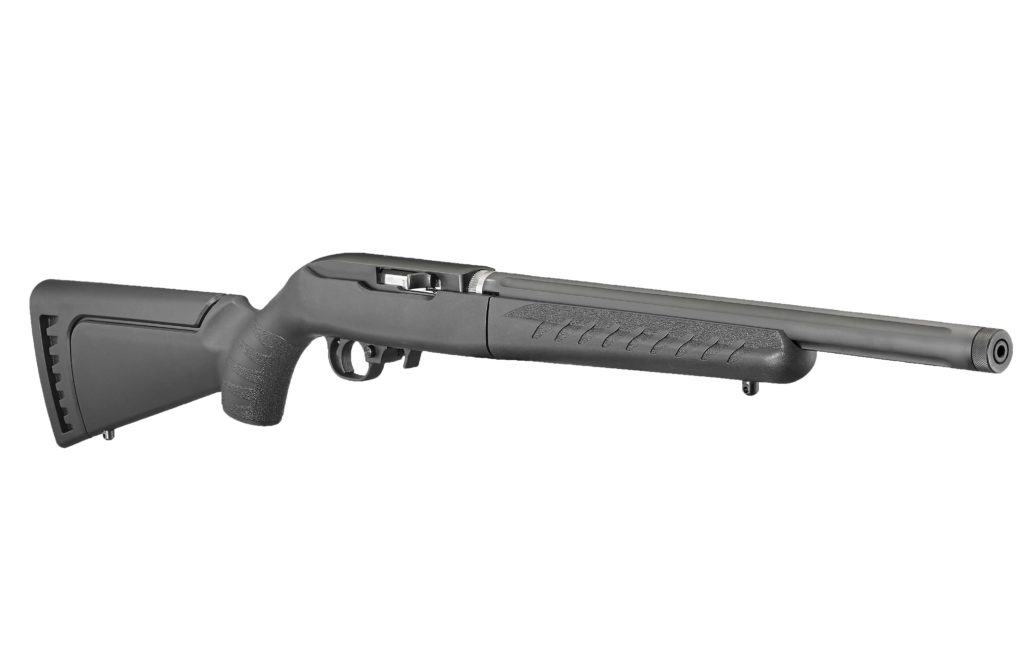
The Ruger 10/22 has been one of the top-selling rimfire autoloaders for decades, and that’s thanks in large part to its reliable blowback action that cycles a wide range of .22 LR ammo. The Takedown Lite version is perhaps the most versatile of all the 10/22 models and a top pick among takedown rifles. It features a 16.12-inch cold hammer-forged barrel that’s tensioned inside a lightweight, ported aluminum alloy sleeve.
The rifle comes equipped with Ruger’s lightweight polymer stock with replaceable stock modules. Two modules are included when purchasing the rifle (standard length, low and high-comb versions) and these modules can be quickly swapped out as needed for proper eye alignment with the optic.
The 10/22 Takedown Lite comes without iron sights, but a base is included that accepts both Weaver and tip-off style rings, so mounting an optic is fast and easy. The muzzle comes with a 1/2×28 thread pattern for mounting suppressors or other barrel devices, and the reliable rotary-design Ruger 10/22 magazine is held in place by a quick-release extended lever.
The takedown process is very simple: Lock the bolt in the rearward position and ensure the gun is unloaded, push the recessed lever on the underside of the gun and twist the subassemblies 90 degrees to separate. These rifles weigh just 4.5 pounds, so they’re very light and easy to carry in the provided zippered case. MSRP: $659
Did we hit a bullseye with this list or miss the mark? What’s your favorite from the list? Or is there one missing? Tell us about it in the comments.
Editor’s Note: The article originally appeared in the May 2018 issue of Gun Digest the Magazine.
The Modern Shooter team gets world-class trap shooting advice from world-record holder Dave Miller.
When it comes to busting clay, what’s the best you’ve ever done in a session? Two in a row? 200? No offense, whatever the number it’s child’s play compared to Dave Miller.
The pro shooter for Aguila Ammunition is an out-and-out machine when the trap starts throwing orange and has the title to prove it. Miller is the current Guinness World Record holder for most clays broken in one hour — a whopping 3,653. Do the math, that’s more than one clay per second. To call it a feat is a magnitude of understatement akin to dismissing the Grand Canyon as a ditch or Pike’s Peak a mound of dirt.
Next to busting blue rock, there’s nothing Miller loves more than teaching others how to bird-dog out top scores. And this week on Modern Shooter, the team taps the pro for some world-class tips for vaporizing clay. Unsurprisingly for a shotgunner of his caliber, Miller has some real insight on what it takes to excel when the trap springs.
First and foremost, Miller preaches vision and economy of motion, catching sight of the clay early and letting it do most of the work. As he points out to Gun Digest Editor-in-Chief Luke Hartle, if you’re chasing, you’re behind the curve. But perhaps more importantly, Miller is a dyed-in-the-wool advocate of breaking the clay well before you ever call “Pull!” With your body positioned correctly and your breakpoint already mapped out, you’ll have a bead on the blue rock the moment it takes flight and the orientation to bust it.
Get more of Miller’s insight on the next Modern Shooter 10:00 p.m. EST Friday on the Pursuit Channel. The episode rebroadcasts Monday at 12 p.m. EST and Tuesday at 11:30 a.m. EST.
For more information on Aguila Ammunition, please visit: www.aguilaammo.com
Most AR rifles utilize a direct impingement gas-operated system to cycle. Understanding this system is key to troubleshooting it.
How a DI goes about its business:
A majority of ARs operate off the direct impingement cartridge gases.
The system consists of a port, block, tubes and a gas key.
A small amount of gas is siphoned after a round is fired and is diverted to cycle the rifle.
Generally reliable, the system can have a number of issues that can make it malfunction.
Editor’s Note: This is the first article of four-part series dealing with direct impingement operated ARs and troubleshooting the gas system.
Not to be confused with gasoline, the gas-operated AR functions by using a portion of the propellant gases created by the discharge of the cartridge. The gases are directed back through a system of ports, blocks, tubes and a rotating bolt, and it ultimately compresses a spring to cycle the AR’s action. This efficient system functions to reload the weapon each time it’s fired and also to reduce recoil. It does have some drawbacks, which we’ll dive into later.
Functionally, the direct impingement system is a circular sequence that runs as long as the operator continues to pull the trigger and exhausts the ammunition. After the first round is fired, the process starts on the barrel where a small hole, or gas port, vents a portion of the gas discharged after the projectile passes. The gas is vented into a gas block that regulates the amount of gas fed back into the action through tubes that run parallel to the line of the rifle’s bore. The gas block may be fixed or adjustable, and in some ARs it can be tuned like the carburetor on a car.
Lean or rich, the gas then passes through a gas tube into the gas key staked to the top of the bolt carriage group. This gas key absorbs the punch of the gas’s discharge, pressing the bolt carriage group back into the buffer and buffer spring, which are located in the rifle’s butt stock. The buffer spring compresses to the rear while, simultaneously, the bolt extracts and ejects the fired cartridge casing.
When the compressed spring recoils, the bolt carriage group travels forward, picks up another round from the magazine, and then reloads and re-cocks the weapon as it returns to battery. The rifle is now ready to fire another round when the trigger is depressed.
So what does the average shooter need to learn from all this engineering? First, the AR’s successful function depends upon re-direction of the appropriate amount of this discharge gas. Second, this system, though generally reliable, has failure points that can be tough to spot. And finally, the “magic gas” this system depends upon is hot, dirty and filled with carbon and unburnt powder that, over time, will impact the function of the parts and the system as a whole.
Editor’s Note: The article originally appeared in the May 2018 issue of Gun Digest the Magazine.
Reintroduced in three sizes, the Colt Combat Elite is striking as ever.
Nothing says a pistol has to have head-turning good looks to get the job done. In fact, plenty of handguns more than wander into plug-ugly territory, yet are bet-your-life reliable when things get down and dirty. Ultimately, ascetics to the devil, that’s what counts.
That said, it sure is nice to have the extra mile in a pistol and find one that shoots as pretty as it looks. Colt has hit both nails squarely on the head, not once but three times, with the re-release of one of its most popular 1911s — the Combat Elite. Back in action as a family of pistols, the Combat Elite Government, Commander and Defender models deliver the professional-grade fit, form and function that made the pistol among the most coveted modern 1911s, in a package as sharp as a straight razor.
Jumping right to the frills, Colt maintained the Combat Elite’s traditional two-tone, but with a striking twist. The company finishes the stainless-steel frame and slide with a black ion bond, then goes back and polishes the flats. The results speak for themselves — a darkly handsome pistol, with enough gleam to catch the eye.
Additionally, Colt has refined the Commander Elite family with checkering on the front strap, front and rear night sights and an ambidextrous thumb safety. Moreover, they’ve expanded the line with three size options to meet any need. Here’s where the rubber meets the road, all three pistols are identical in function, in turn, a Government model is as familiar as a Defender.
Mama, Papa or Baby bear, there’s something for everyone in the new Colt Combat Elite family.
For more information on the Colt Combat Elite, please visit: www.colt.com.
In a lethal-force event, shot placement can outweigh all other factors in bringing an attack to a close.
Location, location, location:
Talk about stopping power revolves around bullet, cartridge and velocity combinations.
A much more important conversation is about bullet placement.
Where an assailant is shot does more to determine his neutralization than what he’s shot with.
A hit to the correct spot works faster, and a hit to a non-correct spot works slower, if at all.
You’ve heard the saying about the three most important details of real estate? “Location, location, location.” Perhaps trite, but true. Well, the way we use firearms also has a part in the effectiveness of the firearms and ammunition we use. This has been an on-going learning process, in fits and starts, with occasional backward steps.
I’ve mentioned and will mention again, the FBI shootout in Miami. Others have as well. But it’s not the only learning experience and not the only famous one. If we were paying full attention to every incident, everything can be a learning experience, but not everyone gets the word, and not everyone learns the same thing from it.
One such instance was the Newhall incident in California back in 1970. Four officers of the California Highway Patrol died there, and much was learned. What was learned then, and had to be lost, forgotten, not learned, and then re-learned, was that what you learn to do under stress, you do under stress. Learn bad habits (whatever those might be) and you will do bad habit things under stress.
The art of gunfighting is an ongoing course of study, with new lessons added. Not all of them are relevant to all situations. What a USMC Fire Team learns — busting in steel doors in dusty places, using the tools the Corps gives them — may not be all that relevant to a homeowner trying to keep life, family and property safe in a crime-ridden urban environment.
What does matter is that where the bad guys are shot (speaking anatomically) can be much more important than what they are shot with. And this can color the impression of cartridge effectiveness. We have to keep that in mind when we discuss theories of stopping power.
Stopping Power Theories
The basic goal of the various speculations on stopping power is an attempt to predict the effectiveness of a given bullet, cartridge, velocity combination. The problem arises when each is either distilled to a clever one-liner, “they all fall to hardball,” or pushed to the edges of effectiveness. That is, the ends of the data set.
If we take a hundred, or 1,000 — or 10,000 — shooting incidents, and we plot the results of each of them, we could construct a graph showing the information. We could plot it any of dozens of different ways, but what most people are interested in is simple: However defined, did the bad guy stop doing what he was doing as a result of being shot? It’s the definition that gets us in trouble.
Did he (not to be sexist, but most of the time it is a he) manage to move from where he was? Or if moving, keep moving in the direction he intended? If so, how far, how fast? Was he able to continue using his weapon? Some would say that if he could still try, shooting him was a failure. Others would say that trying but not succeeding is a success for us, as he was stopped from completing his action of intended harm.
The essence of a theory is that it predicts: A bullet of this diameter and this construction at this velocity will stop a bad guy X percent of the time. But, that’s not all of it. We have to assume, for the purposes of theory construction, that the person shot was struck in a reasonably effective area. No cartridge lopping off a pinky finger can be counted on as a stopper. Placement
What matters most, and what someone will invariably bring up in any discussion of stopping power, is placement. A hit to the correct spot works faster, and a hit to a non-correct spot works slower, if at all. There’s a classic cartoon on this from the cartoonist Gary Larson, in one of his The Far Side cartoons. The scene: a mammoth, on its back, all four feet in the air, with an arrow sticking out of it. One caveman says to the other, “We should write down that spot.”
It’s obvious that placement matters, but where is the best location (if we can use “best” in this context) and how much does it matter?
Measuring the true value of reloading entails much more than calculating the cost per round.
Is it still worth the investment?
Over the years, factory-loaded ammo has become competitive with handloaded ammo.
For some cost isn’t an issue and the value of reloading is found in other factors.
Accuracy, consistency, reliability and the quality control inherent in reloading are priceless.
It also opens the door to utilizing cartridges not embraced by ammo makers.
Additionally, when there is an ammo drought reloading gives you peace of mind.
There was a time, not too awful long ago, where one of the best virtues of reloading ammunition was the economic value — it was simply cheaper to roll your own than it was to buy the premium ammunition. That was the era in which I was raised, and it held true for quite some time. However, I believe the winds of change have blown, and in certain instances that economy may no longer be the case. So, it begs to ask: Is reloading still worth the effort?
Buying the best reloading tools available might seem like a hefty investment up front, but it will definitely pay off in the long run.
I suppose the correct answer — for you, the reader — will depend on your shooting habits and chosen firearms.
Are you a high-volume pistol shooter?
Do you enjoy a volume of rounds placed downrange over a few, precisely placed shots with your hunting rifle?
Does long-range competition tickle your fancy?
Is it sporting clays that excites you?
The answers to these questions may lead you in different directions with regard to reloading.
I went a decade, maybe more, without using a single round of factory ammunition in one of my centerfire rifles. I was undoubtedly down the rabbit hole, and I spent an exorbitant amount of time honing my reloading skills, thus developing many different opinions on reloading components — especially powder and projectiles — as well as different cartridges.
I wasn’t exactly a high-volume shooter, as most of my rifles were bolt-action hunting rifles, and precision was the name of the game. I knew I was making the best available ammunition — for these rifles, anyway — and the cost was a moot point. I simply wanted to handload for my guns, and that was that.
Horizons Expanded
Trying some rifles chambered for different cartridges, which happened to come with high-quality ammunition, my eyes were opened as to how drastically factory ammunition had changed. Undoubtedly, the factory ammunition of today has far surpassed anything our fathers and grandfathers could buy, in precision, selection and performance. It’s reliable, affordable (to a certain degree) and easy … and it requires no more than the time and money to purchase it. Most premium bullets are available from one ammunition manufacturer or another, if one looks hard enough, so the choices are more than we’ve ever had.
If you boil it down to the price per round, especially for high-volume pistol and AR-platform shooters, when you compare the cost of the bulk factory ammunition to the time and cost of producing your own, the bulk ammunition will win out. But still there are several things about reloading that make it a worthwhile activity for the high-volume shooter.
The financial value is not the only means of measuring the worth of handloading ammunition. Performance and precision must never be overlooked.
There’s a definite investment when it comes to purchasing reloading tools, not to mention the cost of powder, primers, cases and projectiles, or shotshells and shot. It is and always will be a labor of love, but that labor is fruitful — extremely fruitful in many ways.
Once the initial investment has been made, assuming you’ve purchased the best tools you can afford, little other than components will be costly. And what you receive for your effort can be difficult to quantify. Accuracy, consistency and reliability, and the ability to control all the parameters of your ammunition can be priceless in certain situations — and it can be paramount when it comes to precision shooting.
Seating depth, velocity and bullet choice — perhaps you have embraced a cartridge that the ammunition companies haven’t given much attention to — may all be custom-tailored to your rifle, and that’s most definitely a good thing. I’ve only seen one or two instances where a particular rifle would shoot factory ammunition better than any handload I could cook up, and that alone is a testament to the capabilities of handloaded ammunition.
Backup Ammo
If you’re a hunter who travels, you’ve probably heard horror stories of ammunition lost by the ever-diligent airlines. I recommend trying to find at least one common factory load that can be obtained easily and that will work in your rifle. Perhaps it doesn’t shoot ¼ MOA, but you can still go hunting.
I’ve used handloaded ammunition all around the world (I’m knocking wood while type this), and my rifles and luggage always showed up in time to hunt. But I’m the kind of guy who likes to hedge my bets, either through an available factory load or arranging a backup rifle in camp. If you generally stay close to home, you won’t have an issue hunting with your handloaded ammo.
Measuring Value
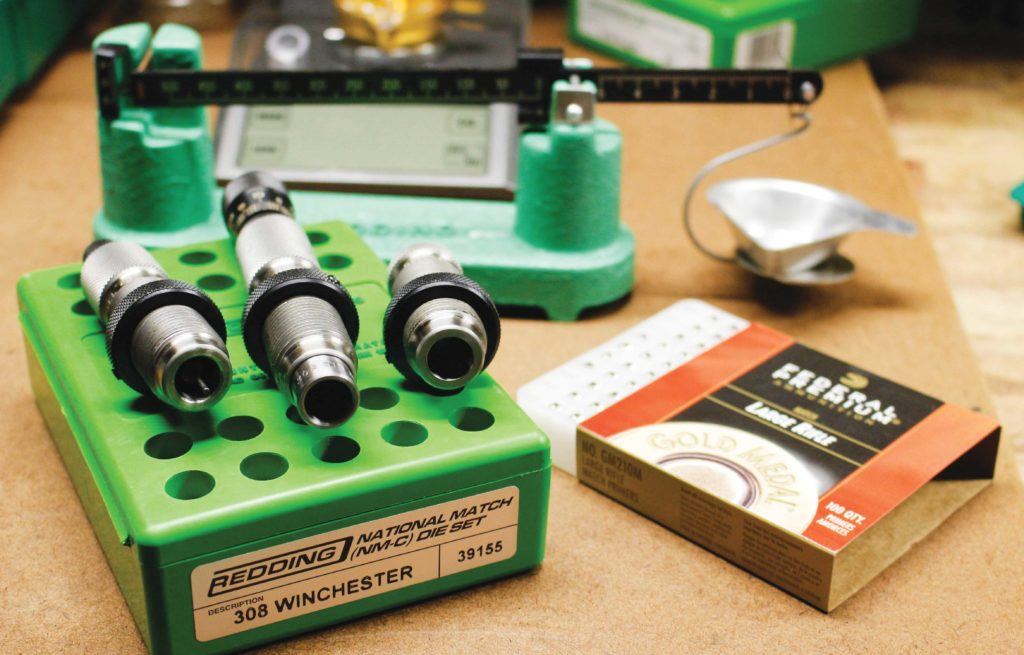
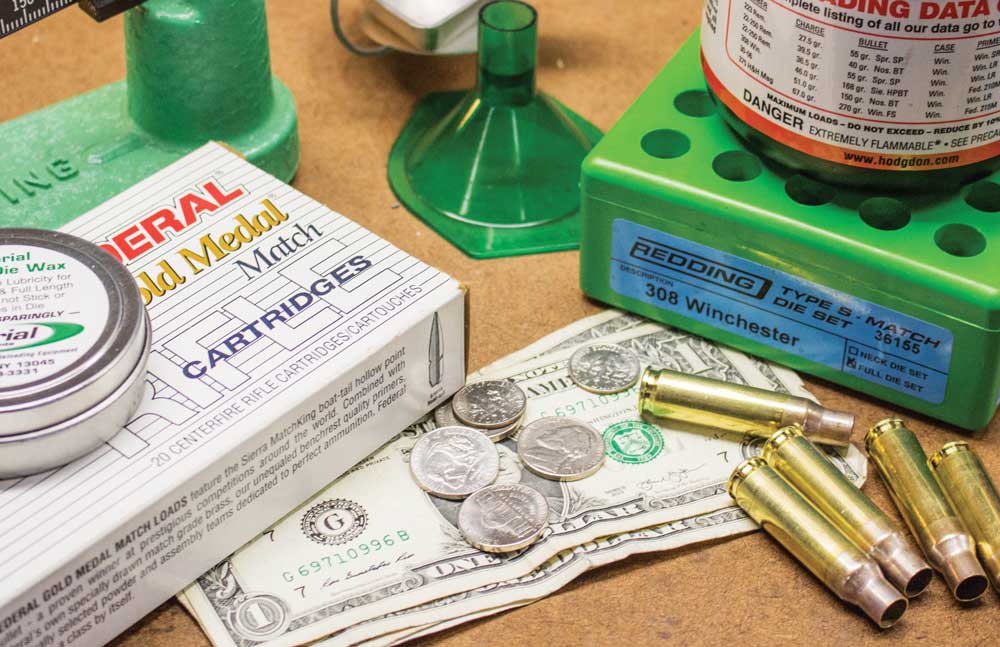
Let’s take a look at the cost breakdown for a box of ammunition, and while this is only one possibility, it should give you an idea of the financial layout. I’ll use the common .308 Winchester, loaded with 168-grain Sierra MatchKing bullets for the target shooter.
A box of 20 cartridges, as loaded in the Federal Premium Gold Medal Match line, has a street price of about $23, or $1.15 per round.
Were you to handload the same cartridge, you’d need the components as follows:
Federal Gold Medal Match primers are about $40 per 1,000, or $0.04 per primer.
Sierra 168-grain MatchKing bullets are $37 per 100, or $0.37 per projectile.
The Federal Gold Medal Match cases cost $22 per 50 pieces, or $0.44 per case.
This cartridge will consume roughly 44 grains of powder per shot, so using the popular IMR4064 powder, which comes at a price of about $30 per pound (there are 7,000 grains to the pound), and will cost about $0.19 per shot.
Add this all up, and you’ll see a price per round of $1.04. Add to that the cost of the reloading tools (which will eventually be recouped, though it might take a while), and you’ll probably agree that the factory ammunition is the better value, especially given the overhead costs.
However, value isn’t always measured in dollars and cents — customization and pride also matter.
Does that ammunition perform in your rifle or pistol? More importantly, will it be readily available? In the current market ammo is plentiful, but we can all remember the market just five years ago where shelves were empty and prices skyrocketed. I like to know that I can create my own ammunition — which has been proven in my own rifles — in spite of a drought, though I’ve seen reloading components become scarce as well. Brass cases can be reused, cutting down costs a bit, but the powders and primers — and most of the time, the projectiles — will need to be procured.
While the .308 Winchester is a common cartridge and, like the .30-06 Springfield and .223 Remington, it’s available at a reduced cost because of sheer volume, the financial comparison above may skew the decision in another direction if you shoot a different cartridge.
Looking at common street prices, a box of .300 Holland & Holland cartridges can range from $50 to $85, and I know I can make them for considerably less than that. The big bore safari rifles can easily exceed that; .416 Rigby cartridges can cost $5–$10 each, and the .470 Nitro Express can run as much as $18 per shot! I know that I will need to handload for the big sticks if I want to do an appreciable amount of practice with my safari guns.
Final Thoughts
In the end, I’m a handloader for several reasons: I thoroughly enjoy the hobby, and getting together with a couple buddies to cook up a new load for whatever rifle we’re working on has made many great memories. I love the experimentation and the challenge of finding a load for a particular troublesome rifle. I like the pride and self-reliance of being able to hunt and shoot with my own brand, it’s a source of pride almost as strong as making the shot itself.
Do I handload for high-volume shooting, say pistol practice, or short-distance drills with an AR? No, I don’t — this is one area where the bulk factory ammo is a great value. I’ve handloaded for at least some portion of every safari I’ve been on, and I hunt locally with handloaded ammo more often than not. While the best reloading tools are certainly costly (note that I do not say “expensive” because they’re worth the money spent), the end result is well worth the effort.
Buy the best you can, and spend more time with and around cartridges and firearms.
Editor’s Note: This article originally appeared in the July 2018 issue of Gun Digest the Magazine.
With a simple keystroke, you can build a set of custom 1911 grips to your specifications with Alumagrips.
How to get your own set of sharp lookers:
Alumagrips gives shooters the ability to design their own custom grips online.
The process takes nine steps to build a set to your specifications.
Color, thickness, size weight and custom engraving are among the options.
Custom artwork is directly uploaded to the website.
The cost runs between $50 and $100 depending on how elaborate the grips.
Almost every 1911 I own is fitted with Crimson Trace Laser grips. This is partly because I consider them more of a necessity than an accessory — they can help you shoot faster and with more precision. However, I also have an affinity for custom, non-electronic grips. My oldest and fanciest 1911, which is now semi-retired, wears a set of mammoth ivory grips and comes out of the safe for special occasions, such as weddings and parties.
I recently discovered a unique option for custom grips. They’re available from Alumagrips, and you can custom design them through the company’s website (AlumaGrips.com) by virtue of an interactive program. Production takes between 2 and 4 weeks to complete, and I was very pleased with the look and quality of the results.
When you get to the website, select the “Build a Grip” option. You’ll go through a nine-step process that helps you build grips to your specifications. You can choose between three colors, 13 checkering patterns, three checkering depths, two grip thicknesses, three grip sizes, two weights, three safety options, six magwell options and custom engraving. Throughout the process, a digitized image of a 1911 illustrates what the finished product will look like.
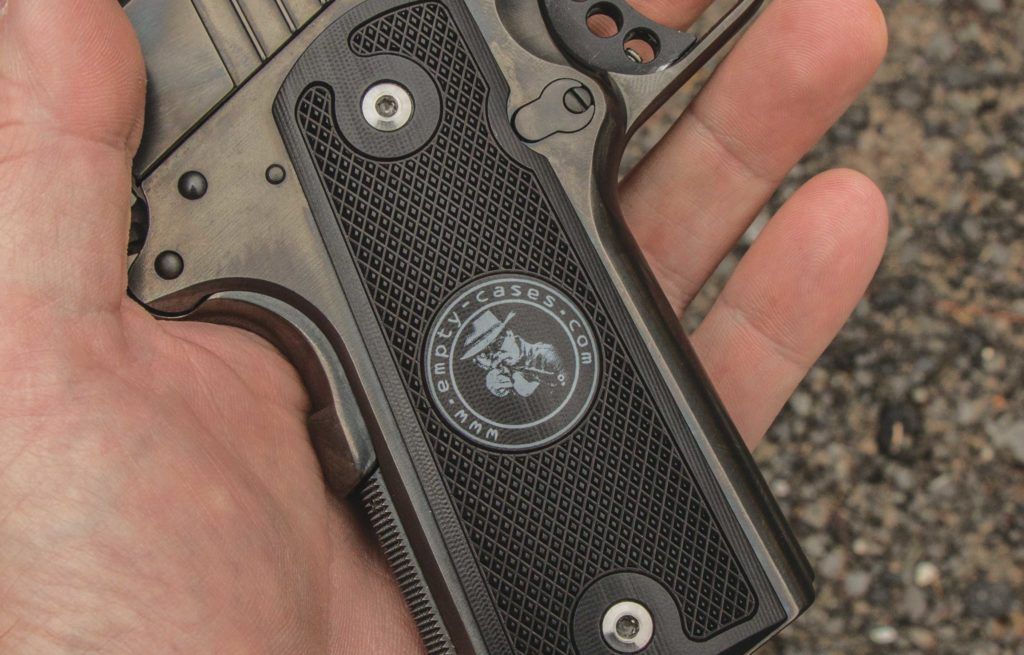
I thought it would be cool to have a custom set of grips with the logo from my Empty Cases website, so I ordered a thin set of lightweight grips in black for the Para-Commander I used to win the shoot-off during my first Gunsite 250 Pistol Course. I uploaded the artwork as directed by the website, and 2 weeks later the grips arrived, with thin stock screw bushings and new screws. They fit perfectly, and I was very impressed with the quality and detail of the engraving.
For serious shooting with a protection pistol, I prefer Crimson Trace laser grips. However, sometimes it’s OK to show off a little — and Alumagrips can help you do that with a distinct level of personalization. Cost? Somewhere between $50 and $100, depending on options selected.
6.5 Creedmoor ballistics are a thing of beauty and make the cartridge more than simply a long-range flyer.
What makes the Creedmoor so ballistically talented:
Designed with long-range match shooting in mind, 6.5 Creedmoor ballistics are among the best in caliber.
Improving 6.5 Creedmoor ballistics, excellent bullets with very high ballistic coefficients.
Their BCs helps them slip air resistence while minimizing wind drift.
Given its exceptional sectional density, 6.5 Creedmoor excellent hunting round that packs a punch when it reaches its target.
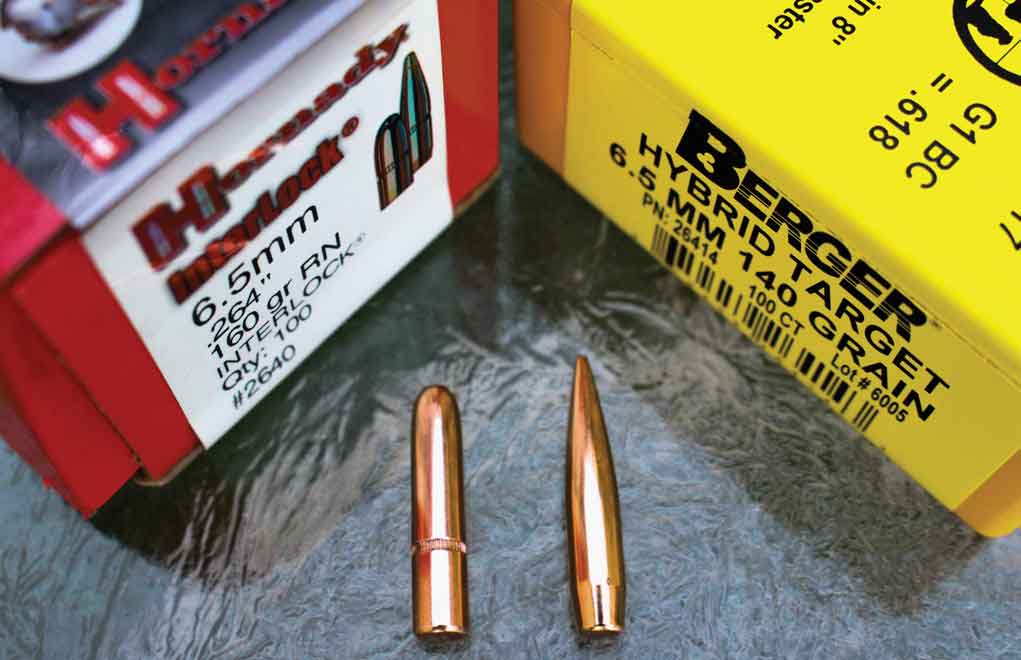
Among small-bore cartridges with headline status these days, the 6.5 Creedmoor ranks among the most unlikely—and the most useful! It emerged from the house of Hornady in 2008, brainchild of senior ballistician Dave Emary, who tapped competitive shooters like Dennis DeMille for ideas on 1,000-yard cartridges. A long-range marksman himself, Emary necked the .30 T/C hull (another Hornady product), to .264. The compact case kept overall length within limits imposed by short actions. Dave applied powder technology from Hornady’s then-new Superformance Ammunition, to get blistering velocity.
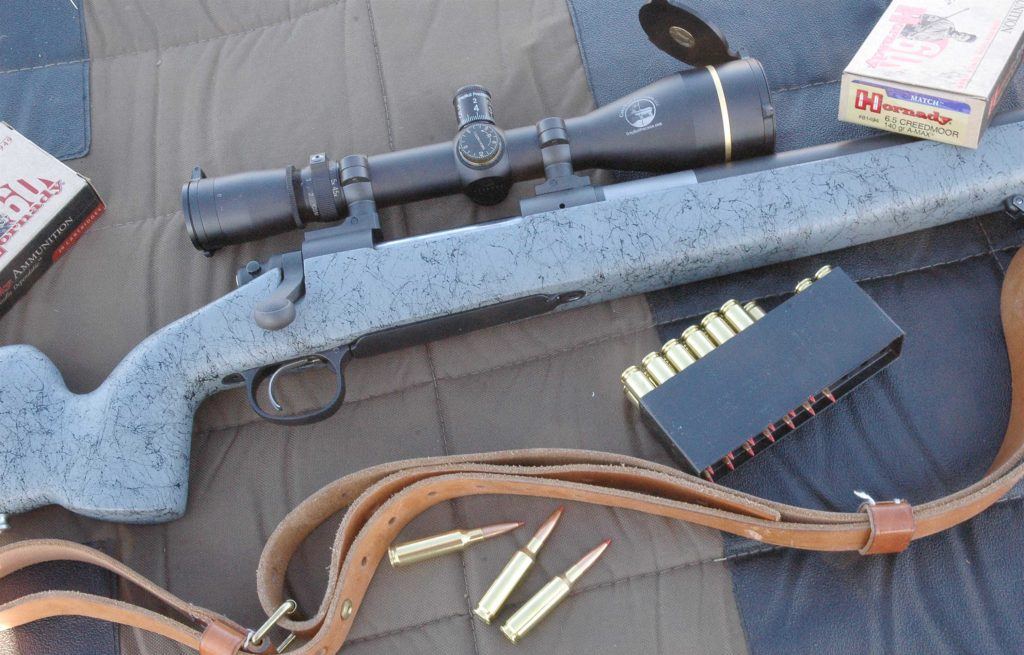
The 6.5 Creedmoor is more than a flat-shooting, light-recoiling target cartridge. It’s also ideal for deer and antelope. Not long after it hit shelves, Todd Seyfert, at Magnum Research, shipped me a rifle in 6.5 Creedmoor on a long 700 action. Its carbon fiber barrel had a stainless core rifled by Kreiger. GreyBull Precision provided the stock and a 4.5-14x Leupold. Prone with a sling, I was soon hitting plates at 500 yards.
In New Mexico, my hunting partner called a coyote across a mesa. At 250 yards, the dog collapsed to the bite of my 129-grain SST. That rifle also toppled an elk with one shot at longer range than I’d ever before killed an elk. Civil, accurate, and potent, the 6.5 Creedmoor challenges the .270 Winchester at the muzzle.
Downrange, the high ballistic coefficients of the 6.5’s 129- and 140-grain bullets give it an edge. Truly versatile, the Creedmoor has more sauce than a 6.5×55. Its 1.92-inch case accommodates VLD bullets in short magazines better than does the superb, but under-sung, .260 Remington. Light recoil and efficient burn suit it to compact, featherweight hunting rifles. Pressure is 60,190 psi, standard rifling twist is 1:10.
Everything about Sarsilmaz’s SAR 9 is built to impress — including the price.
What this 9mm brings to the game:
Sarsilmaz is Turkey’s largest small-arms manufacturer.
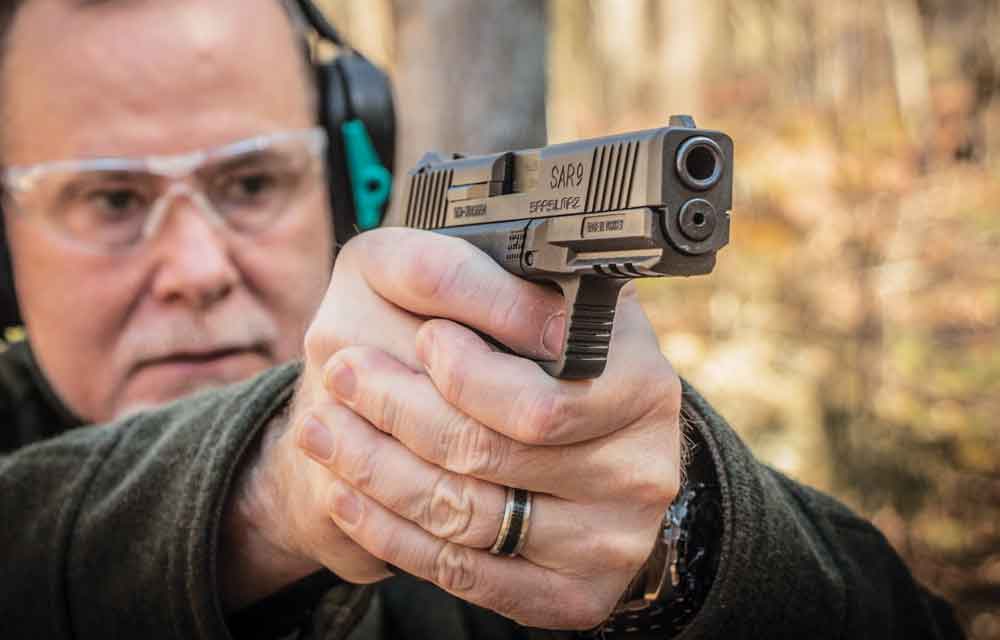
The SAR 9 is a duty-sized, polymer-framed striker-fired 9mm pistol.
It features a slide made of 4140 ordnance steel.
It also has an ambidextrous thumb safety.
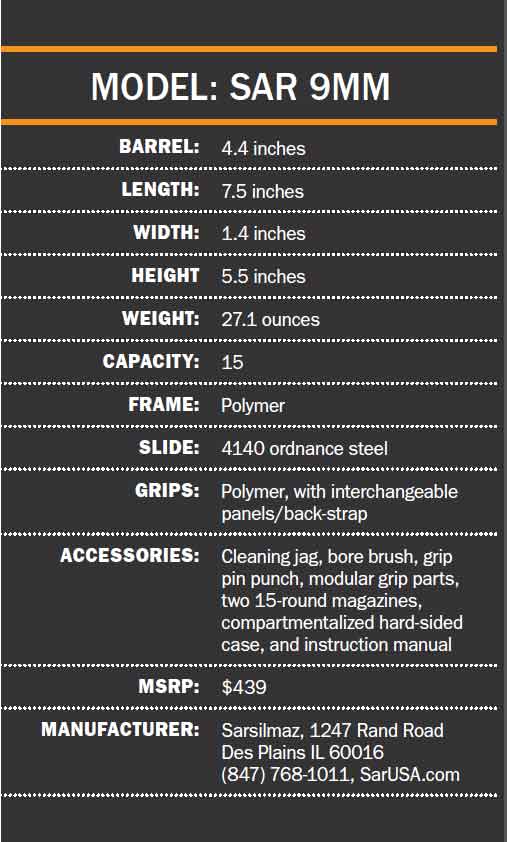
The pistol weighs in at 27 ounces and has a 15-round capacity.
Additionally, it comes with two backstrap replacements and two grip panels.
The takedown latch has raised stippling, which doubles as an index point.
The SAR 9 has an MSRP of $439
Since the introduction of the Glock pistol more than 30 years ago, we’ve seen a proliferation of polymer-framed handguns. The benefit to shooters is that now we have a plethora of affordable handguns to choose from. And, while they all might seem Glockish in design, there are subtle differences that set each of these plastic pistols apart. One relatively new offering you might not be familiar with is the SAR 9 from Sarsilmaz.
The Turkish-made Sarsilmaz SAR 9 is a full-size polymer pistol with a modular grip and ambidextrous thumb safety.
Sarsilmaz is a small arms manufacturer based in Turkey. In fact, it’s the largest small arms manufacturer in Turkey, and the company was founded 138 years ago. Sarsilmaz — which translated to English means “unshakable” — builds most of the weapons for the Turkish military and exports worldwide. Sarsilmaz firearms are imported into the United States through SAR-USA, which is located in Des Plains, Illinois.
I have very little experience with Turkish firearms, and I’ve never been to Turkey. The only “Turkish” related story I know comes from my father, who fought beside them — and soldiers from other countries — in Korea. Dad said the Brits only wanted to lounge on the back of their tanks and brew tea. But he said when it came to the Turks, you did not mess with them. According to my father, they were the most violent troops he’d seen — he said they were unshakable.
Out Of The Box
The SAR 9 — I just call this pistol the “Turk,” since “Sarsilmaz” is not a word that appears in the hillbilly dictionary — is a duty-sized, polymer-framed handgun with a robust slide made of 4140 ordnance steel. The pistol is more Glockish in look than in feel, and this is mostly due to its modular grip. Another unique feature of the SAR 9 is its ambidextrous thumb safety. Beyond that, it’s very much like any other polymer-framed handgun, both in operation and design.
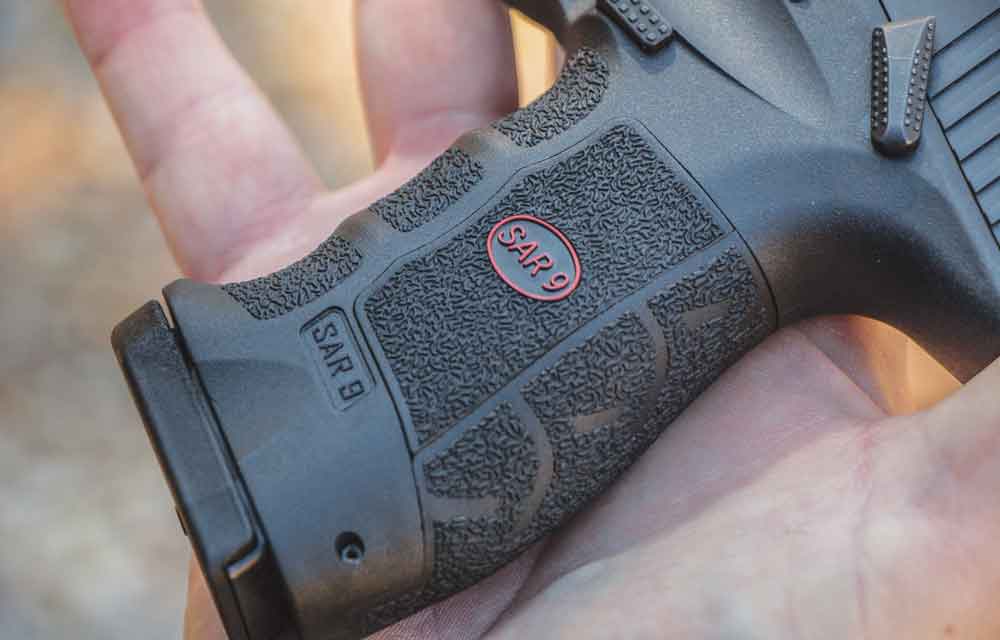
The grip on the SAR 9 has a removable backstrap and center panels to help you better fit the pistol to your hand.
The grip is very comfortable, and by removing a pin at the rear base of the grip (you’ll need the small punch, which is included with the gun, and a hammer to make this happen) the backstrap can be removed. Once the backstrap has been detached, the grip panels slip out.
The pistol comes with two additional backstraps and two sets of additional grip panels. By mixing and matching these, you can configure the grip to best fit your hand. I experimented with these parts for a bit, but I ended up liking the gun best as it came out of the box. Don’t get me wrong: I like the idea of the modular grip, I just didn’t need it.
The thumb safety, on the other hand, I really appreciated. One of the most common self-inflicted injuries with a handgun occurs when a shooter leaves his finger on the trigger when holstering. With a thumb safety that has been activated, this is near impossible to do. Unlike the thumb safety on a 1911 or Browning Hi-Power, the SAR 9’s thumb safety does not lock the slide. This means you can insert a magazine and cycle the slide to chamber a round with the thumb safety engaged in the “safe” position.
The thumb safety on the SAR 9 has a very low profile but is easy to manipulate.
One online review from a well established — but what I consider questionable — source, described the thumb safety on the SAR 9 as needing, “roughly half the weight of a fully loaded 747 to move the safety from the ‘safe’ to ‘fire’ position.” Maybe this fellow had a bad gun — that’s possible. Or maybe he just has girly hands — more likely.
In any case, the safety on the SAR 9 I evaluated operated as smoothly as a tuned 1911. With a flick of the thumb I could go from “safe” to “fire” or vice-versa. Of course we must recognize that many millennial pistoleros have no experience with, or have ever been trained on, a thumb safety. (Only you can protect yourself from the Internet!)
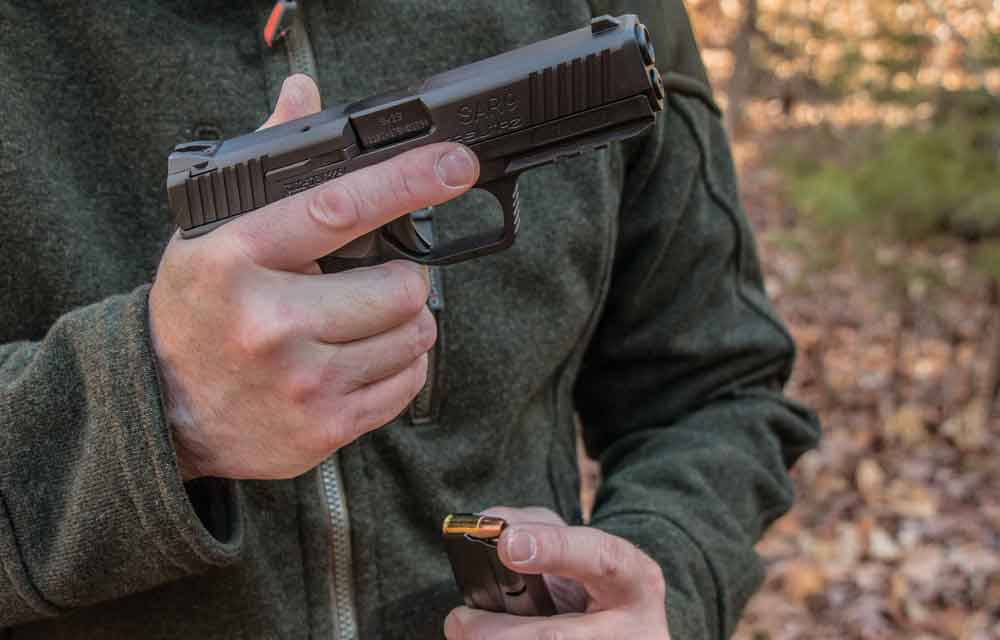
The SAR 9 comes with an integral accessory rail molded into the dust cover, and it field strips just like a Glock — pull the trigger, pull down on the slide release, and slip the slide off the frame. While I think the requirement to pull the trigger on a handgun in order to take it apart is an idea about as bad as leaving your finger on the trigger when you holster, the process (thanks to Glock) has now become the accepted norm.
The takedown latch on the SAR 9 is has raised stipples to help with pulling it down. Those stipples also serve as a great index point for your trigger finger when it’s not supposed to be on the trigger.
The Sarsilmaz SAR 9 is a duty-sized, high capacity 9mm handgun that’s manufactured by the largest gun maker in Turkey.
Overall, I liked how the SAR 9 felt and operated in my hand. I could depress the magazine release without alternating my grip on the handgun, and the magazines — both that were included — dropped free. For those who like to use a slide lock as a slide release, I could also easily depress it without altering my grip whatsoever, even on an empty magazine with full pressure from the follower pushing against the slide stop.
I also found the trigger guard much more comfortable than those on Glock pistols; the arch where it connects to the grip did not dig into the knuckle of my middle finger. This is not the only reason, but it’s one of the reasons I do not own a Glock.
Running The Forty-Five Drill
The long-time trend in gun magazines has been to accuracy or “bench test” any defensive handgun that’s reviewed. I’ve always been of the opinion this is of little value to the consumer. This is partly because of how a gun performs with a particular ammunition is no indication how another gun just like it will perform with that same ammo. It’s also partly because the time wasted measuring the group sizes a defensive handgun can shoot at 25 yards is time — and ammo — that could be better spent measuring other more important things. Fortunately, Gun Digest does not mandate that I waste my time when I review a defensive handgun.
I have a standard test drill to which I subject every defensive handgun I review. It’s a simple drill, but it’s also one that applies in personal protection. This is important because if you purchase a defensive handgun, your intended use for that handgun is very likely for it to protect you from bad things.
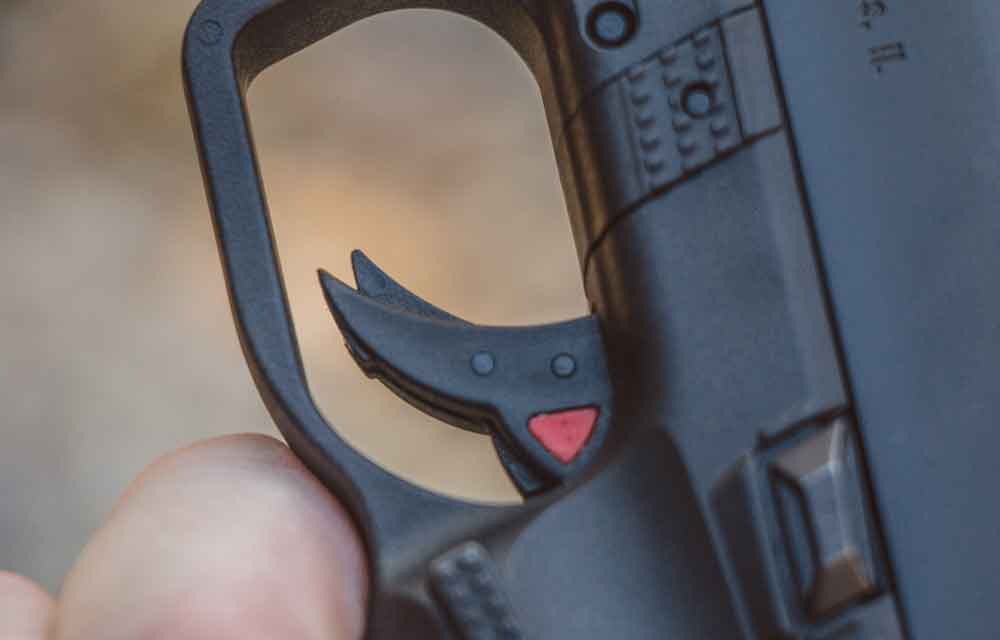
Like most modern poly-pistols, the SAR 9 has the flanged trigger that must be fully depressed before the gun will fire.
The drill is the Forty-Five Drill. It’s made up of four elements of five. You start 5 yards from the target, and the goal is to draw from concealment, and engage a 5-inch target, with five shots, in less than 5 seconds.
As easy as it sounds, it’s not. Most shooters — even good shooters — cannot complete the drill under time, with no misses, on their first attempt. Five or more runs through the drill is generally enough to highlight gross if not subtle issues with a defensive handgun. It also gives you a good impression about how controllable, reliable, accurate and user friendly a handgun might be.
I subjected the SAR 9 to five runs through the Forty-Five Drill. The average time was 3.75 seconds, and all times came in under the maximum allowable 5 seconds. With each run I became more familiar and proficient with the handgun, by about 2/10 of a second with each attempt, ultimately ending with a best time of 3.34. This is about average for me when using a 9mm semi-automatic I’m familiar with. The issue I had to acclimate to was grip angle: The SAR 9’s is different than that of a Browning HiPower or 1911 — the pistols I shoot most often.
As for accuracy or precision, a handgun that’ll put all five shots inside a 5-inch circle, at 5 yards, with an average time of 3.75 seconds, while drawing from concealment, is plenty precise for practical shooting exercises or a real-world personal protection situation. The SAR 9 performed very well.
With regard to reliability, most of the 500 rounds fired through the SAR 9 consisted of the four loads that were chronographed. However, several other munitions were selected at random to empty out some partially full boxes. There were only three stoppages, and all occurred with the very light recoiling NOVX 65-grain ARX ammo. This load simply did not have enough juice to fully cycle the heavy slide of the SAR 9.
In Your Holster
Maybe the main issue with the SAR 9 is holster compatibility: You’ll be lucky if you find it listed in a holster maker’s catalog. Fortunately, you should be able to find some holsters made for Glocks that are passable. Short of that, you’ll just have to tuck this Turk in your waistband. Hey, folks have been doing that — “Mexican carry” — with thumb-safety equipped 1911s for more than 100 years.
The SAR 9’s grip comfort, thumb safety and reliability are what the pistol has going for it. That, and its suggested retail of $439, which means street prices are likely less than $400. That’s a lot of gun for the money.
Is the SAR 9 the pest pistol in the world? Nope. But, I think it’s better than some that cost a lot more. You can’t cock and lock it, but you can damn sure put it on “safe.”
Be it nestled deep in a sniper’s hide or keeping the upper hand in defending your family, tactical guns and gear can give you a decisive advantage. Here are seven pieces of new kit that will make certain you thrive no matter your mission.
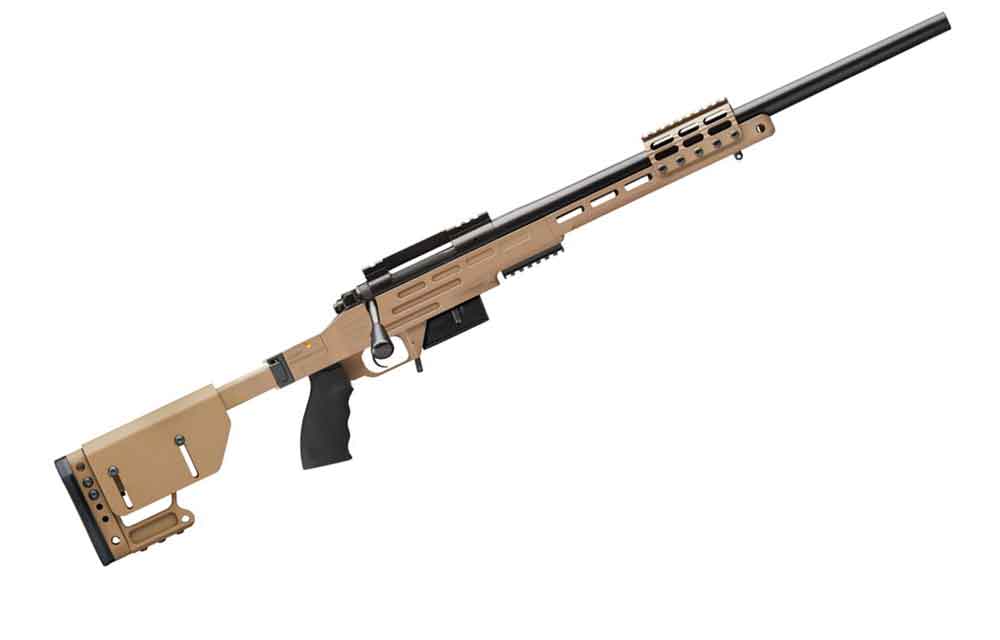
A no-compromise rifle built to meet the requirements of military, law enforcement professionals and serious precision rifle shooters, the Kimber Advanced Tactical SOC II (Special Operations Capable) is built by hand, boasting an adjustable aluminum folding stock, detachable box magazine and a threaded muzzle with thread protector. Available in 6.5 Creedmoor and .308 Win. chamberings, the Advanced Tactical SOC II boasts a highly coveted sub-0.5-MOA guarantee. Features include a match-grade chamber, M-LOK accessory rail, night vision mount and a three-position safety. $2,449.99
Nikon P-Tactical Spur Reflex Sight
Engineered with fully multi-coated lenses and Nikon’s proprietary TruColor coating — designed to eliminate the bluish tint that is common on reflex sights — the P-Tactical Spur features a clear view for both-eyes-open sighting. The sight’s 3-MOA dot is adjustable with 10 levels of brightness — the first two settings are night vision compatible — and centered within a 27x16mm sighting window for an extra-wide field of view with unlimited eye relief. Battery life is estimated at 15,000 hours of continuous usage, and the red dot in the display will flash to indicate low battery strength. $219.95
CMMG MkW Anvil XLR2
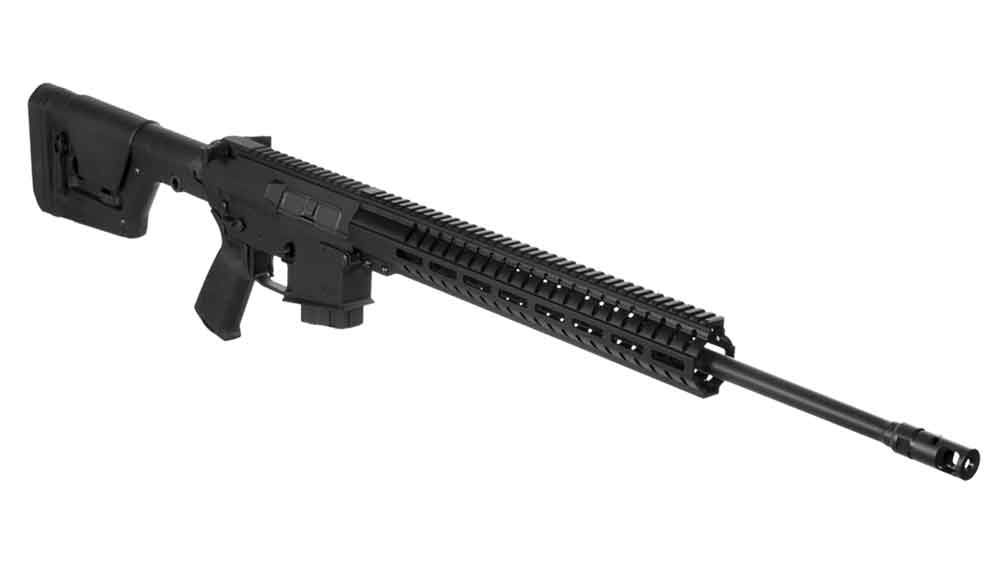
The all-new CMMG MkW Anvil XLR2 is chambered in 6.5 Grendel and features a 22-inch medium-taper barrel. The MkW Anvil is built on an AR-10-sized frame with the upper receiver shortened by ¾-inch to minimize weight and increase ergonomics, but the magwell on the lower receiver has been uniquely designed to accept standard AR-15 magazines to utilize the AR-10-sized bolt with calibers such as the 6.5 Grendel. Other features include a Geissele Automatics SSA 2-stage trigger, ambidextrous charging handle and safety selector, CMMG SV muzzle brake and M-LOK handguard. $2,299.95
Savage MSR 10 In.338 Federal
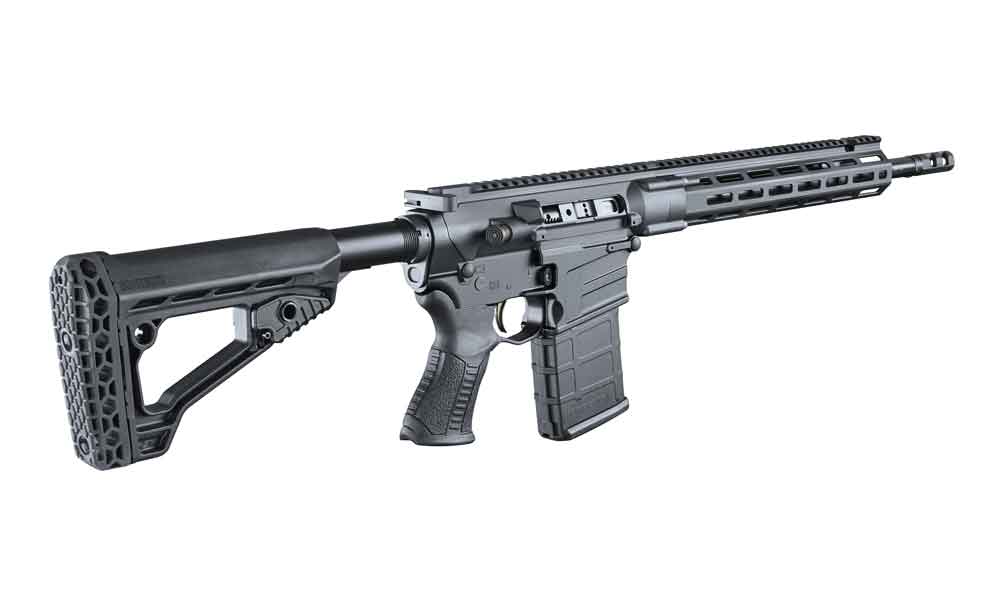
Savage’s MSR 10 Hunter is now available in .338 Federal. The MSR 10 Hunter delivers performance from its upgraded Savage barrel with 5R rifling, 2-stage trigger and tough Melonite QPQ finish. Other upgrades including a free-float forend, custom-forged lower receiver and Blackhawk adjustable buttstock and pistol grip. Built on the .308 Win. case and necked up to hold a .338-inch diameter bullet, the .338 Federal offers hunters a faster muzzle velocity than the .308 Win. — but with a heavier bullet. As a result, the short-action cartridge provides magnum energy for devastating performance on game, without magnum recoil. $1,479
Nighthawk Custom Ladyhawk 2.0 Pistol
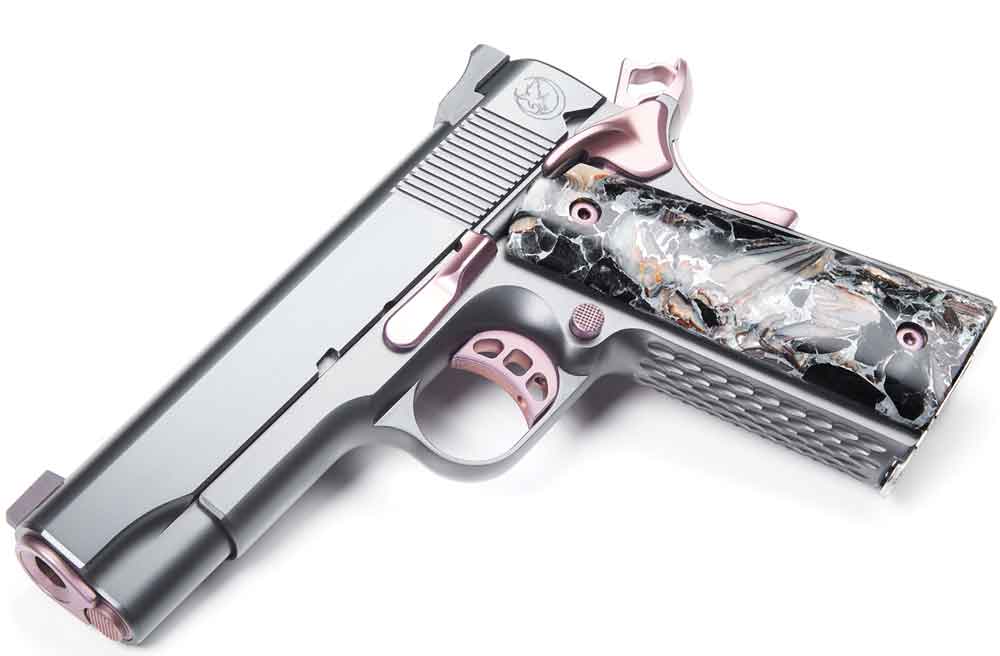
The Ladyhawk 2.0 is the first major upgrade to the Ladyhawk series of pistols. The slim-framed, commander-sized gun is available in both 9mm and .45 ACP, and the Ladyhawk 2.0 marries modern coating options, such as DLC and rose gold TICN with obsidian, abalone and zinc — creating a feminine pistol that boasts jaw-dropping aesthetics in addition to unparalleled function. Additional features include Heinie Slant Pro Straight Eight tritium night sights, thinned front strap and mainspring housing, serrated slide top, scalloped front strap and mainspring housing, shortened slide stop and beveled frame, and lightweight aluminum Nighthawk Custom tri-cavity trigger. $4,695
SIG SAUER 6.5 Creedmoor SIG HT Ammunition
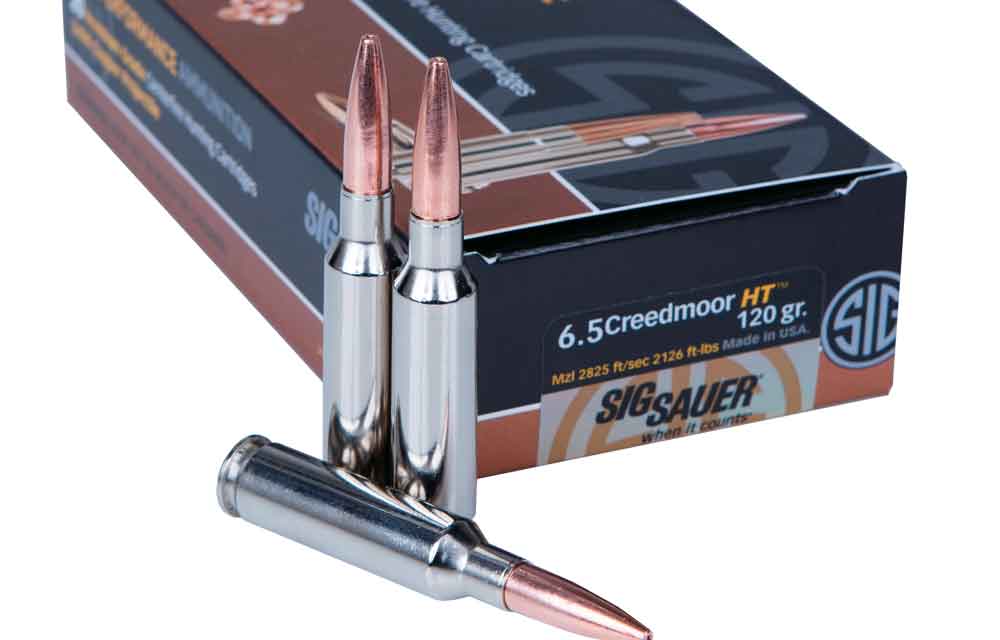
Like all SIG HT Elite Performance Ammunition offerings, the 6.5 Creedmoor features an all-copper bullet that delivers deep penetration and consistent 1.8X diameter expansion. The 120-grain bullet is capable of producing a muzzle velocity of 2,825 fps with muzzle energy of 2,126 fpe. In addition, SIG HT cartridges are made with nickel-plated shell cases, and flash-reduced propellant is used to minimize visible signature while shooting in low-light situations. SIG HT copper hunting ammunition is now available in five calibers: .300 BLK, .223 Rem., .308 Win., .300 Win. Mag. and 6.5 Creedmoor. $27.95
RISE Armament 1121XR 6.5 Creedmoor
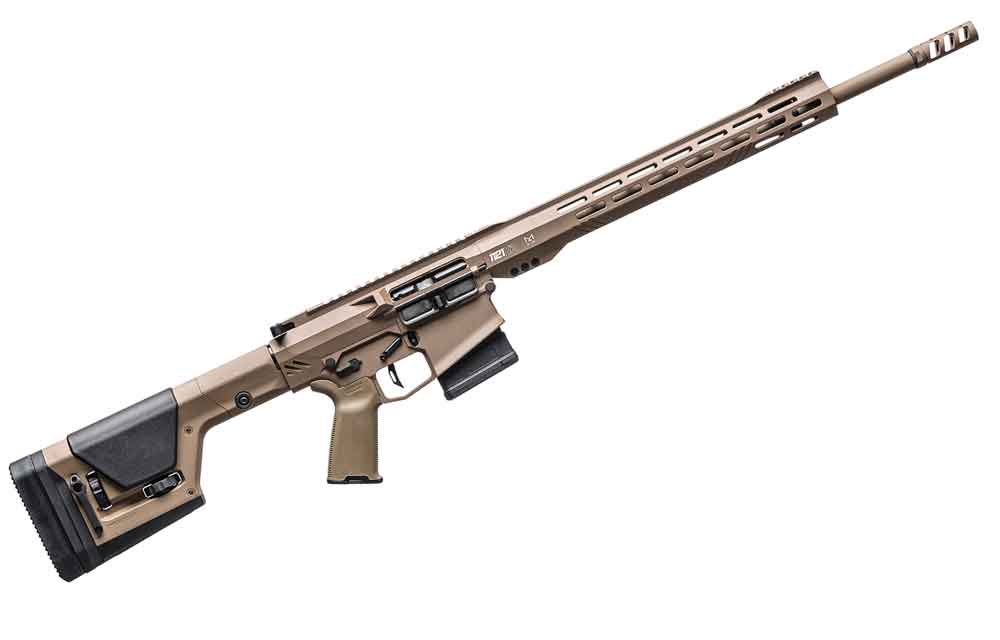
The 1121XR precision rifle is designed for those who want more out of a gas firearm. RISE has significantly reduced the weight while still guaranteeing sub-1 MOA accuracy. With the 1121XR, competitors and long-range shooters can have the accuracy of a bolt gun with the benefit of quick follow-up shots. The gun sports a 15-inch streamlined billet aluminum handguard that’s M-LOK compatible with a Picatinny upper rail. The RISE Armament RA-535 Advanced-Performance Trigger with a 3.5-pound pull boasts an incredibly crisp release and a short reset. Specifications include barrel length of 22 inches; overall length of 44 inches; and a weight of 10 pounds, 4 ounces. $2,449
Editor’s Note: This article originally appeared in the May 2018 issue of Gun Digest the Magazine.
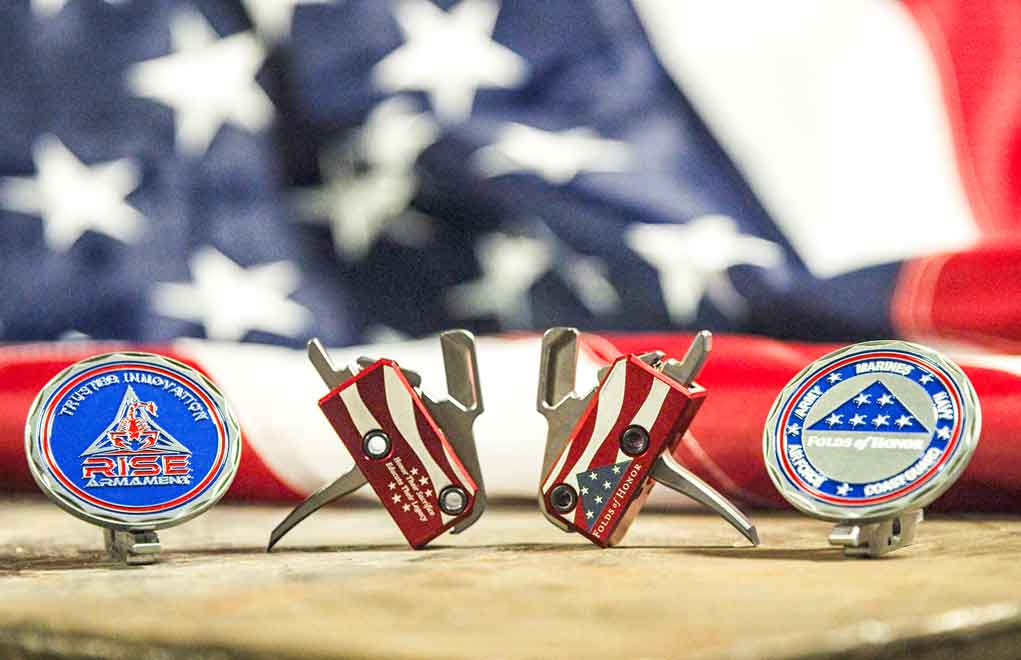
A portion of every Patriot High-Performance Trigger sold is donated to Folds of Honor.
How RISE’s new trigger is on target:
It is a single-stage drop-in trigger group with a feather-light 3.5-pound break and extremely short reset.
The straight trigger blade enhances shooter control and adds to a lighter-feeling pull weight.
An EXO nickel boron coating on interior parts reduces friction on contact surfaces.
The housing is bright red 8625 hardcoat anodized aluminum with an American flag and the Folds of Honor logo.
Included with the trigger is commemorative challenge coin with Folds of Honor on one side and RISE Armament on the other.
Study RISE Armament for any amount of time and you’ll find the Oklahoma company has an obsession — triggers. From the gunmaker’s standpoint, the entirety of a rifle — its performance, accuracy, dependability — all hinge off this one little feature. RISE’s preoccupation with triggers runs so deep they even designed a gun — the 1121XR Precision Rifle — around the company’s RA-535 Advanced Performance Trigger.
Memorial Day weekend RISE will release its latest precision trigger, fittingly named the Patriot High-Performance Trigger. And more than just sporting a red, white and blue finish, the upgrade shoots to go the extra mile in supporting veterans and their families. A portion of each sale of the Patriot High-Performance Trigger goes to Folds of Honor, which provides educational scholarships to the children and spouses of those who were killed or disabled while serving our nation.
“Saying we’re proud to help out and donate to Folds of Honor is an understatement,” says Matt Torres, president of RISE Armament. “Veterans’ families are often overlooked, which is really a shame. Our troops and their families have tremendous courage and have made so many sacrifices. It’s our duty as Americans, as patriots, to take care of them and honor what they’ve done for us all.”
The Patriot High-Performance Trigger itself sports some pretty impressive specs. The single-stage drop-in trigger group has a feather-light 3.5-pound break and extremely short reset, aiding both accuracy and rate of fire. Furthermore, it boasts a straight trigger blade for enhanced shooter control, as well as adding to a lighter-feeling pull weight.
The Patriot has a premium EXO nickel boron coating on interior parts for reduced friction and smoother contact surfaces. Additionally, it features a bright red 8625 hard coat anodized aluminum cassette housing with an American flag design and the Folds of Honor logo. Topping it off, it includes a commemorative challenge coin, which features Folds of Honor on one side and RISE Armament on the other.
The trigger is sold with free anti-walk pins and wrenches for installation and fits .223/5.56 and .308 AR-style platforms with Mil-Spec dimensions. Rise did not release the Patriot High-Performance Trigger’s MSRP.
For more information on the RISE Armament’s new trigger, please visit: www.risearmament.com
When a gun has been in production for more than 100 years like the SA-22, labeling its design as a ‘success’ is a massive understatement.
Why this semi-auto rimfire is one slick shooter:
The svelte little .22 rifle has been in production for more than a century.
It was designed by John Browning.
It was also the first semi-auto chambered for the .22 rimfire cartridge.
Spent casing are ejected downward.
The cocking button is on the underside of the receiver.
The Browning .22 Auto Rifle is a takedown.
Top examples of certain Belgium-made versions of the rifle can fetch $3,250.
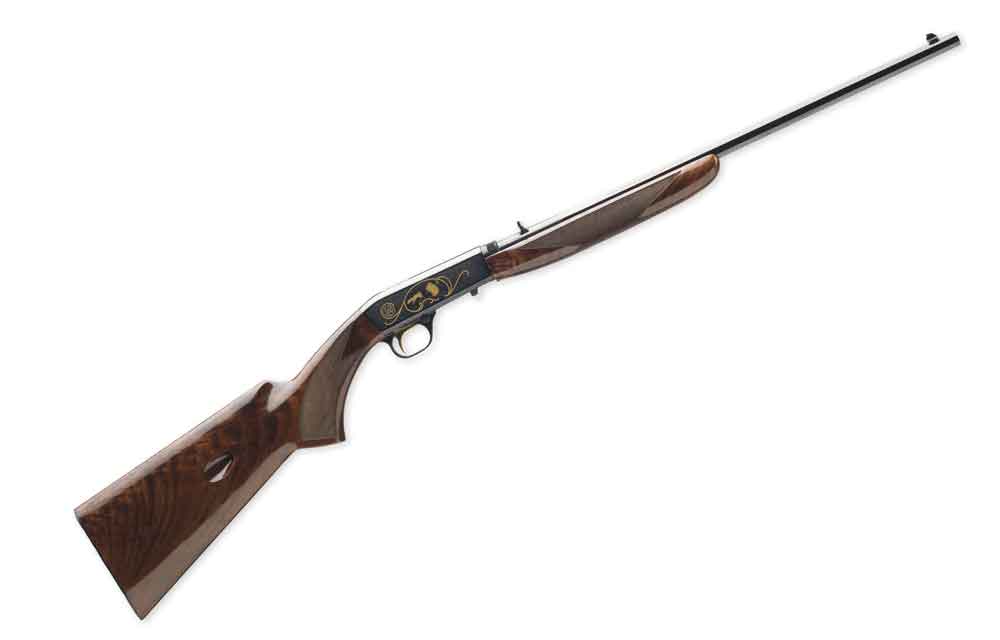
The svelte little .22 rifle, known by Browning variously as the SA-22, .22 Semi-Auto or just Auto Rifle, has been in production for more than a century. The John M. Browning design was the first semi-auto rifle made for the .22 rimfire cartridge. It has been called a rifle that was appropriately designed for its cartridge — slim, light and easy handling. It was manufactured by Fabrique Nationale in Belgium beginning from 1914, but it wasn’t imported to the United States until 1956. Production continued at FN until 1974, when it was moved to Miroku in Japan, where most Browning rifles and shotguns have been made ever since.
This Limited Edition SA-22 commemorates the 100th anniversary of the rifle.
A similar rifle was made by Remington from 1919 to 1949 as the Model 24 and 241, under license from Browning. The main difference in the Browning and Remington versions had to do with a slight variation in the take-down system for removing the barrel. The Brownings were also cosmetically a bit nicer, with attractive checkering, wood, fit and finish.
I recall as a youngster seeing my first Browning .22 Semi-Auto at a gun store in downtown Austin, Texas, and being quite impressed. This was in the late ‘50s, and I recall the price being about $85. I was especially impressed with the .22 Short model.
My experiences with Texas fox squirrels taught me that .22 Short hollow-points were a fine choice for bushy-tails at reasonable ranges. Over the years I kept telling myself that I really needed one of the Short models, but somehow I never got around to buying it. They have been discontinued for several years, and these days the used ones are going for $1,000 or more. Lesson here for younger shooters — don’t wait too long for something you really “need.”
The Unique Browning .22 Auto Rifle
The .22 Auto Rifle design has several unique features that many shooters find appealing. The most noticeable is the downward ejection of empties. I’ve heard that this was to avoid ejecting the shells into the face of a person standing next to the shooter — the downside is that a hot shell can drop down into the sleeve of the shooter’s shirt.
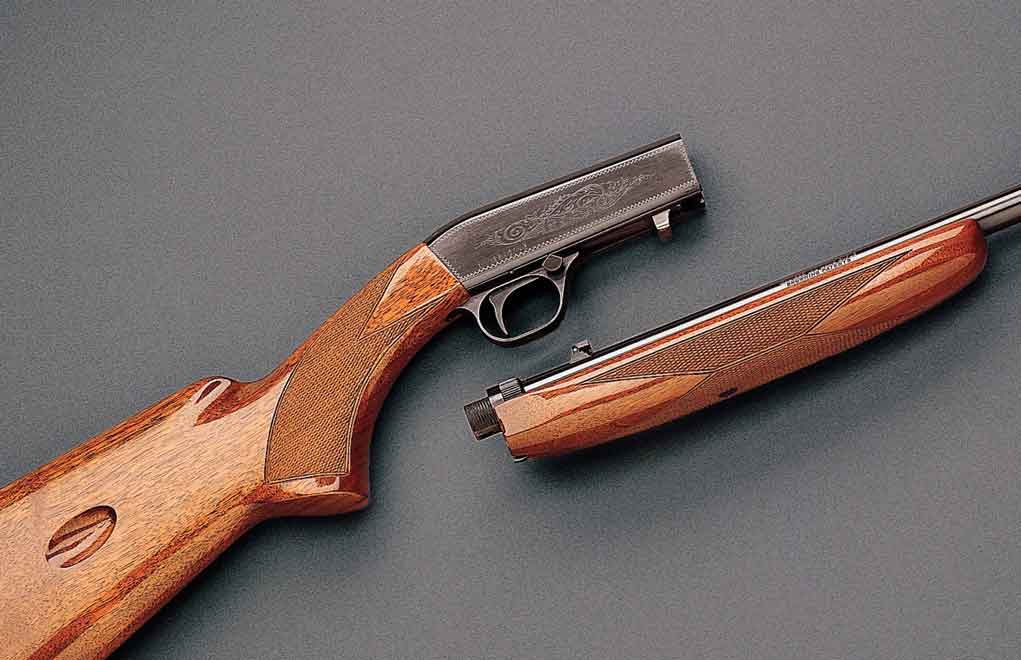
One of the SA-22’s flagship features is an easy take-down system for removing the barrel.
Another distinctive feature is the cocking button on the underside of the receiver. This design, coupled with the ejection port on the bottom, gives the SA-22 a nice, flat surface on both the right and left sides of the receiver. Previously mentioned is the take-down feature, allowing the barrel to be easily removed without tools by way of the knurled ring at the rear of the barrel that can be turned with the fingers.
Operation of the Browning .22 Auto is simple: Turn the loading tube in the buttplate to the left and pull it out far enough to expose the port on the right side of the buttstock, insert up to 10 .22 LR cartridges or 16 shorts (if you have a shorts-only model), reach under the receiver in front of the trigger guard, and pull back and release the cocking lever.
Make sure to use the button-operated safety in the front part of the trigger guard. Some of the early models have the loading port on top of the buttstock, directly behind where the stock meets the receiver. I believe these models are made in Belgium and marked “Fabrique Nationale” and not “Browning.”
What To Look For In A Browning .22 Auto Rifle
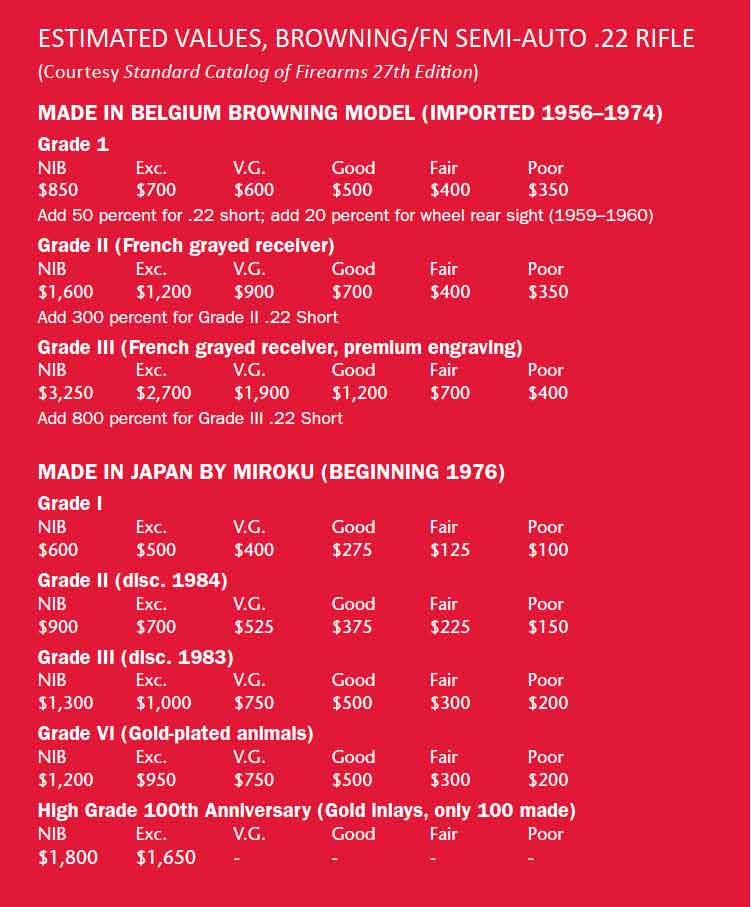
There have been several high-grade models with varying levels of engraving and wood. Some SA-22s I’ve seen had very nicely figured walnut stocks. The chart shows some current values, courtesy of the 2017 edition of Standard Catalog of Firearms.
Many collectors, as is often the case, are mainly interested in older models, especially those made in Belgium. The Miroku rifles, however, are very high quality and will likely show increases in value in the future. For small-game hunting or casual plinking, there isn’t a nicer .22 to take on a stroll in the woods than the Browning SA-22.
Editor’s Note: This article originally appeared in the May 2018 issue of Gun Digest the Magazine.
Making reloading a whole load more precise, SIG has released a full selection of pistol and rifle brass as individual components.
The word on SIG’s cases:
These are the first individual reloading components SIG has offered.
There are eight pistol calibers available and nine rifle.
Reloaders have the option between primed and unprimed pistol brass.
Pistol case come in 100-count bags, rifle 50-count; there is no word on MSRP.
At one time reloaders were a bit of an oddity. While the rest of us were out shooting, they were whiling away their time in some musty basement making certain no meplat went untrimmed or primer pocket un-swaged. They were kind of the obsessive-compulsive cousins in the shooting family tree.
Now, everyone reloads seems to reload. It makes a world of sense the discipline has burned hotter than a .22-250 round with a compressed load of H380 as of late — the industry has made it easy. The equipment and components have never been better made, more accessible or more affordable than today. And the list of players in the handloading game continues to grow.
The most recent entrant is SIG Sauer, who this week announced it would offer ammunition components for handloading immediately. This is a fast pivot for the company, given it was only a few years back SIG first began manufacturing ammunition in the first place. But in a short time it has made quite a name for itself with its Elite Performance Ammunition.
Initially, SIG is concentrating on shell casings with full lines of rifle and pistol brass for some of the most popular calibers. There is no word if they plan to expand operations from there, which might be OK given the attention it’s paying to oh-so-vital brass.
“Each brass case undergoes rigorous in-line and post-production quality assurance testing to ensure a flawless casing,” said Brad Criner, Senior Director, Brand Management and Business Development at SIG SAUER Ammunition. “The result is unparalleled durability and dependability.”
Interestingly, the Elite Performance Ammunition cases have two options in its pistol brass — primed and unprimed. This is somewhat unusual, but for those willing to give up a bit of control on the ammunition they churn out it could prove a real timesaver. All the rifle shells, on the other hand, are unprimed; they are, however, induction annealed for consistent bullet retention.
SIG has made a particular point to talk up the tight tolerances and geometric consistency of its primer pockets and flash holes. Additionally, it promises superior “metallurgical properties” in their cases, leading to their long reloading lives.
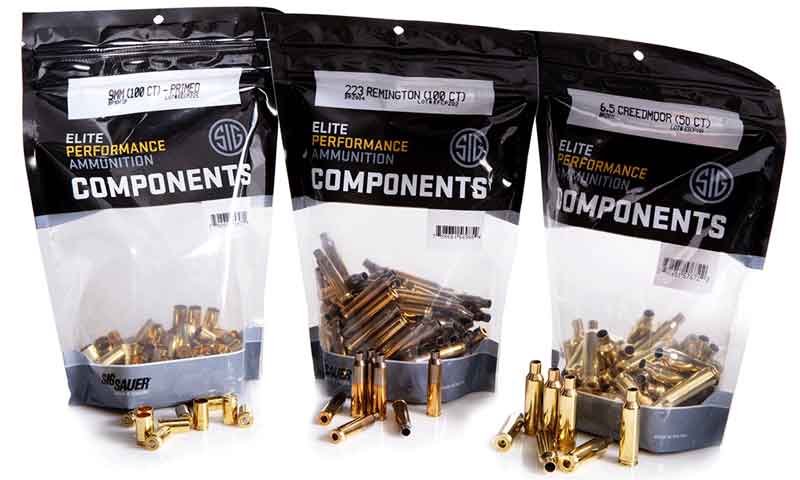
Pistol component cases are available, primed or unprimed, in bags of 100 in the following calibers: 380 Auto, 9mm Luger, 357 SIG, 38 Spl, 357 Mag, 40 S&W, 10mm, 45 Auto.
Rifle component cases are unprimed and available in bags of 50 in the following calibers: 223 Rem, 22-250 Rem, 243 Win, 300 BLK, 300 Win Mag, 308 Win and 6.5 Creedmoor. Coming soon in: 270 Win and 30-06 SPRG.
For more information on SIG Sauer reloading components, please visit: www.sigsauer.com
Shooting the 30th Anniversary Colt Delta Elite proves the 10mm ammo has come a long way.
How is the old 10mm new again?:
The round has languished since the birth of the .40 S&W.
In 2002, Doubletap began offering 10mm loads, which help rejuvenate intrest in the round.
Able to spite a 165-grain bullet 1,350+ fps at the muzzle, the round is a stiff shooter.
However, there are loads — such as from Hornady — that make the caliber as manageble as shooting a +P .45 ammo.
The 10mm Auto cartridge was introduced in 1983 for the infamous and now defunct Bren Ten pistol. Though some credit Jeff Cooper as the inventor of both, he was not. An inspiration, on the other hand, he was. The round appeals to defensive handgunners because it replicates the power of the .357 Magnum out of a semi-auto pistol, with a higher capacity than the .45 Auto. But it never really caught on. The high price of the ammo was proportional to its recoil, and most shooters find both unpleasant.
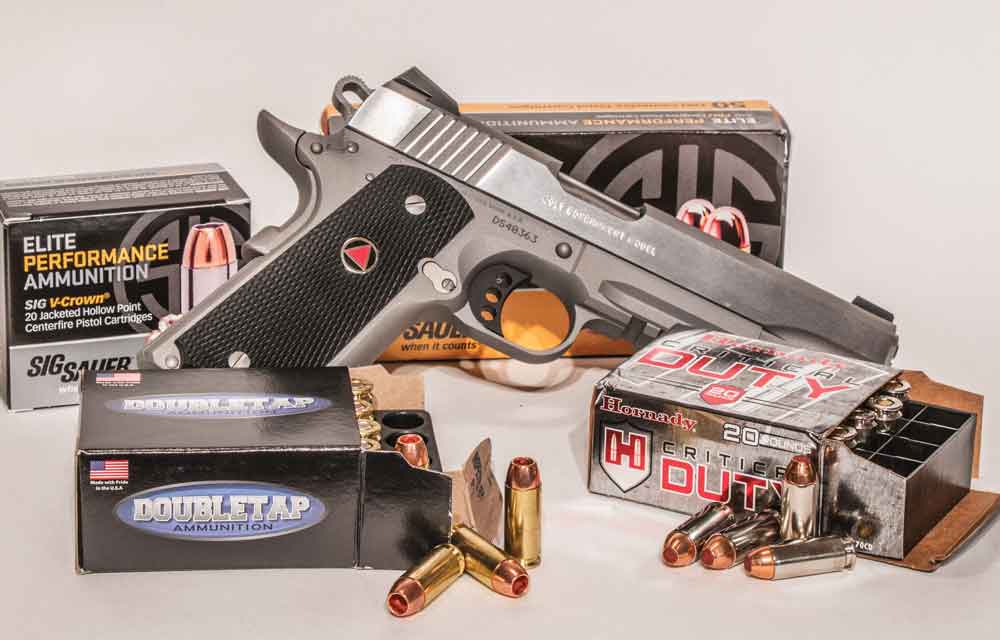
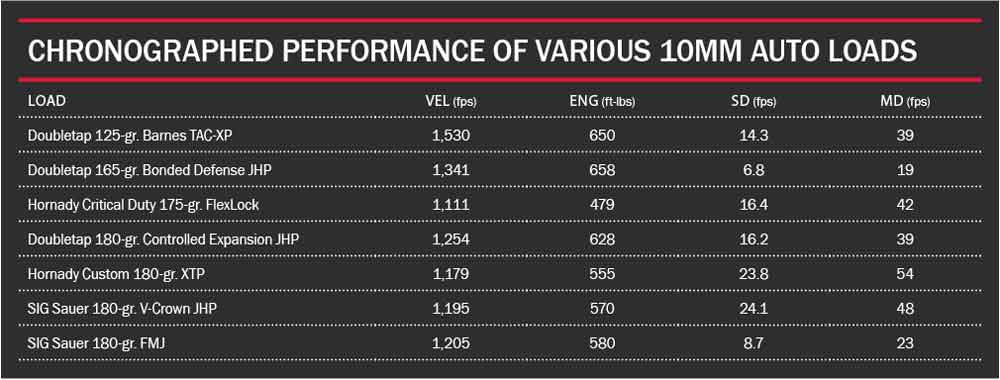
The 10mm gained its fame in the Colt Delta Elite (1987) and was briefly the darling of the FBI. This short-lived affair faded with the birth of the .40 S&W, and the 10mm has sort of languished since. However, Doubletap — initially a boutique ammunition manufacturer out of Utah — began offering a variety of 10mm loads in 2002. This fed the limited but enthusiastic demand and unquestionably rejuvenated interest in the cartridge. So much so, for 2017 Colt celebrated the 30th anniversary of its Delta Elite with a new version equipped with a rail. I procured one for testing and figured it an ideal opportunity to discover what external ballistics could reasonably be expected with modern 10mm loads.
If you can handle the recoil of a .45 Auto, you can handle a 10mm. However, handle and manage are two different things. A 165-grain bullet exiting the barrel of a 40-ounce gun at a confirmed 1,350+ fps generates more than 650 foot-pounds of energy. If you describe that as pleasant, you’re lying. If you think you can control it as easily as a .45 Auto, you’re full of sheep dip. On the other hand, available 10mm loads from Hornady will emulate the recoil of +P .45 Auto loads, which are stiff but not hand-numbing.
The 10mm genuinely fills the niche of a semi-automatic hunting handgun, and high-end shops such as Nighthawk and Wilson Combat offer pistols ideally suited for that pursuit. Of course, if you have a Napoleon complex, the round will surely impress your friends, or at least yourself, while at the range.
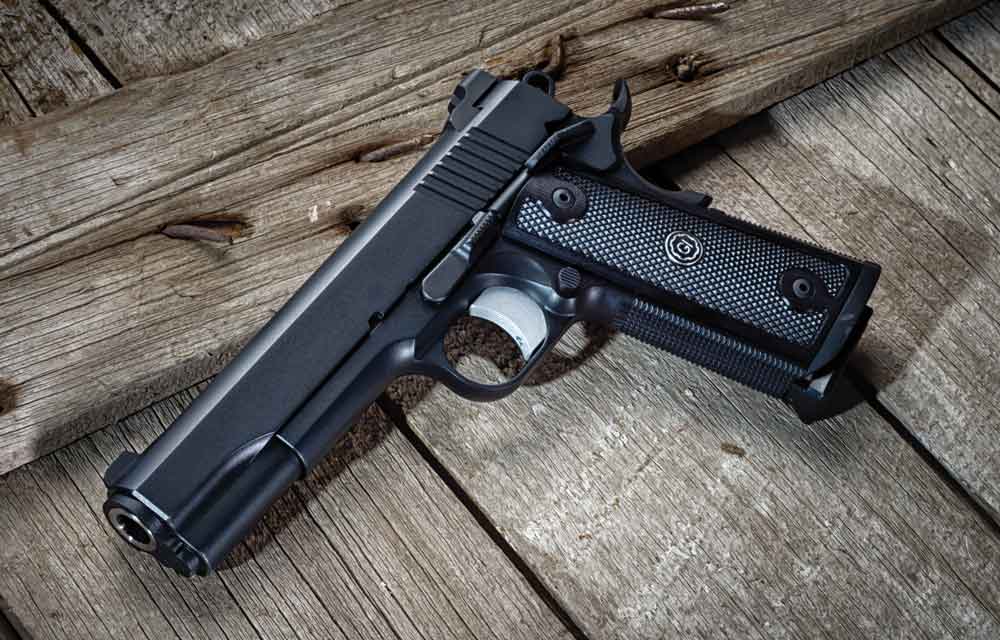
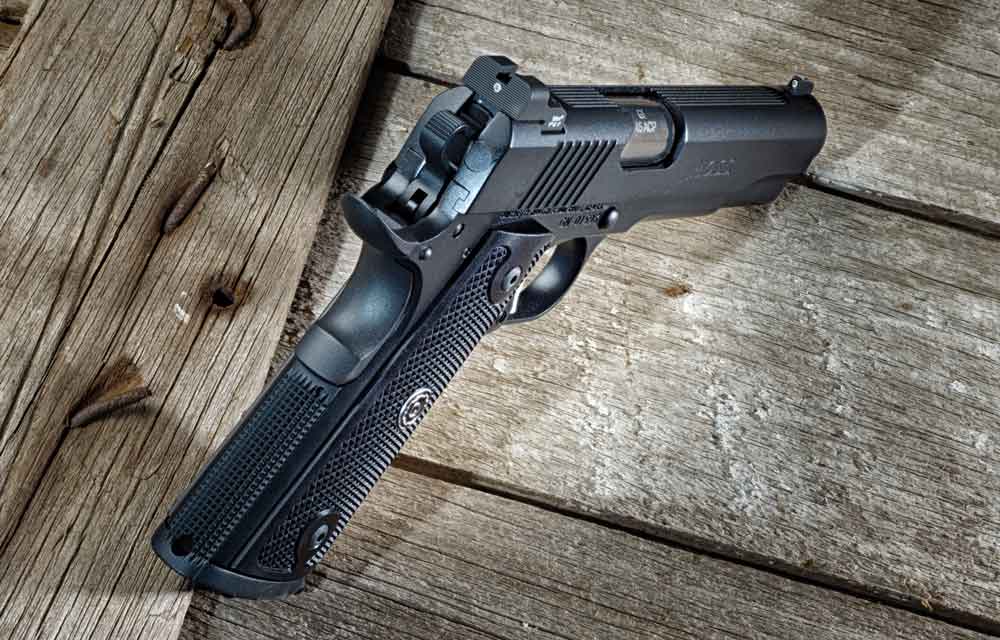
Though the new Colt Delta Elite Rail Gun exhibited all the sharp edges common to Colt’s 1911s, the trigger was decent, functioning was excellent, and accuracy superb. You can pick one up for about a grand. And, you now have a lot of 10mm loads to choose from. Some of those epitomize pure wickedness; others remind you of a .40 S&W. Like Baby Bear, you should be able to find one just right for you.
The Guncrafter HOSS is an overbuilt version of Browning’s classic 1911, designed to address some of the common failure points on that particular pistol.
How this beefed up 1911 is engineered to last a lifetime:
The Guncrafter HOSS was conceived as a 1911 that would last a lifetime.
To do this, Guncrafter’s engineers addressed common failures in the design one by one.
Nearly every facet of the gun is beefed up, from its magnum-sized extractor to a larger barrel link.
Additionally, the barrel wall thickness was increased by 56 percent.
With extremely tight fitting, the gun performs admirably and is as accurate as fussier 1911s.
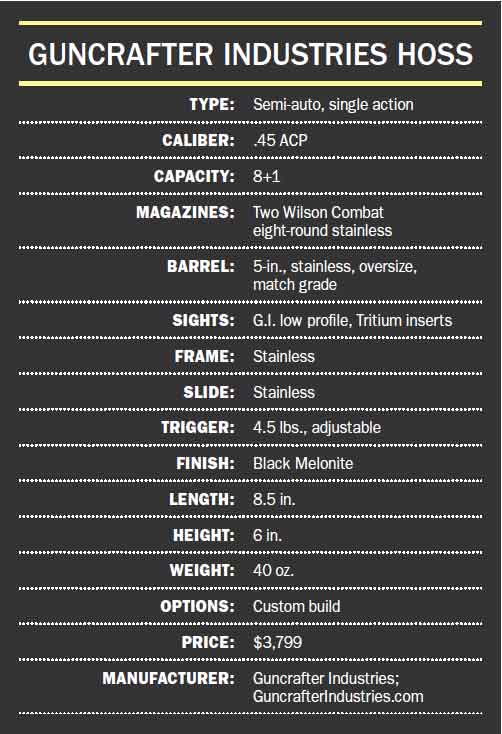
The 40-ounce Guncrafter HOSS has 8+1 capacity and is constructed from stainless steel.
The pistol’s MSRP is $3,700.
If there were a book of firearms successes, probably the first chapter would be dedicated to John Browning’s 1911 pistol. Designed in 1908 and adopted by the U.S. Army in 1911, it’s a design that’s stood the test of time for more than 100 years, and it’s still as popular as ever. There are dozens of companies producing 1911s, but only a few of those makers truly approach the undertaking of building the best pistol possible as a serious challenge.
The HOSS is expensive, sure, but it’s a perfect combination of good looks and rugged durability.
Obviously, the pistols Guncrafter Industries — located in Huntsville, Arkansas — makes are built to sell, but they’re built to sell to the most discriminating buyer who’s only satisfied with the best gun money can buy. In my experience as a writer, I’ve tested four Guncrafter guns and never experienced a single malfunction. It’s easy to build a 1911 that doesn’t malfunction, but to build a 1911 that’s capable of shooting rifle-sized groups off a Ransom Rest without malfunctions is another story.
Beefing Up The Hoss
When the HOSS project was undertaken, the idea was to build a pistol that not only was accurate, but also reliable, not just for range sessions, but for a lifetime. Like all other mechanical devices, the 1911 design has weaknesses: Those who’ve shot thousands of rounds through them have experienced breakages that relate to those weaknesses.
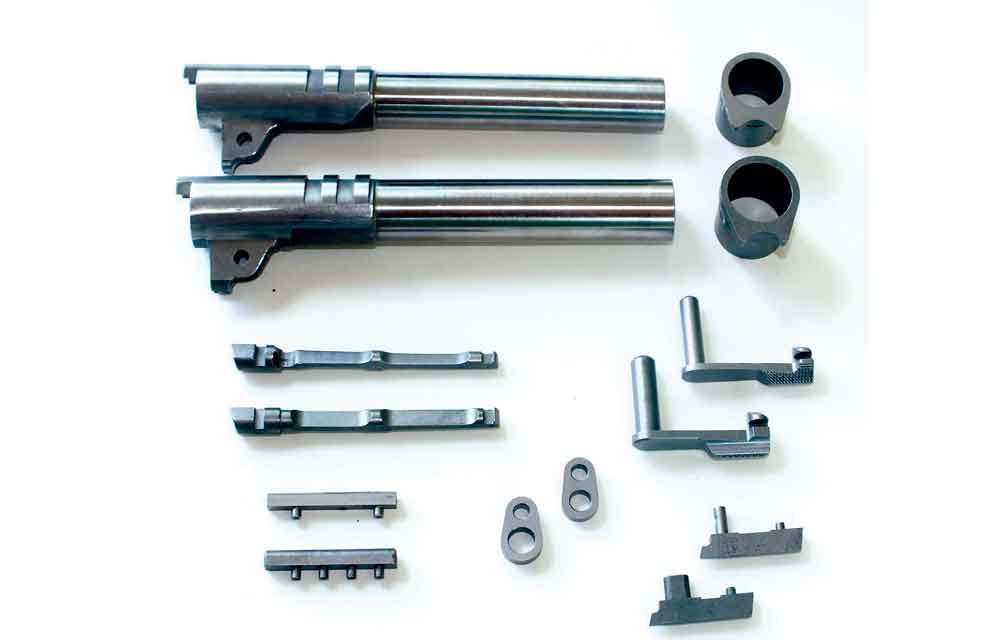
The engineers at Guncrafter Industries considered every one of those common failures and addressed them — one by one. The extractor is beefed up, and the slide stop pin is increased in diameter by 33 percent. The plunger tube is also fattened up, and two more location pins are added. The ejector is increased to twice the normal size, and the width of the barrel link is increased and the material improved over standard.
In addition, barrel wall thickness is increased by 56 percent. The lower lugs are beefed up, and, finally, the barrel bushing is not only larger in diameter to accommodate the larger diameter barrel, but it’s also thicker in the front portion that locks into the recoil spring plug.
A tight fit between the slide and frame is always an important factor on a 1911, and Guncrafter’s HOSS doesn’t disappoint.
Each of these modifications represents the elimination, or at least a greatly reduced chance, of failure of these parts. The official reasoning behind the “HOSS” designation of this model is “Heavy Operating Shooting System.” Personally, when Alex Zimmerman described the gun and told me the name, I automatically agreed “HOSS” was perfect, thinking of Hoss Cartwright of the Bonanza TV series.
Maintaining The Hoss’ Finesse
So, it’s established that the new gun from Guncrafter Industries is designed to be reliable, both in the short and long-term, but making a gun reliable generally comes at the price of gilt-edged accuracy. Super accurate 1911s have a reputation for being fussy about ammunition and somewhat fragile. Accomplishing extreme reliability while maintaining pinpoint accuracy is where the gunmaker’s art comes into the equation.
Accuracy in a short-recoil-operated pistol requires precise fit of several critical parts. First, the barrel must fit closely in the bushing or bearing surface on the front of the slide where the barrel moves. Second, the barrel must lock up consistently to make sure there’s no barrel tilt when the gun is fully into battery. With a 1911, this is accomplished by careful fitting of the locking lugs and having the correct barrel link to assure the barrel is fully engaged in the top of the slide recesses.
Third, the slide itself must have a minimum of play on the slide rails because it controls the front of the barrel, and the sights are mounted on the reciprocating slide. Proper fitting of the slide on the rails assures repeatable positioning when in battery. All these operations, along with a high-quality barrel, provide accuracy, but of course, the better the work, the more accurate the gun.
Seven components of the basic 1911 were beefed up to produce an even more bulletproof gun than a standard 1911. (Author Photo)
There are other factors that affect accuracy in terms of the shooter interfacing with the firearm because if the gun has poor sights or an inconsistent trigger, the shooter will be unable to utilize the inherent capabilities of the gun. To allow an improved level of interface, the Guncrafter Industries HOSS is provided with high-quality sights: low mount night sights with Tritium inserts grace the slide and allow heel cocking off the stepped forward face of the rear sight.
While a gun with a mediocre trigger can provide great accuracy, it makes it much harder for the shooter to achieve that accuracy. Guncrafter Industries has provided the shooter with the optimum opportunity to utilize the accuracy potential of the HOSS by shipping it with one the best triggers I’ve ever felt on a 1911. The trigger break is crisp with no creep, and there’s no visible or tactile backlash. My test gun broke at 4.5 pounds, the lightest trigger that should be used for a defensive pistol.
The Hoss Proves A Theory
Of course, I had no expectations of being able to test the HOSS to failure level. The time-tested 1911 has the reputation for extreme reliability in the toughest of conditions, and I expected no less of the HOSS. Still, I decided to run a few hundred rounds through the HOSS, and, as expected, I didn’t experience a single malfunction, even with light-loaded semi-wadcutter match loads. Accuracy was far beyond my capability, as has been the case with every gun I’ve ever tested from Guncrafter.
I tested it with Winchester 230-grain hardball, Winchester 185-grain Silvertip defensive ammunition and even some 185-grain semi-wadcutter match loads. Normally, those light loads won’t run in guns set up for service or defensive loads, but the HOSS is so well fitted and smooth operating that they ran without a hitch. On a couple of occasions, the slide didn’t lock back on the last round, but these loads aren’t meant for use in guns with standard recoil springs and generally give guns with standard springs a fit.
Off the bench, I managed a 10-shot, 1.123-inch group at 25 yards with the Winchester 230-grain hardball. I feel certain a good shooter could win leg points in a CMP Distinguished Pistol Shot match with this out-of-the-box handgun, and that’s quite a statement. My standing 10-shot groups at 15 yards were ragged holes, and fast shooting at that distance produced well-centered groups. While the refined build and quality barrel contributed greatly to this, the excellent sights and trigger made shooting much easier.
Magazine changes were easily accomplished; the magazine release was positive, and the extended magazine well made fast insertion easy. Recoil was manageable, and the night sights were easy to find during recoil recovery.
Alright, I know a pistol with an almost $3,800 price tag isn’t for everybody, and even if it was, the price would be even higher because not many gunsmiths can accomplish what Guncrafter has in the HOSS. The HOSS, like all the other models in the Guncrafter line, is a gun built for a shooter who wants the very best and is willing to pay for that kind of quality. It’s an heirloom gun that will last for generations and provide its owner with the pride of knowing you can’t buy a better pistol.
Editor’s Note: This article is an excerpt from the Concealed Carry 2017 issue of Gun Digest the Magazine.
Looking to go armed, but are stuck in the weeds as to what to arm yourself with? Here are 20 of the best concealed carry gun options that will keep you on the defensive.