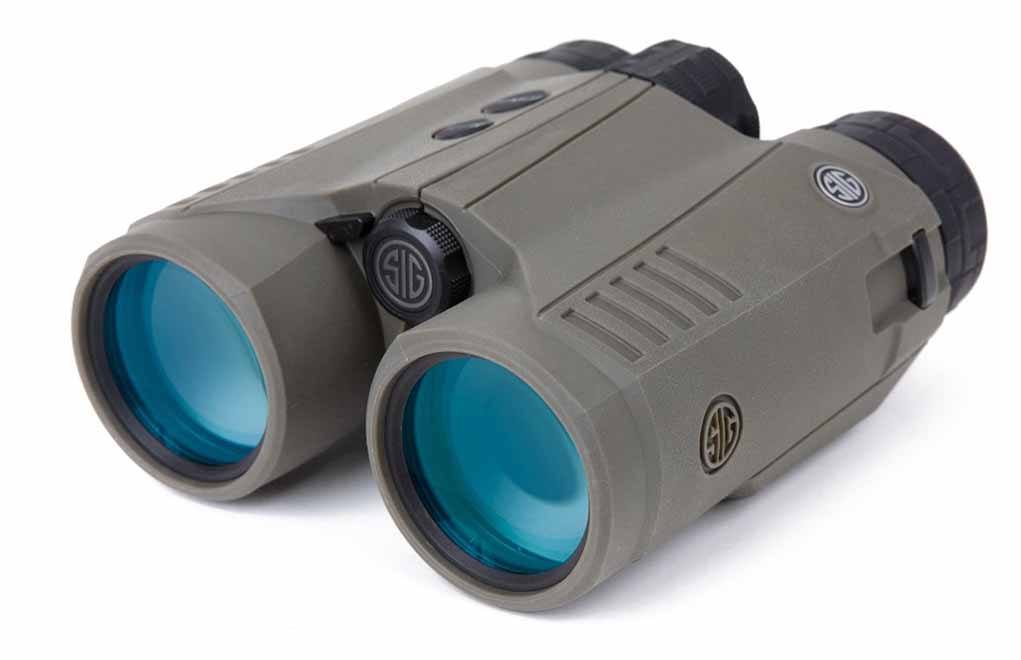
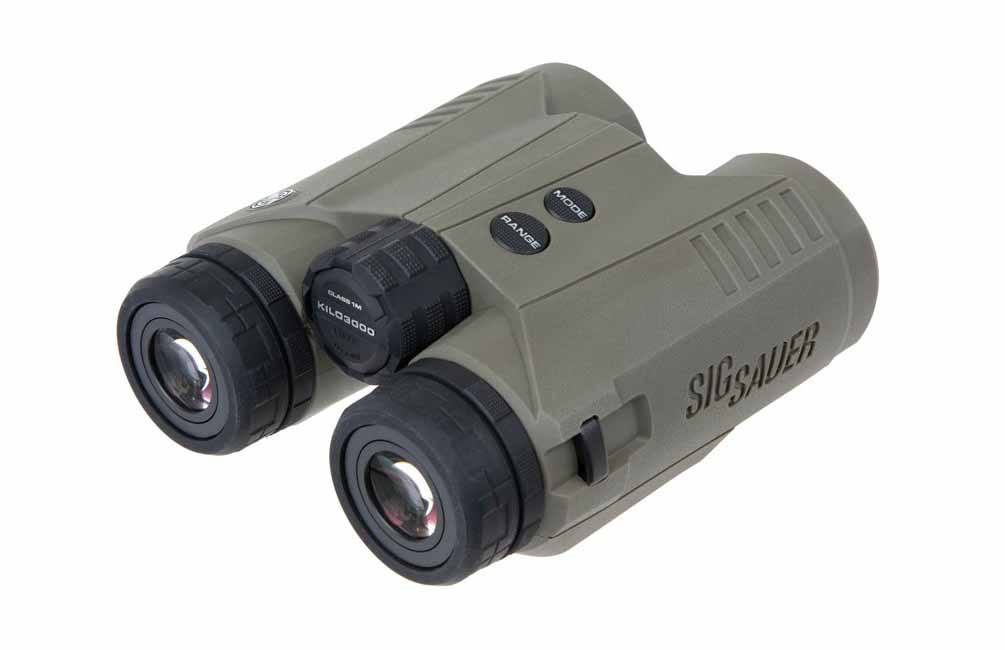
Capable of ranging at extreme distances and linkable to a smart device, Sig’s KILO3000BDX Rangefinding Binoculars are set to take your shooting to the next level.
How The KILO3000BDX Rangefinding Binoculars Ups Your game:
LightWave DSP rangefinder engine ranges out to 5,000 yards
HyperScan technology providing 4 range updates per second
Linkable to Ballistic Data Xchange riflescope and smartdevice
Over the years, Sig Sauer has transcended the label “gunmaker” to become a full-service firearms and accessories manufacturer. Suppressors, ammunition, laser sights, mounts … if it goes bang, the juggernaut most likely has something to enhance it. Though Sig has drawn the most attention in one area in particular as of late – optics.
The Best Tactical Red-Dot Performance-to-Price Option?
Shifting Winds: SIG BDX Changing Shooting For The Better
Concocting some of the most cutting-edge aiming devices, the company has carved a solid and distinctive niche into the market. And it continues to roll out the hits. The most recent the KILO3000BDX Rangefinding Binoculars. In addition to high-performance glass and precise LightWave DSP range finder that can take reading out to 5,000 yards on reflective targets, it has a software edge on the competition. Linkable to a smart device, thus Sig’s Ballistic Data Xchange app, the KILO3000BDX Rangefinding Binoculars help produce real-time shooting solutions.
More from Sig Sauer:
NEWINGTON, N.H. –SIG SAUER Electro-Optics is pleased to announce the 2019 Industry Choice, Optic of the Year KILO3000BDX Rangefinding Binoculars are now shipping.
The SIG SAUER Electro-Optics KILO3000BDX Rangefinding Binoculars are the world’s most advanced laser rangefinder binocular. They can be used on their own or be paired with a Ballistic Data Xchange (BDX) Riflescope and SIG BDX app. The BDX system allows input of ballistics data and environmental conditions to calculate the exact holdover solution to target. This information is displayed in the KILO3000BDX and can be transmitted to any BDX riflescope to display the exact holdover dot.
The KILO3000BDX Features the revolutionary LightWave DSP™ rangefinder engine for extreme speed and distance capabilities, HyperScan™ technology providing 4 range updates per second, and the Lumatic™ display that automatically calibrates display brightness to ambient light conditions.
KILO3000BDX Rangefinding Binocular Specs:
Range: Up to (1500 Deer)(2000 Trees)(5000 Reflective) Reticle: Circle Overall Length: 5.75” Overall Width: 5.00” Height: 2.5” Weight: 31 oz. Field of View: 320 ft. at 1,000 yards Eye Relief: 18mm Objective Lens Diameter: 42mm MSRP: $1,439.99
For more information on Sig Sauer optics, please visit www.sigsauer.com.
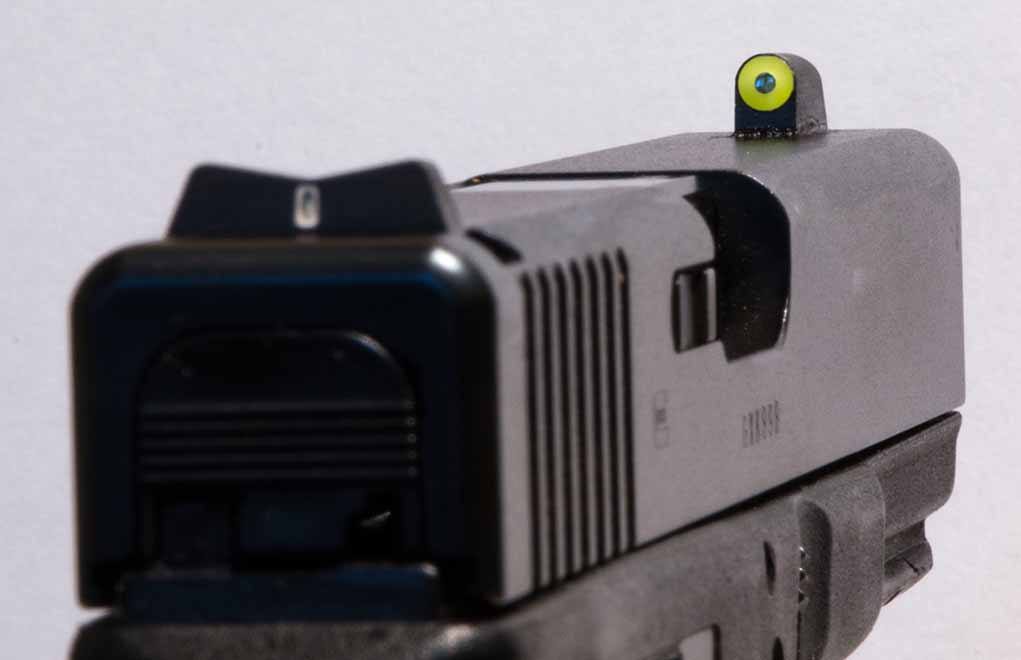
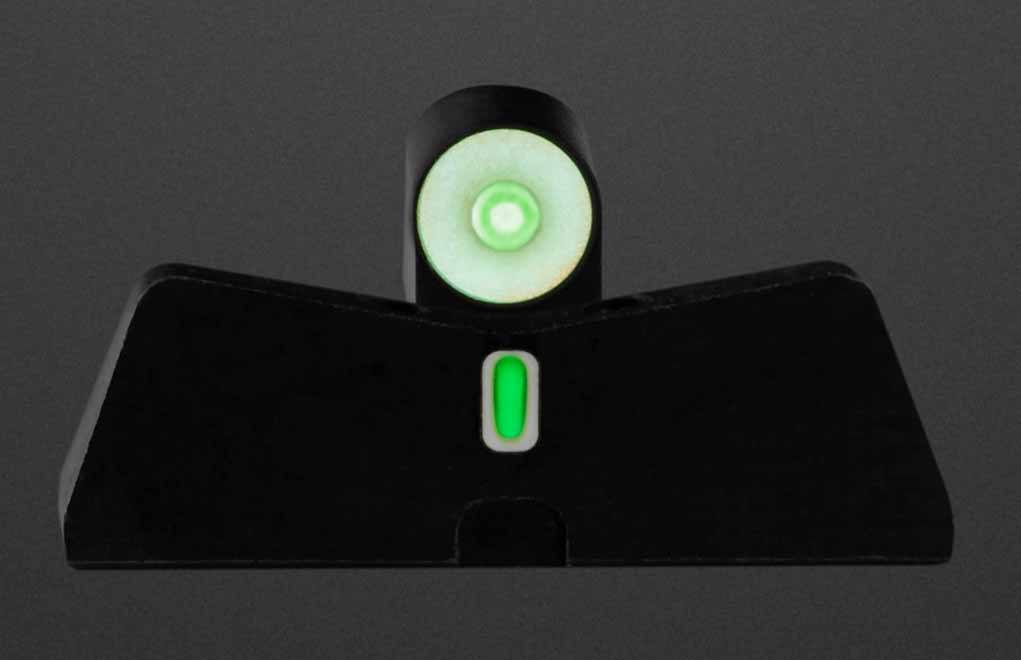
Notice the luminescence of the new XS Sights’ DXT2 Big Dot front sight in well-lit conditions.
There’s no missing the XS Sights DXT2 Big Dot Night Sights, which is a good thing when it comes to fast target acquisition.
How XS Sights DXT2 Big Dot Night Sights Get You On Target Fast:
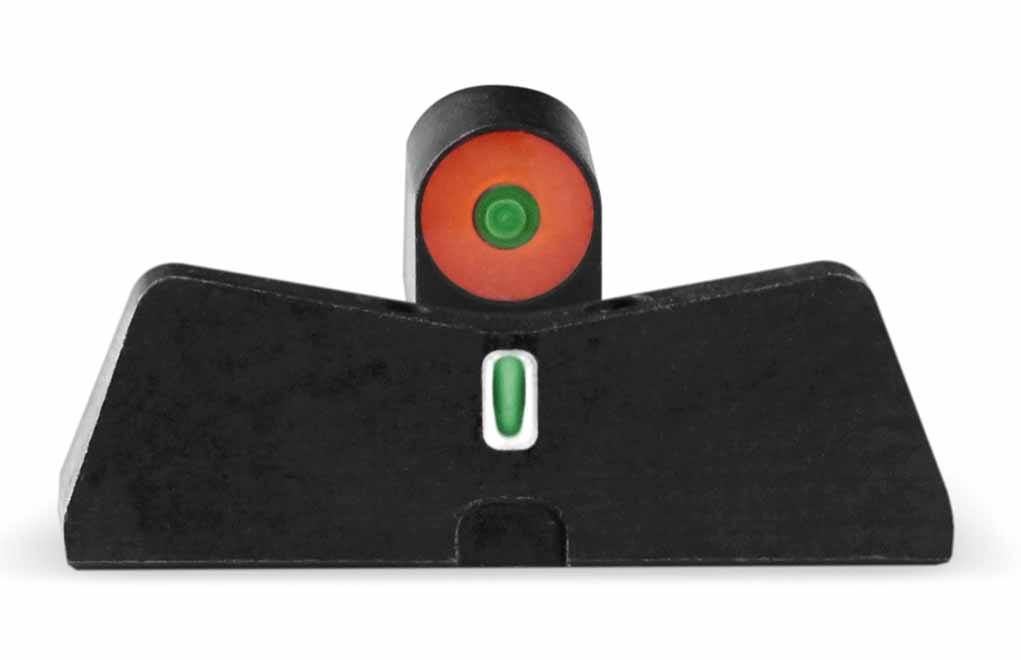
Large front sight paired with V-notch rear
Optic Yellow or Orage outline on front sight draws the eye to its proper focal point
Tritium vial in both front and rear sights to enhance low-light aiming
Increased visibility and brightness from convex dot on the front
If you know anything about shooting a handgun at all, you know that in order to hit your target you need to be able to see your sights. This is of course why we’ve seen so much advancement in sights over the years, and why aftermarket sights have become so popular. XS Sights has been at the forefront of this movement.
Starting with a Texas Deputy Sherriff’s notion that sights similar to those that work on dangerous game rifles could be useful in situations defensive handguns are most commonly employed, XS Sights has continued to innovate on that concept. Their newest offering is the DXT2 Big Dot Night Sights (MSRP: $176).
The new XS Sights’ DXT2 Optic Orange sight in bright light.
The driving force behind these new sights was to increase front sight visibility in all lighting conditions. At its inception, the XS Big Dot Sight was simply a large white circle. Gunsite Academy founder Jeff Cooper, who laid the foundation on which all modern defensive handgun training has been founded, liked them so much he had them installed on his every day carry Colt’s Commander. He clearly believed in sights you could see. Later, the addition of a tritium vial to the center of the Big Dot was available and quickly became one of the most trusted defensive handgun sights.
Of course, there are many so-called experts who believe a large — 0.180 inch — front sight is too big to allow for precise shooting. Admittedly, if you are accustomed to conventional defensive handgun sights, there is a learning curve. But it’s short. When I took my first 250 Pistol Course at Gunsite Academy, I used a 1911 fitted with XS Big Dot Sights. I used that gun to win the class shoot off. Additionally, when my wife was first starting to learn to shoot a handgun, we found the Big Dot sights seemed to instinctively direct her to focus on the front sight, which is a helpful thing for beginners.
The Evolution Of Aiming
The new XS Sights’ DXT2 Optic Orange sight in low light.
The new DXT2 version sight is identical to the old, except instead of a large white outline of the Tritium vial, you have the option of choosing one in Optic Yellow or Optic Orange. Paired with the V-notch rear sight, you get a sight system that drives your focus to the front sight and the downrange threat, with an unobstructed view to either side.
Additionally, the new patent-pending colored glow dot — in yellow or orange — absorbs light, causing the front sight to glow before it’s dark enough to see the tritium center. The glow dot even stores energy enabling it’s radiance to last. You simply place the glowing big dot above the vertical white/tritium stripe in the rear V-notch — dotting the “i” — for a super-fast-to-acquire sight picture you can see in any light.
A photo of the XS Sights’ Big Dot front sight on Jeff Cooper’s Colt’s Commander.
Optic Yellow is the most visible color in low light and is a direct replacement for the first-generation white Big Dot sight. In bright light, Optic Yellow outperforms white because it doesn’t wash out on light backgrounds. Optic Orange is the best for bright light settings such as shooting outside in daylight and offers a high-glow intensity that maintains visibility in decreasing light levels. The DXT2 Big Dots are four times as bright in low light as the originals, thanks to the XS Sights patent-pending glow dot.
The improved visibility and increased brightness is due to pairing the convex dot with patented photo luminescent properties. The outward curve of the dot increases the amount of surface area, exposing it to more light, and the optical clarity amplifies light absorption, which increases the excitement of the yellow or orange glow dot properties. In hillbilly terms, that means the new DXT2 sights are just a hell of a lot easier to see all the time. But most importantly, they’re so bright they seemingly pull your eye to them.
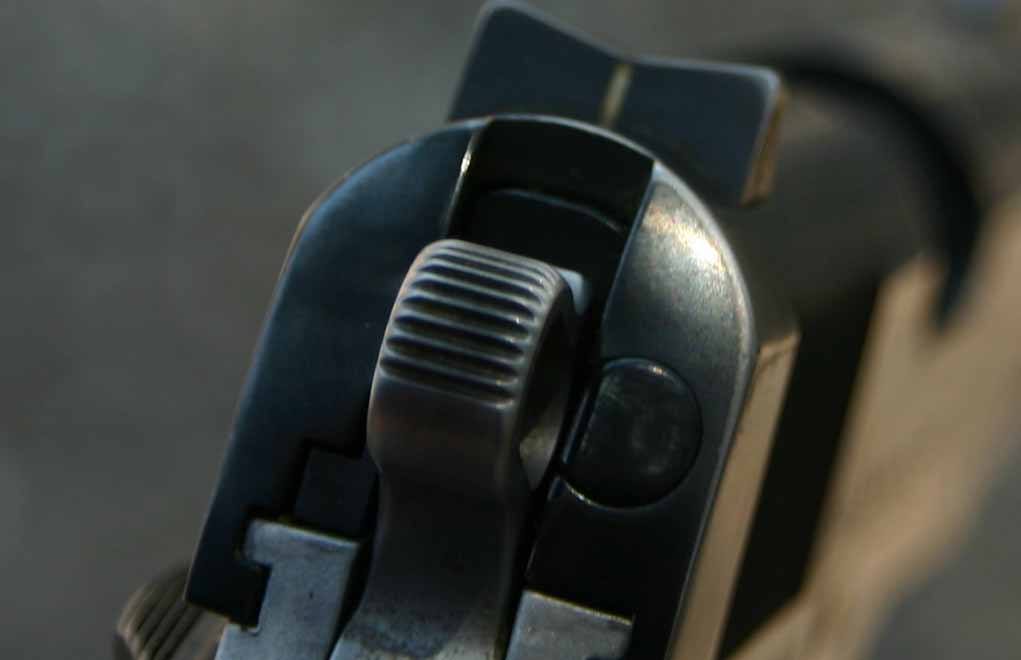
A photo of the XS Sights’ rear sight on Jeff Cooper’s Colt’s Commander.
DXT2 Big Dot Night Sights are backed by a 10-year, no-questions-asked warranty and will be initially available for all Glocks; S&W M&P full-size and compact pistols; the M&P Shield; Sig Sauer P320, P226 and P229 pistols; Springfield XDs and the FNH FN509 in early 2019. They retail for only $132, and short of buying lots of practice ammunition and investing in a class at Gunsite Academy, they might represent the best money you can spend with regard to your defensive handgun.
I asked XS Sights to send me handgun outfitted with these new sights. The first thing I did with this pistol was to stand in a semi-dark room — with varying light sources from all angles — and rotate 360 degrees while looking at the sights. The view varied as the light changed but the sights were brilliantly visible at all times. The only situation you could be in where you could not see these sights is one in which you have your eyes closed.
I’ll not be so bold as to declare these new DXT2 sights from XS Sights are the best sights for everyone. We’re all different. Some of us have very good vision, others not so much. And, some folks just simply shoot better with different types of sights. But, what I will suggest — and argue with anyone — is that no matter what sight you choose for your defensive handgun, you best choose one that you can see in any situation. The easier that sight is to see, the faster you can get it on target.
Editor’s Note: This article originally appeared in the February 2019 issue of Gun Digest the Magazine.
Check out what’s on the market when it comes to light and compact carry guns for women.
Often times, women require a different setup when they go armed. The most obvious is the holster and where they situate it, given clothing and body shape differences. But the type of handgun chosen can also be among the issues that need addressing. However, like any shooter, there’s a simple solution to finding the right heater.
Tune In More Gun Digest TV:
Video: Pro Series Model 986 Puts A Different Spin On The 9mm
Picking the best firearm for your needs requires, above all, a solid evaluation of skills and lifestyle. Many first-time shooters — be they women or men — believe a light and compact pistol or revolver is the logical choice. In reality, it could potentially prove problematic. Featherweight guns are known for generating more recoil and, due to their short sight radius, can be more difficult to aim accurately. The flip side, a full-sized option is plum hard to conceal, not to mention carry. If it proves too difficult to tote every day, many will throw up their hands and leave it a home, where it won’t do a lick of good in a self-defense situation.
Perhaps among the easiest — not to mention enjoyable — ways to winnow down the selection process is to find a range that rents guns. Nothing beats hands-on testing of a firearm for forming an opinion about what fits your ability and, potentially carry regime.
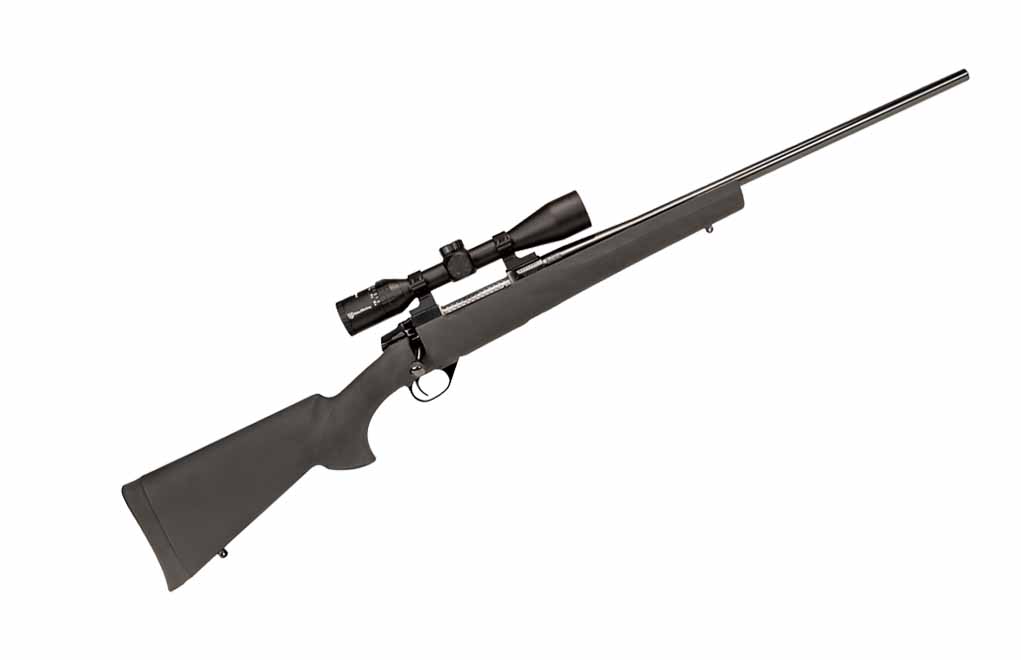
Howa is set to expand its HS Precision and Hogue rifle lines with options in the long-range specialist calibers.
How the new chamberings enhance Howa’s line up:
Both the rifles are configured as hunting options, but are more than capable for target shooting.
Howa will add the new chamberings in 2020.
At the heart of each new rifle is Howa’s well-respected 1500 barreled action.
For penny pinchers with a yen for long-range accuracy, Howa has become the go-to gunmaker. Offering a full slate of precision chassis, hunting and target rifles, the Japanese manufacturer has won ardent fans with performance and price tag. And Howa doesn’t appear ready to give up its mantle as the economic precision king anytime soon.
The gunmaker, imported and sold by Legacy Sports International, recently announced two new chamberings coming up within the next year. Joining the roster, the .300 PRC and 6.5 PRC, which the company will offer in the HS Precision and Hogue rifles in 2020. All in all, the additions bolster what are already impressive caliber choices in each line.
At the heart of both rifles is the Howa 1500 barreled action, which features two-lug push feed bolt, three-position safety and comes outfitted with the company’s two-stage Howa Actuator Controlled Trigger System (HACT for short). The difference between the two is the stock, with the Hogue (obviously) set in Hogue’s Overmolded model and the HS Precision (again obviously) in HS Precision’s carbon fiber stock, which is hand laminated with Kevlar and fiberglass. Both are pillar bedded and have straight combs. Hunters for certain… though nobody will tell if you pick one up for target shooting.
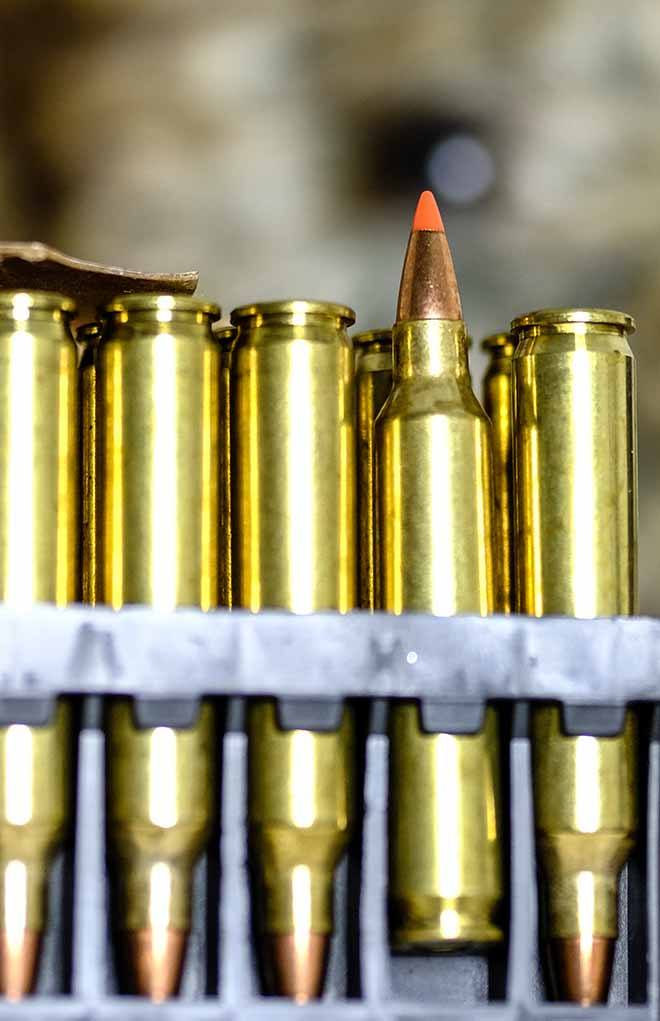
The .300 PRC and 6.5 PRC – Precision Rifle Cartridge – are beltless magnums created by Hornady. The .300 is a necked down .375 Ruger and reportedly has more pep than the wildly popular .300 Win Mag. According to Hornady, it will push a 225-grain bullet 2,860 fps at the muzzle. The 6.5 PRC parent case is the .300 Ruger Compact Magnum and gives the fans of the trendy caliber more case capacity to work with than the Creedmoor. This extra space for powder gives it around an 8-percent increase on the established 6.5.
Howa has yet to release pricing on the rifles, but presently HS Precision options have an MSRP that starts at $1,099 and the Hogue $529.
More from Howa:
RENO, NV –– Legacy Sports International and HOWA Precision Rifles announce plans to introduce the .300 PRC and 6.5 PRC Chamberings into its HS Precision and HOGUE offerings. All will come with threaded barrels, muzzle breaks and 24” or 26” standard barrel offerings.
Howa Hogue Rifle
The new HOWA magnum caliber platforms in the .300 PRC (Precision Rifle Cartridge) will take advantage of the recent cartridge developments for long and heavy caliber bullets best suited and utilized for delivering the highest levels of accuracy and ballistic coefficient which is perfect for laser like performance on everything from punching paper or ringing gongs at 1,000 yards to cleanly harvesting big game with deadly knockdown power at mid to long range.
The new HOWA 6.5 PRC (6.5 Creedmoor’s Big Brother!) offers a step up from the 6.5 Creedmoor craze to an even flatter trajectory and extended-range performance. Providing over 200 FPS in velocity over the very popular 6.5 Creedmoor offering.
These two new HOWA long range calibers in .300 PRC and 6.5 PRC will provide excellent results down range at a reasonable price and all with a Lifetime Warranty and a SUB MOA assurance.
The 300 PRC will be available starting December 1st and the 6.5 PRC will be available at the beginning of 2020.
It’s fast, but do the ballistic numbers for the .204 Ruger measure up to its competition? You better believe they do and then some.
How the .204 Ruger Is Right On Target For Predator Hunting:
Dead-flat shooter with a measly 28.1-inch drop at 500 yards.
Small caliber does less damage to pelts retaining their value.
.222 Remington Magnum case gives handloaders plenty of capacity in which to work.
Excellent go-between from the Hornet class cartridges and the .22-250.
Bearly a lick of recoil, making it extremely fast on follow-up shots.
If you’ve ever wondered if a meager bullet measuring only 5 millimeters in diameter and weighing a mere 40 grains matters, ask a coyote grave digger. Chances are good it’s helping keep him in business.
Much more than a coyote grave digger’s business development tool, that tiny polymer-tipped copper and lead song-dog sleeping pill sits atop a .204 Ruger case, and it’s as relevant today to predator hunters — and at the range for shooters who simply love speed — as it was when it debuted 45 years ago.
The Hornady V-Max bullet is an ideal coyote choice because the bullet is frangible, and in the pint-sized .204 Ruger it does minimum damage to pelts.
Technically, the .204 Ruger was created jointly by Ruger and Hornady in 2004. Hornady and Ruger based their 5mm hotrod on the .222 Remington Magnum case by simply necking it down to .204 inches, moving the shoulder forward and increasing its angle to 30 degrees.
I say “technically’ because I think the idea for the .204 Ruger actually began in California in 1960. You see, on May 16, 1960 —at the Hughes Research Laboratory — Theodore Maiman created the technology which I believe led directly to the development of this pint-sized coyote killer. Maiman, a physicist, operated the first device that emitted a beam of light amplificated by a stimulated emission of radiation. Physicists, unlike gun writers, don’t get paid by the word, so his creation’s name became shorter and simpler as an acronym: L-A-S-E-R. Today, we just call it a laser.
Laser? Really? Yes, really. In fact, if you don’t think “laser” when you think of the .204 Ruger, then, you my friend, don’t know the true personality of the .204 Ruger.
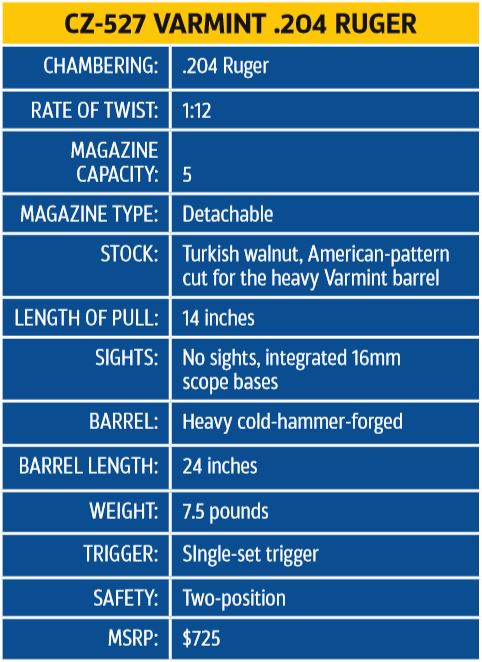
The CZ 527 Varmint rifle chambered in .204 Ruger is a reliable, accurate bolt-action rifle that works well on the range or in the field hunting predators. The .204 Ruger is a cartridge capable of purging a lot of song dogs from farms, or for high-speed fun at the range.
“Fast, flat and not fat, the .204 Ruger generally leaves one nice little hole,” said native Texan and Idaho guide and outfitter Brooks Murphy, who has hunted more than his fair share of pint-sized predators like coyotes and bobcats all over the United States. “It’s a great go-between from the Hornet-class cartridges to the .22-250 Remington without the risk of being associated with the ‘tacti-cool’ crowd at the range or in the field while eradicating rodent or predator problems.”
The key laser-like word Murphy uttered was “flat.” Indeed, the .204 Ruger is remarkably flat considering it shoots a bullet propelled by hot gasses emitted from the burning of gunpowder and not a stimulated emission of radiation. After all, what other word would you use to describe a cartridge which, factory loaded, can give shooters a bullet with a measly 28.1-inch drop at 500 yards?
Targeting A Relevant Niche
The .204 Ruger’s reputation is quite relevant in the gun manufacturer’s community as well. When I needed a rifle and cartridge for some Virginia coyote hunting CZ-USA’s Zach Hein suggested I shoot a .204 Ruger based on its accuracy, range, ammunition availability and proven track record as a coyote killer nationwide. He focused on the fact that it’s got plenty of range to it, is quite accurate, and when it hits the critters it doesn’t ruin the fur as badly as other bigger cartridges.
The .204 Ruger spend a lot of time in low-light red conditions because predator hunting is often a nighttime activity, and predator hunters — especially those wanting a lethal round that doesn’t destroy pelts — have gravitated to the cartridge.
Now, some of us don’t care if we blow coyotes up like watermelons hit by an AMTRAK train, but some people certainly collect and sell animal pelts, so massive wound channels or worse — coyotes blown apart — aren’t going to fare well on the market.
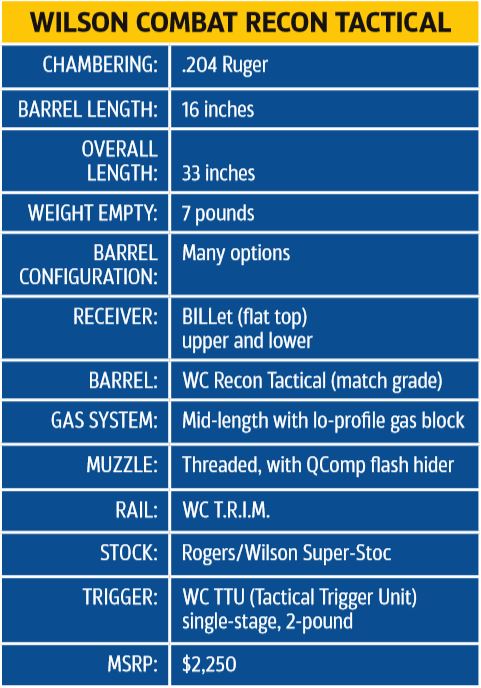
As part of the research for this story, I used the very gun Hein suggested: a CZ-527 Varmint chambered in .204 Ruger. I took things one step farther and added a Wilson Combat WC-15 in .204 Ruger as well because, quite frankly, who doesn’t want us to hunt coyotes with a semi-automatic .204 Ruger? Coyote life insurance agents, that’s who.
Both guns worked and shot remarkably well. Both guns shot ½ MOA accuracy with factory loads. Both guns carried light, pointed fast and gave me confidence while on the prowl. That says a lot about the cartridge’s capabilities. As a few have already told us, what weapons platform you put a .204 Ruger in doesn’t matter much outside of style points. What matters is it’s chambered in the flat-shooting .204 Ruger.
It’s Flat-Out Fast
In today’s ultra-modern scope-it, dope-it and rope-it long-range shooting world, why would anyone care how flat a cartridge shoots anymore? Shooters care because it means it increases the odds of success. The flatter a cartridge shoots, the greater a margin of error it allows shooters to have on range estimation, aim, shooter technique, and the like.
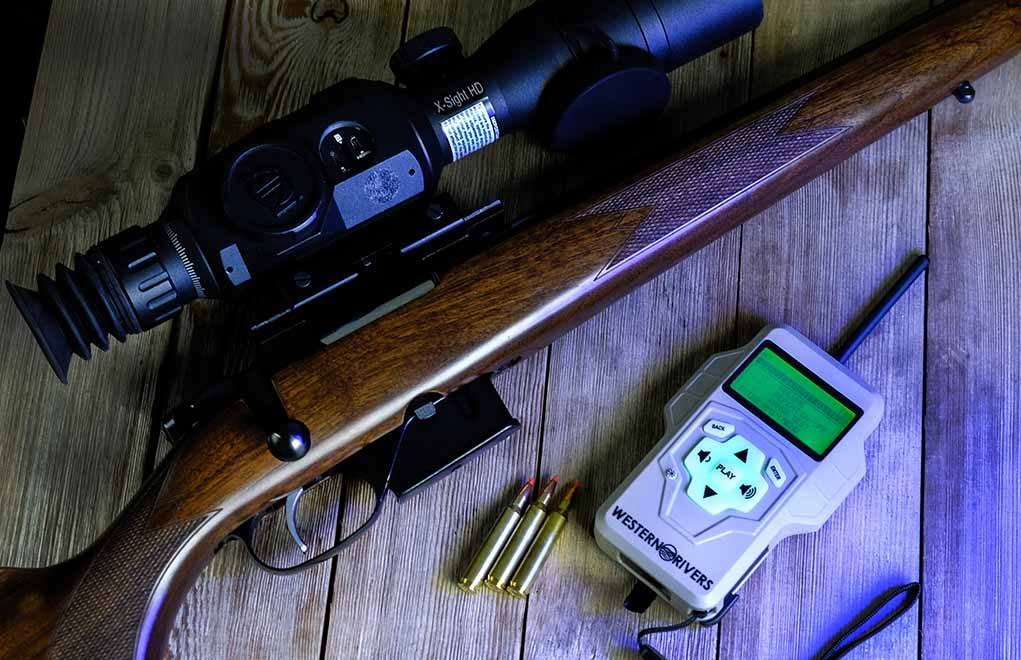
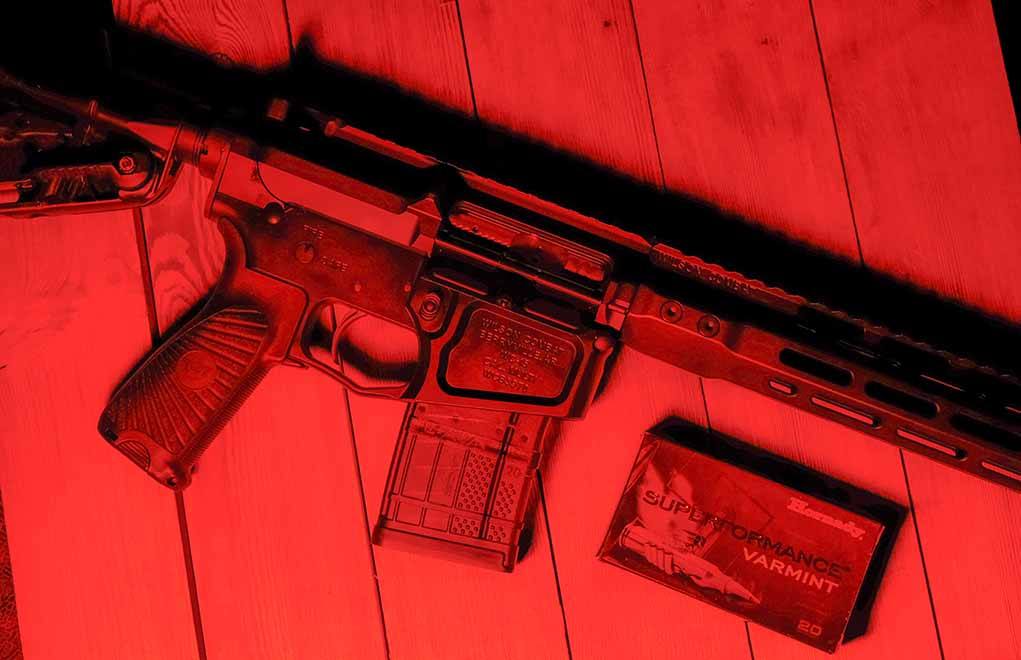
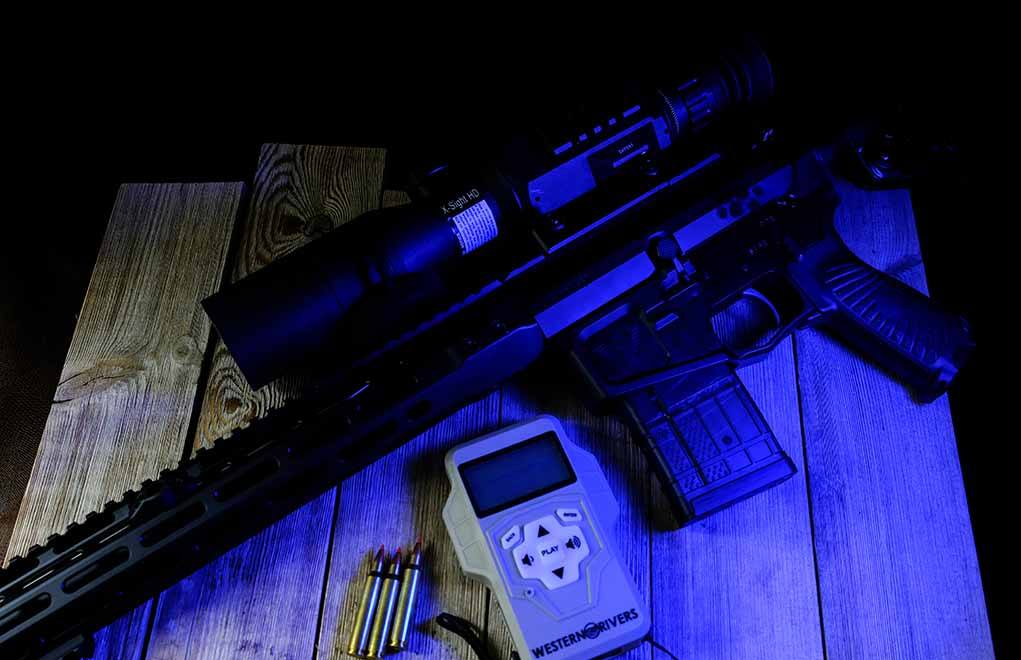
The .204 Ruger serves predator hunters well in the Wilson Combat WC-15 Recon Tactical rifle when paired with a high-quality day/night optic, such as this ATN X-Sight II HD 3-14x scope.
So, when you’re dealing with an animal like a coyote, which can range from 1.9-2.2 feet in height at the shoulder and weigh anywhere from 15-46 pounds — and happens to run between 35-43 miles per hour — you’ll take all of the ballistic help you can get. The .204 Ruger’s ultra-flat trajectory is quite a bit of help.
Tack on the fact that the .204 Ruger has less recoil than me when I mistakenly drink unsweet tea, and shooters find it much easier to take multiple shots within the same sight picture because the rifle isn’t kicking them off their scopes. Multiple shots? Not me, I never miss, you say. Of course not, but what about when your coyote brings his friends? Follow-up shots can make a big difference whether you think you might miss (someday) or not.
Realistic Expectations
Excited about the .204 Ruger? Good. But it’s time for a reality check: The .204 Ruger isn’t truly a laser, of course. In fact, it’s not really all that flat when you compare it to one. You see, like the state of Kansas, most people think the flight of a .204 Ruger is constantly flat, but it’s not. By the way, according to a University of Kansas news story in 2014 by Brendan M. Lynch, Kansas — geographically speaking — is only the seventh flattest state in America, with Florida (yes, Florida) ranking No. 1, followed by Illinois, North Dakota, Louisiana, Minnesota, Delaware … and then the Jayhawk state.
No, the .204 Ruger got its reputation as a “laser” because, compared to just about everything else powered by gunpowder, it shoots flat — like Florida, not Kansas — and it’s deadly like lasers you see in the movies (pew, pew).
Don’t think so? One of flattest commercially available factory loads from Hornady at 500 yards from a centerfire rifle is the .204 Ruger 40-grain V-Max. At 500 yards it drops just 28.1 inches while still screaming the ballistic equivalent death song of “Enter Sandman” to any coyote it encounters with a blazing speed of 2,133 fps and 404 ft-lbs. of energy, which is 82 ft-lbs. of energy more at 500 yards than a Hornady .22 WMR 30-grain V-Max bullet at the muzzle. Note that, like any cartridge, handloaders can customize the .204 Ruger with their own recipes as well, but Hornady’s factory loaded 40-grain A-Max is all I need to prove my point.
Other Comparable Contenders
What about the .22-250 Remington? It’s flatter, right? No. It’s not. Sticking within the same Hornady family of commercially available cartridges, the best the .22-250 Remington can do at 500 yards 29.1 inches of drop. Now, it hits a bit harder with 445 ft-lbs. of energy, but it’s also slower, going a pedestrian-like 2,003 fps compared to the 40-grain coyote sleep aid pushed by the .204 Ruger. Think the powerhouse .22-250 Remington’s 50-grain V-Max handles the wind better than the pesky .204 Ruger 40-grain V-Max? Think again. With a 10 mph crosswind, the .204 Ruger’s 40-grain V-Max bullet needs a windage adjustment of 1.81 MOA at 500 yards to stay on target, whereas the .22-250 Remington’s 50-grain V-Max bullet needs 2.37 MOA. So, the idea that the .22-250 Remington handles the wind better than the .204 Ruger is, well, just hot air.
Now hold on a minute …
What about the ultra-ballistically slick 6mm Creedmoor and the 87-grain bullet Hornady loads for it? That’s got to be an amazing coyote load, right? It absolutely is. However, compared to the 40-grain .204 Ruger, it’s a rainbow warrior with a massive 7.4-inch negative difference in bullet drop at 500 yards.
Sure, the 6mm Creedmoor’s 87-grain load bucks the wind better, needing only 1.47 MOA worth of an adjustment for a 10 mph crosswind versus the .204 Ruger’s 1.81 MOA, and the 87-grain V-Max hits like the Hammer of Thor with a whopping 844 ft-lbs. of energy compared to the wooden spoon-like 404 ft-lbs. of the 40-grain .204 Ruger, but that’s 7.4 inches below the point of this story which is that the .204 Ruger is an ultra-flat, hit-hard-enough predator cartridge.
Parting Shot
Is the .204 Ruger relevant? Absolutely. It’s an effective, affordable, available predator cartridge more than capable and is a highly proven slayer of small predators at wow-that’s-far distances. Some cartridges hit harder, farther. Some go faster. Most kick harder, cost more to shoot, and take your point-of-aim off your target from recoil more than the .204 Ruger.
MidwayUSA lists at least 10 different .204 Ruger ammo options, and handloaders can make the cartridge do some incredible things. Lots of rifle manufacturers make both inexpensive and fancy rifles for hunters, and there’s no shortage of coyotes willing to test a .204 Ruger’s capability. So, the only irrelevant thing about the .204 Ruger is questioning its place in your predator gun arsenal in the first place.
For more information on companies mentioned in this story, please visit:
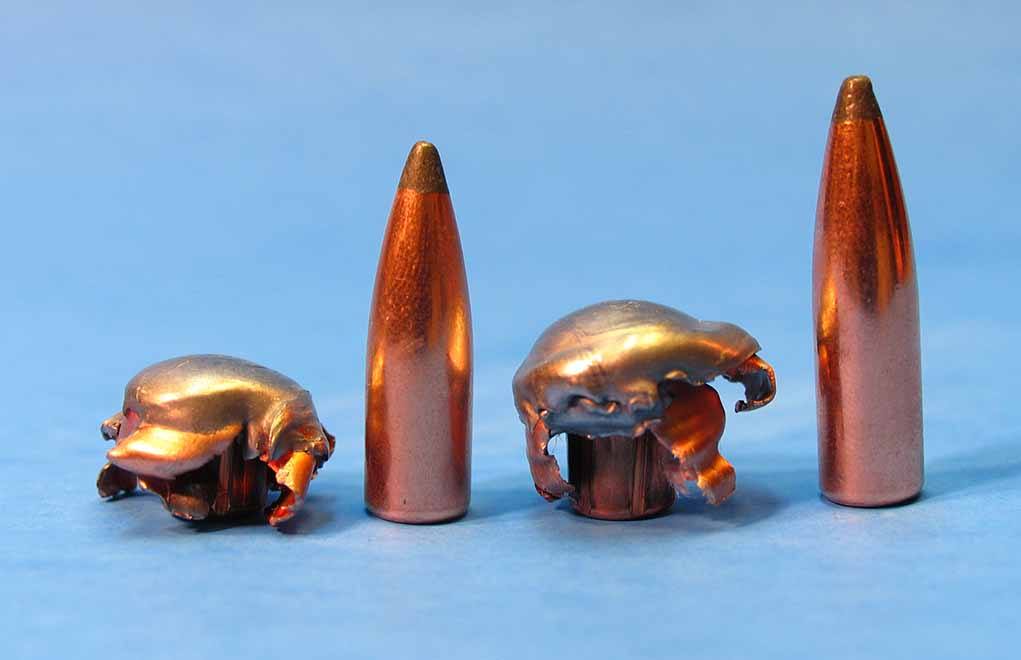
These two Sierra ProHunter bullets delieverd near identical terminal performance, even though the one on the right weighed 20 percent more than the other.
At one time, bullet weight held great significance in terminal performance. But modern materials and designs have changed this dramatically.
When It Comes To Bullet Weight, Do Lightweight Projectiles Out Perform Heavy Options:
When weigh held more importance when non-expanding lead bullets and before true controlled-expansion bullets.
With better engineering and materials, light- and mid-weight bullets have similar performance to the heavy ones.
The lighter bullets also have the advantage of less recoil.
There was a time when bullet weight really mattered. This was back when bullets were made of lead and were essentially non-expanding. The importance of bullet weight continued when the velocities of rifle cartridges began to rise near the 3,000-fps mark. When that happened, many hunters opted for heavier bullets because they thought they worked better.
Truth is, they did work better — not so much because they were heavier, but because they were moving slower. Bullet technology had not advanced to the point where engineering true controlled-expansion bullets were possible. Light bullets at high velocity tended to break apart and reduce penetration. The heavy-for-caliber bullets were still ambling along at moderate velocities, so they held together and penetrated deeper.
After John Nosler introduced the partition bullet design, things began to change. Various companies introduced new and better-designed bullets that could withstand high-impact velocities. With the modern bullets we have today, bullet weight is simply not that important. In fact, given similarly designed bullets, they will all deform to about the same frontal diameter and penetrate to the same depth, regardless of weight.
For example, consider .308-caliber Sierra Pro Hunter bullets fired from a .308 Winchester. The 150-grain version with a muzzle velocity of 2,590 fps will penetrate between 12 and 13 inches, and it will deform with a frontal diameter of about 0.64-inch. The same 180-grain bullet with a muzzle velocity of 2,450 fps will perform almost identically. You’ll see a larger difference in recoil energy than anywhere else; the 180-grain load will generate about 8 percent more recoil than the 150-grain bullet.
When it comes to selecting optimum bullet weight for just about any cartridge and any application, you’ll get the best balance of what that cartridge has to offer if you choose a bullet weight that is middle of the road. For example, with common .308 Winchester factory ammunition, you’ll see bullet weights from 110 to 180 grains. That puts 150 grains right about in the middle. For most general-purpose applications, something close to 150 grains will be the best option.
The same applies to defensive handgun cartridges: With the 9mm Luger, most loads have bullet weights between 115 and 147 grains. That means the popular 124-grain loads will generally give you the best balance of performance.
At one time, heavier bullets were a good idea. Today, with the modern bullet technology we have — in all but very specialized situations — the mid-weight bullets are best, and even the lightest bullets can do wonders.
Editor’s Note: This article originally appeared in the March 2019 issue of Gun Digest the Magazine.
Engineered as top-line race guns, the Walther Q5 Match series is long on features and performance.
BMW, Mercedes, Audi … when you think of fine German engineering cars are what typically come to mind. However, the country has more than its fair share of expert gunmakers. Mauser, Heckler & Koch and, of course, Walther have impeccable reputations their tightly built and highly functioning firearms. In recent years, Walther especially has turned heads with its specialist competition pistols – the Q5 Match Series.
What makes the two models – Q5 Match and Q5 Match Steel – that compose the line stand out, isn’t simply the shootability and accuracy of the 9mms. But also a slew of features designed to give you a leg up in gunning for gold. Among the most notable, and common to all the Q5 Series pistols, are fiber optic front and rear sights, lightening cuts in the slide, slide cut for optics mounting, ambidextrous slide lock and adjustable backstrap. A pretty nice package right out of the box.
Tune In More Gun Digest TV:
Video: Pro Series Model 986 Puts A Different Spin On The 9mm
As their designations suggest, there is a difference in the materials used to make Walther Q5 Match pistols. Originally polymer-framed, the gun company new steel model is meant to add a bit more heft to the gun, thus soak up recoil and make it faster shot to shot. An iteration competitors have requested for some time now.
Overall, Walther’s Q5 Match series has built a solid reputation in and out of matches. It’s easy to see why.
For more information on the Walther Q5 Match series, please visit www.waltherarms.com.
Accounts for aerodynamic jump casued by crosswinds
Provides real-time and accurate environmentals
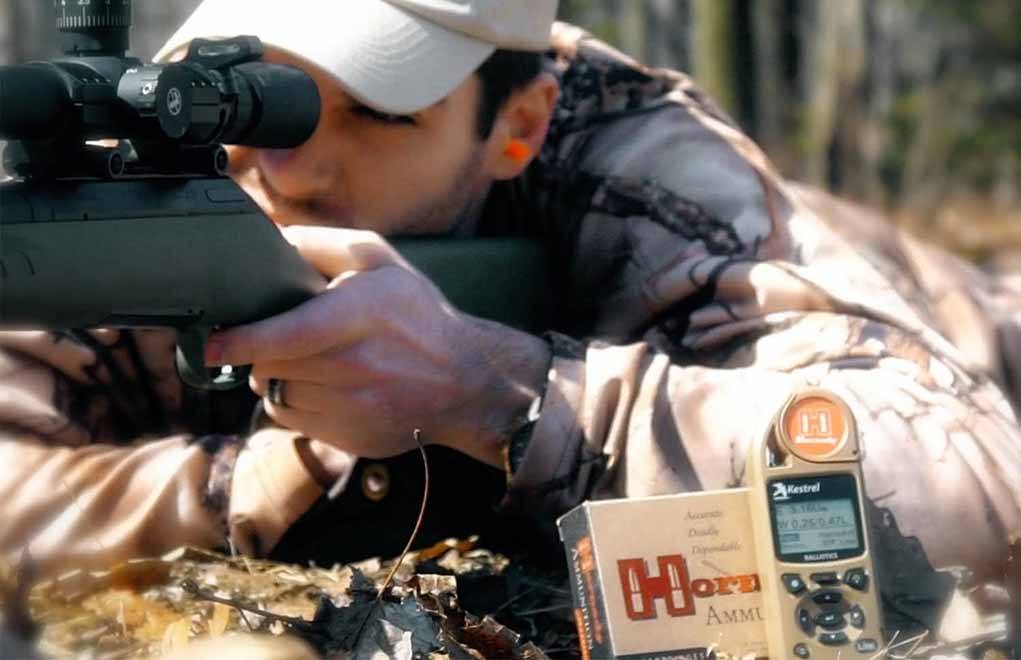
Looking to go the distance? A partnership between Kestrel and Hornady might be of interest. The wind/weather meter specialist and ammunition maker have teamed up to produce a unique device meant to help shooters connect at the longest ranges.
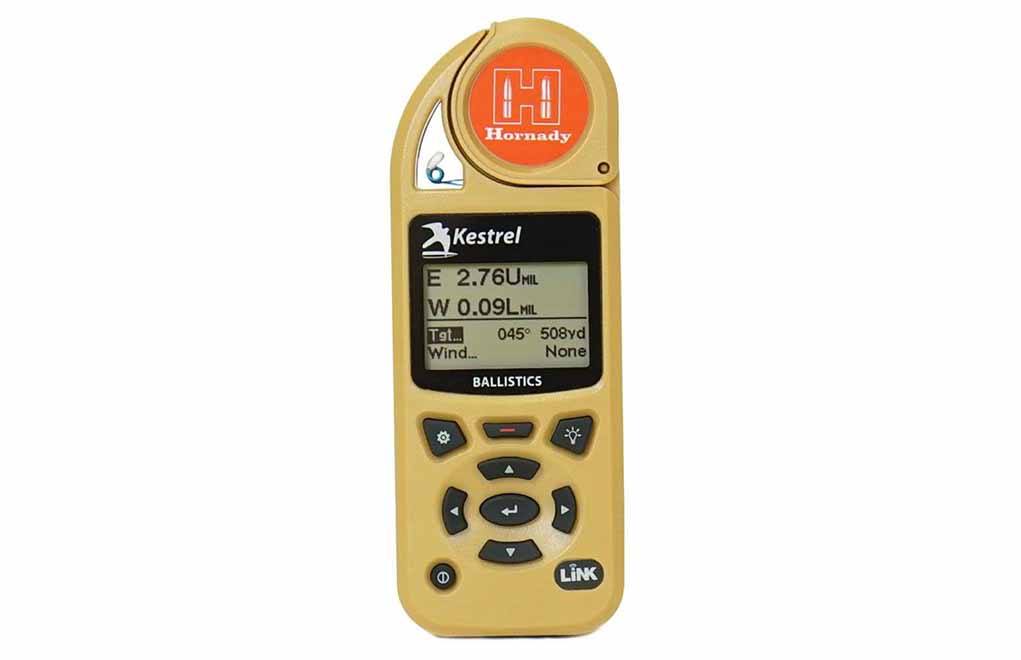
The Kestrel 5700 Ballistics Weather Meter with Hornady 4DOF puts a twist on figuring out shooting solutions, using Hornady’s unique ballistic calculator. Instead of figuring out trajectory through a bullet’s ballistic coefficient, the company’s 4DOF calculator uses drag coefficient along with physical modeling of the projectile, its mass and aerodynamics. Furthermore, the Kestrel 5700 calculates the bullet’s aerodynamic jump, the vertical shift it experiences when it encounters a crosswind. Of course, all of this is done with real-time readings from the weather meter.
The 5700 Ballistics Weather Meter with Hornady 4DOF is presently available and has an MSRP of $499.
More from Kestrel and Hornady:
BOOTHWYN, PA – Kestrel Ballistics, the leading brand in rugged American-built weather meters and long-range shooting accessories, has partnered with Hornady, the premier manufacturer of bullets, ammunition, reloading tools and more, to launch an all new advanced ballistics weather meter for hunters and shooters. The Kestrel 5700 Ballistics Weather Meter with Hornady 4DOF ($499) is now available online and currently shipping to customers.
Combining reliable onsite environmental measurements with precise Hornady 4DOF trajectory solutions – this all-in-one, compact unit is fully functional as a tool for long-range precision shooting. With the full power of the 4DOF ballistic app now integrated in the Kestrel meter, shooters can leave the phone behind and rely on the durable, compact Kestrel unit for the critical target data they need in the field. The built-in Hornady 4DOF Ballistic engine provides trajectory solutions based on projectile Drag Coefficient along with the exact physical modeling of the projectile and its mass and aerodynamic properties. Coupled with features like zero angle and aerodynamic jump, it is ideal for long-range calculations. Accounting for all environmental and ballistic variables that affects bullet trajectory over distance, the Kestrel with integrated 4DOF solver quickly and accurately delivers dead-on aiming solutions for any rifle or round.
Key Features •Accurate Environmentals – Measures wind speed and direction, temperature, altitude, and more and automatically updates the shooting solution •4DOF Solver & G1/G7 Ballistics Solver – Extensive library of independently tested bullet data •User-Friendly – Easy operation for outdoor use with large buttons for navigating screens and entering information along with bright, clear backlit display readable in direct sunlight or low light situations •Rugged, All-Weather Durability — IP-67 Waterproof, MIL-STD-810 drop-tested, and backed by a 5-Year Warranty •Long-lasting Power – Powered by 1 AA Lithium battery, expect hundreds of hours of use from a reliable tool that won’t quit when you need it most •Load & Go Convenience – Set up a Gun Profile via the free Kestrel LiNK app, then the Kestrel unit is field-ready allowing users to calculate trajectories under any conditions, even in areas without cellular service
For more information on the Kestrel 5700 Ballistics Weather Meter with Hornady 4DOF, please visit www.kestrelballistics.com.
The popularity of 6mm cartridges has waxed and waned over the decades, but appears to be peaking again.
What are the 6mm Cartridges:
6mm Lee Navy
6mm Creedmoor
6mm Remington (.244 Remington)
6mm Apex
6mm PPC
6mm BR
6mm AR
6mm XC
.243 Winchester
.243 WSSM
.240 Weatherby Magnum
.244 H&H Magnum
6mm SAW
6mm Dasher
In 1955, both Remington and Winchester introduced a 6mm cartridge. Remington dubbed theirs the .244 Rem., while Winchester went with .243 Win. It was a different time back then … a time when versatility in a rifle and cartridge was the mantra. The .30-06, for example, was venerated as the king of cartridges because it could take on any game anywhere in the world but for rhino, Cape buffalo and elephant. So, the prevailing sentiment of the day was that one rifle, plus a .22 caliber of some sort, was all a guy needed.
It was also the age of the vertical “gun magazine.” Now, those firearms aficionados with more than just a passing interest in guns and hunting, which included me, had access to all that was new and exciting gun-wise. It was then — the late 1950s — that I developed into a full-fledged rifle weenie. I devoured every gun magazine I could get my hands on, and it was rare that there wasn’t at least one article every month in each of those pubs talking about the “War of the 6s.” But, as it turned out, it was no contest at all: The .243 Winchester had won hands down, and for good reason.
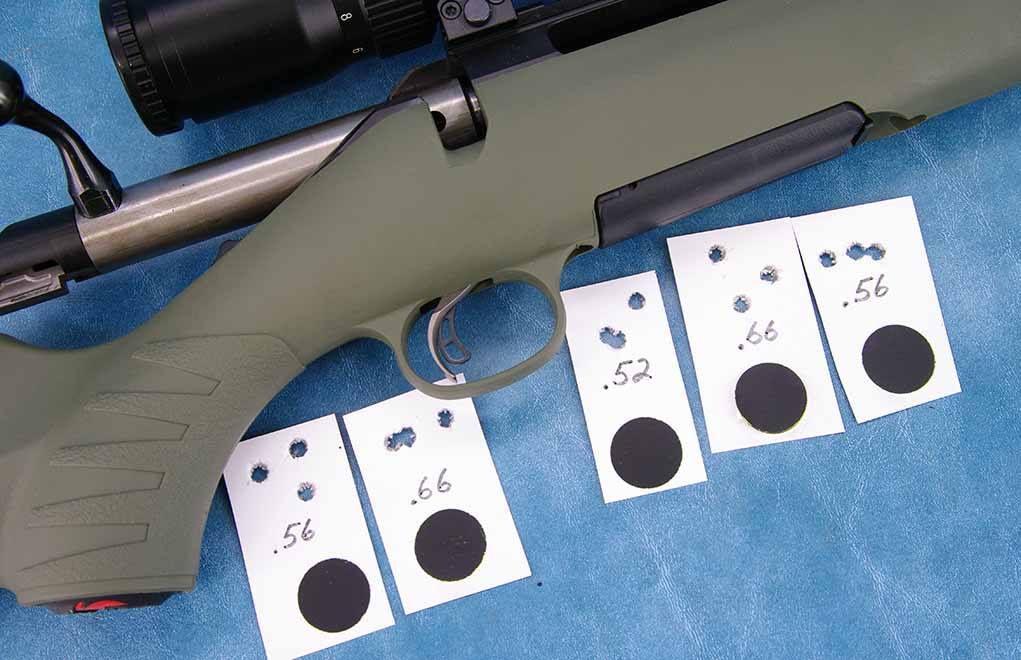
Some of the 100-yard groups fired with a Ruger American in 6mm Creedmoor.
To fully appreciate what was also happening at the time that influenced the 6mm story, it’s noteworthy that varmint/predator hunting was coming of age. Not that hunting groundhogs, prairie dogs, fox and coyotes was anything new: it was becoming much more popular than it had been in the past. As for the “big game” side of the story, if truth be told, a huge percentage of America’s hunters never hunt anything larger than deer, and that was a big factor explaining the attraction to the .24 bore. A 6mm may not be the ideal deer caliber, but it’s certainly adequate out to distances that 98 percent of all deer are harvested.
The 6mm Showdown
So, the stage was set. Winchester saw its .243 as a “dual purpose” cartridge, one that was equally suited to hunting deer and vermin. The popular perception was that, with a .243 Win., you had two rifles in one. As such, the initial factory ammunition offerings consisted of an 80-grain varmint load, and a 100-grain deer load. Remington, on the other hand, envisioned its .244 as a long-range varmint/predator cartridge, and as such it offered factory ammunition loads of 75 and 90 grains.
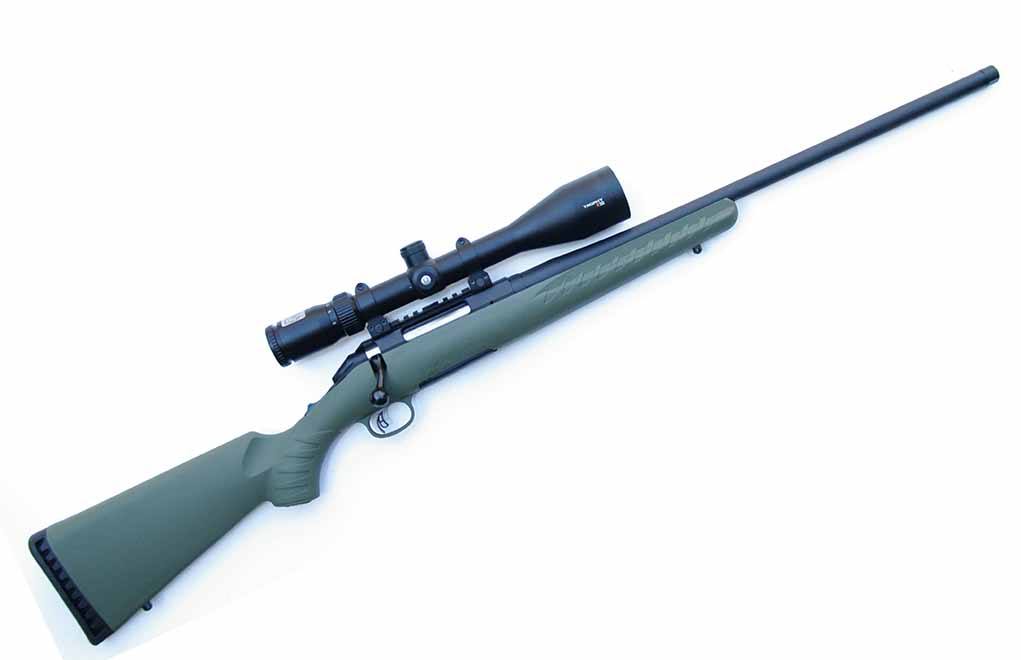
The first of the majors to chamber for the 6mm Creedmoor was Ruger with its American. Shown here is the example the author has previously reviewed.
Three of the biggest proponents of the .243 Win. were a Texas gun writer by the name of Byron Dalrymple; famed gun writer Warren Page; and Fred Huntington, founder of RCBS. Both Page and Huntington developed wildcat .24s based on the 7.62 NATO (.308 Win.) case, which were almost identical to what would become the .243 Win. As for Dalrymple, he slew a ton of Texas whitetails and coyotes, and he wrote dozens of articles praising the .243 Win. like it was the second coming.
The .244 Rem., on the other hand, got much less press, and much of it lacked enthusiasm. Here again, Page and Huntington were in the picture because both had also developed wildcat .24s based on the .257 Roberts case, which prompted Remington to choose it for their .244. Right from the get-go the consensus among the gun writers of the day was that the .243 Winchester’s 100-grain load was an excellent deer dispatcher, but somehow a 90-grain slug out of a .244 Rem. was not. That was pretty much bullpucky, but that was the general perception — and perception is everything.
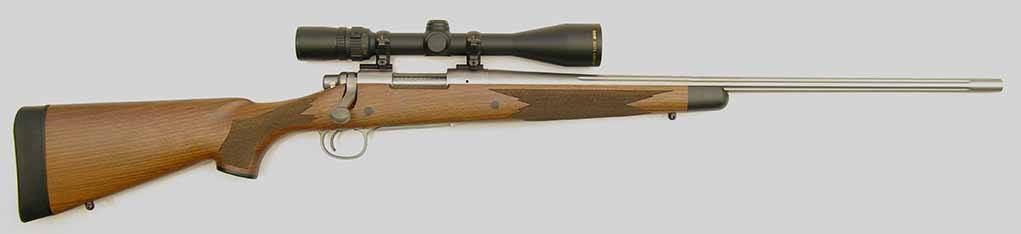
For the 50th anniversary of the 6mm Rem., Remington chose to honor it with a special edition of the Model 700 CDL.
Now, if you were a handloader, the situation should have been easily remedied, but it so happened that Remington chose a 1:12 twist for its .244, while Winchester went with the faster 1:10 twist for its offspring. Again, it was the writers of the day who cautioned that a 1:12 twist might not stabilize 100-grain bullets. Personally, my experience with the .244 Rem. was that it stabilized handloaded 100-grain bullets just fine. But again, there was that cloud of doubt.
If that weren’t enough to derail the .244 Rem., the last nail in its coffin was that the Remington Model 722 in which it was chambered was a dog. Its stock had all the appeal of a 2×4, and its ungainly 26-inch barrel did not a handy deer rifle make. The .243 Winchester’s home, on the other hand, was the svelte Model 70 Featherweight with a 22-inch barrel, and the Standard Grade which had a 24-inch spout.
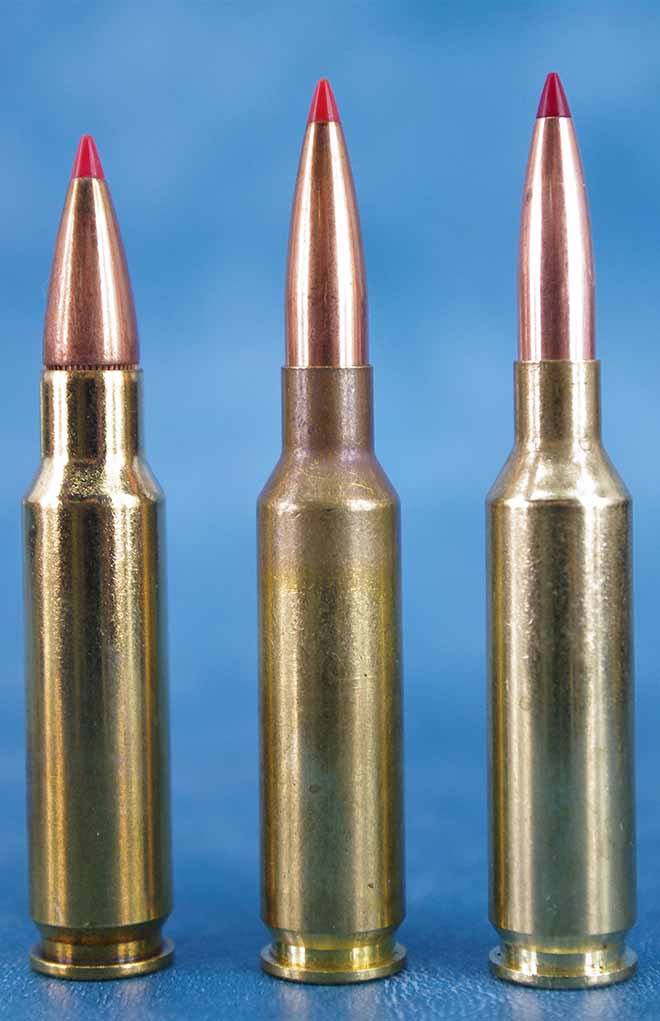
At left is .308 Winchester, next 6.5 Creedmoor, then 6mm Creedmoor.
Remington changed the twist rate to 1:10 around 1958, but it was too late; the damage had been done. The round languished until 1963, when along with the rolling out of the buzzard-turned-swan Model 700 rifle, the .244 Rem. was reintroduced as the 6mm Rem., and with it, two new loadings: a 100-grain slug at 3,190 fps, and an 80-grain at 3,450 fps. Back then, nominal factory ballistics were established in 26-inch test barrels, so they were optimistic to say the least. And to make sure there were no stability problems, they went with a 1:9 twist!
The Then-New 6mm
From the ballistic standpoint, the .244/6mm Rem. case, being based on the .257 Roberts hull, has slightly more powder capacity than the .243 Win., and it’s therefore capable of imparting a bit more velocity. That’s borne out by current factory ammo specs showing the 6mm Rem. 100-grain load exiting at 3,100 fps, and the .243 Win. at 2,960 fps. In handloaded form, the difference is more than that. Nevertheless, the 6mm Remington has never rivaled the .243 Winchester’s popularity.
Another of the author’s 6mms was this Star-barreled BSA action in a Fajen Regent stock.
However, being the iconoclast I am, I naturally went with the 6mm Rem. It was 1965 as I recall, and it was also one of the first centerfire rifles I built after getting out of school. I purchased a commercial Mauser action, had it barreled and set it into a stock from Herter’s. Before I went on to bigger and better things, I took a mule deer, two pronghorns, three black bears and about 300 groundhogs with that rifle. I had such success with the cartridge that I acquired two more 6mm Rem. rifles: one was a Ruger No.1B, which I restocked, and the other I built on a BSA action, a Douglas barrel and a Fajen stock. Both saw action out West and in Canada.
Competition Cometh
Thirteen years would pass after the introduction of the twin 6mm’s before any competition appeared; it was in 1968 in the form of the .240 Weatherby Magnum. Being a proprietary cartridge available only in Weatherby rifles, the .240 Wthby. Mag. didn’t actually compete with the .243 Win. or the 6mm Rem. in terms of sales, but it certainly raised the bar for .24-caliber performance.
In production-grade sporting rifles, no other commercial cartridges are as accurate as the Creeds.
Based on a unique case best described as a .30-06 with a belt, Weatherby data shows the .240 launching a 100-grain bullet at 3,405 fps, and an 80-grain bullet at 3,500 fps. It’s a bit puzzling that there would only be a 100 fps difference for 20 grains of bullet weight. The consensus among handloading data shows the 3,400 fps figure to be optimistic to the tune of about 100 fps in a 24-inch barrel. The 3,500 fps for the 80-grain, on the other hand, appears to be doable with handloads.
By the time Weatherby came out with his .240 Wthby. Mag. (it was the last cartridge in the Weatherby Magnum family designed by Roy himself), interest in the .24s was on the wane. I think it was because there was such a plethora of new and more capable cartridges being introduced in the ‘60s that the hunting community simply lost interest. I know I did.
The author with a bunch of Pennsylvania groundhogs taken with his first 6mm Rem.
Also contributing to the malaise were the gun magazines, in that they were convincing hunters that having one rifle for both varmints and deer was a compromise. You needed a varmint rifle and a deer rifle — preferably one more potent than a 6mm. Today, of course, we’re in the age of specialization. We have varmint rifles, predator rifles, mountain rifles, plains rifles, bean field rifles, hog rifles, long-range rifles … and the list goes on. It wasn’t like that back then.
One Last Hurrah
The last “nostalgic” attempt at a new 6mm hunting cartridge was the introduction of the .243 Win. Super Short Magnum in 2004. Because the Winchester folks had reasonable success with the .300 Win. Short Magnum, which they introduced in 2001 — and the .270, 7mm and 8mm versions that followed — they apparently figured, “If short is good, maybe shorter yet would be better?”
Not! The .243 WSSM, along with its sibling .224 and .257 versions, were commercial flops. Only Winchester and Browning chambered rifles for the ill-fated family, and production of those, along with ammunition, lasted but a few years.
One of two black bears to fall to the author’s Ruger No.1 in 6mm Rem.
I previously singled out the hunting community as having lost interest in the 6mm, but competitive shooters have never abandoned it. Not only do 6mm cartridges dominate 100- and 200-yard bench rest competitions, but the 1,000-yard game as well. And in the Precision Rifle Series, where once the .30-caliber was king, it has long since trended downward to smaller cartridges and smaller calibers having less recoil.
At first the trend was to 7mm, then to 6.5s — like the 6.5 Creedmoor, .260 Rem. and 6.5-284. Today, the 6mm is showing that it may be even better-suited to shooting tiny groups at 1,000 yards. It is somewhat counterintuitive that cartridges like the 6 BRA and 6mm Dasher, which have less powder capacity than the .243 Win., can launch relatively tiny 105-grain VLD (Very Low Drag) bullets more accurately at 1,000 yards than, say, a .300 Win. Magnum or .338 Lapua.
But they do, and they have a good-enough record doing it that Hornady, who gave us the insanely popular 6.5 Creedmoor, last year rolled out a 6mm Creedmoor. I’ve already reviewed two such rifles and both were impressively accurate with factory ammo.
Bottom line: The 6mm may not be as popular as it once was with America’s hunters, but it’s the darling of those shooting the smallest groups at the longest ranges.
Editor’s Note: This article originally appeared in the March 2019 issue of Gun Digest the Magazine.
Drawing your firearm becomes a simple procedure if you break it down into its individual movements.
Many firearms instructors may not mean to, but often times they do. Overcomplicate the subject, that is. But when you get down to brass tacks, the defensive use of a pistol is simply a matter of quickly getting your sidearm into the fight, then getting hits on your target.
As to the first aspect, drawing your firearm is key. It’s a multi-step procedure, but one that involves relatively simple movements. Five of them to be exact:
Grip — establishing a fighting grip while the gun is still in the holster.
Draw — clearing your pistol or revolver from your holster.
Rotate — rotating the muzzle of the gun around 90 degrees so it points at your target.
Support hand — applying your support hand to your grip (also the time to disengage your manual safety, if your pistol has one).
Presentation — extending your arms into a full presentation.
Not really akin to solving a differential equation. Nonetheless, drawing your firearm requires practice for it to become efficient, effective and second nature. You also — as Richard Mann demonstrates in the above video — must consider how you carry. If you wear an exterior garment — coat, sweater, sweatshirt — you have to modify how you access your handgun to clear the garb.
In any case, if you’re a serious armed citizen, you’ll take the time to perfect how you draw your gun. Because it won’t matter a lick if you’re a crack shot if you can’t get your pistol out of your holster.
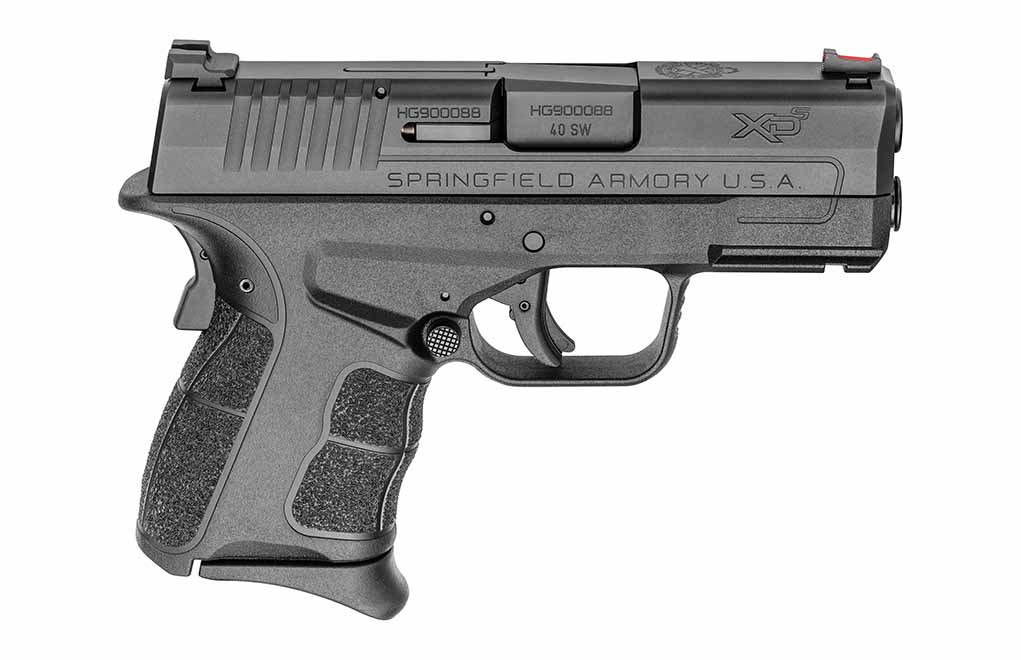
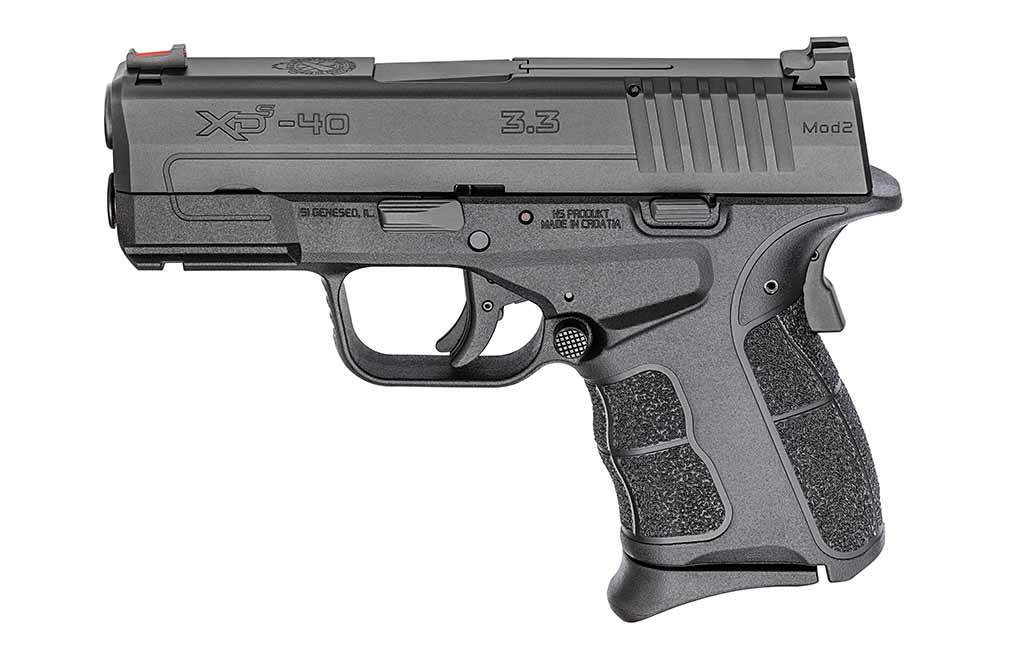
Springfield has rounded out its XD-S Mod.2 line, now offering the single-stack, striker-fired in .40 Smith & Wesson.
How The XD-S Mod.2 .40 Smith & Wesson Is Ready For Carry:
6+1 capacity with flush-fit magazine and 7+1 with extended mag
Low-profile .975-inch width and 4.7-inch height
Sub-compact 3.3-inch barrel
Around 22 ounces in weight
The tidal wave of single-stack, polymer-frame, striker-fired pistols continues to roll. No fighting trend lines. Though, this time around there is a bit of a twist and good news, if you’re a fan of the “Mama Bear” .40 Smith & Wesson.
Springfield Armory recently announced the addition of the tweener caliber for its popular XD-S Mod.2 line, now giving shooters a choice of the pistol in the three most popular defensive chamberings. The series kicked off with, what else, the 9mm, which Springfield then buttressed with a .45 ACP model. And like the .40 S&W itself, the new XD-S Mod.2 strikes a middle ground between the existing options. At least, when it comes to capacity. The pistol feed off 6+1 flush-fit and 7+1 extend magazines – one less than the 9mm and one more than the .45.
If you’re familiar with the XD-S Mod.2 line, the .40 S&W won’t throw you any curveballs. It comes with the same accruements: fiber-optic front sight, tactical rack serrated rear, Melonite finish on all the steel and a 3.3-inch barrel. And like its predecessors, it’s the dimensions that made the single-stack so popular in the first place, particularly its highly concealable .975-inch width and 4.7-inch height (with flush-fit mag). The price is right too, with the XD-S Mod.2 .40 Smith & Wesson boasting an MSRP of $524.
More from Springfield Armory:
GENESEO, ILL. – Springfield Armory’s most popular selling pistol, the XD-S Mod.2, is now chambered in .40 S&W, and holds 6+1 or 7+1 rounds in this premiere concealed carry firearm.
Following the release of the XD-S Mod.2 in .45 ACP and 9mm, Springfield is bringing the .40 S&W back by customer request, rounding out the line with an ideal cartridge for the highly-respected XD-S platform. Engineered with a slim profile that is optimized for concealed carry, the small frame and single stack design achieves the ideal combination of both size and reliability.
The XD-S Mod.2 in .40 S&W features popular characteristics known throughout the XD-S Mod.2 product lineup, such as a fiber optic front sight for fast target acquisition, and a tactical-rack rear sight. This style of rear sight provides the added benefit of being able to rack the slide against objects such as a belt or door frame if neccessary. Aggressive Posi-Wedge slide serrations encourage easy manipulation of the slide, while enhanced grip texturing allows for a secure and comfortable feel for controlled, repeated rounds on target.
A high-hand grip is also encouraged through the XD-S Mod.2 frame by positioning a shooter’s hand closer to the bore axis for improved recoil control. A loaded chamber indicator allows shooters to not only see, but feel the condition of the gun when holstered or in darkness. The grip safety encourages peace of mind while carrying by rendering the firearm incapable of firing unless engaged. The XD-S Mod.2 in .40 S&W also features an enhanced short-reset trigger and memory bump similar to those on 1911s, which allows for effortless engagement of the grip safety.
The XD-S Mod.2 in .40 S&W ships with two stainless steel magazines: a 6-round mag with a pinkie rest and one 7-round extended mag. A flush floor plate is also included to offer maximum concealability.
XD-S Mod.2 .40 Smith & Wesson Specs
Recoil System: Dual Captive Recoil Spring w/ Full Length Guide Rod Sights: Fiber Optic Front & Tactical Rack Serrated White Dot Rear Weight: 22 oz – 23 oz w/ Extended Magazine Height: 4.7″ – 5.22″ w/ Extended Magazine Slide: Forged Steel, Melonite® Barrel: 3.3″ Hammer Forged Steel, Melonite® Length: 6.3″ Grip Width: .975″ Frame: Black Polymer w/ Enhanced Grip Texture Magazines: (1) 6-Round w/ Grip Extension, (1) 7-Round Extended & (1) Flush Plate MSRP: $524.00
Lethal-force events can happen in a split second, you need the capability to respond in kind. Here’s how law-enforcement legend Jim Cirillo got the drop on the bad guys.
How Does Jim Cirillo’s Coarse-Aim Shooting Technique Apply To Defensive Situations:
He aimed by using the outline of his handgun as his sights — if the bad guy was wider than the pistol he could get a hit.
The technique is only appropriate for close situations where the utmost precision is not required.
Straight forward, the technique requires practice — plenty of it — to safely and effectively apply it.
The British have a saying (or did, before the anti-hunting zealots made riding horses a heretical offense), “Horses for courses.” That is, if you want to win, you ride the correct horse for the course to be ridden. Cowboys understand this, as the smart ones would not select a Budweiser Clydesdale for a barrel-racing event.
And so it is with firearms. While there are good “do-all” firearms that can cover a lot of problems, you still want the best for the job. And you want the best technique.
That was the problem faced by Jim Cirillo, and the rest of the NYPD Stakeout Squad, when dealing with bad guys. In this sedate and safe second decade of the 21st century, it’s difficult to imagine just how hard and dangerous our cities were in the past. In 2016, NYC had a violent crime rate of 540 per 100,000 inhabitants. In 1969, the rate was 955, and by 1975 it would rise to 1,411. In the late 1960s, the armed robberies had an added problem: The armed robbers, having held up a bodega, were shooting the cashiers so there wouldn’t be witnesses.
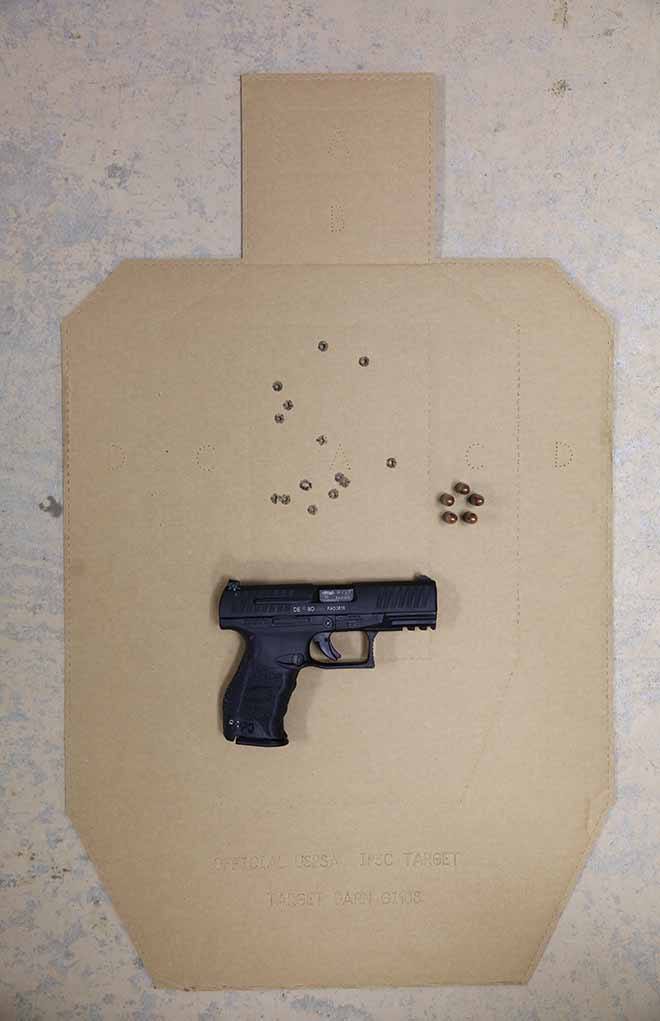
This target represents the use of the Cirillo technique, featuring five sets of three shots, at max speed, at 5 yards. That’ll get the job done.
The Stakeout Squad was formed to deal with the problem. They would study the patterns, select a few bodegas and find or build hideouts in them. When the bad guys went to hold up the store, the Stakeout Squad would arrest them. As you would expect from armed criminals enacting violent felonies, there would be some resistance. Shootouts were common.
Now, for those of you who have not been in a bodega, the distances were not great. A bodega is a small store that handles all the usual odds and ends, and daily needs, of the patrons. In NYC, they could even offer more than just milk and bread, but they were small. Readers in the Midwest or far West, imagine the smallest party store or local mini-mart you’ve ever been in. Then, chop it in half, or even down to a third of that. Make the aisles narrow and not more than 50 feet long. That describes every NYC bodega I’ve ever been in. Stores today might be more roomy (I was last in a bodega in 1998), but in 1968 when the stakeout Squad was formed, they were narrow, small and not deep.
Seeing With Clarity
When he first started shooting people, Jim Cirillo saw his front sight clearly. So clearly, in fact, that he could see the grooves cut into it. The problem was, he couldn’t identify the bad guy or guys. He could identify them by color — “Shoot the guy with the blue sweatshirt on” — perhaps, but not more than that. When the light was good and the distance warranted it, he by all means used the sights.
But, he had to make sure he was shooting the right people. So, he developed an amalgam of a shooting technique that suited the situation, right there and then, at the close distances involved.
What he did was look at the perp (I know, first heretical act) and then bring the pistol up and push it forward. He would then keep most of his focus on the bad guy (second heretical act) and verify pistol alignment. Then he’d shoot the bad guy.
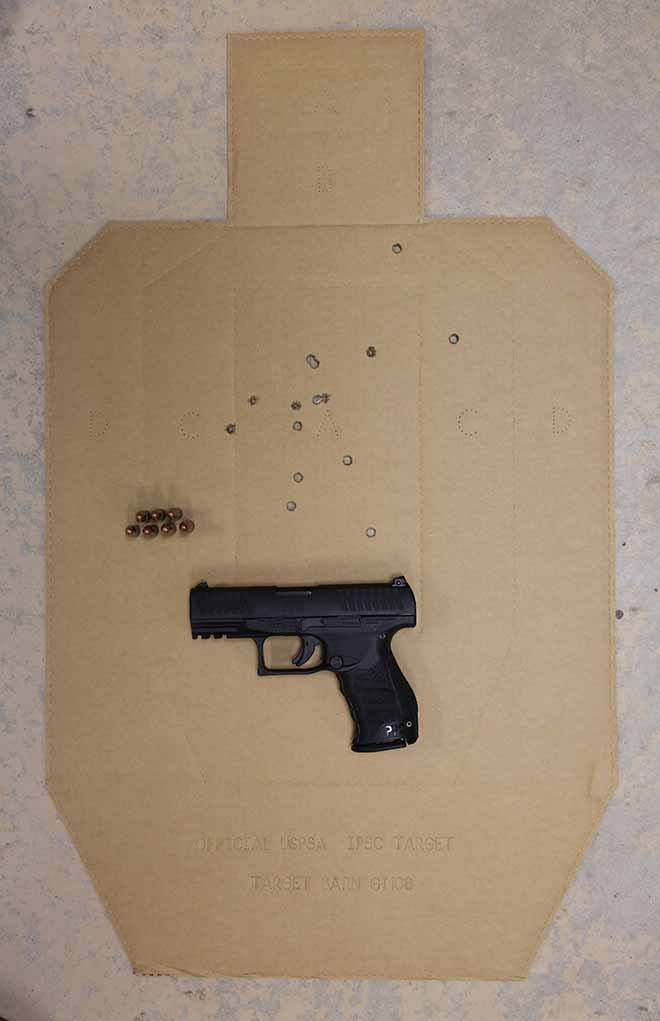
At 7 yards, the author found that the groups started to open up, and the pace slowed just a bit. But, the hits are good, and the results can be gratifying.
He was aiming by using the outline of the pistol or revolver as his sights. This method works out to a certain distance: As long as the outline of the bad guy was wider than that of the pistol, and he could not see the sides of the slide on either side (i.e. it was centered), he could count on getting a hit.
Now, let us be clear on this: It’s not “point” shooting. It’s not “instinctive” shooting. It’s warp-speed fast, coarse-aiming shooting.
You do not do this when you have to make a tight shot, say, on a bad guy holding a hostage. This is not an appropriate technique in that situation. Horses for courses, remember? In that situation, you bear down and see every line scored in your front sight blade, and then do a clean trigger press.
But, when turning the corner in a bodega and being faced with a bad guy at 20 feet who’s already holding a firearm? Cover the “A” zone with the back of your slide and start shooting.
I had a chance to talk to Jim at an industry gathering a couple of years before his untimely death. Yes, he used this technique, but it was one technique in his bag of skills. And, it worked with handguns — but not rifles or shotguns — all of which he used at one time or another.
And, he used it at close range. When the distance opened up or he had to make a tight shot, he used the sights. He was a skilled competition shooter, he knew how to hit what he was aiming at, and he did it.
Applying The Cirillo Method
To verify my memory and to get a sense of what this can be like, I hauled a 9mm pistol and some targets to the range.
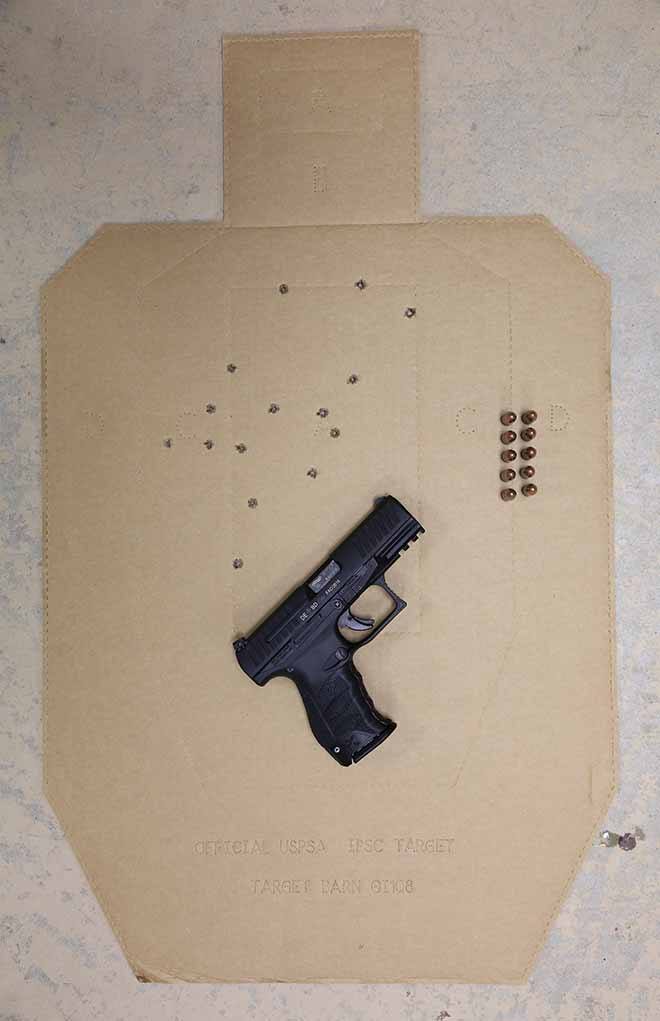
When stepping back to 10 yards and employ thee Cirillo technique, the place slows enough that sights become competitive, and the group opens up enough that the results might not be so satisfactory. The cutoff distance for you will vary depending on the firearm, the ammunition and the amount of practice you put in.
The pistol was just the first 9mm hi-cap that I laid hands on — the excellent Walther PPQ M2 — and I loaded each magazine to 15 rounds. I set up three targets: one at 5 yards, one at 7 yards and one at 10 yards. The process was simple: On the beep, I’d bring the Walther up, shove it forward, get a Cirillo index on the target and fire three quick shots. Then I’d re-engage the timer and repeat until the magazine was empty. I did not record times; I simply shot as fast as I could get the index working for me.
At 5 yards, the USPSA target looks to be the size of a Buick, and the back of the Walther slide barely covers the “A” zone. However, by going back just 2 yards, the slide appears much wider against the cardboard. At 10 yards, the slide is almost as wide as the target. So, for the Walther, 10 yards is the outside limit of useful distance. Perhaps a pistol with a narrower slide would do better, but it also depends on your arm length.
The targets also told their tales. The 5-yard target had all 15 shots well inside of the “A” zone, and they were all in the upper half — the location I was focused on when the beep went off. Given the “shooting with my hair on fire” speed I was working at, that was pretty impressive.
At 7 yards, one shot of the 15 was left on the edge of the “A” zone, and two others were high right and out of it. The total of the shots looked quite good, but not nearly as good as those at 5 yards. So, at 30 feet, this is still working for us.
At 10 yards, well … hmmm. Not only was my shooting pace markedly slower (while still being quite brisk), I had five hits on the edge of the “A” zone, and three that are outside of it. Clearly, with this pistol at 10 yards, using the sights is smart. Just on a whim, I then set up a fresh target, and timed the 10-yard runs. At that distance, my average for three-shots, and the same general group size with the Cirillo Technique, was right around 0.80 seconds. My splits were pretty pokey by competition standards — generally at 0.20 seconds — and I got the same sort of hitting percentage.
The comparison would not be entirely fair because I was warmed up, but I did the same thing again, but this time I went into competition mode and used the sights fully, and I made sure every hit was an A-zone hit. The stats? My average three-shot set was closer to 0.70, the splits were in the upper teens and every hit was an A-zone hit.
What does this prove? That practice is more important than anything else.
Practice Trumps All
I’ve practiced using the sights for a half-century now, firing well over a million rounds. You could startle me out of a deep sleep and I’d be using the sights as I came up on the target. However, the Cirillo technique does have its uses.
But make no mistake: It, too, requires practice. As I said, this is not point-shooting and this is not instinctive — there is neither such a thing, and no viability to such approaches. You have to aim, somehow, and you have to practice.
But, if you do practice this, someday you might wake to hear a bump in the night, turn the corner and find a bad guy at close range — so close that if you spend too much time refining your sight picture, he’ll take a couple of steps forward and slap your muzzle aside. Instead, cover his center with the outline of your handgun and solve the problem, sights or no sights.
The Stakeout Squad members were too good at their job. They shot so many bad guys, so often and in such a short period of time, that people noticed. And then the Squad was disbanded. That was 1973. The crime rate in New York, and everywhere else, kept rising for some time after that. However, at least there were a few bad actors who couldn’t contribute to the rise. And some of them were “retired” from their profession by use of the Cirillo technique.
Editor’s Note: This article originally appeared in the March 2019 issue of Gun Digest the Magazine.
The ground shifted in 1836. Samuel Colt was at the epicenter. In that year, the ambitious businessman introduced the gun that arguably changed it all – the Colt Patterson. While it wasn’t the first repeating arm to come down the pike, it was the first successful one. And arguably, it changed gun designs, not to mention the world, forever. From that point on, a single shot loaded from the muzzle just wasn’t going to cut muster.
Had the Paterson revolver been all Colt contributed it would have been enough to cement his place as one of the greats. But the man and his company have a litany of greatest hits that prove gems of any collection. And, with a few exceptions, Colt still manufacturers all of them, making it fairly simple to add one of the classics to your gun safe.
So, without further ado, here are 5 Colt guns every shooter should aim to add to their collection.
Colt 1911
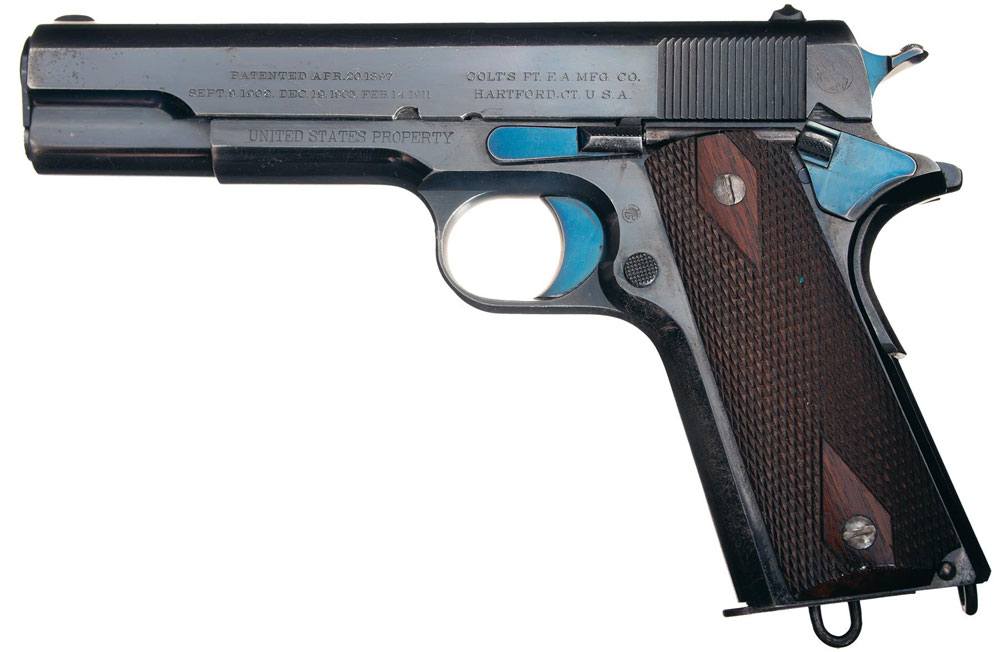
Undeniably, John Browning’s 1911 is among the greatest pistol designs. Successful service in two World Wars is enough to put it at the top. While there are many gunmakers – custom and otherwise – that turn out renditions of this piece of American badassery, Colt continues to set the standard. Given the company’s long history with the pistol that’s how it should be.
Plus with Colt, there’s no shortage of riffs off the original 1911 design. Need a deep cover piece? Check out the minute Mustang Lite. Looking for a top-end competition pistol? The Gold Cup more than lives up to its name. Honestly, if you have an objective, Colt has a 1911 to meet it. Overall, for my money, there are two standouts in particular: the Colt Government Model and Colt Combat Commander.
An entry-level option, the Government Model (MSRP $799) nonetheless is a superb pistol. A direct descendant of the original M1911, it’s full-sized and boasts many of the features of its predecessor – straight cocking serrations, fixed sights, etc. It’s also available with series 70 or 80 firing systems. However, the .45 ACP isn’t simply a slice of nostalgia, it’s also a shooter – more than fit for home defense or on-the-dot target shooting.
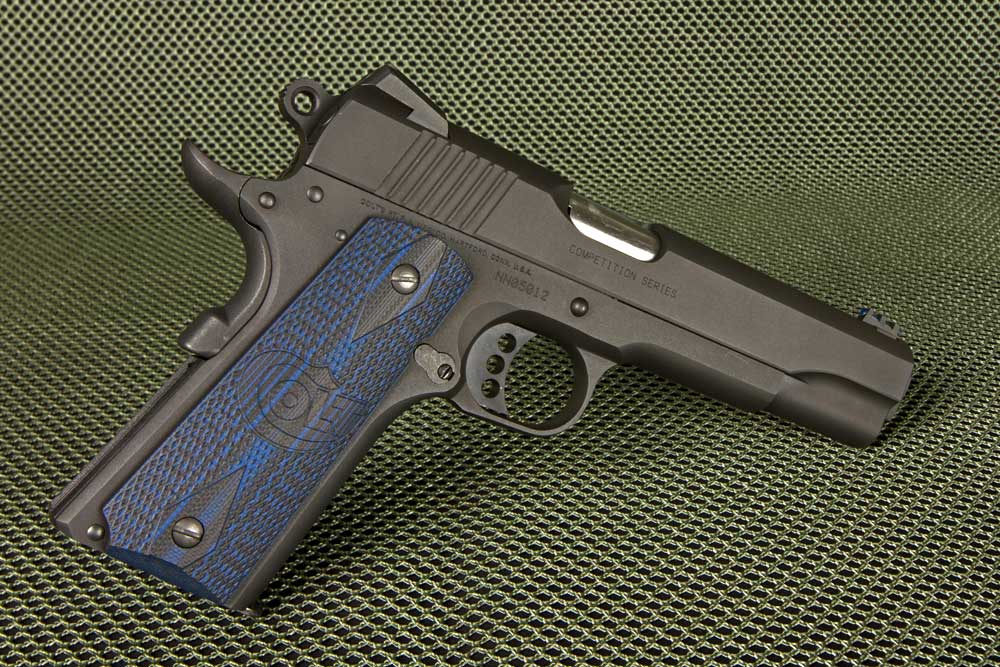
As practical as a Roth IRA, the Combat Commander (MSRP $999) is the best of both worlds. Its 4.25-inch barrel makes it more viable for concealed carry. Yet it has the heft to soak up recoil, thus make the pistol lightning fast and dead-on accurate on a follow-up shot. A step up in price, the Combat Commander is still a value, boasting premium features such as genuine Novak Low Mount sights, G10 grips and Colt’s dual-spring recoil system. Either choice, you’re definitely getting functional shooters.
Colt AR-15
Colt M4 Carbine
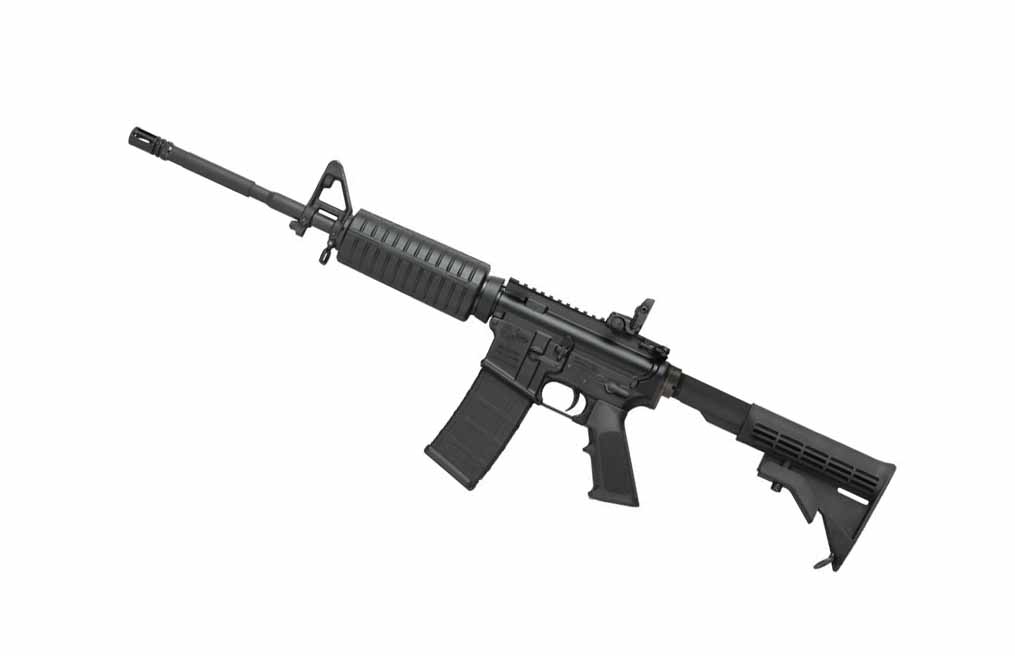
Colt and the AR-15 have been intertwined since the rifle’s beginning. Well, almost its beginning. And up to a few years ago the gunmaker was still producing them for the U.S. Military. In turn, they know their way around what has become America’s favorite rifle. While the gunmaker offers a number of choices (including AR-10s, if that’s your groove), arguably the LE6920 is among the best – even measured against other manufacturers. Yup, it’s as plain as red bricks. But it’s got it where it counts – performance and accuracy.
Now listed at the Colt M4 Carbine (MSRP $1,099), the LE6920 is a stout gun. Chrome-lined barrel, forward assist, staked gas key bolts, double-heat shield handguard – it comes with all the features that ensure its ruggedness. Which is perhaps why it’s extensively used by law enforcement. But it will excel at any task you might charge it with – home defense, varmint hunting and plain old high-powered plinking.
Yeah, like any firearm you’ll have to play around to find its sweet spot with ammo. However, with a 1:7 twist in its 16-inch barrel the 5.56/.223 has a lot of wiggle room – stabilizing bullets up to 80 grains.
Colt Single Action Army
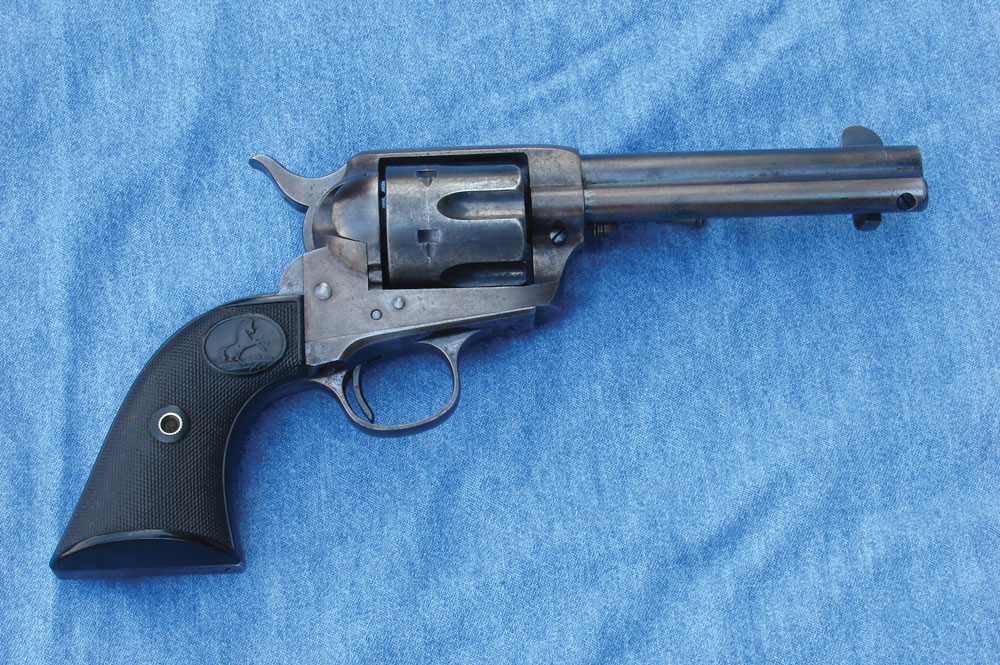
The Granddaddy and progenitor of all modern single-action revolvers is the Colt Single Action Army.
In the past, Colt has attempted to jettison perhaps its most famous handgun. When you’re a gunmaker contracting with the U.S. Military, it makes sense you might want to shelf what, by all standards, is an anachronism. But they’ve paid for those misbegotten endeavors with the Single Action Army and thankfully it soldiers on in its catalog today.
While an actual historical Wild West Peacemaker would be the prize of any collection, most of modest means will never gather one up. That’s alright, given many consider the company’s Third Generation SAA revolver (MSRP $1,799) perhaps better made than any preceding it. And true to the original design.
Outside of some minor details, the modern Colt Single Action Army is identical to the smokeless-powder framed first generation that came out in the late 1890s. This means, for safety, you only load five rounds and leave the hammer on an empty chamber if you’re carrying it. Don’t and you’ll set yourself and your foot up for a bad day.
Off the shelf you can choose from a 7.5-inch barreled Cavalry model, 5.5-inch barreled Artillery model and 4.75-inch “Gunfighter’s” model. Across the board, they are chambered in the traditional .45 Colt, feature a notched rear sight and blade front, a blued barrel and color case hardened frame. Of course, if you’re looking for more accouterments you can always call the custom shop. But with the stock models you’re getting everything you want out a single-action army – including the name Colt.
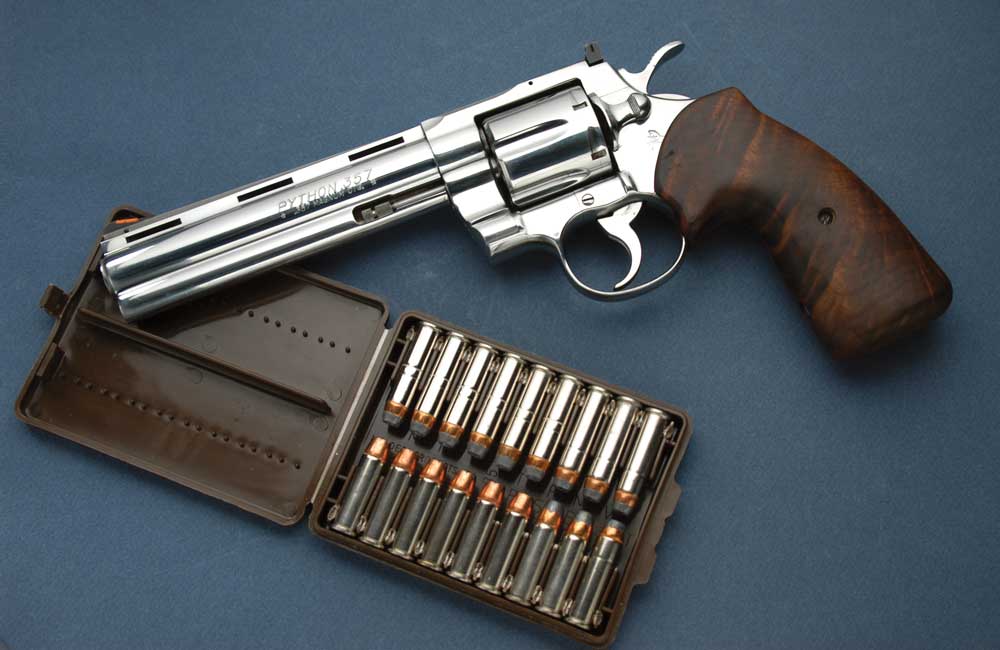
Colt Python
In 1955, Colt’s Firearms introduced what many believe to be the most elegant .357 Magnum revolver ever created—the Python. This example is an Ultimate Python in stainless steel and has the best features found with any Python, plus the bonus of custom grips to make it one of the nicest .357 Magnum revolvers one can find.
Things get trickier adding possibly best revolver ever made to your collection. Discontinued and highly popular, anymore you might have to sign over your first or second born to afford one. And, in my humble opinion, those holding their breaths for the Python to join the reboot “snake gun” series are doing so in vain.
There’s little to no possible way for the company to produce a hand-fitted and hand-polished gun (which the original was) at prices all but gilded coastal swells could afford. And if it wasn’t manufactured to that same standard, wouldn’t it pretty much be a Trooper with a full lug and vented rib?
Anyhow, if you have the bank account to chase a Python you certainly won’t be disappointed; the .357 Magnum lives up to its billing. Given its tight tolerances and the master craft to create them, the double-action is hair-splittingly accurate. Makes sense, given the Python was conceived as a target gun. An adjustable rear sight is part of this equation, but the most noticeable aspect that gets the six-round revolver on target is its trigger pull. It’s smooth… freshly powered baby bottom smooth.
If all that isn’t enough to close the deal, the Python is absolutely breathtaking in appearance. That facet alone, would all but solidify its status as king of your gun safe.
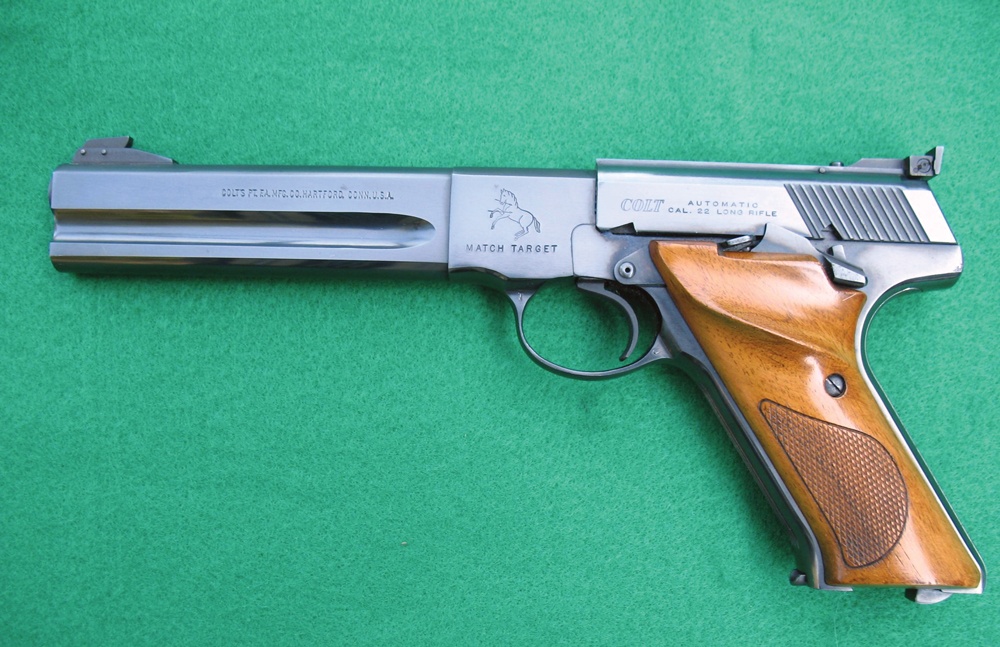
Colt Woodsman
This is a Second Series Match Target manufactured in 1968.
The Colt Woodsman is the quintessential .22 semi-auto pistol. It’s a shame they aren’t still made. Because when it comes to accuracy, classic lines and reliability the pistol had them in spades. Figures, given John Browning came up with the original model that would go on to become the Woodsman.
Part of the reason why the rimfire proved so accurate is how it was manufactured. An early 1900s design, it required a lot of machining and hand-fitting. In turn, the Woodsman was tight as a drum. But the design itself also helped make it a shooter. In particular, the steep rake of its grip made it a naturally pointing pistol, particularly when shot one-handed. The gun has the look of a competition pistol because, in for many shooters, it was used for that exact purpose.
Most iterations of the Woodsman also came with some pretty nifty features, such as fully adjustable rear sights, last shot hold open and thumb rest. And these – primarily found in the First and Second series – can run a pretty penny. Thousands of dollars that is. But if you’re willing to settle for a more pedestrian and contemporary model, such as the Third Series Huntsman or Targetsman, you’ll only have to spend in the hundreds. Given these still whip the bullseye, they are in many cases a great value.
Colt Articles You Need To Read
Now that we’ve gone over some of the classic Colt firearms, it’s time to look deeper into individual models. Here are some review and features on the gunmakers iconic offerings.
Addressing pistol malfunctions and stoppages on the fly is a must if you want to keep your gun in the fight.
Stance, grip, sight picture… there are a number of common fundamentals you must master no matter your handgun choice. Unique to pistols, managing malfunctions.
While revolvers do malfunction, the occurrence is rarer and in many instances more catastrophic. A pulled bullet, for instance, relegates a wheelgun to a hunk of steel, until it spends a couple hours under the studied hands of a gunsmith. Pistol malfunctions and stoppages, however, are a fact of life. Luckily they are also much easier to address. Develop a proper understanding of what they are and how to clear them and you’ll keep your gun in the fight, even under great duress.
Starting from the start, and in the simplest terms, there are four primary malfunctions and stoppages:
Failure To Fire
Failure To Feed
Failure To Extract
Failure To Eject
It almost goes without saying, but if you keep your pistol cleaned and well maintained the chance of these occurring is greatly reduced. But if you’re in a life-or-death situation and you encounter a malfunction or stoppage, solving it is usually as simple as tap, rack and bang. That is, firmly tap the magazine to ensure it’s fully seated, rack the slide to clear the action of any obstruction and to put it back into battery, and bang… well, that should be the ultimate result in addressing the issue.
Richard Mann goes a step further in the above video, suggesting you initiate a full reload or at least take the magazine out when you clear your pistol. The reason being, the magazine might be the issue, not the pistol. Either routine, learning to address pistol malfunctions and stoppages are a must if you want to keep your gun running.
More than living up to its name, Mission First Tactical’s Minimalist AIWB holster cuts down the bulk of everyday carry.
How The Minimalist AIWB Holster Improves Appendix Carry:
Lightweight, the rig uses a minimum of material
Ambidextrous, it works for right- and left-handers
Tuckable, the holster is easy to put into deep concealment
Claw and spacer system cuts down overall print
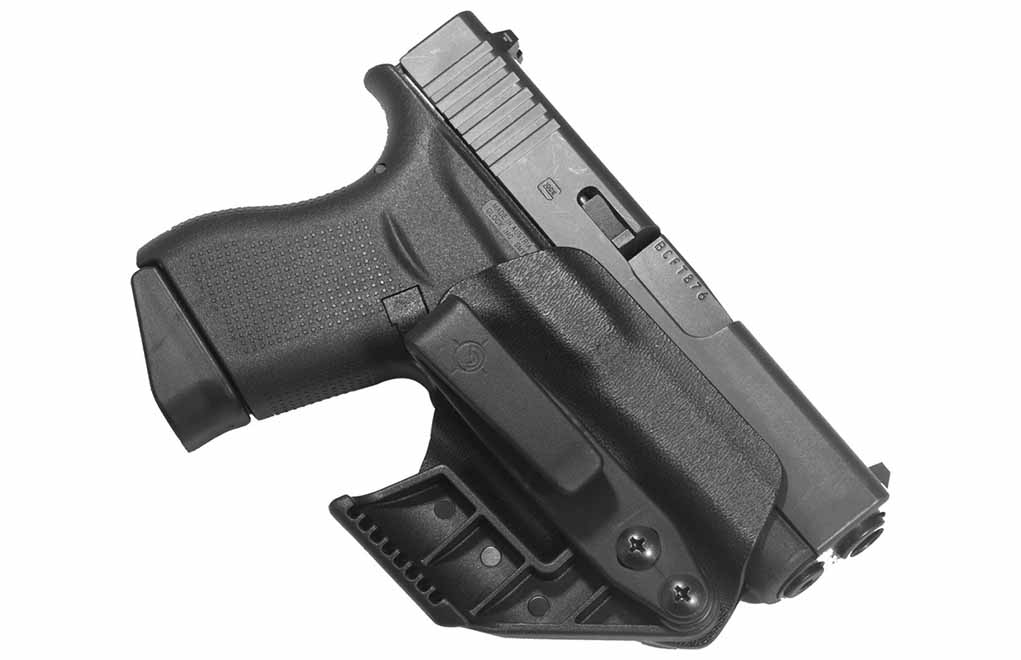
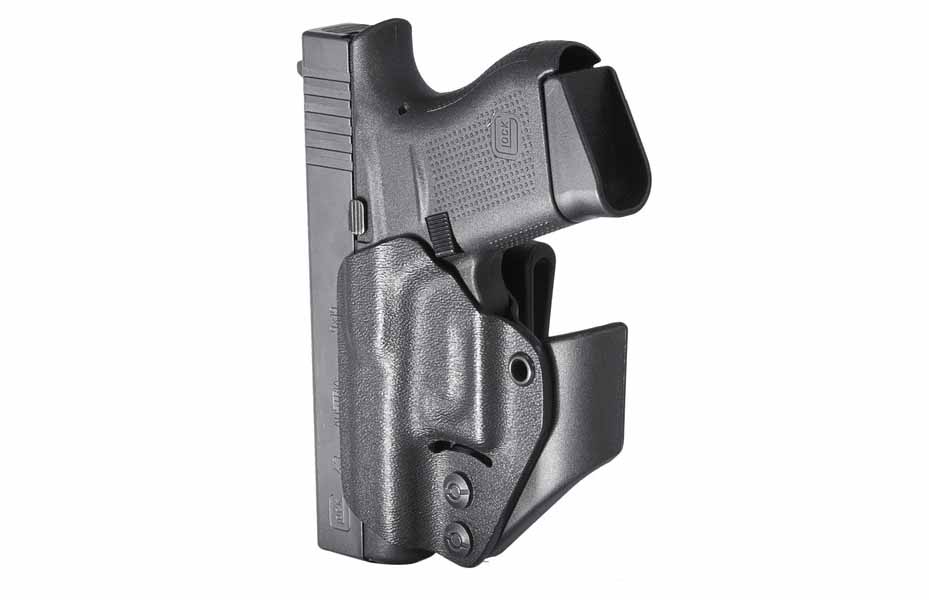
Best known for its excellent AR-15 accessories and upgrades, Mission First Tactical has turned its eye to concealed carry as of late. And if its Minimalist AIWB Holster is any indication of things to come, armed citizens are lucky the company is branching out.
Living up to its name, the rig cuts a shadow of a profile, using a jot of material. Yet, the Minimalist AIWB provides the performance and reliability of a full-sized appendix holster. Quite a combination.
For more information on concealed carry holsters check out:
How Mission First Tactical achieves this is the use of Boltron, a durable thermal plastic that molds to every nook and cranny of a handgun. In the case of the Minimalist, it is molded around the trigger guard and fore-end of the pistol, keeping the trigger protected when the pistol isn’t in use, providing excellent support and passive retention.
Furthermore, it has a claw, which cuts down the profile of your pistol, keeping it firmly pressed against your side. If you need to reduce your gun’s print even more, the Minimalist AIWB system comes with a spacer to push the toe of the holster further away from your body and more into your side. The design also tends the facilitate a lightning-fast draw, and an audible “click” when fully reholstered.
The tuckable Minimalist offers a fairly flexible system as well. The holster is ambidextrous, boasts 20-degrees of cant adjustment and accommodates belts from 1 to 1.5 inches in width. There’s one catch to the rig. According to Mission First Tactical, for safety reasons, the Minimalist AIWB must be removed from your belt for reholstering.
The MFT holster is fairly light on the pocketbook, with an MSRP from $34.99 to $49.99. A good value, if you’re shooting to reduce the bulk of your EDC system.
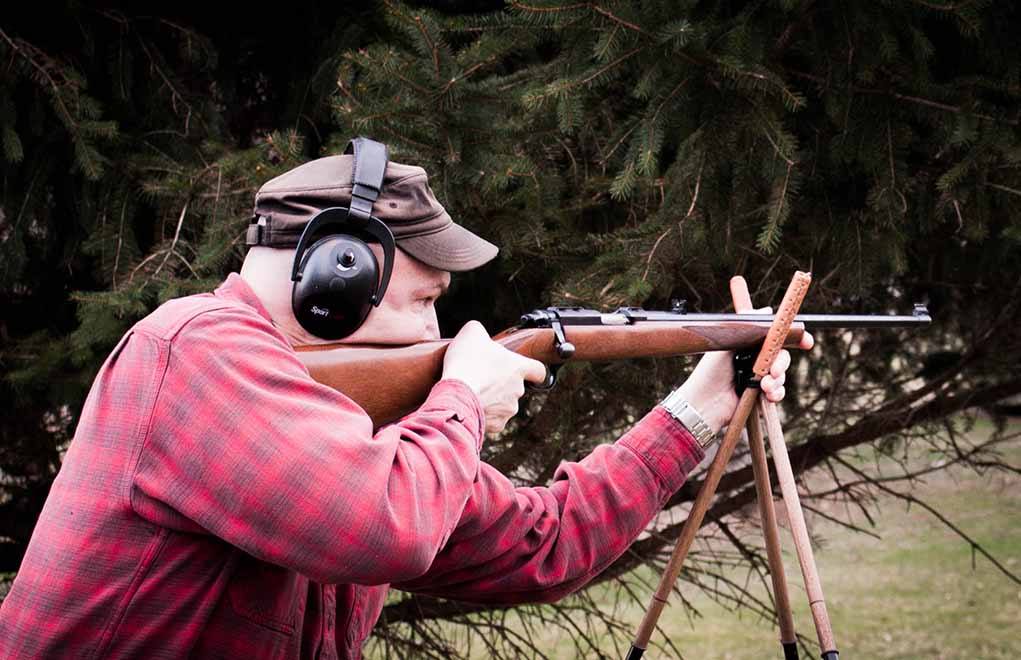
The Ruger 77/22 is a well-designed bolt action rimfire rifle
Ruger’s 77/22 offers big game styling in a rimfire configuration. Hands down, it might be the only plinker you’ll ever need.
What Makes The Ruger 77/22 A Superior Rimfire:
Built like a big-game rifle, scaled down for the .22LR
Walnut stock, checkered fore-end and grip
90-degree bolt throw
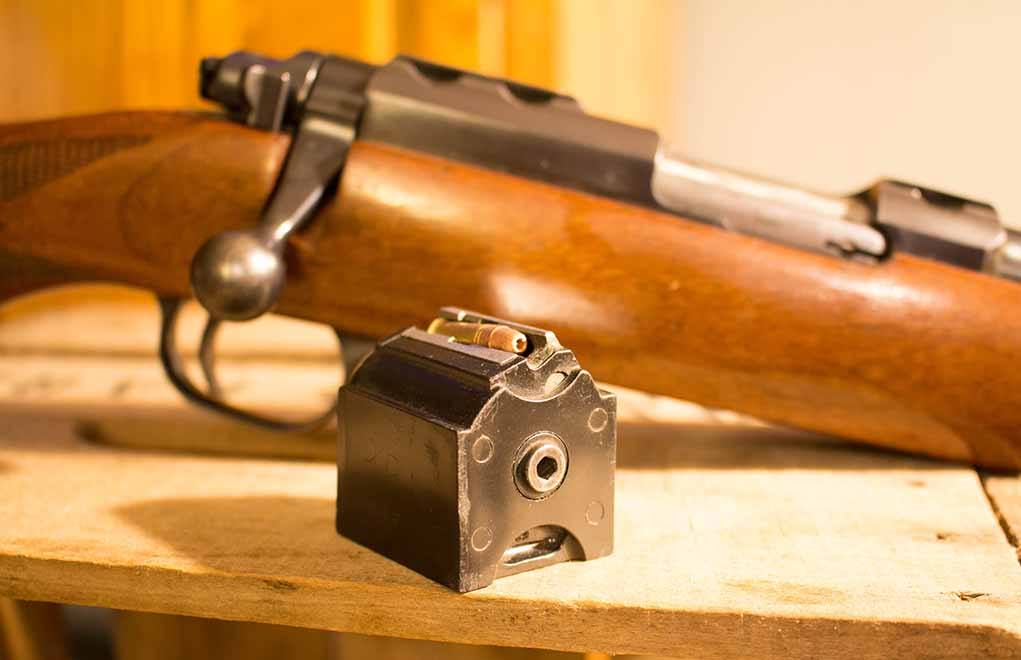
Detachable rotary magazine
Integral scope mounts machined directly on the receiver
Three-position wing safety
Two-piece bolt with two locking lugs
It was Christmas Day 1985, and I remember vividly as my dad, Ol’ Grumpy Pants, produced a long, narrow box, hastily — perhaps clumsily — wrapped. At 14 years of age, as if life wasn’t mildly awkward to begin with, I was learning to hunt with him, and each trip to the woods was a new challenge, replete with a healthy dose of nerves because I certainly didn’t want to fail in front of my father. In that era, a hunter had to be 16 years old to hunt big game, and until that Christmas Day I hunted with my Fox double barrel .410 … but all that was about to change.
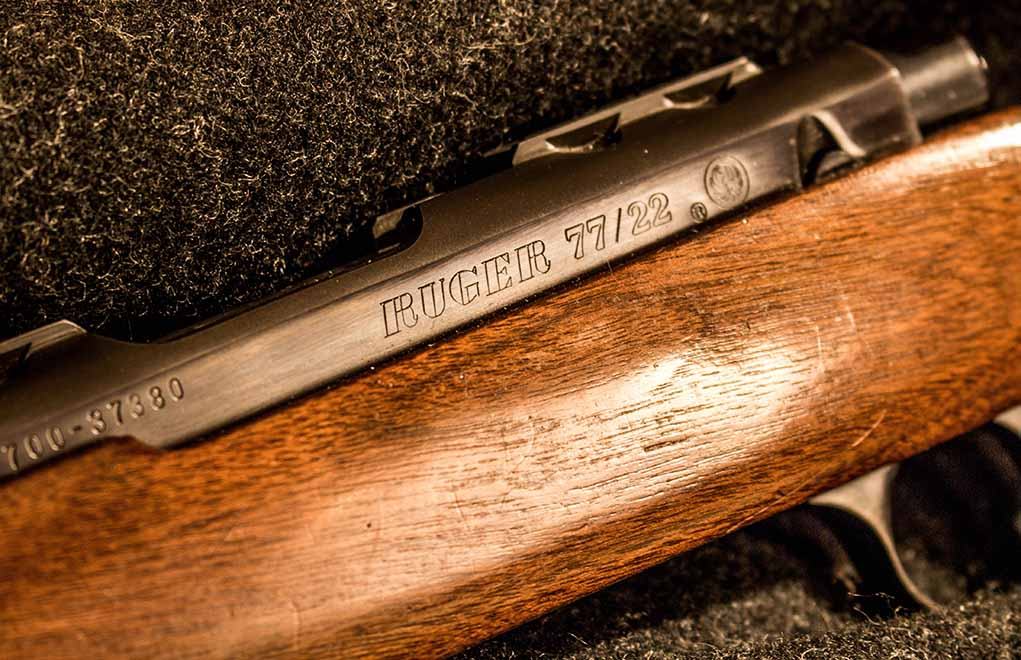
Inside that amalgam of tape and paper was my first rifle: a Ruger Model 77/22 bolt-action .22 Long Rifle. To me, it was — and still is — a very serious piece of gear. As Dad told me, “It’s built just like a big-game rifle, but scaled down. Safety is in the same place, sights are just like the bigger Ruger rifles, and we can easily scope it.” Having a rimfire rifle built in the manner of a deer rifle, or even one suitable for dangerous game, would prove very important to me later in life.
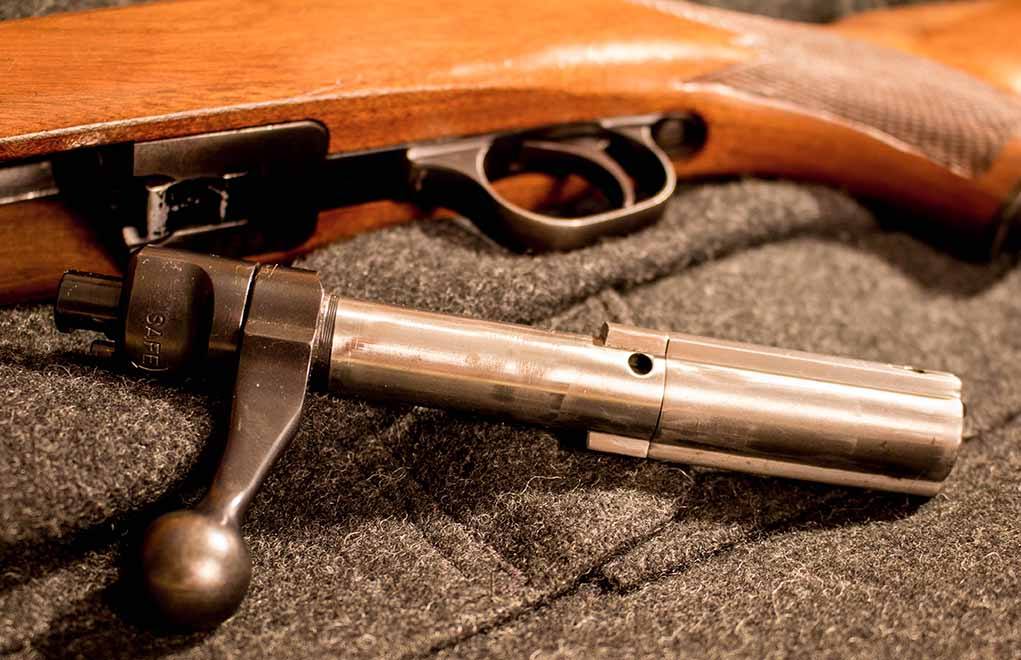
The Ruger 77/22 features a two-piece bolt with locking lugs at the rear of the first piece.
Now, I feel that every hunter, old or young, should own at least one good .22 Long Rifle — it’s one of the handiest cartridges ever developed, and that rifle has been the only .22 I’ve owned, because it serves every purpose I’ve ever asked it to. That rifle has taught me an awful lot about shooting mechanics, about the way a barrel can behave with various types of ammunition, about trigger control, and about so much more. While there are many different makes and models available — including Ruger’s fantastic 10/22, which Grumpy Pants loves — the 77/22 represents everything I want in a rimfire rifle: accuracy, reliability and consistency.
Finding A Friend
My own rifle is in a blued steel/walnut stock configuration, and like the Ruger Model 77, features the integral scope mounts that connect directly to the receiver; 1-inch rings are provided with the rifle. It uses a 10-shot rotary magazine — interchangeable with the 10/22 yet of slightly different dimension in order to mount flush to the stock — that has proved to be very durable over the past 3 decades.
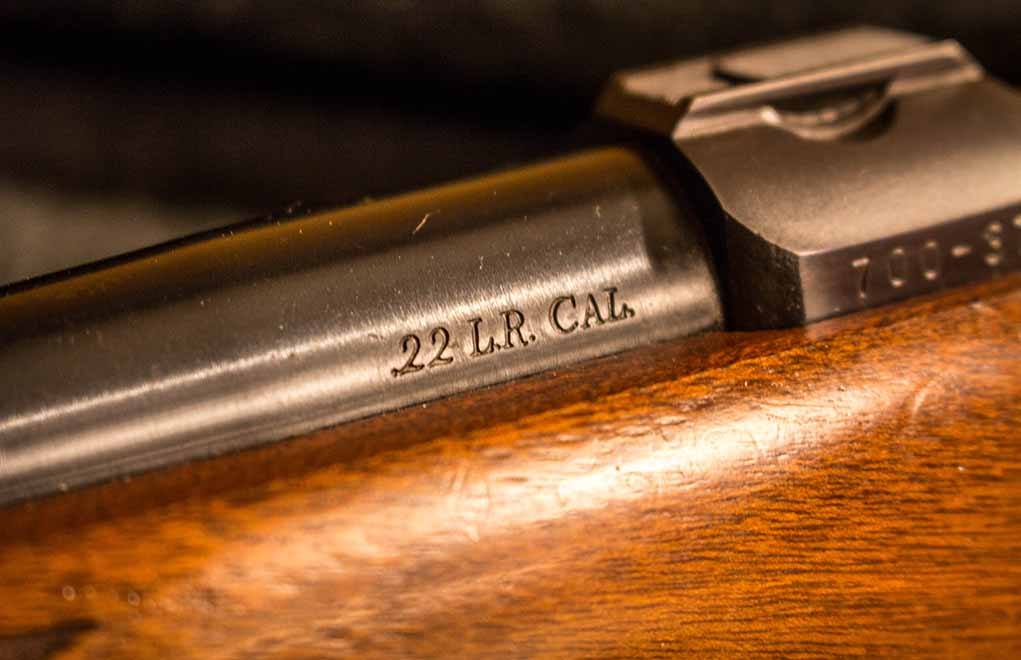
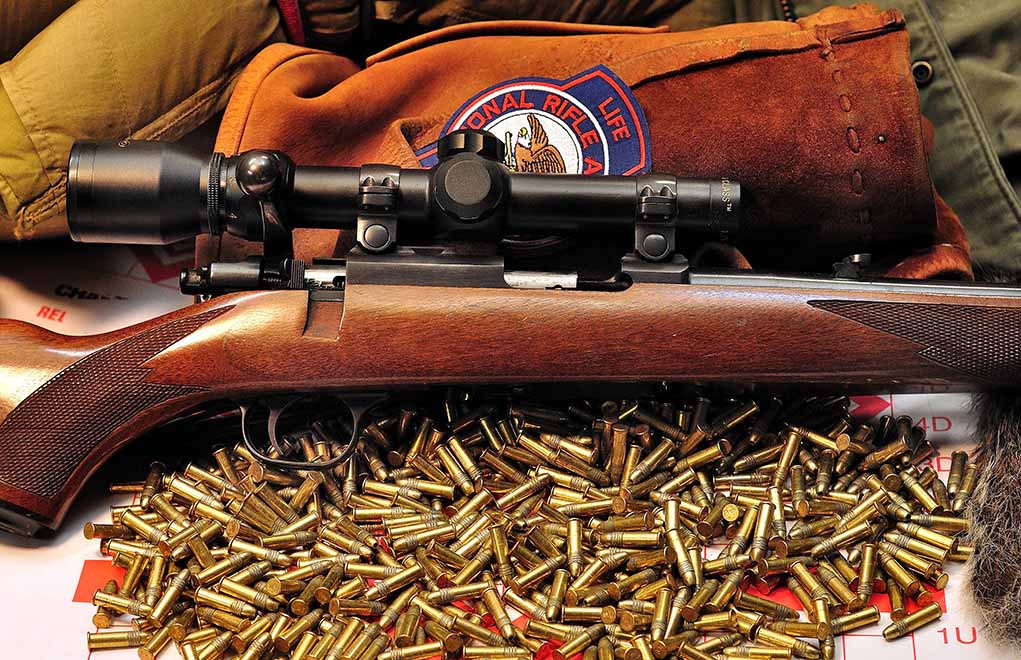
Chambered for the versatile .22 Long Rifle, the 77/22 can fulfill a variety of loads.
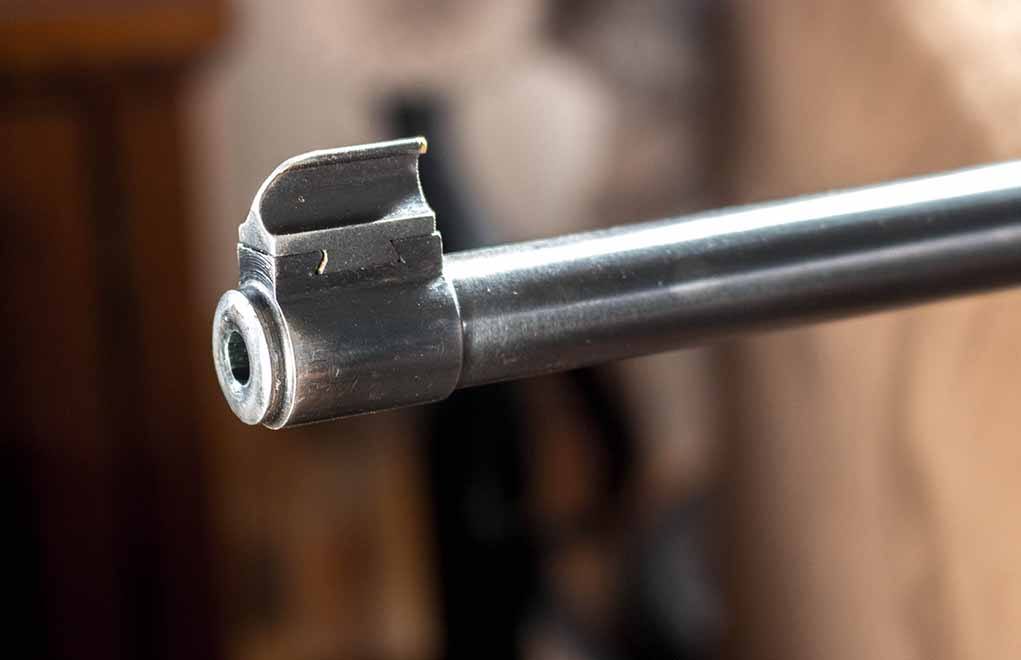
A steel receiver is mated to a 20-inch barrel, complemented by an adjustable, folding rear sight and a barrel band front sight topped with a fine brass bead. Its walnut stock — checkered at the forend and pistol grip — has a plastic grip cap and buttplate in addition to steel sling swivels. A three-position wing safety, identical to the Ruger 77 centerfires, is located at the rear right side of the receiver. A two-piece bolt with spring loaded ears — for proper loading and extraction — runs smoothly at a 90-degree bolt throw. There are two locking lugs just behind the joint in the bolt.
Its trigger, while non-adjustable, is smooth — there’s a small amount of creep, but it breaks crisp enough to print accurately. Again, this little rifle has all the attributes of a big game rifle, and for years it mated with my Ruger 77 in .308 Winchester for an effective one-two punch.
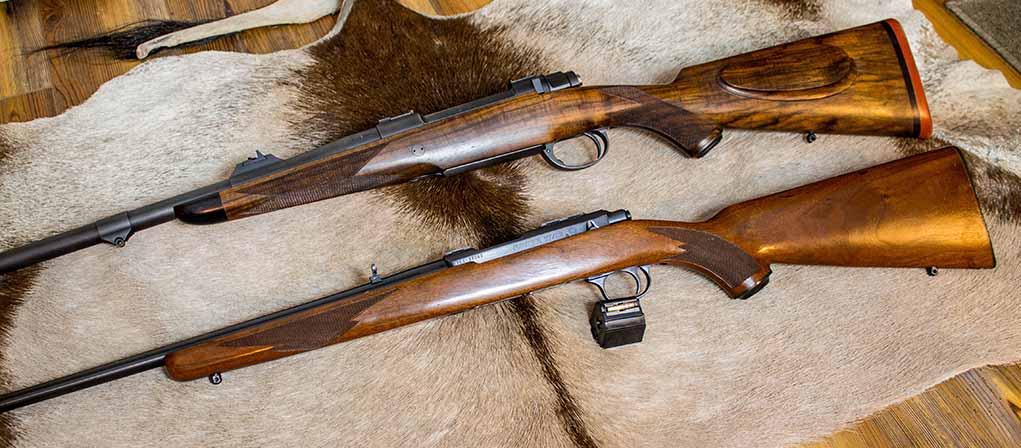
Shown here with a Heym Express .404 Jeffery, the Ruger 77/22 can be used for inexpensive practice because, by design, it has similar dimensions to a big game rifle.
I’ve taken this rifle on enough memorable hunts that it means as much to me as my .404 Jeffery: It has taken coyote, fox, rabbits, squirrels and many more small game species. But, unlike big game, where the conformation of horns or antler comes flooding back to mind, it was the company on those hunts that come back to my mind when I pick the rifle up. Dad would take me in the back woods behind the house we lived in, and it was there that I learned how to snipe squirrels in the autumn. Dad insisted on head shots only, so I would practice my marksmanship at our backyard range. Ammunition was cheap then, even for a boy of 14 who only worked weekends. I learned how to properly adjust iron sights with this rifle, as well as sit down with my father to evaluate different brands and types of ammunition to see which performed best in this rifle.
As I got older and was able to join my relatives and friends on deer hunts, the little .22 saw less action, but I always made it a point to join my dad or maternal grandfather for squirrel and rabbit hunts. Those cold, sunny winter days were great fun: We could stalk cottontails as they came out of their holes to sun themselves, and I remember all the stories I’d hear about the Depression as we’d clean the rabbits. At the risk of getting overly nostalgic, this rifle is more than a rifle — it’s a memory vault.
The 77/22 uses a 10-shot rotary magazine very similar to the 10/22. Mags from a 77/22 and 10/22 can be interchanged, though they have slightly similar lower dimensions.
As time passed, the rifle became a companion in the truck. Dad’s barn suffered the effects of the Great Red Squirrel invasion of 2010: holes were bore into doors and walls, soffits were chewed, property destroyed, war declared. Those reds were reinforced by a battalion of chipmunks — invariably drawn in by the allure of chicken feed — so I called upon the 77/22 to repel boarders. It took nearly a box of Remington Thunderbolts before the enemy was eradicated, but I sure had fun with my rifle. It obtained its fair share of dings and scratches along the way, but was there when opportunity knocked.
I had mounted a Leupold Vari-X 3 6.5-20x40mm AO riflescope for an article I was writing to evaluate accuracy of some Match ammunition, when one snowy afternoon at the office I heard Grumpy Pants holler, “coyote!” Dad and I are business partners, you see, and our land surveying office occupies the basement of his house, in a very rural location, replete with a 100-yard range just out the back door, and behind that is the woods.
The barrel band front sight of the 77/22 is complimented with a fine brass bead.
Ol’ G.P. has both homing pigeons and chickens, and they are a constant magnet for predators, so when they’re in season, there’s a bounty on their heads. Time being of the essence, all I could get my hands on was the 77/22. I saw the coyote as it became aware of what I was up to and was desperately trying to make a hasty exit. I shouldered the rifle.
“Too far,” announced G.P., but I pretended not to hear him. I broke the trigger once I had the holdover I wanted, and to even my surprise, the coyote hunched up hard and fell 15 yards later. The shot had been at a measured 158 yards, and while there may have been more than just a little luck involved, the 100-yard targets with that big scope onboard showed me just how accurate a good .22 can be at those distances.
The Gateway Cartridge
As Africa and I entered a committed relationship, the true big-bore rifles became some of my favorites. Shooting them at the range in preparation for a safari can become a challenging proposition, especially when at the bench doing load development. I’m not particularly recoil sensitive, but 30 rounds of .404 Jeffery, .416 Remington or .470 Nitro Express per session can take its toll on any shooter. Oddly enough, I make sure the little 77/22 comes along on each of the big bore sessions. In between groups of the big stuff, I take the time to keep my form proper by shooting a five-shot group with the .22LR; it has been a great help in avoiding the development of a flinch — primarily during bench work.
Additionally, when I’m working with the big iron-sighted guns such as my Heym 89B .470 double, shooting the 77/22 without a scope is an inexpensive and highly efficient means of training for an iron-sighted hunt. Sadly, the art of shooting an iron-sighted rifle is a fading discipline; while I’m a huge proponent of modern high-quality scopes, I do enjoy the close proximity of hunting with a well-stocked iron-sighted rifle. Using my 77/22 at 50 yards on small targets helps me train to stay focused and maintain the proper visual form, without spending $5-$10 per squeeze of the trigger. When it comes time to practice with the big-bore double or bolt gun, the prior work with the 77/22 makes the real deal much more effective.
I’ve also used a Bushnell Rimfire scope, with an elevation turret marked for the trajectory of a common .22 LR cartridge, as a training tool for shooters who were unaccustomed to dialing for elevation adjustments. I liked the concept from the minute I saw it; I set up a miniature backyard range from 25 to 150 yards with a number of hanging steel targets, and I set the rifle to zero at 25. I would then work with the shooter to identify the target and call the distance for them, have them dial for elevation adjustments and make the shot. It made a world of difference when they headed to the 1,000-yard range, and the exercise cost us very little money.
Here To Stay
The Ruger 77/22 has been available in a blued steel/walnut configuration (like my old friend), a stainless-steel/polymer stock configuration, and with a laminate stock, so there’s plenty to choose from.
Additionally, it has been chambered in .22 WRM and .17 HMR for those who want a different rimfire experience.
Ruger has, over the years, temporarily discontinued certain models or chamberings, and the 77/22 is currently discontinued, with only the .22 Hornet chambering being available. While this is certainly not good news, I can say that a quick internet search on the common gun auction sites yielded a large number of 77/22 rifles for sale, in all three configurations, so those who would like add one to their collection will certainly have an opportunity to purchase one.
I will be the first to admit that the Ruger 10/22 platform is more popular than is the bolt-action version. However, owning a rifle with so many similar features of a common big game rifle — which you can practice with for pennies on a dollar and which will give a lifetime of hunting service — is definitely a good idea.
Everyone has a rifle that occupies a special place, especially those rifles of our youth. These are the guns that helped us cut our teeth and set us on a path that would — to one degree or another — change our lives. While I’ve been blessed enough to have spent time with a wide diversity of different rifles, from inexpensive to “she’s-going-to-kill-me-for-buying-this,” I reach for that little rimfire quite often, and I look forward to another 30 years of our relationship.
Editor’s Note: This article originally appeared in the February 2019 issue of Gun Digest the Magazine.
For more information on the Ruger 77/22, please visit www.ruger.com.
Looking to go armed, but are stuck in the weeds as to what to arm yourself with? Here are 20 of the best concealed carry gun options that will keep you on the defensive.