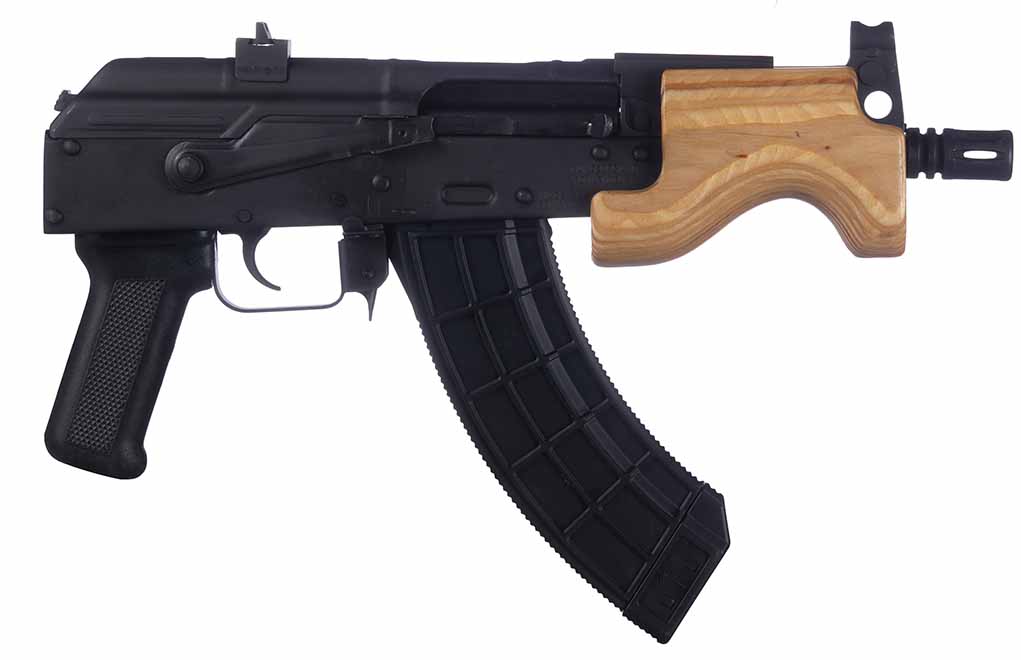
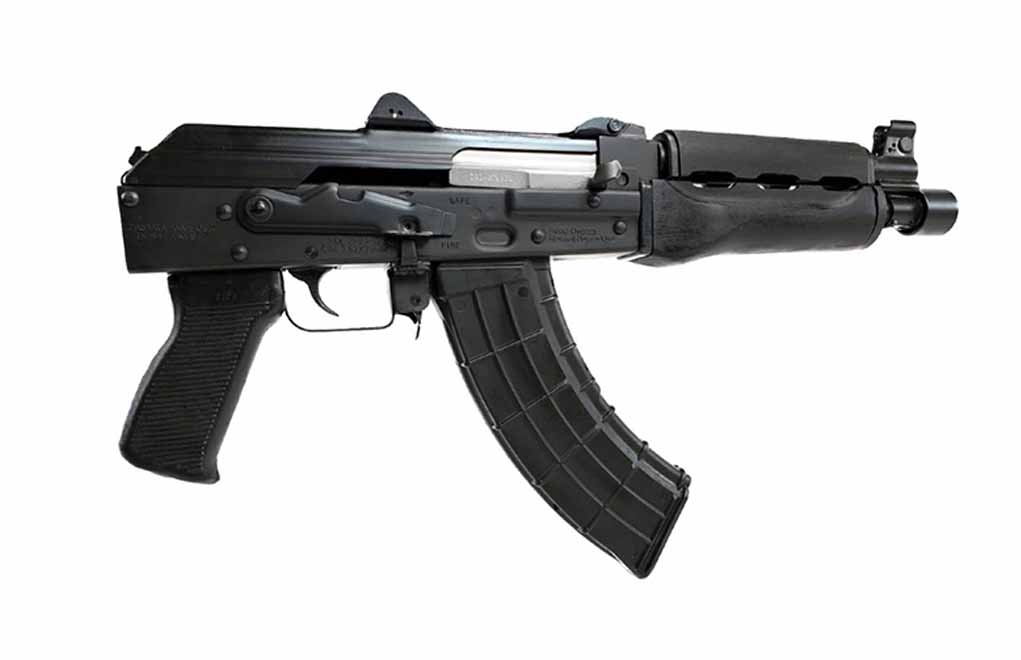
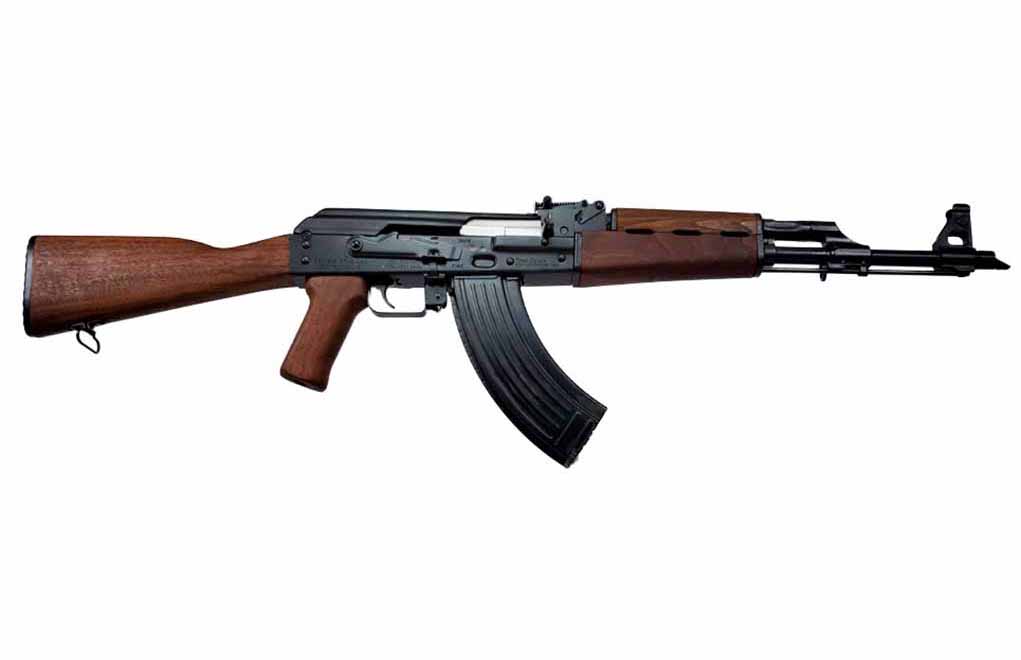
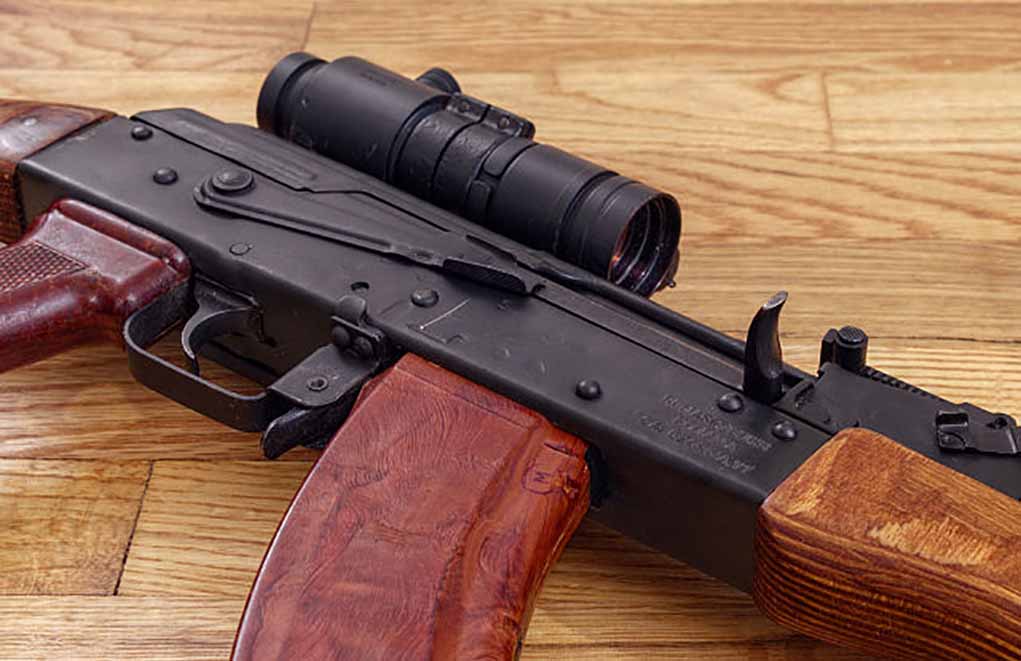
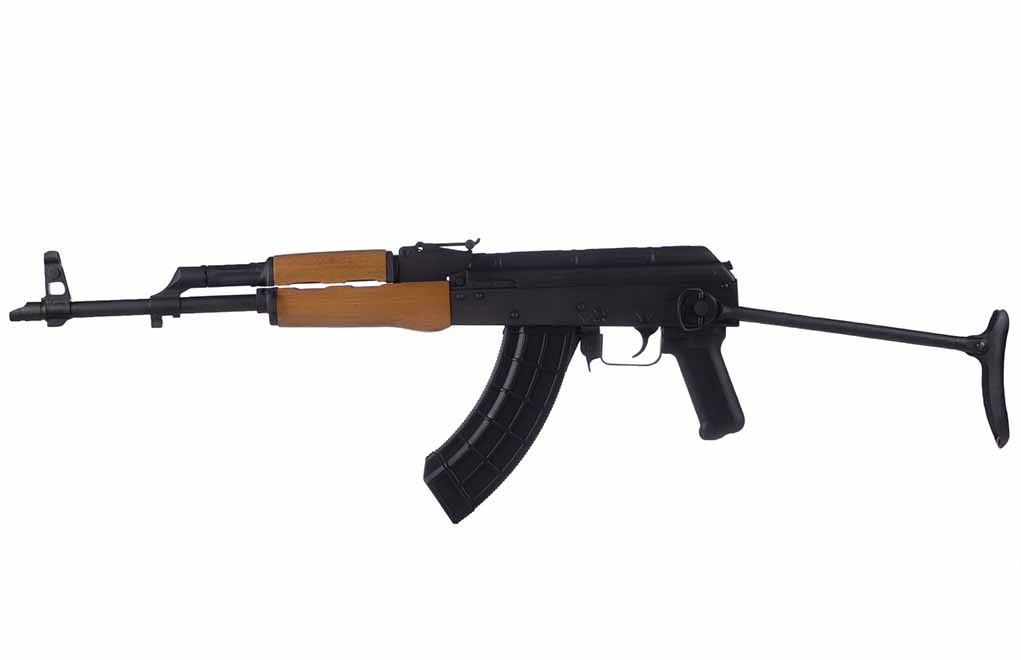
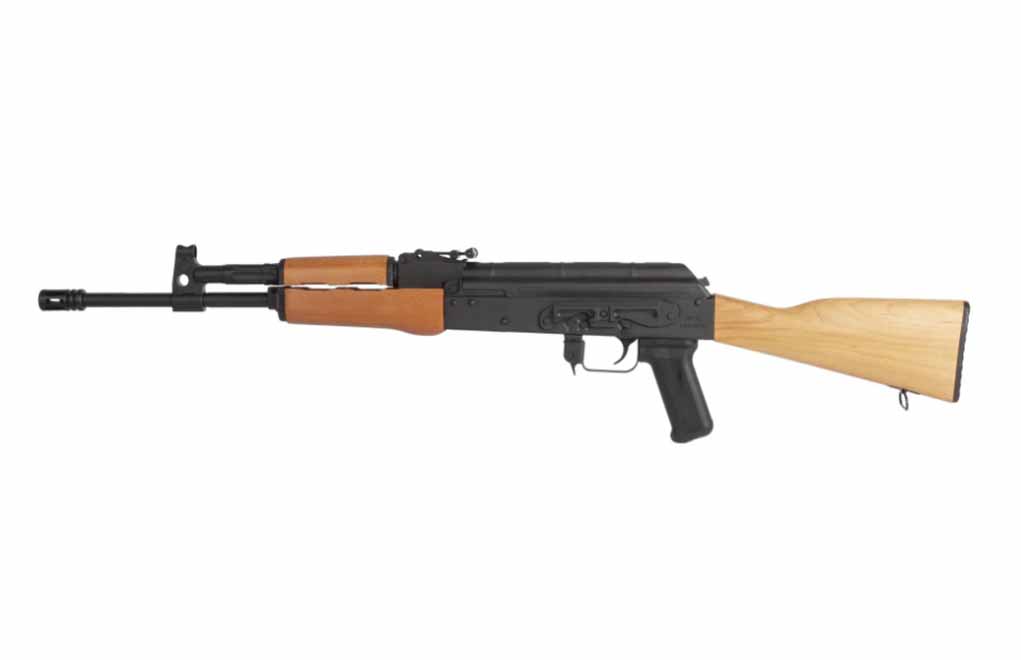
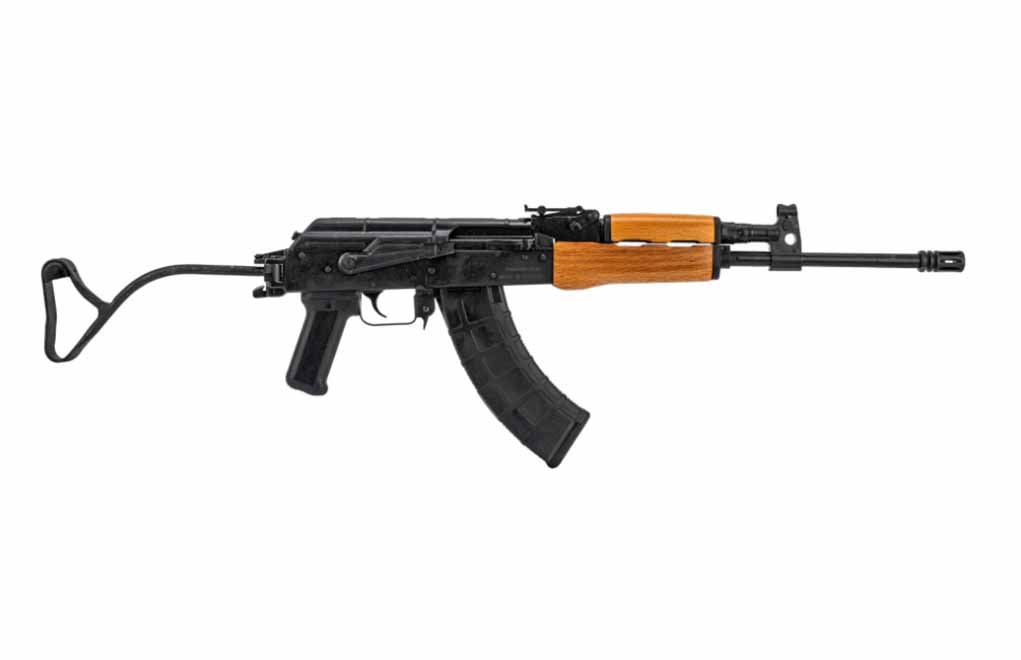
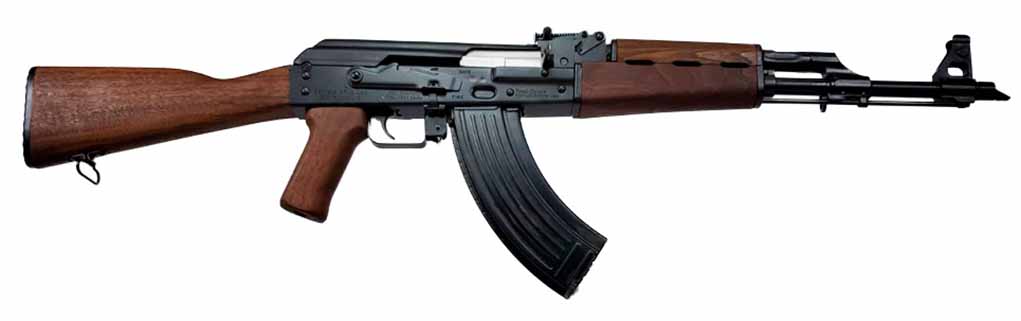
The Cugir Micro Draco, with its 6.25-inch-long barrel, is the smallest AK pistol on the market. Made in Cugir, Romania, it is of the same quality as its bigger brothers.
How The AK Pistol Differs From A Standard Draco:
6.25 Inch Barrel
Shorter Gas Piston
U-Notch Rear Sight
Non-Standard Handguard
A2 Flash Hider
As far as imported AKs go, Cugir has a reputation for solidly built, no-frills, military-grade Kalashnikovs, and the Micro Draco is no exception. When you pop off the dust cover, you’ll find almost all the same guts as you would inside a standard WASR (Cugir full-sized AK), including the chrome-lined barrel. This means that reliability and durability should be non-issues with the Micro Draco as well. The Micro Draco was derived from the standard Draco which was based on the Romanian military PM md.90 short rifle. There is no military equivalent model of the pistol, as it was built from the ground up purely as a commercial export.
Cugir Micro Draco.
Small But Effective
Two small internal differences from the standard Draco are the shorter gas system and the inclusion of a buffer. While the Micro Draco uses a similar combination hooded front sight and gas block to the standard Draco model, its gas tube and piston are even shorter. The buffer prevents the extra short bolt carrier from over traveling and popping off the rails within the receiver, keeping the weapon running as it should.
7.62×39 has surprisingly good ballistic performance out of short barrels. The standard Draco with its 12.25-inch barrel only loses about 300 FPS of velocity compared to a standard AK’s 16.3-inch barrel, and the shorter Micro Draco only loses about 100-200 FPS more depending on ammo type. While this means that the Micro Draco is certainly less punchy and has less reach than its longer-barreled counterparts, its performance is more than acceptable for certain applications.
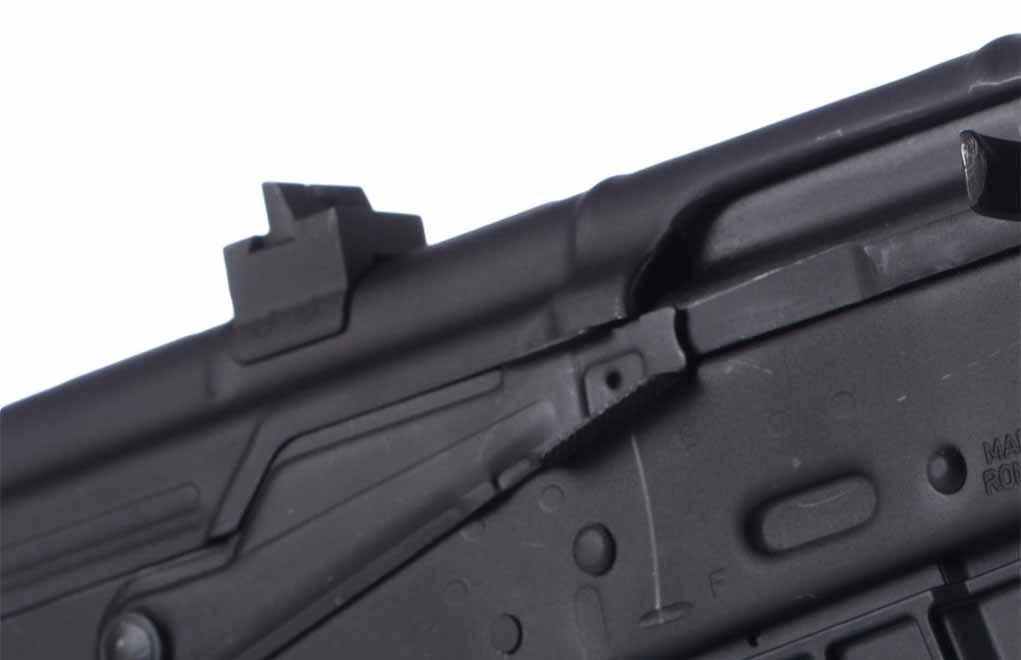
The rear sight on the Micro Draco has been simplified and moved rearward onto the dust cover. Since the dust cover is not hinged and is held in place only with spring tension, the rear sight will not exactly be sniper accurate. For a weapon of this style, however, the quick-acquisition pistol-style rear notch gets the job done just fine. If you were planning on mounting optics or other accessories on your Micro Draco, its non-standard furniture and lack of a scope rail will make it a challenge.
Micro Draco rear sight.
Customization
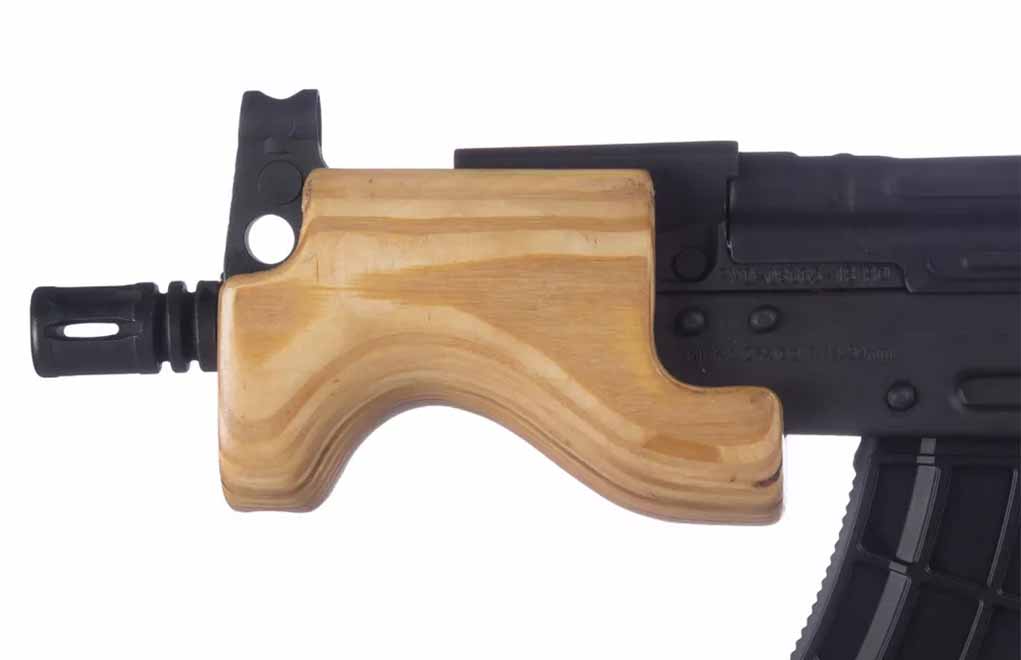
The Micro Draco ships with laminate wood furniture that is of nicer quality than the wood found on normal WASR rifles, but unlike a WASR or Draco the Micro Draco’s furniture is proprietary. It features a finger-stop style design carved into the wood to help prevent the shooter from blowing off their own fingers, something that is a genuine concern for guns with this short of a barrel.
Micro Draco handguard.
Aftermarket furniture options for this design are limited but available. There are custom shops that make wood furniture and at least one producer of a tactical rail system, the latter of which costs half the price of a Micro Draco itself. While expensive, if you are trying to build the smallest functional AK possible, the addition of rails will make mounting optics and other gear much easier.
Unlike a Zastava ZPAP92, the Micro Draco’s rear trunnion has not been pre-drilled to accommodate any brace mounting hardware. There are still plenty of other AK brace options available that mount through different methods, and of course there is always the option to register and SBR it with a real stock installed.
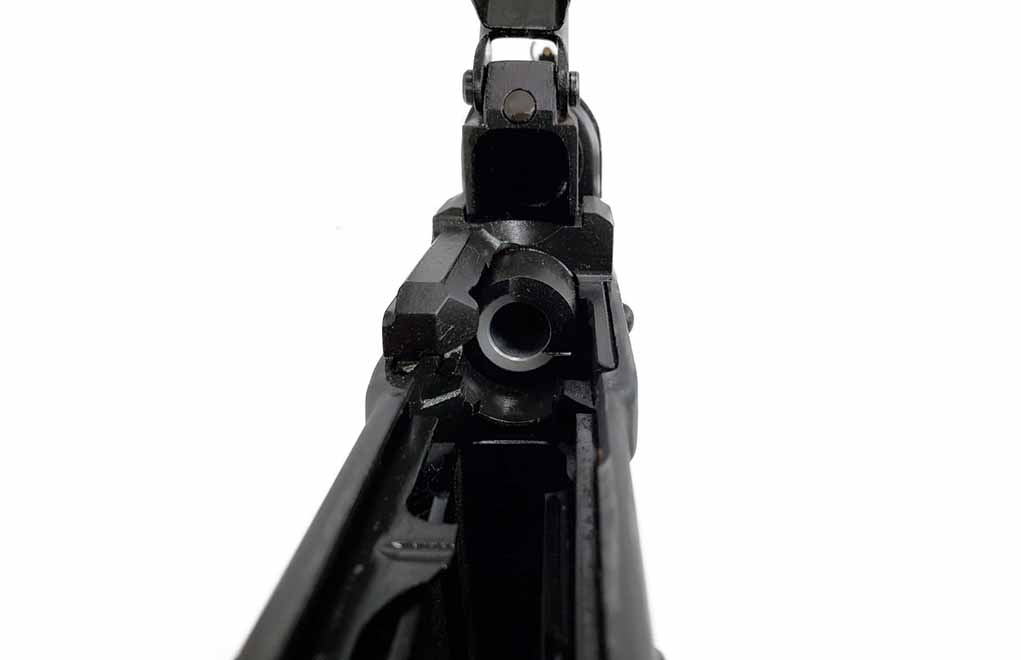
The Micro Draco comes standard with an A2-style birdcage flash hider, mounted on standard 14×1 LH threads. This leaves you with plenty of options for a muzzle device, but with a barrel this short a flash hider is probably a better choice than a muzzle brake. 7.62×39 out of a 6-inch barrel is concussive as hell and a real flame thrower too. Half the fun of a Micro Draco is watching it breathe fire after the sun goes down.
Micro Dracos may have been designed more for fun than practicality, but that doesn’t mean they can’t excel in a PDW role. With the addition of a folding brace or stock, the AK pistol can be an extremely compact and effective weapon for defending yourself. If an AK is what you want to use to defend the narrow corners of your home or the cab of your truck, the AK pistol just might be your best option.
For more information on Micro Dracos, please visit the importer’s site at centuryarms.com.
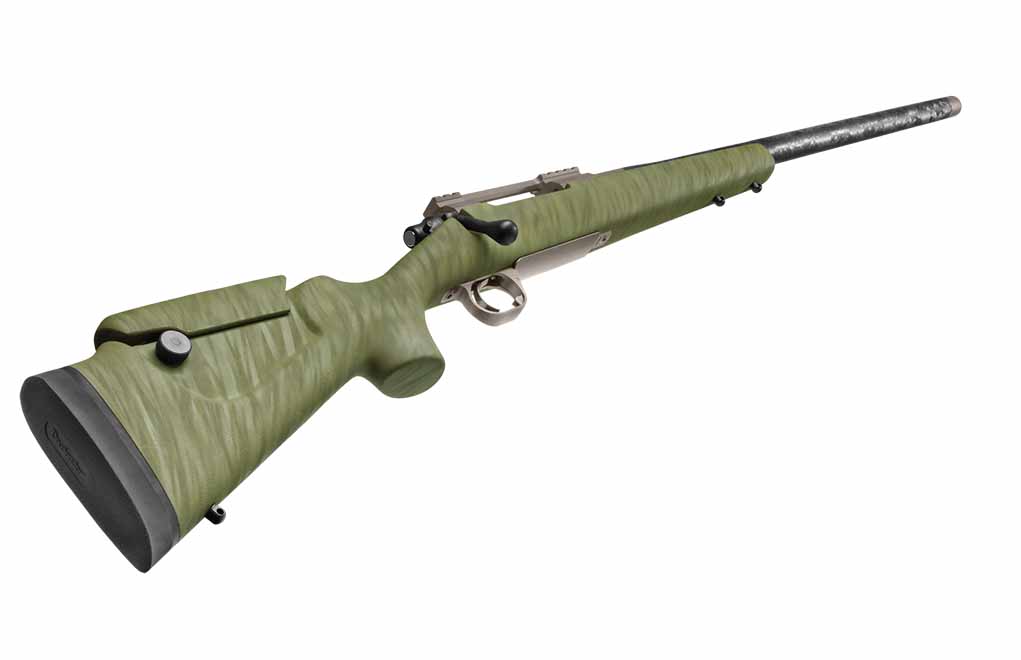
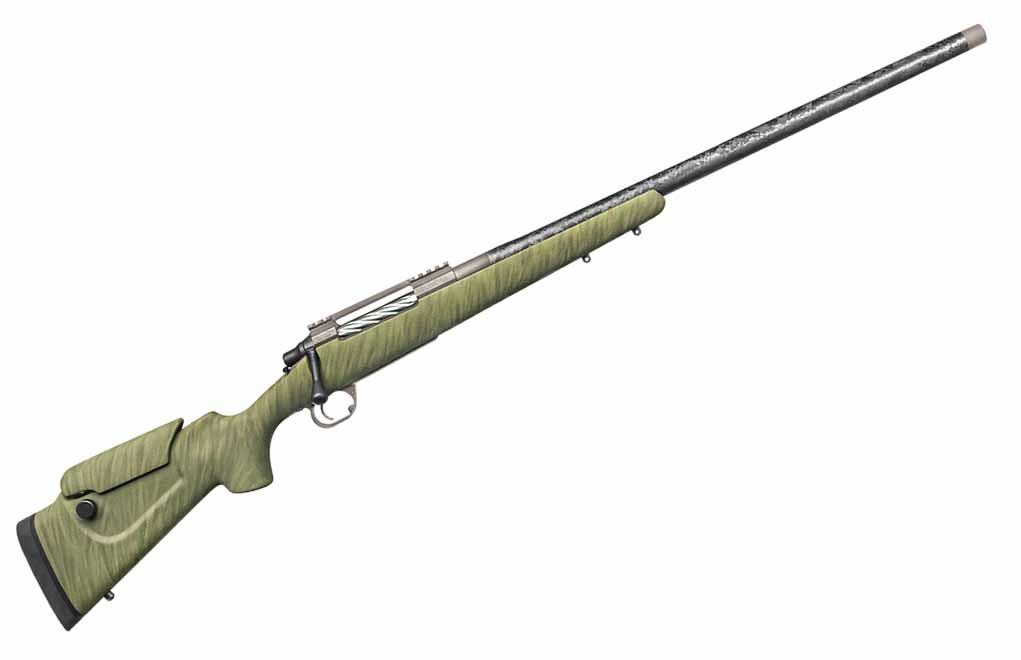
A well balanced hunter, the .338 Winchester Magnum is fit to take nearly any game on God’s green earth.
What Makes The .338 Magnum Such A Capable Hunting Cartridge:
Shoots almost as flat across 500 yards as simliar .30-caliber magnums.
Designed to hand the heaviest game in North America, including brown bears.
Only slightly less powerful than the .374 H&H Magnum, though not legal to hunt some game in African countries.
Historical Notes
Announced in 1958, the .338 Winchester Magnum is another of the series based on the .458 Winchester necked down. Initially available only in the Winchester Model 70 Alaskan bolt-action rifle, Remington adopted it for the 700 Series bolt action. Some of the European rifle makers also chamber it, as does Ruger for the Model 77 and No. 1 rifles, Mossberg in the Patriot line, Savage in the 110 series, as well as many custom and semi-custom rifles. Browning’s BAR autoloader also chambers it.
General Comments
With proper bullets, the .338 Winchester Magnum shoots almost as flat across 500 yards as similar loads in the various .30-caliber magnums—the difference amounts to only a few inches more drop. Designed to handle the heaviest North American big game, the .338 has also done well in Africa on the larger varieties of plains game.
Although slightly less powerful than the .375 H&H Magnum, the .338 is better suited for North American hunting conditions and game. It’s a well-balanced cartridge for anything from elk through moose and grizzly bear, under almost any situation. It could also serve very well for deer or antelope, even though it’s overly powerful for this class.
Like the .300 Win. Mag., the .338 Winchester would make an excellent one-gun cartridge for the worldwide hunter who has to travel light—though the .338 is automatically barred in some African countries in which the .375 is the minimum caliber. The .338 continues to enjoy well-deserved popularity. Winchester, Remington, Federal and other makers load this ammunition commercially.
The ZPAP92 is Zastava’s semi-auto export pistol version of their M92 military carbine. This AK pistol has the same quality and firepower as their full-sized ZPAP in a package that’s half the size.
What Is A ZPAP92?
Semi-Auto AK Pistol In 7.62x39mm
Made In Serbia
Based On Zastava M92
Krinkov-Style Rear Sight
Hinged Top Cover
Versatile Rear Trunnion Accessory Options
Zastava’s M70 series of AK rifles have been extremely popular with both military users and civilian sports shooters for decades. Now based in Serbia, Zastava’s newest generation of semi-auto AKs are known as ZPAPs and are some of the nicest and well-built options on the American market. If you’d like to learn more about the history of Zastava Arms, our previous article goes more in-depth.
Zastava ZPAP92
The M92
Yugoslavia’s AK designs are so distinct because they were built from the ground up. While Warsaw Pact members like Romania had help from the Soviets to develop their own AKM copies, the Yugoslavians’ unique political independence meant that they were on their own when it came to designing their small arms. They succeeded when they reverse-engineered the AK into their M70 rifle, giving birth to a whole new family of Kalashnikovs.
For the same reasons, Yugoslavia also had to design their own DMR and PDW if they wanted weapons in the same vein as the Soviet SVD or AKS-74U. Their homegrown answer to the SVD was the M76, and their take on the famous Krinkov was the M92.
Technically the M85 carbine came first, but it is identical in every way to the M92 besides being chambered for 5.56. The M92 being chambered for the more prolific 7.62×39 cartridge allowed it to see more success than the M85. With its 10-inch barrel and underfolding stock, the M92 was a popular choice for vehicle crewmen and special forces alike. The M92 has seen military service from the Balkans to Africa to the Middle East.
While the ZPAP92 is based on the M92 in concept, as far as technical details go it is more similar to the full-sized ZPAPs, and that’s a good thing. The military M92’s receiver does not feature the bulged RPK-style front trunnion that the contemporarily produced M70 and ZPAP rifles do. The ZPAP92 has all the same qualities that consumers have come to expect from Zastava AKs, like the strengthened receiver and front trunnion, blued metal finish, and chrome-lined barrel.
Like the ZPAP M70 rifle, the ZPAP92 takes Yugo pattern 3-vent hole handguards and standard AK pistol grips. The barrel is threaded for 26×1.5 LH pitch and comes with a thread protector. This is not the standard AKM 14×1 LH pitch, but there are still plenty of muzzle device options out there that fit it. Note that the ZPAP92’s thread protector comes welded on the gun for legal importation, but once in your possession the weld can be easily and legally ground off.
When it comes to mounting optics, there are options for the ZPAP92 but they are different than for the ZPAP M70. This is because, unlike the M70, the ZPAP92 does not have a scope rail on the side of the receiver. There are pros and cons to this fact. One benefit of not having a scope rail is that it will not interfere with a left-side folding stock or brace. A downside, obviously, is that the quickest and easiest way to mount an optic to an AK is no longer an option.
Another feature found on the ZPAP92 provides for a different mounting option, however. The AKS-74U inspired hinged dust cover provides a solid lockup between the cover and the receiver. This is necessary for retaining zero because the Krinkov-style rear iron sights have been moved back onto the dust cover, unlike standard AKs which have loose dust covers that make mounting any sight on them a bad idea. The zero-retaining hinge mechanism can facilitate aftermarket Yugo pattern dust covers which have Picatinny rails mounted on top, providing space for solidly mounting a modern optic.
ZPAP92 hinged dust cover.
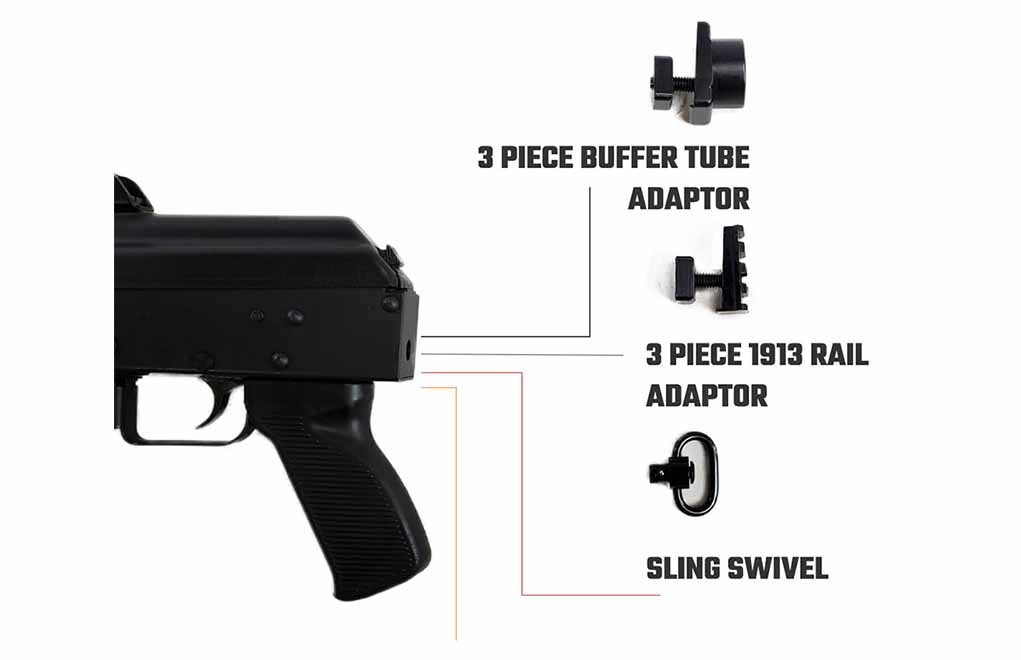
If you plan on effectively utilizing your ZPAP92’s sights, whether they be iron or glass, you will need something to stabilize the gun. This can be accomplished with either a pistol brace, sling, or stock if you go the SBR route. Attaching a sling or pistol brace are the easiest options for this, both physically and legally. The ZPAP92’s rear trunnion has been pre-drilled to accommodate three types of mounting accessories sold by Zastava: a sling loop, a 1913 rail adaptor, or a buffer tube adaptor. These allow for the attachment of either a sling or most common pistol braces with the appropriate mounting hardware.
ZPAP92 Pre-drilled rear trunnion and mounting options.
While most people who buy AK pistols may do so for the fun or cool factor, with light modification they can become very functional little guns. Of the currently imported AK pistols, ZPAP92s are a very well-made option, but keep in mind that they take proprietary Yugo pattern parts and the thicker receiver results in a gun that’s stronger but also heavier than an AKM pattern AK pistol. For those looking for their next truck or backpack gun that’s reliable and built like a tank, the Zastava ZPAP92 is worth considering.
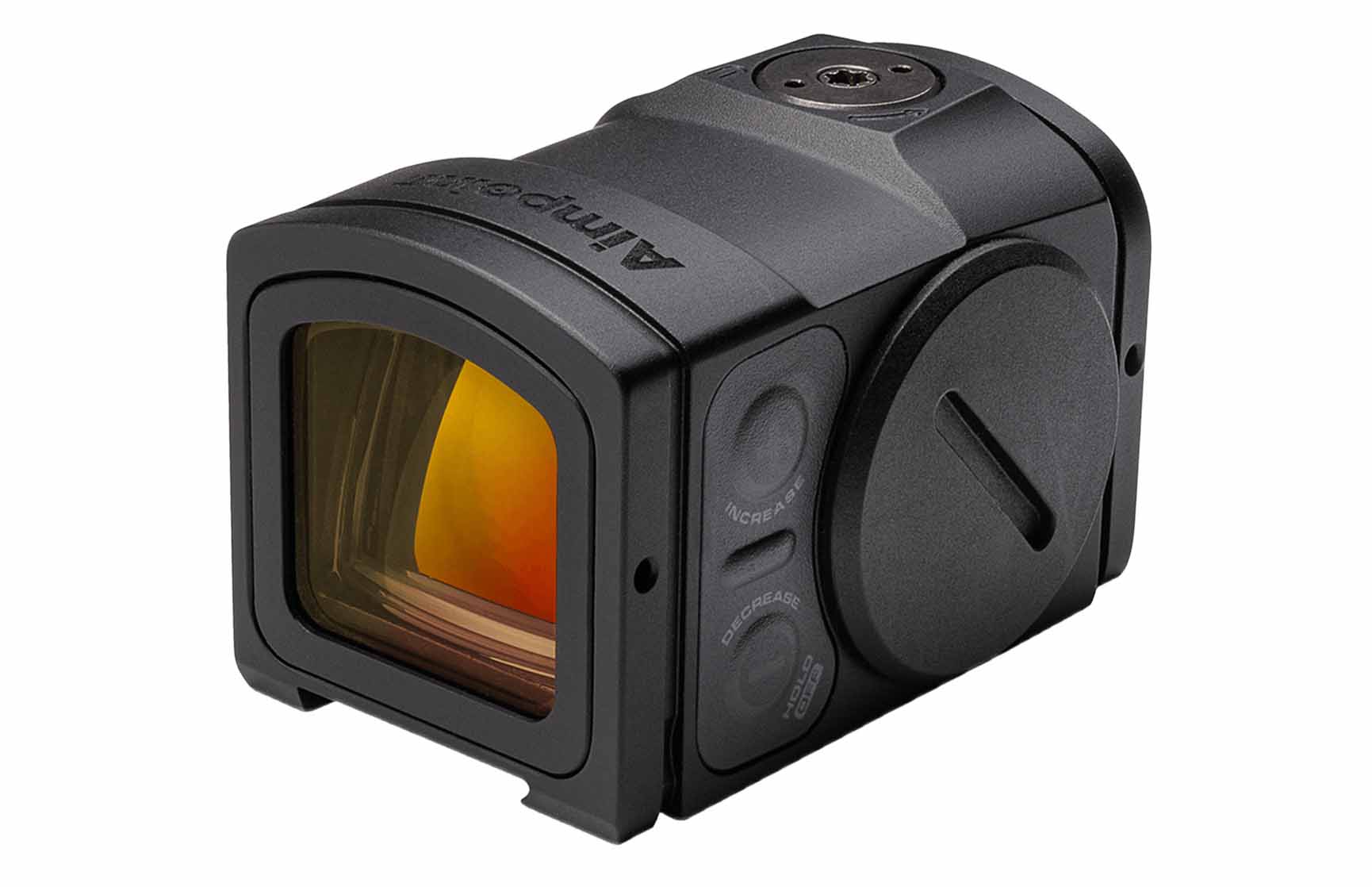
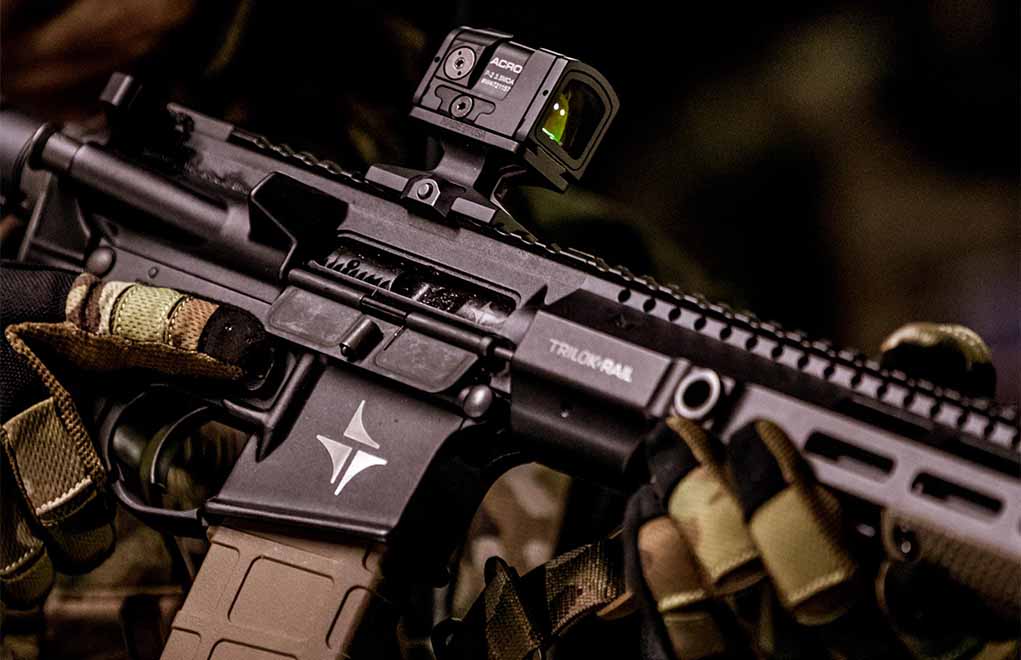
With an insane amount of run time between battery changes, the ACRO P-2 gives shooters peace of mind the red dot is ready when they are.
How The Next-Gen ACRO Is Enhanced:
CR2032 battery offers 50,000 hours of run time.
Ultra efficient LED emitter sips energy, while producing a crips 3.5 MOA red dot.
Controls moved to avoid errant adjustment.
Same rock-solid construction used in the P-1.
What’s every shooter’s concern with a red dot? While there might be a multitude of answers, one voiced by most is: Will the dang thing work when I need it to?
Unless you’re buying off Alibaba, generally this isn’t a concern over the quality of the device, but how quickly it sucks power. It’s difficult to tick off 10,000 or 15,000 hours of run time in your head and gauge how much juice a battery has remaining. Then again, you almost don’t have to with the new Aimpoint ACRO P-2.
Battery changes, yeah, they’re still part of the deal with the company’s next-generation Advanced Combat Reflex Optic (ACRO for short). But the company has made them a blue-moon occurrence with the device offering up 50,000 hours of run time on a single CR2032 battery. For those who don’t count their lives in 60-minute increments that’s 5.7 years. Thank those Swedish engineers for the upgrade, opting for the high-capacity battery, thus giving you a touch more coin for ammo, not to mention peace of mind.
ACRO Fighting Fit
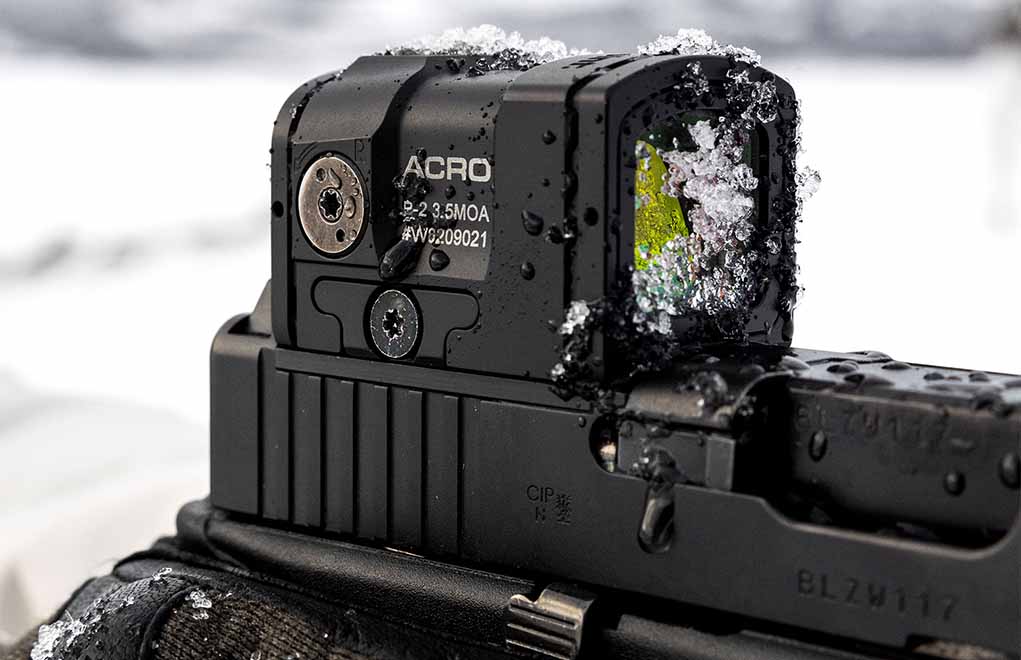
Improving battery life plays in well to the overall ethos of the ACRO P-2. From the beginning, the red dot helped defined rock-solid emitter systems—the type you’d bet your life on. Where hand wringing comes in on this style of sight is debris, dust or moisture interrupting the projection of the red dot onto the window. Aimpoint figured the answer was easy as hopscotch, just enclose the dang thing then all the crud from the field stays, well … in the field. At the same tick, shooters reap the spoils, one of the lightest systems out there, one with a minimal footprint to boot. Aimpoint isn’t alone in employing the concept, the Holosun HE509T and Sig Sauer Romeo2 also follow the same formula
Aimpoint didn’t muck with its winning formula in the creation of the ACRO P-2. In fact, the sight follows much of the same layout as its older sibling. Nice, given the battery compartment is on the side, so you can swap it out without taking the optic off and losing your zero. But they did tinker around with a bit more than the battery. Also getting an upgrade is the LED emitter, which is higher efficiency, but produces a 3.5 MOA dot equally as sharp as the P-1.
Brass Tacks Of The ACRO P-2
Of other notables, the only drastic interface change on the P-2 is Aimpoint moving the brightness controls nearer the battery case. The idea is to protect the settings from fat fingers and other errant adjustments. From there, the new ACRO is fairly familiar to those who know the P-1. This includes a sealed high-strength aluminum case, flat panes of glass on both ends, 10 brightness settings (4 night vision, 6 daylight) and a variety of mounting options making it compatible with a wide swath of firearms. The 1x, parallax-free optic also adds next to nothing to a firearm, weighing all of 2.1 ounces and measuring in at 1.9x 1.3 x 1.2 inches—fit for rifle, pistol or shotgun.
As far as price, it is an Aimpoint, so the $599 MSRP should come as a shock to anyone. But even in the face of a bevy of less-expensive, enhanced red dots hitting the market in recent months, the uncompromising shooter most likely will still find the ACRO P-2 a value.
For more information on the ACRO P-2, please visit aimpoint.com.
Zero In On Aiming Solutions:
Best Concealed Carry Optics: Red Dot, Green Dot Or Iron Sights?
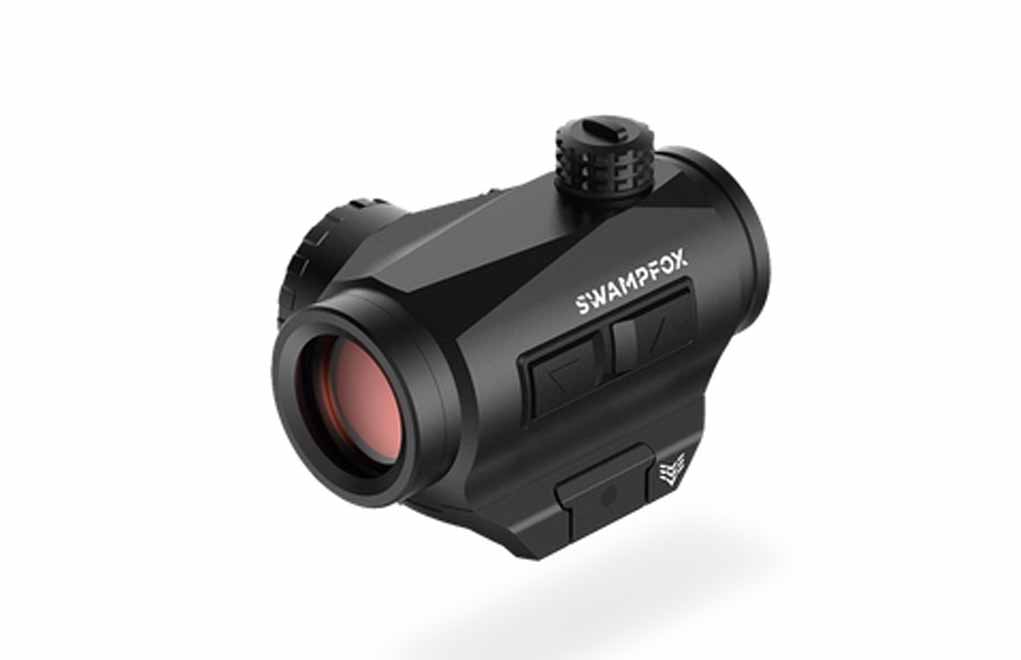
Up-and-coming American optics manufacturer Swampfox recently introduced their second-generation Liberator red-dot: the Liberator II. For rifles, pistols or shotguns, the Liberator II is an affordable way to bring your gun to the next level.
Liberator II Overview:
Improved Raw Battery Life
New Shake N’ Wake Sleep Feature
Crisper Dot
Two Included Mounts
Shock Proof
Waterproof
Swampfox is a relatively new American optics company that focuses on providing quality sighting solutions at an affordable price. As their red dot-sights grow in popularity, they continued to refine their designs to bring improvements over the original models. This started with their pistol optics when they introduced second-generation versions. Now, their Liberator sight is getting the same treatment.
Liberator II on low profile mount.
Bigger Battery
The Liberator II boasts a much longer battery life than the original Liberator. Swampfox accomplished this by not only raising the raw battery life from 3,000 to 10,000 hours, but by implementing their new Shake N’ Wake technology. While the first Liberator had an auto-off feature that activated after 4 hours, a press of the button was required to wake it up again. The Liberator II now goes to sleep after only four minutes of inactivity, and automatically turns on again after sensing motion. When it eventually comes time to replace the Liberator II’s battery, the convenient placement of the battery compartment on the side of the optic means it can be done while still mounted to the gun. In turn, you don’t lose your zero.
Better Emitter
Swampfox managed to kill two birds with one stone when they improved the Liberator’s emitter. Not only does its higher efficiency raise the optic’s battery life by a factor of three, but also produces a cleaner, crisper red dot for accurate shots up to 200 yards. The 2 MOA dot has ten levels of brightness adjustment, controlled by buttons on the side of the optic. There are eight brightness settings for daylight levels, and two for use with night vision.
With the improved emitter, there are also fewer options for the optic. The Liberator I was available with either a green or a red circle dot reticle. The Liberator II is only available in red, and the reticle is now only a dot rather than a circle dot. This is presumably due to limitations with the new emitter, so it is not known if Swampfox will eventually release a green dot version of the Liberator II.
Liberator II Reticle, only available in red.
Mounting Options
The Liberator II, like the original, comes with two mounts right out of the box. One high, and one low. Attached using Picatinny rail, the high mount is ideal for AR-15s that need the extra height to achieve co-witness with the iron sights. The low mount brings the red dot much closer to the bore height, making it perfect for pistols, shotguns, or rifles with a dropped stock. With these mounting options, the Liberator II is a perfect fit for home-defense, hunting, or competition setups.
Liberator II on high mount.
Beat It Up And Get It Wet
Because Swampfox designed the Liberator with such a variety of applications in mind, it certainly needed to handle a variety of abuses as well. It’s one thing to design an optic that can withstand the shock imparted by 5.56 recoil, but .308 and 12 gauge are entirely different animals. Swampfox not only guarantees that the Liberator II can handle the increased forces from higher caliber shooting, but they guarantee it for 50,000 rounds.
It is also fully waterproof up to 1 meter for 30 minutes in addition to being fog and scratch-resistant. While these claims are impressive, a true torture test would help to reveal their veracity. I’m curious if the Liberator II can live up to its waterproof rating after suffering from thousands of rounds fired and sustained abuse in the field. I used to have a waterproof watch and found out the hard way that banging it around for a few months made it considerably less waterproof.
With the Liberator II’s MSRP set at $189.99, Swampfox continues to provide quality optics options for shooters on a budget.
For more information on Swampfox Optics, please visit swampfoxoptics.com.
Zero In On Aiming Solutions:
Best Concealed Carry Optics: Red Dot, Green Dot Or Iron Sights?
Love your wife? Then let her take her own journey buying a concealed carry handgun and getting trained up on it. You’ll both be happier.
Why A Defensive Handgun And Training Are Your Wife’s Business:
Being mentally ready for the responsibility of owning a firearm is purely in her court.
She needs to find a firearm that fits her and she’s comfortable shootings.
It’s more likely a trained professional instructor will provide a positive experience for her first live fire.
You won’t strain the complicated interpersonal relationship with your significant other.
Without any intention of sounding like a chauvinistic jerk, What about your wife?
Yes, I know there are women who read Gun Digest, and the question could equally be, What about your husband? However, most Gun Digest readers are men, and a lot of them are married. And, they might be facing a common problem that many gun-toting men experience: how to get their wives to carry a gun to protect themselves.
A woman will be happier carrying a gutn when she controls the process of selecting it and learning how to shoot it.
Too often, attempts to sort this out include the man buying a gun for his wife and then attempting to teach his wife how to shoot it. While this bit of advice might qualify as a fit for the “Hillbilly Wisdom” section of this column, I’ll share it here: There are several things men should never try to do with their wives. Those include hanging wallpaper, picking out paint for the house, changing the oil in your truck … and trying to teach them to shoot.
This is partly because the very complicated interpersonal relationship dynamic between a husband and a wife can be fragile—even in the best relationships. Most men are programmed to be in charge, and when the task is challenging, such as hanging wallpaper or trying to teach someone to shoot, this “in-charge” attitude becomes offensive and a barrier to learning. It’s also partly because few men (read, humans) are actually good at teaching/instructing anything. Just as being an engineer requires a specific skillset, so does being a good teacher.
If you further complicate this process by handing a woman a handgun that doesn’t fit her hand or that she’s not comfortable with, you’ll create a situation that, at best, will end up with no one getting shot and, at worst, a divorce.
The Gun Purse And Othe Holster Alternatives For Women
Concealed Carry for Women: Don’t Overthink Concealability
Gun Selection: Lady’s Choice
You can pick out sexy underwear for your wife, but you do this for your benefit. She might also wear that sexy negligée, but not because she thinks it’s the most comfortable garment she’s ever had on her body.
So, don’t pick out a gun for your wife. Sure, you can help in the process, but the final decision—the ultimate decision—should be hers. It’s better for her to realize she picked out the wrong gun than it is for her to attempt to please you by trying to make the wrong gun that you picked out work for her.
Contrary to conventional wisdom, there’s no such thing as a “lady’s gun.” There are guns that fit small-sized hands, medium-sized hands and big hands. There are guns with very little recoil, moderate recoil and heavy recoil, just as there are guns with good triggers and bad triggers. There are also guns that seem complicated to operate and those that seem simple. You wouldn’t want your wife picking out a gun for you, and you shouldn’t attempt to pick one out for her.
Training: Turn To The Pros
When it comes to training, you’d be best-served to find a reputable and qualified instructor who can teach your wife. Yeah, I know, it seems as if it ought to be your job. But, here’s the thing: If your wife isn’t already a shooter, that first exposure to gunfire is very important; it needs to result in a positive experience. If it doesn’t, all might be lost. It’s best to risk that experience to a professional.
To help your significant other learn how to shoot a defensive handgun, your best option is to find her some qualified instruction. You’ll both be happier for it!
Oh, but, “I’m a trained firearms instructor,” you might say. Hey—good for you.
The problem here is that if you, as a professional, attempt to teach your wife, not only are you going to have to deal with that very complicated interpersonal relationship dynamic of being married, your stature as an experienced firearms instructor will add additional stresses to the educational process. It’s one thing when couples learn together; it’s another thing entirely when one—who’s a professional—teaches the other.
I learned this the hard way.
Throughout the 13 years I worked in law enforcement, I tried to get my wife to carry a handgun for protection and learn to shoot. It didn’t happen until a friend of hers convinced her to give it a try. They went to Gunsite Academy together. While there, my wife experienced high-quality instruction from someone other than me. She now carries a gun every day. She also knows how to use it, and it’s the gun she wants to carry.
So, what about your wife? She needs encouragement and support. With that, she’ll find a gun that fits her, as well as someone qualified to teach her how to use it. Afterward, you can go to the range together … and she might even out-shoot you. More importantly, somewhere, someday, she might even save your life!
Editor’s Note: This article originally appeared in the August 2020 issue of Gun Digest the Magazine.
Zastava has undoubtedly dominated the American AK market this past year, but is that because of their superior quality? Or was it simply because their ZPAP rifles were the most consistently available?
ZPAP Quick Facts:
7.62x39mm Semi-Automatic AK Style Rifle
Based On Yugoslavian M70
Made In Serbia By Zastava
Yugo Pattern Furniture
Yugo Pattern Scope Rail
Blued Metal Finish
Chrome Lined Barrel
Available With Wood Or Synthetic Furniture
The ZPAP M70
The Yugoslavian pattern AK, or M70, has gone through a series of developments both as a military service rifle and civilian sporting rifle to become what it is today. Our previous article on Zastava explains these improvements more in-depth if you want to dig deeper. But the pertinent information is that the current generation of Zastava AKs, the ZPAP, are the best the company has produced.
Zastava ZPAP with dark walnut furniture.
Made with a bulged RPK-style front trunnion, a 1.5mm thick stamped steel receiver, and a chrome-lined barrel, the ZPAP eliminates any past issues of the PAP rifles. With the availability of new production imported AKs reduced to Cugir, WBP Fox, and Zastava, the Serbian arms plant seems to have found a good balance of price and features for the American consumer. Zastava’s AKs have a nicer fit and finish than their Cugir counterparts and are cheaper and more abundant than the Polish Fox rifles to boot. For those looking for an AK that’s as pretty as it is functional, ZPAPs are an excellent choice.
ZPAP Customization
Something worth keeping in mind is the fact that the ZPAP’s only compatible furniture component with AKM pattern guns is the pistol grip. While some people may have no problem leaving the rifle in a stock configuration or customizing it with surplus Yugoslavian accessories, those who wish to customize their gun beyond that may experience some difficulty doing so.
As a result of the ZPAP’s growing popularity, the aftermarket options have also been expanded. Despite this, AK parts for Yugo pattern guns simply aren’t as common or available as those for AKM pattern ones. A WASR or WBP Fox can accept a far wider variety of furniture—both surplus and aftermarket—than the ZPAPs. If you intend to trick out your AK into a tactical abomination of rails and gadgets, an AKM pattern gun will give you a much easier time.
Considering that the wood furniture model is made from appealing and durable dark walnut, and the polymer version is reportedly very ergonomic and comfortable, it’s possible that the ZPAP can fill all your needs right out of the box.
The polymer model’s furniture includes several modern features that may make upgrades unnecessary. The handguard and stock should be very durable considering they are constructed using materials like rubber-coated fiberglass, carbon fiber, and glass-reinforced polymer. Other polymer furniture sets like Magpul’s Zhukov line have been reported to not always survive being mortared on the ground, especially in cold temperatures. While I have not tested the new polymer Zastava furniture, it seems better constructed than most other options on the market, especially for a Yugo pattern gun.
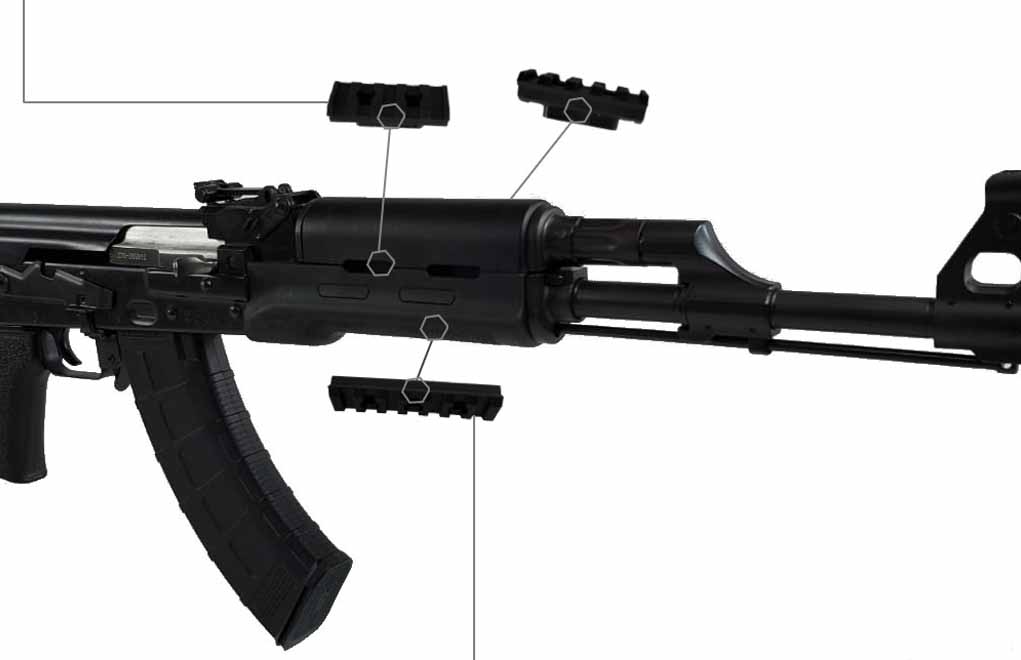
Additionally, the polymer ZPAP’s handguard has three optional segments of Picatinny rail that can be attached for mounting accessories. The stock is adjustable for both length of pull and for the height of the cheek riser. The stock also has four QD sling swivel inserts built into it and comes with a removable recoil mitigating butt pad.
ZPAP polymer handguard with removable Picatinny rails.
Mounting Glass
Another proprietary feature of the ZPAP is its Yugoslavian pattern scope rail mounted on the left side of the receiver. Like the furniture options, optics and mounts with a Yugo-style rail are less common than their Russian equivalent. While Russian and Belarussian-made military optics can still be purchased for AKs with a standard-spec rail, compatible Yugoslavian optics like the M76 ZRAK scope are rare and expensive. If you want a more functional optic, however, companies like RS Regulate make Yugo-pattern mounts with a Picatinny rail that facilitate the mounting of more modern options.
ZPAP polymer stock and Yugo style scope rail.
The Zastava ZPAP may have some eccentricities due to its Yugoslavian origin, but that doesn’t mean it’s any less of a Kalashnikov. If the non-standard furniture and scope rail don’t bother you, ZPAPs are currently one of the nicest new AKs money can buy. Currently priced in between Cugir WASRs and WBP Foxes, ZPAPs have seen quite a lot of recent success in America. They’re undeniably high-quality rifles, but if the price of WASRs continues to drop to more normal levels, ZPAPs may see a dip in sales unless they follow suit. Until then, ZPAPs continue to be a great option for AK buyers.
Taurus’s new GX4 is the latest pistol in a recent trend of micro-compact double-stack 9mm pistols intended for concealed carry.
GX4 Features:
Its internal steel frame gives the polymer pistol more rigidity, improving its accuracy potential.
Controls are contoured and recessed helping ensure a smooth draw.
The trigger is a big improvement over previous Tauruses, much snappier and smoother.
The 9mm has become the de facto cartridge for concealed carry pistols. Anything smaller has been deemed too anemic for proper self-defense, and anything larger is difficult to make concealable. Modern manufacturing improvements have allowed companies to finally start making auto-pistols as small as a .380 but with the same stopping power as a typical full-sized duty gun. Magazine capacity has also seen major improvements with the development of double-stack mags only slightly larger than single-stacks of previous generation CCW guns.
Taurus is tackling this market with the new GX4. The gun ships with two flush-fitting 11-round magazines. Taurus also makes extended 13-rounders as well as an 11-rounder with a pinky extension floor plate, both provide the shooter with a more solid grip on the pistol. In both cases, it puts the pistol in the running against other popular options in this class of handgun, with Taurus offering a price advantage.
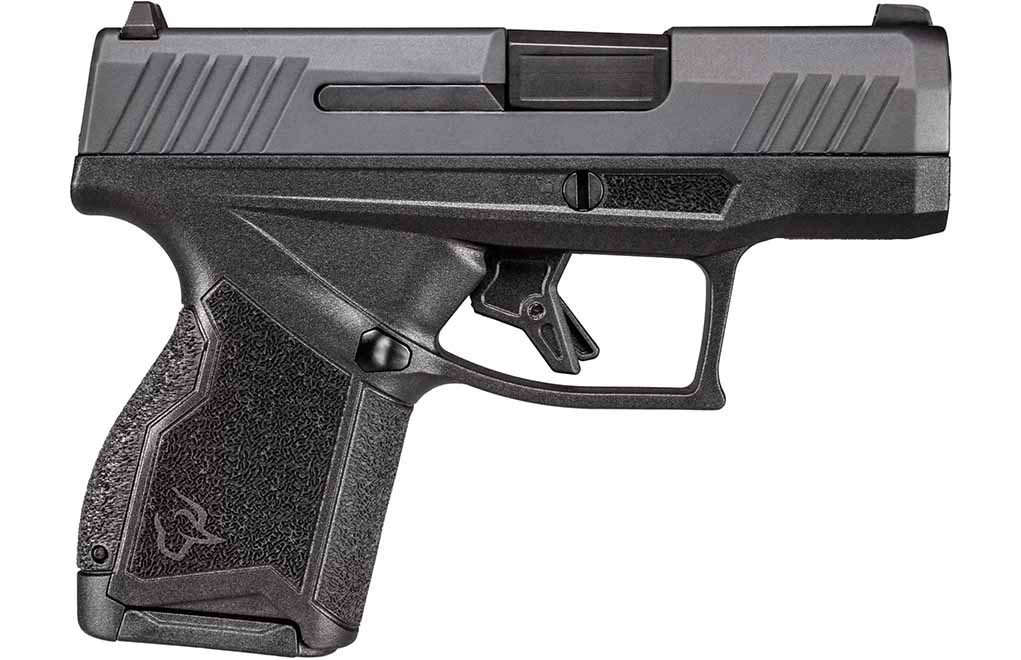
Taurus GX4
Glockish
Like many modern handguns, the Taurus GX4’s design takes inspiration from the Glock. It is striker-fired and utilizes a familiar trigger safety. It has no external controls besides a slide stop lever and magazine release button. Like a Glock it has a polymer frame, but it also has an internal steel frame to minimize flexing and provide better engagement with the slide.
Thought was put into the design to tailor the GX4 towards concealed carry. The controls and profile of the gun have been contoured and recessed to ensure a snag-free draw from a waistband. At the same time, aggressive stippling and texturing has been added to the grip, which features swappable backstraps. The stippling provides the shooter with more control over the small GX4, which has snappy recoil like all micro 9mm pistols do.
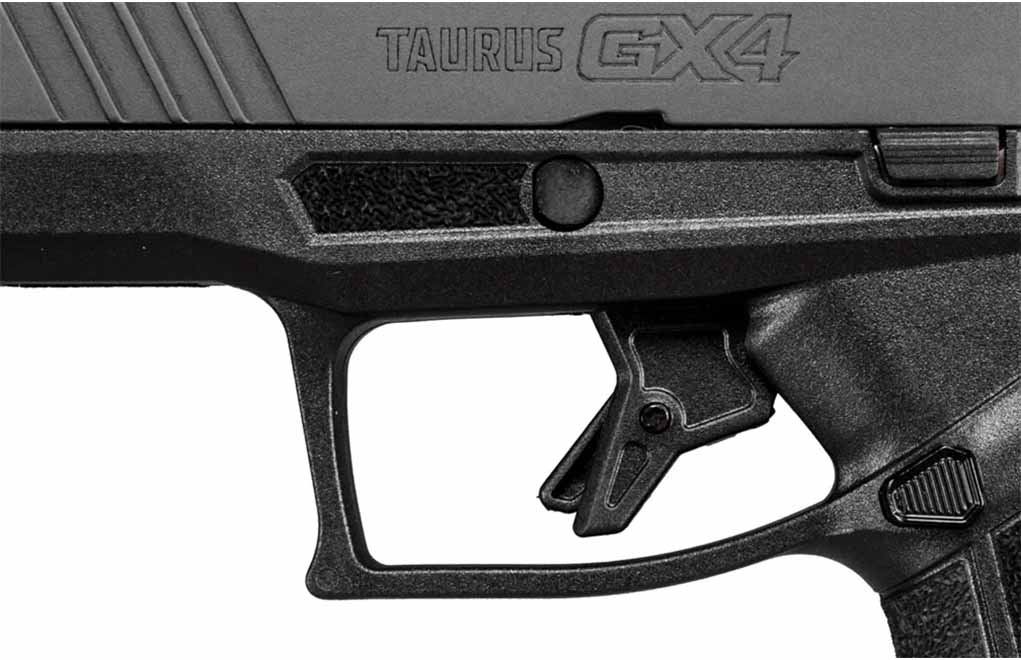
The trigger is another major area of improvement over older Taurus triggers, which were typically mushy with a very long take-up. The new trigger is reportedly much nicer with a clean break and short reset. Serrations on its flat face also help the shooter maintain control and proper grip angle while firing.
GX4 Trigger
The market can only handle so many pistols of this style. As more companies release their own versions of the micro-compact double-stack 9mm carry gun we will eventually see which survive into the future and which will fall into obscurity. As it stands Sig and Springfield are winning this fight, but companies like Ruger and now Taurus are challenging their position with similarly styled, more affordable options.
The Taurus GX4 has a 3.06 inch barrel and weighs 18.5 ounces unloaded. The MSRP is $392.42.
For more information on the Taurus GX4, please visit taurususa.com.
WASR rifles are workhorses and a longstanding fixture of the American AK market. Built tough enough to take a beating and ask for seconds, these Romanian AKMs are still highly sought after despite the availability of shinier, prettier Kalashnikovs.
What Sets The Romanian WASR Apart From Other AKs?
Built With Original Soviet Manufacturing Methods
80,000-100,000 Round Lifespan On Full-Auto
Chrome-Lined Barrel
Standard AKM Pattern Design
Several Available Variants
Romanian-made AKs have been coming into the U.S. from the state-owned arms factory Cugir since the 1990s. While the cost of AKs has exploded this past year, for most of the WASR’s importation history the rifle has been one of the most affordable and quality AKs you could buy. Comparatively, WASRs are still typically cheaper than Zastavas or WBP Foxes.
While Cugir’s pistol version of the WASR, the Draco, has been very difficult to find for some time, there seems to be a steady stream of WASRs.
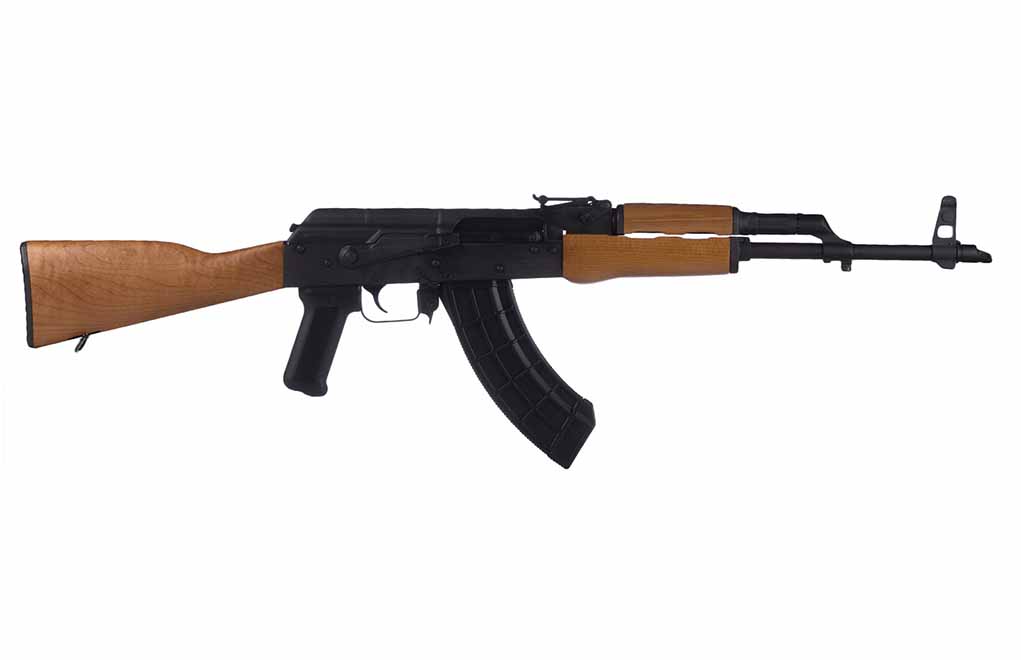
Cugir WASR-10
Made To Be A Worker, Not A Looker
WASRs are excellent rifles, but they’re not for everybody. Depending on what you want out of your AK, a Cugir gun may or may not fit.
These are military rifles, and they feel like it. Rugged and solid in construction, WASRs long for use. The bluing found on Zastavas will look much nicer for your social media posts. But the Parkerization on WASRs will stand up to your abuse.
While Zastavas and WBP Foxes come with handsome wood, the furniture on a WASRs was meant for replacement. Whether your version includes blonde balsa or cheap black plastic, they are as fragile as they are ugly. Upgrading the furniture is priority No. 1 on any new WASR, but there is plenty of military surplus wood or quality aftermarket parts to address this shortcoming.
Finding furniture for a WASR is much easier than for a Zastava, due to the fact that it is a standard AKM pattern. This means that furniture designed to fit the original stamped Russian AKM design should fit the rifle, regardless of country of origin. My WASR has a mix of Romanian and Russian wood installed on it. As for installation, swapping furniture is a breeze for any skill level.
Other features of the WASR that are desirable are its scope rail and threaded muzzle. Mounted on the side of the receiver, the scope rail is the standard Russian style that has a plethora of optic mounting options both original and aftermarket. There are original Russian PSO magnified scopes and BelOMO Belarussian red dots as well as aftermarket mounts that provide Picatinny rails atop the receiver.
The muzzle is also threaded for the AK-standard 14×1 LH pitch. This allows for the largest compatibility of 7.62 muzzle devices. Whether that is the included regular slant-brake, something fancier, or even a Wolverine PBS-1 suppressor, it can be mounted to your WASR with ease.
In fact, essentially every element of the WASR is built to standard AKM spec, outside one small detail. Standard AKMs have a distinctive dimple on the side of the receiver above the magazine well, and even older WASR variants like the SAR-1 featured it. Newer WASRs lack this dimple, but there is a good reason for it. As explained in a previous article on Cugir and the Draco, due to importation laws AKs are brought into the United States with single-stack magazine wells. They are opened up stateside by the importer, in this case, Century Arms. According to AK YouTuber Rob Ski, who has spoken to workers at the Cugir plant, leaving the dimples off simply makes it easier for the Century employees to file off the necessary metal within the magwell. Cugir compensates for this by welding a reinforcement bar inside the receiver, so strength is not compromised. Considering this portion of the importation process had some past quality control issues, if this change makes it easier for Century to restore the rifles to their proper configuration, it seems worth it.
WASR-10 with Belarussian optic. Notice the missing receiver dimple. Photo: Wikipedia
Built Cugir-Tough
Besides the select-fire feature, WASRs are essentially indistinguishable from their military counterparts. In fact, semi-auto WASRs have actually seen military service, under the United States of America no less. In the early 2000s the U.S. Army needed 7.62×39 AKs to supplement certain forces in the Middle East and Africa, so they procured a number of WASRs. Used by contractors in Iraq and Afghanistan, some of these rifles were even sold as surplus stateside a few years back.
The popular rental-gun range Battlefield Las Vegas has some of the best data on AK lifespans in the world simply due to how many people visit them each year. Their WASRs, which they have converted to full-auto, have had more rounds put through them than possibly any other WASRs on Earth. Battlefield Las Vegas claims, they have never shot out a WASR’s chrome-lined barrel, and the rifles they have killed were due to cracked trunnions. This is typical for stamped AKMs after 80,000-100,00 rounds. Even after reaching the failure point, all it takes is a front trunnion and barrel swap to put a WASR back into commission. With this kind of longevity, it’s safe to say that most WASRs will outlast their owners.
Ugandan Security Forces in Iraq holding WASR AKs, standing with an American. Photo: Atlantic Firearms
Variants
There are a few WASR variants currently imported by Century. We already discussed the standard AKM-pattern model that comes with either wood or plastic furniture. This is the most common variant, called the WASR-10. Here is a brief overview of three other variants:
WASR-10 UF: The under-folder model, the rifle is exactly the same as a standard WASR besides the rear trunnion and stock. AKs require a special rear trunnion to accommodate an under-folder stock, making it much easier to buy one built at a factory rather than converting a fixed-stock trunnion model yourself. These are less common but make for a good choice if you value compactness. Keep in mind the lack of a cheek rest on the under-folder stock makes it uncomfortable to shoot.
WASR-10 Underfolder.
RH10: These are one of the more common variants, and again are the same as WASRs in every detail besides one: the gas block. The RH10 features a combination front sight block and gas tube, unlike standard WASRs where they are separate. The difference is mostly aesthetic and does not affect the rifle’s function, but the combo gas block makes it far easier to chop the barrel and convert it to an SBR if you so desire.
WASR Paratrooper: The paratrooper model has a combination front sight and gas block similar to the RH10, but it is one inch shorter. This is because the paratrooper model is actually based on the Romanian PM md.90 short rifle, or Draco configuration. These are imported with a barrel over 16” purely for legal reasons. The paratrooper model also has a standard rear trunnion but comes with a Romanian push-button wire folder stock instead of the normal fixed-stock. These models are not as common as the RH10 but are even better for converting to an SBR due to the shorter gas block and included folding stock.
Quite a few years ago, Romanian AKs were available in three calibers: 7.62×39, 5.45×39, and 5.56×45. These were known as the SAR or WASR 1, 2, and 3 respectively. Cugir still has the manufacturing capabilities to produce these calibers, as they still build them for military contracts across the globe, as well as for their own armed forces. While AKs chambered in the other two calibers will never be as popular as the original 7.62 version in America, 5.45 has been gaining a following here as of late and 5.56 is more common for American shooters to have already stockpiled. Why have they not been imported for so long? Zastava and WBP Fox have no history producing 5.45 guns, so Cugir remains our last hope for newly produced, foreign-made AK-74 style rifles. Hopefully, Century will eventually place another order for WASR 2s to provide more competition within the American 74 market which is currently dominated by the sub-par rifles of Palmetto State Armory.
Romanian AKs of any variant or caliber are excellent, military-grade Kalashnikovs. For those seeking a real workhorse AK that will make it through the apocalypse, you can’t go wrong with a WASR.
For more information on WASRs, please visit centuryarms.com.
Somewhere between open sight and riflescope, the Trijicon RMR finds the perfect middle ground.
Since the invention of the firearm, man has tried his best to develop a system for aiming the gun easily and accurately. There are a number of solutions, though none of them are absolutely perfect.
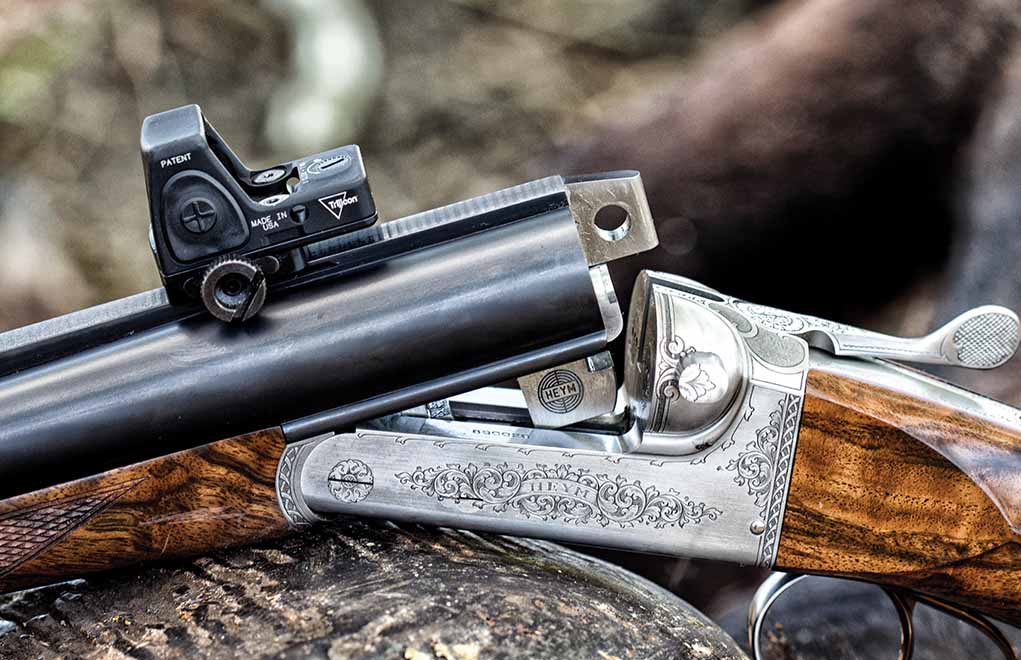
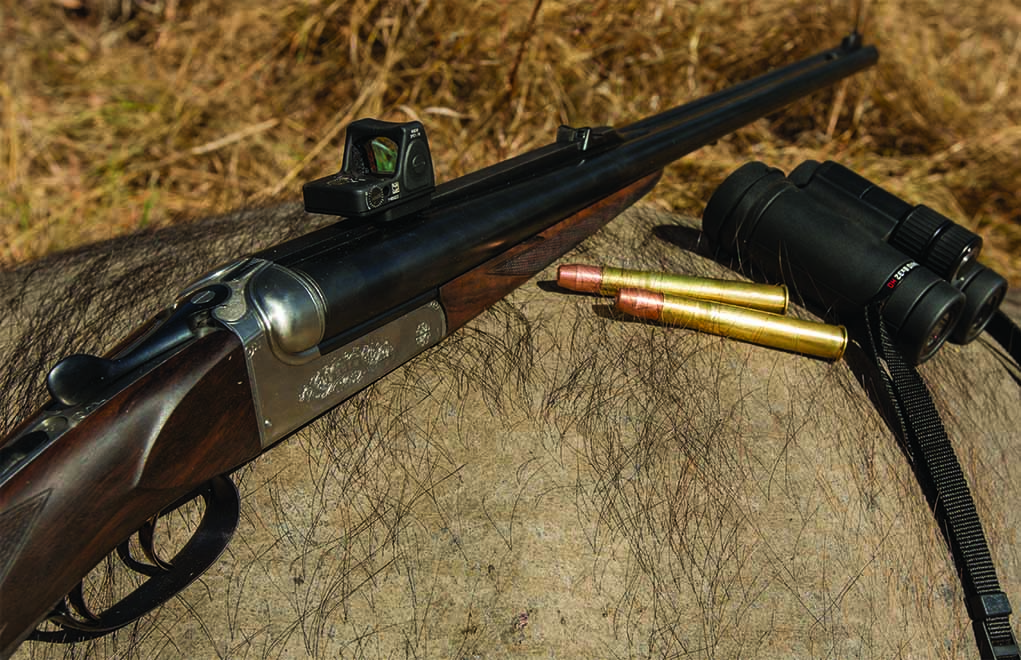
A Trijicon RMR atop a Heym Model 89B in .450-400 3-inch Nitro Express. The little red dot extends the effective range of the double rifle.
The simplest designs evolved into the two-piece iron sights we’re all so familiar with. While that system certainly has a ton of applications, it’s handicapped by the user’s ability to focus both the target and the sights. As humans age, our eyes lose the ability to focus on tiny objects, especially up close. It will happen.
On a defensive handgun, the mantra of “front sight-focus” is a glaring example of the obstacles encountered when using iron sights. Because of the difficulty of quickly focusing on both the target and the front sight, shooters train to use a grip and stance that best allows the sights to be aligned under stress.
A rifle, under most circumstances, must be much more carefully aimed. Using a peep sight at the rear of a rifle will increase the sighting radius and also allow the eye to naturally center the front sight in the circle, removing one part of the iron-sight equation. Still, we’re married to the diameter of the front bead on a rifle, and sometimes that bead can be as much as 10 or more MOA. That’ll cover a pie plate at 100 yards and a garbage can lid at 200 yards, and while the famous 6 o’clock hold gives some relief, there’s still a bunch of your target covered up when the distances get longer.
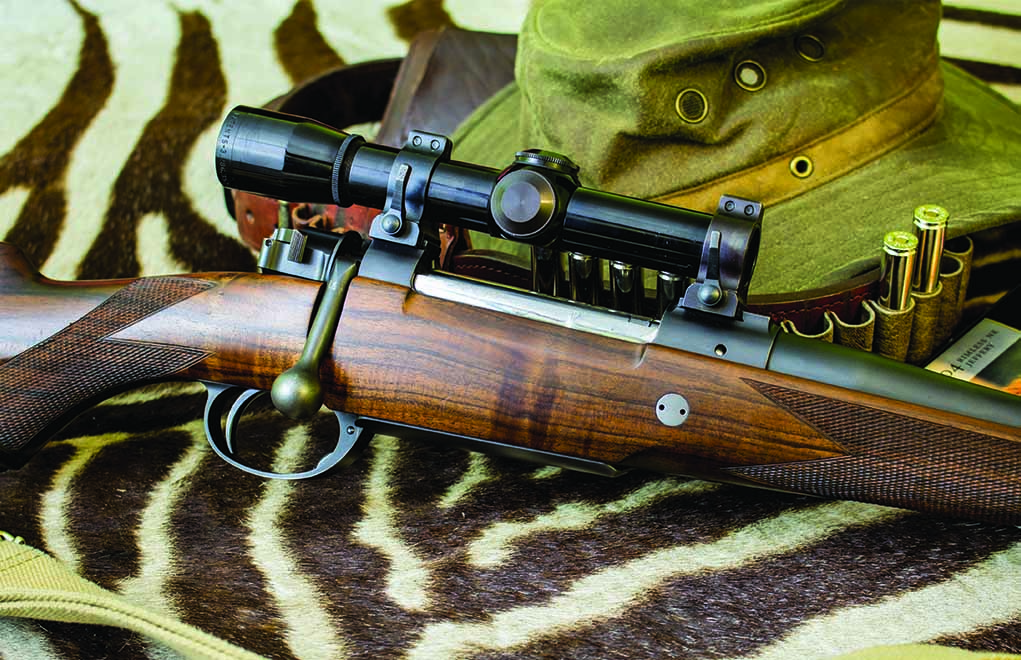
A good low-power riflescope, like the 2.5x Leupold on the author’s .404 Jeffery, offers the ability to make longer shots while keeping the reticle and target on the same focal plane … but it gives tunnel vision when things get close.
A telescopic sight—our common riflescope—has certainly come a long way in recent years. The scope does some wonderful things, including magnifying the target and putting the reticle and target on the same focal plane. In certain instances, however, the tunnel vision of even the lowest power scopes can be a hindrance, especially on dangerous game at close quarters.
The debate has long raged among both dangerous game hunters and professional hunters between low-powered scopes and iron sights. While the scope solves the focus issue, it can affect the balance of a quick-pointing dangerous game rifle. I was looking for a solution somewhere in the middle … providing the balance and lightning-fast target acquisition of an iron-sighted rifle, yet with the single-focal plane of the scope—without the tunnel vision.
Here’s news for ya: Reflex sights aren’t just for pistols.
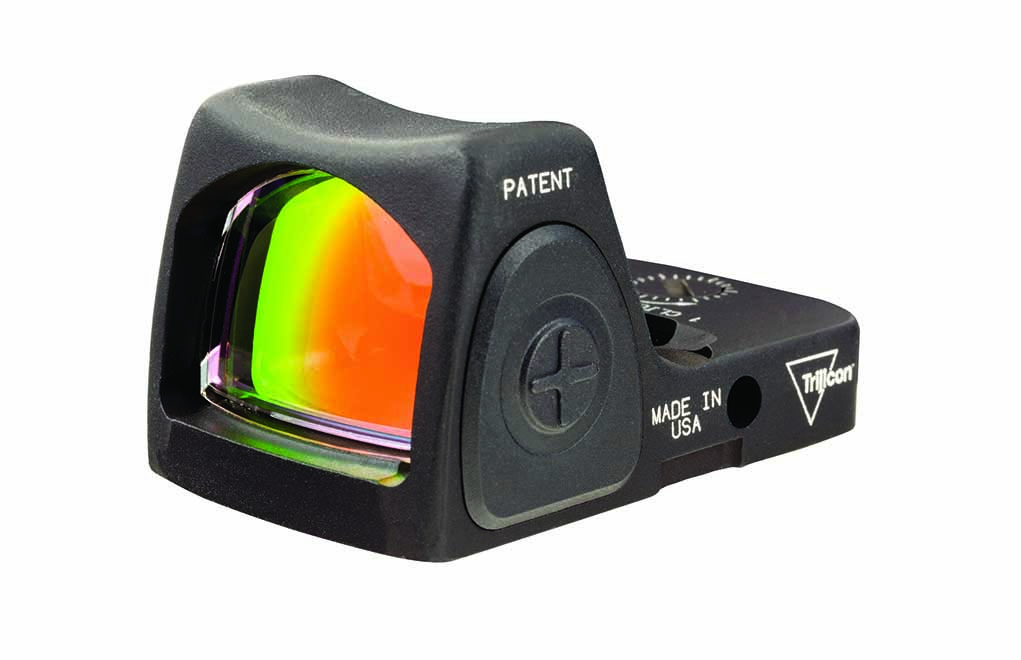
Front left view of the RMR, showing the coated front lens and soft button to increase intensity.
My particular favorite is the Trijicon RMR (Ruggedized Miniature Reflex) sight. I’ll also shamelessly get this out of the way upfront: When Trijicon includes the word “rugged” in the product name, they mean it.
Trijicon RMR Down Under
I found myself halfway around the globe, in a truly remote part of Australia’s Northern Territory, with Heym USA’s Chris Sells and professional hunter Graham Williams, with a fantastic Heym Model 89B double rifle in .470 Nitro Express over my shoulder. We were hunting Asiatic water buffalo, a species introduced to the Australian continent in the early 19th century and classified as invasive.
The .470, while equipped with good iron sights, wore a Trijicon RM09 with a 1-MOA red-dot and was sighted to be dead-on at 100 yards. Water buffalo are where they are, and while they’re not as switched-on as Cape buffalo—probably due to a lack of predators—they’re huge animals, with a big bull weighing in over a ton. The terrain in that part of Australia ranges from brushy thickets to open meadows and gully ridden lowlands, and buffalo were everywhere.
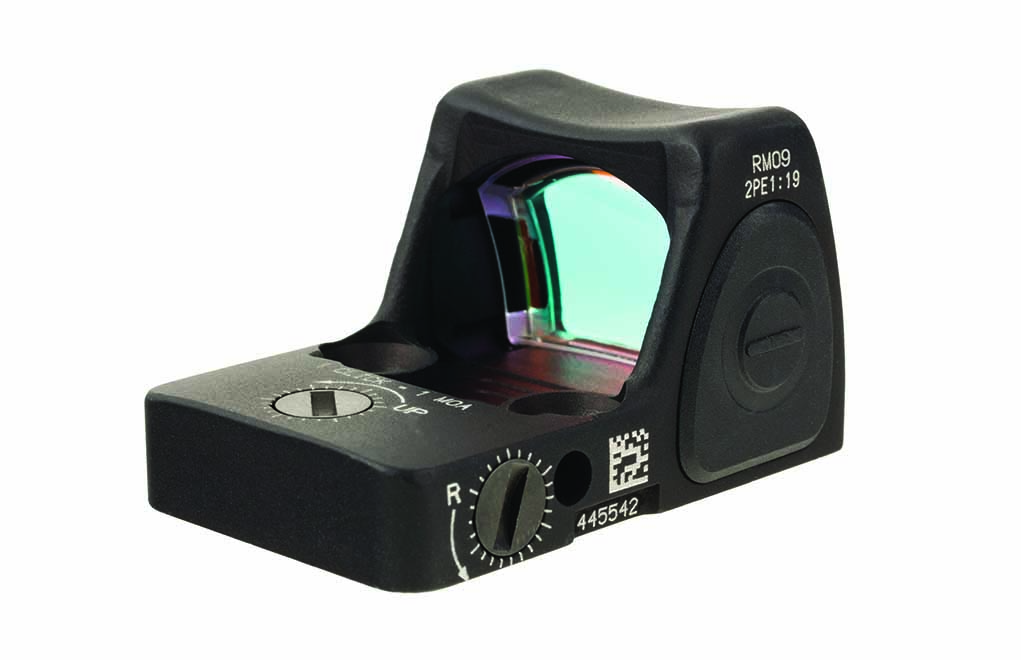
The windage and elevation adjustments, and soft button to decrease the dot’s intensity.
We’d spotted what would become my bull while skirting the edge of a small drainage; they were lying down about a quarter-mile up the slope, thinking about whatever buffalo think about. Graham and I made a plan to use what little cover we had to get within range of this handsome buffalo. Our plan worked—perhaps a little too well.
We ducked behind a slight hump in the topography, and working from tree to tree, we used the wind perfectly to get within 50 yards of the bull. Thinking we’d pull up and take the shot, I was a bit astounded when Graham motioned for me to follow, getting even closer. At a mere 17 paces, the bull became aware of us and gained his feet when Graham gave the order to shoot.
The double came to shoulder fluidly, and with both eyes open, I put the red dot just behind his shoulder as he whirled. The right barrel slowed him, and the left barrel saw him pause to gather strength; two more 500-grain North Fork solids sealed the deal. The rifle behaved much like a shotgun, with the Trijicon unit requiring very little thought—it worked naturally, the shots going exactly where the dot indicated.
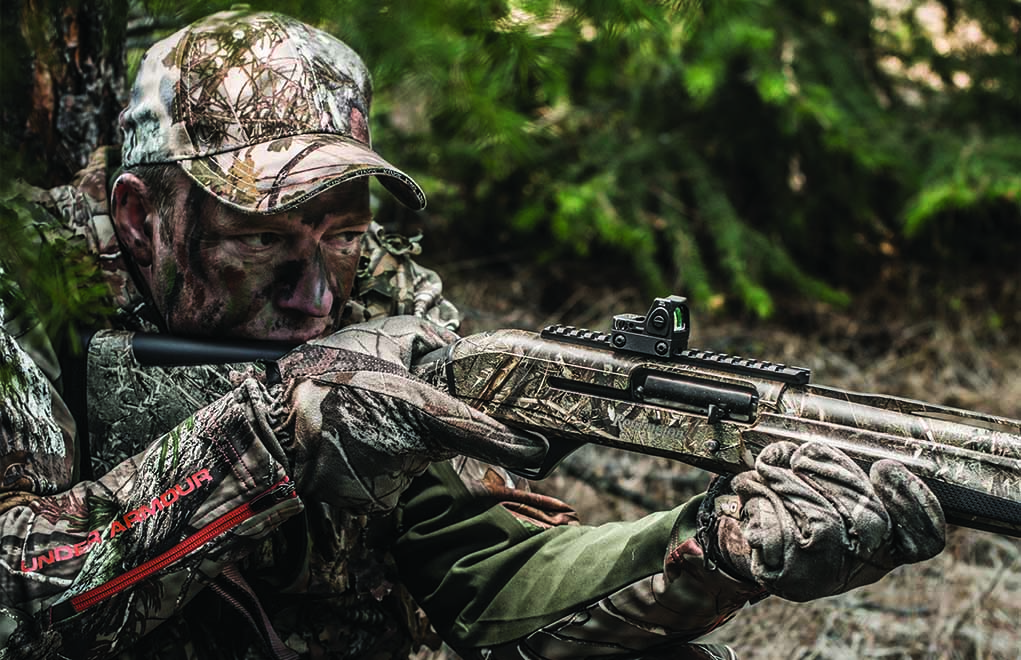
The Ruggedized Miniature Reflex sight (RMR) can also be a handy choice for a lethal turkey gun.
Two days later, I’d hand the Heym double over to Chris, and he’d use that same rig to take an equally impressive bull at over 125 yards, giving a clinic on how to shoot a double rifle. His bull took the first shot just below the point of the shoulder, and he delivered a second about 4 inches away from the first while the bull was running. The grinning Chris was the first to admit he might not have made those shots in the same manner with the traditional iron sights on the rifle.
Little Details
The Trijicon RMR has been updated to what they call the Type 2, which has a beefier electronics system and weighs a mere 1.2 ounces, making it perfect for maintaining the balance of any firearm.
You’ll need a mounting solution for whatever gun you’re pairing it with. In the case of the Heym 89B, there’s an aluminum adapter that mounts to the rib and is held in place with a thumbwheel. Trijicon has models that mount to a Picatinny rail and other popular systems, and the footprint of the Type 2 is identical to the original. At just under 2 inches long and an inch high and wide, it doesn’t obscure the shooter’s view and is mounted low enough to the bore that cheek weld isn’t lost.
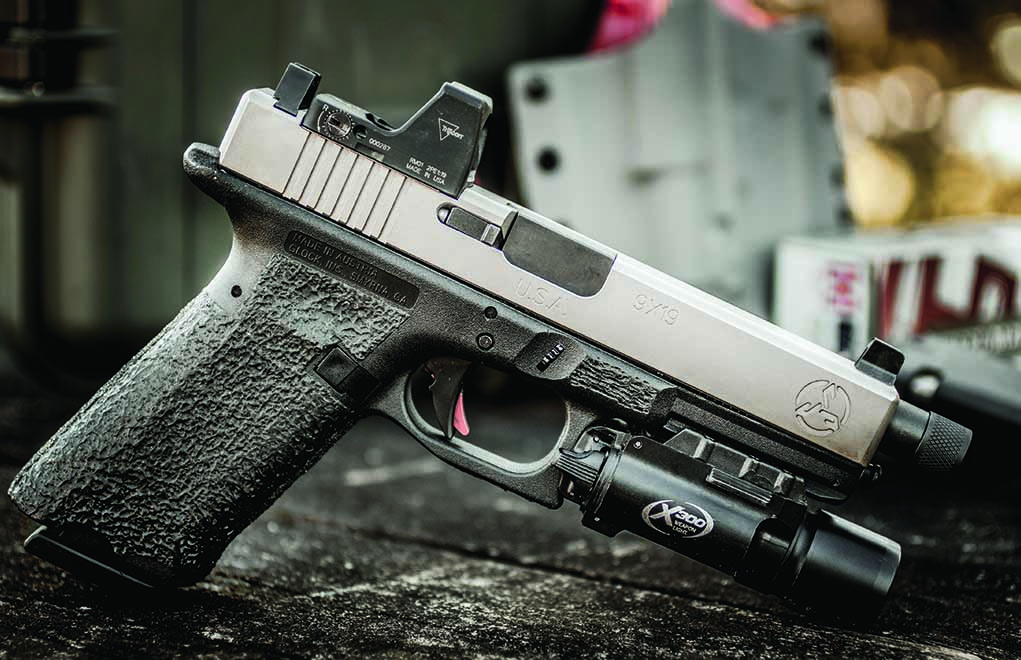
Trijicon’s RMR works equally well on a handgun, alleviating focal issues.
Three choices of dot sizes are available: 1 MOA, 3.25 MOA and 6 MOA. Quite obviously the larger the dot, the faster it can be acquired, and the 3.25 and 6 MOA dots make perfect sense for any close-quarters firearm. The 1 MOA model is a perfect choice for a hunting rifle. Covering just 1 inch at 100 yards, this sight is ideal for the rifleman who likes the visual freedom of iron sights yet prefers the single-focal plane view. Shots can be placed as precisely as the shooter can hold the rifle, and even when looking into the sunrise or sunset, the dot is bold and visible.
The dot of the RM09 I used and tested was adjustable for intensity with soft-touch buttons. Hold both buttons down to power off the unit. The adjustments are 1 MOA, with graduations on the dial, and clicks for each increment. When I was doing the load development for my Heym .470 double, the Trijicon was quickly zeroed and the adjustments I needed were as accurate as I could ask for. Having the RMR on board for the load development work saved ammunition and my shoulder—I knew the shots were placed properly.
The RMR’s lens is fully coated for minimal color shift in the window, and I experienced no issues when using the unit in bright sun, nor when holding on a black buffalo’s shoulder in the dappled sunlight. Trijicon indicates that the unit is waterproof to 20m depth. A single CR2032 lithium battery runs the unit; if you leave it untouched for 16½ hours, the illumination level automatically goes back to ambient lighting conditions. I wish I could tell you how long the battery lasts, but I haven’t yet reached the end of this battery’s life. The battery contacts have been designed to work in the most inclement conditions, and I’ve never experienced any loss of power, with either the original model or the Type 2.
The Trijicon RMR might not have the classic look on a double rifle, but at less than 2 ounces, it doesn’t upset the rifle’s balance and handling like a scope will.
Trijicon offers a limited lifetime warranty, stating that the electronics are warrantied for 5 years from date of manufacture. Having used this sight in Australia, Mozambique and here in the States—on rifles with serious recoil—I can say that the RMR is rock solid. While the slamming action of a 1911 can be tortuous on any piece of electronics, I’d wager it pales in comparison to a pair of rapid shots from a .470 Nitro Express, with each shot generating over 5,000 ft-lb of energy.
In addition to black, the RMR is available in a dark flat earth Cerakote finish and a sniper gray Cerakote finish. Depending on options, the list price runs between $699 and $749, with street prices running between $550 and $650, not counting the necessary mounting adapter.
While there are those who might feel that even the tiny Trijicon sight will befoul the classic lines of a fine double rifle or sleek lever gun, the increase in accuracy ought to sway that opinion. Plus, the RMR is quickly removed from nearly any mounting situation, easily restoring the gun’s silhouette. Should you have the opportunity to try a rifle with an RMR on top of it, I’d wager you’ll become a fan.
For more information on the Trijicon RMR, please visit trijicon.com.
Editor’s Note: This article originally appeared in the November 2020 issue of Gun Digest the Magazine.
Zev’s new OZ-9C Combat X pistol takes their already popular custom Glock-style design and streamlines it for duty use.
Enhanced Features Not Found On Standard Glocks:
Steel Receiver
Extended Slide Rails
PRO Match Barrel
PRO Curved Face Trigger
Slide Cut For An Optic
Zev Technologies got their start making aftermarket Glock triggers designed with competition use in mind. Today they are still famous for their triggers, but they do a whole lot more. Not only have they expanded beyond Glocks into making custom, high-quality replacement parts for Sig pistols and AR-15s, they also build their own guns from the ground up.
The newest of Zev’s homegrown pistols is called the OZ-9C Combat X. Chambered in 9mm and inspired by the Glock platform, Zev has taken what they learned from past iterations of their custom Glocks and further tailored them towards duty use.
Zev OZ-9C Combat X. Profile
Steel Beats Plastic
Standard Glocks are built on polymer frames that are susceptible to flexing under stress. For those who wish to squeeze every last bit of accuracy out of their pistol, a polymer frame simply won’t do. Zev has eradicated this issue by designing the OZ-9C Combat X around their patented steel receiver, something the company considers the heart of the gun. Machined from a solid block of stainless steel, the receiver tightly mates the slide to the grip and brings several improvements over standard Glock designs.
The steel receiver extends the entire length of the gun and includes longer slide rails to provide increased contact, thus stability. The result, a gun that is more accurate and has less recoil than its polymer counterparts. These improvements ensure that the shooter not only has a more accurate first shot, but more accurate and quicker follow up shots as well. The steel also improves durability, and the extra weight helps to give the gun a balanced feel. These are all very welcome improvements in a gun designed for combat.
Get A Grip
As can be deduced from the gun’s name, the Zev OZ-9C Combat X is essentially a combination of two prior Zev designs, the OZ-9C compact Citadel slide and the X grip. With the combination of these features, Zev has created a gun with a compact slide on a full-sized duty grip. For a duty gun, this is the best of both worlds. These features allow the shooter to maintain maximum control over the handgun with a comfortable grip while still benefiting from the shorter and lighter slide. Recoil management and manipulation of the controls are aided by the large size of the X grip on a package that’s still handier than a typical duty gun.
OZ-9C Combat X’s Competition Features
Improved accuracy is certainly something that competition shooters appreciate, but at the end of the day, all that’s at stake is their scorecard. In a life-or-death situation where you may only have the first shot to solve your problem, you better make it count. The Zev OZ-9C Combat X gives every advantage possible to its user concerning accuracy.
Besides the steel receiver improving lockup and mitigating recoil, Zev’s new combat pistol also includes a PRO match grade barrel and a PRO curved-face trigger. Both built in-house, these additions assist the mechanical and practical accuracy of the gun.
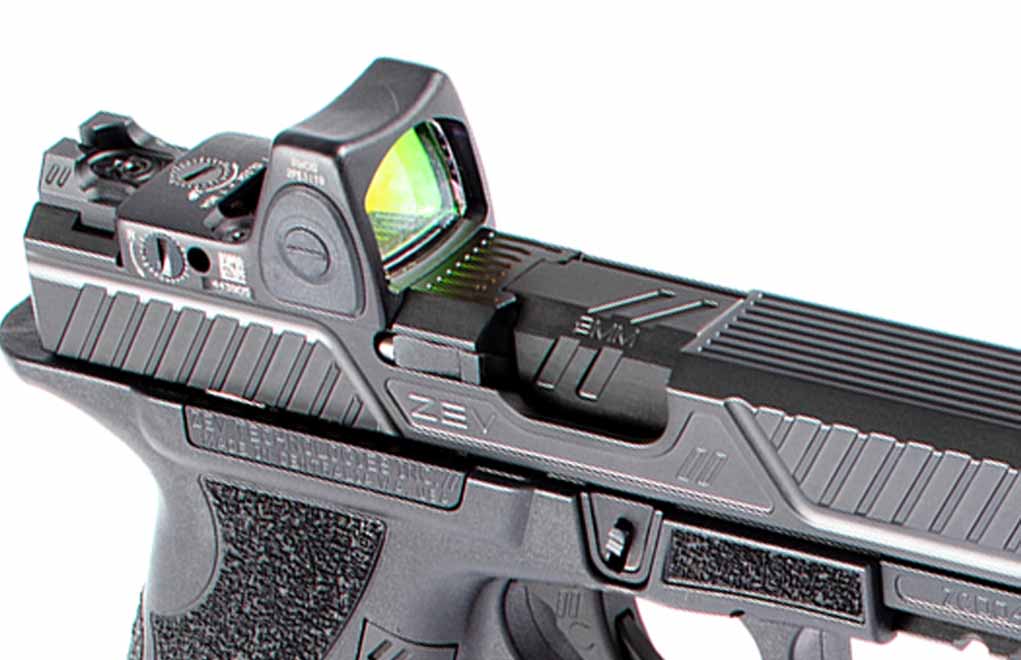
The OZ-9C Combat X is also available with a pre-installed Trijicon RM06 red dot sight. While I’m a big proponent of mastering iron-sights, a gun packed with as many upgrades as the OZ-9C Combat X would feel wrong without an optic in 2021.
Zev OZ-9C Combat X With Trijicon RM06
Each Zev pistol is custom built to order, so if you plan on buying one keep in mind that it will be at least 14 days before you see it. The base model OZ-9C Combat X has an MSRP of $1,368 and goes up to $1,819 for the package with a Trijicon site. A hefty sum when compared to the Glocks from which it was developed. Do the upgrades warrant the price tag? Will the Gucci-tier custom Glocks that Zev makes catch on within law enforcement? Or will Zev maintain its position as a premier manufacturer of competition-style handguns? Time will tell, but it’s certain that no matter how nice Zev’s guns are they will not be taking the place of Glock for the average, casual shooter.
Since the late 1950s, the .22 Winchester Magnum (more simply .22 Magnum) has fascinated rimfire shooters. Velocities better than any other rimfire cartridge of the same caliber, the snappy magnum flies further and flatter, and hits harder. This last point, however, creates issues, particularly in the context of hunting.
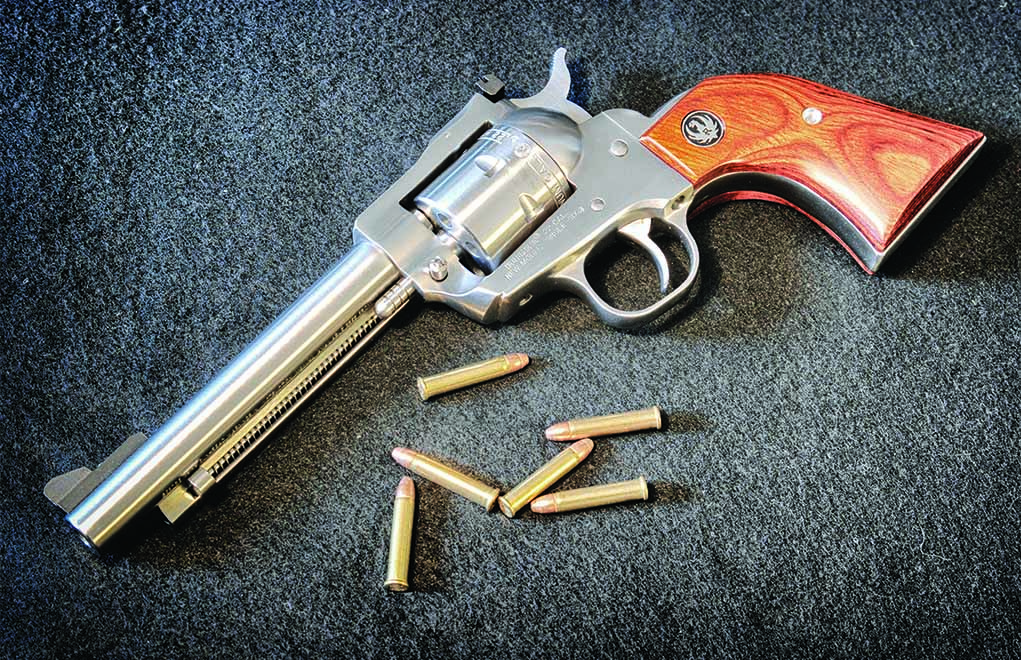
One of the most popular firearms in .22 WMR is the Ruger Single Six Convertible, which comes with a cylinder for the .22 WMR.
The problem, you see, the .22 Magnum has been known to pop eat’n critters too dang hard, especially out of a firearm that maximizes the cartridge’s velocity. Say a rifle. Dang accurate out of a long gun, the cartridge tends to decimate squirrels and can even leave larger prey, such as cottontails and jackrabbits, with a good chunk of bloodshot meat. None too appetizing, enough to relegate the magnum to target practice or pest control. Or is it?
If you’re up to the challenge, there is a class of gun downright dandy for shelterbelts teeming with brush tails or bunny-filled meadows. One that leaves plenty for the dinner table, without surrendering nearly all the cartridge has to offer. Here I refer to the .22 Magnum Revolver.
The .22 Magnum Wonderful Wheelie
Most are cognizant of the allure of handgun hunting. Stalking game close enough to smell its musk, then placing a shot with an inherently less accurate firearm than a rifle. At once, it’s challenging and satisfying. And while dominated by centerfire handguns, thanks to the .22 Magnum rimfire enthusiasts have an adept tool for potting game.
The .22 Magnum revolver generally is the best bet. At least to my mind, three areas make the magnum revolver—rather than pistol—particularly suited for small game hunting:
Longer Barrels—Better velocity profile and longer sight radius.
Single-Action Trigger—Light, snappy and likely to milk more accuracy out of a shot.
Adjustable Sights—Plain and simple, you can dial them in.
I’ll add, most .22 Magnum revolvers are lookers, which never hurts. But what does the cartridge-gun combination bring to the table when it comes to putting meat there? As it turns out, a lot.
Ammo choice matters when targeting small game with the .22 Magnum.
Back in the day, Winchester stated the magnum was better out of a handgun than any other .22 out of a rifle. This is mostly true. A snubbie .22 Magnum revolver is likely beatable by even the humble .22 Long Rifle with the right load. But, a suitable .22 Magnum hunting revolver … that’s a different story. A brief example might shed some light.
Take CCI’s 40-grain .22 LR Velocitor and send it out of an 18.5-inch barreled Henry Classic lever-action, you’ll achieve a muzzle velocity of around 1,370 fps. Now pitch CCI’s 40-grain .22 Magnum Gamepoint ammo from a 6.5-inch barreled Ruger Single-Six and the muzzle velocity is right around 1,480 fps. Obviously an improvement, and from rig a fraction of a rifle’s size.
Even better, the hot .22 is generally tame enough out of a handgun to preserve the meat. Though, it does take some study to ensure this, namely when it comes to ammo.
A Note On Ammo
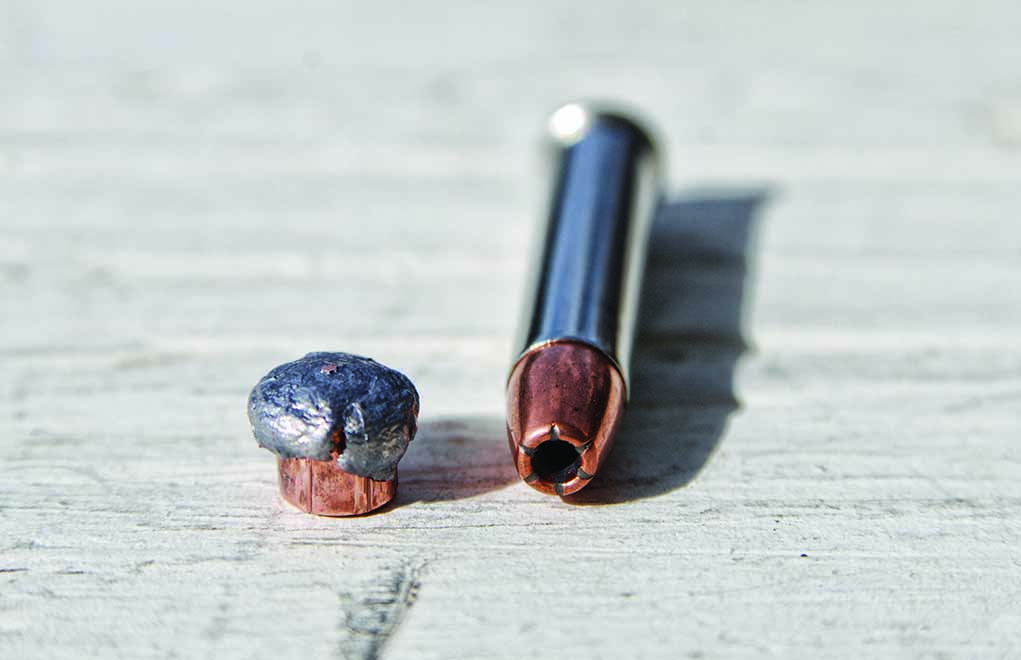
Aside from case volume, one of the major differences between the .22 Magnum and most other .22s is its bullet. By and large, they’re jacketed—thinly jacketed. This is problematic, given the terminal profile of these projectiles in a word are explosive. They’re the type typically favored by varmint hunters who aren’t worried about pelts or meat.
Ammunition manufacturers are cognizant of this issue. And while the fast-expanding pest-control style loads dominate the market, they have thrown a bone to meat hunters.
There are several small-game hunting loads tailored to knock the stuffing out of critters without destroying them. For the most part, this ammo is loaded with controlled-expansion bullets similar to those use for large game, designed to retain mass upon impact. CCI’s Gamepoint, Remington’s Magnum Rimfire and Winchester’s Dynapoint are good examples of these options.
The likes of Speer TNT or Hornady V-Max—known for their rapid and volatile expansion—are best left for pest control. Either way, plan on doing your homework before heading afield.
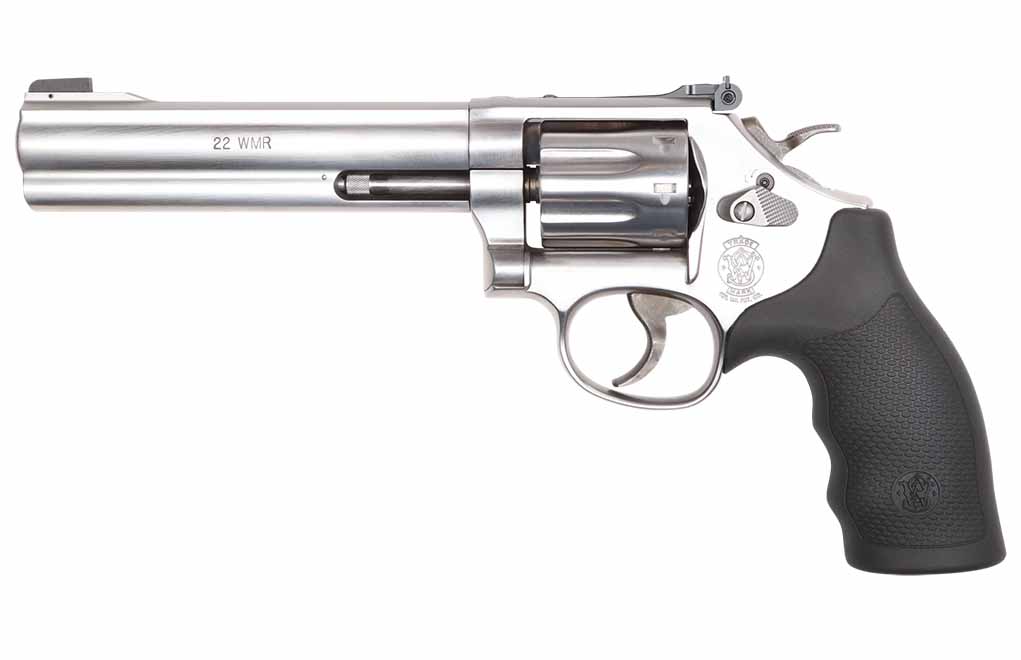
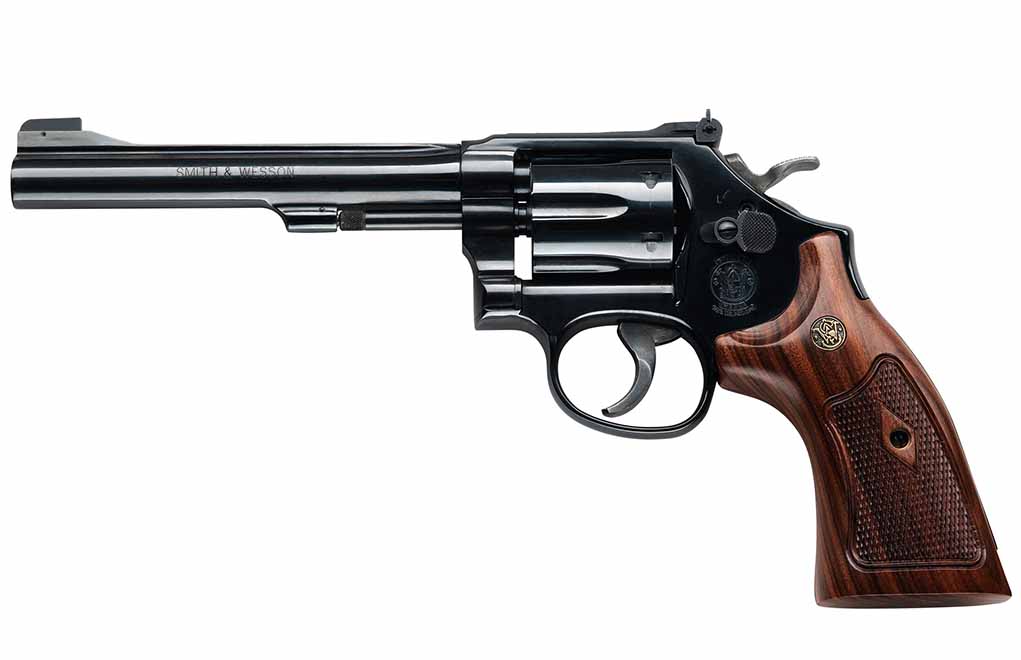
The K-frame and .22 Magnum have a long history, dating almost back to the inception of the cartridge. The Model 48 (we’ll talk more about it further down) was one of the first guns chambered for the cartridge in the late 1950s. Evolving over the years, S&W’s latest iteration—the rebooted Model 648—might be among the company’s best cracks at a .22 Magnum revolver. True enough, the 648 is a competitive gun, ramped up to ring steel and punching paper. But the double-action/single-action still holds its own in the field.
To this end, the hefty 8-round revolver has an exceptional trigger you’d swear rolled out of Smith & Wesson’s Performance Center. Unlikely as it is most hunters will use the double-action pull, it’s still nice to have in the quiver for a follow-up where the hammer can’t be cocked in time. Though, that’s a difficult task, given the spur is wide and well-textured, easy to catch with the thumb. Additionally, rubberized grips keep the revolver well in hand. Not that you have to worry about it jumping, at 46-ounces it’s a stainless-steel beast.
The 648 has a fully adjustable rear sight, which you dial in the windage and elevation with a small flathead screwdriver. This works in conjunction with a Patridge front, more a target option, but its crisp sight picture is suitable for hunting. The one drawback, the Smith & Wesson will hit you right in the pocketbook. MSRP: $772; smith-wesson.com
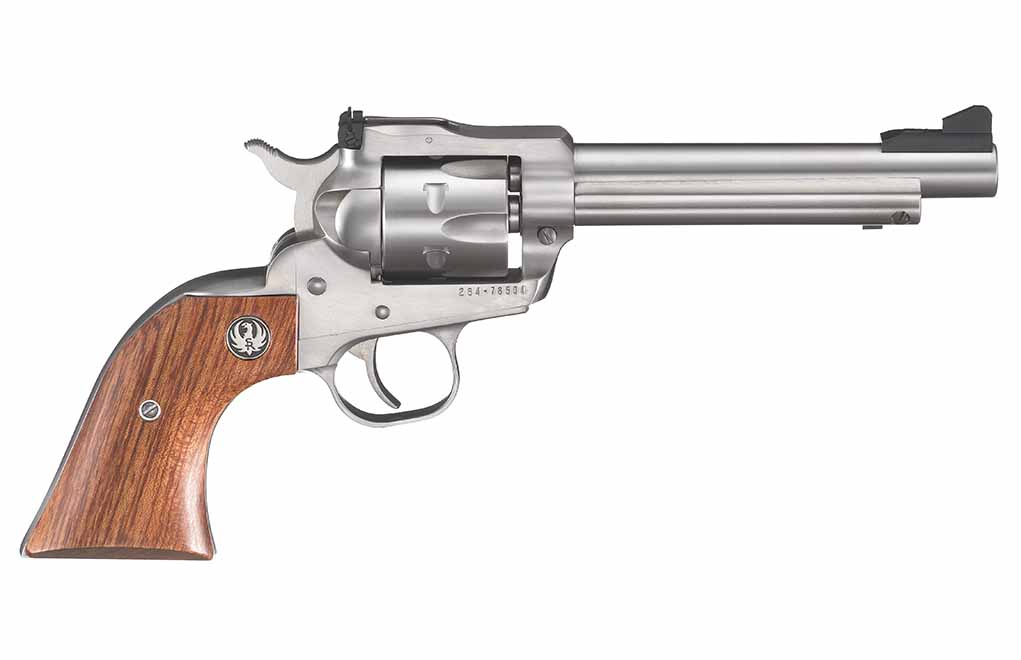
Ruger Single-Six Convertible
I have to confess bias here—I have a Single-Six Convertible and love it. A 6.5-inch barrel, the all stainless-steel gun has taken its fair share of squirrels—both ground and tree. Plus it’s murdered more bottles and cans than I can count. The purpose of the revolver all just depends on what cylinder I run—.22 Long Rifle or .22 Magnum. Now, if my particular set-up doesn’t appeal to you, never fear—the Single-Six comes with barrels ranging 4.62- to 9.5-inches long, and nearly everything in between.
A rimfire clone of the legendary Single-Action Army, the Single-Six isn’t everyone’s cup of tea—namely because it’s a single-action. Give most hunters prefer to cock the hammer for the light trigger break, most reading this article will more than find the .22 Magnum revolver suitable. Well balanced, the piece is easy to hold on target, though for longer attempts a good shooting stick proves a quality investment. A must on most hunting revolvers, the rear sights are fully adjustable and work with a massive front ramp sight.
It’s worth mentioning, Ruger produces a dedicated .22 Magnum revolver in the same family—the Single-Nine. A fine revolver holding 9 rounds, instead of the Single-Six’s 6, it isn’t convertible—the dealbreaker for me. Still, for someone who wants a few more rounds on tap and a bright set of fiber-optic sights—Williams Adjustable in the rear—the gun is worth a look. MSRP: Staring at $629; ruger.com
Smith & Wesson Model 48
Told you we’d get back to this classic. Smith & Wesson reintroduced the somewhat iconic .22 Magnum revolver in recent years, keeping it true to its original form. Though, the company improved the overall design, in part thanks to more modern manufacturing processes. Even so, the gun has the timeless lines S&W fans love and all the accuracy the target gun is known for.
The decision point on the Model 48 is barrel length, with 4- and 6-inch variants available. Both are suitable for taking game. From there the guns are veritable twins.
Especially nice, the gun’s walnut square-butt grips. While they seem somewhat archaic by today’s standards, the style is quite ergonomic and very conducive to resting on a support. Furthermore, the gun has an excellent trigger in both double- and single-action, and like its successor a large hammer spur with an aggressive diamond texture. Sufficed to say, it’s quick to cock.
Like most .22 Magnum revolvers, the Model 48 has some welcome heft (nearly 42 ounces on the 6-inch barrel variation), which helps in holding the K-frame on target, as well as mitigating recoil. Not mentioned on the previous two guns, but as applicable, the classic Smith & Wesson is all the more enjoyable with a quality holster and a good gun belt. MSRP: 4-inch model $976; 6-inch model $1,017; smith-wesson.com
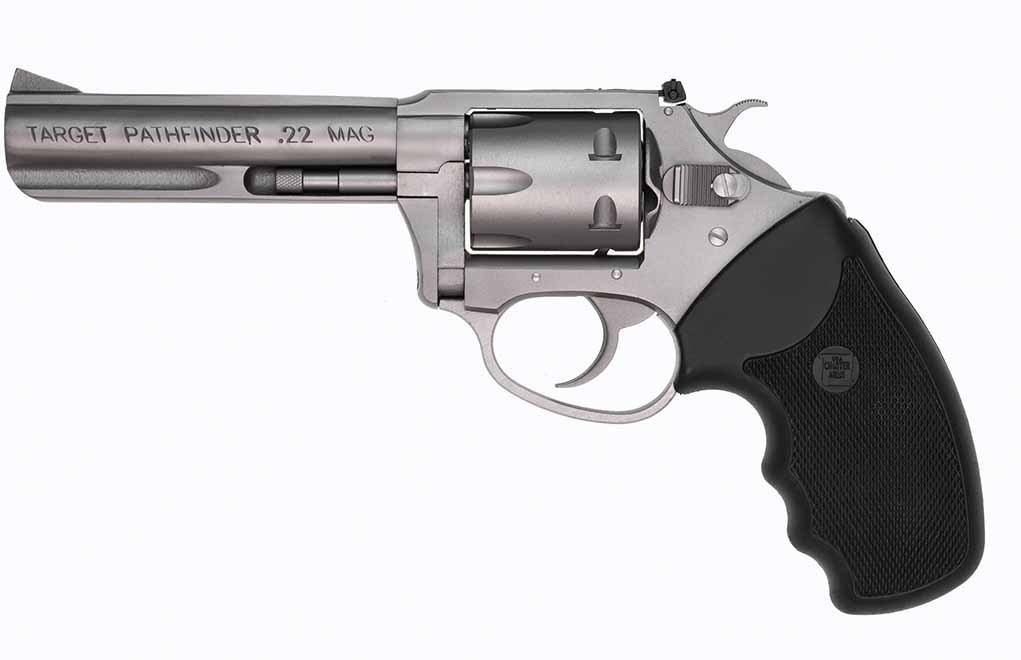
Charter Arms Pathfinder
Most write Charter Arms off a purely a concealed-carry revolver-smith of the budget variety. However, the company has expanded its horizons in recent years, producing more versatile models and at least one fairly well suited to taking small game. Here, I allude to the Pathfinder.
Admittedly, the 4.2-inch barreled .22 Magnum revolver runs at the short end of the hunting spectrum, but not prohibitively so. The bore is enough to keep it competitive with most .22 LR loads out of a rifle. Plus the DA/SA’s somewhat demure size gives the gun the added benefit of being the lightest (20 ounces) on the list. Furthermore, the revolver has passable adjustable rear sight (front ramp). Nothing to write home about, but it’s reliable enough that it will get you hitting where you aim. Also in the plus column, the 6-round revolver’s comfortable rubberized finger-groove grip, which does a fairly good job of asserting control of the gun.
The trigger, well it’s a Charter revolver, so double-action is heavy and not the smoothest in the world. But its single-action is good, light and responsive. Given it’s the cheapest option for a .22 Magnum revolver that checks off all the boxes, there isn’t a ton to complain about. MSRP: $425; charterfirearms.com
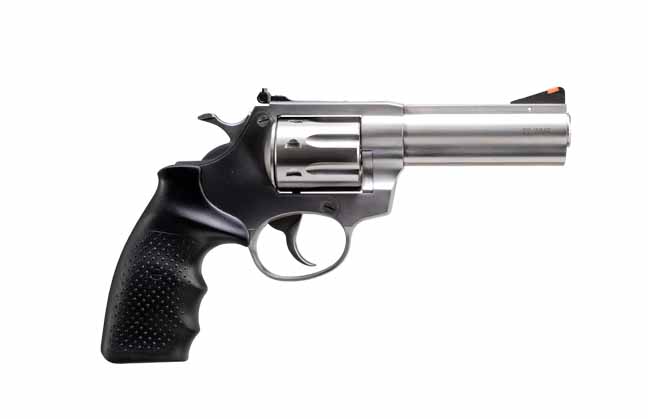
Rock Island AL22M
Yeah, they have a ton of well-priced 1911s, but Rock Island has come into its own in the revolver market. The AL22M is proof. The Czech-made (Alfa Proj) .22 Magnum revolver was released in late 2020 and offers some nice design points that help it excel in the field. At the same tick comes in at a price most can afford.
Funny as it might sound, the 4-inch barreled revolver’s grip is one of its most attractive features. Very slender at top and featuring an undercut trigger guard, it facilitates a solid high grip, thus more control over the gun. It also helps with recoil, not that it’s an issue on the 38-ounce wheelie. The sights are solid as well, with an adjustable rear and a ramp front. But Alfa Proj went the extra step of an orange insert on the front making it a bit easier to focus on, especially in a shadowy environment. Topping it all off, it holds an ample 8 rounds.
The AL22M’s trigger is adjustable but requires taking off the side plate to access the adjustment screw. Most hunters won’t find this necessary, with a 2-pound single-action break and a double-action pull around 7 pounds. As a bonus, full underlug and your choice of blued or stainless steel finish. MSRP: Blued $589; Stainless $799; armscor.com
The famous Serbian arms plant Zastava continues to keep the U.S. market supplied with AKs that are well-built, fairly priced, and relatively easy to find.
Who Is Zastava Arms?
Storied Serbian weapons factory founded in 1853.
Produced arms used prominently in wars past and present.
Supplier of civilian and military markets.
Good reputation for well-built AKs.
Currently import AKs, bolt action rifles, and pistols.
We’re all aware of the current state of the U.S. firearm market. The run on guns and ammo this past year has left many scrambling to fill holes in their collection they feared may never get filled. This was especially true for AR and AK-style firearms, due to the uncertainty of their futures. Overnight, an executive order could ban the popular semi-automatics or simply cut off firearms imports. Either of which would deal a death blow to the availability of quality Kalashnikovs. These threats help explain why so many people were willing to pay significantly more for an imported AK than they were during previous years. For several months during the scare, if you were trying to buy a foreign-produced AK, you were lucky to even find a new one in stock.
Zastava ZPAP M70 Rifle, wooden furniture.
When it comes to quality AKs currently being imported, your options are essentially Cugir from Romania, Zastava from Serbia, or WBP Fox from Poland. Russian and Chinese guns are off the table due to sanctions. Bulgarian Arsenals are either no longer imported or are imported in scant quantities. AKs from smaller producers—Hungary, Egypt, Finland—are no longer options either.
Between Cugir, Zastava, and WBP Fox, which is the highest-quality AK is debatable. When it comes to quantity, there is no doubt—Zastava wins the numbers race stateside. The Serbian guns so saturate the market that if you bought a foreign-made AK this past year, odds are it’s a Zastava.
The Long Zastava History
Zastava Arms got their start in the mid-19th century, at first producing cannons. From there, the company expanded to small-arms manufacturing and produced guns used in both world wars. In all, the company operated continuously for more than 150 years. Though, a good portion of those was as a part of Yugoslavia. The history of Yugoslavia is a complex one and not the focus of this article, however, some of the details surrounding it are important to know due to the weapons Zastava made during this era.
Of all the Communist nations to exist, Yugoslavia was unique. They were not a part of the Soviet Union, nor were they members of the Warsaw Pact. The Socialist Republic of Yugoslavia towed a fine line for most of its existence, resisting influence from both Moscow and Washington D.C. The country’s member states existed in peace until the death of Prime Minister Josip Tito in 1980. The resulting hardships would escalate into the Yugoslav Wars of the early 1990s and the eventual dissolution of Yugoslavia in that decade. An event that once again left the Zastava Arms factory within Serbian control.
The uniqueness of Yugoslavia is reflected in the very arms they produced. The Kalashnikovs they designed were as different from Russia’s as their own version of socialism was.
The M70, Better Late Than Never
While they successfully produced and tested domestically made AKs before this date, Yugoslavia did not adopt a Kalashnikov as their standard infantry weapon until 1970 with the Zastava AP M70 series of rifles. As the development of the M70 series continued, small changes and improvements were made incrementally culminating in the AP M70B2. Seeing the largest production numbers by far, these are the Zastava rifles known the world over.
There are two variants of these prolific select-fire rifles: AP M70B2 fixed stock model and AP M70AB2 folding stock model. Compared to previous iterations of Yugo AKs, this series’ receivers were stamped from thicker-gauge steel and featured a bulged front trunnion to improve durability.
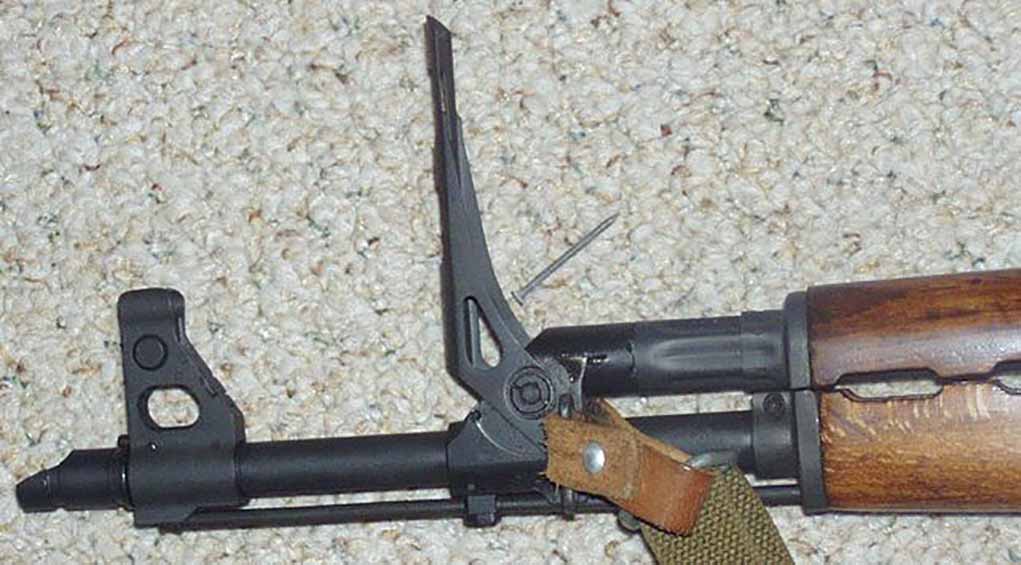
All M70 rifles were outfitted with grenade-launching capabilities as well, accomplished with a special muzzle device to accommodate a rifle grenade and a gas-cutoff lever that doubles as a grenade sight. Integral to the launching of rifle grenades due to their weight, the gas cutoff lever closes the gas port and ensures 100-percent of the blank cartridge’s gasses exit the muzzle. Following Newton’s third law, the extra force necessary to launch a rifle grenade imparts just as much energy back into the rifle. Thus the thicker receiver and bulged trunnion of the M70B2, a design point making the rifle more resistant to excess recoil.
Zastava M70AB2 with gas cutoff lever/grenade sight raised. Photo: Wikipedia
Proprietary Wood
One of the most distinctive features of any Yugo-pattern AK is the non-standard furniture. Instantly recognizable, Yugoslavian AKs feature longer handguards with three vent holes as opposed to the standard two. The pistol grip is made of black plastic and is differently shaped than bakelite or wooden grips that most countries produced. The fixed-stock model’s wooden buttstock also has a different profile and length of pull. Due to the way each piece of furniture is installed, pistol grips of any origin can be attached to an M70, but handguards and buttstocks must be specifically intended for Yugo-pattern rifles.
Globetrotter
While AKs of all makes and models are found scattered across the world, Yugoslavian AKs are especially well-traveled. Zastava exports to over 40 different nations and M70 rifles can be seen in the hands of both government forces and their opposition across the Middle East and Africa. The M70’s prominence during the lawless years of the Yugoslav Wars also resulted in plenty circulating on the black market, as well.
Ramadi Police with M70AB2 in 2008. Photo: Wikipedia
More Than The M70
Zastava produces more than AK-pattern M70 rifles, including several popular pistols and rifles here in the United States, including:
Zastava M48: A clone of the German Karabiner 98k bolt action, this rifle is one of the more abundant and affordable Mauser-style rifles you can find in the U.S. Produced after WWII, this was Yugoslavia’s service rifle until the adoption of the M59.
Zastava M59/66: A Yugoslavian produced SKS clone. It’s one of the more common SKS varieties to be found in America and can usually be recognized by its distinctive rifle grenade muzzle device.
Zastava M76: Yugoslavia’s designated marksman rifle. Chambered in 8mm Mauser like their M48, this technically is also an AK-pattern weapon, just larger and outfitted with a scope. Some have been imported into the U.S., but they are not very common.
Zastava M91: This DMR replaced the M76 in Yugoslavian service. Now chambered in 7.62x54r and more aesthetically similar to the SVD it takes inspiration from. Despite the visual similarities to the SVD, the M91 still uses a scaled-up AK action like the M76 and shares nothing in common internally with a Dragunov. This rifle is still currently being imported.
Zastava M57: A Tokarev pistol clone that is yet again distinctly Yugoslavian compared to other TT variants. These are abundant in the United States, both old surplus imports as well as newly produced versions. They are available in both the original 7.62x25mm chambering as well as 9mm.
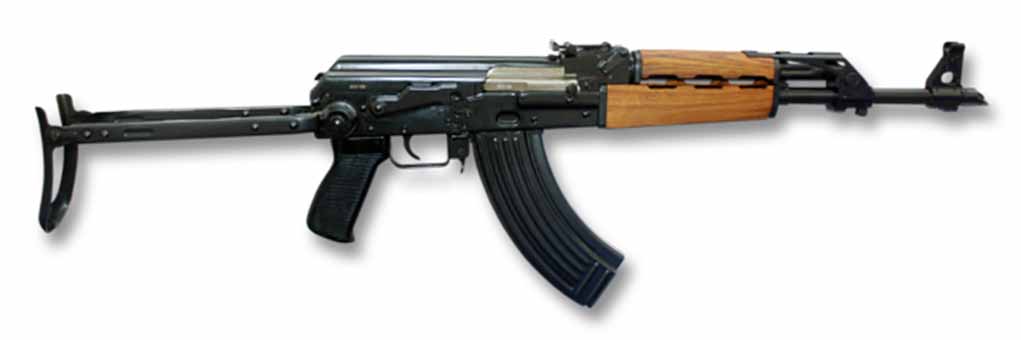
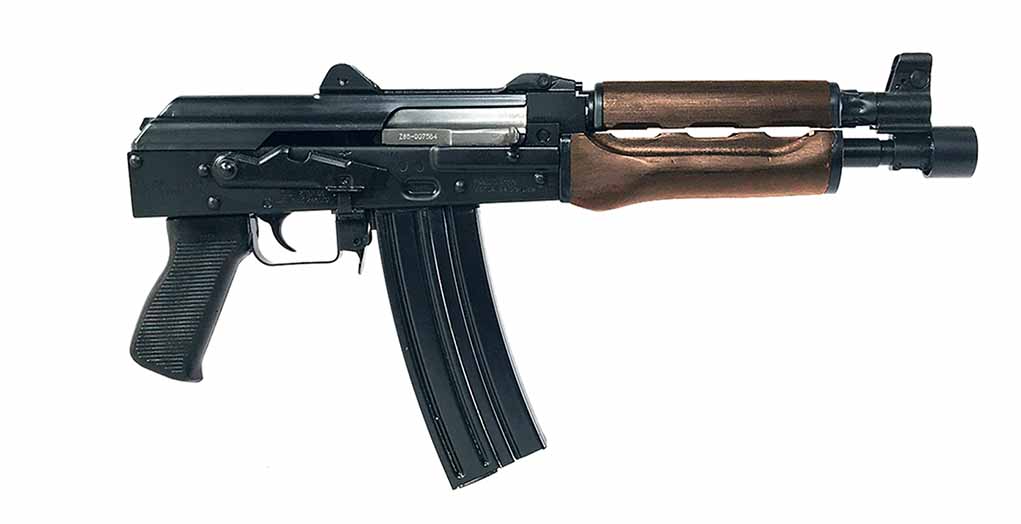
Zastava ZPAP92: Based on their M92 carbine, this is Zastava’s 7.62x39mm semi-auto pistol AK. These are also currently imported.
Zastava M90 and ZPAP85: The 5.56x45mm versions of the Z-PAP rifle and ZPAP92 pistol, respectively. The ZPAP85 is currently imported, and the M90 for the U.S. civilian market will be imported in the future.
Zastava ZPAP85 Pistol.
Import History
Over the years Zastava guns have been brought in by several different importers, but with the creation of Zastava Arms USA in 2019, they became the sole importer of Zastava products out of Serbia. Now Zastava has a direct line of communications with their sizeable American market and can better listen to what consumers want. Perhaps this is the reason why Zastava AKs have been easier to find in stock this past year compared to their competition. Neither Cugir nor WBP Fox has the means to listen and respond to their customer base as well Zastava now can with their American branch.
The semi-auto imports of M70 rifles are known in the United States as the PAP series. When it comes to early Zastava imports there are PAPs, N-PAPs, and O-PAPs. The current M70 imports are called Z-PAPs. If you are in the market for a Yugoslavian-pattern AK, the Z-PAP is the way to go unless you want an underfolder model. Some of the variants imported before the Z-PAP had issues that the Z-PAP seems to have corrected, so do your homework before buying an older PAP model. The currently-imported Z-PAPs seem to be the highest quality semi-auto AKs Zastava have ever sent to the U.S., so as long as the fixed-stock variant is alright with you, this is the model to get (not to mention that newer ones are far easier to find as well).
Another example of how Zastava USA can respond to their customers’ wishes is that the Z-PAP now features a chrome-lined barrel. Yugoslavian AKs infamously did not have chrome-lined barrels as most other variants did, and while this is not necessarily a problem unless you are firing corrosive ammo, Americans wanted a chromed barrel so Zastava delivered. This is another advantage of the Z-PAP over older PAP models.
Current Zastava Imports
Zastava USA has more than AK variants for sale, they also have Zastava-made handguns and bolt-action rifles. Their AKs that are currently available include three 7.62×39 versions- a rifle with wooden furniture, a rifle with polymer furniture, and a pistol. They also have the 5.56 ZPAP85 pistol and the 7.62x54r M91 rifle. They offer three kinds of bolt action rifles and have a few varieties each of their Tokarev and CZ99 handguns.
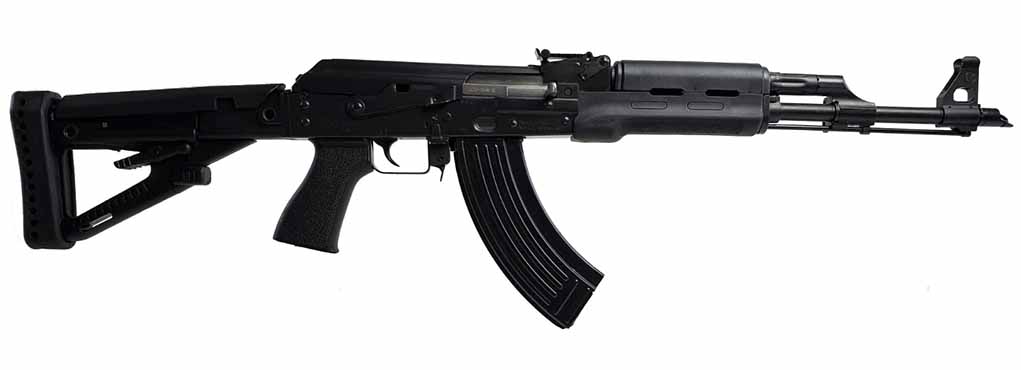
Zastava ZPAP M70 Rifle, synthetic furniture.
Zastava-made AKs not only continue to be a good choice, but they may be the best they’ve ever been. Zastava Arms of Serbia and their newly formed Zastava USA branch seem to be going after the American AK market hard in terms of both the quality and quantity of their rifles. Their Z-PAPs are arguably the nicest new AKs on the market right now and are more abundant than WASRs or Foxes. For those looking to grab a foreign-made AK before it’s too late, Zastava is definitely a name to consider.
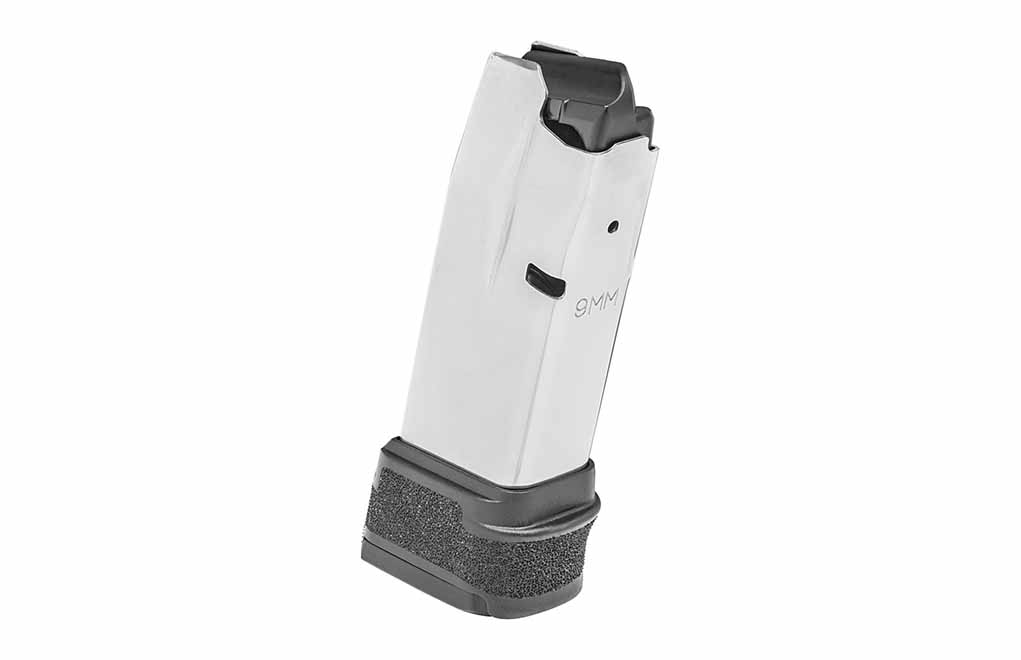
Springfield’s new 15-round Hellcat magazines bring even more firepower to a small package.
How Do The Hellcat 15-Round Mags Improve The Pistol?
Enhances firepower over the original 13-round magazines.
Only marginally larger in sized that the smaller-capacity mags.
Features texturing to enhance grip of the micro-9mm.
Clint Smith, famous firearms instructor, once said this about concealed carry pistols: “For carrying them, none of them are too small. For fighting with them, none of them are too big.”
This is a concise way to summarize the dilemma of creating the ideal concealed carry handgun. In a word: compromises. The gun’s design must balance concealability with usability, weight with durability, size with capacity. Everything is a tradeoff. The most popular carry guns released in recent years are getting closer to finding that happy medium.
Springfield Hellcat OSP With 15 Round Mag.
Springfield believes they have achieved this balance in their Hellcat pistol, especially when paired with their new 15-round magazines. Springfield asserts the Hellcat is the “smallest, highest-capacity micro-compact 9mm handgun in the world,” a claim the company made when only the original 13-round magazines were available.
The new magazines are only slightly larger than the 13-rounders. As with all things in gun design, this is still trading some concealability for capacity, but the negligible difference in size helps to compensate for the almost 15% increase in ammo capacity. For maximum concealability, the Hellcat can still be carried in the holster with a flush-fitting 11-round mag. If you also carry spare magazines, however, there is really no reason to stick a 13-rounder into your pocket when the 15-round magazine is so similar in size.
The first widely adopted pistol to use double-stack magazines was the Browning Hi-Power, a large-framed service pistol that also had a 13-round capacity. This was considered a technological marvel when it was first invented, but modern pistols like the Springfield Hellcat show how many bullets can fit into a small package. Both 9mm handguns, the Hellcat is significantly smaller and more concealable than the Hi-Power. Yet it can now be carried with larger magazines than what were originally fielded with the full-sized duty gun.
Springfield Hellcat 15-Round Mag, Black.
Available in both black and desert FDE colors, just like the Springfield Hellcat itself, the new 15-round magazines have an MSRP of $39.95.
On a side note, Sig Sauer recently alleged that Springfield’s Hellcat magazines infringe on a patent held by Sig, but Springfield refutes these claims. Sig’s P365 and Springfield’s Hellcat have been competing over which gun is the best compact, high-capacity 9mm for concealed carry, and it’s been a tight race. Both are fine pistols, but it will be interesting to see how Sig’s claims play out in court.
Surviving a lethal-force encounter in a riot is only the first step. The next, ensuring you don’t get hung out to dry by the legal system.
What Are Some Legal Considerations Of Self-Defense In A Riot:
Why you were there in the first place?
Was your use of force reasonable given the threat?
Did you at all, in word or action, escalate the situation?
Was there any photographic or video evidence to support your use of force?
Do you have a good understanding of that particular location’s prosecutorial philosophy?
On August 25, 2020, 17-year-old Kyle Rittenhouse put an AR-15 over his shoulder and voluntarily went to downtown Kenosha, Wisconsin, into the midst of a riotous mob. The result was two people shot to death, with a third grievously wounded and young Rittenhouse being charged by the local county prosecutor with five felonies and one misdemeanor.
A mob can turn ugly at a moment’s notice. Photo: Pexels
At the time of this writing, irrefutable facts show that Rittenhouse was being chased by the mob because he had assisted in putting out a fire, an action the mob took exception to.
This article, though, isn’t addressing the facts and narrative of the Kyle Rittenhouse case. That information is freely available over the internet and will be played out in the media for the next several months, if not years. Instead, I want to discuss the general legal parameters of the armed citizen defending themselves in the middle of a riot.
Important Questions
Why were you there? That’s the first question you’ll be asked if you’re involved in an act of self-defense during the middle of a riot. If you expect to survive (legally) after such an event, you need to have squeaky clean hands. You need to be able to make the claim that you were an innocent victim, and only a participant because a criminal act was occurring against you.
Was your use of force reasonable? If you start shooting in the face of a mob, when that mob isn’t actively threatening you, even though you were feeling fear of death or grievous bodily injury, you’ll need to convince the jury your actions were reasonable. How do you do that?
As mentioned above, you cannot be committing a crime of your own, or even be seen as the initial aggressor. Most jurisdictions have a law which states (generically) that if you used words or actions that would lead a reasonable person to believe that these words or actions would evoke a belligerent response and then use force to defend yourself, you don’t have the ability to claim self-defense at trial.
After making sure you’re truly an innocent victim, your actions in defending yourself must be reasonable. Most states have case law (rulings from previous court cases), which declares that a jury must look at the facts of the case through your eyes (knowing all the defendant knows and seeing all the defendant saw). If you’re innocent, you’ll need to educate that jury as to what you knew and what you saw.
This means educating yourself and being ready to discuss with the jury why you felt your life was in danger. It’ll be overwhelmingly likely that you’ll need to testify on your own behalf. Interestingly, when George Zimmerman was exonerated in the shooting death of Trayvon Martin, he didn’t testify at trial because he cooperated (on video) with the investigating police, and this video made his case for him. Not many people could’ve pulled this off as well as Zimmerman did, and if you do decide to discuss the particulars of the case with police, an attorney by your side would be a godsend.
Education includes knowing what “disparity of force” means and how it’s dealt with in your jurisdiction. If you’re being assaulted with weapons, that’s pretty easy to establish, but what about being attacked by unarmed participants? Each case will be different, and it’ll be your job to paint a picture for the jury that showed they possessed the physical ability to cause your death or inflict serious injury.
After this is established, you’ll need to be able to educate the jury as to why you reasonably believed the attackers possessed the opportunity to immediately use their size, numbers or weapons against you. Lastly, you’ll need to convince the jury that those you defended yourself from were placing your life in imminent jeopardy. What words or actions were they using that would lead a reasonable person to draw that conclusion?
I’ve used the word “reasonable” several times already, and as this column continues, you’ll see that the criminal justice system—particularly when assessing self-defense cases—hinges on the concept of reasonableness. If your actions and your explanation to the jury as to why you used force isn’t viewed as reasonable, you’ll likely be convicted. That’s the harsh reality.
Getting back to the scenario (being forced to defend yourself during a riot situation), there’ll also likely be an additional complicating factor or two, those being the fact that the incident is likely to be caught on cellphone video. If that occurs, that video will be turned over almost instantly to the broadcast media. It’s very likely that your incident of self-defense will hit cable news channels before the on-scene investigation is complete. Think hours, not days. And as we’ve seen, the media (in an effort to sell airtime to advertisers) will seasonalize the event and possibly even incorrectly relate the facts. Unfair? Yes, but that’s the reality of the situation—a reality we must be prepared to deal with.
Another aspect of this riot scenario is that you might find yourself being attacked several times or by multiple individuals (as Rittenhouse was). For each attack and resultant use of force, you’ll need to be able to explain your actions for each attack and for each person you used force against. It’d be a shame to snatch defeat from the jaws of victory by getting caught up in the moment and using force where it wasn’t justified. A difficult proposition? Yes, indeed.
Simply having a gun and the requisite training to both use the gun effectively and the legal training to “do it right” isn’t enough. The armed citizen, especially one who lives in an urban area, needs to both understand the prosecutorial philosophy of the local elected district attorney, and have the ability to contact an attorney immediately following such an event. In researching the Kyle Rittenhouse case, I’ve learned a number of attorneys have volunteered to assist him, and that’s great. But if you’re the person involved, you need an attorney immediately after the event, to ensure your rights are protected. More on this in a future column.
Editor’s Note: This article originally appeared in the 2020 Everday Carry issue of Gun Digest the Magazine.
Outfitted with an adjustable, lightweight stock, the Proof Tundra Long-Range rifle extends the backcountry hunter’s reach.
What Make the Proof Tundra A Top Mountain Rifle:
Lightweight carbon-fiber stock features an adjustable comb.
At the bottom end, the rifle weighs a shade over 7 pounds.
Features Proof’s lightweight and ridged Sendero contour barrel.
Rifle outfitted with a hunting model of Defiance’s Ruckus action.
Has a top-notch Trigger Tech trigger.
Chances are, Proof Research has been on your radar as of late. It’s pretty difficult to miss the Montana concern, given the carbon-fiber wrapped barrel specialists have spread their fire tubes far and wide. Truth be told, it’s entirely forgivable if you were under the perception that all the manufacturer did was provided the high-tech component for gunmakers. Though, you’re well served to know Proof makes a dang fine rifle in its own right.
Proof enough, the company’s freshly released Tundra Long-Range hunting rifle. The eighth complete gun in Proof’s catalog, the lightweight precision iron marries the company’s tactical and hunting lines to create a unique and adaptable system. In particular, the gunmaker has scratched together an excellent stock system that not only cuts the rifle’s weight profile but ensures hunters have accuracy to spare to make certain their long backcountry treks payoff.
Proof Stocks The Tundra Up
A hybrid of sorts, the Proof Tundra’s lightweight carbon-fiber stock is cut with the typical slender sporter profile with svelte fore and butt. However, it’s enhanced with a knob-lock height-adjustable Monte-Carlo cheekpiece. Once the nearly exclusive realm of tactical systems, hunters have come to appreciate a tailorable cheek rise. Creating stable weld, thus intuitive eye-to-scope alignment, the system makes setting crosshairs on a trophy quicker, while also improving the accuracy potential at long range. Precision at distance is about consistency, which stock helps deliver in spades.
Further improving the system, Proof also included a pronounced pistol grip on the stock. Allotting more overall control, it’s a welcome improvement, especially for the hunter with the potential to take a shot over normal hunting ranges. Additionally, the stock does a number on the rifle’s overall weight, with the Tundra tipping the scales at 7 pounds, 3 ounces at the low end. In short, it’s more than deserving of the classification “mountain rifle” any way you cut it.
High-End Rifle Build
A more modern take on the stock is only the beginning with the Proof Tundra. The company didn’t cut any corner in producing a rifle more than capable of making a cross-canyon shot hit the mark. This includes one of Proof’s well-respected carbon-fiber wrapped barrels. In the case of the lightweight hunter, it’s the company’s standard Sendero contour, with a 1.2-inch shank that tappers down to a .90-inch muzzle. In addition to cutting weight, the barrel also offers exceptional heat-dispersion qualities and rigidity, giving a solid sheath to the stainless-steel bore.
To this Proof mates a Defiance Ruckus action, what appears to be the GA hunting model. While it follows the same design and tight tolerances of Defiance’s match models, it’s an open-top action facilitating top loading. A nice option in a pinch. Still, expect the one-piece bolt to be headspaced to +/- .001 inch, like Defiance’s competitive actions.
Other notables of the Proof Tundra include Trigger Tech trigger (model not specified), BDL magazine, modified ball bolt handle, single-piece pinned rail and 5/8-24” thread muzzle (factory-installed protector). The rifle is available in 11 of the most popular hunting calibers, including belted magnums. As to price, technology and performance don’t come cheap. The Tundra runs anywhere from $6,999 to $7,199, depending on caliber and customization.
Looking to go armed, but are stuck in the weeds as to what to arm yourself with? Here are 20 of the best concealed carry gun options that will keep you on the defensive.