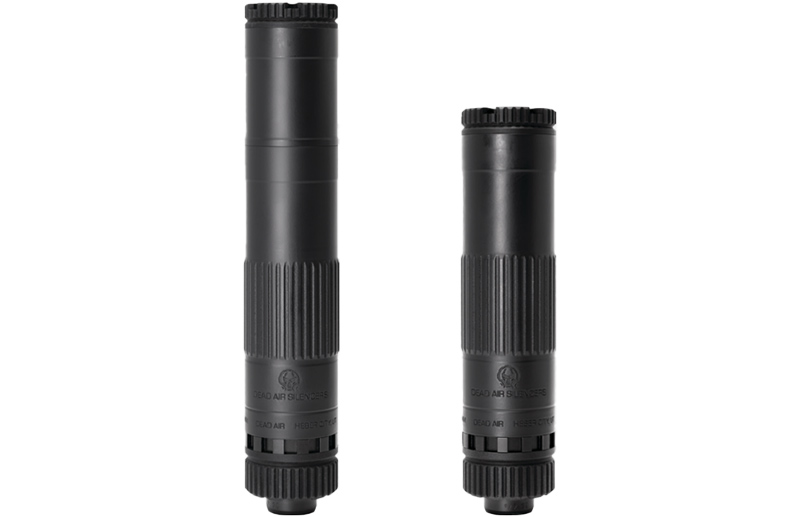
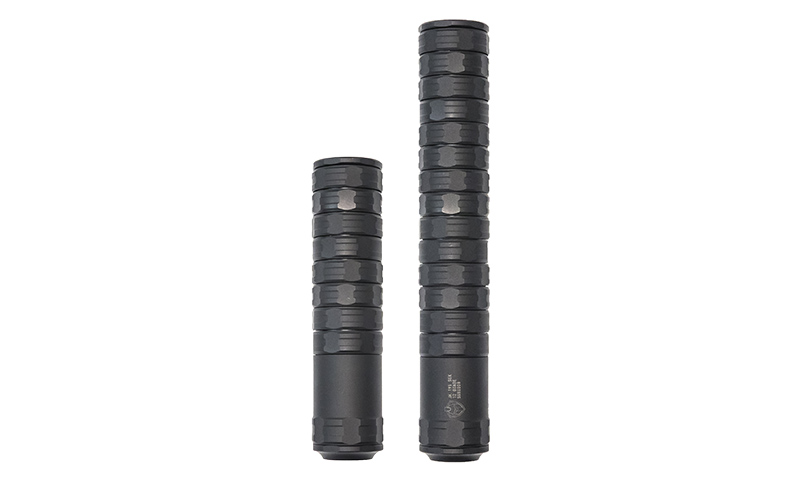
Dead Air Silencers has recently announced the Mojave 9, a new 9mm suppressor with an innovative new baffle design.
At SHOT Show 2023, Dead Air Silencers unveiled the Mojave 9. This is the company’s first suppressor to be made using Direct Metal Laser Sintered (DMLS) additive manufacturing technology, more commonly known as 3D printing, and it’s what enables the Mojave 9 to have its revolutionary and complex internal baffle system.
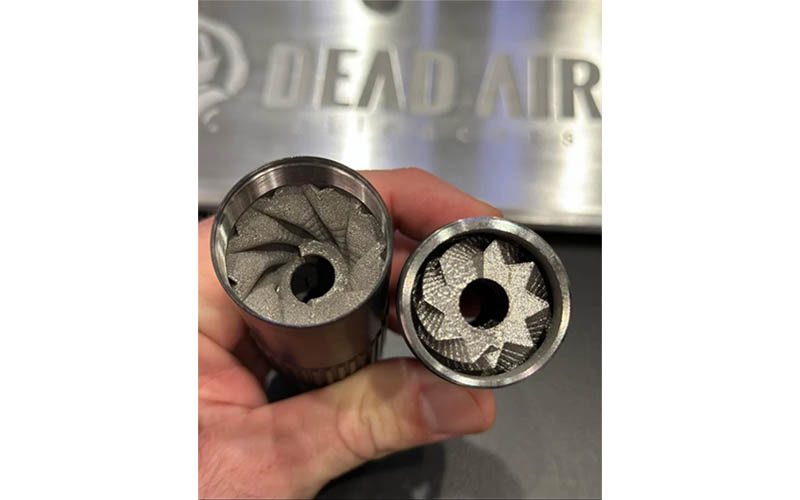
This 3D-printed and patent-pending baffle design is called the Triskelion, and it’s the core of the Mojave 9’s performance. Dead Air promises that the unorthodox baffle design results in less back pressure, less flash and improved acoustic performance. The suppressor is also a modular two-piece system that enables users to trade weight and length for less sound reduction depending on their priorities. The use of 6AL-4V titanium also lends the system high thermal efficiency, high durability and low weight (9.6 ounces in its full 7.64-inch configuration, 8.2 ounces in its short 5.89-inch configuration).
The new Triskelion 3D-printed baffles. Photo: Reddit user BlueJay–.
The Mojave 9 is rated for 9mm, .300 BLK subsonic loads and .350 Legend with any type of firearm, and for .300 BLK supersonic loads when used with a semi-auto. Each suppressor will ship with a booster and a 1/2×28 piston, but they will also be compatible with all Dead Air P-Series mounts and their associated accessories.
Mike Smith, Research and Development Engineer for the project, said this about the new Dead Air suppressor:
Having been given the opportunity to design the 9mm suppressor we call the Mojave 9; I really wanted to wow our customers and give them something they’ve never seen before.
The Mojave 9 will have an MSRP of $1,099 and is slated to begin shipping in Q2 of 2023.
A review of the Turkish company Canik’s line of inexpensive and exceptional 9mm pistols.
Canik is a line of 9mm pistols being imported by Century Arms. Century, a U.S.-based company situated originally in Vermont, moved the operation down to Florida almost a couple of decades ago.
It had to be those Northern winters.
Canik pistols are manufactured in Turkey in a plant filled with modern CNC machining centers. You might think that, because a country hasn’t been seen as a long-time known manufacturing center, it can only be making low-rent products. Let me make the younger readers aware, especially those driving a Japanese car: When I was growing up, “made in Japan” was synonymous with plastic crap. Now look at how far they’ve come.
Well, when the Turks decided to get with the 21st century and make things for themselves (the Canik line is used by the Turkish military and police), they decided to do it right … so new buildings filled with new machines, making firearms that are the amalgamation of the best designs extant.
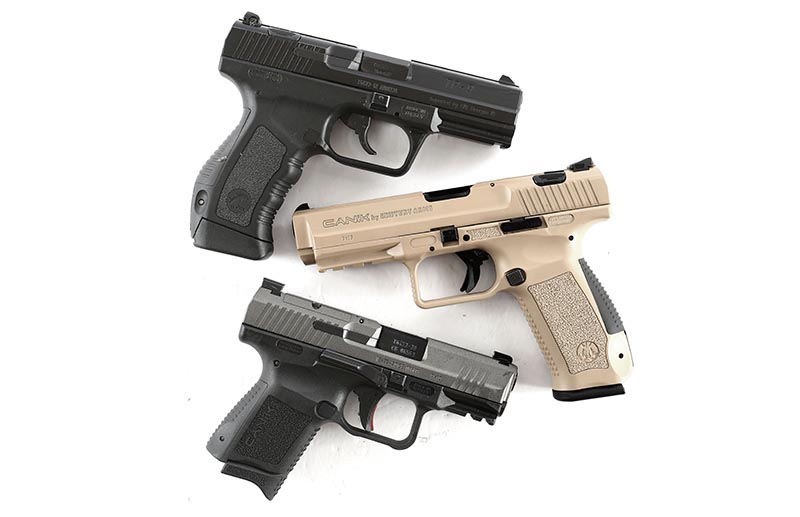
The basic Caniks, from old to new. Top is the Canik 55, middle is the TP9SA and bottom is the TP9 Elite SC. And there’s still the METE to consider.
Future Collectibles
Covering the whole line of Canik pistols—the TP9 being the current model name—would take more space than we have here. As the line evolved, and as Century Arms and Canik evolved the line to meet customer demands, they inadvertently created a wide variety of what will be, at some future time, collectibles.
The Canik line of pistols blends various features, depending on which particular model you select. Let’s start with the magazines—because all self-loading pistols are dependent on magazines.
The Canik line works with all Canik magazines, assuming you have the proper length. If you’re trying to use a flush-fit magazine from a Canik TP9 Elite subcompact in the full-sized guns, you’ll fail. But the longer magazine will work in the shorter pistol, and all models with similar length of frames will use the other magazines.
Century and Canik offer magazines, so you don’t have to worry there. Plus, the Canik line originated with magazines based on the Walther PPQ series, so if you have a source of those, go for it. (I suspect that Walther magazines will cost you more than Canik, but sometimes you score a deal.)
If you want extra capacity, it isn’t difficult to find magazines for your Canik with up to 20 rounds, and you can always go to Taylor Freelance and get bolt-on magazine extensions that’ll give you more, more, more. They make Plus-4 and Plus-9 extensions in aluminum and brass. The Plus-4 is just a new baseplate; the Plus-9 includes a replacement magazine spring, because you’ll need it.
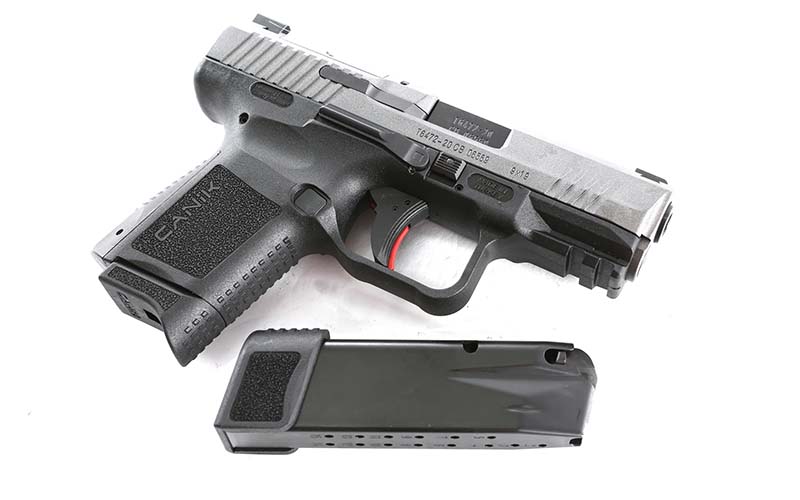
The TP9 Elite SC is a compact carry pistol, and the modern iteration (Canik has been making pistols, and Century importing them, for a few years now) has a top plate for mounting a red-dot optic. This is a sub-compact size and holds 12 rounds in the magazine, unless you opt for an extended magazine. That makes the frame a compact size and bumps capacity up to 15 rounds.
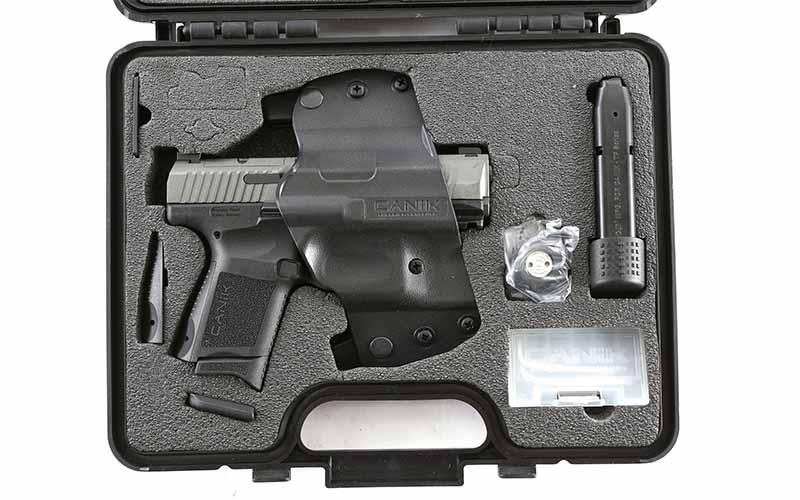
The TP9 Elite SC comes with a 12- and 15-round magazine, holster, backstrap and lockable case, and is ready to accept a red-dot optic. All this in a sub-compact 9mm, for just over $400? That’s crazy talk.
The firing system is the one many shooters expect, a striker-fired system with a trigger-blade safety and internal safeties to prevent discharge when dropped or otherwise roughly handled. If nothing hits the trigger, there’s no bang. And when you do go to install a red-dot optic, Canik has got you covered. A small box resides in the carry case, with the tools and screws you’ll need to bolt on the optic of your choice. Well done, guys.
My second Canik is the TP9SA. The first one was an all-black 9mm when they were referring to the pistols as the “Canik 55” line, the start of the pistols that were taken right from the Walther 99 series. The TP9 is the name now, and this one has several details changed from the earliest.
Here, the striker system is still wedded to a striker-drop pressure plate in the slide. If you don’t want to leave the unloaded TP9SA with the striker cocked, press down on the decocking plate, mounted in the slide. This safely drops the striker without discharge. (Still, keep it pointed in a safe direction, if for no other reason than to maintain good habits.) This requires the slide to be worked to re-cock the striker, but you’d have to do that anyway to chamber a round.
Why do it this way? You get a better trigger for one thing. The striker system was now turned into an almost single-action or 1911-like trigger pull. You still got the trigger blade safety and the internal drop safeties, but you get a crisper trigger with a shorter reset than is on my Canik 55. (By the way, I still like the 55.)
Now, the TP9SA I have is the Desert Tan model. Here, Canik used a dye in the polymer mix to create the tan color in the frame and matched it with a Cerakote finish on the slide. The backstrap is left black, as are the controls. That’s the sort of thing that Canik and Century are very responsive to. The TP9 Elite SC has a gray/silver Cerakote slide over black. Other models offered different color options in the past, and they do now as well. How about a two-tone TP9? Or, the Signature Series TP9SFx Whiteout done in a white Cerakote with black accents?
So Many Extras
And, the TP9SA came with a pair of magazines, magazine loader, holster and holster mounts so you can choose from inside-the-waistband or outside-the-waistband carry. As a matter of fact, they all do. If you get a Canik, you get a pistol that’s ready to go right out of the box, including a lock and extra backstrap.
Every Canik comes complete—holster, magazines backstrap, carrying case you can lock, and there’s even spare magazine baseplates in there, in case you want to change those.
This leads me back to Taylor Freelance. The Canik is popular in competition (cost, great triggers, accuracy and reliability are all big selling points for competition shooters), and in addition to the magazine extensions for the Canik, Taylor can provide you with magwell funnels, weighted brass backstraps, mag-release buttons and slide-rackers.
Slide-rackers? Yes, if you’re using a Canik with a red-dot, you might want an extension on the slide to rack the slide without using the red-dot itself. It also props the pistol up off a table, for those stages where you have to start with the pistol on a table and not in a holster.
All the Canik pistols have Canik-made barrels that have, in all instances, proven accurate. This is one of those details on which competition shooters are unforgiving, and everyone, even those who only have a pistol for everyday carry, have benefited from. An accurate pistol is a must in competition; an accurate pistol barrel is also a more-reliable pistol as a result. A tighter, centered chamber means the extractor is more consistently positioned to grab the rim. And a bore with more consistent dimensions means a more-consistent combustion and bullet-bore transit time, which keeps the cycling of the pistol in a smaller window of variance. They all also have a loaded chamber indicator, a lever on the top of the slide.
Speaking of competition, that leads me to the METE. This is a full-sized Canik, but it’s set up for competition as well as duty. The two magazines it comes with have an 18- and a 20-round capacity, backstraps, optics plate on the slide and a competition-improved trigger. Unlike the slightly curved trigger of earlier Canik pistols, the METE has a flat-faced trigger. There’s still a safety in the trigger blade, but the geometry is designed so that when you bring the trigger back to fire the METE, the point of release has the pivoting trigger oriented straight down. Your trigger press is thus straight back to less-disturb your aim.
Now, the METE line is set up for competition, so you might think you have less need of aftermarket upgrades. You could be right, but the serious competition shooter won’t leave anything to chance. So, even with a METE, you might want to investigate upgrades … but one that you probably won’t be looking for is a trigger upgrade.
Cloned from Walther pistols, the Canik line already has an excellent trigger system, regardless of which model it’s in. However, and as I mentioned, serious competition shooters leave nothing to chance. As a result, you can find aftermarket trigger upgrades, whether to install yourself or pistol smith upgrades to make the trigger even nicer. However, that won’t be necessary on the METE.
So Much Value
And as if all of this wasn’t enough, the cost is entirely bearable. In fact, it’s a deal most of the time. For instance, the current version of my TP9SA, the TP9SF, in Desert tan, has an MSRP of a penny less than $400. That’s a ready-to-go pistol, with two magazines, holster and accessories, in a lockable case, for less than four bills.
If you’re looking to get a sub-compact carry gun and must have a slide ready for a red-dot sight, then the TP9 Elite SC lists for a mere $40 more than the TP9SF … and it has all the gear as well. For daily carry, target shooting, plinking or competition, it’s hard to beat the Canik combo. With Canik from Century Arms, you get accuracy, reliability, accessory availability—everything in one box—and at a reasonable price. Compare that to the big names everyone at the gun club knows and tell me there aren’t advantages to not owning the same gun everyone else at the gun club owns.
Editor’s Note: This article originally appeared in the October 2022 issue of Gun Digest the Magazine.
If you’re still hauling your gear around in an old gym duffel, it may be time to consider getting a proper range bag.
A dedicated range bag isn’t strictly necessary for hauling your guns and gear to go shoot, but it can make your life a lot easier. Sure, you can live without one, but after using one you’ll understand just how much better range bags are for toting around gun-related items than the generic duffel you’ve probably been using for ages.
Why is that?
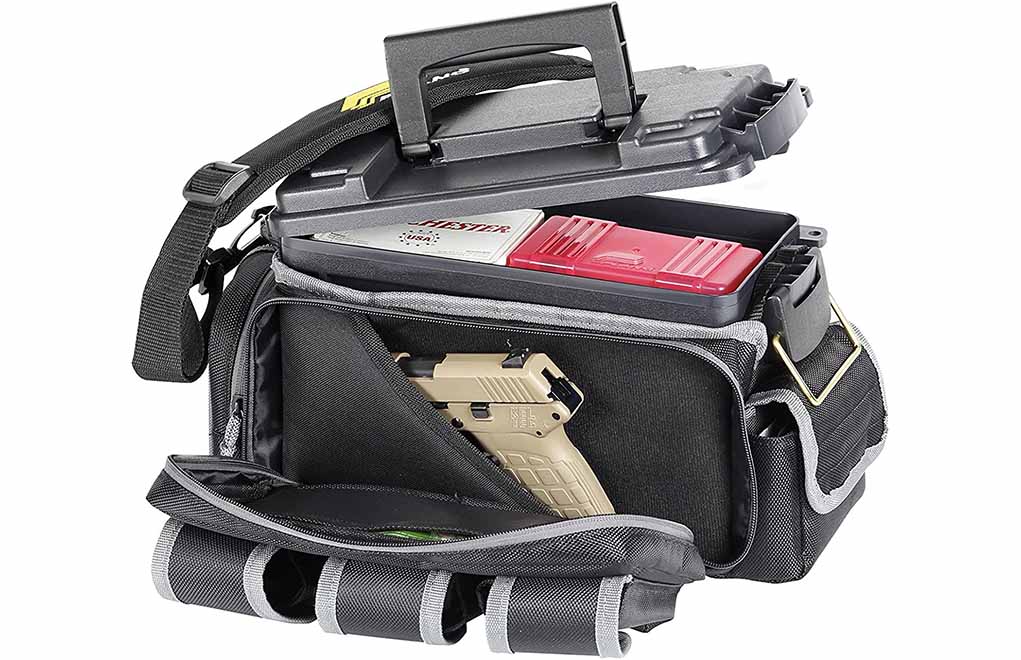
A Plano 1312 X2 range bag. Notice the dedicated handgun compartment which makes it far more useful than a generic duffel.
Modern range bags tend to be built a little stronger than typical duffle or athletic bags. Common construction materials are 600D, 800D and 1000D (“D” stands for denier, the measurement of the linear mass of thread; a single strand of silk is 1D) nylon with heavier stitching of the bag and straps.
The extra durability results in extra longevity, a good trait to have for an item that’s often abused.
Range bags are also sized around guns. Pistol and long gun bags are usually the right size rather than just being a size.
Additionally, range bags almost always have additional compartments and pockets that are uniquely useful for shooting such as mag pouches and the like. A soft-sided rifle bag can also double as a handy shooting mat. As a bonus, they often have smaller organizational pockets that help ensure that you’re never without the small tools or other items you need in the field.
Also keep in mind that if you use a regular duffel bag as both a range bag and as all-purpose portable storage, you might forget to fully unpack it. That’s how guns and ammo get forgotten about, and you wouldn’t want to forget it’s in a bag you use as a carry-on. The TSA is getting increasingly less amused by those who forget such things.
A simple mistake like this can make the TSA very upset with you. This is why it’s a good idea to have a dedicated range bag that’s separate from your travel luggage.
Types Of Range Bags
Range bag styles can be broken down into a few general categories.
Duffle Range Bag
Duffel-style range bags speak for themselves. They’re typically square in design with carry handles (often with a carry strap) and several compartments for carrying extra gear. A lot of this kind of range bag will be optimized around pistols with magazine compartments.
Backpack Range Bag
Backpack-style bags, including both larger packs and sling packs, are also common. Be careful, however; some are just generic “tactical” packs that are sold as range bags but are otherwise no different than the thousands of other examples of the exact same white-label bags that internet retailers get from places like Ali Baba.
Pistol Bag
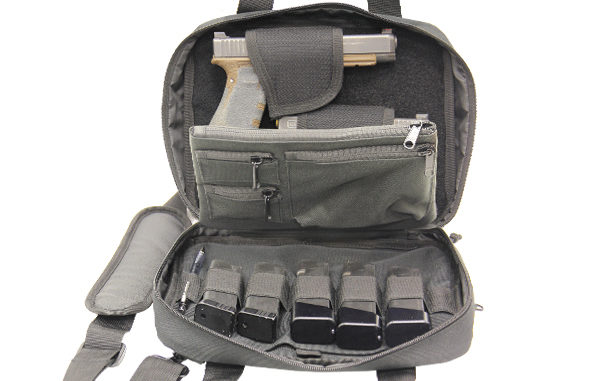
Then we have pistol bags. Many are flat zippered cases, kind of like tennis racquet covers or laptop bags. Often enough, you’ll find one compartment that’s made for carrying a handgun (or two) with some retention straps and an external compartment or two, possibly with some magazine sleeves as well.
A Leapers UTG Competition Shooter’s Double Pistol Case.
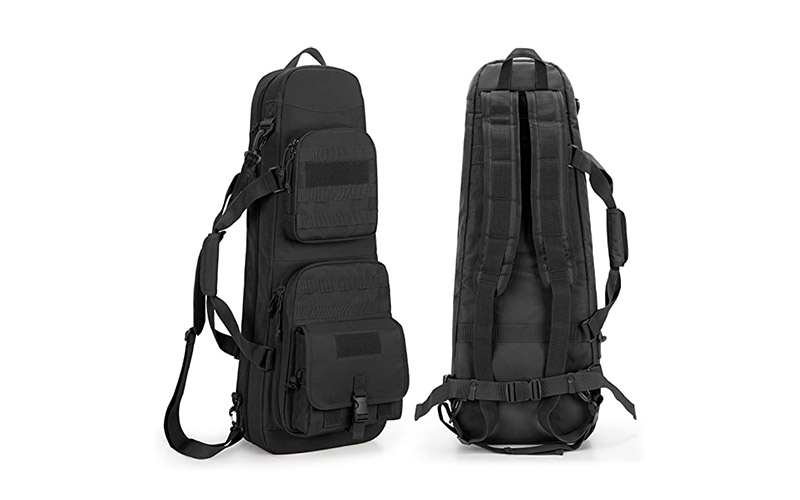
Then you have soft cases for long guns. They can be made for carrying a single long gun (shotgun or rifle, though they are far more commonly designed for carbines) or perhaps two, with an internal divider.
What Should I Look For In A Gun Range Bag?
The first thing you should look for is a range bag that fits your needs. The more guns and the more elaborate your range gear, the more bag you’re going to require.
Do you just take a single gun out plinking? You probably don’t need anything fancy.
Practicing for single stack AND limited in USPSA? You probably need more. Putting in work to dominate 3 Gun or 2 Gun? You’re going to need more bag.
It’s also a good idea to consider what kind of guns you shoot the most. If you shoot way more pistol than anything else, get a range bag optimized for a pistol shooter. The best of these feature mag pouches, a generous compartment for ammunition boxes and a good carry strap for when it’s fully packed.
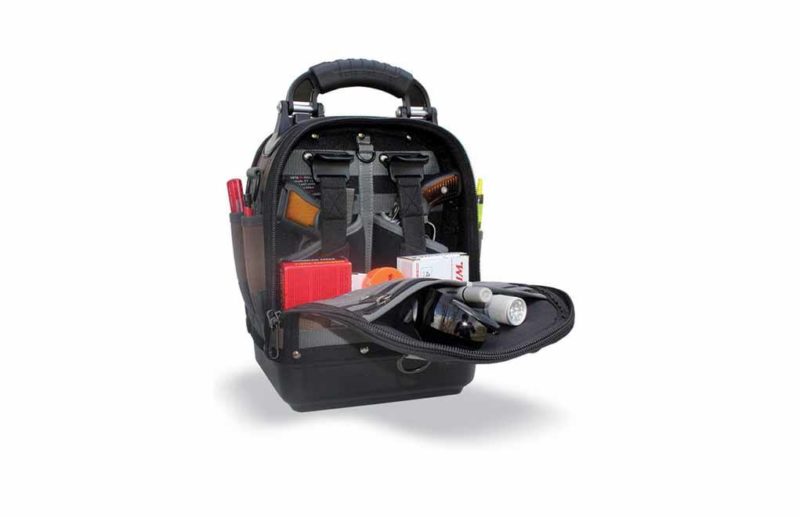
A Veto Pro Pac RB-MC range bag. Thick, sturdy handles like the one found on this model will assist with carrying it when laden down with gear.
For rifle cases, make sure it fits the rifles or shotguns that you’re going to carry in it. A lot of rifle cases are made for carbines, so your bolt-action rifle or shotgun may not fit. Therefore, you want to buy a soft case for the longest gun you’re going to put in it.
Your typical 16-inch AR-15 is about 35 inches in overall length fully extended and about 32 inches collapsed, while the typical bolt-action rifle with a 22-inch barrel is around 42 inches overall and the typical shotgun with a field barrel (26 inches to 28 inches) is up to 49 inches in length. Therefore, look for a long gun bag that will accommodate your long guns.
If you’re going to use your rifle case as a shooting pad, also make sure to select a bag with thick padding.
If you’re going to carry your range bag with any kind of weight in it or for any kind of distance, durable shoulder straps are a necessity as well.
So, consider what your needs are and choose appropriately. Pick a bag that’s going to be a benefit to you…and it’s a good idea to get one that isn’t so flimsy that it’s going to tear apart after a few uses.
So…what are some great range bags to get?
Top 10 Range Bags:
Magpul DAKA Double Pistol Case
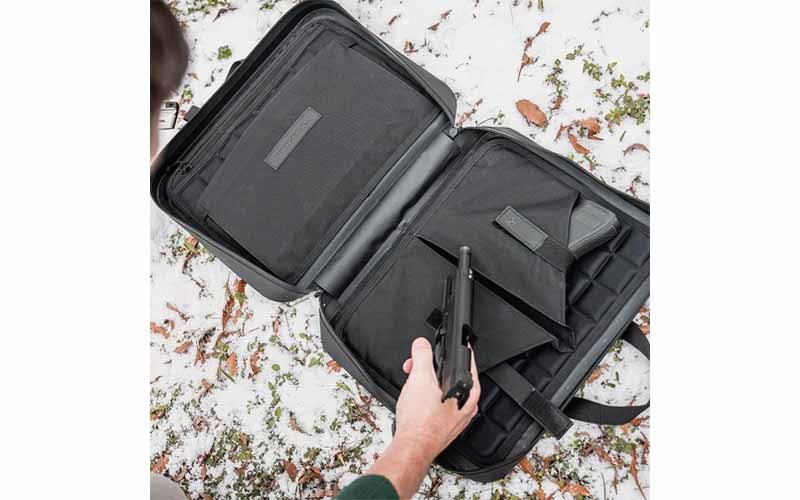
Released in 2022, the DAKA Double Pistol Case is a smart, minimalist, discreet and durably constructed soft case for two pistols. It has two pistol pouches that can hold pistols as large as a 1911, snag-free foam padding and an accessory pouch for magazines with eight retention bands for them.
MSRP is $59.95.
Savior Double Rifle Bag
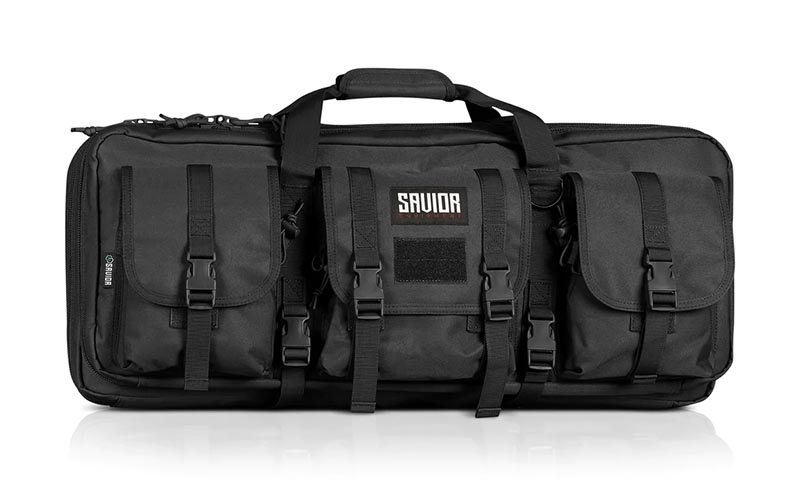
The Savior Double Rifle Bag will carry up to two long guns with an internal divider and retention straps for both guns. It’s available in multiple widths, from 36 inches to 55 inches, so you can order one to fit nearly any long gun including field shotguns.
The bag includes dual shoulder straps if needed or carry handle straps if not. Along with the internal compartment, it has five external compartments including three large flap-close pockets and two slim zippered pockets on the outside, with internal pockets that can hold two pistols.
Prices start around $65, depending on the color (black, OD green, gray, FDE and multiple camo patterns) and size. It’s an awful lot of utility for the money.
Allen Competitor Range Bag
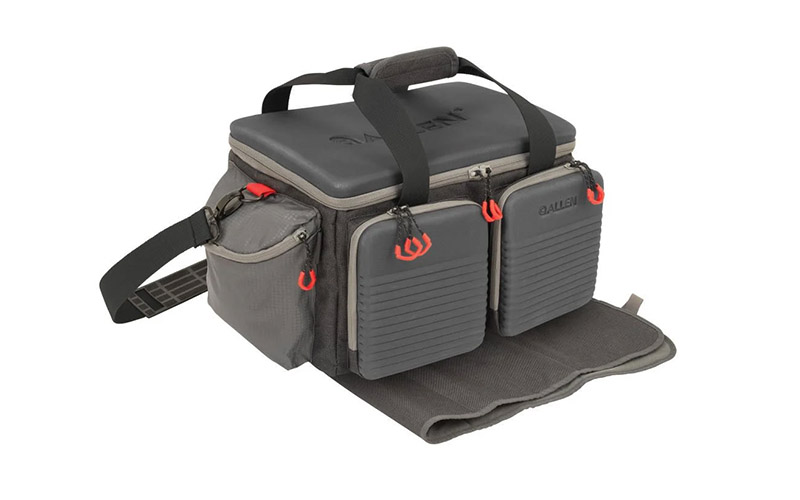
The Allen Competitor Premium Molded Lockable Range Bag has an enormous name, but is a high-quality range bag with generous storage, durable construction and a lot of features.
It has a large main compartment which includes a removable tray bag with carry handles and a polymer top with a lockable zipper. It has four external compartments, two with polymer shells and two without, with magazine sleeves in the two side pouches.
It also includes a roll-up mat that you can set a long gun on. MSRP is $95.
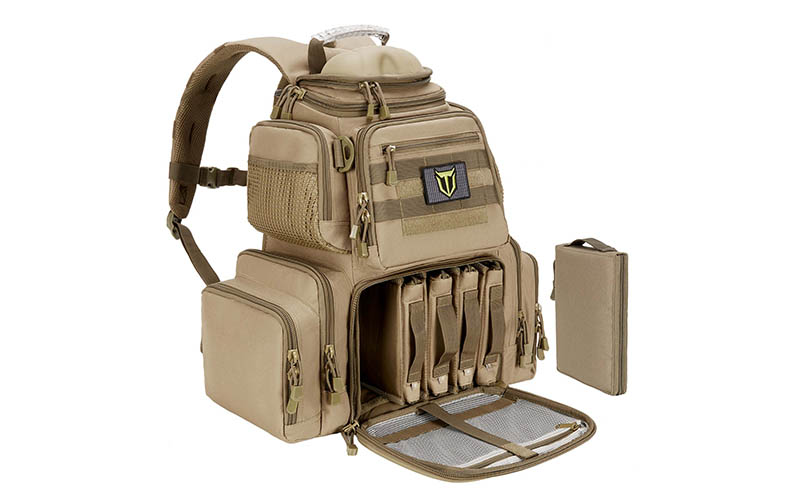
TideWe Tactical Range Backpack
If you prefer the backpack style, the TideWe Tactical Range Backpack has a lot to offer.
The core of the bag is a divided compartment accessed through the front of the bag with five zippered pouches with internal dividers. There are seven external zippered pouches with organizers (including magazine pouches), a top compartment for ammo and even a dedicated pouch for eye pro.
You can choose khaki or black for $90.
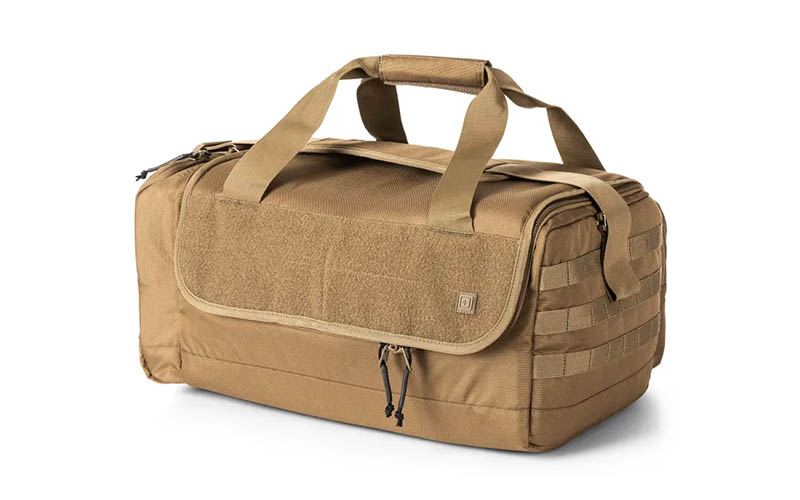
5.11 Range Ready Trainer Bag
The 5.11 Range Trainer Bag is a large (50-liter) duffel for competition, training or longer-lasting range sessions with generous storage for ammo and other supplies. Dimensions are 21 inches long, 10 inches tall and 14.5 inches deep, so it has plenty of onboard capacity.
The bag has three side compartments, external MOLLE webbing as well as internal organization for magazines and a removable internal divider. It has both carry straps as well as a removable shoulder sling. You have your choice of kangaroo (FDE) or black. MSRP is $145.
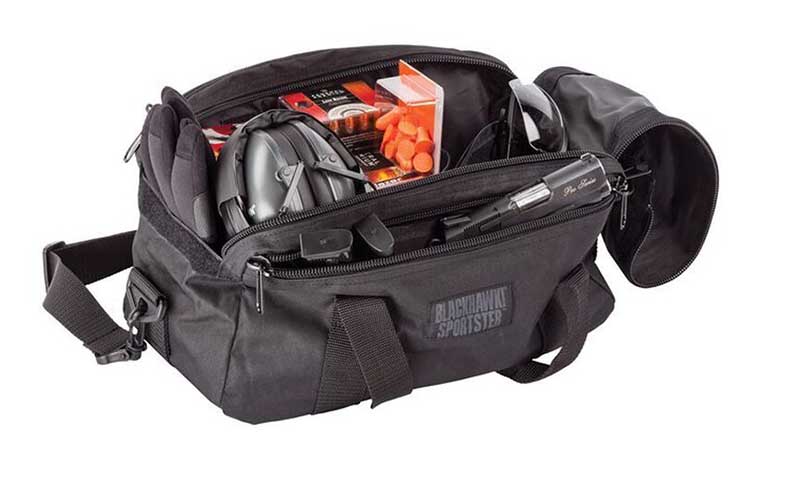
Blackhawk Sportster Pistol Range Bag
The Sportster from Blackhawk is a small duffel-style pistol bag, perfect for minimal one-pistol range trips. It has two storage compartments, one main and an exterior compartment that can hold one pistol plus a few magazines.
Sturdy 600D nylon, a dual-zipper main compartment, and both carry handles and a removable shoulder strap. If you just need a small bag for one handgun, a few boxes of ammo, eyes and ears and some magazines, it’s a great bag for less than $35.
Uncle Mike’s Sportsmen’s Range Bag
The conventional wisdom is that you shouldn’t carry in an Uncle Mike’s, and while that may be true for holsters, there’s nothing wrong with the company’s range bags. The Sportsmen’s Range Bag is a good option for a cheap duffel-style bag for holding gear, ammo and perhaps a couple of pistols.
The bag has a single compartment, with a removable divider, carry handles and a removable strap. At 18 inches long, 9.5 inches tall and 4.5 inches wide, it’s a decent small bag for either carrying your accessories like eye and ear pro, a staple gun and ammo or for pistols and magazines.
They can easily be found for about $35 online.
DSLEAF Soft Rifle Case
The DSLEAF Soft Rifle Case is made with modern carbines in mind, including those with higher-mounted optics. The main compartment has an internal divider and can carry up to two long guns and is available in 28-, 32-, and 36-inch lengths.
Besides the padded internal compartments (with retention straps) the case also includes tuckable backpack straps and a waist belt, carry handles, and three external compartments which include organization for storing nine total rifle magazines and up to five pistol magazines.
The bags start at just under $70.
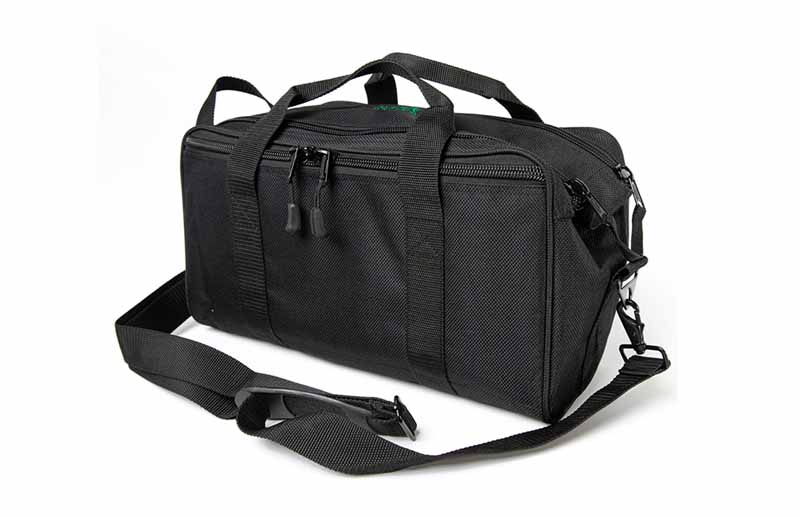
Ruger Shooting Range Bag
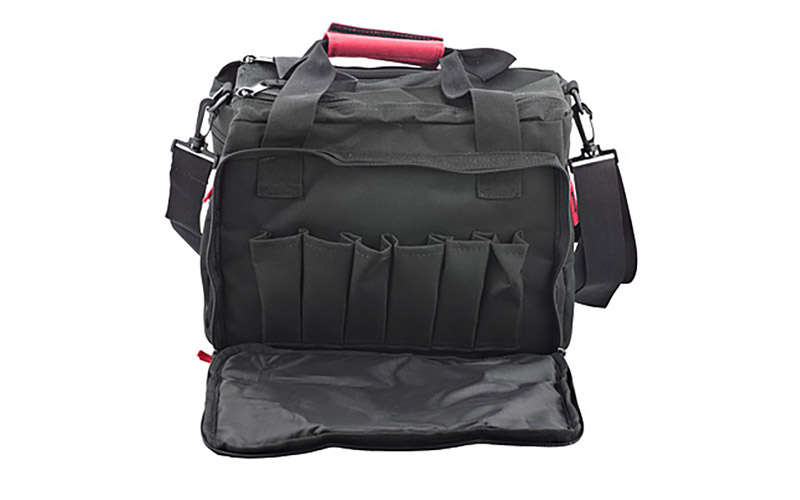
The Allen company makes a number of Ruger-branded range bags, which actually have a lot of nice features for the price. The Shooting Range Bag is a compact duffel that is 11.5 inches by 7 inches, perfect for the pistol shooter.
It includes six magazine pockets, two 5-inch by 5-inch mesh pockets in the internal compartment, a side compartment with external MOLLE webbing (and a removable cover) along with a removable ammo caddy and pistol rug for the range.
That’s a lot of kit for around $50, even if you’re not a Ruger fan.
Tactical Tailor Competition Shooter’s Bag
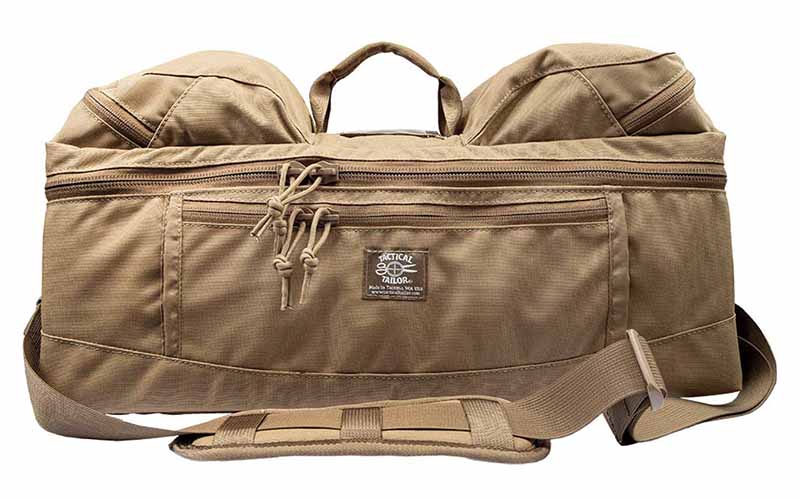
The Tactical Tailor makes high-end, pressure-tested gear for professionals and competitors, so if you demand a lot of your gear…this is the range bag for you.
The duffel-style bag has a 22x9x8-inch main compartment, with two 8x8x2.5-inch top compartments, along with a side flap pouch and internal dividers and additional storage pockets for everything. The generous storage space can fit gun, ammo and a competition rig as well as ear and eye pro easily. Carry straps and a shoulder strap are included too.
MSRP is stiff at $285.50, but they make investment-grade gear.
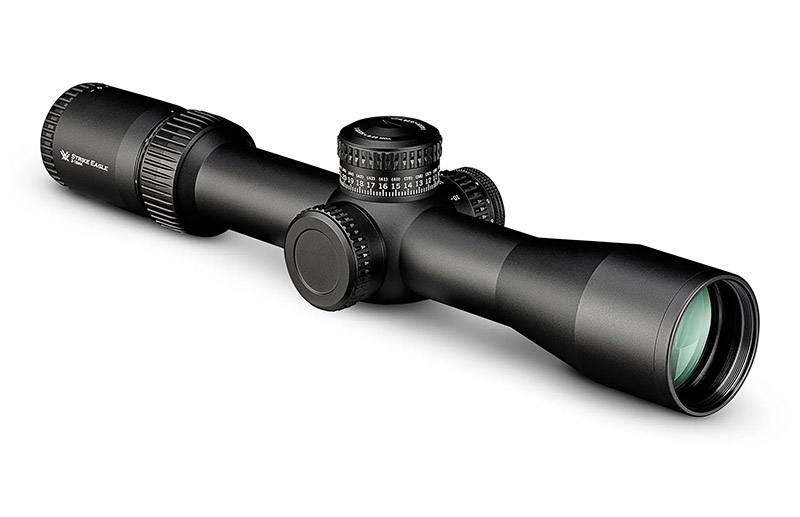
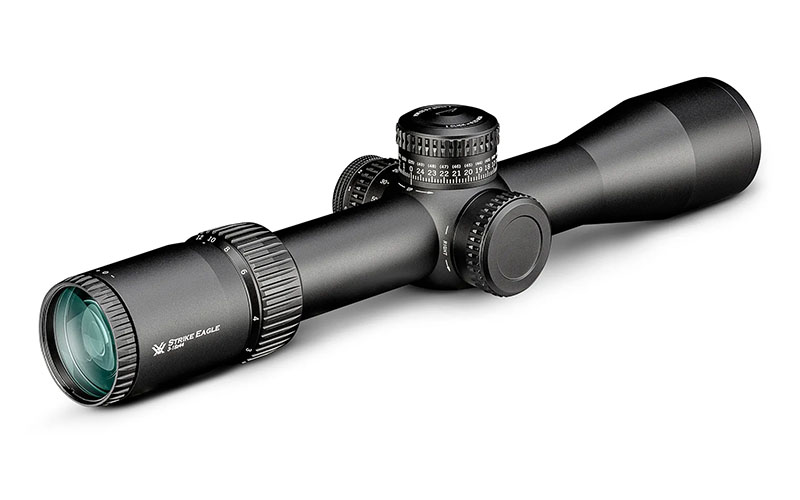
Vortex’s new Strike Eagle 3-18×44 FFP riflescope is bringing a lot of capability for a very affordable price.
For a new riflescope to be successful these days, it must do one of two things: introduce original features and capabilities … or provide increased performance at a lower cost. Vortex Optics’ new Strike Eagle 3-18×44 FFP delivers the latter—well.
It’s not the first 3-18x44mm FFP scope on the market, but it very well may be the best for the money.
Built For Speed
The Strike Eagle’s features are sure to make it popular with competitors, especially those who participate in mid- to long-range dynamic target shooting.
This is partly thanks to the scope’s middle ground magnification range of 3-18x, but another reason is its size. Designed to be versatile and lightweight, the new Strike Eagle is shorter and lighter than its 5-25x56mm cousin, with its 13.3-inch length and weight of 27.3 ounces. The 34mm tube is another happy medium, as it allows the scope to be mounted relatively low to the bore while still accommodating a large amount of windage and elevation travel.
The Strike Eagle’s controls conform to the same design principles by providing easy, rapid adjustments while keeping the overall package compact and low-profile. Both the windage and elevation turrets are locking, but the windage turret is capped while the elevation turret is exposed for faster field adjustments. The scope also features Vortex’s RevStop zero system for reliably returning to zero.
The new scope also comes with a choice of either an MRAD or MOA EBR-7C reticle. Regardless of the style selected, both are illuminated and of the first focal plane. Most other 3-18x riflescopes that are priced similarly to the Strike Eagle feature an SFP reticle, so the FFP EBR-7C will provide a lot more capability at longer ranges. While not designed for close-range engagements, the illuminated reticle and 10-yard minimum parallax distance mean that they’re not impossible either.
Scopes are prone to getting bumped around in dynamic environments, such as while hunting or during competition, so durability is a must as well. This is why the Strike Eagle is also waterproof, fog-proof and shock-proof, allowing it to withstand strenuous conditions. The impeccable glass quality and fully multi-coated lenses are sure to be appreciated by anyone who looks through a Strike Eagle as well, and each scope also includes a 3-inch sunshade and tethered lens covers.
Ringing Steel
GDTM editors recently had the opportunity to shoot the Strike Eagle 3-18×44 FFP while visiting Vortex headquarters. Mounted on a Tikka .22, the scope was used to engage some small targets at varying ranges to get a feel for adjusting the elevation and magnification.
With the correct adjustments dialed in, the Strike Eagle was very capable of ringing steel no bigger than a half-dollar, even at 100 yards. With the RevStop system, exposed elevation turret and large magnification throw lever, cranking it down and accurately engaging a much closer target took only a moment. It’s easy to see how this scope will excel at long-range shooting competitions where rapid adjustments are required.
Conclusion
The new Vortex Strike Eagle 3-18×44 FFP might not be entirely unique in its capabilities, but what sets it apart is its cost. It has an advertised price of $849.99, making it significantly less expensive than similar 3-18×44 FFP scopes already on the market. For those looking to get started in competitive long-range shooting on a budget, the Strike Eagle should have them gunning for gold.
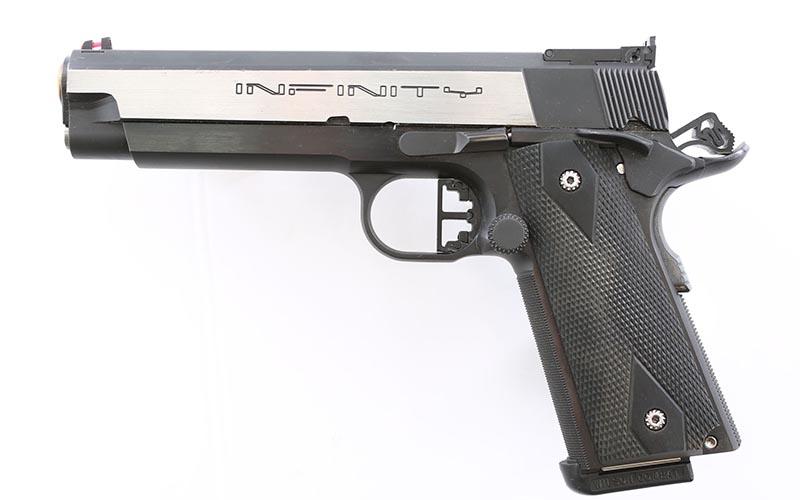
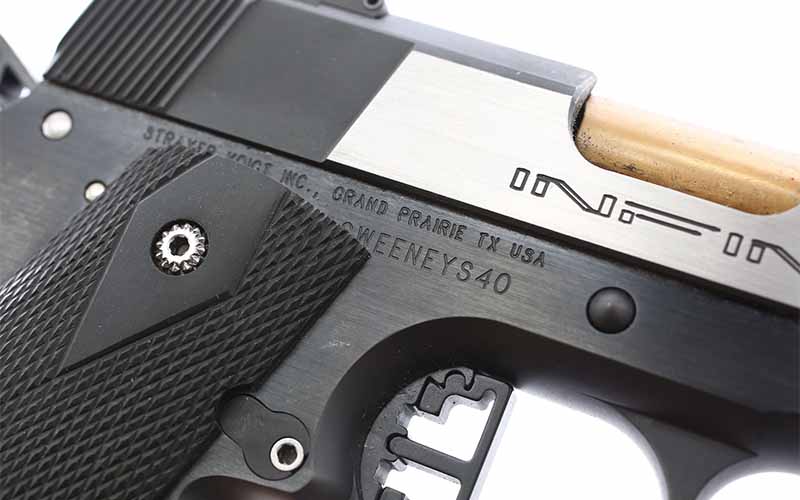
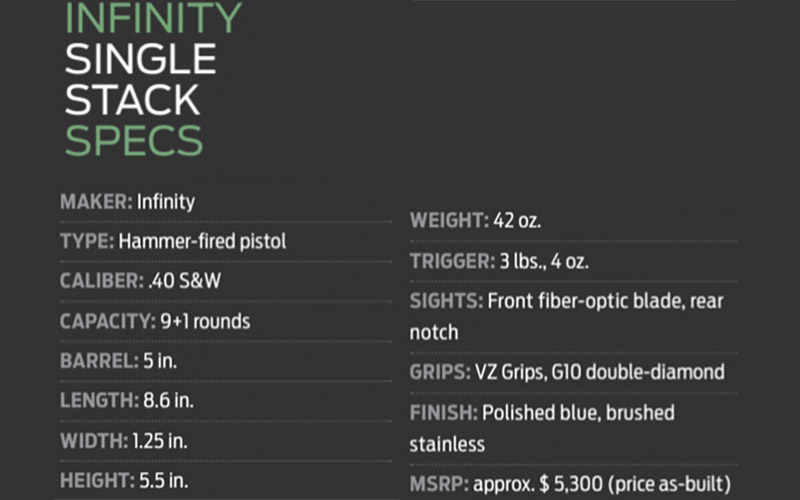
This custom single stack Infinity 1911 in .40 S&W helps prove that one-of-a-kind never goes out of style.
This gun is perhaps one of a kind. It certainly has a unique build history.
We like to think of custom as bespoke, purpose-made dream guns, if you will. However, this one just sort of happened.
A long time ago, in a galaxy far, far away, I was a serious and persistent competition shooter. Each year, I’d shoot at least two club matches a month, the Second Chance Pin Shoot, a couple (or more) USPSA Nationals and The Steel Challenge. I was shooting a lot, and I was winning a lot. One of the prizes (I think from a USPSA Nationals) was a certificate good for a hi-cap frame from SVI/Infinity.
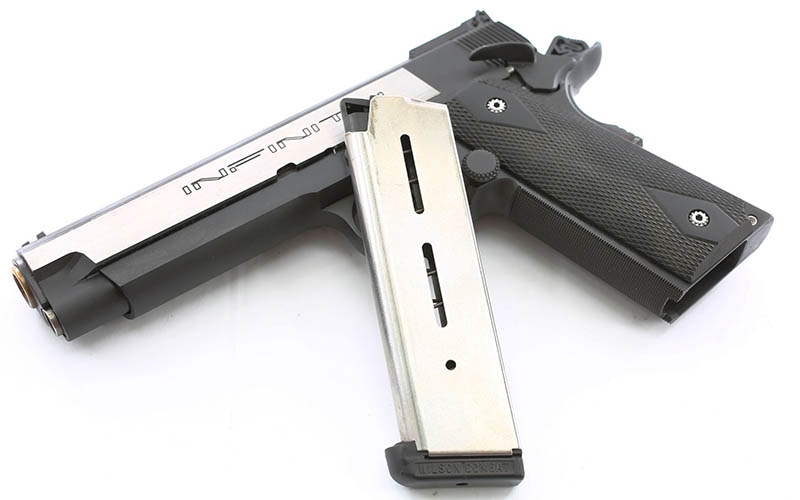
The custom single stack Infinity in .40 S&W.
Well, I already had a slew of hi-cap frames. So, I put on my best smiley-face, good-guy, serious competitor look and asked the Infinity guys if they could, pretty please, do it as a single stack. In .40 caliber. Because at the time the Single Stack Nationals was getting spun up into being as a USPSA Nationals, and all the big dogs were winning it with .40s. I later found out that the big dogs were winning with .40s not because it had any inherent advantage, but because they had all been loading and shooting .38 Super and .40 ammo for so long that they either no longer had a .45, or they couldn’t find the dies and components in their loading rooms.
While talking the project over with the builder, I mentioned that I already had a basket full of SVI/Infinity parts, and I was going to build it up with those, once the frame arrived.
“What do you have?” he asked. Oh, a slide, barrel, a selection of grip safeties, some odds and ends, enough to assemble a 1911. “Forget that; box up what you have that is SVI, ship it and we’ll put in the rest.”
Well, an offer like that doesn’t come along every day, so of course I boxed up and shipped.
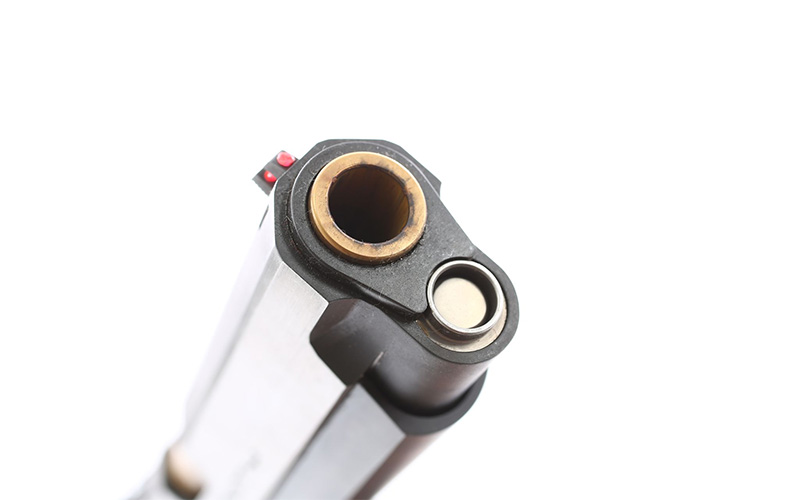
The fit of the slide to frame, and the barrel to slide, are exemplars of smooth and tight. And you’ll be wasting your time trying to find any looseness or wobble in the fit. Yes, it’s gold in color. That’s the TiN coating.
Have It Your Way
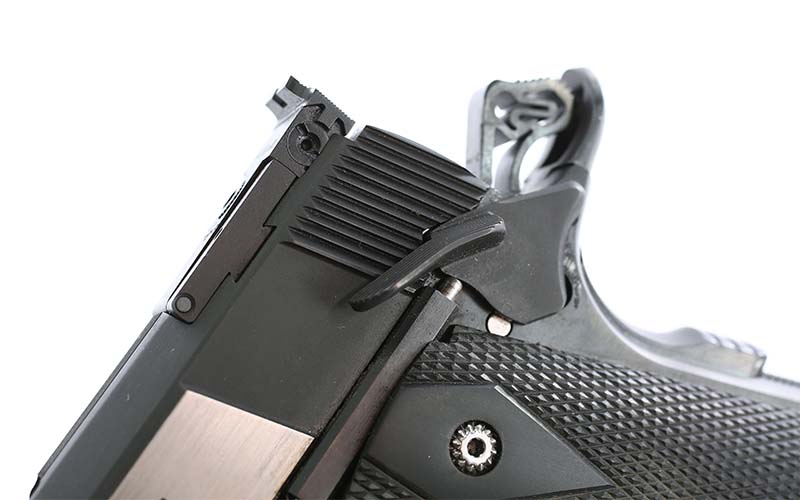
A few weeks later, I get an email. It seems that the build process involves more than just assembling parts; there’s a laundry list of choices I have to check off. So, I go down the list. A stainless slide, done in two-tone, with a recessed panel ahead of the rear cocking serrations. No front serrations, thank you very much, and the top done in a tri-top configuration, not a standard radius. A red fiber-optic front sight and Infinity adjustable rear.
The bushing is standard Browning, but the guide rod is as big a stainless rod as Infinity can fit in there.
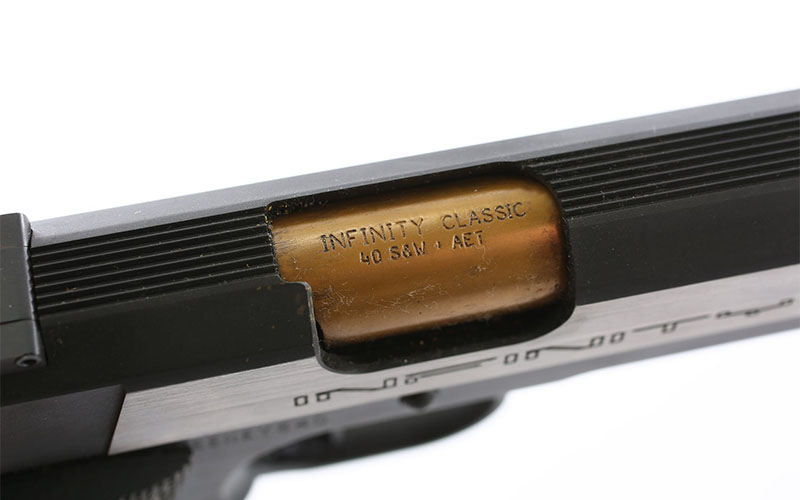
The barrel would be the Infinity Classic .40 S&W AET I had sent, which was then (and probably still is) the primo barrel to have. The frame was to be a carbon steel single stack, blued, with extended dust cover and snub-nose ball-end cut on the slide to match. Underneath the barrel, there’s a full-diameter stainless steel guide rod, full-length, and it adds a nice bit of extra weight to dampen felt recoil. The barrel isn’t a bull barrel, but a bushing barrel, in part because I was expecting to run this both in IDPA as well as USPSA, and bull barrels weren’t entirely kosher at the time. (At least, that’s what I recall. Rules change and things could be different today.)
The Wilson magazines and the integrally ramped barrel ensure ultra-reliable feeding. And the Infinity AET barrel works fine with lead bullets, so practice can be inexpensive.
The barrel is integrally ramped to provide maximum case support for the .40 caliber. What we had found out back then was that the .40 could be pretty grumpy at the edges of the performance envelope. Loading the heaviest bullets, with the fastest-burning powders, to make Major (but not any more than the barest of margins) could mean blown cases.
Also, the chamber is reamed to a long-lead dimension. This is where the 180-grain (we all gave up on 200-grain bullets after blowing enough cases, it wasn’t worth the minuscule advantage) bullet is seated long, halfway between the length of the stock .40 cartridge and the 10mm length. This promotes reliable and smooth feeding and still allows the use of then dirt-cheap .40 brass. Back then, a lot of police departments had switched to .40, and you could buy once-fired brass almost by its weight as scrap metal. The rifling is further forward that it would be on a stock .40, but the longer bullet seating places the bullet up to the rifling, and so there’s no loss of accuracy.
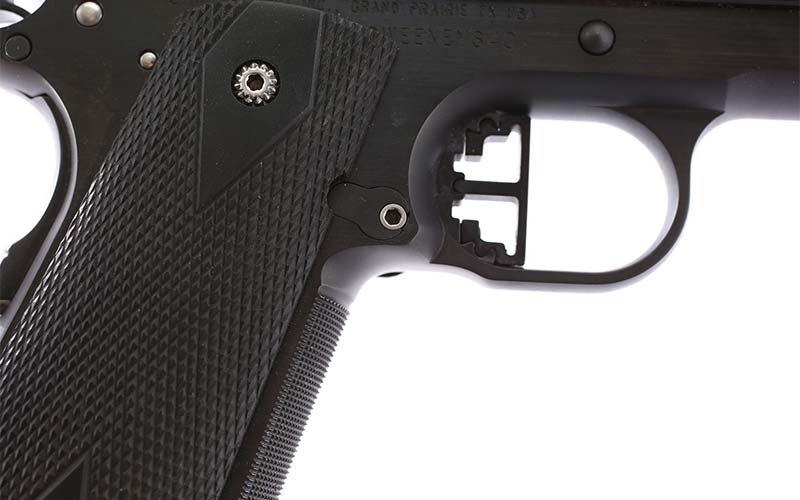
Here you can see the long straight trigger, the big-head mag button and the VZ Grips G10 double diamond, with custom grip screws.
The front strap checkering is 30 lpi, with the top of the front strap lifted to provide a higher grip. On the back end, the Ed Brown grip safety and thumb safety are fitted perfectly. The gap (a fine line, really) of the grip safety is even all the way around its fit to the frame. The bottom curve of the thumb safety matches the curve of the frame at that point. The thumb safety positively clicks up and down, and stays down during recoil, even if my thumb isn’t riding on it.
The SVI/Infinity hammer is one option, and the recessed panel in front of the cocking serrations is another. The fit of both the thumb safety and the grip safety is superb.
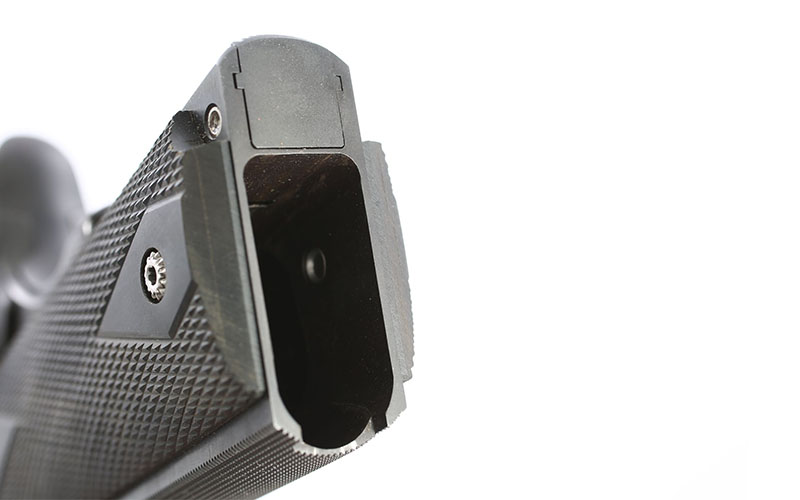
To give you another idea of the attention to detail that the Infinity builders watch for, the shaft of the thumb safety, where it comes through on the right side of the frame, is fitted to be flush with the frame. The mainspring housing is flat and checkered, at 20 lpi. I didn’t opt for a magazine well funnel, as I had my own ideas as to what constituted an appropriate mag funnel and planned to take care of that myself when the time came.
I didn’t have Infinity install a mag funnel, because I had my own ideas on that subject. I never got around to it, because writing crowded out competition, and so it remains as a plain magwell opening. Someday …
Topnotch Trigger
The hammer and trigger system is exemplary. First of all, the fire control parts are, for the most part, wire EDM manufactured. This is where they take a plate of pre-hardened steel and use a wire to cut the shape of the hammer (and other parts) out of the plate, to the utmost tolerances.
How good is this? If you’re old-school and you go to “tune up” the hooks of the hammer, or the nose of the sear, with a stone, you are making it worse. You’re not improving it. The Infinity trigger comes as a two-piece assembly. There’s the bow and its seat; they deliver your trigger-press pressure back to the sear. And then there’s the bow, or face, of the trigger. The two-part assembly allows Infinity to make triggers any size and shape you desire, and in colors as well. I opted for a flat-cased trigger at the long length, long enough that someone with smaller hands probably can’t reach the trigger face.
The lifted front strap isn’t just a tighter curve, but it extends out into the trigger guard. This single stack Infinity is a competition gun built by competition shooters.
The grips are double-diamond VZ Grips in black G10 and secured in place by Torx-head grip screws that have been serrated around their borders.
Oh, and as one last bit of custom work: I requested a special serial number. You can do all, or most of all this, by simply jumping into the Infinity gunbuilder section on their webpage. Pick what you want; they even have photos of what is what, and when you submit it as a build, they’ll send you a price and delivery time quote. What I ended up with was essentially a tailored jacket, one that wouldn’t fit anyone else but me.
Custom? You bet. And it’s easy to tell who this one belongs to.
You might notice that the magazine that came with it (and the matching set I assembled from my 1911 magazine bin) is a Wilson Combat .45 magazine. Yes, a .45 magazine to feed .40s. Why? Because it works.
The fit of the slide to frame and barrel to slide is superb—which you’d expect from the guys at Infinity. We’re accustomed to checking the fit of a slide to frame in the 1911 by trying to wobble the slide on the frame. That’s a complete and utter waste of time here.
But the real 1911 mavens expect that and check fit a different way: We feel for the friction when the slide moves as we rack it. When slowly moving the slide back and forth on the frame, you can feel how many toolmarks might be present, how big they are and what kind of differential they have to the base dimensions.
Again, a waste of time here. The slide might as well be running on well-greased ball bearings, for all the feel of toolmarks you might try to garner. And the amateur test of trying to press down the barrel when the slide is locked in place? Pu-leeze.
Infinity Single Stack On The Range
I’d love to regale you with tales of matches entered and won with this superb bit of firearms art. Alas, soon after its arrival here, I began my career as a full-time writer, and as far as I can recall, never shot it in a Single Stack Nationals. I shot it enough to discover that it shoots one-hole groups out to 25 yards, with ammo it likes—which is pretty much everything I could feed it. It hasn’t failed to work properly at all, and on top of that, it’s a cool-looking 1911 in an understated sort of way.
Alas, it’s also semi-obsolete. The .40 has a ticking clock on it.
The single stack Infinity feeds .40 S&W from Wilson Combat .45 ACP mags.
Yes, the ammo companies are making ammo for it (trying to keep up, anyway) but there are no new .40 pistols being designed or made. When I had this pistol built, there was no hint, nor even a suggestion, that the .40 would go the way of Caesar, albeit more slowly. Thanks for nothing, FBI. Had I gotten it made with the replaceable breechface Infinity offers on some guns, I could simply have a 9mm breechface and barrel fitted, and motor on. (Oh, the serial number would be a small problem, but hey, what can you do?)
So here I am, with the problem of a custom gun in a cartridge that has a use-by date on it. And making it work with something else would be a lot of work. Such is life. My plan is to enjoy using it, loading for it and marveling at it, and letting my heirs worry about what to do with it when that day (long time from now, hopefully) comes.
You can simply do yours up in .45 ACP or 9mm and solve that minor problem.
Editor’s Note: This article originally appeared in the March 2022 issue of Gun Digest the Magazine.
.300 Win. Mag. ammo outclassed many competitors upon release, but how does its performance hold up today?
A lot of different companies make .300 Win. Mag. ammo, but which loads are actually worth buying?
At that, what should you buy for what purpose? Is there a load that potentially does it all? Or a load that won’t break the bank?
Let’s go over .300 Win. Mag. ammo by discussing what the best loads are capable of doing, the factory loads available for it and how its performance differs between various applications. Finally, we’ll show you our top 10 picks of factory ammunition out there.
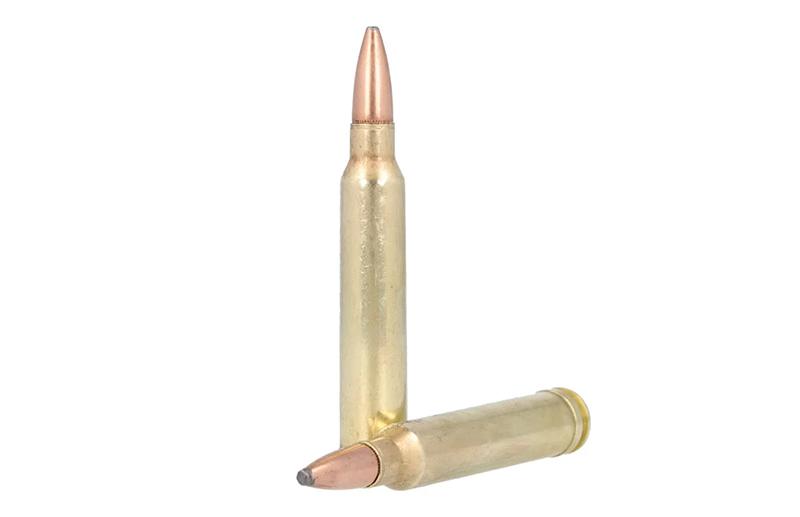
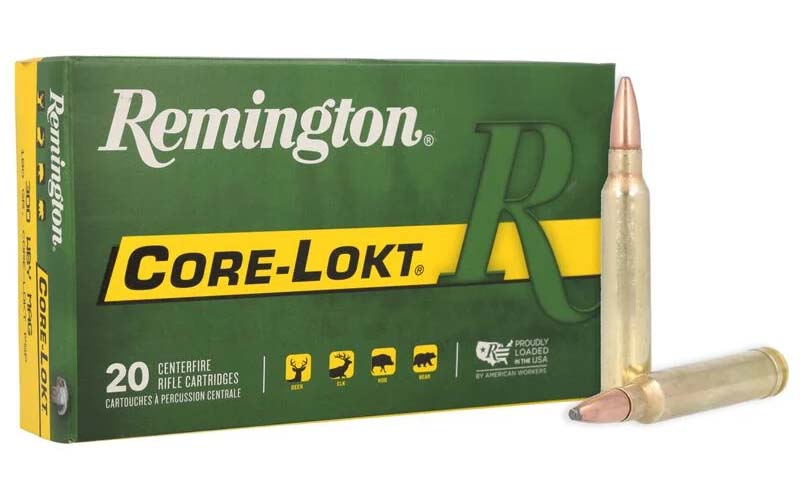
Remington’s 180-grain .300 Win. Mag. Core-Lokt.
.300 Winchester Magnum: The .30-Caliber King
The .300 Winchester Magnum was created to push a .308 bullet fast enough for it to outperform .30-06. At the time, most factory bullets had lackluster terminal performance, and making the bullet go faster was the easiest way to improve it.
Winchester used .375 H&H as the parent, trimming it down to standard action length and necking it down to .308. That gives .300 Win. Mag. a case capacity advantage compared to .30-06 (93.8 grains versus 68 grains) along with a 150 fps to 300 fps velocity advantage and at least a 300-foot-pound gain in energy.
However, the .300 Win. Mag. is still relatively civilized in terms of recoil. Few loads exceed 26 foot-pounds in an 8- to 8.5-pound rifle.
Besides the ballistic advantage, the longer effective range was soon noted both by hunters and the world’s militaries who found it far outranged 7.62mm NATO. The US Army reportedly considers the maximum effective range of .300 Win. Mag. to be just over 1,100 meters, compared to 800 meters for 7.62 NATO.
The harder hit, longer legs and relative civility of .300 Winchester Magnum have made it a favorite of hunters the world over, mid-to-long-range target shooters and military snipers.
.300 Win. Mag. Ballistics
The stereotypical .300 Win. Mag. load is a 180-grain bullet at somewhere (depending) between 3,150 and 3,200 feet per second, with about 4,050 to 4,100 foot-pounds of energy with a typical recoil force of 25 foot-pounds in an 8-pound rifle.
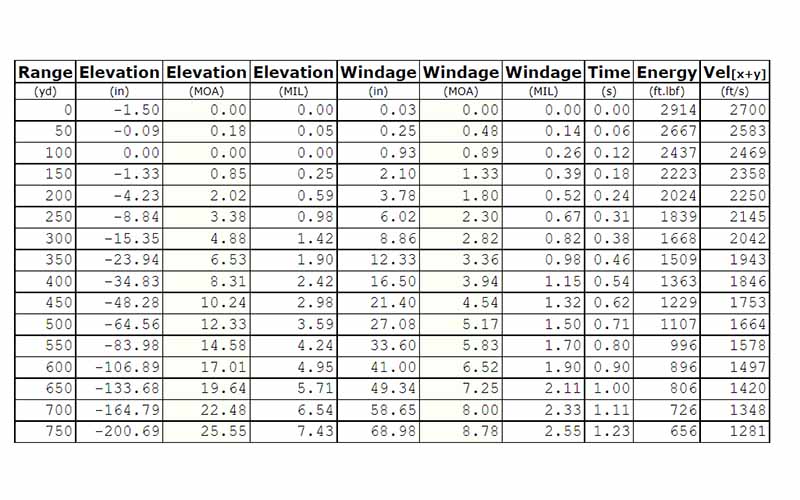
When released, it actually had quite an advantage over .30-06. Here’s a 750-yard trajectory table for an older factory loading, good ol’ 180-grain Remington Core Lokt (G1 BC of .383, muzzle velocity of 2,700 fps).
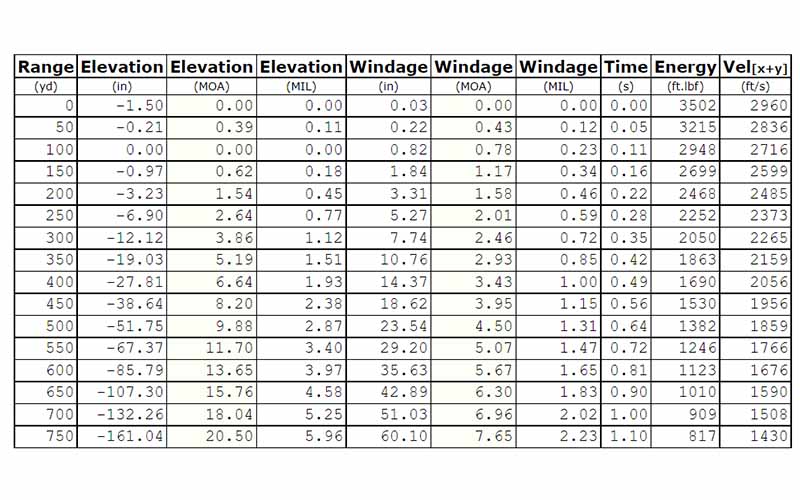
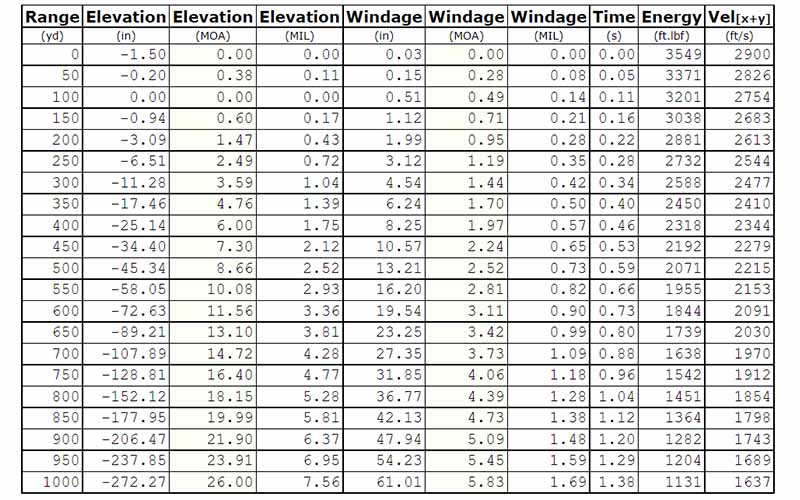
All tables were made using ShootersCalculator with a 100-yard zero, a 1.5-inch height over bore, a 10 mph 90-degree crosswind and zero corrections for atmosphere.
And here’s the same trajectory table for the equivalent .300 Winchester Magnum load (G1 BC of .383, muzzle velocity of 2,960 fps).
Besides the additional 260 fps of velocity (and 600-ish additional foot-pounds of energy) at the muzzle, the .300 Win. Mag. drops 3 fewer inches at 300 yards, 13 fewer inches at 500 yards and almost 40 fewer inches at 750 yards. At 750 yards, .300 Win. Mag. also has drifted almost 10 fewer inches due to wind.
Taken past 750 yards, this loading of .300 Win. Mag. doesn’t drop below the sound barrier until just past 1,000 yards. Meanwhile, the .30-06 load goes transonic at 925.
So, it flies a little flatter and hits harder…but what does a modern .300 Winchester Magnum load do with a low-drag/high-BC bullet?
This is a 1,000-yard table for Federal’s 215-grain Gold Medal Berger Hybrid match bullet for .300 Win. Mag. which has a 0.691 G1 ballistic coefficient at a factory velocity of 2,850 fps.
As you can see, it’s still supersonic at 1,000 yards with some distance to go before dropping below the sound barrier. In fact, this load doesn’t go transonic until 1,725 yards.
This should also give you an idea of why the world’s militaries (and some police units) found the cartridge to be an ideal medium- to long-range sniper round. This loading just barely drops below supersonic velocity at one mile.
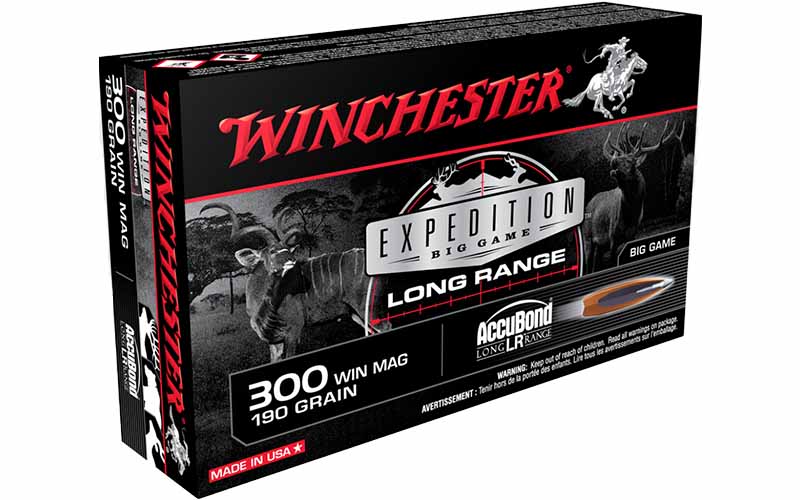
Modern low-drag hunting bullets also make the .300 Win. Mag. one of the best choices for 400+ yard shots on medium to large game, such as Winchester’s Long Range Expedition load which uses a 190-grain Nosler AccuBond LR bullet (G1 BC of .64) and has a factory velocity of 2,900 fps.
Similarly, this load doesn’t go transonic until 1,700 yards.
That’s what makes it one of the best possible choices for longer-range hunting use…so long as you’re capable of actually making the shot!
What .300 Win. Mag. Ammo Should I Get?
The archetypical load is a 180-grain soft point. You can also find bullets as light as 139 grains and as heavy as 220 grains.
For medium game up to elk in North America or gemsbok or kudu in Africa, the 150- and 165-grain bullets are a fine choice. The classic soft point will do fine with good placement, although the careful selection of a quality modern bullet is highly recommended if you anticipate longer shots.
Barnes VOR-TX TTSX load, HSM’s Berger VLD Hunting load, and Hornady Superformance would all be good choices here. At more modest distances—say 400 yards or closer—Remington Core Lokt makes a good case for itself.
For larger game, the 180-grain and heavier bullets are the best choices. If you need the bullet to punch through denser muscle and more bone than a whitetail, look for a bonded bullet with a track record of excellent weight retention. These are known to be adequate for hunting large bears and larger-bodied plains game in Africa.
Nosler Partition 180-grain and 200-grain bullets are excellent choices too. Factory loads are available from Nosler, Federal and some others. Swift A-Frame and Scirocco II loads (available from Swift and Remington) are as well.
You’ll also find better long-range loads in the 180-grain and heavier bullets. Nosler’s AccuBond LR is a fantastic choice.
While the 180- to 190-grain bullets more than suffice, the 200-grain loads are often preferred for bear hunting specifically. Look for bonded soft points and hollow points from Nosler, Swift and others.
For long-range target shooting, opt for hollow point boat tail match bullets that are 180 grains or heavier. The higher the BC, the better. Excellent factory bullets include Hornady VLD and ELD bullets, as well as Berger’s VLD and Sierra’s Match King bullets.
The Sierra Match King 230-grain bullet offers a staggering G1 BC of .800 above 1,900 fps.
The gold standard for factory loads is the Black Hills 190-grain Sierra MatchKing load, which Black Hills supplies to the US Army. Federal’s Berger 210-grain load is another excellent long-range load, as is a quality clone of the military MK248 Mod1 load which uses a 220-grain hollow point boat tail.
So…what are the best loads to buy? Here are 10 outstanding choices!
Top 10 Best .300 Win. Mag. Ammo Options:
Remington CoreLokt 180-Grain
While hardly the most modern load, the close- to medium-range performance relative to price and availability keeps the Deadliest Mushroom In The Woods viable to this day.
Bullet: Pointed Soft Point
Weight: 180 grains
Muzzle Velocity: 3,501 fps
Muzzle Energy: 2,960 foot-pounds
G1 BC: 0.383
MSRP: ~$35 per box of 20
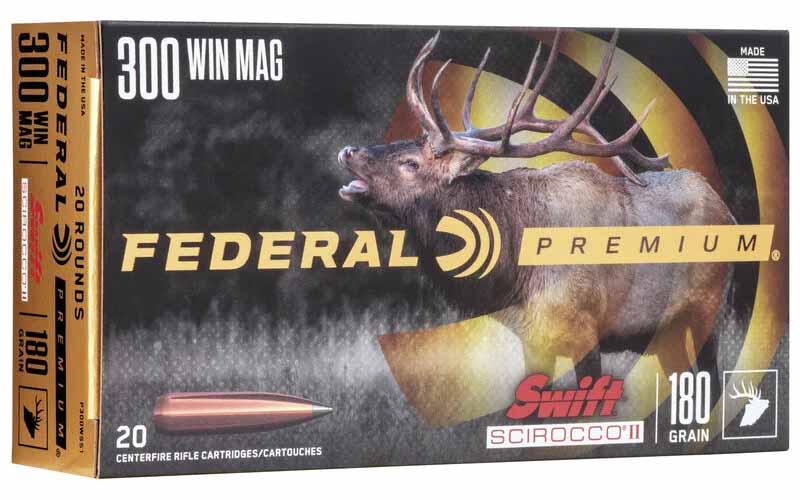
Federal Premium 180-Grain Swift Scirocco II
An exemplar of modern bonded bullets with an aerodynamic shape. An excellent all-around hunting load even out to longer ranges. Money-wise, the Federal Scirocco load will run you a little less than Swift’s.
Bullet: Bonded Polymer Tip Boat Tail Hollow Point
Weight: 180 grains
Muzzle Velocity: 2,960 fps
Muzzle Energy: 3,502 foot-pounds
G1 BC: 0.520
MSRP: ~$55 per box of 20
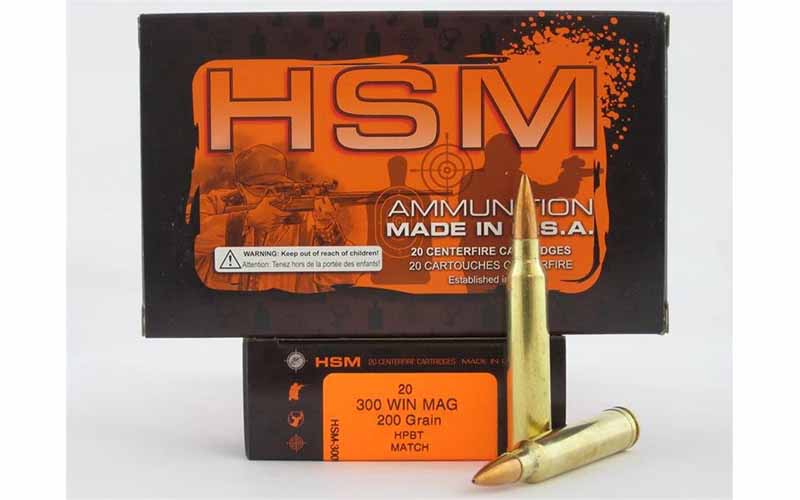
HSM 200-Grain HPBT Match
If you want to take the .300 Win. Mag. as far out as it can go without going flat broke, HSM’s 200-grain Match load—which uses the Sierra MatchKing boat tail hollow point—is one of the best.
Bullet: Boat Tail Hollow Point
Weight: 200 grains
Muzzle Velocity: 2,850 fps
Muzzle Energy: 3,608 foot-pounds
G1 BC: .715
MSRP: ~$50 per box of 20
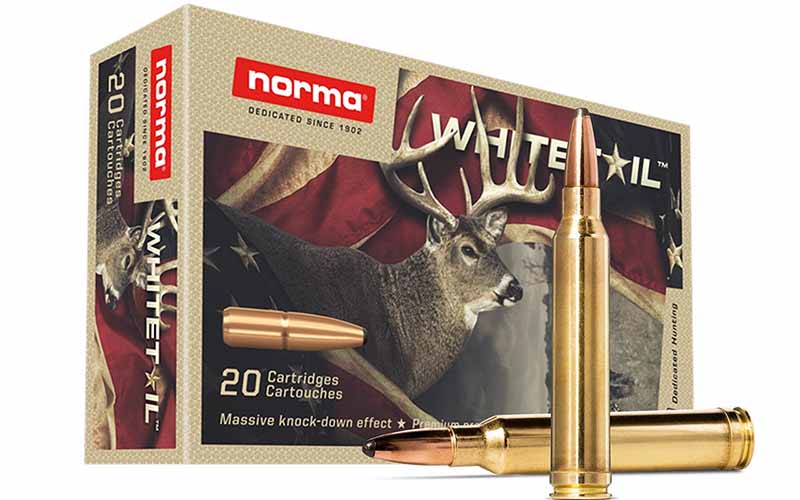
Norma Whitetail 150-Grain Soft Point
Norma Whitetail is an economical classic soft point load that’s an excellent choice for smaller, thin-skinned game. It’s also about as close to cheap-range ammo as it gets for this cartridge.
Bullet: Soft point
Weight: 150 grains
Muzzle Velocity: 3,248 fps
Muzzle Energy: 3,513 foot-pounds
G1 BC: 0.274
MSRP: ~$25 per box of 20
Winchester Expedition Long Range 190-Grain Nosler Accubond LR
An excellent do-it-all load for all ranges and all game. It’s still rather costly, but less so than the Nosler factory load.
Bullet: Tipped Hollow Point Boat Tail
Weight: 190 grains
Muzzle Velocity: 2,900 fps
Muzzle Energy: 3,547 foot-pounds
G1 BC: 0.64
MSRP: ~$60 per box of 20
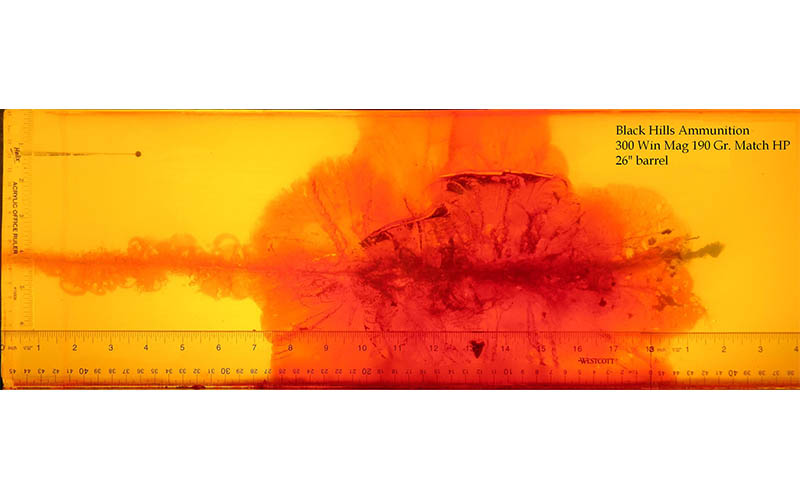
Black Hills Ammunition 190-Grain Match HPBT
Black Hills is one of the suppliers to the US military, and its 190-grain match load (using the Sierra MatchKing 190-grain HPBT) is the older A191/Mk 248 load. This is what professionals use for long-range precision.
Bullet: Boat Tail Hollow Point
Weight: 190 grains
Muzzle Velocity: 2,950 fps
Muzzle Energy: 3,671 foot-pounds
G1 BC: 0.533
MSRP: ~$65 per box of 20
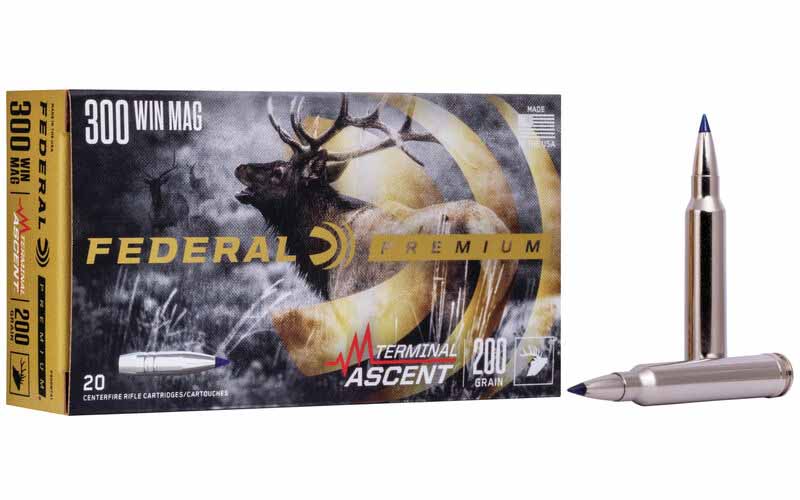
Federal Premium Terminal Ascent 200-Grain Polymer Tip
The Terminal Ascent tipped bonded hollow point is a heavy, aerodynamic bullet that’s best suited for medium- to long-range shots on big game.
Bullet: Tipped Hollow Point
Weight: 200 grains
Muzzle Velocity: 2,810 fps
Muzzle Energy: 3,506 foot-pounds
G1 BC: 0.608
MSRP: ~$60 per box of 20
LAX Ammunition Freedom MK248 Mod1 220-Grain HPBT
Another economical match/long-range load worth looking into is LAX Ammunition’s MK248 Mod1 clone, which uses a Sierra MatchKing 220-grain bullet.
Bullet: Boat Tail Hollow Point
Weight: 220 grains
Muzzle Velocity: 2,850 fps
Muzzle Energy: 3,969 foot-pounds
G1 BC: 0.629
MSRP: $40 per box of 20
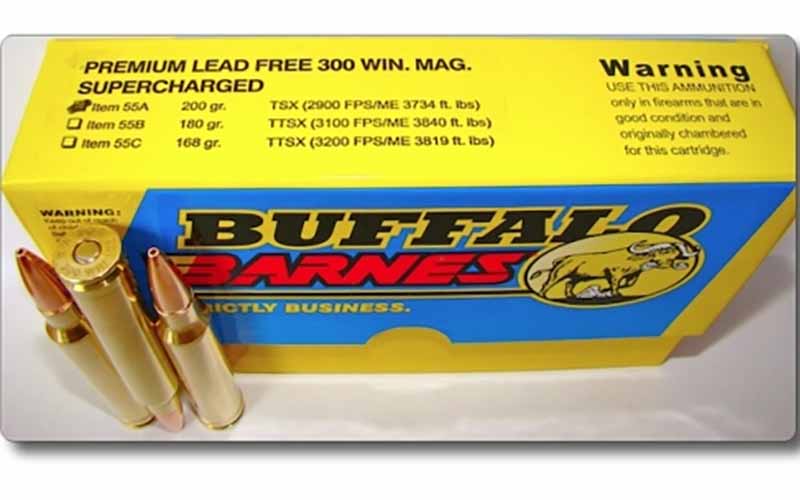
Buffalo Bore Barnes Supercharged 200-Grain TSX
If you were looking for a heavy-for-caliber lead-free hunting bullet, Buffalo Bore offers a factory load with the Barnes TSX copper hollow point.
Bullet: Solid Copper Hollow Point
Weight: 200 grains
Muzzle Velocity: 2,800 fps
Muzzle Energy: 3,481 foot-pounds
G1 BC: 0.423
MSRP: $92.99 per box of 20
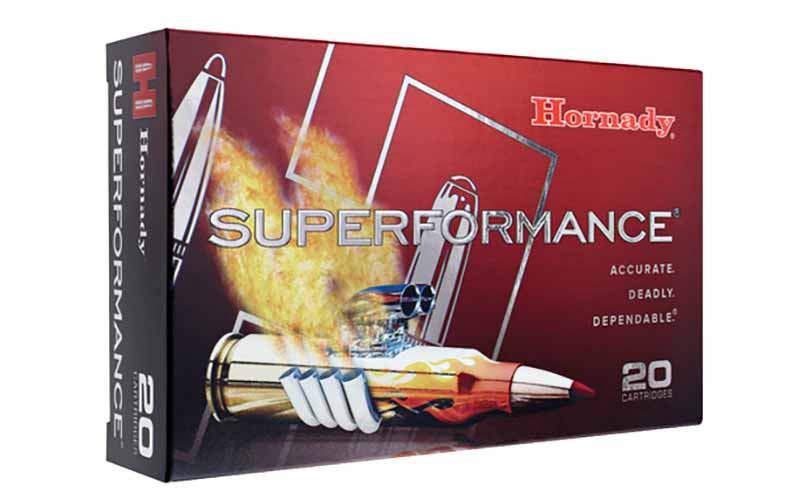
Hornady 165-Grain CX Superformance
A modern high-velocity load for hunting lighter plains and mountain game, with Hornady’s copper monolithic hollow point for deeper penetration, excellent weight retention and reliable expansion at longer range.
YouTube has everything from cat videos to documentaries about war to child predators, all six clicks away.
While even mainstream “family-friendly” content creators have complaints about YouTube, there is one form of YouTuber the platform loves to hate – GunTubers.
Recently, YouTube made another push to de-platform and demonize GunTubers.
Starting just days before SHOT 2023 with the deletion of Ammoland.com’s YouTube page, the site either suspended or issued strikes against channels like Rodger Barrera, 1911 Syndicate, and Lucky Gunner.
Spurring the writing of this article was the deletion of Kit Badger’s channel. Little did we know only a few days later, RECOILTv’s YouTube channel would also be summarily nuked.
Why is this happening, and what can we do about it? The answer isn’t very encouraging, but cold truths rarely are.
WHY DOES YOUTUBE HATE YOUR SECOND AMENDMENT?
Based on what we know – I don’t think YouTube actually hates the Second Amendment as a construct.
From multiple conversations with multiple content creators on YouTube, they’ve spoken with many people that worked at YouTube who were pro-gun. The problem is, that’s not enough.
YouTube is here to make money. It isn’t here to make the world a better place or to uphold morals and values. The company is in it for the almighty dollar.
Those dollars come from advertisers. While there are some firearm-friendly brands advertising with YouTube, the super majority of the site’s money comes from mega-corporations like Disney and Amazon, household goods manufacturers like Procter & Gamble, and electronics brands like Samsung. The names of those who advertise on YouTube are nearly endless, but you get the idea.
YouTube made over $28 billion in 2021.
Of that, GunTubers are a very small drop in the bucket. The exact totals are unknown, but it’s easy to conjecture firearms content is nowhere in the top ten on YouTube.
2017: YouTube’s Worst Nightmare
Since most major brands prefer to avoid controversy or even the appearance of being on the wrong side of issues, it’s easy to understand why most only want to advertise products on channels and videos no one objects to.
But in 2017, YouTube screwed up. Truthfully, YouTube had been doing this for a long time – but people noticed in 2017. Due to a series of news articles showing YouTube ads playing alongside extremist videos — the kind with people’s heads being cut off — advertisers made it clear to YouTube that the money could stop.
Huge brands like Walmart and Verizon pulled ad dollars completely. In the month of April 2017, YouTube lost 5% of its top advertisers.
This happened again in 2019 when reports came out of YouTube’s grossly ineffective methods of dealing with child exploitation videos. Again, huge brands like Disney, Nestle, and others pulled ad money until YouTube fixed the problem or the public turned its attention to something else.
Firearm Hysteria
This is a supposition, I believe it’s reasonable to conclude YouTube hates gun channels because it is scared of firearms being the next big thing to lose money over.
With the mass media’s fetish for murder porn on the nightly news, guns are (as always) an easy target for (real or imagined) ire.
Even as large as the American firearm industry is, all of its marketing money combined isn’t enough for YouTube to sacrifice its Apple/Disney/Hulu cash.
The Omnipotent Algorithm
While firearms are clearly not on its list of favorite things as a corporation, even vanilla channels have a rough time of actually communicating with anyone at YouTube who can make a difference.
Because of the staggering amount of content posted on the platform, the vast majority of moderation is automated.
Every minute, over 500 hours of content are uploaded to YouTube. More than 30,000 hours of video are added per hour. While YouTube employs thousands of moderators, this is far, far short of the tens of thousands of human moderators required to view all the content.
Instead, YouTube uses powerful AI and machine learning algorithms to comb through videos automatically. Everything from the words spoken to the images shown is scanned and processed by the algorithm.
This algorithm — more accurately many sets of different algorithms — work together to control everything from what you see in your recommended feed to what videos are allowed to make money.
As much as everyone hates this system, there isn’t a practical alternative. Not without YouTube spending an astronomical amount of money to fund human moderation teams. Not exactly something the company is likely to do if it wants to keep profit margins high.
YOUTUBE GUIDELINES
One of the major problems all YouTubers have is the site’s guidelines don’t matter. While YouTube maintains two sets of rules, one set that covers everything on the platform and another set specifically for videos that are monetized, the rules often are simply ignored.
When a channel gets a warning or a strike, the channel has the option to appeal it. This is, in theory, sent to a human moderator who looks at the issue and rules on it. The problem is these human moderators are unreliable in their judgment.
Videos that clearly do not violate the rules are still removed or demonetized. Channels can try to delete the video, reupload it, wait for the automated demonetization, and appeal to a different moderator for a different ruling — but this also runs the risk of multiple strikes for one video.
Some rules are so broadly written they become nonsensical. For example, 1911 Syndicate received a warning for swapping a charging handle on camera and a strike for unthreading a suppressor from a rifle.
Other channels, like Kit Badger, don’t even know exactly why its channel was deleted.
Instead, all that is offered is the name of the video supposedly violating the rules and a copy of the entire YouTube Firearms Policy. Too many of these strikes and the channel as a whole is simply deleted.
Even when YouTube deletes an entire channel, it barely tells you why except there were “too many violations.”
Goal Posts Moving Faster Than Light Speed
Another huge obstacle YouTubers face is old videos.
As YouTube has updated and changed its policy over the years, these new rules apply to old videos as well.
Videos that have been up for 5, 7, or 10 years are subject to YouTube rulings overnight. One recent change was creators could not show 30-round magazines. This resulted in multiple channels I spoke with having to spend hours, even days, going through old videos to self-censor them before YouTube found them.
Instead of warnings or a grace period, these old videos can cause a channel’s deletion overnight.
As of this writing, this is what we believe happened to the RECOILTV YouTube channel. Videos that were years old featuring suppressors triggered strikes against the channel, followed by the entire channel being deleted.
MO MONEY, MO PROBLEMS
Something a few channels have found is YouTube cares much more about channels that are monetized than channels that are not. But this isn’t the good kind of caring like a mother’s hug. This is more like attracting the Eye of Sauron.
InRangeTV has been proactively demonetized for years, and Karl — the channel’s main host and creator — feels this helped keep the wolves at bay. Without ad revenue or sponsorships, InRange instead relies on the viewers to join and donate through other platforms like Patreon or Utreon.
However, even this has not kept the channel from receiving a warning in the past.
InRange’s great crime? A video about the Ghost Gunner machine that even didn’t show the machine. Instead, Karl overlaid videos of cats playing with yarn to self-censor the version of the video uploaded to YouTube.
Other channels, like 1911 Syndicate, are demonetized but do not rely on the YouTube for revenue to stay afloat. For the concern, its channel is a marketing tool for its real estate business.
We monetized our channel around 40,000 subscribers, and were demonetized about 2 months later. Since then our channel has been demonetized, which probably helped us not get strikes
1911 Syndicate
This has (probably) helped keep it off YouTube’s naughty list, but as its recent warning and strike shows, being demonetized does not make it immune.
BEST YOUTUBE ALTERNATIVES
The main problem with other video platforms — YouTube’s competitors — is the lack of viewers. None of the channels I’ve spoken with actually like YouTube, but it’s the place where you can find the most viewers.
If you want to be the change you want to see in the world, the first step is to stop watching YouTube.
These are some of the best platforms to make this move.
Recoil.TV
Call it a shameless plug if you want, but Recoil.TVoffers a video platform free of YouTube crapola. An aggressively pro-2A and 1A video platform, Recoil.TV is a great way to find and watch your favorite creators. It also acts as a backup in case YouTube persecutes your favorite channel. For example, you can still find Kit Badger on Recoil.TV.
You can also find original content from RECOIL Magazine and our sister publications like OffGrid, Gun Digest, Blade, and Carnivore.
Utreon
The preferred site, according to several channels I know, Utreon is a mix of Patreon and YouTube. A video platform for people to watch their favorite channels, but also the ability to donate money directly to the channel.
Run by a founder and owner who believes in 2A and giving the people what they want, Utreon offers a lot of options and a lot of flexibility to channels while also using a fee structure that results in more of your donations going to the channel instead of the platform.
InRangeTV is a fan stating it’s their preferred alternative to YouTube:
From my content creator perspective, the best alternative to YouTube at this point is Utreon. They are a good mix of Patreon and YouTube combined, providing a lot of the benefits of both – it’s not a paywall, but does allow for direct viewer support and a lot of Patreon perks integrated into the platform. The owner has proven to be reliable, respectful and capable. I believe their heart is in the right place, but it is ultimately still a centralized solution.
Karl Kasarda, InRangeTV
BitChute
In the media, BitChute has a bad reputation, some of that is well earned. With a strong belief in freedom of expression, there comes the unavoidable reality of some real nut cases abusing the system to spread hate speech, crazy off-their-meds conspiracy theories, and lots of lies.
That said, BitChute offers a decentralized method of sharing and watching videos. Using a webtorrent for distribution means BitChute is extremely difficult to take down, reduces overhead costs, and gives a platform to those who would otherwise be left off major platforms like YouTube.
Viewers be warned: BitChute is definitely not a site I would let my children have free access. Scrolling through the most popular videos makes me want to take a shower and watch something wholesome, like cat videos… on YouTube.
Rumble
Another platform that is home to anyone with a video camera, Rumble hosts everything from wholesome content like America’s Funniest Home Videos to the likes of Alex Jones and Andrew Tate.
Rumble also provides a clear and simple method for channels to monetize content, very similar to how YouTube AdSense works.
While again falling victim to the reality that not everything on the internet is good content, Rumble does draw a line at pornography, harassment, racism, antisemitism, copyright infringement, and illegal content.
I would still caution viewers to exercise their best judgment when browsing Rumble.
LOOSE ROUNDS
The writing is on the wall and has been for years. Sooner or later, YouTube will probably ban firearms from its platform. If it doesn’t, it will at least make it so hard and unprofitable for gun channels to stay on the platform that, by choice or force, all of them leave.
While there is probably very little that can be done to prevent this, there are at least some alternatives, as I mentioned.
Until then, if you can and when you can, consider supporting your favorite channels directly via Patreon, Utreon, and other platforms.
Here’s a look at the new loads that Remington Ammunition is adding to its product lineup for 2023.
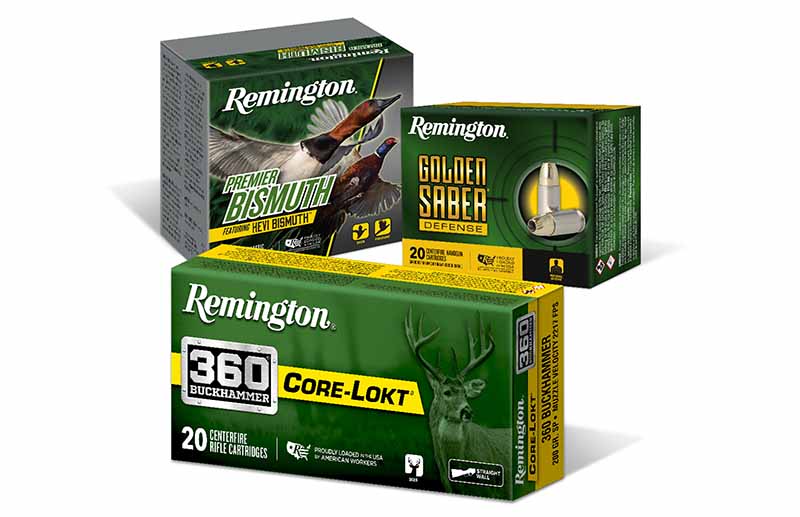
Remington Ammunition has a slew of new ammo on the way for 2023, and there’s enough variety in the lineup to get every kind of shooter’s attention. From rimfire and shotshells to defensive handgun ammo and centerfire hunting loads, there’s plenty to be excited for this year when it comes to Big Green.
In total, Remington Ammunition announced 17 new additions to its lineup this year. The full list can be found below, but some of the more interesting loads include three flavors of Golden Saber in 10mm, SubSonic Rimfire .22 LR and Gun Club Cure 12-gauge that will have some of its proceeds donated to children’s hospitals.
Remington’s Director of Marketing, Joel Hodgdon, said this about the company’s new lineup:
Big Green is gearing up for another successful year by introducing a variety of groundbreaking new cartridges that cater to all kinds of hunters and shooters…Our team is working hard to continue the legacy of creating the most innovative and high-performing ammunition in the game. Here’s to another big year for Big Green.
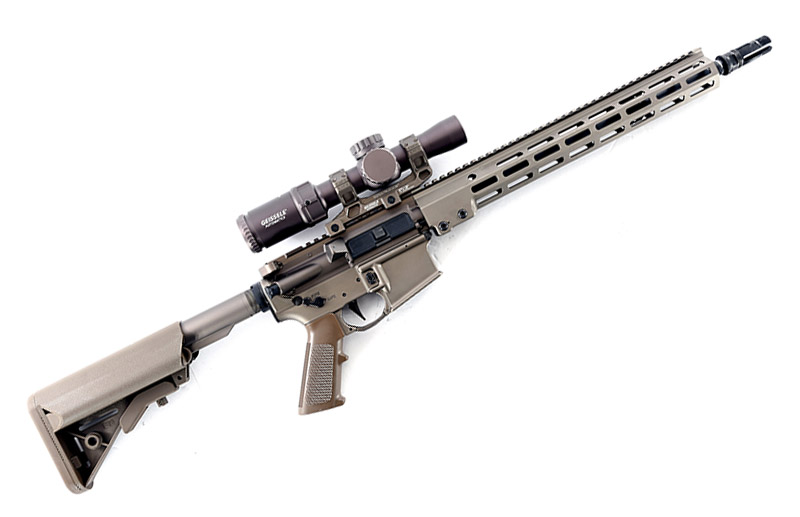
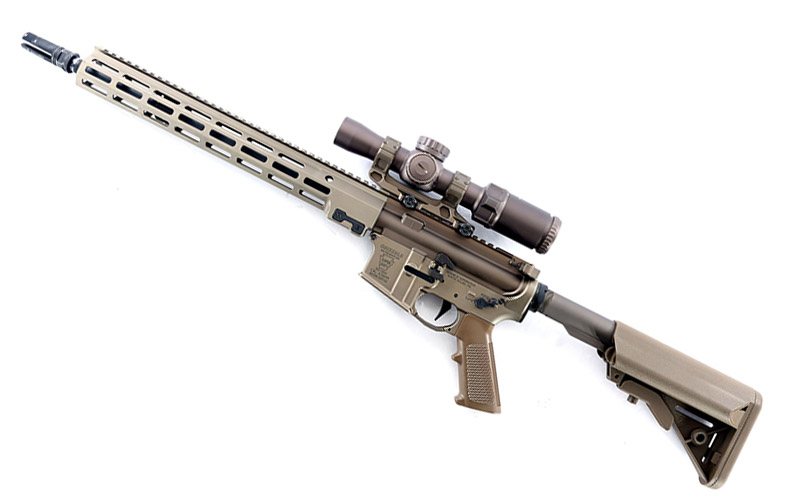
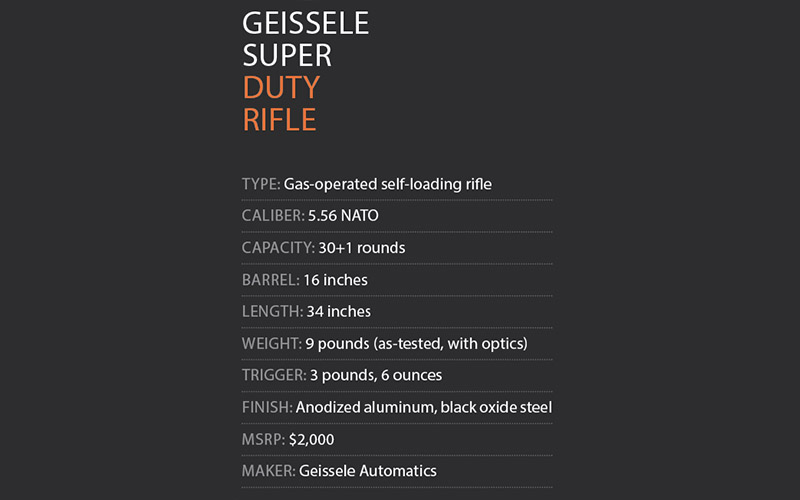
A closer look at Geissele’s complete (almost) Super Duty system.
People often toss around some terms without really knowing what they mean, like “complete weapons system.” Complete means just that—everything that’s needed to run, feed, maintain and inspect a weapon. It comes from one source. That’s not easy, but Bill Geissele comes really close on that.
Bill is a nice guy and a great engineer. His start in the firearms field was making triggers. Instead of simply making the same triggers as everyone else, he made better triggers. Soon, the top shooters and the guys who go places to deal with nasty people were beating a path to his door, wanting triggers.
Then, he made scope mounts—beautifully machined, structurally rigid, essentially unbreakable scope mounts. From there, it was a straight path to complete rifles because, well, if you’re going to make the world’s best triggers and scope mounts, you might as well make everything else in between, right?
Oh, and then he went into scopes.
The Complete Rifle
The intended audience of the Super Duty is the bearded gents who go to dusty laces. As a result, the upper and lower receivers are machined from forgings. Could Bill make a better upper and lower? Almost certainly. But the powers-that-be have some firm rules, and forged receivers are one of them. So, he builds on that and installs an improved bolt-carrier group.
The carrier is made from the current best steel for that, 8620, while the bolt is made from an improved Carpenter 158, called 158+. Yes, Virginia, it is possible to make a better steel but still call it Carpenter 158 … if you go directly to Carpenter and ask them. And that’s what Bill did. He opted for a better steel for the cam pin; he decided that cold hammer-forging barrels was the only way to go, so he acquired the equipment and makes his own.
The barrel isn’t lightweight, but instead a medium-weight profile designed to handle hard use and heat, and has a 1/7 twist. The gas block is Bill’s own Super Compact Block, and the installation is, in the words of Geissele, “bomb-proof.” As in, the gas block is pressed onto the barrel with both the barrel exterior and gas block interior closely matching in size. It’s then locked in place by means of two setscrews, each nestling into recesses dimpled into the barrel. Then, it gets a cross-pin through the block and the bottom edge of the barrel itself.
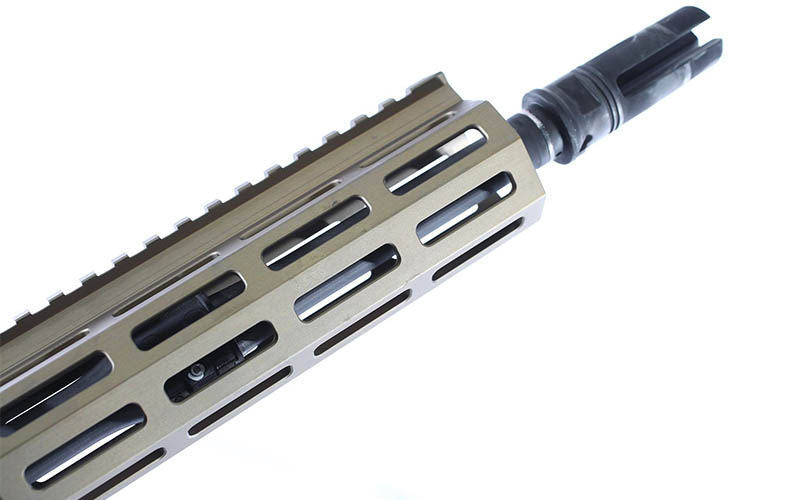
Here, you see the SureFire mount and flash hider. It’s a first-class flash hider and a great mount for SureFire suppressors.
I pity anyone who thinks they’ll simply snatch the gas block off of a shot-out Geissele barrel (who knows how long that would take) to install it on another barrel. Good luck with that. It then gets a gas tube and is ready for its handguard.
Before they’re all assembled, all the internals and the barrel, as well as the SureFire flash hider/muzzle/brake/suppressor mount, are all given the Geissele Nanoweapon coating. This is a solid lubricant coating that’s available only from Geissele. It’s a matte finish black coating that you cannot rub off short of going to power equipment—and aggressive equipment at that. It has a surface hardness in the same league as synthetic diamonds. You aren’t going to wear it off cleaning, shooting or tossing it into your ultrasonic cleaner. It makes parts rust-resistant, easy to clean and slick in use.
The barrel gets a Super Modular Mk16 handguard, with M-lok slots. M-lok has won the accessory wars so far, and this is what the future portends. Until something better comes along, buy M-lok unless you have a legacy KeyMod to feed.
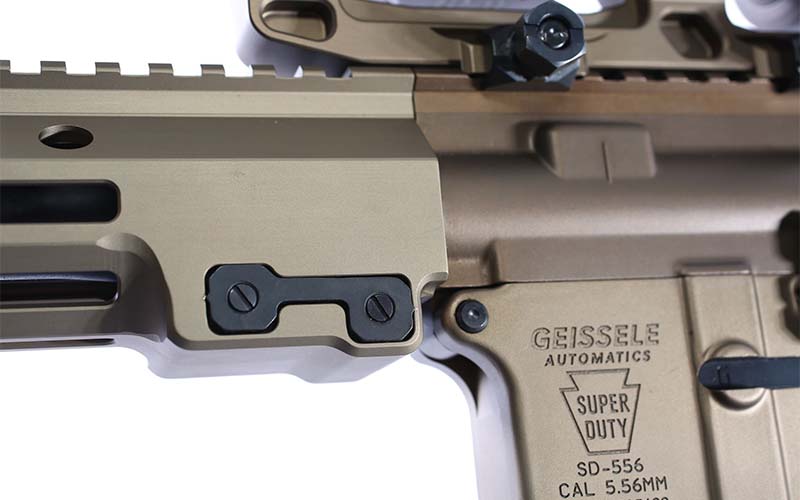
The Mk16, like all SuperMod handguards, use a proprietary barrel nut. This doesn’t have the flanges of a regular barrel nut, and thus there’s no problem with the gas tube touching the barrel nut. To hold the handguard on, and to keep the barrel nut in place, Geissele uses a pair of heft bolts crossway through the bottom rear of the Mk16. These pass-through grooves on the barrel nut and keep the whole package tight and properly aligned.
The handguard locks into place by means of a pair of hefty Torx-head bolts that are threaded into a steel anchor plate. You’re not depending on the strength of threads cut into aluminum here.
And the attention to detail that is Geissele is right here to be seen. Notice that the Mk16 clamping bolts pass through the aluminum handguard, but they’re threaded to a steel plate inset on the far side. The tensile strength of aluminum is half that (at best) of steel. It’s entirely possible to strip the threads of an aluminum handguard, by over-tightening the steel bolt. Geissele won’t let that happen.
Another Geissele detail is the bolt stop. Instead of the small mil-spec lever, we get a two-headed extended lever that’s plenty big without being in the way.
Building Up The Lower
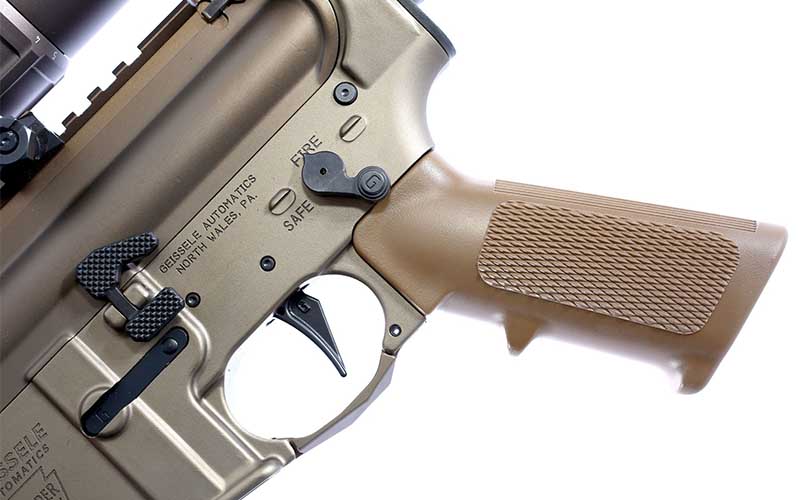
The ambi selector/safety, the extended bolt stop lever, the A2 pistol grip, all on view, and all first-rate quality.
The lower gets a Geissele SSA-E X with Lightning Bow, which is a first-class two-stage trigger that has a straight bow for consistency in trigger pull. There’s a Geissele pistol grip behind that, and again, Geissele gets it right. Perhaps the one detail that I find not to my liking on modern ARs is that I’m not a fan of pistol grips that fill the upper back end of the lower receiver, but Geissele installs an A2 here (kudos, Bill). In-between is an ambidextrous selector/safety.
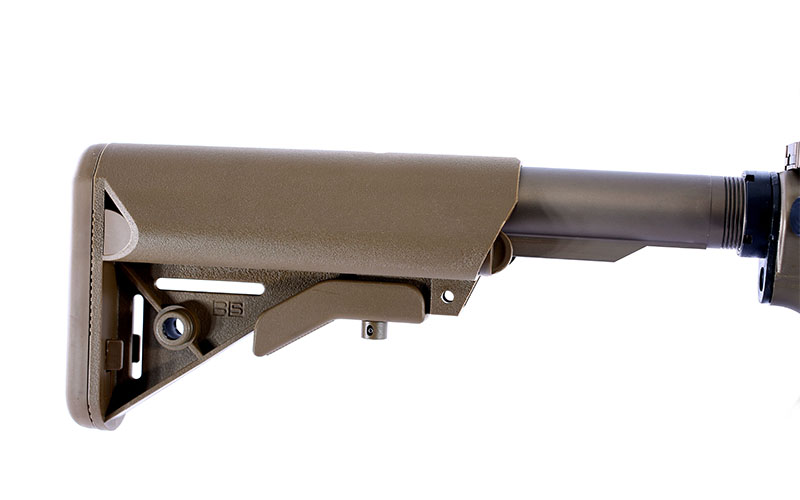
The end users Bill has in mind want the SopMod stock, so that’s what comes on your Super Duty. Don’t like it? It’s easy to change and there are plenty of people who’ll be happy to take it off of your hands.
On the back of the lower receiver, there’s a VLTOR B5 Systems buffer tube and SopMod stock. The B5 System assembly has a longer buffer stroke than a carbine system; this makes for a softer and less-bouncy felt recoil.
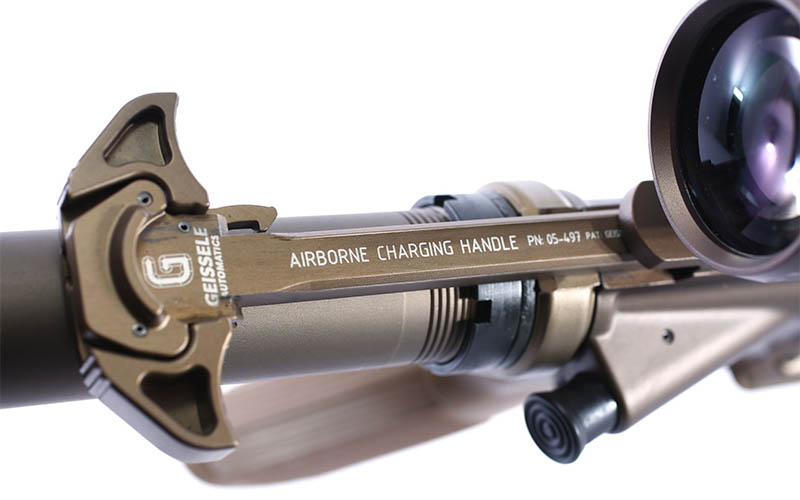
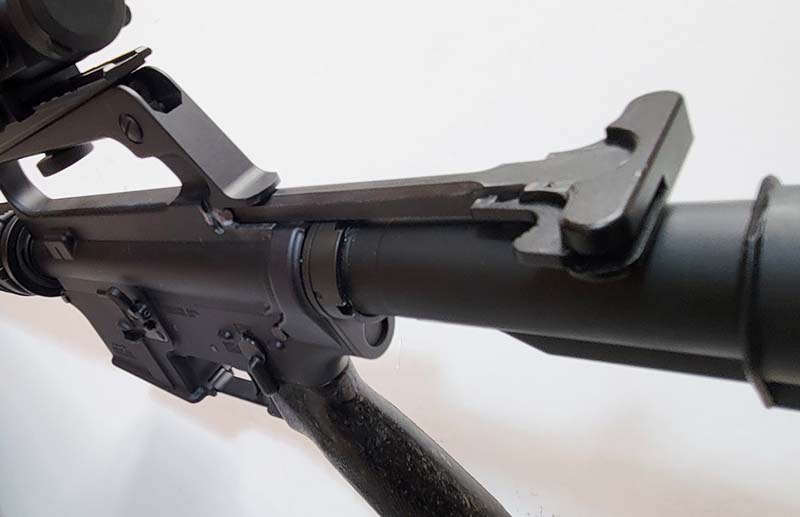
To charge the rifle, you grab a hold of the Airborne Charging handle, an ambidextrous version of the super Charging handle, but with a bit lower profile, so it’s less likely to get hung up on your gear.
The Geissele Airborne charging handle, which is an ambi handle.
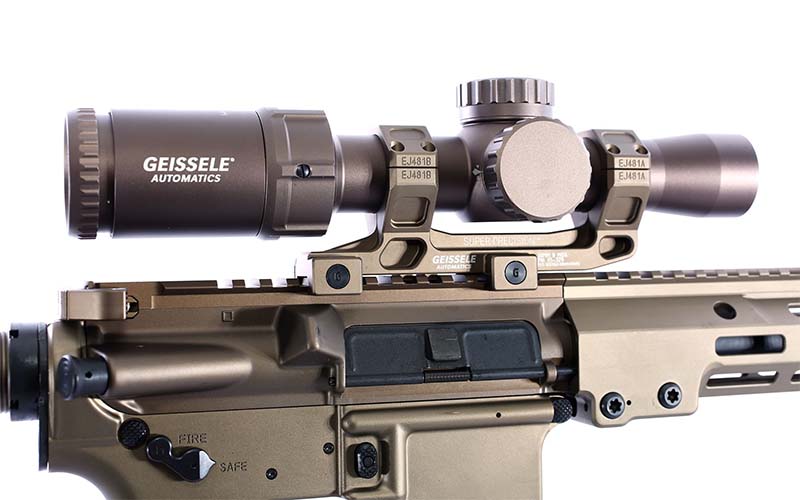
Remember I mentioned optics? Well, there’s now a Geissele scope, the Super Precision, a 1-6x riflescope with a DMRR-1 reticle, allowing for quick range estimation and hold-over. The Super Precision isn’t made by Geissele. However, they told an experienced Japanese (not China, that’d be egregious, and Geissele doesn’t do egregious) optics company what they wanted, and the standards they’d test the optics to—and, knowing Bill, the penalties for failure on the part of the optics maker would be epic.
The Geissele 1-6x optic comes in a Geissele (what else?) scope mount that’s tougher than a $2 steak.
Now, to be a complete systems provider, Bill would have to offer ammunition and magazines with his rifles. When I suggested that, with a big grin, he just laughed. We agreed that maybe two decades ago it might have made sense. But now, with so many good magazines and plentiful ammo choices to be had, there’s no point.
Well, Does She Shoot?
First-class manufacturing is one thing, but the real test is in the shooting. So, I volunteered for the boring task of seeing if I could make a Geissele rifle choke.
I failed.
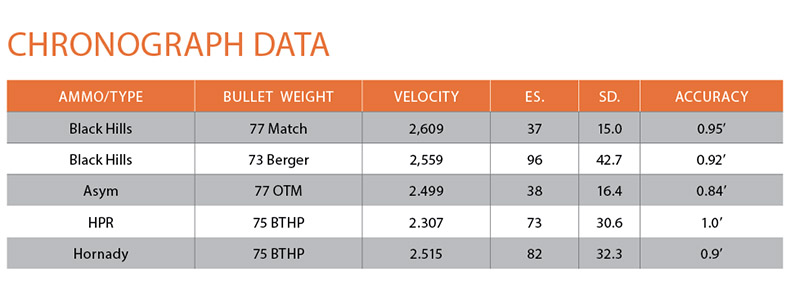
I had an opportunity to test the rifle not just at my gun club and its 100-yard range, but on another range with elbow room out past 500 yards … and I was able to ring steel with boring regularity as long as the wind cooperated. I can shoot, but calling the wind every time is a voodoo level of skill I haven’t yet perfectly mastered. I did manage to shoot a 500-yard group that spanned just a smidge over 2 inches, which is something I’ll be bragging about for a long time.
You can have the Super Duty as a rifle with a 16-inch barrel, or as a pistol with a 10.3-inch barrel. Again, Bill is making them for the bearded gents as well as us. Sixteen is easy for us, and 10.3 inches is what the guys who want really short blasters are accustomed to using.
And, so you know, you don’t just “buy” a Super Duty—you order it built to your specs. You pick rifle or pistol, barrel length, scope or no scope, and color. Color? Yes. Mine came in DDC (Desert Dirt Color), which I find to be a far better descriptor than FDE. You can also opt for Luna Black, Gray, 40mm Green, OD Green and Iridium. Place your order and wait. Your rifle is built to your specs, not just snatched off an inventory rack, wrapped and shipped.
I love this country.
Editor’s Note: This article originally appeared in the August 2022 issue of Gun Digest the Magazine.
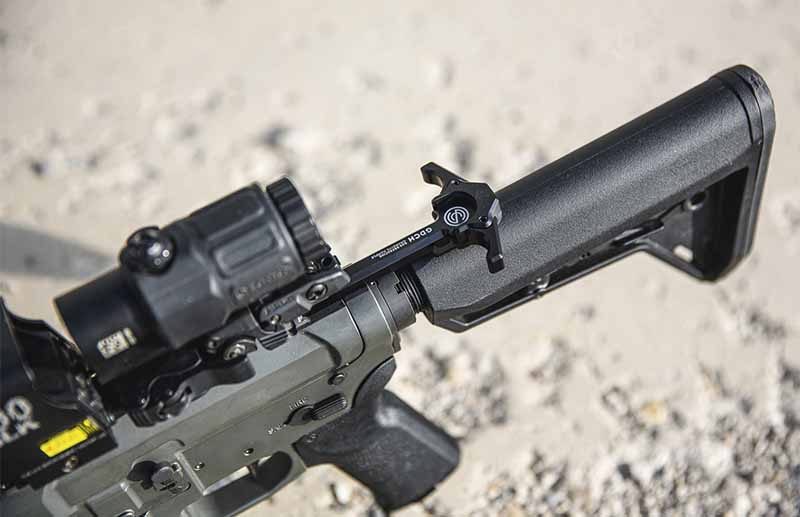
Looking to upgrade your carbine’s ergonomics without breaking the bank? Here are some of the best AR charging handles on the market.
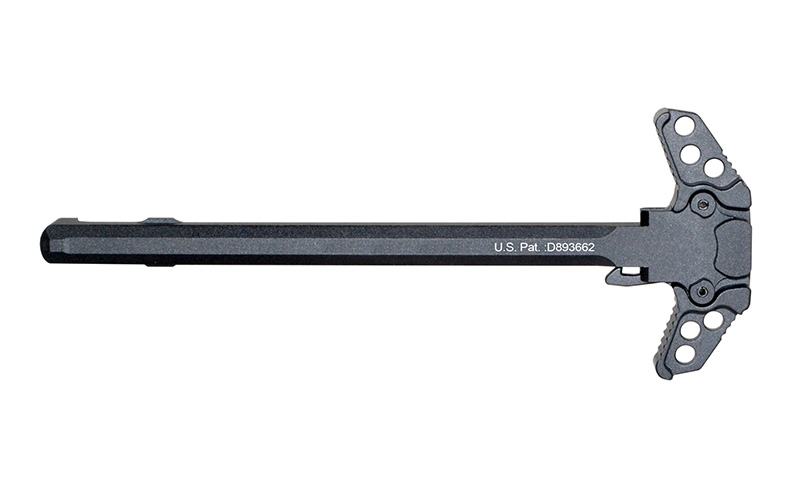
One of the easiest, most cost-effective and most common AR-15 upgrades is the charging handle. But if the mil-spec version has worked just fine for so long, why would you want to? There are a lot of good reasons, as a matter of fact.
So first let’s talk about the potential benefits of upgrading your AR charging handle and then go over some great models that fit a number of price points.
Why Upgrade Your AR Charging Handle?
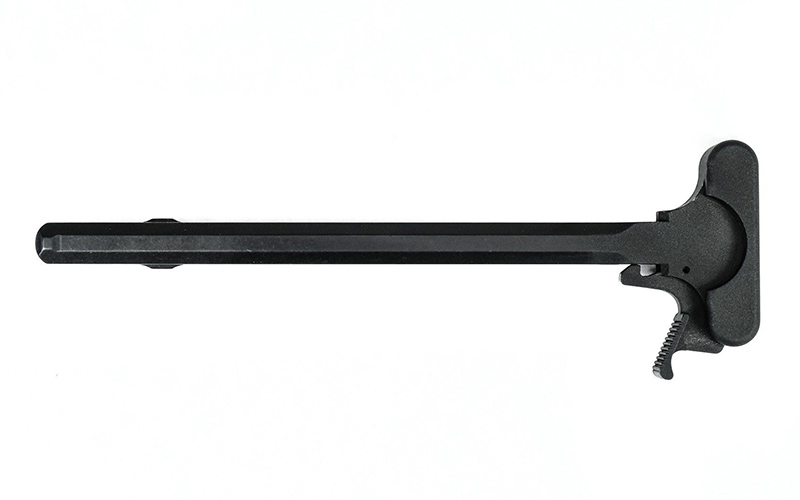
There are several aspects where the mil-spec charging handle falls short. There are many aspects of the original M16/AR-15 design that actually hold up very well, but the charging handle generally isn’t one of them.
First, a lot of the mil-spec units on the market are made of flimsy metal. They break (especially the latch and the latch pivot pin) and bend easily.
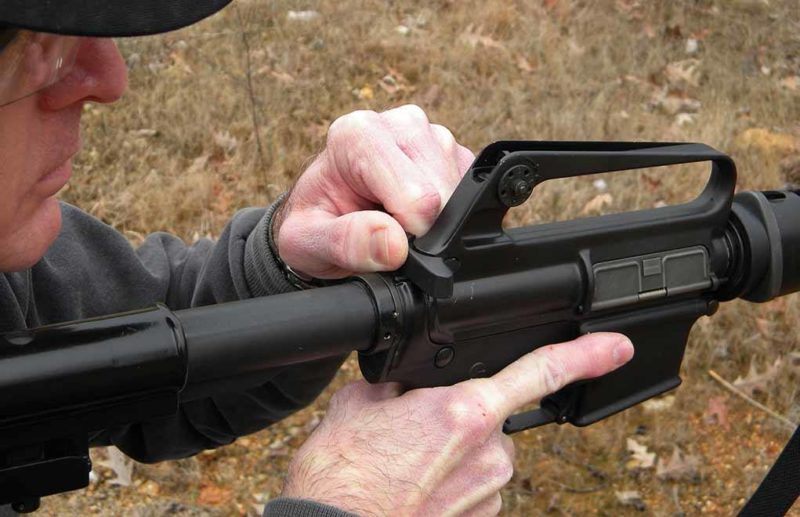
Second, the latch mechanism is on the left side, making it a little difficult, though not impossible, for ambidextrous use (shoulder transitions are a thing!) or for left-handed shooters.
Third, the actual latch lever itself is small and easy to miss if you’re trying to run the charging handle fast. Aftermarket units often have enlarged, ambidextrous and even latchless designs.
Fourth, a lot of shooters today use a suppressor. A standard charging handle will vent gas from blowback out the back of the gun and into the shooter’s face. A bevy of aftermarket AR charging handles are designed to bleed blowback gas before it hits you.
SilencerCo’s Gas Defeating Charging Handle, designed to mitigate the amount of gas blasted at one’s face when shooting suppressed.
Fifth, the wings of the mil-spec handle are rather narrow in width. A lot of people find them difficult to use with some kinds of scopes. In this era of LPVOs and people putting 3×9-40mm scopes on ARs…that’s rather important.
So, prone to breakage, not the most user-friendly, and they don’t play well with suppressors and some optics. Those are the biggest reasons to ditch the mil-spec version and upgrade.
Or, maybe, you just want to put together that Gucci rifle you saw on Instagram because you think it looks cool. There’s nothing wrong with that either!
With all that in mind, here are some really good aftermarket AR charging handles worth upgrading to.
The Magnificent 7: The Best AR Charging Handles
Radian Raptor
The Radian Raptor is pretty much the upgrade to get as far as AR charging handles are concerned. They’re lightweight, rugged, made from quality materials and are about as proven as aftermarket rifle widgets get.
The Raptor is made from 7075-T6 aluminum, with an anodized finish in multiple colors. It has an ambidextrous latch design, which is part of what makes it a mainstay of AR-15 upgrades. The standard model goes for about $80ish to $100, which is a bit steep, but you get quality.
There are also the LT and SD models. The LT uses polymer latch handles and goes for about $20 less, and the SD is designed for use with suppressors.
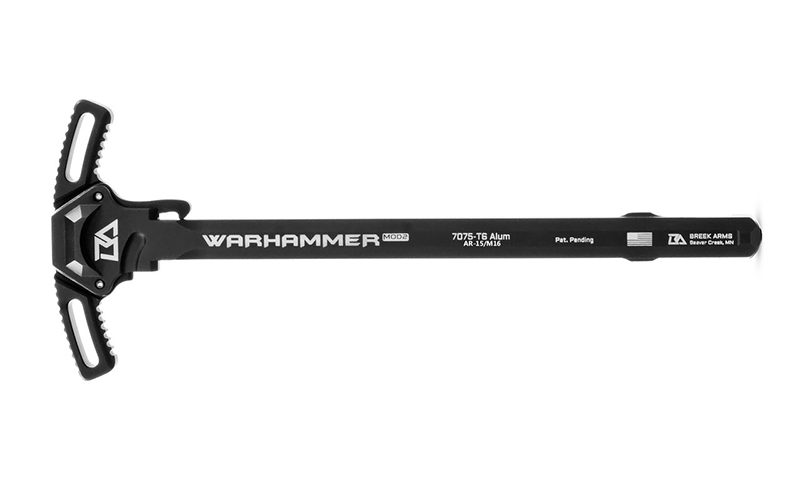
Breek Arms Warhammer
The Breek Arms Warhammer has a lot of premium features at a very attainable price point. In fact, it was selected as part of InRangeTV’s “What Would Stoner Do 2020” rifle, available now from Brownells.
The handles are wider than mil-spec (2.78 inches wide) so it’s easier to use with optics, and it has an ambidextrous latch design. The Warhammer also includes relief cuts to channel blowback through the side of the handle and a raised rear lip to deflect any gas from going in your face.
It’s made of 7075-T6 aluminum and comes in a number of hard anodized coatings for your choice of color. Street prices are typically $40 to $55.
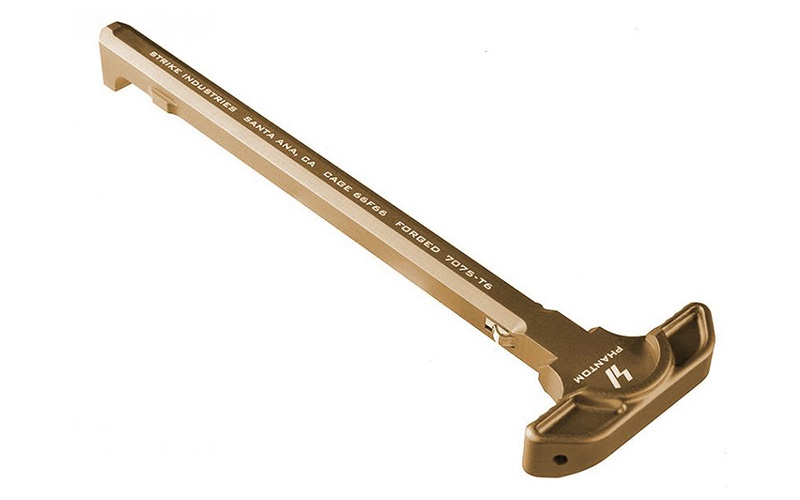
The Strike Industries Phantom uses a U-shaped spring to capture the charging handle in the locking area of the receiver, eliminating the need for a latch system. As a result, it’s fully ambidextrous, and with the standard handle wings, low-profile.
The Phantom is, like practically all AR charging handles on the market, made from 7075-T6 aluminum forgings with an anodized coating. You have your choice of multiple colors. It has gas vents, but isn’t designed for use with suppressors. If you’re going to run a can, you’ll have to look elsewhere. Strike Industries also offers handle extensions if you want a wider handle.
It ticks a lot of good boxes, and prices are generally just under $40.
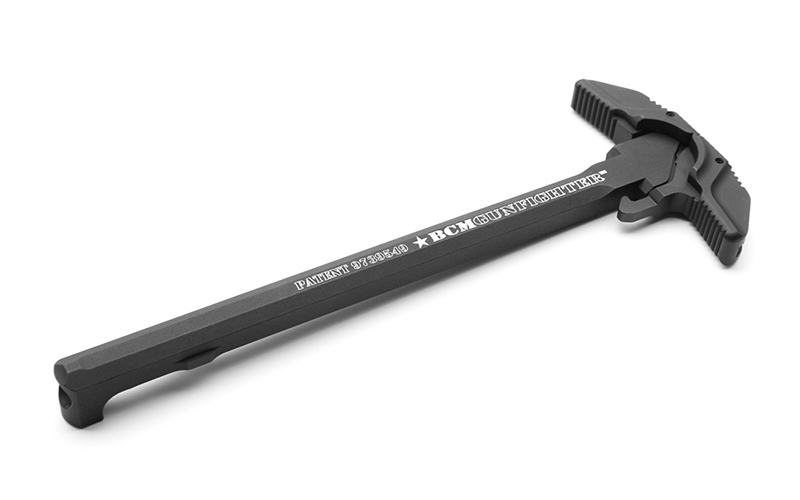
BCM Gunfighter Charging Handle
Another of the mainstays of aftermarket AR charging handles is the Bravo Company Manufacturing Gunfighter series. There are a number of versions, so we’ll treat them as a whole product line.
The Gunfighter is designed to be low-profile but still deliver performance, with your choice of latch size. Mod 3 handles are the large profile and the Mod 4 is the medium profile. The Mod 4 is still slightly wider than mil-spec, however.
The Gunfighter uses an exclusive latch system to reduce the stress load on the pivot pin of the latch for smoother use and greater durability. You have your choice of ambidextrous models (which are about $10 extra, give or take) or not. MSRP is $75 to $90, but street prices can be as low as $50.
Presma Ambidextrous Charging Handle
Another affordable upgrade is the aptly named Ambidextrous Charging Handle by Presma. Street prices are usually under $30, and they are, wait for it, designed for ambidextrous use by virtue of the pivoting wings which engage the latch from either side.
It includes a rear lip to redirect gases, wider wings than mil-spec and includes textured handle wings for a secure grip whether gloved or not.
It’s ambi, a bit wider than mil-spec and a little friendlier for a gun with a can…that’s a lot of features for less than $30. You also have your choice of several colors of anodized finish, in case basic black is not your thing.
NBS Billet Extended Latch Charging Handle
If you otherwise like the mil-spec design but just wanted it to be a little easier to use and a little less flimsy, check out the NBS Billet Extended Latch model. NBS is the house brand of AR15discounts.com, the one-stop shop for all things AR-15 (and more) on the web, and their products are generally good value for the money.
The handle is made from 6061-T6 forged billet aluminum for a bit more rigidity, and has an extended charging handle latch on the left side with about an extra .25 inches of material. It’s a little easier to grab quickly, and will be easier to use with a scope too.
It’s not the most dramatic upgrade in the world, but it improves the basic charging handle just enough to make a difference and it only costs $23.
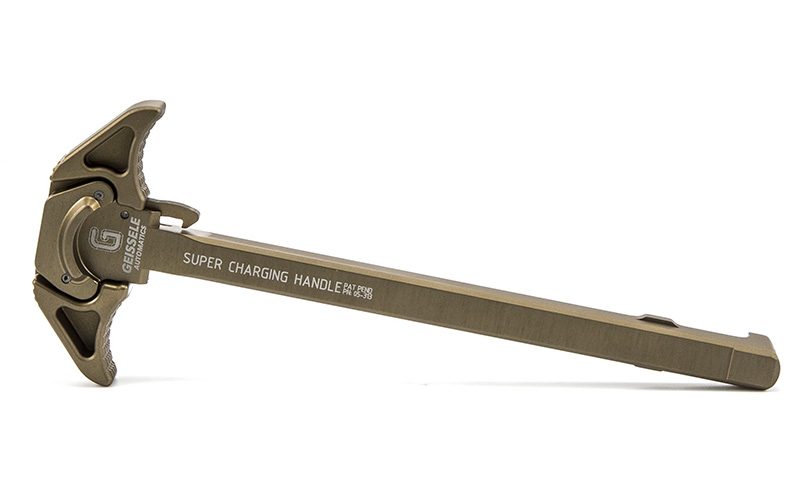
Geissele Super Charging Handle
If nothing but the best will do, the Radian Raptor and the Geissele Super Charging Handle are about as good as it gets.
The Super Charging handle has ambidextrous latch wings with checkering with X- and Y-axis radius cuts to make it low profile. It includes a rear lip to redirect gases when shooting suppressed, having been specifically designed for SBR and suppressed shooting.
The Super Charging Handle is available in Black or DDC (Dirt Desert Color), and can be yours for $100 to $120 from most retailers. That’s a bit steep, but Geissele makes some of the best parts (and rifles) money can buy, so it’s a buy-once/cry-once proposition.
Do You Actually Need To Upgrade The Charging Handle?
On the one hand, a lot of serious work has been accomplished with mil-spec charging handles all over the world throughout the years. With training, they shouldn’t give you any issues either.
On the other hand, the aftermarket exists for a reason.
So, do you need to upgrade your charging handle? Honestly…need is rather relative.
If you’re a left-handed shooter or you spend a lot of time shooting from both shoulders, it’s worth it to upgrade to an ambi AR charging handle to save you effort. It may also be very worth it to get a charging handle that works well with your suppressor, or one with wider latch handles to use with a scope.
In other words, if you’re going to actually benefit from it, it’s going to be a worthy investment. If you mostly just plink with your rifle and don’t run it hard, shoot suppressed, or shoot from odd positions…it’s another $20, $40 or $100 you could have spent on training ammo for improving your skills
Consider what you do with your rifle first. That will tell you if it’s a prudent investment.
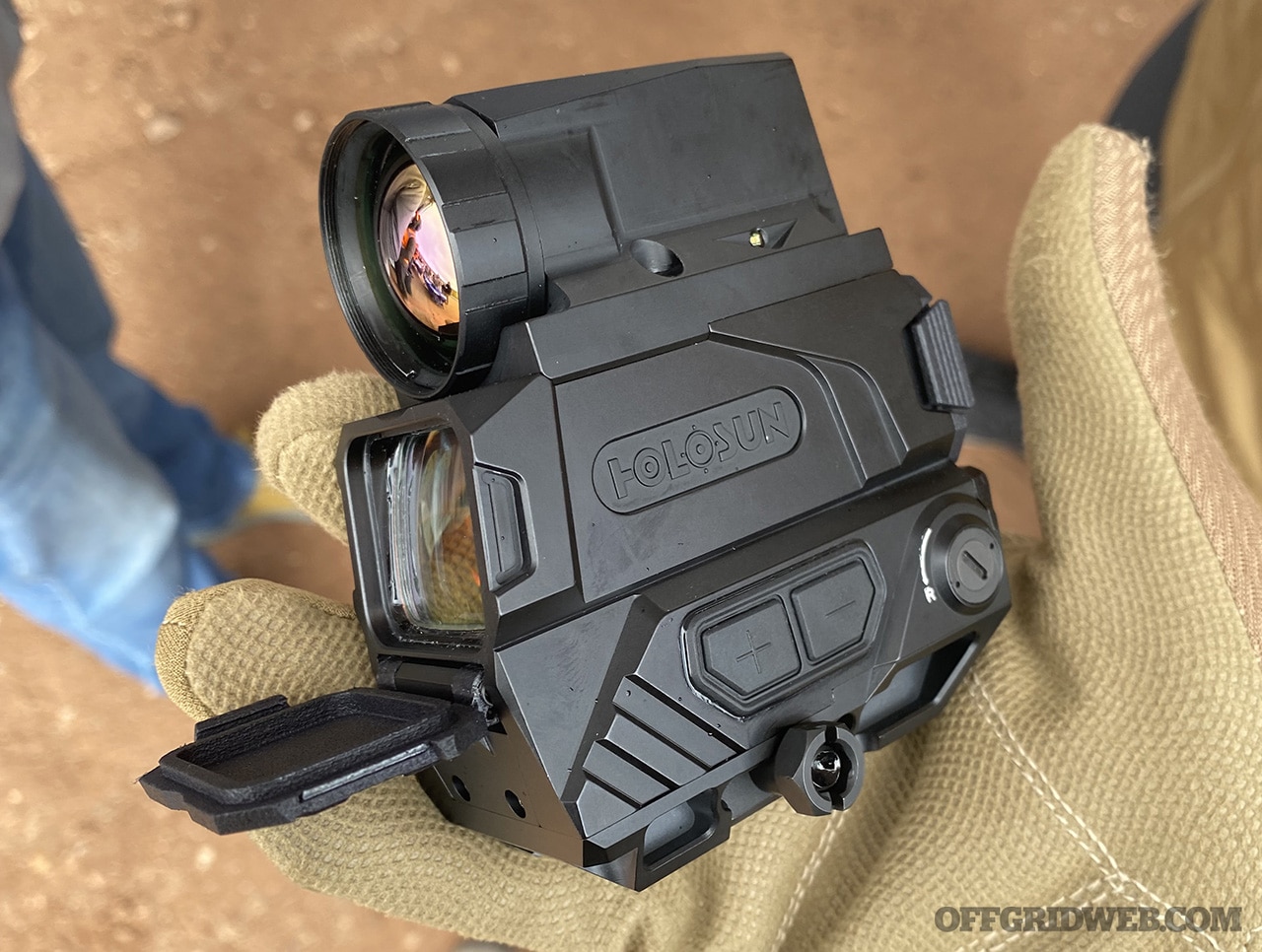
We Tried Prototype Digital Reflex Optics That Blend a Traditional Red Dot with Thermal or Digital Night Vision Overlay.
Thermal imaging is an incredibly powerful technology, whether it’s being used for hog hunting, tracking fugitives from a helicopter, or locating enemy troops on a battlefield. It illuminates warm-blooded creatures instantly, even if they’re visually camouflaged and motionless. At SHOT Show 2023 this week, Holosun unveiled an exciting new hybrid optic called the Holosun DRS (Digital Reflex Sight) that integrates a thermal or digital night vision overlay onto a standard red dot. Although it’s not ready for retail release yet, there are a handful of prototypes undergoing testing, and we got our hands on both variants at the SHOT Show Range Day.
Holosun DRS Red Dot Hybrid Optic
The new Holosun DRS (formerly known as the DMS in its prototype phase) appears to be based on the popular Holosun AEMS, a compact, enclosed-emitter red dot with flip-down lens covers. However, in this case the front cover is opaque instead of clear. When it’s flipped down, the optic works just like a normal red dot with adjustable brightness and Holosun’s selectable dot or circle-dot reticles.
When the front lens cover is flipped up, you can press a button to activate the DRS’s secondary optical system, which will be projected onto the black window behind the red dot reticle. Since the red dot is independent of the background image, the optic maintains the same zero at all times, day or night.
DRS Versions
We checked out two Holosun DRS sub-models, each with a different secondary overlay:
DRS-TH – Thermal optic with various image modes
DRS-NV – Digital night vision camera (think along the same lines as the Sionyx Aurora Pro) with infrared illuminator
Above: Editor Tom Marshall tests the Holosun DRS-NV. It can be identified by the top-mounted digital night vision camera, which is slightly smaller than the DRS-TH thermal camera.
The red dot and secondary thermal or NV optic are independent of one another, so during the day you can leave the secondary optic disabled to conserve battery life. Speaking of batteries, the unit is powered by two 18350 rechargeable lithium batteries, which can be charged directly inside the DRS optic via a built-in USB port on the right side of the housing.
That USB port also offers the ability to stream footage to a secondary screen in real-time, so you could connect your DRS to a tablet and use it to observe a static position without getting behind the weapon.
Above: The Holosun DRS-TH Pro (left, with opaque cover flipped down) and DRS-NV (right, with cover flipped up). Note the small protrusion next to the NV camera lens — that’s an infrared illuminator for use in environments with no ambient light, such as dark buildings without windows. The illuminator can be toggled on and off independently.
Above: We took several photos and video clips through a pre-production DRS-TH Pro during SHOT Show. This image shows the view with the front cover up and the red dot sight turned on. Ignore the slight blur that was induced by holding our camera behind the optic — the display is quite sharp in person. Click here for a video of the DRS-TH Pro in action.
Initial performance impressions were good, with a clear image and fast refresh rate. The DRS-NV image appeared somewhat dim during our morning trip to the range, but this is understandable due to the bright daylight conditions; it should be much easier to see in the dark conditions it was designed for. The DRS-TH showed body heat prominently in the daylight, with a bright red dot on top.
Above: The DRS-NV digitally intensifies visible and infrared light to generate a monochrome image of the environment. This photo was taken indoors in a well-lit area, but we hope to test it in the dark soon. The red dot sight is turned off in this photo.
Holosun hasn’t finalized the designs and features of these optics, but we’re told the DRS-NV should be priced under $1,000. That’s impressive considering an AEMS red dot is nearly half that without the extra optical system on top. As for the thermal DRS-TH, there will be a standard model available for approximately $1,600 and a premium, higher-resolution DRS-TH Pro model available for about $2,300. We’ll keep you posted once we have more details about availability, and we’re already planning a thorough review as soon as final production samples are available from Holosun.
Editor’s Note: This story originally appeared on Offgrideweb.com.
PCCs are only getting more popular, so here’s a more in-depth look at the JP Enterprises JP-5 roller-delayed blowback 9mm.
PCCs, are the talk of the town right now. There’s been a substantial rise in their popularity over the past several years … and for good reason: Ammo is affordable, they’re ideal for plinking, they excel in training situations, and they’re downright fun to shoot.
But, how did something that developed out of convenience become a competitive shooting staple, and who sits atop the PCC mountain?
Short-Gun Bullets For Long Barrels
Developed in the late 1800s for riders in the West, the early PCC was a convenient way to carry a pistol on the side and a long-gun in the saddle. When times were tough, having to find and buy ammo in two different calibers couldn’t have been easy. Honestly, that can be a battle in today’s economy. Jump forward and look at law enforcement applications. Carrying a .40 in the holster and having a .40 carbine in the patrol car sounds awfully appealing, and it was for many divisions.
Now, move forward once more to 2016, when the USPSA started allowing PCCs in competition—and things took off. PCC competitions are now some of the fullest and most attended shoots, and PCC sales are through the roof. This brings us to the current day, where PCCs are designed not only out of convenience, but with serious competitive shooters and gun enthusiasts in mind. One of those carbines is the new JP-5 from JP Enterprises.
A full view of the JP-5 topped with a Leupold DeltaPoint Pro.
While JP Enterprises might not be a household name to the average shooter, competition shooters and marksmen looking for high-quality parts know the name by heart. JP is a small Minnesota-based company that prides themselves in making quality parts and guns. Their attention to detail and innovative nature make their products top-tier. The JP-5 PCC shows that.
For years, direct blowback guns have dominated the PCC competition scene. JP’s own GMR-15 is a direct blowback design that resides in the hands of roughly 35 percent of the top shooters on the PCC scene. But, with speed, weight and reliability being imperative to competition shooters, JP decided to push even further, using the famous Heckler & Koch MP5’s roller delayed-blowback system in the JP-5. The roller delayed is widely considered the softest-shooting of delayed-blowback systems available and, without a doubt, the best.
The author fed the rifle several loads and all cycled well.
The roller delayed-blowback system utilizes two rollers on the bolt that implement the delay needed to prevent premature bolt opening. Straight-blowback systems require the use of a heavy bolt … and a lot of reciprocating mass. With the delayed roller, you lose the weight and have far less recoil. The incredible recoil reduction allows for faster recovery and target indexing.
JP took the roller lock bolt system and teamed it with the things we all love about AR platform, and they produced a superior PCC. According to JP team shooter Josh Froelich, “The JP-5 shoots like a .223, not a 9mm carbine.”
The JP-5 uses standard Glock mags and features an oversized magwell.
Making A Name For Itself
The similarities between the MP5 and the JP-5 are deeper than the use of the delayed roller system. In fact, many of the parts are interchangeable. The firing pin, firing pin spring, rollers, roller retaining spring, extractor, extractor spring and lock pieces can all be swapped.
“PCC has been a fantastic opportunity for us the past few years, but we knew that we’d taken the direct blowback as far as it could go,” said JP Marketing Manager Jesse Gangl. “To really innovate and improve, we had to look at a new style of operating system. Building on the legendary reputation of the H&K MP5, the JP-5 incorporates all of the magic of a roller-delayed system with everything people like about the AR platform. The result is that there’s just no comparison for recoil impulse or follow-up shot speed between the JP-5 and anything out there today. It will be the gun to have for PCC going forward.”
The JP-5 features a JP Silent Captured Spring.
JP didn’t stop with the hard engineering; they wanted the entire gun to shine. From the Enhanced Reliability Fire Control trigger that pops at 3.5 to 4 pounds, to using their Silent Captured Spring for even less recoil, no stone has been left unturned. Both the trigger and the Silent Captured Spring are adjustable, allowing shooters to customize the gun even further. The Hogue pistol grip and Hogue OverMolded buttstock round out the simple components that increase comfort and make the package come together. The JP-5 uses standard Glock magazines, which makes magazines easy to find and very affordable. Plus, the lower houses a generously oversized magwell for easy reloads.
Field Trials
I couldn’t wait to get my hands on the JP-5; I’ve been a PCC fan for years. My for-review competition-ready JP-5 arrived basically ready-to-rock straight out of the box. I added a Leupold DeltaPoint Pro 2.5 MOA red-dot to it and loaded mags. The Leupold DeltaPoint is a proven red-dot on anything from ARs to shotguns. If one were to push the range limits a bit, utilizing something with some magnification would be suggested. The DeltaPoint Pro 2.5 worked perfectly for what we were doing.
I was pleasantly surprised with the weight of the gun, coming in at 6.2 pounds with the mag and red-dot. The look of the gun was very appealing as well. From the oversized Radian Raptor LT charging handle to the Hogue grip and buttstock, it was extremely clean and visually appealing. The compensator is a large three-port comp, which is generous in size and looks absolutely gorgeous pushing through the handguard.
The JP-5 is fully ambidextrous.
The guard is perfectly rounded with subtle dimples that make it comfortable to maneuver, and it allows for a light but steady grip. The M-Lok on the grip allows for accessorizing as you please, too. While diving into the mechanical portion of the gun, I found the lower to be fully ambidextrous. Righties and lefties can operate the gun with ease. The mag release is competition grade and made reloads easy and clean.
The gun came with a 90-degree locking piece, but JP can cater your angle based on things like the bullet grain you plan to use, application and barrel length. Eighty to 90 degrees is optimal for people looking to shoot a variety of loads. I chose three different 9mm loads I wanted to feed the JP-5, hoping I’d find out which ammo it didn’t like … but I didn’t find anything it wouldn’t eat. Through 600 rounds, I never had a misfire and only one failure to feed, which was a mag issue. In the PCC world, numbers like that are unheard of.
Between testing and tinkering, three of us went through 250 rounds of 115-grain American Eagle, 250 rounds of 124-grain CCI Blazer and 100 rounds of 150-grain Federal Syntech. The most consistent rounds were the dirtiest, with the Blazer being shot last and with some speed. We had zero issues with any of the ammo. I did throw five rounds of defense loads through it when I got home from the range to be sure they cycled, which they did flawlessly.
Throughout the testing, 150-grain Federal Syntech ammunition cycled very well.
The carbine was zeroed at 20 yards using the 115-grain American Eagle, and the groupings at 10, 15, 18 and 20 yards were incredible from the get-go. Chrono readings averaged 1,158 fps. I had my 14-year-old son with me, as I really wanted him to see how he felt about it. He pointed out that resting wasn’t realistic for the PCC, especially if one were using it for competition shooting. After the first 100 rounds to establish zero, groupings and get chrono readings, all shots were made with light rest or off-hand. At 10 yards, the gun was printing 1 MOA over, and at 50, the gun was 2 MOA under.
At 100 yards, tapping a 10-inch plate was no problem, but the hold-over with a 1x red dot made it hard to get truly accurate groups. However, light resting a PCC at 100 yards and banging steel is pretty neat. We tried to push the end of the testing by moving toward a speed steel type of shooting, and burned through plenty of Champion VisiShot targets. Even cycling fast, the shots were rarely over 1 MOA at 20 yards.
The gun gets back on target so quickly and shoots true as soon as the dot lands on center. The combination of the delayed roller, Silent Captured Spring, light trigger and overall comfort leads to so little recoil and so much confidence. Even my 14-year-old was able to put 10 shots on target with less than 1.5 seconds between shots, and every hole was tickling center. My wife was able to handle the gun with ease and loved the look and feel of it. She, too, had zero issues with target acquisition.
The JP-5 was, honestly, the best PCC I’ve ever handled, and my son said it was one of the top three guns he’s ever shot. The only potential downside is that price tag on something so well-built is steep: With an MSRP of close to $3,300, it’s a tough pill to swallow. But when you compare it to other high-end competition PCCs, it’s not terrible. This gun is probably not going to fit the budget for the weekend shooter, but serous competitive shooters shouldn’t experience sticker shock, especially considering that the JP-5 needs almost zero modifications to be comp-ready.
PCCs are incredibly fun and don’t bruise the shoulder of the ammo bank. A few other PCCs, MP5 clones, bullpups and the like have drifted through my hands over the years—even an H&K SP5 and a Steyr AUG when I was writing a piece about guns and popular culture. The Die Hard films had a lot to do with making several rifles popular, including the MP5.
But none of them hold a candle to the gun currently on my bench. The JP-5 sits on a mountain alone. It’s the smoothest PCC I’ve ever handled and has been an absolute joy to shoot.
Editor’s Note: This article originally appeared in the November 2022 issue of Gun Digest the Magazine.
SHOT Show 2023 has come and gone, here’s a look at what stood out the most to the Gun Digest team during our time walking the show floor.
Pistol: Beretta 80X Cheetah
Many concealed carriers turn their noses up at .380 ACP, but this little pistol just may be sweet enough to change some minds. Developed from Beretta’s classic Model 84, the new Beretta 80X Cheetah brings the concept into the 21st century. While it retains the same demure size as its predecessor, the 80X now features an optics-ready slide, an accessory rail, a frame-mounted safety/decocker and an updated grip angle.
For those in the market for a new carry gun, see if you can give one of these a try before committing yourself to a larger caliber. It may just win you over.
Rifle: Bond Arms Lever-Action AR-15
Bond Arms had a surprise at its booth this year, and it may just be the pinnacle of the tactical lever-action concept. While lever-action AR hybrids have been experimented with before, they typically had issues with feeding rounds from full magazines with capacities higher than 5 or 10 rounds. Bond Arms’ new model addresses that with a revolutionary new lever system that doesn’t require herculean strength to feed rounds from higher capacity mags.
Even better, the new rifle is about as modular as a standard AR-15. It uses standard AR uppers and takes Remington 870 pattern stocks. The ability to use standard uppers also enables the system to fire a lot more than just 5.56 NATO. Bond Arms hopes to have the new gun available by this time next year for an MSRP of about $1,500.
Bolt-Action Rifle: Aero Solus
First teased at SHOT 2022, the Aero Solus is finally available for purchase. A lot of companies are introducing chassis rifles based on the Remington 700 action this year, but in our eyes, Aero’s appears to be the best.
Complete Solus rifles are initially available in a couple of configurations with more on the way, and the company will also be selling standalone actions, barreled actions and the Aero Precision chassis separately. This will enable users to easily configure a build exactly how they want it even if factory options don’t satisfy their needs.
Shotgun: Beretta A3 Ultima Patrol
Beretta’s new A3 Ultima Patrol has a lot going for it. Not only is it an American-made semi-auto 12-gauge with enough tactical flair to compete with established defensive shotguns like the Benelli M4, but it does so for a lot less money.
With an MSRP of only $1,099, the Beretta A3 Ultima Patrol sports a 7+1 capacity, enlarged controls, an enlarged loading port and plenty of M-Lok and QD sling mounting points. Better yet, the shotgun is available with different finish options ranging from gray to tiger stripe.
Optic: Holosun DRS-NV/Holosun DRS-TH
One of the most impressive products at SHOT Show 2023 came from Holosun in the form of new night vision and thermal reflex sights. They appear to be smaller, lighter and more affordable than any other low-light optics of their kind, making the Holosun DRS-NV and DRS-TH poised to make this technology far more available to average shooters.
The optics can function as standard reflex sights similar to the Holosun AEMS, but when their opaque front lens covers are closed, they also provide a thermal or night vision overlay through the viewing window. Holosun also promises a “Pro” model that will be capable of both night vision and thermal via a modular sensor unit. MSRPs aren’t set in stone, but the DRS-NV will supposedly only cost around $1,000 and should be released by the end of this year.
Suppressor: JK Armament 12-Gauge Suppressors
There were a lot of very impressive suppressors at SHOT Show 2023, but these two new 12-gauge models from JK Armament definitely stood out the most. 12-gauge suppressors are often prohibitively expensive and riddled with issues inherent to suppressing shotguns, but the JK 195 VersaX and JK 195 SGX appear to solve both problems. With MSRPs of only $599 and $899, respectively, the suppressors’ new rounded baffles prevent shot cup plastic from shaving off. This little trick ensures normal flight paths, inhibits internal plastic buildup and majorly reduces wear.
The cherry on top is that JK Armament is offering very affordable barrel threading services as well. This means that even grandpa’s old pump-action could easily be outfitted with one of these new 12-gauge cans. Both models are modular, but the VersaX ships with 8 configurable baffles while the SGX comes with a whopping 14.
Ammo: PSA Steel Case
Ever since the Russian ammo ban was announced, many shooters have wondered where they’ll find the next steady supply of cheap ammunition. Hopefully, if all goes well, that source will be Palmetto State Armory. It’s been known for some time that PSA’s parent company, JJE, had procured machining from an unnamed European country for producing steel-cased ammo in common Soviet calibers. It seems that the project is moving forward as some sample ammo was on display at SHOT Show 2023.
7.62x39mm, 7.62x54r and 5.45x39mm were present, all packaged in boxes bearing the Soviet Arms brand responsible for some of PSA’s other Combloc products. If this new factory manages to come online and provide ammo at a comparable price and quality to what Tula once did, AK enthusiasts will be able to keep on shooting as if nothing ever changed.
Oddball: Magpul FDC/FDP
While this little cyberpunk-looking firearm probably won’t have any real impact on the concealed carry market, it’s very cool nonetheless. There aren’t many clear scenarios where the FDC or FDP would be better to have than a standard handgun with a light, but the ability to fold itself into a compact rectangle with a carry handle is too unique to go unmentioned. The pistol parts are going to be made by ZEV Technologies and the plastic components will be made by Magpul, and the companies hope for it to be available by this time next year.
Historical: PSA Sturmgewehr Clone
Nearly ten years in the making, the American Sturmgewehr clone by Hill & Mac Gunworks is finally on the way to becoming a reality. Development was slow and messy, as is often the case with small-scale boutique reproductions such as this, but thankfully the project was acquired by Palmetto State Armory.
If anyone has the production capabilities and capital to bring this gun to market, it’s PSA. As a testament to that, there appeared to be a complete and functioning model on display at the company’s booth at SHOT Show 2023. Just as the original promised by HMG, the PSA version will be available in 7.62x39mm, 5.56 NATO, .300 BLK and the original 8mm Kurz.
Accessory: Midwest Industries Alpha Series AK Furniture
With access to Russian-made Zenitco furniture having been cut off, American AK enthusiasts were seriously lacking in good tactical furniture options. Many were willing to pay out the nose for used Zenitco stuff, but thankfully Midwest Industries has just released the Alpha Series.
Alpha Series AK furniture appears to be of equal quality and functionality to the original Russian-made models that helped inspire it, but it accomplishes that for much more reasonable prices. The various handguards and optics mounts are pretty specific to AK-pattern rifles, but because the new stock attaches via Picatinny rail, it’s also compatible with any firearm that features the appropriate hardware on the rear of its receiver.
An in-depth look at the mighty Smith & Wesson 1006 in 10mm Auto.
It’s said that necessity is the mother of invention. Many useful products have resulted from the efforts of someone to improve something that didn’t work well.
For example, a highly publicized shootout in 1986, in which two FBI agents were killed, had some people convinced the 9mm Luger pistols used by agents weren’t able to keep two suspects from fighting on for far too long.
Whatever the case may be, it was determined that handguns chambered for a more potent cartridge were in order. Attention was turned to the 10mm Auto, a .40-caliber cartridge made in 1983 by adapting a shortened .30 Remington case. The shortened case was used with bullets designed for the .38-40 Winchester. Instrumental in the development of the cartridge was Jeff Cooper, who was always a proponent of large-caliber pistols such as the .45 Auto.
Some factory loads for the 10mm Auto develop over 600 foot-pounds of muzzle energy, making such a pistol a very powerful handgun indeed. In fact, in tests it proved to produce more recoil and blast than many agents could deal with.
Accordingly, a lighter load was developed; the light load was amenable to a shorter case and thus the .40 S&W was developed. Such cartridges could be adapted to shorter and lighter pistols of a size that fired 9mm Luger cartridges. There’s no free lunch, and it has subsequently been observed that even the .40 S&W is a bit much for many officers, and the cartridge is hard on the machinery in small pistols.
As a result, after the dust settled, the FBI returned to service pistols chambered for the 9mm Luger. However, handguns (both autoloaders and revolvers) in 10mm Auto caliber are often chosen by hunters or for defense in wild areas.
A Pistol With Punch
The first pistol chambered for the 10mm Auto was the Bren Ten, but production of that pistol was short-lived. Soon after, Colt produced the Delta Elite in 10mm Auto, and Smith & Wesson introduced the Model 1006. The Colt pistol is a single-action autoloader that operates in the manner of the Model 1911 .45 Auto. However, the S&W 1006 is a double-action pistol that doesn’t need to be cocked for the first shot.
Thereafter, firing is in the single-shot mode. The double-action trigger pull is smooth and relatively light.
When fired using two hands, the checkering on the front of the trigger guard is functional.
The S&W 1006 is a brute of a pistol made of all stainless steel. It has a 5-inch barrel and utilizes a single-stack magazine holding 9 rounds, offering 10 rounds with a cartridge in the chamber. It features dual slide-mounted safety levers that also serve to de-cock the pistol safely when the cocked pistol has a round chambered. The pistol also features a firing pin block that prevents the firing pin from striking a chambered cartridge unless the trigger is pulled.
Dual safety levers that also function to de-cock the pistol are found on the 1006.
The 1006 has a magazine disconnect that prevents the pistol from being fired when no magazine is inserted. Grips are made of a plastic developed by General Electric known as Xenoy, and although they’re hard, they feature deep checkering on the side panels and backstrap.
The grip is a wrap-around polymer known as Xenoy and although hard, the crisp checkering gives a good grip.
Several other 10mm pistols were produced by Smith & Wesson based on the 1006 design. One of these, the Model 1076, was produced for the FBI. It had a 4.25-inch barrel and no magazine disconnect so the pistol could be fired with the magazine removed. It also had a frame-mounted de-cocking lever mounted on the left-hand side of the frame similar to that found on Sig pistols.
In order to move the slide to the rear in reassembly, the ejector and firing pin safety lever must be depressed.
Other descendants of the 1006 include the 1026 that features a frame-mounted de-cocker and a 5-inch barrel, the Model 1046 that’s a double-action-only model with a 5-inch barrel, the 1066 that has a 4.25-inch barrel and slide-mounted de-cocking lever, and the 1086 double-action-only model that uses a 4.25-inch barrel.
The King Of The 10s
From data I’ve seen, 26,978 units of the Model 1006 were produced, and production of the other 10mm autoloaders totaled only 23,098. In my opinion, the S&W 1006 is the flagship of all 10mm Auto pistols produced by Smith & Wesson.
It’s a large, heavy pistol that was available with either fixed or adjustable sights. The front sight has a white dot on the rear face of the post, and the rear sight blade has white dots on either side of the notch. Alignment of the dots is an aid in sighting, especially in subdued light. Full-power factory 10mm ammunition is potent.
Reduced loading of the 10mm Auto (left) led to a shorter cartridge, the .40 S&W.
The maximum pressure limit set for the cartridge is 37,500 psi so 10mm pistols are robust, and the S&W 1006 certainly is. My 1006 has fixed sights and, with an empty magazine inserted, weighs 41 ounces on a postal scale. The physical characteristics of the pistol are such that when carried its presence will always be felt.
Although the S&W 1006 is a rather complicated pistol, it’s a simple matter to disassemble it for routine cleaning. With the magazine removed and the pistol cocked, the slide is moved to the rear until the notch on the slide aligns with the tab on the slide-stop pin. The slide-stop pin can be pushed out of the frame from right to left. With the pin removed, the slide can be moved forward off the frame.
Unlike many autoloaders, the case is fully supported by the barrel in the 1006.
With the slide and barrel assembly inverted, the guide rod, recoil spring and barrel are accessed. The guide rod is held at the rear by a circular flange that mates with a notch on the underside of the barrel lug. The forward end of the recoil spring is captured in the recess on the slide. Pushing forward on the flange allows it to be freed from the barrel lug so that the guide rod and recoil spring can be removed from the rear. Cleaning and lubricating are now done in the conventional manner.
A full-length guide rod is used for the strong recoil spring, which requires considerable force to compress.
Reassembly is essentially the reverse of the disassembly process with a few minor issues. First, the barrel is placed in the slide in the locked position with the locking lug on the barrel in the mating notch in the slide. Second, the recoil spring is placed on the guide rod with the forward end inserted in the recess at the forward end of the slide. The spring is compressed by applying sufficient pressure at the rear end to make it possible to place the retaining flange on the barrel lug. This takes some hand strength! The slide is placed on the frame and moved rearward where it encounters the extractor.
A small flange on the end of the guide rod rests against the barrel lug.
Third, the extractor must be pushed downward into the frame to enable the slide to continue its movement to the rear. Next, the slide encounters the firing pin safety lever, which must also be pushed downward into a recess in the frame. The slide can now be moved fully to the rear. When the notch in the slide aligns with the tab on the slide stop pin, the pin can be inserted.
The inside of the slide is labeled “10 MM” and reveals the groove in which the locking lug rests.
Big Ballistics
Some factory loads gave the following velocities (in feet per second at 10 feet from the muzzle) in my pistol: CCI Blazer 200-grain FMJ, 983 fps; Hornady Critical Defense 165-grain FTX, 1,231 fps; Hornady Custom 180-grain, 1,238 fps; Remington 180 FMJ, 1,105 fps; Winchester Silvertip 175-grain, 1,240 fps; and Winchester Subsonic 180-grain, 947 fps.
Firing the high-pressure 10mm cartridge, a heavy barrel is found on the 1006.
Interestingly, the Hornady Custom and Winchester Silvertip loads produce 613 and 598 foot-pounds, respectively, and the values would be slightly higher at the muzzle. Such performance is one reason why potent 10mm pistols are often chosen to provide security in remote places where there may be large predators. I’ve carried my S&W 1006 in some such places and although it’s heavy, it provides a considerable measure of reassurance.
The S&W 1006 locks into the slide by means of a heavy lug surrounding the barrel.
Most of the factory and handloads I’ve used in my 1006 hit very close to the point of aim at 25 yards, so the fixed sights aren’t an issue. I was once shooting at a target placed at 100 yards using my S&W 1006. My brother and I walked to the target, and although I didn’t get a small group, my brother commented, “I would not want you shooting at me at 100 yards with that thing!” Such is the nature of the 10mm S&W 1006. For a handgun, it shoots flat and hits hard.
The S&W 1006 isn’t only potent, it’s accurate as shown by this seven-shot cluster obtained at 25 yards.
At one time, 10mm-caliber handguns were rather scarce, but there’s a resurgence of interest in such powerful tools and several manufacturers have responded to the demand. There’s a strong following of the S&W 10mm pistols, and a nice Smith & Wesson 1006 now will cost between $1,000 and $1,200, but they’re seldom seen. I once read this statement in a review of a certain automobile: “It is good mount for those who like to drive.” With regard to the S&W 1006, my comment is that “it is a good handgun for those who like power and performance.”
Editor’s Note: This article originally appeared in the March 2022 issue of Gun Digest the Magazine.
Rifles and handguns may have dominated this year’s SHOT Show, but the Fossari CRX9 Sporting plays to serious shotgun shooters.
Among high-end sporting shotguns for the top-tier trap games, competition is not just fierce among shooters on the range but between manufacturers who keep pushing the limits on competition shotguns. Case in point: The Fossari CRX9 Sporting from F.A.I.R., or Fabrica Armi Isidoro Rizzini, the Italian firearm concern.
The Fossari’s triple-grip surfaces sport fine-pitched high-relief checkering. “Superior-quality walnut” with three hand-applied oil coatings makes it possible for a gunsmith to adjust the length of pull and refinish — no one the wiser!
As a result, retail prices soar on elite shotgun brands, with serious competitors dishing out the price of a new vehicle without batting an eye. But while the Fossari CRX9 aims to compete with those top dogs, its price tag may have them beaten by a long shot.
Available in two versions—one a fixed rib, the other an adjustable rib—it’ll set you back $5,500 to $5,800 for the former and a touch over $6,000 for the latter.
The CRX9’s barrels are fully chromed for durability, corrosion resistance, and improved shot patterns. Long XCONES forcing cones improve perceived recoil and shot patterns, Fossari says.
“It is made to compete with the other boss-action shotguns by Perrazi and Krieghoff for a lot better value,” Larry Pancake of the Italian Firearms Group told Gun Digest. IFG is the U.S. importer of the F.A.I.R. guns.
The shotgun joins four others in the CRX9 line (Trap, Skeet, Sporting BSS and Sporting BSR) and is a true boss-action shotgun with a removable trigger group, extended choke tubes and extended forcing cones plus “all the bells and whistles that you’d want on a full-blown sporting shotgun,” says Pancake.
The Fossari CRX9 Sporting gets you in the high-end trap game for a lot less money than many competing brands, which command prices equivalent to some new cars. The CRX9? A cat’s whisker north of $6,000 for the adjustable rib version.
Like the other Fossaris in the range, the Sporting version’s barrels use XBORES drilling, cut with the traditional bar drilling method, which Fossari says guarantees concentricity and strength. The chambers have long X-CONES forcing cones that the company insists improve the recoil perception. Internally they are fully chromed for durability, resistance to corrosion and improved shot patterns..
Muzzles guide shot to clay with Fossari’s 3.54-inch-long Technichoke HPS90 chokes, which use a long interior taper that the company claims improve shot patterns.
Other refinements abound, including interchangeable hinge pins for future servicing and triple-grip surfaces with fine-pitched high-relief checkering. Fossari calls its wood “superior-quality walnut” and gives it three hand-applied oil coatings.
A fitted, airline-approved lockable case looks as good as the shotgun it encases. Casino jacket not included.
The Fossari CRX9 Sporting comes in a fitted, airline-approved lockable case that looks almost as good as Larry Pancake’s lucky casino jacket!
Bushnell is releasing Match Pro ED 15×56 binoculars, loaded with features to make them better for spotting.
While most binocular users only require simple magnification, there are more specialized uses for them as well. For those who need a bit more capability, Bushnell is releasing the Match Pro ED 15×56 binoculars.
The Match Pro ED 15×56 binoculars feature a MIL-grid reticle in the right barrel, allowing for shot correction and target ranging. This enables their use as a spotting scope as well, but also provides all the advantages of binoculars. Namely, better field of view and excellent glass.
The new binoculars also feature dual eye focus adjustment and a new specialized tool designed to make them even better when being used by a spotter. If you’ve ever been behind glass on a tripod for a prolonged period, you’ll know that it’s easy to inadvertently adjust binoculars when trying to stabilize them. The Match Pro ED binos have a solution for that, however—the BridgeSet IPD stabilizer. It can be installed on either bridge, and when locked, prevents the barrels from moving. These new features will surely be attractive to long-range competition shooters.
Bushnell says that the new binoculars should be hitting shelves within the next few months and they have an MSRP of $699.99.
Looking to go armed, but are stuck in the weeds as to what to arm yourself with? Here are 20 of the best concealed carry gun options that will keep you on the defensive.