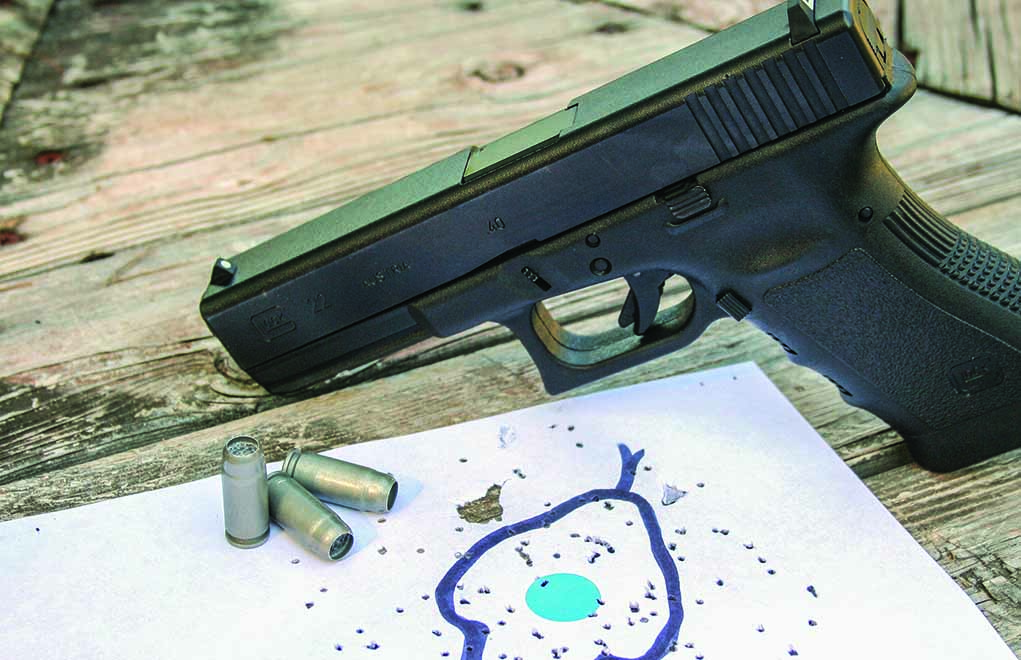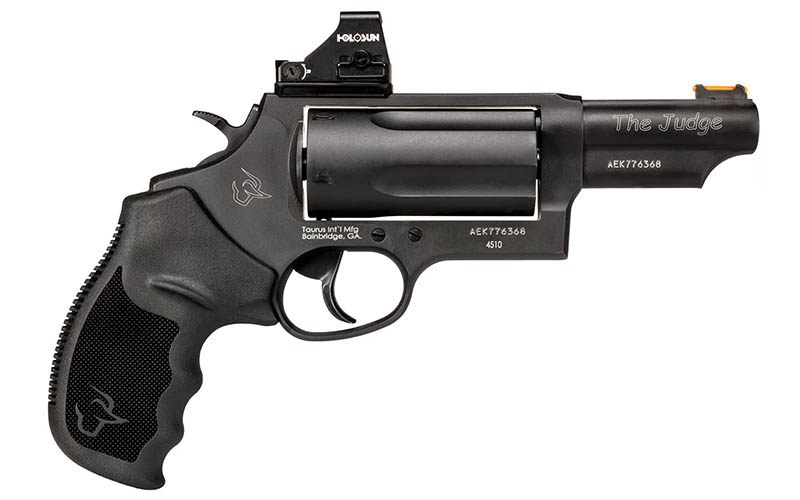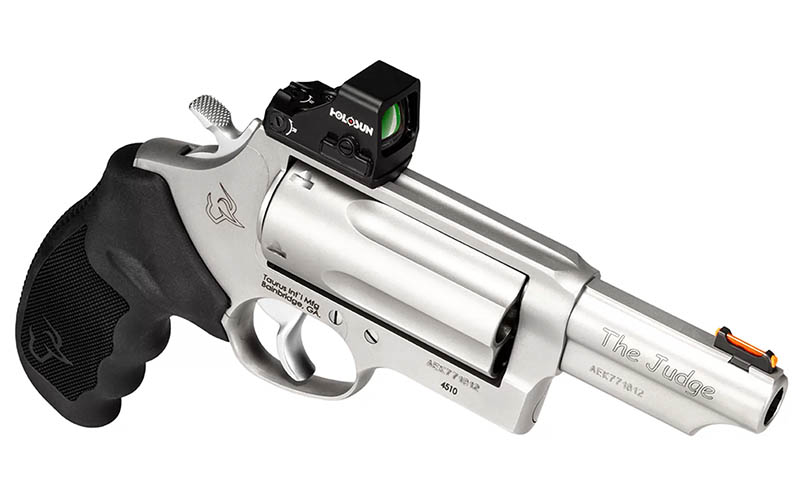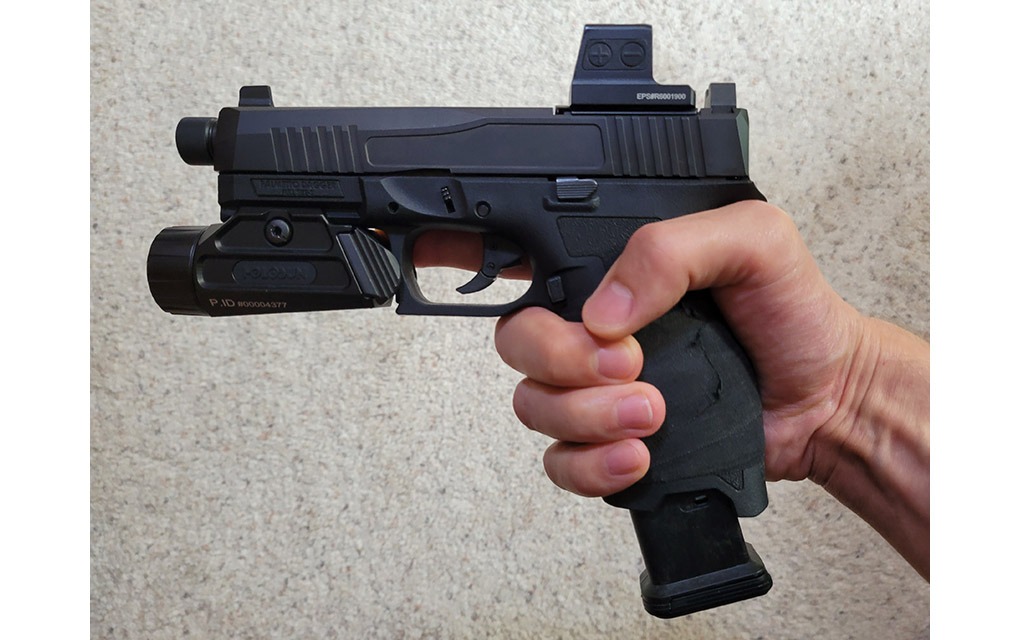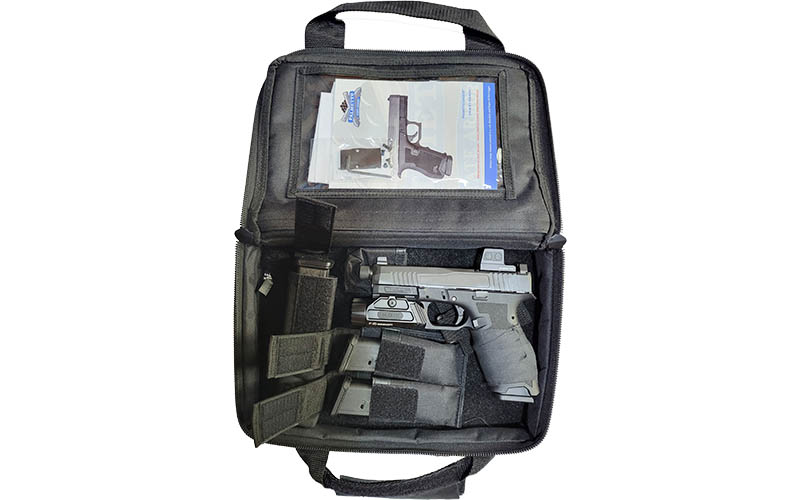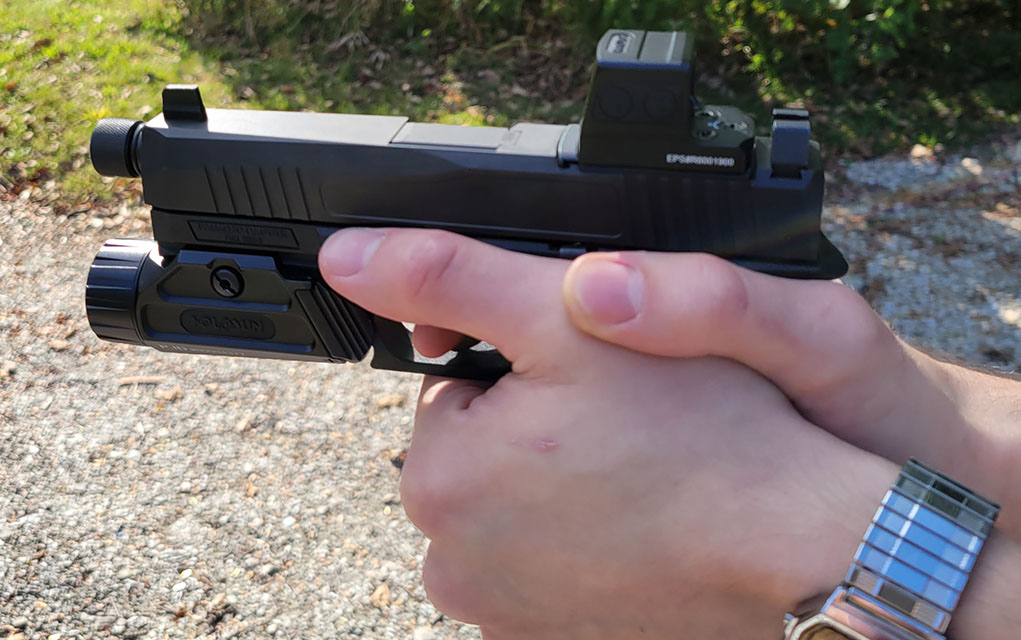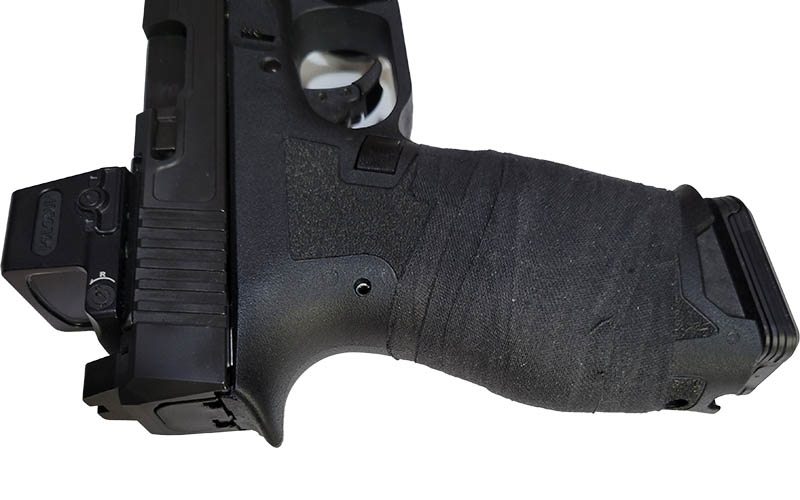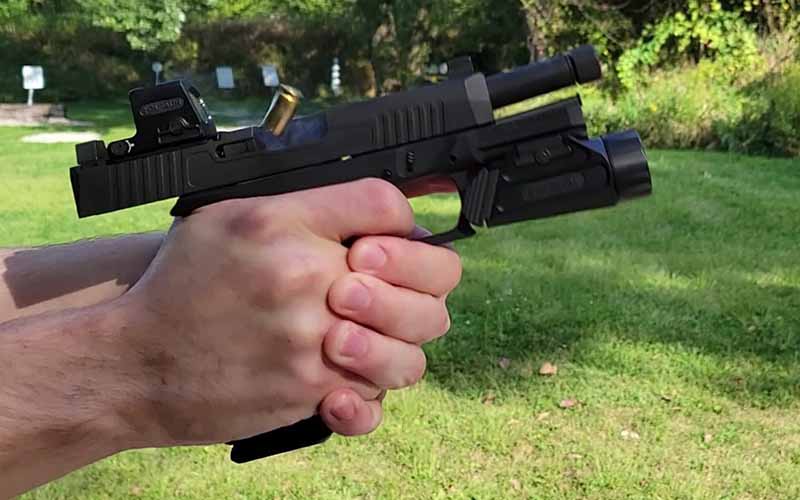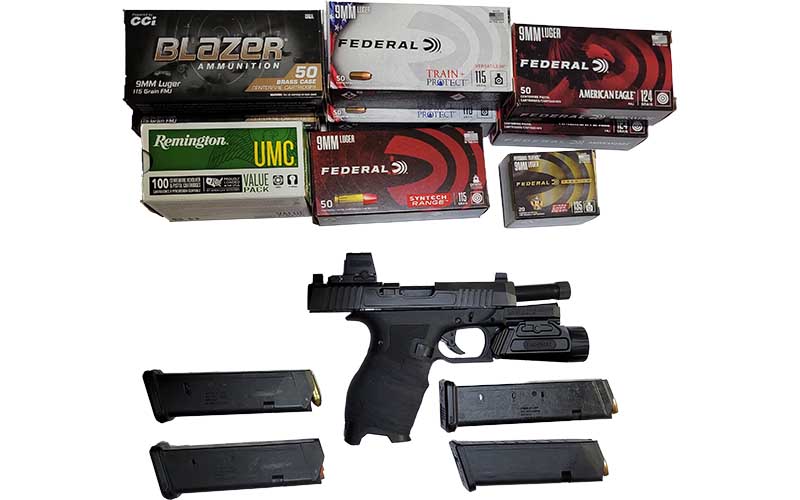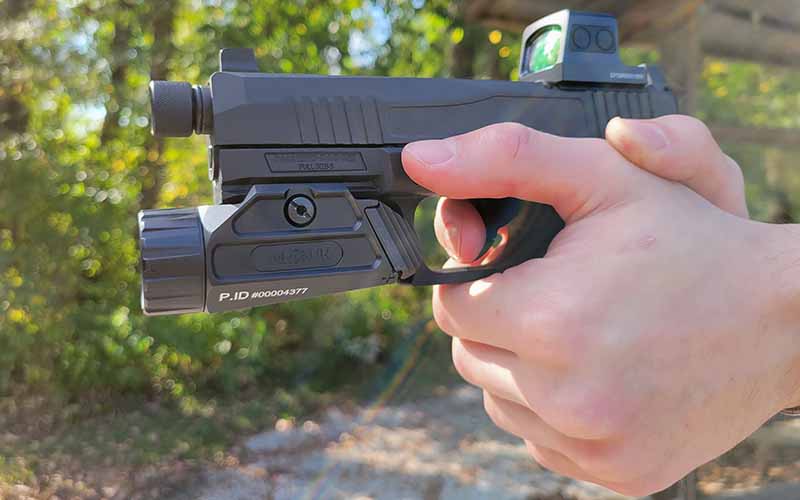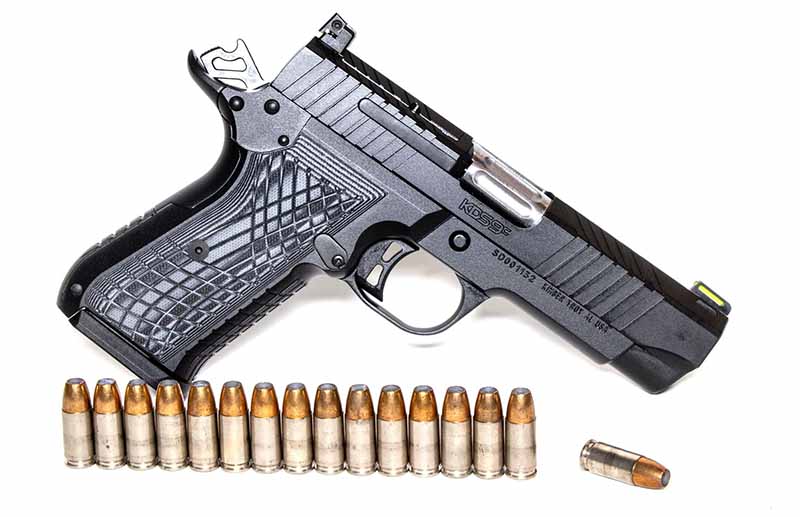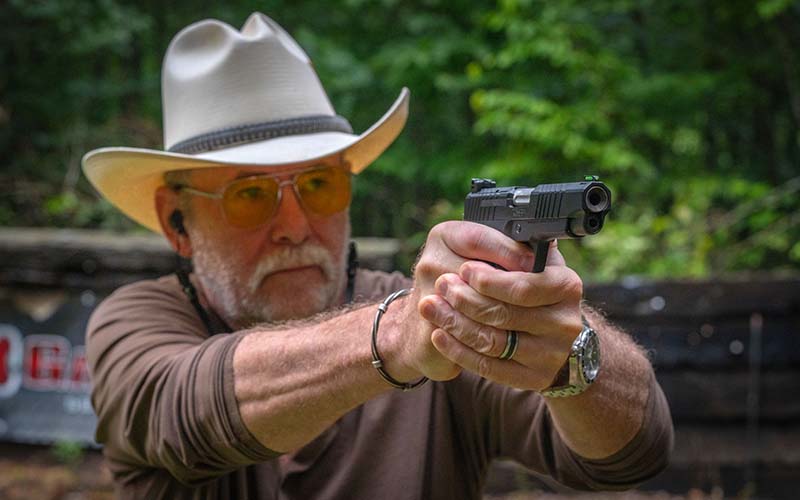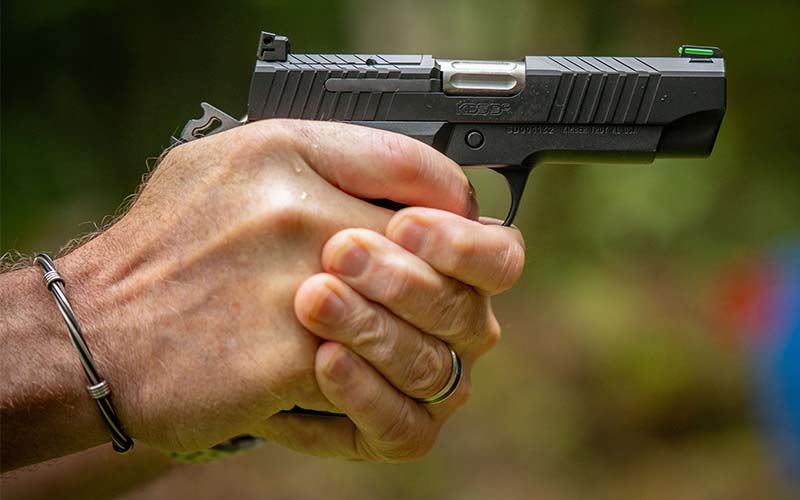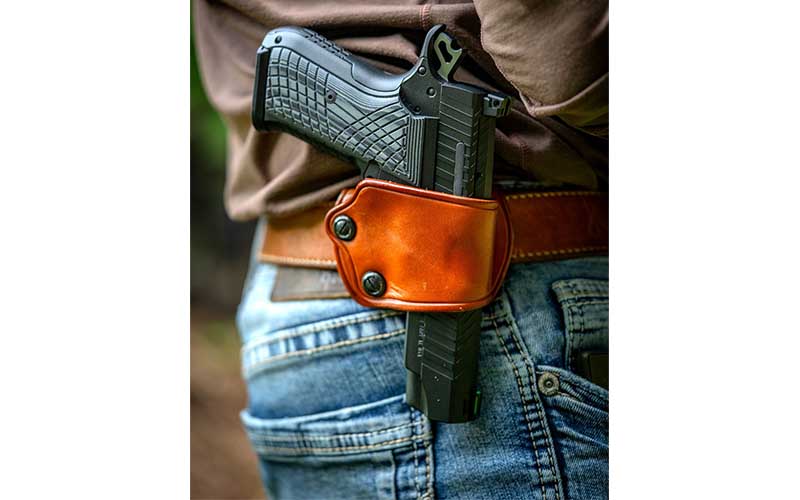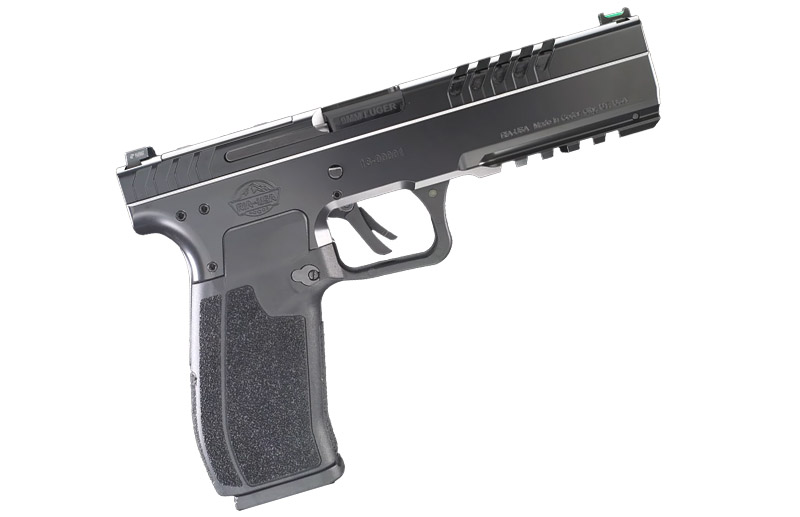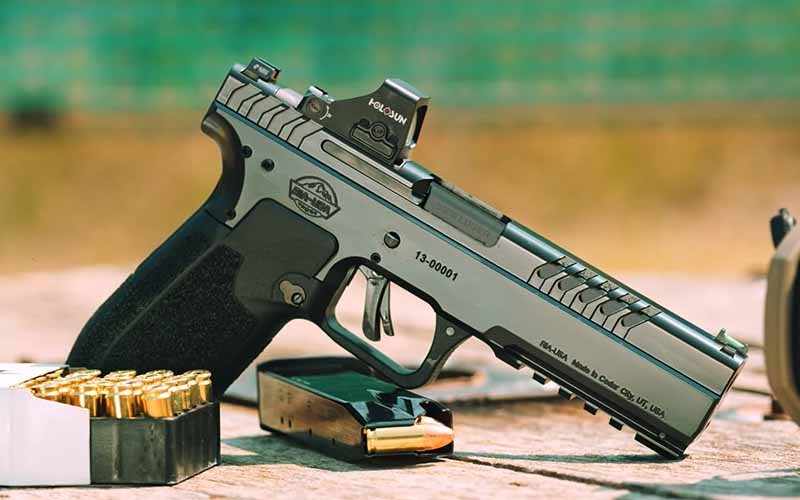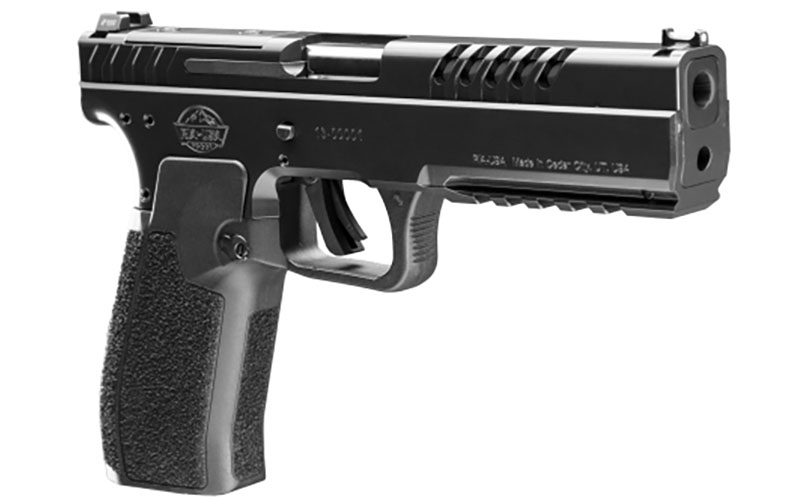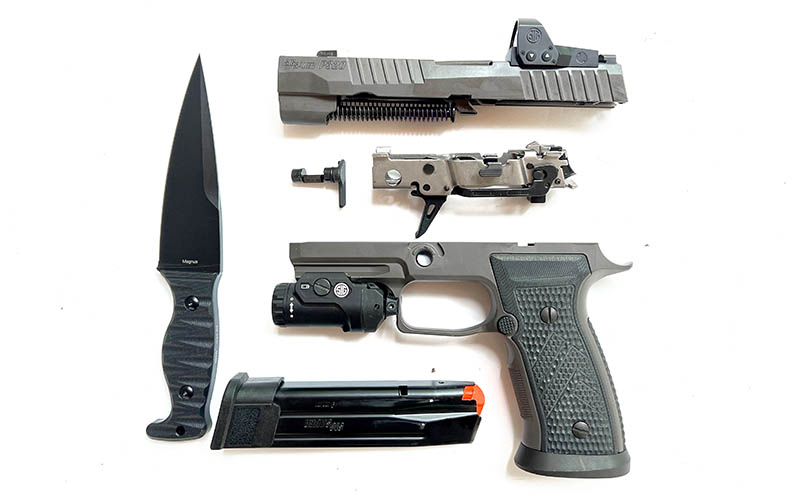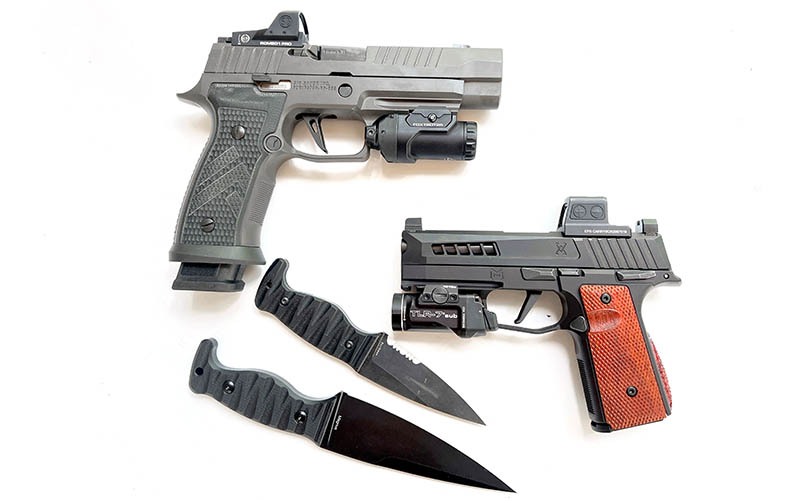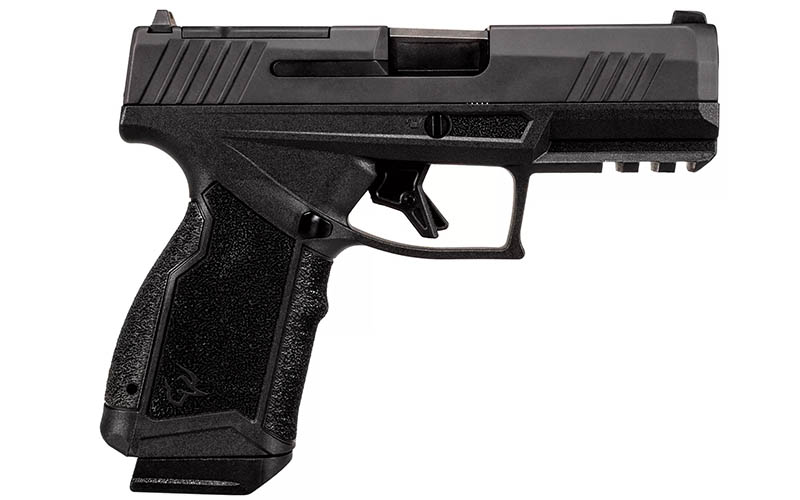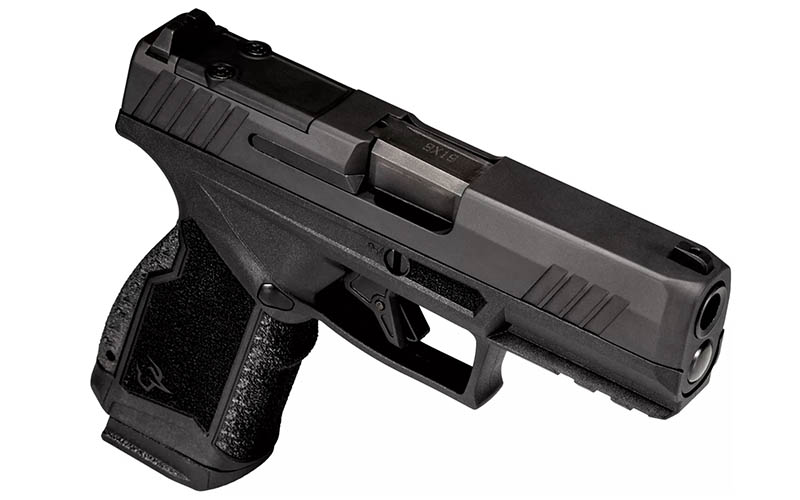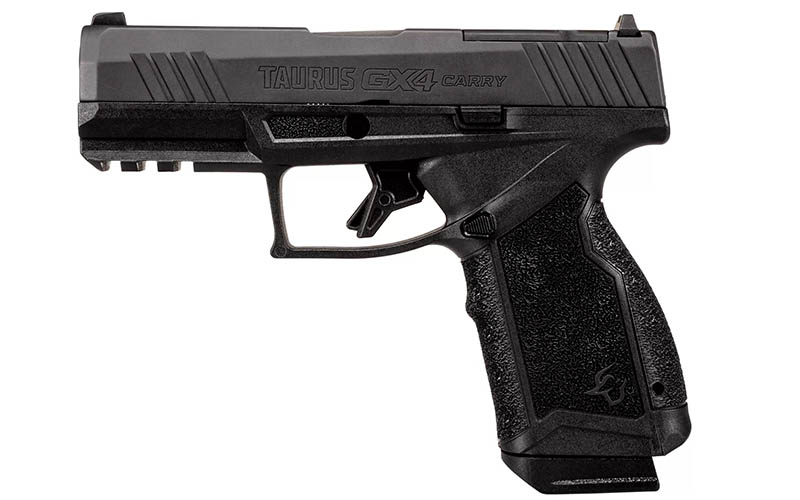
Taurus has just issued a safety notice regarding certain GX4 pistols. Those affected may not be drop-safe and are being recalled by the company.
A safety notice has just been issued by Taurus regarding the company’s GX4 pistol line. In it, they state that certain GX4s assembled and sold in the United States may not be drop-safe under certain conditions. Taurus has now launched a website where a GX4’s serial number may be entered to determine if it is one of the affected pistols. For those that are, Taurus will inspect, repair and return it for free.
If you own a GX4 pistol, Taurus is asking that you cease using it immediately until you determine whether it is safe or not. To do so, visit the following website to enter your serial number, or contact Taurus directly:
It is not currently known just how many GX4 pistols are not drop-safe or the exact reason why the issue occurred. This article will be updated if more information becomes available.
Will an AR foregrip or handstop improve your shooting performance? Do they offer any additional benefits? If so, which are the best models to get?
After optics, weapon lights and slings, accessories that increase support-hand control are some of the most common upgrades installed on America’s favorite rifle.
Some use them because they believe they improve their shooting, while others of course install them purely for customization’s sake, but what advantages do they truly offer?
Let’s go over what potential benefits an AR foregrip has to provide, how they’re used and finally the best foregrip and handstop models available right now.
Why Did Anyone Use Foregrips?
Historically, foregrips have been used to control full-auto fire in compact automatic weapons.
The bulk of that lineage comes from submachine guns, and the original Thompson is a classic example.
“Jerry” Campbell of the OKCPD firing a Thompson with a foregrip.
Later submachine guns would either have foregrips as a standard feature or were designed to be gripped by the magazine well, effectively functioning as a foregrip. That was a common design feature of SMGs starting around World War II, with examples including the German MP40, the M3 Grease Gun and the Soviet PPS-43 to name a few.
Foregrips were also somewhat common on light machine guns such as the Chauchat, Bren and Hotckiss M1922, and there's some evidence that vertical foregrips were occasionally attached to some BARs in the field.
Forward pistol grips wouldn't start to be featured on service rifles until much later, after intermediate-caliber select-fire rifles became the norm.
When Did AR Foregrips Come Into The Picture?
AR-15 foregrips in particular have been in use almost as long as the rifle itself. The earliest examples were jerry-rigged in the Vietnam War, usually an A1-pattern pistol grip bolted to the handguard of a CAR-15.
The CAR-15, of course, was developed to serve as an ersatz submachine gun as well as a short carbine, so the idea fits right into the classic use case for foregrips.
More official AR foregrip designs were later developed commercially to bolt directly to the holes of an A2-pattern handguard (again, being more common for the CAR-15) and–during the GWOT (Global War on Terrorism)—to quad-rail handguards of the modern M4 carbine and M16A4 rifle.
The first model to start hitting commercial production in any quantity was the VFG developed by Knight's Armament, often called the “broomstick” grip, and later the Grip Pod, a vertical grip with a spring-loaded bipod inside of it.
An M4 carbine being carried in Iraq, presumably equipped with a Knight's Armament broomstick grip. Photo: Wikipedia.
What's The Difference Between A Foregrip And A Handstop?
While both ostensibly provide extra stability and control, foregrips and handstops are different.
In the simplest terms, a foregrip is a handguard accessory that was designed to be fully grasped by a hand. The shooter can then use the grip as an extra point of contact for pulling the rifle back into the shoulder for the sake of stability.
Handstops, on the other hand, are a bit more varied in their form and how they are used. Depending on who you ask or the exact model in question, handstops are designed to assist in either pulling the rifle back into your shoulder or pushing it forward. The latter style is sometimes called a finger stop as well.
An Arisaka Defense Finger Stop.
When pulling back on a handstop, it works much in the same way as a foregrip. When pushing forward on it, the stop can also prevent the user’s fingers from getting too close to the muzzle. In either configuration, these accessories can be used as a barrier stop as well.
Something of a middle ground between the traditional broomstick and the angled grips/handstops is the stubby grip, which gives you a little of both. Shooters who use these tend to cup the grip and the handguard. This is preferred by some shooters who use the C-clamp grip or who use top-mounted tape switches.
Foregrips can be vertical—such as the classic broomstick—or can be angled, like that of the Thompson SMG or the Magpul AFG of today. Handstops are much lower profile in comparison.
An AR-15 being fired with an angled foregrip. Photo: Wikipedia.
The principle difference is that a foregrip changes how your support hand grips the gun, either in a vertical or an angled position, whereas a handstop tends to enhance a more traditional grasp of the rifle and provides a physical index of where to grip the handguard.
Do AR Foregrips Have Any Real Benefits?
On paper, foregrips and handstops should give a person additional leverage that allows for greater control of the rifle.
Some research indicates that grip strength decreases with wrist flexion, or in other words, you have less grip strength the more you bend your wrist.
In reality, it's not that simple.
For one, shotgunners have been using body mechanics to manage recoil without using foregrips for a very long time. Grip angle has long been a debate amongst pistol shooters as well, but it's hardly kept Shane Coley, Bob Vogel and others from winning national and world pistol titles shooting Glocks.
Probably the most conclusive findings regarding the efficacy of AR foregrips are from an article published by the Army Research Laboratory in 2015. The study had military and police personnel participate in different drills where their performance was measured, each course ran both with and without a foregrip attached to their M4.
Despite many participants claiming that they preferred the feel of using the foregrip, no discernable difference in performance was measured. Whether they were firing the CQB course or the long-range course, the use of a foregrip had no impact on accuracy, shot speed or recoil control.
These results are reinforced by the fact that top-level 3-gun and 2-gun shooters rarely employ vertical foregrips, often eschewing them for handstops or just grasping the handguard.
In other words, AR foregrips are a matter of the shooter's preference. Installing one probably won’t increase your shooting abilities, but it probably won’t hinder them either.
That said, just because a foregrip won’t make you a more accurate or faster shooter, it doesn’t mean they don’t have some additional benefits you can take advantage of. As previously mentioned, some foregrips and handstops can also be used as barrier stops, and a vertical foregrip can be used as a monopod in some instances as well.
The shooter in this image is using his vertical foregrip as a barrier stop. Photo: Wikipedia.
Another aspect to consider is that a vertical grip gets the hand away from the handguard, which can get hot enough to cause minor burns with a heavy enough firing schedule or in the right environment.
So, should you put a foregrip on your AR? It’s completely up to you. There are essentially no downsides besides the added bulk, and they do have some benefits even if they won’t necessarily improve your shooting performance. If you prefer the feel of one over a bare handguard, then by gosh, use one. Just keep in mind that if you choose to, you will still be able to run your rifle just as well without it.
The 7 Best AR Foregrips
Magpul AFG
The Magpul Angled Forward Grip or AFG is one of the most common angled foregrips on the market. Made of durable molded polymer, it features fore and rear ridges to give your hand a little forward boundary, which some prefer in an angled grip.
There are three models available of varying sizes, two for 1913 Picatinny rails and one for M-LOK. Each is available in four different colors as well. MSRP: $26.95-$34.95 // magpul.com
Arisaka Defense Finger Stop
Arisaka Defense’s Finger Stop is offered in Picatinny, M-LOK and KeyMod variants, and the company has a few other styles available as well such as the Indexer. It's machined from aluminum and it can be used as either a finger stop (between the fingers of the support hand), a rear handstop or as a barricade stop. MSRP: $28 // arisakadefense.com
Bravo Company KAG
The Kinetic Angled Grip or KAG has long been a staple model of angled handstops. Between their durability and cost, it’s easy to see why.
The KAG has a vertical side and a curved side, and both are textured for additional grip. They are available for Pic rail, KeyMod and M-LOK handguards and are offered in several colors. It’s a good middle-ground size and its shape allows it to be used in a number of different ways, making it a versatile option. MSRP: $21 // bravocompanyusa.com
Knight's Armament Forward Pistol Grip
If you’re trying to clone a military AR, why not get the original M4 foregrip? It’s made of durable, injection-molded high-impact polymer and features a storage compartment that will fit an AA battery or two for your optic. The only potential downside is that these are only compatible with Picatinny rails, but at least quad-rail handguards look cool as hell.
They're available in black, OD green, and two shades (light and dark) of tan. However, it is Knight's Armament, so they don't come cheap. MSRP: Starts at $80 // knightarmco.com
NC Star Vertical Grip
For those who are more budget-minded, NC Star makes a decent clone of the Knight’s Armament Forward Pistol Grip that’s about eight times cheaper. Enough said. MSRP: Less than $10 // ncstar.com
Strike Industries AR-15 Bikini Handstop
Strike Industries' Bikini Handstop is a two-pack of minimalist handstops, retailing for around $10. You can install one for a single low-profile polymer handstop, or both to keep the support hand in position. Low-cost, easy to install on any MLOK rail, and it works whether you use a pull or push technique with the rifle. MSRP: $12.95 // strikeindustries.com
Bravo Company BCM Vertical Grip Mod 3
The BCM Gunfighter VCG has a slight curve on one side, allowing the user to have the front surface straight or curved, depending on preference.
BCM offers models that are compatible with either Picatinny, M-LOK or KeyMod and they are available in either black or FDE. A more expensive version with a storage compartment is sold as well. The stubby nature of this model makes it a solid, versatile choice since it can be utilized in more than one way. MSRP: $21 // bravocompanyusa.com
A look back at the venerable M1 Garand, America's storied and stalwart service rifle.
When it comes to guns, there’s certainly fashion that comes and goes. This year, it might be 10mm making a big comeback, or perhaps the 1911 having a slew of new designs hitting the market, making it “relevant” again.
But with that said, the M1 Garand hasn’t been victim to fashion. In fact, it’s one of those rifles that’s always in good taste, no matter where or when it appears. However, things have changed in the M1 world … and not necessarily for the better.
Dried-Up Surplus Stockpiles
Unfortunately for us, we’re in something of the twilight years of the surplus market. When I was a teenager, you could buy most surplus guns for less than $500, sometimes as low as just $50. Granted, that was a lot of money for a kid working fast food, but everything was so plentiful then that it seemed like it would never end.
It’s a fair assessment to say that the vast majority of the surplus market is completely dead these days. Various post-World War II Mauser rifles that sold for $150 are going for upward of $800 today, well outside the range of hobbyists—and frankly outside the interest range for competition shooters and collectors. Guns that once were plentiful are now so heavily picked over that finding a good, pristine example can cost you upward of $1,500 or more … for a Mosin Nagant! The Finnish examples today are commanding a heavy premium, to the point they’re almost impossible to justify for the regular collector. The M1 has limped along for the entirety of this chaos, but it, too, is slowly drying up.
Remarkably, M1 prices have held out considerably well against the fluctuations in the market. Today, they’re still around $1,000, a price they’ve maintained for nearly 15 years. I never believed I’d see a day where something as common as a Mauser or Enfield would sell for more than an M1, but I’ve apparently reached that point in life.
Rear sights on the M1 are very intuitive and easy to use. They’re rugged, but you’ll need to check function before buying.
The nature of the M1 sets it apart from the rest. The gun was manufactured in America by Americans, and it’s largely supported by the aftermarket. It’s likely there are more of them around than the rest combined, but there’s really no way to know for sure. What is known is that a point is coming in the near future where prices for base-level, rebuilt M1 rifles will jump. In other words, get your M1 while you can: The gettin’ is good right now.
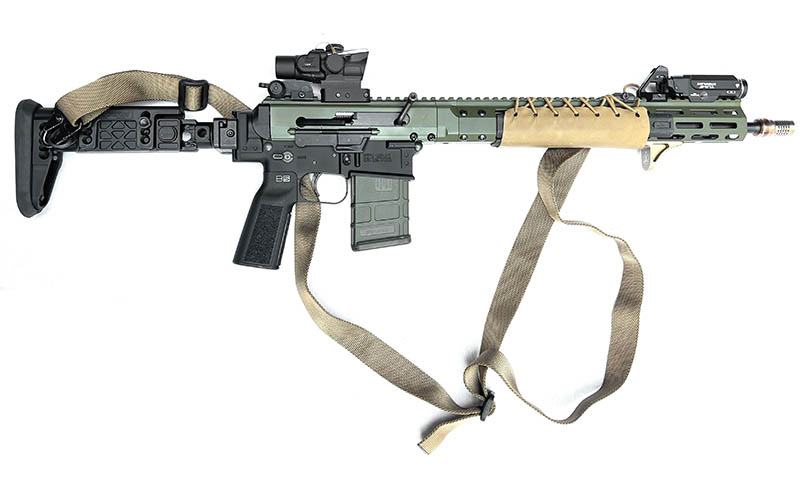
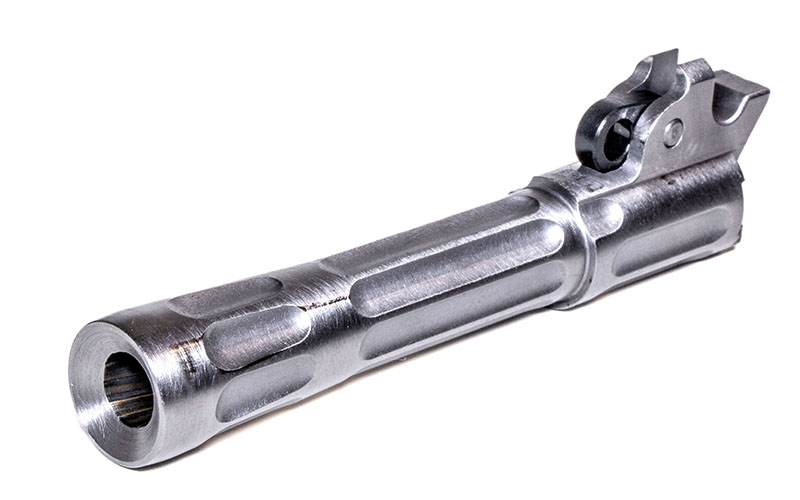
It could be argued that the M1 is still the most popular vintage rifle available today. The largest reason for this is that there’s a substantial amount of cultural knowledge surrounding it, and it’s still relevant from a defense and hunting standpoint. Young men and women are training as armorers on these guns—the same cannot be said for most other surplus rifles. It’s entirely possible to build a “new” M1 today; many companies make their own parts, stocks, barrels and more. The prevalence of the M1 in this country has made it so that the design will continue to be used well into the future, though that doesn’t mean it’s going to be that way forever.
Collecting The M1 Today
It’s a reality of the surplus market that things just aren’t what they used to be. The rifle featured in this article was bought from a local gun store that had it on consignment. The previous owner was aged out of competing and no longer cared about owning those guns. He mentioned in passing that he didn’t have family who went shooting, and it was best to sell. This rifle is a standard of what you’ll see for gun show rifles and those that you may be able to purchase from another shooter at a CMP event.
While it may seem like a backward approach, plenty of collectors shoot in these competitions, and, depending on where you’re at, a match is usually held every month. If you want a direct line to many opportunities for surplus rifles, simply attend one of these matches and pass out your information to the competitors. The thing about doing this is that it places you in a network of like-minded people. Don’t be surprised when one of your CMP buddies calls you and says there’s a gun you’re looking for at an area store.
The Garand action open: The internals look complicated, but they’re honesty not hard to understand. There are moving parts in here, but luckily all are easily replaced if you bought a rifle with worn-out internals. Don’t be alarmed, some movement is normal.
The nature of finding a good M1 these days isn’t a scavenger hunt, but it’s also not as simple as just walking into a store and ordering it. These rifles are quite old and are individuals at this point. Most of them have experienced various degrees of wear and tear over time, and you’ll need to have a careful eye about what you’re looking at. There are very few people out there in the world who have a full, complete matching M1 rifle. If a person is advertising a fully matched gun for less than $2,000, you’re being taken for a ride. What’s more, there’s probably less than a handful of guns in the country that are in original, un-issued condition.
At the very least, what you’re looking for is the receiver of the rifle: The rest of the gun can be stripped down and rebuilt quite easily. A desirable receiver is 90 percent of the sale price on a finished gun, and WWII receivers are universally more valuable than postwar examples—though prewar rifles are the most valuable.
The lion’s share of M1s, numbering in the millions, were all completely stripped down and refurbished over the years. It has become a game among collectors to swap parts not just by manufacturer, but also by month of manufacture. However, there’s no real way to know if the barrel and receiver were made at the same time of day, or simply at the beginning and end of the month. That’s about as fine as it gets as far as detail. A date-matched rifle usually picks up $500 to $1,000 in value.
Stocks and small parts aren’t necessarily a good way to look at the value of a rifle, or even into a rifle’s general condition: Great actions are sometimes dressed in mediocre wood and vice versa. Most stocks at this point are going to need to be replaced if you want to shoot in competition. New, clean wood is preferable. But, beware of any M1 at a gun show that looks too good; Birchwood Casey stock finish is cheap … and so is sandpaper.
Also, look at the condition of the action itself. One of my good friends, who worked as an armorer for decades, suggested that the average M1 will go through at least two stocks in its lifetime. Many of the wooden parts on the gun are actually quite thin and easily crack, so few are original to the receiver. Replacing the stock on an M1 is an easy venture, and it can be done largely without tools. Cartouches and stamps on stocks should not be considered a reliable method of dating the rifle, either. Not only are they easily mismatched, but they’re also easily faked.
Currently, many companies make modern parts. For instance, Boyds makes a replacement stock you can sand and finish at your whim, and laminate stocks are also a more durable option. Barrels are available from companies like Criterion, as well as custom manufacturers that appeal to the match shooting crowd. Specialty gun builders, such as Fulton Armory, can build an entire match-quality M1 off of your receiver. What’s better is that they offer multiple packages for your receiver, including options to turn it into a slightly more modern rifle, as well as tuning it specially for the CMP games.
The M1 is a large gun, but not ungainly. Despite the fact that it’s bulkier than a 1903 or Mauser, it’s quite slender in most places. As you can see here, it’s only just wider than the ammo clip.
The CMP itself also sells M1s. If you were interested in a road trip, you can simply drive to Camp Perry and leave with an M1. The CMP has sold these rifles for quite some time, although today they’re somewhat picked over. Around 10 years ago, you could find some absolutely pristine examples. Today, most of them look a little bit sorry but can be had for under $1,000. Most of these guns are in mix-and-match but fireable condition, and it will be of service in match shooting, but not necessarily collecting.
Shooting The M1
So, what should you be looking for as far as performance goes with the M1? The rifle, as it’s issued with iron sights, should be able to produce 10 shot groups of 3 inches slung up. If you’re shooting off the bench, cut that number in half. Yes: They’re that accurate. I have an 1896 Swedish Mauser that prints 1.5 inches at 100 yards dating to 1900, and another from 1914 that does 2 inches with the same loads. Most M1903, M1917 and M1 Garand rifles I’ve fired and owned are 3 MOA rifles … or better.
Front sights are mounted to the gas block assembly. The sights are easily removed with a simple wrench and can be replaced with different versions. Here’s a National Match (NM) marked front sight that has been used to replace the GI version.
In addition, you’ll need to pay close attention to barrel wear. M1s with original barrels can be rough; if you plan to buy them to shoot, you need to invest in erosion gauges. These gauges measure the physical wear at the throat and muzzle, and you can simply pop them in at a gun show—it takes just a second. You want a gun that runs out at “0,” meaning no real wear. Sometimes, you’ll see a person say, “it’s a 1 at the muzzle and a 2 in the throat.” This means that the throat has a minor amount of wear, but the muzzle is still tight. If you go up past a “3” in wear on either end of the barrel, you’ll probably want to offer a lower dollar amount due to needing a barrel replacement. I’d consider any gun that needs a replacement to be a minimum $200 expense: Take that into consideration as you look to buy.
You’ll also want to check the mechanical properties of the rear sight. You can do this by simply resting your thumb on the peep sight and applying slight pressure against it. Each movement of the windage and elevation drums should be crisp; there should be no slippage under slight pressure. These parts can be replaced, so if they’re damaged and are on a valuable receiver, it might be worth it anyway just to go ahead and buy.
The moving metal rod under the barrel is actually the gas piston. It extends from the charging handle to the muzzle.
If you’re trying to shoot CMP or other service rifles, you’ll need to check the rules on bedding the stock. Bedding an M1 can really help accuracy; however, as-issued matches won’t allow it, but open division usually does. You can sneak past these rules a bit in as-issued matches by buying an oversized stock. You will have to finish the inlet and exterior yourself, but you can essentially fit it exactly to your gun and achieve similar results to glass bedding.
Ammo And Loads For The Garand
As of this writing, several companies make M1 Garand-specific loads. You need to keep the pressure down when shooting these guns—modern .30-06 is too powerful for it in as-issued form. You can get an adjustable gas block to account for modern ammo, but there’s no need to put so much wear and tear on an old warhorse.
Hornady makes an excellent M1 match load (product number 81171), featuring the 168-grain ELD match bullet. This is an excellent target load and has produced some of the best scores at Camp Perry. I truly enjoy what Hornady did with this; it really is the best M1 ammo available for shooting scores.
The M1 loads from 8-round en-bloc clips that eject along with the last fired round. They make the famous ping! noise every time.
Federal makes an excellent 150-grain FMJ load for the M1 under the American Eagle brand. I have shot this ammo often in the past but haven’t been able to find it for some time. As of this writing, it was listed simply as “unavailable” on the Federal site, but I’m hoping to get some more in the near future if the ammo market ever cools down enough for companies to make anything other than 9mm and 5.56 NATO.
Sellier & Bellot has a great M2 ball load that’s safe in the M1 rifle. The load isn’t as popular, but it’s at least in stock and readily available … and it has proven to be very accurate in some rifles. I’ve noticed it’s a bit pickier and has a bit more thump to it as opposed to the Hornady or Federal, both of which are mild in the M1.
Also, Winchester announced a new M2 ball load at SHOT Show 2023. I’m excited there are companies making strides to come out with ammo support of the M1, even when things are so volatile in the industry.
Editor's Note: This article originally appeared in the March 2023 issue of Gun Digest the Magazine.
Antimatter Industries has just announced the Scopeswitch, an interesting new accessory that allows you to adjust your scope’s zoom via a slider on the handguard.
In an industry where innovation is typically incremental and often predictable, creative ideas are always appreciated. The most recent of these is from Antimatter Industries and the system is called the Scopeswitch.
In a nutshell, the Scopeswitch is an accessory that allows its user to adjust their scope’s magnification level without ever taking their support hand off the handguard. It does this through a combination of an optics mount, a rail-mounted handguard slider and a cable system. When installed and configured, the Scopeswitch links an optic’s zoom control to the slider on the handguard, enabling the user to adjust magnification simply by moving the slider forward or back with their support hand. Antimatter Industries notes that this system works best with scopes that have easy-to-twist zooms.
The optic mount portion of the Scopeswitch is made out of 7075 T6 aircraft-grade aluminum and 4140 nitrided steel lugs, and the optical centerline height is 1.93 inches. The entire unit adds about 10 ounces of weight to a rifle setup. Antimatter Industries claims that the Scopeswitch is compatible with a wide variety of LPVO scopes and should work with any rifle that has at least 10.5 inches of barrel length and 11.5 inches of Picatinny rail space. The company also says that the accessory is fully ambidextrous, can have the direction of its slider reversed and will work equally well with FFP and SFP scopes. The company also warns, however, that it is difficult to install and may require the help of a gunsmith.
Antimatter Industries says that the primary advantage of the Scopeswitch is that it allows users to retain their standard C-clamp shooting grip while operating it. Because it only requires moving one’s support hand, it enables rapid magnification adjustment without ever losing a sight picture, making it possible to even shoot while zooming in or out. It’s a novel concept, and it will be interesting to see how it catches on in competition shooting, hunting and tactical shooting circles. The Scopeswitch is initially only available with a 30mm mount, but 34mm mounts will be available soon as well. MSRP starts at $599 and you can currently sign up to be notified once they come in stock.
Fulton Armory has recently announced the Black Hawk DMR, a custom M14 inspired by the weapon used by Randy Shughart in Mogadishu.
Fulton Armory is known for its match-grade builds of American service rifles, and the company’s newest addition to its catalog is particularly exciting. Fulton already had quite the spread of various M14 and M1A rifles for sale, but now the M14 Black Hawk DMR is available as well. The rifle is inspired by the weapon carried by U.S. Army Delta Force soldier Randy Shughart of Black Hawk Down fame, who died fighting in Mogadishu in 1993. Fulton Armory says that the rifle “brings together cutting-edge technology, unrivaled accuracy, and a tribute to one of the nation’s heroes.”
The Black Hawk DMR is built on a Fulton Armory M14-marked receiver that meets all USGI heat treat and material specifications. The receiver also features a Fulton Armory DMR Picatinny scope mount that comes professionally fitted and installed. The rifle comes standard with a 22-inch National Match Quality barrel that is chrome-lined, has a GI contour and a 1:10 twist, but when ordering, four other barrel options are available as well.
As for the smaller parts on the Black Hawk DMR, it uses a mix of GI and true Mil-Spec parts throughout, though all were selected and fitted by hand. Some of these parts, such as the polished gas piston and modified trigger, are National Match upgrades. The rifle also features a National Match flash suppressor (with a bayonet lug), a black fiberglass stock/handguard and a Kydex adjustable cheek piece.
The Fulton Armory M14 Black Hawk DMR otherwise comes with one 10-round mag, a sling, an owner’s manual and an accuracy guarantee of 1.5 MOA or better when using Federal Gold Match ammo. The base price is $3,739.95 and it’s available now.
If you’re interested in owning a Kalashnikov but would prefer it chambered for something a bit more Western, here are the best 5.56 AK rifles you can buy.
The shooting world has experienced a bit of an impasse lately when it comes to Kalashnikovs. While the rifle platform itself has grown more popular than ever in the U.S. over the past few years, its flagship caliber—7.62×39—has been drying up. AKs were once a popular choice in this country explicitly because of the low cost and high availability of their ammunition, but that is unfortunately no longer true.
At the time of writing, the cheapest 7.62×39 ammo is almost 2 cents per round more expensive than the cheapest 5.56 ammo, and almost 5 cents per round more than the cheapest .223 Remington (source: AmmoSeek). This is primarily the result of the Russian ammo ban which cut off the import of brands like Tulammo, leaving existing stock in the States to dwindle. Until a high volume of 7.62×39 can be produced domestically and affordably, most American shooters will likely be better off sticking to more conventional Western calibers.
Because 7.62×39 is now more expensive and less available than 5.56 NATO or .223 Rem., the only real reasons for a first-time AK buyer to still choose a 7.62 rifle would be if they prefer its ballistic properties or because of their desire for originality. So, for a practical range rifle in 2023, it now seems that a 5.56 AK will be the most logical choice for a prospective new Kalashnikov owner. This goes double for anyone who already owns a 5.56 AR-15. If that sounds like you, here we’ll be going over some history, things to be aware of and finally our picks for the best 5.56 AK rifles you can buy.
Brief History Of Military 5.56 AKs
When people refer to AKs as being the most prolific rifle in the world, they’re specifically referring to those chambered for 7.62x39mm. These have been used in nearly every significant world conflict since their inception. Whether produced in Soviet Russia itself, China or one of the several other nations to make them, they reached every corner of the globe and all variants shared the same ammunition and magazines regardless of any minor changes made to the rifles themselves.
While 5.45x39mm, the cartridge of the AK-74, never became nearly as popular as 7.62×39, it has still seen significant use. Its users primarily include or included Russia and ex-Soviet or ex-Warsaw Pact states, but others adopted it as well.
Compared to these, AKs chambered for 5.56x45mm NATO have seen only a fraction of the use. If you consider the Galil and its derivatives as members of the AK family, they are the most prolific. Of the more AKM-based rifles, however, not many got their feet off the ground.
East Germany started experimenting with the concept in the early 1980s with the Wieger StG-940, then Czechoslovakia followed suit shortly after with the LADA and ČZ 2000 designs. In the 90s, Russia developed the AK-101 and AK-102 for export, Serbia developed and adopted the Zastava M21 and Poland developed and adopted the FB Radom Beryl and Mini-Beryl. Of these, the Beryl has likely seen the most real-world use given Poland’s involvement in the wars in Iraq and Afghanistan. The Beryl is therefore the 5.56 AK that can be best described as “NATO’s Kalashnikov.”
5.56 AK Rifles: What’s In The U.S.?
In the long and convoluted history of AKs imported into the United States, there were a decent amount chambered for 5.56×45. Not nearly as many as 7.62×39, of course, but enough that we don’t have the space to discuss all of them here.
Instead, the purpose of this buyer’s guide is to help you choose a 5.56 AK model that is new-production and readily available. The older imports are now generally considered to be collectibles, and if you manage to find one for sale on the secondhand market, expect to pay an arm and a leg. These include models such as the Valmet M71/S from Finland, the Norinco Type 84S from China and even some Saiga and Vepr rifles from Russia just to name a few.
Most of these older imports are great, but always do your own research on quality, condition and appraisal before buying one. For those interested in a 5.56 AK as a shooter, however, one of the several available new-production models will serve them best.
Note On 5.56 AK Mags
There’s really only one area where 5.56 AKs have a distinct downside when compared to 7.62×39 or even 5.45×39 models, and that is magazine compatibility.
As alluded to in the history portion of this article, unlike the AK’s two more prolific calibers, there was never a standard spec established for 5.56 AK derivatives. Because almost every country that made one was independently experimenting with its own designs, it resulted in a wider variety of patterns and less compatibility between them.
As 5.56 AKs have grown in popularity in recent years, magazines have become more available as well and finding some that will work in your rifle is now less of a challenge. That said, whichever model you select, you will still need to do your own research to ensure magazine compatibility.
A surplus bakelite 5.45×39 AK-74 magazine and a Pod Arms 5.56 conversion follower. These typically need to be loaded with a few less than 30 rounds to ensure reliability, but it's a nice option to have for style points.
Looking at magazines manufactured by the same factory as your rifle is the best place to start, but there are good aftermarket options as well even if they sometimes require minor fitting. Also, thanks to the recent introduction of the Pod Arms 5.56 AK follower, you even have the option of using surplus AK-74 mags.
The 5 Best 5.56 AK Rifles:
WBP Jack 556SR
The WBP Jack 556SR is probably the best general-purpose, all-around 5.56 AK option on this list. WBP AKs from Poland are one of the relatively newer makes to be imported into the U.S., but so far, their reputation has been very good. The Jack 556SR is the company’s most basic 5.56×45 model and its general form is that of a plain-Jane AKM. It’s also one of the more affordable models currently available.
These come with nice Polish laminated wood furniture, an enhanced magazine release and an enhanced safety selector. They also feature a side-scope rail, a threaded muzzle (14×1 LH, slant brake included) and an intact bayonet lug. The only minor downside to these is that their barrels are nitrided rather than chrome-lined, but people tend to make a bigger deal out of that than it really is.
Also from Poland, one could describe the FB Radom Beryl as the most premium option on this list. Not only do they have an excellent reputation for quality, but this is also the only 5.56 AK with any significant historical provenance. While the others here are fine shooters, none have the military history of the FB Beryl.
Many have purchased these to be both collectibles and shooters, and some have even bought two or more so they can fill both roles. Whichever appeals to you more, it doesn’t matter, this is likely the best 5.56 AK currently available in the States.
Based on the Polish service rifle, these have a few features that deviate from typical AK-based rifles such as their furniture and optics-mounting system. They still share compatibility with a lot of generic AK accessories, but be aware that it’s not 100 percent. These have chrome-lined 18-inch barrels, and they can be ordered with either a 1/2×28 or 14×1 LH threaded muzzle. The extra barrel length also helps to provide 5.56×45 with a bit more velocity. This model doesn’t have a side-scope rail, but optics can still be installed via other methods such as the proprietary Beryl system.
Introduced in 2021, the ZPAP M90 has become a popular 5.56 AK option as well, but they have some distinct pros and cons.
Firstly, while they’re arguably more durable due to their 1.5mm-thick receivers and bulged front trunnions, they are also noticeably heavier. This is compounded by the fact that it sports an 18.25-inch barrel (chrome-lined and threaded 14×1 LH), but that provides more velocity to the projectile as well.
Notably, these also feature an adjustable gas block and a side-scope rail, and they ship with an enhanced safety lever, a Magpul Zhukov folding stock, an MOE grip and a Hogue rubber handguard. Note that this is still a Yugo-pattern AK, however, so any replacement furniture will need to be as well.
This option is for the prospective purchaser who already has an AR-15 and doesn’t want to deal with buying new AK mags. This is because the unique advantage of the PSA AK-556 is its AR magwell adaptor that allows it to use AR-15 magazines, and it even has a bolt release. PMAGs are recommended for the best function, but some others can work as well.
Besides this standout feature, the rifle also has a bulged front trunnion, a side-scope rail and a 16-inch barrel. The barrel is nitrided, threaded 1/2×28 and ships with a muzzle brake. The standard version comes with generic polymer furniture, but PSA also offers more tactical models with railed handguards and folding stocks.
To get this out of the way, personally, I find that AKs from Arsenal of Bulgaria are overhyped and overpriced. They’re good rifles at their core, but click around online long enough and you’ll see they’ve experienced more issues than their reputation would suggest. That said, the SAM5 is on this list because it’s the only milled receiver 5.56 option available. For those who are dead set on having a milled rifle that’s both heavier and more durable than it probably needs to be, this is the one for you. The overall weight of nearly 10 pounds should make recoil nonexistent, however.
The 16.3-inch barrel is chrome-lined and threaded 14×1 LH and they ship with an AK-351 muzzle brake. If the weight and price don’t dissuade you, the SAM5 can still serve you very well.
Riton Optics has just announced the 5 TACTIX 1-10×24 Riflescope, a new versatile FFP LPVO.
Riton Optics has been busy expanding its catalog lately, and the most recent addition is the 5 TACTIX 1-10×24 Riflescope. It’s a first focal plane low-power variable optic (LPVO) with an illuminated MRAD reticle.
While many LPVOs on the market don’t have a 30mm main tube, the 5 TACTIX 1-10×24 does. The advantage here is that it should make it much easier to find compatible mounts. The tradeoff is its 24mm objective lens, but Riton also describes the scope as having a fast-focus eyepiece. The 6061-T6 aluminum tube has also been dry nitrogen purged and features Riton HD glass with 99.5% light transmission and a Riton Performance Coating.
The 30T reticle is a red illuminated MRAD Christmas tree reticle with 6 levels of brightness adjustment. The windage and elevation turrets are capped and zero-resettable and feature audible, 1/10 MRAD adjustments. As for durability, the 5 TACTIX 1-10×24 is rated as being 100-percent waterproof, fog proof and shockproof, and for the latter, it was tested up to 1200 Gs. For adjusting the magnification between 1X and 10X, the scope comes with two different heights of throw levers: 14mm and flush mount, but Riton also has 11mm and 8mm levers available.
Jerimiah Alexander, Director of Product at Riton Optics, said this about the new scope:
The 5 TACTIX LVPO has been a long time coming and we are thrilled it is finally here … We have spent a lot of time, research, and development creating a riflescope that would excel in any environment and exceed expectations.
Each 5 TACTIX 1-10×24 comes with flip-up lens caps, an Allen key, a lens cloth and Riton’s limited lifetime warranty. MSRP is $959.99 and it’s available now.
From powder dispensers to case prep to calipers, should you be using “digital” reloading tools?
Ol’ Grumpy Pants came over to the shop with a bag full of spent .22-250 Remington brass, intending to load ammunition. Dad, who taught me how to reload decades ago, just looked over his nose as I warmed up the RCBS ChargeMaster Link, while using the Universal Case Prep Station to trim the cases to the proper length.
Turning off the loud rotary trimmer, I checked the case dimensions with my Mitutoyo digital caliper and used my phone to have the electronic dispenser throw the proper amount of Hodgdon’s H380 powder. Feeling that familiar stare on the back of my head, I stopped to ask him just what he was gawking at.
When Ol’ Grumpy Pants (aka “Dad”) saw the author run the ChargeMaster Link from his phone, he just shook his head. Photo: Massaro Media Group.
“When I started doing this, I didn’t have a single piece of gear that required an outlet or a battery,” he said. “What the hell is all this crap?”
Now, I’ll be the first to admit my father no longer readily embraces modern technology—though there was a time when he did. But, I will also admit that the tool set we had when I first learned to reload was much less sophisticated than what’s on my bench currently, and the dichotomy is glaring.
Though my days of plastic scoops, dispensing powder into the pan of a balance beam scale and using an analog dial caliper for measuring seem to be in the past, there’s nothing wrong with those tools. And I will also say that I truly appreciate the advances in modern “digital” tools.
Today’s Reloader
The modern reloader generally falls into one of two camps: those trying to save money on ammunition (usually to shoot more, for less) and those who will spend whatever money is needed to make the best ammunition possible. When I was a young man, I definitely fell into the former—though once I went down the rabbit hole, I began to identify with the latter, though I can’t find fault with either mindset.
But for those skeptical about digital tools, flashing lights, beeping powder dispensers and electric motors spinning their cutting attachments, let me alleviate your worries herein: You can, if you choose, continue to use all hand-powered tools.
Case Prep
I still have a Redding Model 2400 piloted case trimming lathe on my bench, and with its precision adjustments, I can put the elbow grease to good work for a consistent result. Or, a tool like the RCBS Universal Case Prep Station uses a variable speed electric motor to spin the cutting head for the micrometer-adjustable case trimmer—as well as the half-dozen threaded attachment ranging from primer pocket brushes, primer pocket reamers (in both large and small sizes) to chamfer and de-burring tools. It isn’t exactly a digital wonder, but it does represent a technological leap, at least in the bursitis department.
Powder Dispensers
That RCBS ChargeMaster Link—or even better, the MatchMaster—powder dispenser is, however, a quantum leap in powder dispensing. Both are programmable, both dispense powder very precisely (though the MatchMaster is the most precise machine I’ve ever used) and both can be operated from a smartphone. If you don’t own a smartphone, and I know many guys who don’t, you can manually program the dispensers to make your life easier. Even the older ChargeMaster Lite, or the original ChargeMaster 1500, can be a great leap over a manual powder thrower and trickler, at the very least saving the reloader precious time at the bench.
The RCBS MatchMaster powder dispenser/digital scale is a high-tech piece of gear, which can be operated remotely from your smartphone.
Digital Scales
The digital scales built into these units are utterly reliable—though I cannot say the same for other brands—and I’ve been testing them for a decade against my nest balance beam scales. Does this mean I've set the balance beam scales back in their boxes? No, that isn’t the case. I love a system of checks and balances, and I also know that a balance beam scale isn’t as easily influenced by atmospheric conditions or its surroundings.
Digital technology has crept into our reloading tools, like this Lyman digital scale. Photo: Massaro Media Group.
The electronic scales can go awry if you’ve got a fan running in the room—they don’t like breezes in the least—and some folks swear that fluorescent lighting influences them, but that hasn’t been my finding.
If time is a commodity (and when isn’t it?), electronic dispensers will most definitely increase your output without cutting corners. Unless you’re currently weighing each powder charge on a balance beam scale, I’d also wager you’ll see more consistent results at the shooting bench, as the dispenser weighs each charge down to 1/10th grain, or less in some instances.
Calipers
My machinist friends wrinkle their noses at the sight of a digital caliper, as only a premium-quality analog caliper is good enough for their profession. For my purposes—at the reloading bench—a digital caliper is precise enough to make premium ammunition. I use a Mitutoyo CD-6 CS for most of my work, just because it has become an old friend, but I also have an RCBS Electronic Digital Caliper, which works just as well for me. Both have the handy feature of switching between inches (and decimal portions of an inch, out to 0.0005 inch) and millimeters (to 0.01 mm), and both measure out to just over 6 inches, which is more than enough for the average reloader.
This Mitutoyo digital caliper is more than accurate enough to handle all reloading projects and has served the author well for a decade. Photo: Massaro Media Group.
Sometimes I feel that the handwork and elbow grease of case preparation is therapeutic; if that works for you as well, so be it. There are times where I prefer the hands-on approach, using my Little Crow Gunworks Precision Prep Tool to put the perfect VLD chamfer on the inside of the case mouth, giving special attention to removing all the burrs on the outside of the mouth, or hand-tuning a primer pocket to get that perfect primer seat for match-grade ammo.
There are also times where I appreciate the efficiency of the rhythmic pattern developed by the ChargeMaster Link, throwing a precise charge in as much time as it takes me to dump the charge into the case and seat the bullet. The cartridge count of the machine allows me to assure myself that each cartridge made got a powder charge, and though I may weigh those electronically measured charges on a balance beam scale every now and again, I’ve completely come to grips with the fact that the digital reloading tools are a benefit to us all.
Now, Ol’ Grumpy Pants, on the other hand, is a tougher nut to crack.
Editor's Note: This article originally appeared in the March 2023 issue of Gun Digest the Magazine.
You’ve probably heard about .223 Wylde, but what is it, what is it good for and should you be taking advantage of it?
Most AR-15 shooters are aware that .223 Remington and 5.56 NATO are not exactly the same, and that it’s generally considered prudent to never fire the latter in a rifle chambered for the former. Because of this, most ARs today are designed with 5.56 NATO chambers to allow the safe firing of either cartridge. The story doesn’t end there, however, as now many rifles are available with a .223 Wylde chambering as well.
Here we’ll be going over exactly what a .223 Wylde chamber is, why it was created, if you should consider using one and finally our top six picks for the best .223 Wylde barrel options.
The chamber of a Faxon Firearms .223 Wylde barrel.
What Is .223 Wylde?
.223 Wylde is a chamber dimension, developed by gunsmith Bill Wylde of Greenup, Ill., which aimed to balance the differences between the 5.56mm NATO and .223 Remington chamber dimensions.
Why do this? To understand, we need to dive a little deeper into the differences between .223 Remington and 5.56x45mm NATO.
In the beginning, the earth was void. Some years later, the .223 Remington was developed as the cartridge for the AR15/M16 rifle. Some years after that, FN Herstal developed the 62-grain SS109 bullet, and their loading was adopted as the standard 5.56x45mm NATO load.
Along with the SS109/M855 load, NATO also adopted a uniform 5.56mm chamber dimension. Specifically, the freebore diameter as well as the neck and shoulder diameters are the relevant measurements. The freebore is the section of the barrel right before the lands and grooves.
This diagram from ar15barrels.com shows where the freebore length and freebore diameter are measured.
When determining the standard NATO chamber dimensions, a larger freebore was chosen to increase reliability, as the extra space helps to accommodate for variances in ammunition size as well as fouling. Because the chamber was developed for military carbines and machine guns, this makes a lot of sense.
Further (and this is where the pressure aspect begins to matter), the various projectiles available for 5.56mm NATO ammo have different shapes and overall lengths which can affect the buildup of pressure (the pressure curve) behind them as well as how they engage the rifling.
A 64-grain tracer, for instance, has a much different ogive than a 55-grain FMJ. This means that the two cartridges will have different pressure curves even if the powder charges are the same. As a result, the pressure generated by some 5.56mm NATO loads may be more than a .223 chamber can handle.
Some testing has demonstrated an increase in chamber pressure when firing 5.56mm NATO in .223-chambered barrels, though typically only to about 60,000 psi.
Has a 5.56mm cartridge ever ruptured a .223 Remington gun? I have yet to find a real-world documented example where genuine factory 5.56mm ammo has blown up a gun. Kabooms have happened, but usually due to Bubba's handloads.
It is certainly true that firing 5.56mm rounds in a gun with a .223 chamber will accelerate wear on parts…if you shoot enough, but most don't. The most common side effect appears to be popped primers.
As to accuracy…that's very hard to pin down.
There are so many variables involved in mechanical accuracy that definitively stating that 5.56mm ammo is less accurate when fired from a .223 chamber (or vice versa) is a difficult proposition. Dimensionally, a .223 chamber has a tighter freebore. On paper, this would suggest greater accuracy, but how that translates to reality is hard to quantify.
Enough people have claimed that they get decreased accuracy, but to say so conclusively requires eliminating variables (twist rate, chamber dimension, bullet, powder and primer) which to my knowledge has never been done.
The issue is further confused by the fact that plenty of barrels, chambers and ammunition are incorrectly labeled. Just because something says “5.56” on it, it doesn’t necessarily mean that it was manufactured to exact official NATO specifications.
As mentioned, .223 Wylde chambers combine the best aspects of both .223 Rem. And 5.56 NATO chambers, but what exactly does that bring to the party? In theory, it will provide the increased safety and reliability of a 5.56 chamber and the accuracy of a .223 chamber. So, if you build a rifle using a quality Wylde barrel with a chamber that's been cut correctly, it means that you should never really have to worry about the differences between .223 Remington and 5.56 NATO ammo when using it.
What Is .223 Wylde Best For?
What kind of AR build would benefit the most from a .223 Wylde chamber? Two scenarios immediately come to mind.
First is any rifle where you, the shooter, are going use a lot of ammunition loaded with long-for-caliber projectiles.
Hunters and match shooters both favor heavier, more aerodynamic bullet shapes, and there's also something to be said for the superior terminal ballistic properties for defensive purposes…especially compared to green tip 5.56!
Second is if you're going to feed your gun a dog's lunch of ammunition. We've all been there. Some Tula .223, some Winchester 5.56 55-grain, a bit of something else, whatever you can get cheap, and who knows how close to spec any of it is.
In that instance, a .223 Wylde chamber will keep you from having to worry about exceeding the pressure limit of your chamber or experiencing reduced accuracy.
Why Would You NOT Want A .223 Wylde Barrel?
There are two distinct reasons not to opt for a .223 Wylde barrel.
First, the good Wylde barrels tend to be a bit more expensive than barrels with 5.56 NATO or .223 Remington chambers. If money is tight, it will likely be more useful if put toward other areas of your build.
Second is if you have a specific rifle built for a specific purpose that you only load with specific ammo that won’t benefit from a Wylde chamber.
For instance, classic .223 hunting and varmint loads (such as 55- and 62-grain soft points) don't really require a .223 Wylde chamber, nor does shooting typical 5.56mm NATO loads (55-grain and 62-grain ball) in a gun with an actual 5.56mm chamber. If that constitutes most of your AR shooting, a Wylde chamber may not have much to offer you.
The 6 Best .223 Wylde Barrels
Faxon Match Series Gunner
Faxon Firearms turns out high-quality barrels at very reasonable price points, with excellent QA/QC. The company’s Match series barrels are made from 416-R stainless steel with a QPQ coating, feature nitrided 5R rifling with a 1:8 twist and have a Nickel-Teflon coated barrel extension.
This barrel has Faxon's Gunner profile, an augmented pencil profile that's lighter weight but has a bit more rigidity than a pencil barrel for improved response to heat stress. These barrels are a favorite of competition shooters and are offered in 13.9-, 14.5-, 16-, 18- and 20-inch lengths (the 18- and 20-inch models feature rifle-length gas systems, but all other models have mid-length gas). Prices start at $230. Site: faxonfirearms.com
NBS Premium Series .223 Wylde 16-inch
NBS is the house brand of AR15Discounts.com. While not exactly a match or duty-grade barrel, the everyman can get a lot of bang for his buck with one of these.
Made of 4150 CrMoV steel with a QPQ nitride finish, this barrel features a mid-length gas system, a government profile and a 1:8 twist. This model would be great for a budget build that you want to get some real use out of. MSRP is $149.95, but it's often on sale for even less. Site: ar15discounts.com
Rosco Purebred .223 Wylde Barrels
Rosco Manufacturing is known for being the premium barrel maker the working man can afford, and the company offers its Purebred barrel in .223 Wylde. Rosco is the OEM for a number of different rifle makers, has serviced government contracts and is known for its excellent QA/QC.
The barrels are 416R stainless steel with a nickel-boron finish on the barrel extension, and they feature a 1:8 twist and a government profile. The barrels will have either rifle- or mid-length gas depending on barrel lengths, and those options include 13.7, 14.5, 16, 18 and 20 inches. MSRP starts at $181, but watch Rosco’s Kennel Bargain Bin for discounts on blemished and overstocked items. Site: roscomanufacturing.com
Criterion AR-15 Hybrid .223 Wylde
Criterion is one of the best barrel makers in the business. The company’s .223 Wylde Hybrid contour has a medium-weight barrel profile, giving you more rigidity than a pencil profile but less weight than a government profile.
Criterion’s barrels are made of 4150 CRV with a chrome-lined bore and phosphate finish, with mid-length gas and a 1:8 twist. Criterion hand-laps the rifling, and (if you purchase a bolt or BCG with the barrel) will even headspace your barrel to your bolt. They are available in 13.9-, 14.5- and 16-inch options and have an MSRP of $289 regardless of the length selected. Site: criterionbarrels.com
Rainier Arms UltraMatch Mod2
Rainier Arms match barrels have long been known to be among the finest available. The UltraMatch Mod2 series gets the utmost attention to detail, featuring hand-cut chambers and crowns, and precision machining with tight tolerances.
UltraMatch Mod2 barrels are stainless steel (brushed or polished), have a titanium-nitride barrel extension, Rainier's proprietary fluted mid-heavy profile and a 1:7.5 twist for stabilizing heavier projectiles. The barrels feature either mid- or rifle-length gas depending on barrel length, and options include 12-, 16-, 18- and 20-inch models. MSRP is $400 regardless of length. Site: rainierarms.com
Christensen Arms AR-15 Carbon Fiber Barrels
Christensen Arms is known for its carbon-fiber-wrapped match barrels. 416R stainless steel blanks are cut by hand, rifled and then chambered within .0001 inch and wrapped with carbon fiber to save weight and dissipate heat more efficiently than heavy profile steel barrels.
Christensen installs its own gas block and gas tube as well, but the company offers fewer options than most other manufacturers on this list. You can either choose a 10.5-inch barrel with a low-profile gas block, pistol-length gas and a 1:7 twist, or a 16-inch barrel with an adjustable gas block, mid-length gas and a 1:8 twist. MSRP is $749 for low-profile and $899 for the adjustable gas block model. Site: christensenarms.com
The original M&P 10mm M2.0 was announced in 2021, but Smith & Wesson has just released a new Performance Center variant of the pistol. The company says that it took everything great about the original model, then implemented features specifically designed to elevate the gun’s performance. When it comes to 10mm Auto handguns, a few small changes can make a big difference.
The feature that will likely have the greatest impact on the handling of the new Performance Center M&P 10mm M2.0 is its extended and ported barrel. While the original models were only available with either a 4- or 4.6-inch barrel, all Performance Center models feature 5.6-inch barrels that are ported to reduce muzzle rise. It’s also now sporting optic-height tritium night sights and a tuned, flat M2.0 trigger that has a crisp break and an audible reset.
Like the original model, the Performance Center M&P 10mm M2.0 also has an optics-ready slide and ships with the Smith & Wesson C.O.R.E. optic plate system, two 15-round mags and four palmswell grip inserts. Besides the barrel, the tuned trigger and the iron sights, the rest of the pistol’s features are identical to the non-Performance Center model. However, the Performance Center model is only available with a manual thumb safety.
John Myles, Senior Manager of New Products at Smith & Wesson, said this about the new 10mm:
The new Performance Center 10mm was conceived with both the hunter and target shooter in mind. The goal was to build upon the M2.0 10mm series, with the intention of having reduced felt recoil and quicker follow-up shots. Popular features previously seen on other 5.6-inch PC pistols are present in this design and, when paired with the flat-shooting 10mm Auto cartridge, provide the end user a total package for hunting, self-defense, or at the range…
The MSRP for the new Performance Center variant of the M&P 10mm M2.0 is $749 and it’s available now.
If you carry a pistol for personal protection, here are 3 top defensive handgun drills and skills that you need to master.
There’s no shortage of shooting drills that can be used to evaluate and train for concealed carry. There are several reasons for this. Most drills are conceived to focus on an individual or just a few specific skills related to shooting a defensive handgun. This allows you to focus your attention on these individual skills so that you can evaluate your performance and flag specific performance elements that need improvement. Otherwise, drills become more of an overall assessment of your abilities, and it becomes more difficult to identify areas where you might need additional training.
Training with a defensive handgun needs to be taken seriously and that means working with serious drills that’ll help you evaluate and develop your skills.
The other reason there are so many defensive handgun drills is because running the same drill over and over can become monotonous and boring. For every specific skill that you want to focus on, there are a wide variety of drills that can be concocted to address them. By working with multiple drills, you not only add enjoyment to training sessions, but you also broaden your overall skill set.
Here are three drills that focus on several specific skills as they relate to the defensive handgun. You’ll notice that with each drill, you start with the handgun in the holster. The reason for this is that your draw or handgun presentation is a very important skill, and you should never pass up an opportunity to get more repetitions.
You’ll also notice that, with these drills, you must shoot 100 percent. In other words, only hits count … because, as we all should already know, hitting is the point of shooting.
As for the resources necessary to conduct these drills, there are a few items that are required. You’ll need some Thompson Target 8-inch Halo targets (item #4610), and some of their self-adhesive Halo targets (item #7042). You could just use 8- and 4-inch circles, but more on that will be discussed in the scoring section of each drill.
A shot timer gives you a performance benchmark in addition to accuracy.
You’re also going to need some target stands and a shot timer. With some ingenuity, you can come up with some target stands—but you’re going to need a shot timer, and PACT’s Club Timer III, at about $130, is hard to beat.
No. 1: The EDC Drill
The EDC Drill isn’t difficult to shoot, but it does incorporate movement, which is important in defensive handgun training.
Purpose: When it comes to the practical application of a self-defense handgun, it’s not only about shooting. Moving targets are harder to hit than stationary targets, and similarly, if you’re being assaulted it’s always a good idea to make your attacker alter their path to get to you. The idea behind the EDC drill is to engage the target and then move and engage the target again, if necessary. The target for this drill isn’t excessively small, so it allows you to focus more on the movement and reestablishing a shooting foundation than on pinpoint accuracy.
Resources Required: You’ll need your defensive handgun and a holster. Ideally, you’d use the holster you actually carry your EDC handgun in. It’d also be ideal if you conducted the draw from concealment, because, well, if you ever must use your concealed carry handgun you’ll likely be drawing from concealment. You’ll also need at least one Thompson Target #4610 Halo target and your shot timer.
Drill Conduct: Place a target stand at 5 yards and place one target on the cardboard backer. Next, step back 5 yards from the target and paint an X on the ground; then, take two steps to the right or left and paint another X on the ground. Now, set your shot timer to the delay start mode.
Standing on either the right or left X, on signal, draw and fire two shots at the target. Then, move to the left or right—to the other X—and fire two more shots at the target. Alternatively, you can use two target stands and two targets and engage one target—a different target—from each position.
Par Time and Scoring: The par time for this drill is 6 seconds, and you should have four hits inside the target for a passing score. As you progress in skill, you can reduce the size of the target by trying to keep all your shots inside one of the smaller scoring rings. Once you can do this drill within the par time and keep all your shots inside the No. 7 or No. 6 scoring rings, you’ve then found a good balance between speed and accuracy.
No. 2: The Cadence Drill
With the Cadence Drill, you’re learning your shot cadence for multiple shot engagements based on distance and target size.
Purpose: When you fire multiple shots at a target with a defensive handgun, you must adjust your shot cadence—the time between shots—so that you’re not shooting too fast or too slow based on the distance to, and size of, the target. This drill helps you identify your shot cadence at different distances and/or for different size targets. This is particularly important if you’re in a situation where the distance to your attacker changes—or if you’re faced with multiple attackers at different distances.
Resources Required: You’ll need your defensive handgun and a holster. If possible, use the holster you carry your EDC handgun in. If you’re comfortable with drawing from concealment, that’s preferred. You’ll also need one target stand, and one Thompson Target #4610 Halo target, two Thompson Target adhesive #7042 Halo targets and your shot timer.
A shot timer is very important for defensive handgun drills. The Pact Club Timer III only costs a tad more than $100.
Drill Conduct: Place a target stand at 5 yards and place one 8-inch Halo target and two 4-inch Halo targets on the cardboard backer. Next, step back 5 yards from the target and set your shot timer to the delay start mode. On signal, draw and fire two shots at the large target, two shots at one of the smaller targets, two shots at the large target again and finally, two shots at the other, smaller target.
Par Time and Scoring: The par time for this drill is 8 seconds, and you should have two hits inside each of the smaller targets and four hits inside the larger target. Just as with the EDC drill, as you progress in skill you can add a concealment garment and you can reduce the size of the target by trying to keep all your shots inside one of the smaller scoring rings. The smaller target simulates the larger target at 10 as opposed to 5 yards.
Once you can do this drill within the par time and keep all your shots inside the No. 8 or No. 7 scoring rings on both targets, you’ve then found a good balance between speed and accuracy. Use the shot timers review feature to obtain your split times—the times between shots—and compare the splits on the larger target with those on the smaller targets.
No. 3: The Long Ranger
Shooting at distance requires precision, patience and practice, and the Long Ranger Drill will take you from 10 to 25 yards.
Purpose: The Long Ranger drill is similar to the Cadence Drill because you’ll be firing multiple shots at different distances. The difference is that you’ll not be transitioning between targets under time. The idea with the Long Ranger drill is to develop your ability to engage a single target with multiple shots, up close and at distance.
Resources Required: For this drill, you’re going to need a target stand and a Thompson Target 8-inch Halo target (#4610). Again, and as always, use your everyday carry gun and your concealment holster, with a cover garment if possible. Alternatively, you could use four target stands and four targets. That way you don’t have to move the single target or step back 5 yards after each segment of the drill. As always, you’ll also need your shot timer.
Always keep a record of your defensive handgun training for future reference.
Drill Conduct: Start by standing 10 yards from the target with your shot timer on the delay start mode. At the start signal, draw and fire two rounds. Now, either step back 5 yards or switch to the 15-yard target. Again, and from the holster, at the signal fire two shots at the 15-yard target. You’re going to repeat this exercise again at 20 yards and a final time at 25 yards.
When possible, conduct defensive handgun training drills from a holster—like this Galco Corvus holster—like you will use to carry your defensive handgun.
In total, you’ll have fired eight shots and you should’ve recorded the individual engagement and split times for each of the four drill segments. The shot timer will tell you the time it took to fire the first shot on each engagement. It’ll also tell you the time between the first and second shots for each segment. These split times are important for training—you want to make them faster.
Par Time and Scoring: The par time for this drill is 16 seconds, but it’s the sum of the times for each individual engagement. Add them together and they should not exceed 16 seconds. If you stepped back for each separate engagement to a different distance, you should have eight hits in a single target. If you used a different target for each distance, you should have two hits in each target.
By using the Thompson HALO targets you can reduce the target size with the ever-shrinking scoring rings as your accuracy improves.
Just as with the EDC drill, as you progress in skill you can add a concealment garment and you can reduce the size of the target by trying to keep all your shots inside a smaller scoring ring. If you can do this drill within the par time and keep all your shots inside the No. 8 or No. 7 scoring rings from each distance, you’ve then found a very good balance between speed and accuracy. This will be hard to do at the 20- and 25-yard distances.
Summary
Remember: With each drill, you’re targeting a specific application of the defensive handgun. Make sure to use your shot timer’s review feature to see what your draw times (the time from the start signal to the first shot) and your split times (the time between each shot) were. These will help you evaluate your performance and optimally help you discover the individual aspects of the drill that you need to practice more.
As always, you should keep a record of your training and performance for future reference. This will provide good information for you on your next range session, and it will also provide a record that you take training with a self-defense handgun seriously, should you ever have to actually use it in a threatening situation. Courts tend to look at things that were not documented as things that never happened.
Editor's Note: This article originally appeared in the 2023 CCW special issue of Gun Digest the Magazine.
No longer only available in .45 ACP, Springfield Armory has just released the 9mm Operator 1911 pistol.
Announced in 2021, the original Springfield Armory Operator 1911 was only available in .45 ACP, but the company has just added a new 9mm Operator variant to its catalog. This makes sense, as the Operator pistol’s design is mostly that of a classic 1911 but with a few small upgrades and modernizations. While some prefer to stick with the original chambering, others feel that as long as this old handgun is already being modernized, 9mm makes for the more logical caliber choice.
Everything about the new 9mm Operator 1911 is identical to its .45 ACP counterpart save for its chambering and its magazine capacity, as the 9mm variant holds 9 rounds instead of 8. That said, it still ships with two magazines in the box. Otherwise, the pistol’s 5-inch fully supported and ramped match-grade barrel is still made of forged stainless steel, and the rest of the pistol still sports a black Cerakote finish. Like the .45, the 9mm Operator also features an accessory rail, front and rear slide serrations, an ambidextrous safety, G10 VZ grips, a Tactical Rack rear sight and a tritium front sight.
Steve Kramer, Vice President of Marketing at Springfield Armory, said this about the new handgun:
Springfield Armory 1911 pistols are renowned for their performance, strength and capabilities … And with the popular Operator pistol now available in 9mm, shooters have a new option with this duty-grade premiere defensive pistol.
The Springfield Armory 9mm Operator 1911 pistol is available now and comes with two magazines and a soft handgun case. The MSRP is $1,184.
The good, the bad and the unknown of the Biofire Smart Gun.
Owning a firearm is a right, spelled out clearly in our country’s Constitution. That right (and others), however, comes with a level of personal responsibility. While a firearm can save the lives of you and your loved ones, a firearm in the wrong hands can be deadly. That, and some folks simply don’t feel comfortable having a defensive handgun in their home as they raise a family.
If you feel that need for an alternative option to defend your home, Biofire has presented a viable option with their new “Smart Gun.”
Colorado’s Biofire has recently introduced a modern, and arguably controversial, solution to the issue of owning a handgun. I had the opportunity to have a one-on-one video tour of the new Biofire Smart Gun with the company’s CEO, so he could demonstrate the gun’s features. Being completely transparent, I have not personally had my hands on the gun—yet. I have scheduled a date for later this summer, and when that happens, there will be a sequel to this piece.
That said, I got to see the gun put through its paces, via video chat, and was intrigued.
Biofire offers the most innovative ‘smart’ firearm to ever reach the public.
How The Biofire Smart Gun Works
Using biometric technology, the Biofire Smart Gun is a semi-automatic that uses what I consider to be the safest platform yet to reach the market; this is primarily because no other biometric handgun has made it all the way to the market yet (to be fair, the Biofire Smart Gun has not yet been brought to market, either).
With a combination of fingerprint recognition and 3D infrared facial recognition technology, the Biofire Smart Gun allows only authorized users to fire the handgun: As reported, the Smart Gun absolutely will not go off without satisfying those biometric barriers. Also, although there are two biometric systems, only one is needed to unlock the firearm … again, only by an authorized user. Whichever first verifies (fingerprint or facial recognition) the data stored in the gun against the input from the person handling it unlocks the Smart Gun. And in that manner, each serves as a backup to the other.
Let’s get this out of the way: Biofire does not support any sort of mandate pushing this type of technology into law (nor does the author), but they do believe in the need for a product like the Smart Gun in a family environment. And, honestly, with its current outline and dimensions, this first Biofire Smart Gun probably won’t be a common choice for a concealed carry handgun: It’s going to be too bulky in most instances, but it makes perfect sense for the home.
Biofire’s Smart Gun in profile, note the fingerprint sensor near the shooter’s middle finger.
Ergonomics Of The Smart Gun
Looking at the handgun, you’ll notice a profile that’s much larger at the front than your eyes are used to seeing on a “conventional” pistol. Cramming reliable fingerprint and facial recognition technology into an autoloader with a 10- or 15-round capacity is no easy feat, and the Smart Gun’s profile shows that. The area under the muzzle, and rearward to the trigger guard, is quite large. Still, despite the technology onboard, the Biofire Smart Gun tipped the scale at 2.2 pounds.
The gun is available in both left- and right-hand configurations, with the fingerprint sensor being located where the middle finger of the shooter’s dominant hand rests naturally. At the rear of the gun is a small screen that serves as both a status indicator and housing for the facial recognition system. Once you’ve enrolled your personal biometrics via the Smart Dock, the Smart Gun’s sensors will begin looking for your fingerprint and face immediately.
A flashing white light indicates that the tech is looking for the biometrics (though it takes only milliseconds), and the default setting flashes a green light once the firearm is unlocked. The display color is also customizable. The Biofire Smart Gun is not limited to one user; up to five additional sets of biometrics can be uploaded through the Smart Dock, and each user may customize the colors on the display and configure other parameters of the gun to their individual preferences.
The rear sensor serves as both a 3D facial recognition sensor, and color-coded indicator of the status of the firearm.
There are non-adjustable iron sights on the gun, with the front sight being illuminated with an LED. There is a visible red laser sight—which may be configured to stay off if the user so chooses—on the right side of the gun, and with toggle on/off activation switches on both sides for another sighting option.
The gun is striker-fired, though in a conformation that is completely innovative. Again, to make all that technology fit in the smallest footprint, Biofire has changed the mechanics of the Smart Gun in a few different places, including using a barrel-concentric recoil spring, and a trigger that’s not mechanically connected to the sear. Biofire uses a “Fire by Wire” system for the trigger, which electronically fires the handgun. In test after test by the Biofire team, this system has performed flawlessly.
The trigger has a flat shoe, with a small safety blade in the center, similar to the Savage AccuTrigger design. This design has proven to not only enhance accuracy, but to provide yet another measure of safety.
The gun and magazine can be loaded and unloaded without the gun being unlocked via the biometrics, but the Smart Gun will not fire without being unlocked via one of the biometrics. You can drop the gun, and in the time it takes the gun to hit the ground, it’s locked. Pick it back up, and by the time you’re back on target, the gun will be unlocked via fingerprint or facial recognition; either will satisfy.
The Biofire Smart Dock
The Smart Dock serves only as the connection between user and the gun, allowing user enrollment and setting customization, in addition to charging the lithium-ion battery, which under normal use—including going to the range multiple times—will last for months. The Smart Dock stores no biometric or user data, maintaining the privacy of the purchaser; Biofire is committed to preserving the integrity of the user’s private data, and this includes negating the ability of any other party besides the user to switch off the Smart Gun.
The Biofire Smart Gun in the Dock Station.
Between left and right-handed combinations, and the varying grip contours available, Biofire offers up to 64 varying color combinations of grip, magazine release and trigger colors. In addition to an all-black firearm, customers can choose options including Tactical Black, Orbital White, Dark Terra, Grey, Burnt Copper, and others.
With a serrated slide, a familiar grip angle and a trigger pull common to so many popular handguns, the Biofire Smart Gun combines the features of a familiar handgun with the security of a system designed to keep your family safe.
Shooting With Biometrics
Is the addition of these electronic safety measures off-putting? Well, for traditionalists, the added weight, size and bulk might not be worth the safety factor—though I’d bet the weight will mitigate muzzle jump—and there are certainly going to be those who will resist any sort of electronic control system.
I will be the first to agree that this system isn’t something that I’m going to carry daily, and that for many, an electronic safety mechanism is going to go against the grain of the concept of a personal defensive weapon. That said, I have seen the efficiency of the Biofire system, and if I were a couple decades younger—where I had very young children in the house, even though I had explained the pitfalls of touching a firearm without supervision—I could completely see the wisdom in making this Smart Gun the home defense system of my choosing.
All this said, the Biofire Smart Gun is still a handgun, and no matter how safe the technology may be, it will not excuse poor firearm handling, so it will still need to be treated with respect and caution. But when I examine the myriad possibilities of things that could go wrong with a firearm in the home, the Smart Gun potentially takes just about all the worries out of the equation.
The additional weight of the Biofire Smart Gun will allow the shooter to get back on target faster, as muzzle jump will be minimized.
The apparent goal here is to best balance the need for an immediately accessible firearm with the need for safety in the home, and Biofire has seemingly met that goal in its own way. Upon sitting down for a virtual chat with Biofire’s CEO and founder Kai Kloepfer, he demonstrated the features of the firearm, including the rapidity with which it locks and unlocks, and I came away thoroughly impressed.
“Phil, this has been in the works for over a decade, and there have been many different iterations. I feel we’ve got it perfected now,” Kloepfer related.
Just as I’m certain that shooters of yesteryear who grew up shooting muzzleloading rifles were skeptical of those “new-fangled cartridge guns,” and those who relied on a Colt Single Action Army or even a cap-and-ball revolver looked sidelong at the early autoloading pistol designs—including our revered 1911—folks will cock an eyebrow at the Biofire Smart Gun. I know I did, but I’m equally impressed with the demonstrated features.
While the Biofire may be a full-figured gal, it isn’t all that far removed from a sidearm with a light hung on a rail, or with a red-dot on top. Like I said earlier, it might not be the first choice for everyday carry—unless you are into wearing flowing robes to conceal its 8-inch overall length—but at home it could make some sense. It is, in the end, a full-size handgun with a 5-inch barrel and a good aiming system, chambered in a cartridge long-proven worthy for self-defense, and fully customizable for feel and looks. But, you’re going to have to trade off the bulk for the features of the biometrics; there’s no free lunch here.
Though the profile is a bit larger than normal, the pros far outweigh the cons with the Biofire handgun
Uncertainties For The Biofire Smart Gun
There are certainly going to be questions, and I’m aware that the general attitude toward any gun with biometrics is usually not positive.
What if my strong hand is injured, or bloodied to the point where my fingerprint can’t be read? Only one of the biometric safeties needs to be satisfied to unlock the gun. So, even if your strong hand were to be completely unusable, the facial recognition would still allow you to use your gun.
What if the sensors get soaking wet?Will water ruin the sensor’s functioning capabilities? I can’t answer that yet, but I fully intend to test that in a few months.
What if I’m wearing gloves? Well, again, the facial recognition will take over.
Does the facial recognition function if the shooter is wearing glasses? In the video segments I’ve seen, yes. Again, I want to test that myself. But, despite any concerns, all the demonstrations I’ve seen indicate that the Biofire Smart Gun is a solid unit.
I have heard concerns over the fact that there are electronics on board, and that is a logical concern. I asked Kloepfer if he’d had any issues with solvent or other cleaning agents seeping into the wiring and electronics, and he indicated that it has yet to pose any issue.
I immediately saw the potential benefits of the Biofire, in a number of different circumstances. A house filled with children came immediately to mind, but there are also situations where an elderly person might try to defend themselves with a handgun and actually have it taken away and used against them. With the Biofire, an attacker might take it away, but they certainly aren’t going to be able to use it against the owner. Again, the Biofire is an option for those who feel they’d prefer additional levels of security.
I can hear the multitudes of Karens, wailing in the distance, demanding that all guns, long and short, be outfitted with such technology. To them I reply with an emphatic no. I might even go so far as to say f**k, no. Mr. Kloepfer feels the same, and we agreed that the Biofire technology is a choice, but that neither of us will give up the 1911, S&W J Frame or Glock anytime soon.
Here is Biofire’s statement on mandates:
Until now, smart guns have been closely associated with the New Jersey ‘Childproof Handgun Law’ enacted in 2002. The stated intent of that law was to incentivize innovation in the firearm safety space as a means to saving children’s lives, but it included language that mandated all handguns sold in the state be smart or personalized firearms after one was brought to market.
The New Jersey Childproof Handgun Law was repealed in 2019, and no other legislation of its kind has been proposed by other states. Biofire wholly agrees with the consensus among firearm owners that the New Jersey mandate was counterproductive to any goals related to the safety of children, and that it directly infringed on the Second Amendment rights of New Jersey gun owners.
Notably, one of the state legislators who helped pass the original mandate, Loretta Weinburg, openly admitted the law that she had previously argued for had backfired, stifling advances in firearm safety instead of bringing them to life, and she actively advocated for the law’s repeal.
Biofire’s focus is on building better, faster, safer firearms that solve the issue of safe storage versus instant access. We believe our Smart Gun should always be a choice, not a requirement, not a mandate, not a must. Though we’re not aware of any current political conversations about smart gun mandates, Biofire will be the first in line to fight against any future mandate. The New Jersey mandate, while it was in place, was enormously detrimental to innovation in nearly every imaginable way. It compromised investment in our technology, antagonized our customers, and distracted the public from any meaningful conversation about innovating in the firearm safety sector.
Indeed, we may have been able to offer our Smart Gun to American consumers years ago had that mandate never been in place. The idea of mandating smart gun technology is completely antithetical to Biofire’s fundamental values as a company of firearm owners. To us, the notion that any entity would force gun owners to purchase a specific type of firearm flies in the face of private ownership and freedom of choice.
If you are old enough to remember the introduction of the home computer, VCR or original video gaming systems like the Atari, you will also remember the astronomical price tag associated with that cutting-edge technology. I was surprised when Kloepfer told me the MSRP on the Biofire Smart Gun is $1,499; considering what goes into the design, I feel this is a very good value. Biofire is taking orders now, and plans to begin shipping product by the end of the year.
I look forward to having one in my hands soon, to properly put it through its paces to truly see how the Biofire Smart Gun works … and shoots.
Beretta recently announced the APX A1 Tactical full-size pistol, an upgraded variant of the existing polymer-framed 9mm handgun.
It wasn’t that long ago when Beretta released the standard version of the APX A1 FS pistol, but the company has recently announced a new, more advanced variant called the APX A1 Tactical. At its heart, it’s still the same full-size polymer-framed 9mm striker-fired handgun, but it has a few more tricks up its sleeve.
Beretta says that it was developed in collaboration with special forces units, and the APX A1 Tactical has everything you would expect in a modern tactical pistol. That includes a 1/2×28 threaded barrel, black suppressor-height sights and an extended beavertail. The sights also enable co-witnessing when a red dot is installed on its optics-ready slide and it comes standard with three extended 21-round magazines, has an enhanced trigger and the polymer frame is now OD green.
Some carryover features from the original APX A1 FS include its three-slot Picatinny rail for accessories, its high trigger undercut and the grip’s interchangeable backstraps. Beretta doesn’t specify the details of the APX A1 Tactical’s optics-ready slide, but presuming it’s the same as the original FS model, it’s milled to accept one of Beretta’s optic plates. These plates should allow the mounting of any optic compatible with a Leupold, C-More, Aimpoint, Burris/Docter or Trijicon footprint. The magazine catch is still reversible as well.
Nicola Lorenzi, Pistol Product Manager at Beretta, said this about the new handgun:
At the 2023 NRA Show, Beretta introduces the APX A1 Tactical, featuring the ½-28 threaded barrel, black full serrated sound suppressor sights, three 21-round mags, and OD green frame with a black backstrap. Developed for an Italian SF unit, the APX A1 Tactical represents the flagship model of the APX family…
The Beretta APX A1 Tactical is available now and has an MSRP of $549.
The booming concealed carry market has generated tremendous interest in compact carry guns, and there are dozens of options when it comes to selecting a slim 9mm auto for personal protection. And while the single-stack 9mm pistols do have limitations—they lack the added punch of the .40 S&W and the .45 ACP and the high magazine capacities of their double-stack counterparts—these guns have proven to be the right blend of concealable design and threat-stopping power.
The current crop of quality 9mm defensive ammo is better than at any time in history, and new bullets like the Barnes VOR-TX, Federal HST, Hornady Critical Defense, Winchester Defend, Nosler Defense and SIG V-Crown (among others) offer consistent penetration and energy transfer. The 9mm single stacks are so popular because they are the right gun for personal defense. Now, which one is the right gun for you? Here’s a look at ten of our favorite skinny nines.
Savage Stance
Savage came out of left field when they announced the Stance pistol in late 2021, the company's first handgun in more than 100 years. While other manufacturers have been scrambling to keep up with the double-stack micro-9mm trend, Savage opted to make their micro-9 a little different. Sticking with single-stack mags that are available in 7-, 8- or 10-round capacities, the Stance pistol is noticeably slimmer than its competitors. It may not have the highest capacity on the market, but it's certainly concealable with its 3.2-inch barrel and .96-inch width, and Savage incorporated features to make it a good shooter too. The pistol gets its name from its use of a natural-pointing, 18-degree grip angle, and it has interchangeable backstraps as well. They are available in three different colors either with or without a manual safety, and Savage has package options that also include a laser. ($479; SavageArms.com)
Beretta APX A1 Carry
Another new single-stack option is Beretta's APX A1. While the pistol originally launched a couple years earlier as the APX Carry, the APX A1 brings a lot of desirable concealed carry features to the table. The biggest upgrade is the inclusion of an optics-ready slide. Using an RMSc-pattern footprint that's capable of accepting a wide variety of popular pistol red dots, the APX A1 carry is likely one of the slimmest optics-ready handguns on the market. Thanks in part to its use of single-stack 9mm magazines, it has a width of only about .91-inches, and its barrel is only about 3.1-inches as well. Its flush-fitting magazine holds 6 rounds like the Glock G43, but it includes an extended 8-round mag with a pinky extension as well. While they were at it, Beretta also improved the APX Carry's trigger, added more slide serrations and made the frame available in four different colors. ($399; Beretta.com)
Smith & Wesson M&P 9 Shield M2.0
The Shield is one of the most popular single-stack 9mm pistols, and there’s a reason for that. It’s affordably priced, easy to conceal, and it is loaded with features like white, low profile three-dot sights and a smooth 6.5-pound trigger. This polymer frame striker-fired nine comes with two different magazines: a seven-round version to maximize concealability and an eight-round version to maximize capacity. At .95 inches wide and just 6.1 inches long with a 3.1-inch barrel, the Shield is perfectly proportioned for easy concealment under light clothes. The textured grip offers a secure hold without being overly aggressive and painful for ungloved hands. Metal parts receive a corrosion-resistant finish to protect the gun against the abuses of daily carry. ($505; Smith-Wesson.com)
Walther CCP M2+
I had a chance to see the original CCP at Walther’s factory in Germany before it was announced to the public, and I was excited about this gun from that very moment. The Walther engineers were wrestling with a problem inherent to carry guns; light springs made slides easy to manipulate (a big selling point) but that light spring resulted in heavier abuse when the slide moved rearward while firing, shortening the lifespan of the gun. To remedy this, they developed the SOFTCOIL system for the single-stack 9mm pistol, which uses gases from the fired round to slow rearward slide speed. The result is a light slide spring, reduced recoil, longer gun life and faster follow-ups, selling points which make the CCP one of the best guns in this class. The M2 ups the ante of the design, offering tool-less disassembly, curing one of the few drawbacks of the original CCP. The grip design is near perfect, and the smooth trigger is superb. By the standards of this class, the eight-shot CCP is rather large; it’s 1.18 inches wide and has a 3.54-inch barrel. But the CCP is still easy to hide, and it’s lots of fun to shoot. (MSRP Not Published, average street price is below $500; WaltherArms.com)
Glock’s release of the 43 was big news, not just because the Austrian brand fairly invented the striker-fire polymer semi-auto (or at least made it widely popular in the U.S.) but also because Glockophiles were looking for that just-right carry gun. In fact, Glock even called it the “most highly desired and anticipated release” in the company’s history. The single-stack 9mm pistol is classic Glock, with minimalist sights and controls, a bladed trigger, matte black corrosion-resistant slide. But it’s a very trim gun at 1.2 inches wide, 4.25 inches high and just over 6¼ inches long. Unloaded weight is just less than 18-ounces, and loaded with all six rounds in the magazine and one in the chamber, this pistol weighs just over 22-ounces. It’s neither the lightest nor the heaviest on this list, but it’s a Glock, which means it will take considerable abuse without a hiccup. (~$549; US.Glock.com)
Ruger LC9s
Ruger has done an excellent job of giving shooters exactly what they need in a personal defense gun while maintaining a trim profile and a low price. This striker-fired pistol has a through-hardened allow steel slide, alloy steel barrel and one-piece glass-filled nylon frame, which means durable construction in a compact package. With a 3.12-inch barrel, this single-stack 9mm pistol weighs just over 17-ounces unloaded and measures four and a half-inches high. The seven-round magazine fits flush with the bottom of the grip, but there is an included finger extension is you want more real estate. Overall length is 6 inches, and width is a scant .9 inches, meaning that this single stack is only slightly larger than the brand’s ultra-compact LCP .380. It’s available with or without a manual safety, and all models come with a bladed safety trigger for extra security. The drift-adjustable sights are dovetailed into the receiver, yet they have a low-profile design that ensures they won’t hang up when you draw. This model is now discontinued by Ruger, but it's still widely available. ($479; Ruger.com)
Kahr PM9
Kahr is known for producing durable, purpose-built semi-autos, and the PM9 doesn’t fail to impress. With a 3-inch polygonal-rifled barrel the PM9 weighs just 14-ounces without a magazine and utilizes a trigger-cocking, locked-breech design that has proven reliable and accurate. Overall length is just 5.42 inches and height is 4 inches, so this gun hides easily and is comfortable for all-day carry thanks to its smooth profile and minimized controls. It comes with drift-adjustable combat sights, a stainless slide that will stand up to the moisture associated with daily carry and a polymer frame with textured grips. The Kahr doesn’t come with a manual safety, but it does have a passive striker block, and the takedown lever makes routine breakdown for maintenance and cleaning fast and easy. This single-stack 9mm pistol comes with two six-round magazines that fit flush with the grip and an additional seven-round mag with a finger grip extension. ($795; Kahr.com)
Glock 48
As mentioned, the G43 sent shockwaves through the polymer, striker-fire market—one of Glock’s most anticipated releases ever. A testament to the pistol's impact, it spurred an entire line. In addition to the G43, the Austrian gunmaker offers two other single-stack 9mm pistol options in the G43X and G48. The former is simply the original 9mm with 10+1 expended capacity, while the latter offers a bit more gun. With a 4.17-inch barrel, the G48 is a little more challenging to conceal, yet the trade-off is well worth it. In addition to 10+1 capacity, it also boasts a longer sight radius, thus improved overall accuracy potential. Despite this, it’s still a trim gun with a minuscule .87-inch width and very manageable 25-ounce weight, which meshes up nicely with a wide swath of armed citizen’s carry profile. Overall, the G48 offers a bit more than the original slimline Glock and strikes a near-perfect balance between performance and concealability. Oh yeah, if you want a little flash you can get it (and the G43X) in two-tone. (~$500, US.Glock.com)
Kimber Micro 9
The Kimber Micro 9 is a capable and attractive little pistol.
Almost the ideal pocket pistol, the Kimber Micro 9 brings to the table absolutely rock-solid construction with a dash of class. What makes the single-stack 9mm pistol such a rugged gem is its aluminum frame, which gives it plenty of resiliency while not pushing its weight over the top. In fact, the pistol is a downright featherweight, tipping the scales at a mere 15.6-ounces. This combine with its 1.06-inch width makes the single-action 9mm next to nothing to conceal, no matter what position you carry, even in the lightest of garb. For its size, the 3.15-inch barrel Micro 9 produces surprising accuracy at reasonable self-defense ranges. This is aided by a 4.3-inch sight radius, which is respectable for a gun of its class. But the 7+1 capacity pistol still provides some challenges. In particular, given its weight and size, it can prove quite bucky, an attribute accentuated by its abbreviated grips.
Still, it’s a factor overcome with practice and familiarity. Additionally, the Micro 9 in all its iterations (there are many) is a good looking pistol—a shame it’s meant to go undercover. (Starts At $760, kimberamerica.com)
Sig P938
Ticking like a Swiss timepiece, the Sig P938 goes down as one of the most reliable single-stack 9mm pistols on the list. Essentially a micro 1911, the pistol offers all the assets of the classic John M. Browning design excellently executed. Prime to this point, a smashingly light single-action trigger that does a lot to ensure the 3-inch barrel gun’s accuracy. Though, the time-tested design does have its drawbacks. First and foremost, the thumb safety, which adds a layer to its deployment. This is frowned upon by some. As far as concealability, few beat the single-stack. At 3.9-inches in height and 16-ounces unloaded it is legitimately a pocket pistol and would do well in this role. But with a 6+1 capacity with its flush-fit magazine, the gun is more than appropriate as a primary carry piece. Either way, it offers the utmost discreetness. Par typical for Sig pistols, the P938 runs on the spender end of the spectrum. Given few in its class hold a candle to its performance, it’s easy to justify the extra coin. ($717, sigsauer.com)
Editor Note: Elwood Shelton and Adam Borisenko contributed to the update of this post.
The case for reloading time-tested and oddball cartridges and how to best do it when components run low.
“I can’t find primers.”
“I can’t get the powder I need.”
“There are no bullets available for my gun.”
Over the past three years, I've heard these statements—or something very similar—more times than I can count. It has been so difficult in some instances that several folks I know have given up on reloading altogether. We’re still facing a component crunch—although the supplies of factory ammunition seem to be slightly more plentiful—and reloaders certainly aren’t happy about this fact.
Handloading has long been a solid means of fueling those firearms chambered for the oddball cartridges, or has served as a means of making high-volume shooting much more affordable. Those facts might have changed over the past couple of years, with the cost of reloading components radically increasing (if you can get them at all).
Choosing a classic cartridge makes logistical sense, even for the reloader. Photo: Massaro Media Group.
When the crunch of 2013 hit, oddball component stuff was all that was available. For example, I could find 8mm-diameter bullets, and .348-inch-diameter bullets, but no .30-caliber stuff at all. This time around, even the oddballs have dried up. Watching the pattern of returning reloading components, the attention has been paid to the most popular items first, with any of the oddball cartridge stuff being put on the back-burner … in some cases indefinitely.
It makes sense, therefore, to have firearms chambered for a couple of the classic cartridges in your safe so there will be something for you to shoot or carry as the ammo and components make their way back to the shelves. The same can be said for powder selection; I want to have several of the more universal and obtainable selections on hand, even if they might not be the most accurate or generate the best velocities.
Which Road to Travel?
Owning a rifle in .30-06 Springfield might not be the sexiest choice, considering the plethora of magnums and specialty cartridges that have come on the scene, but it remains one of our best-selling cartridges, and .30-caliber bullets are one of the most popular among component projectiles. Though brass cases are plentiful for the .30-06, I could, in a pinch, make brass from .270 Winchester, .280 Remington or even .25-06 Remington cases.
Regarding applicable powders, I can’t think of another case that can make use of more different powders than the .30-06 Springfield; in terms of flexibility when powder has become scarce, the ought-six remains nearly universal. From the powders on the faster side like IMR 3031, to those in the middle of the burn rate chart like IMR 4064, Varget or RL-15, to powders as slow as IMR 4350 and RL-19, the .30-06 can most likely digest it. This is but one train of thought, and one could make the case for the .270 Winchester as well, though with less flexibility. The .308 Winchester, as usual, is nearly as flexible as the .30-06, though powder choices seem to be narrowed—and the same could be said for the .300 Winchester Magnum with the slower-burning powders.
The .308 Winchester is equally suited to hunting and target work, and can run on a good number of different powders; as a result, it makes a sound choice for the reloader. Photo: Massaro Media Group.
In the handgun world, it’s hard to argue with the flexibility of the .38 Special and .45 ACP; in troubled times, a handloader can cast lead projectiles, and there are plenty of powder choices to keep your handguns running. A pound of Bullseye or Unique can go a long way, provided you’ve got the primers to spark those charges. And while I see the allure of a double-stacked 10mm Auto, a J-frame Smith & Wesson snubbie or a well-worn 1911 still has all the effectiveness that it did a half-century ago.
With the global pandemic, our powder supplies were not only compromised by demand, but by supply as well. When Australia shut down, we reloaders lost our supply of Varget, H4350 and Retumbo. Since that time, I've taken the steps to develop more than one load for a particular bullet; if I have enough projectiles on hand, I’ll purposely try to develop multiple loads using powders sourced from different regions of the world, so that I can always have something that gives acceptable results in my own rifles.
The .30-06 Springfield remains one of the most popular and universal hunting choices, and that means it’ll have a large amount of available components. Photo: Massaro Media Group.
Is Bulk Buying the Answer?
Choosing a cartridge/caliber/bullet weight that’s probably slated to return to the market quickly is certainly a wise idea, but if you’re like me and appreciate those oddball cartridges, you’ll need to buy enough supplies to keep that rifle/handgun fed.
Bulk purchasing, when possible, is smart for a couple of reasons. I’ve found that there are differences—if subtle—in smokeless powder from lot to lot. In a conventional, single-barreled hunting rifle, these small variations can be adjusted with a few clicks of the riflescope; in a double rifle, those discrepancies will quickly show up on the target board. A big part of reloading success is keeping the variables to a minimum, so buying one large jug of smokeless powder makes more sense than several smaller bottles, as the large jug will be from the same lot.
The same can be said for projectiles: When Hornady rolls their A-Tip Match bullets off the assembly line, they offer the buyer a chance to buy up to 500 pieces. That tells me there’s something to the consistency of reloading components, and buying in big lots is the most effective means of keeping things as consistent as possible.
The Hornady .330-inch-diameter 205-grain InterLock spire point (made for the 8x56R) fills in for the heavier projectiles in the .318 Westley Richards and a sound choice for deer and black bear. Photo: Massaro Media Group.
The flip side of the coin is that buying in bulk will keep the reloader well supplied, especially if you’re shooting one of the oddball cartridges. I absolutely love my .318 Westley Richards, both for its field performance and its connection to history, but it receives almost no attention from the manufacturers. Woodleigh Bullets from Australia made the 250-grain Weldcore softpoint and corresponding solid, but that ended when the Woodleigh manufacturing plant sadly burned to the ground last year. I’ve probably collected enough of those 250-grain Weldcores to last the rest of my hunting career, but I can’t squander them until the factory is rebuilt.
Hornady makes a .330-inch-diameter (the same as the .318 WR) 205-grain InterLock spitzer designed for the 8x56R cartridge, but it works wonderfully on whitetail deer and similar game. I’ve been able to procure about 600 pieces of the Hornady stuff, and that’ll fill in the gap for quite some time, though I cannot expect that a .330-caliber bullet will be shown the same attention as any of the .308-caliber offerings. So, for the sheer survival of the rifle, I have to buy projectiles whenever and wherever I see them. Cases can be made from plentiful .30-06 brass, and perhaps I could swage down .338-inch bullets to .330 inch, but I haven’t been that desperate.
Yet.
Editor's Note: This article originally appeared in the April 2023 issue of Gun Digest the Magazine.
Looking to go armed, but are stuck in the weeds as to what to arm yourself with? Here are 20 excellent concealed carry gun options that will keep you on the defensive.