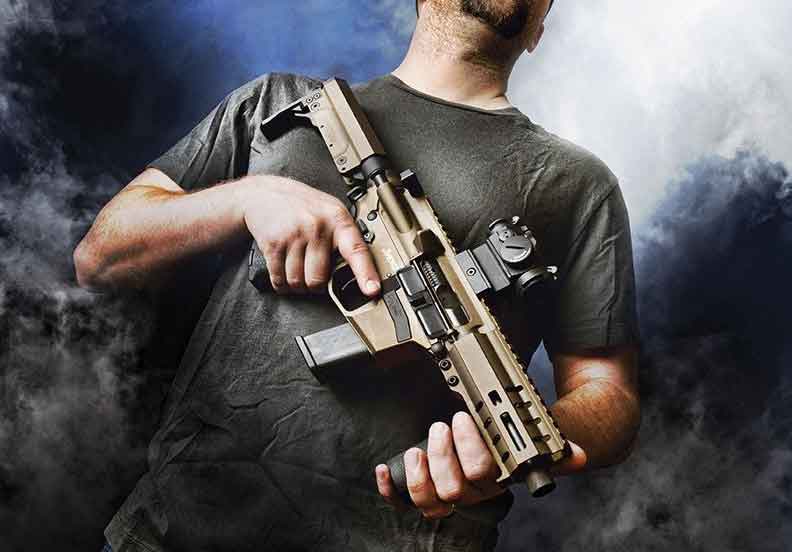
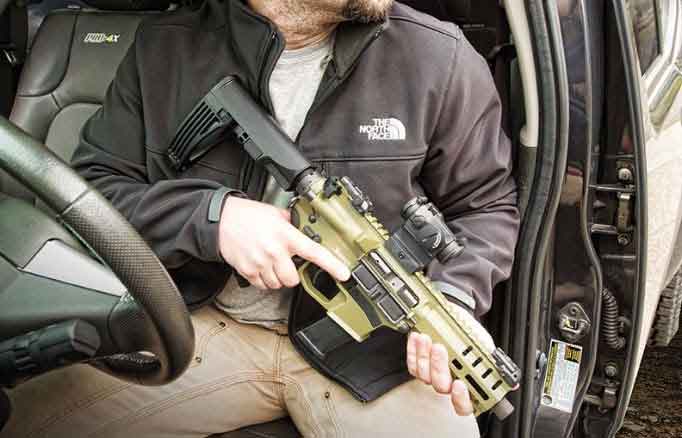
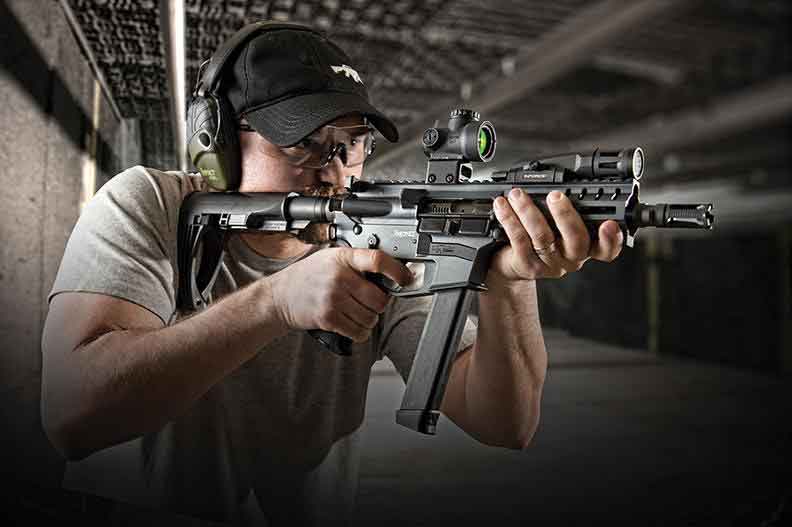
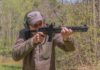
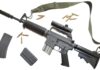
The lightest and smallest short-barreled rifles and AR pistols CMMG offers, the Banshee line is fightingly nimble.
What the compact Banshee line brings to the game:
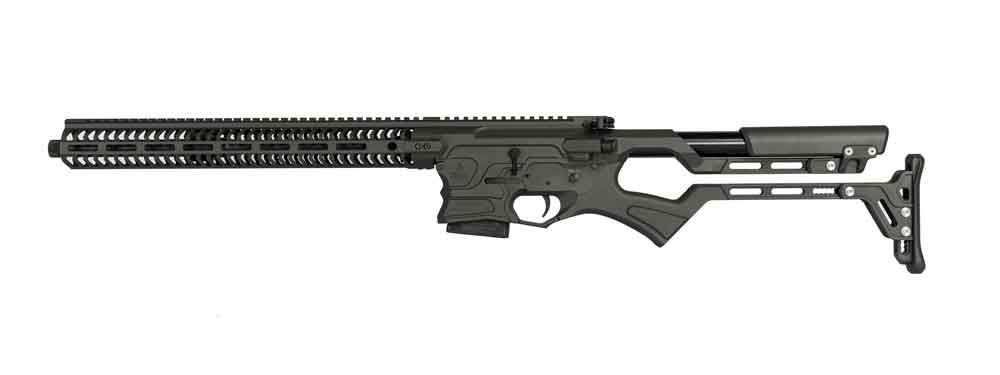
The Banshee line is composed of short-barreled rifles and AR pistols.
As expected, the SBRs require NFA registration and tax stamp.
The guns are among the smallest and lightest in CMMG’s catalog.
The pistol-caliber Banshees weighs in at just over 4.5 pounds, while the rifle caliber is just over 5 pounds.
The Banshee is available in four calibers: .22LR, 9mm, .45 ACP and .300 Blackout.
The SBR configurations come with CMMG’s innovative Fastback stock.
The 9mm and .45 ACP feature the company’s pioneering Radial Delayed Blowback operating system.
The Banshee runs from $1,449 to $1,499.
Ominously, CMMG’s Mk4 Banshee made its appearance on the national stage this past Friday the 13Th. But the only thing that could prove to be unlucky about the Missouri gunmaker’s wicked new guns are the hoops shooters have to go through to put most in their safe.
Yup, the Banshee line is nearly top to bottom NFA regulated — registration, tax, stamps, the whole nine yards. That’s the breaks (illogical as they might be) in the short-barreled rifle world. The company has taken some mercy on the hearts of those who refuse to jump when the ATF says frog, releasing complementary AR pistols in the line’s four calibers. Even so, CMMG gives ample reasons to contemplate doing the Fed’s paper dance; by all accounts, the backpack-portable carbines are sound as oak joists and light as a morning breeze.
That latter facet isn’t all re-written press release hyperbole either. The guns are plum featherweight. The pistol-caliber Banshees just trips over the 4.5-pound mark, while the rifle-caliber configurations are well within a rounding error of a flat 5 pounds. As those who shoot magnum revolvers know, this is tantalizingly tickling handgun heft — with the benefit of a stock (or brace).
CMMG offers the Banshees in .22LR, 9mm, .45 ACP and 300 Blackout, each boasting the shortest barrel the company bores for the calibers. In the case of pistol-calibers that snaps the tape at a nimble 5-inches, while the Blackout measures out at 8 inches. In both cases, the Banshee should prove not only portable, but also as fast handling as they come — particularly in a close-quarters application.
The Banshee come decked out, as those familiar with CMMG would suppose. Each version of the Banshee sports the company’s new ambidextrous charging handle, as well as sling plate and safety selector. They come standard with a Cerakote finish, an RML M-LOK Hand Guard and a Magpul MOE Pistol Grip. The AR Pistol versions each come with a Tailhook Mod 2 Brace.
The SBR versions come equipped with a Magpul MVG Foregrip and feature CMMG’s new RipStock — a new compact buttstock, fully machined out of 6061-T6 aluminum and Cerakoted at the factory. The stock features two of CMMG’s patent-pending technologies: Fastback and P3. The former does away with a lever release to deploy the stock and the latter presets the length the stock extends. Handy.
The 9mm and .45 ACP BANSHEEs feed from factory Glock magazines. Additionally, they utilize CMMG’s patent-pending Radial Delayed Blowback operating system, which uses a lighter buffer and carrier than the typical straight blowback design.
There is a little matter of cost and the Banshee line demands considerably more than the everyday sporter AR. But at a range of $1,449 to $1,499, the guns aren’t relegated to pipe-dream status — even with Uncle Sam expecting his cut on the SBR configurations.
For more information on the Mk4 Banshee please check out: www.cmmginc.com
Self-defense is a fight for your life. The only way to ensure you come out on top is preparation.
Have you ever heard of having a combat mindset? Let me give you the best advice I can to help you save your life. Read, consume and absorb Principles of Personal Defense. Jeff Cooper, the founder of Gunsite, wrote this book and it costs less than 20 rounds of good defensive handgun ammunition. For those who will not take my advice or whose wallets are as tight as a barrel bushing on a 1911 — with apologies to Col. Cooper — I’ll summarize.
Alertness: Be aware, be ready; bad things can happen at any time. Live by the Gunsite (Cooper) Color Code.
Decisiveness: Counterattack now! Do not tarry. To ponder is to perish.
Aggressiveness: Go at it like you mean it.
Speed: Be sudden, be quick. Be first.
Coolness: Keep your wits. Don’t lose control of your emotions.
Ruthlessness: Strike with all your strength for every blow. Shoot them to the ground.
Surprise: Do not wilt, do not cower, and don’t be predictable. Fight back.
This, in brief, is the mindset you must have for self-defense. An acquaintance believes in luck, and if it did exist it would be a wonderful thing to believe in. But luck seems to have a way of showing up at random. And, randomness, while it might be acceptable in sports, love and hunting, is not acceptable in a self-defense situation — when your life is on the line. As it’s been said, luck is when opportunity meets preparation. Prepare your mind — get the combat mindset — and when opportunity or bad timing puts your life on the line, you’ll be lucky.
When I think of how you should approach a self-defense scenario, I think of my grandfather, a farmer turned moonshiner, turned entrepreneur, and later a member of the local Board of Education. He never got past third grade, but when I was growing up, he was the smartest man I knew. When Grandpa wanted you to get after a job with unwavering commitment, he would say, “Get at it like you’re killing snakes.” I can think of no better way to describe the response a violent attack should elicit from you.
Editor’s Note: This article originally appeared in the April 2018 issue of Gun Digest the Magazine.
As in any pastime, there are myths and half-truths that seem to have a life of their own, and the world of hunting and shooting probably has more than its share. Because internal and external ballistics can be so … well, intimidating to those who are simply hunters and not technically oriented, it’s understandable. Then there are terminal ballistics and cartridge/rifle performance, which can be quite subjective.
As a boy hanging around the little sporting goods store my buddy’s dad owned on 131st Street in Cleveland, we overheard all kinds of stories that, as impressionable pre-teens, we took as gospel. After all, some of the men who hung around the store had big game experience in Pennsylvania, West Virginia — even exotic places like Wyoming and Colorado, so they had to know what they were talking about!
Shooting Myth No. 1: Long barrels are more accurate than short barrels
Actually, the reverse is more often the case. Short barrels are stiffer, and, thus, the amplitude of vibrations — or barrel flex — is less. Benchrest rifles sport short, thick barrels. It’s true, however, that where iron sights are concerned, a long-barreled gun can be aimed more accurately because the sight radius (distance between the front and rear sight) is longer and the margin of aiming error is less.
Where iron sights are concerned, the longer the sight radius, the more accurate the gun can be aimed. The use of an aperture sight also maximizes the accuracy potential of iron sights.
That’s why accurately shooting a handgun with a sight radius of just a few inches is so much more difficult than shooting a long gun. Conversely, using an aperture or “peep” sight further increases the sight radius of a rifle, so it provides the most precise non-optic aiming system. Of course, the use of a riflescope negates barrel length and sight radius having anything to do with aiming accuracy.
Shooting Myth No. 2: A bullet rises as it leaves the muzzle
This is a myth to be sure, but there are a couple of caveats. For one, though a bullet begins to fall the moment it exits the muzzle, it does “rise” in relation to the line of sight (as opposed to the bore line, which is an imaginary line down the center of the bore out to infinity).
Whether utilizing iron sights or a riflescope, the line of sight — which is also a straight line out to infinity — starts out above the bore line, so if the two are to merge (zero) at any distance downrange, the sights (iron or optic) have to be angled downward to intersect the bullet’s trajectory. Normally, this first occurs out at 20-30 yards if one is zeroing in a typical centerfire rifle at normal distances. This is where “the bullet rises” comes from because beyond that first intersection the bullet is now traveling above the line of sight. As the bullet continues falling beyond that first intersection point, the two converge again at the desired sighting-in distance — your zero.
This illustration shows why a bullet supposedly rises when it leaves the muzzle. It “rises” only in relation to the line of sight.
As for the other caveat, a bullet can, in fact, rise very slightly after exiting the muzzle. This seeming contradiction of Newton’s Law can occur if, at the moment of departure, the barrel is flexed so that its attitude sends the bullet out on a line slightly higher than the bore line. The longer and/or thinner the barrel, the greater the divergence can be, but it’s so miniscule as to be purely academic. It all makes sense if you just imagine giving a violent up-and-down shake to a garden hose and watch how it undulates. That’s what a gun barrel does as a bullet accelerates down the bore. It’s also why, when zeroing in or testing loads on a 100-yard target, a load pushing a heavier bullet can impact higher than a lighter one.
Shooting Myth No. 3: ‘Enough gun’ means dropping animals immediately
More a belief than a myth, it’s held primarily by “low information” hunters — to use a recently coined term for describing voters. Far too many hunters believe that if an animal doesn’t virtually drop in its tracks, “more gun” is needed. Such determinations are often the result of ego, especially if the animal is wounded and not recovered. “I can’t understand it; it was a perfect shot.” Sure it was.
The truth of the matter is that the typical hunter today is over-gunned, and it’s especially true of whitetail deer hunters who comprise the vast majority of our ranks. If it were possible to shoot 10 identical animals under identical circumstances using the same cartridge and load, there would be 10 different reactions. With all being hit with a perfect heart/lung shot, some would drop where they stood, others would run anywhere from a few to a hundred yards or more.
Almost every magnum-class cartridge, whether commercial or proprietary, introduced in the past 20 years has been based on beltless cases. The entire Dakota family of cartridges shown here are all in the magnum class — but not identified as such.
The fact is, most hunters armed with 7mm and .300 magnums would be better served — and better shots — using a .260 Rem. or 7mm-08. Either is enough gun for all but the biggest bears and long-range elk hunting. And the .270 and .280 even more so.
Shooting Myth No. 4: Mystical ballistics really do exist
Back in the ’50s and early ’60s, the Weatherby Magnum rifle was more or less the Holy Grail for aspiring gun weenies like me, and apocryphal tales of Weatherby Magnum cartridges were quite common. Most often heard was that you could hit a critter in the foot with a Weatherby, particularly the .257, and it would drop on the spot as a result of “hydrostatic shock.” You don’t hear that one too much these days because we have so many cartridges that match or exceed Weatherby ballistics — and far too much empirical evidence to the contrary.
Shooting Myth No. 5: Handloads are more accurate than factory loads
Twenty-five years ago that was a fairly safe, though not certain, wager — assuming hunting rather than match bullets, and a modicum of handload development. Today, with premium loadings put together with superior components using more stringent quality control standards, it’s often difficult to match, let alone exceed, the performance of a premium factory load with a roll-your-own.
Assuming sufficient load development, a handload will almost always provide an accuracy edge over a factory load because it is tailored to a specific firearm. Today’s premium ammo, however, can make it a difficult and time-consuming effort.
Ultimately, the handload will always win because the customization possible in developing a load for a specific rifle can’t be duplicated in factory ammo, but the amount of load development and range time required might not be worth what might be only a minimal difference.
Shooting Myth No. 6: There are magnums … and there are magnums
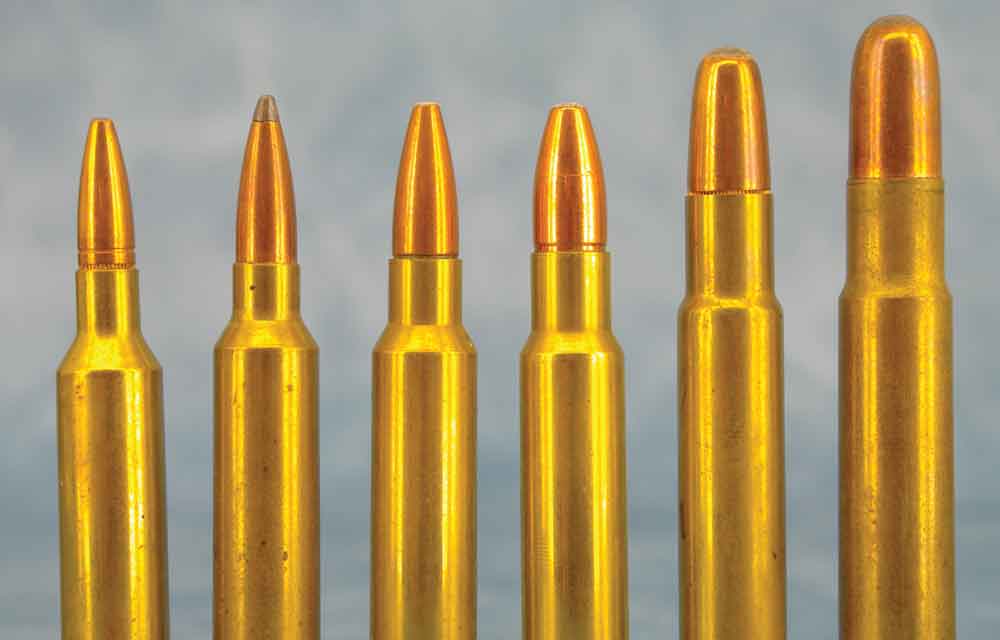
There are too many examples that defy accepted lexicon to list all of them here, but here are a few magnums that aren’t, and some non-magnums that are:
The .256 Win. Magnum, now obsolete, was a pipsqueak of a rifle cartridge based on a necked-down .357 Magnum pistol round, and the .25-06 Rem. is a magnum-class cartridge without the belt and title. Both are .25-caliber cartridges, but the .256 can’t carry the .25-06’s water.
There are magnums, and there are magnums (left to right): .256 Winchester, .257 Weatherby, 6.5 Rem., .264 Win., .350 Rem. and .358 Norma.
The 6.5 Rem. Magnum, which was rolled out in 1965, had the moniker and the belt, but it couldn’t match the ballistics of the existing .264 Win. Mag. Both carried the magnum designation, but one was and the other wasn’t.
The .220 Swift was introduced in 1935 and — despite lacking the official magnum designation — has been king of the .22 centerfires ever since, tremendously outperforming the .222 Rem. Magnum introduced in 1958.
It wasn’t all that long ago that if a cartridge didn’t have a belt, a lot of folks figured that it couldn’t be a magnum. Today, virtually every magnum-class rifle cartridge that has been introduced these past 20 years or so are sans belt. Go figure.
Editor’s Note: This article originally appeared in the March 2018 issue of Gun Digest the Magazine.
There’s more to Springfield Armory than just off-the-shelf XD pistols. Its custom shop is more than capable of turning out heirloom-quality firearms.
There are few things that measure up to putting your very own custom gun in your safe. Maybe bringing home that first kid from the hospital. But even there the gun arguably might have the advantage. After all, it will never soil a diaper.
With the image of a firearms manufacturer for the workingman, Springfield Armory isn’t typically the first gunmaker that pops to mind when the discussion turns to custom guns. But there’s much more to the Illinois company than its wide selection of off-the-shelf 1911 and XD pistols and M1A rifles.
Luke Hartle gets a first-hand look at one of them at the 2018 SHOT Show in Las Vegas and the gun in question is a real gem. Gun Digest’s Editor-in-Chief combs over a decked out 1911 Series Pro Model, tinkered to perfection and pretty enough to make the hardest-hearted gun cynic drool. With hand fitted everything, an in-house Black T finish, not a machining mark detectable and each of the front-strap checkering gone over with a loop, it’s nearly enough to make John Browning blush. Little wonder, as Springfield’s Jeremy Sides proudly points out, this is among the most popular guns customers request of the shop.
Striking as the spotlighted Pro Model is, the results are of little surprise given what Springfield boasts in the way of gunsmiths. In all, 12 craftsmen man the company’s custom shop and, by Sides’ estimations, put 200-years of firearms expertise at a customer’s beck and call. Given the money any tailor-made gun demands that’s peace of mind the job is going to get done right and down to the smallest detail.
Springfield’s custom shop has been quiet in its abilities overall, but it more than appears to have plenty to crow about.
If you’re having trouble finding factory ammunition or brass for rifles chambered in obscure or obsolete cartridges, don’t fret: You can make your own.
Thinking straight about obsolete cartridges:
With a good working knowledge of converting cartridges, a world of old guns in obscure calibers is opened.
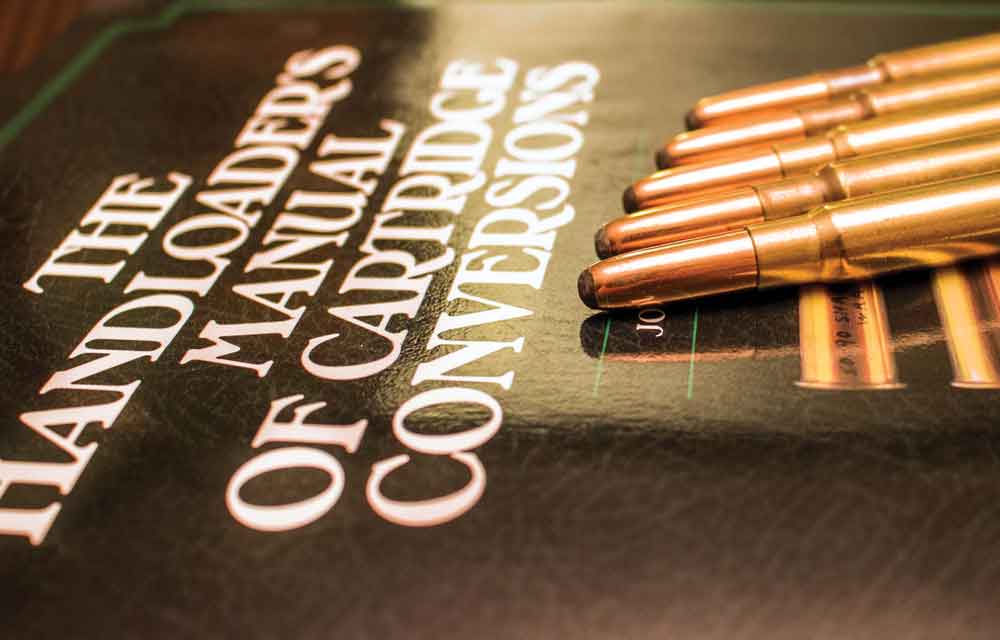
An indispensable tool for the process is John J. Donnelly’s The Handloader’s Manual of Cartridge Conversions.
The process can be as complex as removing a belt from a magnum cartridge.
But it can be as simple as reducing a cartridge’s length and resizing its neck.
Reloaders shouldn’t be shy, contact reloading companies — they are invaluable resources.
On more complex, obscure projects you may need to invest in forming dies.
What do you do when you find that old rifle — sitting in the dusty corner of the gun shop, unloved, unwanted — that simply has your name written all over it, but it’s chambered for an obscure or obsolete cartridge? Why, you buy it of course! And if needs be, you make the ammunition yourself.
There have been several instances where this course of action has been warranted; there are some times when loaded ammunition — or even component ammunition — is simply not readily available.
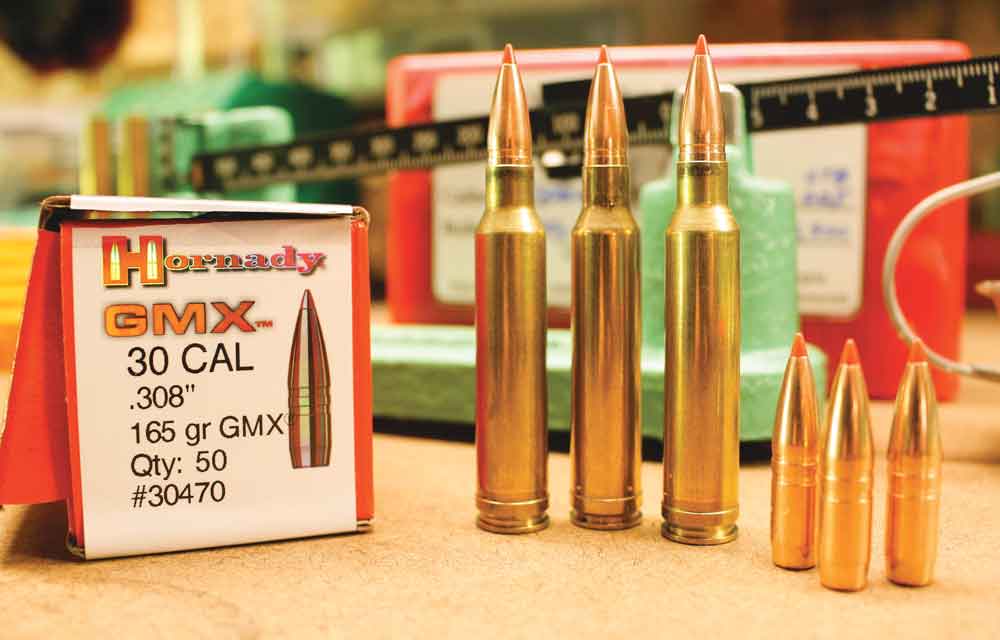
The .30-.338 Magnum, created from new 7mm Remington Magnum brass, with one pass through a resizing die.
The transformation of one cartridge case to another can be as simple or complex as your selection of tools will allow, but quite often making one cartridge from another will only require your reloading tools. A case trimmer can and will cut a cartridge down considerably, and a full-length resizing die can change the diameter of a case mouth, to a certain degree. But the first stop on your tour should be a particular book that warrants a place in every reloader’s library: John J. Donnelly’s The Handloader’s Manual of Cartridge Conversions.
It’s thick and largely technical, but it can and will be invaluable to those needing to create ammunition for a centerfire rifle when component brass isn’t available. My copy is more than 30 years old, and some of the reloading tools mentioned might be considered antiques these days, but the principles are still completely relevant. It makes an excellent full-service reference guide for the handloader, even if just in a learning capacity.
I’ve used it to create that which I could not purchase, and it’s worked out just fine. Now, while the book contains instructions on some of the more radical transformations, such as removing the belt from the Holland & Holland family of cases or reducing the diameter of a cartridge’s rim, I have yet to need to perform those operations; my own transformations have been less complicated, yet they filled the need in the same manner.
An Easy Example
My colleague and good friend Craig Boddington called me one day to inform me that he was having a problem with a rifle he had just acquired. Craig said the barrel was marked .30-338 Magnum, and while that is — in essence — the definition of the .308 Norma Magnum, the chamber wouldn’t handle the Norma factory ammunition.
(Above) .318 Westley Richards ammunition, created from .30-06 brass, driving a 250-grain Woodleigh roundnose at 2,475 fps. The conversion was simple, and the rifle shoots exceptionally well.
So, I delved into the matter a bit more and found that after the .338 Winchester Magnum was released, yet before the .308 Norma Magnum was unveiled, wildcatters simply necked down the .338 case to hold .308-inch diameter bullets and maintain the same shoulder angle and datum line. There is a dimensional difference of a few thousandths between the two designs, explaining why Craig couldn’t close the bolt.
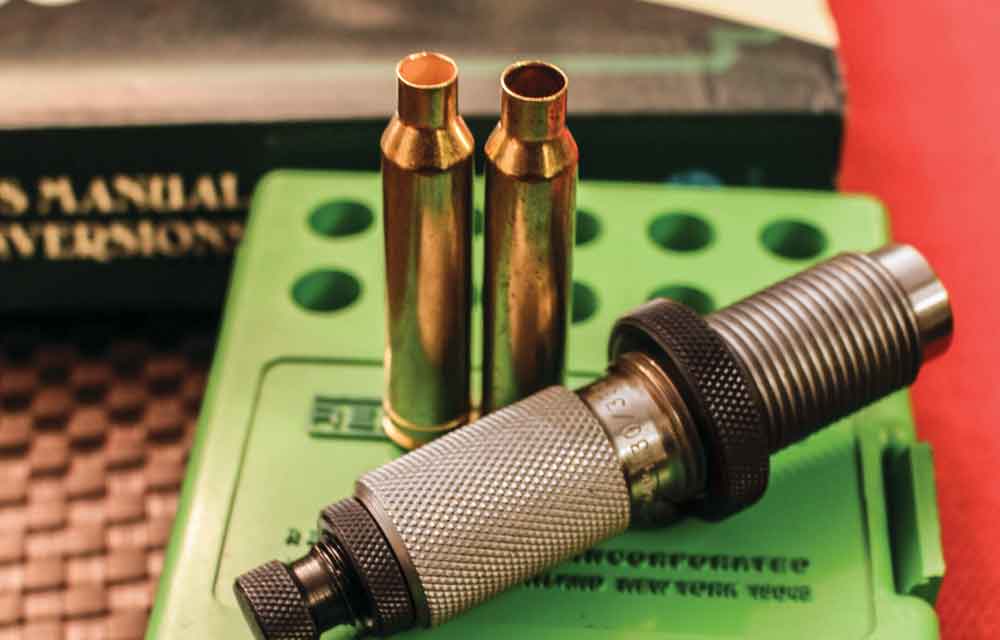
I made a call to Redding Reloading and found that — miraculously — they had a set of dies available for the wildcat. Because it maintained the same dimensions as both the .338 and 7mm Remington Magnum, either would be a suitable candidate for surgery. I decided it would be easier to neck up than to neck down and settled on new 7mm Rem. Mag. brass.
One run through the full-length resizing die — equipped with a tapered expander ball – and I was in business. Datum line was maintained, case length was just a few thousandths below maximum (a bit of length was lost in the stretching process) and the inside of the necks didn’t need to be turned. Loading for the rifle blindly, Craig reported that it gave him good velocities and 1 ¼ MOA accuracy (from a low-powered vintage scope), but most importantly, it was safe in the rifle with no pressure signs.
A More Involved Project
My own rifle was a bit of a different story, requiring some trimming and reworking to bring it to life. I have always wanted a .318 Westley Richards, yet finances dictated that the purchase of a genuine vintage rifle would see me sleeping on the couch.
A 7mm Remington Magnum case (L), and a converted .30-338 Magnum case (R), made with one pass through a Redding resizing die.
Instead, I embarked on a custom rifle build, giving new life to a WWI Gew. 98 Mauser — re-barreling it with a Kreiger .318 WR barrel. The rifle came out just fine, with the appointments I wanted. One little issue: The only available factory ammunition is very expensive, approaching and in some instances exceeding 10 dollars per round. Being a handloader, I thumbed through the aforementioned Manual of Cartridge Conversions and confirmed my assumptions: .318 Westley Richards cases can be easily made from plentiful .30-06 Springfield brass.
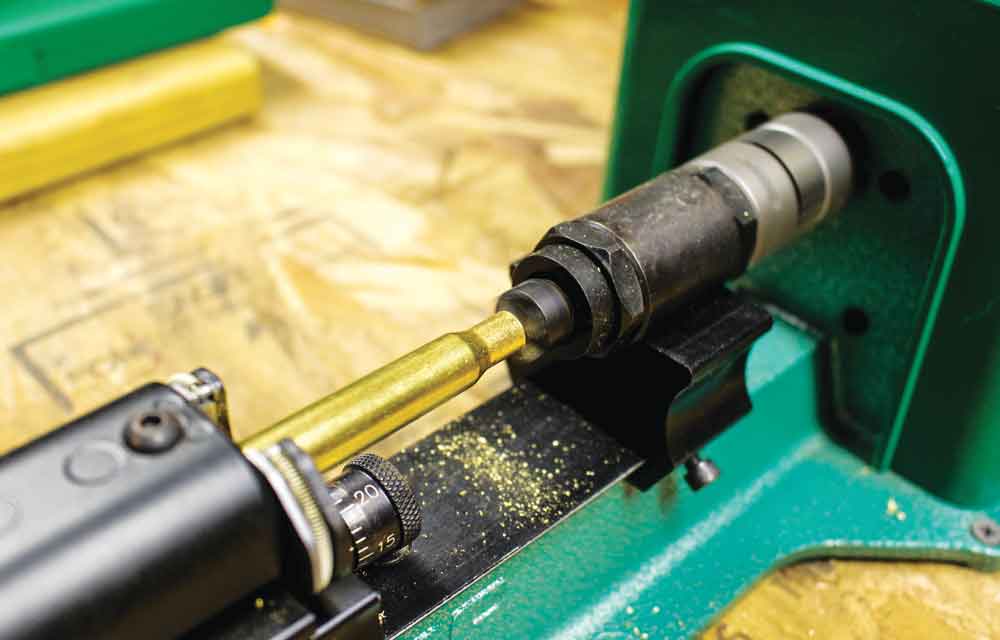
Step No. 1 was to trim the .30-06 brass from 2.494 inches down to 2.370 inches, and for that I used a good, piloted trimmer. Once cut to proper length, I cleaned up the case mouth — which was now square and rough from trimming — giving it a good chamfer and deburring.
Step No. 2 was applying a liberal dose of Imperial Sizing Wax along the base of the case, and Imperial Dry Neck Lube at the case mouth; one pass through the resizing die resulted in perfectly formed .318 Westley Richards brass.
The case mouth has been expanded from .308 inch to .330 inch, and once cleaned up, they can be used without the need to fire-form. Now, the true case head dimension of the .318 Westley Richards is 0.468 inch vs. the .30-06’s 0.473 inch, so to be completely transformed, a rim turning might be in order, but my rifle began life as an 8×57 Mauser, which shares the 06 case head.
Therefore, the bolt face and cartridge case head are completely compatible. When I choose to use actual .318 Westley Brass — a rarity sometimes available from Bertram — the 0.008 inch in case head diameter won’t make a bit of difference.
When Forming Dies Are Needed
These two examples are relatively simple solutions to the need for brass that is either unavailable or ridiculously expensive. The more radical transformations might require the use of forming dies — which will work the brass up or down in small increments — and brass annealing. Cases like the 6.5 Remington Magnum — capable of being made from .350 Remington Magnum brass or, in extreme cases, from .300 H&H brass — should see the use of a forming die in order to radically change the diameter of the case mouth. The same could be said for creating .35 Whelen brass from .30-06 cases; though, I’ve seen it done in a single step, albeit with varying degrees of success.
Trimming .30-06 brass to proper length to create the .318 Westley Richards cartridges.
The .475 Turnbull — that lever-action gem that Doug Turnbull designed for the 1886 Winchester — is based upon the .348 Winchester case, and it will definitely require forming dies. There are so many designs based upon the .30-06, .308 Winchester or the belted .375 H&H case that many different cartridges can be made from this trio alone. Some of the obscure rimmed cartridges will require a bit more creativity, but with the Cartridge Conversion book, a good handloader can get the job done.
If the change is extreme, annealing your cases will prevent premature cracking and splitting by keeping the brass soft and pliable; annealing will also help to keep any brass that must be fire-formed in working order for as long as possible. The annealing process is not extremely technical, but that’s best kept for another conversation …
Editor’s Note: This article originally appeared in the April 2018 issue of Gun Digest the Magazine.
The biggest segment of the firearms market is that of concealed carry handguns. In recent years, the number of ordinary citizens who carry a handgun as everyday practice has expanded almost exponentially. Not only are more people carrying, but people who never previously considered firearms ownership are now committed concealed carry citizens.
The result of this paradigm swing is a booming market for effective concealable guns, and the industry has done an admirable job of filling that niche. At one time the choices for concealable handguns were small revolvers, pocket-sized .25s and somewhat antiquated .380s. Now we have reliable 9mm semi-autos that weigh only a few ounces more than those diminutive, awkward and underpowered .25s.
It’s a fact that in today’s market, it’s harder to find a bad handgun than a good one. Polymer frames, modern manufacturing techniques and an industry that pays attention to the market have allowed lots of good choices to those who’ve decided to take an active part in the defense of themselves and those they love. We now have so many excellent designs that the current effort is to improve and refine those excellent designs.
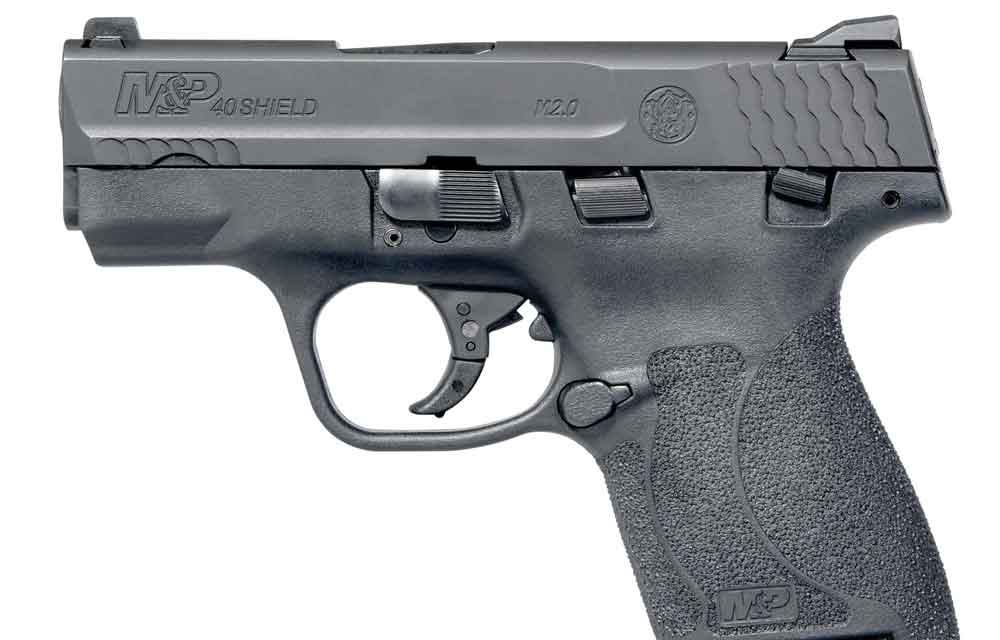
S&W M&P Shield M2.0
Clearly the most popular concealed carry handgun in America by sales is the Smith and Wesson Shield. It’s affordable, reliable, compact and chambered for the most popular self-defense calibers. It’s offered both with and without a manual safety to accommodate both schools of thought. As an overwhelming success, it’s no wonder Smith and Wesson has upgraded it with the same 2.0 features as the double-stacked M&P series.
I don’t subscribe to the mindset that defensive handguns should have light and crisp triggers, but it’s important that the trigger be both safe and manageable. The common complaint with the earlier Shield was a less-than-precise trigger with an indistinct reset. The 2.0 series has rectified the issue of trigger reset. It’s now much more positive and tactile with the added bonus of a crisper and more defined break. Add the much improved grip surfaces and already excellent sights and you have a defensive handgun that fits almost every need. With two magazines, MSRP is $479 and $649 with the Crimson Trace Laserguard Pro laser/light option.
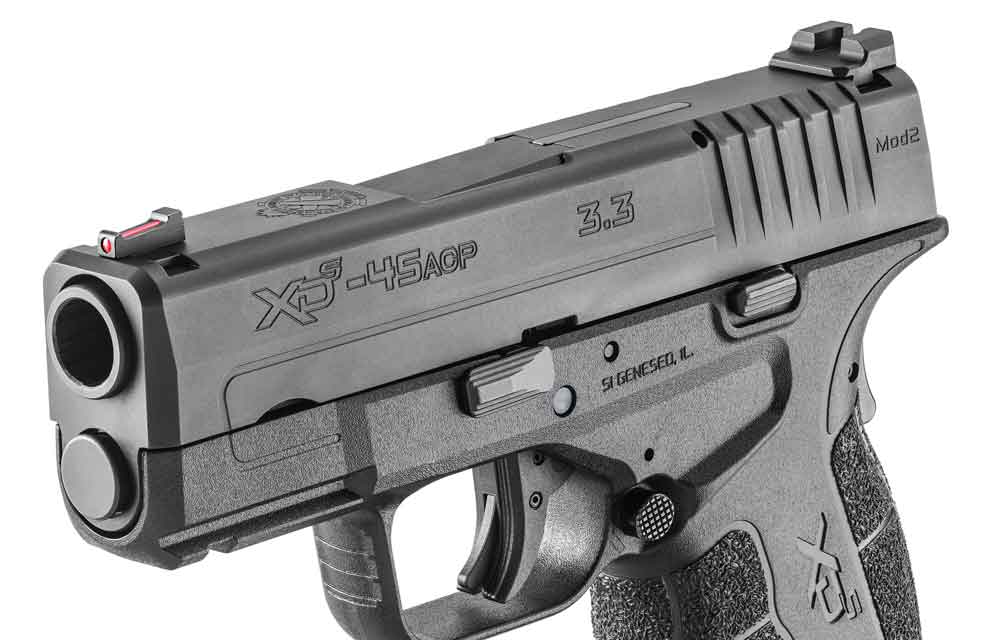
Springfield Armory XDs Mod.2 .45
Since its inception, the Springfield Armory XD series of pistols built in Croatia has had a very strong following. The single-stack compact XDs series has found favor with concealed carry citizens because it’s easy to conceal and easy to shoot well. I particularly like the grip safety. There’s a massive difference of opinion on whether defensive guns should have manual or passive safeties, and the passive grip safety on the XD series is almost unique in polymer striker-fired pistols.
The new XDs Mod.2 extends the line, incorporating the refinements of the Mod.2 series with the power and penetration of the revered .45 ACP round. The undercut trigger guard and improved grip shape allow the shooter to grip higher, meaning better recoil control, and that’s augmented with the upgraded Grip Zone grip texturing.
The sights have been improved as well with the addition of a tritium front sight and a serrated U-notch rear sight that allows for using the front of the rear sight to rack the slide against a solid object. The trigger is also enhanced for a shorter reset. It comes with two magazines, one flush-fit five-round mag for concealability and a six-round backup magazine. The overall weight is 21.5 ounces with the flush magazine, and MSRP is $593.
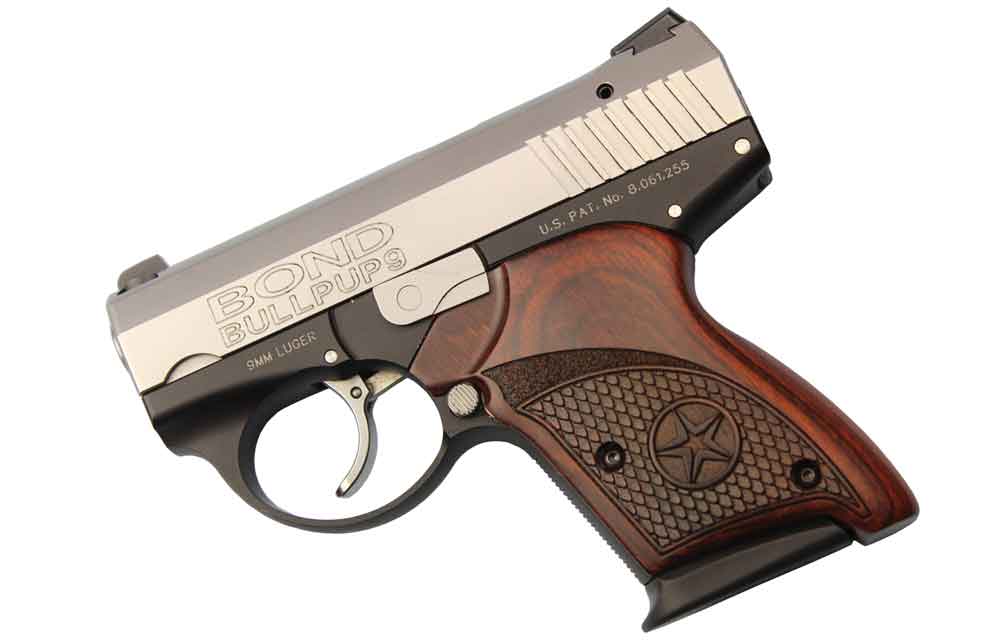
Bond Arms Bullpup 9
Certainly, the most innovative new concealed carry handgun, and probably the most unconventional handgun in several years, is the Bond Arms Bullpup 9. It’s based on the Boberg XR9-S, an innovative but somewhat expensive and problematic pistol developed in 2003. In function, the Bullpup 9 is a remarkable departure from conventional semi-automatic pistols in that the magazine feeds from the rear instead of the front. The system uses a rotary barrel lockup with the barrel rotating on a cam similar to that of an AR-15 rifle bolt inside the bolt carrier.
The pistol feeds from a magazine located below the chamber in the barrel, with the round coming from the magazine much like a tubular fed firearm. Instead of the magazine spring pushing the round backward, there are a pair of tongs similar to a conventional extractor that strip the magazine rearward, and a lifter then positions it for the slide to carry the round into the chamber as the recoil spring brings it back into battery.
The obvious advantage of this is the short overall length in relation to barrel length. For example, a 3.3-inch barreled Springfield Armory XDs has an overall length of 6.3 inches and the Bullpup 9, with a barrel length of 3.35 inches has an overall length of just 5.1 inches. Another advantage of the Bullpup 9 is an extremely light operating spring. As the slide pulls the round rearward out of the magazine, it creates resistance to the slide’s travel. This additional resistance to the slide allows the use of a much lighter spring than would be normal for the weight of the slide in a 9mm pistol. The result is a slide that’s remarkably easy to cycle, which is an important issue for users with lower hand strength.
With a weight of less than 19 ounces and a thin profile, the Bullpup 9 is an attractive option for concealed carry. The trigger system is double-action-only, providing second-strike capability. Sights are dovetailed three-dot; grips are engraved laminated rosewood. It comes with two magazines and has an MSRP of $977.
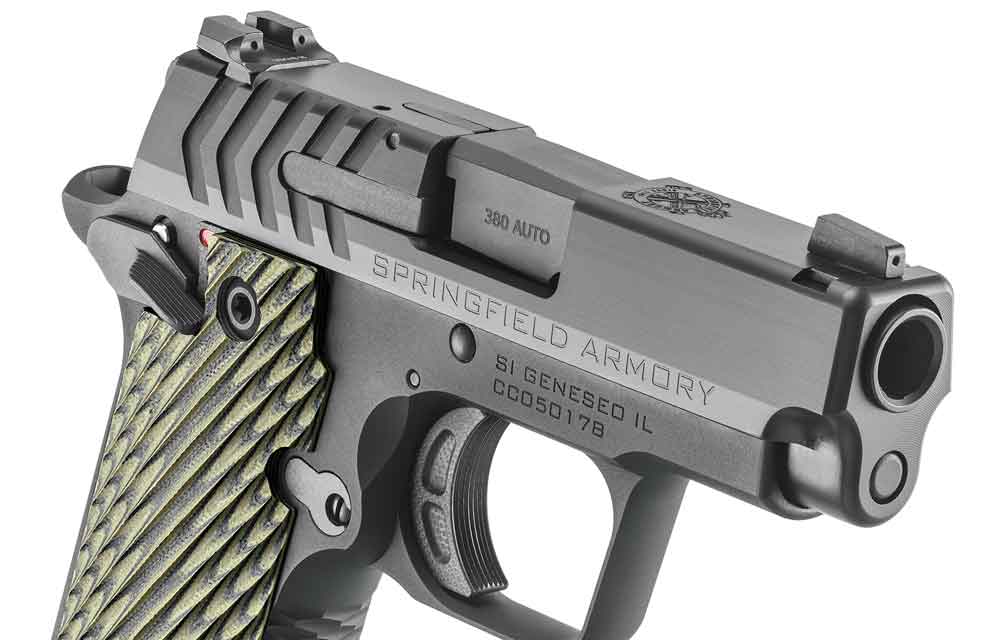
Springfield Armory .380 911
One of the most respected and successful handgun designs has been the 1911. In recent years there have been miniaturized versions of the 1911 design, and they’ve found favor with concealed carry citizens. Springfield Armory now has its own version of a reduced 1911 in .380 ACP. The 911 uses a T6 aluminum frame with a Black Nitride or stainless 416 slide. Grips are G10 with texturing on the front strap and mainspring housing.
The ambidextrous safety differs from the 1911 design in that it allows racking the slide to charge the chamber while the safety is engaged. The single-action trigger combined with a G10 Hogue trigger shoe allows a light and crisp trigger break. Sights are a green tritium front sight inside a yellow luminescent circle and a tactical rack rear sight with green tritium inside of white luminescent circles. It comes with a six-round flush magazine and an extended seven-round magazine for backup. MSRP is $599 for the standard version and $789 with an integrated green Viridian grip laser.
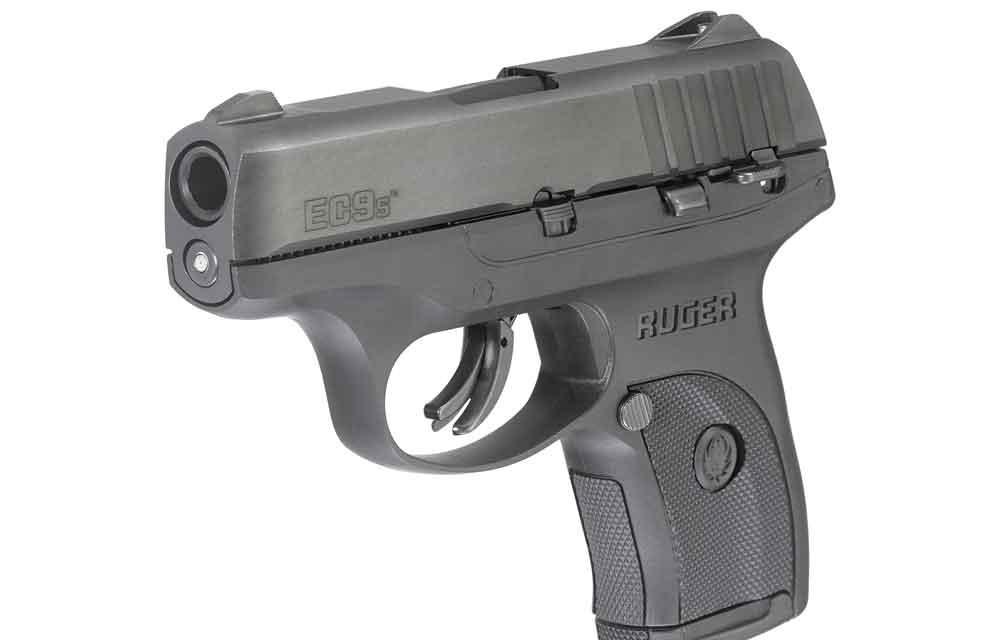
Ruger EC9s
While all the above have been performance enhancements to existing models, Ruger’s EC9s is an economical enhancement. The Ruger LC9 went through an upgrade in 2011 with the introduction of the LC9s, an enhanced version that featured a striker-fired instead of a hammer-fired action and had a much better trigger. The LC9s has eclipsed the earlier version, and it’s been dropped from the catalog. While the standard LC9s has an MSRP of $449, the EC9s has an MSRP of $299.
Primarily, besides the price, the difference between the EC9s and the LC9s is the sights. In the original version, the sights were dovetailed into the slide and the EC9s has sights that are integral to the slide. Currently, the Ruger website no longer shows the standard LC9s but lists a collection of standard guns with different color schemes specific to different distributors.
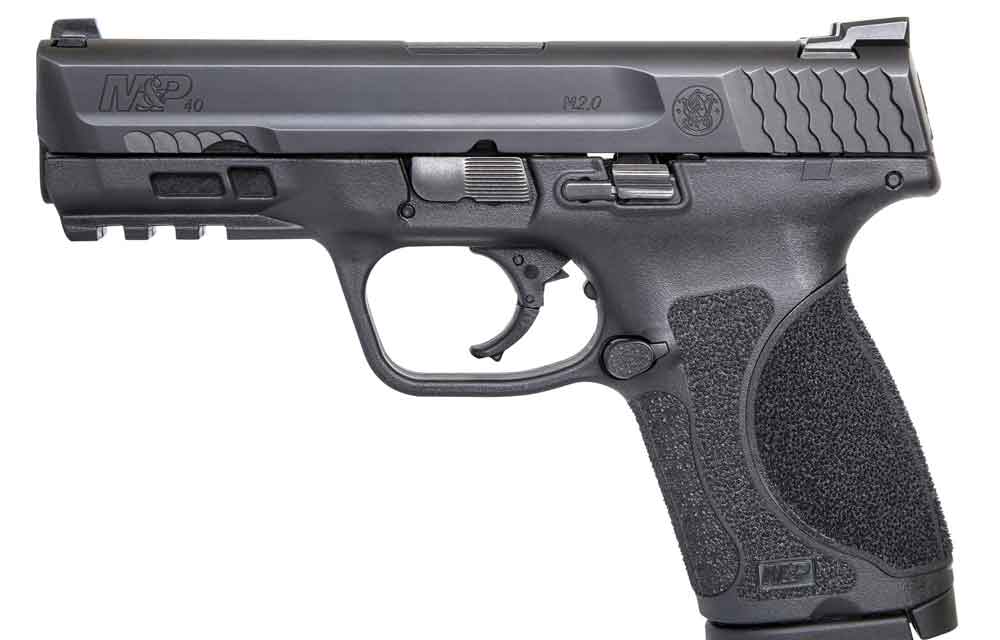
S&W M&P9 M2.0
Smith and Wesson’s M&P line has been extremely successful and the 2.0 upgrade makes the series even better. Recently, the company introduced the M2.0 Compact, bringing functional, much-needed upgrades to an already excellent firearm. Depending on your carry method, the M&P9 might be a bit large for daily concealability, but it’s certainly a viable option if it fits your lifestyle.
The improvements in the M2.0 series corrected issues that kept a good pistol from being an exceptional pistol. The ability to properly grip a pistol increases both first-shot effectiveness and speed in delivering fast follow-up shots, and the new aggressive texturing on the grip is a vast improvement. Competitive shooters who use the M&P pistols universally modify their guns to make them easier to grip by stippling or adding aggressive panels. The new grip surface negates that need. The other complaint with the M&P line has been in the trigger reset, and that’s also been corrected with the bonus of a lighter pull weight and crisper break. Four interchangeable inserts make it possible to fit any hand. MSRP is $569.
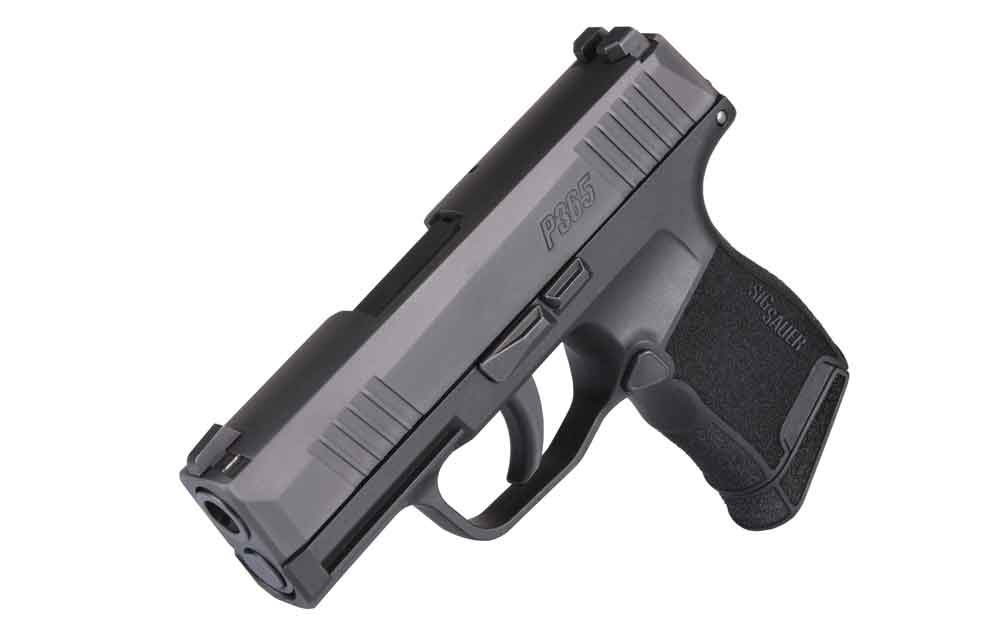
Sig Sauer P365
There’s a hot market for concealable 9mm pistols, and recently there have been two schools of thought: One school of thought is that a slim and lightweight gun is a better choice because of comfort and concealability; the other places more importance on magazine capacity. Both camps have reasonable reasons for their preference, but both will agree the other’s position is realistic.
Just revealed at SHOT Show is the Sig P365, a gun that reasonably will accommodate both groups. With a slight trade-off in width, the P365 provides 10-shot capacity with a 1.06-inch width and a weight of just 17.8 ounces. Described by Sig as a Micro Compact, it’s a polymer-framed, striker-fired gun that easily fits into the standard for small 9mm pistols. It has a stainless-steel, Nitron-finished slide and barrel and three-dot Tritium sights. Grips are interchangeable for better purchase and upgradable for a laser.
The trick is in a magazine that’s tapered, wider at the bottom and tapering off to a single-stack magazine width. Magazines are available flush and with an extended floor plate to provide a full grip. It also comes with a 12-round magazine for backup. MSRP is in line with other compact nines at $599.
Editor’s Note: This article originally appeared in the Concealed Carry 2018 issue of Gun Digest the Magazine.
The shooting hand’s thumb is often ignored, but where it’s placed is as important as the trigger finger.
Where should your strong hand’s thumb go?
Often forgotten, the shooting hand’s thumb placement is as important as the trigger finger’s indexing.
On guns with thumb safeties, it should rest on top of the safety to reduce risk of engagement.
Upon holstering, you should reverse the thumb’s position to engage the safety.
To prevent a striker-fired handgun from coming out of battery when holstering, the thumb should be on the rear of the slide.
Rightly so, there’s a lot of discussion about what you should do with your trigger finger when you’re shooting or not shooting. However, we rarely hear talk about what you should do with your thumb — the one on your shooting hand. Its positioning is just as important.
When firing a handgun with a manual thumb safety, rest your thumb on top of the safety.
If you’re shooting a handgun with a thumb safety, your thumb should be resting on top of the safety while you’re shooting. This circumvents the possibility of the safety being inadvertently engaged. I say resting because pressure can interfere with shot placement.
When you holster a handgun with a thumb safety that locks the slide — like on a 1911 or Browning Hi Power — your thumb should be under the safety, applying pressure up. This will most likely prevent you from negligently shooting yourself, should you be stupid enough to leave your finger on the trigger while holstering.
For striker-fired handguns without a slide locking safety, place it — with pressure — on the rear of the slide as you holster. This prevents the slide from coming out of battery as the gun meets holster resistance. I’ve seen striker-fired handguns that can become jammed up due to slide movement when holstering, and I’ve also seen some that can be pushed out of batter … and remain that way even after they’ve been drawn.
Editor’s Note: This article originally appeared in the April 2018 issue of Gun Digest the Magazine.
The .22 LR is among the most popular rounds ever devised. But is the rimfire a wise choice for self-defense?
Consideration concerning a self-defense .22 LR:
To stop an attack, an assailant must change their mind or involuntarily surrender.
Involuntary surrender is elicited in four ways: nervous system damage, structural damage, involuntary collapse and death.
The .22 will most certainly cause pain, which can be decisive in stopping an attack.
Given .22s are easier to shoot, they can deliver this pain multiple times.
Most concealable guns, regardless of caliber, do not cause involuntary surrender.
While it might not be the top choice, a .22 is better for self defense than no gun at all.
The gun you carry is really only a small part of an overall self-defense plan. It’s the gun guys who obsess over the type of gun you carry the most. Truth is, if you go about your life in the proper readiness condition, and exercise due caution when necessary, the chances of actually employing a gun in a self-defense situation are small. Even smaller is the need to actually shoot that gun once you introduce it into a situation. Still, when you really need a gun, nothing else will do … and a .22 LR is certainly better than no gun at all.
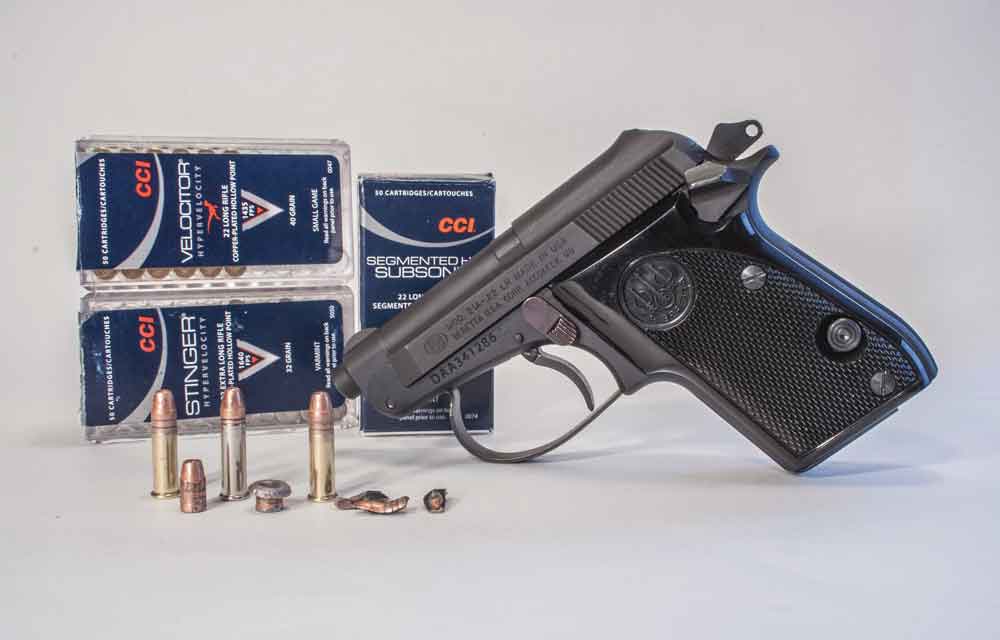
Ballistically, these three .22 LR loads performed well, even out of this sub-compact semi-auto. However, from a terminal ballistics standpoint, the internal damage they are capable of causing is minimal.
What we are concerned with here is if a gun chambered for the .22 Long Rifle is advisable or sufficient for life-saving duties. Most will immediately tell you it’s not. Some will allow its use for the elderly, poorly trained or those weak of arm and hand.
I’ve often thought this odd. If a .22 is good for those folks, how is it not good for everyone else? It’s kind of like the old deer rifle cliché where a lesser cartridge is considered allowable for kids or those of a small stature. Um … if a kid can use a rifle to kill a deer, shouldn’t a big ol’ boy be able to kill a deer with the same gun?
Let’s cut through all the preconceived notions and expert opinions and take an objective look at the .22 LR for personal protection from a pure ballistics standpoint. But first, let’s acknowledge the fact that just having a gun is sometimes enough. As a police officer, I responded to many calls where a citizen had pointed a gun at a bad guy, and that was all it took to thwart the attack. This proves that just having a gun might be more important than what type of gun it is, or even if it’s loaded.
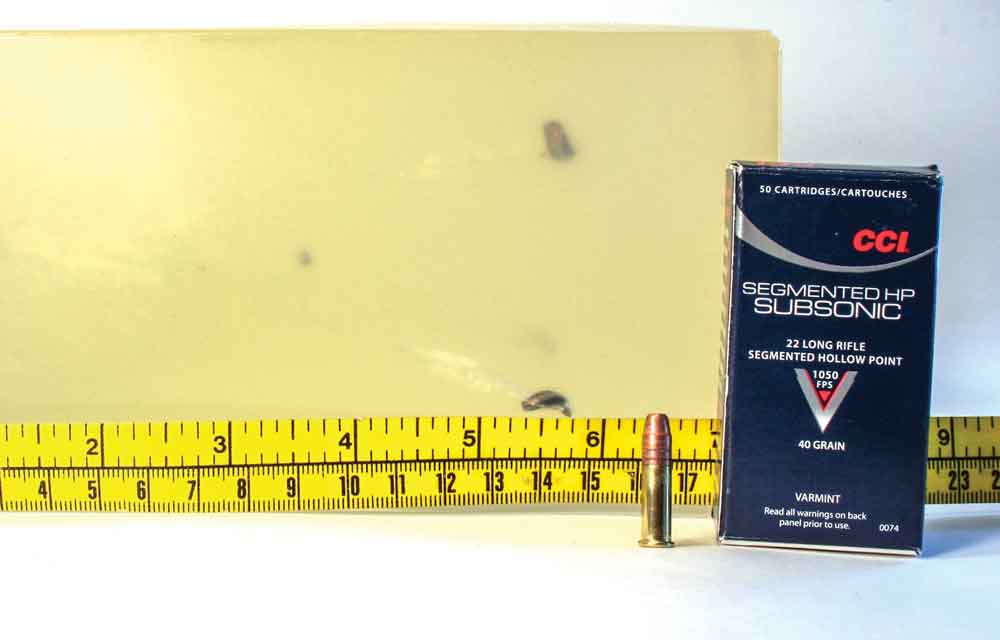
This segmented .22 LR bullet only penetrated about 6 inches. While it might be great for rodents and such, it’s not so much for self-defense.
Don’t get me wrong, I’m not suggesting you use an unloaded gun to protect yourself; I’m just stating facts. Nobody likes to have a gun pointed at them, and fewer folks are willing to risk getting shot.
Thing is, however, you might have to shoot. Sometimes a shot fired — even if it hits nothing — is all that’s needed to stop an assault. Sometimes, when a bad guy gets hit — anywhere, with any bullet — that’s also enough to end hostilities. When we get down to whether your gun can instantly incapacitate a felon, we’re dealing with a last case and least likely, worst-case scenario.
The Four Fight Stoppers
Let’s consider the ways a bullet from a handgun can bring about instant incapacitation. Wounds that hurt can bring about voluntary surrender or, most often, a change of mind. But, what I’m talking about are wounds that bring about an involuntary physiological response. This can happen in one of four ways.
When it comes to the .22 LR, penetration is more important than expansion. Even fully expanded, a .22 LR bullet is not as big as a bullet from a 9mm.
1. Damage to the central nervous system — a bullet to the brain — generally brings about instant collapse, and often death. No, not just a head shot; sometimes a headshot can lead to only superficial wounds.
2. Support structure damage will likely put a human on the ground. A bullet that breaks the pelvic support or severs the spine can put a fiend down either due to bone or nerve damage. But, just because they’re down doesn’t mean they’re not dangerous, especially if they have a gun, too.
3. Involuntary collapse might be the most hopeful outcome of a shot you place on an attacker. The problem is we don’t completely understand why involuntary collapse occurs. It could just be the body’s reaction to pain, a subconscious or neurological reaction. Either way, it’s unpredictable and not something to rely on.
4. Death. Death has a way of making bad guys permanently not bad anymore. Death from a bullet wound takes time. It has to cause hemorrhaging, and the body has to lose enough blood to deprive the brain of activity. On the short side, this could take maybe 10 to 20 seconds, on the long side, 10 to 20 minutes.
Getting The Job Done
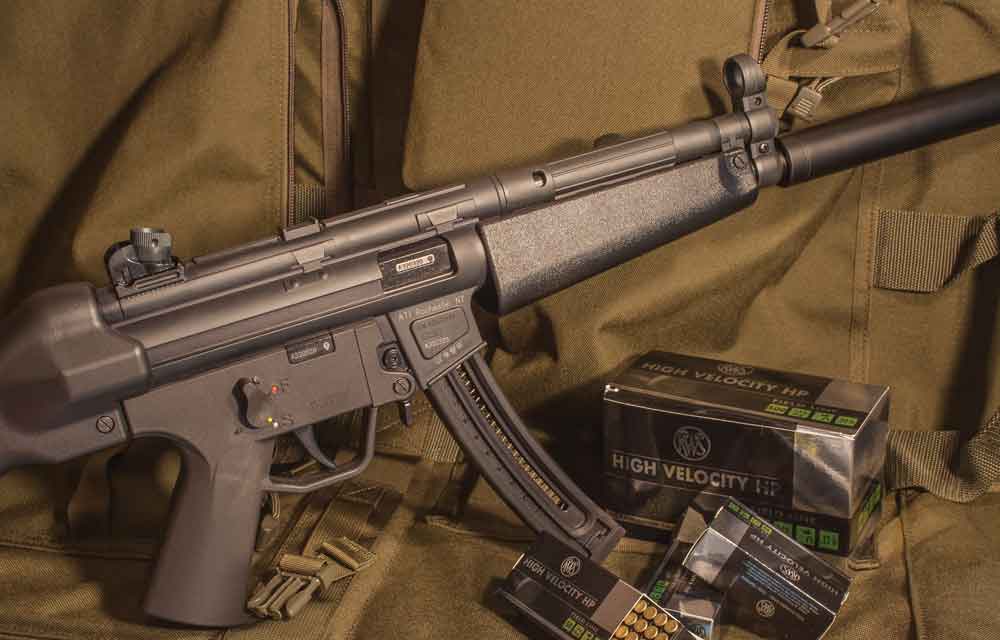
This MP5 clone, chambered for the .22 LR, offers high reliability and a high rate of fire. It’s also compact and light enough that anyone in your home can handle it.
So the ballistic question is: How effective can a .22 LR be at causing one of these four reactions and ultimately saving your life? The FBI, in its infinite wisdom, specifies a bullet from a handgun should deliver at least 12 inches of penetration to be considered suitable for use by their field agents.
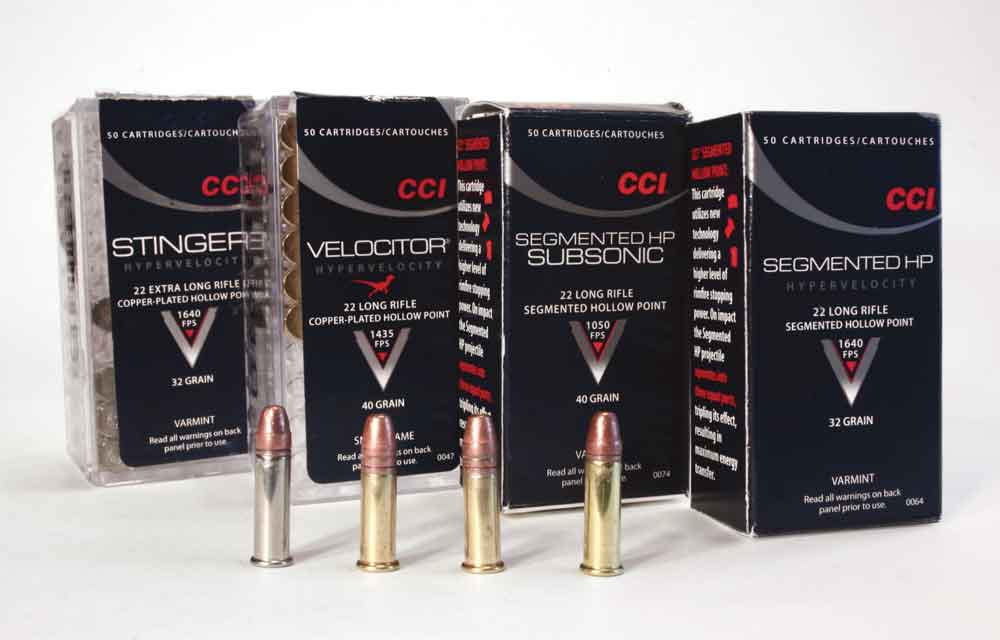
Can a .22 LR deliver 12 inches of penetration from a handgun or a rifle? I tested four different loads to find out. One of those four loads, the CCI 40-grain Velocitor hollow-point achieved that benchmark out of a rifle with a 16-inch barrel, and out of handguns with a 2.4- and a 5-inch barrel. Penetration depths were 14.5, 15 and 12 inches, respectively.
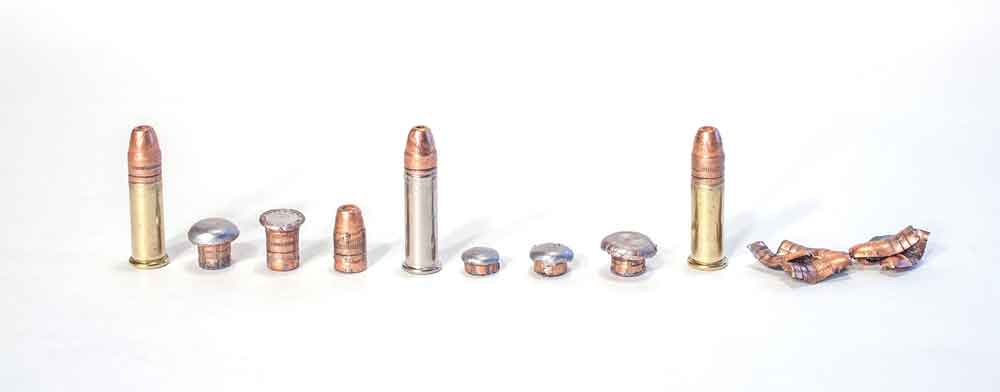
Another higher velocity load — the CCI Stinger — penetrated between 8 and 10 inches from the same firearms. CCI’s 32- and 40-grain segmented hollow-point loads only penetrated between 5 and 10 inches. However, the segmented hollow-point splits into three projectiles during penetration, so the wound cavity — though shallow — is three-pronged in its approach.
(Above) A .22 shot shell is not very powerful and will likely not cycle the action of a semi-auto firearm. However, at 6 feet it will deliver a potentially fight-stopping — painful, if not permanent — wound.
Essentially, if penetration is your goal, you’ll want to select medium- to high-velocity 40-grain bullets for the .22 Long Rifle. But, that might not be your best option, and/or you might have an aversion to potentially killing another human. After all, when you use a handgun to stop a violent attack, your goal is to stop the attack. Your desire to do anything beyond that would be considered with malice, and that has a way of sending folks to the big house — for a long time. That’s why devices such as pepper spray and stun guns are so popular, and they’re effective because they cause pain.
Imagine shooting an attacker in the face with a load of .22 shot from a handgun. At a distance of about 6 feet, this load, when applied to the eyes and smile of a goblin, has a very small chance of being lethal, but a very high chance of delivering a high dose of pain and temporary if not permanent blindness. Any of the three outcomes should suffice to bring about that change of mind or the involuntary surrender you’re looking for.
For that matter, imagine shooting an attacker in the face with any .22 LR load. It might not be the same as a bullet from a .357 Mag., but it will hurt. By golly it will hurt worse than a sting from a ball-faced hornet! Could that potentially make the bad guy even “badder” or madder? Yep, for sure. But, there are things outside of ballistics to consider.
All four of these .22 LR loads were tested in ordnance gelatin. The results seem to suggest that standard or high-velocity 40-grain loads are the best option for personal protection.
Handguns or rifles chambered for the .22 LR have almost non-existent recoil, and most people find them easier to shoot more accurately and faster. You can fire 10 accurate shots from a semi-automatic .22 pistol or rifle in about the same time you can fire five or six shots from a centerfire handgun or rifle. In other words, you could shoot a bad guy nearly twice as many times, in the same amount of time, using a .22 LR as you could with a 9mm handgun or rifle.
Parting Shots
So where does all of this leave us? With regard to defensive handguns most often carried for personal protection, they’re mostly pain delivery devices. In other words, your best bet when shooting a handgun to save your life is that it will cause enough pain to make the attacker stop attacking. It’s just a matter of ballistic fact that concealable handguns that can be comfortably carried long term, are just not that effective at causing instant incapacitation. They do, however, perform rather well when it comes to convincing someone to cease and desist hostilities.
A .22 Long Rifle handgun would not be my first choice when it comes to an every day carry, personal protection handgun. Your ability to inflict pain increases with caliber and is improved with the modern high-tech bullets now available for cartridges such as the .380, 9mm, .40 S&W and .45 Auto.
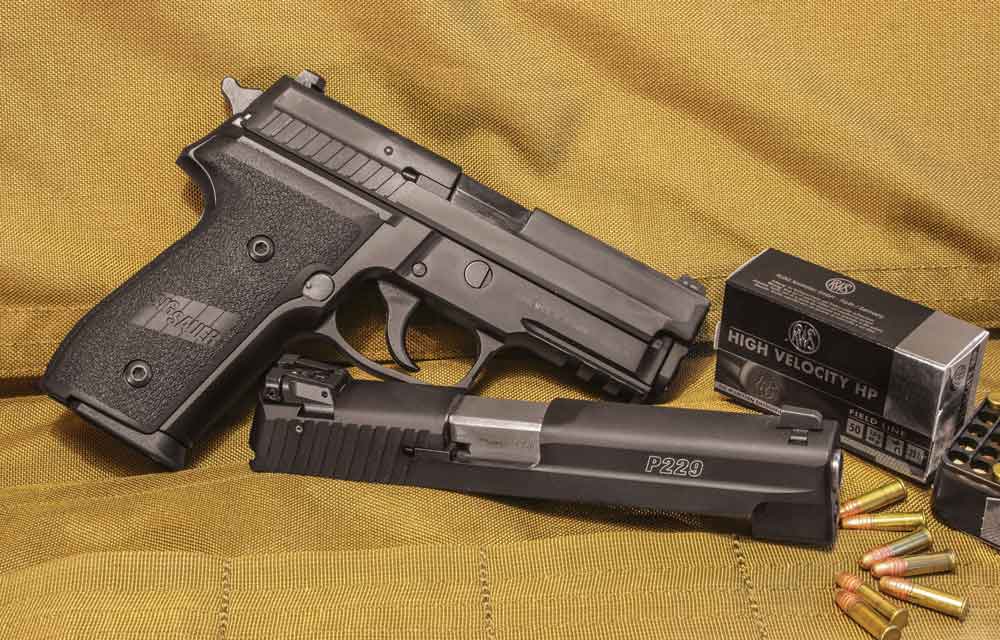
If you do not feel comfortable with a .22 LR for self-defense, don’t overlook how a rimfire conversion kit, like this one from Sig, can help you practice with your defensive handgun at a much-reduced cost.
At the same time, I’d rather have a .22 LR handgun for personal protection than I would a stun gun — which requires you to be very close — or pepper spray — which is a bit dependent on the wind blowing the right direction. After all, there’s a good chance when I point that .22 LR handgun at the bad guy, he’s going to do what most bad guys do when a gun gets pointed at a human, and that’s — at least momentarily — stop whatever they’re doing. Few things are a better attention getter.
Let me leave you with this food for thought: The gun in my closet is an S&W M&P15-22. It’s loaded with a full magazine of CCI Velocitors, has a compact reflex sight and a Crimson Trace light/laser combination fore-grip. Everyone in my home, from the 10-year-old up, can operate this little carbine. And, with it they’re capable of delivering accurate fire, at a fast pace, across any room in my house, and even out to the fence that surrounds it. (It’s also great for rabid foxes — we’ve had two at my house — and the raccoons that seem to think my garbage cans are their own personal buffet.)
A .22 LR might not be the best choice for personal protection, but that does not mean it cannot be a good one.
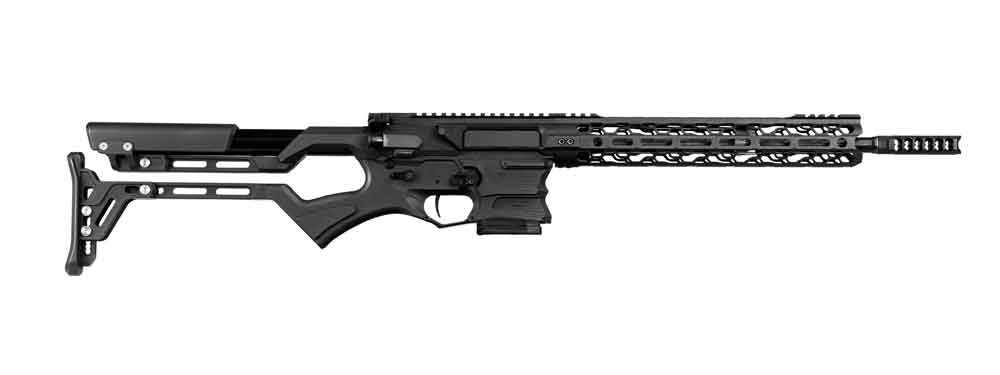
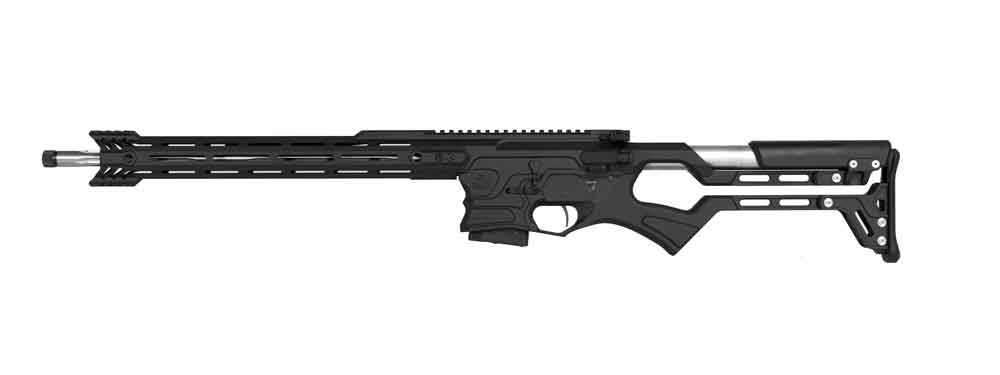
The Cobalt Kinetics Twenty-Seven Series brings traditional rifle ergonomics to the world of the AR-15.
How the Twenty-Seven Series marries the old and the new:
Cobalt Kinetics Twenty-Seven series ARs are configured to mimic traditional semi-autos and bolt-action ergonomics.
The design also makes them California compliant, skirting many of the strict California gun regulations.
There are four sub-models in the Twenty-Seven series: Sentry, Ranger, Hunter and Expert.
The available calibers, depending on model, are: 5.56 NATO, .223 Wylde, .224 Valkyrie and 6.5 Grendel.
Cobalt Kinetics looks to expand the Twenty-Seven concept to its larger-caliber XL line.
Perhaps more so than any other rifle system ever conceived, the AR-15 is eminently configurable. And therein lies the appeal: Searching for a fast-handling tactical carbine or a heavy-barreled long-range shooter? The king of black rifles has it covered on both counts and everywhere between. But, Cobalt Kinetics has done something drastic with the Twenty-Seven Series.
Cobalt Kinetics 27 Sentry
That said, even for the protean design, Cobalt Kinetics’ new Twenty-Seven series rifles are a drastic departure from the norm. Drawing upon more traditional rifle designs, the semi-automatics shoulder and handle more like today’s bolt-action rifles, but they still cycle like an AR.
“We’ve been talking about this at Cobalt for a long time … to create a more traditional rifle that uses modern components to improve performance,” Vice President of Cobalt Kinetics Skylar Stewart said in a press release. “We have had a lot of requests for a semi-automatic rifle more suited for hunters and other sportsmen. I don’t like to compare it to other AR-15s. It does use many of the internal components of the AR-15, but we believe that it’s a step up from the old bolt-action rifle.”
Cobalt Kinetics 27 Ranger
The Twenty-Seven series may be a throwback with a modern twist, but perhaps, more importantly, it’s something else — California Compliant (at least for the time being). And while the company insists the rifles aren’t purely tailored for less enlightened corners of the country, it’s willing to custom configure one to meet local laws. Regardless of locale and legislation, draconian or otherwise, the Utah gunmaker’s Twenty-Seven series puts some interesting twists on the AR.
The grip is angled to avoid the dread definition “pistol,” yet its geometry remains slim enough to allow a comfortable purchase. This feature also streamlines the overall design of the Twenty-Seven series rifles, making, in theory, a rifle easier to transport, given it fits in any normal sized case or scabbard. And Cobalt Kinetics lowered the trigger by .150 inches from the typical AR, giving shooters the ability to naturally position their finger.
Cobalt Kinetics 27 Hunter
Presently, Cobalt Kinetics offers four sub-models in the Twenty-Seven Series: Sentry, Ranger, Hunter and Expert. The Sentry and Ranger are offered in 5.56 NATO; the Hunter in .223 Wylde, .224 Valkyrie and 6.5 Grendel; and the Expert in .223 Wylde. Each sub-model is also available in entry-level and improved configurations, essentially the option for upgraded triggers, controls, bolt-carrier groups and other parts.
Cobalt Kinetics appears ambitious about the Twenty-Seven series potential and it might not be the last traditionally configured AR to roll out of its factory. The company plans to adapt the design to its larger-framed and caliber XL line, opening up the possibilities for medium and big game hunters.
Cobalt Kinetics 27 Expert
Presently, the price for the Twenty-Seven series ranges from $1,765 for the entry-level Sentry to $3,760 decked out Expert.
For more information about the Cobalt Kinetics Twenty-Seven series, check out: www.cobaltkinetics.com
The iconic R. Lee “Gunny” Ermey passed on Sunday. Modern Shooter looks back on the affable and down-to-earth Marine, actor and gun-rights advocate.
The Marine Corps, gun world and movies lost a good friend in the passing of R. Lee Ermey Sunday morning. The Vietnam Veteran, former Marine Drill Instructor and actor died at the age of 74 from complications due to pneumonia.
Ermey is perhaps best known for portraying Gunnery Sergeant Hartman in Stanley Kubrick’s “Full Metal Jacket,” a role that earned him a Golden Globe nomination. Ermey’s personal background brought a level of authenticity and intensity to the Hartman character and helped catapult the movie to icon status. Ermey’s lines from the first half of the movie might very well be the most quoted from any war flick.
An honorary Gunnery Sergeant in real life, Ermey had a thriving acting career outside of “Full Metal Jacket,” playing parts in more than 70 films. Additionally, he was a mainstay on T.V., making more than 200 episodes of ‘GunnyTime’ for the Outdoor Channel, as well as a number of other programs and commercials over the years.
Ermey was also a plain and outspoken advocate for the U.S. Military, firearms and the Second Amendment, and he was a regular superstar as such venues as the SHOT Show. He rarely diced words when speaking about America’s right to keep and bare arms, and actively worked as an NRA board member to protect and advance these civil liberties.
While Ermey’s characters oftentimes came off as gruff even borderline hair-curling, the man himself was down-to-earth and downright affable in person. Modern Shooter was lucky enough to shoot the breeze with the Gunny about 3 years back and got a first-hand taste his friendliness, not to mention straight shooting on any topic that came up — getting into movies, hunting deer as a boy in Kansas, our American freedoms and his beloved (and never cleaned) .45 GAP.
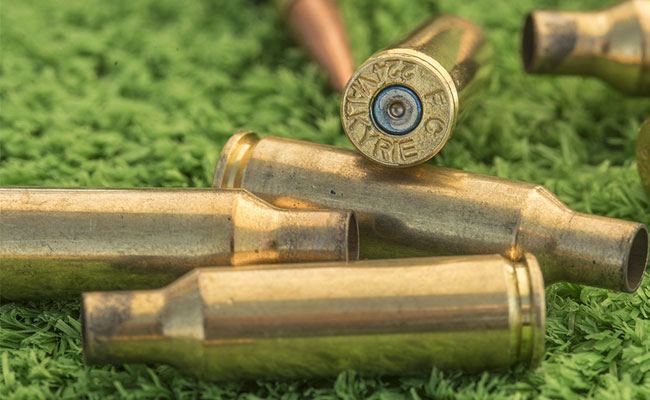
Federal Premium’s new small-bore, long-range cartridge, the .224 Valkyrie, has received final approval by SAAMI and its specifications have been published.
The .224 Valkyrie received final approval by SAAMI as a standardize cartridge.
It is one of five new cartridges approved in the past year, all long-range specialists.
The others include: 6mm Creedmoor, 20 Nosler, 22 Nosler and 24 Nosler.
From SAAMI specs, the .224 Valkyrie can push a 60-gr bullet 3,300 fps.
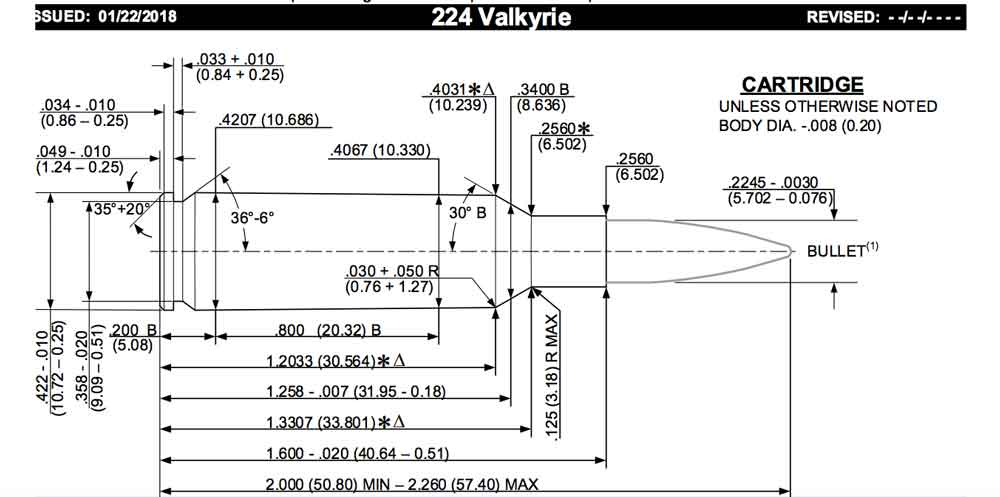
It is official! Federal Premium’s hot-rock .224 Valkyrie is a cartridge. Or more precisely, it is a recognized cartridge by the powers that be within the Sporting Arms and Ammunition Manufacturer’s Institute.
SAAMI, as it is better known, published the approved .224 Valkyrie specifications on its website at the end of March making it freely available to shooters and manufacturers alike. The small-bore cartridge designed for long-range work and optimized for use out of AR-style rifles was initially approved in January at the 2018 SHOT Show in Las Vegas.
“It’s thrilling to have brought the world’s best MSR 15 cartridge to market. We’re proud and excited about our new cartridge, and we deeply appreciate SAAMI’s support with this launch,” said Federal Premium Ammunition President Jason Vanderbrink in a press release. “SAAMI’s approval of the cartridge was a crucial step in legitimizing it within the industry. Their work creates standards for the cartridge, increasing safety, interchangeability, reliability and quality for the dozens of firearm manufacturers currently building rifles in our 224 Valkyrie.”
The .224 Valkyrie headlines five new SAAMI approved cartridges in a little over a year, each a riff off a common theme — long-range shooting. In addition to Federal’s offering, newcomers to standardization include the 6mm Creedmoor, 20 Nosler, 22 Nosler and 24 Nosler. Each of these received approval in 2017, though in the case of the 20 and 24 Nosler cartridges do not yet exist — at least for public consumption.
For those curious about the .224 Valkyrie or any other standardized cartridge for that matter, SAAMI allows free access to its technical data and drawings. The .224 Valkyrie itself is listed with a Maximum Average Pressure (MAP) of 55,000 psi on the spec sheet (available here) and produced the following muzzle velocities during testing:
60-gr @ 3,300 fps
75-gr @ 3,000 fps
90-gr @ 2,700 fps
SAAMI was founded in 1926 at the request of the federal government and is tasked with creating and publishing industry standards for safety, interchangeability, reliability and quality, as well as coordinating technical data.
Federal Premium’s .224 Valkyrie is a based on the 6.8 SPC case necked down to 22 caliber. From the company’s literature, which has been free-flowing since fall 2017, the cartridge is capable of impressive performance, including maintaining supersonic flight past 1,300 yards. Federal touts it as being equal to the vaunted 6.5 Creedmoor, only with less recoil and more economical to shoot. Already, there are a number of gunmakers offering .224 Valkyrie rifles, including Savage and CMMG.
Presently, Federal offers four .224 Valkyrie loads: 90-grain Gold Medal Sierra MatchKing, 60-grain Nosler Ballistic Tip Varmint, 90-grain Fusion MSR and 75-grain American Eagle TMJ.
There’s something special about shooting recreations of classic AR designs, and acquiring one or devising your own isn’t as hard as it might seem.
How to get a classic AR in your hands:
Having been around now for over 50 years, shooters are becoming more interested in classic AR designs.
Counterintuitively, in the AR world, Reto means original, vintage means reproduction.
There are three routes into classic ARs: buying an original, buying a reproduction or building your own.
A number of online forums and books document AR developments and prove vital resources in a build.
It’s important not to get caught up in recreating every detail in a build.
First off it’s a semi-auto version of the original; secondly, original parts cost a pretty penny.
The proper balance is somewhere between authenticity and money spent.
It’s hard to believe the AR-15 has been around for over 50 years. Colt began selling the AR-15 — a semi auto version of the M16 was created for the civilian and law enforcement markets — in the mid sixties. Since that time, the AR has evolved, following suit with the different versions of the M16. The “Black Rifle” is now old enough that it qualifies for the terms vintage and retro, and these older versions of the AR have developed a large following.
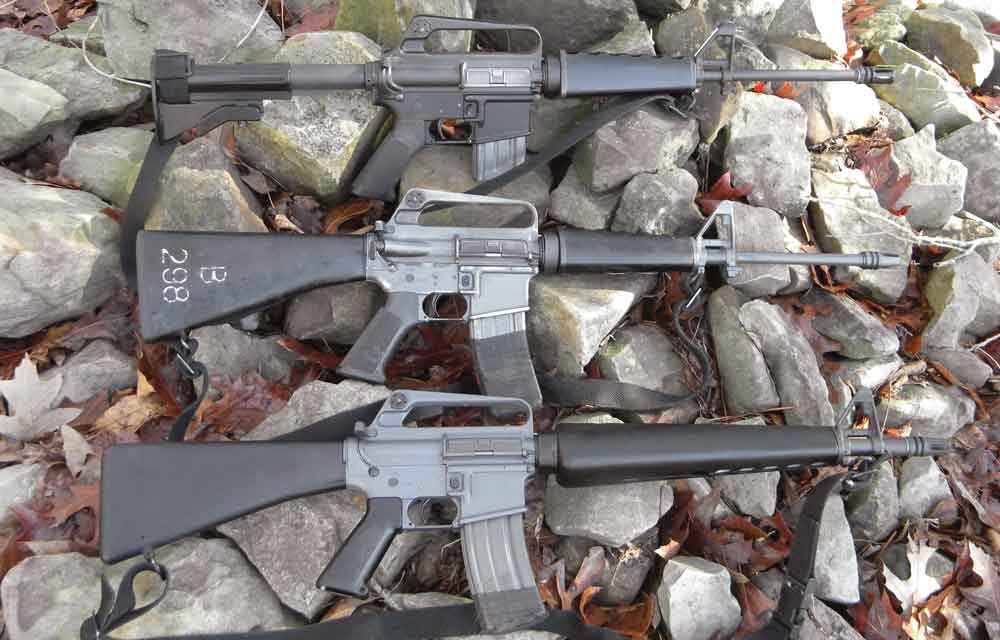
These are three of my builds. They look like the originals, but are nowhere near exact. I put them together how I wanted, and I love to shoot them. They are lightweight, reliable and fun on the range.
In the art and design world, vintage means an original; retro means a reproduction made to resemble the original. In the AR world, these terms are flipped. This is due to forum listings on the website AR15.com. The forum had a “Retro” category, which mainly focused on Colt’s 600 series rifles and carbines — think Vietnam. For discussion on the 700 Colts — the type weapons fielded in Desert Storm — they formed a “Vintage” category to separate the two styles.
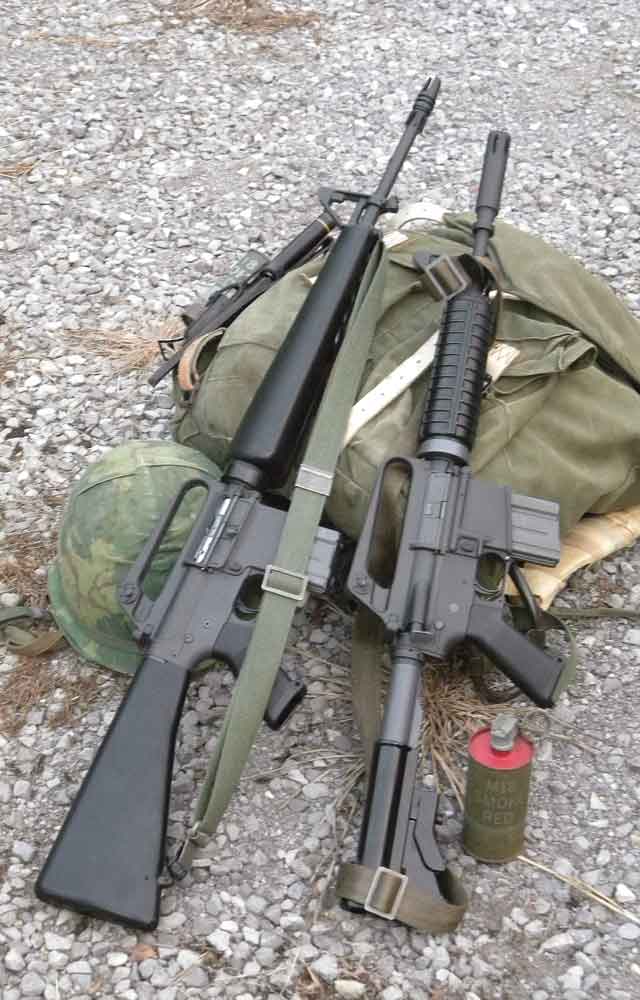
Then you have “Fantasy” rifles/carbines, which use military-type parts but are configured in a way that never came from the factory. But, this doesn’t mean these weren’t used in the field. My go-to AR guy is Matt Weathers, a law enforcement officer and instructor for Shootrite. His dad was 5th SFG (Special Forces Group) and a member of SOG, a special operations unit that served in Vietnam. They carried Colt XM177E2s, an issued carbine with an 11½-inch barrel and collapsible stock. In order to make the carbines more reliable, troops put their upper assembly on a “rifle” lower, which has a fixed stock and a rifle-length buffer and spring. This configuration was never produced by Colt or officially issued, and yet there’s Matt’s dad in the pictures carrying it in the field. (He also used det cord for a sling.)
Getting Into A Classic
There are three options to go old school with an AR. You can buy an original. The problem with this is that a lot of the ARs we want to have and shoot were never produced in semi-auto versions, so the offerings are a little slim. You can buy new ARs that look like originals. Colt, Troy and Brownells build great rifles and carbines based on the earlier models and at affordable prices. Or, you can build your own, using old and/or new parts. Today, if you want an older model AR, there’s no reason not to have one.
I’ve put together several ARs to mimic the old versions. Early on I learned that assembling the “perfect” reproduction is almost impossible, a matter of luck or just too expensive. In the early days, Colt was building a lot of weapons. Colt was improving the designs as they went; changes were being made rapidly and they were using a lot of different contractors to produce parts. Take the grip as an example. For early model Colts, there are dozens of different grips that vary in exact size, shape and markings. Knowing exactly what part goes with what AR can sometimes be difficult.
Luckily, you don’t have to be an expert. Trying to figure out what type part you need for a build, or have questions about parts you have? Forums like AR15.com and RetroBlackRifle.com are full of people who have spent years researching and documenting the AR’s history and the various parts used. The AR community is full of good people who will be willing and eager to help in your quest.
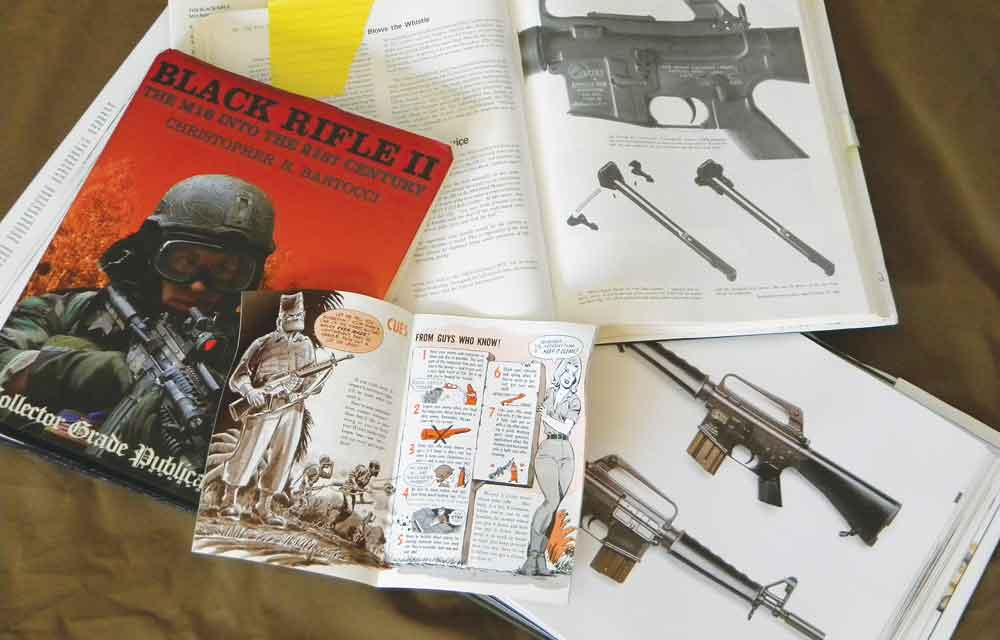
Another great source of info are the Black Rifle series of books published by Collector Grade Publications. These two volumes get into the gritty details of the rifle’s history and development. Volume I, by Stevens and Ezell, was published in 1987 and covers the beginning and early years of development. Black Rifle II, by Bartocci, picks up there, covering later versions of the weapon like the M-4. The Vickers Guide: AR-15 Volume I is another good read. While it’s not as technical as the Black Rifle books, it’s just as interesting, and contains outstanding photographs. There’s even one section entirely devoted to reproductions, with clones of significant and historical rifles and carbines.
Cost vs. Authenticity
Searching for parts is part of the fun of a build, especially with vintage/retro projects. Both of these reproductions — a rifle and carbine — are built exactly as the real ones would have been. With a mix of original parts and new parts machined to the old specs, you can assemble any type AR.
One word of caution on starting a build: Don’t get too caught up in all the details. Yes, I want an authentic AR, but it ain’t gonna be perfect. First off, it’s a semi-auto version of the real thing. Next, I’m not paying some of the prices that original parts are bringing. A pristine set of factory, original green furniture for an AR is going to cost you a few thousand dollars. Reproductions from Brownells will only be about eighty dollars. There are also outstanding shops like Retro Arms Works and NoDak Spud that recreate hard-to-find parts that match the factory, original specs.
With hot rods, speed is a question of money. How fast you go depends on how much you spend. The same can be said of authenticity and ARs. I’m all for authentic, but I’m not going to let that stand in the way of me having the type of AR I want. The retro/vintage thing is learning about the older weapons and having fun. You’re looking for the proper balance between “authentic” and the money you spend. It’s hard to have fun if you have to break the bank. Plus, all of my ARs end up seeing hard use. I don’t want to worry about scratching or breaking something costly and collectible.
Modern Sporting Rifles are cool. They are the pinnacle of design and function. But — given the choice — when it comes time to head to the range, I’m going to take one of my old school reproduction ARs. These are lightweight, simple and reliable weapons, the same type used in Vietnam, Desert Storm and Mogadishu. They feel good in the hand, are fun to shoot and help me connect to an earlier time and the heroic deeds of the brave soldiers who carried them.
Editor’s Note: This article originally appeared in the April 2018 issue of Gun Digest the Magazine.
With all the modern handgun choices available today it might seem counterintuitive, but single-action revolvers are still a viable concealed carry option.
For those competent with one, a single-action revolver can be a legitimate carry option.
Barranti Leather offers an IWB option for single-action revolvers.
For short-term carry, you can open the loading gate of the revolver and secure it IWB.
It can be quickly closed, with a little practice, when the gun is drawn.
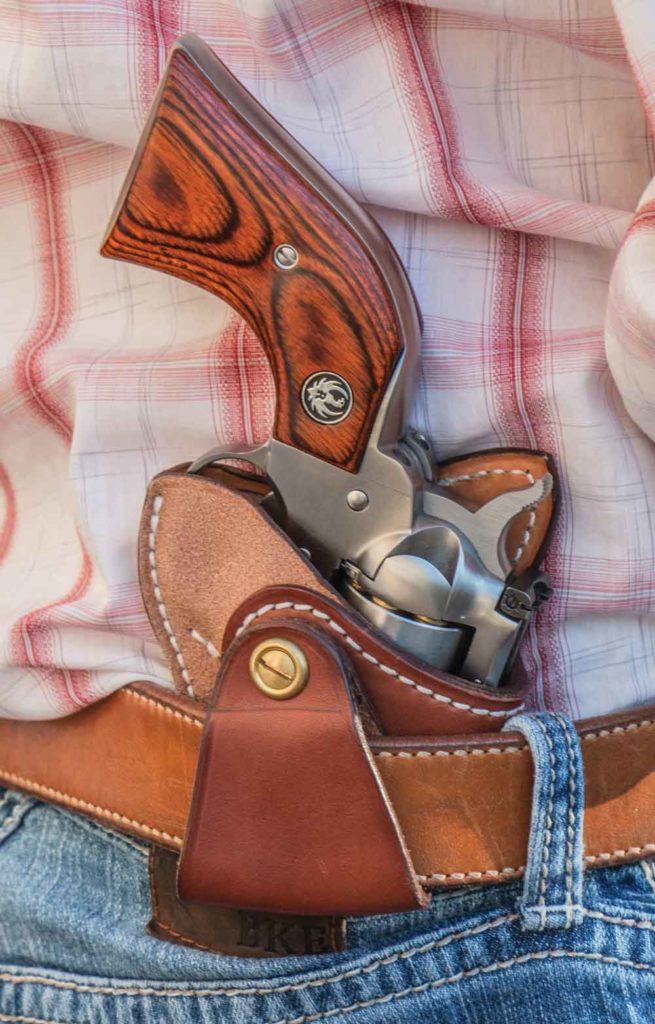
The Barranti Leather Summer Classic is an ideal way to carry a single-action revolver concealed.
Though few modern trainers will admit it, a single-action revolver can be suitable for personal protection. But, this is only true if you’re competent with that revolver and if you have it with you when you need it. (Incidentally, this applies to any handgun you might carry for protection.) Historically, single-action revolvers are carried outside the belt in some sort of cowboy-like holster. While this might make access fast and easy, it is almost impossible to cover up.
On occasion, I’ll carry a single-action revolver for personal protection, particularly when I’ve been in the field hunting and carrying it for another purpose. I stumbled upon a very unique holster to help me do this called the Summer Classic; it’s hand made by Mike Barranti of Barranti Leather.
This holster resembles several frequently used for the inside-the-waist-band (IWB) carry of semi-autos or double-action revolvers. It’s also magically comfortable and as secure and easy to access as any IWB-style holster I’ve worn. For those of you who can handle a single-action Colt or Ruger, I’d suggest you try one out. Additionally, Barranti will custom make just about any gun-leather product you can imagine, and his work is magnificently extraordinary.
Oh, and by the way, for the incidental short-term and secure concealed carry of a single-action revolver, you can always open the loading gate and it will catch on your belt when you shove the revolver in your waistband. I’d not carry a revolver like this long term, but in a pinch, it’ll do just fine. When you draw the revolver, just click the loading gate closed with your trigger finger. I learned this carry technique from a real cowboy.
Editor’s Note: This article originally appeared in the January 2018 issue of Gun Digest the Magazine.
Some might have reservations about carrying a gun to church. But a self-defense scenario can play out anywhere, even a house of worship.
Going armed should mean going armed, even at Sunday services.
As to what sort of gun to carry it’s simple, the one you carry everyday.
Churches, like any other venue open to the public, should have a security policy in place.
Church Security
As of late, there’s been a lot of talk about whether someone should go to church armed. The question perplexes me a bit because I’m thinking, “Why would you go anywhere unarmed?” Regardless, there now seems to be a rush to establish church security policies and training for church security teams. For what it’s worth, Gunsite Academy was doing this before that cretin in Texas had his temper tantrum. Folks are also wondering what gun they should carry to church.
Taking responsibility for your own safety means accepting that responsibility everywhere, even at church, where the focus should be on saving souls and lives.
Let me see if I can sort this out, simple like. The last question is the easiest to answer: You carry the same gun to church you carry anywhere else. Now, for the more complex problem: Yes, a church absolutely needs a security policy. So does a convenience store, lumberyard or sporting event. And, yes, when devising this policy or training a team, an expert should be consulted.
But here’s another solution that might seem over simplified. Let me first explain the answer with a story. I was on a recent hunt and a guide was in the back seat of the truck when we spotted animals 1,000 yards away. He wanted to put the spotting scope on them, but he was seated on the wrong side of the truck to mount the scope on the window. His solution was to throw all the gear piled beside him up front with the other guide and me. This was a cluster because hunters take way too much gear with them; it took almost 5 minutes to sort it all out. About midway through the process, I suggested it might have been easier if we’d just turned the truck around.
The same logic applies to church security and, unsurprisingly, some churches have already figured it out. Just post a sign out front that clearly states the church supports concealed carry. Or, if you like a little alliteration in your announcement it could read, “This Christian congregation carries concealed.” Regardless of how it’s handled, churches need to be just as concerned with saving lives as they are with saving souls.
Editor’s Note: This article originally appeared in the January 2018 issue of Gun Digest the Magazine.
In addition to being a capable cartridge in its own right, the .30-06 Springfield has spawned a talented brood of offspring.
Perhaps only the .375 H&H Magnum is the parent case of more cartridges than the .30-06 Springfield.
The .30-06 has been modified to pitch everything from .25-caliber bullets all the way to .358 caliber.
Add in the .308 to the .30-06 family tree and really there’s something for everyone.
All parents are proud of their children — with good cause — but few cartridges have the brood of offspring that the .30-06 does, save perhaps the .375 H&H Magnum. Just think about the immediate children of the Springfield: the .270 Winchester, the .25-06 Remington, the .280 Remington, the .35 Whelen and the .338-06 A-Square, just to mention the commercially produced lineup.
There are those other children who’ve stayed out of the limelight (commercially, that is), which include the 6.5-06 and the twins, the .375 and .400 Whelen. I’ve read of wildcats as small as .22 caliber based on the ’06 case; well, I believe you get the point. Hell, even the .308 Winchester can trace its lineage back to the .30-06, so you’d call them cousins, but the .243 Winchester, .260 Remington, 7mm-08, .338 Federal and .358 Winchester all get the invite to the family reunion.
Like the .375 H&H, the .404 Jeffery, the 8mm Mauser and the .308 Winchester, you can see that the ’06 case is an excellent platform to begin with; can we deny the successes of the .25-06, .270 and .280? And if you truly believe that more bullet weight or frontal diameter than .30 caliber has to offer is warranted, the .338-06 might be one of the sweetest shooting means of delivering a 250-grain bullet I’ve ever fired, save my pet .318 Westley Richards of course.
If that 61mm case length appeals to you more than the short-action .308 family, or the belted magnum of H&H lineage, there really is something for everyone within the .30-06 family tree.
Editor’s Note: This article originally appeared in the October 2017 issue of Gun Digest the Magazine.
Chambered in potent .375 Ruger and .338 Win. Mag., Savage Arms’ Brush Hunter takes aim at the world’s biggest game.
What the Brush Hunter brings to the table:
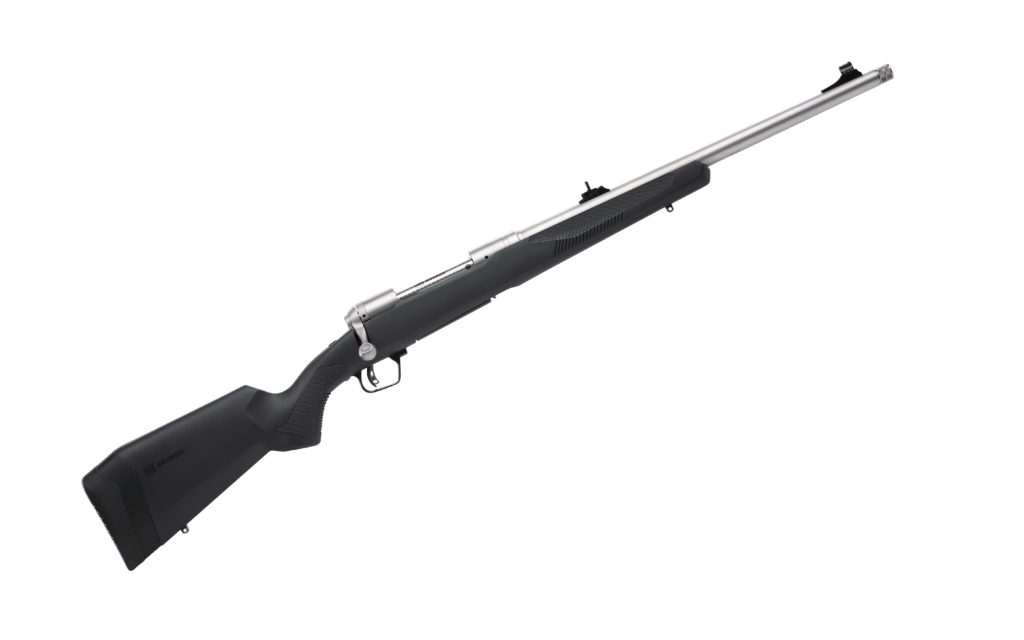
The Brush Hunter has a fast-handling 20-inch medium contour barrel.
Its oversized bolt handle helps operation of the Model 110 action.
The rifle is light, at just over 7 pounds.
And at $784, the Brush Hunter is highly affordable.
Savage Arms in its present form has come to mean bolt-actions.
Few other American gunmakers have been more dedicated to the age-old and highly accurate style of rifle than the Massachusetts manufacturer. Even fewer gun companies win the kudos Savage does for balancing price and performance in nearly everything it rolls off the factory floor. While it has recently expanded into producing more contemporary semi-automatic rifles, its bolt-actions still, by and large, take center stage. And Savage continues expanding and evolving to fill every niche in the turn-bolt world.
Recently, Savage addressed one of the gaping holes in the modern iteration of its catalog with the introduction of the Model 110 Brush Hunter. With one of the chambering options .375 Ruger (the other is .338 Win. Mag.), the company now offers a legitimate dangerous game rifle and in a package well suited to excel in the heat of the most testing hunts.
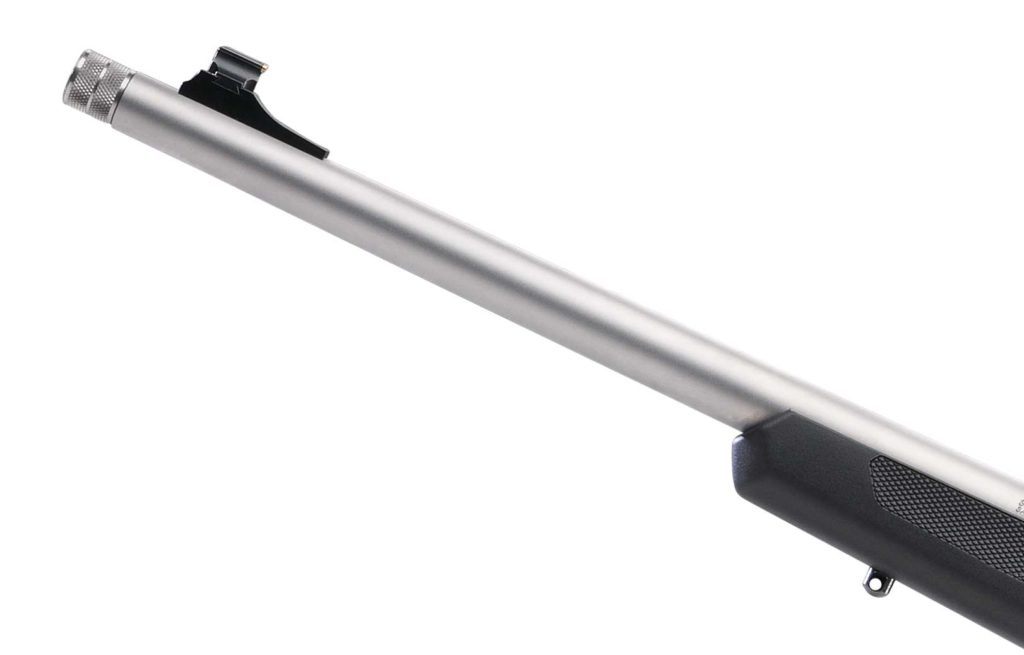
The barrel, all 20-inches of it, is perhaps the most eye-catching aspect of Savage’s stainless steel beauty. In addition to making for an overall lighter rifle, a hair over 7 pounds, the medium contour barrel also endows the Brush Hunter with another highly desirable quality — fast handling. With more weight situated around its time-tested 110 action, the rifle has the ability to transition targets quickly and stop on a dime. For good measure, Savage has also included an oversized bolt handle, ensuring hunters can run the action even when drunk on adrenaline. These attributes are desirable for any hunter potentially facing down critters armed with deadly teeth, claws or horns.
The Brush Hunter comes outfitted with adjustable iron sights, commonplace in safari rifles and aiding in the rifle’s fast handling. Savage’s heavyweight also boasts the company’s vaunted AccuTrigger, which can be tuned between 1.5 and 6 pounds, and a synthetic stock with 1 inch of play in length of pull.
The Brush Hunter utilizes a detachable box magazine with a 3-round capacity in .375 Ruger and 4 rounds in .338 Win. Mag. Additionally, it has a threaded muzzle for the easy addition of a muzzle device for hunters further looking to tame the rifle’s recoil. But of all the features the Brush Hunter touts, it’s its price tag that may be the most appealing. At $784 for both calibers, Savage makes available to nearly every shooter a rifle that literally can tackle any game on the face of the planet.
For more information on the Brush Hunter please check out: www.savagearms.com
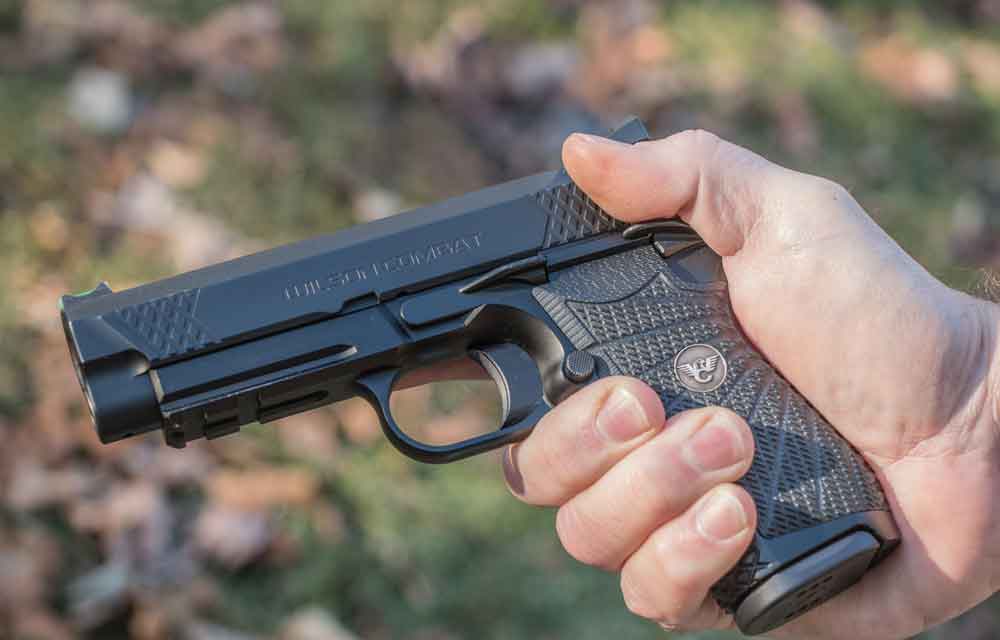
Looking to go armed, but are stuck in the weeds as to what to arm yourself with? Here are 20 of the best concealed carry gun options that will keep you on the defensive.