Bullet expansion is a tricky subject. You might think the lead-core variety mushrooms more quickly than a solid-copper one, but it’s not the case.
What are the basics of bullet expansion:
Bullet expansion occurs as soon as its impact begins.
At a certain depth, a bullet ceases to expand do to loss of velocity.
Softer metals, such as lead, tend to expand more simply because they require less velocity to deform.
One of my favorite misconceptions is the notion that some bullets expand faster than others. Experts, who believe softer bullets deform at a faster rate than hard bullets, commonly espouse this myth. The “fast-expanding bullet” term is most often used to delineate between bullets with a lead-alloy core and bullets made from a single metal, such as copper or gilding metal. Granted, from a simply logical position, it seems to make sense that a hard bullet would take more time to deform than a soft bullet.
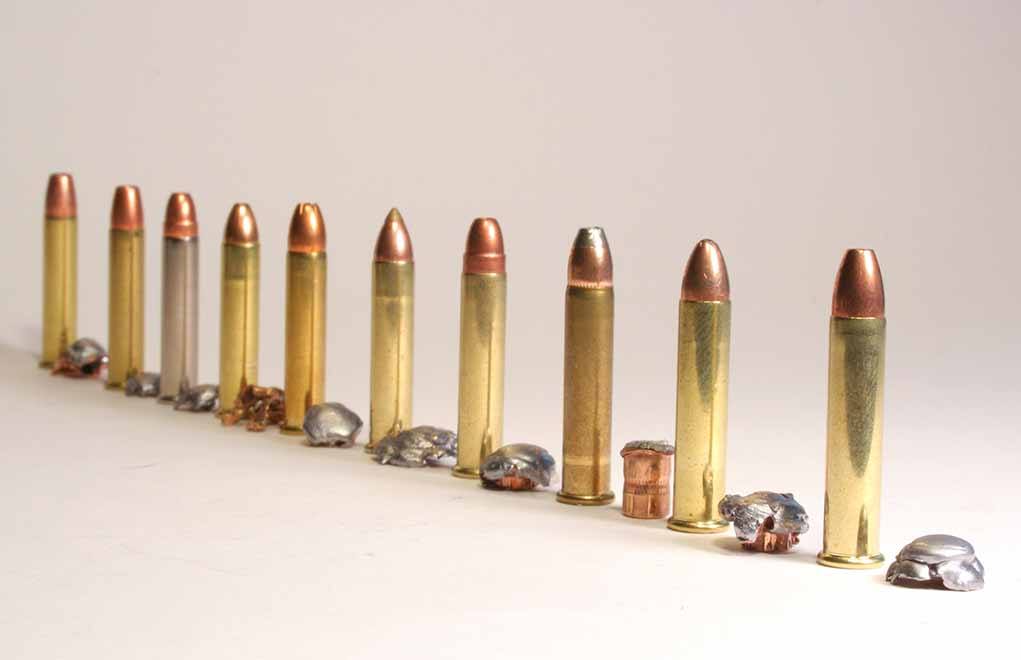
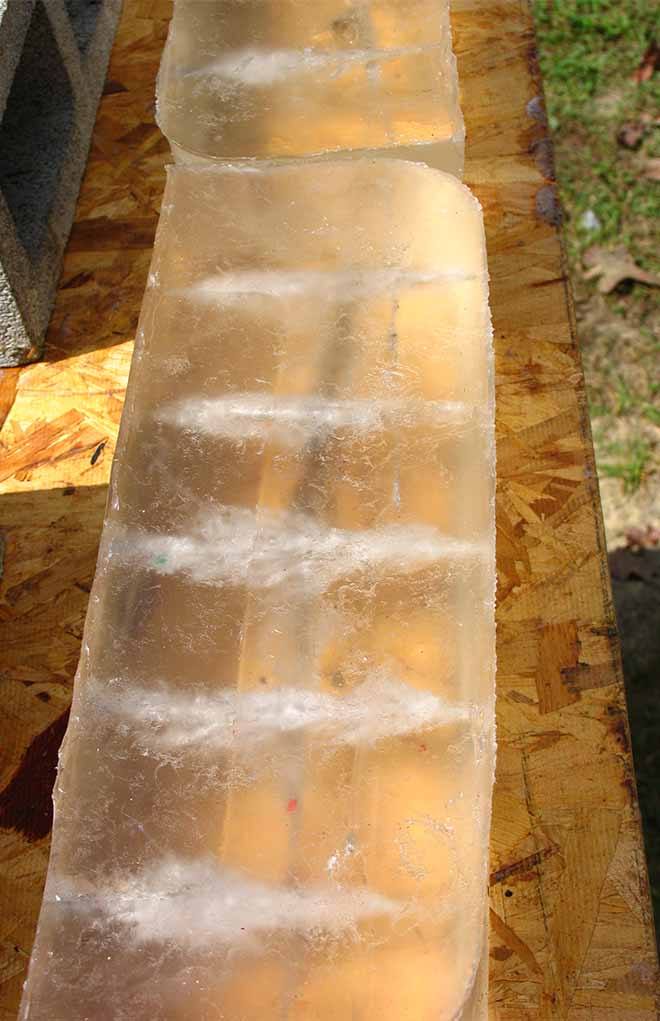
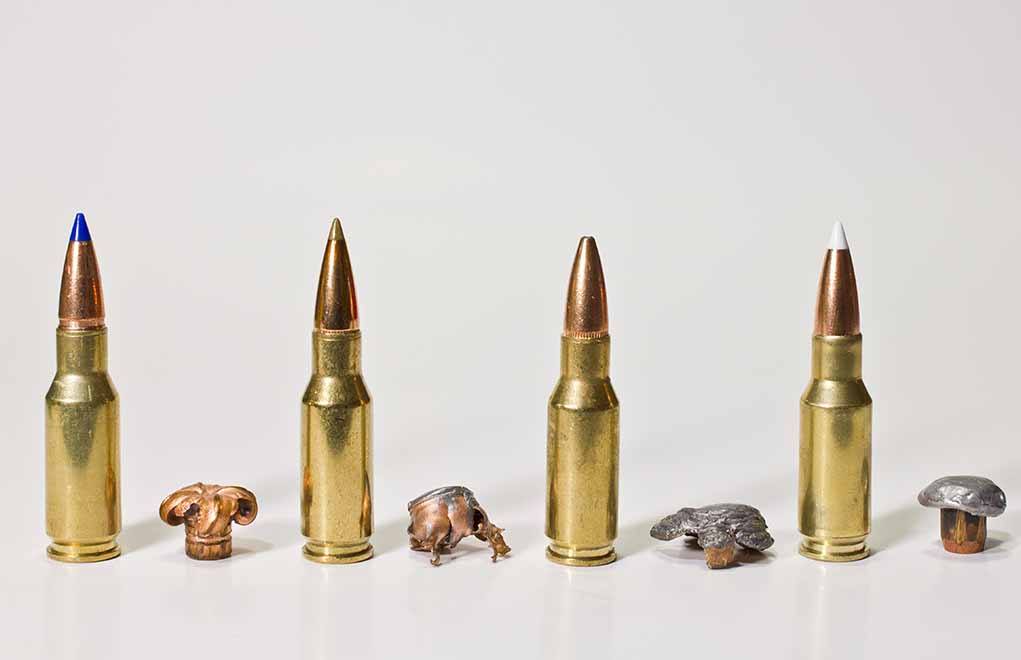
Bullets begin expansion immediately upon impact. As you can see, where these five different bullets passed through 6 inches of test media, their expansion was complete well before exiting.
The problem is, the exact opposite is actually the case.
Here’s the thing: Bullet deformation occurs as soon as impact begins, regardless of how “hard” the bullet might be. In fact, the best chance a bullet has to deform or expand is upon initial impact because that’s when it’s going the fastest. Any forward progression of the bullet after impact occurs at a slower velocity because every millisecond a bullet mores forward, it decelerates.
Now, a hard bullet like a Barnes Triple-Shock, which is made of all cooper, needs to impact at something close to 2,000 fps in order for expansion to initiate. Total expansion — or all that will be experienced — occurs very rapidly, over a distance as short as about 2 inches. On the other hand, a softer bullet can still deform when traveling as slow as about 1,600 fps. If it strikes a target at 2,000 fps, it can continue to deform until it slows below 1,600 fps because the bullet materials require less energy to deform them. This means that it will cover a greater distance — as much as 5 inches — before it loses the energy necessary to deform.
So, in reality, the harder expanding bullet fully deforms faster than the soft bullet. Along those same lines, you’ll sometimes hear hunters say, “The bullet was so tough and the animal so small, it did not have enough time, or meet enough resistance, to expand.” This, too, is BS. Even the toughest expanding bullet, from say a .300 Winchester Magnum, will be fully expanded after only penetrating about two to 2½ inches of animal or test medium.
All of these bullets take about the same amount of time to expand. Surprisingly, the all-copper bullet on the left will reach its final shape faster, partly because it needs more velocity (and uses more energy) to deform.
The deeper a bullet goes, the more it slows, and the less potential it has to deform. Some bullets might reach complete expansion sooner and over a shorter distance than others: Chances are, however, they’re just not the bullets you thought they were.
Editor’s Note: This article originally appeared in the April 2019 issue of Gun Digest the Magazine.
Winchester … there are few names in the world of firearms more iconic. Manufacturing guns since 1866, Oliver Winchester’s concern has grown with the country and played a vital role in its history. Few other companies are as deeply entwined in the fabric of America than Winchester. After all, it produced “The Gun that Won the West” (the Winchester 1873, incidentally) and manufactured some of the most storied firearms of all time. There was a spell in its history where nearly everything that rolled off its lines was arguably an all-time classic. Given this, it’s difficult to winnow down the best of the best? But we’ll give it a crack below with the 9 greatest Winchesters ever created.
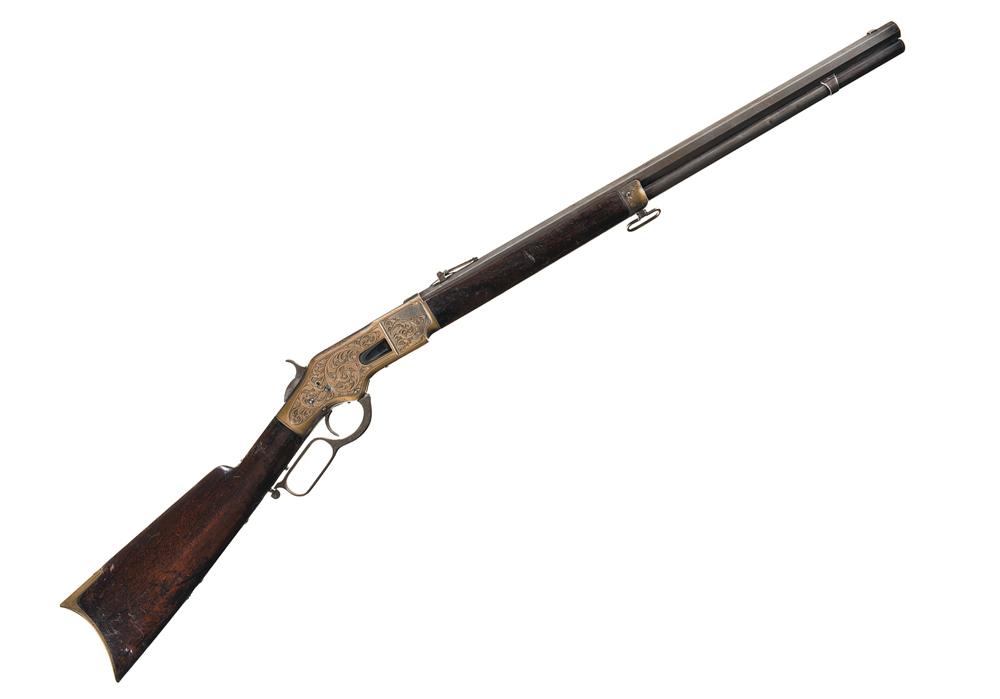
Known as the “Yellow Boy”, the Model 1866 kicked off Winchester Repeating Arms. Kind of. Those who know their firearms history know the rifle design goes back further … New Haven Arms Company and Repeating Arms. Honestly, the Model 1866 is pretty much an 1860 Henry Rifle – a point Benjamin Henry was more than conscious of, thus partly explaining the lawsuit he filed against Winchester. That’s another story.
Despite boasting the same toggle lock, gunmetal (red brass, a type of bronze) receiver and shooting the .44 Henry cartridge, the gun did have some vital improvements over the Henry. First and foremost, the loading gate developed by Winchester superintendent Nelson King. A relatively simple mechanism, the gate allowed shooters to load the rifle at the side of the receiver, instead of through the tubular magazine. And the magazine itself was enhanced. Whereas the Henry was open at the bottom, which gave foreign materials a chance to wreak havoc on the rifle, King sealed it. The fore-end stock was a nice addition too.
The Winchester 66 is a tough gun to add to a collect, costing a small fortune. Though, the company has released reboots of the rifle from time to time, most recently in .44-40 Win. and .38 Special.
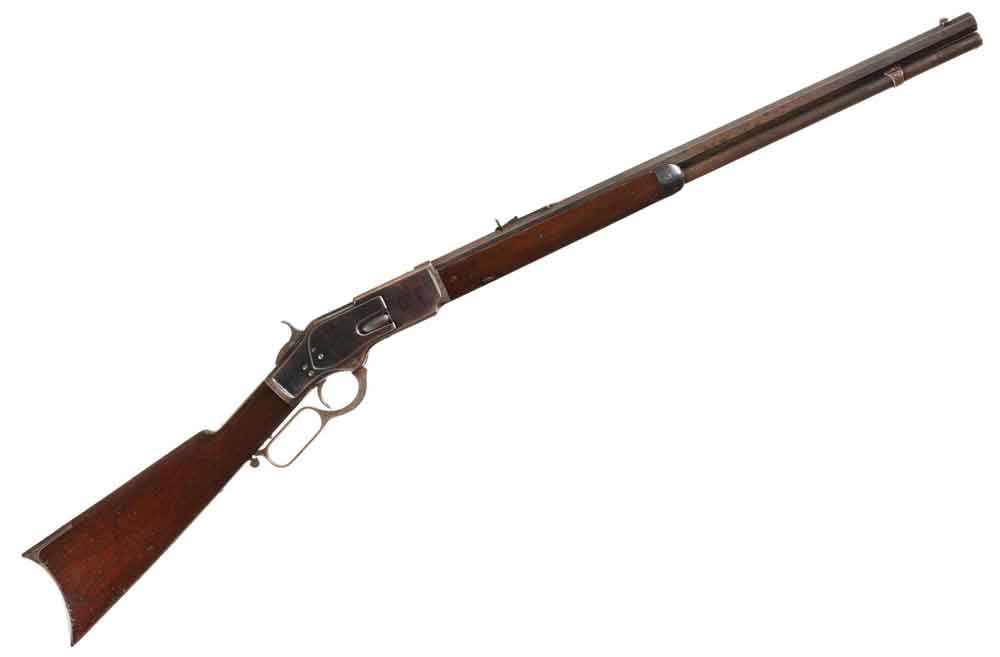
The Model 1873 is about as legendary as firearms come, the veritable hammer with which the better part of this country was beaten into shape. Simply being “The Gun that Won the West” (it wasn’t exclusively) should be enough for any gun to get top-of-the-marquee billing. If you need more, it’s also about the only rifle to ever have a movie titled after it – Winchester 73.
No shortage of good and bad men found a use for the iron-framed lever action on the American Frontier, from William F. Cody to Billy the Kid and Butch Cassidy. Yet, the 1873 was perhaps more consequential as a tool of the pioneer. Be it protecting the homestead or putting meat on the table, the shooting iron was as versatile as rifles come. And reliable to boot. The Winchester didn’t take a mechanical genius to keep running, an obvious plus when gunsmiths weren’t a dime a dozen.
At heart a Model 1866 (which at heart is a 1860 Henry Rifle), the Winchester 73 had one major improvement on its predecessor – an iron receiver. Gunmetal (red brass, a type of bronze) was used on the ‘66, which limited its chamberings to the .44 Henry. The more resilient material on the Model 1873 opened the rifle to a number of Winchester’s more powerful pistol cartridges, including – .44-40, .38-40 and .32-20. Though underpowered by today’s standards, the cartridges provided a solid peace of mind in a day when logistics weren’t exactly crackerjack. Given a bad rain storm could leave you high and dry in the ammo department, the ability to share fodder between your pistol and rifle was a pretty solid plan.
Unless you’re a dedicated collector with a large bank account, vintage Winchester 1873s are difficult to pick up. However, Winchester still turns out the rifles chambered in the much more modern .357 Magnum/.38 Special.
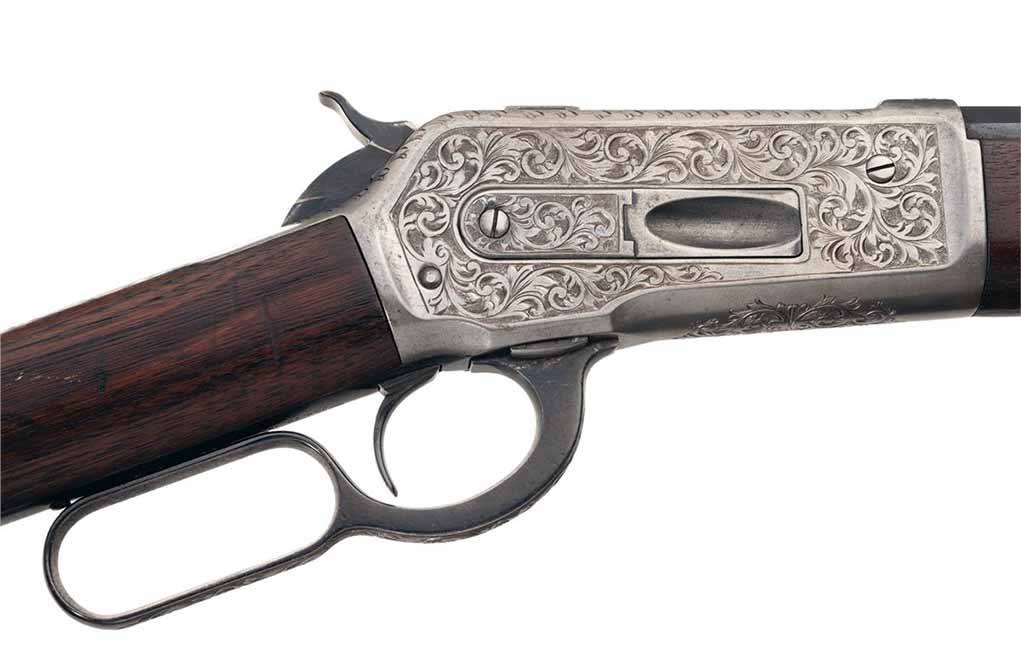
It had to start somewhere. And that somewhere, when it pertains to John M. Browning and Winchester lever-action rifles, is the Model 1886. It’s said then Winchester president Thomas Bennett bought the rifle design on the spot on his trip to Ogden, Utah to visit the famed designer. Regardless of how it was procured, the big-bore rifle formed the foundation of one of the most legendary partnerships in all firearms history.
At the time, Winchester already had a rifle-caliber, lever-action – the 1876 – however, it pushed the limits of the design. Still featuring the Winchester 73’s toggle lock, it barely played nice with the more-powerful cartridges, thus couldn’t take advantage of the larger-bore metallic cartridges hitting the market. Browning solved this by adding twin locking lugs.
Actuated by the lever and coming up on either side of the bolt, the system gave the Winchester 1886 the strength to handle larger cartridges. The gunmaker took advantage of it, chambering the rifle for some of the big-hitter of the day. First the .45-70 Government and .45-90 WCF, later the .40-65 WCF, .38-56 WCF, .40-70 WCF, .38-70 WCF, .50-100-450, .50-110 Express, and eventually the smokeless-powder .33 WCF in 1903.
Expensive for its time, the Winchester 1886 wasn’t as widespread as the company’s other lever-actions. But that didn’t mean the rifle didn’t leave its mark. Depending on its chambering, it was fit to hunt nearly anything on the planet and made many excursions to Africa and the like. No surprise, it was a favorite of America’s most gun-savvy president – Theodore Roosevelt. The Winchester 86 is still available today – made by the Miroku Corporation – but only chambered in .45-70.
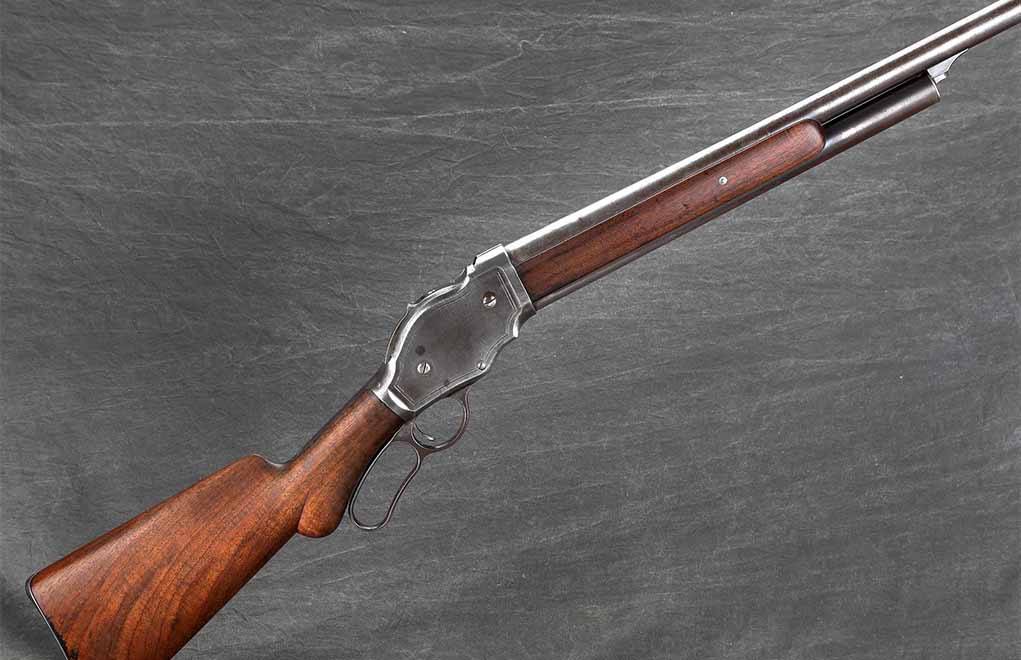
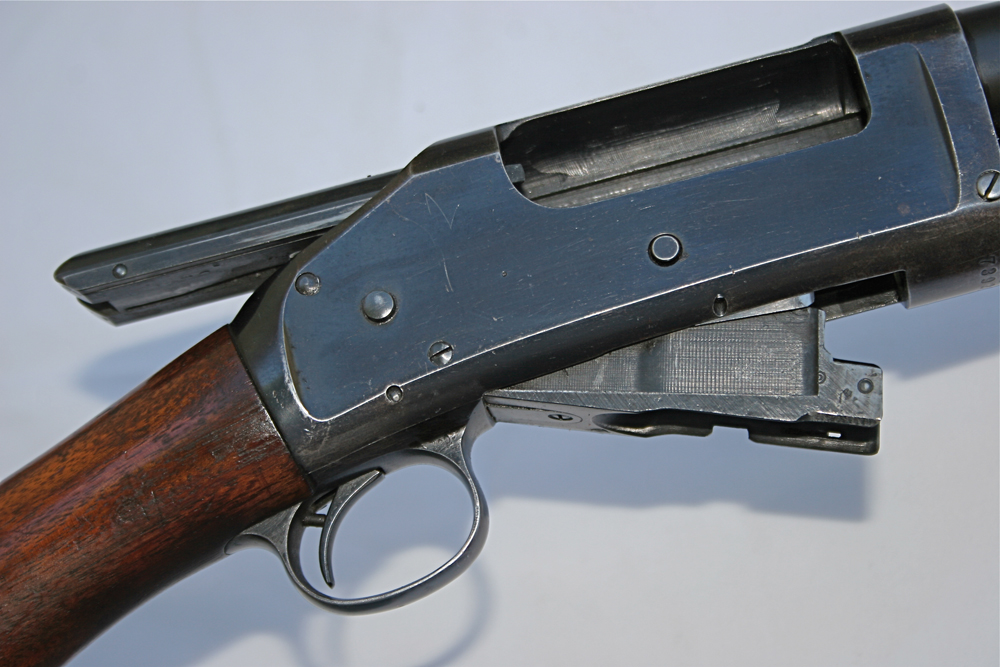
Despite lever-action shotguns never catching on the way their pump-action cousins did, the Winchester 1887 marks an important point in smoothbores development. The John M. Browning designed gun was the first commercially successful repeating shotgun, virtually changing shooters’ expectations overnight. Though had the design genius had his druthers, he would have made it a pump-action. Arguably easier to work, the idea was jettisoned by the company because, dang it, they made lever guns! A pump might damage the brand’s recognition.
Prior to the Winchester 87, the best a shooter could hope for in firepower was two-rounds delivered from break-action, side-by-side shotgun. With a 5+1 capacity, the Model 1887 was a true force multiplier, making it a mainstay of law enforcement and outlaws alike. However, the shotgun wasn’t without its faults. The black-powder shotgun, available in both 12- and 10-gauge, was higher-capacity and faster shooting than anything that had come down the pike, but it was a bear to load. You reached the tubular magazine via the top of the receiver, which required some finagling.
In essence, the Model 1901 is the 1887 beefed to handle smokeless powder loads. Available in 10-gauge only, the 32-inch barreled shotgun also had an improved two-piece lever with a trigger-block safety. Winchester does not presently, nor has for a while, produced either a Model 87 or 01. But affordable and faithful replicas are available from Chippa and Pietta.
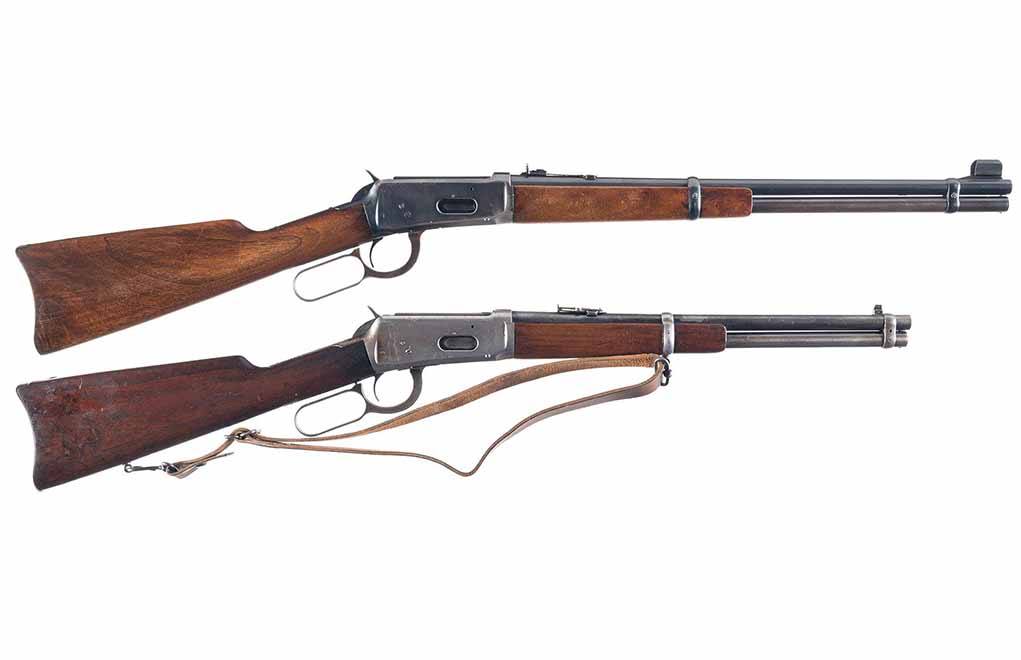
For deer hunting, there’s no parallel. The Winchester Model 1894 has harvested more than all the rest – perhaps combine. Part of this was due to the ubiquity of the John M. Browning-designed lever-action. Having sold more than 7-million units since its inception gave the rifle a chance to bring home a ton of backstraps. Longevity also plays a role. Outside of a small gap this century, the Model 94 has been in continuous production since, well … 1894, making it among the oldest designs still coming off a line.
There’s little secret to the 94’s popularity. It was a simple design, functioned reliably and utilized the major technological advancement of its day – smokeless powder. The big modification Browning made to stouten up the Model 94 for the higher-pressure cartridges was the implementation of a cross-bolt locking block, compared to the twin lugs of the Model 86.
Despite building fame as a smokeless-power gun, the rifle started life chambered for metallic black-power cartridges – the .32-40 Winchester and .38-55 Winchester. It made the jump to smokeless a year after its release, and the cartridge it was matched with grew equal to the Model 94 in acclaim – the .30 WCF or .30-30. Certainly, compared to today’s high-performance cartridges, some of the shine is off the .30-30. But a turn-of-the-century shooter couldn’t do much better for hunting beast or, in such cases as Tom Horn’s, man.
Winchester 94 rifles aren’t difficult to find and run the gamut in price. More economical specimens generally come from the mid-1960, when Winchester overhauled its manufacturing procedures. Stamped metal and the like are the names of the game and while they are functional, they certainly don’t have the timeless beauty and performance of the pre-64 machined iterations. Though, to be fair, the new variety improved over time, with more current examples boasting more refined features, including a much better finish.
Winchester still offers the Model 94 today, manufactured by Miroku Corporation. And with advancements in lever-action ammunition is as much a game getter as it ever was.
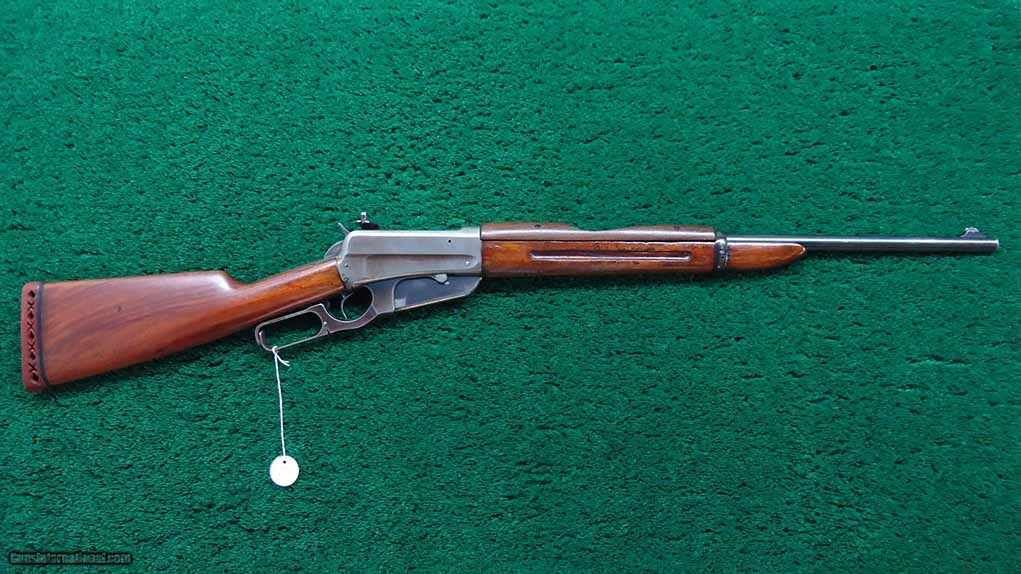
The last development in Winchester lever-action rifles, the Model 1895 is also a major departure from everything that came previously. Most obvious in this department, the rifle’s box magazine. Spitzer bullets, becoming more common at the time, was the driving force for this advancement, given the pointy devils don’t play nice with tubular magazines.
If you have difficulty figuring out why think where the tip of the bullet rests. That’s right, dead on the next cartridge’s primer. Given this, a dropped rifle could potentially turn into a very bad day.
John M. Browning’s last lever-action for the gunmaker, the Winchester 1895 also boasted the strongest action he’d design for the line. It had to have one. Smokeless powder was becoming the norm, so the rifle had to withstand increased pressures. He achieved resiliency by veering away from the twin locking lugs found on the 1886 and opting for a shorter and stouter cross-bolt designed, similar to the one found on the 1894.
With this modification, the rifle was capable of safely firing many cartridges most modern shooters are familiar with: .30-40 Krag, 7.62x54mmR, .303 British, .30-03, .30-06 Springfield, .35 WCF, .38-72 WCF, .40-72 WCF, and .405 Winchester. Note, a number of these were military cartridges of the time, and Winchester attempted to market the gun thusly with little success. The notable exception being Russia. A full 300,000 of the 425,000 Winchester 95s manufactured were for the Russian Empire, chambered 7.62x54mmR. Interestingly, the guns were designed to utilize a Mosin-Nagant stripper clip for loading.
Simple math tells you, outside of the greater Eurasian continental region, the Winchester 95 was somewhat a rarity. It was generally found among hoity-toity, globe-trotting hunters. Once again, such as Teddy Roosevelt, who took his – in .405 Winchester – to Africa on his 1909 safari. For the average rabble, the shine hadn’t worn off the Winchester 94, nor would it for quite a while.
“Trench Gun” or “Trench Broom”, whatever you call it the Winchester 1897 is arguably one of the greatest shotguns ever conceived. Best remembered for its role in World War I, the pump-action was a positively devastating close-quarters weapon. With a 6+1 capacity, American doughboys dispensed such hurt with the shotgun the Germans filed a diplomatic protest over the Model 97, claiming it violated the Hague Convention due to causing unnecessary suffering. Understandable sentiment for a group losing a war, but it didn’t deter the Yanks.
Despite being found on the battlefield up to the Vietnam conflict, the Winchester 1897 was primarily a sporting gun. As was their way, Winchester offered the shotgun in countless configurations, with choice of barrel length, grade of wood and other accouterments. In turn, you could get a stripped-down, entry-level model for $25 or break the bank with a real wall-hanger, if you so desired. Chambered in both 12- and 16-gauge, Winchester built more than 1-million Model 97s before closing the line in 1957.
An evolution of the Winchester 1893 pump-action, the 97 has a beefed-up frame, making it fit to shoot longer shells popular with sportsmen at the time. The length of pull was increased, making the gun more comfortable to shoot. And it also had an improved lock work that required moving the slide forward slightly to unlock the bolt, thus eliminating the 83’s nasty habit of opening while firing.
The most recognizable feature of the Model 97 is its exposed hammer, something that’s all but gone the way of the dodo in modern guns. Perhaps as renowned, the gun could be slam-fired. That is, you could depress the trigger and fire it by simply working the pump.
Winchester Model 12
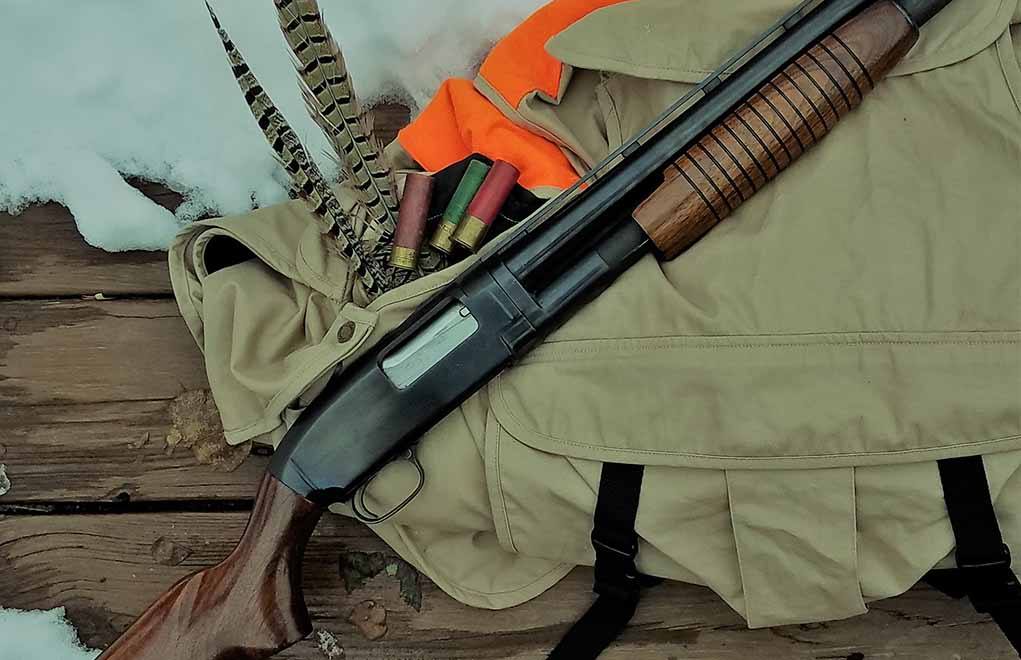
The Remington 870 and Mossberg 500 have stolen much of the thunder when it comes to pump-action shotguns. But for many, they stand in the shadow of the Model 12. The “perfect repeater” set the standard for pump-action smoothbores for the better part of the 20th Century and is still considered a cherished jewel of any collection.
Engineered by T.C. Johnson off a John M. Browning design, the internal-hammer shotgun was released in 1912 and was the evolution of the Model 97. Furthermore, it laid out the form for the modern pump-action. In particular, the loading gate at the bottom of the receiver is commonplace among most shotguns now, as is its right-facing ejection port and cross-bolt safety located in the front of the trigger guard.
These features were nice, but what cemented the relatively simple Model 12 into shotgunners’ hearts was what ultimately lead to its demise. Its streamlined receiver was machined from a billet of forged steel, hand-fitted with machined steel internal action parts and featured a hand-checkered walnut stock. When the stamped-metal Remington 500 showed up in the 1950s, Winchester just couldn’t compete on price. Finally – outside some special run-up to this century – the Model 12 disappeared in 1964.
Plentiful today, you can still find a used M12. Though, generally, you’ll pay for the honor of adding one to your gun safe.
Winchester Model 70
It doesn’t boast the historical significance of many of Winchester’s lever-actions. However, there might not be a more noteworthy sporting rifle ever created. Light, fast lock time and the little things shooters drool over – cut checkering, drilled and tapped for a scope, terse bolt throw – the Winchester Model 70 mesmerized the market when it came out in 1936. But it was one feature in particular that especially caught the eye – the rifle’s Mauser-style extractor claw.
Although the rifle’s controlled feed was among the rifle’s most desirable – and for those who shot it, cherished – assets, it also became a point of contention. In 1964, Winchester did away with the feature, opting to make the Model 70 a push feed. Don’t cluck your tongue too much at Winchester, it had to do something to remain competitive. The 70’s highly machined design certainly wasn’t it. And to be fair, while not as refined as the pre-64 versions – particularly the impressed checkering – the post itineration wasn’t bad. The action was reportedly stronger and it had no feeding issues. Still, it wasn’t the Winchester 70 most aspired to own.
Luckily, the miracle of CNC machining – making more traditional designs more affordable – breathed new life into the rifle. As of 2008, Winchester has returned to the classic Model 70 classic design – including the claw extractor. At the risk of drawing jeers, the rebooted rifle might be even better than the original, given it has a free-floated barrel, reinforced recoil lug recess and adjustable trigger.
Locked, Loaded, and Ready: Dive Into Shotgun Basics
Well-known and ‘unobtainable’ pistolsmiths all start somewhere. It might as well be with your 1911.
There are now varying ranks of custom gun work to be had, or “echelons of elite,” if you will. At the highest level, there’s the “bespoke” 1911. You arrange a time and a cost with a well-named pistolsmith, and then deliver the base gun and deposit. You wait to get to the head of the line, and you wait for the return of your prize. You have spec’d everything on it. From start to finish, it’s the product of one pistolsmith, and it’s your pistol.
It might be one of a kind, or it might be like every other high-end gun that particular pistolsmith produces. But, it’s yours.
This 1911 of mine is kinda-sorta one of those one-of-a-kind projects, but with a difference: You can duplicate the details, but you cannot duplicate the exact pistol. Why? It’s what I call a “committee gun.”
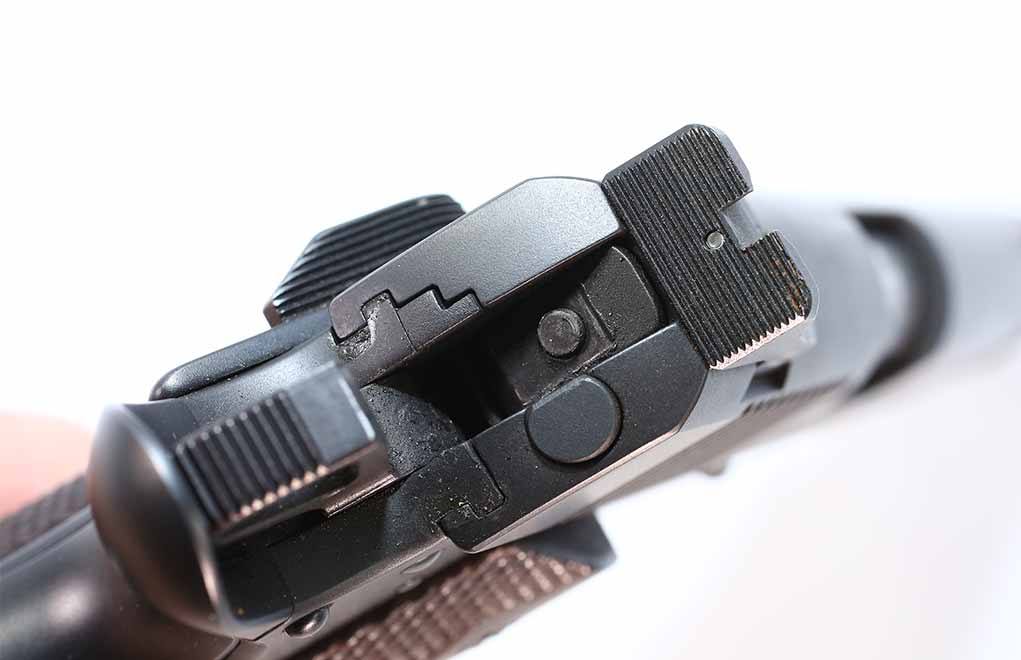
The Heinie Straight-8 sight system uses two dots, one over the other, on each sight front and rear. The system is fast, effective and almost impossible to get wrong.
A committee gun is one you send to multiple pistolsmiths to have one thing done by this one, something else by the next one, and so-on. This is not possible with some pistolsmiths — not just because they’re retired or deceased, but because many are booked to the end of their working careers. Or, they have a closed client list … or they do not do a-la-carte work. A-la-carte? They only do the full job, not just this or that. Honestly, they often don’t have the time and, frankly, it’s a hassle. Why do just a checkering job, which takes as much time and effort to book, manage, schedule and deliver, as a full-house project?
This particular 1911A1 of mine is a result of decades of reputation, contacts, patience — and just being a nice guy.
Make It A Heinie
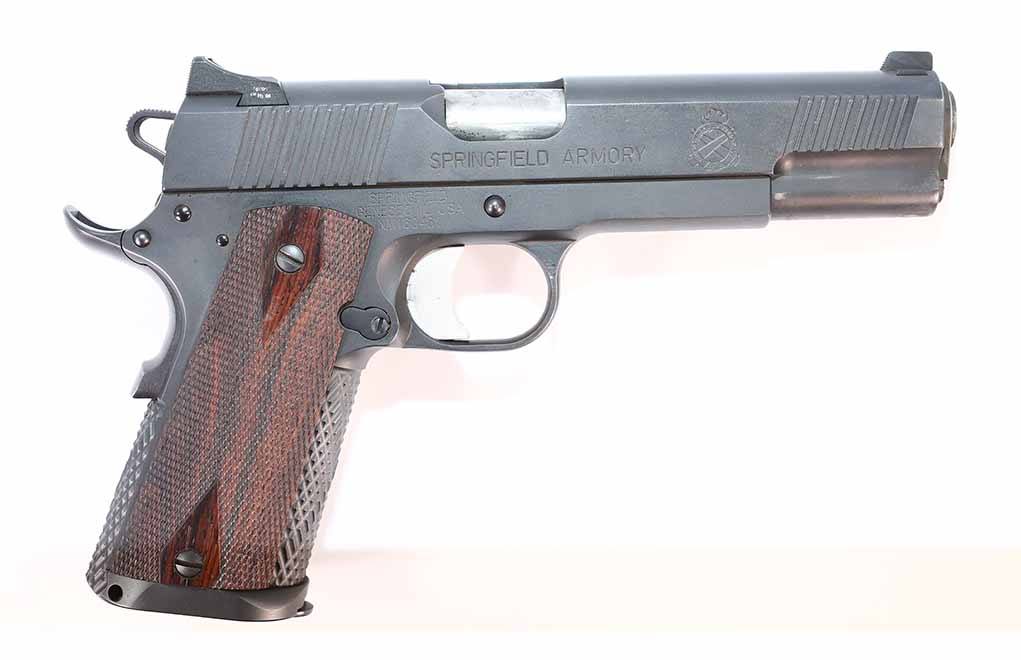
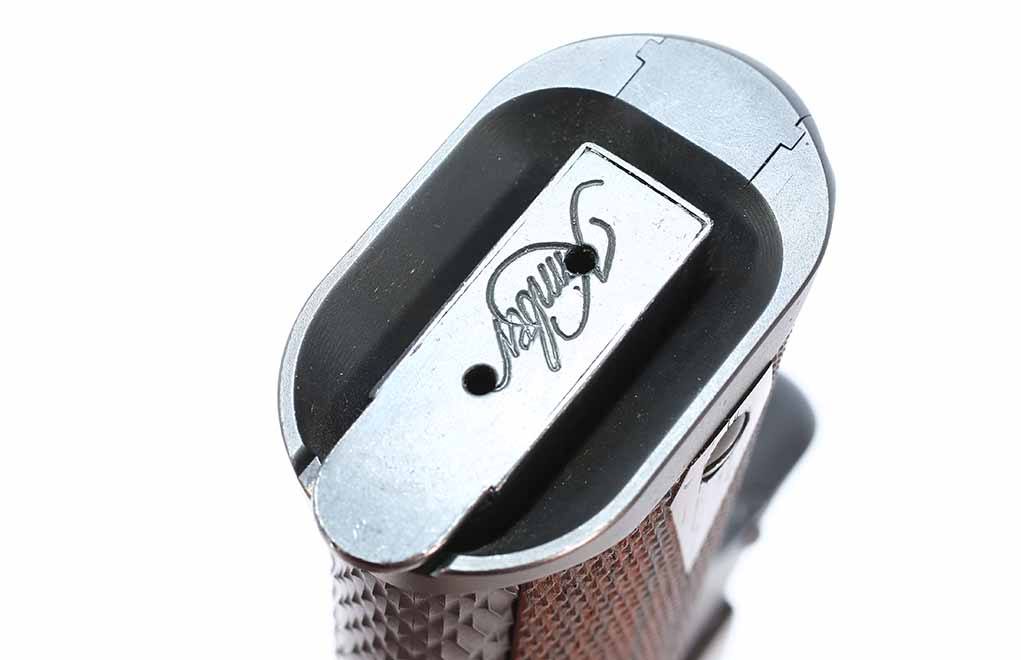
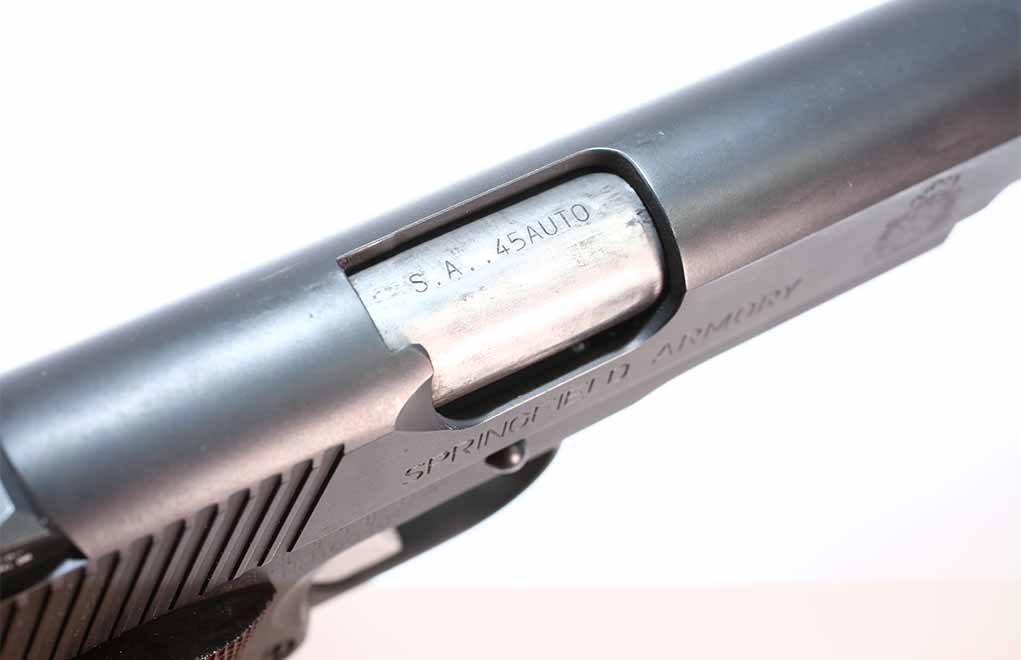
The base gun is a Springfield 1911A1 in .45 ACP, which is their loaded model. It arrived here for an article, review or test — I honestly can’t remember. As testing showed and the results came in, it was a very accurate pistol, and it was one of the fastest-barreled 1911s I’ve tested. So, I prevailed on Springfield, got the friendly gun-writer price, and I sent them a check.
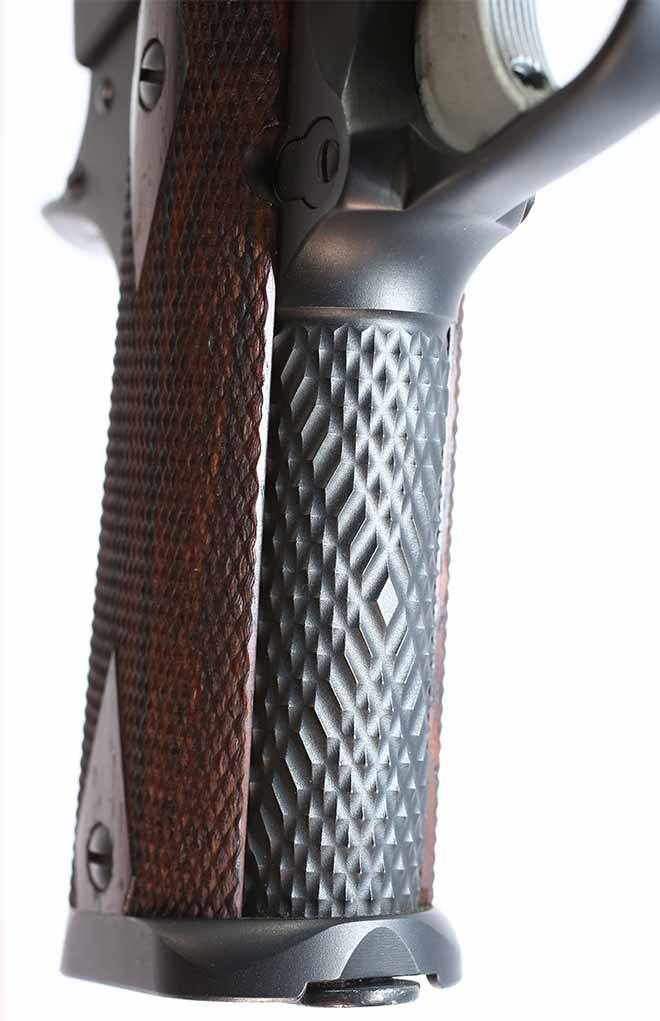
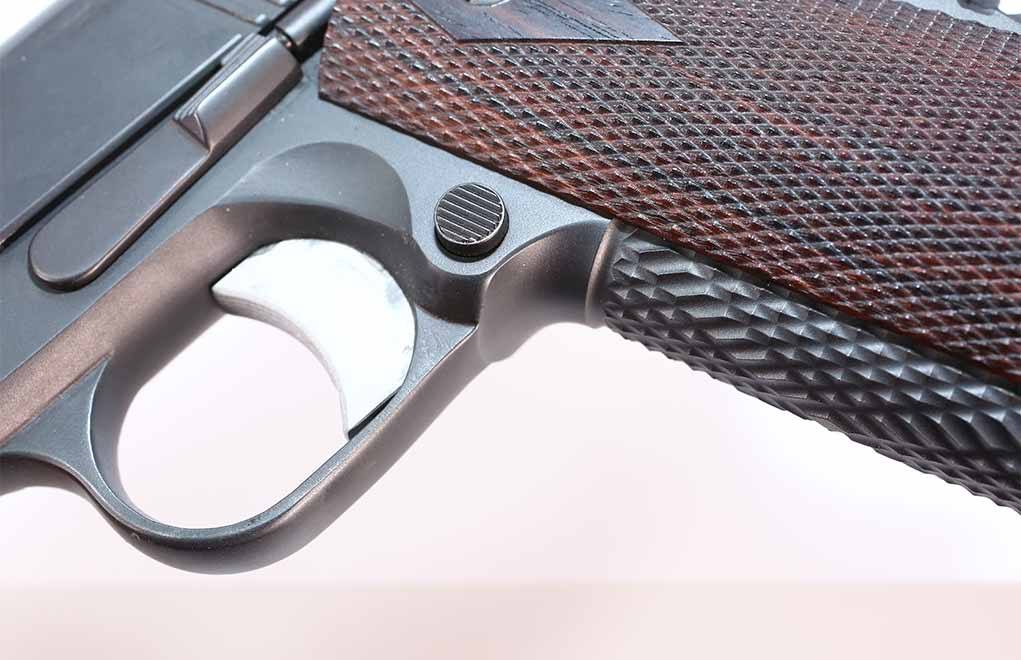
Pictured here is the ProTrac non-slip frontstrap treatment done by Stan Chen. Traditional? No. Effective? Without question.
At the next year’s Single Stack Classic (now the USPSA Single Stack Nationals), I was talking to Richard Heinie about his sights. His Straight-8 sight design was selling like hotcakes (and they still are). “Is it really better than three-dot sights?” I wanted to know. We proceeded after the match to walk out to the ranges. There, I shot his personal 1911. (Well, one of them, I’m sure he has a bunch, but that was the one on his hip that day.)
“I’d be happy to put a set on one of your guns,” Heinie said. No fool I, I pitched the idea of testing the Heinie sights to my editors, and when one said yes, I then had a dilemma: All my 1911s had good sights on them. Digging into the safe, I came across the Springfield. Knowing many pistolsmiths had preferences, I phoned up Richard. “Sure, I work on Springfields.” So, I shipped it.
Lest you ask, Richard Heinie is booked to the end of time. And this is ironic, because I remember talking to him at one of the USPSA Nationals in the early 1990s and finding out he had a 48-month delivery time. Yes, 48 months! I couldn’t wait that long and didn’t send him another gun to work on. Soon after, the only way to have owned a Heinie full-custom gun was to win one at the Single Stack Classic. Nope: I never managed that one, either. But Heinie does make his excellent Straight-8 sights, and you can have Heinie Specialty Products install them on your 1911.
Invisible Improvements
Soon after, I took the Springfield to a tactical medical class, which was a week-long medical-and-live-fire-training class, where we spent time crawling through the Tennessee mud. Despite being caked with mud, the Springfield worked flawlessly, so it earned a permanent place in the safe.
Knowing the author’s affection for ball-end cuts on the slide, Stan Chen changed them in the Springfield.
I teach Law Enforcement Patrol Rifle classes in the warm-weather months. Actually, I’m one of the stand-by armorers for officers whose rifles break down, and I teach shooting when I’m not fixing. We also shoot handguns — the instructors do, anyway — because, well, the courses are easy enough to shoot a perfect score every time with a rifle.
The lead instructor wrote the course outline to require that each instructor fires the qualifying course for record, for each class, so we’re on record as being able to do what we teach. We also started shooting the qualifying course with handguns, which is a task that calls for hits out to 65 yards against tight time limits. We then began shooting the 300-meter Army RETS course with handguns. The top instructors have all shot passing scores in both courses, with handguns.
At one class, friend Ned Christiansen was curious about the Heinie sights, and he handled and shot my Springfield. “There’s something about the barrel,” he said. “Let me take it home.” I don’t know what he did, because I couldn’t find any traces of work (Ned is like that), but the barrel fit is better. And while he was at it, he cleaned up the already-nice trigger. It’s still a duty-level weight, but the trigger pull so clean that you’d swear it was a pound-and-a-half lighter than it actually is.
The Gen 2 magwell funnel looks low-profile from the side (and it is), but it gapes like a competition funnel when you go for a reload.
Christiansen usually has a closed list, as in he’s booked up for longer ahead than he sees daylight, so you won’t get this from him. But, he makes specialty tools for the 1911 and the AR-15, and when next his list opens up — or when he takes a breath and accepts small jobs like trigger work — you can get on board.
Chen’s Custom ‘X’
The next pistolsmith was Stan Chen, who left soul-killing corporate America to pursue his dream: building custom 1911s. What he ended up doing was building blueprinted 1911s from scratch. Like a number of other custom pistolsmiths, Chen found the work of rebuilding (measuring, plotting, welding, machining, hand-fitting) existing frames to be taking up so much of his time that it was easier to just make frames to go with his perfect slides. So, he did.
If you have a full-house Chen Custom 1911 built on a non-Chen frame, you have a rarity. Or, soon-to-be-rarity, because he’s now making only full-house custom guns, using only on his frames and slides.
The author’s next project for this pistol is to get it refinished and store it in a proper case.
But, Chen also makes magwell funnels for installation on non-Chen 1911s. He and I discussed his mag funnels and frontstrap non-slip grip pattern for another article project, and I sent him my Springfield for the Gen 2 mag funnel. I again chose that gun mostly because it was, as it had been with the sights, the only one I had that wasn’t already worked-on.
After it arrived, Chen phoned me. “You didn’t tell me that it was one of the ‘fat-frame’ Springfields.” My heart sank. Darn, I’d have to find a different gun. “That actually makes it easier,” he reported.
Fat frame? For a number of years, Springfield 1911s had frontstraps that were thicker and wore a different radius than the original 1911s. This was due to a machining step that made production easier: The cutter radius for the dustcover, trigger guard and front strap are all supposed to be different, but Springfield just used the same cutter for all. This left the frontstrap and dustcovers thicker and with more-defined corners.
When Stan Chen cuts the ProTrac, he also lifts the frontstrap where it joins the trigger guard. This allows the shooter to get their hand higher on the gun.
Chen’s non-slip grip pattern is an array of diagonally-oriented round-bottomed cuts, with an “X” pattern left in the middle. Called his Progressive Traction Checkering (aka, ProTrac), it’s unlike anyone else’s. This pattern is duplicated on the mainspring housing, and the pattern carries over onto the frame from the mainspring housing. That, with the Gen 2 blended magwell funnel, produces a distinctive appearance while being low-profile. It isn’t a competition look, but it is a competition-level performing setup. Part of the ProTrac machining also involves “lifting” the frontstrap where it joins the trigger guard.
Stan also knew I like the look of the original slide contour, also known as ball-end cuts. So, he machined the slide and then dehorned the edges before re-parkerizing it and sending it back. He only does full-house custom guns built on his slide and frame sets. However, you can get the ProTrac frontstrap and mainspring housing done on your gun, you can have one of several of his magwell designs done, and you can get your 1911 back in 6 months or so.
These days, the finish on my committee gun isn’t pretty. I’ve shot, used and abused this gun a good bit. It has rattled around in the unpadded plastic storage case Springfield shipped it in. One of these days I’ll get it re-finished and give it the case it deserves.
Foreseeing The Future
Now, why tempt you with work you can’t get, with pistolsmiths who don’t know you? Simple: Dick Heinie, Ned Christiansen and Stan Chen didn’t start out as demi-gods of 1911 work: They all started out working and learning. (They are still learning, of course, but they’re learning on top of an encyclopedic base of knowledge.) There are many very good pistolsmiths out there who will be the Heinie, Christiansen or Chen of the future.
This Springfield barrel shoots like it’s a match barrel. Once noted pistolsmith Ned Christiansen re-fit it (the author still doesn’t know exactly what he did), he said it was good for the life of the rifling.
You can have your own committee gun just by finding them and shepherding your 1911 through their shops in turn. What do you want? What do you like? Tell them, plan the work and get it done.
Just be sure and find a solid base gun to build on, because no-one likes the grunt work of correcting errant dimensions. That search is even easier than it used to be, because we can now expect good base 1911s, and we won’t pay for anything less.
A next-level optic, the Vortex Razor UHD Binoculars deliver crisper, clearer images under any conditions.
How Razor UHD Compare To Other Optics:
Longer Abbe Koening Prisms to transmit more light.
Advanced lens coatings enhance images in low-light and multi-layered coatings on the prism keep images bright and clear.
Similar ergonomics to the highly popular Razor HD line of binoculars.
If you hunt nothing but thick timber, ignore this advice. You need a good set of binoculars. Clowning around with an inferior glass or going without, you’re fiddling with missed opportunities or hiking yourself into the ground in search of game. Either case, not good.
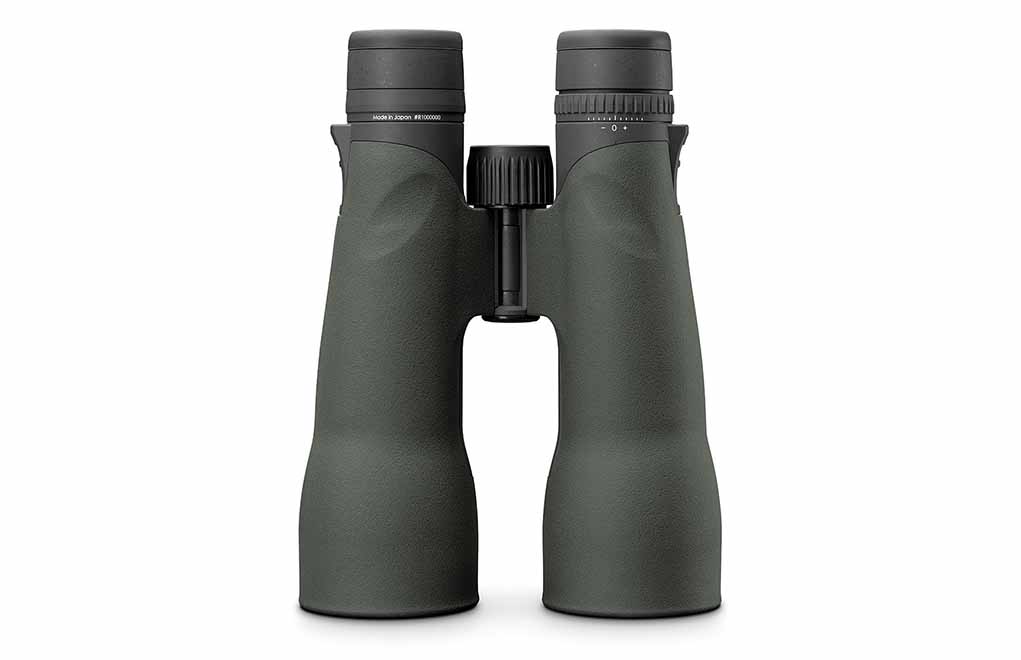
Vortex appears to have the answer, especially if you have your eye out for a step up from entry-level, with its new Razor UHD (Ultra High Definition) line of binos. Essentially, the optics have the same feel and look as Vortex’s existing Razor HD line, but have one major difference – it’s Abbe Koening Prisms. Longer than the previous version, they gather and distribute more light, thus deliver much clearer images. Though, the addition does raise the binoculars’ weight ever so slightly. Still, whether for spotting game or hits and misses, the Razor UHD binos look to excel.
More from Vortex:
There’s a new optical sheriff in town and it’s the Razor® UHD binocular series. The absolute pinnacle of optical performance, the all-new Razor UHD (Ultra High Definition) binoculars serve up views so stunning, you’ll have to literally see them to believe them.
Optically, ergonomically, aesthetically, these feats of modern engineering stand proudly atop Vortex’s extensive selection of binoculars. The premium, UHD apochromatic optical system, boasting phase corrected Abbe Koenig prisms, delivers the ultimate in resolution, color fidelity, depth of field, contrast and edge-to-edge sharpness. Lenses fully multicoated with Vortex’s proprietary XR Plus antireflective coatings guarantee maximum brightness and glassing confidence during critical low-light periods. Exterior lenses feature Armor Tek, an ultrahard optical coating that protects against scratches, oil and dirt.
The short-hinge magnesium chassis is lightweight, ultratough, and a pleasure to hold. Durable rubber armoring protects the housing and offers a nonslip grip – no matter the weather conditions. Incredibly comfortable twist-up eyecups with positive settings offer a range of eye relief options for customized viewing. Locking right-eye diopter. O-ring sealed and purged with argon gas for 100 percent waterproof/fogproof performance.
Each Razor UHD comes outfitted with a custom binocular harness for comfortable carry and protection from the elements.
18X56 Magnification: 18x Objective Lens Diameter: 56 mm Eye Relief: 18 mm Exit Pupil: 3.1 mm Linear Field of View: 194 feet/1000 yds Angular Field of View: 3.7 degrees Close Focus: 10 feet Interpupillary Distance: 56-76 mm Height: 8.3 inches Width: 6.1 inches Weight: 41.6 oz
12X50 Magnification: 12x Objective Lens Diameter: 50 mm Eye Relief: 17 mm Exit Pupil: 4.2 mm Linear Field of View: 288 feet/1000 yds Angular Field of View: 5.5 degrees Close Focus: 6.6 feet Interpupillary Distance: 56-76 mm Height: 7.6 inches Width: 5.8 inches Weight: 36.1 oz
10X42 Magnification: 10x Objective Lens Diameter: 42 mm Eye Relief: 16.7 mm Exit Pupil: 4.2 mm Linear Field of View: 346 feet/1000 yds Angular Field of View: 6.6 degrees Close Focus: 4.5 feet Interpupillary Distance: 56-76 mm Height: 7 inches Width: 5.6 inches Weight: 32.2 oz
8X42 Magnification: 8x Objective Lens Diameter: 42 mm Eye Relief: 16.7 mm Exit Pupil: 5.25 mm Linear Field of View: 420 feet/1000 yds Angular Field of View: 8 degrees Close Focus: 4.5 feet Interpupillary Distance: 56-76 mm Height: 7 inches Width: 5.6 inches Weight: 32.2 oz
To learn your limits you have to stretch things out. For example, when it comes to long-distance shooting you won’t know what you can do unless you reach your limit. This lets you know what you can do, which creates confidence, and with time your skills improve too.
Be it for self-defense, competition or plain old marksmanship, the greatest hurdle to becoming more proficient with your AR-15 is your ego.
How To Put Your Ego Aside And Become A Better Shooter:
Be humble and surround yourself with those who know more about the platform than you.
Don’t compete with others, focus on personal improvement.
Learn on a basic carbine and equipment before investing in more complicated systems.
Force yourself to improve on your weakest points.
The ego — your self-identity — can be good, bad … and sometimes just plain dangerous. The ego doesn’t like being embarrassed, looking bad or making mistakes. It likes comfort, and it will shy away from “new” or “different,” preventing you from training and practicing with your AR. Your self-image is the difference between putting meat on the table and winning the match — or going home empty-handed.
More importantly, the ego will hinder your evaluation of possible danger; other people’s egos make them dangerous. Your self-image will be the deciding factor in a violent confrontation. In fact, it will likely be the deciding factor in whether you’re involved in a fight or not. Regardless of the AR activity, your best performance is achieved with a humble, well-balanced self-image.
The Battle Within
The vast majority of skills necessary to use a firearm safely and efficiently, especially the AR, are not instinctual. The only way to become proficient is to get instruction from someone who knows more than you do. However, the ego is extremely fragile, and it doesn’t like to admit ignorance. It’s difficult for people to admit they need help.
Admitting you don’t know it all is the first step to becoming better. Then it’s about finding someone who knows more and getting instruction. After training comes practice, and plenty of it, in order to learn how to apply your skills on demand, and under any conditions.
Firearms, by design, can be dangerous. The majority of tragedies that occur with them are the result of ignorance, not understanding how to safely handle them. Training introduces you to the correct techniques needed to use the AR safely — which is critical to everyone around you — and efficiently, which determines your performance. Step No. 1 is accepting when you need assistance and when you need to get additional training.
Even after making the decision to seek instruction, the battle against the ego continues. In nearly every class I teach, this scenario comes up: I explain a technique or drill. After asking if anyone has questions, waiting a moment and not getting any response, I noticed a puzzled look on “Ted’s” face.
“Ted,” I inquire, “what is it you’re not sure of?” I have to force students to ask for clarification. We care more about appearing ignorant than we do learning. There are some things in life that you can bluff your way through, but faking it with firearms is dangerous. You attend training to learn; don’t let the ego impede your progress.
After training — an introduction to AR skills — comes practice. Repetition is necessary to learn these skills to a point that they can be applied on-demand, under any conditions. The battle continues; the ego has a big bag ‘o tricks to prevent you from practicing.
The ego will also “self-inflate.” Instead of acknowledging that you need additional practice, it says, “Oh, I’m good enough.” Or, how many times have you heard someone decline an invitation to practice by saying, “Oh, I’d just embarrass myself.” Maybe your skill level or equipment isn’t up to par, and because the ego is extremely competitive, the best way for it to win is to never play with others.
Standing Up To Your Ego First off, there’s always going to be someone better than you. When it comes to learning, the experts agree that one of the best ways to improve is by surrounding yourself with people who know more than you. Secondly, the only person you “compete” with is yourself. As long as you’re improving with each practice session, it’s all good. Third, you’re better off learning to use the basic equipment first, plus you’ll get a chance to test other people’s gear before buying. And finally, when it comes to defensive or combative actions, not participating isn’t going to be a choice.
During practice, you guard against interference from the ego. Our identity’s tendency is to only practice the things we’re good at; the ego doesn’t like stepping outside its comfort zone. The only way to improve is by focusing on your deficiencies.
You’re going to make mistakes, during training and during practice. Mistakes will also occur during an armed confrontation. What counts is how you react when you make a blunder.
Instead of letting the ego beat you up — “I should’ve done this,” or, “Wow, I did that wrong” — concentrate on correction, compensating as necessary to ensure it doesn’t happen again. “If you’re not making mistakes,” I tell students, “you’re not doing it right.” More mistakes during training/practice means improvement, and that equals fewer errors in the field, wherever that may be.
Confidence Through Trial
Practice also builds confidence. You determine what you can do, and what’s beyond the capabilities of you and your gear. Discovering these limits involves experimentation. The ego will prevent you from venturing into the “I’m not sure” area. If you never go too fast or shoot too far — meaning, step beyond your limits — you’ll never discover what you and your AR are capable of. Confidence is only developed through learning, practice and experimentation. Just remember the difference between having confidence as opposed to an over-inflated ego. Don’t let your ego stop you from creating the proper self-image.
Maybe your gear isn’t as “fancy” as your buddy’s. Don’t let that stop you from practicing. Plus, if you learn using basic equipment having accessories only makes things easier. Remember, it’s all about the shooter, not the kit.
Your optimal performance is dependent on a balance between three elements: the conscious mind, the subconscious mind and the self-image. In the beginning, the conscious mind — which only thinks about one thing at a time — is responsible for the majority of your actions. With practice, most of these actions are shifted to the subconscious mind — they don’t know what its capabilities are. The conscious says, “Draw,” and the subconscious takes over to perform the sequence.
During practice, the self-image improves. Your performance and self-image are always equal. “I’m gonna miss this shot,” you think. Then that’s exactly what you’ll do. With repetition, and learning to tell yourself, “I’ve done this on the range thousands of times,” – your performance improves. It becomes normal for you to make accurate hits or apply your defensive skills under any type conditions.
When Ego Is The Enemy
The ego factors heavily into self-defense applications. For example, let’s say you see a group of rowdy teenagers or a man who looks irritated. The ego is concerned with how others perceive us. “I don’t want people to see me overreacting,” you think. Instead of moving and creating distance, you ignore them. Just as you walk past, they attack, with much more violence and speed than you imagined possible.
Or, many of us have said, “I can’t believe that guy cut me off in traffic!” Now, let’s say that escalates. After a slight transgression, you verbally confront the offender, adding some creative hand signals to make your point heard. One thing leads to another, and now you’re in a physical confrontation, forced to defend against an attack.
Keeping a training diary or logbook is essential. This let’s you track your progress, and looking back on previous entries and seeing documentation on how much you’re improved will boost your confidence.
The over-inflated self-image is responsible for the majority of violent actions committed by threats. Traditionally, an over-inflated identity has been considered a bad thing. In an article, “The Trouble with Self-Esteem,” Lauren Slater reports that “People with high self-esteem pose a greater threat to those around them than people with low self-esteem.” Once someone starts thinking they’re better than others, they feel free to act accordingly. There are people out there who firmly believe, “I’ll just go out and take what I want from others.” And just like that, they’re ready and willing to use violence to achieve their goals. The two cardinal defensive sins are over-estimating your abilities and underestimating the threat. Both these problems stem directly from an over-inflated ego.
Preparing for the hunt, a big match or to defend against an attacker is all about humility. It takes mental focus and discipline to fight the instinctual desire to feed, inflate and protect the ego. Never over-estimate your abilities, and know what your limits are. Don’t underestimate possible danger. Research and study to develop an understanding of violent type actors. Admit ignorance; cure it with training and practice. This creates a healthy self-image, the proper kind of ego, which is the key to success with your AR.
Going hard to soft off the rocks using a bags is a great way to manage recoil in the field.
Get up! Mastering precision rifle marksmanship means mastering all shooting positions — not just prone.
When training military personnel, we often tell the snipers, “Prone is the rare shot,” especially in urban areas. Both manmade and natural obstacles liter our fields of view no matter where we travel, from hunting situations to long-range matches. The well-rounded marksmanship knows how to adapt their surroundings to make a successful shot, and although ideal, prone opportunities aren’t often available. Looking at the different shooting positions one must practice, we have:
Prone
Sitting
Kneeling
Standing
Field shooters are “across the course” marksmen. In other words, we have to master all four of these shooting positions in some way to consider ourselves a proficient long-gun shooter. That doesn’t automatically mean they’re all unsupported or require the mastery of sling shooting, but it does require you get off the bench or your belly and practice them.
Supported positions are not always as easy as just dropping the forearm onto a support. There are certain aspects we want to address: The style of rifle can have a say in your success, so people have devised other tools to help with our support system in the field.
Support Reigns King, No Matter What
For example, we employ a variety of bag styles to support both the shot and the shooter. The heavy sand-filled bags support the rifle on hard surfaces, while the light puff pillows support the shooter’s positions.
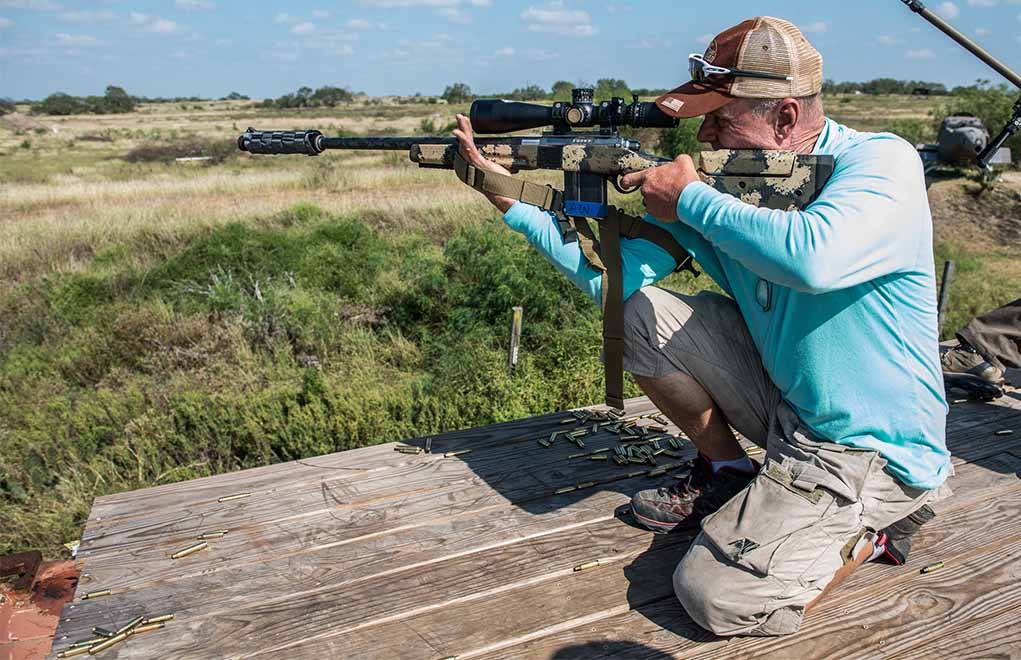
During the Sniper’s Hide Cup Competition, competitor and military veteran Jorge O. sets up his shot off a section of fence, using a Game Changer Bag to bridge the position.
Instead of using shooting sticks, try carrying a single tripod for a do-all solution. I often tell people that if you wanted me to hike across varied terrain with the potential of targets of opportunity along the way, a single tripod would solve every problem I encounter. There’s a reason why I have invested more than $1,500 on a tripod. It works.
Thanks to the excellent training provided by the competition circuit, we recognize the tools and shooting positions to execute these shots under time and using various types of support. We have adapted bags and tripods to quickly and effectively engage targets from an alternative position with a high level of success. The critical element is, of course, the proper practice.
Practicing the unsupported kneeling position is an essential skill to master, and that includes doing it from the support side.
It’s much easier to show you what these positions can look like versus talking about them, but at the same time, I do have some tips to help you determine the best method to use:
Keep your shoulders in front of your hips
Support the firing elbow when possible
Balance the rifle using your support
Understand recoil management
Lower the power setting on your scope to open up the field of view
Contact the rifle with a soft support when able
Tripods are always your friend
The Golf Parallel
Simply put, the various shooting positions are designed to get you over obstacles — the higher the obstruction, the taller the position. If the world were free of obstacles, prone would be enough … but that’s not the case. I highly recommend that you practice these shooting positions dry and initially focus on these two elements:
Building your positions quickly and efficiently
Understanding your wobble zone
The fundamentals of marksmanship will directly translate to these alternate positions. And if you thing about it, golf and rifle shooting have a lot in common.
Mils vs. MOA: Which Is The Best Long-Range Language?
We address the ball by lining up our body, which for shooters is the natural point of aim. We check our alignment in the swing; for shooters, this is our sight picture, and we open up the eye box by lowering the magnification of the scope. Then comes the full swing and follow through. For shooters, this action is trigger control and again, follow through — the forgotten fundamental. Follow through it’s a must, regardless of the sport.
Field courses provide the shooter with a host of options to shoot from. Each target presents a problem, and the shooter must find a solution that involves working around the obstacles to make hits.
The fundamentals will translate to every single situation and all the weapons we employ, regardless of discipline. From handguns to carbines, hunting rifles to high-dollar ELR Rigs, the fundamentals will follow you regardless of the platform.
Practice Does Make Progress
One of the best ways to practice the application of these alternate positions is to shoot a match. It’s not uncommon for the current style of precision rifle competition to have as much as 60 percent of the shots from a position other than prone. It’s a great way to get spun up in the best practices without having to wade through the styles that should be passed over. Today, we have a host of matches across the country, as well the NRL 22 League that can be found just about everywhere.
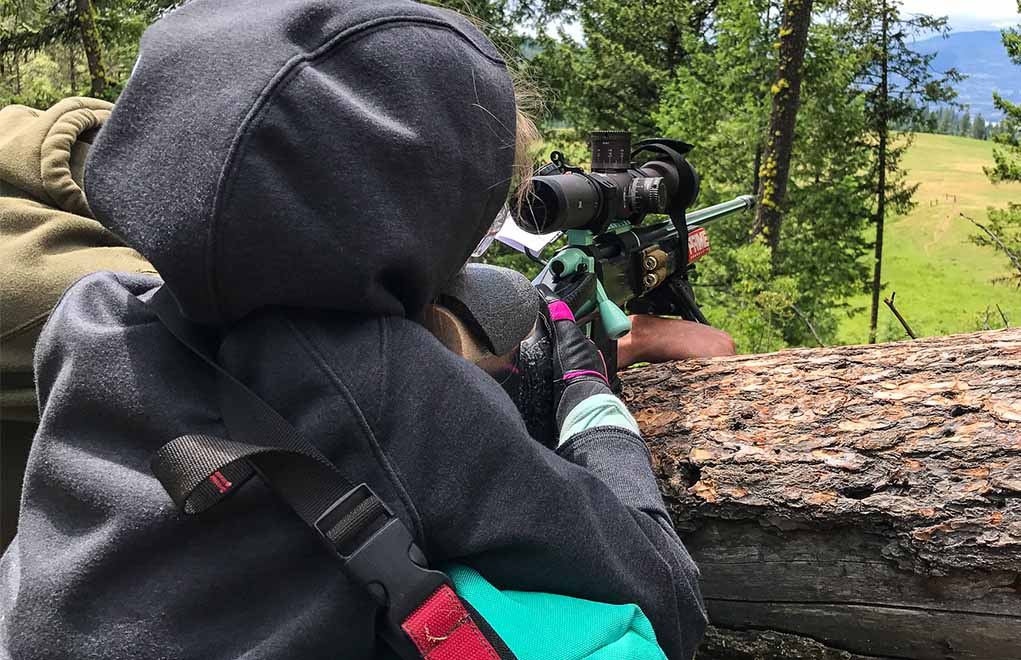
Here’s a practical application of a supported position found during the Sniper’s Hide Cup. In this example, we’re shooting off a log, through the trees and into a field.
Inexpensive .22 matches are a great way to get your feet wet without the big dollar commitment in both equipment and travel. Single-day .22 caliber matches are popping up across the United States, and their return on investment cannot be overstated: You spend a little but learn a lot in this type of event. They are often alternate-position-heavy events.
With .22 rifles being lightweight and inexpensive to shoot, they are the perfect training tool. Heck, many of us shooting the Vudoo 22 rifles have invested just as much as our centerfire precision rifles, and that’s okay — they’re a ton of fun for the entire family.
Here’s to no wind.
Editor’s Note: This article originally appeared in the February 2019 issue of Gun Digest the Magazine.
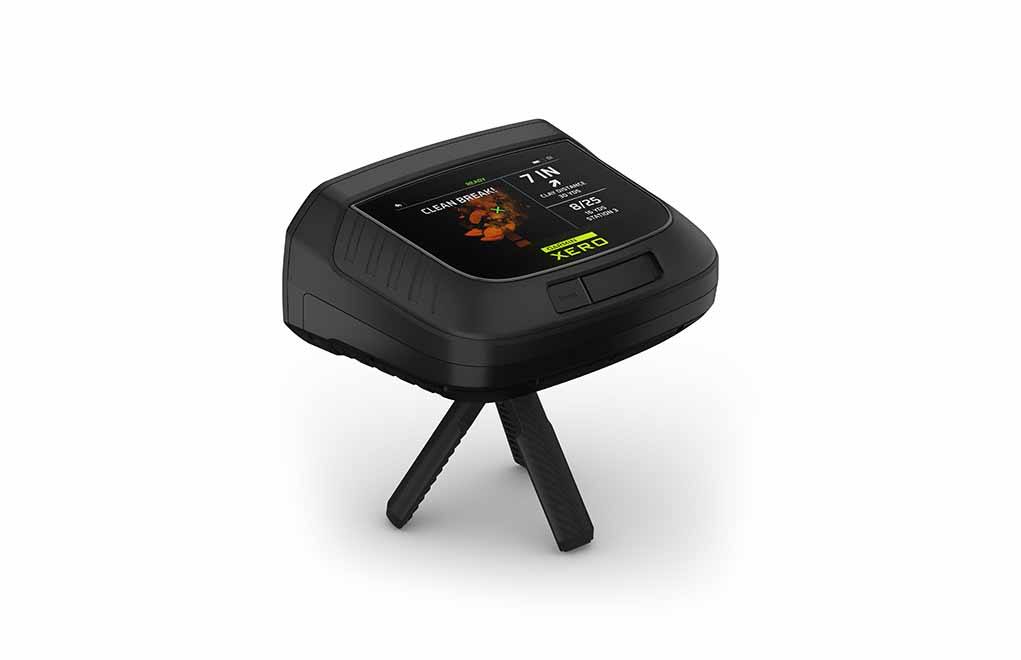
Utilizing radar and giving split-second feedback, the Xero S1 Trapshooting Trainer is engineered to get you breaking clays all the time.
Breaking clays sometimes, no big shakes. Breaking them every time you step to the line and holler Pull! that’s another story. It takes a load of practice to get steely at what’s essentially a simple game – be it trap, skeet or sporting clays. And, if you’re lucky, a little instruction. Either way, you’re looking at spending time and money to get good with your shotgun.
Garmin, of all companies, has come out with a little something that might streamline the process and make it more efficient. The Xero S1 Trapshooting Trainer is designed to give you near real-time feedback on every shot you take. Lead a clay, trail it, fail to complete your swing, the ingenious bit of technology lets you know in a split second, which is a godsend. Before, if you didn’t have an instructor over your shoulder, it was purely a guessing game.
Utilizing radar, the Xero S1 sets up simply – just place it in your proximity before a round – and provides a load of useful data on your performance. This includes:
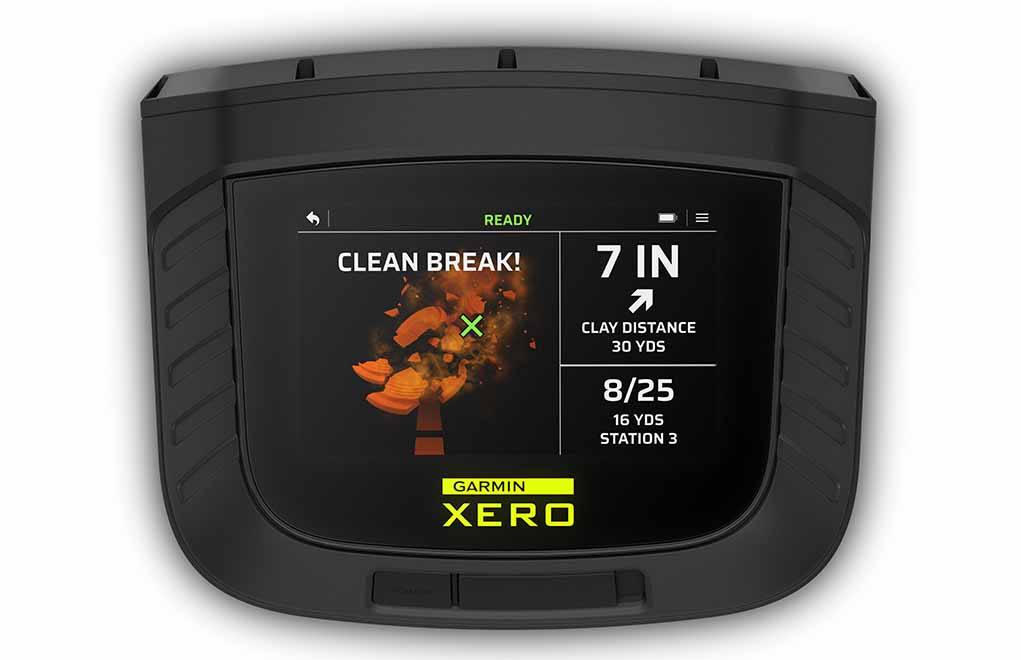
Distance from shot pattern’s center to the center of clay target for both hits and misses
Clay distance at trigger pull
Reaction time
Assessment of shots taken
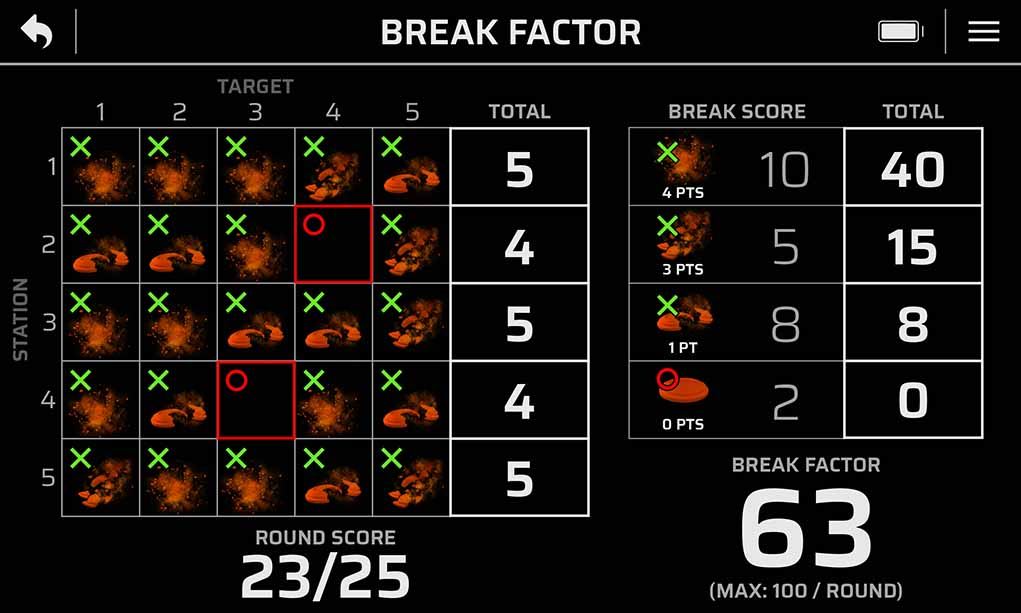
Hit or miss performance review by station and clay launch angle
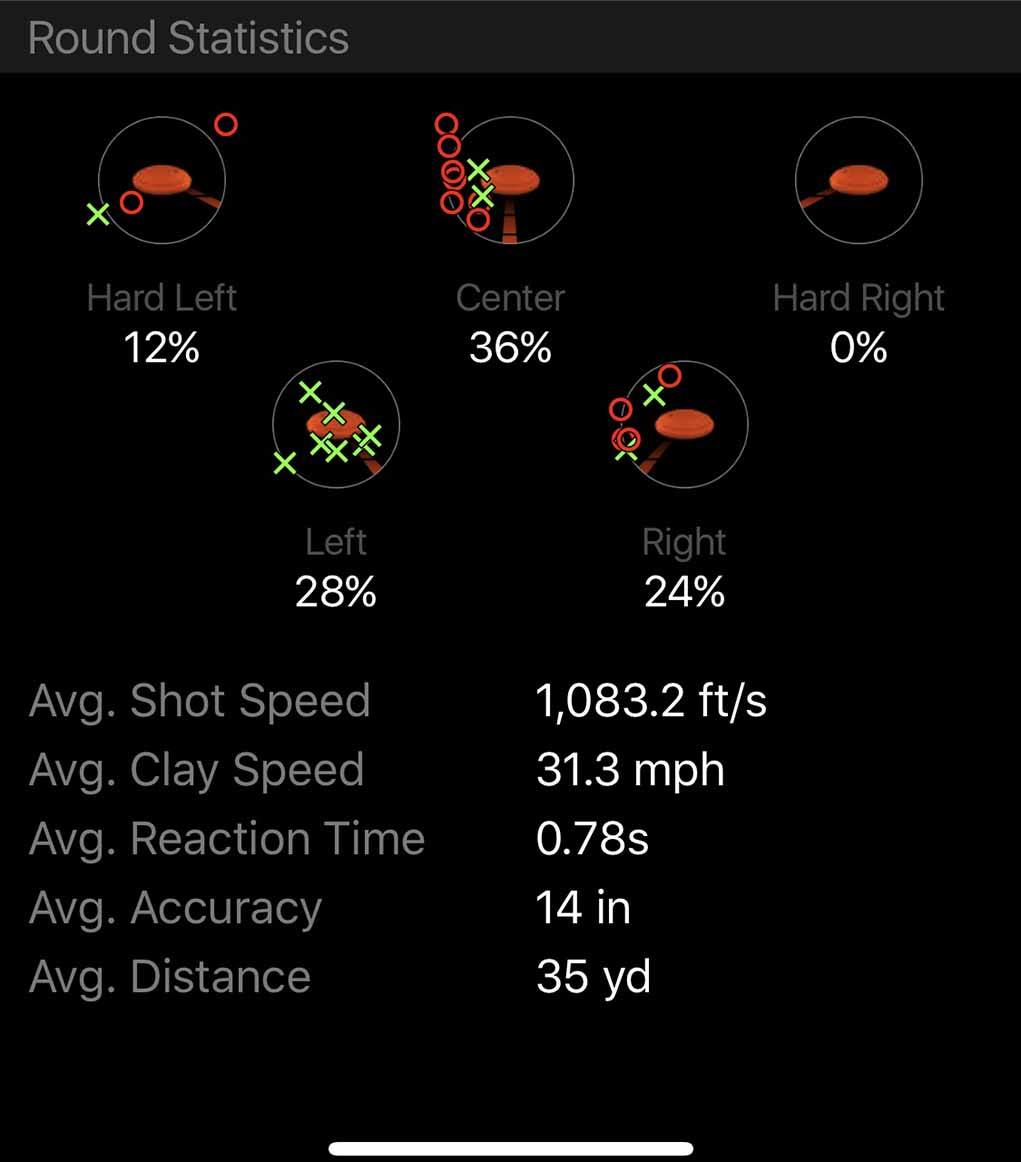
Graphical placement of every shot in the round with its relative position to the clay target
Unique S1 scoring method Garmin refers to as “break factor”
Used correctly, this has the potential to be powerful feedback. The sort of stuff that can get you dusting clays in no time. Better yet, it will be on your own terms. Basically, you have an instructor at your beck and call.
All that said, the Xero S1 Trapshooting Trainer runs on the spendy side – MSRP $1,000. But overall that’s a small price for improved performance.
More from Garmin:
OLATHE, Kan./July 9, 2019 – Garmin International, Inc., a unit of Garmin Ltd. (NASDAQ: GRMN), today introduced the Xero™ S1 Trapshooting Trainer, the first near real-time shotgun trainer that provides immediate feedback and detailed analytics for every shot taken. Using Garmin Xero radar technology and computer vision, the Xero S1 gives shooting enthusiasts never-before-seen insight into shot dynamics, shooting accuracy and performance. Users can pair their mobile device to Xero S1 through the free Xero app for a comprehensive view of shot analytics and historical shooting data providing even greater insight to help improve proficiency.
“Shooting accuracy and performance have traditionally been determined by best-guesses, but not anymore,” said Dan Bartel, Garmin vice-president of global consumer sales. “The Xero S1 provides a new approach for trap shooters, both novice and seasoned, to better understand their strengths, weaknesses and natural biases, as well as their shooting equipment. This understanding helps lead to faster-improved shooting accuracy. Additionally, the S1’s upland training feature gives users the ability to practice upland situations in a controlled environment with friends.”
The Xero S1 is made for American Trap (singles/handicap) or upland training. Prior to starting a round of clay targets, the rugged, portable Xero S1 device is placed in proximity to a user. Within seconds of each shot, the Xero S1’s five-inch high resolution display provides feedback generated through S1’s use of Xero radar technology and computer vision. Information displayed on-screen includes distance from shot pattern’s center to the center of clay target for both hits and misses, clay distance at trigger pull, and reaction time. For hits, information on quality of clay-break is categorized through a unique S1 scoring method referred to as “break factor.” At the completion of a round, the Xero S1 displays a complete assessment of shots taken. Much more than just a scorekeeper, users can review hit or miss performance by station and clay launch angle, and see graphical placement of every shot in the round with its relative position to the clay target.
The Xero S1 allows users to set up profiles for various shooting parameters. Users can configure a wide range of variables about their trapshooting setup, such as barrel length, choke, shot size, and shot material. Users can then experiment with those various systems to optimize trapshooting performance. In the past, this process required lengthy data collection or was based on intuition. Now, gun fit, choke, and ammunition performance can be quantified.
When paired to the Xero app, shooting information from the device is automatically transferred to the user’s mobile device for an in-depth view of their performance. This information includes total rounds, total shots, hit percentage per round, hit percentage per station, shot speed, clay speed, reaction time, accuracy performance at left/center/right, average score, longest streak, best and worst stations, and graphs of performance over time. The Xero app hosts historical shooting data, so users can reference performance based on event, location, station, and more. For that truly exceptional round, users can also quickly and easily post their scores to their favorite social media platform through the app.
Xero S1 operates in multiple trapshooting modes:
Clay Practice: Logs data for shooting a standard round of trap or a custom practice session. Near real-time data feedback about each shot is displayed while in this mode with complete performance details available after the round. Trap League Shoot: Logs data and tracks shooter’s station and score. Only the standard score is displayed during the round. Performance details are available after the round.
Tournament Mode: Logs data and tracks shooter’s station, shots and scores but only for post-round analysis. All performance details, including scorekeeping, will be hidden during competition. Upland enthusiasts who want to stay active in the off-season will benefit from Xero S1 Upland mode. Using the precision of the Xero S1 trainer, users can optimize performance through data comparison on shot size and speed, choke restriction, gauge, and reaction time analysis. This data helps improve performance, characterize gun fit, help reduce game loss, and improve overall shot placement. The Xero S1 Upland mode also has a unique scoring system referred to as “Upland Factor” that allows for competition-based target practice with multiple users.
To learn more about Xero S1 and Xero app, please watch the “Getting Started” video. For live demonstrations, visit Garmin’s booth at the Amateur Trapshooting Association’s 2019 Grand American World Trapshooting Championships August 3-5 in Sparta, Ill. The Xero S1 runs on an internal rechargeable battery with a 2.5 hour run time (approximately eight rounds of trap) or can be run on external power. It is water rated to IPX7, so it can be used in all weather conditions. The Xero S1 is available now for a suggested retail price of $999.99.
For more information on the Xero S1, please visit www.garmin.com.
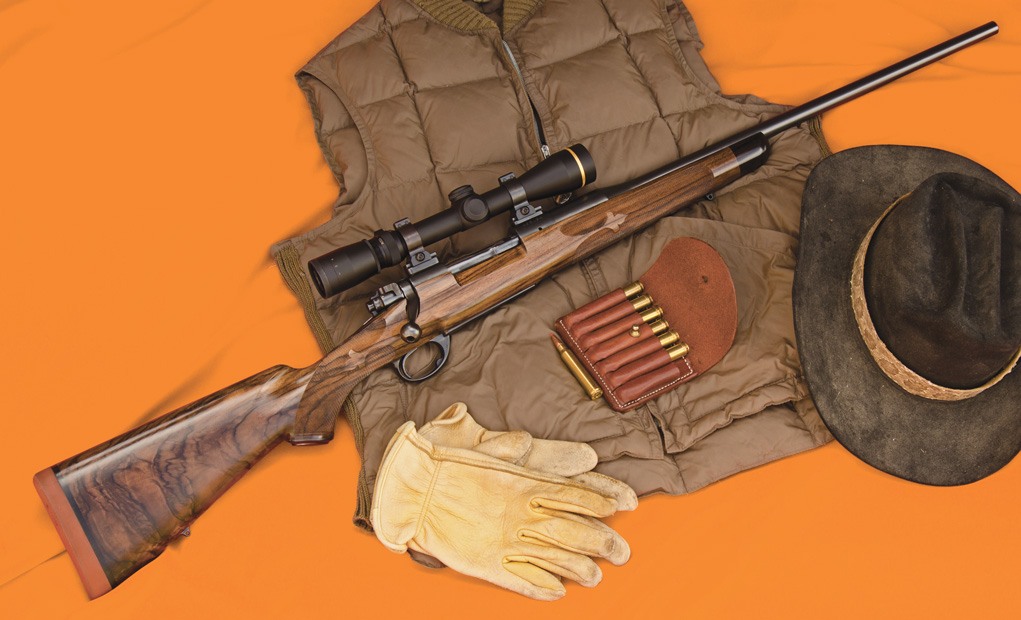
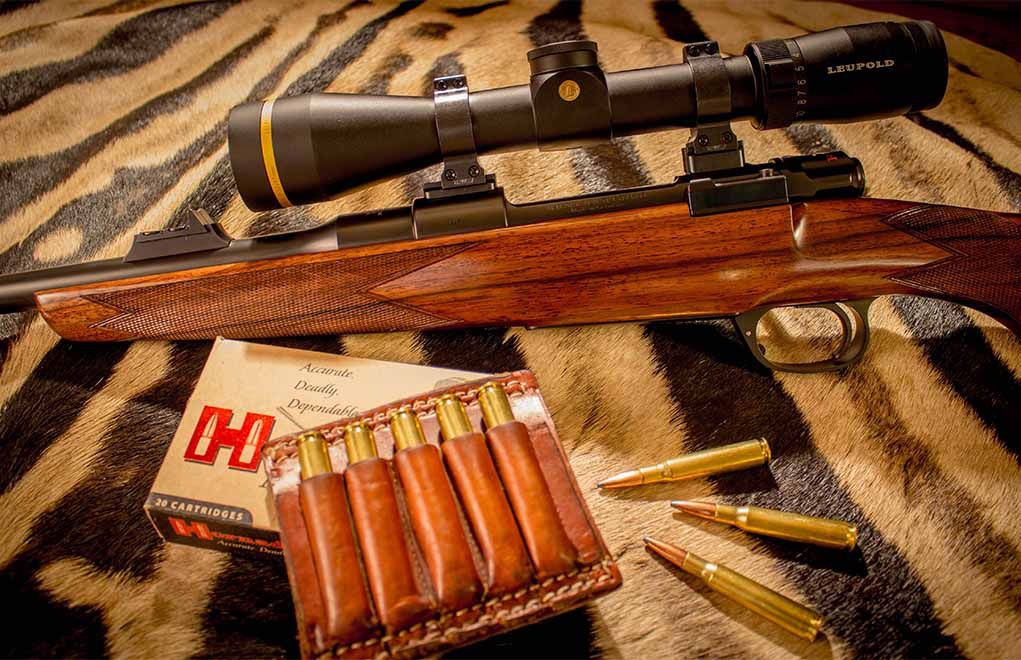
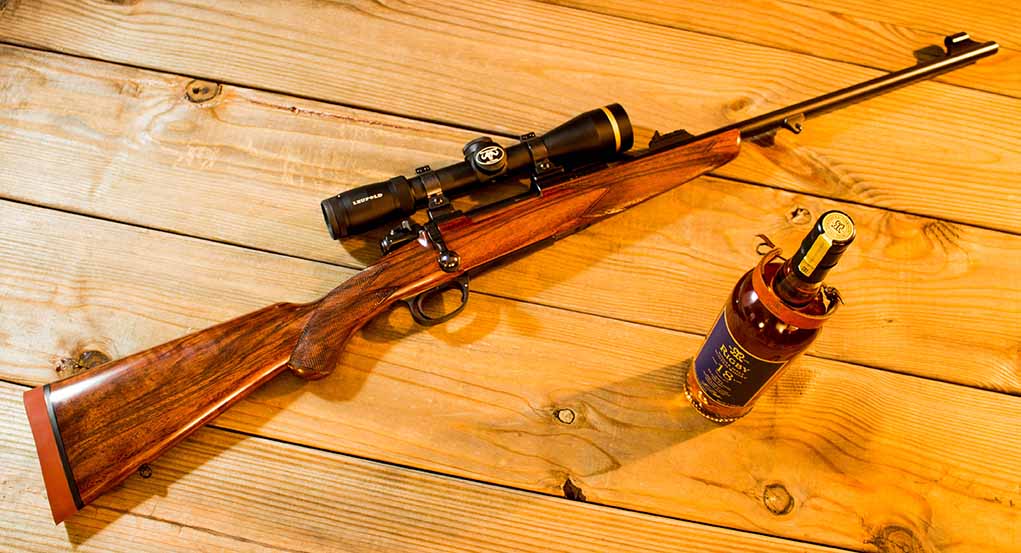
Beauty is only half the allure of the Rigby Highland Stalker. Its accuracy and reliability are what cement the bolt-action as worth passing down generation to generation.
What Sets The Rigby Highland Stalker Apart From Other Hunting Rifles:
Mauser M98 action with a three-position wing safety to facilitate the low mounting of a riflescope.
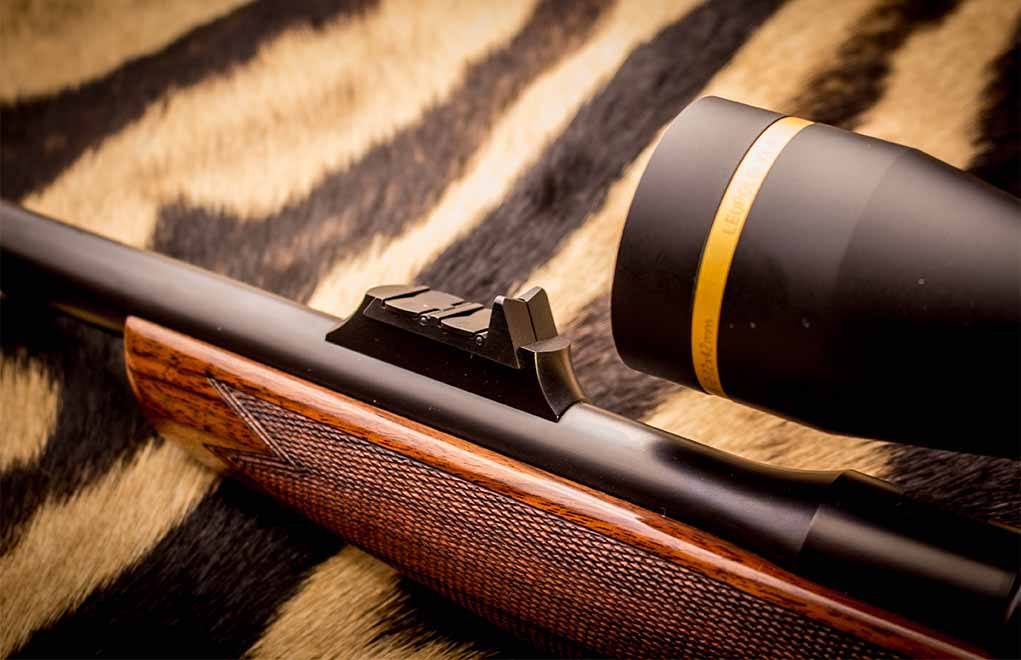
Hooded front sight mated to a rear island sight with three leaves, regulated for 65, 150 and 250 yards.
Vintage feeling straight bolt.
Longer European style length-of-pull, measuring 14¼ inches.
Minimum of Grade 5 wood stock with sweeping pistol grip with a rounded cap.
I was at the backyard range examining the groups from the rifle I was testing — which happened to be seriously small (the groups, not the gun) — when the phone rang. Actually, it buzzed, it and produced some sort of electronic tune simultaneously … but you get the point. On the other end of the magic box was my good buddy, Texas hunting guide and African Professional Hunter Jay Leyendecker.
“Que pasa, amigo?” I uttered, in my best Spanglish. Jay, you see, speaks fluent Spanish, but I do not, so I tease him as best I can.
“Not much, bro, what are you doing?” It’s usually at this point where the conversation turns to safari, rifles or some combination of the two. The tradition would continue for this conversation.
“Doing some accuracy testing on this sweet Rigby Highland Stalker,” I reported. “This little beast just printed a 0.34-inch group.”
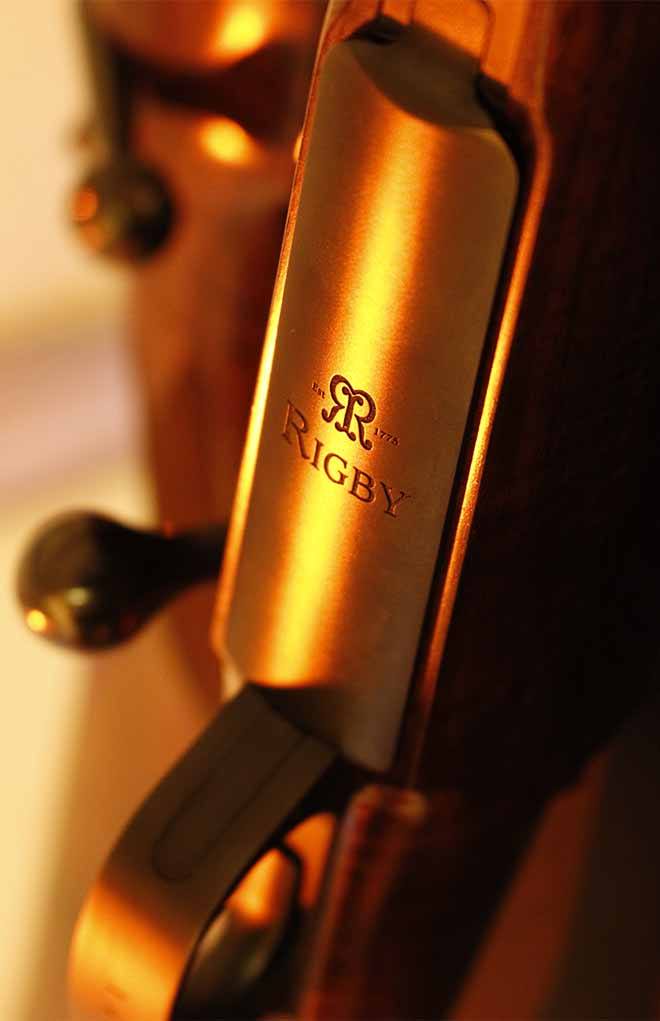
The classic Rigby logo on the Highland Stalker’s floorplate; the rifle has everything you need, and nothing you don’t.
“Good, you can bring it down to Texas with you for a deer hunt this December.” This was turning out to be a pretty good afternoon. Not often do you print a tiny little group and then immediately get an invite to one of the greatest whitetail areas, with a fantastic guide. Needless to say, I immediately accepted Jay’s offer and zeroed the rifle for the upcoming deer season.
The Highland Stalker
The rifle was one of the sweetest deer rifles to come along in quite some time: the Highland Stalker from John Rigby & Co. of London, England. Inspired by the vintage Rigby rifles produced at the turn of the 20th century, the Highland Stalker is made in much the same manner as they were in the Edwardian era.
The action is a Mauser M98 (as it was back then), but with a three-position wing safety instead of the traditional flag safety in order to facilitate the low mounting of a riflescope. A hooded front sight mates up to a rear island sight with three leaves, regulated for 65, 150 and 250 yards. The straight bolt gives an immediate vintage feel, and in spite of modern construction methods, just working that action evokes the feel of a vintage Mauser.
Saving the best for last, the Rigby stock is most definitely a winner. Using an open, sweeping pistol grip with a rounded cap, the Highland Stalker feels perfect from just about any field position. I most definitely prefer the feel of a vintage British stock over just about anything — there’s something special in their dimensions that seems to fit me much better than most of the American stock designs.
The rear island sight of the Rigby Highland Stalker, regulated for 65, 150 and 250 yards.
The Highland Stalker has a length-of-pull measuring 14¼ inches, which is significantly longer than the common American rifle, and that fits me like a glove, especially with lighter-weight clothing. Rigby puts a minimum of Grade 5 wood on their rifles, and the test model I received had a pleasant — if not over the top — figure to the walnut. The comb is probably more properly suited for use with the iron sights, but using a scope doesn’t feel the least bit unnatural. From the first time I shouldered this rifle at the Dallas Safari Club Show in 2017, it felt like an old friend.
The rifle was chambered in .275 Rigby; it was the Hornady Custom 140-grain InterLock load that shot so well from this rifle. The Leupold VX-6 2-12x scope offers a great balance of up-close and distant shooting, as well as light weight and balance. Though I’d used this model of rifle before — on a celebratory hunt in the Scottish Highlands for red stag — it was chambered in .30-06 Springfield.
The .275 Rigby may be better known as the 7x57mm Mauser. It is, in the opinion of this author, one of the best choices for whitetail deer and more than suitable for many other animals around the globe. Driving a 140-grain bullet to 2,680 fps, it’s fast enough for a respectable trajectory yet mild enough to allow the use of cup-and-core bullets, even on close shots.
The entire rig — rifle, cartridge and scope — made a balanced choice for the brush country of South Texas, where in one day you might find yourself glassing the open senderos for cruising bucks where a longer shot would probably be the norm, to rattling bucks where you might end up shooting one off your shoes, to sitting in a blind with a more traditional 100-yard shot. The 30mm main tube of the Leupold VX-6 gives all sorts of light, and the magnification range — a true 2-12x — covers the spectrum as far as my hunting needs are concerned.
From Beauty To Utility
I met Jay and his pal Charlie Maynard — a young Texas guide who has a good head on his shoulders — at the gate of the Santa Rosa Ranch in Uvalde. It belongs to Mr. Freddy Longoria, and it’s 6,000 acres of heaven. The ranch is bisected by the Rio Frio river, and it’s literally crawling with whitetail deer, Rio Grande turkeys and feral hogs.
The Rigby Highland Stalker is most certainly a rifle that can be handed down from generation to generation, though the cost of entry is not cheap.
Senor Longoria — a gentleman in every sense of the word — assembles a group of his friends each year for what he calls the “Viejo” hunt; many of these gents were at least my father’s age, but you couldn’t assemble a nicer group of people if you tried. The accommodations were, well … I guess “stunning” would be fitting.
It was a 3-day hunt, with Jay and Charlie (and a couple of ranch hands) acting as guides for the group of hunters. I’d be tagging along with Jay and a fellow hunter named Rick, who wouldn’t arrive until the second day. As a deer hunter from New York, where the deer densities are nothing like what they have in Texas, I sat like a Drahthaar on point, quivering at the sight of each 10-point buck that wandered past the blind, with Jay shaking his head and giggling to himself. “We can do better.” This was going to be tough.
Day No. 2 greeted us with a downpour, with the forecast showing the potential for almost 3 inches of rain. The morning sit didn’t result in any shooting, but on the way back to the lodge we approached another blind and feeder, glassing from a distance.
“Pigs.” That one simple syllable put me into attack mode; I love to hunt hogs, on any continent, any time. I boiled out of the truck, loaded the Rigby and swung on the big black boar at the rear of the group, running at just over 100 yards out. The trigger broke, and I heard the bullet strike, though the boar never broke stride and continued into the famous thick Texas brush. Jay and I followed his tracks as the rain began to intensify.
Accuracy, anyone? The Rigby Highland Stalker put three Hornady Customs in a 1/3-MOA group. A gun that looks so good, yet shoots so well, is a rare combination.
If you’ve never hunted South Texas, allow me to inform you that everything has thorns on it. So, through the thorns we tracked, for about 75 yards, when Jay lost the tracks in the pouring rain. It was then I heard the slightest grunt — what turned out to be the death rattle of the boar. He was just under 200 pounds with good cutters; the Highland Stalker did its job, though I hit him just a bit back of where I intended.
Just after lunch, Jay, Charlie and I headed out to check a blind in preparation for the evening hunt. Deer activity at 1 pm is usually not the strongest, especially in midst of a deluge, but any good deer hunter will attest to the magnetism of a hot doe. And hot she was; when she crossed the road, he followed like a heat-seeking missile, all nine beautiful points of him pausing just long enough to let us glass him. “Get out. Follow me, and stay low.” Aye, sir.
We hugged the edge of the ranch road, hunched as low as possible, until we reached the apex of the curve, giving us a view down the straight section of the road. Like a pair of fighter pilots, the doe tried to evade and the buck pursued. She paused, he paused, and the crosshairs settled just behind the big buck’s shoulder. No sooner had the trigger broke and he was down for good: tall-racked, with split tines, a kicker off the back of the right base, and enough character for a lifetime. It was then that I got the shakes. The rain even lightened up long enough for us to get some good photos.
Hunting With An Heirloom
There are many excellent rifles on the market, and they come with a wide variety of price tags. If a hunter wanted a rifle that he or she could very easily hand down for generations to use, the Rigby Highland Stalker could possibly be one of the best choices. With a street price of just under $10,000, this rifle is not exactly a kick-around model — I felt more than a bit of remorse taking it out in a Texas rainstorm — but it’s definitely made to be used. The Highland Stalker, like the Rigby rifles of a century ago, will mellow with age and become better with every scratch and ding earned in the field.
When this big Texas nine-pointer showed himself, the author and the Highland Stalker made short work of him.
This particular rifle I brought with me to Texas proved to be one of the most accurate factory rifles I’ve ever shot. The .275 Rigby/7x57mm Mauser isn’t known for hair-splitting accuracy, especially with factory ammunition, but this one is a shooter, with three different loads printing sub-MOA groups. Could you imagine inheriting a rifle as special as this, with the added bonus of having a family member’s hunting memories ingrained within? To me, that would be one of the greatest honors in the hunting world.
Of course, the price tag of a rifle is rather insignificant in comparison to the memories that a loved one makes. But, if you’ve ever had the pleasure of handling a vintage Rigby — and there was that 1917 .350 Rigby Magnum takedown I got to shoot in Scotland that made a lasting impression — you can immediately sense how special their design is. Unfortunately, this Rigby has to go back, but the experience of hunting with such a fantastic rifle will never be forgotten.
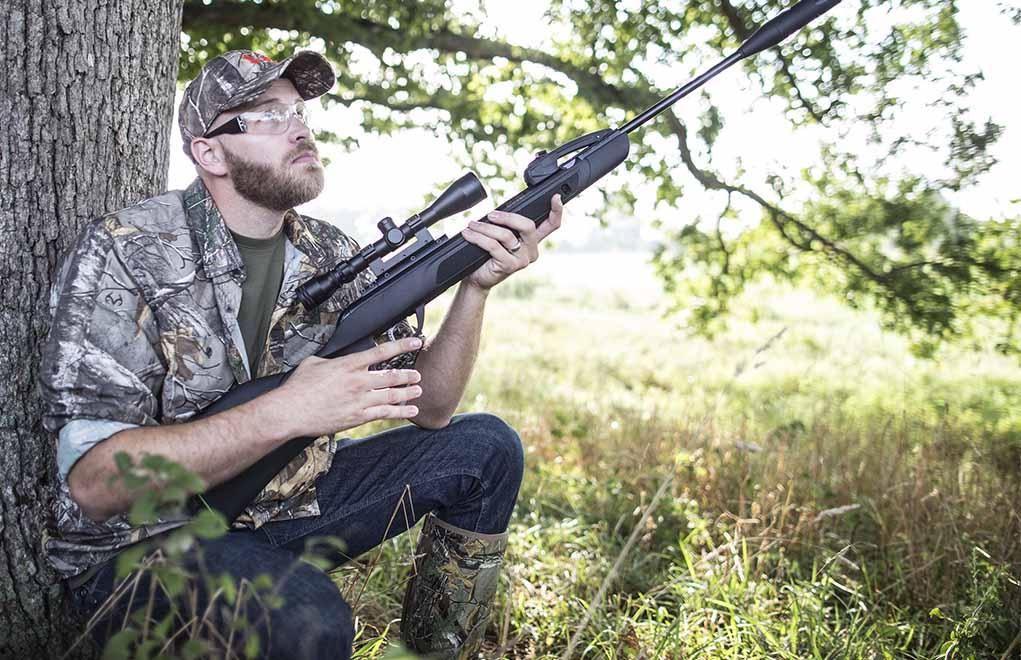
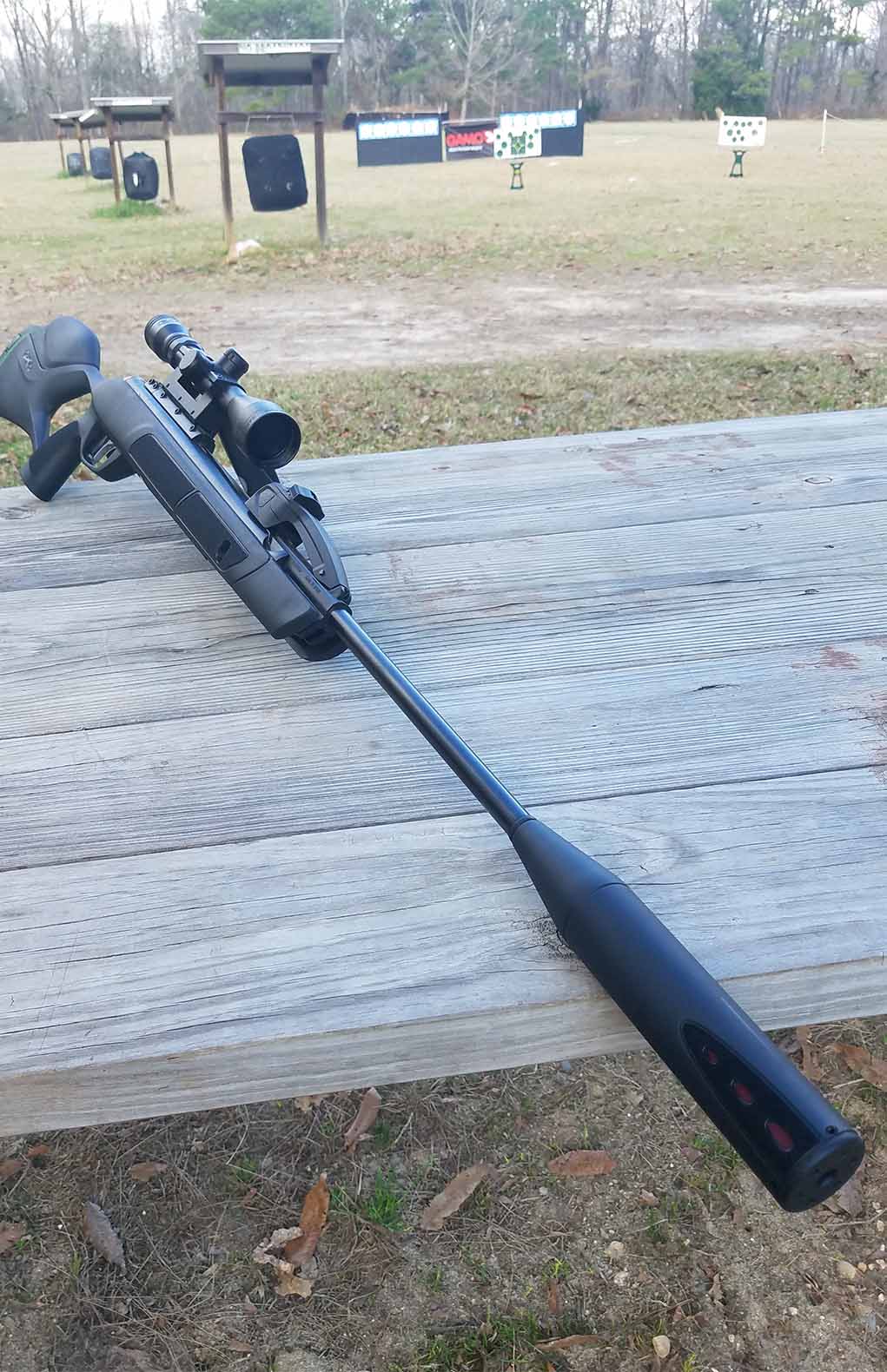
A repeating air rifle with velocity to spare, the Gamo Swarm Magnum brings air power to the hunt.
How The Gamo Swarm Magnum Blows The Competition Away:
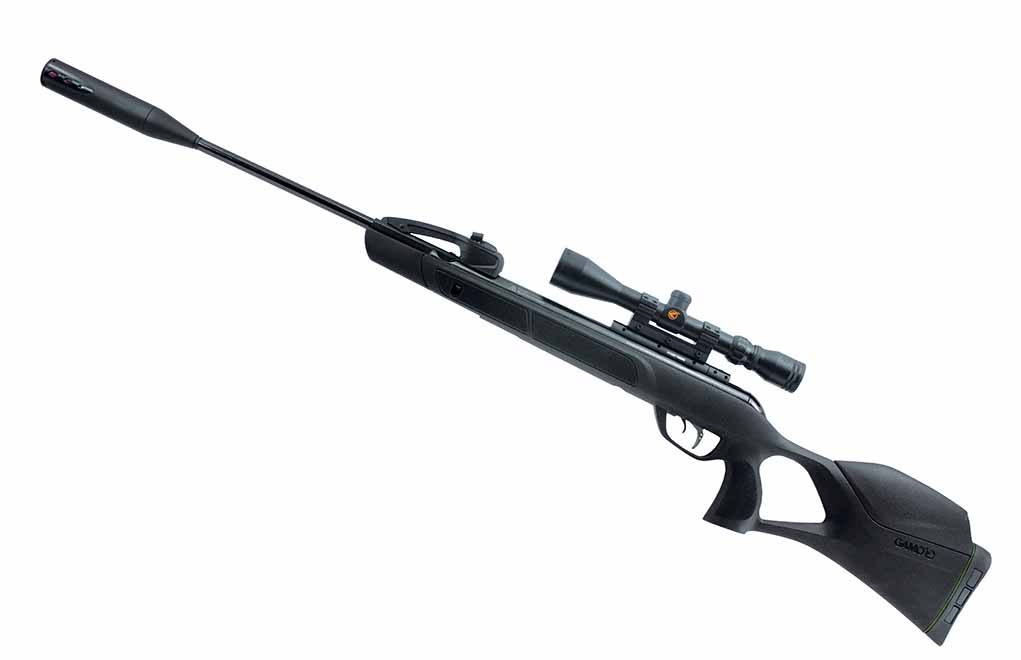
10-shot rotary magazine that feeds a new pellet into the chamber every time the rifle is cocked.
Pushes .22 pellets at the top edge of break barrel velocities — 1300 fps.
Two-stage adjustable trigger, known as the CAT System (Custom Action Trigger.
Double-integrated sound moderator built into the barrel.
RRR System (Recoil Reducing Rail), a two-piece aluminum rail separated by dual polymer struts, absorbs recoil.
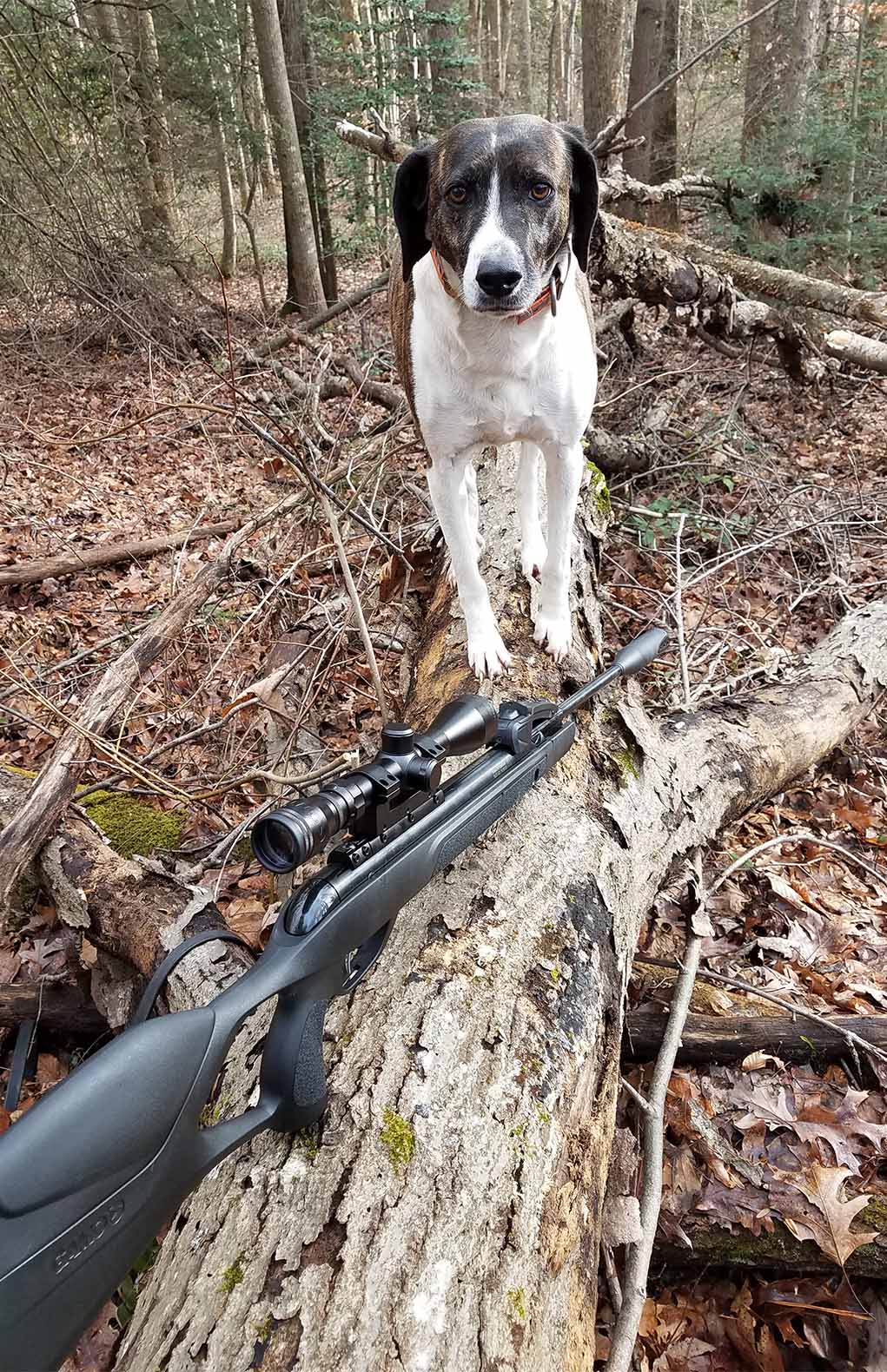
Dotzie, my little mountain cur squirrel dog, was very insistent. “Get over here — and get over here right now,” she said loud and clear while barking up a red oak tree 200 yards from me. Arriving on the scene I found the brindle-and-white-colored canine dancing around the tree and telling the world she had a squirrel up there, dead to rights. Now it was time for me to do my part.
After a considerable search, the grey squirrel was located high in the oak tree plastered to limb. Instead of the usual .22 caliber firearm, I eased the Gamo pellet rifle against a convenient tree for a rest and started the trigger squeeze with the squirrel in the scope. The shot was close but no cigar … and the squirrel was off to the races through the treetops.
Grabbing the barrel of the rifle, I quickly cranked it downward, cocking the rifle while the loading mechanism automatically inserted another .22 pellet into the chamber. Following the squirrel in the scope as best I could, I waited for him to pause briefly as he would leap from limb to limb. This process entailed moving from tree to tree with the squirrel, and Dotzie following the squirrel with me, all the while barking furiously. The tree rat finally paused a half second too long, I delivered the shot, and Dotzie was more than happy to grab it when it hit the ground. Without the quick reloading feature on the Gamo, I would not have collected the squirrel.
A New Era In Pellet Rifles
About 3 years ago, Gamo made history when they unveiled the 10X Quick-Shot technology for what is basically a repeater pellet rifle. Someone at Gamo was on their game when this self-loading feature was conceived.
For the author, “fun” is found in the squirrel woods with a good air rifle and his mountain cur, Dotzie.
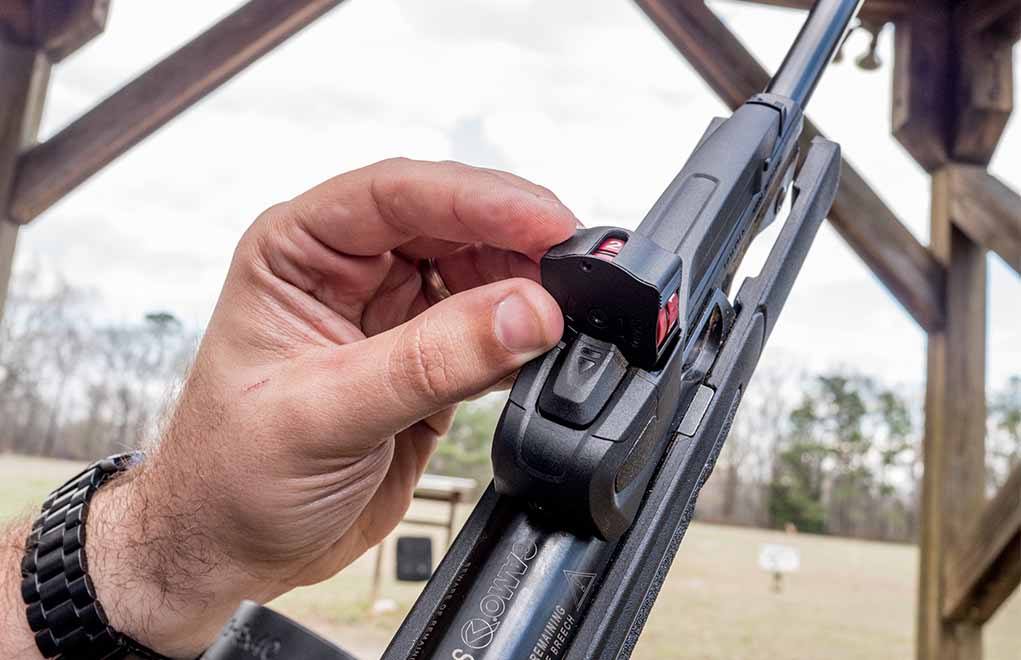
In a nutshell, the rifle employs a 10-shot rotary magazine that snaps into the top of the barrel and feeds a new pellet into the chamber every time the rifle is cocked. The advantage of rapid reloading when hunting small game and varmints cannot be overemphasized. The magazine-fed convenience was first shown on the Swarm Maxxim .177 caliber air rifle, and now 10X Quick-Shot tech is available on the Swarm Magnum .22 caliber pellet rifle.
More Power, More Speed
Air gun geeks are just like the rest of the world: They want more — more in the form of power, force delivered with a pellet — and this is accomplished with more speed. Like race cars and horses, air gun makers want to go faster.
“The Swarm Maxxim produced 975 fps in .22 caliber, and the Swarm Magnum pushes that up to the top edge of break barrel velocities at 1300 fps,” said Lawrence Taylor, Director of Public Relations at Gamo. “A .22-caliber pellet traveling at that velocity packs a punch downrange. The Swarm Magnum is a good choice for hunting small game like squirrels and rabbits anywhere, but especially in semi-urban areas where it’s not safe to shoot a .22 rimfire that has the potential to travel a mile.”
The Swarm Magnum achieves these pellet speeds by means of the IGT (Inert Gas Technology) Mach 1 power plant; this is the cylinder that air is compressed into when the air rifle is cocked. The Mach 1’s 33 millimeter pneumatic cylinder rockets pellets up to 1,300 fps. It also promotes smooth and consistent cocking with constant power delivered to any pellet you shoot. Key benefits of this system over a spring system air rifle are higher velocities, more accuracy and less vibration when the air rifle is fired.
The Gamo Swarm Magnum uses the company’s 10x Quick Shot System, which auto-loads a new pellet each time the gun’s break-barrel action is cycled.
The heart of any rifle is the trigger, and the Swarm Magnum has a two-stage adjustable trigger, known as the CAT System (Custom Action Trigger). This is pretty heavy stuff for a pellet rifle: Both stages are adjustable and you can do it yourself, on the kitchen table, with no gunsmith needed.
Suppressed Is Not Silent
Achieving great speed in a pellet rifle is a trade-off in that the faster the pellet travels, the more noise the gun will make. Whisper Fusion on the Swarm Magnum incorporates a double-integrated sound moderator into the barrel. The pellet travels through two different chambers, compressing and preventing noise expansion.
“I always tell folks getting into air guns to not expect these high-speed rifles to be same as the BB and pellet guns of their youth,” Taylor said. “They are always surprised by the crack of a high-velocity gun.” The reason for this is simple: The speed of sound is around 1,125 fps, and when the pellet’s velocity exceeds this, you get the resulting crack of breaking the sound barrier. Heavier pellets will reduce the speed, and if you get below this threshold you will notice a reduction in sound.
The Mystery of Recoil
Recoil in air rifles perplexes many new shooters. Put a scope intended for a firearm on an air rifle and you may be headed for trouble. Air guns tend to have a weird “backward” recoil, more so on spring-powered guns, but the break-action air-powered guns can also be problematic as the piston slams forward — not backward — as it does in a firearm.
Are small-bore air rifles the new .22LRs? No way. But — their accuracy and velocity capabilities make them a viable option for small game hunting and light range work.
Gamo uses the RRR System (Recoil Reducing Rail) on the Swarm Magnum, which is a two-piece aluminum rail separated by dual polymer struts to absorb the shockwaves generated by the recoil. The rail also features a hole, and the front ring a peg that fits into it during mounting. Users must remove the scope from the rings first, fit the peg into the hole and use the wrench to snug it down, and then mount the scope. This system makes for the most solid fit with less vibration and less damage to the scope.
The Bottom Line
You may very well be surprised with the accuracy of the Swarm Magnum — I was. I expected enough accuracy for hitting squirrels and other small game at short or medium ranges (50 yards or less), but I did not expect .22LR-like groups on paper. Along with this accuracy, the air gun has lots of power, more so than some other pellet rifles I’ve hunted with — and it seemed to have no problem taking down squirrels.
The cocking effort on this air gun is 41 pounds, meaning that it takes that much pressure to pull the barrel down and cock the rifle. Your 6-year-old is probably not going to be able to do this unless he or she is already training for college football, but for most adults it should not be a problem. The scope supplied with the air rifle is not a high-end optic, but it is adequate and filled the bill for the testing and hunting I did with it.
Gamo addressed the air gun recoil demon with the RRR System — and this is important. Trying to sight in an air rifle, or any rifle for that matter, is a gold-plated mess if you can’t keep scope mounts, scope ring screws and all that goes with it tight and in its place. So far, this rail system seems to be taming the air gun recoil exceptionally well.
Today’s air rifles are far removed from boyhood BB guns. The Gamo Swarm Magnum fires a .22-caliber pellet up to 1,300 fps.
The 10X Quick Shot system simply makes shooting an air rifle quicker and more enjoyable, and for hunting or pest control, follow-up shots are much faster. If I would have had one of these rifles when I was a kid preying on English sparrows, starlings and other pest birds, I would have probably taken several thousand more than I did. And if you carry additional preloaded magazines in your pocket, reloading is really, really fast.
For small game hunting, pest control or just plain ol’ plinking with your kids, the Swarm Magnum with an MSRP of $279 will be hard to beat.
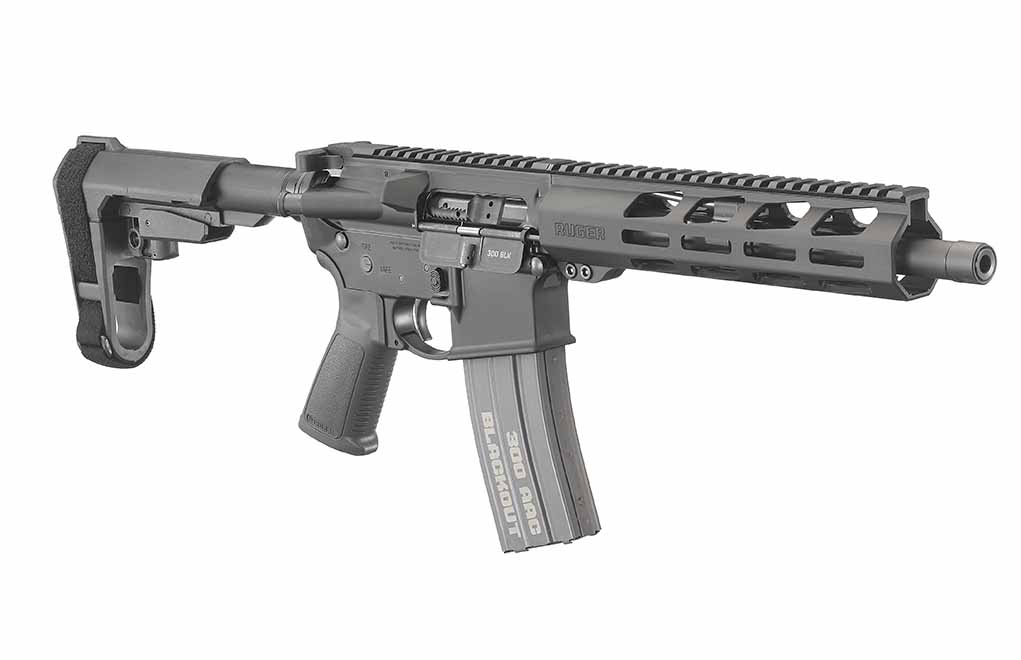
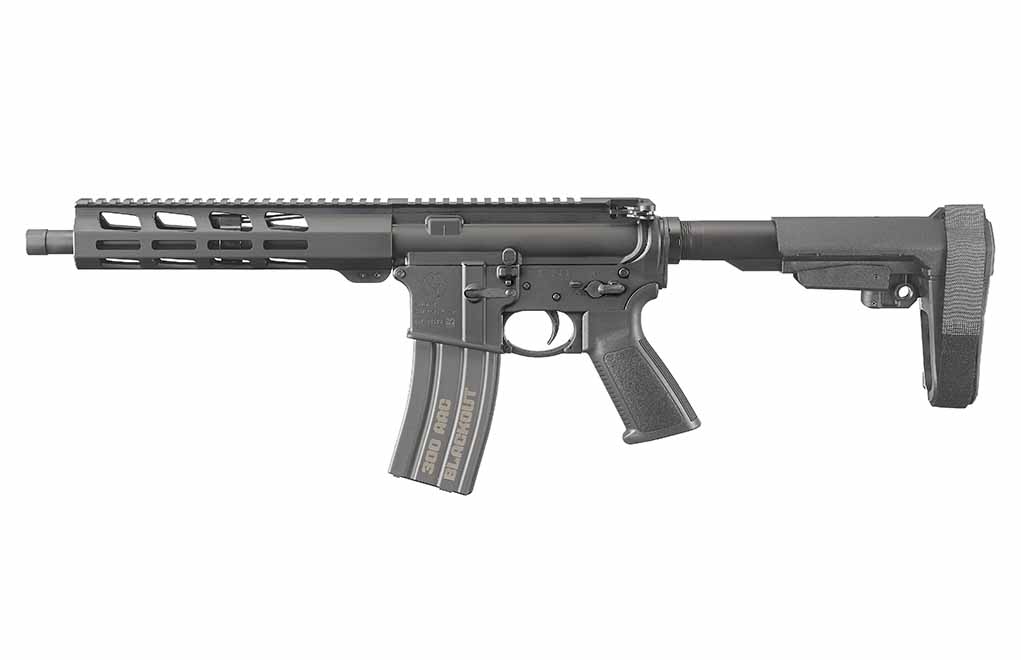
The AR-556 Pistol family expands with a .300 Blackout offering.
A latecomer to the AR-15 market, Ruger still continues at a somewhat moderated pace in this niche. Example, it took until this spring for the behemoth to offer an AR-15 pistol, which has been a pretty standard selection among most other makers for a while now. Though, the company has picked up the pace since, recently introducing its AR-556 Pistol in a new chambering.
One guess what it eats. If you answered .300 Blackout, not only are you correct but have paid at least passing attention to how AR rollouts usually go.
All joking aside, the eminently suppressible round is a solid choice for the abbreviated platform. If not in the least, you can take mercy on your earholes opting for the vast array of sub-sonic ammunition now available. Even better, originally developed to perform well out of shorter barrels, the .300 Blackout is a natural choice for an AR pistol. At the very least, it doesn’t face the reliability issues the 5.56 sometimes encounters in the platform.
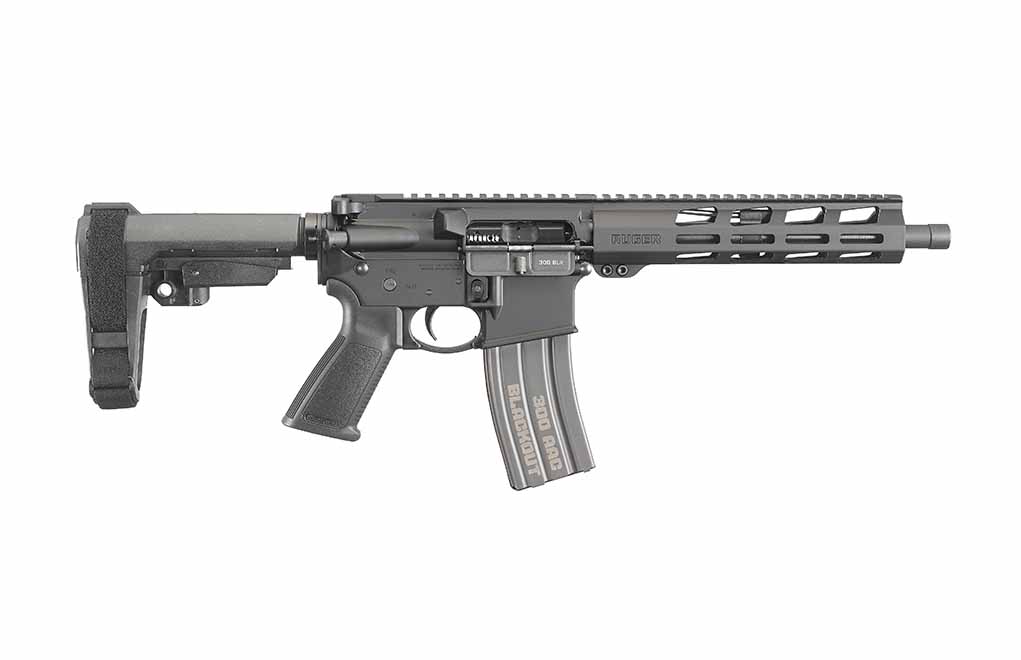
So, what do you get with Ruger’s .300 BLK AR-556 Pistol? About the same as the 5.56, which includes:
SB Tactical SBA3 Pistol brace
10.5-inch hammer-forged 4140 chrome-moly barrel
7075-T6 aluminum receivers (flattop upper with forward assist)
9-inch long handguard, Picatinny rail up top and ample M-Lok slots
5/8″-24 threaded barrel with factory-install thread protector
Shot peened and proof tested 9310 alloy steel bolt
M4 feed ramp
The major difference between the AR-556 Pistol variations are the gas systems. The .300 BLK has a pistol-length system and the 5.56 is carbine-length. Also price. You’ll pay a bit more for the .30-caliber – around $50 more – with the new pistol’s MSRP $949.
More from Ruger:
Sturm, Ruger & Company, Inc. (NYSE-RGR) is pleased to announce a new AR-556 Pistol chambered in .300 Blackout. The second addition to the Ruger AR-556 Pistol line features a 10.50” cold hammer-forged barrel with a 1:7” twist and pistol-length gas system to reliably function with both the lightest supersonic hunting rounds and heavy, subsonic rounds.
This new .300 Blackout model is equipped with an adjustable SB Tactical SBA3 Pistol Stabilizing Brace that features a minimalist design and integral QD sling sockets. The pistol also boasts a 9” aluminum free-float handguard with Magpul M-LOK accessory attachment slots for easy user customization.
The dust cover and metal magazine are marked with the caliber for easy identification of both the pistol and ammunition. The pistol-length gas system is tuned to run with a wide variety of ammunition, with or without a silencer. The 5/8”-24 muzzle threads are capped with a thread protector.
For more information on the AR-556 Pistol, or to learn more about the extensive line of award-winning Ruger firearms, visit Ruger.com or Facebook.com/Ruger. To find accessories for the AR-556 Pistol and other Ruger firearms, visit ShopRuger.com or your local independent retailer of Ruger firearms.
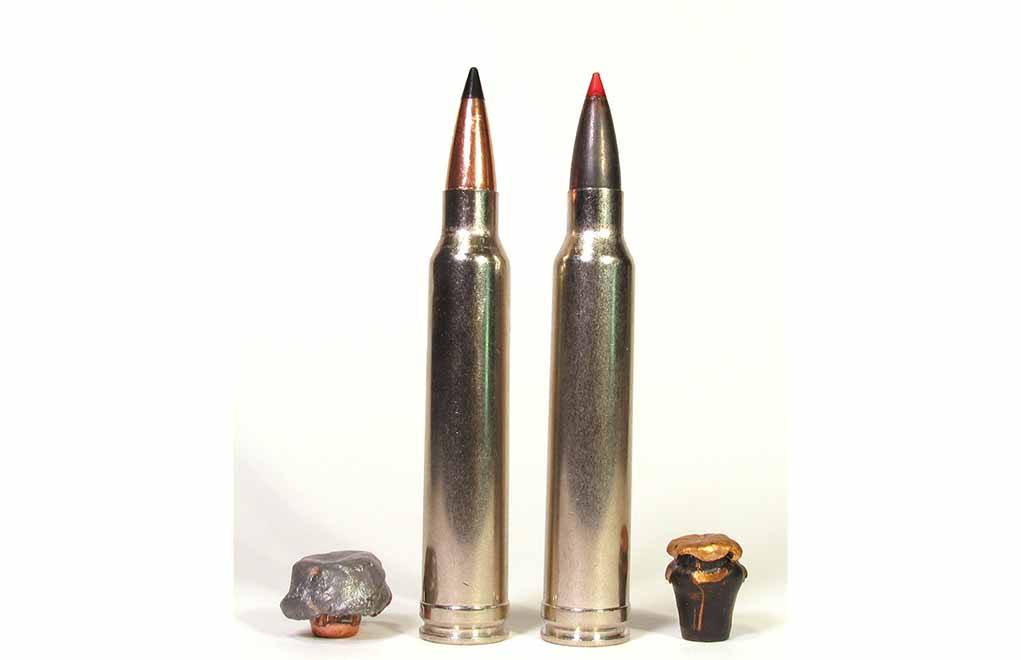
These two .300 Winchester Magnum loads have bullets with identical sectional densities. However, their construction and terminal performance vary greatly.
Despite common wisdom, there are some major nuances to the idea sectional density predicts how deep a bullet penetrates.
Does Sectional Density Define Penatration Potential:
Sectional Density (SD) is the ratio of a bullet’s weight to the square of its diameter.
if bullets of the same caliber are compared, the heaviest bullet will have the highest sectional density.
if two bullets of identical weight but of different caliber are compared, the smaller caliber bullet will have the higher sectional density.
Sectional density does play some role in defining a bullet’s penatration potential, it is not absolute.
A bullets toughness — resistance to deformation or fracture — has a plays a greater role in determing how much it will penatrate.
Sectional Density (SD) is the ratio of a bullet’s weight to the square of its diameter: SD equals a bullet’s weight in pounds, divided by the bullet’s diameter in inches, squared. For example:
A 180-grain, .308- caliber bullet would have a SD of .271.
180 grains / 7000 (7000 grains per pound) = .025714
.3082 (.308 x .308) = 0.094864
.025714 / .094864 = 0.2710
The Wikipedia on-line encyclopedia defines “BS” as a common English expletive most often used as a description of incorrect, misleading or false language and statements. In short, BS is what you say to your buddy as you sit around the campfire, after listening to his story about the big one that got away or the 600-yard shot he made. The formula for BS goes something like ½ Truth + ½ Fiction = BS. So, what is the connection between SD and BS?
Simply stated, if bullets of the same caliber are compared, the heaviest bullet will have the highest sectional density. It also means that if two bullets of identical weight but of different caliber are compared, the smaller caliber bullet will have the higher sectional density. A common cliché often used by gunwriters goes something like this: “All things being equal, the bullet with the highest sectional density will penetrate the deepest.”
With regard to non-deforming solids, there is some truth to this. If two identically designed .375-caliber solids impact an animal or expansion medium at the same velocity, the heaviest bullet — the one with the highest SD — will most likely penetrate the deepest. However, with expanding bullets, this is somewhat like saying that “there’s a 50 percent chance of rain” because with expanding bullets, “all things” are never equal.
“Expanding” means to increase in volume or size. Of course it also means to open or spread out, and some bullets do just that. A more appropriate explanation of the shape-shifting a bullet experiences during penetration might be “deforming,” which is defined in physics as, to alter the shape by pressure or stress. Bullets change shape during penetration due to the stress they encounter, and a bullet’s resistance to this stress equals its strength or toughness.
The toughness of a material or bullet is the maximum amount of energy it can absorb before fracturing. Bullets are built from solid materials, and solids generally have three responses to force described as elasticity, plasticity and fracture. The strength of a material or bullet is the extent of the measure of its elastic range, or elastic and plastic ranges together. Strength and toughness are products of the materials bullets are constructed of, and how they are put together, not their SD. Most bullets are a combination of copper and/or lead alloy. Bullet manufacturers influence a bullet’s reaction to energy and force by adjusting the make-up of these alloys and through the design and construction of the bullet.
If you increase the SD of a bullet in any given caliber/cartridge, it gets heavier. Loaded within the same cartridge, an increase in bullet weight equates to a decrease in velocity. By reducing velocity, you inhibit deformation which can, depending on impact velocity, create a larger or smaller expanded frontal diameter. Impact velocity also plays a part in how much weight a bullet will loose or retain. Retained weight and the ultimate frontal diameter — in conjunction with impact velocity — determine penetration. It’s a triangle of dependency that’s continually in a state of flux and constantly influenced by each side.
As much as it sounds like it might, SD has nothing to do with how dense, tough or strong a bullet is. Two bullets constructed of entirely different materials can have the exact same sectional density but different relative densities, specific gravities or toughness.
Consider a 250-grain, .375-caliber bullet constructed of solid lead will have a specific gravity of 11.35, a 250-grain bullet made from milk chocolate will have a specific gravity of 1.08. Both have the same SD, but unless you’re hunting Easter bunnies, the lead bullet is the best choice.
The rare instance where the sectional density of the unfired bullet can become a predictor of penetration is with non-expanding bullets like these.
The temptation to compare the SD of two bullets of a different caliber in order to make an assumption about penetration or killing ability exists, and you might often hear this discussion around the counter at your local gun shop. The fact is, regardless of weight, differences in bullet construction, impact velocity and deformation progression, make SD irrelevant.
Even when comparing bullets of the same type and caliber, you’ll find that SD alone does not dictate penetration. A test of three, .308-caliber Swift Scirocco II bullets weighing 150 grains, 165 grains and 180 grains, replicating 100-yard impact velocities of each bullet when fired from a 300 Winchester Magnum, showed a maximum variation of penetration depth of 1 inch. This works out to a 5 percent difference, and that’s within the margin of error of any expansion medium or results in actual game animals.
Further evidence that SD by itself is no indication of terminal ballistics is when you compare bullets of the same weight and caliber, but of different designs that impact at the same velocity. A test with six different 180-grain, .30-caliber bullets, from four different manufacturers, showed a penetration depth variance of as much as 27 percent. On the shallow end, a Swift Scirocco II penetrated 14.5 inches and on the deep end a Winchester XP3 penetrated 19.5 inches.
Comparing the SD of two unfired bullets is nothing more than comparing the ratio of their weight to their diameter. It’s like comparing the body-fat percentage of two boxers in an effort to determine which one will hit the hardest or win the fight. As far as penetration is concerned, the only formula you need to know that involves SD, is that SD = BS, and that’s a formula anyone can compute, even without a calculator.
Editor’s Note: This article originally appeared in the March 2019 issue of Gun Digest the Magazine.
For its first several years, the Single Six had what was known as a “flat loading gate” on the side of the receiver.
A gun inspired by the classic Western TV shows of the 1950s that were dominating the family room of nearly every home in America, the Ruger Single Six has gone on to become the stuff of legend.
How Did The Ruger Single Six Become An American Icon:
The Ruger Single Six was inspired by the popularity of TV and movie Westerns in the 1950s.
Given Colt discontinuing the SAA, the revolver gained a foothold.
Originally the .22 LR had a 5 1/2-inch barrel, and 4 5/8, 6½ and 9½-inch models were later added.
The main difference between the ‘Old’ and ‘New’ model Ruger Single Six was only safe to carry the old with the hammer down on an empty chamber.
The advent of the transfer bar safety made carrying a fully loaded Ruger Single Six a reality.
The year was 1951. Bill Ruger’s company was profitable and becoming well established in the industry, and he was anxious to expand his product line. The new medium of television was growing rapidly. Black and white TV screens were lighting up America’s living rooms every night, and some of the most popular programs were Westerns. A common thread in these shows was the type of handguns used by both good guys and bad guys. By far the most frequently seen models were single-action revolvers, most of them patterned after the Colt Single Action Army.
Bill Ruger, who had always been a fan of the classic Colt, saw an opportunity. Colt had ceased production of the Single Action Army at the beginning of World War II and there was no indication that it would be back anytime soon. In fact, an official announcement from Colt several years earlier had stated there would not be a post-war Colt SAA. Based on the popularity of Westerns on the TV screen and in motion pictures, Ruger decided to develop an updated and improved version of the single-action revolver.
The timing was a wise move. It would be 25 years before Colt returned to the single-action market, and by that time Ruger would be well positioned as the leader in the field. The popularity of TV Westerns continued through the ‘50s and peaked in 1959, when an amazing eight out of the 10 most popular programs were Westerns.
A Grand Entrance
Work had been underway on the first Ruger single-action since 1950, and by June of 1953, the gun was ready, the Single Six. Like the Ruger Standard Automatic pistol, the Single Six was chambered for the great .22 Long Rifle — everyman’s cartridge. Based on the appearance of the Colt Single Action Army revolver, it was first introduced with a 5½-inch barrel. It could also be used with .22 Short or .22 Long ammunition. As the name suggested, the cylinder held six rounds, but the original model should only be carried with the hammer over an empty chamber. (See Old vs. New Models below.)
Later models were added with a 4 5/8-inch, 6½-inch or 9½-inch barrels. Grips were checkered hard rubber with a black eagle medallion inlay on each side. Varnished walnut or stag grips were available as an option with ivory grips added in 1954. The ivory-grip version of Ruger Single Six is one of the rarest and most collectible. The standard model had a blued barrel and cylinder with an anodized aluminum grip frame. The earliest models featured a flat loading gate and rounded profile front sight. Made between 1953 and 1957, these became known as Flat Gate models. In 1958, this loading gate was changed to a contoured shape.
This picture of a New Model Single Six illustrates two important Ruger features — the contour-shaped loading gate, and the famous transfer bar firing system shown in the cocked position. When the trigger is pulled, the bar drops down to allow the hammer to hit the firing pin.
A series of Ruger Single Six models — about 250 — were engraved by the factory between 1954 and 1958, and they are considered the most collectible of all Ruger firearms. Most were engraved by Charles Jerred of the United States, while a total of 22 were sent to Spain to be engraved by several notable artisans there.
A Lightweight Single Six with aluminum cylinder was introduced in 1954. Original prices were $57.50 for the Standard model in 1953, and $63.25 for the Lightweight (1955). In 1959, a version was introduced chambered for the .22 WMR (Winchester Magnum Rimfire) cartridge, and it was made only with a 6½-inch barrel. A Single Six Convertible model with interchangeable .22 LR and .22 WMR cylinders became available in 1962 and replaced the .22 WMR only model. It was made with barrel lengths of 4 5/8, 5½, 6½ or 9½ inches.
The Super Single Six model was introduced in 1964. Features include an adjustable rear sight, a ramp front, integral sight rib, and interchangeable cylinders for .22 LR and .22 WMR. Barrel lengths were 4 5/8 inches (rare), 5½ and 6½ inches. About 100 nickel-plated guns were made from 1965 to 1968.
The Bearcat was a more compact cousin of the Single Six with a fancier, jazzier look, much like the sports car of the ‘20s for which it was named.
The Bearcat is a scaled-down single action in .22 LR with a non-fluted, roll-engraved cylinder. Introduced in 1958, the first Bearcats had plastic wood-impregnated grips, later changed to walnut in 1963. Many Ruger aficionados are aware that Bill Ruger was an admirer and collector of classic automobiles. Among these was the Stutz Bearcat, and when Ruger designed a new variant of the Single Six he named it the Bearcat.3 In addition to its scaled-down size, the Bearcat was a fancier, racier gun with a black anodized aluminum frame and a brass-colored, anodized alloy trigger guard. The Old Model was discontinued in 1972 and reintroduced in 1995 as the Bearcat New Model.
Old vs. New Models
Shooters, collectors and gun historians categorize all Ruger single-action revolvers, including rimfire and centerfire models, as Old Models and New Models. The most significant difference between them is that the Old Models, made before 1973, were based on the original single-action designs of the 19th century and should be carried with the hammer lined up with an empty chamber. This was to avoid an accidental discharge if a gun was dropped with the hammer positioned over a live round. Beginning in 1973, a transfer bar safety was added, which prevented the gun from firing unless the trigger was pulled, allowing the safe carry of six rounds in the cylinder. All Ruger single actions made after 1973 have this safety feature, including current models.
In addition to the improved transfer-bar firing system, other changes included the option of adjustable sights, a stainless-steel finish and a new loading procedure. Unlike the Old Models, the hammer has no half-cock position. With the hammer in the forward position, the loading gate is opened and the cylinder can full rotate. After loading or unloading, the gate is simply closed.
This 9½-inch barreled Ruger Single Six is capable of excellent accuracy, as demonstrated here by the great Single Action guru, John Taffin.
The New Model Single Six is still in production today. Many different models and variations have been added to the New Model Ruger line over the years, too many for us to cover in this column. As is the case with other Ruger firearms, there are numerous special editions, commemoratives and distributor exclusive models. Since most of the collector interest in the Single Six or Bearcat is for the Old Models, the values shown nearby are for those revolvers.
Editor’s Note: This article originally appeared in the February 2019 issue of Gun Digest the Magazine.
Following up on the inaugural 9mm version, Ruger releases the SR1911 Competition in .45 ACP.
What Makes The SR1911 A Top Competitor:
Pistol is hand fitted
Barrel has polished throat and target crown
Koening Shooting Sports low-mass hammer and competition sear
Flat-faced match trigger shoe
Integral plunger tube and hand-tuned sear spring
Striking two-tone stainless and black nitride finish
Fiber optic front sight and adjustable serrated rear target sight
Undercut trigger and beavertail for a high grip
Extended magazine release and ambidextrous safety
Ruger doesn’t get the credit it’s due, at least when it comes to 1911 pistols.
A latecomer to John M. Browning’s legendary design, you don’t quite hear prattling over the SR1911 like you do more established models from other makers. Could be people are still discovering the company turns out a pretty tight rendition. Though, things could pick-up in this department, given its new whiz-bang competition gun.
Ruger launched its new Custom Shop with the SR1911 Competition this year, and it looks the part of a keystone pistol. Feels it, too. I got to study one up close at the 2019 SHOT Show and was fairly impressed with what the 9mm brought to the table. Its action is spooky smooth and it has a great fit, as well as responsive controls and trigger … a head-turner to boot. Everything you’d expect from a hand-fitted outfit. I especially liked the 25 LPI checkering on the front strap and mainspring housing, which is very comfortable and positive, without being overly aggressive. I regret I didn’t get hands-on at range day.
The cord being struck, Ruger has followed up, recently releasing a .45 ACP SR1911 Competition. In all honesty, it was as inevitable as tomorrow’s dawn, yet welcome.
The gunmaker doesn’t throw any curveballs with the large-bore model, it’s essentially the same gun — down to Doug Koenig’s surname on the slide — only in .45. Well, the grips are different; the 9mm has toothy Hogue Piranha G10 and the .45 a more traditionally textured G10 grip. And the smaller caliber has one ounce and two more rounds of capacity on the 8+1 .45 ACP, otherwise it’s an I say potato, you say potato comparison. Which is good. Ruger laid this gun out well the first time around, so no use fixing what isn’t broke.
More from Ruger:
Sturm, Ruger & Company, Inc. (NYSE: RGR) is pleased to announce the Ruger® Custom Shop SR1911® Competition pistol chambered in .45 Auto. This single-stack SR1911 is built for the highest levels of competition; whether you are a world-class competitor, collector or target shooter who appreciates exceptional firearms, the Ruger Custom Shop SR1911 in .45 Auto will not disappoint.
Each slide and frame are hand fitted to ensure that the action is tight, smooth and accurate. The competition barrel featuring a polished throat, fitted barrel lug and target crown is also hand fitted for precise lock-up. The Custom Shop SR1911 is assembled with only the best components, including the Koenig Shooting Sports low-mass hammer and competition sear, flat-faced match trigger shoe, precision-machined Cylinder & Slide disconnector, forged slide stop, integral plunger tube and hand-tuned sear spring. The stainless steel frame’s black nitride finish contrasts with the two-tone, hand-polished, stainless and black nitrided slide with distinctive Ruger Custom Shop markings. Textured G10 grips finish off this rugged and reliable match pistol.
“I am excited about this addition to our Custom Shop lineup,” said Team Ruger Captain Doug Koenig. “Just like its 9mm Luger counterpart, this .45 Auto model is full of industry-leading features and fully machined, hand-fitted parts. A must-have for all 1911 aficionados! I cannot wait to hit the competition circuit with it.”
Standard features on the Custom Shop SR1911 Competition pistol include a fiber optic front sight and adjustable serrated rear target sight for match speed and accuracy; undercut trigger guard and beavertail grip safety for a comfortable high hold designed to reduce muzzle flip; and an ambidextrous safety and extended magazine release.
This pistol ships in a waterproof, fitted hard case and includes one, 8-round and one, 7-round competition magazine, a Ruger Custom Shop Certificate of Authenticity, challenge coin, cleaning cloth, gun peg and decal.
Walking hand-in-hand with the development of the AR-15, the .223 Remington has gone on to become among the most popular centerfire rifle cartridges of all time.
How Did The .223 Remington Come About:
First appeared in 1957 as an experimental military cartridge for the Armalite AR-15.
The cartridge is nearly identical to the .222 Remington Magnum, the only difference being that the .223 has a slightly shorter case.
Dimensionally, these the .223 Rem and 5.56x45mm NATO are identical, however, the latter is generally loaded to a higher pressure.
Historical Notes The .223 Remington first appeared in 1957 as an experimental military cartridge for the Armalite AR-15. In 1964, it was officially adopted by the U.S. Army as the 5.56mm ball cartridge M193. It’s used in the selective-fire M16 rifle, which is based on the original AR-15 design.
One of the requirements for the cartridge was that the projectile have a retained velocity in excess of the speed of sound (about 1,100 fps at sea level) at 500 yards — something that could not be achieved with the .222 Remington. Gene Stoner of Armalite, among others, designed a case slightly longer than the .222 and had Sierra make a 55-grain boattail bullet. This combination met the design requirements.
Originally an alternative military cartridge, the .223 (5.56x45mm) is now the official U.S. and NATO military round. We should note here that NATO forces, including the United States, have standardized a new 5.56X45mm round with a heavy bullet, and the M193 is no longer standard.
Shortly after the military adopted this cartridge, Remington brought out the sporting version. Practically every manufacturer of bolt-action rifles has at least one model chambered for the .223. In addition, there are many semi-auto rifles available in this cartridge. At one time, even the Remington Model 760 pump-action was available in .223.
The .223 Remington is nearly identical to the .222 Remington Magnum, the only difference being that the .223 has a slightly shorter case. The two are not interchangeable, although the .223 will chamber in a .222 Magnum rifle. The result, however, creates a gross headspace condition, and the .223 case can rupture if fired in the .222 Magnum chamber.
There has been a great deal of confusion regarding the interchangeability of the .223 Remington cartridge and 5.56x45mm NATO ammunition. Dimensionally, these two cartridge cases are identical.
However, 5.56 NATO ammo is generally loaded to a higher pressure than commercial .223 Remington ammunition. In 1979, SAAMI cautioned shooters that 5.56x45mm military chambers and throats differ from .223 Remington sporting rifle chambers. So, military ball ammo might produce high chamber pressures in sporting rifles.
The difference between these two cartridges is pressure, and the difference in the rifles is the way the leade (the section of the chamber in front of the cartridge case) is cut into the barrel; 5.56 NATO chambers have a longer leade. Maybe the simplest way to explain the difference is to say that the 5.56 NATO round is a +P version of the .223 Remington. Exercise the necessary caution and sort your ammunition accordingly.
Refining an already solid system, Springfield Armory produces an immaculate carbine with the SAINT Victor.
What Makes The SAINT Victor Stand Out From Other AR-15s:
Upper and lower receivers are fitted with Springfield’s Accu-Tite tension system so there’s no play.
Enhanced M16 bolt carrier and a bolt made of 9310 alloy steel.
Practical GI charging handle that shouldn’t snag during normal use.
Bravo Company Gunfighter Mod 0 stock with a non-skid pattern molded into its rubber buttplate.
Carefully machined and fitted internals that are given a boron-nickel plating.
Springfield Armory has been on a roll lately. In fact, it’s been on a roll for most of the past decade. Springfield’s latest? The Victor.
Ok, ok, it’s an AR-15 carbine chambered in 5.56 NATO, and that isn’t exactly new. Or news. But it does illustrate something I think is wrong with a lot of modern society: In the view of many, unless you’re completely upsetting the system, you are a hack. If you aren’t coming up with a revolutionary replacement to the old, you are a slacker. If you aren’t causing people’s heads to spin, you’re a poseur.
The problem with that viewpoint? Not everyone can be an Einstein, a Copernicus, a Salk. And because it isn’t easy, the end result for a lot of people who try to live up to this new standard is simple: They re-invent the wheel, add a spoke, name it after themselves and scare up praise to the skies.
Hogwash.
The Sum of Great Parts
There’s another path: You incrementally improve each detail, every aspect of something, and the end result is that old adage, “The whole is greater than the sum of its parts.”
The selector markings on the Springfield Armory Saint Victor are nonstandard. And good.
Springfield hasn’t re-invented the wheel; it’s just refined the AR into something really slick. Really good. Really must-have — the new-for-2019 Saint Victor.
Ok, so Springfield sticks with mil-spec on the receivers. They’re both machined from 7075-T6 forgings and are then given a Type III anodizing. The mil-spec crowd can have no complaints here.
Also, the two receivers are fitted with Springfield’s Accu-Tite tension system. This is a nylon-tipped screw in the lower receiver. It’s covered by the pistol grip (so your buddy can’t go messing with it and think he’s funny); and, when properly adjusted, it bears on the bottom of the rear lug of the upper. This means each upper/lower set closes up and locks in place without wobble. If the fit should wear, you can adjust it — albeit not easily. But it isn’t meant to be easy, just handy, and the wear would take a long time anyway.
Inside the upper receiver is an enhanced M16 bolt carrier and a bolt made of 9310 alloy steel. Yes, yes, the mil-spec is supposed to be Carpenter 158, an alloy that was state-of-the-art circa 1958. There have been a lot of advancements in steel alloy and heat-treatment technology since then, and Springfield has taken advantage of this.
The lower receiver plate has a QD sling socket in it. If you want it, it’s there. If you don’t, it isn’t in the way.
Springfield installs a GI charging handle. I have to give the company a thumbs-up on this one also. Too many charging handles are too big and get caught on clothing and gear. For competition, yes … a big handle is good — but not for general use or personal defense. If you want something bigger or ambi, it’s easy enough to install one.
The back end of the carrier assembly has the lower receiver sporting a mil-spec-diameter buffer tube (aka “receiver extension”) that’s also 7075-T6 aluminum and given the same Type III anodizing that the receivers have.
The lower receiver has the expected controls, mag catch, bolt release and selector. However, the markings for the selector are not mil-spec. The “safe” and “fire” markings are each in a rectangular box (with the “safe” having an X through it), and the “fire” and its box are then in a larger border. These markings are on both sides, even though the Victor does not have ambi controls. The magazine well is marked on the left side with the Springfield logo, along with “multi caliber” and the serial number. On the right-hand side, the magazine well is marked “Springfield Armory SAINT.”
On the end of the receiver extension, Springfield has installed the most excellent Bravo Company Gunfighter Mod 0 stock, complete with a non-skid pattern molded into its rubber buttplate. Light, compact and lacking edges or protrusions that can hook on objects or gear, it’s adjustable for length of pull on the six-position buffer tube.
The receiver plate has a QD socket at six o’clock for those who want to use a single-point sling. (I don’t, but the location is out of the way and not a hindrance to other slings or rifle manipulation.) The castle nut that locks on the buffer tube is properly staked, and the Bravo stock has both a slot for a sling and a socket for a QD sling swivel. Inside, the buffer weight is marked “H,” indicating it’s the heavier version … and that’s a good thing.
Where it Counts: The Insides
Inside the lower, Springfield installed a single-stage trigger assembly, but this manufacturer does more than just throw in mil-spec parts: The internals are carefully machined and fitted and then given a boron-nickel plating. The trigger wears an almost-flat blade or paddle. It rides over a Bravo Company trigger guard, curved and not folding.
The Victor is marked on the left side of the magazine well with the SA logo and the serial number. The right side of the magazine well shouts “Springfi eld Armory SAINT!”
The upper receiver is a flat-top mil-spec forging with forward assist and a dust cover door on the ejection port. The bolt inside the upper receiver mates with a standard barrel extension that’s installed on the 16-inch barrel. The barrel is made of chrome-moly-vanadium steel; and, once it has been profiled, drilled and rifled, it gets a Melonite treatment. This is the latest high-tech surface treatment of steel alloys. It both hardens the surface and increases corrosion resistance. You don’t need to chrome-plate a bore once the barrel has been Melonite treated.
The twist is 1:8 inches. This is the new standard, because 1:9 is just on the border for stabilizing anything heavier than 75 grains. Likewise, 1:7 is sometimes too fast for bullets lighter than 55 grains. The muzzle end of the barrel received a set of threads in the standard 1/2×28 pitch with a muzzle brake installed. (California models lack this.) You can swap the muzzle brake for a flash hider if you want, because the thread is standard.
Underneath the handguard, on the barrel, is a gas block and mid-length gas tube. The Victor is a classic direct impingement design, so you have lightweight and reliable operation.
Outside of the barrel, Springfield has installed a 15-inch free-float handguard with M-Lok slots. Springfield even went a step further: Instead of a full-length top rail, it carved off the rail behind where the front sight is to a few slots before the receiver. This allows you to get a really firm grip around the handguard. Those of you who shoot thumb-over style will find that the handguard accommodates your grip just fine. In addition, a nice detail on the folding sights is that the rear can be folded with either the small or large aperture at the ready. You get to choose which you want there when the sight pops up.
The back end of the handguard overlaps the receiver with a robust shell of aluminum — so much so that Springfield had to mill a slot in the handguard back there to provide clearance for the ejection port door hinge pin. These big sections absolutely prevent handguard rotation. If you’re strong enough to rotate the handguard with these locking it, you don’t need a rifle … your bare hands are probably enough.
The fire control parts are precisely machined, and 10 of them are given a boron-nickel coating.
The end result is a set of features that add up to a lot more than the typical M4gery, even more than the usual raft of “improved” carbines. At 6¾ pounds, the bare Victor is light, handy, well-balanced and fully featured.
The Trials of the Victor
In testing, I found that the trigger was very nice and easy to use. The Victor was quite accurate, and because it wasn’t a fat quad-rail handguard, it was easy to shift from target to target.
The muzzle brake calls for some comment. It’s a dual-port design with a pair of vertical vents to aid in keeping the muzzle down. I can tell you that it works. The muzzle did not come off the target when chrono-ing and doing drills. In fact, the muzzle brake was so effective — diverting so much gas to the sides and back — that I had to shift my shooting position next to my chrono. The Labradar cranks on the radar beam when the vibration of a shot tells it to. The blast from the muzzle brake was so jarring if directed at the Labradar that it (the Labradar) could not read bullets until I shifted my position to keep the direct blast off the box.
The Victor locked open when empty and cycled with all loads. The 16-inch barrel gave a good amount of the potential velocity to be gained from the 5.56 NATO ammo, and I had no surprises in velocity or accuracy. No doubt, the mid-length gas system also aided in the soft recoil, because the gas hammering into the carrier comes later in the cycle at a lower pressure and provides more of a push and less of a jolt.
Should You Consider It?
In a world of commodity-grade ARs that can be had for $600, is the Victor worth the upgrade? I say, “Yes!” You get sights on the rifle, and you get a first-class barrel that has been Melonite treated. You get a top-level stock and a very nice trigger. The handguard free-floats the barrel and has plenty of M-Lok slots for mounting gear.
Is it a ready-to-go competition rifle? No. But those start at twice the cost of the Victor. And it isn’t mil-spec — it’s better. If you want to get started, the Victor is a great base carbine to build on. And if you want something that’s ready to go and not expend any extra effort, the Victor is for you.
Just in case you hadn’t made the connection, Saint Victor was beheaded in 303 A.D. in Milan, then a city of the Roman Empire called Mediolanum and the base of Emperor Maximium, co-emperor with Diocletian. Who says the model names of firearms can only be modern tactic-cool? “Never a victim. Always a Victor.” Sounds good to me.
Editor’s Note: This article originally appeared in the May 2019 issue of Gun Digest the Magazine.
Turning to purely synthetic materials, Galco shoots for comfort with its deep carry QuickTuk Cloud IWB holster.
What Features Make The QuickTuk Cloud IWB Ideal For Concealed Carry:
Hybrid configuration, Kydex/nylon construction
Ballistic nylon front over closed cell foam
Comfort Cloth lining provides padding and moisture wicking
Rigid Kydex holster pocket for fast draw and easy holstering
Full firing grip accessibility
Tuckable polymer UniClip is adjustable for ride height
Best known for their leather rigs – some of them downright breathtaking – Galco has taken a different tack with its latest holster. The QuickTuk Cloud IWB is primarily composed of synthetic material, yet there’s good reason for the company’s marked break from convention. In a word, comfort.
Configured like a traditional hybrid holster, the QuickTuk Cloud IWB features a cloth lining on the rear of the nylon backing plate. This allows the tuckable holster to breathe and wick moisture, which are godsends in holsters designed to ride against the body. It’s just in time for the dog days of summer to boot. Reasonably priced with an MSRP of $55, the QuickTuk Cloud IWB also appears versatile, configured for strong-hand hip placement or cross draw.
More from Galco:
Galco is excited to introduce the QuickTuk Cloud™! An innovative combination of Kydex®, ballistic nylon and Galco’s new Comfort Cloth™, the QuickTuk Cloud combines extremely comfortable carry with superior concealment.
The QuickTuk Cloud’s outstanding comfort level comes from its innovative backing plate, composed of a ballistic nylon front over a closed cell foam body. The back portion of the plate that rides against the wearer is lined with Galco’s Comfort Cloth, an Adaptive Performance Mesh™ that provides padding and moisture wicking. A rigid Kydex® holster pocket provides fast draw and easy holstering while facilitating a full firing grip.
Worn inside the waistband, the QuickTuk Cloud includes Galco’s patent-pending, tuckable polymer UniClip™ for excellent concealment, stability and easy on-off capability. The clip can be moved up or down in the corresponding holes in the backing plate, enabling the user to set the carry height to suit their unique preferences.
Available in black, the QuickTuk Cloud retails for a very affordable $55.
For more information on concealed carry holsters check out:
Looking to go armed, but are stuck in the weeds as to what to arm yourself with? Here are 20 of the best concealed carry gun options that will keep you on the defensive.