Home Blog Page 190

Is The .300 BLK The Next Classic Deer Cartridge?

1

Believe it or not, the 300 BLK has all the attributes to make it really well suited for hunting white-tailed deer.

Does the 300 BLK have what it takes to be a great deer cartridge?

  • Like many of the great deer rounds, the 300 BLK is a .30-caliber cartridge.
  • Supersonic and subsonic loads are available; supersonic rounds are better for hunting.
  • Ballistically, it’s similar to the .30-30 and 7.62x39mm, both capable on deer.
  • The 300 BLK is surprisingly accurate and deadly, if ranges are kept within reason.

When the 300 BLK became a made cartridge by Advanced Armament Corp (AAC) and Remington after being blessed by SAAMI in 2011, there was a lot noise and chatter about the launch of the new cartridge for the AR-15 platform. I didnโ€™t get excited.

Not that the 300 AAC BLK was actually new; by then, it was less of a wildcat cartridge than the 300 Whisper. And you can see that was part of my issue. I was very confused about what the 300 AAC BLK was. Was it the 300 AAC Blackout, or was it the 300 Whisper? Maybe the 7.62x35mm? Isnโ€™t it the 300 BLK?

The short answer is that they are basically all the same cartridge with different names. The 300 Whisper is considered the progenitor to the cartridge. Most manufacturers of the cartridge have settled on calling it the 300 BLK. The fact the cartridge is offered in supersonic and subsonic loads also confused some hunters. Whatโ€™s better for hunting?

300 BLK -3-bullet
Hornadyโ€™s 110-grain GMX, which comes loaded in the manufacturerโ€™s Full Boar ammo, is something the author recommends as a 300 BLK hunting load.

The Magic Number
What started my curiosity with 300 BLK was the .30-caliber bullet. When I hear .30-caliber bullet, I start thinking in terms of deer, and how the cartridge and bullet combination will work for hunting deer. We deer hunters really like calibers that use .30-caliber bullets โ€” .30-30 Win., .300 Savage, .30-06, .308 Win., .300 Win. Mag. โ€” they all perform well in the field. Simply stated: We have peace of mind with .30-caliber bullets.

I learned to hunt white-tailed deer by silently cocking back the hammer of a lever-action rifle and knowing the limitation of the .30-30 Winchester cartridge. Silence doesnโ€™t spook deer, and a correctly placed shot leads to less tracking and more dragging. That caliber also helped me better understand trajectory in relation to bullet weight and velocity. Call it home-schooled ballistics.

While the AR-15 platform is about as far away from a Marlin or Winchester lever gun as you can get, I appreciate the AR-15 platform as a hunting rifle. That appreciation did not come quickly nor easily because the 5.56 NATO/.223 Rem. caliber, which is the caliber typically associated with the AR-15, is effective on wood chucks, ground hogs and coyotes โ€” not game animal taller than knee high.

What I liked about the 300 BLK cartridge was that it used a .30-caliber bullet and was specifically designed to fit in the AR-15 platform. OK, I admit it: I was getting jazzed.

After using the 300 BLK at the range, I started to like it even if there were not that many ammunition manufacturers producing 300 BLK ammo at the time. Now that more factories are producing a variety of loads โ€” both supersonic and subsonic โ€” I was all in. At the range and through AR-15 platforms, I could easily shoot groups with match ammo that were sub-MOA. Recoil was mild. Muzzle blast tolerable. Thatโ€™s sweet.

300 BLK -1Quirky Cartridge, Surprising Accuracy
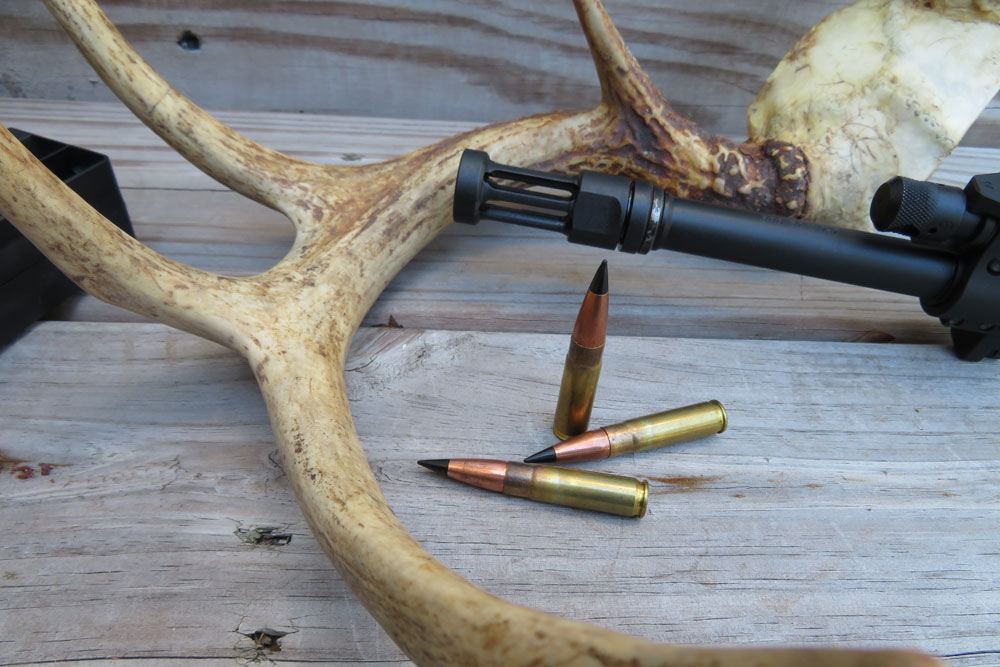
The 300 BLK cartridge itself is odd-looking, like too much bullet was stuffed into too little a case. The reason for this is the original 300 Whisper wildcat cartridge was designed to use lightweight bullets at supersonic velocities and heavier bullets at subsonic velocities. The 300 BLK was designed to provide ballistics similar to the Soviet 7.62x39mm cartridge in the AR-15 platform, as well as perform at super and subsonic velocities. Even though the round was designed for combat and defensive scenarios, and not specifically for hunting medium-size game, it offers excellent performance if kept within its range of effectiveness.

Itโ€™s also an accurate round. When I tested a Windham Weaponry RMCS-4 rifle in 300 BLK, my smallest group measured 0.28 inch with Sig Elite 125-grain Sierra Match King bullets. Not a hunting bullet by any means, but itโ€™s an excellent example of the accuracy you can expect from the 300 BLK.

A hunter who knows the limits of the caliber being used and stays within its capabilities will be successful. Those hunters who blame a cartridgeโ€™s inability to kill are bad shots and/or shoot at distances where they have no business shooting. You know those hunters; theyโ€™re the ones who blame the caliber and trade up for .30-06, and when that doesnโ€™t work, they buy a .300 Win. Mag. My shoulder hurts just thinking about those guys.

I put the 300 BLK in the same class as the .30-30 Win. and 7.62x39mm. Both are quite capable for deer hunting โ€” I just donโ€™t push the range farther than 125 yards. In my neck of the woods, which was in Northeast hardwoods, a typical shot at a deer was well under 50 yards. For still hunting in maples and oaks, the 300 BLK is quite effective. Now that Iโ€™m living and hunting past the Mason-Dixon Line and ranges are farther than up North in some cases, I still find the 300 BLK is a great choice.
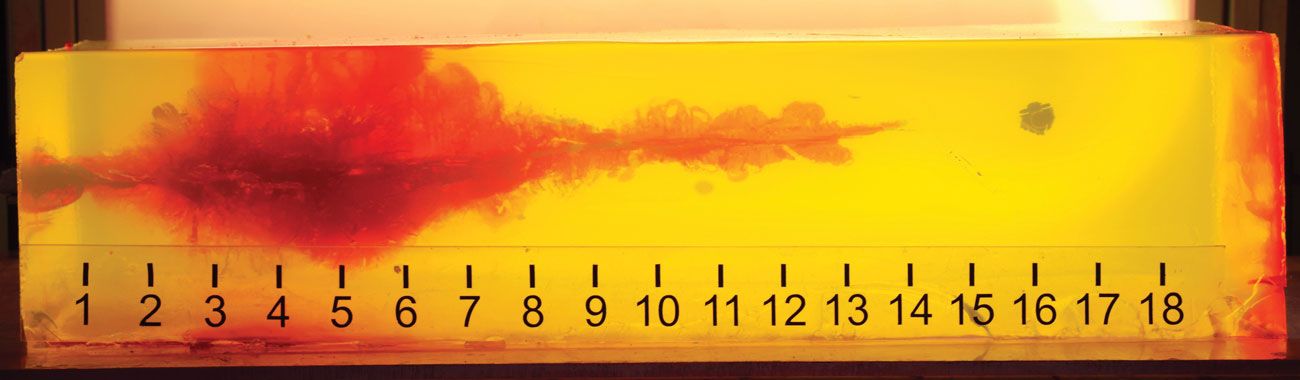
300 BLK -3-ballistic-gel
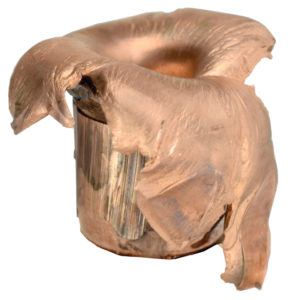
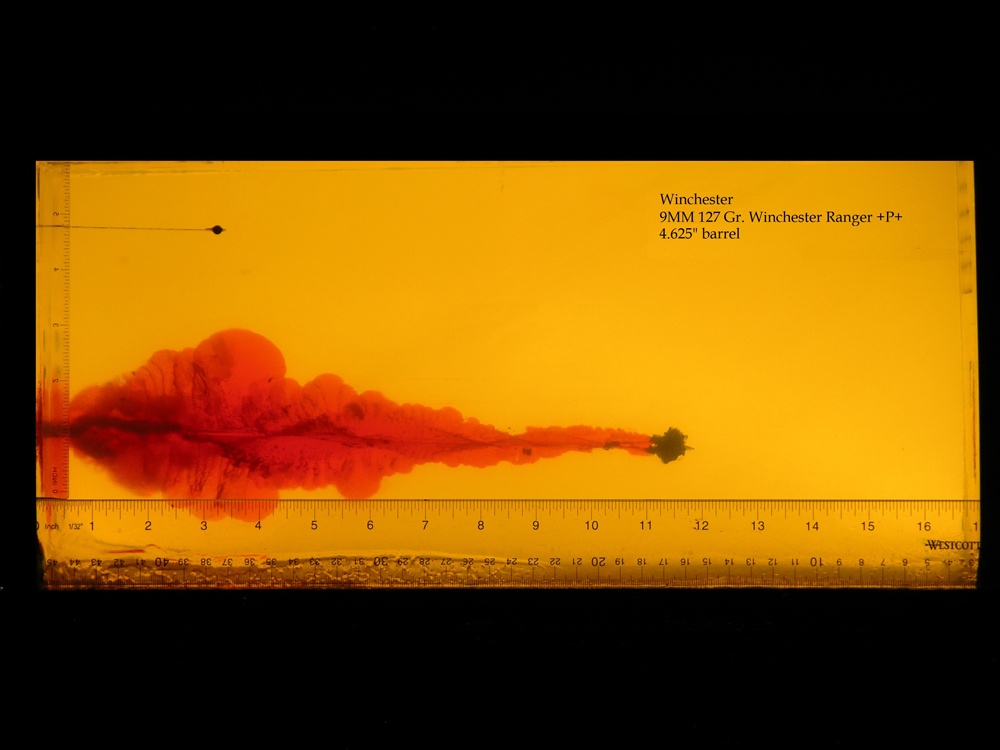
As seen here, the Hornady GMX expands and penetrates plenty to handle most medium-size game, such as deer and hogs.

Available bullets range in weight from 78 to 240 grains depending on the application. Lightweight 78-grain bullets are designed for close-quarters defense, while at the opposite end of the spectrum are 220-grain bullets loaded for subsonic velocities and designed for use with a suppressor. These are good for special ops work and hunting.

All 300 BLK bullets start out with decent velocity: 110-grain bullets crank out of the muzzle at 2,350 fps. Because the cartridge uses a large bullet and has limited case space for powder, the bullets tend to shed velocity more quickly than other .30-caliber cartridges.

For hunting, I stick with supersonic rounds loaded with 110- to 130-grain bullets such as Hornadyโ€™s Custom loaded with a 110-grain V-Max bullet. Out of a DRD Tactical CDR-15, I easily grouped three shots on average at 1.1 inches at 100 yards. Better yet, the DRD liked Barnes VOR-TX ammo loaded with 110-grain TAC-TX bullets. The DRD spit these into groups that measured 0.8 inch.

My Ruger SR-556 Takedown particularly likes the Barnes load. My best group with that ammo measured 0.41 inches. And I like the performance with these bullets. Other good choices Iโ€™ve used include Hornadyโ€™s Full Boar 110-grain GMX bullets and Federalโ€™s Fusion ammo loaded with a 150-grain Fusion Soft Point. Sigโ€™s Elite Performance 120-grain solid copper expanding bullets are also a good choice. LeHigh Controlled Chaos bullets were designed for maximum expansion with minimal pass-through and are loaded by LeHigh Defense as well as Underwood and Gorilla ammo in weights of 115 and 110 grains, respectively.
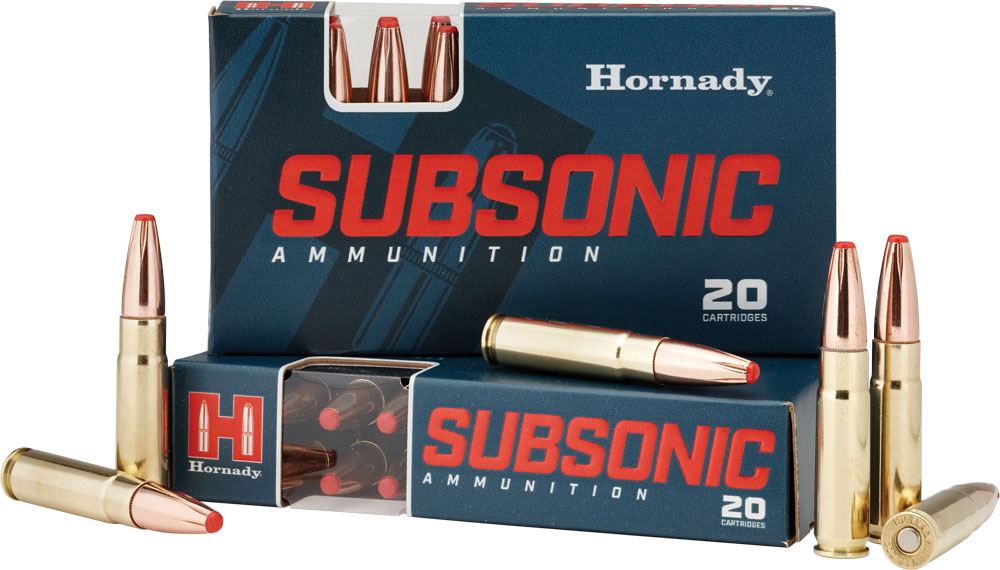
300 BLK -SUB-X-Subsonic
Here is Hornadyโ€™s new subsonic expanding 300 BLK ammunition that the author references. It features a 190-grain Sub-X (subsonic expanding) bullet with a lead core and Hornadyโ€™s patented Flex Tip insert to help it reliably expand at lower velocities.

Suppressor Ready
Shooting subsonic ammo without a can is like wearing a rain slicker on a sunny day. Whatโ€™s the sense? When you fire supersonic and subsonic 300 BLK ammo with a suppressor, you experience less muzzle blast, less recoil and less noise. With subsonic ammo, the noise and blast are substantially less, which enables shooters who are more affected by noise to get back on target quicker. That means you can see your hit on the animal, quickly recover from the shot, and deliver a speedy follow up if needed. Plus, if you hunt close to populated areas or have neighbors who donโ€™t like the noise of gunfire, a suppressor is a very smart investment, as you will keep the noise level down.

300 BLK -2-suppressor
This deer fell to the Barnes VOR-TX 110-grain 300 BLK fired through a 16-inch barrel and a Silent Legion suppressor.

You also donโ€™t need a bullet that over-penetrates and could potentially hit and destroy something unintended. Farmers hate equipment with holes in it. Subsonic expanding-point ammunition is a smart move. Rifles with adjustable gas blocks, like the Ruger SR-556 Takedown, allow you to tune the rifleโ€™s operating system to the cartridge. You might find that your AR does not cycle properly when shooting subsonic ammo through it. Make sure you run ammo through your rifle prior to a hunt.

Ed Schoppman, owner of Silent Legion, and his pal Dutch Moore, recently conducted a hunt out in Wyoming and used the 300 BLK with Barnes VOR-TX 110-grain bullets and Silent Legionโ€™s 300 Blackout suppressor Model SL-BK with SRS (Suppressor Retention System). They tagged out on deer and antelope. The speedgoat was shot at a distance of 178 yards, and the deer were 120 to 165 yards. They used a typical 16-inch barrel on a DPMS lower. The โ€œfield testโ€ was nothing short of an overwhelming success.

The New Deer Camp Companion
I havenโ€™t had a chance yet to use the new Sig Sauer and Hornady subsonic soft point ammunition, but next deer season, you know what Iโ€™ll be hunting with. More hunters each year are embracing the AR-15 platform for deer hunting, and that means more deer camps will see the 300 BLK cartridge. The round is capable and adaptable to your hunting situations. I donโ€™t think it is too soon to call the 300 BLK the next classic deer cartridge โ€” or the next pig and antelope cartridge, either.

Editor’s Note: This article is an excerpt from the January 2018 issue of Gun Digest the Magazine.
Video: The New Honda Pioneer 1000LE

0

Gun Digest editor Luke Hartle takes a look at what the Honda Pioneer 1000LE brings to the table for shooters and outdoorsmen.

What is the Honda Pioneer 1000LE packing?

  • The Pioneer 1000LE is fully automatic.
  • It can be driven in manual at the flick of a switch.
  • The off-road vehicle boasts a 999cc engine.
  • The Pioneer features versatile seating and cargo stowage.

Whether itโ€™s traversing the backcountry on a hunt or setting up a shooting course on the back 40, off-road vehicles and shooting have always had a close relationship. Gun Digest Editor Luke Hartle takes a look at one of the most versatile ways for a marksman or woman to get to their target in the above video.

The Gun Digest editor gets wowed by the 2017 Honda Pioneer 1000LE after a couple of days tooling around in the cutting-edge side-by-side. From the 999cc engine to the i4WD to the automatic dual clutch transmission and independent wishbone suspension, Hartle discovers thereโ€™s little that stands in the way of the off-road vehicle. On top of that thereโ€™s the Pioneerโ€™s versatility โ€” in seating and cargo storage. It’s everything you need to create your own adventure.

As Hartle points out, the Honda Pioneer 1000LE runs toward the top end of the powersports market price-wise. But he makes a good analogy concerning the money it costs. Like a Smith & Wesson Perfomance Center M&P10 6.5 Creedmoor, youโ€™ll pay a little more for a lot more. Not to mention, youโ€™ll get to your shooting destination in style.

New Gun: Springfield Introduces TRP Operator In 10mm

0

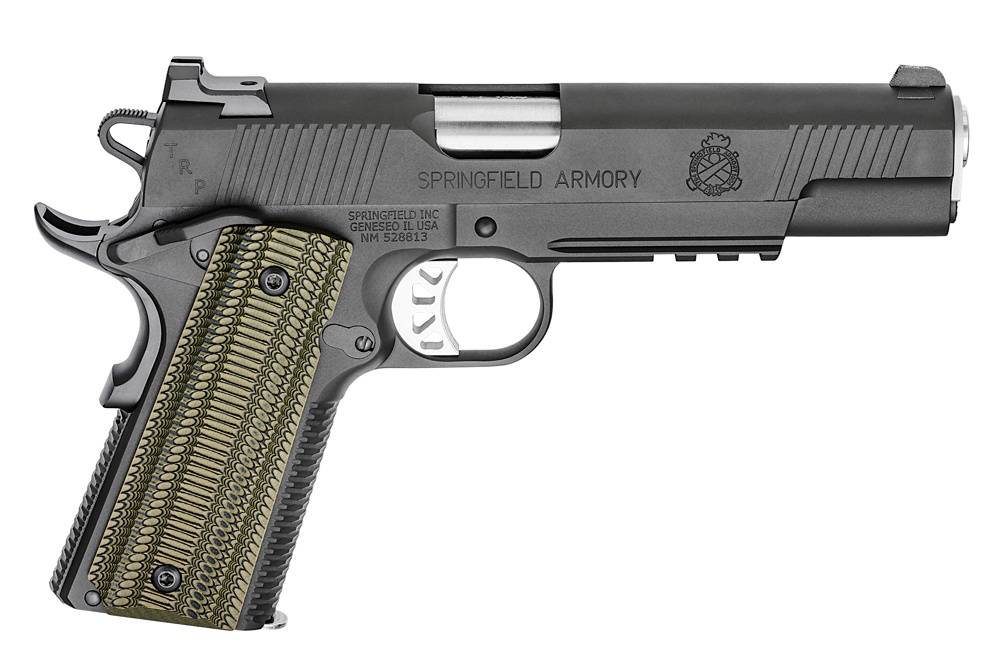
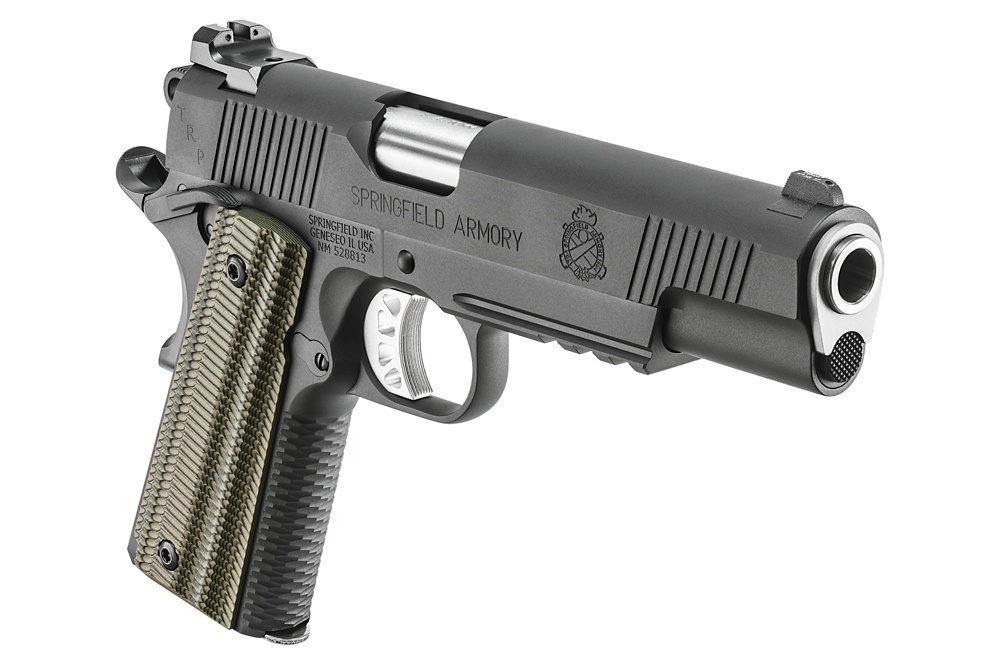
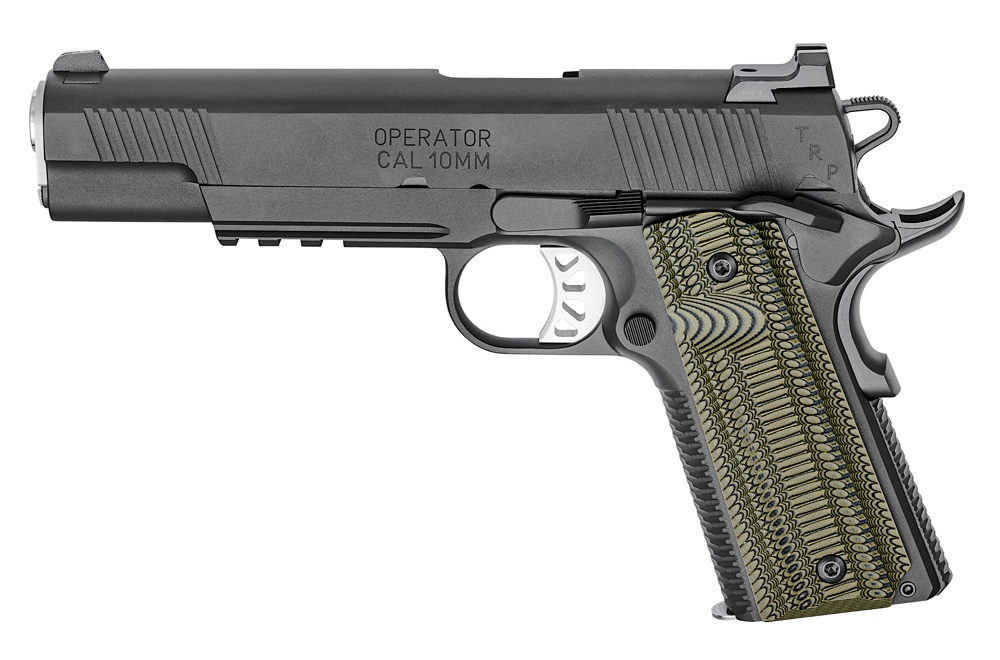
Springfield has launched its first production 10mm with the release of two TRP Operator models chamber for the powerful round.

What’s the hubbub on the new Springfield TRP Operator in 10mm?

  • The 10mm TRP Operator comes in 5- and 6-inch barreled models.
  • The smaller model is geared to carry, while the larger is meant for hunting.
  • The 5-inch model has tactical-rack rear sights, the 6-inch fully adjustable rear sights.
  • Both TRP Operators have forged steel frames and slides and are finished in Black-T.
  • They have enhanced grip texturing and a scallop pattern on the front strap and mainspring housing.
  • The price for the 5-inch TRP Operator is $1,790, the 6-inch $1,842.

At the moment, the pistol market has two hot rounds and they couldnโ€™t be further apart.

On the one end of the spectrum is the demure and more than 100-year-old .380 ACP. At the other end, the comparably newer, much heftier and hotter 10mm. If a gunmaker hasnโ€™t released a pistol chambered for one of the cartridges in recent years, itโ€™s almost certain theyโ€™ve banged one out for the other.

TRP Operator

Springfield Armory has gone one better in 2018, with its newest pistol releases amounting to a ballistics odd couple. Early this year, the company caught the interest of those in the market for a highly concealable semi-automatic with the 911 pistol in .380. But, before that, in late 2017, it jumped all the way to the other end of the caliber scale, not to mention shooting ethos, with the introduction of the TRP (Tactical Response Pistol) in 10mm.

Itโ€™s quite a chasm Springfield is bridging, but one where it appears to be banking more on the big dog, as the company is releasing two models of the 10mm 1911 pistol. It makes sense, given fans of the brand have wanted this exact setup for some time, so Springfield is giving them all they want and more apparently. But it also is reasonable when the variations of the TRP Operator are considered and the types of shooters they are targeting.

For those looking to add a 10mm to their carry routine, Springfield offers a 5-inch barreled TRP Operator. And for the quickly expanding handgun hunting ranks, there is a 6-inch barreled model.

It might not sound like a drastic difference, but, like football, ballistics are at times a game of inches. The extra barrel length allows the pistol to burn all of a scorching hunting roundโ€™s powder in its bore, thus achieving the roundโ€™s full ballistic potential.

Shoot Straight With Our 10mm Wisdom

There are few notable variations between the two 10mm TRP Operator models, outside of barrel length. The 6-inch pistol has more rail, which shouldnโ€™t be a shock given its larger frame. And the smaller TRP features a tactical-rack rear sight, while the larger boasts a fully adjustable rear. In both cases, they are three-dot tritium night sights, so they should each excel at low-light applications.

The new TRPs are Springfieldโ€™s first 10mm production guns (the manufacturer has offered the caliber out of its custom shop previously) and the first in the line not chambered in .45 ACP. Aside from caliber, the pistols offer all the features, plus some recent upgrades, shooters have become familiar with in a TRP.

TRP-Third

Among the run of the mill TRP features include a forged steel frame and slide (beefed up for 10mm), precision fitted with a match-grade stainless steel barrel with fully supported ramp. Additionally, the frame and slide are finished in Black-T, a self-lubricating, corrosion-resistant finish. And each pistol has an ambidextrous thumb safety, and high and ample beavertail, expected in a 1911.

Regarding some of the new twists to the platform, the pistols have plenty of texturing on their front straps and mainspring housings (a scallop pattern Springfield calls Octo-Grip), as well as on their G10 grips. This should prove a definite plus when launching the snappy round. And combined with the pistolsโ€™ weights โ€” 40 ounces for the 5-inch model, 45 for the 6-inch โ€” the new TRP Operator models have the potential to be fairly manageable shooters.

The TRP Operator models are also outfitted with Springfieldโ€™s Gen 2 Speed Trigger, a skeletonized job tuned to right around 4.5 to 5 pounds. And each comes with two eight-round flush-fit magazines.

Given the TRP line resides on the top shelf of Springfieldโ€™s ample 1911 selection, there is a robust price tag, even comparable to most of the production 10mm market. The 5-inch model rings up an MSRP of $1,790, the 6 inch $1,842. Thatโ€™s not exactly chump change, but for fans of Springfield and the wicked 10mm, it might not be too much of a speed bump in adding one or both models to their gun safe.

TRP-Second

Specifications:

TRP Operator (6-inch barrel)
Caliber: 10mm
Recoil System: GI Style, 16 lb. Recoil Spring, Long Slide Plug, Fully Supported
Sights: Fully Adjustable, 3-Dot Tritium
Weight (with empty magazine): 45 oz.
Height: 5.5 in.
Slide: Forged Steel w Ball Cut & Front Serrations, Black-Tยฎ Finish
Barrel: 6 in., Stainless Steel Match Grade, Fully Supported Ramp, Bull
Length: 9.6 in.
Grip Type: VZ Alien, Dirty Olive G-10
Frame: Forged Steel, Integral Accessory Rail, Octo-Gripโ„ข Front Strap, Ambi Thumb Safety & Black-Tยฎ Finish
Magazines: 2 – 8 Round, Stainless Steel
MSRP: $1,842.00

TRP Operator (5-inch barrel)
Caliber: 10mm
Recoil System: GI Style, 18.5 lb. Recoil Spring
Sights: SA Tactical Rack Rear, 3-Dot Tritium
Weight (with empty magazine): 40 oz.
Height: 5.5 in.
Slide: Forged Steel w Ball Cut & Front Serrations, Black-Tยฎ Finish
Barrel: 5 in., Stainless Steel Match Grade, Fully Supported Ramp w/ Bushings
Length: 8.6 in.
Grip Type: VZ Alien, Dirty Olive G-10
Frame: Forged Steel, Integral Accessory Rail, Octo-Grip Front Strap, Ambi Thumb Safety & Black-T Finish
Magazines: 2 – 8 Round, Stainless Steel
MSRP: $1,790.00

Our Top Articles on 10mm Ammo You Shouldnโ€™t Miss

Bullet Trajectory: The Effects Of Humidity

0

Although itโ€™s the least influential of the three environmental variables, humidity does have an influence on bullet trajectory.

  • Contrary to common thought, higher humidity results in thinner air, this affects bullet trajectory
  • Therefore, a bullet travels easier through humid air.
  • However, humidity is the least influential environmental factor.
  • Without a ballistic calculator, the way to track the net effect of all environmentals is density altitude.
  • It’s a figure that shows the cumulative effect of all three environmental variables.
  • This includes pressure, temperature and humidity.

In the last two columns we explored the first two elements of the three external/environmental variables: air density and temperature. In this column, weโ€™re going to discuss the third element, humidity, and introduce a way to account for all three elements at once as it relates to bullet trajectory.

Long-range-accuracy-tips-2 - humidity

Does Humidity Even Matter?

If youโ€™ve followed along so far, this one might be a curveball.
As air density increases, the bullet experiences more resistance as it flies through the air and therefore slows down more than it would in less dense air.

Higher density = slower bullet = lower impact on a target.

Sounds simple enough, right?

Well, contrary to common thought, higher humidity results in thinner air. Yes, you read that right. Despite how it feels to walk out into high humidity (the air feels โ€œthickerโ€), the air is actually less dense. Therefore, it has the opposite ballistic effect that you might expect โ€” a bullet travels easier through humid air.

Yes, I know what youโ€™re thinking โ€” water is denser than air. Thatโ€™s true with water in its liquid state. As a gas, it displaces the air molecules and actually results in less matter for the bullet to pass through.

The good news is that humidity is the least influential of the environmental effects and can be ignored in most cases.

Putting It All Together: Density Altitude

How are you supposed to track the net effect of changes in air pressure, temperature and humidity? Well, without a ballistic calculator, it can be maddening. An increase in one variable makes the air thinner while an increase in another makes the air thicker.

Buying-ar-second - humidity

There are two ways to keep track of the net effect of environmentals:

  1. Always use a ballistic calculator and have it do the work for you
  2. Focus only on the โ€œdensity altitudeโ€

Density altitude is a normalized figure that represents the cumulative effect of all three environmental variables. Itโ€™s a figure thatโ€™s calculated off of a set of โ€œstandardโ€ conditions (pressure, temperature and humidity) at sea level and then representing all three as the altitude youโ€™d have to be at in order to experience your current conditions. Essentially, if the net effect of the variables results in thinner air, then your density altitude value will be higher because with these โ€œstandardโ€ variables assumed, youโ€™d have to be at a higher altitude to experience the thinner air.

By using density altitude, you can understand bullet trajectory and record your elevation data required to hit certain targets at your current density altitude. Then, when you change locations โ€” or the environmental variables change โ€” you can look to see what the new density altitude is.

Of course, youโ€™ll likely need to start with a ballistic calculator to gather/confirm your elevation data. However, you can record your new data for that new density altitude. Then, whenever you experience that same/similar density altitude again (whether itโ€™s due to your actual altitude change or the net effect of changing environmental variables), you can reference the data you recorded for that density altitude and start shooting.

Yes, you still need to worry about the environment. However, by using density altitude, you can reduce all of the variables to one single value to track.

What Does It All Mean?

Our march through these ballistic topics in the past few columns can be summarized simply like this:

The amount your bullet drops on the way to the target – bullet trajectory – isnโ€™t really about how far away the target is; itโ€™s about how long it takes the bullet to get to the target. If one bullet leaves the gun faster than another similar/same bullet, or it starts at the same speed but travels through the air more efficiently, then it wonโ€™t drop as much.

Also, a bulletโ€™s time of flight at a certain distance isnโ€™t a constant. Environmental variables can allow a bullet to better retain its speed or slow down more, thereby resulting in a different time of flight. The same can be said when considering how much of an effect wind will have.

Bal-Hum-feat - humidity

Therefore, the only things that change a bulletโ€™s path are gravity and wind. And, anything that changes the time it takes for a bullet to reach a particular target will change how much of an effect that gravity and wind can have.

Your job is to learn what your bullet does in certain conditions, record its performance, and track how it changes as certain variables change. Then, you can use your information to predict how your bullet will behave in similar conditions in the future.

Remember, know what your bullet does at certain density altitudes and youโ€™ll be able to predict what it will do wherever and whenever you find yourself shooting next.

Editor’s Note: This article original appeared in the November 2017 issue of Gun Digest the Magazine.
Ammo Choice: The .45 For Self-Defense

4

The problem with the .45 ACP for self-defense isnโ€™t the cartridge, but the pistols that chamber it. Itโ€™s a big cartridge and requires a big pistol. Even the most compact .45s are still kind of big, and the smallest are harder to shoot as a result.

Because, they don’t make a .46:

  • Any modern bullet in .45 ACP will easily pass the FBI test.
  • It is a very efficient cartridge that delivers a bullet capable of eye-popping expansion.
  • You probably donโ€™t need +P, but some want it, so there it is.
  • The .45 Colt smacks the FBI tests with authority, and delivers plenty of expansion.
  • As with other big bores, with ACP and Colt 45s, bullet weight isn’t as important.

The obvious topic for discussion here is the .45 ACP. But, let us not forget the .45 Colt, which has been seeing some resurgence. First, the .45 ACP.

When the FBI was trying to find something better after the Miami shootout, there were those counseling the .45. However, there was a lot of resistance to jumping up to it and it alone. A lot of agents simply wouldnโ€™t be able to handle a .45 ACP, especially since the two choices were the 1911 and the S&W 645. Both big guns, they would have been too big for the smaller agents, and the recoil would have been too much for even those who werenโ€™t small.

The FBI had just settled a case where the training program, as it existed at that time (the early 1980s), flunked female candidates, candidates who would have passed the FBI qual course had they been given the qual course and not the academy course. The FBI was sensitive about disparate impact.

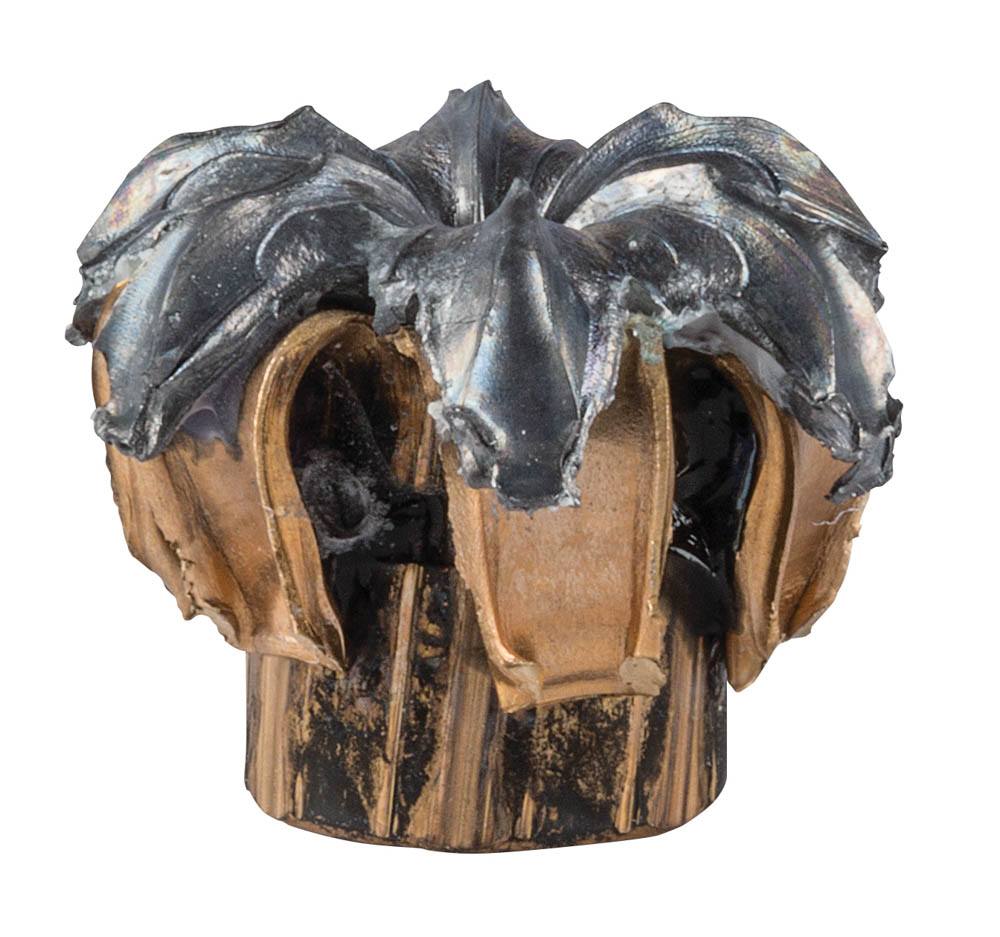
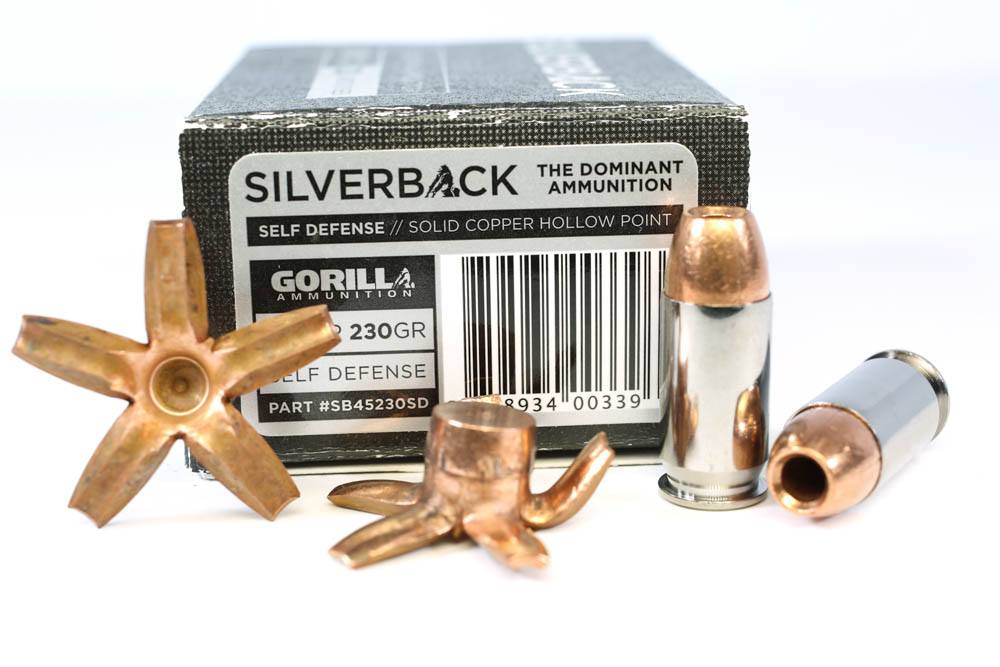
You want expansion? Then you want all-copper bullets, and here is the champion: Silverback 230 .45 ACP. Look at those petals.

So, they selected the 10mm, and wrangled and fought and changed plans. They could have avoided all that, and the subsequent 25 years of wandering in the wilderness with .40s, if they had simply opted for the .45 (the 10mm had to be in a .45-sized pistol anyway), figured out how to build guns for female and small-handed agents, and taught them how to shoot.

All the R&D and bullet technology that improved the 9mm and .40 translated perfectly to the .45, and as a result, it is even better now than it was back in the 1980s.

The problem with the .45 ACP isnโ€™t the cartridge, but the pistols it is in. It is a big cartridge and requires a big pistol. Even the most compact .45s are still kind of big, and the smallest are harder to shoot as a result.

So here, your choices are easy in ammo and hard in pistol.

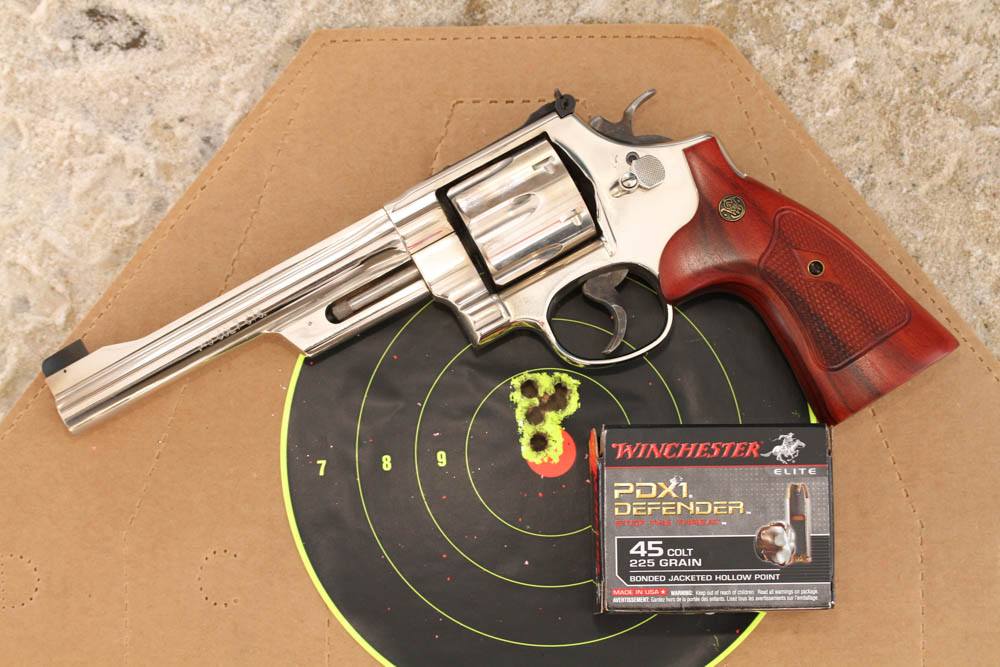
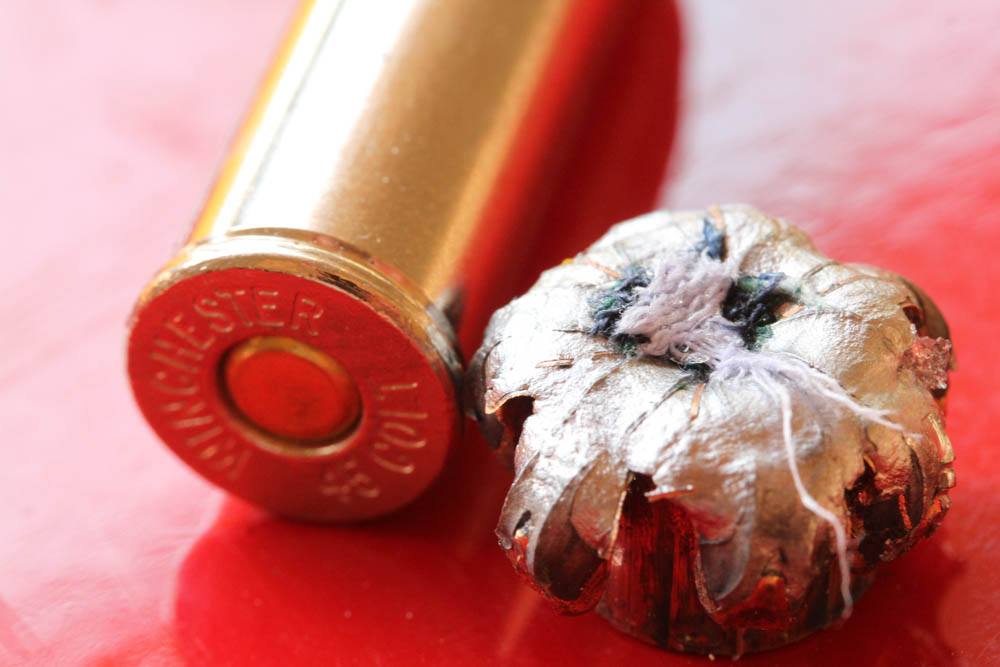
The .45 has a hollow point so big you can see the results in this .45 Colt bullet. Thatโ€™s a plug of cloth from the heavy cloth barrier test, in the open petals of the PDX1 bullet. It cut the cloth out, still expanded, and tracked so straight the cloth stayed in place.

Any modern bullet in .45 ACP will easily pass the FBI test. The .45 is also amenable to the adoption of the new hollowpoint all-copper bullets. There, you can get impressive, even eye-popping expansion out of bullets โ€“ with petals expanding to over three-quarters of an inch.

Where the old wound tracks of FMJ, also known as hardball, were simply .45 diameter tunnels, the new bullets expand and create impressive wound tracks.


Raise Your .45 ACP IQ:


The .45 is also a very efficient cartridge. The bullet is mostly inside the case, and the case capacity is well suited for the bullet. (That was a point considered in the first decade of the 20th century, when the .45 ACP was developed.) It doesnโ€™t take a lot of powder to get its bullet up to speed, and as it does its work through mass and frontal area, even if they didnโ€™t expand much, theyโ€™d still be great. That they do is a grand bonus.

GUARD DOG

Even more so than the .40, the Guard Dog in .45 is a great choice. If you are limited to FMJ, this delivers 165 grains of soft-recoiling .45 bullet, and the expanding full metal jacket is a bonus.

.45 ACP+P?

Do you need the extra boost of P? Maybe. If you can handle it, if it doesnโ€™t cause a decrease in your shooting and you want the extra performance, then go for it. You probably donโ€™t need it, but some want it, so there it is.

The .45 Colt can be amazingly accurate. Twenty-five yards, offhand, with full power PDX1 ammo.

.45 COLT

The .45 Colt dates back to 1873 and the Colt Single Action Army. It has an MAP of only 14,000 PSI, but thatโ€™s plenty. Given a .45 bullet of full weight, the .45 Colt smacks the FBI tests with authority, and delivers plenty of expansion. And since the pressure is so low, you can get a lifetime of shooting out of one revolver, as it simply isnโ€™t worked that hard by the recoil or pressure. You just have to be willing to put up with a full-sized revolver, is all.

Back when Detroit PD allowed personal sidearms in calibers officers could shoot a passing score with, we saw bunches of S&Ws in .45 Colt on the street. Back before the FBI tests, a flat-nosed 255-grain lead bullet was well thought-of, and it should still be so today.

FUTURE

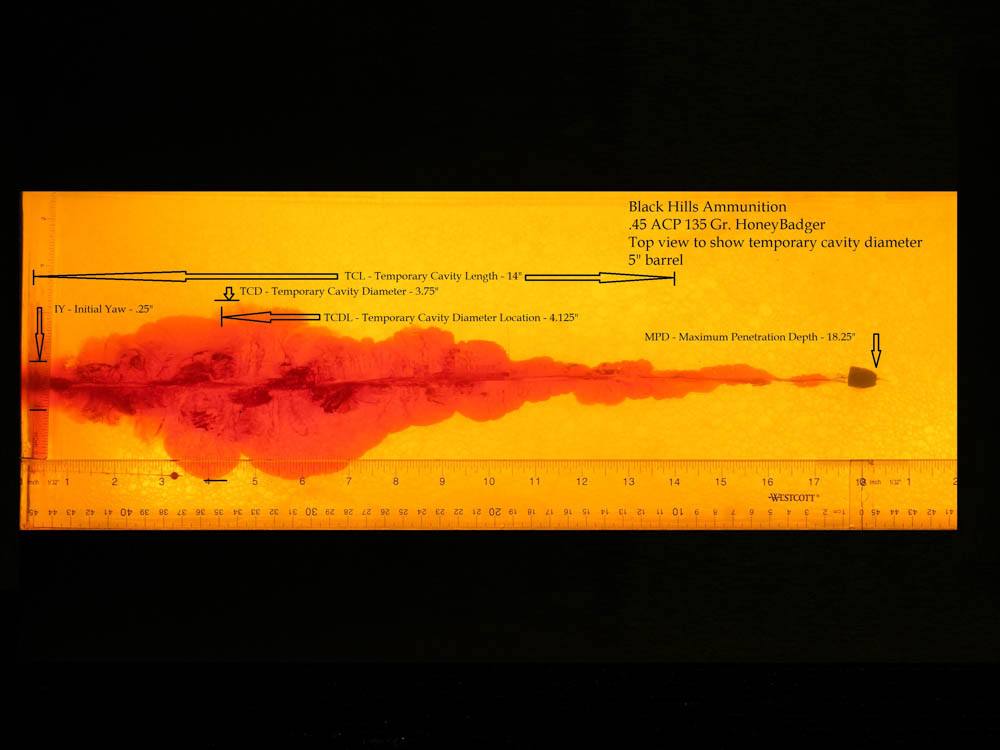
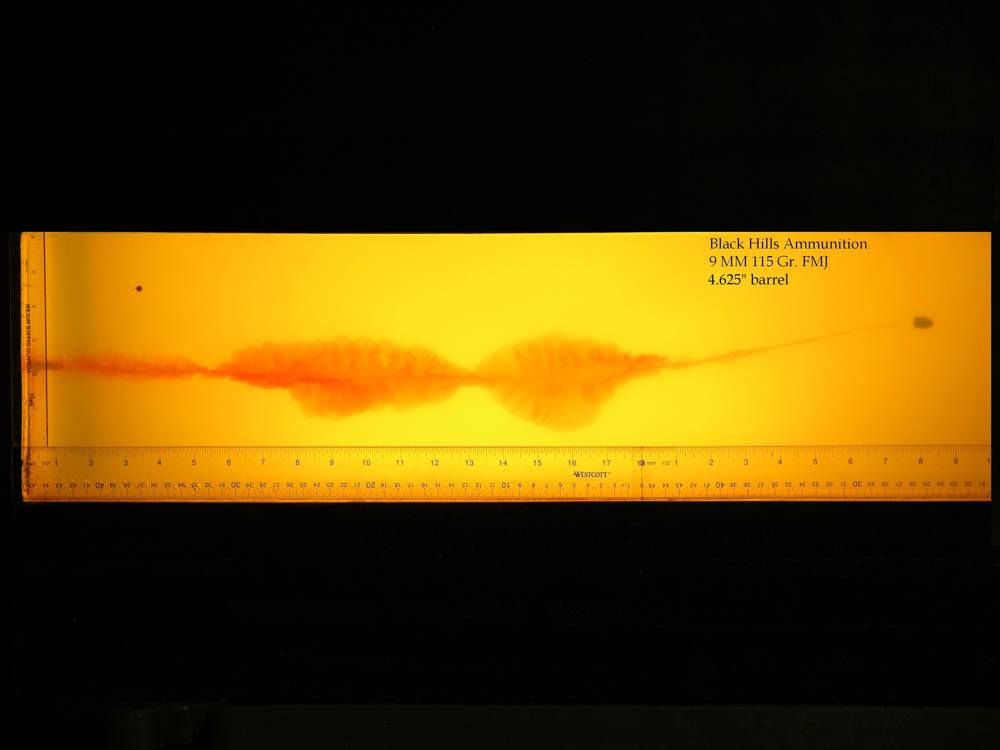
If something works in 9mm, it works better in .40, right? Then it obviously should work better still in .45 ACP, because we have it all โ€“ mass, frontal area, and we arenโ€™t giving up velocity. I speak of the Honey Badger, which does not expand, stops in gel like bonded bullets, and ignores barriers. This just may be what all bullets are in the future.

Eighteen inches of penetration from a non-expanding bullet, and a wound track that looks like that? Where do I get some? Image courtesy Black Hills.

SELECTION

As with the other big-bore choices, you do not have to obsess about weight. 185s work as well as 230s, and if your handgun (or your hands) prefer the 185s over the 230, then go for it. Donโ€™t get hung up on bullet weight, go with accurate and easy to shoot.

Editor’s Notes: This article is an excerpt from Choosing Handgun Ammo: The Facts That Matter Most for Self-Defense by Patrick Sweeney.

Savage Arms Introduces Slew Of New Left-Handed Rifle Models

2

With six new left-handed rifle models slated for release in 2018, southpaws have plenty of reason to check out Savage Arms.

What are some of Savage’s new left-handed rifle options available for shooters?

  • Savage will release left-handed 10/110 BA Stealth and Stealth Evolution models.
  • Left-handed Model 110 Storm, Model 110 Tactical rifles will also be available.
  • The rimfire B17 and B22 will also be offered in left-handed models this year.
  • Shooters now have 20 left-handed rifle models to choose from at Savage.
  • The rifles will boast all the usual Savage features โ€” AccuTrigger and AccuStock.

Sinister shooters rejoice! Savage Arms is adapting to your wrong-handed ways. Thatโ€™s correct, the Massachusetts gunmaker is going left-handed in a big way with a rather extensive expansion of its southpaw-friendly options.

Savage-First - left-handed rifle

In all, Savage will unveil six new left-handed rifle models at the Jan. 23-26, 2018 SHOT Show in Las Vegas. And there is good reason for the company to reverse the controls and stock contours of its rifles. There are plenty of lefties out there who would give their right hand to work a bolt positioned where they can operate it naturally.

As Savage points out, around 10 percent of the American population is left handed, making the right-hand-dominant gun market somewhat a pain to adapt to โ€” just like spiral notebooks. But Savage envisions helping more than just lefties with its expansion.

“Then there are those who are right-handed, but left-eye dominant,” the companyโ€™s firearms senior brand manager Jessica Treglia said. “These hunters and shooters greatly benefit from a left-handed firearm, and Savage is proud to supply them with dependable and accurate left-handed choices.”

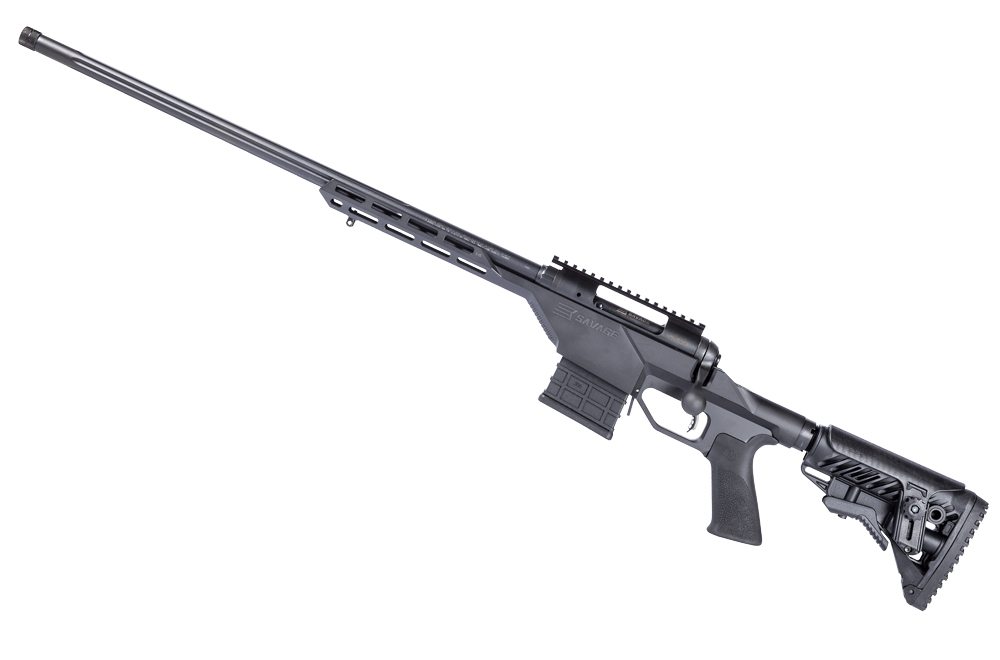
The left-handed rifle models Savage will introduce this year include its chassis 10/110 BA Stealth and Stealth Evolution, long-action Model 110 Storm and Model 110 Tactical, and rimfire B17 and B22. This swells the companyโ€™s lefty rifle selection to 20 models, and gives shooters a caliber choice from .17 HMR to .338 Lupua Mag. Not to mention, it gives southpaws the ability to match rifle configuration to application โ€” be it hunting, target shooting or tactical operations.

While the bolt has been reversed on new left-handed rifle models, the rest of what makes a Savage rifle a Savage is still in place. Lefties will continue to enjoy the companyโ€™s accurate button-rifled barrels and in many cases the AccuTrigger adjustable trigger and AccuStock embedded frame system. Conveniently, the tang safety and magazine release on the front of the trigger guard makes this conversion a simple one for Savage.

“One of the keys to Savage Arms achieving an impressive stronghold in the firearms industry over the past two decades has been the companyโ€™s ability to dominate niche markets,” Treglia said. “Savageโ€™s ever-expanding selection of left-handed firearms is an excellent example of this strategy in action.”

9 Revolvers To Suit Any Taste Or Budget

2

Given their ease of use and potent ammunition selection, revolvers are still shooting strong after all these years. Here are nine great wheelguns, both single- and double-action, that cover nearly every conceivable budget and task. These babies are perfect for everything from self-defense to hanging your next trophy on the wall and plain old target shooting.

What does the world of revolvers have in store for you?

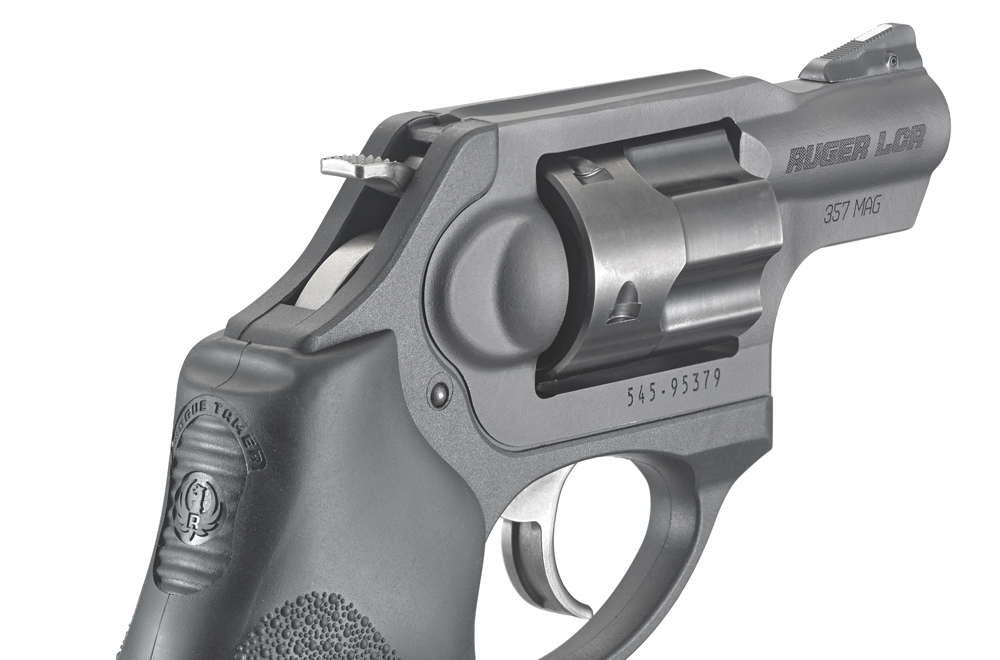
Ruger LCRx (.357 Magnum)

Ruger LCRx (.357 Magnum) - revolvers
Ruger LCRx (.357 Magnum)

Rugerโ€™s LCRx is a 17-ounce .357 Magnum with a 1.87-inch barrel. It has a monolithic frame made of 400-series stainless-steel and a polymer fire control housing. The stainless-steel cylinder has been fluted to reduce weight, and it has a PVD coating to enhance durability. The revolver will accept modular grips, has a pinned, white-striped front sight and an external hammer for single-action operation. $579-$669

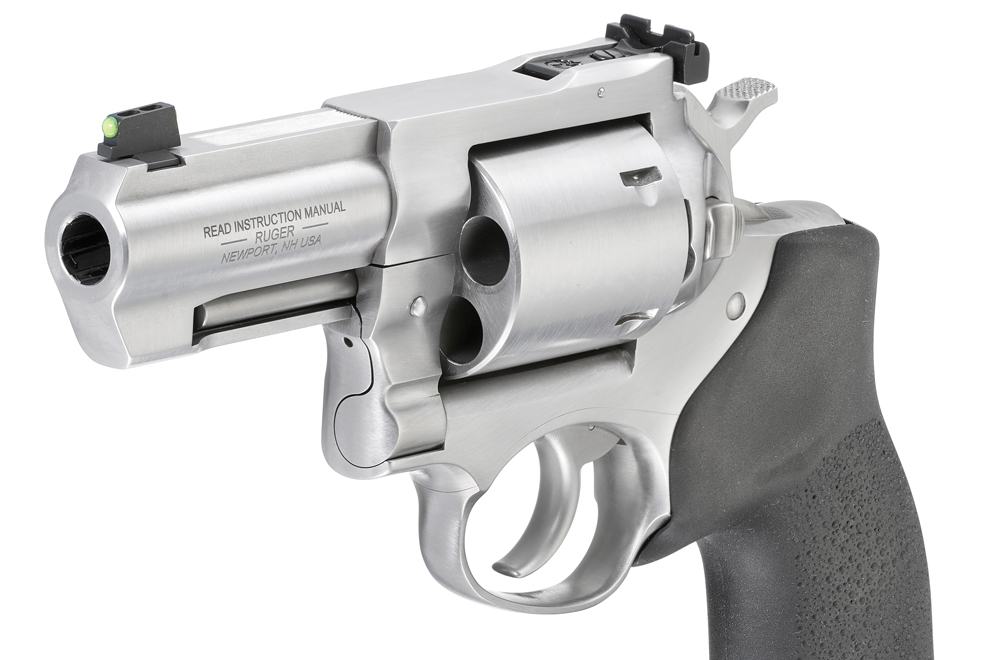
Ruger GP100 (.44 Special)

Ruger GP100 (.44 Special) - revolvers
Ruger GP100 (.44 Special)

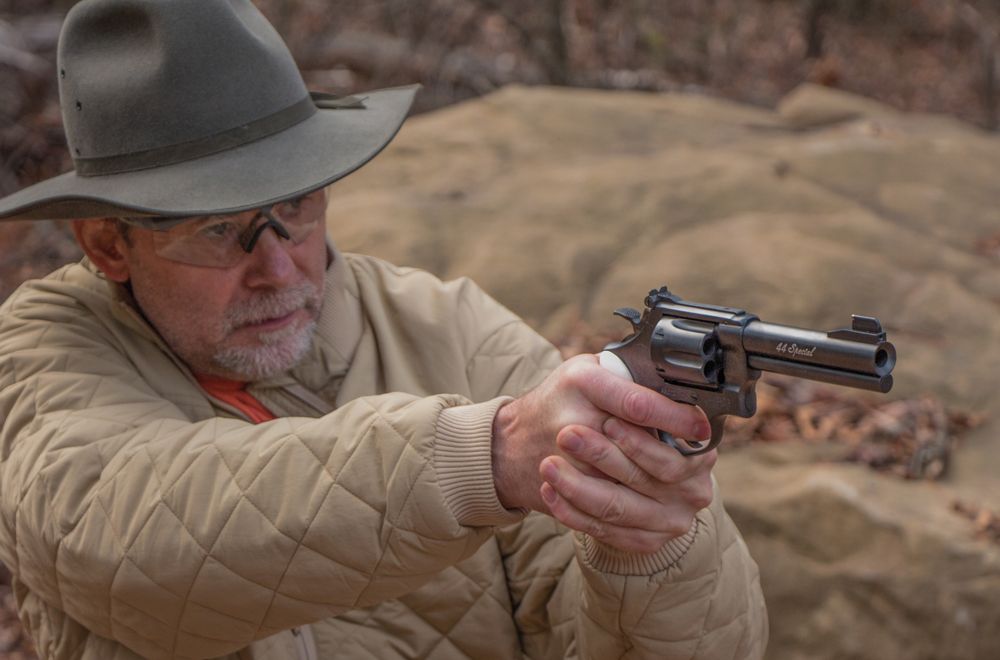
Rugerโ€™s new 3-inch, stainless-steel, GP100 in .44 Special weighs in at 36 ounces. It comes with a fully adjustable rear sight and a fiber-optic front sight. Unless you were born before 1970, you might not have any appreciation of the .44 Special, but it is fully capable as a self-defense cartridge for use against a murderous fiend or a furry ball of fur and claws. $829

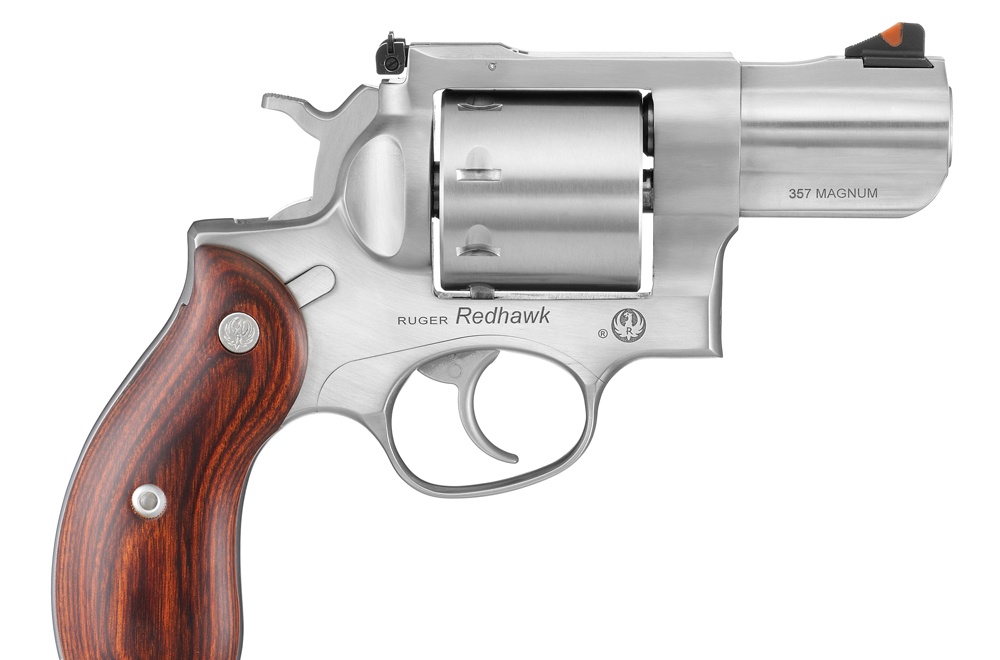
Ruger Redhawk (.357 Magnum)

Ruger Redhawk (.357 Magnum) - revolvers
Ruger Redhawk (.357 Magnum)

Bad guys are not the only things you might need protection from. Outdoorsmen who frequent bear country would do well to arm up with a firearm capable of putting the smackdown on a toothy attacker. With its 2.75-inch barrel, Rugerโ€™s new .357 Magnum Redhawk is a big gun capable of helping tame the rock and roll of the hottest .357 Magnum loads. And, like all .357 Magnum revolvers, it will also fire .38 Special ammunition. $1,079

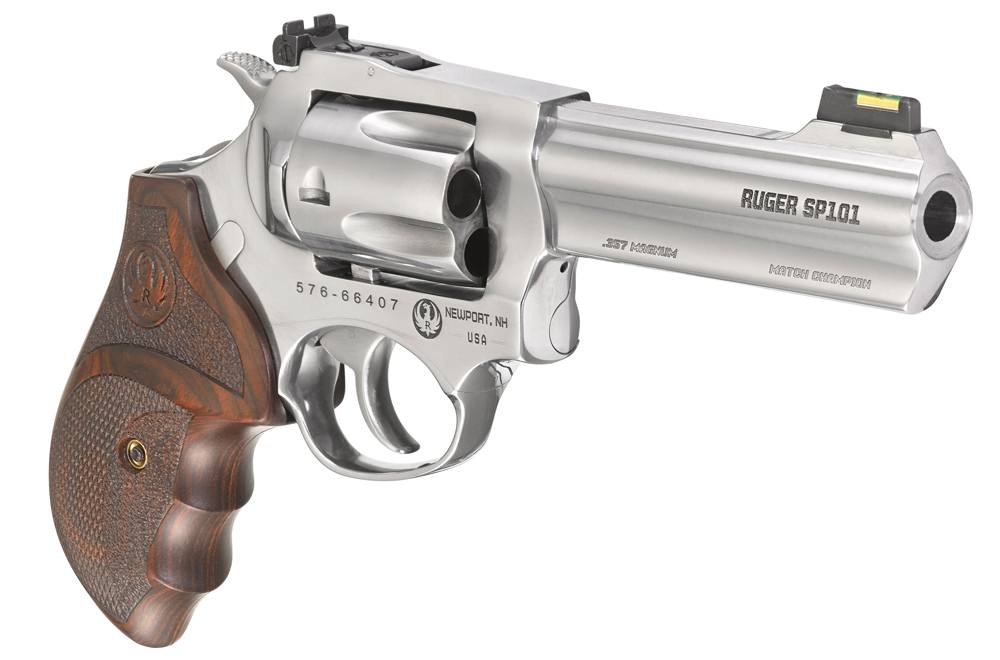
Ruger SP101 Match Campion (.357 Magnum)

Ruger SP101 Match Campion (.357 Magnum) - revolvers
Ruger SP101 Match Campion (.357 Magnum)

This revolver has a 4.2-inch, full-lugged barrel and is quite light and handy. It will still handle .357 Magnum or .38 Special ammunition, but its five-shot cylinder reduces overall weight. It would be an ideal sidearm for a backpacker or camper, and donโ€™t forget revolvers are well suited for use with shot shells, making them perfect for poisonous snakes or other vermin around home or camp. $859

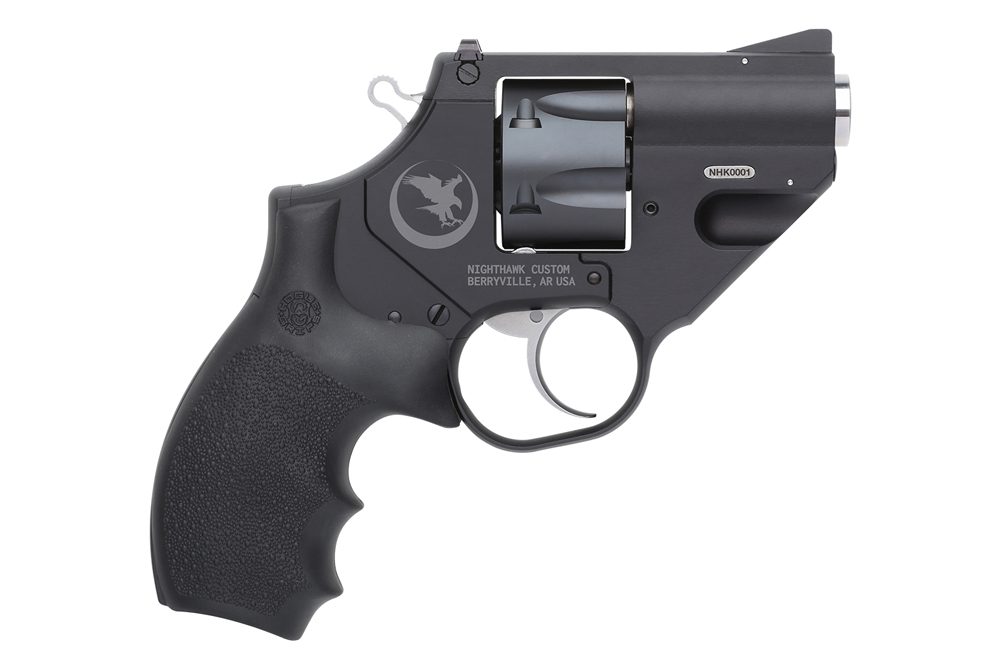
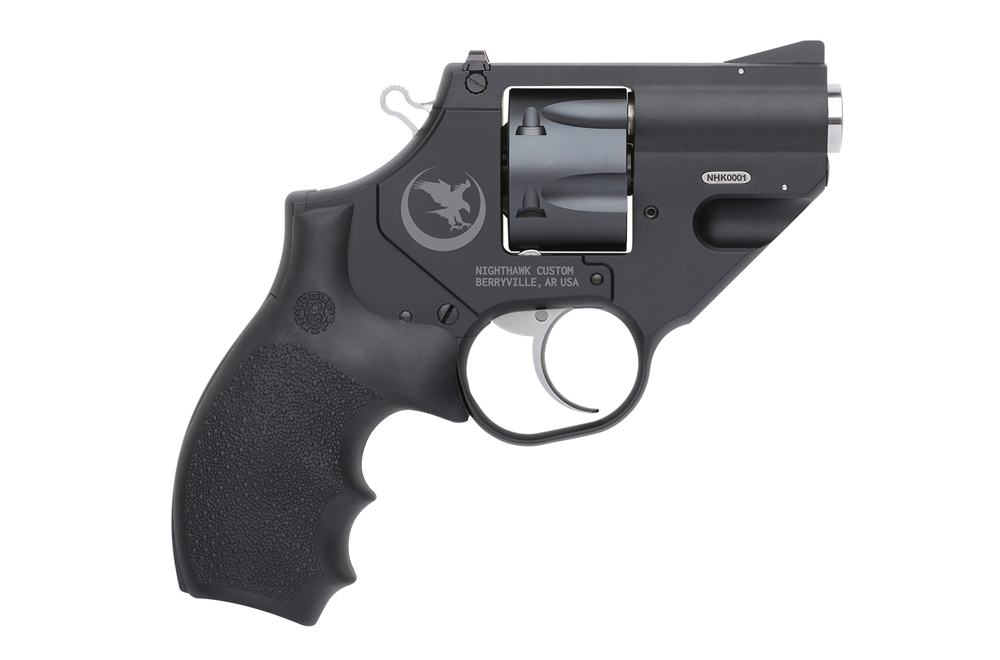
Nighthawk Custom/Korth Sky Hawk (9mm Luger)

Nighthawk Custom/Korth Sky Hawk (9mm Luger) - revolvers
Nighthawk Custom/Korth Sky Hawk (9mm Luger)

Nighthawk Custom Firearms partnered with German-built Korth revolvers to produce some truly excellent wheelguns. Iโ€™ve pulled a lot of triggers on a lot of guns, but Iโ€™ve never pulled a trigger on any gun as impressive as those on the Korth revolvers. The Sky Hawk โ€” the revolver serious self-defense practitioners should consider โ€” is a compact, 20-ounce, six-shot revolver chambered for 9mm Luger. Every part is machined from billet steel or aluminum, and itโ€™s available with a 2- or 3-inch barrel. A gold bead front sight, Houge grips, hard-coated frame, TSA-approved travel case, cleaning rod, grip removal tool, lubricating oil, lanyard and a proprietary speed loader are standard. Thereโ€™s nothing else like it on the planet. $1,699

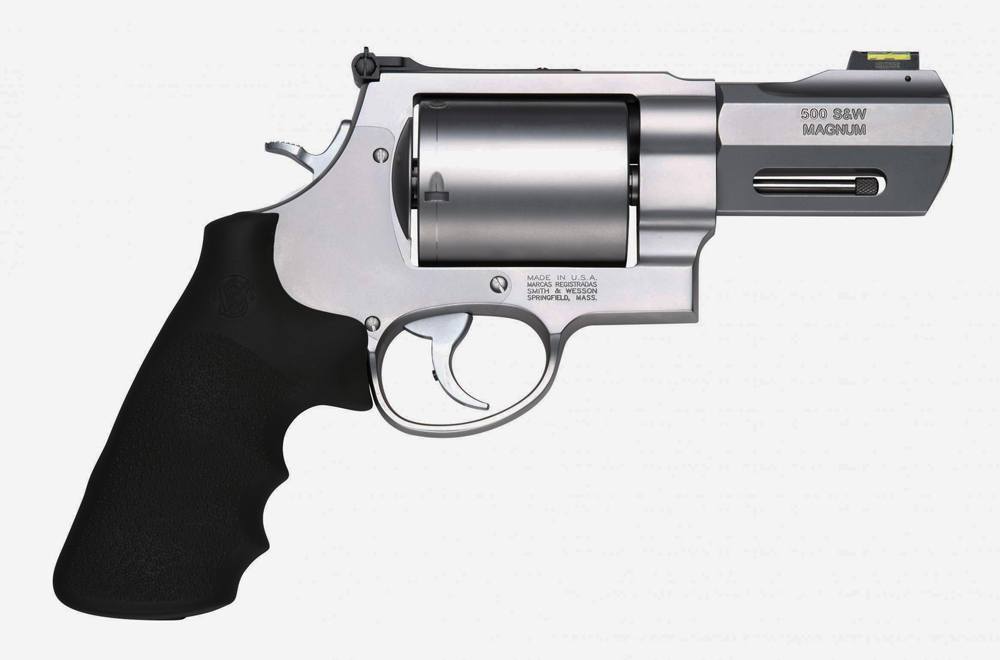
Smith & Wesson Performance Center Model 500 3.5 (.500 S&W Magnum)

Smith & Wesson Performance Center Model 500 3.5 (.500 S&W Magnum) - revolvers
Smith & Wesson Performance Center Model 500 3.5 (.500 S&W Magnum)

The new Model 500 Smith & Wesson from the Performance Center holds five rounds of .500 Smith & Wesson. This beast of a cartridge is contained in a compact package only weighing 56 ounces. With its stubby 3-inch barrel, the 500 3.5 might be the ultimate bear defense handgun. $1,609

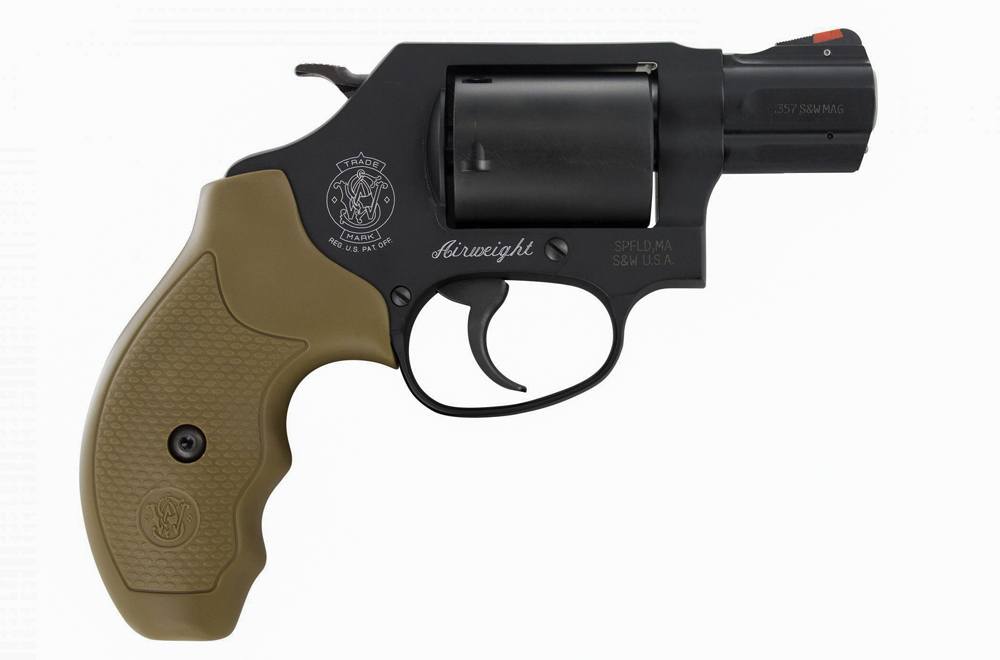
Smith & Wesson Model 360 (.357 Magnum)

Smith & Wesson Model 360 (.357 Magnum) - revolvers
Smith & Wesson Model 360 (.357 Magnum)

Smith & Wessonโ€™s J-Frame revolver has long been a staple in the pockets, glove boxes and night stands of those who take responsibility for their personal safety. The new 360 J-Frame features a corrosion-resistant, unfluted, stainless-steel cylinder with a PVD finish. This revolver is built on a lightweight but strong scandium alloy frame, with flat dark earth synthetic grips. But most importantly, this compact five-shot revolver is chambered for the potent .357 Magnum. $770

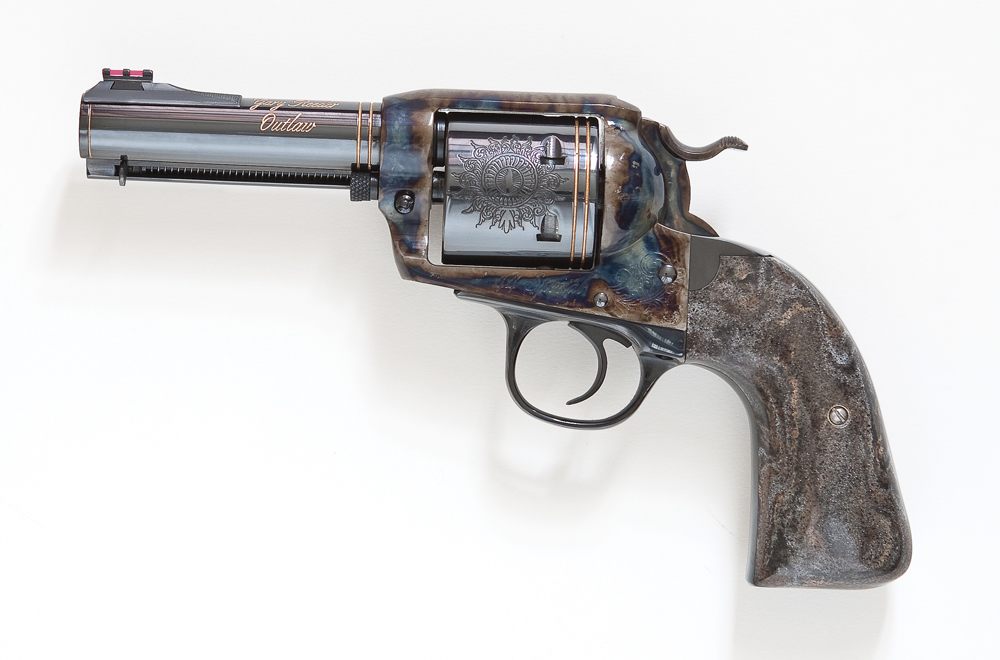
Gary Reeder Custom Outlaw (.44 Special)

Gary Reeder Custom Outlaw (.44 Special) - revolvers
Gary Reeder Custom Outlaw (.44 Special)

Reederโ€™s new Outlaw is based on the Ruger Vaquero, is one of his top sellers and itโ€™s chambered for the .44 Special. It has a full color-cased frame with a black Chromex finish on the rest of the gun. The unique Sorrel-stocked Bisley Gunfighter grip and red fiber-optic sight set this pistol apart. $1,995/plus price of Ruger Vaquero

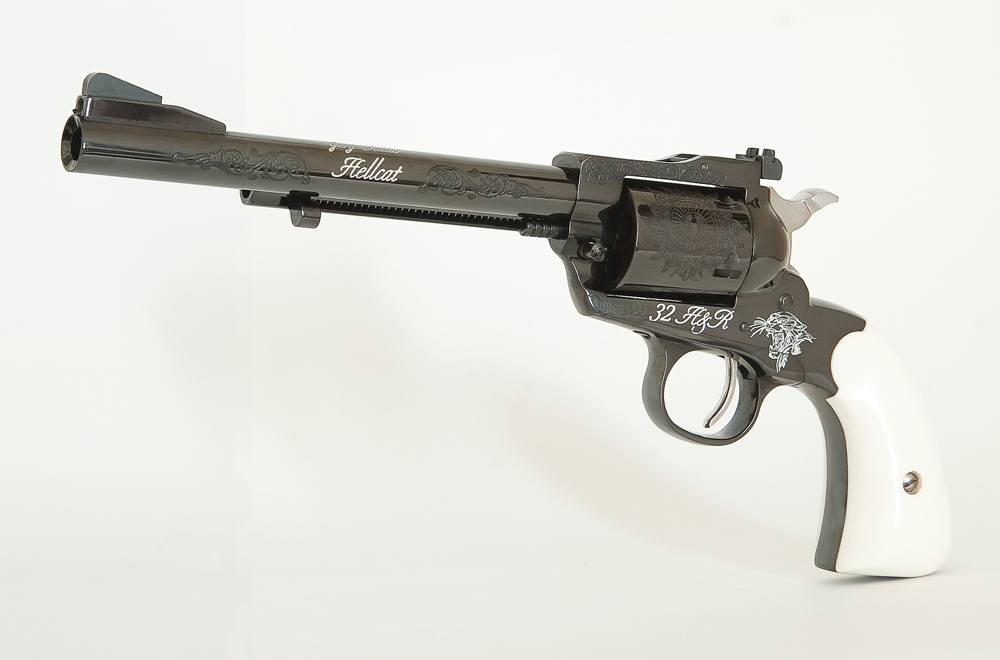
Gary Reeder Custom Hellcat (.32 H&R Magnum)

Gary Reeder Custom Hellcat (.32 H&R Magnum) revolvers
Gary Reeder Custom Hellcat (.32 H&R Magnum)

One of my Reeder favorites is the Hellcat. Over the past year, Reeder has specialized on small-caliber conversions. For the Hellcat, he took the rimfire Ruger Bearcat and converted it to handle the .32 H&R. This is a very versatile cartridge thatโ€™s often overlooked, and with the right ammo itโ€™s proven itself deer capable. $1,595/plus price of Ruger Bearcat

Editor’s Note: This article originally appeared in the Winter 2017 issue of Gun Digest the Magazine.
Modern Shooter: Earning Top Marks At SIG Sauer Academy

0

Pop Quiz: Do you know what it takes to earn top marks at the SIG Sauer Academy? Gun Digest editor Luke Hartle learns firsthand in this week’s episode of Modern Shooter.

On location in scenic Epping, New Hampshire, Hartle runs the academyโ€™s gauntlet of testing shoot houses and tactical training courses, finding out exactly how SIG turns out a superior shooter. Along the way, he checks out the rest of the shooting meccaโ€™s cutting-edge facilities and comprehensive courses โ€” from in-depth armorers certification to performance competitive shooting training.

The big question, after all the smoke clears, is will Hartle himself earn a passing grade?

Be sure to tune in on Mondays at 12 p.m. EST, Tuesdays at 11:30 a.m. EST and Fridays at 10 p.m. EST on the Pursuit Channel for the newest Modern Shooter episodes and keep your fingers on the pulse of the gun world.

New Gun: The Budget-Friendly Ruger Security-9

0

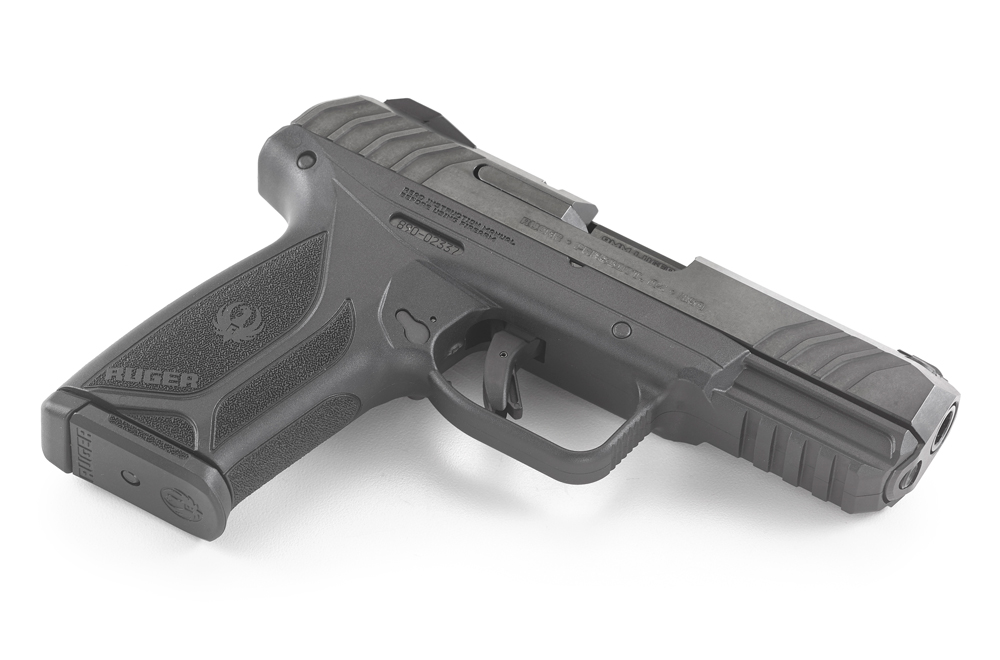
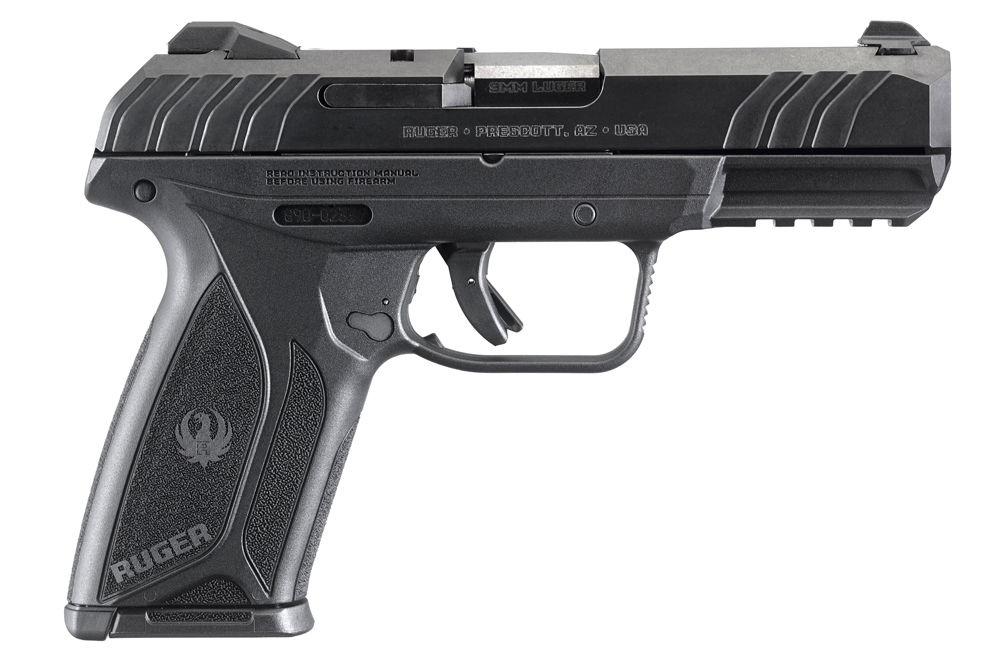
The Security-9 revives Ruger’s Security line of handguns, but this time as an economical semi-automatic pistol.

What’s under the Ruger Security-9’s hood:

  • The 9mm is a hammer-fired, single-action similar to the LCP II.
  • This system gives it a reliable 5-pound trigger pull and short reset.
  • It also makes the Ruger Security-9’s slide light and easy to operate.
  • It is a medium-sized pistol with a 4-inch barrel.
  • A 1-inch width and 5-inch height makes it easy to conceal.
  • The Security-9 has a glass-filled nylon frame.

If there is any mantra dominating Ruger so far in 2018 itโ€™s: โ€œEverything old is new again.โ€ Alongside the New Hampshire gunmaker dusting off its Police Carbine under the guise of the PC Carbine for the New Year, it has also reached way back to revive its Security line of handguns.

Ruger Security-9-Second

However, and most likely to the chagrin of revolver fans, the highly popular Security-Six double-action wheelguns arenโ€™t back from the dead. Itโ€™s quite the other end of the spectrum.

Ruger has re-imagined the line with the Security-9, a hammer-fired semi-automatic pistol. And while the polymer-framed pistol is sized to be a jack-of-all trades โ€” certainly as comfortable in the nightstand as the waistband โ€” it has one feature that could attract shooters like moths to a flame. With an MSRP of $379, the 9mm is among the most affordable guns in the companyโ€™s entire catalog and the gun world at large.

Certainly, much of Rugerโ€™s ability to serve up such an economical handgun hangs on the company turning to existing designs. In essence, the Ruger Security-9 is a scaled up version of the .380 ACP LCP II, utilizing the same glass-filed nylon frame construction and single-action trigger and a hammer. But dipping into the same well isnโ€™t a bad thing, given the micro pistol and now the 9mm are winning kudos for their shootability.

The trigger on what Ruger calls its Secure Action system has much to do with this, breaking at a reliable 5 pounds and boasting a short positive reset. This system also gives the Security-9 a leg up against other pistols in the same class in an often overlooked feature โ€” slide operation.

Working the slide is considerably easier than a striker-fired design, given the internal hammer. This is a potential boon for those who lack the hand strength to manipulate a semi-autoโ€™s slide, such as the elderly. There is an element of safety built into the system as well, given the pistol can be disassembled without first pulling the trigger.
Ruger Security-9-Third
In the size department, the Ruger Security-9 seems to embrace current trends of a compact pistol, but not one so demure it loses its manageability. While not by leaps and bounds, its 4-inch barrel mitigates muzzle flip found in the sub-compact class of pistols. On top of that, it also extends the sight radius of the gun; perhaps not as greatly as a full-sized pistol, but enough to improve accuracy.

At the same tick, the Security-9 seems to have the trim figure of a street fighter. It is just over 1 inch in width and 5 inches in height, which should keep it from printing, even in easy-going summer garb. And at 23 ounces, it should prove far from toting a lead weight.

The pistol appears to have well-considered ergonomics. Highly contoured and rounded in the right places, the grip has plenty of real estate, particularly up high. And, as is becoming more commonplace, the trigger guard is quite ample, giving gloved hands plenty of room to work.

The controls are straightforward and predictable as midnight โ€” strong-side magazine release and blade trigger safety. Though the addition of a manual thumb safety is certain to elicit grumbles among some segments of the shooting worlds.

Finishing off the Security-9 are high-visibility sights, drift adjustable for windage, and an accessory rail for a light or laser sight. The pistol ships with two alloy magazines and, for shooters that live in less-enlightened states, 10-round reduced capacity magazines are available.

All in all, the Ruger Security-9 doesnโ€™t break the mold. But incorporating proven old designs with a price that could even get misers to loosen their purse strings, Ruger has given shooters plenty of reason to consider its new 9mm.

Ruger Security-9-first

Specifications:

Ruger Security-9
Capacity: 15+1; 10+1
Barrel Material: Alloy Steel
Barrel Finish: Blued
Barrel Length: 4 in.
Overall Length: 7.24 in.
Sights: Drift Adjustable 3-Dot
Weight: 23.7 oz.
Grip Frame: High-Performance, Glass-Filled Nylon
Slide Material: Through-Hardened
Alloy: Steel
Slide Finish: Blued
Slide Width: 1.02 in.
Height: 5 in.
Grooves: 6
Twist: 1:10″ RH
Suggested Retail: $379.00

Handguns: The Modern-Day Revolver

1

In a time of semi-auto dominance, revolvers โ€” and the cartridges they shoot โ€” are far from irrelevant.

  • Given their simplicity of operation and potency of ammo, revolvers still have a place.
  • Ruger’s LCRx offers a lightweight option perfect for self-defense and carry.
  • The company’s GP100 now has a .44 Special model, plenty capable to ward off fiends.
  • Nighthawk recently partnered with German-maker Korth to offer the Sky Hawk.
  • The 9mm is a sweet shooter, but costs a pretty penny โ€” $1,699.
  • S&W produce many hunting wheelguns, few more powerful than the .500 S&W.

In 1994 I was hired as a patrol officer. On my first day, the department firearms instructor took me to the range to qualify. The gun in my holster was a Smith & Wesson Model 686 .357 Magnum with a 4-inch barrel. I left for the police academy about 6 months later with that same revolver. I was one of the only cadets with a revolver and still managed to be top gun. The moral of this story is that the revolver is still a viable self-defense option.

Of course you would not know that by reading todayโ€™s gun magazines; theyโ€™re all about the semi-automatic for personal protection. Admittedly, semi-automatics do have advantages. They can have a higher capacity, can be purchased at a cheaper price, and when compared to revolvers of the same size, weigh less.

Revolvers-fourth

Of course, there are good things about revolvers, too. Theyโ€™re less prone to stoppages and simpler to operate. Revolvers can also harness more power than semi-autos of comparable size.

The big thing is, the revolver does not appeal to the cool kids. Tactard trainers and the gun gurus on the Internet shun them because they lack the capacity to deal with a zombie horde or a hundred charging jihadists. The new millennium gun guy is also enamored with plastic. In reality, however, most self-defense situations are solved with very few shots and, in case youโ€™ve not been paying attention, plastic revolvers do exist.

Diversity Through Simplicity

Consider Rugerโ€™s new LCRx. This is a 17-ounce .357 Magnum with a 1.87-inch barrel. It has a monolithic frame made of 400-series stainless-steel and a polymer fire control housing. The stainless-steel cylinder has been fluted to reduce weight, and it has a PVD coating to enhance durability. The revolver will accept modular grips, has a pinned, white-striped front sight and an external hammer for single-action operation. Thatโ€™s a long way from the 42-ounce .357 I carried as a cop!

Of course some wheelgun aficionados like the robustness of an all-steel revolver. Rugerโ€™s new 3-inch, stainless-steel, GP100 in .44 Special weighs in at 36 ounces. It comes with a fully adjustable rear sight and a fiber optic front sight. Unless you were born before 1970, you might not have any appreciation of the .44 Special, but itโ€™s fully capable as a self-defense cartridge for use against a murderous fiend or a furry ball of fur and claws.

And thatโ€™s an aspect of self-defense often overlooked by the average gun owner: Bad guys are not the only things you might need protection from. Outdoorsmen who frequent bear country would do well to arm up with a firearm capable of putting the smackdown on a toothy attacker. Revolvers make excellent trail guns due to their ability to handle cartridges generating magnum power. With its 2.75-inch barrel, Rugerโ€™s new .357 Magnum Redhawk is a big gun capable of helping tame the rock and roll of the hottest .357 Magnum loads. And, like all .357 Magnum revolvers, it will fire .38 Special ammunition, too.

Because of they way theyโ€™re made, revolvers can house more powerful cartridges than similar sized semi-automatics.

Along similar lines, look at the Ruger SP101 Match Campion. This revolver has a 4.2-inch, full-lugged barrel and is much lighter and handier than the big Redhawk. It will still handle .357 Magnum or .38 Special ammunition, but its five-shot cylinder reduces overall weight. It would be an ideal sidearm for a backpacker or camper, and donโ€™t forget revolvers are well suited for use with shot shells, making them perfect for poisonous snakes or other vermin around home or camp.

โ€˜Wheel-Lifeโ€™ Protection

But, letโ€™s get back to fighting bad guys. The compact revolver has long been a favorite of concealed carry. However, the quintessential example of that genre of wheelguns has remained basically unchanged for about 100 years.

Nighthawk Custom Firearms looked to rectify that for the American consumer through a partnership with German-built Korth revolvers. By virtue of my profession, Iโ€™ve pulled a lot of triggers on a lot of guns. Iโ€™ve never pulled a trigger on any gun as impressive as those on the Korth revolvers. The first time you do it your mouth will drop open and maybe stay that way long enough for a fly to buzz in.

Initially, Nighthawk will be offering three Korths configured to Nighthawk specifications. The Sky Hawk โ€” the revolver serious self-defense practitioners should consider โ€” is a compact, 20-ounce, six-shot revolver chambered for 9mm Luger. However, neither half- or full-moon clips are required. Every part is machined from billet steel or aluminum, and itโ€™s available with a 2- or 3-inch barrel. A gold bead front sight, Houge grips, hard-coated frame, TSA-approved travel case, cleaning rod, grip removal tool, lubricating oil, lanyard and a proprietary speed loader are standard. Yes, this revolver retails for a staggering $1,699, but thereโ€™s nothing else like it on the planet.

A discussion of revolvers in any capacity cannot be complete without mentioning Smith & Wesson. My grandfatherโ€™s pistol was a Model 10 Smith & Wesson. It was the first handgun I ever fired, and according to Grandpa, it was the best pistol in the world. Iโ€™m not sure much has changed; Smith & Wesson is still the premier revolver manufacturer in America, and it has some new and cool wheelguns for just about any application.

Big-Barking Revolver Options

Letโ€™s take a step back and again consider handguns for hideous creatures. The new Model 500 Smith & Wesson from the Performance Center holds five rounds of .500 Smith & Wesson. But, this beast of a cartridge is contained in a compact package only weighing 56 ounces. Yeah, thatโ€™s heavy for a handgun, but when youโ€™re talking about one with this much power, polymer is not an option. With its stubby 3-inch barrel, the 500 3.5 might be the ultimate bear defense handgun. If you can handle it, it should work just as well for velociraptors and werewolves.

You simply cannot load a revolver as fast as you can change magazines in a semi-auto, and a revolverโ€™s capacity is limited.

Smith & Wessonโ€™s J-Frame revolver has long been a staple in the pockets, glove boxes, and night stands of those who take responsibility for their personal safety. The new 360 J-Frame from Smith & Wesson is a modernized adaptation of a classic. It features a corrosion-resistant, unfluted, stainless-steel cylinder with a PVD finish. This revolver is built on a lightweight but strong scandium alloy frame, with flat dark earth synthetic grips. But most importantly, this compact five-shot revolver is chambered for the potent .357 Magnum.

Buying Custom Wheels

For those who like a custom touch to their handgun, the revolver is well suited to that treatment, maybe more so than many of the more modern semi-autos. Gary Reeder of Flagstaff, Arizona, has been building high-quality custom revolvers for a long time, and his business is booming. This is partly because lots of folks like their guns to be a little different, but mostly because Reeder can tweak a wheelgun like Carroll Shelby can fine-tune a Mustang.

Reederโ€™s new Outlaw is based on the Ruger Vaquero and is one of his top sellers. Like the new Ruger GP 100, it too is chambered for the .44 Special. It has a full color-cased frame, with a black Chromex finish on the rest of the gun. The unique Sorrel-stocked Bisley Gunfighter grip and red fiber-optic sight set this pistol apart.

One of my Reeder favorites is the Hellcat. Over the past year or so, Reeder has specialized on small-caliber conversions. For the Hellcat, he took the rimfire Ruger Bearcat and converted it to handle the .32 H&R. This is a very versatile cartridge thatโ€™s often overlooked, and with the right ammo it is deer capable. I know โ€” Iโ€™ve proven it.

Why The Wheelgun?

You might think the revolver is a thing of the past, and that itโ€™s nothing but an antiquated throwback to the times of cowboy gunfighters and Bat Masterson. Truth is, whether youโ€™re talking about self-defense, hunting or even sport shooting, it is โ€” and always will be โ€” the person behind the gun that matters most. My favorite handguns are semi-automatics, but I have several revolvers I carry and use frequently.

Revolvers in certain chamberings can be very versatile. A .44 Rem. Magnum can shoot .44 Special ammo; a .357 can shoot .38 Special; and a .327 Federal can shoot .32 Auto, .32 Short, .32 Long and .32 H&R.

The current lack of respect the wheelgun is getting reminds me of a story my friend Sheriff Jim Wilson once shared. He and former border patrolman and gunwriter Bill Jordan were visiting one day when a self proclaimed gun expert asked, โ€œMr. Jordan, what battle rifle would you stash away?โ€ I guess the man was curious what the great Bill Jordan would want in his hand at the start of some apocalyptic catastrophe.

Bill took a sip of his vodka tonic and said, โ€œIโ€™d put away a Smith & Wesson Model 19 and a box of cartridges.โ€ With Bill being from Louisiana, cartridges came out sounding like โ€œcat-i-ges.โ€ The gun expert, realizing Bill was a little hard of hearing, said, โ€œNo, Mr. Jordan, I meant what kind of AR would you want to have hidden away.โ€

Bill smiled, finished his vodka tonic, and said, โ€œSonny, I heard you the first time. And my answer is a Smith & Wesson Model 19 and a box of cartridges. If serious trouble starts, you can use that Model 19 to get whatever kind of little machine gun youโ€™d want to carry. You could even get a little Jeep to drive and maybe even a nice looking uniform to wear โ€ฆ if you can shoot!โ€

โ€˜Nuff said!

Editor’s Note: This article originally appeared in the Winter 2017 issue of Gun Digest the Magazine.
Concealed Carry: AIWB Carry Pros And Cons

1

There are plenty of proponents and detractors of AIWB (Appendix Inside the Waistband) carry, but who is right when it comes to this controversial method?

The different angles on AIWB:

AIWB is shooter shorthand for Appendix Inside Waistband Carry. As the name implies, the gun is holstered between body and trousers in the abdomen area, between navel and hip, on the wearerโ€™s dominant hand side.

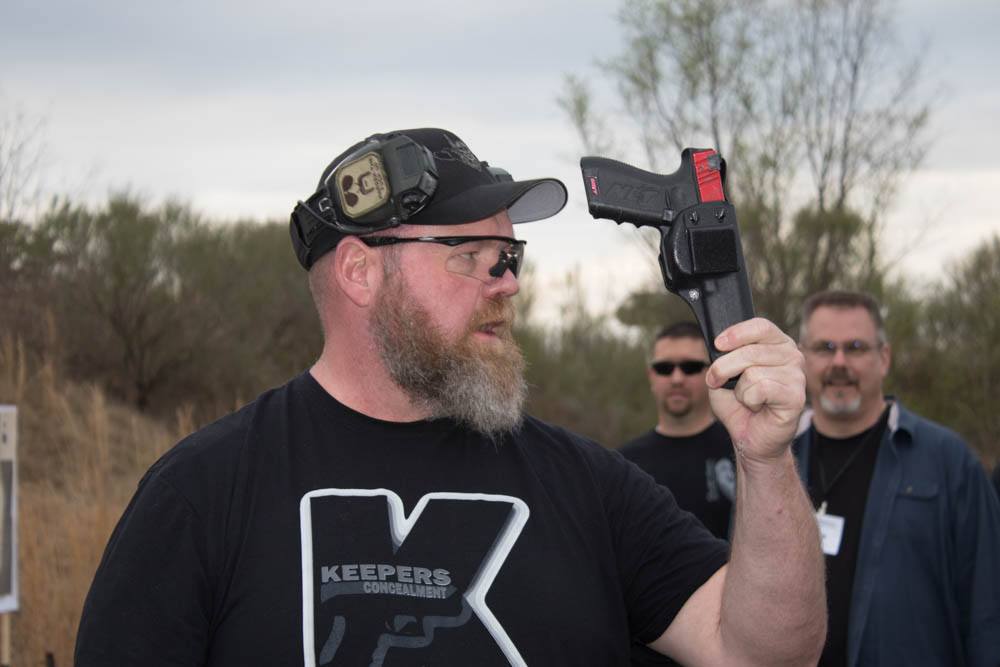
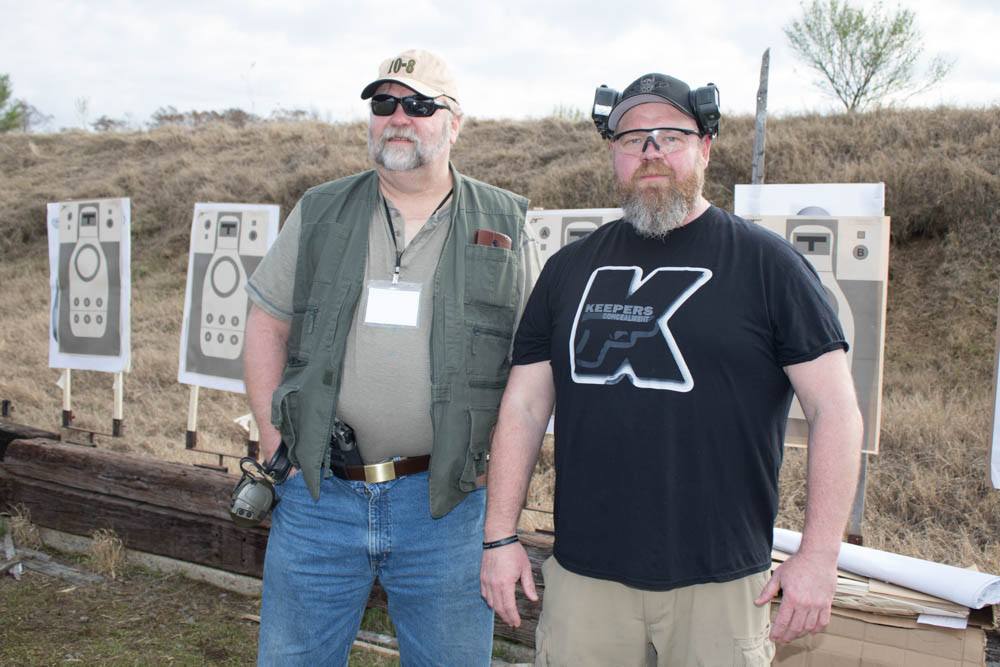
Spencer Keepers demonstrates one of his AIWB holsters, here holding a SIRT training copy of a Glock, at Rangemaster Tactical Conference.

Men have carried handguns in the appendix position, often tucked inside belt or sash without holsters, for as long as theyโ€™ve had handguns. In current times, this carry has always been popular in Latin America among good guys and bad alike, and most recently it has come into fashion in North America. One of the great modern instructors, Todd Louis Green, did much to popularize AIWB. Todd was taken from us in March of 2016 after a valiant decade-long battle with cancer, and though we lost him too soon, he left a large footprint. The same is true of the late Paul Gomez, another advocate of AIWB.

AIWB Advantages

As we walk through daily life or even stand still, our hands are generally closer to our front midline than our hips, armpits, ankles or other holster locations. This can make the AIWB carry particularly fast, especially if both hands are free to accomplish the draw.

The gun is very well protected against a rear grab, unless the opponent has the wearer in a bear hug from behind. It is also very defensible from a front grab.

Many people, slender folks in particular, find the gun less likely to โ€œprintโ€ in this position than on or behind the hip, especially when sitting or bending over.

So long as seat belts donโ€™t interfere, AIWB offers particularly good access when seated behind a steering wheel.

Some people, depending on physical build, may find AIWB the most comfortable way to carry, particularly with a large handgun.

AIWB Disadvantages

Since AIWB presumes a closed-front upper garment for concealment, a truly fast draw requires both hands โ€“ the support hand to rip the hem of the garment upward, and the firing hand to access the pistol.

Carrying a gun with its โ€œbusiness endโ€ pointed at genitalia or juncture of thigh and lower abdomen gives some people the absolute creeps.

If the gun does discharge in an AIWB, results range from castration to death. The femoral artery is often in the line of fire.


For more information on concealed carry holsters check out:


While comfortable for some, others may experience the opposite effect. Gun length and personal preference as to waistband level will be critical in determining whether or not the holstered gun digs painfully into thigh or crotch.

Practice opportunities are somewhat restricted. AIWB carry is forbidden by some police departments, and has been banned by some top private instructors, such as Marty Hayes and Larry Vickers. AIWB is not allowed in IDPA, the โ€œconcealed carry sport,โ€ at this writing, nor in PPC matches.

An Opposing View On AIWB

Marty Hayes, Director of the well-known firearms training school The Firearms Academy of Seattle, Inc., has some serious concerns about the safety of the practice of carrying firearms in this manner, and in fact has banned the practice at his training school. Hayes, a law school graduate, is well educated in the laws regarding civil liability, and believes that instructors who allow the practice are flirting with danger.

From his law studies, he understands that for a plaintiff to collect damages in a lawsuit for negligence, they must prove that the defendant was negligent, and because of that negligence the plaintiff was injured. He believes that firearms instructors need to conduct their training courses in a reasonable manner, using tried and true gun handling techniques that have passed the muster of time in regards to safety.

โ€œThere are decades of gun handling protocols from the 50s and beyond that have proven that wearing the gun on the side of the hip (3-4 oโ€™clock) position is the safest way for an armed American to carry a sidearm,โ€ says Hayes. For over 30 years, he and his staff have taught the tried and true strong-side hip draw stroke which does not involve people pointing the gun at or near their private parts.

AIWB critic Marty Hayes, left, gives it a try with 1911 at a class with AIWB advocate Spencer Keepers, right. Both men are open-minded and can โ€œdisagree without being disagreeable.โ€

He believes that AIWB carry is outside the common standards and practices for professional firearms instruction and, in the event a student is severely injured or killed because of a bullet to the testicles or femoral artery, that the instructor will have a difficult time defending having allowed the practice, if he is sued.

Hayes at one point allowed the practice at The Firearms Academy of Seattle, and when he saw the popularity of the technique rising, he undertook a diligent study. After his observations, he concluded that while on a square range, with students lined up like tin soldiers all in a straight line, and allowing for people to carefully and slowly holster the gun, it can be done in relative safety. But, as his courses involve stressful exercises as a training method for armed citizens to learn how to handle armed encounters, he believes that when students start moving off the line of attack while they draw, that the muzzle invariably ends up pointing at vital parts of the human body, which violates one of the basic tenets of gun safety: Never point a gun at anything you are not willing to shoot.

He is also convinced that the bullet is not the only danger. He carries a 10mm single action Commander as a carry gun, and cannot imagine the pain and burned flesh that would occur if that gun discharged while stuck inside his pants pointed at his testicles. Even if the bullet missed all vital parts, the muzzle flash would do sufficient damage to possibly incapacitate him. For these reasons, he publically has made his position well known and advocates for the practice to go away.

Advice From a Master of AIWB

Among AIWB enthusiasts, Spencer Keepers is a name to contend with. A master maker of such holsters (http://keepersconcealment.com/), heโ€™s also a master of teaching their use. Todd Louis Green made him a believer, and Spencer has kicked some major boo-tay drawing from AIWB in competition.

He reminisces, โ€œI realized Todd could get to his gun easier than I could. I noted Craig (โ€œSouthnarcโ€) Douglas carried AIWB. I prefer to carry a Glock 35 (5.3โ€ barrel) and the first thing I realized was that I was going to have to raise my waistband. Pretty soon, I bought some Kydex and a Dremel tool.โ€

Spencer gives an excellent class on getting the most out of AIWB carry, and does so every year at Tom Givensโ€™ excellent Rangemaster Tactical Conference. I made a point of showing up for it in 2017 at the DARC training facility in Little Rock, Akansas.

He began by saying, โ€œAIWB ainโ€™t for everybody. Holster cant and ride height are incredibly important to making it work.โ€

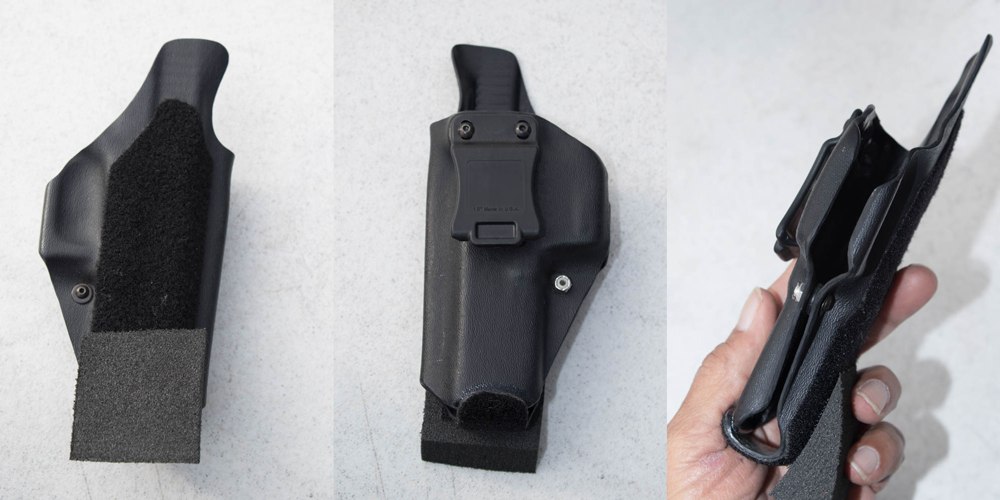
Left: One of Spencer Keepersโ€™ AIWB holsters, this one for left-handed carry of a Glock. Note sweat guard and Keepersโ€™ distinctive wedge, which helps tilt muzzle away from vulnerable areas. Center: From this side, the secure clip to hold the southpaw holster in place. Right: Seen here in silhouette.

His next statement was counterintuitive, but made huge sense when he explained it. โ€œFor AIWB, longer is better, until itโ€™s too long. Most appendix carry holster options are open ended with sharp, uncomfortable edges down by the muzzle. These can dig into the body.โ€ The โ€œlonger is better for concealmentโ€ rationale? Itโ€™s because the forward part of the gunโ€™s contact with lower abdomen pushes the butt end of the gun tighter against the upper abdomen.

Keepers continued, โ€œYou want some adjustability. A straight drop can work well for AIWB, but for most people, a slight rearward cant is ideal. Each person has to find the angle and position that works the best for their particular body.โ€

He adds, โ€œVery short holsters tend to roll the gun butt out forward in a very obvious way. Thatโ€™s particularly true if you have any belly at all. You want the appendix carry holster to fit between the โ€˜important partsโ€™ and the crease in the leg. Thatโ€™s one reason the FBI cant doesnโ€™t work with AIWB.

โ€œOn our own holsters, we extend the muzzle end about an inch. We roll the material over and close the muzzle. That eliminates a sharp discomfort point. The rolled muzzle also acts as a heat shield when the gun warms up during intensive training,โ€ Keepers concludes.

The belt, as always, is as important as the holster. โ€œI like an infinitely adjustable belt,โ€ says Keepers, explaining, โ€œHole spacing in regular leather belts is about every three-quarters of an inch. Hydration factors can cause swelling and contraction of our waistline throughout the day. I like the Wilderness three-stitch Frequent Flier. The more flexible the belt, the better.โ€

Keepers is aware of the fine line between enough protection to shield wearer from gun and vice versa, and the need for the drawing hand to instantly take a full grasp. โ€œYou definitely want a full firing grip on the gun,โ€ he says, โ€œbut we also put a horn on the holster to protect the shooterโ€™s skin and clothing from the (sometimes sharp-edged) sights. Our design is now widely copied.โ€

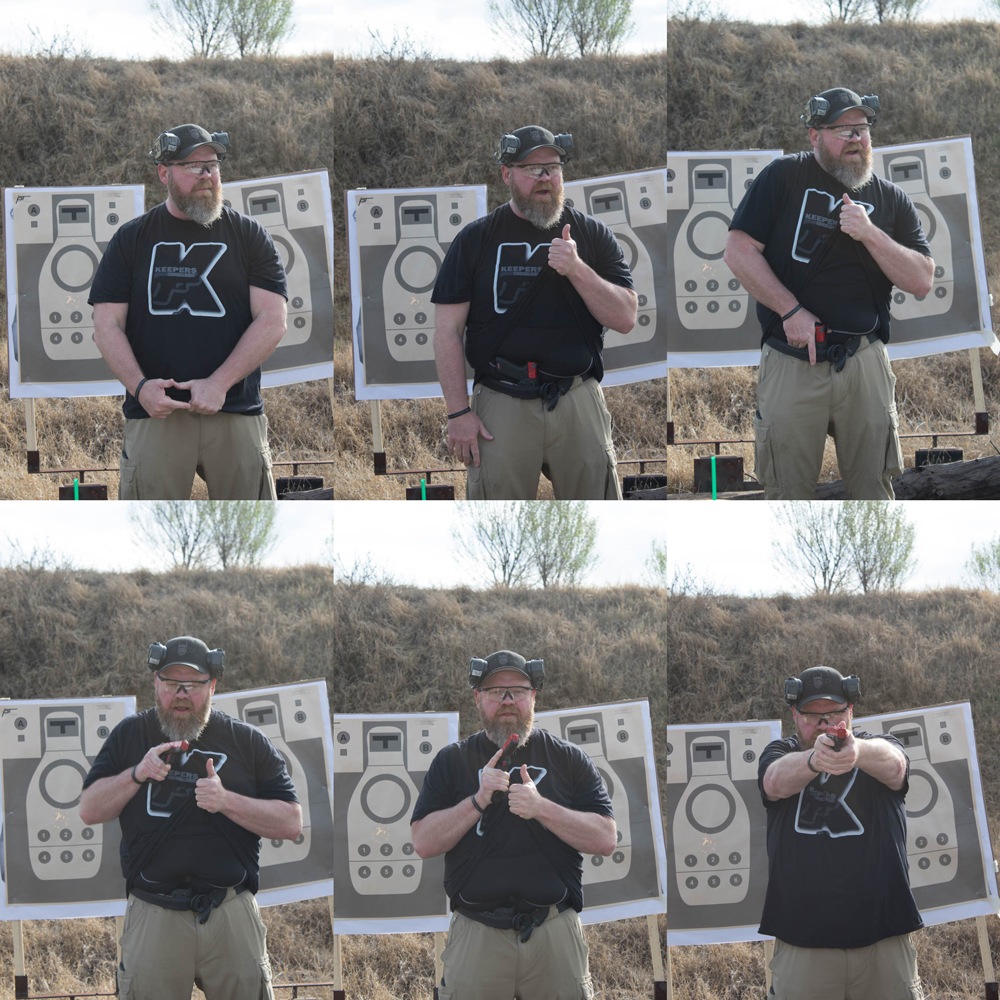
First: Spencer Keepers demonstrates his recommended AIWB draw. Support hand firmly grasps hem of concealing garmentโ€ฆ Second: โ€ฆand jerks it high to guarantee a clear path for the drawing handโ€ฆ Third: โ€ฆwhich takes a firm grasp with everything BUT the STRAIGHT trigger finger that stays outside the clothingโ€ฆ Fourth: โ€ฆand clears gun immediately upward, pointing toward the threat. Note that support hand is still holding garment up to guarantee snag-free draw, and is now positionedโ€ฆ Fifth: โ€ฆto move forward from safely behind the gun muzzle en route to achieving two-hand grasp. Note that muzzle is up at angle where shooter can see front sight as soon as possibleโ€ฆ Sixth โ€ฆand a very strong two-hand grasp is rapidly achieved.

A signature feature on Keepers Concealment AIWB holsters is a foam wedge on the lower part of the scabbard facing the wearer. It performs three purposes. One is to simply enhance comfort, with a cushioning effect. But the other is for safety: the wedge levers the gun muzzle out a little bit away from the body, to mitigate the dangers of an unintended discharge striking genitalia or femoral artery. Finally, the wedge acts as an added heat shield.

Many shooters today want to carry their pistols with white light units attached. I know one rock-hard, wiry 5โ€™6โ€ fella who daily conceals a full-size Glock 17 AIWB, complete with attached light, and hides it perfectly. โ€œWe do make holsters for those,โ€ says Keepers, but I have to admit Iโ€™m not a big light guy. They make a much bigger footprint in a limited space.โ€

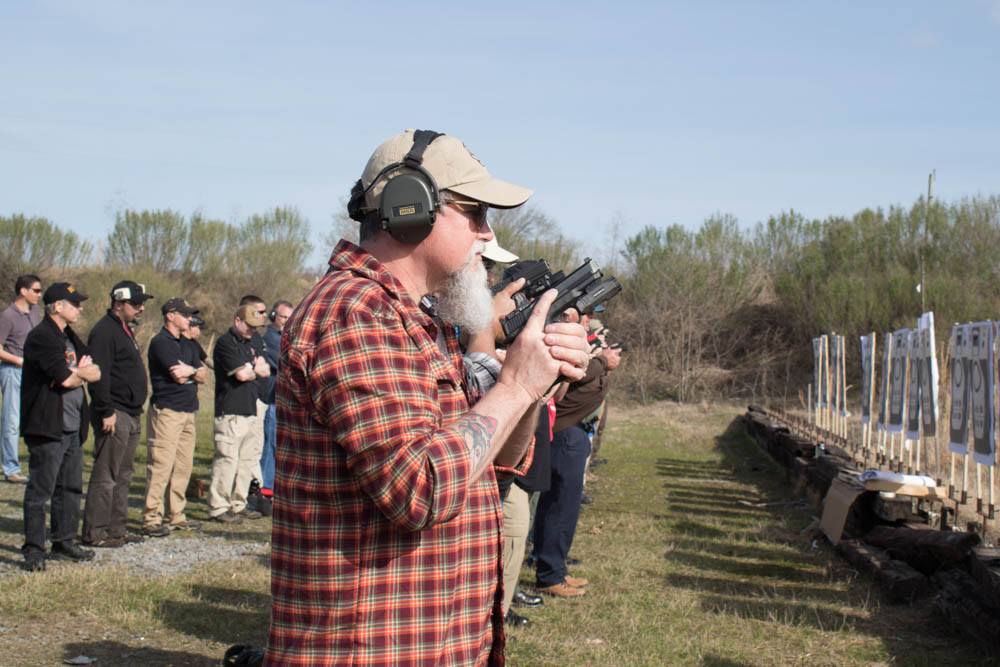
Keepersโ€™ students approach the final stage of draw to firing position from AIWB.

Spencer teaches a thumb on the back of the hammer or slide for the same reason I do with any sort of holstering, explained elsewhere in this book. And he teaches rocking the shoulders back and thrusting the pelvis forward during reholstering, to angle the gun muzzle away from body parts you particularly donโ€™t want to โ€œmuzzle.โ€

While a couple of things โ€“ mainly comfort factors and long-time habituation โ€“ have kept me from staying with AIWB every time Iโ€™ve tried it, itโ€™s entirely possible that it will work better for you. Understand, though, that it requires diligent focus on safety. You would be wise to take competent training in AIWB before practicing it, and I canโ€™t think of any instructor better to start with than Spencer Keepers.

This article is an excerpt from Gun Digest Book of Concealed Carry, Volume 2: Beyond the Basics.

New Pistol: Springfield Armory 911 .380

1

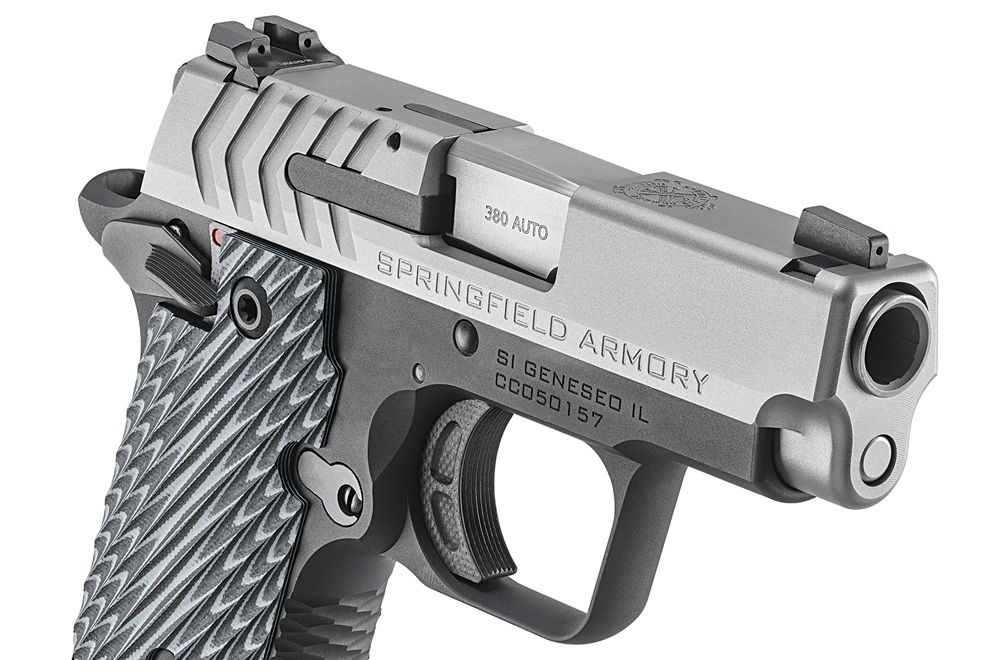
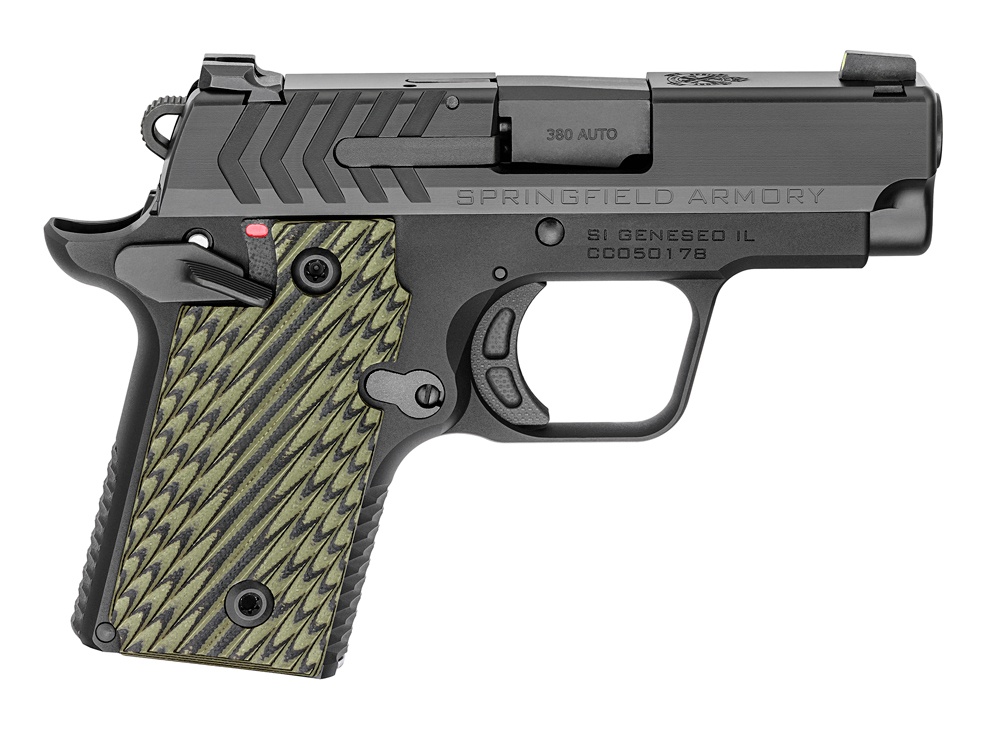
Springfield Armory has introduced its smallest pistol to date in the 1911-style 911 .380.

A little about the new 911 .380 micro pistol:

  • The 911 .380 measures 5.5 inches in overall length and weighs 12.6 ounces.
  • The pistol is a single-action, chambered in .380 ACP.
  • It boasts a unique G10 trigger that breaks at 5 pounds.
  • It has Pro-Glo Tritium front and rear sights.
  • Models with Viridian green laser grips are available.

The first two rules of concealed carry are: You have to carry a gun, and you have to conceal it. Neither is going to happen for most citizens who want to go armed if the gun is too big and potentially uncomfortable.

Certainly, full-sized pistols have advantages, but face it, there is only a select segment of the population willing to augment their dress, carry method and lives around toting one. This glaring fact has supercharged the market of shrunken self-defense handguns in recent years. Whether revolver or semi-automatic pistol, nearly every manufacturer has a mouse-gun option, sized to be as burdensome as pocket change and to evaporate on the person.

911-first

Springfield Armory is no stranger to producing easy-to-carry-and-conceal pistols, with a healthy selection of single-stack sub-compacts in its XD line of polymer pistols. But the Illinois company has gone the extra mile with its first handgun release for 2018. The new 911 .380 is the gunmakerโ€™s smallest pistol to date, and one portioned to scrap it out with the minutest micro pistols.

Overall, the .380 ACP pistol is 5.5 inches long (no width available) and comes in at a meager 12.6 ounces. This certainly makes the 911 not only a candidate for typical concealed carry methods, but also a dandy choice for a pocket pistol, perhaps in a backup role.

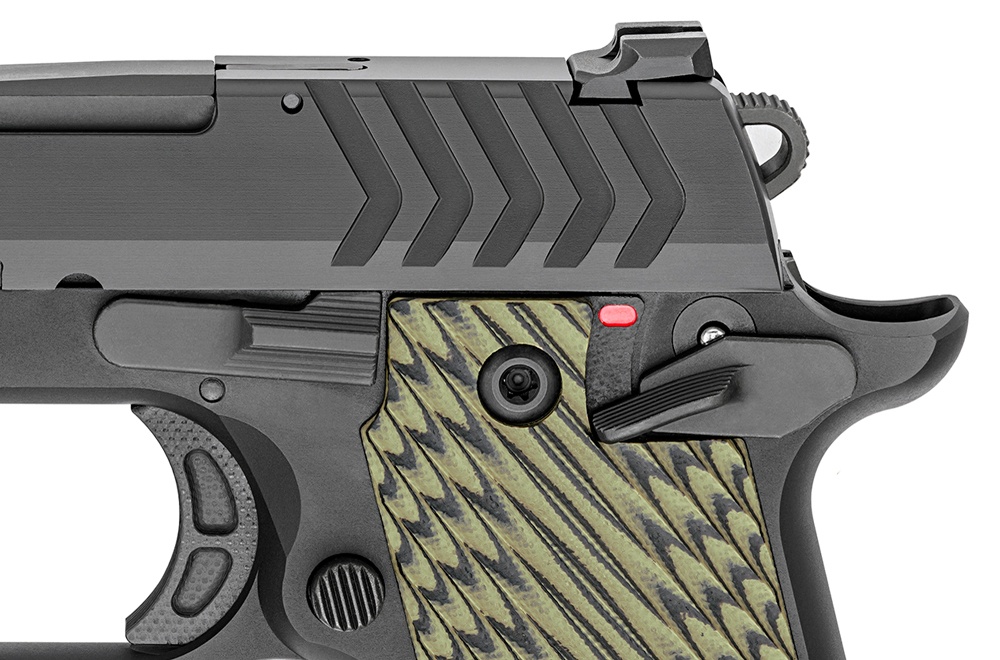
Similar in looks to the SIG P238, the 911 is a 1911-style, single-action semi-automatic pistol. Typical for the design, the pistol has a manual thumb safety, which Springfield has extended for ease of use and made ambidextrous, so itโ€™s right- and left-handed friendly. And it has outfitted it with a unique G10 trigger from Hogue, which breaks at 5 pounds and has a short reset.

The aluminum-framed pistol has a short beavertail to protect the operatorโ€™s hands from the skeletonized hammer and stainless steel slide. Springfield offers the choice of a black Nitride or brushed-satin matte finish for the slide, which also boasts integrated indicator.

911-second

The frame, according to the company, is optimized in proportion to the slide and trigger, to make the gun more manageable, which, if it pans out, is a plus for small semis, since they tend to jump in the hand. The frame comes outfitted with aggressively textured thinline G10 grips, and has what the company calls Octo-Grip texturing on the frontstrape of the mainspring housing. Additionally, Springfield offers two models with Viridian green laser grips, for a bit more money.

The 911 has a 2.7-inch broached barrel and a full-length guide rod, with a flat wire spring. It boasts Pro-Glo Tritium front sights and white outline tritium rear sights, aiding in low-light target acquisition. And it comes with a six-round flush fit magazine and a seven-round extended magazine, both stainless steel.

Presently, the MSRP on the Springfield Armory 911 is $599, and $789 for the models equipped with the laser sights.

911-third

New Gun: Ruger’s Pistol-Caliber PC Carbine

0

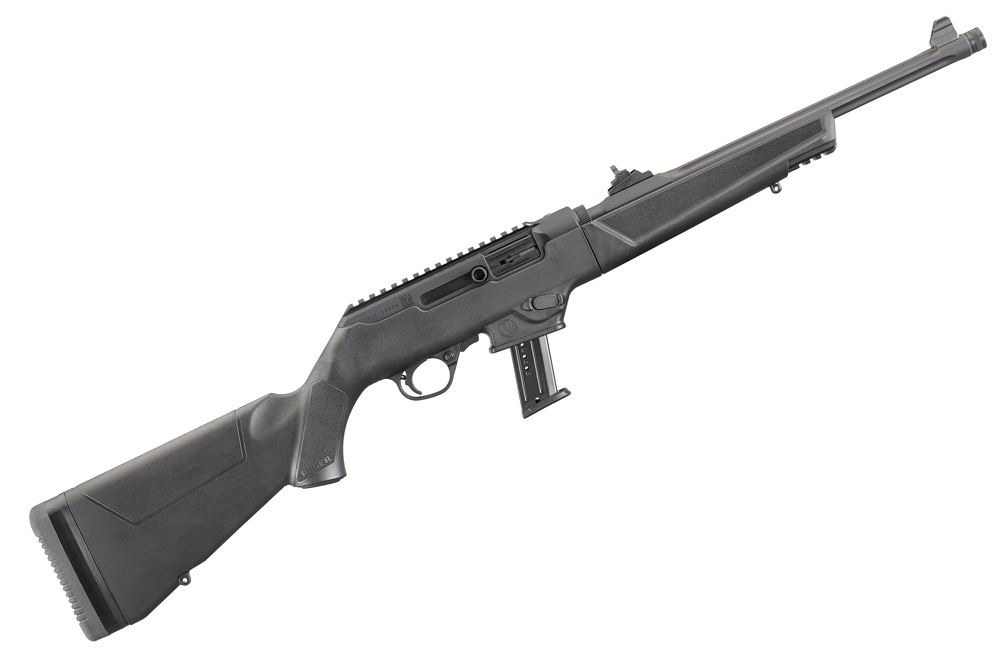
Ruger gets back into the pistol-caliber carbine business with the introduction of the Ruger PC Carbine.
The ins and outs of Ruger’s new PC Carbine:

  • The Ruger PC Carbine is the evolution of the Ruger Police Carbine.
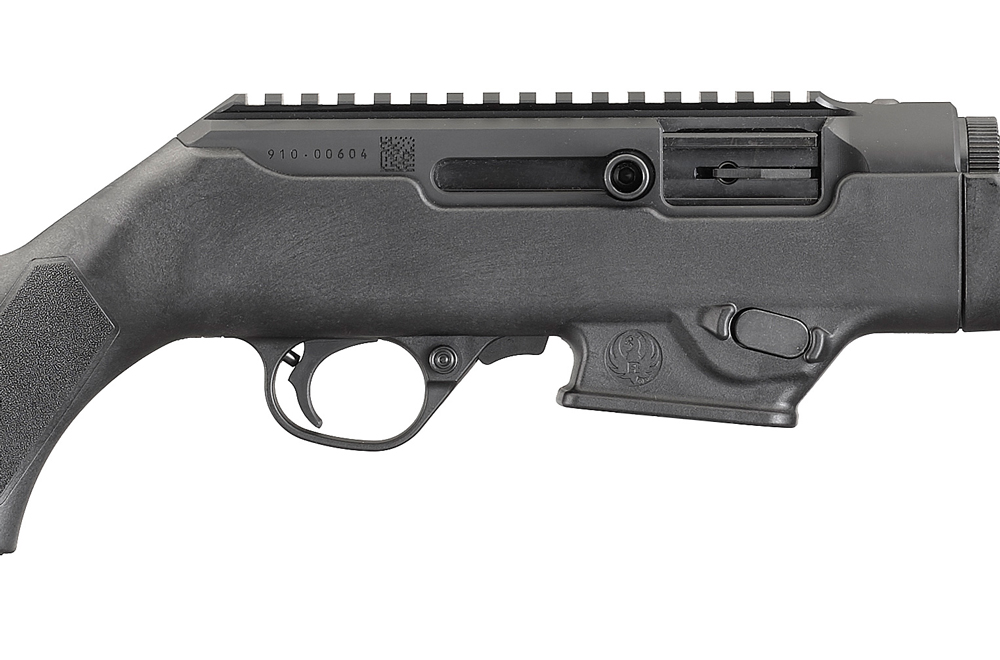
  • The carbine comes chambered in 9mm.
  • It accepts magazines from three lines of Ruger pistols โ€” SR, American and Security-9.
  • With an adapter, the PC Carbine also accepts Glock magazines.
  • The bolt assembly has a unique weight system that cuts recoil and bolt bounce.
  • The gun weighs in at 6.8 pounds, has a 16.12-inch barrel and is 34.37 inches in overall length.

Long ago, across the windswept and tumbleweed-infested American West, a simple concept took hold. A feller ought to shoot the same cartridge out of his rifle he does from his six-gun.

This idea made a lot of sense in the untamed empty. Who knew when the next wagonload of ammo would tumble into some unnamed ravine or get bushwhacked by the local union of desperados, No. 462? Mating long gun and sidearm with the same cartridge made certain the prudent frontiersman always had something at hand to put a jackrabbit in the pot or defend the back 40.

Ruger PC Carbine -First

Despite the domestication of the West and abundant ammo (usually), this practical paradigm continues to stretch its legs. And presently, Ruger is in the process of fully embracing it.

The New Hampshire gunmaker dusted off its old Police Carbine design, upgraded it and has it set for store shelves in 2018. And the PC Carbine, as it is known, certainly appears capable of protecting a homestead, even if itโ€™s now in suburbia.

Although the pistol-caliber carbines are abundant, Rugerโ€™s new offering has a few features that have the potential to set it off from the rest of the market. First off, turning back to the Police Carbine design breaks from the dominant pistol-caliber configuration, which is decidedly AR-15. But perhaps more appealing than offering a different and a more traditional platform, itโ€™s the 9mmโ€™s flexibility that should make it standout.

Where this facet truly shines through is in the Ruger PC Carbineโ€™s magazine compatibility. The carbine accepts magazines from three of Rugerโ€™s current pistol lines โ€” SR, American and new Security-9 (The last released suspiciously close to the PC Carbine). Quicker than you can say companion gun, Ruger has given fans the perfect cohort to pair their pistol for longer-range or more precision work.

PC Carbine -Third

Futhermore, the company has opened the long gun to those who donโ€™t holster one of its semi-automatics. An included adapter makes the PC Carbine compatible with Glock magazines. This is a bit out of step with Rugerโ€™s usual ethos, since the company has preferred the proprietary to the universal. But the move opens up a greater selection of magazines, particularly for those who would prefer to have, say, 30 rounds on tap.

The PC Carbine most definitely has some trappings of Rugerโ€™s Police Carbine (discontinued in 2006). But from its redesign, it is perhaps more closely akin to the companyโ€™s famed 10/22. It draws upon some of the rimfireโ€™s trigger group and design. But nowhere is its relationship with the small-bore rifle more evident than in the fact the carbine is a takedown. This certainly adds a new dimension to the Ruger PC Carbine, making it a highly portable option to keep at hand, even when away from home.

The PC Carbineโ€™s action and bolt also seem similar to the 10/22โ€™s, but thereโ€™s some interesting engineering at work that makes it markedly different. The bolt assembly houses a tungsten weight in the rear, what Ruger calls a โ€œdead blowโ€ weight. The dense metal provides the mass required to remain a straight blowback action, while keeping the overall assembly relatively small. As an added benefit, according to the company, it also does its part to cut recoil and bolt bounce, even when the carbine chews through +P ammo.

Another slick feature around the action is the reversible charging handle and magazine release. This piece of forethought should make the carbine easier and faster to manipulate no matter if a left- or right-handed shooter is on the trigger.

The stock is certainly a more conventional pattern, but is designed to perform. It is glass filled, giving it the desirable quality of rigidity and has 1.5 inches of play in length of pull through a spacer system. And overall, it is light, with the PC Carbine tipping the scales at 6.8 pounds.

PC Carbine -Fourth

Shooters will find much of this heft where they want it โ€” in their hands. Ruger achieved this by fluting the PC Carbineโ€™s 16.12-inch barrel, and itโ€™s a good thing, too. Given the muzzle is threaded, ยฝ-28, and there is an accessory rail at the fore of the stock, the gun should remain balanced even when wearing a muzzle device or light.

The carbine comes ready to shoulder out of the box with iron sights โ€” protected blade front, adjustable rear ghost ring. But as expected in this era of gunmaking, the PC comes optics ready with an integral Picatinny rail above the receiver.

Overall the Ruger PC Carbine is relatively attractively priced with an MSRP of $649, most certainly less expensive at the local gun store. This could give shooters all the reason in the world to experiment feeding a long-gun and pistol from the same trough.

Ruger PC Carbine -Fifth
Specifications:

Ruger PC Carbine
Stock: Black Synthetic
Capacity: 17
Barrel Length: 16.12 in.
Overall Length: 34.37 in.
Barrel Features: Threaded, Fluted
Front Sight: Protected Blade
Rear Sight: Adjustable Ghost Ring
Thread Pattern: 1/2″-28
Weight: 6.8 lb.
Length of Pull: 12.62 – 14.12 in.
Material: Aluminum Alloy
Finish: Type III Hardcoat Anodized
Twist: 1:10 RH
Grooves: 6
Suggested Retail: $649.00

New Optic: Meopta MeoRed T Reflex Sight

0

Meopta delivers a rugged and fast aiming solution for tactical rifles in its new MeoRed T Reflex Sight.

How does the MeoRed T stack up?

  • The MeoRed T Reflex Sight features a 1.5 MOA red dot.
  • The 1x optic has fully coated lenses, including external hydrophobic coatings.
  • Each lens surface delivers 99.7-percent light transmission.
  • The MeoRed T’s tube is constructed of aircraft-grade aluminum.
  • The MSRP of the MeoRed T is $1,000.

It could be on a dusty 3-Gun course or, in more dire circumstances, such as a self-defense situation involving multiple attackers, but youโ€™ll find that speed is your friend. Your ability to move target to target, seamlessly and accurately, precisely placing shots is of critical importance. Honestly, in the latter example, it could be a matter of life and death.

Meopta- MeoRed T -first

Good old trigger time, of course, is at the root of honing muscle memory and mindset to get the most out of a gun. But as shooters, weโ€™d be remiss if we didnโ€™t give ourselves every advantage out there. And in the modern shooting world, there are certainly accessories that enhance our hard-won abilities and act as force multipliers in skilled hands.

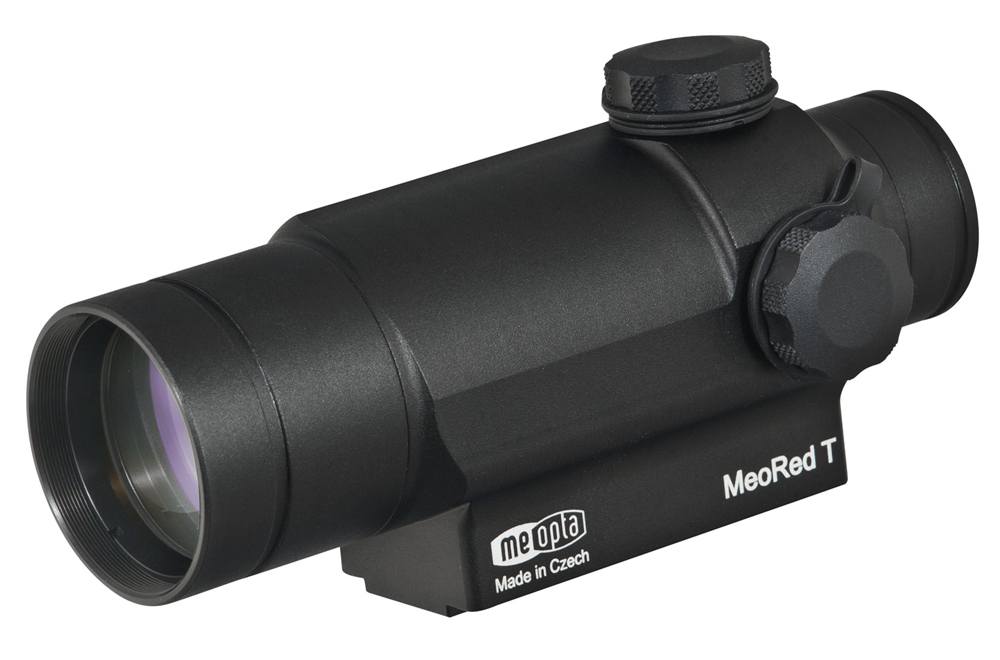
Quality optics definitely fall into this category. And the recently released Meopta MeoRed T Reflex Sight appears to have what it takes to bring the most out of the shooter and his firearms. Designed as a primary aiming solution for tactical rifles, the minute red-dot optic is ruggedly built and engineered for lightning-fast target transitions.

Perhaps the most attractive feature of the 1x30mm optic is the red dot itself, which is set up to shave hairs off a gnatโ€™s hiney. This is due to its 1.5 MOA illuminated dot. While certain to excel at close quarters, and shots on the fly, the dot is fine enough to hold its own at medium to medium-long ranges.

The MeoRed Tโ€™s reticle is also ready to tackle nearly every lighting environment thrown at it with 12 intensity settings. Improving this is the companyโ€™s MeoBright multi-lens coatings, which provide a crystal clear sight picture, eliminating glare and reflections and delivering 99.7-percent light transmission per lens surface. Meopta has even gone a step further with the MeoRed T, coating the external lens surfaces with its MeoDrop, a hydrophobic coating that repels rain and snow, in addition to skin oils and dirt.

Meopta has done plenty to protect all that high-tech glass and hardware, building the MeoRed Tโ€™s tube of aircraft-grade aluminum. The unit completely sealed and waterproof, as well as shockproof. In short, itโ€™s tough as boots.

As a standalone, the optic is set to shine in nearly any tactical application, but Meopta has designed the MeoRed T as an all-around sighting solution. Compatible with night vision optics and magnifiers, the red dot is set to tackle nearly any conceivable operation.

As is expected on any piece of equipment that delivers, the MeoRed T has a bit of a price tag โ€” $1,000 MSRP. Itโ€™s not through the roof in the optics world, but it is spendy. However, for shooters who are set to make the most of their rifles and skills, the red dot sight might be priced right.

Specifications:

Meopta MeoRed T Specs
Magnification: 1x
Objective Diameter: 30mm
Eye Relief: Unlimited
Dot Size Diameter: 1.5 MOA
No. of Intensity Levels: 12
Night Vision Compatibility: Yes
Elevation Adjustment: 80 Min.
Windage Adjustment: 80 Min.
Adjustment Increments: 0.5 MOA
Automatic Intensity Mode: no
Power Supply (V): 1.5-3.6 (1xAA)
Battery Lifetime (hours at medium intensity): 2,000 Min.
Automatic Shutdown: 8 hours
Recoil Resistance: 500 g
Operational Temperature Range (ยฐF): -40 to +140
Waterproof: 2/2 meters/hours
Max. Length: 4.84 in/123mm
Max. Height: 2.32 in/59mm
Max. Width: 2.64 in/67mm
Weight: 8.82 oz
Objective Filter Thread: M34x.05mm
Eyepiece Filter Thread: M27x.05mm

One Word That Will Make You A Better Marksman

1

If you don’t know how B.R.A.S.S. will make you a better marksman, it’s high time you learned.

What does B.R.A.S.S. mean?

As marksmen, we live in a blessed era. At no other time since gunpowder met projectile has there been more well-manufactured guns, gear and ammo to get us on target. Even the cheapest of rifles, shotguns and pistols of today are capable of sharp shots that just a couple generations ago were the things of myth.

4-Value-Hunting-Rifles-1 - marksman

This orgy of precision technology, however, clouds what really counts when it comes to delivering a payload to a gnat’s ass โ€” the shooter. If we come to a shot prepared and ready to make it, the gun, bullet and, yes, the target will take care of themselves.

Don’t believe me? Consider the Mosin-Nagant. It’s perhaps the most successful sniper rifle of all time, and a chassis rig it is not. The men and women behind the simple Mosinโ€™s trigger are what made the rifle chillingly deadly.

So, what can be done to master ourselves, and in turn master our firearms? Believe it or not, there is one word that goes a long way to helping us achieve the accuracy weโ€™re always chasing. Simply put, B.R.A.S.S. can give you the guts to make your shot.

Of course, as is the case with all panaceas, shooting or otherwise, there is more to hitting the target than one word. Used by the U.S. Military to ingrain the fundamentals of marksmanship, the acronym contains all the basics you need to shoot straight โ€” breathe, relax, slack/stop, squeeze.

Hereโ€™s a closer look at each element.

Breathe
Sounds easy, but mastering this natural body function is the difference between the 10-ring and utter frustration. The mistake most shooters make is breathing in an unnatural fashion, that is, holding their breath in an abnormal way. This can lead to involuntary muscle flinches and, if held too long, muscle tremors as the body screams for oxygen.

Shooters should concentrate on breathing in a natural fashion, then aim to shoot in the natural transition between exhale and inhale. During this period, breathing can be comfortably paused for around 5 seconds โ€” longer if practiced. A dose of humbleness also helps in this phase. If youโ€™ve paused your breath for too long, call it good, take a fresh breath and start all over again. Your accuracy will improve because of it.

Relax
Maybe it’s the anticipation of recoil. Perhaps thereโ€™s concern of placing a shot wildly off the mark. Maybe that buck of a lifetime has pure adrenaline pumping through your veins. There are a number of factors that tense the mind and body, and leave a marksman too balled up to stay on target. For greener shooters, this is a tough nut to crack, because there is a level of trepidation in any new undertaking. But even a seasoned marksman can tie themselves in knots when the pressure is on.

I’ve personally found a solid and predictable routine goes a long way to approaching a shot relaxed enough to make it. Shouldering the rifle properly, getting a solid cheek weld, focusing on the target, positing the finger properly on the trigger and fluidly squeezing it pulls the mind away from the bugaboos that can infect the mind. And from a relaxed mind comes a relaxed body. The best part, honing a mental and physical state conducive to accuracy doesnโ€™t require sending rounds downrange. Dry fire practice is the perfect opportunity train the calm before you unleash the storm.

Ithaca-Guardian-Rifle-review-1 - marksman

Aim
Aiming a weapon seems simple, perhaps even intuitive. But there are few points where there are more breakdowns in making a shot. Much of this is due to a marksman not taking the time to properly understand their natural point of aim, sight alignment, and how to develop a sight picture. But even seasoned marksmen, in the heat of the moment, can lose focus on important aiming aspects. With iron sights, it tends to be keeping focus on the front sight. With scopes, it’s ensuring thereโ€™s a full field of view. If all these aspects are in line and accounted for, this is the moment to align the front blade or crosshairs on where you want to send your bullet.

Slack/Stop
This is pre-flight for the moment of truth. For a two-stage trigger, you need to take up the slack before you completely break a shot, ensuring you donโ€™t jerk the trigger. But itโ€™s also the time to stop to re-evaluate your shooting condition and target โ€” has the wind changed? Is that bull elk about to disappear into timber?

You also essentially stop everything that might throw you off the mark โ€” body movement, breathing, disconcerting thoughts about missing the shot. A marksman is at his stillest point of the process in body and mind โ€” one that lasts for fleeting moments. After a few precious seconds, muscles twitch and the mind will wander to next monthโ€™s mortgage payment. Itโ€™s a tall task learning when to make the most of this opportunity; fundamentally, itโ€™s a chore of shooting batches of ammo until it becomes second nature. But once you learn to capitalize on this golden window, youโ€™ll absolutely make the bullseye tremble.

Squeeze
Itโ€™s difficult to comprehend that a lionโ€™s share of accuracy is due to a few muscles in small appendage. But there it is, for better or worse. Itโ€™s oft-repeated and here will be again, itโ€™s a trigger squeeze โ€” not jerk, pull or tap.

A squeeze allots the best control for a smooth, steady and liner rearward path, thus maintaining the gunโ€™s alignment with the target. The others will send the shot to the side. Finger placement aids the process. The center of the pad, directly behind nail bed, centered on the trigger facilitates a clean squeeze.

Accuracy isnโ€™t just something that happens and wonโ€™t be enhanced by equipment if it wasn’t there to begin with. If you want to hit what youโ€™re aiming at โ€” be it a coyote on the heel or a steel gong at 500 yards โ€” take the time to master these fundamentals. Once mastered, practice to keep them sharp.

Though he was alluding to spiritual matters of the Zen variety, German philosopher Eugen Herrigel perhaps best summed up the challenge of shooting accurately when he wrote, “Fundamentally, the marksman aims at himself.โ€ With that nugget in mind, be sure you hit the mark.

How To Choose The Best 9mm Ammo For Self-Defense

3

Offering a high-capacity magazine and enough velocity to expand bullets, youโ€™ll find more high-tech 9mm ammo, from more makers, than any other cartridge.

How to choose the best 9mm round for personal defense:

    • 9mm bullet weights range from 115 to 147 grains and velocities from 1,200 to 1,000.
    • The 9mm has the advantage of higher capacity without enlarging a firearm’s grip.
    • Gun type goes a long way in determining the preferable load.
    • 9mm ammo can be divided into three classes: light, medium power and supersonics and heavyweights.
    • +P and +P+ are best reserved for full-sized pistols.

Invented in 1904, the 9mm Parabellum came about because the German army couldnโ€™t bring themselves to adopt a .32 pistol โ€“ the 7.65×21 Luger. So, Georg Luger opened up the bottlenecked case of that 7.65 as much as he could and, viola, the 9mm Parabellum came about.

It is a hot number, with an MAP of 36,000 PSI. The standard bullet weights range from 115 to 147 grains, with velocities from just under 1,200 for the 115s and just under 1,000 for the 147s.

As a compact cartridge, the 9mm has an advantage that larger or longer cartridges cannot offer: a high-capacity magazine, with a double stack of cartridges, does not become too large a magazine and grip for the average shooter to handle. This offers a significant increase in capacity. Where a 1911 pistol in .45 offers eight rounds in a magazine, a 9mm magazine in the same-size pistol doubles that. And, the higher operating pressure means it can generate enough velocity to expand bullets.

Load Up On 9mm Ammo Knowledge:

These two advantages caused the 9mm to be the main focus of bullet improvements. Some might say, โ€œSure, because it needed it,โ€ but I see it as ballistic advantage waiting to be reaped. As a result, you will find more hi-tech bullets in 9mm, from more makers, than any other cartridge. Even in the hottest loadings, in a not-ultra-compact pistol, it is manageable for the average shooter, and this is another advantage. If it is manageable, people will learn to manage it. If it can be fun theyโ€™ll find the fun.

With the 9mm, the convergence of all the advantages created a product that now is going to re-set the law enforcement landscape, moving many agencies back from the .40 to the 9mm.

The big problem in selecting the best 9mm ammunition is determining what platform you will be using it in.

FMJ bullets do not expand, they penetrate, tumble, and stop eventually. NYPD found them sometimes stopping in bystanders. This was seen as a not-good outcome.

For instance, the +P and +P+ loads are best performers when launched out of a full-sized gun. So, using a Glock 17 or 34, a full-sized Government Model or similar other big 9mm, you get all the benefits of the velocity. Using the same ammo in an ultra-compact Kel-Tec is simply making excessive noise, beating up your hands and not getting the velocity you thought you were. Oh, youโ€™ll get more than the standard ammo would deliver, but not so much more that itโ€™s worth all the drama, noise, flash and recoil.

The 9mm Parabellum seems to be the cartridge the FBI tests were made for. It has enough velocity to punch through the various barriers and still have speed enough to expand on the other side. The 147-grain bullet is so long (it barely fits in the case, with room for powder) that you could expand it to double its diameter, and it still has enough length of bullet cylinder left to support the expanded bullet.

The Browning Hi Power (this is a Novak Custom) was for a long time the only hi-cap 9mm. Now they are common, but the BHP is still a valid choice for those who want a single-action system pistol.

It is soft in the lighter loads and manageable in the hottest loads, so it is accurate. It used to not be accurate. When the U.S. Army and Air Force began testing in the early 1980s, to replace the โ€œworn outโ€ 1911s with something new, something 9mm, they found that the 9mm ammunition of the time wasnโ€™t as accurate in new pistols as the then-current .45 ammo in the โ€œworn outโ€ 1911s. This temporarily stopped the pistol program, and initiated a crash program to develop match-grade 9mm ammo, then started the tests again.

Now, we have accurate 9mm because it is all accurate.

Old habits and old customs die hard. Old attitudes die hardest of all. The attitude of โ€œreal cartridges start with the numeral 4โ€ do not take into account the fact that a lot of people just donโ€™t want to deal with, or canโ€™t handle, the size of a โ€œ4โ€ pistol and the recoil it brings with it. For them, the 9mm is plenty good enough.

The trick is finding the firearm that works for you, and then (and only then) selecting the load that works in it. Picking a load and making it fit a โ€œsuitableโ€ handgun is going about it backwards and asking for trouble. Not to pick on Kel-Tec (they make fine compact pistols), but starting with a +P or +P+ load and then trying to manage it in an ultra-compact pistol is just doomed to failure.

To that end, the 9mm can be divided into three areas.

The days of non-expanding bullets are over. Fired out of a compact 9mm, this 9mm 150-grain HST expanded as shown.

Light Loads

These would be the Hornady Critical Defense loads and similar low-recoil loads, such as Federal HST offerings, the Barnes TAC-XP (all-copper bullets donโ€™t need as much velocity to perform) and others. They offer as much performance as can be had, without going to the full FBI performance and recoil that the other end of the spectrum entails. Why would you use such a load? As explained, because you are loading it into an ultra-compact pistol and you donโ€™t want the extra recoil, for no gain, that hotter ammo would provide.

Top: The Barnes Tac-XP all-copper bullet is soft to shoot but performs like a champ. Bottom: You can see what the Tac-XP does in gelatin. It expands and penetrates, all with mild recoil.

Medium Power

The middle ground would be standard-weight ammunition in normal velocities, such as a 124-grain JHP at the normal 9mm velocity of 1095 fps. One reason to select such a load would be simply that your ultra-compact pistol does not run reliably with a โ€softyโ€ 115-grain or a heavy but slow load.

One of the advantages of the 9mm is the huge variety of pistols and ammunition to be found. That is also one of the disadvantages, as the more combinations you have, the more you can find that donโ€™t work.

This is the firearms variation of the old โ€œDoctor, doctorโ€ joke.

โ€œDoctor, doctor, it hurts when I move my arm like this.โ€

โ€œThen donโ€™t move your arm like that.โ€

If your desired carry pistol does not shoot well or is unreliable with a particular load, move on to some other load. There are plenty of good ones, donโ€™t get hung up on โ€œthere can be only one.โ€ Select something else, something that works.

Black Hills makes a medium-power 9mm 124 JHP that is brilliantly accurate, is easy to shoot and performs well in tests.

Supersonics And Heavyweights

Last are the full-out, pull-out-all-the-stops loads that fully comply with and even crush the FBI scoring method. Here, we have two options.

One is the lightweight bullet at the absolute screaming velocity the case can muster. For that, youโ€™re looking at something like the Winchester Kinetic or the new, resurrected Super Vel. This will push 90- to 115-grain bullets at supersonic velocities.

A soft-shooting but lightweight bullet is the Federal Guard Dog. At only 105 grains it isnโ€™t the lightest load, but for those who donโ€™t want or canโ€™t use hollowpoints, the expanding metal jacket bullet is just the answer.

The other options here are the heavies, the 147-grain JHPs that manufacturers push to just under 1,000 fps. They are both subsonic and expansionist.

What do you pick? Pick what you like, and what your pistol likes.

An example of the heavies is the Winchester PDX1, in 9mm it is 147 grains. I first encountered it while doing my TV show, and we got a carton of ammo fresh off the loading line. The range had a test car nearby, so I loaded 9mm and tried a round through the windshield. It went through the windshield, through the cardboard target in the driverโ€™s seat, the headrest, and caromed off the back shelf and out the back window, taking window trim with it.

Top: This is what a Hornady Critical Duty does, pretty much with any barrier or no barrier. Bottom: Here is the Critical Duty load in gelatin. Nothing to complain about.

Hornady delivers much the same performance with their Critical Duty load, a 135-grain bullet that is +P and stout to shoot, for a 9mm.

Thatโ€™s the kind of performance that the modern, bonded bullet in a 9mm can deliver. And it is why I am not giving a list of recommended rounds or options in the 9mm chapter or many of the subsequent chapters.

All bonded bullets in the modern choices will perform in a similar fashion. That is why they are expensive, and why they have stiff recoil.

The trick is to pick the one that you are comfortable with, that shoots accurately in your handgun, and that feeds reliably. Because they are all so good, the work of picking one over the other is just not worth it for the great bunch of us. For a police department, willing to go through the herculean labors of picking one (or more likely, four or five potential, good-enough-the-best) rounds, fine.

Me, I canโ€™t be bothered, and I do this for a living. Iโ€™ll pack whatever the gun Iโ€™m packing shoots well, and be happy.

Honey Badger

The idea of a non-expanding bullet that stops and does not over-penetrate is new. One of these is the Honey Badger, a fluted all-copper bullet. It does not care about barriers, because the shape is not changed by punching through a barrier. It does this at amazingly mild recoil levels. It is new, and it will likely be the thing of the future for bullets. Time and testing will see.

In a gelatin test of the Honey Badger, it penetrates the full 18 inches and does so at a subsonic velocity, with a 125-grain bullet. Wow!

+P & +P+

Should you, or shouldnโ€™t you? That depends. Do you want the extra performance it will deliver? Because either will give you more. But, are you willing to pay the cost in extra noise, blast, flash and recoil? Because even if they donโ€™t deliver more performance, they will deliver more of the costs.

This is what extra pressure and velocity can do for you. Just chrono, and be sure youโ€™re getting the extra velocity.

The choice is yours, and keep in mind: if you do not pack a full-sized pistol, you wonโ€™t get the extra performance, but you will get an extra dollop of the costs.

Editor’s Notes: This article is an excerpt from Choosing Handgun Ammo: The Facts That Matter Most for Self-Defense by Patrick Sweeney.

MUST READ ARTICLES