Laser sights could provide a decisive advantage in a defensive situation, but they require proper training and an understanding of their limitations to get the most out of them.
Do laser sights shine as an aiming solution?
There are many dubious about the effectiveness of laser sights.
Generally, it’s a question of reliability.
To effectively use a laser sight, you need to be trained in its application and limitations.
You should still draw to your sights every time, even with a laser sight, as a redundancy.
But when sighted and working properly, you’ll find the dot on your target before your handgun is fully presented.
Many consider laser sights to be nothing but a gimmick. Folks of this ilk are mostly of the old guard and consider the notion of trusting your life to an electronic sighting device bad judgment. I don’t have a problem with shooters who don’t like lasers, but I do think it inappropriate to speak negatively of a tool you do not understand. To effectively use a laser sight, you need to be trained in its application and limitations, just as with any other tool. And, most who preach against the use of lasers have little or no experience with them.
Some shooters discount the benefit of lasers on defensive handguns. Before you do that, take the time to learn how they should be employed.
It’s true that when you draw your handgun in a lethal confrontation, the laser might not work because you did not establish a grip capable of activating it. It might not work because the batteries have died. And, it might be working, but the light is so bright outside, you simply cannot see the laser dot. These are all valid considerations, but this is also the reason you should train to draw to the sights. In other words, as you present your handgun towards the threat, you look for the sights just like you’ve been trained. However, if your laser is adjusted properly—and working like it most likely will be—it should appear on the target just above your front sight. With practice, you’ll learn to see that bright dot on your target before your handgun is fully presented, and before you’ve found your sights. If, for whatever reason, you do not see the laser, engage as normal with the pistol’s sights.
The laser is not some magical device that makes you shoot every shot like Jerry Miculek; it is a tool that can improve your shooting precision and speed, and quite possibly help you stay alive. Learn how to properly use it before you bash it!
Editor’s Note: This article originally appeared in the July 2017 issue of Gun Digest the Magazine.
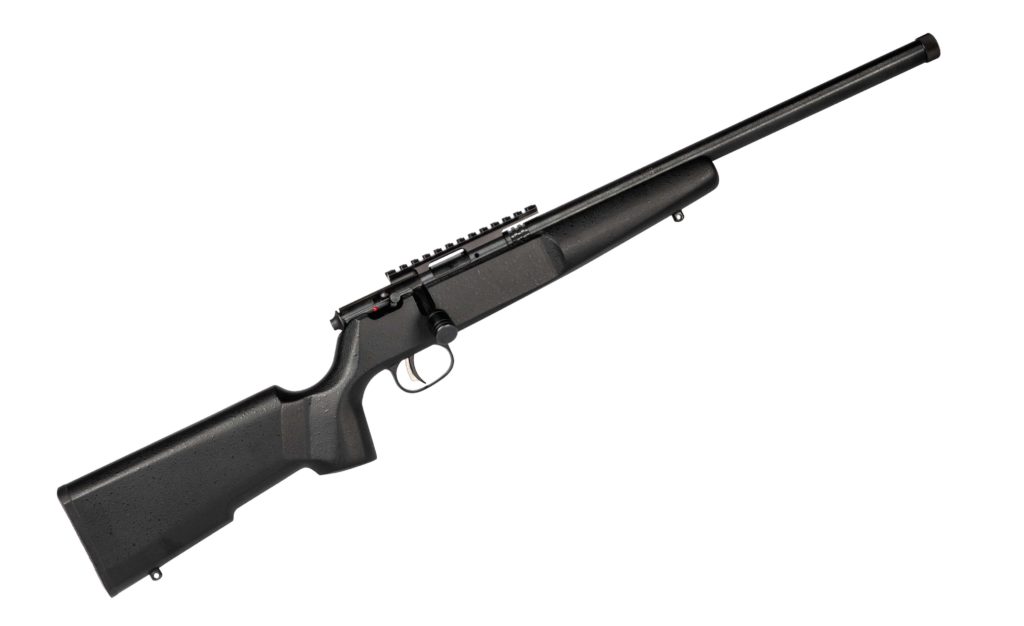
Featuring heavy barrels and a number of other enhancements, the Rascal Target and FV-SR look to own the bullseye.
How Savage is rounding out its Rascal line:
The Rascal Target is an optimized version of the rifle, featuring a heavy barrel.
The new single-shot rifle is aimed at adult shooters with a full-sized stock.
The Rascal Target XP has the same features as the Target model, but comes with scope and a bipod sling swivel mount.
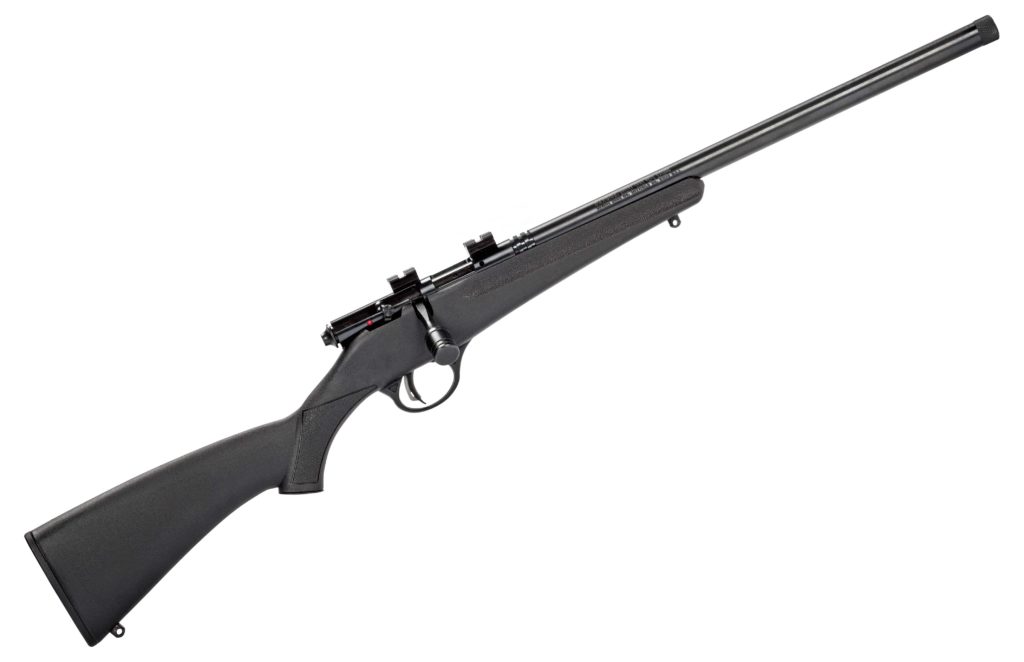
The Rascal FV-SR is a youth gun, but boasts a heavy target barrel.
Of all the thrills in life, there are few that come close to those first shots you ever take with a gun. The nerves of trying to do everything the way you were taught. The crack of the rifle as the pin strikes and the thrill of seeing a can tumble or the target printed that first time — it’s Christmas and getting your driver’s license all wrapped up in one.
Target
Chances are, your right of passage was like many other Americans and was done behind the business end of a single-shot .22 rifle. And in the contemporary era, the Savage Rascal is a popular choice on which new shooters can cut their teeth. Accurate, simple, safe — it’s just about the perfect training tool and about as much fun as should be legal.
Savage continues to build off the success of this nifty line of little rimfires, introducing two new models to the Rascal family — the Rascal FV-SR and the Rascal Target. The rifles keep much of what has made the line popular in the first place, but enhances in ways that should make these little gems lights out tack tappers.
The Rascal Target ($314 MSRP) is the more curious of the two new rifles, given it’s designed to fit adult shooters with its full-sized stock. The hardwood stock is also a break from the company’s earlier models, given it’s enhanced for precision shooting with a pistol grip and a flat forend for more stability when shooting off sandbags. Going a bit further, Savage also mated the Rascal action to 16.125-inch a heavy barrel, target crowned and with a 1/2-28 TPI threaded muzzle. In addition to putting the rifle’s accuracy potential through the roof, the heavy barrel should also make recoil nearly non-existent.
FV-SR
Savage also offers the Rascal Target XP ($399 MSRP), which has all the amenities of the Target model, but also comes with a 4x32mm scope as well as a bipod sling swivel mount.
The Rascal FV-SR ($219 MSRP) stays true to the line’s roots and is aimed at young shooters. But it arms them with a rifle that should get them on target posthaste, with an accuracy optimizing heavy barrel. Savage gives few specs about on this feature, other than its 1/2-28 TPI threaded muzzle, but it certainly appears a solid upgrade for adolescents just dying to knock the bullseye out.
Savage’s new rimfires can shoot 22 Short, 22 Long or 22 Long Rifle ammunition. The single-shot rifles feature Savage’s user-adjustable Accu-Trigger system. Like the original, they cock by lifting the bolt and unload easily — without pulling the trigger.
For more information on Savage’s new rimfire rifles, please visit: www.savagearms.com
Completely customizable to any mixture of firearms and any size gun collection, the Agile Gun Safe might be the ultimate in gun storage systems.
It’s safe to say, gun gear breaks down into two basic categories: “Here, take my money!” and “Blast ye gods, do I really have to open up my wallet for that?” Generally, gun storage falls squarely into the second column. Except, perhaps SecureIt Gun Storage and its Agile Gun Safe system. An intriguing take on gun security, the ultralight safes not only keep your guns under lock and key, they also organize your gear so it’s always within reach.
The magic of the SecureIt system is a completely customizable interior that allows shooters to configure an Agile Gun Safe to their needs. With available rifle stands, handgun hangers, mag hangers, parts bins and a load of other organization devices, the lightweight safes adapt to any gun collection.
A bit nuanced, but the other interesting advantage of the Agile Gun Safe is how it stows your gear and keeps it at hand and ready if you need it in a pinch. Pistol grips are immediately within reach and rifles and shotguns have a clear line of access, unlike traditional safes that isolate all but the first guns in each row. On top of this, the support system adapts to the size of your long guns, so an AR pistol can reside right next to your magnum goose gun in good order.
Additionally, when your arsenal grows the Agile Gun Safe system grows with it since the Agile 52 and Agile 42 gun safes are stackable and can bolt together side by side. The safe is dynamic, not simply a lump of metal eating away space.
Certainly, SecureIt has yet to find a way to make gun storage as sexy as the hot new tactical rifle. But the company has come within a whisker with its Agile Gun Safe.
It might seem small, but the location of cocking serrations on a pistol’s slide can make a big difference in how quickly you can get it loaded and into action.
Unless you’ve already become a diehard fan of the Beretta APX line of pistols, cocking serrations are most likely an afterthought on your defensive handgun. They’re there, they work, what more do you need to worry about? More than you might expect.
As Mark Redl explains in the above video, searching out a pistol with forward cocking serrations or having them milled on an existing one can give you an incredible advantage. The ability to rack the slide from the front puts your hands in immediate position to grip the pistol. Whereas, operating the gun from the rear sends your off-hand into flying back at you. This separates your hands, requiring more motion to get into the proper position.
Additionally, notice the style Redl uses to execute the maneuver — pushing the gun forward instead of pulling the slide back. Not only does this give him more control, but a keeps his off-hand relatively static and ready to immediately assume a proper grip. There’s an argument this technique could even make working the slide easier for those with less hand strength.
Redl, a pro shooter for Aguila Ammunition, approaches front serrations from a competitor’s standpoint. It makes a world of sense since he’s gunning against the best around. His ability to shave seconds on a reload from a draw or off a table is a positive must. But the concept is more than applicable to self-defense and might give you a life-saving advantage. There’s no reason why you wouldn’t want to get your pistol into the fight faster in a lethal-force event.
For more information on Aguila Ammunition, please visit: www.aguilaammo.com
We were building the office I’m writing from right now. My brother in law, Bernie, was a builder and he was supervising my business partner, Billy, and me. He was using a nail gun and reminded us they were dangerous. “Guys, when I use the nail gun, make sure you’re behind me. This thing can kill you.”
“Yeah,” Billy said, “Danny Glover used a nail gun to kill a guy who broke into his house.” Bernie stopped what he was doing and turned around, “Really? How could that happen?” It occurred to me that Bernie didn’t watch a lot of movies.
Billy explained, “Danny was a cop and the guy wanted to kill him to prevent him from testifying.”
Bernie still hadn’t caught on. “So this guy, Danny, used a nail gun to kill the guy and was a cop?”
Now Billy realized that Bernie thought Danny was a real person and that it was a real situation being discussed. I saw his smile. “Yup, in that movie he was a cop.”
In a real life-or-death situation, a home invasion isn’t a laughing matter, and unfortunately, it’s become a much more common occurrence. If a hammer or a nail gun is all you have to defend yourself, that’s better than nothing — but there are much better options. Home invasions happen every day, and it’s only reasonable to be fully prepared.
S&W Shield EZ
Many of the people I train are relatively new to firearms, and most want to purchase only one firearm for their daily protection. For that to occur, the gun chosen must be concealable, so the home defense gun functions as the same gun that’s carried on a daily basis. There might be better options, but any handgun is definitely more effective than a nail gun.
A great starting point for home defense is the personal firearm you carry every day. It’s something you’re comfortable with: It’s capable, and it’s going to be easy to access. Obviously, we have a myriad of good choices for carry guns, but for some people, many of those choices just won’t work. As an instructor, I often train older citizens who sometimes don’t have the hand strength to operate the slide of a 9mm or the double-action trigger of a revolver. For them, those choices are limited.
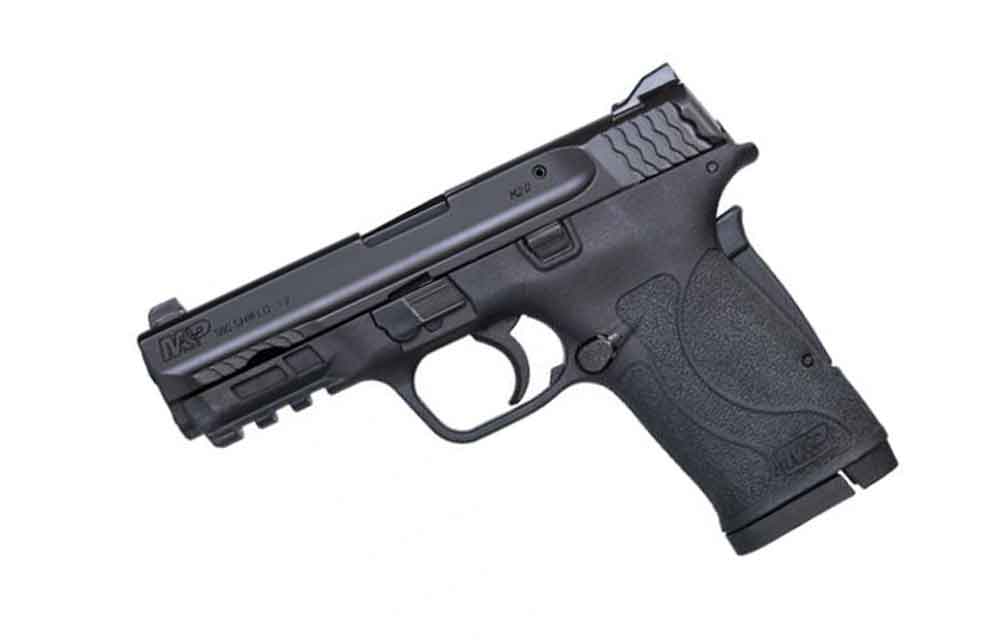
With the introduction of the Smith and Wesson Shield EZ, that problem has been addressed. The S&W Shield has established itself as the most popular concealed carry handgun in America, and the first point of home defense comes with your daily carry handgun. While the Shield and other similar guns are great guns, they require more hand strength than some people are able to generate.
The Shield EZ resolves those problems by providing a .380-caliber pistol that’s larger and therefore easier to manipulate than the pocket-sized guns. The lighter caliber and slightly heavier slide allow for a very light recoil spring. The rear of the slide is recessed in the gripping area, providing a better surface and shape for hands weakened by arthritis and time. The trigger has a lighter break and is more tactile in reset. Magazines are easier to load, and the Shield EZ has a passive grip safety, allowing safe carry with or without the optional manually operated safety.
The upshot of this is that Smith & Wesson has finally developed a defensive pistol that can be operated by nearly anyone, allowing people with less hand strength the ability to defend themselves both at home and away from home.
Crimson Trace Laserguard Pro
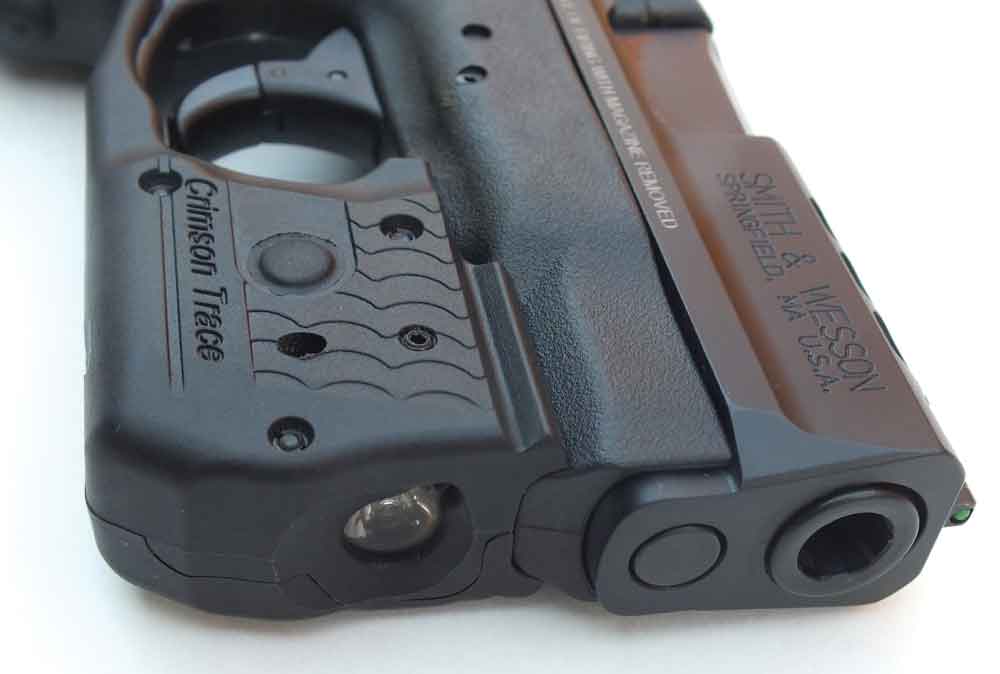
Whether you like lasers or not, most people fail to consider that 70 percent of defensive situations occur in low light. The ability to see is of particular importance in a nighttime home invasion. The Crimson Trace Laserguard Pro light/laser combination mounts to the lower frame of the gun with a rearward extension that provides a front-mounted activation switch.
Normal gripping of the gun passively activates the laser/light in four different chosen modes: light/laser, laser only, light only and flashing light/laser. Changing modes is accomplished by pressing the activation switch and the selector switch for five seconds. There’s also a bottom-mounted switch to turn the unit off. All controls are accessible when the gun is properly held in a two-hand grip.
Properly set up, the laser isn’t the primary sighting system but rather a backup sighting system in the event of low-light conditions. Lasers should be set up so the shooter can’t see the laser when using a proper sight picture because it’s obscured by the front sight. The point of impact is only slightly higher if low-light conditions require use of the laser.
This way, the shooter trains with the sights, but he or she has the option of using the laser in the event of a low-light defensive situation. Equipped this way, the light, sighting system and handgun are all one unit, and the only thing the defender who’s under the extreme stress of a deadly force event has to manage. The Laserguard Pro is available to fit multiple defensive handguns and is a viable asset in home defense.
Mossberg Shockwave and Remington Tac-14
While I’m not an advocate of the Joe Biden-double-barreled-shotgun-fired-off-the-porch method of home defense, there’s no question shotguns are extremely effective in home defense, and they require less training to be used effectively. At close range, shotguns deliver a deadly and lethal blow. Mossberg’s Shockwave and Remington’s Tac-14 represent the ultimate in shotgun handiness and effective stopping power in a compact and affordable package.
With a total length just over the 26-inch minimum length designated by the 1934 National Firearms Act and a weight of around 5 pounds, they’re effective, handy and easily stored. Capacity of the Tac-14 is 4+1, and it’s 6+1 with the Shockwave. Level of penetration of exterior walls can be controlled by choosing shot size from bird shot to buckshot. These new firearms represent a major step forward in home protection against an active invader.
Gun Box
Taking an active role in defending your home means exposing family members, children and visitors to tools of deadly force, and laws require gun owners’ due diligence in keeping firearms out of the hands of those who shouldn’t have access to them. Whatever method of home defense you choose, you must have the capability to secure it. That method of security must allow you fast access and prevent access from others. Gun Box 2.0 does just that and without making it obvious a firearm is present and at the ready.
Available in five colors and accessible by biometric, cellphone or RFID technology, Gun Box is available in sizes to accommodate shotguns, carbines or handguns, and some models even serve as a Bluetooth speaker system. It’s TSA and FAA approved, has a motion-tamper alarm and an internal light, and it opens automatically when activated. It’s truly the most innovative and user-friendly system I’ve seen. Pricing begins at $149.
NovX 9mm Defensive Ammunition
A major concern in any defensive situation is where the bullet goes if it fails to contact the assailant or if it passes through. While civilian defenders have a better record for collateral damage than sworn law enforcement, the fact is, you’re responsible for every projectile you launch. In home defense, excessive penetration is an extreme liability, and the new NovX 9mm ammunition promises to be both safer and more effective in those situations.
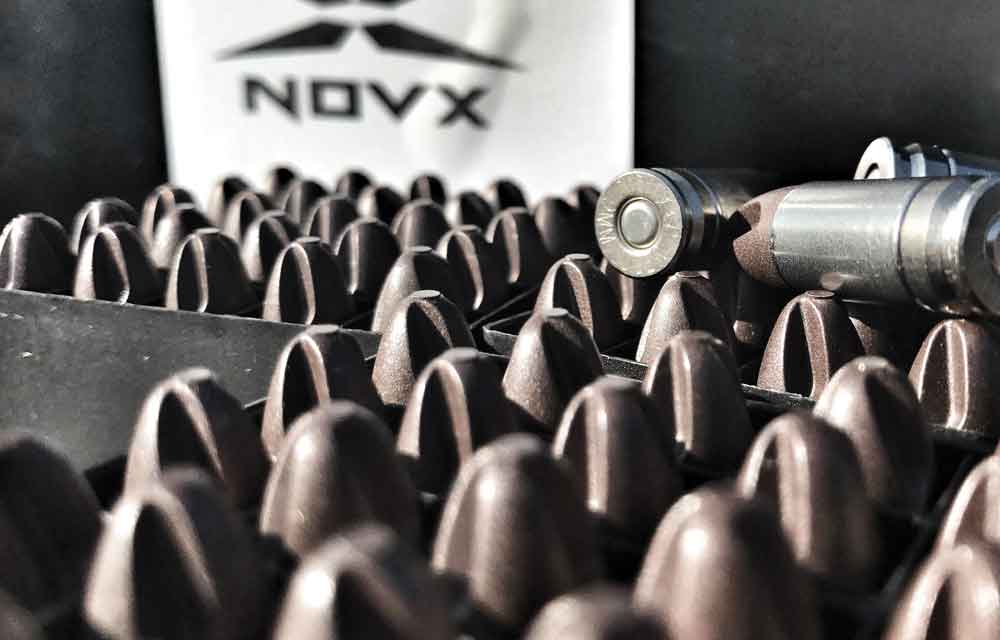
NovX ammunition is a radical departure from conventional ammunition in several ways. The case is unconventional in that it’s partially aluminum and partially stainless-steel to provide corrosion resistance and self-lubricating properties for better feeding. The most drastic departure from convention is the projectile. Made from polycarbonate and copper, bullet weight is much lighter, just 65 grains for the self-defense load. A lighter projectile allows a much higher velocity — 1,655 feet per second.
Another drastic departure is that the bullet is non-expanding and achieves a lethal wound channel by spiral flutes that push tissue away from the wound channel and create more damage than an expanding bullet. While it’s still new and stopping effects haven’t been established, the higher velocity and lighter projectile will certainly reduce recoil and reduce the likelihood of projectiles penetrating walls, making collateral damage less likely. Currently available in 9mm only, a round-nosed practice loading is also available.
All of these are new products in a fast-growing segment of the firearms industry. Home defense is a serious matter and should be approached with serious consideration. Take your specific situation when making choices, and remember that any home defense plan is better than simply allowing yourself to be a helpless victim. Also, take into consideration that there are much better choices than a nail gun.
Editor’s Note: This article originally appeared in the March 2018 issue of Gun Digest the Magazine.
When it comes to powder and bullet combinations, few cartridges beat the grand old .30-06 Springfield.
Like its applications, the .30-06 Springfield’s reloading potential is incredibly versatile.
Its bullet section is vast, additionally, it might be compatible with the widest varieties of powders of any cartridge.
Given these factors, the .30-06 is open to a lot of experimentation.
Generally, the neck tension is good enough that it doesn’t require crimping.
The author has had the best results with Federal Gold Medal Match GM210M powder.
The .30-06 Springfield is highly versatile, capable of launching bullets with weights ranging from about 100 to 240 grains.
Just as the cartridge itself is incredibly versatile, so is its reloading potential. The .30-06 might be the cartridge that can use the widest variety of powders; I’ve personally used powders as fast as IMR3031, and as slow as Reloder 25, and just about everything in between. IMR4350 is a good all-around powder, as is IMR 4064, depending on the bullet style and weight.
The ’06 runs on a standard large rifle primer; I’ve had my best results with the Federal Gold Medal Match GM210M. I keep my cases trimmed to the SAAMI-specified length of 2.494 inches to keep things uniform, and as the case offers good neck tension, I rarely — if ever — crimp my cases.
All that versatility — in both powder choice and bullet type — can lead to quite a bit of experimentation, but after all, that’s half the fun of owning such a flexible cartridge. If you run a bolt-action rifle, neck sizing may tighten group sizes up a bit, but I’ve achieved really good accuracy in many .30-06 rifles without too much trouble or having to get too awful fancy. You might find it difficult to match the velocities of the factory ammunition, but I wouldn’t worry too much about that; the .30-06 gives you plenty of velocity for hunting, and 50 fps either way isn’t going to make or break your hunt.
Editor’s Note: This article originally appeared in the October 2017 issue of Gun Digest the Magazine.
The best thing about the AR platform is its modular design: You can configure it to fit any application, assembling an AR to meet your specific needs. I’m often asked about how my AR is set up, so I thought this would be a good time to share my setup with you.
Search For Simplicity
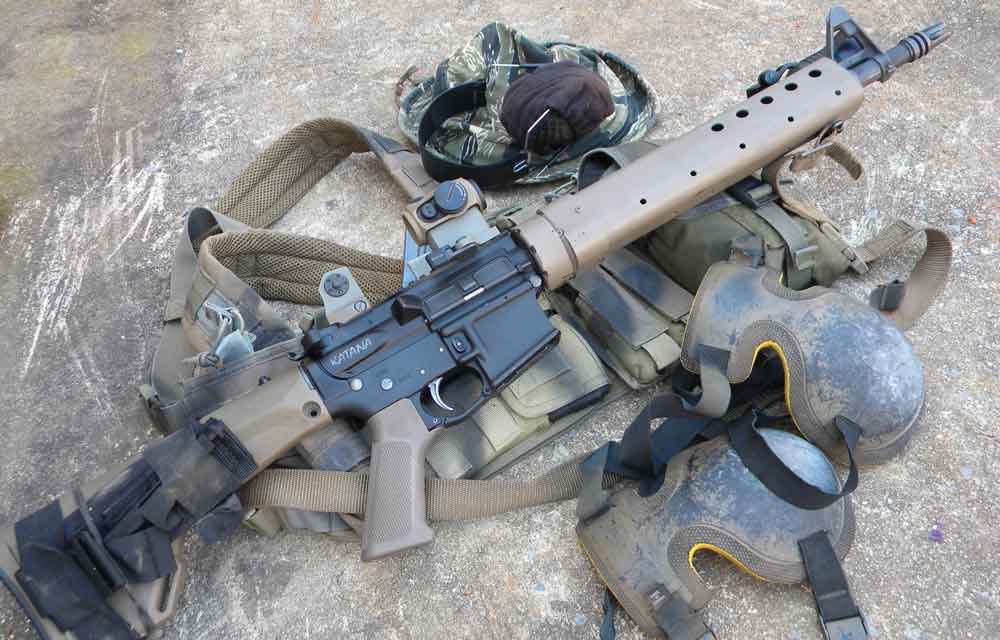
The primary purpose for my AR is self-defense, and therefore it’s lightweight — just a tad over 6 pounds. You never know how long you might have to carry your rifle or carbine. The last time we had bad tornadoes here, there was lootin’ ‘n shootin’ in areas nearby. We carried our ARs for 3 days until things settled down. Regardless of the application, unless you only shoot off a bench, weight is always an issue.
Simplicity is another goal, and it’s a concept I apply to all my long guns. The simpler the setup, the easier it is to use under stress. This is especially true for self-defense, when circumstances are likely to be less than ideal.
The Sling
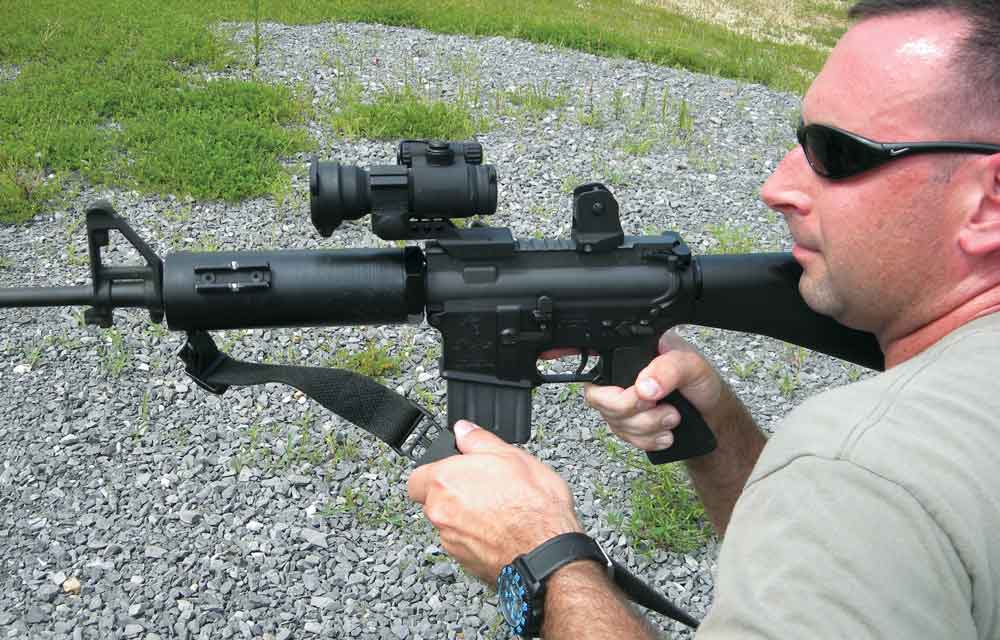
My sling is a simple two-point design with a quick-release buckle. It’s normally used as a carry sling, looping over the support side shoulder. If I need both hands-free, it’s looped over my neck — what I call a “hasty” sling. Looping over the neck can get tiring, even with a lightweight carbine, so for use over extended periods of time I run my support arm through the sling and use it as a tactical sling. A quick-release buckle is mandatory to be able to get loose of the rifle if necessary. It’s a simple design, but it does everything I need. The simplicity concept carries over to other parts of my AR, too.
Stock Selection
I prefer fixed stocks to adjustable models, and use Magpul’s MOE rifle stock almost exclusively. It’s shorter than the A2-length stock, which is a little too long for many shooters. The comb of the stock is wider and sloping, providing a positive, consistent cheek weld. The butt is shaped just right to fit into the pocket of the shoulder, and it has a storage compartment for oil, batteries and other essentials, such as small parts that might need replacing in the field — or small survival items.
In addition, there are multiple locations to attach the sling. I like it on the left rear so, when slung, the carbine lays flat against my body. (Magpul has the same shaped stock in an adjustable version.) On the left side of the stock is a SOF tourniquet.
Grabbing A Grip
If the AR has a design flaw, it’s the sharp corner between the grip and trigger guard. When manipulating the AR, you normally control it with the strong hand on the grip. This places a lot of weight on that “corner,” so it bites into your middle finger.
Any sling that will be looped around the body should have a quick-disconnect buckle. Whether you need to swap shoulders due to an injury or you’re getting dragged down the road ‘cause the sling is hooked on a truck bumper — you need to get free immediately.
The DuckBill Tactical grip has an extension that smoothes out the transition between grip and trigger guard, alleviating the potential for getting scars on your middle finger. This is important: If your rifle causes pain, you won’t practice, and repetition is mandatory to learn and apply your skills.
The Handguard
Eugene Stoner — considered the father of the AR — was a genius in the ergonomics department. The original ARs had triangular or delta-shaped handguards, which fit the hand really well. But, the design had two problems: The material they were made of cracked and broke easily, and each side required a separate mold to make — one for the left side and one for the right. Later versions of the AR/M16 used round handguards made of stronger material and a single mold.
These days, Precision Reflex Incorporated makes a delta-shaped handguard out of carbon fiber, the Gen III forearm. It fits your hands well, is ultra durable and has plenty of locations to attach a Pic rail as needed. Depending on the position I’m shooting from, I grab the front of the sling in my fist to add stability, so I attach the front sling to the bottom of the handguard.
Vertical Grips
Vertical grips were designed for full-auto fire because the handguard gets too hot to hold. I don’t use vertical grips because they have some disadvantages for general use. First, you’re holding the grip well below the barrel, so all the weight is up high. Think about holding a really heavy lollipop by the stick … it wants to tilt over to the left or right.
Vertical grips also limit where you can locate the support hand, and the location of the support hand varies according to what body position you’re firing from. On top of all that, vertical grips restrict where you can brace or rest the handguard against an object for stability. Simple works well, and it’s versatile.
Sights And Lights
The author is a big fan of Daniel Defense’s A1.5 rear sight because, if the primary red-dot fails, there’s a backup ready for use. It doesn’t have elevation adjustment, but “simple is easy” is key.
The “keep it simple” concept also applies to my sights. I use Aimpoint’s “Micro” red-dots. They’re small, rugged and dependable, and they come in several different versions. The sight also stays activated, so if I have to grab it in a hurry I don’t have to worry about turning it on. The battery lasts a long time, but just to be safe I change the battery every other month.
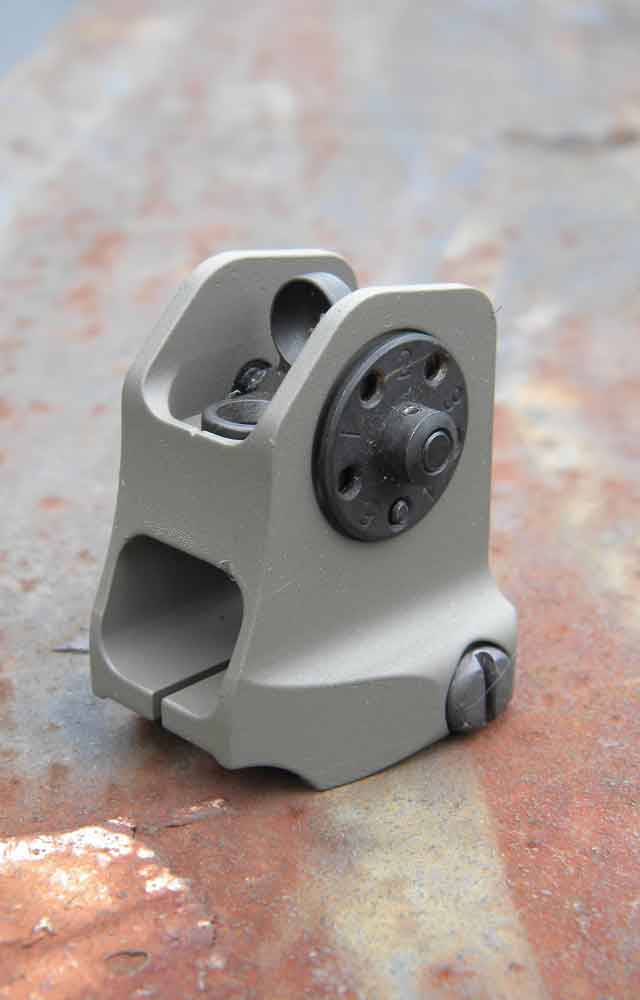
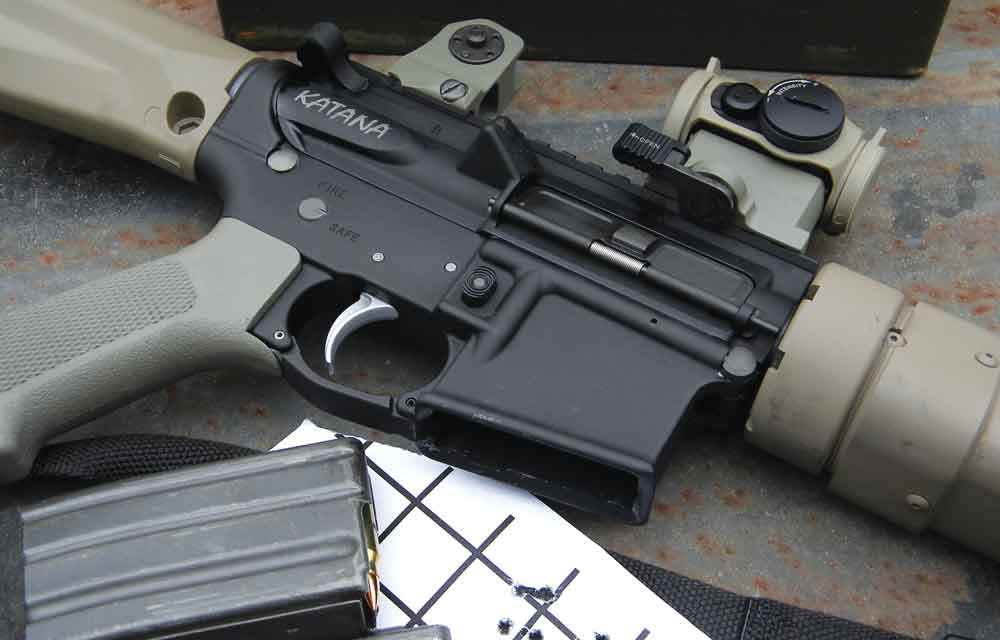
Regardless of what type of optic you run on your AR, you need back-up sights. I prefer fixed sights, and on my favorite rig the front is a standard fixed post, and the rear is a Daniel Defense A1.5 clamp-on that attaches to the Pic rail of the receiver. The Aimpoint is mounted in a 1/3 co-witness position, so the iron sights appear in the bottom third of the red-dot’s window. If the red-dot stops working, all I have to do is lower my cheek weld slightly, acquire the iron sights and keep shooting. If you have flip-up sights, I recommend keeping them up and ready for use.
All long guns for self-defense must have a light. Yes, there are techniques for using a hand-held light, but a weapon-mounted light makes things simple. I use Streamlight’s Super Tac, which is lightweight and simple to use. It’s mounted at an 11 o’clock position, which works well for rolling to the right, left or over the top of cover, and for clearing corners.
The left thumb operates the light, which features a push of the button for momentary light and a click for on and off. The bezel is designed so it throws a wide beam, but it also has an intense cone in the center that allows for identification of objects well past 100 yards. A quick-release scope mount clamped on the light attaches it to the rail on the handguards.
You Gotta Have Good Guts
A sure way to spark a debate between AR shooters is to bring up triggers. As I mentioned previously, my ARs are for self-defense, so a match or competition trigger is not an option. Using a trigger that’s too light under stressful conditions is a sure way to cause negligent, unintentional discharges, and those are scary.
ALG’s ACT trigger is my idea of the “perfect” trigger. It’s an enhanced mil-spec assembly with smoothed surfaces, and it features a nickel-boron-coated trigger with a Teflon coating on the hammer, disconnector and pins. The group comes with two springs that provide a 4½- or 5½-pound trigger pull. I run the 5½-pound spring.
Even though this AR isn’t a precision rifle, it’s still capable of shooting tight groups. The key is using a 2-MOA dot and getting the proper zero so shots are striking in the center of the dot.
The bolt group is probably the most critical part of the AR. I run nickel-boron-coated bolt carriers and bolts. They’re slick and easy to clean. Inside the bolt I run the Colt Gold extractor spring. I use the original style solid firing pin retaining pin, as opposed to the split cotter pin found in most bolt groups. The solid pins don’t get bent out of shape and are easier to install.
For the small parts — ejector spring, gas rings and other springs, detents and pins — I use Colt parts. I know Colt doesn’t make all their parts, but I can rest assured that they will be true mil-spec. To cycle everything, I use a Mech Armor Defense ambidextrous charging handle, which is well designed and almost bulletproof.
A True Custom Fit
That’s my defensive AR. Most all my other ARs are set up similarly. They are frighteningly similar in fact, which means regardless of which one I’m working with, it’s the same manual of arms.
Is my setup the perfect configuration for you? Maybe not, but you can take the same principles and apply them to your application.
Editor’s Note: This article originally appeared in the April 2018 issue of Gun Digest the Magazine.
The subject of stopping power is often brought up when discussing defensive caliber and ammo options. But, what does it mean — and how important is it?
Before we go any further, let‘s make one thing clear: We are discussing lethal threat encounters. I’m not talking about a fist fight at a backyard BBQ, unless you live in a place where those things commonly turn into gunfights. We’re talking a lethal threat, situations that fulfill the legal requirements for “I feared for my life, your honor,” and nothing else.
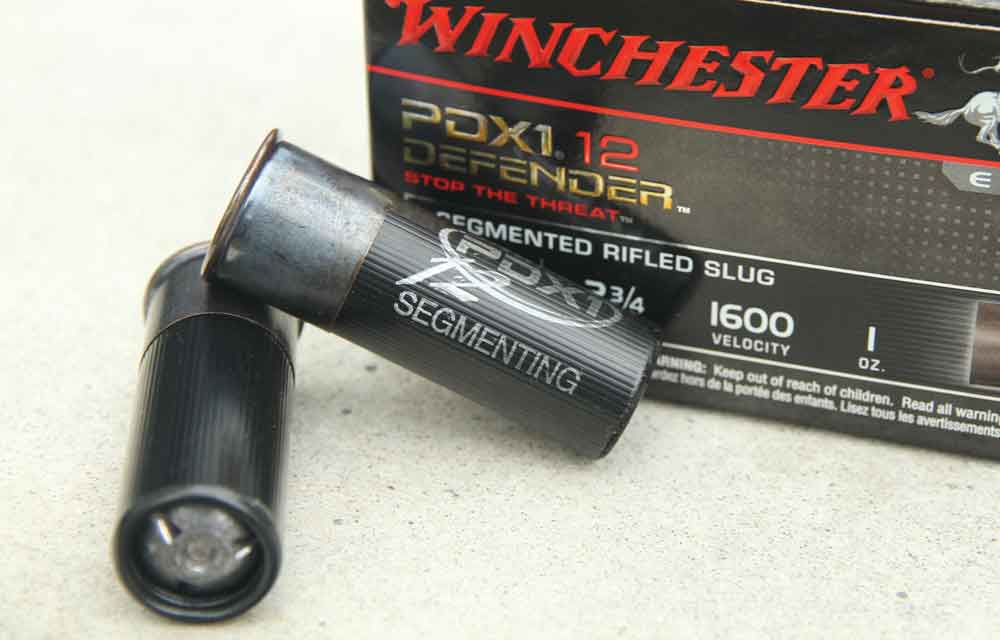
Stopping power? Really? You want to argue stopping power, with your magnum and its 240 grains, against this 12-gauge slug, at 528 grains (1.2 ounces, by the way)?
The requirements differ, depending on the jurisdiction in which you live or find yourself at the moment, whether or not you are a sworn law enforcement officer.
Before we can even begin to try and wrap our heads and hands around a stopping power theory, we must have a grasp of what goes on in a situation where we might use a firearm.
An understanding of the word “anecdote” is important to our discussion. An anecdote is a story, lesson or event that stands alone. A bad guy gets shot with a given cartridge, and he does or does not stop doing bad things. That event is an anecdote. It’s important to keep in mind this important point: The plural of anecdote is not data.
In order for the event to be a piece of data, we’d have to know everything about it: the victim’s mindset, chemical state (if any), plans and determination; the caliber, velocity and construction of the bullet; and the exact path of the wound track. Lacking all of the above, we cannot do more than call it an anecdote. The more of those variables we have, the better we can assign confidence in the information we have, and place it with the thousands of others we’d need to plot a reasonably accurate graph.
A theoretical example: A given police department issues two types of 9mm ammunition. One is a lightweight, high-speed bullet, the other a full-weight moderate-velocity load. The department tracks the results in shootings and finds that the X load is more effective than the Y load. This is useful if the ammunition is evenly distributed in the department and if it is evenly distributed in lethal force encounters. However, if the X load is issued to the SWAT team and the Y load is for general use, then to misquote the Spaniard in The Princess Bride: “I don’t think that information means what you think it means.”
If the SWAT team has a more frequent range schedule and is composed of officers who have demonstrated greater firearms proficiency, then the difference in effectiveness might be a matter of marksmanship and not terminal ballistics. If you don’t know the differences between the two groups, then the information is anecdotal at best, and not data. This makes it difficult to measure the effectiveness of load X used in one department compared to load Y used in a different department.
Determining Lethality
Stopping power? Really? You want to argue stopping power, with your magnum and its 240 grains, against this 12-gauge slug, at 528 grains (1.2 ounces, by the way)?
Here’s a conundrum for you: Modern medical knowledge and physicians’ skills are so good in the 21st century that four out of five people shot with a handgun survive the encounter. In fact, it’s a much greater percentage if the victim arrives at the hospital with a pulse. Think about that.
But, it’s the potential for lethality that defines the tool you will use, not the actual. Your neighborhood kids, playing baseball, are doing so with objects that could, in different circumstances, be lethal weapons. However, that does not in and of itself mean anything. The bad guy who just demanded your wallet, and upon receiving it is still winding up to strike you, has a lethal weapon.
We are not, however, concerned with lethality. Lethality is not our goal. A .22 LR can be lethal. Indeed, people have died from lesser projectiles. We are not interested in lethality. However, in defense with lethal force, we use force that may well be lethal itself. Until phasers set on stun are available to us, the only option remains the use of tools that are potentially lethal by their very design. That, or surrender.
I thought not.
So, if stopping power is a myth, why do we search for it so enthusiastically? Because in a bad situation, we want every assurance that things will work out all right. And that leads us to the first step in understanding stopping power: Most of the time it’s mental.
The Two Sides Of Stopping Power
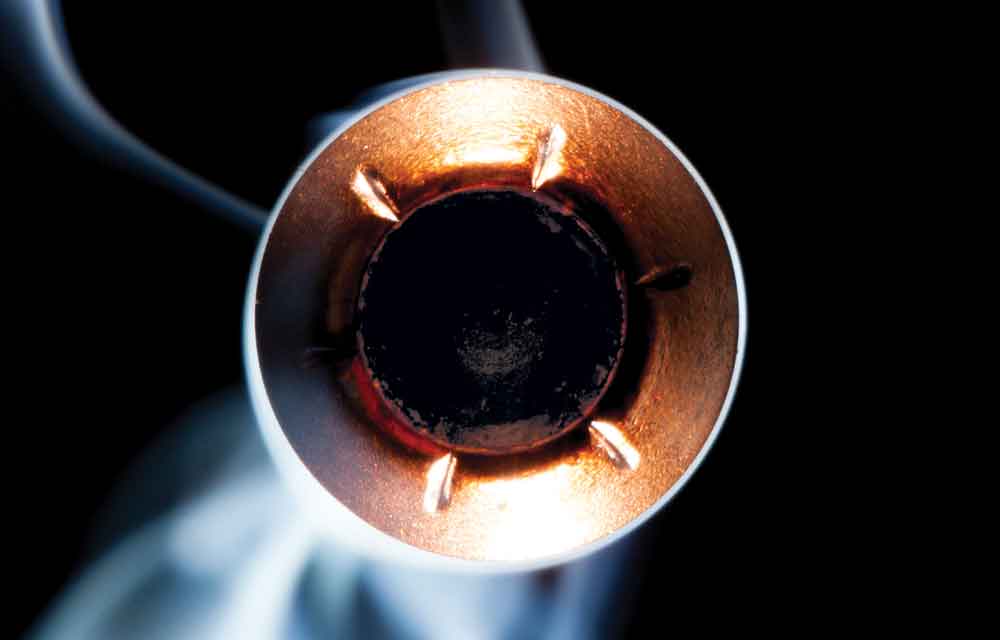
To speak of “stopping power” in handguns is to miss the point. If you really want to be stopping things — people, animals and vehicles — you need to drastically up your game. This 12-gauge slug is 1 ounce and travels at 1,600 fps. No handgun does that.
There are two aspects to a fight: mental and physical. If someone is mentally prepared and psychologically attuned, they will be able to bring all their physical skills to the process. Those skills might not amount to much, but they can bring all of them to the table.
On the flip side, someone unprepared and/or psychologically untrained will react quite differently, regardless of physical capabilities. There’s also the matter of prior conditioning. Mental state and expectation play a big part in the results of conflict.
On the physical side, there’s good news and bad news. The bad news is that your opponent has, through evolution, been created as a difficult opponent. Key parts of his anatomy are armored, he has redundancy in critical systems. His body will adapt to injury and, if given even a short time and minimal care, he can heal and rebuild. He’s equipped with fast reflexes, an adaptable central processing unit and the decision-making processing power to change plans in mid-stream. He has strength, stamina, adaptability and agility.
The good news? That also describes me. And you.
Physically, there are two ways to stop an opponent. You can deal a damaging blow to the central nervous system. You can cause sufficient blood loss that blood pressure drops below the operational level. Those are it, physically.
Let’s take a look at a statistically significant number of lethal threat encounters. We’ll start with a nice, round number — one thousand.
A thousand times, lawfully armed citizens find themselves in a situation where a firearm is needed. Of those thousand times, somewhere between 500 and 900 will be defused by simply showing the gun. This is a subject and a number that has been greatly debated. The pro-gun side posits that the number is large, and perhaps unknowable, simply because most people in that situation do not report it.
Nine hundred incidents never happen, simply because the gun was there. Of the remaining 100, another 50 actually required it be handled. Of those 50, shots were fired, and 40 times everyone involved missed. I kid you not, people miss. They miss a lot. And that’s usually not a bad thing.
The Dilemma Of Stopping Power
Quiz time. In the 950 incidents, how important was stopping power? Anyone who gave any answer other than “not at all” ought to go back and start over. The stopping power of the firearms used, or not used, was utterly immaterial.
Stopping power may be of importance in the remaining 50, but then again maybe not. Of those 50, with shots fired, 30 of the bad guys run away as soon as they’re hit. Hit anywhere — with anything. Twenty left. Ten of them take solid hits and flee. They will need serious medical attention, but they still have enough strength to get out of Dodge.
Ten are left of our original thousand, and they fight. Some not so well, others with ferocity and tenacity. Those are the 10 we will spend the most time discussing, but they’re also the highlights that define our dilemma.
In another situation, relayed to me by a friend with decades of experience in a big city with a whole lot of crime, a bad guy breaks into the home, the homeowner phones the police and calls out, “I have a gun.” Bad guy starts up the stairs, the homeowner the whole time shouting, “I have a gun,” which is pointed at the bad guy.
Homeowner decides enough is enough; he shoots. The bad guy takes a full-power factory .44 Magnum underneath the left eye. Bad guy tumbles down the stairs, gets up and walks out of the house. When the police arrive they begin a search and find the bad guy around the corner, next to his car, keys on the ground, dead.
A council of experts could argue the question, “Was there enough stopping power?” on this one until the cows come home. On the “yes” side, the bad guy stopped doing what he was doing. On the “no” side, he decided to do something else instead, and could have spent that last minute fighting instead of fumbling with his car keys. And by the time we’re done, you’ll agree with both of them.
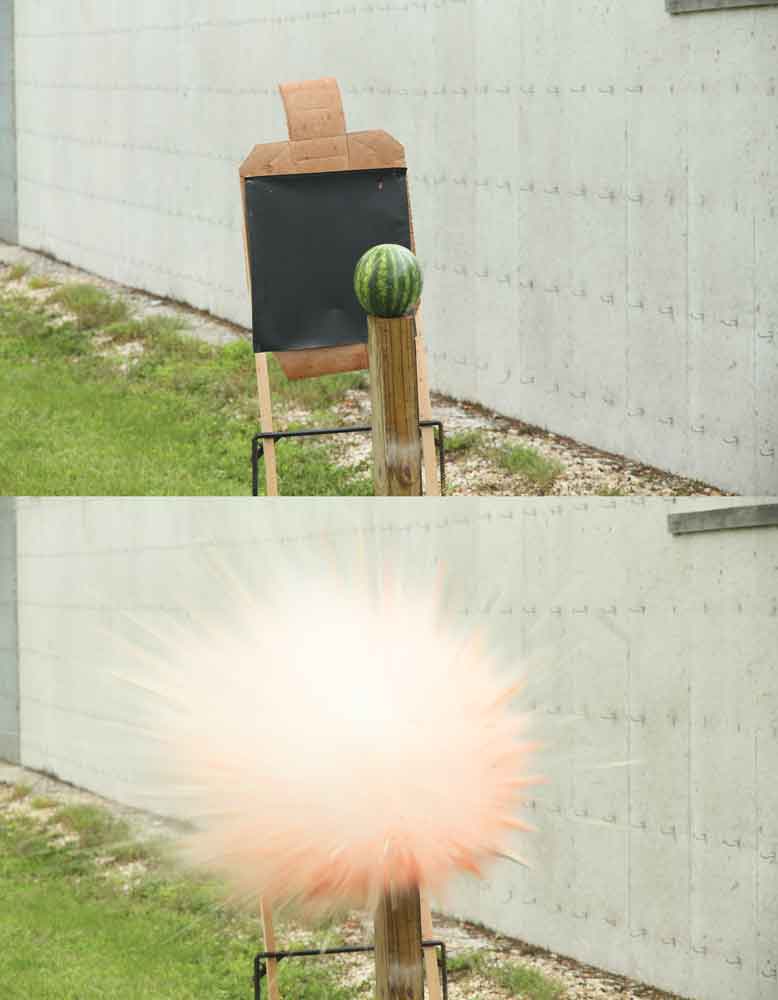
(Top) Testing is one thing, showing off is another. There is no correlation between melons and people, and using produce to “demonstrate” a cartridge or load is silly. (Bottom) However, demonstrations can be fun. This is that watermelon, struck by a 12-gauge slug, and those who stood too close smelled of vaporized watermelon for the rest of the day.
The dilemma of our situation, our life’s work in firearms is this — statistically speaking, caliber doesn’t matter. In 990 times out of 1,000, caliber didn’t matter.
You can quibble with the actual numbers, but the point is this: The subset of potentially lethal encounters where stopping power becomes the determinate factor is very small. You are better served with proper situational awareness, having a plan, knowing the law and being proactive than in obsessing over a few percentage points on a theoretical scale of “stopping power.” Put your effort where it will deliver the greatest return.
Also, if we were going strictly by statistics we wouldn’t be carrying a gun. It’s the job of the police to deal with crime, with violent people, and to be in harm’s way. And there are departments full of officers who have not killed anyone with their sidearm. It’s not unusual to find many departments where there’s only one officer who has been in a shooting incident. The rest? They will wear a sidearm for their entire career and might, a dozen times, point it at someone, but never discharge it in their official capacity and retire having never been in a gunfight. If that’s the police, what are the statistics for those of us who do not seek out danger as a professional requirement?
But, the third side of this two-sided coin is this: If you’re one of those 10 in 1,000 — and you do not have a gun — there and then statistics mean nothing.
So, what is stopping power? When you find a final, true, convincing answer, let me know.
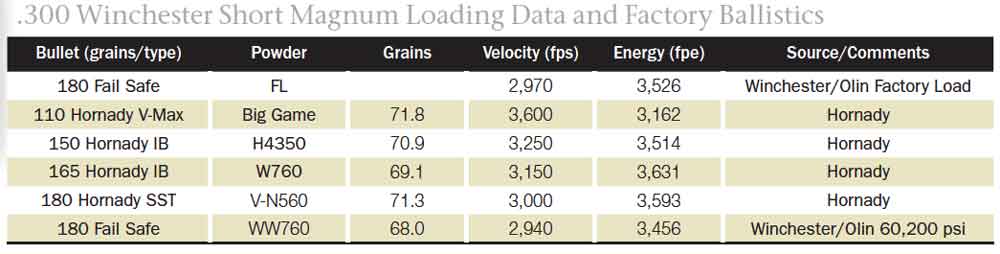
The relatively new .300 WSM offers the best of both worlds — power and efficiency.
Short and fast on this smoking short magnum:
The .300 Winchester Short Magnum was introduced in 2000.
Initially, it was chambered in short, light Browning and Winchester rifles.
The .300 WSM duplicates .300 Win. Mag. velocities, while consuming about 10 percent less powder.
At one point, it and other WSM cartridges were embroiled in a legal battle over intellectual property infringements.
This, in part, stifled some Winchester Super Short Magnum’s popularity.
Though, the .300 WSM developed a robust following.
Introduced in 2000 and chambered in short, light Browning and Winchester rifles, the .300 Winchester Short Magnum demonstrated a remarkably accurate ability to duplicate .300 Win. Mag. velocities, while consuming about 10 percent less powder.
The .300 WSM, an original Winchester design, fits handily into bolt-actions sized for a cartridge length of 2.860 inches. For highly efficient and consistent powder burning, the .300 WSM has a short-fat powder column geometry, a concept revered by accuracy-obsessed benchrest shooters for nearly three decades.
This cartridge — and all its Winchester Short Magnum siblings — became embroiled in a legal battle, and the end result was a less than enthusiastic appeal on the part of other manufacturers to offer rifles and/or ammunition for sale. However, unlike the Winchester Super Short Magnums that are collecting dust on the shelves or in shooters’ gun racks, the WSM line still enjoys moderate appeal, especially the .270 and .300 offerings.
Editor’s Note: This article originally appeared in the April 2018 issue of Gun Digest the Magazine.
Savage bolsters both ends of its MSR 15 line with long-range and pistol additions.
What’s new in Savage ARs:
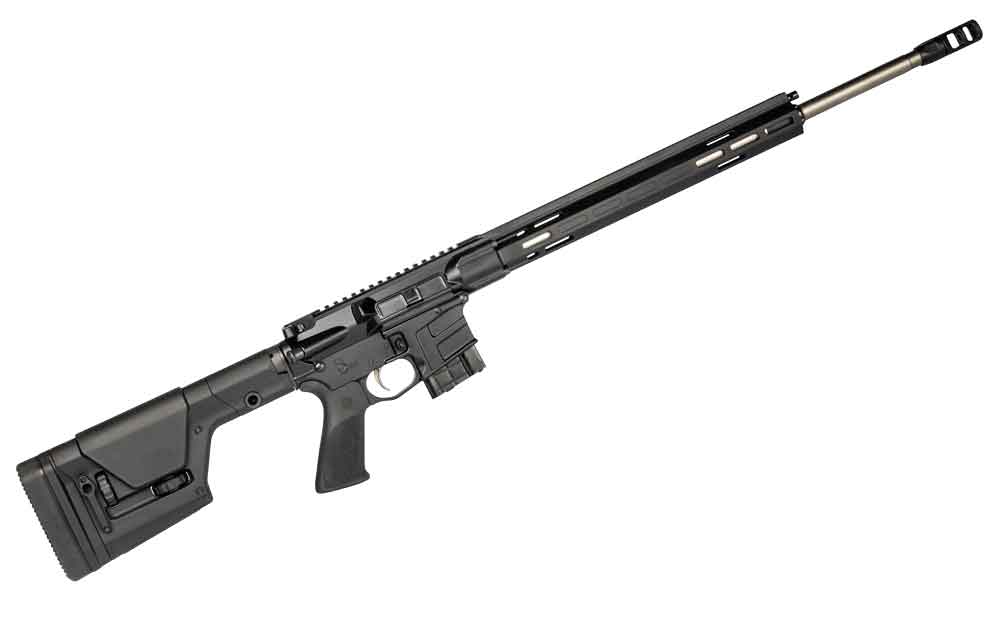
The MSR 15 Long Range is chambered for the new .224 Valkyrie.
It boasts a 22-inch barrel topped with a two-port adjustable muzzle brake.
It also has a custom-length gas system and adjustable gas block.
The rifle’s MSRP is $1,849.
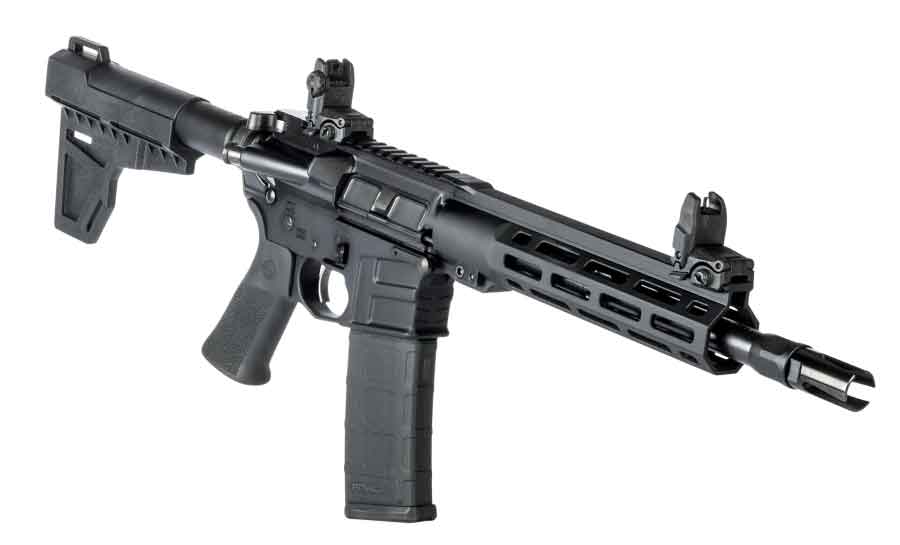
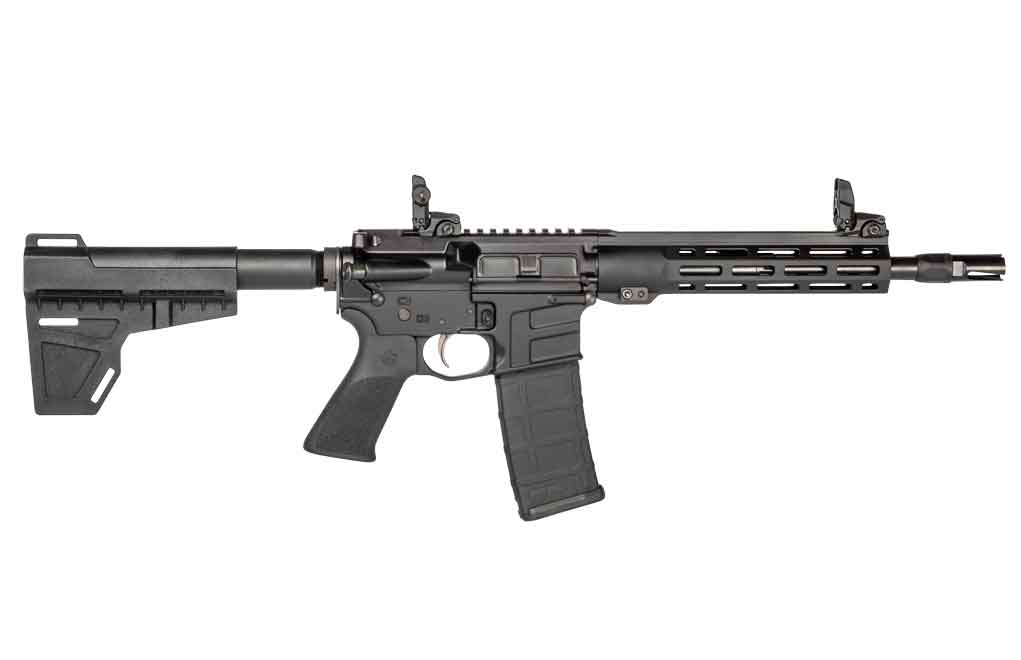
The MSR 15 Blackout Pistol is Savage’s first AR pistol.
It is chambered for .300 Blackout and comes outfitted with a KAK Shockwave stabilizer.
The gun has a 10.5-inch barrel and measures around 29 inches in overall length.
The pistol’s MSRP is $1,099.
Steady as a slab foundation, Savage Arms has earned its living in the modern era of firearms off one particular style of rifle — the bolt-action. The company has been so consistent, in fact, that since the demise of its legendary lever-action, the Model 99, at the turn of the century it has produced little else. It seemed, to some extent, the seas would boil and the sun turn the color of sackcloth before old Savage ever expanded its horizons from its Model 10 and 110 rifles.
Luckily, it didn’t require end days for the company to turn it studied eye and manufacturing prowess to AR-style firearms. The company went big into the highly popular platform in 2017 and hasn’t looked back since. Along the way, it’s even ridden the crest of innovation, embracing one of the hottest new cartridges on the market. And, if recent additions to its catalog are any indication, the gunmaker shows no signs of slowing up in its newfound love for the black rifle.
Savage expanded its MSR line at the NRA 2018 Meetings and Exhibits in Dallas with the two new AR firearms — the MSR 15 Long Range and MSR 15 300 Blackout Pistol. In all, the company now has nine AR models with configurations to fit nearly every shooting application from chasing down hogs to long-range bullseyes.
MSR 15 Long Range
The MSR 15 Long Range is among the most pioneering AR-style rifles Savage has put out, given it is among the first chambered for the smoking .224 Valkyrie (actually Savage’s second). It’s the long-range-optimized companion to the company’s initial offering for the cartridge, the MSR 15 Valkyrie.
While MSR 15 Long Range is similar to the earlier iteration, it boasts a 22-inch stainless steel barrel to milk the most out of the round. Furthermore, the rifle is topped with a two-port adjustable muzzle brake, allowing shooters to tune the recoil impulse to stabilize the muzzle. Finally, the rifle features a custom-length gas system paired with a low-profile adjustable gas block, aiding it in cycling any load is run through it. Presently the rifle’s MSRP is $1,849.
MSR 15 Blackout Pistol
The MSR 15 Blackout Pistol is the first AR pistol Savage has produced and comes outfitted with one of the more cutting-edge stabilizers on the market. The KAK Shockwave Brace, manufactured by Shockwave Technologies, is among the most Spartan stabilizer available and looks to make the pistol, chambered 300 BLK, as maneuverable as ever.
The MSR 15 pistol has a 10.5-inch barrel, measures in at around 29 inches in overall length and tips the scales a tick over 6 pounds. Other notables on the gun include Hogue pistol grip, free-floating M-LOK handguard, Savage helic flash hider and Magpul MBUS front and rear flip-up sights. Presently, the pistol’s MSRP is $1,099.
For more information on Savage Arms’ MSR 15 line extension, please visit: www.savagearms.com
MSR 15 Long Range Specs Magazine: Detachable box Stock Material: Synthetic Barrel Material: Stainless Steel Barrel Finish: Matte Barrel Color: Natural Features: Non-reciprocating side charging handle, low-profile adjustable gas block, Hogue pistol grip, cutom-forged upper and lower receivers, custom-length gas system, two-stage trigger, free-float handuard with MLock, two-port muzzle brake with taper-lock interfa
MSR 15 Blackout Pistol Specs Magazine: Detachable box Stock Material: Synthetic Barrel Material: Carbon Steel Barrel Finish: Matte Barrel Color: Black Sights: Magpul MBUS flip-up front and rear sights Features: Aluminum receiver, Fixed pistol-length gas system, Custom-forged lower receiver, KAK Shockwave brace, Savage helical flash hider, Hogue pistol grip, Free-float handgaurd with M-LOK, 5/8×24 threaded barrel, Savage 10.5
The bullet’s bearing surface — the portion of the bullet that contacts the rifling in the barrel — directly correlates to the amount of pressure generated within your barrel, and it can have a definite effect on accuracy.
Considering the minor details that affect accuracy:
Subtleties in bullet dimension and shape and how they perform in a particular barrel can vary widely.
This is why a reloader may not get the results similar to what they find in a manual.
The data set is published for as many as four or five different bullet shapes.
Additionally, the test barrel length, action, primer and case may also differ from a reloader’s.
The question also arises, can a bullet with the right amount of bearing surface improve accuracy?
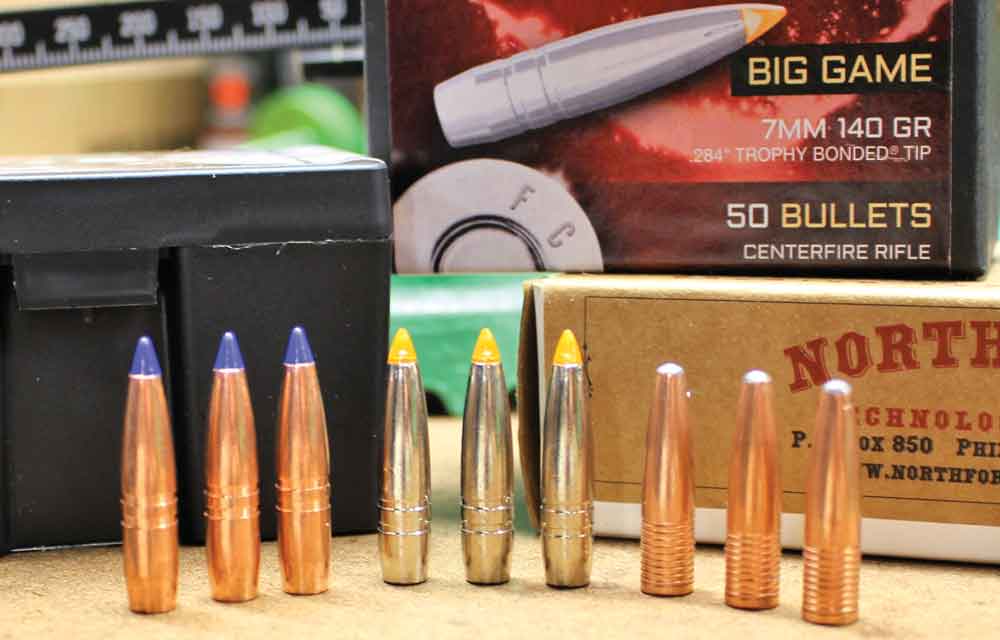
Not all bullets are created equally. The subtleties of dimension, shape and how they correspond to the performance within a particular barrel can give a ballistician fits of rage. There are times where things don’t go according to the script, and it might leave you scratching your head. I experienced just such a situation recently, and it got me thinking about the relationships between a bullet’s bearing surface, and the correlative load data.
Three different 7mm 140-grain bullets, all of different conformation, and all require a different approach.
The Starting Point
Firstly, let’s take a renewed look at the reloading manuals, and the online data, that we all use on a day-to-day basis. I’ve heard the argument way too many times: “The load data in Reloading Manual (Insert Company Name Here) is the best data; it gave me exactly what I needed and they really know what they’re talking about. The (Insert Competitive Company Name Here) manual is a load of hogwash.”
This requires a bit of explaining.
A reloading manual is not a definitive piece of work; it’s more of a laboratory report. Obviously, every company that produces a reloading manual takes great pains to ensure that the data printed therein is sound and true, but you need to understand where it came from. There are listed parameters within each set of data that will indicate the test rifle, cartridge case and primer used to obtain that data. It would be not only insanely expensive, but unbelievably time consuming, to test every bullet, in every case, in a number of rifles, with each available primer, to give the reloader the exact data he or she would need — and even then certain parameters unique to your rifle would render the data imperfect.
I’m fortunate enough to call many of the people who have an integral part of producing these manuals my friends, and they will openly discuss the methodology of obtaining their data. Universally, the response is that the data provided in a particular manual is the result of one particular situation, and it’s not necessarily the final word on the topic. Allow me to demonstrate what I mean: Using a .30-06 Springfield as an example, and the 180-grain bullet to further fine-tune the point, you might see quickly that the reloading manual lists a set of data — for numerous powders — for that particular weight.
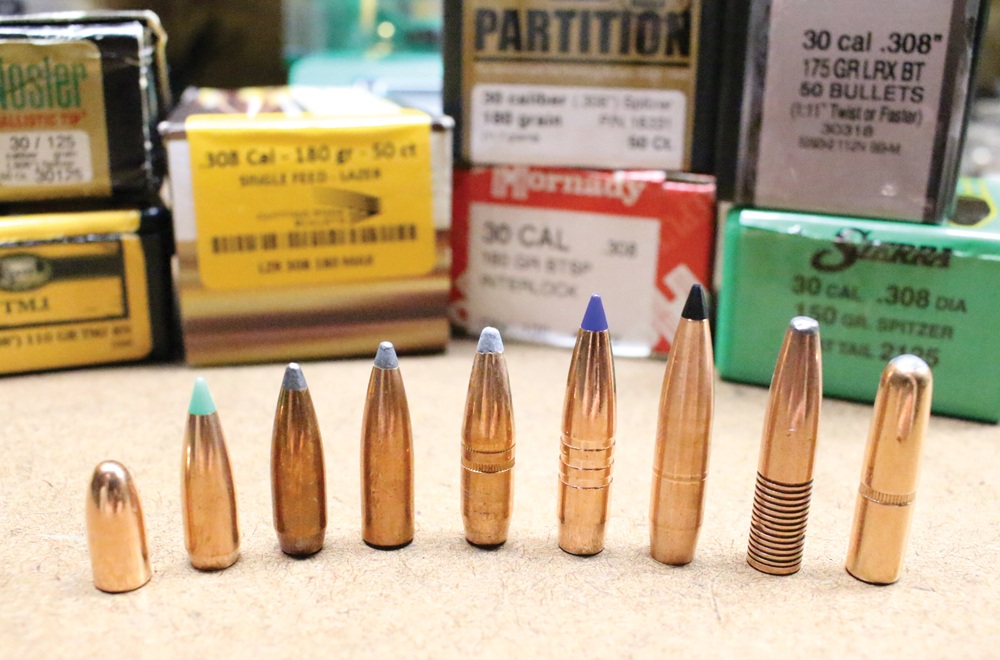
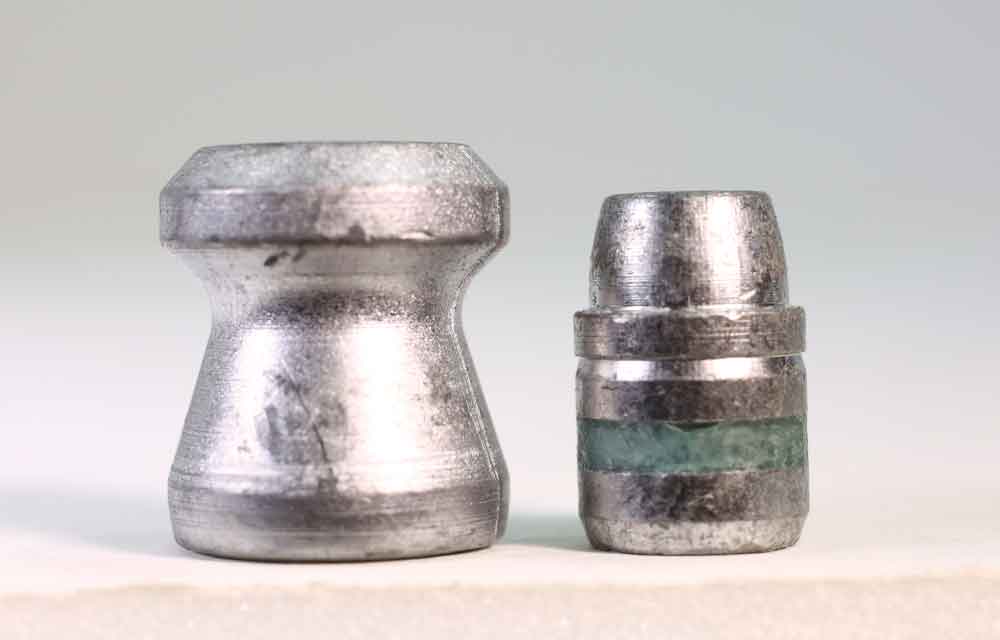
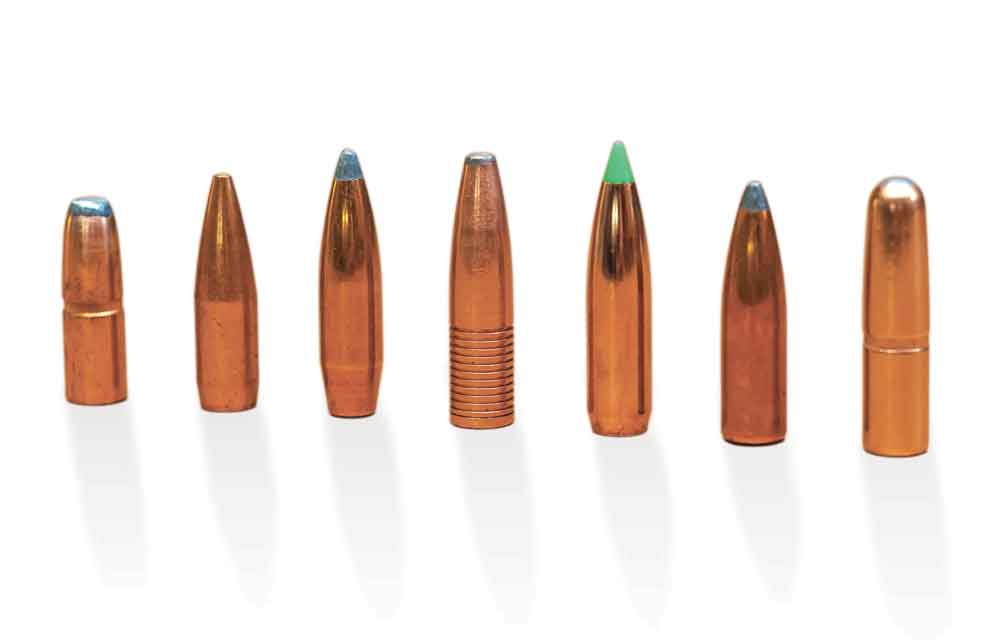
The difference in bearing surface (the parallel sides which are of caliber dimension) is easily seen among these different .30-caliber bullets.
However, that data set is published for as many as four or five different bullet shapes. In addition, the test barrel length might not be the same as yours, the action type might be completely different, and the primer and case brand might also differ. How can you then assume that the data is definitive?
“Well, it’s published by Brand X, and I’m using Brand X bullets, so it’s gotta be right.” Nope, that’s not necessarily the case. Those four or five different bullet profiles will all produce a different pressure curve, and while in some instances it might be minute, it can be rather drastic. But, we’ll talk more about that pressure-bearing surface relationship in a minute.
When a set of data is released, it needs to be safe in the majority of rifles on the market. Even if the data set is labeled for use in a particular firearm only, the slight variations within that firearm group can certainly change the outcome.
So, let’s try and look at the data as a report; the combination of rifle/case/primer gave results of X, giving you a guideline for establishing a load in your rifle. The top end of the load data — where pressures will be the greatest — might not be attainable in your particular situation and combination of components. Likewise, the top end of the data might not be the maximum that your rifle can safely withstand. And furthermore, that maximum charge can change for each and every bullet profile.
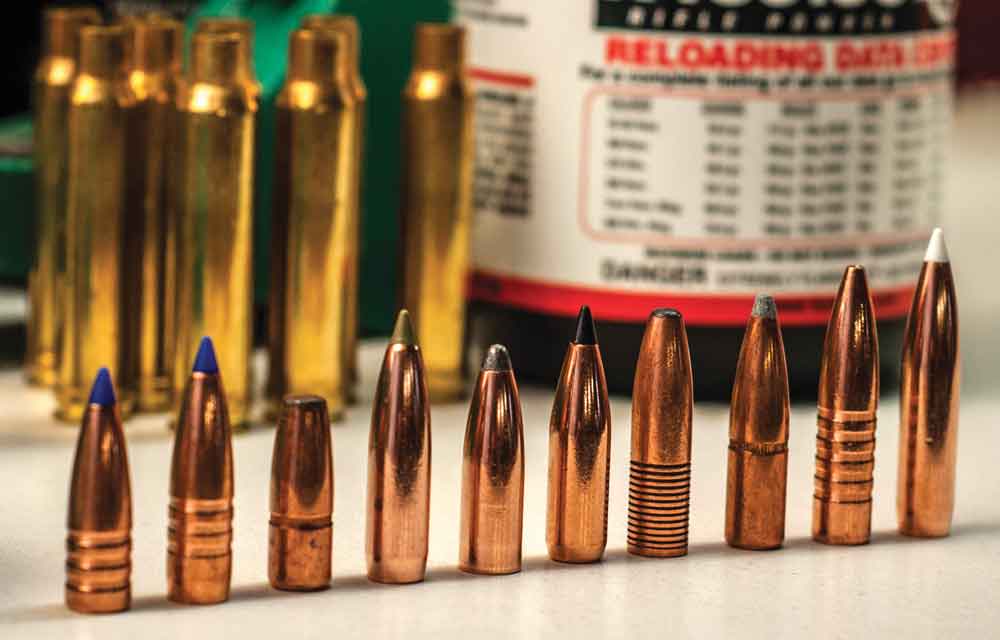
Some .338-inch diameter bullets, showing the length difference as weight increases, and the differences in each bullet’s profile.
Working Up The Grain Scale
Success really does require starting at the ground floor and experimenting to see where the line needs to be drawn. For example, while developing a load for my .404 Jeffery, the particular load data for the brand and weight of bullet I was using topped off at 74.0 grains of a particular powder, and it was supposed to produce 2,400 fps. Well, when I cobbled the components together, not only did I miss the velocity mark by 300 fps, but I also worked upward (safely, with no pressure signs whatsoever) to 80.0 grains, at a muzzle velocity of 2,280 fps, and found the accuracy I wanted.
I am in no way suggesting that you can blindly start to drastically exceed what is listed as maximum, but if you work up in small increments (less than ½ grain) you might find that your rifle’s limit will differ from published data, and sometimes by a considerable amount. Does this mean that Brand X’s manual is wrong, or at least flawed? No — it means their lab report (regarding their rifle) differs from my lab report (regarding my own rifle). Changing case brand, changing primers and even bore variations play a great part in the final equation.
Secondly — getting back to the relationship between pressure and bullet bearing surface — a recent case involving a friend’s 7×57 Mauser had (and to a certain degree still has) us scratching our heads. This particular rifle, a push-feed Winchester Model 70 XTR Featherweight, showed excellent accuracy with 175-grain bullets, with group size hanging around ¾ MOA, from both factory loads and handloads. We were doing some load development with 140-grain bullets to develop a deer load, and we couldn’t get the rifle to shoot to anywhere near that level of accuracy. Some of the flat-based 140s showed better accuracy than the boat-tail designs, and the monometals showed a slight advantage over the cup-and-core bullets, but nothing was delivering the goods.
Both these manuals — while providing excellent data — cover many different bullet shapes, and each might react differently to the same powder charge.
Getting a bit desperate, we tried five different 140-grain factory loads — some of which were lights out in other 7x57s — and still nothing doing. Norma’s 156-grain Oryx load stayed at about 1 MOA (more than acceptable for a hunting rifle), but the lighter bullets just didn’t want to cooperate. Our thoughts are that it’s an issue with a minimum amount of bullet bearing surface being required to produce repeatable results.
That got me wondering about how many rifles might have the potential for stellar accuracy if we could just find a bullet with the right amount of bearing surface to obtain the repeatability that equals accuracy. Using our previous .30-06 example, a sleek, high ballistic coefficient (BC) 180-grain boat-tail bullet will obviously have less bearing surface on the rifling than a short-ogive, flat-base 180-grain bullet will, and while the latter is a detriment to the trajectory and wind values at long ranges, it might make for a perfectly acceptable hunting choice.
Is it the evidence of a worn barrel? Possibly, but I know this gun’s history and don’t feel it’s got anywhere near the mileage on it to blame barrel wear. Is it cut “loose,” or slightly oversize? Another possibility, but it would take some extensive science to accurately determine that fact. Let’s just say that this gun likes the pressures produced by the longer bearing surfaces and leave it there for now, as part of the voodoo that’s mixed with science when it comes to reloading.
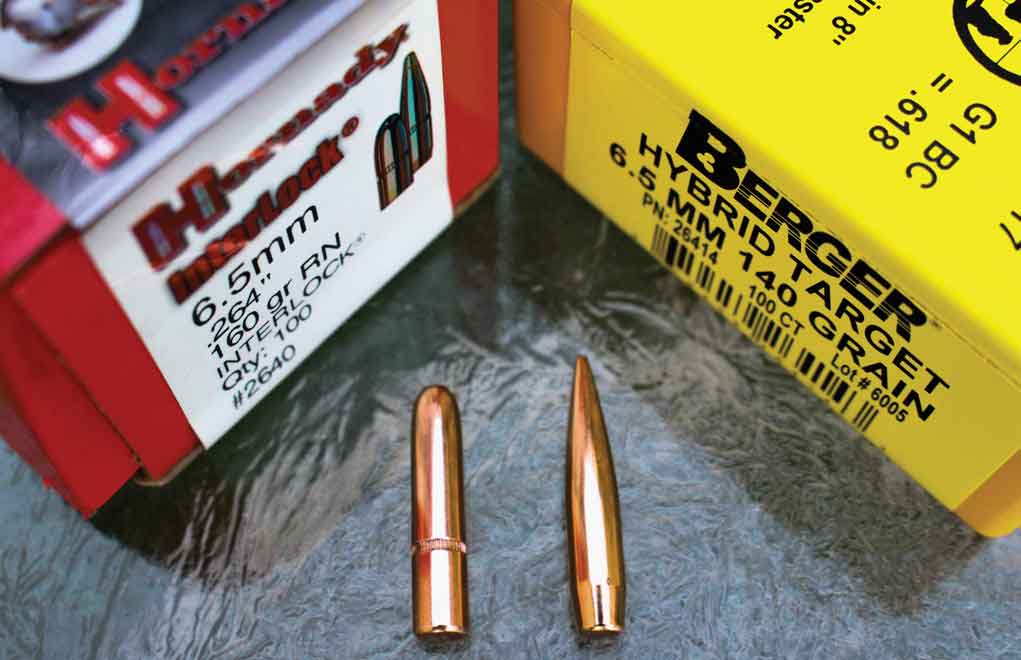
Two 6.5mm bullets. While the heavier 160-grain (L) has all sorts of bearing surface, the sleek 140-grain bullet (R) has less contact with the rifling in spite of being longer.
I will, however, start to consider the correlation between the amount of bearing surface that the “accurate” bullets in a particular rifle possess, and how that relates to the powder charge used. It’s an interesting experiment in any rifle, and while each barrel seems to be as unique as a fingerprint, I’d be willing to wager that the correlation can be used to solve some accuracy problems in the future.
Editor’s Note: This article originally appeared in the February 2018 issue of Gun Digest the Magazine.
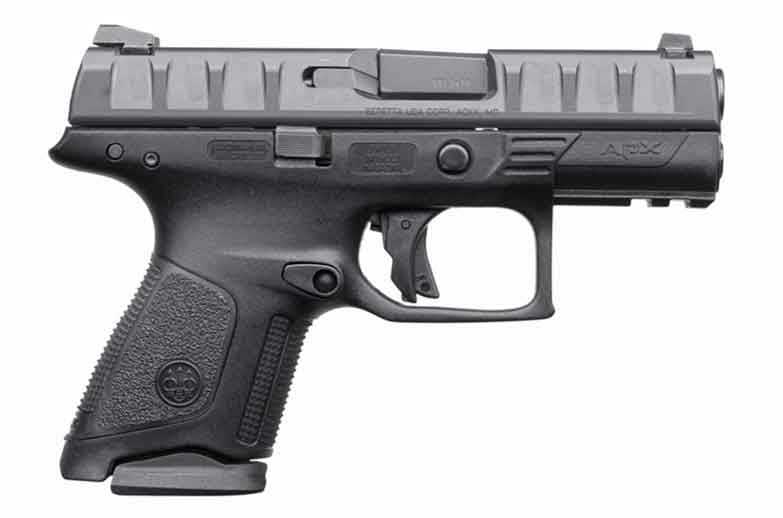
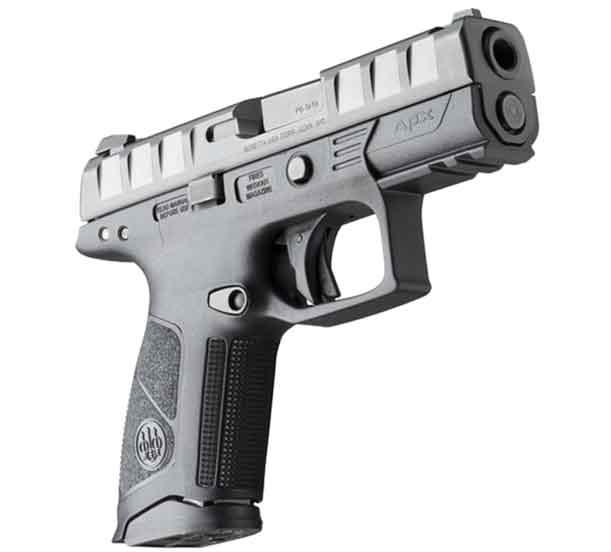
Beretta aims its modular pistol line at the concealed market with the introduction of the APX Compact and APX Centurion.
What the compact and mid-sized pistols bring to the table:
The new pistols are the compact and mid-sized variations of duty-sized APX.
Both pistols have 3.7-inch barrels and are available in 9mm and .40 S&W.
The difference between the APX Compact and Centurion is height and capacity.
The Centurion measures around .20 inches in height over the Compact.
It also has two more rounds of capacity in 9mm and three more in .40 S&W.
Both pistols have an MSRP of $575.
A few years back, Beretta broke with tradition to create its first full-sized striker-fired pistol. The Italian gunmaker had good reason to turn its attention to the dominant firing system of modern handguns with the creation of the APX — the U.S. Military. The polymer-framed semi-automatic was an entry in the U.S. Army’s Modular Handgun System trials and the company’s bid to continue producing the military’s service pistol, a role it’s filled since the early 1980s.
APX Compact
Fast-forward to today, Beretta is not in the Army’s holsters. That honor was filled by SIG Sauer’s P320, champion of the trials. Despite finishing in the field, the APX has still been a winner for Beretta. The well-thought-out pistol has curried favor in the civilian market and is likely to continue capturing hearts and minds with the introduction of two new models — the APX Compact and APX Centurion.
The compact and mid-sized variants both come in with an MSRP of $575 with the Compact presently available and the Centurion due for sale late in June. Plain as day, this is Beretta’s play at the striker-fired carry market with 3.7-inch barreled pistols better proportioned for concealment than the duty-sized APX. And while the APX Compact and Centurion appear to be dead ringers for each other, they have a notable and important difference in both height and capacity. With a flush-fit magazine, the 4.8-inch APX Compact holds 13+1 9mm or 10+1 .40 S&W. On the other hand, the 5.19-inch Centurion has a bit more capacity with a flush-fit, 15+1 9mm or 13+1 .40 S&W.
APX Centurion
These facets are certain to play a role in many shooter’s decision-making process, particularly those whose carry profile demands the utmost concealment considerations. But Beretta has made it fairly easy from there since the modular handguns are twins in function.
The new pistols both boast the features that made the APX popular in the first place, including aggressive cocking serrations across the length of the slide, 6-pound trigger with tactile and audible reset, removable serialize chassis (grip-frame housing is replaceable), ambidextrous slide catch and reversible mag release. Beretta offers a number of color options on the replaceable APX grip-frame housing, including Flat Dark Earth, Wolf Grey, Black, and Olive Drab.
For more information on the APX Compact and APX Centurion, please visit: www.beretta.com
Full-sized pistols have a distinct advantage for training, particularly for beginning shooters.
The story is common. A new shooter goes to buy his first defensive handgun with a blurry idea of what he wants and needs. A few slick smiles by the salesman and a haul-truck worth of his personal opinions later and the shooter walks out with a firearm they’ll eventually find doesn’t work for them.
A stereotypical example: women getting steered toward lightweight, hammerless double-action revolvers for their first defensive gun. It’s a more than viable self-defense option, no auguring that; but with a long trigger pull and tendency to buck more in the hand, it’s perhaps not the ideal starter gun for an armed citizen.
Michelle Cerino goes out of her way to urge students to find the gun that fits and works for them, whatever that make and model might be. Of course, that means shopping and testing them out. But the shooting instructor at and president of the Chris Cerino Training Group urges her students — particularly beginners — to go big when they come to her class. In short, beg, borrow or buy a full-sized pistol. It might sound counterintuitive, particularly in the day and age when concealed carry reigns supreme, but Cerino is shooting straight.
For the most part, a full-sized pistol is easier to manipulate, given its ample slide real estate. It has a better sight radius, in turn, it’s easier to determine proper sight alignment. And its extra weight tamps down recoil, making a long day running defensive shooting drills a whole bunch more productive for those not use to range time measured in hundreds of rounds.
In the long run, a full-sized pistol might not be the right self-defense option for an individual shooter. But for acquiring the skills of a competent and effective armed citizen, there are few better fits.
For more information on Aguila Ammunition, please check out: www.aguilaammo.com
With six new scopes, Leupold’s VX-Freedom series has something for nearly every shooter.
The VX-Freedom series are purpose-built scopes for specific rifle platforms, calibers and applications.
They are moderately priced, the entirety of the line’s MSRPs are below $400.
The line extension includes scopes tailored for rimfires, Scout rifles and ARs among other guns.
The scopes are designed, machined and assembled in Leupold’s Oregon factory.
Optics winds in recent years have blown decidedly in the direction of long-range glass. Credit the popularity of the ever-expanding family of 6.5 cartridges and other precision calibers for the explosion of scopes engineered to go the distance and then some. While the movement to further and finer shows little sign of abating, one scope manufacturer has turned its attention in 2018 to a more traditional take on optics in its newest line of glass.
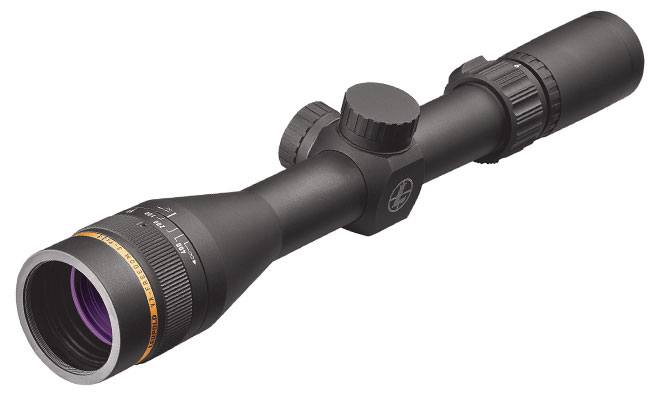
Leupold VX-Freedom Extended Focus Range 3-9×33 with Fine Duplex Reticle.
Earlier this month, Leupold further expanded its new VX-Freedom series riflescopes, adding six new optics to the 10 introduced at the beginning of the year. Similar to the earlier VX-Freedom scopes, most of the recent additions are purpose-built for specific rifle platforms, calibers or applications, including ARs, rimfires and Scout rifles. And like the inaugural scopes, the real head-turning aspect of the new optics are their extremely moderate price. The entirety of the line has MSRPs below the $400 mark, many dipping into the $250 range. To boot, they’re completely designed, machined and assembled at the company’s Oregon factory. A bonus for shooters who make it a point to buy American.
“The VX-Freedom line was designed to deliver the versatility and performance that hunters and shooters expect from the Leupold brand, at a tremendous value,” said Tim Lesser, Vice President of Product Development for Leupold & Stevens, Inc. in a press release. “We knew that, after getting a look at the VX-Freedom series, consumers would demand the same relentless value and performance from AR and Scout specific models, and we are excited that we’re able to deliver what they’ve been asking for.”
The extended lineup features two models ideal for AR/MSR platforms, a 1.5-4×20 with AR-Ballistic reticle, and a 3-9×40 with TMR (Tactical Milling Reticle.) Both feature 0.1 Mil/Click adjustments to match the milliradian increments of the reticles. Also added to the lineup is an Extended Eye Relief 1.5-4×28 Scout scope, and a close focus EFR (Extended Focus Range) 3-9×33 with Fine Duplex reticle, which is perfect for rimfires and airguns. Rounding out the new additions are a 3-9×40 featuring Leupold’s Custom Dial System (CDS) and a 450 Bushmaster model, also in 3-9×40.
Following the early VX-Freedom scopes, the new offerings have a redesigned ergonomic power selector, aggressive knurling on the adjustment knobs, a 1-inch main tube and Leupold’s Twilight Light Management System. This last feature should pique shooters interest, given the lens coating and specific design points reduces glare and enhance the scopes’ low-light capabilities.
For more information on Leupold’s VX-Freedom Series of scopes, please check out: www.leupold.com
The impressive engineering in Winchester’s Hex Steel Shot in Blind Side Shotshells delivers superior results on the hunt.
How Winchester is gleaming the cube:
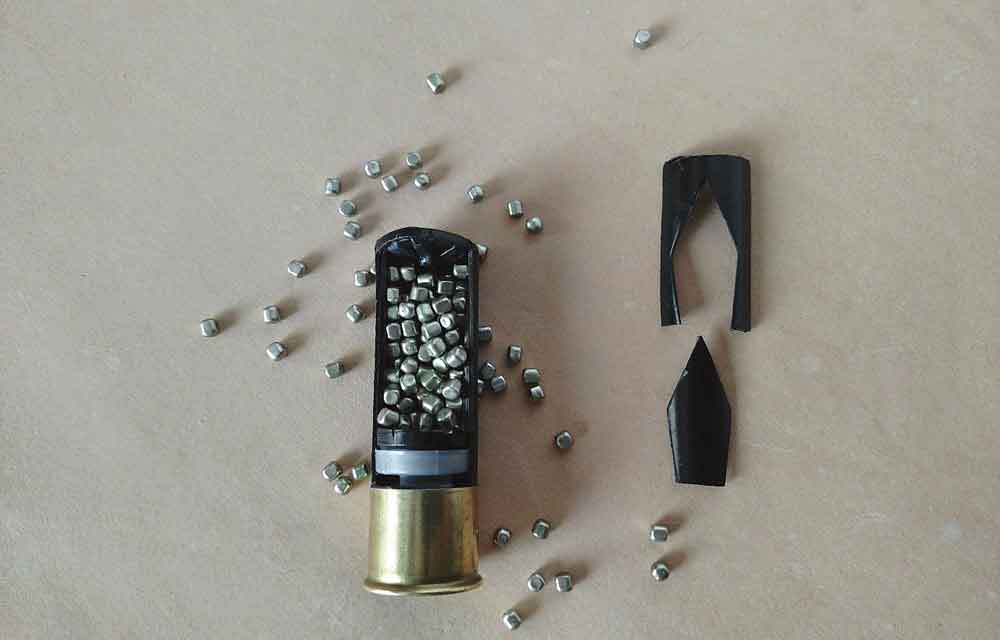
Winchester Blide Side shotshells are filled with coated Hex Steel Shot.
Hex refers to the shot’s shape — hexahedron.
The hexahedron delivers energy to a target quicker due to its flat surfaces.
They also pack tighter into a shell allowing more pellets per load.
A specially designed wad allows more powder and thus more velocity.
The extra velocity makes up for the less aerodynamic shape of the Hex shot.
On a Texas teal hunt, I used Winchester Blind Side No. 5s. Jimmy Wilson, product management specialist for Winchester Ammunition, also brought along some 3½-inchers. A couple other hunters talked about grabbing 3½s, but 3-inchers would be plenty for teal.
Blind Side shotshells caught the attention of hunters because they are filled with coated Hex Steel Shot. The “Hex” is trademarked and refers to the shape of the shot, which is not a hexagon, but a hexahedron. It’s cube shaped with rounded corners — kind of like dice — but the edges are also rounded.
The hexahedron shape delivers energy quicker because the flat surface packs more punch, trauma and wound channel than round shot. It’s like the difference between getting hit with a ball or getting thumped with a brick.
The flat surface delivers the punch on impact, acting immediately like lead pellets do, which can cause the softer lead to deform and flatten. And what if a rounded corner or edge hits first? More penetration. Either way, the teal we shot came down like they’d been hit with a ton — well, 1 3⁄8 ounces — of bricks traveling 1,400 feet per second. (The 3½-inch 6-shot shells fire 1 1⁄8 ounces of shot at 1,675 fps, so I did give up velocity with my choice.)
The cube-shaped shot also packs tighter in the hull than round shot, allowing for more pellets in a shorter shot column. The space saved allows for the unique over-powder wad, which consists of two wads connected by a hinged section. Upon firing, the hinged section of the over-power wad collapses, cushioning acceleration of the shot and essentially reducing peak pressure of the load.
“When ignition occurs, the gases start to expand rapidly; they compress that wad, and it acts like a shock absorber,” Wilson said. “We truly get the reduced pressures, which allow us to bring the pressure back up through higher velocity with the addition of more powder.”
If you’re thinking, There’s no way a cube can fly as well as a ball — you’re right — and Winchester thought of that, too. The additional initial velocity makes up for the less aerodynamic shape of the square, compared to round shot, “making up for the aerodynamic flaw of the square,” he said.
Also helping deliver the payload on target is the Diamond-Cut Wad, from which three diamond-shaped petals flap out from the middle of the wad, causing it to drop back without affecting the flight of the shot column.
Blind Side also incorporates Winchester’s Drylok Super Steel System, comprised of a sealed primer and watertight seal between the wad and hull so moisture cannot get to the powder. and spoil the round. Not that I know anyone who’s ever had to fish a shotshell out of the freezing fall slough water.
Editor’s Notes: This article originally appeared in the January 2018 issue Gun Digest the Magazine.
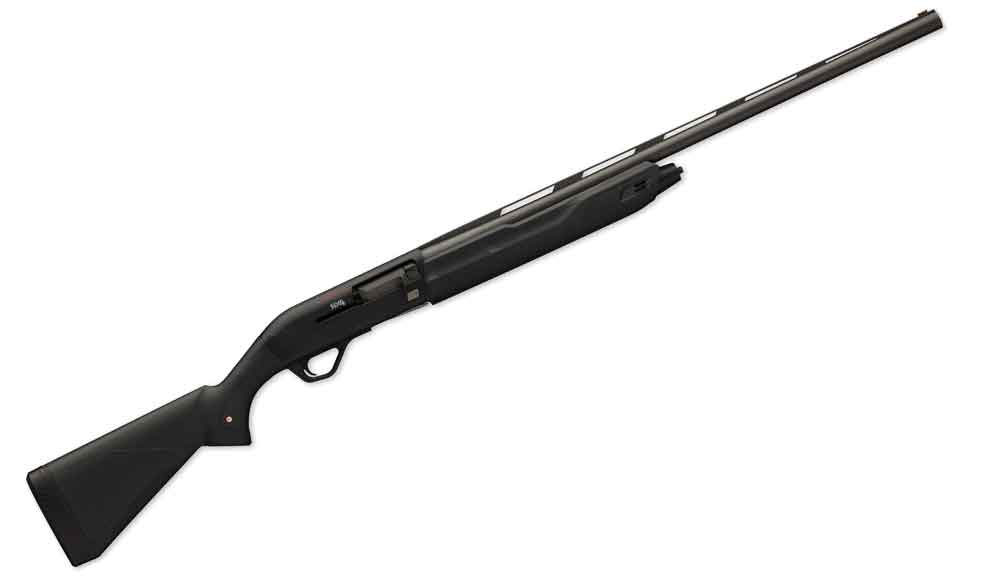
Winchester’s new Super X4 takes the manufacturer’s already great SX3 and improves upon it, offering a do-all shotgun fit for a number of shooting endeavors.
How Winchester has advanced its Super X line:
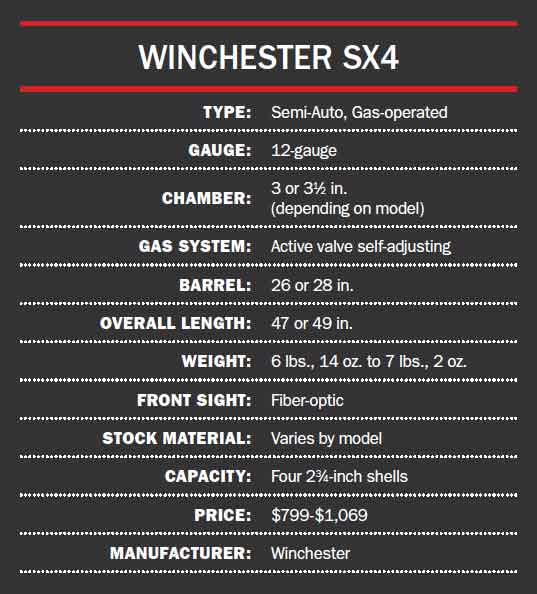
The SX4 is the next generation of Winchester’s popular Super X shotgun line.
The line of semi-automatic shotguns was first introduced in 1974.
The reliable Active Valve Gas System remains the same on the SX4.
The stock was redesigned, making it lighter and thinner.
The balance point was moved forward.
The trigger guard was made bigger as was the bolt-release button.
The gun comes with Invector-Plus in-barrel choke tubes — full, modified and improved cylinder.
Depending on the model, the SX4 costs from $799 to $1,069.
I’ll say this up front: Although I’ve shot the Winchester Super X3 several times, I don’t own one — and have never owned one — so it’s difficult to do a side-by-side comparison with the new Super X4 or to even recall it well enough to note differences in handling and performance.
Building on the success of the earlier SX3, the new SX4 is a great shotgun for any pursuit.
Of course, there are the notable improvements Winchester points out it has made between the SX3 and SX4, and I have not, with rare exceptions, found improved models of shotguns to not actually be improved to some degree in performance or design, if not both performance and design.
Let me say the same thing with different words: Usually the new-and-improved firearms brought out by manufacturers to keep up with improvements in technology (not to mention the competition) are, in fact, both new and improved. Attempts to foist little more than cosmetic changes on the more and more knowledgeable — and more and more vocal (via blogs, customer comments, social media) — shooters are usually quickly brought to light.
Field Ready Function
That said, let’s get on with it. My first experience with the Super X4 was on a duck hunt, a teal hunt near Matagorda, Texas, to be exact, and in the rush and excitement of incoming ducks and a line of hunters all rising in unison to pick out the fleeting targets it’s difficult to remain conscious of a shotgun’s performance.
However, with moderate concentration before, during and after a volley, you can develop an overall judgment of basic shotgun qualities. Namely, does it operate and handle easily and instinctively? Does it naturally and smoothly point, swing, track and follow through? Does it quickly cycle shot after shot? Does the recoil hammer you down into the mud? And, most importantly, does it cause the ducks at which it is pointed to splash into the water?
A strap of ducks hangs with decoys from a Yamaha Viking used to transport hunters and gear to a Ducks Unlimited wetlands project.
Yes on the first. The SX4 handled smoothly and was easy to operate, and it did well cycling shot after shot of Blind Side 3-inch No. 5s without fail (the real test would come later with lighter target loads, which it cycled with equal ease), and it did not pile drive me into the mud fringing the Ducks Unlimited projects we hunted.
As is often the case, recoil goes unnoticed in the heat of shooting, but I’ve had shotguns that made their presence known, particularly after firing that third shot after a rapidly climbing, retreating bird. And most importantly, on our second day’s hunt, we took a heavy toll on blue-winged teal, wrapping up our shoot in 45 minutes.
Sitting on a stick-in-the-mud seat behind a wispy cedar bush, meager cover on the edge of the wetlands, I examined the shotgun and did a few dry-run shoulder mounts to compare how it comes up when I’m not rushing to catch up with feathered rockets. It had a solid, comfortable feel, but I couldn’t quite put my finger on what the improvements could be from the SX3, so I asked Rafe Nielsen, communications manager for Winchester and Browning firearms, who had been just down the shooting line from me on both days.
Turns out, I had been putting my finger on the improvements.
Making Good, Great
The major changes weren’t internal; the Active Valve Gas System remains the central component, as it was (with tweaks and improvements along the way) for the SX2 and SX3. (The Super X’s long history started with the first model of Super X shotguns introduced in 1974. SX2 followed in 1999; SX3 in 2006, and now, the SX4, in 2017.)
The system, Nielsen said, gives you the two things you want out of a gas system: extremely soft shooting and extremely fast cycling. Because gas pressure from the shot activates the action, it takes some of the punch out of the recoil and provides fast cycling from shot to new round. “We can’t say it’s the fastest,” he said, “but it’s the fastest auto-loading gun out there.”
The redesign doesn’t tinker with the mechanics of the Active Valve Gas System, other than minor tweak improvements, Nielsen said. The SX3 “is a great-functioning gun and we didn’t want to mess with what was making it great, but we wanted to do some things to upgrade it, give it a fresh look and feel and make it relevant again to the next group of guys coming up and coming through and wanting an update. Because the operating engine is still working great, we had to look at some other pieces of the pie,” he said.
And one of the things Winchester was able to do, he said, (totally upending my next question: “By ‘updated,’ do you mean more expensive?”) was bring the price down. Taking for example the highest end model, the camouflaged Waterfowl Hunter capable of handling 3½-inch shells, they were able to knock off a couple hundred bucks, getting it under a grand at retail stores. They pulled that off with improvements to manufacturing processes, cutting parts costs — but not cutting corners. The only noticeable change is the trigger guard in that the easy-to-drop-out trigger assembly is now made of polymer, not aluminum, which he called an improvement because it’s lighter, won’t ding like aluminum and better matches the finish, especially on the synthetic-stocked models.
Improved Ergonomics
The stock has been redesigned; it’s lighter, has a thinner and textured pistol grip and forend (which is grooved for comfortable, natural finger placement), and the balance point is more forward than the SX3. It’s more ergonomic, Nielsen said, and is “a little bit more fluid swinging gun.”
With Winchester SX4 shotguns ready, the author and, in the background, Rafe Nielsen, wait for teal on a Ducks Unlimited wetland project near Matagorda, Texas.
Nielsen has been able to do side-by-side shooting comparisons. “From a personal standpoint, the SX3 is a fine gun,” he said. “I shot it OK, but I shoot the SX4 noticeably better. It just fits me better. So, outside of what the specs are, I can tell the difference shooting the two different guns and will gravitate to the SX4 every day, all day long.”
Shooters are becoming more demanding, and manufacturers are becoming more scientific, Nielsen said. Gone are the days of simple buttstock, recoil pad, forend, action and barrel, he said. Now, they are diving into how the shotgun fits and feels. With the SX4, there was a theme to build improvement upon improvement “all the way through to improve the entire gun, from recoil pad to muzzle.”
Three of those improvements I had indeed put my fingers on.
First, the bolt handle has been enlarged to make it easier to grab with cold or gloved hands. The safety, which is reversible, is also larger and, likewise, the bolt-release button has been enlarged and is somewhat recessed into the receiver so it’s easy to press yet not as likely to hit accidentally. The trigger guard is also larger, again for easier use with gloved hands.
The Inflex Technology recoil pad directs recoil down and away from your face, Nielsen said. And it has a larger footprint, so recoil is “spread out across a larger area so it dissipates more and [can] be a softer feeling gun,” he said. Also, synthetic-stock models come with one ¼-inch spacer installed in the stock for a 14¼-inch length of pull and an additional spacer in the box. Wood-stock models come with two spacers in the box.
The guns also come with a selection of Invector-Plus in-barrel choke tubes — full, modified and improved cylinder. When I asked Nielsen about extended-length tubes, he said they have found most shooters interested in switching choke tubes have aftermarket favorites, and there’s no point second-guessing them; therefore, they outfit the shotguns (other than sporting clays models, some of which come with specialty Briley tubes, and turkey models with a specialty turkey tube) with three perfectly functional options.
Currently, the SX4 is available in camo Waterfowl Hunter versions, black synthetic and wood-stocked Field and Field Compact models. In 2018, Winchester is slated to add Universal Hunter, Cantilever Deer and National Wild Turkey Federation Turkey models.
Though Winchester makes all these models, it knows “most people are going to buy one gun,” Nielsen said. “They’re going to use it for the specific purpose they buy it for, so if they’re pheasant hunters, they’re going to buy the wood or synthetic version; if they’re duck hunters, they’ll buy the camo version, and then they’re going to use it for everything from the trap field to everywhere they go. This is going to be their go-to gun.”
Editor’s Notes: This article originally appeared in the January 2018 issue Gun Digest the Magazine.
Looking to go armed, but are stuck in the weeds as to what to arm yourself with? Here are 20 of the best concealed carry gun options that will keep you on the defensive.