Home Blog Page 20

5.56 NATO: The Girl Next Door

1

Just like the girl next door, 5.56 NATO had it all along and you just couldn’t see it.

One of the interesting parts about being a gun writer, in particular for these esteemed pages, is that I get to see some of the interesting behind-the-scenes stuff that goes into creating new guns and ammunition. However, one of the main things that a good gun writer does isn’t just hyping up the latest gear. Instead, it’s looking at what we already have … and what we may have taken for granted in the fray of a heavily commercialized industry.

As a result of my station and the barrage of new cartridges, I often get drawn into the conversation: “Do you think 5.56 NATO is going to get replaced by this or that?”

Well, if you look at what has happened and what likely will happen, the 5.56 has objectively wiped the floor with virtually all rifle cartridges in overall popularity, and it’s substantially better than its reputation would suggest.

Let’s look as to why this little cartridge is, and shall remain, the most popular in America.

The Girl Next Door

Conversations surrounding the 5.56 NATO (and .223 Remington, I will spare you the technicalities here and just refer to them as the same thing because, in all reality, they nearly are to end users) have come to be centered around just how bad it is and what needs to replace it. I recall reading articles in gun magazines when I was in high school about how the 5.56 wasn’t performing in Iraq and Afghanistan; people wanted something better, and there needed to be mass replacements for anything else.

Yet, for all this, the failure points identified were completely arbitrary—and even completely irrelevant. The big one was, “Well, it can’t stop a car easily,” or “It won’t bust an engine block.” As if any small arms cartridge was going to be objectively good at this that fits in an AR-15 frame. Then, we had the “enemy fighters are being hit XX times and keep fighting” trope that lasted a while.

ar15 lower with magazine
The AR lower, a set of particular dimensions that determines if a cartridge will be commercially viable … or not.

But, right at the same time, the 77-grain 5.56 loads in the MK12 were apparently laying waste to thousands of enemies per hour. Hell, we couldn’t dig graves fast enough. While this is an exaggeration, at the time this level of cognitive dissonance was absolutely present, and it has stuck with us into the modern day. The 5.56 was always pretty good, bullet choice being the most important part of the equation. Bear in mind, we had 7.62 NATO this whole time, yet it was only 5.56 that faced common ire.

762 nato vs 556 nato
The 7.62 NATO/.308 Win. and 5.56 NATO/.223 Rem. are the two base rifle cartridges of our modern era.

I feel the criticism of the 5.56 cartridge is based solely on having too much of a good thing, to the point that we get bored with it or lose respect for it. It’s sort of like the girl next door in a way: You keep thinking you can somehow do better, but she’s always there waiting for you when you come home.

Maybe she really had it all along and you just couldn’t see it.

The hyperbole here goes pretty hard. I can’t find a single person who wants to be on the receiving end of 5.56 despite it being often disparaged as underpowered, poor at incapacitation, too small for deer, etc. Yet, at the same time, it’s undoubtedly the most common chambering for defensive rifles, and we see it used lethally in all sides of the many horrifying conflicts we have going today—from Ukraine to the Gaza Strip and all other war zones around the world, not to mention in terrorist attacks and police interventions. The 5.56 is fielded by the majority of the world to the point that it’s even, by misadventure, a standard cartridge for the Taliban government in Afghanistan.

It’s not going anywhere, but what is it about the chambering that keeps the “replacement” rhetoric going in American gun circles? There is a simple and somewhat disappointing answer: blatant, short-term consumerism in our industry, along with the military’s material response to the last war it fought.

Hindsight is always 20/20.

The 5.56 in most all forms is absolutely lethal when it comes to killing people, and I don’t want to tone it down for political sensitivity. You’re not putting together a home-defense rifle for zombies or some fictional monster; it’s for human attackers. I dislike it when the sanitized versions of this talk have desensitized and even infantized the 5.56 into some kind of toy cartridge; it’s a fighting cartridge, and it has somehow been reduced to a high-volume plinking round that guys blow through role-playing in tactical gear.

We have, at this point, become so familiar with the 5.56 that we’ve lost perspective and respect for what it can do in the roles it was designed for … and in those it’s almost impossible to beat. It’s low recoil and great for beginners, but in reality, you don’t need to go much above it.

The beauty of the AR-15 and 5.56 NATO pairing is that it’s tremendously easy to use, and its inherent strength is that it’s lightweight, accurate and has a short learning curve. More power doesn’t always mean more performance, and that’s something that tends to go over lots of heads.

Yet, here we are, throwing more new cartridges at the wall to see what sticks.

The Limits of Invention

I mentioned above that the truth of the “replacement” matter is that of consumer interest. Designing new cartridges creates demand for new barrels and bolts, but every new rifle cartridge, no matter how great, will struggle to succeed if it doesn’t fit into the AR-15 or AR-10 magazine well, excluding things like long-action cartridges of course (but then again, those have to compete with .30-06 and .300 Win. Mag. … good luck).

ar15 vs ar10 magazine
These magazines, the AR-10 7.62 (SR25) and AR-15 5.56 set the stage for what’s considered reliable and common. If it feeds from these magazines directly, or fits in their corresponding magwells, it has a chance at commercial success.

The 5.56 will always be the baseline for all similar cartridge development. The rifles are designed around it. Mil-spec exists around it. Barrel dimensions, muzzle threads and just about everything out there is based on the groundwork of the AR-15 and 5.56 cartridge. As a result, we’re inventing things that fit in that box. The reason the 5.56 will never go anywhere is that it is fundamentally ingrained in the DNA of all rifles today and has, for the most part, been influential in the idea of mass standardization.

This type of thinking isn’t inherently wrong, but in practice it makes it so that we have a baseline and we change a few parts out to make the base gun work “better” in certain roles that demand specialization or standardization. Yet, the baseline is still acceptable and, in many cases, preferable. There’s little that the 5.56 can’t do in practical terms, but there are things we want the base rifle to do a bit differently.

556 nato vs 300 blk vs 338 ARC
The 5.56 next to the brand-new .338 ARC and .300 BLK. The 5.56 is the most successful supersonic AR cartridge, and the new generation of subsonic offerings is sure to separate from the herd in terms of utility.

A good example of this is the .300 Blackout, and even the new .338 ARC. The 5.56 can’t really do subsonic well, so AR-based subsonic cartridges take this role. I like to see this innovation happening: a non-competitive, specialized round that doesn’t pretend to play in the 5.56’s backyard. Doing so is a sure way to struggle, because the 5.56 has most bases covered in the supersonic arena.

The Struggle is Real

Let’s look into why other rounds have a hard time competing in the supersonic range.

We’ve come very far with development in terms of what the 5.56 can do. Indeed, the 77-grain Black Hills MK262 is extremely hard to beat unless there are special-use circumstances. We have in the ARC cartridge family some real, interesting design, and Hornady has been doing a tremendous job in this respect.

556 nato projectiles
Bullet choice in 5.56 is of paramount importance. This issue alone has led to numerous reputations, both positive and negative.

I was skeptical about the success of this cartridge family given that, in the early war years, there were significant and loud voices crying out for the adoption of “better” rounds like 6.8 SPC and 6.5 Grendel. These rounds existed for a while and managed to be at least somewhat popular, but ultimately their success was short-lived, as better bullets were introduced in 5.56. The bloodline of the 6.5 Grendel was ultimately continued with the ARC family. There are now several cartridges that work in the AR using 6.5 Grendel mags and bolts, making it a viable alternative to the 5.56 family that shares the same mags and case heads.

case head diameters
Three common case head diameters that most common rifles use—the common 5.56 diameter also used by .300 BLK and .350 Legend, the Grendel diameter shared by the ARC family, and the .308 case head, common to everything from 30-06 to .243, 6.5 CM, .450 Bushmaster and so many more.

The 6.8 SPC never really caught on like it should have, but it was something of a bastard child because it didn’t have the weight savings and low recoil of 5.56, or the low cost of 7.62x39mm, making it a good idea with little room for further development. For medium game, it was at least somewhat better than 5.56, but the jury remains out considering there wasn’t much development in the lightweight .270-class bullets that it needed by the time it began to fall from manufacturer sheets. While it could be argued that it was objectively an improvement over 5.56, there was no room for it considering that it didn’t do much better overall than 5.56—and at the same time falling well short of 7.62 NATO performance.

The ideas behind other well-designed cartridges, like the .224 Valkyrie, were also somewhat similar in that its mistake was being .22 bore. The ARC family addressed this by introducing a .22 bore addition after they had success with their 6 ARC, all of which made use of the 6.5 Grendel magazine and bolt. The .224 Valkyrie uses the 6.8 SPC mag, making it harder to find and more expensive given the lack of the parent case’s popularity.

556 nato vs 224 valkyrie vs 350 legend
This image displays a disaster of common sense, the notable .224 Valkyrie is by all means a more technologically advanced cartridge, but the regressive design of the .350 Legend has enjoyed enormous popularity. The .224 struggled against the 5.56, both being .22 caliber.

An interesting outlier is the .300 AAC Blackout, a round that’s not all that great, but it met a specific need at a specific time … and it helped usher in the modern suppressor era. While it was originally intended for shorter barrels in subsonic form, the majority of rifles made for it today are 16 inches. As a result, it has a wide range of supersonic options available that do perform quite well, very much in 7.62x39mm territory for energy and velocity, if not a little on the lighter end.

300 blk projectile comparison
The .300 Blackout is available in numerous forms and enjoys a wide range of .30-caliber projectiles. It doesn’t pretend to be 5.56, and as a result it has survived where others couldn’t.

It would be uncouth to give credit to AAC for this round; JD Jones had the .300 Whisper well before it and the AAC variant was just a better marketed version of what already existed. The .300 BLK met great success because it didn’t try to best the 5.56 in the supersonic arena, instead offering a base-gun alternative for short barrels and subsonic speeds using the same bolt and magazines. It’s only a barrel change on the base 5.56 AR-15.

straight wall hunting cartridges
Straight-wall case cartridges are common in restricted areas. These work in the AR-15, but overall are less efficient and higher recoiling than bottleneck cases. Their survival depends entirely on the legal framework of hunting zones.

We see other commercial success is in the rounds made to adhere to legal regulations in certain hunting areas that require straight-wall cases. These rounds are an intentional handicap to the hunter: There’s no objective benefit in terms of ballistics, and it could be argued that they are unethical in practice due to a deliberate rejection of efficiency in trajectory. Taking a mature, modular and advanced platform like the AR-15 and making it work with 19th century case designs in order to make some know-nothing bureaucratic stooges feel “safer” about Elmer Fudd shooting Bambi is why we have these rounds at all.

History Repeats Itself

The 5.56 isn’t going anywhere anytime soon, especially given the foothold it has with military use. In many ways, we’re bearing witness to the same situation we always have in terms of fighting rifles: The new bi-metal case 6.8 cartridges and corresponding large-frame rifles are large and heavy. While extremely advanced, the weight factor and subsequent lower number of rounds that can be carried echoes the same concerns the American military faced in the jungles of Vietnam. People love to disparage the M14 because it was a rifle built from lessons learned in the previous war, yet here we are … doing essentially the same thing.

The thing is, the benefits of the 5.56 haven’t changed at all, and the demands it fills are still relevant. System weight, manufacturing support, spare parts and many more concerns will always exist. And while the new rifles are quite interesting and boast impressive features, I doubt it’s even possible to dump the 5.56 considering that our small arms technology is nearing a century old. The M2 machine gun is going to stay, same with old tech like the 9×19 cartridge, .50 BMG, 7.62 NATO and more.

Some things will of course change, but from a standpoint of practicality, we will not so much replace as much as we will keep adding to what already exists. In the next decade, there will be more military cartridges in more guns, not less.

To close, it’s always speculation that a certain cartridge will ‘kill’ another one. The 9mm versus .45 ACP debate will still be raging in 100 years. Likewise, the .308 Win. never went anywhere … despite it being “unseated” by 6.5 Creedmoor. In fact, .308 Win. is again rising in overall popularity, as 6.5 CM has slowly fell from favor in long-range competition.

65 creedmoor vs 762 nato
What was once a rivalry is now a brotherhood. 6.5 Creedmoor failed to unseat .308 Win. in popularity long term, but the two now occupy many a gun safe together, each valued for their respective strengths.

Deeply ingrained, established rounds like the .308 Win/7.62NATO, 9mm, .45 ACP—and 5.56 NATO—will never fade out in America in any of our lifetimes.

Editor's Note: This article originally appeared in the January 2025 issue of Gun Digest the Magazine.


More On 5.56 NATO:

New Guns And Gear December 2024

0

Looking for a new iron or piece of kit to enhance the one you already own? Check out these 7 new bits of guns and gear to grow your firearms wish list.

The New Guns And Gear:

Kimber CDS9

Kimber
As a successor of Kimber’s KDS9c family of pistols, the CDS9 looks to continue to give armed citizens the best of both worlds. Not only does the all-metal, micro-compact 9mm offer up the time-tested design of the iconic 1911, but it does so in a modern package with all the bells and whistles you’ll find on a polymer striker-fired gun. Of all its assets, the hammer-fired single-action weight is among its most attractive, tipping the scales at only 21.8 ounces—perfect for EDC. Additionally, the CDS9 features an accessory rail, ambidextrous safety and mag release and, to top it all off, it’s optics-ready. Plus, 10-, 13- and 15-round magazines are standard.
MSRP: Starting at $1,075


Gemtech Direct Thread Abyss and Neutron Series Suppressors

Gemtech Abyss
Funny as it might sound, direct-thread suppressors are making a comeback. No, QD systems aren’t dead. As a cheaper overall package, one that’s lighter and offers the flexibility of choosing your mounting system, makes the DT option more attractive to shooters. Gemtech has been sensitive to this trend, releasing its Abyss 5.56 and 7.62 and Neutron 7.62 series cans in direct-thread models. Known for their durability and performance, the cans should turn heads—particularly for those looking to get into suppressors economically but haven’t settled on a mounting system. Moving the lines this way also gives shooters plenty of options, with the Abyss offer-ing a heavy-use suppressor that does a number on back pressure and the more balanced Neutron, which offers superior performance in a lighter can.
MSRP: Starting at $710


Marlin 1894 Trapper in .357 Magnum

Marlin
There are few rifles as legendary as the Marlin 1894. Now, the Trapper model has been reintroduced in an all-time classic chambering: .357 Magnum. The side ejector was renowned for its strength and treasured by shooters for its solid steel top for mounting a scope. The now Ruger-made rifle offers up several other assets, including stainless-steel construction, nickel plating on small parts and classic skinner sights. In the Trapper model, the rifle has a 16.1-inch barrel with a threaded muzzle, remaining a nimble field option even with suppressor mounted. To boot, few other pistol-caliber cartridges perform better out of a long-gun than .357, making this ideal for plinking, hunting … and even self-defense.
MSRP: $1,500


Hornady HIT Target Impact Indicator

Hornady
As any long-range shooter knows, start reaching out past 500 yards and it becomes difficult to confirm a hit on a steel target—especially shooting by yourself. With this in mind, Hornady has cooked up an affordable and handy way to make sure you’re on target with its HIT Impact Indicator. Simply activated when a steel target is struck, the indicator emits a flashing red light visible to the naked eye from 1,000 yards plus. Interestingly, the flash is programmed to spell “H-I-T” in Morse code—kind of a neat way to let you know you’re dialed in. The device is compact, compatible with most stands and features a rechargeable battery that lets you always hit the range with enough juice.
MSRP: $18, pack of two


Primary Arms GLx 1x MicroPrism

primary optics
Based on Primary Arms’ popular SLx MicroPrism, the GLx 1x offers a close-quarter shooter a definite leg up from its predecessor. First and foremost, PA has outfitted the optic with a larger objective lens, giving it greater light-gathering capabilities. To this, the company has also widened the eye box, making eye alignment faster and reducing eye strain on longer shooting sessions. Furthermore, with unlimited eye relief—and multiple mounting systems—the GLx offers nearly unlimited configurations and facilitates nearly every shooting position. Available in both red and green illumination options for its etched ACSS Cyclops reticle, it also gives an incredibly clear and accurate sight picture.
MSRP: $300


Springfield Armory XD Mod.3 OSP 9mm

Springfield
The XD soldiers on. One of the most popular striker-fired pistols of the past few decades has continued to adapt to shooter preferences with the release of the Mod.3 OSP. The 9mm builds off the success of preceding models but offers some much-appreciated features modern handgunners look for. A-No. 1 is a factory-milled slide, making the pistol optics-ready, and compatible with RMR, DeltaPoint Pro and Docter footprints. To this, Springfield added greater control to the slide, with a unique dual serration pattern both fore and aft. It also has improved texturing on the grip, giving supreme control over the 4-inch barreled pistol. Shipping with both 16- and 10-round magazines, it also has enough on board to handle most situations.
MSRP: $325


Weatherby Mark V Backcountry Guide Rifle

Weatherby
Tramping the hills for a once-in-a-lifetime trophy requires more than your average hunting rifle. These adventures call for an iron that’s light, intuitive and, above all, accurate. The Weatherby Mark V Backcountry Guide checks off all these boxes. Tipping the scales at an incredible 5.1 pounds, the rifle is engineered to create little burden on your way to that prime ridgeline. This is thanks to its ultralight carbon-fiber Blacktooth Stock, which features the advanced Spartan Precision carbon-fiber bedding block. Weatherby then adds a BSF carbon-fiber barrel, offering both weight savings and accuracy-enhancing rigidity to the rifle. Then, the company tops it off with a TriggerTech adjustable trigger, to guarantee a crisp and on-target break when it matters most. There are a ton more, but, suffice to say, these alone more than make the rifle on-target.
MSRP: $3,300

Editor's Note: This article originally appeared in the December 2024 issue of Gun Digest the Magazine.


Get More Guns And Gear:

Are Heavy Target Rifles Overkill For Backcountry Hunting?

2

Hunting in the Santa Fe National Forest North of the Valles Caldera National Preserve, I was in hot pursuit of elk. My scouting efforts had proved fruitful, locating elk herds feeding in the meadows and on the ridges. Weeks later, when it came time to hunt, the drought had scattered the animals into small herds, which held tight to the trees, even at dusk and dawn. I’d planned to hike several miles and glass the canyons and meadows from multiple vantage points, and I was prepped for a long-range shot.

gun digest 2025
This article is an excerpt of Gun Digest 2025, 79th edition.

Attached to my pack was a custom Tikka T3 chambered in 6.5 PRC with a heavy barrel, MDT XRS Chassis, Tract Toric UHD 4-20x riflescope, and suppressor, the ideal setup for longer shots. On day one, after 14 miles of hiking and glassing numerous valleys and canyons, I didn’t see a single herd of elk save for the occasional one I jumped in the oak scrub or aspens. While quietly creeping through the bush, I would hear a commotion as a lone elk would run through, giving me mere seconds to acquire a target and try for an ethical shot. The animals were usually within 50 yards. However, I could not swing the bulky rifle and acquire a target quickly enough, even with the scope dialed down to 4 power. This trend would repeat itself.

target rifle for hunting 2
The author’s custom 6.5 PRC Tikka T3 with a SilencerCo Harvester EVO suppressor, Tract Toric UHD scope and MDT XRS Chassis System is excellent for long-range shooting but a tad heavy for over 20 miles of hiking.

After walking nearly 30 miles, I wondered if I was taking too much rifle and scope into the wilderness. Walking back to my SUV in the dark, I spent hours contemplating something like an AR-15 6.5 Grendel build with a 1-8x low-power variable optic (LPVO) or even a lightweight bolt gun with a simple red-dot for hunting the bush.

Fast-forward a few weeks, and I was chasing mule deer in the Lincoln National Forest, carrying the same rifle. The terrain was rugged and rocky and had a mixture of cedar, piñon, and juniper trees. After a 6-mile hike, my hunting partner, Mark, and I came across a herd of bucks grazing on the side of a mountain. Using a small pine tree as an improvised monopod, Mark harvested an excellent buck at 270 yards. While walking along a ridge line the following day, we found a small group of deer, and I shot the lone buck at 140 yards.

From the shadows, I took a seated position, deployed my MDT Triple-Pull CKYE-Pod bipod, settled in, found my target, exhaled and sent a 147-grain Hornady round into the cranial vault of the cervid. After securing the rifle, saying prayers and doing a quick photo shoot, we harvested the meat using the gutless method and hiked back to the truck. Before we hiked out, I took out my rangefinder and ranged the surrounding hills and peaks. Conceivably, my farthest shot would have been 400 yards. Once again, I wondered if I was taking too much rifle into the woods.

The Journey

My journey into long-range shooting started around 2010 when I picked up a Remington 700 SPS Tactical to get a handle on the coyote population at the family ranch in Central New Mexico. Since then, I’ve devoted significant time to mastering precision rifle shooting, and I will readily admit that I see all aspects of shooting, even pistol, through the lens of ultra-precision. I regularly train to 1,000 yards and occasionally shoot steel to 2,500 yards if testing a new cartridge or long-range shooting technology.

Though I don’t see myself as a long-range hunter or advocate for long shots on large game, the mastery of a precision rifle and the ability to hit targets at long distances increases confidence. It familiarizes you with all aspects of your rifle system and ancillary gear. The ability to hit targets at medium and long range is a valuable tool in your hunting toolbox. Is a trophy buck standing broadside at 500 yards? Get prone, acquire the range and atmospheric data, and send it. Hit an animal at 300 yards, then have it reappear at 600 yards on the adjacent canyon? Consult your ballistic calculator and send a round with confidence.

I spent years shooting varmints and steel targets at long range before getting serious about hunting big game. Initially, I was obsessed with having a match-grade rifle capable of shooting at least a ½-MOA group. These rifles were usually mated to a Modular Driven Technologies or Kinetic Research Group chassis system and typically weighed around 12 to 14 lbs. The rifles would have a heavy barrel and a large, high-magnification riflescope. I typically used rounds with a high ballistic coefficient, like the 6.5 Creedmoor or 6.5 PRC, and the rifles were capable of sub-MOA groups. How did I manage to lug the weight on long hikes? Fitness, a stable pack and a good sling helped immensely, though admittedly, after three days into an elk hunt, a heavy rifle was only fun if you had an ATV or horses. 

After my elk and deer hunt, I thought about every large game hunt I had been on or guided. All of the deer I have harvested have been within 200 yards. Most of the engagements were quick: I spotted the animal, steadied myself, and took a well-aimed shot from a tripod, trekking poles, or the kneeling position. I assume animals have insanely good vision and sense of smell, but I am astounded by how close I have gotten to deer and elk while hunting.

target rifle for hunting 1
Early morning pronghorn antelope hunt. Heavy rifles are excellent for precise shots prone or off tripods.

Varmint hunting is a different story. I’ve shot prairie dogs and coyotes between 600 and 800 yards. The most incredible shot I attempted was on a coyote at 1,820 yards, though I missed it by mere feet. The antelope hunting clients at our ranch, whom I formally trained in precision rifle and had Kestrel ballistic calculators with data confirmed to 1,200 yards, have made some great shots. However, the farthest to date was 450 yards, a perfect broadside shot with a 6.5 Creedmoor that instantly dropped that animal. Depending on the time and terrain, I will always try to get closer; I have just never had to.

Long-range shooting and precision rifle competition have created many new hunters who often carry something analogous to their competition or long-range rig, which is how I came into the sport. This leads me to ask: Are some sportsmen taking too much rifle into the woods? Do we need the high magnification scopes, 24-inch barrels, and the new-fangled high-BC bullets? On a more personal note, do I need the heavy barrel, suppressor, chassis system, and insane accuracy? Let’s explore these questions.

Barrel Length and Weight

For this section, we’ll consider anything below a 20-inch barrel to be a short barrel. There are zero questions about it: A long barrel on a rifle is awesome. It maximizes velocity and kinetic energy and flattens trajectories at typical hunting ranges.

Rifles with sporter or thin-contour barrels don’t weigh much. Still, they can have high accuracy when paired with the correct factory load or handload. When shooting groups with an accurate sporter barrel, I can get two rounds to touch, and then the third shot is usually .50 to 1 inch from the first two holes. I’ll let the rifle cool for 10 minutes, then shoot another group. This will play out multiple times before I consider the rifle zeroed. (If you put a muzzle brake on a rifle, hearing protection is mandatory since the sound directed toward the shooter will cause permanent hearing loss, even after one shot.) 

target rifle for hunting tripod
Are sporter-weight barrels accurate? This Howa 1500 mated to a KRG Chassis System is one of the most accurate rifles the author has ever seen. It’s capable of stacking 143-grain Hornady ELD-X rounds through the same hole. His goddaughter is getting ready to harvest a pronghorn antelope at 556 yards

Heavy varmint or match barrels have excellent harmonics and, when paired with the proper ammunition, can usually shoot very tight 3- or 5-round groups. They’re purpose-built for accuracy but heavy. A rifle with such a barrel is fine for backcountry hunting if you have mobility platforms like e-bikes, horses or ATVs. The weight can mitigate recoil, though I still like a brake for spotting hits and fast follow-up shots. Heavy barrels are super easy to zero. I’ve hunted with heavy 16- and 20-inch barrels, which are awesome to pair with a suppressor.

In theory, a carbon-fiber-wrapped barrel offers the best of both worlds. It features a thin barrel wrapped in carbon fiber, and manufacturers claim it can produce results typical of a heavy contour with reduced weight. My experience with carbon-wrapped barrels has been hit-and-miss. Some shoot excellently with factory ammunition, but when you add a muzzle device, groups open up like crazy. Tuners and handloading are a good idea if you’re considering one.

Whether you have a thin sporter or heavy barrel, how much length do you need? To answer this, ask yourself a few questions. What kind of zero do you use? For example, do you zero at 100 yards and dial or use a reticle for longer shots? Do you zero 1 or 2 inches high at 100 and point and shoot out no farther than a determined range, such as 300 yards? A long barrel is advantageous if you use the latter because the high velocity will give you a flatter trajectory.

If you zero at 100 yards, dial or hold your shots in your reticle, understand how to use a ballistic calculator, and confirm your data at the distances you intend to harvest animals, barrel length doesn’t matter as much. What matters is that you have enough energy and velocity to dispatch your quarry ethically.

Short Barrels

Modern hunting bullets need a certain velocity to expand reliably, causing crush injuries that damage an animal’s organs, circulatory and nervous systems. Your bullet’s kinetic energy when making contact with the animal is also vital. How much velocity do modern bullets need to expand reliably? That will vary by manufacturer, but modern hunting projectiles usually need a minimum of 1,700 fps to expand reliably. Though up for debate, a minimum of 1,000 ft-lb is a decent amount of energy for deer-sized animals and at least 1,500 ft-lb for elk.

Energy and velocity aside, an important variable is shot placement. This became apparent when I saw a video of my buddy dropping a bull elk at 600 yards while using a 6mm Creedmoor match round fired from his PRS competition rifle. It was a perfect shot through the heart. Do most hunters have the skill, training, and gear to make perfect shots at 600 yards? Probably not. Another variable to contend with is wind, which can be hard to ascertain in certain locations. Also, large game animals are tough and adapted to harsh climates and predators. They are an amalgamation of sinew, bone, water, muscle and hide.

Sometimes, bullets don’t perform like they should, especially when they contact bone. Shot placement is critical, but it’s nice to back it up with a fast bullet and kinetic energy. With that said, when I run the numbers on my ballistic calculator to determine the performance of a cartridge, I like 1,800 fps at a minimum and 1,000 ft-lb for deer-sized animals. Now that we have established a baseline for velocity and energy, let’s look at barrel length, specifically short ones.

I appreciate short barrels for my ranch and hunting rifles. They are handy, compact and easy to carry. Since I often hunt with suppressors, starting with a shorter barrel doesn’t substantially increase the overall length of my rifle system. Suppressors mitigate recoil and allow me to hunt without hearing protection.

I’ve always liked short barrels due to their compact nature and accuracy. Still, several years ago, I cut one of my Howa 1500 barreled actions chambered in 6.5 Creedmoor down to 16 inches and was curious about its external ballistics. After running some Hornady 143-grain ELD-X Precision Hunter rounds through my Labradar chronograph, I recorded an anemic average of 2,498 fps. Plugging the data into my Kestrel anemometer, I was surprised by the numbers. Even with the low muzzle velocity, I had 1,800 fps and 1,082 ft-lb of energy out to 800 yards. I would never shoot at an animal at that range, but even at a realistic distance, like 500 yards, I had 2,078 fps and 1,372 ft-lb of energy.

Regarding long-range shooting, some bullets can lose gyroscopic stability at the transonic range, which starts at around 1,350 fps. My Kestrel told me I could expect decent performance from my weapon system out to 1,500 yards at my density altitude. To test it, I proned out and easily got a second-round hit at 1,000 yards. After hitting steel at 1,000 yards, I aimed at the 12-inch steel target (on which I trued my ballistic coefficient) and had a first-round hit at 1,250 yards.

For comparison, I grabbed another Kestrel with the data for one of my .308 rifles with a 24-inch barrel. The rifle was zeroed and trued for Hornady 178-grain ELD-X Precision Hunter loads. Consulting the ballistic chart, I was looking for the 1,800 fps and 1,000 ft-lb band and found it around 800 yards. My .308 had 1,852 fps and 1,356 ft-lb of energy at that distance. Granted, it had more energy due to the weight of the bullet, but I was impressed by what a slower, higher-BC bullet could do. From this experiment, I found that a 16-inch barrel has plenty of velocity and energy for hunting shots to 600 yards. (For more information about ballistics, I recommend reading The Ballistics Handbook by Philip P. Massaro.) Now, it was time to take a deep dive into optics.

Optics

Back to my conundrum: Was I taking too much rifle and scope into the woods? To answer this question, I built the perfect rifle for hunting thick forests and aspen groves. It could also reach across a canyon and hit something at 500 yards if necessary. For the build, I grabbed an old Tikka T3 barreled action chambered in .308 Winchester, with a barrel cut down to 16.1 inches. I dropped the barreled action into an HNT26 Chassis System from MDT and attached a Tract Toric UHD 30mm 1-8×24 LPVO scope. At the end of the muzzle, I attached a SilencerCo Harvester EVO suppressor and, for added stability, the MDT GRND-POD bipod. The System as a whole weighed just under 7 pounds.

Since the Tikka had a 1:11-inch twist rate, I opted for Hornady 168-grain ELD-M bullets with a G1 BC of .523. Settling behind the rifle, I shot three rounds, made some adjustments, let the rifle cool, and then fired three more rounds. Even though I only had an 8x scope, I could shoot groups of just under 1 MOA, and the Labradar chronograph gave me an average velocity of 2,502 fps.

target rifle for hunting 4

Satisfied with my zero, I drove to the 2,000-yard range at our ranch, which had a steady left-to-right wind averaging between 12-15 mph that day. I hung a 10-inch steel gong and worked back in 100-yard increments. From 100 to 400 yards, I held in the reticle and had first-round hits on steel. My first miss came at the 500-yard line. After that miss, I dialed the elevation and made a solid hit. I dialed the 600-yard shot, had a first-round hit, and connected on my second shot at 700 yards. At 800 yards, I had difficulty seeing the target, so I ended the exercise. Consulting the range card in my Kestrel, I noted that at 600 yards, the 168-grain ELD-M traveled at 1,809 fps and had 1,221 ft-lb of energy. That’s plenty for deer, though the rifle was not intended to shoot that far.

The Hunting Test

After drawing a mule deer tag in Unit 37—where I’ve taken several nice mule deer—I was anxious to carry something other than a 12-pound rifle into the woods. I again pondered an AR-15 6.5 Grendel build with two upper receivers. One upper receiver would have a hunting scope, and the other a simple red-dot optic. However, that was quickly dismissed because of my excellent results with the Tikka T3 and the 1-8x scope. Moreover, the 6.5 Grendel is a tad light for mule deer and runs out of energy past 200 yards. Next, I pondered a Tikka T3x chambered in 6.5 Creedmoor with a red-dot sight, but the precision side of my brain insisted I take at least some magnification. Ultimately, I chose the Tikka T3 with the MDT HNT26 chassis I had built to see how far I could effectively shoot the 1-8x LPVO.

Due to my hectic schedule, I could only hunt for two days. On day one, I started at first light, creeping up a canyon with the riflescope on 1x. After several hours of careful hiking, I crested a ridge and saw a dozen deer resting in the shadows 50 yards away. I froze and slowly took out my binocular. All of the deer were doe, save for one barely legal buck. After watching for 30 minutes, I kept hunting and moved downhill to avoid disturbing them. I worked my way to the top of the canyon, where I settled on a vantage point that allowed me to glass multiple canyons. I saw dozens of deer moving to and from a spring at the bottom of the canyon, but nothing that I could shoot.

Taking out my rangefinder, I noted that the farthest deer was 400 yards away. I looked at the group through the 1-8x scope and was confident that, had a good-sized buck appeared, I could have easily harvested it with that setup. I spent the rest of the day glassing from that point and, with the sun setting, started the hike back to my vehicle.

target rifle for hunting 3
A client (face is blurred as he is active duty military and a member of the Special Operations community) with an impressive pronghorn antelope. This antelope was harvested at 450 yards with one perfect shot.

As I was hiking down, I bumped into a group of deer at 10 yards. I quickly scanned the group but didn’t see a single legal buck. I watched as the animals bounded toward the ridgeline and then paused to look back at me. I continued my journey back to my vehicle and noted how lightweight the rifle was. Had a buck presented itself, I could have harvested it with ease. Day two was nearly identical, though a blizzard drove me off the mountain. I saw many deer and one small buck that was legal, though I passed on harvesting it. I hiked 15 miles and felt great because I carried a lightweight, nimble rifle.

Several weeks later, I accompanied some friends in the Chama to pursue mule deer. Due to the terrain and foliage, we found ourselves hunting a mix of sub-alpine forests, meadows, and mixed cedar, piñon, and juniper. One group member had a Howa 1500 chambered in 6.5 Creedmoor with an Arken EPL 4-16x riflescope, and the other member carried my lightweight Tikka. The logic was that we had rifles ideal for close and long shots. Though a deer wasn’t harvested, we learned a lot and had a great time.

Looking Forward

Since I rarely hunt alone, moving forward, I think one member of the team will have a 4-16x or a 6-24x riflescope for precise shots out to 600 yards, and one will carry a lightweight, compact rifle, suppressed, with a 1-8x or 1-10x scope. Why the suppressor? When sneaking through the bush, you want to use all of your senses, and if you have an animal trotting past, you often don’t have time to put on hearing protection. Suppressors also mask your sound signature and don’t bugger up the general area after you have taken a shot.

I will use my lightweight Tikka T3 with the MDT HNT26 Chassis System, or my heavier custom Tikka T3x chambered in 6.5 PRC for all future hunting. The custom Tikka features a 20-inch carbon-fiber-wrapped barrel from Oregon Mountain Rifle Company. I adore chassis systems and will continue to use them for the foreseeable future. I will usually grab the lightweight Tikka T3 unless I’m hunting plains animals. I like the challenge of the stalk and enjoy creeping through the trees and harvesting animals up close. The lightweight rifle allows me to carry extra food and sleep systems for backcountry hunts farther from the trailhead.

It’s been challenging not taking a heavy precision rifle capable of insane accuracy into the woods. Even so, my recent hunts showed that a shorter barrel and lower magnification scope can do the job and make close-up shots. If I draw a tag this year, I will once again take a lightweight, short-barreled rifle with a low-powered variable optic. Who knows? You may soon find me hiking around the woods with a red-dot optic or open sights!

Editor's Note: This article is an excerpt of Gun Digest 2025, 79th edition.


More On Hunting Rifles:

Practical Pistol Suppression

1

For the average shooter, when and where is a suppressed pistol practical?

Movies directly influence the firearms market. In 1971, the movie Dirty Harry made the .44 Magnum revolver famous. The mention of the Glock pistol in Die Hard 2 in 1990 helped popularize those pistols. In 2014, American Sniper made everyone want a long-range rifle. And, the 1895 Marlin became famous in the 2017 Wind River film. I could go on, but I think you get the point.

Another gun-related movie influence is the suppressed pistol. Countless scenes depict assassins, special agents or tactical operatives screwing a suppressor on a pistol, giving the impression that all the cool kids use suppressed pistols.

I’m a fan of suppressed shooting, especially when it comes to hunting … and when the firearm used is properly configured for suppressed fire. With rifles, the current trend is shorter barrels to make them more suppressor friendly. The problem with pistols is that we can hardly shorten the barrels any more than they already are. This means that, for some applications, a suppressed pistol doesn’t make a lot of sense. This is especially true when it comes to concealed carry; turning a 7-inch handgun into a 13-inch handgun makes it nearly impossible to conceal or carry comfortably.

banish suppressors
Through not practical for concealed carry, a suppressed pistol can be a lot of fun on the range.

I know that it seems like all high speed, low drag, special operations units run suppressed pistols as do a lot of SWAT teams. For these operators, suppressors provide the advantage of reduced noise in confined spaces, reduced recoil permitting faster follow-up shots and a reduced muzzle signature to help limit detection and flash blindness. These are all good things, but keep in mind these soldiers and cops aren’t trying to conceal their suppressed handguns while ordering up a happy meal at a fast food restaurant.

So, for the average shooter, when and where is a suppressed pistol practical?

Facts First

Pistols—even rimfire pistols—are loud. It’s not a good idea to shoot any pistol without hearing protection. A 9mm pistol will generate about 160 decibels, and a .22 rimfire pistol will generate about 150. Anything beyond 140 decibels is dangerous to your hearing, and ideally you do not want to expose your unprotected ears to decibel levels above 120.

A good handgun suppressor can reduce decibel exposure by as much as 36 decibels, which is in the marginally safe range with both rimfire and centerfire supersonic ammunition. However, when you use subsonic centerfire and rimfire ammunition with a good suppressor, both become hearing safe and what I’d call “comfortable” to the unprotected ear.

However, there’s something other than sound that needs to be considered when it comes to suppressing a pistol, and that deals with your pistol’s sights. When you screw a suppressor on the barrel of your handgun, it’ll most likely prevent you from seeing your sights on the target. You can overcome this problem with the installation of what are known as suppressor-height sights, or a reflex sight.

Suppressed Pistol Practical Applications

We’ve already established that a suppressed pistol isn’t suited for concealed carry, but that doesn’t mean it has no place in the personal protection arena. If you keep a specific pistol just for home defense, outfitting it with a suppressor might be a good idea. It’s not a pistol you’ll need to conceal, and it’s not a pistol you’ll need to holster. Most likely, it’s a pistol you’ll keep in your bedside drawer or gun safe. In a home-defense situation, a suppressor can benefit you in the same ways it benefits military operators and SWAT teams.

For the obvious reason, a suppressed pistol can also be a lot of fun for recreational and some competitive shooting. And in most cases, it’s a great idea for a pistol used for hunting. A suppressor reduces noise and cuts down on recoil, which are two things that can make shooting a pistol—especially for new shooters—uncomfortable.

I don’t shoot suppressed pistols that often, but my wife and daughters prefer it. I do, however, keep a suppressed pistol in my side-by-side that I run the ranch with. It’s a Sig Sauer P322 that rides in a homemade holster just in front of the seat. I routinely run across vermin that need to be dealt with, and often these encounters don’t allow the time required to put on hearing protection. Having a suppressed .22 pistol handy is nice for those instances, and sometimes—just because I get the urge—I’ll stop at my range and plink off a full magazine just for fun.

Silencer Central’s Banish 45

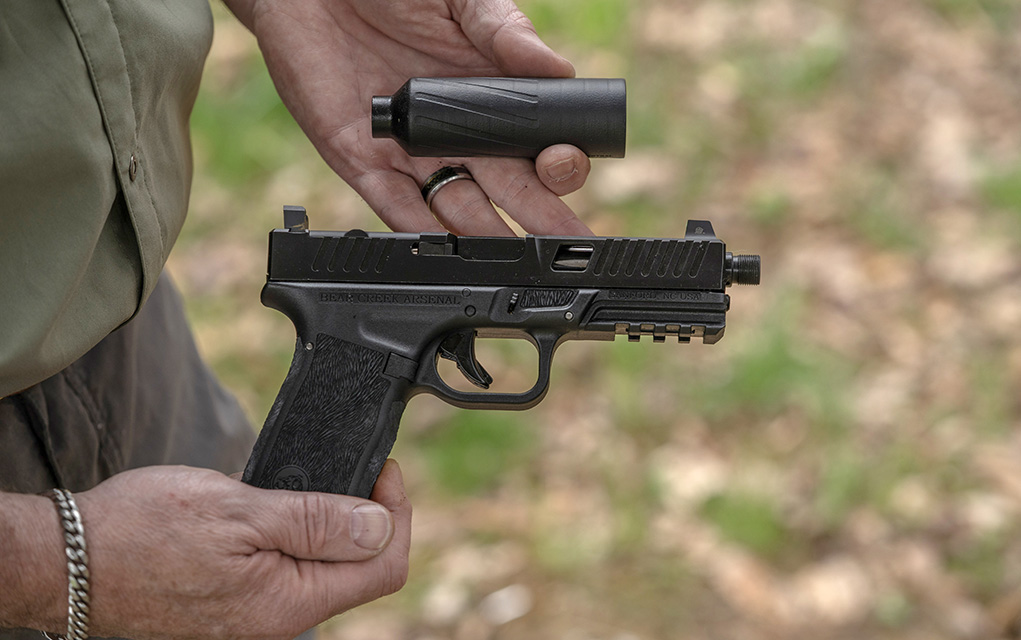
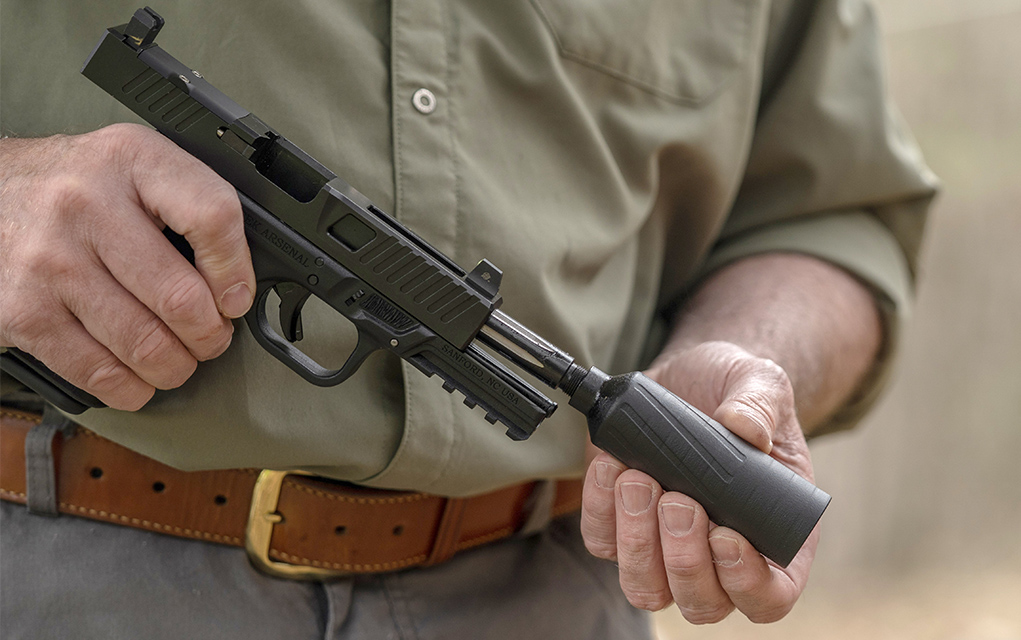
I currently own nine suppressors, but only one is designed for pistols. It’s the Silencer Central Banish 45, and it will work with any pistol from rimfire up to .45 Auto. This is a titanium modular suppressor that’s user serviceable, and it can be shortened from 8.6 inches (11 ounces) to 6.7 inches (9.6 ounces). Shortening the suppressor reduces the decibel reduction it offers, but it allows you to tune the suppressor to the size and to the amount of sound reduction you need.

banish pistol suppressor disassembled

The Banish 45 is also compatible with pistol-caliber carbines, and because it uses a unique swappable piston, you can pair it with any thread pattern. Silencer Central also offers a fixed-barrel spacer for the Banish 45 that lets you use it with fixed—nonmoving—barrel firearms.

pistol suppressor piston
The Banish 45 suppressor utilizes different pistons so it can pair with most any thread pattern and they’re easy to swap out. If you use a Banish 45 on several pistols with different thread patterns, you’ll need several pistons.

Because of the compact nature of pistols, they’re not as suitable for suppression as rifles—but that doesn’t mean there isn’t a viable reason to suppress a pistol. Clearly, if you’re working as an assassin or for some clandestine spy organization as a hitman, they make perfect sense. And, they can add enjoyment to recreational and competitive range sessions and hunting. Suppressors are also beneficial in comforting new shooters.

However, from a personal protection standpoint, a suppressed pistol is pretty much limited to home defense duty, or for use as a truck or ATV gun for the outdoorsman. Regardless of how you might like to use a suppressor for a pistol, I suggest you start your search with the Banish 45. I got no complaints with mine.

Editor's Note: This article originally appeared in the January 2025 issue of Gun Digest the Magazine.


More On Suppressors:

Hardware Talk: Gemtech Direct-Thread Rear Caps

0

Looking to easily swap your suppressor between multiple firearms? Here we take a look at Gemtech’s direct-thread rear caps.

A lot of suppressor users are not going to swap their silencer across a whole rack of rifles. Not the first suppressor, anyway. It will spend its range time on one or two—maybe three rifles—ever.

If that’s the case, there’s no reason to invest in a QD mount system. Oh, they are cool, but they cost and add weight. A typical rear cap for a quick-attach system, and the muzzle brake it fits on to, can run up to 7 ounces. 

Especially on a rifle meant for hunting, 7 ounces can matter. The old hiking adage, “Look after the ounces, and the pounds will look after themselves,” comes to mind. So, Gemtech has now made available direct-thread rear caps for their new Abyss and Neutron suppressors.

They screw into the rear HUB threads on those suppressors. The HUB thread pattern is the new universal rear design, and if you have some other brand of suppressor that uses HUB, the Gemtech caps will also work.

Product, gemtech, on white, suppressor, Lamp, Light

The best part? If you have a 5.56 rifle, and the Gemtech Abyss 7.62, the 1/2-28 rear cap puts your .30 silencer onto your 5.56 rifle. Two rifles, two calibers, for one extra $52 part.

Will a .30 suppressor on a 5.56 rifle be as quiet as a dedicated 5.56 suppressor? You’d be surprised. Plus, the Abyss is going to shrug off pretty much anything your 5.56 rifle can give it.

At the price, you would be crazy not to be able to swap your silencer around. Oh, your barrels have to be threaded, but that’s common now, and they’d have to be threaded anyway.

The big deal is cost: Compared to the $52 of one cap to fit them all, each quick-attach sept requires a muzzle device. Depending on the brand, that can be $70 to $150 for each rifle. And we’ve been over the weight, which each rifle in turn is stuck with.

gemtech suppressor direct thread mount

Now, you have to be careful. You must check alignment each time you install, because it’s prudent. And this mistake can be expensive.

Plus, there’s one more detail you have to keep in mind. Since the rear of the suppressor is the HUB thread, if you owned them you could inadvertently install the 5/8-28 rear cap on your HUB 5.56 suppressor. That would be bad. So don’t do that.

One way to avoid that is to use a paint pen, and discreetly mark your .30 and 5.56 suppressors and caps, front and rear. Say, blue for 5.56 and red for .30. The ease and versatility of the HUB design makes things simpler … but you have to be thinking.

And this isn’t just Gemtech: All suppressors using the HUB have this. So, pay attention.

But get the caps, they’re too good to pass up.

Editor's Note: This article originally appeared in the January 2025 issue of Gun Digest the Magazine.


More On Suppressors:

Best Concealed Carry Revolvers For Personal Defense [Field Tested]

8

Our current list of the best concealed carry revolvers that are more than ready to cover your six.

Semi-automatic pistols have ruled the roost when it comes to self-defense guns in recent years, but I'm a firm believer that concealed carry revolvers still hold their own when push comes to shove. The time-tested design is offered in some excellent self-defense calibers, is straightforward in operation and is as dependable as the next day’s dawn. And there are some top-notch and well-thought-out options in the revolver market tailor-made to hang ever-ready on your gun belt and deliver when called upon.

How We Chose The Best Concealed Carry Revolvers

We're fans of wheelguns at Gun Digest, and we still believe that they have a place in the concealed carry world despite the current domination of semi-autos. Between the other Gun Digest editors, our most trusted freelancers and myself, we have quite a bit of trigger time behind a variety of different carry revolvers, sending thousands of rounds down range and testing a wide swath of what the market has to offer in self-defense wheelguns. On each make/model we looked for the quality of the build, features, dependability, accuracy, concealability and price. When the dust settled these were our picks for the best concealed carry revolvers.

Best Revolvers For Concealed Carry

Best Concealed Carry Revolvers Comparison

ModelCaliberCapacityBarrel Length (in)Overall Length (in)Overall Height (in)Overall Width (in)Weight (oz)MSRP
Ruger LCR.327 Federal Magnum61.873.16.51.2817$859
Smith & Wesson PC 442.38 SPL51.886.314.31.315$849
Ruger LCRx 3-in.357 Magnum537.55.81.2821.3$859
RIA M206 Spurless.38 SPL626.754.671.524$279
Charter Arms Bulldog DOA.44 SPL52.57.385.13N/A21$453.60
Smith & Wesson 642.38 SPL51.886.314.31.314.6$539

Best Overall Concealed Carry Revolver: Ruger LCR

ruger lcr 327 federal magnum

Pros

  • Very Lightweight
  • Snag-Free Design.
  • Easy to carry and conceal
  • Good Aftermarket Support

Cons

  • Snappy Recoil In Certain Calibers
  • A Lot Of Polymer
  • Expensive

Ruger LCR Specs (.327 Fed. Mag.)

  • Caliber: .327 Federal Magnum, .38 Special, .357 Magnum, .22LR, 9mm
  • Capacity: 5 to 8 depending on caliber
  • Action: DAO
  • Barrel Length: 1.87 Inches
  • Overall Length: 6.5 Inches
  • Overall Height: 4.5 Inches
  • Overall Width: 1.28 Inches
  • Weight: 13.8 to 17.1 Ounces depending on caliber
  • MSRP: $739 to $859 depending on caliber

Outside of the cylinder, revolutionary hasn’t been applied much to the revolver since the 1830s. But there’s a whole bunch of it in the Ruger LCR (Lightweight Compact Revolver).

The diminutive five-round handgun is absolutely cutting edge when it comes to material use. Not only has Ruger turned to aircraft-grade aluminum for the gun’s frame, but also polymers for its fire-control housing. Combined with a highly fluted stainless-steel cylinder, the LCR is among the lightest guns available today—a whopping 13.5 ounces. On top of that, I find that Ruger’s friction-reducing cam system makes the LCR among the easiest double-actions to shoot well.

Per Ruger’s MO, the revolver is highly modifiable, boasting an easily replaceable pinned ramp front sight and grips. But outfitted at the factory with a Hogue Tamer Monogrip, there might not be much reason to go shopping in the latter department.

The revolver is available in five calibers, but for carry the .327 Federal Magnum would be my pick. While the ammo is a bit pricey and probably isn't stocked in most brick-and-mortar gun shops, the round punches above its weight all while fitting a sixth round in the cylinder (the .38 SPL +P, .357 Mag. and 9mm versions only hold 5). As a bonus, you can even shoot .32 S&W Long out of it for some inexpensive training or plinking fun.

Read our complete Ruger LCR review and see why it tops our list… particularly in .327 Federal Magnum.

Ruger LCR .327 Fed. Mag. Deals

Guns.com$655.99PngItem_4588935
Cabela's$679.99PngItem_4588935
Buds Gun Shop$662.28Gun Price Check

Best High-End Concealed Carry Revolver: Smith & Wesson Performance Center 442

Performance Cetern Model 442 9

Pros

  • Incredibly Lightweight
  • Easy To Carry
  • Shrouded Hammer For Snag-Free Draw
  • Comes With A Crimson Trace Lasergrip

Cons

  • Plenty Of Recoil
  • Expensive

S&W PC 442 Specs

  • Caliber: .38 Special
  • Capacity: 5
  • Action: DAO
  • Barrel Length: 1.88 Inches
  • Overall Length: 6.31 Inches
  • Overall Height: 4.3 Inches
  • Overall Width: 1.3 Inches
  • Weight: 15 Ounces
  • MSRP: $849

There are those, foolish as it may be, who think a J-frame is just a J-frame. To them, It doesn’t matter what model number Smith & Wesson slaps on one, they’re all the same. Boy howdy, what a mistaken frame of mind.

The S&W Performance Center 442 is more than proof.

Hand-assembled and tuned to perfection, the .38 Special is the epitome of a serious concealed carry revolver, a cut above most everything on the market today. Smith & Wesson has trimmed down the weight of the 442 to a scant 15 ounces unloaded, mainly thanks to an aluminum alloy frame. Yet, boasting a polished five-chamber stainless-steel cylinder, the +P-rated .38 is more than up for rough EDC treatment.

But is it on target? At 15-yards in—where it would most likely be employed—I found it absolutely accurate! Though, I'd venture this is it's limits in the hands of most shooters.

Expediting the 1.875-inch barreled gun’s target acquisition is a factory-installed Crimson Trace Lasergrip, which activates when you grip the revolver’s rounded butt. Of course, there’s a ramp front and integral rear sights for backup.

By the way, the DAO (double-action only) PC 442 comes sans an internal locking mechanism, always a plus when talking S&W.

Looking to step up your concealed carry revolver game, check out our S&W Performance Center Model 442 review and see if it's right for you.

S&W PC 442 Deals

Sportsman's Warehouse$519.99PngItem_4588935
GrabAGun$523.99PngItem_4588935
Guns.com$772.99Gun Price Check

Best .357 Magnum Concealed Carry Revolver: Ruger LCRx 3”

Ruger LCRX 357 6

Pros

  • Better Ballistics
  • Bigger Grip
  • SA/DA

Cons

  • Harder To Conceal
  • Exposed Hammer Can Snag
  • Expensive

Ruger LCRx Specs (.357 Mag. 3″ Model)

  • Caliber: .357 Magnum
  • Capacity: 5
  • Action: DA/SA
  • Barrel Length: 3 Inches
  • Overall Length: 7.5 Inches
  • Overall Height: 5.8 Inches
  • Overall Width: 1.28 Inches
  • Weight: 21.3 Ounces
  • MSRP: $859

I hate to break it to you, but size matters.

Too short in the barrel department and the better part of that powder you're burning deflagrates in thin air. All you’re left with is a heap of muzzle flash and limp ballistic performance—particularly from a big dog, such as a .357 Magnum. Hence, why Ruger’s addition of a 3-inch barreled .357 Magnum LCRx is so welcome.

Certainly, the lightweight magnum falls short of producing the velocities found out of a 6-inch revolver—but by my chronograph, not by much. Which is to say, with this LCRx you’re well-armed.

As to its extra size, especially compared to many of the other options on this list, yes, it’s larger. However, not prohibitively so. I found the stainless-steel Ruger is still extremely concealable and at 21.3 ounces unloaded is no burden at all.

True enough, it’s not as streamlined as other concealed carry revolver options. It boasts adjustable rear target sights and an exposed spur. Yet, Ruger manages to keep this all fairly unobtrusive, keeping the LCRx snag-free once you’re used to the system.

Find out why this concealed carry revolver exerts magnum force in our Ruger LCRx review.

Ruger LCRx 3-in. .357 Mag. Deals

Sportsman's Warehouse$649.97PngItem_4588935
Buds Gun Shop$662.28PngItem_4588935
Cabela's$689.99Gun Price Check

Best Value Concealed Carry Revolver: Rock Island Armory M206 Spurless

Best Concealed Carry Revolvers: RIA Spurless

Pros

  • 6-Round Capacity
  • Snag Free
  • Affordable

Cons

  • Not +P rated
  • Large For Its Class
  • Heavy For Its Class

RIA M206 Spurless Specs

  • Caliber: .38 Special
  • Capacity: 6
  • Action: DAO
  • Barrel Length: 2 Inches
  • Overall Length: 6.75 Inches
  • Overall Height: 4.67 Inches
  • Overall Width: 1.5 Inches
  • Weight: 24 Ounces
  • MSRP: $279 (black) ; $369 (nickel)

Not a new concealed carry revolver by any stretch of the imagination, but well worth adding to the list. The M206 Spurless is a real workingman’s .38 Special, short on glitz and glamor and long on performance. And, above all, affordable!

That’s a rarity nowadays, but highly welcome.

How Rock Island pulls this off is jettisoning aesthetics on the steel-framed revolver and purely focusing on performance. And the plucky 6-round, 2-inch barreled double-action performs.

I found the trigger surprisingly smooth for an entry-level revolver, its timing is impeccable and ramp front and fixed back sights plenty accurate at 15-yards in.

Plus it comes with some desirable features, such as checkered wood grips, ejector-rod shroud and a Colt-like cylinder release. Furthermore, there’s the choice of Parkerized and matte nickel finishes.

The issue the M206 presents, at least for me, is Rock Island does not list it as +P rated. While generations of law enforcement more than accomplished their mission with run-of-the-mill .38 Special, the velocity at which it operates doesn’t always play nice with modern expanding bullets.

To some extent, +P mitigates this issue – not always, but more so. Good defensive ammo is available for standard .38 Spc., but–especially out of a snubbie–requires savvy shopping.

Medium-Bore Match-Up: .38 Special vs 9mm

RIA M206 Spurless Deals

Palmetto State Armory$263.99PngItem_4588935
Sportsman's Warehouse$279.99PngItem_4588935
GrabAGun$265.99Gun Price Check

Best .44 Concealed Carry Revolver: Charter Arms Bulldog DAO

Best Concealed Carry Revolvers: Charter Arms Bulldog DAO

Pros

  • Easy To Shoot
  • Concealable
  • Snag-Free
  • Comfortable Grips

Cons

  • Defensive Ammo Expensive
  • Large

Charter Arms Bulldog DAO Specs

  • Caliber: .44 Special
  • Capacity: 5
  • Action: DAO
  • Barrel Length: 2.5 Inches
  • Overall Length: 7.38 Inches
  • Overall Height: 5.13 Inches
  • Overall Width: N/A
  • Weight: 21 Ounces
  • MSRP: $453.60

A surefire way of stopping a threat is to poke big holes into it. Charter Arms gives you the ability to do exactly this with its legendary .44 Special Bulldog.

The 2.5-inch barreled revolver has been around for a spell, first introduced in the early 1970s, and has only gotten better with time. This includes what I believe are some much-needed tweaks to the original design, such as making the front sight integral to the barrel and expanding the selection of models to keep up with prevailing concealed-carry trends.

The DAO is one such example.

A clipped spur isn’t absolutely essential for concealed carry revolvers, but it does up the odds of a clean draw each time the gun is unholstered. Not to mention, it makes the revolver more comfortable to carry.

The five-round revolver is very controllable, especially for weighing 21 ounces and pitching bullets up to 300 grains in weight. Much of this is due to the low pressure at which the .44 Special operates, and it is further helped down this road with generous grips, complete with finger grooves.

Being chambered for .44 Special, however, does pose a bit of a challenge.

Ammo is not as abundant as it is for the .38 Special or .357 Magnum. I was willing to shop around and found defensive loads, solid and hard-hitting options, but it does take some digging.

The reward for doing so, plenty peace of mind in holstering a dog that definitely has bite.

Charter Arms Bulldog DAO Deals

Sportsman's Warehouse$469.99PngItem_4588935
Sportsman's Guide$397.99PngItem_4588935

Best .38 Concealed Carry Revolver: Smith & Wesson Model 642

Best Concealed Carry Revolvers: S&W Model 642

Pros

  • Lightweight
  • Very Comfortable To Carry
  • Snag Free

Cons

  • Plenty Of Recoil

S&W Model 642 Specs

  • Caliber: .38 Special
  • Capacity: 5
  • Action: DAO
  • Barrel Length: 1.88 Inches
  • Overall Length: 6.31 Inches
  • Overall Height: 4.3 Inches
  • Overall Width: 1.3 Inches
  • Weight: 14.6 Ounces
  • MSRP: $539

For many, this Smith & Wesson J-Frame is what comes to mind when they think about concealed carry revolvers. The double-action only .38 Special (+P rated) is one of the easiest revolvers to carry, given it is among the lightest options available today.

The Model 642 weighs in at less than a pound unloaded—a scant 14.6 ounces—thanks largely to its aluminum-alloy frame. And with a shrouded hammer, well, there’s no worry about the revolver digging into your side when driving or snagging on your shirt when you need it most.

Granted, the 1.8-inch barreled snubby takes some practice to become fully proficient with it (what gun doesn’t?). But the .38 Special is a notoriously forgiving round to shoot—I'd even say pleasant. Chuck five rounds of +P ammo in its stainless-steel cylinder when it's time to head out the door, and you’ll know you're covered for anything short of World War III.

S&W Model 642 Deals

Cabela's$559.99PngItem_4588935
Guns.com$534.99PngItem_4588935

Choosing A Concealed Carry Revolver
If you're seriously considering getting a concealed carry revolver, we should take a minute to talk about the option for self-defense. It’s not the ideal choice for everyone, particularly entry-level shooters. Yes, the guy behind the gun counter might have sworn up and down otherwise, but guess what—he was selling you something, he might not have had your best intentions at heart.

As it goes, three areas make the concealed carry revolver tricky for beginners:
Barrel Length: Concealed carry revolvers are among the most compact handguns around, mainly due to an abbreviated barrel. We’re talking 3 inches or less. That’s short. While highly concealable, these ‘snubbies’ have exceedingly short sight radii—the distance between the front and rear sights. This is a concern, given the shorter the radius the less noticeable issues with your sight picture become, thus are more difficult to correct. Not the formula for success when you’re just starting.

Trigger: By and large, the concealed carry revolver has a double-action (DA) trigger, meaning each pull cocks the gun and releases the hammer. Indeed, many models can be shot in single-action, an impractical side-benefit for self-defense—unless you happen to be John Wesley Hardin. You’re not, by the way.

DA triggers are bears given most have a rather hefty pull weight, the amount of weight your finger must apply to depress the trigger and break a shot. Whereas most striker-fired pistols have a break somewhere around the 4- to 7-pound range, most DA revolvers' triggers trip in the 10-pound neighborhood. This makes trigger control much more difficult—i.e. the ability to break a shot while holding the gun on target.

Reloads: Reloading a revolver isn’t only a challenge for new shooters, but masters as well. Speed and tactical reloads especially. The issue at hand, quickly reloading a revolver is not a push-button affair like a pistol—a magazine doesn’t drop free and 15 rounds don’t load in with the slap of a palm. The process isn’t intuitive and requires many more steps than a pistol. Can it be done quickly? You bet your life, but expect a steeper learning curve and much more practice to reach proficiency.
Now, we're not mentioning these points to scare anyone off from a concealed carry revolver. Simply to enlighten you about some of the challenges inherent in the system, particularly those new to the gun game.

As a new shooter, perhaps you have the time and patients to learn a revolver’s manual of arms and perfect them to the point you can save your life with one. But if the process sounds daunting and more to tackle while taking the first steps as a gun owner, then perhaps a concealed carry revolver is something to consider down the road when you’ve built your skill base.

Get More Concealed Carry Info:

First Look: Kimber 2K11 High-Capacity 1911s

0

We take a quick look at the new Kimber 2K11, a high-capacity 1911 modernized for the 21st century.

The 2011 craze continues to boom, and the latest company to take a shot at the growing market is Kimber with the new 2K11. A high-capacity, modernized 1911, the Kimber 2K11 is available in both 9mm and .45 ACP in standard and target configurations.

Kimber 2k11

Sporting 5-inch barrels, both versions of the Kimber 2K11 ship with three magazines. The 9mm variants come with one 17-round and two 20-round mags, and the .45 ACP versions come with three 13-round mags. All models are also optics-ready and ship with a C&H optic plate for the RMR mounting footprint (three other footprint plates are available separately). The 2K11 Target in 9mm is also available to purchase as a package with a Trijicon SRO. Features that separate the Target model from the standard 2K11 include its ported slide, adjustable rear target sight and Stan Chen Customs magwell. It also sports a coyote finish instead of black.

Kimber 2K11 target

Other noteworthy features found on all Kimber 2K11s include external extractors for better reliability, aluminum grip modules, excellent GT Triggers and improved internal geometry for feeding from high-capacity mags. The guide rod design even allows for easy, tool-less disassembly.

Everett Deger, Director of Marketing and Communications at Kimber, said this about the new pistols:

We were determined to produce the very best high capacity 1911 and deliver a superior value. The 2K11 has several unique features that come standard that you have to have customized in the aftermarket to achieve what you get out of the box with Kimber.

The standard Kimber 2K11 has an MSRP of $1,995 in 9mm and $2,125 in .45 ACP. The 2K11 Target has an MSRP of $2,495 in 9mm and $2,595 in .45 ACP.

For more information, visit kimberamerica.com.


More High-Capacity 1911s:

Winchester Model 94: Why It’s America’s Favorite Hunting Rifle 

1

We take a closer look at the Winchester 94 lever-action, the most iconic American hunting rifle ever made.

In some hunting circles, it was once considered a rite of passage to be able to silently cock back the hammer of a lever-action rifle. More often than not, it was the hammer of a Winchester Model 1894, more commonly known as the Winchester 94.

With over 7.5 million made since the model’s introduction in 1894 the Winchester 94 is easily the most popular deer rifle ever produced, and there was a time when almost every American hunter had one in his gun rack, safe or hanging from the window of his truck. Compared to shotguns and bolt-actions, lever-action rifles aren’t as popular with hunters as they once were, but the Winchester Model 94 remains in production to this day and still holds the title of the single most iconic American hunting rifle of all time.

Winchester 94 RIAC carbine
Photo: Rock Island Auction Company.

Winchester 94 .30-30 Carbine Specs

Cartridge: .30-30 Winchester
Action: Lever-action
Capacity: 7+1
Barrel Length: 20 inches
Weight: 6.8 pounds
Overall Length: 37.8 inches
Sights: Rear notch and front post

John Browning Perfects The Lever Action 

Like so many other historically significant firearms from the period, the story of the Winchester Model 94 starts with John Browning.

The original Winchester 94, chambered for .32-40 Winchester and .38-55 Winchester, was designed to handle the pressures generated by these black powder cartridges. Following the recent introduction of smokeless powder, Winchester wanted to offer the rifle in a smokeless cartridge. In turn, .30-30 Winchester (aka .30 Winchester Center Fire. or 30 WCF) cartridge was developed alongside a new beefed-up Winchester 94 to shoot it in 1895.

The advantages of smokeless powder cartridges range from improved ballistics to less fouling, but it also means higher pressures, so a stronger type of steel was required for the rifle to handle the .30-30 cartridge.

winchester 94 30-30 ad
An original Winchester 94 ad. Photo: Rock Island Auction Company.

Before Browning’s 1886 and 1892 designs, lever-action rifles had not evolved that much from the Henry Model 1860, the first commercially successful lever-action rifle. The Henry, as well as the Winchester Model 1866 and Model 1873, used a double toggle system that was smooth to operate but not strong enough to handle large, powerful black powder cartridges.

Browning fixed that with the Winchester Model 1886, chambered for some of the most powerful black powder cartridges of its time. In the early 1890s, Browning developed the Winchester Model 1892, a smaller-scale rifle that fired pistol cartridges. Cowboys and other shooters of the day liked the idea that their rifles and pistols could share ammunition.

Winchester94-1-450.jpg
A cutaway Winchester Model 94.

Besides stronger steel, it was one of Browning’s innovations that set the new Model 1894 apart from these previous lever-action designs. The Winchester 94 used a single locking bar rather than two locking lugs like the Model 1886 and Model 1892.

The single lug of the 94 locks the bolt in place on both sides of the receiver, so it was not only strong enough for large black powder cartridges but for new smokeless powder cartridges as well. The locking bar also housed the transfer bar for the firing pin which simplified the safety system in the bolt compared to previous models.

The Model ’94 also incorporated a new safety in the form of a pin that protruded from the bottom receiver tang. This pin blocks the trigger as the lever is cycled, meaning that the lever needs to be fully closed against the pin for the rifle to be fired. 

Winchester Model 94 In .30-30

What truly cinched the Winchester 94’s place in history was the version chambered for .30-30 Winchester. As the first successful smokeless powder cartridge on the U.S. hunting market, .30-30 offered an excellent balance of power and mild recoil in a lightweight, easily maneuverable rifle.

Winchester Model 94 30-30 RIAC
Photo: Rock Island Auction Company.

It proved the perfect companion for hunters—ideally suited for deer and medium-sized game but versatile enough to take smaller and larger animals. I suspect nearly every North American game species has been hunted with a Model 94 in .30-30 at some point, including elk, caribou, and bear. This is why the .30-30 Winchester 94 became the most iconic variant of the rifle and why the vast majority sold over the years were chambered for this cartridge. It was an unbeatable combination. 

Evolution Of The Winchester 94 

There were some major design changes made to the Model 94 over the years, and Winchester collectors today generally divide the rifle’s production into three main eras.

The first spans from the introduction of the 94 through 1963, and rifles built during this period are the most valuable to collectors. The second era goes from 1964 through 2006. Rifles manufactured during this period use sintered steel for the receiver and stamped steel rather than machined parts for certain components. This reduced manufacturing costs, but many Winchester fans felt that these updates eroded the quality of the rifles. Understandable, but the reality is that none of these changes negatively impacted performance, although the new receiver material did result in some very ugly bluing.

Lever-action rifle traditional scope
A Winchester 94 AE Big Bore in .307 Winchester with a scope mounted.

Another change that Winchester made during this time frame was to the ejection system, altering it to toss empty brass out at an angle instead of straight out of the top of the receiver. This change in 1982 was an effort to make the Winchester 94 more functional for hunters who were now regularly using scopes.

As optics came into wider use for hunting after WWII, the Model 94 was hamstrung. Since cartridge cases ejected out of the top of the receiver, the only options for mounting a scope were on the side of the receiver or further forward scout rifle style. Neither method was ideal, but the angle-eject (AE) Model 94s resolved the issue.

This period also saw the introduction of the Model 94 Big Bore series, variants that upped the power with chambering options like .307 Win., .356 Win., .375 Win., .444 Marlin and .450 Marlin. However, these large-bore calibers did not have the long-range capabilities that hunters desired and most weren’t available for very long.

Winchester 2
This Big Bore Model 94 in .307 Winchester also features the dreaded cross-bolt safety.

The final era of the Winchester 94 began around 1992 following the bankruptcy of the U.S. Repeating Arms Company (the then-current iteration of Winchester) and its acquisition by FN Herstal. One positive of this was that FN modernized production of the rifle through the use of CNC machines, but one change that was widely viewed as negative was the addition of a cross-bolt safety which was deemed ugly and unnecessary by shooters.

Thankfully, the new safety was eventually moved to the tang to not disrupt the lines of the gun. New-production Winchester 94 rifles all still feature the tang safety, but the guns haven’t been produced in the United States since 2006. Following their reintroduction in 2010, all Model 94s have been made by Miroku in Japan.

Legacy Of The Winchester 94

While the Winchester Model 1894 may have arrived too late to play as major of a role in the Old West as other Winchester lever-action rifles did, it made up for it by establishing a reputation in hunting camps as a deer-getter. The Winchester allowed generations of hunters to hang meat on the game pole and fill freezers from Alaska to New England and everywhere in between.

Outside of hunting, the Winchester 94 also saw some limited military use in both WWI and WWII. The Americans, British, Canadians and French all issued the rifle in some capacity during these conflicts, but mostly to rear-echelon troops such as ship guards, couriers and coastal defense militias. If one was ever fired in anger during these wars is hard to say, but they surely didn’t see enough action to be remembered as military rifles.

True Grit Winchester 94 IMFDB
Robert Duvall in True Grit (1969) holding a Winchester 94. The film is set in 1880, so its inclusion is an anachronism. Photo: IMFDB.

It's also worth mentioning that while the Model 1894 didn’t see much actual use by Old West gunslingers in the real world, it did see its fair share of action on the silver screen. Its inclusion is often an anachronism, but plenty of old cowboy movies and shows feature the Winchester 94 even if the plot is set before the gun’s advent in 1894.

Owning A Winchester 94 Today

Even if they’re no longer made in the U.S., it’s nice that you can still buy new-production, Winchester-marked Model 1894 rifles today. Currently available models include the Model 94 Carbine and Model 94 Short Rifle (both with 20-inch barrels but different styles of buttstock), the Model 94 Sporter and Model 94 Deluxe Sporting (both with 24-inch barrels) and the Model 94 Trails End Takedown model (also with a 20-inch barrel). All five variants are available in either the classic .30-30 Winchester chambering or in .38-55 Winchester, but the Short Rifle and Takedown models are offered in .450 Marlin as well.

new winchester 94 mirkoku
A new-production Japanese-made Winchester Model 94 Short Rifle.

MSRPs for the new production Winchesters start at just over $1,300 for the most basic configuration but go up to over $2,200 for the Deluxe Sporting model that has features like a case-hardened receiver.

With so many millions of Model 94s made over the years, if you want an original American-made gun, you shouldn’t have too much trouble tracking a used one down either. Examples made before 1964 are the most highly sought after by collectors and will demand the highest price, but you can still find shooters in decent shape for around the same price (or even less) as a new-production Winchester 94 Carbine.

If you’re able to inspect a used rifle before putting money down (and you know what you’re doing), you might get a good deal this way, but if not you’re probably better off getting a new production gun. If you’re willing to settle for one made after 1964, prices also become even more reasonable.

uberti 1894
An Uberti 1894 Carbine Model 94 clone.

You’re even more in luck if you don’t care about who made the gun, as companies like Uberti in Italy produce some great Winchester 94 clones as well. While the clones are nice, they unfortunately cost about the same as a new Winchester, so the choice really comes down to details and your preference. Historical purists will likely lean toward the Italian-made ones (or first-generation used Winchesters) since they lack the updated features like the manual safety or angle-eject.

Parting Shot

Any way you slice it, the Winchester Model 1894 is one of the most iconic American firearms ever produced. It has an earned reputation of being an extremely effective hunting rifle, the same timeless good looks as the Old West lever-actions that came before it and they’re still making them today. Not even including clones from other companies, over 7.5 million ‘94s have been made and that number only keeps rising.

Like the 1911 or the AK, the Model ‘94 seems to be a gun that’s just not going to go away any time soon, and one that will likely continue to see some degree of use as long as humans are around and have things to shoot at. Whether you’re looking for a functional, versatile lever gun for hunting or just appreciate the history, few other guns deserve a spot in your gun safe more than a Winchester 94.

Model 1894 Deals

Guns.comStarting at $650.99PngItem_4588935
Palmetto State Armory$1,304.99PngItem_4588935

More On Lever-Action Rifles:

Self-Defense: Who Calls 911 After A Shooting?

0

If you’re ever involved in a self-defense shooting, who calls 911? The decision isn’t as straightforward as it might seem.

In the aftermath of a self-defense shooting, countless considerations can impact your immediate safety and legal standing. One of the most crucial decisions is determining who should make the 911 call. Should it be you, or should the responsibility be delegated to a friend or family member who might be with you?

This decision isn’t as straightforward as it might seem, and understanding the nuances can make a significant difference in both the short and long term.

Why the 911 Call Matters

The importance of the 911 call cannot be overstated. This call is not just a request for help; it’s the first official account of the incident, and it will play a significant role in how law enforcement views you and the situation. In many cases, the first person to contact 911 is assumed to be the victim, and this call can change the trajectory—not only the response by first responders, but also the ensuing investigation.

Therefore, it’s crucial to make that call as soon as it is safe to do so, provided that you or your designee remain at the scene unless safety concerns dictate otherwise.

Who Should Make the Call?

Whether you should make the 911 call yourself or have an associate do so depends on several factors, starting with your immediate physical and situational condition. If you’re injured or still dealing with a threat, making the call might not be feasible, in which case it would be necessary for someone else to step in. The primary focus should always be on surviving the encounter before worrying about the legal aftermath.

Assuming you’re able to make the call, it’s essential to consider the capability and composure of your associate. In a high-stress situation, the person making the 911 call needs to be clear, concise and able to provide accurate information. The call will be recorded, and what is said—or not said—could be critical in any subsequent legal proceedings. The recording may be played in court, possibly in front of a jury, and it could shape the narrative of what happened during the incident.

Given the potential ramifications, you should think carefully before delegating this responsibility. Personally, I’d be hesitant to allow anyone else to make that call unless it were someone I trust implicitly, such as my wife or a close trusted friend, who has undergone substantial training. The reality is that very few people you interact with regularly will have the composure and clarity needed to handle this kind of pressure.

What Information to Provide

Whether you or an associate makes the 911 call, the information provided to the dispatcher should be clear and focused. Start with the basics: your name, location and a brief statement requesting both emergency medical services and police. It’s crucial to identify yourself as the victim early in the conversation. A simple, direct statement, such as “I was attacked and had to use my firearm to defend myself,” can establish this crucial fact and the active dynamic at the scene.

Additionally, you should specify your exact location within the area, such as “I will be standing by a white Ford truck.” This helps responding officers quickly and accurately identify you. For your safety, provide a physical description of yourself, including clothing, height, weight and any other distinguishing features. This ensures that the officers arriving on the scene can identify you as the “good guy or gal,” reducing the likelihood of a tragic misunderstanding.

Equally important is what not to say during the 911 call. Avoid providing unnecessary details or making statements that could be misinterpreted or used against you later. Stick to the essential information outlined above and leave further explanations for when you have legal counsel present.

Preparing for the Aftermath

The 911 call is just the first step in what can become a long and complex legal journey. Once the police arrive, there will be additional safety and legal considerations to address. It’s essential to be familiar with how to interact with law enforcement following a defensive shooting. Resources like the Armed Citizens’ Legal Defense Network and the concept of the “three rings of safety” advocated by experts like Massad Ayoob can provide valuable guidance on what to do after the call is made.

Conclusion

While there are situations where it might be necessary for someone else to make the 911 call, if you are able, it’s generally advisable to handle it yourself. The call is your first opportunity to establish the context of the incident, identify yourself as the victim, and provide vital information that can influence both the immediate response and any future legal proceedings. Knowing in advance who among your friends or family is capable of handling this responsibility under extreme pressure is also critical.

By planning ahead and understanding the importance of the 911 call, you can better protect yourself both during and after a defensive shooting.

Disclaimer: This article is for informational purposes only and should not be construed as legal advice. Every state has its own gun laws, and it’s recommended that you consult with an attorney to understand the specific legalities around gun storage and parental responsibility in your jurisdiction.

Editor's Note: This article originally appeared in the January 2025 issue of Gun Digest the Magazine.


More Knowledge For The Armed Citizen:

First Look: Taurus 650 Shrouded Hammer .357 Magnum

0

A quick look at the new Taurus 650, a snub-nosed .357 Magnum CCW revolver with a shrouded hammer.

Taurus has just announced the reintroduction of the Taurus 650, a no-frills concealed carry revolver with a shrouded hammer. Chambered for .357 Magnum/.38 SPL +P and sporting a 5-shot cylinder, this small-frame wheelgun was designed with concealability and reliability in mind.

Taurus 650 Shrouded ss

Due to its shrouded hammer, the Taurus 650 has a DAO (Double-Action Only) trigger, but that also means it should have a snag-free draw and can be fired from a pocket without jamming. It’s available with either a 2- or 3-inch barrel and with a stainless steel or matte black finish. The 650 also features rubber grips and a removable/replaceable serrated front sight, and Taurus says that the guns will work with existing 5-shot speedloaders and holsters for similar revolvers.

Taurus 650 Shrouded 3in

Caleb Giddings, Manager of Marketing at Taurus USA, said this about the new revolvers:

This is the ultimate expression of what my friend Darryl Bolke refers to as ‘the snubby lifestyle … Some people want a simple, reliable DAO revolver they can carry every day, and this gun answers that need perfectly.

Both the 2-inch and 3-inch versions of the Taurus 650 with a black finish have an MSRP of $454.99, and both stainless versions have an MSRP of $469.99.

For more information, visit taurususa.com.


More On Carry Revolvers:

First Look: Maxim Defense QD Suppressor & Flash Hider System

0

Maxim Defense has just announced a slick new quick-detach flash hider suppressor mount system.

Maxim Defense’s MSX line of suppressors just got even better thanks to the recent launch of new quick-detach variants. These QD suppressor models, available for the DS, DSX and DS-K, are available now and can be purchased as a package with the proprietary flash hider QD mount.

Maxim Defense QD Suppressor Flash Hider System

The QD flash hider mount allows for quick attachment and detachment of the suppressor without the use of tools, and they’re also multi-caliber compatible and available with either a 1/2×28 or 5/8×24 thread pitch. Further, the three suppressors are available in both 7.62 and 5.56 and with either a black or FDE finish. The QD mount that Maxim Defense ships with the suppressors (when purchased as a package) is an A2-style flash hider that doesn’t require timing. It also features 1-16th ACME threading externally, and the company says that the QD suppressors are compatible with other brands of muzzle devices such as those from CGS.

Maxim Defense QD Flash Hider System

David Farrell, Vice President of Commercial Sales at Maxim Defense, said this about the new QD system:

We couldn’t be more excited about this new suppressor and flash hider system … The QD is the only quick detachable suppressor system on the market that’s fully serviceable and maintainable, giving it a longer lifespan and better performance.

The QD versions of the DS, DSX and DS-K suppressors are all available now, and when purchased as a package with the QD flash hider mount, MSRPs range from $1,150 to $1,550.

For more information, visit maximdefense.com.


More On Suppressors:

Is .22 Mag Overrated?

12

When it comes to rimfire chores, is .22 Mag overrated? Or does its extra punch make it more versatile than old reliable .22 LR?

In each annual edition of this Gun Digest, you are regaled by tales of exotic places full of stories about trophy bull elk or dangerous African game. You read about rifles that, if they’re not modern and sexy, are at least classic and classy. And then there are my assignments, which are here to keep you grounded.

gun digest 2025
This article is an excerpt of Gun Digest 2025, 79th edition.

With that in mind, let me tell you about a skunk I killed the other day on a muddy trail in Kentucky with a .22 Magnum. It wasn’t the first skunk I’ve taken with the legendary rimfire cartridge. In fact, I killed a different skunk only the day before. And if history is any indicator, I’ll shoot another one or two before the year is out—and I’ll use the heralded .22 Magnum to handle all the heavy lifting. 

This skunk was dispatched from 120 yards—guessed but not confirmed with a rangefinder—with the rifle rested across the handlebars of a Honda four-wheeler. Only a single bullet was required, and the results were swift and, as skunk killings go, mostly odor-free.

What brought me into the situation was that from late December through February each year, I run a line of about two dozen predator traps. My primary targets are coyotes, bobcats, raccoons, and foxes. To dispatch them in a trap and preserve their furs, I mostly use a .22 Long Rifle handgun loaded with standard-velocity 40-grain bullets.

But now and then, a striped polecat (that’s Southern for skunk; I realize true polecats are living elsewhere) finds its way into one of my Bridger footholds. I trap partly for the fun of it but primarily for predator control. I’ve learned that removing some predators in the late winter equates to more turkey poults and deer fawns in the spring and summer. As skunks are documented nest predators, they get no quarter from me on the trapline. 

Not that I’d be brave enough to approach and release one. Being caught in a foothold trap seems to activate a hair trigger for the skunk’s primary defense, which is quite noxious and something you’ll learn all about if you get too close. That is one reason why, in addition to my .22 LR handgun, I never check a trapline without a scoped and highly accurate .22 WMR rifle close by with which I can kill skunks instantly and from well out of reach of their spray.

Another reason for the rifle? Not every shot you get at a predator while running a trapline happens because you’ve caught one. Every season, I get chance opportunities at critters, from coyotes and bobcats to armadillos. The .22 WMR is the perfect cartridge for incidental varmint work because it offers more effective range and power than the .22 LR without the ear-ringing report and fur-wrecking properties of a .22 centerfire.

My go-to rifle on the line is a Bergara Micro Rimfire Carbon with a threaded, 20-inch carbon-fiber barrel and match-grade chamber. Mine’s fitted with a SilencerCo Sparrow suppressor, and I have it topped with a 30mm Hawke Vantage 3-9×42 IR scope. The illuminated reticle really shines, pun intended, for low-light shooting at slinky predators. The rifle weighs just 5 pounds, and with the scope and suppressor added, the finished weight can’t be much more than 7 pounds. It’s impervious to the weather and grime that guns are exposed to on a trapline, and it shoots lights out. 

22 mag bergara bmr

Yet, that rifle is far from the only .22 Magnum I own and shoot regularly. There’s the worn Marlin bolt gun I still use for killing groundhogs at my folks’ cabin, the new Ruger Precision Rimfire that has become a go-to squirrel sniper, and the scratched-and-battered Ruger Single Six revolver that’s my companion for summer frog hunting.  

Since my teenage years, the .22 WMR has been a favorite cartridge for hunting and varmint shooting. Given its utility in rifles and handguns, I think it’s one of the best cartridges a serious outdoorsperson can own. Better factory ammunition, premium bullets, and outstanding new rifles and handguns have also given the .22 WMR a resurgence in popularity.

Origins and Reputation

The .22 Winchester Magnum Rimfire—.22 WMR or .22 Magnum for short—was introduced in 1959. It is an elongated version of the .22 Winchester Rimfire (WRF), introduced in 1890 and still factory-loaded by Winchester and CCI today. Though the .22 WRF offered ballistic advantages over the .22 LR loads of the day, it had little advantage over today’s high-velocity Long Rifle ammunition and is basically obscure.

But the .22 Magnum is another matter. Though it uses bullets of the same diameter, WMR cases are longer in length and larger in diameter than .22 LR. From a rifle barrel, published ballistics show a 40-grain CCI Gamepoint .22 WMR leaves the muzzle at 1,875 feet per second, 615 fps faster than a 36-grain CCI Mini-Mag .22 LR. The magnum rimfire also carries almost twice the muzzle energy at 312 foot-pounds. For perspective, that’s more energy than a 130-grain .38 Special +P fired from a handgun.

Though public opinion seems more favorable now, the .22 Magnum suffered a mixed reputation for decades, particularly among some gun writers. Field & Stream Rifles Editor David Petzal included it in his 10 Most Overrated Cartridges Ever Made roundup. He summarized the .22 WMR by saying:

“It’s been around since 1959, and is by any account a commercially successful cartridge, but I’m damned if I can see why. On the one hand, it’s more powerful than the .22 LR, but on the other, it gives you only 25 yards (or so) more effective range. It has neither the low cost of the .22 LR or its accuracy.”

Now, to give credit where due, Petzal is one of history’s great gun writers who knows more about rifles than I do. As a hunting editor of Field & Stream myself, I know him personally. He’s a nice guy (despite the gruff persona) who happens to be wrong about the .22 Magnum. 

Of course, if you compare the merits of the .22 WMR to the .22 LR, the cost is a natural consideration, and the magnum cartridge is indeed more expensive. CCI Maxi-Mags are about 25 cents per shot in 2024, compared to 8 cents for Mini-Mag .22 LR. Yet, compared to cheap centerfire rifle ammunition, the .22 WMR remains economical to shoot. For perspective, .223 Remington American Eagle 55-grain FMJ is about 62 cents per round.

If your idea of a rimfire’s role is primarily burning up ammunition by the brick at targets and maybe shooting a squirrel on occasion, then sure, the cost savings of the .22 LR is a big consideration. But the .22 Magnum is not a plinking or training round; it’s a hunting cartridge.

The flatter trajectory from the added velocity is a decisive advantage. Sighted in at 50 yards, the .22 WMR hits a half-inch low at 75 yards and 8 inches low at 150 yards. The .22 LR, sighted in at the same distance, drops 1.8 inches at 75 yards and 20 inches at 150. For perspective, a squirrel’s head is about 2 inches in diameter, and a coyote’s vitals are about 6 inches in diameter. So, with the .22 WMR, you can hold dead-on and clip a squirrel’s noggin out to 75+ yards or dump a coyote at 150 yards without holding off fur. You simply cannot do the same with a .22 LR. 

Besides that, the .22 WMR carries more energy at 100 yards than the .22 LR does at the muzzle—and that creates a dramatic difference in the terminal effect on critters and is the primary reason behind the .22 WMR’s fanbase. Those who regularly use this cartridge know it punches above its fighting weight.

22 mag cci
The .22 WMR is an incredibly versatile hunting cartridge, and the author much prefers it over the standard .22 Long Rifle. 

My buddy Ryan usually keeps a Ruger American Rimfire in .22 WMR in his truck. It’s not only his go-to squirrel gun but also his pick for coyotes, opossums, and any other critters he comes upon in a day of countryside turd-kicking. Ryan’s also a part-time cattle farmer, which isn’t always a pleasant business. Sick and injured cattle frequently have to be put down, and he makes no bones about what works best to do the job humanely. “I’ve tried to put cows down with pistols, like 9mms and .380s, and it’s not good,” he says. “Those pistol bullets will not always penetrate a cow’s skull. But the .22 Magnum between the eyes is a different story. It’s one and done about every time.” 

I’ve shot hundreds of predators, both called and trapped, with the .22 LR, .17 HMR and .22 WMR. I’ve also hunted squirrels extensively with each of the cartridges. There is no question in my mind that the .22 Mag is the most decisive killer of the bunch. The .17 has the edge in velocity, but the .22 Mag’s bullets weigh about twice as much. They penetrate deeper and do a better job of anchoring tough coyotes quickly—though they’re not always as friendly on fur. I like the .17 HMR slightly better for squirrel hunting because, with the right bullet, it’s less destructive on meat. But the .22 WMR works excellently if you take headshots.

If I had to choose just one all-purpose rimfire rifle for everything from small game hunting to 100-yard coyote calling, it would unquestionably be a .22 Magnum. Fortunately, I’m not in such dire straits, and I have great rifles chambered for all three cartridges. 

Accuracy

All that power is great, but it doesn’t do a squirrel hunter any good if the guns don’t shoot. For a time, the .22 WMR’s reputation for inaccuracy may have been warranted. My dad has an old bolt-action Marlin with a tubular magazine, perhaps a 783, that I used when I was a kid for shooting groundhogs in the neighbor’s pasture. It worked well enough, but good 50-yard groups for that gun were around an inch. I need a squirrel rifle to shoot better. (To be fair to the old Marlin, it wore a cheap 4x scope, and the bolt handle had been broken off and welded back on.)

I’ve shot several new .22 Mags from various manufacturers over the past decade, and I rarely find one now that doesn’t shoot very well. Take my Ruger Precision Rimfire, for example. Topped with a Leupold VX Freedom 4-12×40, it will put five CCI Gamepoints into a tiny, ragged hole at 50 yards. That’s not just headshooting accuracy for squirrel hunting; it’s eyeball accuracy. My “skunk rifle,” the Bergara BMR, doesn’t shoot quite that well, but it nonetheless groups well under an inch at 50 yards with CCI Maxi-Mag hollowpoints.

22 mag squirrels

Rifle manufacturing processes have improved (not just for rimfires but also for rifles). Factory triggers are much improved and often adjustable. As I understand from folks in the know, chamber tolerances have improved for the .22 WMR. That .22 Mag rifles aren’t capable of outstanding accuracy is not true anymore. Many of them will shoot just as well as .22 LR guns.

Besides that, factory ammunition is far better. I was limited to a few 40-grain jacketed hollowpoint options when I was a teenager, hunting groundhogs. Today, manufacturers are loading .22 WMR with a variety of premium bullets. CCI offers the polymer-tipped 30-grain V-Max and VNT, the 40-grain Maxi-Mag Jacketed Hollowpoint, the 40-grain Gamepoint Jacketed Soft Point (my personal favorite), and the 46-grain Polymer-Coated Segmented Hollowpoint. Winchester has 10 .22 WMR options, including a 30-grain Varmint High-Velocity JHP, a 30-grain V-Max, and a pair of defensive offerings, including a 40-grain Silvertip and 40-grain Defender JHP. Hornady has a load with its signature 30-grain V-Max and a defensive option with the 45-grain FTX (Flex Tip).

The lighter-weight bullets tend to bump velocities up by 200 fps and provide a more explosive effect on smaller critters. For my use, I usually lean toward 40-grain bullets with more controlled expansion. They don’t always “blow up” when they contact a squirrel, meaning better weight retention and deeper penetration on predators. They exit coyotes more often than not.

A Few Favorite .22 Mag Rifles

Plenty of excellent .22 Magnum rifles are on the market now, but I have firsthand experience with all these or guns very close to them. None are cheap, but they won’t break your budget.

Ruger Precision Rimfire

I was skeptical of this “chassis rifle” when I first carried it into the squirrel woods, but I quickly came around. With a Quick-Fit precision adjustable stock, free-floating handguard, threaded target barrel and adjustable trigger, it’s built for competitive shooters. Still, it is also right at home in the oaks and hickories. The rifle uses Ruger’s dead-nuts-reliable rotary mag (like the 10/22), which is the best rimfire rifle magazine made if you ask me. Mine is the most accurate .22 WMR I’ve ever shot, too.

22 wmr ruger precision rimfire
The Ruger Precision Rimfire in .22 WMR has become one of the author’s go-to squirrel guns. 

Bergara BMR

The Bergara is the .22 Mag I reach for, if not daily, at least weekly during the fall and winter. It’s my truck gun, ATV gun, and out-the-back-window-of-the-house gun. As mentioned, it won’t quite shoot with my Ruger Precision, but it is still more than capable of headshooting accuracy in the squirrel woods. With a traditionally styled stock and No. 6 carbon-fiber barrel, it’s also ultra-lightweight and impervious to the weather.

My only critique of it is the magazine system. It feeds well enough, but the mag release lever is large and obnoxious, and the mags (both five- and 10-rounders are supplied) require some finagling to seat properly into the rifle.

22 mag bergara bmr carbon
The Bergara BMR Carbon is lightweight, and shoots lights out. It could be the perfect truck gun.

Savage A22 Magnum

Over the years, semi-automatic .22 Magnums have come and gone, but few of them have worked reliably. Savage figured it out with the A22 Magnum, which uses a delayed-blowback action to cycle the magnum cartridges reliably without splitting cases. The rifle works exceptionally well with CCI’s complementary A22 Magnum ammunition, which uses a 35-grain version of my favorite Gamepoint bullet.

The A22 Magnums I’ve shot, and there have been several, wouldn’t quite group with the Ruger or Bergara listed above, but they were ahead of my dad’s old Marlin, and reliability was excellent. If I were looking for a dedicated predator hunting rifle where report and over-penetration were concerns, this would be tops.

Henry Lever-Action .22 Magnum Express

Once upon a time, Winchester and Marlin ruled the lever-gun roost, but not anymore. Henry Repeating Arms has more top-shelf lever guns in its lineup than anyone else. The rifles are made in America with classic bluing and walnut furniture, and I’ve yet to shoot one that I didn’t want to keep and hand down to my son one day.

I have two Henry Single-Shots and a Big Boy in my centerfire collection, but the Lever-Action .22 Magnum Express would be next on my wishlist. It has the lines of a classic lever gun with an 11-round tubular magazine but with a Picatinny optics rail pre-installed and a Monte Carlo buttstock with a raised comb. There’s no sense in having a quality .22 Magnum rifle without a solid scope on top. 

.22 Mag Handguns

The .22 Magnum is a rifle cartridge that shines in handguns, too. It’s outstanding for the trail and campsite. It also offers potential for defensive use, particularly with new ammunition like Speer Gold Dot, optimized for performance in shorter handgun barrels. Expect a louder report than a .22 LR handgun but identical recoil (none) and far better terminal performance.

Ruger New Model Single Six

The Ruger New Model Single Six single-action revolver was originally meant to capitalize on the popularity of the Colt Single Action Army. Still, it’s become a classic in its own right. It has interchangeable cylinders, one for shooting .22 Long Rifle (or .22 Shorts or Longs), and the other for .22 Magnum. My first handgun was a Single Six with a 5.5-inch barrel that my dad bought used, and it only came with the magnum cylinder. That’s all I’ve ever needed. There’s no telling how many critters have been befallen by that gun, and it still rides on my hip on many an excursion to this day.

22 wmr ruger super single six
The .22 WMR is a fine revolver cartridge. The author has carried this worn Super Single Six for decades.

Smith & Wesson Model 48

I like single-action revolvers, but I love a classic double-action, and Smith & Wesson in particular. The K-frame Model 48 is available in S&W’s Classic series. It’s a steel beauty with wood grips and Patridge sights but with modern enhancements like a transfer bar safety. If I wanted a top-of-the-line .22 Magnum double-action as an all-purpose handgun for hunting, target shooting, and defense in a pinch, this would be it. 

Kel-Tec PMR 30 

I love revolvers but won’t go full Fudd on you in the handgun section. A few other companies now offer high-capacity .22 WMR semi-autos, but the Kel-Tec PMR 30 was among the first that worked. My buddy Ryan (mentioned earlier) has one, and he says that any problem that can’t be solved with 30 rounds of .22 Magnum is a real problem indeed. The gun is a bit finicky if magazines are not loaded correctly, but when they are, it’s a reliable little blaster that’s easy to hit with, a ball to shoot, and not terribly expensive. 

Conclusion

The .22 WMR is many things, but overrated ain’t one of them. That it is capable of pinpoint accuracy worthy of precision small game hunting, has the punch to anchor coyotes, and works nearly as well in revolvers as it does in rifles makes it a cartridge worth keeping around, perhaps in a few different guns.

There’s maybe no finer round for dispatching those striped polecats, either.

Editor's Note: This article is an excerpt of Gun Digest 2025, 79th edition.


More On Rimfires:

ZeroTech Optics’ Vengeance Riflescope Line

0

A quick look at ZeroTech Optics' Vengeance line of feature-rich, affordably priced riflescopes.

Hunters, competitive shooters and anyone else looking to buy an optic without breaking the bank have some new riflescopes to consider before their next purchase from ZeroTech Optics. Packed with features typically found on more expensive optics, the new ZeroTech Vengeance riflescope line aims to deliver excellent performance at a more affordable price.

ZeroTech Vengeance Riflescope Line

There are currently a total of 12 models featured in the Vengeance line, 7 unique scopes plus an additional 5 variants with different reticles (some of which are illuminated). The unique models include a 1-6x24mm, a 3-12x40mm, a 4.5-18x40mm, a 4-16x44mm, a 6-24x50mm, a 4-20x50mm and a 5-25x56mm. Regardless of the exact model or variant in question, all ZeroTech Vengeance scopes feature coated, high-quality glass lenses that provide excellent clarity and light transmission. They also all feature locking turrets with crisp, tactile adjustments, zero stop technology for quick returns to zero and a durable construction that can stand up against shock, water and fog.  

ZeroTech Vengeance Riflescope Line turrets

MSRPs for the optics in the ZeroTech Vengeance line range from $279 to $799, and each scope will ship with a microfiber lens cloth and either a stretch-fit or Neoprene scope cover depending on the model.

For more information, visit zerotechoptics.com.


More On Riflescopes:

First Look: Savage Arms Revel Rimfire Lever-Actions

1

Savage Arms has just announced the Revel series of rimfire lever-action rifles, featuring two models and three chambering options.

The lever-action rifle trend we’re currently living through is still going strong, and Savage Arms has just added fuel to the fire with its new Revel series of rimfire rifles. The two models, the Revel Classic and the Revel DLX, will each be available in three different chambering options (.22 LR, .22 WMR and .17 HMR), but only the Revel Classic in .22 LR is currently available. Savage says that the other five variants will begin shipping in the Spring of 2025.

Both The Revel Classic and the Revel DLX have a 12-round magazine capacity in .22 LR and a 9-round capacity in .17 HMR and .22 WMR. Both models also feature 18-inch barrels, crossbolt safeties, drilled and tapped receivers and adjustable iron sights. Both rifles are also described as sporting oversized lever loops, but according to Savage Arms’ photos, only the Revel Classic features one. The DLX model’s loop looks to be the normal size by comparison.

Savage Revel Rimfire Lever-Actions DLX
Savage Revel DLX.

Another aspect the Revel Classic and Revel DLX have in common is their ability to be taken down quickly. Pressing out two push pins will allow the stock and lever-action/trigger assembly to be separated from the receiver and barrel. This makes the Revel a great backpack gun option, but the feature is also handy for transport, storage and maintenance. The only things that set the DLX apart from the Revel Classic are its threaded barrel (1/2×28), its rubber butt pad, hooded front sight and its different style of Walnut stock with stippling on the grip.

Savage Revel Rimfire Lever-Actions takedown

All chambering options for the Revel Classic have an MSRP of $439 while all DLX models have an MSRP of $539.

For more information, visit savagearms.com.


More On Lever-Action Rifles:

Long-Range Shooting School: Outdoor Solutions Review

0

What’s your ethical range?

It’s a question hunters should pose to themselves, now more than ever. And in so many words, it was the first question the instructors asked when I attended Outdoor Solutions’ level 1 long-range shooting school, at the Guitar Ranch in West Texas.

Great leaps in firearms designs and manufacturing, plus next-level bullet engineering have extended hunters’ ranges further than ever before. Yet, have the men and women behind the trigger kept up? Or are 1,000-yard rifles shouldered by 100-yard shooters?

Outdoor Solutions founder Greg Ray knows the answer—hence the reason his company’s shooting school was created.

Long-Range Shooting School’s Founding

Outdoor Solutions 7
Outdoor Solutions founder and owner Greg Ray (above) is among the instruction staff and very hands on in getting shooters on target.

If you’re not familiar with the Oklahoma-based hunting empire of Outdoor Solutions, it essentially helps dreams come true.

Born out of a side hustle, Ray has grown the company into a premier outfitter, primarily focused on what are for many once-in-a-lifetime hunting and fishing expeditions. However, he noticed an issue for many who planned to shell out thousands of dollars for big-time Western hunts.

Faced with an arena where 400- or even 500-yard shots are called for, many potential hunters were cowed by the prospect. In turn, they looked for other, to their minds, safer alternatives.

The school was founded in 2011 to remedy this major hurdle and in nearly a decade and a half has honed its curriculum into an efficient and practical shooting course. In addition to Texas, the company also runs schools in Utah and Michigan.

The big claim to fame Ray and his crew of instructors love to ballyhoo is they’ll get you to hit at 1,000 yards in the two-day course. We must have been advanced, because a mixture of gun writers, and beginner and intermediate hunters were banging steel at that distance by the end of day one.

Go back a little more than a decade or so, this feat—even among advanced marksmen—would have seemed inconceivable. The fact that in less than six hours a random cross-section of shooters was hitting at this range is a testament to what Outdoor Solutions offers.

Ballistic Basics

Outdoor Solutions Classroom
Steve Aryan (above) oversees the classroom instruction, which was short but intensive, grounding students in the technical foundation of long-range marksmanship.

Upon arriving in West Texas and getting settled into my very comfortable cabin at the ranch, the first order of business was delving into the academic aspects of long-range shooting. This is a vast topic of which volumes can and have been written on (a side note we have an excellent book on the topic, The Ballistics Handbook).

Much of the evening was spent learning to read mirage and environmental features for wind speed and direction, learning the particulars of our scope reticles and, of course, understanding bullet drop.

Additionally, there was a heathy dose of spotter training. The course is designed around two-man shooter-spotter teams, similar to the military. Spotters were given the basics of how to track shots off the bullets trace or glint, evaluate impacts and quickly communicate adjustments.

Having solo hunted much of my life, I gained a new appreciation of having a partner in the field. If there was any one area I walked away improved in after the course, it was in the role of a spotter.

We also got downloaded, set up and got into the finer points of the GeoBallistics app, which would provide us with our shooting solutions for the class.

While this might sound like a load of info, it was compressed into a mere 2 hours.  The long-range shooting school isn’t focused on on-paper ballistics, but in-field shooting.

As Steve Aryan, Outdoor Solution’s Director of Instruction, pointed out in his conclusion of the classroom work, “Repetition is the best teacher.” You only get that behind the trigger.

Gearing Up

GunWerks Clymr Rifle.
Outdoor Solutions had an incredible selection of rifles, all of them suppressed and all of them sporting Zeiss optic. My selection was the lightweight GunWerks Clymr (above) in 6.5 Creedmoor.

The next day was the start of the live-fire section of the course, but the first order of the day was getting equipped.

Outdoor Solutions urges shooters to bring their own equipment, after all, that’s the rifle and scope they’ll head out in the field with. However, the school has an incredible selection of precision hunting rifles to choose from if you don’t want the hassle. Benelli, Christensen Arms, AllTerra and GunWerks lined the absolutely gorgeous range’s racks.

I went with the GunWerks ClymR 6.5 Creedmoor rifle, topped with a Zeiss Conquest V4 6-24X 50mm scope and outfitted with a SilencerCo. Omega suppressor. It turned out a solid choice when slinging 140-grain Barnes Precision Match—Outdoor Solutions ammunition of choice for the class.

Guns situated, it was on to bench shooting.

Bench Shooting

Outdoor Solutions 1-mile shooting range.
Every long-range shooting school needs a first-rate range. Outdoor Solution's did not disappoint, reaching out to 1-mile.

While anyone who’s done any amount of hunting will attest, this is the least realistic style of shooting. Yet, there are solid reasons behind this crawling-before-learning-to-walk approach.

First off, it gave shooters the opportunity to become comfortable with their hardware and get to know their rifle and scope. It also offered the instructors time to evaluate and address any gaping holes in the shooters’ mechanics. Finally, it was an opportunity to learn to adjust for range and wind in a controlled environment, unencumbered by the slew of variables encountered in the field.

To the point of the wind adjustments, West Texas didn’t disappoint offering up a constant 5 to 10 mile per hour blow that challenged shooters, but didn’t make connecting with a target impossible.

Outdoor Solutions 14
In addition to shooting, the long-range shooting class also involved a good dose of proper spotting. This is one skill the author walked away feeling much improved.

The course of fire started at a 100-yard sight in and progressed in 100-yard increments out to 1,000 yards. The impressive part was the entire class was banging away at 3 MOA steel targets at the furthest range by day's end.

This included a father-son team that not only were taking their first steps into long-range shooting, but—for the most part—rifle shooting in general. That’s a big leap for a tandem who said their effective range was 100 yards at the start of the school.

Field Shooting Scenarios

Outdoor Solutions cap-rock canyons shooting course.
This is where the rubber meets the road at Outdoor Solutions—the cap-rock canyons of West Texas.

The Guitar Ranch backs up onto the rimrock canyons of West Texas. Besides providing a starkly beautiful backdrop, the terrain also makes an excellent arena for the long-range shooting school’s field shooting course. On the final day we headed out to these wilds to put what we learned in a controlled environment to the test.

Three-dimensional animal targets were our quarry, placed strategically around the canyon where you’d likely find them on a hunt. This meant not simply applying the shooting smarts we sharpened thus far, but also putting our spotting skills to the test.

The mule deer at 300 yards in rushes along a creek bed and an elk at 400 or so yards in pine shadows below a ridge were particularly difficult to get eyes on. Yet, diligence in spotting and proper aim on the shot rewarded you with the very satisfying sound of a steel gong ringing—strategically placed behind the animals’ sweet spot.

Overall, engagement ranges varied from a 100-yard chip-shot coyote to a black bear just shy of 600. The latter was particularly tricky, given there was a hillock to the right of the shooting lane that played havoc with your wind call. Gusts on one side were certainly not like the ones on the other.

Taking a shot prone at the long-range shooting school.
The genius of the canyon course is forcing students to shoot in field conditions with equipment they'd have on the hunt.

As instructed—and the norm for most long-range shooting—we dialed our drops on these targets but held for wind. Moreover, the shots were taken from several different positions and utilizing different pieces of gear common to modern hunters—shooting sticks, tripods and backpacks.

I must confess, I walked away from this section of the course a little wiser. One particular method that’s going into my bag of tricks is a system of using a shooting bag—a coat or pack will do in the field—tucked under your strong-hand arm, as a rear rest when shooting off sticks or a tripod.

Long-Range School’s Practical Application

Outdoor Solutions cabins.
The overall comfort of Outdoor Solutions' school should be overlooked. Private cabins and all meals included. It proved a first-rate experience.

For the record, at the start of the course I pegged my ethical range—where I was confident of hitting the vitals on game—at 400 yards. I’ve taken deer just under that range. After the course and all the instruction, I pegged my ethical range at… 400 yards.

All in all, this fits right in line with what the long-range shooting school was aiming at. Outdoor Solutions hasn’t set its sights on making every hunter into a precision sniper, able to pick an elk off at 1,000 yards. In fact, the instructors discourage this kind of hunting. But going this distance in a controlled and simulated environment is important.

The father-son duo I referred to earlier—dedicated dove hunters—planned on bagging their first deer together. Chances are when they hit the field they’ll take it between 100 and 150 yards—statistics back up my assertion. An even greater likelihood, neither will have any hesitation in pulling the trigger if they put their crosshairs on the critter at this range. After all, they’ve hit targets at 10-times that distance.

Therein lies the benefit of what Outdoor Solutions is attempting to accomplish.

The goal of the course isn’t country-mile kills, but instead more confident hunters. In some cases, that’s pushing a whitetail hunter out his comfort zone to 200 to 400 yards in preparation for a Western hunt. In other cases, it’s simply taking the uncertainty of pulling the trigger 200 yards in and trusting yourself and your equipment to do the rest.

For either scenario, hitting—consistently so—at 1,000 yards makes both less daunting and a heck of a lot more doable. And it makes Outdoor Solutions’ course well worth the money for anyone truly aiming to improve their shooting in the field.

More Long-Range Shooting:

First Look: EAA Girsan Witness2311 Brat

0

EAACorp has just announced the Witness2311 Brat, a compact 2011-style pistol for concealed carry.

2011-style pistols are continuing to grow in popularity, and that means new models are continuing to hit the market. The latest is from Girsan in Turkey, imported by EAA, called the Witness2311 Brat.

The Witness2311 Brat is the first compact version of the pistol to be released and was designed with concealed carry in mind. Previously, the shortest barrel length the standard Witness2311 was available with was 4.25 inches, but the Brat features an officer-size 3.4-inch barrel. That said, the rest of the Brat is identical to its larger counterparts, including the accessory rail, extended beavertail and flared magwell that’s removable for a slimmer profile.

EAA Girsan Witness2311 Brat left

The Brat also has the same full-size grip and therefore the same magazine capacity of 17 rounds in 9mm and 11 rounds in .45 ACP. Unlike the standard version, the Witness2311 Brat is not currently available in 10mm Auto. Other features include Novak-style 3-dot sights, a skeletonized hammer and an ambidextrous thumb safety. Each pistol will also ship with a hard travel case.

EAA Girsan Witness2311 Brat case

Both the 9mm and the .45 ACP versions of the Witness2311 Brat have an MSRP of $679 and are available now.

For more information, visit eaacorp.com.


More 2011 Pistols:

MUST READ ARTICLES