A good grip is paramount to good shooting. Here we discuss how to establish one from the holster.
There’s a lot of discussion about using the “correct” grip when you shoot a pistol, but not so much about how to obtain that grip. It’s possible to make a good shot without a good grip. It’s also possible to make consecutive good shots without a good grip.
However, it’s almost impossible to make a single or consecutive good shots efficiently and swiftly without a good grip.
The problem is, if you do not establish a good grip before you start shooting, everything that follows is what lawyers like to term “fruit of the poison tree.”
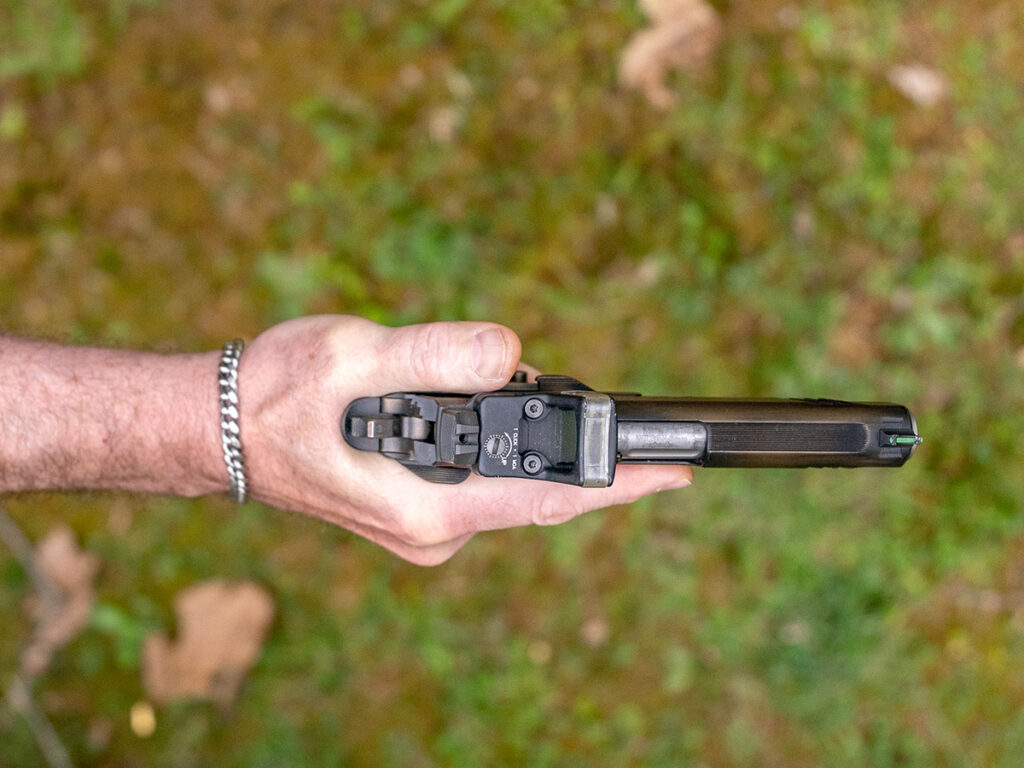
With a properly established grip on your pistol, the muzzle of the pistol should be in line with your forearm.
A Fruit-Free Diet
Establishing that good grip before the shooting begins is paramount to shooting success, especially from a self-defense standpoint.
This means you must get your grip—a good grip—when drawing from the holster. Of course, it would also apply to accessing your pistol from your pocket, purse, glove box or even your lock box at home. For this discussion, however, we’re focusing on drawing from a holster.
Another way of looking at the importance of initially establishing a good grip is to use a baseball analogy. If you’re a batter standing at home plate and you wait until the pitcher pitches the ball before you establish the proper grip on the bat, you’re not going to hit a home run. At best you’re going to bunt.
It’s the same when it comes to getting a grip on your pistol. If you don’t do it correctly when you draw from the holster, at best you’ll probably just be slinging lead in the direction of the threat. The possibility even exists that, without the proper grip, you might actually drop your pistol.
In a worst-case scenario, imagine that during the time it took you to draw, your attacker closed the distance and now you’re engaged, hand to hand. If you do not have a solid, good, controlling grip, you could lose your pistol in a struggle.
Consistency Is King
There are several things to consider concerning the establishment of a proper grip. Holster location and the cant of the holster are very important. This is something you will need to discover and tune based on the pistol and holster you use, as well as carry location and cover garments. However, the interaction of your hand with your pistol should not vary. Your hand’s approach to the pistol and its establishment of a good grip should remain consistent.
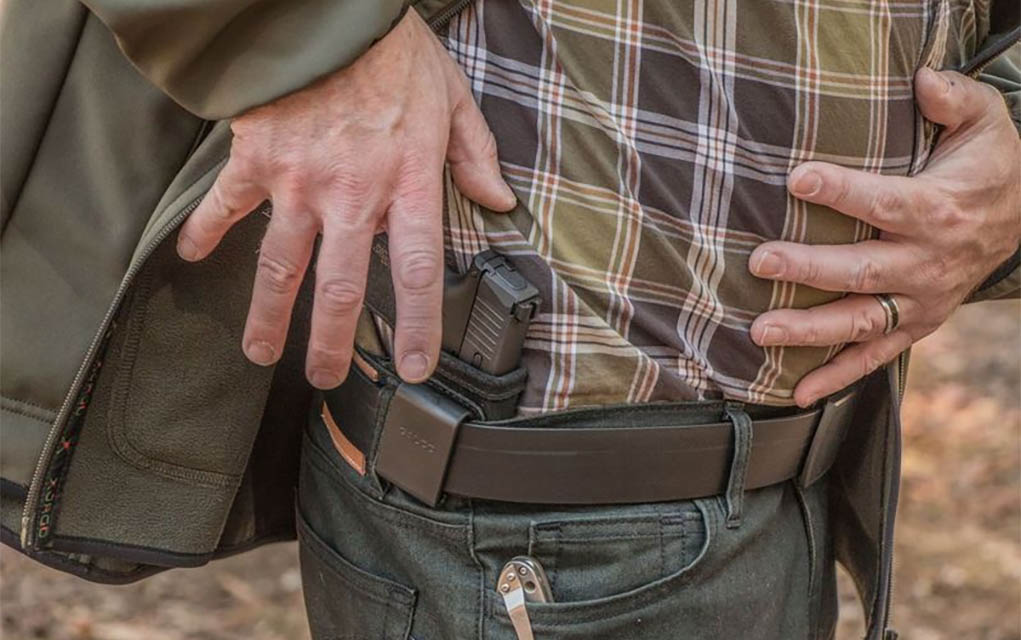
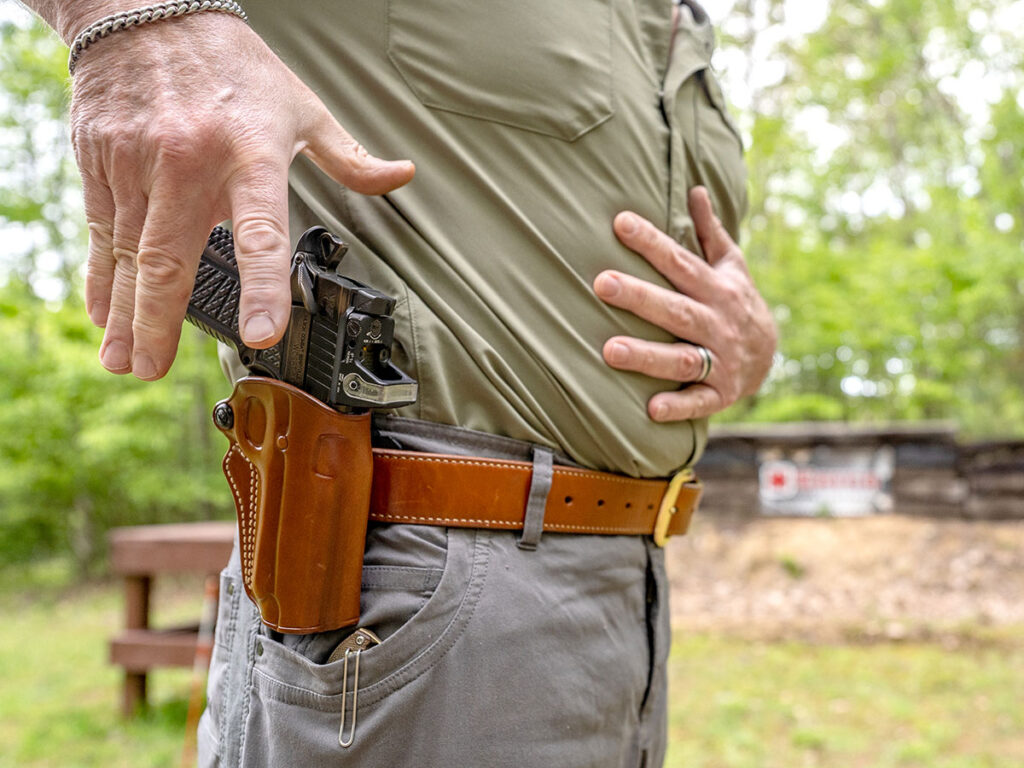
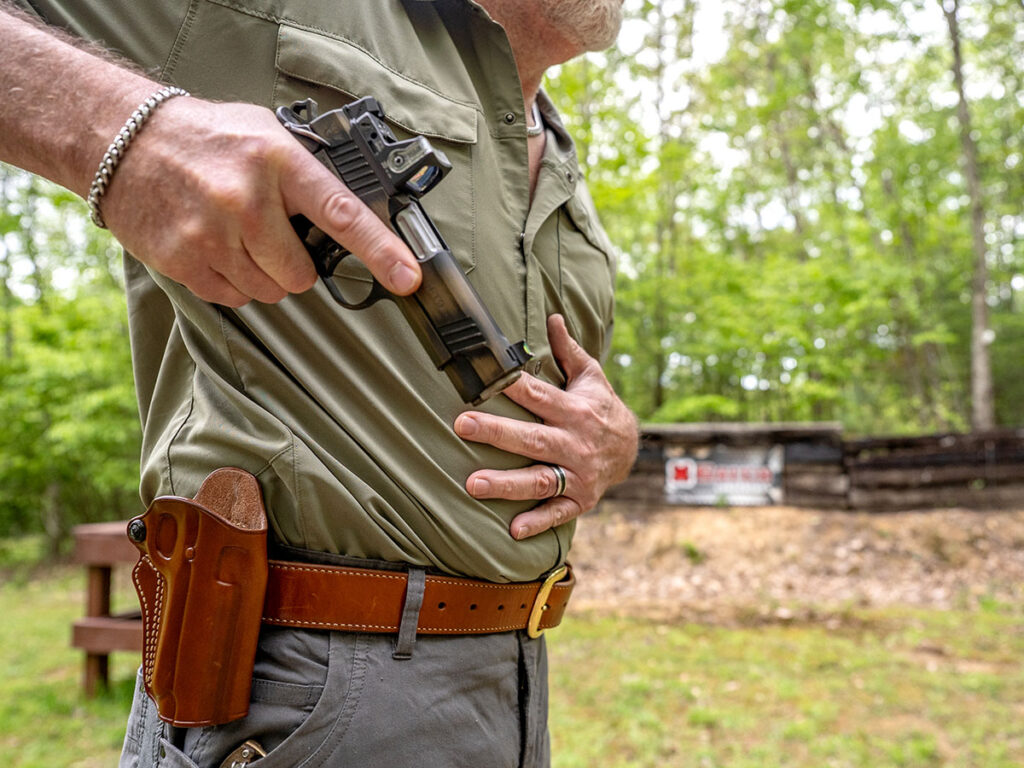
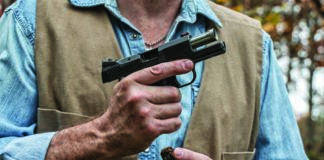
Notice how the shooter has prepped his hand with the positioning of the fingers and thumb to best address the pistol in the holster
When I’m moving my hand toward my holster, I like to have my hand arranged in a configuration that will best allow me to properly index it to the pistol. This helps me obtain my shooting grip before the pistol ever leaves my holster. What I’ve found that works best for me is to open my hand like I would prepare for a handshake, with a 90-degree angle between my thumb and my index finger. Then, I also like to hold my middle finger, ring finger and little finger grouped together but separate from my index finger. It’s sort of like a modified version of the Vulcan “live long and prosper” hand gesture used by Mr. Spock on Star Trek.
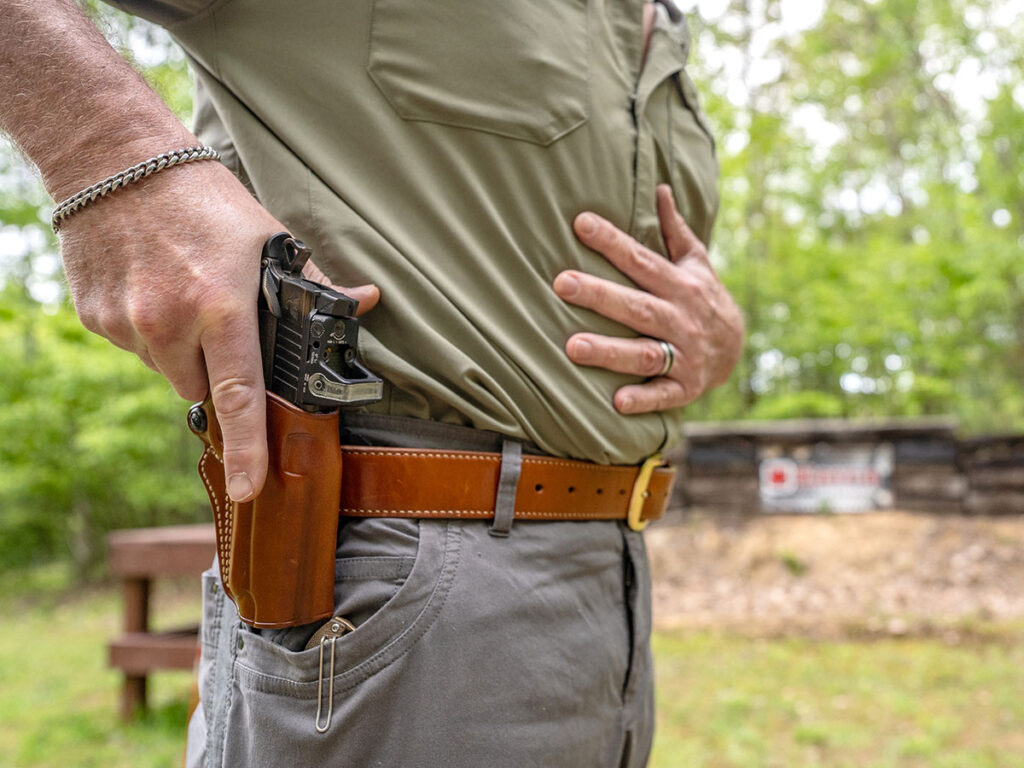
Essentially, what I’m doing with this hand configuration is prepping the interaction of all my fingers and thumb for the job they must do when they contact the pistol. The first thing that should happen is the web of my hand should firmly slide into the arch of the grip, positioned as high as possible. As I feel this happen, it confirms I’ve obtained the proper initial position, and this tactical sensation drives the action of my fingers and thumb.
If you do not initially position your hand on the pistol correctly, rectify this misalignment before you attempt to draw the pistol.
If, however, this interaction with the web of my hand and the grip does not feel right, this is the time—the only real opportunity—to correct any misalignment before I try to draw. Once my pistol comes out of the holster, I’m mostly stuck with the grip I have.
Next, my middle, ring and little fingers simultaneously wrap around the grip of the pistol, while at the same time I make sure I fully extend my index—trigger—finger and slightly angle it away from the pistol/holster. While all of this is happening, my thumb is finding the manual safety—if the pistol has one—and it gently settles there in a preparatory attitude, waiting for further instruction.
Once your draw progresses to this point, you’ve seriously reduced the opportunity to reconfigure your grip.
At this point I have control of the pistol, and I can extract it from the holster.
The situation should drive any further action by the thumb on the safety and the index finger on the trigger. The finger should only find the trigger when your sights are on the target, or when you’ve orientated the pistol toward the target. Your thumb should only deactivate the safety when you’ve decided to shoot.
Repetition Rules
As simple as this process sounds, it takes many, many repetitions to perfect it. That’s the bad news. The good news is that this is something you can work on with dry practice, in the comfort of your own home, with a for damned sure unloaded pistol. The key is to conduct numerous repetitions from the holster to the point where you’ve fully extended the pistol toward the target and can make a trigger press. Ending each dry practice repetition with a trigger press allows you to evaluate if the grip you have established is conducive to fast and accurate shooting.
When I was a cop, I would continually place my hand on my holstered gun, establishing that proper, pre-draw feel. I knew if I ingrained that into my very being, I could make a good draw and have a good grip. As someone who carries concealed, you can do the same thing. No, walking around town reaching for your gun all the time is not what I’m suggesting, nor what I did when I worked the street. But in addition to dry practice, when you’re alone throughout the day, you can work to establish that proper first feel.
Editor’s Note: This article originally appeared in the September 2025 issue of Gun Digest the Magazine.
We take a quick look at a cartridge that’s kinda like .338 Lapua, the .338-378 Weatherby Magnum.
In response to special requests from close friends, Roy Weatherby chambered a few rifles for a cartridge in which the case was formed by necking down his .378 Magnum case to .338 caliber. This took place as early as the 1970s, but it wasn’t added to the Weatherby lineup of loaded cartridges and rifle chamberings until 1999.
The .338-378 Weatherby Magnum is sometimes confused with the earlier .338-378 Keith-Thompson wildcat, but because the K-T version is on the shortened .378 Magnum case, loading data are not interchangeable between the two.
General Comments
The .338-378 Weatherby Magnum is in the same performance league as the .338 Remington Ultra Mag and .338 Lapua, and, from a practical point of view, that’s not saying a whole lot.
The smaller .340 Weatherby Magnum generates considerably less recoil, yet Weatherby rates it only 100-fps slower than the .338-378 Magnum and at about the same speed as the .338 Remington Ultra Mag., when the three cartridges are loaded with 250-grain bullets.
.338-378 Weatherby Magnum Load Data/Factory Ballistics
Looking to tame your heater? Here we take a quick look at Vantage Point Armory’s pistol comps.
Comps on pistols are the hot new thing. But what if you already have a pistol and want a comp?
For the most part, it means a new barrel, a comp and perhaps even some pistolsmithing work to get it all behaving properly. And, if you’re doing this to a striker-fired pistol (anything not 1911, really), once the comped barrel is on, you can’t get it off without removing the comp from the barrel.
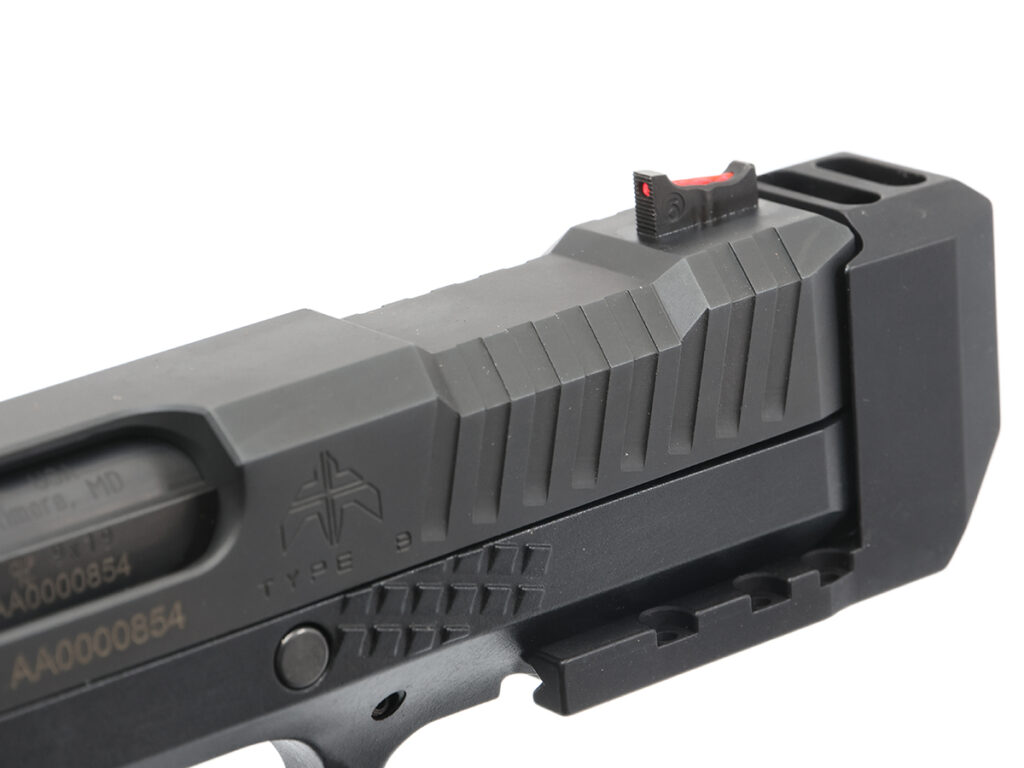
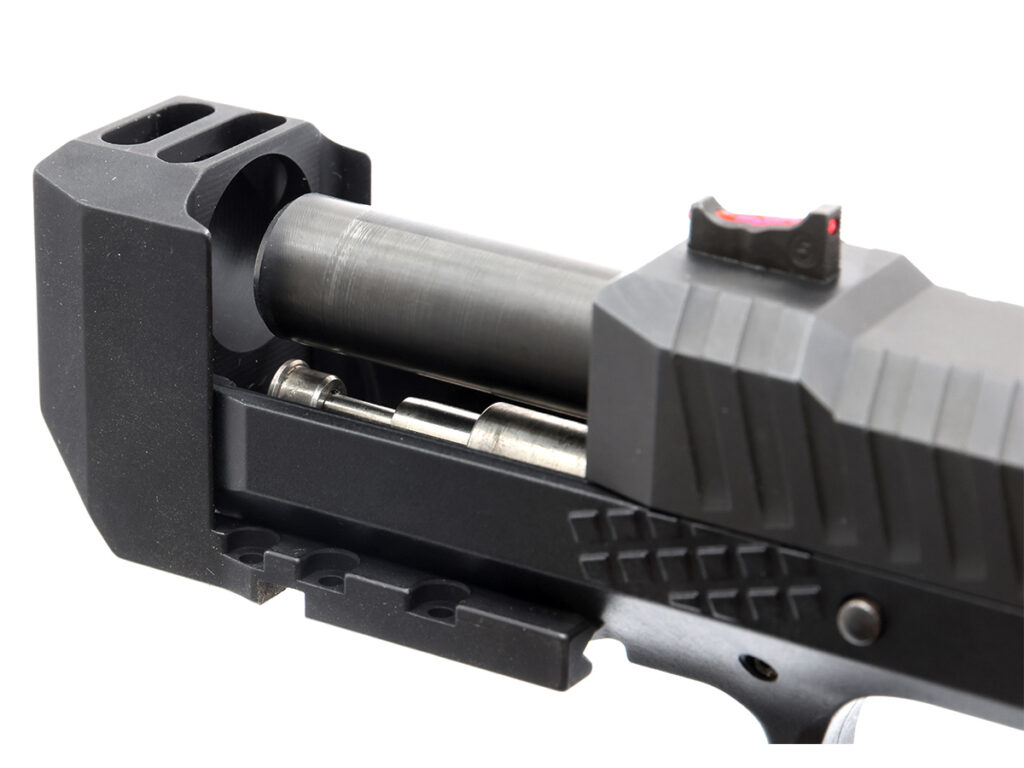
Instead, look to Vantage Point Armory. Their comps slide onto the accessory rail of the frame, match up with the slide and barrel, and provide a setup that doesn’t require comp-barrel surgery to remove.
Once in place, the comp follows the contours of the slide.
The solution is simple, but it only works for some pistols. (They have a list with 10 very popular pistol models.) You use the lock bars and set screws that come in the kit. Slap the lock bars into the accessory rail slots, slide the comp on and bolt the comp rails through to the lock bars. That’s it. The comp now diverts some of the muzzle blast gases to tame recoil and reduce muzzle rise.
You can even, with some models, still mount a light onto the pistol once you’ve installed the compensator.
It’s A Soft Fix
This is not a perfect solution. (In reality, there is no such thing as perfection.) As a comp, it will not be as effective as one that is barrel-mounted. The needed extra clearance and gap from barrel to comp means you lose some effectiveness. But, for the $150 Vantage Point Armory charges for a comp, you cannot buy a barrel ready-threaded for a comp. Then, the comps will cost almost that much. And, with Vantage Point, you won’t need a pistolsmith to install it; you can do that yourself.
You will still have to remove the Vantage Point comp to disassemble your pistol. However, removing four setscrews to slide the comp off the rail is a lot easier than wrestling a comp off an extended, threaded barrel. The comp has been given a Cerakote finish, so it will scrub up without too much hassle, depending on how long you go between cleanings.
The comp is not attached to the barrel, so the gap means there’s some efficiency loss. That’s physics for ya.
And, depending on the pistol you have, you can still fit the comped pistol into a holster.
This is one of those “wish I’d thought of it” ideas that, on second thought, has a lot of downsides for a comp maker. Downsides? The dimensions of the various pistols means Vantage Point has to account for the distance from rail to bore center, rail length, slide profile, slide contour and barrel movement on each and every pistol as an individual option (which they have done). Some pistols are easier than others. Glock dimensions are so alike that one of the Glock comps works on no less than five different 9mm models. But I don’t see them ever coming out with a “one size fits all” comp. It’s just not possible.
What is possible is getting a comp onto one of the listed pistols and even getting a light on there as well—without enlisting the services of a pistolsmith.
That’s a win in my book.
Editor’s Note: This article originally appeared in the September 2025 issue of Gun Digest the Magazine.
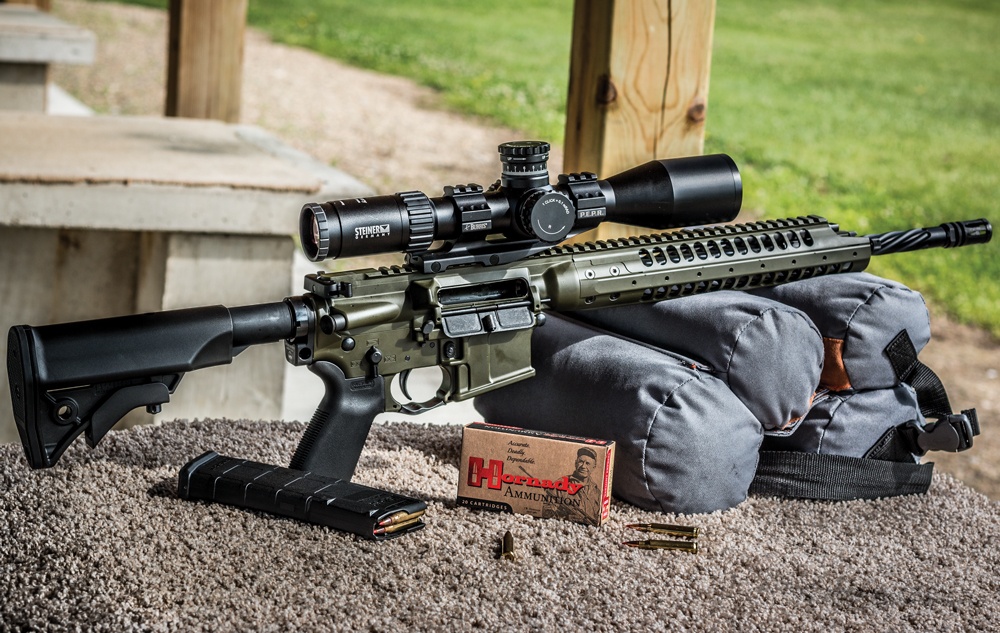
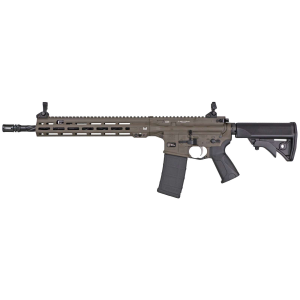
We comb through the mountains of carbines to bring you the best AR-15s out there today.
White-hot as a plasma cutter, that’s how it was around a decade ago. When everyone was certain politics would quash ownership, demand for AR-15 rifles got so out of control the most basic models moved for an insane price. A grand, sometimes more. Hard to believe, but true.
Outside of recent events of pandemic proportions—Covid 19 and the election of politicians hostile to gun rights—Americans’ appetite for the handy rifle has been somewhat slaked. Certainly, shooters still love to build and buy Eugene Stoner’s masterpiece. But they aren’t donning their high school baseball spikes to trample over the rest of the market to nab one. In a word—again outside recent events—the market has normalized.
The performance of the AR-15 has not. In fact, given the wealth of top-rate ammunition, excellent upgrades and plenty of quality pre-built options, the rifle is better than ever. Spend the money and you can almost guarantee something tailored exactly to your needs. It’ll shoot like a laser beam and be built to hand down to a son or daughter. The other end of the price spectrum isn’t shabby either.
Entry-level models, though not tuned to the level of perfection of the top-shelf stuff, are still worthy investments—especially if you’re new to the AR-15 game. Yeah, you’ll most likely have a gritty mil-spec trigger out of the box and the handguard will be more Honda Civic than Corvette. But the rifle itself will hold its own well enough for home defense, target practice or even to fill a survival-gun role.
That said, we’ve collected 8 of the best budget AR-15 options that more than fit the bill for these applications and any others you might cook up. Our ceiling for this article is $1,050, which nets you a pretty good rifle, believe it or not
How I Chose The Best AR-15
Throughout my career, I’ve been lucky enough to shoot a wide swath of the AR-15s available on the market today. I have trained, competed and hunted with what has become known as “America’s Rifle”, and become intimately familiar with the platform. In short, I know the AR-15 and what makes a good one.
With that said, I and the Gun Digest team winnowed down the expansive field of the icon carbine to these choices through extensive testing. Through hundreds of rounds, special attention was given to reliability, accuracy, ergonomics and, in some cases, innovations. Price, for certain categories, was also taken into account. In the end, these were the carbines that our magazine’s team and I found the best AR-15s.
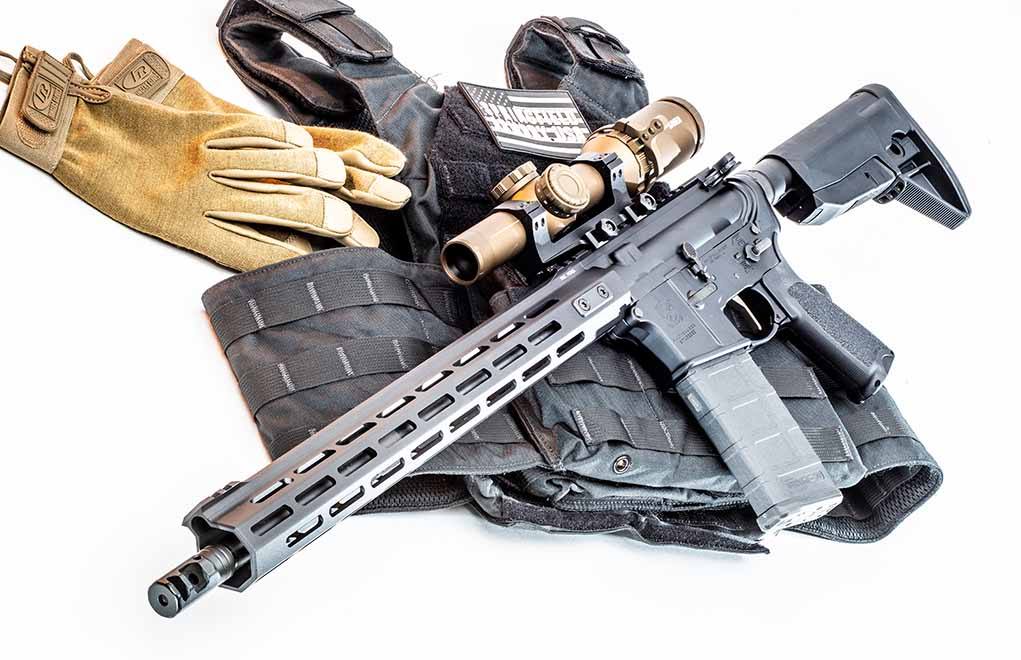
Best Mid-Tier AR-15 (Editor’s Choice): Springfield Armory SAINT Victor
SAINT Victor Specs
Barrel Length: 16″ Caliber: 5.56 NATO Weight: 6.56 lbs. Capacity: 30 Twist: 1:8 Gas System: Mid-Length Trigger: Nickel Boron Coated Flat GI Muzzle Device: SA Muzzle Brake Sights: Flip Up Barrel Material: CMV Receiver Material: 7075 T6 Stock: BCM Gunfighter Mod 0 Muzzle Thread: 1/2×28 MSRP: $1,150
Pros
Outstanding Value for the Money
Excellent Accuracy
Refined Build Quality
Cons
Muzzle Brake Side Blast
Not Revolutionary
Springfield Armory didn’t reinvent the wheel with the SAINT Victor—it simply refined the AR-15 into something slick, capable and easy to recommend. This is my overall pick for a mid-tier AR-15 because, for the money, you get many of the features typically found in a premium rifle. We’ve run a lot of rounds through the Saint Victor and consistently find that it offers more bang for the buck than anything else in its class.
While there’s a wide array of options in the Victor line—including AR-10 and PCC variants—my choice is the original model. Springfield got it right the first time. If you need to save a few bucks, the B5 variant gives you everything the original does, swapping the BCM stock and grip for B5 versions. Both options work great.
One of the most noticeable features right out of the box is how tight the carbine feels, thanks to Springfield’s Accu-Tite tension system. At the range, it’s been absolutely on target—averaging around 1 MOA with nearly every type of ammo we fed it. Honestly, what more could you ask for? I also appreciate the handguard. It’s slender and nimble—as is now standard, M-Lok compatible—and works well for a modern C-clamp grip.
One feature that deserves mention is the dual-port brake. It works exceptionally well, keeping the rifle on target shot to shot. However, it also puts out plenty of blast to the sides—no big deal for you, but your neighbor at the range might not thank you for it. In terms of dependability, the Victor has never faltered through hundreds of rounds. Like any AR, though, keeping it clean and lubricated is key to preventing issues.
Barrel Length: 13.7″ Caliber: 5.56 NATO Weight: 7 lbs. Capacity: 30 Twist: 1:7 Gas System: Mid-Length Trigger: Liberty Fighting Trigger Muzzle Device: NOX Flash Hider Sights: None Barrel Material: 4150CoMOV Reciever Material: Aluminum Stock: B5 Muzzle Thread: NA MSRP: $1,800
Pros
Exceptional Build Quality
Soft-Shooting and Accurate
Mission-Proven Pedigree
Cons
High Price Point
Pinned & Welded Muzzle Device
More than a few AR-15s on the premium end of the spectrum are designed to be safe queens. Not the M4-76. Sons of Liberty Gun Works built this rifle to be as tough as coffin nails—and that’s exactly what it is.
SOLGW’s quality control process is second to none, with each carbine practically hand-fitted as it comes off the line. That’s not just marketing speak—every component is meticulously inspected. If it’s not in spec, it doesn’t get used. The company also uses a more durable anodizing process and subtly tweaks upper receiver dimensions to eliminate wobble. That tight build is the first thing I noticed when I handled the M4-76—the gun was as tight as a drum.
No wonder SOLGW’s early adopters were SEALs and Marines.
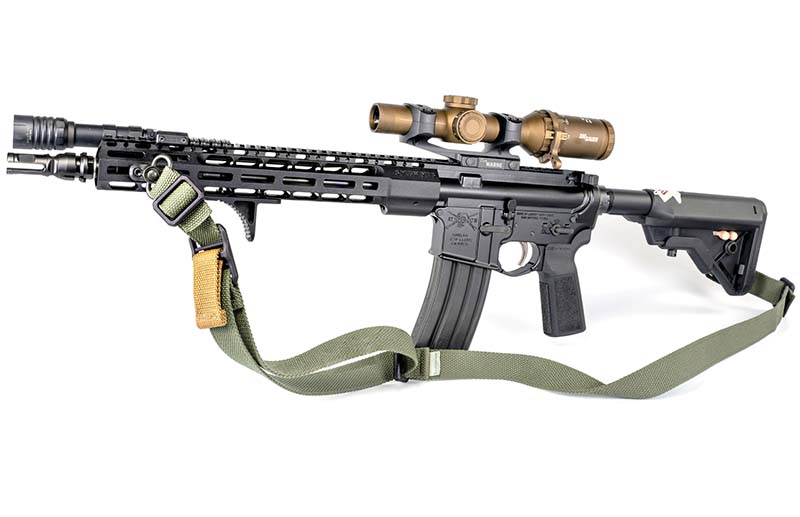
The gun is as fast as it is accurate, thanks to Sons of Liberty making it one of the softest-shooting ARs I’ve shouldered. A lot went into its shootability, including a mid-length gas system, oversized gas port and a premium buffer setup. At 50 yards and in, engaging multiple targets, it simply sings. But the M4-76 isn’t just a CQB option. With the right optic—in this case, a Sig Tango6T 1–6×24—the 13.5-inch-barreled carbine can confidently reach past 500 yards.
As you may have noticed, the barrel length should technically make this an SBR—but it’s not. SOLGW pins and welds its NOX flash hider to the muzzle, making the rifle tax-stamp-free and quick-detach suppressor-ready. All in all, a true fighting carbine doesn’t get much sweeter than the M4-76. And when you invest in one, you’re paying for function—not flash.
Get all the ins and outs of the fighting carbine in our M4-76 review.
While not as storied as some carbines on this list, it’s difficult to talk about the best AR-15s without mentioning the M&P15 Sport. Now in its third generation, the rifle remains among the most affordable on the market and has only improved over time.
For me, the key to the rifle is its reliability. Spartan as it may be, the Sport III chews through nearly anything it’s fed and takes abuse like a journeyman welterweight. Winning points, Smith & Wesson has added a slew of updates to the Sport that were long needed, all without affecting its bargain price.
What tops my list in the S&W upgrades is the handguard.Free-floated with ample M-Lok real estate, this feature brings the platform well into the future. Plus, a C-clamp grip is now more easily achievable. I won’t write home about the Sport III’s trigger any time soon, but I won’t bash it either. There’s some creep to it, and it’s not the smoothest I’ve felt. Yet, this unpleasantness is offset by a terse reset that’s both tactile and audible. Overall, I’d say it’s at the more polished end of mil-spec switches.
The accuracy of the Sport III is better than most entry-level ARs I’ve shot, but not exceptional. In testing, it averaged in the 1.5 MOA range when shooting supported at 100 yards. It’s not a tack driver but is more than adequate for most practical marksmanship. As far as entry-level guns go, the Sport III remains one of the most no-frills, hard-use rifles—or just plain fun guns—available today.
Squeezing the most out of your shooting budget? The PA-15 is the place to turn.
I’ve shot a lot of what PSA has to offer and have typically walked away fairly impressed with what the company brings to the table—particularly with its base AR-15, which usually rings up in the sub-$700 range for a complete rifle. PSA runs frequent sales, so expect the price to be considerably lower than MSRP when you go shopping.
The carbine I tested for this article—for full disclosure—was built from one of the company’s kits with a 16-inch barreled 5.56 NATO upper, with a mid-length gas system. This mimics the PA-15 complete rifle but saves a few bucks here and there—because I’m a cheapskate.
I sweated through a break-in period, with a few misfeeds right off the bench, but the carbine has since hit its stride. With more than 500 rounds downrange, the gun has not repeated its initial offense. Its accuracy is well within expectations, especially at this price point. I’ve never gotten it to dip below MOA but have gotten close. However, with cheaper ammunition, expect the rifle to shoot closer to or above 1.5 MOA.
The furniture is my main knock on the gun—it’s exactly what you’d expect from an entry-level carbine. The stock is what Palmetto calls its “Classic Carbine,” a fancy name for a generic M4-style unit. The grip is an A2 with the finger rest. I’m agnostic on this, though I prefer the A3 since it does away with the finger shelf.
The two upgrades I’d plan for with the PA-15 are swapping the charging handle and fire control group. Both are gritty and send chills up my spine every time I actuate one. However, if you’re a casual shooter or a first-time AR owner—is there still such a thing?—these issues might not even hit your radar.
Best AR-15 for Consistent Accuracy: Geissele Super Duty MOD 1
If you want a precision shooter or a fighting rifle guaranteed to hit its mark—regardless of range—I recommend the Super Duty.
Our test of Geissele’s flagship rifle produced some of the best groups we’ve seen from any AR-15, aside from custom builds. Without reservation, I’ll say it’s a sub-MOA gun with most ammunition. At 500 yards, it turned in groups just a touch over 2 inches—impressive, even to the hard-to-impress.
These results aren’t surprising when you consider how Geissele builds the Super Duty—almost entirely from in-house components. The rifle is outfitted with a medium-profile, 16-inch barrel featuring a 1:7 twist, ideal for stabilizing heavier, better BC bullets. It also includes the excellent SSA-E X two-stage trigger—a standout in my opinion. Its straight bow design lends itself to consistent, predictable breaks.
The Super Duty is as tough as they come, with nearly every inch finished in Geissele’s Nanoweapon coating—a solid lubricant with a surface hardness rivaling synthetic diamond. Personally, I believe the 16-inch version is the most versatile, taking full advantage of the rifle’s inherent accuracy. However, Geissele also offers shorter-barreled carbines, pistols and SBRs if a CQB option better suits your needs.
Barrel Length: 12.7″ Caliber: 5.56 NATO Weight: 6 lbs. Capacity: 30 Twist: 1:12 Gas System: Carbine Trigger: Mil Spec Muzzle Device: CAR Style Flash Hider Sights: MA1 front, flip-adjustable rear Barrel Material: 4150 CMV Receiver Material: 7075-T6 Aluminum Stock: Aluminum CAR-style Muzzle Thread: N/A–muzzle device pinned and welded MSRP: $1,200
Pros
Retro Aesthetic
Non-NFA Legal Compliance
Solid Shooter
Cons
Non-Functional Moderator
Not a Perfect Clone
The granddaddy of the M4, the XM177E2 is one of the coolest historic AR designs—and now, thanks to PSA, it’s readily available. It’s my top pick for the best retro AR-15 on the market today. I love how well Palmetto State Armory nailed the aesthetics of the original H&R while keeping it a non-NFA firearm. Of course, that means a few tweaks to the design.
The XM177E2’s iconic moderator isn’t functional—it would reduce sound, thus would be classified a suppressor—but PSA replicates the look. And it’s pinned and welded to a 12.7-inch barrel, keeping the gun out of SBR territory. Hey, I said it was my favorite retro AR-15, not a perfect clone.
The furniture is correct, it sports the original’s gray anodized finish, ships with a retro-style mag and even features the correct 1:12 twist. It almost feels like it just rolled off a 1969 assembly line.
Better yet, the XM177E2 shoots. It was easy to ring a half-size silhouette at 100 yards in our testing, and through four magazines and more than 500 rounds, it only experienced one malfunction.
I’ll add this: the H&R isn’t just a throwback pleaser—it’s also a legitimate option for home defense. The XM177E2 may not be the most widely recognized retro AR-15, but it’s certainly one of the most unique and practical.
Why is this reto gun as sweet as it is short? Find out in our XM177E2 review.
Whether it’s hogs, coyotes or even deer, the HCR-160 is my pick for a hunting AR. It was, quite simply, built for the job.
Yankee Hill Machine ships the carbine ready to go right out of the box. It comes outfitted with a GrovTec sling and a Bushnell Trophy 3-9x40mm scope with a mil-dot crosshair reticle. You don’t even need to zero it—YHM delivers it sighted in at 100 yards.
Another big selling point: the HCR-160 is lightweight, tipping the scales at just under 8 pounds with all accessories installed. I’m personally not sold on the camo pattern, but it’s a useful touch for many hunters.
As far as chamberings go, my preferences are:
.223 Remington: Coyotes and varmints
.300 Blackout: Deer and hogs—especially suppressed
6.8 SPC: Deer and hogs at slightly longer ranges
We tested the .223 Remington version and found it more than accurate enough for most game. It grouped just over 1 MOA during our range time. Quite simply put, this rifle is ready to come straight from the box and into the field.
See how this carbine is ready for the hunt in our HCR-160 review.
If you’re looking for a rifle that doesn’t eat where it poops, the MKII is it. I’ve been a fan of LWRC’s piston-driven carbines since the M6IC-A5 days—and the updated MKII is better in nearly every way.
Its short-stroke gas-piston system is constructed from aerospace-grade superalloys that can withstand extremely high temperatures. In my experience, this is one of the most reliable AR-15s on the market—built to thrive in the worst conditions.
This proved out in our testing with zero malfunctions through hundreds of rounds. Not a complete surprise given this is a cleaner running system than gas impingement.
One of the most appreciated updates is the M-Lok handguard, now attached to a redesigned upper receiver. It lightens the platform slightly and provides much greater mounting versatility. LWRC also improved the two-position gas block with a paddle-style lever, making it far easier to operate than older versions.
We tested the 16-inch-barreled model, a lights-out performer that consistently printed sub-MOA groups during range time. For most users, the 16-inch version is the go-to—especially if you plan to stretch its legs at longer distances.
That said, the 14.7-inch model is slightly more nimble and better suited for home defense. If you need to maximize mobility, LWRC also offers 12- and 10.5-inch SBR and pistol configurations.
If you’re going piston driven, you need to check out our ICMKII review.
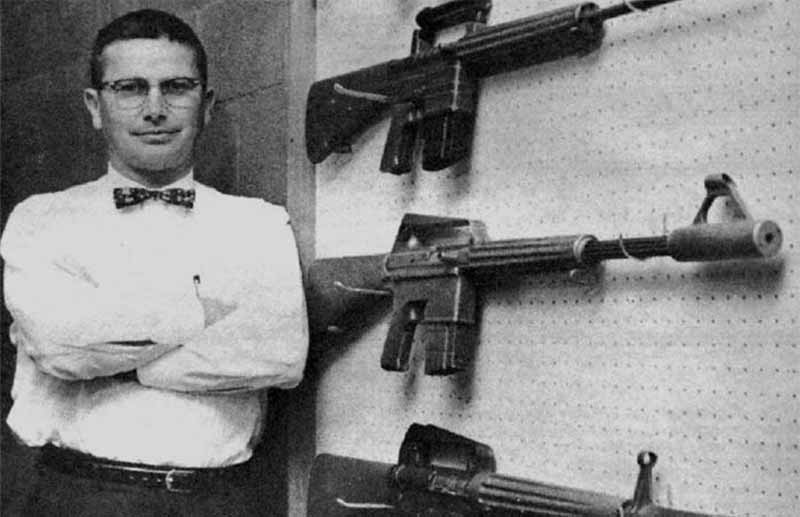
Eugene Stoner designed the AR-15 in 1956 while working at Armalite, a smaller-caliber derivative of his earlier AR-10 design. A short aside for those who don’t know, the AR designation stands for “Armalite Rifle” and nothing else. In operation the rifles are identical, just the chamberings are different. The AR-10 was chambered for 7.62x51mm (or .308 Winchester), the AR-15 5.56x45mm NATO, an evolved version of the .223 Remington based off the .222 Remington varmint cartridge. Why go small? Essentially so a soldier could carry more ammunition into battle. As far as its effectiveness, there’s no doubt the 5.56 is deadly, but it remains a hot-button debate up to this day if it’s optimal.
Anyhow, Armalite eventually sold the AR-10 and AR-15 rights to the company now most associated with the designs Colt. Under the guidance of the company, the rifle came under its first military contract by 1961 and was adopted by all United States Armed Forces in 1964.
This was a slightly redesigned model that was eventually designated the M16. Incidentally, today what is known as an AR-15—no matter what the chattering class tells you—is a much different animal to the original AR-15. What was produced in the ‘50s and ’60s was a select-fire rifle, whereas the modern variation is semi-automatic. Blame the confusion on Colt marketing folks, who designated the semi-auto civilian sporter model AR-15 to capitalize off its cousin’s military cred.
Over time, the rifle evolved to meet the military’s changing needs, until the M4 Carbine design was adopted in the 1990s. Barrel and gas system length are the changes here, with a 14.5-inch barrel and a carbine-length gas system. Overall, this is the most popular pattern found in AR-15s today, though the rifle comes in every shape and size. By The Way, AR-15 technically only applies to Colt rifles—they own the rights—hence the reason you find other manufacturers calling the gun all sorts of different names, such as Palmetto State’s PA-15.
AR-15’s Desirability
There is little arguing the AR-15 is the most popular rifle of the late 20th and early 21st Century. In fact, it is the most owned rifle in America, which raises the question Why? Multiple reasons.
History: Yeah, it’s not the original military rifle, but is close enough to scratch most folks’ vintage itch. Shootability: The platform is very accurate at intermediate ranges and dang pleasurable to shoot. Most of the cartridges the rifle is chambered for are mild with little recoil. Modularity: Next to its down-range performance this is the AR-15’s biggest selling point—you can tailor the rifle to exactly your preferences. Handguard, trigger, sights, grip, mag release, you name it and there’s an aftermarket upgrade. Bonus, most don’t require armors certification to add to a rifle.
Breakdown Of The AR-15
Getting to the rifle proper, there are numerous factors to consider when investing in an AR-15. Let’s skim over the major parts of the gun and hash out the importance of each and some specifics to look for when shopping.
Receivers
The AR-15 rifle has two receivers, the upper and lower. However, the lower carries special significance, given it is the part the Federal government technically considers the firearm. Hence the reason it is serialized. If you were to build a rifle from scratch, a very satisfying endeavor, you would require an FFL and background check to purchase even a stripped lower receiver. The upper, even a complete one—which includes all the internals, barrel and handguard—could be shipped directly to you without the need of a licensed intermediary.
The great majority of receivers are constructed from aircraft-grade aluminum alloy, usually 6061 and 7075. The numbers simply designate the type of alloy being used and sometimes include a sub-grade designation, such as “-T4” or “-T6”. These specify the temper placed on the aluminum, that is, how the alloy was heat treated.
There are two types of lower receivers billet and forged. Billet receivers are produced from a single block of aluminum that is machined into the profile of a lower. It’s a more time-consuming process, however, it yields more unique designed and integrated features. Forged receivers are made by hammering two roughly shaped halves of aluminum, then machining the profile later. This is the more affordable of the two methods, given machining is kept to a minimum.
Which is better? That’s a can of worms, given billet and forged receivers each have the advocates. Overall, forgings tend to be more durable, given the alloy’s grain structure remains intact. But billet receivers achieve tighter tolerances.
Barrel
Simple as a fire tube seems, there the AR-15 barrel is a multi-faceted topic. Let’s delve into what you’ll find when you shop for a rifle.
Chamberings
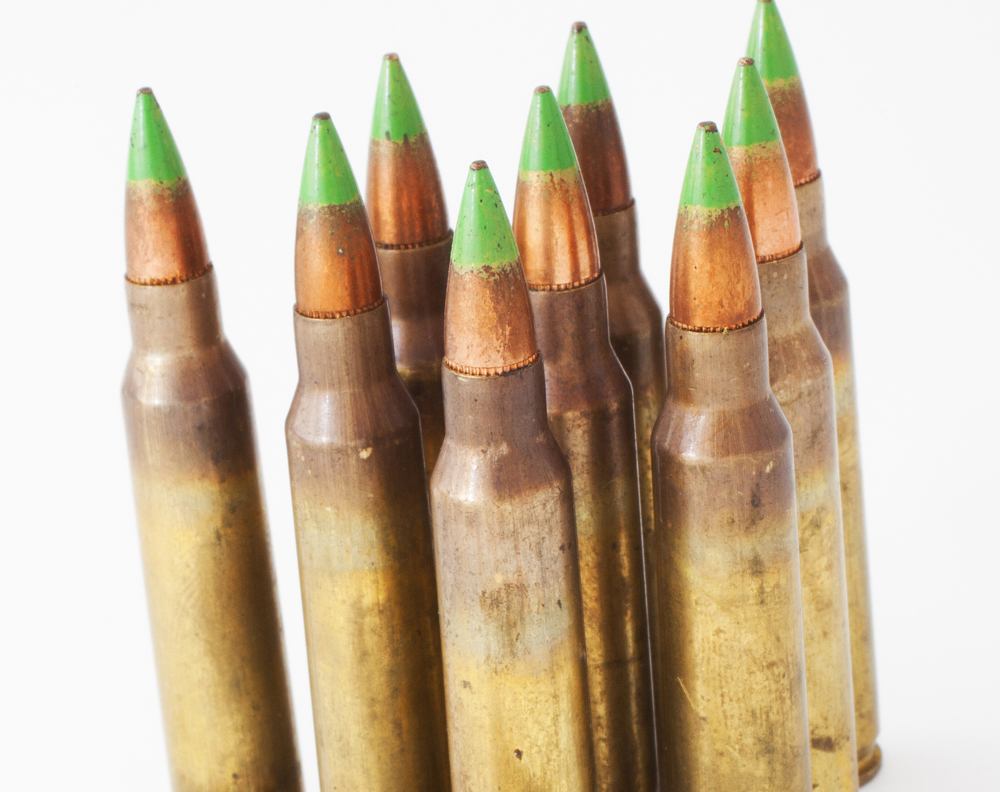
Quite simply, the chambering is what type of cartridge the rifle shoots. And the AR-15 shoots quite a few cartridges. Richard Mann has an excellent piece on AR-15 calibers if you want to survey what’s out there. However, by far the most popular chambering is 5.56x45mm NATO and accounts for nearly every option on our list below.
If this is your first endeavor into AR-style rifles, the common caliber is a solid choice. Outside of buying panics (hello 2020 and 2021), it is widely available and generally affordable. It’s also lights out at intermediate ranges, is an absolute Thor’s hammer versus varmints and is legal in many states to take deer. Also, it’ll do a number on a home invader.
While the 5.56 NATO is essentially a .223 Remington, the two are not interchangeable. Patrick Sweeney gives the nitty-gritty on the .223 vs 5.56 if you’re interested in specifics. For our purposes this is what matters:
A 5.56 NATO barrel will shoot both 5.56 and .223 Remington.
A .223 Remington barrel will only shoot .223 Remington.
A .223 Wylde will shoot both 5.56 and .223 Remington.
Barrel Length
While you won’t find them on a production rifle, there are 26-inch AR-15 barrels in this world. At the other end of the spectrum 4-inch options. Also everything in between. On the surface, it’s a bit of a muddle on what to choose, but law and performance help thin the field fairly quickly.
By Federal law, a rifle must have a 16-inch barrel, which can include a permanently affixed muzzle device (i.e. suppressor, muzzle brake). Go any shorter and the gun is considered a Short Barrel Rifle (SBR) and requires a tax stamp and registering it. For most, these are a hurdle not worth crossing, in turn, 16-inches is the basement. The ceiling, unless you get into custom rifles, is 20-inches on most production offerings.
As for performance between the top and bottom, it’s marginal. In general, a 20-inch rifle produces more velocity, given it has more bore, thus ensuring a more complete powder burn. But it will only beat out a 16-inch AR by roughly 150 to 200 fps at the muzzle. In many shooter’s books, it’s a marginal difference, which tends to give the shorter barrel the advantage. With the same contour, the 16-inch barrel is stiffer, thus suffers less barrel whip and is much more nimble.
However, if you aim to milk as much range from an AR-15 as possible, the 20-inch flavor might be your cup of tea. It’ll produce greater velocity, thus get the bullet where it’s going faster and narrow the window in which wind and gravity work upon it.
Barrel Material
Barrels are either made of carbon steel or stainless steel. Here are the most common of each.
Carbon Steel 4140: The most affordable steel, the alloy contains .80 to 1.10 percent chromium, .15 to .25 percent molybdenum and .40 percent carbon. The materials increase the strength and hardness above standard carbon steel.
4150: Also containing chromium and molybdenum, this steel has .50 percent carbon. The steel has higher tensile strength, however, requires a stress-relieving treatment, thus is more expensive.
Chrome-Moly Vanadium (CMV): Developed by Colt, the steel is the official mil-spec material used in the military’s M16 and M4 rifles and carbines. Essentially, it’s 4150 steel with the addition of Vanadium, which significantly increases strength, hardness and stability in high temperatures.
4150 CMV, 41V50 Steel or 4150 V: Same as CMV, but the name’s been dolled up for marketing purposes.
MIL B-11595: It’s not steel, but a specifying document of the materials used in a mil-spec barrel. Some companies slang it up and use this designation for CMV barrel just to sound cool and confuse the entire world.
Stainless Steel 410: A stainless steel that includes molybdenum and is known for its durability (perhaps the best of the lot). However, it is not recommended for cold-weather duty. Below freezing, the risk of cracking is increased.
416: A highly machinable stainless steel, thus allowing for better rifling and performance. However, it is less corrosion resistant than 410. Not the top choice of the lot.
416R: A proprietary alloy from Crucible Industries, it’s normal 416 stainless with molybdenum added. It machines like 416, however, has superior low-temperature performance and corrosion resistance.
17-4 PH: Known for its high strength, corrosion resistance, good mechanical properties and toughness. Precision shooters love barrels made from 17-4 PH, given the extreme uniformity and smoothness of the rifling—that and a barrel will last 3 times as long. However, the process in which its made—precipitation-hardening (PH)—makes it expensive.
Barrel Lining
Yup, there’s something in the AR-15’s bore (in many cases) besides rifling. Barrel linings are found in carbon steel barrels and improve their corrosion resistance and improve their longevity. Note, some manufacturers do not line their barrels, which isn’t a sin against God. If you’re in the market for a causal target rifle you’ll take out occasionally and care for properly, a non-lined barrel will get the job done. Harder use on the horizon, consider a barrel with this lining.
Chrome: The longest and perhaps most-used lining, Chrome reduces the effects of friction and heat on the barrel proper. Additionally, it makes cleaning much easier. This all adds life to the barrel. However, the process is known to reduce a rifle’s accuracy, though not to the extent that renders it useless. Most casual shooters won’t know the difference.
Ferritic Nitrocarburizing (FNC): Most likely you see FNC lining called something different, usually Melonite or Nitride. It’s essentially a case-hardening process that diffuses nitrogen and carbon into the steel. Thus treated a barrel can withstand direct exposure to water, heat, salt and corrosive elements better than any other process. Additionally, since it does not add material, it maintains the barrel’s accuracy.
Barrel Rifling
Manufacturers use different methods to apply the rifling to the barrel’s bore. Some methods are better for certain applications, here’s a look.
Cut Rifling: The oldest method of rifling a barrel, the process removes metal from the bore using a single-blade, hook-type cutter. Each groove is cut individually and with multiple passes, making it time-consuming and expensive. However, it introduces no additional stress to the barrel and tolerances can be kept tight.
Broach Rifling: Very similar to cut rifling, except a multi-bladed broach (metal bar) is used to cut successively deeper grooves. All the rifling is cut at once and in a single pass. This is a more affordable method with little stress placed on the barrel that has very consistent results through the entire bore. Broach rifling a barrel, relative to other methods, is still expensive.
Button Rifling: Essentially, a button of tungsten carbide with a reverse of the rifling is drawn through the bore displacing metal to lay down the pattern. It is a fairly economical system that turns out excellent results. The lands and grooves are very uniform and have a smooth finish. However, this method puts stress on the barrel that typically must be relieved afterward.
Cold Hammer Forged (CHF): A tungsten-carbide mandril is run into a roughly shaped barrel blank and the rifling is hammered into the bore. Overall, a majority of AR-15 barrels are made in this fashion and they are extremely popular with shooters. Tough as nails, these barrels withstand a lot of abuse. However, the barrels must be stress-relieved after the process and CHF doesn’t produce the uniformity of the other processes. Though, most shooters won’t notice.
Types of Rifling
This used to be cut and dry, but with the advent of 5R rifling has become a factor. What is 5R rifling, simply put the leads are opposite of the grooves and tapered. The idea behind this is to create less bullet deformation, thus maintaining ballistic integrity. Additionally, it’s supposed to be easier to clean. Traditional rifling still dominates the AR-15 market—lands opposing lands, with no taper. The jury is still out on if one outperforms the other.
Barrel Contours
Barrel contours, or barrel profiles, are simply the shape of the barrel. On the surface, a fire tube’s form might not seem like much, but it has an effect on performance and the AR-15 manageability. Thick and heavy bull barrels tend to take longer to heat up, suffer less barrel whip and maintain their harmonics better. The trade-off, their heavy and not something most folks want to hump around. Conversely, thin pencil barrels are light and make for a fairly nimble rifle, but heat up quickly and become “whippy”.
Fluting can provide an acceptable middle ground, removing material lengthwise along the barrel. This helps maintain rigidity, creates more surface area to dissipate heat and lightens an AR-15’s burden. Still not as much as other styles. Here’s a brief overview of common AR-15 barrel contours.
A1: The original pencil barrels found on the M16A1 rifle. A2: Heavier profile forward of the gas port, found on the M16A2 rifle. M4: Thin near the chamber, heavy just before and after the gas port, found on the M4 carbine. Government: Same as the M4, but lacks the grenade launcher cut. Heavy: Like it sounds, a thick bull barrel.
Gas System
The gas system power behind how the gun cycles. The gas from the conflagrated powder behind the bullet is bled off and either moves the bolt-carrier group (BCG) or a piston. Here’s a brief overview of each.
Direct Impingement (DI): This is the system that directs gas back to the receiver to move the BCG. It is extremely light and does nothing to infringe on an AR-15’s accuracy. However, it injects a good deal of carbon and fouling into the receiver, meaning the shooter must stay up on cleaning detail.
Piston: Gas forces a piston rearward which moves the BCG. While this keeps the receiver clean and is a somewhat more robust system, it does have its flaws. Pistons-driven guns are known for being less accurate, heavier and more expensive.
Gas System Lengths
The length of a gas system is determined by the distance to the gas port (where gas is bled). There are four lengths.
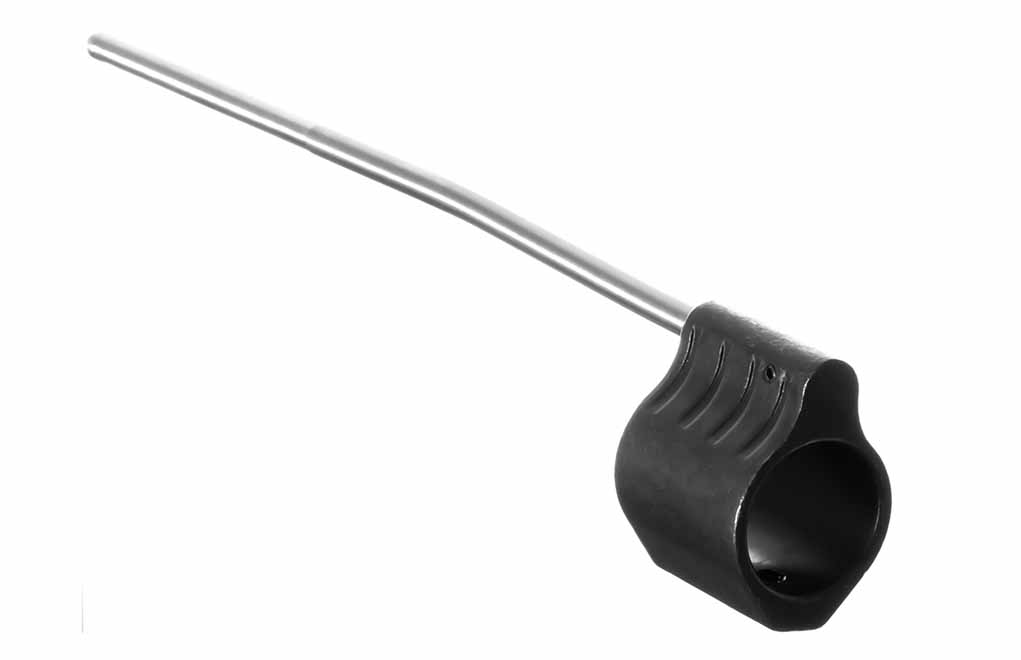
On a DI AR-15, the gas block is what diverts the gas from the barrel into the gas tube, thus back into the BCG. Most entry-level guns utilize a front sight base style gas block, in which the block is integral with the front sight. However, low-profile gas blocks, which reside under the handguard, are becoming more common.
Bolt Carrier Group
The bolt carrier group is where a lot of the action happens in the rifle’s operation. The component loads the fresh round, fires it and ejects the spent case. Essentially it’s made up of four main components.
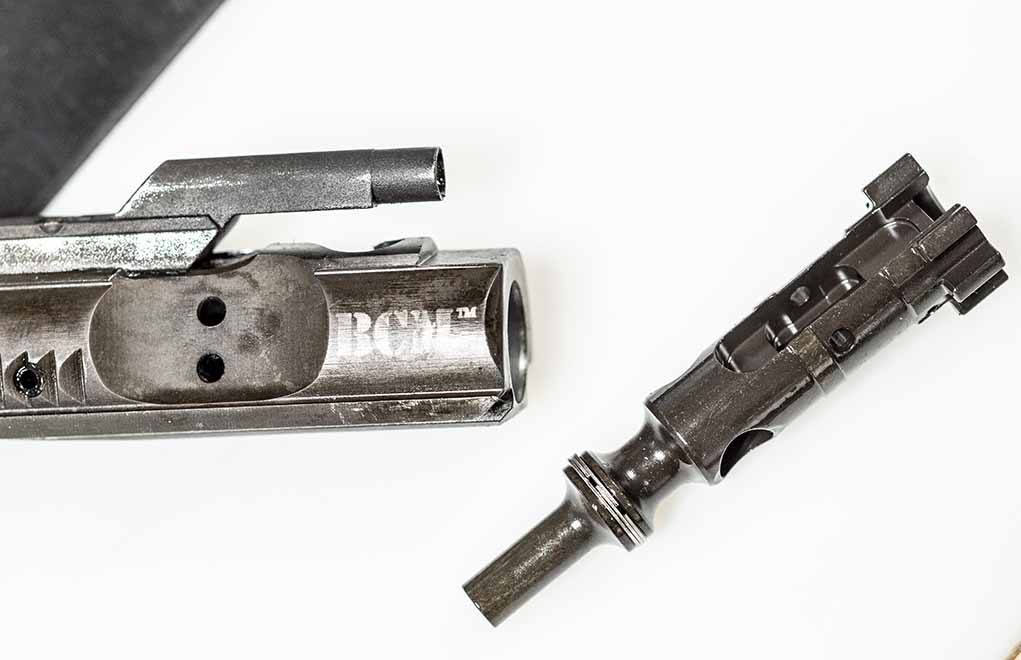
Bolt: The rotating bolt locks the chamber for firing, as well as strips a fresh round off the magazine. It also has an extractor, whose job is to pull the spent case out and eject it from the receiver. Bolts are typically made of one of three kinds of steel, Carpenter No. 158, 860 or 9310. Carrier: The heart of the BCG, it houses all the other components and does all the heavy lifting. It deals with a ton of force and thus must be well made from tough material, the same kinds of steel as the bolt. Gas Key: The small cupped device at the top of the BCG. It catches the diverted gas to thrust the BCG rearward, thus cycling the rifle. Gas Rings: Traps the expanding gas, allowing it to operate the bolt. Cam Pin: Stops the bolt from over-rotating when unlocking and keeps the cam pin, bolt, and firing pin rotating and moving as one unit. Firing Pin: Strikes the primer to initiate the firing process.
Barrel And Bolt Testing
Most manufacturers give a damn about the quality of their products, thus test them for imperfections. There are two main tests Magnetic Particle (MP) and High Pressure (HP). Each is designed to detect any cracks or flaws in barrels and bolts, each component should be stamped with the acronyms if they’ve gone through the procedures.
Handguards
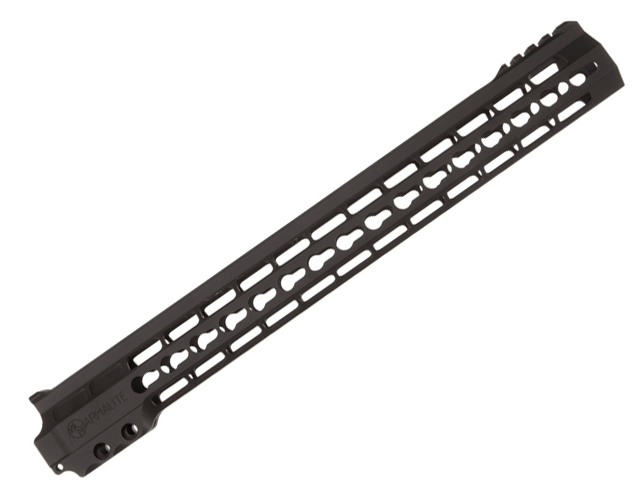
More the preventing you from singing your hand, many handguards serve as an accessory attachment point. Two of the most popular systems to this end are M-Lok and Keymod—the former more prevalent. As to the types of handguards, there are two main varieties: free-floated and non-free-floated. As the name suggests, it is all determined by if the handguard makes physical contact with the barrel. Free-floated handguards a preferred as they enhance the accuracy potential of a rifle. But non-free-floated will get the job done without knocking a gun too far off-kilter.
Buffer Tube
This is the protrusion on the rear of an AR-15, where the buttstock attaches. It housed the buffer spring and weight, whose jobs are to slow the rearward path of the BCG and return it forward.
Triggers
Next to the AR-15’s performance, modularity is perhaps the gun’s greatest attraction. From buttstock to front sight post, there isn’t a facet of the rifle that can’t be fiddled to perfection. Needless to say, your options are legion and far too vast to cover here. Instead, we’ll zero in on one feature of the gun you should consider at the top of your AR-15 upgrade list—its trigger.
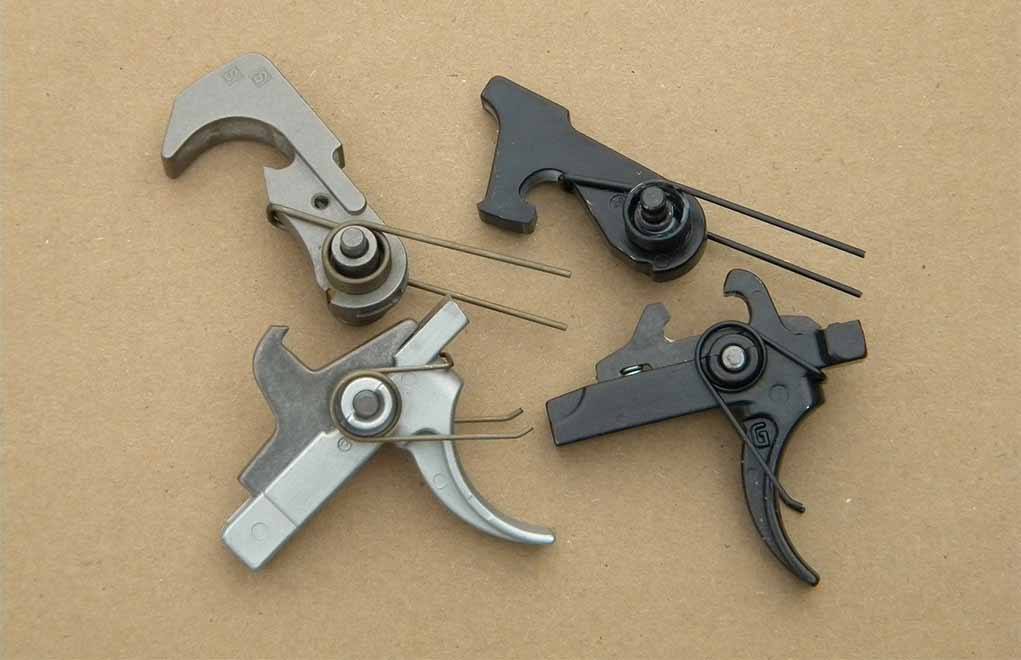
Trigger design will be based on application. On the left is ALG’s ACT (Advanced Combat Trigger), which is the standard military design but coated with nickel boron for a smooth, crisp release. On the right is a two-stage trigger by Geissele, the G2S, which has a 2.5-pound first stage with a 2-pound release.
By and large, what is known as a mil-spec trigger is a nasty beast. It’ll get your gun to go BANG!, but it won’t do much to enhance its performance. As you progress as a shooter, you’ll find those crunchy, gritty, squishy triggers detract from your accuracy potential. Thankfully, putting a better bang switch into your rifle is among the simplest upgrades and for the money one of the best values. With that in mind, it’s wise to factor an extra $100 to $200 into the base price for an upgraded AR-15 trigger. Yeah, it ups your investment, but you won’t find it a waste of money by any stretch.
Who is the true AR-15 brand?
Overall, there was no true AR brand. ArmaLite (where “AR” comes from in the carbine’s name) produced the first prototype AR-15 in 1957, a scaled down version of the carbine’s predecessor, the AR-10. However, ArmaLite sold the AR-15 design to Colt in 1959, who introduced a mass-produced model in 1964.
What brand of AR-15 does the military use?
The U.S. Military does not use the AR-15 rifle. The primary infantry weapon for the U.S. Army and U.S. Marines is the M4 Carbine. While based on Eugene Stoner’s original design, it is a select-fire carbine, whereas the civilian AR-15 is semi-automatic. As for the M4s, they are manufactured by FN America.
What size AR-15 is best for home defense?
Overall, a shorter barreled AR-15 is the best choice for home defense, as it is easier to maneuver in the close quarters of a home. For those not interested in acquiring a NFA firearm, the best options would be a 16-inch barreled carbine or 10.5-inch barreled AR pistol. At 10.5 inches, the gun is very nimble, but still has a strong ballistic profile. For those willing to do the paperwork, a 10.5-inch barreled SBR would be a solid choice. These shorter guns also allow for the addition of a suppressor without making them unwieldy.
Why was AR-15 banned?
AR-15s were never outrightly banned at the federal level but was caught under the now sun-setted 1994 Assault Weapons Ban. This ban focused on superficial elements of semi-automatic firearms mainly as feel-good legislation and as a political football. Proponents of such legislation generally point to crime reduction as the goal, though firearms such as the AR-15 are rarely used to commit crime. However, some states do have laws that ban the sale of AR-15s or otherwise prohibit certain standard features like pistol grips for similar reason.
PTR has just launched its new 3D-printed, purposely porous VENT Spiritus 5.56i suppressor.
PTR Industries has just expanded its VENT suppressor line with the Spiritus 5.56i. It has many of the same features that made the .30-caliber VENT 1 so great, but now in a more compact package that’s optimized for 5.56 NATO.
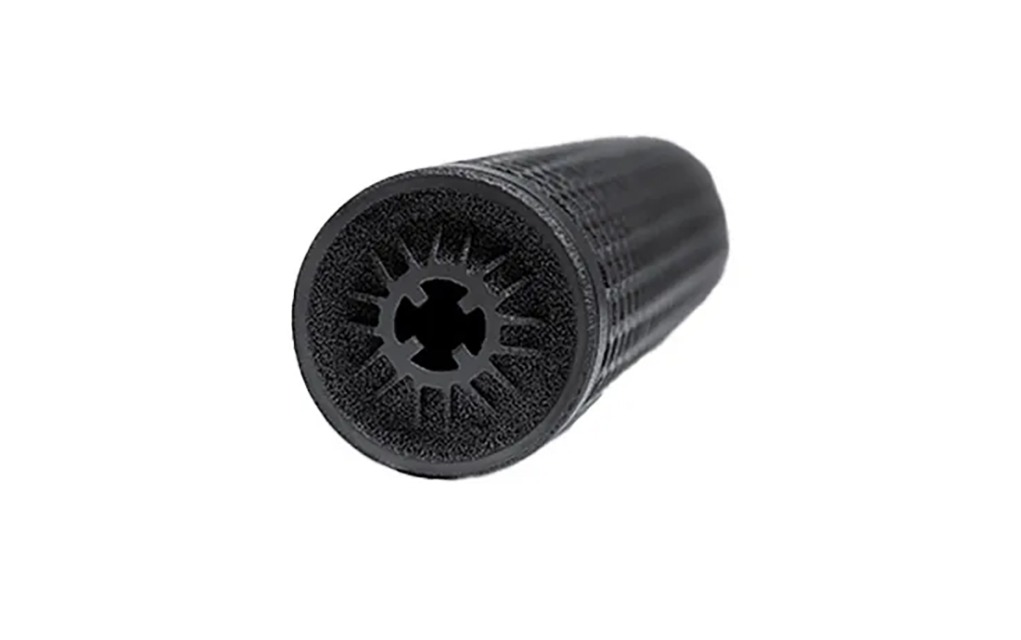
Made of 3D-printed Inconel and featuring PTR’s patented Purposely Induced Porosity, the Spiritus 5.56i is strong, heat resistant, lightweight (15.75 ounces without adaptor) and quiet for its small size (6.01 inches long, 1.625 inches in diameter). The Purposely Induced Porosity also helps to reduce back pressure since it allows gas to be vented through the porous Inconel (hence the VENT name).
The suppressor is also rated for limited full-auto firing (120-180 rounds fired in bursts, with a 10-minute cool-down to ambient temperature to maintain reliability). To help keep things cool, it’s finished with a heat-resistant black physical vapor deposition coating. For 5.56x45mm, the Spiritus 5.56i requires a minimum barrel length of 10.3 inches, but there’s no minimum for 5.7x28mm. For mounting, it’s HUB-compatible and ships with a 1/2×28 direct thread mount.
One quirk of the Spiritus’ unique 3D-printed, Purposely Induced Porosity design is that it will gradually become less effective as it gets dirty, but you can’t take it apart to clean like a traditional suppressor. That’s not a problem, however, as PTR has detailed instructions available on their website that explain how to clean the VENT either by soaking or rinsing it.
The PTR VENT Spiritus 5.56i is available now and has an MSRP of $1,249.
I hit the range with the Anschutz 1761, an already nearly perfect rimfire target rifle taken to the next level.
In years past, the field between rimfire and centerfire target rifles seemed pretty well matched in models, but with the advent of new cartridges and more rugged guns, the rimfire is the one to pick now. Rimfire rifles are lighter, easier to carry, and use softer-recoiling ammunition, which is less expensive and involves no reloading. Besides that, the .22 rimfire has a greater variety of precision or match ammo for serious target sessions or small game and varmint hunting in the field.
During my 50-plus-year writing career (yep, I’m getting up there), I’ve used almost every target handgun or rifle available. Handguns from Smith & Wesson, Colt, Walther, and the Ruger Mark IV Target come to mind and rifles, both custom and production, in sporter weight and heavy barrel versions from Remington, Ruger, Savage, or the CZ Model 457 rate high on my list.
Of course, the Anschutz Model 1761 series of guns includes various specialized models, of which one-third can make the grade as target guns, including the MPR (Multi-Purpose Rifle) we feature here due to its features and stock design. Anschutz is well known for catering to shooters who want the best but also appreciate options tailored to a shooting style or budget; in short, I will call these production-custom rifles with further upgrades in wood and engraving available from the Custom Shop.
Anschutz Model 1761 Specs Action: Bolt-action Caliber: .22 LR (tested) Barrel: Carbon steel, blued Barrel Length: 18 to 23 inches Barrel Twist Rate: 420mm (1:16.5 inches) Magazine Capacity: 5 Safety: Two-position, silent Trigger Pull: Two-stage, 8 ounces Sights: None, receiver drilled and tapped for scope mounts MSRP: $2,195 Website:anschutznorthamerica.com
Anschutz entered the specialized target market with the Model 54 action in the 1950s and, some years later, with the SuperMatch in 1962, when the Winchester Model 52 was considered the .22-caliber rifle for competition sports. However, Anschutz’s well-designed trigger, shorter lock time, and heavier receiver placed the Winchester brand on the back burner in these venues almost overnight.
The MPR’s stock was developed for target and small game hunters. It combines the classic look with a wide beavertail forearm and an accessory rail.
About a decade later, the lighter-weight Model 64-type receiver came about, aimed at the sporting rifle enthusiast. In 2015, Anschutz announced a shorter bolt machined 30mm in overall length to compete with other competition rifles in the same class. With its life cycle closing in, engineers conceived a new action that could be used for sporting and target-grade rifles. The result was the Model 1761, which incorporates a shorter bolt lift and a smoother operation across several new models.
The new design replaced the 53-degree bolt lift on the Model 54 with a 60-degree one, thus moving the three locking lugs to the middle of the bolt rather than at the rear. This gained the advantage of a single-spring striker system that moved to the bolt’s rear with a shorter bolt. Also, a roller bearing reduces the cocking effort. Finally, an oversized bolt knob of 25mm (1-inch) in diameter aids cocking, extraction (via twin opposing extractors on the bolt face), and loading of the cartridge into the chamber, which shows a red indicator at the rear of the shroud when cocked.
The Anschutz Model 1761 MPR is impressive from any angle. The oversized bolt handle is made for all weather conditions, and the safety lever and magazine are within easy reach.
With all that going on, the receiver needed to be upgraded. Anschutz went with a flat bottom machined from a solid Chromoly steel billet with an integral recoil lug shortened by 40mm. The conventional 11mm dovetail was kept for scope mounting, as was a 3mm cross-slot at the rear of the receiver for a Picatinny rail. The receiver is not epoxy bedded into the stock; Anschutz engineers reasoned that the larger bottom’s flat surface was more than enough to ensure the desired accuracy, having a choice of the .22 Long Rifle, .17 HMR, or the .22 Winchester Magnum Rifle (WMR) cartridge.
Anschutz made this target gun—and the others in the series—to accept interchangeable barrels for precision and hunting duties, with a selection of seven barrels in lengths including 18, 19.3, 20.3, 21.4 and 23 inches in sporter and heavy configurations with or without open sights, barrel threads, or a suppressor. All are changed (Anschutz recommends a gunsmith) via twin barrel locking clamps that allow precision seating and headspace on the receiver. Additionally, the barrels are target-crowned, and on the MPR model, the barrel has been enlarged slightly from a total barrel diameter of .810 to .860 inch at the muzzle with a 3-inch-long 11mm dovetail to accept a competition front sight.
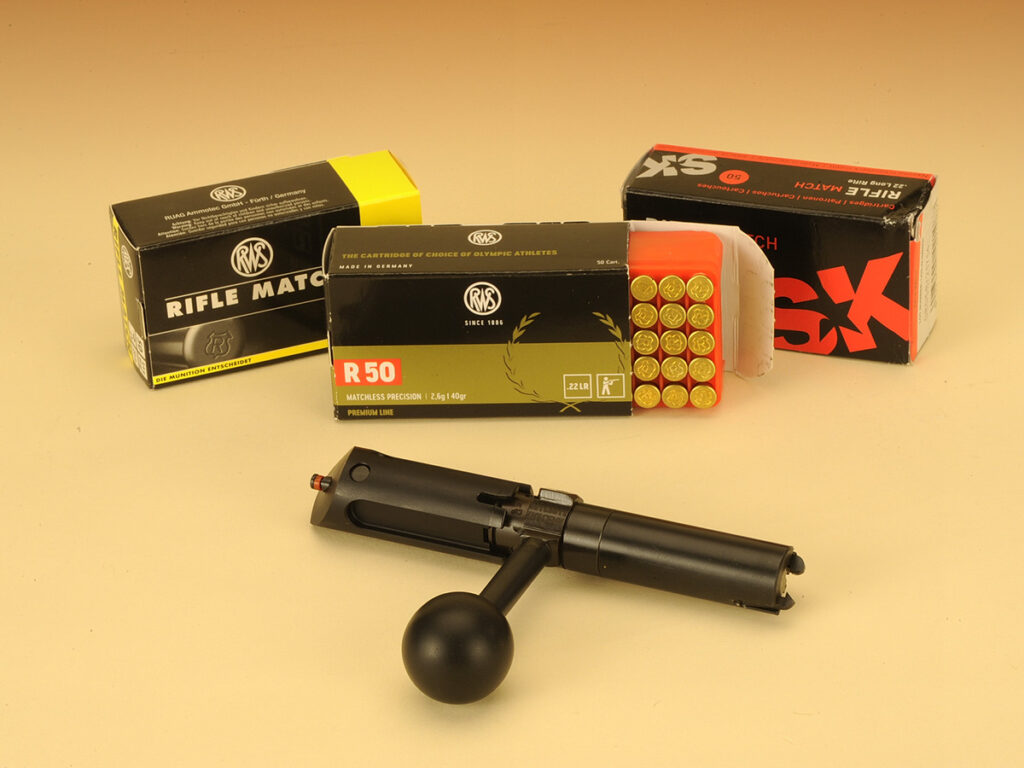
Like the rest of the gun, the bolt is finely finished for smooth operation. The target ammunition used in the testing is shown.
While the guns accept three different calibers, the five-round magazines are dimensionally the same on the outside, allowing them to work seamlessly with one standard style of bottom metal and trigger group. With the addition of an extended pad on the bottom, regardless of the weather or gloves, it’s easy to guide it into the gun thanks to a small channel on the triggerguard. You can also remove it via a release on the inside of the triggerguard.
Anschutz improved the safety lever by enlarging its surface and smoothing its operation. While there is a detent, it has no detectable click and rides over this notch without any noise—and very smoothly at that.
When I mention custom in describing the Model 1761, trigger options are a significant part of the rifle’s accuracy. Both are finely adjustable, with one single-stage affair, including the magazine release with or without a trigger blade that moves forward or rearward on a slide to accommodate a “length of pull” on the trigger shoe. The other option is the one I like since it includes a two-stage trigger, with or without the trigger blade adjustment. Out of the box, the trigger on my MPR broke at 8 ounces after the initial take-up.
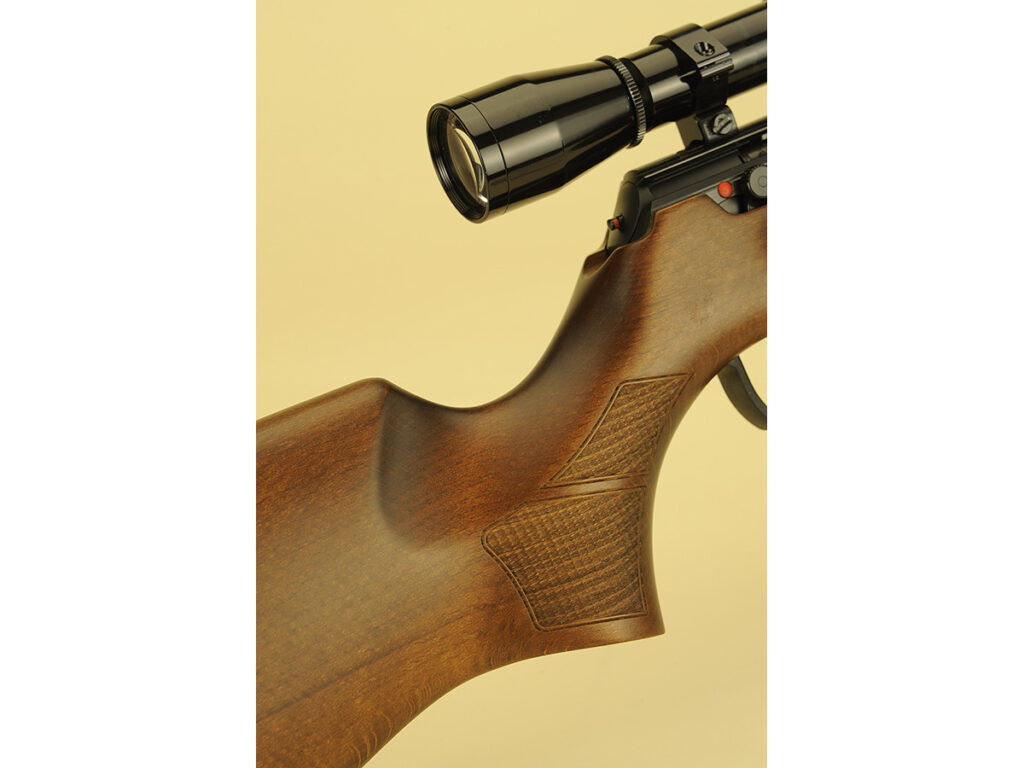
The Multi-Purpose Rifle’s stock work is outstanding. The lines are clean and well-defined, the wood is select-grade or above with no knots, and it’s finished with a satin-lacquered finish.
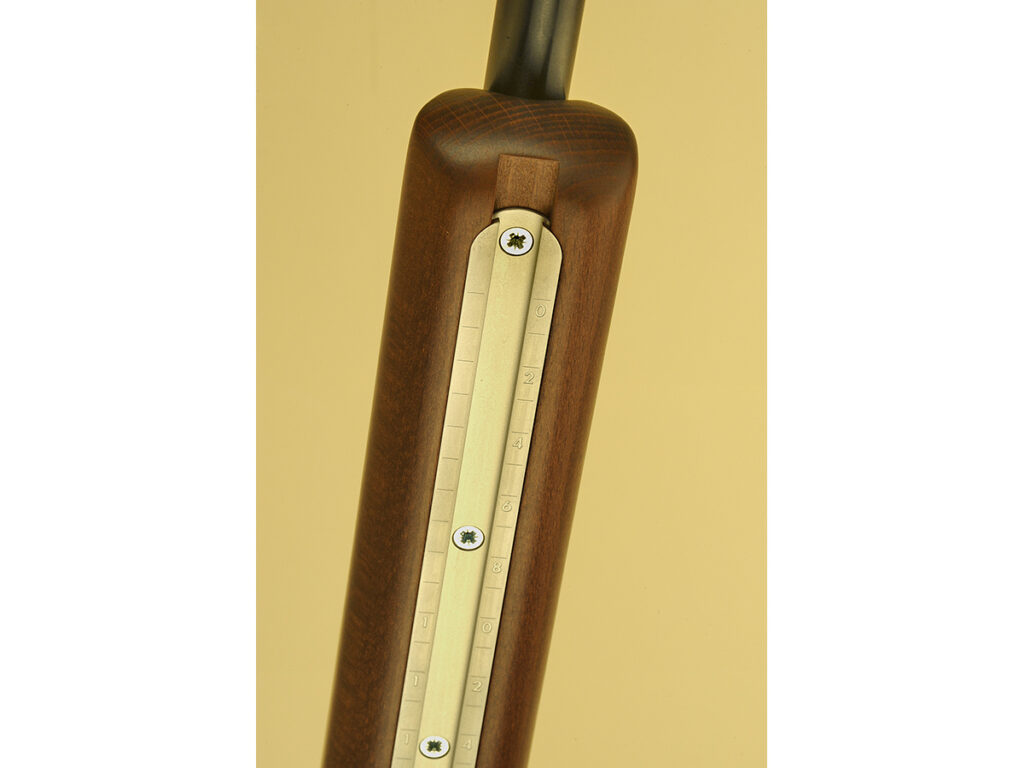
Under the forearm, Anschutz has inletted an accessory rail for those who want to use the MPR for target use. It also keeps the stock from warping.
Other features include a wide beavertail forearm with finger grooves on each side and a 10-inch aluminum rail inletted underneath for target shooting accessories. While the rail may not serve the average varmint shooter, it keeps this part of the wood stock in check against moving or warping—and any varmint or small game hunter would be happy using it as it adapts to any spontaneous rest in the field. There is no checkering here, as the width and finger grooves offer more than enough purchase.
Moving back, the stock tapers inward over the bottom metal holding the magazine well and triggerguard. The pistol grip is well-formed and curved for comfortable handling. There is no pistol grip cap—watch those prone shooting opportunities—and it’s checkered in a pleasing outline on both sides, complete with a custom ribbon cut halfway in the pattern.
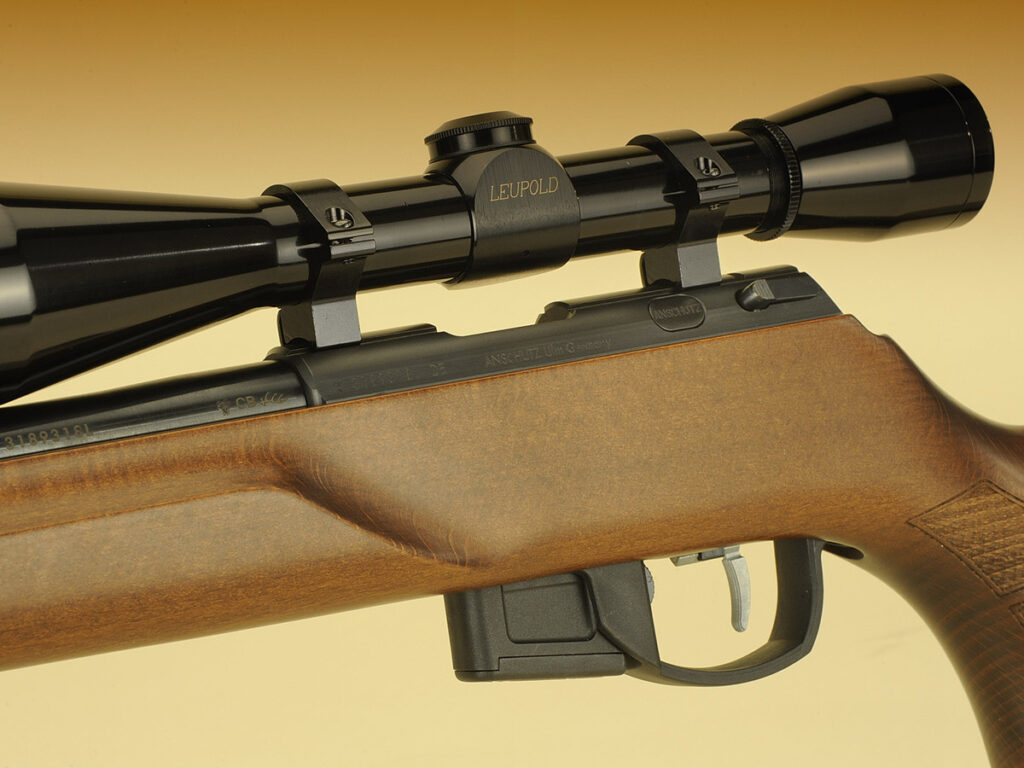
On the left side of the photo, note how the wide beavertail forearm tapers into the stock just before the magazine and trigger assembly. The bolt release is under the rear scope base.
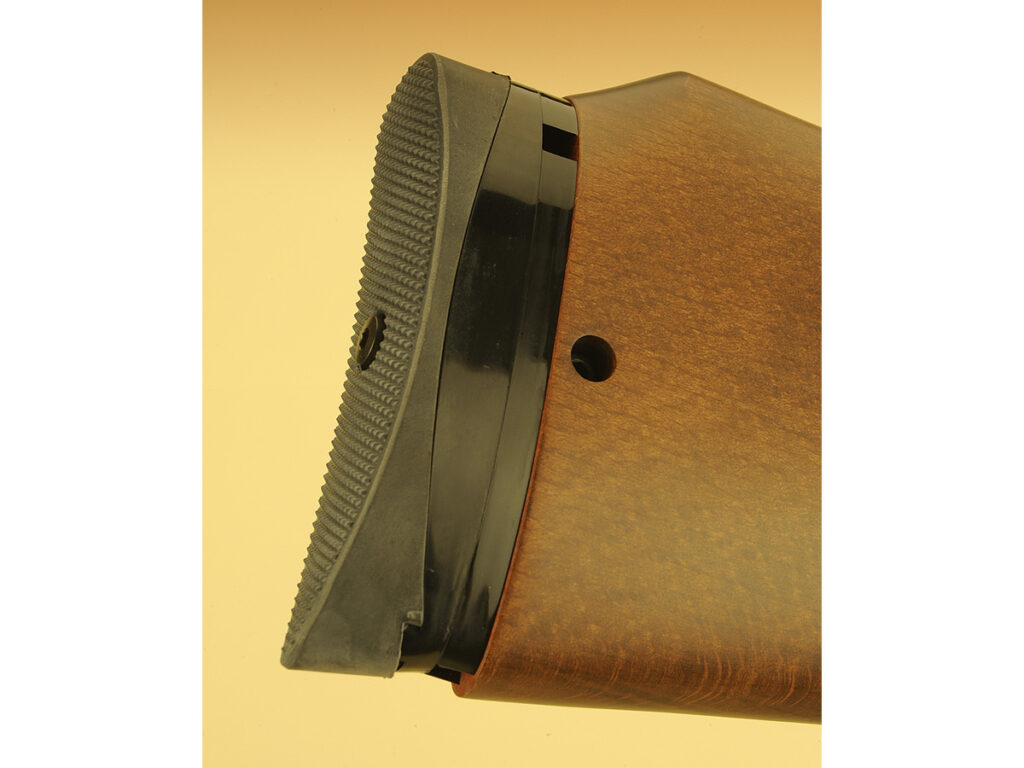
The stock wrist is full and offers plenty of room, even with winter gear or heavy gloves. On the buttstock, the comb is high sans a cheekpiece. At the rear is an adjustable recoil pad. Removing the screw allows you to move the rear part up or down to fit your shoulder. Taking it off reveals two holes, which I surmise are for high-tech buttplates that fit in the stock with two rods for length-of-pull adjustments.
The Model 1761 has a fully adjustable recoil pad with a black spacer. A tool is furnished to adjust it.
I’ve always enjoyed custom touches on my rifles, and to this end, Anschutz offers four grades of wood with the initial order. Starting at the entry level, you have the Standard Grade (nice wood and finish), and then you move to the Premium Grade, which has more color, figure, and grain pattern. From there, you get into the fine wood with the Luxus Grade and the Meister Grade, which shows a Grade V or VI class of wood. To further trick out the rifle to your tastes and checkbook, Anschutz has its Custom Shop. Here, you can pick from the best wood, deep-relief engraving, and other details to make your gun a unique family heirloom.
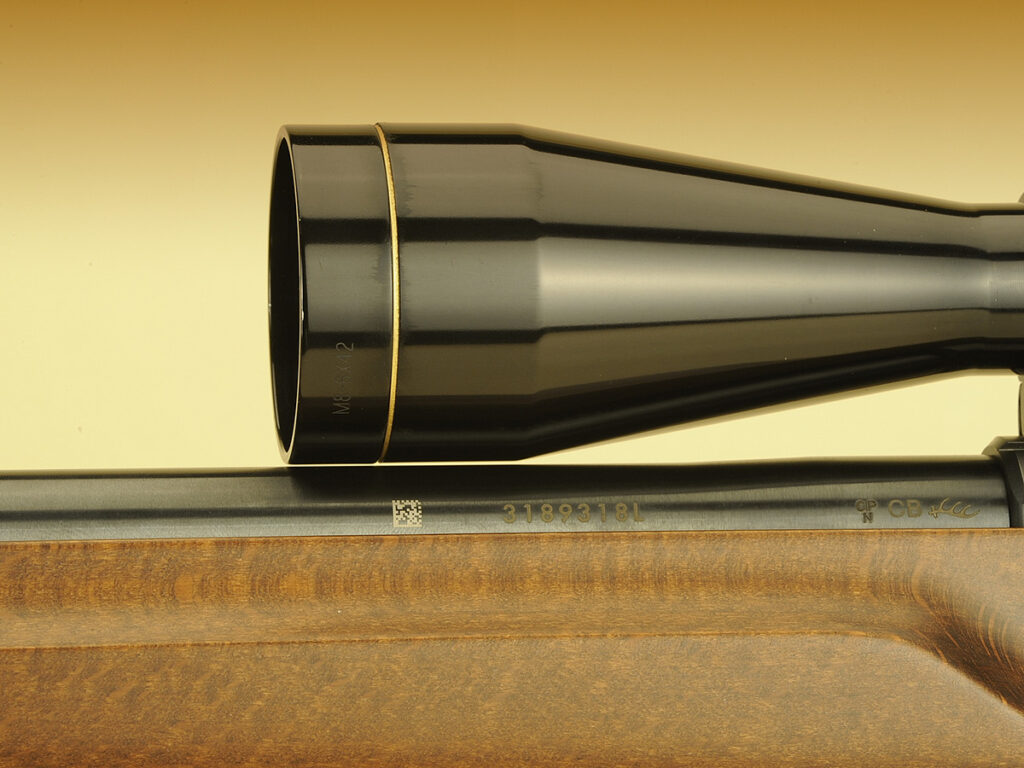
But how does it shoot? Since winter makes it hard to go woodchuckin,’ paper targets set up at 50 yards had to do. The company sent three selections of target-grade ammunition from RWS and S&K. I installed a Leupold 6x42mm scope in Bushnell low rings. The mounting was low, with just a bit of air between the objective bell and the barrel.
Settling down at the bench with sandbags, the Model 1761 came to life. With the extra heft of the gun and the near-perfect trigger, I could count on groups with all five shots touching. What you see in the chart is the best of the five-shot groups fired from each box of ammo. Not averages, the best of the best, and to confirm what I saw—and not just dreamed—Anschutz sent six range test targets which, as an aggregate, came in at .326-inch from the factory with the best group of .238 inch. Now, it was my turn.
LOAD (GRAINS)
VELOCITY (FPS)
FIVE-SHOT 50-YARD GROUP (IN.)
40 RWS Rifle Match
1,068
.285
40 RWS R50
1,060
.240
40 S&K Rifle Match
996
.245
Note: This is an Anschutz Model 1761 MPR with a 21-inch barrel. Velocities were chronographed at 10 feet from the muzzle with an Oehler Model 35P Chronograph.
Up first was the RWS Rifle Match brand. After the smoke cleared, the best was at a curt .285 inch. The RWS Matchless Precision topped all with the best of the morning, with five shots touching at .240 inch. This was also the best ammo the company used for its testing. Rounding up the session, the S&K Rifle Match came in close, but there was no cigar at .245 inch. Velocities were around 1,000 fps plus, typical for this type of ammunition.
As a dedicated small game and chuck hunter, the Anschutz Model 1761 MPR is worthy of a second look. The lines are true; the gun is sound and more than accurate if you do your part.
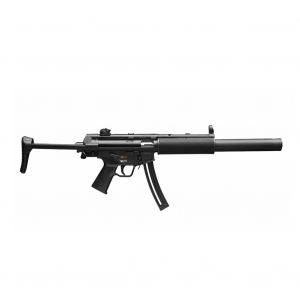
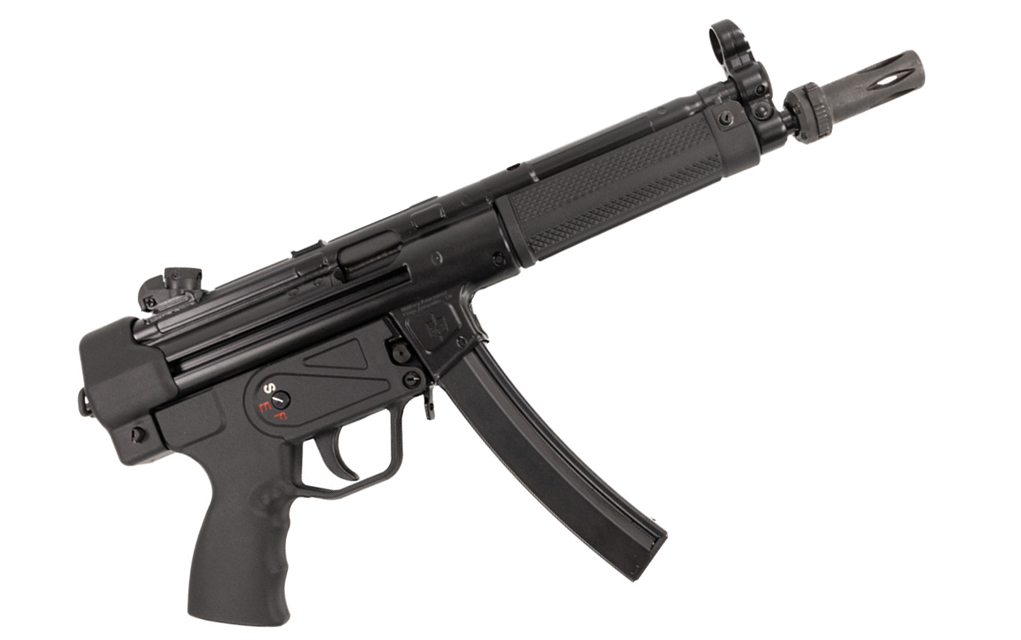
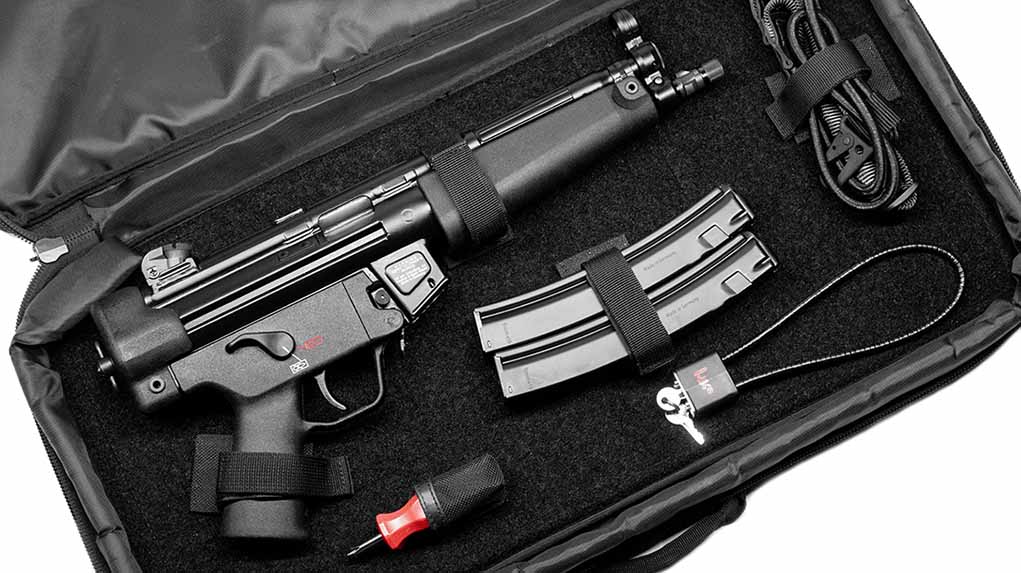
Everyone wants an MP5, but nobody wants to pay HK prices. Here, we go over the top 5 MP5 clones that won’t break the bank.
Real MP5s from Heckler & Koch are full-auto, and very few of us are lucky enough to be able to afford a genuine transferable example. While much less expensive, even the semi-auto versions made by H&K are unfortunately out of most shooters’ price range. If on a budget, you may not be able to get the H&K logo on your receiver, but thankfully there are MP5 clones available now that will scratch the same itch for a fraction of the price.
How I Picked The MP5 Clones
Frankly, the market isn’t exactly awash with MP5 clones, but there are more than these five models out there (especially when you include variants from the same manufacturer). Based on my personal experience with various brands of MP5 clones, as well as the experiences of some trusted colleagues, I took a look at what’s available, tallied up their pros, cons and prices and determined that these were the best options for most American shooters based on their manufacturing quality, features and affordability.
Included optic mount and sling aren’t great quality
Century Arms AP5Specs:
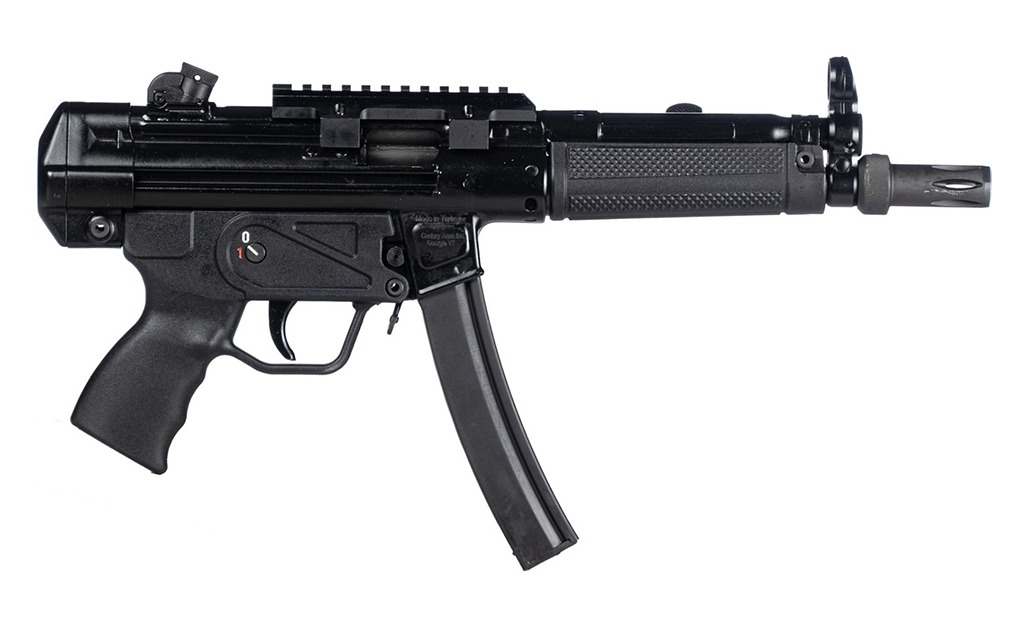
Caliber: 9mm Luger Format: Pistol Country Of Origin: Turkey Barrel Length: 8.9 Inches Overall Length: 17.9 Inches Muzzle: 1/2×28 threads and tri-lug Weight: 5.5 Pounds MSRP: $1,360 Website: centuryarms.com
Based on the time I’ve spent behind the different MP5 clones on the market, the MKE models made in Turkey and currently imported by Century Arms are the best in my opinion. The MKE-made MP5s simply have a better track record for reliability and general fit and finish from what I’ve seen. That doesn’t mean other brands can’t be good or that Century never puts out a lemon, but I personally rank MKE at the top of the clone hierarchy. MKE got its tooling from HK, so the receiver and parts should be about as clone-correct as it gets.
The AP5 ships with an original-style “slimline” handguard, but most people will probably want to replace it with the more iconic triangular “tropical” handguard. Besides aesthetics, the slim version heats up a lot quicker too. The included optics mount and sling aren’t great, but besides those nitpicks the AP5 is the best 9mm MP5 clone to get if you don’t want to pay for an HK.
Caliber: .22 LR Format: Rifle Country Of Origin: Germany Barrel Length: 16.1 Inches Overall Length: 26.4-32.3 Inches Muzzle: N/A Weight: 7 Pounds MSRP: $750 Website: hk-usa.com
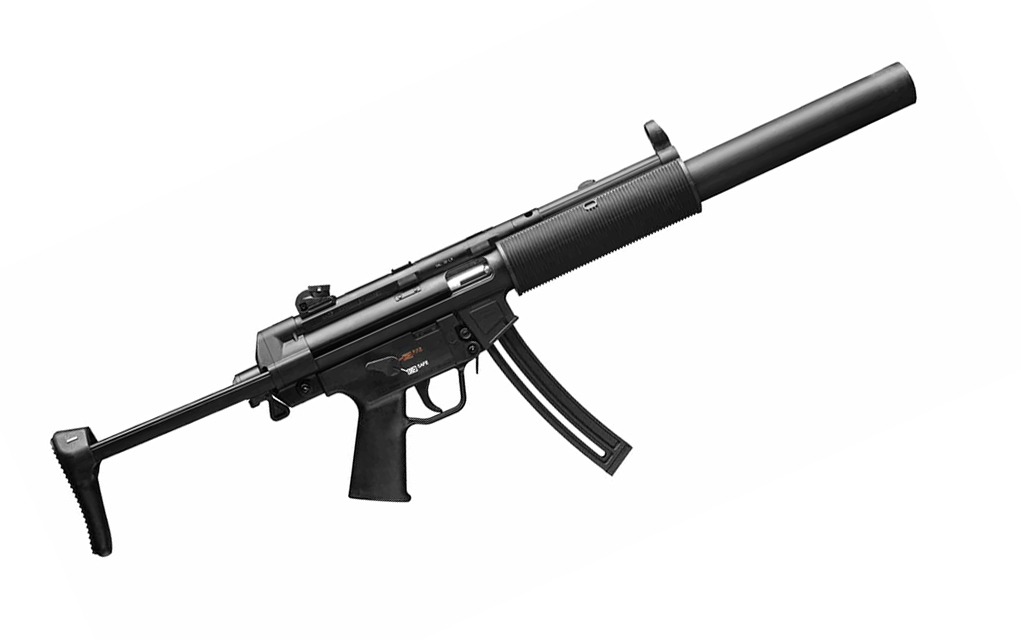
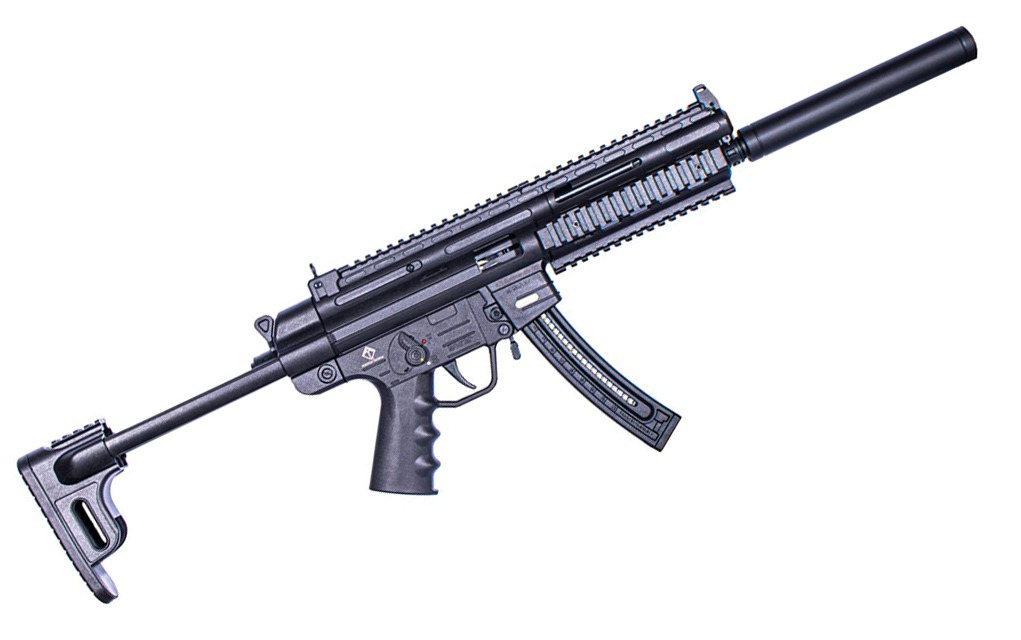
Most people want an MP5 for fun, and H&K lets you have it for a shockingly reasonable amount, considering that we’re poor and they hate us. The HK MP5 .22 LR rifle is authentic(ish), affordable, and probably the best one to buy in the grand scheme of things as long as you’re fine with the .22 LR chambering. The barrel is hidden under a faux suppressor that’s designed to look like the famous MP5SD variant which adds a lot to the cool factor, too.
This .22 MP5 is a factory-authorized clone made by Umarex. It has everything it needs to make it look like a real MP5SD (besides the windowed 25-round rimfire mag) and because it’s a rifle, it comes out of the box with a telescoping A3-style stock. No tax stamp required. The only real downside I’ve found is its barrel isn’t threaded and doesn’t have a tri-lug adaptor either, so you can’t attach a real suppressor.
The average price is about $540, less than half of what the 9mm clones typically go for. It’s made by one of the best airsoft/rimfire manufacturers licensed by HK, and you can shoot the heck out of it for pennies.
Best Budget 9mm: Military Armament Corporation MAC 5
PROS:
Threaded barrel & tri-lug adaptor
More affordable than MKE clones
Comes with a lot of extras
CONS:
Tight magwells
Comes with slim handguard, not classic triangular
No optics or accessory mounts
MAC 5 Specs
Caliber: 9mm Luger Format: Pistol Country Of Origin: Turkey Barrel Length: 8.9 Inches Overall Length: 17.9 Inches Muzzle: 1/2×28 threads and tri-lug Weight: 5.5 Pounds MSRP: $1,295 Website: milarmamentcorp.com
Military Armament Corporation’s MAC 5 is made in Turkey, just like Century’s AP5, but the two guns come from different factories. These are relatively new to the market at the time of writing, but so far they seem to be building a great reputation. The MAC 5 I shot, ran through mags without a single issue and felt about the same general quality as Century’s offering.
However, others on our staff have had issues with the gun, despite walking away overall impressed with the platform. In particular, the rollers had to eventually be replaced to ensure proper bolt-head gap. That, combined with the MAC 5 being known to have tighter-than-normal magwells, keeps it from being at the top of my list, but I still think it’s a great option for those on a budget who want a 9mm MP5 clone.
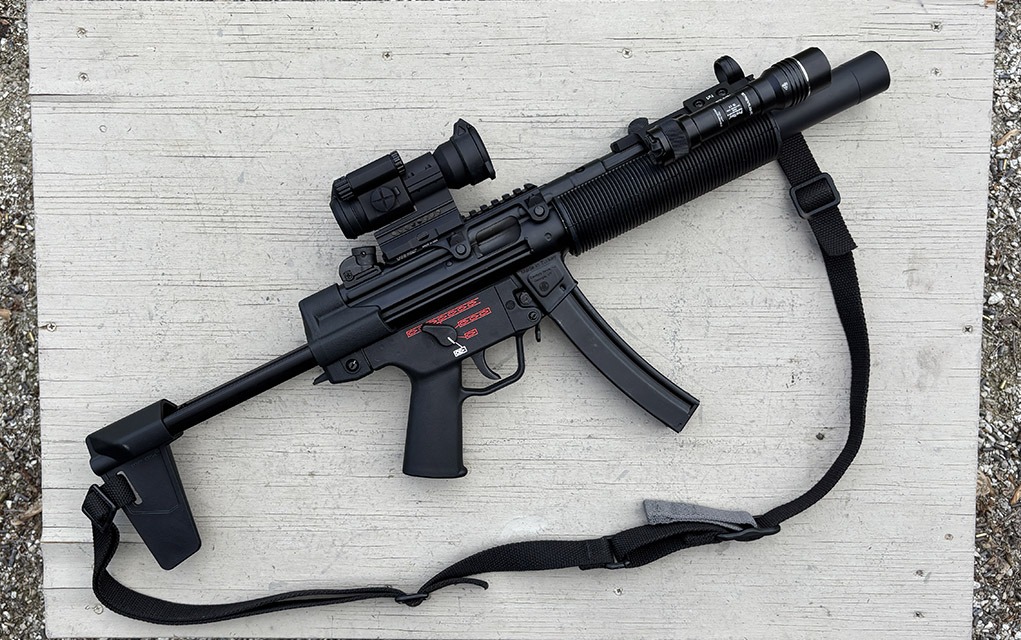
Caliber: 9mm Luger Format: Pistol Country Of Origin: Turkey Barrel Length: 5.75 Inches Overall Length: 16 Inches (butt to end of handguard) Muzzle: 1/2×28 threads and tri-lug Weight: 6.7 Pounds MSRP: $1,700 Website: centuryarms.com
This is Century’s newest AP5 variant, and I’m a very big fan. It has everything that’s great about the standard AP5 but in an MP5SD-style package.
It ships with a removable faux suppressor mounted to the 1/2×28 threads on the barrel’s muzzle. The barrel is shorter than normal models and sits inside the special SD-style rubber handguard, meaning that once the faux suppressor is removed, a real suppressor can be attached via the threads or the tri-lug mount. The result is a gun that looks just like the classic MP5SD, but one that can use any normal 9mm can with compatible mounting options. The AP5SD pictured here has already been tricked out with a Rugged Obsidian45, a Magpul MP BSL pistol brace, an optic, light and sling.
This isn’t the model for everyone, and there’s no reason you can’t just throw a suppressor on a standard AP5, but if you plan on mounting a can and leaving it on there I think this is the coolest way to do it. The special handguard helps protect the suppressor some, too, so it’s not just about the looks.
Best Budget Plinker: American Tactical Imports GSG-16
PROS:
Most affordable option
.22 LR is cheap to shoot
Legally a rifle so it includes a collapsible stock
Swappable charging handle
Plenty of rail space for optics and accessories
CONS:
Looks the least like a classic MP5
It’s a .22 LR
Lower capacity
Faux suppressor barrel
ATI GSG-16 Specs
Caliber: .22 LR Format: Rifle Country Of Origin: Germany Barrel Length: 16.25 Inches Overall Length: 28.5 Inches (collapsed) Muzzle: N/A Weight: 5.8 Pounds MSRP: $440 Website: americantactical.us (importer)
Some might call it heresy to put the GSG-16 from American Tactical Imports on this list, but it looks close enough to an MP5 in its general form that I’m including it. If you want something better, you’re going to have to pay for it. This option is for those looking to vaguely scratch their MP5 itch for as little scratch as possible.
The GSG-16 is an MP5-inspired rifle in .22 LR with a faux suppressor shroud on the barrel. Since the barrel length is 16 inches, no SBR stamp is needed for the included stock. The charging handle can be swapped to the right side, unlike the real thing, and the receiver is fully railed, so you can mount an optic with no issues. The handguard also has rails at 3,6 and 9 o’clock for other accessories. In terms of practicality, the GSG-16 has a lot going for it. It only really loses out in the looks department.
MSRP is $430 and they can be found for less than $300 if you look around. Impressively practical, affordable, and therefore a heck of a lot of cheap fun.
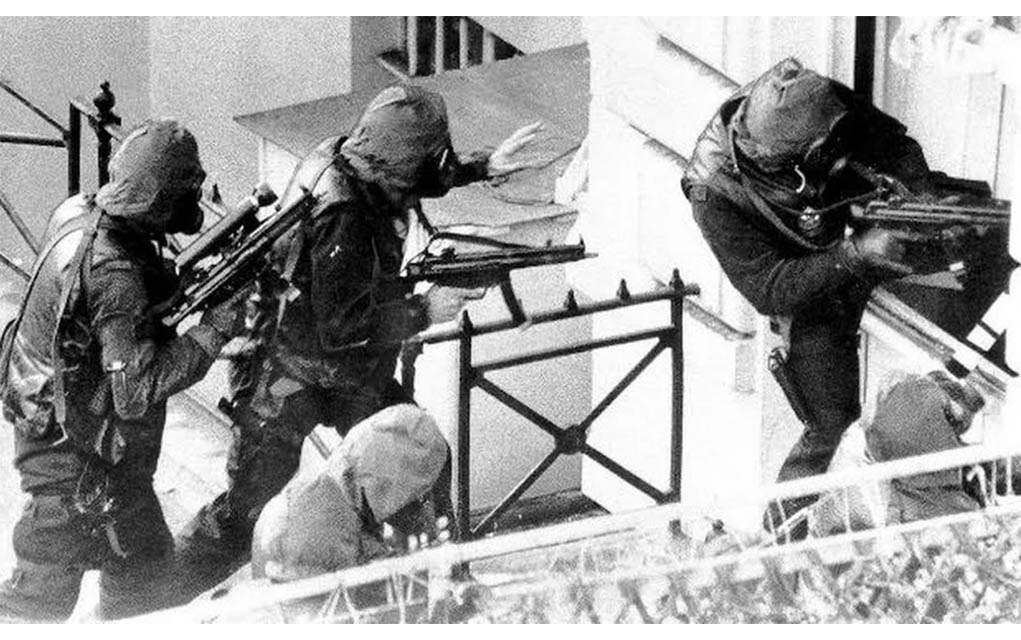
The H&K MP5 is an iconic SMG, partially because it was more or less the SMG for most of the Western world’s military and police during the Cold War era. Oh, there were some Berettas and Walthers and Uzis out there too, and Colt made a 9mm AR, but the MP5 is the one people remember. The design is so well-loved, in fact, that of all those SMGs listed the MP5 is the only one that really continues to see widespread service. Not just with poorer nations either, but with plenty of first-world police and military units as well.
SAS members sieging the Iranian Embassy with MP5s in 1980.
The MP5 is the SMG version of H&K’s roller-delayed blowback operating system, first used by the company in its G3/HK91 series of rifles before eventually being scaled down to 9mm in the mid-1960s.
Despite how adored the MP5 is by armed professionals around the world, its real world use isn’t the main reason for its legendary status. Hollywood is to thank for that. Die Hard, Predator, The Rock, the list of great action movies that prominently feature the MP5 is practically endless, and these days you’ll find one in just about every shooter video game too. It’s one of those guns that’s so famous that even non-firearms enthusiasts will often be able to recognize it, and they might even know its name.
Carl Weathers dual-wielding MP5s (technically modified HK94s, but close enough) in Predator (1987). Photo: IMFDB.
Point being, many of us have been watching action heroes use the MP5 for our entire lives. Like the S&W Model 29 in the Dirty Harry films, the Beretta 92 in Die Hard and Lethal Weapon, the Walther PPK in the James Bond series, the MP5 will be forever desirable simply due to its place in pop culture.
Is A MP5 Clone A Good Choice?
Given the continued popularity of the MP5 among police units around the world, it’s still a viable weapon. Of course, they’re using genuine full-auto models, and that changes things.
For us civilians stuck with semi-autos, an MP5 could still be a viable choice for certain practical applications, but the reality is that there are better 9mm pistol-caliber carbines available now. So, if you’re in the market for an MP5 clone, you should recognize that you’re getting it for the cool factor and because of how fun of a range toy they are. If you’re looking for a PCC for home defense or competition, you should probably consider a different platform entirely.
Sure, the HK slap will put a smile on your face, but the reloading sequence is far less charming when you’re on the clock. Today there are several 9mm PCC options that cost less, are more practical to use and easier to accessorize. Keep in mind that the MP5 was designed in an era when flashlights were mounted with hose clamps and optics were attached with claw mounts. Sure, there are plenty of aftermarket accessory options available these days for modernizing an MP5, but it will be more expensive, more difficult and less ergonomic than if you tried to do the same with something more modern. MP5 trigger’s are notoriously mushy, too.
This photo shows a fully accessorized Ruger PC Charger, the pistol version of the PC Carbine.
For example, a Ruger PC Carbine costs less than $800, accepts Glock magazines and is ready to mount a light and optic out of the box. That’s not something you can say about any 9mm MP5 clone.
That all said, very few of those 9mm PCCs shoot as nicely as an MP5. The roller-delayed action allows for their bolts to be much lighter and results in a very soft, pleasant shooting experience that’s incredibly easy to make hits with. That’s the quality that made them so loved by military and police, and I think it’s still a valid reason to buy a semi-auto clone of one today. If you can swing the price and clunky manual of arms, an MP5 clone could still be an excellent and practical choice.
MP5 Clone Price
H&K decided to reward us peasants with a civilian-legal, semi-auto pistol version of the MP5 a few years back called the SP5.
However, the awesomeness doesn’t come cheap, as they typically carry a price tag of $3,000 or more. HK throws in two magazines, whether you get the 30- or 10-round units, and they want you to pay $80 for any other HK-branded mags that you might want to pick up.
The H&K SP5.
And that’s just for starters.
Most folks will want to accessorize their gun, and the additional expense of an optic and light, proprietary mounts for them, a pistol brace or stock (if registered as an SBR) and extra mags adds up very quickly. By the time you’re done tricking out an HK SP5, you’re easily looking at a $4,000 project.
For a gun that was first manufactured in the 1960s and has a stamped metal receiver, that’s absolutely bonkers. So, why not get a clone that does all the same stuff, takes the same parts and costs less? That’s the beauty of MP5 clones, you get the same cool factor for a fraction of the price. The only question left to consider is which of the MP5 clones is best for you.
MP5 FAQ
What MP5 Do Navy SEALs Use?
The Charlie Sheen film Navy SEALs famously depicts SEALs using the integrally suppressed MP5SD, but the team in real life also uses standard MP5s and compact MP5Ks. It all depends what the mission calls for.
Why Did SWAT Stop Using The MP5?
People commonly think that SWAT teams around the country have completely stopped using MP5s, but that’s not true. They have been largely replaced by various types of 5.56 AR-15s, but many departments still have MP5s in their inventory that can be taken out for a mission if so desired. Some poorer departments may still use them purely out of necessity, but some SWAT team members with the option will still take an MP5 over an AR due to personal preference. For proof, take a look at recent Annual Military Equipment Reports published by departments in California, you’ll see the MP5 mentioned in plenty of them.
Is A 9mm Carbine Good For Home Defense?
Yes, 9mm carbines (either in the form of an SBR or a braced pistol) make excellent home defense weapons and are a popular choice. They’re small, easy to shoot, pack plenty of punch at close range and can use subsonic defensive ammunition in conjunction with a suppressor to save your hearing. That said, living situations vary, and factors like overpenetration could make a 9mm carbine a less desirable option compared to something else.
What Is The Point Of A 9mm Carbine?
As mentioned, 9mm carbines like an MP5 clone can make for excellent home defense guns. They’re tons of fun to shoot too, so they make for great range toys and are often used in competition as well. 9mm is also cheaper than .223/5.56 ammo, so you can spend more time plinking or training for less money.
More On Classic Guns:
Why The Mauser C96 “Broomhandle” Still Looms Large
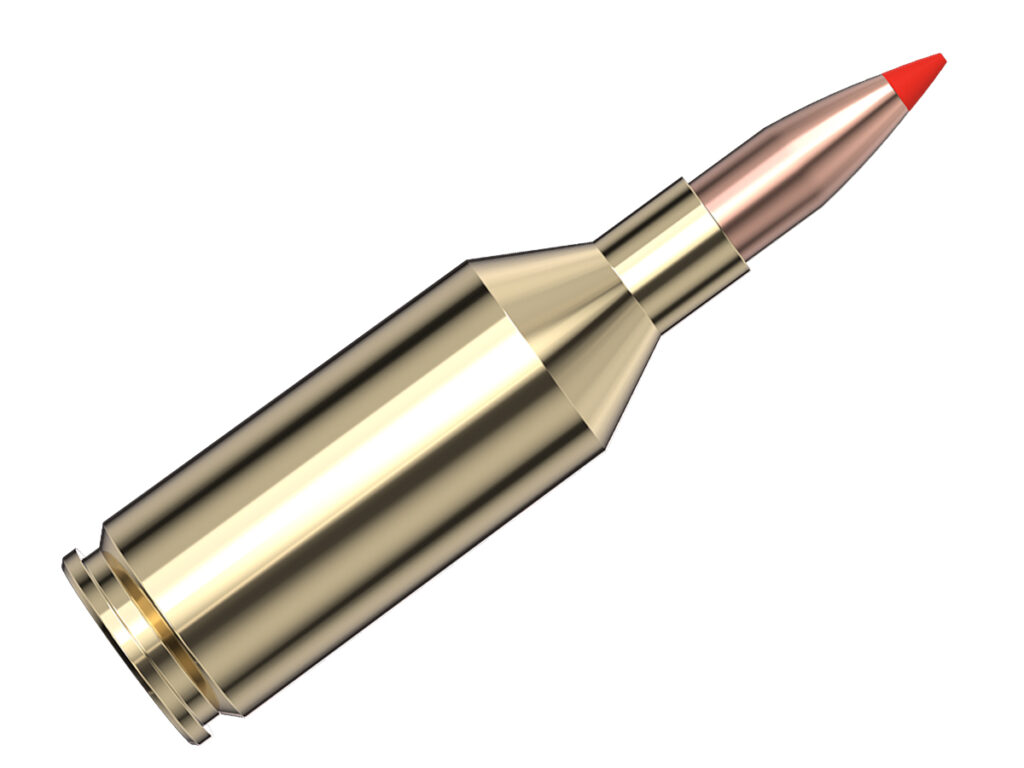
Hornady just announced some mid-year new products, including loads for .223 WSSM, .243 WSSM and .400 Legend.
Hornady seems to be constantly expanding its catalog with new products, and the company just added a few more interesting items in this mid-2025 announcement. Namely, three new loads that will catch the eyes of those who hunt or compete with the calibers in question.
.223 WSSM.
Firstly, a new 55-grain V-MAX Superformance Varmint load for .223 Winchester Super Short Magnum, aka 223 WSSM. Designed to deliver excellent accuracy and explosive performance, Hornady says that the 223 WSSM Superformance Varmint “delivers muzzle velocity increases of 100 to 200 feet per second from EVERY gun.” That will give you more range, a flatter trajectory, reduced wind drift and excellent terminal performance when you’re on the hunt for varmints. You can even use it in semi-autos. All those claims also apply to the new 75-grain V-MAX Superformance Varmint load for .243 Winchester Super Short Magnum, aka 243 WSSM.
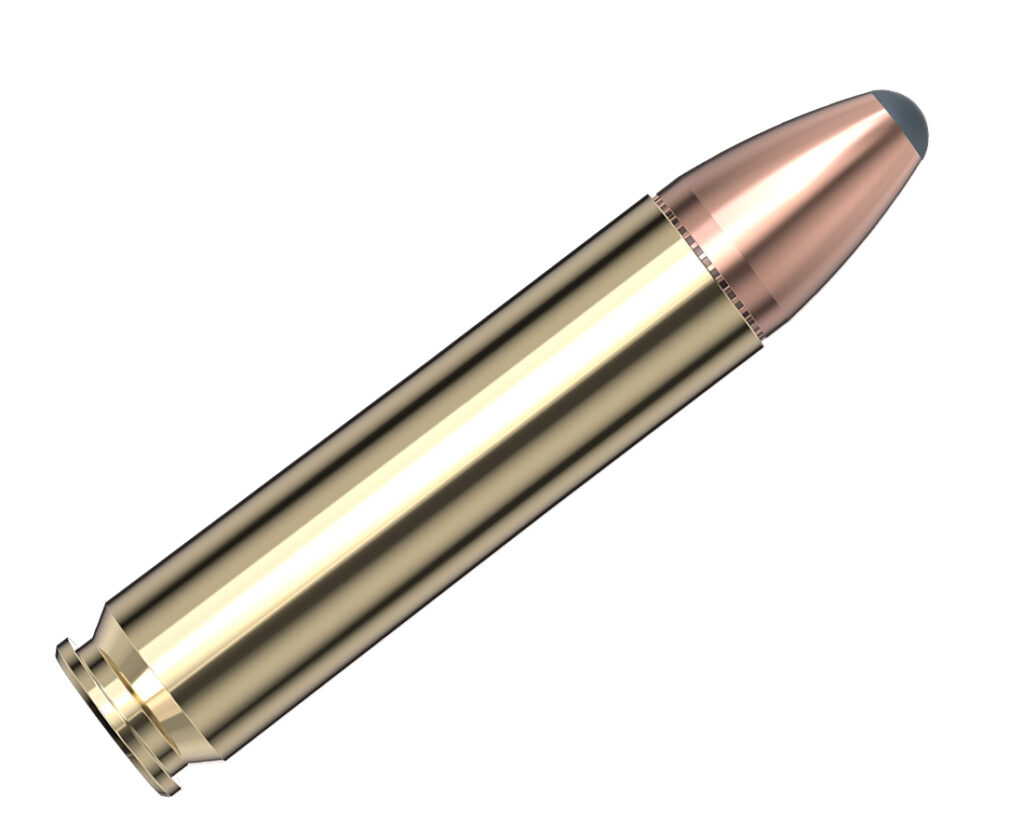
.400 Legend.
For taking game that’s a bit bigger than varmints, Hornady also introduced a new 210-grain InterLock American Whitetail load for .400 Legend. This was designed to be versatile, capable of delivering hard-hitting performance at extended ranges for the caliber and compatible with both bolt-action and AR-style rifles.
Outside of new ammunition, Hornady also announced a reloading tool called the One Shot Spray Bar. Offered in small rifle/ARC and large rifle/magnum sizes, the bars hold 25 cases at a time so you can lubricate them evenly and quickly.
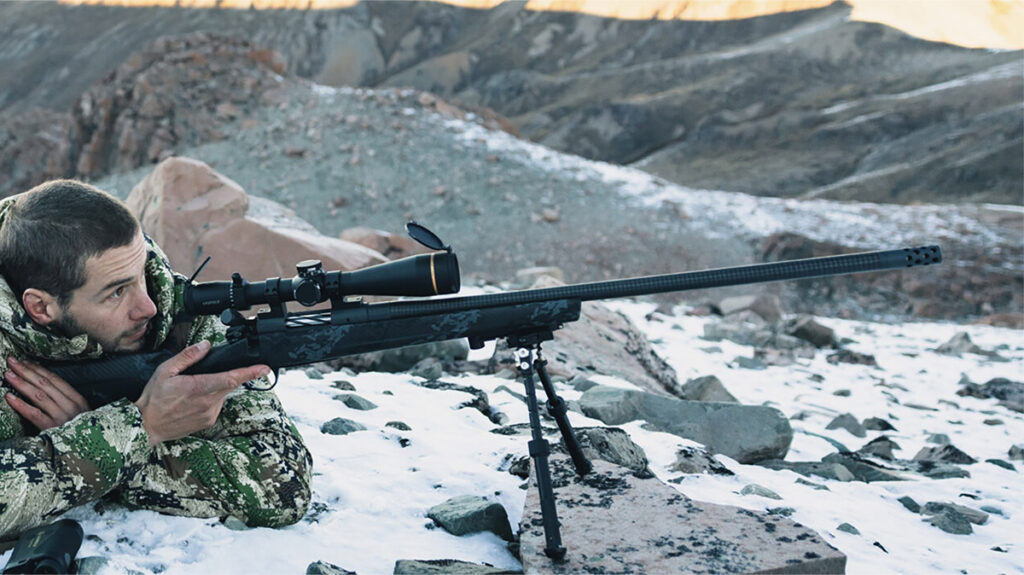
For those looking to cut down the weight of their hunting loadout, Bergara has just released its lightest B-14 yet—the Squared Cima CF.
Some hunters carry their gear for far greater distances than others, but nobody likes lugging a heavy rifle around. In response, companies have been competing to make the lightest hunting rifles possible. The most recent release to follow this trend is from Bergara in the form of the B-14 Squared Cima CF.
The CF in its name stands for Carbon Fiber, the major method used to bring down the rifle’s weight to a scant 5.8 pounds for the lightest model. The RTM sporter stock is 100% carbon fiber, and its manufacturing method results in a very rigid stock despite weighing only 18 ounces. To ensure that the rifle is as accurate as it is tough, an SMC carbon mini-chassis is closely fitted to give the action a solid bedding as well. This helps keep the whole package rigid without adding too much weight. The final piece is the CURE carbon barrel that features a No. 6 taper and an Omni muzzle brake (muzzle is threaded 5/8×24).
The B-14 Squared Cima CF is available in .308 Winchester, 6.5 Creedmoor, .22-250 Remington, 6.5 PRC, .300 Winchester Magnum, 7 PRC and 300 PRC. Depending on the caliber, the capacity ranges between two and four rounds, the barrel length ranges between 20 and 22 inches and the weight between 5.8 and 6.2 pounds. Other features include an adjustable Bergara Performance Trigger and an M5 bottom metal hinged floorplate that’s easily convertible to be AICS-compatible. MSRP is $1,850.
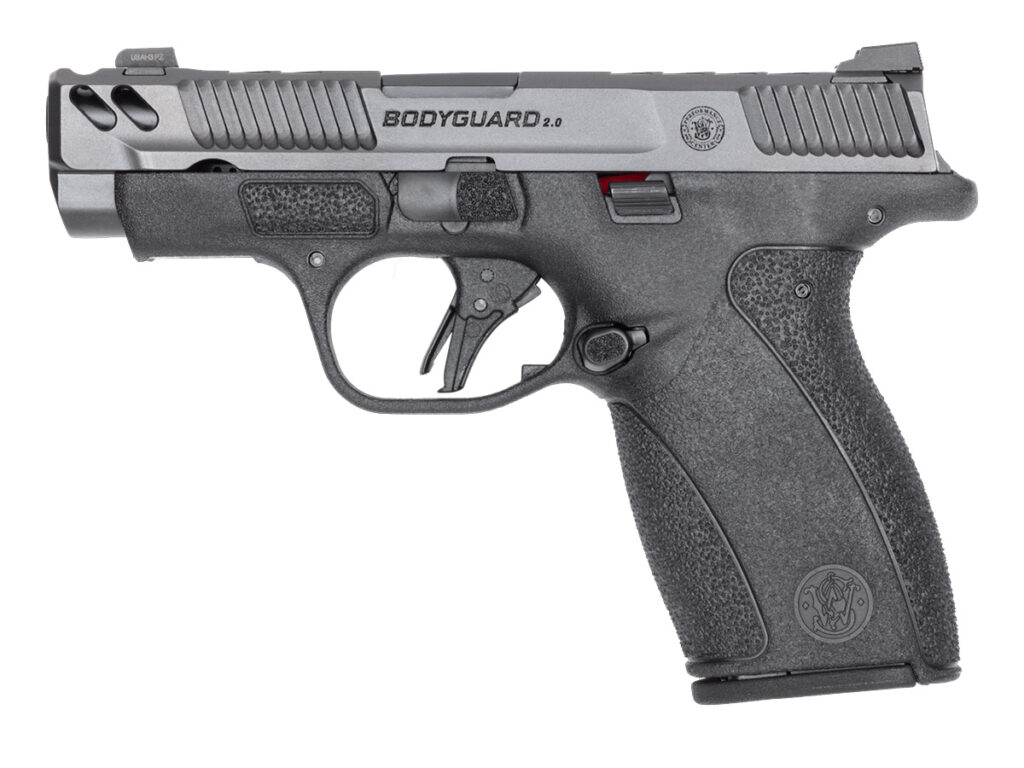
Smith & Wesson has just made the Bodyguard 2.0 even more controllable with the addition of a Carry Comp variant.
About a year ago, Smith & Wesson unveiled the Bodyguard 2.0, a majorly redesigned and improved version of the company’s original .380 ACP concealed carry pistol. Now, the 2.0 model is getting an overhaul itself with the release of the Performance Center Bodyguard 2.0 Carry Comp.
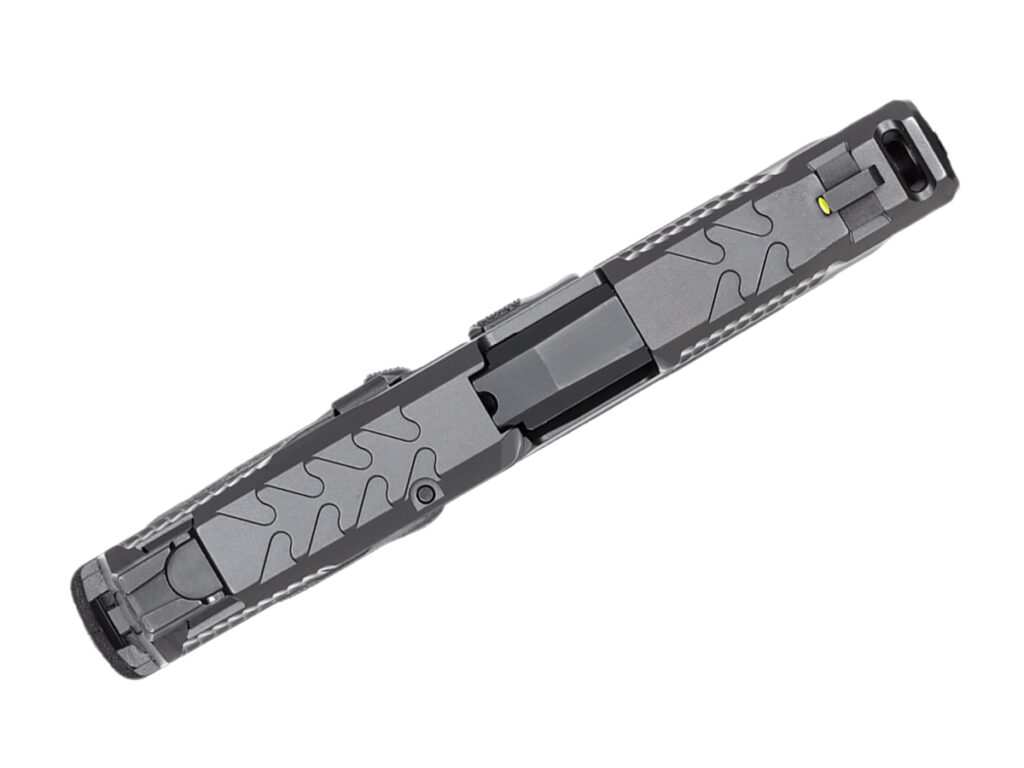
The most substantial new feature of the Bodyguard 2.0 Carry Comp is its integrated Power-Port compensator. Located at 12 o’clock at the end of the 3.1-inch barrel, the Power-Port diverts gas upward to reduce felt recoil. Paired with low-recoil self-defense ammo, this will likely be a very shootable carry pistol. Other upgrades found on the Performance Center Bodyguard 2.0 Carry Comp include more aggressive slide serrations, blacked-out square notch Ameriglo Protector rear sights and Ameriglo Protector LumiGreen front night sights. The rest of the pistol’s features are the same as on the standard version.
The Bodyguard 2.0 Carry Comp ships with one 10-round and one 12-round magazine and is available either with or without a thumb safety. A 10-round compliant version is available as well. All three new variants of the Performance Center Bodyguard 2.0 have an MSRP of $549 and are available now.
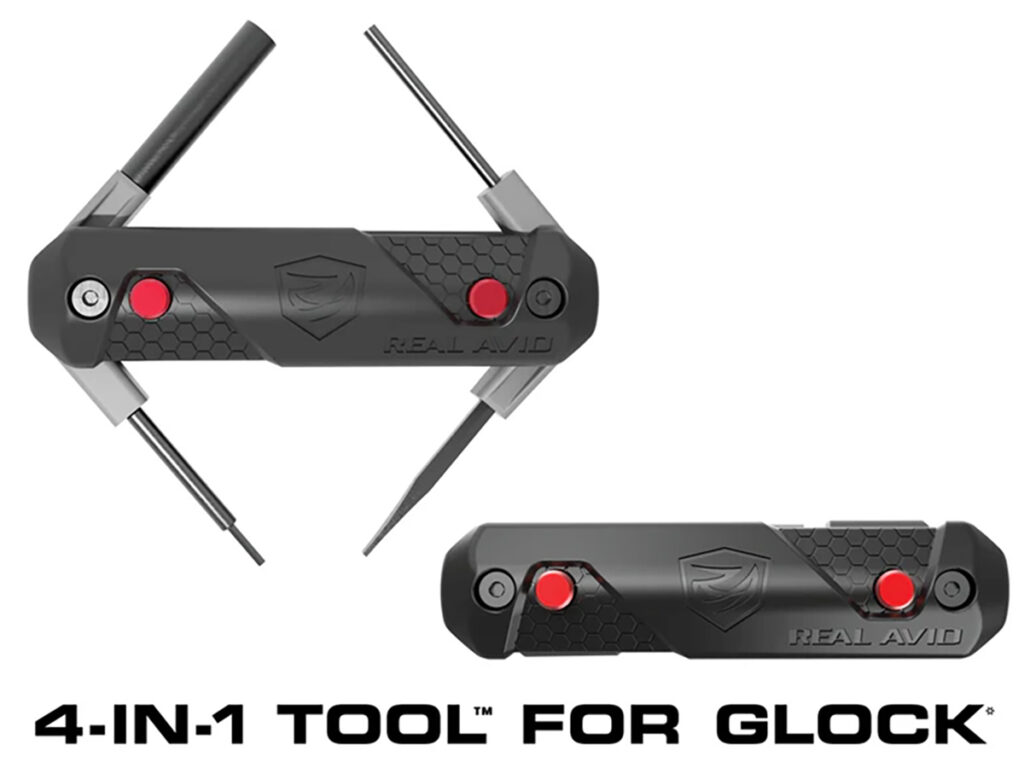
If you’re a Glock shooter, Real Avid’s new Master Maintenance Collection for Glock offers the tools you need to clean, maintain and modify your guns.
Glocks may be extremely reliable pistols, but they still need to be cleaned and maintained like any other. Given the massive availability of aftermarket parts and accessories, they’re extremely customizable pistols as well. Whether you’re looking to modify your Glocks or just keep them clean, the new Real Avid Master Maintenance Collection for Glock should have everything you need in a single package.
Here’s everything that’s included in the Master Maintenance Collection:
Sight Pusher for Glock, 4-in-1 Tool for Glock, Smart Mag Tool for Glock, Smart Mat for Glock Pistols, Gun Boss Pro Handgun Cleaning Kit, Gun Boss Pro Precision Cleaning Tools, Master Bench Block Pro-Kit, Magnetic Bore Light, Accu-Grip Steel Picks, Gun Tool Edge – Pistol, Tri-Max CLP (12-ounce aerosol), Tri-Max CLP Gun Wipes (60-count canister) and Gun-Max Gun Oil (1-ounce bottle).
With those tools on hand, you’ll be able to adjust and replace sights, disassemble magazines for cleaning or modification, take Glocks apart beyond basic field stripping, clean any model between .22 and .45 caliber and much more. The included oil-resistant mat with a magnetic organization tray should only make those jobs easier.
If you’re serious about Glocks, this comprehensive toolbox will cover all your bases. The Real Avid Master Maintenance Collection for Glock has an MSRP of $484 and is available now.
CZ has just announced the CZ P-10 C PORTED, a 9mm carry pistol that features an integrated compensator for fast and accurate shooting.
Fans of the CZ P-10 C should be excited, as the company has just announced the new PORTED variant of the 9mm carry pistol that features an integral compensator. Combined with a cold hammer forged barrel that’s 10 percent heavier than what comes on standard models, it should result in a pistol that’s easy to shoot both quickly and accurately.
Other features of the new model include improved, extended cocking serrations, an optics-ready slide and luminescent iron sights. The rest of the PORTED model is the same as a standard version, including its short, crisp trigger, its interchangeable backstraps and its 15+1-round magazine capacity.
The CZ development team said this about the new pistol:
Fast and accurate shooting, an excellent trigger, and maximum shooting comfort – these are no longer benefits reserved only for sport pistols. The CZ P-10 C PORTED proves that even a compact everyday carry pistol can deliver top-level shooting performance.
The CZ P-10 C PORTED is available now. No official MSRP has been provided, but they are currently being listed online for about $550.
We discuss why ignoring the militia clause endangers the right to keep and bear arms.
When Americans debate the Second Amendment, most of the focus tends to center around the individual right to keep and bear arms. This emphasis, especially in post-Heller and McDonald jurisprudence, is both understandable and historically justified. However, a recurring error—committed even by Second Amendment advocates—is to treat the “militia clause” as a relic or a throwaway preamble. This oversight is more than a mere historical misstep; it’s a strategic blunder that endangers the very right these advocates claim to protect.
As the Tenth Amendment Center has long emphasized, constitutional language should be taken seriously in its entirety. The Second Amendment begins not with “the right of the people …” but with “A well regulated Militia, being necessary to the security of a free State.” This prefatory clause does more than frame the historical context—it outlines purpose, meaning and limits on government power. Ignoring it concedes too much ground to those who seek to reinterpret the Amendment through a modern, statist lens.
The Militia As The Armed Citizenry
Historian and constitutional scholar Stephen Halbrook makes it clear: In the founding era, the term “militia” did not refer to a standing military force or what we now call the National Guard. It referred to the general body of armed citizens—able-bodied males typically aged 16 to 45—who were expected not only to defend their own communities but also to be the first line of resistance against tyranny. This understanding wasn’t unique to America; it was rooted in English common law and the political philosophy of thinkers like John Locke and William Blackstone.
As Halbrook observes, the militia was not a privileged class of government-trained personnel. It was the citizenry itself, armed and responsible for its own liberty. To that end, citizens were expected to bring their own arms. In this sense, the right to bear arms was not merely an individual liberty—it was a civic duty.
Why The Militia Clause Still Matters
The tendency to ignore the militia clause arises largely from the (justifiable) desire to assert the Second Amendment as an individual right. But by doing so, modern advocates often detach that right from its original civic and political function: to deter tyranny and resist centralized military force.
The Founders feared a professional standing army far more than they feared individual violence. They understood that an armed populace, organized as a decentralized militia, was the surest safeguard against domestic oppression. When the militia clause is read out of the Amendment, this structural check on tyranny is lost. As a result, the right to bear arms is interpreted narrowly as a private right rather than a public, constitutional responsibility. This limited view makes the right more vulnerable to incremental erosion through regulation, licensing and judicial reinterpretation.
Historical Evidence: The Militia And Self-Defense
Halbrook’s historical work underscores the absurdity of the claim that the Second Amendment protects only militia service or that it is moot because formal militias no longer exist. In both English and early American law, the right to bear arms was consistently treated as a natural right, especially for self-defense. Even the infamous 1328 Statute of Northampton—which prohibited armed display in a threatening manner—was interpreted as banning only arms borne “malo animo” (with evil intent). As Halbrook explains, “the peaceable bearing of arms was not a crime at the Founding or in the early Republic.”
Moreover, court decisions from the early 19th century reaffirmed that open carry was a constitutional right, while concealed carry could be regulated. The difference hinged not on whether individuals had a right to bear arms, but how they exercised that right.
The Dangers Of Dismissing The Militia
Modern disarmament efforts often hinge on the claim that the Second Amendment is outdated—that it only applies to now-defunct militias, or to the regulation of state-run National Guards. By discarding the militia clause, gun rights advocates play directly into this narrative. If the militia no longer exists, and the right to keep and bear arms was tied to militia service, then it stands to reason—so the argument goes—that the Second Amendment is a historical artifact with no modern relevance.
However, if the militia is understood as the armed citizenry, as it was in the Founders’ time, then the right to bear arms remains as vital today as ever. In an age of mass surveillance, unchecked executive power and militarized law enforcement, the need for decentralized, citizen-based security is not an anachronism—it’s a necessity.
Strategic Consequences For Advocacy
To preserve the Second Amendment, advocates must resist the temptation to sanitize it into a purely individualist doctrine. It is, in fact, both a right and a responsibility. It empowers individuals not merely for private purposes, but to fulfill a public role in the preservation of liberty. This dual nature is not a weakness—it is the source of the Amendment’s enduring strength.
By reclaiming the militia clause, Second Amendment defenders bolster the historical and constitutional legitimacy of the right. They root it not in hobbyist gun culture or political identity, which has its place, but in civic republicanism and the broader structure of federalism and limited government.
Conclusion: A Fuller Reading, A Stronger Right
The Second Amendment is not ambiguous. It recognizes “the right of the people to keep and bear Arms,” and it explains why—because “a well regulated Militia” is “necessary to the security of a free State.” This is not incidental. It is a declaration of political philosophy—a philosophy that views the armed citizen as the guardian of liberty, not the ward of the state.
To ignore the militia clause is to amputate a fundamental rationale that justifies the right. Worse, it surrenders rhetorical and legal territory to those who would regulate the Second Amendment out of existence. If we want to preserve the right to bear arms, we must also preserve the principle of the armed citizen—the true militia—without which freedom cannot stand.
Editor’s Note: This article originally appeared in the July 2025 issue of Gun Digest the Magazine.
The .45 Colt Cartridge has been going strong for more than 150 years, and it still has a variety of uses today.
While picking my first handgun, I didn’t opt for a compact carry gun or one of the ever-popular .22 LR options—both target rimfire revolvers and autoloaders are a ton of fun—but instead wanted a long-barreled, rock-solid, single-action gun that I could use to hunt both deer and bear here in my native New York. I chose a Ruger Blackhawk in .45 Colt in a stainless finish, with a 7½-inch pipe.
Among the more popular revolver cartridges, the .45 Colt offers quite the flexible package, giving the shooter what might seem like three different cartridges rolled into one. Adopted by the U.S. Army in 1873, it served as our official military sidearm until 1892 (though remained in use until 1896) and would go on to inspire one of the most popular handgun cartridges ever.
153 Years Strong
Looking at the design, it’s simple yet effective. The .45 Colt is a rimmed case—though that rim is not as large as most rimmed designs—with a straight-walled body. The case measures 1.285 inches long, with a maximum cartridge overall length of 1.600 inches. Considering the fact that the cartridge is over 150 years old, it works just as well as it did during the 1870s, with modern metallurgy allowing the performance level to far exceed the original design specs.
Another .45 Colt cartridge, happily nestled in the chamber of the author’s Ruger Blackhawk. Photo: Massaro Media Group.
The “Long Colt” nomenclature has never been an official part of the cartridge’s name; it was just a means to differentiate the longer Colt case from the shorter .45 Schofield, commonly chambered in the Smith & Wesson revolver of the era. Just as the .38 Special cartridge can be fired in a .357 Magnum chamber, the .45 Schofield ammunition can be safely fired in a .45 Colt handgun.
The original iteration of the .45 Colt saw a 255-grain lead bullet of 0.452-inch diameter seated more than 40 grains of black powder, fired at a muzzle velocity of 1,050 fps. The recoil was deemed too severe for the average soldier and was subsequently reduced to 855 fps. That classic combination would be the rough model for John Browning’s .45 ACP design, which remains one of the best-selling handgun cartridges to this day. There is absolutely nothing wrong with the classic load, as it’s mild enough for accurate shooting, yet potent enough to handle defensive situations as well as some hunting, at sensible ranges.
This load, or those which are similar in basis, remain available to this day. Federal offers a 225-grain lead semi-wadcutter hollow-point at 830 fps, Hornady loads a 255-grain round-nose lead bullet, which they advertise a muzzle velocity of 725 fps from a 4½-inch barrel, but will get closer to 800 fps from a longer barrel, and Remington’s Performance WheelGun line sees a 255-grain lead semi-wadcutter at 830 fps, and a 250-grain lead round nose at 750 fps. Buffalo Bore ammo offers the 255-grain soft-cast lead bullet at 1,000 fps, mimicking that original .45 Colt load, while Choice Ammunition loads their Hi-Tek coated 255-grain lead bullet at 830 fps.
Federal’s “blue box” line includes an affordable 225-grain lead semi-wadcutter that’s equally at home at the range as it is in the deer woods. Photo: Massaro Media Group.
If you prefer the jacketed bullets—whether for their additional structural integrity or for the ease of cleaning your barrel—there are many ammunition choices loaded at the original velocity. Federal’s American Eagle line gives an affordable option, seeing a 225-grain jacketed hollow-point at 860 fps, and Winchester has a 250-grain semi-jacketed bullet in their Big Bore ammo line, at 845 fps.
If you choose to, or are legally required to, use a lead-free bullet, there are options available, such as the Barnes Pioneer line that sees a 200-grain XPB copper hollow-point load at 850 fps. Buffalo Bore loads the 225-grain Barnes XPB to 1,000 fps in their Standard Pressure line. All of these loads should be safe in any era of .45 Colt handgun, but beware that there are many hotter loads on the market—with most being labeled either +P or specified for use in particularly strong modern firearms—which change the capabilities of the .45 Colt.
New Life With New Ammo
But, before we look at the fastest, hottest loads for the venerable cartridge, there are loads that are perfect for both plinking as well as training with your new handgun. Choice Ammunition loads their Hi-Tek 180-grain coated lead bullet to a mere 460 fps, offering an option with minimal recoil and report, perfect for training purposes. Despite the lightweight bullet and significantly reduced muzzle velocity, I found the bullet would actually penetrate a piece of 2×6 yet is easy enough on the hands and wrist so that even young shooters can accurately place their shots. Choice’s light load makes for a great afternoon of plinking and can just as easily be used to dispatch varmints and other garden pests.
The .45 Colt can be wonderfully accurate, engendering all sorts of confidence in the shooter. Photo: Massaro Media Group.
And, if a single projectile doesn’t seem like the proper choice for small critters at close range, CCI loads a trio of shotshells for the .45 Colt, including the original Pest Control load using 150 grains of No. 8 shot at 1,000 fps, the Big 4 load using 140 grains of No. 4 shot at 800 fps, and the latest, the HEVI-Bismuth that uses 130 grains of No. 8 Bismuth shot at 1,050 fps for a nontoxic option. DoubleTap offers their DT SnakeShot, using a charge of No. 9 shot over a 70-grain hardcast projectile, for a “best-of-both-worlds” approach. DoubleTap’s load makes an excellent choice for camping and hiking, for all sorts of threats, from two-legged, to four-legged to no-legged.
Looking at those loads that exceed the original performance levels, you will find a wide selection of projectiles and velocities. While the .45 Colt didn’t have the same rifle/handgun combination that Winchester’s .44-40 WCF did, there have been many lever guns made recently for the bigger Colt cartridge. Hornady extended their LeveRevolution series—the one that uses the FTX spitzer with the pliable polymer tip to allow improved Ballistic Coefficient in tubular magazine guns—to include a 225-grain offering in .45 Colt at 960 fps in a handgun, and you’ll get considerably more in a carbine or rifle.
From “bunny fart” plinking loads to true dangerous game ammunition, there’s a .45 Colt load to meet your needs. Photo: Massaro Media Group.
Federal has also seen the wisdom of a .45 Colt rifle, by including the cartridge in their HammerDown ammunition line, with a 250-grain bonded core bullet developing over 1,000 fps in a 20-inch barrel. At reasonable distances—say woods hunting for whitetails, bears over bait or close-in hogs—the .45 Colt could be a whole lotta fun, with minimal recoil.
Stepping up to the heaviest end of the spectrum and looking at the loads that require a gun of tougher build than the standard Single Action Army and its clones, you’ll see loads that come much closer to the Colt-inspired .454 Casull. Buffalo Bore has some very interesting loads for the .45 Colt, in the +P guise, including the 225-grain Barnes XPB loaded to scream at 1,500 fps and the 300-grain monometal wide, flat nose at 1,300 fps or so, generating 1,100 ft-lb of energy. The velocity attained by this latter load, and the construction of this bullet result in very deep penetration, and for the handgun hunter serious about using a .45 Colt on thick-skinned game like any of our wild bovine or big hogs, this is a load to look long and hard at.
Like to hunt dangerous game with a handgun? Buffalo Bore has you covered. This .45 Colt load with the 300-grain monometal projectile will penetrate thick hide and bone.
The Buffalo Bore .45 Colt +P Deer Grenade load is built around a 260-grain medium cast lead hollow-point gas check bullet, at a muzzle velocity of just above 1,500 fps. Offering a quick energy transfer, this load is hard enough to give good penetration, yet soft enough to give rapid expansion. The gas check will significantly reduce fouling, with recovered projectiles often doubling in caliber.
Doing double duty as a defensive/hunting load, Choice Ammunition’s Bear Defense load is one bad hombre—it uses a 325-grain hard cast, flat-nosed, gas check bullet at a muzzle velocity of 1,350 fps, generating over 1,300 ft-lb of energy. For a sub-magnum cartridge, that’s a pretty impressive set of figures. My Blackhawk will put three of these in a 2-inch group at 40 yards, which is about as far as I feel comfortable shooting an iron-sighted handgun. I’ve shot a bunch of this ammo through my Blackhawk, where the recoil is eye-opening but manageable, and in the Freedom Arms Packer snubnose, it’s just plain snotty, but it surely gets the job done.
Choice Ammunition’s Bear Defense Load is a formidable product. In a snub-nosed gun like this Freedom Arms Packer, it can rattle your fillings. Photo: Massaro Media Group.
Lastly, though the .45 Colt might not be the first choice as a defensive handgun cartridge, it will certainly save your bacon. Think of it this way: Few people would have an issue with the defensive capabilities of the .45 ACP, which is the ballistic twin of the .45 Colt, so except for the rate of fire and magazine capacity, they’re pretty similar. Federal loads their 210-grain Hydra-Shok Deep, Hornady offers the 185-grain FX in the Critical Defense line and Underwood Ammo loads that nasty 135-grain Lehigh Defense Xtreme Defender monometal at 1,410 fps. If the gun fits you, and you are comfortable and confident using it, I have no issues with the .45 Colt as a choice of defensive cartridge. From the standard jacketed hollow-point bullets to the bonded core stuff, there are many different choices in .45 Colt that make a sensible defensive choice.
Rolling Your Own
For handloaders, the world opens wide, as the .45 Colt has all sorts of component bullets to choose from. From the homemade cast bullets, to the surplus FMJs to the cup-and-core jacketed stuff, up through the bonded core and monometal premium choices, .45 caliber is among the most popular of handgun diameters, and there should be no lack of available components.
Handloading the .45 Colt isn’t a difficult prospect, but you’ll want to be sure and use a good roll crimp on the case mouth, so your projectiles don’t pull outward during recoil. Photo: Massaro Media Group.
Swift makes a revolver variant of their excellent A-Frame bullet, Hornady offers the XTP and XTP Magnum bullets, Sierra has some great choices, and that Barnes XPB is a nasty chunk of copper. Grab a good set of dies—I prefer Redding or RCBS—keep your brass trimmed as uniformly as possible to allow for a consistent roll crimp and you’ll find all sorts of reliable data for the old warhorse.
Dick Casull’s brainchild—the .454 Casull—is an elongated version of the .45 Colt, with a thicker case, higher pressure limit and a small pistol primer instead of a large one. Just as the .45 Colt can safely shoot the .45 Schofield ammo, the .454 Casull is capable of shooting all three. Why not just shoot a Casull? Well, the revolvers chambered for the Casull are, generally, a bit heavier and bulkier than those chambered for the .45 Colt.
Yet another handloaded 255-grain lead bullet destined for greatness. Photo: Massaro Media Group.
If you intend to regularly pursue large and dangerous game with a handgun, the Casull might make more sense, as it can run at a higher pressure, and will give you more velocity. But for the day-to-day ease of use and comfort of carry, it will be really hard to beat a good old revolver chambered in .45 Colt. It can roar like a lion, being “enough gun,” yet can be as meek as lamb with the cowboy action loads. It can offer years of fun with affordable cast bullets yet be relied upon to cleanly take large game species.
Sometimes a designer gets things right the first time; I believe the .45 Colt undoubtedly falls into this category.
Editor’s Note: This article originally appeared in the July 2025 issue of Gun Digest the Magazine.
Critters, varmints and other beasts can ruin a nice night in the woods, so next time you’re packing up the tent, don’t forget to grab a campfire handgun.
The night was bitterly cold and pitch black except for the faint silvery starlight that helped guide my horse and me down the steep mountainside. We made our way toward the distant glow of what I knew to be our base camp on this, my third unfruitful day of a Rocky Mountain elk hunt. Upon nearing the welcome glow and warmth of the campfire, I reined up, drew my still unfired .54-caliber Hawken from its saddle scabbard and dismounted just as the camp cook came running out of the tent screaming, “That gosh-darned, son-of-gun field mouse has been in the flour sack ag’in and they ain’t gonna be no biscuits if this keeps up!”
Of course, he didn’t say, “Gosh-darned, son-of-a-gun.” He used words that were more of a colloquial nature. But the message was clear enough when I entered the tent and saw several small holes gnawed in the flour sack. And as if to torment poor “Cookie” further, the tiny field mouse poked its head out from around the flour sack at that very moment and stared at us.
“Let me handle this,” I whispered as I silently sat down on a bench, quietly cocked the hammer of the Hawken, and set the rear trigger. Then, slowly raising the rifle to my shoulder and lining up the rear buckhorn sight with the front blade until it was perfectly positioned on the field mouse, I touched off the shot. The voluminous roar of the Hawken was accompanied by a thick, white tent-filled cloud of FFG smoke that momentarily obscured everything from sight. But as the haze slowly drifted out the open tent flap into the night, we could barely make out what little remained of our furry antagonist.
I admit this was a case of being overgunned for the occasion, but at the time, the Hawken was all I had. Much later, I found myself lamenting that I hadn’t brought my Smith & Wesson K-22 along on this hunt, as it clearly would have gotten the job done just as efficiently and much less dramatically. Since then, I have always packed a pistol along on any outdoor outing where it’s legal to do so.
Not Hunting Handguns
I’m not talking about hunting handguns here. In fact, it is just the opposite, as many of those big-bore bruisers are often too bulky for a hip holster and, outfitted with a scope or other sighting reticle as many of them are today, too awkward to toss in a backpack or tuck away in your bedroll. Rather, I’m referring to “campfire handguns,” one essential tool many outdoorsmen and women never think about or take with them when hiking or hunting or just to accompany them on a picnic in the woods. And as such, they don’t realize their omission until they need it. Or wish they had it. Or until it’s too late.
Kimber only made its excellent 1911-styled .22 Rimfire Super from 2004 to 2015 but currently produces the .22 Rimfire Compact and .22 Rimfire Target Conversion Kits for many of its .45 ACP pistols, turning them into economical guns for informal campfire plinking.
More specifically, these are those handy sidearms—single-actions, double-actions, or semi-automatics—that many of us pack on our hips when we’re back at camp and not otherwise lugging around a heavier and more cumbersome rifle or shotgun. Campfire handguns don’t take up much room in a backpack yet are a source of comfort when outdoors, especially when unwanted critters—whether on four legs, two, or slither—invade our space. Yes, campfire handguns can be a definite source of self-protection and leisure-time enjoyment, such as après-hunt plinking. And while grabbing a .30-‘06 to eradicate a food-nibbling squirrel (or using a big-bored muzzleloader as I did) may be the ultimate form of overkill, drawing a .22 and dispatching the little thief is not only more effective but, in many ways, can be a form of therapy, especially when we haven’t pulled the trigger on anything else thus far on a hunting trip. This, again, brings to mind that particular elk hunt.
The campfire handgun concept actually started around the first part of the 20th century, with the growing practice of having a relatively easy-to-carry pistol, usually of a small caliber, to toss into your “kit,” or portable stash of supplies that you carried for the day, which was often a saddle bag, fishing creel, tackle box, or even a lunch bucket.
Although the term soon morphed into widespread usage, it got official recognition in 1936 when Smith & Wesson introduced the 22/32 Kit Gun, a .22 rimfire double-action revolver built on a slightly larger .32-caliber frame. Eventually discontinued due to lagging sales coupled with World War II, this style of handgun (medium frame, small caliber) was reintroduced in 1953 in an improved model as S&W’s “22/32 Kit Gun, Model of 1953.” Thus, the kit gun nomenclature was officially re-established for a new generation of shooters. Today, Smith & Wesson still makes a dramatically updated version of this trend-setting pistol as its eight-shot Model 317 Kit Gun. Of course, nowadays, numerous other handguns qualify for the title of kit gun. However, that term has matured to include some larger-framed and bigger-caliber versions to become campfire handguns.
But from the 1920s through the ’50s, some .22 rimfire pistols seemed tailor-made for outdoor outings. Back then, various models of the Colt Woodsman and Hi-Standard semi-autos were some of the most popular guns with which to punch holes in tin cans, not to mention rabbits, squirrels and prairie dogs. After all, if you didn’t hit your target with the first shot, you would have a magazine full of repeat shots to continue trying your rapid-fire luck with low-cost .22 rimfire cartridges.
The Colt Woodsman was one of the most popular .22 rimfire campfire handguns during the 1960s and ’70s.
But beginning in 1949, these guns gradually gave way to ones like the more affordable Ruger Standard—the gun that launched Sturm, Ruger & Co. into the stratosphere of success. At the time, a High Standard G-B Hammerless was selling for $50, and Colt’s fixed-sight Sport Model Woodsman went for approximately $69, but the original version of Ruger’s first .22 semi-auto listed for only $37.50. Today, that gun is still in the line, although it has undergone several changes. As of this writing, it currently exists as the 75th Anniversary Mark IV and various Tactical and Competition models exist. But countless numbers of the original versions of Colt, Hi-Standard, and Ruger .22 semi-automatics are still found as regular staples in backpacks and camping gear throughout the country. However, some of these earlier guns have also attained collectible status.
This Ruger Super Single Six Convertible, with its adjustable sights and extra .22 Mag cylinder, is an ideal campfire handgun.
The aforementioned S&W K-22 revolver is also in the category of campfire handguns turned collectible, as is the early Ruger Flatgate Single Six, which first appeared in 1953 and was initially priced at $57.50. Many modern-day shooters don’t even know of its existence, as it only lasted for four years, after which it began being made with a more traditionally styled rounded loading gate. To its credit, the Ruger Single Six is still in the line and, for me, is one of the best campfire guns you can take along on a fishing or hunting trip (especially the Super Single Six Convertible, which has an extra cylinder chambered in .22 Magnum). And let us not forget the Colt Frontier Scout, a scaled-down .22 rimfire version of the famed Single Action Army, produced from 1958 until 1986; it was a go-to thumb-buster for many who couldn’t opt for the pricier SAA. Those vintage guns still serve that purpose today, although I have seen more than one three-digit offer being made to a fellow hunter who just happened to bring his Scout along as a campfire handgun.
The Lipsey’s Ruger Shopkeeper is a limited edition of the Bearcat. It features a bird’s-head grip and a shorter 3-inch barrel, making it an ideal close-range campfire handgun.
In 1973, Ruger revamped its line to include the New Model Single Six, which features a transfer bar that enables the gun to be carried with six rounds instead of five. Now, there is even a New Model Single Seven and a New Model Single Nine, giving you even more thumb-cocking fun without reloading after the sixth shot. But for me, one of the most fun campfire guns is the Ruger Bearcat, a compact, fixed sight .22 sixgun that—especially in its stainless steel configuration—can be tossed in a tackle box or slid into a coat pocket with nary a care. And Ruger’s new .22 Wrangler, which combines zinc and aluminum to keep costs and weight to a minimum, is one of the newest and most economical campfire revolvers yet.
.22 Or Something Bigger?
Of course, .22 rimfire handguns are the most cost-effective ways to plink away at tin cans and sticks and, yes, even pieces of leftover fruit (hollowpoints and oranges at 20 paces, anyone?), but bigger-bored handguns, such as a .44 Special, .45 Colt, or even a .44 Magnum can be much more effective on larger furbearers and other unwanted visitors who may have more than a few nibbles of crackers on their mind.
For example, as the only non-Texan member of a ragtag deer hunting group known as the Rio Concho Association, I used to pack a .44 Special Smith & Wesson Second Model Hand Ejector on our annual deer hunts in Texas. Inasmuch as we were hunting on a ranch owned by one of the Association’s members and since deer season overlapped with turkey season and javelinas were rampant, there was no telling what one might encounter as we traipsed through the scrub brush. On subsequent hunts, I often took one of my S&W Model 29s, usually loaded with .44 Specials but sometimes stoked with full-powered .44 Magnums, depending upon what I was hunting and where. In truth, I am rather partial to bigger-bored campfire handguns—or at least I was until the current availability and ammo cost have made me think twice about each campside shot I take.
Hacker is a big fan of packing his 4-inch-barrel S&W Model 29 in camp when you don’t know who or what might show up.
In my opinion, double-action revolvers require a bit more care than single-actions as campfire guns, as cylinder latches can be accidentally opened on some DA guns as they are shoved into pouches and backpacks. So, I advise keeping these wheelguns in a holster, whether on your belt or stored in your pack, and a pistol case is ideal for transporting handguns safely to your campsite. Galco and 1791 both make revolver and semi-automatic leather holsters with quick on-again-off-again steel belt clips for those times when you want to shuck your handgun quickly and easily and, just as quickly, reattach it to your belt. For those occasions, I’ve recently been using 1791’s new IWB Fair Chase Deer Hide Holster for my Smith & Wesson Model 36 with its rarely encountered 3-inch barrel.
This 1791 Fair Chase Whitetail deer hide holster features a strong steel clip and form-hugging open-top design, enabling Hacker to securely clip his S&W 3-inch Model 36 onto his belt while in camp. The Ivorite stocks are by Eagle Grips.
Since semi-autos are sometimes more complicated to operate than revolvers, they require more diligence in their campsite use. For example, by simply swinging out the cylinder on a double-action revolver, one can quickly confirm whether or not the gun is loaded. However, an “empty” semi-automatic pistol might still have a round in the chamber even though the magazine has been removed. Leisure shooting is no time to let your guard down or ignore the basic rules of gun safety.
What About When You’re Away From Camp?
This might be a good place to caution picnickers and hunters who will be away from their campsites for any length of time to keep their handguns out of sight and secure them from unwanted access, as visitors to your camp may not be just “visiting,” but are more intent on looting. It’s a sad commentary, but some people steal things when you’re not around. That means either taking the gun with you, locking it in the glove compartment of your car or truck, or, better yet, securing it in an attached gun safe that is permanently installed in your vehicle. But sometimes, this isn’t always feasible in a wilderness camp where the terrain isn’t conducive to four-wheel drive, or vehicles aren’t allowed. In that case, the only other option is to clandestinely hide the handgun while away from your campsite. However, speaking from personal experience, there is such a thing as hiding it too well.
Once, on a deer hunt with one of my buddies in the rugged mountains on the eastern side of the Sierra Nevadas, we had to hike in for two hours to get to where the “big bucks” were. That meant packing in with all our gear, including my pre-64 Winchester Model 70. But I also took a 3-inch-barreled Third Model Colt Single Action Army Sheriff’s Model for my campfire handgun, rationalizing that the shorter barrel would cut down weight. The fact is, I just wanted to have that gun along on this hunting trip.
When it came time to start hunting at the break of dawn, I began worrying about leaving that highly desirable Sheriff’s Model in camp, even though we were in an extremely remote area. In fact, during our hunt, we discovered an old cowboy’s grave from 1910 that had never been touched. Nonetheless, I hid the sixgun so well that I couldn’t remember where I had hidden it when we returned to camp after a grueling day climbing over rocks and battling through blowdowns! I spent the better part of the night looking for that sixshooter and finally had to wait until daylight to continue my search when I found it securely ensconced in the crotch of an old, weathered tree. It cost me half a day’s hunting, but I didn’t lose my campfire handgun.
By far, the safest handgun to have in camp is a single-action revolver, as, assuming the hammer is resting over an empty chamber (on non-transfer bar models), there is no way the gun can be fired unless the hammer is manually pulled back and the trigger depressed. Naturally, one of my favorite single-action revolvers is the Colt Peacemaker, which, if you think about it, started as the first popular campfire handgun over a century ago. However, as the value and scarcity of these SAAs have grown over the years (have you priced a Third Generation Colt SAA lately?) I find myself opting for alternatives. One of the best is the extremely well-made Standard Manufacturing Single Action, an identically proportioned mirror image of the SAA. Yes, they cost about as much as a factory-new Colt SAA, but they are much more readily available and boast all-steel parts. It is a solid, quality gun in every respect, and my engraved .45 version, with its 4¾-inch barrel, is destined to continue with me on many of my campfire handgun adventures, maintaining a tradition I started over 40 years ago.
The single-action Ruger Blackhawk is a highly versatile campfire handgun. It’s available in .357 Magnum (shown), .41 Remington Magnum, .45 Colt and .30 Carbine.
In fact, the first campfire handgun I ever took with my hunting rifle was a first-generation Colt Single Action Army, which proved its value right out of the starting gate on a big game hunt in the Cedar Flats area of Arizona. Late one night, induced by nature’s call, I was compelled to leave the sanctity of my warm sleeping bag. Not wishing to take my Winchester 71 on what would invariably be a two-handed endeavor, I grabbed the .45 Colt instead and ventured into the blackness outside my tent. The unmistakable “whirr” of a buzz-worm (“rattlesnake” to you flatlanders) prompted me to freeze in my tracks instinctively. My flashlight immediately confirmed my fears, for the culprit was starting to coil and getting ready to strike. Barely able to use the Peacemaker’s rudimentary sights, I fired three quick shots as fast as my thumb could work the hammer. Honesty compels me to admit that only one of those shots hit its mark, but it made me a believer in the value of always taking a campfire handgun along on hunting and camping trips.
Editor’s Note: This article originally appeared in the July 2025 issue of Gun Digest the Magazine.
Looking for a new iron or piece of kit to enhance the one you already own? Check out these 7 new bits of guns and gear to grow your firearms wish list.
Military Armament Corp (MAC) just unveiled the MAC IX—a sleek, no-nonsense 9mm PCC designed in Knoxville, Tennessee. This direct blowback semi-auto runs an AR-style pistol grip, full-length Picatinny rail, M-Lok forearm and accepts MP5 mags. It’s compact (15.97 inches over-all), lightweight (5 pounds) and tough, with a 7075-T6 aluminum build and black anodized finish. Features include ambi charging handle, adjustable sights, tri-lug + ½-28 threading and AR-style takedown pins. Bonus: It ships with two metal mags, a hard case and cleaning gear. It’s a modern, modular pistol-caliber carbine that’s ready to run right out of the box. MSRP: $833
Apex Predator TSS
Apex Ammunition is now shipping its hard-hitting Predator line, loaded with ultra-dense Tungsten Super Shot (TSS). Handloaded with care and trusted by top predator hunters, these shells are built to drop tough game like coyotes and hogs with authority. Available in 12-gauge (3 and 3½ inches) and 20-gauge (2¾ inches) with shot sizes 2, 4 and BB, they deliver tight patterns and serious downrange punch. MSRP: Starting at $50, box of 5
MDT Send It Gen2
Meet the Send It Gen2 Electronic Level—an ultra-compact, high-tech upgrade to precision rifle leveling. Nearly 50 percent smaller than the original, the Gen2 delivers fast, LED-based feedback so you can stay locked on target without glancing away or second-guessing your cant. Designed for competitive and precision shooters, it mounts directly to your optic and lights up when you’re level—no bubbles, no guesswork. With a 200-hour battery life, customizable LED modes and flexible mounting options, the Send It Gen2 is built to perform in any condition. If you’re serious about precision, this little device could be a game-changer. MSRP: $230
Rossi R95 TBP Series
Rossi USA just expanded its popular R95 lineup with the new R95 TBP (Triple Black Pistol)—a compact, hard-hitting lever-action pistol built for those who demand portability without sacrificing power. Carrying over the rugged features of the full-sized Triple Black rifle, the TBP version adds enhanced maneuverability for use in the field, truck or tight quarters. Available in potent calibers like .454 Casull, .45-70 Govt., .44 Mag. and .357 Mag., the R95 TBP includes a paracord-wrapped lever, threaded barrel, black Cerakote finish and a Picatinny rail with peep sight. It’s a versatile, tactical-ready platform that delivers serious performance in a compact, eye-catching package. MSRP: Starting at $1,274
Dead Air/Ruger RXD22Ti
Dead Air Silencers and Ruger Firearms have teamed up to launch the all-new RXD Series of suppressors. Leading the charge is the RXD22Ti, a compact, lightweight suppressor built for rimfire and small-caliber centerfire platforms like .22 LR, 5.7x28mm and .17 HMR. Made using additive manufacturing and featuring Dead Air’s Triskelion mono-core, the RXD22Ti offers elite suppression with minimal backpressure and ejection port noise. It’s also user-friendly, with tool-free disassembly and the new XRF muzzle brake for multi-platform compatibility and easy cleaning. With no barrel length limits and full-auto ratings in .22 LR, the RXD22Ti sets a new standard. MSRP: $499
Primary Arms PLxC with ACSS NOVA 5.56/.308 Fiber Wire Reticle
Primary Arms’ made its classic PLxC 1-8x24mm SFP Compact Rifle Scope a little better, now offering it with its illuminated ACSS NOVA 5.56/.308 Fiber Wire Reticle. Available in black or FDE, it’s compact, tough and packed with smart features like built-in BDC holds, auto-ranging and red-dot bright illumination. The reticle’s fiber wire system is paired with Japanese ED glass for stunning clarity and precision, while AutoLive tech helps stretch battery life. At just 9.2 inches long and 16.8 ounces, it’s tailor-made for fast, accurate shooting. This scope is ready to ride on your favorite carbine. MSRP: $1,500
Reptilia Puller AR15 Charging Handle
The Puller has about everything you want in a charging handle—built tough, low-profile and made to perform under pressure. Originally developed for a military end user, the Puller is now available exclusively at Reptilia Corp. Machined from billet 7075-T6 aluminum and finished with MIL-STD Type III anodizing, it’s rugged, reliable and built to last. Its ambidextrous design works smoothly from either side, even with gloves on, and it’s shaped to reduce snag points without sacrificing control. Simple, durable, and made in the USA, the Puller is a no-nonsense upgrade for anyone running an AR. MSRP: $100
Editor’s Note: This article originally appeared in the July 2025 issue of Gun Digest the Magazine.
Looking to go armed, but are stuck in the weeds as to what to arm yourself with? Here are 20 of the best concealed carry gun options that will keep you on the defensive.