The Glock 43, Glock 43X and Glock 48 have burned like a prairie fire through the concealed carry market. Here’s a look a what’s driven their popularity.
What Are The Difference Between Glock Slimline Nines:
The G43 has a 3.41-inch barrel and 6-round capacity.
The G43X has a 3.41-inch barrel and 10-round capacity.
The G48 has a 4.17-inch barrel and 10-round capacity.
The U.S. concealed-carry market has been booming for many years now, and it shows no signs of stopping. As the concealed-carry market has become more and more popular, so have the micro-compact guns that fill the segment, and no caliber is as popular as the 9mm. It’s a full-power load that is able to be packed into a small package, so it’s no wonder why it’s so popular.
The Glock Slimline 9mms have been very popular, ever since their introduction, starting with the first Slimline 9mm, the G43, in 2015. The G43 design is based off the G42, a .380 ACP caliber. There was a slimline pistol prior to that, the G36, but its design was based off the original Glock. The G42 design (and thus the Slimline 9mm) is different from the traditional Glock design, incorporating significant design changes.
The G43 came out just as the first edition of this book was going to print, and the Slimline 9mm lineup has now expanded to include the G43X and G48.
Prior to the introduction of the G43, shooters had been clamoring for a single-stack 9mm Glock for years. And when Glock finally gave them one, in the form of the G43, people were lining up on waiting lists to get their hands on it.
Glock took heat from a lot of fans after not releasing a single-stack 9mm at the 2015 SHOT show. Some took it a little too personally and filled the Internet forums with overdramatic vows never to buy another Glock. Further salt was thrown on the “wounds” of fans, by the other makers who have had single-stack 9mms on the market for several years now.
I believe Glock was simply taking a little extra time to make sure it got it right, after taking a hit when the G42 had some issues coming out of the gate (mostly malfunctions when using overpowered and underpowered ammunition). It was easily remedied with modifications to a few parts, but Glock isn’t a company that takes well to having reliability issues. So, Glock engineers took a little extra time with this one, and judging by my experience, as well as what I’ve seen from others, with the G43, they got it right.
G48
I get to test a lot of guns, which often requires me to carry the gun for EDC, especially when the gun is designed to be a carry gun. However, my go-to carry gun is a Glock: The G19 when my attire permits, the G43 when my attire doesn’t. I’m going to be honest, however, when it released it in 2018, SIG Sauer had me with the P365. Ten rounds in a micro-compact pistol that shoots like a larger pistol, it truly is a game-changer. And it did change the game, because now you see responses from other companies, including Glock. When Glock announced the G43X and G48, I was extremely happy. While the P365 is a fine gun, and has performed perfectly for me, my comfort level really is with the Glock. So, when the G48 (and G43X) were announced, I couldn’t have been happier.
G43X
You might wonder why I went out of numerical order and placed the G43X after the G48. It’s because you really needed to get to know the G48 before the G43X, since the G43X is a hybrid of the G43 and G48, a crossover, which is designated with the “X”. If you take the slide of the G43 and place it on the frame of the G48 (which is exactly what Glock did), you get the G43X. In fact, you can do it yourself. If you already own a G43, and buy a G48, combine the G43 slide and G48 frame and you have yourself a G43X.
By using the G48 frame, the G43X gives you 10 rounds, the same capacity as a G26 and SIG Sauer P365, but with a longer grip than those guns have.
On an empty reload, the bolt catch serves as a bolt release. This is the way the AR is designed to function, and the more you mess with the charging handle, especially under stress, the more chance there is you’ll mess it up.
Of all the AR’s parts, the operation of the charging handle and bolt catch (also known as the bolt release) seems to confuse shooters most.
The charging handle assembly is used to manually cycle the bolt group during loading and unloading, and while clearing malfunctions and stoppages. To perform this and other tasks efficiently — and to prevent wear and tear on your AR — it’s important to implement the proper techniques when using the handle catch/release in tandem, as well as when using them independently.
Cycling the charging handle is a three-step process. Although it seems very straightforward, proper technique is the difference between efficient cycling and potentially damaging the charging handle — which will put your gun out of commission.
For starters, the charging handle is used when performing a chamber check. The handle and bolt catch are used together to manually lock the bolt open. However, you don’t use the handle to perform an empty reload; for that, you use the bolt catch as a release. Knowing when and how to use the charging handle and bolt catch in harmony is key to operating the AR efficiently.
Nuances of the Charging Handle
Improper technique of the charging handle creates friction and wear, and it requires more force than necessary. In fact, you can actually torque the handle out of shape. Once the handle is bent, the bolt carrier can’t reciprocate — and the AR ceases to function. Incorrect technique could also break the latch, allowing the charging handle to follow the bolt back, thereby impacting your head. Cycling the handle is all about using proper technique, not brute force.
Left-handed shooters use their trigger finger to release the bolt. By design, the AR is ergonomic for both right- and left-handed shooters. The key is learning how to manipulate it properly and then consistently using the proper technique.
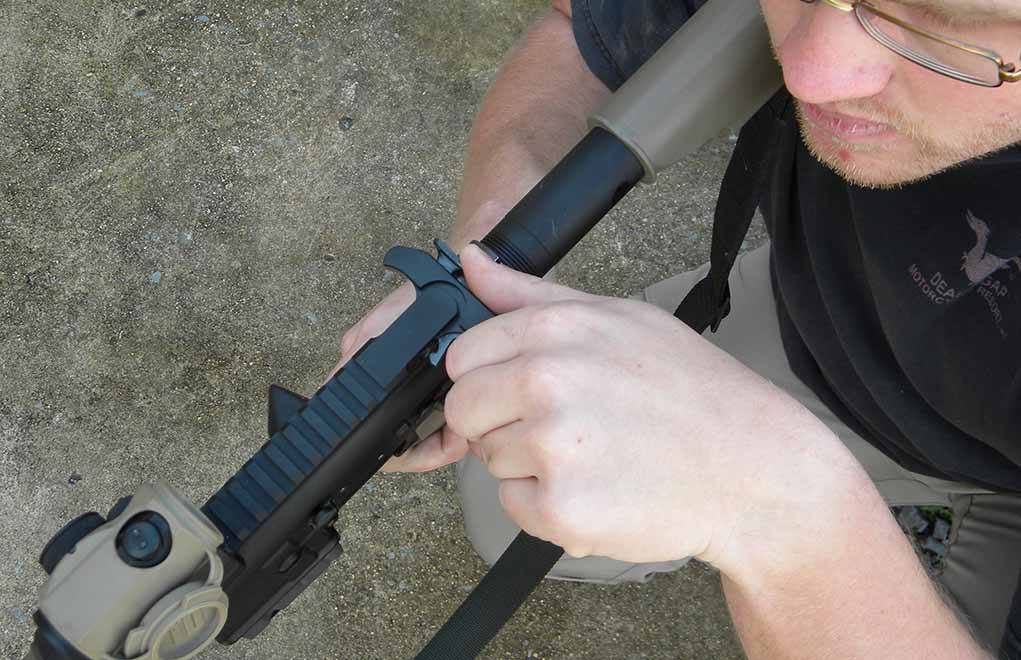
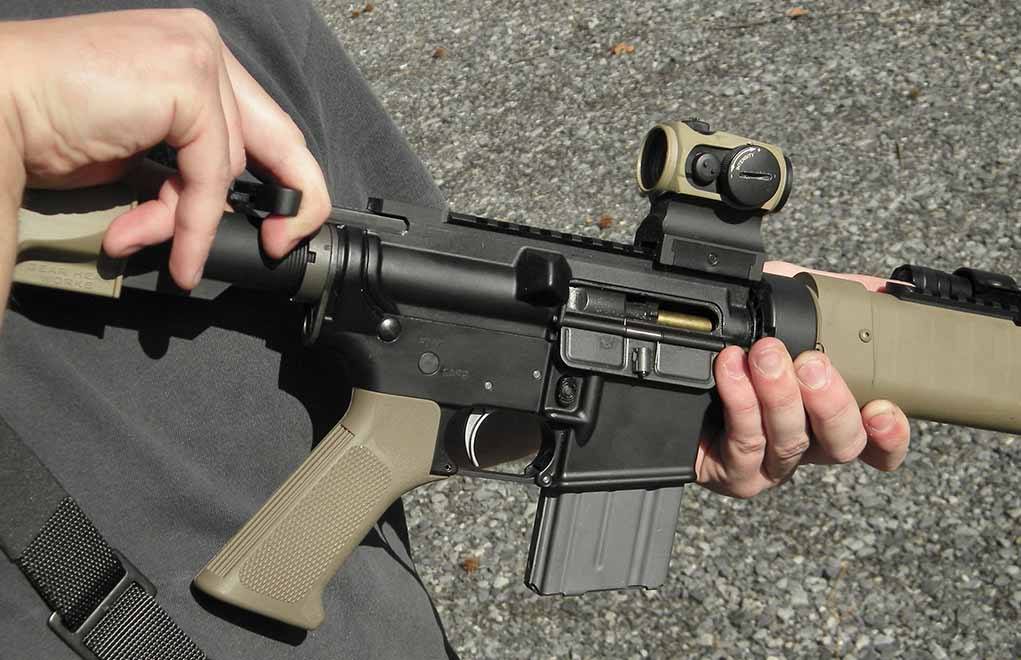
Normally, the strong hand maintains its grip on the AR, and the support hand is used to operate the charging handle, which is a three-step process: First, position the thumb of the support hand on the back of the handle in its center. Next, use the index finger to unlatch. Then, using the elbow (not the shoulder), cycle the handle aggressively, pulling it straight to the rear. The thumb should follow the center line of the stock as it moves rearward, maintaining alignment between the handle and its channel in the upper receiver.
Once the handle has reached full extension, allow it to strip from your hand: Release it as you would a bowstring, allowing the bolt group to snap forward under full spring pressure. The most common issue I see with the AR is students letting their support hand impede the handle and bolt group’s forward movement. This creates a stoppage, requiring additional manipulations. Pull the charging handle all the way to the rear and release it — every time.
To confirm the condition of the chamber, you perform a chamber check. The support hand holds the AR, and the strong hand comes off the grip to pull the handle back. For most other operations, the support hand runs the charging handle.
I teach left-handed shooters to use the first two fingers of the support hand (think “snake fangs”) on the left and right side of the handle, with the thumb centered in the back. Lefties can install an ambidextrous charging handle with a release on each side. Just remember that you might not always be firing your AR, so you must know how to work with a military-type handle.
Other Charging Handle and Bolt Catch Duties
As mentioned earlier, the charging handle is used to check the condition of the chamber. It sounds simple, right? Maybe, but “simple” and “smooth” are not the same thing.
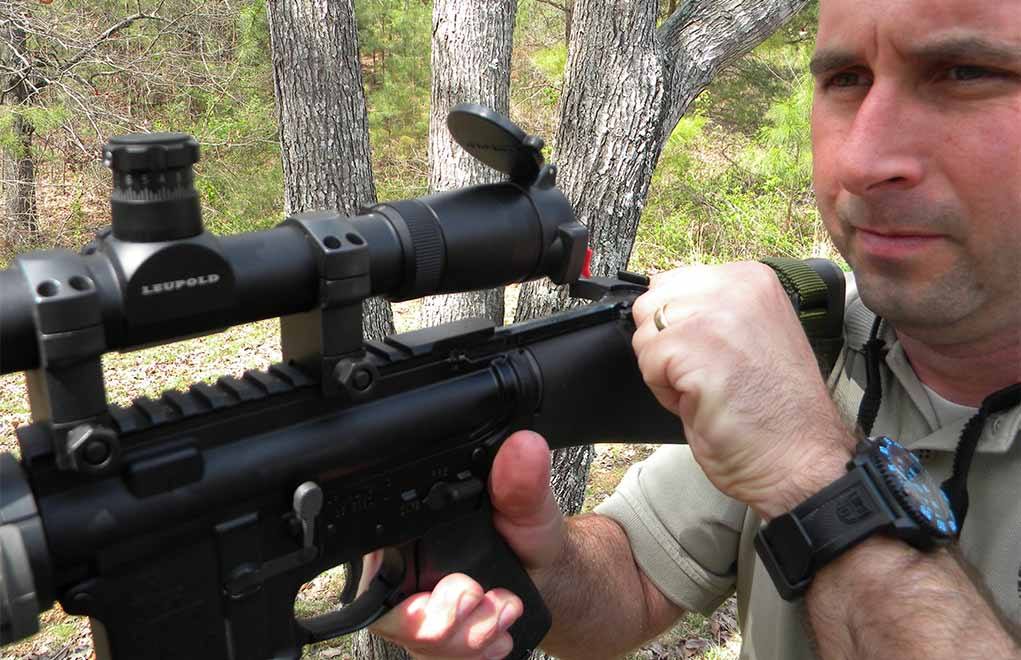
With a magnified optic, you might need a wider charging handle, which allows you to use the proper techniques during manipulations. Just remember to get a high-quality handle; if it breaks or bends, your AR is out of operation.
After cycling the handle with the support hand, it’s repositioned on the handguard. The strong hand comes off the grip to the charging handle. Right-handed shooters use their “snake fangs” to grasp the handle; left-handers use the right-hand technique described above. The strong hand pulls the handle slightly to the rear, allowing you to confirm there’s a round chambered or that the chamber is clear.
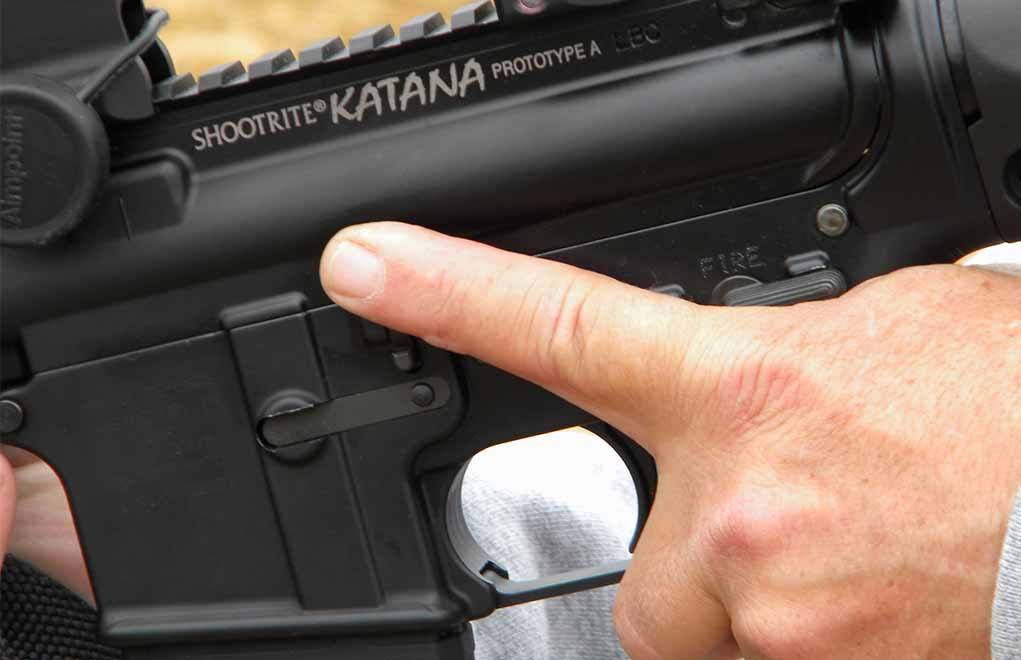
The charging handle is also used to manually lock the bolt to the rear. Here, again, the strong hand is used to pull back on the charging handle, while the support hand is positioned at the magwell of the lower receiver. Right-handers use their left thumb to engage the catch; lefties use the index finger of the right hand.
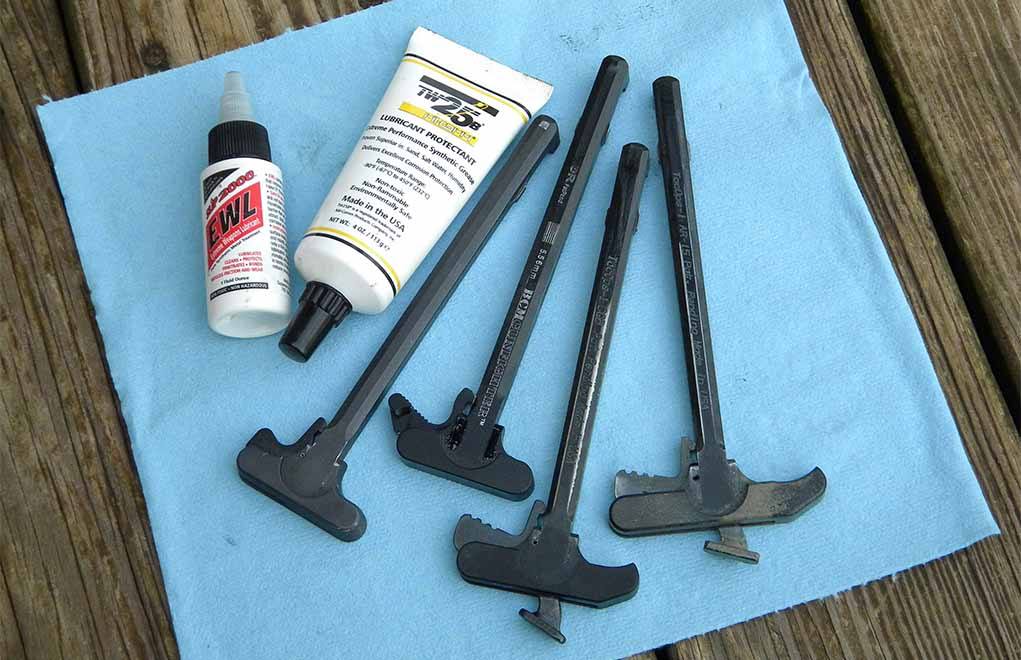
Regardless of what handle type you choose, proper lubrication is mandatory. A combination of grease and oil offsets the other’s deficiency.
In addition, the charging handle is used to manually cycle the bolt group. To perform an empty reload when the bolt is locked to the rear, it’s best to use the bolt catch as a bolt release. Hitting the “bolt release” is the most efficient and ergonomic way to chamber a round during an empty reload.
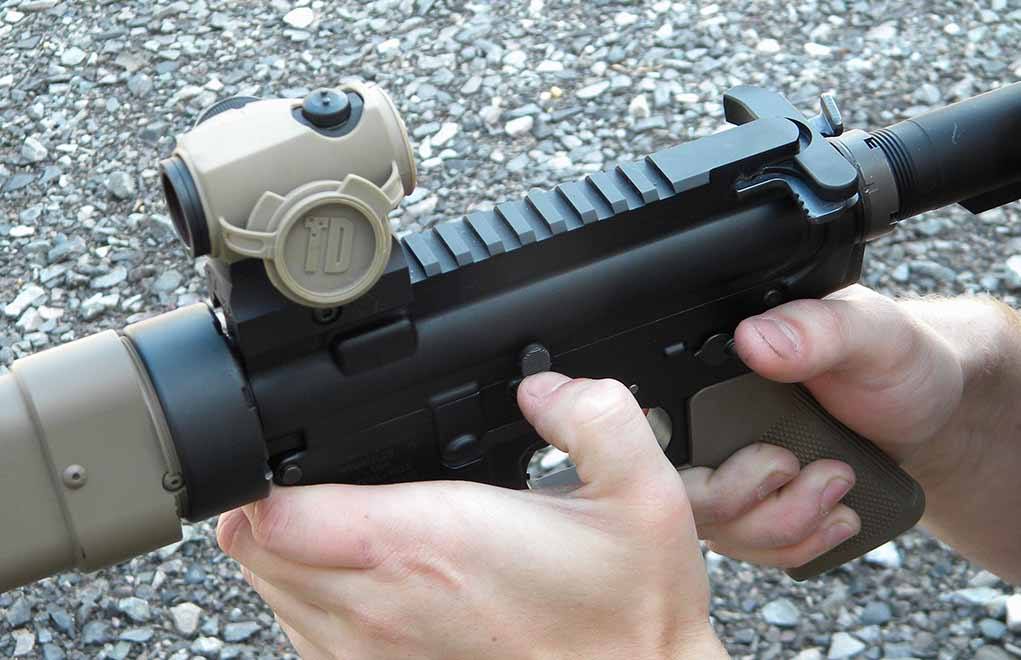
A right-handed shooter releases the bolt by pressing with the thumb of the left hand. The new mag is inserted and locked in with the left hand, so the thumb is already there and ready to release the bolt. Left-handed shooters should use the right hand to feed a fresh mag and their trigger finger to release the bolt. Using the bolt catch as a release chambers a fresh round, and the bolt has the energy necessary to lock in battery. You’re now ready to fire.
Final Thoughts
The charging handle and bolt catch are critical components of the AR. They’re simple to use — as long as you use the correct technique.
Knowing when to use the charging handle and bolt catch separately or in unison is mandatory to operating the AR efficiently. And, as it is with any piece of precision machinery, it’s up to you to learn it well.
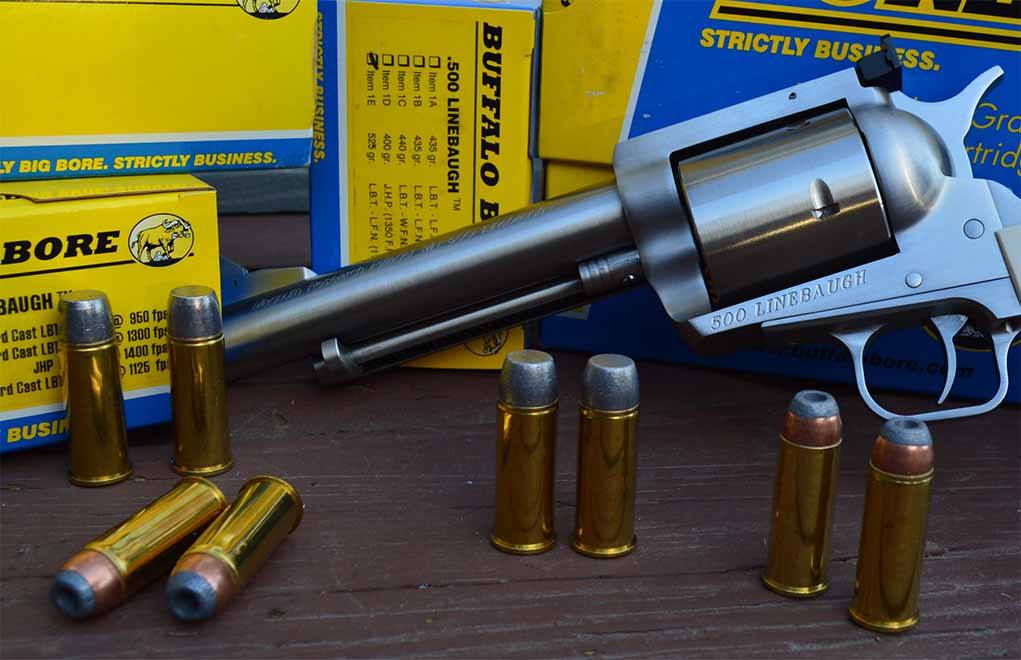
The .500 Linebaugh out of the shadows of obscurity into the light of recognition with the Magnum Research BFR.
How Magnum Research Dishes Up A .500 Linebaugh:
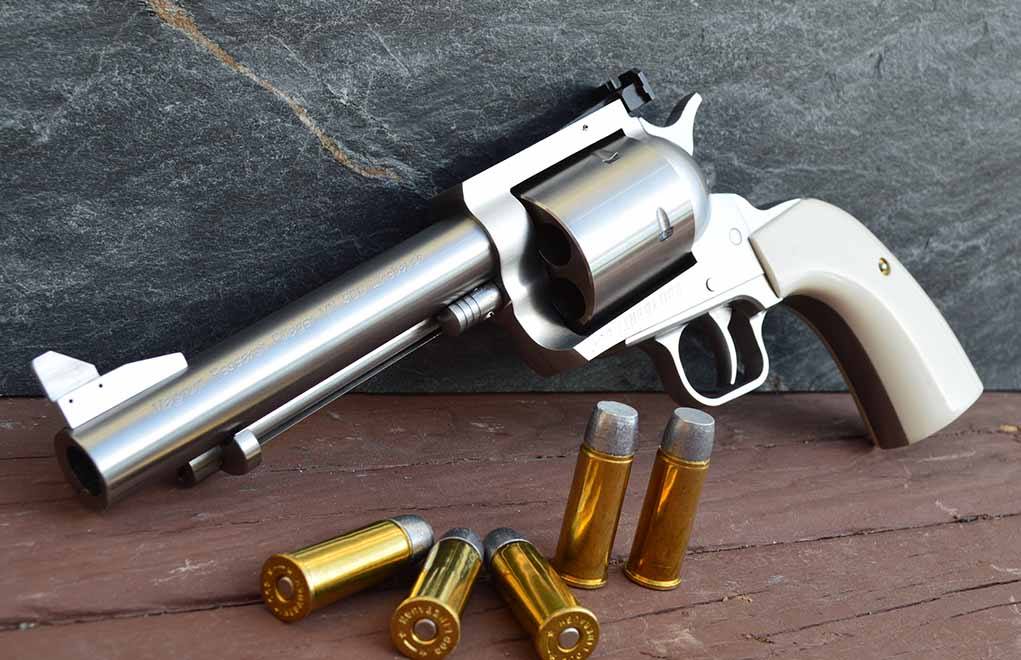
It’s built on Magnum Research’s short-frame and is constructed entirely of 17-4PH stainless steel.
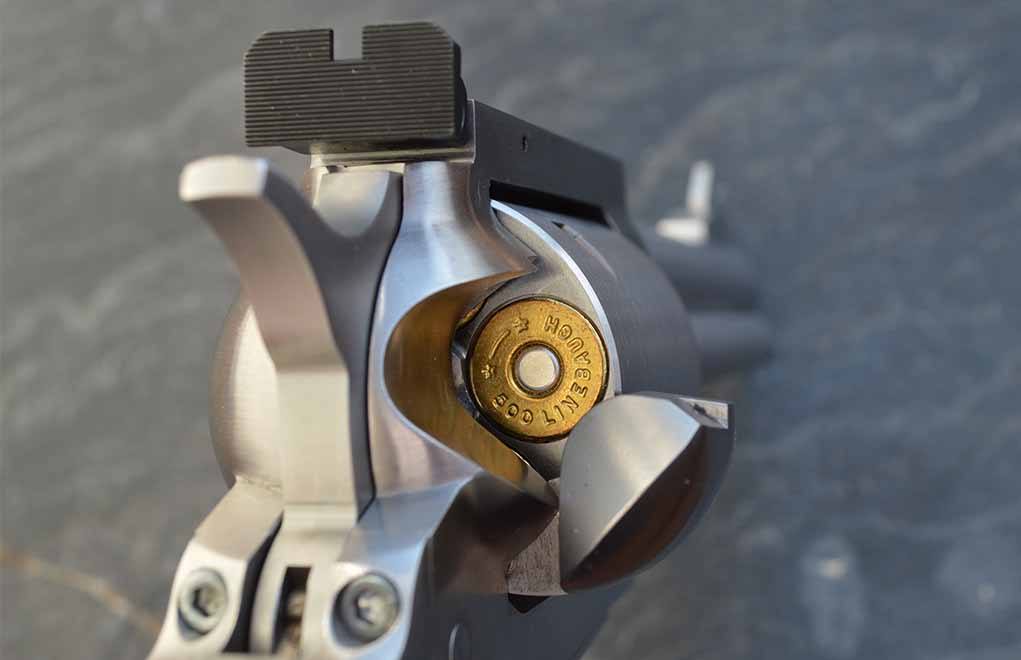
The oversized, five-shot cylinder is counter-bored and unfluted.
A free-wheeling pawl enables the cylinder to rotate in either direction with the loading gate open.
It’s equipped with transfer bar systems, allowing for safe carry with a live round under the hammer.
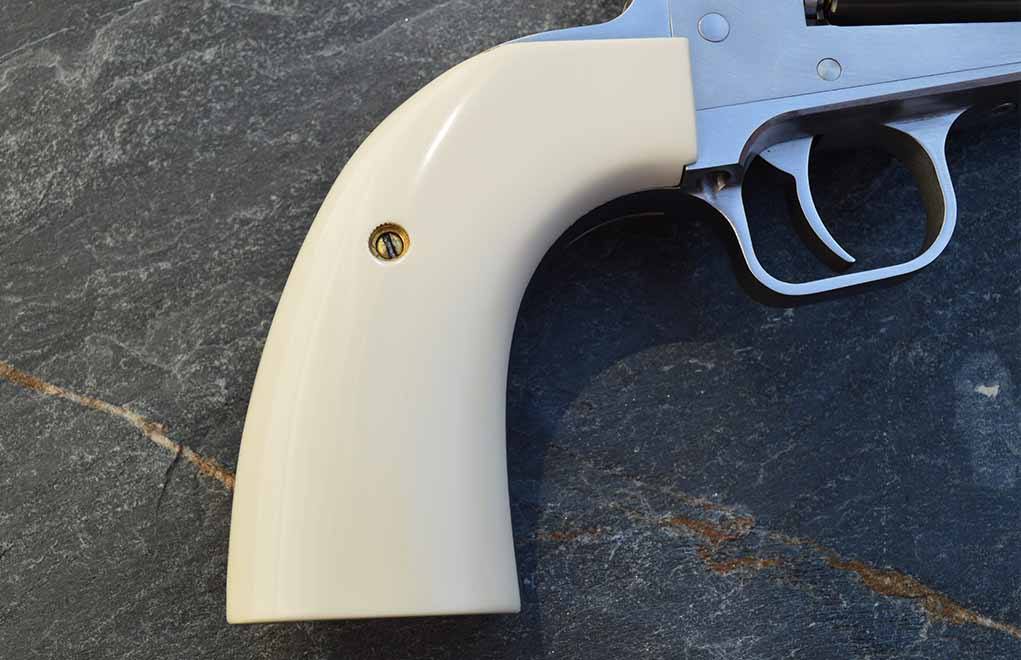
The revolver sport Magnum Research’s interpretation of the Bisley grip frame.
Show up at the range with a .50-caliber handgun, and folks don’t fail to notice. It elicits whispers about compensating for alleged inadequacies and some comments about your mental state. Others secretly hope you bury the front sight in your forehead.
That said, you will not fail to draw attention every time you touch off the behemoth and it thunders the way only a large displacement cartridge can.
But aside from drawing sometimes unwanted attention, what are these big revolvers good for? Big-game hunting, plainly and simply. Well, at least that’s what I use them for!
Like all BFRs, this one is equipped with a fully adjustable rear sight by LPA.
There are a number of .50-caliber handguns readily available commercially that are chambered in .50 AE, .500 JRH, .500 Wyoming Express and the “horsepower king”—the .500 Smith & Wesson Magnum.
However, the .500 Linebaugh has the deepest roots of all. Despite only recently making its commercial debut, having been relegated only to custom builds in more than three decades of existence, we have Magnum Research, manufacturer of the BFR—the “Biggest, Finest Revolver”—to thank for giving .50-caliber aficionados yet another choice.
A Brief History Lesson
Magnum Research’s latest foray into the .50-caliber wars was announced at this year’s SHOT show. However, the .500 Linebaugh was unleashed on the general public in August 1986 by Ross Seyfried. Let’s just say the .500 Linebaugh is “fashionably late.”
The new “Bisley” grip frame by Magnum Research is, of course, its interpretation of the famous Bisley by Colt. That said, it is, by far, the author’s favorite grip frame for controlling heavy recoil. The author’s came decked out with attractive ivory polymer grips.
In the mid-1980s, John Linebaugh, a then little-known gun builder out of Cody, Wyoming, created this cartridge in his lab like a mad scientist—using a cut-down .348 case as the “parental unit.” An earlier iteration existed, but the progenitors of that .50-caliber—Bill Topping and Neil Wheeler (out of Salt Lake City, Utah)—were unable to gain any traction, and their creation was stillborn.
So, John Linebaugh used the large-rimmed .348 Winchester, cutting it down to 1.4 inches and blowing the case out to a .510 bore. It was never quite loaded to potential in the early days and was overshadowed by its over-achieving little brother: the .475 Linebaugh, which was another one of Linebaugh’s creations.
For more than three decades, the .500 Linebaugh has been a custom proposition only, typically built on massaged Ruger full-sized, single-action revolvers that cost a premium to construct … until Magnum Research boldly went where no other gun manufacturer has gone before.
Magnum Research BFR
Like all BFRs, this one, built on Magnum Research’s short-frame, is constructed entirely of 17-4PH stainless steel and is all American made. The massive, oversized, five-shot cylinder is counter-bored and unfluted.
The author shot three different loads from Buffalo Bore Ammunition for accuracy (see the accuracy results table on page 43): a low-velocity, 435-grain hardcast load, a fast, 350-grain jacketed hollow-point load and a heavy, 525-grain, flat-nosed, hardcast load. Buffalo Bore has the distinction of being the first ammunition manufacturer to offer commercially loaded ammo for this obscure caliber.
About counter-boring: This is a nice detail that actually serves a precautionary function. Under normal conditions, the cartridge head supports the loading gate and keeps it from tipping forward. If the loading gate encounters an empty hole, it is unsupported and can thereby tip forward a considerable amount. If this happens enough times, a number of failures will result, such as breaking of the loading gate stem and pushing the loading gate spring forward into the thin web of the frame—potentially tearing it (which is permanent damage).
However, counter-boring puts a permanent support in position relative to the loading gate that is not dependent upon loaded cartridge case heads for support. This is particularly important when heavy recoil levels are the norm (not so much with lighter calibers).
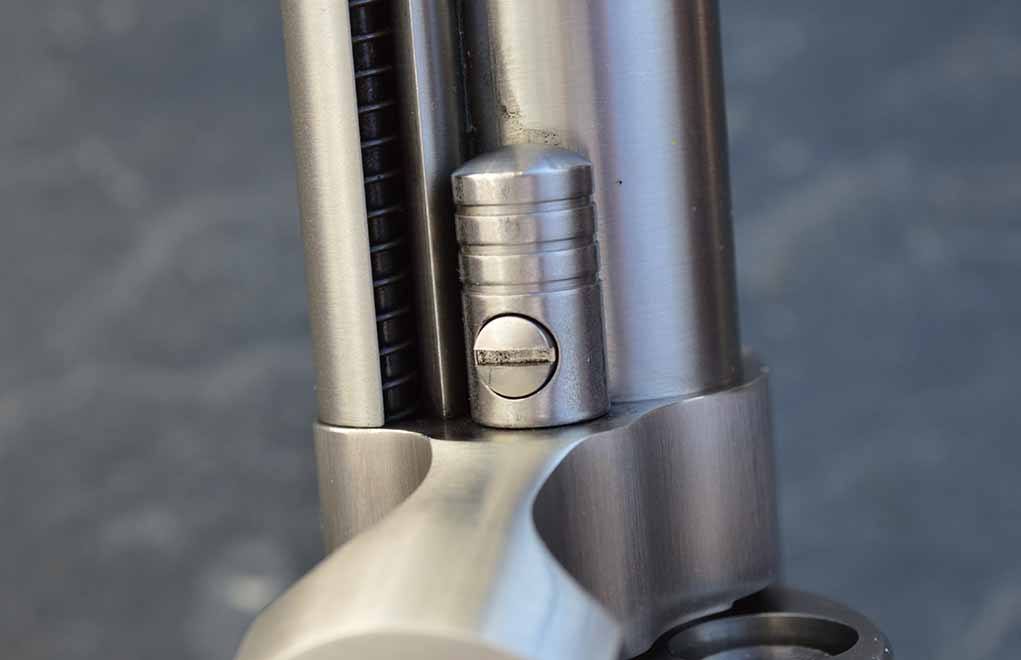
The .500 Linebaugh requires a large cylinder to encapsulate it, particularly because of its really big rim. The cylinder rides in the frame on a locking base pin. The free-wheeling pawl is a great feature that enables the cylinder to rotate in either direction with the loading gate open. BFRs are also equipped with transfer bar systems, allowing for safe carry with a live round under the hammer—an important feature when out in the field.
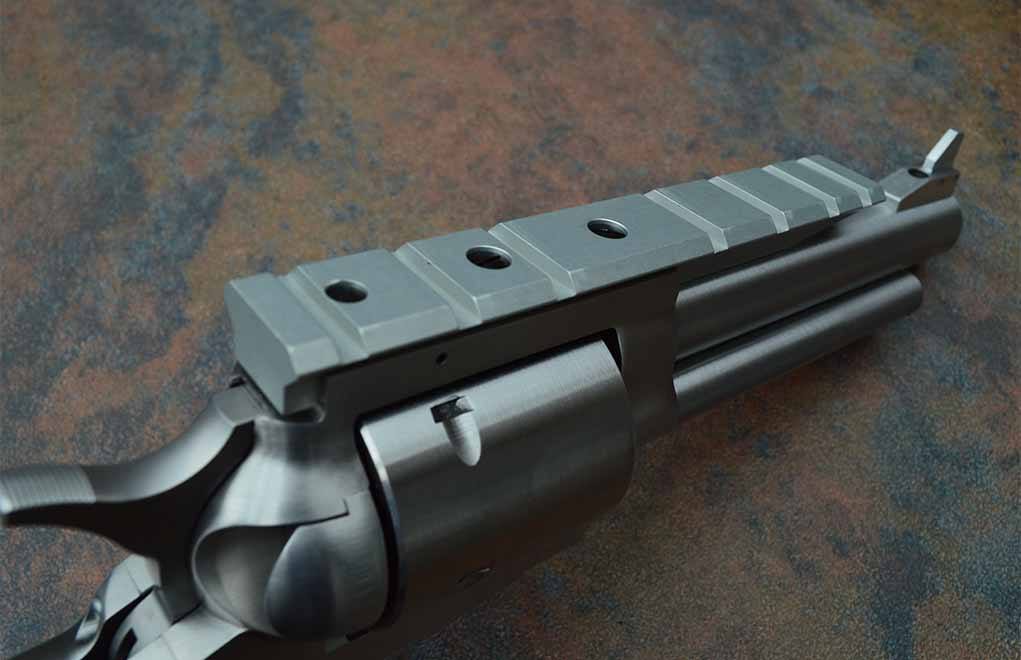
A match-grade barrel is attached to the frame and is adorned with a tall front sight. An LPA adjustable rear sight rounds out the sighting system. But, for the optically challenged, the BFR comes pre-drilled and tapped for a scope base that’s included with the revolver, making it a snap to mount an optic.
BFRs feature locking base pins to prevent the pin from backing out under recoil.
Let’s also talk grip frames, because they matter. For years, my only complaint about the BFR was the availability of only one type of grip frame—a plow handle or traditional single-action-type grip. While this is fine for light-recoil-producing cartridges, it’s less than ideal when recoil picks up to the level of Ouch—that hurts!
Magnum Research addressed this issue with the introduction of its own interpretation of the Bisley grip frame, which was originally introduced by Colt way back when. It’s a bit strange-looking (it resembles a banana), but this is where the similarity to that particular fruit ends. This is the best grip frame commercially available for controlling heavy recoil—bar none. This grip frame flat out works! It’s available with ivory polymer or black Micarta grips that are hand fitted. Mine came equipped with attractive ivory polymer. The trigger broke cleanly at 2½ pounds … just the way I like it.
Hard-Punching Performance
I shot this revolver as is quite a bit before I equipped it with an optic that has long been my go-to for hunting duty: an Ultradot 30 red-dot sight.
The good folks at Magnum Research thought of just about everything and took the optic mounting issue out of the equation by pre-drilling and tapping the top strap for a scope mount and including a base (with fasteners) with your revolver.
I visited the FTW Ranch in Barksdale, Texas, with my .500 Linebaugh BFR in hand. I sighted in with Buffalo Bore’s 350-grain JHP load in order to run the FTW Ranch’s SAAM (Sportsman’s All-Weather All-Terrain Marksmanship) Safari Training course. You read that right—I was going to run a safari training course with a short-barreled revolver. I had a blast, and the training staff at FTW was delighted with the effectiveness of the short gun on its much-vaunted course.
I was also able to do a little hunting on its 12,000-acre ranch, where I took a beautiful fallow deer with one 350-grain Buffalo Bore jacketed hollow-point. One and done.
When it was time to test the BFR for accuracy, I swapped the red-dot for a fixed 2x Leupold scope, mounted with Leupold quick-detach rings on the factory base. I obtained three different loads from Buffalo Bore Ammunition; it’s the first company to ever offer ammunition for the .500 Linebaugh. The three loads consisted of a light-recoiling 435-grain hardcast, flat-nosed load rated at 950 fps; a 350-grain jacketed hollow-point (JHP) load rated at a lofty 1,550 fps; and a heavyweight, 525-grain hardcast load at a modest 1,125 fps. From an accuracy standpoint, the BFR did not disappoint (see the accuracy results table above).
As I’ve already mentioned, for me, .50-caliber handguns are in their element when hunting big game. That fallow deer fell easily to the big BFR, which will be heading to the game fields again soon. Some will argue “overkill,” but I will submit that there are no degrees of “dead.” Better “overkill” than “barely adequate” in my humble opinion.
The author took this fallow deer at the FTW Ranch in Barksdale, Texas, with one shot from the prototype BFR .500 Linebaugh loaded with Buffalo Bore’s 350-grain jacketed hollow-point load.
I have used a number of .50-caliber handguns on all manner of game, including the .500 Linebaugh on a custom platform on black bear and moose, so I am very familiar with its terminal effectiveness.
That said, if it’s loaded correctly, I wouldn’t hesitate to use this caliber on virtually any big-game animal that walks the face of the Earth. There is more versatility in these big .50s than one might realize. There is enough case capacity for lighter-jacketed expanding bullets to be pushed to fairly high velocities (by revolver standards), making them ideal for deer-sized game. By default, a .510 diameter will make a large hole in flesh; so, loaded with monolithic solids or Kodiak Punch bullets, it will bring the .500 Linebaugh into the realm of pachyderm.
A .500 Linebaugh BFR might be a great addition to your battery, even if you don’t handgun hunt. However, keep in mind that there are some drawbacks to such powerful chamberings—in particular, the heavy recoil associated with .50-cals, unless you download them to more sedate levels. They kick pretty hard and are able to produce flinches in even the most experienced shooters if they don’t approach familiarization with some modicum of caution. Limiting time on the bench and the number of rounds fired per session are good ways to get familiar—and, dare I say, comfortable—with your new BFR.
So, there you have it. It took 33 years, but here it is, in the flesh—er, stainless steel. Magnum Research brought the .500 Linebaugh out of the shadows of obscurity into the light of recognition, where we hope shooters and hunters, alike, discover its charms and attributes. It’s a little late to the party, but it’s looking good!
Handy and stylish, the concealed carry purse is a solid method of toting a handgun. But the unorthodox approach takes some special considerations to ensure safety and efficiency.
Holster carry isn’t the only option. Many don’t wish to alter their clothing to conceal their handgun. In turn, they turn to an off-body method—bag, briefcase or even purse.
In recent decades, the latter has become a popular choice for the well-armed woman, giving them a degree of freedom in how they dress. But as Richard Mann points out in the above video, the method doesn’t come without its considerations.
Perhaps the chief among is making sure you are in control of the purse (or bag) at all times. This is just plain common sense. A defense handgun doesn’t do you a lick of good if it’s not within reach. As important, you don’t want someone—bad guy or little kid—rifling around your purse when it’s holding a loaded heater.
Though, purse carry doesn’t stop with general safety concerns. There is a particular way you need to retrieve your handgun, otherwise, you might find yourself fumbling when you need it most. Mann goes over the details, but in the nutshell, it’s a matter of keeping control of the purse until you have a grip on your handgun, then getting rid of the satchel.
Compared to holster carry, off-body has some unorthodox demand to do it correctly. But for those who find it inconvenient to redo their entire wardrobe to go armed, it can prove an invaluable method.
The timeless .375 H&H Magnum is, according to the author, one of the most useful cartridges ever invented.
Is the heyday of the belted magnum case over? Don’t expect them to disappear overnight, but given some inherent design flaws don’t expect any new renditions in the future.
What Are The Pros And Cons Of Belted Magnums:
Generally speaking, they offer more case capacity, thus higher velocities than standard cartridges.
The belt allowed for proper headspacing, while smooth feeding from a box magazine.
Several cartridges can achieve magnum velocity, feeding and headspacing without the belt.
The belt is also credited for shorter case life.
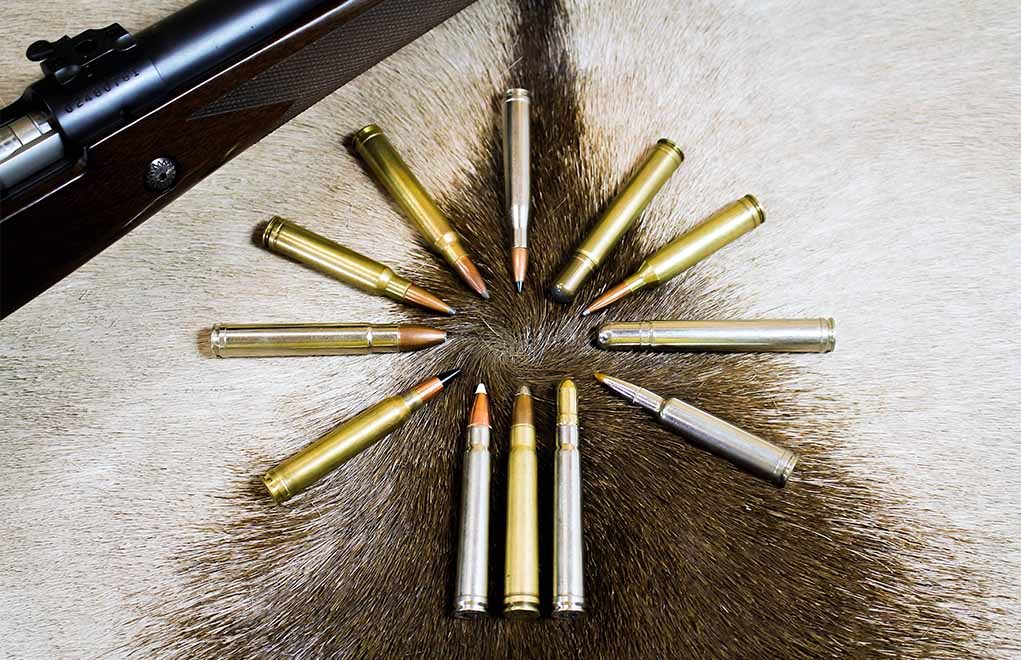
Magnum. When I was a young man, that term — at least among the rifle cartridges — was equated with the Holland & Holland belted case, first seeing the light of day in 1912 in both the .375 H&H Magnum and the lesser-known .275 H&H Magnum. The .300 Holland & Holland (also known as Holland’s Super .30) came along in 1925, giving a velocity boost over the immensely popular .30-06 Springfield. For many years, the .300 Magnum — the .300 Weatherby Magnum was still a niche cartridge — was the basis for a wave of magnum cartridges throughout the 1950s and ‘60s.
The “magnum” name, in the context of a metallic cartridge, indicates a higher level of performance. And while most of the belted cases were actual magnums, not all magnums wore that belt. The .416 Rigby and its older brother, the .350 Rigby Magnum, certainly offer magnum velocities — yet neither wore a belt, and the .416 Rigby didn’t get the magnum name.
Of the large number of belted magnum cartridges, only a handful use the belt for headspacing.
Ironically, for almost all of the cartridges that were based on the Holland & Holland case, the belt served absolutely no purpose. It was originally used on the .375 H&H case to provide the positive headspacing of a rimmed case yet feed smoothly from the box magazine of a bolt-action rifle. The gently sloping 15-degree shoulder could, in theory, support the cartridge enough to give good headspacing (the .404 Jeffery uses an 8½-degree shoulder and poses no issues with headspace), but the belt keeps things rather uniform.
Why The Belt?
After the end of WWII, when the world settled down a bit and sportsmen began to travel abroad once again, a wave of new commercially developed magnums hit the shooting world. Ironically, the first would be one of the few belted cartridges that would truly need the belt. The .458 Winchester Magnum is a shortened, straight-walled cartridge based on the .375 H&H, opened up to hold .458-inch-diameter bullets and designed to replicate the ballistics of the .450 Nitro Express.
Since it has no shoulder, the .458 Win. Mag. does rely on the belt for proper headspacing, but the two following cases — the .338 Winchester Magnum and the .264 Winchester Magnum — would not; both had an ample shoulder and would use that for headspacing. And they were just the beginning, with the .308 Norma Magnum following in 1960, the 7mm Remington Magnum (eerily similar to the 1912 .275 H&H design) in 1962, and the .300 Winchester Magnum arriving in 1963.
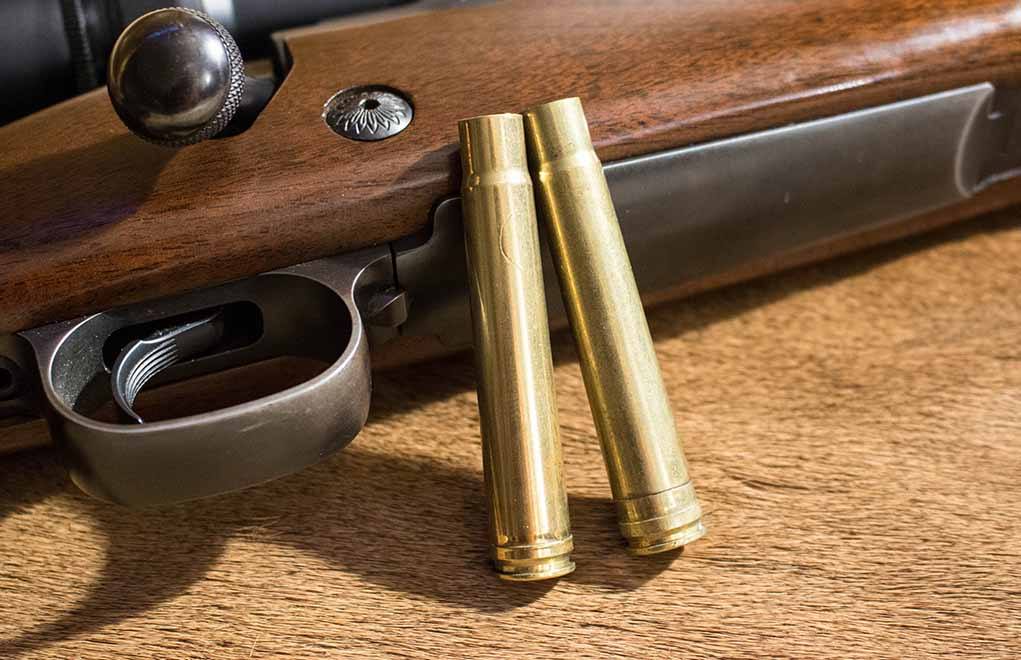
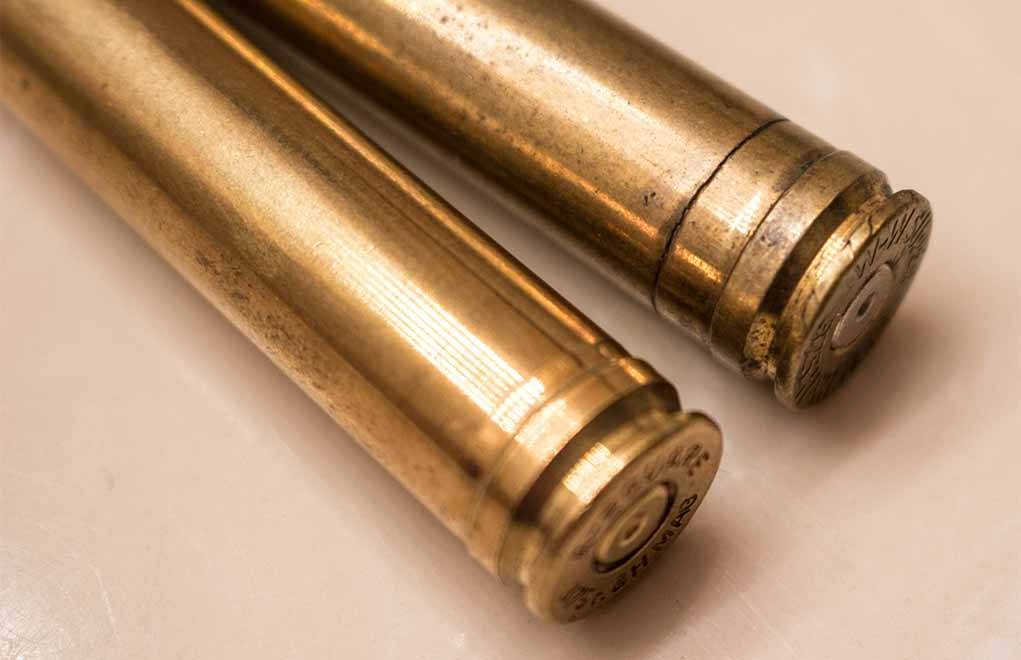
The belted magnum case has a propensity to stretch and separate just above the belt, which can become dangerous if not monitored.
The Weatherby series of cartridges, of both 2.500- and 2.850-inch lengths, all used the H&H belt, though they had the signature radiused shoulder. And Remington took things even further in the mid ‘60s with the short-action 6.5mm Remington Magnum and .350 Remington Magnum, both based on the belted case. And for a while, life was good.
The late 20th century and early 21st century saw a new wave of cartridges — magnums, in fact — based primarily on the .404 Jeffery case. The Winchester Short Magnum family, the Remington Ultra Magnum family (and the subsequent Winchester Super Short Magnum and Remington Short Action Ultra Magnum), the Dakota cartridges and others showed the world that you could most definitely have magnum performance without that belt of brass. And, they pointed out one characteristic of the H&H belted case that’s very important to reloading: The belted cases show a tendency to stretch and eventually separate just ahead of the belt, diminishing case life in comparison to their non-belted counterparts.
I’ve seen this phenomenon after as few as five loadings, though that’s the exception and generally not the rule. I will say that I agree that a belted case has a shorter case life than a non-belted case, and that when they fail — they fail hard. If you shoot often, you’ll see that your cases will tend to either split at the neck or crack and/or separate just above the belt, and you should keep a very close eye on it.
Shortcomings Of The Belt
Why does it happen? Brass was chosen as the medium for our cartridges because it’s hard enough to hold its shape under the rigors of handling and cycling though a firearm, and yet malleable enough to be easily formed and reused. Brass, unlike steel, becomes softer when heated — hence the annealing process — but it becomes brittle when overworked. It also tends to “flow,” and in the case of our cartridge cases, it will flow forward toward the muzzle with each firing.
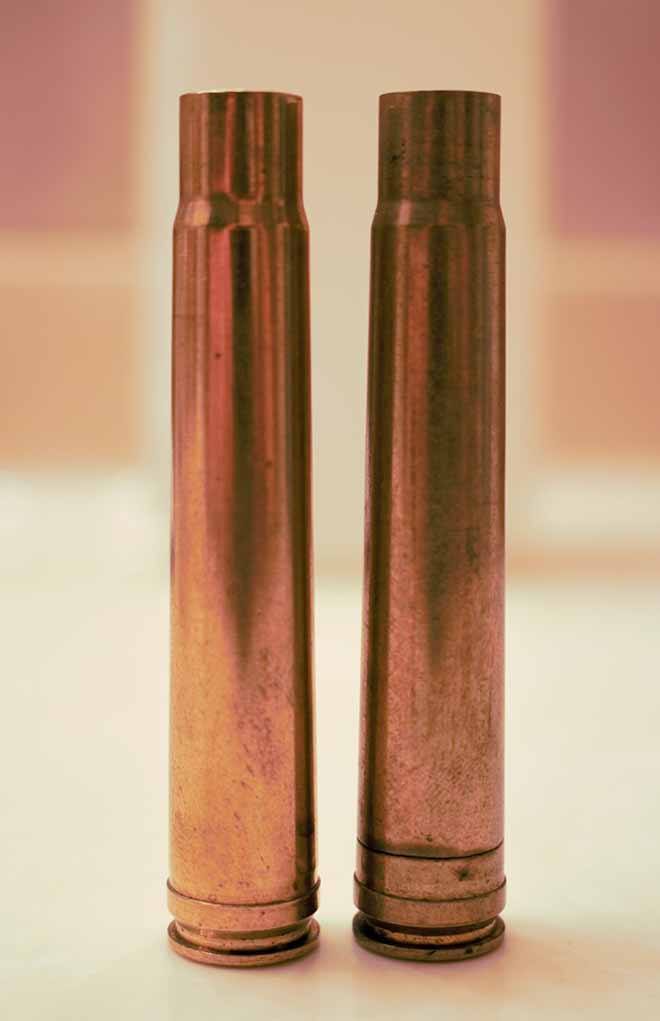
The .375 case on the right has failed and must be discarded. Belted magnum cases require careful inspection.
So, imagine this process in the belted magnum: You fire the rifle, the case expands and some small amount of brass flows forward. You then resize the case, moving the shoulder rearward a bit, and you will eventually need to trim the case back to the proper length because some of the brass has flowed forward. The belt will stay in the same position, but the stretching/resizing/trimming process will cause the case body to become thinner, and that happens just in front of the belt.
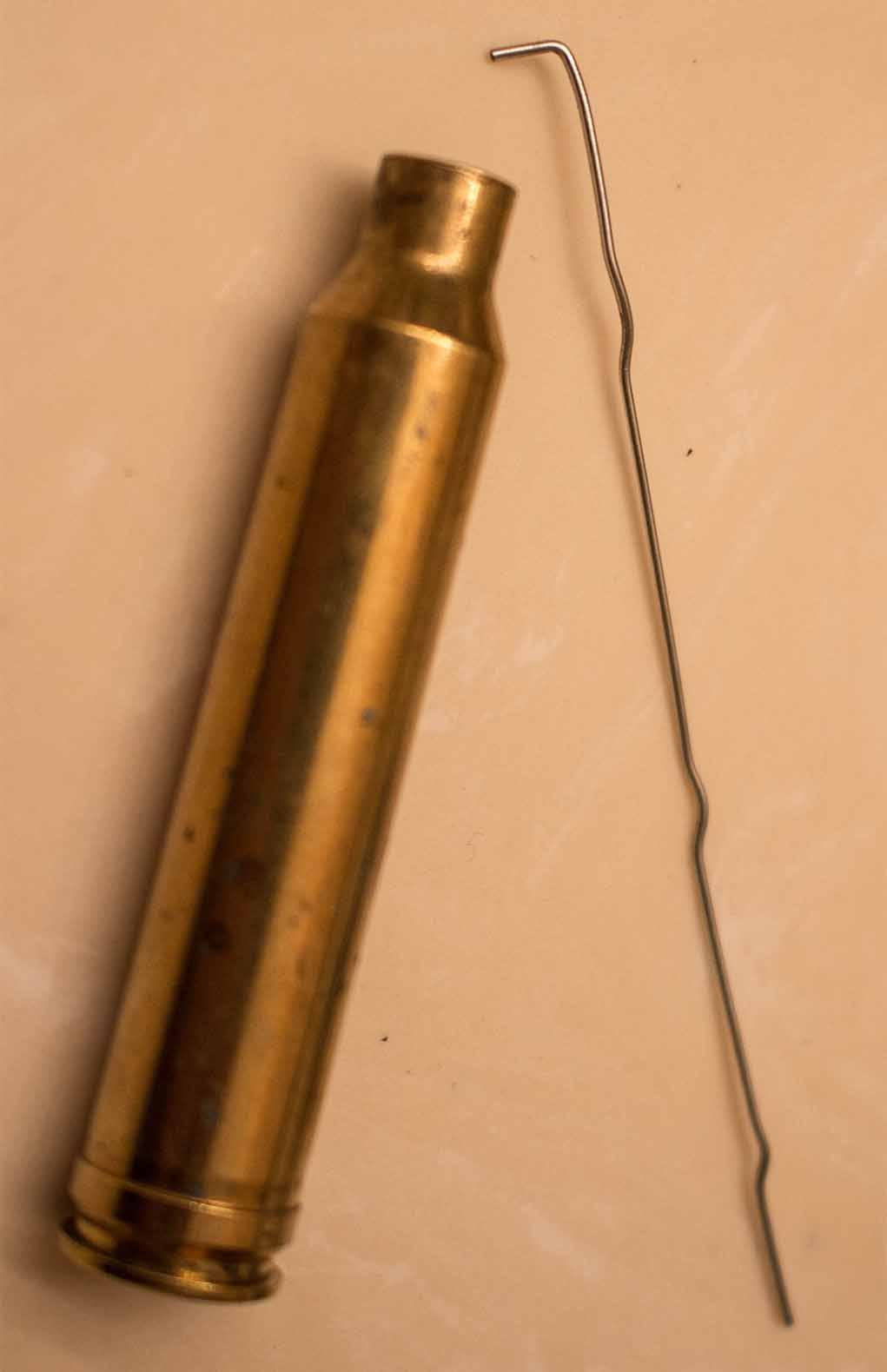
First, a careful visual examination of your fired cases is very important. Remember, these are magnum cases that generally run at a higher pressure. Any cracked cases should be crushed with pliers and discarded. You can also check the inside of the case with a “feeler” made from a paper clip, bent at a right angle and used to feel the area just ahead of the belt; if you feel a dip or depression in the case wall, that indicates the case is stretching. Discard that case immediately.
Belted magnum cases are also a perfect candidate for the Redding Instant Indicator, which will quickly show you how much the shoulder is moving with each firing. Minimizing the shoulder bump will also minimize the brass flow and help extend the life of your brass. Using the Competition Shellholders will allow the body diameter to be resized without moving the shoulder unnecessarily.
An inspection tool can easily be made by bending a right angle in a straightened paper clip, and then using it as a feeler.
Time To Toss The Belt?
Is the heyday of the belted magnum case over? Well, I can say that you probably won’t see a huge number of new cartridges wearing the belt of brass, nor will you see the .375 Holland & Holland, .300 Winchester Magnum or 7mm Remington Magnum fade away anytime soon. I do enjoy hunting with them, and while I do a fair amount of practicing with my rifles, I don’t shoot the magnums enough that the shortened brass life has become an issue.
If you have a belted magnum cartridge, I don’t think you need to panic and retire the rifle. However, knowledge is power, and if you understand the pitfalls of the design, you can reload your ammunition safely.
Editor’s Note: This article originally appeared in the April 2019 issue of Gun Digest the Magazine.
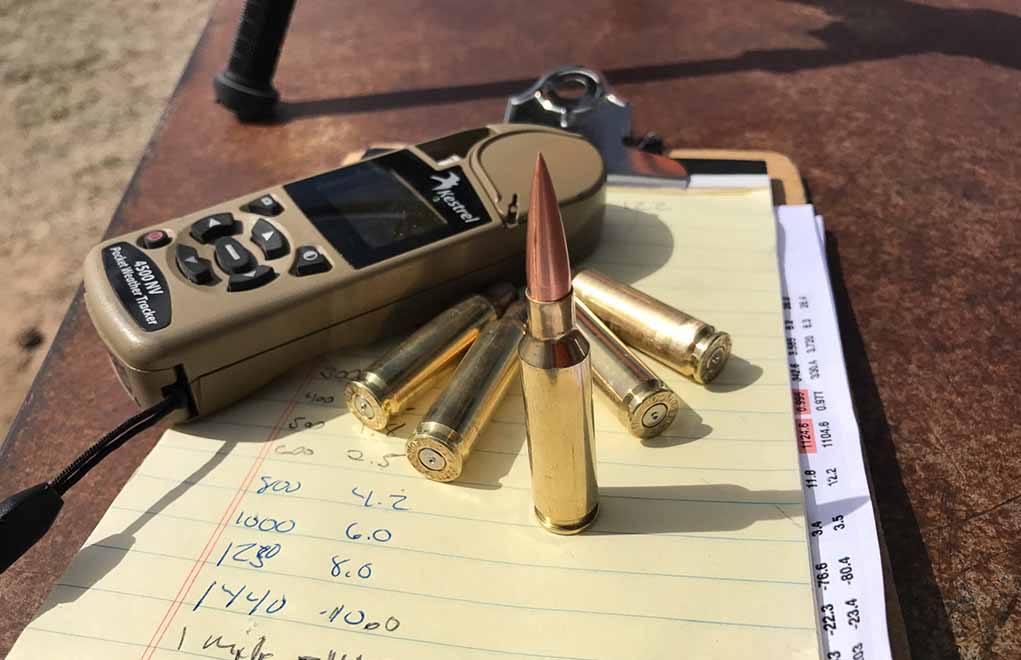
Capable of taking real-time weather measurements, BallisticsARC is a great tool for beating the wind, whether you’re hunting or shooting long-range steel.
BallisticsARC does more than help you control for wind, it makes the long-shot come in.
Shooters tend to overcomplicate nearly everything, but rifle marksmanship is about simply controlling variables: yourself, your rifle and your environment. That’s a bit oversimplified, but when looked at in this way, “stretching your rifle’s legs” is a far less daunting prospect.
But that doesn’t mean it’s a walk in the park, either. Among the most bedeviling hurdles to clear, even for accomplished riflemen, is the wind. Unpredictable and unrelenting, it can blow away an otherwise golden shot and make you feel as if you’re spitting into … well, the wind.
There was a time when the average marksman was privy to a limited set of tools to measure and control for the wind. The basics were heat mirages in the warm months and foliage movement the rest of the time. Either way, it was a guessing game.
BallisticARC measures all the important weather variables that affect a shot, including wind, barometric pressure, temperature and humidity.
These days, 1,000 yards is the new 100, and you need something that makes reading the wind a science, not an art … such as the GeoBallistics BallisticsARC app.
Ballistics-Savvy Smart Device
Most of us are familiar with ballistic calculators, as well as with their limitations. Handy as they are, the technology is only as good as the data you input. So, if you’re just taking a stab at the wind, the ballistic table it produces is, at best, a guess — garbage in, garbage out.
That’s the revolution of BallisticsARC. Combining the power of your iOS/Android smart device with on-the-ground input from a handheld weather meter, it gives you the exact path to the bullseye each and every time, which is the whole reason you’re behind the trigger in the first place.
Getting You on Target
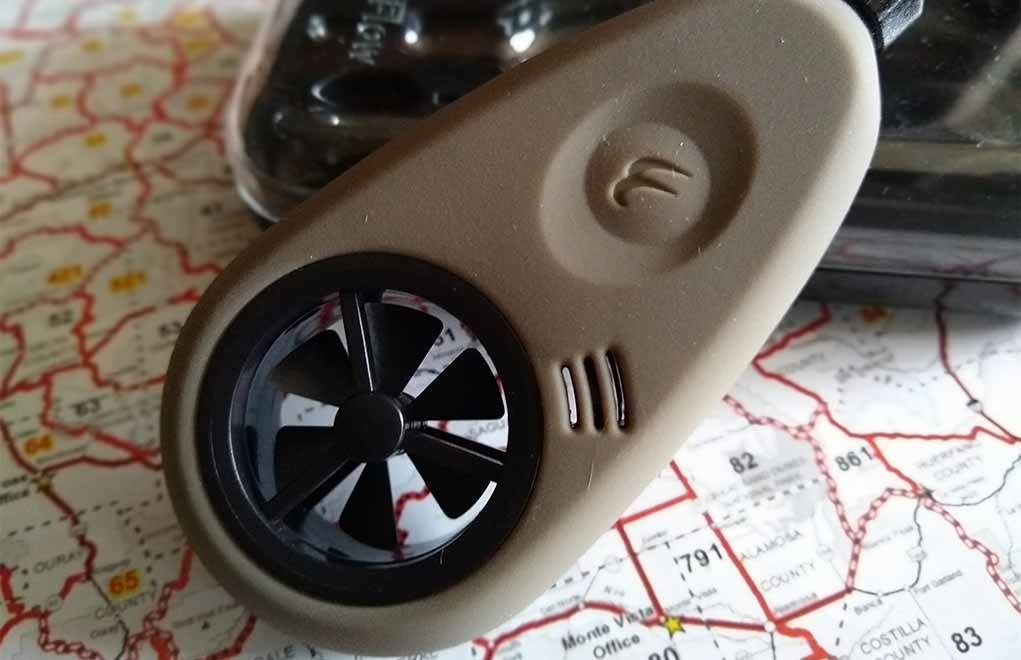
Currently, BallisticsARC works with WeatherFlow’s Weather Meter and Wind Meter, as well as Kestrel’s 5500 Weather Meter. I use the WeatherFlow Weather Meter, which proved incredibly easy to use.
With the collected data, the app outputs a detailed range card, including holds expressed in your choice of inches, mils or MOA. Note the colored lines: Gray is point-blank range, red is a pre-set energy, and yellow is a pre-set velocity.
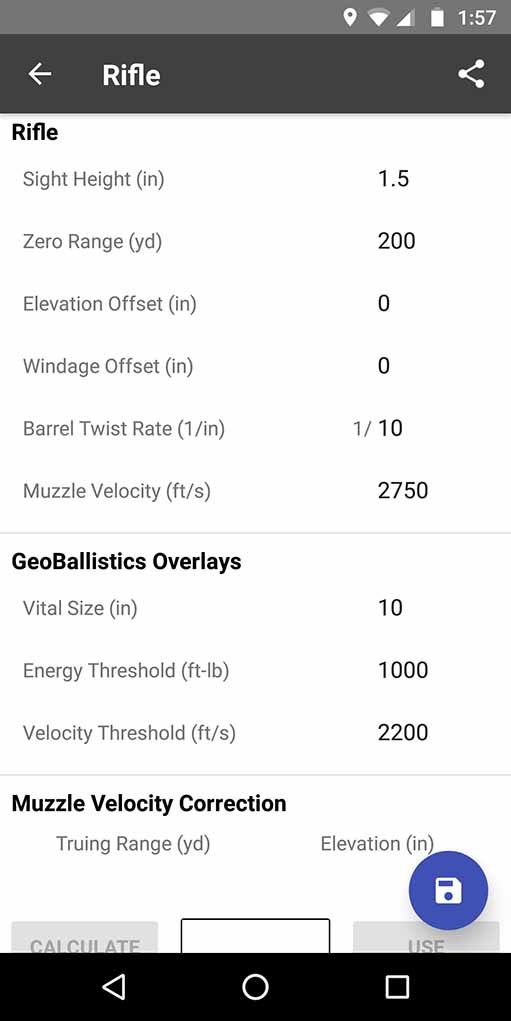
After inputting my rifle and load data into the app, I simply linked the meter to my phone via Bluetooth and took a reading of the environmentals (barometric pressure, temperature and humidity) for my position. Out the other end came a highly detailed range card, complete with my holds — in my choice of mils, MOA or inches — to beat the wind, no matter the range.
Best of all, as conditions changed, so did my data. So, when that 8 mph headwind shifted across the prairie to a 12 mph crosswind, BallisticsARC kept pace. That’s absolutely essential data, even at medium ranges. Consider that at 200 yards in these conditions, the 55-grain Speer TNT bullets coming out of my .22-250 Rem. were facing more than 4 inches of wind drift. That’s a miss on the grapefruit-sized vitals of a coyote.
Beyond the Basics
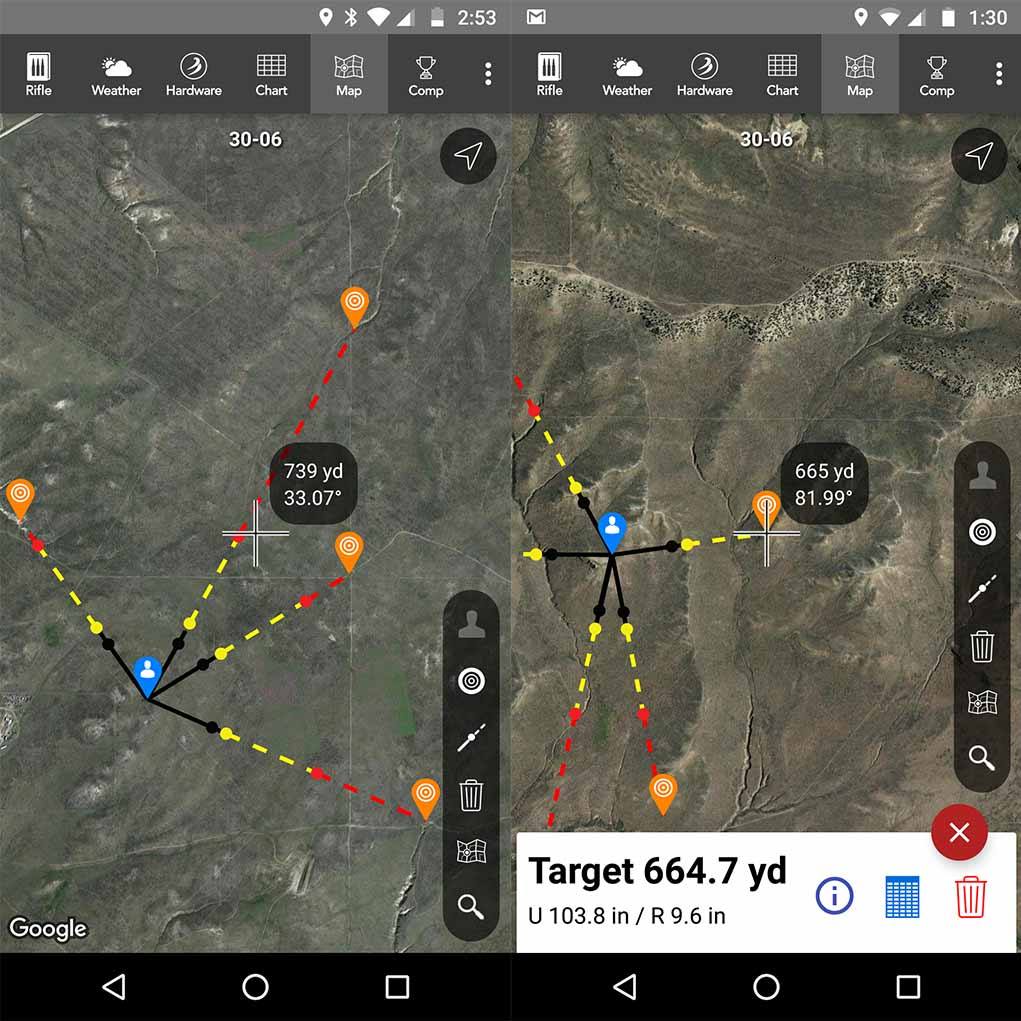
Perhaps the most fascinating feature of BallisticsARC is its mapping function: It serves both as a GPS rangefinder and a method to visualize your shooting data.
The former speaks for itself, so I’ll focus a bit on the latter. Simply put, you can chart overlay lines on the map, giving you a clear idea of your point-blank range, along with energy and velocity thresholds. Each variable is programmable to your particular load. It’s expressed in a clear color code within the overlay line. Of course, these consider the real-time conditions you measure before you take your shot.
With the mapping function, you can range with BallisticsARC and analyze your potential shots over the terrain. As with the range card, the overlay lines are color coded for point-blank range (black), energy threshold (yellow) and velocity threshold (red).
Some of BallisticsARC’s other intriguing features include:
Inclinometer
Custom rifle library
Competition mode (you can map out each stage)
Coriolis effect correction
Spin-drift correction
Data export
What You Get
Overall, BallisticsARC is more tool than most shooters will ever need. That said, you needn’t be a hard-core long-range shooter to reap its benefits, especially at its price. The weather meter I tested retails for about $84. You can step up with a Kestrel 5500 Weather Meter ($399) or down with a WeatherFlow Wind Meter ($45).
Be forewarned: The wind meter only measures air movement at your location; the app draws in the rest of the data from the nearest weather station. Plus, it directly interfaces with your smart device through the audio jack, making it slightly unwieldy.
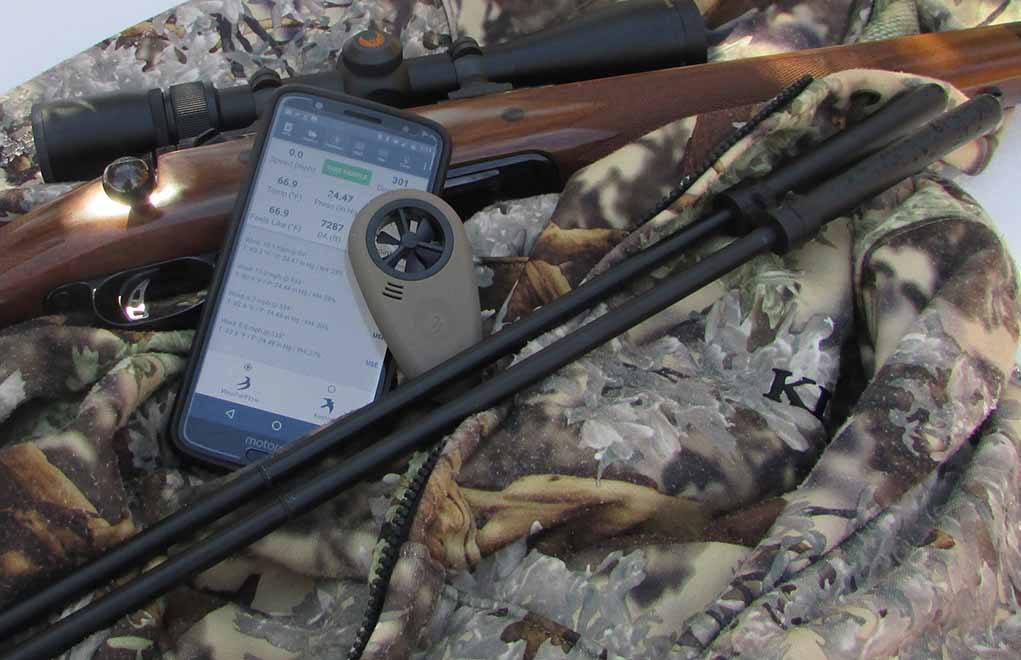
The WeatherFlow Weather Meter is what makes BallisticsARC so powerful when taking real-time measurements of the environmental variables.
The app is a bargain, given that nearly all the aforementioned functions come with the free download. You can’t beat that, although you can only add one rifle profile. An in-app expansion allows you to build unlimited profiles, as well as export range cards, synch rifles/loads online and link to the Kestrel meter. And for $14.95, it’s far from cost prohibitive.
Parting Shot
The market for technology to help you get on target at any range is flourishing — and, in most circumstances, expensive. GeoBallistics (GeoBallistics.com) BallisticsARC is a welcome counter to this trend. Even if you shoot more-pedestrian ranges, BallisticsARC will prove its worth. Because, no matter what, you need some way to whip the wind … or it’s going to whip you.
While simple in concept, the 45 drill is challenging in execution. And when mastered, it provides an excellent baseline for evaluating defensive handguns.
No, you don’t need to break out .45 ACP for this drill. Instead, you only need to be ready to shoot—a lot.
The drill gets its name since it is composed of four elements of five: you fire five rounds at five yards in a five-inch circle under five seconds. No big shakes, right? Think again. As firearms instructor and gun writer Richard Mann points out in the above video, around 75-percent of police officers cannot perform this drill to standard the first time. Though, once you begin to master it, the 45 drill can prove a useful tool.
More than anything, it provides a solid baseline for evaluating potential concealed carry handguns. If there are any interface issues or you can’t manage the gun in the drill, then you know you might need to keep looking for your next defensive piece. Get one you can make sing in the 45 drill and you just might have a keeper.
A limited edition, the Lipsey’s Special Ruger Single Seven aims to be among the most versatile .327 Federal Magnums you can slip into a holster.
How Does Lipsey’s Special Ruger Single Seven Measure Up:
1/10 inch in diameter XS Big front sight
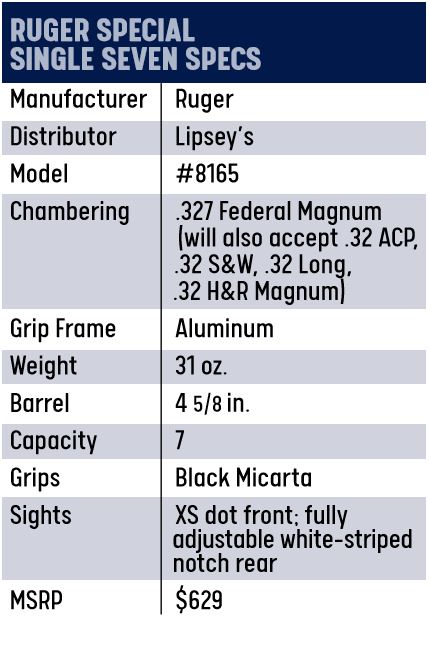
4 5/8-inch barrel
Black Micarta grips
Aluminum grip frame
It was July 2, 2014. I was staying at a bed and breakfast in Dundee, South Africa, and it was the first Internet service I’d had in weeks. While checking e-mails, I saw an announcement that Ruger had partnered with Lipsey’s to offer the Single Seven, a stainless, seven-shot version of the Single Six chambered for the .327 Federal Magnum.
I immediately sent off an e-mail to my contact at Ruger asking for one. I never expected that just a few years later, I’d be working with Lipsey’s to create my ideal version of that handgun.
I’ve always had an affinity for the Rugers chambered for .32-caliber cartridges. I remember the first one I ever saw but not the exact date I saw it. In 1986, just home from basic training, I was prowling around a local sporting goods store and spied a Single Six with a 4 5/8-inch barrel. Because I’d just turned 21, it was the first handgun my parents did not have to buy for me.
One of the major benefits of the Ruger Single Seven is that it can chamber and fire five different cartridges. (Left to right: .32 S&W, .32 ACP, .32 S&W Long, .32 H&R Magnum and .327 Federal Magnum)
I was enamored with how I could fire .32 ACP, .32 Short, .32 Long and .32 H&R Magnum ammunition out of one revolver—without changing cylinders. Those familiar with the Ruger Single Six know that the interchangeable cylinders for .22 LR and .22 Magnum were features that made it famous. But with this revolver, you had the option of extra or reduced power and needed only one cylinder.
Falling in Love Again I’ve had a .32 H&R Magnum Ruger close at hand ever since. However, in 2007, I fell just a little bit out of love with that cartridge.
With some colored fingernail polish, the custom-handloaded snake loads for the .327 Federal Magnum are easily distinguishable from standard ammunition.
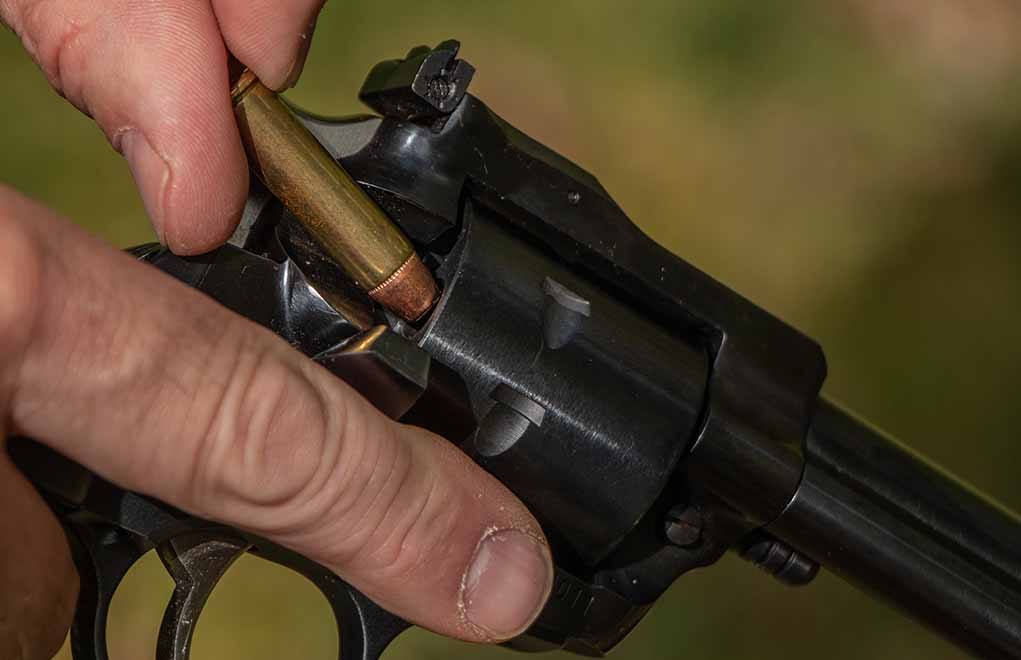
Late that year, Federal announced the .327 Federal Magnum. It is essentially a lengthened version of the .32 H&R Magnum case but loaded to 45,000 psi, as opposed to 21,000 psi. Yeah, that’s magnum performance for sure: Out of a short-barreled Ruger SP 101, the .327 Federal Magnum can push a 115-grain bullet to more than 1,300 fps. The SP 101 replaced my beloved Single Six—well, at least until Ruger brought out the GP 100 and Blackhawk in .327 Federal Magnum.
I spent a lot of time with all three of those handguns. I often carried the SP 101 for protection, the GP 100 was in my nightstand, and I hunted with the Blackhawk.
Ruger’s Single Seven changed all that. It weighed about the same as the SP 101 and was only slightly larger, but it was much easier to tote around than the GP 100 or the Blackhawk. I fitted a small-dot version of XS Sights’ Big Dot sights to the front and installed a Bowen Classic Arms Rough Country V-Notch rear sight on the rear. I’ve carried that little Ruger for protection and used it to kill snakes, squirrel and several deer. It was one of my favorite guns.
Unexpected Collaboration But something else happened. I was wandering through the isles at the 2018 SHOT Show in Las Vegas when a man stepped out of a booth, grabbed my arm and introduced himself as Jason Cloessner. Jason works at Lipsey’s, and Lipsey’s continually works with Ruger to offer limited-edition firearms; firearms such as the Single Seven I’d been carrying for four years.
A handgun that can fire five different cartridges is very versatile and ultimately offers a great range of power with factory ammunition.
We visited for a bit, and Jason, knowing my affinity for the Single Seven, suggested we collaborate on a special-edition version. Excited, I suggested the small version of the XS Big Dot front sight and a 4 5/8-inch barrel. Jason liked the idea of the lightweight frame and black Micarta grips. We were in agreement on all the details, so I waited impatiently for the next step.
A couple of months later, an engineer from Ruger called, asking if I could help him sort out the proper front sight height. I shared my experiences with the XS Sight on the Single Seven I had, and we discussed loads, points of impact and revolvers in general. After we hung up, I wondered if Ruger would be able to, or still had an interest in, sorting this revolver out. I didn’t have to wait long: In October 2018, I got mine.
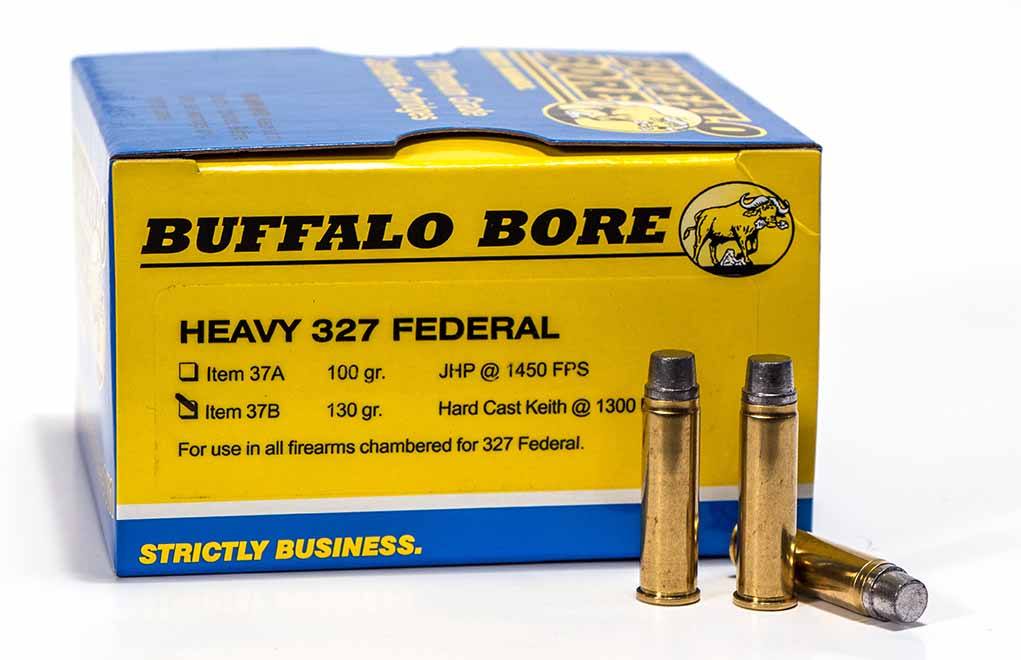
This “heavy” load from Buffalo Bore for the .327 Federal Magnum is deer-capable and will even work for larger game. Hardcast bullets such as these penetrate incredibly deep.
As soon as I opened the box, I knew this revolver was destined to be one of my all-time favorite handguns.
Limited-Edition Dream Revolver The revolver is listed on the Lipsey’s website as the Single Seven 327 FED 4-5/8” BL 8165 XS SGTS/BLK Micarta Grips version. The model number, in case you want to order, is #8165, and the suggested retail price is (as of this printing) $629.
Ruger Single Sixes have always been reliable and great-handling revolvers. The Single Seven is no different.
This revolver is fitted with the aluminum grip frame, which cuts about 5 ounces off the weight. It is all metal with a satin-blue finish, and it contrasts very nicely with the rugged—and bulletproof—black Micarta grips.
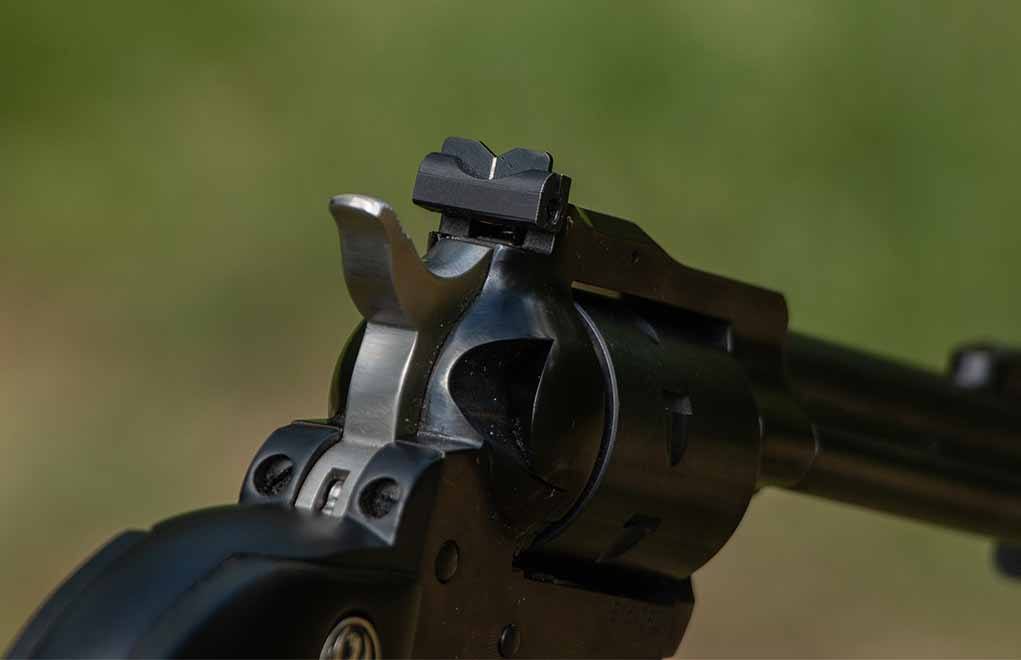
The front sight is made by XS Sights and features a white bead that measures 1/10 inch in diameter. But what most folks will notice is that the front sight is much higher than the normal Single Six sight. This is because of the way the XS sights are to be used: For close range—zero to about 15 yards—you use the center of the dot as your point of aim. Essentially, you just cover the target with the front sight. At extended range, you aim with the top of the dot. This is all made very easy by placing the dot in the V-notch rear sight, right on top of the center white line in the V.
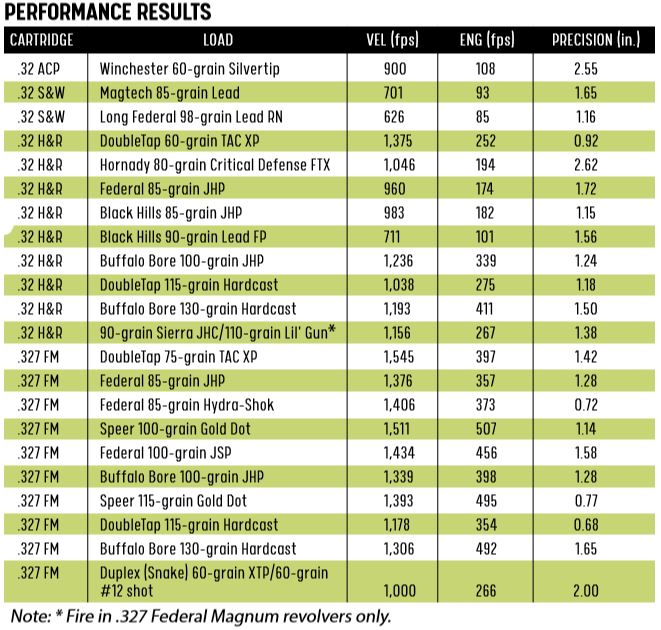
Ballistic Performance As you might guess, I’ve spent a lot of time shooting this revolver, and I’ve gotten pretty good with it. I figured that it would be cool to establish the ballistic performance for just about every load that could be fired from this versatile handgun.
So, after amassing 22 different loads for five different cartridges—.32 ACP, .32 S&W, .32 S&W Long, .32 H&R Magnum and .327 Federal—I got on the bench with some sandbags and started shooting.
I fired a single five-shot group with each load at 15 yards and noted the group size, point of impact and velocity of each one (see the chart directly above). You probably won’t find a more comprehensive collection of data on the ammunition you can fire out of a Ruger Single Seven. This little gun can generate a lot of power, but by virtue of all the cartridges it can digest, it has a very wide window of performance.
Handloading for the Single Seven can be fun. However, with so many loads to choose from, why bother (other than saving a little bit of cash)? I worked up a single handload for general purpose use using a 90-grain Sierra JHC bullet, but I did so with the .32 H&R Magnum cases. The load is a little hot for the .32 H&R Magnum cartridge and should only be fired in .327 Federal Magnum revolvers, but I’ve used it a good bit. It’ll do better than 1,100 fps from just about any .327 and will work on paper and steel; and I’ve used it on small game such as groundhogs with great success.
Snake Shot Handloads The only real handloading I do for my Single Seven is to create snake shot. If there is a weakness in the versatility of any of the .32-caliber cartridges, it is the lack of a shotshell load. Because the Single Seven is my primary trail gun, I had to do something about that, so I just created my own.
To coordinate with the small XS Sights’ Big Dot front sight, the new Single Seven from Lipsey’s has a V-notch rear sight.
I start with .327 Federal Magnum brass. After sizing and priming, I drop in 5.0 grains of Ramshot True Blue (6.0 grains is a safe load too, but it does not provide much velocity increase). I then sharpen the mouth of a .32 Long case by chamfering and then use it to cut out discs of thin cardboard (as is used for heavy-duty business cards). A cardboard disc is then dropped into the case and pushed down on top of the powder with the eraser end of a pencil. Next, 60 grains of #12 shot is inserted into the case; and, on top of that, I seat a 60-grain Hornady XTP bullet. Finally, a little bit of colored fingernail polish on the bullets helps me keep these loads separated.
What I end up with is a devilishly effective duplex snake load that’ll deliver about a 7-inch pattern at 6 feet—with a single .32-caliber hole dead center. It works like a charm on snakes. When I’m out and about with the Single Seven during snake season, the first two chambers of the cylinder are filled with this load. And, with that 60-grain bullet up front, I’m good to go for small game or self-defense if necessary.
So, that is my 32-year love story—how I fell for 0.32-caliber revolvers and ultimately ended up helping create one to perfectly suit my needs.
It’s a fine general purpose trail gun. With the wide assortment of ammunition it can digest, anyone in my house (or yours) who is old enough to shoot can handle it.
Best get one soon: This is a limited-edition revolver, and I won’t be letting go of mine. (Hell, I might even be buried with it.)
You never know when you’ll be called upon to shoot with your support hand, so you best understand its finer points.
You could be injured or maybe you have to pie a corner, whatever the circumstance you might find you have to shoot with your support hand. Anyone who’s laid down their John Hancock with the wrong paw knows, anything off-hand is tricky, but doable if you understand the finite points.
In the above video, gun writer and firearms instructor Richard Mann covers the finer points of shooting with your support hand. And like most things shooting, it all starts from the ground up. Your stance is perhaps the most important aspect in presenting your handgun and developing a workable sight picture, though in this case, it’s miles away from a Weaver or isosceles. Instead, your support side foot takes the lead and bears the brunt of your weight.
While on paper, it might sound simple, it takes practice to shoot proficiently with your support hand. But it’s well worth the effort, giving you the ability to defend yourself no matter the circumstances.
A custom Glock is only a gun-parts order away. But despite the wealth of aftermarket upgrades, ones meant for defense might be best left stock.
Why You Don’t Want To Customize Your Self-Defense Glock:
Even something as simple as a Cerakote can change the specific tolerances of the pistol.
There are the potential legal pitfalls of using a Glock with custom parts.
While most aftermarket parts are high quality, there are instances of them failing.
Glock has gotten so big, Glock isn’t “just Glock.” An entire cottage industry has spawned off of Glock. There are dozens of companies that make aftermarket custom parts and accessories, with new ones sprouting up all the time. At least a dozen companies make custom Glocks for you to purchase, or you can send in your Glock and armorers will work their custom “magic.” And then there’s the relatively new, but fast-growing segment of PCCs – that’s Pistol Caliber Carbine – many of which are based off Glock magazines. Some even incorporate your Glock pistol into the carbine.
In this day and age of the “Insta-gun,” it seems everyone with a camera or smartphone loves posting photos on Instagram of their customized guns with all OEM parts replaced with parts purchased for looks, first, and reliability/functionality, second. “Tacti-cool” as they call it. This is fine for competition Glocks, or casual shooting Glocks; but for me, all of my “go-to” and carry guns are pretty much stock. Those fighting guns are the guns I stake my life on, and I’m not concerned how those guns look, I’m only concerned how they perform. I’ll upgrade sights to aftermarket, but that’s about it. Glock makes each part with a very specific tolerance, and with very specific metals and polymers. Metals are hardened to a specific hardness, and are given a specific treatment/coating. Even something as simple as giving it a Cerakote can change the tolerances, even if just by a bit.
Then there is the argument about legal issues with custom parts. Does a light-pull trigger get used against you in the instance where you need to defend yourself? I’ve read some smart people who have argued from both sides; and I’ve also read some “Internet lawyers” argue both sides, as well. Who’s right?
It’s just not worth it, and that’s why I go plain-Jane stock on my fighting Glocks.
But for my non-carry guns, that’s a different story. I like cool-looking guns as much as the next guy, and I’m not saying there’s not a time and place for cool-looking guns. While I keep all of my fighting guns mostly stock, I do have my fun guns that I modify with flashy, custom parts. Those guns are first and foremost shooters, but I enjoy having them look good, too. Those are not guns I depend on for my personal defense, so if one of those has a problem at the range due to a custom part, no big deal, I can fix it.
I also want to clarify, I’m in no way reporting or implying that most of these aftermarket parts aren’t high quality. I’m sure 99.9 percent of the time they function perfectly. However, as any Glock armorer can attest, if a Glock does break or have problems, a high percentage of the time it’s non-Glock aftermarket parts, or someone has altered a Glock OEM part (like buffing down parts to make them smoother, for a better trigger pull, which, again, changes tolerances). I’m the same way with all of my self/home-defense guns. My home-defense AR15s, for example, those all have triggers and parts designed for ruggedness. I don’t put competition triggers on them, it’s always a “combat” trigger or I keep the government trigger on it. Government triggers never break. But I have had fancy, cool-looking triggers break.
Are there likely to be a parts breakage or problems for the average shooter? No. Aftermarket parts made by reputable companies have been thoroughly tested, and tested again. The average shooter doesn’t put enough rounds down range through his or her Glock for it ever to be an issue.
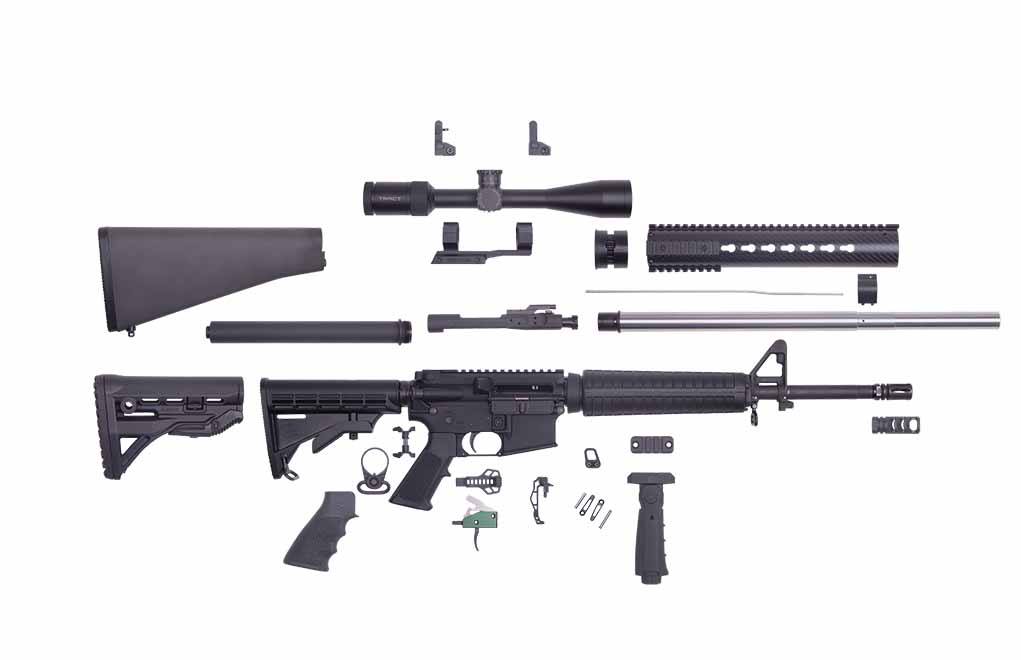
With a thorough set of tools and a bit of knowledge, the AR platform can be customized and upgraded at home.
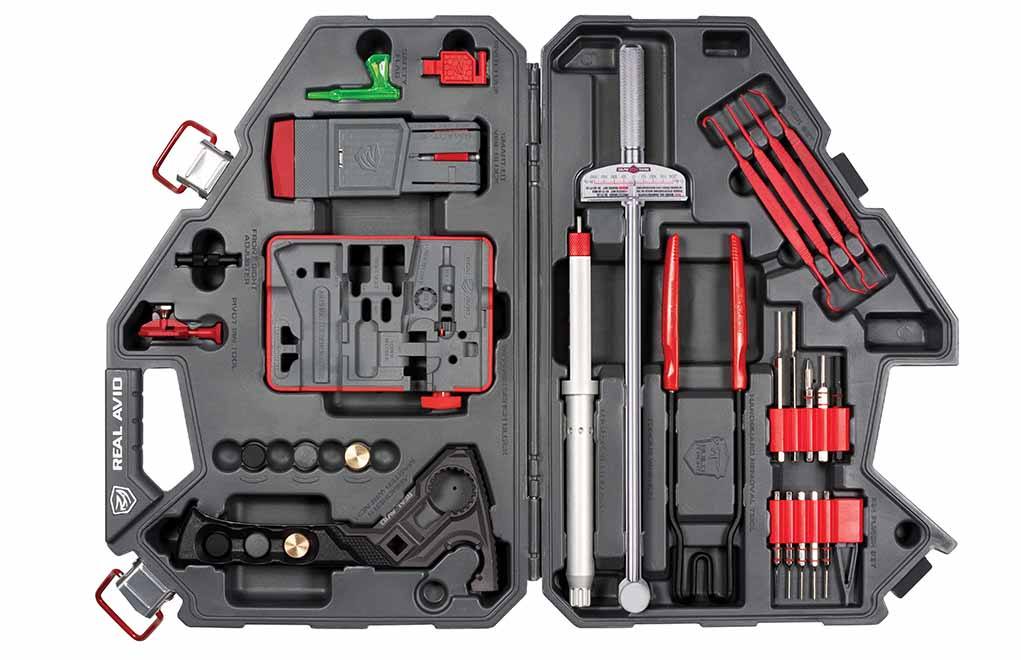
If you’re a carbine D.I.Y.er the Real Avid AR15 Armorer’s Master Kit is a must have. This compact kit contains all the tools you need to repair and modify your AR-15.
What’s In The AR15 Armorer’s Master Kit:
Master Wrentch With Replacement Hammer Heads
Lug-Lok Upper Vise Block
Smart-Fit AR15 Lower Vise Block
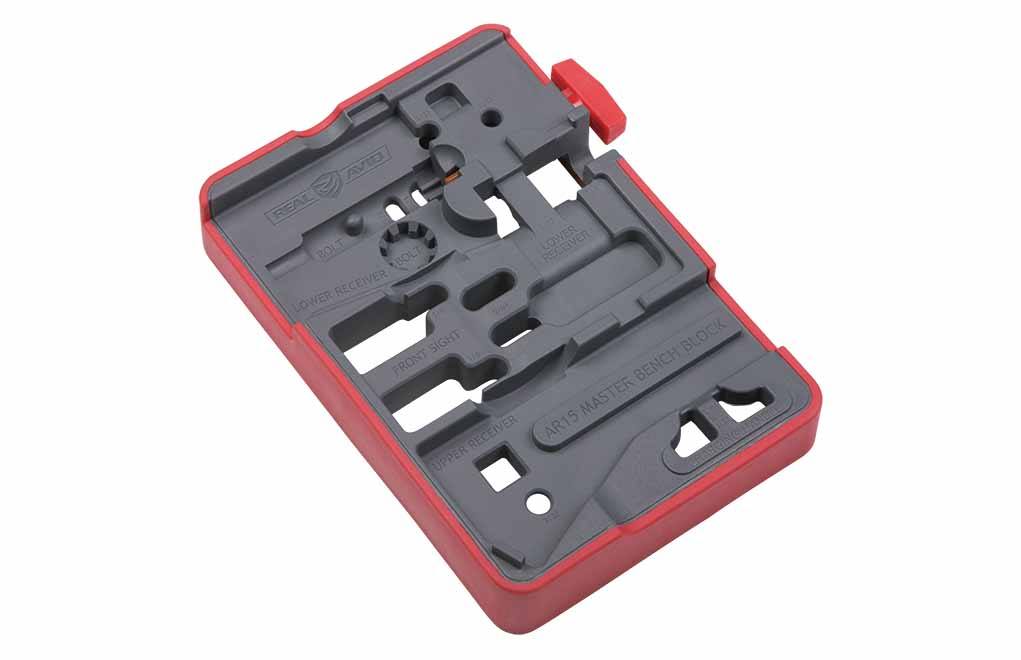
AR15 Master Bench Block
Torque Wrench
Easy-Grip Handguard Tool
AR15 Pivot Pin Tool
AR15 Pin Punch Set
Accu-Grip Picks
Bore Illuminator/Safety Flag
Front Sight Adjuster Tool
Professional Tool Case
Top 18 Mods Book
If you’re of a certain age, the following quote will resonate: “My old man is a TV repairman. He’s got this ultimate set of tools. I can fix it.”
If you want to fix things, you need tools. And not just any tools, but the appropriate tools for the thing to be fixed.
Enter Real Avid. This company has been making the right tools to work on and fix firearms for a few years now. The latest step has been to take the tools you need to work on an AR-15, put them all into one handy carrying case and make your life easier. It is called the AR15 Armorer’s Master Kit.
The case is a molded plastic container, hinged to open flat, with the tools clipped inside. It’s the size of a salesman’s sample case, and inside are many of the tools you’ll need.
The AR15 Armorer’s Master Kit’s name is a bit deceiving: You don’t need to be an armorer to work on your AR in the basement of your home. It’s got nearly everything you need, all wrapped up in a solid and organized case.
The big ones for getting stuff done are the Master Wrench, which is a combined tool. It can tighten or remove barrel nuts and handles both the mil-spec and free-float nuts. It can also loosen or tighten standard receiver extensions (buffer tubes) and carbine tubes as well. It’s a hammer, too, including a steel head and a place to screw in the included brass, nylon and aluminum hammer faces. There’s a slot with ¾-inch flats to tighten or loosen such extras as flash hiders and muzzle brakes.
In addition, there’s a socket for a torque wrench, with the torque specs printed on the hammer. And there’s a torque wrench. That’s a big thing, because many torque wrenches are made for automotive or industrial users — and they’re priced accordingly. You now have a way of knowing what torque specs you’re tightening your barrel nut to, as well as the receiver extension, castle nut, flash hider and so on.
You’ll also find a barrel bar in the kit. It’s an aluminum bar, and you clamp one end of it into your bench vise. The other end is starred like the locking lugs on your barrel. You can then slide the barrel receiver, or receiver and then the barrel, over this. The locking lugs of the barrel take the torque load of loosening or tightening, instead of the receiver. If you’re removing a shot-out barrel, you might find that the years of use and thousands of rounds have made the barrel nut very reluctant to give.
You can put a lot more torque into the nut with the bar to either loosen (might I suggest some penetrating lubricant as well?) or tighten it and not risk damaging the receiver.
The Armorer’s Master Wrench is the crown jewel of the entire kit, featuring integrated cutouts and interchangeable heads.
Ever try to remove mil-spec handguards by yourself? Even the military manuals show this being done with three hands. Real Avid includes a special handguard removal lever, similar to a pry bar, to get the delta ring back so you can wrestle the handguards off.
It Keeps on Giving
There are also tools that make the work easier. One is the Master Bench Block. This is a molded block with recesses specifically located for various parts and tasks. When you take the pins out, the block will keep them handy. When you want to strip a bolt, the bolt and its T-handle let you compress the ejector and keep it compressed while you work.
There’s also a small, tweezer-like tool that lets you hold pins and not hit your fingers with the hammer (as you normally most certainly will do when you lack such tweezers). And there’s a complete set of punches and pin alignment tools, along with plastic picks and scrapers made specifically for the AR-15.
All of these come with a booklet that gives you a step-by-step description of the 18 top modifications you might want to make to your AR-15.
As with the Master Bench Block, each of the kit’s components is labeled to help basement armorers complete any chore necessary with minimal headache.
This package of goodness costs you $250. Now, that might seem a bit steep at first, but when you start adding up the individual cost of the tools inside, it starts to look a lot better. Pricing just a hammer, two barrel-nut wrenches, a castle-nut wrench and a couple of open-end wrenches for the buffer tube and flash hider gets you most of the way to the Real Avid Master Kit price. And then, what? Are you going to just toss your tools into a cardboard box and let them rattle around while you schlep it to the range? Have a little more pride than that — please.
Ownership Rating: Mandatory
Even if you’re only going to be working on your own ARs, this is the tool kit to have. If your buddies at the gun club view you as the go-to AR guy, having this in the trunk of your car can only burnish that reputation.
Now, Real Avid can’t put everything into a handy box. You will need a bench and a bench vise to complete many of these tasks … unless you have a buddy who’s so strong that he can hold the various parts you’re working on as firmly as a bench vise. (No … I thought not.)
Additionally, there are a couple of tools Real Avid doesn’t include that I might to have to pack separately. The Real Avid punch set includes a staking punch, which you can use to stake both the castle nut and the gas key screws should they need staking. I did that a lot in the old days, and I much prefer to use a spring-loaded center punch. So, I’m going to have to find a way to include mine in the kit.
The other is a chamber throat gauge for finding out if a chamber is .223 or 5.56. I can’t see room in the case for the gauge and reamer, so I’ll have to find a way to pack those as well.
About this “ultimate set of tools”: Learn how to do the job right, and stay clear-headed when you do it. You’ll thank yourself down the road.
For more information on Real Avid’s AR15 Armorer’s Master Kit, please visit www.realavid.com/.
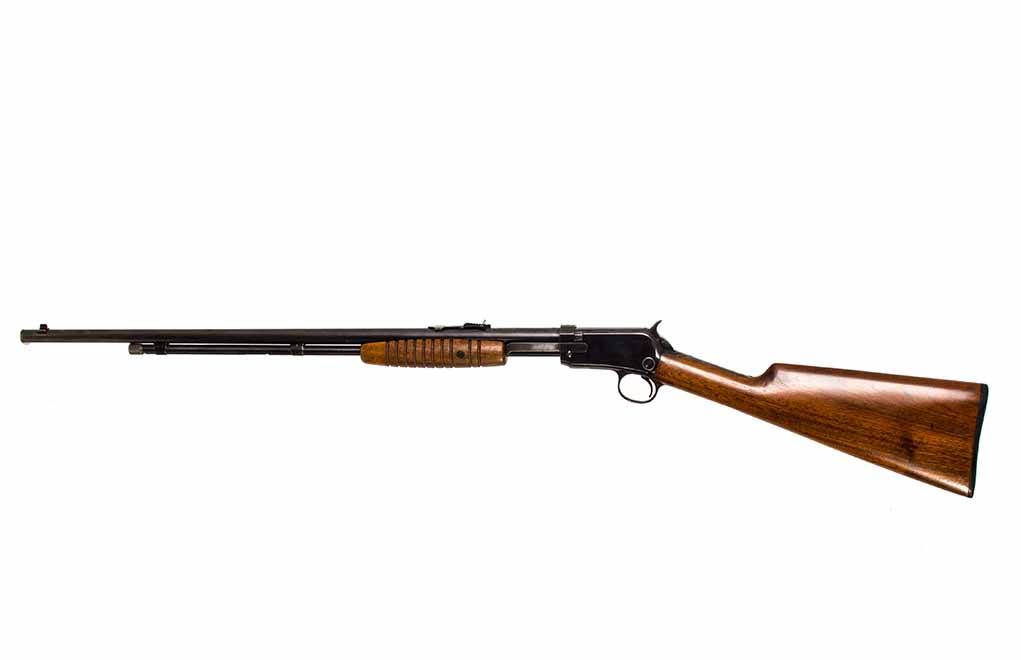
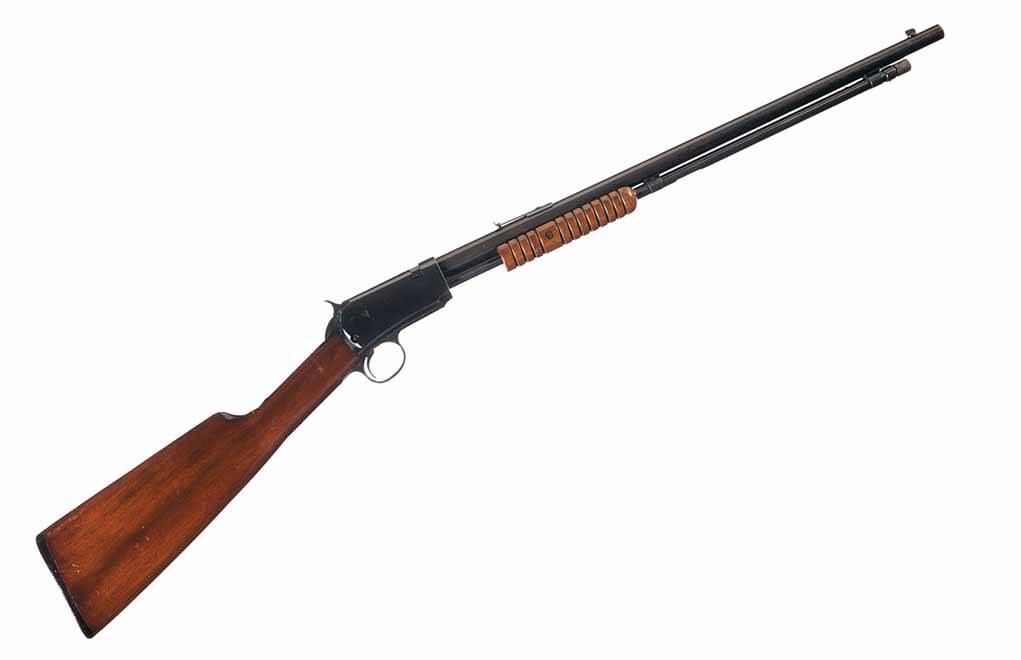
The pre-World War II Model 62 shown here wears a shorter slide handle than the 62A version.
Slide-action rimfire rifles were very popular during the first half of the 20th century. Among the best were the Winchester Model 62 and 62A series.
What Made the Winchester Model 62 Such A Thrilling Rimfire:
The Model 61 and 62 were both introduced in 1932.
The 61 id s hammerless profile styled somewhat after the Model 12 shotgun.
The 62 has a more traditional “Winchester look,” featuring a visible hammer and straight-grip stock.
The 62 originally retailed for $17.85.
More than 409,000 Model 62 and 62A rifles were manufactured during their 26-year lifespan.
America has certainly changed in many ways over the course of the past century. During the first half of the 20th century, many of us lived in rural areas. We grew up either in a small town or, if we were lucky, on a farm or ranch with acres of land where we could enjoy the outdoors.
A natural part of growing up in that world was being taught how to shoot and safely handle a gun by our dad, uncle, another relative or a family friend and dreaming of the day when we could have our own rifle or shotgun. Often, that first dream gun was a .22 LR rifle.
All types of rimfire rifles were around in the mid-1900s, including single-shots, bolt-action repeaters, several semi-autos, a few lever-actions and the pumps — or, if you prefer, “slide-actions.” There weren’t a lot of .22 LR pumps on the market: a couple of Remington offerings, a Savage (made by Marlin) and the fairly unknown Noble.
The history of the Model 62/62A goes back to the Winchester Model 1890. It was chambered individually and only for the .22 Short, Long, Long Rifle or the now-obsolete .22 WRF — but not interchangeably. Classic features included a 24-inch octagonal barrel and crescent buttplate.
And then, there were the Winchesters. Two of the finest rimfire rifles ever made were the Model 61 and Model 62 Winchester. Both were introduced in 1932 — the Model 61, with its streamlined, hammerless profile styled somewhat after the Model 12 shotgun — and the Model 62, with its more traditional “Winchester look,” featuring a visible hammer and straight-grip stock.
In 1932, the Model 62 was priced at $17.85, and the Model 61 was $24.65. Throughout the production history of these two firearms, the Model 61 was positioned by Winchester to be the more modern rifle and was priced accordingly. When the Model 62 went out of production in 1958, it was selling for about $60. The Model 61 was priced at $70 when it was discontinued in 1962.
A Long Time Coming
The history of the Model 62 goes back to the Model 1890 and the Model 1906 (each of which was named for their year of introduction). Like many other successful Winchester firearms, the Model 1890 was designed and patented by John M. Browning. Winchester bought the patent from him in 1888, and Browning began the work of building a prototype.
The Model 1906 was made in several variants, all with 20-inch barrels. For the first 2 years, from 1906 to 1908, all were chambered only for the .22 Short. The .22 S/L/LR interchangeable model came in 1909.
When Winchester engineers saw the design drawings, they suggested that Browning not go ahead with the project, because they didn’t believe the rifle would work. Mr. Browning made the prototype anyway, tested it and sent it to Winchester with a note stating, “You said it wouldn’t work, but it seems to shoot pretty fair to me.”1
Indeed, it did, and the Model 1890 became one of Winchester’s most popular rifles.
Learn More About Legendary Winchester
9 Greatest Winchester Rifles And Shotguns Ever Made
Winchester decided to add a more economical .22 slide-action to its lineup with the Model 1906. It had the same receiver and trigger guard as the Model ’90 but with a shorter, 20-inch barrel and a length-of-pull of just 12 7/8 inches. The price for the Model 1906 was about $10 — half that for the Model 1890. This was one of the reasons it became popular as a “first gun” for many young shooters.
It was chambered to handle .22 Short, Long and Long Rifle cartridges interchangeably, whereas the Model 1890 was made for only one of those rounds or the Winchester Rim Fire (.22 WRF). The Model 1906 was also available in .22 Short only; and, in that chambering, it became very popular as a gallery gun. Both the 1890 and 1906 models were phased out with the introduction of the Model 61 and Model 62 in 1932.
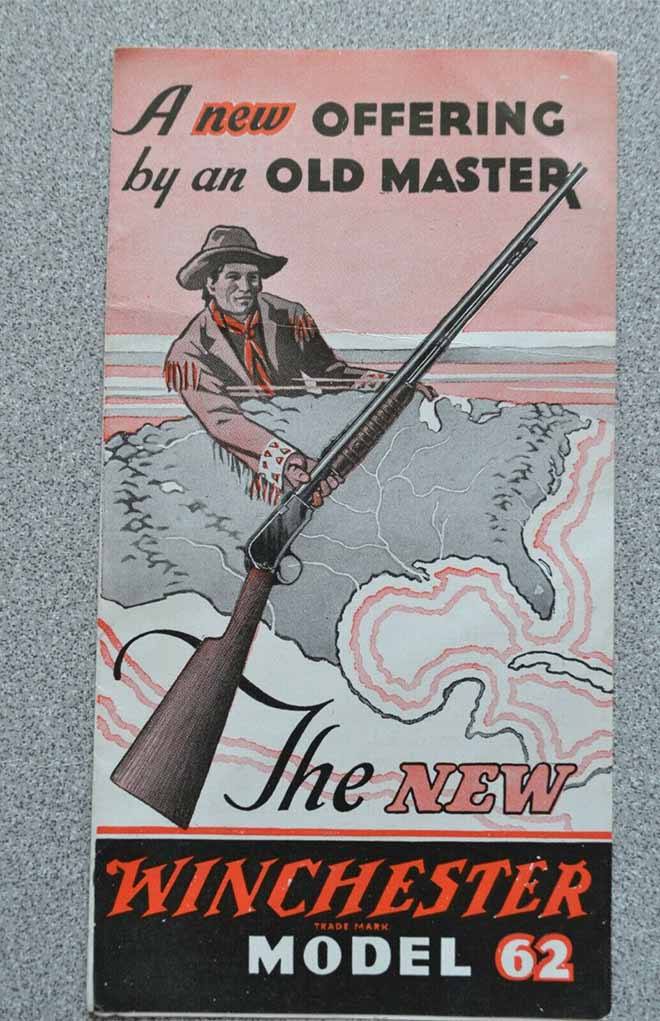
The ‘New’ Model 62
The new Model 62 was essentially an improved version of the Model 1906. It shared some of the features of the ’06 — the receiver, a visible hammer and interchangeable chambering for Short, Long and Long Rifle (or .22 Short only). The most visible changes included a 23-inch barrel and a newly designed stock and slide handle.
The Model 62A was the last version of the Model 62 series. It was in production from 1939 to 1943 and then again from 1946 to 1958, after the culmination of World War II.
Like the Model 1906, a special Gallery model was offered in the Model 62, chambered for .22 Short. These rifles are usually stamped “Winchester” in large letters on the left side of the receiver. Some of these stampings are in red. Winchester wanted to make sure the shooting gallery customer knew what brand of rifle they were using.
Another identifying factor for the Gallery model is the loading port on the bottom side of the magazine tube. It has a triangular shape and is much larger than the small port on a standard .22 Short model. This larger port was designed for the 10-shot loading tubes that gallery operators used to quickly reload the rifle. It’s estimated that no more than about 3 percent of the total Model 62/62A production was for the .22 Short cartridge.2
The Model 62 evolved into the 62A in the late 1930s. The most significant change was from a flat mainspring to a coiled hammer spring. From 1939 through 1940, both Model 62 and 62A variants overlapped, and it can be confusing to determine whether you have a Model 62 or 62A. No matter what is written on the barrel, a model 62 with a flat mainspring has four holes in the lower tang; the 62A with the coiled hammer spring has a single hole in the lower tang.3
Early marketing materials for the Model 62 Winchester
Other changes from the Model 62 to the 62A included changing the pattern on the hammer thumbpiece from checkered to grooved. Also, the slide handle on the Model 62 is shorter than the one on the 62A, and there are seven grooves in the older slide handle and 10 grooves on the 62A. This change occurred at approximately serial number 98,000.
As with many other firearms of the day, collector interest is highest for pre-World War II models. Premiums should be added for Gallery guns or for .22 Short-chambered non-Gallery models.
More than 409,000 Model 62 and 62A rifles were manufactured during their 26-year lifespan from 1932 to 1958, minus a hiatus during World War II (1943-1945). Total production of Winchester’s slide-action hammer Models 1890, 1906 and 62 totaled almost 2 million rifles during their 69-year history from 1890 to 1958.4
These rifles, like their Model 1890 and 1906 ancestors, are icons of the great .22 rifles of the 20th century and are fine examples for any collection.
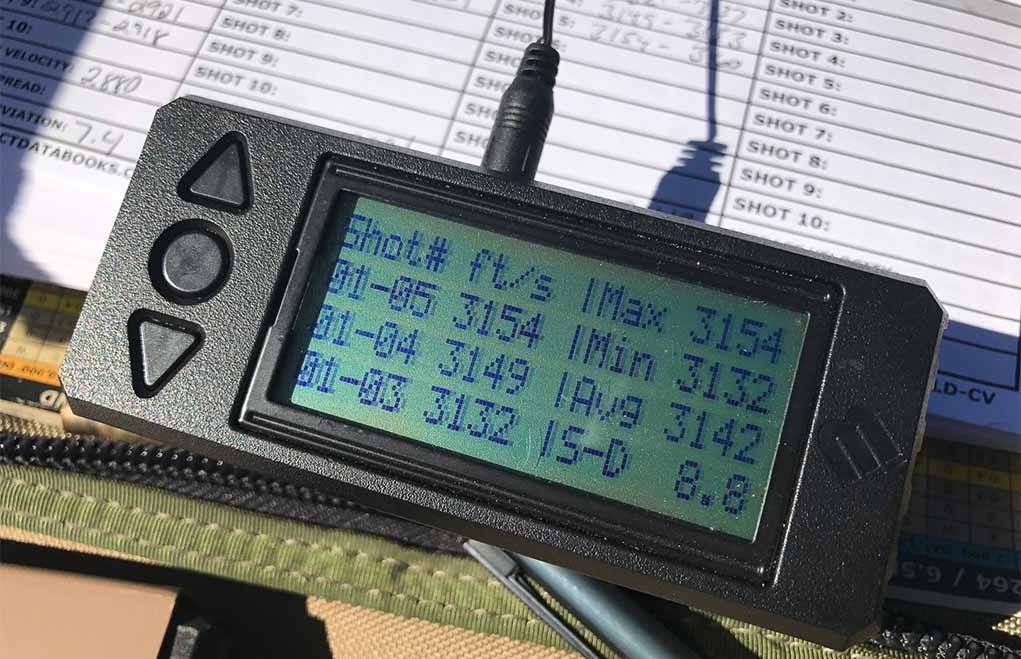
Serious shooters understand a chronograph is an essential piece of kit. Giving you a solid handle of a loads velocity out of a particular gun, it not only allows you to exactly predict a bullet’s trajectory but also its terminal performance. Luckily you don’t have to break the bank to unlock this vital information, not with the affordable chronograph options presently on the market.
Caldwell Ballistic Precision Chronograph
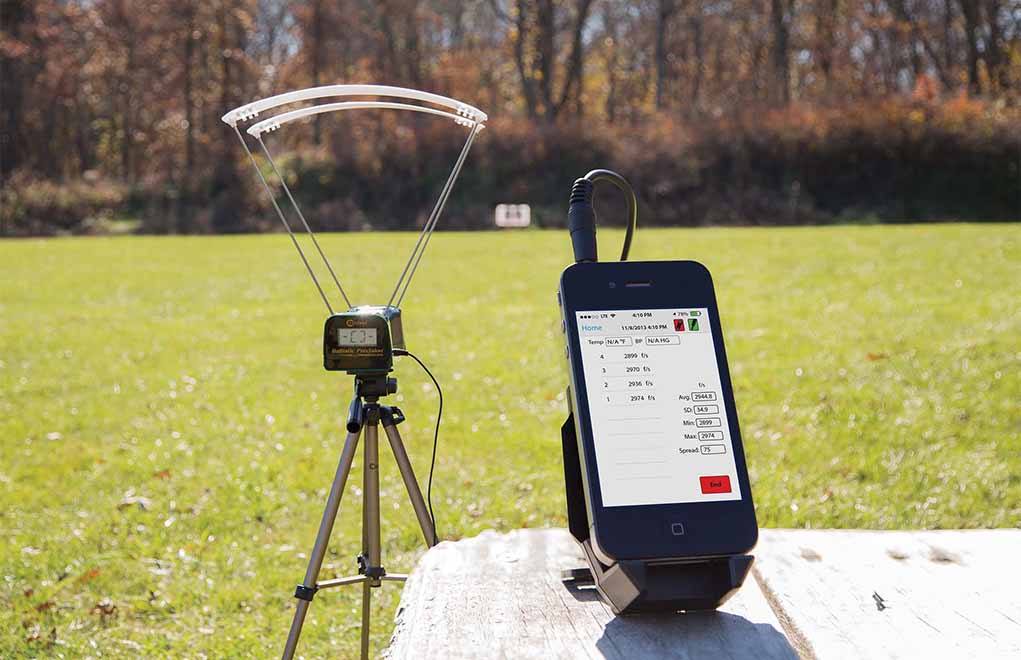
This chrony is arguably one of the best values available today. Sensitive enough to handle everything from a BB gun to a .50-caliber, the do-all Ballistic Precision unit is practically everything you need. In addition, the chronograph links up with your smart device to offer you some features not found on other options in the price range. Not only will it calculate average velocity, standard deviation, min, max and velocity spread for the shot string, it also archives your data, thereby giving you the ability to compare different shooting sessions. Of course, as an optical chronograph, it’s susceptible to environmental conditions and tends to be finicky indoors. But with a good light source, you’ll find it is as precise as the top models out there. MSRP: $105www.caldwellshooting.com
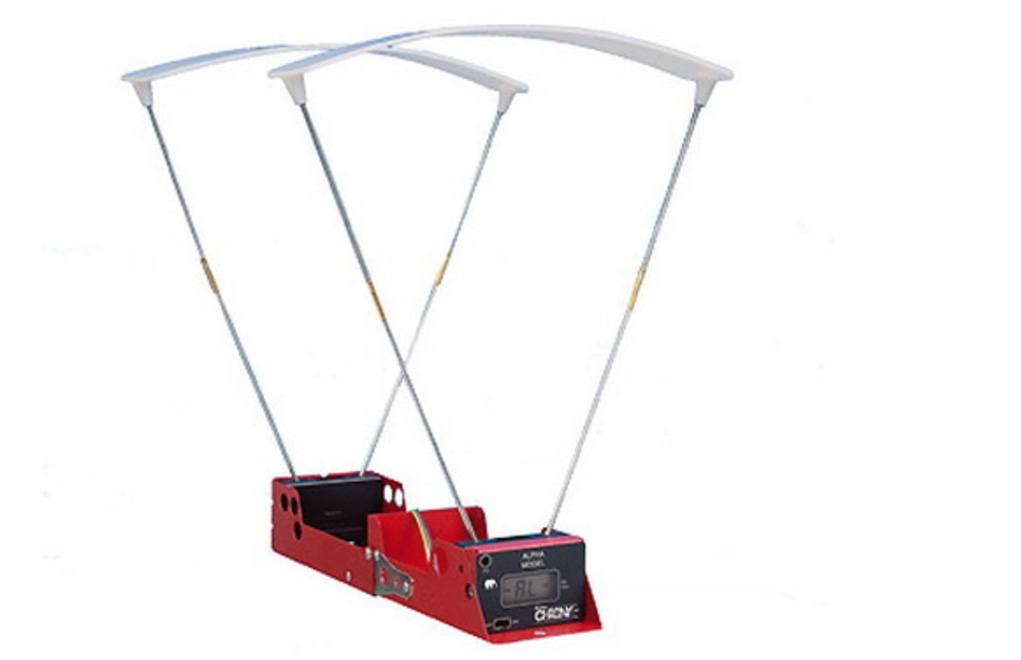
Alpha Shooting Chrony
Compact and handy, the Alpha Shooting Chrony is the very essence of convenience. Folding up to the size of a handheld box, the device is convenient to tote along in your range bag. And, it’s elegantly simple to operate. Just power up, shoot, and the Alpha spits out your velocities. While it is spartan, this device has the features you need in a chronograph, including high, low and average velocities, extreme spread and standard deviations. Furthermore, it has enough memory for a string of 32 shots and the ability to retrieve or delete individual data points. This chronograph also gives you room to grow: If you need more-serious data, you can add Shooting Chrony’s printer and software down the line to crunch a larger amount of data. MSRP: $115www.shootingchrony.com
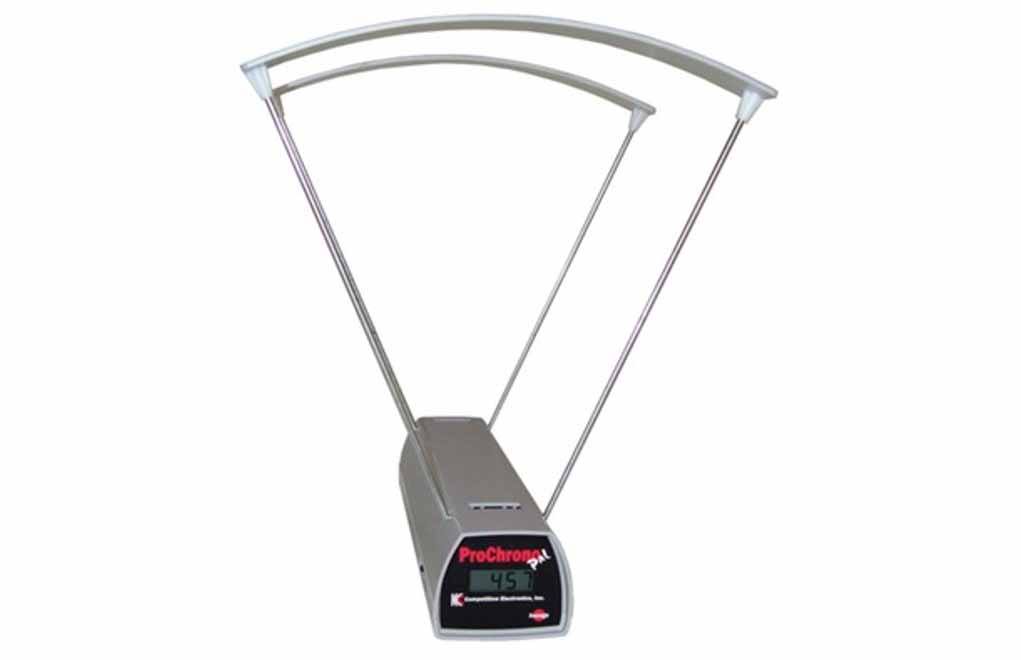
Competition Electronics ProChrono
If it shoots, the ProChrono will record its velocity. And accurately. Fairly bare-bones in appearance, this chronograph has plenty of features that make it a gem. The unit can store nine-shot strings with up to 99 shots each in power-down memory. Additionally, it gives you the ability to review each velocity and shot string data, including average velocity, standard deviation and extreme spread. This device is expandable if you decide to upgrade it with any Competition Electronics accessories. And, if the lighting is good enough, the ProChrono will keep you in the know, both indoors and out. It is a perfect entry-level option if you’re looking to expand in the future. MSRP: $125www.competitionelectronics.com
Sig Sauer jumps into 6mm Creedmoor ammo with a Sierra MatchKing tipped option.
How Sig 6mm Creedmoor Ammo I Made To Go The Distance:
At 107-grains, the MatchKing bullet is at the heftier end of the spectrum.
Sig loads the ammo to push the bullet 2,950 fps at the muzzle.
At that velocity, the bullet’s effective BC is .547.
Less heralded among everyday shooters than its older, bigger brother, the 6mm Creedmoor nonetheless provides excellent downrange performance. Much like the 6.5 Creedmoor, the 6mm has a healthy selection of long, high-BC bullets of which to choose from, which equates another wind-bucking option that goes the distance. Only, a little bit lighter and less recoil than the original Creedmoor.
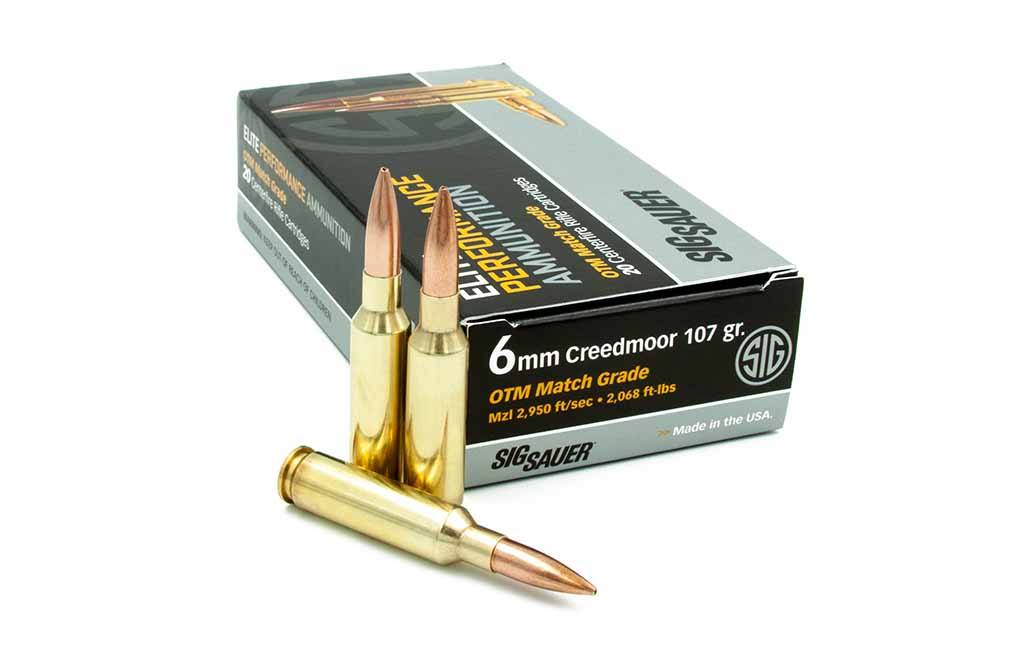
Sig Sauer is the most recent chasing after the ballistically talented cartridge, expanding its line of Elite Match Ammunition with its first 6mm Creedmoor offering. Similar to many of its match ammunition options, Sig opted for the popular and effective Sierra MatchKing bullet with the Creedmoor. At 107-grains, it’s not the heaviest bullet found in the cartridge, but certainly it falls within the spectrum of what many precision shooters prefer. And it moves at a clip most precision marksmen should appreciate—2,950 fps at the muzzle. Given Sierra’s velocity-base ballistic coefficients, at that rate the bullet’s BC is effectively .547, which in a word is good.
Sig lists a box of 20 at $30.95, which doesn’t quite make it plinking material. But taken relative to a good swath of the 6mm Creedmoor market—which is dominated by match ammo—it’s fairly competitively priced.
NEWINGTON, N.H., (November 7, 2019) – SIG SAUER, Inc. extends its line of Elite Match premium competition ammunition with the addition of 6mm Creedmoor.
Featuring a 107gr Sierra MatchKing® bullet, the new 6mm Creedmoor Elite Match OTM load has a muzzle velocity of 2,950 fps and muzzle energy of 2,068 ft-lbs.
“6mm Creedmoor is a popular long-range round that performs well in wind thanks to its high ballistic coefficient and flat trajectory,” said Brad Criner, Senior Director, Brand Management and Business Development, SIG SAUER Ammunition. “We are pleased to offer this highly accurate round for competition shooters along with 6.5 Creedmoor and numerous other match grade loads.”
SIG Elite Match ammunition is currently available in the following calibers: 223 Rem, 300BLK, 308 Win, 30-06 Springfield, 300 Win Mag, 6mm Creedmoor and 6.5 Creedmoor.
SIG SAUER Elite Match ammunition features a temperature-stable propellant that delivers consistent muzzle velocity in all weather conditions. Premium-quality primers ensure minimum velocity variations, and the shell case metallurgy is optimized in the SIG Elite Match OTM cartridge to yield consistent bullet retention round to round. All SIG SAUER rifle ammunition is precision loaded on state-of-the-art equipment that is 100% electromechanically monitored to ensure geometric conformity and charge weight consistency.
This .404 Jeffery from Bansner & Co. will handle any hunting situation in the world—from the swamps of Alaska to the dry, dusty plains of Africa.
Not all giants are created equal, so take your time in picking the right big-bore cartridge and rifle for your needs.
How To Shop For The Perfect Big-Bore Rifle:
Look for a balance of trajectory, energy and flexibility.
Do your research to see if the cartridge is adequate for your purposes and meets local game regulations.
Try as many big-bore rifles as possible in as many calibers as possible to find the right combination.
I have a penchant for big-bore rifles and cartridges. It’s not necessarily that I’m in love with a ton of recoil (although I don’t mind it); it’s that grabbing for one of my big-bore rifles usually means I’m heading on a hunt for dangerous—or at least very large—game.
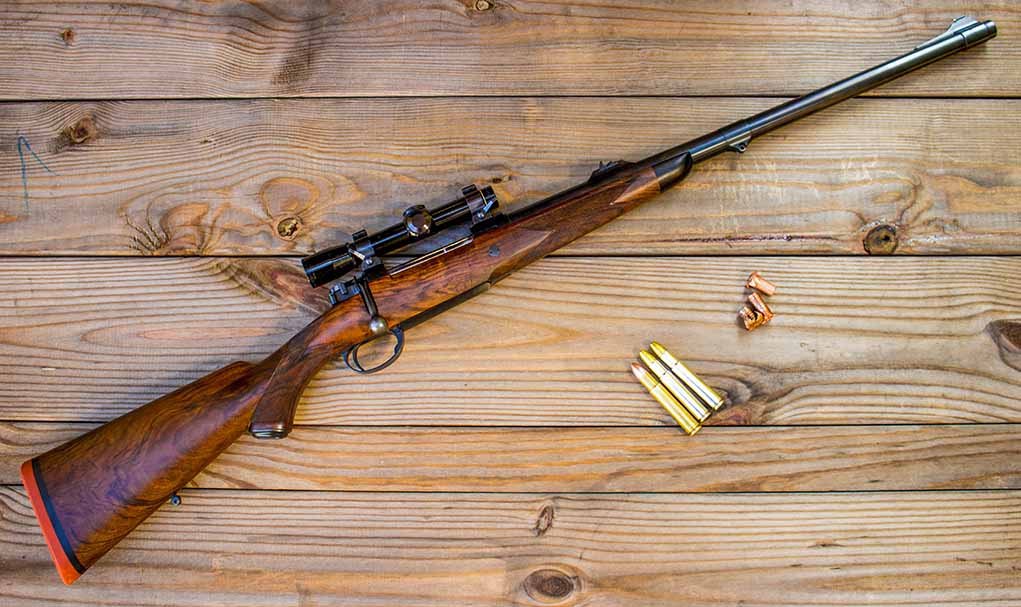
Let’s get this out of the way early on: You can hunt 95 percent of the world’s game species with a cartridge no bigger than 7mm or .30 caliber. Premium bullets give the best balance of expansion and penetration we’ve ever experienced, and a good heavy-for-caliber 7mm or .30 is a formidable projectile. So, it’s plain to see that your dangerous-game rifle will probably be the least used. Nevertheless, it’s the most important choice of rifle—when you need it, you really need it.
Your choice of hunting destination and the animals you intend to hunt will play a large role in the choice of a big-bore rifle/cartridge combination.
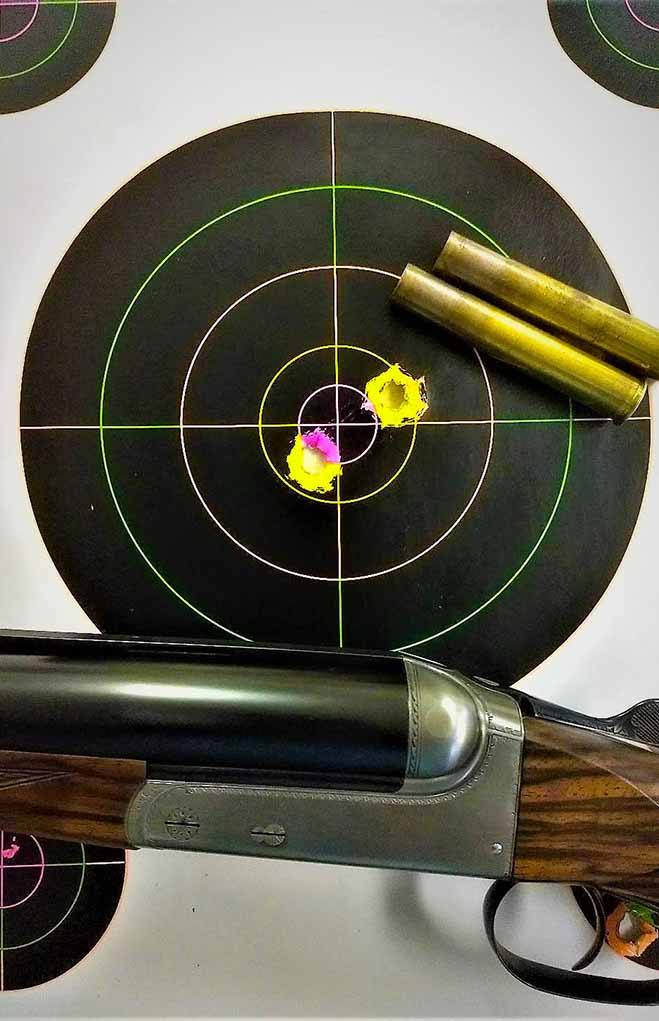
The author’s .470 Heym rifle is very accurate—as this 100-yard target shows.
The quintessential brown bear rifle might look a lot like the quintessential Cape buffalo rifle, but there are subtle differences. And, a cartridge that could handle all of North America (including Alaskan big game) might not be legal for some African countries. A rifle for Australian buffalo and assorted bovines will be very close to that which handles the African heavyweights, but there are decisions to be made within that realm as well.
Alaska And The Brown Bear
Understand that the largest brown bear or bison can be taken cleanly with a .338 Winchester Magnum and the like, because it has the ability to deliver a 250-grain bullet at respectable velocities (2,600 fps or better), yet shoots flat enough to take mountain goat, sheep or caribou. I have many friends who hunt or guide in the 49th state, and they generally agree that the .388 WM is a good minimum for big brownies. I would feel better with a .375 H&H in hand, and when I hunted Alaskan brown bear, I carried a bolt-action .404 Jeffery, along with 450-grain Norma ammunition.
Some guides who frequently dig bears out of the thick stuff carry .458 Winchester Magnums or .458 Lotts, because the 500-grain bullets settle an argument quickly. The .45-70 Government will still get the job done, although shots out past about 125 or 150 yards become quite a challenge, and the energy drops off quickly.
There are many who enjoy a lever gun in Alaska, but for the most versatile choice for a visiting sportsman, a weatherproof bolt-action can’t be beat.
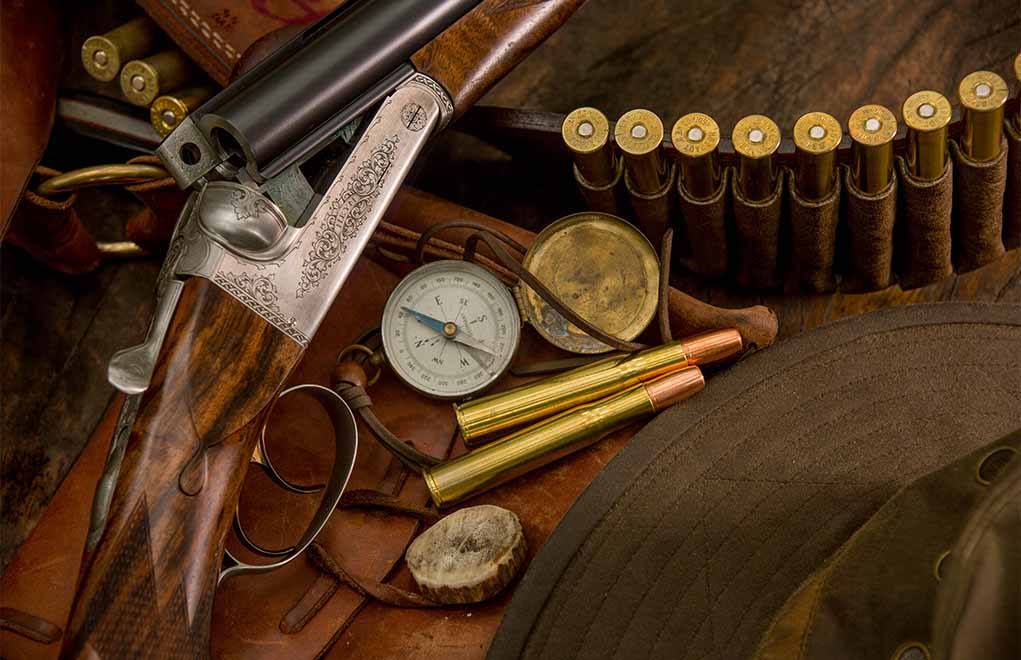
The .450/400 3-inch makes a good choice for a double rifle. Its 400-grain bullet is effective. Yet, the recoil is mild.
As much as I love the .404 Jeffery, I think the .375 H&H or .375 Ruger is more flexible—they can shoot flat and will handle bullets of up to 350 grains—and either would make the perfect all-around Alaskan choice. I understand Ruger is reintroducing the Hawkeye Alaskan, and that rifle makes an effective, yet affordable, choice.
If you like the big .45-calibers, so be it, but realize there’s a bit of a trajectory handicap. Should a hunter want more than a .375 offers for Alaska, the .404 or one of the .416s is an excellent balance.
The Dark Continent And Down Under
Looking at big-bore rifles for African and Australian hunting, you’ll find a bit of overlap with the Alaskan choices. Many African countries use the .375-inch bore diameter as the legal minimum for buffalo, hippo and elephant. Some include lion and leopard in the mix, and Zimbabwe uses the 9.3mm as a minimum.
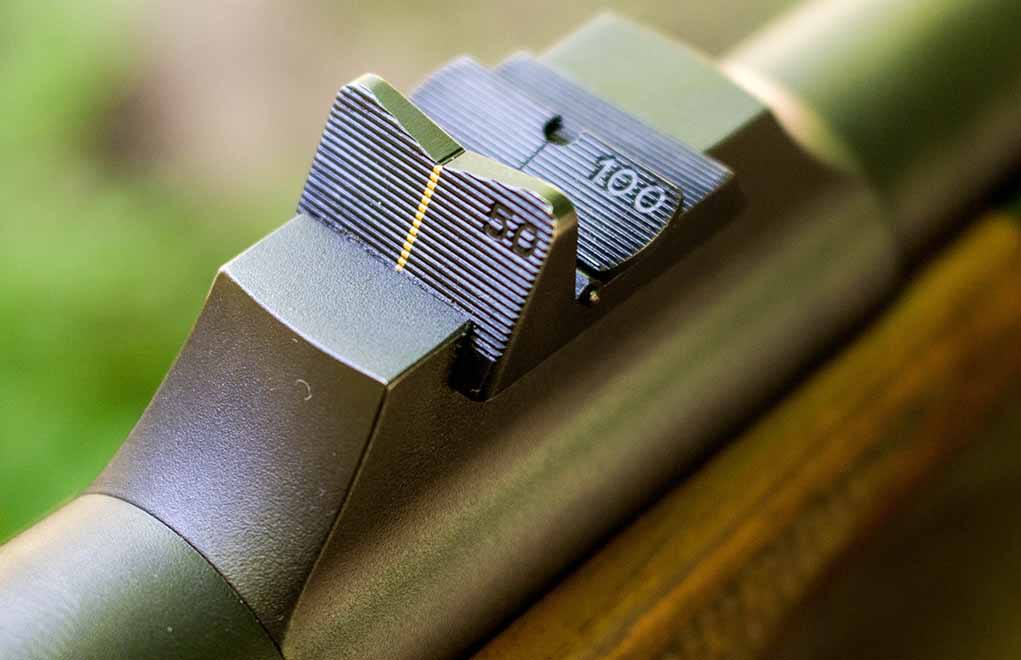
Here, the rear sight of the Heym Express with a stationary 50-yard sight and a flip-up 100-yard sight.
In the British sense of the term, the big-bore cartridges don’t start until the .45s. The .375, .416 and .404 were considered medium-bores. I think we’ve proven that the line has been moved, because the .375 H&H is fully capable of taking any game animal on Earth; and, with modern bullets, the 9.3mm cartridges should be cleared for any dangerous-game hunting.
For the hunter who wants to have one big-bore rifle to hunt African game, as well as the huge bovines of Australia, a bolt-action .375 makes logical sense. However, there’s a difference between “capable” and “ideal,” and that distinction has been argued for decades.
The Cape buffalo is the most affordable and most popular of the African dangerous-game species. Weighing an average of 1,400 pounds, this bovine, known as “Black Death,” is famed for its tenacity and ability to soak up lead. I can attest to the fact that the 400-grain bullets of the .416s and .404 have a much more dramatic effect than the 300-grain bullets of the .375s. The .458s and .470s are even more effective, driving 500-grain slugs. But, of course, the increased throw weight comes at the price of additional recoil.
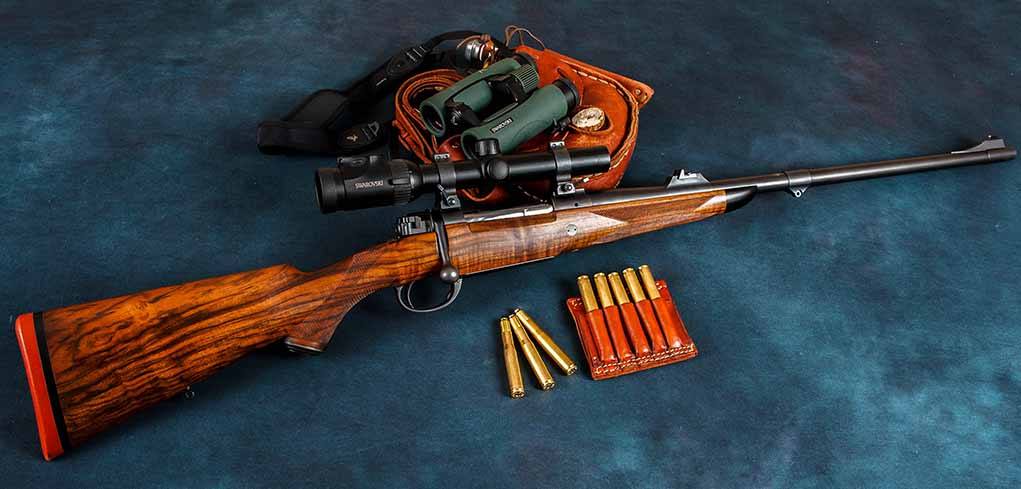
This Heym Express by Martini in .404 Jeffery is the author’s favorite rifle.
If an elephant is on your dream list (and it’s fantastic hunting that does much more good than harm to the approved populations), you might definitely want something in the mid- to high .40s or even into the .500s. I have become friends with a good number of the continent’s elephant hunters, and they all like some sort of .500, whether in a double chambered for the .500 Nitro Express or in a bolt-action .500 Jeffery. These are great elephant (and buffalo) cartridges.
However, the role of professional hunter is not that of the client, and these rifles are specifically chosen for mopping up messes at close range. For the client (you or me), I feel that a dangerous-game rifle needs to be a bit more flexible with regard to distance—and utterly manageable. Although professional hunters carry “big sticks,” they can be too much gun for the average client.
A big part of the decision-making process is to be honest with yourself about how much recoil you can truly handle. A .375 bullet in the right place is worth 10 .470s in the wrong place. Even the choice between a bolt-action, single-shot or double rifle will have a lot to do with your physical capabilities; carrying a 12-pound double for eight miles in the heat is more difficult than a 9-pound bolt gun.
Choosing And Setting Up A Big-Bore Hunting
Most of the big-bore dangerous-game rifles are going to be bolt-action; they are light, rugged and accurate. Topped with a good low-power scope, a bolt-action rifle can be effective out to 250 yards and maybe more. I think a scope is important for placing shots accurately: Buffalo are sometimes shot out to 125 yards, and bears are shot farther than that. However, the ability to remove the scope to access iron sights is imperative.
A Heym Express in .505 Gibbs. With a low-power Leupold scope and detachable rings for quick access to the iron sights, this rifle will certainly handle it all.
For this application on a bolt-action rifle, I have found Talley’s detachable rings to be among the best I’ve seen. They reliably return to zero and can handle the nastiest recoil. I like a scope in the range of 1-4x, 1.5-5x or 1-6x to keep the field of view wide for fast target acquisition. A good big-bore should also have good iron sights, which the shooter has put on paper and is comfortable using.
I like my dangerous-game bolt-action rifles to be controlled-round-feed (CRF), because I feel it’s the most rugged. I’ve heard the arguments about the strength and reliability of modern push-feed designs, and perhaps I’m old fashioned, but I like the over-designed qualities of the Mauser 98 and its clones. My Heym Express .404 Jeffery uses a proprietary action that is larger and stronger than even the 98 Mauser. It’s my favorite rifle ever. The Winchester 70, Dakota 76, Rigby Big Game, Montana 1999 and the CZ550 are all examples of reliable CRF actions.
Single-shot rifles, such as the popular Ruger No. 1, are often chambered for big-bore cartridges. They will work, but you might be asking for a backup shot from your professional hunter. If you know that going in and are comfortable with that, so be it.
An American Hunting Rifle (AHR) in .416 Rigby. Based on the CZ550 with a number of upgrades, this CRF action rifle is utterly reliable and will handle any game animal on Earth.
If you choose the romance and fast second shot of a double rifle, I’m the last person to find fault with you. I’ve done several hunts with a double rifle as my big-bore, and it’s a wonderful experience. They aren’t cheap (at least the good ones aren’t), and both stock fit and rifle balance are crucial with a double rifle. So is regulation—the way the pair of barrels is set to hit the same point of impact at a certain distance—and you do get what you pay for in the double-rifle world.
Like a bolt-action, the double rifle is available in calibers from 9.3x74mm and .375 flanged up to .600 and even .700 NE, although most hunters choose a cartridge somewhere in the middle. The .450-400 3-inch is very popular, because it gives great penetration without the punishing recoil. Some find it a bit light for elephant but good for buffalo. I used it to take an excellent buffalo in Mozambique and had no complaints.
The .450 NE set the standard back in 1898, and it remains a good choice for a double rifle for all species. However, I chose the .470 NE for my Heym 89B double rifle, because ammunition is more readily available. Both drive a 500-grain bullet at 2,150 fps, and while the .450 offers a better sectional density figure, there are absolutely no flies on the .470 NE. The .500 NE gives a bit more bullet weight (570 grains), a bit more energy (5,800 ft-lbs) and more frontal diameter, which is why it remains so popular among professional hunters. Sliding up the scale to the .577 NE, you will see a 750-grain bullet at 2,050 fps for 7,000 ft-lbs of energy—with recoil to match.
Using a red-dot sight, such as this Trijicon RMR09, gives the shooter a single focal plane. This is especially comforting for older eyes that don’t focus as well on iron sights.
The classic configuration of the double rifle is a bold front bead and a wide-V rear sight. The rifle might have folding leaves for farther distances, but the stationary rear sight should be regulated for 60 to 100 yards. Adding a red-dot sight (I love the Trijicon RMR) adds a new dimension to the double rifle. I definitely prefer two triggers over a single trigger—one of the original benefits of the double in wild country was that you essentially had two rifles in one.
Cartridge Choice
There are volumes written on the proper cartridge choice for dangerous game, so I can’t cover it all in a magazine article. Look at a few key points when choosing a cartridge: bullet weight, recoil-generated (compared to that which you can handle), availability and applicability.
A .577 NE is not a 400-yard cartridge, and a .338 Winchester is not designed for elephant. I love flexibility, which is why I praise the .375 H&H so highly. With lighter bullets, it can readily take deer, hogs, elk and plains game. With heavy bullets, it will take everything else. However, 5,000 ft-lbs handle buffalo and elephant better than 4,000 ft-lbs, and 400- and 500-grain bullets make a better choice for dangerous-game animals than 300—providing (and this is the most important point) the shooter can effectively wield a cartridge of that magnitude.
I look for a balance of trajectory, energy and flexibility and have found many that fit the bill for me: the .375 H&H, .416 Remington Magnum, .404 Jeffery and the .470 NE.
A Cape buffalo bull in Zimbabwe and a Heym 89B double rifle in .470 NE.
Do your research, and you might come up with the same answers I did, or you might find a different one that appeals to you. There are many correct answers to the same question. You’ll want a cartridge that can deliver a bullet with a sectional density figure at .300 or above at a velocity of 2,100 to 2,500 fps. This doesn’t overstrain the bullet … or your shoulder.
The best advice I can give you is to try as many big-bore rifles as possible. While this might sound extremely difficult, many big-bore aficionados are eager to help out a fellow shooter. Usually just for the price of the ammo, you will find an experienced big-bore shooter who will let you try their particular favorite. I have more big-bores than I need, but I truly enjoy shooting them.
My own choices? A Winchester 70 in .416 Remington Magnum, Heym Express by Martini in .404 Jeffery, Bansner Custom in .404 Jeffery and a Heym 89B double rifle in .470 NE. (My wife stole my Legendary Arms Works .375 H&H, but I get to shoot it if I behave well.) If I had to choose just one, it would be that Heym Express .404 … but thankfully, I don’t have to choose.
Doping the wind to within 1 mph across the entire path of the bullet to the target is more difficult than it sounds: Wind rarely cooperates.
The goal: Dope the wind to within 1 mph across the entire path of the bullet. The key: understanding your bullet’s in-fight ballistic coefficient.
What’s Important To Know About Ballistic Coefficient:
It describes how a bullet overcomes air resistance when in flight.
The higher the ballistic coefficient number, the better the performance.
A bullet’s true BC is dependent on the particular rifle system it’s shot from.
To gauge this performance you need to measure downrange velocity.
The precision rifle shooter’s goal is to dope the wind to within 1 mph across the entire path of the bullet to the target. It’s harder than it sounds. From a practical standpoint, it’s not possible, because the wind rarely cooperates. Nevertheless, this is the ideal we want to achieve.
Take the “wind rose.” It goes back years but has built-in mistakes that many don’t understand — especially doping the wind at a half-value. When someone hears, “Half-value the wind,” they think, I need to halve the value. So, a 10 mph wind coming from a direction described as “half value” would be 5 mph, or 50 percent.
Today, software shooters can gain an advantage by letting software control the wind call to provide effective downrange results … if you set up the computer correctly.
This is wrong; it’s not half the value — it’s half the distance. A half-value wind is 75 percent of the full value, or 7.5 mph; not 5 mph. Incorrectly interpret the information, and you’re starting down the wrong path on your precision rifle journey.
Today, software shooters can gain an advantage by letting software control the wind call (although this is not a great learning method). It can provide effective downrange results … if you set up the computer correctly. Just as with elevation, you have to look at the wind holds and true those results.
Wind Adjustment
Wind adjustment is controlled by the bullet’s ballistic coefficient (BC). This is essential information for setting up your ballistic computer. You can find the BC in several places: Hopefully, your chosen bullet manufacturer printed the numbers on the box; if not, do some internet research to get the correct information.
In short, BC numbers tell the software how well the bullet performs. For instance, it indicates the rate of drop and the amount of drift for a particular bullet. The higher the number, the better the bullet will perform. (It takes a bit of distance for the full effects to kick in, so you should shoot the rifle to distance).
Also, BCs are rifle system-dependent. You have to true the BC for your system, because the value is just an average based on the tests conducted. Most shooters test their bullets at 300 yards — the shortest range you can use that will give you a fairly good number. However, that number is based on the rifle system it’s shot from; in other words, the barrel that’s used. It’s an average to give the shooter a starting point. It’s not wrong; it’s just not specific.
Here, a Kestrel 4500 Pocket Weather Tracker is used to determine the current wind velocity. Wind adjustment is controlled by the bullet’s ballistic coefficient.
It’s not easy to correctly change a BC. To do it right, you need a velocity downrange (by “downrange,” I mean 800 yards or more). It will not work close in, so shooting through your chronograph at 800 yards is not going to happen without specialized equipment. You can do it from the drop, or you can use software to adjust it via trial and error.
This last method is the easiest way to do it for the average shooter. Trueing the software by changing muzzle velocity is the default way for most software, but it bends the curve unnaturally.
Chronographs have gotten better, and I most often use the LabRadar and MagnetoSpeed. Their numbers are outstanding, so why begin by changing these measured values? Rather, start off adjusting the BC first and then make minor tweaks to the muzzle velocity if necessary. A host of variables affects the BC, so adjust this number first.
The chart for determining typical wind formula and constants is a useful reference tool.
The mph of a rifle is a value based on the bullet shot and derives from the G1 BC. I use G1 BC numbers in most of my software (I don’t subscribe to the idea that you must use G7). Nevertheless, most of the software I run is not G-dependent. The first number in the G1 BC is, in fact, the mph value. Consequently, if I use a bullet with a BC G1 of .583, I have a 5 mph gun. So, for every 5 mph, my bullet will follow this pattern:
Yards
Mil
100
0.1
200
0.2
300
0.3
400
0.4
500
0.5
600*
0.6
(*Beyond 600 yards, there’s a minor variation in these numbers.)
We always use this method in precision rifle shooting, and we have values for those shooting MOA-based scopes (this is a bit more complicated). For a 10 mph wind, double these values — quick and simple.
When you tweak the software, align the numbers to match the chart on the previous page. So, 500 yards should read 0.5 mil for a 5 mph wind. Mils are preferred over MOA for shooting the wind call because they’re easier to work with.
Methodology
You’re not adjusting the BC as much as you are changing whole numbers. So, your .58 BC is not going to become 0.6, but it might be 0.56 versus the 0.58 printed on the box. That will help align the ballistic curve in your software. It’s a better method than starting off with the muzzle velocity.
Wind value scale.
Fire a group at 800 yards. Before changing the muzzle velocity to line up the curve, adjust the BC numbers just a bit. Get the curve to match at this distance. If you notice any errors in the short-range data, change the muzzle velocity to line it up and complete the curve. Most likely, it will be a small change — about 25 to 50 fps, but not much more. Changing the verified muzzle velocity beyond 100 fps risks some potential errors. Eight hundred yards is the simplest distance to adjust your software so that it trues the curve from 100 to 1,000 yards.
Finally, BCs are manipulated by velocity. The more speed, the higher the BC number. So, if you’re shooting a cartridge designed around 2,800 fps, and your rifle system is shooting only that bullet at 2,650, it’s not going to have the “advertised” BC. It will become a lower number. Understanding this will help you adjust the value. Observe how your velocity changes the BC value. Then, start by moving the middle number up or down based on that speed. It’s pretty simple once you get the hang of it.
Although the concept of doping the wind within 1 mph across the bullet’s entire path to the target can sound daunting, it’s a thing of beauty when it all comes together.
We can get very technical in this area, but the easier we can make it, the faster you will be able to dope the wind at distance. After all, wind is the great equalizer.
Looking to go armed, but are stuck in the weeds as to what to arm yourself with? Here are 20 of the best concealed carry gun options that will keep you on the defensive.