Home Blog Page 201

The Small Miracle of the .327 Federal Magnum

14

The Small Miracle of .327 Federal Magnum

Fired from snappy revolvers and with velocity to spare, the .327 Federal Magnum is redefining the often-maligned caliber for the better.

Handgun design and usage have been strongly influenced by .32-caliber cartridges for well over a century. The majority of the .32-caliber cartridges of the past were pretty anemic, but still, most of them were quite popular for personal defense. Nowadays, if you go out armed with a .32, folks think you’re demented.

Bad guys seem to have gotten a lot tougher in the past few decades, too. Back in the 1920s and 1930s, folks thought it was perfectly logical to arm themselves with a slim, hammerless automatic pistol or a small revolver chambered for one of the many .32-caliber cartridges available.

Back then, good guys didn’t worry too much about shooting a bad guy, and if you shot a crook, they’d probably give you a medal rather than throw you in the juzgado. There were no powerful antibiotics then, so anyone whacked in the gizzard with a .32 (or any) slug, was probably going to get an infection, and be headed to the last roundup.

Gun Digest 2017, 71st Edition
Raise your firearms IQ with Gun Digest 2017.

Evolution works with cartridges, too, and today we have what is perhaps the quintessential expression of the .32-caliber in the .327 Federal Magnum. Introduced in 2008, the new .327 is one of the most powerful .32-caliber rounds to ever be chambered in a handgun. Federal currently offers three factory loads for the .327 and their performance is impressive. This ammo includes tough, jacketed hollowpoint and soft-point bullets at velocities unheard of only a few years ago.

The .327 fires 85-grain bullets at 1,500 fps and 100-grain bullets at about 1,450 fps. Muzzle energy of the latter round is about 467 ft-lbs. By comparison, the .357 Magnum generates 540 ft-lbs and the .44 Magnum, 860 ft-lbs.

The early .32s were low powered and designed to fit in small semi-autos or revolvers. The first attempt at a high-powered .32 was in 1984 with the introduction of the .32 H&R Magnum. This was a joint development of the Harrington & Richardson Company and Federal Cartridge. While a big improvement over the old-timers, it was still of modest power.

Like the .357 and .44 Magnums before it, the .32 H&R followed the example of lengthening an existing case and upping the pressure for more velocity. The .32 H&R case is .155 inch longer than the .32 Long, and the .327 is .128 inch longer than the .32 H&R. Plus, the .327 operates at much higher pressures than other .32s.

Although the .32 H&R languished, the .327 built on the example, and after a slow start, sixgunners have recognized the ballistic virtue of the .327 and the trim guns that shoot it. It finally seems to have caught on, but interestingly, with two distinct groups of shooters. This is reflected in the types of firearms the gun companies have built for it, aimed at two sometimes disparate groups.

The sturdy SP101 holds six rounds and has ample steel around the high-pressure .327 Federal Magnum rounds.

In one camp are the traditional outdoorsmen who would no sooner go out of the ranch house without their sixgun than without their pants and boots. It’s just a part of getting dressed. The .327 is eminently suitable for hunting a variety of small game and medium-size varmints, protection from venomous snakes, or tacking up wanted posters, so it’s right at home on the trail.

Everyone would agree that in the field a rifle is better in almost all instances, but a long gun is most unhandy to tote around. A compact yet powerful revolver, however, rides nicely in a belt holster, barely noticed until it’s needed. Then, with one quick hand motion, it’s ready for service.

For these folks, Ruger and others have brought out revolvers that are about perfect field guns. Many of these new guns have medium-length barrels and adjustable sights that allow the shooter to fit the gun to the load, rather than the other way around with fixed sights.

Many in the other group of .327 aficionados could care less about roaming the backcountry. For them, it’s the urban jungle that presents their challenges, as the members of some tribes are not always friendly. For these urban road warriors, the powerful .327 in a trim, lightweight revolver is a godsend, since it can be carried unobtrusively until needed for protection.

A .327 revolver offers a lot of power in a small package, and this translates into a fight-stopping combination for the armed citizen and has subtly changed the perception and reality of armed carry. Faced with the realities of today, many citizens have chosen to arm themselves with a .327.

The new .327 Federal Magnum is the latest in a line of popular .32-caliber cartridges dating from the turn of the last century. From left: .32 S&W Long, .32 H&R Magnum and .327 Federal Magnum.

Both groups are right. The .327 Federal Magnum is perfectly comfortable in either situation and offers the best of all worlds. Not only is it sufficiently powerful to be a self-defense round in its own right, it will handily dispatch game as large as coyotes, and light loads make for a delightful afternoon of good ol’ plinking fun.

The revolvers in .327 available at this writing include the Ruger Single Seven in 4.62-, 5.5- and 7.5-inch barrels; the compact LCR; and the midsize SP101 with a 4.2-inch barrel. Taurus offers a couple of snubnose guns – one with a 2-inch barrel and the other with a 3-inch ported tube. The bottom line is that a diverse selection of quality .327 guns is available to the urban shooter or outdoorsman.

I was unable to resist the tug of the .327 (OK, I admit it, I’m a weak person), so I purchased a new Ruger SP101. It is a beautiful little gun with a brushed stainless finish, and the action is as smooth as silk. The trigger pull was a little heavy, but a set of Wolff springs fixed that in about 10 minutes. The only thing I don’t like about it is the fiber-optic front sight. As soon as I can find a plain black blade, it’s getting replaced.

I checked .327 and .32 H&R factory loads in the SP101, then brewed up some representative handloads to see what the round would do. The results are shown in the accompanying load table. Basically, the groups at 20 yards were quite good, especially considering that I had a hard time holding that green blob of a front sight the same for each shot.

.327 Federal Magnum Table

I also tried some .32 S&W factory loads from Federal and Winchester, and the results were also excellent. They would be perfect for bunny busting, potting fool hens or dispatching rattlers. I didn’t shoot any .32 ACP loads, but the SP101 chambers and ejects them A-OK. Those results are also shown in the load table.

Factory fodder for the .327 is good ammo, but it isn’t cheap, so the economical answer is handloading. This, fortunately, is a snap, and the same dies and shell holders used for the .32 Long and .32 H&R will work just fine for the .327, too.

Federal uses their No. 200 small pistol magnum primers, and I did likewise in my .327 handloads, though I used Federal No. 100s for the other two cartridges. I lucked into a good quantity of Federal nickel-plated .327 cases, so I used them for my test loads. I used Starline cases for the .32 H&R and Winchester for the .32 Long.

Suitable powders for the .327 really fall into two categories. For the highest velocities with 100- to 115-grain bullets, Winchester 296 (aka Hodgdon 110) and Lil’Gun are good choices. For medium-power loads, you just can’t beat Hodgdon’s new CFE Pistol, although HS-6, Universal and AutoComp are also good. For what used to be called “gallery loads,” Bullseye, Winchester 231 and TiteGroup with cast bullets are the ticket to low recoil, a mild report and small groups.

When it’s all said and done, my solution to loading the .327 was very simple. I just kept the charges a bit under maximum. Accuracy and velocity were fine, and I had not a single case failure or any trouble ejecting a case. However, if you find yourself with a lot of .32 H&R cases and few .327s, it’s no problem, as the H&R brass makes up into accurate and powerful ammo for use in a .327 wheelgun.

The .32s offer considerable versatility, as shown by the variety of bullets suitable for them. From left: 78-grain cast roundnose, Hornady 90-grain hollow-base wadcutter, 115-grain cast semiwadcutter, Sierra 90-grain Jacketed Hollow Cavity and Hornady 100-grain XTP (eXtreme Terminal Performance) hollowpoint.

The .327 Federal is a great little cartridge, but it is not without its foibles. It offers a lot of performance, but at a price. Yes, factory ammo is expensive, but that’s not what I’m talking about. Chamber pressure and noise are the costs.

The Maximum Average Pressure (MAP) allowed for the .327 by SAAMI is 45,000 psi. By contrast, MAP of the .357 Magnum is 35,000 psi and 36,000 psi for the .44 Magnum. So, reloaders should not use powder charges heavier than those in the loading manuals. Actually, handloads a bit below maximum offer plenty of power and trouble-free functioning.

Another cost of the .327 is a very loud muzzle blast. Unless a grizzly is chewing on your leg or a bad guy is closing fast, the .327 should never be fired without hearing protection.

However, this is not an insurmountable problem for the industrious .327 shooter. A tremendously useful attribute of a .327 revolver is its ability to shoot a variety of shorter rounds. The .32 H&R, .32 S&W, .32 S&W Long, and even the .32 ACP (because it’s actually a semi-rimmed case) can be safely fired in a .327. Hornady makes a .32 H&R round with an 85-grain XTP bullet at 1,150 fps that is a terrific load for the .327. Federal also makes .32 H&R ammunition.

But, the real solution is to handload the .327 to match the shooter’s need. Cases, bullets and powders are readily available, so a load for just about any purpose can be tailor-made. Plus, handloads are extremely inexpensive compared to factory fodder.

After considerable experimentation, the author found that great loads for the .327 Federal Magnum could be built with Federal No. 200 primers, Hodgdon’s CFE Pistol powder and the Hornady 100-grain eXtreme Terminal Performance hollowpoint bullet.

So, in the .327 Federal Magnum we have the most versatile and powerful modern-day .32-caliber cartridge to achieve broad-based popularity. Modern ammunition and new firearms are available for it, and it can be handloaded to suit the shooter’s needs and pocketbook. While the .32 ACP and .32 S&W Long in classic pistols like the M-1903 Colt and S&W M-31 are fun to shoot, the .327 can be easily loaded to the power levels of most of those earlier rounds, in addition to power levels unheard of for those older rounds.

The .327 offers a broad spectrum of performance, is economical to handload and shoot, and at the same time is a powerful round for personal protection. The shooter looking for a small or mid-size handgun with pizzazz would do well to consider the versatile .327 Federal Magnum.

Editor's Note: This article is from Gun Digest 2017, 71st Edition.

Gallery: New Concealed Carry Guns and Gear

0

Manufacturers of concealed carry guns and gear are continuing to outdo themselves each and every year, and this year's new products are clear evidence of that drive to innovate.

It’s never a good time to be a bad guy, but with so many innovative products designed for personal protection, it’s really the worst possible time to be a bad guy. Reliable, effective guns; hard-hitting, threat-stopping ammo; and a wealth of accessories give you all the confidence you want when you need it the most.

Check out the gallery below to see some of the hottest new concealed carry guns and gear available in 2017.

Concealed Carry - gear- SIG FMJ ammoSIG Sauer FMJ Ammo
Practice makes perfect, but practicing with your carry ammo? Whew! That can get expensive. SIG’s new 9mm FMJ ammo allows you to shoot the same bullet weight, but in a much less expensive option. Available in weights that match the manufacturer’s popular and effective 9mm V-Crown personal protection ammo, the FMJ ammo will shoot and group the same. Options include 115 grain, 124 grain and 147 grain and prices are half the cost of the carry ammo. ($19 for 50 rounds; SIGSauer.com)

Clinger-Hinge-IWB-5
Photo: Clinger Holster
Clinger IWB Holster
What good is a concealed weapon if everyone knows you are carrying? With Clinger’s IWB Holster, you’ll never have to worry about that. It’s packed with features and is fully tuckable. The Kydex Sweat Shield keeps your holster dry. It’s available in hundreds of manufacturer, model and caliber combinations and is even offered in left-handed versions. You’ll never buy another holster again, thanks to Clinger’s unlimited lifetime warranty. ($73.99; ClingerHolsters.com) See Clinger IWB Holster availability on Amazon

Concealed Carry - gear - DeSantis RaptorDeSantis Raptor Holster
Built for inside- or outside-the-waistband carry, the Raptor is made with a Kydex holster and is pre-formed with a curved back. It comes with 1 ½- and 1 ¾-inch belt loops for a perfect fit and soft polymer straps for IWB carry. The Raptor also features a Chek-Lok trigger guard lock and a rear sweat guard. Available for six Glock models. ($79.99; DeSantisHolster.com) Check DeSantis Raptor Holster on Amazon

Concealed carry - gear - Federal HSTFederal Premium HST .38 Special +P
Federal adds to its growing line of ammo made specifically for micro-carry guns with the addition of a .38 Special +P load. It is the perfect ingredient for your micro revolver. It has a deep-seated 130-grain bullet for consistent powder burn and reliability. The HST bullet design is built for maximum expansion and weight retention for the ultimate threat-stopping performance. It doesn’t over-penetrate, making it a safe round for any situation. Also available in .380 Auto and 9mm. ($30.95; FederalPremium.com)

Concealed carry gear - Galco Kingtuk IWBGalco Kingtuk IWB Holster
Now you see it, now you don’t. Galco’s King Tuk IWB holster keeps your favorite carry gun out of view while allowing fast, easy access. It combines a Kydex holster with a steer hide-lined backing plate and a smooth leather front. It comes with removable metal belt clips that fit belts up to 1 ¾-inch and can be moved up or down to customize the carry height and angle. It’s available in dozens of different manufacturers and models. ($79.95; GalcoGunleather.com) See Galco Kingtuk IWB Holsters on Amazon

Concealed carry gear - Kimber K6sKimber K6s Revolver
There’s no telling how they did it, but Kimber managed to build a six-round .357 with the smallest cylinder on the market. It’s also got a compact, yet comfortable frame and a 2-inch barrel, making it the ideal carry gun for those who prefer revolvers. The match-grade trigger gives you a smooth, confident squeeze, and the ergonomic grip gives you the confidence you need when you need it most. Available in a number of new models this year. Weight is 23 ounces. ($899 and up; KimberAmerica.com)

Concealed carry gear - LaserLyte Quick Tyme TrainerLaserLyte Quick Tyme Trainer
Carrying a firearm is pointless if you aren’t fast enough to use it or accurate enough to hit your target. There’s no better way to get fast and good than by practicing. LaserLyte’s Quick Tyme Trainer kit allows you to practice your draw and shoot anywhere, any time. The kit includes a target that times your draw and shot and a full-size practice pistol with a built-in laser. It can also be used without the stopwatch.
($307; LaserLyte.com) Find this and other LaserLyte products on Amazon

Concealed carry gear guns Ruger American Compact Ruger American Pistol Compact 9mm
Ruger’s American line of firearms just got a little bigger with the addition of the Compact 9mm pistol. It’s packed with features, including a recoil-reducing barrel cam, a low center of gravity, a modular, wrap-around, interchangeable grip system and an ambidextrous slide stop and magazine release. The two, nickel Teflon-plated magazines hold 10 rounds. The American Compact also comes with Novak LoMount Carry three-dot sights. Weight is 29.2 ounces. ($579; Ruger.com)

Concealed carry gear guns Springfield EMP4 CCCSpringfield 1911 EMP4 Concealed Carry Contour
Compact and discreet, yet reliable and effective. Of course, you’d expect that with the Springfield name, right? The new EMP CC Contour weighs 30.5 ounces and has a 4-inch, stainless steel match-grade bull barrel. The overall length is just 7.5 inches, and the height is 5.5 inches. It comes with three, nine-round magazines, a dual spring recoil system and a snag-free contour for a fast, easy draw. ($1,220; Springfield-Armory.com)

Concealed carry - gear guns Taurus Spectrum pistolTaurus Spectrum
A sleek, rounded profile means you’ll never have to worry about a smooth, fast and sure draw, and the textured, ergonomic grip means you’ll never have to be concerned about a steady hold. The hard-hitting .380 holds six rounds in the extended magazine, which has a reversible release for left and right-handed shooters. The true double-action-only trigger offers the highest level of safety, plus a striker block for extra safety. The Spectrum is available in standard colors and a variety of custom finishes and colors. ($289; TaurusUSA.com)

Concealed carry gear guns - Colt CobraColt Cobra Revolver
Simple, easy, fast. That’s what you expect from a revolver, and that’s exactly what you get from Colt’s new Cobra .38 Special +P. Well, that, and quality and reliability. The six-round, double-action revolver is built with a stainless steel frame. A 2-inch barrel is topped with a red fiber-optic sight, and the Hogue grip provides a sure, comfortable hold even in the most intense situations. It weighs 25 ounces. ($699; Colt.com)

Concealed carry gear - Crimson Trace Laserguard ProCrimson Trace Laserguard Pro for M&P45 Shield
Looking for the perfect laser and light combo for your Smith & Wesson M&P45 Shield? Crimson Trace has you covered. The manufacturer’s new Laserguard Pro series comes with either a red or a green laser and a 150-lumen LED light. Elevation and windage are fully adjustable, and the laser engagement system is located conveniently under the trigger guard. It also comes with a master on/off switch and runs in four modes: laser, light, laser and light and laser with light strobe. Even better, it comes with Crimson Trace’s free batteries for life program. ($279 for red and $379 for green; CrimsonTrace.com)

Concealed carry gear - Crossbreed Crossover beltCrossbreed Crossover Belt
Whether you carry inside your waistband or out, you need a high-quality belt to keep your gun where it belongs. Crossbreed’s new Crossover belt is 1.5 inches wide and is built with the highest-quality materials. It uses a slide, eliminating the need for holes and giving you the highest range of comfort. It’s not just a carry belt. Each one is hand-beveled, burnished, edge dyed and stitched. The Crossover belt is a stylish accessory you can wear even when you aren’t trying to hide anything. ($89.95; CrossbreedHolsters.com)

Concealed carry gear - Blackhawk 1700 shirtBlackhawk 1700 Shirt
It’s not just a stylish and comfortable shirt, it’s made for concealed carry. The textured seersucker fabric reduces holster and firearm printing, allowing you the freedom to carry anywhere you want. It has a breakaway snap placket for quick access to your holstered firearm. A vented back gives you the ultimate in comfort in the hottest situations. Even better, it’s coated with Teflon Shield+ to help repel water and stains. It also has UPF 50+ protection from the sun’s harmful rays. ($59.99;  Blackhawk.comFind the Blackhawk 1700 on Amazon

Editor's Note: This article is an excerpt from the Shooter's Guide 2017 issue of Gun Digest the Magazine.
AR-15 Barrels: How To Chose The Best Fire Tube

0
AR-15 Barrels
Photo: CBC Industries

Wading through the huge amount of AR-15 barrels on the market is daunting, but the selection process can be simplified if you boil it down to a few key factors.

Your AR-15 barrel is toast. How long does that take to happen? Good question. The mil-spec guys will tell you that the spec is 7,500 rounds. Well, okay. If you are willing to swap out your chrome-lined Colt barrel at 7,500 logged non-military-use rounds, and install another, I’d be happy to buy that supposed shot-out barrel from you. I'll give you $20 for the thing, with the swap.

My Faux A2 began life with a no-name barrel. After a couple of fun-filled winters shooting in Mad Minute matches, and lots of practice competing in monthly 3-gun, it was starting to show a bit of wear. By then it had chugged through roughly 15,000 rounds and wasn’t holding minute-of-angle (MOA) groups. It was still well under the mil-spec acceptance accuracy level, which equates to about 3 MOA (roughly 3 inches at 100 yards).

The second barrel lasted a bit longer than that, but it too started to lose accuracy. The rifle is now on its third barrel (with the same bolt) and it is doing fine.

To illustrate, at a recent class one of the students was having trouble getting his rifle zeroed. The groups just wouldn’t settle down. He had no idea how many rounds he had put through it in the twenty years or so he’d owned it, so we stuffed an erosion gauge down the throat. Typically, the erosion gauge will show some wear past the “new” point, and once it shows an inch or two of wear you can count on the barrel being used up. The erosion gauge went more than halfway down his barrel — about two-thirds of the way to the muzzle! For a moment, I thought it was going to fall out of the muzzle end. And he’d only recently noticed a drop in accuracy.

Now, had an NRA High Power Master shot it, he or she would have noticed an accuracy problem years ago. But he was concerned about its potential use in his law enforcement job, where a gunfight might be conducted at the length of a Buick.

AR-15 Barrels keyholing-bullet
If you see this from your rifle, one of two things is going on. Either your barrel is worn out or you have a bullet that is too long for the twist rate of your bore.

So, how worn-out is too worn-out? That depends. The military 7,500-round figure takes into account a healthy routine of full-auto or burst-fire use, in harsh and unforgiving climates and with little or no maintenance. If that’s you, then yes, 7,500 rounds is a reasonable figure. At today’s ammo prices that represent a minimum of $2,000 to $2,500 in ammunition, so the price of a new barrel really isn’t a big deal. You should be able to put a good quality replacement in there for a tenth of the ammo cash you burned up practicing and competing.

Another possibility is that you haven’t worn out a barrel; instead, you’re perusing the pages of an AR maker’s catalog trying to decide which barrel to get.

Barrel length

There are three common lengths for AR-15 barrels. Two are specific and one is general. The two specific are rifle and carbine, 20 and 16 inches, respectively. The general one is “SBR” or short-barreled rifle. There’s also a single length found in 3-gun and multi-gun competition, which is 18 inches.

Rifle barrels are 20 inches long for one simple reason: that was what the original was made at, and what the government first bought. It delivers a very good velocity for its length and, unless you are a really short person, it is a handy size except in tight quarters or vehicles.

The carbine is 16 inches for a very simple reason — that is the shortest allowed under federal law. It is a handy length, but it isn’t the handiest in the situations that require the handiest, so the category of SBR fills that need. Anything shorter than 16 inches is what is called a “short-barreled rifle” in regulatory parlance and is controlled by the National Firearms Act of 1934. NFA/34 means you have to ask permission to buy one (if allowed in your state) and pay a one-time tax of $200. SBRs can be as short as 7 inches, but those also can be very persnickety to run reliably, they have shorter service lives and you lose lots of velocity. You gain noise as well.

What length, weight, twist and material barrel you decide to install is between you, your aspirations and your wallet. Just one suggestion, though. It is a whole lot easier to buy too heavy, than it is to buy too light. Heavy barrels are hard to carry, light AR-15 barrels are hard to shoot. At least a light barrel can be carried — and thus shot.

And in case you ever wondered, why a 14.5-inch barrel?Colt had spent a lot of time and money making the various “Commando” models work properly (this was before the M4). They had 11.5-inch barrels on the guns, which sold well for Colt. Then, an overseas customer wanted compact rifles, but had an odd request. Could Colt make them take a bayonet?

Colt no doubt scratched their heads over this, but if the customer was willing to pay, then why not? So, the carbine-length gas system, with a barrel extended just long enough to mount a bayonet, was developed. It came out to 14.5 inches in length, which also happens to provide pretty much the same gas dwell time as the regular rifle.

When Colt settled in to develop what later became the M4, they used the 14.5-inch barrel as the standard, because, well, if you’re going to have a more-or-less general issue rifle or carbine, it had to have the means to mount a bayonet. And in the convoluted logic of the military, it was easier to have a carbine with a non-standard AR-15 barrel length and use any of the warehouses full of normal bayonets than it was to make a rational barrel length and special bayonets for them.

If you want to use a USGI M4 14.5-inch length barrel on a non-SBR build, you have to find some way to extend the barrel past 16 inches. This you do with an extra-long flash hider, which is pinned and welded to permanently secure it on the barrel.

Most of us take a different path. We either just build it as a 16-inch-plus barreled carbine, or we SBR it and go with an 11.5-inch tube. Me, I don’t see the attraction of a 14.5-inch pinned and welded barrel.

Twist rates

When it comes to AR-15 barrel twist rates, how fast is fast enough? The original Armalite AR-15 had a barrel with a twist of 1/14. That is, the rifling took 14 inches to complete one full rotation. While Arctic testing in extreme conditions, the government found that the 1/14 rate was marginal. If the air was as dense as it can be on a high-pressure day at 20 below zero, bullets become unstable.

The old canard about bullets tumbling in flight is wrong. I don’t care what someone tells you, or the basis of their experience, or where they were when it supposedly happened. It is wrong. So consider this your first lesson in avoiding bad advice; some people who should know better are wrong.

The government sped the twist rate up to 1/12, and there it remained until the A2 came along.

The next change happened when it came time to adopt the M16A2. The testing that had been done prior to adoption had utilized a barrel with a 1/7 twist. Not because it was best, but because it was fast enough to stabilize all the bullets the military was going to consider. You see, the longer a bullet is, the faster you have to spin it to generate sufficient gyroscopic stability.

With the adoption of the M16A2 and its 1/7 twist rate, things got complicated. Let’s get a few things out of the way first.

AR 15 Barrels bullet-twist-rate
A longer bullet needs a faster twist to stabilize. The 55-grain bullet (left end) is happy with a 1/12-inch twist rate. The 100-grain (right) will sulk with anything slower than 1/6.5-inch twist.

1/7 too fast?

Yes, a 1/7 twist rate is too quick for some bullets. If you shoot ammo with the lighter hollowpoints, such as the varmint bullets, they may spin apart on their way to the target. This will likely not be a problem with 52-grain and heavier hollowpoints and is not an issue at all with 55 FMJ.

The twist, while fast, will not harm accuracy. An accurate bullet will shoot to the level of its accuracy in a 1/7-twist barrel.

1/12 too slow?

Is 1/12 too pokey? Yes, for the military standard M855 bullet and anything longer or heavier. A 1/12 twist will throw a 62-grain M855 bullet sideways through a target at 25 yards. However, I have shot the Winchester 63-grain softpoint very accurately in 1/12-twist rate barrels. How? Simple. The M855 has a steel tip inside the core. This makes it longer than the blunt, round-nose, 63-grain softpoint from Winchester. The Winchester bullet is short enough that it can be stabilized (probably just barely) in a 1/12 barrel. I had a 1/12 pencil-barrel-equipped upper that shot those bullets into one hole at 100 yards. Well, at least until I wore it out.

So that means you use 55 FMJ and similarly weighted bullets in a 1/12 barrel, and anything heavier in a 1/7 barrel. That leaves the compromise, the 1/9. What’s up with that?

1/9 the middle bear

The slam against the 1/9 barrel is that it isn’t mil-spec. But it can be accurate.

Mathematically, a 1/9 barrel, firing the now-standard heavyweight bullet of 75 or 77 grains, has the same stability as a 55-grain FMJ in a 1/12 barrel. Most of the shooters who pony up the money for the premium ammo (the 75- & 77-grain loads do not come cheap) would not go slumming with a 1/9 barrel. Their loss.

Faster twist rates

You’ll see barrels listed as 1/8. Those are usually premium match barrels, meant for a steady diet of nothing but 75-, 77- and even 80-grain bullets. Match shooters want X-ring accuracy out to 600 yards or more and will pay for a hand-lapped barrel. Those who are hurling even heavier bullets — 90 and 100 grains in the .223/5.56 — will opt for a 1/6.5 barrel.

The catch here is case capacity. Heavy bullets like that are so long that if you loaded them so they would fit into the magazine they would crowd out the powder, you need to make velocity. So match shooters load them long — as long as they can and still have the case neck hold the bullet properly. That requires them to load rounds one at a time, directly into the chamber.

This is not a problem, because of the shooting times in matches. You see, while the timed and rapid-fire segments of High Power competition call for 10 shots in 60 seconds, the long-range portion calls for a maximum rate of one shot per minute.

For each shot, the target is pulled down, the location marked and the target raised. The shooter notes the location of the hit, the target is pulled down, the hole pasted and then sent back up again. Repeat for the number of shots the scoring string calls for.

Unless you are heading off to shoot in NRA High Power or off to Camp Perry, your choices are simple: a 1/12 for vanilla-plain 55 FMJ blasting, a 1/9 if you want to use heavier hunting bullets and a 1/7 for the heaviest bullets that will feed from a magazine. Beyond that, consult with the winning shooters in your club for advice on long-range target shooting.

Editor’s Note: This article is an excerpt from Gunsmithing the AR-15: The Bench Manual, by Patrick Sweeney.

Gun Review: Springfield XD-S 9 FDE

1

Springfield XD-S Review - 1The 3.3-inch Springfield XD-S 9 in Flat Dark Earth might just be the unsung hero of concealed carry handguns.

Springfield’s XD series of pistols has been around since 2001, but the latest iteration, a 3.3-inch XD-S 9mm in Flat Dark Earth (FDE), is perhaps the X-factor when it comes to compact carry handguns. Right out of the box, the XD-S is loaded with value, featuring a highly functional design and quality barrel that delivers supreme accuracy in a carry-friendly package.

My confidence in the XD-S has only grown over the years, especially with the number of defense contractors or personal protection professionals who’ve told me it’s their go-to firearm when duty calls. To me it says a lot when someone who puts their life on the line everyday, and who could quite frankly choose any gun they wanted, opts for a gem out of the Springfield Armory.

Springfield XD-S review - 2Design And Features
The goal with the design of the XD-S was to provide the feel and control of a full-size handgun in a compact package, a shootable carry gun. With that purpose in mind, the XD-S is a polymer-framed pistol of the single-stack variety, giving you seven rounds, plus one in the chamber, with the flush-fitting magazine and 8+1 with the Mid-Mag X-Tension mag. The trigger is what you’d expect to find on a carry gun, which means relatively heavy, and has a crisp, audible reset and a grip safety for added security.

Springfield XD-S review - 3The heavily textured grip helps in controlling what is a power-packed handgun, fully capable of leaving those same grip marks indented into your palms after a few boxes of ammo at the range. The rear portion of the grip comes with an interchangeable grip panel to accommodate different sized hands, while grip width itself is .9 inches—small enough to promote concealability but big enough to give you a solid purchase on the firearm. Extremely important for carry, the height is 4.4 inches with the flush magazine and 5 inches with the extended mag.

While other manufacturers leave you with a set of standard front and rear white-dot sights, Springfield provides a fiber optic front sight right out of the box that provides easier target acquisition. The other nice feature is an ambidextrous magazine release that protrudes just enough to make no-look mag swaps easier. As opposed to the XD 3-inch sub-compact, which holds 13+1, the XD-S holds, as mentioned earlier, either 7+1 or 8+1, which means you’re trading a bit of concealability and width for a few extra rounds.

Springfield XD-S review - 4Carry Friendly
I’m of small to medium stature, so handgun height is the critical dimension when it comes to avoiding major printing under clothing—it’s always the longer grip that sticks out. The extended magazine is a nice addition, however, since it serves as a backup for carry or as your best choice when emptying cases at the range. The extra .6 inches allows you to get that pinky finger on the grip, giving you substantially better control.

Even in 9mm, the XD-S packs quite a punch without that added grip extension. A fairly short barrel (3.3 inches) and light weight (23 ounces, unloaded) mean you’re hands are eventually going to feel it at the range, but for the purpose of carry it’s an easy trade off to make. It’s still an enjoyable little gun to shoot, especially with the Mid-Mag X-Tension and a 9mm chambering. Unlike some of the smaller “micro nines,” the XD-S still has a full enough frame and grip to provide impressive accuracy and control. Dimensionally it’s similar to the Smith & Wesson M&P Shield or Glock 43.

Springfield XD-S review - 5In terms of everyday carry, the XD-S hits the sweet spot. I carried it around for a few weeks with a CrossBreed Mini Tuck, which is the scaled down version of the SuperTuck Deluxe, and it quickly became one of my two favorite carry rigs. I’ve also found it works great for appendix carry, in either the CrossBreed Appendix Carry holster or a Blade-Tech holster with Laserguard green laser from Crimson Trace. I carried it primarily on the hip at the 3 o’clock position with a CrossBreed magazine holster at 6 o’clock, and it was both comfortable and remained easily concealed.

Springfield XD-S review - 6Range Performance
Anytime you opt for a compact handgun, you’re generally sacrificing some measure of accuracy and/or controllability. But after firing at least 80 rounds at the range with no issues, the XD-S proved that it’s more than capable of delivering supreme accuracy in a carry platform. All range data was collected from a distance of 20 yards from sandbags and was based on multiple three-shot groups.

The XD-S handled a wide variety of ammunition, from HPR’s 85-grain Black Ops OTF to SIG Sauer’s Elite Performance 147-grain V-Crown JHP, and had no malfunctions whatsoever. The 147-grain bullets performed the best, with Winchester’s Train & Defend JHP producing a best group of 1.24 inches and SIG’s V-Crown coming in at an equally impressive 1.31 inches.

Springfield XD-S review - 7Considering most defensive shooting scenarios will occur far closer than 20 yards, the XD-S is more than capable of delivering adequate accuracy and beyond. Likewise, the extended magazine serves as a range-friendly option to give you greater accuracy and control when your main goal is not concealability. There is some loss in velocity with a 3.3-inch versus 3.8-inch barrel, but in the 9mm it’s somewhere between 20 and 50 fps—not enough to lose sleep over.

Springfield XD-S review - 8Parting Shots
With an MSRP just south of $500, the 3.3-inch XD-S 9 mm in FDE is a tremendous buy. It’s a fantastic carry gun and offers impressive accuracy and control for a compact, single-stack 9mm. Reliable, good looking and highly accurate—what’s not to love about that? Springfield has proven itself to be a leader in innovation and delivering what the consumer wants, and the XD-S 9 in FDE represents another homerun.

Specifications:

Springfield XD-S 9 FDE
Type: Semi-auto, striker-fired
Caliber: 9mm
Barrel: 3.3 in., hammer forged steel, Melonite finish, 1:10 twist
Overall Length: 6.3 in.
Weight: 23 oz. (unloaded)
Height: 4.4 in. (compact mag); 5 in. (Mid-Mag X-Tension)
Grip Width: .9 in.
Slide: Forged steel, Melonite finish
Sights: Fiber optic front, dovetail rear
Magazines: 7-round flush fitting; 8-round with Mid-Mag X-Tension, stainless steel
MSRP: $499
Manufacturer: Springfield Armory

Editor's Note: This article is an excerpt from the March 2016 issue of Gun Digest the Magazine.

Gun Review: HK Hammering P30SK

0

P30SK

Heckler & Koch didn't shoot from the hip with the HK P30SK, producing a well-balanced, high-performing subcompact, engineered to deliver when it matters most.

In the late 2000s, Heckler & Koch of Germany introduced the U.S. to its P30 semi-automatic pistol, a double-action, polymer-framed pistol with a high-capacity magazine and a revolutionary polygonal barrel. The response was overwhelmingly positive, and the P30 became a hit with American shooters who appreciated its high level of engineering and fastidious attention to detail. After all, HK’s catchphrase is Keine Kompromisse!, or “No Compromise!” for those not fluent in German.

Because the slick German semi-auto was so successful stateside, it seemed only natural that HK would target the burgeoning American concealed carry market. And it did, just not right away.

The HK P30SK (SubKompact) is a scaled-down 9mm version of the popular P30 semi-auto. Even though the P30SK simply looks like a shrunken P30, it took HK three full years of engineering and development to translate the full-sized semi-auto into a compact carry version.

The mechanics remain much the same between the two guns, but the ergonomics of the P30SK were redesigned to make this a stand-alone handgun instead of a cropped-and-chopped version of another model. The SK shares the same basic DNA as its alterer bruder, including a single-action/double-action design with large ambidextrous slide stop levers, luminescent three-dot sights and a polymer frame with a nitro-carburized steel slide with a corrosion-resistant blued finish, but with a much more compact design that makes it a great choice for concealed carry.

While striker-fired guns are all the rage, including HK’s own VP9 and VP40, double-action semi-autos such as the P30SK still have a loyal following and still make perfect sense as a concealed carry gun. The double-action trigger pull is heavy — about 12 pounds — but it’s smooth, and it’s easy to pull this gun from a concealed holster and fire the first shot quickly and accurately. Subsequent shots feature a much lighter 5.5-pound single-action trigger pull with modest take-up and a crisp, clean break.

Most shooters don’t really appreciate how good or bad a trigger pull really is until they begin firing shots from a sandbag on the range. Bad triggers make this a real chore because they are heavy and creepy, never offering a clean snap. The team at HK did a great job on the trigger with this gun, and after a few shots off the bags I could predictably take up the slack in the trigger, press evenly and count on being surprised at the shot. The trigger pad is also very wide and comfortable.

P30SK

The P30SK grip geometry is excellent. It features a textured side and rear panels that are neither slick nor so aggressive they hurt the shooter’s hand. The cross-directional texturing keeps the gun firmly planted in your paw, and the P30SK, like the P30 before it, features interchangeable rear and side panels.

Each new gun comes with three different backstraps and three different sets of side panels, so when HK claims this gun offers a perfect fit, it means it. Removing the rear and side inserts requires the use of a punch and a hammer, but once the pin is free you can mix and match component parts until you find the perfect combination.

The P30SK is available with or without a manual safety, which is understandable. Some shooters vehemently support carrying guns with no manual safety, while the other camp is equally dedicated to manual-safety-only guns.

No matter which doctrine you follow, there’s a P30SK for you. Both versions come with hammer and firing pin safeties but no magazine disconnect, so you can fire the gun without the mag in place. There’s also a special Law Enforcement Modification (LEM) model that comes with a bobbed hammer and a double-action-only (DAO) trigger with a crisp 5.4-pound pull.

P30SK

If you haven’t shot the HK P30 line of pistols, you will have to familiarize yourself with the location of some of the controls. The extended ambidextrous slide release is mounted along the top of the frame just below the chamber.

Notably absent is the standard magazine release button that is traditionally situated just behind the trigger guard. Like other German guns, including the first-generation Walther PPQ, the HK P30 line has a paddle-style magazine release lever located on either side of the trigger guard.

It’s not a traditional American styling, but it serves a very important function — when the gun is holstered, it’s impossible for an assailant to drop the magazine from your firearm. And once you become familiar and comfortable with the system, you’re probably going to like it. When the mag runs dry, simply press down on the paddle with your trigger finger, drop the magazine and reload. The system is fast and intuitive.

The P30SK has a decocker, but just like the magazine release, it isn’t in the traditional position. Instead, it is located just to the left of the hammer. This too serves a very important function.

When you are clearing the gun in the middle of a gunfight, you won’t accidentally hit the decocker since it’s tucked out of the way. Simply press the button and the hammer drops, and, as with the magazine release lever, it becomes second nature once you do it a few times.

Some pistols look and feel cheap. Others feel like they are well-built and robust, and there are a handful of pistols that feel like they are so solidly constructed you could wither away on the range trying to get them to fail. The P30SK is that third kind of pistol. It is made of quality parts that are well machined and so tightly fitted that it feels like a custom gun. The interior parts are polished free from machine marks. The slide is tight and smooth, and the slide/frame fit is precise.

On the range, the P30SK performed very well. This is likely due in part to the barrel’s polygonal rifling, which substitutes the standard lands and grooves for a bore that has been octagonally reamed for a better gas seal. The P30SK comes with front and rear adjustable three-dot luminescent sights that are dovetailed into the slide, ideal for close-range work.

P30SK

For the 15-yard accuracy test, I mounted a Crimson Trace Rail Master green laser on the P30SK accessory rail. The green laser offers a more precise aiming point, giving a clear picture of a handgun’s overall accuracy potential without variations due to sight design. With the laser in place, the P30SK was extremely accurate. At 15 yards, groups hovered just above an inch.

Normally, during these range tests you have one brand of ammo that is a clear favorite, but after testing three different loads — Hornady’s 100-grain Critical Defense Lite, SIG Sauer’s 124-grain Performance Elite and Nosler’s new 124-grain Defense — I realized I would have to measure the groups to have an idea which ammo was the most accurate in the P30SK. As it turned out, the SIG won the day, but both the Nosler and Hornady ammunition were nipping right at its heels.

The oversized extractor worked perfectly, and the only ammunition with which the P30SK took issue was the light Hornady load, which resulted in a couple stovepipe jams. This is likely due to the fact that the Hornady ammo is loaded to produce less recoil, and the P30SK hadn’t been properly broken in.

I set the Hornady ammo aside, test-fired the heavier stuff, and then went back to the Hornady ammo. After that, there was only one stovepipe, which seems to be a sign that once the HK is broken in it will work with lighter loads.

The accuracy results from the test can be found above, showing the outcomes of the test with all three ammo types. As you can see, the accuracy was very good, especially for a gun with a 3.27-inch barrel. Chances are you’ll never need to shoot a 1-inch group at 15 yards with your P30SK, but if the need arises, this gun will do it.

HK P30SK - specs

The P30SK performs as well on the line as it does on the bench. It is balanced well and comfortable to shoot, and with an overall length of just 6.42 inches and a height of 4.57 inches, it is indeed compact.

It’s a bit wider than many competing carry 9mms at 1.37 inches, but that third of an inch of width helps keep this gun planted during shooting, and it’s still an easy gun to conceal. The abbreviated grip leaves the average shooter’s last finger without a home, but the P30SK is still manageable.

Semi-autos have gotten easier to disassemble for routine maintenance and cleaning, and HK is not the type of company to allow itself to be out-engineered. As a result, takedown of the P30SK is extremely simple.

You drop the magazine and clear the gun, pull the slide back far enough that the rectangular cutout in the metal slide is aligned with a matching piece on the slide stop, press a pin from the opposite side until the rectangular metal piece slips through the gap in the slide and then turn the gun upside down and pull the slide forward. With the slide removed, the guide spring and barrel simply fall into your hand.

It’s about as simple a takedown regiment as you’ll find on a compact semi-auto, and once you’ve practiced, it will take you far less time to actually break down your gun than it has taken me to explain the process. There goes your last excuse for having a dirty pistol.

HK resisted the urge to cut down their P30 pistol to grab a share of the compact pistol market because that meant cutting corners. Instead, the company has taken the time to produce a well-engineered, well-designed carry gun that is built to last.

Will the newer VP9 and VP40 spawn similar compact carry variations? (Editor's Note: Indeed they have, as is evident with HK's recent introduction of the new VP9SK). I’d venture to say it’s likely, but it’s not absolutely necessary, because the P30SK is a fine carry gun that lives up to the HK name and commitment: Never compromise.

Editor's Note: This article appeared in the August 2015 issue of Gun Digest the Magazine.

Gun Review: The LWRCI M6IC-A5 Rifle

0

LWRCI M6IC-A5

Boasting a patented short-stroke gas-piston operation, the LWRCI M6IC-A5 is a rugged-built rifle ready to answer the call of duty.

They say competition breeds innovation, which couldn’t be more true than it is for LWRC International (LWRCI). The company was founded to pursue the development of a short-stroke, gas-piston-operated firearm that would replace the M4 as the main service weapon for the U.S. Army.

Although the Individual Carbine competition was cancelled in 2013, that original research and development led to a whole family of LWRCI rifles that are produced under the Individual Carbine (IC) nomenclature and sold to everyone from warfighters and law enforcement to hardcore civilian shooters.

One of the latest rifles from the manufacturer is the LWRCI M6IC-A5 chambered in 5.56 NATO and available in OD Green, which, like the Incredible Hulk, is a highly evolved and technologically advanced version of a Bruce-Banner-like classic, Eugene Stoner’s AR-15/M16. As with the original Individual Carbine design, the hallmark of the A5 is LWRCI’s patented short-stroke, gas-piston operation, which is designed to improve upon the original direct gas impingement system developed by Stoner in the 1950s.

The short-stroke, gas-piston system is constructed with aerospace-grade superalloys that can withstand extremely high temperatures without losing their strength or becoming fatigued. This makes the LWRCI M6IC-A5 highly reliable even in the worst conditions. Because the A5 is duty built for tip-of-the-spear military personnel around the world, durability and functionality are non-negotiable.

LWRCI M6IC-A5

Piston Driven
One of the known issues with the direct gas-impingement system developed by Stoner is that hot gases and carbon from the discharged cartridge are dumped into the action of the rifle where they strike the gas key, pushing the bolt carrier rearward against the buffer spring and thus cycling the action. This causes carbon buildup in the action and eventually contributes to functionality issues. If nothing else, this necessitates more regular weapon cleaning.

The beauty of the short-stroke, gas-piston operating system, however, is that gases from the spent cartridge move through the gas block where they strike a piston—the piston then drives the bolt carrier rearward while the dirty gases exit the firearm clear of the action itself. Combined with LWRCI’s nickel-boron coating and the superalloy components used in the piston system, this means the action stays cleaner, longer, thus reducing carbon buildup that leads to malfunction.

The tradeoff, of course, is that piston-operated platforms typically cost more than their direct gas-impingement counterparts. Some have pointed out that the piston system increases felt recoil, but the difference is negligible, especially with the 5.56 NATO/.223 Rem. cartridge.

For some people the increase in cost is worth it, particularly when the mission profile includes the discharge of high volumes of ammunition and minimal time for cleaning. For the warfighter, reliability is obviously paramount, and the cost is often negligible in comparison to the value gained. For the weekend shooter, the cost may not be necessary but could nonetheless be desirable.

LWRCI M6IC-A5

Historically, the other problem has been the way in which the piston operating system has been applied to the AR platform. Early on, several manufacturers tried to take Stoner’s design and modify it for use with a piston system, but without considering the effects this would have on components that weren’t designed for that purpose. Ultimately this led to issues like carrier tilt and damage to the lower receiver.

What LWRCI and others have done, however, is engineer the AR concept and components specifically for use with a short-stroke, gas-piston operating system. Rather than being an afterthought, the short-stroke piston operation is foundational to the LWRCI M6IC-A5.

The AR Evolved
Among the standout features on the new A5 is a machined Monoforge upper receiver with an integrated rail base that is lighter and stronger than previous two-piece designs. The rail comes pre-drilled for a host of rail segment configurations to meet the user’s needs and preferences, including the option to install a quad rail via the retaining screw holes.

The upper also eliminates the need for a standard barrel nut, and instead is secured by a proprietary non-indexing torque ring. This ring system provides even pressure around the barrel for optimal fit. Not only is the upper and rail design functional, it’s also visually appealing. Available Cerakote finishes include Flat Dark Earth (FDE), Olive Drab Green (ODG) and Patriot Brown (PBC), and then of course as Henry Ford always said, there’s black.

LWRCI M6IC-A5

LWRCI prides itself on providing the customer with top-tier quality parts in its firearms, according to Jeff Clemmer, vice president of product development, which is why it manufactures its cold hammer-forged barrels in house. The barrels are forged from 41V45 steel alloy and are treated with NiCorr surface conversion technology, which the company claims is more resistant to wear, heat and corrosion than hard chrome.

The LWRCI M6IC-A5 features eye-catching spiral fluting to provide a barrel that’s 20 percent lighter than those of similar diameter. The barrel is pretty damn sleek to look at, but the spiral fluting also allows the barrel to cool faster and, according to LWRCI, provides greater accuracy. Featuring a scallop-cut design on the front of the handguard, the A5 also has an easy-to-access, two-position gas block for use with or without a suppressor and includes a standard A2-style flash hider.

As a duty-built rifle, the LWRCI M6IC-A5 is fully ambidextrous, allowing the shooter to manipulate the firearm from a number of different positions and/or around, over or under barriers. This includes ambidextrous safety selector, charging handle and mag release.

The bolt and carrier group feature LWRCI’s patented nickel-alloy coating, as does the trigger unit. The nickel-alloy coating, according to the company, provides a permanently lubricated surface that never rubs off or attracts debris. Two barrel length options are available, either a 14.7- or 16.1-inch configuration, with not even half a pound of weight difference between the two. The rifle tested was the 16-inch version.

Range Tested
Accuracy testing was conducted at 100 yards from a bench with a Steiner M5Xi 3-15x50mm Military optic, while close-range target work was performed with EOTech’s HHS II EXPS2-2 with G33.STS magnifier. Velocity was measured with a Competition Electronics ProChrono chronograph from Brownells.

The first load tested was the Nosler Custom 69-grain Match Grade, which posted an average velocity of 2,507 feet per second (fps), a standard deviation of 15 fps and an extreme spread of 27 fps. The best group of the accuracy testing came with the Nosler Custom, which produced an uber-impressive group of just .254 inch. The average group was 1.28 inches.

LWRCI M6IC-A5

The second load tested was Hornady’s 55-grain V-MAX, which is quite typically a top performer. The 55-grain V-MAX posted a miniscule best group of .361 inch and an average group of .80 inch. The average velocity was 2,793 fps, with a standard deviation of 27 fps and an extreme spread of 49 fps.

Third and finally, HPR’s 62-grain Black Ops was tested. Packaged to perfection, the Black Ops load produced a best group of 1.38 inches and an average of 1.67 inches. The average velocity was 2,694 fps, with an extreme spread of 32 fps and a standard deviation of 21 fps.

Parting Shots
LWRC M6IC-A5 performance
One of the main advantages with the LWRCI M6IC-A5 is that you get a highly-advanced, highly-functional, short-stroke, gas-piston operated AR right out of the box for $2,749 (MSRP). Sure, you could make similar upgrades yourself, but let’s face it — not everybody wants a do-it-yourself AR build. Even then, very few DIY builds would rival the A5.

The A5 also comes fully loaded with Magpul pistol grip and magazines, as well as a nickel-boron coating on the trigger, bolt carrier and group, and barrel. Flip-up sights come standard, while a continuous top rail provides a great number of day and night optic configurations. The rifle is also fully ambidextrous, incredibly ergonomic in design and functional to operate. Color options match an already sleek design, and you know you’re getting an aerospace-grade gun with unsurpassed longevity.

Editor's Note: This article appeared in the July 2015 issue of Gun Digest the Magazine.

Video: New Lineup of CZ-USA Pistols

0

Take a gander at the new CZ-USA pistols hitting the market this year, including the gunmaker’s heralded new striker-fired P-10.

CZ-USA is a prolific gunmaker. Whether your passion is wingshooting, tactical arms or punching tightly grouped holes in paper, the Czech manufacturer has something to offer.

This year the company has turned its studied eye toward its pistol lineup, and as Gun Digest editor Luke Hartle finds out in the above video, CZ-USA is offering quite a selection.

But of the three pistols CZ-USA’s Danae Hale showcases, it’s the first one that has generated the most attention in the gun world. While the P-10 isn’t the first striker-fired pistol the company has produced, it is the first new model it has brought to market in a spell. And with features such as an oversized trigger guard and aggressive grip texturing, the pistol has some pretty well thought out characteristics that should make it a player in the concealed carry market.

It’s the last gun in the lineup, however, that catches Hartle’s attention, a slick-as-grease, race-ready CZ-USA pistol — the Shadow 2. With more than 2 years of R&D invested in the pistol, it is a worthy heir to the CZ 75 SP-01 Shadow, promising to be a faster competitive pistol, with more customizable features.

Of course, Hartle falls for the most expensive new pistol in CZ’s booth. Too bad he’s on an editor’s budget.

New: Ruger American Rimfire Stainless Rifle

1

 Ruger American Rimfire Stainless Rifle

The Ruger American Rimfire Stainless rifle is a fetching firearm, configured to thrive in the roughest conditions.

There is something spectacular about stainless steel barrels. There is an edgy aesthetic appeal to the lustrous alloy, one that makes a firearm appear ready to tackle any task it's called upon to complete. But it's not just its striking good looks that attracts shooters, there's also a little matter of performance.

Stainless steel barrels have built a reputation for their accuracy potentials, with shooters willing to shell out the extra bucks for an alloy that aids in tightening groups. On top of that, there is the durability of the stainless steel. While it will still rust if untended, the alloy certainly is inherently better at handling the elements than high-carbon steel.

With these qualities in mind, Ruger‘s newest addition to its popular bolt-action rimfire rifle line comes as no surprise. The Ruger American Rimfire Stainless looks the part of an all-weather, all-purpose rimfire, and it seems configured to be just that.
 Ruger American Rimfire Stainless Rifle
Available in three calibers – .22 LR, .22 WMR and .17 HMR – the stainless series of the bolt-action boasts an 18-inch barrel composed of 416 stainless steel. As has become more common in the modern era of rifle making, the Ruger American Rimfire Stainless also comes suppressor ready with a 1/2″-28 threaded barrel. The pattern makes the rifle compatible with numerous suppressors and muzzle devices presently available. The rifle comes with a factory-installed knurled thread protector that also maintains the integrity of the crown when not mounted with a suppressor.

The cold-hammer forged barrel is free floating in a black lightweight polymer stock. The stock itself is modular, being adjustable for both comb and length of pull, which enables shooters to modify the rifle to fit their frame. It is also outfitted with Ruger's Power Bedding system, which consists of four opposing angled aluminum bedding blocks that fit into corresponding receiver grooves. Simply tightening the bedding screws pulls the receiver straight down, wedging it into place and creating a rigid and accurate shooting platform.

The American Rimfire Stainless boasts Ruger's adjustable Marksman Trigger, which can be tuned between 3 and 5 pounds. It is outfitted with a one-piece aluminum scope rail directly above the receiver. And the rifle features a detachable, flush-mounted 10/22 BX-1 10-round rotary magazine and accepts all 10/22 magazines, including the BX-25, BX-25×2 and BX-15.

Presently, the MSRP on all three calibers of the Ruger American Rimfire Stainless Rifle is $429.

Specifications:

Ruger American Rimfire Stainless
Calibers: .22 LR, .22 WMR, .17 HMR
Stock: Black Synthetic
Capacity: 10 .22 LR, 9 .22 WMR & .17 HMR
Overall: Length 37 in.
Barrel: Length 18 in.
Front Sight: None
Rear Sight: None
Thread Pattern: 1/2″-28
Length of Pull: 13.75 in.
Weight: 5.3 lb.
Barrel Material: 416 Stainless Steel
Finish: Satin Stainless
Twist: 1:16″ RH .22 LR, 1:14″ RH .22 WMR, 1:9″ RH .17 HMR
Grooves: 6
Suggested Retail: $429.00

Review: Remington New Mexico Rifle

0

Remington New Mexico rifle - 1The Remington New Mexico AR from Remington's Law Enforcement division is a capable rifle that can meet a variety of needs.

At its annual new products media seminar held this past October, Remington and Remington Law Enforcement showed off its latest AR-15 rifle, the R4 New Mexico, a rifle made for a law enforcement agency located in the state of the same name. “Oh, another AR,” I thought. “Uh-huh.” I didn’t yawn. Yet, the truth is, it’s pretty tough for me to get excited about yet another AR in a firearms world (and market) already awash in AR-15s.

But something in the New Mexico’s spec sheet did catch my attention: a barrel twist rate of 1:7.

I regularly use the .223 Rem./5.56mm for deer and hog hunting and have taken a good number of each animal with the round, including a 310-pound West Texas boar. The AR-15 will do the job—but not if you’re flinging 45-grain varmint loads out of the barrel.

Remington New Mexico rifle - 2For deer- and hog-sized game, I find solid bullets between 62 and 79 grains work best. But these heavier, longer bullets require barrels with a twist rate of 1:7—not the 1:8 and 1:9 that tend to be the norm—needing the faster twist rate to stabilize. You can fire these stouter bullets in barrels with 1:8 and 1:9 twist rates, but they are less accurate; in some cases, I’ve had these bullets tumble in flight, leaving keyholes in paper targets.

So, because of that 1:7 twist rate, I took a closer look at the New Mexico, liked what I saw, and asked Remington for a production unit for testing and evaluation. The rifle arrived in December 2016.

Remington New Mexico rifle - 3Ready to Hunt
The New Mexico comes standard with Troy Battle Sights, front and rear. I removed them and installed an optic on the rifle, a new EOTech Vudu 1-6x24mm, a compact, first focal plane scope with an illuminated BDC reticle.

I was leaving for a hunt soon and wanted to take the New Mexico, so my initial time with the rifle was simply getting used to it and zeroing it for the hunt. Zeroing was very easy, first at 50 yards and then onto the 100-yard targets. Within a few shots, I was placing rounds at or near the bullseye.

The hunt consisted of five days in the Mississippi Delta, mostly from enclosed stands. I did a good deal of walking to the various stands, toting the New Mexico on a two-point sling. The rifle was an easy carry at about 6.5 pounds, and its compact size made it a nice fit inside the stands.

Remington New Mexico rifle - 4It rained over half the time, and the Mississippi Delta was a regular mud fest. So I hunted with a wet and muddy rifle more often than not, and that provided a good, if unintended, field test for the hard-coat black anodized finish on the receivers and the barrel’s manganese phosphate parkerized finish. Wet or muddy, all the New Mexico required was a quick wipe down and it was ready to go. I found no rust anywhere on the outside of the rifle, even after being home a couple weeks and (having forgotten to care for the rifle) finding it in a gun case with dried mud splattered from flash hider to the front half of the handguard.

I took two deer with the New Mexico, one at 212 yards, the other at 242 yards. Both were whitetail does, right around 100 pounds each, and both dropped to through-and-through lung shots. I was impressed with the rifle’s accuracy and utility as a hunting weapon.

Remington New Mexico rifle - 5At the Range
Back home in Wisconsin, I took the New Mexico to the range for a more thorough examination. For accuracy testing, I selected three brands of .223 Rem. ammunition: Federal Premium Vital-Shok with a 62-grain Trophy Bonded tip; Fusion MSR and its 62-grain solid bullet; and Remington Hog Hammer, launching a 62-grain Barnes TSX bullet.

I also brought along a couple .223 Rem. ammo brands loaded with lighter bullets to see how these performed, too.

I shot from a sandbagged rest at 100 yards, outside; the temperature stayed right at 38 degrees Fahrenheit, with no breeze, and an overcast sky.
My very best four-shot group came in at 0.54 inch (measured with my Tool Shop electronic calipers) using the Fusion MSR. The best five-shot group was 0.61 inch with the Remington Hog Hammer.

After I was done with the various 62-grain loads, I also tried out Hornady’s Superformance with a 53-grain V-MAX bullet and pegged five-shot groups of 0.80 and 1.53 inches. Horandy’s Full Boar load with a 50-grain GMX bullet produced 0.95- and 1.20-inch groupings.

Remington New Mexico performanceFrom beginning to end, accuracy was outstanding, and I was most impressed with the last two groups with the Hornady Full Boar. By this point, I had fired over 120 rounds through a barrel that hadn’t been cleaned by me, ever. The barrel itself was hot enough to blister the skin. I was nearly two hours into the evaluation, so I wasn’t at my sharpest, either. And the very last five-shoot groups were still right around 1 inch. That’s some accuracy from a semi-automatic rifle with a 16-inch barrel.

In all the shooting I did—hunting and at the range—I never had a jam, a failure to fire or a failure to extract. The bolt stayed open at the end of every magazine.

The trigger is standard Mil-Spec, but at the higher quality end of Mil-Spec. I’ve used other Mil-Spec triggers that felt like a small file being pulled across sandpaper. Not so here. The trigger on the New Mexico snaps off very cleanly and pops back into the firing position quickly, with little to no overtravel. Some may still want to install an after-market trigger, and that’s fine, but most shooters will do fine without that addition.

Remington New Mexico rifle - 7LE Roots, All-Around Versatility
Remington Law Enforcement (LE) made the New Mexico on a contract with the New Mexico State Patrol after that agency did its own extensive testing with several AR’s.

“They wanted the reliability and the heart of the Mil-Spec AR-15 platform,” said Robin Eaves, of the Remington LE Division’s sales department. “But they wanted it to be lighter and slimmer than many of the ARs currently on the market —more of a ‘one-size-fits-all’ AR for a police force made up of hundreds of individual troopers.”

Much of that was achieved with the use of the SSK 12 mid-length Keymod rail system made by Midwest Industries, plus a Magpul Slim line stock and grip. Other features include a 16-inch M4 profile barrel, made of 4150 CMV steel. The chamber and bore are chrome lined, and the full-auto-rated bolt carrier group has a properly staked gas key. The New Mexico uses a carbine-length, direct impingement gas system and a low-profile gas block.

Remington New Mexico rifle - 6The 1:7 barrel twist, Eaves noted, is the current Mil-Spec for U.S. military AR carbines. Of course, military specifications have changed over the years. During the Vietnam War, the Mil-Spec barrel twist for the 16 was 1:12. As the services went to larger, heavier bullets, that twist rate changed, and currently, Mil-Spec barrel twist rate is, you guessed it, 1:7.

Though the New Mexico was made for law enforcement, anyone can purchase the rifle as long as they go through a Law Enforcement firearms dealer or distributor. LE officers can buy a New Mexico at a substantial discount. Eaves added that other LE agencies are now looking at the New Mexico as their duty rifle, too.

For law enforcement, hunting or recreational shooting, a shooter will find a very accurate and extremely reliable rifle in the New Mexico. It’s a rifle that will protect an officer on duty, punch paper and bring home the wild bacon (or venison), too.

Specifications

Remington New Mexico
Type: Semi-auto, direct impingement gas
Caliber: 5.56mm NATO/.223 Remington
Gas System: Carbine-length system
Receivers: Mil-Spec, forged upper and lower, hard-coat black anodized
Barrel: 16 in., 4150 CMV steel, manganese phosphate parkerized finish
Trigger: Single-stage Mil-Spec duty trigger
Length: 33.25-36.25 in.
Weight: 6.5 lbs. (approx)
Handguard: Midwest Industries SSK 12 mid-length KeyMod rail
Stock: Magpul SL
Grip: Magpul SL grip
Sights: Troy Industries front and rear Folding Battle Sights
Capacity: 30 rounds
Price: Non-LE buyers – $1,715; LE customers – $1,299
Manufacturer: Remington Law Enforcement

Editor's Note: This article is an excerpt from the May 2017 issue of Gun Digest the Magazine.

Video: The Striking New Remington 783 Walnut Edition

0

Decked out with a classy new stock and enhanced for accuracy, the Remington 783 Walnut Edition has everything shooters look for in a rifle, including a price that can't be beat.

Remington seemed to hit a sweet spot with the release of the Model 783 a few years back. A true workingman's bolt-action, the rifle provided excellent accuracy for almost any practical shooting situation, at a price that came nowhere near breaking the bank. And as Gun Digest editor Luke Hartle discovers in the above video, Big Green has added another facet to the versatile entry-level line of guns – a touch of class.

As the name implies, the Remington 783 Walnut Edition finds the rifle decked out in an attractive stick of American Walnut. As Remington's John Fink explains, this is quite a break from the status quo. Up to this point, the 783's stock has been strictly a synthetic affair. But the Walnut Edition's striking good looks isn't the only reason why the rifle might be worth a look.

Fink points out a number of simple, yet desirable features that enhance the accuracy potential of the 783 Walnut Edition, from the robust and stiff action to the meaty and rigid magnum-contour barrel. On top of that, Remington is also offering a package deal on the rifle, complete with a Vortex Crossfire 3-9x40mm scope. Best of all, as a stand alone rifle or decked out with an optic, the Remington 783 Walnut Edition comes in under $600.

Learn more about this striking new Remington rifle in the above video and check out more great gun reviews and shooting tips at Gun Digest's YoutTube Channel.

Review: Springfield Armory SAINT Rifle

0

The new Springfield Armory SAINT is a feature-packed rifle at an affordable price designed for honest Americans looking to defend their legacies.

Most people familiar with the Springfield Armory brand, or with the firearms industry as a whole, know that the company built a name for itself, at least initially, with its production of classic designs like the M1911 and the M14, which it produced in a commercial variant as the M1A. The M1A was synonymous with Springfield Armory ever since its official founding in 1974, just six years after the U.S. Government closed the original Springfield Armory, which had been in service as a federal armory since George Washington ordered its creation almost 200 years prior in 1777.

The American manufacturer has diversified its handgun offerings since its inception. It introduced the XD series back in 2001, and it has brought out many different versions of the XD in the following years, as well as a number of 1911 variants. However, on the rifle side of production, the M1A has still been pretty much the only horse in Springfield’s stable.

At least, this was the case until November 1, 2016, when the company revealed its new Springfield Armory SAINT, an AR-style carbine, to the public. This represented the manufacturer’s first-ever AR-15 to be developed and produced for the civilian market, and despite the sea of other black rifles available and the vast number of new and existing firearm manufacturers jumping into the AR market in recent years, the SAINT certainly made a splash, with shooting blogs and websites of all stripes carrying the news of Springfield’s latest creation.

Springfield Armory SAINT review - 2An Improved AR
A few weeks ahead of the SAINT’s official launch in November, Springfield Armory held an event in Las Vegas where it revealed the rifle to a group of gun writers and industry media. I was fortunate enough to be in attendance and was able to get a firsthand look at the new SAINT and to shoot it extensively.

Upon first glance, the rifle looks very similar to other entry-level ARs on the market. And the SAINT’s retail price of $899 certainly positions it in, or very near, that category. However, Springfield has made some nice changes to the base AR with the SAINT, which elevates it from a lot of other ARs out there.

One of the most important improvements Springfield made was its decision to use a mid-length direct impingement gas system instead of the traditional carbine-length system found on most base-model ARs. The mid-length system has typically been a smoother experience than the carbine length, and this certainly felt true on the soft-shooting SAINT. The choice of a mid-length system also allows the shooter to use a longer handguard as well, which is helpful if you’re like me and prefer to place your support hand farther forward on the forend than standard handguards permit.

Springfield Armory SAINT rifle -1Speaking of handguards, another change Springfield Armory has implemented with the SAINT is to use furniture from Bravo Company Manufacturing instead of the typical GI-style furniture found on most entry-level guns. The handguard on the SAINT is Bravo Company’s new PKMT Handguard, a slim-profile, polymer handguard with KeyMod attachment points. This handguard was developed and produced exclusively for the SAINT, but was slated to become available as one of Bravo Company’s aftermarket accessories a little while after the 2017 SHOT Show.

The PKMT has a relatively comfortable, smooth feel in the hand, and while it’s not quite as long as I would prefer, it did have a nice hand stop built into the polymer design, which helped keep me from sliding my hand too far forward and making contact with the barrel. Overall, it was a dramatic improvement over the standard M4 handguard.

Other Bravo Company additions include the manufacturer’s Mod 3 pistol grip, BCM Gunfighter stock and BCM Gunfighter oversized trigger guard. The Mod 3 grip has a good feel, being adequately textured for positive retention and featuring a reduced angle that improves ergonomics. Aesthetically, the adjustable BCM Gunfighter stock has a great appearance and, once adjusted to your desired length, fits the shoulder well; however, to me, making adjustments seemed more difficult than with the standard GI-style six-position stock or many of the other aftermarket stocks on the market. While I didn’t really get to test the SAINT with gloves, an enlarged trigger guard always seems like a good idea for those users who will.

Springfield Armory SAINT review - 3The receivers on the new Springfield Armory SAINT are both type III hard-anodized aircraft-grade 7075 T6 aluminum. The flat top upper receiver comes equipped with a forward assist and M4 feed ramps, while the lower features Springfield Armory’s proprietary Accu-Tite Tension System, which consists of a nylon-tipped tension set screw that tightens the fit between upper and lower to remove any play that might exist. The SAINT also has an M16 bolt carrier group with a Carpenter 158 steel shot-peened and magnetic particle inspected bolt for more reliable function and a properly staked gas key.

The Springfield Armory SAINT features a 16-inch Chrome Moly Vanadium (CMV) barrel chambered in 5.56 NATO and utilizes a 1:8 twist. The 5.56 NATO chambering obviously permits shooters to use both standard 5.56 NATO loads and the host of .223 Remington hunting, personal defense and target loads available to shooters. The 1:8 twist also helps in this endeavor, being a compromise between the faster 1:7 and the slower 1:9 rates, and which allows it to adequately stabilize a wide array of bullets ranging from those in the 50-grain range up to the heavier 70- and 80-grain bullets. As an added bonus, the barrel’s chamber, bore and external surfaces receive a Melonite finish for increased durability.

The trigger on the SAINT is a proprietary design from Springfield that’s a GI-style trigger, which has been enhanced with a Nickel-Boron coating for a smoother, less-gritty pull than is often found with standard factory AR triggers. The rifle also utilizes a heavier “H” tungsten buffer in its buffer assembly that helps reduce wear and tear on internal components and improves upon the SAINT’s already light recoil. Sights on the SAINT consist of a GI-style “F” height front sight that is adjustable for elevation and one of Springfield Armory’s low-profile flip-up, dual aperture rear sights that’s adjustable for windage.

Springfield Armory SAINT review - 6Potent and Practical Defender
At its heart, I firmly believe the SAINT is intended, and is well suited, for use as a home defense or personal defense carbine. Based on the teasers and promotional material Springfield Armory devised for the gun’s release, it seems that’s also what the company envisioned for its use. A major emphasis of the entire event in Las Vegas, and of Springfield’s marketing efforts, was the notion of average Americans of all sorts “Defending their Legacies.” As such, the Springfield Armory SAINT is not expressly intended for the “tacticool” crowd or hardcore hunters. Rather, it’s a simple, easy-to-use AR with excellent features for the money that can be used for protection of home or person.

To that end, at the event in Las Vegas, the writers in attendance were able to put the new Springfield Armory SAINT through its paces with a Trijicon MRO — a great choice for a defensive carbine — as well as a low-powered Bushnell scope, which we used for engaging targets at more intermediate ranges. We used the MRO-equipped SAINT in a competitive challenge in which we had to engage 100 steel popper targets for time, and it performed admirably in that and during all the other shooting we did with it at the event.

Along with several other writers and industry media, I was also able to run a SAINT with Force on Force training rounds and gear through a home defense scenario put together by professional firearms trainer Rob Pincus. It was a relatively simple scenario, but it was certainly enough to get my heart rate elevated and to affect my decision-making abilities, and it underscored Springfield’s emphasis of using the SAINT for self-defense applications.

Springfield Armory SAINT Review - 8A while after the event, Springfield sent me a sample of the SAINT for review. The SAINT ran flawlessly during my time in Vegas with it, so I was pretty sure it would do so again in my independent testing, but I did want to see what kind of accuracy it was capable of producing, something I was not able to do at the event itself.

For accuracy testing, I chose to equip the Springfield Armory SAINT with the recent Tango 6 3-18x44mm scope from SIG’s relatively new Electro-Optics line. It’s a great mid- to long-range scope that features a first focal plane reticle with illuminated ¼ MOA milling marks and comes with SIG’s LockDown Zero System turrets.

Springfield Armory SAINT Review - 7In my testing, I used five different loads to gauge performance, all .223 Remington loads: HPR’s 55-grain FMJ, Hornady’s new American Gunner 55-grain HP and BLACK 62-grain FMJ, Aguila Ammunition’s 55-grain FMJ and SIG Sauer’s Elite Performance 77-grain OTM Match. I measured velocities with a Competition Electronics ProChrono Chronograph from Brownells placed about 10 feet from the muzzle. Accuracy data was produced from three, five-shot groups taken at 100 yards from a Caldwell Matrix shooting rest, also from Brownells.

The HPR 55-grain FMJ load produced the best average group at 1.41 inches. It also scored the best group overall at 1.07 inches. The Hornady American Gunner 55-grain HP load was close behind, with an average group of 1.44 inches and a best group of 1.09. Before I pulled one of the shots, a four-shot cluster in one of the American Gunner groups measured 0.74 inch. And the 77-grain SIG Sauer load was right at its heels with an average group size of 1.47 inches.

Springfield Armory SAINT Review - performanceOverall, the SAINT’s accuracy was about what I anticipated. It wasn’t stunningly accurate, but it was plenty capable for a defensive carbine — accuracy that I’d feel comfortable with in a defensive scenario at close to intermediate ranges.

The SAINT’s proprietary Nickel-Boron-coated, GI-style trigger I think certainly makes a difference. I’ve shot some less-than-stellar GI triggers in entry-level ARs, and the SAINT’s felt like a definite improvement. Even if the pull weight remains the same, the added smoothness with the Nickel-Boron coating seems to help.

Parting Shots
In a crowded market of black rifles, particularly at the entry level, the new Springfield Armory SAINT manages to stand out from the rest. With its mid-length gas system, Bravo Company furniture, Nickel-Boron coated trigger, heavier buffer tube and other improved features — not to mention its sub-$900 MSRP — the SAINT represents an excellent value to potential buyers.

I believe Springfield envisioned the SAINT as sort of an everyman’s defensive carbine, and based on my experiences with the rifle, it has largely succeeded in that endeavor. The SAINT has most of the things a shooter could want in a serious self-defense carbine, and it’s available at a very competitive price.

It has taken a while for Springfield to finally jump into the AR game, but it has done so in dramatic fashion and with a product that I’m certain will prove itself worthy in the coming years.

Specifications:

Springfield SAINT - specsSpringfield Armory SAINT
Type: Semi-auto, direct impingement gas
Gas System: Mid-length system
Barrel: 16 in., 1:8 twist, Melonite finish
Overall Length: 32.25-35.5 in.
Weight: 6 lbs., 11 oz.
Receivers: 7075 T6 aluminum, hard anodized, Accu-Tite Tension System (lower)
Trigger: Springfield proprietary Nickel-Boron-coated single-stage trigger
Sights: A2-style front post; flip-up, dual aperture rear
Grip: BCM Mod. 3
Handguard: BCM PKMT KeyMode
Stock: BCM Gunfighter, six position
Capacity: 30 rounds
Price: $899
Manufacturer: Springfield Armory; Springfield-Armory.com

Editor's Note: This article is an excerpt from the May 2017 issue of Gun Digest the Magazine.
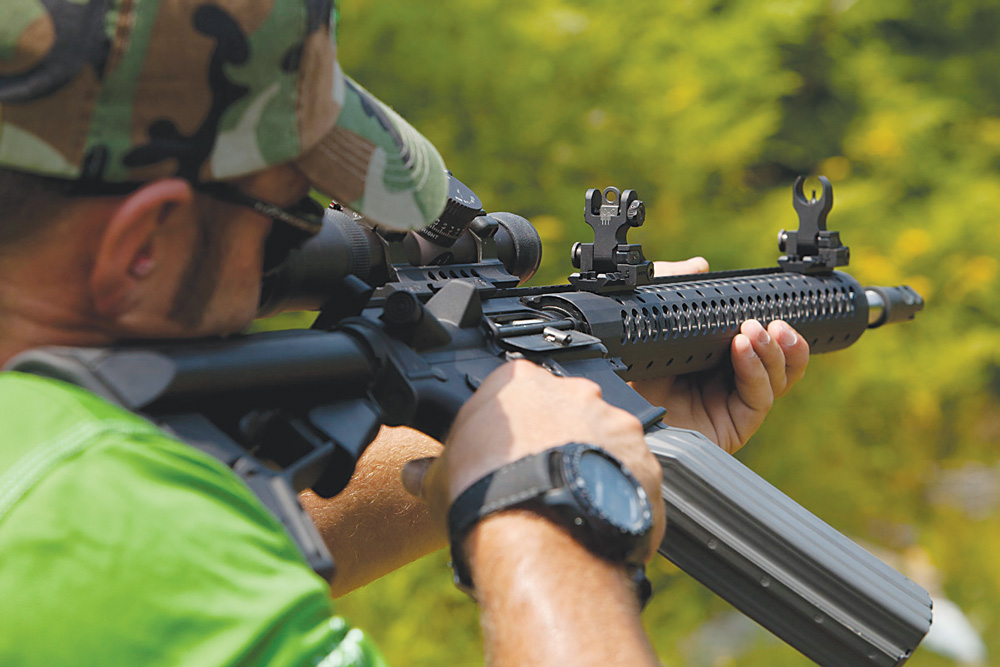
Review: Uberti 1875 Top Break No. 3

2

Uberti-1875-Top-Break-No-3-7

The Uberti 1875 Top Break No. 3 is a working replica of the famous Schofield revolver. It's a faithful rendition and great fun to shoot.

Shooters are fortunate to live now because they have not only modern, state-of-the-art guns to shoot for recreation – and self defense – but also because they have access to guns from the past. Some very old guns that were manufactured over 100 years ago are still working and being used today for hunting and to protect the homestead, but they are not common. Use and neglect over the years eventually wears them out.

Those who know and shoot the old guns have an enjoyment of the shooting sports that others sadly miss. Shooting them slows the pace and creates an appreciation of the workmanship and old technology inherent in the vintage pieces. And shooting them gives the shooter an insight into the challenges faced by those of the past who used those guns – guns that were modern in their day – for serious pursuits like putting meat on the table or protecting themselves and loved ones from evil-doers.

Not everyone has access to a real antique, but some companies like A. Uberti of Italy make working replicas of the old guns that are very nearly identical to the originals. Much of the demand for these guns comes from participants in Single Action Shooting Society matches, but a great number are sold to people who appreciate the old designs and want to experience shooting them.

Made with modern equipment, Uberti’s 1875 Top Break No. 3 2nd Model is very close to the original Schofield revolver from the mid-1870s. The most notable feature of the No. 3 is the top break design that permitted the simultaneous ejection of all fired cases from the cylinder. When the latch was manipulated and the barrel and cylinder pivoted away from the frame and grip, the ejector was activated.

Uberti-1875-Top-Break-No-3-6

All the cases being ejected at the same time with one motion made reloading under stress faster than with a Single Action Army. Hopeful for a government contract, Smith & Wesson submitted the No. 3 to the Army Ordnance Board for testing, and while the board liked it, a centerfire version was requested to replace the original .44 Henry rimfire chambering. So S&W offered the gun in .44/100, which eventually became known as the .44 American, as well as .44 Henry.

Eventually, Major George Schofield, serving with the 10th Cavalry in Kansas, learned of the No. 3 and became S&W’s sales agent for Colorado and Kansas. He then later made some design changes and was granted patents that included a different latch and an improved extraction system.

Uberti-1875-Top-Break-No-3-4

The original latch was pushed up to operate, which is very difficult to do with one hand while holding the gun and riding a horse. Schofield’s latch was pulled backwards and down, requiring only one hand, making it easier for a mounted trooper to operate. Even though the Army adopted the Colt Single Action Army (SAA) in .45 Colt instead, Schofield kept pushing the Army to try his Schofield design and finally persuaded it to buy 3,000. Other purchases followed that initial one, but the SAA was still the main service handgun.

Two versions of the Schofield were made, the 1st and 2nd models. There were some minor mechanical differences, but the main difference was that the latch on the 1st model had a smooth top surface and, on the 2nd, had a knurled one for better purchase.

Uberti-1875-Top-Break-No-3-3

The Schofield required a different cartridge than the SAA due to the length of the cylinder chambers and the extraction method. So the Army approved what was essentially a modified .45 Colt cartridge for the Schofield and called it the .45 S&W Schofield. Both rounds could be fired in the SAA, but the .45 Colt could not be fired in the Schofield. This is probably what caused the Schofield to eventually be set aside by the Army in favor of the SAA.

By 1880, the Schofields were declared surplus by the Army and were sold to the civilian market. Wells, Fargo & Company bought many of them and shortened the 7-inch barrels to 5 inches. Many individuals also carried Model No. 3s, making them very popular in the Old West, and several notables, including Jesse James and Buffalo Bill, carried them.

Uberti-1875-Top-Break-No-3-1

The sample 1875 Top Break No. 3 is closest in design to the 2nd model Schofield because of the serrated latch. The barrel, cylinder and frame are very nicely finished in a lustrous blue, and the hammer, trigger guard, ejector lever and latch are nicely color case hardened with good amber, brown and blue coloring in interesting patterns.

The front blade sight, which is pinned to the barrel, appears to be made of brass. The rear sight is a V notch cut into the top of the latch, and while not easily acquired by today’s standards, the sights did work and were regulated to the point of impact. Glare off the front and rear sight may cause some difficulty in aiming if the light source is in the right – or wrong – place. The gun has a 7-inch barrel, but various barrel lengths are available depending on the model selected.

Uberti 1875 Top Break No. 3 revolver - 8

The hammer has a broad spur that is checkered after a fashion but provides a slip-resistant surface for cocking. There are four hammer positions. After pulling the trigger, the hammer is all the way forward at rest with the integral firing pin protruding from the breech face. Pulling the hammer back to the first click withdraws the firing pin, but the cylinder remains locked. Another click back unlocks the cylinder so that it rotates freely. In either one of the first two partially cocked positions, the latch can be activated and the barrel and cylinder rotated down to eject the shells. The fully cocked hammer position is all the way back and is self-explanatory.

Uberti 1875 Top Break No. 3 revolver - performanceWhen the latch is pulled backwards and down, the barrel and cylinder pivot down, and at the same time, the ejector is raised away from the cylinder, ejecting the cartridges. Continuing to rotate the barrel down allows the ejector to snap back into the cylinder, allowing fresh cartridges to be inserted. Once loaded, the barrel can be pushed up and locked into place. When doing so, the shooter must pay attention that, for safety reasons, an empty chamber rests and is locked in place beneath the hammer. That may require cocking the hammer and while restraining it, allowing it to go forward on an empty chamber.

Uberti 1875 Top Break No. 3 revolver - 9The walnut grip panels, or stocks, on the test gun were nicely executed with a dull, oil type finish, which afforded a solid grip while shooting. The trigger broke cleanly at a little more than 4 pounds after some slight creep. The fluted cylinder held six rounds of .38 Special, but the gun is also available in .45 Colt, .44 Russian and .44-40.

The S&W Model No. 3 was the first American made large-frame revolver built specifically to shoot self-contained metallic cartridge ammunition. It has a rich history despite the small production numbers, and shooting a replica brings to mind a time when things moved more slowly and self-reliance was more highly valued.

For more information, visit Uberti.com or contact Stoeger Industries at 800-264-4962.

Specifications:

Uberti 1875 Top Break No. 3 - specsUberti 1875 Top Break No. 3
Caliber: .38 Special
Barrel Length: 7 in.
Overall Length: 12.5 in.
Weight: 3 lbs.
Stock/Grip: Walnut
Sights: Fixed rear notch and front blade
Action: Single action, break open
Finish: Blued
Capacity: 6
Price: $1,079

Editor's Note: This article is an excerpt from the January 2017 issue of Gun Digest the Magazine.
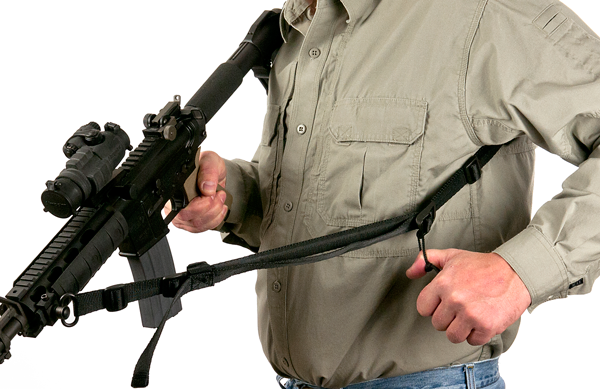
How To: Normal Suppressor Maintenance

0

Suppressor Maintenance

Suppressor maintenance is a must, but overall the process of keeping a can polished and in working order is simple.
For a sealed suppressor, all you really have to do, and then only if it is a QC/QA design, is brush the mounting system clean between uses. That way it will always tighten onto the muzzle aligned with the bore, and to the same spot.
User-serviceable suppressors, on the other hand, are another situation. And the user-serviceable ones are made that way for a reason.

The typical user-serviceable suppressor is a rimfire or pistol-caliber can. Some rifle-caliber suppressors are made to be disassemble-able, but most of them are rimfire or pistol cans. And there’s a good reason for that.

Rimfire suppressors in particular can have a great deal of build-up. You really can’t shoot a rimfire handgun or rifle enough in one session to heat up the suppressor sufficiently to burn out the residue. If you could, the (typically) aluminum construction would complain. And .22 LR ammo is really, really grubby. As a result, a rimfire suppressor builds up an incredible amount of gunk inside.

The usual manufacturer’s recommendation is to disassemble and clean a rimfire suppressor after each 500 rounds fired. If you don’t, you can easily build up enough residue inside that you essentially carbon-weld the suppressor together. If you get too much build-up, the force needed to unscrew the end caps can exceed the strength of the aluminum, or the threads. Or your wrench makes a mess of the wrench flats so carefully machined into the end caps.

Suppressor Maintenance
This is what happens when you shoot a pistol-caliber suppressor and never clean it. The baffles get choked with residue.

Pistol-caliber suppressors can have the same problem, which is why you really don’t want to be using lead bullets, cast or swaged, through a suppressor. You can build up enough powder and lead residue that you seize the assembly. Oh, it will still work, but once you can’t take it apart, you can’t clean out the build-up and it will gradually get heavier and less effective as a suppressor.

The end result isn’t great, but it can be enough to notice. If you have, for example, a full-packed 9mm suppressor and a brand-new one of the same model, you can tell the packed one is heavier just by hefting the two, side by side. And it will be noticeably, albeit marginally, less quiet.

So you want to clean the ones you can clean.

Scrubbing a fired suppressor is straightforward, but messy. After all, you have both end caps, the tube, and if it is a baffle stack, 5, 6 or 7 baffles. If it's a monocore, you have a framework tube that has a dozen grubby surfaces. The big problem here is the mess. If you are used to cleaning a much-fired pistol, you can scrub the bore, and scrape and wipe out the packed powder residue in the slide and on the frame. A pistol-caliber suppressor is like that, except there is something like 10 times as much surface that has collected residue.

Suppressor Maintenance
Pretty much any lube will do, but the better it penetrates, the better luck you have, and less time spent waiting. A day or two soaking in any lube, while you score a bottle of Kroil, is better than not doing anything.

Back when I was a gunsmith, I had a love-hate relationship with the parts cleaning tank. I suspect all gunsmiths do, or have had.

The cleaning tank is simple – a basin or sink, with a tank under it holding cleaning solvent, usually mineral spirits, and a pump. The drains drain down to the bottom of the tank, and the tank has water in the bottom, and the pump pumps cleaning solvent off the layer of mineral spirits that float on top. (Mineral spirits, being a hydrocarbon, are less dense than water, and float on top as a layer.) The water acts as a filter, and the grubby stuff gets separated.

It works, and you can scrub guns more-or-less-clean pretty quickly. But it is messy, and the compressed air you use to blow the parts dry sprays solvent (and the grub still in the solvent) all over the place. And, you end the workday smelling of mineral spirits. After a few months, you really don’t want to look inside the barrel, because the slime down there, cleaned off of guns, is enough to make you go pale.

As bad as it got, and as much as I came to loathe the parts cleaning tank, it sure would come in handy now that I’ve got a steady supply of suppressors I’m testing.

Editor's Note: This article is an excerpt from Gun Digest Book of Suppressors.

Video: The Short and Stout Remington 870 Tac-14

1

The Remington 870 Tac-14 arms shooters with a maneuverable and wicked smoothbore without any of the headache of complying with the NFA.

To say the Remington 870 is ubiquitous is an understatement. The shotgun has filled every role, from top-notch fowling piece to rough-and-ready combat arm. But the tried-and-true pump-action shotgun is undertaking a completely new role this year — a non-NFA firearm. The Remington 870 Tac-14 takes the shotgun’s 3-inch magnum receiver and mates it with a 14-inch barrel and a Shockwave birds head Raptor pistol grip to make a short, wicked and maneuverable smoothbore. When it comes to home defense or personal defense, it's hard to argue against a tool like this. 

The new gun’s technical classification with the ATF is a firearm — not a NFA-regulated short-barreled shotgun — given its overall length and the fact it never had a buttstock, instead boasting a factory-installed pistol grip. By ATF definition, a shotgun is “designed or redesigned, made or remade, and intended to be fired from the shoulder…” These details allow Remington and other manufacturers to save shooters the headaches of paperwork, wait times and taxes.

Gun Digest Digital Editor Luke Hartle gets a rundown on the Tac-14’s features from Remington’s Daniel Cox at the 2017 NRA Annual Meetings and Exhibits in the above video. And as Hartle discovers, there’s plenty to love about the scattergun, above and beyond its compact size.

Learn more about the Remington 870 Tac-14 in the above video and get more great gun reviews and shooting tips at Gun Digest’s YouTube channel.

Video: New Bushnell Engage Binoculars

0

If you're in the market for top-notch ‘tactical' optics, you might not need to look further than the new Bushnell Engage Binoculars. Long on features and durably constructed, these binos will help shooters find their target in any conditions or distance.

The more time you spend afield, the more you appreciate the need for high-performance optics … from binoculars to riflescopes. Cheap glass simply doesn’t cut it in low-light conditions, when the hunt is on the line, or you're looking down the barrel at a steel plate that's a long, long way off.

With the addition of the new Engage line, Binoculars for Hunting from Bushnell are set to arm shooters of every stripe with an optic they need to excel. The new binos come in four configurations from 8x42mm to 12x50mm and are loaded with features, as Bushnell’s Steve Smith explains in the above video.

Unveiled at the 2017 NRA Annual Meetings and Exhibits in Atlanta, the Bushnell Engage Binoculars are backed with the all-weather assurance of Bushnell’s exclusive EXO Barrier that repels dirt, debris, oil and moisture. And they feature fully multi-coated optics to offer maximum brightness and clarity and a lightweight and rugged chassis. To boot, ED Prime Glass ensures razor-sharp images, while the PC-3 Phase Coating enhances resolution and contrast.

Learn more about Bushnell Engage Binoculars in the above video and get more great gun reviews and shooting tips at Gun Digest’s YouTube channel.

New Grand Power Q100 Now Shipping

0

Grand Power Q100,

The Grand Power Q100 isn't just another striker-fired, polymer pistol. Utilizing an uncommon action, this Eastern European Gem is a real smooth shooter.

Grand Power, just the mere mention of the name conjures up thoughts of “Who exactly?” I guess flying under the radar is part and parcel of being a Slovakian firearms maker.

Despite its svelte profile, the manufacturer has steadily built a reputation of producing firearms that offer a lot in terms of performance, especially for the money. And with the help of Eagle Imports, the Eastern European gunmaker is shooting to tackle what could be considered one of the toughest nuts to crack in the U.S. gun market — striker-fired pistols.

Yes, the Grand Power Q100 is another one of those black-finished handguns long on polymer. But, with that said, the 15+1 capacity pistol definitely breaks the cookie cutter mold and offers shooters quite a different option than what they’ve grown accustom to from this segment. What sets the 9mm apart is the use of a rarely used locking system that imparts the pistol with some desirable qualities.

Unlike the modified Browning tilt-barrel design, the action utilizes a rotating barrel lock, which keeps the muzzle on the same axis throughout the entirety of the shot. A cutout on the barrel provides the rotating motion in conjunction with a roller bearing in the frame that disengages its two locking lugs through the energy of the recoil. Opting for this particular design has allowed Grand Power to lower the Q100's bore axis, keeping it more in line with the shooter's arm, thus reducing the felt recoil of the pistol. It also increases the accuracy potential by eliminating vertical play in the barrel.

The rotating barrel lock is an atypical, but not new, concept developed by Czech firearms engineer Karel Krnka. There are several other gunmakers who use the design besides Grand Power, though it's fair to say this style of action is uncommon overall.

The 4.3-inch barreled Q100 is a full-sized pistol, tipping the scales at 26.1 ounces. But with 1.4-inch width, it should still be a manageable concealed carry option for those comfortable with holstering a larger pistol.

The Grand Power Q100 is outfitted with a CNC machined chassis embedded into its polymer frame. All of its controls — magazine release, slide release — are ambidextrous. It has drift-adjustable steel rear sights and a plastic blade front. It comes with four interchangeable handgrips, to help the fit conform to any shooter. And it is has an integral Picatinny rail for the easy addition of accessories.

Perhaps one of the most eye-catching features of the pistol is its price tag. With an MSRP of $574, it is competitive with the entire striker-fired market.

Specifications:

Grand Power Q100
Caliber: 9 mm
Action: DAO
Capacity: 15+1
Barrel Length: 4.3″
Front Sight: Plastic
Rear Sight: Drift-Adjustable Steel
Finishes: Black
Grips: Polymer Construction: Steel Slide, Steel Frame, Polymer Grip
Safety: Firing pin and trigger
Weight: 26.1 oz.
Length: 8″
Height: 5.3″
Width: 1.4″
MSRP: $574.00

MUST READ ARTICLES