Wonder why red dot optics have stormed the gun world? They just plain work.
There’s always a case for iron sights. They’re simple, effective and, perhaps best of all, tough as whang leather. The buggers can take a beating and still deliver the goods shot after shot.
That said, the dependability and simplicity of the traditional aiming solution is no excuse to wed yourself exclusively to the system. There’s a lot of technological wizardry available to shooters today and, honestly, iron sights are more than happy playing a backup role.
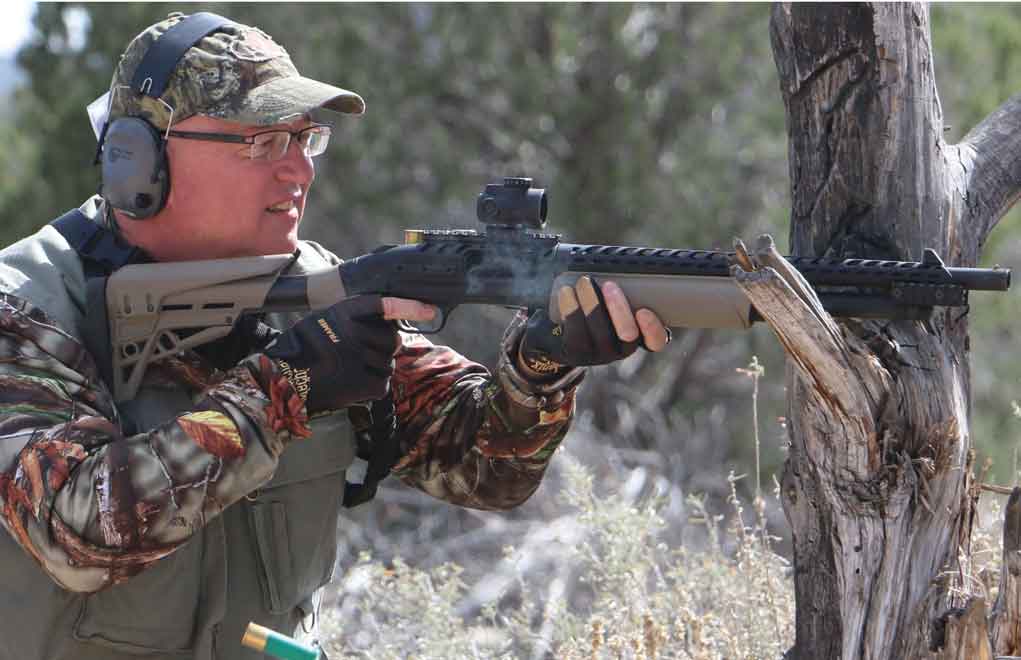
Phil Massaro, a man who fully appreciates classic guns and established methods of getting them on target, even has to admit there’s something to the newfangled optic. The Gun Digest author and custom ammo manufacturer puts a Smith & Wesson M&P15 through its paces in his trip to New York’s Double Eagle Training in this week’s Modern Shooter. And topped off with a SIG ROMEO4H red dot, Massaro pounds a steel plate with the carbine until sings like it’s in a choir.
What particularly wows Massaro about the red do is the speed of its target acquisition. Banging the gong, especially at close quarters, is a point-and-click affair. Additionally, he’s able to keep both eyes open throughout the entirety of the drill, giving him better situational awareness. In real life this would deliver a decisive upper hand, permitting him to identify and neutralize multiple targets with greater ease.
There’s a reason why red dot optics have stormed the shooting world — they just plain work. And if you haven’t tried them, they’re well worth investigating. Don’t worry, your iron sights will always be there if you need them.
Catch the rest of the action of this heart-pounding episode of Modern Shooter 10:00 p.m. EST Friday on the Pursuit Channel. The episode rebroadcasts Monday at 12 p.m. EST and Tuesday at 11:30 a.m. EST.
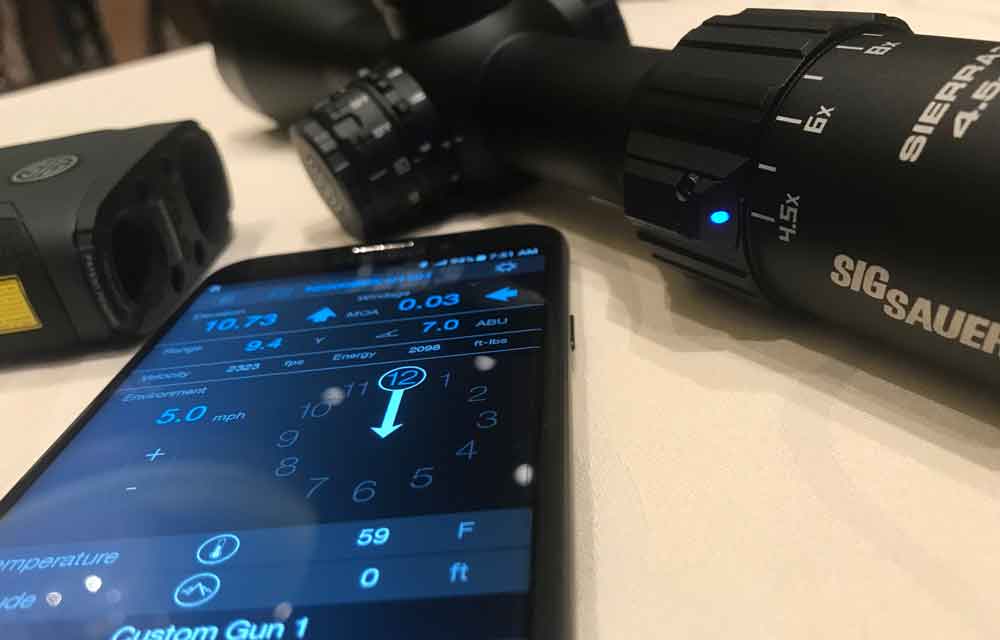
Holdover, windage, cant… SIG’s new SIERRA3BDX scope accounts for everything but how to get your elk out of the backcountry.
Every so often, a product comes down the line so innovative you can actually feel the ground shift under your feet. The automobile certainly shook terra firma in horse-and-buggy days and in the 21st Century there was tectonic movement with the smartphone. Now, if you’re a shooter, you should feel some pretty notable tremors starting up because SIG Sauer is set to do the same to precision optics, perhaps shooting itself.
Unveiled Friday at the NRA 2018 Annual Meetings and Exhibits in Dallas, the SIERRA3BDX is perhaps the most groundbreaking riflescope to come down the pike since Mil Dot met reticle. With the ability to calculate holdover, cant and — with the right equipment — windage the scope all but erases the margin of error from each and every shot.
It’s almost unfair to call it an optic, a “smartscope” seems more fitting. Yet it’s as unassuming as your run-of-the-mill glass.
SIG’s Peter Howell gets into the brass tacks of the SIERRA3BDX in the above video, explaining the ins and outs of the technology. Essentially, it boils down to the scope chatting up your range finder and smartphone to give you the straight dope.
Bluetootch capable, the scope pairs to iOS and Android smartphones, giving it the ability to download ballistic tables, draw from range-finding data and account for environmental conditions. You simply range with a KILO BDX rangefinder, the SIG BDX app does the thinking and the scope get you on target. All you have to do is hold steady where the illuminated reticle points and your bullet is drops in precisely on target.
The SIERRA3BDX, which goes on sale in July 2018, is innovative not simply for the power it puts in front of shooters’ eyes, but also how it’s constructed. Unlike the big, boxy and heavy rangefinder scopes of the past, SIG’s beauty is a lightweight — dang near like any traditional riflescope. Additionally, it’s affordable, Howell pegging it at below $1,200. Plain old first-focal plane scopes can leak into that price range.
Presently, SIG offers the SIERRA3BDX 3.5-10x42mm, 4.5-14x44mm, 4.5-14x50mm, and 6.5-20x52mm. They feature HD glass for superior resolution and optical clarity, 30mm main tubes, side-focus parallax adjustments, and the LevelPlex digital anti-cant system. The BDX-R1 Digital Ballistic Reticle is the evolution of holdover, providing a ballistic solution out to 800 yards with 1 MOA of accuracy
The scope pairs with any of BDX family of rangefinders includes KILO1400BDX, KILO1800BDX, KILO2200BDX, KILO2400BDX, and KILO3000BDX rangefinder binocular. These rangefinders include many of the legacy features that the KILO name was built on Lightwave DSP digital rangefinder engine, Hyperscan with 4 times per second scan rate, RangeLock, and the Lumatic auto-adjusting display.
The SIERRA3BDX should have a lot of appeal to a lot of marksmen — whether hunting or banging distant steel. And like the car change the way we travel and the smartphone the way we communicate, SIG just might have advanced the way we shoot.
For more information on the SIERRA3BDX, please checkout: www.sigsauer.com
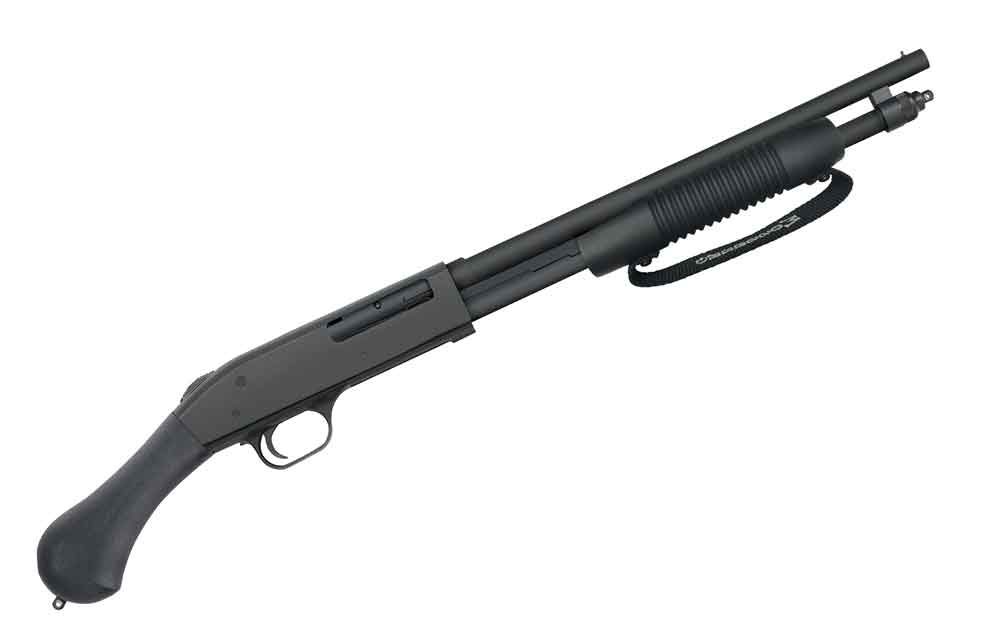
Mossberg rounds out its 590 Shockwave line with a model chambered for the highly manageable and potent .410.
Like other 590 Shockwaves, the .410 bore is not NFA regulated.
The smoothbore has a 14-inch barrel and is 26.37 inches in overall length.
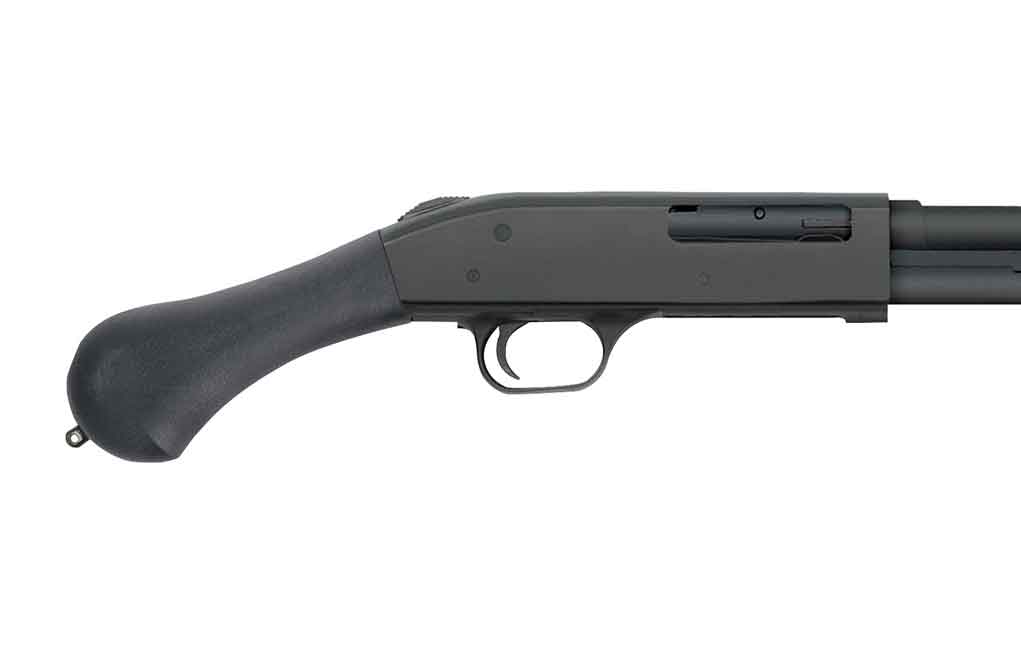
It’s outfitted with a Shockwave Raptor pistol grip.
The new 590 can chamber 2 1/2- and 3-inch shells and in both cases has a 6-round capacity.
Presently the 590 Shockwave .410 has an MSRP of $455.
If gun owners were polled on the best home-defense firearm it’s a fair bet the tried-and-true pump-action shotgun would end up near the top. The design ticks like a clock and delivers a devastating payload in close quarters. It’s definitely not what a felonious meathead wants to stare down when he creeps through the backdoor.
Even with a laundry list of pluses, there are some obvious drawbacks to most shotguns — chief among them size. And going small with a scattergun has in most cases been a quandary, since short-barreled shotguns are NFA regulated and Uncle Sam demands a tax stamp and a pound of paperwork to own one. But this changed in a big way about a year ago.
The introduction of the Mossberg 590 Shockwave ushered in a new era of small shotguns that do not require jumping through the Federal Government’s hoops to obtain. Given its factory-installed bird’s head grip, and an overall length of 26.37 inches, the 14-inch barreled smoothbore is classified as a firearm and not a SBS. In turn, it is not controlled by the NFA.
The company today rounded out its selection of 590 Shockwaves, adding a .410 bore to its 12- and 20-gauge options. This has a lot of potential, given the platform should prove ideal chewing through the light recoiling, but highly potent ammunition, making it a wiz-bang home-defense or truck gun. And in addition to shooters who desire a more manageable gauge, the new chambering could also open the doors for those who shied away from the larger bores guns due to weaker hands or infirmity.
Given the resurgent interest in the .410 as a defensive option, the new 590 Shockwave should have plenty to graze on, given it’s capable of chambering 2 ½- and 3-inch shells. In either case, it arms shooters with ample firepower with a 6-shell capacity.
For those familiar with the line, the new 590 Shockwave should prove familiar. It has a 14-inch heavy-walled, cylinder bore barrel with single bead sight; and sling swivel studs. The Shockwave Raptor pistol grip, constructed of durable polymer, has an enhanced textured finish and “bird’s head” shaped-profile, allowing for greater control while lessening felt recoil. The cob-styled, synthetic forend is strapped for safety, greater control and smoother operation. The grip and forend feature a black finish and exposed metalwork has a complementing matte blue finish.
Presently the MSRP on the 590 Shockwave .410 bore is $455.
590 Shockwave .410 Specs Gage: .410, 3 inch Capacity: 6 Finish: Matte Blue Sight: Front Bead Choke: Cylinder Bore Overall Length: 26.37 Forend: Cob with Strap Grip: Shockwave Raptor Grip Weight: 4.25 unloaded MSRP: $455
I would never think of Bart Simpson in the same way again. Bart was displayed on a red T-shirt, and he wasn’t looking too good. The guy wearing the shirt was even worse. He had just taken a load of No. 6 shot in the upper left chest from roughly 15 feet away. He was justifiably shot while armed, invading an occupied home.
People see the AR as a true firearm “platform” due to its ability to be customized, but there are plenty of tactical upgrades for a range of different shotguns. Or, you can get the upgrades straight from the factory with the Mossberg Scorpion (pictured above).
Working as a DNR Officer, I had stopped by to offer assistance when I heard it all on the radio. Now the guy in the T-shirt was slumped against the wall, head slightly tilted upward with a look on his face like he wanted to say something. But he was done talking in this world; he had just been shown that the shotgun is the best gun for home defense.
Why The Shotgun?
Why is the shotgun the best firearm for home defense? Two big reasons: range and firepower. Range is the distance between you and your aggressor — and home defense confrontations will sometimes be measured in feet, not yards. For our purposes here, firepower means how much hot lead we can bring to bear on the target in the shortest amount of time. No firearm yet invented is capable of protecting us better from anyone who has entered our home uninvited and intends to bring harm to you and yours.
How so? In short, it’s the type of ammunition fired by the shotgun. A typical 2¾-inch shotshell loaded with 00 buckshot will contain 8 to 9 .33-caliber pellets. If you fire three rounds in a home defense situation, you could be offering your assailant as many as 27 .33-caliber projectiles to consider. If you can deliver that much devastation in the same amount of time with a handgun or rifle, your name must be Jerry Miculek, and in that case, you certainly don’t need any advice from me or anyone else.
Another reason for using a home defense shotgun for this work is that many of us have a general familiarity with the weapon. Unless you’ve had adequate training with a handgun, most of us cannot hit the broadside of a barn with it, even if we are standing inside the barn. Hitting our target is simply easier with a long gun, more so with the shotgun. Patterns are tight at close range, even with short-barreled, tactical-style shotguns with little or no choke in place.
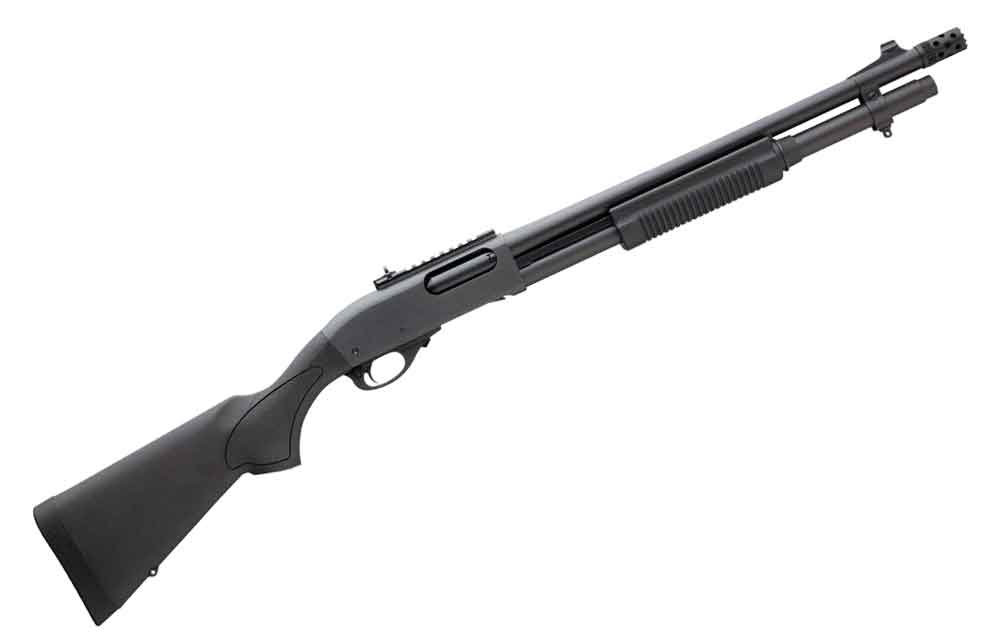
The gun the author keeps by the side of his bed is a Remington 870 Express Tactical.
Still, the shotgun is more forgiving than the pistol or rifle in stressful home defense scenarios. A greater percent of the population has had some experience with the shotgun; you shot clays one time with a buddy, went pheasant hunting with Uncle Ed back in the day — maybe you handled the Model 12 Grandad kept in the corner at this house. The point is there are more of us, untrained, that feel more comfortable picking up a shotgun than a handgun. This makes all the difference when that thing goes bump in the night.
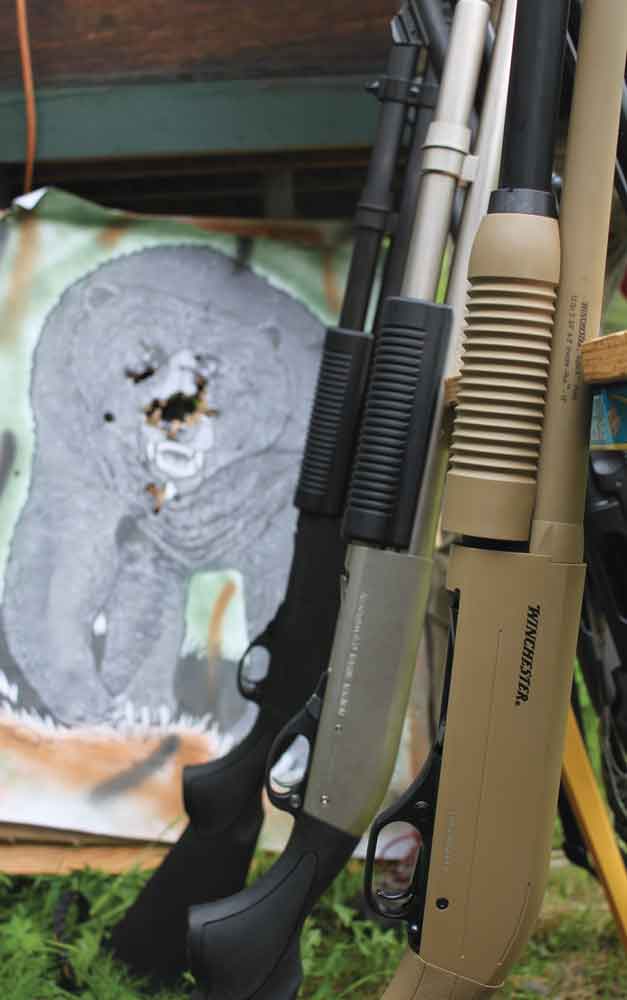
Remember, home defense might not necessarily mean confronting two-legged problems. Whether you live in the wilderness or the suburbs, having unwelcome animal visitors pay you a visit is fairly common. A rabid fox or raccoon can be easily dispatched with 00 buckshot. Black bears are abundant in many parts of the country now, and having one stroll through the yard or try to get in your house is not unheard of. Believe me when I tell you that a 12-gauge slug is great medicine on bears at short range.
Last summer I spent a week training with Alaska DNR, Fish and Game, USGS and others in a bear defense and awareness class. It was interesting to me that these Alaskans, who would often be working in remote areas, usually chose the same weapon many of us would for home defense: a 12-gauge pump shotgun with a short tactical-style barrel and extended magazine. The reasons for choosing this weapon are the same for the homeowner and the guy in the Alaskan bush — dependable operation, and massive firepower at short range if you need it.
In short, what the shotgun does better than any other firearm in a close-range confrontation is end the fight. Neither the rifle nor the handgun can do this as well in a home defense situation. The two drawbacks of the shotgun — limited magazine capacity and time needed to reload — are more than made up for with the superior firepower it delivers. (Reload time might now be a moot issue with the advent of the Remington 870 DM and the Mossberg 590M, both with detachable box magazines.)
The Defensive Shotgun: A True Platform
Depending on where you live, two-legged predators might not be the only thing you’re forced to encounter. A 12-gauge pump shotgun is also perfect bear medicine.
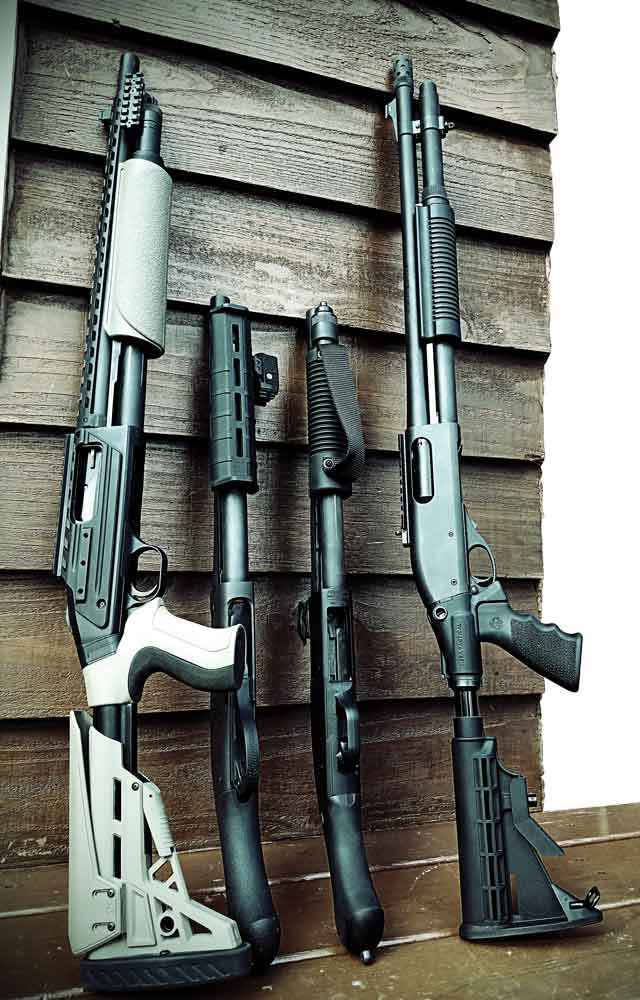
It seems many of us think only the AR-style rifles can be considered a firearm “platform.” The defensive shotgun in its simplest form might be a plain Jane pump-action 12-gauge. Think about a Remington 870 or Mossberg 500, standard stock, one simple bead on the barrel, bare bones — no frills. The shotgun in this form is absolutely capable of handling a bad situation with an intruder at your home. Can we make it better? Yes we can. Personal preferences and your wallet are the only factors limiting how far you want to go with additions and upgrades.
The stock on the shotgun is the place to start to make the shotgun a better fighting tool. Very few of us fit the standard, off-the-rack production model shotgun stock. Some form of adjustment to make the shotgun fit us better, which makes the gun more comfortable to shoot, (this gives us better accuracy) is usually in order. Many defensive shotgun instructors will advise you the stock on the fighting shotgun should be a little shorter than the one you use for wing shooting. We shoot these two shotguns differently. The fighting shotgun is aimed like a rifle, and a shorter stock gives you better control of the weapon and allows you to stay down on the gun easier.
Sweetening Up The Stock
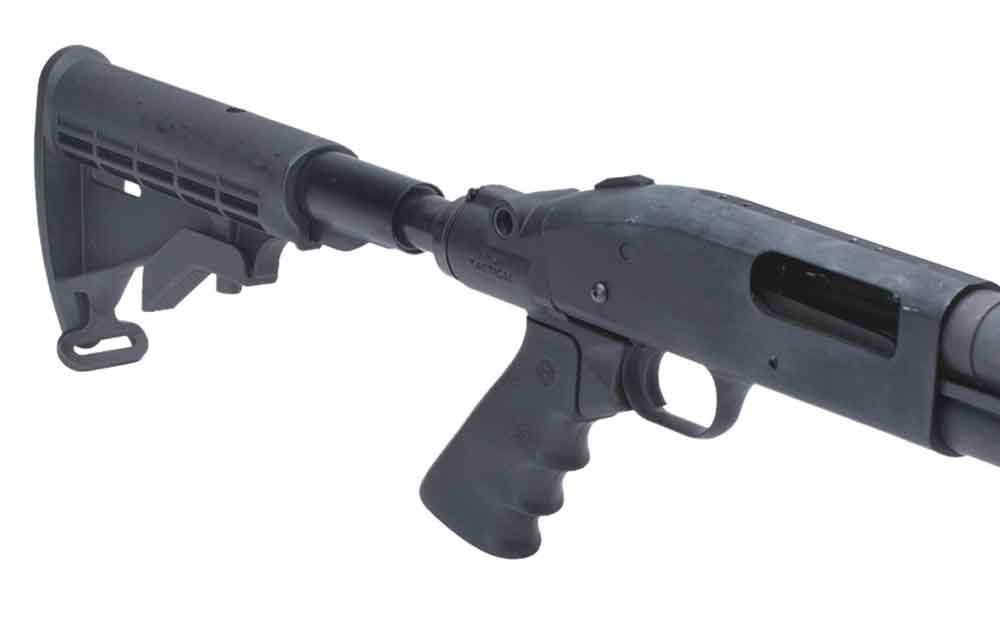
An AR-style adjustable stock can be the answer. Mesa Tactical makes several versions; one is the LEO Telescoping Stock conversion kit, which gives the shooter a collapsible, AR-style stock with a pistol grip and an optional hydraulic recoil buffer. Another is the High Tube Stock Kit, which includes a Picatinny Rail that mounts directly from the stock adaptor to the top of the receiver, giving a platform to mount whatever type of optic you might choose.
Enhancing The Sights
After the stock, sights on the shotgun should be the next consideration. As noted before, the defensive shotgun must be aimed, and XS Sights offers Tactical Shotgun Ghost Ring sights. This set includes a green tritium front sight and two, interchangeable, fully adjustable, rear ghost ring apertures to accommodate long- and short-range shooting. Steel wings give added rear sight protection. The dovetailed front sight fits the factory sight ramp with minor fitting. For a defensive shotgun, mount the larger aperture ring for short range and forget about the smaller one. These sights are available with and without the wings on the rear sight; I prefer the one without wings for faster target acquisition.
Building Up Body Armor
In reality, gunplay in a home defense arena will rarely entail more rounds than what your shotgun will hold, but do you want to bet your life on that? A sidesaddle on the gun ensures the additional rounds will be there if you need them. ATI (Advanced Technology International) sells a wide array of aftermarket add-ons for shotguns, including a TactLite Shotshell carrier, which holds five shells, attaches to either side of the stock and has a Military-Grade Synthetic construction.
The Gun Beside My Bed
I’m not one of those people to expect everyone else to like what I like. Preferences in food, politics, music and guns are entirely up to you. I also think it is best to keep things simple, and the shotgun I’m going to grab if the Boogie Man comes around is a Remington 870 Express Tactical model. An 18 ½-inch barrel, an extended magazine allowing seven rounds in the gun and XS Ghost Ring sights give this shotgun all the essentials I want on a home defense shotgun. If you said you would want basically the same gun but it would have to be a Mossberg Model 500 or 590, or a Benelli Nova, I would very much understand. To each their own.
My preference for the 870 is not hard to figure out. Years of hunting with the 870 and then having one issued to me for many years as a police officer gave me a lot of familiarity with the Remington. The key here is having confidence in your weapon, knowing that it’s up to the task you’re going to ask of it and being familiar with the gun. You should know where the safety, action release, trigger and loading port are and be able to work the action of the shotgun, load and unload it blindfolded.
A Word About Ammo
Like any firearm, shotguns are only as effective as the ammunition you feed them. In matters of home defense, whether to load birdshot, buckshot or slugs has been debated more than where Jimmy Hoffa is hidden and has paid the rent for several gun writers. Our greatest concern with firing a shotgun in the house is, of course — too much penetration.
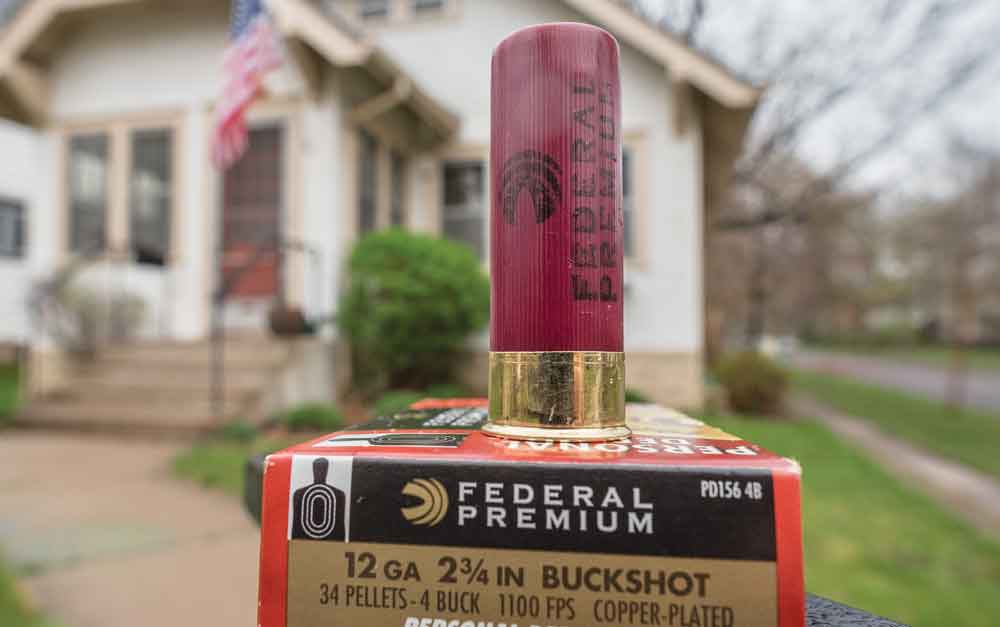
Your choices of factory defensive shotgun loads are many. Do your homework and load up with what gives you confidence.
If we have to pull the trigger, we want to penetrate the intruder but not go through a wall and strike a family member. The list of variables in these situations is endless, and you can “what if” yourself to death. Let’s try to keep things simple.
Unless you find yourself in some extreme circumstance — like dealing with a grizzly bear that gets in your house — for anything inside the home let’s take slugs off the table. Have a slug in your ammo carrier if you want. Now you must choose between buckshot — usually 00 size or something like No. 4 buck — or birdshot, say No. 6s or No. 7½. If you’re very concerned about penetration to other rooms, go with the birdshot. Why? Because at short range, it’s not going to make much difference. If you don’t believe me, try this:
Measure the length of your living room or bedroom. Go to the range and post a target based on those measurements, and fire away with a load of 00 buckshot. Now do the same with a 7½-shot dove load. Unless you have a really big house, the patterns are going to be very similar at short, in-home distances.
The lesson is this: At short range, birdshot is very devastating. In a typical 2¾-inch 12-gauge load of No. 7½ shot, there are about 350 pellets. At close range, these pellets are tightly bunched and hit with an effect more resembling a slug than birdshot. Once the shot starts to spread a little, the small pellets are less likely to penetrate walls.
The addition of a Mesa Tactical LEO Collapsible stock is just one of many customizations that can be made to a home defense shotgun.
Remington’s Ultimate Defense buckshot load comes in a managed recoil version and less recoil will always result in better accuracy. Federal makes two buckshot loads in its Premium Personal Defense line — the 00 load has 9 pellets in the 2¾-inch shell, and the No. 4 buckshot load has a whopping 34 pellets. Again, pick your poison.
Thankfully, most home defense confrontations end without shots being fired. Many perpetrators flee or simply give up when they see the homeowner is armed. If you ever find yourself in this predicament, I hope you’re armed with a home defense shotgun — and I hope your guy doesn’t have on a Bart Simpson shirt.
Editor’s Note: This article originally appeared in the March 2018 issue of Gun Digest the Magazine.
You can still practice the majority of your draw stroke even at ranges that don’t allow you pull from your holster.
You needn’t be a High Master marksman to figure out the shooting range isn’t real life. In some terms, it’s about as far away from practical shooting as “Call of Duty” is from actual combat. And it further hamstrings shooters — particularly armed citizens and competitive pistol shooters — with limitations on important aspects of training.
If you haven’t figured it out yet, I’m talking about drawing a handgun. If you’re lucky enough to have a range in your hip pocket that allows you to go through the full range of motion — from holster to shot — hang on to it (also thank the management). For most of us, given space and liability constraints, these little slices of paradise are few and far between. But even if you can’t draw completely at your local run-of-the-mill paper-punching palace doesn’t mean it’s devoid of all practical preparational potential.
Even in the most restrictive environments, handgun shooters can still execute a good amount of a draw stroke while obeying house rules. The secret, as Mark Rahl points out in the above video, is to punch out before every shot. By the Aguila Ammunition pro shooter’s estimates, pressing the handgun from the chest accounts for nearly 50 percent of a draw stroke. And it might be argued it’s the more important half, given shooters hack away a consistently bringing the handgun to their natural point of aim, as well as develope a fast and precise sight picture.
You bet, working to get a handgun from gun leather is as vital as a smooth trigger press. But just because your range nixes drawing isn’t an excuse to neglect the other part of putting your gun into action.
For more information on Aguila Ammunition, please check out: www.aguilaammo.com
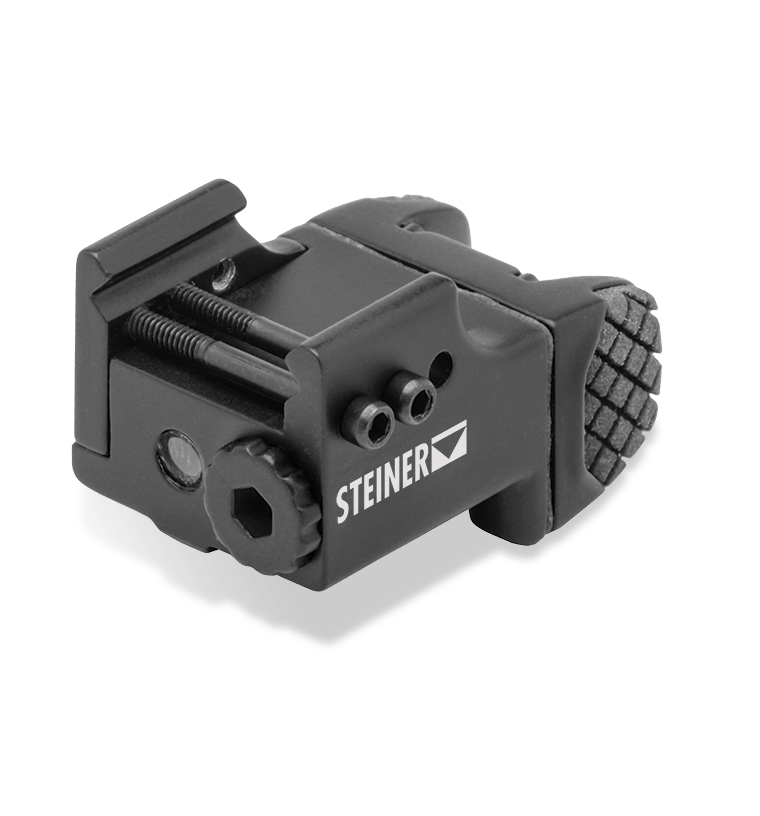
Steiner’s TOR Mini and TOR Mirco offer handgunners powerful aiming solutions in small packages.
What’s the story on these sights:
The laser sights are less than 1-inch in height.
They are housed in military-grade aluminum tested to IP54 standards.
Both are available with the choice of red (635 nm) and green (520 nm) lasers.
They have ambidextrous power buttons.
The TOR Mini has adjustable laser power and turns on upon drawing a pistol.
The TOR Micro’s MSRP is $199, the TOR Mini $299.
An understanding of aiming solutions comes naturally to rifle shooters. Generally, their operational distances are such that dropping a round on a target without a couple of slabs of precision-ground glass and a sensitive adjustment system would dang near be an impossibility. Or at a minimum, it would be highly demanding.
TOR Micro
Pistol shooters, well that’s a different story. Given handguns are, for the most part, close-range weapons that excel in fast target acquisition and transition, iron sights continue to reign supreme. But there are options that have the potential to enhance the handgun’s tried-and-true aiming system.
Laser sights have become among the most popular over the years, due to their low-light capabilities and ease of use. Additionally, the devices, given their size, don’t modify how a pistol operates or feels in the hand. Steiner eOptics most certainly looked to hit all these notes with the release of the new TOR Micro and TOR Mini laser sights.
Specifically designed for pistols, the devices almost appear part of the handguns on which they’re mounded and are small enough to fit in the majority of commercially produced holsters on the market. Each with a height a tick over 1 inch, the only thing that appears slimmer is their price tags. The MSRP of the TOR Micro is $199, while the TOR Mini runs $299.
Constructed with a military-grade aluminum housing and rail mount, the sights are up to rugged use — both dust-proof and splash-proof to IP54 standards. And the TOR Micro and TOR Mini are each available with the choice of red (635 nm) and green (520 nm) lasers. Even here, Steiner has ensured the sights perform when called into duty, opting for direct diode type lasers, known for their ability to operate in extremely cold weather. Additional shared features include an ambidextrous power switch, constant power drive that ensures the lasers’ output remains constant throughout the life of the battery, low battery indication, as well as windage and elevation bore-sight adjustment screws.
The universal rail mount on the TOR Micro and TOR Mini fits all pistols with a Picatinny or Weaver style rail forward of the trigger guard. The design of the TOR Mini and TOR Micro allows optimum positioning of the laser so that the fire button is easily accessible for a wide range of users.
The TOR Mini has additional functionality, most notable is its adjustable laser power with multiple settings (low, medium, high and high pulse). It also remembers the chosen setting until it is reset, even if the battery is removed or replaced. Finally, the sight has an internal accelerometer that senses pistol position and automatically activates the laser when the pistol is drawn.
For more information on the TOR Micro and TOR Mini laser sights please check out: www.steinter-optics.com
Whether you live in an urban apartment or a country estate, protecting hearth and home shouldn’t be taken lightly. You’ll spend big money finding just the right pistol, holster, belt and ammo to carry concealed, shouldn’t you be as discriminating when it comes to defending your home? With that in mind, we gathered up seven top guns and pieces of gear dedicated to keeping your abode safe and secure. After all, it is your castle, best to be prepared for any barbarians looking to storming the gates.
At this year’s SHOT Show in Las Vegas, Mossberg launched its own line of detachable magazine-fed shotguns with the 590M. The scattergun feeds from a double-stack, 10-round shotgun magazine — the world’s first according to Mossberg — and optional 5-, 10- and 20-round magazines are also available as accessories. One cool feature about the design of the gun and the magazines is that they rock in very similarly to how AK magazines feed into that rifle. And, as a bonus, the magazine release is positioned so that it does not interfere with the cycling of the action in any way. Two models are currently available: One is a more standard version while the other is more tactically oriented and features a Tri-Rail forend. $721-$801
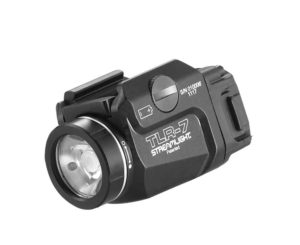
Surefire XC2 handgun light
The new XC2 is Surefire’s smallest, most lightweight handgun light with an integrated laser. It has a 300-lumen MaxVision Beam for illuminating and identifying threats and a 635nm red laser. The XC2 is less than 2.5 inches in length and weighs just 2 ounces, but it’s plenty durable due to its aerospace aluminum construction and Mil-Spec hard anodized finish. It features an ambidextrous activation switch for easy momentary- and constant-on activation. $449
Streamlight TLR-8
Streamlight has added two new low-profile models to its TLR rail-mounted tactical light line for 2018; one of these is the TLR-8, which combines a 500-lumen LED light with a red laser sight. The TLR-8 runs off a 3 volt CR2 lithium battery and has a runtime of 1.5 hours in light only, light and laser, and strobe modes, whereas runtime in laser-only mode is 18 hours. The new TLR-8 is compatible with a wide range of compact and full-size weapons and utilizes a one-hand snap on/tighten interface as well as a safe-off feature, which locks the device so it cannot be activated accidentally. $350
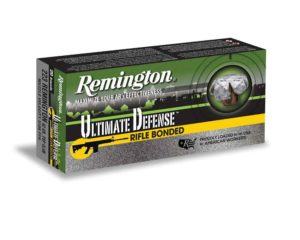
Remington Ultimate Defense Rifle Bonded
Remington’s Ultimate Defense line has been around for a while in the form of buckshot loads for shotgun users, but this year Big Green also added a rifle option to the line. This new load utilizes a Core-Lokt Ultra Bonded bullet that features a lead core metallurgically adhered to a progressively tapered jacket. This provides consistent expansion, penetration and weight retention for those who choose a rifle for defense. Currently, the only offering is a 62-grain .223 Remington load. $22.99
Stack-On AOTT Safe
The new Auto Open Table Top (AOTT) Safe from Stack-On is a quick-access, secure-storage device that features a gas-charged shock on the lid for ultra-fast firearms access. The AOTT has a stylish, geometric design, but the real beauty of it is the automatic door, which opens quickly after access is granted. Available in an electronic keypad or biometric fingerprint scanner version. $120-$140
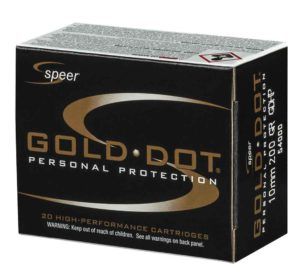
Speer Gold Dot Personal Protection 10mm Auto ammunition
For those who prefer to use a 10mm handgun, or carbine, for their defensive needs, Speer is now offering a load in its revered Gold Dot line that takes full advantage of that caliber’s potency. The 200-grain bullet is loaded for optimal 10mm performance, unlike some other 10mm loads, which are sometimes closer in comparison to .40 S&W. As in other Gold Dot loads, the bullet is built using Speer’s Uni-Cor method, wherein the jacket is bonded to the core one molecule at a time for the ultimate in defensive performance. $35/box of 20
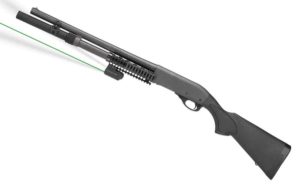
Crimson Trace Rail Master Pro CMR-300
For 2018, Crimson Trace has debuted a new rail-mounted combination light/laser sight designed for use on long guns. The device features a green laser sight and a 300-lumen white LED light, and it comes equipped with Crimson Trace’s classic Instant Activation. It has four modes of operation: laser and light, laser only, light only and laser plus light strobe. $249
Editor’s Note: This article originally appeared in the March 2018 issue of Gun Digest the Magazine.
Even with the recent ascent of 6.5 cartridges, the original 6.5×55 seems to be overlooked. But this old-timer is more than capable of going the distance.
What makes this old Swede so special:
The 6.5×55mm was developed in the Scandinavian countries in 1891 as a military service cartridge.
While popular in Europe, the cartridge did not catch on in the U.S., given the lack of rifles.
The attraction of the 6.5×55 is it’s mild recoil and superb down-range performance.
Ample bullet selection — 90 to 160 grain — gives the cartridge plenty of versatility and makes it a gem for reloaders.
A higher sectional density gives the 6.5 better penetration than other caliber bullets of a similar weight.
And near best-in-class ballistic coefficient means the bullets it pushes maintain their velocity and resist wind defection.
The 6.5 fever is real.
Thanks, lately, to the astounding success of Hornady’s superb 6.5 Creedmoor, hunters, competitive and tactical shooters are catching the 6.5 fever like school kids catch the flu. Unlike the flu, however, I doubt anyone is looking for a cure for the cronic 6.5 sickness.
The 6.5 fever, as it were, isn’t a new discovery. In fact, the 6.5 caliber has been around longer than anyone reading this story without a Ouija board. The global 6.5 success story is a tale told by many great 6.5 bullet-topped cartridges, such as the short-action .260 Remington, the over-caffeinated 26 Nosler and .264 Winchester Magnum, the bulldog short powerhouse 6.5 Remington Magnum, the AR-15-compliant 6.5 Grendel and the Swedish military service rifle sensation, the 6.5×55.
In fact, the 6.5 bullet has a long history of military service, seeing use in other military service rifles besides the 6.5×55, including — and I’m sure I will miss a few — the 6.5×54mm Mannlicher-Schönauer, 6.5×58mmR Krag–Jørgensen, 6.5×58mm Portuguese, 6.5×53mmR Dutch Mannlicher, 6.5×50mm Arisaka, and the 6.5×52mm Carcano, which well-educated historians of the John F. Kennedy assassination know all too well, as the Warren Commission stated it was a 162-grain round-nosed bullet from a 6.5x52mm Carcano fired from a surplus Carcano Model 1891/38 short rifle which took Kennedy’s life.
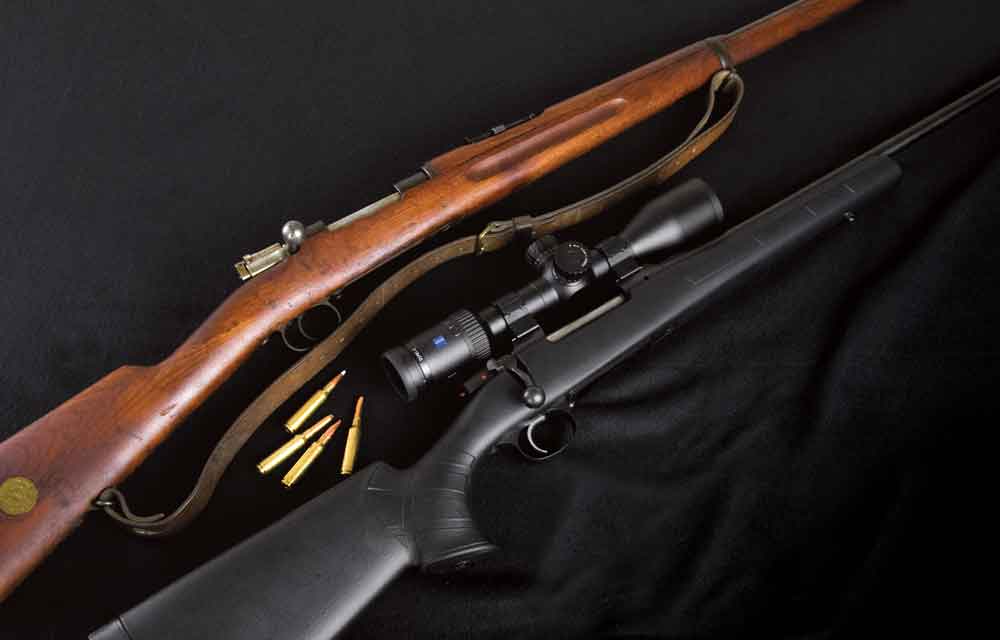
Of all of today’s more popular 6.5 cartridges, though, the original 6.5×55 seems to be the least talked about, and for the life of me, I just don’t understand why. I’ve owned four, and outside of a dangerous game hunt in Africa or Alaska, the 6.5×55 is probably all the rifle I ever needed to hunt anything and everything I ever wanted. Every rifle I owned — which included two CZs, a Steyr and an honest-to-God Swedish M96 Mauser — carried, shot and handled well. My current in-house 6.5×55, a CZ 557, is one of the softest shooting and fastest handling big game rifles in my safe, which is why I bought the loaner gun after just one day of load development testing for this story.
CZ-USA’s Jason Morton said the 6.5×55 still sells surprisingly well in the U.S. market, but those familiar with the 6.5×55 aren’t surprised. After all, the 6.5 bullet, which has excellent aerodynamics and target penetration from the 55mm case, gets pushed to good velocities in low-recoiling accurate rifles, which, as many shooters will tell you, are the main ingredients in any ballistic recipe for success. This recipe is and was a good idea not just for shooting the enemy, which is why the Scandinavians developed it as a military service cartridge way back in 1891, but also for shooting paper targets, coyotes, deer, elk, black bears and even moose.
More To The Story
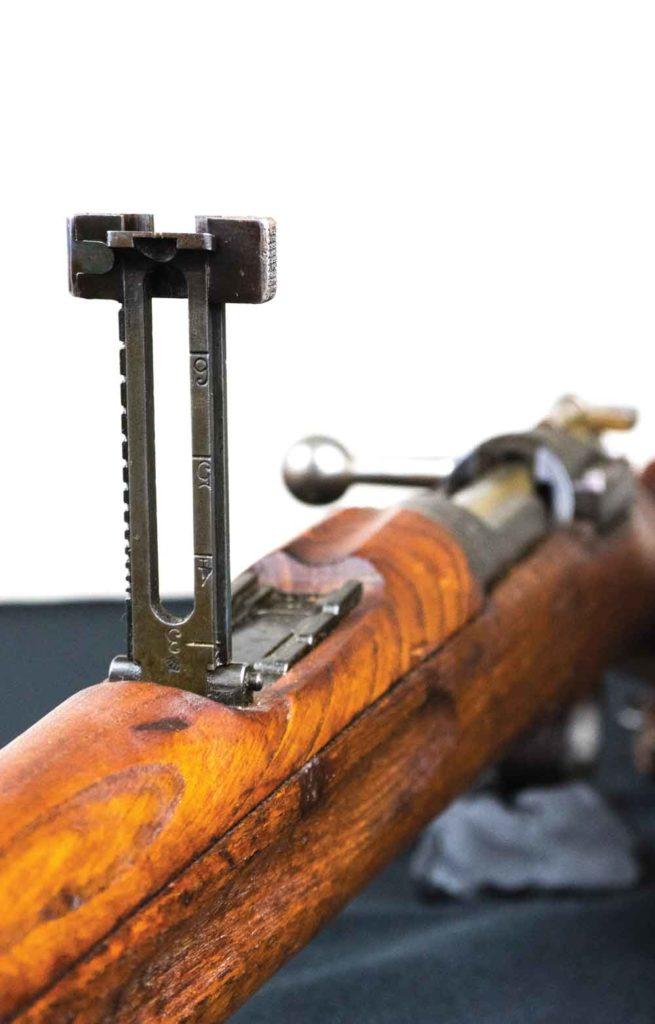
The m/1896, like other military rifles, used a simple but effective iron-sighted system. Here, you can see the rear leaf sight with a V-shaped notch. Soldiers weren’t handicapped without modern day optics with this sighting system, which, when folded down, graduated from 300 to 600 meters. When the sight is flipped up, it is graduated from 700 to 2,000 meters.
To help unravel why the 6.5×55 didn’t catch on as well in the U.S. as other 6.5 cartridges, I reached out to some experts in the ammunition community. My first stop was with the good folks at RUAG, a European-based company, which includes the well-known ammunition manufacturer Norma. Norma certainly doesn’t neglect the 6.5×55 — it offers seven factory-loaded choices for it.
According to RUAG, it all comes down to rifle availability, timing and overall ammunition support. “It’s my understanding that surplus military rifles did not reach the U.S. market until the 1950s, and the availability of ammunition was limited until the 1990s,” said Amund Skoglund, Commercial Director North America, RUAG Ammotec USA, Inc. “Whereas in Scandinavia, both rifles and ammunition have been readily available since the early 1900s. Almost every hunting and/or shooting household in Scandinavia owns a 6.5 due to its versatile applications.”
Skoglund’s take makes a lot of sense. Here in the U.S., after WWII, lots of shooters turned surplus Mausers into accurate and inexpensive target and hunting rifles. Think .30-06 Springfield, .270 Winchester, etc. The European built and fed 6.5×55 rifle and its ammunition just wasn’t available stateside. Which is too bad, because over in Europe, the 6.5×55 was proving to be as useful as, well, a Swiss-Army knife. It still is …
“There’s not much you can’t do with a Swede,” said Skoglund. “In Scandinavia, it qualifies (with 156-grain bullets) to be a class 1 weapon, meaning you can hunt all the large game including brown bear, moose, reindeer, red deer, wild boar, etc. We do recommend using a bonded bullet on large game since the shoulder joint on a moose can be hard to penetrate with a cup-and-core bullet. In terms of African game, it’s an excellent choice for antelope; personally I would not hesitate to use it on oryx- and wildebeest-sized animals, but with a bonded 150-grain-plus bullet.”
A Sweet Shooter
One of the biggest reasons for the popularity of the 6.5×55 — and really of all 6.5 cartridges — minus maybe the 26 Nosler, the .264 Winchester Magnum and the 6.5 Remington Magnum, is that you don’t need a lot of gunpowder muscle to make a 6.5 bullet work. With less bite to the shooter’s shoulder, low-recoiling rifles go a long way toward enabling shooters to provide accurate and sustainable rounds downrange — whether the target is a 1,000-yard gong, a trophy-class white-tailed deer or someone who intends to do you harm. Skoglund gets right to the point of the 6.5×55 cartridge’s main advantage to hunters these days by stating the 6.5 x55’s ability to enable hunters to shoot with manageable recoil plays a key role in shooter success.
Carl Gustafs stads Gevärsfaktori in Eskilstuna, Sweden began manufacturing the Swedish Mauser, m/1896, in 1898. Gustafs made 475,000 m/1896’s between 1896 and 1932. This particular rifle was created in 1916.
“A lot of hunters won’t admit to it, but I am convinced that the success of this cartridge is due to its design (moderate velocities and great range of bullet weights),” said Skoglund. “Nobody likes to get punished by heavy recoil, and normally shoots better when not in pain (or waiting for a painful hit). Also, the availability of cheap surplus rifles that enables both target practice and hunting in one rifle helps the Nordic success of this caliber.”
All About The Bullet
Aside from low recoil, the next best part of the 6.5×55 is the bullet. In fact, some might say the 6.5 mystic is all about the bullet, and there are a lot of them. MidwayUSA lists 99 different 6.5mm choices of reloading bullets available, with weights ranging from a snappy 90-grain bullet all the way up to a 160-grain round-nose.
“The number of 6.5mm bullets make it great for reloaders, and the newer CIP (Permanent International Commission for the Proof of Small Arms) spec with the higher pressures for modern rifles helps expand the opportunity as well,” said Robin Sharpless, vice president of Redding Reloading Equipment. Sharpless added that the new name of the 6.5×55 is now the 6.5 SCAN, “as Sweden, Norway, etc., settled on a single standard.”
Of these bullets, the ones in the 140- to 150-grain range with exceptionally high ballistic coefficients (BC) are the ones that enable the 6.5 caliber, whether it’s a 6.5×55 SCAN, 6.5 Creedmoor or the 26 Nosler, to outperform most other non-6.5-caliber cartridges, especially regarding penetration. Ballistically speaking, what makes the 6.5 bullet family have the magical penetration reputation it does versus other calibers? To find out, I asked Hornady’s own Neal Emery.
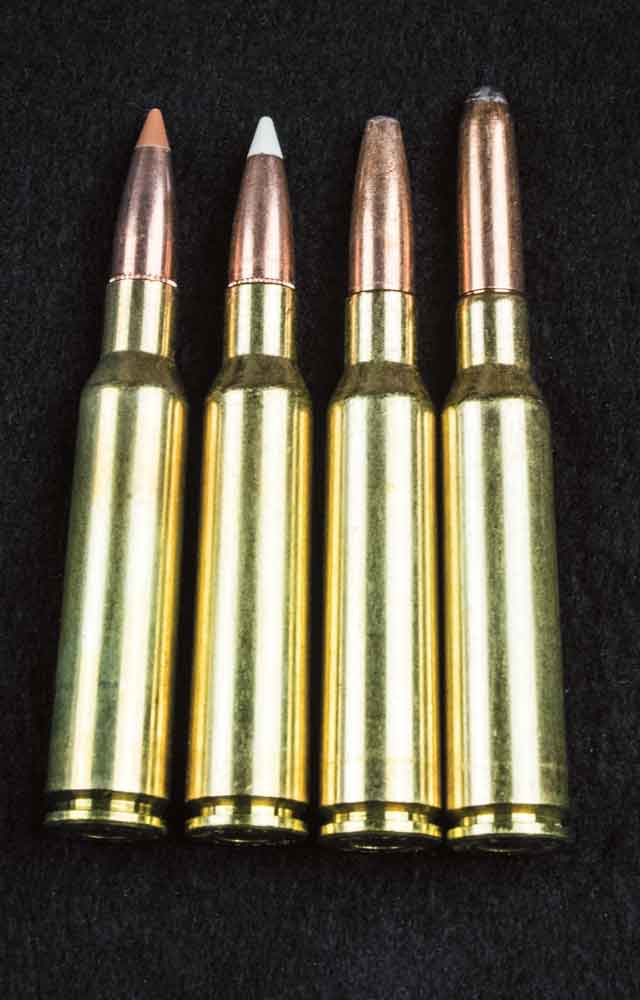
Here is a small sample of some of the factory-loaded ammunition available today to 6.5x55mm shooters. From left to right: a Norma-loaded 120-grain Nosler Ballistic Tip, a Nosler-loaded 140-grain Accubond, a Norma-loaded 156-grain Oryx and a Norma-loaded 156-grain round-nosed Alaskan.
“It’s definitely a 6.5 thing — all sectional density,” he said. “A controlled expansion bullet in .30 caliber weighing 140 grains would be rather short for its weight. A 140-grain controlled expansion bullet of the same construction in 6.5mm is going to be longer; therefore, it has a higher sectional density and will penetrate further.”
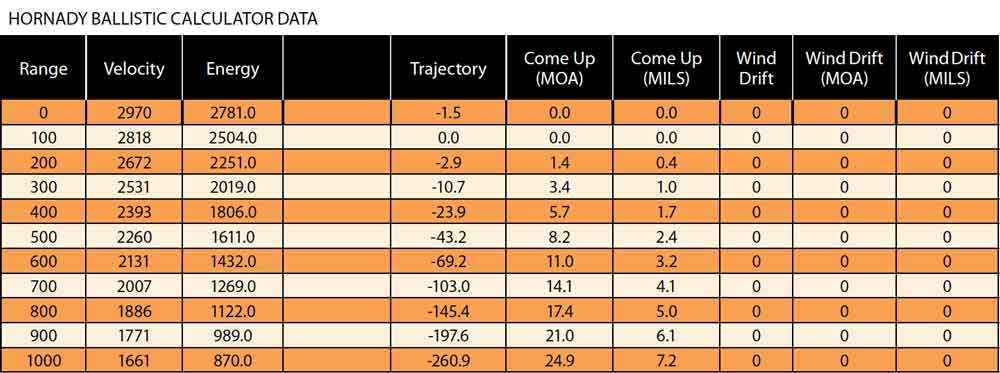
Handloaders can really make the 6.5×55 SCAN scoot. Public reloading data from Nosler, for example, gives handloaders quite a few choices. Published load data for the company’s magnificent 142-grain Accubond Long Range bullet, which, by the way, sports an impressive .625 BC, lists Alliant’s Reloder 22 as the most accurate powder in the manufacturer’s 23-inch test gun, but it states that Hodgdon’s H1000 got testers the most speed at an impressive 2,790 fps.
Hornady’s ballistic calculator (see accompanying chart above) offers the load data results to give us a general idea of what kind of flight trajectory you can expect based on the bullet’s BC and published muzzle velocity.
This is just one example of what modern powders, bullets and rifles are capable of with the 1891-era cartridge. Mathematically speaking, the gray-haired 6.5×55 SCAN is more than capable for today’s hunters. The scientific fact of 6.5 bullets flying farther and faster per powder per capita than most other bullets due to its inherently high BC figures is becoming more well-known to shooters who are devouring the 6.5 bullet market.
Based on MidwayUSA’s website data as of January 2018, the most popular 6.5 load is Hornady’s new 147-grain ELD Match bullet, which boasts a slick .610 ballistic coefficient. Compare this to Hornady’s 160-grain round-nosed 6.5 offering, which has a very pedestrian BC of just .283.
What exactly is ballistic coefficiency and why is it so useful? According to noted ballistics expert, Bryan Litz, of Berger Bullets, BC is explained like this: “Without getting into the math, I’ll define the ballistic coefficient in words as: The ability of the bullet to maintain velocity, in comparison to a ‘standard projectile.’ A high-BC bullet can maintain velocity better than a low-BC bullet under the same conditions. All measures of ballistic performance including drop and wind deflection are related to the bullet’s ability to maintain velocity. In short, the higher the BC, the better the all-around ballistic performance of the bullet will be.”
Brand New Rifle Options
Finally, in 2018, shooting a 6.5×55 SCAN in a brand-new rifle, like the CZ 557, gives me quite a few manufacturing advantages over the 6.5×55-loving crowd back when the 6.5×55 pulled its first tour of Scandinavian duty. CZ certainly isn’t the only manufacturer chambering for the 6.5×55 today.
Blaser, CZ, Sauer & Sohn, Steyr, SAKO/Tikka, Howa and even Barrett currently offer rifles chambered in it, and I’m sure there are others. If you need factory loaded ammunition, there’s no shortage of help either with manufacturers such as Federal, Swift, HSM, Winchester, Nosler, Sellier and Bellot, Lapua, Prvi Partizan, RUAG Ammotec, Remington Arms and Hornady all offering loads.
While I doubt the dedication to craftsmanship is better now than it was with the superb gun makers who built my 1916 M96, today’s firearms manufacturers simply have better tools and materials, and hundreds of years of experience to create better rifles. CZ’s 557 is a fine example of this evolution in firearms manufacturing. Instead of pushing a 6.5 bullet down the 29-inch barrel of my Carl Gustaf-built 1916-era M96, which is a cock-on-close, clip-fed, wood-stocked military service rifle, I’m pushing different flavors of 6.5×55 SCAN ammunition down a 20.5-inch barrel, in a CZ 557, which is a cock-on-open, blind magazine fed, synthetic-stocked hunting rifle.
Despite my 6.5mm first love, the 6.5×55 SCAN, Emery helped me understand why the 6.5 Creedmoor zipped right by the 6.5×55 and even the .260 Remington in sales as well.
Wouldn’t it be great if all rifles came with a Carfax report? This disc on the back of the m/1896 is basically just that, giving rifle users a rifle condition inspection report from the Swedish armorer at the time. There are three kinds: one-screw discs, an early two-screw, and two-screw discs. This rifle is a one-screw disc m/1896. The disc gives three different kinds of information about the rifle: condition of the bore, elevation aiming error with standard Swedish m/41 service loads, and barrel wear. Thus, from this disc, we can determine I had — at the time of the rifle’s inspection — a rifle bore grade of “1”, that my rifle shot point of aim, and that its measured bore and groove was precisely 6.51mm. So, mechanically speaking, this is a terrific rifle.
“The Creedmoor has quite a few things going for it. It’s a true short-action cartridge that allows long, heavy bullets to be seated out. The .260 Rem. requires the same long, heavy bullet to be seated farther into the case or the use of a long action. The 6.5×55 is even longer. The Creedmoor also benefits from close adherence to both the chamber design spec and the ammunition spec — everyone essentially makes it the same.”
While many American shooters might forget about or simply ignore the 6.5×55 SCAN as a superb hunting cartridge, I can assure you this 6.5-caliber cartridge will be the last thing any wild game you choose to shoot remembers. Regardless, the ongoing debate over not just which 6.5 cartridge is best, but even what hunting cartridge is best can be settled once and for all by modifying a quote about dogs by W.R. Purche: Everyone thinks they have the best rifle cartridge, and none of them is wrong.
Editor’s Note: This article originally appeared in the April 2018 issue of Gun Digest the Magazine.
Swing and follow-through aren’t the only aspects that get you shotgun on target. Master fundamental footwork and you’ll bag more birds.
Nothing is more exhilarating than the sound of a pheasant’s wings beating the cold autumn air. And nothing more frustrating than hearing them continue to pound away into the distance after you take your shot. Missed birds downright stink.
Swing or follow-through generally take the brunt of the blame for unscathed fowl, but there could be a less obvious culprit involved. Shotgunning, shooting in general, is such an upper-body dominated discipline stance often plays a distant second fiddle in considerations. But how you plant your hooves just might be what’s costing you birds.
From Dave Miller’s experience, hunters have a tendency of getting off on the wrong foot when they flush a bird. They rush, barely moving their feet, particularly with birds on the periphery. In turn, they bunch up on the initial shouldering of their gun and limit their range of motion on a follow-up shot. That’s all the makings of a miserable day in the field.
Luckily, the Guinness World Record holder for most clays broken in an hour (3,653), shows how to get in the right stance, while not blowing the shot in the above video. Honestly, there’s not a lot of hocus-pocus to it either. It’s mainly an exercise of remaining conscious about getting in a position for success, then executing it in a smooth and natural fashion.
Anyone can do it. The challenge is moving your feet this way every time without fail, even when thumping of a rooster taking flight has you shifting into overdrive.
For more information on Aguila Ammunition, please check out: www.aguilaammo.com
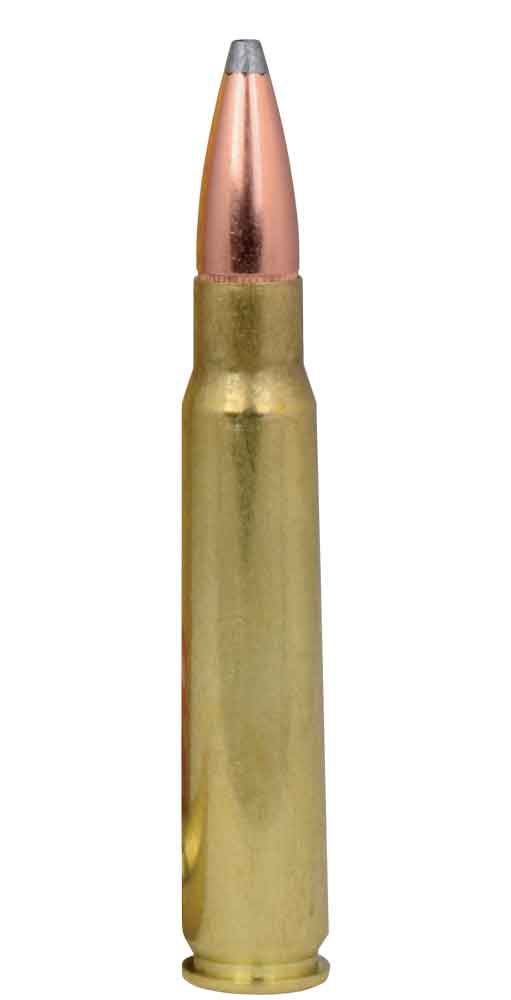
While it’s never really caught on stateside, the 8mm Mauser has a great pedigree and is more than capable on the battlefield or on the hunt.
Why the eight is great:
It was the official German military rifle cartridge through both World Wars.
The cartridge was official adopted in 1888 with a diameter of .318 inch, which was increased to .323 in 1905.
In the same class as the .30-06, the 8mm is adequate for any North American big game.
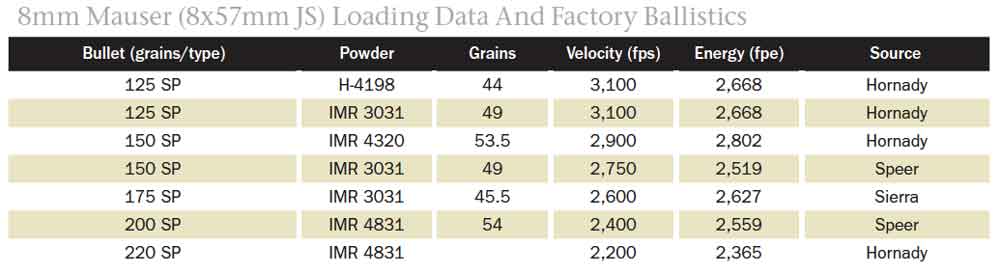
The 8mm — or 7.92 — Mauser was the German military rifle cartridge through both World Wars. It was officially adopted in 1888 with a bullet diameter of .318 inch. In 1905, the bullet diameter was increased to .323 inch. In Europe, the 8mm Mauser and several other 8mm cartridges are available in both sizes. The larger size is always designated as “S” or “JS” bore. In the United States, ammunition companies load only the .323-inch diameter or “S” bullet.
The 8mm Mauser is widely chambered in European sporting rifles, but American gunmakers have not adopted it to the same extent. The “J” or “I” in the name denotes infantry ammunition. The German capital “I” was mistaken for a capital “J” by U.S. military interpreters after World War I, and the “J” misnomer came into common use here and even in Europe thereafter!
The 8mm Mauser had not been very popular in the U.S. prior to World War II. However, the large number of obsolete, surplus 8mm military rifles sold here since the end of the war has increased its use substantially.
As loaded by Norma and by other European companies, such as RWS, it’s in the same class as our .30-06. It’s adequate for any North American big game if the proper bullets and full loadings are used. A large variety of good .323-inch bullets are now available for the individual handloader, and this has dramatically increased the usefulness of the 8mm Mauser for the American shooter.
Editor’s Note: This article originally appeared in the April 2018 issue of Gun Digest the Magazine.
A simple stencil in the shape of a sight picture could get you shooting the stuffing out of center mass on your next trip to the range.
Pick-up any book dealing with concealed carry or self-defense shooting and there’s a good chance they’ll contradict each other on 101 different points. From caliber to gear to the best apparel, they’ll chip at each other like old men debating the designated hitter. But get to the part about bullet placement and they’ll sing in better harmony than a church choir.
There’s a reason for near discipline-wide accord, quite simply it is the most important aspect of an actual defensive shooting itself. If a bullet doesn’t hit center-mass vitals, there is a fair chance you’ve lost the game. And there are no participation trophies in a lethal-force encounter.
Hence the reason why, as armed citizens, we spend countless hour’s honing our shooting skills, fretting over minutia, until placing rounds high-center mass is as natural as breathing. But for those new to handguns, getting peace-of-mind cloverleaf groups to sprout where they’ll save lives can be a painful process. For the gun world’s newly anointed, sights are bedeviling and play nasty tricks between alignment and trigger pull.
Defensive shooting instructor Michelle Cerino has a simple remedy for this off-the-mark shooting — sight-picture stencils. When you think about it, blacking out the exact area where a shooter needs to aim is almost forehead-slapping obvious. How else are they going to learn their shooting geography without road markers to point the way?
With this method there is little confusion where to aim, after all, it’s right in front of the shooter, literally in black and white. Additionally, it has potential for a more seasoned shooter as a diagnostic tool. With everything perfectly in line, but rounds not hitting, it might be perfect for ferreting out flinch or an off trigger pull.
For more information on Aguila Ammunition, please check out: www.aguilaammo.com
Watch a master at work! Turnbull’s Tom McArdle freehand engraves an antique Winchester. How steady are your nerves?
You won’t find Douglas Turnbull’s work hanging in the Louvre, but to shooters his art is as precious as any Picasso, Monet or Michelangelo. The firearms restoration specialist and manufacturer works magic on guns, turning both the priceless and pedestrian into peerless one-of-a-kind masterpieces.
This week, Modern Shooter goes behind the scenes where the magic happens with a visit to Turnbull Restoration and Manufacturing in upstate New York. There, Turnbull’s master craftsmen tirelessly ply their art — not to mention a dab of blood and sweat — to make ordinary extraordinary. And there skill is a wonder to watch.
The steadiness of Tom McArdle’s nerve is only matched by the nimbleness of his hands in the above clip. Amazingly, the master engraver works without a net, free handing from memory a classic scrollwork pattern on an antique Winchester. This work is so intricate and detailed it would be impossible to pull off without the aid of a microscope. But McArdle practiced fingers never slip working in the most unforgiving mediums — cold, hard gunmetal.
As deft at his craft as McArdle might be, he freely admits he his simply on cog in greater Turnbull’s machine. Art is a team effort — from the gunsmiths who get a firearm ticking like a clock to the finishers who apply the company’s trademark color-case hardening, everyone chips in. And there’s no arguing the results — guns elegant enough to hang in a museum, but tough enough to bag next year’s deer.
Catch the rest of Turnbull’s incredible creations in this episode of Modern Shooter 10:00 p.m. EST Friday on the Pursuit Channel. The episode rebroadcasts Monday at 12 p.m. EST and Tuesday at 11:30 a.m. EST.
Sporting clays shooters go to all ends to break more blue rock, but could greater consistency be as simple as loading your shotgun early at a station?
Ever watched a basketball player who can shoot the lights out of a gym and maybe the street lamp on the corner? You can bet a pair of Nikes before he puts a bend in his knees and cocks his arms, his eyes are glued to one spot — the hoop. You might say he acquires his target before pulling the trigger.
That’s sound advice that transfers nicely to the sporting clays arena. Obviously, it’s impossible to know the exact courses the pigeons will come flying at a particular station, but you’ll know their general direction. A few moments study to map the geography, build a game plan and dial in your concentration, in Dave Miller’s opinion, is enough to get you dusting more orange more often. The Team Aguila Ammunition shooter should know, holding the Guinness World Record for clays broken in an hour — 3,653.
Unfortunately, in Miller’s experience many sporting clays shooters get into some pretty nasty habits when it comes to getting their mind right. Either they rush, starting a station without pause or they take the time to study, but then fiddle around with their gun or shells before they shoot. That’s looking at the ball, not the hoop.
Miller’s cure is as simple as it is elusive — a routine. Loading your shotgun early, analyzing the station, and then focusing on the impending shots is a formula vaporizing more blue rock. And like free throw shooting, it takes discipline to execute each and every time you step to the line. But the results, and the looks on your buddies’ faces, are more than worth the effort.
The newly redesigned TPR line offers an improved trigger, better ergonomics and more features.
How Bersa has evolved this line of DA/SA pistols:
The company has smoothed and lightened the double-action pull, ensuring it doesn’t stack.
It has shorted the TPR’s reset so follow-up shots are lightning fast.
The pistols are available in 9mm, .40 S&W and .45 ACP.
The MSRP on the TPR line starts at $508.
Typically, if there is ink spilled over Bersa it’s about one in particular model — the Thunder. The compact and generally affordable pistol has won its share of advocates over the years as a solid and unobtrusive concealed carry option. But there’s more to the Argentinian gunmaker than its diminutive .380s.
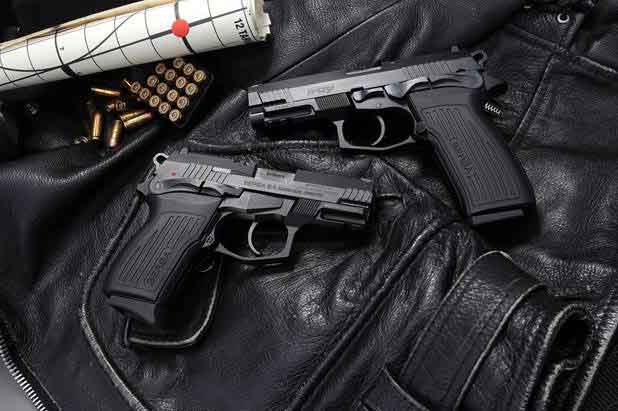
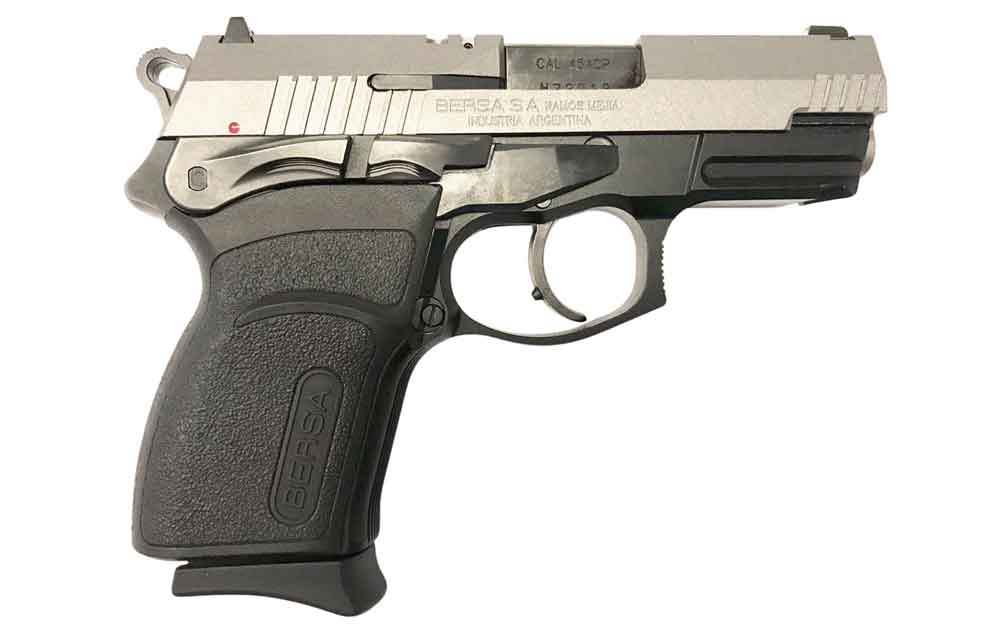
While perhaps not as well known as its little brother, the Bersa Thunder Pro line nonetheless has squared itself away as a performer in the DA/SA marketplace. And in 2018, Bersa has given shooters more reasons to give the full-sized and compact configurations a look with the next generation of the line — the TPR series.
“We’re excited to bring this next generation of Bersa TPRs to American consumers,” said Michael Sodini, president of Eagle Imports. “Once available only to military and law enforcement personnel, it’s always offered rugged durability and impressive accuracy. This new evolution makes the TPR officially one of my favorites for self-defense and sport.”
Where Bersa has concentrated its redesign efforts with the TPR series, primarily, is on one of the main sticky points of DA/SA pistols — the trigger. The company has smoothed out the double-action pull, ensuring it doesn’t stack, and lightened so it consistently breaks. Furthermore, the reset is minuscule, giving it a lightning-fast transition from initial to follow-up shot.
Bersa has trimmed the grip of the TPR as well, giving shooters more reach to the trigger and more ability to get a solid purchase on the pistol. Moreover, the company has improved the overall ergonomics with small tweaks, such an amply undercut trigger guard and improved grip texturing. A bonus, Bersa has also made TPR pistols more lefty friendly, with ambidextrous decocker and slide release. Though, the magazine release still remains exclusively right-hand oriented.
Additionally, the aluminum frame and slide have seen enhancements, with serration added to the fore of the slide and grip texturing at the front of the frame for thumb support and a memory position for indexing.
The full-sized TPR model comes chambered in 9 mm and has a 4.25 barrel, while the 3.25-inch barreled compact configuration is available in 9mm, .40 S&W and .45 ACP. Other notable features include integrated Picatinny accessory rail, compatibility with SIG Sauer aftermarket sights and loaded-chamber indicator.
In line with most of the rest of the market, the handguns’ MSRP starts at $508 and are presently available at Bersa dealers.
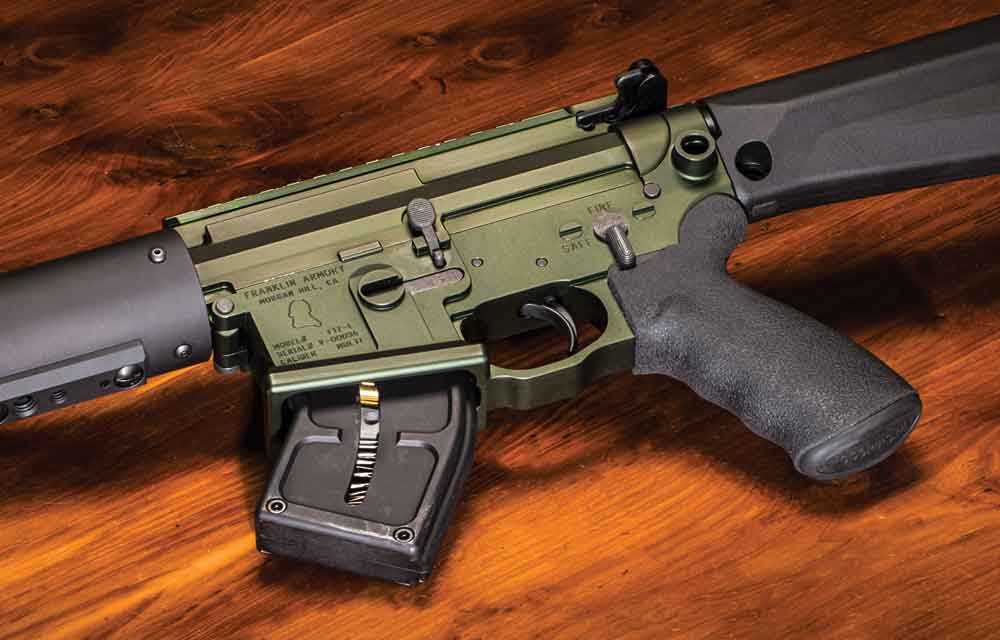
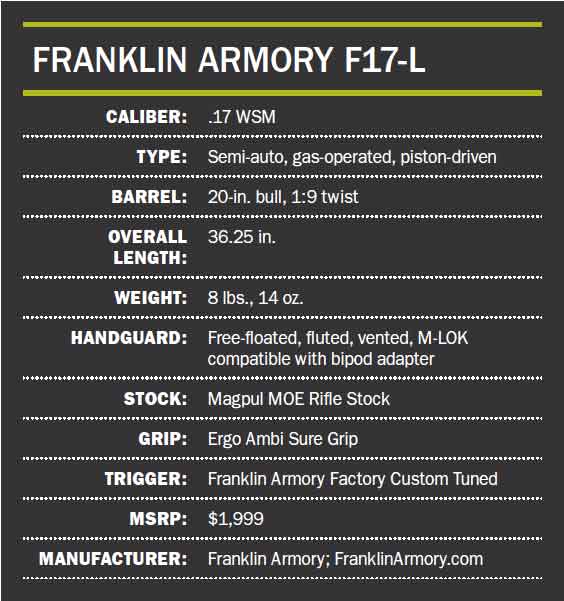
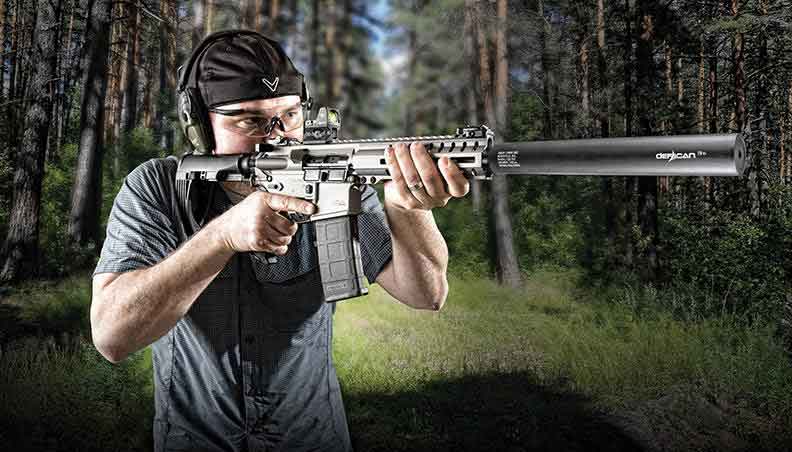
Franklin Armory’s F17-L is a rimfire AR that offers performance above its weight class.
How this hot little number sizes up:
Released in 2014, the F17-L followed on Winchester’s introduction of the .17 WSM.
For a time, the F17-L was the only gas-operated semi-automatic .17 WSM in an AR-type platform.
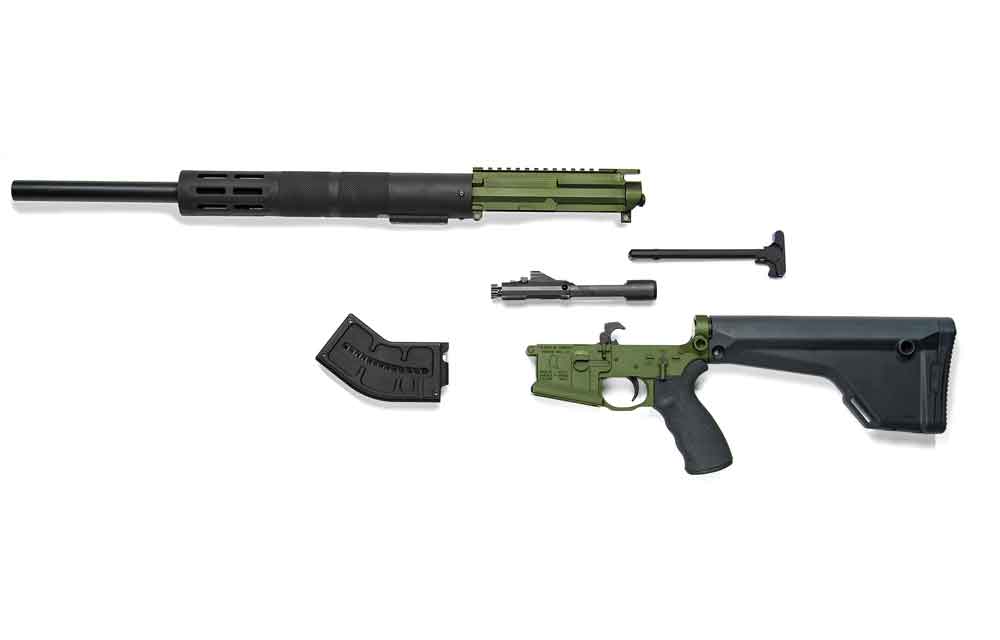
It utilizes a custom-designed bolt-carrier group, and adapted buffer and proprietary magazine.
It is gas-piston operated, since a simple blowback system isn’t equipped to handle the .17 WSM’s pressure.
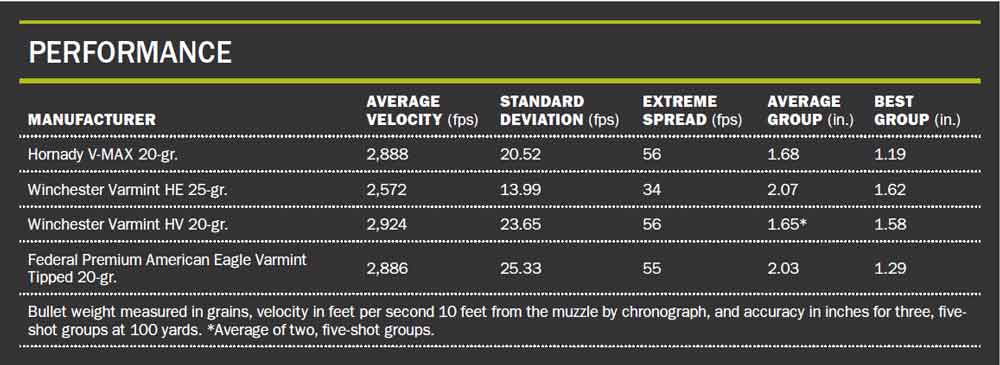
In testing at 100 yards, the best groups (1.65″ average) came with 20-grain Hornady V-Max.
The MSRP of the F17-L is $1,999.
For some time now, Franklin Armory has been producing quality AR-style rifles, SBRs, pistols and parts, with a special emphasis on crafting legal firearms for citizens of states with restrictive gun laws. These laws, enacted under the guise of improving safety, essentially strip away many of the modern sporting rifle’s most appealing features. While some debate whether gun makers should even build firearms to fit these laws, the California-based Franklin Armory has resolved to make lemonade with lemons.
Over the years, the company has become quite adept at working within the confines of restrictive laws while also skirting the edges on its designs. Although it also manufactures full feature firearms for free states, some of its most intriguing products are those that seek to liberate shooters stuck behind enemy lines. One of these is the F17-L rifle.
Bridging the Gap
First introduced at the 2014 SHOT Show, the F17-L followed on the heels of Winchester’s introduction the previous year of the .17 Winchester Super Magnum (WSM). Winchester developed this unique cartridge by taking what was then a .27-caliber nail gun blank and necking it down to accept a .17-caliber projectile. The results were impressive, with the .17 WSM spitting a 20-grain bullet at velocities around 3,000 feet per second (fps), roughly 625 fps faster than the popular .17 HMR and very near those of centerfire .223/5.56 NATO loads pushing a 62-grain projectile.
This innovative new design closed the distance between rimfire and centerfire cartridges—at least in terms of velocity inside 200 yards (the lighter bullets shed velocity quicker). And at the time, the F17-L was the first and only semi-auto chambered in .17 WSM. Volquartsen developed one, but the F17-L remained the only gas-operated semi-automatic .17 WSM in an AR-type platform.
What this meant was that shooters in non-free states could now buy a street legal rimfire AR with a lot more punch than those chambered in .22 LR. Because there were fewer restrictions on rimfire rifles, the F17-L escaped regulations like the much-maligned “Bullet Button,” a device that requires a tool in order to swap out an otherwise easily detachable magazine.
For these reasons, the F17-L remains an excellent option for those who can’t own a standard AR. However, it’s also a great gun for those in free states as well.
Making It Work
To accommodate the .17 WSM chambering, Franklin Armory had to make several changes from standard AR designs. For starters, the rifle utilizes a custom-designed .17 WSM bolt carrier group, a .17 WSM barrel, an adapted buffer and a proprietary magazine. Obviously, without these necessary alterations, the concept would be dead in the water.
However, another important design choice by Franklin Armory is its use of a gas-piston operating system. A simple blowback system isn’t equipped to handle the pressures of the .17 WSM (33,000 PSI) and, as most shooters are aware, rimfire ammo often runs incredibly dirty through a firearm, to the point of causing functional issues if the gun is not maintained regularly. With the cleaner gas-piston system, Franklin Armory is able to handle the higher pressures and keep the F17-L running smoother, longer.
The gas system found in the gun is of the pistol-length variety, which Franklin Armory determined works best with the .17 WSM. The system itself is the result of a partnership between Franklin Armory and Osprey Defense, which specializes in drop-in gas-piston conversion kits for ARs.
The aforementioned proprietary magazine, which features an aluminum design, holds 10 rounds and has a curved shape for compatibility with the rimmed .17 WSM. This curve, while not too dramatic, does slightly affect loading. The magazine’s interchange with the magwell isn’t butter-smooth, but neither does it require significant effort to slide it into place. The magazine is also somewhat difficult to load, especially after about the sixth round, but there’s a circular slot in the follower where you can use a cleaning rod, screwdriver or some other tool to compress the spring for easier loading.
The F17-L features 7075-T6 billet aluminum upper and lower receivers, which are also a proprietary design. They receive a stylish and durable hard coat anodized Olive Drab Green finish, instantly distinguishing this gun in the sea of black rifles. The upper receiver has a forward assist; however, its use with the rimfire chambering is problematic and the F17-L’s user manual details these risks in full. The lower is equipped with useful features such as a flared magwell for easy loading and an enlarged trigger guard for gloved shooting, something dedicated varmint hunters are sure to appreciate.
While the upper and lower of the rifle incorporate many of the controls and features AR users are accustomed to (charging handle, magazine release, safety selector, forward assist, bolt release), not all of these function the same way. The forward assist has been mentioned, but there are other changes, too.
For example, the carrier does not lock back on an empty magazine, nor is there a way to keep the bolt held open, which is slightly baffling when you first pick up the rifle and try to hold the action open in the usual fashion. This is partly because of the altered buffer mentioned earlier, which is about 1 inch longer than a standard buffer, and this is due to the decreased distance the bolt carrier has to travel for the shorter rimfire cartridge.
The rifle utilizes a 1:9 twist, 20-inch bull barrel that receives a salt bath nitride treatment and comes with a target crown. The barrel is set inside a free-floating aluminum handguard that is fluted and vented and offers M-Lok compatible slots as well as an integral bipod/tripod adaptor.
The F17-L stock is a Magpul MOE Rifle Stock, which is smooth to shoulder and sling mountable. Meanwhile, the grip is a comfortable and sturdy Ergo Ambi Sure Grip that, when paired with Franklin Armory’s Factory Custom Tuned Trigger, makes for an excellent package.
Range Performance
The F17-L is built to be a varmint slayer, and for testing, I equipped the rifle with a Nikon Prostaff Rimfire II 3-9×40 BDC 150 scope, which features Nikon’s BDC 150 reticle. While the reticle is set up for high-velocity .22 LR loads, using Nikon’s Spot On website and ballistics program, you can plug in the caliber and load you prefer, and it will tell you what each of the drop markers represent in terms of trajectory for a given zero.
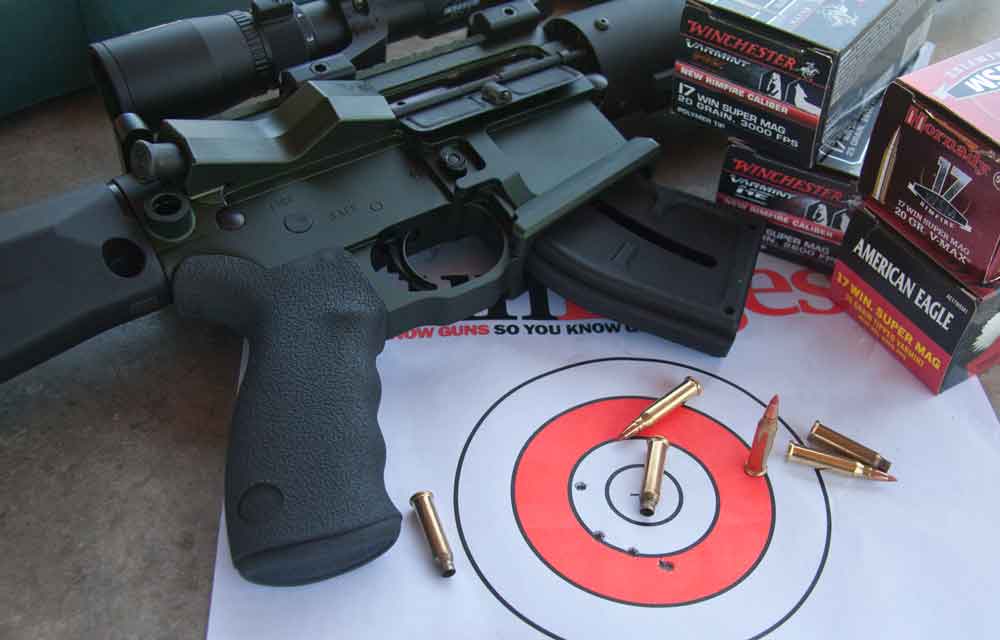
I used four loads during testing: Winchester’s 25-grain Varmint HE and 20-grain Varmint HV, Hornady’s 20-grain V-MAX and American Eagle 20-grain tipped varmint loads. Velocities were measured through a ProChrono Chronograph from Brownells about 10 feet from the muzzle. Accuracy data for each load was acquired from three, five-shot groups taken at 100 yards using a Caldwell Matrix rest, also from Brownells.
During much of my time with it, the rifle ran without fault, but I did run into a few issues as testing progressed. I encountered some light primer strikes. Also notable, in several instances the rifle failed to extract spent cases; occasionally, cases would become stuck within the barrel, which would then naturally lead to misfeeds as the gun attempted to chamber another round.
Aside from these issues, however, I was very impressed with the F17-L. Groups were decent, despite the stout wind during testing. The 20-grain Hornady V-MAX posted the best group overall at a respectable 1.19 inches, while the Winchester 20-grain Varmint HV load rated the best average at 1.65 inches. The other loads had best groups hovering between 1.2 and 1.6 inches or so.
Parting Shots
Built partially to meet the needs of shooters in restrictive states, the F17-L excels in that capacity. It’s a unique design that remains a first for the firearms industry, taking the blistering little .17 WSM and working it into the semi-auto AR platform. Because of the looser restrictions on rimfires, residents of states like California can get an AR-type rifle with all the AR’s great features and with more bite than the .22 LR. Meanwhile, hunters in free states are also sure to love a semi-auto .17 WSM that can pot varmints at greater distances and with more authority than other rimfire calibers. All in all, the F17-L is an innovative design that stretches the boundaries of what is possible with rimfire ammunition and with the AR platform.
Editor’s Note: This article originally appeared in the July 2016 issue of Gun Digest the Magazine.
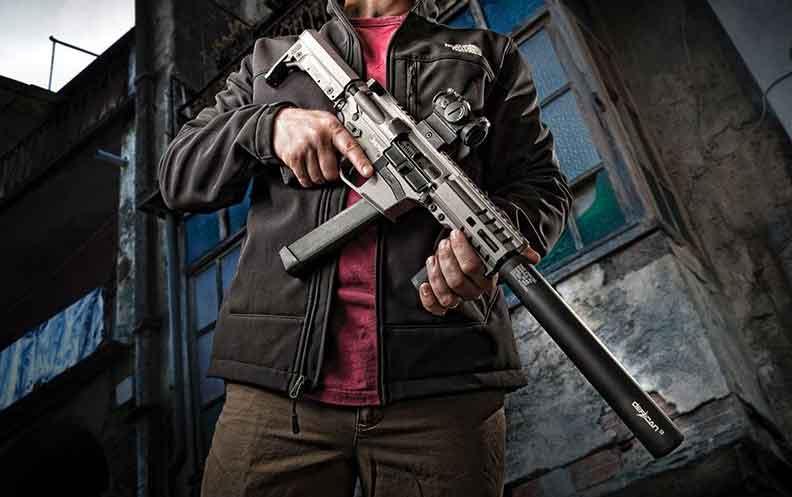
With five variants covering a wide-spectrum of calibers, CMMG’s DefCan Suppressor line is ready to hush up a lot of rifles.
What’s the noise on the DefCan line?
The release of its suppressor line coincides with CMMG’s introduction of its Banshee SBR line.
The company has models tailored for .30 caliber, 5.56 NATO, 9mm, .45 ACP and .22 LR.
Depending on model, DefCan reduce noise from 30 to 40 dB.
The suppressors have a price range from $325 to $900.
Perhaps no single accessory has stormed the market in the modern era like suppressors. Once shrouded in mystery and seemingly accessible by a select few, the noise-reduction devices have become nearly as common as the guns they’re attached. Pretty striking, given hoop jumping and extra cash the NFA-regulated doodads require on top of their base price.
The suppressor world continues to grow and by a large bound recently with CMMG jumping into the game. It seems a natural move for an AR-maker known for its extensive catalog of accessories and upgrades, in addition to unique pistols, carbines and rifles. And the introduction of the DefCan Suppressor line walks hand-in-hand with another recent product expansion — the Banshee line short-barreled rifles and AR pistols.
“DefCan is an exciting new step for CMMG. Combined with our new line of BANSHEE SBRs, DefCan suppressors will give us a strong presence in the NFA market. Additionally, the DefCan suppressor line complements our current firearm product line-up very well and will be an integral part of our plans going forward,” CMMG CEO Chris Reinkemeyer said in a press release.
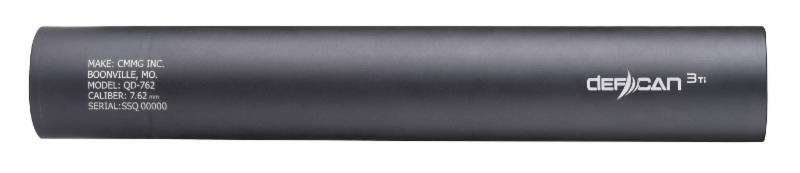
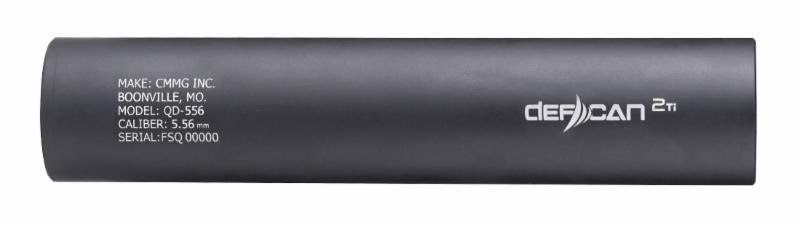
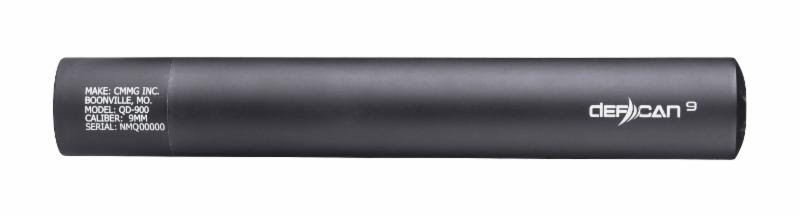
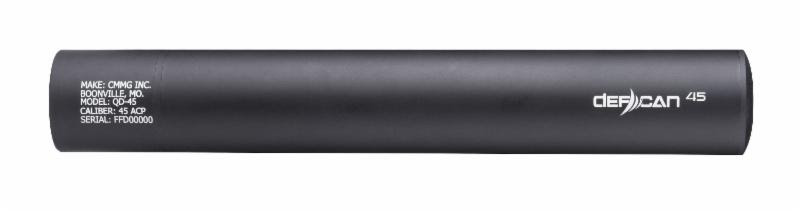
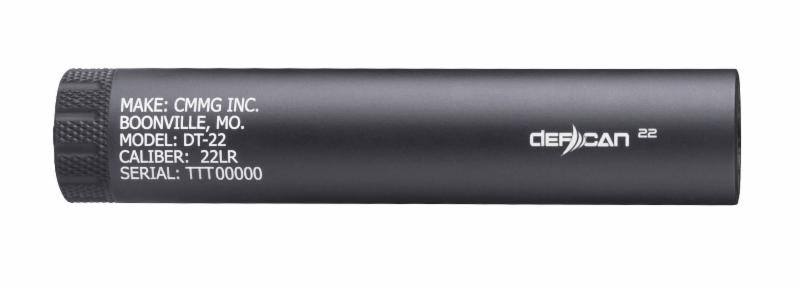
CMMG enters the fray with five variants in its suppressor line that cover a wide-spectrum of calibers: .30-caliber DefCan 3Ti, 5.56 NATO DefCan 2Ti, 9mm DefCan 9, .45 ACP DefCan 45 and .22 LR DefCan 22. All the suppressors, except the DefCan 22, are completely sealed and require no cleaning and are full-auto rated. As far as noise suppression, the rifle- and pistol-caliber models offer 32 dB of reduction, the .45 30 dB and the .22 40 dB.
CMMG also offers some wiggle room in how the DefCan line attaches to a rifle. The 3Ti and 2Ti come in a traditional direct thread variant and a quick attach bi-lock QD model. These cans are the only ones with this option, as the 9mm and .45 models are both exclusively bi-lock QD and the .22 is a direct thread. Finally, the 3Ti and 2 Ti suppressors are each finished with a high-temperature Cerakote, while the rest of the line is hard-coat anodized.
Price is always a sticky point in the gun world, but CMMG doesn’t appear to have lost its mind with the DefCan line. The QD 3Ti is at the top of the price range at $900 and the .22 LR at the bottom at $325.
For more information on the CMMG’s DefCan line of suppressors please check out: www.cmmginc.com
DefCan 3Ti (Bi-Lock QD) Caliber: 7.62mm NATO Sound Reduction: 32 dB Length: 9.2 inches Diameter: 1.5 inches Weight: 17.5 ounces Finish: High Temperature Cerakote MSRP: $899.95
DefCan 3Ti (Direct Thread) Caliber: 7.62mm NATO Sound Reduction: 32 dB Length: 7.8 inches Diameter: 1.5 inches Weight: 13.1 ounces Finish: High Temperature Cerakote Thread: 5/8-24 MSRP: $824.95
DefCan 2Ti (Bi-Lock QD) Caliber: 5.56mm NATO Sound Reduction: 32 dB Length: 7 inches Diameter: 1.5 inches Weight: 13.1 ounces Finish: High Temperature Cerakote MSRP: $824.95
DefCan 2Ti (Direct Thread) Caliber: 5.56mm NATO Sound Reduction: 32 dB Length: 6.18 inches Diameter: 1.5 inches Weight: 13.1 ounces Finish: High Temperature Cerakote Thread: 5/8-28 MSRP: $749.95
Looking to go armed, but are stuck in the weeds as to what to arm yourself with? Here are 20 of the best concealed carry gun options that will keep you on the defensive.