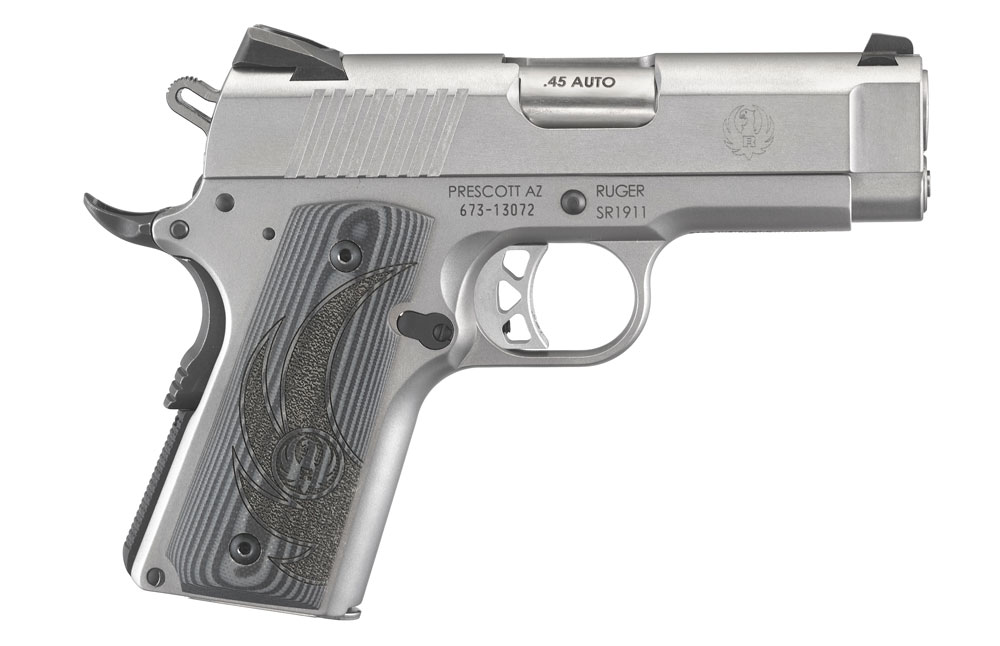
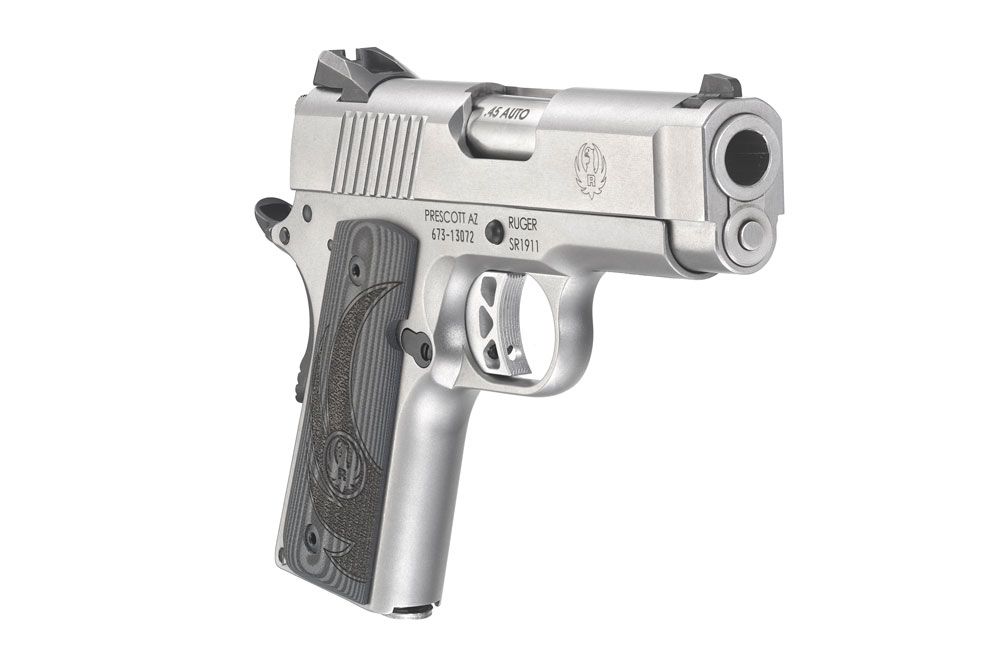
Available in .45 ACP, the SR1911 Officer’s Model is ready for everyday carry duty.
How the .45 ACP Officer’s Model is ready for carry:
Concealable 3.6-inch barrel and 7.25 overall length.
Manageable 31 ounces in weight.
Rugged stainless-steel frame and slide.
Low-glare finish.
G-10 replaceable grips.
Drift-adjustable Novak 3-dot sights.
7+1 capacity.
The Vietnam War entering the nation’s rearview and inflation squarely down the road, in retrospect there weren’t a bunch of high-points to 1972. A marked exception was the adoption of the M15 General Officer by the U.S. Army. Helping to redefine the size and role of the classic 1911 pistol, the sidearm for high-ranking officers was, for the most part, an instant classic. Though, the service beauties rolling out of the Rock Island Arsenal weren’t the final say or even the defining iterations of the snub-nosed semi-automatics.
Common with many 1911s, Colt called the tune in what became known as the Officer’s Model with the introduction of the Officer’s ACP in 1985. Since then, and thanks to the interest in concealed carry, the market has exploded with outright Officer facsimiles and roses by any other name. Perhaps not as prolific as striker-fired pistols, the style of compact 1911 still is among the most popular concealable self-defense gun available today.
A late adopter of 1911 production, Ruger finally embraced the petite configuration with the release of the SR1911 Officer’s Model earlier this year in 9mm. Now, in what is certainly music to the 1911 purists’ ears, the company has released a model chambered in .45 ACP and rounding out a line that up until this year has consisted of larger standard, commander and target models.
Slightly heavier than the 9mm Lightweight, the new .45 SR1911 Officer’s Model has the same features of the initial offering and stays relatively true to what have become the accepted dimensions and function of this configuration of 1911.
Aside from caliber, the significant difference between the SR1911 Officer’s Models – and accounting for the weight difference – are their frames. The .45 boasts a stainless-steel frame and weighs in at an even 31 ounces unloaded – almost a full 4-ounces more than the aluminum-alloy-framed 9mm. Certainly heavier, but by no means is Ruger’s new Officer disqualified from everyday carry duty.
The 7+1 capacity pistol is CNC machined resulting in an excellent slide-to-frame fit and smooth operation. The 3.6-inch bushingless bull barrel adds an element of control to the Officer’s Model, putting more material and weight at the muzzle, muting barrel flip and recoil. An extended thumb safety makes the gun easier to get in and out of action safely, and it comes outfitted with drift-adjustable Novak 3-Dot sights.
A dash of a customized look, the skeletonized hammer and trigger also are designed to improve the SR1911’s lock time and accuracy potential (crisp break, little overtravel). And relative to the overall 1911 market, the SR1911 Officer’s Model comes competitively priced with an MSRP of $979.
For more information on the SR1911 Officer’s Model, please visit: www.ruger.com
The evolution of the solid bullet as a hunting bullet has taken numerous twists over the centuries, tied to advancements in firearms and the switch from black to smokeless powder. The earliest projectiles were made of almost anything: rocks, wood and metal. But soon after the invention of firearms, arms makers realized that something of considerable density was required if the projectile was to retain velocity. Fortunately, lead is very dense, plentiful and cheap. And lead could be molded to fit a gun’s bore for better accuracy.
The first “solid bullets” were round balls, but accuracy with these spheres in the smoothbores of the day limited range. This changed with the invention of rifling. Some of the first rifled barrels had straight grooves, but it was discovered that spiral rifling imparted a spin to the bullet that greatly improved accuracy. Round balls and bore diameters got bigger in an attempt to increase lethality, but eventually, the round ball gave way to a solid, elongated cylinder, with a round or pointed nose.
Another development that helped accuracy was cast bullets with a hollow base. This was at first filled with tallow, but it was discovered that the fat wasn’t needed, and that the base of the soft lead bullet expanded to fit the rifling.
All such bullets were solids, but the transition from black to smokeless powder and the development of self-contained cartridge resulted in velocities far beyond the capabilities of bare lead. Eventually, bullets with jackets of some material were developed to protect the lead. The first jacketed bullets were paper-patched solids, but soon various metals encased lead cores.
It’s important to note that the first “bullets” were all solids, at first made of pure lead, or an alloy thereof. Today, solids are available in basically three distinctly different pillars of classification.
Solid Lead-Alloy Bullets
First are the long, heavy, solid lead-alloy bullets of early cartridge arms, still used in modern replicas of the big buffalo rifles.
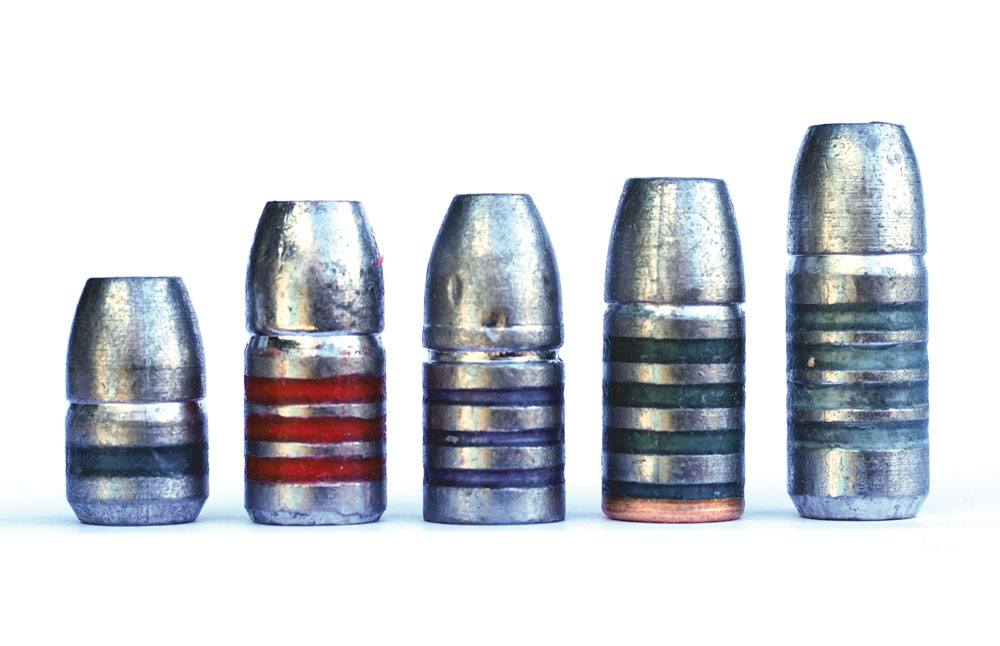
Solid bullets cast of lead or lead alloy include (from left): 300-grain RNFP, 405-grain RNFP, 416-grain RNFP, 430-grain RNFP Gas Check and 500-grain RNFP.
Solid lead-alloy bullets are the mainstays of the blackpowder cartridge rifle shooter, and various alloys, lubricants and specialized loading techniques make the accuracy of such loads amazing. When the government was doing research on a new blackpowder service cartridge, they tested .40-, .42- and .45-caliber cartridges, with both bottle-necked and straight cases. Straight-walled case gave the best accuracy and the least pressure, and the .45 caliber gave the best results, especially at long range.
Thus, the .45-70 Government as adopted was loaded with 70 grains of black powder and a 400-grain solid lead bullet. However, it was found that the 70-grain powder charge produced too much recoil, so the charge was reduced to 55 grains with the same bullet (called, logically enough, the .45-55). The 500-grain lead bullet, so popular today in the .45-70 with target shooters, wasn’t loaded by the Army until about 1881. While modern-day hunters scoff at the “low-powered old .45-70,” consider this: A 500-grain lead bullet launched at about 1,100 fps will shoot through a bison, end to end. There are also reports of cavalrymen at the Custer battle knocking off Indians at over 600 yards with their .45-70 carbines.
Soild Non-Lead Bullets
Second are the non-lead solids for big game, some of which are especially designed to (a) penetrate and expand, or (b) penetrate and not expand at all.
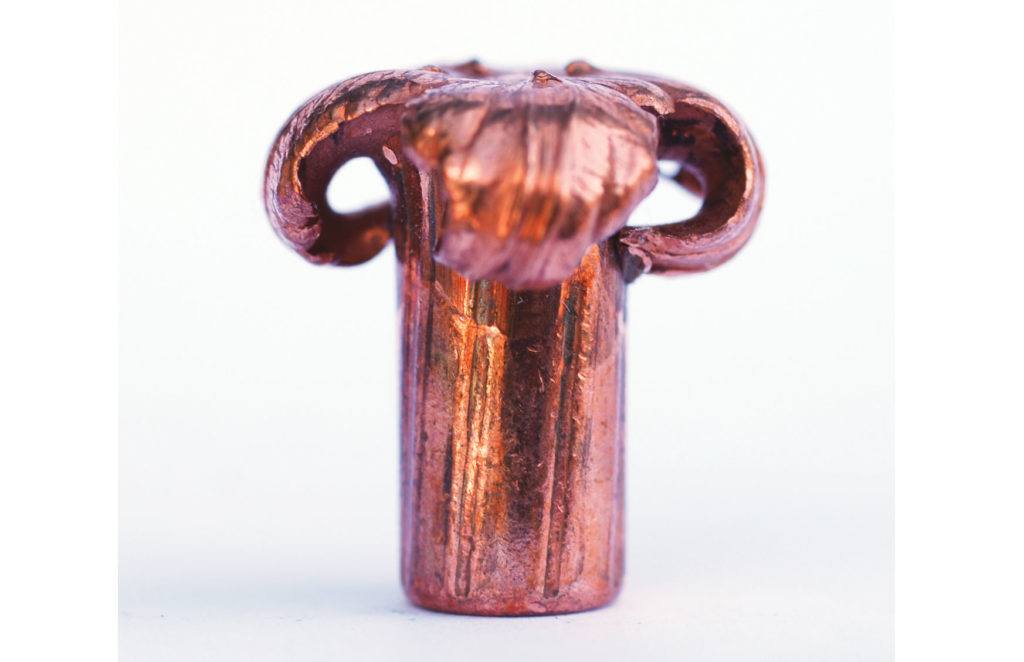
A Barnes .375-caliber, 300-grain TS-X bullet recovered from a gelatin block.
The second tier of solid bullets is a relatively new development, spawned in part by the actions of brain-dead bureaucrats demanding no-lead bullets, and, ironically, the honest desire of companies trying to literally make a better bullet.
Randi and Connie Brooks purchased an almost defunct bullet outfit in 1974, and renamed it Barnes Bullets. The new company designed, perfected and introduced the Barnes X-Bullet in 1989. It was truly a solid composed of copper with a hollow tip that helped initiate expansion. But the smooth shank was unforgiving: In over- and under-sized bores, accuracy was a sometimes thing.
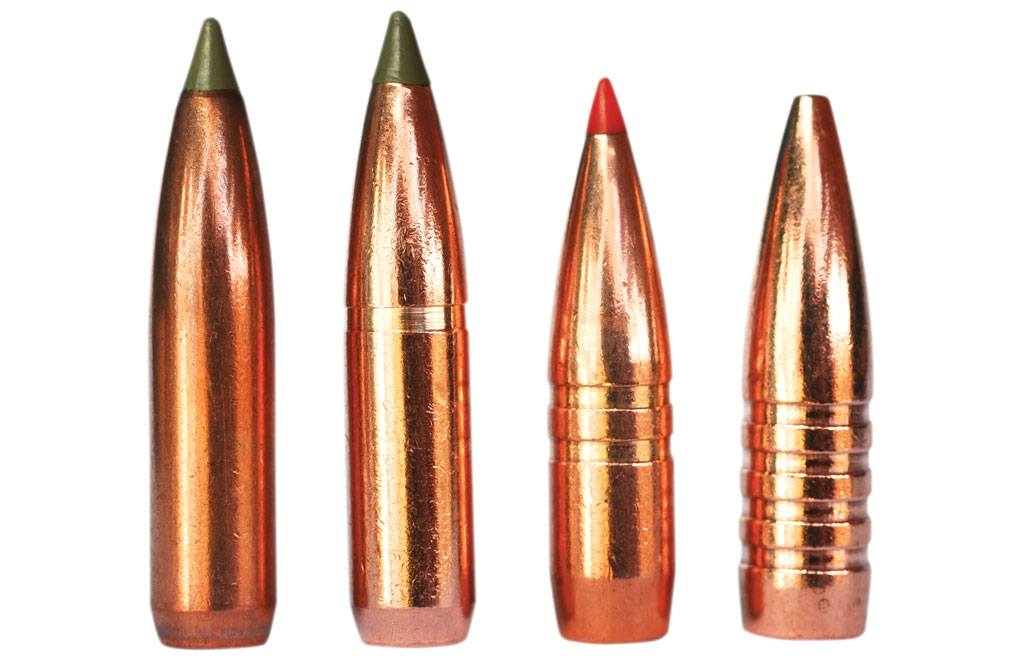
So the X-Bullet was modified by the addition of rings cut into the shank, and it was renamed the Triple Shock-X. While the TS-X is made of a homogeneous material, it’s technically a solid, but it always expands, penetrates and retains almost 100 percent of its weight. TS-X Bullets were soon followed by versions with a polymer tip.
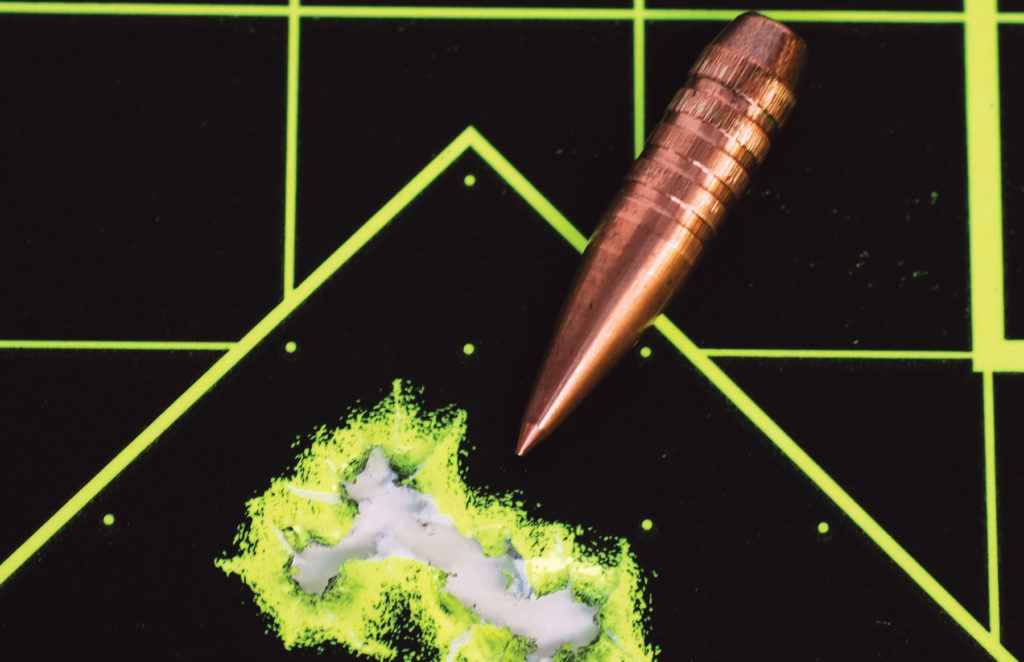
A 10-percent gelatin block with wound channel made by a 55-grain FSM SCS bullet from a .223 Remington.
In 2009, Hornady introduced a solid bullet they call the GMX: the Gilding Metal eXpanding. It’s made of 95 percent/5 percent (copper-zinc) gilding metal, sports Hornady’s signature red polymer tip and has a boat tail. The GMX gives deep penetration, reliable expansion and about 95 percent weight retention. It also has a crimping cannelure and what Hornady calls “pressure relieving grooves” in the shank.
In 2007, Nosler introduced the Nosler E-Tip Bullet (the “E” is for the “E2 Energy Expansion Cavity”). The E-Tip is also composed of a copper alloy with a signature green polymer tip. The big difference in the E-Tip is that its shank is smooth. The shanks of the first E-Tips were totally devoid of grooves, but in 2014, Nosler added a shallow crimping groove.
One of the new entries into the world of solid bullets is from Fort Scott Munitions (FSM). FSM took a radical approach to the design of the solid, monolithic hunting bullet, and has developed an extensive line of projectiles and factory loaded ammo.
A 55-grain SCS .223 Remington FSM factory load.
Here’s their rationale: To reliably and quickly kill big game, a bullet has to disrupt a lot of vital tissue. Traditionally, this has been done with bullets that penetrate and expand. The poor performance of full-metal jacketed bullets in game is well documented, as military bullets with a full-metal jacket and a traditional lead core start tumbling after impact, and then fragment. These small fragments then rapidly loose speed and effectiveness.
FSM’s monolithic bullets are designed not to expand, but tumble upon impact in soft tissue, and produce penetration and tissue damage equal to, or exceeding, that of traditional expanding jacketed bullets. In bone, they just bore straight ahead. FSM calls their bullets “Solid Copper Spun” (SCS) or “Solid Brass Spun” (SBS). Another benefit of these bullets is that they are totally lead-free, and thus suitable for use in jurisdictions where bullets that contain lead are prohibited.
Non-Deforming Solid Bullets
The last category of solid bullets is the one of which most shooters think with we use the term “solid.” These bullets are not made of one material and have jackets, but rather are “solids” in the sense that they do not deform, no matter what they’re shot into.
Many years ago, Hornady developed a steel-jacketed solid that covered a traditional lead core. The steel was then covered with gilding metal jacket, like that used for conventional cup-and-core bullets. Today, that bullet design has evolved into the exemplary DGS (Dangerous Game Solid).
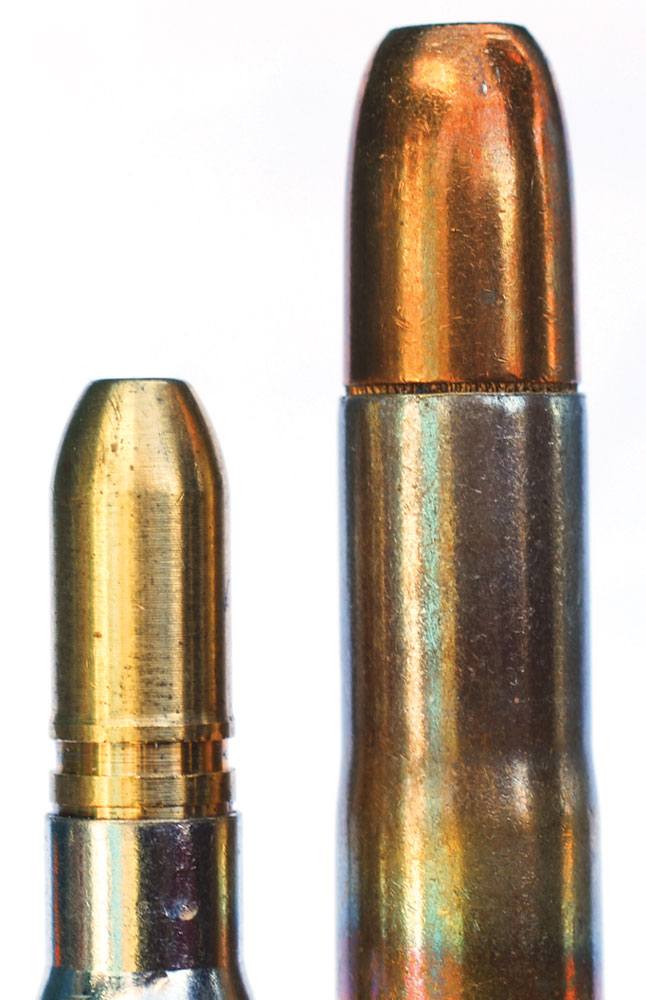
Two approaches to dangerous game solids: Barnes 286-grain Banded Solid brass in 9.3×62 Mauser (left), and Hornady 500-grain DGS, steel-jacketed bullet in .470 Nitro Express (right).
Non-expanding solids for dangerous game are also available from Barnes. Introduced in 2005, these are called banded solids, due to the four or five circumferential grooves in the shank for displaced metal. These “solids” are made of a copper/zinc alloy and are available from .338-caliber to the big British cartridges, including the 600 Nitro Express and the .50-caliber BMG.
Nosler Solid Dangerous Game bullets debuted in 2008 and are somewhat similar to the Barnes design, except that they have but one groove in the shank. I’m unaware of the exact composition of these bullets, but the lead-free alloy looks like pure Naval brass to me.
The Future Of Solid Bullets
Thus, the solid bullet lives on in original lead (or alloy) projectiles of early days, plus today’s new homogenous bullets — some of which are designed to expand, and some of which are not. In addition, there are new non-expanding “dangerous game” balls, made of various substances, or covered with tough jackets that protect the bullet’s core as well as the rifle’s bore, and engage the rifling. To be sure, we’ve not seen the last of innovation in the design of such bullets.
Editor’s Note: This article originally appeared in the 2018 Shooter’s Guide issue of Gun Digest the Magazine.
See if you have what it takes to make this challenging long-range shot on the next Modern Shooter.
Today’s gun media talks about it like it’s a cakewalk with extra icing, but 500-yards is a long shot by anyone’s account. You’d better have your DOPE straight and your nerves steady if you expect to beat the distance and ring steel. Brass tacks, the range is a challenge in and of itself. Add movement in, it’s an entirely tougher nut to crack.
Truer to what a marksman might actually encounter in the field, a moving target is a magnitude or ten more difficult to drop a round in on than a silhouette picketed to terra firma. Not only do you have to account for bullet drop and all your usual environmentals, you’ve got to do it on where a target is going to be, not where it is. At its essences, it’s shooting ghosts.
That’s a tall task, and there’s nothing like friendly competition and personal bragging rights to dial up the pressure in accomplishing the feat. Will Renke and Ben Stacy of Guns Daily, lay their chips on the table and butt head to see who’s top dog in this challenging shot. And from a high, rocky Colorado ridge, there’s little doubt the heat is on between the two friends. No spilling the beans on who comes out on top, but suffices to say there is no loser, given what might be the ultimate consolation prize.
Though highly sought, history has not been kind to L.C. Smith shotguns.
What is an L.C. Smith shotgun:
A sidelock, side-by-side shotgun.
Consider as fine as other great American double-barrels.
Available in 8, 12, 16, 20 and .410 bore.
Early models had hammers, but hammerless models became available later.
L.C. Smith was owned by a number of companies, including Marlin.
The era of the great American double-barreled shotgun lasted for almost 100 years, from shortly after the Civil War in the late 1860s until the middle of the 20th century. Grand old names like Parker, Fox, Ithaca, Winchester and L.C. Smith topped the list of the better double guns that were made in the United States. Each of these brands had (and has) many advocates, users and collectors. With all the many grades, gauges and options, these are the guns that collector’s dreams are made of.
In the early 1900s, the side-by-side was still the standard shotgun in America. But then progress came along and soon the gun companies were developing pump-action and semi-automatic repeaters. Many shotgunners began to prefer the single-barreled gun. One frequently touted reason — perhaps somewhat of a myth — is that Americans tend to be rifle oriented, and they were more familiar with a single sighting plane. (Over/unders offered a single-barrel view, of course, but were rare in those days. Also, many hunters liked the idea of three or more rounds of ammo.)
Double-barreled shotguns were more expensive to make and to buy, and gun manufacturers could realize more profits with the pumps and semi-autos. The era of the great American doubles gradually came to an end after World War II. By the 1950s, the only quality side-by-side still in production in the United States was the Winchester 21.
As time went on, the great American double became more and more popular as a beloved relic of the past and helped establish the gun collector’s market that we know today.
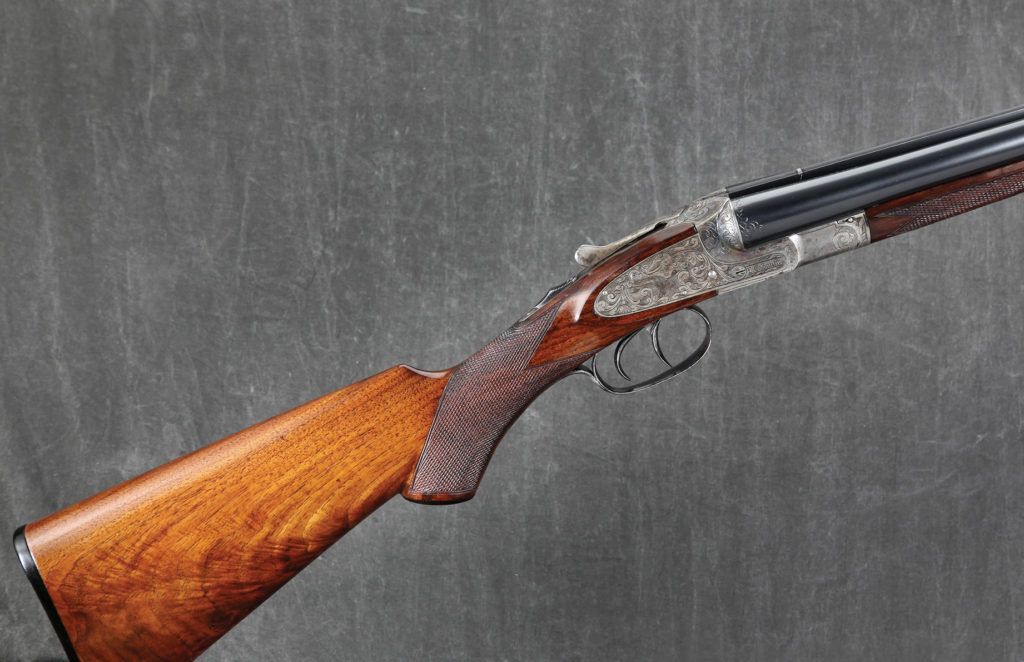
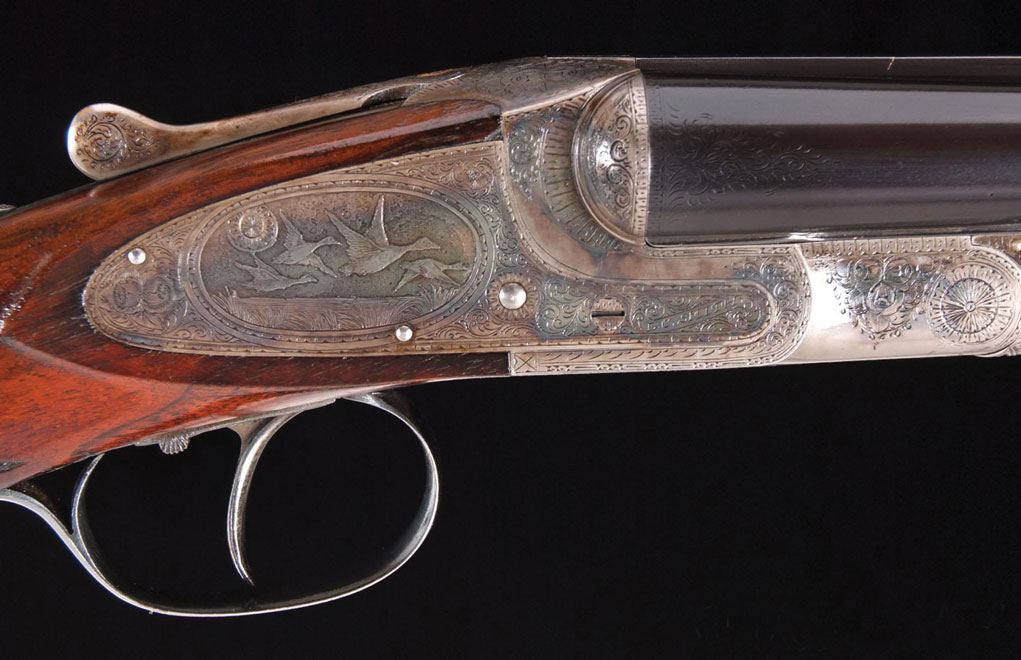
An Ideal Grade 12 gauge with foliate-style engraving, made shortly after WWI. Automatic ejectors were standard for this and higher grades. Photo: Courtesy Vintage Firearms.
The over/under has become well established in the States, thanks primarily to imported models. These models dominate the clay target sports and are preferred by many hunters. But the classic side-by-side appeals to the most avid shotgun aficionados, both hunters and collectors.
The ‘Elsie’
One name that stands apart from the other great American doubles because of its basic design is the L.C. Smith. The “Elsie,” as the brand is affectionately known, was a sidelock. All the others were built on a box-lock action. Not that there’s anything wrong with a box-lock — the Parker, considered by most experts to be the finest American shotgun ever produced, is a box-lock. So is the Winchester Model 21, the Ithaca, the Fox and the Lefever.
Sidelocks are more complicated and require a higher level of skill to manufacture. Some say they are more delicate than a box-lock, but that’s not always the case. The sidelock’s sideplates are removable and allow easy access into the gun’s mechanism for maintenance or repairs. Sideplates are attractive and lend themselves to just about any level of engraving desired. Some makers of box-lock models add false sideplates to give the guns more eye appeal.
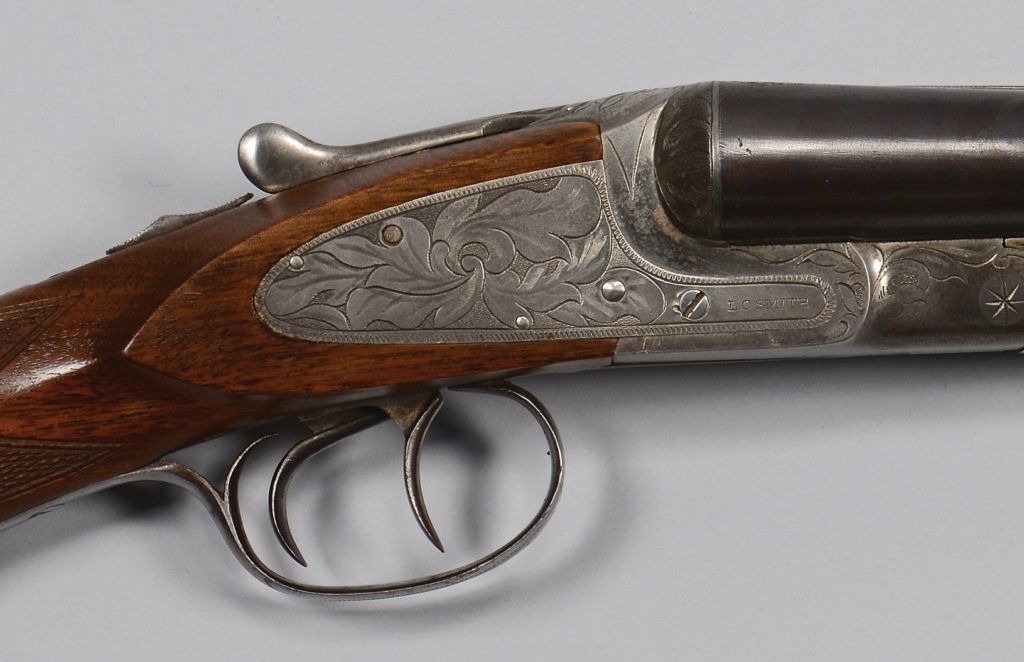
An Ideal Grade 12 gauge with foliate-style engraving, made shortly after WWI. Automatic ejectors were standard for this and higher grades. Photo: Courtesy Case Antiques.
Sidelocks are most often associated with the British, which contributes to what some consider to be snob appeal. The classic Purdey and Holland & Holland “best” guns are examples of the finest shotguns in the world and are built on sidelock actions.
The L.C. Smith Company has a rather complicated history. Lyman Cornelius Smith and his older brother, Leroy, entered the gun business in partnership with William H. Baker in 1877 to manufacture the Baker series of shotguns. These were outside-hammer models with sidelocks, Damascus barrels and in 10- or 12-gauge options. There was also a drilling-type three-barreled model consisting of a side-by-side shotgun over a .44 caliber centerfire rifle barrel.
In 1880, Lyman (L.C.) Smith bought out his brother and William Baker. Leroy Smith, William Baker and some other partners went on to form Ithaca Gun Co. L.C. continued to make the Baker guns, which were marked “L.C. Smith, Maker of the Baker Gun.” The Baker models were phased out beginning in 1884, and by 1886 newly designed hammer and hammerless side-by-sides were being made by “L.C. Smith, Maker.”
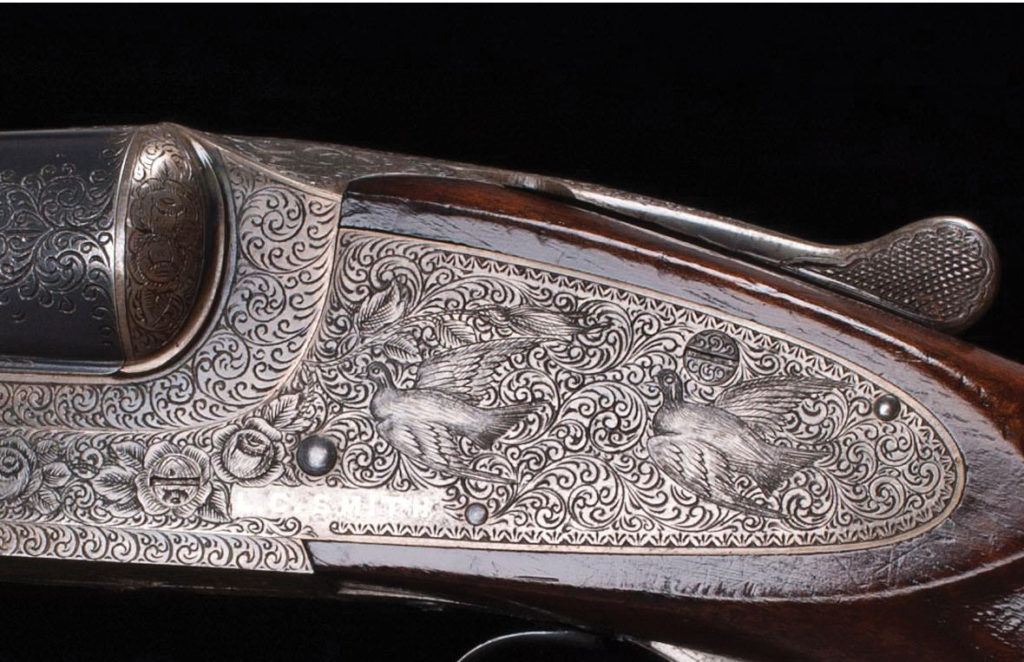
The Monogram was one of the three highest grades. A total of 206 were made and only 26 were in 20 gauge, like this example. Photo Courtesy Vintage Firearms
At about this time, L.C. was looking beyond the firearms industry for his next business venture. He was intrigued by the recent invention of a gadget that would eventually have as huge an impact on our culture as the firearm. It was called the typewriter, and Smith made the decision to sell his gun company and go into the typewriter business. In 1888 he sold the company to John Hunter of Fulton, New York, who formed the Hunter Arms Company and continued making the L.C. Smith shotguns in a new factory in Fulton. From 1889 until 1945, L.C. Smith shotguns were made by Hunter Arms Company. Meanwhile, Smith founded the Smith Premier Typewriter Company, which later merged with the Corona Typewriter Co. and became Smith-Corona.
A Winding Road
During the Hunter Arms era, many changes and advancements were made to L.C. Smith models. The 16 gauge was added in 1891, and in 1892, automatic ejectors were offered in some of the higher-grade models, which was the first time an American shotgun maker had done so. The 8 gauge was dropped in 1897, and in 1908 the 20 gauge was added to the line. A non-selective single trigger was offered in 1904. Years later, in 1926, the .410 bore was added. According to some sources, one 28 gauge was made. It was reportedly photographed in the hands of a member of the Hunter family. Apparently, it was a prototype and never went into production.
Hunter Arms ran into financial problems and during WWI, filed for bankruptcy and was bailed out by some Fulton, New York, businessmen. They in turn sold the company to the Simmons family in Massachusetts, who operated L.C. Smith until 1939 when it was put up for sale. After WWII, in 1945, Marlin Firearms Company acquired Hunter Arms. Marlin made the L.C. Smith guns until 1951 when, once again, it appeared that the company might be operating under some kind of curse. This time, the floor in the factory collapsed, destroying a lot of and equipment and inventory, putting an end to production of the L.C. Smith shotguns. But not forever.
Marlin resurrected the name once again in 1967 as a limited production model, making about 2,500 guns until 1971. This was the last of the L.C. Smith sidelock guns; however, the name was brought back again from 2005 to 2009 for a series of box-lock models — though with false sideplates — made exclusively in Italy by Fausti Stefano.
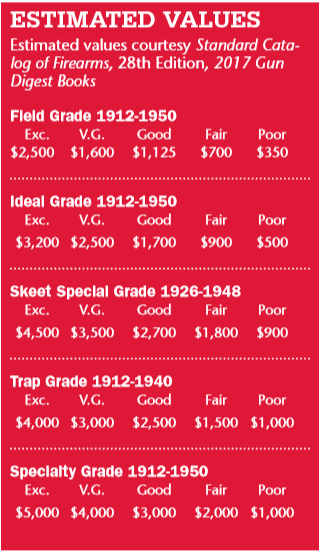
Collector interest is mainly with the earlier models. Attached is a sampling of estimated values for the early hammerless guns made in Fulton, New York, by Hunter Arms from 1913 to 1950. Values shown are for 12-gauge guns. Add 25 to 50 percent for 16 gauge, 50 to 75 percent for 20, 200 percent for .410 bore (field grade), 300 to 600 percent for .410 higher grades. Other premiums are expected for special features such as single selective trigger, non-standard barrel lengths or stock configurations.
The author would like to thank Rick Hacker for his input on this article.
Editor’s Note: This article originally appeared in the June 2018 issue of Gun Digest the Magazine.
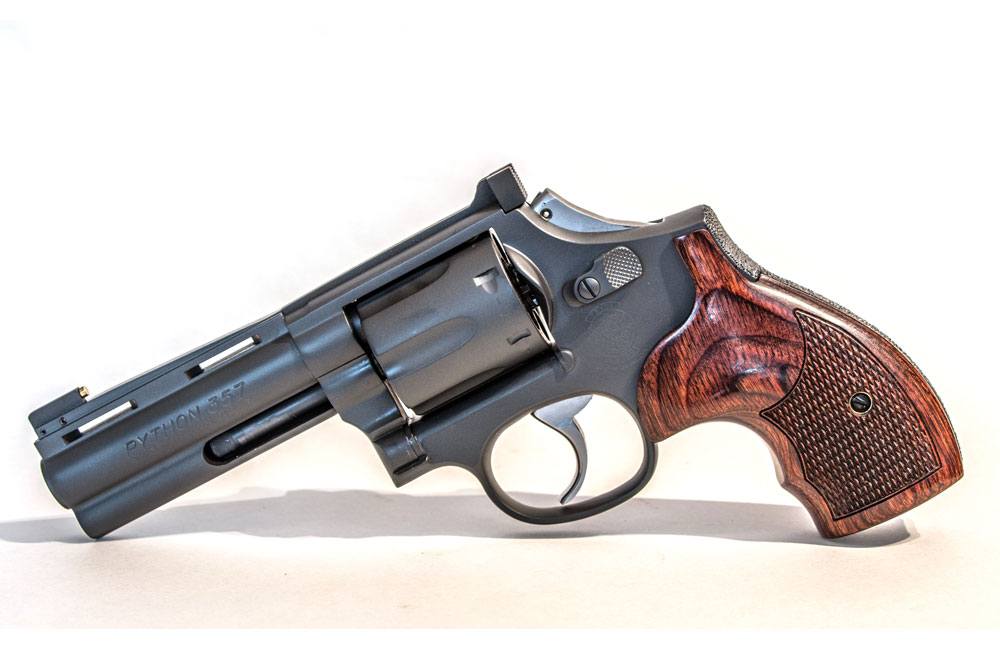
The Dove Custom Smolt — Smith & Wesson/Colt hybrid revolver — is not only a beauty to behold, it’s mesmerizing to shoot.
What is the custom S&W/Colt hybrid:
Combination of Smith & Wesson Revolver and Colt Python Barrel.
This type of hybrid was popular in the 1970s for PPC matches.
It is built off a S&W Model 66 fitted with a 4-inch Pyton Barrel.
It has a crane ball lock, a bobbed hammer and chamfered chambers.
The cyinder release is machined so its compatible with speed loaders.
It is 9-inches long and weighs 36 ounces.
The conversion cost around $1,400.
You never hear about a lot of cool, custom handguns because they don’t often appear in a magazine or on the internet. This is partly because there’s lots of competition for page space in both, and partly because the bigger custom shops have an employee dedicated to securing that coverage. These media relations experts make sure gun writers know about what’s new, and that they always have something to write about.
Popular in the ‘70s, the Smith & Wesson/Colt hybrid revolver — the Smolt — has almost been forgotten. That’s hard to believe since it is a thing of beauty.
Fortunately, I have one of the most talented gunsmiths in the country in my hometown. Jerry Dove of Dove’s Custom Guns has been plying his trade for a long time. He can make a 1911 run like a Swiss watch, is rapidly becoming a premier source for scout rifles, and can tweak the trigger on a lever action rifle so well that I’ll bet Timney Triggers is jealous.
But Jerry also takes on one-of-a-kind projects, like the “Smolt” he built for fellow Gunsite Academy graduate Nick Rukavina. A Smolt is the combination of a Smith & Wesson revolver and a Colt Python barrel. These hybrid creations were popular in the ‘70s when PPC (Precision Pistol Competition or Police Pistol Combat) was at the height of its popularity. Smolts had a revered reputation for accuracy but were difficult to create because the threads on the Colt barrel and Smith & Wesson frame were different.
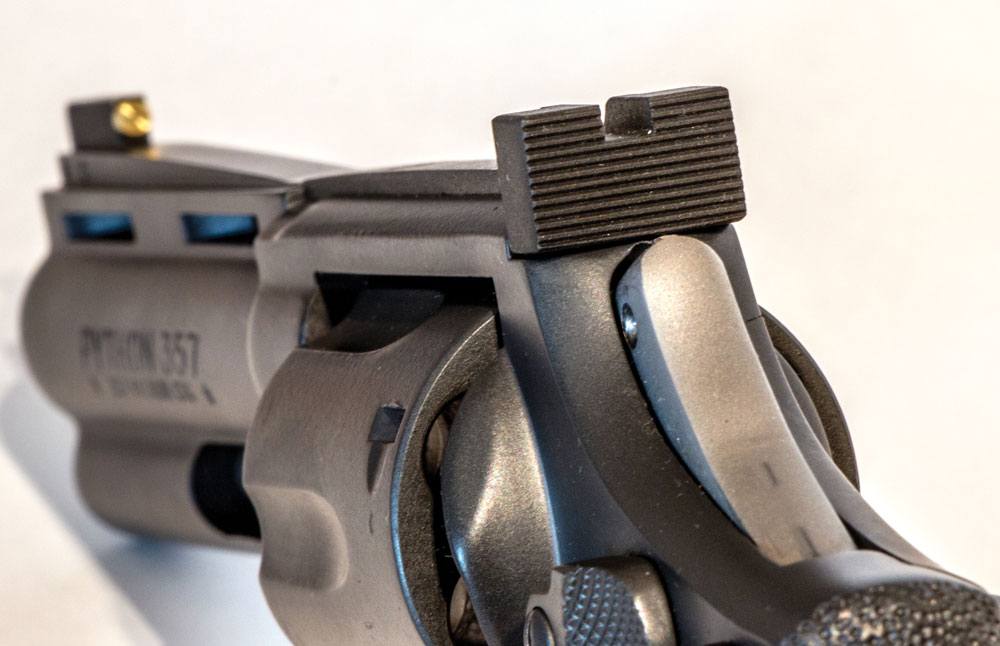
Not only did Dove meld a Smith & Wesson and Colt revolver together, he crafted a set of custom sights for the revolver.
During a visit to Dove’s shop, he showed me the Smolt he’d built for Rukavina. The revolver immediately mesmerized me. It balanced incredibly well, the trigger was exquisite, and it had a righteous, business-like look about it. I sent Nick a text and asked if I might try the gun out before Jerry shipped it to him. He agreed, I imagine because he wanted to make me jealous. It worked.
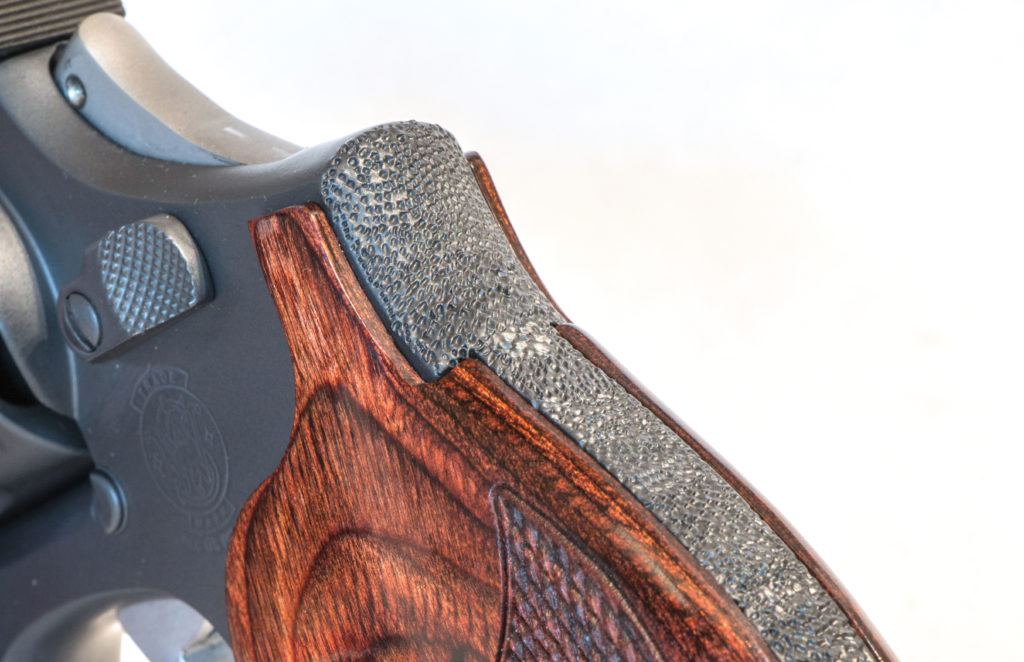
Dove started with a S&W Model 66. He fit the Colt 4-inch Python barrel, and hand-crafted his own gold bead front and rear sight. He then installed a crane ball lock, machined the cylinder release so it was compatible with speed loaders, bobbed the hammer, polished the trigger face, and chamfered the chambers of the cylinder. He also converted the frame to a round butt, stippled the back-strap and tastefully melted all the sharp edges on the gun. When he was done with all the metal work, he coated the pistol in sniper grey Cerakote.
The unique stippling Dove applied to the backstrap of the Smolt is tastefully done, and something usually reserved for custom semi-auto handguns.
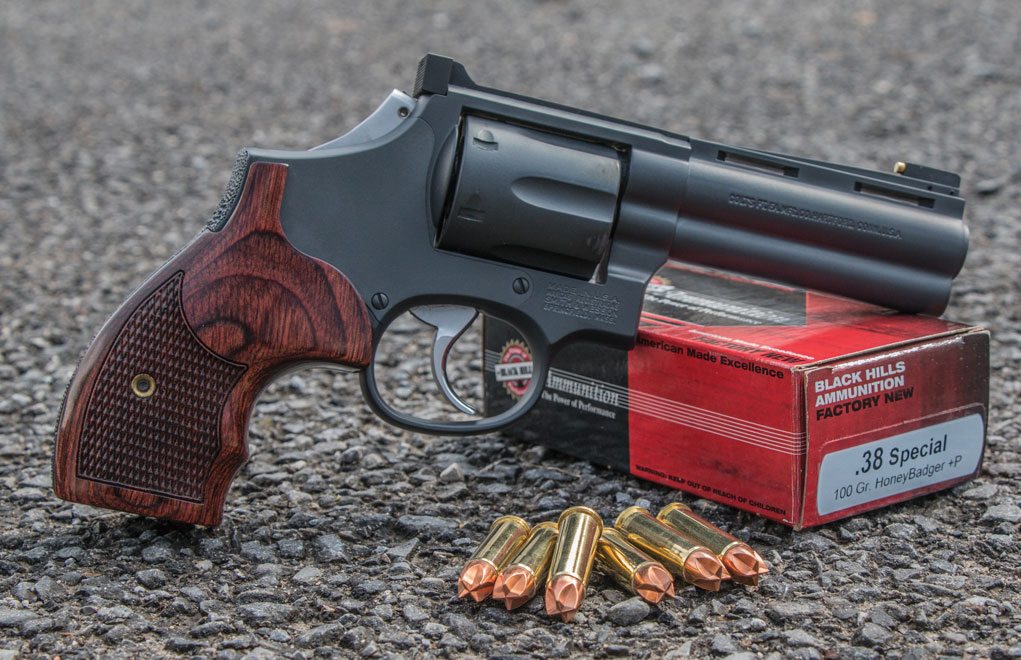
This finished work of gun-fighting art weighs 36 ounces, is 9 inches long, has a six-round capacity, and the double-action trigger glides through its cycle with only 6.5 pounds of pressure. With a box of +P 38 Special ammunition, I stepped out on my range and, after the first six rounds, I began scheming as to how I might talk Nick out of this exquisite hog’s leg.
I ran the revolver through my standard test drill, where I attempt to put five rounds, in a 5-inch circle, at 5 yards, in less than 5 seconds (the Forty-Five Drill), while drawing from concealment. My average time was 3.55 seconds, and I only missed one shot — the first shot. That’s only a few tenths of a second slower than my best runs on this drill with my custom Browning HiPower or Wilson Combat EDC X9. You’re a fool if you think a revolver is an antiquated weapon.
The Dove Custom Smolt — Smith & Wesson/Colt hybrid revolver — is not only a beauty to behold, it’s mesmerizing to shoot.
There’s always a downside with a weapon this wondrous: With a Smolt — a Smolt done right —it’s price. The conversion takes time and it takes the skills of a master gunsmith. Time always costs, and master gunsmiths have this seemingly unbreakable rule that they don’t do anything unless there’s a piece of gold attached to it. A similar conversion on your Smith & Wesson will cost about $1,400, and you’ll have to provide the Python barrel.
You’re probably thinking spending that much money on a revolver might be an indication of insanity. You would be wrong. I know Nick Rukavina. And while he might be a bit odd, he’s far from insane. I also got to shoot the Dove Custom Smolt, so I have what you might say is an inside look. Since then I’ve had dreams about it. If gun-lust is a sin, my outlook on eternity is bleak.
For more information on the Smolt, please visit: www.DoveGuns.com.
Editor’s Note: This article originally appeared in the June 2018 issue of Gun Digest the Magazine.
Hunting down a world-class over/under shotgun? It all comes down to fit.
It’s easy to dismiss all the makes and models of over/under shotgun as being the same – one as good as the next, right? If the world were only that simple. Like all firearms, there are certain facets you need to shop for when in the market for John M. Browning’s elegantly efficient design. And it goes much deeper than the grade of walnut and the embellishments on the receiver.
When it comes to spotting a gem over/under shotgun, few shooters know more than Dave Miller. The pro shooter for Aguila Ammunition and Guinness World Record holder for most clays broken in one hour (a mindboggling 3,653) makes his living behind the business end of them. And recently, Gun Digest Editor-in-Chief Luke Hartle was lucky enough to pick his brain on the on how to find a world-class shotgun.
Making no bones about it, Miller boils down the task of picking the right O/U to one word – fit. A smoothbore should shoulder, come to the cheek and point as naturally as if were an extension of your arms. And that doesn’t take a second mortgage to achieve, only the willingness to shop for the right length of pull and comb rise for your frame and shooting characteristics. Hunt this one aspect down like a birdy German Shorthair and more downed doves, ducks and clays will follow.
From there, it’s a matter of figuring out what you’ll focus on and how serious you are about it. For his own part, Miller swings a CZ All-American, tricked out to excel at the range – adjustable stock, able to accept drop-in replacement parts, bells, whistles, etc. The everyday dabbler looking to bang the brush during hunting season and break clays the rest of the time needn’t get so specialized.
In fact, Miller urges this type of shooter to draw a bead on a field gun. A bit more a Jack-of-all-trades, they’ll break blue rock from sun up to down, as well as keep you in fowl. The same cannot be said for a sport model. Certainly, if you’re a masochist, you can hump on along on your next pheasant hunt, but when you’re too tired to shoulder the 8-plus-pound beast at the end of the day you’ll have no one to blame but yourself.
Even with the tools to track down the right over/under shotgun don’t fool yourself. The tightest fit and most intuitive point won’t do anything unless you’ve put in the practice to get the most out of the gun.
For more information on Aguila Ammunition, please visit www.aguilaammo.com. For more information on CZ firearms, please visit www.cz-usa.com
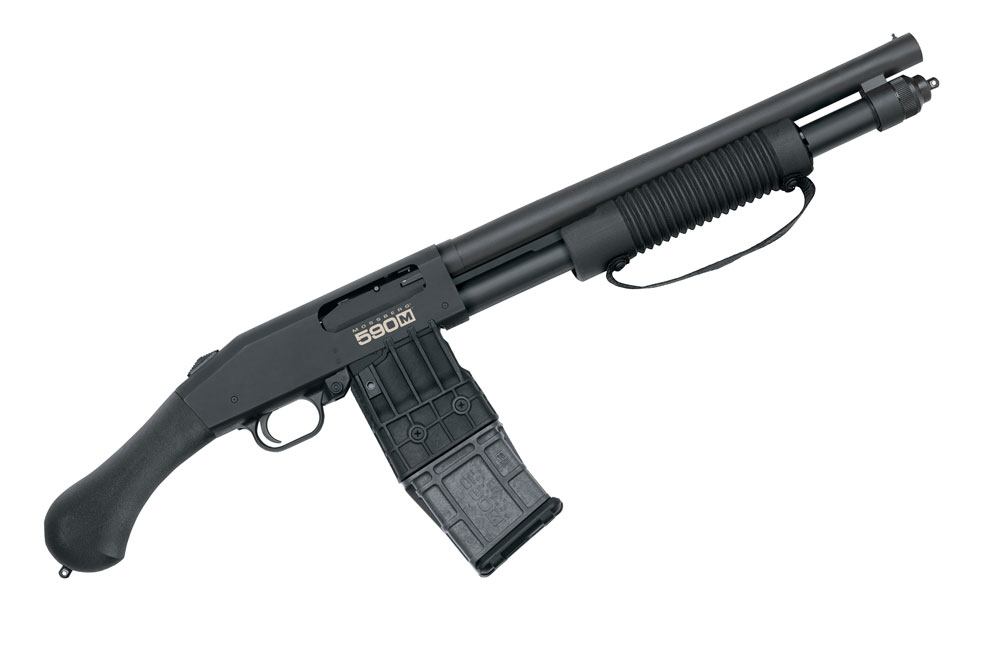
The 590M Shockwave provides overwhelming firepower and lightning-fast reloads with the addition of a double-stack detachable magazine.
How the 590M Shockwave improves on the pump-action platform:
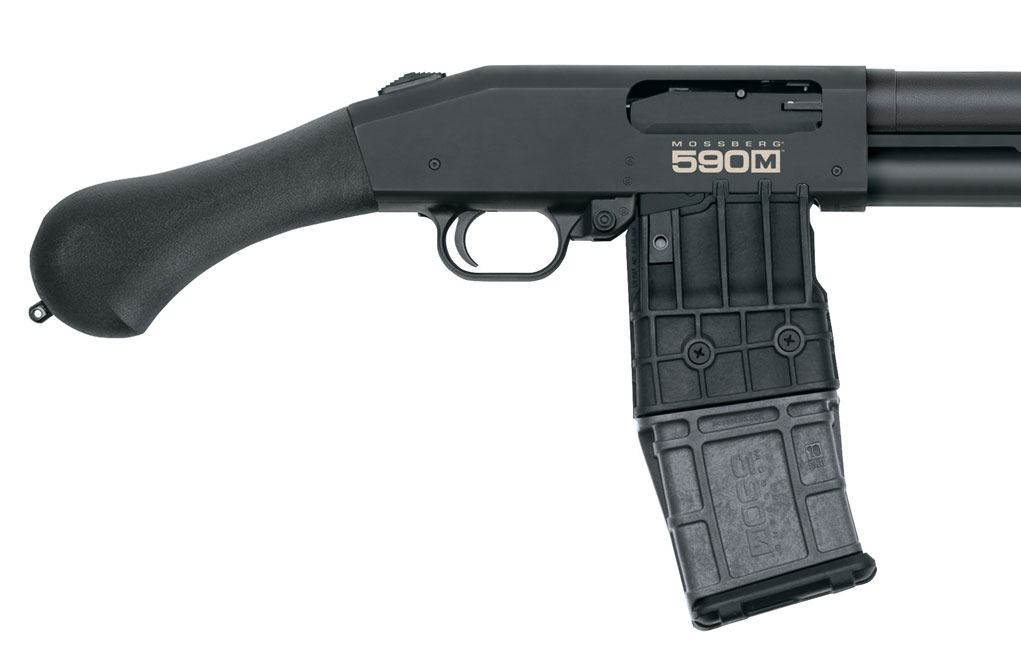
Fed from a 10-round detachable, double-stack box magazine.
Gives the base model a 10+1 capacity.
Lightning-fast reloads compared to traditional tube magazines.
5-, 10-, 15- and 20-round magazine upgrades are available.
Magazine release is ambidextrous and optimally-positioned.
Release and magazine situated not interfere with pump-action operation.
With the introduction of the 590 Shockwave, Mossberg made the tactical smooth-bore firearm short, sweet and wicked. And now, when it comes to firepower, it’s making the abbreviated pump-action platform overwhelming. The newly released 590M Shockwave 12-gauge mates Mossberg’s unique pistol-grip technically-not-a-shotgun design (more on that later) with the world’s first double-stack detachable box magazine meant for a shotgun. What comes out the other end is a nimble and devastating personal-defense gun that reloads in a split-second. Set up to give you a decided advantage, Mossberg’s freshly minted Shockwave is the ideal home-defense or truck-gun option.
Out of the box, Mossberg supplies shooters with a 10-round magazine, but offers versatility to the non-NFA firearm with aftermarket 5-, 10-, 15- and 20-round magazines. In all cases, the 15-inch barreled 590M Shockwave magazines have integral stabilizing ribs, which engage the magazine directly to notches machined into the receiver, ensuring a positive lock-up. The all-steel, heated-treated magazine release button and housing are optimally-positioned in front of the trigger guard for convenient, ambidextrous access for unloading and reloading. The location of the mag release does not interfere with the cycling of the action and maintains proper balance with a full-magazine located at the center of gravity point.
Based upon the proven Mossberg 500 pump-action platform, standard features of the $721 590M Shockwave include non-binding, twin action bars; positive steel-to-steel lock-up, dual extractors, anodized aluminum receiver drilled and tapped for the convenience of adding optics. The barrel is heavy-walled, and the magazine tube is capable of chambering 2 3/4 -inch shells.
Unique to the Shockwave platform, and providing its novel moniker, is the Shockwave Technologies Raptor pistol grip. The grip features an enhanced textured finish and has a “bird’s head” shaped-profile, allowing for maximum control while minimizing felt recoil. A glass-filled polymer with non-reflective, black finish, the 5.25-inches grip makes the 12-gauge’s recoil manageable and gives complete control over the gun. The cob-styled, tactical forend features a control strap, facilitating smoother operation.
The 590M Shockwave features an overall length of 27.5 inches, recoil-taming pistol grip (not designed to be shoulder-mounted), compact 15-inch barrel length and the convenience of magazine-feeding. By definition, the Shockwave platform is a “firearm” under the Gun Control Act of 1968 (GCA), and is not subject to the provisions of the National Firearms Act (NFA), although state and local laws may be more restrictive.
To learn more about the Mossberg 590M Shockwave, please visit www.mossberg.com.
Before you crack into the gas system proper, it’s good practice to check the status of your gas rings.
Worn gas rings effects and how to identify them:
Bolt will fail to lock.
Brass ejects to the rear.
To test gas rings remove the BCG and extend the bolt.
Stand on the bolt face, if it supports the weight they’re good.
Editor’s Note: This is the fourth article of four-part series dealing with direct impingement operated ARs and troubleshooting the gas system. Please check out Part 1, Part 2 and Part 3 of the series.
If your AR is still exhibiting cyclic performance issues after a good cleaning and lubrication, followed by the replacement of the buffer spring and maybe the buffer, you may have an actual gas system problem. With a clean weapon and a properly matched buffer spring, your bolt should be consistently locking to the rear on the one-round test and throwing casings within a few degrees of 3 o’clock on the angle test. Remember, a bolt that locks to the rear and throws brass toward the middle of the range is generally good to go and will continue to perform reliably if kept clean.
There are a few other items to consider, and while they’re not rocket science, they are more complex. An under-gassed gun (one that fails to lock the bolt to the rear in the single round test and/or throws brass south of 3 o’clock on the angle test) may have worn gas rings.
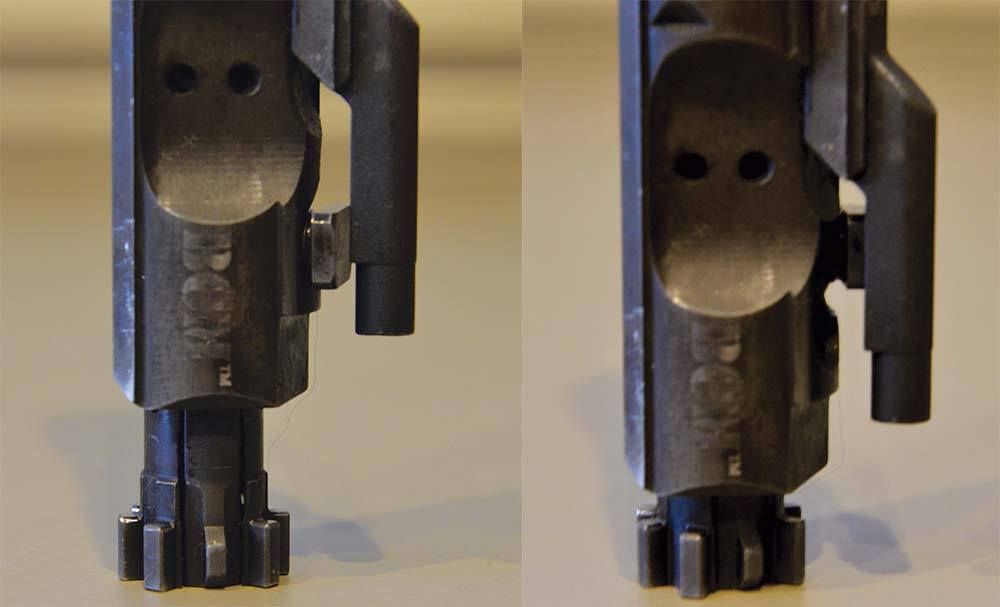
The traditional field test for the gas rings is to remove the bolt carriage group, pull the bolt head full forward, and stand the assembly upright on the bolt head. If the bolt head supports the bolt carrier without it sliding down, your gas rings are likely serviceable. If not, replace them. Worn or ill-fitting gas rings allow excess gas to past through the internal piston and not backward into the buffer spring system where it belongs.
If you find yourself in this boat, Bravo Company Manufacturing sells a SOPMOD bolt upgrade kit that will not only get you new gas rings, but also a new USGI extractor, ejector and appropriate springs for about $30. It’s one of those repairs you might as well make all at once, and a fresh extractor and ejector never hurt anyone.
Step 1 Remove the bolt carriage group, pull the bolt head forward, and stand the assembly upright on the bolt head. Step 2 If the bolt head supports the bolt carrier without it sliding down (left), your gas rings are good. If not (right), replace them.
If you’ve invested what is likely less than $50 for all these new parts (about the cost of a single hour from your gunsmith), actually cleaned your AR, and it still won’t lock to the rear after the single round test or has extreme or inconsistent angles of ejection, you may have a real gas system problem.
It could have several causes, such as the gas block coming loose from the barrel, a Franken-gun mismatch of parts or amateur gunsmithing. Take it to a qualified gunsmith, tell him what’s happening, and he’ll figure out the rest. He’ll likely have to replace or re-fit the gas block. Yes, it could be the bolt catch/release, or several other small items, but you have covered 90 percent of the basics and learned something in the process — probably that your gun was just really dirty.
Houston Astros pitcher Lance McCullers brings the heat at the shooting range.
Lance McCullers can bring the heat – on and off the mound. The starter in the winner-take-all game seven, the Houston Astros’ right-hander was key in delivering his club’s historic first World Series Championship. Thing is, he’s as wicked and accurate away from the diamond.
Trading his wipeout curveball for a straight-shooting tactical rifle, McCullers is equally effective. And on the next episode of Modern shooter, he showcases his all-star shooting skills at Houston’s MAST Solutions. Joined by former teammate Jason Castro, the major leaguers dominate the demanding situational training course like a couple of tactical pros. Then again, these guys not only live and breath baseball, but America’s other favorite pastime – shooting.
In fact, trigger time runs in McCullers’ blood.
Reared on a ranch outside Tampa, Fla., if he wasn’t working on his pitching mechanics, he was honing his shooting skill’s to a razor’s edge. It shows, McCullers is as cool behind the business end of a rifle as he is when up in the count. Furthermore, the righty as view firearms and shooting as more than a mere diversion, but a way of life.
Catch more big-league shooting action on this week’s episode of Modern Shooter 10:00 p.m. EST Friday on the Pursuit Channel. The episode rebroadcasts Monday at 12 p.m. EST and Tuesday at 11:30 a.m. EST.
Lucas Oil helps shooters find an extra gear when it comes to gun maintenance with a full suite of gun solvents, oils and cleaning products.
Slice it however you like, but cleaning your gun isn’t a ticker-tape parade. Sure, there’s the satisfaction you got the job done and your faithful shooting steel is clean and slicked up enough to attend a wedding. But if you’re honest with yourself, you’d have much rather cracked open a cold one, kicked up your feet and contemplated that afternoon’s beauty run at the trap range. About the only way gun cleaning can become intriguing is if it’s done faster and with less effort.
Lucas Oil might have found a way. Applying years of automotive lubrication knowhow, Lucas has jumped into the firearms maintenance game with a full suite of specialty cleaning products and gun oils. And for a bunch of gearheads, they seem right on target when it comes to firearms.
Gun Digest Editor-in-Chief Luke Hartle checks out what Lucas brings to the table in the above video and walks away fairly impressed. For example, a brief dip in Extreme Duty Bore Solvent and Ultrasonic Gun Cleaner and a fouled choke comes away clean, not in minutes, but seconds. Hartle isn’t the only one to have taken notice of this level of effectiveness. Quick as a drag race, a growing number of gunmakers have made Lucas the recommended brand for maintenance on their guns.
It really does appear Lucas has found an extra gear when it comes to gun maintenance.
For more information on Lucas Outdoors products, please visit: www.lucasoil.com
Throughout my career, I’ve interviewed victims of violent crimes. The circumstances leading to each of the attacks varied — some people were assaulted in broad daylight, some in the middle of the night. Quite a few of the individuals I interviewed were attacked by a stranger, but a frightening number were attacked by individuals they knew well and — at least at some point — trusted. These encounters happened in wealthy neighborhoods and poor ones, to both men and women, and with single or multiple assailants. But all these violent attacks share a common and very real feature: They all happened quickly.
There’s a widespread notion among gun owners that simply having a firearm in the home is sufficient to stop any attacker. But that’s only true if the attack offers homeowners plenty of time to respond, which is rarely the case. If you ask victims of crime — especially those who were at home when the attack happened — they will tell you that there was little time to react.
It just happened.
Being at home brings a sense of comfort and security. While we’re at the mall or when we cross a poorly lit parking area at night to our vehicle, we’re switched-on, ready for danger. In our homes, however, we are less focused. We aren’t thinking about danger, aren’t constantly checking our surroundings. And the 9mm pistol or AR rifle that’s locked securely in a basement safe isn’t very practical when you’re upstairs watching television and an intruder appears.
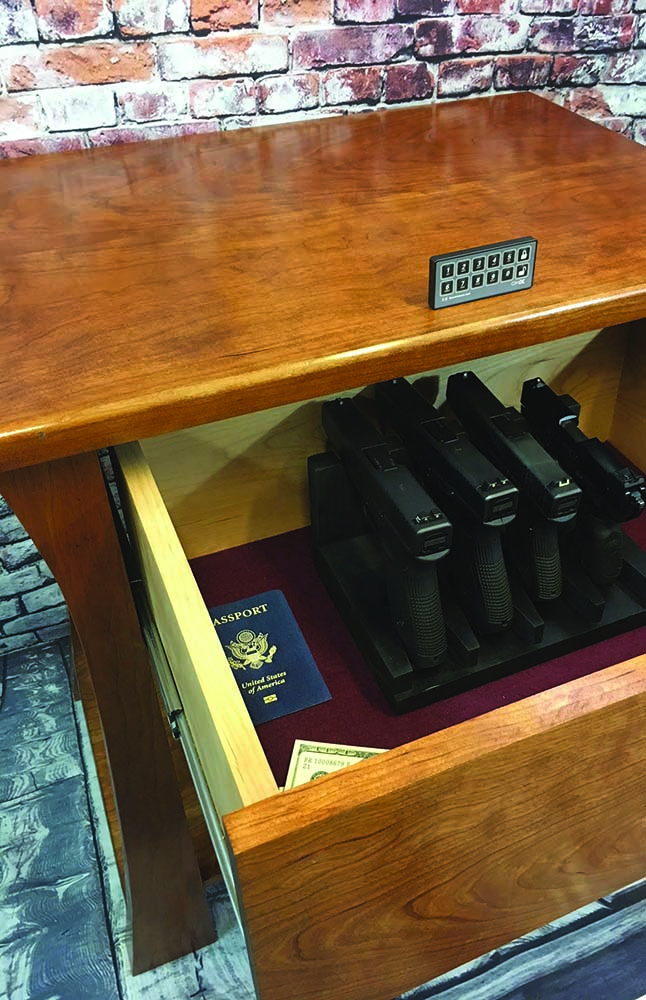
American gun owners are starting to realize this, and as a result, they want to keep their firearms close-at-hand. In recent years, there have been a number of companies that have developed innovative and effective hidden gun safe systems for the home — furniture, clocks, pictures and mirrors that serve double duty as functional household items and rapid-access gun vaults.
Here’s a look at the best hidden gun safe systems from four of the leading companies in the industry. All of these brands offer different items that will look natural in a variety of different interiors, but they all share one common and important feature — they’ll help you defend your castle. Quickly.
Tactical Walls
Tactical Walls founder Tim Matter served 4 years of active duty in the United States Air Force and earned a bachelor’s degree in industrial design from the Art Institute of Philadelphia, so when he couldn’t find a line of products for in-home firearms storage that suited his needs, Matter decided to design his own line of home concealment products.
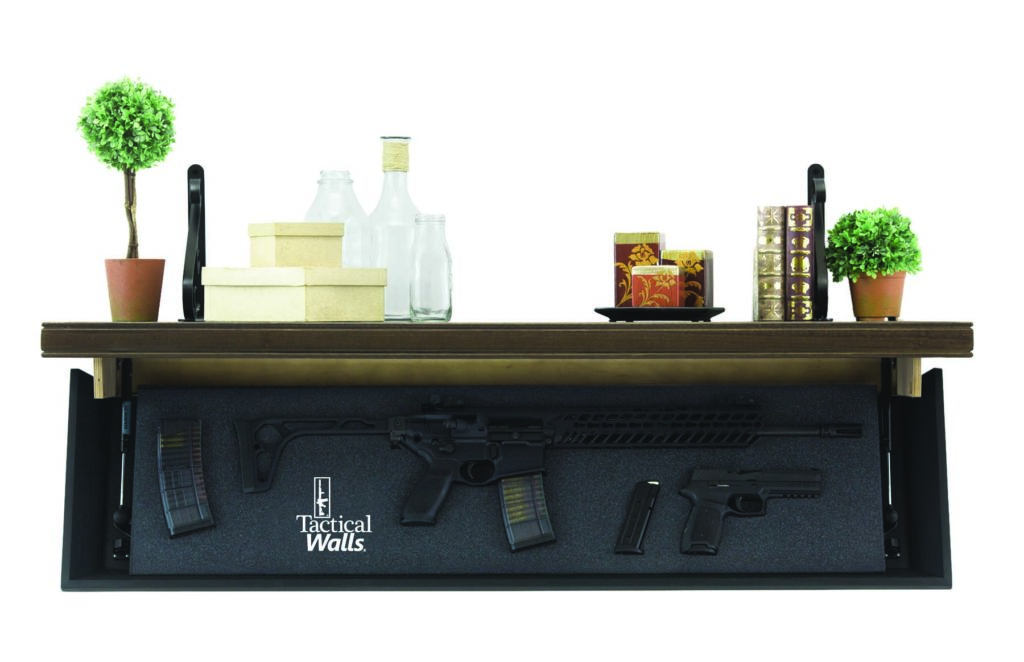
The drop-down shelf options from Tactical Walls offer inconspicuous and secure firearms storage. And with a magnetic or RFID locking mechanism, they are also quick to access.
His initial design was a full-length wall mirror, released in 2013, and since then his Virginia-based company has become one of the industry leaders in providing effective personal defense storage solutions and hidden gun safe systems for homeowners that are made in the USA with domestic components when possible.
That full-length mirror — the Tactical Walls model 1450 —and the shorter 1420 wall mirror became instant commercial successes. Both of these concealment mirrors are recessed into the wall between standard 16-inch studs, so the mirror unit sits flush with the wall for a natural look. Homeowners can access the firearms by disengaging the hidden lock with the provided key, and the mirror door can be installed to slide open to the left or right. Buyers can choose between magnetic or RFID locking systems, and there’s ample space inside to hold firearms, ammunition and accessories.
A shatter-resistant coating on the mirror and plywood backing offer an extra level of security, and there are a number of custom accessories available to personalize each security unit to customer specifications. The 1450M unit is 14 inches wide, 3.5 inches deep and has a short (10-inch) upper compartment and a larger (40-inch) lower compartment. The smaller 1420M offers the same width and depth measurements, and it contains a single 20-inch interior compartment. The 1450M starts at $499, and the 1420M costs from $370 and up.
Tactical Walls also offers a number of shelves that look natural in the home but contain drop-down firearm storage for either pistols or rifles. This style of hidden gun safe offers hidden locks that can be quickly accessed with the provided key, and when unlocked, they open to reveal hidden compartments with polyurethane foam inserts that keep your guns both safe and secure.
Each of these units is easy to install, and there are optional LED lights that illuminate the interior compartments for use in total darkness. Prices for pistol-length shelves start at $245, and the cost for rifle-length shelves starts at $399.
Also available from Tactical Walls is the 1410M Tactical Wall Clock, which is a stylish and functional non-locking security option that installs quickly and holds up to 10 pounds of guns and ammunition. The price for the Tactical Wall Clock is $129.
Liberty Home Concealment
Based in southern Missouri, Liberty Home Concealment is a family-owned company that builds a wide variety of stylish in-home security furniture using US-sourced materials when possible. They offer custom touches, and the turnaround time is incredibly fast, with many products available within a week.
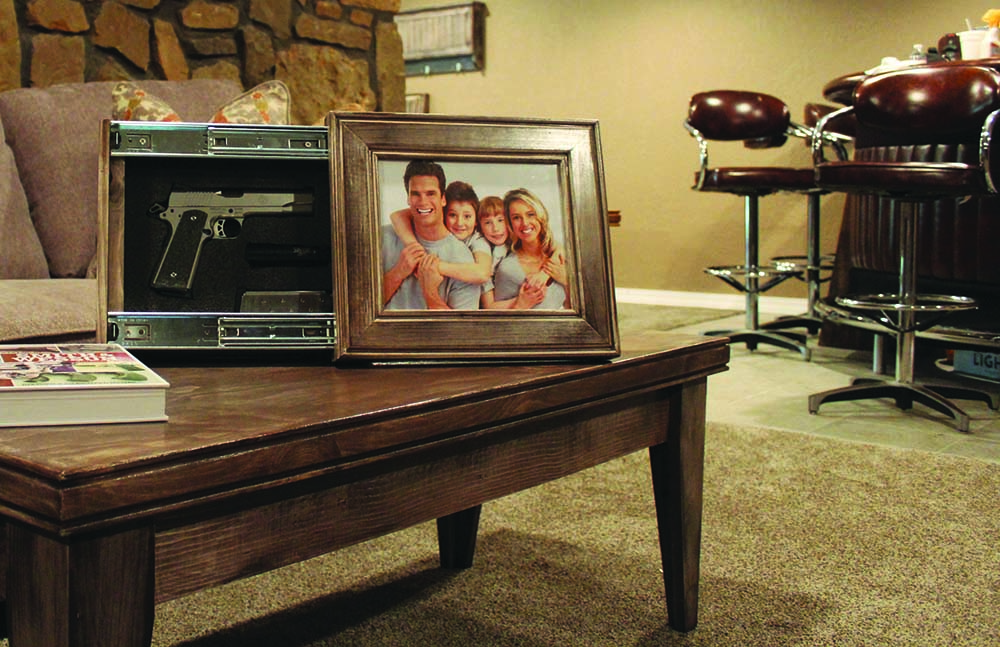
Liberty Home Concealment has a wide variety of safe, quick-access furniture and décor options. This 8×10 picture frame is just one example.
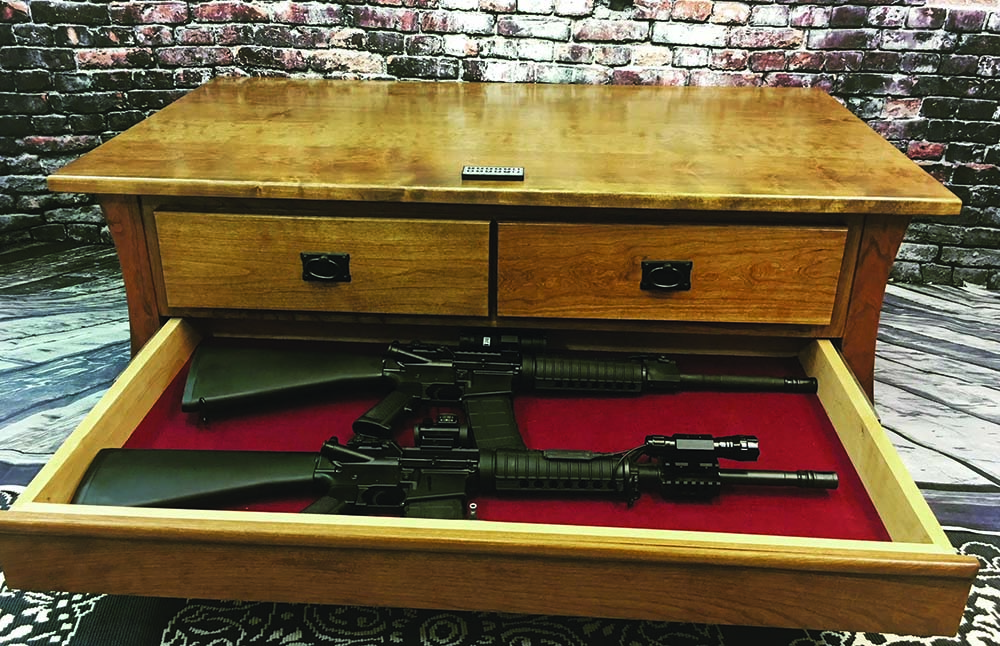
The brand’s “flagship” piece is, well, a flag — a wall flag, to be more specific — that securely conceals firearms in plain sight. But Liberty also offers a wide array of different hidden gun safe options, including end tables and coffee tables that incorporate sliding tops with foam-lined lockable interior storage space for rapid access to home defense weapons from primary rooms in the house. These items provide a rustic, natural look that is also functional. End tables start at $249, and coffee tables range from the Defender at $399.99 to larger models that cost $600.
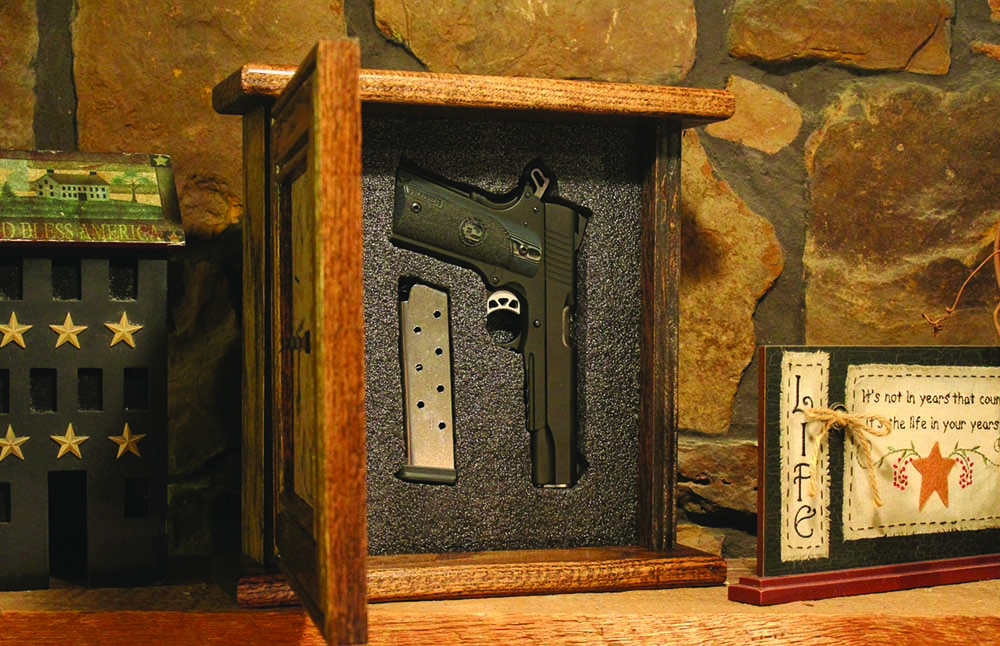
Liberty also offers a wide array of home décor items, including the compact Hidden Concealment Lamp, which has a hinged door and 6.5×8-inch interior dimensions to fit most handguns (an additional magnetic lock can also be installed); the pistol-sized Peacemaker Concealment Clock ($119.99) with foam insert; the Freedom Series Coat Rack ($299); and a variety of wall art options.
The Peacemaker Concealment Clock from Liberty Home Concealment just looks like a stylish piece of home décor to the uninitiated. The interior foam can be customized to fit many different firearms.
The company also offers a sliding wall mirror priced at $366.99, and a series of clever picture frame safes that range in size from 5×7 inches ($49.99) to 11×14 inches ($99.99). With so many hidden gun safe options and more that aren’t listed here, Liberty has a full lineup of home concealment products that keep your guns hidden, secure and quickly accessible from anywhere in the home.
Mirage Tactical
Jason “Lumberjack” Crago started his career building log homes in North Carolina, and when his twins were born he decided he needed to invest his skills in building tactical home furnishings that not only looked good enough to be placed in custom log homes, but also provided rapid access to defensive weapons while keeping those firearms out of the hands of his small children. Jason rapidly added to his line of home defense furniture and decor items, and his company — Mirage Tactical — has grown to become one of the most trusted names in the industry.
Products offered by Mirage Tactical include Personalized Hidden Canvas Picture Frames of various sizes that serve double duty as wall art and hidden gun compartments. There are two construction options available — steel with vinyl or wood with canvas — and you can customize the print as desired. Even the smallest print (19x19x2.5 inches) is large enough to hold multiple handguns and magazines, and there are also larger options available for additional firearms or long guns. The mid-sized (19×28-inch) model costs $249, and the largest canvas, which measures 28×28 inches, is suitable for longer firearms at $399.
Mirage Tactical offers concealed canvas frames that provide discreet firearm storage. It also has a number of other furniture and décor options available.
All of these prints come with rubber-coated barrel mounts and felt backing with magnets that securely hold your guns without the risk of damage. Plus, each hidden gun safe is available with the upgraded security of a wireless locking mechanism as an option.
Also available from Mirage Tactical is the Whiskey Barrel Coffee Table, a stylish and functional centerpiece for your living area complete with a flat-top design that lifts up for storage. Available material options include oak, maple or cherry, and buyers can select from a variety of colors. There’s a hidden compartment in the barrel that holds a small pistol, and if you’d like you can even have a custom humidor added with purchase. MSRPs for the Whiskey Barrel Coffee Table starts at $699.
Mirage Tactical Secret Shelves are also a great option for in-home concealment, and these solid-wood shelves are easy to install, feature reinforced steel compartments and have magnetic interiors with felt to protect your firearms. Available lengths include 12, 18 or 24 inches, and a wireless locking mechanism is available on the 18- and 24-inch models. Mirage also offers a full-line of end tables, nightstands, headboards, credenzas and a variety of other items with storage options, and many of these products can be customized to your preferences.
Top Secret Furniture
Prior to founding Top Secret Furniture, Bill Meginnis served as a police officer in Chicago. In that line of work, Meginnis responded to robberies often, and in each case, he noted that the items victims were most traumatized to lose were family heirlooms that couldn’t be replaced. In addition to his law enforcement career, Meginnis was also a woodworker, and when a client asked him to build a piece of custom furniture with hidden compartments to combine safe storage and rapid access, Meginnis began the process of developing a line of custom furniture that was both beautiful and functional. That passion led to the founding of Top Secret Furniture based in Arizona.
Founded by Bill Meginnis, who served as a police offi cer in Chicago prior to starting the company, Top Secret Furniture produces an assortment of home concealment options. And, unlike manufacturers that only offer production models, Top Secret can create something according to unique specs a buyer provides.
The company’s product line is extensive and includes the Bella ($895), Big Daddy ($1,277) and Hideout ($1,049) end tables; the impressive Chicago Lockdown Media Center ($3,974); and the Top Gun Night Stand ($1,377), just to name a few. Top Secret Furniture also offers a line of wall art that serves to conceal firearms in plain sight, including the Top Secret Wall Shelf ($147) and Wall Clock ($595) as well as a variety of other items that are easy to mount and access. One of the reasons that Top Secret has met with such success is that all of their hidden gun safe systems are built with solid wood, and no detail is overlooked. Drawers have dovetail joints front and rear, and every detail is examined repeatedly during construction.
Unlike companies that offer only production items, Top Secret features full customization of their furniture products. Each purchase, then, generally begins with a discussion with the customer regarding their exact wants and needs. Want to buy an end table but need it to be a few inches higher than standard specifications? That’s not a problem. Have a photo of an item that you’d like the Top Secret team to build? A consultation with Meginnis will help you start on the road toward designing your one-of-a-kind heirloom piece that’s as functional as it is good looking.
As you might expect, options abound, including both RFID and magnetic locks and custom finishes, so if you have an idea for a piece, Top Secret can help walk you through the building process.
It took a while, but all your friends have an AR-15, and now you’re finally determined to pull the trigger. (OK, we start with a pun. That’s the way it’s going to be?) But, they are everywhere. And they’re made by everybody. What to do? How to choose?
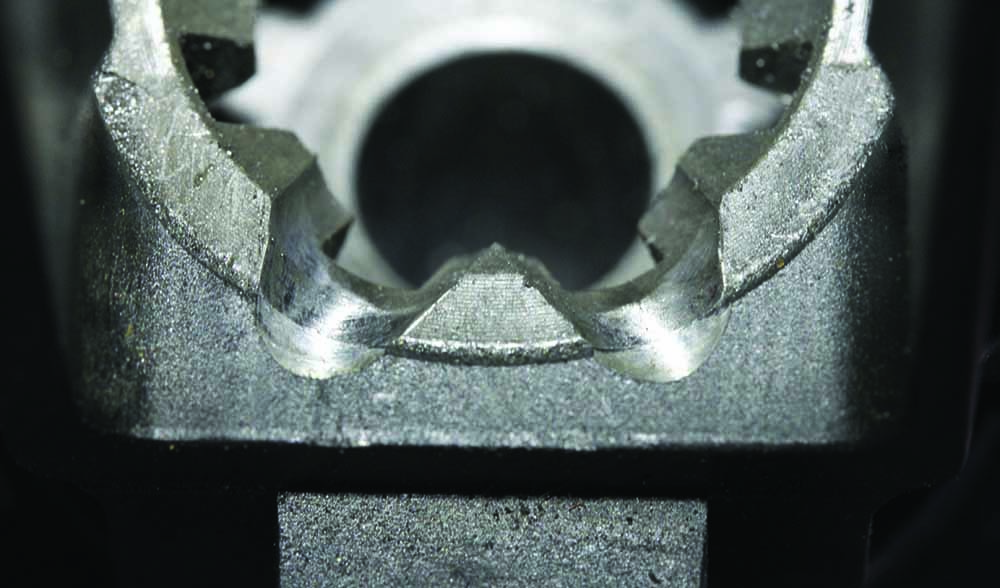
Look for ramps like these. If the ramps don’t come down past the edge of the steel into the aluminum, pass on that rifle.
Before we dive into the details, may I make a suggestion? Make your first AR-15 (there will likely be others later on) a relatively “normal” AR? It will be a pretty steep learning curve as it is, and adding in exotica may be overwhelming.
Caliber
First, decide what you want in caliber. A vanilla-plain .223 Rem./5.56 NATO? That’s the easy choice, because ammunition and magazines are everywhere. Also, plain old .223 Rem. is the least expensive of the ammo choices for the AR. However, if you want something in another caliber, just be sure you’re picking for the right reason. Do not buy an AR — say .204 Ruger — expecting to be able to find ammunition appropriate for defensive use.
Size
Second, decide on size. An AR that might be used for hunting as well as range fun and occasional competition can be larger and heavier than one you keep in your car for travel defense. Weight factors into this. If you’re 5 feet, 8 inches tall, don’t buy a bull-barreled rifle-length AR if your plans are for anything other than sitting at a bench and punching small groups on targets. Hauling that to the hunting blind, or running through a 3-gun match with it, will more than dampen your enthusiasm.
Barrel Length
An aspect of size is barrel length. Your two real choices are rifle length (20 inches) or carbine length (16 inches). The 16-inch barrel will deliver all the velocity you’ll need or want. If you must have the extra 100 fps, then accept the extra length. Shorter than 16 inches is handy, but it comes with extra costs: the cost of the tax stamp in order to make it an SBR. (Unless you go the AR pistol route, but that’s a divergence from this briefing.) You also pay in velocity loss, noise gain and just a bit more recoil.
Gun exotica is fun. A piston-driven SBR, with a suppressor on it, is a blast — but learning the AR ropes before you get there will be even more fun. Start simple.
Stock
Third, what stock? If you want a lightweight house gun or truck gun, then you’ll opt for a tele-stock. Which particular one is a matter of comfort — if comfort matters. Some people don’t find any particular one more or less comfortable than the rest.
The great thing about the AR is that stocks can be changed. If you have a tele-stock, you can swap off the sliding part for another one. Try them. Swap them. Even the “expensive” ones aren’t very costly.
Sights
Last we have sighting systems. Will there be a scope in your AR’s future? If so, you simply must get a rifle or carbine with a flat-top receiver. If your plans are for iron sights only, you can install folding (or non-folding) irons on your flat-top, or select an AR with fixed iron sights, just like in the old days.
Grips
Pistol grips are so personal, so inexpensive — and so much a fashion as well as a comfort item — that you can pick and choose. Pistol grips are easy to change, so we won’t worry about those. Shoot what you like.
What’s left are handguards — or forearms, if they’re cantilevers.
Plinking is fun, but competition (and training) can really teach you a lot. Once you have your AR, don’t be afraid to go out and use it.
Handguards: Fancy Vs. Function
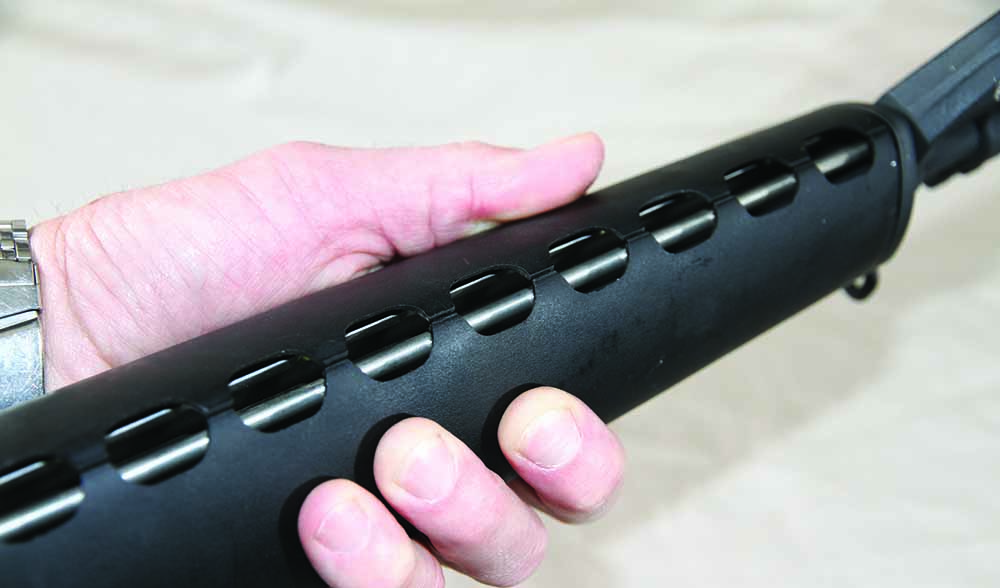
The handguard is the part that keeps the hot barrel away from your hands. They used to all be triangular or cylindrical pieces of plastic, slipped under brackets front and rear. Now, they’re attached to the upper receiver at their back end and don’t touch the barrel at all. Or, they clamp on to, or replace, the barrel nut — and again, not touching the barrel at all. These are free-float handguards, and they allow your barrel to be all it can be.
Everyone makes an AR-15 with free-float handguards, and unless you are determined to go “retro,” you’ll have to make decisions.
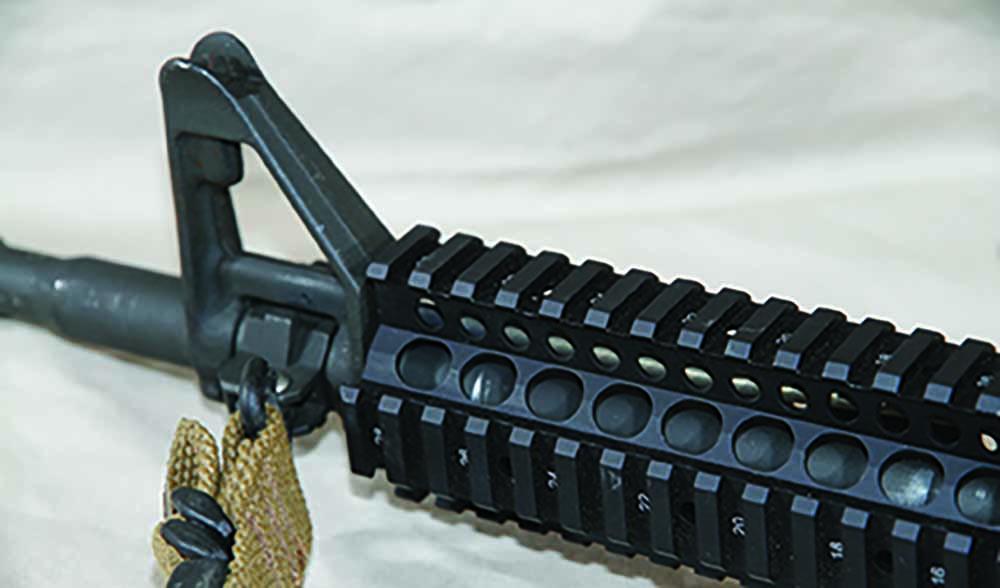
First choice: quad rail or not? The quad rail is one with a rail section, not unlike the old Weaver rail, on each of the four cardinal points of the handguard. The advantage is simple: You have full freedom in bolting on accessories. The cost is also simple: The quad rail weighs more, and is larger in size, than the non-quads. I have big hands, and yet I dislike quad rails. If your hands are average, you may find it just too big. Non-quad handguards are much slimmer and lighter.
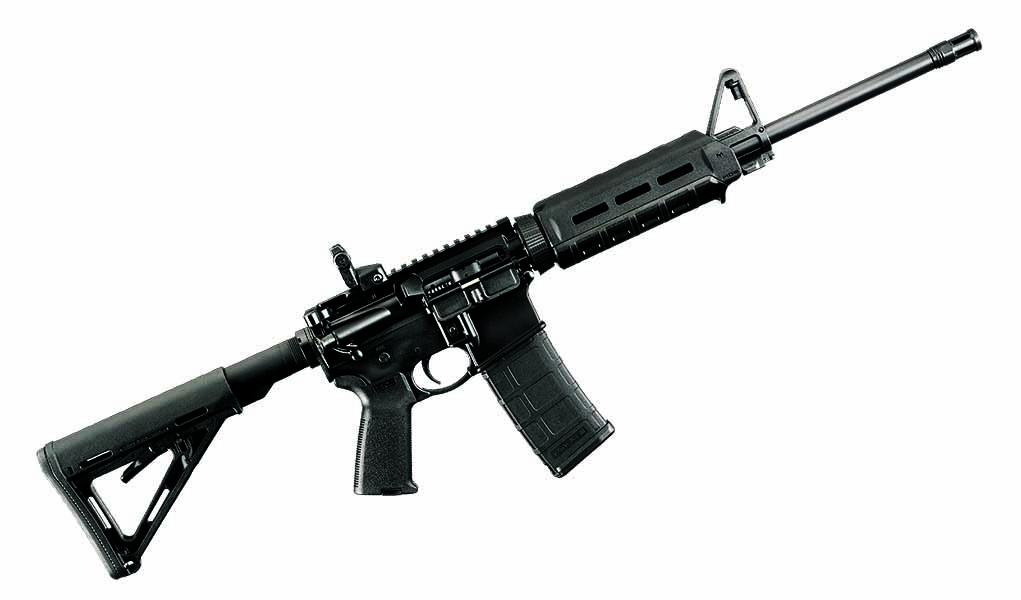
And here we have another decision point: The non-quads use slots in the handguard tube as attachment points for your accessories. There are two competing designs, and they’re not compatible with each other. Those are Key-mod and MLok.
With rare exceptions, the gas key on your carrier must be staked. Failure to do so will result in a malfunction sometime down the road.
Key-mod was the first, but MLok has advantages, and it has been winning the rail wars. There are still plenty of accessories made for Key-mod handguards, and there will be for a long time. So, if you find a smokin’ hot deal on a rifle with Key-mod, buy it.
Barrel Twist
Another choice: barrel twist. This is a different detail than weight or length. The twist is the speed of rotation of the rifling to rotate the bullet, denoted in how many inches it takes to make one complete revolution, as a fraction. So, a 1/7 barrel completes a turn in 7 inches, a 1/9 in 9 inches, and so-on.
You have three choices, only two of which actually matter. The original twist, 1/12, cannot stabilize a bullet heavier than about 60 grains. And no, the 62-grain “green tip” is not close enough. If you have a 1/12 barrel and green tip ammo, accuracy will be worse than miserable out to 25 yards. Past there it will be non-existent.
You will be told that “real men” only opt for a 1/7 barrel because that’s what mil-spec dictates. Meh. A 1/9 barrel will shoot even the heavy military ammo with 75- or 77-grain bullets well. If you must have a 1/7 barrel, fine. But if you get a deal on a 1/9, don’t pass it up.
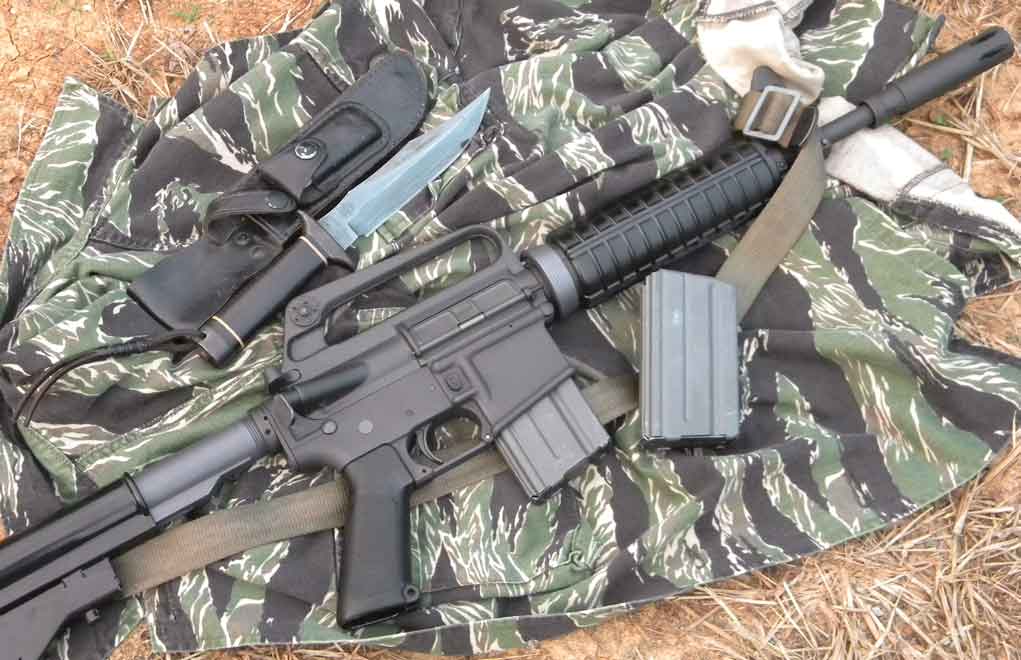
Unless you go “retro,” you’ll not likely see a set of handguards like this. These come on old, A1-model ARs, and the world has moved on since 1972
Twists faster than 1/7 are the province of long-range target shooters who will be firing bullets of 80, 90 and even 100 grains. This is not you.
Construction Material
What steel? Chrome-lined, Melonite or stainless-steel? For the new shooter, they’re all good. They will all last you 10,000 rounds of fun shooting. If you can get a better barrel for not much money (and you have to decide how much is “not much”), then do it. Otherwise, don’t worry.
Assessing Overall Quality
Now, look at the details of the actual build — the actual rifle or carbine in front of you.
Once you’ve made sure it isn’t loaded, check the fit of the upper to the lower. Gone are the days when ARs left the factory wobbly. Everyone expects a tight fit, and makers know this. If the upper wobbles on the lower, hand it back and try the next one. If the fit is tight, on to the next step.
The quad-rail handguard was popular from the mid-90s to about 2010, but they have weight issues.
Fixed stocks are not a problem. If they seem loose, a bit of work with a screwdriver will tighten it up. With a tele-stock, look at the ring around the buffer tube, right behind the receiver. This is called the “castle nut.” The castle nut will have notches in it. The larger of the notches must be to the rear. They are what the assembler used to tighten the castle nut, which secures the rear plate and tube in place. I’ve seen them with the small notches to the rear, and I can’t imagine how they even got them tight, let alone passed final inspection before being shipped.
On the front of that ring, in the small notches, the edge of the receiver plate should be staked into the notches. This is done with a spring-loaded punch, or a chisel and hammer, to make sure the castle nut can’t loosen. The staking can be aggressive or marginal, but it must be done. If there’s no staking, hand the rifle back and most likely knock that brand off of your list.
As an aside, the buffer tube itself can come in one of two diameters: mil-spec and commercial. You’ll need to know which you have if you go to replace the slider, but otherwise not. The precise way is to measure with dial calipers. Mil-spec tubes measure 1.148 inches and commercial measures 1.168 inches. They can have four, five six or even seven stops for length adjustment. Look at the threads on the tube. If the threads behind the castle nut have been machined down, it’s a mil-spec tube. If the threads are sharp-topped all the way back to their end point, it’s a commercial tube.
Open the action. Pull the bolt and carrier out of the upper receiver. You’re going to check two things: one on the carrier and one on the receiver.
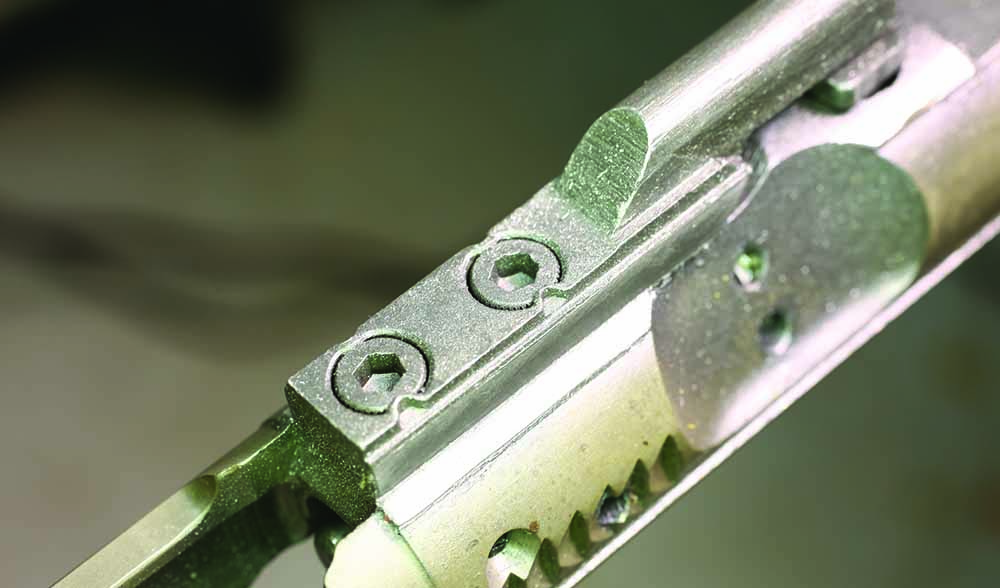
On the carrier, look at the gas key on top. There are two bolts holding it on. Just like the castle nut, these screws have to be secured in place via staking. There’s no such thing as an elegant, secure staking job. The more mangled the top of the key looks, the better-staked it probably is. Un-staked? Pass on this one. An un-staked carrier key is worse than an un-staked castle nut. It will work loose, and your rifle will malfunction as a result.
Now, you could buy a rifle or carbine that has nothing staked and do the staking yourself, but they’re signs that the maker has cut corners. Who knows what else they left un-done or did cheaply. A good enough bargain makes it worth the risk — once you know what you’re doing.
Finally, peer down at the chamber. Look under the locking lugs of the barrel extension and see if the feed ramps extend down into the aluminum portion of the receiver. These are known as “M4” ramps. You want them, even on a rifle. They increase reliability. They’re essential on a carbine and good on a rifle.
You’ve not got the best chances of buying a well-built rifle or carbine, with the features you want the details you must have. Be sure and stock up on magazines and ammo, and find a gun club where you can fully wring out the capabilities of you and your rifle.
Editor’s Note: This article originally appeared in the 2018 Shooter’s Guide issue of Gun Digest the Magazine.
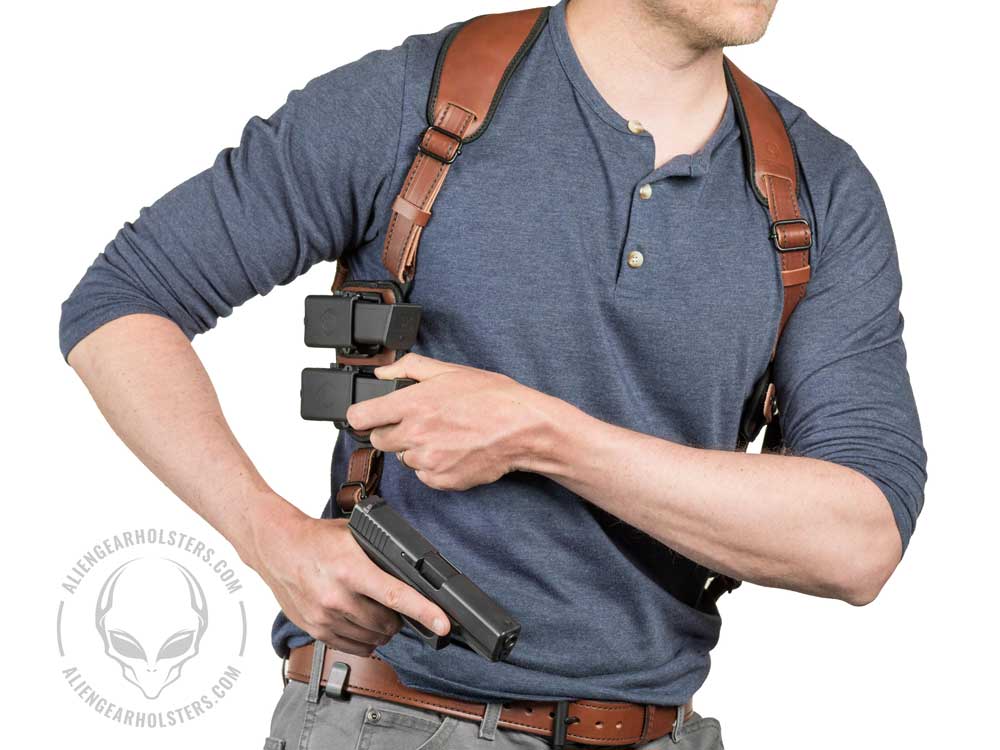
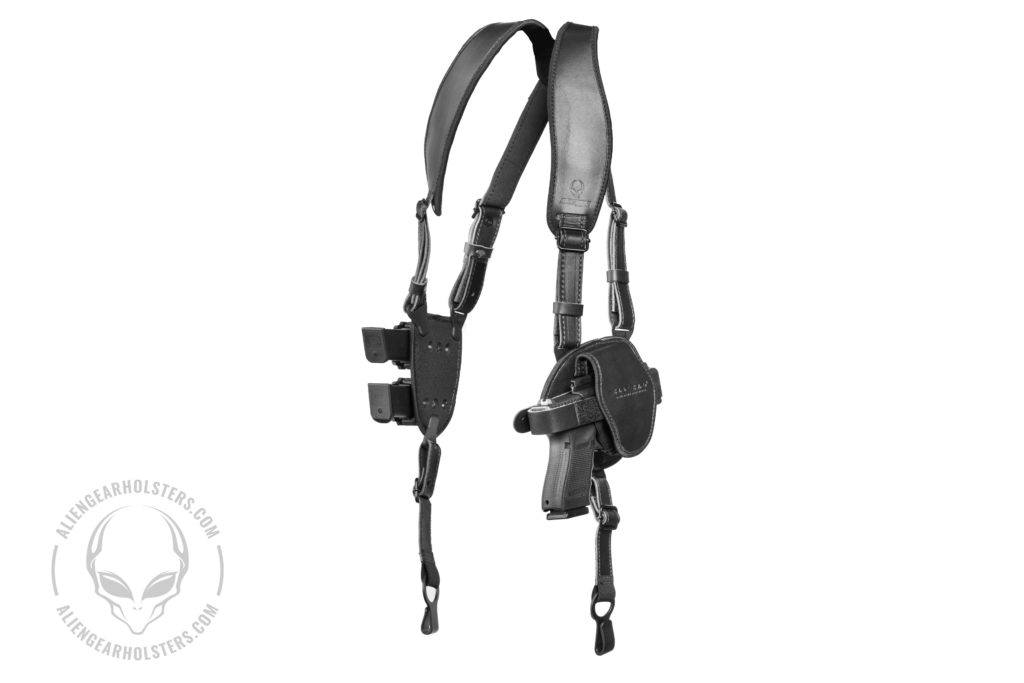
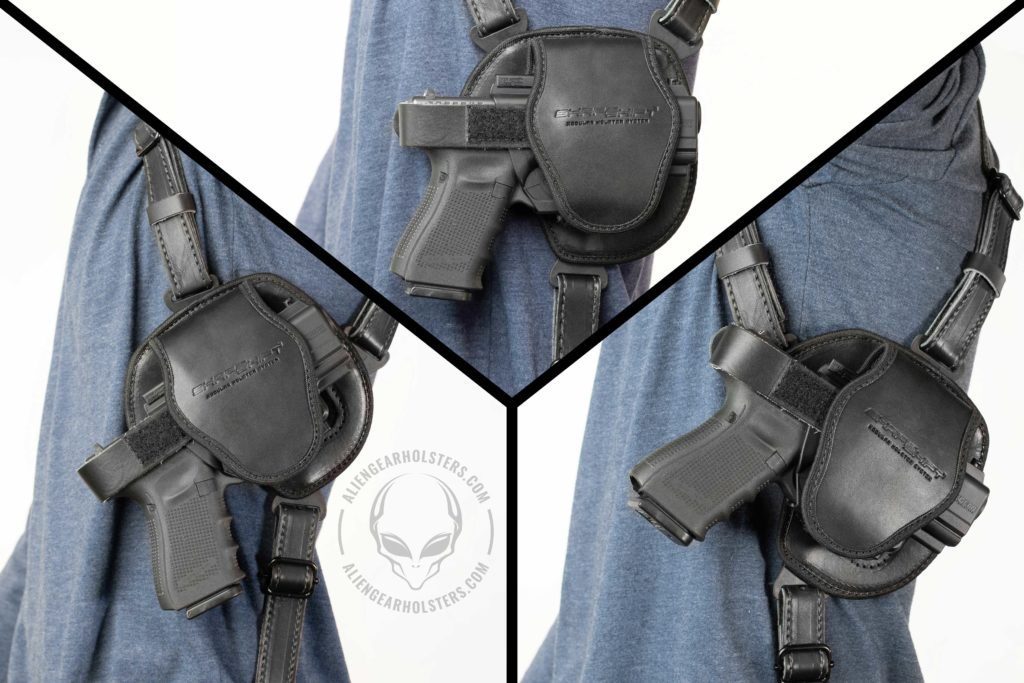
ShapeShift Shoulder Holster brings a new level of comfort and utility to the unique carry method.
How the ShapeShift improves on the shoulder holster:
CoolVent neoprene prevents straps from digging into shoulders.
Four-point anchors (shoulders and belt) keep holster in place.
Padded paddle stops gun from bitting into side and protects firearm from body moisture.
Adjusts to any cant angle.
Modifies to any body size in seconds.
Level III retention.
Compatible with exsisting ShapeShift modular holster system for IWB and OWB carry.
MSRP $133.88.
Blame the silver screen. When most of the un-anointed hear the term concealed carry, they conjure up visions of shoulder rigs. You can’t fault them, considering the volume of manatee undercover cops and sharp-dressed bad guys who kept their heaters hanging right along their rib cage. Imagine the neophytes’ shock when they find the style of carry is somewhat a rarity compared to nestling a handgun at some clock point on the belt line.
Uncommon when measured again inside- and outside-the-waistband systems, shoulder holsters still make sense for many armed citizens. Be it tramping the woods with a hunting revolver or requiring handgun access in a position that makes the tried-and-true 3-o’clock position unwieldy, placement on the upper body is as logical as a mathematical proof. And Alien Gear has made the carry preference all the more practical with the introduction of its rather ingenious ShapeShift Shoulder Holster.
Utilizing the company’s cutting-edge ShapeShift modular hybrid system, Alien Gear has cooked up an agile shoulder rig that addresses many of the common complaints of this unique method of carry. Chief among these is comfort.
Anyone who’s stepped out with a shoulder rig knows the systems can feel like yoking up to plow the back forty. Not the ShapeShift Shoulder Holster. With advanced light and comfortable materials (CoolVent neoprene), the holster’s English bridal leather resists digging into tender spots, remains situated on the shoulders and moves naturally with the user. Furthermore, belt anchors keep the rig in place, even through the most strenuous situations, so a sidearm is where it’s expected when it matters most.
The ShapeShift holster itself is a marvel. Designed to modify to nearly any form of waistband carry, the hybrid unit is versatile and well suited to the shoulder system. A vented and padded paddle holds a handgun back from nipping at a shooter’s side while remaining breathable and protecting the firearm in a potentially musty carry position. Moreover, it adjusts to any cant and elevation a user desires ensuring it adapts to a particular user’s body and carry preferences. If that’s not enough, the ShapeShift Shoulder Holster provides Level III retention, including adjustable passive retention, thumb release and a thumb break.
The system modifies to fit any user in seconds can configure to hold a single gun, a single gun and extra magazines or two guns. The ShapeShift Shoulder Holster has an MSRP of $133.88. Those who already own a traditional ShapeShift holster system can buy the shoulder holster expansion pack for $99.88.
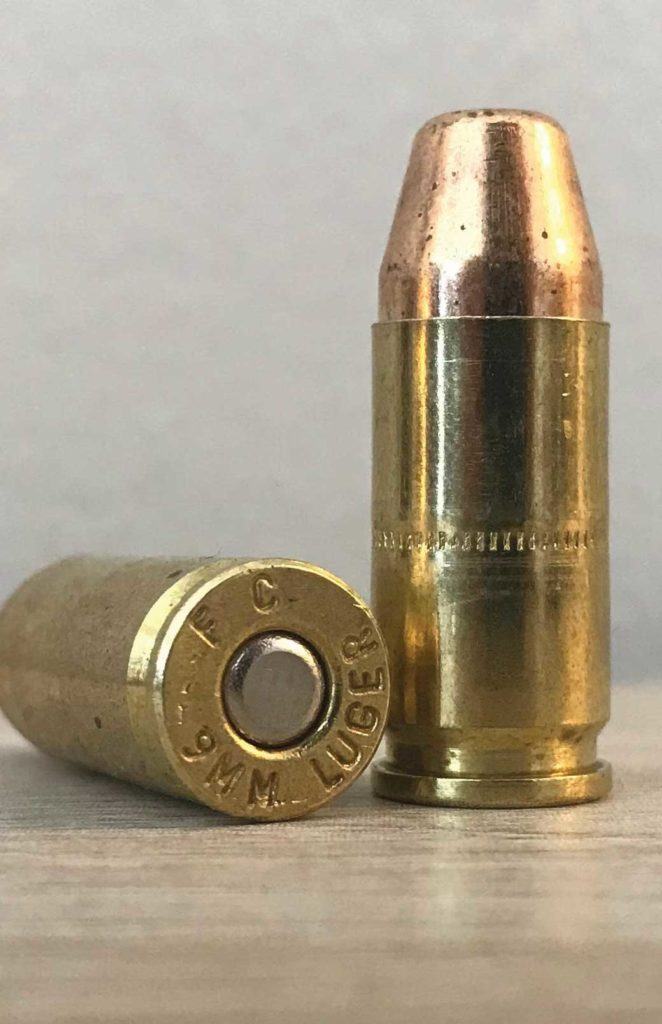
The 9mm has become the most used cartridge in the U.S., and now boasts performance on par or exceeding larger-bore pistol options.
How the 9mm became popular:
Smith & Wesson and Colt drove interest in the 1950s with 9mm semi-auto pistols.
An influx of military pistols in the caliber also drove its popularity.
It has become the most used cartridge in the U.S.
Modern bullets and high velocities have improved its performance.
It penetrates as deeply as many .45 ACP rounds.
In many cases, it can expand to a wider diameter than the .45.
The 9mm also has a higher impact velocity than a .45, causing more tissue damage.
The 9mm Luger, or 9mm Parabellum, was introduced in 1902 with the Luger automatic pistol. It was adopted first by the German Navy in 1904 and then by the German Army in 1908. Since that time, it has been adopted by the military of practically every non-Communist power. It has become the world’s most popular and widely used military handgun and submachine gun cartridge.
Although the 9mm Luger delivers good performance, it was not popular in the United States until fairly recently. In 1954, Smith & Wesson brought out its Model 39 semi-automatic in this chambering, and Colt chambered its lightweight Commander for the 9mm Luger in 1951. This, plus the influx of military pistols chambered for the 9mm, greatly increased both popularity and acceptance in this country. Currently, the 9mm Luger is the most widely used cartridge in the United States, though a principal complaint has always been that the 9mm LugerMo lacks stopping power as a defensive cartridge.
Modern bullet engineering, combined with the moderately high velocities obtainable with a 9mm Luger, 9mm Luger +P and 9mm Luger +P+ loads, has changed the performance of the 9mm. Extensive tests have shown that many defensive loads for the 9mm expand to a wider diameter and penetrate as deeply as many .45 Auto loads — and they do this with a higher impact velocity, which translates to more tissue destruction. Anyone armed with a 9mm and good defensive ammo should feel just as safe as if they were carrying a .45 Auto.
Keep it simple, no wiser words have ever been spoken. And they apply not merely to life, but firearms as well. The fancier the gun, many shooters discover to their dismay, the more can go amok. Swimming against this tide, Patrick Sweeney gives us his top 5 affordable AR-15 choices. These aren’t simply bargain-basement buys from fly-by-night operations. Far from it. These rifles and carbines are certain to give more bang for the buck than a great swath of present black rifle-dom.
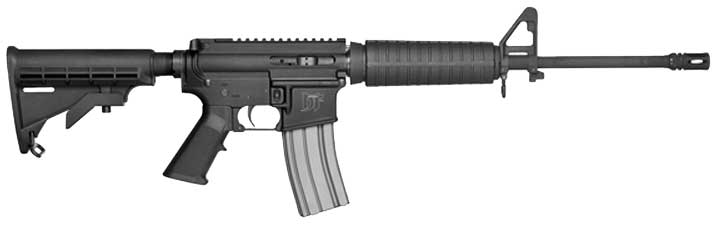
Del-Ton Sport Lite
The DT Sport Lite is your basic no-frills AR carbine of the type known as the “M4gery”. You get a 1/9 twist barrel, carbine handguards and telescoping stock, for a price that’s hard to beat. MSRP $649 www.del-ton.com
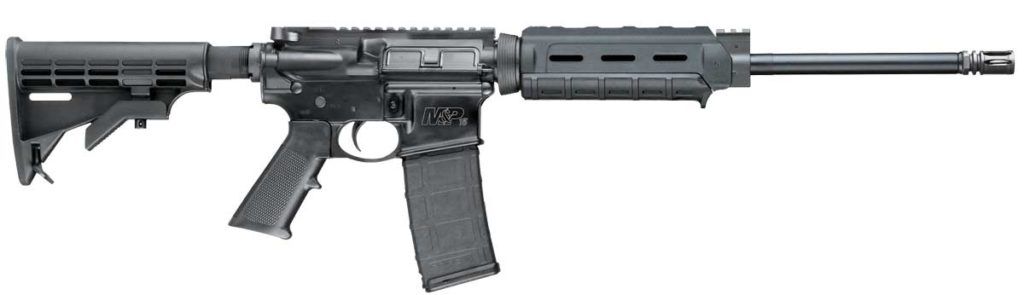
S&W M&P Sport II
If you want a handguard for accessories, then the S&W M&P Sport II has MLok Magpul handguards and lots of others extras. With a 1/9 twist barrel that’s Melonite treated for non-corrosion, the Sport II has a gas block with a Picatinny rail for a front sight of your choice, and tele-stock, all built to S&W standards. MSRP $739 www.smith-wesson.com
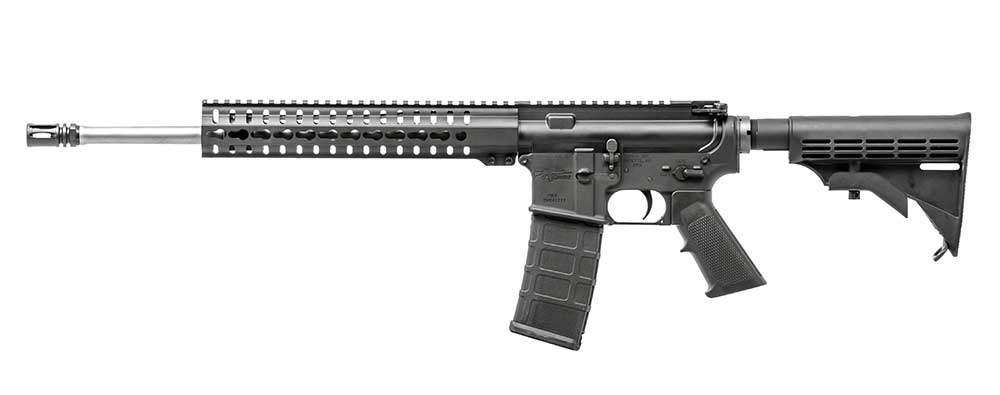
CMMG Mk4 T
If you want to take a step up, then CMMG in their Mk4 T, offers you a free-float handguard with rail slots, your choice of stainless or nitrided 4140 steel, and a full-length flat top for sight, scope and other extras mounting space. MSRP $1,049 www.cmmginc.com
Core 15 Scout
The Core 15 Scout is a basic M4gery that you can upgrade if you wish. The basic rifle is fully mil-spec, but if you want to add extras, you can get a better stock (still a tele-stock) and a carrier that’s nickel boron coated for easier cleaning. MSRP $724 www.core15.com
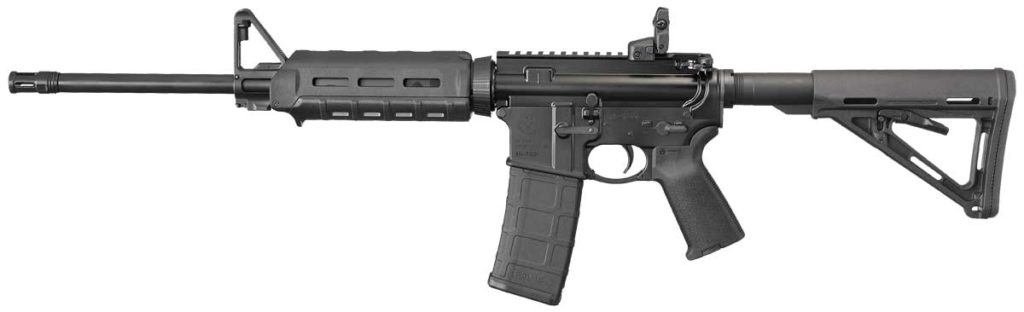
Ruger AR-556
If 10 years ago you had said, “Ruger will make an AR-15,” people would’ve pitied you. Now, they make some of the best. They offer their AR-556, complete with iron sights and mil-spec or better, for not a lot of coin. And, it’s hard to beat the Ruger warranty. MSRP $799 www.ruger.com
Editor’s Note: This article originally appeared in the 2018 Shooter’s Guide issue of Gun Digest the Magazine.
The lazy days of summer are here, no better time for long afternoons burning powder and sharpening shooting skills dulled through the long winter months. As we all know, there are only two things vital for a productive day pitching copper-jacketed lead — guns and ammo. It almost rolls off the tongue as easily as peanut butter and jelly.
Simple as it sounds, rolling to your favorite shooting spot with the bare minimum kit courts trouble. Be it keeping everything in line, having enough rounds or fixing a firearm that breaks down at the most inopportune time, you need to outfit your range bag with the little extras that keep you squeezing off rounds, not fiddling with your firearm.
Luckily, a rash of new shooting accessories has hit the store shelves in 2018 tailor made to keep you plugging away at your passion. From machines facilitating lightning-fast reloads to devices to troubleshoot the most stubborn carbine, they’ll just plain make a day punching paper or steel all the more enjoyable. Admittedly, some of these won’t squeeze into an everyday range bag, unless you sling a full-sized duff. Nevertheless, they’re pretty dang handy kit regardless of size. So, without further ado, here are four pieces of new gear for your range bag that will get the most out of a day on the business end of your favorite gun.
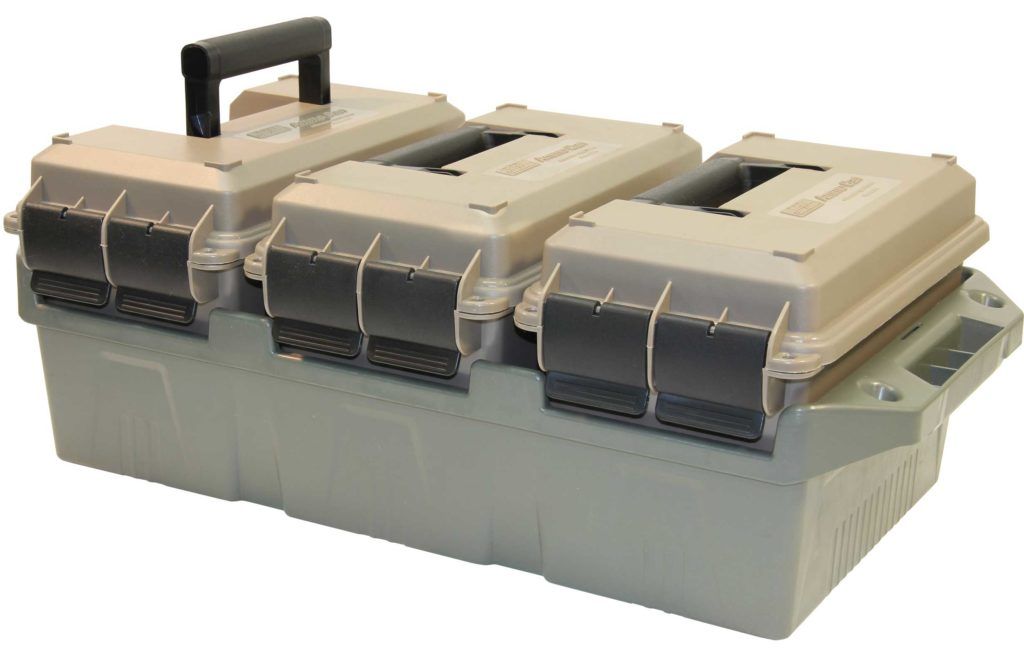
MTM Case-Gard 3-Can .50-Cal. Ammo Crate
Designed for rugged ammunition storage and transportation, MTM‘s 3-Can Ammo Crate won’t fit in your range bag, but will keep your powder dry and your rounds in order. The three 13.5″ x 7.4″ x 8.5″ .50-cal. ammo cans are O-ring sealed and water resistant, making them ideal for keeping ammo fresh in between shooting session or out in the elements. The cans nest in a sturdy polymer crate, keeping everything in order and making it a snap to move a mass of ammo to the range for a long day shooting. The crates are stackable, saving space in a gunroom and come with tie-down points on the ends making them ideal for ammo transport on an ATV or the bed of a pick-up truck. MSRP: $44.49 www.mtmcase-gard.com
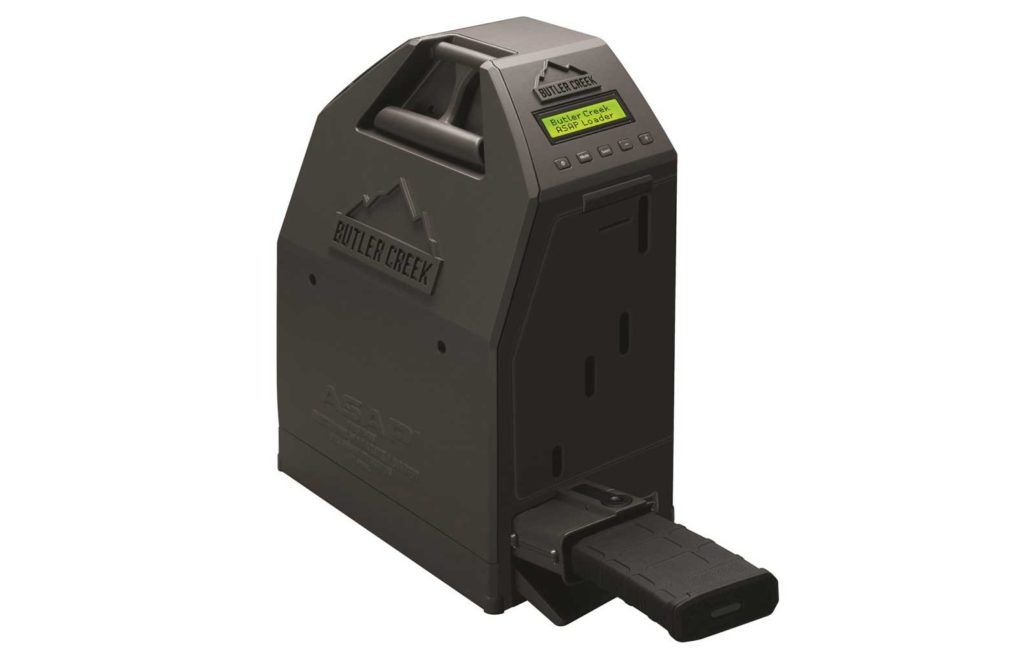
Butler Creek ASAP Electronic Magazine Reloader
Giving you more time shooting and less reloading, the Butler Creek ASAP Electronic Magazine Reloader is a godsend for shooters who measure their range time in thousands of rounds. Shooters simply insert a STANAG magazine, selects the round count and add 5.56 NATO or .223 Rem. ammo to the 60-round hopper and the ASAP does the rest, orienting the ammunition and feeding it into the magazine. The loader keeps count on a digital screen to let shooters know where they stand in the process. It might not qualify as a range bag essential, but it’s worth the investment, giving you more time to concentrate on what counts — your rifle and accuracy. The magazine loader is due out in August. MSRP: $330 www.butlercreek.com
Firefield AR-15 Multi-Tool
Malfunctions and equipment failures can strike any time, the Firefield AR-15 Multi-Tool makes certain you don’t miss a shot when they do. A must-have for any AR-15 shooter’s range bag, it’s armed with a slew of tools to tackle common carbine field maintenance issues — from scrubbing the bolt to setting components. In short, it’s a pocket-sized armorer’s toolbox. The heart of the system is a pair of spring-loaded pliers, perfect for troubleshooting a variety of issues on an AR. From there, the 4.2-inch long 14-ounce device boasts wire cutters, hammering surface, bolt scraper, bit driver, flat head driver, hex wrench, knife, metal pick and bottle opener. The driver includes four bits, allowing it to work on the most common bolt and screw heads on today’s modern guns. MSRP: $39.97 www.fire-field.com
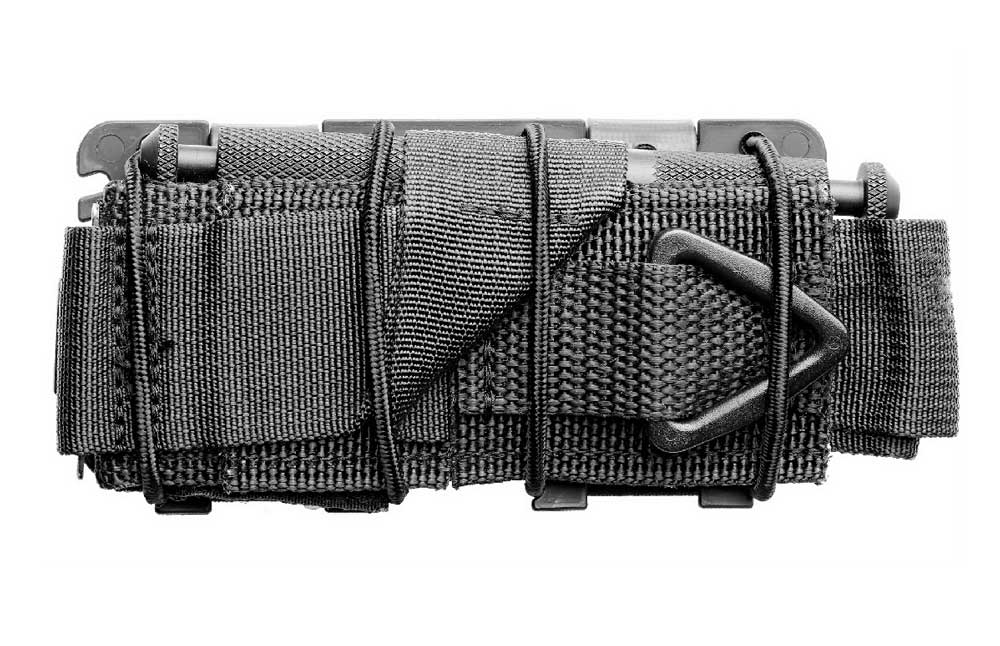
PHLster Flatpack Cat Combo
Accidents happen, even in the controlled environment of a target shoot. With a Flatpack in the range bag, you’ve got peace of mind you’re prepared to handle any eventuality. Outfitted with a North American Rescue CAT model tourniquet, the mobile system deploys at a moment’s notice and stays in complete order the rest of the time with rugged electrostatic cord and an injection-molded backboard. Ideally sized (5″x2.5″), it carries as easily on your person as it does in your pack. MSRP: $52.94 www.phlsterholsters.com
Looking to go armed, but are stuck in the weeds as to what to arm yourself with? Here are 20 of the best concealed carry gun options that will keep you on the defensive.