Our company Agilite Tactical is going to be giving away several brand new plate carriers to US combat troops currently serving in Afghanistan to put the product through it’s final paces before the product hits retailer shelves. The lucky few will be the first to receive The new Deflector US modular plate carrier free of charge, in exchange for feedback on its performance. Soldiers who fit the bill should send their details to [email protected]
U.S. Senators Richard Burr (R-NC) and Jim Webb (D-VA), along with 10 other cosponsors, have introduced legislation to end the process through which, critics contend, the federal government arbitrarily strips veterans and other Department of Veterans Affairs (VA) beneficiaries of their Second Amendment rights.
According to a press release from Burr’s office, “Currently, veterans who have a fiduciary appointed to act on their behalf are deemed ‘mentally defective’ and are reported to the FBI’s National Instant Criminal Background Check System (NICS), a system which prevents them from being able to purchase firearms in the United States. The Veterans Second Amendment Protection Act would require a judicial authority to determine that VA beneficiaries pose a danger to themselves or others before they can be added to the FBI’s NICS.”
“Taking away a Constitutional right is a serious action, and veterans should be afforded the same due process under the law as all other American citizens,” Burr said. “This legislation would protect the rights of veterans and their families by ensuring that only a proper judicial authority is able to determine who is referred to NICS. Our veterans took an oath to uphold the Constitution and they deserve to enjoy the rights they fought so hard to protect.”
Webb added, “This bipartisan bill ensures consistent guidelines are used for reporting citizens to the FBI, and that no veteran is needlessly stripped of their Second Amendment rights.”
The Federal Gun Control Act prohibits certain individuals who have been deemed a “mental defective” from purchasing a firearm. Currently, around 114,000 people who are receiving VA benefits have been reported to NICS.
As the Burr release noted, “A fiduciary is assigned to handle disability compensation, pensions, survivors’ compensation, and other VA payments on behalf of a veteran, surviving spouse, dependent child, or dependent parent. VA’s review process for assigning a fiduciary is meant to determine one’s ability to manage VA-provided cash assistance. The process does not determine whether they are a danger to themselves or others.”
Wisconsin Attorney General J.B. Van Hollen's Dept. of Justice wrote "Emergency Rules" creating CCW training requirements stricter than what the legislature intended.
Governor Scott Walker reluctantly approved the Emergency Concealed Carry Rules promulgated by the Wisconsin Department of Justice (DOJ). While the Governor has many of the same concerns that were expressed by NRA-ILA Executive Director Chris Cox in his letter to Attorney General Van Hollen, he understandably did not want to further delay the ability of citizens of Wisconsin to carry concealed handguns for self-defense. His rejection of the Emergency Rules would have resulted in a significant delay on implementation of the new law that takes effect on November 1.
Governor Walker stated, “We’re hopeful that the Department of Justice improves the permanent rules substantially before sending them to the Administration and the legislature for approval.” The NRA will continue to work with the state legislature to ensure that this happens.
Unfortunately, DOJ has chosen to overstep its authority by imposing conditions on prospective concealed weapons license applicants that the legislature never adopted or intended. As part of the Executive Branch of state government, DOJ’s role is to faithfully implement the laws adopted by the legislature, not dramatically change them. If the Emergency Rules are allowed to become permanent, they will set a dangerous precedent that perverts our system of government and its principles associated with the separation of powers.
When the Legislature adopted Act 35, the concealed weapons law, two provisions were very clear. There was to be no minimum number of hours of firearms training required in order to satisfy the training mandate and any qualifying firearms training or safety class that a prospective applicant has taken at any time in the past would be accepted.
Source: nra-ila.org
Recommended gun books for those who carry concealed handguns:
Rep. Darrell Issa, chairman of the House Oversight and Government Reform Committee, sent a subpoena Wednesday to Attorney General Eric Holder as part of his investigation into the gun trafficking operation known as “Fast and Furious.”
“Top Justice Department officials, including Attorney General Holder, know more about Operation Fast and Furious than they have publicly acknowledged,” the California Republican said in a statement. “The documents this subpoena demands will provide answers to questions that Justice officials have tried to avoid since this investigation began eight months ago. It’s time we know the whole truth.”
The subpoena seeks, among other things, all communications regarding the operation from 16 top Justice officials, including Holder, his chief of staff, Gary Grindler, and the head of the department’s criminal division, Lanny Breuer, as well as correspondence on specific dates to and from the former head of the ATF’s Phoenix field division, William Newell.
It also asks for all documents and communications referring or relating to the murder of Immigrations and Customs Enforcement Agent Jaime Zapata, including any correspondence outlining the details of Zapata’s mission at the time he was murdered. Read more
Always bring a gun to a gunfight. That’s just one reason why someone would want to pack this newly-designed Taurus PT .25 PLY auto.
When proponents of concealed carry wax eloquent about self defense philosophy, they will spend virtually no time on the age-old notion that you should “always bring a gun to a gunfight.” That’s a foregone conclusion. They will, however, voice all manner of opinion with all kinds of emotion on which make, model, and caliber of firearm you should bring to a gunfight: “I would never carry anything other than a [insert manufacturer or model] in [insert caliber]!”
Somewhere in these discussions about single-action vs. double-action or 9mm vs. .45 ACP, a wise old soul will offer up the idea that you should always bring two guns to a gunfight — a main gun and a backup, just in case. A hush might fall over those engaged in the discussion as they contemplate a scenario where guns have been drawn, shots have possibly been fired, and the main gun has either been lost or dropped or has no more ammunition or has failed. Now what?
Backup guns, the smallest of which are sometimes called mouse guns due to their diminutive size, have saved lives and long played important roles in police and detective work. Moreover, with 49 of the 50 U.S. states offering some manner of concealed carry for citizens, small handguns are more popular than ever. Often chambered in smaller calibers (.380, .25, .22, etc.) and smaller dimensions, these weapons are truly pocket pistols. Some people carry them as a primary carry gun—always bring a gun to a gunfight, right?—and some carry them to back up their primary weapon, just in case.
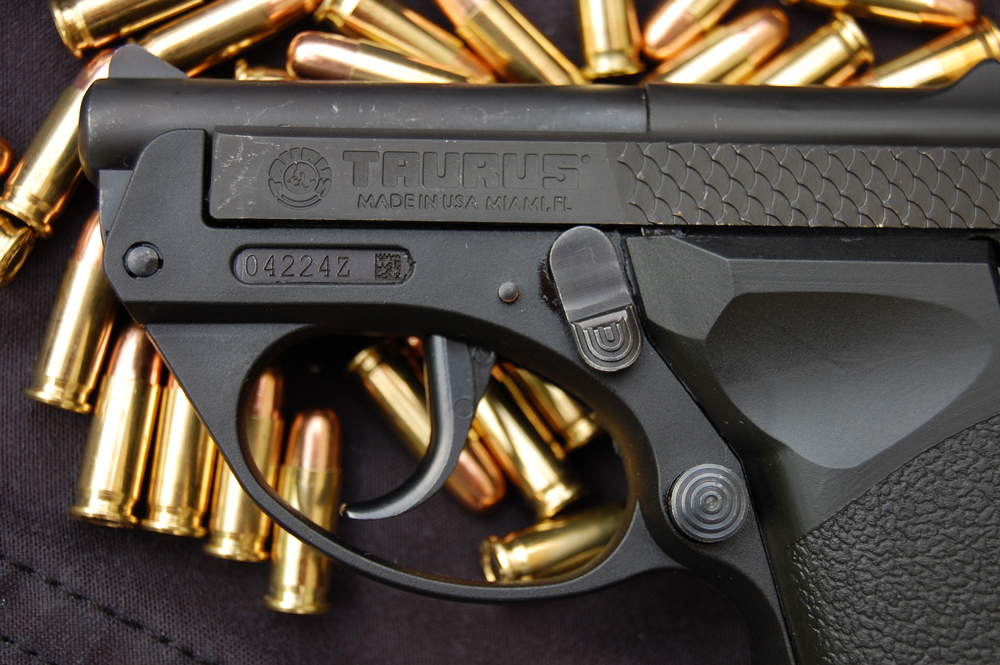
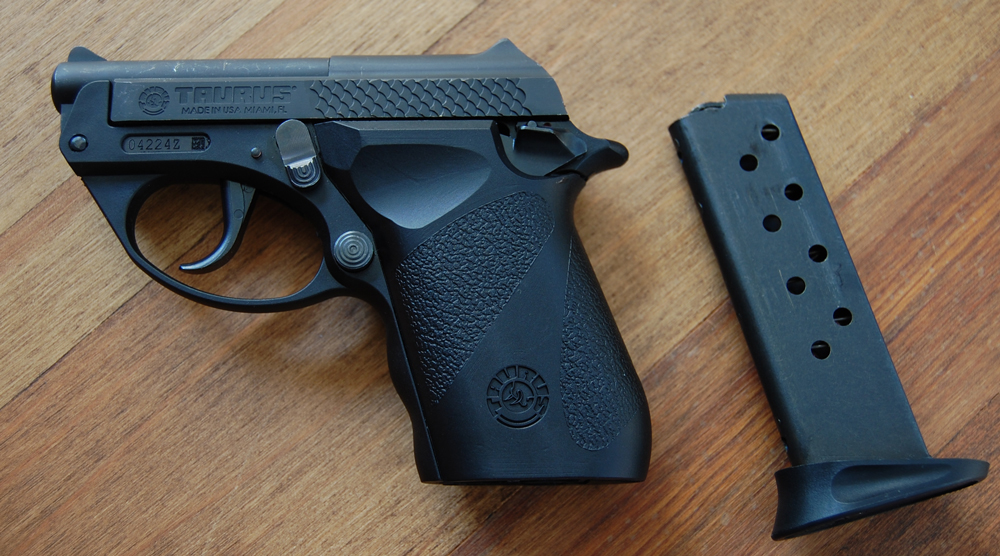
The Taurus PLY 25 and 9-round mag.
Beyond the matter of reduced caliber, guns with smallish dimensions offer additional challenges for shooters. For example, because they are smaller they may be more difficult to hold properly. Indeed, some might struggle to keep hands or skin out of the way of the moving parts or find it awkward to place a finger properly on the trigger or manipulate the magazine release. Bottom line: It is possible for a gun simply to be too small to hold comfortably or handle safely.
In an effort to mitigate some of these concerns, Miami, Fla.-based Taurus Manufacturing in 2009 produced a small .25 Automatic pistol based on a Beretta pistol design they purchased many years ago. Compared to the old Beretta, Taurus president Bob Morrison says the new Taurus .25 a “modernized and technically superior version.”
Called the PT 25PLY, Morrison says it is the result of significant input from customers and is designed to meet the expectations for a present-day concealed carry weapon. New features of the 25PLY include enhanced ergonomics and polymer construction. Yet it retains the tip-up barrel from the old design. Morrison says Taurus produces the entire gun, as well as a .22 caliber model, in its Miami manufacturing facility. The PT 25PLY retails for $273 (blued) and $289 (stainless) and despite being produced in 2009, the gun has not been available until now.
The most notable features of the PT 25PLY are its size and weight, or lack thereof. At 5.33 inches in length the PT 25PLY certainly qualifies as backup gun (“BUG”) or mouse gun or hide-out gun. In fact, when holding it in my medium-sized hand and placing my trigger finger along the slide, my fingertip extended just beyond the muzzle. Grasping the PT 25PLY resulted in most of the gun disappearing under my grip; the exposed slide and barrel sat low but a small beavertail kept the web of my hand out of the path of the slide. The PT 25PLY weighs in at 10.8 ounces, unloaded. With eight rounds of .25 Automatic on board, the weight increased to 12.9 ounces. By comparison, most subcompact handguns weigh twice that amount.
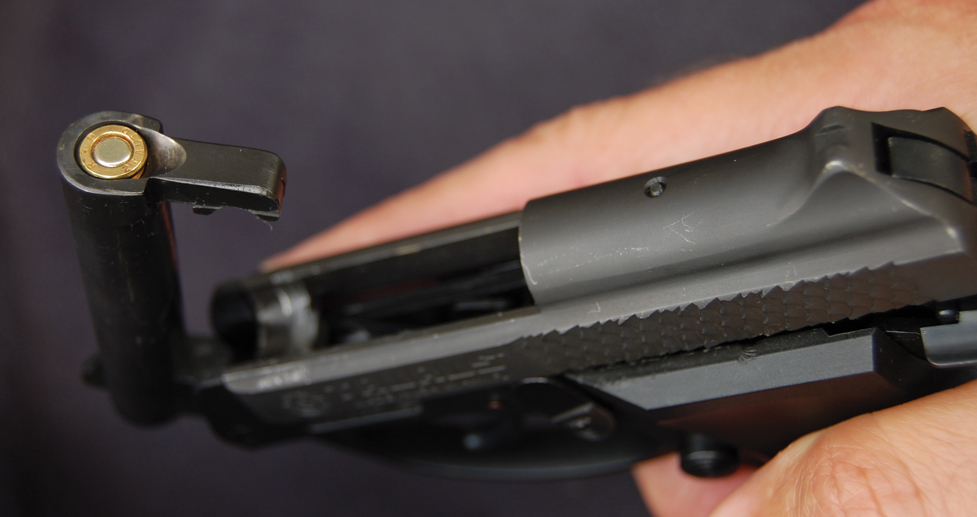
A .25 Auto in the chamber of the Taurus 25 PLY.
Having firmly established that the PT 25PLY is indeed small and light, favorable descriptors for something you want to carry, I wondered whether its physical makeup would work against it as a firearm. After all, this is supposed to be a weapon. It is meant to shoot a bullet and may be someone’s just-in-case last-hope in neutralizing an attack of some kind. Was it up to the task?
I contemplated whether the Taurus PT 25PLY would be a case of less is more. Or less. Shooting the 25PLY would provide some answers so I turned from matters of size and weight to preparing to fire. Unfortunately, removing the magazine was not as easy as expected — I had to physically pull it out while pushing the magazine release — and I also found it a little difficult to load the magazine, which only added to my angst. Pressing in the rounds by hand proved an exercise in endurance for my thumb and, despite Taurus’ claim that the PT 25PLY holds 9+1, I could only fit eight rounds in the magazine.
As I loaded the magazine, the rounds seemed to click in place instead of just sliding in. I was actually concerned that the magazine was holding the rounds so tight that they would not chamber when firing. Before I shot, I tried removing the rounds by hand. This too, was difficult.
Thankfully, all the fuss about the magazine evaporated during the shooting session. Every round chambered, fired, and ejected properly, even if a couple of the spent casings landed on my head.
The thumb safety on the Taurus PLY 25 was robust and engaged positively.
Since small handguns are, well, small, often it is difficult to get a solid grasp on the slide in order to chamber a round. The PT 25PLY’s tip-up barrel, however, eliminates this concern. Just press the barrel release forward with a thumb to get the barrel to tip up, drop a round in the chamber, and close the barrel. Want to check the chamber and see if the PT 25PLY is loaded? Same procedure. No slide manipulation needed. This feature is really helpful on a small handgun.
Firing the PT 25PLY proved a couple of key points: First, Taurus did its homework in redesigning the ergonomics of the pistol. The polymer stocks worked in conjunction with the base of the magazine to offer a very comfortable grip that was a pleasure to hold and shoot.
I didn’t expect much recoil from the .25 Automatic round but had wondered how the quality of shooting would be in such a small pistol. Each round fired offered recoil in the form of a mild push back—very tame and manageable. I excused the PT 25PLY’s miniscule notch and ramp sights because the gun’s excellent ergonomics enhanced my ability to simply point and shoot and because the gun is meant more to be a last line of defense as opposed to a target pistol. Second, the PT 25PLY’s trigger offered a long and very smooth stroke which aided in shooting accurately and should provide some peace of mind against accidental discharges.
Additional safety features include a frame-mounted thumb safety—this felt robust and engaged and disengaged positively—as well as a magazine disconnect. The gun also includes the Taurus Security System, allowing a user to secure the gun with the turn of a key.
I carried the PT 25PLY around in the front right pocket of my pants or shorts with no holster. Surprisingly, it “stood up” well, allowing me to simply put my hand in my pocket in order to grasp it. It would of course fit in the bigger pockets of cargo pants or shorts but locating the pistol there would require some kind of pocket holster.
The Taurus PT 25PLY might not be a powerhouse caliber nor the first firearm chosen for a gunfight, but with 9+1 rounds of .25 Automatic in an updated design that includes ergonomic polymer stocks and multiple safeties, it is light, comfortable, safe, and reliable. Just in case.
This article appeared in the October 10, 2011 issue of Gun Digest the Magazine.
A 73-year-old man who fatally shot his stepson in his home last week was acting in self-defense, Largo police said Monday.
Robert Edward Gardner will not be charged for shooting 48-year-old Jeffrey Mark Matthews, police said.
“He was protecting himself,” said police spokesman Lt. Mike Loux.
Matthews arrived at the mobile home that Gardner and his wife share in the Paradise Island mobile home park at 1001 Starkey Road around 3:30 p.m. Friday, officials said.
Gardner said Monday he didn’t know Matthews well and had met him only a couple of times. He said he and his wife, Barbara, had been “arguing for a few days” when Matthews showed up and threatened to beat him up.
Gardner said he retreated to his bedroom.
“I went in there and got my gun and stood in the doorway,” he said. “I was going to tell him to get the hell out. Before I could say anything, he came charging down the hallway.” Read more
Ashburn, Virginia – Heckler & Koch was awarded a competitive contract to produce the U.S. Marine Corps’ new Infantry Automatic Rifle (IAR). The formal “Full Rate Production” announcement by the Marines caps a competition that began more than three years ago.
Designated the M27 Infantry Automatic Rifle, the lightweight, 11.62 pounds weapon with ancillary equipment, is a variant of the highly successful Heckler & Koch HK416 used by military, law enforcement, and special operations units in the U.S. and throughout the world.
The M27 IAR replaces the heavier, M249 SAW (Squad Automatic Weapon) which has been used by the Marines in Infantry Squads since the mid-1980s in the automatic rifle role. Both weapons fire the 5.56 mm NATO cartridge.
The five-year, indefinite delivery, indefinite quantity contract calls for possible delivery orders up to $23,600,000 for the production, delivery, and associated support of the Marines’ Infantry Automatic Rifle program.
The Marine Corps approved the full rate production and fielding of the M27 Infantry Automatic Rifle during the summer of 2011. There will be one M27 IAR per four-man fire team, with three M27 IARs per squad, 28 per company and more than 4,000 across the entire Marine Corps.
“After a rigorous testing process, both in garrison and deployed environments, and in-depth consultation with weapons experts through the Corps, the commandant approved the fielding of the M27 Infantry Automatic Rifle,” said Marine spokesman Major Joseph Plenzler in a press statement in June. “The fielding of the IAR will significantly enhance the ability of our infantrymen to gain and maintain fire superiority, reduce their fighting load and provide them a more ergonomic and accurate weapons system that can keep up during the assault.”
“Winning the Marine’s IAR competition is another milestone for our HK416,” said Wayne Weber, President of Heckler & Koch USA. “Developed at no cost to the U.S. taxpayer and with U.S. military input in the aftermath of the September 11th attacks on America, the HK416 competed against and beat many worthy challengers. This contract award is a direct testament to the superior performance of the HK416 and it is an honor for Heckler & Koch to equip the Marines with such a fine rifle.”
Last month, a dozen members of the Idaho firearms industry met in an event hosted by the Idaho Firearms and Accessories Manufacturers Association (IFAMA) to draw attention to the fact that Idaho has a thriving firearms and firearms accessory industry.
“Four people started the all-volunteer association a year and a half ago,” the Idaho Statesman reported. “It’s not a Second Amendment rights group. It’s more commercial, an attempt ‘to get the manufacturers and distributors (to work) together,’ said co-founder Jon Anson of Meridian, who runs a horse ranch and boarding business. ‘By getting more sales, of course, we can create more jobs.’
Anson estimated that the state had 120 to 125 licensed firearms manufacturers, and hundreds of other companies making clothing and other shooting gear. “The firearms industry is thriving in Idaho, and business for some local companies is getting even better. The industry employs thousands of people in Idaho, and [IFAMA] wants to push that number higher.”
As part of its plan to “push that number higher,” IFAMA won a $25,000 grant from the U.S. Department of Agriculture. The grant money was used to hold and promote the September gathering. In addition, the grant will allow IFAMA to put together a report on the economic impact of the firearms industry on Idaho.
Gun Digest is the source for firearms news, pricing and guns for sale. Readers benefit from in-depth editorial expert advice, show reviews and practical how-to instructions. With your Subscription, you’ll also learn about threats to your Second Amendment rights. Click here to begin your subscription to Gun Digest.
Inside this issue:
Winchester Blindside Ammo
Surgical Tactical Shotgun
Gun Review: Benelli Super Vinci
Handloads for Hunters
Gun shows, auctions, classifieds and more!
Not a subscriber? Make sure you don’t miss another issue! Subscribe now
Ask virtually any handgun enthusiast to describe a Glock pistol and you’ll invariably hear words such as simple, reliable, and rugged. With the company’s insatiable quest for perfection, the Glock Gen4 redesign achieved an improvement on that legendary perfection.
Since 72 percent of the nation’s law enforcement officers carry Glocks and since Glock enjoyed a 73 percent increase in sales over the past year, you might also hear terms like popular and pervasive. Glock pistols regularly appear in movies and television shows and stoke such brand loyalty that furious rivalries and humorous anecdotes abound. Here’s a good one: A 1911 is what you show your friends. A Glock is what you show your enemies. A Glock Gen4.
As for the reliability of Glocks: They just work … Pull the trigger and they go bang—every time. You could describe Glocks as boring—in all the right ways.
As for Glock’s advertising slogan, “Perfection” must be something for which the company continually strives. So, Glock’s latest rendition of its revolutionary design, the Generation 4 series, must be more perfect than the previous generations. Is it?
Glock Gen 4 pistols feature replaceable backstraps for an adjustable grip.
HISTORY
Glock started designing pistols in 1980 and the Austrian army approved the Glock 17 (so named because it was the company’s 17th patent) for use in 1982. The Glock 17 was obviously a first-generation pistol and visually identified by its smooth, rounded “pebble grip.” Second generation Glocks changed to a “grenade-style” checkering on the grips. Third generation Glocks added finger grooves on the grips as well as an accessory rail on the front dustcover. Some Glocks are described as a “Generation 2.5”—a transition model when Glock added finger grooves but no accessory rail. Enter Glock’s Generation 4 pistols, or as they are stamped on the slides of these new guns, “Gen4.”
Gen4 versions of the Glock 17 and Glock 22 are shipping now. Gen4 versions of the Glock 19 and Glock 23 pistols will ship in June, 2010. After that, Gen 4 versions of the Glock 26 and Glock 27 will ship. Glock National Sales Manager Craig Dutton says this schedule demonstrates Glock’s commitment to law enforcement.
GLOCK GEN4 ADVANTAGES
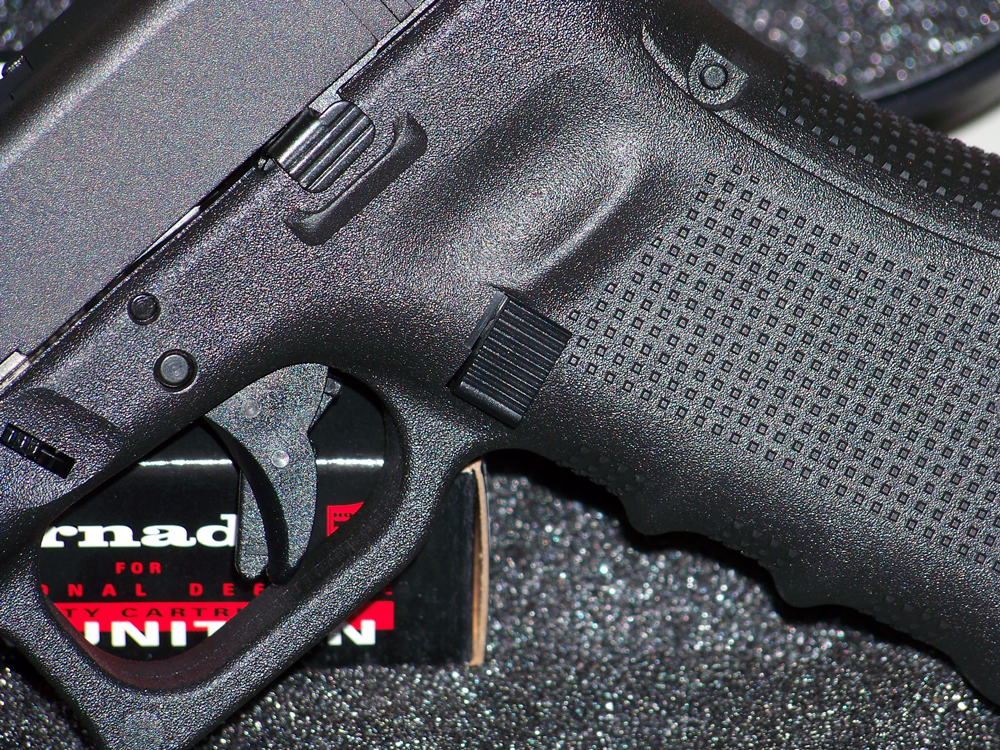
According to Dutton, the 2010 Glock Gen4 guns “are a major external and internal re-design of what Glock has offered in the past” and he says the Gen4 pistols offer several major advantages: less recoil due to slower slide velocity; better fit for smaller-handed shooters thanks to the smallest circumference short-grip frame Glock has ever offered and the shortest trigger reach Glock has ever offered; better fit for larger-handed shooters thanks to the two additional “snap-on” full-length backstraps that come with every Glock pistol; easier magazine release manipulation from a new magazine catch that is both three times larger and reversible; great accuracy thanks to a tighter lock-up; and easier-to-grip Gen4 RTF4 frame with pointed “pyramids” instead of checkering.
As important as what’s new with the Gen4 is what isn’t: It’s still the rugged, reliably feeding pistol it’s always been. Field stripping is the same as with previous generations. Gen4 pistols will fit Gen3 holsters. Moreover, for law enforcement budget watchers, Dutton says Glock will keep law enforcement pricing the same as it has been since 2000.
The most significant visual differences in the Glock Gen4 pistols and the ones most likely to garner the interest of both law enforcement and the general shooting public are the interchangeable backstraps and the magazine release.
GLOCK GEN4 BACKSTRAPS
Gen4 Glocks ship with two extra backstraps, each of which fit over the “short frame” or standard grip. The distance from the standard backstrap—the “short frame”—to the trigger is 70mm. The medium and large backstraps increase the distance to 72mm and 74mm, respectively. I tried all three. The short frame felt the best, the medium was tolerable, and the large reminded me of the grip feel of a Glock 21—simply too big. All the grip options had that familiar Glock feel but for me the option of the smaller short frame grip made holding the Glock even more comfortable.
Practically, if you’ve had to choose a Glock 23 in order to avoid the longer trigger reach of a Glock 22, the Gen4 pistols eliminate that problem.
Backstrap interchangeability on the Glock Gen4 pistols do not affect any of the pistol’s moving parts, but the large backstrap requires a longer trigger mechanism pin, which is included with each pistol, along with a plastic punch tool to remove and install the trigger mechanism pin. Changing the backstraps requires a few steps, all outlined in the included instruction sheet: remove the trigger mechanism pin with the punch tool, snap the larger backstrap in place, and re-insert the trigger mechanism pin. In changing the backstraps, the larger ones proved difficult to seat correctly and the punch tool a bit feeble to the task but once installed they straps stayed in place.
Shooting the Gen4 Glock proved to be a dream. Accuracy, reliability and now enhanced features take this pistol another step closer to perfection.
Related to the interchangeable backstraps, the other significant visual change was the “pointed pyramids” texture on the frame/grips that replaces the more traditional Glock checkering. The Gen4 RTF4 frame, as it’s called, is not as aggressive feeling as the RTF2 military grip, says Dutton. It is, however, a different feel—the pointed pyramids could be described as sharp—but they improved my grip on the Glock when shooting it.
While the availability of interchangeable backstraps allows individual shooters the ability to customize a Glock pistol to fit their hands, the new magazine release on the Gen4 pistols may be just as significant a change.
MAGAZINE RELEASE
Glock Gen4 magazine releases are three times larger than those in previous generations. Combined with my preferred short frame grip, I found it to be significantly easier to engage the magazine release during magazine changes. Although you can reverse the magazine release and install it on the other side of the grip (a 30-second operation, according to Glock), I left it in the traditional location. The new magazine release works on a pivot as opposed to the previous generation’s straight-in plunge. No surprise, the Gen4 release provided very positive engagement and little concern of accidental engagement.
Previous generation magazines will work in the Gen4 pistols provided the magazine release stays on the left side; Gen4 magazines will work in previous generation Glocks.
Both the short frame and the new magazine release provided a more fulfilling shooting experience because they didn’t get in the way of the shooting.
INSIDE LOOK
While Dutton says that field stripping, cleaning and safety instructions remain the same across Glock lines, some Glock Gen4 parts will not interchange with previous generation parts. These include the frame, slide, trigger bar, magazine catch, recoil spring assembly, back-strap assemblies, trigger mechanism housing, and trigger mechanism housing pin. Gen4 pistols have a new stainless-steel, double-wound, two-stage, recoil spring assembly that Dutton says offers twice the recoil-spring rated service life as previous Glocks—5,000-plus rounds for Gen4 G22 springs versus 2,500 rounds for Gen3 G22 springs.
SHOOTING FOR PERFECTION
Shooting previous generation Glocks was and still is great but shooting the Glock Gen4 was a joy. The reduced recoil combined with the short frame (no larger backstrap added) grip yielded faster and more accurate shooting. Every round fed perfectly—reliable—and fired to point of aim—accurate. Magazine changes were easier and therefore more efficient—simple. Was it “perfection”? No. According to Dutton, however, that term accurately describes what Glock is striving to do: make the most dependable pistol on earth.
This article appeared in the May 10, 2010 issue of Gun Digest the Magazine.
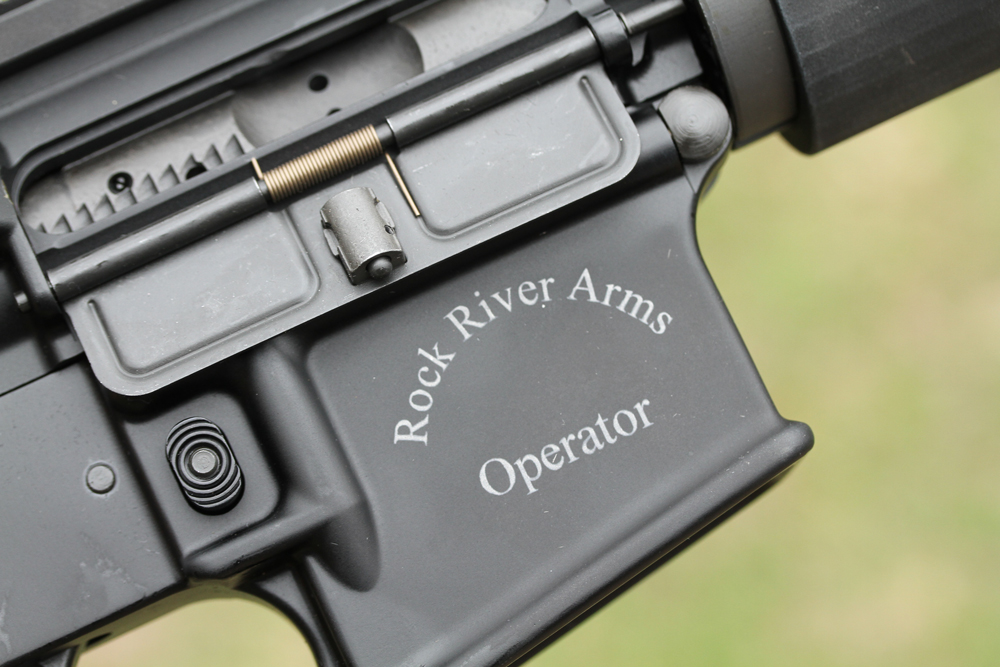
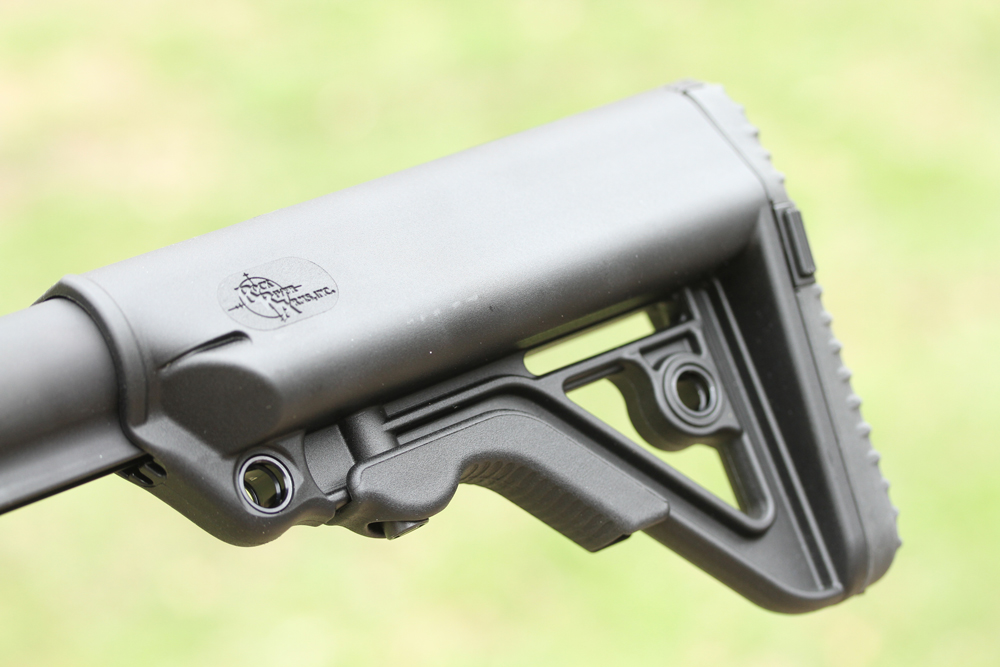
The Rock River Arms Elite Operator is a tele-stocked carbine in 5.56. The stock is a close-appearing copy of the mondo-expensive SOPMOD stock that your tax dollars buy by the truckload.
OK, I have to ‘fess up on this one. The ads you’ve been seeing for the Rock River Arms Elite Operator series? That’s due to me. Well, due to me and a couple other of my gun writer compatriots. You see, at an industry gathering where Rock River was showing us the parts and pieces that would go into the new series of rifles, they came up with an idea: name the gun. So, we dutifully took the forms, scrawled our names on them, and jotted down a few ideas for names. I have to confess I wasn’t really in the naming frame of mind. Perhaps I’d had too much coffee.
The Operator stock, a solid, comfortable tele-stock with storage.
Or perhaps I was just itching to get out to the range and actually, you know, shoot guns. I put down all the tongue-in-cheek names I could think of, along with a few obvious satirical ones (there’s a reason some PR people groan when I walk into a room) and to finish it off I added a few that might actually be useful. I’m surprised they didn’t just toss my list when they saw my name.
And yes, being a gun writer can be (but isn’t always) just as much fun as you think it is.
You guessed it; Operator was one of the last ones I scribbled down. Now, I can’t take full credit for this, as two other writers came up with the same name. Soon afterwards we had rifles to inspect and test. I opted to test the top of the line model, the Elite Operator. The other two are the Entry Operator and the Tactical Operator.
Rock River Arms is located on the western edge of Illinois, right near the Quad Cities area, a location known for its manufacturing capacity in times past, and when rational people ran the country the region was well-thought of as a cradle of manufacturing and arms industry. Rock River also used to make semi-custom and custom 1911s, but when the AR-15 market exploded they set aside all the 1911 tools to concentrate on the product of the age: the AR-15. I had a chance to visit them just as they were transitioning to making just ARs, and it was sad to see the last of the 1911s being worked on, knowing there would be not more for a while.
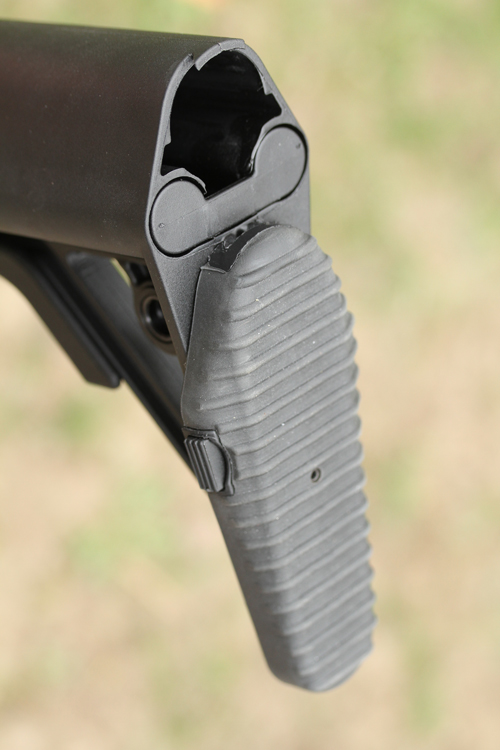
The buttplate slides down to uncover the storage compartments.
The Elite Operator (or to give it its full title: the RRA LAR-15 Elite Operator) is a tele-stocked carbine in 5.56. The stock is a close-appearing copy of the mondo-expensive SOPMOD stock that your tax dollars buy by the truckload. At more than $100 less in cost than the USGI SOPMOD stock (and a complete assembly, at that) the Rock River stock is more than just a good deal.
It has six positions, and instead of the two battery compartments being opened on the front, with an o-ring to keep them sealed, the two compartments on the Operator stock are hidden. First, you use the push button to unlatch the buttplate, and slide it down, then you pry the two o-ring sealed covers off. They are large enough to grasp, and thus you can really shove them in for a good seal. As a bonus, if you lose the o-ring covers, the buttplate will still keep your stuff in the tubes, albeit without the waterproof seal. The stock is well-shaped to provide a good cheeckrest, and it slides back and forth smoothly and clocks solidly in place. Plus it doesn’t rattle or wobble.
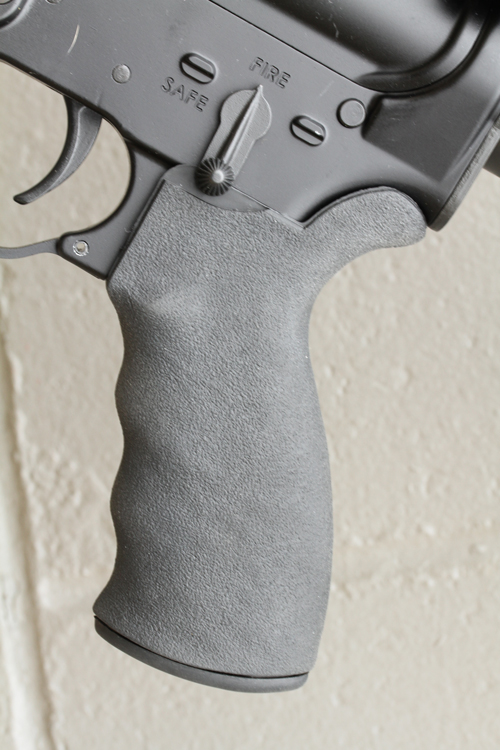
The Operator series also come with an ERGOgrip, a rubber pistol grip that replicates the shape of the MP5 grip. A lot of people like it. As with a lot of the options on an AR, it can be a very personal thing. When I first saw them, I started out liking the ERGOgrip but have come to find it not suited to my shooting style. If it works for you, good – get it or keep it. If not, it is easy enough to change. A lot of rifles come with this grip, so I have to assume that a lot of you like it.
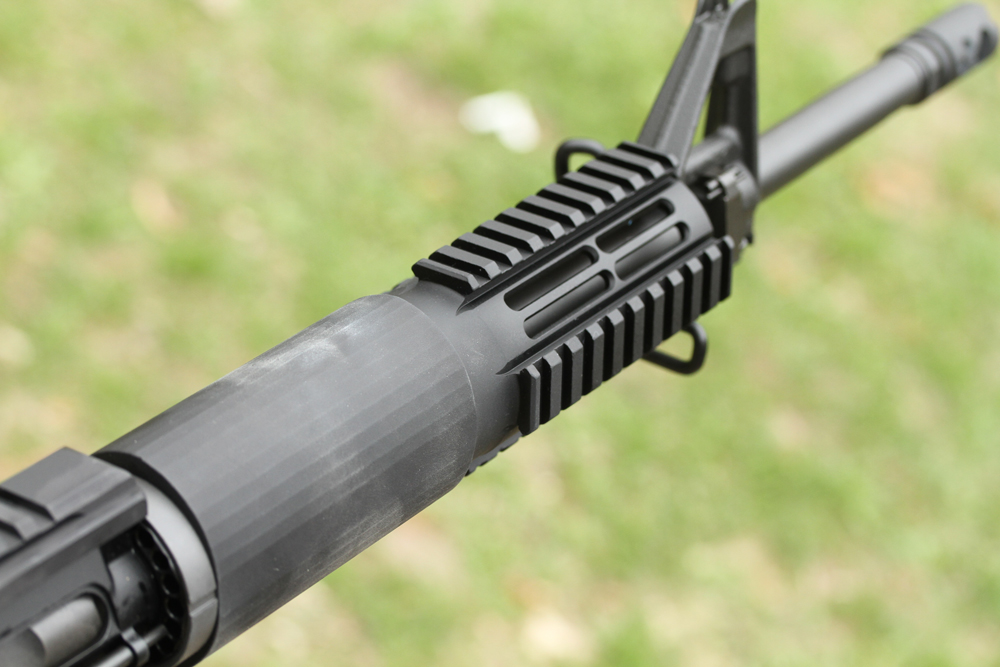
The Elite Operator forearm, an aluminum tube with integral rails on the front portion.
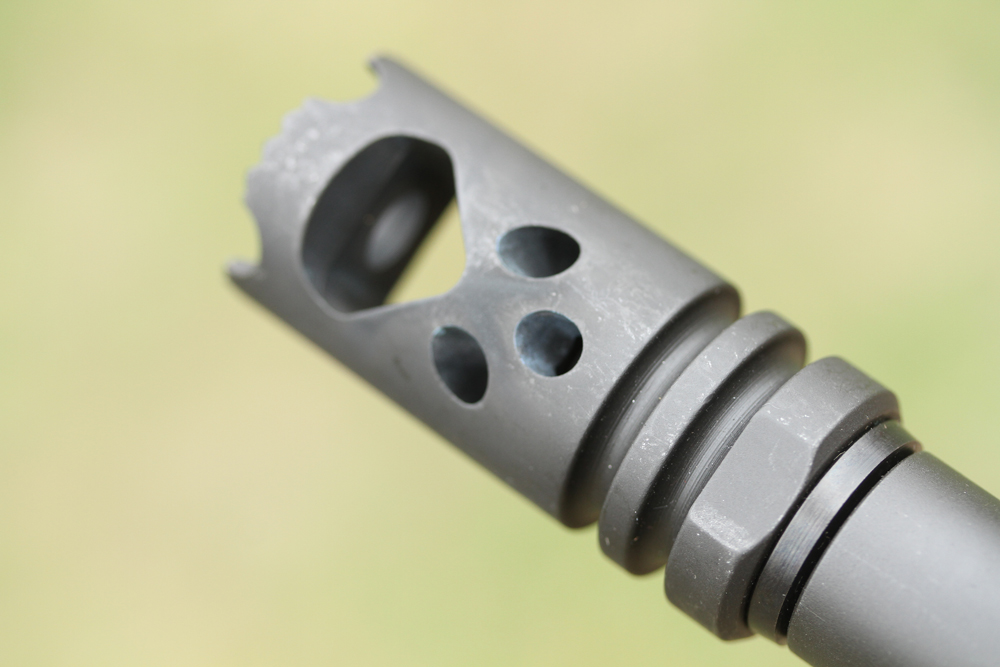
All the Operator series come with a 5.56 chamber, a forged A4 upper, a 16-inch chrome-moly steel barrel, chrome plated, with a twist of 1:9. The barrel is capped with an RRA tactical muzzle brake, an item I find useful on a competition range but much less so for defensive use. Especially in any kind of teamwork, a muzzle brake makes your shooting easier by dumping hot gases to the side, where your teammate may well be. But muzzle devices are easy enough to change, and if I don’t get too many complaints from the guys on the line at the next LEO class, I might leave it on for a while.
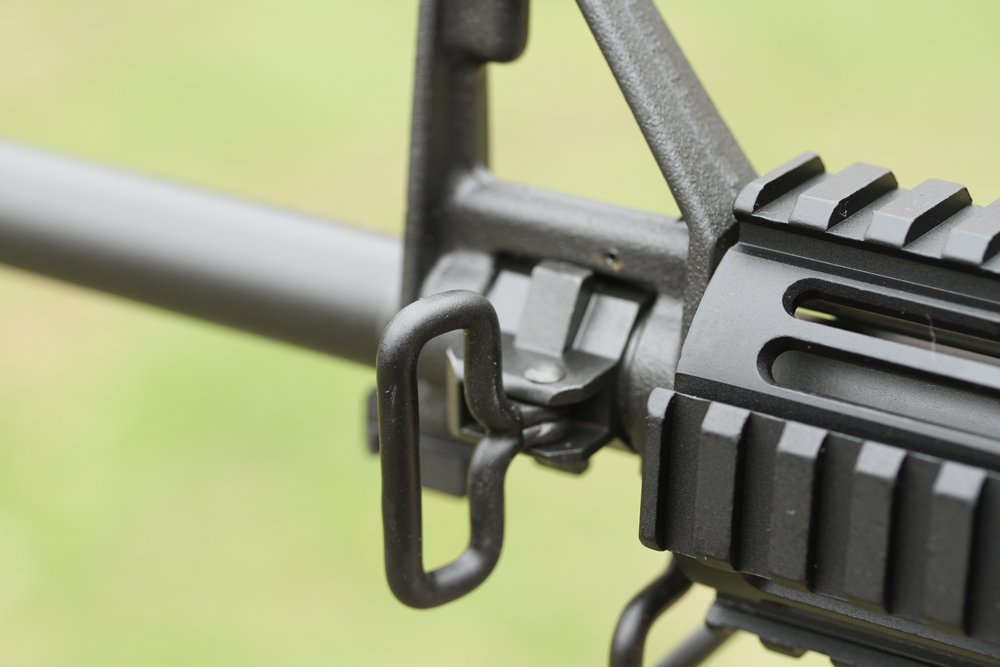
The Operators come with mil-spec side sling mounts, a very useful thing to have.
They also all come with the RRA Star safety, an ambi safety that has a raised, acorn-shaped knob on it. I’m going to have to take the grinder to the right-side acorn, as it rides right underneath my trigger finger. Now, this is not just a personal matter, but a very peculiar quirk of my shooting style. I choke up with my shooting hand very high on a pistol grip. So high that my trigger finger is actually coming down to the trigger on an AR. As a result, I find most ambi safeties on an AR, regardless of the design, to be problematic. This is no slam against Rock River, and in fact their design is less objectionable to my hand than many others. You may not have a problem, and in fact, a lot of the officers in our classes really, really like the Rock River design.
Inside the Operator series is the Rock River two-stage trigger. As a competition trigger, it is great. As a duty trigger, especially if your sidearm happens to have a heavier, longer trigger pull, then the mis-match can be a source of friction. As I spend a lot of time with heavier, mil-spec triggers, I’ll probably get inside and actually increase the trigger pull of the operator, just so it is more like the sidearm I’ll have on.
The muzzle brake, something I will test but probably swap out. I’ve found that shooters on the line with you really dislike being pummeled by your muzzle blast.
Last up, but very important, they all have the current USGI front sidemount sling swivel, attached between the legs of the front sight assembly. All three have a fixed, normal front sight tower.
They all come in a case, with two magazines, manual, and warranty.
The Elite Operator differs from the other two in having a special handguard; the Entry and Tactical have M4-type plastic handguards. (The Entry and Tactical differ from each other in the barrel; the Entry has an M4-style profile, while the tactical has a lighter barrel, shaving a bit over half a pound from the full-up weight.) The Elite handguard is a free-floated aluminum handguard with rails on the cardinal points, but rails that are only half the length of the handguard. Most users don’t need rails that go all the way back, so why make them that way?
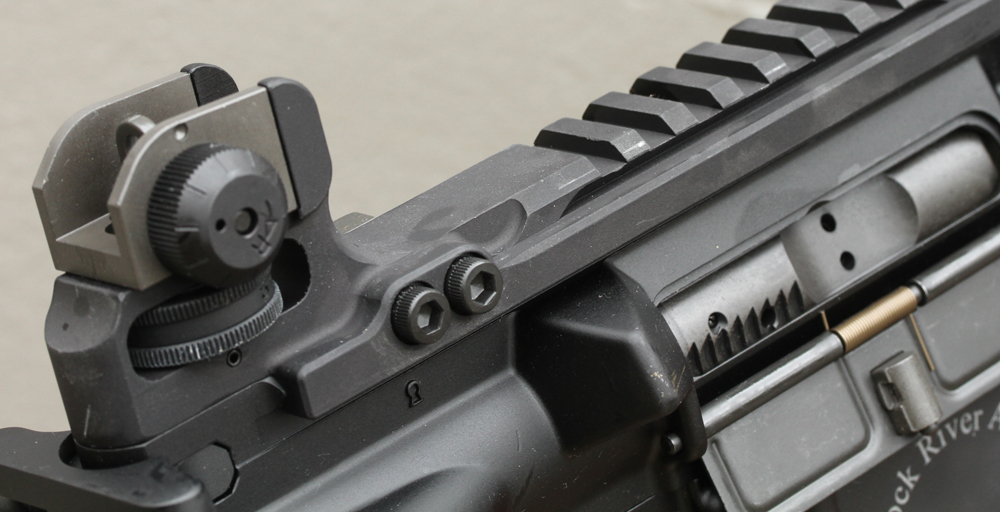
The Rock River BUIS, with integral rail for mounting a red-dot sight.
As a final lagniappe, Rock River knows that what the end-user needs are options and extras. So when the Operators rolled out, they came with some very nice extras. You could have your choice of one-inch or 30mm scope rings, a one-piece unit that clamps right onto the top rail of the receiver. And you got to pick from four different BUIS/handle setups, from a regular A2 handle and sight to the RRA tactical handle, the Dominator2 that allows you to put a red-dot on the removable rail/BUIS, and a plain old RRA standalone sight that would be an entirely serviceable sight all on its own.
Now, the bonus items may well have been changed, dropped or modified by the time you get this book, so don’t go hounding Rock River for the extras that “Sweeney promised me.”
How does it shoot? Nice would be a word to use. Accurate would be another. An eight-pound (before sights and ammo) AR carbine in 5.56 doesn’t exactly smack you in the chops every time it goes off, and the muzzle brake does a lot to remove what little steam there might be in the recoil. The trigger is clean and crisp, and has a short re-set (for those who care about re-set), so shooting quick pairs or follow-up shots is no problem at all. As with all aluminum handguards, if you shoot a lot, quickly, you’re going to heat up the handguard. So it would be best (if you’re a “heavy on the trigger” shooter) to have a set of nomex gloves in your shooting gear, just in case.
The Operator comes with the Ergo grip. If you like it, great. My odd, non-standard grip makes it not so useful.
Also, the black aluminum will absorb heat from the sun, so if you live in a desert or desert-like area, you’ll want to be careful picking it out of the rack. But that is not a feature unique to the Elite Operator; all aluminum-handguard rifles have that predicament.
The 1:9 twist is plenty good enough for all bullets up to 68 grains, and like the rest, it may or may not like a particular 75- or 77-grain load. Only testing will tell, and I’m not worried. It isn’t like I have a garage full of cartons of Mk262 Mod 1 ammo. It shoots just fine with M855 green tip, so I’m set.
If you like the RRA half-quad aluminum free-floated handguard (that’s what it is called, off of the Elite) you can get one from Rock River. It is a standard stocking item, and they’d be pleased as punch to send you one. You can even get it with the top rail full-length, just in case you want to mount something that can’t or won’t fit onto just a partial upper rail.
The shipping box is a real bonus. A hard case with latches on three sides (hinge on the other), it takes the rifle in its assembled form. You can have it in the case, ready to go (well, not loaded, that would be stupid) and won’t have to slap the two halves together once you’ve opened the case. While it might not survive being run over by a vehicle (and then again, it might) the case will certainly protect your Rock River Operator from normal abuse: dropping, falling off benches, getting kicked across the room by your clumsy buddies, etc.
Did I send this one back? Are you crazy? After all, I named the thing. Now go out there and buy one for yourself, so Rock River thinks I actually knew what I was doing.
From Customization to Performance: Our Best AR-15 Insights
History doesn’t record who thought up Targo — a game of miniature skeet. However, Mossberg must take some of the responsibility, because they promoted the game and made guns for it.
Zing!” the ads said. “And out sails the target. Bang, goes the gun — a puff of powdery black appears against the sky as the pellets find their mark — and there’s the top-notch thrill for every shooter!” Thus in Fall 1940 did Mossberg introduce Targo, the latest craze in clay shooting.
Can’t You Feel the Excitement?
As a hopeless dub at the trap range, I find it difficult to hit a moving clay bird with a cylinder-bore 31/2-inch 10-gauge loaded with 2 ounces of cubed No. 9 shot over a spreader wad. I shudder at the thought of playing Targo, a game of mini-skeet, in which you tried to hit a 2 11/16-inch flying disc with a .22 shotshell. But for some clay shooters who couldn’t get enough of a good thing, Targo must have seemed a godsend.
History doesn’t record who thought up Targo, but Mossberg must take some of the responsibility. They promoted the game, marketed the Targo trap thrower and made the guns for it. The basic idea must have been inspired by that red-headed stepchild of American rimfire cartridges, the .22 shotshell.
Genesis
The lowly .22 shotshell has always pouted on the edge of respectability. Many shooters probably didn’t even notice it in the 1900 Sears, Roebuck Wish Book, where it made an early appearance. Almost lost in a snarl of cornets, gramophones, celluloid collars and buggy whips, it peeped up from the sporting-goods section, banished to a corner of the page reserved for pinfires and other losers, priced at $5.25 per thousand, Cash On Delivery.
We don’t know who invented it or why. It might have been developed for pest shooting or for use in shot-out rifles that wouldn’t shoot straight, anyway. Apparently, the Stevens No. 161/2 “Favorite” smoothbore was the first factory gun chambered for it.
At the time, Targo was just a glimmer in Mossberg’s eye.
The first .22 shotshell was based on the .22 Long case. A cardboard-over-powder wad separated the powder from the No. 12 shot — one size larger than dust — and a greased overshot wad was crimped in place at the neck. Those stubby rounds must not have cut the mustard, because manufacturers soon began offering the .22 shotshell in the elongated, pucker-crimped case we know today.
In shotgun terms, the .22 shotshell is a ridiculous 430-gauge, since it takes about that many .22-caliber roundballs to weigh 1 pound. The typical .22 shotshell contains 175 No. 12 pellets, give or take. (I know. I have counted them.) Each pellet has a diameter of only .005-inch, just about the size of the period at the end of this sentence.
Introduction
During the relative calm before the storm of World War II, Mossberg rolled out Targo. The game apparently wasn’t bound by an iron girdle of rules and regulations. The bird sailed away, and you tried to hit it. If you did, you won. If you didn’t, you were like most people.
Mossberg’s first Targo gun was the bolt-action smoothbore 42TR, which had an eight-shot detachable magazine, though a 15-shooter was available as an option. So as not to doom it to a lifetime of missed Targo birds, Mossberg also supplied the gun with the novel RA-1 Rifle Adapter, a 4-inch section of rifled barrel that screwed onto the 42TR’s muzzle. (And you thought that rifled choke tubes were something new!)
But there was more to Targo than the 42TR. To play the game as sanctioned by Mossberg, you needed the entire setup, and it was rolled out in high style. You could buy the 42TR separately, of course, but the serious Targo addict would want the cased kit. The Blue Book of Gun Values by S.P. Fjestad records fewer than a dozen cased Targo kits in existence today.
According to one of my correspondents, Bob of Skeetmaster, “The set came with rubber practice birds, some clays, a net, a clay carrier for your belt, the thrower and adapters (smoothbore and rifled). I assume the net was for the clays that you missed, preventing them from hitting the ground and breaking.” (By the way, Bob has collected a lot of Targo material but is still seeking a practice net. If anyone has one gathering dust, contact me at Gun List, and I’ll forward your info to Bob.)
The standard Targo kit included the Model 1A thrower, which attached to the barrel of the rifle and was operated by the shooter. That way, the Targophile could enjoy his solitary pleasure without the shame of being observed. The 1A could also be mounted on a pistol-shaped frame or used as a freestanding unit, which presumably would expose you to the ridicule of your trap operator.
Understandably, the pistol-mounted and free-standing throwers are rare today.
Mossberg pumped up Targo in a big way, offering six models aimed at the sport: the 26T and 320 TR single-shots, and the 42TR, 42T, B42T and 340TR bolt-action repeaters. Targo must have been fairly popular because it inspired several knockoffs, the most notable of which was Moskeeto. Moskeeto won a sort of official recognition when it was adopted by the Royal Canadian Air Force as a training aid during the war. Apparently, the thinking was that if you could hit a wafer-sized clay bird with a .22 shotgun, shooting down an ME-109 with a machine gun would seem easy.
The Idea Survives
Targo was discontinued by Mossberg in the mid-’60s, but the idea of mini-skeet wasn’t dead. A Gun Digest of that era reported that Remington, incredibly, was entertaining the notion of introducing a coin-operated mini-skeet game built around a special .310 shotshell. The idea was dead on arrival, however, a soon-forgotten victim of its improbability.
If you have an irresistible urge to play Targo, my advice is to seek professional help immediately.
However, the guns, launchers and even the tiny birds are available through the on-line gun-auction sites. The Bureau of Alcohol, Tobacco, Firearms and Explosives classifies the Model 42TR Targo under Section II as “Firearms Classified As Curios Or Relics.”
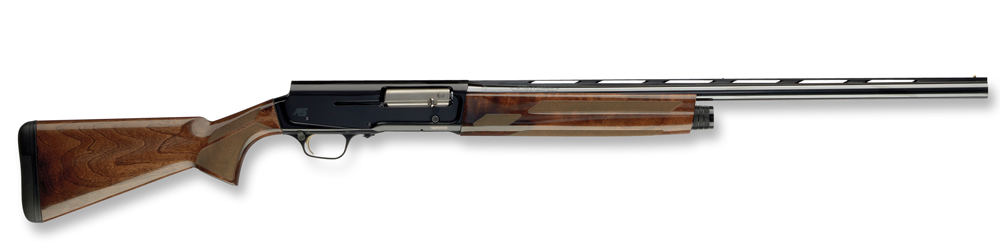
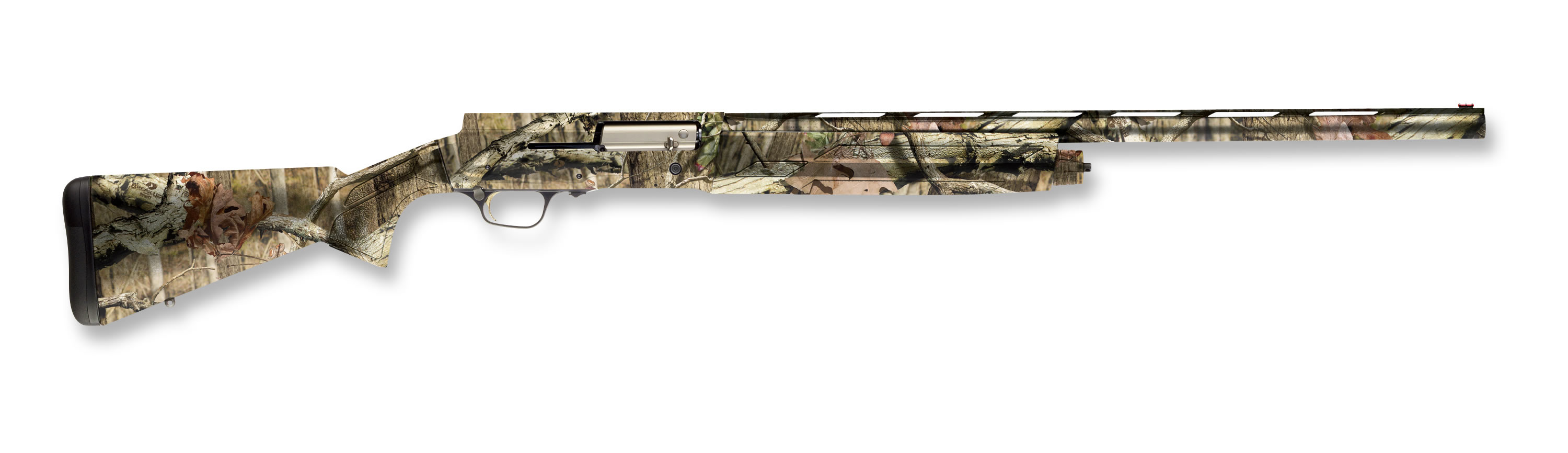
Every hundred years or so, Browning does something so outrageous even their competitors can’t believe it. For 2012, the A-5 recoil-operated shotgun will surely win the hearts of die-hard hunters as well as those who love and appreciate the traditional Browning lines.
Click to enlarge.
The hump is back! However, the iconic humpback-shaped receiver is the only thing this new Browning autoloader shares with its legendary namesake. Built to be the most reliable, fastest cycling, best performing and softest shooting recoil-operated (yes, recoil operated) autoloader on the planet.
Click to enlarge.
Features include:
Ultra-reliable, honed to perfection Kinematic Drive System
Vector Pro lengthened forcing cones
Click to enlarge.
The new Invector-DS choke tube system
3” chambers
26”, 28” and 30” barrels
Inflex II recoil pad
Available in wood (Hunter), synthetic (Stalker) and Mossy Oak Duck Blind and Infinity with Dura-Touch Armor Coating.
The woman’s hands were shaking, but she spoke in a calm voice as she stood outside the Far East Side apartment where 27-year-old Quentin L. Walker was shot and killed early yesterday.
“I’m the one who this happened to,” she said, identifying herself only as Ashley.
She said that Walker, her estranged boyfriend and the father of her two children, broke into her apartment in the middle of the night and came at her with a crowbar in his hand.
She shot and killed him, using the gun she’d bought this year, Ashley said. She had feared that the protection order that was supposed to keep him away from her and their 7-year-old son and 10-year-old daughter would not be enough. Read more
A used firearm can have a great deal of useful life left in it, provided it had a decent amount of care from previous owners. Glocks prices are not different in that regard. Here are the specific things to look for when you’re out to buy used Glocks.
Not everyone buys new guns. A used firearm can have a great deal of useful life left in it, provided it had a decent amount of care from previous owners. Glocks prices are not different in that regard. A horribly abused Glock may not be worth much even as a parts gun. (Unless, of course, that horribly abused Glock is the only firearm you can lay hands on in the city of Dirt, Carjackistan, when the terrorists are trying to kick down your hotel room door. Then it may be literally worth its weight in gold or more.) A like-new-in-the-box used Glock may not cost much less than a brand-new Glock.
However, the durability of Glocks, and the lower percentage of their owners who experiment with them, tends to mean more Glocks survive in good shape than other firearms. Should you be offered a used Glock for sale, the main dance is settling on a price. There is hardly anything on a Glock that can’t be repaired, replaced or factory upgraded, and many of the factory upgrades are free. As a result, advice on buying used Glocks tends to be a lot less involved than that of buying other firearms.
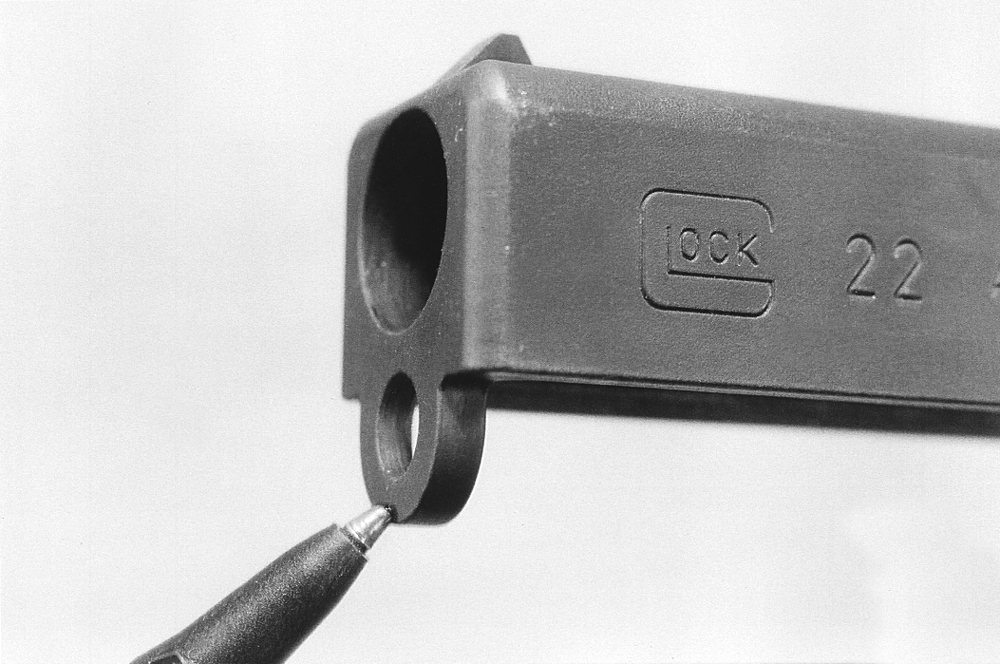
If you drop your Glock slide, it can bend if it lands on the muzzle end extension for the recoil spring. Check this area before buying a used Glock.
What you are looking for are bargaining points on Glock pistol prices. The small ones are things that are wrong or need upgrading, things that the factory will take care of free or at little cost. A G-17 with the old trigger parts can be fixed for free by Glock, but the same repair with new parts that have been experimented on will cost you should you send them back to Smyrna.
Yes You Can: Buy Glock!
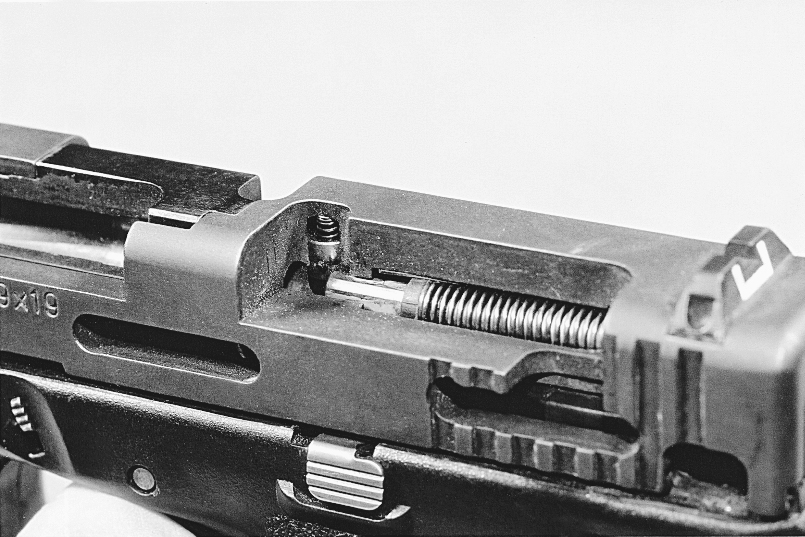
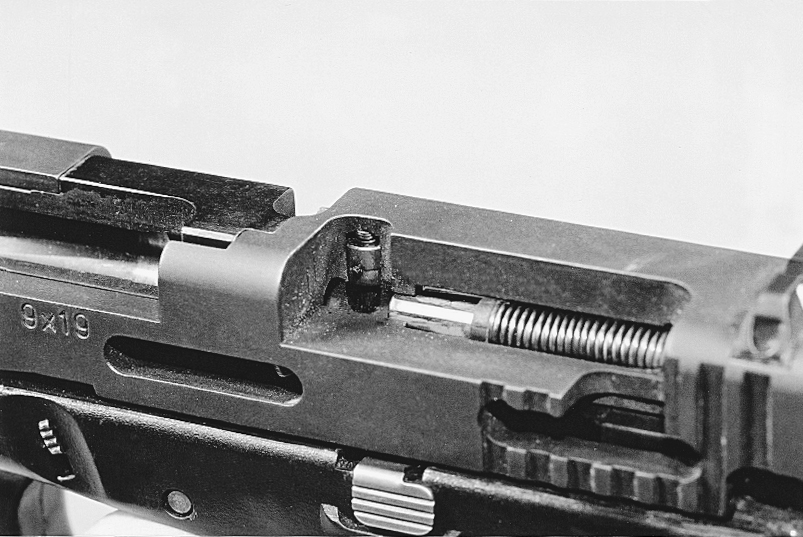
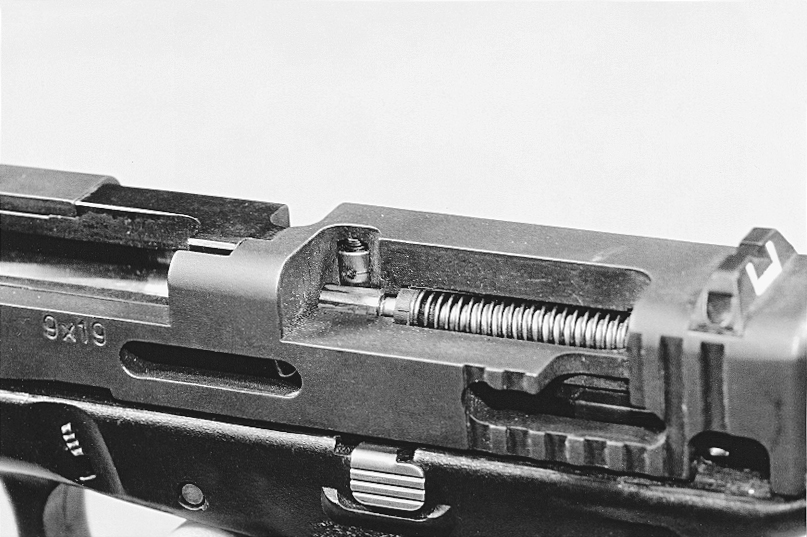
First, give the used Glock a good visual external inspection. Look to see if there are any signs of abuse, neglect and/or experimentation. External abuse would be things like the corners of the slide being chewed up and or dented from being dropped. Dropping the slide when it is off the frame can bend the recoil spring retaining tab or the relatively fragile (for a Glock) back ends of the rails in the slide. Neglect would be indicated by rust (rare) or a cracked slide from too many hot reloads (even rarer). Experimentation would be something like the slide being machined to take some other sight system than the factory one or milled for ports other than factory.
The good news is that the cracked slide might well be replaced by the factory for free or at little cost. The others? You’re on your own. Glock isn’t going to help you with a dropped slide, and the one that was machined will have a voided warranty. Don’t worry about the factory sights; Glock sights are cheap and easily replaced. At the current pricing, an armorer’s cost for a new set of sights is only $3!
Checking the Glock action. The safety plunger is blocking the firing pin.
A scarred and chewed-up frame can be cleaned up but Glock won’t replace it just because it got scraped along a curb during a fight. It will replace it, regardless of condition, if it is one of the E‑series Glocks that were made from September 2001 through May 2002.
With the permission of the owner, cycle the slide and dry fire it. Try firing it without depressing the trigger safety. It should not fire. Try pulling the trigger normally and then hold it back and cycle the slide. Does the trigger return when you subsequently release it? If not, it may be due to a broken/bent trigger spring or a “trigger job” gone awry. The parts don’t cost much, so bargain the price down as much as you can but don’t expect the owner to budge much.
The firing pin being cocked.
Disassemble and inspect the slide and barrel. Is the barrel clean? Unmarred? Look down the bore. Do you see dark rings? Those are bulges in the barrel from lodged bullets being shot free. A new barrel costs money. At the armorer’s cost, a Glock barrel runs $95 to $125, with compensated barrels running up to $140. Aftermarket Match barrels can run up to $200. If the barrel is bulged, bargain hard, for a replacement won’t be cheap.
Look at the slide, in the breech face area. Inspect the area around the firing pin slot.
The firing pin fully forward.
In a very high-mileage 9mm, fed many rounds of +P or +P+ ammo (as some police departments use), you may find the area around the firing pin slot eroded or even peened back. The erosion comes from pierced or blown primers jetting hot gases back at and through the firing pin slot. If you find those signs you should remove and check the firing pin to make sure it is in good shape. The peening comes from the high pressure setback of the primer. The wall between the breechface and the firing pin tunnel isn’t thick (it can’t be) and the repeated hammering from a steady diet of P or +P+ loads can peen it back. Yes, the Tenifer makes the slide hard, but the substrate isn’t hard or thick. If the area is made too hard by Glock, it may break. If it is too soft, it may peen. It must keep Glock engineers awake at night, worrying about it.
This article is an excerpt from the The Gun Digest Book of the Glock, 2nd Edition.
Looking to go armed, but are stuck in the weeds as to what to arm yourself with? Here are 20 of the best concealed carry gun options that will keep you on the defensive.

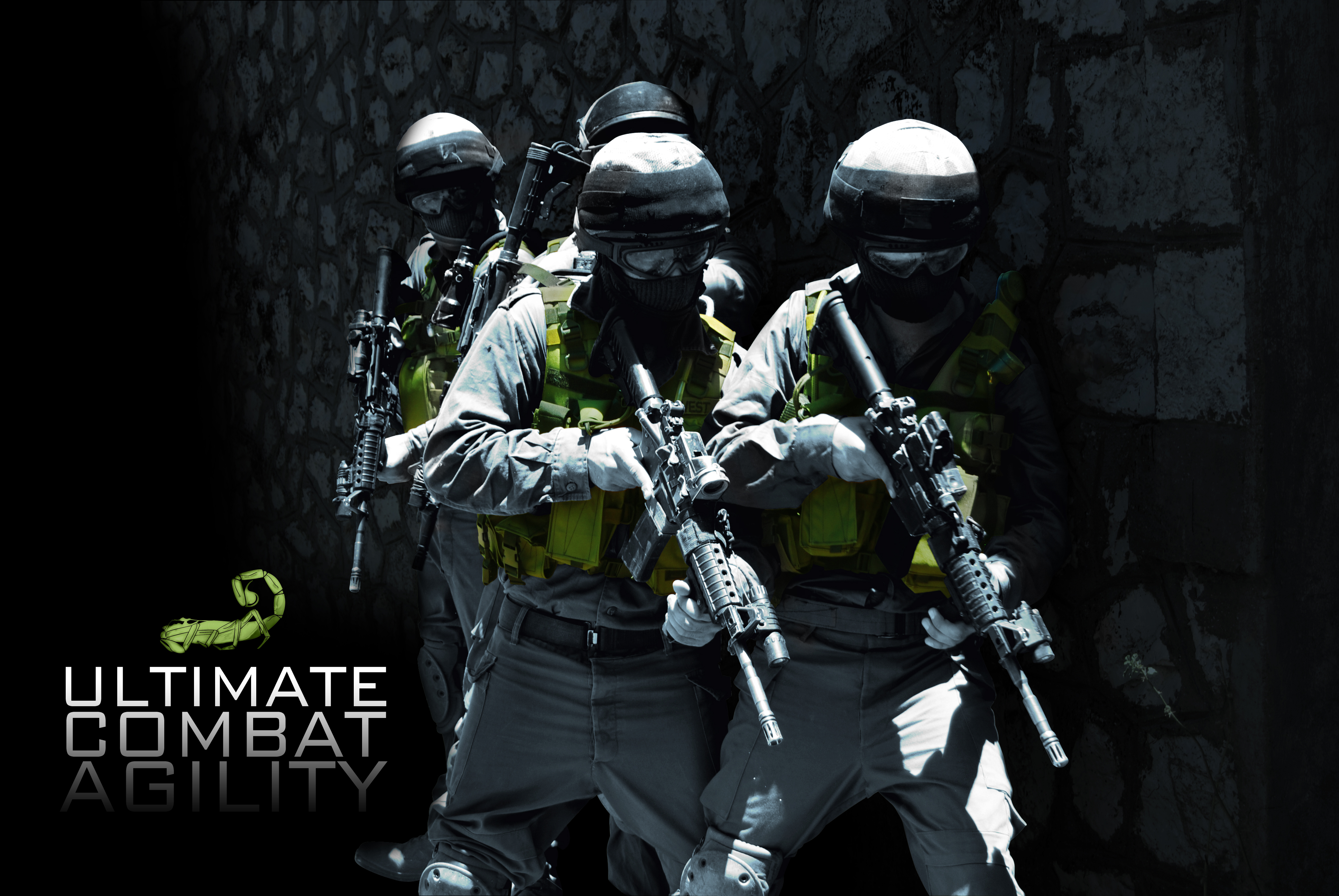 retailer shelves. The lucky few will be the first to receive The new Deflector US modular plate carrier free of charge, in exchange for feedback on its performance. Soldiers who fit the bill should send their details to [email protected]